The Indian benchmark indices opened higher on Wednesday amid mixed global cues as buying was seen in the pharma, auto, PSU bank and financial service sectors in the early trade.
At around 9.35 am, Sensex was trading 296.53 points or 0.37 per cent up at 81,482.97 while the Nifty added 88.90 point or 0.36 per cent at 24,772.80
Nifty Bank was up 98.55 points or 0.18 per cent at 54,975.90. The Nifty Midcap 100 index was trading at 56,028.55 after declining 154.10 points or 0.27 per cent. Nifty Smallcap 100 index was at 17,419.35 after dropping 63.65 points or 0.36 per cent.
According to analysts, Indian equity benchmarks declined sharply on Tuesday amid reports of increasing COVID-19 cases in Southeast Asian countries, like Singapore and Hong Kong.
“Technically, Nifty closed below its 5-day EMA for the first time since May 8, 2025, suggesting a shift to profit-booking. Support levels lie at 24,494 and 24,378, while resistance is expected in the 24,800-24,900 range,” said Devarsh Vakil, Head of Prime Research at HDFC Securities.
In the absence of strong global cues, Indian markets are likely to pick up from where they left off yesterday, he added.
Meanwhile, in the Sensex pack, Sun Pharma, HDFC Bank, Tech Mahindra, TCS, Nestle India, Maruti Suzuki, ICICI Bank, UltraTech Cement and Hindustan Unilever were the top gainers. Whereas, Eternal, Kotak Mahindra Bank, IndusInd Bank and NTPC were the top losers.
In the Asian markets, China, Hong Kong, Bangkok, Seoul and Jakarta were trading in green. whereas Only Japan was trading in red.
In the last trading session, Dow Jones in the US closed at 42,677.24, down 114.83 points, or 0.27 per cent. The S&P 500 ended with a loss of 23.14 points, or 0.39 per cent, at 5,940.46 and the Nasdaq closed at 19,142.71, down 72.75 points, or 0.38 per cent.
The spike in uncertainty and risk is impacting the market rather unexpectedly. Yesterday’s FII sell figure of Rs 10,016 crore is a major reversal of their big buying in May and if this persists, it has the potential to impact the market, said experts.
According to provisional data from the NSE, foreign institutional investors (FIIs) sold Indian equities worth Rs 10,016.10 crore on May 20, while domestic institutional investors (DIIs) were net buyers to the tune of Rs 6,738.39 crore.
Photo credit: Mona/Jesse Hunniford. Image courtesy of the artist and the Museum of Old and New Art, Hobart, Tasmania, Australia.
The first impulse is to kick it. After all, it’s a sand sculpture. And as everyone who has grown up near a beach appreciates, if it’s made of sand, then it’s asking to be kicked. But for the wall-high protective glass, Mirrorscape, by the French artist Théo Mercier, may not have survived my visit to MONA.
On a low, curved stage sits a scene of mundane wreckage. Two utility vehicles serve as centrepieces. One is upturned, its front chassis exposed. It rests on the carcass of a two-seater lounge. A mattress is draped over the upper side of the wreck, a broken log, a signifier of the non-human world in this otherwise secular scene of anthropocentric waste, rests against the lower side.
The other vehicle is upright but seriously damaged. Another mattress rests against it. A bundle of electrical conduit spills out of the tray. A worker’s boot limps over the bedding like a deflated balloon.
It’s as though a couple of ute loads of tradies have smashed into a Derwent Park bungalow. Photo credit: Mona/Jesse Hunniford. Image courtesy of the artist and the Museum of Old and New Art, Hobart, Tasmania, Australia.
Strewn around the battered wrecks are pieces of domestic infrastructure and appliances: bricks, cracked concrete slab, a washing machine, broken joists and beams, snarled corrugated iron sheets.
It’s as though a couple of ute loads of tradies have smashed into a Derwent Park bungalow and scampered off.
This scene is framed by a curved wall of brushed metal panelling, lit above by fluorescent light panels, and sealed behind a wall of glass. This glass is both a protector of the delicate eroding sculpture, and another contrasting visual metaphor employing the work’s foundational element, sand.
Commitment to realism
Mercier is a sculptor and a stage director, and the controlled composition of this scene of chaos attests to his multiple talents.
The team of sculptors – Kevin Crawford, Enguerrand David, Sue McGrew and Leonardo Ugolini – have crafted a remarkable piece.
The commitment to realism is impressive, from the quilting in the mattresses, to the indentations on the utes’ bodywork, to the creases in the sofa cushions, and the sly joke of a finely crafted sandshoe as if discarded by one of the artists as they stepped from the sculptural into the spectatorial space.
Looking closer, the human objects – utes, mattresses, sofas – merge into or out of sandstone rock faces, like those found along Derwent River, including the peninsula upon which MONA stands.
The commitment to realism is impressive. Photo credit: Mona/Jesse Hunniford. Image courtesy of the artist and the Museum of Old and New Art, Hobart, Tasmania, Australia.
What are we to make of the deliberate collapsing of the “natural” and “human-made” in this piece?
Mercier styles Mirrorscape as a “diorama of catastrophe”. He describes it as:
a sculpted dystopian landscape […] using 80 tonnes of compacted sand […] inspired by different dark forces, such as tsunamis, earthquakes, hurricanes, wars, bulldozers – the powers of destruction.
The conflation of “natural” and “man-made” here, and in the composition of the work, grates. While Mirrorscape may reflect a “man-made” landscape of disaster, precisely whose landscape is it, and who ultimately is responsible for it?
A work about class
Mirrorscape is superficially a work about class. Its blunt appropriation of the signifiers of working-class labour and domesticity contradicts the claim that the scene is an archetypal landscape, or humanity’s refuse.
Mirrorscape might be appreciated as a witty piece reflecting on the kind of “treasures” of our age that future archaeologists might excavate in a local tip. But I found it provided little connection to the contemporary subjects of our present-day disasters.
Mirrorscape is haunted, so to speak, by the figures who drove the wrecked utes, slept on the wasted mattresses. But their identities and complex lives, very much of our own time, are rendered invisible.
As a meditation on catastrophe and the “powers of destruction,” Mirrorscape offers a conservative reckoning: that the contemporary human tragedies of inequality, alienated labour, class division and the waste these produce are the “natural” order of things.
Mirrorscape is haunted by the figures who drove the wrecked utes, slept on the wasted mattresses. Photo credit: Mona/Jesse Hunniford. Image courtesy of the artist and the Museum of Old and New Art, Hobart, Tasmania, Australia.
This is evident in the way the human objects merge into and out of the rock faces, each designed to erode to the common element: sand.
In interviews, Mercier stresses the work’s debt to locality, and his engagement with the working-class suburbs neighbouring MONA:
It was really important to me that everything was really strongly locally grounded, so that you can actually see your own mattress, your own car, your own catastrophe […] it’s a landscape that mirrors you.
But really, how local is this scene, and what value is there in the reflections it provokes? There is little in this sculpture that relates it directly to the place where it is displayed.
The images Mercier has chosen, while unconventional, are nevertheless generic. This dulls the potential for the kind of reflection on catastrophe that might impel a change in the minds of its viewers.
Will MONA’s well-heeled attendees recognise their implication in the human catastrophe this work seeks to capture? Will visitors from the suburbs that neighbour MONA appreciate the reflection that Mirrorscape offers?
If art is to play any role in motivating us to confront the catastrophes that are now upon us, it needs to go beyond the kind of slowly eroding stasis that is Mirrorscape’s defining quality.
Mirrorscape is at MONA, Hobart, until February 16 2026.
Robert Clarke does not work for, consult, own shares in or receive funding from any company or organisation that would benefit from this article, and has disclosed no relevant affiliations beyond their academic appointment.
PERTH, Monday 19 May 2025 — Greenpeace Australia Pacific and the Conservation Council of WA today confirmed they had lodged a joint referral of Woodside’s high-risk Browse carbon dumping project – also referred to as carbon capture and storage (CCS) – to the Western Australian Environmental Protection Authority (EPA).
The environment groups state that the ongoing seismic blasting from the carbon dumping project, and risk of CO2 blowouts, would have immediate impacts on Scott Reef and the surrounding ecosystem. They argue that projects posing significant risk of harm to WA’s environment must be referred to the WA EPA for proper assessment.
Geoff Bice, WA Campaign Lead at Greenpeace Australia Pacific, said: “Carbon dumping is an expensive distraction corporations use to greenwash their emissions, and a diversion from real action to slash climate pollution.
“Woodside has tried for years to push through carbon dumping for its highly polluting Browse gas proposal, but the federal environment department highlighted the risks of the new technology to our oceans and marine life, as well as the risk of the injection site failing.
“Woodside’s carbon dumping plans pose a serious risk to the pristine and fragile Scott Reef and its marine life. It is unacceptable for Woodside to bypass state assessment of its carbon dumping plans given the threat to the WA environment — its plans must be properly assessed by the WA EPA.
“Ultimately, if we are serious about tackling the climate crisis we must stop emissions before they are produced — carbon dumping has not been proven to work at scale anywhere in the world and must be called out for the false promise it is.”
Matt Roberts, Executive Director of the Conservation Council of WA, said: “By evading proper, robust environmental assessment of the potential risk this project would pose to the WA marine environment in WA state waters, Woodside is simply attempting to fast-track its approval and bypass due process.”
“Even in light of revised plans before the WA EPA lodged by Woodside, they are simply tinkering around the edges. In reality, nothing has changed.
“Carbon dumping is a failed technology — we’ve seen this with Chevron’s Gorgon project where less than 3% of total emissions have been sequestered successfully.There are no examples of carbon pollution dumping that have met dumping targets or been delivered on time or on budget.
“Failed offsets should not be used to support the development of new gas projects like Browse. We need much stronger commitments to abate carbon pollution, not false promises of dumping. The only safe way to prevent catastrophic climate change is to phase out the use of fossil fuels in favour of renewable energy.”
Scott Reef is already subject to multiple environmental pressures, including marine heatwaves, coral bleaching and cyclone activity, driven by the burning of fossil fuels like gas. Woodside’s proposed carbon dumping and gas extraction activities threaten the long-term viability of the reef and the endangered species that rely on it.
The EPA’s environmental impact assessment (EIA) process is designed to evaluate the potential environmental impacts of proposals, including both direct and indirect (secondary) effects. The WA EPA is required to assess the environmental acceptability of any proposal likely to have a significant effect on the WA environment.
ENDS
For more information or interviews, contact Kate O’Callaghan on 0406 231 892 or [email protected]
On Tuesday, the Reserve Bank of Australia cut the target cash rate by 0.25 percentage points. It now sits at 3.85% – the lowest since May 2023.
Australia’s big four banks were all quick to announce they would be passing the cuts on to borrowers. If you’ve got a mortgage, you might be wondering if this is your cue to act.
Refinancing your home loan – whether by negotiating a better deal with your current lender or switching to a new one – could save you thousands over the life of your loan.
However, it won’t be the right decision for everyone. And there are some important things to know about how the process works – including hidden costs and risks.
What is refinancing?
Refinancing simply means replacing your existing home loan with a new one – either from your current lender or a different one. The goal? To take advantage of better loan terms.
If you’re on a “variable rate” loan, your lender may already be passing on some or all of the recent rate cut (though you may have had to opt in).
But if you’re on a “fixed rate” loan, your repayments will stay the same until your fixed term ends – meaning you might not benefit from the cut unless you refinance (though break costs could apply).
Switching to a loan with a lower rate can mean smaller monthly repayments. Or, by keeping repayments the same size but with a lower interest rate, you could potentially pay off a loan faster and save in the long term.
Refinancing activity has been trending up since 2021, with external refinancing (switching banks) rising significantly among both owner-occupiers and investors. That’s a clear sign many borrowers are chasing better deals.
Yes – if it’s right for you and you do it right. Switching to a lower interest rate could slash thousands off your yearly repayments.
If you’ve built up equity, you might be able to release funds to reinvest or improve your property. Some lenders also offer refinancing cashback deals – one-off payments to attract new customers.
There are some important things to consider – including some traps to avoid – if you’re thinking about refinancing your home loan.
1. Be mindful of your loan-to-value ratio
Loan-to-value ratio (LVR) is the amount you borrowed as a percentage of the property’s value or purchase price.
If your LVR is above 80%, you probably paid lenders mortgage insurance (LMI) on your original loan, designed to protect the lender in case you default.
If your current loan still exceeds 80% of your home’s value (based on the new lender’s valuation), you might need to pay LMI again. That cost could wipe out any benefit from a lower rate.
2. Careful how you compare
When comparing rates and repayments, make sure you’re comparing apples with apples.
If you’ve already paid five years on a 30-year loan, you have 25 years left. But when you ask a new lender for a quote, they may show repayments based on a full 30-year term – which could make the monthly repayment look much lower.
To make a fair comparison, ask for quotes based on your remaining loan term. If you decide to switch, aiming for a loan with the same term can help you avoid paying more interest in the long run.
break fees if you’re leaving a fixed-term loan early
settlement fees for your current lender to close out the loan
application and valuation fees with the new lender
ongoing monthly fees that might not seem large but can add up over time.
Also, if you’re applying to multiple lenders to compare offers, be aware requesting multiple credit checks in a short space of time can negatively impact your credit score.
4. Consider renegotiating with your existing lender first
Lenders rarely offer their best deals to existing customers – unless you ask. In fact, they often reserve the most attractive deals for new customers.
Consider picking up the phone and asking for a rate review. If you have a better offer from another bank, you may be able to use that as leverage.
Staying with your current lender can have advantages. It may be quicker and easier than refinancing with another lender. But don’t let loyalty cost you – especially if better rates are on the table elsewhere.
5. Don’t assume your repayments will drop automatically
For borrowers on variable loans, some banks don’t automatically reduce your repayments after a rate cut. You may need to manually adjust them through your bank’s app or website, or “opt in”.
Alternatively, keeping your repayment amount the same could help you pay off your loan faster and reduce interest costs.
Banks don’t always automatically adjust variable loan repayments after a rate cut. David Lade/Shutterstock
6. Check your credit score before applying
Your credit score can play a key role in refinancing. Lenders use it to assess how risky it is to lend to you – and it can affect the interest rate you’re offered.
If your score has dropped since you first took out your loan, you may not qualify for the best deals.
Check your score through your bank or a free online service before you apply. If it’s low, take time to improve it before refinancing to boost your chances of approval and better rates.
For an estimate of your potential savings from refinancing, try the Australian Securities and Investments Commission (ASIC)’s MoneySmart mortgage switching calculator.
Disclaimer: This article provides general information only and does not take into account your personal objectives, financial situation, or needs. It is not intended as financial advice. Before acting on any information, consider whether it is appropriate for your circumstances.
The authors do not work for, consult, own shares in or receive funding from any company or organisation that would benefit from this article, and have disclosed no relevant affiliations beyond their academic appointment.
Source: The Conversation (Au and NZ) – By Rob Cover, Professor of Digital Communication and Director of the RMIT Digital Ethnography Research Centre, RMIT University
In its most recent battle with authorities in Australia, X (formerly Twitter) has launched legal action in the Federal Court, seeking an exemption from a new safety standard aimed at preventing the spread of harmful material online.
The standard in question is known as the Relevant Electronic Services Standard. It came into effect in December 2024, but won’t start being enforced by Australia’s online regulator, eSafety, until June this year.
Compared with the social media ban for under-16s, this standard has been a side issue in the broader topic of online safety. So what exactly is it? And will it be effective at preventing the spread of harmful material online?
What is the standard?
The Relevant Electronic Services Standard contains criteria to help address the pervasiveness of harmful and illegal material distributed online. It is particularly focused on child sexual exploitation content, depictions of extreme violence, illegal drug material, and pro-terror content.
Relevant electronic services (RES) are digital services that enable user-to-user content. This includes instant messaging, email and chat platforms. The legal definition also includes some online gaming services.
Under Australia’s Online Safety Act 2021, the communications minister may exempt some services or platforms from being defined as an RES. The minister can also set conditions on the service for exemption, such as having a robust moderation service, or being a messaging service for internal employees of a company.
Some social media platforms, such as Facebook and X, may be defined as RES. That’s because they also offer user-to-user messaging services. It is sensible, then, for the Federal Court to determine whether they fall under social media codes or RES standards, or both.
The standards require RES to implement systems, processes and technologies to detect and remove child sexual abuse and pro-terror material from their services, and to actively deter end-users from distributing this material.
There are consequences for services that fail to comply. The eSafety commissioner, Julie Inman Grant, can issue a formal warning or infringement notice, or have the courts apply a civil penalty.
What does the standard do?
The Online Safety Act 2021 imposes obligations on RES providers, particularly regarding the handling of harmful material. This material is categorised into several classes, including Class 1A and Class 1B content.
Class 1A material typically means child exploitation and pro-terror content. Class 1B material refers to extreme violence, promotion of crime, and illegal drug-related content.
The class of content is determined by referring to the National Classification Scheme. This scheme sets standards for the ratings of films.
Class 1A and 1B material is content, texts and images that would be “refused classification” under the scheme. That is, it would be material that is usually not allowed to be distributed at all. Class 2 material is what we usually consider X-rated or 18+ material.
At the moment, the eSafety commissioner can ask a RES to remove Class 1 or Class 2 content, or the service can be penalised. However, the next step has been to work with industry to develop codes that require service providers to be more proactive in preventing Class 1 content being shared between their users.
Will the standard be effective?
X wants its platform to be treated as exempt, and governed by the similar but less stringent Social Media Code instead. Whatever the Federal Court decides, however, there are other issues to consider.
Part of the difficulty with the scheme is that it relies on harmful content coming to the attention of the eSafety commissioner. This usually happens when an end-user makes a complaint.
But our recent research, which surveyed 2,520 representative Australians and will be published later this year, found that only about 10% of users who were the target of digital harms reported them to the eSafety commissioner. Among those who had witnessed harmful content or behaviour, only 6% reported. About 40% of Australians don’t believe reporting will make any difference.
Another issue with the industry standards raised by digital rights activists is that it may require services to investigate user messages even when end-to-end encryption of messages is used. That may have serious privacy implications.
New global treaties could help address the problem of online harm. nexus 7/Shutterstock
A global treaty could help
This ties into broader problems with the online safety framework.
Much of the focus has been on managing platforms and getting platforms to police users and content – a necessary approach to avoid penalising individuals and overwhelming courts.
However, service provider policing often fails to meet the norms of due process, such as transparency and the right to appeal decisions.
It also makes platforms and messaging providers the “arbiters” of free speech and censorship, instead of governments, courts and communities.
While setting standards on platforms is one part of the solution, we need to continue developing remedies to protect users. This may include global agreements and multilateral treaties, similar to the International Covenant on Civil and Political Rights, so all countries can share the burden locally for digital harms that occur across jurisdictions, and ensure due process and the protection of privacy.
Rob Cover receives funding from the Australian Research Council
The Asia-Pacific (APAC) card payments market is expected to growth by 4.3% to reach $24.7 trillion in 2025 supported by growing preference for electronic payments.
Strong growth in markets like China, South Korea, Japan, and Australia is complemented by rising adoption in emerging economies, supported by infrastructure improvements, regulatory initiatives, and expanding financial inclusion across the region, according to GlobalData, a leading data and analytics company.
GlobalData’s Payment Cards Analytics reveals that the card payment value in APAC registered a growth of 5.8% in 2023, driven by the rise in consumer spending. The value registered an estimated growth of 4.8% in 2024 to reach $23.7 trillion.
Ravi Sharma, Lead Banking and Payments Analyst at GlobalData, comments: “China, South Korea, Japan and Australia have a robust card payments market with high card payments value. Other markets within the region are also catching up supported by improving payment infrastructure, rising middle-income population, growing financial awareness, and banks offering lucrative benefits in terms of reward programs and instalment facilities.”
The APAC card payments market is dominated by China, which is expected to grow by 3.7% in 2025 to reach $20.3 trillion. It is distantly followed by South Korea with expected card payments value of $984.5 billion, Japan with $866.1 billion, and Australia with $731.4 billion in 2025.
However, card usage is comparatively low in the Philippines, Indonesia, India, Thailand, and Vietnam. This is mainly due to the limited financial awareness for card payments, inadequate POS infrastructure, and growing popularity of QR-based mobile payments.
These countries are also gradually pushing card adoption through various financial awareness campaigns as well as by introducing favorable regime. For instance, the central bank of Indonesia capped the credit card interest rate at 1.75%, effective from 1 July 2021, reducing it from existing 2% per month to drive credit card usage.
Similarly, in India, the government’s move to abolish merchant service fees on RuPay cards (domestic card) effective from 1 January 2020, encouraged the acceptance of RuPay cards among merchants, thereby pushing debit card usage.
However, high cost involved in POS infrastructure for merchants and high preference for digital wallets among consumers remain challenge for faster growth in card payments in the region. Many consumers in the region leapfrogged from cash to digital wallets skipping card payments. The availability of low-cost smartphones, rising Internet penetration, growing awareness of mobile payments and the proliferation of digital wallets have resulted in Asian countries shifting from cash transactions to mobile digital payments.
Sharma concludes: “Looking ahead, the total card payments market in APAC is expected to continue its upward trajectory, driven by ongoing government initiatives, improving payment infrastructure and a consumer shift towards electronic payments. However, high preference for mobile payments remains a challenge for their faster adoption. Overall, the card payments value in APAC is expected to register a compound annual growth rate (CAGR) of 6% between 2025 to 2029 to reach $31.1 trillion in 2029.”
About GlobalData
4,000 of the world’s largest companies, including over 70% of FTSE 100 and 60% of Fortune 100 companies, make more timely and better business decisions thanks to GlobalData’s unique data, expert analysis and innovative solutions, all in one platform. GlobalData’s mission is to help our clients decode the future to be more successful and innovative across a range of industries, including the healthcare, consumer, retail, financial, technology and professional services sectors.
Media are invited to the 384 Allan Boreham Police recruit wing graduation.
What: Graduation of the New Zealand Police Allan Boreham 384 Recruit Wing. Who: For families and friends to celebrate with the newly attested Police officers. Why: Completion and graduation from their initial training course. Where: Te Rauparaha Arena, 17 Parumoana Street, Porirua. When: Thursday 22 May at 2pm – media will need to be in place by 1.45pm. How: RSVP the Police Media Centre if you’re attending: media@police.govt.nz
Commissioner Richard Chambers will be attending the ceremony, along with Her Worship Anita Baker, the Mayor of Porirua. Also attending will be members of the Police executive and Wing Patron, former Assistant Commissioner Allan Boreham.
The three top award winners will be deployed to Eastern, Wellington and Tasman Districts.
The 384 Wing Patron:
Allan Boreham is a retired Assistant Commissioner of Police and former head of Youth Justice for Oranga Tamariki, Ministry for Children. Allan holds the New Zealand Police in very high esteem and is honoured to be the patron for Wing 384.
He says he is looking forward to supporting the wing members to succeed and gain all the satisfaction a Police career offers. Allan joined Police in 1985 (in Wing 97) and served for more than 33 years. He was also a Deputy Chief Executive in the public service for five years in charge of Youth Justice.
His Police career was varied and involved completing a wide range of roles in public safety, investigations, and road policing. These included postings in Auckland, Tokoroa, Hamilton and Wellington. He received an award for his leadership in solving the 1997 kidnapping and murder of an Auckland businessman, Graham Kirkwood.
More details about statistics, prize winners and other recruits will be shared after graduation on Thursday.
PSA members will be turning out to support New Zealand women and pay equity at a multi-union Protect Pay Equity hui at Parliament tomorrow.
The rally Is being held on Budget Day to highlight how the recent pay equity law changes were rushed through Parliament to free up billions of dollars to plug the gaps in the Government’s Budget, says PSA National Secretary Fleur Fitzsimons.
“The undemocratic pay equity law extinguished 33 pay equity claims covering more than 150,000 mainly female workers,” Fitzsimons says.
“This means the Budget will be paid for by taking money from support workers, library assistants, social workers and others to fund tax breaks for landlords and support for tobacco companies.
The Protect Pay Equity hui will be held in Parliament Grounds, 1pm to 2pm, on Budget Day Thursday 22 May 2025.
The Public Service Association Te Pūkenga Here Tikanga Mahiis Aotearoa New Zealand’s largest trade union, representing and supporting more than 95,000 workers across central government, state-owned enterprises, local councils, health, and community groups.
Care and support workers who had their pay equity claims dumped overnight after years of work will meet at Parliament tomorrow to voice their frustration at the Coalition Government’s changes.
The workers are members of New Zealand Nurses Organisation Tōpūtanga Tapuhi Kaitiaki o Aotearoa (NZNO) and are some of the 3000 aged residential care health care assistants who were party to the claim.
NZNO care and support delegate Tash Greig says care and support workers were devastated by the changes.
“The Government chose not to prioritise low-paid women in this year’s Budget. They can find funding for landlords and the film industry, but not for women doing some of society’s toughest jobs.
“The work we do has been underpaid and undervalued for generations because we are women. Our claim was almost finalised and would have meant our hard work was finally properly recognised.
“To heap injustice on injustice, these changes were made without warning or consultation. That’s why we are joining the cross-union hui at Parliament tomorrow.
“We want the Government to treat us with the same dignity and respect we treat our elderly and vulnerable patients with – and reverse these changes,” Tash Greig says.
Secretary for Health Prof Lo Chung-mau spoke at a panel discussion session and met World Health Organization (WHO) officials yesterday as he continued his attendance at the WHO’s 78th World Health Assembly in Geneva, Switzerland.
In the morning, Prof Lo and Director of Health Dr Ronald Lam listened to remarks made by State Council Vice Premier Liu Guozhong at the assembly’s “High Level Segment”.
Prof Lo commented: “The Hong Kong Special Administrative Region Government spares no efforts to complement the nation’s strategies to contribute to the building of a global community of health for all.”
Prof Lo and Dr Lam also attended a side event themed “Improving Universal Health Coverage through the implementation of WHO Traditional Medicine Strategy 2025-2034”, which was hosted by the National Administration of Traditional Chinese Medicine along with the health authorities of Malaysia, Nepal, Saudi Arabia and Seychelles.
In a panel discussion, Prof Lo spoke about Hong Kong’s experiences in promoting high-quality and high-standard Chinese medicine (CM) development.
He said: “The Hong Kong SAR Government will leverage Hong Kong’s strengths in its healthcare system, regulatory framework, standard-setting, clinical research, trade, and more to develop the city into a bridgehead for the internationalisation of CM.”
In terms of CM practice, he explained that the Hospital Authority has accumulated extensive experience through its integrated Chinese-Western medicine services over the years. The Chinese Medicine Hospital of Hong Kong is developing a “Hong Kong model” that includes pure CM, CM-predominant, and integrated Chinese-Western medicine clinical services, with a view to promoting CM at an international level.
With regard to CM drugs, Prof Lo said Hong Kong’s Government Chinese Medicines Testing Institute is actively advancing scientific research, education and international exchanges on CM drug testing. This includes developing internationally recognised reference standards and testing methods for CM drugs, and promoting the commercial application of such methods, with a view to developing Hong Kong into an international hub for CM testing and quality control.
Prof Lo and Dr Lam also met the WHO’s Director of Nutrition & Food Safety Luz María De Regil to discuss strategies and interventions for obesity and weight management. Prof Lo said that the Hong Kong SAR Government will strive to halt the rise of obesity by implementing life-course interventions.
The delegation will arrive back in Hong Kong tomorrow.
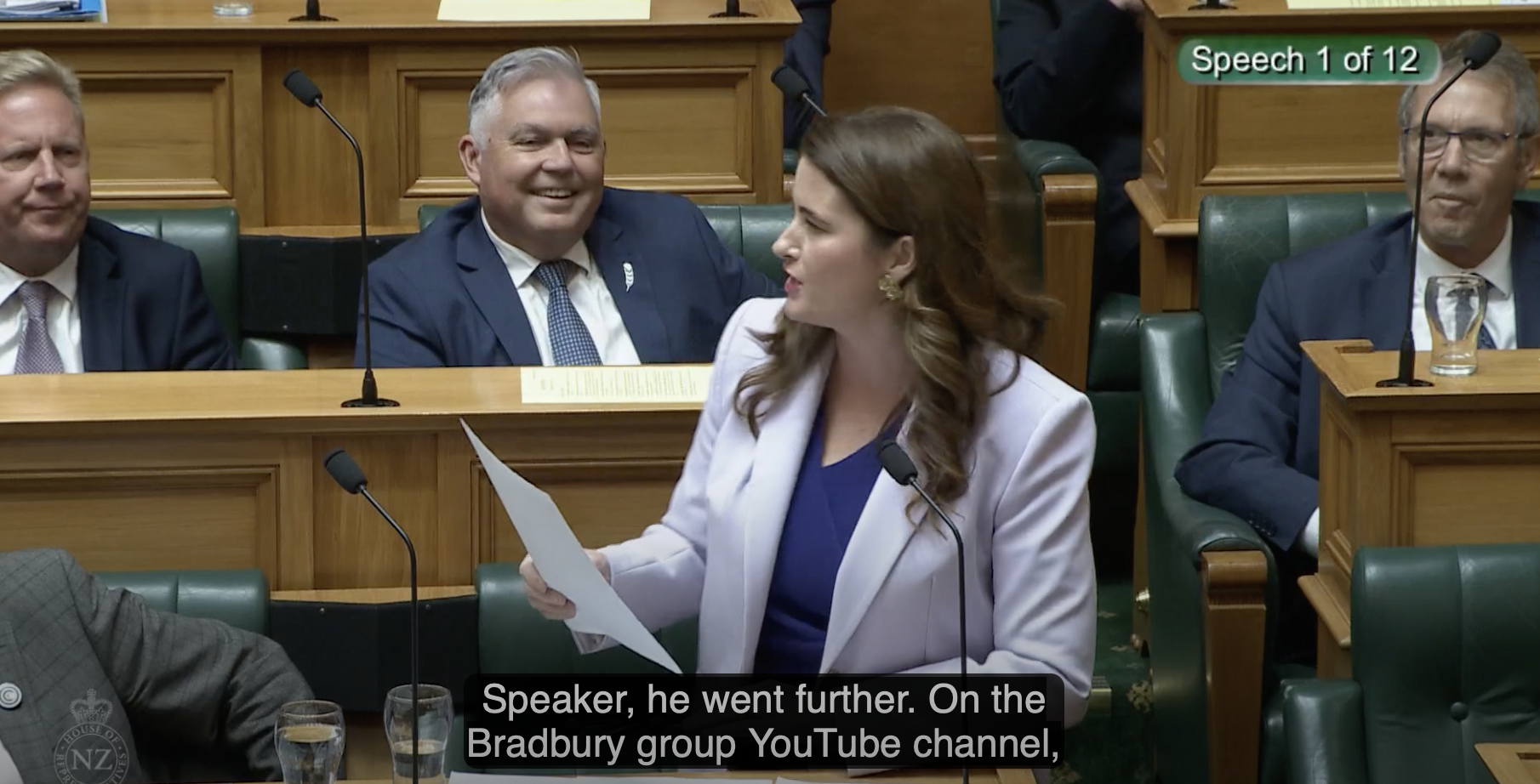
Editor’s Note: I’m pleased to say my old friend Martyn ‘Bomber’ Bradbury has launched his new programme and podcast titled The Bradbury Group.
Martyn needs no introduction to New Zealanders. Under his handle ‘Bomber’ he’s been at the forefront of political debate, especially from a left perspective, for decades.
What is particularly refreshing about this latest broadcasting initiative is that Martyn has been unleashed from the constraints of his previous show, The Working Group, and its funders. You can read all about that over on TheDailyBlog.co.nz which is Martyn’s own blog site.
He launched the first episode of The Bradbury Group with a cracking line up. First up was Labour leader Chris Hipkins for 10 minutes, where Martyn put a number of concerns to Hipkins – including issues which concern many among the left of centre on Labour and where it is positioning itself under Hipkins’ leadership.
Then followed a panel discussion which included; Ti Pati Maori president John Tamahere, CTU chief economic Craig Rennie, and centre-right commentator and columnist Matthew Hooton.
Also, The Bradbury Group has already been the subject of New Zealand Parliamentary debate with the National-led coalition Government finance minister Nicola Willis citing it in her attacks on the leader of the opposition, Labour’s Chris Hipkins. Willis probably doesn’t realise it, but by raising The Bradbury Group in Parliament she gave the new programme a huge lift – that’s a promotion that advertising money can’t buy!
NZ Finance Minister Nicola Willis probably doesn’t realise it, but by raising The Bradbury Group in Parliament she gave the new programme a huge lift – that’s a promotion that advertising money can’t buy!
Source: People’s Republic of China – State Council News
Visitors taste pizza at the booth of Italy at 2025 Chengdu Europe Culture Season & European Culture Street in Chengdu, southwest China’s Sichuan Province, April 12, 2025. [Photo/Xinhua]
China’s pizza market is projected to surpass 100 billion yuan (about 13.9 billion U.S. dollars) over the next five years, driven by rapid growth in lower-tier cities and rising demand for delivery and ready-to-eat products, according to an industry report.
The market is forecasted to grow from 48 billion yuan in 2024 to 60.8 billion yuan in 2025, said the report released at the ongoing SIAL Shanghai, an international food exhibition. China had more than 60,000 pizza outlets nationwide by the end of March.
Between 2016 and 2022, pizza chains in China’s third-tier cities and below grew at a compound annual growth rate of 10 percent, outpacing 7.6 percent growth in first-tier cities. An estimated 15,000 new stores are expected to open in lower-tier markets between 2025 and 2027.
China’s online pizza market share surpassed in-store sales for the first time in 2022, reaching 58.1 percent. The proportion is expected to continue rising in the coming years, according to the report.
Pizza entered the Chinese mainland in 1990 with the launch of the first foreign-invested restaurant. Initially considered a premium Western offering confined to top-tier cities, the food item has gained traction over the past decades.
Analysts attribute the market expansion to increased food delivery adoption, rising consumer spending in smaller cities, and growing demand for personalized, healthier pizza options tailored to local tastes.
The report noted that despite this momentum, China’s pizza store density remains low compared with other countries. As of 2022, China had 11.7 pizza outlets per million people, compared with 232.4 in the United States and roughly one-third the density of Japan and the Republic of Korea, suggesting ample room for further expansion.
According to industry experts, the evolution of China’s pizza market reflects both the openness of its consumer market and long-term growth potential.
SIAL Shanghai, an international food and beverage trade show co-hosted by multiple organizations including France’s Comexposium Group and the China General Chamber of Commerce, spans 200,000 square meters and features more than 5,000 exhibitors from 75 countries and regions.
The event runs from May 19 to 21 in the eastern Chinese metropolis.
The bill seeks to redesign the vocational education and training system to restore regional decision-making. It also aims to increase industry involvement in vocational education and training. The bill would do so by amending the Education and Training Act 2020 to:
disestablish Te Pūkenga—New Zealand Institute of Skills and Technology (Te Pūkenga)
re-establish a network of regional polytechnics
establish industry skills boards to replace workforce development councils.
The bill would propose a framework within which new polytechnics and a Polytechnic Federation Committee can be established, as well as framework to establish industry skills boards. The frameworks would set out the characteristics and functions of the new entities, the process for their establishment and disestablishment, and the technical elements necessary for them to function. The bill would also enable Te Pūkenga to remain as a transitional entity for unallocated programmes and activities for a 1-year period after commencement.
Tell the Education and Workforce Committee what you think
Make a submission on the bill by 11:59pm on Wednesday, 18 June 2025.
New Zealand Nurses Organisation Tōpūtanga Tapuhi Kaitiaki o Aotearoa (NZNO) is concerned that after-hours attacks on Christchurch Hospital staff returning to their cars have continued without a proper long-term solution to parking in sight.
It follows the recent assault on a student midwife going back to her car from Kurawaka Waipapa.
NZNO Christchurch delegate Al Dietschin says staff have raised concerns about parking at the hospital for more than a decade, possibly longer, and while there has been some action from Te Whatu Ora, it is not nearly enough to prevent the assaults from persisting.
“How many incidents do we need to have before the employer acts in the interest of staff in accordance with the Health and Safety Employment Act?
“They have to provide a safe work environment. They always say health and safety of staff is important, but these after-hours assaults continue to happen.”
Al Dietschin says the Tū Waka Waipapa building that opened opposite the hospital in November 2023 provides parking, but costs about $25 a day, which is unaffordable for most workers.
In wake of many assaults in the past, the hospital provides a minibus shuttle between 9pm and 1am, but staff are often made to wait too long for this arrive.
“Staff are reportedly walking to their cars because they’re made to wait 30 minutes or more after working the late shift for the shuttle to arrive. Staff don’t feel safe walking to cars after their shift or early morning in the dark, but they’re sometimes forced to.”
Another shocking decision recently limits emergency department parking for lead maternity carers (community midwives) to five hours, he says.
“This used to be available for unlimited time. Now they’re forced to ask core staff to relieve them in the middle of a patient’s labour so they don’t get fined. That’s not good for the safety of their patients.”
Al Dietschin says the solution is simple from the staff’s perspective.
“Staff only want safe after hours parking close to hospital, and we don’t want to break the bank for this to happen.”
TASMAN SEA – A new analysis of the latest fisheries data by Greenpeace Australia Pacific has revealed widespread slaughter of sharks in the Pacific Ocean by industrial longline fishers. The analysis estimates that almost half a million blue sharks were caught as bycatch in the region in 2023, the highest number in recorded history since 1991.
Greenpeace estimates that around 438,500 near-threatened blue sharks, almost 50 million kilograms, were caught as bycatch in the region in 2023 fromWestern and Central Pacific Fisheries Commission(WFCPFC) data. The figure is double the 2015 numbers.
The analysis of shark bycatch data also revealed that the Lord Howe Rise and South Tasman Sea areas between New Zealand and Australia had some of the highest rates of birds caught on fishing lines – 13% of bycatch from longliners were seabirds like albatross.
Greenpeace Aotearoa oceans campaigner Juan Parada says, “This rampant destruction of critical ocean life in the high seas between New Zealand and Australia highlights the urgent need for international cooperation to protect the oceans.”
“The Tasman Sea faces multiple threats from industrial fishing. We’ve recently seen firsthand the destruction caused by bottom trawlers in a similar area of the high seas, where we witnessed graveyards of destroyed coral. Now we see that almost half a million blue sharks were unnecessarily killed in the West and Central Pacific in 2023. That’s so many sharks that if stacked nose to tail, they would reach the International Space Station and back.
“The international waters between New Zealand and Australia are globally renowned precisely because of the range and variety of ocean life that lives there, from deep sea corals growing on seamounts to sharks, seabirds and migrating whales.
“It’s such a significant place that Greenpeace and allies are calling for it to be one of the world’s first global ocean sanctuaries and it must be protected from longlining and bottom trawling so ocean life can thrive,” says Parada.
The incident happened on Lord Howe Rise, a region renowned for diverse marine life including corals, sponges, whales and seabirds.
Parada says, “While some countries are working constructively towards protecting the high seas, New Zealand is actively blocking meaningful ocean protection. Shockingly New Zealand is the only country still bottom trawling these waters.
“To protect the Tasman Sea, New Zealand must stop bottom trawling and get on with helping to create global ocean sanctuaries so all the life that lives there can thrive.” Scientists agree that to help stave off the worst of the climate crisis at least30% of the world’s oceans must be protectedfrom industrial harm by 2030.
Creating global ocean sanctuaries in international waters like the Tasman Sea, those areas outside of any one country’s jurisdiction, will play a crucial role in achieving this goal. In 2023 the world won the Global Ocean Treaty, which provides the legal framework for these sanctuaries, but first it must be passed into law.
Parada says, “Now is the time for cooperation in ocean protection. Every day that passes without the Global Oceans Treaty in force, marine species are being pushed closer to the brink of extinction by the industrial fishing fleet in the high seas.”
Greenpeace Australia Pacific spokesperson Georgia Whitaker says of the shark bycatch data, “The data is deeply disturbing – it’s a devastating record and a testament to the destructive nature of the industrial fishing industry. Sharks and other animals dying by the hundreds of thousands a year in this one patch of ocean, brutally killed by a legal and indiscriminate fishing practice like longlining. This is an appalling legacy our global leaders are leaving while the blue lungs of our planet are already facing chronic decline. Industrial fishing is sucking our ocean dry, fuelling the biodiversity crisis, and pushing prehistoric animals like sharks to the brink of extinction. Healthy shark populations are central to a healthy ocean – this is a loss we can’t afford.”
Ahead of the United Nations Oceans Conference in Nice, France, in June, Greenpeace is calling on governments to ratify the Global Ocean Treaty. Both New Zealand and Australia have signed the treaty but have yet to bring it into force.
One hundred and five graduates from the South Island graduated at the Wigram Airforce Museum in Christchurch, Ōtautahi this week (Tuesday 20 May 2025), to receive their qualifications from Open Polytechnic, New Zealand’s specialist provider of online learning.
Christchurch-based Bachelor of Teaching in Early Childhood Education graduate, Tessa Karati was the student speaker at the ceremony.
Tessa, who identifies as Cook Island and New Zealand Māori, commenced her speech in te reo Māori before thanking God and those people who had contributed to her success.
During her speech, Tessa acknowledged the impact that studying with Open Polytechnic has had on her life.
“I thank Open Polytechnic, for sensitively, but boldly calling us up and out to be advocates, and for helping to shape not just who I am as a teacher, but who I am as a person,” she said.
She likened her learner journey to a “relationship” with her degree as she went through the five stages of attraction, romance, disillusionment, commitment and acceptance.
Through her studies, Tessa realised how disconnected from her culture she had become and discovered that she had absorbed stories about her culture that were rooted in deficit, and how and why that was.
“It generated a deep sense of responsibility to do better for our future generations and enable them to thrive,” Tessa said
“I still have a lot to learn, but even so, I know my role as a kaiako is more than teaching, it’s advocating for our tamariki (children), ensuring they grow up hearing positive messages about themselves, knowing that they are valued.”
Tessa finished off her speech by thanking her tutors, friends and family, before congratulating her fellow graduates.
“Be proud. You are smarter, wiser, more resilient, more persistent, courageous, and hardworking,” she said.
During his speech, Executive Director Open Polytechnic Alan Cadwallader congratulated the graduates for their commitment to completing their studies.
“Choosing to study at distance and online is a learning experience which takes discipline and determination,” he said.
“It takes your self-motivation to set time aside to work through your online course materials, absorb the learnings, and then successfully complete assessments. I commend you all for completing your qualification while also navigating the responsibilities of whānau, work and other life commitments.”
Alan told the audience that it was a privilege and honour to be able to lead a world-class learning institution that puts learner achievement at the forefront of everything it does.
“I’m pleased to be able to say that in our most recent student satisfaction survey, 94% of our learners said they were satisfied with their overall experience with Open Polytechnic,” Alan said.
“This level of satisfaction can only be achieved by an all of organisation effort to ensure our ākonga (learners) have the teaching and facilitation, feedback, services and tools they need to succeed in their studies. “
Alan also acknowledged the importance of having a support network to help.
“I know your study journey will not always have been easy, and I would like to thank those in the audience that have supported you, your friends, family, whānau and supporters,” Alan said.
“It’s your practical means of support, your words of encouragement, and your guidance throughout your graduate’s study journey that has also contributed to their success.”
The graduates at the Christchurch ceremony were awarded a variety of diplomas and degrees, including early childhood education, primary and secondary education, social work, social health and wellbeing, funeral directing, business, accounting, applied management, legal executive studies, library and information studies, psychology, web development and design, information technology, architectural technology, and construction.
The Christchurch ceremony was the second of three for Open Polytechnic in 2025, with the final ceremony to come in Wellington on 27 May. Including those awarded in absentia, around 1150 graduates will receive their diploma or degree from Open Polytechnic this graduating year.
Greenpeace says that Federated Farmers’ intent to ‘go to battle’ over methane targets is yet another example of the agri-business lobby group’s selfish approach to life on our collective home.
Federated Farmers, Beef + Lamb and Dairy NZ have been pushing for methane targets aligned with ‘no additional warming’ – an approach that has been harshly criticised by climate scientists, the Climate Commission and the Parliamentary Commissioner for the Environment.
Greenpeace spokesperson Amanda Larsson says “The New Zealand dairy industry is the country’s worst climate polluter. The oversized dairy herd is cooking the climate with superheating methane emissions, yet agri-industry lobby groups refuse to play their part in tackling the climate crisis, instead leaving it to the rest of us to clean up their mess.
“Yet again, Federated Farmers are attempting to convince us that they are the exception to the rule. But this new concept they’re promoting – no additional warming – is not based on science. They’ve simply come up with a way to count emissions differently so that they can justify doing less.”
Methane emissions are responsible for a third of global heating to date, and the agricultural industry is the single biggest source. Those emissions are rising faster than at any other time in history.
“The consequence of the livestock industry selfishly absconding their climate responsibility is that everyone else has to pick up the slack. Or, alternatively, that we all suffer the consequences of more floods, storms, fires and droughts. All of which affect frontline farming communities first,” says Larsson.
Greenpeace says the key flaw in no additional warming is that it ignores the historic pollution caused by intensive livestock farming.
“It’s a bit like expecting your mortgage to magically be written off. The catch is that your debt still exists, it’s just that someone else will have to pay for it. Ignoring the historic methane emissions from agriculture won’t make that pollution – or its warming impact – go away.”
Source: Govt’s austerity Budget to cause real harm in communities
URGENT DEBATES DECLINED
Gaza Aid—Signing of Joint Statement
SPEAKER: Members, I’ve received a letter from the Hon Phil Twyford seeking to debate under Standing Order 399 the Government’s signing of a joint statement calling for Israel to allow a full resumption of aid into Gaza. This is a particular case of recent occurrence for which there is ministerial responsibility. However, that signing of a statement is not a matter that is of so urgent a proportion as to warrant the setting aside of the business of the House today. The application is declined.
Source: Govt’s austerity Budget to cause real harm in communities
WEDNESDAY, 21 MAY 2025
The Speaker took the Chair at 2 p.m.
KARAKIA/PRAYERS
GREG O’CONNOR (Assistant Speaker): Almighty God, we give thanks for the blessings which have been bestowed on us. Laying aside all personal interests, we acknowledge the Queen and pray for guidance in our deliberations, that we may conduct the affairs of this House with wisdom, justice, mercy, and humility for the welfare and peace of New Zealand. Amen.
Source: Govt’s austerity Budget to cause real harm in communities
QuestionNo. 10—Housing
10.TAKUTAI TARSH KEMP (Te Pāti Māori—Tāmaki Makaurau) to the Associate Minister ofHousing: What role, if any, have the Government’s policies and decisions played in contributing to the 53 percent increase in homelessness in Tāmaki Makaurau between September 2024 and January 2025, particularly for rangatahi?
Hon TAMA POTAKA (Associate Minister of Housing): Homelessness is a symptom of a broken housing system and a broken mental health system, and fixing these crises are both important for this Government. Government target No. 8 was to reduce the number of households in emergency housing by 75 percent, and we’ve achieved that in 15 months. One priority was to ensure that children were not growing up in that catastrophe that we know as emergency housing, and our decisions and mahi have led to around 3,000 children leaving emergency housing and coming out of emergency housing over the past 18 months. We’re very proud of that. The December 2024 homelessness insights report states it is not possible to determine the extent to which changes in homelessness numbers reflect broader economic, social, and health contexts or are attributable to policy changes.
Takutai Tarsh Kemp: What specific actions is the Government taking to prevent homelessness among rangatahi Māori, particularly to those exiting State care or youth justice systems, and how will these outcomes be measured?
Hon TAMA POTAKA: As this House has been told in the past, rangatahi-supported accommodation and youth-transitional accommodation continue to be supported. In addition to that, there are a number and a range of services—whether or not those are housing support products, housing first, transitional housing, and other pathways—for those people, including youths, who have some significant housing deprivation challenges.
Takutai Tarsh Kemp: How does the Minister justify the 2024 Budget decision to cut $40 million from Māori housing providers and $20 million from transitional housing for rangatahi?
Hon TAMA POTAKA: As we will recall, a number of agencies had to ensure that there were appropriate savings that came through Budget 2024 to enable and support ongoing delivery of better public services, such as health, education, defence, and the Police. But it was absolutely enthusing and energising for us to be in Toitu Tairawhiti last week in Gisborne where we saw the mahi, the good mahi, that has been undertaken by the people in Toitu Tairawhiti to construct around 150 new homes, with a priority on single mamas and tamariki.
Takutai Tarsh Kemp: What steps is the Government taking to empower kaupapa Māori and Māori- and community-led housing and support services, such as Mā Te Huruhuru, in Tāmaki-makau-rau in line with its Te Tiriti o Waitangi obligations?
Hon TAMA POTAKA: This House may recall that recently we announced around $200 million of Māori housing tautoko to build 400 homes right throughout the country. Whether or not that’s up in Kaitāia or in Tūranga and Toitu Tairawhiti with the good mahi they are doing, and Ka Uruora throughout the North Island and others throughout the country, we continue to be very proud of the mahi that we are doing to support Māori housing and also the mahi that Minister Penk has been undertaking around granny flats and some of the ongoing mahi and good work being undertaken to look at papa kāinga.
Takutai TarshKemp: Supplementary. [Interruption]
SPEAKER: Just wait for the House to gather itself a bit. Thank you.
Takutai Tarsh Kemp: What is the Government doing to ensure the safety and wellbeing of rangatahi placed in emergency motel accommodation, and when will it invest in safe, culturally grounded, long-term, alternative, led-by-Maori communities?
Hon TAMA POTAKA: Let’s get back to some data points. In December 2023, there were around 3,438 children in emergency housing—that moral, fiscal, social, and cultural catastrophe. As of the end of March, there were around 516—many, many of whom were Māori that have left and exited as a result of the priority one decision that was taken by this Government to expedite those households and whānau who have been living in emergency housing for over 12 weeks. Now, we are very proud of the decisions that we have taken to expedite those whānau and tamariki out of those difficult and exposed lives in emergency hotels, particularly in places like Ulster Street in Hamilton West.
Rt Hon Winston Peters: Would the Minister have any idea as to how many homeless Māori the $80 million – plus profits the Waipareira Trust could house if the money was applied to them properly?
Hon TAMA POTAKA: There is a lot of mahi to do, and we’re getting on and doing the mahi here in this Government.
Takutai Tarsh Kemp: Will the Government commit to increasing funding for Māori housing and wraparound services for providers in Thursday’s Budget, in light of the 53 percent increase in homelessness in Tāmaki-makau-rau?
Hon TAMA POTAKA: As the “mana pūtea” Minister Willis will say, one more version of “Hine E Hine” to come. Kia ora tātou.
Debbie Ngarewa-Packer: A point of order, please, Mr Speaker. The question was quite specific, and I just wonder if the Speaker can advise, where the member asked “Will the Government commit to increasing funding”, based on a 53 percent increase in Tāmaki-makau-rau—we’re not clear on what that answer was or whether it was actually directed to the actual question.
SPEAKER: I took it to mean that the—[Interruption] I’m speaking. I took it to mean that the Budget’s being delivered tomorrow and that he was not going to be releasing Budget information ahead of the delivery tomorrow.
Police moved swiftly to apprehend two people attempting to burgle a Hunua property last night.
Eagle, a dog handler and patrols were despatched to Ponga Road at around 9.30pm after the property owner, who was observing from a distance, alerted Police that he could see people on his property.
“The rural property had been targeted by burglars four times in the past few weeks,” Counties Manukau South Area Response Manager, Senior Sergeant Clive Wood says.
Police responded rapidly to reports of two people leaving the property – one in a vehicle and one on foot heading into nearby bush.
“Police located the vehicle nearby and apprehended the female driver,” Senior Sergeant Wood says. “Eagle and Delta teams remained at the property searching for a man who Eagle observed moving around.”
A man was apprehended by the dog handler at around 10.20pm and suffered a minor dog bite on his arm.
Senior Sergeant Wood says: “Police are pleased a rapid response and good teamwork ended a potentially dangerous situation without incident.”
A 48-year-old woman and a 31-year-old man have been charged with burglary and will appear in the Papakura District Court today.
TASMAN SEA – A new analysis of the latest fisheries data by Greenpeace Australia Pacific has revealed widespread slaughter of sharks in the Pacific Ocean by industrial longline fishers. The analysis estimates that almost half a million blue sharks were caught as bycatch in the region in 2023, the highest number in recorded history since 1991.
Greenpeace estimates that around 438,500 near-threatened blue sharks, almost 50 million kilograms, were caught as bycatch in the region in 2023 fromWestern and Central Pacific Fisheries Commission(WFCPFC) data. The figure is double the 2015 numbers.
The analysis of shark bycatch data also revealed that the Lord Howe Rise and South Tasman Sea areas between New Zealand and Australia had some of the highest rates of birds caught on fishing lines – 13% of bycatch from longliners were seabirds like albatross.
Greenpeace Aotearoa oceans campaigner Juan Parada says, “This rampant destruction of critical ocean life in the high seas between New Zealand and Australia highlights the urgent need for international cooperation to protect the oceans.”
“The Tasman Sea faces multiple threats from industrial fishing. We’ve recently seen firsthand the destruction caused by bottom trawlers in a similar area of the high seas, where we witnessed graveyards of destroyed coral. Now we see that almost half a million blue sharks were unnecessarily killed in the West and Central Pacific in 2023. That’s so many sharks that if stacked nose to tail, they would reach the International Space Station and back.
“The international waters between New Zealand and Australia are globally renowned precisely because of the range and variety of ocean life that lives there, from deep sea corals growing on seamounts to sharks, seabirds and migrating whales.
“It’s such a significant place that Greenpeace and allies are calling for it to be one of the world’s first global ocean sanctuaries and it must be protected from longlining and bottom trawling so ocean life can thrive,” says Parada.
The incident happened on Lord Howe Rise, a region renowned for diverse marine life including corals, sponges, whales and seabirds.
Parada says, “While some countries are working constructively towards protecting the high seas, New Zealand is actively blocking meaningful ocean protection. Shockingly New Zealand is the only country still bottom trawling these waters.
“To protect the Tasman Sea, New Zealand must stop bottom trawling and get on with helping to create global ocean sanctuaries so all the life that lives there can thrive.” Scientists agree that to help stave off the worst of the climate crisis at least30% of the world’s oceans must be protectedfrom industrial harm by 2030.
Creating global ocean sanctuaries in international waters like the Tasman Sea, those areas outside of any one country’s jurisdiction, will play a crucial role in achieving this goal. In 2023 the world won the Global Ocean Treaty, which provides the legal framework for these sanctuaries, but first it must be passed into law.
Parada says, “Now is the time for cooperation in ocean protection. Every day that passes without the Global Oceans Treaty in force, marine species are being pushed closer to the brink of extinction by the industrial fishing fleet in the high seas.”
Greenpeace Australia Pacific spokesperson Georgia Whitaker says of the shark bycatch data, “The data is deeply disturbing – it’s a devastating record and a testament to the destructive nature of the industrial fishing industry. Sharks and other animals dying by the hundreds of thousands a year in this one patch of ocean, brutally killed by a legal and indiscriminate fishing practice like longlining. This is an appalling legacy our global leaders are leaving while the blue lungs of our planet are already facing chronic decline. Industrial fishing is sucking our ocean dry, fuelling the biodiversity crisis, and pushing prehistoric animals like sharks to the brink of extinction. Healthy shark populations are central to a healthy ocean – this is a loss we can’t afford.”
Ahead of the United Nations Oceans Conference in Nice, France, in June, Greenpeace is calling on governments to ratify the Global Ocean Treaty. Both New Zealand and Australia have signed the treaty but have yet to bring it into force.
President of the United States Donald Trump said on Tuesday he had selected a design for the $175-billion Golden Dome missile defense shield and named a Space Force general to head the ambitious program aimed at blocking threats from China and Russia.
The program, first ordered by Trump in January, aims to create a network of satellites, perhaps numbering in the hundreds, to detect, track and potentially intercept incoming missiles.
Trump told a White House press conference that U.S. Space Force General Michael Guetlein would be the lead program manager for an effort widely viewed as the keystone to Trump’s military planning.
Golden Dome will “protect our homeland,” Trump said, adding that Canada had said it wanted to be part of it.
In a statement, the office of Canadian Prime Minister Mark Carney said he and his ministers were discussing a new security and economic relationship with their American counterparts.
“These discussions naturally include strengthening NORAD and related initiatives such as the Golden Dome,” it added.
Trump said the defense shield, which would cost some $175 billion, should be operational by the end of his term in January 2029, but industry experts were less certain of that timeframe and the cost.
“Ronald Reagan wanted it many years ago, but they didn’t have the technology,” Trump said, referring to the space-based missile defense system, popularly called “Star Wars”, that Reagan proposed.
The Golden Dome program faces both political scrutiny and funding uncertainty.
“The new datapoint is the $175 billion, but the question remains, over what period of time. It’s probably 10 years,” said Tom Karako of the Center for Strategic and International Studies.
Silicon Valley and U.S. software expertise can be leveraged to bring advances, while also using existing missile defense systems, he added.
This month, the Congressional Budget Office estimated that Golden Dome could cost as much as $831 billion over two decades.
Democratic lawmakers have voiced concern about the procurement process and involvement of Trump ally Elon Musk’s SpaceX, which has emerged as a frontrunner alongside Palantir PLTR.O and Anduril to build key components of the system.
“The new autonomous space-age defense ecosystem is more about Silicon Valley than it is about ‘big metal’,” Senator Kevin Cramer of North Dakota said at the White House event.
“So what’s exciting about this is it makes it available to everybody to participate, to compete.”
“Big metal” refers to legacy defense contractors.
The Golden Dome idea was inspired by Israel’s land-based Iron Dome defense shield that protects it from missiles and rockets.
Trump’s Golden Dome is much more extensive, including a massive array of surveillance satellites and a separate fleet of attacking satellites that would shoot down offensive missiles soon after lift-off.
Tuesday’s announcement kicks off the Pentagon’s effort to test and ultimately buy the missiles, systems, sensors and satellites that will constitute Golden Dome.
Trump said Alaska would be a big part of the program, while Florida, Georgia and Indiana would also benefit.
Many of the early systems are expected to come from existing production lines. Attendees at the press conference named L3Harris Technologies LHX.N, Lockheed Martin LMT.N and RTX Corp RTX.N as potential contractors for the massive project.
L3 has invested $150 million in building out its new facility in Fort Wayne, Indiana, where it makes the Hypersonic and Ballistic Tracking Space Sensor satellites that are part of a Pentagon effort to better detect and track hypersonic weapons with space-based sensors and could be adapted for Golden Dome.
Golden Dome’s funding remains uncertain. Republican lawmakers have proposed a $25-billion initial investment for Golden Dome as part of a broader $150-billion defense package, but this funding is tied to a contentious reconciliation bill that faces significant hurdles in Congress.
“Unless reconciliation passes, the funds for Golden Dome may not materialize,” said an industry executive following the program, who spoke on condition of anonymity. “This puts the entire project timeline in jeopardy.”
PUERTO PRINCESA, Philippines — U.S. Marines from 2nd Battalion, 1st Marine Regiment, Marine Rotational Force – Darwin (MRF-D) 25.3 Marine Air-Ground Task Force (MAGTF), Australian Army Soldiers with the 5th/7th Battalion, The Royal Australian Regiment (5/7 RAR), Australian Defence Force (ADF), and Philippine Marines from the 3rd Marine Brigade, Philippine Marine Corps (PMC), executed a high-tempo, trilateral simulated airfield insertion during a maritime key terrain security operation (MKTSO) for Exercise Balikatan 25, May 4, 2025.
External Affairs Minister S. Jaishankar, currently on an official visit to Denmark, met Danish Prime Minister Mette Frederiksen in Copenhagen, conveying Prime Minister Narendra Modi’s personal greetings and reaffirming India’s commitment to deepen its Green Strategic Partnership with Denmark.
Taking to X, EAM Jaishankar wrote, “Thank PM Mette Frederiksen for warmly receiving me in Copenhagen this evening. Conveyed the personal greetings of PM Narendra Modi. Thank Denmark for its solidarity and support in combatting terrorism. Value PM Frederiksen’s guidance to take forward our Green Strategic Partnership and widen the canvas of our cooperation.”
The meeting held on Tuesday evening, comes ahead of the 3rd India-Nordic Summit, which is scheduled to take place later this year in Norway, which PM Modi was initially expected to attend, but changes in schedule led to Jaishankar representing India.
During the meeting, Jaishankar and Frederiksen also discussed regional and global issues of mutual concern, including counter-terrorism collaboration.
Denmark has expressed consistent support for India’s position on global terrorism, a topic that has gained renewed urgency following recent security developments in South Asia.
India and Denmark share a unique diplomatic framework, the Green Strategic Partnership, launched in 2020, which stands as India’s only such partnership globally. It has become a cornerstone of bilateral relations, with both countries focusing on sustainable development, renewable energy, water management, and climate action.
Earlier in April, PM Modi had a phone conversation with PM Frederiksen, during which both leaders emphasised the growing scope of bilateral cooperation. “Glad to speak with PM Mette Frederiksen today. Reaffirmed our strong support for the India-Denmark Green Strategic Partnership and enhancing cooperation across sectors for the benefit of our people,” PM Modi posted on X following the call. (IANS)
Israeli forces killed at least 55 Palestinians in airstrikes in Gaza on Tuesday, local medics said, continuing to bombard the enclave despite mounting international pressure to halt military operations and allow unimpeded deliveries of aid.
Britain announced it was suspending trade talks with Israel and summoning its ambassador over “egregious policies” in the occupied West Bank and Gaza, while European Union foreign policy chief Kaja Kallas asked for a review of the EU-Israel trade deal, according to Dutch news agency ANP.
The war, now in its 20th month, has left Gaza in ruins and its population facing a worsening hunger crisis. It has strained Israel’s relations with much of the world and those with its closest ally, the United States, now appear to be wavering.
The United Nations said no humanitarian aid had been distributed yet in Gaza, although Israel eased its 11-week-old blockade on Monday.
“Israeli authorities are requiring us to offload supplies on the Palestinian side of Kerem Shalom crossing and reload them separately once they secure our team’s access from inside Gaza,” said U.N. spokesperson Stephane Dujarric.
He said four trucks of baby food were dropped off on the Palestinian side of the border on Monday, and that a few dozen trucks of flour, medicine, nutrition supplies and other basic items entered Gaza on Tuesday.
Israel’s military said 93 UN aid trucks entered Gaza on Tuesday via Kerem Shalom “after a thorough security inspection”.
Indirect ceasefire talks between Israel and Hamas militants in Qatar appeared to falter again, with Israeli Prime Minister Benjamin Netanyahu saying he had decided to bring back the senior negotiating team from Doha for consultations.
Hamas accused Netanyahu of entering the talks in bad faith, pretending to participate in a bid to mislead global public opinion. “No real negotiations have taken place since last Saturday,” the Palestinian Islamist group said in a statement.
Israel’s military chief said during a Gaza field tour that the army would expand its operations against Hamas, capture additional territory and “clear and destroy the terrorist infrastructure until (Hamas) is defeated”.
18 DEAD IN AIRSTRIKE ON TWO HOMES, MEDICS SAY
Israel conducted further airstrikes on Tuesday across the densely populated enclave and medics said the sites hit included two homes where children were among the 18 dead, and a school housing displaced families.
Israel’s military, which on Monday warned those in the southern Gaza city of Khan Younis to evacuate to the coast as it prepared for an “unprecedented attack”, had no comment. Israel says Hamas uses civilian buildings for cover; Hamas denies this.
In Gaza City, Reuters footage showed men, women and children sifting through the rubble of the Daraj neighbourhood school where they had been sheltering, and where charred pieces of clothing and a red teddy bear lay among scattered belongings.
At nearby Al-Ahli Hospital, men said prayers over bodies wrapped in white shrouds, before carrying them to their graves.
“What is our fault? What is the fault of children? What is the fault of the women we found on the stairs with their hair and clothes torn and burned?” said Omar Ahel, who had been sheltering at the school. “By God, this is injustice.”
Israeli strikes have killed more than 500 people in the past nine days as the military campaign has intensified, Gaza medics say.
SANCTIONS
British Prime Minister Keir Starmer told parliament he, along with the leaders of France and Canada, was “horrified” by Israel’s military escalation, repeating calls for a ceasefire.
The three nations had warned on Monday of “concrete actions” against Israel if it did not stop military operations in Gaza and lift restrictions on aid.
In addition to suspending trade talks, Britain announced sanctions against a number of individuals and groups in the Israeli-occupied West Bank over alleged violence against Palestinian residents.
EU sanctions on violent Israeli settlers have been prepared but have so far been blocked by one member state, the EU’s Kallas said, without naming the country.
“External pressure will not divert Israel from its path in defending its existence and security against enemies who seek its destruction,” Israeli Foreign Ministry spokesperson Oren Marmorstein posted on X.
Israel’s ground and air offensive has displaced nearly all Gaza’s 2.3 million residents and killed more than 53,000, according to Gaza health authorities.
The campaign began after Hamas-led militants attacked Israeli communities near Gaza’s border in October 2023, killing about 1,200 people and seizing 251 hostages, according to Israeli tallies.
The hunger crisis in Gaza deepened after Israel imposed a blockade on supplies from March 2. The U.N. says at least 500 trucks of aid and commercial goods need to enter Gaza every day to alleviate the humanitarian crisis.
Louise Wateridge of the U.N. Palestinian refugee agency UNRWA said on Tuesday there was little food left.
“Everything’s empty. The warehouses, the distribution centres, they’ve been empty for weeks,” she said, speaking from a warehouse in Jordan that she said had food for 200,000 people that could be driven to Gaza in just a few hours.
Israel’s leadership has insisted that it can free remaining hostages and dismantle Hamas through stepped-up military action. Hamas has said it would free the hostages in exchange for an end to the war and the release of Palestinians in Israeli jails.
Source: Australian Parliamentary Secretary to the Minister for Industry
Karl Stefanovic:
Jim, good morning. Nice to see you. Looks like you just got out of the shower my man.
Jim Chalmers:
A couple of hours ago, Karl. Good morning. How are you?
Stefanovic:
The Coalition is taking a bath this morning. I mean, could you get more lucky?
Chalmers:
It’s obviously a mess on the former Coalition side of the parliament, but it’s really not our focus. As you said in your introduction, we saw interest rates cut yesterday for the second time in 3 months. We’re getting inflation down, we’re getting wages up, we’re keeping unemployment low. And that’s because our focus will continue to be on providing stable, responsible, considered, methodical economic leadership. And we saw some of the dividends of that yesterday when rates were cut again.
Stefanovic:
You’re restraining yourself from talking about it. I see that in your eyes, Jim. I’m sure it’s the scuttlebutt around town. Look, the makeup of the parliament we looked at it this morning, you guys weren’t that bloody good.
Chalmers:
We’re very grateful for the magnitude of the victory that we saw a few Saturdays ago. We’ve made it really clear we’re grateful for the support that was shown by the Australian community. I think they did go for that stability and that responsible economic management. We’ll hear more about that later today when our campaign director fronts the National Press Club.
But we don’t want to waste the day. We’re grateful for the opportunity. We know that a second term is an opportunity to build more homes and roll out more renewables, make our economy more productive, get on top of this inflation challenge, help with the cost of living. And so that’s been our focus, really, throughout the first term, throughout the campaign, and it will be the major focus of our second term too.
Stefanovic:
Have you spoken to the PM about the Coalition dramas? I mean, as Phil Coorey points out this morning: the Prime Minister may as well do another couple of laps of the sun.
Chalmers:
I haven’t spoken to him about the Coalition. Obviously, we’ve had some interactions while he’s been overseas, but not about that. And on the second part of your question, I genuinely believe that things change quickly in politics. We’re not getting ahead of ourselves. Our working assumption is that elections are typically close in this country. The last one, notwithstanding, was a better result than what most people were anticipating. But we don’t underestimate our political opponents, and we don’t focus on them.
Yesterday was a big event, it was a shambles, it was a mess, but it wasn’t our focus. My focus yesterday was on this interest rates decision which will provide welcome relief for millions of Australian families. We’ll continue to focus on the things that really matter to people, even while our political opponents continue to focus on themselves.
Stefanovic:
You’re expecting more mortgage relief later in the year. There are – plenty of speculation this morning that’s going to drive prices through the roof. How much of a concern is that?
Chalmers:
I don’t make predictions about future decisions taken by the independent Reserve Bank. Certainly the market and the economists expect that there will be more interest rate cuts to come and that won’t be the only factor when it comes to house prices. House prices are usually a combination of a whole range of factors. And so our focus is on continuing to put this downward pressure on inflation, keep unemployment low, get wages growing again, roll out our cost‑of‑living help and also build more homes because we want people to be able to access more affordable options.
Stefanovic:
All right. Finally, we now know Australia’s biggest super funds asked you to reconsider the super tax. They’ve had no luck with that. You’re staying stubborn on that, you will not change it?
Chalmers:
First of all, they said that publicly a couple of years ago. They made a public submission to, when we did one of the 3 rounds of consultation we did on these changes. We haven’t changed our policy that we took to the election. The policy that we announced a couple of years ago. I listen respectfully when people have got a range of views about this policy or indeed any policy, but we’ve made it clear what our priority is here and that’s how we intend to progress.
Stefanovic:
Can you fix the train network in Sydney this morning for us just before we go?
Chalmers:
I just saw that story on your news a bit earlier on. I hope people can get safely to work and that those issues can be resolved as quickly as possible.
The Victorian Budget 2025–26 delivers $11.1 billion to strengthen Victoria’s public health system – supporting frontline staff, expanding access to care, and improving health outcomes across the state. This includes a $9.3 billion boost for hospitals.
The additional funding means Victoria is investing a record $31 billion in our healthcare system this year.
The Budget focuses on delivering practical support for services that communities rely on, ensuring Victorians can access timely, high-quality care close to home. Supporting hospitals and expanding capacity
Supporting hospitals and expanding capacity
The budget supports expanding and operationalising hospitals, and supporting workforce across Victoria to keep delivering world-class care. This includes:
$634.3 million to open and operationalise nine new or upgraded hospitals, including the new Footscray Hospital, Frankston Hospital redevelopment, Maryborough and District Hospital, and community hospitals in Cranbourne, Craigieburn, and Phillip Island Community Hospitals.
Additional investments to modernise and future-proof our hospitals include:
$57+ million for essential building upgrades at the Royal Melbourne Hospital
$61.8 million for the Engineering Infrastructure Replacement Program
$52.3 million for the Medical Equipment Replacement Program.
An additional $95 million will support nurses, midwives, and healthcare workers through clinical placements and professional development at all stages of their careers.
Better, faster care in an emergency
To help more Victorians access emergency care faster:
$437 million to expand the Victorian Virtual Emergency Department, increasing its capacity to 1,750 calls per day by 2028–29
$48.2 million will support Urgent Care Clinics and expand the Community Pharmacist Program, allowing pharmacists to treat a broader range of conditions for free.
$84.2 million will strengthen rural and regional ambulance services through 15 dual paramedic crews, four peak-period units, and four 24-hour services
$58.4 million will improve patient flow through emergency departments.
Expanding mental health and wellbeing care
Funding in this year’s Budget will give Victorian mental health services the resources they need to care for more Victorians and focus on prevention and early intervention, especially for young people and our regional and rural communities.
Key investments include:
$34.5 million to expand Mental Health and Wellbeing Locals, with seven new locations joining the existing 15 sites. These services provide free care without a referral or Medicare card for all Victorians aged 26 and over
$48.5 million for early intervention programs like the Perinatal Emotional Health Program, Rainbow Door, Responder Assist, Koori Mental Health Liaison Officers and more
Over $300 million to maintain access to mental health beds, across emergency, hospital, and in-home settings
Continued rollout of the Parkville Youth Mental Health and Wellbeing Service
Opening of three Youth Prevention and Recovery Care (YPARC) services in regional areas from July 2026
$47 million for workforce development including junior psychiatry rotations and registrar training
$10.1 million to support lived experience and peer-led services, including young carers through the Satellite Foundation and consumer leadership through the Victorian Mental Illness Awareness Council
$7.5 million for suicide prevention initiatives like HOPE, Yarning Safe n Strong, Strong Brother Strong Sister, and LGBTIQA+ aftercare services
$10 million for the Mental Health Capital Renewal Fund to help services provide safe and therapeutic environments for recovery
The Budget invests $44 million in alcohol and other drug services to expand the pharmacotherapy program, support outreach programs and strengthen residential rehabilitation services.
Strengthening specialist and community care
The Budget also supports Victorians with complex, chronic or long-term health needs by delivering services that help people live safely and independently in their communities. This includes:
$22 million to support the Home and Community Care Program for Younger People and provide allied health assessments to support NDIS access
$2.7 million to enhance the Victorian Aids and Equipment Program
$34.6 million for public sector residential aged care services to continue delivering high-quality care and $7.5 million to improve facilities across the sector
$7.6 million to support safer medication management in aged care
$38.3 million to Local Public Health Units to maintain safe drinking water and operate the thunderstorm asthma early warning system
$8.1 million to support our world-class cancer services, including the Victorian Cancer Biobank and Monash Partners Comprehensive Cancer Consortium.
Inclusive and culturally safe care
To ensure our health system supports all Victorians, the Budget includes:
Funding of over $13 million will support Dandenong and District Aborigines Co-Operative Limited fund an upgraded, modern facility to deliver clinical, social and wellbeing services to Aboriginal and Torres Strait Islander people in Melbourne’s south east
$15.8 million for ten Aboriginal Community Controlled Organisations to provide culturally safe pregnancy and postnatal care
$15.3 million for targeted LGBTQIA+ health initiatives.
Source: Ministers for the Department of Industry, Innovation and Science
Australian solar pioneer 5B has been selected as the first project to receive funding from the Australian Government’s $1 billion Solar Sunshot Program to help expand Australia’s solar manufacturing industry.
Funding of up to $46 million will go to the Australian based company to increase manufacturing capacity of its highly innovative ‘Maverick’ – an automated solar deployment system using prefabricated, prewired panels. The technology has the potential to drastically speed up and scale up the roll out of solar farms, reducing the cost and labour intensity of current methods.
ARENA CEO Darren Miller said ARENA is excited to be announcing 5B as the first project under the Solar Sunshot Program to support solar manufacturing in Australia to accelerate the renewable energy transition.
“This project represents the best of homegrown Australian technology and innovation in solar and we are proud to support 5B’s goals of making solar deployment faster, cheaper, safer and more efficient.
“ARENA has a vision of reaching 1 terawatt of installed solar PV in Australia by 2050 to achieve our renewable energy ambitions. Projects like this are what we need to get there.”
“Today represents a step towards building Australia’s resilience in the solar value chain as the global demand for renewable energy technologies, products and knowledge intensifies.”
5B CEO David Griffin said this funding would drive down 5B’s Australian production costs by 25% and accelerate 5B’s ability to offer large customers lower cost energy alongside the safety, speed and land efficiencies unique to the 5B Maverick solution.
“It means we can further strengthen our team, creating opportunities from the factory floor, in our field deployment crews, and specialists working on gigawatts of solar farm designs.”
The funding will support the expansion of 5B’s Australian manufacturing capacity in solar to produce at least 200 MW of Maverick units at their Adelaide manufacturing facility over the next three years. The Maverick systems will support the demand for increased deployment of large-scale solar across Australia.
About Solar Sunshot
The Australian Renewable Energy Agency (ARENA) is delivering the $1 billion Solar Sunshot Program to support innovation in Australia’s solar photovoltaic (PV) manufacturing industry.
Solar Sunshot was announced by the Australian Government in March 2024 and aims to uncover and support innovation to drive scale and diversity in a critical industry.
Australia benefits from strong renewable energy potential, high-quality, abundant raw materials, and a long track record of excellence in research and development.
Solar Sunshot aims to harness these advantages so that Australia can strengthen and diversify its supply chains and create economic opportunities.
Round 1A offers $500 million of capital and production-linked funding for solar PV manufacturing innovation, with a focus on modules, inputs to modules and deployment systems (closed).
Round 1B offers $50 million of funding to support solar PV manufacturing studies, including feasibility and engineering studies (remains open).
Funding to 5B has been awarded under Round 1A of the Program.