Category: Asia Pacific

  • MIL-Evening Report: As the Latrobe Valley moves away from coal jobs, could a green worker’s cooperative offer a solution?

    Source: The Conversation (Au and NZ) – By Gregory Patmore, Emeritus Professor of Business and Labour History, University of Sydney

    Workers at Earthworker Energy Manufacturing Co-op

    Worker cooperatives may sound like something out of the 19th century, but they still exist in the age of global capitalism.

    In Spain, for instance, the Mondragon Corporation is a huge worker-run cooperative based around 95 collectives – the largest cooperative in the world.

    Worker cooperatives produce products or services. But they are run very differently. Workers can become members of the cooperative they work for by buying a share of the business. This gives them a vote in how the business is run and a share of net income, after costs have come out.

    Co-ops do not have external shareholders – the profits stay with workers. Rather than bosses deciding and workers carrying out the tasks, worker cooperatives are based on democratic principles. Big decisions are discussed and then voted on, and each member gets one vote. They offer a direct way for workers to control their production and shape the economy.

    In Australia, these models peaked in the 1980s. Most are gone, though a few older cooperatives are still running, such as Tasmanian recycling cooperative Resource Work Collective, founded in 1993.

    In recent years, there’s been renewed interest in the model. The Earthworker cooperative network focused on Victoria’s Latrobe Valley. The goal: find new types of employment and products in a coal area undergoing transition.

    Coal plants in the Latrobe Valley provided jobs for generations of workers. Their closure poses real challenges. Pictured: worker hardhats left on the fence at Hazelwood Power Station after it closed in 2017.
    Dorothy Chiron/Shutterstock

    How well does the model work?

    Mondragon is the most well-known example. Founded in 1956 in the Basque region of northern Spain, Mondragon grew and became self-sustaining. It has developed supporting institutions such as research and development companies and even a university. It also established a credit union, which attracted capital and provided loans to cooperatives.

    While Mondragon is a successful example, these organisations face a number of barriers to their survival.

    Critics have argued worker cooperatives tend to fail as workers do not understand the market for their products, but Mondragon undercuts this criticism.

    Worker cooperatives can have difficulties raising capital. Some banks can be reluctant to invest as they may lack familiarity or sympathy with the model.

    Instead, workers may put some or all of their savings into the organisation to get it started. Taking these kinds of risks means some workers may be focused on getting immediate rewards, rather than investing surplus funds or building up cash reserves.

    Workers can sometimes choose to transform a successful cooperative into a capitalist enterprise to achieve greater capital gains.

    Surprisingly, trade unions are generally hostile and suspicious of worker cooperatives. Union organisers may fear worker-owners could see little need for trade unions in representing their interests, or that cooperatives could undercut union wages and conditions to remain competitive.

    To date, worker cooperatives have had a limited impact in Australia, despite the relatively strong historical position of workers.

    Compared to member cooperatives and other types, worker’s cooperatives tend to be short lived in Australia. That’s because most were formed by workers after an industrial dispute or to maintain employment during economic downturns.

    In 1987, for instance, workers retrenched by a major communications company decided to form a co-op which became the Electronic Service Centre in Fairfield, New South Wales. A later example is Abrasiflex, a NSW company bought by workers facing retrenchment in 1993. Both cooperatives failed by the early 2000s.

    Their popularity peaked in the 1980s, when the model was promoted by state Labor governments. Policymakers saw them as a short term means to resolve unemployment, rather than a long term means to secure economic democracy.

    The model lost traction in the early 1990s due to an economic downturn, capital shortfalls and changing political circumstances.

    New energy

    The idea for Earthworker came from discussions between unionists and environmentalists over job creation and the environment. Earthworker founders were influenced by the Green Bans.

    As the project’s website states:

    Conflict can occur between environmentalists who want to shut down certain industries, and unionists who want to protect jobs […] we should work together for a “just transition” and create jobs that aren’t just better for the earth, but for workers too.

    In this respect, Earthworker has much in common with the Cleveland Model in the United States, which links green business, local economic development and fair labour practices.

    Earthworker only formally became a cooperative in 2011, though discussions date back to the late 1990s. In 2016, the network bought a hot water tank manufacturer in Morwell and began making their own tanks and solar hot water systems as the Earthworker Energy Manufacturing Co-operative. The cooperative is aimed at helping the Latrobe Valley’s transition away from coal power jobs.

    Morwell and other Latrobe Valley towns are losing coal jobs. But new industries and business models are emerging.
    AustralianCamera/Shutterstock

    Earthworker promotes the payment of trade union wage rates and conditions. The goal is to build a network of cooperatives supporting each other to build economies of scale.

    Their other cooperatives include Earthworker Construction (residential construction, landscaping and maintenance) and Earthworker Smart Energy (improving thermal efficiency and comfort in homes). These cooperatives are generally small, with 10 members or fewer.

    Another cooperative, Redgum Cleaning, closed down in 2023. It was not viable due to staff shortages, increased costs and work cancellations during the pandemic. Paying union rates in a competitive industry also assisted its demise.

    By contrast, the Earthworker Energy Manufacturing Co-operative has found a way to survive in a competitive market.

    Niche or mainstream?

    Australian worker cooperatives ensure manufacturing and services remain locally owned and controlled. Could they expand? It’s possible.

    Capital remains a major issue for Australian worker cooperatives such as Earthworker. Without capital, it’s hard to scale. Government efforts to expand domestic manufacturing often overlook this model.

    The Earthworker network points to one future for Australian worker cooperatives. Despite the failures of the past, Earthworker’s focus on building a network of sustainable businesses rather than a single cooperative is a promising path.

    Gregory Patmore has received funding from the Australian Research Council and the Business Council of Co-operatives and Mutuals.

    ref. As the Latrobe Valley moves away from coal jobs, could a green worker’s cooperative offer a solution? – https://theconversation.com/as-the-latrobe-valley-moves-away-from-coal-jobs-could-a-green-workers-cooperative-offer-a-solution-245850
    MIL OSI AnalysisEveningReport.nz

  • MIL-OSI New Zealand: Energy Sector – From carbon costs to gas gaps: NZ energy sector flags rising pressures – BusinessNZ

    Source: BusinessNZ

    New information from the World Energy Council shows affordability, carbon pricing, and demand management are the top energy concerns in New Zealand.
    The 2025 Country Issues Map is out now. The report surveyed energy leaders across the wider energy sector to get a snapshot of what keeps them awake at night, and busy during the day.
    BusinessNZ Energy Council (BEC) Executive Director Tina Schirr says the map paints a clear picture of the sector’s issues that still need to be addressed.
    “Affordability being the dominant concern on the 2025 map is no surprise given the strain placed on the electricity sector during last year’s dry winter, and the compounding issue of reduced gas availability.”
    Carbon pricing ranks high on the uncertainty list, reflecting instability in the Emissions Trading Scheme, an oversupply of New Zealand Units, and investor hesitancy.
    Schirr says gas users will continue to face difficulties accessing viable alternatives.
    “However, there is growing acknowledgement that grid-scale storage and demand response measures can help reduce supply risks, especially during dry years.
    “How New Zealand manages the energy trilemma – balancing security, sustainability, and equity – has become an increasing area of concern in these reports. Uncertainty over gas reliability is now a key threat to security of supply and affecting affordability across the wider industry.”
    Schirr says that over the years, a major blind spot for New Zealand remains unchanged – community engagement.
    “Engagement and energy literacy continue to rank low for both uncertainty and impact, despite their importance in building lasting public support for energy transitions.
    “On the bright side, infrastructure concerns that dominated previous years have eased somewhat, but transmission grids and long-term planning remain high-priority actions. New Zealand also retains its position as a global energy innovator.
    “lastly, the report reinforces that our abundant renewable energy resources and strong public-private position on collaboration will serve us well for energy transition to come.”
    To read the full BEC commentary and view the New Zealand 2025 issues map visit https://bec.org.nz/tools/issues-maps/
    The BusinessNZ Network including BusinessNZ, EMA, Business Central, Business Canterbury and Business South, represents and provides services to thousands of businesses, small and large, throughout New Zealand.

    MIL OSI New Zealand News

  • MIL-OSI New Zealand: Budget ‘25 needs to prioritise a thriving and resilient Pacific region – World Vision

    Source: World Vision

    World Vision New Zealand is urging the government to prioritise Pacific prosperity and resilience with strong investment in climate finance and foreign aid as part of Budget ’25.

    The aid agency’s National Director, Grant Bayldon, says in challenging geopolitical times, it is vital the government invests in the Pacific region to ensure it is strong and thriving.  

    He says Pacific nations are among the most vulnerable to climate shocks, and New Zealand needs to stand in solidarity with our neighbours.

    “These are tough economic times for New Zealand and many other countries, but climate finance is a cornerstone of effective development, ensuring that communities can respond to climate shocks, build resilience, and secure the rights of future generations.

    “New Zealand has a leadership role to play and that requires us to step up and support our Pacific neighbours in the face of a changing climate, growing poverty, and changing geo-political alliances.

    Bayldon says it’s more important than ever before to invest in the children of the Pacific and to support Pacific communities with education, nutrition, healthcare and the tools to combat climate change.

    “Half of the Pacific’s population are children. We know that every dollar invested in child-related programming yields exceptional returns, which will help to make Pacific communities stronger.

    “That’s a fantastic return on investment for our region and for New Zealanders who will partner with, and deliver many of these projects,” Bayldon says.

    He says this year’s Budget is particularly important because New Zealand will need to decide how much it will invest in climate finance under the United Nations Convention on Climate Change.

    New Zealand committed NZ$1.3 billion in climate finance between 2022 – 2025, but at last year’s COP29 climate conference agreed that developed nations together should contribute more (at least US$300 billion per year) in future to help low-income countries transition to clean energy and adapt to climate change.

    Bayldon says it’s incumbent on the Government to increase its climate finance commitment in Budget ’25.

    “We know that climate change is the great existential crisis of our time, and it is without doubt a humanitarian crisis in which children bear the brunt of suffering.  Every cyclone, every flood, and every village lost to rising sea levels means more children going without food, a home, and an education.

    “Our commitment to climate finance will help Pacific children and communities to become more resilient in the face of a changing climate,” he says.

    MIL OSI New Zealand News

  • MIL-OSI New Zealand: Government Cuts and Legal Action – PSA takes more legal action to stop the Govt cutting health further

    Source: PSA

    The PSA is taking Health NZ Te Whatu Ora to the Employment Relations Authority to stop another round of job cuts to key teams that support frontline health services.
    The litigation covers the proposed restructures of Audit, Assurance and Risk, People and Culture, Finance, and Communications and Engagement.
    “These are damaging cuts of key teams which support the frontline – if they go ahead this will further undermine our health system and so patient care,” said Fleur Fitzsimons, National Secretary for the Public Service Association for Te Pūkenga Here Tikanga Mahi.
    “This is all because the Government has made a choice to cut taxes and underfund the health system – New Zealanders deserve better.”
    Significant jobs are at stake. For example Health NZ is is proposing to cut 338 People and Culture roles – a net reduction of 21% of the team – at a time when it is struggling to recruit people to staff hospitals and elsewhere.
    Health NZ also plans to cut one in four roles at its Audit Assurance and Risk team which ensures some $12 billion of annual funding of the primary health care sector is paid out correctly and not subject to fraud.
    “Our view is the restructures have been handled badly by the Government. It has ignored obligations under collective agreements to properly consult with the union and members. It’s required to work with those impacted on the design of new structures and not impose them in the way it has.
    “In particular, roles can’t simply be disestablished without considering alternatives like re-deploying impacted staff, re-training for other positions or reducing roles through attrition.”
    The PSA has so far succeeded in reducing cuts to other teams including Data and Digital and Pacific Healthafter filing litigation with the Authority.
    The Authority has also ordered mediation in relation to the PSA’s litigation over the proposed restructuring of two other teams – Procurement and Supply Chain and Planning, Funding and Outcomes – Service Improvement and Innovations.
    “The PSA remains strongly opposed to all job cuts at Health NZ which are being rushed through regardless of their impacts on frontline health services. It’s all about saving money in the short term, not supporting our health system.”
    The Public Service Association Te Pūkenga Here Tikanga Mahi is Aotearoa New Zealand’s largest trade union, representing and supporting more than 95,000 workers across central government, state-owned enterprises, local councils, health boards and community groups.

    MIL OSI New Zealand News

  • Sensex, Nifty open lower on mixed global cues

    Source: Government of India

    Source: Government of India (4)

    India’s benchmark indices opened in the red on Thursday, with selling pressure seen in heavyweight stocks such as Power Grid, Kotak Mahindra Bank, and Sun Pharma.

    At 9:26 am, the Sensex was down 208 points or 0.26 per cent at 81,122, while the Nifty declined by 54 points or 0.22 per cent to 24,612.

    Buying was seen across midcap and smallcap stocks. The Nifty Midcap 100 index was up 169 points or 0.30 per cent at 56,306, and the Nifty Smallcap 100 index rose 96 points or 0.56 per cent to 17,243.

    On the sectoral front, auto, PSU bank, metal, media, infra and commodities were major gainers. Conversely, IT, FMCG, realty and energy sectors were the main losers.

    In the Sensex pack, Adani Ports, Tata Motors, Bharti Airtel, Tech Mahindra, Tata Steel, UltraTech Cement and Bajaj Finance were major gainers. Power Grid, IndusInd Bank, Sun Pharma, Infosys, Eternal (Zomato), and Axis Bank were major losers.

    Most Asian markets were trading in the red. Tokyo, Shanghai, Hong Kong, Bangkok and Seoul were among the major losers, while Jakarta was in the green.

    Meanwhile, the US market closed mixed on Wednesday. The Dow Jones fell 0.21 per cent, while the technology-heavy Nasdaq gained 0.72 per cent.

    On the institutional front, foreign institutional investors (FIIs) were net buyers of equities worth ₹931 crore on May 14, while domestic institutional investors (DIIs) purchased equities worth ₹316 crore.

    IANS

  • MIL-OSI Banking: Result of the Daily Variable Rate Repo (VRR) auction held on May 15, 2025

    Source: Reserve Bank of India

    Tenor 1-day
    Notified Amount (in ₹ crore) 25,000
    Total amount of bids received (in ₹ crore) 5,198
    Amount allotted (in ₹ crore) 5,198
    Cut off Rate (%) 6.01
    Weighted Average Rate (%) 6.01
    Partial Allotment Percentage of bids received at cut off rate (%) NA

    Ajit Prasad          
    Deputy General Manager
    (Communications)    

    Press Release: 2025-2026/326

    MIL OSI Global Banks

  • MIL-OSI Australia: MEDIA RELEASE: ‘Same job same pay’ could mean hundreds of millions in retrospective liabilities – Fair Work decision

    Source:

    In an extraordinary concession, the Fair Work Commission has acknowledged labour hire firms may face millions of dollars in retrospective liabilities under Labor’s “same job same pay” laws – even leading to workers losing their jobs.

    In its decision of 7 May 2025 (published Monday 12 May) relating to Glencore’s Bulga coal mine in New South Wales, the FWC considered arguments from labour hire firms Skilled and WorkPac that they would be impacted by increases in the retrospective value of annual leave and sick/personal leave entitlements of their employees, should the same job same pay order be made.

    Despite ultimately making the order, the FWC found:

    “… the fact that making a regulated labour hire arrangement order would increase the liabilities of each of Skilled and WorkPac for accrued annual leave and personal leave (which must be paid out in some circumstances), weighs in favour of a conclusion that it would not be fair and reasonable to make the orders sought.”

    Further, in the case of WorkPac:

    “… I accept that many arrangements could become wholly unviable for WorkPac’s business and it would need to consider its options to respond to those challenges, which may include terminating those arrangements which are commercially unsustainable. WorkPac’s employees may be immediately and adversely affected if those arrangements are terminated…”

    And, in the case of Skilled:

    “Skilled has no right to recover this increase in liability from Bulga or anyone else. Because Skilled only earns a small profit margin on the labour hire employees it supplies to the mine, the increased leave liability arising from the making of a regulated labour hire arrangement order would exceed the profit margin earned by (Skilled) under its supply contract with Bulga over the life of that contract.”

    AREEA Chief Executive Steve Knott AM said the decision confirmed long-held concerns that “same job same pay” could mean “hundreds of millions of dollars in retrospective leave liabilities”.

    “In late 2023, AREEA raised concerns with the Albanese Government that its proposed same job same pay laws could unleash retrospective leave liability costs on the mining industry, potentially ranging in the hundreds of millions,” he said.

    “The government paid lip service in response – implementing a partial fix that would apply only in very limited circumstances. This issue needs to be urgently revisited.

    “The FWC has finally been forced to acknowledge the unfair, unreasonable and unsustainable impacts of same job same pay orders on labour hire firms in the mining industry, going so far as to admit contracts may be terminated and employees may lose their jobs.

    “Evidence was accepted that labour hire firms have limited ability to recover unplanned increases in both prospective costs and retrospective leave liabilities, and their ability to commercially service contracts may be put at real risk.

    “Yet, remarkably, such impacts apparently do not weigh heavily enough in the favour of a same job same pay order being “not fair and reasonable” when balanced against labour hire employees and direct hired employees having a pay differential.

    “Retrospective cost increases driven by government policy is a killer for investor certainty and business confidence. How could any firm confidently invest and do business in Australia when such concerns can be cavalierly brushed aside?

    “The Albanese Government said the laws would not impact on firms retrospectively. It should act to ensure this commitment is upheld and protect the sanctity of commercial arrangements lawfully and compliantly entered into under the laws of the land at the time.

    “At stake are thousands of jobs, billions of dollars in investment capital and many billions more in government revenues to fund national programs and infrastructure.”

    Another challenging outcome of the Bulga mine same job same pay decision is that relatively inexperienced labour hire employees will soon be paid at the same rates as their vastly more experienced direct-hired counterparts.

    This outcome was accepted, but also didn’t weigh heavily enough against the making of the order.

    “As a result, labour hire trade assistants with as little as 12 months’ experience will receive pay rises of up to $40,000 per annum, bringing them into parity with experienced heavy machinery operators who have been employed at the mine for more than 10 years,” Mr Knott said.

    “Given the Albanese Government said the laws would not result in unfair pay parity between inexperienced and highly experienced employees, these types of outcomes may play out adversely in the marketplace.”

    MIL OSI News

  • MIL-OSI: Melexis Appoints Two New Directors to Its Board of Directors

    Source: GlobeNewswire (MIL-OSI)

    Tessenderlo-Ham, Belgium – May 15, 2025

    Melexis NV (Euronext Brussels: MELE), a global supplier of micro-electronic semiconductor solutions, announces the appointment of two new members to the board of directors following the approval by the annual shareholders’ meeting held on May 13, 2025. The announcement of Ms. Ling Qi and Mr. Kazuhiro Takenaka underlines Melexis’ focused ambitions in the Asia-Pacific Region (APAC).

    Ms. Ling Qi has more than 20 years of international business management experience. Currently, she is CEO of two multimedia and animation film companies. Alongside this, she has been consulting for foreign invested companies in China, has extensive experience in the semiconductor industry as a board member for a European headquartered wafer foundry, and has served as a director of a Belgian private bank. Ms. Ling Qi holds a degree in international trade and English from the University of Liaoning, and obtained a certificate of Dutch at University of Antwerp.

    Mr. Kazuhiro Takenaka has a successful career of over 45 years in the semiconductor and electronics engineering industry in renowned companies such as Nissan Motor and Seiko Epson. In his role at Seiko Epson, Mr. Takenaka has also collaborated extensively with international stakeholders, working on partnerships with US companies and building relationships in markets across Europe, Asia, and the USA. He brings valuable insights and a diverse perspective to the Board, particularly in markets beyond automotive.

    This announcement brings the number of board members to seven with Ms. Françoise Chombar serving as chairwoman of the Board of Directors. The new board members will serve for a term of four years starting today and ending immediately after the annual shareholders’ meeting for the financial year ending on December 31, 2028. In addition to the two appointments of new directors, all other resolutions including the reappointment of two directors and the final dividend were approved by a clear majority of shareholders.

    Speaking about the appointments of two new directors, Ms. Chombar commented: “The Asia-Pacific area accounts for over 60% of Melexis’ total sales, with Greater China contributing nearly half of that. With the announcement of Ms. Ling Qi and Mr. Kazuhiro Takenaka, we welcome two highly experienced Asian business leaders whose insights and advice will be invaluable to Melexis implementing its strategic roadmap.”

    Please follow the link below to view Melexis’s latest annual report, which contains detailed information on its current business operations and strategic initiatives.

    About Melexis
    Melexis designs, develops, and delivers edge sensor and driver solutions with a heart for people and the planet. Its mission is to empower engineers to turn their ideas into applications that support the best imaginable future, one that is safe, comfortable, and sustainable.
    Melexis specializes in powertrain, thermal management, lighting, e-brake, e-steering, and battery solutions for the automotive sector. It also expands its presence in the emerging markets of a sustainable world, alternative mobility, robotics, and digital health.
    Founded in 1989 in Belgium, Melexis has grown to employ over 2,000 people in 12 countries, delivering cutting-edge technology to customers worldwide.
    For more information, visit www.melexis.com or follow Melexis on LinkedIn, and YouTube.
    Investors Contact:
    Philip Ludwig
    Investor Relations Director
    Tel: +32 499 41 88 91
    E-mail: plu@melexis.com 

    Media Contact:
    Tom Meynendonckx
    Corporate Communications Director
    Tel: +32 476 29 92 42
    E-mail: otm@melexis.com

    The MIL Network

  • MIL-Evening Report: It’s wild mushroom season in Australia. Here’s how to stay safe and avoid poisoning

    Source: The Conversation (Au and NZ) – By Darren Roberts, Conjoint Associate Professor in Clinical Pharmacology and Toxicology, St Vincent’s Healthcare Clinical Campus, UNSW Sydney

    dannersjb/Shutterstock

    A number of Australian states including New South Wales, Victoria and South Australia have issued warnings in recent weeks about the risks of eating wild mushrooms.

    Mushrooms generally grow in cooler and wetter times. Although these conditions are present in some parts of Australia for much of the year, in many parts of the country, mushroom growth is seen around this time (autumn and early winter).

    Wild mushrooms can be easily accessible in public spaces, including parks, nature strips and forests. They’re also found in people’s gardens.

    Wild mushrooms attract attention for many reasons, including a new or unexpected location, their interesting colours and shapes, or sometimes because they look similar to edible varieties.

    So what do you need to know about the risks of eating wild mushrooms? And what’s the best way to stay safe?

    The health risks of eating wild mushrooms

    Eating toxic wild mushrooms can have varied effects on people. The reaction can depend on the person, but mostly depends on the type of mushroom.

    The most common consequences are gastrointestinal, for example nausea, abdominal pain, vomiting and diarrhoea. Less commonly, people can experience sleepiness, confusion or vision changes including hallucinations.

    Fortunately, most people experiencing these reactions will fully recover as their body eliminates the toxins.

    But some people suffer severe poisoning requiring admission to hospital. And eating certain high-risk mushrooms can result in permanent damage to vital organs such as the liver or kidneys, or even death.

    These effects have occurred from eating wild mushrooms in Australia, and consuming even a single death cap mushroom (Amanita phalloides) can be fatal.

    Amanita phalloides has increasingly been detected in Victoria and the Australian Capital Territory in recent years. It’s also known to exist in Tasmania and SA, and has recently been found in NSW.

    It’s possible death cap mushrooms are found elsewhere in Australia, but we just haven’t seen them yet.

    Incidents are increasing

    Recent alerts from NSW and SA show the annual number of calls to poisons information centres about mushroom poisoning is increasing.

    In NSW for example, the Poisons Information Centre responded to 363 calls in 2024 regarding exposures to wild mushrooms in NSW and the ACT, an increase of 26% compared to 2023.

    What’s more, a higher proportion of cases are requiring referral to hospital.

    Roughly half of calls to poisons information centres relate to exposures among young children under the age of five. While most children didn’t have any symptoms, this volume of calls pertaining to young kids is still worrying. A number of these children required assessment and monitoring in hospital.

    Death cap mushrooms are notoriously dangerous.
    Janny2/Shutterstock

    Many calls to poisons information centres also involve adolescents and adults who forage and eat wild mushrooms. Some consume mushrooms as a food, while others seek their hallucinogenic effects. This group is usually symptomatic when the poisons information centre is contacted, and many require treatment in hospital.

    Adults tend to have more severe symptoms because they consume more than children. Most adults who contact poisons information centres with symptoms have eaten wild mushrooms that were foraged outside of a guided tour with an expert.

    Not all cases of mushroom poisoning are notified to a poisons information centre, so it’s very likely these case counts represent a significant underestimation of the actual number of exposures and poisonings.

    All this suggests we may need more public health messaging around the dangers of wild mushrooms.

    Some tips for avoiding poisoning

    There’s no easy way to know if a wild mushroom is edible or poisonous, so we advise people against foraging for, and eating, wild mushrooms.

    Outside perhaps of an organised tour with an expert, the only mushrooms people should eat are those purchased from a reputable supermarket, grocer or market.

    Wild mushrooms can pop up in your garden overnight and toddlers learn about their environment by touching and putting things in their mouths. So it’s worth pre-emptively removing any wild mushrooms from areas where young children play. Wear gloves and discard mushrooms in rubbish bins for landfill.

    Some websites, such as iNaturalist, allow people to upload pictures of wild mushrooms so experts may be able to help identify them. However, the quality of the photos can affect an expert’s ability to identify the mushroom species correctly.

    If you’re going to use a platform like this, consider taking pictures from multiple angles, showing the top of the cap, under the cap, the stem, the size of the mushroom and the trees that it was found close to.

    Research has suggested certain apps may not be reliable on their own for identifying mushrooms.

    If you decide to eat wild mushrooms, as well as taking lots of photos, keep samples. In the event you or someone else gets sick, it may be possible for a mycologist (mushroom expert) to identify the mushroom consumed. Knowing the mushroom species can help determine which treatments are required, if any.

    Finally, note it’s not possible to detoxify mushrooms. Washing, peeling, cooking or drying a mushroom does not deactivate or remove the toxins.

    Who to call if you’re worried

    If you or someone you know develops any symptoms from eating a wild mushroom, immediately contact the Poisons Information Centre on 13 11 26 for advice. This is a national phone number that will direct you to the nearest poisons information centre, 24 hours a day.

    Even if a child or someone else has no symptoms after eating a potentially poisonous mushroom, call before symptoms develop. Symptoms can take many hours to present with Amanita phalloides, so being asymptomatic is not necessarily reassuring.

    In a medical emergency, for example seizures, collapse or unconsciousness, call 000.

    Darren Roberts is the Medical Director of the NSW Poisons Information Centre and a clinical toxicologist at Royal Prince Alfred Hospital, Sydney, NSW.

    ref. It’s wild mushroom season in Australia. Here’s how to stay safe and avoid poisoning – https://theconversation.com/its-wild-mushroom-season-in-australia-heres-how-to-stay-safe-and-avoid-poisoning-256561

    MIL OSI AnalysisEveningReport.nz

  • MIL-OSI Australia: Vale Kerry Murphy PSM AFSM

    Source:

    Former CFA Board Chair and long-time volunteer Kerry Murphy PSM AFSM was farewelled today by family, friends, colleagues and brigade members at a memorial service at Mt Macedon Fire Brigade.

    Kerry had been a CFA member for 52 years and was honoured for a lifetime of public service, dedication and achievement not only within this organisation, but by the broader community.

    His memorial service, attended by CFA members who he mentored and supported over many decades, heard of his skill as a strategic thinker and problem solver.

    Colleagues recalled his leadership as brigade captain during the Ash Wednesday fires of 1983 when he protected the township of Mt Macedon, and in providing a calming presence during the recovery phase. He held many roles within CFA and continued to provide guidance to members across the organisation throughout his long career as a volunteer.

    Kerry’s role as CFA’s Board Chair from 2007 to 2012, and his commitment to representing the voice of the volunteer in the organisation, were recognised and highlighted, particularly in the aftermath of the 2009 fires, overseeing CFA as it implemented the changes required to improve the response to future fires.

    His honours included the Public Service Medal, Australian Fire Services Medal, Centenary Medal, National Medal and CFA Life Membership.

    Speakers reflected that Kerry’s legacy was of someone who was regarded as a caring, trusted and deeply respected friend who had left a mark on all who met him.

    At the conclusion of today’s service, CFA members formed a guard of honour outside the Mt Macedon Station to farewell Kerry Murphy for a final time.

    Submitted by CFA News

    MIL OSI News

  • MIL-OSI Global: Dishevelled, dehydrated delirium: new Aussie film The Surfer, starring Nicolas Cage, is an absolute blast

    Source: The Conversation – Global Perspectives – By Grace Russell, Lecturer, School of Media, Film and Journalism, Monash University

    Madman Entertainment

    Nicolas Cage has made a career from his highly entertaining scenery chewing. He follows a performance style he calls “Nouveau Shamanic” – an exaggerated form of method acting where he acts according to the character’s impulses. This allows for the wild, unpredictable outbursts his characters are known for.

    Cage films are also usually about masculinity: its worst excesses, the parameters restricting it, and what ennobling versions of it might look like.

    The Surfer, a new Australian feature film from Irish director Lorcan Finnegan, leans right into masculinity as a theme.

    Our unnamed protagonist (Cage) is returning to his former Australian home from the United States. He is newly divorced, and trying to buy a beachside property to win back his family.

    He takes his teenage son (Finn Little) for a surf near the property, but they are run off by an unfriendly pack of locals.

    Returning alone to the beachside car park to make some calls, he is besieged there over the next several days by the same gang. They are led by a terrifying middle-aged Andrew Tate-esque influencer, Scally (Julian McMahon), who runs the beach like a combination of a frat bro party and wellness retreat.

    The protagonist’s fast descent into dishevelled, dehydrated delirium as the group’s hazing escalates, fuels much of the first two acts.

    Fish out of water

    It is impossible to think of an actor other than Cage who could make a character like this so enjoyable to watch.

    From the first moments, he seems pathetic: giving his uninterested teenage son metaphorical speeches about surfing, losing arguments on the phone with his broker and real estate agent, reeking of pomposity and desperation.

    The sense of a man out of his depth is compounded by his Americanness contrasting with the particular brand of Australian masculinity the locals display. Both types are brash and entitled, but with entirely different ways of expressing it.

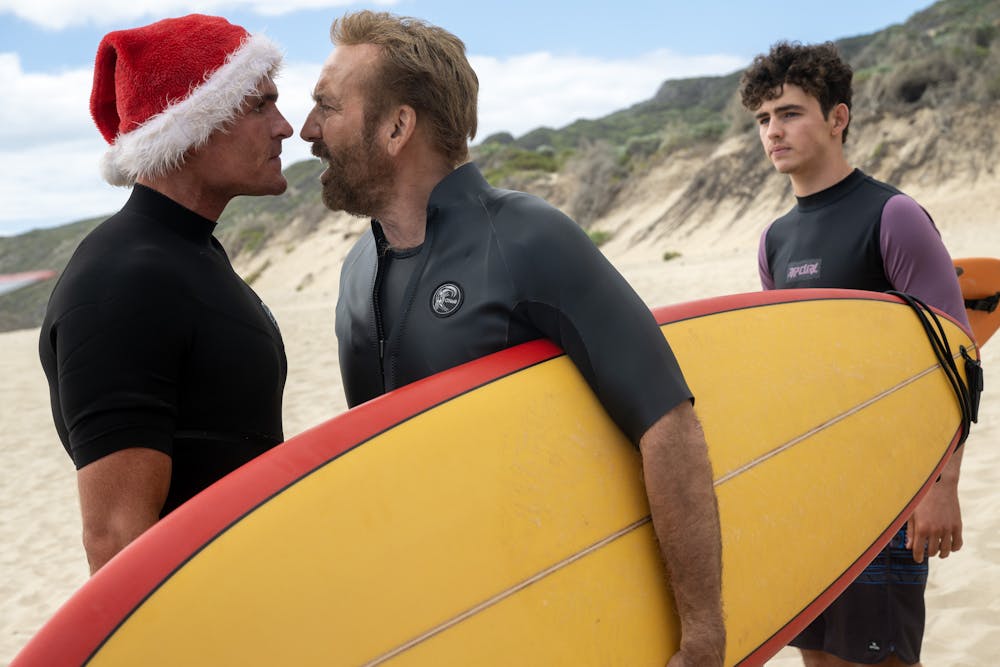
    This is a man out of his depth.
    Madman Entertainment

    Cage’s distinctively American confidence has no resistance to the terrifying switches of Australian masculinity from friendly to teasing to violent.

    “Don’t live here, don’t surf here,” they hiss at him on first meeting, forcing him to retreat, cowed, to the car park, where he remains for most of the rest of the film.

    The wide-open and the claustrophobic

    What a stroke of genius it is to use this single location.

    Filmed in Yallingup, Western Australia, The Surfer beautifully captures the natural surroundings, stunning views and shimmering heat of Australian coastal summer.

    At the same time, a confined, interstitial semi-urban feature like a beachside car park feels so bleak and uninviting. The only amenities are an overpriced coffee cart, ancient payphone and a dingy toilet block.

    The beachside car park feels so bleak and uninviting.
    Madman Entertainment

    As a film setting, it is both a spectacular wide-open vista and stiflingly claustrophobic – a perfect mechanism for The Surfer’s psychological horror.

    It must have been attractive in getting the script funded as well. With such an affordable location, more of the budget would have been freed up for a big name like Cage.

    A modern Wake in Fright

    With its oppressive setting, overexposed orange and yellow light and grade, and a sweaty spiral into madness, The Surfer invites comparisons to Wake in Fright, Ted Kotcheff’s 1971 brutal depiction of Australian men and their drinking culture.

    Both take place at Christmas and feature an antagonist who enjoys confidently explaining their dubious moral worldview to everyone. However, Wake in Fright’s horror lingers because we know the culture remains even after the hero escapes it. The Surfer struggles a little more in landing the ending.

    The film’s depiction of masculinity echoes Wake In Fright.
    Madman Entertainment

    For the mean, violent, misogynistic villains to be defeated, it would be unsatisfying for Cage to stoop to their level. This means – without spoiling too much – Cage remains an oddly passive character throughout the film, while others perform the avenging actions.

    The only way the protagonist’s masculinity can be resurrected as upright, ethical and empowering is for the character to literally turn his back on the vengeance we’ve been waiting for him to deliver.

    It’s not that the film has an inarticulate grasp of its own politics, but more that the otherwise terrific script by Thomas Martin feels written into a difficult corner.

    A blast along the way

    I don’t want to imply that this ending means The Surfer isn’t an absolute blast along the way. A lot of the fun is in anticipating each dreadful humiliation – and it somehow turning out worse than you could have expected.

    A spilled coffee leads to drinking recycled wastewater which leads to chewing on a dead rat, and we still haven’t reached the lowest rung on the ladder of indignities that Cage’s character suffers.

    In less skilled hands this could feel nasty or gross, but the hallucinatory quality of Finnegan’s direction makes it feel almost sublime. And Cage’s pleading, groaning, sobbing and gibbering feel believable and relatable.

    The pathos works – and it’s pretty funny too.

    The Surfer is in cinemas from today and streaming on Stan from June 15.

    Grace Russell does not work for, consult, own shares in or receive funding from any company or organisation that would benefit from this article, and has disclosed no relevant affiliations beyond their academic appointment.

    ref. Dishevelled, dehydrated delirium: new Aussie film The Surfer, starring Nicolas Cage, is an absolute blast – https://theconversation.com/dishevelled-dehydrated-delirium-new-aussie-film-the-surfer-starring-nicolas-cage-is-an-absolute-blast-254580

    MIL OSI – Global Reports

  • PIB Fact-Check debunks fake claims about IAF Rafale pilot’s last rites

    Source: Government of India

    Source: Government of India (4)

    The Press Information Bureau’s (PIB) fact-check unit has dismissed a viral social media claim suggesting that the last rites of an Indian Air Force (IAF) Rafale pilot were conducted following alleged casualties during Operation Sindoor.

    On Thursday, PIB flagged multiple Pakistan-based accounts that circulated an old image, claiming it depicted the funeral of a Rafale pilot who supposedly died on May 7. The unit clarified that the image in question is from 2008 and has no connection to recent events.

    “An old image is going viral on social media, with many Pakistan-based accounts claiming that it shows the last rites of a Rafale pilot of the #IndianAirForce who died on May 7. This claim is completely fake. The image is actually from 2008 and unrelated to the current context,” PIB Fact Check posted on X.

    The image, sourced from a 2008 CNN article on emissions from Hindu funeral pyres, actually shows a mass cremation of 15 schoolgirls on the banks of the River Orsang in Bamroli, Gujarat, on April 16, 2008.

    Operation Sindoor, launched by India on May 7, was a decisive military response to the April 22 Pahalgam terror attack, in which 26 civilians were killed. In retaliation, the Indian Armed Forces carried out precision strikes on terror camps in Pakistan and Pakistan-occupied Jammu and Kashmir (PoJK), resulting in the elimination of over 100 terrorists linked to groups like Jaish-e-Mohammed, Lashkar-e-Taiba, and Hizbul Mujahideen.

    Following the strikes, Pakistan attempted retaliation through cross-border shelling and drone attacks, prompting a second wave of coordinated Indian strikes. These targeted and damaged Pakistan’s radar systems, communication hubs, and airfields across 11 bases.

    On Saturday, May 10, India and Pakistan reached a mutual understanding to cease hostilities and de-escalate tensions along the border.

    (With inputs from ANI)

  • MIL-OSI New Zealand: Lower Buller Gorge culvert replacement, SH6 – 48-hour closure coming up

    Source: Argument for Lifting NZ Super Age

    NZ Transport Agency Waka Kotahi (NZTA) is gearing up for an intense 48-hours of work in early June to replace a culvert under SH6 at Te Kuha in the Lower Buller Gorge.

    The work will require a full closure of the highway for 48 hours – from 7am on Wednesday, 4 June to 7 am on Friday, 6 June.

    “A full road closure will allow our contractors to complete this work in just 48 hours, with crews working around the clock, compared to up to five weeks of disruptions for motorists if the work was completed using traditional stop-go traffic management,” says Moira Whinham, Maintenance Contract Manager for NZTA on the West Coast.

    The timing for the two-day closure has been carefully considered – in between King’s Birthday weekend and the Matariki holiday – as well as before the worst of the winter weather typically sets in.

    NZTA is urging people to plan ahead and to make alternative travel arrangements if necessary over the planned two day closure.

    NZTA has engaged with emergency services in order to ensure that they are well prepared for the planned closure.

    Freight and tourism operators, residents and the road user community are also being contacted to ensure everyone is aware of the work and the closure well in advance.

    The culvert being replaced is located around 5km east of the intersection of SH6 and SH67. It will be replaced with a much larger capacity pipe, requiring a six metre deep trench to be dug across the state highway. It is not possible to build an off-road detour around the site given the river’s location.

    The red circle indicates the site of the culvert to be replaced on SH6 in early June.

    MIL OSI New Zealand News

  • MIL-OSI New Zealand: Have your say on the Ngāti Hāua Claims Settlement Bill

    Source:

    The bill seeks to give effect to certain matters contained in Te Pua o Te Riri Kore, the Ngāti Hāua deed of settlement of historical claims.

    Te Pua o Te Riri Kore was signed on 29 March 2025 by the Crown, the Ngāti Hāua Iwi Trust (the mandated entity for Ngāti Hāua), and Te Whiringa Kākaho o Ngāti Hāua (the post-settlement governance entity for Ngāti Hāua). It is an agreement between Ngāti Hāua and the Crown that seeks to settle historical Treaty of Waitangi claims. It addresses breaches including loss of land, economic opportunities, and cultural disenfranchisement.

    Ngāti Hāua will receive an apology from the Crown along with acknowledgments of its breaches of te Tiriti o Waitangi—the Treaty of Waitangi. It will receive cultural redress that includes the return of 64 culturally significant sites and a $6-million cultural revitalisation fund. The iwi will also receive a range of financial and commercial redress that includes property purchasing rights and rights of first refusal.

    Tell the Māori Affairs Committee what you think

    Make a submission on the bill by 11.59pm on 24 June 2025.

    For more details about the bill:

    ENDS

    For media enquiries contact:

    Committee staff

    ma@parliament.govt.nz

    MIL OSI

    MIL OSI New Zealand News

  • MIL-OSI Asia-Pac: Probe of hospital incident completed

    Source: Hong Kong Information Services

    The Department of Health today said that there was insufficient evidence to indicate that St Teresa’s Hospital has breached the Private Healthcare Facilities Ordinance and the Code of Practice for Private Hospitals regarding an air-conditioning interruption incident at the hospital in 2024.


    The department was notified by a doctor on September 2, 2024 about an air-conditioning interruption in the operating theatres on the second floor of St Teresa’s Hospital on the evening of July 31, 2024, which lasted approximately one hour.


    Although an air-conditioning interruption is not a reportable event of private hospitals, the department considered that the incident might have potential patient safety concerns and initiated an investigation on the date the doctor reported the incident.


    The department’s staff conducted an inspection at the hospital, checked relevant documents, evaluated the effectiveness of its contingency measures, assessed the environmental condition of the operating theatres during the interruption and followed up on the remedial actions.


    According to the investigation, the incident involved a malfunction of the air-conditioning system that is used to regulate room temperature.


    During the incident, 10 surgeries were performed in various operating theatres. The hospital explained that dehumidifiers were immediately deployed in the operating theatres where higher risk surgeries were proceeding, including a surgery where an operation was being performed by the doctor who subsequently notified the department of the interruption.


    According to the hospital and the nurses on site, the severity of condensation in the operating theatre did not result in water dripping onto the surgical site of patients. The ventilation system used for infection control in the operating theatres, including air filtration equipment, hourly air change rate and a positive pressure environment, was operating normally.


    Apart from immediately responding to the incident, the hospital has worked with its contractor to identify the cause and take measures to prevent the occurrence of similar incidents.


    Based on the available evidence gathered, the department considered that there was insufficient evidence to show that the hospital has breached the requirements of the aforesaid ordinance or the code of practice.


    Regarding media enquiries on whether the department had received any complaints from patients, according to its existing records, the department pointed out that it received a call on September 12, 2024 from a citizen enquiring about the complaint procedure against private healthcare facilities. The caller mentioned that the air-conditioning system at St. Teresa’s Hospital was not functioning properly while surgeries were being performed.


    The department noted that the Private Healthcare Facilities Ordinance provides for a complaints handling mechanism against private healthcare facilities, which includes the formation of the statutory Committee on Complaints Against Private Healthcare Facilities,with the department serving as Secretariat, to handle complaints lodged by patients against licensed private healthcare facilities.


    The Secretariat promptly explained to the enquirer the function of the complaints committee and statutory procedures for lodging a complaint. One day after receiving the caller’s enquiry, the Secretariat sent information about the complaint procedures with complaint and statutory declaration forms to the email address provided as requested.


    The enquirer confirmed receipt of the information concerned and forms by email. Since then, the complaints committee has not received any complaint from the enquirer in relation to the incident.


    While the department emphasised that it completed its investigation based on all available information, it also stressed that it will continue to closely monitor licensed private healthcare facilities.


    It added that it will take appropriate actions as necessary to safeguard patient safety, if there is new and concrete evidence.

    MIL OSI Asia Pacific News

  • MIL-OSI China: UNESCO intangible cultural heritage: Farmers’ dance of China’s Korean ethnic group

    Source: People’s Republic of China – State Council News

    Editor’s note: The farmers’ dance of China’s Korean ethnic group was inscribed on UNESCO’s Representative List of the Intangible Cultural Heritage of Humanity in 2009. This listing acknowledges the cultural significance of this dance, which is a central aspect of the Korean ethnic minority’s agricultural traditions in China. The dance, often accompanied by songs and rhythmic music, reflects the community’s agricultural lifestyle and is a vital part of their rituals, social life and labor practices.

    The farmers’ dance is particularly rooted in regions with significant Korean populations, such as Jilin and Heilongjiang provinces. It is performed during agricultural activities, such as planting and harvesting, and is also a feature of important festivals and community gatherings. The dance integrates various cultural elements, such as the interaction between song, movement and community participation, illustrating the harmony between humans and nature in agricultural life.

    The origins of farmers’ dance of China’s Korean ethnic group date back to the early settlements of Korean people in northeastern China. Immigrants from Korea brought with them not only agricultural knowledge but also dance and music traditions that were deeply embedded in their farming lifestyle. Over time, these dances evolved to reflect the specific agricultural practices of the region, taking on new forms and meanings as they adapted to local customs.

    These dances are closely tied to farming seasons and labor, often performed to celebrate the harvest or during community events that mark significant agricultural milestones. The dance incorporates both symbolic and practical elements — its rhythm and movements historically helped coordinate labor tasks, boosting the morale of workers. As such, the dance is both a form of social expression and a tool for enhancing communal work.

    In the 20th century, as modernization and urbanization spread, many rural areas saw a shift away from traditional farming practices, which affected the prominence of these dances. However, efforts to preserve the farmers’ dance have been ongoing, ensuring that its cultural value is maintained.

    Today, the farmers’ dance continues to be an essential part of the cultural identity of China’s Korean ethnic communities, though its role has evolved. It is still performed in rural areas during festivals, cultural celebrations and other communal activities, but the frequency of its performance has decreased as more young people leave farming communities for urban areas. Despite this, efforts to preserve the dance are ongoing, particularly through local cultural centers, schools, and community programs aimed at passing the tradition to younger generations.

    The dance is also featured in various public performances and cultural showcases, helping maintain its relevance and introduce it to wider audiences. In addition, the dance has found new expressions in academic and artistic circles, where it is studied and revitalized as part of a broader effort to preserve the intangible cultural heritage of China’s Korean ethnic group.

    UNESCO’s recognition of the farmers’ dance of China’s Korean ethnic group highlights its cultural significance as a living tradition that has played an important role in shaping the social fabric and agricultural practices of the Korean community in China. UNESCO has praised the dance for its role in fostering unity and community cohesion, as well as for its ability to express the relationship between people and nature through movement, music and song.

    The farmers’ dance is seen as an important cultural practice that promotes social interaction and solidarity within communities. UNESCO has emphasized that the dance’s ability to bring people together, whether for labor or celebration, ensures its ongoing relevance as a means of cultural expression. By including the farmers’ dance on the Representative List, UNESCO seeks to preserve this invaluable tradition for future generations and to raise awareness of its broader cultural importance within global intangible heritage.

    Discover more treasures from China on UNESCO’s ICH list:

    • 2024: Spring Festival

    • 2022: Traditional tea processing

    • 2020: Wangchuan ceremonytaijiquan

    • 2018: Lum medicinal bathing of Sowa Rigpa

    • 2016: Twenty-four solar terms

    • 2013: Abacus-based Zhusuan

    • 2012: Training plan for Fujian puppetry performers

    • 2011: Shadow puppetryYimakan storytelling

    • 2010: Peking operaacupuncture and moxibustionwooden movable-type printingwatertight-bulkhead technology of Chinese junksMeshrep

    • 2009: Yueju operaXi’an wind and percussion ensembletraditional handicrafts of making Xuan papertraditional firing techniques of Longquan celadonTibetan operasericulture and silk craftsmanshipRegong artsNanyinKhoomeiMazu belief and customsDragon Boat Festival, ManasCraftsmanship of Nanjing Yunjin brocadeXinjiang Uygur Muqam artHua’er, China engraved block printing technique, Chinese traditional architectural craftsmanship for timber-framed structures, Chinese paper-cut, Chinese calligraphy, Chinese seal engraving, Grand song of Dong ethnic group, Traditional Li textile techniques, Traditional design and practices for building Chinese wooden arch bridges

    • 2008: Kunqu opera, Guqin, Urtiin Duu

    MIL OSI China News

  • MIL-Evening Report: Dishevelled, dehydrated delirium: new Aussie film The Surfer, starring Nicolas Cage, is an absolute blast

    Source: The Conversation (Au and NZ) – By Grace Russell, Lecturer, School of Media, Film and Journalism, Monash University

    Madman Entertainment

    Nicolas Cage has made a career from his highly entertaining scenery chewing. He follows a performance style he calls “Nouveau Shamanic” – an exaggerated form of method acting where he acts according to the character’s impulses. This allows for the wild, unpredictable outbursts his characters are known for.

    Cage films are also usually about masculinity: its worst excesses, the parameters restricting it, and what ennobling versions of it might look like.

    The Surfer, a new Australian feature film from Irish director Lorcan Finnegan, leans right into masculinity as a theme.

    Our unnamed protagonist (Cage) is returning to his former Australian home from the United States. He is newly divorced, and trying to buy a beachside property to win back his family.

    He takes his teenage son (Finn Little) for a surf near the property, but they are run off by an unfriendly pack of locals.

    Returning alone to the beachside car park to make some calls, he is besieged there over the next several days by the same gang. They are led by a terrifying middle-aged Andrew Tate-esque influencer, Scally (Julian McMahon), who runs the beach like a combination of a frat bro party and wellness retreat.

    The protagonist’s fast descent into dishevelled, dehydrated delirium as the group’s hazing escalates, fuels much of the first two acts.

    Fish out of water

    It is impossible to think of an actor other than Cage who could make a character like this so enjoyable to watch.

    From the first moments, he seems pathetic: giving his uninterested teenage son metaphorical speeches about surfing, losing arguments on the phone with his broker and real estate agent, reeking of pomposity and desperation.

    The sense of a man out of his depth is compounded by his Americanness contrasting with the particular brand of Australian masculinity the locals display. Both types are brash and entitled, but with entirely different ways of expressing it.

    This is a man out of his depth.
    Madman Entertainment

    Cage’s distinctively American confidence has no resistance to the terrifying switches of Australian masculinity from friendly to teasing to violent.

    “Don’t live here, don’t surf here,” they hiss at him on first meeting, forcing him to retreat, cowed, to the car park, where he remains for most of the rest of the film.

    The wide-open and the claustrophobic

    What a stroke of genius it is to use this single location.

    Filmed in Yallingup, Western Australia, The Surfer beautifully captures the natural surroundings, stunning views and shimmering heat of Australian coastal summer.

    At the same time, a confined, interstitial semi-urban feature like a beachside car park feels so bleak and uninviting. The only amenities are an overpriced coffee cart, ancient payphone and a dingy toilet block.

    The beachside car park feels so bleak and uninviting.
    Madman Entertainment

    As a film setting, it is both a spectacular wide-open vista and stiflingly claustrophobic – a perfect mechanism for The Surfer’s psychological horror.

    It must have been attractive in getting the script funded as well. With such an affordable location, more of the budget would have been freed up for a big name like Cage.

    A modern Wake in Fright

    With its oppressive setting, overexposed orange and yellow light and grade, and a sweaty spiral into madness, The Surfer invites comparisons to Wake in Fright, Ted Kotcheff’s 1971 brutal depiction of Australian men and their drinking culture.

    Both take place at Christmas and feature an antagonist who enjoys confidently explaining their dubious moral worldview to everyone. However, Wake in Fright’s horror lingers because we know the culture remains even after the hero escapes it. The Surfer struggles a little more in landing the ending.

    The film’s depiction of masculinity echoes Wake In Fright.
    Madman Entertainment

    For the mean, violent, misogynistic villains to be defeated, it would be unsatisfying for Cage to stoop to their level. This means – without spoiling too much – Cage remains an oddly passive character throughout the film, while others perform the avenging actions.

    The only way the protagonist’s masculinity can be resurrected as upright, ethical and empowering is for the character to literally turn his back on the vengeance we’ve been waiting for him to deliver.

    It’s not that the film has an inarticulate grasp of its own politics, but more that the otherwise terrific script by Thomas Martin feels written into a difficult corner.

    A blast along the way

    I don’t want to imply that this ending means The Surfer isn’t an absolute blast along the way. A lot of the fun is in anticipating each dreadful humiliation – and it somehow turning out worse than you could have expected.

    A spilled coffee leads to drinking recycled wastewater which leads to chewing on a dead rat, and we still haven’t reached the lowest rung on the ladder of indignities that Cage’s character suffers.

    In less skilled hands this could feel nasty or gross, but the hallucinatory quality of Finnegan’s direction makes it feel almost sublime. And Cage’s pleading, groaning, sobbing and gibbering feel believable and relatable.

    The pathos works – and it’s pretty funny too.

    The Surfer is in cinemas from today and streaming on Stan from June 15.

    Grace Russell does not work for, consult, own shares in or receive funding from any company or organisation that would benefit from this article, and has disclosed no relevant affiliations beyond their academic appointment.

    ref. Dishevelled, dehydrated delirium: new Aussie film The Surfer, starring Nicolas Cage, is an absolute blast – https://theconversation.com/dishevelled-dehydrated-delirium-new-aussie-film-the-surfer-starring-nicolas-cage-is-an-absolute-blast-254580

    MIL OSI AnalysisEveningReport.nz

  • MIL-OSI New Zealand: Government-Iwi partnership building East Coast homes

    Source: NZ Music Month takes to the streets

    Te Tai Rāwhiti – East Coast whānau will enjoy greater access to modern housing thanks to a Government-Iwi partnership that will deliver 150 affordable homes, Associate Housing Minister Tama Potaka says.
    The Government is partnering with East Coast Iwi collective Toitū Tairāwhiti in a $75 million development that will deliver 150 affordable rentals in Gisborne, providing warm, dry, sustainable homes in a high-needs region for housing. The Government is contributing $49 million, and the Iwi collective is contributing the rest.
    “The Tūranga Tangata Rite development today contributes to the Government’s wider $200 million commitment, announced in February, to deliver at least 400 affordable rental homes for Māori across key regions,” Mr Potaka says.
    “The new Te Tairāwhiti houses, as well as being affordable rentals, will be warm, dry, and sustainable, designed for whānau to live well. With multigenerational layouts, shared communal spaces, and energy-efficient materials, these homes reflect tikanga Māori and are built to support wellbeing. They will also help get people out of temporary accommodation and into homes.
    Mr Potaka says the project will also support local workforce development, with a strong emphasis on creating opportunities for Māori tradespeople and apprentices, supporting long-term employment pathways and regional economic resilience.

    “Many of the 150 homes we are announcing today will be constructed right here in Tairāwhiti, meaning local jobs with local businesses, and a growing local economy. These are homes for whānau, built by whānau.

    “The development also tackles housing shortages in the region. Te Tairāwhiti has one of the highest levels of housing need in the country. Together with iwi, we are delivering the scale of housing that whānau deserve to address shortages and create opportunity.

    “On top of this, partnering with land-owning Māori housing providers, and iwi collectives like Toitū Tairāwhiti, to build more affordable housing for Māori, makes sense. 

    “Through these partnerships, the Māori entities bring land and a minimum of 50 percent funding on the house build costs, meaning the Government can optimise its spending to enable more homes to be delivered in areas with high housing deprivation for Māori like the East Coast, Hawke’s Bay, Bay of Plenty, and Northland.”
    Since November 2023, the Government has enabled the delivery of 1,000 homes through the Māori Housing programme. All the homes should be completed by mid-2027. The 150 homes in the Te Tairāwhiti development are scheduled to be completed by the end of December 2026.
     
    Notes to editor:

    Toitū Tairāwhiti Housing Ltd is a partnership between a collective of Ngai Tamanuhiri, Rongowhakaata, Te Aitanga a Mahaki and Ngati Porou, plus neighbouring iwi partners in the Bay of Plenty, Te Whanau-a-Apanui and Te Whakatōhea.

    The Government will be contributing $48.75 million from the $200 million announced in February 2025 to enable 400 affordable rental homes targeted to supporting Māori land-owning entities to deliver more affordable rentals. Toitū Tairāwhiti will providing the remaining $26.25 million.

    The homes will be manufactured off-site at two facilities, Builtsmart in Huntly and the other in Gisborne in a joint venture between Builtsmart and Toitū Tairāwhiti. This method allows the homes to be built quickly and then transported to site.

    MIL OSI New Zealand News

  • MIL-OSI New Zealand: Government supports Tairāwhiti marae to relocate to safer ground

    Source: NZ Music Month takes to the streets

    Five Tairāwhiti marae impacted by the North Island weather events of early 2023, are moving to safer locations with support from the Crown,” said Mark Mitchell, Minister for Emergency Management and Recovery and Tama Potaka, Minister for Māori Development.

    “The Marae Trustees of Puketawai, Hinemaurea ki Mangatuna, Okuri, Takipū, and Rangatira Marae – supported by their whānau and hapū – have made the difficult decision to relocate and re-establish their respective marae in new locations. 

    “The local council designated these marae, as Category 3 – High Risk, and not safe to occupy because of unacceptable risk to life from future extreme weather. 

    “Each of the marae have accepted the Crown’s support package and have acquired new sites to relocate to. The new sites are in close proximity within, or close to, their respective tribal boundaries,” says Mark Mitchell.

    “The impact of the severe weather on the marae was devastating for the many whānau and hapū connected to these marae and their wider community.

    “The decision to relocate is not an easy one and has come from the desire of the Marae Trustees to keep their marae, and their respective whānau, safe and secure, protecting the lives of those who might otherwise be at real risk from any future severe weather events.”

    Minister for Māori Development, Tama Potaka says relocating the individual marae will take time.

    “We expect the relocation works, including the rebuild of wharenui and whare kai where required due to the damage, will take place over the next two or so years.  For some of the marae, the project is a complete rebuild.

    “Reaching this point is a significant milestone.  Most importantly, it will provide affected whanau and hapu peace of mind, and will have the added benefit of creating opportunities for SMEs and jobs.  This augments the growing construction capability on the East Coast as a result of the mahi at Toitū Tairāwhiti and others,” says Mr Potaka.

    Of the five marae three are located in the Uawa – Tolaga Bay area and the other two are in Te Karaka. 

    “The Crown is also working with two Kahungunu Marae, Tangoio and Petāne in Hawke’s Bay with support packages available to both marae so they too can reestablish in safer locations. These marae were also designated, by their local council, as having an unacceptable risk to life.” 

    A total of $136.215m, allocated from Budgets 23 and 24 will fund the entire Whenua Māori and Marae relocation Programme after North Island weather events. It includes the costs to relocate owners of 24 whenua Māori properties to safety as well as demolition of residential structures and covers some assistance to support affected sites of cultural significance, principally upa.  

    “The Crown recognises moving a marae requires careful navigation. This is not an easy journey, and we would like to thank the Marae Trustees for working with us to ensure the safety of people on marae,” Mr Potaka says. 

    Note for Editors:

    In all cases ownership of the whenua remains with the existing owners.  

    The cost for each Marae relocation is commercially sensitive due to procurement undertakings. 

    Geographic location of all Category 3 Marae in Tairāwhiti:

    • Puketawai, Tolaga Bay
    • Hinemaurea ki Mangatuna, Tolaga Bay
    • Okuri, Tolaga Bay
    • Takipū, Te Karaka
    • Rangatira Marae, Te Karaka

    MIL OSI New Zealand News

  • MIL-OSI Asia-Pac: LegCo Public Accounts Committee to hold public hearing tomorrow

    Source: Hong Kong Government special administrative region

    LegCo Public Accounts Committee to hold public hearing tomorrow(Chapter 4 of the Director of Audit’s Report No.84)
    Date: May 16 (Friday)
    Time: 8.45am
    Venue: Conference Room 1Ms Bernadette Linn
    Secretary for DevelopmentDeputy Secretary for Development (Planning and Lands)2Director of BuildingsDeputy Director of BuildingsIssued at HKT 11:45

    NNNN

    MIL OSI Asia Pacific News

  • Trump secures $243.5 billion in economic deals during Qatar visit

    Source: Government of India

    Source: Government of India (4)

    US President Donald J. Trump signed a landmark agreement with Qatar on Wednesday to generate an economic exchange worth at least $1.2 trillion, highlighting his second stop in a high-profile Middle East tour. During the visit, Trump announced economic deals totaling more than $243.5 billion between the United States and Qatar, including a historic sale of Boeing aircraft and GE Aerospace engines to Qatar Airways.

    The centerpiece of these agreements is Qatar Airways’ purchase of 160 Boeing jets worth $200 billion, signed in Doha in the presence of Trump and Qatar’s Emir Sheikh Tamim bin Hamad Al-Thani. Boeing and GE Aerospace secured a landmark order from Qatar Airways, including a $96 billion agreement to acquire up to 210 American-made Boeing 787 Dreamliner and 777X aircraft powered by GE Aerospace engines. This represents Boeing’s largest-ever widebody order and largest-ever 787 order, supporting an estimated 154,000 U.S. jobs annually, amounting to over one million jobs during the production and delivery period.

    The agreements extend beyond aviation into energy, defense, and technology sectors. McDermott continues its strong partnership with Qatar Energy, currently managing seven active projects worth $8.5 billion as the sole provider of offshore components for Qatar’s major LNG expansion. Engineering firm Parsons has secured 30 projects worth up to $97 billion, while Quantinuum has finalized a joint venture agreement with Al Rabban Capital that will see Qatar invest up to $1 billion in quantum technologies.

    Significant defense deals were also announced during the visit. Raytheon secured a $1 billion agreement for Qatar’s acquisition of counter-drone capabilities, establishing Qatar as the first international customer for Raytheon’s Fixed Site – Low, Slow, Small Unmanned Aerial System Integrated Defeat System. General Atomics secured a nearly $2 billion agreement for Qatar’s acquisition of the MQ-9B remotely piloted aircraft system. Additionally, the United States and Qatar signed a statement of intent outlining over $38 billion in potential investments, including support for Al Udeid Air Base and future defense capabilities.

    Qatar, which holds the world’s third-largest proven reserves of natural gas, has already made substantial investments in American energy infrastructure. Since 2019, QatarEnergy has invested $18 billion in the U.S. energy sector, including ExxonMobil’s Golden Pass LNG Terminal ($10 billion) and Chevron Phillips Chemical’s Golden Triangle Polymers Plant ($8 billion), both located on the Texas Gulf Coast.

    The United States maintained a $2 billion trade surplus with Qatar in 2024, continuing a positive trade balance that has existed since 2003. Last year, U.S.-Qatar trade totaled $5.64 billion, with $3.8 billion in U.S. exports and $1.8 billion in Qatari imports. Qatar’s greenfield investment in the United States totaled $3.3 billion in 2023, focused on hotels and tourism, information technology, advanced manufacturing, financial services, and oil and gas.

    This visit’s agreements build on the $600 billion investment commitment Trump secured in Saudi Arabia during the first leg of his Gulf tour, furthering his administration’s efforts to revitalize American manufacturing and create high-paying jobs across the nation.

  • Govt committed to establishing peace in Naxal-affected region: PM Modi

    Source: Government of India

    Source: Government of India (4)

    Prime Minister Narendra Modi on Wednesday reaffirmed the government’s commitment to establishing peace in areas affected by Naxalism, highlighting that the efforts of security forces are yielding positive results.

    In a post on X, PM Modi said, “We are fully committed to establishing peace in the Naxal-affected areas and connecting them with the mainstream of development.”

    Security forces killed 31 Naxalites in the Karreguttalu Hills (KGH) along the Chhattisgarh–Telangana border. The operation, which lasted 21 days, marked a significant milestone in the government’s mission to make India Naxal-free by March 31, 2026.

    Union Home Minister and Minister of Cooperation, Amit Shah, praised the success of the operation, saying that “the Karreguttalu Hills, once ruled by red terror, now proudly hoist the tricolour.” He highlighted the bravery and coordination of the Central Reserve Police Force (CRPF), Special Task Force (STF), and District Reserve Guard (DRG) for carrying out the mission without any casualties among the security forces.

    Shah reaffirmed the government’s commitment under the leadership of Prime Minister Narendra Modi to eliminate Naxalism from its roots. He emphasized that this operation was a major achievement in the ongoing mission for a ‘Naxal-free India,’ and credited the seamless coordination between central and state agencies as part of the Modi government’s “whole-of-government” approach.

    A Complex Operation in Hostile Terrain

    The Karreguttalu Hill region, long considered an impregnable Naxal stronghold, had been home to approximately 300–350 armed cadres from various groups, including the PLGA Battalion, CRC Company, Telangana State Committee, and the technical unit of the Naxalite organization. The operation commenced on April 21, 2025, and concluded on May 11, 2025.

    Senior officials, including CRPF Director General Gyanendra Pratap Singh and Chhattisgarh DGP Arun Dev Gautam, provided details in a joint press briefing in Bijapur. They confirmed that 31 Naxalites were killed, including 16 women, and 35 weapons were recovered from the encounter sites.

    Authorities also recovered over 450 improvised explosive devices (IEDs), 818 BGL shells, 899 bundles of detonator codex wire, and large quantities of explosives, food supplies, and medicines. Four major Naxal technical units involved in manufacturing weapons and explosives were destroyed.

    Strategic Intelligence and Coordination

    A multi-agency special team had been established to gather and analyse real-time intelligence through technical, human, and field-based inputs. This allowed security forces to avoid IED traps and locate key Naxalite hideouts and weapon caches. More than 214 bunkers and hideouts were destroyed as part of the campaign.

    Despite the scorching summer conditions, with temperatures exceeding 45°C and the region’s treacherous mountainous terrain, security personnel remained determined. Eighteen personnel from CoBRA, STF, and DRG had sustained injuries in IED explosions but were reported to be out of danger and receiving treatment.

    Impact on Naxal Presence

    The operation significantly weakened the core infrastructure of the Naxalite movement. Analysis suggested that several senior cadres were either killed or injured. However, due to the remote geography, not all bodies had been recovered by the time the operation concluded.

    The Karreguttalu operation is seen as a turning point in India’s long-standing battle against left-wing extremism. According to government data, 197 hardcore Naxalites had been neutralized in the first four months of 2025 alone. The number of Naxal-affected districts had dropped from 126 in 2014 to just 18 in 2025. Naxal violence incidents had decreased by over 65% in the same period.

    Building on Long-Term Gains

    Since 2019, a total of 320 new security camps had been established in Naxal-affected regions, along with 68 night-landing helipads. The number of fortified police stations had increased from 66 in 2014 to 555 in 2025, strengthening security infrastructure in remote and sensitive areas.

    The long-term effects of this sustained crackdown were visible: large Naxalite formations were now splintered into smaller, less capable units, and the government continued to expand its presence in previously inaccessible areas like the National Park in Bijapur and the Maad region in Narayanpur.

    As part of its Joint Action Plan, the Ministry of Home Affairs had outlined a multi-pronged approach, combining security operations, infrastructure development, and welfare schemes, to uproot the Naxal ecosystem and integrate affected regions into the national mainstream.


  • MIL-OSI Australia: More jobs, low unemployment and lower inflation under Labor

    Source: Australian Parliamentary Secretary to the Minister for Industry

    The Albanese Labor Government continues to deliver more jobs, with ABS Labour Force data today showing a record number of Australians in paid work and unemployment remaining low.

    It is the only time since records began that the unemployment rate has been in the low 4s concurrently with headline and underlying inflation in the RBA’s target band.

    The number of employed people in Australia has reached 14,642,700 with 64.4 per cent of the population now in a job and the participation rate is at 67.1 per cent, both near record highs.

    The unemployment rate remains low at 4.1 per cent, and a total of 89,000 new jobs were created in April.

    This is another very encouraging set of jobs data which shows the progress we are making together in our economy.

    More than 1.1 million jobs have now been created under the Albanese Government, a higher rate of employment growth than any major advanced economy.

    Full‑time work was up by 59,500. The number of women in work was up by 65,300 jobs.

    Today’s jobs figures follow data yesterday showing annual real wages have grown for 18 consecutive months.

    Inflation is down, real wages are up, unemployment is low, interest rates have started to fall, every taxpayer is getting a tax cut and all this means living standards are growing again.

    Minister for Employment and Workplace Relations Amanda Rishworth welcomed the jobs growth.

    “Under Labor, more people are working, earning more and keeping more of what they earn,” Minister Rishworth said.

    “Delivering more jobs and higher wages is one of the best ways we can support Australians with cost‑of‑living pressures.”

    Treasurer Jim Chalmers said the resilient labour market is helping us weather global uncertainty.

    “Amid all the uncertainty and volatility in the global economy, our labour market remains an encouraging source of strength,” Treasurer Chalmers said.

    “Low unemployment and much lower inflation is a remarkable combination and means we are well placed and well prepared for the challenges coming at us from abroad.”

    MIL OSI News

  • MIL-Evening Report: Disheveled, dehydrated delirium: new Aussie film The Surfer, staring Nicolas Cage, is an absolute blast

    Source: The Conversation (Au and NZ) – By Grace Russell, Lecturer, School of Media, Film and Journalism, Monash University

    Madman Entertainment

    Nicolas Cage has made a career from his highly entertaining scenery chewing. He follows a performance style he calls “Nouveau Shamanic” – an exaggerated form of method acting where he acts according to the character’s impulses. This allows for the wild, unpredictable outbursts his characters are known for.

    Cage films are also usually about masculinity: its worst excesses, the parameters restricting it, and what ennobling versions of it might look like.

    The Surfer, a new Australian feature film from Irish director Lorcan Finnegan, leans right into masculinity as a theme.

    Our unnamed protagonist (Cage) is returning to his former Australian home from the United States. He is newly divorced, and trying to buy a beachside property to win back his family.

    He takes his teenage son (Finn Little) for a surf near the property, but they are run off by an unfriendly pack of locals.

    Returning alone to the beachside car park to make some calls, he is besieged there over the next several days by the same gang. They are led by a terrifying middle-aged Andrew Tate-esque influencer, Scally (Julian McMahon), who runs the beach like a combination of a frat bro party and wellness retreat.

    The protagonist’s fast descent into disheveled, dehydrated delirium as the group’s hazing escalates, fuels much of the first two acts.

    Fish out of water

    It is impossible to think of an actor other than Cage who could make a character like this so enjoyable to watch.

    From the first moments, he seems pathetic: giving his uninterested teenage son metaphorical speeches about surfing, losing arguments on the phone with his broker and real estate agent, reeking of pomposity and desperation.

    The sense of a man out of his depth is compounded by his Americanness contrasting with the particular brand of Australian masculinity the locals display. Both types are brash and entitled, but with entirely different ways of expressing it.

    This is a man out of his depth.
    Madman Entertainment

    Cage’s distinctively American confidence has no resistance to the terrifying switches of Australian masculinity from friendly to teasing to violent.

    “Don’t live here, don’t surf here,” they hiss at him on first meeting, forcing him to retreat, cowed, to the car park, where he remains for most of the rest of the film.

    The wide-open and the claustrophobic

    What a stroke of genius it is to use this single location.

    Filmed in Yallingup, Western Australia, The Surfer beautifully captures the natural surroundings, stunning views and shimmering heat of Australian coastal summer.

    At the same time, a confined, interstitial semi-urban feature like a beachside car park feels so bleak and uninviting. The only amenities are an overpriced coffee cart, ancient payphone and a dingy toilet block.

    The beachside car park feels so bleak and uninviting.
    Madman Entertainment

    As a film setting, it is both a spectacular wide-open vista and stiflingly claustrophobic – a perfect mechanism for The Surfer’s psychological horror.

    It must have been attractive in getting the script funded as well. With such an affordable location, more of the budget would have been freed up for a big name like Cage.

    A modern Wake in Fright

    With its oppressive setting, overexposed orange and yellow light and grade, and a sweaty spiral into madness, The Surfer invites comparisons to Wake in Fright, Ted Kotcheff’s 1971 brutal depiction of Australian men and their drinking culture.

    Both take place at Christmas and feature an antagonist who enjoys confidently explaining their dubious moral worldview to everyone. However, Wake in Fright’s horror lingers because we know the culture remains even after the hero escapes it. The Surfer struggles a little more in landing the ending.

    The film’s depiction of masculinity echoes Wake In Fright.
    Madman Entertainment

    For the mean, violent, misogynistic villains to be defeated, it would be unsatisfying for Cage to stoop to their level. This means – without spoiling too much – Cage remains an oddly passive character throughout the film, while others perform the avenging actions.

    The only way the protagonist’s masculinity can be resurrected as upright, ethical and empowering is for the character to literally turn his back on the vengeance we’ve been waiting for him to deliver.

    It’s not that the film has an inarticulate grasp of its own politics, but more that the otherwise terrific script by Thomas Martin feels written into a difficult corner.

    A blast along the way

    I don’t want to imply that this ending means The Surfer isn’t an absolute blast along the way. A lot of the fun is in anticipating each dreadful humiliation – and it somehow turning out worse than you could have expected.

    A spilled coffee leads to drinking recycled wastewater which leads to chewing on a dead rat, and we still haven’t reached the lowest rung on the ladder of indignities that Cage’s character suffers.

    In less skilled hands this could feel nasty or gross, but the hallucinatory quality of Finnegan’s direction makes it feel almost sublime. And Cage’s pleading, groaning, sobbing and gibbering feel believable and relatable.

    The pathos works – and it’s pretty funny too.

    The Surfer is in cinemas from today and streaming on Stan from June 15.

    Grace Russell does not work for, consult, own shares in or receive funding from any company or organisation that would benefit from this article, and has disclosed no relevant affiliations beyond their academic appointment.

    ref. Disheveled, dehydrated delirium: new Aussie film The Surfer, staring Nicolas Cage, is an absolute blast – https://theconversation.com/disheveled-dehydrated-delirium-new-aussie-film-the-surfer-staring-nicolas-cage-is-an-absolute-blast-254580

    MIL OSI AnalysisEveningReport.nz

  • MIL-OSI New Zealand: Work-related health newsletter – May 2025

    Source:

    Check out the latest guidance and resources, and a number of upcoming courses and conferences to help you ensure a healthy and safe work environment for you and your workers.

    In this edition:

    • New tools for musculoskeletal risks
    • New hazardous substances guidance
      • Hazardous substances: how to use the quantity-ratio sum (QRS)
      • Unattended refuelling sites
      • Service station compliance with hazardous substances regulations
    • Fraudulent asbestos removals catch up with industry veteran
    • Te Rōpū Marutau o Aotearoa and ACC launch Te Takenga Mai
    • Publications
    • Conferences and events

    Read the full newsletter(external link)

    MIL OSI New Zealand News

  • MIL-OSI New Zealand: Social Security Amendment Bill passes into law

    Source: NZ Music Month takes to the streets

    The Social Security Amendment Bill has passed its third reading in Parliament today expanding the welfare Traffic Light System that launched in August 2024. 

    “This bill brings new tools to ensure beneficiaries stay on track with their obligations to find or prepare for work if they are able”, Social Development and Employment Minister Louise Upston. 

    From 26 May 2025, two new non-financial sanctions can be imposed. Rather than reducing a benefit, these non-financial sanctions are: 

    • Money Management – where half of someone’s benefit is put onto an MSD payment card that can only be used in approved shops to buy essential items, such as groceries, transport, healthcare-related items, and education-related items. This will be for a four-week period.
       
    • Community Work Experience – where someone will have up to two weeks to find suitable work experience and is required to participate in a placement at one or more community or voluntary organisations for at least five hours per week for four weeks.

    From 20 October, two more non-financial sanctions will be implemented: 

    • Upskilling – Jobseekers will be required to attend and participate, to MSD’s satisfaction, in one or more employment-related training courses or programmes for a minimum of five hours per week over a four-week period.
       
    • Report Job Search – Jobseekers must undertake at least three job-search activities per week, to MSD’s satisfaction, and report on them weekly over a four-week period.

    Also from 26 May 2025 new policy settings will be put in place: 

    • Applicants for certain benefits, and their partners if relevant, will be required to have a completed Jobseeker Profile before they can be granted a benefit.
       
    • New obligation failures will carry over for two years rather than one, increasing the likelihood that those who repeatedly refuse to comply with their obligations will have their benefit cancelled if they remain on it for more than a year.

    From 1 July 2025, Jobseeker Support clients must reapply for their benefit every 26-weeks (currently 52-weeks). This will require clients to engage with MSD more frequently, allowing for more proactive support and a focus on moving people into employment where they can. 

    “These changes will support more people into work and help achieve the Government’s target of having 50,000 fewer people on Jobseeker Support by 2030, which is forecast to save the country over two billion dollars in welfare payments,” Louise Upston says. 

    “Because we believe having a job is the best way for people to lift themselves and their families out of hardship, the Government is setting a clear expectation that those who can work, should work.

    “Our economy is stronger when more people are in work, and as we look to unleash economic growth, it’s important that as many Kiwis as possible share in the benefits of work.” 

    MIL OSI New Zealand News

  • MIL-OSI Asia-Pac: Summer arts festival International Arts Carnival tickets on sale from May 16 (with photos)

    Source: Hong Kong Government special administrative region

    Summer arts festival International Arts Carnival tickets on sale from May 16  
         This year, participating overseas artists will come from the Netherlands, Korea, Norway and the United States. Together with their Mainland and local counterparts, they are set to present a wide variety of performing arts programmes covering martial arts, acrobatics, dance, music, theatre, multimedia and more.
     
         The opening programme will be the martial arts theatre performance “Soul of Shaolin” featuring elite performers of the Henan Provincial Shaolin Wushu Center from July 11 to 13. The performance will showcase breathtaking martial arts scenes such as boxing, weaponry and qigong to demonstrate the harmony between the spiritual wisdom and physical strength of Chinese kung fu. “Soul of Shaolin” is finally coming to Hong Kong after its Broadway debut in 2009, which earned both Tony and Drama Desk Award nominations. After more than two decades of world touring, it is not to be missed.
     
         Celebrated violinist Ray Chen will join Italian conductor Gianandrea Noseda and members of the National Youth Orchestra of the United States of America to perform on July 28. During the concert, Chen will perform Mendelssohn’s ever-popular “Violin Concerto in E minor, Op. 64” with the orchestra. The repertoire will also include Rachmaninov’s masterful “Symphony No. 2 in E minor, Op. 27” and a new work by contemporary music composer Carlos Simon. This performance will also be part of the orchestra’s Asian tour.
     
      To celebrate the upcoming 15th National Games, the IAC will present “Sounds of Sports” August 2 and 3. Led by pianist Phoebus Chan, the performance will blend music and sports as local musicians and athletes will combine karate, rugby, wushu and table tennis with jazz drums, shakuhachi, erhu, cello and piano, turning the concert hall into an exciting sports ground full of energy.
     
     The award-winning Xi’an Acrobatic Troupe will perform a new adaptation of the acrobatic ballet “Swan Lake” August 8 to 10, fusing incredible acrobatics with ballet, turning this famous dance performance into a powerful yet graceful show. The show features over 20 dazzling acrobatic acts including contortionists bending and twisting, doing flips and balancing, aerial hoops and dancing on shoulders. “Swan Lake” and “Soul of Shaolin” are also programmes that are part of this year’s Chinese Culture Festival.
     
         Other IAC stage programmes include:

    * “OvO” from Norway, a dance programme for infants aged nine to 24 months and their parents by dybwikdans;
    * “Waiting!” from Korea, an exciting and hilarious multimedia theatre by HADDANGSE;
    * “Home” from the Netherlands, an interactive multimedia theatre by Mime Wave;
    * “The Secret Agent Spin-off: The Hidden Treasure”, a musical adapted from the bestselling novel “The Secret Agent” by Musical Trio;
    * “A Musical Treasure Hunt – Percussion Kaleidoscope” and “A Showcase of Parent-child works of Cheng Kwok Kong” by the Hong Kong Chinese Orchestra;
    * “Live Animation Cinesthetics” and “The Other Side of Schumann” by the Hong Kong Sinfonietta;
    * “Little Pigs・Little Duck・Little Riding Hood 2.0” by Pop Theatre;
    * “My Arena: Dance of Triumph” by the City Contemporary Dance Company;
    * “The Kids in Rainbow Jerseys 2.0” by the Hong Kong Dance Company;
    * “‘It’s Time to Dance’ Inclusive Dance Theatre by Dancing Andy and Dancers “; and
    * 2025 Hong Kong Youth Music Camp Concerts “Summer Echoes” by the Music Office.
     
         In addition to stage performances, there will also be a fine selection of films from around the world under the Summer Family Cine Fest by the Film Programmes Office. The IAC also offers a wide range of parent-child workshops, an online programme, an outreach performance and an exhibition. Venue partners and LCSD libraries will also hold plenty of related activities and programmes during the festival period.
     
         Tickets for the IAC will be available at URBTIX (www.urbtix.hk 
         For enquiries on programmes and ticketing, please call 2370 1044 or visit its website at
    www.hkiac.gov.hkIssued at HKT 12:00

    NNNN

    MIL OSI Asia Pacific News

  • MIL-OSI Asia-Pac: Summer Family Cine Fest to take families on fantastical cinematic adventures (with photos)

    Source: Hong Kong Government special administrative region

         The Film Programmes Office (FPO) of the Leisure and Cultural Services Department will present the Summer Family Cine Fest (SFCF) from July 12 to August 16, offering over 40 fun-filled film screenings at the Hong Kong Film Archive, Hong Kong City Hall, the Hong Kong Science Museum, the Hong Kong Space Museum (HKSpM) and the North District Town Hall. The programme is one of the highlights of the International Arts Carnival (IAC).
     
         The Feature Films section features 15 works. Blending animation and live action, “Diplodocus” (2024) tells the story of a cute little comic dinosaur, which, in order to save itself and its family, must help its creator regain his confidence to create. In the animated film “Into the Wonderwoods” (2024), while on the way to visit his grandmother, 10-year-old Angelo is accidentally left behind in the wild. With his imagination and courage, he embarks on a solo journey while braving monsters and demons in the forest.
     
         In “Fox and Hare Save the Forest” (2024), a selfish beaver causes a flood in the forest, and other animals bravely come together to save their home. “Tummy Tom and the Lost Teddy Bear” (2024) follows a cat on an adventurous journey to find its favourite cuddle toy bear. In “Benjamin Bat” (2024), a little bat named Benjamin is bullied by his brothers for loving singing and becoming friends with a bat’s sworn enemy, a bird. For himself and his friend, he needs to muster his courage to stand up against the odds. A cute penguin in “Thelma’s Perfect Birthday” (2024) accidentally travels from the Land of Ice to the warm Great Forest and learns the meaning of growth through this whimsical journey.
     
         “Buffalo Kids” (2024) from Spain tells the story of two young siblings and their disabled new friend teaming up to battle wits and strength against outlaws of the Wild West in a thrilling adventure of courage and inclusion. Starting from the parents of a young boy building a sailboat in their home garden, “A Boat in the Garden” (2024) tells a story of perseverance and dedication of a family of three in the pursuit of dreams.
     
         The Swedish film “The Pinchers’ High Voltage Heist” (2023) delivers a comedic portrayal of a quirky family of thieves and their hilarious lives together. In the award-winning “Coco Farm” (2023), three youngsters strive to build a business guided by conscience. In “Lampo, The Travelling Dog” (2023), a social media-famous dog and a sick girl cross paths at a train station, leading to a heartwarming tale of mutual care between human and canine. “Greetings from Mars” (2024) tells the story of how Tom turns his passion for space exploration into strength when his mother has to travel a long way away.
     
         The SFCF also features three sports-themed films. “King Richard” (2021) depicts the parenting story of tennis superstars Venus and Serena Williams’ father and coach, who meticulously guided them to success. Lead actor Will Smith won Best Actor awards at the Academy Awards, Golden Globe Awards and British Academy of Film and Television Arts Awards for his performance. “Lioness” (2023) follows a South American migrant girl in the Netherlands pursuing her dream of becoming a football player in a strange land. “The Hill” (2023) delivers a passionate and inspiring true story of a baseball prodigy overcoming adversity despite suffering from a degenerative spinal condition.
     
         In addition, the FPO will co-organise with the HKSpM to present the dome show, “The Great Solar System Adventure!” (2024), at the Space Theatre of the HKSpM. Audiences will be guided through an exhilarating journey across the solar system. After the screenings, audiences will be invited to join a post-screening activity at the HKSpM Lecture Hall to make Mars paper models and learn about the major discoveries of various Mars exploration missions. This activity will be conducted in Cantonese.
     
         Veteran dubbing artists Yip Ka-man and Kinson Lai will perform live Cantonese dubbing for “Thelma’s Perfect Birthday”, “Benjamin Bat” and “Into the Wonderwoods” with no subtitles. “The Great Solar System Adventure!” is in Cantonese, with English available through the headphone system, with no subtitles. Other films will feature Chinese and English subtitles.
     
         Apart from the feature films, the FPO has hand-picked 20 animated short films from around the world to present three World Animation & Shorts programmes, titled “All About Love”, “Is That OK?” and “Craving For Food!”. Professional actor and drama tutor Man Jai (Raymond Chan) will host an introduction in Cantonese for the programmes.
     
         The FPO will also present a two-day event titled Summer of Light: Cinematic Adventure at Sai Wan Ho Civic Centre on July 12 and 13. The event consists of free activities and ticketed workshops for the public to participate. Details will be available in early June on the FPO website www.lcsd.gov.hk/fp.
     
         Tickets are priced at $88 and will be available from tomorrow (May 16) at URBTIX (www.urbtix.hk). For telephone bookings, please call 3166 1288. For programme enquiries and concessionary schemes, please call 2734 2900 or visit www.lcsd.gov.hk/fp/en/listing.html?id=75.
     
         For details of other IAC programmes, please visit the website www.hkiac.gov.hk.

    MIL OSI Asia Pacific News

  • MIL-OSI Economics: Money Market Operations as on May 14, 2025

    Source: Reserve Bank of India


    (Amount in ₹ crore, Rate in Per cent)

      Volume
    (One Leg)
    Weighted
    Average Rate
    Range
    A. Overnight Segment (I+II+III+IV) 5,74,116.64 5.68 0.01-6.80
         I. Call Money 19,557.00 5.84 4.90-5.90
         II. Triparty Repo 3,62,119.65 5.71 5.65-5.80
         III. Market Repo 1,90,641.99 5.60 0.01-6.00
         IV. Repo in Corporate Bond 1,798.00 5.94 5.89-6.80
    B. Term Segment      
         I. Notice Money** 149.71 5.81 5.50-5.90
         II. Term Money@@ 470.00 6.00-6.14
         III. Triparty Repo 1,920.00 5.82 5.75-5.85
         IV. Market Repo 385.34 5.33 2.50-6.05
         V. Repo in Corporate Bond 0.00
      Auction Date Tenor (Days) Maturity Date Amount Current Rate /
    Cut off Rate
    C. Liquidity Adjustment Facility (LAF), Marginal Standing Facility (MSF) & Standing Deposit Facility (SDF)
    I. Today’s Operations
    1. Fixed Rate          
    2. Variable Rate&          
      (I) Main Operation          
         (a) Repo          
         (b) Reverse Repo          
      (II) Fine Tuning Operations          
         (a) Repo Wed, 14/05/2025 1 Thu, 15/05/2025 5,341.00 6.01
         (b) Reverse Repo          
      (III) Long Term Operations^          
         (a) Repo          
         (b) Reverse Repo          
    3. MSF# Wed, 14/05/2025 1 Thu, 15/05/2025 175.00 6.25
    4. SDFΔ# Wed, 14/05/2025 1 Thu, 15/05/2025 2,22,868.00 5.75
    5. Net liquidity injected from today’s operations [injection (+)/absorption (-)]*       -2,17,352.00  
    II. Outstanding Operations
    1. Fixed Rate          
    2. Variable Rate&          
      (I) Main Operation          
         (a) Repo Fri, 02/05/2025 14 Fri, 16/05/2025 149.00 6.01
         (b) Reverse Repo          
      (II) Fine Tuning Operations          
         (a) Repo          
         (b) Reverse Repo          
      (III) Long Term Operations^          
         (a) Repo Thu, 17/04/2025 43 Fri, 30/05/2025 25,731.00 6.01
         (b) Reverse Repo          
    3. MSF#          
    4. SDFΔ#          
    D. Standing Liquidity Facility (SLF) Availed from RBI$       7,718.43  
    E. Net liquidity injected from outstanding operations [injection (+)/absorption (-)]*     33,598.43  
    F. Net liquidity injected (outstanding including today’s operations) [injection (+)/absorption (-)]*     -1,83,753.57  
    G. Cash Reserves Position of Scheduled Commercial Banks
         (i) Cash balances with RBI as on May 14, 2025 9,31,971.83  
         (ii) Average daily cash reserve requirement for the fortnight ending May 16, 2025 9,41,653.00  
    H. Government of India Surplus Cash Balance Reckoned for Auction as on¥ May 14, 2025 5,341.00  
    I. Net durable liquidity [surplus (+)/deficit (-)] as on April 18, 2025 2,02,749.00  
    @ Based on Reserve Bank of India (RBI) / Clearing Corporation of India Limited (CCIL).
    – Not Applicable / No Transaction.
    ** Relates to uncollateralized transactions of 2 to 14 days tenor.
    @@ Relates to uncollateralized transactions of 15 days to one year tenor.
    $ Includes refinance facilities extended by RBI.
    & As per the Press Release No. 2019-2020/1900 dated February 06, 2020.
    Δ As per the Press Release No. 2022-2023/41 dated April 08, 2022.
    * Net liquidity is calculated as Repo+MSF+SLF-Reverse Repo-SDF.
    ¥ As per the Press Release No. 2014-2015/1971 dated March 19, 2015.
    # As per the Press Release No. 2023-2024/1548 dated December 27, 2023.
    ^ As per the Press Release No. 2025-2026/91 dated April 11, 2025.
    Ajit Prasad          
    Deputy General Manager
    (Communications)    
    Press Release: 2025-2026/325

    MIL OSI Economics

  • MIL-OSI New Zealand: State Highway 2, Pahiatua closed

    Source: New Zealand Police

    State Highway 2 south of Pahiatua is closed following a serious crash.

    It happened around 3pm and involved two vehicles.

    Traffic is being diverted off State Highway 2 at Bridge Road to the south, and Mangahao Road to the north.

    The Serious Crash Unit has been advised.

    There are serious injuries involved.

    ENDS

    MIL OSI New Zealand News