Category: Asia

  • MIL-OSI Economics: Chairman’s Statement of the 32nd ASEAN Regional Forum

    Source: ASEAN – Association of SouthEast Asian Nations

    1. The Thirty-Second Meeting of the ASEAN Regional Forum (ARF) was held in Kuala Lumpur, Malaysia, on 11 July 2025. The Meeting was chaired by The Honourable Dato’ Seri Utama Haji Mohamad bin Haji Hasan, Minister of Foreign Affairs of Malaysia, under Malaysia’s ASEAN Chairmanship theme, “Inclusivity and Sustainability”.
     
    2. The Meeting was attended by the Foreign Ministers and Representatives of all ARF Participants, as well as the Secretary-General of ASEAN. The list of delegates appears as ANNEX 1.
     
    Download the full statement here.
    The post Chairman’s Statement of the 32nd ASEAN Regional Forum appeared first on ASEAN Main Portal.

    MIL OSI Economics

  • MIL-OSI: MultiBank opens waitlist for MBG token bridging Web3 and global finance

    Source: GlobeNewswire (MIL-OSI)

    HONG KONG, July 11, 2025 (GLOBE NEWSWIRE) — MultiBank Group, the world’s largest financial derivatives institution, has officially opened the waitlist for early access to its highly anticipated utility token, MBG. This marks a significant step in the company’s strategy to merge traditional finance with the Web3 ecosystem.

    All waitlist participants will receive early access to the token presale and automatically enter a raffle for a pool of 27,000 MBG tokens. Registration is now available on the official token website with a simplified process requiring no KYC procedures or financial commitments at this stage.

    Waitlist benefits

    The MBG token waitlist presents a unique opportunity to reserve early access before the public sale begins. By joining the waitlist, participants secure their place among the first invited to purchase the token.

    The early access program is designed to give the community time to study the project and make informed decisions about participating in the tokenized ecosystem of one of the world’s leading financial groups.

    Token built on MultiBank’s solid financial heritage

    The MBG token stands out in the volatile crypto market with its unique foundation—it is backed by real assets and revenues of MultiBank Group, a company with an impeccable 20-year reputation in the financial industry.

    MultiBank Group, established in 2005, today holds 17 regulatory licenses across five jurisdictions and serves over 2 million clients in more than 100 countries. With daily trading volume exceeding $35 billion and net profit of $275.9 million in 2024, the company demonstrates financial stability that is rare in the Web3 world.

    Notably, the token launch comes on the heels of MultiBank’s recent landmark $3 billion deal with MAG Lifestyle Development and Mavryk—the world’s largest real estate tokenization initiative. This deal, featuring premium properties like The Ritz-Carlton Residences, Dubai, Creekside at Keturah Resort, and Keturah Reserve, positions MBG as the next anticipated milestone in the company’s strategy, attracting attention from both institutional and retail investors.

    Four pillars of the MBG ecosystem

    The MBG token is integrated into MultiBank Group’s four-pillar ecosystem to maximize its utility:

    1. MultiBank FX (TradFi Platform)

    • Current daily volume: $35 billion
    • 2024 EBITDA: $284.9 million
    • Trading in Forex, metals, shares, indices, and commodities

    2. MEX Exchange (Institutional ECN)

    • Independent valuation: $23.7 billion
    • First institutional ECN for emerging markets
    • Projected volume: $460 billion per day by year five

    3. MultiBank.io (Crypto platform)

    • Regulated in UAE, Australia, India, and more
    • Spot and derivatives trading
    • Projected revenue by 2030: $1.4 billion

    4. MultiBank.io RWA (Real-World Assets marketplace)

    • Premium real estate tokenization
    • Initial portfolio: $3 billion
    • Expansion to $10 billion in assets

    MBG holders gain access to benefits across the entire ecosystem: from trading discounts and priority execution to staking rewards and exclusive access to tokenized real estate assets.

    MBG token benefits

    The token offers an 11-tier loyalty system where holders of 1,000 to 550,000+ tokens receive progressive benefits: spot trading discounts up to 23%, fixed staking yields up to 45% annually, and substantial FX/CFD trading discounts up to 22.5%.

    The staking program includes both fixed and variable APY options. Fixed programs offer predictable returns from 3% (30 days) to 29% (365 days), depending on the holder’s tier. The variable model is tied to ecosystem trading fees, creating a sustainable source of rewards.

    Holders also receive priority trade execution, access to exclusive trading pairs including tokenized RWA assets, and early access to IEO listings on the platform. For social traders, the token unlocks advanced portfolio copying capabilities and trading signals from top traders.

    At the institutional level, MBG provides on-chain trade recording for full transparency, simplified auditing for compliance requirements, and the ability to use tokenized assets as collateral for derivatives trading—creating a unique bridge between TradFi and DeFi.

    MBG token: A window to the future

    “MultiBank has extensive experience and an excellent reputation in the market, which allows us to proudly present a new promising project that will ensure seamless interaction between Web3 and traditional finance,” notes Zak Taher, founder and CEO of MultiBank.io.

    The token also includes a deflationary buyback and burn model tied to platform revenues. The program envisions cumulative burning of up to $440 million over the first four years, potentially removing up to 50% of the total token supply.

    Development prospects

    The official launch of the MBG token is scheduled for July 2025 with listings on leading centralized and decentralized exchanges. Waitlist participants will receive notifications about all key dates and early participation opportunities.

    To join the waitlist and get additional information about the MBG token, visit the project’s official website.

    About MultiBank Group

    MultiBank Group, established in California, USA in 2005, is a global leader in financial derivatives. With over 2 million clients in 100+ countries and a daily trading volume exceeding $35 billion, it offers a broad range of brokerage and asset management services. Renowned for innovative trading solutions, robust regulatory compliance, and exceptional customer service, the Group is regulated by 17+ top-tier financial authorities across five continents. Its award-winning platforms provide up to 500:1 leverage across Forex, Metals, Shares, Commodities, Indices, and Cryptocurrencies. MultiBank Group has received over 80 international awards for trading excellence and regulatory compliance.

    Contact:
    Mr. Nikolas Neofytou
    nikolas.neofytou@multibankfx.com

    Disclaimer: This content is provided by MultiBank Group. The statements, views, and opinions expressed in this content are solely those of the content provider and do not necessarily reflect the views of this media platform or its publisher. We do not endorse, verify, or guarantee the accuracy, completeness, or reliability of any information presented. We do not guarantee any claims, statements, or promises made in this article. This content is for informational purposes only and should not be considered financial, investment, or trading advice. Investing in crypto and mining-related opportunities involves significant risks, including the potential loss of capital. It is possible to lose all your capital. These products may not be suitable for everyone, and you should ensure that you understand the risks involved. Seek independent advice if necessary. Speculate only with funds that you can afford to lose. Readers are strongly encouraged to conduct their own research and consult with a qualified financial advisor before making any investment decisions. However, due to the inherently speculative nature of the blockchain sector—including cryptocurrency, NFTs, and mining—complete accuracy cannot always be guaranteed.Neither the media platform nor the publisher shall be held responsible for any fraudulent activities, misrepresentations, or financial losses arising from the content of this press release. In the event of any legal claims or charges against this article, we accept no liability or responsibility. Globenewswire does not endorse any content on this page.

    Legal Disclaimer: This media platform provides the content of this article on an “as-is” basis, without any warranties or representations of any kind, express or implied. We assume no responsibility for any inaccuracies, errors, or omissions. We do not assume any responsibility or liability for the accuracy, content, images, videos, licenses, completeness, legality, or reliability of the information presented herein. Any concerns, complaints, or copyright issues related to this article should be directed to the content provider mentioned above.

    A photo accompanying this announcement is available at https://www.globenewswire.com/NewsRoom/AttachmentNg/09786dbe-1896-4eb5-b58d-b83902a2009f

    The MIL Network

  • MIL-OSI Analysis: Why it can be hard to warn people about dangers like floods – communication researchers explain the role of human behavior

    Source: The Conversation – USA – By Keri K. Stephens, Professor & Co-Director, Technology & Information Policy Institute, The University of Texas at Austin

    How emergency alerts convey risks matters. AP Photo/Eric Gay

    Flash floods like the one that swept down the Guadalupe River in Texas on July 4, 2025, can be highly unpredictable. While there are sophisticated flood prediction models and different types of warning systems in some places, effective flood protection requires extensive preparedness and awareness.

    It also requires an understanding of how people receive, interpret and act on risk information and warnings. Technology can be part of the solution, but ultimately people are the critical element in any response.

    As researchers who study emergency communications, we have found that simply providing people with technical information and data is often not enough to effectively communicate the danger and prompt them to act.

    The human element

    One of us, Keri Stephens, has led teams studying flood risk communication. They found that people who have experienced a flood are more aware of the risks. Conversely, groups that have not lived through floods typically don’t understanding various flood risks such as storm surges and flash floods. And while first responders often engage in table-top exercises and drills – very important for their readiness to respond – there are only a few examples of entire communities actively participating in warning drills.

    Messages used to communicate flood risk also matter, but people need to receive them. To that end, Keri’s teams have worked with the Texas Water Development Board to develop resources that help local flood officials sort through and prioritize information about a flood hazard so they can share what is most valuable with their local communities.

    The commonly used “Turn Around Don’t Drown” message, while valuable, may not resonate equally with all groups. Newly developed and tested messages such as “Keep Your Car High and Dry” appeal specifically to young adults who typically feel invincible but don’t want their prized vehicles damaged. While more research is needed, this is an example of progress in understanding an important aspect of flood communication: how recipients of the information make decisions.

    Interviews conducted by researchers often include responses along these lines: “Another flash flood warning. We get these all the time. It’s never about flooding where I am.” This common refrain reveals a fundamental challenge in flood communication. When people hear “flood warning,” they often think of different things, and interpretations can vary depending on a person’s proximity to the flooding event.

    Some people equate flood warnings with streamflow gauges and sensors that monitor water levels – the technical infrastructure that triggers alerts when rivers exceed certain thresholds. Others think of mobile phone alerts, county- or geographic-specific notification systems, or even sirens.

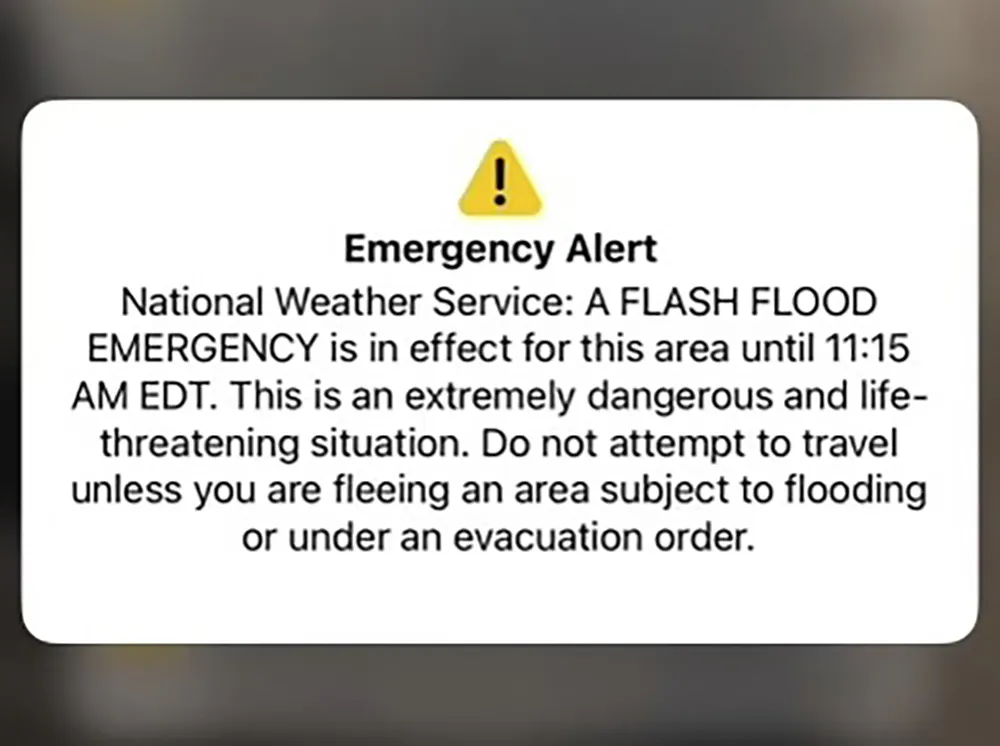
    A typical alert from the National Weather Service.
    AP Photo/Lisa Rathke

    Beyond technologies and digital communication, warnings still come through informal networks in many communities. Emergency managers directly coordinate with and share information with major businesses and organizations, saying, “Hey, John, be sure you have somebody up tonight watching the National Weather Service alerts and rivers.”

    This human-centered approach, similar to neighborhood-level systems we have studied in Japan, can provide direct confirmation that warnings have been received. This is something mass media and mobile systems cannot guarantee, especially during infrastructure failures such as power and cell tower outages.

    Effective messages

    Research shows that effective warning messages need to include five critical components: a clear hazard description, location-specific information, actionable guidance, timing cues and a credible source. The Federal Emergency Management Agency’s integrated public alert and warning system message design dashboard assists authorities in rapidly drafting effective messages.

    This warning system, known as IPAWS, provides nationwide infrastructure for wireless emergency alerts and Emergency Alert System messages. While powerful, IPAWS has limitations − not all emergency managers are trained to use it, and messages may extend beyond intended geographic areas. Also, many older mobile devices lack the latest capabilities, so they may not receive the most complete messages when they are sent.

    Hyperlocal community opt-in systems can complement IPAWS by allowing residents to register for targeted notifications. These systems, which can be run by communities or local agencies, face their own challenges. People must know they exist, be willing to share phone numbers, and remember to update their information. Social media platforms add another communication channel, with emergency managers increasingly using social media to share updates, though these primarily reach only certain demographics, and not everyone checks social media regularly.

    The key is redundancy through multiple communication channels. Research has found that multiple warnings are needed for people to develop a sense of urgency, and the most effective strategy is simple: Tell another person what’s going on. Interpersonal networks help ensure the message is delivered and can prompt actions. As former Natural Hazards Center Director Dennis Mileti observed: The wireless emergency alerts system “is fast. Mama is faster.”

    A Colorado news report explains why emergency alerts have to be tailored for local needs and conditions and use multiple communication channels.

    Warning fatigue

    Professionals from the National Weather Service, FEMA and the Federal Communications Commission, along with researchers, are increasingly concerned about warning fatigue – when people tune out warnings because they receive too many of them.

    However, there is limited empirical data about how and when people experience warning fatigue – or about its impact.

    This creates a double bind: Officials have an obligation to warn people at risk, yet frequent warnings can desensitize recipients. More research is needed to determine the behavioral implications of and differences between warnings that people perceive as irrelevant to their immediate geographic area versus those that genuinely don’t apply to them. This distinction becomes especially critical when people might drive into flooded areas outside their immediate vicinity.

    The key to effective emergency communication is to develop messages that resonate with specific audiences and build community networks that complement technological systems. We are now studying how to do this effectively in the United States and internationally. It’s also important to apply behavioral insights to the design of every level of communication warning systems. And it’s important to remember to test not just the technology but the entire end-to-end system, from threat identification to community response.

    Finally, maintaining true redundancy across multiple communication channels is an important strategy when trying to reach as many people as possible. Technology supports human decision-making, but it doesn’t replace it.

    Keri K. Stephens’ research reported here has been externally funded by the Texas Water Development Board, Texas General Land Office, and the National Science Foundation. Results published are peer-reviewed, and opinions reflect those of the author, not the funder.

    Hamilton Bean has earned research funding from U.S. Department of Homeland Security and the National Oceanic and Atmospheric Administration. Results published are peer-reviewed, and opinions reflect those of the author, not the funder.

    ref. Why it can be hard to warn people about dangers like floods – communication researchers explain the role of human behavior – https://theconversation.com/why-it-can-be-hard-to-warn-people-about-dangers-like-floods-communication-researchers-explain-the-role-of-human-behavior-260780

    MIL OSI Analysis

  • MIL-OSI Africa: Senator Dr. Rasha Kelej meets the Maldives First Lady to underscore Merck Foundation’s Commitment to provide scholarships for Local Doctors in 44 critical and underserved specialties

    Source: APO – Report:

    Merck Foundation (www.Merck-Foundation.com), the philanthropic arm of Merck KGaA Germany underscored their long-term commitment to build healthcare capacity and break infertility stigma in Maldives during their high-level meeting with H.E. Mrs. SAJIDHA MOHAMED, The First Lady of the Republic of Maldives, held at the Official Residence of the President. The discussion led by Prof. Dr. Frank Stangenberg Haverkamp, Chairman of Merck Foundation BOT and Senator, Dr. Rasha Kelej, CEO of Merck Foundation.

    Senator Dr. Rasha Kelej expressed, “It was an honor to meet my dear sister H.E. Mrs. SAJIDHA MOHAMED, The First Lady of the Republic of Maldives, and officially appointing her to be the Ambassador of “Merck Foundation More Than a Mother”. During our meeting we discussed our joint programs and underscored our commitment towards building healthcare capacity and transforming patient care landscape by providing scholarships for local doctors. We also discussed about addressing critical social and health issues in the country including breaking the infertility stigma, stopping gender-based violence, women empowerment, and diabetes and hypertension awareness.”

    H.E. Mrs. SAJIDHA MOHAMED, The First Lady of the Republic of Maldives and Ambassador of “Merck Foundation More Than a Mother” expressed, “It is a pleasure to welcome and meet Merck Foundation Chairman and CEO to our country. We discussed our joint programs. I am happy to share that we have already started providing scholarships for our local doctors in Fertility and Embryology training. These are two very critical specialties for our country. We also plan to enroll our doctors in other specialties, further underscoring our partnership with the Merck Foundation to enhance healthcare capacity in the Maldives.”

    Prof. Dr. Frank Stangenberg Haverkamp, Chairman of Merck Foundation BOT shared, “Our aim is to improve the overall health and wellbeing of people by building healthcare capacity across Africa, Asia and other developing countries. We are strongly committed to transforming patientcare landscape through our scholarships program. Till today, we have provided more than 2270 scholarships for young doctors from 52 countries in 44 critical and underserved specialties.”

    During their visit to the Maldives, the Chairman and CEO of Merck Foundation also met with Hon. Mr. Abdulla Nazim Ibrahim, Minister of Health, where they discussed scaling up the scholarship programs in alignment with the country’s healthcare needs.

    Through their Community Awareness Programs, Merck Foundation is also closely working with The First Lady of Maldives to address a wide range of critical social issues like breaking infertility stigma, stopping gender-based violence and women empowerment, and important health issues including promoting the importance of healthy lifestyle, and diabetes and hypertension awareness.

    Merck Foundation will be soon conducting their Health Media Training together with The First Lady of Maldives for the Maldivian journalists, to emphasize on the important role that media plays to influence society to create a cultural shift and be the voice of the voiceless. The training program will be addressed by prominent Medical and Media experts.

    Moreover, Merck Foundation in partnership with The First Lady of Maldives has also launched their 8 important Merck Foundation Awards for Maldivian Media, Musicians & Singers, Fashion Designers, Filmmakers, and students & new potential talents in these fields.

    “I invite the young talents from the Maldives to share their entries with us,” added Senator Dr. Kelej.

    Details of the Awards:

    1. Merck Foundation Media Recognition Awards “More Than a Mother” 2025, in partnership with The First Lady of Maldives: Media representatives and media students are invited to showcase their work to raise awareness about one or more of the following social issues: Breaking Infertility Stigma and Women Empowerment. Submission deadline: 30th September 2025.
    1. Merck Foundation Fashion Awards “More Than a Mother” 2025, in partnership with The First Lady of Maldives: All Fashion Students and Designers are invited to create and share designs to deliver strong and influential messages to raise awareness about one or more of the following social issues: Breaking Infertility Stigma and Women Empowerment. Submission deadline: 30th September 2025.
    1. Merck Foundation Film Awards “More Than a Mother” 2025, in partnership with The First Lady of Maldives: All Filmmakers, Students of Film Making Training Institutions, or Young Talents of Africa are invited to create and share a long or short FILMS, either drama, documentary, or docudrama to deliver strong and influential messages to address one or more of the following social issues: Breaking Infertility Stigma and Women Empowerment. Submission deadline: 30th September 2025.
    1. Merck Foundation Song Awards “More Than a Mother” 2025, in partnership with The First Lady of Maldives: All Singers and Musical Artists are invited to create and share a SONG with the aim to address one or more of the following social issues: Breaking Infertility Stigma and Women Empowerment. Submission deadline: 30th September 2025.
    1. Merck Foundation Media Recognition Awards “Diabetes & Hypertension” 2025, in partnership with The First Lady of Maldives: Media representatives are invited to showcase their work through strong and influential messages to promote a healthy lifestyle and raise awareness about the prevention and early detection of Diabetes and Hypertension. Submission deadline: 30th October 2025.
    1. Merck Foundation Fashion Awards “Diabetes & Hypertension” 2025, in partnership with The First Lady of Maldives: All Fashion Students and Designers are invited to create and share designs to deliver strong and influential messages to promote a healthy lifestyle and raise awareness about the prevention and early detection of Diabetes and Hypertension. Submission deadline: 30th October 2025.
    1. Merck Foundation Film Awards “Diabetes & Hypertension” 2025, in partnership with The First Lady of Maldives: All Filmmakers, Students of Film Making Training Institutions, or Young Talents of Africa are invited to create and share a long or short FILMS, either drama, documentary, or docudrama to deliver strong and influential messages to promote a healthy lifestyle raise awareness about prevention and early detection of Diabetes and Hypertension. Submission deadline: 30th October 2025.
    1. Merck Foundation Song Awards “Diabetes & Hypertension” 2025, in partnership with The First Lady of Maldives: All Singers and Musical Artists are invited to create and share a SONG with the aim to promote a healthy lifestyle and raise awareness about the prevention and early detection of Diabetes and Hypertension. Submission deadline: 30th October 2025.

    Entries for the above awards can be submitted to us at: submit@merck-foundation.com

    For information on the awards, please visit our website: www.Merck-Foundation.com

    – on behalf of Merck Foundation.

    Contact:
    Mehak Handa
    Community Awareness Program Manager 
    +91 9310087613/ +91 9319606669
    mehak.handa@external.merckgroup.com

    Join the conversation on our social media platforms below and let your voice be heard:
    Facebook: https://apo-opa.co/4lH9762
    X: https://apo-opa.co/4kuBVNZ
    YouTube: https://apo-opa.co/466FO8w
    Instagram: https://apo-opa.co/3Imd8hQ
    Threads: https://apo-opa.co/4nOfvu8
    Flickr: https://apo-opa.co/44MJeel
    Website: www.Merck-Foundation.com
    Download Merck Foundation App: https://apo-opa.co/460jIV5

    About Merck Foundation:
    The Merck Foundation, established in 2017, is the philanthropic arm of Merck KGaA Germany, aims to improve the health and wellbeing of people and advance their lives through science and technology. Our efforts are primarily focused on improving access to quality & equitable healthcare solutions in underserved communities, building healthcare & scientific research capacity, empowering girls in education and empowering people in STEM (Science, Technology, Engineering, and Mathematics) with a special focus on women and youth. All Merck Foundation press releases are distributed by e-mail at the same time they become available on the Merck Foundation Website.  Please visit www.Merck-Foundation.com to read more. Follow the social media of Merck Foundation: Facebook (https://apo-opa.co/4lH9762), X (https://apo-opa.co/4kuBVNZ), Instagram (https://apo-opa.co/3Imd8hQ), YouTube (https://apo-opa.co/466FO8w), Threads (https://apo-opa.co/4nOfvu8) and Flickr (https://apo-opa.co/44MJeel).

    The Merck Foundation is dedicated to improving social and health outcomes for communities in need. While it collaborates with various partners, including governments to achieve its humanitarian goals, the foundation remains strictly neutral in political matters. It does not engage in or support any political activities, elections, or regimes, focusing solely on its mission to elevate humanity and enhance well-being while maintaining a strict non-political stance in all of its endeavors.

    Media files

    .

    MIL OSI Africa

  • MIL-OSI Security: Successful operation disrupts organised crime network, as four sentenced to 17 years

    Source: United Kingdom London Metropolitan Police

    Four members of an organised crime network, which stole more than one million pounds worth of jewellery from London’s South Asian community, have been jailed for a total of 17 years and one month.

    Three of the four men were caught red-handed by the Met as a result of a one-year, intelligence-led operation that spanned London and the Home Counties.

    Jerry O’Donnell, 33, Barney Maloney, Quey Adger, 23 and Patrick Ward, 43, were sentenced at Snaresbrook Crown Court on Friday, 11 July. They previously pleaded guilty to burglary.

    In July 2024, O’Donnell, Maloney, Adger were detained while carrying stolen jewellery.

    CCTV enquiries identified their car as being involved in multiple burglaries. Specialist officers acted quickly and pursued the vehicle while on the move, leading to a forced stop. The trio were arrested after officers found hundreds of items inside, including a gold wedding ring, gold necklaces and a solid gold hair pin.

    Ward was arrested separately at his home address shortly after. Intelligence obtained during the investigation identified him as a member of the organised crime network with close links to the three men previously arrested.

    Detective Sergeant Lee Davison, who led the Met’s proactive investigation, said: “This comprehensive operation enabled us to disrupt a key part of an organised crime network. As a result of the work conducted by specialist officers, a handful of serial criminals will now spend a substantial amount of time behind bars.

    “While the monetary value of this crime is staggering, its sentimental worth is priceless. I hope these men spend a lot of time reflecting on the impact their actions have had on the community.”

    Over the course of the investigation, Met officers also carried out a warrant at a jewellery shop in Hatton Garden where they believed stolen gold was being melted down and sold. There they recovered £50,000 in cash and eight kilos of jewellery.

    The jewellery included items such as a World War One officer’s Rolex, a gold locket containing old pictures, an engraved gold ring, and a gold pocket watch from Harlow Bros Ltd.

    While the most identifiable items were reunited with their rightful owners, after dozens of people came forward following a media appeal in March, detectives are still looking to identify the owners of the remaining jewellery and urge anyone who may have been a victim to contact police.

    The items were stolen between December 2023 and July 2024 from properties across south London, including Croydon, Sutton and Wandsworth – as well as counties including Surrey, Sussex and Essex. These burglaries largely targeted the South Asian community throughout the capital.

    Anyone who may have been a victim can contact the Met on 101, quoting 01/1113701/24.

    Jerry O’Donnell, 33 (01.11.1991) of Old Maidstone Road, Sidcup was jailed for five years and three months.

    Barney Maloney, 19 (13.10.2005) of Hovefields Avenue, Wickford was imprisoned for five years and three months.

    Quey Adger, 23 (01.03.2001) of Hovefields Avenue, Wickford was jailed for five years and seven months.

    Patrick Ward, 43 (10.06.1981) of Balham Grove, Balham was imprisoned for two years and five months.

    MIL Security OSI

  • India’s gold reserves rise by $342 million, forex stands at $699.736 billion: RBI

    Source: Government of India

    Source: Government of India (4)

    The country’s gold reserves grew by $342 million during the week, reaching $84.846 billion, according to the latest weekly data released by the Reserve Bank of India (RBI) on Friday.

    Along with gold, Special Drawing Rights (SDRs) with the International Monetary Fund (IMF) increased by $39 million to $18.868 billion.

    Additionally, India’s reserve position with the IMF rose by $107 million to $4.735 billion, the data showed.

    This uptick in reserves comes at a time when both domestic and global bullion markets are witnessing a sharp rally.

    India’s forex reserves stood at $699.736 billion for the week ended July 4, the RBI said. In the previous reporting week, overall reserves had jumped by $4.849 billion to $702.784 billion. The reserves had touched an all-time high of $704.885 billion at the end of September 2024.

    Expressed in dollar terms, the foreign currency assets include the effect of appreciation or depreciation of non-US units like the euro, pound, and yen held in the foreign exchange reserves.

    On Friday, gold and silver prices in India rose significantly, with silver prices hitting a new all-time high.

    According to the India Bullion and Jewellers Association (IBJA), the price of 24-carat gold climbed by Rs 465 to Rs 97,511 per 10 grams, up from Rs 97,046 a day earlier.

    The price of 22-carat gold rose to Rs 89,320 per 10 grams, while 18-carat gold reached Rs 73,133 per 10 grams.

    Meanwhile, silver prices surged by Rs 2,356 in the last 24 hours, setting a new record of Rs 1,10,290 per kilogram, breaking the previous all-time high of Rs 1,09,550 recorded on June 18.

    Globally, precious metals were also trading higher. Gold rose 1.01 per cent to $3,358 per ounce, while silver jumped 2.92 per cent to $38.40 per ounce.

    Analysts point to global economic uncertainty and fresh concerns over trade tariffs as the main reasons for the shift toward safe-haven assets like gold.

    —IANS

  • India’s gold reserves rise by $342 million, forex stands at $699.736 billion: RBI

    Source: Government of India

    Source: Government of India (4)

    The country’s gold reserves grew by $342 million during the week, reaching $84.846 billion, according to the latest weekly data released by the Reserve Bank of India (RBI) on Friday.

    Along with gold, Special Drawing Rights (SDRs) with the International Monetary Fund (IMF) increased by $39 million to $18.868 billion.

    Additionally, India’s reserve position with the IMF rose by $107 million to $4.735 billion, the data showed.

    This uptick in reserves comes at a time when both domestic and global bullion markets are witnessing a sharp rally.

    India’s forex reserves stood at $699.736 billion for the week ended July 4, the RBI said. In the previous reporting week, overall reserves had jumped by $4.849 billion to $702.784 billion. The reserves had touched an all-time high of $704.885 billion at the end of September 2024.

    Expressed in dollar terms, the foreign currency assets include the effect of appreciation or depreciation of non-US units like the euro, pound, and yen held in the foreign exchange reserves.

    On Friday, gold and silver prices in India rose significantly, with silver prices hitting a new all-time high.

    According to the India Bullion and Jewellers Association (IBJA), the price of 24-carat gold climbed by Rs 465 to Rs 97,511 per 10 grams, up from Rs 97,046 a day earlier.

    The price of 22-carat gold rose to Rs 89,320 per 10 grams, while 18-carat gold reached Rs 73,133 per 10 grams.

    Meanwhile, silver prices surged by Rs 2,356 in the last 24 hours, setting a new record of Rs 1,10,290 per kilogram, breaking the previous all-time high of Rs 1,09,550 recorded on June 18.

    Globally, precious metals were also trading higher. Gold rose 1.01 per cent to $3,358 per ounce, while silver jumped 2.92 per cent to $38.40 per ounce.

    Analysts point to global economic uncertainty and fresh concerns over trade tariffs as the main reasons for the shift toward safe-haven assets like gold.

    —IANS

  • FM Sitharaman lays foundation stones for projects worth over Rs 1,000 crore in Meghalaya

    Source: Government of India

    Source: Government of India (4)

    Finance Minister Nirmala Sitharaman on Friday inaugurated and laid foundation stones for infrastructure and development projects worth Rs 1,087.81 crore in Meghalaya.

    Addressing an Integrated Public Programme at the LARITI — International Centre for Performing Arts and Culture in Shillong, Sitharaman praised the state’s progress and credited Chief Minister Conrad K. Sangma’s leadership for effective implementation of central schemes.

    The finance minister said Meghalaya had made full use of the Rs 5,400 crore allocated under the Special Assistance to States for Capital Investment (SASCI). “Some states are not able to utilise their share fully; here we have Meghalaya using its quota entirely,” she said.

    Sitharaman said the Centre views the Northeast as a region that needs to be empowered and strengthened. She noted that over 540 km of roads have been built in the state and optical fibre coverage has increased five-fold since 2014.

    She also highlighted Meghalaya’s performance in schemes such as the Jal Jeevan Mission, PM Awas Yojana, PM Jeevan Jyoti Bima Yojana, and Swachh Bharat Mission.

    Sangma thanked the Centre for its continued support, saying Sitharaman’s visit would help address local concerns. “This visit is not only for official programmes but also to connect with citizens and understand firsthand the issues we face,” he said.

    Reiterating the state’s goal of becoming one of India’s top ten states by 2032, Sangma said Meghalaya has tapped Externally Aided Projects (EAPs) as a major funding source for development. Total funding through various schemes and EAPs has reached nearly Rs 12,000 crore, he said.

    —IANS

  • MIL-OSI Asia-Pac: Paul Lam promotes HK in Rome

    Source: Hong Kong Information Services

    Secretary for Justice Paul Lam continued his European visit by promoting Hong Kong’s unique legal advantages in Rome today.

    Mr Lam attended a networking lunch and meeting hosted by the Italy China Council Foundation and elaborated to the participants Hong Kong’s advantages of enjoying the strong support of the motherland while being closely connected to the world under the “one country, two systems” principle.

    He also explained to them how Hong Kong’s legal and dispute resolution services are conducive to international investment and trade.

    His itinerary in Rome also included calling on Ambassador Extraordinary & Plenipotentiary of the People’s Republic of China to the Republic of Italy Jia Guide to brief him on the co-operation between the Department of Justice and the International Institute for the Unification of Private Law (UNIDROIT) and the latest work progress on dispute resolution services.

    Mr Lam yesterday visited UNIDROIT and discussed its possible participation in the Hong Kong International Legal Talents Training Academy’s capacity-building programme and the work of organising the 2026 Asia-Pacific International Private Law Summit in Hong Kong.

    The justice chief also attended a seminar with UNIDROIT as the co-organiser and had dinner with former Minister of Justice of Italy and recipient of the 2024 Chinese Government Friendship Award Prof Oliviero Diliberto.

    He will leave Rome tomorrow and return to Hong Kong on July 13.

    MIL OSI Asia Pacific News

  • Industry must be a force for inclusion by promoting gender and caste diversity in leadership-VP

    Source: Government of India

    Source: Government of India (2)

    lign=”center”>The private sector must embrace its role not just as an economic actor but as a co-architect of India’s future-VP
    India is on the right path of becoming a trusted economy, a reliable partner in the global value chain, a stable anchor in a volatile world-VP
    Global 2030 agenda for sustainable development cannot succeed without India’s participation; India has embraced this responsibility with clarity and conviction-VP
    Let us not treat sustainability as a compliance, but as a source of competitive advantage-VP
    Bharat seek prosperity with purpose, growth with inclusion, innovation with integrity, says VP to Industry Leaders
    Build “Brand India” on four pillars — quality, trust, innovation, and ancient wisdom reimagined for modern relevance, exhorts VP
    Government’s role is only of an enabler, it is industry that drives innovation, creates livelihoods-VP

    The Vice-President, Shri Jagdeep Dhankhar today said that, “ Industry, friends, must be a force for inclusion by supporting MSMEs, promoting gender and caste diversity in leadership. It’s easier said than done. Gender and caste diversity has to be appreciated in the right sense. When it comes to gender, we champion affirmative action but the real problem is when gender discrimination is subtle. When gender discrimination cannot be imparted in words by the normal desire to dominate.”

    https://twitter.com/VPIndia/status/1943284979305451811


    Speaking as Chief Guest at the 19th Edition of the CII-ITC Sustainability Awards at Bharat Mandapam in New Delhi today, Shri Dhnakhar underlined, “The private sector must embrace its role not just as an economic actor but as a co-architect of India’s future……. We are not mercenaries, we don’t stand for exploitation. We believe in the positive unleashing of our energy to realise our dreams for the benefit of society at large.  A truly developed nation is one where opportunity is not the privilege of the few but the right of all.”


    https://twitter.com/VPIndia/status/1943294295043379250


    Underlining the sustainable development credentials of Bharat, Shri Dhnakhar said, “Bharat is home to one-sixth of humanity. We are the world’s largest economy at number four and we are the torchbearers of a development paradigm that seeks to harmonize  the economy, the ecological and the ethical…..the global 2030 agenda for sustainable development cannot succeed on the planet without India’s participation, without India’s contribution, without India’s proactive affirmative stance and fortunately, with the vision of its leadership,  India has embraced this responsibility both with clarity and conviction……In this country, we seek prosperity with purpose, growth with inclusion,  innovation with integrity……Let Indian industry become the torchbearer of this green revolution. Let us invest in renewable energy, green hydrogen, circular economy models, and carbon markets. Let us not treat sustainability as a compliance, but as a source of competitive advantage. The moment we take it in the compliance groove; the battle is lost.”


    https://twitter.com/VPIndia/status/1943294318409863232


    Exhorting the industry leaders present there, he stated, “ Indian industry must now expand its global presence — not just in markets, but in ideas, standards, and solutions. Let us build “Brand India” on four pillars — quality, trust, innovation, and ancient wisdom reimagined for modern relevance…..Let us go for Greenfield projects. Increasing the health sector, increasing the education sector, increasing facilities around metros is fine, but it does not lead to equitable balance and equitable balance is fundamental to cut into inequitable conduct. Therefore….if CSR funds of corporates are dealt with by corporates and conglomerates, then the areas that have been left out so far will get world-class institutions in health, education, and the like.”


    https://twitter.com/VPIndia/status/1943287925640433673


    “There was a time when the health and education sectors were means to give back to the society by businesses. Now there is a trend that health and education are turning out to be lucrative businesses.  Commercialization and commodification of these vital segments that are essentially passages only to serve the society at large, to give back to the society, is an aspect on which the corporate India will have to reflect, devise a mechanism. Therefore, I urge the CII must lead by example by fostering a business culture that prioritizes equity, transparency and long-term value creation”, he added.


    Highlighting the role of the private sector in taking the nation forward, Shri Dhankhar emphasized, “ Government’s role is only of an enabler. Heavy obligations are on the corporate world …. The government alone cannot,  if I may say so, score the penalty goal. Government by itself cannot take  those corners  and corner kicks  that result in goals. The private sector has a vital role to play because  at the end of the day it is industry that drives innovation, creates livelihoods and builds the architecture of national development…….When I look at corporate India from a global perspective, I find it is an unparalleled reservoir of talent and exemplifies commitment and giving back to society. It has huge potential. Its synergetic exploitation with the government and government actors can lead to a quantum leap and geometric outcomes.”


    “The Government of India has moved beyond a government-centric approach to a whole-of-society framework. Sub-national and local governments, civil society,  private sector players and communities, all are vital cogs in this engine of progress. But friends,  this engine has to fire on all cylinders  if we have to achieve tangible success”, he further added.


    Referring to the Indian economy’s potential, he stated, “ India is not merely aspiring to become a five trillion-dollar economy…..India is on the right path of becoming a trusted economy, a reliable partner in the global value chain, a stable anchor in a volatile world. The world at the moment is in turmoil and turbulence. Global configurations show no signs of abating. Supply chain disruption is taking place. In this disturbed scenario, Bharat is a prominent voice.”


    https://twitter.com/VPIndia/status/1943295896957173809


    Encouraging the industry to focus on research and development, Shri Dhankhar stated, “Industry must take the lead in research and development, invest in indigenous design. I would reflect for a moment on this, this is an area where there needs to be more attention, greater convergence of corporate world…research can’t be for the self,  research can’t be for the shelf. Research cannot be just assimilation or surface scratching. Research has to correlate to making change on the ground”.


    Drawing attention to the skill requirements of youth, he stated, “ Nearly two thirds of our population is below the age of 35. Demographic youth dividend. The median age being 28, we are 10 years younger than China and USA……duty of the corporates in particular is that, this[demographic dividend] our biggest asset has to be channelized in the right direction  and therefore focus on youth and skilling is fundamental. The government is doing its bit by a number of innovative steps but major part has to be done for effective transformation by the industry. It is our  biggest asset. but an asset is biggest only if we harness it with vision and urgency. I urge industry to work very closely with academia, training institutes,  and the government to design future-ready curricula.”

  • MIL-OSI Asia-Pac: HKSAR Government strongly condemns smears on Hong Kong by the US under pretext of the so-called “national emergency”

    Source: Hong Kong Government special administrative region

    The Hong Kong Special Administrative Region (HKSAR) Government today (July 11) strongly condemned the government of the United States (US) for, under the pretext of extending the so-called “national emergency”, once again overriding the rule of law with politics, and wantonly smearing, by despicable political maneuvers, the work of the HKSAR in preventing, suppressing and imposing punishment for activities endangering national security in accordance with the law.
     
    A spokesman for the HKSAR Government said, “The US has blatantly and repeatedly breached the international law and the basic norms underpinning international relations, and vainly interfered with the internal affairs of the People’s Republic of China and Hong Kong matters by extending again the so-called ‘national emergency with respect to Hong Kong’. Such act is arbitrary and unreasonable. The US has time and again made skewed remarks about Hong Kong’s situation and imposed the so-called ‘sanctions’ on Hong Kong, attempting to interfere with Hong Kong’s law-based governance and undermine the city’s rule of law as well as its prosperity and stability. Their despicable plots are doomed to fail.
     
    “Endangering national security is a very serious offence. No country will watch with folded arms on acts and activities that endanger national security. With at least 21 pieces of laws safeguarding national security in the US, the US exposed their double standards as they pointed fingers at the HKSAR’s legal system and enforcement mechanisms to safeguard national security, while totally disregarding the constitutional duty and practical needs of the HKSAR to legislate, and the positive effects brought by the enactment of the relevant national security legislation on economic development and the protection of human rights.”
     
    The spokesman said, “In over five years of the implementation of the Hong Kong National Security Law (HKNSL), the HKSAR law enforcement agencies have been taking law enforcement actions based on evidence and strictly in accordance with the law in respect of the acts of the persons or entities concerned, which have nothing to do with their political stance, background or occupation. The Department of Justice of the HKSAR is in charge of criminal prosecutions under Article 63 of the Basic Law, with all its prosecutorial decisions made on an objective analysis of all admissible evidence and applicable laws. Everyone charged with a criminal offence will receive fair trial strictly in accordance with laws applicable to Hong Kong (including the HKNSL and the Safeguarding National Security Ordinance (SNSO)) and as protected by the Basic Law and the Hong Kong Bill of Rights.”
     
    “Since Hong Kong’s return to the motherland, human rights in the city have been robustly guaranteed constitutionally by both the Constitution and the Basic Law. The legal framework in safeguarding national security in the HKSAR is in line with relevant international human rights standards. The HKNSL and the SNSO clearly stipulate that human rights shall be respected and protected in safeguarding national security. The rights and freedoms enjoyed by Hong Kong residents under the Basic Law and the provisions of the International Covenant on Civil and Political Rights and the International Covenant on Economic, Social and Cultural Rights as applied to the HKSAR are protected in accordance with the law.”
     
    The spokesman reiterated, “The HKSAR Government will, as always, resolutely, fully and faithfully implement the HKNSL, the SNSO and other relevant laws safeguarding national security in the HKSAR, to effectively prevent, suppress and impose punishment for acts and activities endangering national security in accordance with the law, whilst upholding the rights and freedoms of Hong Kong people in accordance with the law, so as to ensure the steadfast and successful implementation of the principle of ‘one country, two systems’. The HKSAR Government strongly demands the US to immediately stop acting against the international law and basic norms of international relations and interfering in Hong Kong matters which are purely China’s internal affairs.”

    MIL OSI Asia Pacific News

  • MIL-OSI Economics: From retail to cybersecurity, Malaysians are gaining skills and confidence to succeed with AI

    Source: Microsoft

    Headline: From retail to cybersecurity, Malaysians are gaining skills and confidence to succeed with AI

    Turning AI fears into optimism  

    As AI advances, many worry it may make human skills and certain jobs obsolete. This “fear of obsolescence” or “FOBO” is real: 73% of Malaysians believe AI will lead to job losses, according to an Ipsos poll from January 2025.  

    Anselm Ong, a sales associate at KLIA, understands FOBO well. “I used to think AI would take over human jobs,” he admits. But his fears gave way to a new sense of optimism after joining the Malaysian Communications and Multimedia Commission (MCMC)’s Microsoft AI TEACH program.  

    The program showed Anselm how to prompt using tools like Microsoft Copilot to automate repetitive tasks, analyze sales data, and improve customer engagement. Now, AI has become a valuable daily companion.   

    Anselm didn’t keep his skills to himself — he began teaching colleagues and friends how to use AI too. “If AI can help me, it can help others,” he says. “It’s a huge leap for all of us.” 

    Anselm’s experience shows that with the right skills, anyone can thrive in the era of AI. His advice? “Don’t be afraid to explore AI. Ask questions, think outside the box, and be brave.”

    Supercharging passion and creativity 

    AI isn’t just transforming work, it’s also helping Malaysians to unlock creativity and pursue passions that once felt out of reach. 

    For Mimi Sahila, a conveyancing clerk from Selangor, AI fueled her creativity in unexpected ways. Outside her day job, Mimi shares a love of music with her husband, Adrin. While music had always been something they enjoyed together, things changed when Mimi joined the MCMC-Microsoft AI TEACH program.  

    “The program helped me see AI in a new way. AI wasn’t just used at work – we could use it for something we love”, Mimi shares. Using Microsoft Copilot, they began co-creating lyrics, brainstorming themes, and building the stories behind their songs.  

    “We still inject our own stories into every piece, and Copilot helps get us started when we’re stuck. It’s like having a creative buddy,” says Mimi. Neither Mimi nor Adrin were tech experts, but their story proves anyone can grow, connect, and create with AI.

    Leveling the playing field for women 

    Growing up in a small town in Terengganu, Syafiqah Amirah had big dreams of landing a career in cybersecurity – an industry where women currently represent only 14% of professionals across the Asia Pacific region. Despite the barriers, she was determined to build a future in technology and joined Microsoft’s Ready4AI&Security skilling program.  

    The program helped Syafiqah gain the tools, technical skills, and confidence she needed to stand out during her cybersecurity internship, ultimately landing her a full-time role as an Associate Detection Engineer.  

    “AI has helped me strengthen my ability to detect threats and respond faster,” Syafiqah explains. From summarizing logs to generating insights from complex data, AI tools now support her daily work.   

    Building an inclusive AI future for Malaysia 

    Malaysians like Anselm, Mimi, and Syafiqah are proving that AI can complement and augment human potential. For AI to uplift everyone, inclusive skilling, trusted infrastructure, and a supportive ecosystem are essential. 

    Microsoft, through its BINA AI Malaysia commitment, is working alongside government, industry, and communities to build an AI-ready nation. Initiatives like AI for Malaysia’s Future are driving AI skilling opportunities at all levels of society, with over 400,000 Malaysians equipped to date and a target to upskill 800,000 by the end of 2025. 

    As part of BINA AI Malaysia, Microsoft is also partnering with the National AI Office (NAIO), EY and PETRONAS Leadership Centre to create the Microsoft National AI Innovation Center. The Center will serve as a dedicated hub for building Malaysia’s AI capabilities and accelerating Malaysia’s AI development. 

    Together, these efforts will help ensure that AI isn’t just powering the workplace, but creating opportunities for every Malaysian to thrive in the growing AI economy. 

    Start your own AI journey today with the Microsoft AI Skills Navigator: aka.ms/aiskillsnavigator.

    MIL OSI Economics

  • MIL-OSI USA: Ricketts Helps Advance President Trump’s Nominees, Focuses on Nebraska Agriculture and Indo-Pacific Partners

    US Senate News:

    Source: United States Senator Pete Ricketts (Nebraska)

    WASHINGTON, D.C. – This week, while chairing a Senate Foreign Relations Committee hearing, U.S. Senator Pete Ricketts (R-NE) discussed the role of Americans serving their country through government and the threat of foreign adversaries.  Ricketts highlighted the Committee’s record pace in advancing 43 of President Trump’s nominees to the Senate floor.

    “It’s vital for our foreign policy that we have confirmed ambassadors in positions of importance,” said Ricketts.  “This is something I’ve heard consistently as I visit with partners and allies around the world…  Disappointingly, though, many of these nominees aren’t yet confirmed.  This hurts our ability to advance our interests at a time when we are competing for influence with adversaries like Communist China.  We cannot afford to let partisanship get in the way of what’s best for our country.”

    Ricketts spoke on the role of agriculture in American domestic and foreign policy.

    “Nebraska is the nation’s fifth largest agricultural exporter, with nearly $8 billion in ag exports last year, the third highest total on record,” said Ricketts.  “Simply put, when Nebraska agriculture thrives, so does my state.  Nebraska’s impact just isn’t domestic, though it’s global.  In western Nebraska, cooperatives package and ship dry edible beans used in the World Food Program humanitarian operations, delivering American grown products to save lives in some of the world’s hardest hit regions.”

    Ricketts also discussed the vital importance of partnerships in the Indo-Pacific.

    “Singapore is one of our more vital partners in the Indo-Pacific,” said Ricketts.  On the security front, it supports rotational US military deployments that enable our patrols throughout the region and hosts thousands of American sailors, airman, and their families.  Singapore is a significant buyer and user of US defense technologies.  It’s also a hub for maritime trade and financial services, a gateway for over 6,000 American businesses operating in Asia, and a leader in emerging technologies.  Oftentimes, an American company’s first step into the Indo-Pacific is in Singapore.  I recently had the pleasure of meeting with Singapore’s Prime Minister Wong, Foreign Minister Balakrishnan, and Defense Minister Chan at the Shangri-La dialogue, and I can confirm Singapore’s desire to not only maintain our strong partnership, but to build upon it.”

    Click here to watch more.

    The hearing considered the nominations of Anjani Sinha, to be Ambassador to the Republic of Singapore; Jeffrey Bartos, to be Representative of the United States of America to the United Nations for U.N. Management and Reform and as an Alternate Representative of the United States of America to the Sessions of the General Assembly of the United Nations; Lynda Blanchard, to be U.S. Representative to the United Nations Agencies for Food and Agriculture; Kimberly Guilfoyle, to be Ambassador of the United States of America to Greece; and Jennifer Locetta, to be Alternate Representative of the United States of America for Special Political Affairs in and the General Assembly of the United Nations.

    MIL OSI USA News

  • MIL-OSI China: Mainland, Taiwan youths gather at cross-Strait forum in Hangzhou

    Source: People’s Republic of China – State Council News

    HANGZHOU, July 11 — Over 1,000 guests and youth representatives from both sides of the Taiwan Strait gathered in Hangzhou, east China’s Zhejiang Province, on Friday for a forum aimed at fostering mutual understanding.

    Addressing the opening event of the eighth cross-Strait youth development forum, Pan Xianzhang, deputy chief of both the Taiwan Work Office of the Communist Party of China Central Committee and the Taiwan Affairs Office of the State Council, warmly welcomed young people from Taiwan and pledged to take more effective measures to promote exchanges and integration across the Taiwan Strait.

    Pan called on youths on both sides of the Strait to firmly uphold the one-China principle and 1992 Consensus, oppose “Taiwan independence” separatism and external interference, and take an active part in cross-Strait exchanges and cooperation in all fields.

    Noting that this year marks the 80th anniversary of the victory of the Chinese People’s War of Resistance Against Japanese Aggression and the restoration of Taiwan, former chairperson of the Chinese Kuomintang party Hung Hsiu-chu said that history has shown that division between the two sides of the Strait would only leave people to suffering and humiliation, and that the future of young people on both sides is closely tied to national rejuvenation.

    Hung expressed the expectation that youths from across the Strait will bring greater hope for peaceful reunification through their joint efforts of interactions and exchanges.

    The forum, running through July 15, features a cross-Strait baseball game alongside a series of workshops.

    MIL OSI China News

  • MIL-OSI Africa: Republic of Korea rice donation provides critical boost to World Food Programme (WFP)’s emergency response for refugees in Kenya

    Source: APO – Report:

    .

    The United Nations World Food Programme (WFP) welcomed a contribution of 23,268 metric tons of rice from the Ministry of Agriculture, Food and Rural Affairs (MAFRA) of the Republic of Korea, valued at US$18 million, to support the food needs of refugees in Kenya.

    This contribution – the largest from the Republic of Korea since it began supporting refugees in Kenya in 2018 – will  support the food needs of 720,000 refugees in Dadaab and Kakuma refugee camps and Kalobeyei settlement for six months.

    “This generous contribution is vital as we work to respond to the needs of an increasing number of refugees in Kenya, while the resources available to support them are decreasing,” said Baimankay Sankoh, WFP’s Deputy Country Director in Kenya. “Most refugees are unable to work or return home and are entirely dependent on humanitarian assistance to survive. This generous rice contribution from the Republic of Korea is more vital than ever for WFP to continue supporting the food needs of hundreds of thousands of refugees. And we sincerely hope that this expanded rice contribution will continue in the future.” 

    Over the past five years, the number of refugees and asylum seekers in Kenya has increased by over 70 percent – from around 500,000 to 843,000 – as people have fled conflict in neighbouring countries like Somalia and South Sudan. But, despite the generous support from many donors, funding shortfalls have forced WFP to reduce food rations for refugees to one-third of a ration.

    Korean rice is known for its high quality, while the reliable delivery from the Republic of Korea on a fixed annual schedule, allows WFP to plan effectively and respond flexibly to shifting needs on the ground. This predictable support contributes to safeguarding the dignity of refugees by ensuring access to sufficient and nutritious food.

    “The Republic of Korea is proud to stand alongside other nations in responding to the rising hunger crisis and providing hope to thousands of families in the eastern Africa region,” said H.E. Kang Hyung-shik, the Ambassador of the Republic of Korea to Kenya. “Our history is deeply rooted in global solidarity, and we remain committed to standing with those in need.”

    The Republic of Korea is a significant donor to WFP in Kenya, providing annual rice contributions that help WFP maintain consistent humanitarian operations. Between 2018 and 2025, WFP has received rice contributions to the value of US$ 88 million through MAFRA in support of refugees.

    – on behalf of World Food Programme (WFP).

    MIL OSI Africa

  • MIL-OSI Video: Sudan – Joint Security Council Media Stakeout | United Nations

    Source: United Nations (video statements)

    Joint Security Council Stakeout on Sudan and South Sudan by Ambassador Michael Imran Kanu, Permanent Representative of Sierra Leone and Ambassador Sandra Jensen Landi, Deputy Permanent Representative of Denmark, and accompanied by Representatives from France, Greece, Guyana, Panama, Republic of Korea, Slovenia, United Kingdom.

    https://www.youtube.com/watch?v=Fg_Vij3BwaE

    MIL OSI Video

  • MIL-OSI USA: Senator Coons, Foreign Relation Democrats Statement on State Department Personnel Cuts

    US Senate News:

    Source: United States Senator for Delaware Christopher Coons

    WASHINGTON – Today, U.S. Senators Chris Coons (D-DE), Jeanne Shaheen (D-NH), Chris Murphy (D-CT), Tim Kaine (D-VA), Jeff Merkley (D-OR), Cory Booker (D-NJ), Brian Schatz (D-HI), Chris Van Hollen (D-MD),Tammy Duckworth (D-IL) and Jacky Rosen (D-NV) released a statement on announced plans by the State Department to terminate personnel.

    “As the U.S. retreats, our adversaries—like the People’s Republic of China—are expanding their diplomatic reach, making Americans less safe and less prosperous. If this administration is serious about putting ‘America first,’ it must invest in our diplomatic corps and national security experts—not erode the institutions that protect our interests, promote U.S. values and keep Americans abroad safe.?? 

    “The Administration’s decision to fire hundreds of members of the Civil Service and Foreign Service at the Department of State undermines our national security. While there are targeted reforms that our government can pursue to maximize the impact of every tax dollar, that’s not what this is. Blanket and indiscriminate cuts—the legacy from Elon Musk’s failed DOGE effort—weaken our government’s ability to deliver for the American people in a cost-effective manner. There are active conflicts and humanitarian crises in Ukraine, Sudan, Gaza, Haiti and Myanmar—to name a few. Now is the time to strengthen our diplomatic hand, not weaken it. From pursuing peaceful resolutions to out-competing China diplomatically and economically, we can’t afford to not have experienced diplomats at the table. 

    “We will continue to fight on behalf of the public servants and their families who now face job loss after careers spent advancing America’s interests and values in challenging and often high-risk environments. We call on Secretary Rubio to ensure that any proposed reorganization, including reductions in force, is carried out transparently and in full accordance with U.S. law.”

    MIL OSI USA News

  • Indian Army launches ‘Operation SHIVA’ to ensure safe Amarnath Yatra in Kashmir

    Source: Government of India

    Source: Government of India (4)

    The Indian Army has launched ‘Operation SHIVA 2025’, a high-intensity annual security exercise to ensure the safe and smooth conduct of the Shri Amarnath Yatra, officials said on Friday.

    This year’s deployment comes amid heightened threats from Pakistan-backed proxy groups, following recent operations in the Valley, officials said.

    Planned in coordination with the civil administration and Central Armed Police Forces (CAPFs), the operation aims to strengthen security along both the northern and southern routes of the pilgrimage.

    According to the Army, over 8,500 troops have been deployed this year, supported by a multi-layered counter-terror grid, advanced surveillance tools and disaster response measures.

    A dedicated counter-unmanned aerial system (C-UAS) grid with over 50 systems and electronic warfare assets has been put in place to tackle possible drone threats. Continuous UAV surveillance missions and live monitoring of Yatra routes and the holy cave are also being carried out.

    Engineer units have been tasked with building and repairing bridges, widening tracks and undertaking disaster mitigation work. Medical arrangements include over 150 medical personnel, two advanced dressing stations, nine aid posts, a 100-bed hospital and 26 oxygen booths stocked with two lakh litres of oxygen, the Army said.

    Signal companies have been deployed to ensure uninterrupted communication, while bomb detection and disposal squads remain on standby. The Army has also kept helicopters ready for any emergencies.

    Other arrangements include emergency rations for over 25,000 people, Quick Reaction Teams, tent cities, water points and essential equipment such as bulldozers and excavators.

    High-resolution PTZ cameras and live drone feeds are being used to track convoys between Jammu and the cave shrine to enable early threat detection and swift response.

    The Army said Operation SHIVA 2025 reflects its commitment to securing the annual pilgrimage and ensuring a safe and uninterrupted passage for devotees.

    IANS

  • Indian Army launches ‘Operation SHIVA’ to ensure safe Amarnath Yatra in Kashmir

    Source: Government of India

    Source: Government of India (4)

    The Indian Army has launched ‘Operation SHIVA 2025’, a high-intensity annual security exercise to ensure the safe and smooth conduct of the Shri Amarnath Yatra, officials said on Friday.

    This year’s deployment comes amid heightened threats from Pakistan-backed proxy groups, following recent operations in the Valley, officials said.

    Planned in coordination with the civil administration and Central Armed Police Forces (CAPFs), the operation aims to strengthen security along both the northern and southern routes of the pilgrimage.

    According to the Army, over 8,500 troops have been deployed this year, supported by a multi-layered counter-terror grid, advanced surveillance tools and disaster response measures.

    A dedicated counter-unmanned aerial system (C-UAS) grid with over 50 systems and electronic warfare assets has been put in place to tackle possible drone threats. Continuous UAV surveillance missions and live monitoring of Yatra routes and the holy cave are also being carried out.

    Engineer units have been tasked with building and repairing bridges, widening tracks and undertaking disaster mitigation work. Medical arrangements include over 150 medical personnel, two advanced dressing stations, nine aid posts, a 100-bed hospital and 26 oxygen booths stocked with two lakh litres of oxygen, the Army said.

    Signal companies have been deployed to ensure uninterrupted communication, while bomb detection and disposal squads remain on standby. The Army has also kept helicopters ready for any emergencies.

    Other arrangements include emergency rations for over 25,000 people, Quick Reaction Teams, tent cities, water points and essential equipment such as bulldozers and excavators.

    High-resolution PTZ cameras and live drone feeds are being used to track convoys between Jammu and the cave shrine to enable early threat detection and swift response.

    The Army said Operation SHIVA 2025 reflects its commitment to securing the annual pilgrimage and ensuring a safe and uninterrupted passage for devotees.

    IANS

  • Indian Army launches ‘Operation SHIVA’ to ensure safe Amarnath Yatra in Kashmir

    Source: Government of India

    Source: Government of India (4)

    The Indian Army has launched ‘Operation SHIVA 2025’, a high-intensity annual security exercise to ensure the safe and smooth conduct of the Shri Amarnath Yatra, officials said on Friday.

    This year’s deployment comes amid heightened threats from Pakistan-backed proxy groups, following recent operations in the Valley, officials said.

    Planned in coordination with the civil administration and Central Armed Police Forces (CAPFs), the operation aims to strengthen security along both the northern and southern routes of the pilgrimage.

    According to the Army, over 8,500 troops have been deployed this year, supported by a multi-layered counter-terror grid, advanced surveillance tools and disaster response measures.

    A dedicated counter-unmanned aerial system (C-UAS) grid with over 50 systems and electronic warfare assets has been put in place to tackle possible drone threats. Continuous UAV surveillance missions and live monitoring of Yatra routes and the holy cave are also being carried out.

    Engineer units have been tasked with building and repairing bridges, widening tracks and undertaking disaster mitigation work. Medical arrangements include over 150 medical personnel, two advanced dressing stations, nine aid posts, a 100-bed hospital and 26 oxygen booths stocked with two lakh litres of oxygen, the Army said.

    Signal companies have been deployed to ensure uninterrupted communication, while bomb detection and disposal squads remain on standby. The Army has also kept helicopters ready for any emergencies.

    Other arrangements include emergency rations for over 25,000 people, Quick Reaction Teams, tent cities, water points and essential equipment such as bulldozers and excavators.

    High-resolution PTZ cameras and live drone feeds are being used to track convoys between Jammu and the cave shrine to enable early threat detection and swift response.

    The Army said Operation SHIVA 2025 reflects its commitment to securing the annual pilgrimage and ensuring a safe and uninterrupted passage for devotees.

    IANS

  • Indian Army launches ‘Operation SHIVA’ to ensure safe Amarnath Yatra in Kashmir

    Source: Government of India

    Source: Government of India (4)

    The Indian Army has launched ‘Operation SHIVA 2025’, a high-intensity annual security exercise to ensure the safe and smooth conduct of the Shri Amarnath Yatra, officials said on Friday.

    This year’s deployment comes amid heightened threats from Pakistan-backed proxy groups, following recent operations in the Valley, officials said.

    Planned in coordination with the civil administration and Central Armed Police Forces (CAPFs), the operation aims to strengthen security along both the northern and southern routes of the pilgrimage.

    According to the Army, over 8,500 troops have been deployed this year, supported by a multi-layered counter-terror grid, advanced surveillance tools and disaster response measures.

    A dedicated counter-unmanned aerial system (C-UAS) grid with over 50 systems and electronic warfare assets has been put in place to tackle possible drone threats. Continuous UAV surveillance missions and live monitoring of Yatra routes and the holy cave are also being carried out.

    Engineer units have been tasked with building and repairing bridges, widening tracks and undertaking disaster mitigation work. Medical arrangements include over 150 medical personnel, two advanced dressing stations, nine aid posts, a 100-bed hospital and 26 oxygen booths stocked with two lakh litres of oxygen, the Army said.

    Signal companies have been deployed to ensure uninterrupted communication, while bomb detection and disposal squads remain on standby. The Army has also kept helicopters ready for any emergencies.

    Other arrangements include emergency rations for over 25,000 people, Quick Reaction Teams, tent cities, water points and essential equipment such as bulldozers and excavators.

    High-resolution PTZ cameras and live drone feeds are being used to track convoys between Jammu and the cave shrine to enable early threat detection and swift response.

    The Army said Operation SHIVA 2025 reflects its commitment to securing the annual pilgrimage and ensuring a safe and uninterrupted passage for devotees.

    IANS

  • Indian Army launches ‘Operation SHIVA’ to ensure safe Amarnath Yatra in Kashmir

    Source: Government of India

    Source: Government of India (4)

    The Indian Army has launched ‘Operation SHIVA 2025’, a high-intensity annual security exercise to ensure the safe and smooth conduct of the Shri Amarnath Yatra, officials said on Friday.

    This year’s deployment comes amid heightened threats from Pakistan-backed proxy groups, following recent operations in the Valley, officials said.

    Planned in coordination with the civil administration and Central Armed Police Forces (CAPFs), the operation aims to strengthen security along both the northern and southern routes of the pilgrimage.

    According to the Army, over 8,500 troops have been deployed this year, supported by a multi-layered counter-terror grid, advanced surveillance tools and disaster response measures.

    A dedicated counter-unmanned aerial system (C-UAS) grid with over 50 systems and electronic warfare assets has been put in place to tackle possible drone threats. Continuous UAV surveillance missions and live monitoring of Yatra routes and the holy cave are also being carried out.

    Engineer units have been tasked with building and repairing bridges, widening tracks and undertaking disaster mitigation work. Medical arrangements include over 150 medical personnel, two advanced dressing stations, nine aid posts, a 100-bed hospital and 26 oxygen booths stocked with two lakh litres of oxygen, the Army said.

    Signal companies have been deployed to ensure uninterrupted communication, while bomb detection and disposal squads remain on standby. The Army has also kept helicopters ready for any emergencies.

    Other arrangements include emergency rations for over 25,000 people, Quick Reaction Teams, tent cities, water points and essential equipment such as bulldozers and excavators.

    High-resolution PTZ cameras and live drone feeds are being used to track convoys between Jammu and the cave shrine to enable early threat detection and swift response.

    The Army said Operation SHIVA 2025 reflects its commitment to securing the annual pilgrimage and ensuring a safe and uninterrupted passage for devotees.

    IANS

  • Indian Army launches ‘Operation SHIVA’ to ensure safe Amarnath Yatra in Kashmir

    Source: Government of India

    Source: Government of India (4)

    The Indian Army has launched ‘Operation SHIVA 2025’, a high-intensity annual security exercise to ensure the safe and smooth conduct of the Shri Amarnath Yatra, officials said on Friday.

    This year’s deployment comes amid heightened threats from Pakistan-backed proxy groups, following recent operations in the Valley, officials said.

    Planned in coordination with the civil administration and Central Armed Police Forces (CAPFs), the operation aims to strengthen security along both the northern and southern routes of the pilgrimage.

    According to the Army, over 8,500 troops have been deployed this year, supported by a multi-layered counter-terror grid, advanced surveillance tools and disaster response measures.

    A dedicated counter-unmanned aerial system (C-UAS) grid with over 50 systems and electronic warfare assets has been put in place to tackle possible drone threats. Continuous UAV surveillance missions and live monitoring of Yatra routes and the holy cave are also being carried out.

    Engineer units have been tasked with building and repairing bridges, widening tracks and undertaking disaster mitigation work. Medical arrangements include over 150 medical personnel, two advanced dressing stations, nine aid posts, a 100-bed hospital and 26 oxygen booths stocked with two lakh litres of oxygen, the Army said.

    Signal companies have been deployed to ensure uninterrupted communication, while bomb detection and disposal squads remain on standby. The Army has also kept helicopters ready for any emergencies.

    Other arrangements include emergency rations for over 25,000 people, Quick Reaction Teams, tent cities, water points and essential equipment such as bulldozers and excavators.

    High-resolution PTZ cameras and live drone feeds are being used to track convoys between Jammu and the cave shrine to enable early threat detection and swift response.

    The Army said Operation SHIVA 2025 reflects its commitment to securing the annual pilgrimage and ensuring a safe and uninterrupted passage for devotees.

    IANS

  • Indian Army launches ‘Operation SHIVA’ to ensure safe Amarnath Yatra in Kashmir

    Source: Government of India

    Source: Government of India (4)

    The Indian Army has launched ‘Operation SHIVA 2025’, a high-intensity annual security exercise to ensure the safe and smooth conduct of the Shri Amarnath Yatra, officials said on Friday.

    This year’s deployment comes amid heightened threats from Pakistan-backed proxy groups, following recent operations in the Valley, officials said.

    Planned in coordination with the civil administration and Central Armed Police Forces (CAPFs), the operation aims to strengthen security along both the northern and southern routes of the pilgrimage.

    According to the Army, over 8,500 troops have been deployed this year, supported by a multi-layered counter-terror grid, advanced surveillance tools and disaster response measures.

    A dedicated counter-unmanned aerial system (C-UAS) grid with over 50 systems and electronic warfare assets has been put in place to tackle possible drone threats. Continuous UAV surveillance missions and live monitoring of Yatra routes and the holy cave are also being carried out.

    Engineer units have been tasked with building and repairing bridges, widening tracks and undertaking disaster mitigation work. Medical arrangements include over 150 medical personnel, two advanced dressing stations, nine aid posts, a 100-bed hospital and 26 oxygen booths stocked with two lakh litres of oxygen, the Army said.

    Signal companies have been deployed to ensure uninterrupted communication, while bomb detection and disposal squads remain on standby. The Army has also kept helicopters ready for any emergencies.

    Other arrangements include emergency rations for over 25,000 people, Quick Reaction Teams, tent cities, water points and essential equipment such as bulldozers and excavators.

    High-resolution PTZ cameras and live drone feeds are being used to track convoys between Jammu and the cave shrine to enable early threat detection and swift response.

    The Army said Operation SHIVA 2025 reflects its commitment to securing the annual pilgrimage and ensuring a safe and uninterrupted passage for devotees.

    IANS

  • MIL-OSI Russia: Chinese FM calls for joint efforts with Malaysia to advance bilateral cooperation, ASEAN collaboration

    Translation. Region: Russian Federal

    Source: People’s Republic of China in Russian – People’s Republic of China in Russian –

    An important disclaimer is at the bottom of this article.

    Source: People’s Republic of China – State Council News

    KUALA LUMPUR, July 11 (Xinhua) — China is willing to work with Malaysia to implement the consensus reached by the leaders of the two countries on building a high-level strategic China-Malaysia community with a shared future, Chinese Foreign Minister Wang Yi, a member of the Politburo of the Communist Party of China Central Committee, said at a meeting with Malaysian Foreign Minister Mohamad Hassan here on Thursday.

    Wang Yi called on the two countries to fully implement the plans to jointly build the Belt and Road and strengthen cooperation in the fields of economy, trade, investment and connectivity. Key projects such as the Malaysian East Coast Railway and the “Two Countries, Twin Parks” should be steadily promoted, he said.

    The Foreign Minister also called for in-depth cooperation in new and advanced sectors to jointly establish a regional cooperation center in the field of new quality productive forces.

    The Minister stressed the need for further efforts in dialogue between Confucian and Islamic civilizations and the implementation of the soon-to-come agreement on mutual visa-free regime to intensify mutual travel and strengthen the social foundation of bilateral relations.

    China is willing to work with Malaysia to enhance political mutual trust, deepen integration of interests, strengthen strategic coordination and develop traditional friendship so as to implement the roadmap drawn up by the leaders of the two countries, Wang said.

    According to the minister, China and ASEAN are good neighbors, friends and partners. The two sides have fully concluded negotiations on the Free Trade Area 3.0, demonstrating through concrete actions their commitment to expanding the common market and protecting free trade.

    Wang Yi said the US’s imposition of high tariffs on ASEAN members is a typical act of bullying and unilateralism that no country supports. China’s decisive countermeasures are aimed at protecting not only its own interests but also the common interests of all countries, including ASEAN members, he stressed.

    China is willing to strengthen cooperation with ASEAN, uphold the multilateral trading system, ensure the stability of global industrial and supply chains, and promote inclusive economic globalization, the foreign minister said.

    In turn, M. Hasan said that relations between Malaysia and China are experiencing the best period in history. In the context of growing uncertainty in the world, it is time to strengthen cooperation between Malaysia and China, as well as within the ASEAN, he noted. Malaysia highly values the friendship between the two countries and firmly adheres to the one-China policy, the minister added.

    Malaysia supports the three global initiatives put forward by Chinese President Xi Jinping and is willing to deepen practical cooperation with China in areas such as trade, investment, infrastructure, digital economy and green development, Hasan said.

    “In the current circumstances, we can clearly see who the real friends are. When faced with issues like tariffs, Malaysia will not only consider its own interests and will not sacrifice the interests of third parties, ASEAN does not do that,” he stressed. –0–

    Please note: This information is raw content obtained directly from the source of the information. It is an accurate report of what the source claims and does not necessarily reflect the position of MIL-OSI or its clients.

    .

    MIL OSI Russia News

  • MIL-OSI Russia: Vice Premier of the State Council of the People’s Republic of China Attends China Pavilion Day at Expo 2025 Osaka

    Translation. Region: Russian Federal

    Source: People’s Republic of China in Russian – People’s Republic of China in Russian –

    An important disclaimer is at the bottom of this article.

    Source: People’s Republic of China – State Council News

    OSAKA, Japan, July 11 (Xinhua) — Vice Premier of the State Council of the People’s Republic of China He Lifeng, a member of the Political Bureau of the Communist Party of China Central Committee, attended the China National Pavilion Day at the World Expo 2025 in Osaka on Friday and delivered a speech.

    He stressed that the EXPO serves as an important platform for promoting mutual learning among civilizations, advancing social progress and strengthening friendship among peoples.

    The Chinese government attaches great importance to the country’s participation in Expo 2025 in Osaka, the vice premier said, noting that the national pavilion demonstrates China’s activities in the field of ecological civilization and promotes a development philosophy based on respecting, protecting and adapting to nature.

    Through exciting exhibitions, interactive displays and diverse cultural activities, visitors from all over the world will be able to see the authentic, attractive and respectable face of China, He Lifeng said.

    “China stands ready to work with Japan to implement the important consensus reached by the leaders of the two countries and jointly advance strategic and mutually beneficial ties so as to build constructive and stable China-Japan relations that meet the needs of the new era,” he said.

    The Deputy Prime Minister visited the China and Japan pavilions at the EXPO and held friendly talks with Secretary General of the Liberal Democratic Party of Japan Hiroshi Moriyama and representatives of economic organizations based in Kansai. –0–

    Please note: This information is raw content obtained directly from the source of the information. It is an accurate report of what the source claims and does not necessarily reflect the position of MIL-OSI or its clients.

    .

    MIL OSI Russia News

  • MIL-OSI Russia: China Coast Guard expels Japanese vessel that illegally entered Chinese territorial waters near Chiweiyu Island

    Translation. Region: Russian Federal

    Source: People’s Republic of China in Russian – People’s Republic of China in Russian –

    An important disclaimer is at the bottom of this article.

    Source: People’s Republic of China – State Council News

    BEIJING, July 11 (Xinhua) — A Japanese fishing boat has been sent away after illegally entering territorial waters near China’s Chiweiyu islet in the Diaoyu Islands, China Coast Guard (CCG) spokesman Liu Dejun said Friday.

    According to him, the BOC ships took necessary control measures in accordance with the law, issued warnings and forced the Japanese vessel to leave China’s territorial waters after it illegally entered the aforementioned waters on Wednesday.

    Stressing that Diaoyu and its adjacent islands are China’s original territory, Liu Dejun called on the Japanese side to immediately stop all illegal activities in these waters.

    “The BOC will continue to carry out law enforcement activities in the territorial waters under China’s jurisdiction to protect the country’s territorial sovereignty and maritime rights and interests,” Liu Dejun added. -0-

    Please note: This information is raw content obtained directly from the source of the information. It is an accurate report of what the source claims and does not necessarily reflect the position of MIL-OSI or its clients.

    .

    MIL OSI Russia News

  • MIL-OSI Asia-Pac: DEMS attends 12th World Congress on High-Speed Rail (with photos)

    Source: Hong Kong Government special administrative region

    DEMS attends 12th World Congress on High-Speed Rail  
         The Congress, under the theme “High Speed Rail: Innovation and Development for a Better Life”, was co-hosted by International Union of Railways and China State Railway Group Co. Ltd. The opening ceremony was officiated by Vice Premier of the State Council Mr Zhang Guoqing, together with other distinguished guests. The Congress invited over 2 000 participants, including world-leading railway experts, business leaders, government officials, and representatives of international organisations. The event aimed to strengthen the collaboration and development of the high speed railway (HSR) industry in the world.
     
         By participating the Congress, the EMSD delegation enhanced the professional knowledge sharing and exchange with national and international railway stakeholders. Through the technical visit of the China Academy of Railway Sciences, the EMSD delegation kept abreast of the latest development in design and construction technology of the two types of “Fuxing” CR450AF and CR450BF Mainland HSR trains with maximum speed at 450 km/hr, and also witnessed China’s HSR remarkable achievements in safety, speed, innovation and technology.

         Mr Poon took this opportunity to invite the stakeholders to attend the International Railway Safety Council 2025 conference, which will be held in Hong Kong from November 25 to 30. The Conference, under the theme “Advancing Railway Safety through Innovations and Collaborations”, will be jointly organised by the National Railway Administration, the EMSD and the MTR Corporation. The delegates around the world will carry out in-depth exchanges on the issue of global railway safety development and appreciate the China’s railway rapid development as well as the innovative accomplishment in recent years through technical visit.
    Issued at HKT 21:40

    NNNN

    MIL OSI Asia Pacific News

  • MIL-OSI Africa: Burundi eliminates trachoma as a public health problem

    Source: APO


    .

    The World Health Organization (WHO) has validated Burundi as having eliminated trachoma as a public health problem, making it the eighth country in WHO’s African Region to reach this important milestone. Trachoma is also the first neglected tropical disease (NTD) to be eliminated in the country.

    “Eliminating a disease like trachoma is a major public health achievement that requires sustained effort and dedication,” said Dr Tedros Adhanom Ghebreyesus, WHO Director-General. “I congratulate the government and the people of Burundi and commend them for their hard work and commitment. It is great to see Burundi join the growing group of countries that have eliminated at least one NTD”.

    Trachoma is caused by the bacterium Chlamydia trachomatis and spreads through personal contact, contaminated surfaces and by flies that have been in contact with eye or nose discharge. Repeated infections can lead to scarring, in-turning of the eyelids, and ultimately blindness. Globally, the disease remains endemic in many vulnerable communities where access to clean water and sanitation is limited.

    “This validation marks a major milestone in our commitment to health equity”, said Dr Lydwine Baradahana, Minister of Public Health and the Fight Against AIDS, Burundi. “It is a collective victory made possible by nearly 20 years of national mobilization and international solidarity. I thank all the partners, community actors and institutions in Burundi and beyond who made this historic achievement possible”.

    Burundi’s progress

    Before 2007, with no reported cases or epidemiological studies, the extent of trachoma endemicity in Burundi was largely unknown. That year, the country launched an initiative to tackle NTDs, which included integrated mapping of soil-transmitted helminthiases, schistosomiasis, lymphatic filariasis and trachoma. Following the mapping, the Ministry of Public Health and the Fight Against AIDS conducted further investigations. Baseline surveys carried out in 2009–2010 confirmed that trachoma was endemic in parts of the country. This prompted introduction of interventions based on the WHO-recommended SAFE strategy for 2.5 million people who needed them across 12 health districts.

    Burundi’s trachoma elimination programme was supported technically and financially by CBM Christoffel Blindenmission, the END Fund, Geneva Global and WHO. The International Trachoma Initiative at the Task Force for Global Health donated azithromycin (Zithromax, Pfizer, New York NY, USA). WHO continues to support support the country’s health authorities to monitor communities in which trachoma was previously endemic to ensure there is no resurgence of the disease.

    This achievement reflects the government’s resolve to protect its most vulnerable populations. Under the leadership of the Ministry of Public Health and the Fight Against AIDS, and with the dedication of community health workers, support from key partners, and WHO’s technical guidance, this success was made possible” said Dr Xavier Crespin, WHO Representative in Burundi. “This win inspires us to press forward with the same determination to eliminate all remaining neglected tropical diseases.”

    Disease prevalence

    Trachoma remains a public health problem in 32 countries with an estimated 103 million people living in areas requiring interventions against the disease. Trachoma is found mainly in the poorest and most rural areas of Africa, Central and South America, Asia, the Western Pacific and the Middle East.

    The African Region is disproportionately affected by trachoma with 93 million people living in at-risk areas in April 2024, representing 90% of the global trachoma burden. Significant progress has been made in the fight against trachoma over the past few years and the number of people requiring antibiotic treatment for trachoma in the African Region fell by 96 million from 189 million in 2014 to 93 million as of April 2024, representing a 51% reduction.

    There are currently 20 countries in WHO’s African Region that are known to require intervention for trachoma elimination. These include: Algeria, Angola, Burkina Faso, Cameroon, Central Africa Republic, Chad, Côte d’Ivoire, Democratic Republic of the Congo, Eritrea, Ethiopia, Guinea, Kenya, Mozambique, Niger, Nigeria, South Sudan, United Republic of Tanzania, Uganda, Zambia and Zimbabwe. The seven countries in the region previously validated by WHO as having eliminated trachoma as a public health problem are Benin, Gambia, Ghana, Malawi, Mali, Mauritania and Togo. A further 4 countries in the WHO African Region (Botswana, Guinea-Bissau, Namibia and Senegal) claim to have achieved the prevalence targets for elimination.

    Global progress

    With today’s announcement, a total of 57 countries have now eliminated at least one NTD. Of these, 24— (including Burundi)—have successfully eliminated trachoma as a public health problem. Other countries that have reached this milestone include Benin, Cambodia, China, Gambia, Islamic Republic of Iran, Lao People’s Democratic Republic, Ghana, India, Iraq, Malawi, Mali, Mauritania, Mexico, Morocco, Myanmar, Nepal, Oman, Pakistan, Papua New Guinea, Saudi Arabia, Togo, Vanuatu and Viet Nam.

    Distributed by APO Group on behalf of World Health Organization (WHO).

    MIL OSI Africa

  • MIL-OSI China: Chinese FM calls for joint efforts in finding right way for China, US to get along

    Source: People’s Republic of China – State Council News

    China and the United States should work together to find the right way to get along with each other in the new era, Chinese Foreign Minister Wang Yi said on Friday.

    Wang, also a member of the Political Bureau of the Communist Party of China Central Committee, expressed his hope that the U.S. side would view China with an objective, rational and pragmatic attitude.

    Wang made the remarks during a meeting with U.S. Secretary of State Marco Rubio in the Malaysian capital.

    Noting that the U.S. policy towards China should be based on the goal of peaceful coexistence and win-win cooperation, Wang said the United States should treat China in an equal, respectful and mutually beneficial manner. 

    MIL OSI China News