Category: Asia

  • MIL-OSI: Credit Agricole Sa: Indosuez Wealth Management plans to acquire the “Wealth Management” clients of the BNP Paribas Group in Monaco

    Source: GlobeNewswire (MIL-OSI)

    Press release

    Monaco / Paris, 23 June 2025

    Indosuez Wealth Management plans to acquire
    the Wealth Management” clients of the BNP Paribas Group in Monaco

    Indosuez Wealth Management, the wealth management subsidiary of the Crédit Agricole Group, announces that its entity in Monaco, CFM Indosuez, has signed an agreement to acquire the Wealth Management clients of the BNP Paribas Group subsidiary in Monaco.

    This acquisition would enable Indosuez Wealth Management to assert its leading position on the Monegasque market in which it has been present since 1922.

    The BNP Paribas Group’s Wealth Management clients in Monaco will benefit from continuity in the support they receive. They will benefit from the local presence of experts with recognised know-how. They will have access to one of the most comprehensive services on the market, resulting in particular from the universal nature of CFM Indosuez’s offer in the Principality and its position as a leading bank. They will also be able to continue to benefit from an international network, multiple financing capabilities, expertise in corporate finance, fund servicing and management, as well as the solidity of Crédit Agricole, the 9th largest bank in the world.
    This transaction is complemented by a strategic business partnership with the BNP Paribas Group to provide long-term support to its clients with Wealth Management needs in Monaco.

    For Jacques Prost, Chief Executive Officer of Indosuez Wealth Management: “This acquisition would strengthen our position in Monaco with ultra-high net worth clients (UHNW). Indosuez is pursuing its growth strategy in a sector undergoing consolidation and is a major player in wealth management in Europe.”

    Mathieu Ferragut, CEO of CFM Indosuez Wealth Management and Deputy CEO of Indosuez Wealth Management, adds: “We are delighted to welcome the Wealth Management clients of BNP Paribas Group’s Monaco subsidiary. This strengthens our position as Monaco’s leading bank and number one employer. We will work together to make this acquisition a success for both clients and employees.”

    Françoise Puzenat, Head of Monaco at BNP Paribas says: “We are delighted with the agreement reached with CFM Indosuez, a recognised player in the market and with all the assets needed to ensure the best possible continuity of service for our clients and the employees who join them. The sale of the Wealth Management business in Monaco is part of our strategic decision to refocus our local activities on a single platform. BNP Paribas will continue to develop its domestic commercial banking business line in Monaco, which includes corporate banking, private banking and retail banking.”

    The finalisation of the transaction remains subject to the prior approval of the relevant supervisory authorities, and is expected to be completed during the first half of 2026.

    The impact on Crédit Agricole S.A.’s CET1 ratio would be limited.

    ****

    Indosuez Wealth Management contacts

    Indosuez Group: Jenny Sensiau I jenny.sensiau@ca-indosuez.com I +33 7 86 22 15 24

    CFM Indosuez: Magali Jacquet-Lagrèze I mjacquet@cfm-indosuez.mc I +33 6 78 63 38 17

    *****

    About Indosuez Wealth Management

    Indosuez Wealth Management is the global wealth management brand of the Crédit Agricole Group, the world’s 9th largest bank by balance sheet (The Banker 2024).
    For over 150 years, Indosuez Wealth Management has been helping major private clients, families, entrepreneurs and professional investors to manage their private and professional assets. The bank offers a customised approach enabling each of its clients to preserve and develop their wealth in line with their aspirations. Its teams offer a continuum of services and offers that include advisory, financing, investment solutions, fund servicing, and technology and banking solutions.
    Indosuez Wealth Management employs more than 4,500 people in 16 territories around the world: in Europe (Belgium, France, Germany, Italy, Luxembourg, Netherlands, Portugal, Monaco, Spain and Switzerland), Asia-Pacific (Hong Kong SAR, New Caledonia and Singapore), the Middle East (Dubai, Abu Dhabi) and Canada (representative office).
    With €215 billion in client assets at the end of December 2024, Indosuez Wealth Management is one of Europe’s leading wealth management companies.
    Find out more at ca-indosuez.com 

    About CFM Indosuez Wealth Management

    The Indosuez Wealth Management network is embodied in Monaco through CFM Indosuez Wealth Management, the leading bank in the Principality. Its roots go back to 1922, the year it was founded by a number of prominent Monegasque families, some of whom are still shareholders, alongside the majority shareholder (70%), the Crédit Agricole Group.
    With the largest trading room in Monaco and 5 branches in the region, its teams, comprised of nearly 400 highly specialised employees, combine their knowledge of the Principality’s international environment with the vast expertise and opportunities of the international network of Indosuez Wealth Management and the Crédit Agricole Group.
    In addition to Wealth Management, its leading activity, CFM Indosuez Wealth Management serves all clients, whether private, institutional, corporate or professional.
    CFM Indosuez is also the leading bank in Corporate Finance in Monaco.
    In 2024, CFM Indosuez was named best bank in the Principality by international magazine Global Finance for the eighth consecutive year.
    Find us at cfm-indosuez.mc   

    About BNP Paribas in Monaco

    BNP Paribas Wealth Management is a leading global private bank and the largest private bank in the Eurozone with €469 billion in assets under management as of March 2025. Present in 3 regions (Europe, Asia and the Middle East), it employs more than 6,700 professionals who support individuals, entrepreneurs and large families in protecting, growing and passing on their assets. The bank aims to build a sustainable future by combining its expertise and reach with its clients’ influence and desire to make an impact.
    Find us on https://wealthmanagement.bnpparibas/fr.htm

    Attachment

    The MIL Network

  • MIL-OSI: ASM share buyback update June 16 – 20, 2025

    Source: GlobeNewswire (MIL-OSI)

    Almere, The Netherlands
    June 23, 2025, 5:45 p.m. CET

    ASM International N.V. (Euronext Amsterdam: ASM) reports the following transactions, conducted under ASM’s current share buyback program.

    Date Repurchased shares Average price Repurchased value
    June 18, 2025 215 € 517.52 € 111,267
    June 19, 2025 3,423 € 512.74 € 1,755,120
    June 20, 2025 3,732 € 515.14 € 1,922,520
    Total 7,370 € 514.10 € 3,788,907

    These repurchases were made as part of the €150 million share buyback program which started on April 30, 2025. Of the total program, 28.6% has been repurchased. For further details including individual transaction information please visit: www.asm.com/investors/dividends-share-buybacks.

    About ASM International

    ASM International N.V., headquartered in Almere, the Netherlands, and its subsidiaries design and manufacture equipment and process solutions to produce semiconductor devices for wafer processing, and have facilities in the United States, Europe, and Asia. ASM International’s common stock trades on the Euronext Amsterdam Stock Exchange (symbol: ASM). For more information, visit ASM’s website at www.asm.com.

    This press release contains inside information within the meaning of Article 7(1) of the EU Market Abuse Regulation.

    Contact

    Investor and media relations

    Victor Bareño
    T: +31 88 100 8500
    E: investor.relations@asm.com

    Investor relations

    Valentina Fantigrossi
    T: +31 88 100 8502
    E: investor.relations@asm.com

    The MIL Network

  • MIL-OSI USA: LaLota, Vietnam Veterans Demand VA Cancer Action

    Source: US Representative Nick LaLota (NY-01)

    Rocky Point, NY – On Wednesday, June 18, 2025, Representative Nick LaLota (R-Suffolk County), Navy Veteran and member of the Military Construction & Veterans Affairs Appropriations Subcommittee, was joined by Brookhaven Councilwoman Jane Bonner, Vietnam Veteran Gerald Wiggins, members of Vietnam Veterans of America Chapter 11, and members of Rocky Point VFW Post 6249 to call for urgent action to expand VA care and support for Vietnam Veterans suffering from bile duct cancer (cholangiocarcinoma) linked to their military service.

    The event followed the April 7, 2025 House passage of LaLota’s bipartisan Vietnam Veterans Liver Fluke Cancer Study Act, which directs the Department of Veterans Affairs to conduct a comprehensive study on the connection between liver fluke exposure during the Vietnam War and bile duct cancer in Vietnam Veterans compared to Veterans in other theaters. The bill passed the House unanimously, with a vote of 411–0.

    “The facts are clear: Vietnam War veterans who served in-theater are 30% more likely to develop bile duct cancer than those who served elsewhere. Yet the VA still refuses to acknowledge the connection. That must change.

    We’ve passed a corrective bill out of the House twice, but only after Gerald Wiggins walked into my office two years ago and said, ‘Nick, you’ve got to step up for the rest of us.’ And we did. Now it’s time for the Senate—and the VA—to do the same.

    The VA could fix this with the stroke of a pen. They don’t need another study. But if that’s what it takes, we’ll keep pushing until this bill becomes law and the VA finally does right by our Vietnam Veterans,” said LaLota.

    Gerald Wiggins, a Vietnam Veteran and Suffolk County resident in attendance, who has been instrumental in sparking legislative attention to this important issue, shared his personal story of delayed diagnosis, limited treatment options, and the emotional toll of navigating a system that has not formally recognized his illness as service-related.

    “The disease lasts for 30, 40, 50 years. They don’t know how or why in your bile duct. It releases, goes to your liver. By the time you know about it, you’re dead. They say, ‘Well, the Vietnam Veterans are alcoholics and drug addicts, so that’s why their liver went bad.’ There are 800,000 Veterans in New York State. There are 134,000 Veterans on Long Island. If you push this bill through, you’re a hero,” said Wiggins. “Can someone explain to me in the Senate now why you can’t pass this bill? If 800,000 Veterans come together in Washington, D.C., like they did in the ’60s and ’70s—maybe something will go through. I’m positive. I’m still positive. I have a disease in me that, once it hits another organ, I could die. Right now it’s in my body, but I’m still alive.” 

    To read the full text of the bipartisan Vietnam Veterans Liver Fluke Cancer Study Act, click HERE.

    Background:

    LaLota initially introduced the Vietnam Veterans Liver Fluke Cancer Study Act during the 118th Congress, and it passed the House in September 2024. The Senate failed to act. 

    The Liver Fluke Cancer Study Act seeks to address this gap by requiring the VA, in collaboration with the Centers for Disease Control and Prevention (CDC), to conduct a comprehensive study on the prevalence of liver fluke infections among Vietnam Veterans. This legislation aims to ensure that Vietnam Veterans receive the care and recognition they deserve for this debilitating condition.

    To watch LaLota’s remarks ahead of the bill’s passage in the House, click HERE.

    In 2018, the Northport Veterans Affairs Medical Center in New York conducted a groundbreaking study on liver fluke infection among Vietnam Veterans, using a 50-Veteran sample size. Although the study was smaller than most, its findings highlighted an urgent need for a larger-scale investigation, the development of standardized treatment protocols, and expanded access to care for affected Veterans at VA facilities nationwide.

    Following this, the Department of Veterans Affairs (VA) initiated the Vietnam Era Veterans Mortality Study, comparing mortality rates from cholangiocarcinoma (bile duct cancer) between Veterans deployed to the Vietnam War theater and those who served elsewhere. The study suggests a potential link between exposure to parasitic infections, contracted through contaminated freshwater fish, and a heightened risk of cholangiocarcinoma among Vietnam Veterans.

    Despite this evidence, during a Legislative Hearing before the House Veterans Affairs Subcommittee on Health, the Veterans Health Administration (VHA) indicated that the VA does not support further research on the topic. Additionally, the VA has yet to designate cholangiocarcinoma as a service-connected condition, despite the findings of the Vietnam Era Veterans Mortality Study.

    LaLota recently sent a letter to the Secretary of Veterans Affairs, Doug Collins, urging him to designate cholangiocarcinoma as a presumptive, service-connected condition for Vietnam-era Veterans. Additionally, LaLota was successful in including language in the House Report attached to the Military Construction and Veterans Affairs Subcommittee, directing the Department of Veterans Affairs to report to the House and Senate Committees on Appropriations within 180 days of enactment of the bill on steps taken to review existing evidence, update claims adjudication guidance if necessary, and enhance outreach to potentially impacted Vietnam-era Veterans.


    ###

    MIL OSI USA News

  • MIL-OSI United Nations: 23 June 2025 Departmental update International Day of Yoga 2025: “One Earth, One Health”

    Source: World Health Organisation

    WHO Assistant Director– General for Health Systems, Dr Yukiko Nakatani, addressed the meeting:  

    “In today’s world, self-care is not a luxury. It is a necessity and an important component of universal health coverage. As we face many global challenges, self-care offers a simple yet powerful way to protect our health and promote well-being. It combines the wisdom of traditional practices with science-based strategies and personal experience.” 

    The following morning, a vibrant yoga session took place on the lawns of Allée des Drapeaux, drawing participants from the diplomatic community, local residents, and international visitors.  

    Dr. Sylvie Briand, WHO Chief Scientist, shared her reflections on the day:

    “A systematic review on yoga reflects the latest science and confirms yoga’s positive effects on mental health, cardiovascular function, physical fitness and quality of life. Investment in and implementation of this type of rigorous science enables WHO to develop evidence-based guidance to support national policies and programmes that reflect the lived experiences, needs and benefits reported by millions of people worldwide.”

    In Delhi, WHO’s South-East Asia office hosted a virtual celebration on the morning of 21 June, allowing global participation through live streaming. The event featured guided yoga sessions and reflections on yoga’s global impact. 

    In her address, Saima Wazed, WHO Regional Director for South-East Asia, emphasized the broader significance of the day:

    “This year’s theme, ‘Yoga for One Earth, One Health,’ reminds us of the deep connection between our well-being and the health of our planet. Yoga is more than just physical exercise—it is a journey toward inner peace and harmony. In a world facing environmental challenges, yoga offers a path to sustainability. It encourages us to live simply, consume mindfully, and respect the natural world. When we care for the Earth, we care for ourselves.”

    She also highlighted compelling research: 

    • 77% of people report feeling physically stronger after regular yoga practice.

    • 82% of patients with chronic inflammation experienced nearly a 50% reduction in symptoms after six weeks of daily yoga.

    • A Harvard Medical School study found that 60% of participants with depression experienced significant symptom reduction after practicing yoga twice a week for eight weeks. 

    At the WHO Regional Office for the Eastern Mediterranean (EMRO), colleagues marked the occasion with a practical and accessible approach. Diana Tawadros, a certified yoga instructor and EMRO staff member, led a session demonstrating simple stretches for the neck, arms, and shoulders— designed to reduce tension and improve posture and perfect for those spending long hours at their desks. 

    Diana’s sessions are supported by the EMRO Staff Association and are open to all colleagues. Those interested in joining can contact Diana Tawadros or Maha El Bakry via email. 

    To mark the occasion, WHO Regional Office for Europe (EURO) shared a calming 10-minute desk- yoga video to encourage everyone to take a mindful pause, showing that even a few minutes of movement and breath can support well-being—no mat or change of clothes required. 

    WHO continues to promote yoga as a powerful tool for health and well-being. Its mYoga app, launched in 2022, provides accessible, evidence-based yoga guidance for people of all ages and backgrounds. WHO is also developing a technical report on yoga training standards to ensure quality, safety, and inclusivity in yoga instruction worldwide. 

    “,”datePublished”:”2025-06-23T05:00:00.0000000+00:00″,”image”:”https://cdn.who.int/media/images/default-source/initiatives/who-global-centre-for-traditional-medicine/yoga-day-2025-un-geneva-palais-stretch.jpeg?sfvrsn=5de226a3_5″,”publisher”:{“@type”:”Organization”,”name”:”World Health Organization: WHO”,”logo”:{“@type”:”ImageObject”,”url”:”https://www.who.int/Images/SchemaOrg/schemaOrgLogo.jpg”,”width”:250,”height”:60}},”dateModified”:”2025-06-23T05:00:00.0000000+00:00″,”mainEntityOfPage”:”https://www.who.int/news/item/23-06-2025-international-day-of-yoga-2025—one-earth–one-health”,”@context”:”http://schema.org”,”@type”:”NewsArticle”};
    ]]>

    MIL OSI United Nations News

  • MIL-OSI United Nations: 23 June 2025 News release Tobacco control efforts protect 6.1 billion people – WHO’s new report

    Source: World Health Organisation

    The World Health Organization (WHO) today released its report on the Global Tobacco Epidemic 2025 at the World Conference on Tobacco Control in Dublin, warning that action is needed to maintain and accelerate progress in tobacco control as rising industry interference challenges tobacco policies and control efforts.

    The report focuses on the six proven WHO MPOWER tobacco control measures to reduce tobacco use, which claims over 7 million lives a year:

    • Monitoring tobacco use and prevention policies;
    • Protecting people from tobacco smoke with smoke-free air legislation;
    • Offering help to quit tobacco use;
    • Warning about the dangers of tobacco with pack labels and mass media;
    • Enforcing bans on tobacco advertising, promotion and sponsorship; and
    • Raising taxes on tobacco.

    Since 2007, 155 countries have implemented at least one of the WHO MPOWER tobacco control measures to reduce tobacco use at best-practice level. Today, over 6.1 billion people, three-quarters of the world’s population, are protected by at least one such policy, compared to just 1 billion in 2007. Four countries have implemented the full MPOWER package: Brazil, Mauritius, the Netherlands (Kingdom of the), and Türkiye. Seven countries are just one measure away from achieving the full implementation of the MPOWER package, signifying the highest level of tobacco control, including Ethiopia, Ireland, Jordan, Mexico, New Zealand, Slovenia and Spain.

    However, there are major gaps. Forty countries still have no MPOWER measure at best-practice level and more than 30 countries allow cigarette sales without mandatory health warnings.

    “Twenty years since the adoption of the WHO Framework Convention on Tobacco Control, we have many successes to celebrate, but the tobacco industry continues to evolve and so must we,” said Dr Tedros Adhanom Ghebreyesus, WHO Director-General. “By uniting science, policy and political will, we can create a world where tobacco no longer claims lives, damages economies or steals futures. Together, we can end the tobacco epidemic.”

    The WHO Global Tobacco Epidemic 2025 report, developed with support from Bloomberg Philanthropies, was launched during the 2025 Bloomberg Philanthropies Awards for Global Tobacco Control. The awards celebrated several governments and nongovernmental organizations (NGOs) making progress to reduce tobacco use.

    “Since Bloomberg Philanthropies started supporting global tobacco control efforts in 2007, there has been a sea change in the way countries prevent tobacco use, but there is still a long way to go,” said Michael R. Bloomberg, founder of Bloomberg LP and Bloomberg Philanthropies and WHO Global Ambassador for Noncommunicable Diseases and Injuries. “Bloomberg Philanthropies remains fully committed to WHO’s urgent work – and to saving millions more lives together.”

    The WHO Global Tobacco Epidemic 2025 report reveals that the most striking gains have been in graphic health warnings, one of the key measures under the WHO Framework Convention on Tobacco Control (FCTC), that make the harms of tobacco impossible to ignore:

    • 110 countries now require them – up from just 9 in 2007 – protecting 62% of the global population; and
    • 25 countries have adopted plain packaging.

    WHO warns, however, that enforcement is inconsistent, and smokeless tobacco packaging remains poorly regulated. The new report is accompanied by a new data portal that tracks country-by-country progress between 2007–2025.

    Despite their effectiveness, 110 countries haven’t run anti-tobacco campaigns since 2022. However, 36% of the global population now lives in countries that have run best-practice campaigns, up from just 19% in 2022. WHO urges countries to invest in message-tested and evaluated campaigns.

    Taxes, quit services and advertising bans have been expanding, but many improvements are needed:

    • Taxation: 134 countries have failed to make cigarettes less affordable. Since 2022, just 3 have increased taxes to the best-practice level.
    • Cessation: Only 33% of people globally have access to cost-covered quit services.
    • Advertising bans: Best-practice bans exist in 68 countries, covering over 25% of the global population.

    Around 1.3 million people die from second-hand smoke every year. Today, 79 countries have implemented comprehensive smoke-free environments, covering one-third of the world’s population. Since 2022, six additional countries (Cook Islands, Indonesia, Malaysia, Sierra Leone, Slovenia and Uzbekistan) have adopted strong smoke-free laws, despite industry resistance, particularly in hospitality venues.

    There has been a growing trend to regulate the use of e-cigarettes or ENDS – Electronic Nicotine Delivery Systems. The number of countries regulating or banning ENDS has grown from 122 in 2022 to 133 in 2024, a clear signal of increased attention to these products. However, over 60 countries still lack any regulations on ENDS.

    WHO is calling for urgent action in areas where momentum is lagging. “Governments must act boldly to close remaining gaps, strengthen enforcement, and invest in the proven tools that save lives. WHO calls on all countries to accelerate progress on MPOWER and ensure that no one is left behind in the fight against tobacco,” said Dr Ruediger Krech, Director of Health Promotion.

    MIL OSI United Nations News

  • MIL-OSI: RICH Miner Unveils Next-Generation Cloud Mining Platform for Effortless Passive Crypto Income

    Source: GlobeNewswire (MIL-OSI)

    London, UK, June 23, 2025 (GLOBE NEWSWIRE) — RICH Miner, a trusted innovator in sustainable cloud mining solutions, has announced the rollout of its upgraded platform designed to help everyday crypto enthusiasts and investors generate consistent daily income without costly hardware, high electricity bills, or complicated setups.

    As global demand for accessible and eco-friendly crypto mining grows, RICH Miner is expanding its reach with enhanced smart mining technology, clean energy operations, and flexible investment packages tailored to meet the needs of both beginners and experienced traders.

    New users can get started immediately by registering at https://richminer.com and claiming a $15 welcome bonus to activate their first mining contract at no initial cost.

    “We’re excited to launch the next chapter for RICH Miner, providing an intuitive, secure, and transparent way for people to earn crypto daily,” said Evans Krystal, spokesperson for RICH Miner. “Our platform uses AI-powered allocation and renewable energy to deliver a hassle-free income stream for anyone, whether they invest casually or actively manage portfolios on platforms like Robinhood.”

    Highlights of the New RICH Miner Platform

    Instant Start, No Equipment Needed
    RICH Miner makes mining simple — users sign up, choose a plan, and begin earning daily crypto rewards with no maintenance or technical skills required.

    Green, Low-Carbon Mining
    All mining farms are powered by renewable sources, including wind, hydro, and solar energy, reducing environmental impact while ensuring uninterrupted performance.

    Smart AI Allocation
    RICH Miner’s intelligent system distributes computing resources efficiently, guaranteeing stable daily returns for thousands of users worldwide.

    Customizable Mining Packages
    Flexible contracts — starting from $100 and going up to $150,000 — allow users to scale their mining profits based on their budget and goals. Full plan details are available on the official website.

    Rapid Global Adoption
    With over 5 million users across North America, Asia, and Europe, RICH Miner continues to expand its global footprint and uphold strong compliance standards.

    Simple Steps to Start Mining with RICH Miner

    1️⃣ Register for free and claim your $15 bonus
    2️⃣ Select a mining plan that fits your investment strategy
    3️⃣ Earn daily income automatically
    4️⃣ Withdraw profits securely, anytime

          Contract Potential Profit Table
    Contract Price Contract duration Daily income Total revenue
    $100  2 $3  $100.00 + $6
    $700  8 $8.68  $500.00 + $69.44
    $1,600  15 $21.60  $1600.00 + $324
    $3,300  18 $46.20  $3300.00 + $831.60
    $5,600  22 $84.00  $5600.00 + $1848
    $8,800  28 $140.80  $8800.00 + $3942.40

    For more information on contract options, security features, and user testimonials, visit the RICH Miner website.

    Completely transparent and open – control your wealth freedom anytime, anywhere, and download the official APP with one click.

    (Click to download mobile APP)

    About RICH Miner
    RICH Miner is a UK-based leader in next-generation cloud mining, committed to delivering reliable, clean-energy-powered mining services that make passive crypto income accessible to everyone. Through advanced AI allocation and robust security systems, RICH Miner provides a worry-free mining experience with no hidden fees or technical barriers.

    For media inquiries, please contact:
    RICH Miner
    info@richminer.com
    https://richminer.com

    70 High Street, Chislehurst, England, BR7 5AQ

    Attachment

    The MIL Network

  • MIL-OSI: RICH Miner Unveils Next-Generation Cloud Mining Platform for Effortless Passive Crypto Income

    Source: GlobeNewswire (MIL-OSI)

    London, UK, June 23, 2025 (GLOBE NEWSWIRE) — RICH Miner, a trusted innovator in sustainable cloud mining solutions, has announced the rollout of its upgraded platform designed to help everyday crypto enthusiasts and investors generate consistent daily income without costly hardware, high electricity bills, or complicated setups.

    As global demand for accessible and eco-friendly crypto mining grows, RICH Miner is expanding its reach with enhanced smart mining technology, clean energy operations, and flexible investment packages tailored to meet the needs of both beginners and experienced traders.

    New users can get started immediately by registering at https://richminer.com and claiming a $15 welcome bonus to activate their first mining contract at no initial cost.

    “We’re excited to launch the next chapter for RICH Miner, providing an intuitive, secure, and transparent way for people to earn crypto daily,” said Evans Krystal, spokesperson for RICH Miner. “Our platform uses AI-powered allocation and renewable energy to deliver a hassle-free income stream for anyone, whether they invest casually or actively manage portfolios on platforms like Robinhood.”

    Highlights of the New RICH Miner Platform

    Instant Start, No Equipment Needed
    RICH Miner makes mining simple — users sign up, choose a plan, and begin earning daily crypto rewards with no maintenance or technical skills required.

    Green, Low-Carbon Mining
    All mining farms are powered by renewable sources, including wind, hydro, and solar energy, reducing environmental impact while ensuring uninterrupted performance.

    Smart AI Allocation
    RICH Miner’s intelligent system distributes computing resources efficiently, guaranteeing stable daily returns for thousands of users worldwide.

    Customizable Mining Packages
    Flexible contracts — starting from $100 and going up to $150,000 — allow users to scale their mining profits based on their budget and goals. Full plan details are available on the official website.

    Rapid Global Adoption
    With over 5 million users across North America, Asia, and Europe, RICH Miner continues to expand its global footprint and uphold strong compliance standards.

    Simple Steps to Start Mining with RICH Miner

    1️⃣ Register for free and claim your $15 bonus
    2️⃣ Select a mining plan that fits your investment strategy
    3️⃣ Earn daily income automatically
    4️⃣ Withdraw profits securely, anytime

          Contract Potential Profit Table
    Contract Price Contract duration Daily income Total revenue
    $100  2 $3  $100.00 + $6
    $700  8 $8.68  $500.00 + $69.44
    $1,600  15 $21.60  $1600.00 + $324
    $3,300  18 $46.20  $3300.00 + $831.60
    $5,600  22 $84.00  $5600.00 + $1848
    $8,800  28 $140.80  $8800.00 + $3942.40

    For more information on contract options, security features, and user testimonials, visit the RICH Miner website.

    Completely transparent and open – control your wealth freedom anytime, anywhere, and download the official APP with one click.

    (Click to download mobile APP)

    About RICH Miner
    RICH Miner is a UK-based leader in next-generation cloud mining, committed to delivering reliable, clean-energy-powered mining services that make passive crypto income accessible to everyone. Through advanced AI allocation and robust security systems, RICH Miner provides a worry-free mining experience with no hidden fees or technical barriers.

    For media inquiries, please contact:
    RICH Miner
    info@richminer.com
    https://richminer.com

    70 High Street, Chislehurst, England, BR7 5AQ

    Attachment

    The MIL Network

  • MIL-OSI Global: Which African countries are flourishing? Scientists have a new way of measuring well-being

    Source: The Conversation – Africa – By Victor Counted, Associate Professor of Psychology, Regent University

    What does it mean to live a good life? Psychologists and social scientists have been focusing on a new idea called flourishing – a sense of well-being that goes beyond just happiness or success. It’s about your whole life being good, including how you interact with other people and your community. So then, how do Africans fare when it comes to flourishing?

    Victor Counted is a psychological scientist whose research across 40 African countries offers a data-rich rethinking of flourishing on the continent. His findings challenge the dominant narrative that Africa is “lagging behind” in development by showing a more nuanced picture of what it means to live a good life. We asked him more.


    What is flourishing?

    Flourishing is more than economic growth or individual happiness. It’s a multidimensional state of being that reflects how people feel about their lives and how well their lives are actually going. So it also measures people’s values within their community.

    The idea of well-being often carries a Eurocentric emphasis on the individual – personal satisfaction, autonomy, achievement. Flourishing accounts for how whole a person is in relation to their environment.

    It includes the social, spiritual and ecological contexts in which one lives. So, it’s not just about how one feels, but how one lives – fully, meaningfully and in a satisfying relationship with the world around us.

    What’s the Global Flourishing Study?

    The Global Flourishing Study tries to measure global patterns of human flourishing. It’s an ongoing five-year longitudinal study in over 200,000 participants across 22 countries.

    I was one of the team of global scholars brought together to examine the trends on what it means to live well across cultures and life circumstances.


    Read more:
    What makes people flourish? A new survey of more than 200,000 people across 22 countries looks for global patterns and local differences


    The study identifies six key dimensions of flourishing:

    • Happiness and life satisfaction
    • Mental and physical health
    • Meaning and purpose
    • Character and virtue
    • Close social relationships
    • Financial and material stability

    Participants rate how they’re doing in each of these areas on a scale from 0 to 10. Further questions capture experiences related to trust, loneliness, hope, resilience, and other related well-being variables.


    CC BY-ND

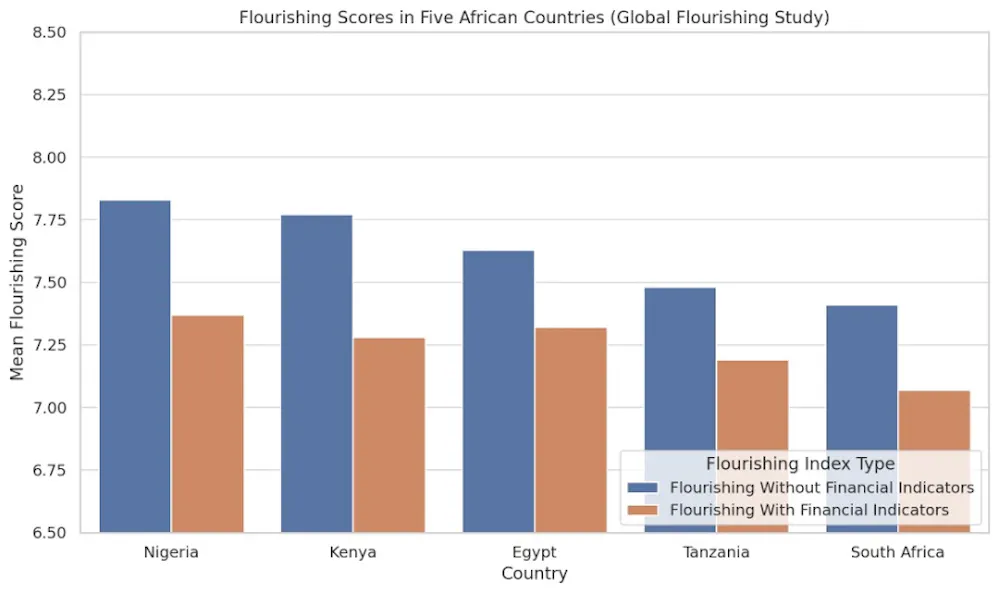
    Of the 22 nations, five were African: Nigeria, Kenya, South Africa, Tanzania and Egypt.

    While these countries didn’t top the global rankings (Indonesia and Mexico did), Nigeria, Kenya and Egypt all reported relatively high flourishing scores, especially when well-being was considered apart from financial status.


    Nigeria, for example, ranked 5th globally in flourishing scores that excluded financial indicators – ahead of many wealthier nations. Nigerians indicated strengths in social relationships, character and virtues (like forgiveness or helping others). But potential areas of growth included financial well-being, housing, ethnic discrimination and education.

    Overall, this suggests that while material resources matter, they’re not the only thing that determines well-being. Kenya ranked 7th, Egypt 10th, Tanzania 11th and South Africa 13th. Each showed unique strengths in areas like meaning, social connection or mental health.

    You did a separate study on flourishing in Africa. What did you find?

    In a 2024 study we analysed data from the Gallup World Poll (2020–2022) to explore 38 indicators of well-being across 40 African countries.

    This study offered a more detailed and culture-sensitive picture of how Africans experience and prioritise flourishing. The dimensions explored were derived from both local and universal sources, allowing for regionally relevant insights.

    We found that African populations often score high in meaning, character and social relationships – despite economic hardship. This offers an important corrective to western assumptions about well-being.

    Some of our key findings were:

    ● There is significant diversity between and within African countries. Mauritius consistently ranked highest in life evaluations (overall satisfaction with their lives), while countries like Sierra Leone and Zimbabwe scored lowest.

    ● East African countries such as Rwanda and Ethiopia showed strong performance in social well-being indicators (like feeling respected or learning new things daily) even when economic indicators were low.

    ● Countries in West Africa, such as Senegal and Ghana, scored high in emotional well-being, with many people reporting positive daily emotions like enjoyment and laughter.

    ● Southern African nations, despite challenges like income inequality, displayed resilience through strong community ties and cultural practices rooted in the philosophy of ubuntu.

    The results reinforced that flourishing in Africa cannot only be reduced to gross domestic product (GDP) per capita (a measure of the average economic output per person in a country) – nor to western norms of success.

    What can African countries focus on to flourish?

    In my view, the path to greater flourishing lies in embracing local knowledge and investing in culturally relevant development priorities. Instead of following western pathways – centred on individual advancement – Africa can model alternative flourishing pathways that reflect what matters most to African people.

    1. Prioritise local knowledge systems

    African ideas about a connected society – like ubuntu (southern Africa), ujamaa (east Africa), teranga or wazobia (west Africa), and al-musawat wal tarahum (north Africa) teach people to care for each other and live in peace. These values help people live meaningful lives and can inform leadership and legislation.

    2. Redefine development metrics

    Western development models focus on individual achievement, economic output and material consumption. GDP per capita fails to capture the everyday realities and aspirations of African communities. We should also measure things like how happy people are, how hopeful they feel about the future, how strong and resilient their communities are, and how clean, safe and dignifying their living environments are.

    This is not a new idea – for years development scholars have called for a shift away from narrow economic indicators toward a focus on human dignity, agency, and the real opportunities people have to pursue the lives they value. What’s new is the growing availability of data and the momentum to take these alternative metrics seriously in shaping national policies and priorities.

    3. Invest in education for character development

    Quality education is essential to unlocking the continent’s potential to flourish. But Africa needs more than just academic skills and workforce readiness – it needs a strategy for intentional development of values and habits that shape how a person thinks, feels, and acts with integrity.

    Part of the problem lies in how the humanities – fields like history, literature, philosophy, and religious studies – are often undervalued or underfunded in education systems. But it is precisely these disciplines that nurture moral imagination, critical reflection, and civic responsibility. We need educational models that form not just workers, but whole persons – people who can think ethically, act responsibly, and lead with character in their communities.


    Read more:
    What makes a person seem wise? Global study finds that cultures do differ – but not as much as you’d think


    What does Africa offer the world in terms of flourishing?

    Africa is not waiting to be saved. Across the continent, people are building communities of care, cultivating joy amid hardship, and passing on values of unity, faith, and compassion. This is what development looks like when rooted in human dignity.

    Africa flourishing goals offer an alternative vision for development – one that starts with what Africa already has, not what it lacks. These are locally emic aspirations for well-being. They are shaped by Africa’s indigenous knowledge systems, cultural values, and religious/spiritual traditions. Pursuing these goals means prioritising wholeness over wealth, community over consumption, and resilience over rescue.

    The continent has so much to offer the world: wisdom, strong community values, and ways of staying resilient and living fully even in hard times. But many of these local insights are missing in the global science of well-being.

    Victor Counted consults for Africa Flourishing Initiative

    ref. Which African countries are flourishing? Scientists have a new way of measuring well-being – https://theconversation.com/which-african-countries-are-flourishing-scientists-have-a-new-way-of-measuring-well-being-257458

    MIL OSI – Global Reports

  • MIL-OSI Africa: Which African countries are flourishing? Scientists have a new way of measuring well-being

    Source: The Conversation – Africa – By Victor Counted, Associate Professor of Psychology, Regent University

    What does it mean to live a good life? Psychologists and social scientists have been focusing on a new idea called flourishing – a sense of well-being that goes beyond just happiness or success. It’s about your whole life being good, including how you interact with other people and your community. So then, how do Africans fare when it comes to flourishing?

    Victor Counted is a psychological scientist whose research across 40 African countries offers a data-rich rethinking of flourishing on the continent. His findings challenge the dominant narrative that Africa is “lagging behind” in development by showing a more nuanced picture of what it means to live a good life. We asked him more.


    What is flourishing?

    Flourishing is more than economic growth or individual happiness. It’s a multidimensional state of being that reflects how people feel about their lives and how well their lives are actually going. So it also measures people’s values within their community.

    The idea of well-being often carries a Eurocentric emphasis on the individual – personal satisfaction, autonomy, achievement. Flourishing accounts for how whole a person is in relation to their environment.

    It includes the social, spiritual and ecological contexts in which one lives. So, it’s not just about how one feels, but how one lives – fully, meaningfully and in a satisfying relationship with the world around us.

    What’s the Global Flourishing Study?

    The Global Flourishing Study tries to measure global patterns of human flourishing. It’s an ongoing five-year longitudinal study in over 200,000 participants across 22 countries.

    I was one of the team of global scholars brought together to examine the trends on what it means to live well across cultures and life circumstances.


    Read more: What makes people flourish? A new survey of more than 200,000 people across 22 countries looks for global patterns and local differences


    The study identifies six key dimensions of flourishing:

    • Happiness and life satisfaction
    • Mental and physical health
    • Meaning and purpose
    • Character and virtue
    • Close social relationships
    • Financial and material stability

    Participants rate how they’re doing in each of these areas on a scale from 0 to 10. Further questions capture experiences related to trust, loneliness, hope, resilience, and other related well-being variables.


    CC BY-ND

    Of the 22 nations, five were African: Nigeria, Kenya, South Africa, Tanzania and Egypt.

    While these countries didn’t top the global rankings (Indonesia and Mexico did), Nigeria, Kenya and Egypt all reported relatively high flourishing scores, especially when well-being was considered apart from financial status.


    Courtesy Victor Counted

    Nigeria, for example, ranked 5th globally in flourishing scores that excluded financial indicators – ahead of many wealthier nations. Nigerians indicated strengths in social relationships, character and virtues (like forgiveness or helping others). But potential areas of growth included financial well-being, housing, ethnic discrimination and education.

    Overall, this suggests that while material resources matter, they’re not the only thing that determines well-being. Kenya ranked 7th, Egypt 10th, Tanzania 11th and South Africa 13th. Each showed unique strengths in areas like meaning, social connection or mental health.

    You did a separate study on flourishing in Africa. What did you find?

    In a 2024 study we analysed data from the Gallup World Poll (2020–2022) to explore 38 indicators of well-being across 40 African countries.

    This study offered a more detailed and culture-sensitive picture of how Africans experience and prioritise flourishing. The dimensions explored were derived from both local and universal sources, allowing for regionally relevant insights.

    We found that African populations often score high in meaning, character and social relationships – despite economic hardship. This offers an important corrective to western assumptions about well-being.

    Some of our key findings were:

    ● There is significant diversity between and within African countries. Mauritius consistently ranked highest in life evaluations (overall satisfaction with their lives), while countries like Sierra Leone and Zimbabwe scored lowest.

    ● East African countries such as Rwanda and Ethiopia showed strong performance in social well-being indicators (like feeling respected or learning new things daily) even when economic indicators were low.

    ● Countries in West Africa, such as Senegal and Ghana, scored high in emotional well-being, with many people reporting positive daily emotions like enjoyment and laughter.

    ● Southern African nations, despite challenges like income inequality, displayed resilience through strong community ties and cultural practices rooted in the philosophy of ubuntu.

    The results reinforced that flourishing in Africa cannot only be reduced to gross domestic product (GDP) per capita (a measure of the average economic output per person in a country) – nor to western norms of success.

    What can African countries focus on to flourish?

    In my view, the path to greater flourishing lies in embracing local knowledge and investing in culturally relevant development priorities. Instead of following western pathways – centred on individual advancement – Africa can model alternative flourishing pathways that reflect what matters most to African people.

    1. Prioritise local knowledge systems

    African ideas about a connected society – like ubuntu (southern Africa), ujamaa (east Africa), teranga or wazobia (west Africa), and al-musawat wal tarahum (north Africa) teach people to care for each other and live in peace. These values help people live meaningful lives and can inform leadership and legislation.

    2. Redefine development metrics

    Western development models focus on individual achievement, economic output and material consumption. GDP per capita fails to capture the everyday realities and aspirations of African communities. We should also measure things like how happy people are, how hopeful they feel about the future, how strong and resilient their communities are, and how clean, safe and dignifying their living environments are.

    This is not a new idea – for years development scholars have called for a shift away from narrow economic indicators toward a focus on human dignity, agency, and the real opportunities people have to pursue the lives they value. What’s new is the growing availability of data and the momentum to take these alternative metrics seriously in shaping national policies and priorities.

    3. Invest in education for character development

    Quality education is essential to unlocking the continent’s potential to flourish. But Africa needs more than just academic skills and workforce readiness – it needs a strategy for intentional development of values and habits that shape how a person thinks, feels, and acts with integrity.

    Part of the problem lies in how the humanities – fields like history, literature, philosophy, and religious studies – are often undervalued or underfunded in education systems. But it is precisely these disciplines that nurture moral imagination, critical reflection, and civic responsibility. We need educational models that form not just workers, but whole persons – people who can think ethically, act responsibly, and lead with character in their communities.


    Read more: What makes a person seem wise? Global study finds that cultures do differ – but not as much as you’d think


    What does Africa offer the world in terms of flourishing?

    Africa is not waiting to be saved. Across the continent, people are building communities of care, cultivating joy amid hardship, and passing on values of unity, faith, and compassion. This is what development looks like when rooted in human dignity.

    Africa flourishing goals offer an alternative vision for development – one that starts with what Africa already has, not what it lacks. These are locally emic aspirations for well-being. They are shaped by Africa’s indigenous knowledge systems, cultural values, and religious/spiritual traditions. Pursuing these goals means prioritising wholeness over wealth, community over consumption, and resilience over rescue.

    The continent has so much to offer the world: wisdom, strong community values, and ways of staying resilient and living fully even in hard times. But many of these local insights are missing in the global science of well-being.

    – Which African countries are flourishing? Scientists have a new way of measuring well-being
    – https://theconversation.com/which-african-countries-are-flourishing-scientists-have-a-new-way-of-measuring-well-being-257458

    MIL OSI Africa

  • MIL-OSI USA: Stansbury Fights for Expanded Access to Healthcare, More Providers

    Source: United States House of Representatives – Representative Melanie Stansbury (N.M.-01)

     WASHINGTON, D.C. – Congresswoman Melanie Stansbury (NM-01) fought for expanded access to healthcare in rural and Indigenous communities during an Indian and Insular Affairs Subcommittee hearing.  

    Her bill, the IHS Provider Expansion Act, was reintroduced earlier in the month, and testimony about the legislation was heard during the subcommittee hearing.  

    Watch video of the hearing.  

    The legislation would establish an Office of Graduate Medical Education Programs within the Indian Health Service (IHS). This legislation would expand the existing IHS Residency Program, building from the Shiprock-University of New Mexico (SUNM) Family Medicine Residency which is the first in the nation.  

    “Access to healthcare should not be determined by history or geography,” said Rep. Melanie Stansbury (NM-01). “The IHS Provider Expansion Act is a vital step towards ensuring that Native and Indigenous communities can access healthcare and grow the number of medical professionals serving Native communities. By investing in medical education within the Indian Health Service, we can help expand healthcare and bridge the gap in healthcare disparities that have persisted for far too long.” 

    Testifying about the importance of the legislation was Dr. Adriann Begay from the Navajo Nation HEAL Initiative. Dr. Begay is Tábaahi (Edge of the Water clan) and born for Bít’ahnii (Folded Arms People clan). Her maternal grandparents are Ta’néészahnii (Badlands People clan) and paternal grandparents are Tl’aashchí’í (Red Cheek People clan).  

    She completed her undergraduate studies at the University of Arizona; and received a medical degree from the University of North Dakota School of Medicine through the Indians into Medicine program. She completed her residency in Family Medicine at the University of Arizona and is a Diplomate of the American Board of Family Practice. Adriann worked for the Indian Health Service for 21 years initially at Salt River Clinic under Phoenix Indian Medical Center for 4 years as a primary care provider. Then at Gallup Indian Medical Center as an urgent care physician and administrator for 17 years. 

    Watch video of Dr. Begay’s testimony.  

    More about the bill and its impact:  

    In New Mexico, which is home to 23 Tribal Nations and a population that is nearly 12% Native, access to healthcare services is a pressing issue. Currently, IHS provides services in 37 states to about 2.2 million out of 3.7 million Indigenous people in the country.  

    This bill is projected to directly impact millions of people across the country served by the IHS to improve access to healthcare and medical professionals who understand the unique health challenges faced by Tribal communities.  

    By expanding access through IHS, this bill will also help to address the significant deficit of rural primary healthcare providers across the country. Recent data from the U.S. Department of Health and Human Services shows rural areas across the country face a significant deficit in primary care providers, with more than 80 million Americans living in Health Professional Shortage Areas (HPSAs).   

    By expanding graduate medical education opportunities through IHS, we can expect an increase in the number of physicians willing to practice in these underserved regions.  

    Key Provisions of the Legislation:  

    • Establishment of the Office: The Secretary of Health makes permanent the Office of Graduate Medical Education Programs to oversee residency and fellowship initiatives within the IHS. 
    • Creating a Pipeline: The Office will facilitate opportunities for future healthcare professionals, paraprofessionals, and other health-related workers to engage in residency and fellowship programs. 
    • Oversight of Residency Programs: The Office will oversee existing residency and fellowship programs at IHS facilities and support the creation of additional programs aimed at recruiting and retaining healthcare professionals. 
    • Coordination with Academic Institutions: The Office will work in collaboration with academic institutions to strengthen educational ties and enhance training opportunities. 
    • Interagency Working Group: An interagency working group, involving various federal agencies, will assist in the implementation and sustainability of the Office, ensuring ongoing support and resources.  
    •  

    Read the bill here.  

    ###

    MIL OSI USA News

  • MIL-OSI Asia-Pac: Tourism Strategy Committee meets

    Source: Hong Kong Information Services

    The Tourism Strategy Committee, chaired by Secretary for Culture, Sports & Tourism Rosanna Law, held its fourth meeting today.


    During the meeting, representatives from Kai Tak Sports Park Limited and the Development Bureau briefed the committee on matters relating to the sports park, and the preliminary land use proposal for sites around Hung Hom Station and nearby waterfront areas.


    Members praised the sports park, highlighting that it has impressed visitors and boosted the tourism industry. They also put forward suggestions for optimising transportation and catering arrangements during mega events and for strengthening cross-sector collaboration with the tourism industry.


    Regarding the preliminary land use proposal for sites around Hung Hom Station and nearby waterfront areas, committee members remarked that given their location on Victoria Harbour, the waterfront areas are well-positioned for redevelopment into a new harbourfront landmark that can integrate leisure, entertainment, dining, retail, and water-friendly elements.


    Members agreed that the water body adjacent to the former Hung Hom Freight Yard should be put to use, and commented that the proposed world-class yacht berthing facilities could be integrated with land-based facilities for retail, dining and entertainment so as to promote yacht tourism. They also recommended that the Government provide space for land-side ancillary facilities to support the operation of the yacht berthing facilities.


    The bureau is currently consulting the public and stakeholders on the preliminary land use proposal, and the Government will take into account members’ recommendations and the feedback received during the consultation period when refining the proposal and finalising the development parameters. The target is to commence relevant statutory procedures in the second half of 2026.


    Separately, members exchanged views with Tourism Board representatives regarding the city’s latest tourism performance and statistics.


    For the first five months of 2025, Hong Kong had more than 20 million visitor arrivals, a 12% increase year on year. Among these visitors, about 15 million came from the Mainland, a 10% rise on the same period in 2024. Visitor arrivals from Japan, South Korea, the Philippines, Indonesia and Taiwan rose more than 25%. For Australia, growth of 35% was recorded.

    MIL OSI Asia Pacific News

  • MIL-OSI Security: Indian National Sentenced to Federal Prison for Defrauding Elderly Americans While on Student Visa

    Source: US FBI

    AUSTIN, Texas – An Indian national who was living in the U.S. on a student visa was sentenced in a federal court in Austin to 63 months in prison for conspiracy to commit money laundering.

    According to court documents, Kishan Rajeshkumar Patel, 20, of Navsari, Gujarat, conspired with co-defendant Dhruv Rajeshbhai Mangukiya and others to defraud elderly victims out of hundreds of thousands of dollars in cash and gold from July 2024 through August 2024. The conspiracy used various online phishing methods and impersonated U.S. government officials, while Patel fraudulently received the cash and gold from victims, conveying a portion to co-conspirators and keeping a percentage for his own benefit. To date, the investigation has determined that the conspiracy defrauded at least 25 victims with a total intended loss of at least $2,694,156.

    Patel was arrested by the Granite Shoals Police Department on Aug. 24, 2024, after he retrieved a box represented to contain $130,000 from a victim’s residence. He was transferred into federal custody on Aug. 29 and pleaded guilty on March 18. Patel’s sentence was handed down by U.S. District Judge Robert Pitman.

    “This defendant took advantage of his visa status in our country and participated in an international fraud scheme,” said U.S. Attorney Justin Simmons for the Western District of Texas. “Patel defrauded vulnerable American citizens out of millions of dollars by impersonating government officials and preying on his victims’ fears of adverse government action. Today’s sentence demonstrates the federal government’s commitment to prosecuting the perpetrators of such nefarious schemes and achieving justice for the victims.”

    “The FBI is deeply committed to protecting the American people from the devastating effects of financial fraud. We prioritize and aggressively pursue those who prey on our elderly population,” said Special Agent in Charge Aaron Tapp of the FBI’s San Antonio Field Office. “We want to thank our colleagues at the Granite Shoals Police Department for their professionalism and dedication to the citizens they serve.”

    Mangukiya pleaded guilty June 16 and awaits his sentence hearing.

    The FBI investigated the case.

    Assistant U.S. Attorney Keith Henneke prosecuted the case.

    ###

    MIL Security OSI

  • MIL-OSI Canada: Premier’s statement on National Day of Remembrance for Victims of Terrorism

    Premier David Eby has issued the following statement marking National Day of Remembrance for Victims of Terrorism:

    “Forty years ago today, 329 innocent people boarded Air India Flight 182 on Canadian soil but never made it to their final destination. They were entire families, businesspeople and students with their whole lives ahead of them. Tragically, they became victims of the deadliest terrorist attack in Canadian history when a bomb exploded onboard their flight. Two baggage handlers were also killed at Tokyo’s Narita Airport when a bomb intended for another Air India flight exploded.

    “Today, we remember the 331 victims, including 280 Canadians, as well as everyone whose life was cut short or forever altered by a terrorist attack. We mourn with the loved ones left behind and condemn such senseless acts of violent extremism. 

    “Together, we must stand against the hate, intolerance and division that fuel terrorism. On National Day of Remembrance for Victims of Terrorism, we renew our resolve to create a safer society for everyone in honour of those we have lost.”

    MIL OSI Canada News

  • MIL-OSI: Mizuho Americas Hires Yaron Kinar as Managing Director and Senior Equity Research Analyst Covering the Insurance Sector

    Source: GlobeNewswire (MIL-OSI)

    NEW YORK, June 23, 2025 (GLOBE NEWSWIRE) — Mizuho Americas today announced the hiring of Yaron Kinar as Managing Director and Senior Equity Research Analyst covering the Insurance sector. Based in Chicago, Kinar reports to the Head of Equity Research, Bill Featherston.

    Kinar has two decades of equity research experience in the insurance and financial sectors. He joins Mizuho from Jefferies, where he was lead Equity Research Analyst for North America P&C Insurance and Insurtech and named runner-up in the 2023-4 Institutional Investor (now Extel) All-America Research Team surveys.

    “Yaron’s reputation as an insightful and influential insurance industry equity analyst is a great addition to our team,” said Featherston. “His extensive experience will greatly benefit our clients and Mizuho as a whole as we build out our coverage of the Financials sector.”

    Prior to Jefferies, he held lead analyst roles at Goldman Sachs and Deutsche Bank, where he was recognized as an All-America Research Team survey Rising Star.

    Kinar began his career in underwriting at AIG and holds an MBA from Columbia Business School and an LL.B. from Hebrew University of Jerusalem.

    About Mizuho Americas
    Mizuho Financial Group, Inc. is one of the largest financial institutions in the world as measured by total assets of ~$2 trillion, according to S&P Global 2024. Mizuho’s 65,000 employees worldwide offer comprehensive financial services to clients in 36 countries and 850 offices throughout the Americas, EMEA, and Asia.

    Mizuho Americas is a leading Corporate and Investment Bank (CIB) that provides a full spectrum of client-driven solutions across strategic advisory, capital markets, corporate banking, and fixed income and equities sales & trading to corporate, government, and institutional clients in the US, Canada, and Latin America. Through its acquisition of Greenhill, Mizuho enhanced its M&A, restructuring, and private capital advisory capabilities across the Americas, Europe, and Asia. Mizuho Americas employs approximately 4,000 professionals. For more information visit www.mizuhoamericas.com.

    For inquiries, please contact:
    Jim Gorman
    Executive Director, Media Relations, Mizuho Americas
    +1-212-282-3867
    jim.gorman@mizuhogroup.com

    The MIL Network

  • MIL-OSI: BitMart Launches X Insight: A Breakthrough AI Tool That Translates Crypto Conversations Into Market Intelligence

    Source: GlobeNewswire (MIL-OSI)

    Mahe, Seychelles, June 23, 2025 (GLOBE NEWSWIRE) — BitMart, a global leader in digital asset trading, is proud to announce the official launch of X Insight — an AI-powered intelligence platform that transforms real-time social conversations on X (formerly Twitter) into actionable trading signals for the crypto market.

    As social media continues to drive market momentum in the digital asset space, traders and investors are increasingly seeking tools that can help them interpret sentiment, detect shifts, and move quickly. X Insight answers that need by offering deep, real-time analysis of crypto discussions — empowering users with unprecedented clarity and confidence in a highly volatile landscape.

    Built for traders, investors, analysts, and crypto enthusiasts alike, X Insight provides a comprehensive suite of features:

    • Real-Time Sentiment Analysis: Instantly gauge the market mood around any token by analyzing millions of X posts using advanced natural language processing.
    • Social Sentiment Index (SSI): A proprietary score (0–100) that combines social activity, sentiment positivity, and KOL (Key Opinion Leader) focus to give a quick pulse check on a coin’s momentum.
    • Market Pulse Ranking (MPR): A predictive alert system that flags social anomalies, providing early warnings for potential risks or trend reversals.
    • KOL Tracking and Consensus: Monitor what top crypto influencers are saying — and how aligned they are — with dynamic consensus scores and attention shifts.
    • AI Tweet Filtering: Cut through the noise with intelligent filters that remove irrelevant content and surface high-value posts with reliable data signals.
    • Multi-language Support: Access insights across English, Chinese, and Korean to stay informed on global sentiment.
    • User-Centric Design: The intuitive interface presents social data with clarity and precision — from trending topics to sentiment shifts — empowering users of all experience levels.

    “BitMart’s X Insight represents a revolutionary leap in crypto market intelligence by delivering AI-powered social sentiment analysis that transforms how traders access actionable market insights,” said NenterGlobal CEO of BitMart. “Our proprietary Social Sentiment Index and Market Pulse Ranking system provide unmatched precision in predicting market movements by combining real-time social metrics with KOL consensus tracking — setting a new industry standard.”

    This launch marks more than just the introduction of a new feature. It reflects BitMart’s broader commitment to pioneering intelligent crypto infrastructure through applied AI and real-time analytics. X Insight is the first of several products planned under BitMart’s next-generation innovation roadmap — a series of tools designed to make advanced trading insights more accessible, actionable, and transparent.

    As crypto markets continue to evolve at lightning speed, BitMart remains focused on giving users the power to react faster, understand deeper, and trade smarter.

    Discover how X Insight can elevate your crypto strategy — now live on https://www.bitmart.com/ai/xinsight.

    About BitMart

    BitMart is a premier global digital asset trading platform with more than 10 million users worldwide. Consistently ranked among the top crypto exchanges on CoinGecko, BitMart offers over 1,700 trading pairs with competitive fees. Committed to continuous innovation and financial inclusivity, BitMart empowers users globally to trade seamlessly. Learn more about BitMart at Website, follow their X (Twitter), or join their Telegram for updates, news, and promotions. Download BitMart App to trade anytime, anywhere.

    Disclaimer:

    The information provided is for informational purposes only and should not be considered a recommendation to buy, sell, or hold any financial assets. All information is provided in good faith. However, we make no representation or warranty of any kind, express or implied, regarding the accuracy, adequacy, validity, reliability, availability or completeness of such information.

    All crypto investments, including earnings, are highly speculative in nature and involve substantial risk of loss. Past, hypothetical, or simulated performance is not necessarily indicative of future results. The value of digital currencies can go up or down and there can be a substantial risk in buying, selling, holding, or trading digital currencies. You should carefully consider whether trading or holding digital currencies is suitable for you based on your personal investment objectives, financial circumstances, and risk tolerance. BitMart does not provide any investment, legal or tax advice.

    The MIL Network

  • PM Modi to inaugurate centenary celebration of historic dialogue between Sree Narayana Guru and Mahatma Gandhi

    Source: Government of India

    Source: Government of India (4)

    Prime Minister Narendra Modi will inaugurate the centenary celebration of the historic conversation between Sree Narayana Guru and Mahatma Gandhi on Tuesday, June 24. The event is scheduled to take place at 11:00 AM at Vigyan Bhawan in New Delhi, where the Prime Minister will also address the gathering.

    This centenary marks 100 years since the landmark interaction between two of India’s most revered spiritual and moral leaders. The original conversation took place on March 12, 1925, at the Sivagiri Mutt during Mahatma Gandhi’s visit. Their dialogue addressed key social and moral issues of the time, including the Vaikom Satyagraha, religious conversions, non-violence, abolition of untouchability, the path to salvation, and the upliftment of the downtrodden.

    The event is being organised by the Sree Narayana Dharma Sanghom Trust, which manages the Sivagiri Mutt. It aims to bring together spiritual leaders, scholars, and social reformers to reflect on the significance of this dialogue, which continues to influence India’s social and ethical landscape.

  • MIL-OSI Banking: Students Across Delhi NCR Reimagine the Future with Samsung Solve for Tomorrow

    Source: Samsung

    Classrooms lit up with curiosity, corridors buzzed with conversations around innovation, and young students stood confidently pitching bold ideas for a better tomorrow. The recent Samsung Solve for Tomorrow roadshows and open houses have been igniting minds across cities, and Delhi NCR was no exception.
     
    Samsung Solve for Tomorrow, launched on April 29, 2025, is more than just a national innovation challenge. It is a call to action for India’s youth — an invitation to step up, identify real-world issues, and build technology-based solutions that can impact lives. The programme equips students with design thinking tools, mentorship from Samsung leaders and IIT Delhi faculty, investor connects, and prototyping support. It also offers INR 1 crore to the top four winning teams.
     
    As part of the outreach, the Samsung team visited Mamta Modern School in Vikaspuri, Kamal Model Sr. Sec. School in Mohan Garden, DAV Sector 14 in Gurgaon, St. Teresa School in Indirapuram, and WCTM Gurgaon. In these open houses, students interacted with programme facilitators, asked questions, explored case studies from previous seasons, and began shaping their own problem statements.
     
    At the New Delhi leg of the roadshow, the excitement was palpable. Students from schools gathered with ideas ranging from AI-based solutions for senior citizen care to sustainable energy innovations and mental health apps tailored for teens.
     
    Among them was Aarna Kaushal, a class 11 student, who has been deeply moved by the sight of overflowing landfills in her city. Inspired by the programme, she’s now working on a smart segregation system for waste collection. “Samsung Solve for Tomorrow made me feel like someone is finally listening to students like us. I’m not just dreaming anymore — I’m planning, researching and designing,” said Aarna.
     
    For Bhumika Rawal, it was the experience of watching kids around her struggle with dyslexia that sparked an idea. “I want to create a voice-based learning app that helps kids learn at their own pace. The roadshow helped me shape that dream into a project,” said Bhumika, her eyes lit with determination.
     
    The energy in these sessions went beyond pitches and prototypes. Students discussed the importance of inclusion, accessibility, climate responsibility, and rural connectivity. They learnt that ideas don’t have to be perfect to be powerful — they just need to be rooted in purpose.
     
    As the Samsung Solve for Tomorrow roadshows continue to travel across India, they’re not just spreading awareness about the programme — they’re awakening a generation of problem-solvers and change-makers.
     
    India is full of young innovators. Samsung is providing them the tools, the platform, and the confidence to build something meaningful.
     
    With open houses like these, Samsung is doing more than scouting for the next big idea — it’s investing in the next generation of changemakers who believe that solving for tomorrow begins today.

    MIL OSI Global Banks

  • MIL-OSI Canada: Statement by Prime Minister Carney on the National Day of Remembrance for Victims of Terrorism

    Source: Government of Canada – Prime Minister

    “Forty years ago, innocent civilians, including over 250 Canadians, were killed in the bombing of Air India Flight 182. This terrorist attack remains the deadliest attack in our country’s history – one we must never forget.

    “As we mark the National Day of Remembrance for Victims of Terrorism, we remember the victims of the Air India bombing and all others who have lost their lives to terrorism.

    “Canada will continue to work with our allies and partners, at home and around the world, to better detect, prevent, and respond to the threat of terrorism and violent extremism. We are also increasing funding for national security, defence, and law enforcement, and enhancing intelligence sharing with our allies.

    “Canada’s new government unequivocally stands against terrorism, and we will deliver on our mandate of change to keep communities safe.”

    MIL OSI Canada News

  • MIL-Evening Report: NZ Greens call on state to condemn US over ‘dangerous’ attack on Iran

    Asia Pacific Report

    New Zealand’s opposition Green Party has called on the government to condemn the United States for its illegal bombing of Iran and inflaming tensions across the Middle East.

    “The actions of the United States pose a fundamental threat to world peace,” said Green Party co-leader Marama Davidson in a statement.

    “The rest of the world — including New Zealand– must take a stand and make it clear that this dangerous escalation is unacceptable.

    “We are calling on the New Zealand government to condemn the United States for its attack on Iran. This attack is a blatant breach of international law and yet another unjustified assault on the Middle East from the US.”

    Davidson said the country had seen this with the US war on Iraq in 2003, and it was happening again with Sunday’s attack on Iran.

    “We are at risk of a violent history repeating itself,” she said.

    “[Prime Minister] Christopher Luxon needs to condemn this escalation from the US and rule out any participation in this conflict, or any of the elements of the AUKUS pact.

    Independent foreign policy
    “New Zealand must maintain its independent foreign policy position and keep its distance from countries that are actively fanning the flames of war.”

    Davidson said New Zealand had a long and proud history of standing up for human rights on the world stage.

    “When we stand strong and with other countries in calling for peace, we can make a difference. We cannot afford to be a bystander to the atrocities unfolding in front of our eyes.”

    It was time for the New Zealand government to step up.

    “It has failed to sanction Israel for its illegal and violent occupation of Palestine, and we risk burning all international credibility by failing to speak out against what the United States has just done.”

    Meanwhile, Prime Minister Luxon said New Zealand wanted to see a peaceful stable and secure Middle East, but more military action was not the answer, reports RNZ News.

    The UN Security Council met in emergency session today to discuss the US attack on the three key nuclear facilities.

    UN Secretary-General António Guterres said the US bombing marked a “perilous turn” in a region already reeling.

    Iran called on the 15-member body to condemn what it called a “blatant and unlawful act of aggression”.

    MIL OSI AnalysisEveningReport.nz

  • MIL-Evening Report: NZ Greens call on state to condemn US over ‘dangerous’ attack on Iran

    Asia Pacific Report

    New Zealand’s opposition Green Party has called on the government to condemn the United States for its illegal bombing of Iran and inflaming tensions across the Middle East.

    “The actions of the United States pose a fundamental threat to world peace,” said Green Party co-leader Marama Davidson in a statement.

    “The rest of the world — including New Zealand– must take a stand and make it clear that this dangerous escalation is unacceptable.

    “We are calling on the New Zealand government to condemn the United States for its attack on Iran. This attack is a blatant breach of international law and yet another unjustified assault on the Middle East from the US.”

    Davidson said the country had seen this with the US war on Iraq in 2003, and it was happening again with Sunday’s attack on Iran.

    “We are at risk of a violent history repeating itself,” she said.

    “[Prime Minister] Christopher Luxon needs to condemn this escalation from the US and rule out any participation in this conflict, or any of the elements of the AUKUS pact.

    Independent foreign policy
    “New Zealand must maintain its independent foreign policy position and keep its distance from countries that are actively fanning the flames of war.”

    Davidson said New Zealand had a long and proud history of standing up for human rights on the world stage.

    “When we stand strong and with other countries in calling for peace, we can make a difference. We cannot afford to be a bystander to the atrocities unfolding in front of our eyes.”

    It was time for the New Zealand government to step up.

    “It has failed to sanction Israel for its illegal and violent occupation of Palestine, and we risk burning all international credibility by failing to speak out against what the United States has just done.”

    Meanwhile, Prime Minister Luxon said New Zealand wanted to see a peaceful stable and secure Middle East, but more military action was not the answer, reports RNZ News.

    The UN Security Council met in emergency session today to discuss the US attack on the three key nuclear facilities.

    UN Secretary-General António Guterres said the US bombing marked a “perilous turn” in a region already reeling.

    Iran called on the 15-member body to condemn what it called a “blatant and unlawful act of aggression”.

    MIL OSI AnalysisEveningReport.nz

  • MIL-OSI Economics: ICC elects four new members to the Executive Board

    Source: International Chamber of Commerce

    Headline: ICC elects four new members to the Executive Board

    The new members were formally elected during the annual meeting of the ICC World Council on 19 June 2025 and will each serve a three-year term effective 19 June 2025. The diverse experience of new members will enrich ICC’s roadmap to enable peace and prosperity through trade and reflects ICC’s continued commitment to geographic representation and diversity of expertise as the world’s largest and most inclusive business organisation.

    The ICC Executive Board is responsible for developing and implementing ICC’s strategy, policy and programme of action as well as for overseeing the financial affairs of ICC. 

    ICC Chair Philippe Varin said:

    “I’m very pleased to welcome this exceptional group of global leaders who bring deep expertise and fresh perspectives to ICC. Their leadership will be vital as we continue charting a path forward in delivering real-world solutions for business in a changing global environment. My thanks also to our outgoing Board members for their contributions.”

    The new Board members are: 

    Mohammad Lootah

    Mohammad Ali Rashed Lootah is the President and CEO of Dubai Chambers, where he leads strategic initiatives to enhance Dubai’s business environment, attract foreign investment, support global business expansion, and promote the digital economy. Prior to this role, he held several key leadership positions within Dubai’s Department of Economy and Tourism, including CEO of Commercial Compliance and Consumer Protection, overseeing areas such as consumer rights, business protection, and intellectual property. He also served in senior roles at the Department of Economic Development and the Dubai Land Department. 

    Zhang Hui

    Zhang Hui is Vice Chairman, Executive Director and President of the Bank of China, roles he assumed between December 2024 and January 2025. He also serves as Vice Chairman of BOC Hong Kong (Holdings) Limited. Mr Zhang joined the Bank of China in 2024 after serving as Executive Vice President of China Development Bank from 2021 to 2024. Prior to that, he spent many years at Bank of Communications, where he held various senior roles including as Chief Risk Officer, general manager of several risk management departments, and president of regional branches including in Guizhou and Shanghai. 

    Anousheh Ansari

    Anousheh Ansari is the CEO of XPRIZE, where she leads global innovation competitions addressing some of humanity’s most pressing challenges. A tech entrepreneur and space pioneer, Ms Ansari co-founded and led Prodea Systems, an IoT company recognised among Inc. Magazine’s 500 fastest-growing firms. In 2006, she became the first female private space explorer, the first astronaut of Iranian descent, and the first Muslim woman in space. Under her leadership, XPRIZE has awarded over US$81 million and launched US$361 million in active competitions. Ms Ansari also serves in various global advisory roles, including with the World Economic Forum, GESDA and UNESCO, and is an advocate for women entrepreneurs through initiatives like The Billion Dollar Fund for Women.

    Kobkarn Wattanavrangkul

    Kobkarn Wattanavrangkul is a Thai business leader and former Minister of Tourism and Sports, known for her contributions to both public policy and corporate governance. As Thailand’s tourism minister from 2014 to 2017, Ms Wattanavrangkul championed sustainable tourism and cultural heritage. She currently serves as Chair of the Board of Directors at Kasikornbank and Toshiba Thailand, and plays an active role in advancing education, innovation and international cooperation through various institutional boards. Ms Wattanavrangkul’s career reflects a strong commitment to inclusive and sustainable development in Thailand.

    Term renewals

    Elected to serve on the ICC Executive Board for a second term during the World Council meeting were Holger Bingmann (Germany), Managing Partner, Bingmann Pflüger International GmbH, Rebecca Enonchong (Cameroon), CEO, AppsTech and Chair of Afrilabs, Marjorie Yang (Hong Kong), Chair, Esquel Group, Lama Al Sulaiman (Saudi Arabia), Shareholder and Board Member of Rolaco Holdings, KSA and LUX and Justin D’Agostino (Hong Kong), Global CEO, Herbert Smith Freehills Kramer.

    Outgoing Board members are Candace Johnson (United States/Luxemburg), Vice-Chair, NorthStar Earth and Space, Fredrik Cappelen (Sweden), Chairman and Board Member in the Swedish and Nordic industry, Valentina Mintah (Ghana), Founder West Blue Consulting, Zhang Xiaolun (China) Chair, China National Machinery Industry Corporation (SINOMACH).

    Leading chambers worldwide

    The ICC World Council also ratified the re-election of Rifat Hisarcıklıoğlu as Chair of the ICC World Chambers Federation (WCF) for a second three-year term commencing 20 June 2025. Mr Hisarcıklıoğlu is Chair of ICC Türkiye and President of the Union of Chambers and Commodity Exchanges of Türkiye (TOBB).

    MIL OSI Economics

  • MIL-OSI Global: To spur the construction of affordable, resilient homes, the future is concrete

    Source: The Conversation – USA – By Pablo Moyano Fernández, Assistant Professor of Architecture, Washington University in St. Louis

    A modular, precast system of concrete ‘rings’ can be connected in different ways to build a range of models of energy-efficient homes. Pablo Moyano Fernández, CC BY-SA

    Wood is, by far, the most common material used in the U.S. for single-family home construction.

    But wood construction isn’t engineered for long-term durability, and it often underperforms, particularly in the face of increasingly common extreme weather events.

    In response to these challenges, I believe mass-produced concrete homes can offer affordable, resilient housing in the U.S. By leveraging the latest innovations of the precast concrete industry, this type of homebuilding can meet the needs of a changing world.

    Wood’s rise to power

    Over 90% of the new homes built in the U.S. rely on wood framing.

    Wood has deep historical roots as a building material in the U.S., dating back to the earliest European settlers who constructed shelters using the abundant native timber. One of the most recognizable typologies was the log cabin, built from large tree trunks notched at the corners for structural stability.

    Log cabins were popular in the U.S. during the 18th and 19th centuries.
    Heritage Art/Heritage Images via Getty Images

    In the 1830s, wood construction underwent a significant shift with the introduction of balloon framing. This system used standardized, sawed lumber and mass-produced nails, allowing much smaller wood components to replace the earlier heavy timber frames. It could be assembled by unskilled labor using simple tools, making it both accessible and economical.

    In the early 20th century, balloon framing evolved into platform framing, which became the dominant method. By using shorter lumber lengths, platform framing allowed each floor to be built as a separate working platform, simplifying construction and improving its efficiency.

    The proliferation and evolution of wood construction helped shape the architectural and cultural identity of the nation. For centuries, wood-framed houses have defined the American idea of home – so much so that, even today, when Americans imagine a house, they typically envision one built of wood.

    A suburban housing development from the 1950s being built with platform framing.
    H. Armstrong Roberts/ClassicStock via Getty Images

    Today, light-frame wood construction dominates the U.S. residential market.

    Wood is relatively affordable and readily available, offering a cost-effective solution for homebuilding. Contractors are familiar with wood construction techniques. In addition, building codes and regulations have long been tailored to wood-frame systems, further reinforcing their prevalence in the housing industry.

    Despite its advantages, wood light-frame construction presents several important limitations. Wood is vulnerable to fire. And in hurricane- and tornado-prone regions, wood-framed homes can be damaged or destroyed.

    Wood is also highly susceptible to water-related issues, such as swelling, warping and structural deterioration caused by leaks or flooding. Vulnerability to termites, mold, rot and mildew further compromise the longevity and safety of wood-framed structures, especially in humid or poorly ventilated environments.

    The case for concrete

    Meanwhile, concrete has revolutionized architecture and engineering over the past century. In my academic work, I’ve studied, written and taught about the material’s many advantages.

    The material offers unmatched strength and durability, while also allowing design flexibility and versatility. It’s low-cost and low-maintenance, and it has high thermal mass properties, which refers to the material’s ability to absorb and store heat during the day, and slowly release it during the cooler nights. This can lower heating and cooling costs.

    Properly designed concrete enclosures offer exceptional performance against a wide range of hazards. Concrete can withstand fire, flooding, mold, insect infestation, earthquakes, hail, hurricanes and tornadoes.

    It’s commonly used for home construction in many parts of the world, such as Europe, Japan, Mexico, Brazil and Argentina, as well as India and other parts of Southeast Asia.

    However, despite their multiple benefits, concrete single-family homes are rare in the U.S.

    That’s because most concrete structures are built using a process called cast-in-place. In this technique, the concrete is formed and poured directly at the construction site. The method relies on built-in-place molds. After the concrete is cast and cured over several days, the formwork is removed.

    This process is labor-intensive and time-consuming, and it often produces considerable waste. This is particularly an issue in the U.S., where labor is more expensive than in other parts of the world. The material and labor cost can be as high as 35% to 60% of the total construction cost.

    Portland cement, the binding agent in concrete, requires significant energy to produce, resulting in considerable carbon dioxide emissions. However, this environmental cost is often offset by concrete’s durability and long service life.

    Concrete’s design flexibility and structural integrity make it particularly effective for large-scale structures. So in the U.S., you’ll see it used for large commercial buildings, skyscrapers and most highways, bridges, dams and other critical infrastructure projects.

    But when it comes to single-family homes, cast-in-place concrete poses challenges to contractors. There are the higher initial construction costs, along with a lack of subcontractor expertise. For these reasons, most builders and contractors stick with what they know: the wood frame.

    A new model for home construction

    Precast concrete, however, offers a promising alternative.

    Unlike cast-in-place concrete, precast systems allow for off-site manufacturing under controlled conditions. This improves the quality of the structure, while also reducing waste and labor.

    The CRETE House, a prototype I worked on in 2017 alongside a team at Washington University in St. Louis, showed the advantages of a precast home construction.

    To build the precast concrete home, we used ultra-high-performance concrete, one of the latest advances in the concrete industry. Compared with conventional concrete, it’s about six times stronger, virtually impermeable and more resistant to freeze-thaw cycles. Ultra-high-performance concrete can last several hundred years.

    The strength of the CRETE House was tested by shooting a piece of wood at 120 mph (193 kph) to simulate flying debris from an F5 tornado. It was unable to breach the wall, which was only 2 inches (5.1 centimeters) thick.

    The wall of the CRETE House was able to withstand a piece of wood fired at 120 mph (193 kph).

    Building on the success of the CRETE House, I designed the Compact House as a solution for affordable, resilient housing. The house consists of a modular, precast concrete system of “rings” that can be connected to form the entire structure – floors, walls and roofs – creating airtight, energy-efficient homes. A series of different rings can be chosen from a catalog to deliver different models that can range in size from 270 to 990 square feet (25 to 84 square meters).

    The precast rings can be transported on flatbed trailers and assembled into a unit in a single day, drastically reducing on-site labor, time and cost.

    Since they’re built using durable concrete forms, the house can be easily mass-produced. When precast concrete homes are mass-produced, the cost can be competitive with traditional wood-framed homes. Furthermore, the homes are designed to last far beyond 100 years – much longer than typical wood structures – while significantly lowering utility bills, maintenance expenses and insurance premiums.

    The project is also envisioned as an open-source design. This means that the molds – which are expensive – are available for any precast producer to use and modify.

    The Compact House is made using ultra-high-performance concrete.
    Pablo Moyano Fernández, CC BY-SA

    Leveraging a network that’s already in place

    Two key limitations of precast concrete construction are the size and weight of the components and the distance to the project site.

    Precast elements must comply with standard transportation regulations, which impose restrictions on both size and weight in order to pass under bridges and prevent road damage. As a result, components are typically limited to dimensions that can be safely and legally transported by truck. Each of the Compact House’s pieces are small enough to be transported in standard trailers.

    Additionally, transportation costs become a major factor beyond a certain range. In general, the practical delivery radius from a precast plant to a construction site is 500 miles (805 kilometers). Anything beyond that becomes economically unfeasible.

    However, the infrastructure to build precast concrete homes is already largely in place. Since precast concrete is often used for office buildings, schools, parking complexes and large apartments buildings, there’s already an extensive national network of manufacturing plants capable of producing and delivering components within that 500-mile radius.

    There are other approaches to build homes with concrete: Homes can use concrete masonry units, which are similar to cinder blocks. This is a common technique around the world. Insulated concrete forms involve rigid foam blocks that are stacked like Lego bricks and are then filled with poured concrete, creating a structure with built-in insulation. And there’s even 3D-printed concrete, a rapidly evolving technology that is in its early stages of development.

    However, none of these use precast concrete modules – the rings in my prototypes – and therefore require substantially longer on-site time and labor.

    To me, precast concrete homes offer a compelling vision for the future of affordable housing. They signal a generational shift away from short-term construction and toward long-term value – redefining what it means to build for resilience, efficiency and equity in housing.

    An image of North St. Louis, taken from Google Earth, showing how vacant land can be repurposed using precast concrete homes.
    Pablo Moyano Fernández, CC BY-SA

    This article is part of a series centered on envisioning ways to deal with the housing crisis.

    Pablo Moyano Fernández does not work for, consult, own shares in or receive funding from any company or organization that would benefit from this article, and has disclosed no relevant affiliations beyond their academic appointment.

    ref. To spur the construction of affordable, resilient homes, the future is concrete – https://theconversation.com/to-spur-the-construction-of-affordable-resilient-homes-the-future-is-concrete-254561

    MIL OSI – Global Reports

  • MIL-OSI Global: How the end of carbon capture could spark a new industrial revolution

    Source: The Conversation – USA – By Andres Clarens, Professor of Civil and Environmental Engineering, University of Virginia

    Steelmaking uses a lot of energy, making it one of the highest greenhouse gas-emitting industries.
    David McNew/Getty Images

    The U.S. Department of Energy’s decision to claw back US$3.7 billion in grants from industrial demonstration projects may create an unexpected opening for American manufacturing.

    Many of the grant recipients were deploying carbon capture and storage – technologies that are designed to prevent industrial carbon pollution from entering the atmosphere by capturing it and injecting it deep underground. The approach has long been considered critical for reducing the contributions chemicals, cement production and other heavy industries make to climate change.

    However, the U.S. policy reversal could paradoxically accelerate emissions cuts from the industrial sector.

    An emissions reality check

    Heavy industry is widely viewed as the toughest part of the economy to clean up.

    The U.S. power sector has made progress, cutting emissions 35% since 2005 as coal-fired power plants were replaced with cheaper natural gas, solar and wind energy. More than 93% of new grid capacity installed in the U.S. in 2025 was forecast to be solar, wind and batteries. In transportation, electric vehicles are the fastest-growing segment of the U.S. automotive market and will lead to meaningful reductions in pollution.

    But U.S. industrial emissions have been mostly unchanged, in part because of the massive amount of coal, gas and oil required to make steel, concrete, aluminum, glass and chemicals. Together these materials account for about 22% of U.S. greenhouse gas emissions.

    The global industrial landscape is changing, though, and U.S. industries cannot, in isolation, expect that yesterday’s means of production will be able to compete in a global marketplace.

    Even without domestic mandates to reduce their emissions, U.S. industries face powerful economic pressures. The EU’s new Carbon Border Adjustment Mechanism imposes a tax on the emissions associated with imported steel, chemicals, cement and aluminum entering European markets. Similar policies are being considered by Canada, Japan, Singapore, South Korea and the United Kingdom, and were even floated in the United States.

    The false promise of carbon capture

    The appeal of carbon capture and storage, in theory, was that it could be bolted on to an existing factory with minimal changes to the core process and the carbon pollution would go away.

    Government incentives for carbon capture allow producers to keep using polluting technologies and prop up gas-powered chemical production or coal-powered concrete production.

    The Trump administration’s pullback of carbon capture and storage grants now removes some of these artificial supports.

    Without the expectation that carbon capture will help them meet regulations, this may create space to focus on materials breakthroughs that could revolutionize manufacturing while solving industries’ emissions problems.

    The materials innovation opportunity

    So, what might emissions-lowering innovation look like for industries such as cement, steel and chemicals? As a civil and environmental engineer who has worked on federal industrial policy, I study the ways these industries intersect with U.S. economic competitiveness and our built environment.

    There are many examples of U.S. innovation to be excited about. Consider just a few industries:

    Cement: Cement is one of the most widely used materials on Earth, but the technology has changed little over the past 150 years. Today, its production generates roughly 8% of total global carbon pollution. If cement production were a country, it would rank third globally after China and the United States.

    Researchers are looking at ways to make concrete that can shed heat or be lighter in weight to significantly reduce the cost of building and cooling a home. Sublime Systems developed a way to produce cement with electricity instead of coal or gas. The company lost its IDP grant in May 2025, but it has a new agreement with Microsoft.

    Making concrete do more could accelerate the transition. Researchers at Stanford and separately at MIT are developing concrete that can act as a capacitor and store over 10 kilowatt-hours of energy per cubic meter. Such materials could potentially store electricity from your solar roof or allow for roadways that can charge cars in motion.

    How concrete could be used as a capacitor. MIT.

    Technologies like these could give U.S. companies a competitive advantage while lowering emissions. Heat-shedding concrete cuts air conditioning demand, lighter formulations require less material per structure, and energy-storing concrete could potentially replace carbon-intensive battery manufacturing.

    Steel and iron: Steel and iron production generate about 7% of global emissions with centuries-old blast furnace processes that use intense heat to melt iron ore and burn off impurities. A hydrogen-based steelmaking alternative exists today that emits only water vapor, but it requires new supply chains, infrastructure and production techniques.

    U.S. Steel has been developing techniques to create stronger microstructures within steel for constructing structures with 50% less material and more strength than conventional designs. When a skyscraper needs that much less steel to achieve the same structural integrity, that eliminates millions of tons of iron ore mining, coal-fired blast furnace operations and transportation emissions.

    Chemicals: Chemical manufacturing has created simultaneous crises over the past 50 years: PFAS “forever chemicals” and microplastics have been showing up in human blood and across ecosystems, and the industry generates a large share of U.S. industrial emissions.

    Companies are developing ways to produce chemicals using engineered enzymes instead of traditional petrochemical processes, achieving 90% lower emissions in a way that could reduce production costs. These bio-based chemicals can naturally biodegrade, and the chemical processes operate at room temperature instead of requiring high heat that uses a lot of energy.

    Is there a silver bullet without carbon capture?

    While carbon capture and storage might not be the silver bullet for reducing emissions that many people thought it would be, new technologies for managing industrial heat might turn out to be the closest thing to one.

    Most industrial processes require temperatures between 300 and 1830 degrees Fahrenheit (150 and 1000 degrees Celsisus for everything from food processing to steel production. Currently, industries burn fossil fuels directly to generate this heat, creating emissions that electric alternatives cannot easily replace. Heat batteries may offer a breakthrough solution by storing renewable electricity as thermal energy, then releasing that heat on demand for industrial processes.

    How thermal batteries work. CNBC.

    Companies such as Rondo Energy are developing systems that store wind and solar power in bricklike materials heated to extreme temperatures. Essentially, they convert electricity into heat during times when electricity is abundant, usually at night. A manufacturing facility can later use that heat, which allows it to reduce energy costs and improve grid reliability by not drawing power at the busiest times. The Trump administration cut funding for projects working with Rondo’s technology, but the company’s products are being tested in other countries.

    Industrial heat pumps provide another pathway by amplifying waste heat to reach the high temperatures manufacturing requires, without using as much fossil fuel.

    The path forward

    The Department of Energy’s decision forces industrial America into a defining moment. One path leads backward toward pollution-intensive business as usual propping up obsolete processes. The other path drives forward through innovation.

    Carbon capture offered an expensive Band-Aid on old technology. Investing in materials innovation and new techniques for making them promises fundamental transformation for the future.

    Andres Clarens receives funding from the National Science Foundation and the Alfred P Sloan Foundation.

    ref. How the end of carbon capture could spark a new industrial revolution – https://theconversation.com/how-the-end-of-carbon-capture-could-spark-a-new-industrial-revolution-257894

    MIL OSI – Global Reports

  • MIL-OSI Asia-Pac: War commemorations discussed

    Source: Hong Kong Information Services

    The Working Group on Patriotic Education under the Constitution & Basic Law Promotion Steering Committee (CBLPSC) held its third meeting today to discuss a work plan for activities to commemorate the 80th anniversary of victory in the Chinese People’s War of Resistance against Japanese Aggression and in the World Anti-Fascist War.


    The Hong Kong Special Administrative Region Government said it places great importance on planning for such commemorations. As stated in last year’s Policy Address, it will host a series of events to enhance the public’s patriotism and sense of national belonging.


    CBLPSC Chairman and Chief Secretary Chan Kwok-ki stated that over the past few months various bureaus and departments have been formulating proposals and making preparations for the commemorations.


    In today’s meeting, the working group discussed the content of various activities that are being planned, and the core spirits and principles that should be upheld.


    An official ceremony will be held at the Hong Kong City Hall Memorial Garden on September 3, Victory Day in the War of Resistance, to honour the occasion.


    Thematic exhibitions co-organised by the Hong Kong Museum of History and the National Museum of China, as well as the Hong Kong Museum of the War of Resistance & Coastal Defence and the Guangdong Museum of Revolutionary History, will be staged.


    Various educational activities and screenings of war-related films will also be organised.


    In relation to commemorative activities organised by community groups, the Government will announce more details in due course.

    MIL OSI Asia Pacific News

  • MIL-OSI: Preferred Bank Announces Approval of Stock Repurchase and Cash Dividend

    Source: GlobeNewswire (MIL-OSI)

    LOS ANGELES, June 23, 2025 (GLOBE NEWSWIRE) — Preferred Bank (NASDAQ: PFBC), one of the largest independent commercial banks in California, today reported that the Board of Directors has received regulatory approval to implement its recently announced $125 million stock repurchase plan which was approved by shareholders in May. Preferred Bank is not a Securities & Exchange Commission (“SEC”) registrant, therefore the Bank requires regulatory approval prior to repurchasing its own common stock. The Board of Directors has approved the first tranche of repurchases which will consist of $50 million in buybacks. The stock purchases will be made from time to time in the open market. In addition, the Board of Directors has declared a quarterly cash dividend to $0.75 per share, payable on July 22, 2025 to holders of record on July 8, 2025.

    Li Yu, Chairman and CEO of Preferred Bank said, “We are pleased to be in a position to repurchase our own stock utilizing our strong balance sheet supplemented by our superior profitability metrics. We are focused on providing value to our shareholders and will continue to do so.”

    About Preferred Bank

    Preferred Bank is one of the larger independent commercial banks headquartered in California. The Bank is chartered by the State of California, and its deposits are insured by the Federal Deposit Insurance Corporation, or FDIC, to the maximum extent permitted by law. The Bank conducts its banking business from its main office in Los Angeles, California, and through twelve full-service branch banking offices in the California cities of Alhambra, Century City, City of Industry, Torrance, Arcadia, Irvine (2 branches), Diamond Bar, Pico Rivera, Tarzana and San Francisco (2 branches) and two branches in New York (Flushing and Manhattan) and one branch in the Houston suburb of Sugar Land, Texas. Additionally, the Bank operates a Loan Production Office in Sunnyvale, California. Preferred Bank offers a broad range of deposit and loan products and services to both commercial and consumer customers. The Bank provides personalized deposit services as well as real estate finance, commercial loans and trade finance to small and mid-sized businesses, entrepreneurs, real estate developers, professionals and high net worth individuals. Although originally founded as a Chinese-American Bank, Preferred Bank now derives most of its customers from the diversified mainstream market but does continue to benefit from the significant migration to California of ethnic Chinese from China and other areas of East Asia.

    AT THE COMPANY:
    Edward J. Czajka
    Executive Vice President 
    Chief Financial Officer
    (213) 891-1188
    AT FINANCIAL PROFILES:
    Jeffrey Haas
    General Information
    (310) 622-8240
    PFBC@finprofiles.com

    The MIL Network

  • MIL-OSI: BOSS Money Ranked Highest by Customers Among Money Transfer Companies

    Source: GlobeNewswire (MIL-OSI)

    Newark, NJ, June 23, 2025 (GLOBE NEWSWIRE) — BOSS Money, the remittance and payments brand of IDT Corporation (NYSE: IDT), achieved the highest average app store rating of the eighteen digital money transfer companies in FXC Intelligence’s 2025 customer satisfaction ranking. FXC Intelligence is a highly regarded financial intelligence and analytics company specializing in cross-border payments.

    The BOSS Money app led the pack with a 4.9 average app rating in the FXC Intelligence rankings. Over 100,000 customers across the App store and Google Play platforms have given BOSS Money the highest possible score.

    “This recognition reflects the BOSS Money app’s unrivaled ease-of-use and proven reliability,” said Esti Witty, EVP Product at BOSS Money. “Our customers’ feedback, experiences, and trust inspire us to innovate and improve every day.”

    The FXC Intelligence app rankings reflect comparative customer scores for money transfer apps in the App Store and Google Play. Boss Money’s 4.6 Trustpilot rating was also among the highest in its peer group.

    New BOSS Money customers get two $0-fee transfers on their first two transactions to over 50 countries using a debit card in the BOSS Money app, and five $0-fee transactions when sending money to family or friends in Mexico. BOSS Money is known for its low fees and competitive exchange rates. Within the app, customers can compare foreign exchange rates quoted by leading money transfer providers to see exactly how much they are saving.

    “If you have not yet tried the BOSS Money app, this is your invitation. With two $0-fee transfers and the best exchange rates, it is easier than ever to become a happy BOSS Money customer,” Witty emphasized.

    The BOSS Money app is free at the iOS App and Google Play Stores.

    To learn more about BOSS Money’s low fees, competitive exchange rates and exclusive promotions visit bossmoney.com.

    ABOUT BOSS MONEY

    BOSS Money’s rapidly expanding international remittance service provides fast, secure and reliable money transfers for residents of the U.S. and Canada to popular destination countries in Latin America, the Caribbean, Africa, and South Asia. BOSS Money offers a robust menu of payout options including cash pick-up, mobile money, in-country bank account, and debit card direct deposit. Customers can remit funds through the highly rated BOSS Money and BOSS Revolution apps or through licensed Boss Money retailers.

    ABOUT IDT CORPORATION

    IDT Corporation (NYSE: IDT) is a global provider of fintech and communications solutions through a portfolio of synergistic businesses: National Retail Solutions (NRS), through its point-of-sale (POS) platform, enables independent retailers to operate more effectively while providing advertisers and marketers with unprecedented reach into underserved consumer markets; BOSS Money facilitates innovative international remittances and fintech payments solutions; net2phone provides enterprises and organizations with intelligently integrated cloud communications and contact center services across channels and devices; IDT Digital Payments and the BOSS Revolution calling service make sharing prepaid products and services and speaking with friends and family around the world convenient and reliable; and, IDT Global and IDT Express enable communications services to provision and manage international voice and SMS messaging.

    All statements above that are not purely about historical facts, including, but not limited to, those in which we use the words “believe,” “anticipate,” “expect,” “plan,” “intend,” “estimate,” “target” and similar expressions, are forward-looking statements within the meaning of the Private Securities Litigation Reform Act of 1995. While these forward-looking statements represent our current judgment of what may happen in the future, actual results may differ materially from the results expressed or implied by these statements due to numerous important factors. Our filings with the SEC provide detailed information on such statements and risks and should be consulted along with this release. To the extent permitted under applicable law, IDT assumes no obligation to update any forward-looking statements.

    CONTACT
    IDT Corporation Investor Relations
    Bill Ulrey
    william.ulrey@idt.net

    # # #

    The MIL Network

  • MIL-OSI: 51Talk Online Education Group to Present at the Small Cap Growth Virtual Investor Conference June 26th, 2025

    Source: GlobeNewswire (MIL-OSI)

    SINGAPORE, June 23, 2025 (GLOBE NEWSWIRE) — 51Talk Online Education Group (NYSE American: COE), based in Singapore, focused on global online education, today announced that David Chung, the Company’s investor relations vice president, will present live at the Small Cap Growth Virtual Investor Conference hosted by VirtualInvestorConferences.com, on June 26th, 2025.

    DATE: June 26th, 2025
    TIME: 9:30 a.m. EDT
    LINK: REGISTER HERE

    Available for 1×1 meetings: June 26th, 2025

    This will be a live, interactive online event where investors are invited to ask the company questions in real-time. If attendees are not able to join the event live on the day of the conference, an archived webcast will also be made available after the event.

    It is recommended that online investors pre-register and run the online system check to expedite participation and receive event updates.

    Learn more about the event at www.virtualinvestorconferences.com.

    Recent Company Highlights

    • Gross billings for the first quarter of 2025 were US$21.9 million, a 74.6% growth from the first quarter of 2024.
    • Net revenues were US$18.2 million for the first quarter of 2025, a 93.1% increase from US$9.4 million for the first quarter of 2024.
    • The number of active students with attended lesson consumption was approximately 81,100 in the first quarter of 2025, representing a 75.5% increase from approximately 46,200 for the first quarter of 2024.

    About 51Talk Online Education Group

    51Talk Online Education Group (NYSE American: COE) is a global online education platform with core expertise in English education. The Company’s mission is to make quality education accessible and affordable. The Company’s online and mobile education platforms enable students to take live interactive English lessons, on demand. The Company connects its students with a large pool of highly qualified teachers that it assembled using a shared economy approach, and employs student and teacher feedback and data analytics to deliver a personalized learning experience to its students.

    About Virtual Investor Conferences®
    Virtual Investor Conferences (VIC) is the leading proprietary investor conference series that provides an interactive forum for publicly traded companies to seamlessly present directly to investors.

    Providing a real-time investor engagement solution, VIC is specifically designed to offer companies more efficient investor access. Replicating the components of an on-site investor conference, VIC offers companies enhanced capabilities to connect with investors, schedule targeted one-on-one meetings and enhance their presentations with dynamic video content. Accelerating the next level of investor engagement, Virtual Investor Conferences delivers leading investor communications to a global network of retail and institutional investors.

    CONTACTS:
    51Talk Online Education Group
    David Chung
    Investor Relations Vice President
    davidchung@51talk.com
    Jinling Wang
    Investor Relations Manager
    wangjinling@51talk.com

    Virtual Investor Conferences
    John M. Viglotti
    SVP Corporate Services, Investor Access
    OTC Markets Group
    (212) 220-2221
    johnv@otcmarkets.com

    The MIL Network

  • MIL-OSI Africa: The proposed Transformation Fund levels the economic playing field for emerging black businesses

    Source: South Africa News Agency

    By Parks Tau 

    In 1994, South Africa inherited an economy that was structurally designed to exclude the vast majority of South Africans. Apartheid’s distorted policies had created a dual economy: one of wealth and privilege and another of poverty and exclusion.

    This calculated economic strategy, structured along racial lines, created white-owned mines, farms, and factories while many black South Africans languished on the fringes of the economy in an underdeveloped informal sector.

    Their meaningful participation in our nation’s wealth was further eroded by discriminatory laws that restricted Black South Africans from owning land, accessing quality education, and entering skilled professions.

    These economic distortions which were implemented over hundreds of years continue to plague our nation today as we grapple with one of the highest levels of economic inequality in the world, worsened by alarmingly high unemployment, especially among Black youth.

    The country’s Gini coefficient of 0.63 shows that our nation’s income remains unevenly distributed, with the top 10 percent of the population holding more than 85 percent of household wealth. This persistent disparity undermines the development of an inclusive economy where all citizens participate and benefit.

    The transformation we seek is about positive change and is the only logical path to long-term growth and the reduction of inequality. In deracialising ownership across our economy, we open more opportunities for black people, in particular women and the youth.

    While the Constitution guides our work in creating a society with equal opportunities, we require a deliberate removal of structural obstacles to draw more people into the economy and mechanisms that advance our constitutional commitment to economic redress and transformation.

    In this regard, government plans to introduce the Transformation Fund to help level the economic playing field for emerging Black businesses, particularly those in key economic sectors such as manufacturing, agriculture and tourism who struggle to secure funding due to stringent lending requirements.

    The fund will provide financial support, infrastructure and capacity-building to Black-owned businesses – in particular Small, Medium and Micro Enterprises, women and youth entrepreneurs, and people living with disabilities – who are often locked out of meaningful economic participation due to their lack of access to capital.

    In fostering greater access to capital, business owners can invest in equipment, hire skilled staff, expand into new markets and ultimately quicken the pace of transformation in South Africa’s economy. It is also expected to stimulate meaningful economic activities across all regions of our country.

    A similar transformation initiative took place in South Korea, whose government actively worked with companies in the country to address market failures. Local businesses known as Chaebol were guaranteed loans from the banking sector, backed by the government. In the late 1980s, this led to rapid industrialisation with Chaebol businesses dominating the industrial sector in manufacturing, trading and heavy industries

    There was also great success in Malaysia’s empowerment initiative, demonstrating what can be achieved through transformation. The country in 1970 found itself in a similar position we face today and began to transform its society and economy through economic empowerment. Its empowerment plan, the National Economic Policy, assisted with the redistribution of the country’s wealth to the indigenous Malays known as Bumiputeras. Today Malaysia is among the richest countries in Southeast Asia by GDP per capita.  

    The Transformation Fund we are proposing will operate through a transparent application process, where qualifying businesses as well as partnerships, can apply for funding based on the project’s potential for social impact, sustainability, and alignment with national development goals.

    The fund will be anchored in contributions already made to the Enterprise Supplier Development and Equity Equivalent Investment Programme as part of our nation’s B-BBEE policy.  While no additional contributions are required over and above those made under our B-BBEE commitments, the voluntary co-funding by government and business of our transformation efforts can quicken the change we want in our economy.

    In supporting the Transformation Fund, both the public and private sectors stand to benefit from the investment in future suppliers, customers, and innovators who will, in turn build resilience and relevance in a fast-changing society.

    In advancing the establishment of the fund, it is proposed that the fund will be managed by a dedicated governance structure to ensure transparency. A Special Purpose Vehicle will be established to ensure accountability to an Oversight Committee and a board that possesses the required skills and capacity.

    The fund’s draft concept document was released for public comment on 19 March 2025 and the comment period concluded on 28 May 2025. South Africans are encouraged to continue to actively engage on the fund, and more details can be found on the website www.dtic.gov.za.

    Government plans to have the fund operational by the end of the year and capacitated with R100 billion. Once operational, it will assist in helping to bring real change in our economy and the lives of people. Let us turn transformation from a concept into practice as we make a real difference in others’ lives and create a fairer society.

    *Parks Tau is the Minister of Trade, Industry and Competition

    MIL OSI Africa

  • MIL-OSI Europe: ASIA/SOUTH KOREA – Prayer for peace and reconciliation in Korea in the face of an “emotional civil war”

    Source: Agenzia Fides – MIL OSI

    Archdiocese of Seoul

    Seoul (Agenzia Fides) – “Let us walk together on the pilgrimage toward peace with eternal hope,” said Bishop Simon Kim Joo-young, Bishop of Chuncheon and president of the Reconciliation Committee of the South Korean Bishops’ Conference, during the Mass for the Day of Prayer for Reconciliation and Unity on June 25. This date was established by the Korean bishops in 1965 to commemorate the beginning of the Korean War (1950-1953) and to pray for peace. In 2025, the 80th anniversary of Korea’s liberation from Japanese colonial rule (1945) will also be commemorated.Novenas, Masses, and prayer vigils are being held in all Korean dioceses for this day, during which Korean Catholics pray together for peace and reconciliation with their North Korean brothers and sisters. Bishop Kim Joo-young noted that South Korea is experiencing “a time of crisis and opportunity.” On the one hand, there is a crisis in bilateral North-South relations. While, in recent months, incidents such as the launching of drones, leaflets, and balloons filled with garbage exchanged between the North and South have increased hostility and mutual resentment, in Korean society “people find themselves immersed in a sea of mistrust and conflict,” he stated. “This situation is the result of ideological conflicts accumulated over a long period of division, which could be described as an emotional civil war,” he added. Thinking of opportunities, the Bishop invited us to remember how many in the past have attempted to walk the path of peace and reconciliation and have united spiritually on the Day of Prayer for Reconciliation and Unity, suggesting the use of the word “hope” as a key term to “dispel the shadow left by the division of the Korean peninsula.” The Bishop mentioned the Jubilee, recalling that the theme of the Holy Year is “Pilgrims of Hope,” and emphasized that the first step to overcoming all conflicts is precisely “not losing hope.” “After 80 years of division on the Korean peninsula, we must overcome conflicts with faith in the resurrection of Christ,” he insisted. In the Novena underway in Korean Catholic communities, each day has been dedicated to a special prayer intention. On June 25, each diocese will celebrate the Eucharist with the participation of priests, consecrated persons, and faithful. On the occasion of this Day, the Committee for Reconciliation of the Korean Bishops’ Conference also held a symposium on the theme of education for peace: this, it was said, begins with a reflection on the violence deeply rooted in oneself.“We must all hoper that we can eliminate division and conflict, prejudices and strife between the South and the North so that a new path toward peace and harmony may open up,” said Bishop Mathias Lee Yong-hoon of Suwon and president of the Catholic Bishops’ Conference of Korea, during his address at the meeting. Bishop Kim Joo-young, president of the Committee for Reconciliation, reiterated that “overcoming conflict through dialogue, listening, and cooperation is always a task for our people.” In recent weeks, the Korean Conference of Religion for Peace, which brings together seven major religious communities present in Korea, including the Catholic Church, has expressed hope for reactivating channels of dialogue between North and South Korea. The Conference recently convened the “Pilgrimage for Life and Peace in the Demilitarized Zone,” the strip of land that divides North and South Korea. At the end of a 385-kilometer walk, the pilgrims issued a call for peace: “It has been 80 years since liberation, and 80 years since the people of this land, freed from the chains of colonial rule, worked hard to create a country where they could live in peace and security.” “We walked unarmed through the demilitarized zone where the roar of weapons never ceases, and we prayed. We gathered in one place to talk about peace, sing for peace, and build peace,” the statement containing the call states. “Only through dialogue and cooperation, and only through efforts of mutual respect and coexistence, can we protect the lives and security of all citizens of the Korean Peninsula. If we allocate resources from arms purchases to dialogue and negotiation, all citizens of the Korean Peninsula will be able to live safer and more peaceful lives,” the text concludes. (PA) (Agenzia Fides, 23/6/2025)
    Share:

    MIL OSI Europe News

  • MIL-OSI: Bitcoin Solaris Confirms Major Exchange Listing Ahead of Public Launch

    Source: GlobeNewswire (MIL-OSI)

    TALLINN, Estonia, June 23, 2025 (GLOBE NEWSWIRE) — For months, the crypto market has been searching for clarity. While most coins rely on vague promises or recycled narratives, one project is quietly building momentum with precision, community strength, and now, a major exchange catalyst that could unlock a wave of liquidity, Bitcoin Solaris (BTC-S). With one of the most explosive presales of the year already underway and a confirmed LBank listing on the horizon, BTC-S is emerging as one of the most strategic altcoin opportunities heading into mid-2025.

    LBank Listing: The Spark That Changes the Trajectory

    Bitcoin Solaris has officially confirmed it will be listed on LBank, one of the most globally active centralized exchanges. For those unfamiliar, LBank is known for offering liquidity to high-growth projects that are on the verge of breaking into the mainstream. Its user base, particularly strong in Asia and Latin America, is large, engaged, and responsive to promising tokens with well-built fundamentals.

    The LBank listing isn’t just a technical step; it’s a market-defining move. It brings:

    • Immediate liquidity for early BTC-S holders
    • Exposure to millions of new users who missed the presale
    • Deeper market depth and trading volume potential
    • A psychological shift from “upcoming project” to “active coin with utility”

    More importantly, it sets the stage for Bitcoin Solaris to enter the open market at $20 per token, which is more than double the current presale phase price of $9. The window to enter before this transition is narrowing fast.

    Introducing Bitcoin Solaris: Designed for Scale, Speed, and Real Usage

    What makes Bitcoin Solaris stand out isn’t just the hype or price projections. It’s the architecture. BTC-S is a dual-layer blockchain combining Proof-of-Work on the base layer for raw security with Delegated Proof-of-Stake on the Solaris Layer for blazing-fast transactions and scalability.

    This hybrid structure allows Bitcoin Solaris to hit:

    • 10,000+ transactions per second
    • 2-second finality on smart contracts
    • 99.95% less energy use compared to Bitcoin
    • High validator rotation and slashing mechanisms for security

    It doesn’t stop at performance. BTC-S is also built for inclusivity. Mining can be done directly through the upcoming Solaris Nova App, turning everyday smartphones, laptops, or desktops into mining devices.

    And with the LBank listing near, this daily-earned BTC-S can soon be traded instantly, giving miners real-time liquidity, a feature rarely available in new ecosystems.

    Roadmap: This Isn’t Just Talk, It’s Execution

    While many tokens stall after the presale, Bitcoin Solaris is moving forward at full speed. The development roadmap provides a clear and credible path to launch and beyond.

    Here’s a look at what’s unfolding:

    • Phase 1 (Q2–Q4 2025): Token generation, presale launch, protocol development, and global community building
    • Phase 2 (Q1 2026): Testnet deployment, wallet upgrades, dual-layer optimization, and Solana integration
    • Phase 3 (Q2 2026): Final mainnet testing, centralized and decentralized exchange listings, and dev toolkits
    • Phase 4 (Q3 2026): Mainnet launch, AI-powered Solaris Nova App release, and advanced governance
    • Phases 5–8 (2026–2028): Mining Power Marketplace, enterprise integration, DEX development, and global expansion via blockchain public services and AI-powered upgrades

    Every part of the roadmap is designed to not only support BTC-S as a token but also grow it into a full-scale DeFi-capable infrastructure.

    The Future of DeFi Doesn’t Run on Hype, It Runs on BTC-S

    Presale: Final Phases Before the $20 Public Launch

    The presale is more than 80% complete, and momentum is accelerating as the LBank listing draws near. Now in Phase 9, Bitcoin Solaris is rapidly closing in on its final stage.

    Here’s what buyers need to know:

    • Current Price: $9
    • Next Phase: $10
    • Confirmed Launch Price: $20
    • Bonus: 7% for current participants
    • Over 12,300+ buyers have already joined
    • More than $5 million raised
    • Less than 6 weeks remain

    This isn’t a long-drawn-out fundraising round. The Bitcoin Solaris presale lasts only 90 days, making it one of the shortest and most effective in the space. It’s structured to finish strong and go live fast. And with the LBank listing just ahead, the urgency to buy in at sub-$10 levels is growing daily.

    What Influencers Are Saying

    The market isn’t the only one taking notice. Leading crypto analysts and influencers have started to cover Bitcoin Solaris, and they’re excited.

    • Crypto Vlog: Focused on BTC-S’s mining design and mobile accessibility
    • Crypto League: Highlighted the LBank listing and performance metrics
    • Crypto Show: Called it “one of the hottest presales launching this year”

    These independent reviews continue to validate what early supporters already believe: Bitcoin Solaris is the real deal.

    Final Verdict

    The LBank listing is more than a milestone. It’s the start of Bitcoin Solaris becoming a publicly traded, globally accessible asset. As traders prepare to buy BTC-S on open markets at $20, presale participants still have a short window to enter at $9 and capture up to 150% ROI.

    Backed by a powerful roadmap, real technology, and a mining system designed for mass adoption, Bitcoin Solaris isn’t just a presale story. It’s shaping up to be the next major launch of 2025.

    For more information on Bitcoin Solaris:
    Website: https://www.bitcoinsolaris.com/
    Telegram: https://t.me/Bitcoinsolaris
    X: https://x.com/BitcoinSolaris

    Media Contact:
    Xander Levine
    press@bitcoinsolaris.com
    Press Kit: Available upon request

    Disclaimer: This is a paid post and is provided by Bitcoin Solaris. The statements, views, and opinions expressed in this content are solely those of the content provider and do not necessarily reflect the views of this media platform or its publisher. We do not endorse, verify, or guarantee the accuracy, completeness, or reliability of any information presented. We do not guarantee any claims, statements, or promises made in this article. This content is for informational purposes only and should not be considered financial, investment, or trading advice. Investing in crypto and mining-related opportunities involves significant risks, including the potential loss of capital. It is possible to lose all your capital. These products may not be suitable for everyone, and you should ensure that you understand the risks involved. Seek independent advice if necessary. Speculate only with funds that you can afford to lose. Readers are strongly encouraged to conduct their own research and consult with a qualified financial advisor before making any investment decisions. However, due to the inherently speculative nature of the blockchain sector—including cryptocurrency, NFTs, and mining—complete accuracy cannot always be guaranteed. Neither the media platform nor the publisher shall be held responsible for any fraudulent activities, misrepresentations, or financial losses arising from the content of this press release. In the event of any legal claims or charges against this article, we accept no liability or responsibility. Globenewswire does not endorse any content on this page.

    Legal Disclaimer: This media platform provides the content of this article on an “as-is” basis, without any warranties or representations of any kind, express or implied. We assume no responsibility for any inaccuracies, errors, or omissions. We do not assume any responsibility or liability for the accuracy, content, images, videos, licenses, completeness, legality, or reliability of the information presented herein. Any concerns, complaints, or copyright issues related to this article should be directed to the content provider mentioned above.

    Photos accompanying this announcement are available at:

    https://www.globenewswire.com/NewsRoom/AttachmentNg/678f7c64-68e6-4a48-b17a-71d89126213c

    https://www.globenewswire.com/NewsRoom/AttachmentNg/ad5cfb07-e488-41ae-94e4-6d72f16a634a

    https://www.globenewswire.com/NewsRoom/AttachmentNg/1f6f4467-b28e-4784-bf41-cb4cc5e2a379

    https://www.globenewswire.com/NewsRoom/AttachmentNg/64ed1b17-3433-44f6-8919-0878a09733c9

    The MIL Network