Category: Asia

  • MIL-OSI Economics: ToolShell: a story of five vulnerabilities in Microsoft SharePoint

    Source: Securelist – Kaspersky

    Headline: ToolShell: a story of five vulnerabilities in Microsoft SharePoint

    On July 19–20, 2025, various security companies and national CERTs published alerts about active exploitation of on-premise SharePoint servers. According to the reports, observed attacks did not require authentication, allowed attackers to gain full control over the infected servers, and were performed using an exploit chain of two vulnerabilities: CVE-2025-49704 and CVE-2025-49706, publicly named “ToolShell”. Additionally, on the same dates, Microsoft released out-of-band security patches for the vulnerabilities CVE-2025-53770 and CVE-2025-53771, aimed at addressing the security bypasses of previously issued fixes for CVE-2025-49704 and CVE-2025-49706. The release of the new, “proper” updates has caused confusion about exactly which vulnerabilities attackers are exploiting and whether they are using zero-day exploits.

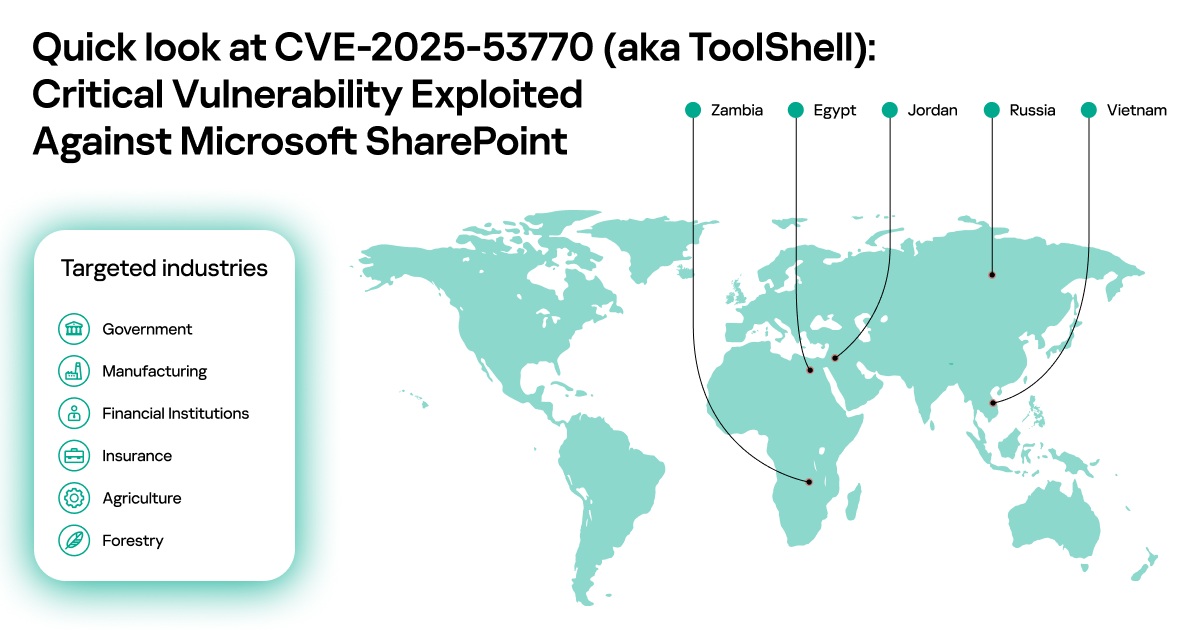
    Kaspersky products proactively detected and blocked malicious activity linked to these attacks, which allowed us to gather statistics about the timeframe and spread of this campaign. Our statistics show that widespread exploitation started on July 18, 2025, and attackers targeted servers across the world in Egypt, Jordan, Russia, Vietnam, and Zambia. Entities across multiple sectors were affected: government, finance, manufacturing, forestry, and agriculture.
    While analyzing all artifacts related to these attacks, which were detected by our products and public information provided by external researchers, we found a dump of a POST request that was claimed to contain the malicious payload used in these attacks. After performing our own analysis, we were able to confirm that this dump indeed contained the malicious payload detected by our technologies, and that sending this single request to an affected SharePoint installation was enough to execute the malicious payload there.

    Our analysis of the exploit showed that it did rely on vulnerabilities fixed under CVE-2025-49704 and CVE-2025-49706, but by changing just one byte in the request, we were able to bypass those fixes.

    In this post, we provide detailed information about CVE-2025-49704, CVE-2025-49706, CVE-2025-53770, CVE-2025-53771, and one related vulnerability. Since the exploit code is already published online, is very easy to use, and poses a significant risk, we encourage all organizations to install the necessary updates.

    The exploit

    Our research started with an analysis of a POST request dump associated with this wave of attacks on SharePoint servers.
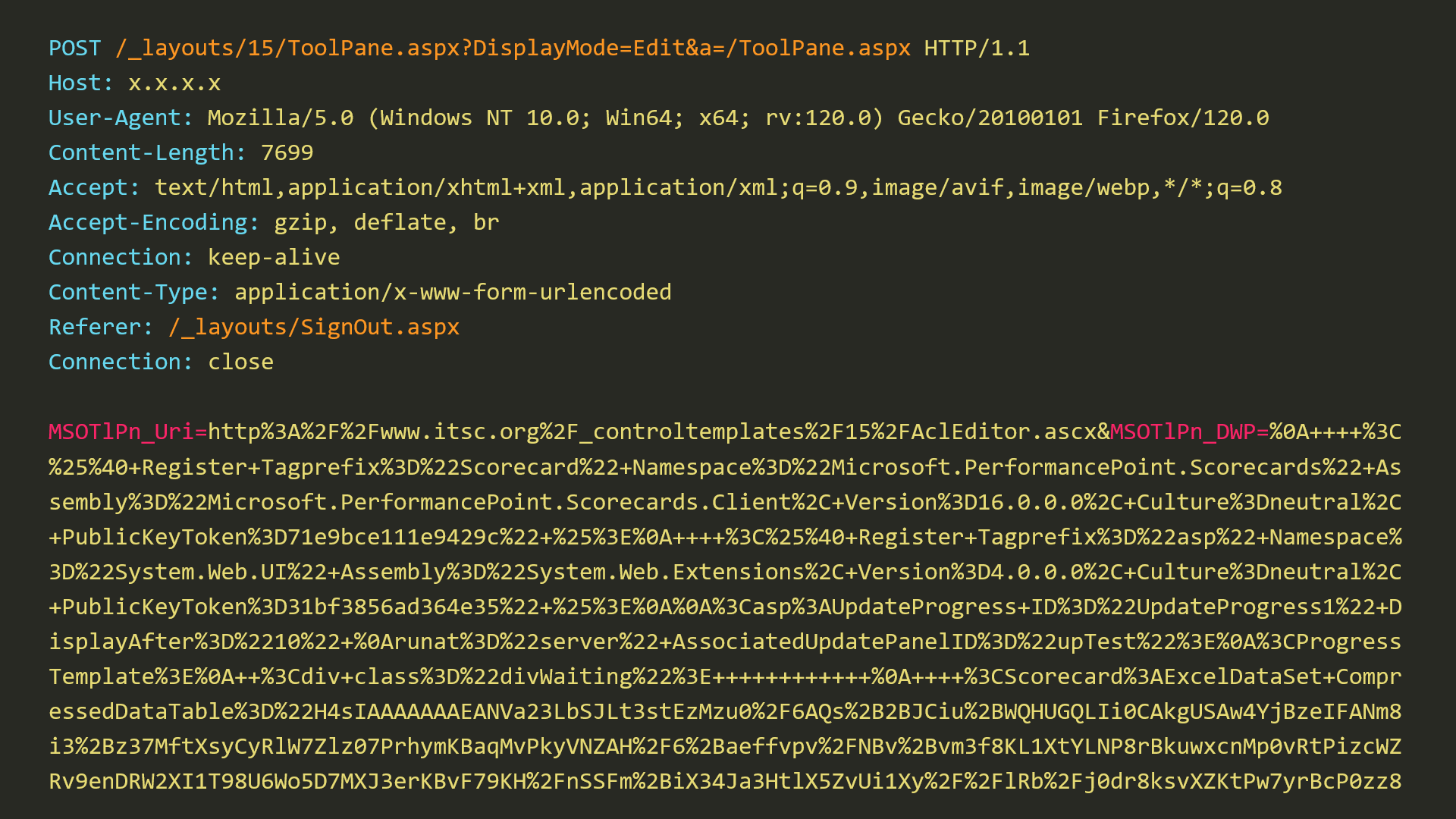
    Snippet of the exploit POST request

    We can see that this POST request targets the “/_layouts/15/ToolPane.aspx” endpoint and embeds two parameters: “MSOtlPn_Uri” and “MSOtlPn_DWP”. Looking at the code of ToolPane.aspx, we can see that this file itself does not contain much functionality and most of its code is located in the ToolPane class of the Microsoft.SharePoint.WebPartPages namespace in Microsoft.SharePoint.dll. Looking at this class reveals the code that works with the two parameters present in the exploit. However, accessing this endpoint under normal conditions is not possible without bypassing authentication on the attacked SharePoint server. This is where the first Microsoft SharePoint Server Spoofing Vulnerability CVE-2025-49706 comes into play.

    CVE-2025-49706

    This vulnerability is present in the method PostAuthenticateRequestHandler, in Microsoft.SharePoint.dll. SharePoint requires Internet Information Services (IIS) to be configured in integrated mode. In this mode, the IIS and ASP.NET authentication stages are unified. As a result, the outcome of IIS authentication is not determined until the PostAuthenticateRequest stage, at which point both the ASP.NET and IIS authentication methods have been completed. Therefore, the PostAuthenticateRequestHandler method utilizes a series of flags to track potential authentication violations. A logic bug in this method enables an authentication bypass if the “Referrer” header of the HTTP request is equal to “/_layouts/SignOut.aspx”, “/_layouts/14/SignOut.aspx”, or “/_layouts/15/SignOut.aspx” using case insensitive comparison.
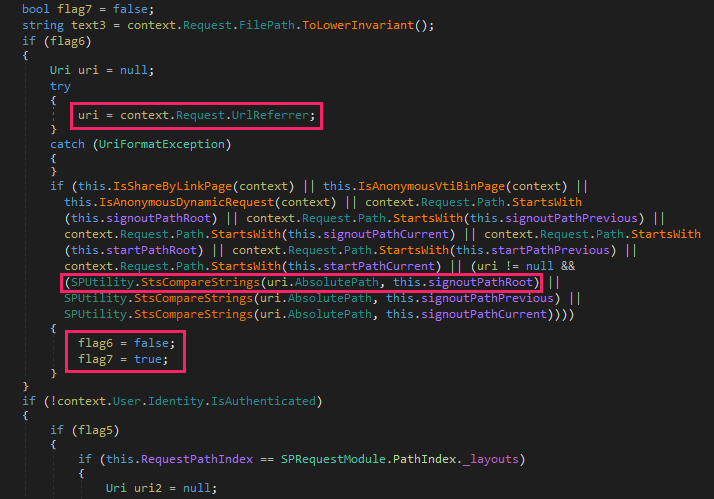
    Vulnerable code in PostAuthenticateRequestHandler method (Microsoft.SharePoint.dll version 16.0.10417.20018)

    The code displayed in the image above handles the sign-out request and is also triggered when the sign-out page is specified as the referrer. When flag6 is set to false and flag7 is set to true, both conditional branches that could potentially throw an “Unauthorized Access” exception are bypassed.
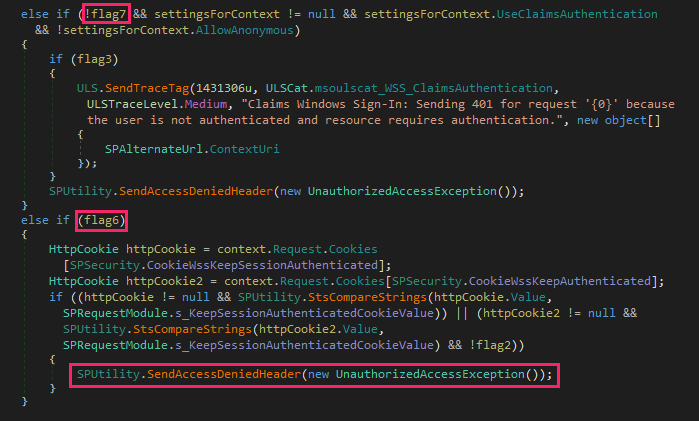
    Unauthorized access checks bypassed by the exploit

    On July 8, 2025, Microsoft released an update that addressed this vulnerability by introducing additional checks to detect the usage of the “ToolPane.aspx” endpoint with the sign-out page specified as the referrer.
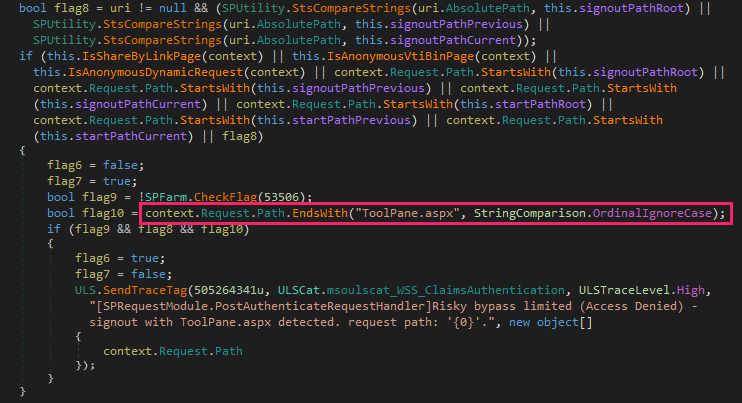
    CVE-2025-49706 fix (Microsoft.SharePoint.dll version 16.0.10417.20027)

    The added check uses case insensitive comparison to verify if the requested path ends with “ToolPane.aspx”. Is it possible to bypass this check, say, by using a different endpoint? Our testing has shown that this check can be easily bypassed.

    CVE-2025-53771

    We were able to successfully bypass the patch for vulnerability CVE-2025-49706 by adding just one byte to the exploit POST request. All that was required to bypass this patch was to add a “/” (slash) to the end of the requested “ToolPane.aspx” path.

    Bypass for CVE-2025-49706 fix

    On July 20, 2025, Microsoft released an update that fixed this bypass as CVE-2025-53771. This fix replaces the “ToolPane.aspx” check to instead check whether the requested path is in the list of paths allowed for use with the sign-out page specified as the referrer.
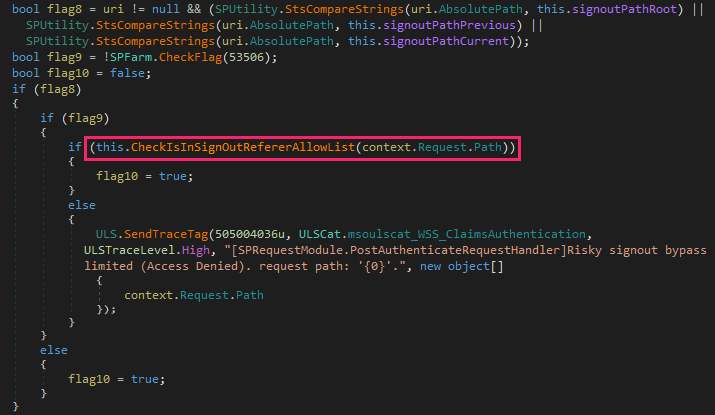
    CVE-2025-53771 fix (Microsoft.SharePoint.dll version 16.0.10417.20037)

    This allowlist includes the following paths: “/_layouts/15/SignOut.aspx”, “/_layouts/15/1033/initstrings.js”, “/_layouts/15/init.js”, “/_layouts/15/theming.js”, “/ScriptResource.axd”, “/_layouts/15/blank.js”, “/ScriptResource.axd”, “/WebResource.axd”, “/_layouts/15/1033/styles/corev15.css”, “/_layouts/15/1033/styles/error.css”, “/_layouts/15/images/favicon.ico”, “/_layouts/15/1033/strings.js”, “/_layouts/15/core.js”, and it can contain additional paths added by the administrator.

    While testing the CVE-2025-49706 bypass with the July 8, 2025 updates installed on our SharePoint debugging stand, we noticed some strange behavior. Not only did the bypass of CVE-2025-49706 work, but the entire exploit chain did! But wait! Didn’t the attackers use an additional Microsoft SharePoint Remote Code Execution Vulnerability CVE-2025-49704, which was supposed to be fixed in the same update? To understand why the entire exploit chain worked in our case, let’s take a look at the vulnerability CVE-2025-49704 and how it was fixed.

    CVE-2025-49704

    CVE-2025-49704 is an untrusted data deserialization vulnerability that exists due to improper validation of XML content. Looking at the exploit POST request, we can see that it contains two URL encoded parameters: “MSOtlPn_Uri” and “MSOtlPn_DWP”. We can see how they are handled by examining the code of the method GetPartPreviewAndPropertiesFromMarkup in Microsoft.SharePoint.dll. A quick analysis reveals that “MSOtlPn_Uri”  is a page URL that might be pointing to an any file in the CONTROLTEMPLATES folder and the parameter “MSOtlPn_DWP” contains something known as WebPart markup. This markup contains special directives that can be used to execute safe controls on a server and has a format very similar to XML.
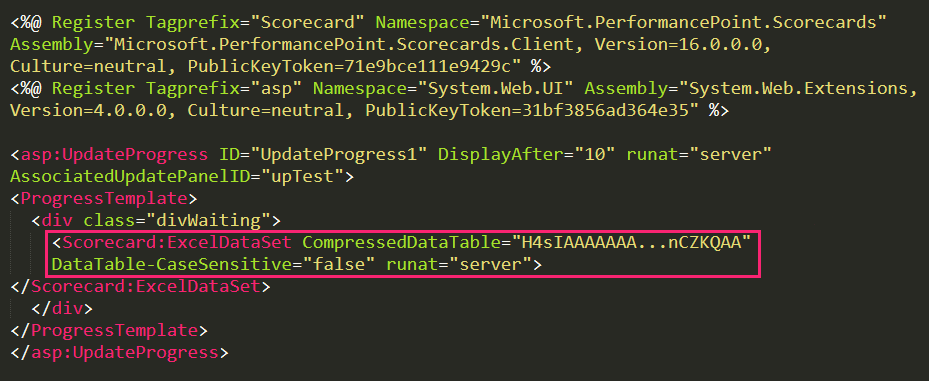
    WebPart markup used by the attackers

    While this “XML” included in the “MSOtlPn_DWP” parameter does not itself contain a vulnerability, it allows attackers to instantiate the ExcelDataSet control from Microsoft.PerformancePoint.Scorecards.Client.dll with CompressedDataTable property set to malicious payload and trigger its processing using DataTable property getter.

    Code of the method that handles the contents of ExcelDataSet’s CompressedDataTable property in the DataTable property getter

    Looking at the code of the ExcelDataSet’s DataTable property getter in Microsoft.PerformancePoint.Scorecards.Client.dll, we find the method GetObjectFromCompressedBase64String, responsible for deserialization of CompressedDataTable property contents. The data provided as Base64 string is decoded, unzipped, and passed to the BinarySerialization.Deserialize method from Microsoft.SharePoint.dll.
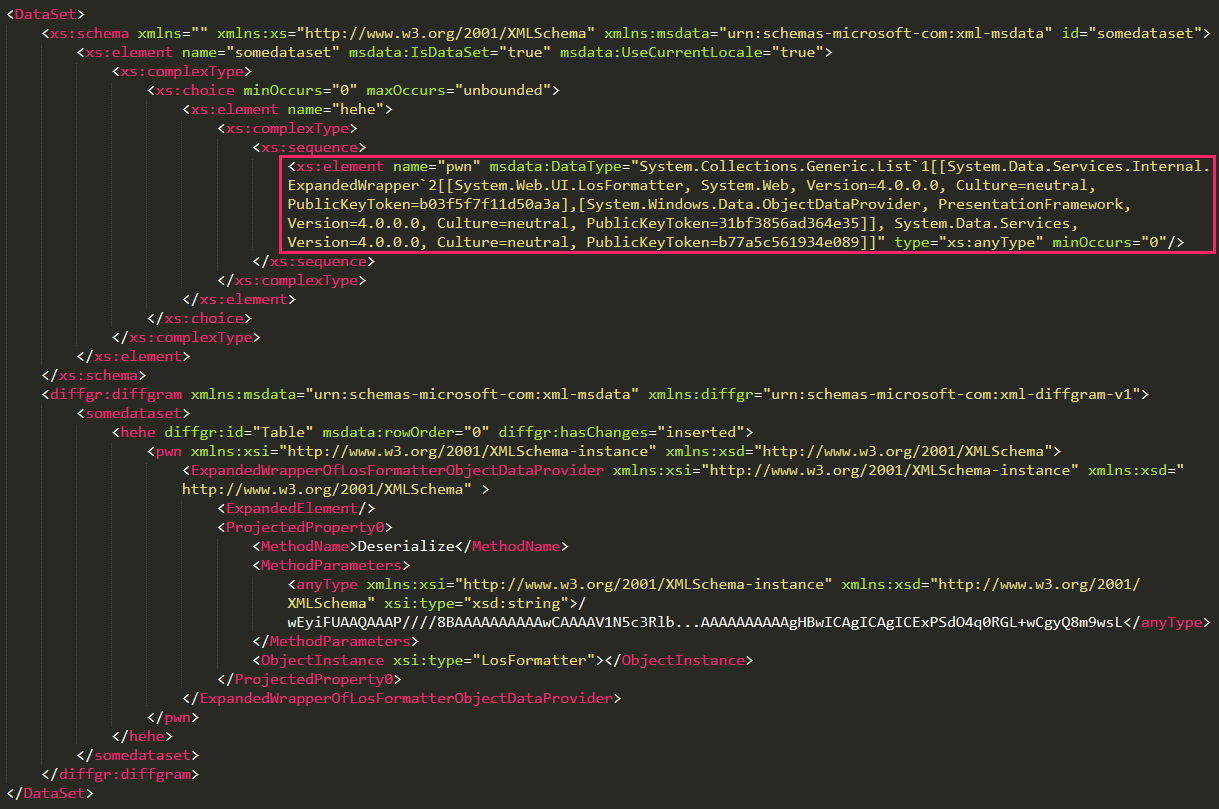
    DataSet with XML content exploiting CVE-2025-49704 (deserialized)

    Attackers use this method to provide a malicious DataSet whose deserialized content is shown in the image above. It contains an XML with an element of dangerous type “System.Collections.Generic.List1[[System.Data.Services.Internal.ExpandedWrapper2[…], System.Data.Services, Version=4.0.0.0, Culture=neutral, PublicKeyToken=b77a5c561934e089]]”, which allows attackers to execute arbitrary methods with the help of the well-known ExpandedWrapper technique aimed at exploitation of unsafe XML deserialization in applications based on the .NET framework. In fact, this shouldn’t be possible, since BinarySerialization.Deserialize in Microsoft.SharePoint.dll uses a special XmlValidator designed to protect against this technique by checking the types of all elements present in the provided XML and ensuring that they are on the list of allowed types. However, the exploit bypasses this check by placing the ExpandedWrapper object into the list.

    Now, to find out why the exploit worked on our SharePoint debugging stand with the July 8, 2025 updates installed, let’s take a look at how this vulnerability was fixed. In this patch, Microsoft did not really fix the vulnerability but only mitigated it by adding the new AddExcelDataSetToSafeControls class to the Microsoft.SharePoint.Upgrade namespace. This class contains new code that modifies the web.config file and marks the Microsoft.PerformancePoint.Scorecards.ExcelDataSet control as unsafe. Because SharePoint does not execute this code on its own after installing updates, the only way to achieve the security effect was to manually run a configuration upgrade using the SharePoint Products Configuration Wizard tool. Notably, the security guidance for CVE-2025-49704 does not mention the need for this step, which means at least some SharePoint administrators may skip it. Meanwhile, anyone who installed this update but did not manually perform a configuration upgrade remained vulnerable.

    CVE-2025-53770

    On July 20, 2025, Microsoft released an update with a proper fix for the CVE-2025-49704 vulnerability. This patch introduces an updated XmlValidator that now properly validates element types in XML, preventing exploitation of this vulnerability without requiring a configuration upgrade and, more importantly, addressing the root cause and preventing exploitation of the same vulnerability through controls other than Microsoft.PerformancePoint.Scorecards.ExcelDataSet.
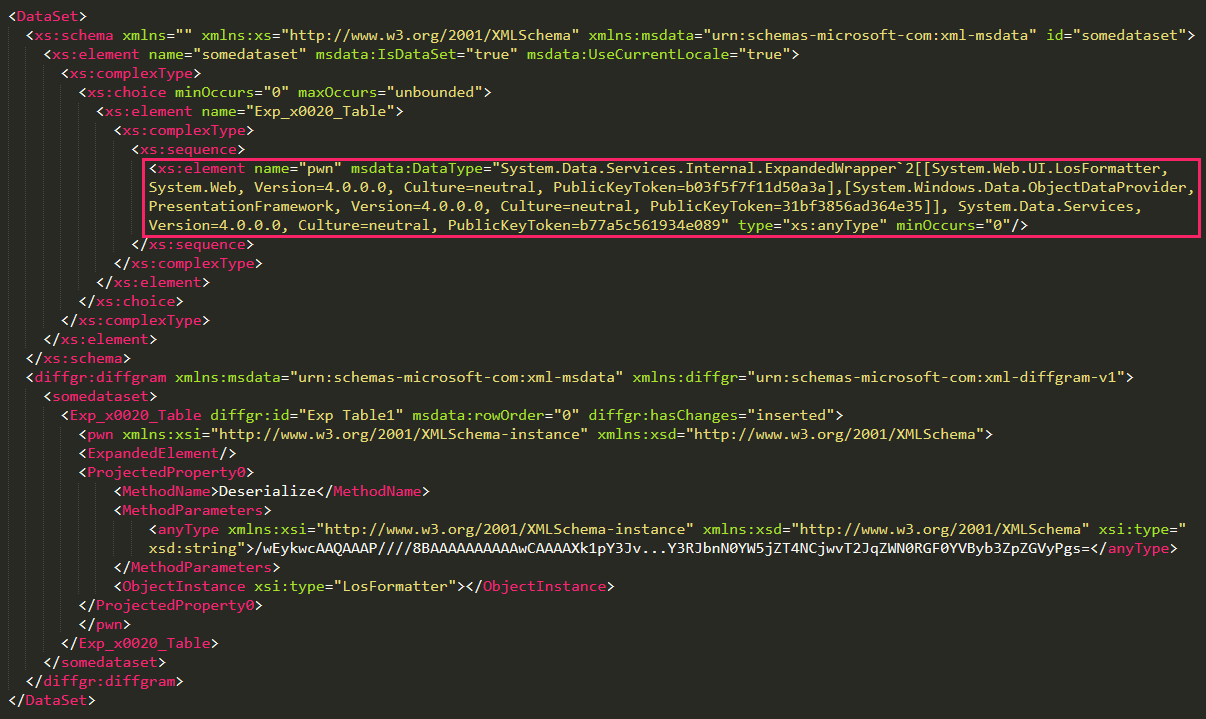
    DataSet with XML content exploiting CVE-2025-49704 (deserialized)

    CVE-2020-1147

    Readers familiar with previous SharePoint exploits might feel that the vulnerability CVE-2025-49704/CVE-2025-53770 and the exploit used by the attackers looks very familiar and very similar to the older .NET Framework, SharePoint Server, and Visual Studio Remote Code Execution Vulnerability CVE-2020-1147. In fact, if we compare the exploit for CVE-2020-1147 and an exploit for CVE-2025-49704/CVE-2025-53770, we can see that they are almost identical. The only difference is that in the exploit for CVE-2025-49704/CVE-2025-53770, the dangerous ExpandedWrapper object is placed in the list. This makes CVE-2025-53770 an updated fix for CVE-2020-1147.
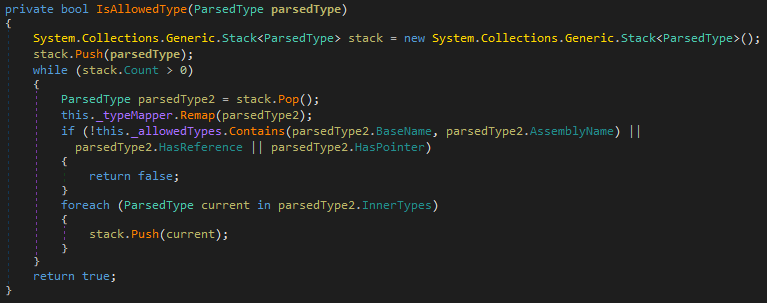
    DataSet with XML content exploiting CVE-2020-1147

    Conclusions

    Despite the fact that patches for the ToolShell vulnerabilities are now available for deployment, we assess that this chain of exploits will continue being used by attackers for a long time. We have been observing the same situation with other notorious vulnerabilities, such as ProxyLogon, PrintNightmare, or EternalBlue. While they have been known for years, many threat actors still continue leveraging them in their attacks to compromise unpatched systems. We expect the ToolShell vulnerabilities to follow the same fate, as they can be exploited with extremely low effort and allow full control over the vulnerable server.

    To stay better protected against threats like ToolShell, we as a community should learn lessons from previous events in the industry related to critical vulnerabilities. Specifically, the speed of applying security patches nowadays is the most important factor when it comes to fighting such vulnerabilities. Since public exploits for these dangerous vulnerabilities appear very soon after vulnerability announcements, it is paramount to install patches as soon as possible, as a gap of even a few hours can make a critical difference.

    At the same time, it is important to protect enterprise networks against zero-day exploits, which can be leveraged when there is no available public patch for vulnerabilities. In this regard, it is critical to equip machines with reliable cybersecurity solutions that have proven effective in combatting ToolShell attacks before they were publicly disclosed.
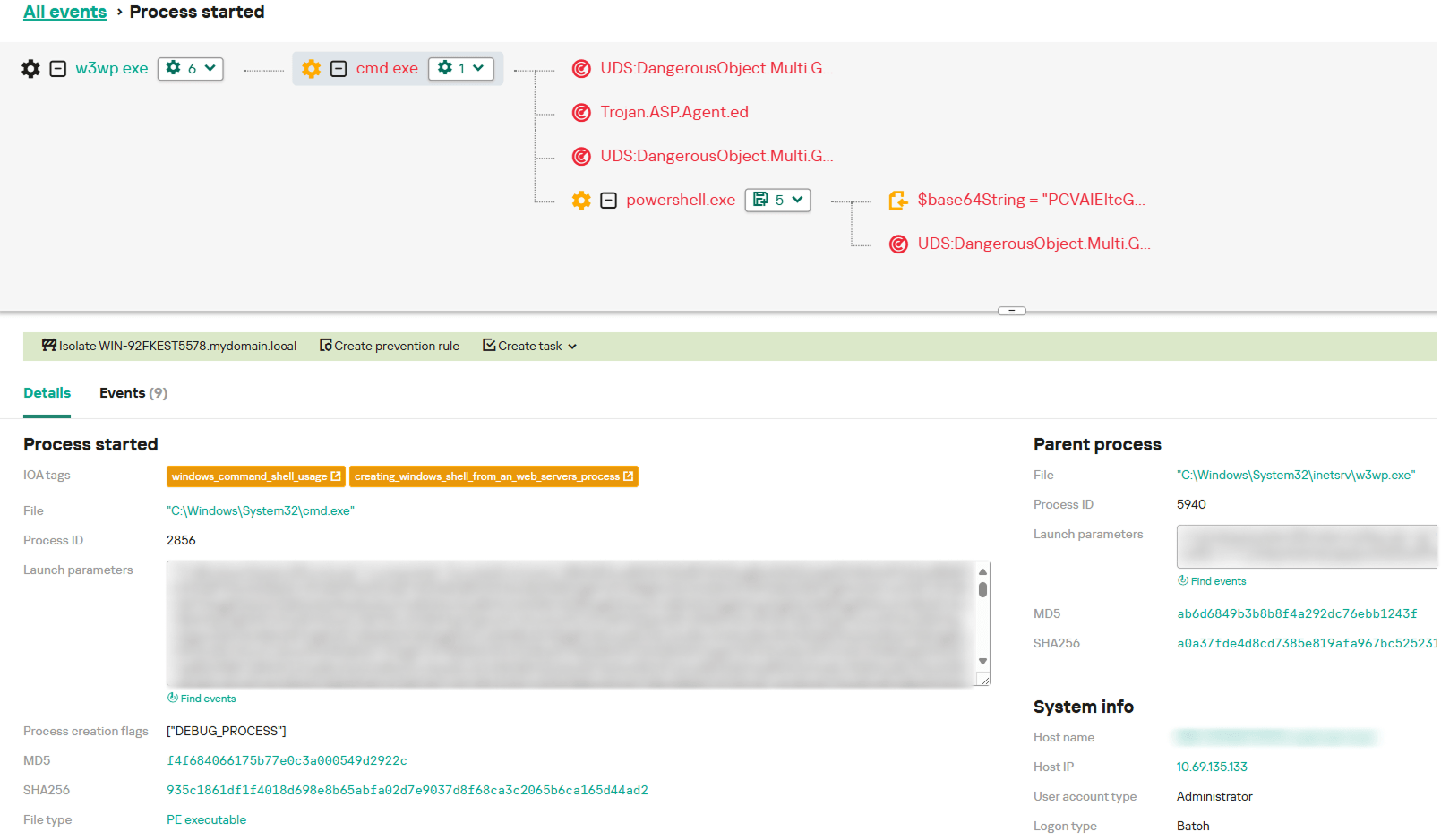
    Kaspersky Next with its Behaviour detection component proactively protects against  exploitation of these vulnerabilities. Additionally, it is able to detect exploitation and the subsequent malicious activity.

    Kaspersky products detect the exploits and malware used in these attacks with the following verdicts:

    • UDS:DangerousObject.Multi.Generic
    • PDM:Exploit.Win32.Generic
    • PDM:Trojan.Win32.Generic
    • HEUR:Trojan.MSIL.Agent.gen
    • ASP.Agent.*
    • PowerShell.Agent.*

    MIL OSI Economics

  • MIL-OSI Economics: ToolShell: a story of five vulnerabilities in Microsoft SharePoint

    Source: Securelist – Kaspersky

    Headline: ToolShell: a story of five vulnerabilities in Microsoft SharePoint

    On July 19–20, 2025, various security companies and national CERTs published alerts about active exploitation of on-premise SharePoint servers. According to the reports, observed attacks did not require authentication, allowed attackers to gain full control over the infected servers, and were performed using an exploit chain of two vulnerabilities: CVE-2025-49704 and CVE-2025-49706, publicly named “ToolShell”. Additionally, on the same dates, Microsoft released out-of-band security patches for the vulnerabilities CVE-2025-53770 and CVE-2025-53771, aimed at addressing the security bypasses of previously issued fixes for CVE-2025-49704 and CVE-2025-49706. The release of the new, “proper” updates has caused confusion about exactly which vulnerabilities attackers are exploiting and whether they are using zero-day exploits.

    Kaspersky products proactively detected and blocked malicious activity linked to these attacks, which allowed us to gather statistics about the timeframe and spread of this campaign. Our statistics show that widespread exploitation started on July 18, 2025, and attackers targeted servers across the world in Egypt, Jordan, Russia, Vietnam, and Zambia. Entities across multiple sectors were affected: government, finance, manufacturing, forestry, and agriculture.

    While analyzing all artifacts related to these attacks, which were detected by our products and public information provided by external researchers, we found a dump of a POST request that was claimed to contain the malicious payload used in these attacks. After performing our own analysis, we were able to confirm that this dump indeed contained the malicious payload detected by our technologies, and that sending this single request to an affected SharePoint installation was enough to execute the malicious payload there.

    Our analysis of the exploit showed that it did rely on vulnerabilities fixed under CVE-2025-49704 and CVE-2025-49706, but by changing just one byte in the request, we were able to bypass those fixes.

    In this post, we provide detailed information about CVE-2025-49704, CVE-2025-49706, CVE-2025-53770, CVE-2025-53771, and one related vulnerability. Since the exploit code is already published online, is very easy to use, and poses a significant risk, we encourage all organizations to install the necessary updates.

    The exploit

    Our research started with an analysis of a POST request dump associated with this wave of attacks on SharePoint servers.

    Snippet of the exploit POST request

    We can see that this POST request targets the “/_layouts/15/ToolPane.aspx” endpoint and embeds two parameters: “MSOtlPn_Uri” and “MSOtlPn_DWP”. Looking at the code of ToolPane.aspx, we can see that this file itself does not contain much functionality and most of its code is located in the ToolPane class of the Microsoft.SharePoint.WebPartPages namespace in Microsoft.SharePoint.dll. Looking at this class reveals the code that works with the two parameters present in the exploit. However, accessing this endpoint under normal conditions is not possible without bypassing authentication on the attacked SharePoint server. This is where the first Microsoft SharePoint Server Spoofing Vulnerability CVE-2025-49706 comes into play.

    CVE-2025-49706

    This vulnerability is present in the method PostAuthenticateRequestHandler, in Microsoft.SharePoint.dll. SharePoint requires Internet Information Services (IIS) to be configured in integrated mode. In this mode, the IIS and ASP.NET authentication stages are unified. As a result, the outcome of IIS authentication is not determined until the PostAuthenticateRequest stage, at which point both the ASP.NET and IIS authentication methods have been completed. Therefore, the PostAuthenticateRequestHandler method utilizes a series of flags to track potential authentication violations. A logic bug in this method enables an authentication bypass if the “Referrer” header of the HTTP request is equal to “/_layouts/SignOut.aspx”, “/_layouts/14/SignOut.aspx”, or “/_layouts/15/SignOut.aspx” using case insensitive comparison.

    Vulnerable code in PostAuthenticateRequestHandler method (Microsoft.SharePoint.dll version 16.0.10417.20018)

    The code displayed in the image above handles the sign-out request and is also triggered when the sign-out page is specified as the referrer. When flag6 is set to false and flag7 is set to true, both conditional branches that could potentially throw an “Unauthorized Access” exception are bypassed.

    Unauthorized access checks bypassed by the exploit

    On July 8, 2025, Microsoft released an update that addressed this vulnerability by introducing additional checks to detect the usage of the “ToolPane.aspx” endpoint with the sign-out page specified as the referrer.

    CVE-2025-49706 fix (Microsoft.SharePoint.dll version 16.0.10417.20027)

    The added check uses case insensitive comparison to verify if the requested path ends with “ToolPane.aspx”. Is it possible to bypass this check, say, by using a different endpoint? Our testing has shown that this check can be easily bypassed.

    CVE-2025-53771

    We were able to successfully bypass the patch for vulnerability CVE-2025-49706 by adding just one byte to the exploit POST request. All that was required to bypass this patch was to add a “/” (slash) to the end of the requested “ToolPane.aspx” path.

    Bypass for CVE-2025-49706 fix

    On July 20, 2025, Microsoft released an update that fixed this bypass as CVE-2025-53771. This fix replaces the “ToolPane.aspx” check to instead check whether the requested path is in the list of paths allowed for use with the sign-out page specified as the referrer.

    CVE-2025-53771 fix (Microsoft.SharePoint.dll version 16.0.10417.20037)

    This allowlist includes the following paths: “/_layouts/15/SignOut.aspx”, “/_layouts/15/1033/initstrings.js”, “/_layouts/15/init.js”, “/_layouts/15/theming.js”, “/ScriptResource.axd”, “/_layouts/15/blank.js”, “/ScriptResource.axd”, “/WebResource.axd”, “/_layouts/15/1033/styles/corev15.css”, “/_layouts/15/1033/styles/error.css”, “/_layouts/15/images/favicon.ico”, “/_layouts/15/1033/strings.js”, “/_layouts/15/core.js”, and it can contain additional paths added by the administrator.

    While testing the CVE-2025-49706 bypass with the July 8, 2025 updates installed on our SharePoint debugging stand, we noticed some strange behavior. Not only did the bypass of CVE-2025-49706 work, but the entire exploit chain did! But wait! Didn’t the attackers use an additional Microsoft SharePoint Remote Code Execution Vulnerability CVE-2025-49704, which was supposed to be fixed in the same update? To understand why the entire exploit chain worked in our case, let’s take a look at the vulnerability CVE-2025-49704 and how it was fixed.

    CVE-2025-49704

    CVE-2025-49704 is an untrusted data deserialization vulnerability that exists due to improper validation of XML content. Looking at the exploit POST request, we can see that it contains two URL encoded parameters: “MSOtlPn_Uri” and “MSOtlPn_DWP”. We can see how they are handled by examining the code of the method GetPartPreviewAndPropertiesFromMarkup in Microsoft.SharePoint.dll. A quick analysis reveals that “MSOtlPn_Uri”  is a page URL that might be pointing to an any file in the CONTROLTEMPLATES folder and the parameter “MSOtlPn_DWP” contains something known as WebPart markup. This markup contains special directives that can be used to execute safe controls on a server and has a format very similar to XML.

    WebPart markup used by the attackers

    While this “XML” included in the “MSOtlPn_DWP” parameter does not itself contain a vulnerability, it allows attackers to instantiate the ExcelDataSet control from Microsoft.PerformancePoint.Scorecards.Client.dll with CompressedDataTable property set to malicious payload and trigger its processing using DataTable property getter.

    Code of the method that handles the contents of ExcelDataSet’s CompressedDataTable property in the DataTable property getter

    Looking at the code of the ExcelDataSet’s DataTable property getter in Microsoft.PerformancePoint.Scorecards.Client.dll, we find the method GetObjectFromCompressedBase64String, responsible for deserialization of CompressedDataTable property contents. The data provided as Base64 string is decoded, unzipped, and passed to the BinarySerialization.Deserialize method from Microsoft.SharePoint.dll.

    DataSet with XML content exploiting CVE-2025-49704 (deserialized)

    Attackers use this method to provide a malicious DataSet whose deserialized content is shown in the image above. It contains an XML with an element of dangerous type “System.Collections.Generic.List1[[System.Data.Services.Internal.ExpandedWrapper2[…], System.Data.Services, Version=4.0.0.0, Culture=neutral, PublicKeyToken=b77a5c561934e089]]”, which allows attackers to execute arbitrary methods with the help of the well-known ExpandedWrapper technique aimed at exploitation of unsafe XML deserialization in applications based on the .NET framework. In fact, this shouldn’t be possible, since BinarySerialization.Deserialize in Microsoft.SharePoint.dll uses a special XmlValidator designed to protect against this technique by checking the types of all elements present in the provided XML and ensuring that they are on the list of allowed types. However, the exploit bypasses this check by placing the ExpandedWrapper object into the list.

    Now, to find out why the exploit worked on our SharePoint debugging stand with the July 8, 2025 updates installed, let’s take a look at how this vulnerability was fixed. In this patch, Microsoft did not really fix the vulnerability but only mitigated it by adding the new AddExcelDataSetToSafeControls class to the Microsoft.SharePoint.Upgrade namespace. This class contains new code that modifies the web.config file and marks the Microsoft.PerformancePoint.Scorecards.ExcelDataSet control as unsafe. Because SharePoint does not execute this code on its own after installing updates, the only way to achieve the security effect was to manually run a configuration upgrade using the SharePoint Products Configuration Wizard tool. Notably, the security guidance for CVE-2025-49704 does not mention the need for this step, which means at least some SharePoint administrators may skip it. Meanwhile, anyone who installed this update but did not manually perform a configuration upgrade remained vulnerable.

    CVE-2025-53770

    On July 20, 2025, Microsoft released an update with a proper fix for the CVE-2025-49704 vulnerability. This patch introduces an updated XmlValidator that now properly validates element types in XML, preventing exploitation of this vulnerability without requiring a configuration upgrade and, more importantly, addressing the root cause and preventing exploitation of the same vulnerability through controls other than Microsoft.PerformancePoint.Scorecards.ExcelDataSet.

    DataSet with XML content exploiting CVE-2025-49704 (deserialized)

    CVE-2020-1147

    Readers familiar with previous SharePoint exploits might feel that the vulnerability CVE-2025-49704/CVE-2025-53770 and the exploit used by the attackers looks very familiar and very similar to the older .NET Framework, SharePoint Server, and Visual Studio Remote Code Execution Vulnerability CVE-2020-1147. In fact, if we compare the exploit for CVE-2020-1147 and an exploit for CVE-2025-49704/CVE-2025-53770, we can see that they are almost identical. The only difference is that in the exploit for CVE-2025-49704/CVE-2025-53770, the dangerous ExpandedWrapper object is placed in the list. This makes CVE-2025-53770 an updated fix for CVE-2020-1147.

    DataSet with XML content exploiting CVE-2020-1147

    Conclusions

    Despite the fact that patches for the ToolShell vulnerabilities are now available for deployment, we assess that this chain of exploits will continue being used by attackers for a long time. We have been observing the same situation with other notorious vulnerabilities, such as ProxyLogon, PrintNightmare, or EternalBlue. While they have been known for years, many threat actors still continue leveraging them in their attacks to compromise unpatched systems. We expect the ToolShell vulnerabilities to follow the same fate, as they can be exploited with extremely low effort and allow full control over the vulnerable server.

    To stay better protected against threats like ToolShell, we as a community should learn lessons from previous events in the industry related to critical vulnerabilities. Specifically, the speed of applying security patches nowadays is the most important factor when it comes to fighting such vulnerabilities. Since public exploits for these dangerous vulnerabilities appear very soon after vulnerability announcements, it is paramount to install patches as soon as possible, as a gap of even a few hours can make a critical difference.

    At the same time, it is important to protect enterprise networks against zero-day exploits, which can be leveraged when there is no available public patch for vulnerabilities. In this regard, it is critical to equip machines with reliable cybersecurity solutions that have proven effective in combatting ToolShell attacks before they were publicly disclosed.

    Kaspersky Next with its Behaviour detection component proactively protects against  exploitation of these vulnerabilities. Additionally, it is able to detect exploitation and the subsequent malicious activity.

    Kaspersky products detect the exploits and malware used in these attacks with the following verdicts:

    • UDS:DangerousObject.Multi.Generic
    • PDM:Exploit.Win32.Generic
    • PDM:Trojan.Win32.Generic
    • HEUR:Trojan.MSIL.Agent.gen
    • ASP.Agent.*
    • PowerShell.Agent.*

    MIL OSI Economics

  • MIL-OSI China: Clashes continue in Thailand-Cambodia border areas

    Source: People’s Republic of China – State Council News

    Residents evacuate from the Thailand-Cambodia border area in Oddar Meanchey province, Cambodia on July 24, 2025. [Photo/Xinhua]

    Thailand’s military-run Channel 5 reported on Friday that clashes broke out at several areas along the Thailand-Cambodia border in the early hours of the day, saying Cambodian forces have conducted sustained bombardment utilizing heavy weapons, field artillery, and BM-21 rocket systems.

    Thai forces responded with appropriate supporting fire in accordance with the tactical situation and issued advisories to local civilians to avoid entering areas of clashes.

    Early Friday, the sound of artillery fire was heard again near the border area, the National Broadcasting Services of Thailand reported, citing a local official in Surin province.

    According to the deputy spokesperson of the Thai Ministry of Public Health, 14 Thai people were killed and 46 others injured in military clashes near the Thailand-Cambodia border as of 9:00 p.m. local time on Thursday.

    Cambodia’s Oddar Meanchey deputy governor, Met Meas Pheakdey, told Xinhua over the telephone that one villager was killed and five others were wounded on Thursday when the Thai side fired artillery shells into Cambodian territory.

    “More than 2,900 families living near the border have been evacuated to a safe refuge,” he added.

    “Fighting is still going on as of Friday morning,” he said.

    Cambodian Defense Ministry’s Undersecretary of State and spokesperson, Lieutenant General Maly Socheata, said in a press briefing on Friday morning that the Thai troops had used heavy weapons and F-16 fighter jets as well as cluster bombs to attack several locations in the Cambodian provinces of Oddar Meanchey and Preah Vihear.

    MIL OSI China News

  • MIL-OSI China: UN Security Council to hold closed-door meeting on Thailand-Cambodia border clashes

    Source: People’s Republic of China – State Council News

    The UN Security Council will hold a closed-door meeting on Thailand-Cambodia border clashes on Friday.

    According to the Security Council program, the meeting, scheduled for 3 p.m. EDT (1900 GMT) Friday, was reportedly requested by Cambodian Prime Minister Hun Manet.

    The situation at the Thai-Cambodian border escalated following skirmishes that began Thursday morning. The two sides blamed each other for violating international law.

    According to the deputy spokesperson of the Thai Ministry of Public Health, 14 Thai people were killed and 46 others injured in military clashes near the Thailand-Cambodia border as of 9:00 p.m. local time on Thursday.

    Cambodia’s Oddar Meanchey deputy governor, Met Meas Pheakdey, told Xinhua over the telephone that one villager was killed and five others were wounded on Thursday.

    MIL OSI China News

  • Indian auto component makers will benefit from duty reduction on imports under India-UK CETA: Sunil Mittal

    Source: Government of India

    Source: Government of India (4)

    The reduction in import duties on automobiles under the newly signed India-UK Comprehensive Economic and Trade Agreement (CETA) will ultimately benefit Indian auto component manufacturers according to Sunil Bharti Mittal, Chairman of Bharti Enterprises, who added that the UK component makers will shift manufacturing to India, attracted by lower production costs and a growing domestic market.

    In an exclusive interview with ANI, the Bharti Enterprises Chairman also noted that UK automobile companies will increasingly import components from India as the manufacturing of expensive auto components will shift to the country.

    He further emphasised that the UK’s auto manufacturers would likely increase their imports of components from India, potentially setting up local factories to take advantage of India’s low manufacturing costs and abundant talent.

    “The Indian auto parts manufacturing industry is one of the most sophisticated and advanced in the world. In fact, if you look at the auto industry, we have a huge leg up in the world of exporting auto components. So I don’t think so. Indian industry really needs to feel that expensive components made in the UK or other Western markets will flow into India,” Mittal told ANI.

    He dismissed concerns that the deal might undermine India’s “Make in India” initiative, highlighting the advanced and sophisticated nature of India’s auto parts manufacturing industry.

    “Quite the contrary with this again, companies that are manufacturing cars and trucks and automobiles in the UK will be importing more components from India, probably setting up industries and factories in India to ensure that they can get low-cost manufacturing of high-quality availability for their own markets and global markets,” he remarked.

    Under the trade agreement, the import duty on cars built in the UK–both electric and gasoline/diesel–will be reduced from over 100 percent to about 10 percent, subject to a predetermined yearly quota.

    With safeguards in place to protect India’s local auto sector as its own manufacturing capacity grows, this concession will be brought in gradually over the course of the next ten to fifteen years.

    He also pointed out that many UK-based companies are already exporting Indian-made auto components to over 100 countries, underscoring India’s global competitiveness in this sector.

    “Do keep in mind companies that have gone from the UK to India are exporting from India to 100 other countries. What’s the reason? Talent is in short supply in the UK. Talent is very expensive. Manufacturing is very expensive in the UK. The local market is rather modest,” Mittal added.

    The Automotive Component Manufacturers Association of India (ACMA) has also welcomed the signing of the India-UK Comprehensive Trade Agreement.

    The body said that CETA is expected to benefit the Indian auto component sector through enhanced opportunities for exports and streamlined regulatory processes, particularly in key areas such as electric mobility, precision engineering, and lightweight materials.

    Indian MSMEs, which form the backbone of our industry, stand to gain from the liberalised terms of trade and improved access to UK markets.

    (ANI)

  • Narendra Modi becomes India’s second-longest serving PM, surpasses Indira Gandhi’s record

    Source: Government of India

    Source: Government of India (4)

    Prime Minister Narendra Modi on Friday marked a milestone in the country’s political history, becoming the second-longest-serving PM of India (4,078 days) in consecutive terms, surpassing the record of former PM Indira Gandhi (4,077 days) .

    Narendra Modi, 74, took oath as Prime Minister for the first time on May 26, 2014 and has served a total of 11 years and 60 days in office till date.

    The erstwhile Prime Minister Indira Gandhi had served for 11 years 59 days in office in consecutive terms. She held the highest office as Prime Minister of India from January 24, 1966 – March 24, 1977.

    India’s first Prime Minister Jawaharlal Nehru holds the record of the longest-serving PM of India in consecutive terms for 16 years and 286 days, from August 15, 1947 to May 27, 1964.

    Notably, PM Modi is the first and only Prime Minister born after Independence, the longest-serving non-Congress PM, and the longest-serving Prime Minister from a non-Hindi-speaking state.

    He is also the first and only non-Congress leader to have completed two full terms and to be re-elected twice with a majority, making him the only non-Congress Prime Minister to secure a majority on his own in the Lok Sabha.

    Additionally, he is the first sitting Prime Minister since Indira Gandhi in 1971 to return to power with a full majority.

    Narendra Modi is the only Prime Minister, apart from late Jawaharlal Nehru, to win three consecutive elections as leader of a political party in India.

    He is the only leader in India, among all Prime Ministers and Chief Ministers, to win six consecutive elections as the leader of a party – Gujarat (2002, 2007, 2012), Lok Sabha polls (2014, 2019, 2024).

    This will be another milestone in PM Modi’s almost 24 years as head of a democratically elected government, either in the state or Centre.

    (With agency inputs)

  • How India is quietly powering Maldives’ growth through infra and human capital

    Source: Government of India

    Source: Government of India (4)

    India’s continued development partnership with the Maldives stands as a testament to the enduring ties between the two nations, with several landmark projects reflecting New Delhi’s commitment to supporting the island nation’s growth across sectors ranging from healthcare and education to infrastructure and fisheries.

    Healthcare cooperation

    The Indira Gandhi Memorial Hospital (IGMH) in Male remains a key symbol of India’s assistance to the Maldives. Conceived during the visit of former Prime Minister Rajiv Gandhi in February 1986, the 200-bed facility was inaugurated in April 1995 by then Prime Minister P.V. Narasimha Rao. Named after former Prime Minister Indira Gandhi, IGMH is the largest public healthcare institution in the country.

    India had initially deployed 72 medical professionals to help operationalise the hospital. A major renovation, supported by India at a cost of ₹52 crore, was inaugurated in March 2019 by then External Affairs Minister Sushma Swaraj.

    Strengthening technical education

    India has also contributed to capacity-building in technical education through the establishment of the Maldives Institute of Technical Education (MITE), now known as the Faculty of Engineering Technology (FET). The foundation stone was laid in 1993 following an agreement during Prime Minister V.P. Singh’s visit in 1990. The completed institute was handed over in 1996 and has since been pivotal in training Maldivian youth in vocational and technical disciplines.

    Tourism education

    In a bid to bolster the Maldives’ hospitality sector, India supported the construction of the India-Maldives Friendship Faculty of Hospitality and Tourism Studies. The foundation stone was jointly laid by Prime Minister Atal Bihari Vajpayee and President Maumoon Abdul Gayoom in 2002. The eight-storey modern facility was officially handed over in February 2014 by then External Affairs Minister Salman Khurshid. With a capacity for over 200 full-time students, the institute serves as a centre of excellence for tourism and hospitality studies.

    Largest Indian grant project supports law enforcement training

    The National College for Police and Law Enforcement (NCPLE), located in Addu City, is India’s largest grant-funded project in the Maldives. Built with ₹222.98 crore in grant assistance, the college was inaugurated in March 2022 during the visit of External Affairs Minister Dr. S. Jaishankar. The institution is designed to enhance the training capabilities of Maldives’ police and law enforcement agencies.

    Land reclamation in Addu to spur urban growth

    India has also supported the Addu Reclamation Project under an $80 million Line of Credit. A total of 184 hectares of land has been reclaimed to facilitate urban and economic development in Addu City. The project was inaugurated on August 11, 2024, during EAM Dr. Jaishankar’s visit to the country.

    Water and sanitation

    Improving basic infrastructure has also remained a focus area. Under a Line of Credit worth $107.31 million, water and sanitation projects have been completed across 34 islands. Of these, 28 projects have already been handed over to the Maldivian government. The initiative is aimed at enhancing public health and environmental sustainability.

    Fisheries infra

    In support of the Maldives’ crucial fisheries sector, a new ice plant with a daily production capacity of 50 tons has been established in Gemanafushi. The facility, developed under the Indian Line of Credit, was inaugurated on February 27, 2025. It is expected to bolster fish preservation, improve export capacity, and strengthen the livelihoods of fishing communities.

    India’s development footprint in the Maldives reflects a broader strategy of regional cooperation grounded in mutual respect and people-first initiatives. As both nations navigate the next phase of bilateral engagement, these enduring projects lay a strong foundation for deeper collaboration rooted in shared prosperity.

  • MIL-OSI Banking: 2025 Science Prize for Women “Generative AI for Smart Water Management”

    Source: ASEAN

    JAKARTA, 16 July 2025 – Reflecting on a decade of impact, the annual UL Research Institutes’-ASEAN-US Science Prize for Women celebrates the significance of women in science, technology, engineering, and mathematics (STEM) across the ASEAN region. This year’s prize is launched in partnership between UL Research Institutes (ULRI), UL Standards & Engagements (ULSE), the  US-ASEAN Business Council (USABC), and the Association of Southeast Asian Nations (ASEAN), with support from Google. The Prize continues to highlight its ongoing commitment to advancing gender equality and promoting scientific excellence in the ASEAN region.
     
    2025 Theme: Generative AI for Smart Water Management
     
    This year’s theme, “Generative AI for Smart Water Management”, emphasizes the transformative potential of Generative AI in addressing pressing water-related challenges. This theme focuses on groundbreaking research that harnesses Generative AI to deliver smarter, more sustainable, and resilient water management systems. Applications are welcomed across various sectors, including urban development, agriculture, environmental sustainability, and disaster risk reduction.
     
    Competition Categories and Prizes
     
    Eligible candidates will compete in two categories based on their stage of career:

        Mid-career Scientist category (those 45 years of age and under)
        Senior Scientist category (those 46 years of age and over)

     
    Finalists will be invited to participate in a final judging session and attend the official award ceremony, which will be held during the ASEAN Committee on Science, Technology and Innovation (COSTI) meetings in Bangkok, Thailand in October 2025.
     
    Winners will be awarded $12,500 each, with runner-ups awarded $5,000 each, thanks to the generous sponsorship of the UL Research Institutes (ULRI).
     
    ASEAN COSTI Chair emphasises the value of this initiative in strengthening regional resilience: “This year’s theme, Generative AI for Smart Water Management, could not be more timely. Across ASEAN, the impacts of climate change and water scarcity are growing concerns. The work of women scientists in leveraging cutting-edge technologies like AI is essential to shaping more inclusive, sustainable, and date-driven solutions. COSTI is proud to continue this initiative of championing scientific excellence and gender equity in ASEAN.”
     
    Interim President and Chief Executive Officer of USABC, Amb. (ret) Brian McFeeters, highlights the inaugural opportunity of USABC to contribute to this year’s Science Prize: “We are proud to support the 2025 Science Prize for Women, an initiative pivotal for recognising the excellence of women researchers in STEM across ASEAN. We are incredibly honoured to showcase the contribution of ASEAN women researchers in solving regional challenges through cutting-edge research in environmental governance, artificial intelligence (AI), and an innovation-led ASEAN. The Council would also like to thank Google for their valuable support in this year’s Prize.”
     
    Google’s support for this year’s Prize further highlights the significance of innovation in tackling ASEAN’s most pressing challenges. Their commitment to the inclusive development of AI particularly aligns with the Prize’s focus on prompting science-based solutions and empowering women researchers to lead in the region’s digital and environmental transformation.
     
    In their remarks, ULRI noted that, “The health of our environment is inseparable from the safety of our communities.” said Chris Cramer, Chief Research Officer for UL Research Institutes.  “This year’s Science Prize spotlights innovative research in generative AI for smart water management—empowering us to better predict and mitigate environmental risks, preserve vital ecosystems, protect water quality, and foster a more resilient planet for all.”
     
    Call for Applications
     
    We invite women scientists from all ten ASEAN member states who hold doctoral degrees relevant to this year’s theme to apply. This is a unique opportunity for ASEAN women researchers to showcase their impactful research and innovations in utilising Generative AI for the purpose of smart water management.
     
    For more information, please visit the ULRI’s ASEAN-U.S Science Prize for Women website here.
     
    Applications will close by 20 August 2025.
     
    Queries can be directed to scienceprize4women@gmail.com.
     
    The post 2025 Science Prize for Women “Generative AI for Smart Water Management” appeared first on ASEAN Main Portal.

    MIL OSI Global Banks

  • MIL-OSI: Marex Group plc to acquire UK equity market maker Winterflood Securities

    Source: GlobeNewswire (MIL-OSI)

    LONDON, July 25, 2025 (GLOBE NEWSWIRE) — Marex Group plc (‘Marex’ or the ‘Group’; NASDAQ: MRX), the diversified global financial services platform, today announces that it has agreed to acquire UK equity market maker Winterflood Securities (Winterflood) from Close Brothers Group plc (Close Brothers) for approximately £103.9 million in cash, which represents a premium of £15 million.

    Winterflood is one of the UK’s leading equity market makers, delivering execution services to over 400 institutional clients and ranking consistently as a top three market counterparty with a market share of about 15% by volume on the London Stock Exchange1. Winterflood has well-established client connectivity through its proprietary technology platform.

    The acquisition is expected to enhance Marex’s existing UK cash equities business, consistent with its strategy to bring new clients and new capabilities onto its platform and diversify earnings. It is also expected to add a substantial distribution offering servicing the UK institutional community, in particular asset and wealth management companies, with the potential to deepen these relationships by offering access to a broader range of Marex’s products from across its platform.

    Winterflood also operates Winterflood Business Services, which provides outsourced dealing, settlement and custody services to a diverse range of clients, including large institutions, investment platforms, wealth managers, and retail aggregators.

    The deal is subject to regulatory approval and is expected to close in early 2026.

    Ian Lowitt, Marex Group Chief Executive Officer, commented:

    “This acquisition gives us an opportunity to transform our existing equity market making business into a leading franchise, utilising the technology and connectivity of what is the leading brand in this market. This deal is consistent with our strict financial criteria, and we see opportunities to materially improve Winterflood’s profitability and pay back its premium within two to three years. We believe we can gain economies from operating at scale and also benefit from Winterflood’s great technology and strong client relationships, which will enable us to introduce additional products and services from across our platform to a new set of clients.”

    Bradley Dyer, CEO of Winterflood Securities, commented:

    “We’re delighted to become part of Marex, which is a high-growth, global financial services company with a strong balance sheet. Our clients will continue to be served by the same team, while also benefitting from the backing of a large and growing company as well as access to a broader range of products and services from Marex. We’re excited to be joining a fast-paced organisation where our teams can thrive.”

    Mike Morgan, Close Brothers Group Chief Executive, commented:

    “We see Marex as an excellent steward for the business going forward, we thank the Winterflood team for their hard work and commitment over the years and wish them every success in their next chapter with Marex.”

    Forward-Looking Statements:
    This press release contains forward-looking statements within the meaning of the Private Securities Litigation Reform Act of 1995. All statements contained in this press release that do not relate to matters of historical fact should be considered forward-looking statements, including the expected acquisition of Winterflood Securities and the closing of the transaction as well as expected benefits from the acquisition. In some cases, these forward-looking statements can be identified by words or phrases such as “may,” “will,” “expect,” “anticipate,” “aim,” “estimate,” “intend,” “plan,” “believe,” “potential,” “continue,” “is/are likely to” or other similar expressions.
    These forward-looking statements are subject to risks, uncertainties and assumptions, some of which are beyond our control. In addition, these forward-looking statements reflect our current views with respect to future events and are not a guarantee of future performance. Actual outcomes may differ materially from the information contained in the forward-looking statements as a result of a number of factors, including, without limitation, the risks discussed under the caption “Risk Factors” in our Annual Report on Form 20-F for the year ended December 31, 2024, filed with the Securities and Exchange Commission (the “SEC”) and our other reports filed with the SEC. The forward-looking statements made in this press release relate only to events or information as of the date on which the statements are made in this press release. Except as required by law, we undertake no obligation to update or revise publicly any forward-looking statements, whether as a result of new information, future events or otherwise, after the date on which the statements are made or to reflect the occurrence of unanticipated events. In addition, statements that “we believe” and similar statements reflect our beliefs and opinions on the relevant subject. These statements are based upon information available to us as of the date of this press release, and while we believe such information forms a reasonable basis for such statements, such information may be limited or incomplete, and our statements should not be read to indicate that we have conducted an exhaustive inquiry into, or review of, all potentially available relevant information. These statements are inherently uncertain, and investors are cautioned not to unduly rely upon these statements.

    About Marex:
    Marex Group plc (NASDAQ: MRX) is a diversified global financial services platform providing essential liquidity, market access and infrastructure services to clients across energy, commodities and financial markets. The Group provides comprehensive breadth and depth of coverage across four services: Clearing, Agency and Execution, Market Making and Hedging and Investment Solutions. It has a leading franchise in many major metals, energy and agricultural products, with access to 60 exchanges. The Group provides access to the world’s major commodity markets, covering a broad range of clients that include some of the largest commodity producers, consumers and traders, banks, hedge funds and asset managers. With more than 40 offices worldwide, the Group has over 2,400 employees across Europe, Asia and the Americas. For more information visit www.marex.com.  

    Enquiries please contact:

    Marex: Nicola Ratchford / Adam Strachan

    +44 778 654 8889 / +1 914 200 2508

    nratchford@marex.com / astrachan@marex.com

    FTI Consulting US / UK

    +1 716 525 7239 / +44 7976870961

    marex@fticonsulting.com

    _______________________________

    1Rank and market share is based on Bloomberg data for London Stock Exchange market volumes from January 2019 to December 2024

    The MIL Network

  • MIL-OSI Russia: Thai army says clashes in Cambodian border areas

    Translation. Region: Russian Federal

    Source: People’s Republic of China in Russian – People’s Republic of China in Russian –

    An important disclaimer is at the bottom of this article.

    Source: People’s Republic of China – State Council News

    BANGKOK, July 25 (Xinhua) — Clashes broke out in several areas along the Thai-Cambodian border on Friday morning, the Thai army said.

    The Second Military District, which controls part of the border, advised the population on social media to avoid traveling to border areas.

    Artillery sounds were heard again near the border on Friday morning, the National Broadcasting Service of Thailand reported, citing a local official in Surin province.

    As of 9 p.m. Thursday local time, 14 Thais had been killed and 46 injured in military clashes near the Cambodian border, a deputy spokesman for Thailand’s Ministry of Public Health said.

    Cambodia did not release any information on casualties at the time.

    The situation escalated after shootings began on Thursday morning, with both sides accusing each other of violating international law. –0–

    Please note: This information is raw content obtained directly from the source of the information. It is an accurate report of what the source claims and does not necessarily reflect the position of MIL-OSI or its clients.

    .

    MIL OSI Russia News

  • MIL-OSI Russia: Death toll from Thais in Cambodian border clashes rises to 14

    Translation. Region: Russian Federal

    Source: People’s Republic of China in Russian – People’s Republic of China in Russian –

    An important disclaimer is at the bottom of this article.

    Source: People’s Republic of China – State Council News

    BANGKOK, July 25 (Xinhua) — Fourteen Thais have been killed and 46 injured in military clashes near the border with Cambodia as of 9 p.m. Thursday local time, a deputy spokesman for Thailand’s Public Health Ministry said.

    Cambodia did not release any information on casualties at the time.

    The situation escalated after shootings began on Thursday morning, with both sides accusing each other of violating international law. –0–

    Please note: This information is raw content obtained directly from the source of the information. It is an accurate report of what the source claims and does not necessarily reflect the position of MIL-OSI or its clients.

    .

    MIL OSI Russia News

  • MIL-OSI Russia: Media and think tanks strengthen the construction of the SCO community of common destiny

    Translation. Region: Russian Federal

    Source: People’s Republic of China in Russian – People’s Republic of China in Russian –

    An important disclaimer is at the bottom of this article.

    Source: People’s Republic of China – State Council News

    ZHENGZHOU, July 25 (Xinhua) — The Shanghai Cooperation Organization (SCO) Media and Think Tank Summit is being held in Zhengzhou, capital of central China’s Henan Province, from July 23 to 27, where building a community with a shared future for the SCO has become an important topic among leading media outlets and well-known think tanks from the SCO countries.

    Irina Akulovich, Director General of the Belarusian Telegraph Agency (BELTA), said that according to calculations, in recent months their agency has already published several hundred articles about the SCO, for the latest of which the key word has become “building a just world.”

    “The countries of the organization have different visions of solving many problems, but it is China that is becoming the center that helps strengthen dialogue, hear each other and develop solutions,” noted Irina Akulovich, adding that “when we talk about the SCO, we talk about it as an organization that is capable of influencing a new, fair construction of the world thanks to the initiatives that China is taking, and I am confident that Belarus will also have its say as a full member of the organization.”

    Director of the Institute of Russia, Eastern Europe and Central Asia of the Chinese Academy of Social Sciences (CASS) Sun Zhuangzhi noted that humanitarian cooperation within the SCO plays a particularly important role. The difference between the SCO community of common destiny and traditional regional cooperation is that its formation is promoted not only by the government, but also with the active participation of non-governmental organizations, especially the media and youth.

    Sun Zhuangzhi said that through various cultural and humanitarian exchange activities, the influence and prestige of the SCO as a whole has been enhanced, and the sense of accomplishment and confidence of ordinary people has been strengthened, which has laid a favorable foundation for public opinion in building a community with a shared future for the SCO.

    “The SCO is, without exaggeration, a unique association in which not only states but also civilizations have met. And the “Shanghai spirit” is not just recorded on paper. It manifests itself in trust,” noted Marina Dmitrieva, Deputy Director of the Oriental Institute for Science at the Far Eastern Federal University.

    In her opinion, in modern conditions, cooperation between representatives of the journalistic community and academic experts is becoming especially relevant in the formation of a community of common destiny for the SCO.

    “This helps to convey to the general public the goals and objectives of the organization, the principles of its work and the results of its interaction. Thanks to this, the idea of common challenges and mutual interest in sustainable development is beginning to take root in the public discourse of the SCO countries,” she added.

    “When we talk about the SCO, it is important to realize that we are not just talking about a regional security or economic cooperation structure, but an emerging civilizational platform,” said Professor Saida Agzamkhodjaeva of the Mirzo Ulugbek National University of Uzbekistan, noting that Uzbekistan, acting within the SCO framework, is contributing to the formation of a community of common destiny for the SCO.

    According to her, the uniqueness of the SCO lies in the fact that it unites states representing different cultures and systems of thought, but at the same time striving for common foundations of interaction – trust, prevention of conflicts and ensuring sustainable development.

    “The media and think tanks play a huge role in properly conveying objectivity,” said Cholpon Koichumanova, director of the E. Zh. Maanaev Institute of History and Social and Legal Education at the I. Arabaev Kyrgyz State University.

    “The political and economic core of the SCO is China, which became one of the initiators of the creation and co-founder of the organization,” noted Denis Mukha, director of the Institute of Economics of the National Academy of Sciences of Belarus.

    According to him, the SCO format opens up opportunities for developing and implementing new forms of Belarusian-Chinese economic cooperation with the participation of other partners of the organization, launching the process of creating favorable conditions in the field of trade and investment and forming a new economic macroregion as an element of a multipolar world order. -0-

    Please note: This information is raw content obtained directly from the source of the information. It is an accurate report of what the source claims and does not necessarily reflect the position of MIL-OSI or its clients.

    .

    MIL OSI Russia News

  • MIL-OSI: BW Energy: Invitation to Q2 2025 and half-year results presentation 01 August 

    Source: GlobeNewswire (MIL-OSI)

    Invitation to Q2 2025 and half-year results presentation 01 August  

    BW Energy will release its second quarter and half-year 2025 results on Friday, 01 August at 07:00 CEST.  

    A conference call followed by Q&A will be hosted by CEO Carl K. Arnet and CFO Brice Morlot the same day at 14:00 CEST. 

    You can follow the presentation via webcast:

    https://events.webcast.no/viewer-registration/qQC1bQEB/register

    Call-in information

    Participants dial in numbers:

    DK: +45 7876 8490
    SE: +46 8 1241 0952
    NO: +47 2195 6342
    UK: +44 203 769 6819
    US: +1 646-787-0157
    Singapore: 65-3-1591097
    France: 33-1-81221259

    Conference code: 980877

    For further information, please contact:

    Martin Seland Simensen, VP Investor Relations BW Energy

    +47 416 92 087, martin.simensen@bwenergy.no

    About BW Energy:

    BW Energy is a growth E&P company with a differentiated strategy targeting proven offshore oil and gas reservoirs through low risk phased developments. The Company has access to existing production facilities to reduce time to first oil and cashflow with lower investments than traditional offshore developments. The Company’s assets are 73.5% of the producing Dussafu Marine licence offshore Gabon, 100% interest in the Golfinho and Camarupim fields, a 76.5% interest in the BM-ES-23 block, a 95% interest in the Maromba field in Brazil, a 95% interest in the Kudu field in Namibia, all operated by BW Energy. In addition, BW Energy holds approximately 6.6% of the common shares in Reconnaissance Energy Africa Ltd. and a 20% non-operating interest in the onshore Petroleum Exploration License 73 (“PEL 73”) in Namibia. Total net 2P+2C reserves and resources were 599 million barrels of oil equivalent at the start of 2025.

    This information is subject to the disclosure requirements pursuant to Section 5-12 the Norwegian Securities Trading Act

    The MIL Network

  • MIL-OSI: BW Energy: Invitation to Q2 2025 and half-year results presentation 01 August 

    Source: GlobeNewswire (MIL-OSI)

    Invitation to Q2 2025 and half-year results presentation 01 August  

    BW Energy will release its second quarter and half-year 2025 results on Friday, 01 August at 07:00 CEST.  

    A conference call followed by Q&A will be hosted by CEO Carl K. Arnet and CFO Brice Morlot the same day at 14:00 CEST. 

    You can follow the presentation via webcast:

    https://events.webcast.no/viewer-registration/qQC1bQEB/register

    Call-in information

    Participants dial in numbers:

    DK: +45 7876 8490
    SE: +46 8 1241 0952
    NO: +47 2195 6342
    UK: +44 203 769 6819
    US: +1 646-787-0157
    Singapore: 65-3-1591097
    France: 33-1-81221259

    Conference code: 980877

    For further information, please contact:

    Martin Seland Simensen, VP Investor Relations BW Energy

    +47 416 92 087, martin.simensen@bwenergy.no

    About BW Energy:

    BW Energy is a growth E&P company with a differentiated strategy targeting proven offshore oil and gas reservoirs through low risk phased developments. The Company has access to existing production facilities to reduce time to first oil and cashflow with lower investments than traditional offshore developments. The Company’s assets are 73.5% of the producing Dussafu Marine licence offshore Gabon, 100% interest in the Golfinho and Camarupim fields, a 76.5% interest in the BM-ES-23 block, a 95% interest in the Maromba field in Brazil, a 95% interest in the Kudu field in Namibia, all operated by BW Energy. In addition, BW Energy holds approximately 6.6% of the common shares in Reconnaissance Energy Africa Ltd. and a 20% non-operating interest in the onshore Petroleum Exploration License 73 (“PEL 73”) in Namibia. Total net 2P+2C reserves and resources were 599 million barrels of oil equivalent at the start of 2025.

    This information is subject to the disclosure requirements pursuant to Section 5-12 the Norwegian Securities Trading Act

    The MIL Network

  • Storms dump nearly a year of rain in northern China, 19,000 evacuated

    Source: Government of India

    Source: Government of India (4)

    Storms in northern China have poured nearly a year’s rainfall on the city of Baoding, forcing more than 19,000 people out of their homes, the national forecaster said on Friday.

    Rainfall in Yi, in the western part of Baoding, reached as much as 447.4 mm (17.6 inches) in the 24 hours to early Friday morning, and records were reset at a number of weather stations in Hebei province, which Baoding is part of.

    Official records show that annual rainfall in Baoding averaged above 500 mm.

    A total of 19,453 people from 6,171 households were evacuated, the China Meteorological Administration (CMA) said in a social media post.

    The forecaster did not mention where the residents were moved to but shared a short clip showing two policemen in neon rain jackets boot-deep on a waterlogged street as the rain poured at night.

    The forecaster compared the amount of precipitation to the exceptional rainfall brought by the powerful Typhoon Doksuri to the Hai River basin in 2023, which inundated the capital Beijing with rains unseen since records began 140 years ago.

    The Hai River basin includes Beijing, Hebei province and the big port city of Tianjin.

    Hebei recorded 640.3 mm in annual rainfall last year, 26.6% more than a decades-long average, according to CMA’s 2024 climate bulletin on the province.

    The report said Hebei has been recording consecutive above-average annual precipitation since 2020.

    Last summer, Baoding, together with neighbouring cities Zhangjiakou, Langfang, Xiongan and Cangzhou had 40% more than the usual seasonal precipitation, with some localised areas within Baoding recording 80% more rains, the report showed.

    The intensifying rainfall forms part of the broader pattern of extreme weather across China due to the East Asian monsoon, which has caused disruptions in the world’s second-largest economy.

    Baoding maintained a red alert for heavy rains on Friday morning while Hebei upgraded its emergency response preparedness.

    Chinese authorities are watchful of extreme rainfall and severe flooding, which meteorologists link to climate change, as they challenge China’s ageing flood defences, threaten to displace millions and wreak havoc on a $2.8 trillion agricultural sector.

    (Reuters)

  • Storms dump nearly a year of rain in northern China, 19,000 evacuated

    Source: Government of India

    Source: Government of India (4)

    Storms in northern China have poured nearly a year’s rainfall on the city of Baoding, forcing more than 19,000 people out of their homes, the national forecaster said on Friday.

    Rainfall in Yi, in the western part of Baoding, reached as much as 447.4 mm (17.6 inches) in the 24 hours to early Friday morning, and records were reset at a number of weather stations in Hebei province, which Baoding is part of.

    Official records show that annual rainfall in Baoding averaged above 500 mm.

    A total of 19,453 people from 6,171 households were evacuated, the China Meteorological Administration (CMA) said in a social media post.

    The forecaster did not mention where the residents were moved to but shared a short clip showing two policemen in neon rain jackets boot-deep on a waterlogged street as the rain poured at night.

    The forecaster compared the amount of precipitation to the exceptional rainfall brought by the powerful Typhoon Doksuri to the Hai River basin in 2023, which inundated the capital Beijing with rains unseen since records began 140 years ago.

    The Hai River basin includes Beijing, Hebei province and the big port city of Tianjin.

    Hebei recorded 640.3 mm in annual rainfall last year, 26.6% more than a decades-long average, according to CMA’s 2024 climate bulletin on the province.

    The report said Hebei has been recording consecutive above-average annual precipitation since 2020.

    Last summer, Baoding, together with neighbouring cities Zhangjiakou, Langfang, Xiongan and Cangzhou had 40% more than the usual seasonal precipitation, with some localised areas within Baoding recording 80% more rains, the report showed.

    The intensifying rainfall forms part of the broader pattern of extreme weather across China due to the East Asian monsoon, which has caused disruptions in the world’s second-largest economy.

    Baoding maintained a red alert for heavy rains on Friday morning while Hebei upgraded its emergency response preparedness.

    Chinese authorities are watchful of extreme rainfall and severe flooding, which meteorologists link to climate change, as they challenge China’s ageing flood defences, threaten to displace millions and wreak havoc on a $2.8 trillion agricultural sector.

    (Reuters)

  • Sensex, Nifty fall as FPI selling, weak global cues weigh on sentiment

    Source: Government of India

    Source: Government of India (4)

    India’s benchmark indices declined in early trade on Friday, weighed down by sustained selling by Foreign Portfolio Investors (FPIs) and weak global cues.

    The Nifty fell 110 points, or 0.44 per cent, to 24,943, while the Sensex shed 290 points, or 0.35 per cent, to 82,065.76.

    Ajay Bagga, Banking and Market Expert, said, “Indian markets are pointing to a continued negative outlook as per the traded futures. FPIs remain sellers while DIIs are absorbing the selling. Key support levels are being tested, making today’s price action crucial for the market’s health.”

    He added, “Earnings have largely remained weak, and with no India–US trade deal expected before the August 1 deadline, markets are entering a zone of concern. Fasten seat belts—we are seeing key support holding mainly due to resilient Indian retail investors, who continue to buy on dips and maintain faith in domestic management and the economy.”

    Broad market indices were also under pressure, with the Nifty 100 down 0.53 per cent, the Nifty Midcap 100 slipping 0.34 per cent, and the Nifty Smallcap 100 losing 0.56 per cent.

    Among sectors, only Nifty Pharma stayed in the green, up 0.26 per cent. Others posted losses: Nifty Auto fell 0.66 per cent, Nifty IT 0.19 per cent, Nifty Media 0.40 per cent, and Nifty Metal 0.46 per cent.

    Akshay Chinchalkar, Head of Research at Axis Securities, said, “The Nifty erased all its Wednesday gains on Thursday, dropping 159 points to close at 25,062. Yesterday’s candle formed another bearish engulfing: two in quick succession, which is rare. The key levels now are 25,000 as vital support and 25,245 as resistance. Bears will retain control unless we see a close above 25,340.”

    On the earnings front, several major companies are scheduled to report their quarterly results today, including Bajaj Finserv, Bank of Baroda, Cipla, Shriram Finance, SBI Cards, Schaeffler India, SAIL, Petronet LNG, Laurus Labs, Poonawalla Fincorp, Tata Chemicals, Aadhar Housing Finance, Grindwell Norton, and ACME Solar Holdings.

    Meanwhile, global cues remained weak. Upcoming US–China trade talks in Sweden on Monday are expected to shape the tone for US–India trade negotiations, particularly amid discussions on Russian oil supplies.

    With the RBI’s monetary policy meeting scheduled for August 6, investors are bracing for a potentially weak end to the week.

    Across Asia, markets traded lower. Japan’s Nikkei 225 was down 0.79 per cent, Singapore’s Straits Times slipped 0.48 per cent, Hong Kong’s Hang Seng dropped 1.19 per cent, and Taiwan’s Weighted Index edged down 0.08 per cent. South Korea’s KOSPI was the lone gainer, rising 0.35 per cent.

    (With inputs from ANI)

  • PM Modi arrives in Maldives for two-day visit, receives warm welcome by President Mohamed Muizzu

    Source: Government of India

    Source: Government of India (4)

    Prime Minister Narendra Modi arrived in the Maldives on Friday following the conclusion of his UK visit. He was warmly received at Velana International Airport by Maldivian President Mohamed Muizzu, along with the country’s Foreign Minister, Defence Minister, Finance Minister, and Minister of Homeland Security.

    The Prime Minister is visiting the island nation from July 25 to 26 at the invitation of President Muizzu.

    During the visit, PM Modi will attend the 60th Independence Day celebrations of the Maldives as the Guest of Honour. His presence also commemorates the 60th anniversary of diplomatic relations between India and the Maldives.

    Earlier, Prime Minister Modi concluded a successful visit to the United Kingdom, where he met with his UK counterpart, Prime Minister Keir Starmer, at Chequers, the official country residence of the British Prime Minister. Both leaders welcomed the signing of the India-UK Comprehensive Economic and Trade Agreement (CETA), which is expected to enhance bilateral trade, investment, and job creation.

  • Indian Embassy in Thailand issues travel advisory amid Thai-Cambodia border tensions

    Source: Government of India

    Source: Government of India (4)

    The Indian Embassy in Thailand on Friday issued a travel advisory amid escalating tensions along the Thailand-Cambodia border, urging Indian tourists to remain vigilant and stay updated through official Thai sources, including the Tourism Authority of Thailand (TAT) newsroom.

    “In view of the situation near the Thailand-Cambodia border, all Indian travelers to Thailand are advised to check updates from Thai official sources, including the TAT Newsroom. As per the Tourism Authority of Thailand, places mentioned in the following link are not recommended for travel,” the Embassy of India in Thailand said in a post on X.

    The Tourism Authority of Thailand has announced that several attractions across seven provinces — Ubon Ratchathani, Surin, Sisaket, Buriram, Sa Kaeo, Chanthaburi, and Trat — are currently not recommended for visiting.

    Thailand’s Ministry of Public Health said 14 Thais — including 13 civilians and one soldier — were killed and 46 others injured in clashes along the border. Cambodia has not released casualty figures.

    The violence followed a landmine blast on Wednesday that wounded five Thai soldiers. Thailand accused Cambodia of planting new Russian-made mines, while Cambodia called the accusation “baseless,” blaming unexploded ordnance from past conflicts.

    Fighting intensified on Thursday in at least six locations near the border, including around the Ta Muen Thom temple. The Thai air force launched strikes using F-16 jets in response to alleged Cambodian rocket attacks, which the Thai Foreign Ministry described as “an act of self-defence.”

    Cambodian Prime Minister Hun Manet called on the UN Security Council to convene an emergency meeting. Cambodia’s Defence Ministry said Thai airstrikes hit a road near the Preah Vihear temple, a UNESCO World Heritage site, and vowed legal action.

    UN Secretary-General António Guterres urged both countries to “exercise maximum restraint” and resolve the crisis through dialogue, according to deputy spokesperson Farhan Haq.

    Diplomatic relations between the two countries have deteriorated sharply, with both sides expelling ambassadors earlier this week.

    IANS

  • MIL-OSI Banking: Result of the 7-day Variable Rate Reverse Repo (VRRR) auction held on July 25, 2025

    Source: Reserve Bank of India

    Tenor 7-day
    Notified Amount (in ₹ crore) 1,25,000
    Total amount of offers received (in ₹ crore) 1,42,264
    Amount accepted (in ₹ crore) 1,25,008
    Cut off Rate (%) 5.49
    Weighted Average Rate (%) 5.48
    Partial Acceptance Percentage of offers received at cut off rate 73.60

    Ajit Prasad          
    Deputy General Manager
    (Communications)    

    Press Release: 2025-2026/780

    MIL OSI Global Banks

  • MIL-OSI Analysis: Kazuo Ishiguro said he won the Nobel Prize for making people cry – 20 years later, Never Let Me Go should make us angry

    Source: The Conversation – Global Perspectives – By Matthew Taft, Course Coordinator in English and Theatre Studies, The University of Melbourne

    Keira Knightley, Carey Mulligan and Andrew Garfield in the film adaptation of Never Let Me Go (2010) IMDB

    Our cultural touchstone series looks at works that have had a lasting influence.


    Kazuo Ishiguro’s Never Let Me Go was published 20 years ago. Since then, the Japanese-born English writer has been awarded the Nobel Prize in 2017 and knighted for services to literature in 2018.

    Never Let Me Go has been translated into over 50 languages. It has been adapted into a film, two stage plays, and a ten-part Japanese television series. A critical and commercial success, the novel has been reissued in an anniversary edition with a fresh introduction from the author.


    A spate of reappraisals has accompanied this anniversary: “An impossibly sad novel […] it made me cry several times […] sadness spilled off every page.” “No matter how many times I read it,” one critic wrote, “Never Let Me Go breaks my heart all over again.”

    These brief excerpts are clear: the novel pulls us into a morass of sadness that never lets us go. “I’ve usually been praised for producing stuff that makes people cry,” Ishiguro has said. “They gave me a Nobel prize for it.”

    Strange and familiar

    I want to reconsider the emotional charge of Never Let Me Go.

    The deluge of tears attested to by critics hinges on the relationship Ishiguro meticulously crafts between narrator and reader. This is initiated in the novel’s first lines. Ishiguro places us in an alternative 1990s England. His opening gambit will be familiar to novel readers:

    My name is Kathy H. I’m thirty-one years old, and I’ve been a carer now for over eleven years. That sounds long enough, I know, but actually they want me to go on for another eight months […] My donors have always tended to do much better than expected.

    Within a few pages, the narration slips into Kathy’s recollections of her idyllic 1970s youth at a boarding school called Hailsham. We are immersed in a childhood world of friendship and exclusion, jealousy and love. This is a recognisable world. Ishiguro’s first-person narration affords the reader vicarious access to Kathy’s interior tangle of emotion, desire and reflection, such that we can recognise something of ourselves in her.

    Yet something is amiss in her narration. Flat and rather affectless, it is a decidedly less curious, less passionate and more tempered mode of narration than we might expect. The threadbare texture frays the narrative world. What are we to make of the opaque references to “carer”, “they” and “donors”?

    This uncanny tension between the strange and the familiar simmers until a third of the way through the novel, when a “guardian” at Hailsham reveals the students’ futures:

    Your lives are set out for you. You’ll become adults, then before you’re old, before you’re even middle-aged, you’ll start to donate your vital organs. That’s what each of you was created to do.

    Good liberals

    Kathy is a clone, condemned to death so her organs can be harvested for “normals”. That this heartless system “reduces the most hardened critics to tears” comes as no surprise. After all, Ishiguro has evoked the familiar genre of the 19th-century boarding-school bildungsroman to encourage us to believe that this is a form of subjectivity we can share. This bildung – the German word for “formation” – is not an integration into society but rather a dismemberment by society.

    That this does not provoke anger, in readers and characters alike, does come as a surprise. For if the proclamation of the students’ fates is not distressing enough, Ishiguro forces us to confront the clones’ response or, rather, the lack thereof. There are no incandescent flashes of fury or even mild expressions of dismay.

    Instead, the clones are “pretty relieved” when the speech stops. Knowledge of their impending death passes them like a ship in the night, inciting “surprisingly little discussion”. In this disconcerting silence, the relation between reader and clone is mediated through another genre: science fiction.

    The bildungsroman and science fiction, identification and misidentification, intimacy and estrangement – these are the tools of Ishiguro’s trade. He manipulates them, and us, with precision. There is intimacy as we recognise that the students’ everyday lives – reading novels, creating art, playing sport – are much like our own. There is estrangement as we realise that the clones are willingly cooperating in their own deaths. They will “donate” and “complete” in the narrative’s chilling terms.

    In other words, we cry because the clones are just like us, but our anger towards the machinery of donation is blunted because the clones are not yet us, in that their complicity eerily lacks our instinct for self-preservation.

    Confident that we will take ourselves as the measuring stick, Ishiguro compels us to adopt a position of superiority characterised by a paternalistic ethos of sympathy and care. In this way, he persuades us to read as good liberals. We acknowledge the humanity of the clones and embrace the diversity of our common condition. At the same time, we are complacent in the knowledge that we are almost the same, but not quite. We are insulated by a disavowed difference.

    An abstract formal equality, evacuated of concrete historical content, is precisely what is expressed when the same critics who praise the novel’s melancholic tone claim that Ishiguro shows us “what it is to be human” or that he enlivens this otherwise “meaningless cliche”.

    Kazuo Ishiguro in Stockholm to receive the Nobel Prize in Literature, December 2017.
    Frankie Fouganthin, via Wikimedia Commons, CC BY-SA

    Beyond liberal sentiments

    Is Ishiguro doing anything more than offering a banal endorsement of common humanity? It seems to me that he is, and in doing so he is summoning our liberal sentiments only to turn them against us.

    The mechanism he uses is as old as the novel form itself: the romance plot. Romance leads to the happily-ever-after of marriage: a perfect union in which each person completes the other.

    Not long after we learn that Kathy and her friends are clones destined to die, we become privy to a rumour: students who can prove they are “properly in love” are eligible for a “deferral” of their donations. To fast-forward through the novel’s tangled romance plot to the denouement, Kathy and Tommy – a fellow clone – track down Hailsham’s former administrator to plead their case. Not only is their request for deferral rejected, but the possibility of deferral is dispelled as a pernicious rumour.

    The allure of romance has been a lure, a cold steel trap in the guise of a warm embrace. Ishiguro dangles the promise of romance only to expose its sinister echoes in the donation system.

    The “completion” of romance is macabrely inverted. Completion through matrimonial union with an ideal other is transformed into the “donation” of organs, which completes an unknown “normal”, whose life can continue as a result of the clone’s death.

    Cover of the first edition of Never Let Me Go (2005)

    Ishiguro positions us so that we are unwittingly aligned with the “normal” population, whose “overwhelming concern was that their own children, their spouses, their parents, their friends, did not die from cancer, motor neuron disease, heart disease”.

    What we want the clones to do (resist their fates) and the means of doing so (romance) are revealed as responsible for the donation system. If we want Kathy and Tommy to live because they love each other – and we do because Ishiguro has compelled us to care for them – then we are endorsing the logic that designates them as disposable in the first place.

    The anger Ishiguro has deliberately blunted returns, redoubled. Our care is transformed into complicity. We, rather than the clones, are the targets of Ishiguro’s ire.

    Translating this into political terms, Ishiguro is giving aesthetic form to neoliberalism’s eclipse of liberalism. It is no coincidence that Never Let Me Go takes place in England between the 1970s and 1990s, the exact period of neoliberalism’s emergence and consolidation.

    But this is no simple transition. Never Let Me Go implies that liberalism is the ghost in the neoliberal machine. The novel is a representation of a vicious neoliberal class system, where those who can afford replacement parts can substantiate the fantasy of liberal individualism, while those who can’t serve as replacement parts.

    In this sense, Ishiguro can be read as posing a series of incisive questions, not simply offering the platitude that we are all human. What are the costs of love? Why is there a trade-off between caring for those close to us and caring for those who are distant? How do our claims of shared humanity pave the way for domination? Why do we assume that our way of life is superior because it is predicated on liberal principles? How do we break from a callous system in which we too are complicit?

    Twenty years on, these questions are as relevant as ever. To begin answering them, perhaps we have to wipe the tears from our eyes and turn to anger.

    Matthew Taft does not work for, consult, own shares in or receive funding from any company or organisation that would benefit from this article, and has disclosed no relevant affiliations beyond their academic appointment.

    ref. Kazuo Ishiguro said he won the Nobel Prize for making people cry – 20 years later, Never Let Me Go should make us angry – https://theconversation.com/kazuo-ishiguro-said-he-won-the-nobel-prize-for-making-people-cry-20-years-later-never-let-me-go-should-make-us-angry-259282

    MIL OSI Analysis

  • MIL-OSI Banking: Result of Underwriting Auction conducted on July 25, 2025

    Source: Reserve Bank of India

    In the underwriting auction conducted on July 25, 2025, for Additional Competitive Underwriting (ACU) of the undernoted Government securities, the Reserve Bank of India has set the cut-off rates for underwriting commission payable to Primary Dealers as given below:

    Nomenclature of the Security Notified Amount
    (₹ crore)
    Minimum Underwriting Commitment (MUC) Amount
    (₹ crore)
    Additional Competitive Underwriting Amount Accepted
    (₹ crore)
    Total Amount underwritten
    (₹ crore)
    ACU Commission Cut-off rate
    (Paise per ₹100)
    5.91% GS 2028 6,000 3,003 2,997 6,000 0.05
    6.33% GS 2035 30,000 15,015 14,985 30,000 0.12
    Auction for the sale of securities will be held on July 25, 2025.

    Ajit Prasad          
    Deputy General Manager
    (Communications)    

    Press Release: 2025-2026/779

    MIL OSI Global Banks

  • MIL-OSI Russia: UN chief urges Thailand, Cambodia to exercise utmost restraint

    Translation. Region: Russian Federal

    Source: People’s Republic of China in Russian – People’s Republic of China in Russian –

    An important disclaimer is at the bottom of this article.

    Source: People’s Republic of China – State Council News

    UNITED NATIONS, July 24 (Xinhua) — UN Secretary-General Antonio Guterres has called on Thailand and Cambodia to exercise maximum restraint, his deputy spokesman Farhan Haq said at a daily briefing on Thursday.

    “The Secretary-General follows with concern reports of armed clashes along the border between Cambodia and Thailand. The Secretary-General urges both sides to exercise maximum restraint and to resolve any issues through dialogue and in a spirit of good neighbourliness with a view to finding a lasting solution to the dispute,” he said.

    The situation on the Thai-Cambodian border escalated after skirmishes on Thursday. Following the escalation, the two sides traded accusations, with Cambodian Prime Minister Hun Manet calling on the UN Security Council to convene an urgent meeting to discuss the issue. –0–

    Please note: This information is raw content obtained directly from the source of the information. It is an accurate report of what the source claims and does not necessarily reflect the position of MIL-OSI or its clients.

    .

    MIL OSI Russia News

  • Monsoon session: Lok Sabha to discuss report on ‘countering global terrorism at regional & international levels’ today

    Source: Government of India

    Source: Government of India (4)

    Several key legislations and reports are likely to be discussed in the Lok Sabha on Friday, including statements from the Standing Committee on External Affairs on countering global terrorism.

    As per the Business List of the Lower House, Arvind Ganpat Sawant and Arun Govil are scheduled to submit the statements of the Standing Committee on External Affairs.

    These include – Statement showing action taken by the government on the observations/recommendations on the subject “India and Gulf Cooperation Council (GCC)- Contours of Cooperation”; Statement showing action taken by the government on the observations/recommendations on the subject “India’s Engagement with G20 Countries”; and Statement showing action taken by the government on the observations/recommendations on the subject “Countering Global Terrorism at Regional and International Levels”.

    The Lower House will also see the tabling of various reports of the Public Accounts Committee (2025-26) by Dharmendra Yadav and Jai Parkash.

    These include reports on “Failure of the CMPFO Management to take timely decision to redeem debentures of Dewan Housing Finance Corporation Limited (DHFL) resulting in avoidable loss of Rs 315.35 crore; “Loss due to indecision of Railway Administration in the matter of Land Acquisition: East Central Railway”; “Grant of Concession without the support of Declaration in Form – F”; and “Evasion of Tax due to Suppression of Sales”.

    Additionally, “The Readjustment of Representation of Scheduled Tribes in Assembly Constituencies of the State of Goa Bill, 2024”, the motion for which was moved by Arjun Ram Meghwal on December 17, 2024, will be presented for consideration and passing.

    The Bill enables “reservation of seats in accordance with Article 332 of the Constitution for effective democratic participation of members of Scheduled Tribes”. It provides for the “readjustment of seats in the Legislative Assembly of the State of Goa, in so far as such readjustment is necessitated by the inclusion of certain communities in the list of the Scheduled Tribes in the State of Goa”.

    (With inputs from IANS)

  • Monsoon session: Lok Sabha to discuss report on ‘countering global terrorism at regional & international levels’ today

    Source: Government of India

    Source: Government of India (4)

    Several key legislations and reports are likely to be discussed in the Lok Sabha on Friday, including statements from the Standing Committee on External Affairs on countering global terrorism.

    As per the Business List of the Lower House, Arvind Ganpat Sawant and Arun Govil are scheduled to submit the statements of the Standing Committee on External Affairs.

    These include – Statement showing action taken by the government on the observations/recommendations on the subject “India and Gulf Cooperation Council (GCC)- Contours of Cooperation”; Statement showing action taken by the government on the observations/recommendations on the subject “India’s Engagement with G20 Countries”; and Statement showing action taken by the government on the observations/recommendations on the subject “Countering Global Terrorism at Regional and International Levels”.

    The Lower House will also see the tabling of various reports of the Public Accounts Committee (2025-26) by Dharmendra Yadav and Jai Parkash.

    These include reports on “Failure of the CMPFO Management to take timely decision to redeem debentures of Dewan Housing Finance Corporation Limited (DHFL) resulting in avoidable loss of Rs 315.35 crore; “Loss due to indecision of Railway Administration in the matter of Land Acquisition: East Central Railway”; “Grant of Concession without the support of Declaration in Form – F”; and “Evasion of Tax due to Suppression of Sales”.

    Additionally, “The Readjustment of Representation of Scheduled Tribes in Assembly Constituencies of the State of Goa Bill, 2024”, the motion for which was moved by Arjun Ram Meghwal on December 17, 2024, will be presented for consideration and passing.

    The Bill enables “reservation of seats in accordance with Article 332 of the Constitution for effective democratic participation of members of Scheduled Tribes”. It provides for the “readjustment of seats in the Legislative Assembly of the State of Goa, in so far as such readjustment is necessitated by the inclusion of certain communities in the list of the Scheduled Tribes in the State of Goa”.

    (With inputs from IANS)

  • Yoga may cut risk of type 2 diabetes by 40%, new report finds

    Source: Government of India

    Source: Government of India (4)

    Regular practice of yoga may reduce the risk of developing Type 2 diabetes by as much as 40% among individuals at high risk, according to a new report titled ‘Yoga and Prevention of Type 2 Diabetes’. The findings were presented on Thursday to the Union Minister for Health and Family Welfare, J.P. Nadda, in the presence of Union Minister for Science & Technology Dr. Jitendra Singh.

    The report, based on evidence-backed research, was prepared by the Research Society for the Study of Diabetes in India (RSSDI), one of India’s largest organizations of diabetes researchers and healthcare professionals. It was led by Dr. S.V. Madhu, former President of RSSDI and current head of the Department of Endocrinology at the University College of Medical Sciences, Delhi.

    Unlike earlier studies that mainly focused on managing diabetes through yoga, this study emphasizes prevention. It assessed the impact of yoga on individuals with a predisposition to Type 2 diabetes—such as those with a family history or other risk factors—and found a significant 40% reduction in their risk when yoga was practiced regularly.

    “This is one of the first scientific attempts to document yoga’s role in preventing Type 2 diabetes,” said Dr. Jitendra Singh, who is also a noted diabetologist. He emphasized that the study provides a much-needed focus on preventive healthcare, aligning with India’s broader wellness goals.

    The report also identified specific yoga asanas (postures) that may be particularly effective in lowering diabetes risk, although details on these asanas are yet to be elaborated for clinical recommendations.

    While the current findings are based on non-clinical observations, further scrutiny and validation are underway. Additionally, the Department of Biotechnology is supporting similar studies to explore how traditional wellness practices like yoga can be integrated into modern preventive and therapeutic health strategies.

    Calling the findings a “reaffirmation of India’s wellness heritage grounded in modern science,” Dr. Singh said, “This study shows how ancient practices like yoga, when subjected to scientific investigation, can yield real-world solutions for public health.”

  • Over 3.5 lakh pilgrims perform Amarnath Yatra in 21 days

    Source: Government of India

    Source: Government of India (4)

    Over 3.52 lakh devotees have undertaken the ongoing Amarnath Yatra till Thursday, as another batch of pilgrims departed for the Kashmir Valley on Friday, officials said.

    “Another batch of 2,896 yatris left the Bhagwati Nagar Yatri Niwas in Jammu on Friday in two escorted convoys, heading towards the two designated base camps,” officials stated.

    The first convoy, comprising 42 vehicles and carrying 790 pilgrims, departed at 3:30 a.m. for the Baltal base camp. The second convoy, consisting of 75 vehicles and carrying 2,106 pilgrims, left at 4:18 a.m. for the Pahalgam base camp.

    On Thursday, ‘Chhari Mubarak’ (Lord Shiva’s Holy Mace) was taken to the historic Shankaracharya Temple in Srinagar for the customary puja, performed on the occasion of ‘Haryali Amavasya’ (Shravan Amavasya) by a group of sadhus led by Mahant Deependra Giri. This ritual is a part of the age-old tradition associated with the annual pilgrimage.

    Today, the Chhari Mubarak will be carried to the Sharika Bhawani Temple atop the Hari Parvat hillock in Srinagar for another round of traditional worship.

    The Chhari Mubarak is scheduled to begin its final journey towards the Amarnath cave shrine from Dashnami Akhara Temple in Srinagar on August 4 and will reach the holy cave on August 9, marking the official conclusion of this year’s Yatra.

    (with inputs from IANS)

  • Trump says he wants Musk and his companies to thrive in US

    Source: Government of India

    Source: Government of India (4)

    President Donald Trump said on Thursday he would not destroy Elon Musk’s companies by taking away federal subsidies and that he wants the billionaire tech entrepreneur’s businesses to thrive.

    The remarks follow a public clash with his former close ally over his tax bill. In July, the space and automotive billionaire announced the formation of a new political party, saying Trump’s “big, beautiful” tax bill would bankrupt America.

    “Everyone is stating that I will destroy Elon’s companies by taking away some, if not all, of the large scale subsidies he receives from the U.S. Government. This is not so!” Trump said in a social media post.

    “I want Elon, and all businesses within our Country, to THRIVE.”

    In a post on X, Musk said the “subsidies” Trump was talking about simply do not exist.

    SpaceX won the NASA contracts by doing a better job for less money, he added. “Moving those contracts to other aerospace companies would leave astronauts stranded and taxpayers on the hook for twice as much!”

    The president’s social media post came on the heels of Musk’s warningto Tesla TSLA.O investors on Wednesday that U.S. government cuts in support for electric vehicle makers could lead to a “few rough quarters” for the company.

    Though Musk has often said government subsidies should be eliminated, Tesla has historically benefited from billions of dollars in tax credits and other policy benefits because of its business in clean transportation and renewable energy.

    Sweeping tax and budget legislation approved by Congress, and signed by Trump, will halt$7,500 tax credits for buying or leasing new electric vehicles on September 30, as well as a $4,000 used EV credit, that have helped spur their sales in recent years.

    Before the relationship soured, Musk had spent more than a quarter of a billion dollars to help Trump win November’s presidential election and led the Department of Government Efficiency’s chaotic effort to slash the budget and cut the federal workforce.

    The Tesla CEO left the administration in late May to refocus on his tech empire.

    Trump and Musk fell out shortly afterward when Musk openly denounced the Republican president’s tax-cut and spending bill, leading to threats by Trump to cancel billions of dollars worth of federal government contracts with Musk’s companies.

    A week after the June spat, Reuters reported the White House had directed the Defense Department and NASA to gather details on billions of dollars in SpaceX contracts to ready possible retaliation against the businessman and his companies.

    Musk’s SpaceX had been considered a frontrunner to build out Trump’s $175-billion Golden Dome missile defense shield and remains a natural choice for key elements of the project.

    But sources familiar with the matter told Reuters this week that the administration is expanding its search for partners to build Golden Dome as tension with Musk threatens SpaceX’s dominance in the program.

    (Reuters)

  • French plan to recognise Palestinian state draws fire from Israel, US

    Source: Government of India

    Source: Government of India (4)

    France intends to recognise a Palestinian state in September at the United Nations General Assembly, President Emmanuel Macron said on Thursday in hopes of bringing peace to the region, but the plan drew angry rebukes from Israel and the United States.

    Macron, who unveiled the decision on X, published a letter sent to Palestinian Authority President Mahmoud Abbas confirming France’s intention to press ahead with Palestinian recognition and work to convincing other partners to follow suit.

    “True to its historic commitment to a just and lasting peace in the Middle East, I have decided that France will recognise the state of Palestine,” Macron said.

    “I will make this solemn announcement at the United Nations General Assembly next September.”

    Home to Europe’s largest Jewish and Muslim communities, France will become the first major Western country to recognise a Palestinian state, potentially fuelling a movement so far dominated by smaller nations generally more critical of Israel.

    The news sparked anger in Israel and Washington.

    Israeli Prime Minister Benjamin Netanyahu condemned the decision by one of Israel’s closest allies and a G7 member, saying such a move “rewards terror and risks creating another Iranian proxy.”

    In a post on X, he added, “A Palestinian state in these conditions would be a launch pad to annihilate Israel — not to live in peace beside it.

    “Let’s be clear: the Palestinians do not seek a state alongside Israel; they seek a state instead of Israel.”

    Israeli Defence Minister Israel Katz described the move as “a disgrace and a surrender to terrorism,” adding that Israel would not allow the establishment of a “Palestinian entity that would harm our security, endanger our existence.”

    In response, U.S. Secretary of State Marco Rubio said the United States “strongly rejects (Macron’s) plan to recognize a Palestinian state at the UN general assembly.”

    In a post on X, he said, “This reckless decision only serves Hamas propaganda and sets back peace. It is a slap in the face to the victims of October 7th.”

    Earlier, Canada also pressed Israel to seek peace, with Prime Minister Mark Carney condemning its “failure to prevent the rapidly deteriorating humanitarian disaster in Gaza” and reiterating support for a two-state solution.

    Carney also accused Israel of violating international law over the blocking of Canadian-funded aid to civilians in the war-torn Palestinian enclave.

    “Canada calls on all sides to negotiate an immediate ceasefire in good faith,” he added.

    “We reiterate our calls for Hamas to immediately release all the hostages, and for the Israeli government to respect the territorial integrity of the West Bank and Gaza.”

    In a diplomatic cable in June, the United States said it opposed steps to unilaterally recognise a Palestinian state, even saying it could go against U.S. foreign policy interests and draw consequences.

    In June, Washington’s ambassador to Israel, Mike Huckabee, said he did not think an independent Palestinian state remained a U.S. foreign policy goal.

    President Donald Trump has himself expressed doubts about a two-state solution, proposing a U.S. takeover of Gaza in February, that was condemned by rights groups, Arab states, Palestinians and the U.N. as a proposal of “ethnic cleansing”.

    Macron had been leaning towards recognising a Palestinian state for months as part of a bid to keep the idea of a two-state solution alive, despite the pressure not to do so.

    French officials initially weighed up the move ahead of a United Nations conference, which France and Saudi Arabia had planned to co-host in June to lay out parameters for a roadmap to a Palestinian state, while ensuring Israel’s security.

    The conference was postponed under U.S. pressure and after the 12-day Israel-Iran air war began, during which the closure of regional airspace made it hard for representatives of some Arab states to attend.

    It was rescheduled and downgraded to a ministerial event on July 28 and July 29, with a second event taking place with heads of state and government on the sidelines of the United Nations General Assembly in September.

    CREATING MOMENTUM

    The decision to make the announcement ahead of next week’s conference aimed to give the French team at the United Nations a framework to work with other countries that are also considering recognising a Palestinian state or have misgivings in doing so.

    Diplomats say Macron has faced resistance from allies such as Britain and Canada over his push for the recognition of a Palestinian state. About 40 foreign ministers will be in New York next week.

    Israeli officials have spent months lobbying to prevent what some have called “a nuclear bomb” for bilateral ties.

    Sources familiar with the matter say Israel’s warnings to France have ranged from scaling back intelligence sharing to complicating Paris’ regional initiatives – even hinting at possible annexation of parts of the West Bank.

    Israel has been waging a devastating war in Gaza since the Palestinian militant group Hamas’ deadly attack on Israel in October 2023 and says recognising a Palestinian state now would be equivalent to rewarding Hamas.

    Thanking France, the Palestinian Authority’s Vice President Hussein Al Sheikh said on X that Macron’s decision reflected “France’s commitment to international law and its support for the Palestinian people’s rights to self-determination and the establishment of our independent state.”

    (Reuters)

  • Thailand, Cambodia exchange heavy artillery fire as fighting rages for second day

    Source: Government of India

    Source: Government of India (4)

    Thailand and Cambodia exchanged heavy artillery fire on Friday as their worst fighting in more than a decade stretched for a second day, despite calls from the region and beyond for an immediate ceasefire in an escalating border conflict that has killed at least 16 people.

    Thailand’s military reported clashes from before dawn in the Ubon Ratchathani and Surin provinces and said Cambodia had used artillery and Russian-made BM-21 rocket systems. Authorities said 100,000 people had been evacuated from conflict areas on the Thai side.

    “Cambodian forces have conducted sustained bombardment utilising heavy weapons, field artillery and BM-21 rocket systems,” the Thai military said in a statement.

    “Thai forces have responded with appropriate supporting fire in accordance with the tactical situation.”

    Both sides blamed each other for starting the conflict on Thursday at a disputed border area, which quickly escalated from small arms fire to heavy shelling in at least six locations 209 km (130 miles) apart along a frontier where sovereignty has been disputed for more than a century.

    Reuters journalists in Surin province reported hearing intermittent bursts of explosions on Friday, amid a heavy presence of armed Thai soldiers along roads and gas stations in the largely agrarian area.

    A Thai military convoy, including around a dozen trucks, armoured vehicles and tanks, cut across provincial roads ringed by paddy fields and moved toward the border.

    The fighting erupted on Thursday just hours after Thailand recalled its ambassador to Phnom Penh the previous night and expelled Cambodia’s envoy, in response to a second Thai soldier losing a limb to a landmine that Bangkok alleged had been laid recently by rival troops. Cambodia has dismissed that as baseless.

    DEATH TOLL RISES

    The Thai death toll rose to 15 as of early Friday, 14 of them civilians, according to the health ministry. It said 46 people were wounded, including 15 soldiers.

    Cambodia’s national government has not provided details of any casualties or evacuations of civilians. A government spokesperson did not immediately respond to a request for comment on the latest clashes.

    Meth Meas Pheakdey, spokesperson for the provincial administration of Cambodia’s Oddar Meanchey province, said one civilian had been killed and five were wounded, with 1,500 families evacuated.

    Thailand had positioned six F-16 fighter jets on Thursday in a rare combat deployment, one of which was mobilised to strike a Cambodian military target, among measures Cambodia called “reckless and brutal military aggression”.

    Thailand’s use of an F-16 underlines its military advantage over Cambodia, which has no fighter aircraft and significantly less defence hardware and personnel, according to the London-based International Institute for Strategic Studies

    The United States, a long-time treaty ally of Thailand, called for an “immediate cessation of hostilities, protection of civilians and a peaceful resolution.”

    Malaysian Prime Minister Anwar Ibrahim, the chair of the Association of Southeast Asian Nations, of which Thailand and Cambodia are members, said he had spoken to leaders of both countries and urged them to find a peaceful way out.

    “I welcome the positive signals and willingness shown by both Bangkok and Phnom Penh to consider this path forward. Malaysia stands ready to assist and facilitate this process in the spirit of ASEAN unity and shared responsibility,” he said in a social media post late on Thursday.

    -REUTERS