Source: Hong Kong Government special administrative region
LD to hold Youth Recruitment Day The recruitment event will be held at Southorn Stadium, Wan Chai. A total of 27 organisations from various industries, including transport, airline services, public services, retail, catering and property management, will participate in the recruitment event, offering full-time and part-time on-the-job training vacancies for young people.
The job vacancies cover a wide variety of positions that do not require relevant work experience, such as supervisor trainee, aircraft maintenance mechanic trainee, barista, cargo services officer, technical trainee, engineering technician and sales associate. Job seekers aged 15 to 29 with educational attainment at sub-degree level or below are welcome to submit applications on the spot and may be invited for on-site interviews.
The recruitment event also features career talks on the prospects and characteristics of different industries. Artist Cheung Tin-fu and billiard athlete Ng On-yee have been invited to join the event to share their stories of pursuing career development, encouraging young people to pursue their career goals with perseverance and determination. The session will be conducted in Cantonese. Priority admission will be given to the Youth Employment and Training Programme (YETP) service targets due to limited seats.
Eligible young people can enrol in the YETP on the spot. Various service providers will assist them in selecting and enrolling in suitable training courses and provide advice on resume preparation and career consultation.
The recruitment event will be held from 11am to 5.30pm at Southorn Stadium, 111 Johnston Road, Wan Chai (near Wan Chai MTR Station Exit A3). Admission is free. The last admission time is 5pm. For details, please visit the YETP website at www.yes.labour.gov.hkIssued at HKT 11:30
SAN SALVADOR, El Salvador, June 18, 2025 (GLOBE NEWSWIRE) — Bitget Wallet, the leading non-custodial crypto wallet, has launched national QR payment support as part of its global PayFi initiative, with Vietnam becoming the first market to go live. The new feature allows users to pay with crypto by scanning VietQR, the country’s national QR code standard, widely adopted by local merchants. It marks a broader push to integrate crypto payments into national payment infrastructures across global markets, enabling direct payments from the self-custodial wallet with minimal fees and eliminating the need for fiat conversion.
Users can now scan VietQR at local merchants and pay with stablecoins like USDT and USDC on Ethereum, Tron, Solana, Base, TON, and BNB Chain, with more chains to be added in the future. Upcoming auto-swap support will also allow payments in any token without manual conversion. Everyday transactions such as dining at street vendors and restaurants or buying groceries can be completed through a single scan, streamlined with automatic conversion and low fees.
Through a strategic partnership with its licensed partner AEON, the next-generation crypto payment framework, Bitget Wallet now enables crypto payments across all 55+ banks and payment institutions that support VietQR. Over 2 million merchants nationwide accept the standard, offering stablecoin spending at both large retailers and small businesses. Vietnam marks the first phase of a broader rollout, with similar integrations planned across Southeast Asia, Latin America, and other regions.
Bitget Wallet is the first self-custodial wallet to natively integrate a national QR system. Its scan function automatically detects whether a QR code is national or blockchain-based, such as Solana Pay, and processes transactions with real-time conversion. This eliminates reliance on third-party DApps and delivers a faster, more seamless payment experience.
“We’re turning crypto from an investment asset into a usable currency,” said Jamie Elkaleh, CMO of Bitget Wallet.“By embedding local payment rails directly into the wallet via our partnership with AEON, we’re helping users spend their assets as easily as they store them — starting in Southeast Asia, and soon expanding to other regions.”
Bitget Wallet also supports crypto card payments for both online and in-store use, as well as purchases from over 300 brands through its in-app marketplace. This unified payment experience gives users complete control—whether scanning, tapping, or shopping in-app—with a secure, intuitive interface.
From June 16 to July 30, Bitget Wallet is offering 50% cashback on the first national QR payment made in Vietnam.
About Bitget Wallet Bitget Wallet is a non-custodial crypto wallet designed to make crypto simple and secure for everyone. With over 80 million users, it brings together a full suite of crypto services, including swaps, market insights, staking, rewards, DApp exploration, and payment solutions. Supporting 130+ blockchains and millions of tokens, Bitget Wallet enables seamless multi-chain trading across hundreds of DEXs and cross-chain bridges. Backed by a $300+ million user protection fund, it ensures the highest level of security for users’ assets. Its vision is Crypto for Everyone — to make crypto simpler, safer, and part of everyday life for a billion people. For more information, visit: X | Telegram | Instagram | YouTube | LinkedIn | TikTok | Discord | Facebook For media inquiries, contact media.web3@bitget.com
About AEON AEON is the next-generation crypto payment framework, built for AI to drive intelligent, automated payments across Web3 and simplify how crypto works in real life. With omni-chain support, AEON’s AI Payments system allows intelligent agents to manage and automate transactions, payments, subscriptions, and remittances for users. With offerings like Web3 Mobile Payment that allows users to pay with crypto across 10,000 brands at 20+ million retail merchants in SEA, Africa and Latin America, Online Web3 Payment, Swap Pay, and a growing suite of AI-integrated payment services, AEON aims to create a future of crypto finance that’s intelligent, scalable, and borderless, where AI meets real life through seamless, scalable payments for next billion of users.
Source: Hong Kong Government special administrative region
The Labour Department (LD) will hold the Creating New Opportunities Job Fair at the Sau Mau Ping Community Hall in Kwun Tong on June 20, providing a large number of vacancies from various industries for job seekers.
The job fair is co-organised by the LD and the Office of Legislative Council Member Mr Ngan Man-yu of the Democratic Alliance for the Betterment and Progress of Hong Kong. About 15 organisations will participate in the job fair, offering over 700 quality job vacancies from various industries, among which more than 500 are from the catering, real estate and retail industries. Around 15 organisations will set up booths and conduct recruitment on the spot. A wide variety of positions will be offered, including branch manager/manageress, concierge officer, property officer, guest services agent, sales coordinator, artisan, taxi driver, cleaner, chef, security guard, baker, airport cargo cleaner, shop assistant, technician, etc. Job seekers can visit the LD’s Interactive Employment Service website (www.jobs.gov.hk) for more details on the vacancies.
Around 92 per cent of the vacancies offered at the job fair are full-time jobs. Most vacancies offer monthly salaries ranging from $12,000 to $22,000. About 97 per cent of the vacancies require a Secondary Seven education level or below. Around 72 per cent are open to job seekers without relevant work experience.
Job seekers can submit job applications during the event and may be selected for on-the-spot interviews. They can also make enquiries about the employment services provided by the LD at its counter inside the venue.
The job fair will be held from 11am to 5.30pm at the Sau Mau Ping Community Hall, 100 Sau Ming Road, Sau Mau Ping Estate, Kwun Tong (near Sau Mau Ping Shopping Centre). Admission is free, with the final admission time at 5pm.
Source: Hong Kong Government special administrative region
The Buildings Energy Efficiency (Amendment) Ordinance 2025 (the Ordinance) and its Buildings Energy Efficiency (Amendment) Ordinance 2025 (Commencement) Notice (the Notice) will be published in the Gazette on Friday (June 20).
A spokesman for the Environment and Ecology Bureau said, “The Ordinance not only improves the buildings energy efficiency management regime of Hong Kong by extending the scope of energy efficiency regulation to more types of buildings, shortening the intervals of energy audits and disclosing technical information in energy audit reports, but also helps to achieve a win-win scenario of saving electricity costs for buildings, reducing carbon emissions, and boosting the development of the green economy, thereby assisting Hong Kong to achieve carbon neutrality by 2050.”
The Ordinance will come into effect in two stages. The Notice will be tabled by the Government before the Legislative Council at its sitting on June 25. Upon the completion of negative vetting, the amendments for updating the qualifications eligible for registration as Registered Energy Assessors will commence first on September 20, 2025 (i.e. three months after the gazettal of the Ordinance), to enable professionals’ early registration. The remaining provisions will commence on September 20, 2026 (i.e. 15 months after the gazettal of the Ordinance), to allow adequate time for the sectors to make necessary preparations for compliance with the new regulations. The Electrical and Mechanical Services Department will continue the promotion and publicity efforts to inform building owners of the latest statutory requirements in a timely manner, and provide technical support to assist them in complying with the new requirements.
The spokesman added, “Upon the full implementation of the Ordinance, it is estimated that an additional 500 million kilowatt-hours of electricity, equivalent to the annual electricity consumption of about 150 000 three-person households, could be saved in 2035.”
Israel’s military has confirmed the killing of Ali Shadmani, Iran’s wartime Chief of Staff and a close adviser to Supreme Leader Ayatollah Ali Khamenei, in an airstrike on a command center in Tehran. Shadmani had recently assumed leadership of Iran’s Khatam-al Anbiya Central Headquarters following the death of his predecessor during Israel’s initial offensive on Friday.
Iran’s Cyber Security Command has accused Israel of launching a widespread cyber war targeting its digital infrastructure, reportedly disrupting essential services, according to the state-run IRIB news agency.
Israel’s air force has struck deep within Tehran, killing one of Iran’s top military officers, Ali Shadmani — a high-ranking adviser to Supreme Leader Ayatollah Khamenei.
Continuous and intense explosions are being heard in west Tehran, according to Iranian state news agency IRNA, as the conflict enters its sixth day with no signs of abating.
Iran’s newly appointed army chief has issued a stark warning, saying the strikes carried out against Israel so far were merely a deterrent message.
In a televised address, the new army chief General Abdolrahim Mousavi declared that punitive action will be carried out soon, signaling further escalation.
Meanwhile, United States President Donald Trump made a social media call for Iran to surrender unconditionally.
As tensions rise, the Pentagon announced it is speeding up the deployment of the USS Nimitz and other naval hardware to the Middle East, the second carrier strike group to be deployed to the area.
Calls for restraint are growing louder. Egypt has urged both Iran and Israel to pull back, warning that continued escalation could destabilize the entire region.
Speaking in Brussels, Jordan’s King Abdullah II addressed the European Parliament, cautioning that Israeli strikes on Iran risk igniting a far wider war.
The G7 summit in Canada issued a collective call for a de-escalation of hostilities across the Middle East, including a ceasefire in Gaza. However, the group stopped short of directly calling for a ceasefire between Israel and Iran.
Egyptian Foreign Minister Badr Abdelatty urged an immediate cessation of hostilities in phone calls with Iranian Foreign Minister Abbas Araghchi and US Middle East envoy Steve Witkoff. Egypt warned the conflict risked igniting broader regional upheaval, a message echoed by Jordan’s King Abdullah II, who, in an address to the European Parliament, stressed the potential for wider instability triggered by continued Israeli strikes on Iran.
French President Emmanuel Macron revealed that a US-backed ceasefire proposal is on the table, though its contents remain undisclosed. Tehran, however, has reportedly maintained a hardline stance on nuclear negotiations, with some sources indicating Iran may only consider compromise after retaliatory action against Israel is complete.
Israeli Prime Minister Benjamin Netanyahu claimed that ongoing operations have dealt a major blow to Iran’s nuclear program, saying, “I estimate we are sending them back a very, very long time.” Israel has reportedly targeted multiple nuclear facilities and eliminated several senior Iranian military commanders in a tightly coordinated campaign.
ER Report: Here is a summary of significant articles published on EveningReport.nz on June 18, 2025.
Saving species starts at home: how you can help Australia’s 1,000 threatened invertebrates Source: The Conversation (Au and NZ) – By Kate Umbers, Associate Professor in Zoology, Western Sydney University Atlas Moth (_Attacus wardi_) Garry Sankowsky/flickr, CC BY When we think about animals, we tend to think of furry four-legged mammals. But 95% of all animal species are invertebrates – bees, butterflies, beetles, snails, worms, octopuses, starfish, corals,
Matariki and our diminishing night sky: light pollution from cities and satellites is making stars harder to see Source: The Conversation (Au and NZ) – By Shea Esterling, Senior Lecturer Above the Bar, University of Canterbury Zhang Jianyong/Xinhua via Getty Images This week, Aotearoa New Zealand officially celebrates Matariki for the fourth time, marked by the reappearance in the night sky of the star cluster also known as the Pleiades. Yet, ironically, the
Why a US court allowed a dead man to deliver his own victim impact statement – via an AI avatar Source: The Conversation (Au and NZ) – By James D Metzger, Senior Lecturer in Law & Justice, UNSW Sydney Composite image: Arrington Watkins Architects / AI avatar: YouTube/StaceyWales, CC BY In November 2021, in the city of Chandler, Arizona, Chris Pelkey was shot and killed by Gabriel Horcasitas in a road rage altercation. Horcasitas was
What’s the difference between food poisoning and gastro? A gut expert explains Source: The Conversation (Au and NZ) – By Vincent Ho, Associate Professor and Clinical Academic Gastroenterologist, Western Sydney University Andrey_Popov/Shutterstock If you’ve got a dodgy tummy, diarrhoea and have been vomiting, it’s easy to blame a “tummy bug” or “off food”. But which is it? Gastro or food poisoning? What’s the difference anyway? What’s gastroenteritis?
Sharks come in many different shapes and sizes. But they all follow a centuries-old mathematical rule Source: The Conversation (Au and NZ) – By Jodie L. Rummer, Professor of Marine Biology, James Cook University Rachel Moore From hand-sized lantern sharks that glow in the deep sea to bus-sized whale sharks gliding through tropical waters, sharks come in all shapes and sizes. Despite these differences, they all face the same fundamental challenge:
Iran war: from the Middle East to America, history shows you cannot assassinate your way to peace ANALYSIS: By Matt Fitzpatrick, Flinders University In the late 1960s, the prevailing opinion among Israeli Shin Bet intelligence officers was that the key to defeating the Palestinian Liberation Organisation was to assassinate its then-leader Yasser Arafat. The elimination of Arafat, the Shin Bet commander Yehuda Arbel wrote in his diary, was “a precondition to finding
Solomon Islanders safe but unable to leave Israel amid war on Iran RNZ Pacific The Solomon Islands Foreign Ministry says five people who completed agriculture training in Israel are safe but unable to come home amid the ongoing war between Israel and Iran. The ministry said in a statement that the Solomon Islands Embassy in Abu Dhabi, United Arab Emirates, was closely monitoring the situation and maintaining
We tracked Aussie teens’ mental health. The news isn’t good – and problems are worse for girls Source: The Conversation (Au and NZ) – By Scarlett Smout, Postdoctoral Research Fellow at The Matilda Centre for Research in Mental Health and Substance Use and Australia’s Mental Health Think Tank, University of Sydney skynesher/Getty Images We know young people in Australia and worldwide are experiencing growing mental health challenges. The most recent national survey
Australia could become the world’s first net-zero exporter of fossil fuels – here’s how Source: The Conversation (Au and NZ) – By Frank Jotzo, Professor, Crawford School of Public Policy and Director, Centre for Climate and Energy Policy, Australian National University Photo by Jie Zhao/Corbis via Getty Images Australia is the world’s third largest exporter of gas and second largest exporter of coal. When burned overseas, these exports result
Would a corporate tax cut boost productivity in Australia? So far, the evidence is unclear Source: The Conversation (Au and NZ) – By Isaac Gross, Lecturer in Economics, Monash University The Conversation, CC BY-NC The first term of the Albanese government was defined by its fight against inflation, but the second looks like it will be defined by a need to kick start Australia’s sluggish productivity growth. Productivity is essentially
How high can US debt go before it triggers a financial crisis? Source: The Conversation (Au and NZ) – By Luke Hartigan, Lecturer in Economics, University of Sydney rarrarorro/Shutterstock The tax cuts bill currently being debated by the US Senate will add another US$3 trillion (A$4.6 trillion) to US debt. President Donald Trump calls it the “big, beautiful bill”; his erstwhile policy adviser Elon Musk called it
Jaws at 50: how two musical notes terrified an entire generation Source: The Conversation (Au and NZ) – By Alison Cole, Composer and Lecturer in Screen Composition, Sydney Conservatorium of Music, University of Sydney Universal Pictures Our experience of the world often involves hearing our environment before seeing it. Whether it’s the sound of something moving through nearby water, or the rustling of vegetation, our fear
As Luxon heads to China, his government’s pivot toward the US is a stumbling block Source: The Conversation (Au and NZ) – By Robert G. Patman, Professor of International Relations, University of Otago Ahead of his first visit to China, Prime Minister Christopher Luxon has been at pains to present meetings with Chinese premier Xi Jinping and other leaders as advancing New Zealand’s best interests. But there is arguably a
The story of the journalist on the Rainbow Warrior’s last voyage, David Robie Report by Dr David Robie – Café Pacific. – In April 2025, several of the Greenpeace crew visited Matauri Bay, Northland, the final resting place of the original flagship, the Rainbow Warrior. This article was one of the reflections pieces written by an oceans communications crew member. COMMENTARY: By Emma Page I was on the
As Israeli attacks draw tit-for-tat missile responses from Iran and shuts Haifa refinery, Gaza genocide continues Israeli media report that Iranian missile strikes on Haifa oil refinery yesterday killed 3 people and closed down the installation. The Israeli death toll has risen to 24, with 400 injured and more than 2700 people displaced. Israeli authorities report 370 missiles fired by Iran in total, 30 reaching their targets. Iranian military report they
View from the Hill: Cancelled Albanese-Trump meeting a setback on tariffs, AUKUS Source: The Conversation (Au and NZ) – By Michelle Grattan, Professorial Fellow, University of Canberra Anthony Albanese’s failure to get his much-anticipated meeting with US President Donald Trump is not the prime minister’s fault, nor should it be characterised as a “snub” by the president. There was always a risk of derailment by outside events,
Decoding PNG leader Marape’s talks with French President Macron ANALYSIS: By Scott Waide, RNZ Pacific PNG correspondent The recent series of high-level agreements between Papua New Guinea and France marks a significant development in PNG’s geopolitical relationships, driven by what appears to be a convergence of national interests. The “deepening relationship” is less about a single personality and more about a calculated alignment of
There’s a new ban on vaping in childcare centres, but what else do we need to keep kids safe? Source: The Conversation (Au and NZ) – By Erin Harper, Lecturer, School of Education and Social Work, University of Sydney On Monday, the federal government announced new rules to boost safety in the early childhood sector. From September there will be mandatory reporting of any allegations or incidents of child physical or sexual abuse within
Regime change wouldn’t likely bring democracy to Iran. A more threatening force could fill the vacuum Source: The Conversation (Au and NZ) – By Andrew Thomas, Lecturer in Middle East Studies, Deakin University The timing and targets of Israel’s attacks on Iran tell us that Prime Minister Benjamin Netanyahu’s short-term goal is to damage Iran’s nuclear facilities in order to severely diminish its weapons program. But Netanyahu has made clear another
Why is there so much concern over Iran’s nuclear program? And where could it go from here? Source: The Conversation (Au and NZ) – By Benjamin Zala, Senior Lecturer, Politics & International Relations, Monash University Maxar satellite imagery overview of the Fordow enrichment facility located southwest of Tehran. Maxar/Contributor/Getty Images Conflict between Israel and Iran is intensifying, after Israeli airstrikes on key nuclear sites and targeted assassinations last week were followed by
ER Report: Here is a summary of significant articles published on EveningReport.nz on June 18, 2025.
Saving species starts at home: how you can help Australia’s 1,000 threatened invertebrates Source: The Conversation (Au and NZ) – By Kate Umbers, Associate Professor in Zoology, Western Sydney University Atlas Moth (_Attacus wardi_) Garry Sankowsky/flickr, CC BY When we think about animals, we tend to think of furry four-legged mammals. But 95% of all animal species are invertebrates – bees, butterflies, beetles, snails, worms, octopuses, starfish, corals,
Matariki and our diminishing night sky: light pollution from cities and satellites is making stars harder to see Source: The Conversation (Au and NZ) – By Shea Esterling, Senior Lecturer Above the Bar, University of Canterbury Zhang Jianyong/Xinhua via Getty Images This week, Aotearoa New Zealand officially celebrates Matariki for the fourth time, marked by the reappearance in the night sky of the star cluster also known as the Pleiades. Yet, ironically, the
Why a US court allowed a dead man to deliver his own victim impact statement – via an AI avatar Source: The Conversation (Au and NZ) – By James D Metzger, Senior Lecturer in Law & Justice, UNSW Sydney Composite image: Arrington Watkins Architects / AI avatar: YouTube/StaceyWales, CC BY In November 2021, in the city of Chandler, Arizona, Chris Pelkey was shot and killed by Gabriel Horcasitas in a road rage altercation. Horcasitas was
What’s the difference between food poisoning and gastro? A gut expert explains Source: The Conversation (Au and NZ) – By Vincent Ho, Associate Professor and Clinical Academic Gastroenterologist, Western Sydney University Andrey_Popov/Shutterstock If you’ve got a dodgy tummy, diarrhoea and have been vomiting, it’s easy to blame a “tummy bug” or “off food”. But which is it? Gastro or food poisoning? What’s the difference anyway? What’s gastroenteritis?
Sharks come in many different shapes and sizes. But they all follow a centuries-old mathematical rule Source: The Conversation (Au and NZ) – By Jodie L. Rummer, Professor of Marine Biology, James Cook University Rachel Moore From hand-sized lantern sharks that glow in the deep sea to bus-sized whale sharks gliding through tropical waters, sharks come in all shapes and sizes. Despite these differences, they all face the same fundamental challenge:
Iran war: from the Middle East to America, history shows you cannot assassinate your way to peace ANALYSIS: By Matt Fitzpatrick, Flinders University In the late 1960s, the prevailing opinion among Israeli Shin Bet intelligence officers was that the key to defeating the Palestinian Liberation Organisation was to assassinate its then-leader Yasser Arafat. The elimination of Arafat, the Shin Bet commander Yehuda Arbel wrote in his diary, was “a precondition to finding
Solomon Islanders safe but unable to leave Israel amid war on Iran RNZ Pacific The Solomon Islands Foreign Ministry says five people who completed agriculture training in Israel are safe but unable to come home amid the ongoing war between Israel and Iran. The ministry said in a statement that the Solomon Islands Embassy in Abu Dhabi, United Arab Emirates, was closely monitoring the situation and maintaining
We tracked Aussie teens’ mental health. The news isn’t good – and problems are worse for girls Source: The Conversation (Au and NZ) – By Scarlett Smout, Postdoctoral Research Fellow at The Matilda Centre for Research in Mental Health and Substance Use and Australia’s Mental Health Think Tank, University of Sydney skynesher/Getty Images We know young people in Australia and worldwide are experiencing growing mental health challenges. The most recent national survey
Australia could become the world’s first net-zero exporter of fossil fuels – here’s how Source: The Conversation (Au and NZ) – By Frank Jotzo, Professor, Crawford School of Public Policy and Director, Centre for Climate and Energy Policy, Australian National University Photo by Jie Zhao/Corbis via Getty Images Australia is the world’s third largest exporter of gas and second largest exporter of coal. When burned overseas, these exports result
Would a corporate tax cut boost productivity in Australia? So far, the evidence is unclear Source: The Conversation (Au and NZ) – By Isaac Gross, Lecturer in Economics, Monash University The Conversation, CC BY-NC The first term of the Albanese government was defined by its fight against inflation, but the second looks like it will be defined by a need to kick start Australia’s sluggish productivity growth. Productivity is essentially
How high can US debt go before it triggers a financial crisis? Source: The Conversation (Au and NZ) – By Luke Hartigan, Lecturer in Economics, University of Sydney rarrarorro/Shutterstock The tax cuts bill currently being debated by the US Senate will add another US$3 trillion (A$4.6 trillion) to US debt. President Donald Trump calls it the “big, beautiful bill”; his erstwhile policy adviser Elon Musk called it
Jaws at 50: how two musical notes terrified an entire generation Source: The Conversation (Au and NZ) – By Alison Cole, Composer and Lecturer in Screen Composition, Sydney Conservatorium of Music, University of Sydney Universal Pictures Our experience of the world often involves hearing our environment before seeing it. Whether it’s the sound of something moving through nearby water, or the rustling of vegetation, our fear
As Luxon heads to China, his government’s pivot toward the US is a stumbling block Source: The Conversation (Au and NZ) – By Robert G. Patman, Professor of International Relations, University of Otago Ahead of his first visit to China, Prime Minister Christopher Luxon has been at pains to present meetings with Chinese premier Xi Jinping and other leaders as advancing New Zealand’s best interests. But there is arguably a
The story of the journalist on the Rainbow Warrior’s last voyage, David Robie Report by Dr David Robie – Café Pacific. – In April 2025, several of the Greenpeace crew visited Matauri Bay, Northland, the final resting place of the original flagship, the Rainbow Warrior. This article was one of the reflections pieces written by an oceans communications crew member. COMMENTARY: By Emma Page I was on the
As Israeli attacks draw tit-for-tat missile responses from Iran and shuts Haifa refinery, Gaza genocide continues Israeli media report that Iranian missile strikes on Haifa oil refinery yesterday killed 3 people and closed down the installation. The Israeli death toll has risen to 24, with 400 injured and more than 2700 people displaced. Israeli authorities report 370 missiles fired by Iran in total, 30 reaching their targets. Iranian military report they
View from the Hill: Cancelled Albanese-Trump meeting a setback on tariffs, AUKUS Source: The Conversation (Au and NZ) – By Michelle Grattan, Professorial Fellow, University of Canberra Anthony Albanese’s failure to get his much-anticipated meeting with US President Donald Trump is not the prime minister’s fault, nor should it be characterised as a “snub” by the president. There was always a risk of derailment by outside events,
Decoding PNG leader Marape’s talks with French President Macron ANALYSIS: By Scott Waide, RNZ Pacific PNG correspondent The recent series of high-level agreements between Papua New Guinea and France marks a significant development in PNG’s geopolitical relationships, driven by what appears to be a convergence of national interests. The “deepening relationship” is less about a single personality and more about a calculated alignment of
There’s a new ban on vaping in childcare centres, but what else do we need to keep kids safe? Source: The Conversation (Au and NZ) – By Erin Harper, Lecturer, School of Education and Social Work, University of Sydney On Monday, the federal government announced new rules to boost safety in the early childhood sector. From September there will be mandatory reporting of any allegations or incidents of child physical or sexual abuse within
Regime change wouldn’t likely bring democracy to Iran. A more threatening force could fill the vacuum Source: The Conversation (Au and NZ) – By Andrew Thomas, Lecturer in Middle East Studies, Deakin University The timing and targets of Israel’s attacks on Iran tell us that Prime Minister Benjamin Netanyahu’s short-term goal is to damage Iran’s nuclear facilities in order to severely diminish its weapons program. But Netanyahu has made clear another
Why is there so much concern over Iran’s nuclear program? And where could it go from here? Source: The Conversation (Au and NZ) – By Benjamin Zala, Senior Lecturer, Politics & International Relations, Monash University Maxar satellite imagery overview of the Fordow enrichment facility located southwest of Tehran. Maxar/Contributor/Getty Images Conflict between Israel and Iran is intensifying, after Israeli airstrikes on key nuclear sites and targeted assassinations last week were followed by
Source: People’s Republic of China – State Council News
ASTANA, June 18 — Chinese President Xi Jinping delivered a keynote speech Tuesday at the second China-Central Asia Summit in Astana, Kazakhstan.
The following is the full text of the speech:
Championing the China-Central Asia Spirit For High-Quality Cooperation in the Region
Keynote Speech by H.E. Xi Jinping
President of the People’s Republic of China
At the Second China-Central Asia Summit
Astana, June 17, 2025
Your Excellency President Kassym-Jomart Tokayev,
Distinguished Colleagues,
Friends,
I am delighted to join you at the second China-Central Asia Summit in the beautiful city of Astana. I’d like to thank President Tokayev and the government of Kazakhstan for the gracious hospitality and thoughtful arrangement.
During our meeting in Xi’an two years ago, we jointly outlined the Xi’an Vision for China-Central Asia cooperation. The six pomegranate trees we planted together are in full bloom today, auguring the vitality of the cooperation among the six nations.
Two years on, China and Central Asian countries have further deepened and substantiated Belt and Road cooperation. Our trade has grown by 35 percent, and we have made important progress in industrial investment, green mining, technological innovation, and other fields of cooperation. The package of projects with Chinese financial support are well underway. While more and more Chinese new energy vehicles and photovoltaic products are entering Central Asian markets, Central Asian agricultural products, including honey, fruits, wheat and poultry, are diversifying the dinner tables of Chinese families.
Two years on, the China-Kyrgyzstan-Uzbekistan railway project has been officially launched. We are making steady progress in planning for the third railway link between China and Kazakhstan, in phase-II restoration of the China-Tajikistan highway, and in China-Turkmenistan energy cooperation. Freight train services are connecting more and more Chinese cities to Central Asia. The Trans-Caspian International Transport Route has been upgraded and expanded. Green industries, digital economy, artificial intelligence, aviation and space are becoming new drivers of our cooperation. Cross-border e-commerce, online education, and other new business models are benefiting more and more people in China and Central Asia.
Two years on, China and Central Asian countries have made progress in establishing cultural centers in each other as well as in opening branches of Chinese universities and Luban Workshops. China has made mutual visa-free arrangements with Kazakhstan and Uzbekistan, facilitating more than 1.2 million travels between China and Kazakhstan alone in 2024. Tourism and culture years and art festivals of Central Asian countries are very popular in China. Chinese films and TV dramas, such as Min-Ning Town and To the Wonder, have become great hits in Central Asia. The China-Central Asia train services for cultural tourism have been successfully inaugurated. And today, we will witness the number of sister cities between China and Central Asia reach the milestone of 100 pairs.
Two years on, we have launched 13 ministerial cooperation platforms under the China-Central Asia mechanism. The Secretariat is fully functioning, and the core framework of the mechanism is largely in place.
I am pleased to see that our consensus at the first Summit has been implemented across the board — from the millennium-old Xi’an to Astana “the pearl of the steppe,” from the coast of the Yellow Sea to the shores of the Caspian Sea, from the Tianshan Mountain Range to the Pamir Plateau. The path of our cooperation is steadily widening, and our friendship is blooming ever more brightly.
Distinguished Colleagues,
Friends,
Our cooperation is rooted in more than 2,000 years of friendly exchanges, cemented by solidarity and mutual trust cultivated through more than three decades of diplomatic ties, and taken forward via openness and win-win cooperation of the new era. Building on our collective efforts over the years, we have forged a China-Central Asia Spirit of “mutual respect, mutual trust, mutual benefit, and mutual assistance for the joint pursuit of modernization through high-quality development.”
— We practice mutual respect and treat each other as equals. All countries, big or small, are equal. We handle issues through consultation and make decisions by consensus.
— We seek to deepen mutual trust and enhance mutual support. We firmly support each other in safeguarding independence, sovereignty, territorial integrity, and national dignity. We do not do anything harmful to the core interests of any party.
— We pursue mutual benefit and win-win cooperation and strive for common development. We view each other as priority partners, and share development opportunities together. We accommodate each other’s interests, and work to build a win-win and symbiotic relationship.
— We help each other in time of need and stand together through thick and thin. We support each other in choosing development paths suitable to our respective national conditions and in taking domestic matters into our own hands. We work together to address various risks and challenges, and uphold regional security and stability.
This China-Central Asia Spirit is an important guideline for our endeavor to carry forward friendship and cooperation from generation to generation. We should always uphold it and let it shine forever.
Distinguished Colleagues,
Friends,
Today, unprecedented changes are unfolding at a faster pace across the globe, thrusting the world into a new state of heightened turbulence and volatility. A strong belief in fairness and justice and an unyielding commitment to mutual benefit and win-win cooperation are the only way to maintain world peace and achieve common development. There is no winner in tariff wars or trade wars. Unilateralism, protectionism and hegemonism will surely backfire while hurting others.
I always maintain that history should move forward, not backward; and the world should be united, not divided. Humanity must not regress to the law of the jungle. Instead, we should build a community with a shared future for mankind.
Three years ago, we announced together that we would build a China-Central Asia community with a shared future, setting out the goal and direction of our six nations in building consensus, overcoming challenges and pursuing development. We should act on the China-Central Asia Spirit, enhance cooperation with renewed vigor and more practical measures, promote high-quality development of the Belt and Road Initiative, and forge ahead toward our goal of a community with a shared future for the region.
First, we should stay committed to our fundamental goal of unity, and always trust and support each other. China consistently takes Central Asia as a priority in its neighborhood diplomacy. With a firm belief in an amicable, secure and prosperous neighborhood as well as a strong dedication to amity, sincerity, mutual benefit and inclusiveness, China interacts with Central Asian countries on the basis of equality and sincerity. We always wish our neighbors well.
Today, we will sign together a treaty on eternal good-neighborliness, friendship and cooperation to enshrine the principle of everlasting friendship in the form of law. This is a new landmark in the history of the relations between our six countries and a pioneering initiative in China’s diplomatic engagement with its neighbors. It is a milestone for today and a foundation for tomorrow.
Second, we should optimize our cooperation framework to make it more results-oriented, more efficient, and more deeply integrated. We have agreed to designate 2025 and 2026 as the Years of High-Quality Development of China-Central Asia Cooperation. We should focus our cooperation on smooth trade, industrial investment, connectivity, green mining, agricultural modernization and personnel exchanges, and roll out more projects on the ground. We should do our best to get early harvests as soon as possible.
China is ready to share with Central Asian countries development experience and latest technological advances, promote connectivity in digital infrastructure, enhance cooperation on artificial intelligence, and foster new quality productive forces.
In order to promote relevant cooperation, China has decided to establish three cooperation centers, i.e. on poverty reduction, on education exchange, and on desertification prevention and control, as well as a cooperation platform on smooth trade under the China-Central Asia cooperation framework. China will provide a grant of RMB 1.5 billion yuan to Central Asian countries this year to be used in livelihood and development projects high on their agenda. China will also provide 3,000 training opportunities to Central Asian countries in the next two years.
Third, we should develop a security framework for peace, tranquility and solidarity. We should step up regional security governance, deepen law enforcement and security cooperation, jointly prevent and thwart extreme ideologies, and resolutely fight terrorism, separatism and extremism, so as to maintain peace and stability in our region.
China supports Central Asian countries in modernizing their national defense, law enforcement and security capacities. We will do our best to help Central Asian countries combat terrorism and transnational organized crime and safeguard cybersecurity and biosecurity. We will launch more Safe City projects, and conduct more joint exercises and joint training cooperation.
Afghanistan is our close neighbor. We should strengthen coordination to help the country boost its development capacity and achieve peace, stability, reconstruction and development at an early date.
Fourth, we should cement the bonds of shared vision, mutual understanding and mutual affection between our peoples. China will enhance cooperation between legislatures, political parties, women, youth, media and think tanks with Central Asian countries, conduct in-depth exchange of governance experience, and share experience in green development, poverty reduction and anti-corruption.
China is ready to set up more cultural centers, university branches and Luban Workshops in Central Asia, and launch new majors in Central Asian languages in Chinese universities. We will continue to carry out effectively the “China-Central Asia technology and skills improvement scheme” to train more high-caliber talent for Central Asian countries.
China supports deepening subnational cooperation with Central Asia. We will make good use of sister-city relations and people-to-people exchanges to nurture heart-to-heart connections at central and subnational levels, between official and non-governmental actors, and from adjacent to broader areas.
I hope that the travel-facilitation measures we adopt today will be implemented as soon as possible to help our people visit each other more conveniently, efficiently and frequently like relatives, and in the course help them become ever closer to each other.
Fifth, we should uphold a fair and equitable international order and an equal and orderly world structure. China supports Central Asian countries in playing a bigger role in international affairs. We stand ready to work with all parties to defend international fairness and justice, oppose hegemonism and power politics, and promote an equal and orderly multipolar world and a universally beneficial and inclusive economic globalization.
This year marks the 80th anniversary of the victory of the Chinese People’s War of Resistance Against Japanese Aggression and the World Anti-Fascist War, and the 80th anniversary of the founding of the United Nations. In the strenuous times of war, Chinese and Central Asian peoples supported each other through adversity, and jointly made important contributions to the cause of justice of humanity. We should promote the correct view of history, defend the fruits of the victory of World War II, uphold the UN-centered international system, and provide more stability and certainty for world peace and development.
Distinguished Colleagues,
Friends,
China is building a great modern socialist country in all respects and advancing the great rejuvenation of the Chinese nation on all fronts through Chinese modernization. No matter how the international situation changes, China will remain unwavering in opening up to the outside world, and embrace higher-quality cooperation with Central Asian countries to deepen the integration of interests and achieve common development.
Distinguished Colleagues,
Friends,
Ancient Chinese philosophy advocates “mutual care and mutual benefit.” Similarly, a Central Asian proverb compares harmony and unity to happiness and wealth. China is ready to work with all parties to carry forward the China-Central Asia Spirit, pursue the goal of a community with a shared future, and strive for new progress in China-Central Asia cooperation.
Source: The Conversation – USA – By Jeffrey Fields, Professor of the Practice of International Relations, USC Dornsife College of Letters, Arts and Sciences
People observe fire and smoke from an Israeli airstrike on an oil depot in Tehran, Iran, on June 15, 2025. Stringer/Getty Images
The two countries have been particularly hostile to each other since Iranian students took over the U.S. Embassy in Tehran in November 1979, resulting in economic sanctions and the severing of formal diplomatic relations between the nations.
Some of the major events in U.S.-Iran relations highlight the differences between the nations’ views, but others arguably presented real opportunities for reconciliation.
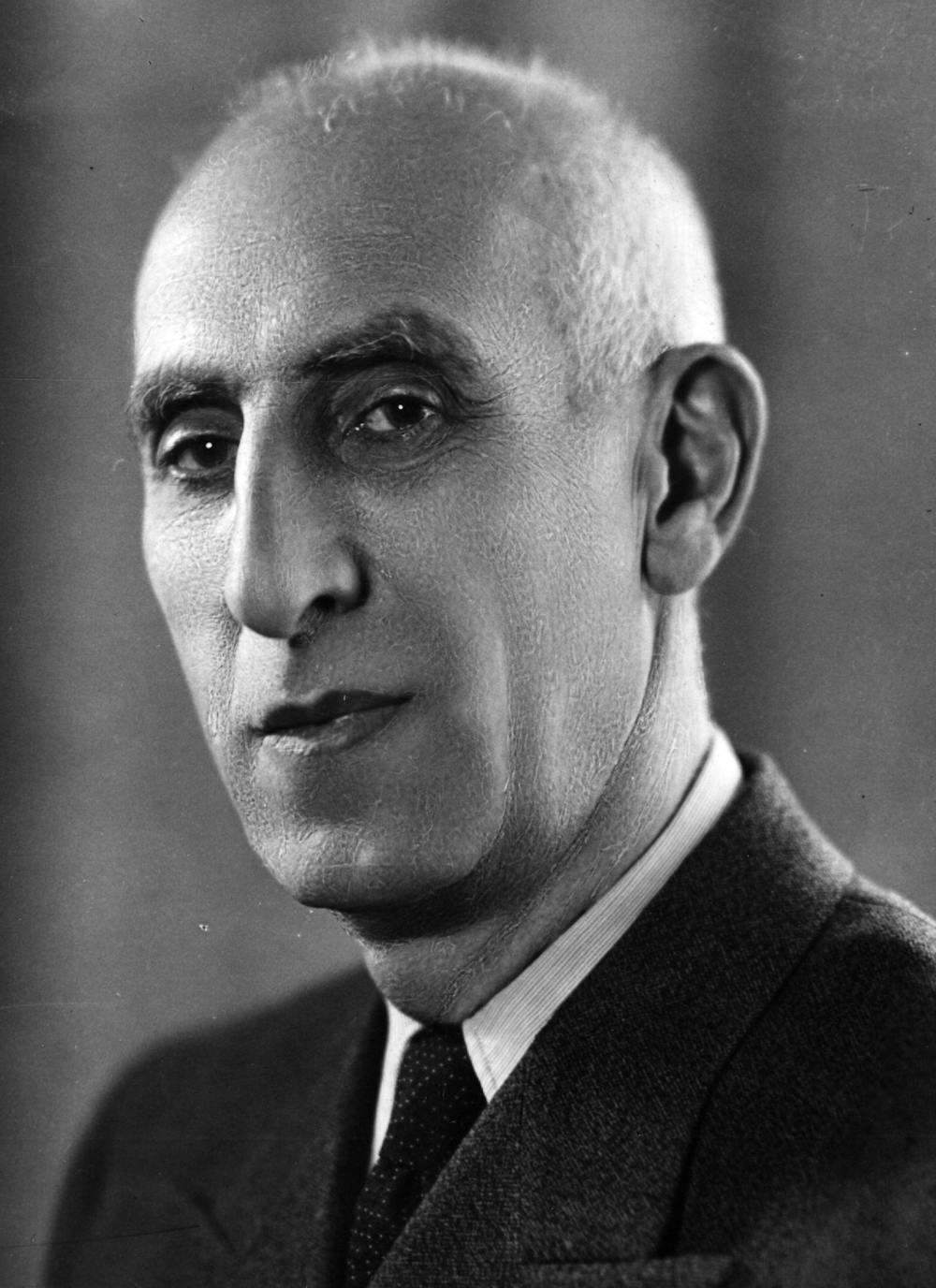
In 1951, the Iranian Parliament chose a new prime minister, Mossadegh, who then led lawmakers to vote in favor of taking over the Anglo-Iranian Oil Company, expelling the company’s British owners and saying they wanted to turn oil profits into investments in the Iranian people. The U.S. feared disruption in the global oil supply and worried about Iran falling prey to Soviet influence. The British feared the loss of cheap Iranian oil.
President Dwight Eisenhower decided it was best for the U.S. and the U.K. to get rid of Mossadegh. Operation Ajax, a joint CIA-British operation, convinced the Shah of Iran, the country’s monarch, to dismiss Mossadegh and drive him from office by force. Mossadegh was replaced by a much more Western-friendly prime minister, handpicked by the CIA.
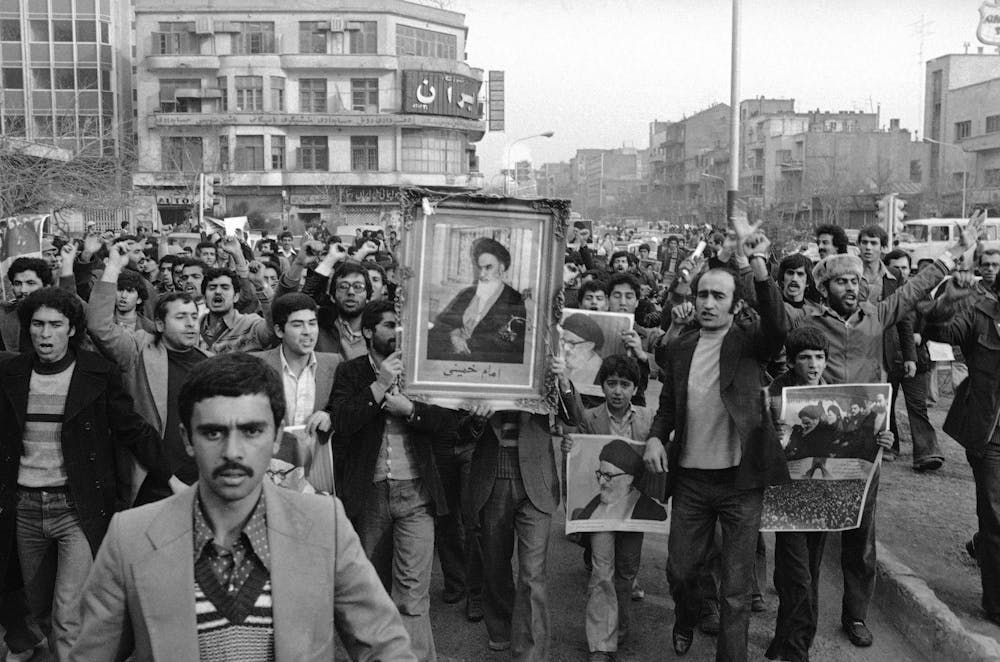
Demonstrators in Tehran demand the establishment of an Islamic republic. AP Photo/Saris
1979: Revolutionaries oust the shah, take hostages
After more than 25 years of relative stability in U.S.-Iran relations, the Iranian public had grown unhappy with the social and economic conditions that developed under the dictatorial rule of Shah Mohammad Reza Pahlavi.
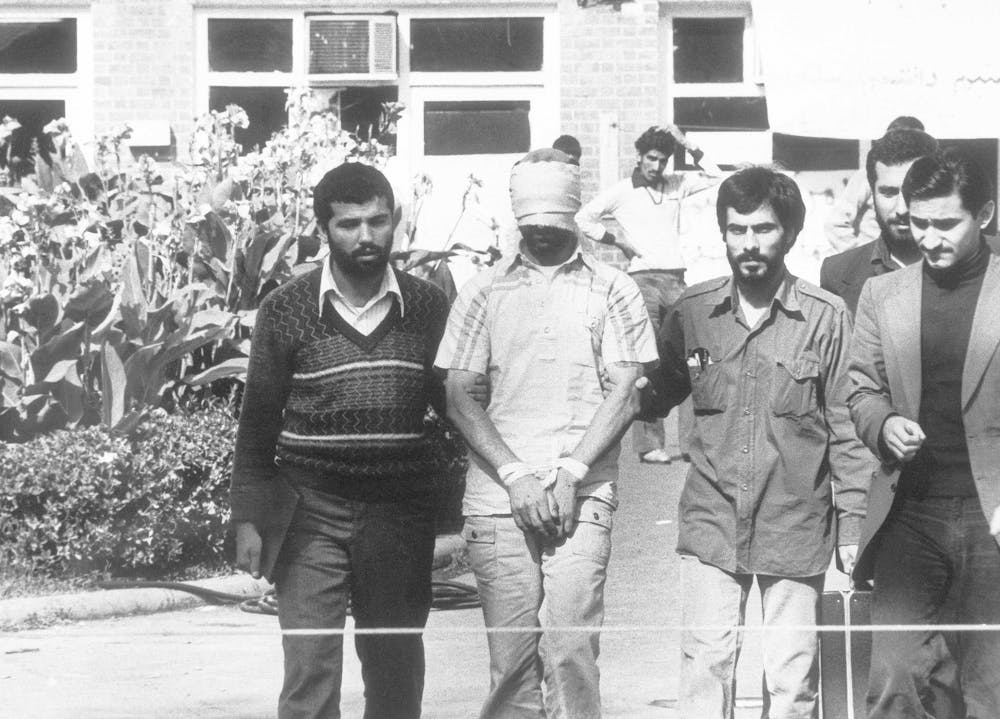
Iranian students at the U.S. Embassy in Tehran show a blindfolded American hostage to the crowd in November 1979. AP Photo
In October 1979, President Jimmy Carter agreed to allow the shah to come to the U.S. to seek advanced medical treatment. Outraged Iranian students stormed the U.S. Embassy in Tehran on Nov. 4, taking 52 Americans hostage. That convinced Carter to sever U.S. diplomatic relations with Iran on April 7, 1980.
Two weeks later, the U.S. military launched a mission to rescue the hostages, but it failed, with aircraft crashes killing eight U.S. servicemembers.
The shah died in Egypt in July 1980, but the hostages weren’t released until Jan. 20, 1981, after 444 days of captivity.
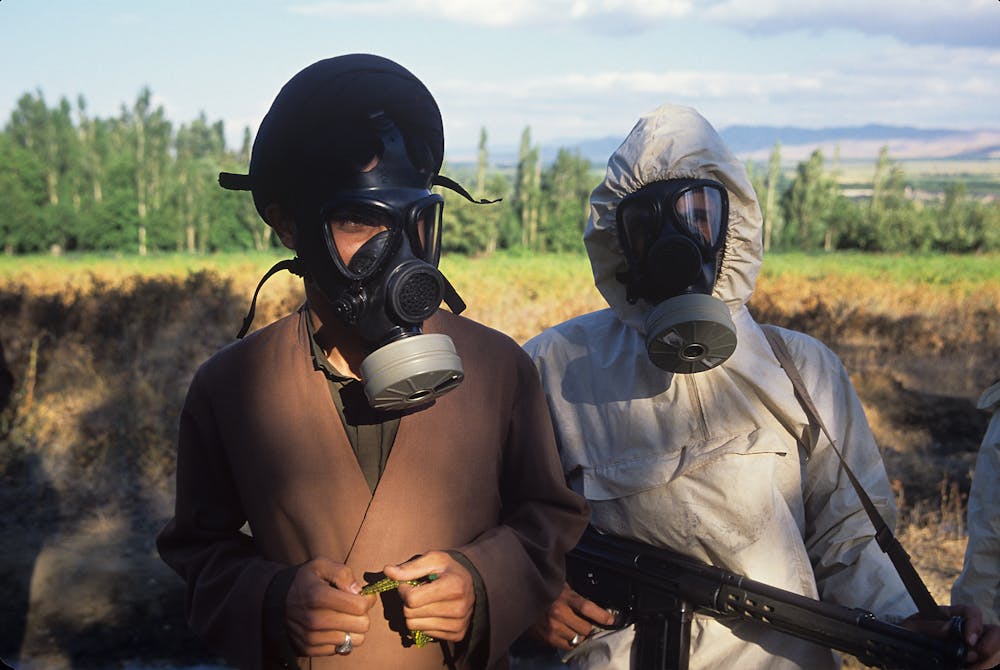
An Iranian cleric, left, and an Iranian soldier wear gas masks to protect themselves against Iraqi chemical-weapons attacks in May 1988. Kaveh Kazemi/Getty Images
The U.S. was concerned that the conflict would limit the flow of Middle Eastern oil and wanted to ensure the conflict didn’t affect its close ally, Saudi Arabia.
U.S. officials moderated their usual opposition to those illegal and inhumane weapons because the U.S. State Department did not “wish to play into Iran’s hands by fueling its propaganda against Iraq.” In 1988, the war ended in a stalemate. More than 500,000 military and 100,000 civilians died.
1981-1986: US secretly sells weapons to Iran
The U.S. imposed an arms embargo after Iran was designated a state sponsor of terrorism in 1984. That left the Iranian military, in the middle of its war with Iraq, desperate for weapons and aircraft and vehicle parts to keep fighting.
The last shipment, of anti-tank missiles, was in October 1986. In November 1986, a Lebanese magazine exposed the deal. That revelation sparked the Iran-Contra scandal in the U.S., with Reagan’s officials found to have collected money from Iran for the weapons and illegally sent those funds to anti-socialist rebels – the Contras – in Nicaragua.
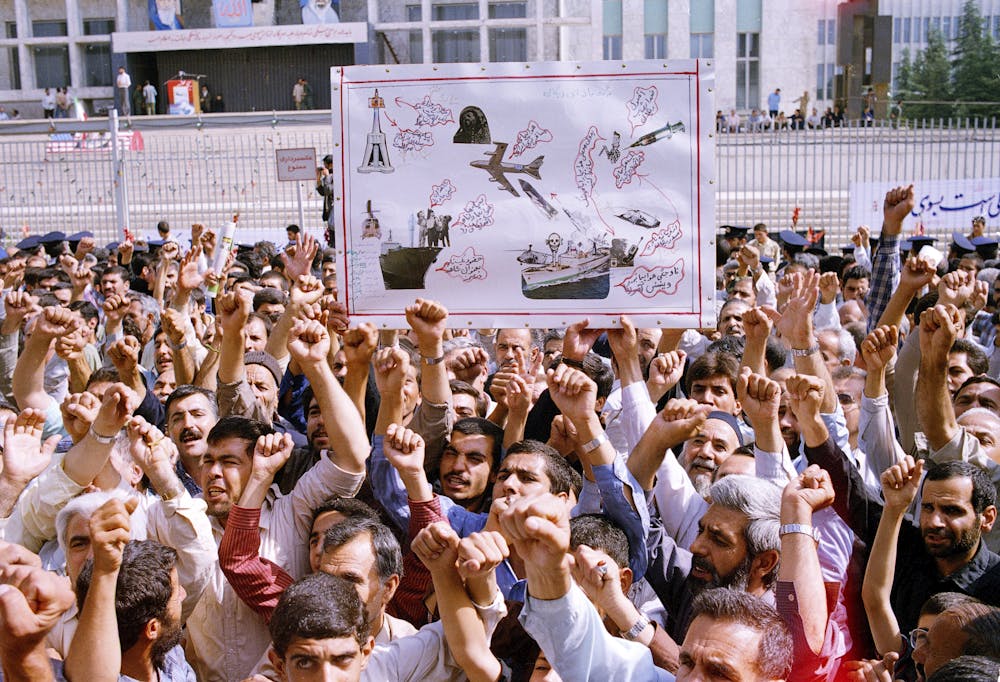
At a mass funeral for 76 of the 290 people killed in the shootdown of Iran Air 655, mourners hold up a sign depicting the incident. AP Photo/CP/Mohammad Sayyad
Either during or just after that exchange of gunfire, the Vincennes crew mistook a passing civilian Airbus passenger jet for an Iranian F-14 fighter. They shot it down, killing all 290 people aboard.
The U.S. called it a “tragic and regrettable accident,” but Iran believed the plane’s downing was intentional. In 1996, the U.S. agreed to pay US$131.8 million in compensation to Iran.
1997-1998: The US seeks contact
In August 1997, a moderate reformer, Mohammad Khatami, won Iran’s presidential election.
U.S. President Bill Clinton sensed an opportunity. He sent a message to Tehran through the Swiss ambassador there, proposing direct government-to-government talks.
Shortly thereafter, in early January 1998, Khatami gave an interview to CNN in which he expressed “respect for the great American people,” denounced terrorism and recommended an “exchange of professors, writers, scholars, artists, journalists and tourists” between the United States and Iran.
However, Supreme Leader Ayatollah Ali Khamenei didn’t agree, so not much came of the mutual overtures as Clinton’s time in office came to an end.
In his 2002 State of the Union address, President George W. Bush characterized Iran, Iraq and North Korea as constituting an “Axis of Evil” supporting terrorism and pursuing weapons of mass destruction, straining relations even further.
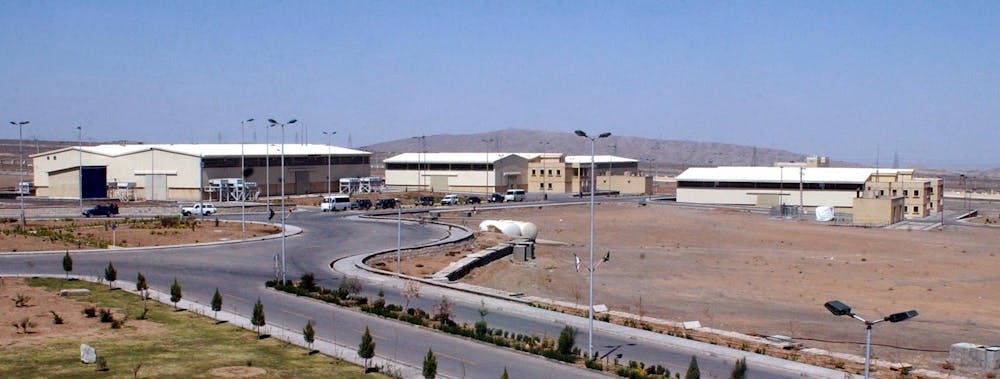
Inside these buildings at the Natanz nuclear facility in Iran, technicians enrich uranium. AP Photo/Vahid Salemi
That was a violation of the terms of the Nuclear Nonproliferation Treaty, which Iran had signed, requiring countries to disclose their nuclear-related facilities to international inspectors.
One of those formerly secret locations, Natanz, housed centrifuges for enriching uranium, which could be used in civilian nuclear reactors or enriched further for weapons.
Starting in roughly 2005, U.S. and Israeli government cyberattackers together reportedly targeted the Natanz centrifuges with a custom-made piece of malicious software that became known as Stuxnet.
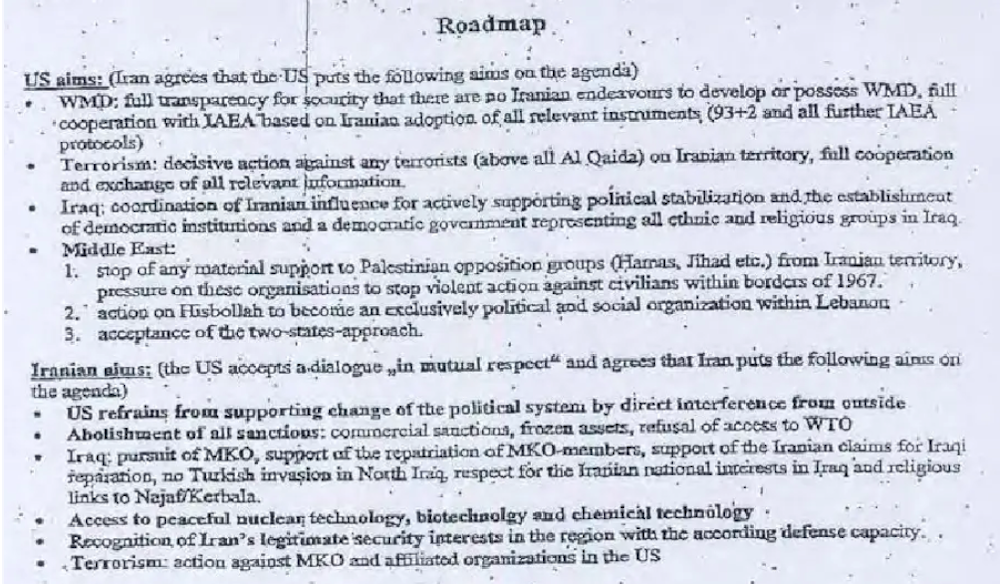
An excerpt of the document sent from Iran, via the Swiss government, to the U.S. State Department in 2003, appears to seek talks between the U.S. and Iran. Washington Post via Scribd
In May 2003, senior Iranian officials quietly contacted the State Department through the Swiss embassy in Iran, seeking “a dialogue ‘in mutual respect,’” addressing four big issues: nuclear weapons, terrorism, Palestinian resistance and stability in Iraq.
Hardliners in the Bush administration weren’t interested in any major reconciliation, though Secretary of State Colin Powell favored dialogue and other officials had met with Iran about al-Qaida.
When Iranian hardliner Mahmoud Ahmadinejad was elected president of Iran in 2005, the opportunity died. The following year, Ahmadinejad made his own overture to Washington in an 18-page letter to President Bush. The letter was widely dismissed; a senior State Department official told me in profane terms that it amounted to nothing.
After a decade of unsuccessful attempts to rein in Iran’s nuclear ambitions, the Obama administration undertook a direct diplomatic approach beginning in 2013.
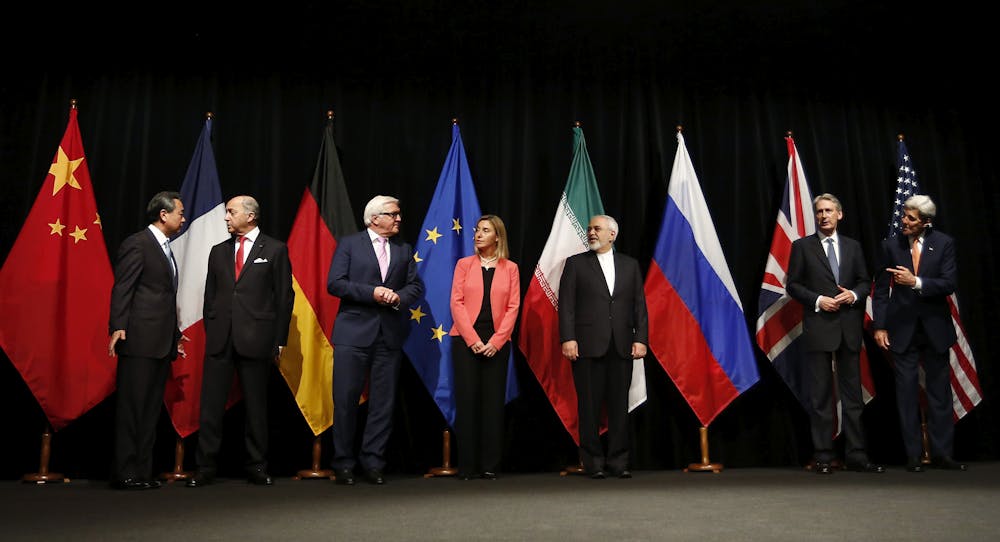
Iran, the U.S., China, France, Germany, Russia and the United Kingdom signed the deal in 2015. It severely limited Iran’s capacity to enrich uranium and mandated that international inspectors monitor and enforce Iran’s compliance with the agreement.
In return, Iran was granted relief from international and U.S. economic sanctions. Though the inspectors regularly certified that Iran was abiding by the agreement’s terms, President Donald Trump withdrew from the agreement in May 2018.
2020: US drones kill Iranian Maj. Gen. Qassem Soleimani
At the time, the Trump administration asserted that Soleimani was directing an imminent attack against U.S. assets in the region, but officials have not provided clear evidence to support that claim.
Hamas’ brazen attack on Israel on Oct. 7, 2023, provoked a fearsome militarized response from Israel that continues today and served to severely weaken Iran’s proxies in the region, especially Hamas – the perpetrator of the attacks – and Hezbollah in Lebanon.
2025: Trump 2.0 and Iran
Trump saw an opportunity to forge a new nuclear deal with Iran and to pursue other business deals with Tehran. Once inaugurated for his second term, Trump appointed Steve Witkoff, a real estate investor who is the president’s friend, to serve as special envoy for the Middle East and to lead negotiations.
Negotiations for a nuclear deal between Washington and Tehran began in April, but the countries did not reach a deal. They were planning a new round of talks when Israel struck Iran with a series of airstrikes on June 13, forcing the White House to reconsider is position.
Jeffrey Fields receives funding from the Carnegie Corporation of New York and Schmidt Futures.
Source: People’s Republic of China in Russian – People’s Republic of China in Russian –
Source: People’s Republic of China – State Council News
On June 16, the broadcast of the TV series “Catchphrases from the Classics, Favorite by Xi Jinping” (international version) was launched in five Central Asian countries. In this regard, the President of Kazakhstan Kassym-Jomart Tokayev expressed his warm congratulations.
Launched by China Media Group (CMG), the TV series “Xi Jinping’s Favorite Classical Quotes” (International Edition) carefully selects quotations from Chinese classical poetry and prose masterpieces used by Chinese President Xi Jinping in important speeches, articles and talks. They focus on themes of open cooperation, technological development, environmental protection and cultural innovation. With an international approach and vivid storytelling, the TV project explains to Central Asian audiences the deep historical and cultural roots of the Chinese leader’s ideas on governance, and also showcases the diversity of China’s modernization.
Source: People’s Republic of China in Russian – People’s Republic of China in Russian –
Source: People’s Republic of China – State Council News
Astana, June 18 (Xinhua) — China and five Central Asian countries on Tuesday reaffirmed their firm support for each other’s independence, sovereignty and territorial integrity, as well as the principles of sovereign equality and the inviolability of borders, according to the Treaty of Eternal Good-Neighborliness, Friendship and Cooperation signed by China, Kazakhstan, Kyrgyzstan, Tajikistan, Turkmenistan and Uzbekistan.
According to the document, the six countries also reaffirmed their determination to jointly build a closer China-Central Asia community with a shared future.
All parties stressed that they would not use force or threaten to use it and would resolve disputes peacefully. States committed to supporting each other’s development paths and models chosen in accordance with national conditions and to supporting each other’s positions on issues of fundamental interest.
The parties must not enter into any alliances or groups directed against the other parties and must not support any actions hostile to the other parties, the agreement says.
All parties expressed their willingness to cooperate in the areas of trade, economy, investment, infrastructure connectivity, engineering and technology, energy (including hydro and renewable energy), transport, mineral resources, agriculture, ecology and environmental protection, processing industry, science and technology, as well as other areas of mutual interest, on the basis of equality and mutual benefit.
The states also agreed to cooperate within the framework of bilateral and multilateral mechanisms to jointly combat terrorism, separatism, extremism and transnational organized crime. –0–
Source: People’s Republic of China in Russian – People’s Republic of China in Russian –
Source: People’s Republic of China – State Council News
“Lu Ban Workshop” is a Chinese brand of international cooperation in vocational education, which has now become an important platform for technology transfer and talent training in the joint construction of the “Belt and Road”. In November 2022, the first “Lu Ban Workshop” in Central Asia was launched in Tajikistan. Over the next year, Lu Ban Workshops were launched in Kazakhstan, Kyrgyzstan and other countries. This project not only opened up opportunities for Central Asian youth, but also built a bridge of understanding between the people of China and the Central Asian region.
Lu Ban’s workshops, opened in several Central Asian countries, have achieved good results and reflect three main features of practical cooperation between China and the region. First, it is demand-driven, when all specialties are selected taking into account the actual needs of the industries of Central Asian countries. Second, it is technology adaptation, that is, an organic combination of China’s advanced technologies in infrastructure construction, new energy sources, etc., with local resources and development conditions. Third, it is sustainability, when, based on the medium- and long-term development strategies of countries, not only the current problem of shortage of qualified personnel is solved, but also special attention is paid to the development of the ability for independent economic development. China has always promoted cooperation with Central Asian countries in the field of vocational education on the basis of equality and win-win cooperation, which reflects the Chinese concept of “benevolence, sincerity, mutual benefit and inclusiveness” towards neighboring countries.
In the long term, Lu Ban Workshops will continue to play the role of a technology incubator and talent reservoir, providing a steady impetus to long-term cooperation between China and Central Asian countries. As generations of local talents grow and individual joint projects steadily advance, Lu Ban Workshops will become a source of new energy for cooperation between China and Central Asia, laying a solid foundation for building a closer community of shared destiny between China and the region.
Author: Yang Jin, Deputy Director of the Central Asia and Caucasus Department, Institute of Russian, East European and Central Asian Studies, Chinese Academy of Social Sciences
This year marks the 75th anniversary of the outbreak of the Korean War, a pivotal moment in global history and a significant chapter in New Zealand’s military heritage. A national commemorative service will be held at Pukeahu National War Memorial Park in Wellington on Wednesday 25 June 2025 from 11am.
“The 25th of June is a day where people can take the opportunity to honour and reflect on the courage and sacrifice of New Zealanders who served in the Korean War,” said Stacey Richardson, Director Office of the Secretary at Manatū Taonga Ministry for Culture and Heritage.
The commemoration is held on the anniversary of the beginning of the Korean War on 25 June 1950 when communist North Korean forces crossed the 38th Parallel into South Korea.
“New Zealand was one of the first nations to respond to the United Nations Security Council’s call for military assistance following the invasion of South Korea in June 1950.
“Over 6,000 New Zealanders served during the Korean War. Around 4,700 New Zealand Army personnel served in Kayforce, with about 1300 others on Royal New Zealand Navy frigates.
“The ramifications of this war were felt across the world and in Aotearoa. Forty-five New Zealanders lost their lives, and many more were wounded or affected by the conflict”.
“Our national commemorations provide a space for individual and collective reflection. They bring together veterans, service personnel, communities and members of the public to honour together and reflect on the enduring legacy of war.
“As we reflect, we can also look forward. We acknowledge the enduring bonds forged between Aotearoa and the Republic of Korea, which have shaped the strong partnership our nations enjoy today,” said Richardson.
Veterans, their whānau, and members of the public are warmly invited to attend the national commemoration. Anyone who would like to attend should arrive at the Hall of Memories at Pukeahu National War Memorial Park at 10.45am for an 11.00am start.
Today, the Prime Minister, Mark Carney, met with the President of the Republic of Korea, Lee Jae Myung, at the 2025 G7 Leaders’ Summit in Kananaskis, Alberta.
Canada and Korea hold a dynamic trade and investment relationship. As Canada diversifies its trade and defence relationships, and rearms its armed forces, the relationship between Canada and Korea has immense potential to prosper further. To that end, Prime Minister Carney and President Lee agreed to deepen co-operation between the two nations.
The Prime Minister underscored Canada’s role as a stable and reliable Pacific nation and its support for a free and open Indo-Pacific region.
Prime Minister Carney and President Lee agreed to remain in close contact.
From June 19 to 22, 2025, Samsung Electronics will collaborate with globally renowned artists to celebrate global diversity, artistic innovation and the power of display technology at Art Basel in Basel 2025, the world’s largest art fair held in Basel, Switzerland.
▲ As Art Basel’s official display partner, Samsung Electronics offers exclusive access to curated exhibition artworks via the Samsung Art Store, also on display onsite at Art Basel in Basel 2025.
With participation from approximately 280 galleries across 42 countries, Art Basel in Basel 2025 offers a comprehensive view of the latest ideas shaping contemporary art today. As the official display partner, Samsung Electronics presents a new digital art experience that brings together art and technology through its premium screens including The Frame, Micro LED and Neo QLED 8K.
Immersive Digital Art Experience: ‘ArtCube’ Draws Visitors Into the World of Art
At Art Basel in Basel 2025, Samsung Electronics unveiled ‘ArtCube,’ a lounge dedicated to digital art experiences on Samsung devices. Created under the theme “Borderless, Dive Into the Art,” ArtCube offers a progressively immersive journey as visitors navigate the space.
Passing through a large LED entrance where the Art Basel in Basel Collection from Samsung Art Store is reinterpreted as digital artworks, visitors discover a space showcasing the full lineup of Samsung Art TVs in the ArtCube. Artworks from the Samsung Art Store, displayed across ‘The Frame,’ ‘Micro LED’ and ‘Neo QLED 8K’ screens, envelope the front and side walls to create a deeply immersive experience — one that makes visitors feel as though they have stepped directly into the art itself.
▲ Samsung Art TVs — including The Frame Pro, MICRO LED and Neo QLED 8K — line the interior walls of ArtCube.
▲ A visitor views Basim Magdy’s artwork on display at ArtCube, part of the Samsung Art Store collection at Art Basel in Basel 2025.
An interactive experience zone, powered by Samsung Art Store, is also featured. Visitors can select an artist showcased in the exhibition, take a photo and generate a personalized selfie in the chosen artist’s style, using generative AI — offering a distinctive and engaging experience.
Bringing Art Into Everyday Life Through the Samsung Art Store
Earlier this week, Samsung Electronics has unveiled a new collection featuring 38 highlighted pieces from Art Basel in Basel 2025, now available on the Samsung Art Store. With this launch, Samsung Art Store subscribers around the world can enjoy a diverse selection of Art Basel artworks from the comfort of their homes — without needing to travel to Basel, Switzerland.
As the official display partner of Art Basel for 2025, Samsung Electronics will continue its participation in the annual exhibitions held in Basel, Hong Kong, Paris and Miami. Through Samsung Art Store, the company aims to make art more accessible and seamlessly integrated into everyday life.
The Samsung Art Store* is a subscription-based art service available on Samsung’s The Frame and QLED TVs. Now accessible in 117 countries, the Samsung Art Store offers more than 3,500 artworks in stunning 4K resolution through collaboration with over 70 leading partners.
▲ Basim Magdy, featured in the Samsung Art Store collection at Art Basel in Basel 2025, views his own work on display at ArtCube.
▲ Visitors take in the vibrant, dreamlike works of Basim Magdy on display at ArtCube, part of Samsung’s digital art showcase at Art Basel in Basel 2025.
▲ A visitor captures Lee Kun-yong’s artwork on display at Samsung ArtCube.
▲ A visitor views Marc Dennis’ artwork on display at Samsung ArtCube.
▲ A vivid portrait in the style of Marc Dennis captures visitors’ attention at ArtCube, part of Samsung’s digital art showcase at Art Basel in Basel 2025.
▲ A vivid portrait in the style of Saya Woolfalk captures visitors’ attention at ArtCube, part of Samsung’s digital art showcase at Art Basel in Basel 2025.
▲ The experience zone highlights the Samsung Art Store and lets visitors create immersive, AI-powered photos with animated elements from featured artworks.
▲ One of the most striking pieces at ArtCube, Basim Magdy’s “The Dictator and His Cockroach Count Their Blessings” merges satire and dreamlike visuals in Samsung’s digital art showcase.
▲ Visitors explore the immersive artworks by Marc Dennis at ArtCube, where his vivid, hyperreal art pieces are brought to life with digital projections.
* All artworks in Samsung Art Store are available with a membership subscription. Artwork availability is subject to change without prior notice and may vary by region.
The Middle East is a region of intense beauty and ancient kingdoms. It has also repeatedly endured periods of geopolitical instability over many centuries.
Today, geopolitical, socio-political and religious tensions persist. The world is currently watching as longstanding regional tensions come to a head in the shocking and escalating conflict between Israel and Iran.
The global airline industry takes a special interest in how such tensions play out. This airspace is a crucial corridor linking Europe, Asia and Africa.
The Middle East is now home to several of the world’s largest international airlines: Emirates, Qatar Airways and Etihad Airways. These airlines’ home bases – Dubai, Doha and Abu Dhabi, respectively – have become pivotal hubs in international aviation.
Keeping passengers safe will be all airlines’ highest priority. What could an escalating conflict mean for both the airlines and the travelling public?
Safety first
History shows that the civil airline industry and military conflict do not mix. On July 3 1988, the USS Vincennes, a US navy warship, fired two surface-to-air missiles and shot down Iran Air Flight 655, an international passenger service over the Persian Gulf.
More recently, on July 17 2014, Malaysian Airlines Flight MH17 was shot down over eastern Ukraine as the battle between Ukrainian forces and pro-Russian separatists continued.
Understandably, global airlines are very risk-averse when it comes to military conflict. The International Civil Aviation Organization requires airlines to implement and maintain a Safety Management System (SMS).
One of the main concerns – known as “pillars” – of the SMS is “safety risk management”. This includes the processes to identify hazards, assess risks and implement risk mitigation strategies.
The risk-management departments of airlines transiting the Middle East region will have been working hard on these strategies.
Headquartered in Montreal, Canada, the International Civil Aviation Organization has strict requirements and protocols to keep passengers safe. meunierd/Shutterstock
Route recalculation
The most immediate and obvious evidence of such strategies being put in place are changes to aircraft routing, either by cancelling or suspending flights or making changes to the flight plans. This is to ensure aircraft avoid the airspace where military conflicts are flaring.
At the time of writing, a quick look at flight tracking website Flightradar24 shows global aircraft traffic avoiding the airspace of Iran, Iraq, Syria, Israel, Jordan, Palestine and Lebanon. The airspace over Ukraine is also devoid of air traffic.
Rerouting, however, creates its own challenges. Condensing the path of the traffic into smaller, more congested areas can push aircraft into and over areas that are not necessarily equipped to deal with such a large increase in traffic.
Having more aircraft in a smaller amount of available safe airspace creates challenges for air traffic control services and the pilots operating the aircraft.
More time and fuel
Avoiding areas of conflict is one of the most visible forms of airline risk management. This may add time to the length of a planned flight, leading to higher fuel consumption and other logistical challenges. This will add to the airlines’ operating costs.
There will be no impact on the cost of tickets already purchased. But if the instability in the region continues, we may see airline ticket prices increase.
It is not just the avoidance of airspace in the region that could place upward pressure on the cost of flying. Airliners run on Jet-A1 fuel, produced from oil.
If Iran closes the Strait of Hormuz, the “world’s most important oil transit chokepoint”, this could see the cost of oil, and in turn Jet-A1, significantly increase. Increasing fuel costs will be passed on the paying passenger. However, some experts believe such a move is unlikely.
A major hub
The major aviation hubs in the Middle East provide increased global connectivity, enabling passengers to travel seamlessly between continents.
Increased regional instability has the potential to disrupt this global connectivity. In the event of a prolonged conflict, airlines operating in and around the region may find they have increased insurance costs. Such costs would eventually find their way passed on to consumers through higher ticket prices.
Across the globe, airlines and governments are issuing travel advisories and warnings. The onus is on the travelling public to stay informed about changes to flight status, and potential delays.
Such warnings and advisories can lead to a drop in passenger confidence, which may then lead to a drop in bookings both into and onwards from the region.
Until the increase in instability in the Middle East, global airline passenger traffic numbers were larger than pre-pandemic figures. Strong growth had been predicted in the coming decades.
Anything that results in falling passenger confidence could negatively impact these figures, leading to slowed growth and affecting airline profitability.
Despite high-profile disasters, aviation remains the safest form of transport. As airlines deal with these challenges they will constantly work to keep flights safe and to win back passenger confidence in this unpredictable situation.
Natasha Heap does not work for, consult, own shares in or receive funding from any company or organisation that would benefit from this article, and has disclosed no relevant affiliations beyond their academic appointment.
Source: People’s Republic of China – State Council News
A new extended reality (XR) experience based on the Terracotta Warriors, titled “The Empire Code: Terracotta Warriors – Secrets of the First Emperor’s Mausoleum,” was unveiled on June 14 at the 27th Shanghai International Film Festival (SIFF).
Wang Yuan, general producer and chairwoman of Xi’an Hongwen Digital Technology Co., introduces “The Empire Code” at the opening of the XR section during the 27th Shanghai International Film Festival, June 14, 2025. [Photo courtesy of Xi’an Hongwen Digital Technology]
“The Empire Code,” the first XR project officially authorized by Emperor Qinshihuang’s Mausoleum Site Museum, draws on the famous Terracotta Warrior pits and other archaeological discoveries from the UNESCO World Heritage site in Xi’an, Shaanxi province. The interactive underground tomb experience is designed to set a new standard for presenting Chinese civilization in the digital age.
The project was unveiled at the launch of the festival’s SIFF XR section. Wang Yuan, general producer and chairwoman of Xi’an Hongwen Digital Technology, a joint venture between Shaanxi Culture Industry Investment Group and HTC, said the team was not using technology to resurrect cultural relics, but to allow them to “open history’s door through technology.”
“Virtual reality serves as a radiant bridge across time, connecting ancient wisdom, eternal art and future imagination,” she added.
A poster for “The Empire Code: Terracotta Warriors – Secrets of the First Emperor’s Mausoleum.” [Image courtesy of Xi’an Hongwen Digital Technology]
Along with a trailer and poster launched in Shanghai, audiences can preview a five-minute immersive experience during the festival. The full version is set to open this summer in Beijing and Xi’an.
The project will also be presented at the festival’s International Film & TV Market, where organizers aim to showcase China’s digital cultural solutions and technological expertise to a global audience.
“The Empire Code” brings together specialists in archaeology, filmmaking and virtual reality. Historical accuracy is overseen by Zhang Weixing, a researcher at Northwest University’s Collaborative Research Center for Archaeology of the Silk Roads and former head of Emperor Qinshihuang’s Mausoleum Site excavation team. Acclaimed director Jin Tiemu crafts the narrative, while production designer Huo Tingxiao recreates authentic Qin dynasty visuals. The project also draws on technical expertise from HTC Vive Arts, which has partnered with more than 70 museums worldwide, and Wevr, known for its work in 3D and game development.
A man experiences a preview of “The Empire Code” during the 27th Shanghai International Film Festival on June 14, 2025. [Photo courtesy of SIFF Organizing Committee]
The project uses XR technology such as 5K ultra-high-definition rendering, six degrees of freedom motion tracking and gesture controls to create an immersive experience aimed at minimizing motion sickness.
Producers say the cross-disciplinary effort combines cultural, artistic and technological elements, providing an interactive way to share China’s history while maintaining cultural authenticity.
“The Empire Code” was announced alongside several upcoming projects at SIFF XR, including virtual reality adaptations of China’s animated blockbuster “Chang An,” Jules Verne’s “Journey to the Center of the Earth” and the historical VR film “Creation of the Gods Prequel: A Female General in Shang Dynasty’s Golden Age.”
Other highlights include the sci-fi VR experience “The Devourer,” based on renowned writer Liu Cixin’s short story in which players defend Earth from aliens, and the location-based mixed reality piece “A Tapestry of a Legendary Land,” adapted from the popular dance drama that immerses audiences in Song dynasty artistry.
The opening of the XR section at the 27th Shanghai International Film Festival, June 14, 2025. [Photo courtesy of Xi’an Hongwen Digital Technology]
SIFF XR, a collaboration between the 27th SIFF and the Putuo Culture and Tourism Bureau, ran from June 14 to 16. The event showcased 16 domestic and international feature films, including several global and Asian premieres.
Highlights included “Mnemosyne,” inspired by the classical Chinese opera “The Peony Pavilion,” and “Golog Unbounded,” which explores the natural landscapes of Qinghai province. Attendees could also explore the anime universe of “Gundam” and experience narrative-driven works such as “Nana Lou” and “Jack & Flo.”
By combining film, gaming, performance and tourism, SIFF XR offered immersive experiences that blurred the line between cinema and reality.
Source: People’s Republic of China – State Council News
An increasing number of exhibitors from the United States will participate in the third China International Supply Chain Expo (CISCE) this July, signaling their confidence in the Chinese economy despite anti-globalization headwinds, the event organizer said Tuesday.
The number of U.S. exhibitors is expected to increase by 15 percent compared with the previous edition, and 60 percent of them are Global Fortune 500 companies, said Yu Jianlong, vice president of the China Council for the Promotion of International Trade (CCPIT), at a press conference.
U.S. tech giant Nvidia is expected to make its debut at the expo. During his visit to Beijing in April, Nvidia CEO Jensen Huang met with CCPIT chairman Ren Hongbin and emphasized that China is a very important market for Nvidia, expressing the company’s willingness to continue cooperation with China.
Overseas participants at the upcoming expo are estimated to account for 35 percent of the total of 650 exhibitors from 75 countries, regions and international organizations, with half of the overseas participants coming from Europe and the United States, according to Yu.
“Against the backdrop of a complex international situation and anti-globalization headwinds, the gathering of so many friends from all over the world, especially those from the global business community, is a vote of confidence in the expo and also in China’s economic development,” Yu said.
The third CISCE will take place in Beijing from July 16 to 20, with Thailand as the guest country of honor.
As the world’s first national-level exhibition focusing on supply chains, the expo is an internationally shared public product. First held in 2023, the expo has contributed to building more secure, stable, open and inclusive global industrial and supply chains, according to the CCPIT.
Last year, U.S. companies made a strong presence at the second edition of the expo in Beijing, with well-known American firms such as Apple and Tesla seeking to further tap into China’s vast market.
The upcoming expo will feature a new exhibition area dedicated to the innovation chain, aimed at promoting the commercialization of lab-developed technologies and fostering seamless integration between the innovation and industrial chains, the CCPIT said.
Source: People’s Republic of China – State Council News
Xi urges China, Central Asian countries to promote high-quality Belt and Road cooperation
Chinese President Xi Jinping delivers a keynote speech during the second China-Central Asia Summit in Astana, Kazakhstan, June 17, 2025. The second China-Central Asia Summit was held in Astana on Tuesday. Kazakh President Kassym-Jomart Tokayev chaired the summit. Xi, Kyrgyz President Sadyr Japarov, Tajik President Emomali Rahmon, Turkmen President Serdar Berdimuhamedov and Uzbek President Shavkat Mirziyoyev attended the summit. [Photo/Xinhua]
ASTANA, June 17 — Chinese President Xi Jinping on Tuesday called on China and Central Asian countries to promote high-quality Belt and Road cooperation and forge ahead toward the goal of building a China-Central Asia community with a shared future under the guidance of the China-Central Asia Spirit.
Xi made the remarks in his keynote speech at the second China-Central Asia Summit hosted by Kazakh President Kassym-Jomart Tokayev. Kyrgyz President Sadyr Japarov, Tajik President Emomali Rahmon, Turkmen President Serdar Berdimuhamedov and Uzbek President Shavkat Mirziyoyev also attended the summit.
Xi pointed out that during their meeting in Xi’an two years ago, they jointly outlined the Xi’an Vision for China-Central Asia cooperation. Two years on, China and Central Asian countries have further deepened and substantiated Belt and Road cooperation, he said, recalling advanced cooperation in various fields.
The core framework of the China-Central Asia mechanism is largely in place, and the consensus at the first Summit has been implemented across the board, Xi said, adding that the path of cooperation among the countries is steadily widening, and their friendship is blooming ever more brightly.
Xi stressed that the cooperation between China and Central Asian countries is rooted in more than 2,000 years of friendly exchanges, cemented by solidarity and mutual trust cultivated through more than three decades of diplomatic ties, and taken forward via openness and win-win cooperation of the new era.
Xi said building on their collective efforts over the years, the six countries have forged a China-Central Asia Spirit of “mutual respect, mutual trust, mutual benefit and mutual assistance for the joint pursuit of modernization through high-quality development.”
The spirit connotes four aspects of practices. First, Xi said that China and Central Asian countries practice mutual respect and treat each other as equals, and all countries, big or small, are equal, adding that the six countries handle issues through consultation and make decisions by consensus.
Second, he said that China and Central Asian countries seek to deepen mutual trust and enhance mutual support, firmly support each other in safeguarding independence, sovereignty, territorial integrity and national dignity, and do not do anything harmful to the core interests of any party.
Third, Xi said China and Central Asian countries pursue mutual benefit and win-win cooperation and strive for common development, view each other as priority partners, and share development opportunities together, adding that they accommodate each other’s interests, and work to build a win-win and symbiotic relationship.
Fourth, he said China and Central Asian countries help each other in time of need and stand together through thick and thin, supporting each other in choosing development paths suitable to respective national conditions and in taking domestic matters into their own hands, adding that the countries work together to address various risks and challenges, and uphold regional security and stability.
This China-Central Asia Spirit is an important guideline for their endeavor to carry forward friendship and cooperation from generation to generation, and the six countries should always uphold it and let it shine forever, Xi noted.
Today, unprecedented changes are unfolding at a faster pace across the globe, thrusting the world into a new state of heightened turbulence and volatility, Xi pointed out, noting that a strong belief in fairness and justice, and an unyielding commitment to mutual benefit and win-win cooperation are the only way to maintain world peace and achieve common development.
There is no winner in tariff wars or trade wars, and unilateralism, protectionism and hegemonism will surely backfire while hurting others, he noted.
Maintaining that history should move forward, not backward, and the world should be united, not divided, Xi said humanity must not regress to the law of the jungle, but should instead build a community with a shared future for mankind.
Xi called on the six countries to act on the China-Central Asia Spirit, and enhance cooperation with renewed vigor and more practical measures.
To achieve this, he made five points.
First, China and Central Asian countries should stay committed to the fundamental goal of unity, and always trust and support each other, he said.
China consistently takes Central Asia as a priority in its neighborhood diplomacy, Xi noted, adding that with a firm belief in an amicable, secure and prosperous neighborhood as well as a strong dedication to amity, sincerity, mutual benefit and inclusiveness, China interacts with Central Asian countries on the basis of equality and sincerity, and the six countries always wish their neighbors well.
The six countries will sign together a treaty on eternal good-neighborliness, friendship and cooperation to enshrine the principle of everlasting friendship in the form of law, he said, deeming it as a new landmark in the history of the relations of the six countries and a pioneering initiative in China’s diplomatic engagement with its neighbors, which constitutes a milestone for today and a foundation for tomorrow.
Second, China and Central Asian countries should optimize the cooperation framework to make it more results-oriented, more efficient and more deeply integrated, Xi said.
Recalling that the six countries have agreed to designate 2025 and 2026 as the Years of High-Quality Development of China-Central Asia Cooperation, he said that all sides should focus the cooperation on smooth trade, industrial investment, connectivity, green mining, agricultural modernization and personnel exchanges, roll out more projects on the ground and foster new quality productive forces.
He said China has decided to establish three cooperation centers, i.e. on poverty reduction, on education exchange, and on desertification prevention and control, as well as a cooperation platform on smooth trade under the China-Central Asia cooperation framework.
China supports Central Asian countries in developing livelihood and development projects, Xi said, adding that China will provide 3,000 training opportunities to Central Asian countries in the next two years.
Third, China and Central Asian countries should develop a security framework for peace, tranquility and solidarity, step up regional security governance, deepen law enforcement and security cooperation, jointly prevent and thwart extreme ideologies, and resolutely fight terrorism, separatism and extremism, so as to maintain peace and stability in the region, Xi said.
China will do its best to help Central Asian countries combat terrorism and transnational organized crime and safeguard cybersecurity and biosecurity, he said.
Fourth, China and Central Asian countries should cement the bonds of shared vision, mutual understanding and mutual affection between peoples, he noted, saying that China will enhance cooperation between legislatures, political parties, women, youth, media and think tanks with Central Asian countries, conduct in-depth exchange of governance experience, and is ready to set up more cultural centers, university branches and Luban Workshops in Central Asia to train more high-caliber talent for Central Asian countries.
China supports deepening subnational cooperation with Central Asia, Xi said, adding that China and Central Asian countries should nurture heart-to-heart connections at central and subnational levels, between official and non-governmental actors, and from adjacent to broader areas.
Fifth, China and Central Asian countries should uphold a fair and equitable international order and an equal and orderly world structure, stand ready to work with all parties to defend international fairness and justice, oppose hegemonism and power politics, and promote an equal and orderly multipolar world and a universally beneficial and inclusive economic globalization, Xi said.
This year marks the 80th anniversary of the victory of the Chinese People’s War of Resistance Against Japanese Aggression and the World Anti-Fascist War, and the 80th anniversary of the founding of the United Nations, he said, recalling that in the strenuous times of war, Chinese and Central Asian peoples supported each other through adversity, and jointly made important contributions to the cause of justice of humanity.
He also noted the need to promote the correct view of history, defend the fruits of the victory of World War II, uphold the UN-centered international system, and provide more stability and certainty for world peace and development.
Xi pointed out that China is building a great modern socialist country in all respects and advancing the great rejuvenation of the Chinese nation on all fronts through Chinese modernization.
No matter how the international situation changes, China will remain unwavering in opening up to the outside world, he said, noting that China is ready to embrace higher-quality cooperation and deepen the integration of interests with Central Asian countries, so as to achieve common development and strive for new progress in China-Central Asia cooperation.
Tokayev and the other four Central Asian leaders unanimously stated that the China-Central Asia mechanism has become an important platform for promoting dialogue and cooperation, as well as for advancing the economic and social development of Central Asian countries.
In a world full of uncertainties, the strategic significance of the mechanism has become increasingly prominent, and China’s growing prosperity and strength are benefiting its neighboring countries, they said, noting that China is a strategic partner and a true friend that Central Asian countries can always count on.
The Central Asian countries highly value the model of cooperation with China based on mutual respect, equality and mutual benefit, and look forward to deepening all-round cooperation with China and expanding trade and investment, the five leaders added.
They also expressed the hope to jointly pursue high-quality Belt and Road cooperation, promote cooperation in such fields as industry, agriculture, science and technology, infrastructure, new energy and connectivity, strengthen regional security collaboration, and enhance people-to-people and cultural exchanges in fields like culture, education and tourism.
The leaders of the five Central Asian countries expressed their intention to build the China-Central Asia mechanism into a model of regional cooperation, share development and prosperity, jointly promote peace and stability, and build a closer community with a shared future.
The five parties highly appreciate China’s constructive role in international and regional affairs, and actively support the concept of building a community with a shared future for mankind, as well as the three major global initiatives proposed by President Xi.
They also expressed the willingness to closely coordinate and cooperate with China to firmly safeguard free trade and the multilateral trading system, and jointly defend international equity and justice.
During the summit, Xi and the heads of state of the Central Asian nations signed the Astana Declaration of the second China-Central Asia Summit, and a treaty on eternal good-neighborliness, friendship and cooperation.
The meeting also announced the signing of 12 cooperation agreements regarding the Belt and Road cooperation, facilitation of personnel exchanges, green mining, trade, connectivity, industry and customs.
At the summit, China signed multiple sister city agreements with the five Central Asian countries, thus the pairs of sister cities between the two sides have exceeded 100.
Xi and other leaders also witnessed the inauguration of three China-Central Asia cooperation centers and a trade platform, namely the China-Central Asia poverty reduction cooperation center, the China-Central Asia education exchange cooperation center, the China-Central Asia desertification prevention and control cooperation center, as well as the China-Central Asia smooth trade cooperation platform.
All parties also agreed that China will host the third China-Central Asia Summit in 2027.
Chinese President Xi Jinping, Kazakh President Kassym-Jomart Tokayev, Kyrgyz President Sadyr Japarov, Tajik President Emomali Rahmon, Turkmen President Serdar Berdimuhamedov and Uzbek President Shavkat Mirziyoyev pose for a group photo in Astana, Kazakhstan, June 17, 2025. The second China-Central Asia Summit was held in Astana on Tuesday. Tokayev chaired the summit. Xi, Japarov, Rahmon, Berdimuhamedov and Mirziyoyev attended the summit. [Photo/Xinhua]Chinese President Xi Jinping walks into the venue of the second China-Central Asia Summit in Astana, Kazakhstan, June 17, 2025. The second China-Central Asia Summit was held in Astana on Tuesday. Kazakh President Kassym-Jomart Tokayev chaired the summit. Xi, Kyrgyz President Sadyr Japarov, Tajik President Emomali Rahmon, Turkmen President Serdar Berdimuhamedov and Uzbek President Shavkat Mirziyoyev attended the summit. [Photo/Xinhua]Chinese President Xi Jinping shakes hands with Kazakh President Kassym-Jomart Tokayev in Astana, Kazakhstan, June 17, 2025. The second China-Central Asia Summit was held in Astana on Tuesday. Tokayev chaired the summit. Xi, Kyrgyz President Sadyr Japarov, Tajik President Emomali Rahmon, Turkmen President Serdar Berdimuhamedov and Uzbek President Shavkat Mirziyoyev attended the summit. [Photo/Xinhua]Chinese President Xi Jinping delivers a keynote speech during the second China-Central Asia Summit in Astana, Kazakhstan, June 17, 2025. The second China-Central Asia Summit was held in Astana on Tuesday. Kazakh President Kassym-Jomart Tokayev chaired the summit. Xi, Kyrgyz President Sadyr Japarov, Tajik President Emomali Rahmon, Turkmen President Serdar Berdimuhamedov and Uzbek President Shavkat Mirziyoyev attended the summit. [Photo/Xinhua]Chinese President Xi Jinping, Kazakh President Kassym-Jomart Tokayev, Kyrgyz President Sadyr Japarov, Tajik President Emomali Rahmon, Turkmen President Serdar Berdimuhamedov and Uzbek President Shavkat Mirziyoyev witness inauguration of the China-Central Asia poverty reduction cooperation center, the China-Central Asia education exchange cooperation center, the China-Central Asia desertification control cooperation center and the China-Central Asia trade facilitation cooperation platform in Astana, Kazakhstan, June 17, 2025. The second China-Central Asia Summit was held in Astana on Tuesday. Tokayev chaired the summit. Xi, Japarov, Rahmon, Berdimuhamedov and Mirziyoyev attended the summit. [Photo/Xinhua]
Source: People’s Republic of China – State Council News
BEIJING, June 17 — The 2025 Summer Davos forum will be held from June 24 to 26 in north China’s Tianjin Municipality, with all preparations for the meeting having been finalized, the organizers said on Tuesday.
Also known as the 16th Annual Meeting of New Champions of the World Economic Forum, this year’s Summer Davos forum is themed “Entrepreneurship in the New Era” and is expected to bring together around 1,800 participants from over 90 countries and regions, the organizers told a press conference in Beijing.
This year’s forum will focus on five key areas — deciphering the world economy, outlook on China, industries disrupted, investing in people and the planet, and new energy and materials.
Through this year’s Summer Davos, China will reaffirm its commitment to pursuing high-level opening up and to sharing opportunities brought about by its development with the rest of the world, said Chen Shuai, an official with the National Development and Reform Commission.
As one of the most dynamic regions in the world, Asia drives 60 percent of global economic growth, with China accounting for half of that contribution, according to Gim Huay Neo, managing director of the World Economic Forum.
She noted that this year’s Summer Davos forum will provide opportunities for participants to deepen their understanding of development trends in China and Asia.
OMAHA, Neb., June 17, 2025 (GLOBE NEWSWIRE) — Greystone Housing Impact Investors LP (NYSE: GHI) (the “Partnership”) announced that the Board of Managers of Greystone AF Manager LLC (“Greystone Manager”) declared a cash distribution to the Partnership’s Beneficial Unit Certificate (“BUC”) holders of $0.30 per BUC.
The cash distribution will be paid on July 31, 2025 to all BUC holders of record as of the close of trading on June 30, 2025. The BUCs will trade ex-distribution as of June 30, 2025.
Commenting on the Partnership’s quarterly distribution, Chief Executive Officer Ken Rogozinski stated, “Persistently high interest rates, coupled with higher capitalization rates, have combined to create a more muted environment for sales of certain high quality joint venture properties within our investment portfolio, particularly in Texas markets. As a result, we are reducing our quarterly distribution to appropriately align with the current operating environment. Our quarterly distribution equates to a 9.5% annualized distribution yield based on our net book value as of March 31, 2025, which we believe is attractive in the current operating environment.”
Greystone Manager is the general partner of America First Capital Associates Limited Partnership Two, the Partnership’s general partner. Distributions to the Partnership’s BUC holders, including regular and any supplemental distributions, are determined by Greystone Manager based on a disciplined evaluation of the Partnership’s current and anticipated operating results, financial condition and other factors it deems relevant. Greystone Manager continually evaluates the factors that go into BUC holder distribution decisions, consistent with the long-term best interests of the BUC holders and the Partnership.
The Partnership also announced that Vantage at Fair Oaks, a 288-unit market rate multifamily property located in Boerne, TX (the “Property”), was publicly listed for sale by Institutional Property Advisors Texas at the direction of the Property-owning entity’s managing member. The Partnership’s non-controlling investment in the Property was originated in September 2021 and the Partnership contributed equity totaling $12.0 million to date. Construction of the Property was completed in May 2023. Consistent with past Vantage property sales, the managing member controls the listing and sales process under the terms of the Property-owning entity’s operating agreement, with the Partnership entitled to certain net proceeds upon the successful completion of the sale of the Property.
About Greystone Housing Impact Investors LP
Greystone Housing Impact Investors LP was formed in 1998 under the Delaware Revised Uniform Limited Partnership Act for the primary purpose of acquiring, holding, selling and otherwise dealing with a portfolio of mortgage revenue bonds which have been issued to provide construction and/or permanent financing for affordable multifamily, seniors and student housing properties. The Partnership is pursuing a business strategy of acquiring additional mortgage revenue bonds and other investments on a leveraged basis. The Partnership expects and believes the interest earned on these mortgage revenue bonds is excludable from gross income for federal income tax purposes. The Partnership seeks to achieve its investment growth strategy by investing in additional mortgage revenue bonds and other investments as permitted by its Second Amended and Restated Limited Partnership Agreement, dated December 5, 2022, (the “Partnership Agreement”), taking advantage of attractive financing structures available in the securities market, and entering into interest rate risk management instruments. Greystone Housing Impact Investors LP press releases are available at www.ghiinvestors.com.
Safe Harbor Statement
Certain statements in this press release are intended to be covered by the safe harbor for “forward-looking statements” provided by the Private Securities Litigation Reform Act of 1995. These forward-looking statements generally can be identified by use of statements that include, but are not limited to, phrases such as “believe,” “expect,” “future,” “anticipate,” “intend,” “plan,” “foresee,” “may,” “should,” “will,” “estimates,” “potential,” “continue,” or other similar words or phrases. Similarly, statements that describe objectives, plans, or goals also are forward-looking statements. Such forward-looking statements involve inherent risks and uncertainties, many of which are difficult to predict and are generally beyond the control of the Partnership. The Partnership cautions readers that a number of important factors could cause actual results to differ materially from those expressed in, implied, or projected by such forward-looking statements. Risks and uncertainties include, but are not limited to: defaults on the mortgage loans securing our mortgage revenue bonds and governmental issuer loans; the competitive environment in which the Partnership operates; risks associated with investing in multifamily, student, senior citizen residential properties and commercial properties; general economic, geopolitical, and financial conditions, including the current and future impact of changing interest rates, inflation, and international conflicts (including the Russia-Ukraine war and the Israel-Hamas war) on business operations, employment, and financial conditions; uncertain conditions within the domestic and international macroeconomic environment, including monetary and fiscal policy and conditions in the investment, credit, interest rate, and derivatives markets; adverse reactions in U.S. financial markets related to actions of foreign central banks or the economic performance of foreign economies, including in particular China, Japan, the European Union, and the United Kingdom; the general condition of the real estate markets in the regions in which the Partnership operates, which may be unfavorably impacted by pressures in the commercial real estate sector, incrementally higher unemployment rates, persistent elevated inflation levels, and other factors; changes in interest rates and credit spreads, as well as the success of any hedging strategies the Partnership may undertake in relation to such changes, and the effect such changes may have on the relative spreads between the yield on investments and cost of financing; the aggregate effect of elevated inflation levels over the past several years, spurred by multiple factors including expansionary monetary and fiscal policy, higher commodity prices, a tight labor market, and low residential vacancy rates, which may result in continued elevated interest rate levels and increased market volatility; the Partnership’s ability to access debt and equity capital to finance its assets; current maturities of the Partnership’s financing arrangements and the Partnership’s ability to renew or refinance such financing arrangements; local, regional, national and international economic and credit market conditions; recapture of previously issued Low Income Housing Tax Credits in accordance with Section 42 of the Internal Revenue Code; geographic concentration of properties related to investments held by the Partnership; changes in the U.S. corporate tax code and other government regulations affecting the Partnership’s business; and the other risks detailed in the Partnership’s SEC filings (including but not limited to, the Partnership’s Annual Report on Form 10-K, Quarterly Reports on Form 10-Q, and Current Reports on Form 8-K). Readers are urged to consider these factors carefully in evaluating the forward-looking statements.
If any of these risks or uncertainties materializes or if any of the assumptions underlying such forward-looking statements proves to be incorrect, the developments and future events concerning the Partnership set forth in this press release may differ materially from those expressed or implied by these forward-looking statements. You are cautioned not to place undue reliance on these statements, which speak only as of the date of this document. We anticipate that subsequent events and developments will cause our expectations and beliefs to change. The Partnership assumes no obligation to update such forward-looking statements to reflect events or circumstances after the date of this document or to reflect the occurrence of unanticipated events, unless obligated to do so under the federal securities laws.
OMAHA, Neb., June 17, 2025 (GLOBE NEWSWIRE) — Greystone Housing Impact Investors LP (NYSE: GHI) (the “Partnership”) announced that the Board of Managers of Greystone AF Manager LLC (“Greystone Manager”) declared a cash distribution to the Partnership’s Beneficial Unit Certificate (“BUC”) holders of $0.30 per BUC.
The cash distribution will be paid on July 31, 2025 to all BUC holders of record as of the close of trading on June 30, 2025. The BUCs will trade ex-distribution as of June 30, 2025.
Commenting on the Partnership’s quarterly distribution, Chief Executive Officer Ken Rogozinski stated, “Persistently high interest rates, coupled with higher capitalization rates, have combined to create a more muted environment for sales of certain high quality joint venture properties within our investment portfolio, particularly in Texas markets. As a result, we are reducing our quarterly distribution to appropriately align with the current operating environment. Our quarterly distribution equates to a 9.5% annualized distribution yield based on our net book value as of March 31, 2025, which we believe is attractive in the current operating environment.”
Greystone Manager is the general partner of America First Capital Associates Limited Partnership Two, the Partnership’s general partner. Distributions to the Partnership’s BUC holders, including regular and any supplemental distributions, are determined by Greystone Manager based on a disciplined evaluation of the Partnership’s current and anticipated operating results, financial condition and other factors it deems relevant. Greystone Manager continually evaluates the factors that go into BUC holder distribution decisions, consistent with the long-term best interests of the BUC holders and the Partnership.
The Partnership also announced that Vantage at Fair Oaks, a 288-unit market rate multifamily property located in Boerne, TX (the “Property”), was publicly listed for sale by Institutional Property Advisors Texas at the direction of the Property-owning entity’s managing member. The Partnership’s non-controlling investment in the Property was originated in September 2021 and the Partnership contributed equity totaling $12.0 million to date. Construction of the Property was completed in May 2023. Consistent with past Vantage property sales, the managing member controls the listing and sales process under the terms of the Property-owning entity’s operating agreement, with the Partnership entitled to certain net proceeds upon the successful completion of the sale of the Property.
About Greystone Housing Impact Investors LP
Greystone Housing Impact Investors LP was formed in 1998 under the Delaware Revised Uniform Limited Partnership Act for the primary purpose of acquiring, holding, selling and otherwise dealing with a portfolio of mortgage revenue bonds which have been issued to provide construction and/or permanent financing for affordable multifamily, seniors and student housing properties. The Partnership is pursuing a business strategy of acquiring additional mortgage revenue bonds and other investments on a leveraged basis. The Partnership expects and believes the interest earned on these mortgage revenue bonds is excludable from gross income for federal income tax purposes. The Partnership seeks to achieve its investment growth strategy by investing in additional mortgage revenue bonds and other investments as permitted by its Second Amended and Restated Limited Partnership Agreement, dated December 5, 2022, (the “Partnership Agreement”), taking advantage of attractive financing structures available in the securities market, and entering into interest rate risk management instruments. Greystone Housing Impact Investors LP press releases are available at www.ghiinvestors.com.
Safe Harbor Statement
Certain statements in this press release are intended to be covered by the safe harbor for “forward-looking statements” provided by the Private Securities Litigation Reform Act of 1995. These forward-looking statements generally can be identified by use of statements that include, but are not limited to, phrases such as “believe,” “expect,” “future,” “anticipate,” “intend,” “plan,” “foresee,” “may,” “should,” “will,” “estimates,” “potential,” “continue,” or other similar words or phrases. Similarly, statements that describe objectives, plans, or goals also are forward-looking statements. Such forward-looking statements involve inherent risks and uncertainties, many of which are difficult to predict and are generally beyond the control of the Partnership. The Partnership cautions readers that a number of important factors could cause actual results to differ materially from those expressed in, implied, or projected by such forward-looking statements. Risks and uncertainties include, but are not limited to: defaults on the mortgage loans securing our mortgage revenue bonds and governmental issuer loans; the competitive environment in which the Partnership operates; risks associated with investing in multifamily, student, senior citizen residential properties and commercial properties; general economic, geopolitical, and financial conditions, including the current and future impact of changing interest rates, inflation, and international conflicts (including the Russia-Ukraine war and the Israel-Hamas war) on business operations, employment, and financial conditions; uncertain conditions within the domestic and international macroeconomic environment, including monetary and fiscal policy and conditions in the investment, credit, interest rate, and derivatives markets; adverse reactions in U.S. financial markets related to actions of foreign central banks or the economic performance of foreign economies, including in particular China, Japan, the European Union, and the United Kingdom; the general condition of the real estate markets in the regions in which the Partnership operates, which may be unfavorably impacted by pressures in the commercial real estate sector, incrementally higher unemployment rates, persistent elevated inflation levels, and other factors; changes in interest rates and credit spreads, as well as the success of any hedging strategies the Partnership may undertake in relation to such changes, and the effect such changes may have on the relative spreads between the yield on investments and cost of financing; the aggregate effect of elevated inflation levels over the past several years, spurred by multiple factors including expansionary monetary and fiscal policy, higher commodity prices, a tight labor market, and low residential vacancy rates, which may result in continued elevated interest rate levels and increased market volatility; the Partnership’s ability to access debt and equity capital to finance its assets; current maturities of the Partnership’s financing arrangements and the Partnership’s ability to renew or refinance such financing arrangements; local, regional, national and international economic and credit market conditions; recapture of previously issued Low Income Housing Tax Credits in accordance with Section 42 of the Internal Revenue Code; geographic concentration of properties related to investments held by the Partnership; changes in the U.S. corporate tax code and other government regulations affecting the Partnership’s business; and the other risks detailed in the Partnership’s SEC filings (including but not limited to, the Partnership’s Annual Report on Form 10-K, Quarterly Reports on Form 10-Q, and Current Reports on Form 8-K). Readers are urged to consider these factors carefully in evaluating the forward-looking statements.
If any of these risks or uncertainties materializes or if any of the assumptions underlying such forward-looking statements proves to be incorrect, the developments and future events concerning the Partnership set forth in this press release may differ materially from those expressed or implied by these forward-looking statements. You are cautioned not to place undue reliance on these statements, which speak only as of the date of this document. We anticipate that subsequent events and developments will cause our expectations and beliefs to change. The Partnership assumes no obligation to update such forward-looking statements to reflect events or circumstances after the date of this document or to reflect the occurrence of unanticipated events, unless obligated to do so under the federal securities laws.
SANTA CLARA, Calif., June 17, 2025 (GLOBE NEWSWIRE) — Silvaco Group, Inc. (Nasdaq: SVCO, “Silvaco”), a provider of TCAD, EDA software, and SIP solutions that enable semiconductor design and digital twin modeling through AI software, today announced it will host a tech talk exploring “The Diffusion of Innovation: Investing in the Ecosystem Expansion”.
This session is intended to provide investors and analysts with an in-depth understanding of how Silvaco is expanding the ecosystem for its innovative products, including the Fab Technology Co-Optimization™ (FTCO) solution. There will also be an opportunity for Q&A with management.
Event Details:
Event Title: “The Diffusion of Innovation: Investing in the Ecosystem Expansion”
Date/Time: Wednesday, June 25, 2025 at 10:00 AM Eastern Time
Presenter: Ian Chan, Chief Revenue Officer
A live webcast, as well as a replay, of the event will be available on the company’s investor relations website at https://investors.silvaco.com/.
About Silvaco Group, Inc. Silvaco is a provider of TCAD, EDA software, and SIP solutions that enable semiconductor design and digital twin modeling through AI software and innovation. Silvaco’s solutions are used for semiconductor and photonics processes, devices, and systems development across display, power devices, automotive, memory, high performance compute, foundries, photonics, internet of things, and 5G/6G mobile markets for complex SoC design. Silvaco is headquartered in Santa Clara, California, and has a global presence with offices located in North America, Europe, Brazil, China, Japan, Korea, Singapore, and Taiwan. Learn more at silvaco.com.
The Solomon Islands Foreign Ministry says five people who completed agriculture training in Israel are safe but unable to come home amid the ongoing war between Israel and Iran.
The ministry said in a statement that the Solomon Islands Embassy in Abu Dhabi, United Arab Emirates, was closely monitoring the situation and maintaining regular contact with the students.
Ambassador Cornelius Walegerea said that given the volatile nature of the current situation, the safety of their citizens in Israel — particularly the students — remained their top priority.
“Once the airport reopens and it is deemed safe for them to travel, the students will be able to return home.”
The five Solomon Islands students have undertaken agricultural training at the Arava International Centre for Agriculture in Israel since September 2024.
The students completed their training on June 5 and were scheduled to return home on June 17.
The students have been advised to strictly follow instructions issued by local authorities and to continue observing all precautionary safety measures.
Ministry updates The ministry will continue to provide updates as the situation develops.
Its travel advisory, issued the day Israel attacked Iran last Friday, said the ministry “wishes to advise all citizens not to travel to Israel and the region”.
Citizens studying in Israel were told they “should now make every effort to leave Israel”.
Meanwhile, a friend of a New Zealander stuck in Iran said the NZ government needed to help provide safe passage, and that the advice so far had been “vague and lacking any substance whatsover”.
The woman told RNZ the advice from MFAT until yesterday had been to “stay put”, before an evacuation notice was issued.
MFAT declined interview MFAT declined an interview, but told RNZ it had heard from a small number of New Zealanders seeking advice about how to depart from Iran and Israel.
It would not provide any further detail regarding those individuals.
MFAT said the airspace was currently closed over both countries, which would likely continue.
The agency understood departure via land border crossings had been taking place, but that carried risks and New Zealanders “should only do so if they feel it is safe”.
Meanwhile, the NZ government said visitors from war zones in the Middle East could stay in New Zealand until it was safe for them to return home.
This article is republished under a community partnership agreement with RNZ.
The Leaders of the Group of Seven (G7) gathered in Kananaskis, Alberta, from June 15-17, 2025, with the objective of building stronger economies by making communities safer and the world more secure, promoting energy security and accelerating the digital transition, as well as fostering partnerships of the future.
Five decades after its founding in 1975, the G7 continues to demonstrate its value as a platform for advanced economies to coordinate financial and economic policy, address issues of peace and security, and cooperate with international partners in response to global challenges.
G7 Leaders focused on economic developments. In a context of rising market volatility and shocks to international trade, as well as longer-term trends toward fragmentation and global imbalances, they discussed the need for greater economic and financial stability, technological innovation, and an open and predictable trading regime to drive investment and growth. They considered ways to collaborate on global trade to boost productivity and grow their economies, emphasizing energy security and the digital transition. They acknowledged that both are underpinned by secure and responsible critical mineral supply chains and that more collaboration is required, within and beyond the G7. Leaders undertook to safeguard their economies from unfair non-market policies and practices that distort markets and drive overcapacity in ways that are harmful to workers and businesses. This includes de-risking through diversification and reduction of critical dependencies. Leaders welcomed the new Canada-led G7 initiative – the Critical Minerals Production Alliance – working with trusted international partners to guarantee supply for advanced manufacturing and defence.
G7 Leaders expressed support for President Trump’s efforts to achieve a just and lasting peace in Ukraine. They recognized that Ukraine has committed to an unconditional ceasefire, and they agreed that Russia must do the same. G7 Leaders are resolute in exploring all options to maximize pressure on Russia, including financial sanctions. The G7 met with President of Ukraine, Volodymyr Zelenskyy, and Secretary General of the North Atlantic Treaty Organization, Mark Rutte to discuss their support for a strong and sovereign Ukraine, including budgetary defence and recovery and reconstruction support.
G7 Leaders reiterated their commitment to peace and stability in the Middle East. They exchanged on the evolving situation, following Hamas’s terrorist attacks against Israel on October 7, 2023, and the active conflict between Israel and Iran. Leaders discussed the importance of unhindered humanitarian aid to Gaza, the release of all hostages and an immediate and permanent ceasefire. Leaders also talked about the need for a negotiated political solution to the Israeli-Palestinian conflict that achieves lasting peace. Leaders affirmed Israel’s right to defend itself, and were clear that Iran can never have a nuclear weapon. They underlined the importance of protecting civilians. They expressed their readiness to coordinate to safeguard the stability of international energy markets. They urged that the resolution of this crisis leads to a broader de-escalation of hostilities in the Middle East, including a ceasefire in Gaza. G7 Leaders released a statement on recent developments between Israel and Iran.
Leaders highlighted the importance of a free, open, prosperous and secure Indo-Pacific, based on the rule of law, and discussed growing economic cooperation with the region. They stressed the importance of constructive and stable relations with China, while calling on China to refrain from market distortions and harmful overcapacity, tackle global challenges and promote international peace and security. Leaders discussed their ongoing serious concerns about China’s destabilizing activities in the East and South China Seas and the importance of maintaining peace and stability across the Taiwan Strait. They expressed concern about DPRK’s nuclear weapons and ballistic missile programs and the need to jointly address DPRK cryptocurrency thefts fueling these programs. The need to resolve the abductions issue was also raised. Leaders acknowledged the links between crisis theatres in Ukraine, the Middle East and Indo-Pacific. Leaders discussed other instances of crisis and conflict, including in Africa and Haiti.
The G7 Leaders underscored their resolve to ensure the safety and security of communities. They condemned foreign interference, underlining the unacceptable threat of transnational repression to rights and freedoms, national security and state sovereignty. Leaders highlighted the importance of ongoing collaboration to promote border security and counter migrant smuggling and illicit synthetic drug trafficking, noting recent successes. They stressed the need to work with countries of origin and transit countries. Leaders discussed the impacts of increasingly extreme weather events around the world. They highlighted the need for more international collaboration to prevent, fight and respond to wildfires, which are destroying homes and ecosystems, and driving pollution and emissions.
The G7 welcomed participation in the Summit by the President of South Africa, Matamela Cyril Ramaphosa, President of Brazil, Luiz Inácio Lula da Silva, President of Mexico, Claudia Sheinbaum, President of the Republic Korea, Lee Jae-myung, Prime Minister of India, Narendra Modi, and Prime Minister of Australia, Anthony Albanese, as well as UN Secretary General, António Guterres, and President of the World Bank, Ajaypal Singh Banga. Together, they identified ways to collaborate on energy security in a changing world, with a focus on advancing technology and innovation, diversifying and strengthening critical mineral supply chains, building infrastructure, and mobilizing investment. They discussed just energy transitions as well as sustainable and innovative solutions to boost energy access and affordability, while mitigating the impact on climate and the environment. They talked about the consequences of growing conflicts for shared prosperity, including energy security, and the need to work towards a shared peace.
Leaders and guests had a productive discussion on the importance of building coalitions with reliable partners – existing and new – that include the private sector, development finance institutions and multilateral development banks, to drive inclusive economic growth and advance sustainable development. The upcoming United Nations’ Fourth International Conference on Financing for Development was raised as an opportunity to continue these discussions, including on private capital mobilization.
G7 Leaders agreed to collaborate with partners on concrete outcomes that deliver for everyone. To this end, they agreed to six joint statements. Their commitments included:
Securing high-standard critical mineral supply chains that power the economies of the future.
Driving secure, responsible and trustworthy AI adoption across public and private sectors, powering AI now and into the future, and closing digital divides.
Boosting cooperation to unlock the full potential of quantum technology to grow economies, solve global challenges and keep communities secure.
Mounting a multilateral effort to better prevent, fight and recover from wildfires, which are on the rise around the world.
Protecting the rights of everyone in society, and the fundamental principle of state sovereignty, by continuing to combat foreign interference, with a focus on transnational repression.
Countering migrant smuggling by dismantling transnational organized crime groups.
G7 Leaders welcomed the endorsement by many outreach partners of the Critical Minerals Action Plan and the Kananaskis Wildfire Charter.
Discussions at the Kananaskis Summit were informed by the recommendations of the G7 Gender Equality Advisory Council (GEAC), which stressed the social and economic benefits of gender equality, and of all G7 engagement groups.
The G7 remains committed to working with domestic and international stakeholders and partners, including local governments, Indigenous Peoples, civil society, industry and international organizations, to advance shared priorities.
The G7 will continue its work under Canada’s presidency throughout 2025, and looks forward to France’s leadership in 2026.
Source: Hong Kong Government special administrative region
New York ETO promotes biotechnology and academic ties with Boston At the June 15 (Boston time) welcome dinner for the Hong Kong delegation at BIO 2025, Ms Ho highlighted Hong Kong’s status as a global hub for biotech innovation and fundraising. She also noted Hong Kong’s strong presence at BIO 2025, showcasing the depth and diversity of the city’s biotechnology sector, including pharmaceuticals, immunotherapies, gene editing, diagnostics and stem cell technologies.
The Hong Kong delegation included representatives from the Hong Kong Science and Technology Parks Corporation and its delegation of 16 leading biotech portfolio companies, the medical faculties of the University of Hong Kong and the Chinese University of Hong Kong, as well as representatives from the Office for Attracting Strategic Enterprises, Invest Hong Kong and the Hong Kong Trade Development Council. At the Hong Kong Pavilion, they showcased the city’s life and health sciences capabilities, aiming to attract global enterprises, talent, and investment, and reinforcing Hong Kong’s status as a global biotech hub.
At the “Hong Kong x Boston Biotech Disrupt Night” on June 16 (Boston time) hosted by Invest Hong Kong, Ms Ho spoke on Hong Kong’s strategic advantages in biotechnology, citing world-class infrastructure, strong intellectual property protection, top-tier universities, and a vibrant start-up ecosystem. She also emphasised government support, funding and initiatives such as InnoLife Healthtech Hub and the New Industrialisation Acceleration Scheme. The event, attended by over 140 biotech industry representatives and investors, also featured a panel discussion featuring Hong Kong and Boston’s biotech leaders where they had an insightful exchange on the potential of Boston biotech companies in leveraging Hong Kong for their Asian market expansion.
“Hong Kong offers a nurturing environment for life sciences—combining policy support, research excellence, and regulatory certainty. As the world’s second-largest fundraising hub for biotech IPOs, we also offer deep access to capital and a highly international talent pool. With our world-class infrastructure, common law system, robust IP protections, and proximity to Mainland China and Asia, we serve as a gateway and global launchpad for biotech companies aiming to scale and internationalise”, she said.
While in Boston, Ms Ho also met with representatives of the academia to explore areas of mutual interests and promoted Hong Kong’s various talent admission schemes and the city’s commitment to become an international education and research hub. Her meetings included discussions with Visiting Fellow of Practice at Harvard University’s Fairbank Center for Chinese Studies Mr Mitchell Presnick; and representatives from the University of Massachusetts Boston, including the Provost and Vice Chancellor for Academic Affairs, Mr Joseph B. Berger; the Vice Chancellor for Student Affairs, Ms Karen Ferrer-Muñiz; and the Vice Provost of Research and Strategic Initiatives, Mr Bala Sundaram. She also attended a reception hosted by the Mayor of Boston Ms Michelle Wu for key international biotech leaders and stakeholders. Issued at HKT 7:40
SINGAPORE, June 17, 2025 (GLOBE NEWSWIRE) — Bitdeer Technologies Group (Nasdaq: BTDR) (“Bitdeer” or the “Company”), a world-leading technology company for Bitcoin mining, today announced that it intends to offer, subject to market conditions and other factors, US$300.0 million principal amount of Convertible Senior Notes due 2031 (the “notes”) in a private placement (the “offering”) to persons reasonably believed to be qualified institutional buyers pursuant to Rule 144A under the Securities Act of 1933, as amended (the “Securities Act”). The Company also intends to grant the initial purchasers of the notes an option to purchase, for settlement within a 13-day period beginning on, and including, the date on which the notes are first issued, up to an additional US$45.0 million principal amount of notes.
The notes will be general senior unsecured obligations of the Company and will accrue interest payable semiannually in arrears. Upon conversion, the Company will pay or deliver, as the case may be, cash, Class A ordinary shares par value US$0.0000001 per share, of the Company (the “Class A ordinary shares”) or a combination of cash and Class A ordinary shares, at its election. The interest rate, initial conversion rate, repurchase or redemption rights and certain other terms of the notes will be determined at the time of pricing of the offering.
Use of Proceeds
The Company intends to use a portion of the net proceeds from the offering to pay the cost of the zero-strike call option transaction and to pay the cash consideration for the concurrent note exchange transactions, each as described below. The Company intends to use the remaining net proceeds from the offering for datacenter expansion, ASIC based mining rig development and manufacture, as well as working capital and other general corporate purposes. If the initial purchasers exercise their option to purchase additional notes, the Company expects to use the net proceeds from the sale of the additional notes for datacenter expansion, ASIC based mining rig development and manufacture, as well as working capital and other general corporate purposes as described above.
Zero-Strike Call Option Transaction
In connection with the pricing of the notes, the Company intends to enter into a privately negotiated zero-strike call option transaction with one of the initial purchasers or its affiliate (the “option counterparty”) and, having an expiration date that is scheduled to occur shortly after the maturity date of the notes. Pursuant to the zero-strike call option transaction, the Company would pay a premium for the right to receive, without further payment, a specified number of Class A ordinary shares (subject to customary adjustment), with delivery thereof by the option counterparty at expiry, subject to early settlement of the zero-strike call option transaction in whole or in part at the option counterparty’s discretion. In the case of settlement at expiration or upon any early settlement, the option counterparty would deliver to the Company the number of Class A ordinary shares underlying the zero-strike call option transaction or the portion thereof being settled early. The zero-strike call option transaction is intended to facilitate privately negotiated derivative transactions with respect to the Class A ordinary shares between the option counterparty (or its affiliate) and certain investors in the notes by which those investors will be able to hedge their investment in the notes. Those activities, which are expected to occur concurrently with or shortly after the pricing of the offering, could increase (or reduce the size of any decrease in) the market price of the Class A ordinary shares and/or the notes at that time.
The option counterparty (or its affiliate) may modify its hedge positions by entering into or unwinding derivative transactions with respect to the Class A ordinary shares and/or purchasing or selling Class A ordinary shares or other securities of the Company in secondary market transactions at any time following the pricing of the notes and shortly before or after the expiry or early settlement of the zero-strike call option transaction, and, the Company has been advised that the option counterparty may unwind its derivative transactions and/or purchase or sell the Class A ordinary shares in connection with the expiry of the zero-strike call option transaction or any early settlement of the zero-strike call option transaction at the option counterparty’s discretion, including any early settlement relating to any conversion, repurchase or redemption of the notes. Those activities could also increase (or reduce the size of any decrease in) or decrease (or reduce the size of any increase in) the market price of the Class A ordinary shares and/or the notes.
If the zero-strike call option transaction fails to become effective, whether or not the offering is completed, the option counterparty may unwind its hedge positions with respect to the Class A ordinary shares, which could adversely affect the market price of the Class A ordinary shares and, if the notes have been issued, the market price of the notes.
Concurrent Note Exchange Transaction
Concurrently with the pricing of the notes in the offering, the Company expects to enter into one or more privately negotiated transactions with one or more holders of 8.50% convertible senior notes due 2029 (the “August 2029 notes”) to exchange for cash and Class A ordinary shares certain of its August 2029 notes on terms to be negotiated with each holder (each, a “note exchange transaction”). The terms of each note exchange transaction will depend on a variety of factors. No assurance can be given as to how much, if any, of the August 2029 notes will be exchanged or the terms on which they will be exchanged. This press release is not an offer to exchange the August 2029 notes, and the offering of the notes is not contingent upon the exchange of the August 2029 notes.
In connection with any note exchange transaction, the Company expects that holders of the August 2029 notes who agree to have their August 2029 notes exchanged and who have hedged their equity price risk with respect to such notes (the “hedged holders”) will unwind all or part of their hedge positions by buying the Class A ordinary shares and/or entering into or unwinding various derivative transactions with respect to the Class A ordinary shares. The amount of the Class A ordinary shares to be purchased by the hedged holders or in connection with such derivative transactions may be substantial in relation to the historical average daily trading volume of the Class A ordinary shares. This activity by the hedged holders could increase (or reduce the size of any decrease in) the market price of the Class A ordinary shares, including concurrently with the pricing of the notes. The Company cannot predict the magnitude of such market activity or the overall effect it will have on the price of the notes or the Class A ordinary shares.
The notes and any Class A ordinary shares issuable upon conversion of the notes have not been and will not be registered under the Securities Act, any state securities laws or the securities laws of any other jurisdiction, and unless so registered, may not be offered or sold in the United States absent registration or an applicable exemption from, or in a transaction not subject to, the registration requirements of the Securities Act and other applicable securities laws.
This press release is neither an offer to sell nor a solicitation of an offer to buy any of these securities nor shall there be any sale of these securities in any state or jurisdiction in which such an offer, solicitation or sale would be unlawful prior to the registration or qualification thereof under the securities laws of any such state or jurisdiction.
About Bitdeer Technologies Group
Bitdeer is a world-leading technology company for Bitcoin mining. Bitdeer is committed to providing comprehensive Bitcoin mining solutions for its customers. The Company handles complex processes involved in computing such as equipment procurement, transport logistics, datacenter design and construction, equipment management, and daily operations. The Company also offers advanced cloud capabilities to customers with high demand for artificial intelligence. Headquartered in Singapore, Bitdeer has deployed datacenters in the United States, Norway, and Bhutan.
Forward-Looking Statements
Statements in this press release about future expectations, plans, and prospects, as well as any other statements regarding matters that are not historical facts, may constitute “forward-looking statements” within the meaning of the Private Securities Litigation Reform Act of 1995. The words “anticipate,” “look forward to,” “believe,” “continue,” “could,” “estimate,” “expect,” “intend,” “may,” “plan,” “potential,” “predict,” “project,” “should,” “target,” “will,” “would” and similar expressions are intended to identify forward-looking statements, although not all forward-looking statements contain these identifying words. Such forward-looking statements include, among others, statements relating to Bitdeer’s expectations regarding the proposed terms and the completion, timing and size of the proposed offering, the note exchange transactions and the zero-strike call option transaction, the expected use of proceeds from the sale of the notes and potential impact of the foregoing or related transactions on the market price of the Class A ordinary shares or the trading price of the notes. Actual results may differ materially from those indicated by such forward-looking statements as a result of various important factors, including risks and uncertainties associated with market conditions, whether Bitdeer will offer the notes, enter into the note exchange transactions and the zero-strike call option transaction or be able to consummate the proposed offering, the note exchange transactions and the zero-strike call option transaction at the anticipated size or on the anticipated terms, or at all, and the satisfaction of closing conditions related to the proposed offering and the note exchange transactions, as well as discussions of potential risks, uncertainties and other factors discussed in the section entitled “Risk Factors” in Bitdeer’s annual report on Form 20-F, as well as those discussed in Bitdeer’s subsequent filings with the U.S. Securities and Exchange Commission. You are cautioned not to place undue reliance on these forward-looking statements as there are important factors that could cause actual results to differ materially from those in forward-looking statements, many of which are beyond Bitdeer’s control. Any forward-looking statements contained in this press release speak only as of the date hereof. Bitdeer specifically disclaims any obligation to update any forward-looking statement, whether due to new information, future events, or otherwise. Readers should not rely upon the information on this page as current or accurate after its publication date.
For investor and media inquiries, please contact:
Investor Relations Orange Group Yujia Zhai bitdeerir@orangegroupadvisors.com
Public Relations BlocksBridge Consulting Nishant Sharma bitdeer@blocksbridge.com
Source: United States Senator for Illinois Dick Durbin
June 17, 2025
Durbin, SJC Dems cite alarming conduct such as the unnecessary use of force by masked ICE agents, family separations, targeting of workers, unjustified invocation of wartime powers, defiance of court orders, ignoring congressional oversight, and deployment of National Guard to California
WASHINGTON – U.S. Senate Democratic Whip Dick Durbin (D-IL), Ranking Member of the Senate Judiciary Committee, led all Senate Judiciary Committee Democrats in calling on Chairman Grassley to schedule Department of Homeland Security (DHS) Secretary Kristi Noem for testimony before the committee.
In a letter to Chairman Chuck Grassley (R-IA), the Senators write: “We request that you immediately convene a Judiciary Committee oversight hearing with Homeland Security Secretary Kristi Noem to discuss the Department of Homeland Security’s escalating use of alarming immigration enforcement practices.”
The Senators cited recent alarming conduct as part of the Trump Administration’s anti-immigrant agenda, writing: “Federal agents’ conduct during the incident last week with Senator Padilla has become all too common. We increasingly are seeing masked agents, acting with unnecessary force and failing to identify themselves, arresting noncitizens in raids that terrify communities and needlessly separate families. The treatment of Senator Padilla is the latest in a string of attacks on our constitutional order. Earlier this year, President Trump invoked the Alien Enemies Act, a wartime authority that was last used during World War II to detain Japanese, Italian, and German immigrants. He has sent nearly 300 people to a dangerous and brutal prison in El Salvador without due process. He has consistently failed to comply with court orders. In recent days, he deployed the National Guard to California in response to protests of his Administration’s mass deportations over the objections of state officials.”
The Senators continued by criticizing the Trump Administration’s hypocrisy for abandoning its promise to hold violent criminals accountable, writing: “We must ensure violent criminals are held accountable. The Administration, however, has abandoned its commitment to arresting and deporting dangerous immigrants, sweeping up hardworking, longstanding members of our communities in disorganized and dangerous raids in a misguided effort to meet arrest quotas. One Administration official reports that White House Deputy Chief of Staff Stephen Miller admonished U.S. Immigration and Customs Enforcement officials not to focus deportation efforts on criminals.”
The Senate Judiciary Committee has a constitutional responsibility to conduct oversight of Executive Branch agencies under its jurisdiction, regardless of the party in charge of the White House or Congress. During the Biden Administration, then-Chair Durbin held a DHS oversight hearing months into then-Homeland Security Secretary Mayorkas’ tenure.
The Senators then admonished the Trump Administration for neglecting to comply with Congressional oversight, writing: “This Administration, however, has dismissed Congress’s critical role in ‘seek[ing] information to help inform Members as they perform their Constitutional duty to legislate and fix real problems for the American people.’ Ranking Member Durbin alone has eight outstanding letters and briefing requests that have gone unanswered by DHS. To quote you once more, Mr. Chairman, ‘oversight brings transparency, and transparency brings accountability. And, the opposite is true. Shutting down oversight requests doesn’t drain the swamp …. It floods the swamp.’”
The Senators concluded by reiterating the necessity for a DHS oversight hearing, writing: “The President should not be allowed to bypass constitutional principles like due process, separation of powers, and federalism. Senator Padilla’s mistreatment by federal agents should be a warning to us all. We urge you to quickly schedule a hearing to ensure we have an opportunity to question Secretary Noem regarding Committee members’ many unanswered requests for information from DHS, and the cruel and un-American steps this Administration has taken to carry out its mass deportation agenda.”
In addition to Durbin, the letter is signed by U.S. Senators Sheldon Whitehouse (D-RI), Amy Klobuchar (D-MN), Chris Coons (D-DE), Richard Blumenthal (D-CT), Mazie Hirono (D-HI), Cory Booker (D-NJ), Alex Padilla (D-CA), Peter Welch (D-VT), and Adam Schiff (D-CA).
For a full PDF of the letter to Chairman Grassley, click here.
-30-
Source: People’s Republic of China in Russian – People’s Republic of China in Russian –
Source: People’s Republic of China – State Council News
ASTANA, June 18 (Xinhua) — Chinese President Xi Jinping on Tuesday called on China and Central Asian countries to advance high-quality cooperation under the Belt and Road Initiative and jointly move toward the goal of building a community with a shared future for China and Central Asia guided by the “China-Central Asian spirit.”
Xi Jinping made the statement in his keynote speech at the 2nd China-Central Asia Summit, which was chaired by Kazakh President Kassym-Jomart Tokayev. The summit was also attended by Presidents Sadyr Japarov of Kyrgyzstan, Emomali Rahmon of Tajikistan, Serdar Berdimuhamedov of Turkmenistan, and Shavkat Mirziyoyev of Uzbekistan.
Xi Jinping recalled that during the previous summit in Xi’an, China, two years ago, the leaders of the six countries jointly formulated the “Xi’an vision” for China-Central Asia cooperation. Over the past two years, he added, China and the Central Asian countries have deepened and given concrete content to cooperation within the framework of the Belt and Road Initiative, achieving progress in various areas of cooperation.
According to the Chinese leader, the framework of the China-Central Asia mechanism has basically been formed, the agreements of the first summit are being comprehensively implemented, the paths of cooperation are steadily expanding, and the blossoming flowers of friendship are becoming ever brighter.
Xi Jinping noted that through years of joint efforts, the six countries have formed a “China-Central Asian spirit” based on the principles of mutual respect, mutual trust, mutual benefit and mutual assistance, and advancing joint modernization through high-quality development.
As the Chinese President pointed out, the “China-Central Asian spirit” has set important guidelines for friendship and cooperation from generation to generation, and this spirit should be steadily maintained and continuously developed by the six countries.
In the context of accelerating changes unseen in a century, today’s world is entering a new period of global upheaval and transformation, Xi Jinping said, stressing that only unwavering adherence to the principles of honesty, fairness, mutual benefit and win-win will help safeguard world peace and achieve common development.
Xi Jinping called on the six countries to follow the “China-Central Asia spirit” and enhance cooperation with greater enthusiasm and pragmatism.
In this regard, he put forward a five-point proposal.
First, China and Central Asian countries should unswervingly adhere to the original aspiration for unity based on mutual trust and mutual support.
Second, China and Central Asian countries should optimize the framework for pragmatic, highly effective and deeply integrated cooperation.
Third, China and Central Asian countries should build a security architecture based on peace, tranquility and common interests. They should strengthen regional security governance, steadily deepen cooperation in law enforcement and security, jointly prevent and counter the spread of extremist ideology, resolutely combat the “three evil forces” (terrorism, separatism and extremism), and jointly safeguard peace and stability in the region.
Fourth, China and the Central Asian countries should strengthen the cultural ties of common thoughts and moral principles, mutual understanding and closeness between the peoples. China is ready to intensify cooperation with the Central Asian countries at the levels of legislative bodies, political parties, women’s and youth organizations, media and think tanks, conduct in-depth exchanges of public administration experience, open new cultural centers, university branches and “Lu Ban Workshops” in the Central Asian countries to train highly qualified personnel for these countries.
Fifth, China and Central Asian countries should uphold a fair, reasonable, equitable and orderly international order. They should jointly safeguard international fairness and justice, oppose hegemonism and power politics, and actively promote the construction of an equitable and orderly multipolar world and an inclusive economic globalization that benefits everyone.
In conclusion, the Chinese President noted that China is currently comprehensively promoting the building of a strong country and the great cause of national rejuvenation through Chinese-style modernization.
He stressed that regardless of changes in the international situation, China will unswervingly adhere to the policy of opening up to the outside world. China hopes to work with Central Asian countries to establish higher-quality cooperation and deepen the integration of interests, so as to achieve common prosperity and promote continuous new achievements in China-Central Asia cooperation, Xi Jinping concluded. –0–