Chief Executive John Lee will lead his second delegation to the Middle East, visiting Qatar and Kuwait on Saturday.
As part of the delegation, Federation of Hong Kong Industries Chairman Steve Chuang hopes to expand business prospects, establish ties with the chambers of commerce in the two countries, and sign Memoranda of Understanding with local innovation and technology enterprises.
He noted that as oil-dependent economies, both countries are seeking economic transformation, presenting excellent opportunities for Hong Kong to springboard into their markets.
Citing Qatar National Vision 2030 and Kuwait Vision 2035, Mr Chuang said both countries were stepping up measures to foster innovation and technology.
“How to focus on smart cities, green energy, and how to provide better financial services – all of this actually is a perfect match for our expertise in Hong Kong.”
As Hong Kong companies have had little business engagement with Qatar and Kuwait in the past, Mr Chuang plans to visit Hong Kong enterprises in the region to assess their development and gain insights into the local culture and religious practices.
“The Middle East’s halal culture, in particular, involves a vastly different lifestyle from ours, which leads to significant differences in business operations.”
The federation took a delegation to Saudi Arabia and the United Arab Emirates last year to deepen mutual understanding and co-operation.
Mr Chuang said the trip showed that Hong Kong firms have begun looking towards the Middle East, while the Middle East has developed an interest in both Hong Kong and Mainland China businesses.
“We are already seeing tangible results from some Hong Kong enterprises making inroads in the Middle East – from a mobile delivery app launching operations in Dubai and preparing to enter Saudi Arabia, to a 3D-printed clay reef tile startup that has secured Saudi sovereign wealth funding for local production.”
He suggested that Hong Kong could utilise its roles as a “super connector” and “super value-adder”, for example, in assisting Middle East services and products to tap into the Mainland market or providing platforms for Mainland ventures to showcase their expertise to international audiences.
Mr Chuang suggested that with escalating tensions over US tariffs creating global uncertainty, Hong Kong businesses should broaden their reach to the Global South, including the Middle East and the Association of Southeast Asian Nations.
“The timing of the Chief Executive’s Middle East visit is perfect,” he added.
Source: People’s Republic of China in Russian – People’s Republic of China in Russian –
Source: People’s Republic of China – State Council News
Moscow, May 9 /Xinhua/ — There are musical works that very accurately reflect their time and the collective unconscious of millions of people. They arise at turning points in history and shape the historical memory of peoples.
During the celebration of the 80th anniversary of the great Victory in Russia, the song “The Holy War” by Alexander Alexandrov is heard, and in China, the cantata “The Yellow River” by Xian Xinghai is heard. Despite the fact that these works were born in different years and in different countries, they have become cultural symbols for the peoples who fought together on the fronts of World War II.
MONUMENTS OF THE NATIONAL SPIRIT BORN IN THE FIRE OF WAR
During the World Anti-Fascist War, China was the main theater of military operations in Asia, and the USSR was in Europe. The Chinese people were the first to rise up in the fight against the Japanese militarists, waged the longest war and, like the Soviet Union, suffered colossal losses.
The legendary Yellow River Cantata was created in 1939, when the Chinese people had already been fighting Japanese aggression for almost eight years. The 34-year-old composer Xian Xinghai wrote it in six days and nights in the communist-liberated area of Yan’an (Shaanxi Province, Northwest China). He was inspired by a patriotic poem by Guan Weiran, which formed the basis of the lyrics.
“They both shared the same aspiration of expressing the nation’s voice during the War of Resistance Against Japanese Aggression through music,” said Liu Ni, director of the Yan’an Revolutionary Memorial Museum.
The piece was first performed in April 1939 and soon spread throughout China, becoming a symbol of national resistance to Japanese aggressors. “The cantata, in which the Yellow River symbolizes the nation, sounded like a powerful battle cry for the people of China,” said Liu Meng, a professor at the Yan’an Cadre School.
“A work like the Yellow River Cantata means that the Chinese nation and the Chinese people cannot be defeated by external enemies,” said Zuo Zhenguan, a renowned composer and musicologist who has researched the life and work of Xian Xinghai.
“Arise, great country, rise to mortal combat with the dark fascist force, with the damned horde!” — these words from the Soviet song “Sacred War” performed by the Academic Song and Dance Ensemble of the Russian Army named after A. V. Alexandrov send shivers down your spine. This song, like an eternal memory of the feat of the Soviet people in the Great Patriotic War, has lived for more than 80 years and is performed by the ensemble at concerts both in Russia and abroad.
According to the head of the ensemble – artistic director Gennady Sachenyuk, in the first days after Germany’s attack on the USSR, composer Alexander Alexandrov saw in one of the newspapers the poems of the poet Vasily Lebedev-Kumach that struck him. According to the recollections of eyewitnesses of those events, he immediately went to write music, and the next day the musicians were already rehearsing the song in the ensemble’s building. “This song was probably needed like air, precisely in those days,” said G. Sachenyuk.
On June 26, 1941, the song “Svyatnaya Voina” was first performed at the Belorussky Station in Moscow, from where trains with Red Army soldiers were leaving for the front. It was a one-song concert and its premiere. “You always imagine the faces of the people who went through all this, how it all united them, especially when people stand up in the audience. And they stand up during this song at every concert,” says Dmitry Trunov, an artist of the choir of the A. V. Alexandrov Ensemble.
According to the rector of the Gnessin Russian Academy of Music, Alexander Ryzhinsky, these two great musical works provided spiritual support for the fight against Japanese militarism and German fascism, and also became monuments to the national spirit of China and Russia.
“VICTORY OVERTURES”
In May 1940, Xian Xinghai, on the instructions of the Central Committee of the Communist Party of China, went from Yan’an to the Soviet Union to complete work on a documentary film about the Chinese People’s War of Resistance against Japanese Aggression. In the Soviet Union, he made corrections to “Yellow River” and completed its editing.
“This cantata is a spiritual monument to the Chinese nation. The Yellow River has the same effect on Chinese citizens as the Holy War has on Russians, being a symbol of struggle, a symbol of victory, an impulse to further aspiration to live and remain strong,” Nikolai Kirillov, chief conductor of the A. V. Alexandrov Ensemble, told Xinhua. “Each of them, at one time, produced such an effect for their country, for their people, provided such assistance, such support, which was needed at that moment.”
“Both the Yellow River and the Sacred War cantatas combined the national musical language with the fight against the enemy, becoming a powerful spiritual weapon in the anti-fascist war,” said Ren Xuewen, deputy director of the Department of Party History and Party Construction at the Yan’an Cadre School. He noted that during World War II, the Soviet Union performed the Yellow River, and the Soviet song Sacred War was distributed in China on the radio.
“The Yellow River” and “The Holy War” are “victory overtures” created by life itself, which testify to a great friendship forged in blood.
On April 18, 2025, the Chinese Embassy in Russia held a photo exhibition, “Sincere Friends Tempered in Trials,” dedicated to the 80th anniversary of the Victory in the Chinese People’s War of Resistance against Japanese Aggression and the World Anti-Fascist War. “The joint celebration of the 80th anniversary of the Victory in the Anti-Fascist War will help bring peace to all of humanity,” military retiree Vyacheslav Pechugin, a visitor to the event, said in an interview with Xinhua.
During the war, many events took place that united the two nations. More than 2,000 Soviet pilots defended the skies of China, delivering powerful blows to the Japanese aggressors. Chinese pilot Tang Do participated in the Great Patriotic War as a deputy squadron commander of a fighter aviation regiment. Chinese journalist Hu Jibang wrote about the decisive struggle of the Soviet people.
“The cooperation between China and the USSR during the anti-fascist war was not only interstate strategic mutual assistance, but also a demonstration of friendship established by peoples at the expense of their lives and sacrifices,” Ren Xuewen emphasized.
THE MAJESTIC POWER OF HISTORICAL SIGNIFICANCE
Every time there are important holidays, the Yellow River Cantata is performed in Yan’an, the birthplace of the great work. It is also a compulsory performance at local music colleges. “It is a masterpiece that most reflects the national spirit of China,” said Guo Qiang, deputy director of the Xi’an Conservatory of Music.
For 86 years since the Yellow River appeared, it has been performed many times in concert halls in Russia. This has become a good tradition and part of the growing humanitarian exchanges between the two countries. At the same time, Holy War has been constantly performed by Chinese musicians, appeared in TV programs and films, and has become known to many Chinese.
“These two pieces of art born in the fire of war have become a cultural heritage that knows no national boundaries,” said Zhou Zhou, a Chinese graduate student at Russia’s V.S. Popov Academy of Choral Art who has conducted Chinese and Russian student choirs performing “Holy War” and “Yellow River” on numerous occasions.
During the war, the two countries shared hardships, and today they are developing together. Relations between China and Russia, good neighbors and true friends, are constantly moving forward. In particular, cooperation in the humanitarian sphere is dynamic.
A rich and varied program has been developed within the framework of the China-Russia Cross Years of Culture /2024-2025/. For example, about 1.5 million people attended hundreds of events within the framework of the “Chinese New Year in Moscow” festival, which took place from January 28 to February 9.
“Russian-Chinese cooperation in the humanitarian sphere is the most important component of the multifaceted complex of bilateral relations of comprehensive partnership and strategic interaction. We are always pleased to note its progressive development in all areas,” said the official representative of the Russian Foreign Ministry, Maria Zakharova.
“Today, when the concept of building a community with a shared future for mankind is gaining popularity, the time and space of the symphony of sounds of the Yellow River and Holy War cantatas tell us that only by continually strengthening the ties between people and preserving the hard-won peace can we pay tribute to our ancestors,” Liu Meng said. –0–
The Transport Department today iterated that the Government will always listen to the views of the taxi trade, as it announced a meeting is being arranged with a view to enhancing service quality in the sector.
The department stressed that the Government’s policy objectives are clear: taxi services must be improved; online car hailing platforms must be regulated; and illegal hire car services must be combated in accordance with the law.
It added that the Government will maintain liaison with the taxi trade, joining hands to work on enhancements. In recent years, the Government has enacted various measures, including introducing systematic management and technology under the taxi fleet regime, a Taxi-Driver-Offence Points system, and a two-tier penalty system.
The department said that while the Government is open-minded on the use of online or mobile applications to obtain personalised point-to-point transport services, it is imperative to ensure that passenger transport services supported by the use of such platforms comply with laws and regulations.
The Government will this year formulate legislative proposals for the regulation of online car hailing platforms, the vehicles that provide associated services, and licensing requirements for drivers.
Police have been gathering intelligence via different channels in relation to the illegal carriage of passengers for hire or reward. If sufficient evidence is discovered that proves vehicles without the necessary permits are being used for such carriage, Police will take appropriate enforcement actions.
The Government is studying further improvements to the relevant legislation to strengthen efforts to combat illegal carriage, including disqualifying the drivers concerned.
Where sufficient evidence is available to show that a vehicle has been involved in the offence of illegal carriage of passengers for hire or reward, it may be impounded even if the identity of the driver cannot be confirmed.
Source: Hong Kong Government special administrative region
Hong Kong Customs seized about 60 kilograms of suspected cannabis buds, with an estimated market value of about $13 million, in Kwai Chung on April 10.
Through risk assessment, Customs on that day inspected a seaborne consignment, arriving in Hong Kong from Canada and declared as carrying wooden floors, at the Kwai Chung Customhouse Cargo Examination Compound. Upon inspection, Customs officers found the batch of suspected cannabis buds concealed inside 34 wooden floor sections.
Customs officers subsequently conducted a controlled delivery operation on April 11 and arrested two men in Sham Shui Po, aged 39 and 49, both claiming to be drivers.
On May 7, Customs further arrested a 30-year-old man, who was suspected to be connected with the case, in Tsuen Wan.
The investigation is ongoing.
Under the Dangerous Drugs Ordinance, trafficking in a dangerous drug is a serious offence. The maximum penalty upon conviction is a fine of $5 million and life imprisonment.
Members of the public may report any suspected drug trafficking activities to Customs’ 24-hour hotline 182 8080 or its dedicated crime-reporting email account (crimereport@customs.gov.hk) or online form (eform.cefs.gov.hk/form/ced002).
Source: Hong Kong Government special administrative region
The following is issued on behalf of the Legislative Council Secretariat:
The Legislative Council (LegCo) will hold a meeting on next Wednesday (May 14) at 11am in the Chamber of the LegCo Complex. During the meeting, the Second Reading debate on the Chinese Medicine Hospital of Hong Kong Bill will resume. If the Bill is supported by Members and receives its Second Reading, it will stand committed to the committee of the whole Council. After the committee of the whole Council has completed consideration of the Bill and its report is adopted by the Council, the Bill will be set down for the Third Reading.
The Second Reading debate on the Companies (Amendment) (No. 2) Bill 2024 will also resume. If the Bill is supported by Members and receives its Second Reading, it will stand committed to the committee of the whole Council. After the committee of the whole Council has completed consideration of the Bill and its report is adopted by the Council, the Bill will be set down for the Third Reading.
On Government motion, the Secretary for Justice will move a proposed resolution under the Fatal Accidents Ordinance. The proposed resolution is set out in Appendix 1.
On Member’s Bill, the Second Reading debate on the City University of Hong Kong (Amendment) Bill 2025 will resume. If the Bill is supported by Members and receives its Second Reading, it will stand committed to the committee of the whole Council. After the committee of the whole Council has completed consideration of the Bill and its report is adopted by the Council, the Bill will be set down for the Third Reading.
On Members’ motions, Michael Tien will move a motion on “Actively dovetailing with national and global trends and studying the reform of the curriculum framework for primary and secondary schools”. The motion is set out in Appendix 2.
Yiu Pak-leung will move a motion on “Reinforcing Hong Kong’s role as an international tourism hub and consolidating its position as a world-class premier tourism destination”. The motion is set out in Appendix 3.
Members will also ask the Government 22 questions on various policy areas, six of which require oral replies.
The agenda of the above meeting can be obtained via the LegCo Website (www.legco.gov.hk). Members of the public can watch or listen to the meeting via the “Webcast” system on the LegCo Website. To observe the proceedings of the meeting at the LegCo Complex, members of the public may call 3919 3399 during office hours to reserve seats.
In the underwriting auction conducted on May 09, 2025, for Additional Competitive Underwriting (ACU) of the undernoted Government securities, the Reserve Bank of India has set the cut-off rates for underwriting commission payable to Primary Dealers as given below:
Keith Rankin, trained as an economic historian, is a retired lecturer in Economics and Statistics. He lives in Auckland, New Zealand.
Donald Trump is a mercantilist, as noted in Trump’s tariffs: Short-term damage or long-term ruin? ‘The Bottom Line’, Al Jazeera, 11 April 2025 (or here on YouTube). But the United States, in today’s world, is not a mercantilist country. Or at least not a successful mercantilist country, though it is inhabited by many mercantilists.
In that television interview, Georgetown University professor of Public Policy, Michael Strain said: “I don’t think [Trump’s tariffs are] smart politics, but I think the president [thinks they are]. I think that President Trump is a true mercantilist. The president believes that if the United States are running a trade deficit that means we are losing economic value to the rest of the world.”
Mercantilism, in its most literal form, is the belief that international trade is ‘economic warfare’, and that winning is achieved by a country exporting more than it imports. Obviously, the total amount of exports in this world is exactly equal to the total amount of imports. Every internationally traded good is both an export and an import. So, mercantilism is a belief-system which sees the world in zero-sum terms, as winners and losers, as warfare by financial means.
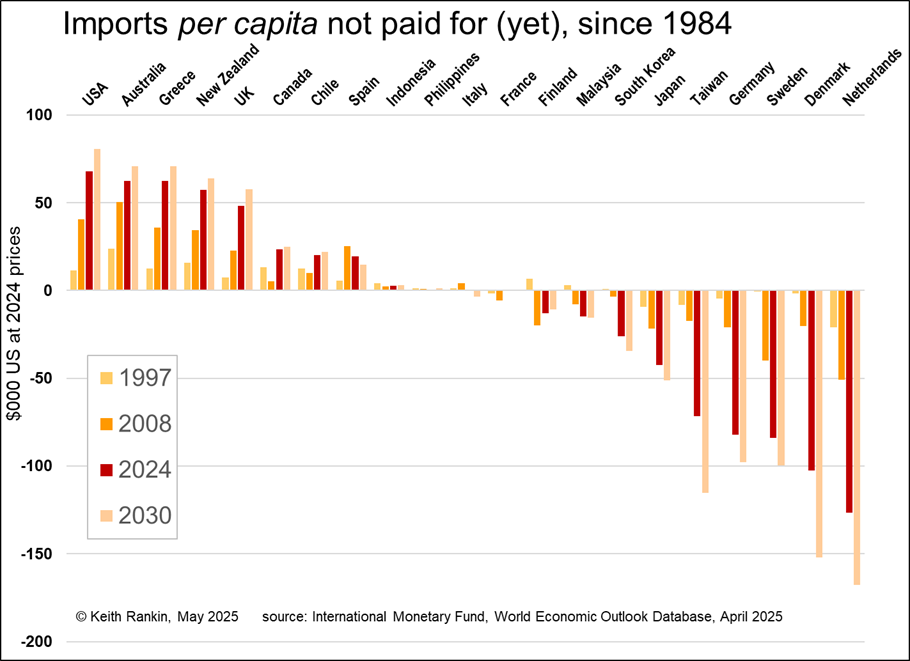
My chart and article yesterday (International Trade over time: gifts with strings, Evening Report, 8 May 2025) shows the accumulated ‘excess benefits’ of unbalanced global trade over the last forty years. The countries on the top-left-side of the chart are deficit/debtor countries; and the countries on the bottom-right-side are surplus/creditor countries. (The countries are selected on the basis of available ‘current account’ data from the IMF’s World Economic Outlook Database, April 2025, and as representatives of deficit and surplus countries. China, if on the chart, would belong close to Malaysia. The chart is made from my own calculations to adjust for inflation.)
The chart necessarily – because deficits must be financed elsewhere by surpluses – has a seesaw shape. Some countries are up, some countries are down; and some countries occupy the central pivot, neither up nor down. So long as some countries have consumed substantial amounts of stuff (imports) which they have not yet paid for (the deficit countries), some other countries (the surplus countries) have supplied stuff (exports) that they have not yet accepted payment for (and are unlikely to accept payment for in the imaginable future). Imports are paid for by exports.
It’s not a true seesaw, which is typically either grounded or horizontally balanced. We may think of it as a seesaw pivoting above a chasm. What is true is that if the downside goes further down – that is, if the surplus countries’ accumulated surpluses get bigger – then the upside (accumulated deficits) must go further up. The seesaw is a ‘system’, and the only alternative to the seesaw shape is system collapse, analogous to the whole seesaw breaking off its pivot and falling into the chasm.
Imports are paid for by exports. But many contracted payments are deferred, indeed to the point where the payments will never actually take place. Instead of receiving payment in the form of imports, the mercantilist surplus countries have gleefully accepted ‘promises’; effectively ‘IOUs’ (‘I owe you’). (These ‘financial promises’ or ‘financial assets’ are essentially bonds [ie credit], or titles [ie equity]; promises themselves can be bought and sold, and can appreciate or depreciate in market trading [including depreciating to zero]. Promises typically earn, for their owners, additional promises in the form of interest and dividends. Interest and dividends may be realised – that is, spent – on imports, or may be ‘compounded’ – another word for ‘accumulated’ – hence the concept of compound interest.) Technically, inflation exists when the particular promise that we call money depreciates in market value.
In a mercantilist world, all countries want to occupy the low ‘ground’ (ie a point below the seesaw pivot); they want to import less than they export, and to accumulate promises. In a stable world economy, so long as some countries insist on occupying the low ground, then some others must occupy the high ground.
The most obvious deficit countries in the chart – countries with an accumulation of enjoyed (or invested in new structures) but unpaid-for imports – are the United States, Australia, Greece, the United Kingdom, and New Zealand. (Another important deficit country is Türkiye, for which the data is not good enough, but would almost certainly have an accumulated ‘current account’ deficit of over $US100,000 per Turkish person.) These are the world’s ‘spendthrifts’.
The most obvious surplus countries in the chart are Taiwan, Germany, Sweden, Denmark, and the Netherlands. Indeed, the European Union – more than anywhere else, including China – is a mercantilist enterprise. (Further, the European Union is starting to look quite shabby, especially the countries just mentioned.) This is what Donald Trump means by the European Union ‘screwing’ the United States. (Refer EU was born to ‘screw’ US, Trump says, France24, 26 Feb 2025.)
Surplus/creditor nations (like Germany) do not want to settle; they want to compound, they want deficit/debtor nations (like Aotearoa New Zealand) to extend their liabilities. The mercantilist countries are content – indeed, more than content – for other countries to enjoy the fruits of their labour and their capital.
Just as the deficit countries are the world’s ‘spendthrifts’, the surplus countries are the world’s ‘misers’. The global economy maintains a successful equilibrium so long as the willing spendthrifts balance out the insistent misers.
US President Donald Trump raised a fist in defiance after an assassination attempt on his life in Pennsylvania, Saturday, July 13, 2024 (USEDST).
Donald Trump threatens to disturb that global equilibrium by saying – in effect – that he wants the United States to join the ‘miser club’; he says he wants his country to stop being screwed by the misers. The thing is, though, he probably doesn’t actually mean it. His natural proclivity is to spend, and to gamble. He’s a hedonist, not a puritan nor a thriftwad; his nature is neither parsimonious nor austere.
(I would rather Donald Trump than Friedrich Merz was United States’ president; and prefer the pragmatism of the United States and Australian Treasurers over the austere Nicola Willis or the United Kingdom’s brutally austere Rachel Reeves. In 2027, I am optimistic that, in office, NZ Labour’s Barbara Edmonds will be able to break away from the austere image of female Finance Ministers with whom we have become familiar – remember Ruthenasia; public austerity is an election-losing strategy, a generator of societal inequality and low morale.)
Nevertheless, Trump may be unintentionally breaking the world economy, on account of his – or his advisers’ (eg Peter Navarro) – weak understanding of it. If the surplus/creditor nations sought to spend their credits (except for spending in very small increments) they would: either bankrupt the debtor countries, creating systemic collapse; or, due to depreciating prices of assets being dumped onto financial markets, have to accept many fewer imports than they felt they were due. Financial promises work according to the use-it or lose-it rule.
The Great Depression
Parsimony, austerity, and mercantilism in the 1920s got us into the Great Depression of 1930 to 1934. (These were the core years of the Depression; the timing varies for different countries.) The Great Depression was a global event that occurred as a ‘race to the bottom’; almost all countries wanted to be below the pivot of the seesaw and none at the top. The United Kingdom – under Chancellor of the Exchequer, Winston Churchill – in particular was a deficit country that tried to push its side of the seesaw down through a process of internal devaluation (deflation) at a time when France, United States (under the curmudgeonly Coolidge), and Germany had anchored their side of the seesaw down. (At that time, Germany had been – thanks to post World War One reparations – forced onto the same downside of the seesaw. Churchill’s most specific action was the returning of the British pound to an unworkable restored Gold Standard at an overvalued exchange rate.)
(In the pre WW1 global environment, one of the most important balancing deficit/debtor countries was Russia. Russia seceded from the global capitalist system in 1917, largely as a result of the war. The loss of Russia’s pre-war presence – as a counterweight – was an aggravating factor in the Great Interwar Crisis.)
Deep Mercantilism
Donald Trump, while an overt mercantilist, is shallow in his convictions. He loves ‘money’, but he also loves what money can buy.
Deep mercantilists love money, and other financial assets (‘virtual gold’) including cryptocurrencies, in miserly ways; they believe in making money, not spending it. (Stereotypical new wave misers are young men, mining and trading in Bitcoin from bedrooms in the parents’ homes.) Through hoarding, they act to impede the global circulation of money, not to enable it.
Finance, as an academic discipline, is quintessentially mercantilist. It equates the accumulation and appreciation of financial assets – promises – with the creation of wealth; and that the wealthiest country in the world is the one with the fullest Treasury. And so many people – especially journalists – buy into that vision of wealth as a pile of treasure, as an accumulation of credits.
Modern mercantilists only regard mined gold as wealth, not gold still in the ground; and only promises that are tradeable, or at least potentially tradeable. Financial institutions regard your mortgage as their wealth; and they understand public debt to be private wealth; they buy and sell mortgages, along with other assets such as government debt.
And they believe in the magic of compound interest. They believe that unspent money – unsettled promises – grow exponentially and indefinitely. The seesaw chart, showing unpaid-for imports accumulated over 40 years, belies this. If the surplus nations all tried to spend their gold and their paper (and other virtual) riches – by becoming deficit countries, by shifting the seesaw into the alternate position – then they would find both that their ability to import from the present deficit/debtor countries would amount to less than the unpaid-for amounts shown in the chart – and they would find that many of their claims (ie promises) would be unrealisable.
As already noted, trade credits – promises – are accumulated on a ‘use-it or lose-it’ basis; this amounts to a negative form of compound interest. The surplus countries have not sufficiently used their credits; without realising it, their hoarded credits have already lost much of their initial purchasing capacity. While individual countries – especially small ones like Finland – may successfully shift from one side of the seesaw to the other, it is too late for the seesaw to swing without the surplus group of countries incurring heavy losses. The present deficit countries are simply not tooled up to produce masses of goods and services for export.
Private pension funds represent the epitome of deep mercantilism.
Deep mercantilism is not just about countries and international trade. A major feature of the next Great Depression will be the collapse of these funds, as far too many ‘first world’ people in their fifties and sixties seek to withdraw and spend their retirement savings. Thus, the next Great Depression will be one of stagflation – not 1930s’-style deflation – as there will be a rush of ‘Generation Jones’ people (born in the later 1950s and early 1960s) to spend their savings and finding that the global cupboard of goods and services is becoming bare.
Non-Mercantilism
Human wealth is actually the ‘factors of production’: people (simplistically construed as ‘labour’) and nature (simplistically construed as ‘land’) and structures [and inventories; and including intangible structures such as ‘knowledge’] (construed by economists true to their discipline as ‘capital’) and the enjoyable goods and services which flow to humans from these ‘factors’.
The next global Great Depression can be forestalled if the deficit countries (like United States and Aotearoa New Zealand) – the less-mercantilist countries, or at least the ‘unsuccessful’ would-be mercantilist countries – continue as net spenders, given that the substantial likelihood is that the prevalent mercantilist countries (like Germany and Sweden and Netherlands and China) are likely to at least try to persevere as accumulators of financial assets through the process of selling more goods than they buy.
Or the next Great Depression can be forestalled by most countries slowly moving, in concert, into a position of balance. Imagine each end of the seesaw neither up nor down, a horizontal seesaw on its pivot. Here countries like France, Italy, Indonesia and Philippines serve as examples.
Collapse and its prevention
Under prevailing mercantilist ideology, the best place for a country to be is on the downside of the seesaw. The biggest danger – the danger of system breakage – is that of the deficit countries trying to get their side of the seesaw down while the surplus countries are also trying to keep their side down. Any option of voluntary balance – of some countries trying to do what the majority are trying not to do – may forestall a global economic collapse; including a voluntary continuation of the present situation, with one group of countries happy to stay up while another group of countries want to stay down.
The irony is that the real winners are the alleged losers. For good reason, the seesaw chart shows these real-winner countries at the top rather than at the bottom. The real winners like to import, to enjoy their stuff; they do not pursue the mercantilist illusions of treasure hoards and compound interest.
Children understand that when one side of the seesaw is down, the other should be up. And that being up is fun. Will the adults learn what children already know?
*******
Keith Rankin (keith at rankin dot nz), trained as an economic historian, is a retired lecturer in Economics and Statistics. He lives in Auckland, New Zealand.
Source: United Kingdom – Executive Government & Departments
World news story
British High Commission Honiara celebrates VE Day 80 with Service
The ceremony involved wreath laying by invited guests, including the Governor General of Solomon Islands, His Excellency David Kapu and other dignitaries.
Wreaths laid to honour those who have sacrificed their lives for our freedoms today.
On Thursday 8 May, the British High Commission in Solomon Islands celebrated Victory in Europe (VE) Day 80 years on from when the Second World War ended in Europe.
Held at the High Commissioner’s official residence at Tanuli in Honiara, the ceremony involved the laying of wreathes by invited guests, including the Governor General of Solomon Islands, H.E David Kapu; Australian High Commissioner to Solomon Islands H.E Rod Hilton and his Acting Defence Advisor Bret Verity and New Zealand High Commissioner to Solomon Islands H.E Jonathan Curr.
Others included the Japanese Ambassador H.E Keiichi Higuchi; United States Chargée d’Affaires Ms Kristine Marsh, Reverend Wilfred Kekea from the Anglican Church of Melanesia; Westminster Foundation for Democracy Country Director Vatina Devesi; Rosalind Manekaea from the Guides and Joe Billy Oge from the Scout Movement.
Speaking at the service British High Commissioner to Solomon Islands and Non-Resident High Commissioner to Nauru, His Excellency Paul Turner said:
More than ever, it is important to remember and honour those who sacrificed their lives to fight fascism in Europe. The war in Ukraine and the unprovoked attack by Russia showed that peace and security in Europe and across the world was in a perilous state. Systems of international law and justice – which we had grown up with since the end of World War II – were now under attack from regimes such as the one in Russia.
The war in the Far East did not end until 15 August 1945, when Japan surrendered, which was celebrated across the world as ‘Victory over Japan’ (VJ Day). The 80th anniversary of VJ Day takes place on Friday 15 August 2025, commemorating the end of the Second World War.
The Second World War touched every aspect of life and had a devastating impact on those who experienced it, and for the generations after. From the sailors, soldiers and aviators who fought, to children who were evacuated, and all those who stepped into essential roles on the home front, we owe it to the Second World War generation who 80 years ago fought for our freedom and paid the ultimate sacrifice in giving generations lasting peace.
Through a series of national and local events, we unite to pay tribute to the millions of people across the UK and Commonwealth who served in the Second World War as well as echoing the same celebrations 80 years ago as the population welcomed the end of the war.
While VE and VJ Day 80 have been an opportunity for celebration, as it was across the streets of Britain in 1945, these commemorations were also one of the last opportunities to honour our living Second World War veterans.
There is also a younger generation for whom the events of the Second World War – the sacrifices made, and the reasons for them – seem like distant history. It will be a time for us to come together to listen to their stories and reflect on their values that ensured the Allied victory – service and selflessness across our nation.
In an increasingly uncertain and fragmented world, this anniversary has never been more important. It is only by learning from conflicts such as the Second World War and listening to their devastating effects from those who experienced them, that we bring to life the realities of war, especially for younger generations, so that they can learn about the horrors that it entailed and the sacrifices necessary to preserve peace and freedom.
This year is particularly poignant, as it is one of the last opportunities to honour the living Second World War veterans, who fought so hard to preserve peace and freedom that enables our shared way of life.
It is vital that we learn from their stories and ensure they are told to generations to come, in order that younger generations understand what they were fighting for and the horrors that conflicts on this scale can bring.
Source: Hong Kong Government special administrative region
A man who went missing in Tsuen Wan has been located.
Wong Kwun-wai, aged 27, went missing after he was last seen at Tsuen Wan West Station Public Transport Interchange on April 7 night. His family made a report to Police on April 10.
The man turned up at police station to cancel the missing person report on May 6 afternoon. He sustained no injuries and no suspicious circumstances were detected.
Source: The Conversation (Au and NZ) – By Andrew King, Associate Professor in Climate Science, ARC Centre of Excellence for 21st Century Weather, The University of Melbourne
This year, for many Australians, it feels like summer never left. The sunny days and warm nights have continued well into autumn. Even now, in May, it’s still unusually warm.
Much of the southern half of the continent is experiencing both unseasonable warmth and dry conditions. This is linked to persistent high atmospheric pressure (called “blocking”) to the south and southeast of Australia.
While temperatures will fall across southern Australia as we approach the winter solstice, early indications are that this winter will be a warm one. Rainfall predictions are less certain.
The extra warmth we’ve experienced raises obvious questions about the influence of human-caused climate change. The warming signal is clear and it’s a sign of things to come.
A warm and dry autumn for many
March and April brought unseasonal heat to much of Australia.
March was widely hot, with temperatures several degrees above normal across much of the country. But April’s heat was largely restricted to the southeast.
Australia had its hottest March on record and the heat has continued, especially in Victoria and parts of New South Wales. Bureau of Meteorology
Victoria had its warmest April on record, and parts of the state experienced temperatures more than 3°C above normal across both March and April.
Temperatures normally fall quite quickly over the southeast of Australia during April and May as the days shorten and the continent’s interior cools. But this year, southern Australia was unusually warm at the start of May. Some locations experienced days with maximum temperatures more than 10°C above normal for the time of year.
Records were broken in Hobart and parts of Melbourne, which had their warmest May nights since observations began.
The start of May saw daytime maximum temperatures across much of Australia well above average for the time of year. Bureau of Meteorology
While Queensland and the New South Wales coast have had very wet spells, including downpours from Tropical Cyclone Alfred at the start of March, other parts of Australia have been quite dry.
The area between Adelaide and Melbourne has been exceptionally dry. A drought is unfolding in the region after a severe lack of rainfall, with deficits stretching back over the past year or so. Western Tasmania is also suffering from a severe lack of rainfall since the start of autumn, although welcome rain fell in the past week.
And it’s not just on land that unusual heat has been observed. The seas around Australia have been warmer than normal, causing severe coral bleaching to the west and east of the continent, harmful algal blooms and other ecosystem disruptions.
Warm seas likely triggered the microalgal bloom in coastal waters of South Australia. Anthony Rowland
Blocking highs largely to blame
A high pressure system has dominated over the south and southeast of Australia over the past few months.
High pressure in the Tasman Sea can sometimes get stuck there for a few days. This leads to what’s known as “blocking”, when the usual passage of weather systems moving from west to east is obstructed. This can lock in weather patterns for several days or even a week.
Repeated blocking occurred this autumn. As winds move anticlockwise around high pressure systems in the Southern Hemisphere, blocking highs in the Tasman Sea can bring moist, onshore winds to the New South Wales and Queensland coasts, increasing rainfall. But such high pressure systems also bring drier conditions for the interior of the southeast and much of Victoria and South Australia.
Often, these high pressure systems also bring northerly winds to Victoria, and this can cause warmer conditions across much of the state.
High pressure systems also tend to bring more clear and sunny conditions, which increases daytime temperatures in particular. Air in high pressure systems moves down towards the surface and this process causes warming, too.
Australia sits between the Pacific and Indian Oceans and is subject to their variability, so we often look there to help explain what’s happening with Australia’s climate. In autumn though, our climate influences, such as the El Niño-Southern Oscillation and the Indian Ocean Dipole, are less active and have weaker relationships with Australian climate than at other times of year. Neither of these climate influences is in a strong phase at the moment.
A warm winter on the cards
One big question is how long the heat will last. In parts of southeast Australia, including Melbourne, average temperatures drop quickly at this time of year as we approach the winter solstice.
However, the seasonal outlook from the Bureau of Meteorology points to a high likelihood of a relatively warm winter.
Australians rarely escape having a winter without any significant cold spells, but the long-range forecast suggests we should anticipate above-normal temperatures on average. Both daytime maximum temperatures and nighttime minimum temperatures are expected to be above average generally this winter.
Climate and water long-range forecast, issued 1 May 2025 (Bureau of Meteorology)
Global warming is here
The elephant in the room is climate change. Human-caused climate change is increasing autumn temperatures and the frequency of late season heat events. As greenhouse gas emissions continue at a record pace, expect continued warming and a greater chance of autumn heatwaves in future.
The effect of climate change on rainfall is less clear though. For the vast majority of Australia, there is high uncertainty as to whether autumn will become wetter or drier as the world warms.
Andrew King receives funding from the ARC Centre of Excellence for 21st Century Weather and the National Environmental Science Program.
Source: Hong Kong Government special administrative region
A spokesman for the Transport Department (TD) today (May 9) said that the Government will, as always, be open to listen to the views of the taxi trade and a meeting is being arranged to maintain close communication, with a view to enhancing the service quality of personalised point-to-point transport.
“The Government’s policy objective has been very clear: taxi service has to be improved, online hailed car platforms have to be regulated while illegal hire car services have to be combated in accordance with the law. We will continue to combat the illegal carriage of passengers for hire or reward activities to safeguard the safety and interests of the public. We will maintain liaison with the taxi trade in parallel to set out the Government’s stance and work directions in detail, joining hands to offer ideas and suggestions on enhancing personalised point-to-point service,” the spokesman said.
Improvement of taxi service
The Government is determined to enhance the quality of taxi services and has put forward various measures in recent years through a multi-pronged approach. Among them, systematic management and technology have been introduced under the taxi fleet regime. The Government will also mandate taxis to provide e-payment means and install in-vehicle cameras, dash cameras and global navigation satellite systems in all taxi compartments through legislative amendments, thereby improving passengers’ riding experiences. Meanwhile, the Government has introduced the Taxi-Driver-Offence Points system and the two-tier penalty system to enhance the deterrent effect against illegal acts by taxi drivers. The taxi fleet operators are working intensively and the Government hopes that they will soon commence operations to provide quality taxi service.
Regulation of online hailed car platforms
The spokesman reiterated that, while the Government is open-minded in respect of the use of different communication technologies via online or mobile applications to obtain personalised point-to-point transport services through online hailing services, it is imperative to ensure that the passenger transport services supported by the use of the platforms concerned comply with the laws and regulations, thereby safeguarding the safety and interests of passengers.
The TD is conducting a study on the overall demand and supply of personalised point-to-point transport services. The Government will, after holistically considering the report of the Working Group for Enhancing Personalised Point-to-Point Transport Services under the Transport Advisory Committee and the views and relevant data collected, formulate legislative proposals on the regulation of online car hailing platforms, vehicles that may provide services complying with the regulations, and relevant licensing requirements for the drivers within 2025.
Combating illegal hire car services in accordance with the law
The spokesman stressed that the Government is determined to continuously combat the illegal carriage of passengers for hire or reward activities. The TD has again issued letters to warn various platform operators recently that their services must comply with relevant legislative provisions. Upon receipt of suspected cases, the TD will refer them to the Hong Kong Police Force (HKPF) for follow-up, subject to the situation.
The HKPF has been taking enforcement actions against illegal carriage of passengers for hire or reward through gathering intelligence via different channels. If there is sufficient evidence proving suspected vehicles without a valid hire car permit are being used for illegal carriage of passengers for hire or reward, the HKPF will immediately take appropriate enforcement actions. In addition, the Government is studying further improvements to the relevant legislation to strengthen efforts in combating illegal carriage of passengers for hire or reward, including disqualifying the driver concerned from driving. Furthermore, when sufficient evidence is available to show that the vehicle concerned has been involved in the offence of illegal carriage of passengers for hire or reward, it may be impounded even if the identity of the driver cannot be confirmed. The proposed legislative amendments will be submitted to the Legislative Council in due course.
Secretary-General of ASEAN, Dr. Kao Kim Hourn, today delivered pre-recorded remarks at the event on “Unlocking Energy Transition Finance towards Inclusivity and Sustainability in ASEAN,” jointly organised by the ASEAN Centre for Energy (ACE) and the Permanent Mission of Malaysia to ASEAN. The event serves as a platform for dialogue and collaboration among ASEAN Member States, Dialogue Partners, and relevant stakeholders in advancing energy transition finance, including initiatives such as power grid interconnection. In his remarks, SG Dr. Kao underscored ASEAN’s commitment to mobilising finance for energy transition to ensure affordable, reliable, and sustainable energy access for all, while contributing to the region’s efforts in reducing carbon emissions and realising global climate goals. He further emphasised the importance of working together to pool resources, harmonise standards, and co-develop financing solutions that are scalable, inclusive, and tailored to the region’s specific needs.
The post Secretary-General of ASEAN delivers pre-recorded remarks at the event on ”Unlocking Energy Transition Finance towards Inclusivity and Sustainability in ASEAN” appeared first on ASEAN Main Portal.
As a global leader in technology and innovation, Samsung Electronics aims to create working environments that allow every employee to advance themselves personally and professionally. Guided by their diverse backgrounds, perspectives and passions, Samsung employees around the world are shaping their own unique paths at the company.
With the aim of showcasing these paths, Samsung Newsroom conducted video interviews of some of its many inspiring leaders around the world. Watch the full video below to hear their inspiring stories:
Tips for Those on Their Journeys
Deborah Honig is the first ever Chief Customer Officer at Samsung Electronics U.K., a role that’s all about putting the customer at the center of Samsung’s offerings and bringing the strength of the company’s ecosystem together across B2B and B2C sales channels.
A proud Canadian and sports fanatic, Honig was inspired by her father, who was an airplane engineer. When Honig was a child, he would take her to his workplace, where she had the opportunity to witness industries that were pushing the boundaries firsthand. This marked the beginning of her interest in technology. Now, she is proud to be part of Samsung’s drive for innovation and is excited to be part of the journey to bring AI technology to users.
Honig is driven by the mantra, “power the possible.” To her, this means inspiring the best work in herself and in her team and is rooted in the belief that Samsung products help people live better lives. Her advice to others on their journey is, “Build your own tribe. Never underestimate the power of your network to lean on when you need coaching, inspiration or advice.”
In a hybrid role consisting of engineering, management and consultant responsibilities, Shin-Chul Baik leads a team of 50 engineers tasked with maintaining the cybersecurity of Samsung devices, including smartphones, tablets, TVs and home appliances.
Baik knew he would become an engineer from a young age and has worked consistently throughout his career to combine that strong technical foundation with expertise in business operations and interpersonal communications. The breadth and dynamism of Samsung has provided key opportunities in this regard, in addition to the company’s education program supporting him in achieving various security qualifications.
To get ahead, he recommends the following approach, “Aspire to jump to the next curve. But keep your head down and grind in the meantime. It’s about the journey of getting through the process, and grabbing the opportunity to jump to the next curve.”
Nguyen Thi Bich Hanh leads a team of nearly 100 engineers at Samsung R&D Center Vietnam, which works in mobile product development areas like performance improvement, memory optimization and software compliance. Her primary role involves overseeing project development, managing human resources, collaborating with cross-functional teams, and ensuring adherence to Samsung’s internal processes.
Her journey began back in high school, where she was amazed at how quickly code produced results and the creative opportunities it offered. This led to her attending one of Vietnam’s premier technology universities and then her position at Samsung, which has shown her how the company fosters personal growth by creating a positive environment and offering numerous training programs.
Her advice to the world is, “Think differently. Always question how to improve the current state and never stop learning. If you encounter a challenge, do not be afraid to embrace it or to make mistakes. Figure out what you truly desire, believe in yourself, and work to transform every setback into an opportunity for growth.”
Camila Andrea Segura Rodriguez leads the marketing team for Home Appliances at Samsung Colombia, which is a role that involves developing effective product communication strategies to impact potential customers while closely collaborating with other teams.
As someone who was drawn to creativity since childhood, she wanted to develop a career that allowed her to express her creativity and imagination, which is exactly what she found in her first internship at a creative agency. Since joining Samsung, her journey has led to an appreciation for the dynamic work environment and the opportunities to grow professionally, particularly the provision of development tools like the Leadership Incubator.
When asked for her tips she would share with others, she says, “Stay true to yourself while continuously nurturing your growth with diverse people, opinions and experiences. Surrounding yourself with different voices challenges your thinking, sparks creativity and helps you evolve. Embrace change, stay open to learning, stay grounded in your values, and let both your uniqueness and the richness of diversity shape your journey.”
Daniel Harvie is Head of the TV/AV business for Samsung in the U.K. & Ireland — a role in which he leads a large team across sales, marketing and product — with the core responsibilities of working with channel partners, creating consumer demand and managing the supply chain.
The path that led to Harvie’s career at Samsung was certainly a unique one, since his childhood was rooted in competitive sport before he moved on to majoring in music and the performing arts at university and eventually pivoted to consumer technology. He credits his broad skillset to this varied background and believes his story is a testament to how different life experiences can bring value to a company. In terms of career growth, Samsung has provided him with the opportunity to develop expertise across multiple European markets and a better understanding of global strategy, including formal leadership development programs.
His advice to others on their Samsung journey is, “Firstly, be open-minded, always be willing to learn from new experiences and challenges you face, and take on different perspectives. Secondly, carry with you an optimistic mindset. Optimism, with a healthy dose of realism, is a proven force multiplier and massively increases your ability to see opportunity, to be solutions focused and to galvanize people around ambitious goals.”
Roopa Sheshadri Kotiganahally is a Director at Samsung R&D Institute India-Bangalore, where she leads the development of cutting-edge Galaxy device features powered by AI/machine learning (ML). Her team focuses on leveraging the power of computer vision, deep learning and generative AI paradigms to enhance photo and video experiences. Her position allows her to pursue her dream of working in tech — which began when she first became fixated on computers in high school — all while collaborating and sharing knowledge with a large team of talented professionals who push and grow alongside each other.
During her career at Samsung, Kotiganahally has found that the company fosters a culture of innovation and continuous learning. For her, the IIMB Thought Leader Program and AI postgraduate programs have been particularly beneficial, as they have allowed her to expand her knowledge of AI and its applications in the mobile domain.
Kotiganahally’s advice for others on their journey is, “Embrace curiosity and a lifelong love for learning. Don’t be afraid to explore new ideas and challenge the status quo. Believe in your potential and pursue your passions with dedication and perseverance, because the innovation journey is an ongoing one, and every step — every challenge — brings valuable learning experiences.”
Joy Amaka Tim-Ayoola is responsible for leading a mobile experience team at Samsung Electronics West Africa, a role that involves setting goals and sales strategies to address market realities, with the ultimate goal of driving revenue.
As a child, she envisioned herself as a solution provider, driven by her curiosity about the world’s challenges and how to tackle them, which led to an interest and career in technology. As she grew a little older, technology began to boom in Nigeria, and in that time she began to understand that one person could solve complex issues through programming. It is this recognition and desire to solve problems that led to her choosing a career in information technology. At Samsung, Tim-Ayoola feels she has been provided with the opportunity to combine her academic and career experiences to tackle real world challenges, thereby realizing her original dream of solving problems for others through technology.
Her advice to the world is, “Be purposeful! Be intentional in what you believe, embrace change as a catalyst for growth. Have a good supportive network.”
Source: Hong Kong Government special administrative region
The following is issued on behalf of the Hong Kong Monetary Authority:
The Hong Kong Monetary Authority (HKMA) announced today (May 8) that the official foreign currency reserve assets of Hong Kong amounted to US$408.7 billion as at the end of April 2025 (end-March 2025: US$412.5 billion) (Annex).
Including unsettled foreign exchange contracts, the foreign currency reserve assets of Hong Kong at the end of April 2025 amounted to US$407.9 billion (end-March 2025: US$411.9 billion).
The total foreign currency reserve assets of US$408.7 billion represent over five times the currency in circulation or about 36 per cent of Hong Kong dollar M3.
****
At present, four press releases relating to the Exchange Fund’s data are issued by the HKMA each month. Three of these releases are issued to disseminate monetary data in accordance with International Monetary Fund’s Special Data Dissemination Standard (SDDS). The fourth press release, on the Exchange Fund’s Abridged Balance Sheet and Currency Board Account, is made in accordance with the HKMA’s policy of maintaining a high level of transparency. For the month of May 2025, the scheduled dates for issuing the press releases are as follows:
Source: Hong Kong Government special administrative region
Fraudulent websites and internet banking login screens related to The Bank of East Asia, Limited The HKMA wishes to remind the public that banks will not send SMS or emails with embedded hyperlinks which direct them to the banks’ websites to carry out transactions. They will not ask customers for sensitive personal information, such as login passwords or one-time password, by phone, email or SMS (including via embedded hyperlinks).
Anyone who has provided his or her personal information, or who has conducted any financial transactions, through or in response to the websites or login screens concerned, should contact the bank using the contact information provided in the press release, and report the matter to the Police by contacting the Crime Wing Information Centre of the Hong Kong Police Force at 2860 5012. Issued at HKT 16:45
Source: Hong Kong Government special administrative region
Attention TV/radio announcers:
Please broadcast the following as soon as possible:
Here is an item of interest to swimmers.
The Leisure and Cultural Services Department announced today (May 8) that due to big waves, red flags have been hoisted at Stanley Main Beach, Shek O Beach and Big Wave Bay Beach in Southern District, Hong Kong Island; and Silverstrand Beach and Clear Water Bay Second Beach in Sai Kung District. Beachgoers are advised not to swim at these beaches.
Source: Hong Kong Government special administrative region
The Transport Department (TD) announced today (May 9) that the HKeToll website (www.hketoll.gov.hk), mobile app and electronic notification services will be temporarily suspended from 2am to 8am on May 11 (Sunday) for system maintenance.
A spokesman for the TD said that, during system maintenance, motorists can use government tolled tunnels and the Tsing Sha Control Area as usual. The HKeToll system will record the actual passage time of vehicles and charge the corresponding tolls accordingly. Notwithstanding, the services of checking toll transactions, making payments, or topping up their designated stored value accounts via the users’ accounts will be temporarily suspended.
The TD will steer the system maintenance contractor and toll service provider to complete the necessary work as soon as possible, and make announcements after services resume as normal. Upon completion of system maintenance, the system will process the toll transactions recorded during the maintenance period and resume the electronic notification services. Users may also log in to their account for transaction details upon service resumption.
Users are advised to arrange payments and top-ups in advance if needed. For enquiries, please call the 24-hour service hotline at 3853 7333.
Source: Hong Kong Government special administrative region
United Nations Sanctions (Haiti) (Amendment) Regulation 2025 gazetted “The Amendment Regulation amends the United Nations Sanctions (Haiti) Regulation to give effect to certain decisions relating to sanctions in the United Nations Security Council (UNSC) Resolution 2752 in respect of Haiti,” a Government spokesman said.
The amendments renew the travel ban and financial sanctions, and revise the time-limited arms embargo requirements.
The Hong Kong Special Administrative Region Government has all along been implementing fully the sanctions imposed by the UNSC. The Amendment Regulation aims to give effect to the instructions by the Ministry of Foreign Affairs for fulfilling the international obligations of the People’s Republic of China as a Member State of the United Nations. Issued at HKT 11:00
Chief Executive John Lee will lead a delegation on a visit to Kuwait and Qatar. Hong Kong General Chamber of Commerce Chairman Agnes Chan, who will join the delegation, noted that both are high income Middle Eastern countries with a young population, indicating strong spending power.
“For the past decade, they have focused on the traditional oil and gas industry. Now, they are diversifying into technology and wealth management, areas in which they seek improvement. This is why a government-led visit to these countries is significant.
“As an international financial centre, Hong Kong aims to leverage this visit to promote itself as the primary listing hub for Middle Eastern firms.”
She added that the major chambers of commerce joining the trip are hoping to play a role at the business level by facilitating networking events and providing market insights for firms to exchange views on business practices, while for their part, the enterprises must fully understand the local culture, regulatory frameworks and investment strategies of the various locations.
Ms Chan also suggested increasing direct flights between Hong Kong and major Middle Eastern cities to reduce travel time and enhance exchanges between the two regions.
The Japan Fund for Prosperous and Resilient Asia and the Pacific (JFPR) is the largest single-partner trust fund in the Asian Development Bank. JFPR has been a steadfast partner in aiding developing member countries and the region recover from crises and disasters.
CALGARY, Alberta, May 08, 2025 (GLOBE NEWSWIRE) — Cenovus Energy Inc. (TSX: CVE) (NYSE: CVE) held its annual meeting of shareholders on May 8, 2025. Each matter voted on is described in greater detail in the Corporation’s 2025 Management Information Circular dated March 12, 2025.
Shareholders voted as follows on the matters before the meeting:
Appointment of Auditor
PricewaterhouseCoopers LLP, Chartered Professional Accountants, was reappointed as auditor of the Corporation.
Votes for
Votes withheld
Number
Percent
Number
Percent
1,479,069,159
99.58
6,198,457
0.42
Election of Directors
Each of the following 14 nominees proposed by management were elected directors of the Corporation:
Nominee
Votes for
Votes against
Number
Percent
Number
Percent
Stephen E. Bradley
1,436,654,782
99.47
7,633,157
0.53
Keith M. Casey
1,433,735,075
99.27
10,553,916
0.73
Michael J. Crothers
1,433,314,572
99.24
10,975,197
0.76
James D. Girgulis
1,437,307,360
99.52
6,982,411
0.48
Jane E. Kinney
1,431,229,021
99.10
13,059,246
0.90
Eva L. Kwok
1,426,200,877
98.75
18,086,892
1.25
Melanie A. Little
1,432,129,625
99.16
12,159,363
0.84
Richard J. Marcogliese
1,429,056,098
98.95
15,233,673
1.05
Chana L. Martineau
1,437,677,888
99.54
6,611,881
0.46
Jonathan M. McKenzie
1,433,520,858
99.25
10,766,914
0.75
Claude Mongeau
1,408,344,566
97.51
35,944,425
2.49
Alexander J. Pourbaix
1,417,365,414
98.14
26,924,356
1.86
Frank J. Sixt
1,154,291,947
79.92
289,997,821
20.08
Rhonda I. Zygocki
1,419,942,305
98.31
24,347,463
1.69
Cenovus welcomes Chana Martineau to the Board of Directors. Ms. Martineau is the Chief Executive Officer of the Alberta Indigenous Opportunities Corporation, and brings more than 30 years of financial strategy and management experience to the Board.
As part of Cenovus’s leadership succession plan, effective at the conclusion of the 2025 annual meeting of shareholders, Alex Pourbaix moved to the role of non-independent Chair of the Board of Directors. Claude Mongeau continues in the role of Lead Independent Director.
Non-Binding Advisory Vote on the Corporation’s Approach to Executive Compensation
An advisory resolution was passed to accept the Corporation’s approach to executive compensation.
Votes for
Votes against
Number
Percent
Number
Percent
1,405,612,741
97.32
38,667,029
2.68
Cenovus Energy Inc.
Cenovus Energy Inc. is an integrated energy company with oil and natural gas production operations in Canada and the Asia Pacific region, and upgrading, refining and marketing operations in Canada and the United States. The company is committed to maximizing value by developing its assets in a safe, responsible and cost-efficient manner, integrating environmental, social and governance considerations into its business plans. Cenovus common shares and warrants are listed on the Toronto and New York stock exchanges, and the company’s preferred shares are listed on the Toronto Stock Exchange. For more information, visit cenovus.com.
ER Report: Here is a summary of significant articles published on EveningReport.nz on May 9, 2025.
What is grounding and could it improve my sleep? Here’s the science behind this TikTok trend Source: The Conversation (Au and NZ) – By Dean J. Miller, Senior Lecturer, Appleton Institute, HealthWise Research Group, CQUniversity Australia Alexey Demidov/Pexels Have you ever felt an unexpected sense of calm while walking barefoot on grass? Or noticed your stress begin to fade as you stood ankle deep in the ocean? If so, you may
Google is rolling out its Gemini AI chatbot to kids under 13. It’s a risky move Source: The Conversation (Au and NZ) – By Lisa M. Given, Professor of Information Sciences & Director, Social Change Enabling Impact Platform, RMIT University Studio Nut/Shutterstock Google has announced it will roll out its Gemini artificial intelligence (AI) chatbot to children under the age of 13. While the launch starts within the next week in
PNG’s Gorethy Kenneth: 23 years of fearless journalism and unwavering truth PROFILE: By Alu J Kalinoe At Papua New Guinea’s Post-Courier, our senior journalists often operate in the shadows, yet their courageous efforts are often overlooked — continuously pushing boundaries to bring us important stories that shape our lives and venturing outside their comfort zones to deliver top-notch content. This is the tale of one of
‘Peace be with all of you’: how Pope Leo XIV embodies a living dialogue between tradition and modernity Source: The Conversation (Au and NZ) – By Darius von Guttner Sporzynski, Historian, Australian Catholic University When Robert Francis Prevost appeared on the loggia of St Peter’s Basilica as Pope Leo XIV, he set three precedents. He is the first pope from North America, the first Augustinian to occupy the throne of Peter, and the
Experts split on Australia’s Papua New Guinea military recruitment plan By Caleb Fotheringham, RNZ Pacific journalist Australia’s plan to recruit from Papua New Guinea for its Defence Force raises “major ethical concerns”, according to the Australia Defence Association, while another expert thinks it is broadly a good idea. The two nations are set to begin negotiating a new defence treaty that is expected to see
Hidden connections of more than 100 migratory marine species revealed in interactive map Source: The Conversation (Au and NZ) – By Lily Bentley, Postdoctoral Research Fellow, School of the Environment, The University of Queensland Wirestock Creators/Shutterstock From the enormous blue whale to the delicate monarch butterfly, animals of all shapes and sizes migrate across the globe. These migrations connect distant habitats, from the tropics to the poles. They
As Filipinos prepare to vote, ex-strongman Rodrigo Duterte’s arrest is dividing families – all the way to the president Source: The Conversation (Au and NZ) – By Noel Morada, Visiting Professor, Nelson Mandela Centre, Chulalongkorn University; and Research Fellow, Asia Pacific Centre for the Responsibility to Protect, Chulalongkorn University It’s been two months since former Philippines President Rodrigo Duterte was arrested and handed over to the International Criminal Court (ICC) to face potential prosecution
How the word ‘incel’ got away from us Source: The Conversation (Au and NZ) – By Farid Zaid, Senior Lecturer, Psychology, Monash University Javier Bermudez Zayas/Shutterstock Imagine a young man whose voice has been worn down by years of feeling invisible. Plain, numb and bitter, the “incel” tries to explain the kind of hopelessness most of us would rather not confront: I believed
Kiwi kids once led the world in reading – this 1950s primary school syllabus still has lessons for today Source: The Conversation (Au and NZ) – By Ruth Boyask, Director of LitPlus, AUT School of Education, Auckland University of Technology Getty Images There is a well-known whakatauki (Māori proverb) that goes: “Ka mua, ka muri” – “walking backwards into the future”. It applies to many areas of life, but in education the idea of
Some Reddit users just love to disagree, new AI-powered troll-spotting algorithm finds Source: The Conversation (Au and NZ) – By Marian-Andrei Rizoiu, Associate Professor in Behavioral Data Science, University of Technology Sydney ginger_polina_bublik/Shutterstock In today’s fractured online landscape, it is harder than ever to identify harmful actors such as trolls and misinformation spreaders. Often, efforts to spot malicious accounts focus on analysing what they say. However, our
To split Moscow from Beijing, Trump is reviving Nixon’s ‘madman diplomacy’. It could backfire badly Source: The Conversation (Au and NZ) – By Ian Langford, Executive Director, Security & Defence PLuS and Professor, UNSW Sydney When United States President William McKinley advocated high‑tariff protectionism in 1896, he argued squeezing foreign competitors behind a 50% wall of duties would make America richer and safer. That logic framed US trade debates for
A community-led health program in remote Arnhem land is showing promising results for First Nations locals Source: The Conversation (Au and NZ) – By Hasthi Dissanayake, Research Fellow in Indigenous Health, The University of Melbourne The Doherty Institute Indigenous Australians are more than twice as likely as non-Indigenous Australians to suffer from disease, particularly chronic diseases such as diabetes, heart disease and kidney disease. The health disparities are worse in remote
Why it’s important to read aloud to your kids – even after they can read themselves Source: The Conversation (Au and NZ) – By Robyn Cox, Professor of Literacy Education, University of Tasmania Mart Production/Pexels , CC BY Is reading to your kids a bedtime ritual in your home? For many of us, it will be a visceral memory of our own childhoods. Or of the time raising now grown-up children.
Old drains and railways are full of life. Here’s how to make the most of these overlooked green spaces Source: The Conversation (Au and NZ) – By Hugh Stanford, Researcher Associate, Centre for Urban Research, RMIT University Much of the old circular railway line in Paris, La Petite Ceinture, or Little Belt, has been turned into a public park. ldgfr photos, Shutterstock Across Australian cities, leftover and overlooked green spaces are everywhere. Just think
Ever wanted to ditch the 9-to-5 and teach snowsports? We followed people who did it for 10 years Source: The Conversation (Au and NZ) – By Marian Makkar, Senior Lecturer in Marketing, RMIT University Konstantin Shishkin/Shutterstock Workplace burnout – a state of emotional, physical, and mental exhaustion – and the COVID pandemic have sparked a rethink of the traditional 9-to-5 job. It’s been estimated 30% of the Australian workforce is experiencing some degree
Stepmums, alien mums, robot mums, vengeful mums: 7 films to watch this Mother’s Day Source: The Conversation (Au and NZ) – By Jessica Gildersleeve, Professor of English Literature, University of Southern Queensland With Mother’s Day around the corner, you may be wondering what gift you’ll give mum – or any of the mums in your life. This year, why not skip the fancy dinner and offer one of the
Fiji media’s Stan Simpson blasts ‘hypocrites’ in social media clash over press freedom Pacific Media Watch Barely hours after being guest speaker at the University of the South Pacific‘s annual World Press Freedom Day event this week, Fiji media industry stalwart Stanley Simpson was forced to fend off local trolls whom he described as “hypocrites”. “Attacked by both the Fiji Labour Party and ex-FijiFirst MPs in just one
Politics with Michelle Grattan: David Pocock wants us to aim for up to 90% reduction in emissions by 2035 Source: The Conversation (Au and NZ) – By Michelle Grattan, Professorial Fellow, University of Canberra In the new parliament the government is expected to need only the Greens to pass the legislation opposed by the Coalition. Counting is not finished but on present indications it won’t require any other Senate crossbenchers. Given Labor’s enhanced position
Source: People’s Republic of China in Russian – People’s Republic of China in Russian –
Source: People’s Republic of China – State Council News
From May 7 to 10, at the invitation of Russian President Vladimir Putin, Chinese President Xi Jinping will pay a state visit to Russia and take part in celebrations in Moscow to mark the 80th anniversary of the Soviet Union’s victory in the Great Patriotic War.
At a special key historical moment, the energetic and skillful diplomacy of the great powers and three key words attract special public attention.
Stability
How great powers get along with each other has become a major theme in international relations. As instability in the international environment increases, the world looks to great powers to provide stability and positive energy.
“History and reality have clearly shown us that China and Russia are good neighbors who cannot distance themselves from each other, and true friends who share sorrows and hardships, support each other and develop together,” President Xi Jinping emphasized in a telephone conversation with President Putin in February this year.
Good neighbors and true friends, possessing powerful inner impulses based on deep historical logic.
Regarding bilateral relations, it should be noted that the two countries “adhere to strengthening and developing bilateral relations based on the principles of non-alignment, non-confrontation and non-targeting of third parties” and “form a new type of relations between great powers based on mutual respect, peaceful coexistence and win-win cooperation.”
From a global perspective, China and Russia are the largest neighboring countries. They are also two world powers that are permanent members of the UN Security Council. They bear a special responsibility for maintaining and developing peace throughout the world. And their friendly relations and the achievement of mutual goals contribute to the development of a multipolar world and the democratization of international relations.
Reflecting on the past in light of the present, it can be noted that in the context of international turbulence, the key to the smooth development of Sino-Russian relations has become “finding the right way to coexist”, and “this not only meets the fundamental interests of the two countries and two peoples, but also contributes to peace, stability and prosperity of the region and the whole world.”
Sense of history
This year has special historical significance.
May 9 marks the 80th anniversary of the Soviet Union’s victory in the Great Patriotic War, and September 3 marks the 80th anniversary of the Chinese people’s victory in the War of Resistance Against Japanese Aggression. These two anniversaries and two major battlefields together lead to the 80th anniversary of the Victory in the World Anti-Fascist War.
80 years ago, when Asia and Europe were the two main battlefields of World War II, China and Russia made enormous sacrifices and significant historical contributions to ensuring victory in the world anti-fascist war and saving peoples from destruction, as well as the future of all mankind.
It was not easy to achieve victory and peace, nor was it easy to establish the post-war international order.
“If we lose the memory of history, our minds will be lost in darkness,” Chinese President Xi Jinping once quoted the famous words of renowned Russian historian Klyuchevsky, thereby expressing his determination to preserve historical memory and uphold peace.
In May 2015, Chinese President Xi Jinping was invited to Moscow to participate in celebrations of the 70th anniversary of Victory in the Great Patriotic War. In September of the same year, a conference was held in Beijing dedicated to the 70th anniversary of the Victory in the War of Resistance against Japanese Aggression and the Victory in the World Anti-Fascist War.
And now, ten years have passed unnoticed. Today, when the world stands at the crossroads of history, China and Russia support each other in holding events dedicated to the 80th anniversary of the Victory in the World Anti-Fascist War, promoting an accurate view of the history of World War II, preserving the results of World War II and the post-war international order, and defending international justice.
The concept of order
Today’s world has been shaped by history.
It was on the basis of the Great Victory won 80 years ago that China and Russia, together with other major members of the anti-fascist alliance, discussed the establishment of the UN and jointly drafted a number of important international documents such as the UN Charter, which laid the foundations of the modern international order and established the basic rules of international relations.
Peace rather than war, cooperation rather than confrontation, win-win rather than zero-sum – all this has become a powerful historical trend.
“In this world, the degree of interconnectedness and interdependence of various countries has never been so profound. Humanity lives in one global village, in one time and space, where history and reality intersect, increasingly becoming a community of a common destiny, close and inseparable,” so in March 2013, Chinese President Xi Jinping gave the world the first interpretation of the concept of a community of a common destiny at the Moscow State Institute of International Relations (MGIMO MFA of Russia).
Great power diplomacy aimed at long-term planning and far-reaching results.
When turbulence intensifies, we must stand firmly on the right side of history, “resolutely oppose the attacks and actions that deny, distort and falsify the history of World War II,” and “jointly defend the outcome of World War II and international justice.”
When the “countercurrent” starts to bubble up, we must unwaveringly stand by the progress of human civilization. “Practice genuine multilateralism, promote an equitable and orderly multipolar world, comprehensive economic globalization, jointly implement the global development initiative, the global security initiative and the global civilization initiative, and work together to build a community with a shared future for mankind.”
It is the sacred duty of China and Russia to guide global governance in the right direction.
“China and Russia should take this as an opportunity to jointly safeguard the international system with the UN as its core and the legacy of World War II, and promote all countries to uphold the purposes and principles of the UN Charter, adhere to the universally recognized norms of international relations, and practice genuine multilateralism,” Chinese President Xi Jinping emphasized during video conference talks with President Vladimir Putin in January this year.
Source: People’s Republic of China in Russian – People’s Republic of China in Russian –
Source: People’s Republic of China – State Council News
Brest /Belarus/, May 9 /Xinhua/ — The Chinese are the first among tourists from far abroad to visit the Brest Fortress in Belarus. This was recently stated to journalists by the director of the memorial complex “Brest Hero Fortress” Alexander Korkotadze during a press tour of media representatives of the EAEU and CIS countries.
“Among the countries of the far abroad, China ranks first in the number of tourists who visit the memorial complex “Brest Hero Fortress”. We see a trend towards an increase in tourist flow from China,” he said.
A. Korkotadze also noted that in 2024, an exhibition about the defense of the Brest Fortress was opened at the Memorial Museum of the Chinese People’s War of Resistance against Japanese Aggressors in Beijing, and this year a return exhibition is planned at the Brest Fortress, dedicated to the 80th anniversary of the victory in World War II over militarist Japan.
In addition, according to him, the fortress has been visited more in recent years. Families come here from all corners of the former Soviet Union. Over 125 thousand people visited the memorial in the first 4 months of 2025.
“We have conducted more than 3,700 excursions, and tourists from more than 10 countries have already visited our memorial this year. And this is despite the sanctions, despite the fact that they are trying to cancel the role of the Soviet Union in the victory over fascism and hush it up. But people from European countries, from the USA, from Latin America, from Africa, from Asia come to us and receive the most truthful information here. Apparently, they come to us for the truth,” said A. Korkotadze. -0-
Source: People’s Republic of China – State Council News
Senior Colonel Zhang Xiaogang, spokesperson for the Ministry of National Defense (MND) of the People’s Republic of China (PRC), answers recent media queries concerning the military on May 8, 2025. [Photo/mod.gov.cn]
A Chinese defense spokesperson on Thursday said the United States’ attempts to turn the Asia-Pacific region into a “powder keg” seriously undermine the security and well-being of the people in the region.
Zhang Xiaogang, a spokesperson for the Ministry of National Defense, made the remarks in response to a question about the U.S. Defense Secretary’s call to deter China in the Indo-Pacific region and about U.S. plans to establish a major military facility in the Philippines for storage of weapons and logistics supplies.
The U.S. repeatedly uses China as a pretext to maintain its hegemony and it is attempting to turn the Asia-Pacific into a “powder keg,” putting relevant countries at risk, Zhang said, noting that such moves significantly harm the security and well-being of the people and countries in the region.
“Facts have repeatedly proven that it is dangerous to be America’s enemy, but to be its friend may be fatal,” Zhang said, adding that relevant countries are advised against inviting troubles and becoming others’ pawns, which would undermine the hard-won peace and stability in the region.
Source: People’s Republic of China – State Council News
Shanghai’s dynamic business hub is radiating confidence and vitality. In a new World Bank survey of 2,189 Chinese firms, Shanghai stood out with 22 business environment indicators ranking among the world’s top performers, more than any other city measured.
The latest World Bank Enterprise Survey, conducted from January 2024 to February 2025, found that Shanghai leads the world in categories from power reliability to electronic payments. This haul even outshines Singapore, which had 10 top-tier indicators in an earlier assessment.
The World Bank introduced the Business Ready (B-READY) Report in May 2023, which is a new approach that draws on a data collection process that includes specially tailored expert questionnaires and firm-level surveys.
According to the survey, China’s overall enterprise survey scores were quite strong, exceeding the median of 103 economies in six out of eight topic areas, including commercial dispute resolution, taxation, financial services and international trade.
Notably, among the 59 indicators used in B-READY, China achieved global top-tier performance in 12 indicators, including e-payments, electricity access and workforce training. Additionally, the country reached global advanced standards in areas such as construction permits, water supply, internet connectivity, and innovation.
According to Elaine Chen, a partner at PwC China, which conducted the survey, Chinese firms demonstrated exceptional time efficiency, with VAT refunds processed in just one week and trade clearance time (3 days for exports, 10 for imports, on average) outperforming regional peers.
“China’s strong results will be a reference to the World Bank’s final evaluation in September,” Chen noted.
As an outstanding performer, Shanghai’s 22 world-best indicators span a broad array of business concerns. Regarding the reliability of electricity supply, the city’s enterprises reported zero power outages in the past year. Regarding access to financial services, Shanghai achieved zero transaction costs for electronic payments.
Shanghai also reported perfect scores in commercial mediation (100), customs satisfaction (99.13), and internet provider flexibility (96.2). Beyond these, the metropolis scored at or near global best practice on measures such as tax processing speed, loan approvals, and internet stability, reflecting its advanced regulatory framework and commitment to efficiency.
What lies behind these numbers is a vigorous push to modernize the city’s business environment. Many of Shanghai’s reforms in recent years have directly targeted the pain points that the World Bank survey measures. For example, the city enacted in 2016 a regulation on power supply and utilization that requires utility companies to fix outages within an hour.
The findings underscore Shanghai’s success in aligning with international standards, streamlining regulations, and enhancing public services — a testament to China’s broader strides in cultivating a business-friendly environment, said Luo Peixin, vice president of East China University of Political Science and Law.
Luo highlighted Shanghai’s institutional reforms as key drivers of progress. “Shanghai’s model offers a blueprint for nationwide improvements.”
After years of steadfast reform, Shanghai has made the business environment a top priority since 2018, when Shanghai launched its first annual action plan of business climate reforms.
Every year since then, the Shanghai municipal government convened a high-profile conference on optimizing the business environment to announce new measures. These action plans have so far introduced over 1,100 specific reform tasks and measures.
Luo noted that by driving institutional reforms and optimizing working methods, Shanghai can further enhance corporate satisfaction and sense of gain.
JAKARTA, 8 May 2025 – ASEAN and New Zealand reaffirmed commitment to strengthening their partnership and deepening cooperation at the 13th ASEAN-New Zealand Joint Cooperation Committee (ANZJCC) Meeting, held today at the ASEAN Headquarters/ASEAN Secretariat.
The meeting discussed recent developments in ASEAN and New Zealand, and took stock of the implementation of the ASEAN-New Zealand Plan of Action (POA) (2021-2025), which is in its final year. Both sides welcomed the substantial progress achieved across the four themes outlined in the POA – Peace, Prosperity, People, and Planet, with all action lines under the POA having been addressed thus far.
The meeting also discussed future direction of the partnership, particularly in the context of the 50th anniversary of ASEAN-New Zealand Dialogue Relations this year. Looking ahead, both sides agreed to continue strengthening cooperation across a wide range of areas, particularly in transnational crime, digital transformation, renewable energy, blue economy, tourism, connectivity, education, environment and climate change, smart cities, and disaster management.
The two sides welcomed the entry-into-force of the Second Protocol to amend the Agreement establishing the ASEAN-Australia-New Zealand Free Trade Area (AANZFTA) on 21 April 2025. They underscored the importance of ensuring the effective implementation of the AANZFTA and the Regional Comprehensive Economic Partnership Agreement (RCEP) to further strengthen trade and economic relations between the two sides.
Both sides looked forward to the ASEAN-New Zealand Commemorative Summit, to be held in conjunction with the 50th anniversary of the dialogue partnership. ASEAN and New Zealand will also develop a new POA to guide the ASEAN-New Zealand cooperation for the next five years (2026-2030).
Permanent Representative of Viet Nam to ASEAN, Ambassador Ton Thi Ngoc Huong, and Ambassador of New Zealand to ASEAN, Joanna Anderson, co-chaired the meeting. In attendance were the Permanent Representatives of ASEAN Member States and representatives from the ASEAN Secretariat. Timor-Leste attended as Observer.
Xi says China, Russia should make new, greater contributions to national development and revitalization, int’l fairness and justice
Chinese President Xi Jinping and Russian President Vladimir Putin jointly meet the press after their talks at the Kremlin in Moscow, Russia, May 8, 2025. Xi held talks here on Thursday with Putin. (Xinhua/Zhai Jianlan)
Chinese President Xi Jinping said Thursday that China and Russia should take a clear stand and coordinate comprehensively to make new and greater contributions to promoting the development and rejuvenation of the two countries and safeguarding international fairness and justice.
Xi made the remarks when he and Russian President Vladimir Putin jointly met the press after their talks at the Kremlin in Moscow.
In the face of the changes of the world, of the times and of historical significance, China and Russia should keep a firm grasp on the development direction of bilateral ties and the general trend of the development of human society, Xi said.
Noting that his talks with Putin were in-depth, cordial and fruitful, Xi said he and Putin reached many important new consensus, signed a joint statement on further deepening China-Russia comprehensive strategic partnership of coordination for a new era and witnessed the exchange of multiple bilateral cooperation documents, which injected new impetus into the development of China-Russia relations.
Xi said this is his 11th visit to Russia, the country he has visited the most since becoming the president of the People’s Republic of China. On Friday, he will attend the celebrations marking the 80th anniversary of the victory of the Soviet Union’s Great Patriotic War, his second time attending the grand commemoration event in ten years.
Xi said the past decade has witnessed major turbulence and transformation in the international situation, as well as great leapfrog in China-Russia ties. The two countries have jointly witnessed the continuous consolidation and deepening of political mutual trust, and the continuous improvement of cooperation in various fields.
Xi said that China and Russia must uphold long-standing friendship from generation to generation and remain true friends forged through trials and tribulations. Eighty years ago, in the face of brutal aggression of militarism and Nazism, the Chinese and Russian peoples stood united, fighting side by side against a common enemy and writing a remarkable and heroic chapter in history, he said.
The great friendship forged between the two peoples through the trials of war and bloodshed has laid a solid foundation for the high-level development of bilateral relations, Xi said, adding that the two countries should deepen political mutual trust, enhance strategic coordination and advance bilateral ties toward a more mature and resilient future.
Xi said that the two countries should uphold mutual benefit and win-win cooperation, and be good partners who help each other prosper.
From overcoming hardships to deliver urgently needed supplies to each other during World War II, to the current record-breaking bilateral trade volumes, the “high-speed train” of China-Russia mutually beneficial cooperation has taken an extraordinary journey through mountains and valleys, overcoming challenges and obstacles, he said.
China and Russia should continue to deepen practical cooperation in various fields and solidify the material foundation for their comprehensive strategic coordination, bring more benefits to the people of both countries and give stronger momentum to global development, he said.
Xi noted that the two countries should uphold fairness and justice and defend the international order. China and Russia, as main theaters of Asia and Europe in WWII, have made decisive contributions to the victory of the World Anti-Fascist War and laid a solid foundation for the establishment of the post-war international order, he said.
As forces for stability, progress, and development in the international community, China and Russia should continue to firmly stand together, resolutely safeguard the UN-centered international system and the international order underpinned by international law, and continuously promote an equal and orderly multipolar world, said Xi.
China and Russia must uphold solidarity and mutual assistance and act as leading forces in global governance, Xi noted, stressing that the future of the world should be decided by all countries together, and the fruits of global development should be shared by all.
As major countries and key emerging market economies, China and Russia both shoulder the lofty mission of advancing global governance toward greater equity and justice, and the two sides should enhance coordination within multilateral platforms such as the UN, the Shanghai Cooperation Organization and BRICS, remain committed to true multilateralism, guide global governance in the right direction, and promote a universally beneficial and inclusive economic globalization, he said.
Xi emphasized that in the face of a turbulent and complex international situation, China and Russia must firmly uphold the spirit of lasting bilateral good-neighborliness and friendship, comprehensive strategic coordination and mutually beneficial cooperation.
The two countries should stand together to overcome challenges, comprehensively elevate the level, scope and resilience of China-Russia relations, inject greater stability into world peace and security, and provide stronger momentum for global development and prosperity, said Xi.