NewzIntel.com

    • Checkout Page
    • Contact Us
    • Default Redirect Page
    • Frontpage
    • Home-2
    • Home-3
    • Lost Password
    • Member Login
    • Member LogOut
    • Member TOS Page
    • My Account
    • NewzIntel Alert Control-Panel
    • NewzIntel Latest Reports
    • Post Views Counter
    • Privacy Policy
    • Public Individual Page
    • Register
    • Subscription Plan
    • Thank You Page

Category: Asia

  • MIL-OSI Europe: JOINT MOTION FOR A RESOLUTION on violations of religious freedom in Tibet – RC-B10-0248/2025

    Source: European Parliament

    pursuant to Rules 150(5) and 136(4) of the Rules of Procedure
    replacing the following motions:
    B10‑0248/2025 (Verts/ALE)
    B10‑0251/2025 (S&D)
    B10‑0254/2025 (Renew)
    B10‑0256/2025 (PPE)
    B10‑0259/2025 (ECR)

    Sebastião Bugalho, Danuše Nerudová, Michael Gahler, Antonio López‑Istúriz White, Ana Miguel Pedro, Davor Ivo Stier, Tomas Tobé, Reinhold Lopatka, Liudas Mažylis, Ingeborg Ter Laak, Isabel Wiseler‑Lima, Mirosława Nykiel, Wouter Beke, Luděk Niedermayer, Vangelis Meimarakis, Milan Zver, Tomáš Zdechovský, Miriam Lexmann, Ondřej Kolář, Jan Farský, Loránt Vincze, Jessica Polfjärd, Andrey Kovatchev, Inese Vaidere
    on behalf of the PPE Group
    Yannis Maniatis, Francisco Assis, Hannes Heide
    on behalf of the S&D Group
    Adam Bielan, Joachim Stanisław Brudziński, Assita Kanko, Maciej Wąsik, Veronika Vrecionová, Ondřej Krutílek, Alexandr Vondra, Mariusz Kamiński, Małgorzata Gosiewska, Michał Dworczyk, Sebastian Tynkkynen, Waldemar Tomaszewski, Carlo Fidanza
    on behalf of the ECR Group
    Engin Eroglu, Oihane Agirregoitia Martínez, Petras Auštrevičius, Dan Barna, Helmut Brandstätter, Benoit Cassart, Olivier Chastel, Svenja Hahn, Karin Karlsbro, Moritz Körner, Ilhan Kyuchyuk, Ľubica Karvašová, Jan‑Christoph Oetjen, Marie‑Agnes Strack‑Zimmermann, Hilde Vautmans, Lucia Yar, Dainius Žalimas
    on behalf of the Renew Group
    Ville Niinistö
    on behalf of the Verts/ALE Group

    European Parliament resolution on violations of religious freedom in Tibet

    (2025/2692(RSP))

    The European Parliament,

    – having regard to its previous resolutions on Tibet and China,

    – having regard to Rules 150(5) and 136(4) of its Rules of Procedure,

    A. whereas, under the leadership of Xi Jinping, the Chinese authorities have become increasingly oppressive; whereas the human rights situation in Tibet continues to deteriorate; whereas respect for human rights, democracy and the rule of law should be at the centre of the EU’s relations with China;

    B. whereas Tulku Hungkar Dorje, a respected Tibetan Buddhist religious leader and humanitarian figure, died on 28 March 2025 under suspicious circumstances while in custody in Vietnam, following his arrest by Vietnamese and Chinese authorities; whereas his body was reportedly cremated without the consent of his family, raising serious concerns;

    C. whereas Tibetan Buddhists, who are systemically targeted by Chinese authorities and face forced disappearances and physical abuse, represent the largest religious group among political prisoners in China;

    D. whereas credible reports identify extensive pressure from Chinese authorities on Rinpoches to align with the Chinese Communist Party’s narrative, including forced interrogations and attempts to enforce support for the Chinese-appointed Panchen Lama;

    1. Strongly condemns the repressive assimilation policies throughout PRC and their violations of universal human rights, especially in Tibet, which seek to eliminate distinct Tibetan religious and cultural traditions and heritage; calls for a clear separation between State and religion in China;

    2. Firmly opposes any attempt by the Chinese Government to interfere in the selection of Tibetan Buddhist spiritual leaders, including the Dalai Lama;

    3. Expresses its deep concern and sorrow over the suspicious death of Tulku Hungkar Dorje and extends its sincere condolences to his family, monastery and followers;

    4. Strongly condemns the continued persecution of Tibetan religious and cultural leaders and the practice of transnational repression by Chinese authorities, including the cultural and linguistic assimilation of children in state-run residential schools, reflecting a broader policy of forced assimilation; calls for the suspension of extradition treaties with the PRC;

    5. Calls for an immediate, independent, impartial and transparent investigation into his death, with international oversight and access to evidence and witnesses, and the immediate return of his remains;

    6. Demands that those responsible for wrongdoing be held accountable under international human rights standards and law; demands that the EU impose sanctions on officials and entities responsible for human rights violations in Tibet;

    7. Urges the PRC to uphold its obligations under international law and cease all discrimination against religious and ethnic minorities, allow peaceful religious practice, and release all religious and political prisoners, including the rightful Panchen Lama and Ilham Tohti;

    8. Urges the EU and Member States to raise this case in bilateral and multilateral dialogues with PRC and Vietnam, and demand accountability for human rights violations in Tibet; insists on also raising the repression of other religious minorities such as the Uyghurs in Xinjiang;

    9. Instructs its President to forward this resolution to the EUSR, the governments of PRC and Vietnam, the UN High Commissioner for Human Rights and the Central Tibetan Administration.


    MIL OSI Europe News –

    May 8, 2025
  • MIL-OSI United Kingdom: Advance notification of improvement works to Grant Street, Inverness

    Source: Scotland – Highland Council

    The Highland Council is preparing to carry out road improvement works on Grant Street in Inverness that will include the junctions of Lower Kessock Street/PumpgateStreet and Lochalsh Road/Grant Street.  The scope of works will include improvement of the raised road surface and footway works with new kerbs and tactile paving. 

    Design Drawing – Proposed works Grant Street, Lochalsh Road & Pumpgate Street

    The anticipated start date is Monday 9 June 2025 and works are expected to last for approximately 5 weeks. 

    The works to improve the raised road surface on Grant Street will require a section of the road to be closed for 5 days between 7-11 July 2025 inclusive. The area affected is from West of Nelson Street through to Lower Kessock Street.  Diversions will be in place and will be signed. Traffic travelling from Waterloo Bridge will be diverted from Grant Street by Nelson Street and India Street to Lower Kessock Street/Thornbush Road or by Gilbert Street to Lochalsh Road. 

    Outwith the period of road closure, the works will be managed by traffic control to allow access through Grant Street.  Day-to-day traffic management will be carried out by the on-site contractor who will ensure that any disruption associated with the works is kept to a minimum.  

    Diversion Plan – closure of Grant Street 7-11 July 2025. Red and Blue lines show diversionary routes.

    7 May 2025

    Share this story

    MIL OSI United Kingdom –

    May 8, 2025
  • MIL-OSI Economics: Development Asia: Italy Helps Conserve Pakistan’s Melting Water Towers Through Scientific Innovation

    Source: Asia Development Bank

    Pakistan has 13,032 glaciers covering over 13,500 square kilometers—the highest number of dryland glaciers in Asia. These feed the Indus River, which supports Pakistan’s farmland, energy needs, and drinking water. No other major river relies more heavily on glacier melt, and no country depends more on such a river than Pakistan. The stakes are high: glacier loss could undermine food and energy security for millions, especially in downstream areas like Sindh.

    Italy’s role began over a century ago with early scientific expeditions to the Karakoram Mountains. The 1909 journey of Duke of Abruzzi Roberto Lerco and the 1929 expedition by Duke of Spoleto Prince Aimone with geologist Ardito Desio laid scientific groundwork by documenting terrain, glaciers, and local cultures. While these missions had exploration in mind—culminating in the 1954 Italian ascent of K2—their contributions, including detailed maps and glaciological surveys, remain invaluable today.

    In the 1980s, Desio partnered with climber Agostino Da Polenza to establish EvK2CNR, which pioneered high-altitude research across the Himalayas and Karakorum. This led to the 1990 creation of the Pyramid Observatory—a high-altitude scientific laboratory located 16,568 feet above sea level in Nepal’s Khumbu Valley. Hosting nearly 600 scientific missions, it is a hub for studies on mountain ecosystems, glaciers, biodiversity, climate, and protected areas.

    Through EvK2CNR and partnerships with the United Nations Development Programme, Pakistani universities, and research institutions, Italy launched pioneering glacier initiatives—including the country’s most detailed glacier inventory, documenting 13,032 glaciers across 13,546.93 square kilometers. Using UAVs, satellites, remote sensing, and ground surveys, Italian scientists produced geo-tagged inventories and advanced glacier melt modeling—tools essential for predicting future water supplies.

                           An Italian glaciologist collecting snow cover sample over a glacier in the Karakoram. Photo: EvK2CNR.

    MIL OSI Economics –

    May 8, 2025
  • MIL-OSI Australia: Interview with ABC News Breakfast

    Source: Australian Attorney General’s Agencies

    James Glenday, Host: On federal politics, Don Farrell joins us now from Parliament House. Don, good morning and welcome back to News Breakfast.

    Trade Minister, Don Farrell: Good morning, James.

    Glenday: On the final sitting day, could you have imagined returning to Canberra knowing that you’d knocked off the Liberal Party’s leader, Peter Dutton, and the leader of The Greens, Adam Bandt as well?

    Minister Farrell: Well, the truth is, James, I don’t think anybody could have predicted that. I was confident, based on the work that we’d done over the previous three years, especially in my space, of trade, that we would be returned and returned with a majority. But even I couldn’t believe the results as they came in on Saturday night. I think the Greens have suffered because so many times in the last Parliament they blocked sensible policies of the Albanese Government. They voted with the Coalition in the Senate to block, for instance, legislation on housing, sensible housing policy, and I think they’ve paid the political price for that.

    Glenday: This outcome must be deeply satisfying for you. Personally, I just wonder, have you ever felt so satisfied after an election win? Where does this rank? Is it the sweetest victory, almost a fairytale for Labor?

    Minister Farrell: Look, it doesn’t, doesn’t get any better than this, James. When you’ve been involved in politics as long as I have, this has to be the sweetest victory of all.

    Glenday: There you go. Now there’s a trade war happening. I’m not sure where you’re going to end up, but if you are reinstalled as Trade Minister, you’ll have a lot on your plate. Do you know where you’ll head?

    Minister Farrell: First of all, look, we’ve got a number of objectives that we will need to prosecute and prosecute very quickly. On election night I got messages from my European colleagues, they’re very keen to re-engage and have another crack at an EU free trade agreement. The EU has 450 million people, and a $17 trillion economy. They’ll be very important if we can get a breakthrough there. The Indians also contacted me. We were very close to a new free trade agreement with them and I think we can move very quickly now to finalise that agreement. And of course, in the next few weeks, our new free trade agreement with the United Arab Emirates, which sends all of our products into the UAE tariff free, will come into force and that will be important. And of course we, we want to continue discussions with the United States. We believe in free and fair trade and that’s the argument we’ll be prosecuting with them.

    Glenday: I think it’ll be closely watched. Do you expect to head to either China or to the States first?

    Minister Farrell: Look, we’ll worry about that after we know who the new Trade Minister is next week.

    Glenday: That’s fair.

    Minister Farrell: But we will move very quickly to ensure that Australia’s interests are protected here. China, of course, is our largest trading partner. We’re concerned about the tariff war between China and the United States. We believe in free and fair trade and we think that those tariffs should be removed on China.

    Glenday: Okay. You are a factional leader of the Labor right. You were once unkindly referred to as a faceless man. Of course you do have a face. And here you are speaking to us. What are you asking the Prime Minister for though? You’ve got a lot of influence as these Ministerial portfolios are carved up.

    Minister Farrell: A face that a mother could love. And they do call me other things too, by the way. That’s not the only thing they call me. Look, I’m not going to give the Prime Minister any advice on what he should do. He’s won a fabulous victory here. He ran a flawless campaign. His strategy throughout the whole of the last term was about getting reelected and continuing the policies that we took to the election. I’m very happy to leave it all to him and to accept whatever he might wish me to do in the new government.

    Glenday: Ok, just before I let you go, I want to get you on an international issue that’s been developing. Has the Albanese government made any contact with India or Pakistan regarding these cross border strikes we’re seeing?

    Minister Farrell: Look, that’s an issue of course, that is in the hands of our very competent and successful Foreign Minister, Penny Wong. But of course we don’t want to see any conflict in our region. We’d like to see an end to the conflict in the Middle East, the conflict in Ukraine, Russia, and we certainly don’t want to see any conflict in our own region.

    Glenday: And Don, just one last one. We saw smoke this morning from the Vatican. You went to the Pope’s funeral. I’m not sure what that was like, but do you have a personal preference of who the next Pope should be or the direction of the Catholic Church? I’m guessing this is outside the bounds of your factional influence.

    Minister Farrell: Well, as a matter of fact, James, I do have a personal favourite in the Conclave at the moment. And that is the Australian – Ukrainian Cardinal, Cardinal Bychok. I was lucky enough to meet with him twice while I was in Rome. He’s a very, very fine man. A very holy man. I’d like to see him as the next pope. My wife, on the other hand, who’s Filipino, she would like to see Cardinal Tagle as the next pope. And we also had the opportunity of meeting him at the Vatican. So, there’s a couple of candidates for you, James.

    Glenday: There you go. Well, we’ll have to wait and see if you’ve backed a winner there, Don Farrell, the Trade Minister. Perhaps the continuing Trade Minister. We’ll wait and see for that as well. Thank you so much for joining News Breakfast this morning.

    Minister Farrell: Thanks, James.

    MIL OSI News –

    May 8, 2025
  • MIL-OSI Australia: Doorstop, Canberra

    Source: Australian Attorney General’s Agencies

    Journalist: Thank you for joining us. Congratulations on Labor’s win. Firstly, it’s removed two leaders, Peter Dutton and Adam Bandt, at the last count. How are you feeling about the landslide?

    Trade Minister, Don Farrell: Well, very positive. I think it’s a very positive endorsement of Prime Minister Albanese and the flawless campaign that he ran. He had a vision for Australia. I don’t think any of the other candidates from the other parties had that vision. I think the Australian people have now overwhelmingly endorsed Anthony Albanese’s vision for the future of Australia.

    Journalist: And the Labor caucus will meet here tomorrow. Will you remain as Trade Minister?

    Minister Farrell: Look, that’s entirely in the hands of the Prime Minister. I’ll be putting myself forward this afternoon and tomorrow for the ministerial positions. What job I get in that new ministry will be entirely in the hands of the Prime Minister. Obviously, I really like the job as Trade Minister and I’d like to continue. But I’m happy to serve Prime Minister Albanese in any way he thinks I should.

    Journalist: I believe you are safe. That has been confirmed as the leadership team will stay the same. Where would your first trip be?

    Minister Farrell: Well, that’ll be up to the Prime Minister. I know he has some plans to visit some countries and I’d be very happy to go with him if he wanted me to do that. On election night, I got messages from both the Europeans and the Indians indicating that they’re very keen to continue with the discussions to get free trade agreements. Obviously, we’ve got the UAE free trade agreement coming up in a few weeks that will allow all Australian products to go into the UAE tariff-free. So, we’re in the business of supporting free and fair trade and arguing wherever we can that the best interests of Australia and the rest of the world is served by free and fair trade.

    Journalist: How are we going securing a tariff carve out with the Trump administration?

    Minister Farrell: Look, we’re continuing to prosecute that argument. Obviously, we’ve been in caretaker mode for the last five weeks, but our Ambassador, of course, Kevin Rudd, is doing a really good job in the United States prosecuting the argument on our behalf and will continue to do that.

    Journalist: And a difficult time between the United States and China, are we making any headway? How do you plan to tackle that relationship going forward?

    Minister Farrell: Our argument is very simple. The way to prosperity is through free trade. Tariffs are the wrong way to go and I think we’ll quickly see in the United States that inflation goes up, unemployment goes up and the share market goes down. None of those are good for working people. We want to prosecute the argument with the United States with China that tariffs are not the way to go and both countries should remove their tariffs. Thank you.

    Journalist: Thank you very much.

    MIL OSI News –

    May 8, 2025
  • MIL-OSI New Zealand: Myanmar: Life-saving education funding must be restored following USAID cuts

    Source: Amnesty International

    The United States and other governments must urgently find funding for education programmes in Myanmar that were a lifeline for students, teachers and families in the war-torn country, Amnesty International said today, as it warned of a “lost generation” if no action is taken.

    Testimony from teachers and students gathered by Amnesty International showed the impact on Myanmar students of US President Donald Trump’s sweeping cuts to foreign aid, which included the termination of more than US$70 million in funding for education programmes in Myanmar, according to those involved in the efforts.

    “The battering of Myanmar’s education sector since the 2021 military coup has robbed millions of young people of opportunities. These US cuts to education programmes now make the prospect of a lost generation increasingly likely,” said Joe Freeman, Amnesty International’s Myanmar Researcher.

    “But it is not too late to fill this vacuum in Myanmar students’ education. Governments and universities in the US and beyond must find a way to enable them to continue their studies and prevent them being sent back to a conflict zone, where they are at risk of arbitrary detention, torture and other ill-treatment; aerial and ground attacks on their communities; and forced conscription into a military that routinely resorts to human rights abuses as a strategy of war.”

    The US-funded education programmes, enacted after the coup, supported Myanmar students studying at Southeast Asian universities; online higher education initiatives; and basic education services for children in ethnic, remote and rural communities.

    They were a rare bright spot in an ever-deteriorating human rights situation in the country, where to date more than 6,000 civilians have been killed and more than 20,000 detained. In 2025, nearly 20 million people are expected to need humanitarian assistance.

    A 7.7-magnitude earthquake that struck central Myanmar on 28 March 2025, killing nearly 4,000 people and destroying hospitals, homes, monasteries and at least 1,000 schools, has only exacerbated these needs. It will also create additional hurdles for students seeking an education after more than four years of armed conflict in the country.

    “The US cuts to foreign aid made a bad situation worse. The Trump administration must reverse course and not abandon Myanmar students working to fulfill their dreams under extremely challenging circumstances. But if the US continues to fail Myanmar’s young people, other governments, universities and donors must step up and help,” Joe Freeman said.

    Myanmar education sector in turmoil

    After the Myanmar military seized power on 1 February 2021, teachers and students walked out of schools in protest, entering a parallel education system under the deposed civilian government with new schools built from scratch, using existing buildings such as people’s homes and carried out online.

    The military responded by arresting teachers and attacking schools with air strikes, as armed conflict intensified across the country, especially in places where schools in areas outside of military control were functioning. The overall situation led to a sharp decline in enrolment rates, limited access to functioning schools and a shortage in materials for teaching. Against this backdrop the US-funded education programmes carried out vital work to fill the void while also helping shield students, teachers and parents from human rights abuses.

    Since late last year, Amnesty International has conducted remote and in-person interviews with more than 50 people involved in education across Myanmar from Chin, Rakhine, Kayah and Karenni States, as well as Magwe, Sagaing and Mandalay Regions and individuals living in exile.  They include students, teachers, education officials, parents and survivors of air strikes on schools. All stressed the vital importance of education for the future of the country, despite the constant disruptions in providing it.

    One teacher told Amnesty International: “Even when I’m teaching, I’m always on edge, especially when I hear aircraft overhead. There have been moments when I’ve heard the sound of artillery while teaching, which is deeply unsettling.”

    Another said: “The main goal now is to prevent any disruption to the children’s learning, so schools have been reopened wherever possible. However, the quality of education isn’t as high as it was before the coup, mainly because of the constant need to relocate due to safety concerns. Teachers and students often have to flee both day and night, which disrupts the learning process.”

    Among the most recent interviewees were recipients of a US-funded initiative called the Diversity and Inclusion Scholarship Program (DISP). Launched in 2024, this USD45 million USAID-funded programme aimed to support 1,000 students from Myanmar to study in universities online and across Southeast Asia in Cambodia, Indonesia, the Philippines and Thailand.

    But it became an early and very public victim of President Trump’s attacks on anything related to diversity, equity and inclusion. One of his first announcements as president was to cancel the program, singling it out again in his joint remarks to Congress in March.

    “While the US administration has falsely portrayed this programme as a prime example of wasteful spending, it is anything but. The students we spoke to describe the programme as providing a safe haven to them in times of war back home and of reinvigorating their dreams,” Joe Freeman said.

    Miranda, 18, was in high school when the coup happened, and like other students participated in protests. Her family later fled to eastern Myanmar, where she witnessed gunfights and bombings, eventually crossing over into Thailand to seek shelter.

    “When I got the [DISP] scholarship it was like a golden chance for me to start my new life again,” said Miranda, who was pursuing a degree in tourism management in the Philippines.

    She had only finished her first semester when the programme was cancelled, making her one of hundreds across the region without support.

    “If we have to go back to our country … we will be lost again.”

    Oakley, a student from central Myanmar, faces similar challenges. But when he received the DISP scholarship, it gave him hope of a better future.

    “I have experienced a lot of bomb explosions, a lot of war around my village. That is really devastating,” he told Amnesty International. “I believed that this was my life-changing opportunity. I feel shocked and so hopeless.”

    Students like Miranda and Oakley fear going back to Myanmar, where they could be arrested for supporting anti-coup protests or be among Myanmar’s many victims of air strikes.

    “Even though we want to go back to Myanmar, we cannot,” Oakley said. “The situation in Myanmar is not safe anymore.”

    MIL OSI New Zealand News –

    May 8, 2025
  • MIL-OSI New Zealand: Pre-Budget speech to BusinessNZ

    Source: NZ Music Month takes to the streets

    Good afternoon everyone. 

    Today my intention is to put this year’s Budget in context. 

    First, I want to speak briefly about our economic recovery here at home, and why I remain confident despite international uncertainty. 

    Then I’m going to make the case for the two big priorities of Budget 2025, fiscal consolidation and economic growth: why they matter and some steps we’re taking to make them happen.

    It’s fair to say Budget 2025 arrives against a challenging international backdrop. 

    Trade tensions overseas have seen growth forecasts revised down across the world, as exporters and consumers come under sustained pressure. 

    The sharp deterioration of financial markets in early April have somewhat recovered in recent days and weeks, but markets remain volatile. 

    Experts offshore are leaning into the uncertainty. 

    The Bank of Canada even chose to publish two separate scenarios in their latest statement, instead of one single set of forecasts.

    I don’t blame them for having a bob each way. 

    For a small, open economy like New Zealand, the international environment clearly matters a lot, but I remain confident about our recovery. 

    Inflation remains anchored below 3 per cent, and interest rates continue to fall, supporting households with the cost of living and providing the foundation for a domestic economic recovery. 

    The Official Cash Rate has fallen considerably, from 5.5 to 3.5 per cent, with economists picking further cuts are on the way soon. 

    I acknowledge for households, interest rate relief will be a slow and steady process.  

    For example, according to the Reserve Bank, average interest rates on outstanding mortgages have only now fallen for just 4 months in a row, having previously risen for 37 months in a row. 

    The good news is that financial relief for households will keep rolling, with around $60 billion of mortgages set to roll-over in just the next three months. 

    In short, the trend is our friend, even if I know many families and businesses won’t be feeling that relief quite yet. 

    At the same time, an export-led recovery is now well underway in regional New Zealand. 

    Dairy prices are strong, despite global headwinds, supporting farmers to pay down debt and put more money back into rural communities. 

    Fruit exports are booming, hitting $5 billion in value in the 12 months to March, driven by a big jump in kiwifruit sales. 

    The tourism industry is also growing rapidly, with visitor numbers continuing to recover, now hitting 86 per cent of pre-COVID levels. 

    Total tourism expenditure was up 23 per cent in 2024.

    It’s not surprising then that the recovery is looking brighter in regional New Zealand, and the South Island in particular.     

    Just last week Westpac highlighted that in Otago, Canterbury, and Southland, consumer confidence and growth in retail activity is outpacing the rest of the country. 

    Our government is working hard to support that rural recovery. 

    A steady diet of pro-growth deregulation, a strong focus on RMA reform, and fresh efforts to break into new markets offshore are highlights of that agenda so far. 

    We know the difference quality trade agreements can make to our growth prospects. For example, in the 12 months since the EU FTA came into force, exports to the European Union grew by 25 per cent.

    For exporters, that’s worth an additional $1 billion. 

    Whether it’s CER, the CPTPP, the China, UK, or more recent UAE and GCC FTAs, our farmers and exporters are blessed by a latticework of trade agreements, negotiated successively by Ministers and diplomats over many years.

    Clearly India will be an important next step, and it was positive to see Minister of Trade Todd McClay announce on Monday that the first formal round of FTA negotiations kicked off this week. 

    That brings me to this year’s Budget.

    It won’t surprise you to learn that lifting New Zealand’s long run economic performance has been our primary focus in designing Budget 2025. 

    Yes, that has shaped decisions we have made on individual initiatives, some of which I’ll touch on shortly. 

    But our fiscal strategy, including our desire to return to surplus, and the wider impact on inflation, interest rates, and growth has also been front of mind. 

    You might have seen Nicola Willis announce last week that this year’s operating allowance would be smaller than previously signalled, at just $1.3 billion. 

    That will be the smallest operating allowance in a decade and ensures Treasury can still forecast a surplus within the next four years. 

    That was the right decision for several reasons. 

    First, it represents a fresh commitment to necessary fiscal consolidation. 

    In recent years, New Zealand has been living beyond its means and that has come at a significant cost. 

    Since 2017, net core Crown debt has risen by around $120 billion.

    Put another way, that’s $60,000 in additional debt for every household in New Zealand. 

    As a proportion of the economy, debt has ballooned from just 21.6 per cent of GDP in 2017, to around 43 per cent of GDP today, higher than it has been at any time since the 1990s. 

    At the same time, the cost of servicing our national debt has more than doubled, from $3.5 billion in 2017, to almost $9 billion today.

    In some areas, spending more is the right thing to do. 

    In health, education, law and order, defence, and transport my government is prioritising significant new investments. 

    Each of those areas are a priority for New Zealanders and they require more funding to deliver the quality services Kiwis expect. 

    But that comes with trade-offs.  

    Spending more on everything, as some commentators have called for, would mean larger deficits, more debt, and ultimately fewer choices in future budgets as the cost of servicing our debt grows even larger and the prospect of returning to surplus evaporates. 

    Managing and responding to critical risks is also more challenging with high levels of public debt. 

    New Zealand was well served in the Global Financial Crisis, following the Christchurch Earthquake, and during COVID because successive Ministers of Finance made difficult choices to ensure New Zealand had low levels of public debt. 

    Our responsibility is to do what we can to leave a similar inheritance for future administrations. 

    Second, a smaller allowance supports lower interest rates and stronger business activity. 

    Sadly, recent experiences have forced us to re-learn the fundamentals of economics, including the reality that if governments borrow and spend too much, interest rates are forced higher to compensate, putting pressure on family budgets and private sector activity. 

    The good news is that the converse is also true. 

    More restrained fiscal policy supports interest rates to remain low, enabling businesses to grow and families to get ahead under their own steam. 

    ANZ’s initial estimate last week was that the smaller operating allowance would support interest rates being 5-10 basis points lower than otherwise. 

    Meanwhile, Treasury has estimated that with a tighter budget package, interest rates would be up to 30 basis points lower by the end of the forecast period. 

    For a family with a mortgage, or a farmer or entrepreneur taking on debt to grow their business, that means real financial relief and more opportunity to get ahead. 

    Careful spending, low interest rates, and robust private sector growth sits at the very heart of our government’s economic strategy, as we create jobs, boost exports, lift incomes, and promote innovation and investment.

    Prudent fiscal management also supports our economic reputation offshore. 

    For a small-open economy like New Zealand that’s critical. 

    It means we can borrow more affordably when we have to, and guarantees that even in periods of global turmoil, we are a trusted destination for trade and investment. 

    Third, the smaller operating allowance was the right call because keeping our word matters.  

    Nicola Willis has been consistent in her commitment to deliver a path back to surplus and to maintain debt at prudent levels. 

    Conditions can and do change, but it is a credit to her that Budget 2025 demonstrates a return to surplus, despite a challenging global backdrop.  

    That’s the result you expect when you anchor Budget decisions in your fiscal strategy, instead of allowing the pressures of the day to drag you off course. 

    I know there are some commentators calling for larger allowances and more spending. 

    They need to be honest that those decisions will mean more debt, more deficits, and an indefinite delay to New Zealand’s return to surplus. 

    More debt and more deficits is a fiscal strategy – but for a small, internationally-exposed country like New Zealand, it’s also an incredibly risky one. 

    At the same time, just as grey clouds bring silver linings, even tight Budgets present opportunities. 

    In Budget 2025, we will be taking further steps in our long-term mission to lift economic growth and boost productivity.  

    Earlier this year, we published our Government’s Going for Growth Agenda, which outlines a range of actions we are taking to get the New Zealand economy moving and realising its vast potential.

    Each of those actions fits into one of five pillars we have identified as critical to lifting economic growth and improving New Zealanders’ standard of living:

    Developing talent,
    Encouraging innovation, science, and technology,
    Introducing competitive business settings,
    Promoting global trade and investment,
    And delivering infrastructure for growth.

    Each of those pillars will have strong representation in Budget 2025. 

    Today I want to touch on just a few of them – and some small steps we are taking to underpin our growth mission. 

    Encouraging science, innovation, and technology is one of those key pillars. 

    In January at my State of the Nation, I spoke briefly about our vision for the sector. 

    I want to see a much sharper focus on commercialisation, stronger ties to the business community, and rapid access to ideas and innovation from overseas. 

    Capital investment will be critical to our growth journey, but New Zealand won’t achieve a step-change in our living standards if we invest more but continue to lag behind the global technological frontier. 

    In Budget 2025, we will be allocating the funding we need to give effect to the changes I announced earlier this year, including the establishment of three new Public Research Organisations. 

    I also know that following a review of the Research and Development Tax Incentive that kicked off last year, the business community has been looking for some certainty on the future of the programme.

    That review was required in law, and the final report has not yet been tabled in Parliament. 

    However, I can confirm today that we are retaining the RDTI in this year’s Budget so businesses have the certainty they need to keep investing and keep going for growth.

    Promoting global trade and investment has also been a focus of my government in 2025, even before the recent bout of uncertainty offshore. 

    As I said earlier, part of that task has been to bring fresh energy to New Zealand’s proud history of achieving trade agreements offshore, with Minister of Trade Todd McClay finalising two new trade agreements in the Middle East, while we continue to work hard towards a trade agreement with India. 

    But promoting New Zealand as an attractive destination for investment, and a shelter from the global storm, has also been a personal focus of mine. 

    In March, the government hosted an Investment Summit here in Auckland, with attendees representing an estimated $6 trillion in capital, as we showcased opportunities to partner with the Crown, Iwi, and the private sector.

    We are seeing some real progress, including an outstanding deal worth around $1 billion signed by Waikato Tainui and Brookfield Asset Management to further develop the Ruakura Inland Port.

    But of course, I want to see more. 

    Yes, that means getting the structural settings right, including rewriting the Overseas Investment Act, so major investments from offshore are consented faster and more reliably. 

    But for small countries – who have to compete hard for share of mind and share of wallet – we also need a team of national champions constantly making the case for New Zealand as an outstanding place to do business. 

    In January, I announced that team would be led by Invest NZ, an entity specifically responsible for attracting investment to New Zealand, and providing the critical concierge services that have allowed other countries like Ireland and Singapore to punch above their weight. 

    I can confirm today that funding will be allocated for Invest NZ in Budget 2025, ensuring they can crack on and get the job done. 

    Modern, reliable infrastructure – and my government’s efforts to deliver more of it to communities right across the country – will also play a major role in our Going for Growth plan.

    It’s why capital expenditure, including for frontline services like health and education, will be a priority in Budget 2025. 

    As I acknowledged earlier, the operating allowance in this year’s Budget will be a little smaller than previously signalled. 

    However, total capital expenditure allocated in the Budget is a little higher than forecast at $6.8 billion – split across health, education, defence, transport, and other portfolios. 

    When that is offset by savings identified in this year’s budget, it means the net capital allowance is $4 billion, compared to $3.6 billion previously signalled in the Budget Policy Statement. 

    For businesses, that investment represents an opportunity to develop critical skills and capability, promoting growth for many years to come. 

    For Kiwis, it will mean another big investment in the quality frontline services, like health and education, they deserve. 

    The two remaining pillars, our efforts to develop talent and to promote competitive business settings, will also feature prominently in the Budget, but I won’t be making be making announcements in those areas today.

    However, as Nicola Willis confirmed last week and I can confirm again today, there will be a small number of measures in this year’s Budget designed to make it easier for businesses to invest, whether they are based here or offshore.

    If we really want to create high-paying jobs, lift incomes, and make New Zealand a hub for innovation and investment, we need to make our business environment much more attractive. 

    I’m optimistic that Budget 2025 will take some positive steps in that direction. 

    The Minister of Finance was right last week to say Budget 2025 won’t be a lolly scramble.

    It’s not that we can’t afford it, although frankly we can’t. 

    It’s not that it wouldn’t feel good, because it might, for a little while. 

    No, it’s that we have a responsibility to stay disciplined and keep our eyes on the prize. 

    So far, we’re making real progress.

    Inflation is down, interest rates are falling, exports are rising, and the economy is growing. 

    For many New Zealanders, the prospect of a growing economy and rising incomes means a real shot at getting on top of the cost of living. 

    Now is not the time to put that risk. 

    In Budget 2025 that means staying focused, getting back to surplus, and maintaining a relentless focus on economic growth. 

    But for Kiwis, it’s about more than just the dollars and cents. 

    Lower inflation means less stress and less heartbreak, as prices stop skyrocketing and families finally stop falling behind. 

    Lower interest rates means a house becomes a home, not a source of pain and frustration as mortgage repayments crush weekly budgets. 

    And more economic growth means thriving local businesses, higher wages, more jobs, and ultimately more money in your back pocket.

    It means a chance to get ahead and beat the cost of living.  

    And it means we can have confidence that our best days lie ahead.

    New Zealand is the best country on Planet Earth.

    With the right choices, I think we can make it even better. 

    Thank you.

    MIL OSI New Zealand News –
    May 8, 2025
  • MIL-OSI China: Xi extends congratulations to China-Russia cultural exchange event

    Source: People’s Republic of China – State Council News

    BEIJING, May 7 — Chinese President Xi Jinping extended here Wednesday congratulations to a China-Russia people-to-people and cultural exchange event commemorating the 80th anniversary of the victory in the Chinese People’s War of Resistance Against Japanese Aggression and the Soviet Union’s Great Patriotic War.

    In his message, Xi pointed out that 80 years ago, the Chinese people and the Russian people jointly made indelible historical contributions to the victory in the World Anti-Fascist War and forged an unbreakable great friendship with blood, laying a solid foundation for the high-level development of bilateral relations.

    Xi said that 80 years later, with joint efforts of both sides, China-Russia relations have demonstrated renewed vitality and forged a new model of major-country relations.

    He emphasized that strengthening people-to-people and cultural exchanges is of great and far-reaching significance for enhancing mutual understanding, promoting good-neighborliness and friendship, and consolidating the social and popular support for the development of bilateral ties.

    The Chinese president said that he hopes media outlets of both countries will join hands to forge ahead with a shared mission and carry out warm and down-to-earth people-to-people and cultural exchanges that connect people’s hearts, so as to inject new momentum into mutual understanding and amity between the two peoples, refresh the development of the China-Russia comprehensive strategic partnership of coordination for a new era, and make new contributions to the building of a community with a shared future for mankind.

    The event was co-hosted by China Media Group and All-Russia State Television and Radio Broadcasting Company.

    On the same day, Russian President Vladimir Putin also sent a congratulatory message to the event.

    MIL OSI China News –

    May 8, 2025
  • MIL-OSI New Zealand: Name release: Fatal crash, Mangakino

    Source: New Zealand Police

    Police can now release the name of the woman who died following a crash on Waipapa Road, Mangakino on 21 April.

    She was 64-year-old Woonkyung Lee, from the Republic of Korea.

    Our thoughts are with her close ones at this difficult time.

    ENDS

    Issued by Police Media Centre 

    MIL OSI New Zealand News –

    May 8, 2025
  • MIL-OSI New Zealand: Speech to TRENZ 2025

    Source: NZ Music Month takes to the streets

    Tēnā koutou, tēnā koutou, tēnā koutou katoa.

    Thank you for welcoming me here today, and for that lovely introduction from Rebecca Ingram from Tourism Industry Aotearoa.

    I appreciate the great working relationships I have across the tourism sector and how we are united in wanting the best for our country.

    It’s wonderful to be back in Rotorua – one of New Zealand’s best-known and best-loved tourism destinations.

    Rotorua is actually the birthplace of New Zealand tourism.

    In the 19th century, intrepid international tourists took a 75-day sea voyage from Britain to New Zealand, followed by a 200km steam train trip from Auckland to Tauranga, followed by a horse-drawn carriage ride to Lake Rotomahana via Rotorua (a distance over 100kms). All in pursuit of the famous pink and white geothermal terraces.

    Once there, they were greeted by New Zealand’s first tour guides. Māori women from Rotorua’s local iwi Te Arawa demonstrated fantastic entrepreneurial spirit, not only by warmly welcoming these tourists but by developing businesses out of showing them what was then known as the “eighth wonder of the world”.

    While the terraces were lost in a volcanic eruption in 1886, Rotorua’s geothermal attractions remain world-class. And its people remain some of the world’s best and most hospitable tourism operators.

    I urge you to take the opportunity to experience all the amazing tourism experiences that Rotorua has to offer while you are here.

    I was in Europe last week talking trade and security with our partners and also attending the Pope’s funeral, and I heard from people all around the world about how much they want to come visit New Zealand. 

    I can’t wait to work with all of you in the room today to welcome them here to experience all New Zealand has to offer.

    Before we start, I would also like to thank the Premier Sponsor Air New Zealand and Tourism New Zealand, as well as all the prestigious event partners and organisers for bringing us all together and make TRENZ possible.

    A special thanks to those who have travelled from overseas to understand and experience our tourism offerings. Your participation is essential to the success of TRENZ.

    Context of TRENZ

    Tourism is about people-to-people connection, and it is fantastic to welcome both the buyers and sellers to TRENZ.

    As an industry, you should feel proud of your achievements in rebuilding our tourism sector and making such a huge contribution to our economy as a major employer and innovator.

    You are our global ambassadors for New Zealand. And you foster thriving communities to live and work in.

    We value you and the work you do enormously.

    Importance of tourism to the New Zealand economy

    Our Government is obsessed with economic growth because it is the only way Kiwis get higher incomes, more money in their pockets, more jobs, a future for their kids and grandkids, and better public services like health and education.

    We can achieve this by playing to our strengths. New Zealanders are famous for our innovation and creativity – as demonstrated by those early Te Arawa tour guides. And we are also home to some of the most breathtaking scenery in the world. Snow-capped mountains and fjords, golden sandy beaches, subtropical forests, and volcanic plateaus.

    Mix those ingredients together and you have a recipe for world class tourism experiences.

    So, it’s no wonder that tourism is a lynchpin of our economy.

    Domestic and international tourism expenditure is now worth over $44 billion annually. Tourism contributed 7.5 per cent of New Zealand’s GDP and it continues to be our second highest export.

    More than four in five New Zealand residents (82 per cent of us) benefited from tourism activity in their local area last year. 

    But we have room for more.

    Last year, we welcomed over 3 million visitors to our country.

    Which is a 12 per cent increase on the previous year, but still fewer than pre-Covid.

    There is plenty of capacity for more international tourists to visit our shores.

    There is also more capability and opportunities to provide more premium attractions and experiences. This doesn’t necessarily mean more expensive – it means more high-value.

    As good as our recent growth has been, globally we are middle of the pack in terms of the productivity per capita, which is measured by total value of tourism divided by the number of people working in it.

    If we push ourselves and get into the top 10 per cent of the most productive tourism markets in the world, we can generate another $9 billion in value for the industry.

    I hope that provides you with the motivation you need to keep innovating and keep investing in your businesses and tourism experiences. 

    Because tourism is a competitive market, and our job is to make sure we’re at the top of people’s lists and that we are converting desire to travel into reality.

    Broader benefits of tourism

    Welcoming more visitors here means more full tables in our restaurants, more bookings for our local accommodation providers, and more people visiting our regions and attractions. 

    But it’s not just businesses that are directly connected to the industry that benefit from tourism. The benefits of tourism filters into so many aspects of our society and economy.

    I have already mentioned our beautiful natural environment which is the backdrop of so much tourism in New Zealand. 

    One of New Zealand’s great success stories has been our efforts to eradicate invasive pests which damage our environment. We are now world leaders in pest eradication and have developed technologies and methods which we export to the world. But our success is partly thanks to eco-tourism, which provides us with the commercial incentive and revenue needed to undertake conservation work.

    Great examples of this virtuous cycle exist right here in Rotorua. Rotorua Canopy Tours provides visitors with an exhilarating experience of ziplining through ancient, native forest and it helps fund local conservation efforts.

    Reasons like this are why we are rolling out the red carpet and making it easier than ever for the world to visit our beautiful country.

    Removing barriers and growing tourism

    We’re at a pivotal moment where bold, decisive actions are essential to reignite our tourism industry and propel it back to the heights of 2019—and beyond. 

    The Government is fully committed to this mission. 

    We have already invested more than $20 million in a Tourism Boost package and will shortly be launching the Tourism Growth Roadmap. 

    These investments are not just steps; they’re leaps forward in our broader Going for Growth strategy. We’re not just aiming to recover—we’re aiming to thrive.

    I know our Minister for Tourism and Hospitality, Louise Upston, has been working hard to identify ways we can boost international tourism in the short-term. 

    Last month, we announced over $13 million for Tourism New Zealand to further bolster our international marketing. 

    Our Government is also committed to enhancing airline connectivity, recognising that it’s the lifeline to strengthening our global ties and boosting tourism and trade.

    We are working hard to build better airline connectivity with important emerging markets such as India. When in India recently, I was proud to witness the signing of a MoU between Air New Zealand, Tourism New Zealand and Air India to encourage commencement of direct (non-stop) flight operations between the two countries.

    We’ve also relaxed our visitor visa rules to accommodate the modern traveller. Digital nomads can now work remotely for their overseas employers while exploring New Zealand.

    Our visa process is becoming more efficient too. In 2024, the average visitor visa was approved in only 7 working days, which was 2 days faster than in 2023. This means people can plan their New Zealand adventure with confidence, knowing that we’re here to make your journey as smooth as possible.

    And here’s more good news: the majority of visitors do not need a visa to come here and instead can travel on a New Zealand electronic Travel Authority, which are processed within 72 hours. And, we have visa waiver arrangements with 60 countries, which is more than most of our comparator countries.

    We pride ourselves on our user-friendly immigration and border services, ensuring the arrival is as welcoming as our stunning landscapes. We are open for visitors, and we continue to offer stability, consistency, and transparency in our offerings.

    Conclusion

    In closing, I want to thank you. Thank you for your passion and resilience and for the incredible experiences you offer visitors. Thank you again Kerry, Bex, and TIA. 

    2025 is our chance to strengthen the value of tourism and drive New Zealand to be a humming, vibrant country. Together we can continue our work on being a resilient and prosperous sector that provides high-quality experiences and services.

    But we have to be bold. 

    Let’s continue to push our boundaries to ensure that New Zealand remains a world leader. 

    Keep up the great work, I look forward to talking with more of you throughout the event.

    MIL OSI New Zealand News –

    May 8, 2025
  • MIL-OSI USA: ICE, multiagency taskforce investigation results in 5 illegal aliens charged in human smuggling event leaving at least 3 dead

    Source: US Immigration and Customs Enforcement

    SAN DIEGO – Two complaints were filed in federal court May 6 charging five people with participating in a human smuggling event that led to the deaths of at least three migrants, including a 14-year-old Indian boy. His 10-year-old sister is still missing at sea and presumed dead; their father is in a coma and mother is also hospitalized. U.S. Immigration and Customs Enforcement– Marine Task Force, U.S. Customs and Border Protection, United States Coast Guard, San Diego Lifeguard Service and San Diego County Medical Examiner’s Office are investigating this case.

    “Human smuggling, regardless of the route, is not only illegal but extremely dangerous. Smugglers often treat people as disposable commodities, leading to tragic and sometimes deadly consequences, as we saw in this case,” said ICE Homeland Security Investigations San Diego Special Agent in Charge Shawn Gibson. “Yesterday’s heartbreaking events are a stark reminder of the urgent need to dismantle these criminal networks driven by greed. HSI along with the U.S. Border Patrol, U.S. Coast Guard, and other partners from the Marine Task Force, remains firmly committed to holding those responsible accountable for these senseless deaths.”

    According to court records, on May 5, witnesses observed an overturned panga boat at a beach in Del Mar, California. Bystanders and San Diego lifeguards participated in rescue efforts. Law enforcement officials recovered three bodies, including the boy, identified in court records as P.P.B. Four other migrants were rescued and hospitalized, including P.P.B.’s mother and father; nine others were initially unaccounted for.

    Mexican nationals Julio Cesar Zuniga Luna, 30, and Jesus Juan Rodriguez Leyva, 36, believed to be involved in the smuggling event were taken into custody at the time of the incident. They have been charged with bringing in aliens resulting in death and bringing in aliens for financial gain.

    Border Patrol agents conducting operations in Chula Vista, California identified a vehicle that had been observed at the scene of the maritime smuggling incident earlier that day. The vehicle driver fled the scene before an arrest could be made. During the investigation, Border Patrol Agents identified two other vehicles involved in the smuggling event. They were able to successfully arrest the drivers of the load vehicle, and locate eight of the nine migrants missing from the boat, except for P.P.B.’s 10-year-old sister.

    Melissa Jenelle Cota, 33, Gustavo Lara, 32 and Sergio Rojas-Fregosa, 31, – all Mexican nationals – were arrested and charged with transportation of illegal aliens. Rojas-Fregoso, was identified as an alien who had previously been deported on Dec. 19, 2023.

    “The drowning deaths of these children are a heartbreaking reminder of how little human traffickers care about the costs of their deadly business,” said U.S. Attorney Adam Gordon. “We are committed to seeking justice for these vulnerable victims, and to holding accountable any traffickers responsible for their deaths.”

    The charges and allegations contained in an indictment or complaint are merely accusations, and the defendants are considered innocent unless and until proven guilty.

    This case is being prosecuted by Assistant U.S. Attorneys Sean Van Demark and Edward Chang.

    MIL OSI USA News –

    May 8, 2025
  • MIL-OSI USA: Rosen Statement on Rep. Amodei’s Flawed Proposal That Would Make Nevada Lose Out on Millions of Dollars in Public Land Sales to Pay for More Tax Cuts for Billionaires

    US Senate News:

    Source: United States Senator Jacky Rosen (D-NV)
    WASHINGTON, DC – Today, U.S. Senator Jacky Rosen (D-NV) released the following statement after Congressman Mark Amodei (R-NV-02) and House Republicans snuck in a hastily-drafted proposal to sell off Nevada public lands to pay for more tax cuts for billionaires. 
    “I am outraged that Congressman Amodei sold out Nevadans in the dead of night by passing a flawed, hastily-drafted proposal that undermines the careful balance struck in the Washoe County Lands Bill and would result in our state losing out on much-needed funding. For years, I’ve worked in good faith with a wide array of stakeholders to craft a balanced bill that makes more land available for housing and economic development in Washoe County, while at the same time conserving precious public lands and advancing Tribal priorities,” said Senator Rosen. “While I will always support taking steps to address Nevada’s housing crisis, I will not support a Washington-drafted proposal that will lead to Nevada losing out on millions of dollars in funding for our local priorities like education and restoration around the Truckee River, all so Republicans in Washington can pay for more tax cuts for billionaires.”
    Without consulting Senator Rosen or the rest of the Nevada delegation, Congressman Amodei proposed and passed a flawed amendment in the House Natural Resources Committee that would sell off nearly 16,000 acres of public lands in Washoe County and hundreds of thousands of acres of public lands in Pershing County to pay for Congressional Republicans’ budget reconciliation proposal. This proposal abandons key provisions in the Truckee Meadows Public Lands Management Act, also known as the Washoe County Lands Bill, and directs funds from public land sales in Nevada to the U.S. Treasury, instead of keeping the funding in Nevada. It also ignores the balance struck in Senator Rosen’s Pershing County Economic Development and Conservation Act.
    Senator Rosen’s Truckee Meadows Public Lands Management Act would: 
    Permanently protect a million acres of public lands, which Congressman Amodei cut in his proposal.
    Promote sustainable growth and economic development by directing over 15,200 acres of public lands to be made eligible for sale, all of which must be assessed for its suitability for new affordable housing. An additional 33 acres are set aside to only be sold for affordable housing. Any land sold for affordable housing would have to be sold at less than fair market value.
    Support local Tribal communities by expanding land held in trust by more than 8,400 acres for the Reno-Sparks Indian Colony, 11,300 acres for the Pyramid Lake Paiute Tribe, and over 1,000 acres for the Washoe Tribe of Nevada and California, none of which is in the Amodei proposal.
    Provide local governments over 3,700 acres for public purposes such as parks, water treatment facilities, and schools, all of which is excluded from the Amodei proposal. Land is specifically conveyed to Washoe County, the City of Reno, the City of Sparks, the Incline Village General Improvement District, the Gerlach General Improvement District, the State of Nevada, the Truckee River Flood Management Authority, the Washoe County School District, and the University of Nevada, Reno.
    Keep proceeds from land sales in Nevada for priorities like education and restoration around the Truckee River, unlike the Amodei proposal that sends money from land sales to the federal government in Washington, D.C.
    For years, Senator Rosen has worked closely with a wide range of stakeholders across Washoe County to develop this comprehensive legislation. In 2023, she unveiled a working draft of the bill and collected feedback from hundreds of Nevadans during a public comment period, which she then incorporated into this legislation, which was previously introduced last year with the support of local government officials, conservation advocates, and business leaders.

    MIL OSI USA News –

    May 8, 2025
  • MIL-OSI New Zealand: Marking Victory in Europe Day’s 80th anniversary

    Source: NZ Music Month takes to the streets

    The Government is encouraging New Zealanders to mark Victory in Europe Day’s 80th anniversary today by paying tribute to those who fought for freedom and peace.

    “On the 8th of May 1945, the Second World War in Europe came to an end, bringing relief and hope to millions after six years of devastating conflict,” Heritage Minister Paul Goldsmith says.

    “Today marks a significant milestone in world history, and a poignant moment for New Zealand.

    “I encourage all New Zealanders to commemorate this day in their own way. Whether that is by laying a tribute at a local war memorial, pausing to take a moment of quiet reflection, or simply learning more about New Zealand’s effort in this global fight for peace,” Mr Goldsmith says.

    “New Zealand played a crucial role in the Second World War, with about 140,000 New Zealanders serving in military forces overseas,” Defence Minister Judith Collins says.

    “By the end of the war, nearly 12,000 New Zealanders had lost their lives, and 9,000 had been taken as prisoners of war. Many more served on the home front, supporting the war effort in numerous ways.”

    “The nation’s contributions spanned various theatres of war, from Egypt, Italy, and Greece to Southeast Asia and the Pacific, and our people lie in cemeteries around the world.

    “We must never forget their service and their sacrifice,” Ms Collins says.

    “VE day is a time to remember the immense sacrifice of all who contributed to the Second World War effort, in particular our veterans, of whom fewer than 100 remain with us,” Veterans Minister Chris Penk says.

    “As we honour this significant anniversary, we reflect on the courage of those who fought for peace and acknowledge that the most meaningful way to uphold their legacy is by striving for a world free from conflict.”

    The Ministry for Culture and Heritage has detailed a variety of ways people can commemorate this significant moment on its website.

    The Second World War ended for New Zealand on 15 August 1945, when conflict ceased in the Asia-Pacific region with Japan’s surrender. 

    MIL OSI New Zealand News –

    May 8, 2025
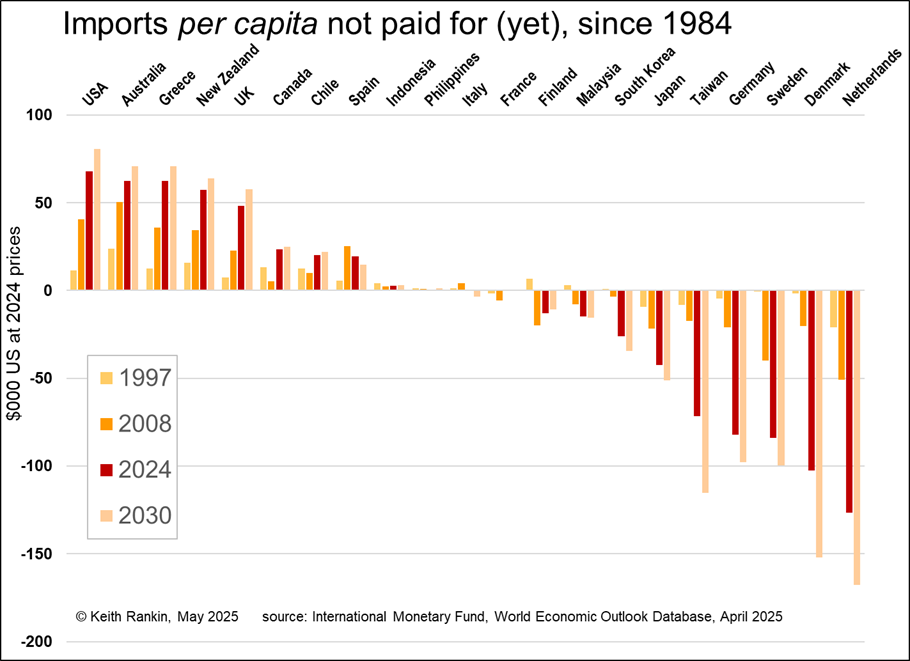
  • MIL-Evening Report: Keith Rankin Chart Analysis – International Trade over time: gifts with strings

    Analysis by Keith Rankin.

    Chart by Keith Rankin.

    The ‘see-saw’ chart above shows the accumulated ‘excess benefits’ that Aotearoa New Zealand, and a few other countries, have enjoyed from international trade over the last 40 years. These are benefits arising from ‘unbalanced trade’ which are in addition to the regular benefits – arising from efficient specialisation – of ‘balanced’ world trade. Real world trade is a mix of ‘balanced’ (paid for) and ‘unbalanced’ (on forever-credit).

    The excess benefit data shown is an inflation-adjusted accumulation of the United States’ current account deficits. We remember that the benefits of trade are what (goods and services) you get, not what you give up.

    We note here that the United States is a ‘winner’; not the loser which Donald Trump claims that it has been. The United States has enjoyed $70,000 worth of excess trade benefits over 40 years, per American. And it is projected to enjoy another $10,000 worth of excess trade benefits over the next seven years.

    So, what is Donald Trump grumping about? Rhetorically, why does he aspire that ‘America’ should be like Germany?

    The biggest losers, as shown here, are a group of northwest European countries, plus Taiwan. (For lack of a complete set of data from 1984, China is not shown here. But China would fit into the chart next to Malaysia. While China has significant accumulated trade surpluses, these are spread over a very large population.) The losers are the countries which have – in effect – ‘given’ away lots of stuff; exports for which they have not received anything in return and will probably never receive anything in return.

    The 2030 projections show that these ‘surplus’ countries will continue to under-import; they are not projected to claim the imports that are rightfully theirs to enjoy. Rather, the deficit countries will most likely continue to enjoy these excess unpaid-for benefits.

    (There are at least two other ‘surplus countries’ – countries like Germany and Sweden – which would be ‘off the chart’: Singapore and Norway. And one other deficit country: Türkiye.)

    Discussion

    With international trade in any given year, surplus countries ‘give’ goods and services to deficit countries. They give ‘with strings’. The most obvious form of ‘string’ is a return gift next year; a fully commercial kind of ‘string’ would be a return gift with interest.

    For example, if Sweden exports US$1,100 million worth of stuff (ie goods and services) to New Zealand in 2025, and New Zealand exports $1,000 million worth of stuff to Sweden in 2025, then the 2025 gift is $100 million worth of stuff from Sweden to New Zealand. (In technical language, and from New Zealand’s viewpoint this gift from Sweden is called a bilateral trade deficit; from Sweden’s point of view, it’s a trade surplus.)

    A return gift with 3% interest would be $103 million worth of stuff from New Zealand to Sweden. (This would be a New Zealand bilateral trade surplus – a deficit for Sweden – in 2026.) The bilateral – ie two-country – ledger would be settled. Effectively, in this example, Sweden lends $100 million of stuff to New Zealand in 2025, and New Zealand repays the loan, with interest, in 2026. Gifts ‘with strings’ are debts.

    There are two potential problems. The first problem is that New Zealand may not be able to sufficiently increase, in one year, its exports to Sweden (eg from $1,000 million to $1,203 million, assuming unchanged imports from Sweden). One solution might be for New Zealand to increase its exports by that amount to other countries, and for other countries to export $203 million more to Sweden. But that increase in exports of $203 million might still be too difficult for New Zealand to accomplish in 2026, regardless of who the buyers are. New Zealand might need to borrow more in 2026, (or to import less,) or to repay its 2025 trade debits further into the future.

    Indeed, New Zealand might prefer something like a 40-year mortgage. New Zealand could run trade surpluses re Sweden (ie Sweden running deficits) of about 4,358,000 each year for 40 years. In total, over the 40 years from 2026 to 2065, Sweden would receive stuff worth $174,323,300 as its ‘return gift’.

    The second (much larger) ‘problem’ is that Sweden might not want to run a trade deficit at all; that is, Sweden might not want to be repaid (except, that is, in some imaginary never-never timeframe). Whether this qualifies as a problem depends on a person’s belief-system. If New Zealand is perfectly happy to receive – into the indefinite future – annual increments of unpaid-for goods and services, and Sweden prefers to keep supplying such stuff without material recompense in foreseeable time, then this sort of unbalanced trade can be categorised as a win-win outcome.

    Sweden might not want New Zealand’s (or anybody else’s) debt to it to be repaid; in 2026, or ever. Sweden, happy to run a trade surplus in 2025, might actually prefer to keep making annual ‘gifts’ to New Zealand (and other countries). While each of these gifts would be technically an addition to New Zealand’s debt to Sweden, New Zealand would be able to – maybe, be obliged to – delay settlement of any of that debt (let alone all of it) indefinitely.

    In this example, Sweden is a ‘mercantilist’ country; mercantilist means ‘merchant capitalist’, the social science analogue of alchemy. Indeed, Sweden actually is a mercantilist country. Its preference is to accumulate ‘promises’, whereas countries like the United States and New Zealand have been accumulating (and enjoying) imported goods and services.

    Mercantilists of yore sought to accumulate ‘treasure’, especially gold. Indeed, in the quarter millennium from 1500 to 1750, economic policy and foreign policy – especially but not only in European power centres – was to become rich by accumulating treasure hoards.

    Mercantilism never went away, despite having been debunked by Adam Smith and others around 250 years ago (The Wealth of Nations was published in 1776). In that golden age of mercantilism, the Dutch – the Netherlanders – succeeded par excellence. (Part of their success was in exporting military hardware and software – big guns, and big military knowhow – to all sides in the Thirty Years War of 1618 to 1648. Is that what the USA will end up mimicking?) As we can see from the chart, the Dutch still do incur some of the world’s biggest export surpluses. Instead of accumulating treasure as they did in the seventeenth century – as gold and silver bullion and specie – they now accumulate ‘virtual treasure’ or ‘virtual gold’. Virtual gold is the whole set of ‘promises’ and ‘titles’ – including money and real gold – that are formally known as ‘financial assets’.

    New Zealand and America, and others, get the consumable loot. Sweden and Netherlands and Germany get the paperwork. Everyone should be happy.

    The dark cloud on the horizon comes when the Americas and the Aotearoas of the world start wanting to be like Germany and Sweden. Then indeed our happyish world descends into a ‘race-to-the-bottom’. Not every country can sit with Germany and its neighbours at the bottom of the above chart. This can be thought of as a see-saw chart: someone has to be at the top; we cannot all be at the bottom.

    If some countries have forever-surpluses, other countries must have forever-deficits. Getting to benefit from other countries’ largesse – as New Zealand and America do – may seem like a problem to some. But we should remember that the driving force of the capitalist market system is to want – indeed, to demand – consumable goods and services. Someone has to be able to benefit from all the hard work and sacrifice of others.

    *******

    Keith Rankin (keith at rankin dot nz), trained as an economic historian, is a retired lecturer in Economics and Statistics. He lives in Auckland, New Zealand.

    MIL OSI Analysis – EveningReport.nz –

    May 8, 2025
  • MIL-OSI United Kingdom: Russia has acted to obfuscate and embolden the DPRK’s unlawful pursuit of weapons of mass destruction: UK statement at the UN Security Council

    Source: United Kingdom – Executive Government & Departments

    Speech

    Russia has acted to obfuscate and embolden the DPRK’s unlawful pursuit of weapons of mass destruction: UK statement at the UN Security Council

    Statement by Ambassador James Kariuki, UK Deputy Permanent Representative to the UN, at the UN Security Council meeting on North Korea.

    Analysis from organisations like the Open Source Centre has become even more vital in the wake of the expertise gap left by the 1718 Panel of Experts.

    One year on, the UK deeply regrets Russia’s decision to veto the mandate renewal of the 1718 Panel of Experts.

    This was a deliberate act used to obfuscate and embolden the DPRK’s unlawful pursuit of weapons of mass destruction, and to conceal Russia’s own erosion of the UN sanctions architecture, which it has a responsibility to uphold as a permanent member of this Council.

    The Panel’s credible, objective and independent reporting enabled this Council and the international community to effectively monitor the implementation of UN sanctions on the DPRK.

    Most importantly, the Panel helped prevent the DPRK’s unlawful and dangerous development of nuclear and ballistic missile programmes.

    Since Russia’s veto last year, there have been over 40 missile tests, including one intercontinental ballistic missile test and one intermediate-range ballistic missile test.  

    This escalation represents multiple breaches of UN Security Council resolutions, for which we have been deprived of further analysis.

    Colleagues, it is obvious that Russia’s objective was to clear the path for the expansion of their military relationship with the DPRK.

    The DPRK is believed to have supplied 20,000 containers of munitions to Russia, and its artillery and mortar shells account for 60% of those used in Russia’s brutal war of aggression against Ukraine.

    And as we’ve heard, in the past week, Russia and the DPRK publicly flaunted their agreement to use DPRK troops as mere cannon fodder in that war.

    Let me be clear, we cannot allow this brazen disregard towards UN sanctions to become normalised. 

    The UK will continue to work closely with partners to monitor sanctions evasion, to hold both Russia and the DPRK to account, and to call out those complicit in the DPRK’s violations of UN Security Council resolutions.

    As we have heard over the course of the NPT Prepcom, this Council should stand firm in its defence of the global non-proliferation regime.

    The UK remains steadfast with partners in our shared goal for the DPRK to abandon all nuclear weapons, other weapons of mass destruction and ballistic missile programs in a complete, verifiable and irreversible manner.

    Updates to this page

    Published 7 May 2025

    MIL OSI United Kingdom –

    May 8, 2025
  • MIL-OSI Russia: Xi Jinping congratulates participants of Chinese-Russian cultural and humanitarian exchange event

    Translation. Region: Russian Federal

    Source: People’s Republic of China in Russian – People’s Republic of China in Russian –

    Source: People’s Republic of China – State Council News

    BEIJING, May 7 (Xinhua) — Chinese President Xi Jinping on Wednesday sent a congratulatory message to participants in a China-Russia cultural and humanitarian exchange event dedicated to the 80th anniversary of the victory in the Chinese People’s War of Resistance Against Japanese Aggression and the Great Patriotic War.

    In his message, the Chinese leader noted that 80 years ago, the Chinese and Russian peoples jointly made an indelible historical contribution to the victory in the World Anti-Fascist War and sealed with blood an unbreakable great friendship, laying a solid foundation for the high-level development of interstate relations.

    Xi said that after 80 years, thanks to the joint efforts of both sides, China-Russia ties have shown new vitality and set a new model for major power relations.

    He stressed that strengthening cultural and humanitarian exchanges is of great and profound significance for increasing mutual understanding, strengthening good-neighborliness and friendship, and increasing public and popular support for the development of bilateral relations.

    The Chinese President expressed the hope that the media of both countries will take on a common mission and move forward hand in hand, conducting cultural and humanitarian exchanges that connect peoples, are close to life and filled with warmth. According to the Chinese leader, this will give new impetus to deepening mutual understanding and friendship between the peoples of the two countries, add new luster to the Sino-Russian relations of comprehensive strategic partnership and coordination in the new era, and make new contributions to building a community with a shared future for mankind.

    The event was organized by China Media Corporation and the All-Russian State Television and Radio Broadcasting Company.

    On the same day, Russian President Vladimir Putin also sent a congratulatory message to the participants of the event. –0–

    MIL OSI Russia News –

    May 8, 2025
  • MIL-OSI USA: Senators Ricketts, Coons Lead Tabletop Exercise on Hypothetical Chinese Energy Quarantine Against Taiwan

    US Senate News:

    Source: United States Senator Pete Ricketts (Nebraska)
    WASHINGTON, D.C. – Yesterday, U.S. Senator Pete Ricketts (R-NE), Chairman of the Senate Foreign Relations Subcommittee on East Asia, organized a tabletop exercise with Senator Chris Coons (D-DE) and other senators. The two-hour exercise tasked the participating senators with responding to a simulated Chinese campaign designed to strangle Taiwan’s energy imports. The exercise was led by the Foundation for Defense of Democracies (FDD). FDD plans to convene a follow-on simulation this summer in Taipei with Taiwanese officials, including members of Taiwan’s National Security Council. After the exercise completed, Senator Ricketts gave the following comments:
    “This exercise reflected the real risk that a Chinese energy quarantine presents to Taiwan,” said Ricketts. “Beijing would like nothing more than to force unification without war. However, Congress can play a decisive role in supporting our Taiwanese partners while also complicating Xi Jinping’s plans to coerce Taiwan into capitulation.”
    Senate Foreign Relations Committee East Asia Subcommittee’s Tabletop exercise in Washington, DC on May 6, 2025. (Official U.S. Senate photo by Erin Sutherland)Ricketts also underscored the threat posed by Communist China’s dictator Xi Jinping, who has signaled his military to be ready to seize Taiwan by 2027.
    “We seek peace and stability across the Taiwan Strait,” said Ricketts. “Increasing aggression from Communist China continues to threaten this long-standing status quo. Simulations and exercises like the one we did today are important for understanding the real-world impact of policy decisions. By working through potential actions by Communist China and planning an American response, we can take the steps necessary to deter this aggression.”
    “As Senator Ricketts and I saw on our travel to East Asia last month, Taiwan plays a central role in ensuring a free and open Indo-Pacific in the face of Chinese aggression,” said Senator Coons. “This exercise made clear the sheer number of tools China has at its disposal to threaten Taiwan and the many steps the United States and our partners and allies should take to prepare. It also demonstrated that Congress will have a clear role to play in shaping our nation’s response to any crisis in the Indo-Pacific region. Unified, bipartisan support for Taiwan in Congress is more important today than ever before.”
    BACKGROUND
    Last month, Senator Ricketts led a congressional delegation (CODEL) trip to Taiwan and the Philippines with Senators Coons and Ted Budd (R-NC). During the trip, the three senators met with senior Taiwanese officials including President Lai and Vice President Hsaio.
    This tabletop exercise continues the work that Senators Ricketts and Coons are doing as chairman and ranking member of the Senate Foreign Relations East Asia Subcommittee to foster bipartisan agreement around the island of Taiwan.

    MIL OSI USA News –

    May 8, 2025
  • MIL-OSI Security: Pine Ridge Man Sentenced to 10 Years in Federal Prison for Voluntary Manslaughter

    Source: Office of United States Attorneys

    RAPID CITY – United States Attorney Alison J. Ramsdell announced today that U.S. District Judge Karen E. Schreier has sentenced a Pine Ridge, South Dakota, man convicted of Voluntary Manslaughter. The sentencing took place on May 2, 2025.

    Eugene Hunts Horse, age 29, was sentenced to 10 years in federal prison, followed by three years of supervised release, and ordered to pay a $2,000 fine and a $100 special assessment to the Federal Crime Victims Fund.

    A federal grand jury indicted Hunts Horse in May 2024. He pleaded guilty on January 17, 2025.

    On February 24, 2024, the victim arrived at a residence in Wounded Knee and attempted to gain entry into the home. The victim knew the occupants of the trailer and wanted to get inside. A male from within the home assaulted the victim with a weapon and ushered him down the driveway away from the home. Hunts Horse arrived around the time the victim was being escorted down the driveway and used an object to strike the victim several times in the head and body. Hunts Horse, who believed the victim had assaulted his cousin with a hammer earlier in the evening, became enraged and developed the heat of passion necessary to take the life of another. After killing the victim, Hunts Horse learned the victim was not the person who attacked his cousin. The Oglala Sioux Tribe Department of Public Safety responded to the residence and found the victim near the roadway and driveway of the residence with a large fracture to his skull. The victim was bleeding extensively from his head. The victim ultimately passed away from his head injury a short time after the officer arrived.

    This matter was prosecuted by the U.S. Attorney’s Office because the Major Crimes Act, a federal statute, mandates that certain violent crimes alleged to have occurred in Indian country be prosecuted in Federal court as opposed to State court.

    This case was investigated by the Oglala Sioux Tribe Department of Public Safety. Assistant U.S. Attorney Megan Poppen prosecuted the case.

    Hunts Horse was immediately remanded to the custody of the U.S. Marshals Service.

    MIL Security OSI –

    May 8, 2025
  • MIL-OSI Global: Indian airstrikes in Kashmir following tourist attack raises fears of a regional conflict

    Source: The Conversation – Canada – By MD Rakib Jahan, PhD Student, Department of Political Studies, International Relations, Queen’s University, Ontario

    In response to the Pahalgam terrorist attack on tourists in Jammu and Kashmir last month,, India has launched “Operation Sindoor,” a series of targeted airstrikes on nine locations in Pakistan and Pakistan-administered Kashmir.

    The killing of 26 tourists in Kashmir’s Baisaran Valley on April 22 did more than shatter a moment of peace in one of South Asia’s most scenic regions. The assault has significantly increased India-Pakistan tensions and generated worries of possible military conflict between two nuclear-armed countries.

    Though Pakistan denies the charges, India has specifically held Pakistan responsible for sheltering terrorist groups.

    In response to the attack, India has taken several actions against Pakistan, including downgrading diplomatic ties, recalling diplomats, suspending participation in a vital water-sharing agreement and closing a significant border crossing.

    This rapidly deteriorating situation underscores the broader consequences of the devastating Pahalgam assault.


    Read more:
    India and Pakistan have fought many wars in the past. Are we on the precipice of a new one?


    Human tragedy

    Described by the region’s chief minister, Omar Abdullah, as “much larger than anything we’ve seen directed at civilians in recent years,” the assault in Pahalgam is not only a humanitarian tragedy and a blow to Kashmir’s economy but a flashpoint in an already fragile regional relationship.

    The Pahalgam attack’s timing coincided with United States Vice President JD Vance’s visit to India in April. This mirrors a grim pattern that includes former U.S. president Bill Clinton’s 2000 trip, when militants struck Chittisinghpura in Jammu and Kashmir hours before his arrival.

    By staging violence during diplomatic milestones, militants aim to amplify global attention and send a message to the Indian government. As global attention shifts back to Kashmir, the Baisaran massacre appears to mark a new chapter in the long-fought battle over this territory — one that risks tourism, targets civilians and threatens to unravel regional stability.

    Strategic targeting of Kashmir’s economy

    Though Kashmir has seen warfare for decades, militant groups had mostly avoided targeting visitors because of the the economic significance of tourism to Kashmir.

    The calculated selection of Pahalgam — one of Kashmir’s top tourist sites — reveals a plan to attack the core of Kashmir’s economy. According to counter-terrorism expert Ajai Sahni, the local community and militant groups have an implicit understanding not to compromise the tourism industry.

    By breaking this unwritten rule, the militants have demonstrated a willingness to inflict economic harm on the population.

    Nearly everyone in Kashmir, particularly in the valley, depends on tourism either directly or indirectly. Tourism, which has seen a resurgence since the COVID-19 pandemic, generates thousands of direct and indirect jobs and more than eight per cent of Kashmir’s GDP.

    Experts like Amitabh Mattoo, from the School of International Studies at Jawaharlal Nehru University, warn that Kashmir may experience long-term devastating effects from a drop in tourism. A significant exodus of travellers from Kashmir has already taken place.


    Read more:
    Why are India and Pakistan on the brink of war and how dangerous is the situation? An expert explains


    Challenging India’s post-2019 Kashmir narrative

    The assault also weakens India’s narrative on Kashmir, an area that has been disputed by both Pakistan and India since their independence from Britain in 1947.

    The attack took place as India Prime Minister Narendra Modi was scheduled to open a multi-billion-dollar railway project to the Kashmir Valley, which his government contends will enhance tourism and economic development.

    Modi’s administration has presented the rise in tourism as proof of “normalcy” coming back to Kashmir following India’s removal of special status to Kashmir.

    The intentional targeting of visitors sends a message that the illusion of normalcy is misleading.

    A deadly departure from past tactics

    The Resistance Front (TRF), a rather unknown militant group founded in 2019 and designated as a “terrorist organization” by the Indian government in January 2023, claimed responsibility for the assault via social media. They offered no proof to back their assertion.

    TRF represents a new breed of militant Kashmiri nationalism and resistance. Indian intelligence agencies have connected the group to the Pakistan-based terrorist organization Lashkar-e-Taiba.

    TRF’s communication regarding the assault emphasized resistance to new “outsider” residency rights. This corresponds with worries voiced by some Kashmiris after 2019 modifications permitted non-locals to acquire land and get employment in the area.

    The government disclosed in April 2025 that 83,000 individuals have been given residence certificates under these new standards in the last two years.

    The future of Kashmir’s stability

    Apart from causing obvious human sorrow, the Pahalgam slaughter also endangers years of economic development and could send Jammu and Kashmir back into a cycle of bloodshed and instability.

    Targeting tourists could mean militants are willing to risk Kashmir’s economic core. The assault appears to be an attempt to internationalize the Kashmir problem at a time when worldwide interest had started to fade. It also exploits religious divides, and has succeeded in inciting severe security reactions.

    The future seems more and more uncertain for ordinary Kashmiris caught between security crackdowns and militant brutality. Historical trends indicate that more militancy usually results in more security policies, putting more strain on civilian life.

    For many teenagers and young people in Jammu and Kashmir, the lack of consistent income, mobility limitations and increased monitoring intensifies sensations of marginalization and anger.

    Radical groups can take advantage of these frustrations. To counter this, economic policies must address these inequalities.


    Read more:
    India-Pakistan strikes: 5 essential reads on decades of rivalry and tensions over Kashmir


    A strategy for the way ahead

    The Pahalgam incident calls for a counter-terrorism strategy that balances security with socio-economic stability.

    For example, tourism profit-sharing systems could be implemented and tax advantages or subsidies could be offered to tour businesses, especially those employing young marginalized demographics. This could help to bring some financial respite as well as long-term stability and has been successful in countries like Rwanda.

    The failure to pre-empt the attack despite heightened security during the Vance’s visit and the Hindu pilgrimage season reveals systematic intelligence failures.

    The way ahead calls for tackling both security issues and the underlying complaints still driving militancy in Jammu and Kashmir as the region once again confronts the possibility of violence.

    United Nations Secretary-General António Guterres has urged both nations to de-escalate and return to diplomacy.

    MD Rakib Jahan does not work for, consult, own shares in or receive funding from any company or organisation that would benefit from this article, and has disclosed no relevant affiliations beyond their academic appointment.

    – ref. Indian airstrikes in Kashmir following tourist attack raises fears of a regional conflict – https://theconversation.com/indian-airstrikes-in-kashmir-following-tourist-attack-raises-fears-of-a-regional-conflict-256166

    MIL OSI – Global Reports –

    May 8, 2025
  • MIL-OSI Canada: New Alberta voice in Washington

    For two decades, Alberta has had strong representation in the United States, advocating for Albertans and building integral relationships with key U.S. legislators, decision makers and investors.

    Through these relationships, Alberta and the U.S. have built a $187.2 billion bilateral trade partnership, with the U.S. accounting for 90 per cent of Alberta’s total exports. To maintain and continue building these ties, it is essential that Alberta has a skilled and experienced representative in D.C.

    To prioritize this work, Alberta’s government has appointed the Honourable Nathan Cooper as Alberta’s official representative to the United States, based at the Alberta Washington Office in the U.S. capital.

    Mr. Cooper will draw on his decades of experience in public service, including his most recent experience as Speaker of the Legislative Assembly of Alberta, to lead this important work, focusing on attracting investment, expanding trade opportunities and maintaining the relationships needed to connect Alberta with key decision makers in the U.S.

    “Alberta has seen a lot of success in building its relationship with U.S. decision makers, and much of that success is thanks to the hard work of James Rajotte as Alberta’s Senior Representative to the U.S. In this evolving landscape, Alberta must maintain and build on our ties with U.S. officials, and Nathan Cooper is the right choice to fill this important role. I look forward to continuing to work closely with Nathan as we advocate for Albertans and for our province’s interests in Washington and across the U.S.”

    Danielle Smith, Premier

    “I’m honoured to be entrusted by Premier Danielle Smith with this critical assignment at such a pivotal time. Now more than ever, I see this as a vital opportunity to strengthen and advance Alberta’s long-standing relationship with the United States, ensuring stability and collaboration amid global uncertainty.”

    Nathan Cooper, Alberta’s senior representative to the United States

    “Having worked closely with Nathan, I’ve seen his unwavering commitment to Alberta’s interests. His ability to bring people together, coupled with his deep understanding of U.S. politics, makes him the ideal representative for Alberta in Washington. I’m confident his leadership will be invaluable as we navigate challenges ahead.”

    Nate Horner, Minister of Finance

    “As Speaker of the Assembly, Mr. Cooper is highly respected for his wisdom, integrity and ability to find common ground across parties. I cannot think of a better representative for Albertans in Washington.”

    Deron Bilous, senior vice-president, Counsel Public Affairs and former NDP Minister

    “Over the past few years, we have had the opportunity to work with Speaker Cooper on the Alberta – Wisconsin relationship and look forward to expanding that in his new role here in the United States. I am confident Nathan’s extensive American connections will serve Alberta well as we seek to maintain our strong bilateral relationship.”

    Robin Vos, Speaker of the Wisconsin state assembly

    “As both a business and community leader, I have full confidence that Nathan will be an invaluable asset to businesses on both sides of the border. Given the complexities of today’s political climate, his ability to bridge divides and foster economic collaboration will prove indispensable.”

    Bob Dhillon, president and CEO, Mainstreet Equity Corp.

    “Team Canada needs a strong Alberta in Washington, and Alberta needs strong representation for our trading interests. There might be some tough days ahead for the relationship between Canada and the United States, but I know Nathan Cooper will work hard for Albertans and a strong Canada.”

    Shannon Phillips, former NDP Minister of Environment and Protected Areas

    Since 2005, Alberta’s presence in the U.S. capital has helped advance the province’s economic objectives with U.S. decision makers. Alberta’s envoys have managed this important relationship from the Alberta Washington Office, which is collocated within the Canadian Embassy.

    Biography for Nathan Cooper

    The Honourable Nathan Cooper served as the member of the legislative assembly for Olds-Didsbury-Three Hills from May 5, 2015 to May 7, 2025.

    On May 21, 2019, he was elected by his fellow MLAs as the 14th Speaker of the Legislative Assembly of Alberta.

    Before his time as an MLA, Mr. Cooper served as chief of staff and director of legislative affairs for the Wildrose caucus and completed two terms as a councillor for the Town of Carstairs. He also brings extensive experience in cross-jurisdictional parliamentary affairs, including:

    • As the longest serving Canadian speaker he became dean of the Canadian Speaker Association in 2025.
    • Leading numerous parliamentary delegations to the United States, with a strong focus on relationship-building.
    • Serving as an international guest speaker at Commonwealth Parliamentary Association conferences in Canada and other Commonwealth nations.

    Mr. Cooper’s proven leadership, deep understanding of parliamentary systems and commitment to building meaningful partnerships make him exceptionally well-suited to advance Alberta’s interests in the United States.

    Quick facts

    • James Rajotte, Alberta’s previous Senior Representative to the U.S. has returned to Edmonton after four and a half years representing Alberta in the United States. He continues to serve as a senior advisor to Premier Smith focused on the U.S. file, working out of Premier Smith’s office in Alberta.
    • The salary for the senior representative to the U.S. is publicly disclosed annually in accordance with the Public Sector Compensation Transparency Act.
    • Alberta has maintained offices abroad for more than 50 years and currently has 17 offices in key markets like the United States, Japan, South Korea, the United Kingdom, Mexico, India, Singapore and the Middle East.

    Related information

    • Alberta’s international offices

    MIL OSI Canada News –

    May 8, 2025
  • MIL-OSI USA: Attorney General Bonta Busts Fraudster for Stealing Over $400,000 from a Citizen of the Pechanga Band of Indians

    Source: US State of California

    Wednesday, May 7, 2025

    Contact: (916) 210-6000, agpressoffice@doj.ca.gov

    ORANGE COUNTY – California Attorney General Rob Bonta today announced the filing of felony charges against a caretaker for stealing over $400,000 from a citizen of the Pechanga Band of Indians who was a dependent adult in her care. The California Department of Justice (DOJ) received a referral from the FBI alleging that the caretaker embezzled money from the victim to pay for personal expenses. These funds were received monthly by the victim from the Pechanga Tribe.
     
    “Caretakers have a profound responsibility to treat those in their care with the highest level of compassion and dignity,” said Attorney General Bonta. “They support individuals during some of the most challenging moments in their lives. At the California Department of Justice, we are committed to fighting against all types of abuse, theft, and neglect. We will take prompt action to hold accountable anyone who exploits or harms vulnerable members of our communities.”
     
    It is alleged that between October 2018 and January 2021, the caretaker used the victim’s funds to pay for vacations, luxurious dinners, mortgage payments, and other personal expenses. DOJ filed criminal charges in the Orange County Superior Court for Embezzlement, Theft from a Dependent Adult, and Grand Theft exceeding $100,000. 
     
    It is important to note that criminal charges must be proven in a court of law. Every defendant is presumed innocent until proven guilty.
     
    The California Department of Justice’s Division of Medi-Cal Fraud and Elder Abuse (DMFEA) works to protect Californians by investigating and prosecuting those responsible for abuse, neglect, and fraud committed against elderly and dependent adults in the state, and those who perpetrate fraud on the Medi-Cal program.

    The Division of Medi-Cal Fraud and Elder Abuse receives 75 percent of its funding from the U.S. Department of Health and Human Services under a grant award totaling $69,244,976 for Federal fiscal year (FY) 2025. The remaining 25 percent is funded by the State of California. FY 2025 is from October 1, 2024, through September 30, 2025.
     
    A copy of the complaint can be found here. 

    # # #

    MIL OSI USA News –

    May 8, 2025
  • MIL-Evening Report: Vietnam is poised to become a top 20 economy, so why is Australia taking so long to make trade and investment links?

    Source: The Conversation (Au and NZ) – By Anne Vo, Senior lecturer in Vietnamese culture and politics, University of Wollongong

    Aritra Deb/Shutterstock

    At a time of widespread global trade instability, Australia should be expanding and diversifying its economic partnerships. Supply chains remain fragile, and protectionist rhetoric is once again gaining traction in major Western economies.

    US President Donald Trump’s America First agenda includes sweeping tariffs on imports, withdrawal from multilateral agreements and pressure to take production in-house.

    At the same time, China, Australia’s largest trading partner, has often used trade for geopolitical leverage. In 2020, Beijing imposed tariffs of more than 200% on Australian wine. This wiped 30% off the sector’s export value.

    So economic diversification is not only desirable but strategically imperative.

    An opportunity

    Fifty years on from the fall of Saigon, Vietnam presents a compelling opportunity for economic and strategic diversification. The reunited country is eager to move beyond its wartime image and assert itself as an emerging economic powerhouse.

    Vietnam’s capital, Ho Chi Min City. The country has shifted from being a place synonymous with war to becoming one of the world’s top economies.
    Nguyen Quang Ngoc Tonkin/Shutterstock

    Since the launch of the Doi Moi reforms in 1986, Vietnam has embraced economic liberalisation and market-oriented policies. The Doi Moi reforms opened the economy to foreign trade, allowed private ownership and restructured state-owned enterprises.

    From a growth rate of just 1.6% in 1980, Vietnam is now set to become one of the world’s top 20 economies by 2050. In 2023 alone, it attracted A$8.5 billion in foreign direct investment, underscoring strong investor confidence.

    The 50th anniversary of reunification on April 30 provided insights into the country’s growth. Celebrations included military parades, 3D virtual reality displays and exhibitions promoting advances in technology.

    Slow to act

    Yet Australia has been slow to act. Despite geographic proximity and shared interests, Australia’s economic footprint in Vietnam remains surprisingly small. In 2023, Australian foreign direct investment totalled just A$3 million. It ranked 22nd, behind countries including Switzerland and Seychelles.

    In trade, the disparity is similarly stark. Vietnam accounts for only 2.33% of Australia’s exports and 1.4% of imports. Two-way trade between the two countries reached $26.3 billion in 2022. At the same time, Vietnam’s trade with the United States, topped A$191.9 billion.

    Some Australian firms are already making inroads. BlueScope Steel, Linfox, and SunRice have invested significantly in manufacturing, logistics and agriculture. And RMIT University has been a key player in transnational education since it opened the first of three campuses in Vietnam in 2000.

    ANZ and Qantas also have a visible presence. However, small and medium-sized enterprises – which comprise more than 98% of Australian businesses – remain largely absent. Many prefer export partnerships or distributor agreements over direct investment.

    Potential obstacles

    Australian companies have long favoured English-speaking or high-income markets. These offer greater institutional and cultural familiarity and regulatory certainty.

    Vietnam’s relationship-based commercial environment poses challenges, especially for firms lacking embedded networks and local knowledge. Concerns around regulatory transparency, intellectual property protection, contract enforcement and corruption – though improving – continue to weigh on corporate decisions.

    Small to medium enterprises, in particular, face extra barriers due to limited institutional support, regulatory understanding, market intelligence and in-country networks.

    Help from government

    The Australian government has taken some steps to catch up. The Enhanced Economic Engagement Strategy, launched in 2021, aims to double two-way investment and elevate both nations to top ten trading partner status.

    It identifies priority sectors such as agriculture, education, clean energy, digital technology and manufacturing. However, the strategy contains no enforceable legal protections, tariff concessions or means of dispute resolution.

    Manufacturing is one of the priority areas recognised in Australia’s Enhanced Economic Engagement Strategy for Vietnam.
    Hien Phung Tu/Shutterstock

    The lack of these matters. Japan, South Korea and the European Union have pursued coordinated economic strategies that include concessional loans, robust legal frameworks and in-market support services. These help their businesses thrive in Vietnam’s complex regulatory environment.

    Similarly, the EU has integrated trade promotion with legal certainty under agreements like the EU Vietnam Free Trade Agreement.

    More needs to be done

    Without comparable tools, Australia’s initiatives risk being more aspirational than actionable.

    Last year’s upgrade in bilateral ties to a Comprehensive Strategic Partnership, signals growing political will.

    For Australia to realise the potential of its relationship with Vietnam it should back long-term policies. These policies should reduce market entry barriers, incentivise small to medium enterprises and increase joint skills development.

    Investors also need legal and institutional support.

    Australia has strong potential to expand into emerging sectors. These include renewable energy, digital technology, healthcare, vocational education and training, green and smart infrastructure and agritech.

    Vietnam’s push for environmentally sustainable economic growth, digital transformation and workforce training aligns closely with Australian strengths. This creates opportunities for strategic investment and cooperation.

    There is the potential for Australia to build a dynamic partnership with Vietnam central to its long-term economic position in the Indo-Pacific.

    Anne Vo does not work for, consult, own shares in or receive funding from any company or organisation that would benefit from this article, and has disclosed no relevant affiliations beyond their academic appointment.

    – ref. Vietnam is poised to become a top 20 economy, so why is Australia taking so long to make trade and investment links? – https://theconversation.com/vietnam-is-poised-to-become-a-top-20-economy-so-why-is-australia-taking-so-long-to-make-trade-and-investment-links-255722

    MIL OSI Analysis – EveningReport.nz –

    May 8, 2025
  • MIL-Evening Report: ‘Utu’ as foreign policy: how a Māori worldview can make sense of a shifting world order

    Source: The Conversation (Au and NZ) – By Nicholas Ross Smith, Senior Research Fellow, National Centre for Research on Europe, University of Canterbury

    Getty Images

    There is a growing feeling in New Zealand that the regional geopolitical situation is becoming less stable and more conflicted. China has ramped up its Pacific engagement, most recently with the Cook Islands, and the United States under Donald Trump is abandoning the old multilateral world order.

    As a result, we’re beginning to see New Zealand shift away from a two-decades-long preference for engaging with multiple partners towards a more conventional balancing strategy.

    Essentially, this attempts to counter the perceived threat from a strong country – namely China – with a combination of external alliances and internal policies.

    Externally, New Zealand has sought re-align itself within the US-led security sphere. Participation in pillar two of the AUKUS security pact has been seriously discussed, and New Zealand has actively engaged with NATO as a member of the “Indo-Pacific Four” (along with Australia, Japan and the Republic of Korea).

    Internally, a NZ$12 billion “defence plan” was announced in early April. This will see New Zealand increase defence spending from just over 1% of GDP to more than 2% over the next eight years.

    Foreign Minister Winston Peters has made no secret of these changing priorities. He has said he is simply taking “the world as it is”, adding:

    this realism is a shift from our predecessors’ vaguer notions of an indigenous foreign policy that no-one else understood, let alone shared.

    This was a direct repudiation of the previous Labour government’s foreign minister, Nanaia Mahuta. Her tenure had offered a glimpse of what a foreign policy guided by te ao Māori – the Māori worldview – might look like.

    Four tikanga Māori principles underpinned the policy: manaakitanga (hospitality), whanaungatanga (connectedness), mahi tahi and kotahitanga (unity through collaboration), and kaitiakitanga (intergenerational guardianship).

    ‘The world as it is’: Foreign Minister Winston Peters speaks at Rātana celebrations in Whanganui, January 24 2025.
    Getty Images

    Beyond Western-centric thinking

    Clearly, te ao Māori offers a very different way of looking at international relations. At its core it adopts a “relational” understanding of the world that views reality as a series of entanglements: “human with human, human with nonhuman, nonhuman with human, human and nonhuman with transcendent”.

    It is also a non-anthropocentric view: humans are not the masters of the world but rather stewards or custodians of a complex web of relations.

    But as we argue in a recent Global Policy article, despite good intentions, Mahuta’s four tikanga Māori were mostly used rhetorically. They did not fundamentally alter New Zealand’s foreign policy, which remained firmly Western-centric.

    We suggest those four tikanga principles would be enhanced by adding the concept of “utu” as a kind of overarching framework.

    Largely thanks to the famous 1983 film of the same name, utu is often thought to simply mean violent revenge. In fact, it is a much deeper concept that refers to the “process of restoring physical and spiritual relationships to an equal or harmonious state”.

    Utu as a foreign policy framework

    A foreign policy underpinned by utu, therefore, would seek to build relationships that are harmonious and reciprocal.

    Harmony, in this sense, goes beyond notions of an international order characterised by global peace, greater connectedness, increased cooperation and interdependence.

    While these are important, an utu-informed view of harmony would also take into account the relationship between humans and the natural world, and between present, past and future generations.

    Similarly, in the Western-centric view, reciprocity is typically “invoked as an appropriate standard of behaviour which can produce cooperation among sovereign states”.

    But utu involves a reciprocity built through hospitality (manaakitanga), something which has to be given even if serious discord exists in a relationship. Reciprocity is also important in interactions between humans and the natural world.

    Consequently, an utu foreign policy doctrine would offer a radically different lens than New Zealand is currently using.

    A genuinely independent foreign policy

    Firstly, it would require New Zealand to reject the Western geopolitical construct
    of the “Indo-Pacific”, which vastly oversimplifies the complex realities of the region.

    And it would mean viewing China not as an existential threat, but rather as a crucial relationship that is subject to the principles of manaakitanga, despite growing discord and diplomatic challenges.

    Secondly, it would see New Zealand recognise climate change as the primary existential threat to the status quo. This would align closely with the country’s Pacific neighbours whose Blue Pacific initiative offers an alternative to the Indo-Pacific focus.

    Lastly, it would help New Zealand more consistently and coherently pursue a genuinely independent foreign policy. This should have bipartisan appeal, as it would give New Zealand a unique perspective on the world.

    Ultimately, as New Zealand faces a more complex regional environment and a range of national security challenges, utu in its true sense offers a more constructive framework.

    Perhaps adopting a more complex – and more humble – understanding of the world, as provided by te ao Māori, would give policymakers an alternative pathway to simply taking “the world as it is”.


    The author acknowledges the contribution of independent researcher Bonnie Holster, co-author of the Global Policy paper on which this article is based.


    Nicholas Ross Smith does not work for, consult, own shares in or receive funding from any company or organisation that would benefit from this article, and has disclosed no relevant affiliations beyond their academic appointment.

    – ref. ‘Utu’ as foreign policy: how a Māori worldview can make sense of a shifting world order – https://theconversation.com/utu-as-foreign-policy-how-a-maori-worldview-can-make-sense-of-a-shifting-world-order-255602

    MIL OSI Analysis – EveningReport.nz –

    May 8, 2025
  • MIL-Evening Report: Australia is set to be a renewables nation. After Labor’s win, there’s no turning back

    Source: The Conversation (Au and NZ) – By Wesley Morgan, Research Associate, Institute for Climate Risk and Response, UNSW Sydney

    bmphotographer/Shutterstock

    An emphatic election victory for the incumbent Labor government means Australia’s rapid shift to renewable energy will continue. As Climate Change and Energy Minister Chris Bowen said on Saturday:

    In 2022, the Australian people voted to finally act on climate change. After three years of progress […] in 2025 they said keep going.

    The election result also means the debate about energy policy is now, in broad terms, over. Australia’s energy future is wind and solar, backed by storage.

    Coal and gas will have a fast-declining role to play and nuclear energy will have none at all. Australia is set to be a renewables nation. There is no turning back now.

    Cementing renewables investment

    By continuing to build renewables capacity, the returned Labor government can position Australia on the world stage as a genuine leader on clean energy.

    The Albanese government has set a national target of more than 80% of the main national electricity grid running on renewables by 2030. With such a large majority in parliament, Labor may well be in government at that time.

    Australia already has the world’s highest per-capita solar uptake, with about 300,000 solar systems installed each year. One in three Australian homes now has rooftop solar.

    Labor is complementing this boom with a new home battery discount scheme, which aims to have more than one million batteries installed by 2030. This will help stabilise the grid by reducing demand at peak times.

    But more investment in renewables is needed. The policy certainty of a returned Labor government should help to attract international capital. This is important, because more than 70% of investment in renewables in Australia comes from offshore.

    Securing climate consensus

    Labor’s win also means it can finally bed down a national consensus on climate policy.

    A recent survey on Australian attitudes to climate action suggested community views can shift if people see action is taken by governments and big business.

    This does not mean community opposition to renewable energy will evaporate – especially in regional Australia. The federal government must work with industry players and other levels of government to ensure proper public consultation. The new Net Zero Economy Authority will play an important role in ensuring the regions and their workers benefit from the energy transition.

    For its part, the Coalition needs to do some soul-searching. Australian voters returned a number of climate-friendly independents in key seats. The Coalition also failed to win support from younger Australians, who typically view renewables favourably.

    All this suggests continued opposition to renewables is unlikely to help the Coalition form government anytime soon. What’s more, continuing to promote nuclear power – which some in the Coalition are pushing for – makes little sense in an increasingly renewables-dominated grid.

    Doubling down on international climate cooperation

    Labor’s plans to rapidly expand renewable energy strengthen Australia’s credentials to host the COP31 UN climate talks with Pacific island countries next year.

    Australia’s bid has strong support from other nations. Turkey – the only other nation with its hand up to host – has so far resisted pressure from Australia to withdraw its bid. In support of their own bid, Turkish representatives pointed to uncertainty in Australia ahead of the May election – however that uncertainty has now passed.

    Adelaide will host the talks if Australia’s bid succeeds. This will be a chance to share our world-beating renewables story – including in South Australia, which is set to achieve 100% clean electricity by 2027.

    Australia could also use the talks in South Australia to promote new export industries that use renewable energy, especially plans to produce green iron and green steel at Whyalla.

    Hosting rights could attract investment in Australia’s renewables rollout and help promote exports of critical minerals and green metals. And it would enable Australia to cement its place in the Pacific during a time of increased geo-strategic competition, by promoting a renewables partnership for the whole region.

    Australia must move fast and secure the COP31 bid at climate talks in Germany next month. Any delay risks a less ambitious summit next year, because building consensus for new initiatives takes time.

    South Australia has made a bold bid to host COP31 (SA Government)

    Seizing our economic opportunities

    As Prime Minister Anthony Albanese said during his victory speech on Saturday, renewable energy is “an opportunity we must work together to seize for the future of our economy”.

    Australia is the world’s largest exporter of raw iron ore and metallurgical coal, both used extensively in offshore steelmaking.

    But Australia can create jobs and reduce emissions by refining iron ore in Australia using renewables and green hydrogen.

    The potential export value of green iron is estimated at A$295 billion a year, or three times the current value of iron ore exports. More broadly, our clean energy exports – including green metals, fertilisers and fuels – could be worth six to eight times more than our fossil fuel exports, analysis suggests.

    A key challenge for the returned government is assuring markets such as Japan that Australia is a long-term strategic partner, even while redirecting trade and investment away from coal and gas exports and toward long-term clean energy industries.

    Embracing Australia’s future

    Australians have delivered a strong mandate for climate action. The returned Labor government must ensure this support is not squandered, and voter trust is not lost.

    This means seizing the opportunity, once and for all, to shift Australia from our past as a fossil fuel heavyweight to our future as a renewables superpower.

    Wesley Morgan is a fellow with the Climate Council of Australia

    Ben Newell receives funding from the Australian Research Council

    – ref. Australia is set to be a renewables nation. After Labor’s win, there’s no turning back – https://theconversation.com/australia-is-set-to-be-a-renewables-nation-after-labors-win-theres-no-turning-back-256081

    MIL OSI Analysis – EveningReport.nz –

    May 8, 2025
  • MIL-OSI: WF Holding Limited Announces Underwriters’ Exercise of Over-Allotment Option

    Source: GlobeNewswire (MIL-OSI)

    KUALA LUMPUR, May 07, 2025 (GLOBE NEWSWIRE) — WF Holding Limited (NASDAQ: WFF) (“WF Holding” or “Company”), a Malaysia-based manufacturer of fiberglass reinforced plastic (FRP) products, today announced the underwriters of its initial public offering (the “Offering”) have partially exercised their over-allotment option to purchase an additional 240,000 ordinary shares at the public offering price of US$4.00 per share, resulting in additional gross proceeds of US$960,000.

    After giving effect to the partial exercise of the over-allotment option, the total number of ordinary shares sold by the Company in the public offering increased to 2,240,000 ordinary shares and the gross proceeds increased to approximately US$8.96 million, before deducting underwriter discounts and other related expenses. The option closing date was May 7, 2025.

    The ordinary shares began trading on the Nasdaq Capital Market on March 27, 2025, under the ticker symbol “WFF.”

    Dominari Securities LLC acted as the lead underwriter, with Revere Securities LLC acting as a co-underwriter for the Offering. Bevilacqua PLLC acted as U.S. counsel to the Company, and The Crone Law Group, P.C. acted as U.S. counsel to the underwriters in connection with the Offering.

    A registration statement on Form F-1 relating to the Offering was filed with the U.S. Securities and Exchange Commission (the “SEC”) (File Number: 333-282294) and was declared effective by the SEC on March 26, 2025. The Offering was made only by means of a prospectus, forming a part of the registration statement, and a free writing prospectus. Copies of the final prospectus relating to the Offering may be obtained from Dominari Securities LLC by email at info@dominarisecurities.com, by standard mail to Dominari Securities LLC, 725 Fifth Avenue, 23rd Floor, New York, NY 10022 USA, or by telephone at +1 (212) 393-4500; or from Revere Securities LLC by email at contact@reveresecurities.com, by standard mail to Revere Securities LLC, 560 Lexington Ave, 16th Floor, New York, NY 10022 USA, or by telephone at (212) 688-2238. In addition, copies of the prospectus and free writing prospectus relating to the Offering may be obtained for free by visiting EDGAR on the SEC’s website at www.sec.gov.

    This press release does not constitute an offer to sell, or the solicitation of an offer to buy any of the Company’s securities, nor shall there be any offer, solicitation or sale of any of the Company’s securities in any state or jurisdiction in which such offer, solicitation or sale would be unlawful prior to registration or qualification under the securities laws of such state or jurisdiction.

    About WF Holding Limited (NASDAQ: WFF)

    Based in Malaysia, WF Holding Limited is an ISO 9001:2015 certified manufacturer of fiberglass reinforced plastic (FRP) products including tanks, pipes, ducts and custom-made FRP products. With a track record of over 30 years, we design and fabricate products that meet the specific needs of our clients, ensuring high-quality and reliable performance. Our high-quality and durable products leverage the advantages of FRP to reinforce critical industrial infrastructure, driving resilience, longevity and sustainability. We also deliver a wide range of related services such as consultation, delivery, installation, repair and maintenance.

    Forward-Looking Statements

    Certain statements in this announcement are “forward-looking statements” within the meaning of Section 27A of the Securities Act of 1933, as amended and Section 21E of the Securities Exchange Act of 1934, as amended, including, but not limited to, the use of proceeds from the sale of the Company’s shares in the Offering. These forward-looking statements involve known and unknown risks and uncertainties and are based on the Company’s current expectations and projections about future events that the Company believes may affect its financial condition, results of operations, business strategy and financial needs. Investors can find many (but not all) of these statements by the use of words such as “may,” “could,” “will,” “should,” “would,” “expect,” “plan,” “intend,” “anticipate,” “believe,” “estimate,” “predict,” “potential,” “project” or “continue” or the negative of these terms or other comparable terminology in this press release. The Company undertakes no obligation to update or revise publicly any forward-looking statements to reflect subsequent occurring events or circumstances, or changes in its expectations, except as may be required by law. Although the Company believes that the expectations expressed in these forward-looking statements are reasonable, it cannot assure you that such expectations will turn out to be correct, and the Company cautions investors that actual results may differ materially from the anticipated results and encourages investors to review other factors that may affect its future results in the Company’s registration statement and other filings with the SEC.

    For more information, please contact:

    WF Holding Limited
    Investor Relations
    Email: corporate@winfung.com.my

    Sense Consultancy Group
    Yan Pheng Liang
    Email: phengliang@leesense.com

    The MIL Network –

    May 8, 2025
  • MIL-OSI: Ormat Technologies Reports First Quarter 2025 Financial Results

    Source: GlobeNewswire (MIL-OSI)

    REVENUE GROWTH AND RECORD QUARTERLY ADJUSTED EBITDA SUPPORT ONGOING STRATEGIC PORTFOLIO EXPANSION

    HIGHLIGHTS

    • TOTAL REVENUES AND NET INCOME1 IMPROVED 2.5% AND 4.6%, RESPECTIVELY
    • RECORD ADJUSTED EBITDA OF $150.3 MILLION, AN INCREASE OF 6.4% VS LAST YEAR
    • ENERGY STORAGE SEGMENT REVENUES INCREASED BY 120% DRIVING MEANINGFUL MARGIN INCREASE
    • SIGNED AN AGREEMENT TO ACQUIRE THE 20MW BLUE MOUNTAIN GEOTHERMAL POWER PLANT FROM CYRQ ENERGY
    • COMPANY REITERATES ITS 2025 FULL-YEAR GUIDANCE, REFLECTING STRONG EXECUTION AND CONFIDENCE IN THE BUSINESS OUTLOOK

    RENO, Nev., May 07, 2025 (GLOBE NEWSWIRE) — Ormat Technologies, Inc. (NYSE: ORA) (the “Company” or “Ormat”), a leading renewable energy company, today announced financial results for the first quarter ended March 31, 2025.

    KEY FINANCIAL RESULTS

      Q1 2025 Q1 2024 Change (%)
    GAAP Measures      
    Revenues ($ millions)      
                 Electricity 180.2   191.3   (5.8 %)
                 Product 31.8   24.8   27.9 %
                 Energy Storage 17.8   8.1   119.7 %
    Total Revenues 229.8   224.2   2.5 %
           
    Gross Profit 72.9   78.8   (7.5 %)
    Gross margin (%)      
    Electricity 33.5 % 39.0 %  
    Product 22.3 % 14.8 %  
    Energy Storage 30.6 % 7.5 %  
    Gross margin (%) 31.7 % 35.2 %  
    Operating income ($ millions) 50.9   52.6   (3.2 %)
    Net income attributable to the Company’s stockholders 40.4   38.6   4.6 %
    Diluted EPS ($) 0.66   0.64   3.1 %
    Non-GAAP Measures      
    Adjusted Net income attributable to the Company’s stockholders 41.5   39.6   4.8 %
    Adjusted Diluted EPS ($) 0.68   0.65   4.6 %
    Adjusted EBITDA2($ millions) 150.3   141.2   6.4 %

    1 Net Income attributable to the Company’s stockholder
    2 See reconciliation table below

    “Ormat had a strong start to 2025, achieving a 2.5% increase in revenue, a 4.6% rise in net income attributable to the Company’s stockholders, and a 6.4% increase in adjusted EBITDA. This growth was driven by improved performance in both our Product and Storage segments,” said Doron Blachar, Chief Executive Officer of Ormat Technologies. “Our Storage segment benefited from new capacity added over the last 12 months and from higher merchant prices in the PJM market. We expect continued good performance throughout 2025 as we transition our Storage segment to a more predictable portfolio designed to maximize profitability.”

    “While our Electricity segment experienced a slight year-over-year decline in the quarter due to previously disclosed curtailments in California and Nevada, the balance of our geothermal operations delivered a consistent, solid performance. We have several projects under development that we anticipate will reach commercial operation by the end of 2025, which we expect will deliver solid generation growth and further strengthen our earnings trajectory. Additionally, we believe that the potential easing of project permitting timelines combined with increased focus on geothermal exploration will further support our growth in the segment, expand our revenues, and help us achieve our long-term targets.”

    “I am pleased to announce that Ormat signed an agreement to acquire the Blue Mountain geothermal power plant from Cyrq Energy for $88 million, subject to standard working capital adjustments. The 20 MW facility, located in Humboldt County, was built using Ormat technology, features an existing 51 MW interconnection capacity and a Power Purchase Agreement (PPA) with NV Energy (NVE) that expires at the end of 2029. Following the acquisition, Ormat plans to upgrade the power plant, increasing its capacity by 3.5 MW. Additionally, subject to permit and PPA approval, Ormat intends to add a 13 MW solar facility to support the plant’s auxiliaries. The acquisition is anticipated to close towards the end of the second quarter. This acquisition underscores Ormat’s capability to strategically expand and enhance assets in the U.S., leveraging our advanced technology and expertise to optimize performance and efficiency. The planned upgrades and solar addition demonstrate our commitment to innovation and maximizing renewable energy output, contributing to a sustainable future.”

    Blachar continued, “The demand for electricity, particularly from baseload renewable sources, remains strong, and we continue to observe high PPA pricing in the Electricity Segment, and increased Resource Adequacy (RA) pricing in the Storage Segment. Regarding the recent reciprocal tariffs, we anticipate a limited short-term impact on our Storage Segment as we have already procured batteries for all projects currently under construction. Additionally, our Electricity Segment operations and project development have limited exposure to China, mitigating potential adverse effects from the tariffs. Ormat remains committed to delivering reliable and sustainable energy solutions and enhancing shareholder value. We will continue navigating this fluid regulatory environment with a focus on maintaining our growth trajectory and supporting the transition to a cleaner energy future.”

    FINANCIAL HIGHLIGHTS

    • Net income attributable to the Company’s stockholders for the first quarter was $40.4 million, an increase of 4.6% compared to last year. Diluted EPS for the first quarter was $0.66, an increase of 3.1%, compared to the prior year period. This increase is mainly driven by income tax benefits related to the storage facilities expected to commence commercial operation during 2025.
    • Adjusted net income attributable to the Company’s stockholders and Adjusted diluted EPS for the first quarter increased 4.8% and 4.6%, respectively.
    • Adjusted EBITDA for the first quarter was $150.3 million, an increase of 6.4% compared to 2024. The year-over-year increase in Adjusted EBITDA was driven by the Energy Storage segment, due to the contribution of new assets, higher merchant pricing in the East Coast markets, and a legal settlement with a battery supplier. In the Product segment, the increase was derived from a higher backlog and improved contract’ margins. The increase in the Storage and Product segments was partly offset by the reduction in Electricity segment EBITDA mainly due to curtailments in the U.S.
    • Electricity segment revenues decreased by 5.8% during the first quarter, compared to last year. The year-over-year decrease in the first quarter revenue was driven by the previously disclosed energy curtailments, mainly at our McGinness complex, maintenance on the transmission line by the local grid operator, and wildfires in California, which forced grid operators to curtail part of the supplied power.
    • Product segment revenues increased by 27.9% in the first quarter, driven largely by the timing of revenue recognition and our higher backlog. Gross margin increased from 14.8% in the first quarter 2024 to 22.3% in 2025, reflecting marked growth in revenue.
    • Product segment backlog stands at approximately $314 million as of May 7th, 2025, and includes the recently signed Engineering, Procurement, and Construction (EPC) contract for the development of the Te Mihi Stage 2 geothermal plant in New Zealand and the BOT project in Dominica.
    • Energy Storage segment revenues increased 119.7% for the first quarter compared to 2024. The improvement was driven by strong performance in the PJM merchant market, where a spike in cold weather along the East Coast contributed to elevated merchant pricing.

    BUSINESS HIGHLIGHTS:

    • In early May, the company signed an agreement to acquire the 20MW Blue Mountain geothermal power plant from Cyrq Energy for $88 million. Closing is expected by the end of the second quarter.
    • In February 2025, Ormat won a tender issued by the Israeli Electricity Authority and was awarded two 15-year tolling agreements for two energy storage facilities with a combined capacity of approximately 300MW/1200MWh. Ormat will retain a 50% equity interest.
    • Ormat commenced commercial operations of the 35MW Ijen geothermal power plant in Indonesia in February 2025, holding a 49% equity interest.
    • In January 2025, Ormat signed a 10-year Power Purchase Agreement (PPA) with Calpine Energy Solutions for up to 15MW of carbon-free geothermal capacity at favorable terms. This PPA will replace the current lower-priced PPA with Southern California Edison for Mammoth 2 in the first quarter of 2027.
    • We currently do not expect material impact from the new import tariffs on our 2025 and 2026 financial results. All batteries required for our projects arrived or were in transit to the U.S. before significant increased tariffs were imposed.

    2025 GUIDANCE

    • Total revenues of between $935 million and $975 million.
    • Electricity segment revenues of between $710 million and $725 million.
    • Product segment revenues of between $172 million and $187 million.
    • Energy Storage revenues of between $53 million and $63 million.
    • Adjusted EBITDA to be between $563 million and $593 million.
      • Adjusted EBITDA attributable to minority interest of approximately $21 million.

    The Company provides a reconciliation of Adjusted EBITDA, a non-GAAP financial measure for the three months ended March 31, 2025. However, the Company does not provide guidance on net income and is unable to provide a reconciliation for its Adjusted EBITDA guidance range to net income without unreasonable efforts due to high variability and complexity with respect to estimating certain forward-looking amounts. These include impairments and disposition and acquisition of business interests, income tax expense, and other non-cash expenses and adjusting items that are excluded from the calculation of Adjusted EBITDA.

    DIVIDEND

    On May 7, 2025, the Company’s Board of Directors declared, approved, and authorized payment of a quarterly dividend of $0.12 per share pursuant to the Company’s dividend policy. The dividend will be paid on June 4, 2025, to stockholders of record as of the close of business on May 21, 2025. In addition, the Company expects to pay a quarterly dividend of $0.12 per share in each of the next three quarters.

    CONFERENCE CALL DETAILS

    Ormat will host a conference call to discuss its financial results and other matters discussed in this press release on Thursday, May 8, 2025, at 9:00 a.m. ET.

    Participants within the United States and Canada, please dial +1-800-715-9871, approximately 15 minutes prior to the scheduled start of the call. If you are calling outside of the United States and Canada, please dial +1-646-960-0440. The access code for the call is 3818407. Please request the “Ormat Technologies, Inc. call” when prompted by the conference call operator. The conference call will also be accompanied by a live webcast which will be hosted on the Investor Relations section of the Company’s website.

    A replay will be available one hour after the end of the conference call. To access the replay within the United States and Canada, please dial 1-800-770-2030. From outside of the United States and Canada, please dial +1-647-362-9199. Please use the replay access code 3818407. The webcast will also be archived on the Investor Relations section of the Company’s website.

    ABOUT ORMAT TECHNOLOGIES

    With over five decades of experience, Ormat Technologies, Inc. is a leading geothermal company, and the only vertically integrated company engaged in geothermal and recovered energy generation (“REG”), with robust plans to accelerate long-term growth in the energy storage market and to establish a leading position in the U.S. energy storage market. The Company owns, operates, designs, manufactures and sells geothermal and REG power plants primarily based on the Ormat Energy Converter – a power generation unit that converts low-, medium- and high-temperature heat into electricity. The Company has engineered, manufactured and constructed power plants, which it currently owns or has installed for utilities and developers worldwide, totaling approximately 3,400 MW of gross capacity. Ormat leveraged its core capabilities in the geothermal and REG industries and its global presence to expand the Company’s activity into energy storage services, solar Photovoltaic (PV) and energy storage plus Solar PV. Ormat’s current total generating portfolio is 1,538MW with a 1,248MW geothermal and solar generation portfolio that is spread globally in the U.S., Kenya, Guatemala, Indonesia, Honduras, and Guadeloupe, and a 290MW energy storage portfolio that is located in the U.S.

    ORMAT’S SAFE HARBOR STATEMENT

    Information provided in this press release may contain statements relating to current expectations, estimates, forecasts and projections about future events that are “forward-looking statements” as defined in the Private Securities Litigation Reform Act of 1995. All statements, other than statements of historical facts, included in this press release that address activities, events or developments that we expect or anticipate will or may occur in the future, including such matters as our projections of annual revenues and Adjusted EBITDA, expenses and debt service coverage with respect to our debt securities, future capital expenditures, business strategy, competitive strengths, goals, development or operation of generation assets, legal, market, industry and geopolitical developments and incentives, demand for renewable energy, and the growth of our business and operations, are forward-looking statements. When used in this press release, the words “may”, “will”, “could”, “should”, “expects”, “plans”, “anticipates”, “believes”, “estimates”, “predicts”, “projects”, “potential”, or “contemplate” or the negative of these terms or other comparable terminology are intended to identify forward-looking statements, although not all forward-looking statements contain such words or expressions. These forward-looking statements generally relate to Ormat’s plans, objectives and expectations for future operations and are based upon its management’s current estimates and projections of future results or trends. Although we believe that our plans and objectives reflected in or suggested by these forward-looking statements are reasonable, we may not achieve these plans or objectives. Actual future results may differ materially from those projected as a result of certain risks and uncertainties and other risks described under “Risk Factors” as described in Ormat’s most recent annual report, and in subsequent filings.

    These forward-looking statements are made only as of the date hereof, and, except as legally required, we undertake no obligation to update or revise the forward-looking statements, whether as a result of new information, future events or otherwise.

    ORMAT TECHNOLOGIES, INC AND SUBSIDIARIES
    Condensed Consolidated Statement of Operations
    For the Three Months Ended March 31, 2025, and 2024
     
      Three Months Ended March 31,
      2025   2024  
    Revenues: (Thousands, except per share data)
    Electricity         180,241   191,253  
    Product         31,769   24,832  
    Energy storage          17,752   8,081  
    Total revenues         229,762   224,166  
    Cost of revenues:    
    Electricity         119,833   116,730  
    Product         24,684   21,154  
    Energy storage          12,318   7,472  
    Total cost of revenues         156,835   145,356  
    Gross profit         72,927   78,810  
    Operating expenses:    
    Research and development expenses         2,542   1,564  
    Selling and marketing expenses         4,172   5,126  
    General and administrative expenses         17,909   19,537  
    Other operating income         (3,125 ) —  
    Write-off of unsuccessful exploration and storage activities         516   —  
    Operating income         50,913   52,583  
    Other income (expense):    
    Interest income         1,313   1,839  
    Interest expense, net         (34,473 ) (30,968 )
    Derivatives and foreign currency transaction gains (losses)         2,060   (1,582 )
    Income attributable to sale of tax benefits         17,571   17,476  
    Other non-operating income, net         222   26  
    Income from operations before income tax and equity in earnings of investees         37,606   39,374  
    Income tax (provision) benefit         3,795   147  
    Equity in earnings (losses) of investees         (367 ) 829  
    Net income         41,034   40,350  
    Net income attributable to noncontrolling interest         (672 ) (1,763 )
    Net income attributable to the Company’s stockholders         40,362   38,587  
    Earnings per share attributable to the Company’s stockholders:    
    Basic: 0.67   0.64  
    Diluted: 0.66   0.64  
    Weighted average number of shares used in computation of earnings per share attributable to the Company’s stockholders:    
    Basic         60,559   60,386  
    Diluted         60,840   60,536  
         
    ORMAT TECHNOLOGIES, INC AND SUBSIDIARIES
    Condensed Consolidated Balance Sheet
    For the Period Ended March 31, 2025, and the Period Ended December 31, 2024
     
      March 31,
    2025
      December 31,
    2024
    ASSETS                                       (In thousands)
    Current assets:      
    Cash and cash equivalents          112,704     94,395  
    Restricted cash and cash equivalents (primarily related to VIEs)         112,001     111,377  
    Receivables:      
         Trade less allowance for credit losses of $249 and $163 respectively (primarily related to VIEs)         173,590     164,050  
         Other         45,489     50,792  
    Inventories         42,107     38,092  
    Costs and estimated earnings in excess of billings on uncompleted contracts 20,940     29,243  
    Prepaid expenses and other         94,023     59,173  
              Total current assets         600,854     547,122  
    Investment in unconsolidated companies          158,618     144,585  
    Deposits and other         89,021     75,383  
    Deferred income taxes         165,983     153,936  
    Property, plant and equipment, net ($3,261,700 and $3,271,248 related to VIEs, respectively) 3,497,915     3,501,886  
    Construction-in-process ($370,762 and $251,442 related to VIEs, respectively) 844,873     755,589  
    Operating leases right of use ($13,725 and $13,989 related to VIEs, respectively)         32,232     32,114  
    Finance leases right of use (none related to VIEs)         2,935     2,841  
    Intangible assets, net         295,225     301,745  
    Goodwill         151,291     151,023  
              Total assets         5,838,947     5,666,224  
           
    LIABILITIES AND EQUITY          
    Current liabilities:      
    Accounts payable and accrued expenses         201,354     234,334  
    Commercial paper (less deferred financing costs of $22 and $23, respectively)         99,978     99,977  
    Billings in excess of costs and estimated earnings on uncompleted contracts 52,198     23,091  
    Current portion of long-term debt:      
         Limited and non-recourse (primarily related to VIEs) 70,453     70,262  
         Full recourse         184,227     161,313  
         Financing Liability         5,905     4,093  
         Operating lease liabilities         3,657     3,633  
         Finance lease liabilities         1,451     1,375  
              Total current liabilities         619,223     598,078  
    Long-term debt, net of current portion:      
    Limited and non-recourse: (primarily related to VIEs and less deferred financing costs of $8,216 and $8,849, respectively) 560,824     578,204  
    Full recourse: (less deferred financing costs of $4,782 and $4,671, respectively) 957,027     822,828  
    Convertible senior notes (less deferred financing costs of $6,138 and $6,820, respectively) 470,299     469,617  
    Financing Liability         213,810     216,476  
    Operating lease liabilities         22,722     22,523  
    Finance lease liabilities         1,544     1,529  
    Liability associated with sale of tax benefits         144,081     152,292  
    Deferred income taxes         71,479     68,616  
    Liability for unrecognized tax benefits         6,481     6,272  
    Liabilities for severance pay         11,147     10,488  
    Asset retirement obligation         131,431     129,651  
    Other long-term liabilities         33,533     29,270  
         Total liabilities         3,243,601     3,105,844  
           
    Redeemable noncontrolling interest         9,573     9,448  
           
    Equity:      
    The Company’s stockholders’ equity:      
    Common stock, par value $0.001 per share; 200,000,000 shares authorized; 60,662,626 and 60,500,580 issued and outstanding as of March 31, 2025, and December 31, 2024, respectively         61     61  
    Additional paid-in capital         1,640,910     1,635,245  
    Treasury stock, at cost (258,667 shares held as of March 31, 2025, and December 31, 2024, respectively)         (17,964 )   (17,964 )
    Retained earnings         847,607     814,518  
    Accumulated other comprehensive income (loss)         (9,410 )   (6,731 )
    Total stockholders’ equity attributable to Company’s stockholders         2,461,204     2,425,129  
    Noncontrolling interest         124,569     125,803  
    Total equity         2,585,773     2,550,932  
    Total liabilities, redeemable noncontrolling interest and equity         5,838,947     5,666,224  


    ORMAT TECHNOLOGIES, INC AND SUBSIDIARIES

    Reconciliation of EBITDA and Adjusted EBITDA
    For the Three Months Ended March 31, 2025, and 2024

    We calculate EBITDA as net income before interest, taxes, depreciation, amortization and accretion. We calculate Adjusted EBITDA as net income before interest, taxes, depreciation, amortization and accretion, adjusted for (i) mark-to-market gains or losses from accounting for derivatives not designated as hedging instruments; (ii) stock-based compensation, (iii) merger and acquisition transaction costs; (iv) gain or loss from extinguishment of liabilities; (v) cost related to a settlement agreement; (vi) non-cash impairment charges; (vii) write-off of unsuccessful exploration and storage activities; and (viii) other unusual or non-recurring items. We adjust for these factors as they may be non-cash, unusual in nature and/or are not factors used by management for evaluating operating performance. We believe that presentation of these measures will enhance an investor’s ability to evaluate our financial and operating performance. EBITDA and Adjusted EBITDA are not measurements of financial performance or liquidity under accounting principles generally accepted in the United States, or U.S. GAAP, and should not be considered as an alternative to cash flow from operating activities or as a measure of liquidity or an alternative to net earnings as indicators of our operating performance or any other measures of performance derived in accordance with U.S. GAAP. Our Board of Directors and senior management use EBITDA and Adjusted EBITDA to evaluate our financial performance. However, other companies in our industry may calculate EBITDA and Adjusted EBITDA differently than we do.

    The following table reconciles net income to EBITDA and Adjusted EBITDA for the three months ended March 31, 2025, and 2024:

      Three Months Ended March 31,  
      2025    2024   
      (Dollars in thousands)  
    Net income 41,034     40,350    
    Adjusted for:        
    Interest expense, net (including amortization of deferred financing costs) 33,160     29,129    
    Income tax provision (benefit) (3,795 )   (147 )  
    Adjustment to investment in unconsolidated companies: our proportionate share in interest expense, tax and depreciation and amortization in Sarulla and Ijen 3,421     3,352    
    Depreciation, amortization and accretion 69,157     61,676    
    EBITDA 142,977     134,360    
    Mark-to-market (gains) or losses of derivative instruments 939     813    
    Stock-based compensation 4,911     4,769    
    Allowance for bad debts 26     —    
    Merger and acquisition transaction costs —     1,299    
    Settlement agreement 900     —    
    Write-off of unsuccessful exploration and storage activities 516     —    
    Adjusted EBITDA 150,269     141,241    


    ORMAT TECHNOLOGIES, INC AND SUBSIDIARIES

    Reconciliation of Adjusted Net Income attributable to the Company’s stockholders and Adjusted EPS
    For the Three Months Ended March 31, 2025, and 2024

    Adjusted Net Income attributable to the Company’s stockholders and Adjusted diluted EPS are adjusted for one-time expense items that are not representative of our ongoing business and operations. The use of Adjusted Net income attributable to the Company’s stockholders and Adjusted diluted EPS is intended to enhance the usefulness of our financial information by providing measures to assess the overall performance of our ongoing business.

    The following tables reconciles Net income attributable to the Company’s stockholders and Adjusted diluted EPS for the three months ended March 31, 2025, and 2024.

      Three Months Ended March 31,  
      2025   2024  
      (Dollars in millions, except per share data)  
    GAAP Net income attributable to the Company’s stockholders 40.4   38.6  
    Write-off of unsuccessful exploration and storage activities 0.41   –  
    Merger and acquisition transaction costs –   1.0  
    Allowance for bad debts 0.02   –  
    Settlement agreement 0.71   –  
    Adjusted Net income attributable to the Company’s stockholders 41.5   39.6  
    GAAP diluted EPS 0.66   0.64  
    Write-off of unsuccessful exploration and storage activities 0.01   –  
    Merger and acquisition transaction costs –   0.02  
    Allowance for bad debts 0.00   –  
    Settlement agreement 0.01   –  
    Adjusted Diluted EPS ($) 0.68   0.65  
    Ormat Technologies Contact:
    Smadar Lavi
    VP Head of IR and ESG Planning & Reporting
    775-356-9029 (ext. 65726)
    slavi@ormat.com 
    Investor Relations Agency Contact:
    Joseph Caminiti or Josh Carroll
    Alpha IR Group
    312-445-2870
    ORA@alpha-ir.com 

    The MIL Network –

    May 8, 2025
  • MIL-OSI: FormFactor Announces Participation at Upcoming Conferences

    Source: GlobeNewswire (MIL-OSI)

    LIVERMORE, Calif., May 07, 2025 (GLOBE NEWSWIRE) — FormFactor, Inc. (Nasdaq: FORM) is pleased to announce its participation in the following investor conferences:

    B. Riley 25thAnnual Investor Conference
    Location: The Ritz-Carlton, Marina del Rey
    Date: May 21st – 22nd, 2025
    Format: 1:1’s Only

    Craig-Hallum 22ndAnnual Institutional Investor Conference
    Location: Depot Renaissance Hotel Minneapolis
    Date: May 28th, 2025
    Format: 1:1’s Only

    TD Cowen 53rdAnnual Technology, Media & Telecom Conference
    Location: InterContinental New York Barclay
    Date: May 29th, 2025
    Format: 1:1’s Only

    About FormFactor:

    FormFactor, Inc. (NASDAQ: FORM), is a leading provider of essential test and measurement technologies along the full IC life cycle – from characterization, modeling, reliability, and design de-bug to qualification and production test. Semiconductor companies rely upon FormFactor’s products and services to accelerate profitability by optimizing device performance and advancing yield knowledge. The Company serves customers through its network of facilities in Asia, Europe, and North America. For more information, visit the Company’s website at www.formfactor.com.

    Source: FormFactor, Inc.

    FORM-F

    Investor Contact:
    Stan Finkelstein
    Investor Relations
    (925) 290-4273
    ir@formfactor.com

    The MIL Network –

    May 8, 2025
  • MIL-OSI: Monroe Capital Corporation BDC Announces First Quarter 2025 Results

    Source: GlobeNewswire (MIL-OSI)

    CHICAGO, May 07, 2025 (GLOBE NEWSWIRE) — Monroe Capital Corporation (NASDAQ: MRCC) today announced its financial results for the first quarter ended March 31, 2025.

    Except where the context suggests otherwise, the terms “Company,” “we,” “us,” and “our” refer to Monroe Capital Corporation (together with its subsidiaries).

    First Quarter 2025 Financial Highlights

    • Net Investment Income (“NII”) of $4.1 million, or $0.19 per share
    • Adjusted Net Investment Income (a non-GAAP measure described below) of $4.2 million, or $0.19 per share
    • Net increase (decrease) in net assets resulting from operations of $0.5 million, or $0.03 per share
    • Net Asset Value (“NAV”) of $186.9 million, or $8.63 per share
    • Paid quarterly dividend of $0.25 per share on March 31, 2025
    • Current annual cash dividend yield to stockholders of approximately 14.3%(1)

    Chief Executive Officer Theodore L. Koenig commented, “We are pleased to announce that we paid a $0.25 per share dividend during the first quarter representing an approximate 14.3% annualized dividend yield. The dividend was supported by the meaningful spillover income we have accumulated from prior strong performance. Our approach remains centered on prioritizing asset quality and positioning the portfolio for long-term performance across changing market conditions.”

    Monroe Capital Corporation is a business development company affiliate of the award-winning private credit investment firm and lender, Monroe Capital LLC.

    _______________________
    (1)
    Based on an annualized dividend and closing share price as of May 6, 2025.

    Management Commentary

    Adjusted Net Investment Income totaled $4.2 million, or $0.19 per share for the quarter ended March 31, 2025, a decrease from $6.2 million, or $0.29 per share for the quarter ended December 31, 2024. NAV decreased by $0.22 per share, or 2.5%, to $186.9 million or $8.63 per share as of March 31, 2025, compared to $191.8 million or $8.85 per share as of December 31, 2024. The decrease in NAV this quarter was primarily the result of net unrealized losses associated with certain portfolio companies and the first quarter dividend being in excess of the Company’s NII for the quarter. As of March 31, 2025, the Company has an estimated $0.53 per share in undistributed spillover income.

    At quarter end, the Company’s debt-to-equity leverage decreased from 1.53 times debt-to-equity at December 31, 2024 to 1.45 times debt-to-equity at March 31, 2025, as a result of paydowns of the revolving credit facility with proceeds from investment sales and paydowns during the quarter. We continue to focus on managing the Company’s investment portfolio and selectively redeploying capital resulting from future repayments.

    Selected Financial Highlights
    (in thousands, except per share data)

      March 31, 2025   December 31, 2024
    Consolidated Statements of Assets and Liabilities data: (unaudited)   (audited)
    Investments, at fair value $ 430,571   $ 457,048
    Total assets $ 461,518   $ 490,671
    Net assets $ 186,877   $ 191,762
    Net asset value per share $ 8.63   $ 8.85
      For the Quarter Ended
      March 31, 2025   December 31, 2024
    Consolidated Statements of Operations data: (unaudited)
    Net investment income $ 4,086     $ 6,022  
    Adjusted net investment income(2) $ 4,206     $ 6,185  
    Net gain (loss) $ (3,554)     $ (7,737)  
    Net increase (decrease) in net assets resulting from operations $ 532     $ (1,715)  
           
    Per share data:      
    Net investment income $ 0.19     $ 0.28  
    Adjusted net investment income(2) $ 0.19     $ 0.29  
    Net gain (loss) $ (0.16)     $ (0.36)  
    Net increase (decrease) in net assets resulting from operations $ 0.03     $ (0.08)  
     

    _______________________
    (2)
    See Non-GAAP Financial Measure – Adjusted Net Investment Income below for a detailed description of this non-GAAP measure and a reconciliation from NII to Adjusted Net Investment Income. The Company uses this non-GAAP financial measure internally in analyzing financial results and believes that this non-GAAP financial measure is useful to investors as an additional tool to evaluate ongoing results and trends for the Company.

    Portfolio Summary

      March 31, 2025   December 31, 2024
      (unaudited)
    Investments, at fair value $ 430,571     $ 457,048  
    Number of portfolio company investments   85       91  
    Percentage portfolio company investments on non-accrual(3)   3.4%       3.4%  
    Weighted average contractual yield(4)   10.1%       10.2%  
    Weighted average effective yield(4)   9.2%       10.2%  
           
    Asset class percentage at fair value:      
    First lien loans   77.3%       79.1%  
    Junior secured loans   7.5%       6.5%  
    Equity investments   15.2%       14.4%  
     

    _______________________
    (3)
    Represents portfolio debt or preferred equity investments on non-accrual status as a percentage of total investments at fair value.
    (4) Portfolio yield is calculated only on the portion of the portfolio that has a contractual coupon and therefore does not account for dividends on equity investments (other than preferred equity investments).

    Financial Review

    The Company’s NII for the quarter ended March 31, 2025 totaled $4.1 million, or $0.19 per share, compared to $6.0 million, or $0.28 per share, for the quarter ended December 31, 2024. Adjusted Net Investment Income was $4.2 million, or $0.19 per share, for the quarter ended March 31, 2025, compared to $6.2 million, or $0.29 per share, for the quarter ended December 31, 2024. Excluding the impact of the incentive fee limitations of $(0.3) million and $(1.2) million for the quarters ended March 31, 2025 and December 31, 2024, respectively, Adjusted Net Investment Income totaled $3.9 million, or $0.18 per share for the quarter ended March 31, 2025, a decrease from $5.0 million, or $0.23 per share for the quarter ended December 31, 2024. Please refer to the Company’s Form 10-Q for additional information on the Company’s incentive fee structure and calculation.

    Total investment income for the quarter ended March 31, 2025 totaled $11.6 million, compared to $14.0 million for the quarter ended December 31, 2024. Total investment income decreased by $2.4 million primarily due to the lower effective yield on the portfolio driven by base rate declines and lower spreads on certain portfolio assets as well as a decrease in average invested assets.

    Total expenses for the quarter ended March 31, 2025 were $7.6 million, compared to $8.0 million for the quarter ended December 31, 2024. Excluding the impact of the incentive fee limitations, total expenses decreased by $1.3 million primarily due to a lower interest rate environment and reduced average debt outstanding.

    Net gain (loss) was $(3.6) million for the quarter ended March 31, 2025, compared to $(7.7) million for the quarter ended December 31, 2024. For the quarter ended March 31, 2025, the net change in unrealized loss on investments was primarily driven by mark-to-market losses from a few specific legacy portfolio companies that continue to be impacted by macroeconomic and idiosyncratic challenges and the Company’s investment in MRCC Senior Loan Fund I, LLC (“SLF”). The decrease in value at SLF was driven by net losses on SLF’s investments, which are loans to traditional upper middle-market borrowers.

    The Company’s average portfolio mark decreased by 1.1%, from 92.2% of amortized cost as of December 31, 2024 to 91.1% of amortized cost as of March 31, 2025.

    Net increase (decrease) in net assets resulting from operations was $0.5 million, or $0.03 per share, for the quarter ended March 31, 2025, compared to $(1.7) million, or $(0.08) per share, for the quarter ended December 31, 2024.

    Liquidity and Capital Resources

    As of March 31, 2025, the Company had $6.5 million in cash and cash equivalents, $141.2 million of debt outstanding on its revolving credit facility and $130.0 million of debt outstanding on its 2026 Notes. As of March 31, 2025, the Company had approximately $113.8 million available for additional borrowings on its revolving credit facility, subject to borrowing base availability.

    MRCC Senior Loan Fund

    SLF is a joint venture with Life Insurance Company of the Southwest (“LSW”), an affiliate of National Life Insurance Company. SLF invests primarily in senior secured loans to middle market companies in the United States. The Company and LSW have each committed $50.0 million of capital to the joint venture. As of March 31, 2025, the Company had made net capital contributions of $42.7 million in SLF with a fair value of $31.9 million, as compared to net capital contributions of $42.7 million in SLF with a fair value of $32.7 million as of December 31, 2024. For the quarter ended March 31, 2025, the Company received dividend income from SLF of $0.9 million, consistent with the $0.9 million received for the quarter ended December 31, 2024. SLF’s underlying investments are loans to middle-market borrowers that are generally larger than the rest of MRCC’s portfolio, which is focused on lower middle-market companies. SLF’s average mark on the underlying investment portfolio decreased during the quarter, from 86.8% of amortized cost as of December 31, 2024, to 82.8% of amortized cost as of March 31, 2025.

    As of March 31, 2025, SLF had total assets of $86.0 million (including investments at fair value of $78.4 million), total liabilities of $22.2 million (including borrowings under the $110.0 million secured revolving credit facility with Capital One, N.A. (the “SLF Credit Facility”) of $21.8 million) and total members’ capital of $63.8 million. As of December 31, 2024, SLF had total assets of $104.2 million (including investments at fair value of $98.0 million), total liabilities of $38.7 million (including borrowings under the SLF Credit Facility of $38.2 million) and total members’ capital of $65.5 million.

    Non-GAAP Financial Measure – Adjusted Net Investment Income

    On a supplemental basis, the Company discloses Adjusted Net Investment Income (including on a per share basis) which is a financial measure that is calculated and presented on a basis of methodology other than in accordance with generally accepted accounting principles of the United States of America (“non-GAAP”). Adjusted Net Investment Income represents NII, excluding the net capital gains incentive fee and income taxes. The Company uses this non-GAAP financial measure internally in analyzing financial results and believes that this non-GAAP financial measure is useful to investors as an additional tool to evaluate ongoing results and trends for the Company. The management agreement with the Company’s advisor provides that a capital gains incentive fee is determined and paid annually with respect to realized capital gains (but not unrealized capital gains) to the extent such realized capital gains exceed realized and unrealized capital losses for such year. Management believes that Adjusted Net Investment Income is a useful indicator of operations exclusive of any net capital gains incentive fee as NII does not include gains associated with the capital gains incentive fee.

    The following tables provide a reconciliation from NII (the most comparable GAAP measure) to Adjusted Net Investment Income for the periods presented (in thousands, except per share data):

      For the Quarter Ended
      March 31, 2025   December 31, 2024
      Amount   Per Share Amount   Amount   Per Share Amount
      (unaudited)
    Net investment income $ 4,086   $ 0.19   $ 6,022   $ 0.28
    Net capital gains incentive fee   —     —     —     —
    Income taxes, including excise taxes   120     0.00     163     0.01
    Adjusted Net Investment Income $ 4,206   $ 0.19   $ 6,185   $ 0.29
     

    Adjusted Net Investment Income may not be comparable to similar measures presented by other companies, as it is a non-GAAP financial measure that is not based on a comprehensive set of accounting rules or principles and therefore may be defined differently by other companies. In addition, Adjusted Net Investment Income should be considered in addition to, not as a substitute for, or superior to, financial measures determined in accordance with GAAP.

    First Quarter 2025 Financial Results Conference Call

    The Company will host a webcast and conference call to discuss these operating and financial results on Thursday, May 8, 2025 at 11:00 a.m. Eastern Time. The webcast will be hosted on a webcast link located in the Investor Relations section of the Company’s website at http://ir.monroebdc.com/events.cfm. To participate in the conference call, please dial (800) 715-9871 approximately 10 minutes prior to the call. Please reference conference ID # 9094217.

    For those unable to listen to the live broadcast, the webcast will be available for replay on the Company’s website approximately two hours after the event.

    For a more detailed discussion of the financial and other information included in this press release, please also refer to the Company’s Form 10-Q for the quarter ended March 31, 2025, which was filed with the SEC (www.sec.gov) on Wednesday, May 7, 2025.

    MONROE CAPITAL CORPORATION
    CONSOLIDATED STATEMENTS OF ASSETS AND LIABILITIES
    (in thousands, except per share data)
     
      March 31, 2025   December 31, 2024
      (unaudited)   (audited)
    Assets      
    Investments, at fair value:      
    Non-controlled/non-affiliate company investments $ 315,012     $ 343,835  
    Non-controlled affiliate company investments   83,642       80,483  
    Controlled affiliate company investments   31,917       32,730  
    Total investments, at fair value (amortized cost of: $472,436 and $495,797, respectively)   430,571       457,048  
    Cash and cash equivalents   6,463       9,044  
    Interest and dividend receivable   23,309       23,511  
    Other assets   1,175       1,068  
    Total assets $ 461,518     $ 490,671  
    Liabilities      
    Debt $ 271,200     $ 293,900  
    Less: Unamortized debt issuance costs   (2,108)       (1,925)  
    Total debt, less unamortized debt issuance costs   269,092       291,975  
    Interest payable   1,424       2,903  
    Base management fees payable   1,851       1,965  
    Accounts payable and accrued expenses   2,215       2,066  
    Directors’ fees payable   59       —  
    Total liabilities   274,641       298,909  
    Net Assets      
    Common stock, $0.001 par value, 100,000 shares authorized, 21,666 and 21,666 shares issued and outstanding, respectively $ 22     $ 22  
    Capital in excess of par value   297,712       297,712  
    Accumulated undistributed (overdistributed) earnings   (110,857)       (105,972)  
    Total net assets $ 186,877     $ 191,762  
    Total liabilities and total net assets $ 461,518     $ 490,671  
    Net asset value per share $ 8.63     $ 8.85  
     
    MONROE CAPITAL CORPORATION
    CONSOLIDATED STATEMENTS OF OPERATIONS
    (in thousands, except per share data)
     
      For the Quarter Ended
      March 31, 2025   December 31, 2024
      (unaudited)
    Investment income:      
    Non-controlled/non-affiliate company investments:      
    Interest income $ 8,029     $ 8,576  
    Payment-in-kind interest income   1,132       1,379  
    Dividend income   72       237  
    Other income   229       310  
    Total investment income from non-controlled/non-affiliate company investments   9,462       10,502  
    Non-controlled affiliate company investments:      
    Interest income   452       1,300  
    Payment-in-kind interest income   767       1,247  
    Dividend income   57       56  
    Other income   —       18  
    Total investment income from non-controlled affiliate company investments   1,276       2,621  
    Controlled affiliate company investments:      
    Dividend income   900       900  
    Total investment income from controlled affiliate company investments   900       900  
    Total investment income   11,638       14,023  
    Operating expenses:      
    Interest and other debt financing expenses   4,677       5,113  
    Base management fees   1,851       1,965  
    Professional fees   263       196  
    Administrative service fees   353       282  
    General and administrative expenses   226       233  
    Directors’ fees   62       49  
    Total operating expenses   7,432       7,838  
    Net investment income before income taxes   4,206       6,185  
    Income taxes, including excise taxes   120       163  
    Net investment income   4,086       6,022  
    Net gain (loss):      
    Net realized gain (loss):      
    Non-controlled/non-affiliate company investments   (438)       283  
    Net realized gain (loss)   (438)       283  
    Net change in unrealized gain (loss):      
    Non-controlled/non-affiliate company investments   (2,574)       (1,139)  
    Non-controlled affiliate company investments   271       (6,694)  
    Controlled affiliate company investments   (813)       (167)  
    Foreign currency and other transactions   —       (20)  
    Net change in unrealized gain (loss)   (3,116)       (8,020)  
    Net gain (loss)   (3,554)       (7,737)  
    Net increase (decrease) in net assets resulting from operations $ 532     $ (1,715)  
    Per common share data:      
    Net investment income per share – basic and diluted $ 0.19     $ 0.28  
    Net increase (decrease) in net assets resulting from operations per share – basic and diluted $ 0.03     $ (0.08)  
    Weighted average common shares outstanding – basic and diluted   21,666       21,666  


    Additional Supplemental Information:

    The composition of the Company’s investment income was as follows (in thousands):

      For the Quarter Ended
      March 31, 2025   December 31, 2024
      (unaudited)
    Interest income $ 7,966   $ 9,468
    Payment-in-kind interest income   1,899     2,626
    Dividend income   1,029     1,193
    Other income   229     328
    Prepayment gain (loss)   245     173
    Accretion of discounts and amortization of premiums   270     235
    Total investment income $ 11,638   $ 14,023
     

    The composition of the Company’s interest expense and other debt financing expenses was as follows (in thousands):

      For the Quarter Ended
      March 31, 2025   December 31, 2024
      (unaudited)
    Interest expense – revolving credit facility $ 2,773   $ 3,227
    Interest expense – 2026 Notes   1,555     1,555
    Amortization of debt issuance costs   349     331
    Total interest and other debt financing expenses $ 4,677   $ 5,113


    About Monroe Capital Corporation

    Monroe Capital Corporation is a publicly-traded specialty finance company that principally invests in senior, unitranche and junior secured debt and, to a lesser extent, unsecured debt and equity investments in middle-market companies. The Company’s investment objective is to maximize the total return to its stockholders in the form of current income and capital appreciation. The Company’s investment activities are managed by its investment adviser, Monroe Capital BDC Advisors, LLC, which is an investment adviser registered under the Investment Advisers Act of 1940, as amended, and an affiliate of Monroe Capital LLC. To learn more about Monroe Capital Corporation, visit www.monroebdc.com.

    About Monroe Capital LLC

    Monroe Capital LLC (including its subsidiaries and affiliates, together “Monroe”) is a premier asset management firm specializing in private credit markets across various strategies, including direct lending, technology finance, venture debt, alternative credit solutions, structured credit, real estate and equity. Since 2004, the firm has been successfully providing capital solutions to clients in the U.S. and Canada. Monroe prides itself on being a value-added and user-friendly partner to business owners, management, and both private equity and independent sponsors. Monroe’s platform offers a wide variety of investment products for both institutional and high net worth investors with a focus on generating high quality “alpha” returns irrespective of business or economic cycles. The firm is headquartered in Chicago and has 11 locations throughout the United States, Asia and Australia.

    Monroe has been recognized by both its peers and investors with various awards including Private Debt Investor as the 2024 Lower Mid-Market Lender of the Year, Americas and 2023 Lower Mid-Market Lender of the Decade; Inc.’s 2024 Founder-Friendly Investors List; Global M&A Network as the 2023 Lower Mid-Markets Lender of the Year, U.S.A.; DealCatalyst as the 2022 Best CLO Manager of the Year; Korean Economic Daily as the 2022 Best Performance in Private Debt – Mid Cap; Creditflux as the 2021 Best U.S. Direct Lending Fund; and Pension Bridge as the 2020 Private Credit Strategy of the Year. For more information and important disclaimers, please visit www.monroecap.com.

    Forward-Looking Statements

    This press release may contain certain forward-looking statements. Any such statements, other than statements of historical fact, are likely to be affected by other unknowable future events and conditions, including elements of the future that are or are not under the Company’s control, and that the Company may or may not have considered; accordingly, such statements cannot be guarantees or assurances of any aspect of future performance. Actual developments and results are highly likely to vary materially from these estimates and projections of the future. Such statements speak only as of the time when made, and the Company undertakes no obligation to update any such statement now or in the future.

    SOURCE: Monroe Capital Corporation

    The MIL Network –

    May 8, 2025
  • MIL-OSI: Magnite Reports First Quarter 2025 Results

    Source: GlobeNewswire (MIL-OSI)

    Contribution ex-TAC(1)Grows 12% Year-Over-Year

    Contribution ex-TAC(1)from CTV Grows 15% Year-Over-Year

    Adjusted EBITDA(1)Grows 47% Year-Over-Year

    NEW YORK, May 07, 2025 (GLOBE NEWSWIRE) — Magnite (NASDAQ: MGNI), the largest independent sell-side advertising company, today reported its results of operations for the quarter ended March 31, 2025.

    Q1 2025 Highlights:

    • Revenue of $155.8 million, up 4% year-over-year
    • Contribution ex-TAC(1) of $145.8 million, up 12% year-over-year
    • Contribution ex-TAC(1) attributable to CTV of $63.2 million, up 15% year-over-year, exceeded guidance of $61.0 to $63.0 million
    • Contribution ex-TAC(1) attributable to DV+ of $82.6 million, up 9% year-over year, exceeded guidance of $79.0 to $81.0 million
    • Net loss of $9.6 million, or $0.07 per share, compared to a net loss of $17.8 million, or $0.13 per share for Q1 2024
    • Adjusted EBITDA(1) of $36.8 million, up 47% year-over-year, representing a 25% Adjusted EBITDA margin(2), compared to Adjusted EBITDA(1) of $25.0 million or a 19% margin in Q1 2024
    • Non-GAAP earnings per share(1) of $0.12, compared to non-GAAP earnings per share(1) of $0.05 for Q1 2024
    • Operating cash flow(3) of $18.2 million

    Expectations:

    • Total Contribution ex-TAC(1) for Q2 2025 to be between $154 million and $160 million
    • Contribution ex-TAC(1) attributable to CTV for Q2 2025 to be between $70 million and $72 million
    • Contribution ex-TAC(1) attributable to DV+ for Q2 2025 to be between $84 million and $88 million
    • Adjusted EBITDA operating expenses(4) for Q2 2025 to be between $110 million and $112 million
    • Performance in Q2 to date has been in line with prior expectations; however, due to tariff-driven economic uncertainty, not reaffirming full-year 2025 expectations

    “We beat the high end of our CTV and DV+ top line guidance in the first quarter, with significant outperformance in Adjusted EBITDA. Our performance has remained strong to start Q2. However, we have taken a more cautious approach to our outlook and guidance due to tariff-driven economic uncertainty. In CTV, we continue to see strong programmatic adoption and are very pleased with the growth of Netflix and their continued rollout of programmatic globally. On the DV+ side of the business, we applaud the monumental antitrust ruling against Google. This ruling and its ensuing remedies have the potential to radically transform the open internet and create a more level playing field, which could significantly increase our monetization opportunities and market share, possibly as soon as next year,” said Michael G. Barrett, CEO of Magnite.

    First quarter 2025 Results Summary        
    (in millions, except per share amounts and percentages)        
      Three Months Ended
      March 31, 2025   March 31, 2024   Change
    Favorable/ (Unfavorable)
    Revenue $155.8   $149.3   4%
    Gross profit $93.0   $83.4   11%
    Contribution ex-TAC(1) $145.8   $130.6   12%
    Net loss ($9.6)   ($17.8)   46%
    Adjusted EBITDA(1) $36.8   $25.0   47%
    Adjusted EBITDA margin(2)   25%   19%   6 ppt
    Basic and diluted net loss per share ($0.07)   ($0.13)   46%
    Non-GAAP earnings per share(1) $0.12   $0.05   140%
    Footnotes:
    (1 ) Contribution ex-TAC, Adjusted EBITDA, and non-GAAP earnings per share are non-GAAP financial measures. Please see the discussion in the section called “Non-GAAP Financial Measures” and the reconciliations included at the end of this press release.
    (2 ) Adjusted EBITDA margin is calculated as Adjusted EBITDA divided by Contribution ex-TAC.
    (3 ) Operating cash flow is calculated as Adjusted EBITDA less capital expenditures.
    (4 ) Adjusted EBITDA operating expenses is calculated as Contribution ex-TAC less Adjusted EBITDA.

    First quarter 2025 Results Conference Call and Webcast:

    The Company will host a conference call on May 7, 2025 at 1:30 PM (PT) / 4:30 PM (ET) to discuss the results for its first quarter of 2025.

    Live conference call  
    Toll free number: (844) 875-6911 (for domestic callers)
    Direct dial number: (412) 902-6511 (for international callers)
    Passcode: Ask to join the Magnite conference call
    Simultaneous audio webcast: http://investor.magnite.com under “Events and Presentations”
       
    Conference call replay  
    Toll free number: (877) 344-7529 (for domestic callers)
    Direct dial number: (412) 317-0088 (for international callers)
    Passcode: 4251284
    Webcast link: http://investor.magnite.com under “Events and Presentations”

    About Magnite
    We’re Magnite (NASDAQ: MGNI), the world’s largest independent sell-side advertising company. Publishers use our technology to monetize their content across all screens and formats including CTV, online video, display, and audio. The world’s leading agencies and brands trust our platform to access brand-safe, high-quality ad inventory and execute billions of advertising transactions each month. Anchored in bustling New York City, sunny Los Angeles, mile high Denver, historic London, colorful Singapore, and down under in Sydney, Magnite has offices across North America, EMEA, LATAM, and APAC.

    Forward-Looking Statements:

    This press release and management’s prepared remarks during the conference call referred to above include, and management’s answers to questions during the conference call may include, forward-looking statements, including statements based upon or relating to our expectations, assumptions, estimates, and projections. In some cases, you can identify forward-looking statements by terms such as “may,” “might,” “will,” “objective,” “intend,” “should,” “could,” “can,” “would,” “expect,” “believe,” “design,” “anticipate,” “estimate,” “predict,” “potential,” “plan” or the negative of these terms, and similar expressions. Forward-looking statements may include, but are not limited to, statements concerning the Company’s guidance or expectations with respect to future financial performance; acquisitions by the Company, or the anticipated benefits thereof; macroeconomic conditions or concerns related thereto; the growth of ad-supported programmatic connected television (“CTV”); our ability to use and collect data to provide our offerings; the scope and duration of client relationships; the fees we may charge in the future; key strategic objectives; anticipated benefits of new offerings; business mix; sales growth; benefits from supply path optimization; our ability to adapt to advancements in artificial intelligence; the development of identity solutions; client utilization of our offerings; the impact of requests for discounts, rebates, or other fee concessions; our competitive differentiation; our market share and leadership position in the industry; market conditions, trends, and opportunities; certain statements regarding future operational performance measures; and other statements that are not historical facts. These statements are not guarantees of future performance; they reflect our current views with respect to future events and are based on assumptions and estimates and subject to known and unknown risks, uncertainties and other factors that may cause our actual results, performance or achievements to be materially different from expectations or results projected or implied by forward-looking statements.

    We discuss many of these risks and additional factors that could cause actual results to differ materially from those anticipated by our forward-looking statements under the headings “Risk Factors” and “Management’s Discussion and Analysis of Financial Condition and Results of Operations,” and elsewhere in this press release and in other filings we have made and will make from time to time with the Securities and Exchange Commission, or SEC, including our Annual Report on Form 10-K for the year ended December 31, 2024 and subsequent filings. These forward-looking statements represent our estimates and assumptions only as of the date of the report in which they are included. Unless required by federal securities laws, we assume no obligation to update any of these forward-looking statements, or to update the reasons actual results could differ materially from those anticipated, to reflect circumstances or events that occur after the statements are made. Without limiting the foregoing, any guidance we may provide will generally be given only in connection with quarterly and annual earnings announcements, without interim updates, and we may appear at industry conferences or make other public statements without disclosing material nonpublic information in our possession. Given these uncertainties, investors should not place undue reliance on these forward-looking statements. Investors should read this press release and the documents that we reference in this press release and have filed or will file with the SEC completely and with the understanding that our actual future results may be materially different from what we expect. We qualify all of our forward-looking statements by these cautionary statements.

    Non-GAAP Financial Measures and Operational Measures:

    In addition to our GAAP results, we review certain non-GAAP financial measures to help us evaluate our business on a consistent basis, measure our performance, identify trends affecting our business, establish budgets, measure the effectiveness of investments in our technology and development and sales and marketing, and assess our operational efficiencies. These non-GAAP financial measures include Contribution ex-TAC, Adjusted EBITDA, Non-GAAP Income (Loss), and Non-GAAP Earnings (Loss) per share, each of which is discussed below.

    These non-GAAP financial measures are not intended to be considered in isolation from, as substitutes for, or as superior to, the corresponding financial measures prepared in accordance with GAAP. You are encouraged to evaluate these adjustments, and review the reconciliation of these non-GAAP financial measures to their most comparable GAAP measures, and the reasons we consider them appropriate. It is important to note that the particular items we exclude from, or include in, our non-GAAP financial measures may differ from the items excluded from, or included in, similar non-GAAP financial measures used by other companies. See “Reconciliation of Revenue to Gross Profit to Contribution ex-TAC,” “Reconciliation of net loss to Adjusted EBITDA,” “Reconciliation of net loss to non-GAAP income,” and “Reconciliation of GAAP loss per share to non-GAAP earnings per share” included as part of this press release.

    We do not provide a reconciliation of our non-GAAP financial expectations for Contribution ex-TAC and Adjusted EBITDA, or a forecast of the most comparable GAAP measures, because the amount and timing of many future charges that impact these measures (such as amortization of future acquired intangible assets, acquisition-related charges, foreign exchange (gain) loss, net, stock-based compensation, impairment charges, provision or benefit for income taxes, and our future revenue mix), which could be material, are variable, uncertain, or out of our control and therefore cannot be reasonably predicted without unreasonable effort, if at all. In addition, we believe such reconciliations or forecasts could imply a degree of precision that might be confusing or misleading to investors.

    Contribution ex-TAC:

    Contribution ex-TAC is calculated as gross profit plus cost of revenue, excluding traffic acquisition cost (“TAC”). Traffic acquisition cost, a component of cost of revenue, represents what we must pay sellers for the sale of advertising inventory through our platform for revenue reported on a gross basis. Contribution ex-TAC is a non-GAAP financial measure that is most comparable to gross profit. We believe Contribution ex-TAC is a useful measure in facilitating a consistent comparison against our core business without considering the impact of traffic acquisition costs related to revenue reported on a gross basis.

    Adjusted EBITDA:

    We define Adjusted EBITDA as net income (loss) adjusted to exclude stock-based compensation expense, depreciation and amortization, amortization of acquired intangible assets, impairment charges, interest income or expense, and other cash and non-cash based income or expenses that we do not consider indicative of our core operating performance, including, but not limited to foreign exchange gains and losses, acquisition and related items, gains or losses on extinguishment of debt, other debt refinancing expenses, non-operational real estate and other expenses (income), net, and provision (benefit) for income taxes. We also track future expenses on an Adjusted EBITDA basis, and describe them as Adjusted EBITDA operating expenses, which includes total operating expenses. Total operating expenses include cost of revenue. Adjusted EBITDA operating expenses is calculated as Contribution ex-TAC less Adjusted EBITDA. We adjust Adjusted EBITDA operating expenses for the same expense items excluded in Adjusted EBITDA. We believe Adjusted EBITDA is useful to investors in evaluating our performance for the following reasons:

    • Adjusted EBITDA is widely used by investors and securities analysts to measure a company’s performance without regard to items such as those we exclude in calculating this measure, which can vary substantially from company to company depending upon their financing, capital structures, and the method by which assets were acquired.
    • Our management uses Adjusted EBITDA in conjunction with GAAP financial measures for planning purposes, including the preparation of our annual operating budget, as a measure of performance and the effectiveness of our business strategies, and in communications with our board of directors concerning our performance. Adjusted EBITDA is also used as a metric for determining payment of cash incentive compensation.
    • Adjusted EBITDA provides a measure of consistency and comparability with our past performance that many investors find useful, facilitates period-to-period comparisons of operations, and also facilitates comparisons with other peer companies, many of which use similar non-GAAP financial measures to supplement their GAAP results.

    Although Adjusted EBITDA is frequently used by investors and securities analysts in their evaluations of companies, Adjusted EBITDA has limitations as an analytical tool, and should not be considered in isolation or as a substitute for analysis of our results of operations as reported under GAAP. These limitations include:

    • Stock-based compensation is a non-cash charge and will remain an element of our long-term incentive compensation package, although we exclude it as an expense when evaluating our ongoing operating performance for a particular period.
    • Depreciation and amortization are non-cash charges, and the assets being depreciated or amortized will often have to be replaced in the future, but Adjusted EBITDA does not reflect any cash requirements for these replacements.
    • Impairment charges are non-cash charges related to goodwill, intangible assets and/or long-lived assets.
    • Adjusted EBITDA does not reflect certain cash and non-cash charges related to acquisition and related items, such as amortization of acquired intangible assets, merger, acquisition, or restructuring related severance costs, and changes in the fair value of contingent consideration.
    • Adjusted EBITDA does not reflect cash and non-cash charges and changes in, or cash requirements for, acquisition and related items, such as certain transaction expenses.
    • Adjusted EBITDA does not reflect cash and non-cash charges related to certain financing transactions such as gains or losses on extinguishment of debt or other debt refinancing expenses.
    • Adjusted EBITDA does not reflect certain non-operational real estate and other (income) and expense, net, which consists of transactions or expenses that are typically by nature non-operating, one-time items, or unrelated to our core operations.
    • Adjusted EBITDA does not reflect changes in our working capital needs, capital expenditures, or contractual commitments.
    • Adjusted EBITDA does not reflect cash requirements for income taxes and the cash impact of other income or expense.
    • Other companies may calculate Adjusted EBITDA differently than we do, limiting its usefulness as a comparative measure.

    Our Adjusted EBITDA is influenced by fluctuations in our revenue, cost of revenue, and the timing and amounts of the cost of our operations. Adjusted EBITDA should not be considered as an alternative to net income (loss), income (loss) from operations, or any other measure of financial performance calculated and presented in accordance with GAAP.

    Non-GAAP Income (Loss) and Non-GAAP Earnings (Loss) per Share:

    We define non-GAAP earnings (loss) per share as non-GAAP income (loss) divided by non-GAAP weighted-average shares outstanding. Non-GAAP income (loss) is equal to net income (loss) excluding stock-based compensation, cash and non-cash based merger, acquisition, and restructuring costs, which consist primarily of professional service fees associated with merger and acquisition activities, cash-based employee termination costs, and other restructuring activities, including facility closures, relocation costs, contract termination costs, and impairment costs of abandoned technology associated with restructuring activities, amortization of acquired intangible assets, gains or losses on extinguishment of debt, non-operational real estate and other expenses or income, foreign currency gains and losses, interest expense associated with Convertible Senior Notes, other debt refinance expenses, and the tax impact of these items. In periods in which we have non-GAAP income, non-GAAP weighted-average shares outstanding used to calculate non-GAAP earnings per share includes the impact of potentially dilutive shares. Potentially dilutive shares consist of stock options, restricted stock units, performance stock units, and potential shares issued under the Employee Stock Purchase Plan, each computed using the treasury stock method, and the impact of shares that would be issuable assuming conversion of all of the Convertible Senior Notes, calculated under the if-converted method. We believe non-GAAP earnings (loss) per share is useful to investors in evaluating our ongoing operational performance and our trends on a per share basis, and also facilitates comparison of our financial results on a per share basis with other companies, many of which present a similar non-GAAP measure. However, a potential limitation of our use of non-GAAP earnings (loss) per share is that other companies may define non-GAAP earnings (loss) per share differently, which may make comparison difficult. This measure may also exclude expenses that may have a material impact on our reported financial results. Non-GAAP earnings (loss) per share is a performance measure and should not be used as a measure of liquidity. Because of these limitations, we also consider the comparable GAAP measure of net income (loss).

    Investor Relations Contact
    Nick Kormeluk
    (949) 500-0003
    nkormeluk@magnite.com

    Media Contact
    Charlstie Veith
    (516) 300-3569
    press@magnite.com

    MAGNITE, INC.
    CONDENSED CONSOLIDATED BALANCE SHEETS
    (In thousands)
    (unaudited)
           
      March 31, 2025   December 31, 2024
    ASSETS      
    Current assets:      
    Cash and cash equivalents $ 429,708     $ 483,220  
    Accounts receivable, net   1,053,153       1,200,046  
    Prepaid expenses and other current assets   32,207       19,914  
    TOTAL CURRENT ASSETS   1,515,068       1,703,180  
    Property and equipment, net   79,134       68,730  
    Right-of-use lease assets   55,752       50,329  
    Internal use software development costs, net   26,689       26,625  
    Intangible assets, net   13,926       21,309  
    Goodwill   978,217       978,217  
    Other assets, non-current   5,864       6,378  
    TOTAL ASSETS $ 2,674,650     $ 2,854,768  
    LIABILITIES AND STOCKHOLDERS’ EQUITY      
    Current liabilities:      
    Accounts payable and accrued expenses $ 1,306,517     $ 1,466,377  
    Lease liabilities, current   16,229       16,086  
    Debt, current, net of debt issuance costs   207,568       3,641  
    Other current liabilities   8,173       9,880  
    TOTAL CURRENT LIABILITIES   1,538,487       1,495,984  
    Debt, non-current, net of debt discount and debt issuance costs   349,001       550,104  
    Lease liabilities, non-current   43,759       38,983  
    Other liabilities, non-current   1,650       1,479  
    TOTAL LIABILITIES   1,932,897       2,086,550  
    STOCKHOLDERS’ EQUITY      
    Common stock   2       2  
    Additional paid-in capital   1,416,149       1,433,809  
    Accumulated other comprehensive loss   (3,592 )     (4,421 )
    Accumulated deficit   (670,806 )     (661,172 )
    TOTAL STOCKHOLDERS’ EQUITY   741,753       768,218  
    TOTAL LIABILITIES AND STOCKHOLDERS’ EQUITY $ 2,674,650     $ 2,854,768  
    MAGNITE, INC.
    CONDENSED CONSOLIDATED STATEMENTS OF OPERATIONS
    (In thousands, except per share amounts)
    (unaudited)
       
      Three Months Ended
      March 31, 2025   March 31, 2024
    Revenue $ 155,771     $ 149,319  
    Expenses (1)(2):      
    Cost of revenue   62,799       65,902  
    Sales and marketing   48,106       43,689  
    Technology and development   22,292       26,891  
    General and administrative   23,938       26,665  
    Total expenses   157,135       163,147  
    Loss from operations   (1,364 )     (13,828 )
    Other (income) expense:      
    Interest expense, net   5,177       7,958  
    Foreign exchange (gain) loss, net   2,217       (2,315 )
    Loss on extinguishment of debt   2,152       7,387  
    Other income   (423 )     (1,292 )
    Total other expense, net   9,123       11,738  
    Loss before income taxes   (10,487 )     (25,566 )
    Benefit for income taxes   (853 )     (7,809 )
    Net Loss $ (9,634 )   $ (17,757 )
    Net loss per share:      
    Basic and diluted $ (0.07 )   $ (0.13 )
    Weighted average shares used to compute net loss per share:      
    Basic and diluted   141,852       139,297  
    (1) Stock-based compensation expense included in our expenses was as follows:
      Three Months Ended
    March 31, 2025   March 31, 2024
    Cost of revenue $ 572   $ 500
    Sales and marketing   9,144     8,236
    Technology and development   4,635     5,416
    General and administrative   6,858     6,679
    Total stock-based compensation expense $ 21,209   $ 20,831
    (2) Depreciation and amortization expense included in our expenses was as follows:
      Three Months Ended
      March 31, 2025   March 31, 2024
    Cost of revenue $ 13,025   $ 10,716
    Sales and marketing   2,448     2,610
    Technology and development   69     147
    General and administrative   59     94
    Total depreciation and amortization expense $ 15,601   $ 13,567
    MAGNITE, INC.
    CONDENSED CONSOLIDATED STATEMENTS OF CASH FLOWS
    (In thousands)
    (unaudited)
       
      Three Months Ended
      March 31, 2025   March 31, 2024
    OPERATING ACTIVITIES:      
    Net loss $ (9,634 )   $ (17,757 )
    Adjustments to reconcile net loss to net cash provided by (used in) operating activities:      
    Depreciation and amortization   15,601       13,567  
    Stock-based compensation   21,209       20,831  
    Loss on extinguishment of debt   2,152       7,387  
    Amortization of debt discount and issuance costs   967       1,152  
    Non-cash lease expense   (516 )     (546 )
    Deferred income taxes   154       (7,770 )
    Unrealized foreign currency (gain) loss, net   4,496       (3,910 )
    Other items, net   (101 )     124  
    Changes in operating assets and liabilities:      
    Accounts receivable   147,859       175,313  
    Prepaid expenses and other assets   (11,469 )     (812 )
    Accounts payable and accrued expenses   (166,353 )     (249,742 )
    Other liabilities   (1,804 )     1,752  
    Net cash provided by (used in) operating activities   2,561       (60,411 )
    INVESTING ACTIVITIES:      
    Purchases of property and equipment   (14,377 )     (5,873 )
    Capitalized internal use software development costs   (2,821 )     (3,379 )
    Net cash used in investing activities   (17,198 )     (9,252 )
    FINANCING ACTIVITIES:      
    Proceeds from the Term Loan B Facility refinancing and repricing activities, net of debt discount   92,622       361,350  
    Repayment of the Term Loan B Facility from refinancing and repricing activities   (92,622 )     (351,000 )
    Payment for debt issuance costs   (159 )     (4,510 )
    Proceeds from exercise of stock options   252       —  
    Purchase of treasury stock   (19,229 )     —  
    Taxes paid related to net share settlement   (20,314 )     (8,941 )
    Net cash used in financing activities   (39,450 )     (3,101 )
    EFFECT OF EXCHANGE RATE CHANGES ON CASH, CASH EQUIVALENTS AND RESTRICTED CASH   575       (621 )
    CHANGE IN CASH, CASH EQUIVALENTS AND RESTRICTED CASH   (53,512 )     (73,385 )
    CASH, CASH EQUIVALENTS AND RESTRICTED CASH — Beginning of period   483,220       326,219  
    CASH, CASH EQUIVALENTS AND RESTRICTED CASH — End of period $ 429,708     $ 252,834  
    MAGNITE, INC.
    CONDENSED CONSOLIDATED STATEMENTS OF CASH FLOWS-(Continued)
    (In thousands)
    (unaudited)
       
      Three Months Ended
    SUPPLEMENTAL DISCLOSURES OF OTHER CASH FLOW INFORMATION: March 31, 2025   March 31, 2024
    Cash paid for income taxes $ 571   $ 729
    Cash paid for interest $ 6,679   $ 7,182
    Capitalized assets financed by accounts payable and accrued expenses and other liabilities $ 8,133   $ 7,272
    Capitalized stock-based compensation $ 422   $ 576
    Operating lease right-of-use assets obtained in exchange for operating lease liabilities $ 11,692   $ 8,255
    Operating lease right-of-use assets reduction and corresponding non-cash adjustment to operating lease liabilities $ 2,047   $ —
    Non-cash financing activity related to Amendment No. 2 to the 2024 Credit Agreement $ 270,555   $ —
    MAGNITE, INC.
    RECONCILIATION OF REVENUE TO GROSS PROFIT TO CONTRIBUTION EX-TAC
    (In thousands)
    (unaudited)
       
      Three Months Ended
      March 31, 2025   March 31, 2024
    Revenue $ 155,771   $ 149,319
    Less: Cost of revenue   62,799     65,902
    Gross Profit   92,972     83,417
    Add back: Cost of revenue, excluding TAC   52,876     47,136
    Contribution ex-TAC $ 145,848   $ 130,553
    MAGNITE, INC.
    RECONCILIATION OF NET LOSS TO ADJUSTED EBITDA
    (In thousands)
    (unaudited)
       
      Three Months Ended
      March 31, 2025   March 31, 2024
    Net loss $ (9,634 )   $ (17,757 )
    Add back (deduct):      
    Depreciation and amortization expense, excluding amortization of acquired intangible assets   8,218       5,978  
    Amortization of acquired intangibles   7,383       7,589  
    Stock-based compensation expense   21,209       20,831  
    Non-operational real estate and other (income) expense, net   (36 )     24  
    Interest expense, net   5,177       7,958  
    Foreign exchange (gain) loss, net   2,217       (2,315 )
    Loss on extinguishment of debt   2,152       7,387  
    Other debt refinancing expense   967       3,140  
    Benefit for income taxes   (853 )     (7,809 )
    Adjusted EBITDA $ 36,800     $ 25,026  
    MAGNITE, INC.
    RECONCILIATION OF NET LOSS TO NON-GAAP INCOME
    (In thousands)
    (unaudited)
       
      Three Months Ended
      March 31, 2025   March 31, 2024
    Net loss $ (9,634 )   $ (17,757 )
    Add back (deduct):      
    Merger, acquisition, and restructuring costs, including amortization of acquired intangibles and excluding stock-based compensation expense   7,383       7,589  
    Stock-based compensation expense   21,209       20,831  
    Non-operational real estate and other (income) expense, net   (36 )     24  
    Foreign exchange (gain) loss, net   2,217       (2,315 )
    Interest expense, Convertible Senior Notes   421       421  
    Loss on extinguishment of debt   2,152       7,387  
    Other debt refinancing expense   967       3,140  
    Tax effect of Non-GAAP adjustments (1)   (6,822 )     (11,336 )
    Non-GAAP income $ 17,857     $ 7,984  
            (1 ) Non-GAAP income includes the estimated tax impact from the reconciling items between net loss and non-GAAP income. 
    MAGNITE, INC.
    RECONCILIATION OF GAAP LOSS PER SHARE TO NON-GAAP EARNINGS PER SHARE
    (In thousands, except per share amounts)
    (unaudited)
       
      Three Months Ended
      March 31, 2025   March 31, 2024
    GAAP net loss per share (1):      
    Basic and diluted $ (0.07 )   $ (0.13 )
           
    Non-GAAP income (2) $ 17,857     $ 7,984  
    Non-GAAP earnings per share $ 0.12     $ 0.05  
           
    Reconciliation of weighted-average shares used to compute net loss per share to non-GAAP weighted average shares outstanding:      
    Weighted-average shares used to compute basic net loss per share   141,852       139,297  
    Dilutive effect of weighted-average common stock options, RSUs, and PSUs   8,191       4,371  
    Dilutive effect of weighted-average ESPP shares   65       65  
    Dilutive effect of weighted-average Convertible Senior Notes   3,210       3,210  
    Non-GAAP weighted-average shares outstanding   153,318       146,943  
           
    (1) Calculated as net loss divided by basic and diluted weighted-average shares used to compute net loss per share as included in the condensed consolidated statement of operations.
    (2) Refer to reconciliation of net loss to non-GAAP income.
    MAGNITE, INC.
    CONTRIBUTION EX-TAC BY CHANNEL
    (In thousands)
    (unaudited)
       
      Contribution ex-TAC
      Three Months Ended
      March 31, 2025   March 31, 2024
    Channel:              
    CTV $ 63,225   43 %   $ 54,894   42 %
    Mobile   58,008   40 %     53,299   41 %
    Desktop   24,615   17 %     22,360   17 %
    Total $ 145,848   100 %   $ 130,553   100 %

    The MIL Network –

    May 8, 2025
  • MIL-OSI: Silvaco Reports First Quarter 2025 Financial Results

    Source: GlobeNewswire (MIL-OSI)

    Achieved gross bookings of $13.7 million and revenue of $14.1 million in the first quarter 2025

    Signed 9 new customers in the first quarter 2025 and expanded relationship with existing customers across key markets including AI, Photonics, and IoT

    Expanded Product Portfolio with the Acquisition of Tech-X Corporation

    SANTA CLARA, Calif., May 07, 2025 (GLOBE NEWSWIRE) — Silvaco Group, Inc. (Nasdaq: SVCO) (“Silvaco” or the “Company”), a provider of TCAD, EDA software, and SIP solutions that enable innovative semiconductor design and digital twin modeling through AI software and automation, today announced its first quarter 2025 results.

    “We are pleased to have completed our first acquisition since our IPO in the first quarter of 2025, and have since announced our second acquisition of 2025, advancing our inorganic growth strategy and expanding our product portfolio,” said Dr. Babak Taheri, Silvaco’s Chief Executive Officer. Dr. Taheri continued, “We believe our solid fundamentals and focus on innovation position us to sustain strong customer momentum and drive continued growth in our EDA and TCAD product lines through 2025. We are committed to defending shareholder value through performance, transparency, and responsible capital management. We believe the fundamentals of Silvaco are strong—and we’re taking clear, measurable steps to align our market presence with the long-term strength of our business.”

    Commenting on the financial results and outlook, Keith Tainsky, Silvaco’s Interim Chief Financial Officer, added, “Given the current economic uncertainty, we have provided a broad guidance range for the second quarter of 2025. The company remains well positioned to deliver solid growth, supported by strong customer demand. We also updated our full-year guidance and remain confident in our ability to achieve our strategic and financial objectives.”

    First Quarter 2025 and Recent Business Highlights

    • Acquired 9 new customers across key markets including AI infrastructure (Power, Memory, Foundry) Photonics, and IoT markets, which represented approximately 23% of gross bookings for the quarter. We also expanded opportunities with existing customers, which accounted for 38% of gross bookings.
    • Gained momentum with Power, Photonics, and Advanced CMOS customers as they expand adoption of the FTCO platform for their next-generation product development. We announced that Excelliance MOS adopted Silvaco DTCO Flow for next generation silicon carbide devices and our partnership with Korean Kyung Hee University’s Professor Jin Jang on FTCO for next generation display technologies.
    • Expanded SAM by an estimated $600 million with the acquisitions of Cadence’s PPC product line and Tech-X Corporation.
    • Faraday Technology selected Silvaco FlexCAN IP for advanced automotive ASIC design.
    • ProMOS adopted our Victory TCAD solution for the development of next generation silicon photonics devices.
    • On April 29, 2025, Silvaco closed the acquisition of Tech-X Corporation, expanding our product offerings into wafer-level and photonics digital twin modeling.
    • Beginning with this quarter, we will be providing a new performance metric called Annual Contract Value, or ACV. We use ACV internally as a supplemental measure to evaluate the performance of our customer agreements and the underlying momentum of the business. While not a measure calculated in accordance with GAAP, we believe ACV provides additional insight into the scale and timing of customer commitments, which may not be fully reflected in recognized revenue due to the timing of revenue recognition under ASC 606.

    First Quarter 2025 Financial Results

    GAAP Financial Results

    • Revenue of $14.1 million, down 11% year-over-year and down 21% quarter-over-quarter.
      • TCAD revenue of $7.9 million, down 26% year-over-year, primarily due to earlier renewals last year.
      • EDA revenue of $5.1 million, up 8% year-over-year, including the addition of PPC product revenue of $1.9 million.
      • SIP revenue of $1.1 million, up 89% year-over-year, primarily driven by new bookings in automotive and IoT customers.
    • GAAP gross profit and GAAP gross margin were $11.1 million and 79%, respectively, which includes the impact of $0.2 million in stock-based compensation expense, and $0.2 million in amortization of acquired intangible assets, down from $13.9 million and 88% in Q1 2024.
    • GAAP net loss of $19.3 million, compared to a GAAP net income of $1.4 million in Q1 2024.
    • GAAP basic net loss per share of $(0.67), compared to GAAP basic and diluted net income per share of $0.07 in Q1 2024.
    • As of March 31, 2025, cash and cash equivalents and marketable securities totaled $74.5 million.

    Key Operating Indicators and Non-GAAP Financial Results:

    • Gross bookings were $13.7 million, down 15% year-over-year.
    • As of March 31, 2025, the remaining performance obligation balance of $33.7 million, 45% of which is expected to be recognized as revenue in the next 12 months.
    • Non-GAAP gross profit and non-GAAP gross margin were $11.5 million and 82%, respectively, down from $13.9 million and 88% in Q1 2024.
    • Non-GAAP net loss of $1.9 million, compared to non-GAAP net income of $2.4 million in Q1 2024.
    • Non-GAAP diluted net loss per share of $(0.07), compared to non-GAAP diluted net income per share of $0.12 in Q1 2024.
    • On a trailing-twelve-month (TTM) basis ACV was $52.3 million for the first quarter, up 21% year-over-year. This increase was driven by the amount of growth in organic growth of term-based licenses and renewals, as well as the acquisition of PPC. While quarterly revenue may fluctuate, core annual recurring revenue from new bookings has shown consistent annual growth.

    For a discussion of the non-GAAP metrics presented in this press release, as well as a reconciliation of non-GAAP metrics to the nearest comparable GAAP metric, see “Discussion of Non-GAAP Financial Measures and Other Key Business Metrics” and “GAAP to Non-GAAP Reconciliation” in the accompanying tables below.

    Supplementary materials to this press release, including first quarter 2025 financial results, can be found at https://investors.silvaco.com/financial-information/quarterly-results.

    Second Quarter and Full Year 2025 Financial Outlook

    As of May 7, 2025, Silvaco is providing updated guidance for its second quarter of 2025 and its full-year 2025, which represents Silvaco’s current estimates on its operations and financial results. The financial information below represents forward-looking financial information and in some instances forward-looking, non-GAAP financial information, including estimates of non-GAAP gross margin, non-GAAP operating income (loss) and non-GAAP diluted net income (loss) per share. GAAP gross margin is the most comparable GAAP measure to non-GAAP gross margin and GAAP operating income (loss) is the most comparable GAAP measure to non-GAAP operating income (loss). GAAP diluted net income (loss) per share is the most comparable GAAP measure to non-GAAP diluted net income (loss) per share. Non-GAAP gross margin differs from GAAP gross margin in that it excludes items such as stock-based compensation expense, amortization of acquired intangible assets, and acquisition-related professional fees and retention bonuses. Non-GAAP operating income (loss) differs from GAAP operating income (loss) in that it excludes items such as acquisition-related estimated litigation claim and legal costs, stock-based compensation expense, amortization of acquired intangible assets, acquisition-related professional fees and retention bonuses and IPO preparation costs. Non-GAAP diluted net income (loss) per share differs from GAAP diluted net income (loss) per share in that it excludes certain costs, including IPO preparation costs, acquisition-related estimated litigation claim and legal costs, stock-based compensation expense, amortization of acquired intangible assets, acquisition-related professional fees and retention bonuses, change in fair value of contingent consideration, foreign exchange (gain) loss, and the income tax effect on non-GAAP items. Silvaco is unable to predict with reasonable certainty the ultimate outcome of these exclusions without unreasonable effort. Therefore, Silvaco has not provided guidance for GAAP gross margin, GAAP operating income or GAAP diluted net income (loss) per share or a reconciliation of the forward-looking non-GAAP gross margin or non-GAAP operating income or non-GAAP diluted net income (loss) per share guidance to GAAP gross margin or GAAP operating income or GAAP diluted net income (loss) per share, respectively. However, it is important to note that these excluded items could be material to our results computed in accordance with GAAP in future periods.

    Based on current business trends and conditions, the Company expects for second quarter 2025 the following:

    • Gross bookings in the range of $14.0 million to $18.0 million, which would compare to $19.5 million in the second quarter of 2024.
    • Revenue in the range of $12.0 million to $16.0 million, which would compare to $15.0 million in the second quarter of 2024.
    • Non-GAAP gross margin in the range of 80% to 83%, which would compare to 86% in the second quarter of 2024.
    • Non-GAAP operating loss in the range of ($4.0) million to ($2.0) million, compared to non-GAAP operating income of $1.7 million in the second quarter of 2024.
    • Non-GAAP diluted net loss per share in the range of ($0.10) to ($0.03), compared to net income per share of $0.07 in the second quarter of 2024.

    Based on current business trends and conditions, the Company expects for full year 2025, the following:

    • Gross bookings in the range of $67.0 million to $74.0 million, which would represent a 2% to 13% increase from $65.8 million in 2024.
    • Revenue in the range of $64.0 million to $70.0 million, which would represent a 7% to 17% increase from $59.7 million in 2024.
    • Non-GAAP gross margin in the range of 83% to 86%, which would compare to 86% in 2024.
    • Non-GAAP operating (loss) income in the range of ($2.0) million loss to $1.0 million income, which would compare to $5.5 million income in 2024.
    • Non-GAAP diluted net (loss) income per share in the range of ($0.07) net loss per share to $0.03 net income per share, compared to $0.25 net income per share in 2024.

    Q1 2025 Conference Call Details

    A press release highlighting the Company’s results along with supplemental financial results will be available at https://investors.silvaco.com/ along with an earnings presentation to accompany management’s prepared remarks. An archived replay of the conference call will be available on this website for a limited time after the call. Participants who want to join the call and ask a question may register for the call here to receive the dial-in numbers and unique PIN.

    Date: Wednesday, May 7, 2025
    Time: 5:00 p.m. Eastern time
    Webcast: Here (live and replay)

    About Silvaco

    Silvaco is a provider of TCAD, EDA software, and SIP solutions that enable semiconductor design and digital twin modeling through AI software and innovation. Silvaco’s solutions are used for semiconductor and photonics processes, devices, and systems development across display, power devices, automotive, memory, high performance compute, foundries, photonics, internet of things, and 5G/6G mobile markets for complex SoC design. Silvaco is headquartered in Santa Clara, California, and has a global presence with offices located in North America, Europe, Brazil, China, Japan, Korea, Singapore, and Taiwan.

    Safe Harbor Statement

    This press release contains forward-looking statements based on Silvaco’s current expectations. The words “believe”, “estimate”, “expect”, “intend”, “anticipate”, “plan”, “project”, “will”, and similar phrases as they relate to Silvaco are intended to identify such forward-looking statements. These forward-looking statements reflect the current views and assumptions of Silvaco and are subject to various risks and uncertainties that could cause actual results to differ materially from expectations.

    These forward-looking statements include but are not limited to, statements regarding our future operating results, financial position, and guidance, our business strategy and plans, our objectives for future operations, our development or delivery of new or enhanced products, and anticipated results of those products for our customers, our competitive positioning, projected costs, technological capabilities, and plans, and macroeconomic trends.

    A variety of risks and factors that are beyond our control could cause actual results to differ materially from those in the forward-looking statements including, without limitation, the following: (a) market conditions; (b) anticipated trends, challenges and growth in our business and the markets in which we operate; (c) our ability to appropriately respond to changing technologies on a timely and cost-effective basis; (d) the size and growth potential of the markets for our software solutions, and our ability to serve those markets; (e) our expectations regarding competition in our existing and new markets; (f) the level of demand in our customers’ end markets; (g) regulatory developments in the United States and foreign countries; (h) changes in trade policies, including the imposition of tariffs; (i) proposed new software solutions, services or developments; (j) our ability to attract and retain key management personnel; (k) our customer relationships and our ability to retain and expand our customer relationships; (l) our ability to diversify our customer base and develop relationships in new markets; (m) the strategies, prospects, plans, expectations, and objectives of management for future operations; (n) public health crises, pandemics, and epidemics and their effects on our business and our customers’ businesses; (o) the impact of the current conflicts between Ukraine and Russia and Israel and Hamas and the ongoing trade disputes among the United States and China on our business, financial condition or prospects, including extreme volatility in the global capital markets making debt or equity financing more difficult to obtain, more costly or more dilutive, delays and disruptions of the global supply chains and the business activities of our suppliers, distributors, customers and other business partners; (p) changes in general economic or business conditions or economic or demographic trends in the United States and foreign countries including changes in tariffs, interest rates and inflation; (q) our ability to raise additional capital; (r) our ability to accurately forecast demand for our software solutions; (s) our expectations regarding the outcome of any ongoing litigation; (t) our ability to successfully integrate recent acquisitions; (u) our expectations regarding the period during which we qualify as an emerging growth company under the JOBS Act and as a smaller reporting company under the Exchange Act; (v) our expectations regarding our ability to obtain, maintain, protect and enforce intellectual property protection for our technology; (w) our status as a controlled company; and (x) our use of the net proceeds from our initial public offering.

    It is not possible for us to predict all risks, nor can we assess the impact of all factors on our business or the extent to which any factor, or combination of factors, may cause actual results or outcomes to differ materially from those contained in any forward-looking statements we may make. Accordingly, you should not rely on any of the forward-looking statements. Additional information relating to the uncertainty affecting Silvaco’s business is contained in Silvaco’s filings with the Securities and Exchange Commission. These documents are available on the SEC Filings section of the Investor Relations section of Silvaco’s website at http://investors.silvaco.com/. These forward-looking statements represent Silvaco’s expectations as of the date of this press release. Subsequent events may cause these expectations to change, and Silvaco disclaims any obligation to update or alter these forward-looking statements in the future, whether as a result of new information, future events or otherwise.

    Discussion of Non-GAAP Financial Measures and Other Key Business Metrics

    We use certain non-GAAP financial measures to supplement the performance measures in our consolidated financial statements, which are presented in accordance with GAAP. These non-GAAP financial measures include non-GAAP gross profit, non-GAAP gross margin, non-GAAP operating income (loss), non-GAAP net income (loss), and non-GAAP diluted net income (loss) per share. We use these non-GAAP financial measures for financial and operational decision-making and as a means to assist us in evaluating period-to-period comparisons.

    We define non-GAAP gross profit and non-GAAP gross margin as our GAAP gross profit and GAAP gross margin adjusted to exclude certain costs, including stock-based compensation expense, amortization of acquired intangible assets and acquisition-related professional fees and retention bonuses. We define non-GAAP operating income (loss), as our GAAP operating income (loss) adjusted to exclude certain costs, including IPO preparation costs, acquisition-related estimated litigation claim and legal costs, stock-based compensation expense, amortization of acquired intangible assets, and acquisition-related professional fees and retention bonuses. We define non-GAAP net income (loss) as our GAAP net income (loss) adjusted to exclude certain costs, including IPO preparation costs, acquisition-related estimated litigation claim and legal costs, stock-based compensation expense, amortization of acquired intangible assets, acquisition-related professional fees and retention bonuses, change in fair value of contingent consideration, foreign exchange (gain) loss, and the income tax effect on non-GAAP items. Our non-GAAP diluted net income (loss) per share is calculated in the same way as our non-GAAP net income (loss), but on a per share basis. We monitor non-GAAP gross profit, non-GAAP gross margin, non-GAAP operating income (loss), non-GAAP net income (loss) and non-GAAP diluted net income (loss) per share as non-GAAP financial measures to supplement the financial information we present in accordance with GAAP to provide investors with additional information regarding our financial results.

    Certain items are excluded from our non-GAAP gross profit, non-GAAP gross margin, non-GAAP operating income (loss), non-GAAP net income (loss) and non-GAAP diluted net income (loss) per share because these items are non-cash in nature or are not indicative of our core operating performance and render comparisons with prior periods and competitors less meaningful. We adjust GAAP gross profit, GAAP gross margin, GAAP operating income (loss), GAAP net income (loss), and GAAP diluted net income (loss) per share for these items to arrive at non-GAAP gross profit, non-GAAP gross margin, non-GAAP operating income (loss), non-GAAP net income (loss), and non-GAAP diluted net income (loss) per share because these amounts can vary substantially from company to company within our industry depending upon accounting methods and book values of assets, capital structure and the method by which the assets were acquired. By excluding certain items that may not be indicative of our recurring core operating results, we believe that non-GAAP gross profit, non-GAAP gross margin, non-GAAP operating income (loss), non-GAAP net income (loss) and non-GAAP diluted net income (loss) per share provide meaningful supplemental information regarding our performance.

    We believe these non-GAAP financial measures are useful to investors and others because they allow for additional information with respect to financial measures used by management in its financial and operational decision-making and they may be used by our institutional investors and the analyst community to help them analyze our financial performance and the health of our business. However, there are a number of limitations related to the use of non-GAAP financial measures, and these non-GAAP measures should be considered in addition to, not as a substitute for or in isolation from, our financial results prepared in accordance with GAAP. Other companies, including companies in our industry, may calculate these non-GAAP financial measures differently or not at all, which reduces their usefulness as comparative measures.

    Annual Contract Value (“ACV”) is a key performance metric for Silvaco and is useful to investors in assessing the strength and trajectory of the business. ACV is a supplemental metric to help evaluate the annual performance of the business. Over the life of the contract, ACV equals the total value realized from a customer. ACV is not impacted by the timing of license revenue recognition. ACV is used by management in financial and operational decision-making. ACV is not a replacement for, and should be viewed independently of, GAAP revenue and deferred revenue, as ACV is a performance metric and is not intended to be combined with any of these items. There is no GAAP measure comparable to ACV.

    ACV is composed of the following: (i) the annualized value of term based software licenses with start dates or anniversary dates during the period, plus; (ii) the value of perpetual license contracts with start dates during the period, plus; (iii) the annualized value of maintenance & support as well as any fixed-term services contracts with start dates or anniversary dates during the period, plus; (iv) the value of fixed-deliverable services contracts. Silvaco and the Silvaco logo are registered trademarks of Silvaco Group, Inc. All other trademarks and service marks are the property of their respective owners.

    SILVACO GROUP, INC.
    CONDENSED CONSOLIDATED BALANCE SHEETS
    (Unaudited, in thousands except share and par value amounts)
           
      March 31, 2025   December 31, 2024
    ASSETS      
    Current assets:      
    Cash and cash equivalents $ 29,489     $ 19,606  
    Current marketable securities   45,048       63,071  
    Accounts receivable, net   5,783       9,211  
    Contract assets, net   15,102       11,932  
    Prepaid expenses and other current assets   4,500       3,460  
    Total current assets   99,922       107,280  
    Non-current assets:      
    Non-current marketable securities   —       4,785  
    Property and equipment, net   890       865  
    Operating lease right-of-use assets, net   1,534       1,711  
    Intangible assets, net   9,997       4,369  
    Goodwill   14,337       9,026  
    Non-current portion of contract assets   9,860       12,611  
    Other assets   1,595       1,698  
    Total non-current assets   38,213       35,065  
    Total assets $ 138,135     $ 142,345  
    LIABILITIES AND STOCKHOLDERS’ EQUITY      
    Current liabilities:      
    Accounts payable $ 2,137     $ 3,316  
    Accrued expenses and other current liabilities   32,426       19,801  
    Accrued income taxes   1,728       1,668  
    Deferred revenue, current   8,618       7,497  
    Operating lease liabilities, current   644       744  
    Vendor financing obligation, current   1,191       1,462  
    Total current liabilities   46,744       34,488  
    Non-current liabilities:      
    Deferred revenue, non-current   3,604       3,593  
    Operating lease liabilities, non-current   866       946  
    Vendor financing obligation, non-current   2,995       2,928  
    Other non-current liabilities   333       307  
    Total liabilities   54,542       42,262  
    Stockholders’ equity:      
    Preferred stock, $0.0001 par value; 10,000,000 shares authorized, no shares issued and outstanding as of March 31, 2025 and December 31, 2024 , respectively   —       —  
    Common stock, $0.0001 par value; 500,000,000 shares authorized; 28,805,280 and 28,526,615 shares issued and outstanding as of March 31, 2025 and December 31, 2024, respectively   3       3  
    Additional paid-in capital   132,937       130,360  
    Accumulated deficit   (47,285 )     (28,012 )
    Accumulated other comprehensive loss   (2,062 )     (2,268 )
    Total stockholders’ equity   83,593       100,083  
    Total liabilities and stockholders’ equity $ 138,135     $ 142,345  
           
           
    SILVACO GROUP, INC.
    CONDENSED CONSOLIDATED STATEMENTS OF (LOSS) INCOME
    (Unaudited, in thousands except share and par value amounts)
           
      Three Months Ended March 31,
        2025       2024  
    Revenue:      
    Software license revenue $ 10,009     $ 12,258  
    Maintenance and service   4,083       3,631  
    Total revenue   14,092       15,889  
    Cost of revenue   3,016       1,973  
    Gross profit   11,076       13,916  
    Operating expenses:      
    Research and development   4,800       3,616  
    Selling and marketing   4,719       3,312  
    General and administrative   8,120       4,600  
    Estimated litigation claim   13,069       —  
    Total operating expenses   30,708       11,528  
    Operating (loss) income   (19,632 )     2,388  
    Interest income   863       —  
    Interest and other expense, net   (291 )     (205 )
    (Loss) income before income tax provision   (19,060 )     2,183  
    Income tax provision   213       805  
    Net (loss) income $ (19,273 )   $ 1,378  
    Net (loss) income per share:      
    Basic and diluted $ (0.67 )   $ 0.07  
    Weighted average shares used in computing per share amounts:      
    Basic and diluted   28,694,295       20,000,000  
           
           
    SILVACO GROUP, INC.
    CONDENSED CONSOLIDATED STATEMENTS OF CASH FLOWS
    (Unaudited, in thousands)
           
      Three Months Ended March 31,
        2025       2024  
    Cash flows from operating activities:      
    Net (loss) income $ (19,273 )   $ 1,378  
    Adjustments to reconcile net (loss) income to net cash (used in) provided by operating activities:      
    Depreciation and amortization   438       120  
    Stock-based compensation expense   2,277       —  
    Provision for credit losses   10       222  
    Estimated litigation claim   13,069       —  
    Accretion of discount on marketable securities, net   (261 )     —  
    Change in fair value of contingent consideration   35       (8 )
    Changes in operating assets and liabilities:      
    Accounts receivable   3,520       (1,844 )
    Contract assets   440       (3,679 )
    Prepaid expenses and other current assets   (1,026 )     788  
    Other assets   119       (274 )
    Accounts payable   (1,183 )     877  
    Accrued expenses and other current liabilities   55       (729 )
    Accrued income taxes   58       574  
    Deferred revenue   567       (21 )
    Other non-current liabilities   20       24  
    Net cash used in operating activities   (1,135 )     (2,572 )
    Cash flows from investing activities:      
    Maturities of marketable securities   23,000       —  
    Acquisition of Process Proximity Compensation   (11,500 )     —  
    Purchases of property and equipment   (96 )     (10 )
    Net cash provided by (used in) investing activities   11,404       (10 )
    Cash flows from financing activities:      
    Proceeds from loan facility   —       4,250  
    Deferred transaction costs   —       (364 )
    Payroll taxes related to shares withheld from employees   (252 )     —  
    Contingent consideration   (46 )     (13 )
    Payments of vendor financing obligation   (205 )     —  
    Net cash (used in) provided by financing activities   (503 )     3,873  
    Effect of exchange rate fluctuations on cash and cash equivalents   117       27  
    Net increase in cash and cash equivalents   9,883       1,318  
    Cash and cash equivalents, beginning of period   19,606       4,421  
    Cash and cash equivalents, end of period $ 29,489     $ 5,739  
           
    SILVACO GROUP, INC.
    REVENUE
    (Unaudited)
        2024   2025
        Q1 Q2 Q3 Q4 Year   Q1
    Revenue by Region:                
    Americas   27 % 51 % 31 % 40 % 38 %   20 %
    APAC   62 % 41 % 58 % 52 % 53 %   66 %
    EMEA   11 % 8 % 11 % 8 % 9 %   14 %
    Total revenue   100 % 100 % 100 % 100 % 100 %   100 %
                     
    Revenue by Product Line:                
    TCAD   66 % 69 % 59 % 71 % 68 %   56 %
    EDA   30 % 20 % 24 % 24 % 24 %   36 %
    SIP   4 % 11 % 17 % 5 % 8 %   8 %
    Total revenue   100 % 100 % 100 % 100 % 100 %   100 %
                     
    Revenue Item Category:                
    Software license revenue   77 % 74 % 62 % 78 % 74 %   71 %
    Maintenance and service   23 % 26 % 38 % 22 % 26 %   29 %
    Total revenue   100 % 100 % 100 % 100 % 100 %   100 %
                     
    Revenue by Country:                
    United States   26 % 50 % 30 % 39 % 37 %   20 %
    China   11 % 17 % 25 % 23 % 18 %   14 %
    Other   63 % 33 % 45 % 38 % 45 %   66 %
    Total revenue   100 % 100 % 100 % 100 % 100 %   100 %
                     
    SILVACO GROUP, INC.
    GAAP to Non-GAAP Reconciliation
    (Unaudited, in thousands except per share amounts)
     
      Three Months Ended
      3/31/2025   3/31/2024
           
    GAAP Cost of revenue $ 3,016     $ 1,973  
    Less: Stock-based compensation expense   (199 )     —  
    Less: Amortization of acquired intangible assets   (249 )     —  
    Less: Acquisition-related professional fees and retention bonus   (8 )     —  
    Non-GAAP Cost of revenue $ 2,560     $ 1,973  
    GAAP Gross profit $ 11,076     $ 13,916  
    Add: Stock-based compensation expense   199       —  
    Add: Amortization of acquired intangible assets   249       —  
    Add: Acquisition-related professional fees and retention bonus   8       —  
    Non-GAAP Gross profit $ 11,532     $ 13,916  
    GAAP Research and development $ 4,800     $ 3,616  
    Less: Stock-based compensation expense   (244 )     —  
    Less: Acquisition-related professional fees and retention bonus   (18 )     —  
    Less: Amortization of acquired intangible assets   (51 )     (70 ) 
    Non-GAAP Research and development $ 4,487     $ 3,546  
    GAAP Selling and marketing $ 4,719     $ 3,312  
    Less: Stock-based compensation expense   (323 )      —  
    Less: IPO preparation costs   —       -127  
    Non-GAAP Selling and marketing $ 4,396     $ 3,185  
    GAAP General and administrative $ 8,120     $ 4,600  
    Less: Stock-based compensation expense   (1,511 )     —  
    Less: Acquisition-related estimated litigation claim and legal costs   (726 )     (594 )
    Less: Acquisition-related professional fees and retention bonus   (677 )     —  
    Less: Amortization of acquired intangible assets   (62 )     —  
    Less: IPO preparation costs   —       (139 )
    Non-GAAP General and administrative $ 5,144     $ 3,867  
    GAAP Estimated litigation claim $ 13,069     $ —  
    Less: Acquisition-related estimated litigation claim and legal costs   (13,069 )     —  
    Non-GAAP Estimated litigation claim $ —     $ —  
    GAAP Operating expenses $ 30,708     $ 11,528  
    Less: Stock-based compensation expense   (2,078 )     —  
    Less: Acquisition-related estimated litigation claim and legal costs   (13,795 )     (594 )
    Less: Acquisition-related professional fees and retention bonus   (695 )     —  
    Less: IPO preparation costs   —       (266 )
    Less: Amortization of acquired intangible assets   (113 )     (70 )
    Non-GAAP Operating expenses $ 14,027     $ 10,598  
    GAAP Operating (loss) income $ (19,632 )   $ 2,388  
    Add: Stock-based compensation expense   2,277       —  
    Add: Acquisition-related estimated litigation claim and legal costs   13,795       594  
    Add: Acquisition-related professional fees and retention bonus   703       —  
    Add: IPO preparation costs   —       266  
    Add: Amortization of acquired intangible assets   362       70  
    Non-GAAP Operating (loss) income $ (2,495 )   $ 3,318  
    GAAP Net (loss) income $ (19,273 )   $ 1,378  
    Add: Stock-based compensation expense   2,277       —  
    Add: Acquisition-related estimated litigation claim and legal costs   13,795       594  
    Add: Acquisition-related professional fees and retention bonus   703       —  
    Add: IPO preparation costs   —       266  
    Add: Amortization of acquired intangible assets   362       70  
    Add (Less): Change in fair value of contingent consideration   35       (8 )
    Add (Less): Foreign exchange (gain) loss   205       130  
    Add (Less): Income tax effect of non-GAAP adjustment   (5 )     (33 )
    Non-GAAP Net (loss) income $ (1,901 )   $ 2,397  
    GAAP Net income (loss) per share:      
    Basic and diluted: $ (0.67 )   $ 0.07  
    Non-GAAP Net income (loss) per share:      
    Basic and diluted $ (0.07 )   $ 0.12  
    Weighted average shares used in GAAP and non-GAAP net income (loss) per share:      
    Basic and diluted   28,694,295       20,000,000  
           

    Investor Contact:
    Greg McNiff
    investors@silvaco.com 

    Media Contact:
    Farhad Hayat
    press@silvaco.com

    The MIL Network –

    May 8, 2025
←Previous Page
1 … 492 493 494 495 496 … 1,154
Next Page→
NewzIntel.com

NewzIntel.com

MIL Open Source Intelligence

  • Blog
  • About
  • FAQs
  • Authors
  • Events
  • Shop
  • Patterns
  • Themes

Twenty Twenty-Five

Designed with WordPress