Category: Asia

  • MIL-OSI: Rebuilding American Industry, One Precision Part at a Time

    Source: GlobeNewswire (MIL-OSI)

    CHICAGO, April 24, 2025 (GLOBE NEWSWIRE) — What do you get when you combine a spotless shop floor, a legacy of quality craftsmanship, and an entrepreneur with vision? A modern American Dream in motion.

    Billy Banks, a Chicago-based entrepreneur, father of triplets, and former Northwestern University entrepreneurship professor, has acquired General Machine, a precision manufacturing business based in Freeburg, Illinois. Established in 1980, General Machine has earned its reputation by delivering high-quality custom metal fabrication and machining services to industries such as mining, construction, power generation, and infrastructure.

    A native of Elkhart, Indiana, Banks began his career in the RV industry, learning the fundamentals of American manufacturing firsthand. From there, his journey was anything but linear—spanning corporate roles, startups, and even academia. He first cut his teeth by co-founding M-Tec Corporation, a steel fabrication business servicing the RV, commercial vehicle and trailer industries. Next, he co-founded Reach360, a HR-tech platform focused on providing Fortune 500 HR services and benefits to small businesses. Whether in the classroom or the boardroom, Banks has remained committed to creating opportunity and building things that last.

    “When I was growing up in northern Indiana, I saw what happens when manufacturing disappears—it leaves a void in communities,” said Banks. “But I also saw what’s possible when you reinvest in people and production.”

    That belief led him to acquire General Machine—a business with skilled employees, strong customer relationships, and untapped potential. The acquisition, which included both the business and its real estate, required a creative financing solution. That’s where First American Bank stepped in.

    To overcome high capital barriers, Banks partnered with the bank to structure a deal that leveraged the SBA 7(a) loan program to reduce the down payment, finance goodwill, and support stable cash flow through a 10-year amortization schedule. Working in tandem with GrowthCorp, First American Bank also utilized the SBA 504 program to secure 40% of the project at a fixed 25-year rate—while requiring only a 10% down payment. A working capital line of credit rounded out the financing to support ongoing operations.

    “Billy brought a clear vision, strong experience, and a deep passion for revitalizing American manufacturing,” said Ross Van Beek, Senior Vice President, Commercial Loan Relationship Manager at First American Bank.

    “This is exactly the kind of entrepreneurial story we love to support—because it creates jobs, strengthens communities, and builds the future of American industry.”

    Van Beek, along with colleagues Mark Kroencke and Madelyn McCarthy, played a pivotal role in structuring and closing the transaction.

    Now at the helm, Banks has ambitious plans: double the business in three years—and then do it again.

    He’s building on a rock-solid foundation. General Machine’s capabilities include:

    • Large precision machining for industrial-scale components
    • Welding and fabrication of steel, stainless, and aluminum
    • CNC machining, plasma cutting, and forming for structural and heavy equipment applications
    • Sheet metal and custom part fabrication backed by deep technical expertise

    Banks is already modernizing the company—enhancing digital outreach, deepening customer relationships, and integrating advanced technologies like AI to improve quoting, scheduling, and operational efficiency.

    “General Machine has all the right bones,” said Banks. “Now it’s about honoring what works—craftsmanship, relationships, integrity—while building something even bigger.”

    Thanks to First American Bank’s strategic financial support and Banks’ bold leadership, General Machine is poised to lead the next era of precision manufacturing—one expertly machined part at a time.

    If you’re looking to take your business to the next level with innovative financial solutions, contact First American Bank today. Our team is ready to help you structure the right financing to fuel your growth.

    For more information about First American Bank and its services, visit www.firstambank.com.

    First American Bank is a Member FDIC.

    Contact:
    Teresa Lee
    305-631-6400
    tlee@firstambank.com

    The MIL Network

  • MIL-OSI: Federal Home Loan Bank of Indianapolis Announces First Quarter 2025 Dividends, Reports Earnings

    Source: GlobeNewswire (MIL-OSI)

    INDIANAPOLIS, April 24, 2025 (GLOBE NEWSWIRE) — Today the Board of Directors of the Federal Home Loan Bank of Indianapolis (“FHLBank Indianapolis” or “Bank”) declared its first quarter 2025 dividends on Class B-2 activity-based capital stock and Class B-1 non-activity-based stock at annualized rates of 9.50% and 4.50%, respectively. The higher dividend rate on activity-based stock reflects the Board’s discretion under the Bank’s capital plan to reward members that use FHLBank Indianapolis in support of their liquidity needs.

    The dividends will be paid in cash on April 25, 2025.

    Earnings Highlights

    Net income, for the three months ended March 31, 2025, was $75 million, a net decrease of $20 million compared to the corresponding period in the prior year. The decrease was primarily due to net unrealized losses on qualifying fair-value and economic hedging relationships1, a substantial increase in voluntary contributions to affordable housing and community investment programs, and lower earnings on the portion of the Bank’s assets funded by its capital2, partially offset by higher interest spreads on interest-earning assets, net of interest-bearing liabilities.

    Affordable Housing Program Allocation

    The Bank’s Affordable Housing Program (“AHP”) provides grant funding to support housing for low- and moderate-income families in communities served by its Michigan and Indiana members. For the three months ended March 31, 2025, AHP assessments3 totaled $9 million. Such required allocations will be available to the Bank’s members in 2026 to help address their communities’ affordable housing needs, including construction, rehabilitation, accessibility improvements and homebuyer down-payment assistance.

    In addition, as part of the Bank’s commitment to further support its AHP and additional affordable housing and community investment programs, the Bank voluntarily contributed additional funding, in the three months ended March 31, 2025, totaling $11 million, all of which has been recognized and reported in other expenses.

    The Bank’s combined required and voluntary allocations recognized, in the three months ended March 31, 2025, totaled $20 million, an increase of $5 million, or 35%, compared to the corresponding period in the prior year.

    Condensed Statements of Income

    The following table presents unaudited condensed statements of income ($ amounts in millions):

      Three Months Ended
    March 31,
      2025   2024
    Interest income(a) $ 940   $ 1,016
    Interest expense(a)   814     887
    Provision for credit losses      
    Net interest income after provision for credit losses   126     129
    Other income(b)       9
    Other expenses(c)   42     32
    AHP assessments   9     11
           
    Net income $ 75   $ 95

    (a)   Includes hedging gains (losses) and net interest settlements on fair-value hedge relationships. The Bank uses derivatives, specifically interest-rate swaps, to hedge the risk of changes in the fair value of certain of its advances, available-for-sale securities and consolidated obligations. These derivatives are designated as fair-value hedges and, therefore, changes in the estimated fair value of the derivative, and changes in the fair value of the hedged item that are attributable to the hedged risk, are recorded in net interest income.
    (b)   Includes impact of purchase discount (premium) recorded through mark-to-market gains (losses) on trading securities and net interest settlements on derivatives hedging trading securities, while generally offsetting interest income on trading securities is included in interest income.
    (c)   Includes voluntary contributions to the Bank’s AHP and other affordable housing and community investment programs.

    Balance Sheet Highlights

    Total assets, at March 31, 2025, were $80.7 billion, a net decrease of $3.8 billion, or 5%, from December 31, 2024, primarily due to a decrease in liquidity investments.

    Advances 4

    The carrying value of advances outstanding, at March 31, 2025, totaled $38.5 billion, a net decrease of $1.3 billion, or 3%, from December 31, 2024. The par value of advances outstanding decreased by 4% to $38.6 billion, which included a net decrease in short-term advances of 7% and a net decrease in long-term advances of 2%. At March 31, 2025, based on contractual maturities, long-term advances composed 64% of advances outstanding, while short-term advances composed 36%.

    The par value of advances outstanding to depository institutions — comprising commercial banks, savings institutions and credit unions — decreased by 4%, while advances outstanding to insurance companies decreased by 3%. As a percent of total advances outstanding at par value at March 31, 2025, advances to commercial banks and savings institutions were 52% and advances to credit unions were 14%, resulting in total advances to depository institutions of 66%, while advances to insurance companies were 34%.

    In general, advances fluctuate in accordance with members’ funding needs, primarily determined by their deposit levels, mortgage pipelines, loan growth, investment opportunities, available collateral, other balance sheet strategies, and the cost of alternative funding options.

    Mortgage Loans Held for Portfolio 5

    Mortgage loans held for portfolio, at March 31, 2025, totaled $11.4 billion, a net increase of $583 million, or 5%, from December 31, 2024, as the Bank’s purchases from its members exceeded principal repayments by borrowers. Purchases of mortgage loans from members, for the three months ended March 31, 2025, totaled $834 million.

    In general, the Bank’s volume of mortgage loans purchased is affected by several factors, including interest rates, competition, the general level of housing and refinancing activity in the United States, consumer product preferences, the Bank’s balance sheet capacity and risk appetite, and regulatory considerations.

    Liquidity Investments 6

    Liquidity investments, at March 31, 2025, totaled $9.5 billion, a net decrease of $3.5 billion, or 27%, from December 31, 2024. The Bank’s liquidity remained well above regulatory requirements and continues to enable the Bank to be a reliable liquidity provider to its members.

    Cash and short-term investments decreased by $3.5 billion, or 29%, to $8.4 billion. The portion of U.S. Treasury obligations classified as trading securities increased by $7 million, or 1%, to $1.1 billion. As a result of this activity, cash and short-term investments represented 88% of the total liquidity investments at March 31, 2025, while U.S. Treasury obligations represented 12%.

    The total outstanding balance and composition of the Bank’s liquidity investments are influenced by its liquidity needs, regulatory requirements, actual and anticipated member advance activity, market conditions, and the availability of short-term investments at attractive interest rates, relative to the cost of funds.

    Other Investment Securities

    Other investment securities, which consist substantially of mortgage-backed securities and U.S. Treasury obligations classified as held-to-maturity or available-for-sale, at March 31, 2025, totaled $20.6 billion, a net increase of $424 million, or 2%, from December 31, 2024.

    Consolidated Obligations 7

    FHLBank Indianapolis’ consolidated obligations outstanding, at March 31, 2025, totaled $74.6 billion, a net decrease of $3.5 billion, or 4%, from December 31, 2024, which reflected decreased funding needs associated with the net decrease in the Bank’s total assets.

    Capital 8

    Total capital, at March 31, 2025, was $4.2 billion, a net decrease of $48 million, or 1%, from December 31, 2024. The net decrease resulted primarily from the Bank’s repurchases of capital stock, offset by members’ purchases of capital stock to support their advance activity and the Bank’s growth in retained earnings.

    The Bank’s regulatory capital-to-assets ratio9, at March 31, 2025, was 5.52%, which exceeds all applicable regulatory capital requirements.

    Condensed Statements of Condition

    The following table presents unaudited condensed statements of condition ($ amounts in millions):

      March 31, 2025   December 31, 2024
    Advances $ 38,487     $ 39,833  
    Mortgage loans held for portfolio, net   11,379       10,796  
    Liquidity investments   9,451       12,911  
    Other investment securities(a)   20,613       20,189  
    Other assets   781       806  
           
    Total assets $ 80,711     $ 84,535  
           
    Consolidated obligations $ 74,605     $ 78,085  
    MRCS   266       363  
    Other liabilities   1,653       1,852  
    Total liabilities   76,524       80,300  
           
    Capital stock(b)   2,484       2,555  
    Retained earnings(c)   1,707       1,684  
    Accumulated other comprehensive income (loss)   (4 )     (4 )
    Total capital   4,187       4,235  
           
    Total liabilities and capital $ 80,711     $ 84,535  
           
    Total regulatory capital(d) $ 4,457     $ 4,602  
           
    Regulatory capital-to-assets ratio   5.52 %     5.44 %

    (a)   Includes held-to-maturity and available-for-sale securities.
    (b)   Putable by members at par value.
    (c)   Includes restricted retained earnings, at March 31, 2025 and December 31, 2024, of $481 million and $466 million, respectively.
    (d)   Consists of total capital less accumulated other comprehensive income plus mandatorily redeemable capital stock.

    All amounts referenced above are unaudited. More detailed information about FHLBank Indianapolis’ financial condition as of March 31, 2025, and its results for the three months then ended, will be included in Management’s Discussion and Analysis of Financial Condition and Results of Operations in the Bank’s Quarterly Report on Form 10-Q.
    Safe Harbor Statement

    This news release includes forward-looking statements within the meaning of the U.S. Private Securities Litigation Reform Act of 1995 concerning plans, objectives, goals, strategies, future events and performance. Forward-looking statements can be identified by words such as “will,” “believes,” “may,” “temporary,” “estimates,” and “expects” or the negative of these words or comparable terminology. Each forward-looking statement contained in this news release reflects FHLBank Indianapolis’ current beliefs and expectations. Actual results or performance may differ materially from what is expressed in any forward-looking statements.

    Any forward-looking statement contained in this news release speaks only as of the date on which it was made. FHLBank Indianapolis undertakes no obligation to publicly update any forward-looking statement, whether as a result of new information, future developments or otherwise, except as may be required by law. Readers are referred to the documents filed by the Bank with the U.S. Securities and Exchange Commission (“SEC”), specifically reports on Form 10-K and Form 10-Q, which include factors that could cause actual results to differ from forward-looking statements. These reports are available at www.sec.gov.

    Media Contact:
    Scott Thien
    Senior Corporate Communications Associate
    317-902-3103
    sthien@fhlbi.com

    Building Partnerships. Serving Communities.
    FHLBank Indianapolis is a regional bank included in the Federal Home Loan Bank System. FHLBanks are government-sponsored enterprises created by Congress to provide access to low-cost funding for their member financial institutions, with particular attention paid to providing solutions that support the housing and small business needs of members’ customers. FHLBanks are privately capitalized and funded, and receive no Congressional appropriations. FHLBank Indianapolis is owned by its Indiana and Michigan financial institution members, including commercial banks, credit unions, insurance companies, savings institutions and community development financial institutions.

    For more information about FHLBank Indianapolis, visit www.fhlbi.com. Also, follow the Bank on LinkedIn, as well as Instagram and X at @FHLBankIndy. Please note that content the Bank shares on its website and social media is not incorporated by reference into any of its filings with the SEC unless, and only to the extent that, a filing by the Bank with the SEC expressly provides to the contrary.


    The Bank’s net gains (losses) on derivatives fluctuate due to volatility in the overall interest-rate environment as the Bank hedges asset or liability risk exposures. In general, the Bank holds derivatives and associated hedged items to the maturity, call, or put date. Therefore, due to timing, nearly all of the cumulative net gains and losses for these financial instruments will generally reverse over the remaining contractual terms of the hedged item. However, there may be instances when the Bank terminates these instruments prior to the maturity, call or put date, which may result in a realized gain or loss.
    FHLBank Indianapolis earns interest income on advances to and mortgage loans purchased from its Michigan and Indiana member financial institutions, as well as on long- and short-term investments. Net interest income is primarily determined by the size of the Bank’s balance sheet and the spread between the interest earned on its assets and the interest cost of funding with consolidated obligations. Because of the Bank’s inherent relatively low interest-rate spread, it has historically derived a significant portion of its net interest income from deploying its interest-free capital in floating-rate assets.
    Each year, Federal Home Loan Banks are required to allocate to the AHP 10% of earnings, defined for this purpose as income before assessments plus interest expense on mandatorily redeemable capital stock.
    Advances are secured loans that the Bank provides to its member institutions.
    The Bank purchases mortgage loans from its members to support its housing mission, provide an additional source of liquidity to its members, and diversify its investments.
    The Bank’s liquidity investments consist of cash, interest-bearing deposits, securities purchased under agreements to resell, federal funds sold and U.S. Treasury obligations.
    The primary source of funds for FHLBank Indianapolis, and for the other FHLBanks, is the sale of FHLBanks’ consolidated obligations in the capital markets. FHLBank Indianapolis is the primary obligor for the payment of the principal and interest on the consolidated obligations issued on its behalf; additionally, it is jointly and severally liable with each of the other FHLBanks for all of the FHLBanks’ consolidated obligations outstanding.
    FHLBank Indianapolis is a cooperative whose member financial institutions and former members own all of its capital stock as a condition of membership and to support outstanding credit products.
    Total regulatory capital, which consists of capital stock, mandatorily redeemable capital stock and retained earnings, as a percentage of total assets.

    The MIL Network

  • MIL-OSI Global: Mohammed Sami emerges as favourite in predictable Turner prize 2025 shortlist

    Source: The Conversation – UK – By Martin Lang, Senior Lecturer and Programme Leader in Fine Art , University of Lincoln

    The Turner prize is the world’s most prestigious award for contemporary art. Named after the renowned British painter J.M.W. Turner, the prize used to be a huge media affair. After it relaunched in 1991, it had a full live feature on Channel 4 (back in the day when most people only had four television channels) presented by British art critic Matthew Collings, and the prize was announced over the years by major celebrities, such as Madonna.

    Famous for courting controversy, the Turner prize shortlist was often featured on the front pages of tabloid newspapers – Tracey Emin’s “unmade bed” being a point in case. In more recent years, the prize has become less controversial and shifted towards more political themes, following certain trends such as new media and identity politics.

    Originally, the prize was limited to a British artist under the age of 50, but the age limit was removed in 2017 to accommodate Lubaina Himid (then 63) who was seen as emblematic of overlooked artists (in particular women of colour).

    Organised by the Tate which appoints a jury to select the shortlist, this year’s panel includes Andrew Bonacina (independent curator), Sam Lackey (director of the Liverpool Biennale), Priyesh Mistry (associate curator of modern and contemporary projects at the National Gallery, London), and Habda Rashid (senior curator of modern and contemporary art at the Fitzwilliam Museum, Cambridge).


    Looking for something good? Cut through the noise with a carefully curated selection of the latest releases, live events and exhibitions, straight to your inbox every fortnight, on Fridays. Sign up here.


    The criteria for selection are straightforward: the artist must be based in Britain and have had an outstanding exhibition in the last 12 months. Since this exhibition could take place anywhere in the world, it’s not uncommon for the British public not to have seen it, and this is the case this year. On the 250th anniversary of J.M.W. Turner’s birthday, the shortlist for the 2025 Turner Prize was announced at Tate Britain, with four artists shortlisted: Nnena Kalu, Rene Matić, Mohammed Sami and Zadie Xa.

    Nnena Kalu was selected for her show at Manifesta 15 in Barcelona, supplemented by work at the Walker Art Gallery, Liverpool. Kalu creates colourful cocoon-like hanging sculptures that are wrapped and woven, and respond to the architectural space in which they hang.

    Much will be made of Kalu’s identity as a black, learning-disabled, female artist, but this doesn’t really need to come into the assessment of her work, which is really an exploration of colour, gesture and repetition.

    Rene Matić was nominated for their show at CCA Berlin. Matić’s work addresses race, gender and class from personal experience, reflecting concerns that are so commonplace in contemporary art that – ironically for one of the youngest-ever Turner Prize nominees – they now seem behind the curve, like a pastiche.

    Unlike Kalu, Matić’s installations and photography place identity front and centre, predictably from a personal point of view. This is supposed to make a powerful statement about the intersectionality of modern life, but is hardly an original position today.

    Mohammed Sami was nominated for his exhibition at Blenheim Palace, which, while in England, was easily missed by art lovers.

    Sami’s paintings depict interiors that evoke memory and loss. His use of shadows and the absence of human presence create a sinister atmosphere, adding depth to his exploration of personal and collective histories and to the genre of the interior.

    Zadie Xa was nominated for her show at the Sharjah Biennial 16. Xa’s interdisciplinary approach combines sound, textiles and mural painting to delve into her Korean heritage, including themes like shamanism.

    Her work pushes the boundaries of painting, integrating it with other media – such as sound, textiles and murals – to create immersive experiences.

    This year’s Turner prize is notable for including painting for the first time since before the pandemic – perhaps a nod to Turner himself in this anniversary year. Sami’s oil on canvas contrast with Xa’s interdisciplinary methods, highlighting the diversity of contemporary art practices. Kalu and Matić provide installations, photography and text art diversifying the shortlist in terms of medium.

    The four shortlisted artists will be exhibited together at Cartwright Hall Art Gallery, Bradford in September, and the winner will be announced on December 9. While the line-up is stronger than others in recent years, it is still somewhat predictable and lacks the excitement and controversies of years gone by.

    Mohammed Sami is by far the best artist on the shortlist and is already emerging as a clear favourite to win. Although the 2017 winner Lubaina Himid’s work included elements of painting, if Sami does win, he would be the first painter to win the prize since Tomma Abts in 2006.

    Martin Lang does not work for, consult, own shares in or receive funding from any company or organisation that would benefit from this article, and has disclosed no relevant affiliations beyond their academic appointment.

    ref. Mohammed Sami emerges as favourite in predictable Turner prize 2025 shortlist – https://theconversation.com/mohammed-sami-emerges-as-favourite-in-predictable-turner-prize-2025-shortlist-255248

    MIL OSI – Global Reports

  • MIL-OSI Global: What 2,000 years of Chinese history reveals about today’s AI-driven technology panic – and the future of inequality

    Source: The Conversation – UK – By Peng Zhou, Professor of Economics, Cardiff University

    In the sweltering summer of AD18, a desperate chant echoed across China’s sun-scorched plains: “Heaven has gone blind!” Thousands of starving farmers, their faces smeared with ox blood, marched toward the opulent vaults held by the Han dynasty’s elite rulers.

    As recorded in the ancient text Han Shu (the book of Han), these farmers’ calloused hands held bamboo scrolls – ancient “tweets” accusing the bureaucrats of hoarding grain while the farmers’ children gnawed tree bark. The rebellion’s firebrand warlord leader, Chong Fan, roared: “Drain the paddies!”

    Within weeks, the Red Eyebrows, as the protesters became known, had toppled local regimes, raided granaries and – for a fleeting moment – shattered the empire’s rigid hierarchy.

    The Han dynasty of China (202BC-AD220) was one of the most developed civilisations of its time, alongside the Roman empire. Its development of cheaper and sharper iron ploughs enabled the gathering of unprecedented harvests of grain.

    But instead of uplifting the farmers, this technological revolution gave rise to agrarian oligarchs who hired ever-more officials to govern their expanding empire. Soon, bureaucrats earned 30 times more than those tilling the soil.

    Revolutionary iron ploughs from the Han dynasty.
    Windmemories via Wikimedia, CC BY-NC-SA

    And when droughts struck, the farmers and their families starved while the empire’s elites maintained their opulence. As a famous poem from the subsequent Tang dynasty put it: “While meat and wine go to waste behind vermilion gates, the bones of the frozen dead lie by the roadside.”

    Two millennia later, the role of technology in increasing inequality around the world remains a major political and societal issue. AI-driven “technology panic” – exacerbated by the disruptive efforts of Donald Trump’s new administration in the US – gives the feeling that everything has been upended. New tech is destroying old certainties; populist revolt is shredding the political consensus.

    And yet, as we stand at the edge of this technological cliff, seemingly peering into a future of AI-induced job apocalypses, history whispers: “Calm down. You’ve been here before.”

    The link between technology and inequality

    Technology is humanity’s cheat code to break free from scarcity. The Han dynasty’s iron plough didn’t just till soil; it doubled crop yields, enriching landlords and swelling tax coffers for emperors while – initially, at least – leaving peasants further behind. Similarly, Britain’s steam engine didn’t just spin cotton; it built coal barons and factory slums. Today, AI isn’t just automating tasks; it’s creating trillion-dollar tech fiefdoms while destroying myriads of routine jobs.

    Technology amplifies productivity by doing more with less. Over centuries, these gains compound, raising economic output and increasing incomes and lifespans. But each innovation reshapes who holds power, who gets rich – and who gets left behind.

    As the Austrian economist Joseph Schumpeter warned during the second world war, technological progress is never a benign rising tide that lifts all boats. It’s more like a tsunami that drowns some and deposits others on golden shores, amid a process he called “creative destruction”.

    The Kuznets curve.
    Wikimedia Commons, CC BY

    A decade later, Russian-born US economist Simon Kuznets proposed his “inverted-U of inequality”, the Kuznets curve. For decades, this offered a reassuring narrative for citizens of democratic nations seeking greater fairness: inequality was an inevitable – but temporary – price of technological progress and the economic growth that comes with it.

    In recent years, however, this analysis has been sharply questioned. Most notably, French economist Thomas Piketty, in a reappraisal of more than three centuries of data, argued in 2013 that Kuznets had been misled by historical fluke. The postwar fall in inequality he had observed was not a general law of capitalism, but a product of exceptional events: two world wars, economic depression, and massive political reforms.

    In normal times, Piketty warned, the forces of capitalism will always tend to make the rich richer, pushing inequality ever higher unless checked by aggressive redistribution.

    So, who’s correct? And where does this leave us as we ponder the future in this latest, AI-driven industrial revolution? In fact, both Kuznets and Piketty were working off quite narrow timeframes in modern human history. Another country, China, offers the chance to chart patterns of growth and inequality over a much longer period – due to its historical continuity, cultural stability, and ethnic uniformity.


    The Insights section is committed to high-quality longform journalism. Our editors work with academics from many different backgrounds who are tackling a wide range of societal and scientific challenges.


    Unlike other ancient civilisations such as the Egyptians and Mayans, China has maintained a unified identity and unique language for more than 5,000 years, allowing modern scholars to trace thousand-year-old economic records. So, with colleagues Qiang Wu and Guangyu Tong, I set out to reconcile the ideas of Kuznets and Piketty by studying technological growth and wage inequality in imperial China over 2,000 years – back beyond the birth of Jesus.

    To do this, we scoured China’s extraordinarily detailed dynastic archives, including the Book of Han (AD111) and Tang Huiyao (AD961), in which meticulous scribes recorded the salaries of different ranking officials. And here is what we learned about the forces – good and bad, corrupt and selfless – that most influenced the rise and fall of inequality in China over the past two millennia.

    Chinese dynasties and their most influential technologies:

    Black text denotes historical events in the west; grey text denotes important interactions between China and the west.
    Peng Zhou, CC BY-NC-SA

    China’s cycles of growth and inequality

    One of the challenges of assessing wage inequality over thousands of years is that people were paid different things at different times – such as grain, silk, silver and even labourers.

    The Book of Han records that “a governor’s annual grain salary could fill 20 oxcarts”. Another entry describes how a mid-ranking Han official’s salary included ten servants tasked solely with polishing his ceremonial armour. Ming dynasty officials had their meagre wages supplemented with gifts of silver, while Qing elites hid their wealth in land deals.

    Map of the Han dynasty in AD2.
    Yeu Ninje via Wikimedia, CC BY-NC-SA

    To enable comparison over two millennia, we invented a “rice standard” – akin to the gold standard that was the basis of the international monetary system for a century from the 1870s. Rice is not just a staple of Chinese diets, it has been a stable measure of economic life for thousands of years.

    While rice’s dominion began around 7,000BC in the Yangtze river’s fertile marshes, it was not until the Han dynasty that it became the soul of Chinese life. Farmers prayed to the “Divine Farmer” for bountiful harvests, and emperors performed elaborate ploughing rituals to ensure cosmic harmony. A Tang dynasty proverb warned: “No rice in the bowl, bones in the soil.”

    Using price records, we converted every recorded salary – whether paid in silk, silver, rent or servants – into its rice equivalent. We could then compare the “real rice wages” of two categories of people we called either “officials” or “peasants” (including farmers), as a way of tracking levels of inequality over the two millennia since the start of the Han dynasty in 202BC. This chart shows how real-wage inequality in China rose and fell over the past 2,000 years, according to our rice-based analysis.

    Official-peasant wage ratio in imperial China over 2,000 years:

    The ratio describes the multiple by which the ‘real rice wage’ of the average ‘official’ exceeds that of the average ‘peasant’, giving an indication of changing inequality levels over two millennia.
    Peng Zhou, CC BY-SA

    The chart’s black line describes a tug-of-war between growth and inequality over the past two millennia. We found that, across each major dynasty, there were four key factors driving levels of inequality in China: technology (T), institutions (I), politics (P), and social norms (S). These followed the following cycle with remarkable regularity.

    1. Technology triggers an explosion of growth and inequality

    During the Han dynasty, new iron-working techniques led to better ploughs and irrigation tools. Harvests boomed, enabling the Chinese empire to balloon in both territory and population. But this bounty mostly went to those at the top of society. Landlords grabbed fields, bureaucrats gained privileges, while ordinary farmers saw precious little reward. The empire grew richer – but so did the gap between high officials and the peasant majority.

    Even when the Han fell around AD220, the rise of wage inequality was barely interrupted. By the time of the Tang dynasty (AD618–907), China was enjoying a golden age. Silk Road trade flourished as two more technological leaps had a profound impact on the country’s fortunes: block printing and refined steelmaking.

    Block printing enabled the mass production of books – Buddhist texts, imperial exam guides, poetry anthologies – at unprecedented speed and scale. This helped spread literacy and standardise administration, as well as sparking a bustling market in bookselling.

    Meanwhile, refined steelmaking boosted everything from agricultural tools to weaponry and architectural hardware, lowering costs and raising productivity. With a more literate populace and an abundance of stronger metal goods, China’s economy hit new heights. Chang’an, then China’s cosmopolitan capital, boasted exotic markets, lavish temples, and a swirl of foreign merchants enjoying the Tang dynasty’s prosperity.

    While the Tang dynasty marked the high-water mark for levels of inequality in Chinese history, subsequent dynasties would continue to wrestle with the same core dilemma: how do you reap the benefits of growth without allowing an overly privileged – and increasingly corrupt – bureaucratic class to push everyone else into peril?

    2. Institutions slow the rise of inequality

    Throughout the two millennia, some institutions played an important role in stabilising the empire after each burst of growth. For example, to alleviate tensions between emperors, officials and peasants, imperial exams known as “Ke Ju” were introduced during the Sui dynasty (AD581-618). And by the time of the Song dynasty (AD960-1279) that followed the demise of the Tang, these exams played a dominant role in society.

    They addressed high levels of inequality by promoting social mobility: ordinary civilians were granted greater opportunities to ascend the income ladder by achieving top marks. This induced greater competition among officials – and strengthened emperors’ authority over them in the later dynasties. As a result, both the wages of officials and wage inequality went down as their bargaining power gradually diminished.

    However, the rise of each new dynasty was also marked by a growth of bureaucracy that led to inefficiencies, favouritism and bribery. Over time, corrupt practices took root, eroding trust in officialdom and heightening wage inequality as many officials commanded informal fees or outright bribes to sustain their lifestyles.

    As a result, while the emergence of certain institutions was able to put a break on rising inequality, it typically took another powerful – and sometimes highly destructive – factor to start reducing it.

    3. Political infighting and external wars reduce inequality

    Eventually, the rampant rise in inequality seen in almost every major Chinese dynasty bred deep tensions – not only between the upper and lower classes, but even between the emperor and their officials.

    These pressures were heightened by the pressures of external conflict, as each dynasty waged wars in pursuit of further growth. The Tang’s three century-rule featured conflicts such as the Eastern Turkic-Tang war (AD626), the Baekje-Goguryeo-Silla war (666), and the Arab-Tang battle of Talas (751).

    The resulting demand for more military spending drained imperial coffers, forcing salary cuts for soldiers and tax hikes on the peasants – breeding resentment among both that sometimes led to popular uprisings. In a desperate bid for survival, the imperial court then slashed officials’ pay and stripped away their bureaucratic perks.

    The result? Inequality plummeted during these times of war and rebellion – but so did stability. Famine was rife, frontier garrisons mutinied, and for decades, warlords carved out territories while the imperial centre floundered.

    So, this shrinking wage gap cannot be said to have resulted in a happier, more stable society. Rather, it reflected the fact that everyone – rich and poor – was worse off in the chaos. During the final imperial dynasty, the Qing (from the end of the 17th century), real-terms GDP per person was dropping to levels that had last been seen at the start of the Han dynasty, 2,000 years earlier.

    4. Social norms emphasise harmony, preserve privilege

    One other common factor influencing the rise and fall of inequality across China’s dynasties was the shared rules and expectations that developed within each society.

    A striking example is the social norms rooted in the philosophy of Neo-Confucianism, which emerged in the Song dynasty at the end of the first millennium – a period sometimes described as China’s version of the Renaissance. It blended the moral philosophy of classical Confucianism – created by the philosopher and political theorist Confucius during the Zhou dynasty (1046-256BC) – with metaphysical elements drawn from both Buddhism and Daoism.

    Neo-Confucianism emphasised social harmony, hierarchical order and personal virtue – values that reinforced imperial authority and bureaucratic discipline. Unsurprisingly, it quickly gained the support of emperors keen to ensure control of their people, and became the mainstream school of thought in the Ming and Qing dynasties.

    However, Neo-Confucianist thinking proved a double-edged sword. Local gentry hijacked this moral authority to fortify their own power. Clan leaders set up Confucian schools and performed elaborate ancestral rites, projecting themselves as guardians of tradition.

    Over time, these social norms became rigid. What had once fostered order and legitimacy became brittle dogma, more useful for preserving privilege than guiding reform. Neo-Confucian ideals evolved into a protective veil for entrenched elites. When the weight of crisis eventually came, they offered little resilience.

    The last dynasty

    China’s final imperial dynasty, the Qing, collapsed under the weight of multiple uprisings both from within and without. Despite achieving impressive economic growth during the 18th century – fuelled by agricultural innovation, a population boom, and the roaring global trade in tea and porcelain – levels of inequality exploded, in part due to widespread corruption.

    The infamous government official Heshen, widely regarded as the most corrupt figure in the Qing dynasty, amassed a personal fortune reckoned to exceed the empire’s entire annual revenue (one estimate suggests he amassed 1.1 billion taels of silver, equivalent to around US$270 billion (£200bn), during his lucrative career).

    Imperial institutions failed to restrain the inequality and moral decay that the Qing’s growth had initially masked. The mechanisms that once spurred prosperity – technological advances, centralised bureaucracy and Confucian moral authority – eventually ossified, serving entrenched power rather than adaptive reform.

    When shocks like natural disasters and foreign invasions struck, the system could no longer respond. The collapse of the empire became inevitable – and this time there was no groundbreaking technology to enable a new dynasty to take the Qing’s place. Nor were there fresh social ideals or revitalised institutions capable of rebooting the imperial model. As foreign powers surged ahead with their own technological breakthroughs, China’s imperial system collapsed under its own weight. The age of emperors was over.

    The world had turned. As China embarked on two centuries of technological and economic stagnation – and political humiliation at the hands of Great Britain and Japan – other nations, led first by Britain and then the US, would step up to build global empires on the back of new technological leaps.

    In these modern empires, we see the same four key influences on their cycles of growth and inequality – technology, institutions, politics and social norms – but playing out at an ever-faster rate. As the saying goes: history does not repeat itself, but it often rhymes.

    Rule Britannia

    If imperial China’s inequality saga was written in rice and rebellions, Britain’s industrial revolution featured steam and strikes. In Lancashire’s “satanic mills”, steam engines and mechanised looms created industrialists so rich that their fortunes dwarfed small nations.

    In 1835, social observer Andrew Ure enthused: “Machinery is the grand agent of civilisation.” Yet for many decades, the steam engines, spinning jennies and railways disproportionately enriched the new industrial class, just as in the Han dynasty of China 2,000 years earlier. The workers? They inhaled soot, lived in slums – and staged Europe’s first symbolic protest when the Luddites began smashing their looms in 1811.

    A spinning jenny.
    Wikimedia Commons, CC BY-SA

    During the 19th century, Britain’s richest 1% hoarded as much as 70% of the nation’s wealth, while labourers toiled 16-hour days in mills. In cities like Manchester, child workers earned pennies while industrialists built palaces.

    But as inequality peaked in Britain, the backlash brewed. Trade unions formed (and became legal in 1824) to demand fair wages. Reforms such as the Factory Acts (1833–1878) banned child labour and capped working hours.

    Although government forces intervened to suppress the uprisings, unrest such as the 1830 Swing Riots and 1842 General Strike exposed deep social and economic inequalities. By 1900, child labour was banned and pensions had been introduced. The 1900 Labour Representation Committee (later the Labour Party) vowed to “promote legislation in the direct interests of labour” – a striking echo of how China’s imperial exams had attempted to open paths to power.

    Slowly, the working class saw some improvement: real wages for Britain’s poorest workers gradually increased over the latter half of the 19th century, as mass production lowered the cost of goods and expanding factory employment provided a more stable livelihood than subsistence farming.

    And then, two world wars flattened Britain’s elite – the Blitz didn’t discriminate between rich and poor neighbourhoods. When peace finally returned, the Beveridge Report gave rise to the welfare state: the NHS, social housing, and pensions.

    Income inequality plummeted as a result. The top 1%’s share fell from 70% to 15% by 1979. While China’s inequality fell via dynastic collapse, Britain’s decline resulted from war-driven destruction, progressive taxation, and expansive social reforms.

    Wealth share of top 1% in the UK

    Evidence for UK inequality before 1895 is not well documented; dotted curve is conjectured based on Kuznets curve. Sources: Alvaredo et al (2018), World Inequality Database.
    Peng Zhou, CC BY-SA

    However, from the 1980s onwards, inequality in Britain has begun to rise again. This new cycle of inequality has coincided with another technological revolution: the emergence of personal computers and information technology — innovations that fundamentally transformed how wealth was created and distributed.

    The era was accelerated by deregulation, deindustrialisation and privatisation — policies associated with former prime minister Margaret Thatcher, that favoured capital over labour. Trade unions were weakened, income taxes on the highest earners were slashed, and financial markets were unleashed. Today, the richest 1% of UK adults own more 20% of the country’s total wealth.

    The UK now appears to be in the worst of both worlds – wrestling with low growth and rising inequality. Yet renewal is still within reach. The current UK government’s pledge to streamline regulation and harness AI could spark fresh growth – provided it is coupled with serious investment in skills, modern infrastructure, and inclusive institutions geared to benefit all workers.

    At the same time, history reminds us that technology is a lever, not a panacea. Sustained prosperity comes only when institutional reform and social attitudes evolve in step with innovation.

    The American century

    While China’s growth-and-inequality cycles unfolded over millennia and Britain’s over centuries, America’s story is a fast-forward drama of cycles lasting mere decades. In the early 20th century, several waves of new technology widened the gap between rich and poor dramatically.

    By 1929, as the world teetered on the edge of the Great Depression, John D. Rockefeller had amassed such a vast fortune – valued at roughly 1.5% of America’s entire GDP – that newspapers hailed him the world’s first billionaire. His wealth stemmed largely from pioneering petroleum and petrochemical ventures including Standard Oil, which dominated oil refining in an age when cars and mechanised transport were exploding in popularity.

    Yet this period of unprecedented riches for a handful of magnates coincided with severe imbalances in the broader US economy. The “roaring Twenties” had boosted consumerism and stock speculation, but wage growth for many workers lagged behind skyrocketing corporate profits. By 1929, the top 1% of Americans owned more than a third of the nation’s income, creating a precariously narrow base of prosperity.

    When the US stock market crashed in October 1929, it laid bare how vulnerable the system was to the fortunes of a tiny elite. Millions of everyday Americans – living without adequate savings or safeguards – faced immediate hardship, ushering in the Great Depression. Breadlines snaked through city streets, and banks collapsed under waves of withdrawals they could not meet.

    Unemployed men queued outside a Great Depression soup kitchen in Chicago, 1931.
    National Archives at College Park via Wikimedia

    In response, President Franklin D. Roosevelt’s New Deal reshaped American institutions. It introduced unemployment insurance, minimum wages, and public works programmes to support struggling workers, while progressive taxation – with top rates exceeding 90% during the second world war. Roosevelt declared: “The test of our progress is not whether we add more to the abundance of those who have much – it is whether we provide enough for those who have too little.”

    In a different way to the UK, the second world war proved a great leveller for the US – generating millions of jobs and drawing women and minorities into industries they’d long been excluded from. After 1945, the GI Bill expanded education and home ownership for veterans, helping to build a robust middle class. Although access remained unequal, especially along racial lines, the era marked a shift toward the norm that prosperity should be shared.

    Meanwhile, grassroots movements led by figures like Martin Luther King Jr. reshaped social norms about justice. In his lesser-quoted speeches, King warned that “a dream deferred is a dream denied” and launched the Poor People’s Campaign, which demanded jobs, healthcare and housing for all Americans. This narrowing of income distribution during the post-war era was dubbed the “Great Compression” – but it did not last.

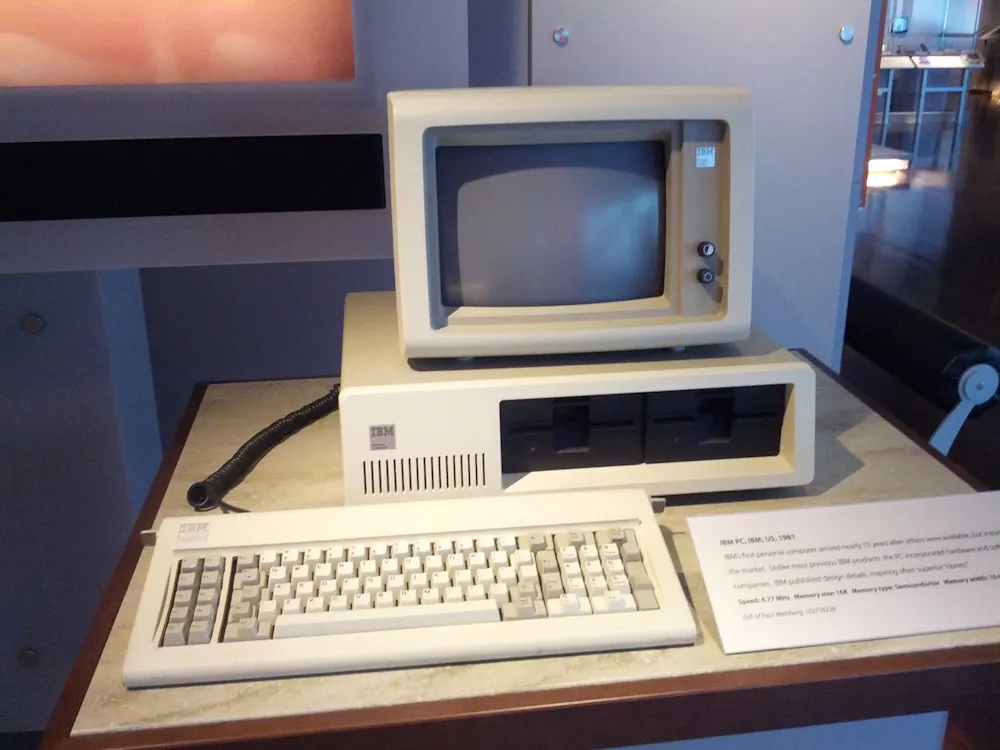
    As oil crises of the 1970s marked the end of the preceding cycle of inequality, another cycle began with the full-scale emergence of the third industrial revolution, powered by computers, digital networks and information technology.

    The first personal computer, made by IBM.
    Wikimedia Commons, CC BY-ND

    As digitalisation transformed business models and labour markets, wealth flowed to those who owned the algorithms, patents and platforms – not those operating the machines. Hi-tech entrepreneurs and Wall Street financiers became the new oligarchs. Stock options replaced salaries as the true measure of success, and companies increasingly rewarded capital over labour.

    By the 2000s, the wealth share of the richest 1% climbed to 30% in the US. The gap between the elite minority and working majority widened with every company stock market launch, hedge fund bonus and quarterly report tailored to shareholder returns.

    But this wasn’t just a market phenomenon – it was institutionally engineered. The 1980s ushered in the age of (Ronald) Reaganomics, driven by the conviction that “government is not the solution to our problem; government is the problem”. Following this neoliberalist philosophy, taxes on high incomes were slashed, capital gains were shielded, and labour unions were weakened.

    Deregulation gave Wall Street free rein to innovate and speculate, while public investment in housing, healthcare and education was curtailed. The consequences came to a head in 2008 when the US housing market collapsed and the financial system imploded.

    The Global Financial Crisis that followed exposed the fragility of a deregulated economy built on credit bubbles and concentrated risk. Millions of people lost their homes and jobs, while banks were rescued with public money. It marked an economic rupture and a moral reckoning – proof that decades of pro-market policies had produced a system that privatised gain and socialised loss.

    Inequality, long growing in the background, now became a glaring, undeniable fault line in American life – and it has remained that way ever since.

    Fig 5. Wealth share and income share of top 1% in the US

    Sources: wealth inequality: World Inequality Database; income share: Picketty & Saez (2003). Dotted curves are conjectured based on Kuznets curve.
    Peng Zhou, CC BY-SA

    So is the US proof that the Kuznets model of inequality is indeed wrong? While the chart above shows inequality has flattened in the US since the 2008 financial crisis, there is little evidence of it actually declining. And in the short term, while Donald Trump’s tariffs are unlikely to do much for growth in the US, his low-tax policies won’t do anything to raise working-class incomes either.

    The story of “the American century” is a dizzying sequence of technological revolutions – from transport and manufacturing to the internet and now AI – crashing one atop the other before institutions, politics or social norms could catch up. In my view, the result is not a broken cycle but an interrupted one. Like a wheel that never completes its turn, inequality rises, reform stutters – and a new wave of disruption begins.

    Our unequal AI future?

    Like any technological explosion, AI’s potential is dual-edged. Like the Tang dynasty’s bureaucrats hoarding grain, today’s tech giants monopolise data, algorithms and computing power. Management consultant firm McKinsey has predicted that algorithms could automate 30% of jobs by 2030, from lorry drivers to radiologists.

    Yet AI also democratises: ChatGPT tutors students in Africa while open-source models such as DeepSeek empower worldwide startups to challenge Silicon Valley’s oligarchy.

    The rise of AI isn’t just a technological revolution – it’s a political battleground. History’s empires collapsed when elites hoarded power; today’s fight over AI mirrors the same stakes. Will it become a tool for collective uplift like Britain’s post-war welfare state? Or a weapon of control akin to Han China’s grain-hoarding bureaucrats?

    The answer hinges on who wins these political battles. In 19th-century Britain, factory owners bribed MPs to block child labour laws. Today, Big Tech spends billions lobbying to neuter AI regulation.

    Meanwhile, grassroots movements like the Algorithmic Justice League demand bans on facial recognition in policing, echoing the Luddites who smashed looms not out of technophobia but to protest exploitation. The question is not if AI will be regulated but who will write the rules: corporate lobbyists or citizen coalitions.

    The real threat has never been the technology itself, but the concentration of its spoils. When elites hoard tech-driven wealth, social fault-lines crack wide open – as happened more than 2,000 years ago when the Red Eyebrows marched against Han China’s agricultural monopolies.

    To be human is to grow – and to innovate. Technological progress raises inequality faster than incomes, but the response depends on how people band together. Initiatives like “Responsible AI” and “Data for All” reframe digital ethics as a civil right, much like Occupy Wall Street exposed wealth gaps. Even memes – like TikTok skits mocking ChatGPT’s biases – shape public sentiment.

    There is no simple path between growth and inequality. But history shows our AI future isn’t preordained in code: it’s written, as always, by us.


    For you: more from our Insights series:

    To hear about new Insights articles, join the hundreds of thousands of people who value The Conversation’s evidence-based news. Subscribe to our newsletter.

    Peng Zhou does not work for, consult, own shares in or receive funding from any company or organisation that would benefit from this article, and has disclosed no relevant affiliations beyond their academic appointment.

    ref. What 2,000 years of Chinese history reveals about today’s AI-driven technology panic – and the future of inequality – https://theconversation.com/what-2-000-years-of-chinese-history-reveals-about-todays-ai-driven-technology-panic-and-the-future-of-inequality-254505

    MIL OSI – Global Reports

  • MIL-OSI Global: What is the Resistance Front? An expert explains the terror group that carried out the latest Kashmir attack?

    Source: The Conversation – UK – By M. Sudhir Selvaraj, Assistant Professor, Peace Studies and International Development, University of Bradford

    India is in mourning after 26 tourists were killed on April 22 in a resort in picturesque Pahalgam. The massacre is considered to be the deadliest attack on tourists in Indian-administered Kashmir since 2000.

    The attack happened during peak tourist season as thousands flocked to the popular tourist destination. Most of those killed were Indians, with the exception of one Nepalese national. All the victims were men.

    Pakistan has denied any involvement, but there are serious fears of escalation between the two nuclear powers. India’s defence minister, Rajnath Singh, openly accused Pakistan and threatened: “We will not only target those who carried out the attack. We will also target those who planned this act in the shadows, on our soil.”

    India has shut a key border between the countries, expelled Pakistan’s diplomats and suspended the landmark Indus waters treaty which allows the sharing of water between the two countries.

    The timing of these attacks is noteworthy as it coincides with major international and domestic events. The US vice-president, J.D. Vance, had arrived the day before with his Indian-American wife Usha and their three children, seeking closer India-US relations against the backdrop of a burgeoning trade war between the US and China. Notably, Pakistan considers China historically as an all-weather friend and ally.

    The attack also comes a few weeks after the Indian government passed the Waqf (Amendment) Act which seeks to change how properties worth billions donated by Muslims, including mosques, madrassas, graveyards and orphanages, are governed. This act is also accused of diluting the rights of India’s Muslim communities by permitting the appointment of non-Muslims to their boards and tribunals.

    Resistance Front

    The Resistance Front (TRF) has claimed responsibility for the attack. A hitherto lesser-known armed group in the Kashmir region, TRF emerged in 2019 with the aim to fight for Kashmir’s secession from India. In 2023, it was designated as a terrorist organisation by the Indian government under the Unlawful Activities (Prevention) Act (UAPA), and the group’s founder, Sheikh Sajjad Gul was declared a terrorist.

    TRF was formed largely in response to the Indian government’s move to strip Kashmir (India’s erstwhile only Muslim-majority state) of its semi-autonomous status in 2019. At this point, the Modi split Kasmhir into two union territories – Jammu & Kashmir – and brought it under more direct federal control.

    The move also paved the way for the extension of land-owning rights and access to government-sponsored job quotas to non-locals. These changes could deprive locals of much-needed opportunities, and radically alter the demographics of the region.

    In a message on messaging app Telegram, the group said: “Consequently, violence will be directed toward those attempting to settle illegally.” This tends to support the idea that the influx of “outsiders” was the justification for the attack.

    In its short life, TRF has been responsible for numerous attacks targeting civilians, security forces and politicians in the region. The group took shape using social media and continues to rely on it to organise and recruit members.

    Notably, the name TRF breaks from traditional rebel groups operating in the region, most of whom bear Islamic names. By doing so, it supposedly aims to project a “neutral” (read as non-religious) front, rather emphasising the fight for Kashmiri nationalism.

    Was Pakistan involved?

    The group is also reported to be linked to the Pakistani spy agency, Inter-Services Intelligence (ISI). Pakistan has denied these links. But analysts fear that any retaliation could escalate and threaten the tenuous peace along the border between the two countries.

    Importantly, the TRF is believed to be an offshoot of, – or perhaps simply a front for – the Lashkar-e-Taiba (LeT), a Pakistan-based armed group. The LeT was involved in many terrorist attacks on Indian soil, most significantly, the 2008 Mumbai terrorist attacks in which an estimated 176 people were killed. The perpetrators of the atrocity are believed by many – including the US government – to have involved help from the ISI.

    While not explicitly stated as a link to the Pahalgam attack, it is noteworthy that the suspected mastermind of the Mumbai attacks, Tahawwur Rana, a Pakistan-born Canadian citizen was extradited to India from the US on April 10. The US Embassy in New Delhi has confirmed that Rana will stand trial in India on ten criminal charges.

    In contrast to the supposed “neutral” ostensibly non-Islamist nature of the TRF, the LeT (which translates as Army of the Righteous/Pure), is a Sunni terrorist group. Its aim is to to establish an Islamic state in south Asia and parts of central Asia – with Kashmir being integral to its plans.

    To achieve this, since its formation in the early 1990s, the group’s focus has been on attacking military and civilian targets in Kashmir, supporting Pakistan’s claim to the region.

    In the late 1990s, the then US president, Bill Clinton, described south Asia as the most dangerous place on Earth. Given the chance of a rapidly escalating India-Pakistan standoff, this could well be the case once again.

    M. Sudhir Selvaraj does not work for, consult, own shares in or receive funding from any company or organisation that would benefit from this article, and has disclosed no relevant affiliations beyond their academic appointment.

    ref. What is the Resistance Front? An expert explains the terror group that carried out the latest Kashmir attack? – https://theconversation.com/what-is-the-resistance-front-an-expert-explains-the-terror-group-that-carried-out-the-latest-kashmir-attack-250663

    MIL OSI – Global Reports

  • MIL-OSI Economics: Press Briefing Transcript: Managing Director’s Global Policy Agenda, Spring Meetings 2025

    Source: International Monetary Fund

    April 24, 2025

    Speaker: Kristalina Georgieva, Managing Director, IMF

    Moderator: Julie Kozack, Director, Communications Department, IMF

    Ms. Kozack: Good morning, everyone. Welcome to this IMF press briefing. I am Julie Kozack, Director of the Communications Department. Thank you so very much for joining us this morning and, as usual, we are going to begin with some opening remarks from our Managing Director, Kristalina Georgieva, after which we will turn to your questions. Without further ado, Kristalina, over to you.

    Ms. Georgieva: Thank you, Julie. And a very warm welcome to all the journalists who got up early to be with us on this beautiful Thursday morning, and also to those who are online. Great to have you with us.

    As you saw earlier this week in our latest World Economic Outlook, we have significantly downgraded our projections for global growth. Major trade policy shifts have spiked uncertainty off the charts, accompanied by tighter financial conditions and higher market volatility. Simply put, the world economy is facing a new and major test, and it faces it with policy buffers depleted by the shocks of recent years. That puts countries in a difficult position. It also creates urgency for action to strengthen the economies for a world of rapid change.

    Today, I want to zoom in on how countries can actually do it. This is the main question we are getting from our members in every single meeting I have had this week. In my Global Policy Agenda, let me, for the audience, remind you that it is a very nicely crafted document. In parentheses this year we have very informative charts, and I hope you will look into those as well. In it, we focus on both the immediate challenges and our medium-term directions. I emphasize three overarching priorities. First and most urgent, for countries to work constructively to resolve trade tensions as swiftly as possible, preserving openness and removing uncertainty. A trade policy settlement among the main players is essential, and we are urging them to do it swiftly because uncertainty is very costly. I cannot stress this strongly enough.

    Without certainty, businesses do not invest, households prefer to save rather than to spend, and this further weakens prospects for already weakened growth.

    Countries also need to address the imbalances that fuel many of the tensions we see. Among major economies, some countries like China need to act to boost private consumption and embrace a shift to services. Others, like the United States, need to reduce fiscal deficits. And in Europe, it is time to complete the Single Market, Banking Union, Capital Markets Union, removing internal barriers to intra-EU trade. Get it done. All countries should seize this moment to lower their trade barriers, both tariff and nontariff.

    The second overarching priority, countries must act to safeguard economic and financial stability. The best way to do that is to get their own house in order. On fiscal policy, most countries need to rebuild buffers and ensure debt sustainability, although some may see shocks that warrant temporary and targeted fiscal support.

    We urge countries to define credible adjustment paths, gradual in most cases, protecting key investments, maximizing spending efficiency, and making space for longer term needs.

    Tradeoffs will be tough for all, but they will be toughest for low-income countries, which face both tight financial conditions and global growth slowdown and falling aid flows. To help ease the tradeoffs there, domestic resource mobilization must be part of the mix. We cannot have countries with a tax to GDP below 15 percent where it is difficult to sustain the functioning of the state. For central banks, the times when countries marched in lockstep is over. Different countries will face different conditions. Inflation pressures in some countries are easing. In others, pressures are yet to abate.

    What is our advice? Watch the data, watch inflation expectations. Central banks will need to strike a delicate balance between supporting growth and containing inflation. To do so, they must not only adjust policy interest rates but also rely on credibility to anchor expectations. Central bank independence is critical for credibility, protect it.

    Open economies, including many emerging markets, are exposed to the trade shocks and tighter financial conditions. They must preserve exchange rate flexibility as a shock absorber.

    In the event of unwarranted currency market volatility, these countries can find policy guidance in the IMF’s integrated policy framework.

    My third and final overarching priority, double down on growth oriented reforms to lift productivity. Even before the latest shock, we were living in a low growth, high debt world, sounding the alarm on weak medium-term growth for quite some time. You heard me saying that many times. Now is the time for long needed but often delayed reforms that can create a good business environment, put entrepreneurship in the front seat, reform labor markets, create conditions for innovation and in a world of rapid technological advancements, give countries a chance to catch the benefits of these advancements for their people.

    The IMF, of course, as always, will be there for our members. We are focusing on what we do best, helping them secure economic and financial stability, resolve or, even better, prevent balance of payments problems, and put in place strong policies and institutions to underpin vibrant economies.

    We will help countries with surveillance, with diagnostics, with policy advice and, when necessary, by providing financial support.

    As part of crisis resolution, we must ensure that the Global Financial Safety Net is strong. We will look for ways to further strengthen our collaboration with regional financing arrangements, and with [major] swap-providing central banks. When we have a cohesive, effective, and efficient Global Financial Safety Net, this will deliver confidence to our members in this more shock prone world.

    We will continue to foster cooperative policy solutions for promoting a healthy rebalancing of the world economy to help countries address debt vulnerabilities. Here, I want to acknowledge the important work of the Global Sovereign Debt Roundtable. This week, we agreed to publish a playbook that provides guidance for predictable and faster debt restructuring processes. And I was very pleased to see [the] support of all traditional, nontraditional creditors, private sector, and debtor countries to have that predictability.

    Finally, we will reiterate the need for continued cooperation in a multipolar world. The shared objective for all must be a better balanced and more resilient world economy.

    Before I wrap it up, I want to recognize Secretary Bessent’s remarks yesterday in which he laid out the U.S. administration’s vision for the Bretton Woods Institutions. The United States is our largest shareholder. And even more, the United States is the home of my colleagues and me. So, of course, we greatly value the voice of the United States. I very much appreciate Secretary Bessent’s reiteration of the U.S.’s commitment to the Fund and its role. He raised a number of issues and priorities for the institution that I look forward to discussing with the U.S. authorities and the membership as a whole. We will have opportunities to do so here, and we will also have opportunities to continue with our Executive Board as we carry out important policy reviews–the Comprehensive Surveillance Review, it will set our surveillance priorities for the next five years, and the Review of Program Design and Conditionality, which will carefully consider how our lending can best help countries address the low growth challenge and durably resolve balance of payments weaknesses. So, we have a way to go, and we are laser focused on it.

    Are there cyclists in this room, people who bike, bikers? As bikers would pay, ‘pedalare,’ step on the pedal. With that, I am very happy to take your questions.

    Ms. Kozack: Thank you very much, Kristalina. We will now turn to your questions. I see you have hands up already. Very good. Please just give your name and outlet when called on. I am going to start right here, woman right in the front row here.

    Questioner: Thanks very much for the opportunity to ask you—to put a question to you. You mentioned Secretary Bessent’s remarks yesterday. He accused the IMF and the World Bank of mission creep and specifically the IMF on mission creep in areas such as climate change, gender policies and also social issues. Do you think there is a role in the future for the IMF in areas such as climate, gender, and social issues?       

    Ms. Georgieva: Thank you for your question. So, what do we do here? We concentrate on macroeconomic and financial stability for growth and employment. We have 191 members. They face different challenges. They face different types of risks to their balance of payment. And what we do is to analyze what these risks and what the Fund in our mandate and what we do on the fiscal side, on the monetary policy side, on the financial sector side, what can we do to help them be more resilient to shocks. So, when we have, for example, Caribbean countries that are wiped out by extreme weather events regularly, naturally they are very concerned about that, and they say how can we be more resilient to these shocks? Again, we focus on balance of payment. What are the risks and what can be done to protect the balance of payments in these countries.

    I want to say that I actually agree with the Secretary on one thing. It is a very complicated world, a world of massive challenges of all kinds. We are a small institution. We are 4,000 people. Not very well-known, but a very fiscally disciplined institution. Our budget today in real terms is what it was 20 years ago. So, yes, we have to focus. And that is exactly why we engage with the membership, so we can make best use of the staff of the Fund. I really like to run a tight ship. Yes.

    Ms. Kozack: I can attest to that. Let us go here, the gentleman in the third row, blue shirt.

    Questioner: Just to follow-up on Claire’s question. Does Secretary Bessent’s prescriptions here for the Fund, will it cause you to sort of rethink some of the lending programs like the RSF and the RST? And then secondly, a lot of economists in the private sector have sort of a more pessimistic view, especially when you look at sort of the prospects for U.S. recession. You are not predicting that. Some of the Ministers here that we have been interviewing feel that the Fund is being too conservative. Can you just sort of explain the differences between yourselves and the private sector?

    Ms. Georgieva: Thank you very much. Actually, in the paper that I just flagged to you, we have a slide that shows Fund lending. You need a magnifying glass to see the share of the Resilience and Sustainability Trust in this lending. It is really small, but as I was explaining in the answer to the previous question, for countries that are highly vulnerable to extreme weather events, having policy advice strictly on the macro side, there is a bit of confusion. People think that we have climate experts. We do not. That is not our job. Our job is to say, OK, if you are Dominica and a hurricane can wipe out the equivalent of 200 percent of your GDP, what are reasonable policies to put in place, or to be more specific, because we have a program with Barbados, if you are Barbados natural disasters are highly damaging to your economy, what are the policy measures you can put in place. In the case of Barbados, we came up with creating an additional buffer for them that would actually prevent a balance of payments shock from derailing the economic development of the country. So, of course, we are a membership institution. What our members decide, this is what we do. We periodically review all of our instruments. At this point, we have the function of the Fund on balance of payments support defined with a number of instruments being deployed.

    To your second question, I am going to do this illustration. My glass, when you look at it, it is more than 60 percent full. This is where we are. This is what it is. How can I call it empty? I cannot. When we look at the data, what we see is that for the United States, recession risks have increased now to 37 percent, but we are not yet—we do not see either in the labor market or indicators for the functioning of the economy such a dramatic block of economic activities that would drag growth in the United States all the way to below zero.

    So, as you remember, I mean, this is something that people may not appreciate enough. Our earlier projections for a very vibrant U.S. economy were for 2.7 percent growth for this year. We have downgraded the United States—actually this is the largest of our downgrades—by 0.9 percent, to 1.8 percent for this year. But we see enough that carries the United States forward. And, of course, we recognize that there is work underway to resolve trade disputes and reduce uncertainty. I want to reiterate my message. Uncertainty is really bad for business, so the sooner this cloud that is hanging over our heads is lifted, the better for prospects for growth.

    For the world economy, as you know we are—you saw it in the WEO, we are also projecting an increase in recession risk from 17 to 30 percent. But again—and by the way, there we talk about growth falling below 2 percent, not below zero, so there is a lot that is carrying the world economy—actually the real economy is functioning in a way that we are seeing no predominant risk. Is there risk? Yes. But it is in our, we used to say, downside scenario and not in what is our—the scenario we anchor our projections.

    This being said—and I am sorry I am dwelling on that. It is a very important question. I get it from delegations when we talk about our projections a lot. This being said, countries can—they are not passive observers. They can act. And one thing that is amazing in these meetings is how much that sense of urgency to act is penetrating our membership. And I do hope that Ministers will go back and say, OK, tough reform, I have postponed it, postpone no more.

    Ms. Kozack: We are going to this side of the room. I am going to go all the way to the end. There is a woman in the third row at the end in a brown suit.

    Questioner: My question is many emerging markets, particularly in Asia, are feeling the pinch of escalating trade tensions and global uncertainties. So, from the IMF’s perspective, how has China and ASEAN countries been affected so far and is there any policy recommendations in the near term that are available from the IMF to navigate these countries through this thank you.

    Ms. Georgieva: Thank you for your question. Indeed, Asia is a continent that is quite significantly impacted because economies that rely a lot on exports, when tariffs are announced, feel the pinch more. When we look at China, we have downgraded growth projections for China from 4.6 to 4 percent. We would have downgraded it much more—we actually would have had not .06 but 1.3 percent downgrade if it was not for the policy accommodation that China is already putting in place. It helps. And that is the first piece of advice. If you have policy space, now is a good time to use it. With regard to China, we are emphasizing four points. First, rebalance your economy towards domestic consumption more.

    Second, to help with this, bring to an end the turmoil in the property sector. And, of course, add social protection for people so they do not feel compelled to save rather than spend.

    Third, lift up services, a warm embrace from healthcare to education to basically the service sector, vis-à-vis the goods consumption. And four—and the fourth is very important. Get the government to pull back from too much intervention in the economy. Let the private sector function to its full capacity.

    We are currently working on a paper, and that is in consultation, collaboration with the Chinese authorities, to document in details what are the ways in which the government may be supporting businesses and by doing so shifting the competitive position of these businesses. And this will be one of our contributions to China.

    I am particularly concerned about ASEAN. Why? Because ASEAN, very open economies. They find themselves in a very tough spot with announced tariffs quite significant across the board in ASEAN countries.

    ASEAN has done really well to build resilience over the last years. Their growth has been quite sound. They have prudently brought inflation down. They have disciplined fiscal policy. It helps. This is our number one advice to ASEAN. You have some policy space in monetary policy, in fiscal policy. Carefully and prudently use it, of course, being mindful that if you deplete it entirely and there is another shock, that would be a problem.

    We have been working with ASEAN on their external sector, especially forex. We have integrated the policy framework. It allows good thinking around how to apply the exchange rate flexibility, how to look at this from the perspective of sudden exogenous shocks. I am very pleased to see that ASEAN is doing something that other regions are doing, strengthening economic cooperation, policy coordination, and intra-ASEAN trade. Currently the ASEAN countries trade only 21 percent among themselves. Well, they sure can go up.

    And I think that we will see not only in ASEAN, we will see it in other places, Gulf Cooperation Council, Central Asia, the African continent with the Continental Free Trade Agreement, more being done to compensate, if global trade is going down, then regional trade can be a compensator and actually inject growth energy.

    I want to finish by saying that ASEAN has been remarkably prudent over the last years to build resilience. And that puts them in a good position to have the reputation to deploy their policy space if needed.

    Ms. Kozack: OK. I am going to stay on this side of the room. I will go to the gentleman in the second row with the red tie.

    Questioner: You said these present tensions could disproportionately impact low-income countries, and I am glad you mentioned the African Continental Free Trade Area Agreement because my question is on Africa. You met with the Nigerian delegation earlier this week. What is the strategy or your advice for the African continent? As you have noted in the past, Africa is not a country. It is a continent. Egypt cut rates for the first time in five years seven days ago. Prior to that, Ghana hiked its interest rate for the first time in almost three years. In these tough times, what is your advice for the continent?

    Ms. Georgieva: Well, we have seen over the last years the African continent having some of the fastest growing economies, but we also have seen low-income countries primarily, and among them fragile conflict affected countries, falling further behind. And now this is a shock for the continent. The direct impact of tariffs on most of Africa, not on all of Africa, but on most of Africa is relatively small, but the indirect impact is quite significant. Slowing global growth means that all other things equal, they will see a downgrade. And actually, we have downgraded growth prospects for the continent.

    For the oil producers like Nigeria, falling oil prices creates additional pressure on their budgets. On the other hand, for the oil importers, this is a breath of fresh air. In other words, as you indicated in your question, different countries face different challenges. If I were to come with some basic recommendations that apply to Africa, I would say—and actually they apply to Nigeria, they apply to Egypt, they apply to Ghana, they apply to Coté d’Ivoire. First, continue on a path of strengthening your fundamentals. There is still a lot that can be done on the fiscal side to have strength. As I was talking about ASEAN, to have buffers for a moment of shock. And do not use any excuses, oh, it is difficult, we cannot really go for more tax because, yes, you can. There is a lot that can be done to broaden the tax base and a lot that can be done to reduce tax evasion and tax avoidance.

    Using technology as some countries are doing to chase the tax dollar when there is the foundation for that is a very good thing to do.

    Second, on the monetary policy side, we know more as I said in the opening—we are no more in a place when you can look at the book of the Central Bank Governor of the neighboring country and say, oh, they are doing this, I will do the same, because you have to really assess domestic resource mobilization, what is your inflationary pressures and do the right thing for your country.

    But above all, make it so that the image of the whole continent changes because now everybody suffers from wrongdoing, from corruption or from conflict in one country. It throws a shadow on the rest of the continent.

    Finally, like with ASEAN, deepen interregional trade and cooperation. Remove the obstacles to it. Sometimes there are infrastructure obstacles. The World Bank is working on reducing that infrastructure obstacle to growth and trade.

    Africa has so much to offer the world. Obviously, they have the minerals, the natural disasters, and the young population. I think a more unified, more collaborative continent can go a long, long way to [becoming] an economic powerhouse.

    Ms. Kozack: I will go to this side of the room. I am going to have the woman in the red jacket, third row.

    Questioner: Ms. Georgieva, you have been very complementary of the economic reform that the Argentinian government is implementing. You have said that Argentina is an example of a country that has made great strides through structural reforms and fiscal discipline. I would like to ask you about the challenges that now the new program is facing right now, and above all what are the risks that Argentina can face in these times of global uncertainty? Thank you.

    Ms. Georgieva: Argentina has demonstrated that this time it is different. This time there is decisiveness to put the economy on a soundtrack from high deficit to surplus, from double-digit inflation to inflation that in February dipped under 3 percent, from poverty over 50 percent to now around 37 percent. Still very high but going down. The state is stepping out from where it does not belong to allow more dynamism in the private sector. Actually, if you are interested, today we will have the global debate, and Federico is going to be one of the speakers to talk about smart regulation, how you make the economy more vibrant by not being an obstacle to private initiative.

    We saw that when the program was announced, the immediate impact on markets was positive because, among other things, you ask about risks. One risk for Argentina would be if it is alone in this macroeconomic stabilization, now the country is not alone. We are there. The World Bank is there. The InterAmerican Bank is stepping up. What are the risks? And I am sorry, and there is a very important opportunity for Argentina in a world hungry for what Argentina produces, both in agriculture and in minerals, mining, gas, lithium. What are the risks?

    First, external. A worsening global environment of all other things equal, it would impact Argentina negatively. Domestic resource mobilization, the country is going to go to elections, as you know, in October. And it is very important that they do not derail the will for change. So far, we do not see that. We do not see that risk materializing, but I would urge Argentina, stay the course.

    Ms. Kozack: All right. Let us go right here in the front, end of the first row.

    Questioner: Managing Director, we had a lot of news this week, for example, mixed signals on tariffs on China, commentary on the position of the Fed Chair, and of course now the U.S. support of the IMF. How would you sum up the mood of the meetings of your members this week, please? 

    Ms. Georgieva: The membership is anxious because we were just about to step on a road to more stability after multiple shocks. We were projecting 3.3 percent growth. And actually, we were worried that this is not strong enough. And here we are, growth prospects weakened. The membership is also recognizing—and I hear it time and again—that it is very important to have a rules based global economy in which there is predictability of planning for action, both for governments and for the private sector. I actually hear a lot of support from the membership for the Fund because we have actually, the same way Argentina earned the Fund to support it, we have earned the support of the members by being there for them.

    Where the expectations are for the outcome of the meetings is to get more consistency in how all countries are going to go about pursuing their interests, which is legitimate. Of course, every country has to think about its own people but doing it so in a way that enlarges the global pie. It does not shrink it.

    Ms. Kozack: We have time for one last question. I am going to go over here.

    Ms. Georgieva: I am sorry. What I would say is the worry I hear more often is actually not even the tariffs. It is uncertainty. Let us have clarity. And that is why we are—with my apologies to the audience—so repetitive to say we need to bring uncertainty down.

    Ms. Kozack: We have time for one last question, the woman in the burgundy suit.

    Questioner:  I wanted to ask you about the MENA region. How concerned are you with all of this turmoil around the dollar and its effect on the MENA region, especially that many countries there are exporters of intermediate goods that go into major industries and many of them are exporters of energy and what is happening to the dollar is definitely of effect. And you have mentioned uncertainty many times today in this press conference. So, this uncertainty, how will it affect the countries in our region that are trying to get out of a lot of geopolitical uncertainty with the help of the IMF and special programs, such as Egypt? So, will this make the IMF revisit some of those programs amid all of this turmoil?

    Ms. Georgieva: Thank you very much. The MENA region actually got quite a downgrade. It is still doing better this year than last year, but we were projecting that growth would go to 4 percent and now we downgraded it to 2.6. A little bit like Africa, most of the impact is indirect. While countries in the MENA region, of course, trade with the United States, but most of them do not have very high exposure. And where it bites is slowing down of the global economy. And MENA has many oil exporters. The price of oil is going down.

    The dollar has historically, it goes up, it goes down. It is not a new thing. So, if you have an oil exporter and you get your revenues in dollars, when the dollar weakens, that creates a bit of a problem for your fiscal position. But if you are an oil exporter, this is a gift because then you can deal more easily with the challenges you face.

    My take for the MENA region is a very diverse region, like the African continent. You have the Gulf Cooperation Council. I have a lot of praise to offer because they have been pursuing reforms and diversification of the economies. Most countries have done really well. So now they see oil growth down, but non-oil economies are still doing quite well.

    We have the more kind of middle-income countries that are faced with difficulties impacted by regional conflicts like Jordan, like Egypt. And there we have been engaged, we have been providing support, as you know. We have countries like Morocco that have done really well to get their house in order, to have sound fiscal monetary policy and the only country in the region that is eligible for Flexible Credit Line from the IMF. And then we have countries like Sudan or Syria that are severely impacted by conflicts.

    I was very pleased that the attention of our membership, despite difficulties at home, across-the-board on low-income countries and conflict affected states, has sharpened. There is a recognition that what happens there impacts the rest of the world.

    We had a Syria meeting during the week of the meetings. The first time in more than 20 years, the Central Bank Governor and the Minister of Finance from Syria are here at the meetings. Our intention is to first and foremost help them rebuild institutions so they can plug themselves in the world economy.

    You are asking me whether we are revisiting program assumptions. Of course, we will be carefully watching what is happening. Then I had a meeting with the Prime Minister of Jordan. We are not talking about amending the program for Jordan right now, but we are talking about the importance of the Fund as an anchor of stability and how we can exercise this role.

    Ms. Kozack: Thank you very much, Managing Director, and thank you very much to all of our journalists who have joined us today. I am bringing this press conference to an end. As always, the transcript will be made available on our website, and I want to wish all of you a very wonderful rest of your day. Thank you very much.

    Ms. Georgieva: Thank you very much. Have a good rest of your day.

    IMF Communications Department
    MEDIA RELATIONS

    PRESS OFFICER: Wafa Amr

    Phone: +1 202 623-7100Email: MEDIA@IMF.org

    MIL OSI Economics

  • MIL-OSI: Aemetis India Begins Biodiesel Shipments to Oil Marketing Companies under $31 Million Allocation For the Next Three Months

    Source: GlobeNewswire (MIL-OSI)

    CUPERTINO, Calif., April 24, 2025 (GLOBE NEWSWIRE) — Aemetis, Inc. (NASDAQ: AMTX), a diversified global renewable natural gas and biofuels company, announced the Company’s subsidiary in India, Universal Biofuels, today began shipments to fulfill multiple orders for more than 33,000 kiloliters of biodiesel from the government-owned Oil Marketing Companies (OMCs) for an aggregate of $31 million for delivery during May, June, and July. 

    Additional OMC orders are expected throughout the year to continue shipments to fuel blending terminals on an ongoing basis to support the India government goal of increasing from a 1% to 5% biodiesel blend. A 5% biodiesel blend is approximately 1.2 billion gallons, a significant increase from less than a 1% blend of biodiesel that is currently used in India.

    “We are pleased with the expanded commitment to biofuels that is being shown by the India government, including the achievement of a 20% blend of ethanol and new goals including a 30% ethanol blend,” stated Eric McAfee, Chairman and CEO of Aemetis. “We began our biodiesel shipments today from inventory to quickly ramp up to $10 million per month of shipments and fulfill the $31 million of new orders from OMCs for biodiesel over the next three months. We have already made the capital investments that allow us to quickly increase production volumes as new orders are issued by the OMCs.”

    Recently, India has stated plans for further growth in the use of biofuels, expanding revenues for farmers while reducing the importation of petroleum gasoline into India. India’s strong commitment to expanding biofuels markets supports the Aemetis India business plan for further expansion and a planned Initial Public Offering (IPO), subject to continued favorable stock market conditions.

    Universal Biofuels completed $112 million of biodiesel and glycerin shipments in the twelve months ended September 2024, including deliveries to the three government-owned oil marketing companies under a cost-plus contract. During a recent plant upgrade and maintenance period, Universal Biofuels expanded the production capacity of its proprietary process that produces biodiesel from waste and byproducts that Universal utilizes to produce biofuels that are lower carbon intensity at a significantly reduced cost.

    Aemetis’ Universal Biofuels subsidiary is one of the largest biodiesel producers in India, having been in operation for more than 17 years. Universal Biofuels increased its annual biodiesel production capacity from 60 million gallons to 80 million gallons in the past year, with further biodiesel expansion to other locations and diversification into biogas production planned during the next twelve months.

    About Aemetis

    Headquartered in Cupertino, California, Aemetis is a renewable natural gas and biofuels company focused on the operation, acquisition, development, and commercialization of innovative technologies that support energy independence and security. Founded in 2006, Aemetis operates and is expanding a California biogas digester network and pipeline system to convert dairy waste into renewable natural gas. Aemetis owns and operates a 65 million gallon per year ethanol production facility in California’s Central Valley near Modesto that also supplies about 80 dairies with animal feed. Aemetis owns and operates an 80 million gallon per year biofuels facility on the East Coast of India producing high quality distilled biodiesel and refined glycerin. Aemetis is developing a sustainable aviation fuel and renewable diesel biorefinery and a carbon sequestration project in California. For additional information about Aemetis, please visit www.aemetis.com.

    Safe Harbor Statement

    This news release contains forward-looking statements, including statements regarding assumptions, projections, expectations, targets, intentions or beliefs about future events or other statements that are not historical facts. Forward-looking statements include, without limitation, projections of financial results; IPO plans; statements related to the development, engineering, financing, construction, timing, and operation of biodiesel, biogas, sustainable aviation fuel, CO2 sequestration, and other facilities; our ability to promote, develop, finance, and construct such facilities; and statements about future market prices and results of government actions. Words or phrases such as “anticipates,” “may,” “will,” “should,” “believes,” “estimates,” “expects,” “intends,” “plans,” “predicts,” “projects,” “targets,” “view,” “will likely result,” “will continue” or similar expressions are intended to identify forward-looking statements. These forward-looking statements are based on current assumptions and predictions and are subject to many risks and uncertainties. Actual results or events could differ materially from those set forth or implied by such forward-looking statements and related assumptions due to certain factors, including, without limitation, competition in the ethanol, biodiesel and other industries in which we operate, commodity market risks including those that may result from current weather conditions, financial market risks, customer adoption, counter-party risks, risks associated with changes to government policy or regulation, and other risks detailed in our reports filed with the Securities and Exchange Commission, including our Annual Reports on Form 10-K, and in our other filings with the SEC. We are not obligated, and do not intend, to update any of these forward-looking statements at any time unless an update is required by applicable securities laws.

    Company Investor Relations
    Media Contact:
    Todd Waltz
    (408) 213-0940
    investors@aemetis.com

    External Investor Relations
    Contact:
    Kirin Smith
    PCG Advisory Group
    (646) 863-6519
    ksmith@pcgadvisory.com

    The MIL Network

  • MIL-OSI Europe: President Meloni’s telephone conversation with Indian Prime Minister Modi

    Source: Government of Italy (English)

    24 Aprile 2025

    The President of the Council of Ministers, Giorgia Meloni, had a telephone conversation with the Indian Prime Minister Narendra Modi today, to whom she renewed the Italian Government’s condolences for the victims of the brutal terrorist attack in Kashmir on 22 April.

    President Meloni reiterated Italy’s commitment to fighting international terrorism, agreeing with Prime Minister Modi on the need to further strengthen bilateral dialogue and joint action in this area.

    The call also provided an opportunity for an exchange of views on the main topics currently on the international agenda and the progress of the strategic partnership between Italy and India, in line with the Action Plan adopted by President Meloni and Prime Minister Modi last November.

    MIL OSI Europe News

  • MIL-OSI: WENDEL: Q1 2025 Trading update

    Source: GlobeNewswire (MIL-OSI)

    Q1 2025 NAV per share at €176.7

    Continued strategic deployment :

    €34bn of private Assets under Management for third parties

    Solid financial structure:
    Strong liquidity and LTV ratio at 17.2%

    Fully diluted Net Asset Value1as of March 31, 2025: €176.7 per share

    • Fully diluted NAV per share down -4.8% since the start of the year reflecting market volatility and evolution of valuation multiples:
      • Listed assets (29% of Gross Asset Value): flat total value year-to-date
      • Unlisted assets (33% of GAV): total value down 7.3%, mainly due to lower market multiples
      • Following the acquisition of Monroe Capital, Asset Management now represents 17% of GAV

    Good performance of Group companies in Q1 20205

    • Principal investments: all Group companies generated positive total sales growth in Q1, except Scalian

    Asset management: good momentum in fundraising and revenue growth

    • IK Partners’ revenues up +33% in Q1. Successful closing of the IK X flagship fund at €3.3 billion, the largest fund raised in its history and continued momentum in fundraising of IK Small & Dev Cap
    • Altogether IK Partners and Monroe have successfully raised more than €3 billion of new funds on various strategies over Q1 2025

    Successful implementation of new strategic directions

    • Principal Investments: successful Forward Sale of 6.7% of Bureau Veritas’ share capital, at a price of €27.25 per share on March 12, 2025
      • Wendel entered into a call spread transaction to benefit from up to c.15% of the stock price appreciation over the next three years on the equivalent number of shares underlying the Forward Sale Transaction
      • Total net proceeds for Wendel of €750 million
      • Wendel has retained 26.5% of the share capital and 41.2% of the voting rights of Bureau Veritas
    • Asset Management: With Monroe Capital acquisition, Wendel’s third party asset management platform reached €34 billion in AUM2
      • On March 31, 2025, Wendel has invested $1.133 billion to acquire 72% of Monroe Capital’s shares together with rights to c.20% of the carried interest generated on past and future funds

    Dividend: €4.70 per share, up 17.5%, proposed to May 15, 2025, AGM

    • c.2.5% of NAV as of December 31, 2024, as stated in the strategic roadmap
    • Representing a yield of c. 5.5% compared to the current share price4

    Strong financial structure and committed to remaining Investment Grade

    • Debt maturity of 3.4 years with an average cost of 2.4%
    • LTV ratio at 17.2%5 as of March 31, 2025, on a pro forma basis
    • Pro forma total liquidity of €1.76 billion as of March 31, 2025, including c.€800 million in cash and €875 million in committed credit facility (fully undrawn)
    • On March 31, 2025, S&P revised Wendel outlook to ‘Stable’ from ‘Negative’ on debt reduction and reaffirmed its ‘BBB’ rating
    Laurent Mignon, Wendel Group CEO, commented:

    “The first quarter of 2025 marks a significant milestone for Wendel, with the successful closing of Monroe Capital’s acquisition, materializing our strategy to grow third-party asset management alongside our principal investment activity. With €34 billion of assets under management and €3.4 billion raised in Q12025 now with Monroe Capital and IK Partners, we are building a strong and significant Asset management player generating recurring and predictable income, enhancing significantly Wendel’s value creation profile.

    We also successfully completed a forward sale of Bureau Veritas shares, achieved in good conditions, generating €750M of proceeds, that, combined with our financial discipline, contributed to significantly improve of our LTV ratio. This strengthened financial profile is a key lever to successfully deliver our 2027 value creation roadmap. Our teams remain fully mobilized to generate value through the current portfolio and put in place the asset management platform.”

    Wendel’s net asset value as of March 31, 2025: €176.7 per share on a fully diluted basis

    Wendel’s Net Asset Value (NAV) as of March 31, 2025, was prepared by Wendel to the best of its knowledge and on the basis of market data available at this date and in compliance with its methodology.

    Fully diluted Net Asset Value was €176.7 per share as of March 31, 2025 (see detail in the table below), as compared to €185.7 on December 31, 2024, representing a decrease of -4.8% since the start of the year. Compared to the last 20-day average share price as of March 31, the discount to the March 31, 2025, fully diluted NAV per share was -47.9%.

    Bureau Veritas contributed negatively to Net Asset Value, as end of March 2025, its 20-day average share price was down YTD (-3.2%). IHS Towers (+37.2%) and Tarkett (+55.5%) 20-day average share prices impacted positively the NAV. Total value creation per share of listed assets was therefore neutral (+€0.0) on a fully diluted basis over the first quarter.

    Unlisted asset contribution to NAV was negative over the course of the quarter with a total change per share of -€6.5 reflecting overall multiples’ decrease.

    Asset management activities contribution to NAV was slightly negative, -€0.8, due to IK Partners multiples’ evolution. A total of €29M of sponsor money is included in the NAV as of end of March, both for IK Partners and Monroe.

    Cash operating costs, Net Financing Results and Other items impacted NAV by -€1.7, as Wendel benefits from a positive carry and maintains a good cost control.

    Total Net Asset Value evolution per share amounted to -€9.0 since the start of the year.

    Fully diluted NAV per share of €176.7 as of March 31, 2025

    (in millions of euros)     03/31/2025 12/31/2024
    Listed investments Number of shares Share price (1) 2,965 3,793
    Bureau Veritas 89.9m(2)/120.3m €28.5/€29.5 2,565 3,544
    IHS 63.0m/63.0m $4.4/$3.2 254 192
    Tarkett   €16.4/€10.5 146 57
    Investment in unlisted assets (3) 3,346 3,612
    Asset Management Activities (4) 1,778 616
    Asset Managers (IK Partners & Monroe) 1,749 616
    Sponsor Money 29
    Other assets and liabilities of Wendel and holding companies (5) 161 174
    Net cash position & financial assets (6) 2,058 2,407
    Gross asset value     10,308 10,603
    Wendel bond debt     -2,378 -2,401
    IK Partners transaction deferred payment and Monroe earnout -244 -131
    Net Asset Value     7,686 8,071
    Of which net debt     -564 -124
    Number of shares     44,461,997 44,461,997
    Net Asset Value per share 172.9 €181.5
    Wendel’s 20 days share price average   €92.0 €93.5
    Premium (discount) on NAV -46.8% -48.5%
    Number of shares – fully diluted 42,456,176 42,466,569
    Fully diluted Net Asset Value, per share 176.7 €185.7
    Premium (discount) on fully diluted NAV -47.9% -49.6%

    (1)  Last 20 trading days average as of March 31, 2025, and December 31, 2024.
    (2)  Number of shares adjusted from the Forward Sale Transaction of 30,357,140 shares of Bureau Veritas. The value of the call spread transaction to benefit from up to c.15% of the stock price appreciation on the equivalent number of shares is taken into account in Other assets & liabilities.
    (3)  Investments in unlisted companies (Stahl, Crisis Prevention Institute, ACAMS, Scalian, Globeducate, Wendel Growth). Aggregates retained for the calculation exclude the impact of IFRS16.
    (4)  Investment in IK Partners (excl. Cash to be distributed to shareholders), in Monroe and sponsor money.
    (5)  Of which 2,005,821 treasury shares as of March 31, 2025, and 1,995,428 as of December 31, 2024.
    (6)  Cash position and short-term financial assets of Wendel & holdings.
    Assets and liabilities denominated in currencies other than the euro have been converted at exchange rates prevailing on the date of the NAV calculation.
    If co-investment and managements LTIP conditions are realized, subsequent dilutive effects on Wendel’s economic ownership are accounted for in NAV calculations. See page 285 of the 2024 Registration Document.

    Wendel’s Principal Investments’ portfolio rotation

    On March 12, 2025, Wendel realized a successful placement of Bureau Veritas shares as part of a prepaid 3-year forward sale representing approximately 6.7% of Bureau Veritas share capital and increased its financial flexibility by reducing the pro forma loan-to-value ratio to approximately 17%. The transaction immediately generated net cash proceeds of approximately €750M to Wendel.

    Wendel reinvested €11.5m in Scalian upon the acquisition of a specialized IT services player focused on the Defense sector in January 2025.

    Wendel’s Asset Management platform evolution

    Acquisition of a controlling stake in Monroe Capital LLC closed, a transformational transaction in line with the strategic roadmap

    Wendel completed on March 31, 2025 the definitive partnership agreement including the acquisition, together with AXA IM Prime, of 75% of Monroe Capital LLC (“Monroe Capital” or “the Company”), and a sponsoring program of $800 million to accelerate Monroe Capital’s growth, together with an investment of up to $200 million in GP commitment.

    With IK Partners and Monroe Capital, Wendel’s third party asset management platform reached €34 billion in AUM7, and should generate, on a full-year basis, c.€ 455 million revenues8, c.€160 million pre-tax FRE (c.€100 million in pre-tax FRE (Wendel share) in 2025. Wendel’s ambition is to reach €150 million (Wendel share) in pre-tax FRE in 2027.

    Strong value creation and performance of Third Party Asset Management (17% of Gross Asset Value)

    Q1 2025 performance

    Over the first quarter of 2025, IK Partners registered again particularly strong levels of activity, generating a total of €46.4 million in revenue, up 33 % vs. Q1 2024. Total Assets under Management (€14.9 billion, of which €4.8 billion of Dry Powder9) grew by 8% since the beginning of the year, and FPAuM10 (€10.2 billion) by 2%. Over the period, €0.64 billion of new funds were raised (IK X, IK PF III, IK SC IV and IK CV I) and 2 exits have been realized, for over €0.26 billion.

    As of March 31, 2025, Wendel’s third party asset management platform11 represented total assets under management of €34 billion and achieved €3.4 billion of fundraising.

    Sponsor money invested by Wendel

    Wendel committed €500 million in IK Partners funds (of which €300 million in IK X). As of March 31, 2025, €29 million of sponsor money have been called in IK Partners and Monroe Capital funds.

    Principal Investment companies’ sales

    Listed Assets: 29% of Gross Asset Value

    Bureau Veritas – A robust first quarter and an unchanged 2025 outlook; Increased returns to shareholders with a €200m share buyback program
    (full consolidation)

    Bureau Veritas revenue in the first quarter of 2025 amounted to €1,558.7 million, an 8.3% increase compared to the first quarter of 2024. Bureau Veritas delivered an organic growth of 7.3%.
    Three businesses led the growth: Industry, up 14.3%, Marine & Offshore, up 11.8%, and Certification, up 10.9%. Agri-Food & Commodities grew 6.0% while both Consumer Products Services and Buildings & Infrastructure grew low-single-digit organically in the first quarter of 2025.
    The scope effect was a positive 1.4%, reflecting bolt-on acquisitions (contributing to +3.0%) finalized in the past few quarters and partly offset by the impact of divestments completed over the last twelve months (contributing to -1.6%). Currency fluctuations had a negative impact of 0.4%, due to the strength of the euro against most currencies.

    2025 Share buyback program
    On April 24, 2025, Bureau Veritas announces a new EUR 200 million share buyback program to be completed by the end of June 2025. This decision reflects the Group’s confidence in its resilient business model and takes advantage of the current share price.

    2025 Outlook unchanged

    • While customers are navigating an uncertain period, Bureau Veritas has a robust opportunities pipeline, a solid backlog, and mid-to-long-term strong market fundamentals. Therefore, Bureau Veritas keeps its outlook unchanged, and expects to deliver for the full year 2025: Mid-to-high single-digit organic revenue growth;
    • Improvement in adjusted operating margin at constant exchange rates;
    • Strong cash flow, with a cash conversion12 above 90%.

    For more information: https://group.bureauveritas.com

    IHS Towers – IHS Towers will report its Q1 results in May 2025

    Tarkett reported its Q1 on April 17, 2025

    For more information: https://www.tarkett-group.com/en/investors/

    Unlisted Assets: 33% of Gross Asset Value

      Sales (in millions)
      Q1 2024 Q1 2025
    Stahl €225.6 €231.0
    CPI $29.0 $30.7
    ACAMS $20.7 $22.0
    Scalian €140.6 €131.8
    Globeducate (1) n/a €109.6

    (1)   Indian operations are deconsolidated and accounted for by the equity method due to the absence of audited figures. 3 months revenue from December 1, 2024, to February 28, 2025.

    Stahl – Total sales13up +2.4% in Q1 2025, in challenging market conditions
    (full consolidation)

    Stahl, the world leader in specialty coatings for flexible materials, posted total sales of €231.0 million in Q1 2025, representing a total increase of +2.4% versus Q1 2024.

    Q1 2025 was marked by increased levels of market uncertainty driven by geopolitical and trade tensions. Organic growth was -5.4%, against a high comparison basis with Q1 2024 (when sales grew organically by +9.8%). Scope contributed positively by +8.1% thanks to the Weilburger Graphics acquisition completed in September 2024, while FX was negative (-0.3%).

    Proforma for the sale of the wet-end leather chemicals activities, total growth over the quarter would have been +6.0%.

    Crisis Prevention Institute – Revenue growth of +5.8% as compared with Q1 2024

    (full consolidation)

    Crisis Prevention Institute recorded first quarter 2025 revenue of $30.7 million, up +5.8% vs. Q1 2024. Of this increase, +5.3% was organic growth, -0.9% came from FX movements and +1.4% from scope effect. Despite ongoing federal oversight and funding uncertainty for some of CPI’s customers, staff training sessions have continued to grow, however customers have been slower to add or replace new certified instructors during this period of uncertainty.

    On January 21, 2025, CPI announced the acquisition of Verge, a Norwegian leader in behavior intervention and training. This acquisition extends CPI’s presence in the Nordics, and enhances CPI’s ability to support professionals worldwide, leveraging Verge’s innovative techniques to address challenging behaviors, aggression and violence.

    ACAMS – Total sales up +6.4% in Q1, reflecting double-digit growth in the core North American segment as well as continued momentum in the conference sponsorship & exhibition business

    (full consolidation)

    ACAMS, the global leader in training and certifications for anti-money laundering and financial-crime prevention professionals, generated total revenue of $22.0 million, up +6.4% compared to the first quarter of 202414. First-quarter results were driven by double-digit growth in the core North American segment, with both bank and non-bank customers, as well as improved conference sponsorship & exhibition sales, offset by headwinds in select EMEA and APAC markets.

    Q1 growth reflects momentum from recent strategic and organizational changes including the senior leadership additions in 2024, a shift in focus to selling solutions for large enterprise customers, market expansion with the introduction of the Certified Anti-Fraud Specialist certification (CAFS), and investments in the technology platform. ACAMS anticipates continued growth in 2025 as these strategic changes and investments take hold.

    Scalian – Decrease of total sales of -6.3% in Q1 2025, in the context of continued market growth slowdown. Acquisition of a French IT services specializing in the defense sector in January 2025.

    (full consolidation)  

    Scalian, a leading consulting firm in digital transformation and operational performance reported total sales of €131.8M as of March 31, 2025, a -6.3% decrease vs. last year. The slowdown is spread across several sectors and geographies particularly automotive in Europe and Aeronautics (supply chain disruptions). Sales are down -11.2% organically but have benefited from a positive scope effect of +4.9%.

    In January 2025, Scalian completed the acquisition of a French IT services specialist. The acquisition was funded through shareholders’ equity contribution, including a €11.5m equity injection from Wendel in Scalian. This acquisition further reinforces Scalian’s unique positioning in the OT/IT space and is fully in line with the buy-and-build strategy implemented by the Group and which has resulted in the acquisitions of Yucca in 2023 as well as Mannarino and Dulin in 2024.

    Globeducate – Revenue growth of +11%15

    (Accounted for by the equity method. Globeducate acquisition was completed on October 16th, 2024. Indian operations are deconsolidated and accounted for by the equity method due to the absence of audited figures. 3 months revenue from December 1, 2024- February 28, 2025.)

    Globeducate, one of the world’s leading bilingual K-12 education groups, recorded first quarter 2025 revenue of €109.6 million, up +11% vs. Q1 2024. Of this increase, +3.5% came from accretive M&A transactions.

    Over September and November 2024, Globeducate completed 2 acquisitions:1 in Cyprus (Olympion School) and 1 in the UK (Ecole des Petits).

    Preliminary estimated impact of new tariffs on Wendel’s businesses

    Wendel Group’s companies are mainly business services, and are therefore only slightly directly impacted by conflicts over tariffs. For industrial companies (Stahl and Tarkett), these two companies have production units generally located in the countries in which they generate their revenues. According to the information available, the direct impact for these two companies is limited. The lack of visibility on the evolution of tariffs, as well as their real impact on global economic growth and USD exchange rates, constitute the main risk on the value creation potential of our assets.

    1 Fully diluted of share buybacks and treasury shares. Without adjusting for dilution, NAV stands at €7,719m and €173.6 per share.
    2 As of end of March 2025, AuM of IK Partners and Monroe Capital

    3 This amount includes usual closing adjustments

    4 Share price as of April 23, 2025: €86.05

    5 Including sponsor money commitment in IK (-€500m partly called as of 03.31.2025) & expected commitments in Monroe Capital (-$200m partly called as of 03.31.2025), IK Partners transaction deferred payment (-€131m), Monroe Capital 100% acquisition (including estimated earnout and puts on residual capital, i.e -$528M).

    6 €2.1bn of cash as of March 31, 2025, restated from sponsor money commitment in IK (-€500m partly called as of 03.31.2025) & expected commitments in Monroe Capital (-$200m partly called as of 03.31.2025), IK Partners transaction deferred payment (-€131m), Monroe Capital 100% acquisition (including estimated earnout and puts on residual capital, i.e -$528M).

    7 As of end of March 2025

    8 Based on USD/EUR exchange rate of 1.05

    9 Commitments not yet invested

    10 Fee Paying AuM

    11 IK Partners and Monroe Capital

    12 (Net cash generated from operating activities – lease payments + corporate tax)/adjusted operating profit.

    13 Total sales including wet-end activities, of which sale closing is expected in Q2 2025.

    14 Revenue in Q1 2024 excludes PPA restatement impact of $0.3m. Including this restatement, revenue is $20.4m in Q1 2024.

    15 Indian operations are deconsolidated and accounted for by the equity method due to the absence of audited figures. 3 months revenue from December 1, 2024 to February 28, 2025. These figures are compared with the same period last year and are estimated and non audited, accordingly, changes in percentages are rounded to the nearest whole figure.

    Agenda

    Thursday, May 15, 2025, at 3 PM CEST

    Annual General Meeting

    Wednesday, July 30, 2025

    H1 2025 results – Publication of NAV as of June 30, 2025, and condensed Half-Year consolidated financial statements (post-market release)

    Thursday, October 23, 2025

    Q3 2025 Trading update – Publication of NAV as of September 30, 2025 (post-market release)

    Friday, December 12, 2025

    2025 Investor Day.

    About Wendel

    Wendel is one of Europe’s leading listed investment firms. Regarding its principal investment strategy, the Group invests in companies which are leaders in their field, such as ACAMS, Bureau Veritas, Crisis Prevention Institute, Globeducate, IHS Towers, Scalian, Stahl and Tarkett. In 2023, Wendel initiated a strategic shift into third-party asset management of private assets, alongside its historical principal investment activities. In May 2024, Wendel completed the acquisition of a 51% stake in IK Partners, a major step in the deployment of its strategic expansion in third-party private asset management and also completed in March 2025 the acquisition of 72% of Monroe Capital. As of March 31, 2025, Wendel manages 34 billion euros on behalf of third-party investors, and c.6.3 billion euros invested in its principal investments activity.

    Wendel is listed on Eurolist by Euronext Paris.

    Standard & Poor’s ratings: Long-term: BBB, stable outlook – Short-term: A-2 

    Wendel is the Founding Sponsor of Centre Pompidou-Metz. In recognition of its long-term patronage of the arts, Wendel received the distinction of “Grand Mécène de la Culture” in 2012.

    For more information: wendelgroup.com

    Follow us on LinkedIn @Wendel 

    Attachment

    The MIL Network

  • MIL-OSI USA: AG Labrador Joins Coalition Supporting the Creation of Second Amendment Task Force

    Source: US State of Idaho

    Home Newsroom AG Labrador Joins Coalition Supporting the Creation of Second Amendment Task Force

    BOISE – Attorney General Raúl Labrador joined attorneys general from 26 states in a letter to Attorney General Pamela Bondi in support of the creation of the Second Amendment Task Force. 
    “The Second Amendment is not aspirational—it is a binding constitutional guarantee written by the Founders to secure individual liberty against government overreach,” Attorney General Labrador said. “Idaho welcomes the formation of this Task Force and looks forward to partnering with the Trump Administration and Department of Justice to ensure that federal enforcement aligns with the Constitution. My office will always defend the rights of law-abiding citizens and opposing any effort to erode the Second Amendment.”
    In a letter led by West Virginia Attorney General JB McCuskey, a coalition of state attorneys general praised the formation of the Task Force as “a critical space for the federal government to devise innovative strategies to use litigation and policy effectively in the fight to protect the Second Amendment.”
    The attorneys general compared the Trump Administration’s plans with Biden-era policies they described as “troubling animus against the Second Amendment.” They emphasized the fundamental importance of Second Amendment rights within America’s constitutional framework, citing the Supreme Court’s recognition of these rights as “deeply rooted in this Nation’s history and tradition.” 
    The coalition pledged their full support and collaboration with the Task Force, offering to stand alongside the federal government in Second Amendment litigation, provide administrative expertise for federal regulatory reform and coordinate with the Department of Justice on law enforcement matters.
    In addition to Idaho and West Virginia, attorneys general from 24 other states joined the letter. They include attorneys general from Alabama, Alaska, Arkansas, Florida, Georgia, Indiana, Iowa, Kansas, Kentucky, Louisiana, Mississippi, Missouri, Montana, Nebraska, New Hampshire, North Dakota, Ohio, Oklahoma, South Carolina, South Dakota, Tennessee, Texas, Utah and Wyoming.
    Read more from the Idaho Dispatch here.

    MIL OSI USA News

  • MIL-OSI USA: Governor Stein Celebrates Boviet Solar Factory Grand Opening in Pitt County

    Source: US State of North Carolina

    Headline: Governor Stein Celebrates Boviet Solar Factory Grand Opening in Pitt County

    Governor Stein Celebrates Boviet Solar Factory Grand Opening in Pitt County
    lsaito

    Raleigh, NC

    Today, Governor Josh Stein joined business leaders and elected officials at the grand opening ceremony for Boviet Solar’s new solar module factory in Greenville. Governor Stein celebrated Boviet Solar’s $294 million investment in North Carolina and highlighted his continued commitment to clean energy.  

    “North Carolina continues to be a leader in the clean energy economy, and I am proud to welcome Boviet Solar as it opens its first U.S. manufacturing facility in Greenville,” said Governor Josh Stein. “As our state grows, so do our energy needs. I look forward to partnering with Boviet Solar to strengthen our workforce and build stronger clean tech infrastructure in North Carolina.”  

    “With nearly 110,000 people working in our clean energy sector, North Carolina ranks ninth in the nation for clean energy jobs,” said N.C. Commerce Secretary Lee Lilley. “Boviet is a powerful addition to our supply chain that includes a roster of 220 solar companies that are helping to provide more low-carbon energy sources.”

    In 2024, Boviet Solar announced it would create more than 900 jobs and invest $294 million in its first North American manufacturing facility that will produce high-quality solar panels and photovoltaic cells. Founded in Vietnam, the company is a leader in solar project development with commercial, industrial, and residential customers in the United States. The state-of-the-art facility in Pitt County will increase the company’s global production capacity in a 1-million-square foot manufacturing campus. 

    Apr 24, 2025

    MIL OSI USA News

  • MIL-OSI Security: Six Individuals Indicted on Charges of Criminal Conspiracy Involving Illegal Drugs and Firearms

    Source: Office of United States Attorneys

    Yakima, Washington – The U.S. Attorney’s Office for the Eastern District of Washington announced today that six people are in federal custody following the return of an indictment alleging 20 criminal counts involving drug trafficking and firearms.

    On April 22, 2025, the Drug Enforcement Administration; Federal Bureau of Investigation; Bureau of Alcohol, Tobacco, Firearms and Explosives; Homeland Security Investigations, and the Moses Lake Police Department executed a number of federal search warrants at several locations, seizing nine firearms. The guns were seized as part of an Organized Crime Drug Enforcement Task Force (OCDETF) investigation into a drug trafficking network operating in Eastern Washington.

    According to unsealed charging documents, the following individuals have been charged in connection to the investigation. In addition, the names of others indicted in connection with this investigation will be unsealed upon the arrest of those individuals.

    • Jose Luis Martinez-Parra, charged with Conspiracy to Distribute Methamphetamine and Fentanyl, Distribution of 50 Grams or More of Actual (Pure) Methamphetamine, Distribution of Fentanyl, Distribution of 40 Grams or More of Fentanyl
    • Alexander Martinez-Mendoza, 18, charged with Conspiracy to Distribute Methamphetamine and Fentanyl, Distribution of 40 Grams or More of Fentanyl
    • Luis Martin Navarro-Ceballos, 29, charged with Conspiracy to Distribute Methamphetamine and Fentanyl, Distribution of 50 Grams or More of Actual (Pure) Methamphetamine, Carrying Firearm During Drug Trafficking, Alien in Possession of a Firearm
    • Maria Zamora-Cuevas, 33, charged with Conspiracy to Distribute Methamphetamine and Fentanyl
    • Rosa Zamora, 41, charged with Conspiracy to Distribute Methamphetamine and Fentanyl
    • Triston David Duplichan, 29, Conspiracy to Distribute Methamphetamine and Fentanyl, Possession with Intent to Distribute Fentanyl

    The individuals were arraigned at the Yakima Federal Courthouse on Wednesday, April 23, 2025.

    This case is part of Operation Take Back America, a nationwide initiative that marshals the full resources of the Department of Justice to repel the invasion of illegal immigration, achieve the total elimination of cartels and transnational criminal organizations (TCOs), and protect our communities from the perpetrators of violent crime. Operation Take Back America streamlines efforts and resources from the Department’s Organized Crime Drug Enforcement Task Forces (OCDETFs) and Project Safe Neighborhood (PSN).

    The Drug Enforcement Administration, Federal Bureau of Investigation, the Bureau of Alcohol, Tobacco, Firearms and Explosives, Homeland Security Investigations, and the Moses Lake Police Department investigated this case. Additional assistance was provided by the Yakima Police Department, the U.S. Marshals Service and the Bureau of Indians Affairs. The case is being prosecuted by Assistant United States Attorney Benjamin D. Seal.

    An indictment is merely an allegation, and all defendants are presumed innocent until proven guilty beyond a reasonable doubt in a court of law.

    1:25-CR-2049-SAB

    MIL Security OSI

  • MIL-OSI: Ageas successfully places EUR 500 million Tier 2 Notes

    Source: GlobeNewswire (MIL-OSI)

    Ageas successfully places EUR 500 million Tier 2 Notes

    Today ageas SA/NV successfully placed debt securities in the form of EUR 500 million Subordinated Fixed to Floating Rate Notes (the “Notes”) maturing in May 2056 and with a first call date in November 2035. The issuance generated substantial interest and was more than 3 times oversubscribed (orderbook in excess of EUR 1.6 billion).

    The Notes will be issued in denominations of EUR 100,000 at a re-offer price of 99.89 with a fixed coupon rate of 4.625% payable annually until the first reset date (2 May 2036). As of the first reset date, the coupon becomes payable quarterly at a 3-month Euribor floating rate over the initial credit spread (215bp) and a 100 basis points step-up.

    The Notes will qualify as Tier 2 capital for both the Group and Ageas SA/NV under the Solvency II prudential regime in the EU and are rated A- by Fitch. Ageas expects Standard and Poor’s will assign an A- rating. Application has been made for the Notes to be listed on the official list and admitted to trading on the Luxembourg Stock Exchange’s Euro MTF market. The Notes are expected to be settled on 2 May 2025.

    The net proceeds of the Notes are expected to be used for the financing of the acquisition of esure as well as for general corporate purposes and to optimise the capital structure of the Group.

    Ageas is a listed international insurance Group with a heritage spanning of 200 years. It offers Retail and Business customers Life and Non-Life insurance products designed to suit their specific needs, today and tomorrow, and is also engaged in reinsurance activities. As one of Europe’s larger insurance companies, Ageas concentrates its activities in Europe and Asia, which together make up the major part of the global insurance market. It operates successful insurance businesses in Belgium, the UK, Portugal, Türkiye, China, Malaysia, India, Thailand, Vietnam, Laos, Cambodia, Singapore, and the Philippines through a combination of wholly owned subsidiaries and long-term partnerships with strong financial institutions and key distributors. Ageas ranks among the market leaders in the countries in which it operates. It represents a staff force of about 50,000 people and reported annual inflows of EUR 18.5 billion in 2024.

    Disclaimer

    THIS COMMUNICATION IS NOT INTENDED FOR DISTRIBUTION, DIRECTLY OR INDIRECTLY, IN OR INTO THE UNITED STATES OR ANY OTHER JURISDICTION WHERE SUCH DISTRIBUTION IS PROHIBITED UNDER APPLICABLE LAW.

    The issue, exercise or sale of securities in the offering mentioned in this press release are subject to specific legal or regulatory restrictions in certain jurisdictions. The information contained herein shall not constitute or form part of an offer to sell or the solicitation of an offer to buy, nor shall there be any sale of the securities referred to herein, in any jurisdiction in which such offer, solicitation or sale would be unlawful. ageas SA/NV assumes no responsibility in the event there is a violation by any person of such restrictions.

    This press release does not constitute an offer to sell, or a solicitation of offers to purchase or subscribe for, securities in the United States or any other jurisdiction. The securities referred to herein have not been, and will not be, registered under the Securities Act of 1933, as amended, and may not be offered, exercised or sold in the United States or to, or for the account or benefit of, U.S. persons, except pursuant to an exemption from, or in a transaction not subject to, the registration requirements of the Securities Act of 1933. There is no intention to register any portion of the offering in the United States or to conduct a public offering of securities in the United States.

    This communication may only be communicated, or caused to be communicated, to persons in the United Kingdom in circumstances where the provisions of Section 21 of the Financial Services and Markets Act 2000, as amended (the “Financial Services and Markets Act”) do not apply to ageas SA/NV and is directed solely at persons in the United Kingdom who (i) have professional experience in matters relating to investments, such persons falling within the definition of “investment professionals” in Article 19(5) of the Financial Services and Markets Act (Financial Promotion) Order 2005, as amended (the “Order”) or (ii) are persons falling within Article 49(2)(a) to (d) of the Order or other persons to whom it may lawfully be communicated (all such persons together being referred to as “relevant persons”). This communication is directed only to relevant persons and must not be acted on or relied on by persons who are not relevant persons.

    The securities referred to herein are not intended to be offered, sold or otherwise made available to, and should not be offered, sold or otherwise made available to, any retail investor in the European Economic Area. For these purposes, a retail investor means a person who is one (or more) of: (i) a retail client as defined in point (11) of Article 4(1) of Directive 2014/65/EU, as amended (“MiFID II”) or (ii) a customer within the meaning of Directive (EU) 2016/97, as amended (the “Insurance Distribution Directive”), where that customer would not qualify as a professional client as defined in point (10) of Article 4(1) of MiFID II.

    The securities referred to herein are not intended to be offered, sold or otherwise made available to, and should not be offered, sold or otherwise made available to, any retail investor in the United Kingdom. For these purposes, a retail investor means a person who is one (or more) of: (i) a retail client as defined in point (8) of Article 2 of Regulation (EU) No 2017/565 as it forms part of domestic law by virtue of the European Union (Withdrawal) Act 2018 (“EUWA”) or (ii) a customer within the meaning of the provisions of the Financial Services and Markets Act and any rules or regulations made under the Financial Services and Markets Act to implement the Insurance Distribution Directive, where that customer would not qualify as a professional client as defined in point (8) of Article 2(1) of Regulation (EU) No 600/2014 as it forms part of domestic law by virtue of the EUWA.

    The securities referred to herein are also not intended to be offered, sold or otherwise made available, and will not be offered, sold or otherwise made available, in Belgium to “consumers” (consumenten/consommateurs) within the meaning of the Belgian Code of Economic Law (Wetboek van economisch recht/Code de droit économique), as amended.

    The securities referred to herein may be held only by, and transferred only to, eligible investors referred to in Article 4 of the Belgian Royal Decree of 26 May 1994, holding their securities in an exempt securities account that has been opened with a financial institution that is a direct or indirect participant in the securities settlement system operated by the National Bank of Belgium or any successor thereto.

    This press release is not a prospectus nor an advertisement for the purpose of Regulation (EU) 2017/1129.

    Attachment

    The MIL Network

  • MIL-OSI: LECTRA: Q1 2025: Business slowdown due to unprecedented environment

    Source: GlobeNewswire (MIL-OSI)

    Q1 2025: Business slowdown due to unprecedented environment

    • Revenues: 134.4 million euros (+4%)*
    • EBITDA before non-recurring items: 21.1 million euros (stable)*
    • Net income: 5.8 million euros (-13%)*
    • Update of 2025 annual forecast premature

     *At actual exchange rates 

      January 1 – March 31
       2025 2024 Changes 2025/2024  
    (in millions of euros)        Actual
    exchange rates
    Like-for-like(1)  
    Revenues  134.4 129.6   +4% +1%  
    ARR (2)  90.3     +2% +3%  
    EBITDA before non-recurring items  21.1 21.1   +0% -6%  
    EBITDA margin before non-recurring items  15.7% 16.3%   -0,6 point -0,9 point  
    Net income  5.8 6.7   -13%  
    Shareholders’ Equity  368.8 341.6    
    Net cash (+) / Net financial debt (-)  -4.6 -18.8    

    (1) On a constant currency basis and for a comparable scope of consolidation
    (2) At December 31, 2024 and March 31, 2025

    Paris, April 24, 2025. Today, Lectra’s Board of Directors, chaired by Daniel Harari, reviewed the unaudited consolidated financial statements for the first quarter of 2025.

    MACROECONOMIC AND GEOPOLITICAL SITUATION: AN UNPRECEDENTED SHOCK

    Since early March, the global economic situation has deteriorated. The unexpectedly sweeping new tariffs announced on April 2 have caused considerable volatility in global financial markets and led to significant declines in market valuations and indices across all countries. They have also had major negative impacts on businesses worldwide, creating uncertainty and restraining their near-term growth prospects. 

    Limited direct impact

    As of today, software and services are not subject to customs duties. Half of the equipment sales in the United States come from local production. On the other hand, a small portion of this production is sold in China. Therefore, only 10% of the revenue is affected by the announced customs duties.

    The Group has reflected the increased customs duties in its selling prices.

    Robust competitive position 

    The distortion of competition regarding equipment is virtually nil in the near term, as manufacturing by competitors in the United States is extremely limited. Were the situation to continue over the long term, it would be expected to work in Lectra’s favor, as competitors manufacture for the most part in Asia and in Europe. The Group is also the only one to have three production sites, in France, China and the United Sates.

    A sense of apprehension that reinforces customers’ wait-and-see attitude 

    Customers and contract manufacturers must now adjust to this new economic landscape — in terms of pricing policy, production, investment, or future strategy. 

    The long-term effects of these new tariffs, if confirmed, could have repercussions on inflation, growth, and supply chains.

    Should the situation deteriorate, a global economic slowdown could be observed, with higher prices for consumers and lower profits for companies, leading to financing difficulties and reduced investment.

    SUMMARY FOR Q1 2025

    To facilitate the analysis of the Group’s results, the accounts are compared to those published for 2024 (at actual exchange rates) and, for the 2025 vs 2024 comparisons, to the aux 2024 pro-forma accounts (presented on a like-for-like basis), including Launchmetrics from January 1.

    Given the importance of SaaS activity for Lectra, the Group has decided to publish a new indicator, ARR (Annual Recurring Revenue), which is commonly used in the SaaS industry.

    ARR at March 31, 2025, came to 90.3 million euros, up 3% higher than at the end of 2024 at comparable exchange rates. 

    Q1 2025 revenues (134.5 million euros) were up 4% at actual exchange rates and up 1% on a like-for-like basis, reflecting the slowdown observed early in March.

    EBITDA before non-recurring items totaled 21.1 million euros, holding stable at actual exchange rates and down 6% on a like-for-like basis. The EBITDA margin before non-recurring items was 15.7%.

    After accounting for an amortization charge of intangible assets amounting to 5.9 million euros, the income from operation before non-recurring items decreased by 12% on a comparable basis, to 10.3 million euros.

    Net income amounted to 5.8 million euros, down 13% at actual exchange rates. 

    High free cash flow before non-recurring items

    Free cash flow before non-recurring items remained high at 17.7 million euros in Q1 2025, after the record level of 22.0 million euros posted in Q1 2024.

    A particularly robust sheet

    At March 31, 2025, the Group had a particularly robust balance sheet with a consolidated shareholders’ equity of 368.8 million euros and a net financial debt of 4.6 million euros. The Group has thus continued to reduce its debt at a sustained pace, 14 months after financing the acquisition of a majority stake in Launchmetrics.

    OUTLOOK 

    In the management discussion and analysis of the consolidated financial statements for the fourth quarter and full year 2024, published on February 12, 2025, Lectra reiterated its long-term vision, together with the objectives of its strategic roadmap for 2023-2025.  

    The Group noted that in a challenging environment, having proven its resilience and the quality of its fundamentals, Lectra had approached the year 2025 with confidence, pursuing its strategy by meeting customers’ needs as closely as possible through the quality of its offer for Industry 4.0 and by developing its SaaS activity. 

    In light of the unprecedented circumstances stemming from economic and policy announcements, leading to a stronger-than-anticipated wait-and-see attitude among its customers, it is premature to provide updated annual forecasts at this time.  

    The 2024 Financial Report, as well as the Management Discussion and analysis of financial conditions and results of operations and the financial statements for Q1 2025 are available on lectra.com. The Shareholders’ General and Special Meetings will be held on April 25, 2025, in the Company’s offices. Q2 and H1 2025 earnings will be published on July 24, 2025, after the close of the Paris Stock Exchange.

    About Lectra

    At the forefront of innovation since its founding in 1973, Lectra provides industrial intelligence technology solutions—combining software in SaaS mode, cutting equipment, data, and associated services—to players in the fashion, automotive and furniture industries. With boldness and passion, Lectra accelerates the transformation and success of its customers in a world in perpetual motion thanks to the key technologies of Industry 4.0: AI, big data, cloud and the internet of things. 

    The Group is present in more than one hundred countries. It operates three production sites for its cutting equipment, located in France, China and the United States. Lectra’s 3,000 employees are driven by three core values: being open-minded thinkers, trusted partners and passionate innovators. They all share the same concern for social responsibility, which is one of the pillars of Lectra’s strategy to ensure its sustainable growth and that of its customers.

    Lectra reported revenues of €527 million in 2024, including €77 million coming from its SaaS offerings. The company is listed on Euronext, and is included in the CAC All Shares, CAC Technology, EN Tech Leaders and ENT PEA-PME 150 indices.

    For more information, visit ww.lectra.com

    Lectra – World Headquarters: 16–18, rue Chalgrin • 75016 Paris • France 

    Tel. +33 (0)1 53 64 42 00 – www.lectra.com 

    A French Société Anonyme with capital of €37,966,274 • RCS Paris B 300 702 305 

    Attachment

    The MIL Network

  • MIL-OSI Global: Kashmir attacks: Kashmiris trapped between tourism and terrorism as an insecure nation looks to Modi for accountability

    Source: The Conversation – UK – By Nitasha Kaul, Professor of Politics, International Relations and Critical Interdisciplinary Studies, University of Westminster

    The horrific targeted attack by militants in Kashmir on April 22, which killed at least 25 Indian tourists and one Nepalese national and injured many more, bears all the hallmarks of terrorism. The timing of the attacks during the high-profile visit of the US vice-president J.D. Vance to India, highlights that this was calculated to achieve maximum impact.

    The attack came at the beginning of the peak tourist season, right before a major annual Hindu Amarnath Yatra pilgrimage that attracts thousands each year. It also happened soon after provocative statements from Pakistan’s military chief, Asim Munir. In a recent speech, Munir said: “No power in the world can separate Kashmir from Pakistan. Kashmir is Pakistan’s jugular vein.”

    The attack was made by gunmen who identified Hindu men by demanding they recite verses from the Qur’an before killing them, while sparing women and children.

    Kashmir is a site of multiple competing claims, entrenched conflict and intense militarisation. The political dispute has further been used to divide Kashmiris along religious lines, resulting in a discourse of competing victimhoods between Kashmiri Muslims and Kashmiri Hindus.

    Against the backdrop of already normalised Islamophobia in India, such an attack creates greater prospects for repression and violence against Muslims.

    The reaction in the Indian media has followed a predictable script. Amid the Hindutva (Hindu nationalist) ratcheting up of anti-Muslim sentiment in the country, some people took to social media to demand the annexation of Pakistan Administered Kashmir (known as “PoK” – or Pakistan Occupied Kashmir by many in India). Kashmiri Muslims in India are reportedly now facing Hindutva groups threatening to target them.

    Hindu majoritarianism in India has long relied on constructing a narrative of the beleaguered majority under attack from a Muslim minority. So this attack becomes part of a selectively retold and lengthy history where Muslims have always been aggressors and Hindus always victims.

    Indian Muslims then often have to prove their patriotism. A Muslim member of India’s Congress Party even called for the Pakistani city of Rawalpindi to be “flattened”.

    India’s prime minister, Narendra Modi, held an emergency meeeting of the (all-male) security cabinet and immediate measures were announced after the meeting included a condemnation of Pakistan for encouraging “cross-border terrorism”. Barely a day later, he is already on the campaign trail in the Indian state of Bihar for the upcoming elections there.

    There is a continuing clamour on social media for cross-border military strikes and a desire to go after Pakistan (#AvengePahalgam). These two countries have a long history of conflict. With an ongoing spiral of tit-for-tat responses, a de-escalation cannot be guaranteed and a more general irrational miscalculation between the nuclear-armed neighbours cannot be ruled out.

    A question of accountability

    In the cacophony of jingoist calls for revenge, what is being ignored completely by the mainstream nationalistic media – often satirically referred to in rhyme as Modi’s “godi” (lapdog) media – is the question of accountability.

    In 2019 Jammu and Kashmir was downgraded from a state to a “union territory”, since which all matters of security have been the responsibility of the Delhi-appointed lieutenant governor and central home ministry. So when the home minister Amit Shah – Modi’s right-hand man – went to the region after the attack, the local chief minister, Omar Abdullah, a veteran political leader, was excluded from security briefings and meetings.

    Voices calling for accountability and even Shah’s resignation (he was the architect of downgrading Jammu and Kashmir in the name of greater security and integration) are being ignored and termed “anti-national” or traitorous. This contrasts with the reaction after the Mumbai attacks of 2008 under the Congress Party-led United Progressive Alliance. Following that terror attack, the Indian home minister resigned.

    By contrast, Shah and India’s current national security advisor, Ajit Doval have remained in post over many such attacks, the last major one being in Pulwama in 2019 when 40 central reserve police force (CRPF) personnel were killed, also in the Kashmir region.

    Before the most recent attack there, despite the heavy tourist presence, there was no security deployment on the main road from Pahalgam to Baisaran, another major tourist resort.

    Important questions need to be answered. What were the lapses in security and who is responsible? What are the policy failures in Jammu and Kashmir that allowed this to happen? Who in government should be accountable and what lessons can we take from the attack?

    In a democracy, elected leaders are held accountable and those who speak truth to power can do so without being punished. Yet, in an environment of censorship on dissent, any questioning of Indian ruling party leaders, especially Modi and Shah, is branded as hostile to India’s national interest.

    The problem with tourism as a political solution

    Modi’s policy towards Kashmir has been to encourage tourism in response to terrorism. This makes the people there dependent on the centre, as well as presenting the idea of post-conflict normality as a propaganda coup.

    But anyone who knows Kashmir will tell you that official platitudes about “normality” mean very little. The conflict in Kashmir has a complex history in which the idea of Kashmiri self-determination has long been the most important factor. Now the region is without autonomy and only held an election last year – for the first time in a decade – after the Indian Supreme Court ordered it.

    In today’s India, where authoritarianism is ascendant and Hindu nationalism poses a threat to Muslim rights and security, questions of Kashmiri people’s rights are almost impossible to address.

    Meanwhile they are vulnerable to attacks in the name of revenge for whatever Pakistani or Pakistani-backed militants do. And any acts of solidarity by Kashmiri Muslims, such as vigils and shutdowns tend simply to be ignored by a narrative that points the finger at Muslims.

    Rather than focus on the shared grief, the risk is that Modi’s Hindu nationalist government will adopt a narrow and aggressive stance, making tensions in the region worse. Calls for a vendetta may fail to distinguish between Indian Muslims or Kashmiri civilians and terrorists. This will only make the entire south Asian region less secure and more violent.

    Nitasha Kaul does not work for, consult, own shares in or receive funding from any company or organisation that would benefit from this article, and has disclosed no relevant affiliations beyond their academic appointment.

    ref. Kashmir attacks: Kashmiris trapped between tourism and terrorism as an insecure nation looks to Modi for accountability – https://theconversation.com/kashmir-attacks-kashmiris-trapped-between-tourism-and-terrorism-as-an-insecure-nation-looks-to-modi-for-accountability-255148

    MIL OSI – Global Reports

  • MIL-OSI Global: How racialized voters are reshaping Canadian politics through digital networks

    Source: The Conversation – Canada – By Kashif Raza, Postdoctoral Fellow, Faculty of Education, University of British Columbia

    With Canada’s federal election approaching, political parties are focused on mobilizing voters. However, they may be overlooking how ethnic communities are already shaping the country’s political life.

    Immigrants and diaspora communities make up a growing segment of Canada’s population. In 2021, a record 23 per cent of the Canadian population, more than 8.3 million people, were current or former immigrants, the highest share since 1921. People from Asia constituted 51.4 per cent of this immigrant population.

    I am a postdoctoral fellow at the University of British Columbia’s Faculty of Education. My doctoral research focused on the integration practices of South Asian immigrants from Pakistan, India and Bangladesh living or working in northeast Calgary.

    Using the Canadian Index for Measuring Integration, I explored how they engaged with Canadian society across economic, social, health and political dimensions. Much of this engagement is driven by multilingualism and ethnic networks, increasingly mediated by platforms like WhatsApp, X and Facebook.

    Researching political integration in a multilingual digital world

    Since the federal election was called in late March, I’ve been conducting a digital ethnography of social media pages run by South Asian community influencers. Digital ethnography involves observing how people use internet technologies to communicate, engage and make meaning in online spaces.

    The influencers in my study are individuals who manage digital platforms, such as Facebook groups, WhatsApp chats and other community networks, and play a key role in shaping how community members access, discuss and act on political information. The pages I examined — mostly on WhatsApp, Facebook and X — continue to show how multilingualism and ethnic networks shape political awareness and influence voter behaviour.

    Too often, political engagement is narrowly defined by voter turnout. But my research with the South Asian diaspora in Calgary shows that political integration extends far beyond the ballot box. It happens on social media, at mosques, temples and gurdwaras, through multilingual volunteering and in community spaces where language, culture and civic life intersect.

    Crucially, it also extends to transnational issues. Many community members discuss global events — such as the Israel-Hamas conflict, the Russia-Ukraine war or United States trade policies — as well as Canadian issues like immigration.

    For my research, I interviewed 19 first-generation South Asians from Bangladesh, India and Pakistan, living in Calgary. Participants in my study described the wide range of civic and democratic activities they take part in: volunteering, joining online discussions and attending cultural or religious events where political issues were discussed — mostly in both English and their heritage languages.

    Participation spans both formal volunteering, often in English-dominant spaces, and informal volunteering at religious institutions, festivals or on social media. Many preferred to volunteer where they could speak Hindi, Punjabi, Bangla or Urdu or sometimes a mixture of multiple languages, referred to as translanguaging.

    One participant, a banker and social media influencer who runs a Pakistani Facebook group, said:

    “I often volunteer on Facebook. I also join politicians in their campaigns. My entire social media work is based on Urdu. It allows me to connect with people.”

    During digital ethnography, this participant was observed combining artificial intelligence (AI) generated images with multilingual postings to campaign for a political party.

    Beyond voter turnout

    South Asians are Canada’s largest visible minority group and their civic participation offers a vital lens into how democracy functions in a multicultural, multilingual society. There’s a widespread belief that if people aren’t engaging with politics in the dominant language, then they must not be engaging at all.

    However, my research shows otherwise. Societal multilingualism — the ability to use both English and heritage languages — is protected under Canada’s Multiculturalism Act and supports more inclusive participation. A participant who works for a settlement agency explained that multilingual political activities help “in communication, explaining policies, responding to people’s questions, understanding their concerns and addressing them.”

    There’s also a common misconception that nominating a candidate from a specific ethnic background guarantees community support. While that may influence local elections, federal voting decisions are often more complex. Participants in my research emphasized party platforms, past performance and national and international issues alongside identity. Ethnic concentration alone does not determine electoral success.

    Ethnic networks — made up of extended family, faith groups, digital communities and neighbourhood ties — act as civic incubators. They are not isolated enclaves but dynamic platforms where newcomers develop political literacy and trust.

    Rethinking political participation

    Canada’s official languages are English and French, but multilingualism plays a central role in immigrant communities. In my research, language is dynamic — a social and cultural resource that fosters identity and engagement.

    Participants translated political materials, explained policies to others and used multilingual platforms to discuss topics like housing, health care and immigration. These practices are visible in this election cycle too, as South Asian community members use language, digital tools, artificial intelligence and hot-button issues to engage voters. Language in these settings is cultural capital. It enables participation through familiarity, emotional connection and social belonging.

    Faith-based spaces like gurdwaras, mosques and mandirs are civic forums. Candidates visit during campaigns and community leaders help shape political dialogue and participation. These institutions offer cultural fluency and language access that mainstream systems often lack.

    As immigration reshapes Canada’s demographics, political integration is more than a trend — it’s essential to a functioning democracy. While some parties provide translations or host cultural events, they often miss how deep civic engagement already exists within these communities.

    Immigrants are not passive recipients anymore. They are active participants, shaping conversations in their own languages and networks. Ahead of the 2025 election, it’s time to move beyond ethnic voting myth and recognize the full civic ecosystem — from WhatsApp groups to mosque courtyards.

    Political parties must go beyond hiring translators or leaning on community leaders. Multilingual civic participation is not an afterthought — it’s foundational. It’s time to engage people in the languages they speak, in the spaces they trust.

    If we want a truly inclusive democracy, we must meet people where they are linguistically, culturally and locally. Ethnic networks are not detours from political life. They are on-ramps. And multilingualism is not a barrier to participation. It’s the language of democracy.

    Kashif Raza receives funding from the Social Sciences and Humanities Research Council (SSHRC) of Canada.

    ref. How racialized voters are reshaping Canadian politics through digital networks – https://theconversation.com/how-racialized-voters-are-reshaping-canadian-politics-through-digital-networks-253895

    MIL OSI – Global Reports

  • MIL-OSI Economics: Spring Meetings 2025 Press Briefing Transcript: Intergovernmental Group of Twenty-Four (G24)

    Source: International Monetary Fund

    April 24, 2025

    SPEAKERS:

    Chair: Pablo Quirno, Secretary of Finance, Ministry of Economy of Argentina

    First Vice‑Chair:  Olawale Edun, Federal Minister of Finance of Nigeria

    Second Vice‑Chair: Jameel Ahmad, Governor, State Bank of Pakistan

    Director: Iyabo Masha, G‑24 Secretariat

    MODERATOR:

    Pavis Devahasadin, Communications Officer, IMF

    Mr. Devahasadin: Good morning, ladies and gentlemen. My name is Pavis Devahasadin, Communication Officer from the IMF’s Communication Department. I would like to welcome everyone here in this room and our online audience to the press conference on the Intergovernmental Group of 24 on International Monetary Affairs and Development or G‑24.

    Before we begin, I would like to remind you that we have simultaneous translation in English, French and Spanish. It is my honor to introduce the distinguished panel at this table, the Chair of the Ministry of the G‑24 at the center is Mr. Pablo Quirno, Secretary of Finance of Argentina. To his right is Mr. Vice Chair, Mr. Olawale Edun, Nigeria’s Minister of Finance and Coordinating Minister of the Economy. To the left of Mr. Chair is Second‑Vice Chair Mr. Jameel Ahmad, Governor of the State Bank of Pakistan. Of course, at the other end of the table is Director of G‑24 Secretariat Ms. Iyabo Masha. Without further ado, may I invite Mr. Quirno to give some remarks. Mr. Chair, the floor is yours.

    Mr. Quirno (Argentina): Thank you, Pavis. Dear members of the press, I would like to extend a warm welcome to each and every one of you as we gather for this press conference. You have at your disposal our comprehensive communiqué and press release encapsulating the discussions held today. Allow me to briefly highlight the key takeaways.

    We are witnessing a major transition in how the global economy works and processes of change such as these always involve intervals of great volatility and uncertainty. Our communiqué reflects that the recent economic developments have driven uncertainty to elevated levels. In this context, emerging market and developing economies face additional challenges stemming from both external conditions and domestic factors.

    On the external front, many EMDEs continue to face elevated public debt levels and rising debt servicing burdens. The prevailing environment of still tight global financial conditions is exacerbating these challenges, constraining fiscal space, and forcing difficult tradeoffs between repaying creditors and investing in critical areas for productivity, growth and development. These also represent a risk to macroeconomic stability, as debt maturities and rising debt service payments hinder fiscal consolidation plans, which are necessary to tackle domestic imbalances, maintain price stability, and foster a stable macroeconomic environment for investment and growth.

    On the domestic front, weak fiscal fundamentals are at the core of macroeconomic instability, while many of us face longstanding structural policy challenges that hold back productivity and competitiveness.

    The building up of external and fiscal imbalances amid public spending pressures that exceed revenues and with constrained access to international financial markets further erodes macroeconomic stability.

    Furthermore, domestic environments perceived as unsafe for investment dominated by overly complex legislation and inefficient and burdensome tax systems add to macroeconomic instability to further discourage much‑needed private capital inflows.

    As stated in the communiqué, domestic policymaking is the first line of defense. The best way to enhance short‑term domestic responsiveness, as well as medium‑term growth capacity is through solid macroeconomic frameworks combined with clear rules that foster a predictable environment for private investment.

    Pivoting to our fiscal consolidation to set debt on a sustainable path and rebuild buffers while advancing with productivity‑enhancing‑market reoriented structural reforms must remain priorities for the domestic policymaking. Whereas doing so while maintaining social cohesion and protecting the most vulnerable can be challenging, it can be achieved with careful policy calibration.

    But as these measures may take some time to deliver, mobilizing sufficient international support is also crucial to help countries meet their financing needs while they navigate the waters towards a healthier economy. The Bretton Woods Institutions remain crucial, necessitating decisive actions to fortify the Global Financial Safety Net and broaden development finance. The IMF’s role as a centerpiece of the Global Financial Safety Net is vital in addressing multilateral challenges and supporting vulnerable countries. We appreciate the IMF’s recent reforms to better support EMDEs, such as the recent review of the charges and surcharges policies.

    However, countries with limited access to affordable short‑term and crisis‑related liquidity continue to face vulnerabilities. It is essential to address liquidity pressures and strengthen crisis prevention and response capabilities, including enhancing existing financial safety nets. Surveillance and internal and external stability should be intensified, including on spillover effects from systematically important countries. The World Bank has made progress in implementing the Evolution Program, but further progress is required in operationalizing key aspects of the framework of financial incentives and reducing IBRD loan pricing. Faster implementation of the remaining G‑20 Independent Experts Groups Recommendations on MDB reforms is needed, including mitigating currency risks through local currency lending and domestic capital market reforms, de‑risking private‑sector investment, and increasing capital within the WBG and across the MDB system.

    Swift progress on the 2025 shareholding review is necessary to address misalignments, strengthen voice and representation, enhance IBRD legitimacy, and ensure equitable voting power.

    In sum, the path to sharp growth and a steady growing economy is multifaceted. We must do our part and commit to strengthen fiscal and monetary frameworks, build robust institutions, and embrace structural reforms that promote competitiveness, productivity gains, and job creation, but at the same time we need global financial institutions that recognize domestic efforts and are willing and well‑prepared to step up for these countries. Thank you, and with these remarks, I am now ready to entertain your questions.

    Mr. Devahasadin: Thank you, Mr. Chair. Before we begin the Q&A section, I kindly ask that all questions remain within the scope of the G‑24’s mandate and responsibilities. Other questions outside of its purview, of course, should be raised during the regional press conferences that are going to be taking place in the coming days. And please kindly identify yourself, your organization, your news outlet, and specify to whom your questions would like to be addressing. With that, any questions? Yes, sir.

    QUESTION: Good morning to everybody. Mr. Quirno, you just said that the Bretton Woods Institutions are crucial. Does any of you feel that their role, their functioning is endangered currently? Thank you for answering this question.

    Mr. Devahasadin: Thank you.

    Mr. Quirno: I think globally we are facing a period of volatility and uncertainty. As such, the Bretton Woods Institutions are crucial in providing the safety net and the channels of communication that remain open among the different countries that participate in those institutions. And I think the role is very, very important. And we do not see them—I mean, we are always rebalancing their role and their task, and it is something that is a process that we do constantly. At the end of the day, the role is vital. It is very important, and we do not see them at risk as you put it.

    Mr. Devahasadin: Minister Edun.

    Mr. Edun (Nigeria): Thank you. I agree with the Chair that there is nothing that we have heard that says that the Bretton Woods Institutions stands ready to do anything other than on the one hand, provide safety net. On the other hand, continue to provide development finance. If anything, this time of heightened global uncertainty, what we have heard from them is that they stand ready and are very much willing and capable to help countries to navigate this particular time and to continue to encourage good policymaking, to encourage resilience, building of resilience, building of buffers and effectively staying the course for those who are actually on a path that will take them further along the road to growth development and reduction of poverty.

    Mr. Devahasadin: Thank you. Governor Ahmad or Ms. Masha, would you like to add anything?

    Mr. Ahmad: No, it is OK. I think we fully agree with the views expressed by the Chair and the Vice. I think the increased uncertainty and the prevailing situation, it has become much more important for the Bretton Woods Institutions to continue to play their role and particularly as the financial safety net providers and also as the development partners. I think they have a role which will continue to be there, and they will be contributing in the performance of the road previously—that they have been doing previously, so I fully agree.

    Mr. Devahasadin: Thank you. Ms. Masha?

    Ms. Masha (G-24 Secretariat): Yes. We believe that the organizations are very useful, and the usefulness is very much appreciated, and so we do not have any uncertainty about their continued relevance. And we do hope that whatever actions countries are taking, the advanced economies are taking, they will factor into their decision the very good usefulness of these organizations. Thank you.

    Mr. Devahasadin: Thank you. Going back to the floor. Any question? Right here, lady with the glasses.

    QUESTION: My question is for Mr. Jameel Ahmad. What steps is the State Bank of Pakistan taking? Is it engaging with other central banks to mitigate risks, particularly in the G‑24 framework? Thank you.

    Mr. Ahmad: I think as initially said that if there is any specific questions pertaining to the State Bank, we can discuss that during the separate conferences, which we have, but for the time being, since we are in the G-24 platform, we are coordinating with other central banks, and we discussed all these issues during the yesterday’s Deputies Meeting as well as today’s meeting also of the G-24. These are the issues faced by the G-24 members and have been thoroughly discussed and the stance has been agreed upon. This is what is contained in the communiqué which is being issued today.

    Mr. Devahasadin: Going back to the floor, maybe in the midsection I saw some hands. I will start with you in the black. Thank you. We are going to make our way back. Yes.

    QUESTION: So, I have a couple questions for everyone here. First of all, how concerned are your members from the fallout from tariffs and what are they trying to do to try to mitigate the impacts? Also, are you planning to work more closely with each other, for instance, increasing trade with each other? And lastly, specifically, are you planning on working more closely with China, for instance?

    Mr. Devahasadin: Just to add to that, I got an advanced question Sri Lanka. In the light of reciprocal tariff currently in place, what strategy is the G‑24 considering as a working group to alleviate the pressure on emerging economies? So that is related to your question as well. Mr. Chair.

    Mr. Quirno: Thank you. Thank you for the questions. I think that it is important to understand that the G‑24 is a very diverse group of countries, and everyone, each of us has its own peculiarities, strengths, and weaknesses in the midst of the current trade situation. So, what I would say is that the fallout of this uncertainty that we are facing creates more volatility. And as emerging market countries and developing countries, what you face is a situation in which, in addition to the trade tensions, you have a situation on the capital markets and the capital flows, things that are based on the uncertainty. What happens is flows are expecting a solution. As one of the members said today, we can deal with good news. We can deal with bad news. We need to know what to do under uncertainty. You know, as we are going through this process of trade negotiations globally and as definitions are set, then we will know how to react. In the meantime, as we said in the communiqué and as we said in my opening remarks, the first line of defense, the thing that is within our country’s contro, is around the domestic agenda. We need to bring resilience into our own economies in such a way that we have a fiscal path that is credible, that we have sound monetary policies as well that back that fiscal consolidation program, because at the end of the day that is what investors are looking at.

    Investors are looking at the different countries’ situation and see how they can cope with this level of uncertainties. We have faced different levels, different crises in the past — globally, the pandemic being the last one. And we have, as a collective number of countries, been able to achieve a level of resilience that is very good. I mean, that resilience is being tested once again. That is why we also need to work in conjunction among the different countries, not only G‑24 but in a global context to address the situation. But I think the homework also needs to be consolidated at home in order to then continue moving forward. And as such, we are also obviously fostering our trade relationships among the different countries. We are doing it among the G‑24, among G‑20, so there are various areas of cooperation and consolidation there as well.

    Mr. Devahasadin: Any perspective from Ms. Masha in terms of coordination, collaboration across nations?

    Ms. Masha: Well, I think the Chair has pointed out some of those issues regarding macroeconomic stability, that is when these shocks manifest, there’s need for fiscal policies, sound monetary policies. But more along that line, it also provides opportunities for countries to pivot towards a different development pathway. Maybe going into sectors that are going to satisfy domestic demand will make them less prone to external shocks and diversifying their markets, the different markets, so they can better cope with the future tariff or trade policies. Thank you.

    Mr. Devahasadin: Thank you. Going back to the floor, I see hands right there all the way in the back, the lady in beige. We will come back to the front.

    QUESTION: Thank you for taking our questions. A question for everyone, sort of piggybacking off of my colleague’s question on tariffs. How does the G‑24 weigh the inflationary risks versus risks of recession from the current tariff environment? And then one for the Argentina Secretary, you spoke about debt maturities and rising debt payments, more than 4 billion in debt many coming due for Argentina in July right after an ambitious reserve target accumulation from the IMF. How does Argentina plan to confront those payments and is there a target that it is looking back to return to capital markets? Thank you.

    Mr. Quirno: In terms of the first question related to inflationary pressures and related to the trade situation, we had this morning the World Economic Outlook conference in which we had details on that perspective, but I think also it is very early to tell on how this is going to at the end of the day be moving forward. We are not in the business—at least I am not in the business of projecting inflation in my own country. It is very difficult to try to project inflationary pressures on a global basis, but I think it is—as I said before, we are living in uncertain times. We expect that trade negotiations that are currently underway reach a good point that is satisfactory to everyone involved, and that will normalize trade flows from that perspective onwards. In terms of Argentina—I mean, despite the fact that it is a common theme throughout the G‑24—what we are trying to do in Argentina for the last 15 months is basically gain our credibility back. And as such, we have elected a very conservative and unorthodox approach to the problems that Argentina had. And one of the problems that Argentina had was on the fiscal front. And we have done a tremendous fiscal consolidation. We put our house in order, on the monetary front as well. And that track record is one that will put us in a path to regaining market access eventually.

    Having said that, from my perspective, as the CFO of the country, what I can say is that we work at it very conservatively. I am not assuming that Argentina will be able to re‑access markets at a given time. But we have certainty that the maturities are coming due. That is why we have worked in the past in showing our willingness to pay. We have honored all our commitments. We have now a new IMF program, which has started to work very well, as expected. And in addition to that, because of that conservative, look, we have already accumulated reserves. The Treasury has bought a significant amount of dollars that it has at the central bank to honor those obligations. So, we do not expect to—we cannot speculate about when Argentina will be able to re‑access international markets. When those will happen, when that situation happens, we will address it. But in the meantime, we still work as if we have no access, and we have to pay down our obligations as we did in this last 15 months.

    Mr. Devahasadin: Thank you, I see three remaining hands. I will come back to the front with the lady in the brown jacket first and then I go to that side of the room. I see two hands. Please keep your questions short. We have limited time. Thank you.

    QUESTION: Hi. My question is regarding—we have seen the U.S. called back on some of the financings that it gives to developing economies, so in terms of financing the sustainable development goals, as well as climate action, could you talk about some of the challenges there?

    Mr. Devahasadin: Are your questions related to climate so we can collect them both? Anyone on climate here.

    Mr. Quirno: We face several challenges and as such, for that, many countries rely on the World Bank and the IMF, to basically be able to develop tools to finance that development, finance climate action, to finance infrastructure, and as such, we are at a period in which you have to—countries have to balance that in turn with their own macroeconomic situation in that respect. We need to—we have many of our countries in the G‑24 have significant natural resources that need to be developed. Those are the ones that are part of the transition energy, for example. And those are situations in which you cannot access private financing. The role of development financing in terms of climate, in terms of energy transition, et cetera, is very important. But those are challenges that are on the table that we need to address, and we are addressing together as a group and as an individual country as well.

    Mr. Devahasadin: Thank you. Go back to the floor. Gentleman back here and we can go all the way back to you, sir.

    QUESTION: Thank you. Two questions. You brought back fiscal discipline to Argentina, but can you quantify the harmful effects on the lives of the citizens? That is what want to talk about, the strikes, the protests, the fact that people do not have money in their pockets. Secondly, you also talked about building resilience, how do we build resilience where most of the countries in the G‑24 have one similar problem, a lot of visionless leadership, definitely, and a lot of poverty. Our arms are already tied behind our hands economically. How do you expect us to build resilience?  We are just led to the slaughter slap.

    Mr. Devahasadin: Thank you. Can I go all the way back to the back, the gentleman in the back, please?

    QUESTION: Thank you for taking my question. I wanted to touch on debt restructuring. In October you called on the reform of the Common Framework, and I am curious to know more about what sort of reform moves you have seen since then and also what types of reforms the G‑24 would like to see to the Common Framework. Thank you.

    Mr. Quirno: To the first question, I hate to make reference to Argentina, but the question was directly addressed to that situation. Argentina was facing a very dire situation—55 percent poverty rate before this administration took office. We have worked very, very strongly to do a couple of things that basically went straight to address that situation by having done our fiscal consolidation. We basically reduced 5 percentage points of GDP deficit in a month, something that has not been done probably anywhere else in the world so far. But we did it because we knew that we had no alternative. And at the end of the day, what happened is that the myth is that by doing such an adjustment, you would enter into a deep recession. Argentina rebounded out of its recession that was two and a half years long two months after that fiscal consolidation.

    Since then, real wages have increased for 10 months straight. Poverty levels have been reduced from 54 percent to 38 percent in about a year. And economic activity has increased 6 percent December 2024 from December 2023 when we took over. It can be done. That is the message. You know, there is preoccupations before, during such a big adjustment as we did, but it pays out. It takes the political will to do it. Everyone knows what needs to be done on the fiscal and monetary fronts. The books have been written about it. What happens is you need the political willingness to attack the problem because that may hurt politicians when they make those decisions. We have a very strong leadership in President Milei — the one that has said we need to go in this. What he has said is we need to take care of the most vulnerable. We doubled in real terms, while being able to achieve our financial surplus. We were able to double in real terms the assistance to the most vulnerable. And that is something that basically shows the amount of corruption and intermediation that was on the social plans that the national government was spending on. So now those funds have been redirected. It is funny that we doubled the expenditures in real terms, but the amount that people received more than tripled. We spent 100, and we are now spending 200 in real terms. People got 60. They received 60, and then they are receiving 200. That is a big—very big realization from the most vulnerable population that they have been robbed for years. Because by maintaining fiscal consolidation, by maintaining a financial surplus, we were still able to double the assistance to the most vulnerable.

    Mr. Devahasadin: We go to Ms. Masha on debt restructuring because you spoke about it last time.

    Ms. Masha: Debt restructuring?

    Mr. Devahasadin: The Common Framework. Yes, the progress on that.

    Ms. Masha: I want to add a little to what the Chair said in response to the question before I go to the Common Framework.

    Mr. Devahasadin: Yes.

    Ms. Masha: That is just to say that the G‑24 member countries, we have some of the largest economies in the world as members of G‑24, and the good thing is that the growth, the size of their economy, most of them over the past two or three decades, China, India and Brazil. So that takes a lot of vision. That takes a lot of implementations of the right policies. So, it is not quite a visionless leadership, but they have had to take policies that enable the countries to achieve what they have been able to achieve over such a short period of time.

    On the Common Framework — where we are on the Common Framework is that some countries have used it. Some have found it beneficial. The only complaint—well, some of the complaints we have heard about is that the process takes a very long time. And during that long time, they are not able to access the market, or they have to take some difficult decisions when they do not know how it is going to play out. And we also made that position known. The second, the other issue is we need more participation of the private market, maybe of also multilateral development banks, and also to have some precise idea of how it will play out. Some middle‑income countries have been asked to be a part of it. That is not really in discussion now, but all in all, countries have benefited from it, but there could be more benefit. Thank you.

    Mr. Devahasadin: Mr. Chair, you would like to add anything?

    Mr. Quirno (Argentina): No.

    Mr. Devahasadin: We are out of time. Unfortunately, Minister Edun had another obligation. If you have any follow‑up question, send it to press@G24.org. That was in the advisory, how to contact the G‑24. The communiqué should have been posted on IMF.org and the transcript of this press conference will be made available later. Thank you very much for joining this press conference and have a good rest of your day. Thank you.

    IMF Communications Department
    MEDIA RELATIONS

    PRESS OFFICER: Pavis Devahasadin

    Phone: +1 202 623-7100Email: MEDIA@IMF.org

    MIL OSI Economics

  • MIL-OSI Russia: Spring Meetings 2025 Press Briefing Transcript: Intergovernmental Group of Twenty-Four (G24)

    Source: IMF – News in Russian

    April 24, 2025

    SPEAKERS:

    Chair: Pablo Quirno, Secretary of Finance, Ministry of Economy of Argentina

    First Vice‑Chair:  Olawale Edun, Federal Minister of Finance of Nigeria

    Second Vice‑Chair: Jameel Ahmad, Governor, State Bank of Pakistan

    Director: Iyabo Masha, G‑24 Secretariat

    MODERATOR:

    Pavis Devahasadin, Communications Officer, IMF

    Mr. Devahasadin: Good morning, ladies and gentlemen. My name is Pavis Devahasadin, Communication Officer from the IMF’s Communication Department. I would like to welcome everyone here in this room and our online audience to the press conference on the Intergovernmental Group of 24 on International Monetary Affairs and Development or G‑24.

    Before we begin, I would like to remind you that we have simultaneous translation in English, French and Spanish. It is my honor to introduce the distinguished panel at this table, the Chair of the Ministry of the G‑24 at the center is Mr. Pablo Quirno, Secretary of Finance of Argentina. To his right is Mr. Vice Chair, Mr. Olawale Edun, Nigeria’s Minister of Finance and Coordinating Minister of the Economy. To the left of Mr. Chair is Second‑Vice Chair Mr. Jameel Ahmad, Governor of the State Bank of Pakistan. Of course, at the other end of the table is Director of G‑24 Secretariat Ms. Iyabo Masha. Without further ado, may I invite Mr. Quirno to give some remarks. Mr. Chair, the floor is yours.

    Mr. Quirno (Argentina): Thank you, Pavis. Dear members of the press, I would like to extend a warm welcome to each and every one of you as we gather for this press conference. You have at your disposal our comprehensive communiqué and press release encapsulating the discussions held today. Allow me to briefly highlight the key takeaways.

    We are witnessing a major transition in how the global economy works and processes of change such as these always involve intervals of great volatility and uncertainty. Our communiqué reflects that the recent economic developments have driven uncertainty to elevated levels. In this context, emerging market and developing economies face additional challenges stemming from both external conditions and domestic factors.

    On the external front, many EMDEs continue to face elevated public debt levels and rising debt servicing burdens. The prevailing environment of still tight global financial conditions is exacerbating these challenges, constraining fiscal space, and forcing difficult tradeoffs between repaying creditors and investing in critical areas for productivity, growth and development. These also represent a risk to macroeconomic stability, as debt maturities and rising debt service payments hinder fiscal consolidation plans, which are necessary to tackle domestic imbalances, maintain price stability, and foster a stable macroeconomic environment for investment and growth.

    On the domestic front, weak fiscal fundamentals are at the core of macroeconomic instability, while many of us face longstanding structural policy challenges that hold back productivity and competitiveness.

    The building up of external and fiscal imbalances amid public spending pressures that exceed revenues and with constrained access to international financial markets further erodes macroeconomic stability.

    Furthermore, domestic environments perceived as unsafe for investment dominated by overly complex legislation and inefficient and burdensome tax systems add to macroeconomic instability to further discourage much‑needed private capital inflows.

    As stated in the communiqué, domestic policymaking is the first line of defense. The best way to enhance short‑term domestic responsiveness, as well as medium‑term growth capacity is through solid macroeconomic frameworks combined with clear rules that foster a predictable environment for private investment.

    Pivoting to our fiscal consolidation to set debt on a sustainable path and rebuild buffers while advancing with productivity‑enhancing‑market reoriented structural reforms must remain priorities for the domestic policymaking. Whereas doing so while maintaining social cohesion and protecting the most vulnerable can be challenging, it can be achieved with careful policy calibration.

    But as these measures may take some time to deliver, mobilizing sufficient international support is also crucial to help countries meet their financing needs while they navigate the waters towards a healthier economy. The Bretton Woods Institutions remain crucial, necessitating decisive actions to fortify the Global Financial Safety Net and broaden development finance. The IMF’s role as a centerpiece of the Global Financial Safety Net is vital in addressing multilateral challenges and supporting vulnerable countries. We appreciate the IMF’s recent reforms to better support EMDEs, such as the recent review of the charges and surcharges policies.

    However, countries with limited access to affordable short‑term and crisis‑related liquidity continue to face vulnerabilities. It is essential to address liquidity pressures and strengthen crisis prevention and response capabilities, including enhancing existing financial safety nets. Surveillance and internal and external stability should be intensified, including on spillover effects from systematically important countries. The World Bank has made progress in implementing the Evolution Program, but further progress is required in operationalizing key aspects of the framework of financial incentives and reducing IBRD loan pricing. Faster implementation of the remaining G‑20 Independent Experts Groups Recommendations on MDB reforms is needed, including mitigating currency risks through local currency lending and domestic capital market reforms, de‑risking private‑sector investment, and increasing capital within the WBG and across the MDB system.

    Swift progress on the 2025 shareholding review is necessary to address misalignments, strengthen voice and representation, enhance IBRD legitimacy, and ensure equitable voting power.

    In sum, the path to sharp growth and a steady growing economy is multifaceted. We must do our part and commit to strengthen fiscal and monetary frameworks, build robust institutions, and embrace structural reforms that promote competitiveness, productivity gains, and job creation, but at the same time we need global financial institutions that recognize domestic efforts and are willing and well‑prepared to step up for these countries. Thank you, and with these remarks, I am now ready to entertain your questions.

    Mr. Devahasadin: Thank you, Mr. Chair. Before we begin the Q&A section, I kindly ask that all questions remain within the scope of the G‑24’s mandate and responsibilities. Other questions outside of its purview, of course, should be raised during the regional press conferences that are going to be taking place in the coming days. And please kindly identify yourself, your organization, your news outlet, and specify to whom your questions would like to be addressing. With that, any questions? Yes, sir.

    QUESTION: Good morning to everybody. Mr. Quirno, you just said that the Bretton Woods Institutions are crucial. Does any of you feel that their role, their functioning is endangered currently? Thank you for answering this question.

    Mr. Devahasadin: Thank you.

    Mr. Quirno: I think globally we are facing a period of volatility and uncertainty. As such, the Bretton Woods Institutions are crucial in providing the safety net and the channels of communication that remain open among the different countries that participate in those institutions. And I think the role is very, very important. And we do not see them—I mean, we are always rebalancing their role and their task, and it is something that is a process that we do constantly. At the end of the day, the role is vital. It is very important, and we do not see them at risk as you put it.

    Mr. Devahasadin: Minister Edun.

    Mr. Edun (Nigeria): Thank you. I agree with the Chair that there is nothing that we have heard that says that the Bretton Woods Institutions stands ready to do anything other than on the one hand, provide safety net. On the other hand, continue to provide development finance. If anything, this time of heightened global uncertainty, what we have heard from them is that they stand ready and are very much willing and capable to help countries to navigate this particular time and to continue to encourage good policymaking, to encourage resilience, building of resilience, building of buffers and effectively staying the course for those who are actually on a path that will take them further along the road to growth development and reduction of poverty.

    Mr. Devahasadin: Thank you. Governor Ahmad or Ms. Masha, would you like to add anything?

    Mr. Ahmad: No, it is OK. I think we fully agree with the views expressed by the Chair and the Vice. I think the increased uncertainty and the prevailing situation, it has become much more important for the Bretton Woods Institutions to continue to play their role and particularly as the financial safety net providers and also as the development partners. I think they have a role which will continue to be there, and they will be contributing in the performance of the road previously—that they have been doing previously, so I fully agree.

    Mr. Devahasadin: Thank you. Ms. Masha?

    Ms. Masha (G-24 Secretariat): Yes. We believe that the organizations are very useful, and the usefulness is very much appreciated, and so we do not have any uncertainty about their continued relevance. And we do hope that whatever actions countries are taking, the advanced economies are taking, they will factor into their decision the very good usefulness of these organizations. Thank you.

    Mr. Devahasadin: Thank you. Going back to the floor. Any question? Right here, lady with the glasses.

    QUESTION: My question is for Mr. Jameel Ahmad. What steps is the State Bank of Pakistan taking? Is it engaging with other central banks to mitigate risks, particularly in the G‑24 framework? Thank you.

    Mr. Ahmad: I think as initially said that if there is any specific questions pertaining to the State Bank, we can discuss that during the separate conferences, which we have, but for the time being, since we are in the G-24 platform, we are coordinating with other central banks, and we discussed all these issues during the yesterday’s Deputies Meeting as well as today’s meeting also of the G-24. These are the issues faced by the G-24 members and have been thoroughly discussed and the stance has been agreed upon. This is what is contained in the communiqué which is being issued today.

    Mr. Devahasadin: Going back to the floor, maybe in the midsection I saw some hands. I will start with you in the black. Thank you. We are going to make our way back. Yes.

    QUESTION: So, I have a couple questions for everyone here. First of all, how concerned are your members from the fallout from tariffs and what are they trying to do to try to mitigate the impacts? Also, are you planning to work more closely with each other, for instance, increasing trade with each other? And lastly, specifically, are you planning on working more closely with China, for instance?

    Mr. Devahasadin: Just to add to that, I got an advanced question Sri Lanka. In the light of reciprocal tariff currently in place, what strategy is the G‑24 considering as a working group to alleviate the pressure on emerging economies? So that is related to your question as well. Mr. Chair.

    Mr. Quirno: Thank you. Thank you for the questions. I think that it is important to understand that the G‑24 is a very diverse group of countries, and everyone, each of us has its own peculiarities, strengths, and weaknesses in the midst of the current trade situation. So, what I would say is that the fallout of this uncertainty that we are facing creates more volatility. And as emerging market countries and developing countries, what you face is a situation in which, in addition to the trade tensions, you have a situation on the capital markets and the capital flows, things that are based on the uncertainty. What happens is flows are expecting a solution. As one of the members said today, we can deal with good news. We can deal with bad news. We need to know what to do under uncertainty. You know, as we are going through this process of trade negotiations globally and as definitions are set, then we will know how to react. In the meantime, as we said in the communiqué and as we said in my opening remarks, the first line of defense, the thing that is within our country’s contro, is around the domestic agenda. We need to bring resilience into our own economies in such a way that we have a fiscal path that is credible, that we have sound monetary policies as well that back that fiscal consolidation program, because at the end of the day that is what investors are looking at.

    Investors are looking at the different countries’ situation and see how they can cope with this level of uncertainties. We have faced different levels, different crises in the past — globally, the pandemic being the last one. And we have, as a collective number of countries, been able to achieve a level of resilience that is very good. I mean, that resilience is being tested once again. That is why we also need to work in conjunction among the different countries, not only G‑24 but in a global context to address the situation. But I think the homework also needs to be consolidated at home in order to then continue moving forward. And as such, we are also obviously fostering our trade relationships among the different countries. We are doing it among the G‑24, among G‑20, so there are various areas of cooperation and consolidation there as well.

    Mr. Devahasadin: Any perspective from Ms. Masha in terms of coordination, collaboration across nations?

    Ms. Masha: Well, I think the Chair has pointed out some of those issues regarding macroeconomic stability, that is when these shocks manifest, there’s need for fiscal policies, sound monetary policies. But more along that line, it also provides opportunities for countries to pivot towards a different development pathway. Maybe going into sectors that are going to satisfy domestic demand will make them less prone to external shocks and diversifying their markets, the different markets, so they can better cope with the future tariff or trade policies. Thank you.

    Mr. Devahasadin: Thank you. Going back to the floor, I see hands right there all the way in the back, the lady in beige. We will come back to the front.

    QUESTION: Thank you for taking our questions. A question for everyone, sort of piggybacking off of my colleague’s question on tariffs. How does the G‑24 weigh the inflationary risks versus risks of recession from the current tariff environment? And then one for the Argentina Secretary, you spoke about debt maturities and rising debt payments, more than 4 billion in debt many coming due for Argentina in July right after an ambitious reserve target accumulation from the IMF. How does Argentina plan to confront those payments and is there a target that it is looking back to return to capital markets? Thank you.

    Mr. Quirno: In terms of the first question related to inflationary pressures and related to the trade situation, we had this morning the World Economic Outlook conference in which we had details on that perspective, but I think also it is very early to tell on how this is going to at the end of the day be moving forward. We are not in the business—at least I am not in the business of projecting inflation in my own country. It is very difficult to try to project inflationary pressures on a global basis, but I think it is—as I said before, we are living in uncertain times. We expect that trade negotiations that are currently underway reach a good point that is satisfactory to everyone involved, and that will normalize trade flows from that perspective onwards. In terms of Argentina—I mean, despite the fact that it is a common theme throughout the G‑24—what we are trying to do in Argentina for the last 15 months is basically gain our credibility back. And as such, we have elected a very conservative and unorthodox approach to the problems that Argentina had. And one of the problems that Argentina had was on the fiscal front. And we have done a tremendous fiscal consolidation. We put our house in order, on the monetary front as well. And that track record is one that will put us in a path to regaining market access eventually.

    Having said that, from my perspective, as the CFO of the country, what I can say is that we work at it very conservatively. I am not assuming that Argentina will be able to re‑access markets at a given time. But we have certainty that the maturities are coming due. That is why we have worked in the past in showing our willingness to pay. We have honored all our commitments. We have now a new IMF program, which has started to work very well, as expected. And in addition to that, because of that conservative, look, we have already accumulated reserves. The Treasury has bought a significant amount of dollars that it has at the central bank to honor those obligations. So, we do not expect to—we cannot speculate about when Argentina will be able to re‑access international markets. When those will happen, when that situation happens, we will address it. But in the meantime, we still work as if we have no access, and we have to pay down our obligations as we did in this last 15 months.

    Mr. Devahasadin: Thank you, I see three remaining hands. I will come back to the front with the lady in the brown jacket first and then I go to that side of the room. I see two hands. Please keep your questions short. We have limited time. Thank you.

    QUESTION: Hi. My question is regarding—we have seen the U.S. called back on some of the financings that it gives to developing economies, so in terms of financing the sustainable development goals, as well as climate action, could you talk about some of the challenges there?

    Mr. Devahasadin: Are your questions related to climate so we can collect them both? Anyone on climate here.

    Mr. Quirno: We face several challenges and as such, for that, many countries rely on the World Bank and the IMF, to basically be able to develop tools to finance that development, finance climate action, to finance infrastructure, and as such, we are at a period in which you have to—countries have to balance that in turn with their own macroeconomic situation in that respect. We need to—we have many of our countries in the G‑24 have significant natural resources that need to be developed. Those are the ones that are part of the transition energy, for example. And those are situations in which you cannot access private financing. The role of development financing in terms of climate, in terms of energy transition, et cetera, is very important. But those are challenges that are on the table that we need to address, and we are addressing together as a group and as an individual country as well.

    Mr. Devahasadin: Thank you. Go back to the floor. Gentleman back here and we can go all the way back to you, sir.

    QUESTION: Thank you. Two questions. You brought back fiscal discipline to Argentina, but can you quantify the harmful effects on the lives of the citizens? That is what want to talk about, the strikes, the protests, the fact that people do not have money in their pockets. Secondly, you also talked about building resilience, how do we build resilience where most of the countries in the G‑24 have one similar problem, a lot of visionless leadership, definitely, and a lot of poverty. Our arms are already tied behind our hands economically. How do you expect us to build resilience?  We are just led to the slaughter slap.

    Mr. Devahasadin: Thank you. Can I go all the way back to the back, the gentleman in the back, please?

    QUESTION: Thank you for taking my question. I wanted to touch on debt restructuring. In October you called on the reform of the Common Framework, and I am curious to know more about what sort of reform moves you have seen since then and also what types of reforms the G‑24 would like to see to the Common Framework. Thank you.

    Mr. Quirno: To the first question, I hate to make reference to Argentina, but the question was directly addressed to that situation. Argentina was facing a very dire situation—55 percent poverty rate before this administration took office. We have worked very, very strongly to do a couple of things that basically went straight to address that situation by having done our fiscal consolidation. We basically reduced 5 percentage points of GDP deficit in a month, something that has not been done probably anywhere else in the world so far. But we did it because we knew that we had no alternative. And at the end of the day, what happened is that the myth is that by doing such an adjustment, you would enter into a deep recession. Argentina rebounded out of its recession that was two and a half years long two months after that fiscal consolidation.

    Since then, real wages have increased for 10 months straight. Poverty levels have been reduced from 54 percent to 38 percent in about a year. And economic activity has increased 6 percent December 2024 from December 2023 when we took over. It can be done. That is the message. You know, there is preoccupations before, during such a big adjustment as we did, but it pays out. It takes the political will to do it. Everyone knows what needs to be done on the fiscal and monetary fronts. The books have been written about it. What happens is you need the political willingness to attack the problem because that may hurt politicians when they make those decisions. We have a very strong leadership in President Milei — the one that has said we need to go in this. What he has said is we need to take care of the most vulnerable. We doubled in real terms, while being able to achieve our financial surplus. We were able to double in real terms the assistance to the most vulnerable. And that is something that basically shows the amount of corruption and intermediation that was on the social plans that the national government was spending on. So now those funds have been redirected. It is funny that we doubled the expenditures in real terms, but the amount that people received more than tripled. We spent 100, and we are now spending 200 in real terms. People got 60. They received 60, and then they are receiving 200. That is a big—very big realization from the most vulnerable population that they have been robbed for years. Because by maintaining fiscal consolidation, by maintaining a financial surplus, we were still able to double the assistance to the most vulnerable.

    Mr. Devahasadin: We go to Ms. Masha on debt restructuring because you spoke about it last time.

    Ms. Masha: Debt restructuring?

    Mr. Devahasadin: The Common Framework. Yes, the progress on that.

    Ms. Masha: I want to add a little to what the Chair said in response to the question before I go to the Common Framework.

    Mr. Devahasadin: Yes.

    Ms. Masha: That is just to say that the G‑24 member countries, we have some of the largest economies in the world as members of G‑24, and the good thing is that the growth, the size of their economy, most of them over the past two or three decades, China, India and Brazil. So that takes a lot of vision. That takes a lot of implementations of the right policies. So, it is not quite a visionless leadership, but they have had to take policies that enable the countries to achieve what they have been able to achieve over such a short period of time.

    On the Common Framework — where we are on the Common Framework is that some countries have used it. Some have found it beneficial. The only complaint—well, some of the complaints we have heard about is that the process takes a very long time. And during that long time, they are not able to access the market, or they have to take some difficult decisions when they do not know how it is going to play out. And we also made that position known. The second, the other issue is we need more participation of the private market, maybe of also multilateral development banks, and also to have some precise idea of how it will play out. Some middle‑income countries have been asked to be a part of it. That is not really in discussion now, but all in all, countries have benefited from it, but there could be more benefit. Thank you.

    Mr. Devahasadin: Mr. Chair, you would like to add anything?

    Mr. Quirno (Argentina): No.

    Mr. Devahasadin: We are out of time. Unfortunately, Minister Edun had another obligation. If you have any follow‑up question, send it to press@G24.org. That was in the advisory, how to contact the G‑24. The communiqué should have been posted on IMF.org and the transcript of this press conference will be made available later. Thank you very much for joining this press conference and have a good rest of your day. Thank you.

    IMF Communications Department
    MEDIA RELATIONS

    PRESS OFFICER: Pavis Devahasadin

    Phone: +1 202 623-7100Email: MEDIA@IMF.org

    https://www.imf.org/en/News/Articles/2025/04/24/tr-04242025-g24-press-briefing

    MIL OSI

    MIL OSI Russia News

  • MIL-OSI Russia: Spring Meetings 2025 Press Briefing Transcript: The Managing Director’s Press Briefing on the Global Policy Agenda

    Source: IMF – News in Russian

    April 24, 2025

    Speaker: Kristalina Georgieva, Managing Director, IMF

    Moderator: Julie Kozack, Director, Communications Department, IMF

    Ms. Kozack: Good morning, everyone. Welcome to this IMF press briefing. I am Julie Kozack, Director of the Communications Department. Thank you so very much for joining us this morning and, as usual, we are going to begin with some opening remarks from our Managing Director, Kristalina Georgieva, after which we will turn to your questions. Without further ado, Kristalina, over to you.

    Ms. Georgieva: Thank you, Julie. And a very warm welcome to all the journalists who got up early to be with us on this beautiful Thursday morning, and also to those who are online. Great to have you with us.

    As you saw earlier this week in our latest World Economic Outlook, we have significantly downgraded our projections for global growth. Major trade policy shifts have spiked uncertainty off the charts, accompanied by tighter financial conditions and higher market volatility. Simply put, the world economy is facing a new and major test, and it faces it with policy buffers depleted by the shocks of recent years. That puts countries in a difficult position. It also creates urgency for action to strengthen the economies for a world of rapid change.

    Today, I want to zoom in on how countries can actually do it. This is the main question we are getting from our members in every single meeting I have had this week. In my Global Policy Agenda, let me, for the audience, remind you that it is a very nicely crafted document. In parentheses this year we have very informative charts, and I hope you will look into those as well. In it, we focus on both the immediate challenges and our medium-term directions. I emphasize three overarching priorities. First and most urgent, for countries to work constructively to resolve trade tensions as swiftly as possible, preserving openness and removing uncertainty. A trade policy settlement among the main players is essential, and we are urging them to do it swiftly because uncertainty is very costly. I cannot stress this strongly enough.

    Without certainty, businesses do not invest, households prefer to save rather than to spend, and this further weakens prospects for already weakened growth.

    Countries also need to address the imbalances that fuel many of the tensions we see. Among major economies, some countries like China need to act to boost private consumption and embrace a shift to services. Others, like the United States, need to reduce fiscal deficits. And in Europe, it is time to complete the Single Market, Banking Union, Capital Markets Union, removing internal barriers to intra-EU trade. Get it done. All countries should seize this moment to lower their trade barriers, both tariff and nontariff.

    The second overarching priority, countries must act to safeguard economic and financial stability. The best way to do that is to get their own house in order. On fiscal policy, most countries need to rebuild buffers and ensure debt sustainability, although some may see shocks that warrant temporary and targeted fiscal support.

    We urge countries to define credible adjustment paths, gradual in most cases, protecting key investments, maximizing spending efficiency, and making space for longer term needs.

    Tradeoffs will be tough for all, but they will be toughest for low-income countries, which face both tight financial conditions and global growth slowdown and falling aid flows. To help ease the tradeoffs there, domestic resource mobilization must be part of the mix. We cannot have countries with a tax to GDP below 15 percent where it is difficult to sustain the functioning of the state. For central banks, the times when countries marched in lockstep is over. Different countries will face different conditions. Inflation pressures in some countries are easing. In others, pressures are yet to abate.

    What is our advice? Watch the data, watch inflation expectations. Central banks will need to strike a delicate balance between supporting growth and containing inflation. To do so, they must not only adjust policy interest rates but also rely on credibility to anchor expectations. Central bank independence is critical for credibility, protect it.

    Open economies, including many emerging markets, are exposed to the trade shocks and tighter financial conditions. They must preserve exchange rate flexibility as a shock absorber.

    In the event of unwarranted currency market volatility, these countries can find policy guidance in the IMF’s integrated policy framework.

    My third and final overarching priority, double down on growth oriented reforms to lift productivity. Even before the latest shock, we were living in a low growth, high debt world, sounding the alarm on weak medium-term growth for quite some time. You heard me saying that many times. Now is the time for long needed but often delayed reforms that can create a good business environment, put entrepreneurship in the front seat, reform labor markets, create conditions for innovation and in a world of rapid technological advancements, give countries a chance to catch the benefits of these advancements for their people.

    The IMF, of course, as always, will be there for our members. We are focusing on what we do best, helping them secure economic and financial stability, resolve or, even better, prevent balance of payments problems, and put in place strong policies and institutions to underpin vibrant economies.

    We will help countries with surveillance, with diagnostics, with policy advice and, when necessary, by providing financial support.

    As part of crisis resolution, we must ensure that the Global Financial Safety Net is strong. We will look for ways to further strengthen our collaboration with regional financing arrangements, and with [major] swap-providing central banks. When we have a cohesive, effective, and efficient Global Financial Safety Net, this will deliver confidence to our members in this more shock prone world.

    We will continue to foster cooperative policy solutions for promoting a healthy rebalancing of the world economy to help countries address debt vulnerabilities. Here, I want to acknowledge the important work of the Global Sovereign Debt Roundtable. This week, we agreed to publish a playbook that provides guidance for predictable and faster debt restructuring processes. And I was very pleased to see [the] support of all traditional, nontraditional creditors, private sector, and debtor countries to have that predictability.

    Finally, we will reiterate the need for continued cooperation in a multipolar world. The shared objective for all must be a better balanced and more resilient world economy.

    Before I wrap it up, I want to recognize Secretary Bessent’s remarks yesterday in which he laid out the U.S. administration’s vision for the Bretton Woods Institutions. The United States is our largest shareholder. And even more, the United States is the home of my colleagues and me. So, of course, we greatly value the voice of the United States. I very much appreciate Secretary Bessent’s reiteration of the U.S.’s commitment to the Fund and its role. He raised a number of issues and priorities for the institution that I look forward to discussing with the U.S. authorities and the membership as a whole. We will have opportunities to do so here, and we will also have opportunities to continue with our Executive Board as we carry out important policy reviews–the Comprehensive Surveillance Review, it will set our surveillance priorities for the next five years, and the Review of Program Design and Conditionality, which will carefully consider how our lending can best help countries address the low growth challenge and durably resolve balance of payments weaknesses. So, we have a way to go, and we are laser focused on it.

    Are there cyclists in this room, people who bike, bikers? As bikers would pay, ‘pedalare,’ step on the pedal. With that, I am very happy to take your questions.

    Ms. Kozack: Thank you very much, Kristalina. We will now turn to your questions. I see you have hands up already. Very good. Please just give your name and outlet when called on. I am going to start right here, woman right in the front row here.

    Questioner: Thanks very much for the opportunity to ask you—to put a question to you. You mentioned Secretary Bessent’s remarks yesterday. He accused the IMF and the World Bank of mission creep and specifically the IMF on mission creep in areas such as climate change, gender policies and also social issues. Do you think there is a role in the future for the IMF in areas such as climate, gender, and social issues?       

    Ms. Georgieva: Thank you for your question. So, what do we do here? We concentrate on macroeconomic and financial stability for growth and employment. We have 191 members. They face different challenges. They face different types of risks to their balance of payment. And what we do is to analyze what these risks and what the Fund in our mandate and what we do on the fiscal side, on the monetary policy side, on the financial sector side, what can we do to help them be more resilient to shocks. So, when we have, for example, Caribbean countries that are wiped out by extreme weather events regularly, naturally they are very concerned about that, and they say how can we be more resilient to these shocks? Again, we focus on balance of payment. What are the risks and what can be done to protect the balance of payments in these countries.

    I want to say that I actually agree with the Secretary on one thing. It is a very complicated world, a world of massive challenges of all kinds. We are a small institution. We are 4,000 people. Not very well-known, but a very fiscally disciplined institution. Our budget today in real terms is what it was 20 years ago. So, yes, we have to focus. And that is exactly why we engage with the membership, so we can make best use of the staff of the Fund. I really like to run a tight ship. Yes.

    Ms. Kozack: I can attest to that. Let us go here, the gentleman in the third row, blue shirt.

    Questioner: Just to follow-up on Claire’s question. Does Secretary Bessent’s prescriptions here for the Fund, will it cause you to sort of rethink some of the lending programs like the RSF and the RST? And then secondly, a lot of economists in the private sector have sort of a more pessimistic view, especially when you look at sort of the prospects for U.S. recession. You are not predicting that. Some of the Ministers here that we have been interviewing feel that the Fund is being too conservative. Can you just sort of explain the differences between yourselves and the private sector?

    Ms. Georgieva: Thank you very much. Actually, in the paper that I just flagged to you, we have a slide that shows Fund lending. You need a magnifying glass to see the share of the Resilience and Sustainability Trust in this lending. It is really small, but as I was explaining in the answer to the previous question, for countries that are highly vulnerable to extreme weather events, having policy advice strictly on the macro side, there is a bit of confusion. People think that we have climate experts. We do not. That is not our job. Our job is to say, OK, if you are Dominica and a hurricane can wipe out the equivalent of 200 percent of your GDP, what are reasonable policies to put in place, or to be more specific, because we have a program with Barbados, if you are Barbados natural disasters are highly damaging to your economy, what are the policy measures you can put in place. In the case of Barbados, we came up with creating an additional buffer for them that would actually prevent a balance of payments shock from derailing the economic development of the country. So, of course, we are a membership institution. What our members decide, this is what we do. We periodically review all of our instruments. At this point, we have the function of the Fund on balance of payments support defined with a number of instruments being deployed.

    To your second question, I am going to do this illustration. My glass, when you look at it, it is more than 60 percent full. This is where we are. This is what it is. How can I call it empty? I cannot. When we look at the data, what we see is that for the United States, recession risks have increased now to 37 percent, but we are not yet—we do not see either in the labor market or indicators for the functioning of the economy such a dramatic block of economic activities that would drag growth in the United States all the way to below zero.

    So, as you remember, I mean, this is something that people may not appreciate enough. Our earlier projections for a very vibrant U.S. economy were for 2.7 percent growth for this year. We have downgraded the United States—actually this is the largest of our downgrades—by 0.9 percent, to 1.8 percent for this year. But we see enough that carries the United States forward. And, of course, we recognize that there is work underway to resolve trade disputes and reduce uncertainty. I want to reiterate my message. Uncertainty is really bad for business, so the sooner this cloud that is hanging over our heads is lifted, the better for prospects for growth.

    For the world economy, as you know we are—you saw it in the WEO, we are also projecting an increase in recession risk from 17 to 30 percent. But again—and by the way, there we talk about growth falling below 2 percent, not below zero, so there is a lot that is carrying the world economy—actually the real economy is functioning in a way that we are seeing no predominant risk. Is there risk? Yes. But it is in our, we used to say, downside scenario and not in what is our—the scenario we anchor our projections.

    This being said—and I am sorry I am dwelling on that. It is a very important question. I get it from delegations when we talk about our projections a lot. This being said, countries can—they are not passive observers. They can act. And one thing that is amazing in these meetings is how much that sense of urgency to act is penetrating our membership. And I do hope that Ministers will go back and say, OK, tough reform, I have postponed it, postpone no more.

    Ms. Kozack: We are going to this side of the room. I am going to go all the way to the end. There is a woman in the third row at the end in a brown suit.

    Questioner: My question is many emerging markets, particularly in Asia, are feeling the pinch of escalating trade tensions and global uncertainties. So, from the IMF’s perspective, how has China and ASEAN countries been affected so far and is there any policy recommendations in the near term that are available from the IMF to navigate these countries through this thank you.

    Ms. Georgieva: Thank you for your question. Indeed, Asia is a continent that is quite significantly impacted because economies that rely a lot on exports, when tariffs are announced, feel the pinch more. When we look at China, we have downgraded growth projections for China from 4.6 to 4 percent. We would have downgraded it much more—we actually would have had not .06 but 1.3 percent downgrade if it was not for the policy accommodation that China is already putting in place. It helps. And that is the first piece of advice. If you have policy space, now is a good time to use it. With regard to China, we are emphasizing four points. First, rebalance your economy towards domestic consumption more.

    Second, to help with this, bring to an end the turmoil in the property sector. And, of course, add social protection for people so they do not feel compelled to save rather than spend.

    Third, lift up services, a warm embrace from healthcare to education to basically the service sector, vis-à-vis the goods consumption. And four—and the fourth is very important. Get the government to pull back from too much intervention in the economy. Let the private sector function to its full capacity.

    We are currently working on a paper, and that is in consultation, collaboration with the Chinese authorities, to document in details what are the ways in which the government may be supporting businesses and by doing so shifting the competitive position of these businesses. And this will be one of our contributions to China.

    I am particularly concerned about ASEAN. Why? Because ASEAN, very open economies. They find themselves in a very tough spot with announced tariffs quite significant across the board in ASEAN countries.

    ASEAN has done really well to build resilience over the last years. Their growth has been quite sound. They have prudently brought inflation down. They have disciplined fiscal policy. It helps. This is our number one advice to ASEAN. You have some policy space in monetary policy, in fiscal policy. Carefully and prudently use it, of course, being mindful that if you deplete it entirely and there is another shock, that would be a problem.

    We have been working with ASEAN on their external sector, especially forex. We have integrated the policy framework. It allows good thinking around how to apply the exchange rate flexibility, how to look at this from the perspective of sudden exogenous shocks. I am very pleased to see that ASEAN is doing something that other regions are doing, strengthening economic cooperation, policy coordination, and intra-ASEAN trade. Currently the ASEAN countries trade only 21 percent among themselves. Well, they sure can go up.

    And I think that we will see not only in ASEAN, we will see it in other places, Gulf Cooperation Council, Central Asia, the African continent with the Continental Free Trade Agreement, more being done to compensate, if global trade is going down, then regional trade can be a compensator and actually inject growth energy.

    I want to finish by saying that ASEAN has been remarkably prudent over the last years to build resilience. And that puts them in a good position to have the reputation to deploy their policy space if needed.

    Ms. Kozack: OK. I am going to stay on this side of the room. I will go to the gentleman in the second row with the red tie.

    Questioner: You said these present tensions could disproportionately impact low-income countries, and I am glad you mentioned the African Continental Free Trade Area Agreement because my question is on Africa. You met with the Nigerian delegation earlier this week. What is the strategy or your advice for the African continent? As you have noted in the past, Africa is not a country. It is a continent. Egypt cut rates for the first time in five years seven days ago. Prior to that, Ghana hiked its interest rate for the first time in almost three years. In these tough times, what is your advice for the continent?

    Ms. Georgieva: Well, we have seen over the last years the African continent having some of the fastest growing economies, but we also have seen low-income countries primarily, and among them fragile conflict affected countries, falling further behind. And now this is a shock for the continent. The direct impact of tariffs on most of Africa, not on all of Africa, but on most of Africa is relatively small, but the indirect impact is quite significant. Slowing global growth means that all other things equal, they will see a downgrade. And actually, we have downgraded growth prospects for the continent.

    For the oil producers like Nigeria, falling oil prices creates additional pressure on their budgets. On the other hand, for the oil importers, this is a breath of fresh air. In other words, as you indicated in your question, different countries face different challenges. If I were to come with some basic recommendations that apply to Africa, I would say—and actually they apply to Nigeria, they apply to Egypt, they apply to Ghana, they apply to Coté d’Ivoire. First, continue on a path of strengthening your fundamentals. There is still a lot that can be done on the fiscal side to have strength. As I was talking about ASEAN, to have buffers for a moment of shock. And do not use any excuses, oh, it is difficult, we cannot really go for more tax because, yes, you can. There is a lot that can be done to broaden the tax base and a lot that can be done to reduce tax evasion and tax avoidance.

    Using technology as some countries are doing to chase the tax dollar when there is the foundation for that is a very good thing to do.

    Second, on the monetary policy side, we know more as I said in the opening—we are no more in a place when you can look at the book of the Central Bank Governor of the neighboring country and say, oh, they are doing this, I will do the same, because you have to really assess domestic resource mobilization, what is your inflationary pressures and do the right thing for your country.

    But above all, make it so that the image of the whole continent changes because now everybody suffers from wrongdoing, from corruption or from conflict in one country. It throws a shadow on the rest of the continent.

    Finally, like with ASEAN, deepen interregional trade and cooperation. Remove the obstacles to it. Sometimes there are infrastructure obstacles. The World Bank is working on reducing that infrastructure obstacle to growth and trade.

    Africa has so much to offer the world. Obviously, they have the minerals, the natural disasters, and the young population. I think a more unified, more collaborative continent can go a long, long way to [becoming] an economic powerhouse.

    Ms. Kozack: I will go to this side of the room. I am going to have the woman in the red jacket, third row.

    Questioner: Ms. Georgieva, you have been very complementary of the economic reform that the Argentinian government is implementing. You have said that Argentina is an example of a country that has made great strides through structural reforms and fiscal discipline. I would like to ask you about the challenges that now the new program is facing right now, and above all what are the risks that Argentina can face in these times of global uncertainty? Thank you.

    Ms. Georgieva: Argentina has demonstrated that this time it is different. This time there is decisiveness to put the economy on a soundtrack from high deficit to surplus, from double-digit inflation to inflation that in February dipped under 3 percent, from poverty over 50 percent to now around 37 percent. Still very high but going down. The state is stepping out from where it does not belong to allow more dynamism in the private sector. Actually, if you are interested, today we will have the global debate, and Federico is going to be one of the speakers to talk about smart regulation, how you make the economy more vibrant by not being an obstacle to private initiative.

    We saw that when the program was announced, the immediate impact on markets was positive because, among other things, you ask about risks. One risk for Argentina would be if it is alone in this macroeconomic stabilization, now the country is not alone. We are there. The World Bank is there. The InterAmerican Bank is stepping up. What are the risks? And I am sorry, and there is a very important opportunity for Argentina in a world hungry for what Argentina produces, both in agriculture and in minerals, mining, gas, lithium. What are the risks?

    First, external. A worsening global environment of all other things equal, it would impact Argentina negatively. Domestic resource mobilization, the country is going to go to elections, as you know, in October. And it is very important that they do not derail the will for change. So far, we do not see that. We do not see that risk materializing, but I would urge Argentina, stay the course.

    Ms. Kozack: All right. Let us go right here in the front, end of the first row.

    Questioner: Managing Director, we had a lot of news this week, for example, mixed signals on tariffs on China, commentary on the position of the Fed Chair, and of course now the U.S. support of the IMF. How would you sum up the mood of the meetings of your members this week, please? 

    Ms. Georgieva: The membership is anxious because we were just about to step on a road to more stability after multiple shocks. We were projecting 3.3 percent growth. And actually, we were worried that this is not strong enough. And here we are, growth prospects weakened. The membership is also recognizing—and I hear it time and again—that it is very important to have a rules based global economy in which there is predictability of planning for action, both for governments and for the private sector. I actually hear a lot of support from the membership for the Fund because we have actually, the same way Argentina earned the Fund to support it, we have earned the support of the members by being there for them.

    Where the expectations are for the outcome of the meetings is to get more consistency in how all countries are going to go about pursuing their interests, which is legitimate. Of course, every country has to think about its own people but doing it so in a way that enlarges the global pie. It does not shrink it.

    Ms. Kozack: We have time for one last question. I am going to go over here.

    Ms. Georgieva: I am sorry. What I would say is the worry I hear more often is actually not even the tariffs. It is uncertainty. Let us have clarity. And that is why we are—with my apologies to the audience—so repetitive to say we need to bring uncertainty down.

    Ms. Kozack: We have time for one last question, the woman in the burgundy suit.

    Questioner:  I wanted to ask you about the MENA region. How concerned are you with all of this turmoil around the dollar and its effect on the MENA region, especially that many countries there are exporters of intermediate goods that go into major industries and many of them are exporters of energy and what is happening to the dollar is definitely of effect. And you have mentioned uncertainty many times today in this press conference. So, this uncertainty, how will it affect the countries in our region that are trying to get out of a lot of geopolitical uncertainty with the help of the IMF and special programs, such as Egypt? So, will this make the IMF revisit some of those programs amid all of this turmoil?

    Ms. Georgieva: Thank you very much. The MENA region actually got quite a downgrade. It is still doing better this year than last year, but we were projecting that growth would go to 4 percent and now we downgraded it to 2.6. A little bit like Africa, most of the impact is indirect. While countries in the MENA region, of course, trade with the United States, but most of them do not have very high exposure. And where it bites is slowing down of the global economy. And MENA has many oil exporters. The price of oil is going down.

    The dollar has historically, it goes up, it goes down. It is not a new thing. So, if you have an oil exporter and you get your revenues in dollars, when the dollar weakens, that creates a bit of a problem for your fiscal position. But if you are an oil exporter, this is a gift because then you can deal more easily with the challenges you face.

    My take for the MENA region is a very diverse region, like the African continent. You have the Gulf Cooperation Council. I have a lot of praise to offer because they have been pursuing reforms and diversification of the economies. Most countries have done really well. So now they see oil growth down, but non-oil economies are still doing quite well.

    We have the more kind of middle-income countries that are faced with difficulties impacted by regional conflicts like Jordan, like Egypt. And there we have been engaged, we have been providing support, as you know. We have countries like Morocco that have done really well to get their house in order, to have sound fiscal monetary policy and the only country in the region that is eligible for Flexible Credit Line from the IMF. And then we have countries like Sudan or Syria that are severely impacted by conflicts.

    I was very pleased that the attention of our membership, despite difficulties at home, across-the-board on low-income countries and conflict affected states, has sharpened. There is a recognition that what happens there impacts the rest of the world.

    We had a Syria meeting during the week of the meetings. The first time in more than 20 years, the Central Bank Governor and the Minister of Finance from Syria are here at the meetings. Our intention is to first and foremost help them rebuild institutions so they can plug themselves in the world economy.

    You are asking me whether we are revisiting program assumptions. Of course, we will be carefully watching what is happening. Then I had a meeting with the Prime Minister of Jordan. We are not talking about amending the program for Jordan right now, but we are talking about the importance of the Fund as an anchor of stability and how we can exercise this role.

    Ms. Kozack: Thank you very much, Managing Director, and thank you very much to all of our journalists who have joined us today. I am bringing this press conference to an end. As always, the transcript will be made available on our website, and I want to wish all of you a very wonderful rest of your day. Thank you very much.

    Ms. Georgieva: Thank you very much. Have a good rest of your day.

    IMF Communications Department
    MEDIA RELATIONS

    PRESS OFFICER: Wafa Amr

    Phone: +1 202 623-7100Email: MEDIA@IMF.org

    https://www.imf.org/en/News/Articles/2025/04/24/tr-042425-managing-directors-press-briefing-on-gpa

    MIL OSI

    MIL OSI Russia News

  • MIL-OSI Economics: Secretary-General of ASEAN attends Gala Dinner of the 33rd ASCC Council Meeting

    Source: ASEAN

    After a full day of meeting, Secretary-General of ASEAN, Dr. Kao Kim Hourn, this evening attended the Gala Dinner of the 33rd ASEAN Socio-Cultural Community (ASCC) Council Meeting at the Riverside Majestic Hotel in Kuching, Sarawak, Malaysia. The Gala Dinner, hosted by the State Government of Sarawak, Malaysia, served as a venue to engage in candid discussions and to foster good relationships among the ASCC Council Ministers and all participating Delegates.

    The post Secretary-General of ASEAN attends Gala Dinner of the 33rd ASCC Council Meeting appeared first on ASEAN Main Portal.

    MIL OSI Economics

  • MIL-OSI USA: Remarks by Vice President Vance on the U.S. and India’s Shared Economic Priorities

    US Senate News:

    Source: The White House
    class=”has-text-align-center”>Rajasthan International CenterJaipur, India
      3:17 P.M. IST
         THE VICE PRESIDENT:  Hello.  Good to see everybody.  How we doing? 
    AUDIENCE:  Good. 
         THE VICE PRESIDENT:  Good.  Good. 
         Well, it’s an amazing privilege to be here in Jaipur.  I’m thrilled to address the Ananta Centre’s India-U.S. Forum, and I’m thrilled to have you all here with me.  Thanks to all of you, the business leaders, decision-makers, and, of course, the students for being here.  And thanks to our great team at the U.S. embassy for everything that you guys do for our country.
         In the United States, we’re proud of the deep connection between our nations — between India and the United States.  Prime Minister Modi, as most of you probably know, was one of the first visitors welcomed into the Oval Office during President Trump’s second term.  And like President Trump, the prime minister inspires remarkable loyalty because of the strength of his belief in his people and in his country. 
         Now, we’re so grateful for Prime Minister Modi’s hospitality, as well as the reception that he and everyone else in this country have given us on this first trip for me to India.  This is my first time visiting the birthplace of my wife’s parents, and she’s, of course, in the front row there.  There you are, Usha.  (Applause.) 
         You — she’s a bit of a celebrity, it turns out, in India.  I think more so than her husband.  But I haven’t been here long, but already I’ve been fortunate enough to visit the Akshardham Temple — did I pronounce that right, honey? — I did okay? — all right — with my family this morning, as a matter of fact.  And last night, Prime Minister Modi welcomed me, Usha, and our three small children at his beautiful home. 
         I’ve been amazed by the ancient beauty of the architecture of India, by the richness of India’s history and traditions, but also by India’s laser-like focus on the future.  And those things, I think — this appreciation for history and tradition, and this focus on the future — is very much something that I think animates this country in 2025.
         Now, in other countries I visited, it sometimes feels like there’s a flatness, a sameness, a desire to just be like everyone else in the world.  But it’s different here.  There’s a vitality to India, a sense of infinite possibility, of new homes to be built, new skylines to be raised, and lives to be enriched.  And there’s a pride in being Indian, a feeling of excitement about the days that lie ahead. 
         Now, it’s a striking contrast with too many in the West, where some in our leadership class seem stricken by self-doubt and even fear of the future.  To them, humanity is always one bad decision away from catastrophe.  The world will soon end, they tell us, because we’re burning too much fuel or making too many things or having too many children.  And so, rather than invest in the future, they too often retreat from it. 
         Some of them pass laws that force their nations to use less power.  They cancel nuclear and other energy generation facilities, even as their choices — the choices of these leaders — lead to more dependence on foreign adversaries.  Meanwhile, their message to their friends, to countries like India, is to tell them that they are not allowed to grow. 
         Well, President Trump rejects these failed ideas.  He wants America to grow.  He wants India to grow, and he wants to build the future with our partners all over the globe.  (Applause.)
         And when I look at this audience or when I visit this incredible country over these last couple of days, I see a people that will not be held back. 
         Now, the most profound responsibility I believe that all of us have is not to ourselves but to the next generation, to make sure we leave them with a better society than the one that our parents and our grandparents gave us.  And this is the world that America seeks to create with you. 
         We want to build a bright new world, one that’s constantly innovating, one that’s helping people to form families, making it easier to build, invest, and trade together in pursuit of common goals. 
         Now, I believe that our nations have much to offer one another, and that’s why we come to you as partners looking to strengthen our relationship. 
         Now, we’re not here to preach that you do things any one particular way.  Too often, in the past, Washington approached Prime Minister Modi with an attitude of preachiness or even one of condescension.  Prior administrations saw India as a source of low-cost labor on the one hand, even as they criticized the prime minister’s government — arguably the most popular in the democratic world.  And as I told Prime Minister Modi last night, he’s got approval ratings that would make me jealous.  (Laughter and applause.) 
         But it wasn’t just India.  This attitude captured too much of our economic relationship with the rest of the world, so we shipped countless jobs overseas and, with them, our capacity to make things — from furniture, appliances, and even weapons of war.  We traded hard power for soft power, because with economic integration, we were told, would also come peace through sameness.  Over time, we’d all assume the same sort of bland, secular, universal values no matter where you lived.  The world was flat after all.  That was the thesis, and that was what they told us. 
         And when that thesis proved false or at least incomplete, leaders in the West took it upon themselves to flatten it by any means necessary.  But many people across the world — and I think your country counts among them — they did not want to be flattened.  Many were proud of where they came from: their way of life, the kind of jobs they worked, and the kind of jobs their parents worked before them.  And that very much includes people in my own country, the United States of America. 
         Now, some of you are aware of my own background.  I actually didn’t plan to talk about my background at all until last night at dinner, while my children mostly behaved — we gave them A-minus for behavior with the prime minister — the prime minister said, “I have one request.  I want you to talk a little bit about your background.”  And so, I wanted to do that — for those of you who don’t know anything about me, I wanted to talk about it. 
         I come from — and I’m biased — the greatest state in the Union, the state of Ohio: a longtime manufacturing powerhouse in the United States of America.  My home, specifically, is a place called Middletown.  Now, it’s not a massive city by any means — it’s not Jaipur — but it’s a decent-sized town and a place where people make things, which has been a point of pride in Middletown for generations. 
    It’s filled with families like my own, some of whom called us “hillbillies” — Americans who came down from the surrounding hills and mountains of West Virginia, Tennessee, and Kentucky to cities like Middletown in pursuit of the manufacturing jobs that were creating widespread prosperity for families all across America.  They came to Middletown in search of what we call back home “the American dream.”
         In Middletown, my parents raised me, my grandparents raised me.  They taught us to work hard.  They taught me to study hard, and they taught me to love God and my country and always be good to your own. 
         My granddad, who I called “Papaw” growing up, he typified that.  Late into life, he worked as a steelmaker at the local mill, and I know India has a lot of those.  Papaw’s job gave him a good wage, stable hours, and a generous pension.  All that allowed him to support not just him and my grandmother but his own daughter and grandkids with him.  Now, by the time I came around, money was awfully tight, but he worked hard to make a good living for all of us. 
         Now, I know Papaw and Mamaw were grateful for the way of life their country made possible.  Their generation bore witness to the formation of America’s great middle class, and by creating an economy centered around production, around workers who build things, and around the value of their labor, our nation’s leaders then transformed their country and made thousands of little Middletowns possible. 
         The government supported its labor force.  We created incentives for productive industries to take root and struck good deals with international partners to sell the goods made in the United States of America. 
         But as America settled in to world historic prosperity it generated, our leaders began to take that very prosperity and what created it for granted.  They forgot the importance of building, of supporting productive industry, of striking fair deals, and of supporting our workers and their families. 
    And as time went on, we saw the consequences.  In my hometown, factories left, jobs evaporated.  America’s Middletowns ceased to be the lifeblood of our nation’s economy.  And the United States — as it became transformed, those very people — the working class, the background of the United States of America — were dismissed as backwards for holding on to the values their people had held dear for generations. 
    Now, Middletown’s story is my story, but it’s hardly unusual in the United States of America.  There are tens of millions of Americans who, over the last 20 or so years, have woken up to what’s happening in our nation.  But I believe they woke up well before it’s too late. 
    Now, like you, we want to appreciate our history, our culture, our religion.  We want to do commerce and strike good deals with our friends.  We want to found our vision of the future upon the proud recognition of our heritage, rather than self-loathing and fear. 
    I work for a president who has long understood all of this.  Whether through fighting those who seek to erase American history or in support of fairer trade deals abroad, he has been consistent on these issues for decades.  And as a result, under the Trump Administration, America now has a government that has learned from the mistakes of the past. 
    It’s why President Trump cares so deeply about protecting the manufacturing economy that is the lifeblood of American prosperity and making sure America’s workers have opportunities for good jobs.
    As we saw earlier this month, he will go to extraordinary lengths to protect and expand those opportunities for all Americans. 
    And so, today, I come here with a simple message: Our administration seeks trade partners on the basis of fairness and of shared national interests. 
    We want to build relationships with our foreign partners who respect their workers, who don’t suppress their wages to boost exports but respect the value of their labor. 
    We want partners that are committed to working with America to build things, not just allowing themselves to become a conduit for transshipping others goods. 
    And finally, we want to partner with people and countries who recognize the historic nature of the moment we’re in, of the need to come together and build something truly new — a system of global trade that is balanced, one that is open, and one that is stable and fair. 
    Now, I want to be clear: America’s partners need not look exactly like America, nor must our governments do everything exactly the same way, but we should have some common goals.  And I believe, here in India, we do in both o- — economics and in national security. 
    And that’s why we’re so excited.  That’s why I’m so excited to be here today.  In India, America has a friend, and we seek to strengthen the warm bonds our great nations already share. 
    Now, critics have attacked my president, President Trump, for starting a trade war in an effort to bring back the jobs of the past, but nothing could be further from the truth.  He seeks to rebalance global trade so that America, with friends like India, can build a future worth having for all of our people together. 
    And when President Trump and Prime Minister Modi announced in February that our countries aim to more than double our bilateral trade to $500 billion by the end of the decade, I know that both of them meant it, and I’m encouraged by everything our nations are doing to get us there. 
    As many of you are aware, both of our governments are hard at work on a trade agreement built on shared priorities, like creating new jobs, building durable supply chains, and achieving prosperity for our workers.
    In our meeting yesterday, Prime Minister Modi and I made very good progress on all of those points, and we are especially excited to formally announce that America and India have officially finalized the terms of reference for the trade negotiation.  I think this is a vital step.  (Applause.)  Thank you.  I believe this is a vital step toward realizing President Trump’s and Prime Minister Modi’s vision because it sets a roadmap toward a final deal between our nations. 
    I believe there is much that America and India can accomplish together.  And on that note, I want to talk about a few areas of collaboration today, how India and the United States can work together: first, perhaps most importantly, to protect our nations; second, to build great things; and finally, to innovate the cutting-edge technologies both our countries will need in the years to come. 
    Now, on defense, our countries already enjoy a close relationship — one of the closest relationships in the world.  America does more military exercises with India than we do with any other nation on Earth. 
    The U.S.-India COMPACT that President Trump and Prime Minister Modi announced in February will lay the foundation for even closer collaboration between our countries.  From Javelins to Stryker combat vehicles, our nations will coproduce many of the munitions and equipment that we’ll need to deter foreign aggressors — not because we seek war, but because we seek peace, and we believe the best path to peace is through mutual strength.  And the — launching the joint Autonomous Systems Industry Alliance will enable America and India to develop the most state-of-the-art maritime systems needed for victory. 
    It’s fitting that India, this year, is hosting the Quad Leaders’ Summit this fall.  Our interests in a free, open, peaceful, and prosperous Indo-Pacific are in full alignment.  Both of us know that the region must remain safe from any hostile powers that seek to dominate it. 
    Growing relations between our countries over the last decade are part of what led America to designate India a Major Defense Partner — the first of that class.  This designation means that India now shares, with the UAE, a defense and technology infrastructure and partnership with the United States on par with America’s closest allies and friends.
    But we actually feel that Indir- — India has much more to gain from its continued defense partnership with the United States, and let me sketch that out a little bit. 
    We, of course, want to collaborate more.  We want to work together more.  And we want your nation to buy more of our military equipment, which, of course, we believe is the best in class. 
    American fifth-generation F-35s, for example, would give the Indian Air Force the ability to defend your air space and protect your people like never before.  And I’ve met a lot of great people from the Indian Air Force just in the last couple of days. 
    India, like America, wants to build, and that will mean that we have to produce more energy.  That’s more energy production and more energy consumption.  And it’s one of the many reasons why I think our nations have so much to gain by strengthening our energy ties. 
    As President Trump is fond of saying, America has once again begun to “drill, baby drill.”  And we think that will inure to the benefit of Americans but it will also benefit India as well.
    Past administrations in the United States of America, I — I think motifated [motivated] by a fear of the future, have tied our hands and restricted American investments in oil and natural gas production.  This administration recognizes that cheap, dependable energy en- — is an essential part of making things and is an essential part of economic independence for both of our nations. 
    Of course, America is blessed with vast natural resources and an unusual capacity to generate energy, so much that we want to be able to sell it to our friends, like India.  Well, we believe your nation will benefit from American energy exports and expanding those exports.  You’ll be able to build more, make more, and grow more, but at much lower energy costs. 
    We also want to help India explore its own considerable natural resources, including its offshore natural gas reserves and critical mineral supplies.  We have the capacity and we have the desire to help.  Moreover, we think energy coproduction will help beat unfair competitors in other foreign markets. 
    But India, we believe, can go a long way to enhance energy ties between our nations.  And one suggestion I have is maybe consider dropping some of the nontariff barriers for American access to the Indian market.
         Now, I’ve talked about this, of course, with Prime Minister Modi.  And, look, President Trump and I know that Prime Minister Modi is a tough negotiator.  He drives a hard bargain.  It’s one of the reasons why we respect him.  (Applause.) 
         And — and we don’t blame Prime Minister Modi for fighting for India’s industry, but we do blame American leaders of the past for failing to do the same for our workers, and we believe that we can fix that to the mutual benefit of both the United States and India.
         Let me give an example.  American ethanol, we believe, made from the finest corn in the world, can play a tremendous role in enhancing our partnership.  And I know our farmers would be delighted to support India’s energy security ambitions.
         We welcome the Modi government’s budget announcement to amend India’s civil nuclear liability laws, which currently prevent U.S. producers from exporting small modular reactors and building larger U.S.-designed reactors in India.
         There’s much that we can create, much that we can do together.
         We believe that American energy can help realize India’s nuclear power production goals — and this is very important — as well as its AI ambitions.  Because, as the United States knows well and I know that India knows well, there is no AI future without energy security and energy dominance.
         And that brings me to my final point of collaboration.  I believe that the technological collaboration between our countries is going to extend well beyond defense and energy.
         The U.S.-India TRUST initiative that President Trump and Prime Minister Modi have launched will be a cornerstone of the partnership in the future.  It’ll build on billions of dollars of planned investments that American companies have already announced across India.
         In the years to come, we’re going to see data centers, pharmaceuticals, undersea cables, and countless other critical goods being developed and being built because of the American and Indian economic partnership.
         And I’ll say it again, I think that our nations have so much to gain by investing in one another: America investing in India and, of course, India investing in the United States of America.
         And I know that Americans, our people are excited about that prospect and that President Trump and I are looking forward to stronger ties. 
         Americans want further access to Indian markets.  This is a great place to do business, and we want to give our people more access to this country.  And Indians, we believe, will thrive from greater commerce from the United States.  This is very much a win-win partnership and certainly will be far into the future.
         And as I know this audience knows better than most, neither Americans nor Indians are alone in looking to scale up their manufacturing capacity.  The competition extends well beyond cheap consumer goods and into munitions, energy infrastructure, and all sorts of other cutting-edge technologies.  I believe that if our nations fail to keep pace, the consequences for the Indo-Pacific, but really the consequences for the entire world, will be quite dire.
         And this, again, is where India and the United States have so much to offer one another.  We’ve got great hardware — the leading artificial intelligence hardware in the world.  You have one of the most exciting start-up technology infrastructures anywhere in the world.
         There’s a lot to be gained by working together, and this is why President Trump and I both welcome India’s leadership in a number of diplomatic organizations, but, of course, in the Quad.
         We believe a stronger India means greater economic prosperity but also greater stability across the Indo-Pacific, which is, of course, a shared goal for all of us in this room and is a shared goal for both of our countries.
         I want to close with — with one last story, or maybe a couple of stories.  So, you know, my — my son Ewan is seven years old.  He’s our firstborn son.  And yesterday, after we — we had dinner at the prime minister’s house, the food was so good and the prime minister was so kind to our three children that Ewan came up to me afterwards, and he said, “Dad, you know, I think maybe I could live in India.”  (Laughter and applause.) 
         And — but I think after about 90 minutes in the Jaipur sun today at the great palace — (laughter) — he suggested that maybe we should move to England.  (Laughter.)  So, you take the — the good with the bad here.
         But I — I want to talk about Prime Minister Modi because I think he’s a special person.  I first met Prime Minister Modi at the AI Action Summit in February, and we had a lot of important discussions on AI and other policies to prepare for. 
         The prime minister also managed to figure out that my son Vivek was actually turning five years old on the trip.  This was in Paris just a couple of months ago.
         So, think about this.  Amid a huge international policy conference, he took the time to stop by where I was staying; wish our second son, Vivek, a happy birthday; and even bring him a gift.  Usha and I were both genuinely touched by his graciousness, and we have been even more impressed by his warmth since we arrived in India.
         Now, it’s interesting.  Some of you may know that when you’re a politician, your kids spend almost as much time in the limelight as you do.  And the — the great things about kids is they are brutally honest.  They’re brutally honest with everybody, whether you want them to be or not. 
         And our seven-year-old, our five-year-old, and then our — our three-year-old baby girl, Mirabel — it’s interesting.  They have only really been — they’ve only really attached themselves to; they’ve only really liked, I should say; they’ve only really built a rapport with — with two world leaders. 
         The fors- — first, of course, is President Trump.  He just has a certain energy about them — about him.  But Prime Minister Modi, it’s the exact same thing. Our kids just like him.  And I think that because kids are such good strong [judge] of characters, I just like Prime Minister Modi too, and I think it’s a great foundation for the future of our relationship.  (Applause.)
         I could tell then — I could tell when Prime Minister Modi came over a couple of months ago and I believe today that he is a serious leader who has thought deeply about India’s future prosperity and security, not just for the rest of his time in office but over the next century.
         And I want to end by making a simple overarching point.  We are now officially one quarter into the 21st century — 25 years in, 75 years to go.  And I really believe that the future of the 21st century is going to be determined by the strength of the United States-India partnership.  I believe — (applause) — thank you.
         I believe that if India and the United States work together successfully, we are going to see a 21st century that is prosperous and peaceful.  But I also believe that if we fail to work together successfully, the 21st century could be a very dark time for all of humanity. 
         So, I want to say, it’s — it’s clear to me, as it is to most observers, that President Trump, of course, intends to rebalance America’s economic relationship with the rest of the world.  That’s going to cause — fundamentally will cause profound changes within our borders in the United States, but, of course, with other countries as well.
         But I believe that this rebalancing is going to produce great benefits for American workers, it’s going to produce great benefits for the people of India, and because our partnership is so important to the future of the world, I believe President Trump’s efforts, joined, of course, by the whole country of India and Prime Minister Modi, will make the 21st century the best century in human history.  Let’s do it together.
         God bless you.  And thank you for having me.  (Applause.)
                                 END                3:42 P.M. IST

    MIL OSI USA News

  • MIL-OSI Asia-Pac: HK, Zhejiang advance co-operation

    Source: Hong Kong Information Services

    Chief Executive John Lee, leading a Hong Kong Special Administrative Region Government delegation, continued his visit to Zhejiang today.

    This morning, Mr Lee and Secretary of the CPC Zhejiang Provincial Committee Wang Hao attended the High-Level Meeting and the First Plenary Session of the Hong Kong/Zhejiang Co-operation Conference, witnessing the establishment of the Hong Kong/Zhejiang Co-operation Conference Mechanism.

    During the meeting, Mr Wang, Mr Lee and Zhejiang Governor Liu Jie saw the signing of the Hong Kong/Zhejiang Co-operation Conference Mechanism, the Co-operation Memorandum of the High-Level Meeting & First Plenary Session of the Hong Kong/Zhejiang Co-operation Conference, as well as four co-operation agreements.

    By entering into the mechanism, Hong Kong and Zhejiang reached consensus on 13 co-operation areas. Meanwhile, the four co-operation agreements cover areas of innovation and technology (I&T), housing, economic and trade co-operation, and youth development.

    Mr Lee noted that the new mechanism symbolises a new stage of comprehensive exchanges and co-operation between Hong Kong and Zhejiang, which is of great significance. He thanked Zhejiang Province and the Zhejiang Provincial Government for its importance and support attached to the mechanism, and said he looks forward to Hong Kong and Zhejiang working together and deepening co-operation on all fronts for mutual benefits.

    He added that Hong Kong and Zhejiang will seize national opportunities and leverage their respective strengths to make new and greater contributions to the further reform and opening up of the country, and the great rejuvenation of the Chinese nation.

    Furthermore, he stressed that Hong Kong will give full play to its role as a “super connector” and “super value-adder” to continue serving Zhejiang in expanding international markets.

    After the meeting, Mr Lee called on Hangzhou Mayor Yao Gaoyuan and attended a luncheon hosted by Mr Yao.

    The Chief Executive said that Hangzhou has made rapid achievements in the fields of the digital economy and artificial intelligence (AI) in recent years, while the Hong Kong SAR Government, also developing the AI industry proactively, has been implementing a series of measures to support AI development. Mr Lee expressed his confidence in the huge potential for co-operation between Hong Kong and Hangzhou in I&T, adding that under the new co-operation mechanism, exchanges and collaboration between Hong Kong and cities in Zhejiang, including Hangzhou, will be even closer.

    In the afternoon, Mr Lee arrived in Ningbo, where he visited a local high-end scientific instrument manufacturing enterprise to learn more about its business development and projects in the manufacturing and research of optical instruments.

    He also met entrepreneurs of Ningbo descent, and commended Ningbo entrepreneurs for their significant contributions to Hong Kong’s economic and social development over the years.

    In the evening, Mr Lee met Secretary of CPC Ningbo Municipal Committee Peng Jiaxue, and attended a dinner hosted by Mr Peng.

    Mr Lee said he believes that entrepreneurs in Hong Kong and Ningbo will continue to scale new heights and forge closer ties and co-operation, and that Hong Kong and Ningbo can achieve complementarity to make greater contributions to the country’s high-quality development.

    The Chief Executive will attend the Hong Kong Investment Promotion Conference – Zhejiang (Ningbo) Forum & Ningbo-Hong Kong Economic Co-operation Forum tomorrow.

    MIL OSI Asia Pacific News

  • MIL-OSI Security: Illinois Man Sentenced to 16 Years in Federal Prison for Armed Robberies

    Source: Office of United States Attorneys

    Richard G. Frohling, Acting United States Attorney for the Eastern District of Wisconsin, announced that on April 23, 2025, Jamal White (age 34) was sentenced to 16 years in federal prison for his role in five armed robberies in southeastern Wisconsin.

    According to court records, White robbed five commercial businesses between May 19 and May 21, 2023. During each robbery, White brandished a firearm and demanded money from the store cashiers. White robbed a West Allis Speedway gas station, a West Allis BP gas station, a Milwaukee Walgreens, a Greenfield Speedway gas station, and a Kenosha Kwik Trip. At his sentencing hearing, Chief United States District Judge Pamela Pepper also considered White’s role in two uncharged robberies in northern Illinois on May 21, 2023, which occurred at a Waukegan Walgreens and a Chicago Walgreens. At the time of the robberies, White was on parole with the Illinois Department of Corrections after serving approximately six years in Illinois state prison for armed robbery. White also had outstanding warrants for armed robbery in Indiana. Following his term of imprisonment, White will spend three years on supervised release. He was also ordered to pay restitution. 

    This case was investigated by the FBI’s Milwaukee Area Violent Crimes Task Force, Milwaukee Police Department, Greenfield Police Department, West Allis Police Department, Kenosha Police Department, Waukegan Police Department, and Chicago Police Department.

    It was prosecuted by Assistant United States Attorneys Abbey M. Marzick and Michael C. Schindhelm.


    #    #  #   #   #

    For additional information contact:

    Public Information Officer Kenneth Gales               

    (414) 297‑1700

    MIL Security OSI

  • MIL-OSI USA: Communities Prepared for Disasters: Older Adults webinar series

    Source: US State of Oregon

    em>Salem, OR — Please join the Oregon Department of Emergency Management (OEM), in partnership with the Oregon Advocacy Commissions Office, AARP, Oregon Association of Area Agencies on Aging and Disabilities, and the Oregon State University Extension Service for a two-part virtual educational series on how to help older adults prepare for the disasters we face every year in Oregon such as ice storms, wildfires, and extreme heat. This series is intended for organizations, community groups, faith-based organizations serving older adults, emergency management professionals, and anyone else interested in this topic.

    Older adults often face unique challenges when it comes to disaster preparedness—such as living on fixed incomes, relying on mobility devices, or experiencing social isolation. This educational series will offer practical guidance for individuals and organizations working with older adults to strengthen emergency readiness across the state.

    Part 1: April 23, 2025 | 10 a.m. – 12 p.m. PST
    Topics include:

    • Building partnerships between emergency managers and aging service providers
    • Planning for evacuation, sheltering, and medical equipment needs
    • Signing up for emergency alert systems

    Part 2: May 21, 2025 | 10 a.m. – 12 p.m. PST
    Topics include:

    • Managing medications during disasters
    • Avoiding scams and misinformation post-disaster
    • Supporting mental health and reducing social isolation

    Who Should Attend:
    Organizations, faith groups, and individuals who support older adults, along with emergency management professionals and community preparedness advocates.

    Access & Registration:
    The series is free and open to the public. Sessions will be offered in English with interpretation in Spanish, Vietnamese, Russian, Chinese, and American Sign Language (ASL). Recordings will be available on OEM’s YouTube channel.

    Register here: Virtual Event Registration

    For questions or accommodation requests, contact:
    community.preparedness@oem.oregon.gov

    MIL OSI USA News

  • MIL-OSI China: China announces top 10 archaeological discoveries for 2024

    Source: People’s Republic of China – State Council News

    BEIJING, April 24 (Xinhua) — From a 60,000-year-old Paleolithic settlement to a third-century Buddhist temple along the ancient Silk Road, China on Thursday unveiled its top 10 archaeological discoveries of 2024, findings that can help deepen understanding of Chinese civilization and the history of Homo sapiens in East Asia.

    The selected projects span diverse fields such as human origins, the origins, formation and early development process of Chinese civilization, and the formation and development of a unified multi-ethnic nation, said Qiao Yunfei, deputy head of the National Cultural Heritage Administration (NCHA).

    “ENCYCLOPEDIC SETTLEMENT” FOR PALEOLITHIC AGE

    The Mengxihe Site in the southwestern province of Sichuan has revealed a Paleolithic settlement dating back 60,000 to 80,000 years. Archaeologists believe it offers systematic and novel evidence that could help unravel the origins of Homo sapiens in East Asia.

    Discovered in 2021, the Mengxihe site spans approximately 12,000 square meters. From 2022 to 2024, thousands of stone tools, animal fossils, large and medium-sized wooden artifacts, and remains of plant seeds and fruits were excavated.

    Dating back to a crucial phase in the evolution of modern humans, the site offers a rare and remarkably complete snapshot of ancient society, with a wealth of stone tools as well as animal and plant remains, according to an NCHA report on the findings.

    “It is the only site identified to contain abundant plant resources during the dispersal phase of Homo sapiens,” the report stated.

    The findings reveal that ancient humans in East Asia — previously thought to be relatively “backward” — were far from dormant, as they not only inherited local traditions in making stone tools but also actively cultivated a range of complex modern behaviors, according to the report.

    RICE FARMING 9,300 YEARS AGO

    The Xiatang Site in Zhejiang Province, occupying an area of about 30,000 square meters, serves as a significant evidence of the early rice farming society in southern China, the NCHA report stated.

    The site presents crucial evidence of China’s 10,000-year cultural history and stands as a vivid example of the independent origins and continuous development of Chinese civilization over millennia, said Zhong Zhaobing, director of the archaeological project.

    Discovered in 1984 and unearthed through years of excavation, the site yielded cultural relics spanning four distinct Neolithic cultural phases, covering the entirety of the Neolithic Age from 9,300 to 4,000 years ago.

    Abundant remains were unearthed, including moats, artificially constructed earthen platforms, residential foundations, burial sites, food-processing zones, irrigation ditches, and pathways, offering a comprehensive panorama of early agricultural society’s settlement.

    NEOLITHIC LAKESIDE LIFE IN QINGHAI-TIBET PLATEAU

    The Mapu Tsho relics site is the first Neolithic site, dating back over 4,000 years, to be discovered in the central part of southwest China’s Xizang Autonomous Region.

    Situated at an altitude of 4,410 to 4,430 meters along the shores of Mapu Tsho Lake, it stands as the earliest known lakeside Neolithic site in the heart of the Qinghai-Tibet Plateau, remarkable for both its elevation and long duration of occupation.

    The relics unearthed include rice, millet, seashells, ivory and bronze vessels that were clearly brought in from outside.

    “Findings here not only provide significant physical evidence for reconstructing the historical and archaeological cultural sequence of prehistoric Xizang but also offer compelling evidence of interactions, exchanges, and integration among various ethnic groups in China, shedding light on the formation of a diverse yet unified Chinese civilization,” the NCHA said.

    RISE OF BUDDHISM ALONG SILK ROAD

    The Mo’er Temple ruin, near the city of Kashgar in northwest China’s Xinjiang Uygur Autonomous Region, was a key Buddhist temple built around the third century when the ancient kingdom named Shule reigned the region.

    Archaeologists began to excavate the site in 2019, uncovering a wealth of significant discoveries after six rounds of excavation work.

    “This is the earliest and best-preserved large-scale architectural site of a Buddhist temple discovered to date in the westernmost region of China,” the NCHA said.

    As a representative example of a large early Buddhist temple, the site provides important evidence of the layout and architectural evolution of early Buddhist temples in China, the NCHA added.

    It has also contributed significantly to the archaeological study of Buddhism in ancient Shule and along the Silk Road, according to the NCHA.

    MIL OSI China News

  • MIL-OSI: Truelink Capital Completes Investment in Channel Factory to Fuel Global Expansion

    Source: GlobeNewswire (MIL-OSI)

    LOS ANGELES, April 24, 2025 (GLOBE NEWSWIRE) — Truelink Capital today announced that it has completed a significant investment in Channel Factory, a leading adtech company specializing in brand suitability, contextual targeting, and media optimization solutions for digital advertising. Financial terms were not disclosed.

    Founded in 2014 by Tony Chen, Channel Factory is a trusted partner to the world’s leading brands, agencies, and media buyers, delivering contextually targeted advertising solutions. Leveraging proprietary AI technology, Channel Factory helps advertisers maximize the efficiency of their digital media campaigns across YouTube, Meta, other walled gardens, and CTV. It ensures ads appear in brand-suitable, high-performing, and contextually relevant content.

    “We are thrilled to partner with Channel Factory’s founder-based leadership team and will work together to invest in the company’s expansion into new geographies and additional digital media platforms. Their deeply entrenched relationships with the global agency holding companies and brands, built on a strong foundation of their leading AI technology, have driven exponential growth over the past few years. We see exceptional opportunities to support the business and its leadership as it further develops its core technology to support other social media platforms, ultimately positioning itself to be a one-stop provider for contextual targeting, brand suitability and media optimization. Additionally, we are eager to explore opportunities to continue growing Channel Factory through M&A and organic opportunities in international markets by leveraging the strong relationships that they have cultivated in recent years,” said Luke Myers, Co-Founder and Managing Partner of Truelink Capital.

    “We’re excited to partner with Truelink Capital to accelerate our next phase of growth and deliver even more innovation and value creation to our clients,” said Tony Chen, Founder and CEO of Channel Factory. “This partnership marks a new chapter. One that allows us to scale our operations faster, expand into new markets, and multiply our investment in our AI-driven technology. With Truelink’s support and strategic insight, we remain focused on our mission and will continue to run the business with the same leadership, vision, and commitment to our clients that have brought us here.”

    With a strong focus on brand safety, suitability, and responsible media placements, Channel Factory enables advertisers to align campaigns with content that reflects their values and resonates with target audiences. Using machine learning to analyze billions of videos, its platform ensures ads appear in optimal environments driving engagement and maximize ROI. Along with this leading AI-based technology, the company has supported its growth by nurturing strong relationships with the biggest and most well-known brands and agencies in this space.

    This transaction marks the eighth investment for Truelink Capital, a middle-market private equity firm focused on creating long-term value by partnering with industry-leading companies. The firm has a successful track record of operationally focused investments in the Industrials and Tech-enabled Services sectors.

    BMO Capital Markets served as buy-side financial advisor, while O’Melveny served as the legal advisor to Truelink Capital for this transaction.

    Global Investment Bank, Canaccord Genuity, acted as the exclusive investment banking advisor to Channel Factory. Greenberg Traurig and Marquee Law Group served as Channel Factory’s legal counsel.

    ABOUT TRUELINK CAPITAL
    Truelink Capital is a private equity firm based in Los Angeles. Truelink pairs deep industry experience in the Industrials and Technology-enabled services sectors with a commitment to building partnerships that drive long-term value through an operationally focused strategy. Truelink partners with management, corporate sellers, and founders to accelerate growth through the execution of strategic initiatives and transformative add-on acquisitions. Truelink is investing out of Truelink Capital Fund I, a $950 million fund.

    About Channel Factory
    Channel Factory is a global technology and data platform that optimizes business performance and enhances brand reputation through ethical and effective contextual targeting. Utilizing proprietary AI and brand suitability technologies, Channel Factory ensures ads are placed on brand-safe, contextually relevant content across YouTube, CTV platforms, and social media, including Meta and TikTok. Through its conscious media planning, Channel Factory is committed to promoting sustainability, diversity, and positive content, helping brands achieve their goals while fostering a healthier digital ecosystem.

    Channel Factory has a presence in 31 countries across the Americas, Europe, the Middle East, Asia, and ANZ, providing advertisers with IAB standard category lists and customized content options in 49+ languages. For more information about Channel Factory, please visit http://www.channelfactory.com

    Media Contact:
    Truelink: Peter Schultz / pschultz@truelinkcap.com
    Channel Factory: Luiz Barros / luiz.felipe@channelfactory.com

    The MIL Network

  • MIL-OSI: E.F. Hutton Names Industry Veteran Aaron Gadouas as Senior Managing Director

    Source: GlobeNewswire (MIL-OSI)

    NEW YORK, April 24, 2025 (GLOBE NEWSWIRE) — E.F. Hutton & Co., the recently relaunched investment firm, has named Aaron Gadouas as the firm’s newest Senior Managing Director. Gadouas will be working alongside Chief Executive Officer Joseph T. Rallo and President Duncan B. Swanston as the firm continues its focus on delivering for clients across equity and debt markets.

    Gadouas brings over three decades of experience in investment banking and capital markets to the firm, including expertise across a wide range of industries and financing structures. Over the course of his career, he has provided capital solutions and strategic advice for clients in industries including renewable energy and sustainable infrastructure, controlled environment agriculture, residential and commercial real estate, equipment leasing and specialty finance and insurance.

    “I’m thrilled to join E.F. Hutton during this exciting period of growth,” said Senior Managing Director Aaron Z. Gadouas. “I’m eager to collaborate with this outstanding executive team to broaden our global reach in private credit and offer valuable solutions to clients across structured finance.”

    Aaron has a history of developing and identifying creative financing solutions. He pioneered the first securitization of church mortgage loans in the United States. He has also formulated ways to monetize and leverage insurance products and other credit enhancements.

    “We are thrilled to announce Aaron Gadouas is joining our firm as a Senior Managing Director. He brings a wealth of knowledge to the company, decades of experience in investment banking and a deep knowledge of debt markets. I am looking forward to working with him to expand our offerings to deliver the best solutions to our clients,” said E.F. Hutton Chief Executive Officer Joseph T. Rallo.

    Before joining E.F. Hutton, Gadouas was a Managing Director at B.C. Ziegler and Company and Co-head of the firm’s project and structured finance practice. He has also held positions at ABN AMRO Global Capital Markets, where he was responsible for the origination and execution of tax-advantaged structured products, and Drexel Burnham Lambert, where he focused on municipal finance.

    Gadouas graduated from Cornell University with a Bachelor’s in Economics. He received an MBA from Kellogg Graduate School of Management at Northwestern University and holds General Securities Registered Representative Series 7, 52 and 63 licenses.

    ABOUT E.F. HUTTON
    E.F. Hutton & Co. is a broker-dealer that provides advisory and financing solutions to a variety of clients including corporates, sponsors, and public-private partnerships. The Executive Team at E.F. Hutton & Co. has a proven track record of providing unwavering strategic advice to clients across the globe, including the US, Asia, Europe, UAE, and Latin America.

    For more information visit efhutton.com.

    Contact: efhutton@orchestraco.com

    The MIL Network

  • MIL-OSI Global: Alaska, rich in petroleum, faces an energy shortage

    Source: The Conversation – USA – By Brett Watson, Assistant Professor of Applied and Natural Resource Economics, University of Alaska Anchorage

    The Trans-Alaska Pipeline crosses underneath the Dalton Highway, carrying crude oil from the North Slope to a port in Valdez. Lance King/Getty Images

    In the state with the fourth-largest proven reserves of oil and gas in the U.S., there is a looming energy shortage.

    Above the Arctic Circle, oil producers on Alaska’s North Slope send an average of 465,000 barrels of crude oil south each day for shipping to refineries and users around the country and the world.

    But in south-central Alaska – Anchorage and the surrounding region, home to 63% of the state’s population – utility companies are warning they may not have enough natural gas from current sources to keep the power and heat on without interruption.

    As a professor at the University of Alaska Anchorage who studies the economics of natural resources, I can see this apparent contradiction has a straightforward cause but no simple solution.

    Oil facilities in Prudhoe Bay on the North Slope, photographed March 28, 2002.
    Simon Bruty/Anychance/Getty Images

    Declining oil production

    The North Slope region once produced nearly 2 million barrels of oil per day at its peak in the 1980s. Every barrel is transported via the 800-mile Trans-Alaska Pipeline System to the port of Valdez, where it is loaded onto tanker ships.

    The state government collects significant taxes and royalties on oil production. For decades, oil revenue allowed the state to fund all government spending without imposing broad-based income, sales or property taxes. At the height of the oil boom, there was so much money that Alaska established a wealth fund, now valued at over US$80 billion, and began distributing dividends to every resident.

    But the Trans-Alaska Pipeline is designed to carry oil, not natural gas. A state law prevents producers from burning off excess gas, or flaring, as happens in many fields. With nowhere to send it, gas extracted from Alaska’s oil fields is reinjected into the ground to boost well pressure and push more oil out.

    Significant natural gas potential

    Alaska’s gas reserves are significant. State estimates suggest the North Slope has about 35 trillion cubic feet of proven reserves. That’s almost as much natural gas as the U.S. as a whole produced in 2023.

    But that is just the beginning: The North Slope also has the potential for another 200 trillion cubic feet that remains undiscovered. And improving technologies and techniques may be able to extract another 590 trillion cubic feet, according to the Alaska Gasline Development Corp., a company owned by the state of Alaska that is trying develop a project to extract and sell the state’s natural gas.

    As oil production declines and prices remain uncertain, selling gas could provide a different stream of revenue for the state, potentially providing billions of dollars.

    The 800-mile problem

    For decades, there have been numerous proposals to develop Alaska’s gas. State agencies and the petroleum industry have collectively spent hundreds of millions of dollars on this effort.

    The concept that’s closest to reality is Alaska Gasline Development Corp.’s proposal to build a plant on the North Slope to remove gas impurities, a liquefaction plant near Anchorage that could export 20 million tons of liquefied gas each year – around a trillion cubic feet – and an 807-mile pipeline to connect the two.

    The cost is expected to be significant: The corporation’s own estimate is that it would cost $44 billion. But that number was developed before the construction sector saw significant inflation in 2022. An engineering study due for release in late 2025 will provide a more updated figure. Alaskans remember that the Trans-Alaska Pipeline ended up costing 25% more than projected.

    Since his first day in office, President Donald Trump has touted this pipeline as part of efforts to expand the nation’s production of fossil fuels. He told a joint session of Congress it was a near-ready project, with Japan and South Korea ready to invest “trillions of dollars each.” In February 2025, he stood alongside Japanese Prime Minister Shigeru Ishiba to announce a “joint venture” to develop the pipeline project, but no specific details have been announced.

    Winter in Alaska means deep cold and lots of snow.
    AP Photo/Mark Thiessen

    2 expensive options

    There is a growing need to address Alaska’s domestic energy shortfall.

    South-central Alaska relies on natural gas for more than 70% of its electric and heating needs. But the gas reserves closest to Anchorage, in the Cook Inlet, which have provided energy to the area since the 1960s, are dwindling, and prices are rising. In 2005, wholesale gas prices were $3.75 per 1,000 cubic feet of natural gas. By 2024, the price had more than doubled, to $8.75. By contrast, the rest of the U.S. has seen natural gas prices cut in half over that period, thanks in part to horizontal drilling and hydraulic fracturing, also known as fracking.

    In 2022, Hilcorp, the company responsible for roughly 85% of the Cook Inlet gas production, reported that by 2027 it might not be able to supply enough gas for utilities that serve the region.

    Solutions other than the pipeline are also slow and expensive. Local utilities estimate that improving energy efficiency and developing renewable power could reduce gas demand by around 10% over the next several years and by as much as 15% after a decade. But retrofitting the area’s aging and energy-inefficient homes will not be fast or cheap.

    More than just economics

    What remains for Alaska are two main options: get gas from the North Slope to Anchorage, or import liquefied gas from the global market.

    Building the pipeline could both meet the needs of Alaska’s people and bring in money from global sales – though how much revenue depends on how global gas markets change over time and how competitive Alaska gas prices would be relative to other suppliers.

    Any delays from financial, legal, technical or environmental challenges would balloon costs. But if it succeeded, Anchorage-area customers could see prices drop as low as $2.23 per 1,000 cubic feet – a 75% drop from current prices and 40% lower than in 2005. The savings could significantly bolster the region’s economy.

    Importing is a costly option. A study commissioned by the Alaska Legislature found that imported gas would cost $13.72 per 1,000 cubic feet. That’s 60% more than current prices and especially burdensome for Alaska families and businesses, which already pay far higher energy bills than typical American customers.

    Beyond the economic questions, there’s something symbolic at stake: the state’s identity. Could a state synonymous with energy production become an energy importer? Many Alaskans see the prospect as an embarrassing paradox – akin to Hawaii importing pineapples or New Mexico importing green chiles.

    Independence and globalization

    Alaska is not alone in grappling with the tension between energy self-sufficiency and economic efficiency.

    Across the U.S., states rich in resources have wrestled with the question of whether to prioritize local production or integrate into global markets. Texas produces more oil than any other state, yet it continues to import crude oil due to mismatches between its production and refining capacity.

    Shaped by globalization, few regions can truly isolate themselves from market forces. Energy production and consumption are increasingly interconnected, meaning pursuit of local self-sufficiency comes at a steep economic cost. That’s the question facing Alaska: whether to invest in domestic infrastructure to maintain energy independence, or embrace the flexibility – and potentially lower cost – of global markets.

    Brett Watson receives funding from First National Bank Alaska to conduct research on the Alaska economy, including energy issues. He has previously received funding from Power the Future for work on Alaska mineral issues.

    ref. Alaska, rich in petroleum, faces an energy shortage – https://theconversation.com/alaska-rich-in-petroleum-faces-an-energy-shortage-254903

    MIL OSI – Global Reports

  • MIL-OSI Global: WH Smith once shaped the travel experience – and now it’s returning to its roots

    Source: The Conversation – UK – By Marrisa Joseph, Associate Professor of Organisation Studies & Business History, University of Reading

    Not just a British icon – a WHSmith outlet in an airport in Doha, Qatar. TY Lim/Shutterstock

    After 124 years as a familiar fixture to generations of customers, there will no longer be a place for WH Smith on UK high streets.

    Modella Capital – a specialist retail investment company – is the new owner of the chain’s high street locations. For a purchase price of £76 million, it will take over 480 stores in retail parks, shopping centres and high streets. It is also expected to retain its 5,000 staff.

    Initially, ten stores will close with a further ten to be announced later. Importantly, the WH Smith brand is not being sold.

    The high street stores will be rebranded as TJ Jones, a nostalgic and not so subtle nod to its predecessor. There is clearly an understanding that a family brand still means something to consumers.

    WH Smith is recognised globally due to its rapidly growing presence in airports. Its travel divisions is set to remain in train stations, airports and hospitals.

    These 1,200 stores in 32 countries account for around 85% of group profits. The strategy is to focus on key travel markets, as air passenger numbers are forecast to more than double globally by 2050.

    Interestingly, by prioritising travel customers, WH Smith has gone full circle – returning to its Victorian roots as the main retailer of books and newspapers in railway stations. I have researched the history of the British publishing industry – passengers picking up a newspaper or the latest bestseller at travel hubs is a practice that was pioneered by the brand that would go on to become WH Smith.

    In 1792, newsagent Henry Walton Smith with his wife Anna started a small retailing business in Little Grosvenor Street in the west end of London. Their son William Henry took over the family firm in 1812. He expanded to include a “coach trade” of London daily papers to the regional provinces outside the capital.

    William took advantage of the revolution in the British publishing industry that came with the industrial age. From its introduction in 1814, the steam-powered printing press brought down the cost of printing newspapers and books, opening more opportunities for literature.

    In under 50 years, the sale of newspapers quadrupled, rising from 16 million a year in 1801 to more than 78 million by 1849. Increased literacy among adults and children created a market for new material, and as railways enabled new distribution networks there were even more opportunities to sell printed products.

    The development of railway stations provided a surge in travel that was a novelty for many Victorians, who needed entertainment to keep them occupied during long journeys.

    Broadening horizons

    In 1848, Smith and his son secured an exclusive agreement to sell books and newspapers at railway stations owned by the London and North Western Railway. The first bookstall opened in Euston station in November that year, and by the end of the 1860s they operated more than 500 bookstalls along Britain’s railways.

    This contract led to WH Smith dominating a large part of the book trade by the end of the 19th century. It continued to expand, and the first town shop opened in Gosport, Hampshire in 1901.

    The historic WH Smith brand will disappear from UK high streets after its sale.
    cktravels.com/Shutterstock

    In 1850, Smith and son also made a deal with publisher George Routledge to supply and stock their railway outlets with his cheap series of reprints. These were known as “yellowbacks” as the prints were bound in thin yellow card with eye-catching artwork.

    These were a precursor to the paperback, designed to be read on the train and then discarded. Selling at roughly half the price of a novel at the time, they were mass-market products that provided significant revenue for WH Smith – just as paperbacks do today.

    Building on the opportunity of the growing travel market, the company broadened its offering to the public by partnering with Charles Edward Mudie, who founded Britain’s largest circulating library in 1842. At one point Mudie’s flagship location in New Oxford Street in London held more than 960,000 titles.

    By 1859, Mudie had an agreement with WH Smith to supply the bookstall at Birmingham station – essentially creating a library department in the bookstall. Mudie supplied popular titles from London allowing “passengers to exchange books daily at the subscriber’s pleasure”.

    For more than 170 years, WH Smith has grown from its origins as a retailer at railway stations to becoming a familiar presence in town and city centres across the UK. More recently it has been the butt of jokes online for its disorganised and messy stores.

    But the decision to offload its high street premises underscores the fact that, just as in the Victorian era, travellers seeking entertainment for the journey will still turn to that old trusted brand.

    Marrisa Joseph works for the University of Reading.

    ref. WH Smith once shaped the travel experience – and now it’s returning to its roots – https://theconversation.com/wh-smith-once-shaped-the-travel-experience-and-now-its-returning-to-its-roots-254858

    MIL OSI – Global Reports

  • MIL-OSI Europe: OLAF intelligence supports Lithuanian Customs in major sanctions evasion probe

    Source: European Anti-Fraud Offfice

    Press release no. 8/2025
    PDF version 

    On 10 April, investigators from the European Anti-Fraud Office (OLAF) joined officers from the Lithuanian Customs Criminal Service (MKT) in a successful raid on a company suspected of violating EU sanctions.

    The investigation targeted a business allegedly involved in the illegal export of sanctioned goods to Russia and Belarus. While the items in question were lawfully manufactured in various EU Member States, it is believed the company rerouted them through Central Asian countries to circumvent EU sanctions.

    During the inspection, significant quantities of potentially sanctioned commodities, large sums of money and weapons were seized. Prior to the raid, OLAF provided intelligence and analytical support that proved instrumental in uncovering a suspected scheme to evade EU export restrictions. Preliminary findings also suggest the company may have facilitated similar operations for other firms.

    The pre-trial investigation, led by the Vilnius Regional Prosecutor’s Office, estimates the value of the seized goods at approximately €1.5 million.

    OLAF provided investigative support, advanced analytical tools and relevant data throughout the investigation. As the investigation remains ongoing, OLAF is also liaising with authorities in both EU and non-EU countries to verify the export routes and trace the final destination of the goods. The intelligence gathered will support other EU Member States in discovering potential new illicit trade flows of sanctioned goods. 

    OLAF Director-General Ville Itälä said: “OLAF remains committed to supporting EU Member States in upholding sanctions and protecting the financial interests of the Union. In this case, OLAF provided investigative intelligence and analysis, while also acting as a bridge between the different national authorities involved. We are glad to have been able to support our Lithuanian colleagues in such a crucial effort as the enforcement of the EU’s export sanctions. Together we help strengthen the security of the EU.”

    OLAF mission, mandate and competences:
    OLAF’s mission is to detect, investigate and stop fraud with EU funds.    

    OLAF fulfils its mission by:
    •    carrying out independent investigations into fraud and corruption involving EU funds, so as to ensure that all EU taxpayers’ money reaches projects that can create jobs and growth in Europe;
    •    contributing to strengthening citizens’ trust in the EU Institutions by investigating serious misconduct by EU staff and members of the EU Institutions;
    •    developing a sound EU anti-fraud policy.

    In its independent investigative function, OLAF can investigate matters relating to fraud, corruption and other offences affecting the EU financial interests concerning:
    •    all EU expenditure: the main spending categories are Structural Funds, agricultural policy and rural development funds, direct expenditure and external aid;
    •    some areas of EU revenue, mainly customs duties;
    •    suspicions of serious misconduct by EU staff and members of the EU institutions.

    Once OLAF has completed its investigation, it is for the competent EU and national authorities to examine and decide on the follow-up of OLAF’s recommendations. All persons concerned are presumed to be innocent until proven guilty in a competent national or EU court of law.

    For further details:

    Pierluigi CATERINO
    Spokesperson
    European Anti-Fraud Office (OLAF)
    Phone: +32(0)2 29-52335  
    Email: olaf-media ec [dot] europa [dot] eu (olaf-media[at]ec[dot]europa[dot]eu)
    https://anti-fraud.ec.europa.eu
    LinkedIn: European Anti-Fraud Office (OLAF)
    Bluesky: euantifraud.bsky.social

    If you’re a journalist and you wish to receive our press releases in your inbox, pleaseleave us your contact data.

    MIL OSI Europe News