NewzIntel.com

    • Checkout Page
    • Contact Us
    • Default Redirect Page
    • Frontpage
    • Home-2
    • Home-3
    • Lost Password
    • Member Login
    • Member LogOut
    • Member TOS Page
    • My Account
    • NewzIntel Alert Control-Panel
    • NewzIntel Latest Reports
    • Post Views Counter
    • Privacy Policy
    • Public Individual Page
    • Register
    • Subscription Plan
    • Thank You Page

Category: Asia

  • MIL-OSI Economics: Secretary-General of ASEAN delivers remarks at the Opening Ceremony of the 33rd ASEAN Socio-Cultural Community Council Meeting in Kuching, Sarawak, Malaysia

    Source: ASEAN

    Secretary-General of ASEAN, Dr. Kao Kim Hourn, this morning delivered remarks at the Opening Ceremony of the 33rd ASEAN Socio-Cultural Community (ASCC) Council Meeting, along with The Right Honourable Datuk Patinggi Tan Sri (Dr) Abang Haji Abdul Rahman Zohari bin Tun Datuk Abang Haji Openg, Premier of Sarawak and H.E. Dato Sri Tiong King Sing, ASCC Council Chair 2025 and Minister of Tourism, Arts & Culture of Malaysia. In his remarks, SG Dr. Kao highlighted the significant role of the ASCC Strategic Plan in shaping and future-proofing the region’s socio-cultural landscape.
     
    Download the full remarks here.

    Photos credit: Ministry of Tourism Arts and Culture (MOTAC) of Malaysia
    The post Secretary-General of ASEAN delivers remarks at the Opening Ceremony of the 33rd ASEAN Socio-Cultural Community Council Meeting in Kuching, Sarawak, Malaysia appeared first on ASEAN Main Portal.

    MIL OSI Economics –

    April 24, 2025
  • MIL-OSI Banking: Secretary-General of ASEAN delivers remarks at the Opening Ceremony of the 33rd ASEAN Socio-Cultural Community Council Meeting in Kuching, Sarawak, Malaysia

    Source: ASEAN

    Secretary-General of ASEAN, Dr. Kao Kim Hourn, this morning delivered remarks at the Opening Ceremony of the 33rd ASEAN Socio-Cultural Community (ASCC) Council Meeting, along with The Right Honourable Datuk Patinggi Tan Sri (Dr) Abang Haji Abdul Rahman Zohari bin Tun Datuk Abang Haji Openg, Premier of Sarawak and H.E. Dato Sri Tiong King Sing, ASCC Council Chair 2025 and Minister of Tourism, Arts & Culture of Malaysia. In his remarks, SG Dr. Kao highlighted the significant role of the ASCC Strategic Plan in shaping and future-proofing the region’s socio-cultural landscape.
     
    Download the full remarks here.

    Photos credit: Ministry of Tourism Arts and Culture (MOTAC) of Malaysia
    The post Secretary-General of ASEAN delivers remarks at the Opening Ceremony of the 33rd ASEAN Socio-Cultural Community Council Meeting in Kuching, Sarawak, Malaysia appeared first on ASEAN Main Portal.

    MIL OSI Global Banks –

    April 24, 2025
  • MIL-OSI Economics: Result of the Daily Variable Rate Repo (VRR) auction held on April 24, 2025

    Source: Reserve Bank of India

    Tenor 1-day
    Notified Amount (in ₹ crore) 1,00,000
    Total amount of bids received (in ₹ crore) 9,634
    Amount allotted (in ₹ crore) 9,634
    Cut off Rate (%) 6.01
    Weighted Average Rate (%) 6.01
    Partial Allotment Percentage of bids received at cut off rate (%) NA

    Ajit Prasad          
    Deputy General Manager
    (Communications)    

    Press Release: 2025-2026/171

    MIL OSI Economics –

    April 24, 2025
  • MIL-OSI: Dassault Systèmes and Airbus Extend Strategic Partnership to Use Virtual Twins for Next-Generation Programs

    Source: GlobeNewswire (MIL-OSI)

    Press Release
    VELIZY-VILLACOUBLAY, France — April 24, 2025

    Dassault Systèmes and Airbus Extend Strategic Partnership to Use Virtual Twins for Next-Generation Programs

    • Dassault Systèmes’ 3DEXPERIENCE platform will be used across Airbus, company-wide, for all future generations of civil and military aircraft and helicopters
    • More than 20,000 users from every business area and the value chain will collaborate and use Dassault Systèmes’ virtual twins to improve efficiency, shorten development cycles and reduce costs
    • This is a key milestone in the digital transformation of Airbus’ ways of working and the preparation of the next generation of aerospace products

    Dassault Systèmes (Euronext Paris: FR0014003TT8, DSY.PA) and Airbus have extended their long-term strategic partnership, putting the 3DEXPERIENCE platform at the heart of lifecycle management of all new Airbus programs for civil and military aircraft and helicopters.

    This deployment will support the entire development chain for all Airbus civil and military aircraft and helicopters. More than 20,000 users from every business area, as well as Airbus suppliers, will be able to collaborate more effectively and use virtual twins – on premise or on a sovereign cloud – to shorten development cycles, anticipate and improve production efficiency, and enhance aftersales support – all while reducing costs.

    “Digitalization is a key enabler that we are leveraging to support our core priorities, whether it is ramping up the production of our commercial aircraft, preparing the next generation of platforms that will further contribute to the decarbonization of our sector, or pioneering the defense and security solutions of tomorrow,” said Guillaume Faury, CEO, Airbus. “This renewed partnership with Dassault Systèmes will play an important role in accelerating our progress towards these goals, while ensuring the highest levels of quality, safety and security throughout the lifecycle of our products and solutions, from design to in-service operations.”

    “Our long history of collaboration with Airbus embarks on its next chapter, enabling the entire enterprise and its value chain to innovate globally, efficiently and virtually for decades to come. Airbus can take full advantage of AI-powered generative experiences, and scientific advances in material science, modeling, simulation, production and operation systems efficiency with our 3DEXPERIENCE platform. This will open new possibilities to imagine, create and produce the experiences that will define the future of the aerospace industry,” said Bernard Charlès, Executive Chairman, Dassault Systèmes.

    Dassault Systèmes will provide Airbus with seven industry solution experiences based on the 3DEXPERIENCE platform: “Program Excellence,” “Winning Concept,” “Co-Design to Target,” “Cleared to Operate,” “Ready for Rate,” “Build to Operate,” and “Keep Them Operating.”1  

    ###

    FOR MORE INFORMATION

    Dassault Systèmes’ 3DEXPERIENCE platform, 3D design software, 3D Digital Mock Up and Product Lifecycle Management (PLM) solutions: http://www.3ds.com

    ABOUT DASSAULT SYSTÈMES

    Dassault Systèmes is a catalyst for human progress.  Since 1981, the company has pioneered virtual worlds to improve real life for consumers, patients and citizens.  With Dassault Systèmes’ 3DEXPERIENCE platform, 370,000 customers of all sizes, in all industries, can collaborate, imagine and create sustainable innovations that drive meaningful impact.  For more information, visit:  www.3ds.com

    Dassault Systèmes Press Contacts
    Corporate / France        Arnaud MALHERBE        arnaud.malherbe@3ds.com        +33 (0)1 61 62 87 73
    North America        Natasha LEVANTI        natasha.levanti@3ds.com        +1 (508) 449 8097
    EMEA        Virginie BLINDENBERG        virginie.blindenberg@3ds.com        +33 (0) 1 61 62 84 21
    China        Grace MU        grace.mu@3ds.com        +86 10 6536 2288
    Japan        Reina YAMAGUCHI        reina.yamaguchi@3ds.com        +81 90 9325 2545
    Korea        Jeemin JEONG        jeemin.jeong@3ds.com        +82 2 3271 6653
    India        Priyanka PANDEY        priyanka.pandey@3ds.com        +91 9886302179


    1 The agreement between Dassault Systèmes and Airbus was signed in Q4 2024.

    Attachment

    • Dassault Systèmes and Airbus Extend Strategic Partnership to Use Virtual Twins for Next-Generation Programs

    The MIL Network –

    April 24, 2025
  • MIL-OSI: Dassault Systèmes: Solid start to the year with strong subscription growth, EPS at the high end of guidance

    Source: GlobeNewswire (MIL-OSI)

    Press Release

    VELIZY-VILLACOUBLAY, France — April 24, 2025

    Dassault Systèmes: Solid start to the year with strong subscription growth, EPS at the high end of guidance

    Dassault Systèmes (Euronext Paris: FR0014003TT8, DSY.PA) today reports its IFRS unaudited estimated financial results for the first quarter 2025 ended March 31, 2025. The Group’s Board of Directors approved these estimated results on April 23, 2025. This press release also includes financial information on a non-IFRS basis and reconciliations with IFRS figures in the Appendix.

    Summary Highlights1  

    (unaudited, non-IFRS unless otherwise noted,
    all growth rates in constant currencies)

    • 1Q25: Software revenue increased by 5% driven by recurring revenue up 7%;
    • 1Q25: Strong subscription growth of 14%, bringing New business up 7%;
    • 1Q25: 3DEXPERIENCE software revenue growth of 17%;
    • 1Q25: Diluted EPS up 5% (6% as reported) to €0.32;
    • 1Q25: Cash flow from operations grew 21%, as reported, to €813 million (IFRS);
    • FY25: Full year objectives unchanged, total revenue growth of 6-8% and diluted EPS of €1.36-€1.39.

    Dassault Systèmes’ Chief Executive Officer Commentary

    Pascal Daloz, Dassault Systèmes’ Chief Executive Officer, commented:

    “In February this year we announced Gen 7, the new generation of representation of our customers’ virtual universes – we call it 3D UNIV+RSES. This seventh generation of MODSIM data, powered by AI and spatial computing, makes the 3DEXPERIENCE the next-generation platform for knowledge and know-how, establishing it as a global IP management platform. Early customer feedback confirms that platform-based AI leveraging virtual twins creates competitive advantage. 

    We’ve had a solid start to the year. In the first quarter, the Manufacturing Industries sector performed well led by Aerospace & Defense and High Tech, along with Transportation & Mobility in China, Japan and US. At the same time, we’re accelerating in Sovereign Infrastructure, where energy, security, and AI capabilities – through high-performance data centers – are becoming strategic imperatives for nations and territories.

    We are committed to being the trusted partner for our customers – helping them stay ahead, while strengthening our leadership position for the long term and raising barriers to entry.”

    Dassault Systèmes’ Chief Financial Officer Commentary

    (revenue, operating margin and diluted EPS (‘EPS’) growth rates in constant currencies,
    data on a non-IFRS basis)

    Rouven Bergmann, Dassault Systèmes’ Chief Financial Officer, commented:

    “In the first quarter, our revenue is driven by strong subscription growth of 14%. As a result, recurring revenue now represents 86% of software revenue, highlighting the resilience of our business model. Regarding operational efficiency, we reached the upper end of our EPS guidance and saw strong growth in operating cash flow, increasing by 21% as reported.

    Entering 2025, our approach was to provide a risk-adjusted financial outlook. Since then, the introduction of new tariffs has created a more volatile market environment, which could lead to longer decision-making cycles. That said, our pipeline remains solid, and our current visibility aligns with the midpoint of our full year guidance.

    Therefore, we keep our 2025 outlook of 6-8% total revenue growth and 7-10% EPS growth unchanged. In addition, we are slightly adjusting our operating margin target, expecting a year-over-year expansion of 50-70 basis points, versus 70-100 basis points prior, to gain additional flexibility and invest in Gen 7 to support our long-term growth.”

    Financial Summary

    In millions of Euros,
    except per share data and percentages
      IFRS   Non-IFRS
      Q1 2025 Q1 2024 Change Change in constant currencies   Q1 2025 Q1 2024 Change Change in constant currencies
    Total Revenue   1,573.0 1,499.7 5% 4%   1,573.0 1,499.7 5% 4%
    Software Revenue   1,432.7 1,352.8 6% 5%   1,432.7 1,352.8 6% 5%
    Operating Margin   19.4% 21.6% (2.3)pts     30.9% 31.1% (0.2)pt  
    Diluted EPS   0.20 0.21 (9)%     0.32 0.30 6% 5%

    First Quarter 2025 Versus 2024 Financial Comparisons

    (unaudited, IFRS and non-IFRS unless otherwise noted,
    all revenue growth rates in constant currencies)

    • Total Revenue: Total revenue in the first quarter grew by 4% to €1.57 billion, and software revenue increased by 5% to €1.43 billion. Subscription & support revenue rose by 7%; recurring revenue represented 86% of software revenue, up 2 basis points versus last year. Licenses and other software revenue declined by 10% to €198 million. Services revenue was down 6% to €140 million, during the quarter.
    • Software Revenue by Geography: Revenue in the Americas increased by 7% to represent 43% of software revenue. This growth acceleration is driven by Aerospace & Defense, Transport & Mobility and High-Tech. Despite tariff uncertainty, Europe increased by 1%, led by good growth in Aerospace & Defense. Europe represented 36% of software revenue. In Asia, revenue increased by 5%, driven by India, Southeast Asia and Korea. Asia represented 22% of software revenue.
    • Software Revenue by Product Line:
      • Industrial Innovation software revenue increased by 8% to €793 million. This strong broad-based performance was led by CATIA, ENOVIA, DELMIA and NETVIBES. Industrial Innovation software represented 55% of software revenue.
    • Life Sciences software revenue was stable at €293 million, accounting for 20% of software revenue. MEDIDATA was impacted by continued CRO2 headwinds, while benefiting from the steady dynamic with Large Pharma and Mid-Market.
    • Mainstream Innovation software revenue increased by 2% to €347 million. SOLIDWORKS had a slow start to the year, but saw solid bookings and good momentum in 3DEXPERIENCE adoption. CENTRIC PLM was impacted by timing of renewals, after an exceptional year of growth in 2024. Mainstream Innovation represented 24% of software revenue, during the period.
    • Software Revenue by Industry: Aerospace & Defense, High Tech and Industrial Equipment were among the best performers during the quarter.
    • Key Strategic Drivers: 3DEXPERIENCE software revenue increased by 17%, driven by Aerospace & Defense, High Tech and Transportation & Mobility, along with opportunities in the sovereign infrastructure domain. 3DEXPERIENCE software revenue represented 39% of 3DEXPERIENCE eligible software revenue. Cloud software revenue grew by 7% and represented 25% of software revenue during the period. 3DEXPERIENCE Cloud software revenue increased by 41%.
    • Operating Income and Margin: IFRS operating income declined by 6% to €304 million, as reported. Non-IFRS operating income increased by 3% in constant currencies to €486 million (up 4% as reported). The IFRS operating margin stood at 19.4% compared to 21.6% in the first quarter of 2024. The non-IFRS operating margin totaled 30.9% versus 31.1% during the same period last year.
    • Earnings per Share: IFRS diluted EPS was €0.20, down 9% as reported. Non-IFRS diluted EPS grew to €0.32, up 6% as reported, or 5% in constant currencies.
    • Cash Flow from Operations (IFRS): Cash flow from operations totaled €813 million, an increase of 21% relative to the same period last year with strong cash collection. Cash flow from operations was principally used for the acquisition of ContentServ for €191 million (net of €11 million of cash acquired), repurchase of Treasury Shares for €80 million, repayment of debt for €59 million and €56 million for investments in CAPEX.
    • Balance Sheet (IFRS): Dassault Systèmes had a net cash position of €1.79 billion as of March 31, 2025, an increase of €0.33 billion, compared to €1.46 billion for the year ending December 31, 2024. Cash and cash equivalents totaled €4.24 billion at the end of March 2025.

    Financial Objectives for 2025

    Dassault Systèmes’ second quarter and 2025 financial objectives presented below are given on a non-IFRS basis and reflect the principal 2025 currency exchange rate assumptions for the US dollar and Japanese yen as well as the potential impact from additional non-Euro currencies:

               
          Q2 2025 FY 2025  
      Total Revenue (billion) €1.520 – €1.580 €6.567 – €6.667  
      Growth 2 – 6% 6 – 7%  
      Growth ex FX 3 – 7% 6 – 8%  
               
      Software revenue growth * 3 – 7% 6 – 8%  
        Of which licenses and other software revenue growth * (6) – 1% 2 – 6%  
        Of which recurring revenue growth * 5 – 8% 7 – 8%  
     

    Services revenue growth *

    3 – 7%

    4 – 6%  
               
      Operating Margin 29.8% – 29.9% 32.3% – 32.6%  
               
      EPS Diluted €0.30 – €0.31 €1.36 – €1.39  
      Growth (1) – 3% 7 – 9%  
      Growth ex FX 1 – 5% 7 – 10%  
               
      US dollar $1.10 per Euro $1.09 per Euro  
      Japanese yen (before hedging) JPY 155.0 per Euro JPY 156.4 per Euro  
      * Growth in Constant Currencies      

    These objectives are prepared and communicated only on a non-IFRS basis and are subject to the cautionary statement set forth below.

    The 2025 non-IFRS financial objectives set forth above do not take into account the following accounting elements below and are estimated based upon the 2025 principal currency exchange rates above: no significant contract liabilities write-downs; share-based compensation expenses, including related social charges, estimated at approximately €213 million (these estimates do not include any new stock option or share grants issued after March 31, 2025); amortization of acquired intangibles and of tangibles reevaluation, estimated at approximately €353 million, largely impacted by the acquisition of MEDIDATA and lease incentives of acquired companies at approximately €1 million.

    The above objectives also do not include any impact from other operating income and expenses, a net principally comprised of acquisition, integration and restructuring expenses, and impairment of goodwill and acquired intangible assets; from one-time items included in financial revenue; from one-time tax effects; and from the income tax effects of these non-IFRS adjustments. Finally, these estimates do not include any new acquisitions or restructuring completed after March 31, 2025.

    Corporate Announcements

    • January 23, 2025: MEDIDATA and Tigermed Renew Strategic Partnership Aimed at Accelerating Clinical Trials Globally
    • February 4, 2025: Dassault Systèmes and Volkswagen Group Implement the 3DEXPERIENCE Platform to Optimize Vehicle Development
    • February 4, 2025: Dassault Systèmes Reveals “3D UNIV+RSES” and Related AI-Based Services
    • February 4, 2025: MEDIDATA Advances New Frontiers for Life Sciences Through Patient-Centric Experiences, AI-Powered Innovations, and New Patient Engaging Alliances
    • February 25, 2025: Dassault Systèmes Announces Centric Software’s Acquisition of AI-Powered PXM Solution, Contentserv
    • February 25, 2025: Dassault Systèmes Reveals the Next Dimension of Product Design and Manufacturing with Apple Vision Pro
    • February 26, 2025: Dassault Systèmes Enters the Next Phase of Its Living Heart Project with AI-Powered Virtual Twins
    • March 19, 2025: Dassault Systèmes Intensifies the MEDIDATA Commitment to Patient Experience with Investment in Click Therapeutics for Digital Therapeutics beyond Clinical Trials
    • March 20, 2025: ICON Becomes the First Large Clinical Research Organization to Fully Integrate Medidata Clinical Data Studio, Streamlining Data Management and Review

    Today’s Webcast and Conference Call Information

    Today, Thursday, April 24, 2025, Dassault Systèmes will host, from Paris, a webcasted presentation at 9:00 AM London Time / 10:00 AM Paris time, and will then host a conference call at 8:30 AM New York time / 1:30 PM London time / 2:30 PM Paris time. The webcasted presentation and conference calls will be available online by accessing investor.3ds.com.

    Additional investor information is available at investor.3ds.com or by calling Dassault Systèmes’ Investor Relations at +33.1.61.62.69.24.

    Investor Relations Events

    • Capital Markets Day: June 6, 2025
    • Second Quarter 2025 Earnings Release: July 24, 2025
    • Third Quarter 2025 Earnings Release: October 23, 2025
    • Fourth Quarter 2025 Earnings Release: February 11, 2026

    Forward-looking Information

    Statements herein that are not historical facts but express expectations or objectives for the future, including but not limited to statements regarding the Group’s non-IFRS financial performance objectives are forward-looking statements. Such forward-looking statements are based on Dassault Systèmes management’s current views and assumptions and involve known and unknown risks and uncertainties. Actual results or performances may differ materially from those in such statements due to a range of factors.

    The Group’s actual results or performance may be materially negatively affected by numerous risks and uncertainties, as described in the “Risk Factors” section 1.9 of the 2024 Universal Registration Document (‘Document d’enregistrement universel’) filed with the AMF (French Financial Markets Authority) on March 18, 2025, available on the Group’s website www.3ds.com.

    In particular, please refer to the risk factor “Uncertain Global Environment” in section 1.9.1.1 of the 2024 Universal Registration Document set out below for ease of reference:

    “In light of the uncertainties regarding economic, business, social, health and geopolitical conditions at the global level, Dassault Systèmes’ revenue, net earnings and cash flows may grow more slowly, whether on an annual or quarterly basis, mainly due to the following factors:

    • the deployment of Dassault Systèmes’ solutions may represent a large portion of a customer’s investments in software technology. Decisions to make such an investment are impacted by the economic environment in which the customers operate. Uncertain global geopolitical, economic and health conditions and the lack of visibility or the lack of financial resources may cause some customers, e.g. within the automotive, aerospace, energy or natural resources industries, to reduce, postpone or cancel their investments, or to reduce or not renew ongoing paid maintenance for their installed base, which impact larger customers’ revenue with their respective sub-contractors;
    • the political, economic and monetary situation in certain geographic regions where Dassault Systèmes operates could become more volatile and negatively affect Dassault Systèmes’ business, and in particular its revenue, for example, due to stricter export compliance rules or the introduction of new customs barriers or controls on the exchange of goods and services;
    • continued pressure or volatility on raw materials and energy prices could also slow down Dassault Systèmes’ diversification efforts in new industries;
    • uncertainties regarding the extent and duration of costs inflation could adversely affect the financial position of Dassault Systèmes; and
    • the sales cycle of the Dassault Systèmes’ products – already relatively long due to the strategic nature of such investments for customers – could further lengthen.

    The occurrence of crises – health and political crises in particular – could have consequences both for the health and safety of Dassault Systèmes’ employees and for the Company. It could also adversely impact the financial situation or financing and supply capabilities of Dassault Systèmes’ existing and potential customers, commercial and technology partners, some of whom may be forced to temporarily close sites or to cease operations. A deteriorating economic environment could generate increased price pressure and affect the collection of receivables, which would negatively affect Dassault Systèmes’ revenue, financial performance and market position.

    Dassault Systèmes makes every effort to take into consideration this uncertain outlook. Dassault Systèmes’ business results, however, may not develop as anticipated. Furthermore, due to factors affecting sales of Dassault Systèmes’ products and services, there may be a substantial time lag between an improvement in global economic and business conditions and an upswing in the Company’s business results.

    In preparing such forward-looking statements, the Group has in particular assumed an average US dollar to euro exchange rate of US$1.10 per €1.00 as well as an average Japanese yen to euro exchange rate of JPY155.0 to €1.00, before hedging for the second quarter 2025. The Group has assumed an average US dollar to euro exchange rate of US$1.09 per €1.00 as well as an average Japanese yen to euro exchange rate of JPY156.4 to €1.00, before hedging for the full year 2025. However, currency values fluctuate, and the Group’s results may be significantly affected by changes in exchange rates.   

    Non-IFRS Financial Information

    Readers are cautioned that the supplemental non-IFRS financial information presented in this press release is subject to inherent limitations. It is not based on any comprehensive set of accounting rules or principles and should not be considered in isolation from or as a substitute for IFRS measurements. The supplemental non-IFRS financial information should be read only in conjunction with the Company’s consolidated financial statements prepared in accordance with IFRS. Furthermore, the Group’s supplemental non-IFRS financial information may not be comparable to similarly titled “non-IFRS” measures used by other companies. Specific limitations for individual non-IFRS measures are set forth in the Company’s 2024 Universal Registration Document filed with the AMF on March 18, 2025.

    In the tables accompanying this press release the Group sets forth its supplemental non-IFRS figures for revenue, operating income, operating margin, net income and diluted earnings per share, which exclude the effect of adjusting the carrying value of acquired companies’ deferred revenue, share-based compensation expense and related social charges, the amortization of acquired intangible assets and of tangibles reevaluation, certain other operating income and expense, net, including impairment of goodwill and acquired intangibles, the effect of adjusting lease incentives of acquired companies, certain one-time items included in financial revenue and other, net, and the income tax effect of the non-IFRS adjustments and certain one-time tax effects. The tables also set forth the most comparable IFRS financial measure and reconciliations of this information with non-IFRS information.

    FOR MORE INFORMATION

    Dassault Systèmes’ 3DEXPERIENCE platform, 3D design software, 3D Digital Mock Up and Product Lifecycle Management (PLM) solutions: http://www.3ds.com

    ABOUT DASSAULT SYSTÈMES

    Dassault Systèmes is a catalyst for human progress. Since 1981, the company has pioneered virtual worlds to improve real life for consumers, patients and citizens.
    With Dassault Systèmes’ 3DEXPERIENCE platform, 370 000 customers of all sizes, in all industries, can collaborate, imagine and create sustainable innovations that drive meaningful impact.
    For more information, visit www.3ds.com

    Dassault Systèmes Investor Relations Team                        FTI Consulting

    Beatrix Martinez: +33 1 61 62 40 73                                Arnaud de Cheffontaines: +33 1 47 03 69 48

                                                                    Jamie Ricketts : +44 20 3727 1600

    investors@3ds.com

    Dassault Systèmes Press Contacts

    Corporate / France        Arnaud MALHERBE        

    arnaud.malherbe@3ds.com        

    +33 (0)1 61 62 87 73

    © Dassault Systèmes. All rights reserved. 3DEXPERIENCE, the 3DS logo, the Compass icon, IFWE, 3DEXCITE, 3DVIA, BIOVIA, CATIA, CENTRIC PLM, DELMIA, ENOVIA, GEOVIA, MEDIDATA, NETVIBES, OUTSCALE, SIMULIA and SOLIDWORKS are commercial trademarks or registered trademarks of Dassault Systèmes, a European company (Societas Europaea) incorporated under French law, and registered with the Versailles trade and companies registry under number 322 306 440, or its subsidiaries in the United States and/or other countries. All other trademarks are owned by their respective owners. Use of any Dassault Systèmes or its subsidiaries trademarks is subject to their express written approval.

    APPENDIX TABLE OF CONTENTS

    Due to rounding, numbers presented throughout this and other documents may not add up precisely to the totals provided and percentages may not precisely reflect the absolute figures.    

    Glossary of Definitions

    Non-IFRS Financial Information

    Acquisitions and Foreign Exchange Impact

    Condensed consolidated statements of income

    Condensed consolidated balance sheet

    Condensed consolidated cash flow statement

    IFRS – non-IFRS reconciliation

    DASSAULT SYSTÈMES – Glossary of Definitions

    Information in Constant Currencies

    Dassault Systèmes has followed a long-standing policy of measuring its revenue performance and setting its revenue objectives exclusive of currency in order to measure in a transparent manner the underlying level of improvement in its total revenue and software revenue by activity, industry, geography and product lines. The Group believes it is helpful to evaluate its growth exclusive of currency impacts, particularly to help understand revenue trends in its business. Therefore, the Group provides percentage increases or decreases in its revenue and expenses (in both IFRS as well as non-IFRS) to eliminate the effect of changes in currency values, particularly the U.S. dollar and the Japanese yen, relative to the euro. When trend information is expressed “in constant currencies”, the results of the “prior” period have first been recalculated using the average exchange rates of the comparable period in the current year, and then compared with the results of the comparable period in the current year.

    While constant currency calculations are not considered to be an IFRS measure, the Group believes these measures are critical to understanding its global revenue results and to compare with many of its competitors who report their financial results in U.S. dollars. Therefore, Dassault Systèmes includes this calculation for comparing IFRS revenue figures as well non-IFRS revenue figures for comparable periods. All information at constant currencies is expressed as a rounded percentage and therefore may not precisely reflect the absolute figures.

    Information on Growth excluding acquisitions (“organic growth”)

    In addition to financial indicators on the entire Group’s scope, Dassault Systèmes provides growth excluding acquisitions effect, also named organic growth. In order to do so, the data relating to the scope is restated excluding acquisitions, from the date of the transaction, over a period of 12 months.

    Information on Industrial Sectors

    The Group provides broad end-to-end software solutions and services: its platform-based virtual twin experiences combine modeling, simulation, data science and collaborative innovation to support companies in the three sectors it serves, namely Manufacturing Industries, Life Sciences & Healthcare, and Infrastructure & Cities.

    These three sectors comprise twelve industries:

    • Manufacturing Industries: Transportation & Mobility; Aerospace & Defense; Marine & Offshore; Industrial Equipment; High-Tech; Home & Lifestyle; Consumer Packaged Goods – Retail. In Manufacturing Industries, Dassault Systèmes helps customers virtualize their operations, improve data sharing and collaboration across their organization, reduce costs and time-to-market, and become more sustainable;
    • Life Sciences & Healthcare: Life Sciences & Healthcare. In this sector, the Group aims to address the entire cycle of the patient journey to lead the way toward precision medicine. To reach the broader healthcare ecosystem from research to commercial, the Group’s solutions connect all elements from molecule development to prevention to care, and combine new therapeutics, medical practices, and Medtech;
    • Infrastructure & Cities: Infrastructure, Energy & Materials; Architecture, Engineering & Construction; Business Services; Cities & Public Services. In Infrastructure & Cities, the Group supports the virtualization of the sector in making its industries more efficient and sustainable, and creating desirable living environments.

    Information on Product Lines

    The Group’s product lines financial reporting include the following financial information:

    • Industrial Innovation software revenue, which includes CATIA, ENOVIA, SIMULIA, DELMIA, GEOVIA, NETVIBES, and 3DEXCITE brands;
    • Life Sciences software revenue, which includes MEDIDATA and BIOVIA brands;
    • Mainstream Innovation software revenue which includes SOLIDWORKS, as well as its CENTRIC PLM and 3DVIA brands.

    Starting from 2022, OUTSCALE became a brand of the Group, extending the portfolio of software applications. As the first sovereign and sustainable operator on the cloud, OUTSCALE enables governments and corporations from all sectors to achieve digital autonomy through a Cloud experience and with a world-class cyber governance.

    GEOs

    Eleven GEOs are responsible for driving the development of the Company’s business and implementing its customer‑centric engagement model. Teams leverage strong networks of local customers, users, partners, and influencers.

    These GEOs are structured into three groups:

    • the “Americas” group, made of two GEOs;
    • the “Europe” group, comprising Europe, Middle East and Africa (EMEA) and made of four GEOs;
    • the “Asia” group, comprising Asia and Oceania and made of five GEOs.

    3DEXPERIENCE Software Contribution

    To measure the relative share of 3DEXPERIENCE software in its revenues, Dassault Systèmes calculates the percentage contribution by comparing total 3DEXPERIENCE software revenue to software revenue for all product lines except SOLIDWORKS, MEDIDATA, CENTRIC PLM and other acquisitions (defined as “3DEXPERIENCE Eligible software revenue”).

    Cloud revenue

    Cloud revenue is generated from contracts that provide access to cloud-based solutions (SaaS), infrastructure as a service (IaaS), cloud solution development and cloud managed services. These offerings are delivered by Dassault Systèmes through its own cloud infrastructure or by third-party cloud providers. They are available through different deployment methods: Dedicated cloud, Sovereign cloud and International cloud. Cloud solutions are generally offered through subscription-based models or perpetual licenses with support and hosting services.

    New business

    New business is the combination of subscription revenue and licenses & other software revenue.

    DASSAULT SYSTÈMES

    NON-IFRS FINANCIAL INFORMATION

    (unaudited; in millions of Euros, except per share data, percentages, headcount and exchange rates)

    Non-IFRS key figures exclude the effects of adjusting the carrying value of acquired companies’ contract liabilities (deferred revenue), share-based compensation expense, including related social charges, amortization of acquired intangible assets and of tangible assets revaluation, lease incentives of acquired companies, other operating income and expense, net, including the acquisition, integration and restructuring expenses, and impairment of goodwill and acquired intangible assets, certain one-time items included in financial loss, net, certain one-time tax effects and the income tax effects of these non-IFRS adjustments.

    Comparable IFRS financial information and a reconciliation of the IFRS and non-IFRS measures are set forth in the separate tables within this Attachment.

    In millions of Euros, except per share data, percentages, headcount and exchange rates Non-IFRS reported
    Three months ended
    March 31,

    2025

    March 31,

    2024

    Change Change in constant currencies
    Total Revenue € 1,573.0 € 1,499.7 5% 4%
             
    Revenue breakdown by activity        
    Software revenue 1,432.7 1,352.8 6% 5%
    Of which licenses and other software revenue 198.1 218.5 (9)% (10)%
    Of which subscription and support revenue 1,234.6 1,134.3 9% 7%
    Services revenue 140.2 146.8 (4)% (6)%
             
    Software revenue breakdown by product line        
    Industrial Innovation 793.1 731.4 8% 8%
    Life Sciences 292.6 284.7 3% 0%
    Mainstream Innovation 347.1 336.7 3% 2%
             
    Software Revenue breakdown by geography        
    Americas 611.1 553.6 10% 7%
    Europe 513.2 503.2 2% 1%
    Asia 308.4 296.0 4% 5%
             
    Operating income € 486.1 € 466.5 4%  
    Operating margin 30.9% 31.1%    
             
    Net income attributable to shareholders € 420.1 € 397.2 6%  
    Diluted earnings per share € 0.32 € 0.30 6% 5%
             
    Closing headcount 26,225 25,780 2%  
             
    Average Rate USD per Euro 1.05 1.09 (3)%  
    Average Rate JPY per Euro 160.45 161.15 (0)%  

    DASSAULT SYSTÈMES

    ACQUISITIONS AND FOREIGN EXCHANGE IMPACT

    (unaudited; in millions of Euros)

    In millions of Euros Non-IFRS reported o/w growth at constant rate and scope o/w change of scope impact at current year rate o/w FX impact on previous year figures
    March 31,

    2025

    March 31,

    2024

    Change
    Revenue QTD 1,573.0 1,499.7 73.3 52.6 0.9 19.8

    DASSAULT SYSTÈMES

    CONDENSED CONSOLIDATED STATEMENTS OF INCOME

    (unaudited; in millions of Euros, except per share data and percentages)

    In millions of Euros, except per share data and percentages IFRS reported
    Three months ended
    March 31, March 31,
    2025 2024
    Licenses and other software revenue 198.1 218.5
    Subscription and Support revenue 1,234.6 1,134.3
    Software revenue 1,432.7 1,352.8
    Services revenue 140.2 146.8
    Total Revenue € 1,573.0 € 1,499.7
    Cost of software revenue (1) (129.2) (111.9)
    Cost of services revenue (131.1) (131.8)
    Research and development expenses (348.6) (311.4)
    Marketing and sales expenses (446.5) (420.3)
    General and administrative expenses (120.4) (105.1)
    Amortization of acquired intangible assets and of tangible assets revaluation (88.3) (93.3)
    Other operating income and expense, net (4.4) (1.8)
    Total Operating Expenses (1,268.5) (1,175.6)
    Operating Income € 304.5 € 324.1
    Financial income (loss), net 30.3 30.2
    Income before income taxes € 334.8 € 354.2
    Income tax expense (75.5) (68.3)
    Net Income € 259.4 € 286.0
    Non-controlling interest 1.2 (0.3)
    Net Income attributable to equity holders of the parent € 260.5 € 285.7
    Basic earnings per share 0.20 0.22
    Diluted earnings per share € 0.20 € 0.21
    Basic weighted average shares outstanding (in millions) 1,312.3 1,313.6
    Diluted weighted average shares outstanding (in millions) 1,332.2 1,331.1

            (1) Excluding amortization of acquired intangible assets and of tangible assets revaluation.

    IFRS reported


    Three months ended March 31, 2025
    Change (2) Change in constant currencies
    Total Revenue 5% 4%
    Revenue by activity    
    Software revenue 6% 5%
    Services revenue (4)% (6)%
    Software Revenue by product line    
    Industrial Innovation 8% 8%
    Life Sciences 3% 0%
    Mainstream Innovation 3% 2%
    Software Revenue by geography    
    Americas 10% 7%
    Europe 2% 1%
    Asia 4% 5%

                    (2) Variation compared to the same period in the prior year.

    DASSAULT SYSTÈMES

    CONDENSED CONSOLIDATED BALANCE SHEET

    (unaudited; in millions of Euros)

    In millions of Euros IFRS reported
    March 31, December 31,
    2025 2024
    ASSETS    
    Cash and cash equivalents 4,242.9 3,952.6
    Trade accounts receivable, net 1,709.5 2,120.9
    Contract assets 34.3 30.1
    Other current assets 464.8 464.0
    Total current assets 6,451.5 6,567.6
    Property and equipment, net 928.7 945.8
    Goodwill and Intangible assets, net 7,597.6 7,687.1
    Other non-current assets 358.9 345.5
    Total non-current assets 8,885.2 8,978.3
    Total Assets € 15,336.7 € 15,545.9
    LIABILITIES    
    Trade accounts payable 199.5 259.9
    Contract liabilities 1,716.0 1,663.4
    Borrowings, current 411.4 450.8
    Other current liabilities 1,109.7 1,147.4
    Total current liabilities 3,436.6 3,521.5
    Borrowings, non-current 2,043.3 2,042.8
    Other non-current liabilities 887.9 900.9
    Total non-current liabilities 2,931.3 2,943.7
    Non-controlling interests 14.3 14.1
    Parent shareholders’ equity 8,954.5 9,066.6
    Total Liabilities € 15,336.7 € 15,545.9

    DASSAULT SYSTÈMES

    CONDENSED CONSOLIDATED CASH FLOW STATEMENT

    (unaudited; in millions of Euros)

    In millions of Euros IFRS reported
    Three months ended
    March 31, March 31, Change
    2025 2024
    Net income attributable to equity holders of the parent 260.5 285.7 (25.2)
    Non-controlling interest (1.2) 0.3 (1.4)
    Net income 259.4 286.0 (26.6)
    Depreciation of property and equipment 50.5 47.6 2.8
    Amortization of intangible assets 89.6 95.2 (5.6)
    Adjustments for other non-cash items 16.1 37.7 (21.6)
    Changes in working capital 397.4 204.4 193.0
    Net Cash From Operating Activities € 813.0 € 670.9 € 142.1
           
    Additions to property, equipment and intangibles assets (55.9) (57.2) 1.2
    Payment for acquisition of businesses, net of cash acquired (193.8) (4.5) (189.2)
    Other (37.8) 22.3 (60.1)
    Net Cash Provided by (Used in) Investing Activities € (287.5) € (39.4) € (248.1)
           
    Proceeds from exercise of stock options 22.2 21.3 0.8
    Repurchase and sale of treasury stock (80.1) (131.1) 51.0
    Acquisition of non-controlling interests (0.2) (2.6) 2.5
    Repayment of borrowings (58.9) (0.1) (58.8)
    Repayment of lease liabilities (22.6) (24.0) 1.4
    Net Cash Provided by (Used in) Financing Activities € (139.6) € (136.5) € (3.0)
           
    Effect of exchange rate changes on cash and cash equivalents (95.7) 32.7 (128.4)
           
    Increase (decrease) in cash and cash equivalents € 290.3 € 527.7 € (237.4)
           
           
    Cash and cash equivalents at beginning of period € 3,952.6 € 3,568.3  
    Cash and cash equivalents at end of period € 4,242.9 € 4,095.9  

    DASSAULT SYSTÈMES
    SUPPLEMENTAL NON-IFRS FINANCIAL INFORMATION
    IFRS – NON-IFRS RECONCILIATION
    (unaudited; in millions of Euros, except per share data and percentages)

    Readers are cautioned that the supplemental non-IFRS information presented in this press release is subject to inherent limitations. It is not based on any comprehensive set of accounting rules or principles and should not be considered as a substitute for IFRS measurements. Also, the Group’s supplemental non-IFRS financial information may not be comparable to similarly titled “non-IFRS” measures used by other companies. Further specific limitations for individual non-IFRS measures, and the reasons for presenting non-IFRS financial information, are set forth in the Group’s Document d’Enregistrement Universel for the year ended December 31, 2024 filed with the AMF on March 18, 2025. To compensate for these limitations, the supplemental non-IFRS financial information should be read not in isolation, but only in conjunction with the Group’s consolidated financial statements prepared in accordance with IFRS.

    In millions of Euros, except per share data and percentages Three months ended March 31, Change
    2025 Adjustment(1) 2025 2024 Adjustment(1) 2024 IFRS Non-IFRS(2)
    IFRS Non-IFRS IFRS Non-IFRS
    Total Revenue € 1,573.0 – € 1,573.0 € 1,499.7 – € 1,499.7 5% 5%
    Revenue breakdown by activity                
    Software revenue 1,432.7 – 1,432.7 1,352.8 – 1,352.8 6% 6%
    Licenses and other software revenue 198.1 – 198.1 218.5 – 218.5 (9)% (9)%
    Subscription and Support revenue 1,234.6 – 1,234.6 1,134.3 – 1,134.3 9% 9%
    Recurring portion of Software revenue 86%   86% 84%   84%    
    Services revenue 140.2 – 140.2 146.8 – 146.8 (4)% (4)%
    Software Revenue breakdown by product line                
    Industrial Innovation 793.1 – 793.1 731.4 – 731.4 8% 8%
    Life Sciences 292.6 – 292.6 284.7 – 284.7 3% 3%
    Mainstream Innovation 347.1 – 347.1 336.7 – 336.7 3% 3%
    Software Revenue breakdown by geography                
    Americas 611.1 – 611.1 553.6 – 553.6 10% 10%
    Europe 513.2 – 513.2 503.2 – 503.2 2% 2%
    Asia 308.4 – 308.4 296.0 – 296.0 4% 4%
    Total Operating Expenses € (1,268.5) € 181.6 € (1,086.9) € (1,175.6) € 142.4 € (1,033.2) 8% 5%
    Share-based compensation expense and related social charges (88.5) 88.5 – (46.7) 46.7 –    
    Amortization of acquired intangible assets and of tangible assets revaluation (88.3) 88.3 – (93.3) 93.3 –    
    Lease incentives of acquired companies (0.4) 0.4 – (0.7) 0.7 –    
    Other operating income and expense, net (4.4) 4.4 – (1.8) 1.8 –    
    Operating Income € 304.5 € 181.6 € 486.1 € 324.1 € 142.4 € 466.5 (6)% 4%
    Operating Margin 19.4%   30.9% 21.6%   31.1%    
    Financial income (loss), net 30.3 0.6 30.9 30.2 1.0 31.2 1% (1)%
    Income tax expense (75.5) (21.6) (97.1) (68.3) (31.6) (99.9) 11% (3)%
    Non-controlling interest 1.2 (0.9) 0.2 (0.3) (0.3) (0.5) N/A (141)%
    Net Income attributable to shareholders € 260.5 € 159.6 € 420.1 € 285.7 € 111.5 € 397.2 (9)% 6%
    Diluted Earnings Per Share (3) € 0.20 € 0.12 € 0.32 € 0.21 € 0.08 € 0.30 (9)% 6%

    (1) In the reconciliation schedule above, (i) all adjustments to IFRS revenue data reflect the exclusion of the effect of adjusting the carrying value of acquired companies’ contract liabilities (deferred revenue); (ii) adjustments to IFRS operating expense data reflect the exclusion of the amortization of acquired intangible assets and of tangible assets revaluation, share-based compensation expense, including related social charges, lease incentives of acquired companies, as detailed below, and other operating income and expense, net including acquisition, integration and restructuring expenses, and impairment of goodwill and acquired intangible assets; (iii) adjustments to IFRS financial loss, net reflect the exclusion of certain one-time items included in financial loss, net, and; (iv) all adjustments to IFRS income data reflect the combined effect of these adjustments, plus with respect to net income and diluted earnings per share, certain one-time tax effects and the income tax effect of the non-IFRS adjustments.

    In millions of Euros, except percentages Three months ended March 31, Change
    2025

    IFRS

    Share-based compensation expense and related social charges Lease incentives of acquired companies 2025

    Non-IFRS

    2024

    IFRS

    Share-based compensation expense and related social charges Lease incentives of acquired companies 2024

    Non-IFRS

    IFRS Non-

    IFRS

    Cost of revenue (260.3) 4.9 0.1 (255.2) (243.8) 2.9 0.2 (240.6) 7% 6%
    Research and development expenses (348.6) 32.5 0.1 (316.0) (311.4) 17.9 0.3 (293.2) 12% 8%
    Marketing and sales expenses (446.5) 24.5 0.1 (421.9) (420.3) 13.7 0.1 (406.5) 6% 4%
    General and administrative expenses (120.4) 26.6 0.0 (93.8) (105.1) 12.3 0.0 (92.7) 15% 1%
    Total   € 88.5 € 0.4     € 46.7 € 0.7      

    (2) The non-IFRS percentage increase (decrease) compares non-IFRS measures for the two different periods. In the event there is non-IFRS adjustment to the relevant measure for only one of the periods under comparison, the non-IFRS increase (decrease) compares the non-IFRS measure to the relevant IFRS measure.
    (3) Based on a weighted average 1,332.2 million diluted shares for Q1 2025 and 1,331.1 million diluted shares for Q1 2024, and, for IFRS only, a diluted net income attributable to the sharehorlders of € 260.5 million for Q1 2025 (€ 285.7 million for Q1 2024). The Diluted net income attributable to equity holders of the Group corresponds to the Net Income attributable to equity holders of the Group adjusted by the impact of the share-based compensation plans to be settled either in cash or in shares at the option of the Group.


    1 IFRS figures for 1Q25: total revenue at €1.57 billion, operating margin of 19.4% and diluted EPS at €0.20.

    2 Contract Research Organizations

    Attachment

    • Dassault Systèmes: Solid start to the year with strong subscription growth, EPS at the high end of guidance

    The MIL Network –

    April 24, 2025
  • MIL-OSI Economics: Operation SyncHole: Lazarus APT goes back to the well

    Source: Securelist – Kaspersky

    Headline: Operation SyncHole: Lazarus APT goes back to the well

    We have been tracking the latest attack campaign by the Lazarus group since last November, as it targeted organizations in South Korea with a sophisticated combination of a watering hole strategy and vulnerability exploitation within South Korean software. The campaign, dubbed “Operation SyncHole”, has impacted at least six organizations in South Korea’s software, IT, financial, semiconductor manufacturing, and telecommunications industries, and we are confident that many more companies have actually been compromised. We immediately took action by communicating meaningful information to the Korea Internet & Security Agency (KrCERT/CC) for rapid action upon detection, and we have now confirmed that the software exploited in this campaign has all been updated to patched versions.

    Timeline of the operation

    Our findings in a nutshell:

    • At least six South Korean organizations were compromised by a watering hole attack combined with exploitation of vulnerabilities by the Lazarus group.
    • A one-day vulnerability in Innorix Agent was also used for lateral movement.
    • Variants of Lazarus’ malicious tools, such as ThreatNeedle, Agamemnon downloader, wAgent, SIGNBT, and COPPERHEDGE, were discovered with new features.

    Background

    The initial infection was discovered in November of last year when we detected a variant of the ThreatNeedle backdoor, one of the Lazarus group’s flagship malicious tools, used against a South Korean software company. We found that the malware was running in the memory of a legitimate SyncHost.exe process, and was created as a subprocess of Cross EX, legitimate software developed in South Korea. This potentially was the starting point for the compromise of further five organizations in South Korea. Additionally, according to a recent security advisory posted on the KrCERT website, there appear to be recently patched vulnerabilities in Cross EX, which were addressed during the timeframe of our research.

    In the South Korean internet environment, the online banking and government websites require the installation of particular security software to support functions such as anti-keylogging and certificate-based digital signatures. However, due to the nature of these software packages, they constantly run in the background to interact with the browser. The Lazarus group shows a strong grasp of these specifics and is using a South Korea-targeted strategy that combines vulnerabilities in such software with watering hole attacks. The South Korean National Cyber Security Center published its own security advisory in 2023 against such incidents, and also published additional joint security advisories in cooperation with the UK government.

    Cross EX is designed to enable the use of such security software in various browser environments, and is executed with user-level privileges except immediately after installation. Although the exact method by which Cross EX was exploited to deliver malware remains unclear, we believe that the attackers escalated their privileges during the exploitation process as we confirmed the process was executed with high integrity level in most cases. The facts below led us to conclude that a vulnerability in the Cross EX software was most likely leveraged in this operation.

    • The most recent version of Cross EX at the time of the incidents was installed on the infected PCs.
    • Execution chains originating from the Cross EX process that we observed across the targeted organizations were all identical.
    • The incidents that saw the Synchost process abused to inject malware were concentrated within a short period of time: between November 2024 and February 2025.

    In the earliest attack of this operation, the Lazarus group also exploited another South Korean software product, Innorix Agent, leveraging a vulnerability to facilitate lateral movement, enabling the installation of additional malware on a targeted host of their choice. They even developed malware to exploit this, avoiding repetitive tasks and streamlining processes. The exploited software, Innorix Agent (version 9.2.18.450 and earlier), was previously abused by the Andariel group, while the malware we obtained targeted the more recent version 9.2.18.496.

    While analyzing the malware’s behavior, we discovered an additional arbitrary file download zero-day vulnerability in Innorix Agent, which we managed to detect before any threat actors used it in their attacks. We reported the issues to the Korea Internet & Security Agency (KrCERT) and the vendor. The software has since been updated with patched versions.

    Installing malware through vulnerabilities in software exclusively developed in South Korea is a key part of the Lazarus group’s strategy to target South Korean entities, and we previously disclosed a similar case in 2023, as did ESET and KrCERT.

    Initial vector

    The infection began when the user of a targeted system accessed several South Korean online media sites. Shortly after visiting one particular site, the machine was compromised by the ThreatNeedle malware, suggesting that the site played a key role in the initial delivery of the backdoor. During the analysis, it was discovered that the infected system was communicating with a suspicious IP address. Further examination revealed that this IP hosted two domains (T1583.001), both of which appeared to be hastily created car rental websites using publicly available HTML templates.

    Appearance of www.smartmanagerex[.]com

    The first domain, www.smartmanagerex[.]com, seemed to be masquerading as software provided by the same vendor that distributes Cross EX. Based on these findings, we reconstructed the following attack scenario.

    Attack flow during initial compromise

    Given that online media sites are typically visited quite frequently by a wealth of users, the Lazarus group filters visitors with a server-side script and redirects desired targets to an attacker-controlled website (T1608.004). We assess with medium confidence that the redirected site may have executed a malicious script (T1189), targeting a potential flaw in Cross EX (T1190) installed on the target PC, and launching malware. The script then ultimately executed the legitimate SyncHost.exe and injected a shellcode that loaded a variant of ThreatNeedle into that process. This chain, which ends with the malware being injected into SyncHost.exe, was common to all of the affected organizations we identified, meaning that the Lazarus group has conducted extensive operations against South Korea over the past few months with the same vulnerability and the same exploit.

    Execution flow

    We have divided this operation into two phases based on the malware used. The first phase focused primarily on the execution chain involving ThreatNeedle and wAgent. It was then followed by the second phase which involved the use of SIGNBT and COPPERHEDGE.

    We derived a total of four different malware execution chains based on these phases from at least six affected organizations. In the first infection case, we found a variant of the ThreatNeedle malware, but in subsequent attacks, the SIGNBT malware took its place, thus launching the second phase. We believe this is due to the quick and aggressive action we took with the first victim. In subsequent attacks, the Lazarus group introduced three updated infection chains including SIGNBT, and we observed a wider range of targets and more frequent attacks. This suggests that the group may have realized that their carefully prepared attacks had been exposed, and extensively leveraged the vulnerability from then on.

    Chains of infection across the operation

    First-phase malware

    In the first infection chain, many updated versions of the malware previously used by the Lazarus group were used.

    Variant of ThreatNeedle

    The ThreatNeedle sample used in this campaign was also referred to as “ThreatNeedleTea” in a research paper published by ESET; we believe this is an updated version of the early ThreatNeedle. However, the ThreatNeedle seen in this attack had been modified with additional features.

    This version of ThreatNeedle is divided into a Loader and Core samples. The Core version retrieves five configuration files from C_27098.NLS to C_27102.NLS, and contains a total of 37 commands. The Loader version, meanwhile, references only two configuration files and implements only four commands.

    The Core component receives a specific command from the C2, resulting in an additional loader file being created for the purpose of persistence. This file can be disguised as the ServiceDLL value of a legitimate service in the netsvcs group (T1543.003), the IKEEXT service (T1574.001), or registered as a Security Service Provider (SSP) (T1547.005). It ultimately loads the ThreatNeedle Loader component.

    Behavior flow to load ThreatNeedle Loader by target service

    The updated ThreatNeedle generates a random key pair based on the Curve25519 algorithm (T1573.002), sends the public key to the C2 server, and then receives the attacker’s public key. Finally, the generated private key and the attacker’s public key are scalar-operated to create a shared key, which is then used as the key for the ChaCha20 algorithm to encrypt the data (T1573.001). The data is sent and received in JSON format.

    LPEClient

    LPEClient is a tool known for victim profiling and payload delivery (T1105) that has previously been observed in attacks on defense contractors and the cryptocurrency industry. We disclosed that this tool had been loaded by SIGNBT when we first documented SIGNBT malware. However, we did not observe LPEClient being loaded by SIGNBT in this campaign. It was only loaded by the variant of ThreatNeedle.

    Variant of wAgent

    In addition to the variant of ThreatNeedle, a variant of the wAgent malware was also discovered in the first affected organization. wAgent is a malicious tool that we documented in 2020, and a similar version was mentioned in Operation GoldGoblin by KrCERT. The origin of its creation is still shrouded in mystery, but we discovered that the wAgent loader was disguised as liblzma.dll and executed via the command line rundll32.exe c:Programdataintelutil.dat, afunix 1W2–UUE–ZNO–B99Z (T1218.011). The export function retrieves the given filename 1W2–UUE–ZNO–B99Z in C:ProgramData, which also serves as the decryption key. After converting this filename into wide bytes, it uses the highest 16 bytes of the resulting value as the key for the AES-128-CBC algorithm and decrypts (T1140) the contents of the file located in C:ProgramData (T1027.013). The upper four bytes of the decrypted data subsequently represent the size of the payload (T1027.009), which we identified as an updated version of the wAgent malware.

    The variant of wAgent has the ability to receive data in both form-data and JSON formats, depending on the C2 server it succeeds in reaching. Notably, it includes the __Host–next–auth–token key within the Cookie field in the request header during the communication (T1071.001), carrying the sequence of communication appended by random digits. In this version, the new observed change is that an open-source GNU Multiple-Precision (GMP) library is employed to carry out RSA encryption computations, which is a previously unseen library in malware used by the Lazarus group. According to the wAgent configuration file, it is identified as the x64_2.1 version. This version manages payloads using a C++ STL map, with emphasis on receiving additional payloads from the C2 and loading them directly into memory, along with creating a shared object. With this object, the main module is able to exchange command parameters and execution results with the delivered plugins.

    Operational structure of the wAgent variant

    Variant of the Agamemnon downloader

    The Agamemnon downloader is also responsible for downloading and executing additional payloads received from the C2 server. Although we did not obtain the configuration file of Agamemnon, it receives commands from the C2 and executes the payload by parsing the commands and parameters based on ;; characters, which serve as command and parameter delimiters. The value of the mode in response passed with a 2 command determines how to execute the additional payload, which is delivered along with a 3 command. There are two methods of execution: the first one is to load the payload reflectively (T1620), which is commonly used in malware, whereas the second one is to utilize the open-source Tartarus-TpAllocInject technique, which we have not previously seen in malware from the Lazarus group.

    Structure of the commands where additional data is passed

    The open-source loader is built on top of another open-source loader named Tartarus’ Gate. Tartarus’ Gate is based on Halo’s Gate, which is in turn based on Hell’s Gate. All of these techniques are designed to bypass security products such as antivirus and EDR solutions, but they load the payload in different ways.

    Innorix Agent exploit for lateral movement

    Unlike the previously mentioned tools, the Innorix abuser is used for lateral movement. It is downloaded by the Agamemnon downloader (T1105) and exploits a specific version of a file transfer software tool developed in South Korea, Innorix Agent, to fetch additional malware on internal hosts (T1570). Innorix Agent is another software product that is mandatory for some financial and administrative tasks in the South Korean internet environment, meaning that it is likely to be installed on many PCs of both corporations and individuals in South Korea, and any user with a vulnerable version is potentially a target. The malware embeds a license key allegedly bound to version 9.2.18.496, which allows it to perform lateral movement by generating malicious traffic disguised as legitimate traffic against targeted network PCs.

    The Innorix abuser is given parameters from the Agamemnon downloader: the target IP, URL to download a file, and file size. It then delivers a request to that target IP to check if Innorix Agent is installed and running. If a successful response is returned, the malware assumes that the software is running properly on the targeted host and transmits traffic that allows the target to download the additional files from the given URL due to a lack of traffic validation.

    Steps to deploy additional malware via the Innorix abuser

    The actor created a legitimate AppVShNotify.exe and a malicious USERENV.dll file in the same path via the Innorix abuser, and then executed the former using a legitimate feature of the software. The USERENV.dll was sideloaded (T1574.002) as a result, which ultimately led to the execution of ThreatNeedle and LPEClient on the targeted hosts, thus launching the infection chain on previously unaffected machines.

    We reported this vulnerability to KrCERT due to the potentially dangerous impact of the Innorix abuser, but were informed that the vulnerability has been exploited and reported in the past. We have confirmed that this malware does not work effectively in environments with Innorix Agent versions other than 9.2.18.496.

    In addition, while digging into the malware’s behavior, we identified another additional arbitrary file download vulnerability that applies to versions up to 9.2.18.538. It is tracked as KVE-2025-0014 and we have not yet found any evidence of its use in the wild. KVE is a vulnerability identification number issued exclusively by KrCERT. We successfully contacted Innorix to share our findings containing the vulnerabilities via KrCERT, and they managed to release a patched version in March with both vulnerabilities fixed.

    Second phase malware

    The second phase of the operation also introduces newer versions of malicious tools previously seen in Lazarus attacks.

    SIGNBT

    The SIGNBT we documented in 2023 was version 1.0, but in this attack, version 0.0.1 was used at the forefront. In addition, we identified a more recent version, SIGNBT 1.2. Unlike versions 1.0 and 0.0.1, the 1.2 version had minimal remote control capabilities and was focused on executing additional payloads. The malware developers named this version “Hijacking”.

    In the second phase of this operation, SIGNBT 0.0.1 was the initial implant executed in memory in SyncHost.exe to fetch additional malware. In this version, the C2 server was hardcoded without reference to any configuration files. During this investigation, we found a credential dumping tool that was fetched by SIGNBT 0.0.1, identical to what we have seen in previous attacks.

    As for version 1.2, it fetches the path to the configuration file from its resources and retrieves the file to obtain C2 server addresses. We were able to extract two configuration file paths from each identified SIGNBT 1.2 sample, which are shown below. Another change in SIGNBT 1.2 is that the number of prefixes starting with SIGN are reduced to only three: SIGNBTLG, SIGNBTRC, and SIGNBTSR. The malware receives an RSA public key from the C2 and encrypts a randomly generated AES key using the public key. All traffic is encrypted with the generated AES key.

    • Configuration file path 1: C:ProgramDataSamsungSamsungSettingssettings.dat
    • Configuration file path 2: C:ProgramDataMicrosoftDRMServerdrm.ver

    1

    2

    3

    4

    5

    6

    7

    8

    9

    10

    11

    12

    13

    14

    15

    16

    17

    18

    19

    20

    21

    22

    23

    24

    25

    {

    proxylist: [{ // C2 server list

                  proxy: “https%0x3A//builsf[.]com/inc/left.php”

         },

         {

                  proxy: “https%0x3A//www.rsdf[.]kr/wp-content/uploads/2024/01/index.php”

         },

         {

                  proxy: “http%0x3A//www.shcpump[.]com/admin/form/skin/formBasic/style.php”

         },

         {

                  proxy: “https%0x3A//htns[.]com/eng/skin/member/basic/skin.php”

         },

         {

                  proxy: “https%0x3A//kadsm[.]org/skin/board/basic/write_comment_skin.php”

         },

         {

                  proxy: “http%0x3A//bluekostec[.]com/eng/community/write.asp”

         },

         {

                  proxy: “http%0x3A//dream.bluit.gethompy[.]com/mobile/skin/board/gallery/index.skin.php”

         }],

    wake: 1739839071, // Timestamp of Tuesday, February 18, 2025 12:37:51 AM

    status: 1 // It means the scheduled execution time is set.

    }

    COPPERHEDGE

    COPPERHEDGE is a malicious tool that was named by US-CERT in 2020. It is a Manuscrypt variant and was primarily used in the DeathNote cluster attacks. Unlike the other malware used in this operation, COPPERHEDGE has not changed dramatically, with only several commands being slightly changed compared to the older versions. This version, however, retrieves configuration information such as the C2 server address from the ADS %appdata%MicrosoftInternet Explorerbrndlog.txt:loginfo (T1564.004). The malware then sends HTTP traffic to C2 with three or four parameters for each request, where the parameter name is chosen randomly out of three names in any order.

    • First HTTP parameter name: bih, aqs, org
    • Second HTTP parameter name: wib, rlz, uid
    • Third HTTP parameter name: tib, hash, lang
    • Fourth HTTP parameter name: ei, ie, oq

    The actor primarily used the COPPERHEDGE malware to conduct internal reconnaissance in this operation. There are a total of 30 commands from 0x2003 to 0x2032, and 11 response codes from 0x2040 to 0x2050 inside the COPPERHEDGE backdoor.

    The evolution of Lazarus malware

    In recent years, the malware used by the Lazarus group has been rapidly evolving to include lightweighting and modularization. This applies not only to newly added tools, but also to malware that has been used in the past. We have observed such changes for a few years, and we believe there are more on the way.

    Use of asymmetric encryption Load plugins Divided into core and loader version
    MISTPEN – O –
    CookiePlus O (RSA) O –
    ThreatNeedle O (Curve25519) O O
    wAgent (downloader) O (RSA) O –
    Agamemnon downloader – – –
    SIGNBT O (RSA) O O
    COPPERHEDGE O (RSA) – O

    Discoveries

    During our investigation into this campaign, we gained extensive insight into the Lazarus group’s post-exploitation strategy. After installing the COPPERHEDGE malware, the actor executed numerous Windows commands to gather basic system information (T1082, T1083, T1057, T1049, T1016, T1087.001), create a malicious service (T1569.002, T1007) and attempt to find valuable hosts to perform lateral movement (T1087.002, T1135).

    While analyzing the commands executed by the actor, we were able to identify the actor’s mistake when using the taskkill command: the /im parameter when using taskkill means imagename, which should specify the image name of the process, not the process id. This shows that the actor is still performing internal reconnaissance by manually entering commands.

    Infrastructure

    Throughout this operation, most of the C2 servers were legitimate but compromised websites in South Korea (T1584.001), further indicating that this operation was highly focused on South Korea. In the first phase, other media sites were utilized as C2 servers to avoid detection of media-initiated watering hole attacks. However, as the infection chain turned to the second phase, legitimate sites in various other industries were additionally exploited.

    Unlike other cases, LPEClient’s C2 server was hosted by the same hosting company as www.smartmanagerex[.]com, which was deliberately created for initial compromise. Given that LPEClient is heavily relied upon by the Lazarus group for delivering additional payloads, it is likely that the attackers deliberately rented and configured the server (T1583.003), assigning a domain under their control to maintain full operational flexibility. In addition to this, we also found that two domains that were exploited as C2 servers for SIGNBT 0.0.1 resolved to the same hosting company’s IP range.

    We confirmed that the domain thek–portal[.]com belonged to a South Korean ISP until 2020 and was the legitimate domain of an insurance company that was acquired by another company. Since then, the domain had been parked and its status was changed in February 2025, indicating that the Lazarus group re-registered the domain to leverage it in this operation.

    Attribution

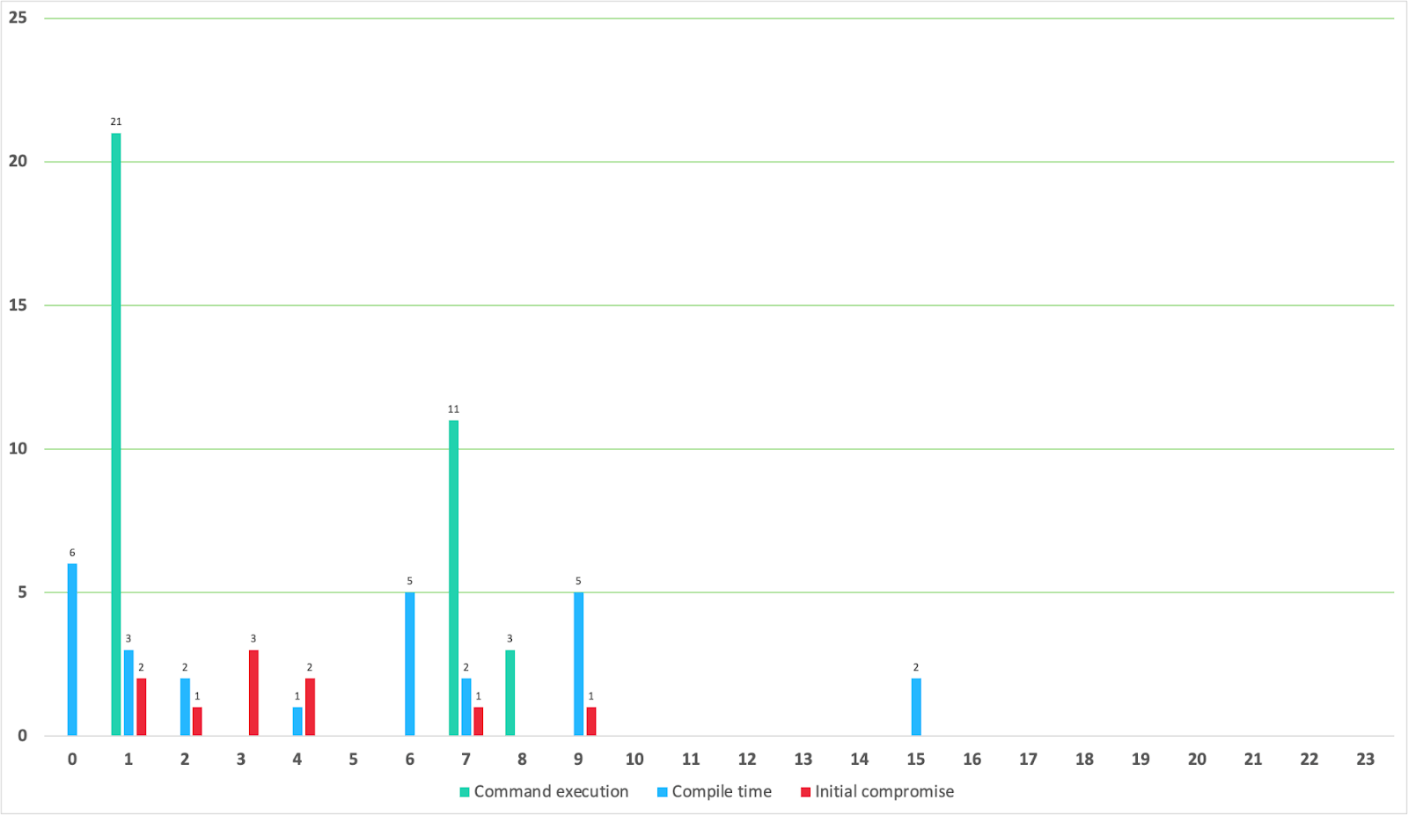
    Throughout this campaign, several malware samples were used that we managed to attribute to the Lazarus group through our ongoing and dedicated research conducted for a long time. Our attribution is supported by the historical use of the malware strains, as well as their TTPs, all of which have been well documented by numerous security solutions vendors and governments. Furthermore, we have analyzed the execution time of the Windows commands delivered by the COPPERHEDGE malware, the build timestamps of all malicious samples we described above, and the time of initial compromise per host, demonstrating that the timeframes were mostly concentrated between GMT 00:00 and 09:00. Based on our knowledge of normal working hours in various time zones, we can infer that the actor is located in the GMT+09 time zone.

    Timeline of malicious activity

    Victims

    We identified at least six software, IT, financial, semiconductor manufacturing and telecommunication organizations in South Korea that fell victim to “Operation SyncHole”. However, we are confident that there are many more affected organizations across a broader range of industries, given the popularity of the software exploited by Lazarus in this campaign.

    Conclusion

    This is not the first time that the Lazarus group exploited supply chains with a full understanding of the software ecosystem in South Korea. We have already described similar attacks in our analysis reports on the Bookcode cluster in 2020, the DeathNote cluster in 2022, and the SIGNBT malware in 2023. All of these cases targeted software developed by South Korean vendors that required installation for online banking and government services. Both of the software products exploited in this case are in line with past cases, meaning that the Lazarus group is endlessly adopting an effective strategy based on cascading supply chain attacks.

    The Lazarus group’s specialized attacks targeting supply chains in South Korea are expected to continue in the future. Our research over the past few years provided evidence that many software development vendors in Korea have already been attacked, and if the source code of a product has been compromised, other zero-day vulnerabilities may continue to be discovered. The attackers are also making efforts to minimize detection by developing new malware or enhancing existing malware. In particular, they introduce enhancements to the communication with the C2, command structure, and the way they send and receive data.

    We have proven that accurate detection and quick response can effectively deter their tactics, and in the meantime, we were able to remediate vulnerabilities and mitigate attacks to minimize damage. We will continue to monitor the activity of this group and remain agile in responding to their changes. We also recommend using reliable security solutions to stay alert and mitigate potential risks. Our product line for businesses helps identify and prevent attacks of any complexity at an early stage.

    Kaspersky products detect the exploits and malware used in this attack with the following verdicts: Trojan.Win64.Lazarus.*, Trojan.Win32.Lazarus.*, MEM:Trojan.Win32.Cometer.gen, MEM:Trojan.Win32.SEPEH.gen, Trojan.Win32.Manuscrypt.*, Trojan.Win64.Manuscrypt.*, Trojan.Win32.Zenpak.*.

    Indicators of Compromise

    More IoCs are available to customers of the Kaspersky Intelligence Reporting Service. Contact: intelreports@kaspersky.com.

    Variant of the ThreatNeedle loader
    f1bcb4c5aa35220757d09fc5feea193b C:System32PCAuditex.dll

    Variant of the wAgent loader
    dc0e17879d66ea9409cdf679bfea388c C:ProgramDataintelutil.dat

    COPPERHEDGE dropper
    2d47ef0089010d9b699cd1bbbc66f10a %AppData%hnc_net.tmp

    C2 servers
    www[.]smartmanagerex[.]com
    hxxps://thek-portal[.]com/eng/career/index.asp
    hxxps://builsf[.]com/inc/left.php
    hxxps://www[.]rsdf[.]kr/wp-content/uploads/2024/01/index.php
    hxxp://www[.]shcpump[.]com/admin/form/skin/formBasic/style.php
    hxxps://htns[.]com/eng/skin/member/basic/skin.php
    hxxps://kadsm[.]org/skin/board/basic/write_comment_skin.php
    hxxp://bluekostec[.]com/eng/community/write.asp
    hxxp://dream.bluit.gethompy[.]com/mobile/skin/board/gallery/index.skin.php

    MIL OSI Economics –

    April 24, 2025
  • MIL-OSI Banking: Operation SyncHole: Lazarus APT goes back to the well

    Source: Securelist – Kaspersky

    Headline: Operation SyncHole: Lazarus APT goes back to the well

    We have been tracking the latest attack campaign by the Lazarus group since last November, as it targeted organizations in South Korea with a sophisticated combination of a watering hole strategy and vulnerability exploitation within South Korean software. The campaign, dubbed “Operation SyncHole”, has impacted at least six organizations in South Korea’s software, IT, financial, semiconductor manufacturing, and telecommunications industries, and we are confident that many more companies have actually been compromised. We immediately took action by communicating meaningful information to the Korea Internet & Security Agency (KrCERT/CC) for rapid action upon detection, and we have now confirmed that the software exploited in this campaign has all been updated to patched versions.

    Timeline of the operation

    Our findings in a nutshell:

    • At least six South Korean organizations were compromised by a watering hole attack combined with exploitation of vulnerabilities by the Lazarus group.
    • A one-day vulnerability in Innorix Agent was also used for lateral movement.
    • Variants of Lazarus’ malicious tools, such as ThreatNeedle, Agamemnon downloader, wAgent, SIGNBT, and COPPERHEDGE, were discovered with new features.

    Background

    The initial infection was discovered in November of last year when we detected a variant of the ThreatNeedle backdoor, one of the Lazarus group’s flagship malicious tools, used against a South Korean software company. We found that the malware was running in the memory of a legitimate SyncHost.exe process, and was created as a subprocess of Cross EX, legitimate software developed in South Korea. This potentially was the starting point for the compromise of further five organizations in South Korea. Additionally, according to a recent security advisory posted on the KrCERT website, there appear to be recently patched vulnerabilities in Cross EX, which were addressed during the timeframe of our research.

    In the South Korean internet environment, the online banking and government websites require the installation of particular security software to support functions such as anti-keylogging and certificate-based digital signatures. However, due to the nature of these software packages, they constantly run in the background to interact with the browser. The Lazarus group shows a strong grasp of these specifics and is using a South Korea-targeted strategy that combines vulnerabilities in such software with watering hole attacks. The South Korean National Cyber Security Center published its own security advisory in 2023 against such incidents, and also published additional joint security advisories in cooperation with the UK government.

    Cross EX is designed to enable the use of such security software in various browser environments, and is executed with user-level privileges except immediately after installation. Although the exact method by which Cross EX was exploited to deliver malware remains unclear, we believe that the attackers escalated their privileges during the exploitation process as we confirmed the process was executed with high integrity level in most cases. The facts below led us to conclude that a vulnerability in the Cross EX software was most likely leveraged in this operation.

    • The most recent version of Cross EX at the time of the incidents was installed on the infected PCs.
    • Execution chains originating from the Cross EX process that we observed across the targeted organizations were all identical.
    • The incidents that saw the Synchost process abused to inject malware were concentrated within a short period of time: between November 2024 and February 2025.

    In the earliest attack of this operation, the Lazarus group also exploited another South Korean software product, Innorix Agent, leveraging a vulnerability to facilitate lateral movement, enabling the installation of additional malware on a targeted host of their choice. They even developed malware to exploit this, avoiding repetitive tasks and streamlining processes. The exploited software, Innorix Agent (version 9.2.18.450 and earlier), was previously abused by the Andariel group, while the malware we obtained targeted the more recent version 9.2.18.496.

    While analyzing the malware’s behavior, we discovered an additional arbitrary file download zero-day vulnerability in Innorix Agent, which we managed to detect before any threat actors used it in their attacks. We reported the issues to the Korea Internet & Security Agency (KrCERT) and the vendor. The software has since been updated with patched versions.

    Installing malware through vulnerabilities in software exclusively developed in South Korea is a key part of the Lazarus group’s strategy to target South Korean entities, and we previously disclosed a similar case in 2023, as did ESET and KrCERT.

    Initial vector

    The infection began when the user of a targeted system accessed several South Korean online media sites. Shortly after visiting one particular site, the machine was compromised by the ThreatNeedle malware, suggesting that the site played a key role in the initial delivery of the backdoor. During the analysis, it was discovered that the infected system was communicating with a suspicious IP address. Further examination revealed that this IP hosted two domains (T1583.001), both of which appeared to be hastily created car rental websites using publicly available HTML templates.

    Appearance of www.smartmanagerex[.]com

    The first domain, www.smartmanagerex[.]com, seemed to be masquerading as software provided by the same vendor that distributes Cross EX. Based on these findings, we reconstructed the following attack scenario.

    Attack flow during initial compromise

    Given that online media sites are typically visited quite frequently by a wealth of users, the Lazarus group filters visitors with a server-side script and redirects desired targets to an attacker-controlled website (T1608.004). We assess with medium confidence that the redirected site may have executed a malicious script (T1189), targeting a potential flaw in Cross EX (T1190) installed on the target PC, and launching malware. The script then ultimately executed the legitimate SyncHost.exe and injected a shellcode that loaded a variant of ThreatNeedle into that process. This chain, which ends with the malware being injected into SyncHost.exe, was common to all of the affected organizations we identified, meaning that the Lazarus group has conducted extensive operations against South Korea over the past few months with the same vulnerability and the same exploit.

    Execution flow

    We have divided this operation into two phases based on the malware used. The first phase focused primarily on the execution chain involving ThreatNeedle and wAgent. It was then followed by the second phase which involved the use of SIGNBT and COPPERHEDGE.

    We derived a total of four different malware execution chains based on these phases from at least six affected organizations. In the first infection case, we found a variant of the ThreatNeedle malware, but in subsequent attacks, the SIGNBT malware took its place, thus launching the second phase. We believe this is due to the quick and aggressive action we took with the first victim. In subsequent attacks, the Lazarus group introduced three updated infection chains including SIGNBT, and we observed a wider range of targets and more frequent attacks. This suggests that the group may have realized that their carefully prepared attacks had been exposed, and extensively leveraged the vulnerability from then on.

    Chains of infection across the operation

    First-phase malware

    In the first infection chain, many updated versions of the malware previously used by the Lazarus group were used.

    Variant of ThreatNeedle

    The ThreatNeedle sample used in this campaign was also referred to as “ThreatNeedleTea” in a research paper published by ESET; we believe this is an updated version of the early ThreatNeedle. However, the ThreatNeedle seen in this attack had been modified with additional features.

    This version of ThreatNeedle is divided into a Loader and Core samples. The Core version retrieves five configuration files from C_27098.NLS to C_27102.NLS, and contains a total of 37 commands. The Loader version, meanwhile, references only two configuration files and implements only four commands.

    The Core component receives a specific command from the C2, resulting in an additional loader file being created for the purpose of persistence. This file can be disguised as the ServiceDLL value of a legitimate service in the netsvcs group (T1543.003), the IKEEXT service (T1574.001), or registered as a Security Service Provider (SSP) (T1547.005). It ultimately loads the ThreatNeedle Loader component.

    Behavior flow to load ThreatNeedle Loader by target service

    The updated ThreatNeedle generates a random key pair based on the Curve25519 algorithm (T1573.002), sends the public key to the C2 server, and then receives the attacker’s public key. Finally, the generated private key and the attacker’s public key are scalar-operated to create a shared key, which is then used as the key for the ChaCha20 algorithm to encrypt the data (T1573.001). The data is sent and received in JSON format.

    LPEClient

    LPEClient is a tool known for victim profiling and payload delivery (T1105) that has previously been observed in attacks on defense contractors and the cryptocurrency industry. We disclosed that this tool had been loaded by SIGNBT when we first documented SIGNBT malware. However, we did not observe LPEClient being loaded by SIGNBT in this campaign. It was only loaded by the variant of ThreatNeedle.

    Variant of wAgent

    In addition to the variant of ThreatNeedle, a variant of the wAgent malware was also discovered in the first affected organization. wAgent is a malicious tool that we documented in 2020, and a similar version was mentioned in Operation GoldGoblin by KrCERT. The origin of its creation is still shrouded in mystery, but we discovered that the wAgent loader was disguised as liblzma.dll and executed via the command line rundll32.exe c:Programdataintelutil.dat, afunix 1W2–UUE–ZNO–B99Z (T1218.011). The export function retrieves the given filename 1W2–UUE–ZNO–B99Z in C:ProgramData, which also serves as the decryption key. After converting this filename into wide bytes, it uses the highest 16 bytes of the resulting value as the key for the AES-128-CBC algorithm and decrypts (T1140) the contents of the file located in C:ProgramData (T1027.013). The upper four bytes of the decrypted data subsequently represent the size of the payload (T1027.009), which we identified as an updated version of the wAgent malware.

    The variant of wAgent has the ability to receive data in both form-data and JSON formats, depending on the C2 server it succeeds in reaching. Notably, it includes the __Host–next–auth–token key within the Cookie field in the request header during the communication (T1071.001), carrying the sequence of communication appended by random digits. In this version, the new observed change is that an open-source GNU Multiple-Precision (GMP) library is employed to carry out RSA encryption computations, which is a previously unseen library in malware used by the Lazarus group. According to the wAgent configuration file, it is identified as the x64_2.1 version. This version manages payloads using a C++ STL map, with emphasis on receiving additional payloads from the C2 and loading them directly into memory, along with creating a shared object. With this object, the main module is able to exchange command parameters and execution results with the delivered plugins.

    Operational structure of the wAgent variant

    Variant of the Agamemnon downloader

    The Agamemnon downloader is also responsible for downloading and executing additional payloads received from the C2 server. Although we did not obtain the configuration file of Agamemnon, it receives commands from the C2 and executes the payload by parsing the commands and parameters based on ;; characters, which serve as command and parameter delimiters. The value of the mode in response passed with a 2 command determines how to execute the additional payload, which is delivered along with a 3 command. There are two methods of execution: the first one is to load the payload reflectively (T1620), which is commonly used in malware, whereas the second one is to utilize the open-source Tartarus-TpAllocInject technique, which we have not previously seen in malware from the Lazarus group.

    Structure of the commands where additional data is passed

    The open-source loader is built on top of another open-source loader named Tartarus’ Gate. Tartarus’ Gate is based on Halo’s Gate, which is in turn based on Hell’s Gate. All of these techniques are designed to bypass security products such as antivirus and EDR solutions, but they load the payload in different ways.

    Innorix Agent exploit for lateral movement

    Unlike the previously mentioned tools, the Innorix abuser is used for lateral movement. It is downloaded by the Agamemnon downloader (T1105) and exploits a specific version of a file transfer software tool developed in South Korea, Innorix Agent, to fetch additional malware on internal hosts (T1570). Innorix Agent is another software product that is mandatory for some financial and administrative tasks in the South Korean internet environment, meaning that it is likely to be installed on many PCs of both corporations and individuals in South Korea, and any user with a vulnerable version is potentially a target. The malware embeds a license key allegedly bound to version 9.2.18.496, which allows it to perform lateral movement by generating malicious traffic disguised as legitimate traffic against targeted network PCs.

    The Innorix abuser is given parameters from the Agamemnon downloader: the target IP, URL to download a file, and file size. It then delivers a request to that target IP to check if Innorix Agent is installed and running. If a successful response is returned, the malware assumes that the software is running properly on the targeted host and transmits traffic that allows the target to download the additional files from the given URL due to a lack of traffic validation.

    Steps to deploy additional malware via the Innorix abuser

    The actor created a legitimate AppVShNotify.exe and a malicious USERENV.dll file in the same path via the Innorix abuser, and then executed the former using a legitimate feature of the software. The USERENV.dll was sideloaded (T1574.002) as a result, which ultimately led to the execution of ThreatNeedle and LPEClient on the targeted hosts, thus launching the infection chain on previously unaffected machines.

    We reported this vulnerability to KrCERT due to the potentially dangerous impact of the Innorix abuser, but were informed that the vulnerability has been exploited and reported in the past. We have confirmed that this malware does not work effectively in environments with Innorix Agent versions other than 9.2.18.496.

    In addition, while digging into the malware’s behavior, we identified another additional arbitrary file download vulnerability that applies to versions up to 9.2.18.538. It is tracked as KVE-2025-0014 and we have not yet found any evidence of its use in the wild. KVE is a vulnerability identification number issued exclusively by KrCERT. We successfully contacted Innorix to share our findings containing the vulnerabilities via KrCERT, and they managed to release a patched version in March with both vulnerabilities fixed.

    Second phase malware

    The second phase of the operation also introduces newer versions of malicious tools previously seen in Lazarus attacks.

    SIGNBT

    The SIGNBT we documented in 2023 was version 1.0, but in this attack, version 0.0.1 was used at the forefront. In addition, we identified a more recent version, SIGNBT 1.2. Unlike versions 1.0 and 0.0.1, the 1.2 version had minimal remote control capabilities and was focused on executing additional payloads. The malware developers named this version “Hijacking”.

    In the second phase of this operation, SIGNBT 0.0.1 was the initial implant executed in memory in SyncHost.exe to fetch additional malware. In this version, the C2 server was hardcoded without reference to any configuration files. During this investigation, we found a credential dumping tool that was fetched by SIGNBT 0.0.1, identical to what we have seen in previous attacks.

    As for version 1.2, it fetches the path to the configuration file from its resources and retrieves the file to obtain C2 server addresses. We were able to extract two configuration file paths from each identified SIGNBT 1.2 sample, which are shown below. Another change in SIGNBT 1.2 is that the number of prefixes starting with SIGN are reduced to only three: SIGNBTLG, SIGNBTRC, and SIGNBTSR. The malware receives an RSA public key from the C2 and encrypts a randomly generated AES key using the public key. All traffic is encrypted with the generated AES key.

    • Configuration file path 1: C:ProgramDataSamsungSamsungSettingssettings.dat
    • Configuration file path 2: C:ProgramDataMicrosoftDRMServerdrm.ver

    1

    2

    3

    4

    5

    6

    7

    8

    9

    10

    11

    12

    13

    14

    15

    16

    17

    18

    19

    20

    21

    22

    23

    24

    25

    {

    proxylist: [{ // C2 server list

                  proxy: “https%0x3A//builsf[.]com/inc/left.php”

         },

         {

                  proxy: “https%0x3A//www.rsdf[.]kr/wp-content/uploads/2024/01/index.php”

         },

         {

                  proxy: “http%0x3A//www.shcpump[.]com/admin/form/skin/formBasic/style.php”

         },

         {

                  proxy: “https%0x3A//htns[.]com/eng/skin/member/basic/skin.php”

         },

         {

                  proxy: “https%0x3A//kadsm[.]org/skin/board/basic/write_comment_skin.php”

         },

         {

                  proxy: “http%0x3A//bluekostec[.]com/eng/community/write.asp”

         },

         {

                  proxy: “http%0x3A//dream.bluit.gethompy[.]com/mobile/skin/board/gallery/index.skin.php”

         }],

    wake: 1739839071, // Timestamp of Tuesday, February 18, 2025 12:37:51 AM

    status: 1 // It means the scheduled execution time is set.

    }

    COPPERHEDGE

    COPPERHEDGE is a malicious tool that was named by US-CERT in 2020. It is a Manuscrypt variant and was primarily used in the DeathNote cluster attacks. Unlike the other malware used in this operation, COPPERHEDGE has not changed dramatically, with only several commands being slightly changed compared to the older versions. This version, however, retrieves configuration information such as the C2 server address from the ADS %appdata%MicrosoftInternet Explorerbrndlog.txt:loginfo (T1564.004). The malware then sends HTTP traffic to C2 with three or four parameters for each request, where the parameter name is chosen randomly out of three names in any order.

    • First HTTP parameter name: bih, aqs, org
    • Second HTTP parameter name: wib, rlz, uid
    • Third HTTP parameter name: tib, hash, lang
    • Fourth HTTP parameter name: ei, ie, oq

    The actor primarily used the COPPERHEDGE malware to conduct internal reconnaissance in this operation. There are a total of 30 commands from 0x2003 to 0x2032, and 11 response codes from 0x2040 to 0x2050 inside the COPPERHEDGE backdoor.

    The evolution of Lazarus malware

    In recent years, the malware used by the Lazarus group has been rapidly evolving to include lightweighting and modularization. This applies not only to newly added tools, but also to malware that has been used in the past. We have observed such changes for a few years, and we believe there are more on the way.

    Use of asymmetric encryption Load plugins Divided into core and loader version
    MISTPEN – O –
    CookiePlus O (RSA) O –
    ThreatNeedle O (Curve25519) O O
    wAgent (downloader) O (RSA) O –
    Agamemnon downloader – – –
    SIGNBT O (RSA) O O
    COPPERHEDGE O (RSA) – O

    Discoveries

    During our investigation into this campaign, we gained extensive insight into the Lazarus group’s post-exploitation strategy. After installing the COPPERHEDGE malware, the actor executed numerous Windows commands to gather basic system information (T1082, T1083, T1057, T1049, T1016, T1087.001), create a malicious service (T1569.002, T1007) and attempt to find valuable hosts to perform lateral movement (T1087.002, T1135).

    While analyzing the commands executed by the actor, we were able to identify the actor’s mistake when using the taskkill command: the /im parameter when using taskkill means imagename, which should specify the image name of the process, not the process id. This shows that the actor is still performing internal reconnaissance by manually entering commands.

    Infrastructure

    Throughout this operation, most of the C2 servers were legitimate but compromised websites in South Korea (T1584.001), further indicating that this operation was highly focused on South Korea. In the first phase, other media sites were utilized as C2 servers to avoid detection of media-initiated watering hole attacks. However, as the infection chain turned to the second phase, legitimate sites in various other industries were additionally exploited.

    Unlike other cases, LPEClient’s C2 server was hosted by the same hosting company as www.smartmanagerex[.]com, which was deliberately created for initial compromise. Given that LPEClient is heavily relied upon by the Lazarus group for delivering additional payloads, it is likely that the attackers deliberately rented and configured the server (T1583.003), assigning a domain under their control to maintain full operational flexibility. In addition to this, we also found that two domains that were exploited as C2 servers for SIGNBT 0.0.1 resolved to the same hosting company’s IP range.

    We confirmed that the domain thek–portal[.]com belonged to a South Korean ISP until 2020 and was the legitimate domain of an insurance company that was acquired by another company. Since then, the domain had been parked and its status was changed in February 2025, indicating that the Lazarus group re-registered the domain to leverage it in this operation.

    Attribution

    Throughout this campaign, several malware samples were used that we managed to attribute to the Lazarus group through our ongoing and dedicated research conducted for a long time. Our attribution is supported by the historical use of the malware strains, as well as their TTPs, all of which have been well documented by numerous security solutions vendors and governments. Furthermore, we have analyzed the execution time of the Windows commands delivered by the COPPERHEDGE malware, the build timestamps of all malicious samples we described above, and the time of initial compromise per host, demonstrating that the timeframes were mostly concentrated between GMT 00:00 and 09:00. Based on our knowledge of normal working hours in various time zones, we can infer that the actor is located in the GMT+09 time zone.

    Timeline of malicious activity

    Victims

    We identified at least six software, IT, financial, semiconductor manufacturing and telecommunication organizations in South Korea that fell victim to “Operation SyncHole”. However, we are confident that there are many more affected organizations across a broader range of industries, given the popularity of the software exploited by Lazarus in this campaign.

    Conclusion

    This is not the first time that the Lazarus group exploited supply chains with a full understanding of the software ecosystem in South Korea. We have already described similar attacks in our analysis reports on the Bookcode cluster in 2020, the DeathNote cluster in 2022, and the SIGNBT malware in 2023. All of these cases targeted software developed by South Korean vendors that required installation for online banking and government services. Both of the software products exploited in this case are in line with past cases, meaning that the Lazarus group is endlessly adopting an effective strategy based on cascading supply chain attacks.

    The Lazarus group’s specialized attacks targeting supply chains in South Korea are expected to continue in the future. Our research over the past few years provided evidence that many software development vendors in Korea have already been attacked, and if the source code of a product has been compromised, other zero-day vulnerabilities may continue to be discovered. The attackers are also making efforts to minimize detection by developing new malware or enhancing existing malware. In particular, they introduce enhancements to the communication with the C2, command structure, and the way they send and receive data.

    We have proven that accurate detection and quick response can effectively deter their tactics, and in the meantime, we were able to remediate vulnerabilities and mitigate attacks to minimize damage. We will continue to monitor the activity of this group and remain agile in responding to their changes. We also recommend using reliable security solutions to stay alert and mitigate potential risks. Our product line for businesses helps identify and prevent attacks of any complexity at an early stage.

    Kaspersky products detect the exploits and malware used in this attack with the following verdicts: Trojan.Win64.Lazarus.*, Trojan.Win32.Lazarus.*, MEM:Trojan.Win32.Cometer.gen, MEM:Trojan.Win32.SEPEH.gen, Trojan.Win32.Manuscrypt.*, Trojan.Win64.Manuscrypt.*, Trojan.Win32.Zenpak.*.

    Indicators of Compromise

    More IoCs are available to customers of the Kaspersky Intelligence Reporting Service. Contact: intelreports@kaspersky.com.

    Variant of the ThreatNeedle loader
    f1bcb4c5aa35220757d09fc5feea193b C:System32PCAuditex.dll

    Variant of the wAgent loader
    dc0e17879d66ea9409cdf679bfea388c C:ProgramDataintelutil.dat

    COPPERHEDGE dropper
    2d47ef0089010d9b699cd1bbbc66f10a %AppData%hnc_net.tmp

    C2 servers
    www[.]smartmanagerex[.]com
    hxxps://thek-portal[.]com/eng/career/index.asp
    hxxps://builsf[.]com/inc/left.php
    hxxps://www[.]rsdf[.]kr/wp-content/uploads/2024/01/index.php
    hxxp://www[.]shcpump[.]com/admin/form/skin/formBasic/style.php
    hxxps://htns[.]com/eng/skin/member/basic/skin.php
    hxxps://kadsm[.]org/skin/board/basic/write_comment_skin.php
    hxxp://bluekostec[.]com/eng/community/write.asp
    hxxp://dream.bluit.gethompy[.]com/mobile/skin/board/gallery/index.skin.php

    MIL OSI Global Banks –

    April 24, 2025
  • MIL-OSI Asia-Pac: Basketball test event set

    Source: Hong Kong Information Services

    To prepare for the official events of the 15th National Games (NG) to be staged in November, a basketball test event will be held at the Hong Kong Coliseum in Hung Hom this Saturday and Sunday.
     

    The Basketball (Men’s U22) test event will be held from 2pm to 6.30pm on both days, with the participation of four basketball teams – the Hong Kong A1 Division Championship basketball teams Hong Kong Eastern, Winling and Tycoon, as well as the Hong Kong Men’s U22 representative team.

    Admission tickets have been distributed through the Basketball Association of Hong Kong, China and the Eastern Sports Club.

    Those who possess a ticket may enter the venue for the event upon completion of a security check starting from 12.30pm on the event days.

    The test event is organised by the National Games Coordination Office (Hong Kong) and co-organised by the Basketball Association of Hong Kong, China and the Eastern Sports Club, with the Chinese Basketball Association as advisor.
     
    Radio Television Hong Kong will provide a live webcast of the two-day event on its website and YouTube channel.

    MIL OSI Asia Pacific News –

    April 24, 2025
  • MIL-OSI Economics: ASEAN digital senior officials call for collaboration towards an inclusive and trusted digital ecosystem

    Source: ASEAN – Association of SouthEast Asian Nations

    JAKARTA, 23 April 2025 – The First ASEAN Digital Senior Officials’ Meeting and ASEAN Telecommunications Regulators’ Council (ADGSOM – ATRC) Leaders’ Retreat of 2025 took place on 22-23 April in Jakarta.
     
    The two-day event was chaired by Thailand as the ADGSOM Chair for 2025. The meeting discussed the outcomes and follow-up actions from the 5th ASEAN Digital Ministers’ Meeting (ADGMIN) held on 13-17 January 2025 in Bangkok. Additionally, the 5th Meeting of the ASEAN Working Group on Anti-Online Scam (WG-AS) was held on the sidelines, to discuss ASEAN Member States’ (AMS) collective measures in tackling online scams in the region.
     
    Under the theme of Thailand’s ADGMIN Chairmanship in 2025, “Secure, Innovative, Inclusive: Shaping ASEAN’s Digital Future” is essential to fully unlock the potential of ASEAN Digital Economy by harnessing the transformative power of artificial intelligence (AI) which requires multiple stakeholder’s collaboration including policy makers, private sector and the community towards shaping ASEAN’s Digital Future.
     
    The meeting welcomed a proposal for joint collaboration between ADGSOM and the ASEAN Foundation to organise the ASEAN Digital Forum 2026, which will be held alongside the 6th ADGMIN in early 2026 in Viet Nam. Additionally, the development of the ASEAN Digital Outlook 2025, supported by Google.org. This initiative shall support effective long-term planning across member states, fostering sustained growth and competitiveness in the digital era. The meeting also welcomed the proposals which should strengthen public-private partnerships for knowledge exchange, policy alignment, and the coordination of digital initiatives for alignment with global digital trends and standards.
     
    The meeting welcomed the successful implementation of the ASEAN Digital Masterplan 2025 (ADM2025), noting that 100% of its Enabling Actions (EAs) had been initiated as of April 2025. As ADM2025 approaches its conclusion, the meeting reaffirmed the importance of sustaining the region’s digital transformation momentum through the upcoming ASEAN Digital Masterplan 2030 (ADM2030).
     
    ADM2030 will serve as a visionary framework that will set the pace for ASEAN’s digital future over the next 5 years. In this regard, Viet Nam has been entrusted to lead the development of ADM2030 in 2025, targeted for endorsement at the 6th ADGMIN in early 2026.
     
     
    ###

    Photos Credit: Biro Humas Kementerian Komunikasi dan Digital
     
    The post ASEAN digital senior officials call for collaboration towards an inclusive and trusted digital ecosystem appeared first on ASEAN Main Portal.

    MIL OSI Economics –

    April 24, 2025
  • MIL-OSI Economics: Secretary-General of ASEAN meets with 2025’s ASCC Council Chair in Malaysia

    Source: ASEAN – Association of SouthEast Asian Nations

    Secretary-General of ASEAN, Dr. Kao Kim Hourn, this morning met with H.E. Dato Sri Tiong King Sing, ASEAN Socio-Cultural Community (ASCC) Council Chair 2025 and Minister of Tourism, Arts & Culture of Malaysia, in Kuching, Sarawak, Malaysia, prior to the convening of the 33rd ASCC Council Meeting. The Meeting exchanged views on the ASCC’s priorities for 2025, including the anticipated adoption of the ASCC Strategic Plan by the ASEAN Leaders in May of this year, in Malaysia.

    The post Secretary-General of ASEAN meets with 2025’s ASCC Council Chair in Malaysia appeared first on ASEAN Main Portal.

    MIL OSI Economics –

    April 24, 2025
  • MIL-Evening Report: The phrase ‘fuzzy wuzzy angels’ is far from affectionate – it reflects 500 years of racism

    Source: The Conversation (Au and NZ) – By Erika K. Smith, Associate Lecturer, School of Social Sciences, Western Sydney University

    This article contains mention of racist terms in historical context.

    Every Anzac Day, Australians are presented with narratives that re-inscribe particular versions of our national story.

    One such narrative persistently claims “fuzzy wuzzy angel” was used as an “affectionate” name for local stretcher-bearers of sick and wounded Australian soldiers during the New Guinea campaign of 1942 to 1945.

    Papua New Guineans called Australian soldiers masta (master), taubada (big man), and bos (boss). Australian soldiers called Papua New Guinean people by racist phrases including boong, nigger, kanaka, coon, boi, boy and wog.

    Our new research shows that, far from being “affectionate”, the phrase fuzzy wuzzy angel is best understood in this context – and in the context of 500 years of anti-Black racism.

    These other offensive terms used by soldiers are largely gone from the public domain, yet fuzzy wuzzy angel persists. We decided to explore this apparently acceptable form of contemporary racism.

    Power relations across the centuries

    In 1526 the Portuguese explorer Jorge de Menezes named islands in the west of what is now West Papua Ilhas dos Papuas.

    “Papuas” was a borrowed word by the Portuguese of Malay/Indonesian origin, meaning “frizzled” or “curly-haired”. The islands were therefore known as the “islands of the frizzy-haired people”.

    In 1545, the Spanish explorer Yñigo Ortiz de Retez named the east mainland Nueva Guinea (New Guinea). As historian J.H.F. Sollewijn Gelpke describes it, Ortiz de Retez saw a physical resemblance to the “frizzy haired inhabitants […] of the Guinea Coast in West Africa”.

    The first usage we found of the phrase fuzzy wuzzy angels relating to the New Guinea campaign was in an article in the Sydney’s The Daily Mirror in 1942. A war correspondent reported troops along the Track were reciting a “catchy verse with a swing in it”.

    The “catchy verse” appears to borrow directly from the 1892 poem Fuzzy Wuzzy, by English writer Rudyard Kipling. Kipling borrowed the phrase from how British soldiers referred to the Beja warriors of north-east Africa during the Mahdist (Anglo–Sudan) War of 1881–99.

    Shortly after the poem was published in The Daily Mirror, the image of the “fuzzy wuzzy angel” was immortalised in a photograph. George Silk’s image shows Raphael Oimbari (Hanau village, Oro Province) walking with injured Australian soldier Private George “Dick” Whittington (2/10th Battalion) on Christmas Day, 1942.

    While Whittington was identified as the injured soldier, it wasn’t until the 1970s that Oimbari was identified and named as the Papua New Guinean guide.

    The cultural journey of Kipling’s poem in Africa to Australian infantry on the Kokoda follows the same route as Spanish and Portuguese sailors from African Guinea to Papua New Guinea.

    This focus on frizzy or fuzzy hair homogenised Blackness under the colonial gaze.

    Continuing racial relations

    Far from being just stretcher bearers, local people during the Kokoda Campaign were often forced to support the Australian war effort in roles including cooks, cleaners, labourers, construction workers, farm hands and carriers of ammunition.

    These roles have also disappeared from our national narrative, along with the more racist forms of address.

    In place of historically accurate accounts is a distilled national narrative: iconic stretcher bearers “affectionately” known as fuzzy wuzzy angels.

    New Guinea native carriers meet Australian officers at a rest spot on the Kokoda Trail, August 1942.
    Australian War Memorial

    There was little interest in the Australian war story in Papua New Guinea and the Kokoda Track between the end of the war and the early 1990s. Then, in 1992, Prime Minister Paul Keating kissed the foot of the Kokoda Memorial.

    Attention by subsequent prime ministers and an increased number of books and films propelled the Kokoda Track into mainstream Australian consciousness.

    Prime Minister John Howard made the “affectionate” usage claim in a speech to Papua New Guinea Prime Minister Bill Skate in 1998.

    Papua New Guinean scholar Regis Tove Stella wrote in 2007 that fuzzy wuzzy angel is “belittling and consistent with the discourse of paternalism that largely characterised colonial administrative policy”.

    Yet we continue to see Indigenous perspectives erased in favour of the “affectionate” account.

    When Malcolm Turnbull laid a 75th anniversary wreath in April 2017, the Australian Associated Press included this explanatory paragraph:

    Local Papua New Guinean men, dubbed affectionately the ‘Fuzzy Wuzzy Angels’, assisted and escorted wounded and injured Australian soldiers along the trail.

    In 2024, “affectionate” was reinscribed by Peter Dutton in an address to parliament to honour Papua New Guinea Prime Minister James Marape.

    500 years of a racist phrase

    Australia’s northernmost island, Saibai Island of Zenadh Kes/Torres Strait Islands, is less than 4 kilometres from Papua New Guinea – yet most Australians know little about our closest neighbours.

    This year marks the 50th anniversary of Papua New Guinea’s independence from Australia, mobilised by the Whitlam government, some 25 years behind the post-war decolonisation movement.

    Yet official decolonisation has not stopped Australians from insisting that it is affectionate – and, by implication, not racist – to use colonial naming practices that date back some 500 years.

    This article draws on research conducted during Erika K. Smith’s doctoral candidature which was financially supported by an Australian Postgraduate Award and a Western Sydney University Postgraduate Research Scholarship.

    Ingrid Matthews does not work for, consult, own shares in or receive funding from any company or organisation that would benefit from this article, and has disclosed no relevant affiliations beyond their academic appointment.

    – ref. The phrase ‘fuzzy wuzzy angels’ is far from affectionate – it reflects 500 years of racism – https://theconversation.com/the-phrase-fuzzy-wuzzy-angels-is-far-from-affectionate-it-reflects-500-years-of-racism-253953

    MIL OSI Analysis – EveningReport.nz –

    April 24, 2025
  • MIL-OSI: Nexif Ratch Energy Signs Amended Power Purchase Agreements for Its Ben Tre Wind Power Project, Accelerating Path to Financial Close

    Source: GlobeNewswire (MIL-OSI)

    BEN TRE, Vietnam, April 24, 2025 (GLOBE NEWSWIRE) — Nexif Ratch Energy has reached a key milestone in the development of its 80MW Ben Tre Wind Power Plant project, having successfully signed Amendment and Supplement Agreements to the original Power Purchase Agreements (PPAs) with Vietnam Electricity (EVN) on 18 April 2025.

    With the expiration of the Feed-in Tariff (FiT) regime in October 2021, the Vietnamese government actively worked to establish a new pricing mechanism that reflects lower renewable energy investment costs while continuing to attract long-term private investment.

    In this context, Nexif Ratch Energy has worked diligently and collaboratively with all relevant authorities to agree on a revised tariff, positioning the project as one of the first transitional wind energy projects in Vietnam to sign a Power Purchase Agreement (PPA). The successful negotiations with EVN mark a breakthrough, reflecting strong cooperation among key stakeholders, including EVN and its subsidiary, Electricity Power Trading Company (EPTC).

    This achievement comes at a pivotal moment in Vietnam’s renewable energy landscape, as the country continues to strengthen its regulatory framework and accelerate the transition to cleaner energy sources. The government has taken significant steps toward this goal through the enactment of new laws, decrees, and guidelines related to the power sector, and through the revision of Power Development Plan 8 (PDP8), which proposes ambitious new renewable energy targets — an additional 16.1GW of onshore and nearshore wind, and 27.9GW of utility-scale solar capacity by 2030. These efforts are intended to drive growth in the renewable energy sector while keeping Vietnam competitive in attracting investment in green infrastructure.

    Mr. Surender Singh, Chairman of the board of directors of Nexif Ratch Energy, commented, “We commend the Vietnamese government for its proactive efforts in driving the country’s energy transition. Structural changes in the energy sector require a strong and coordinated approach between government, regulators, and, importantly, investors. As we have seen with the Nexif Energy Ben Tre Wind Power Plant project, success relies on strong, ongoing partnerships to overcome challenges and unlock new opportunities for the country’s sustainable future.”

    Mr. Cyril Dissescou, CEO of Nexif Ratch Energy, added “I’m proud of our team for their persistence and focus in achieving this milestone. I also want to thank EPTC for their close collaboration. This success reflects the strength of our partnerships and our shared commitment to Vietnam’s clean energy future.”

    With the amended PPAs now signed and key procedural steps completed, the project is advancing towards financial close, with construction scheduled to begin in the second half of 2025. This progress underscores Nexif Ratch Energy’s commitment to delivering sustainable and reliable energy to Vietnam’s national grid, supporting the country’s energy transition, and contributing to the development of a greener future.

    About Nexif Ratch Energy

    Nexif Ratch Energy is a leading renewable energy company focused on the development, acquisition, construction, and operation of clean-energy projects across the Asia Pacific region. Headquartered in Singapore with regional offices in Vietnam, the Philippines and Thailand, the company’s portfolio includes 378 MW of operating, under-construction, and shovel-ready hydro, solar, and wind energy assets. Additionally, Nexif Ratch Energy has a development pipeline totaling 3.2 GW across wind, solar, and energy storage projects.

    Nexif Ratch Energy is jointly owned by Nexif Energy (Singapore) with a 51% stake and RATCH Group (Thailand) with a 49% stake.

    For Media Inquiries:

    Chariya Poopisit
    Nexif Ratch Energy
    communications@nexifratch.com

    A photo accompanying this announcement is available at https://www.globenewswire.com/NewsRoom/AttachmentNg/fe6c5e6a-9551-4686-b931-7e9d74be2cd4

    The MIL Network –

    April 24, 2025
  • MIL-OSI: Euronet Worldwide Reports First Quarter 2025 Financial Results – Highlighted by 18% Operating Income Growth

    Source: GlobeNewswire (MIL-OSI)

    • Record first quarter results – revenue, operating income and adjusted EBITDA
    • Operating margin expansion of 80 basis points
    • Continued expansion of its leading cross-border payments network

    LEAWOOD, Kan., April 23, 2025 (GLOBE NEWSWIRE) — Euronet Worldwide, Inc. (“Euronet” or the “Company”) (NASDAQ: EEFT), a leading global financial technology solutions and payments provider, reports first quarter 2025 financial results.

    Euronet reports the following consolidated results for the first quarter 2025 compared with the same period of 2024:

    • Revenues of $915.5 million, a 7% increase from $857.0 million (9% increase on a constant currency1 basis).
    • Operating income of $75.2 million, an 18% increase from $64.0 million (22% increase on a constant currency basis).
    • Adjusted operating income2 of $75.2 million, an 18% increase from $63.6 million (23% increase on a constant currency basis).
    • Adjusted EBITDA3 of $118.7 million, a 9% increase from $108.8 million (12% increase on a constant currency basis).
    • Net income attributable to Euronet of $38.4 million, or $0.85 diluted earnings per share, compared with $26.2 million, or $0.55 diluted earnings per share.
    • Adjusted earnings per share4 of $1.13 ($1.33 excluding a one-time operating tax charge of $0.20 per share) compared to $1.28 ($1.13 excluding a one-time operating tax benefit of $0.15 per share).

    See the reconciliation of non-GAAP items in the attached financial schedules.  

    “I am pleased that we achieved double-digit constant currency growth in adjusted operating income and adjusted EBITDA, highlighted by an 18% increase in adjusted operating income over the prior year. All segments contributed to the strong earnings.  Moreover, the contribution of double-digit earnings growth reflects the strength of our strategic focus on our global payment network which concentrates on high value, digital payments complemented by cross-border transactions.  On an apples-to-apples basis our adjusted EPS of $1.33 increased 18% from $1.13 in the first quarter of 2024,” stated Michael J. Brown, Euronet’s Chairman and Chief Executive Officer. 

    “I would offer that we do not see any direct impacts on our business as a result of the recent United States’ tariff actions.  With a good start to the year together with our diversified global business, we are reaffirming our expectation to produce 12% to 16% earnings growth for the year,” continued Mr. Brown.

    Segment and Other Results

    The EFT Processing Segment reports the following results for the first quarter 2025 compared with the same period or date in 2024:

    • Revenues of $232.5 million, a 7% increase from $217.2 million (10% increase on a constant currency basis).
    • Operating income of $23.3 million, an 8% increase from $21.5 million (13% increase on a constant currency basis).
    • Adjusted Operating income of $23.3 million, a 10% increase from $21.1 million (15% increase on a constant currency basis).
    • Adjusted EBITDA of $47.6 million, a 6% increase from $44.7 million (10% increase on a constant currency basis).
    • Transactions of 3,463 million, a 38% increase from 2,502 million.
    • Total of 55,512 installed ATMs as of March 31, 2025, a 5% increase from 53,029. We operated 51,875 active ATMs as of March 31, 2025, a 5% increase from 49,290 as of March 31, 2024.

    Constant currency revenue, operating income, and adjusted EBITDA growth in the first quarter 2025 was driven by market expansion, growth across most existing markets and the addition of access fees and interchange fees in certain markets. 

    Moreover, the EFT Processing Segment launched operations in two additional countries — Dominican Republic and Peru.

    Transaction growth outpaced revenue growth due to continued growth in high-volume low-value transactions in India. 

    The epay Segment reports the following results for the first quarter 2025 compared with the same period or date in 2024:

    • Revenues of $267.4 million, a 4% increase from $257.1 million (8% increase on a constant currency basis).
    • Operating income of $26.8 million, a 1% increase from $26.6 million (5% increase on a constant currency basis).
    • Adjusted EBITDA of $28.4 million, consistent with prior year (5% increase on a constant currency basis).
    • Transactions of 1,134 million, a 19% increase from 953 million.
    • POS terminals of approximately 735,000 as of March 31, 2025, consistent with prior year.
    • Retailer locations of approximately 358,000 as of March 31, 2025, a 4% from 345,000.

    Constant currency revenue growth was driven by continued payments, digital media and mobile growth. Operating income and adjusted EBITDA growth did not keep pace with revenue growth due to the payment of $4.5 million to resolve a non-recurring, multi-year operating tax matter during the quarter. Excluding this item, adjusted operating income would have grown 22% over the first quarter 2024 – reflecting the benefit of revenue growth and effective expense management.

    epay’s transactions benefited as well from the continuation of strong growth in high-volume low-value transactions in India. 

    The Money Transfer Segment reports the following results for the first quarter 2025 compared with the same period or date in 2024:

    • Revenues of $417.7 million, a 9% increase from $384.6 million (10% increase on a constant currency basis).
    • Operating income of $45.1 million, a 21% increase from $37.2 million (23% increase on a constant currency basis).
    • Adjusted EBITDA of $51.3 million, a 15% increase from $44.5 million (17% increase on a constant currency basis).
    • Total transactions of 44.6 million, a 10% increase from 40.6 million.
    • Network locations of approximately 624,000 as of March 31, 2025, a 7% increase from approximately 583,000.

    Constant currency revenue growth was primarily driven by double-digit growth in cross-border transactions, partially offset by a decrease in intra-US transactions. Direct-to-consumer digital transactions grew by 31%, reflecting strong consumer demand for digital products. Operating income and Adjusted EBITDA growth outpaced revenue growth due to gross margin expansion, leverage of scale and effective expense management.

    Additionally, the Money Transfer segment continued to expand its industry leading global payments network to now reach 4.0 billion bank accounts, 3.2 billion wallet accounts and 624,000 payment locations.

    Corporate and Other reports $20.0 million of expense for the first quarter 2025 compared with $21.3 million for the first quarter 2024. The decrease in corporate expenses is largely from the decrease in long-term share-based compensation.

    Balance Sheet and Financial Position
    Unrestricted cash and cash equivalents on hand was $1,393.6 million as of March 31, 2025, compared to $1,278.8 million as of December 31, 2024. Total indebtedness was $2,202.5 million as of March 31, 2025, compared to $1,949.8 million as of December 31, 2024. Availability under the Company’s revolving credit facilities was approximately $623.1 million as of March 31, 2025. The change in net debt is the result of share repurchases, the repurchase of the convertible notes, and working capital fluctuations, partially offset by cash generated from operations.

    The Company repurchased 0.6 million shares for $59.6 million during the First quarter, which will improve earnings per share by 1% for future periods.

    During the quarter, Euronet repurchased $492 million of convertible notes.

    Non-GAAP Measures
    In addition to the results presented in accordance with U.S. GAAP, the Company presents non-GAAP financial measures, such as constant currency financial measures, operating income, adjusted EBITDA, and adjusted earnings per share. These measures should be used in addition to, and not a substitute for, revenues, operating income, net income and earnings per share computed in accordance with U.S. GAAP. We believe that these non-GAAP measures provide useful information to investors regarding the Company’s performance and overall results of operations. These non-GAAP measures are also an integral part of the Company’s internal reporting and performance assessment for executives and senior management. The non-GAAP measures used by the Company may not be comparable to similarly titled non-GAAP measures used by other companies. The attached schedules provide a full reconciliation of these non-GAAP financial measures to their most directly comparable U.S. GAAP financial measure.

    The Company does not provide a reconciliation of its forward-looking non-GAAP measures to GAAP due to the inherent difficulty in forecasting and quantifying certain amounts that are necessary for GAAP and the related GAAP and non-GAAP reconciliation, including adjustments that would be necessary for foreign currency exchange rate fluctuations and other charges reflected in the Company’s reconciliation of historic numbers, the amount of which, based on historical experience, could be significant.  

    (1) Constant currency financial measures are computed as if foreign currency exchange rates did not change from the prior period. This information is provided to illustrate the impact of changes in foreign currency exchange rates on the Company’s results when compared to the prior period.

    (2) Adjusted operating income is defined as operating income excluding non-cash purchase accounting adjustments.  Adjusted operating income represents a performance measure and is not intended to represent a liquidity measure. 

    (3) Adjusted EBITDA is defined as net income excluding, to the extent incurred in the period, interest expense, income tax expense, depreciation, amortization, share-based compensation and other non-cash purchase accounting adjustment, non-operating or non-recurring items that are considered expenses or income under U.S. GAAP. Adjusted EBITDA represents a performance measure and is not intended to represent a liquidity measure.

    (4) Adjusted earnings per share is defined as diluted U.S. GAAP earnings per share excluding, to the extent incurred in the period, the tax-effected impacts of: a) foreign currency exchange gains or losses, b) share-based compensation, c) acquired intangible asset amortization, d) non-cash income tax expense, e) non-cash purchase accounting adjustment f) non-cash investment gain g) other non-operating or non-recurring items and h) dilutive shares relate to the Company’s convertible bonds. Adjusted earnings per share represents a performance measure and is not intended to represent a liquidity measure. 

    Conference Call and Slide Presentation
    Euronet Worldwide will host an analyst conference call on April 24, 2025, at 9:00 a.m. Eastern Time to discuss these results. The call may also include discussion of Company developments on the Company’s operations, forward-looking information, and other material information about business and financial matters. To listen to the call via telephone please register at Euronet Worldwide First Quarter 2025 Earnings Call. The conference call will also be available via webcast at http://ir.euronetworldwide.com. Participants should register at least five minutes prior to the scheduled start time of the event. A slideshow will be included in the webcast. A webcast replay will be available beginning approximately one hour after the event at  http://ir.euronetworldwide.com and will remain available for one year.

    About Euronet Worldwide, Inc.
    Starting in Central Europe in 1994 and growing to a global real-time digital and cash payments network with millions of touchpoints today, Euronet now moves money in all the ways consumers and businesses depend upon. This includes money transfers, credit/debit card processing, ATMs, POS services, branded payments, foreign currency exchange and more. With products and services in more than 200 countries and territories provided through its own brand and branded business segments, Euronet and its financial technologies and networks make participation in the global economy easier, faster and more secure for everyone. 

    A leading global financial technology solutions and payments provider, Euronet has developed an extensive global payments network that includes 55,512 installed ATMs, approximately 1,214,000 EFT POS terminals and a growing portfolio of outsourced debit and credit card services which are under management in 69 countries; card software solutions; a prepaid processing network of approximately 735,000 POS terminals at approximately 358,000 retailer locations in 64 countries; and a global money transfer network of approximately 624,000 locations serving – countries and territories. Euronet serves clients from its corporate headquarters in Leawood, Kansas, USA, and 67 worldwide offices. For more information, please visit the Company’s website at www.euronetworldwide.com.

    Statements contained in this news release that concern Euronet’s or its management’s intentions, expectations, or predictions of future performance, are forward-looking statements. Euronet’s actual results may vary materially from those anticipated in such forward-looking statements as a result of a number of factors, including: conditions in world financial markets and general economic conditions, including impacts from pandemics; inflation; the war in the Ukraine and the related economic sanctions and tariffs; military conflicts in the Middle East; our ability to successfully integrate any acquired operations; economic conditions in specific countries and regions; technological developments affecting the market for our products and services; our ability to successfully introduce new products and services; foreign currency exchange rate fluctuations; the effects of any breach of our computer systems or those of our customers or vendors, including our financial processing networks or those of other third parties; interruptions in any of our systems or those of our vendors or other third parties; our ability to renew existing contracts at profitable rates; changes in fees payable for transactions performed for cards bearing international logos or over switching networks such as card transactions on ATMs; our ability to comply with increasingly stringent regulatory requirements, including anti-money laundering, anti-terrorism, anti-bribery, consumer and data protection and privacy; changes in laws and regulations affecting our business, including tax and immigration laws and any laws regulating payments, including dynamic currency conversion transactions; changes in our relationships with, or in fees charged by, our business partners; competition; the outcome of claims and other loss contingencies affecting Euronet; the cost of borrowing (including fluctuations in interest rates), availability of credit and terms of and compliance with debt covenants; and renewal of sources of funding as they expire and the availability of replacement funding. These risks and other risks are described in the Company’s filings with the Securities and Exchange Commission, including our Annual Report on Form 10-K, Quarterly Reports on Form 10-Q and Current Reports on Form 8-K. Copies of these filings may be obtained via the SEC’s Edgar website or by contacting the Company. Any forward-looking statements made in this release speak only as of the date of this release. Except as may be required by law, Euronet does not intend to update these forward-looking statements and undertakes no duty to any person to provide any such update under any circumstances. The Company regularly posts important information to the investor relations section of its website.  

     
     EURONET WORLDWIDE, INC.
     Condensed Consolidated Balance Sheets
     (in millions)
           
      As of    
      March 31,   As of
      2025   December 31,
      (unaudited)   2024
    ASSETS      
    Current assets:      
    Cash and cash equivalents $ 1,393.6   $ 1,278.8
    ATM cash 700.3   643.8
    Restricted cash 10.8   9.2
    Settlement assets 1,418.6   1,522.7
    Trade accounts receivable, net 330.5   284.9
    Prepaid expenses and other current assets 319.9   297.1
    Total current assets 4,173.7   4,036.5
           
    Property and equipment, net 337.4   329.7
    Right of use lease asset, net 146.1   132.1
    Goodwill and acquired intangible assets, net 1,070.9   1,048.1
    Other assets, net 325.4   288.1
    Total assets $ 6,053.5   $ 5,834.5
           
    LIABILITIES AND EQUITY      
    Current liabilities:      
    Settlement obligations $ 1,418.6   $ 1,522.7
    Accounts payable and other current liabilities 843.6   841.0
    Current portion of operating lease liabilities 50.8   48.3
    Short-term debt obligations 295.4   814.0
    Total current liabilities 2,608.4   3,226.0
           
    Debt obligations, net of current portion 1,906.0   1,134.4
    Operating lease liabilities, net of current portion 97.8   87.4
    Capital lease obligations, net of current portion 1.1   1.4
    Deferred income taxes 57.3   71.8
    Other long-term liabilities 81.2   84.3
    Total liabilities 4,751.8   4,605.3
    Equity 1,301.7   1,229.2
    Total liabilities and equity $ 6,053.5   $ 5,834.5
     EURONET WORLDWIDE, INC.
     Consolidated Statements of Operations
     (unaudited – in millions, except share and per share data)
           
       Three Months Ended
      March 31,
      2025   2024
           
    Revenues $ 915.5     $ 857.0  
           
    Operating expenses:      
    Direct operating costs 561.0     533.7  
    Salaries and benefits 164.1     154.7  
    Selling, general and administrative 83.0     71.9  
    Depreciation and amortization 32.2     32.7  
    Total operating expenses 840.3     793.0  
    Operating income 75.2     64.0  
           
    Other income (expense):      
    Interest income 5.3     5.7  
    Interest expense (19.4 )   (14.9 )
    Foreign currency exchange (loss) (18.1 )   (12.5 )
    Other income (expense) 2.5     (0.1 )
    Total other income (expense), net (29.7 )   (21.8 )
    Income before income taxes 45.5     42.2  
           
    Income tax expense (7.1 )   (16.0 )
           
    Net income 38.4     26.2  
    Net loss attributable to non-controlling interests —     —  
    Net income attributable to Euronet Worldwide, Inc. $ 38.4     $ 26.2  
    Add: Interest expense from assumed conversion of convertible notes, net of tax   1.0       0.9  
    Net income for diluted earnings per share calculation $ 39.4     $ 27.1  
    Earnings per share attributable to Euronet      
    Worldwide, Inc. stockholders – diluted $ 0.85     $ 0.55  
           
    Diluted weighted average shares outstanding 46,239,523     48,962,583  
           
     EURONET WORLDWIDE, INC.
    Reconciliation of Net Income to Operating Income (Expense) to Adjusted Operating Income (Expense) and Adjusted EBITDA
     (unaudited – in millions)
                       
      Three months ended March 31, 2025
                       
      EFT Processing   epay   Money Transfer   Corporate Services   Consolidated
                       
    Net income                 $ 38.4  
                       
    Add: Income tax expense                 7.1  
    Add: Total other expense, net                  29.7  
                       
    Operating income (expense)  $ 23.3     $ 26.8     $ 45.1     $ (20.0 )   $ 75.2  
    Add: Depreciation and amortization 24.3     1.6     6.1     0.2     32.2  
    Add: Share-based compensation  —     —     0.1     11.2     11.3  
    Earnings before interest, taxes, depreciation, amortization and share-based compensation (Adjusted EBITDA) $ 47.6     $ 28.4     $ 51.3     $ (8.6 )   $ 118.7  
                       
      Three months ended March 31, 2024
                       
      EFT Processing   epay   Money Transfer   Corporate Services   Consolidated
                       
    Net income                 $ 26.2  
                       
    Add: Income tax expense                  16.0  
    Add: Total other expense, net                 21.8  
                       
    Operating income (expense) $ 21.5     $ 26.6     $ 37.2     $ (21.3 )   $ 64.0  
    Less: Non-cash purchase accounting adjustment (0.4 )   —     —     —     (0.4 )
    Adjusted operating income (1) 21.1     26.6     37.2     (21.3 )   63.6  
    Add: Depreciation and amortization 23.6     1.7     7.3     0.1     32.7  
    Add: Share-based compensation —     —     —     12.5     12.5  
    Earnings before interest, taxes, depreciation, amortization and share-based compensation, non-cash purchase accounting adjustment (Adjusted EBITDA) $ 44.7     $ 28.3     $ 44.5     $ (8.7 )   $ 108.8  

    (1) Adjusted operating income and Adjusted EBITDA are non-GAAP measures that should be considered in addition to, and not a substitute for, net income computed in accordance with U.S. GAAP.

     
     EURONET WORLDWIDE, INC.
     Reconciliation of Adjusted Earnings per Share
     (unaudited – in millions, except share and per share data)
           
       Three Months Ended
      March 31,
      2025   2024
           
    Net income attributable to Euronet Worldwide, Inc. $ 38.4     $ 26.2  
           
     Foreign currency exchange loss 18.1     12.5  
     Intangible asset amortization(1) 4.5     5.5  
     Non-cash purchase accounting adjustment(2) —     (0.4 )
     Share-based compensation(3) 11.3     12.5  
     Income tax effect of above adjustments(4) —     0.6  
     Non-cash investment gain(5) (3.0 )   —  
     Non-cash GAAP tax expense (benefit)(6) (19.3 )   2.5  
           
     Adjusted earnings(7) $ 50.0     $ 59.4  
           
     Adjusted earnings per share – diluted(7) $ 1.13     $ 1.28  
           
    Diluted weighted average shares outstanding (GAAP)   46,239,523     48,962,583  
    Effect of adjusted EPS dilution of convertible notes   (2,347,536 )     (2,781,818 )
    Effect of unrecognized share-based compensation on diluted shares outstanding    371,757     355,219  
    Adjusted diluted weighted average shares outstanding   44,263,744     46,535,984  

    (1) Intangible asset amortization of $4.5 million and $5.5 million are included in depreciation and amortization expense of $32.2 million and $32.7 million for both the three months ended March 31, 2025 and March 31, 2024, in the consolidated statements of operations.

    (2) Non-cash purchase accounting expense adjustment of $0.4 million is included in operating income for the three months ended March 31, 2024, in the consolidated statement of operations.

    (3) Share-based compensation of $11.3 million and $12.5 million are included in salaries and benefits expense of $164.1 million and $154.7 million for the three months ended March 31, 2025 and March 31, 2024, respectively, in the consolidated statements of operations.

    (4) Adjustment is the aggregate U.S. GAAP income tax effect on the preceding adjustments determined by applying the applicable statutory U.S. federal, state and/or foreign income tax rates. 

    (5) Non-cash investment gain of $3.0 million is included in other income in the consolidated statement of operations.

    (6) Adjustment is the non-cash GAAP tax impact recognized on certain items such as the utilization of certain material net deferred tax assets and amortization of indefinite-lived intangible assets.

    (7) Adjusted earnings and adjusted earnings per share are non-GAAP measures that should be considered in addition to, and not as a substitute for, net income and earnings per share computed in accordance with U.S. GAAP. 

    The MIL Network –

    April 24, 2025
  • MIL-OSI Economics: Money Market Operations as on April 23, 2025

    Source: Reserve Bank of India


    (Amount in ₹ crore, Rate in Per cent)

      Volume
    (One Leg)
    Weighted
    Average Rate
    Range
    A. Overnight Segment (I+II+III+IV) 6,17,832.68 5.87 4.51-6.75
         I. Call Money 16,433.95 5.91 5.00-6.05
         II. Triparty Repo 4,23,148.05 5.83 5.62-6.50
         III. Market Repo 1,76,708.68 5.97 4.51-6.75
         IV. Repo in Corporate Bond 1,542.00 6.20 6.19-6.25
    B. Term Segment      
         I. Notice Money** 163.20 5.70 5.50-5.90
         II. Term Money@@ 1,204.00 – 5.75-6.20
         III. Triparty Repo 3,160.00 5.90 5.80-6.15
         IV. Market Repo 75.00 5.00 5.00-5.00
         V. Repo in Corporate Bond 0.00 – –
      Auction Date Tenor (Days) Maturity Date Amount Current Rate /
    Cut off Rate
    C. Liquidity Adjustment Facility (LAF), Marginal Standing Facility (MSF) & Standing Deposit Facility (SDF)
    I. Today’s Operations
    1. Fixed Rate          
    2. Variable Rate&          
      (I) Main Operation          
         (a) Repo          
         (b) Reverse Repo          
      (II) Fine Tuning Operations          
         (a) Repo Wed, 23/04/2025 1 Thu, 24/04/2025 18,872.00 6.01
         (b) Reverse Repo          
      (III) Long Term Operations^          
         (a) Repo          
         (b) Reverse Repo          
    3. MSF# Wed, 23/04/2025 1 Thu, 24/04/2025 304.00 6.25
    4. SDFΔ# Wed, 23/04/2025 1 Thu, 24/04/2025 1,33,629.00 5.75
    5. Net liquidity injected from today’s operations [injection (+)/absorption (-)]*       -1,14,453.00  
    II. Outstanding Operations
    1. Fixed Rate          
    2. Variable Rate&          
      (I) Main Operation          
         (a) Repo          
         (b) Reverse Repo          
      (II) Fine Tuning Operations          
         (a) Repo          
         (b) Reverse Repo          
      (III) Long Term Operations^          
         (a) Repo Thu, 17/04/2025 43 Fri, 30/05/2025 25,731.00 6.01
         (b) Reverse Repo          
    3. MSF#          
    4. SDFΔ#          
    D. Standing Liquidity Facility (SLF) Availed from RBI$       10,031.22  
    E. Net liquidity injected from outstanding operations [injection (+)/absorption (-)]*     35,762.22  
    F. Net liquidity injected (outstanding including today’s operations) [injection (+)/absorption (-)]*     -78,690.78  
    G. Cash Reserves Position of Scheduled Commercial Banks
         (i) Cash balances with RBI as on April 23, 2025 9,61,528.98  
         (ii) Average daily cash reserve requirement for the fortnight ending May 02, 2025 9,51,938.00  
    H. Government of India Surplus Cash Balance Reckoned for Auction as on¥ April 23, 2025 18,872.00  
    I. Net durable liquidity [surplus (+)/deficit (-)] as on April 04, 2025 2,36,088.00  
    @ Based on Reserve Bank of India (RBI) / Clearing Corporation of India Limited (CCIL).
    – Not Applicable / No Transaction.
    ** Relates to uncollateralized transactions of 2 to 14 days tenor.
    @@ Relates to uncollateralized transactions of 15 days to one year tenor.
    $ Includes refinance facilities extended by RBI.
    & As per the Press Release No. 2019-2020/1900 dated February 06, 2020.
    Δ As per the Press Release No. 2022-2023/41 dated April 08, 2022.
    * Net liquidity is calculated as Repo+MSF+SLF-Reverse Repo-SDF.
    ¥ As per the Press Release No. 2014-2015/1971 dated March 19, 2015.
    # As per the Press Release No. 2023-2024/1548 dated December 27, 2023.
    ^ As per the Press Release No. 2025-2026/91 dated April 11, 2025.
    Ajit Prasad          
    Deputy General Manager
    (Communications)    
    Press Release: 2025-2026/169

    MIL OSI Economics –

    April 24, 2025
  • MIL-OSI Asia-Pac: President Lai delivers remarks at International Holocaust Remembrance Day event

    Source: Republic of China Taiwan

    Details
    2025-04-23
    President Lai pays respects to Pope Francis  
    On the morning of April 23, President Lai Ching-te visited the Taipei Archdiocesan Curia to pay respects in a memorial ceremony for His Holiness Pope Francis. As officiant of the ceremony, President Lai burned incense and presented flowers, fruits, and wine to pay his respects to Pope Francis. At the direction of the master of ceremonies, the president then bowed three times in front of Pope Francis’s memorial portrait, conveying his grief and deep respect for the late pope. After hearing of Pope Francis’s passing on April 21, President Lai promptly requested the Ministry of Foreign Affairs to express sincere condolences from the people and government of Taiwan to the Vatican. The president also instructed Minister of Foreign Affairs Lin Chia-lung (林佳龍) to convey condolences to the Holy See’s Apostolic Nunciature in Taiwan.  

    Details
    2025-04-23
    President Lai meets US CNAS NextGen fellows
    On the morning of April 23, President Lai Ching-te met with fellows from the Shawn Brimley Next Generation National Security Leaders Program (NextGen) run by the Center for a New American Security (CNAS). In remarks, President Lai thanked the government of the United States for continuing its arms sales to Taiwan over the years, supporting Taiwan’s efforts to enhance its national defense capabilities and jointly maintaining peace and stability in the Indo-Pacific region. The president pointed out that we will promote our “Taiwan plus one” policy, that is, new arrangements for Taiwan plus the US, and form a “Taiwan investment in the US team” to expand investment and bring about even closer Taiwan-US trade cooperation, allowing us to reduce the trade deficit and generate development that benefits both sides. A translation of President Lai’s remarks follows: Ms. Michèle Flournoy, chair of the CNAS Board of Directors, is a good friend of Taiwan, and she has made major contributions to Taiwan-US relations through her long-time efforts on various aspects of our cooperation. I am happy to welcome Chair Flournoy, who is once again leading a NextGen Fellowship delegation to Taiwan. CNAS is a prominent think tank focusing on US national security and defense policy based in Washington, DC. Its NextGen Fellowship has fostered talented individuals in the fields of national security and foreign affairs. This year’s delegation is significantly larger than those of the past, demonstrating the increased importance that the next generation of US leaders attach to Taiwan. On behalf of the people of Taiwan, I extend my sincerest welcome to you all. The Taiwan Strait, an issue of importance for our guests, has become a global issue. There is a high degree of international consensus that peace and stability across the Taiwan Strait are indispensable elements in global security and prosperity. Facing military threats from China, Taiwan proposed the Four Pillars of Peace action plan. First, we are actively implementing military reforms, enhancing whole-of-society defense resilience, and working to increase our defense budget to more than 3 percent of GDP. Second, we are strengthening our economic resilience. As Taiwan’s economy must keep advancing, we can no longer put all our eggs in one basket. We are taking action to remain firmly rooted in Taiwan while expanding our global presence and marketing worldwide. In these efforts, we are already seeing results. Third, we are standing side-by-side with other democratic countries to demonstrate the strength of deterrence and achieve our goal of peace through strength. And fourth, Taiwan is willing, under the principles of parity and dignity, to conduct exchanges and cooperate with China towards achieving peace and stability in the Taiwan Strait. This April 10 marked the 46th anniversary of the enactment of the Taiwan Relations Act. We thank the US government for continuing its arms sales to Taiwan over the years, supporting Taiwan’s efforts to enhance its national defense capabilities and jointly maintaining peace and stability in the Indo-Pacific region. We look forward to Taiwan and the US continuing to strengthen collaboration on the development of both our defense industries as well as the building of non-red supply chains. This will yield even more results and further deepen our economic and trade partnership. The US is now the main destination for outbound investment from Taiwan. Moving forward, we will promote our “Taiwan plus one” policy, that is, new arrangements for Taiwan plus the US. And our government will form a “Taiwan investment in the US team” to expand investment. We hope this will bring Taiwan-US economic and trade cooperation even closer and, through mutually beneficial assistance, allow us to generate development that benefits both our sides while reducing our trade deficit. In closing, thank you once again for visiting Taiwan. We hope your trip is fruitful and leaves you with a deep impression of Taiwan. We also hope that going forward you continue supporting Taiwan and advancing even greater development for Taiwan-US ties.  Chair Flournoy then delivered remarks, first thanking President Lai for making time to receive their delegation. Referring to President Lai’s earlier remarks, she said that it is quite an impressive group, as past members of this program have gone on to become members of the US Congress, leading government experts, and leaders in the think-tank world and in the private sector. She remarked that investing in this group is a wonderful privilege for her and that they appreciate President Lai’s agreeing to take the time to engage in exchange with them. Chair Flournoy emphasized that they are visiting Taiwan at a critical moment, when there is so much change and volatility in the geostrategic environment, a lot of uncertainty, and a lot of unpredictability. She stated that given our shared values, our shared passion for democracy and human rights, and our shared interests in peace and stability in the Indo-Pacific region, this is an important time for dialogue, collaboration, and looking for additional opportunities where we can work together towards regional peace and stability.

    Details
    2025-04-18
    President Lai meets US delegation from Senate Foreign Relations Subcommittee on East Asia and the Pacific
    On the afternoon of April 18, President Lai Ching-te met with a delegation led by Senator Pete Ricketts, chairman of the United States Senate Foreign Relations Subcommittee on East Asia, the Pacific, and International Cybersecurity Policy. In remarks, President Lai said we hope to promote our Taiwan plus one policy, that is, new industrial arrangements for Taiwan plus the US, to leverage the strengths of both sides and reinforce our links in such areas as the economy, trade, and technological innovation. The president said that by deepening cooperation, Taiwan and the US will be better positioned to work together on building non-red supply chains. He said a more secure and sustainable economic and trade partnership will allow us to address the challenges posed by geopolitics, climate change, and the restructuring of global supply chains. A translation of President Lai’s remarks follows: I warmly welcome you all to Taiwan. I want to take this opportunity to especially thank Chairman Pete Ricketts and Ranking Member Chris Coons for their high regard and support for Taiwan. Chairman Ricketts has elected to visit Taiwan on his first overseas trip since taking up his new position in January. Ranking Member Coons made a dedicated trip to Taiwan in 2021 to announce a donation of COVID-19 vaccines on behalf of the US government. He also visited last May, soon after my inauguration, continuing to deepen Taiwan-US exchanges. Thanks to support from Chairman Ricketts and Ranking Member Coons, the US Congress has continued to introduce many concrete initiatives and resources to assist Taiwan through the National Defense Authorization Act and Consolidated Appropriations Act, bringing the Taiwan-US partnership even closer. For this, I want to again express my gratitude. There has long been bipartisan support in the US Congress for maintaining security in the Taiwan Strait. Faced with China’s persistent political and military intimidation, Taiwan will endeavor to reform national defense and enhance whole-of-society defense resilience. We will also make special budget allocations to ensure that our defense budget exceeds 3 percent of GDP, up from the current 2.5 percent, so as to enhance Taiwan’s self-defense capabilities. We look forward to Taiwan and the US continuing to work together to maintain peace and stability in the region. We will also promote our Taiwan plus one policy, that is, new industrial arrangements for Taiwan plus the US. We hope to leverage the strengths of both sides and reinforce our links in such areas as the economy, trade, and technological innovation, jointly promoting prosperity and development. We believe that by deepening cooperation through the Taiwan plus one policy, Taiwan and the US will be better positioned to work together on building non-red supply chains. A more secure and sustainable economic and trade partnership will allow us to address the challenges posed by geopolitics, climate change, and the restructuring of global supply chains. In closing, I wish Chairman Ricketts and Ranking Member Coons a smooth and successful visit. Chairman Ricketts then delivered remarks, first thanking President Lai for his hospitality. He said that he and his delegation have had a wonderful time meeting with government officials, industry representatives, and the team at the American Institute in Taiwan. Highlighting that Taiwan has long been a friend and partner of the US, he said their bipartisan delegation to Taiwan emphasizes long-time bipartisan support in the US Congress for Taiwan, and though administrations change, that bipartisan support remains. Chairman Ricketts stated that the US is committed to peace and stability in the Indo-Pacific and that they want to see peace across the Taiwan Strait. He also stated that the US opposes any unilateral change in the status of Taiwan and that they expect any differences between Taiwan and China to be resolved peacefully without coercion or the threat of force. To that end, he said, the US will continue to assist Taiwan in its self-defense and will also step up by bolstering its own defense capabilities, noting that there is broad consensus on this in the US Congress. Chairman Ricketts stated that they want to see Taiwan participate in international organizations and memberships where appropriate, and encourage Taiwan to reach out to current and past diplomatic allies to strengthen those bilateral relationships. He pointed out that the long economic relationship between the US and Taiwan is important for our as well as the entire world’s security and prosperity. He also noted that there are many opportunities for us to continue to grow the economic relationship that will help create more prosperity for our respective peoples and ensure that we are more secure in the world. Chairman Ricketts emphasized that they made this trip early on in the new US administration to work with Taiwan to develop three points: security, diplomatic relations, and the economy. He stated that in the face of rising aggression from communist China, the US will provide commensurate help to Taiwan in self-defense and that they will continue to provide the services and tools needed. In closing, Chairman Ricketts once again thanked President Lai for the hospitality and said he looks forward to dialogue on how we can continue these relationships. Ranking Member Coons then delivered remarks. Mentioning that their delegation also visited the Philippines on this trip, he said that there and in Taiwan, they have been focused on peace, stability, and security, and the ways for deepening and strengthening economic and security relations. He noted that 46 years ago, the US Senate passed the Taiwan Relations Act, adding that it was strongly bipartisan when enacted and that support for it is still strongly bipartisan today. Its core commitment, he said, is that the US will be engaged and will be a partner in ensuring that any dispute or challenge across the strait will be resolved peacefully, and that Taiwan will have the resources it needs for its self-defense. Ranking Member Coons said that between people, friendships are deepest and most enduring when they are based not just on interests but on values, and that the same is true between the US and Taiwan. Free press, free enterprise, free societies, democracy – these core shared values, he said, anchor our friendship and partnership, making them deeper. He remarked that they are grateful for the significant investment in the US being made by companies from Taiwan, but what anchors our partnership, in addition to these important investments and investments being made by Taiwan in its own security, are the values that mobilize our free-enterprise spirit and our commitment to free societies. In Europe in recent years, Ranking Member Coons said, an aggressive nation has tried to change boundaries and change history by force. He said that the US and dozens of countries committed to freedom have come to the aid of Ukraine to defend it, help it stabilize, and secure its future. So too in this region of the world, he added, the US and a bipartisan group in the US Senate are committed to stable, secure, peaceful relations and to deterring any unilateral effort to change the status quo by force. In closing, he said he is grateful for a chance to return to Taiwan after the pandemic and that he looks forward to our conversation, our partnership, and the important work we have in front of us. The delegation was accompanied to the Presidential Office by American Institute in Taiwan Taipei Office Director Raymond Greene.

    Details
    2025-04-17
    President Lai meets New Zealand delegation from All-Party Parliamentary Group on Taiwan  
    On the morning of April 17, President Lai Ching-te met with a delegation from New Zealand’s All-Party Parliamentary Group on Taiwan. In remarks, President Lai thanked the government of New Zealand for reiterating the importance of peace and stability across the Taiwan Strait on multiple occasions since last year. He also stated that this year, the Taiwan-New Zealand economic cooperation agreement (ANZTEC) is being implemented in its complete form. The president expressed hope that deeper collaboration in such fields as smart agriculture, food manufacturing, biomedicine, the digital economy, and clean energy, as well as exchanges among our indigenous peoples, will allow our economies and industries to continue evolving as they adapt to the challenges arising from global changes. A translation of President Lai’s remarks follows: I extend a warm welcome to all of our guests. New Zealand’s All-Party Parliamentary Group on Taiwan was established in 2023, marking a significant milestone in the deepening of Taiwan-New Zealand relations. I would like to thank Members of Parliament Stuart Smith and Tangi Utikere for leading this delegation, and thank all our guests for demonstrating support for Taiwan through action. We currently face a rapidly changing international landscape. Authoritarian regimes continue to converge and expand. Democracies must actively cooperate and jointly safeguard peace, stability, and the prosperous development of the Indo-Pacific region. Since last year, the government of New Zealand has on multiple occasions reiterated the importance of peace and stability across the Taiwan Strait. On behalf of the people of Taiwan, I would like to express our sincere gratitude for these statements and demonstrations of support. This year, ANZTEC is being implemented in its complete form. We look forward to exploring even more diverse markets with New Zealand. Deeper collaboration in such fields as smart agriculture, food manufacturing, biomedicine, the digital economy, and clean energy, as well as exchanges among indigenous peoples, will allow our economies and industries to continue evolving as they adapt to the challenges arising from global changes. Taiwan and New Zealand share the universal values of democracy, freedom, and respect for human rights, and parliamentary diplomacy is a tradition practiced by democracies around the world. Looking ahead, our parliamentary exchanges and mutual visits are bound to become more frequent. This will enable us to explore even more opportunities for cooperation and further deepen and solidify the democratic partnership between Taiwan and New Zealand. Thank you once again for making the long journey to visit us. I wish you a fruitful and successful trip. I also hope that everyone can take time to see more of Taiwan, try our local cuisine, and learn more about our culture. I hope our guests will fall in love with Taiwan. MP Smith then delivered remarks, saying that it is a great pleasure and an honor to be received by President Lai. The MP, noting that President Lai already covered many of the points he planned to make, went on to say that New Zealand and Taiwan share many values. He indicated that both are trading nations that rely on easy access for imports and exports, and that is why freedom of navigation is so important. That is why New Zealand had a naval vessel sail through the Taiwan Strait, he said, to underline the importance of freedom of navigation and our mutual security. MP Smith said that they look forward to building stronger relationships and enhancing the trade between our two nations. He added that New Zealand has much to offer in the field of geothermal energy to assist Taiwan, and mentioned that New Zealand is third largest in terms of the number of rocket launchers for satellites, which could assist Taiwan with communications in the future. New Zealand has other products as well, he said, but looks for assistance from Taiwan’s technology and technological sector. Lastly, MP Smith stated that he looks forward to a long and prosperous relationship between Taiwan and New Zealand. MP Utikere then delivered remarks, indicating that like Taiwan, New Zealand is a nation that is surrounded by ocean, which means that they rely on strong partnerships with communities of interest all around the globe. He said that the all-party parliamentary friendship group that was established and that they are a part of goes a long way in ensuring that a secure relationship between our two parliaments can continue to prosper. The MP also thanked Taiwan’s Representative to New Zealand Joanne Ou (歐江安) and her team for their work, which has ensured the success of the delegation’s visit. He said that the delegation experienced meetings with ministers in Taiwan’s government, members of the legislature, and those from the non-government organization sector as well. He also said that they enjoyed the opportunity to visit Wulai, and that the strength of the connections between the indigenous peoples of Taiwan and the indigenous peoples of Aotearoa New Zealand is something that certainly landed with members of the delegation. MP Utikere noted that he will take up President Lai’s offer on experiencing more of Taiwan, and will spend a few extra days in Tainan, which he understands has a very special place in the president’s heart, adding that he looks forward to his time and experiences there. The MP concluded his remarks by saying that this will be a relationship that continues to go from strength to strength. After their remarks, the New Zealand delegation sang the Māori song “Tutira Mai Nga Iwi” to extend best wishes to Taiwan. Also in attendance at the meeting were New Zealand Members of Parliament Jamie Arbuckle, Greg Fleming, Hamish Campbell, Cameron Luxton, and Helen White.  

    Details
    2025-04-15
    President Lai meets delegation led by Tuvalu Deputy Prime Minister Panapasi Nelesone 
    On the afternoon of April 15, President Lai Ching-te met with a delegation led by Tuvalu Deputy Prime Minister and Minister of Finance and Economic Development Panapasi Nelesone and his wife. In remarks, President Lai thanked Tuvalu for its staunch and long-term backing of Taiwan’s international participation. The president said he looks forward to our nations deepening bilateral ties in such areas as agriculture, medicine, education, and information and communications technology and working together toward greater peace, prosperity, and development in the Pacific region. A translation of President Lai’s remarks follows: I extend a very warm welcome to Deputy Prime Minister Nelesone and Madame Corinna Ituaso Laafai as they lead this delegation to Taiwan. Our distinguished guests are the first delegation from Tuvalu that I have received at the Presidential Office this year. During my visit to Tuvalu last year, I met and exchanged views with Deputy Prime Minister Nelesone and the ministers present. I am delighted to meet you again today and thank you once again for the hospitality you accorded my delegation. The culture of Tuvalu and the warmth of its people are not easily forgotten. Tuvalu’s support for Taiwan has also touched us deeply. I want to take this opportunity to thank Tuvalu for staunchly backing Taiwan’s international participation over the past several decades. Our two countries have supported each other like family and have together made contributions in the international arena. Last Tuesday, I received the credentials of Ambassador Lily Tangisia Faavae and expressed my hope for Taiwan and Tuvalu continuing to deepen bilateral relations. This visit by Deputy Prime Minister Nelesone is an important step in that regard. Our two countries will be signing a labor cooperation agreement and an agreement concerning the recognition of training and certification of seafarers. This will expand bilateral cooperation at multiple levels and bring our relations even closer. Taiwan and Tuvalu are maritime nations and share the values of democracy and freedom. Our two countries have stood shoulder to shoulder to protect marine resources and address the challenges posed by climate change and authoritarianism, and we aspire to work toward greater peace, prosperity, and development in the Pacific region. Our nations have produced fruitful results in such areas as agriculture, medicine, education, and information and communications technology. I anticipate that, with the support of Deputy Prime Minister Nelesone and our distinguished guests, we can continue to employ a more diverse range of strategies to begin a new chapter in our diplomatic partnership. Together, we can make even greater and more concrete contributions to regional development. Deputy Prime Minister Nelesone then delivered remarks, first thanking President Lai for his kind words of welcome and the warm hospitality extended to his delegation. On behalf of the government and people of Tuvalu, he conveyed their gratitude to the president and the people of Taiwan for the generous support, as well as for the enduring friendship we share. He said that Taiwan’s steadfast commitment to our bilateral relationship has been instrumental in advancing our shared values of democracy, resilience, and sustainable development. From vital development assistance to cooperation in health, education, and climate change resilience, he added, Taiwan’s contributions have made a significant impact on the lives of the people of Tuvalu.  For Taiwan’s recent generous donation of shoes for Tuvaluan primary school students, Deputy Prime Minister Nelesone expressed thanks to President Lai. He commented that these gifts, which underscore a deep commitment to the welfare of their youth, transcend mere material support; they are symbols of care, friendship, and hope for the future generations. Noting that our bilateral relationship is built on mutual respect, shared values, and a common vision for sustainable development in the Pacific, he expressed confidence that this partnership will continue to flourish and will serve as a beacon of cooperation and solidarity within our region.  The delegation also included Tuvalu Minister of Foreign Affairs, Labour, and Trade Paulson Panapa; Minister of Public Works, Infrastructure Development and Water Ampelosa Tehulu, and was accompanied to the Presidential Office by Tuvalu Ambassador Faavae.

    Details
    2025-04-06
    President Lai delivers remarks on US tariff policy response
    On April 6, President Lai Ching-te delivered recorded remarks regarding the impact of the 32 percent tariff that the United States government recently imposed on imports from Taiwan in the name of reciprocity. In his remarks, President Lai explained that the government will adopt five response strategies, including making every effort to improve reciprocal tariff rates through negotiations, adopting a support plan for affected domestic industries, adopting medium- and long-term economic development plans, forming new “Taiwan plus the US” arrangements, and launching industry listening tours. The president emphasized that as we face this latest challenge, the government and civil society will work hand in hand, and expressed hope that all parties, both ruling and opposition, will support the measures that the Executive Yuan will take to open up a broader path for Taiwan’s economy. A translation of President Lai’s remarks follows: My fellow citizens, good evening. The US government recently announced higher tariffs on countries around the world in the name of reciprocity, including imposing a 32 percent tariff on imports from Taiwan. This is bound to have a major impact on our nation. Various countries have already responded, and some have even adopted retaliatory measures. Tremendous changes in the global economy are expected. Taiwan is an export-led economy, and in facing future challenges there will inevitably be difficulties, so we must proceed carefully to turn danger into safety. During this time, I want to express gratitude to all sectors of society for providing valuable opinions, which the government regards highly, and will use as a reference to make policy decisions.  However, if we calmly and carefully analyze Taiwan’s trade with the US, we find that last year Taiwan’s exports to the US were valued at US$111.4 billion, accounting for 23.4 percent of total export value, with the other 75-plus percent of products sold worldwide to countries other than the US. Of products sold to the US, competitive ICT products and electronic components accounted for 65.4 percent. This shows that Taiwan’s economy does still have considerable resilience. As long as our response strategies are appropriate, and the public and private sectors join forces, we can reduce impacts. Please do not panic. To address the reciprocal tariffs by the US, Taiwan has no plans to adopt retaliatory tariffs. There will be no change in corporate investment commitments to the US, as long as they are consistent with national interests. But we must ensure the US clearly understands Taiwan’s contributions to US economic development. More importantly, we must actively seek to understand changes in the global economic situation, strengthen Taiwan-US industry cooperation, elevate the status of Taiwan industries in global supply chains, and with safeguarding the continued development of Taiwan’s economy as our goal, adopt the following five strategies to respond. Strategy one: Make every effort to improve reciprocal tariff rates through negotiations using the following five methods:  1. Taiwan has already formed a negotiation team led by Vice Premier Cheng Li-chiun (鄭麗君). The team includes members from the National Security Council, the Office of Trade Negotiations, and relevant Executive Yuan ministries and agencies, as well as academia and industry. Like the US-Mexico-Canada free trade agreement, negotiations on tariffs can start from Taiwan-US bilateral zero-tariff treatment. 2. To expand purchases from the US and thereby reduce the trade deficit, the Executive Yuan has already completed an inventory regarding large-scale procurement plans for agricultural, industrial, petroleum, and natural gas products, and the Ministry of National Defense has also proposed a military procurement list. All procurement plans will be actively pursued. 3. Expand investments in the US. Taiwan’s cumulative investment in the US already exceeds US$100 billion, creating approximately 400,000 jobs. In the future, in addition to increased investment in the US by Taiwan Semiconductor Manufacturing Company, other industries such as electronics, ICT, petrochemicals, and natural gas can all increase their US investments, deepening Taiwan-US industry cooperation. Taiwan’s government has helped form a “Taiwan investment in the US” team, and hopes that the US will reciprocate by forming a “US investment in Taiwan” team to bring about closer Taiwan-US trade cooperation, jointly creating a future economic golden age.  4. We must eliminate non-tariff barriers to trade. Non-tariff barriers are an indicator by which the US assesses whether a trading partner is trading fairly with the US. Therefore, we will proactively resolve longstanding non-tariff barriers so that negotiations can proceed more smoothly. 5. We must resolve two issues that have been matters of longstanding concern to the US. One regards high-tech export controls, and the other regards illegal transshipment of dumped goods, otherwise referred to as “origin washing.” Strategy two: We must adopt a plan for supporting our industries. For industries that will be affected by the tariffs, and especially traditional industries as well as micro-, small-, and medium-sized enterprises, we will provide timely and needed support and assistance. Premier Cho Jung-tai (卓榮泰) and his administrative team recently announced a package of 20 specific measures designed to address nine areas. Moving forward, the support we provide to different industries will depend on how they are affected by the tariffs, will take into account the particular features of each industry, and will help each industry innovate, upgrade, and transform. Strategy three: We must adopt medium- and long-term economic development plans. At this point in time, our government must simultaneously adopt new strategies for economic and industrial development. This is also the fundamental path to solutions for future economic challenges. The government will proactively cooperate with friends and allies, develop a diverse range of markets, and achieve closer integration of entities in the upper, middle, and lower reaches of industrial supply chains. This course of action will make Taiwan’s industrial ecosystem more complete, and will help Taiwanese industries upgrade and transform. We must also make good use of the competitive advantages we possess in such areas as semiconductor manufacturing, integrated chip design, ICT, and smart manufacturing to build Taiwan into an AI island, and promote relevant applications for food, clothing, housing, and transportation, as well as military, security and surveillance, next-generation communications, and the medical and health and wellness industries as we advance toward a smarter, more sustainable, and more prosperous new Taiwan. Strategy four: “Taiwan plus one,” i.e., new “Taiwan plus the US” arrangements: While staying firmly rooted in Taiwan, our enterprises are expanding their global presence and marketing worldwide. This has been our national economic development strategy, and the most important aspect is maintaining a solid base here in Taiwan. We absolutely must maintain a solid footing, and cannot allow the present strife to cause us to waver. Therefore, our government will incentivize investments, carry out deregulation, and continue to improve Taiwan’s investment climate by actively resolving problems involving access to water, electricity, land, human resources, and professional talent. This will enable corporations to stay in Taiwan and continue investing here. In addition, we must also help the overseas manufacturing facilities of offshore Taiwanese businesses to make necessary adjustments to support our “Taiwan plus one” policy, in that our national economic development strategy will be adjusted as follows: to stay firmly rooted in Taiwan while expanding our global presence, strengthening US ties, and marketing worldwide. We intend to make use of the new state of supply chains to strengthen cooperation between Taiwanese and US industries, and gain further access to US markets. Strategy five: Launch industry listening tours: All industrial firms, regardless of sector or size, will be affected to some degree once the US reciprocal tariffs go into effect. The administrative teams led by myself and Premier Cho will hear out industry concerns so that we can quickly resolve problems and make sure policies meet actual needs. My fellow citizens, over the past half-century and more, Taiwan has been through two energy crises, the Asian financial crisis, the global financial crisis, and pandemics. We have been able to not only withstand one test after another, but even turn crises into opportunities. The Taiwanese economy has emerged from these crises stronger and more resilient than ever. As we face this latest challenge, the government and civil society will work hand in hand, and I hope that all parties in the legislature, both ruling and opposition, will support the measures that the Executive Yuan will take to open up a broader path for Taiwan’s economy. Let us join together and give it our all. Thank you.

    MIL OSI Asia Pacific News –

    April 24, 2025
  • MIL-OSI United Nations: 24 April 2025 News release Increases in vaccine-preventable disease outbreaks threaten years of progress, warn WHO, UNICEF, Gavi

    Source: World Health Organisation

    Immunization efforts are under growing threat as misinformation, population growth, humanitarian crises and funding cuts jeopardize progress and leave millions of children, adolescents and adults at risk, warn WHO, UNICEF, and Gavi during World Immunization Week, 24–30 April.

    Outbreaks of vaccine-preventable diseases such as measles, meningitis and yellow fever are rising globally, and diseases like diphtheria, that have long been held at bay or virtually disappeared in many countries, are at risk of re-emerging. In response, the agencies are calling for urgent and sustained political attention and investment to strengthen immunization programmes and protect significant progress achieved in reducing child mortality over the past 50 years.

    “Vaccines have saved more than 150 million lives over the past five decades,” said WHO Director-General, Dr Tedros Adhanom Ghebreyesus. “Funding cuts to global health have put these hard-won gains in jeopardy. Outbreaks of vaccine-preventable diseases are increasing around the world, putting lives at risk and exposing countries to increased costs in treating diseases and responding to outbreaks. Countries with limited resources must invest in the highest-impact interventions – and that includes vaccines.”

    Rising outbreaks and strained health systems

    Measles is making an especially dangerous comeback. The number of cases has been increasing year on year since 2021, tracking the reductions in immunization coverage that occurred during and since the COVID-19 pandemic in many communities. Measles cases reached an estimated 10.3 million in 2023, a 20% increase compared to 2022.

    The agencies warn that this upward trend likely continued into 2024 and 2025, as outbreaks have intensified around the world. In the past 12 months, 138 countries have reported measles cases, with 61 experiencing large or disruptive outbreaks – the highest number observed in any 12-month period since 2019.

    Meningitis cases in Africa also rose sharply in 2024, and the upward trend has continued into 2025. In the first three months of this year alone, more than 5500 suspected cases and nearly 300 deaths were reported in 22 countries. This follows approximately 26 000 cases and almost 1400 deaths across 24 countries last year.

    Yellow fever cases in the African region are also climbing, with 124 confirmed cases reported in 12 countries in 2024. This comes after dramatic declines in the disease over the past decade, thanks to global vaccine stockpiles and use of yellow fever vaccine in routine immunization programmes. In the WHO Region of the Americas, yellow fever outbreaks have been confirmed since the beginning of this year, with a total of 131 cases in 4 countries.

    These outbreaks come amidst global funding cuts. A recent WHO rapid stock take with 108 country offices of WHO – mostly in low- and lower-middle-income countries – shows that nearly half of those countries are facing moderate to severe disruptions to vaccination campaigns, routine immunization and access to supplies due to reduced donor funding. Disease surveillance, including for vaccine-preventable diseases, is also impacted in more than half of the countries surveyed.

    At the same time, the number of children missing routine vaccinations has been increasing in recent years, even as countries make efforts to catch up children missed during the pandemic. In 2023, an estimated 14.5 million children missed all of their routine vaccine doses – up from 13.9 million in 2022 and 12.9 million in 2019. Over half of these children live in countries facing conflict, fragility, or instability, where access to basic health services is often disrupted.

    “The global funding crisis is severely limiting our ability to vaccinate over 15 million vulnerable children in fragile and conflict-affected countries against measles,” said UNICEF Executive Director Catherine Russell. “Immunization services, disease surveillance, and the outbreak response in nearly 50 countries are already being disrupted – with setbacks at a similar level to what we saw during COVID-19. We cannot afford to lose ground in the fight against preventable diseases.”

    Continued investment in the ‘Big Catch-Up initiative’, launched in 2023 to reach children who missed vaccines during the COVID-19 pandemic, and other routine immunization programmes will be critical.

    How immunization addresses these challenges

    Joint efforts by WHO, UNICEF, Gavi and partners have helped countries expand access to vaccines and strengthen immunization systems through primary health care, even in the face of mounting challenges. Every year, vaccines save nearly 4.2 million lives against 14 diseases – with nearly half of these lives saved in the African Region.

    Vaccination campaigns have led to the elimination of meningitis A in Africa’s meningitis belt, while a new vaccine that protects against five strains of meningitis holds promise for broader protection, with efforts underway to expand its use for outbreak response and prevention.

    Progress has also been made in reducing yellow fever cases and deaths through increasing routine immunization coverage and emergency vaccine stockpiles, but recent outbreaks in Africa and in the Region of the Americas highlight the risks in areas with no reported cases in the past, low routine vaccination coverage and gaps in preventive campaigns.

    In addition, the past two years have seen substantial progress in other areas of immunization. In the African Region, which has the highest cervical cancer burden in the world, HPV vaccine coverage nearly doubled between 2020 and 2023 from 21% to 40%, reflecting a concerted global effort towards eliminating cervical cancer. The progress in immunization also includes increases in global coverage of pneumococcal conjugate vaccines, particularly in the South-East Asia Region, alongside introductions in Chad and Somalia, countries with high disease burden.

    Another milestone is the sub-national introduction of malaria vaccines in nearly 20 African countries, laying the foundation to save half a million additional lives by 2035 as more countries adopt the vaccines and scale-up accelerates as part of the tools to fight malaria.

    Call to action

    UNICEF, WHO, and Gavi urgently call for parents, the public, and politicians to strengthen support for immunization. The agencies emphasize the need for sustained investment in vaccines and immunization programmes and urge countries to honour their commitments to the Immunization Agenda 2030 (IA2030).

    As part of integrated primary health-care systems, vaccination can protect against diseases and connect families to other essential care, such as antenatal care, nutrition or malaria screening. Immunization is a ‘best buy’ in health with a return on investment of $54 for every dollar invested and provides a foundation for future prosperity and health security.

    “Increasing outbreaks of highly infectious diseases are a concern for the whole world. The good news is we can fight back, and Gavi’s next strategic period has a clear plan to bolster our defences by expanding investments in global vaccine stockpiles and rolling out targeted preventive vaccination in countries most impacted by meningitis, yellow fever and measles,” said Dr Sania Nishtar, CEO of Gavi, the Vaccine Alliance. “These vital activities, however, will be at risk if Gavi is not fully funded for the next five years and we call on our donors to support our mission in the interests of keeping everyone, everywhere, safer from preventable diseases.”

    Gavi’s upcoming high-level pledging summit taking place on 25 June 2025 seeks to raise at least US$ 9 billion from our donors to fund our ambitious strategy to protect 500 million children, saving at least 8 million lives from 2026–2030.

    #####

    Notes to editor:

    Download multimedia content here: https://weshare.unicef.org/Package/2AM4086M4S1G

    About WHO
    Dedicated to the health and well-being of all people and guided by science, the World Health Organization leads and champions global efforts to give everyone, everywhere, an equal chance at a safe and healthy life. We are the UN agency for health. We connect nations, partners and people on the front lines in 150+ locations – leading the world’s response to health emergencies, preventing disease, addressing the root causes of health issues and expanding access to medicines and health care. Our mission is to promote health, keep the world safe and serve the vulnerable. www.who.int

    About UNICEF
    UNICEF works in some of the world’s toughest places, to reach the world’s most disadvantaged children. Across more than 190 countries and territories, we work for every child, everywhere, to build a better world for everyone. For more information about UNICEF and its work, visit: www.unicef.org.

    About Gavi, the Vaccine Alliance
    Gavi, the Vaccine Alliance is a public-private partnership that helps vaccinate more than half the world’s children against some of the world’s deadliest diseases. Since its inception in 2000, Gavi has helped to immunize a whole generation – over 1.1 billion children – and prevented more than 18.8 million future deaths, helping to halve child mortality in 78 lower income countries. Gavi also plays a key role in improving global health security by supporting health systems as well as funding global stockpiles for Ebola, cholera, meningococcal and yellow fever vaccines. After two decades of progress, Gavi is now focused on protecting the next generation, above all the zero-dose children who have not received even a single vaccine shot. The Vaccine Alliance employs innovative finance and the latest technology – from drones to biometrics – to save lives, prevent outbreaks before they can spread and help countries on the road to self-sufficiency. Learn more at www.gavi.org.

    MIL OSI United Nations News –

    April 24, 2025
  • MIL-OSI USA: Kamlager-Dove Statement on Rubio’s State Department Concession to DOGE

    Source: United States House of Representatives – Congresswoman Sydney Kamlager California (37th District)

    LOS ANGELES, CA – Today, Congresswoman Sydney Kamlager-Dove (CA-37), Ranking Member of the House Foreign Affairs Subcommittee on South and Central Asia, issued the following statement on Secretary Rubio’s proposed reorganization of the U.S. State Department:

    “The U.S. funds diplomacy and development through the State Department and USAID because when you buck soft power, you court war. And we promote democracy, human rights, women’s equality, accountability for war crimes, and anti-extremism because it makes the United States–not our adversaries–countries’ partner of choice. 

    Gutting the values-based bureaus that make us competitive, setting arbitrary personnel quotas regardless of national security needs, and cutting the department’s budget by a reported 50% will not make the State Department more effective or efficient.

    Rubio’s proposed reorganization caves to pressure from radicals like Elon Musk who fundamentally reject these American values at home and abroad. It is unsurprising but still unacceptable that this restructuring plan was developed with zero input from Congress. That’s why I preemptively introduced the Defending American Diplomacy Act, which would require Congressional approval before any reorganization of the State Department.

    A substack essay isn’t going to cut it. Rubio must testify before Congress to justify how these changes will actually enhance U.S. foreign policy and aren’t just a self-preserving concession to the MAGA culture warriors who are hungry to destroy our government from the inside.”

    ###

    MIL OSI USA News –

    April 24, 2025
  • MIL-OSI China: Agricultural trade between China and ASEAN countries strengthened

    Source: People’s Republic of China – State Council News

    Agricultural trade between China and ASEAN countries strengthened

    Updated: April 24, 2025 09:12 Xinhua
    A staff member checks imported seafood at Dongxing port in Dongxing, south China’s Guangxi Zhuang Autonomous Region, March 18, 2025. Over the years, along with the deepening of the Belt and Road Initiative (BRI) and the development of the New International Land-Sea Trade Corridor, the export and import of agricultural products between China and Southeast Asia countries have been continuously strengthened. Agricultural products from both sides won great popularity among buyers. [Photo/Xinhua]
    An aerial drone photo taken on March 18, 2025 shows trucks loaded with agricultural products from China and ASEAN countries waiting for customs clearance at Dongxing port in Dongxing, south China’s Guangxi Zhuang Autonomous Region. [Photo/Xinhua]
    Villagers pack tangerines for export in Baohe Village of Changshou District, southwest China’s Chongqing Municipality, March 24, 2025. [Photo/Xinhua]
    Staff members process imported shrimp at a food company in southwest China’s Chongqing Municipality, April 19, 2025. [Photo/Xinhua]
    An aerial drone photo taken on March 21, 2025 shows trucks loaded with agricultural products from China and ASEAN countries at the port of the Friendship Pass in Pingxiang, south China’s Guangxi Zhuang Autonomous Region. [Photo/Xinhua]
    Customs officers inspect imported fruits at the port of the Friendship Pass in Pingxiang, south China’s Guangxi Zhuang Autonomous Region, March 21, 2025. [Photo/Xinhua]
    A customer purchases imported fruits at a market near the Dongxing port in Dongxing, south China’s Guangxi Zhuang Autonomous Region, April 17, 2025. [Photo/Xinhua]
    Staff members check fresh young coconuts imported from Thailand at a fruit company at Chongqing International Logistics Hub Park in southwest China’s Chongqing Municipality, April 19, 2025. [Photo/Xinhua]
    A villager carries newly-picked tangerines for export in Heyan Village of Changshou District, southwest China’s Chongqing Municipality, March 24, 2025. [Photo/Xinhua]
    A staff member labels selected lemons for export to Vietnam at a fruit company in southwest China’s Chongqing Municipality, April 14, 2025. [Photo/Xinhua]
    Staff members process imported shrimp at a food company in southwest China’s Chongqing Municipality, April 19, 2025. [Photo/Xinhua]
    A staff member loads packed lemons for export onto a truck at a fruit company in southwest China’s Chongqing Municipality, April 14, 2025. [Photo/Xinhua]
    An aerial drone photo taken on March 21, 2025 shows trucks loaded with fruits from ASEAN countries waiting for customs clearance at the port of the Friendship Pass in Pingxiang, south China’s Guangxi Zhuang Autonomous Region. [Photo/Xinhua]

    MIL OSI China News –

    April 24, 2025
  • MIL-OSI China: Chinese FM to attend bilateral, multilateral meetings in Kazakhstan, Brazil

    Source: People’s Republic of China – State Council News

    BEIJING, April 23 — Chinese Foreign Minister Wang Yi, also a member of the political bureau of the Communist Party of China Central Committee, will attend the Sixth China-Central Asia Foreign Ministers’ Meeting and hold the Second China-Kazakhstan Foreign Ministers’ Strategic Dialogue in Kazakhstan, and attend the Meeting of BRICS Ministers of Foreign Affairs/International Relations and the 15th Meeting of BRICS National Security Advisers and High Representatives on National Security in Brazil from April 25 to 30, a foreign ministry spokesperson announced here Wednesday.

    MIL OSI China News –

    April 24, 2025
  • MIL-OSI Russia: Transcript of April 2025 Fiscal Monitor Press Briefing

    Source: IMF – News in Russian

    April 23, 2025

    Speakers:

    Vitor Gaspar, Director, Fiscal Affairs Department
    Era Dabla‑Norris, Deputy Director, Fiscal Affairs Department
    Davide Furceri, Division Chief, Fiscal Affairs Department

    Moderator: Tatiana Mossot, Moderator, Senior Communications Officer

    The Moderator: Good morning, good afternoon, and good evening for our viewers around the world. I am Tatiana Mossot with the IMF Communications Department, and I will be your host for today’s press briefing on the Spring Meetings 2025 Fiscal Monitor named “Fiscal Policy Under Uncertainty.” I am pleased to introduce the Director of the IMF Fiscal Affairs Department, Vitor Gaspar. He is joined by Era Dabla‑Norris, Deputy Director of the Fiscal Affairs Department, and Davide Furceri, Division Chief of the Fiscal Affairs Department. Good morning, Vitor, Era, and Davide.

    Before taking your questions, let me start our briefing by turning to Vitor for his opening remarks. Vitor, the floor is yours.

    Mr. Vitor Gaspar: Good morning. Many thanks for your kind introduction. Thank you all for your interest in the Fiscal Monitor, covering fiscal policies around the world. Since the last Fiscal Monitor in October 2024, global economic prospects have significantly deteriorated and risks to the economic outlook are elevated and tilted to the downside. Uncertainty is very high, and confidence has been weakening. Financial markets have partially corrected, and financing conditions have tightened.

    Global public debt is very high and rising. According to the WEO reference projection in 2025, it will rise above 95 percent of GDP. It is higher and growing faster than pre‑pandemic. It will be approaching 100 percent of GDP by the end of the decade, surpassing the pandemic peak, but global numbers hide a wide diversity across countries. In the figure, every bubble represents a country. The larger the bubble, the larger the country’s GDP. The figure shows debt levels on the vertical axis and debt growth on the horizontal axis compared to pre‑pandemic. The higher the bubble in the figure, the more debt has increased compared to 2019.

    119 countries are above the horizontal axis. For these countries, public debt is higher than pre‑pandemic. The further to the right in the figure, the faster debt grows compared to pre‑pandemic trends. Bubbles as you can see are all over the chart. That illustrates a wide diversity across countries. Therefore, fiscal policies must vary in line with country‑specific factors and circumstances, but in the face of turbulent and threatening times ahead, resilience is needed everywhere. Countries should redouble efforts to keep their own fiscal house in order.

    Let us zoom in on the top, the right top quadrant. Countries in the quadrant have public debt higher and rising faster. This group includes 59 countries. That is about one third of the 175 countries in the chart. But their economies represent 80 percent of world GDP. Their economic weight makes them the main drivers of global trends. You can see many large bubbles in this quadrant. No surprise. Most large economies, including the largest, are there.

    Now, let us focus on the remaining two thirds of countries in the world. There are 116 countries in the group that represent about 20 percent of world GDP. In the chart that you are looking at, the blue line represents all countries except for the 59 that I have mentioned before. The two lines in the chart representing the world and representing the remaining 116 countries evolve similarly up to the year of the pandemic. After 2020, as you can see, the trends diverge. The two lines actually cross in 2023. For these 116 countries, aggregate public debt is now well below pandemic levels, but going forward, it is very flat, indicating a stabilization of public debt at high levels. But the distinctive feature of the current conjuncture is uncertainty. One must go beyond referenced projections.

    In the words of the Managing Director, trade policy uncertainty is off the charts. Upside risk to public debt projections dominates the outlook. The October 2024 Fiscal Monitor introduced a novel tool to quantify the distribution of debt risks around the referenced projection. We call it public debt at risk. According to this tool, global public debt three years ahead would come at 117 percent of GDP in a severe adverse scenario.

    Recent developments with sharpening, increasing, and persistent uncertainty, tightening financing conditions push public debt at risk even higher. In a fast-changing and perilous world, Ministers of Finance must act urgently and decisively. They face stark tradeoffs and painful choices. Policymakers should invest their political capital in building confidence and trust. That starts with keeping their own houses in order. That is especially important in a situation that tested the resilience of individual economies, not to mention the entire system. Putting the house in order involves three policy priorities.

    First, fiscal policy should be part of overall stability‑oriented macroeconomic policies. Second, fiscal policy should in most countries aim at reducing public debt and rebuilding buffers to create space to respond to spending pressures and other economic shocks through a credible medium‑term framework. Third, fiscal policy should, together with other threshold policies, aim at improving potential growth, thereby easing policy tradeoffs. In these times of high uncertainty, fiscal policy must be an anchor for confidence and stability that can contribute to a competitive economy, delivering growth and prosperity for all.

    Ministers of Finance must build trust, tax fairly, spend wisely and take the long view. My colleagues and I are ready to answer any questions that you may have.

    The Moderator: Thank you, Vitor. We will now open the floor to your questions, but before we do that, a couple of ground rules, please. If you want to ask a question, please raise your hand first, wait until I call you and a colleague will give you the microphone. When you ask your questions, please identify yourself and the network you are working for. And for colleagues online, please ask your questions on Webex, and we will come to you.

    QUESTION: According to the report, tariffs and trade tensions have increased uncertainty and risks to economic growth. How can affected countries manage the negative impact on public confidence and growth, especially considering the high level of public debt and financial challenges they are already facing?

    Mr. Vitor Gaspar: Thank you very much for your question. That allows me to summarize again the top‑level message from the Fiscal Monitor. Global public debt, as you said, is high, rising, and we always emphasize it is also risky. It rose above $100 trillion in 2024, and that was a headline six months ago. In the IMF referenced projections, that will continue rising, approaching 100 percent of GDP by the end of the decade.

    But what we emphasize most at this point in time is the unusually elevated degree of uncertainty. To repeat the quote from the Managing Director, “Trade policy uncertainty is literally off the charts.” There is, therefore, a sense of urgency in policymaking. According to our public‑debt‑at‑risk tool, our estimates for three years ahead point to debt at risk at 117 percent of GDP for the world, which is a level that has not been seen in many decades.

    But even that extreme adverse scenario may be under‑estimating tail risks because trade and geoeconomic uncertainty has escalated, financing conditions tightened, financial market volatility is visible from headlines, and spending pressures have intensified further. So, in those conditions, the point about countries keeping their own houses in order is crucial, and that is instrumental to deliver resilience and sustained growth from a long‑term perspective.

    The Moderator: Thank you, Vitor. As you may have seen, there are two chapters, the second one is on emerging markets. And I think Era and Davide; we have some questions for you too.

    QUESTION: Given the current global economic slow‑down, what are the specific challenges and impacts faced by emerging and developing countries and what policy measures can be implemented to mitigate these effects?

    Ms. Era Dabla‑Norris: Let me start with what we see as some of the key sources of uncertainty that emerging market and developing economies are facing. Vitor had laid out some of the broader issues but let me highlight three. So, in addition to the fact that we see growth prospects being marked down across the board, and we see that emerging markets and developing economies could be impacted through trade, financial and commodity channels, let me highlight three specific risks. The first is escalating uncertainty about tariffs and associated policies. In the Fiscal Monitor, we find that geoeconomic uncertainty, in particular, an escalation of geoeconomic uncertainty actually can push up debt over the medium term by about 4.5 percentage points. For emerging market economies in particular, it could be as high as 6 percent of GDP.

    Why is this the case? Because essentially, with higher geoeconomic uncertainty, that can dampen growth prospects, it lowers revenues because consumption production tends to fall. It also leads to higher spending, so as a result, fiscal positions deteriorate and debt increases. That is one important source of risks.

    A second source of risks is more volatile financial conditions. In the U.S., for instance, or other systemically important economies can spillover into emerging market and developing economies. And it can do so by raising sovereign borrowing costs. So, our analysis in the Fiscal Monitor shows that at 100 basis point increase in U.S. nominal Treasury yields translates into 100 basis point increase in emerging market economies’ borrowing costs. And this lasts for several months.

    A third source of risk is that we have seen that debt levels are high in many emerging markets and developing economies, so interest expenses are commensurately very high, and they are eating up a larger share of the budget. So, our analysis shows that 1 percentage point of GDP increase in interest expenses results in crowding out of other essential items within the budget, such as social spending and infrastructure investment. So, as Vitor pointed out, in this environment, it is very, very important for countries to put their own fiscal house in order.

    What does that mean? Country specifics will vary, but what it really means is that countries need to think about putting in place a gradual fiscal adjustment within a credible medium‑term fiscal framework. For EMDEs, where tax revenues are low, they can mobilize additional revenues by expanding the tax base. They can eliminate energy subsidies and other types of subsidies that can be distortionary. They can find ways to reprioritize spending. And most importantly, they can think about the policies that are needed to boost growth because that really can help ease these fiscal tradeoffs.

    QUESTION: My question is about energy subsidies and perhaps pension reforms, which are not related to emerging markets but pretty much the same problem. It is when the margin exists in many countries when you want to have some fiscal space. But in those many countries you have already social tensions that are quite high, so what are the possibilities for countries to make those reforms that are highly unpopular most of the time if they want to have this margin created?

    Ms. Dabla‑Norris: Let me talk about energy subsidies and my colleague Davide can speak a little bit about pension reforms. As you correctly pointed out, countries need to reduce debt. They need to create fiscal space. And energy subsidies and pension reforms can be important reforms that countries can undertake to generate fiscal savings. So, when we look at energy subsidy reforms in particular, energy, they account for about 1.5 percent of GDP on average in emerging markets and developing economies. And reforming them can have tremendous benefits for the economy. So let me enumerate some of them.

    First, it increases energy efficiency in the economy. Secondly, it generates fiscal savings that can then be used to increase other types of social spending and needed priority infrastructure investments. And finally, many of these subsidies tend to be highly regressive, so they do not necessarily benefit the poorest segment or the most vulnerable segments of society.

    In our Fiscal Monitor Chapter 2, what we did is we developed a novel real‑time measure of public sentiment. This is the sentiment of households, civil society organizations, and other stakeholders to gauge how governments can leverage strategies in order to make these kinds of reforms acceptable. There are a number of things that we found that are specific to energy subsidy reforms that I would like to talk about.

    The first is that we found that reforms that are—or changes that take place gradually have greater success of being implemented. To give you an example, Colombia very recently had an energy subsidy reform. They implemented it over a two‑year period, that was preannounced, so that people had time to adjust.

    A second strategy that we found successful—to be successful in shaping the acceptability of these reforms is that there was timely implementation of accompanying measures. And countries that put in place accompanying measures to really protect and support the most vulnerable, countries that put in place measures up‑front and invested in social programs and social infrastructure that was very visible to the public had a greater chance of succeeding.

    We also found that policies that were well‑communicated, that built consensus, that explained the tradeoffs to people had a much higher success of being accepted by the general public. For example, Morocco made it very clear that there was going to be a comprehensive communication strategy at the very beginning, at the very outset, and the message that was conveyed was that subsidies were a poor instrument for providing social support. A host of these strategies can be used by countries to implement these politically challenging reforms.

    Mr. Davide Furceri: The chapter also deals with pension reforms. We know that in many countries, spending on pensions is quite high. Just to give you a couple of numbers, in the case of advanced economies, it is 8 percent of GDP; in emerging market, about four. This spending is projected to increase due to increasing life expectancy and retirement. Reforming the pension system is important to generate fiscal savings but also to sustain labor‑force participation, as well as employment.

    Some of the key messages that we find in the chapter on reforms touch upon some of the issues that Era mentioned, gradual and timly of the reform. But for pension, what we find is that strategic communication and stakeholder engagement has been especially important. Indeed, there are cases of countries that have succeeded in implementing significant reform, for example, presenting an increasing retirement age as part of the reform that was trying to sustain adequate benefit levels. Or in some cases they were creating bipartisan commissions where they were engaging with stakeholders to hear their concerns and think about implementing the reform in the best way.

    An important issue when we think about pension reform is strengthening financial literacy and making sure that various stakeholders will talk about the potential benefits and cost of various pension schemes. Thank you.

    The Moderator: Very last one before we move to the U.S. and the other countries and regional and then we will move to other topics.

    QUESTION: I still want to focus on Chapter 2 because we are talking about developing economies and public sentiment. Era, when you were talking, you talked about subsidies being discretionary, not making the budgets, you know, complete and all of that, but we also know for many developing countries and even frontier economies, they are under pressure to cut back energy subsidies to ease debt burdens, yet these same subsidies often help keep the lights on for millions of families, low‑income families and businesses. You talked about growth earlier on. So, without these low‑income businesses, how would you also get growth? How does the IMF suggest governments manage this delicate balance and enable these countries to rationalize subsidies while safeguarding energy subsidies and cushioning the most vulnerable without leaving them behind because we are torn between having to think that subsidies are really 100 percent bad, so I really wanted to comment on that.

    Then on Nigeria, energy subsidy reforms that were seen have sparked protests and public frustrations, reflecting a top balance between fiscal responsibility and social equity. How do you think that Nigeria can navigate this difficult path and what specific measures can the IMF suggest ensuring that these reforms are fair, inclusive and accepted by the public. Thank you.

    Ms. Era Dabla‑Norris: Let me talk in more detail about subsidies. Thank you for your question. These are challenging reforms to undertake. Why? Because they impact people’s, small firms’ pocketbooks immediately. An increase in energy prices as the government is moving towards cost recovery, pricing impacts pocketbooks immediately. This is a very tangible impact. Whereas the benefits that I spoke of, which are energy efficiency, the ability to reallocate fiscal savings take time to materialize. They are much more diffuse. Everyone benefits from those, but the pocket impact is felt immediately. This is why it is important as we note in our chapter, this is why it is important to have—for governments to think about a comprehensive strategy on how to implement these reforms. When you look at public sentiment across different sort of steps of these reforms, what we find that is really important is that countries that put in place compensatory mechanisms — whether this is cash transfers or more targeted transfers — really for those people who need it most have an easier time in carrying out these types of reforms. So in environments where the public does not trust the government, where there is weak accountability, doing these things up‑front in a very visible way, increasing support for social programs makes it very tangible to the public that the government is going to be doing this, and it is going to be accountable, if you will, for the fiscal savings that will be generated.

    QUESTION: Good morning. As risks for the fiscal outlook have intensified and debt levels may rise even further, as stated in the Fiscal Monitor, how worried are you about any sort of global debt crisis or regional crises that can appear, considering slower growth and new spending pressures on countries?

    Mr. Vitor Gaspar: As you heard yesterday, recession and crisis more than an individual nature are not in our reference projections, although, of course, part of the role of the Fiscal Monitor is precisely to systemically look at risks and vulnerabilities, and our public‑debt‑at‑risk tool is one of the instruments to do exactly that.

    Now, one point which I believe is very important is that precisely because risks and uncertainty are so elevated right now, there is a sense of urgency in policy action. Why? Because there is still time to adopt policies that improve resilience, and there is still time to think through what are the most relevant vulnerability scenarios that apply to individual countries, to regions, or even to broader systems. And it is very important to do that result systemically so that one is ready if and when a crisis comes. Our experience during the pandemic showed that countries that had easy access to financial markets and ample fiscal space did substantially better than others at managing the shocks associated with the pandemic.

    The Moderator: Thank you. We will get back to this part of the room.

    QUESTION: My question is that you just mentioned the public debt remains very elevated and also this would cause fiscal space to continue to narrow down in many countries, including some major economies. So, what consequence will this bring to the world global economy if this kind of situation continues to develop?

    Mr. Vitor Gaspar: So I think that the answer that I gave to the question just now applies, given these elevated risks and uncertainties, it is crucial that countries focus on keeping their own house in order since situations around the world are so diverse, as Era emphasized, that will imply different policies in different countries. But the crucial thing is that in a situation that is as fast changing as the one we are facing now and where risks and uncertainties are so elevated, there is an urgency in acting to improve fiscal space, build buffers, and, therefore, be in a position to ensure resilience and sustain growth.

    The Moderator: Thank you. We will get back to this part of the room. The gentleman with the red shirt, please.

    QUESTION: Thank you very much. Allow me to back‑pedal to the EMDEs. The Fiscal Monitor speaks about the need to widen the tax base. A number of frontier market economies have been rolling out significant economic present stacks and minimum top‑up tax in line with the Pillar 1 and Pillar 2. But now this puts them in the cross‑hairs with the Trump administration, and many are now wondering whether they should be rolling back. So which pathway does the Fund see sustainable, considering many are looking at preferential access to the American market?

    Mr. Davide Furceri: Regarding the tax, I think it is important to make three important points. The first is that in the current situation where many emerging market and developing countries are characterized by three factors, one, foreign aid is declining; second, we have seen that increasing financial volatility can increase interest rates in these countries. This is in a situation where interest rates over revenue for many countries is about 10 percent of GDP. Third, [volatile] financial conditions also implies that less flows will go to these countries. The point that we make in the Fiscal Monitor is that revenue and revenue mobilization can be a stable source for financing significant spending for social benefit or public investment. How we should strengthen revenue mobilization, typically there are three sorts of arrows that you can go. One is expanding the tax base. Second, eliminate tax exemptions. Third, which is also important, and that the IMF does a lot of work in terms of capacity development is strengthening tax administrations. When we think about the tax strategy, we have to consider all of these three elements, and for many emerging markets and developing countries, there are significant potential tax gains that can be achieved.

    The Moderator: Yes, please.

    Mr. Vitor Gaspar: Just one word of addition. Davide correctly pointed out these three very important elements, broadening the tax base, dealing with tax expenditures and strengthening revenue administration. Yesterday I participated in a high‑level panel precisely on the mobilization of resources, and these three elements were repeated by the Ministers of Pakistan, Paraguay and Rwanda, and they found this frame relevant in their own experience of trying to improve the capacity of their countries to mobilize revenues.

    The Moderator: We have two questions online. I think this one will be for you, Era, about Spain. Yesterday they revised upwards the growth of Spain and have already highlighted the good performance of the Spanish economy. What should this country do with these good growth results regarding its fiscal policies in the short and medium term? And we will have another one for South Africa online.

    Ms. Era Dabla‑Norris: Thank you for the question. Given Spain’s relatively strong fiscal position as well as economic position, there is scope now to front‑load some of the adjustment that they were thinking about because public debt levels in Spain still remain very high, although they have come down from the pandemic peaks. They still remain very high. This would be really important to put debt firmly down on a downward trajectory.

    Accumulative adjustment of about 3 percent of GDP over the next three years, say 2025 to 2029, similar to the one that was envisaged in terms of magnitude by the authorities but more frontloaded, would help achieve the goal. Now, as Vitor has pointed out, we are encouraging countries to bring debt down for a number of reasons. This is important because you want to reduce debt risks. This is important because countries should either expand or replenish the buffers that were diminished in the wake of the pandemic and also because of ongoing uncertainties. Finally, because countries will need—countries like Spain will need to spend on other areas, population aging, climate, defense and such.

    The Moderator: Just before we go to South Africa, any other European question? One time, two time, no European question in the room. OK.

    QUESTION: Thank you. The question on South Africa but also on the broader region: On South Africa, the IMF is quite significantly more pessimistic on the fiscal trajectory than our own government, which sees debt stabilizing, whereas the IMF sees it rising close to 90 percent of GDP at the end of the decade. Why are you so much more pessimistic of the authorities’ promised consolidation? But also on the region, sub‑Saharan Africa more broadly, how do you see the impact of what is happening globally on the region’s ability to borrow and particularly to borrow in international markets, and given a lot of the countries in the region are in debt distress or close to debt distress, what impact will that have on the economies of the sub‑Saharan Africa? Thank you.

    The Moderator: Thank you very much.

    Ms. Era Dabla‑Norris: Thank you very much. Briefly on South Africa, the general government deficit in South Africa was about 6 percent of GDP in 2024. We project the fiscal deficit in 2025, although this is subject to considerable—all projections are subject to considerable uncertainties at this juncture to be around 6.6 percent of GDP. This is mainly driven by higher spending. Some of the differences stem from the fact that our projections are based on much more conservative assumptions regarding the buoyancy of the tax system, as well as the extent of primary spending compression that can be undertaken. So that really accounts for differences in projections between the two countries and also the path of debt going forward. Let me turn it over to Davide.

    Mr. Davide Furceri: Yes, more broadly and on financing costs for sub‑Saharan African regions, let me point out two factors. The first is that, of course, we have seen interest rates rising. So, this increasing interest rate in many countries, including South Africa, is basically driven by two factors. You have sort of an interest rate in main advanced economies that has been on a rising trend. On the positive side, in many countries, especially those with better fiscal positions, you actually have seen spreads, so the difference between the domestic interest rate and the foreign interest rate declines. However, and this is something that we point out in the Fiscal Monitor, that increased risk, increase of risk of uncertainty, financial market volatility, can turn things around. In other words, we see that increasing financial market volatility globally can lead to an increase in spreads.

    The second point is that one part we have seen for many low‑income countries since the pandemic is they are relying much more on domestic issuance of debt rather than on the foreign market. This is on one hand sort of offset some of the challenges like to the global environment but also increase some sort of domestic vulnerability, because sometimes the interest rates rise. There are things that are important to think about this strategy. But definitely, as we mentioned, interest rate is a source of rising in terms of revenue is a source of concern. Let me make the point again that we made, I think strengthening fiscal buffers, revenue mobilization are important elements to reduce — to have this trend to decline.

    The Moderator: Thank you. I believe we received some questions for Latin America and, yes, there are some reporters in the room. Yes, please, the lady in the third row here.

    QUESTION: Thank you. You already talked about emerging markets, but focusing on Latin America, I want to know which one—you already have talked about it too, but which one is the biggest fiscal risk and what should economies in Latin America should be thinking about doing in terms of growing and accepting new investment, for example, to confront the situation abroad? Thank you.

    Ms. Era Dabla‑Norris: Thank you for your question. Many of the risks that other emerging market economies face, countries in Latin America obviously also face, we have already talked at length about that. But I am going to talk about a few things that are specific to many of the countries in Latin America. So, there is two challenges that limit fiscal flexibility in Latin America. The first is that there are spending rigidities. What I mean by that is there is a lot of amounts of spending that is mandatory, on pensions, on wages, on transfers. This leaves very little room for fiscal flexibility.

    At the same time, like many other emerging markets and developing economies, spending pressures are on the rise. There are growing demands for social services, for infrastructure, for adopting to climate change, and all of these are putting pressures on the budget. Now, when you look at what has happened since the pandemic, countries have made ambitious plans to consolidate their budget. There have been ambitious announcements of fiscal consolidation plans, but at the same time expenditure increases have outpaced revenue gains. So, for many countries in the region, we see debt levels continuing to rise. And the challenge here is that we are in a world with greater uncertainty than we were even six months ago. So, it is really important for countries in the region to implement at a minimum the announced fiscal consolidation plan and to do this within credible medium‑term frameworks. Many countries in Latin America and the Caribbean region have fiscal rules. So to implement these rules, to spend efficiently, to think about the types of fiscal reforms that are needed, whether it is revenue mobilization in countries where revenue‑to‑GDP ratios are low, whether it is spending prioritization or reprioritization, to create the room that is needed for priority investments and social spending and infrastructure and such.

    The Moderator: Thank you. One last question.

    QUESTION: I am from Thailand. I want to ask about the overall trend of the public debt, especially for the ASEAN 5. It would be great if you could mention specifically on Thailand.

    The Moderator: I think we had the Nigeria question to answer too, and we will close there. Thank you.

    Mr. Davide Furceri: Let me start with Nigeria. So, Nigeria managed to do a very difficult reform that was important to deliver fiscal savings. The authorities also scaled up transfers, technical transfers. What we think there is, what is important to act on two pillars. One is to generate additional fiscal savings. We mentioned revenue mobilization. To really scale up spending on social protection, spending on investment, in a way as was mentioned, many countries, they need to spend, and there I want to go back to Vitor’s first remarks. We encourage countries to spend very wisely. Strengthening prioritization in terms of spending, strengthening the efficiency of spending is important. Final important message we would like to give for Nigeria but also for other countries is that fiscal institutions are very important. Having a medium‑term fiscal framework, Public Financial Management are key important because on the one hand they try to help the fiscal anchor, so they set apart for the fiscal adjustment, but also reduce the fiscal uncertainty per se. So as Vitor mentioned, we want the fiscal to be a source of stability and not a source of uncertainty, and that is where fiscal institutions have an important role to play.

    The Moderator: Thank you. Very quickly, Era.

    Ms. Era Dabla‑Norris: On ASEAN, there is a huge variation in fiscal positions across the region. On average, the ASEAN region debt‑to‑GDP ratios are lower than they are in other emerging market and developing economies. That said, in Thailand, relative to the other countries in ASEAN, debt levels are slightly more elevated, over 60 percent of GDP. Our advice has been that fiscal policy should be prudent and parsimonious, given all the reasons we have discussed over the course of this morning. So, measures that are needed to smooth adjustment in light of higher tariffs should be thought of in a wise way, temporary, targeted measures in the context of tariff uncertainty, and ongoing consolidation plans implemented to bring debt down in a sustainable manner.

    The Moderator: Thank you very much

    IMF Communications Department
    MEDIA RELATIONS

    PRESS OFFICER: Tatiana Mossot

    Phone: +1 202 623-7100Email: MEDIA@IMF.org

    @IMFSpokesperson

    https://www.imf.org/en/News/Articles/2025/04/24/tr-042325-fm-press-briefing

    MIL OSI

    MIL OSI Russia News –

    April 24, 2025
  • MIL-OSI Economics: Transcript of April 2025 Fiscal Monitor Press Briefing

    Source: International Monetary Fund

    April 23, 2025

    Speakers:

    Vitor Gaspar, Director, Fiscal Affairs Department
    Era Dabla‑Norris, Deputy Director, Fiscal Affairs Department
    Davide Furceri, Division Chief, Fiscal Affairs Department

    Moderator: Tatiana Mossot, Moderator, Senior Communications Officer

    The Moderator: Good morning, good afternoon, and good evening for our viewers around the world. I am Tatiana Mossot with the IMF Communications Department, and I will be your host for today’s press briefing on the Spring Meetings 2025 Fiscal Monitor named “Fiscal Policy Under Uncertainty.” I am pleased to introduce the Director of the IMF Fiscal Affairs Department, Vitor Gaspar. He is joined by Era Dabla‑Norris, Deputy Director of the Fiscal Affairs Department, and Davide Furceri, Division Chief of the Fiscal Affairs Department. Good morning, Vitor, Era, and Davide.

    Before taking your questions, let me start our briefing by turning to Vitor for his opening remarks. Vitor, the floor is yours.

    Mr. Vitor Gaspar: Good morning. Many thanks for your kind introduction. Thank you all for your interest in the Fiscal Monitor, covering fiscal policies around the world. Since the last Fiscal Monitor in October 2024, global economic prospects have significantly deteriorated and risks to the economic outlook are elevated and tilted to the downside. Uncertainty is very high, and confidence has been weakening. Financial markets have partially corrected, and financing conditions have tightened.

    Global public debt is very high and rising. According to the WEO reference projection in 2025, it will rise above 95 percent of GDP. It is higher and growing faster than pre‑pandemic. It will be approaching 100 percent of GDP by the end of the decade, surpassing the pandemic peak, but global numbers hide a wide diversity across countries. In the figure, every bubble represents a country. The larger the bubble, the larger the country’s GDP. The figure shows debt levels on the vertical axis and debt growth on the horizontal axis compared to pre‑pandemic. The higher the bubble in the figure, the more debt has increased compared to 2019.

    119 countries are above the horizontal axis. For these countries, public debt is higher than pre‑pandemic. The further to the right in the figure, the faster debt grows compared to pre‑pandemic trends. Bubbles as you can see are all over the chart. That illustrates a wide diversity across countries. Therefore, fiscal policies must vary in line with country‑specific factors and circumstances, but in the face of turbulent and threatening times ahead, resilience is needed everywhere. Countries should redouble efforts to keep their own fiscal house in order.

    Let us zoom in on the top, the right top quadrant. Countries in the quadrant have public debt higher and rising faster. This group includes 59 countries. That is about one third of the 175 countries in the chart. But their economies represent 80 percent of world GDP. Their economic weight makes them the main drivers of global trends. You can see many large bubbles in this quadrant. No surprise. Most large economies, including the largest, are there.

    Now, let us focus on the remaining two thirds of countries in the world. There are 116 countries in the group that represent about 20 percent of world GDP. In the chart that you are looking at, the blue line represents all countries except for the 59 that I have mentioned before. The two lines in the chart representing the world and representing the remaining 116 countries evolve similarly up to the year of the pandemic. After 2020, as you can see, the trends diverge. The two lines actually cross in 2023. For these 116 countries, aggregate public debt is now well below pandemic levels, but going forward, it is very flat, indicating a stabilization of public debt at high levels. But the distinctive feature of the current conjuncture is uncertainty. One must go beyond referenced projections.

    In the words of the Managing Director, trade policy uncertainty is off the charts. Upside risk to public debt projections dominates the outlook. The October 2024 Fiscal Monitor introduced a novel tool to quantify the distribution of debt risks around the referenced projection. We call it public debt at risk. According to this tool, global public debt three years ahead would come at 117 percent of GDP in a severe adverse scenario.

    Recent developments with sharpening, increasing, and persistent uncertainty, tightening financing conditions push public debt at risk even higher. In a fast-changing and perilous world, Ministers of Finance must act urgently and decisively. They face stark tradeoffs and painful choices. Policymakers should invest their political capital in building confidence and trust. That starts with keeping their own houses in order. That is especially important in a situation that tested the resilience of individual economies, not to mention the entire system. Putting the house in order involves three policy priorities.

    First, fiscal policy should be part of overall stability‑oriented macroeconomic policies. Second, fiscal policy should in most countries aim at reducing public debt and rebuilding buffers to create space to respond to spending pressures and other economic shocks through a credible medium‑term framework. Third, fiscal policy should, together with other threshold policies, aim at improving potential growth, thereby easing policy tradeoffs. In these times of high uncertainty, fiscal policy must be an anchor for confidence and stability that can contribute to a competitive economy, delivering growth and prosperity for all.

    Ministers of Finance must build trust, tax fairly, spend wisely and take the long view. My colleagues and I are ready to answer any questions that you may have.

    The Moderator: Thank you, Vitor. We will now open the floor to your questions, but before we do that, a couple of ground rules, please. If you want to ask a question, please raise your hand first, wait until I call you and a colleague will give you the microphone. When you ask your questions, please identify yourself and the network you are working for. And for colleagues online, please ask your questions on Webex, and we will come to you.

    QUESTION: According to the report, tariffs and trade tensions have increased uncertainty and risks to economic growth. How can affected countries manage the negative impact on public confidence and growth, especially considering the high level of public debt and financial challenges they are already facing?

    Mr. Vitor Gaspar: Thank you very much for your question. That allows me to summarize again the top‑level message from the Fiscal Monitor. Global public debt, as you said, is high, rising, and we always emphasize it is also risky. It rose above $100 trillion in 2024, and that was a headline six months ago. In the IMF referenced projections, that will continue rising, approaching 100 percent of GDP by the end of the decade.

    But what we emphasize most at this point in time is the unusually elevated degree of uncertainty. To repeat the quote from the Managing Director, “Trade policy uncertainty is literally off the charts.” There is, therefore, a sense of urgency in policymaking. According to our public‑debt‑at‑risk tool, our estimates for three years ahead point to debt at risk at 117 percent of GDP for the world, which is a level that has not been seen in many decades.

    But even that extreme adverse scenario may be under‑estimating tail risks because trade and geoeconomic uncertainty has escalated, financing conditions tightened, financial market volatility is visible from headlines, and spending pressures have intensified further. So, in those conditions, the point about countries keeping their own houses in order is crucial, and that is instrumental to deliver resilience and sustained growth from a long‑term perspective.

    The Moderator: Thank you, Vitor. As you may have seen, there are two chapters, the second one is on emerging markets. And I think Era and Davide; we have some questions for you too.

    QUESTION: Given the current global economic slow‑down, what are the specific challenges and impacts faced by emerging and developing countries and what policy measures can be implemented to mitigate these effects?

    Ms. Era Dabla‑Norris: Let me start with what we see as some of the key sources of uncertainty that emerging market and developing economies are facing. Vitor had laid out some of the broader issues but let me highlight three. So, in addition to the fact that we see growth prospects being marked down across the board, and we see that emerging markets and developing economies could be impacted through trade, financial and commodity channels, let me highlight three specific risks. The first is escalating uncertainty about tariffs and associated policies. In the Fiscal Monitor, we find that geoeconomic uncertainty, in particular, an escalation of geoeconomic uncertainty actually can push up debt over the medium term by about 4.5 percentage points. For emerging market economies in particular, it could be as high as 6 percent of GDP.

    Why is this the case? Because essentially, with higher geoeconomic uncertainty, that can dampen growth prospects, it lowers revenues because consumption production tends to fall. It also leads to higher spending, so as a result, fiscal positions deteriorate and debt increases. That is one important source of risks.

    A second source of risks is more volatile financial conditions. In the U.S., for instance, or other systemically important economies can spillover into emerging market and developing economies. And it can do so by raising sovereign borrowing costs. So, our analysis in the Fiscal Monitor shows that at 100 basis point increase in U.S. nominal Treasury yields translates into 100 basis point increase in emerging market economies’ borrowing costs. And this lasts for several months.

    A third source of risk is that we have seen that debt levels are high in many emerging markets and developing economies, so interest expenses are commensurately very high, and they are eating up a larger share of the budget. So, our analysis shows that 1 percentage point of GDP increase in interest expenses results in crowding out of other essential items within the budget, such as social spending and infrastructure investment. So, as Vitor pointed out, in this environment, it is very, very important for countries to put their own fiscal house in order.

    What does that mean? Country specifics will vary, but what it really means is that countries need to think about putting in place a gradual fiscal adjustment within a credible medium‑term fiscal framework. For EMDEs, where tax revenues are low, they can mobilize additional revenues by expanding the tax base. They can eliminate energy subsidies and other types of subsidies that can be distortionary. They can find ways to reprioritize spending. And most importantly, they can think about the policies that are needed to boost growth because that really can help ease these fiscal tradeoffs.

    QUESTION: My question is about energy subsidies and perhaps pension reforms, which are not related to emerging markets but pretty much the same problem. It is when the margin exists in many countries when you want to have some fiscal space. But in those many countries you have already social tensions that are quite high, so what are the possibilities for countries to make those reforms that are highly unpopular most of the time if they want to have this margin created?

    Ms. Dabla‑Norris: Let me talk about energy subsidies and my colleague Davide can speak a little bit about pension reforms. As you correctly pointed out, countries need to reduce debt. They need to create fiscal space. And energy subsidies and pension reforms can be important reforms that countries can undertake to generate fiscal savings. So, when we look at energy subsidy reforms in particular, energy, they account for about 1.5 percent of GDP on average in emerging markets and developing economies. And reforming them can have tremendous benefits for the economy. So let me enumerate some of them.

    First, it increases energy efficiency in the economy. Secondly, it generates fiscal savings that can then be used to increase other types of social spending and needed priority infrastructure investments. And finally, many of these subsidies tend to be highly regressive, so they do not necessarily benefit the poorest segment or the most vulnerable segments of society.

    In our Fiscal Monitor Chapter 2, what we did is we developed a novel real‑time measure of public sentiment. This is the sentiment of households, civil society organizations, and other stakeholders to gauge how governments can leverage strategies in order to make these kinds of reforms acceptable. There are a number of things that we found that are specific to energy subsidy reforms that I would like to talk about.

    The first is that we found that reforms that are—or changes that take place gradually have greater success of being implemented. To give you an example, Colombia very recently had an energy subsidy reform. They implemented it over a two‑year period, that was preannounced, so that people had time to adjust.

    A second strategy that we found successful—to be successful in shaping the acceptability of these reforms is that there was timely implementation of accompanying measures. And countries that put in place accompanying measures to really protect and support the most vulnerable, countries that put in place measures up‑front and invested in social programs and social infrastructure that was very visible to the public had a greater chance of succeeding.

    We also found that policies that were well‑communicated, that built consensus, that explained the tradeoffs to people had a much higher success of being accepted by the general public. For example, Morocco made it very clear that there was going to be a comprehensive communication strategy at the very beginning, at the very outset, and the message that was conveyed was that subsidies were a poor instrument for providing social support. A host of these strategies can be used by countries to implement these politically challenging reforms.

    Mr. Davide Furceri: The chapter also deals with pension reforms. We know that in many countries, spending on pensions is quite high. Just to give you a couple of numbers, in the case of advanced economies, it is 8 percent of GDP; in emerging market, about four. This spending is projected to increase due to increasing life expectancy and retirement. Reforming the pension system is important to generate fiscal savings but also to sustain labor‑force participation, as well as employment.

    Some of the key messages that we find in the chapter on reforms touch upon some of the issues that Era mentioned, gradual and timly of the reform. But for pension, what we find is that strategic communication and stakeholder engagement has been especially important. Indeed, there are cases of countries that have succeeded in implementing significant reform, for example, presenting an increasing retirement age as part of the reform that was trying to sustain adequate benefit levels. Or in some cases they were creating bipartisan commissions where they were engaging with stakeholders to hear their concerns and think about implementing the reform in the best way.

    An important issue when we think about pension reform is strengthening financial literacy and making sure that various stakeholders will talk about the potential benefits and cost of various pension schemes. Thank you.

    The Moderator: Very last one before we move to the U.S. and the other countries and regional and then we will move to other topics.

    QUESTION: I still want to focus on Chapter 2 because we are talking about developing economies and public sentiment. Era, when you were talking, you talked about subsidies being discretionary, not making the budgets, you know, complete and all of that, but we also know for many developing countries and even frontier economies, they are under pressure to cut back energy subsidies to ease debt burdens, yet these same subsidies often help keep the lights on for millions of families, low‑income families and businesses. You talked about growth earlier on. So, without these low‑income businesses, how would you also get growth? How does the IMF suggest governments manage this delicate balance and enable these countries to rationalize subsidies while safeguarding energy subsidies and cushioning the most vulnerable without leaving them behind because we are torn between having to think that subsidies are really 100 percent bad, so I really wanted to comment on that.

    Then on Nigeria, energy subsidy reforms that were seen have sparked protests and public frustrations, reflecting a top balance between fiscal responsibility and social equity. How do you think that Nigeria can navigate this difficult path and what specific measures can the IMF suggest ensuring that these reforms are fair, inclusive and accepted by the public. Thank you.

    Ms. Era Dabla‑Norris: Let me talk in more detail about subsidies. Thank you for your question. These are challenging reforms to undertake. Why? Because they impact people’s, small firms’ pocketbooks immediately. An increase in energy prices as the government is moving towards cost recovery, pricing impacts pocketbooks immediately. This is a very tangible impact. Whereas the benefits that I spoke of, which are energy efficiency, the ability to reallocate fiscal savings take time to materialize. They are much more diffuse. Everyone benefits from those, but the pocket impact is felt immediately. This is why it is important as we note in our chapter, this is why it is important to have—for governments to think about a comprehensive strategy on how to implement these reforms. When you look at public sentiment across different sort of steps of these reforms, what we find that is really important is that countries that put in place compensatory mechanisms — whether this is cash transfers or more targeted transfers — really for those people who need it most have an easier time in carrying out these types of reforms. So in environments where the public does not trust the government, where there is weak accountability, doing these things up‑front in a very visible way, increasing support for social programs makes it very tangible to the public that the government is going to be doing this, and it is going to be accountable, if you will, for the fiscal savings that will be generated.

    QUESTION: Good morning. As risks for the fiscal outlook have intensified and debt levels may rise even further, as stated in the Fiscal Monitor, how worried are you about any sort of global debt crisis or regional crises that can appear, considering slower growth and new spending pressures on countries?

    Mr. Vitor Gaspar: As you heard yesterday, recession and crisis more than an individual nature are not in our reference projections, although, of course, part of the role of the Fiscal Monitor is precisely to systemically look at risks and vulnerabilities, and our public‑debt‑at‑risk tool is one of the instruments to do exactly that.

    Now, one point which I believe is very important is that precisely because risks and uncertainty are so elevated right now, there is a sense of urgency in policy action. Why? Because there is still time to adopt policies that improve resilience, and there is still time to think through what are the most relevant vulnerability scenarios that apply to individual countries, to regions, or even to broader systems. And it is very important to do that result systemically so that one is ready if and when a crisis comes. Our experience during the pandemic showed that countries that had easy access to financial markets and ample fiscal space did substantially better than others at managing the shocks associated with the pandemic.

    The Moderator: Thank you. We will get back to this part of the room.

    QUESTION: My question is that you just mentioned the public debt remains very elevated and also this would cause fiscal space to continue to narrow down in many countries, including some major economies. So, what consequence will this bring to the world global economy if this kind of situation continues to develop?

    Mr. Vitor Gaspar: So I think that the answer that I gave to the question just now applies, given these elevated risks and uncertainties, it is crucial that countries focus on keeping their own house in order since situations around the world are so diverse, as Era emphasized, that will imply different policies in different countries. But the crucial thing is that in a situation that is as fast changing as the one we are facing now and where risks and uncertainties are so elevated, there is an urgency in acting to improve fiscal space, build buffers, and, therefore, be in a position to ensure resilience and sustain growth.

    The Moderator: Thank you. We will get back to this part of the room. The gentleman with the red shirt, please.

    QUESTION: Thank you very much. Allow me to back‑pedal to the EMDEs. The Fiscal Monitor speaks about the need to widen the tax base. A number of frontier market economies have been rolling out significant economic present stacks and minimum top‑up tax in line with the Pillar 1 and Pillar 2. But now this puts them in the cross‑hairs with the Trump administration, and many are now wondering whether they should be rolling back. So which pathway does the Fund see sustainable, considering many are looking at preferential access to the American market?

    Mr. Davide Furceri: Regarding the tax, I think it is important to make three important points. The first is that in the current situation where many emerging market and developing countries are characterized by three factors, one, foreign aid is declining; second, we have seen that increasing financial volatility can increase interest rates in these countries. This is in a situation where interest rates over revenue for many countries is about 10 percent of GDP. Third, [volatile] financial conditions also implies that less flows will go to these countries. The point that we make in the Fiscal Monitor is that revenue and revenue mobilization can be a stable source for financing significant spending for social benefit or public investment. How we should strengthen revenue mobilization, typically there are three sorts of arrows that you can go. One is expanding the tax base. Second, eliminate tax exemptions. Third, which is also important, and that the IMF does a lot of work in terms of capacity development is strengthening tax administrations. When we think about the tax strategy, we have to consider all of these three elements, and for many emerging markets and developing countries, there are significant potential tax gains that can be achieved.

    The Moderator: Yes, please.

    Mr. Vitor Gaspar: Just one word of addition. Davide correctly pointed out these three very important elements, broadening the tax base, dealing with tax expenditures and strengthening revenue administration. Yesterday I participated in a high‑level panel precisely on the mobilization of resources, and these three elements were repeated by the Ministers of Pakistan, Paraguay and Rwanda, and they found this frame relevant in their own experience of trying to improve the capacity of their countries to mobilize revenues.

    The Moderator: We have two questions online. I think this one will be for you, Era, about Spain. Yesterday they revised upwards the growth of Spain and have already highlighted the good performance of the Spanish economy. What should this country do with these good growth results regarding its fiscal policies in the short and medium term? And we will have another one for South Africa online.

    Ms. Era Dabla‑Norris: Thank you for the question. Given Spain’s relatively strong fiscal position as well as economic position, there is scope now to front‑load some of the adjustment that they were thinking about because public debt levels in Spain still remain very high, although they have come down from the pandemic peaks. They still remain very high. This would be really important to put debt firmly down on a downward trajectory.

    Accumulative adjustment of about 3 percent of GDP over the next three years, say 2025 to 2029, similar to the one that was envisaged in terms of magnitude by the authorities but more frontloaded, would help achieve the goal. Now, as Vitor has pointed out, we are encouraging countries to bring debt down for a number of reasons. This is important because you want to reduce debt risks. This is important because countries should either expand or replenish the buffers that were diminished in the wake of the pandemic and also because of ongoing uncertainties. Finally, because countries will need—countries like Spain will need to spend on other areas, population aging, climate, defense and such.

    The Moderator: Just before we go to South Africa, any other European question? One time, two time, no European question in the room. OK.

    QUESTION: Thank you. The question on South Africa but also on the broader region: On South Africa, the IMF is quite significantly more pessimistic on the fiscal trajectory than our own government, which sees debt stabilizing, whereas the IMF sees it rising close to 90 percent of GDP at the end of the decade. Why are you so much more pessimistic of the authorities’ promised consolidation? But also on the region, sub‑Saharan Africa more broadly, how do you see the impact of what is happening globally on the region’s ability to borrow and particularly to borrow in international markets, and given a lot of the countries in the region are in debt distress or close to debt distress, what impact will that have on the economies of the sub‑Saharan Africa? Thank you.

    The Moderator: Thank you very much.

    Ms. Era Dabla‑Norris: Thank you very much. Briefly on South Africa, the general government deficit in South Africa was about 6 percent of GDP in 2024. We project the fiscal deficit in 2025, although this is subject to considerable—all projections are subject to considerable uncertainties at this juncture to be around 6.6 percent of GDP. This is mainly driven by higher spending. Some of the differences stem from the fact that our projections are based on much more conservative assumptions regarding the buoyancy of the tax system, as well as the extent of primary spending compression that can be undertaken. So that really accounts for differences in projections between the two countries and also the path of debt going forward. Let me turn it over to Davide.

    Mr. Davide Furceri: Yes, more broadly and on financing costs for sub‑Saharan African regions, let me point out two factors. The first is that, of course, we have seen interest rates rising. So, this increasing interest rate in many countries, including South Africa, is basically driven by two factors. You have sort of an interest rate in main advanced economies that has been on a rising trend. On the positive side, in many countries, especially those with better fiscal positions, you actually have seen spreads, so the difference between the domestic interest rate and the foreign interest rate declines. However, and this is something that we point out in the Fiscal Monitor, that increased risk, increase of risk of uncertainty, financial market volatility, can turn things around. In other words, we see that increasing financial market volatility globally can lead to an increase in spreads.

    The second point is that one part we have seen for many low‑income countries since the pandemic is they are relying much more on domestic issuance of debt rather than on the foreign market. This is on one hand sort of offset some of the challenges like to the global environment but also increase some sort of domestic vulnerability, because sometimes the interest rates rise. There are things that are important to think about this strategy. But definitely, as we mentioned, interest rate is a source of rising in terms of revenue is a source of concern. Let me make the point again that we made, I think strengthening fiscal buffers, revenue mobilization are important elements to reduce — to have this trend to decline.

    The Moderator: Thank you. I believe we received some questions for Latin America and, yes, there are some reporters in the room. Yes, please, the lady in the third row here.

    QUESTION: Thank you. You already talked about emerging markets, but focusing on Latin America, I want to know which one—you already have talked about it too, but which one is the biggest fiscal risk and what should economies in Latin America should be thinking about doing in terms of growing and accepting new investment, for example, to confront the situation abroad? Thank you.

    Ms. Era Dabla‑Norris: Thank you for your question. Many of the risks that other emerging market economies face, countries in Latin America obviously also face, we have already talked at length about that. But I am going to talk about a few things that are specific to many of the countries in Latin America. So, there is two challenges that limit fiscal flexibility in Latin America. The first is that there are spending rigidities. What I mean by that is there is a lot of amounts of spending that is mandatory, on pensions, on wages, on transfers. This leaves very little room for fiscal flexibility.

    At the same time, like many other emerging markets and developing economies, spending pressures are on the rise. There are growing demands for social services, for infrastructure, for adopting to climate change, and all of these are putting pressures on the budget. Now, when you look at what has happened since the pandemic, countries have made ambitious plans to consolidate their budget. There have been ambitious announcements of fiscal consolidation plans, but at the same time expenditure increases have outpaced revenue gains. So, for many countries in the region, we see debt levels continuing to rise. And the challenge here is that we are in a world with greater uncertainty than we were even six months ago. So, it is really important for countries in the region to implement at a minimum the announced fiscal consolidation plan and to do this within credible medium‑term frameworks. Many countries in Latin America and the Caribbean region have fiscal rules. So to implement these rules, to spend efficiently, to think about the types of fiscal reforms that are needed, whether it is revenue mobilization in countries where revenue‑to‑GDP ratios are low, whether it is spending prioritization or reprioritization, to create the room that is needed for priority investments and social spending and infrastructure and such.

    The Moderator: Thank you. One last question.

    QUESTION: I am from Thailand. I want to ask about the overall trend of the public debt, especially for the ASEAN 5. It would be great if you could mention specifically on Thailand.

    The Moderator: I think we had the Nigeria question to answer too, and we will close there. Thank you.

    Mr. Davide Furceri: Let me start with Nigeria. So, Nigeria managed to do a very difficult reform that was important to deliver fiscal savings. The authorities also scaled up transfers, technical transfers. What we think there is, what is important to act on two pillars. One is to generate additional fiscal savings. We mentioned revenue mobilization. To really scale up spending on social protection, spending on investment, in a way as was mentioned, many countries, they need to spend, and there I want to go back to Vitor’s first remarks. We encourage countries to spend very wisely. Strengthening prioritization in terms of spending, strengthening the efficiency of spending is important. Final important message we would like to give for Nigeria but also for other countries is that fiscal institutions are very important. Having a medium‑term fiscal framework, Public Financial Management are key important because on the one hand they try to help the fiscal anchor, so they set apart for the fiscal adjustment, but also reduce the fiscal uncertainty per se. So as Vitor mentioned, we want the fiscal to be a source of stability and not a source of uncertainty, and that is where fiscal institutions have an important role to play.

    The Moderator: Thank you. Very quickly, Era.

    Ms. Era Dabla‑Norris: On ASEAN, there is a huge variation in fiscal positions across the region. On average, the ASEAN region debt‑to‑GDP ratios are lower than they are in other emerging market and developing economies. That said, in Thailand, relative to the other countries in ASEAN, debt levels are slightly more elevated, over 60 percent of GDP. Our advice has been that fiscal policy should be prudent and parsimonious, given all the reasons we have discussed over the course of this morning. So, measures that are needed to smooth adjustment in light of higher tariffs should be thought of in a wise way, temporary, targeted measures in the context of tariff uncertainty, and ongoing consolidation plans implemented to bring debt down in a sustainable manner.

    The Moderator: Thank you very much

    IMF Communications Department
    MEDIA RELATIONS

    PRESS OFFICER: Tatiana Mossot

    Phone: +1 202 623-7100Email: MEDIA@IMF.org

    @IMFSpokesperson

    MIL OSI Economics –

    April 24, 2025
  • MIL-OSI Security: Mid-level manager of northern border smuggling ring sentenced to prison

    Source: Office of United States Attorneys

    Defendant used status as truck driver to disguise border trips to facilitate smuggling

    Seattle – A Santa Rosa, California resident, who is a citizen of India, was sentenced today in U.S. District Court in Seattle to five months in prison for Conspiracy to Bring in and Transport Certain Aliens for Profit, announced Acting U.S. Attorney Teal Luthy Miller. Rajat Rajat, 27, and three others were indicted in connection with a scheme to smuggle non-citizens across the northern border for profit. The group was connected to two smuggling episodes in November and December 2023. At the sentencing hearing U.S. District Judge Tana Lin noted that Rajat played a critical role in the smuggling conspiracy arranging travel and paying coconspirators. Judge Lin said that as someone who had been smuggled into the country, Mr. Rajat perpetuated the cycle of exploitation inherent in the smuggling process.

    “Mr. Rajat was a mid-level manager of this smuggling scheme, directing noncitizens where and how to cross the border, and even fronting some travel costs for them and for coconspirators,” said Acting U.S. Attorney Miller. “We are committed to working with our law enforcement partners to stop the illegal border crossings that undermine U.S. security.”

    According to records filed in the case, the two smuggling events described in this case involved eight different citizens of India. On November 27, 2023, surveillance technology caught multiple people jumping a fence near the Boundary Village Apartments in Blaine, Washington. The fence is a quarter mile east of Peace Arch Park. Border Patrol agents near the apartments saw five people run to a white minivan. The vehicle was stopped by Border Patrol. Five citizens of India were in the van with California resident Bobby Joe Green, 68, as the driver.

    When questioned, three of the non-citizens told U.S. Border Patrol agents that they saw defendant Sushil Kumar at Peace Arch Park prior to crossing the border illegally. The investigation revealed that Kumar and Rajat Rajat, who was employed as a truck driver, directed the non-citizens on where and how to cross the border. Rajat paid Green to transport the non-citizens from the border. Rajat asked for monetary payments from the non-citizens for being smuggled into the U.S.

    Similarly, in December 2023, Rajat met three citizens of India in Peace Arch Park and allegedly directed them how to cross through the park and get into a car parked near the border. The car was stopped, and the non-citizens were interviewed. They indicated they had promised to make monetary payments to be smuggled into the U.S. Rajat was picked up near the border.

    In asking for a prison sentence, prosecutors wrote to the court, “This was an organized, coordinated, transnational scheme that operated repeatedly, over an extended period of time. Mr. Rajat’s role in the organization was not one that can be considered minor. Rather, he was essential to its function. Mr. Rajat acted as a middle-level manager in the smuggling organization, paying his co-conspirators for their involvement, and directing their roles. Mr. Rajat actively promoted the scheme by purchasing flights for his “customers” and communicating directly with them, advising noncitizens on how and when to clandestinely enter the United States.”

    Judge Lin ordered Rajat to serve three years of supervised release following prison, however she noted that he will likely be deported following his prison term.

    In March 2025, Sushil Kumar, 36, of Santa Rosa was sentenced to six months in prison and three years of supervised release. Bobby Joe Green was sentenced to four months in prison and three years of supervised release. The fourth defendant Sneha, 20, a citizen of India who is in the U.S. on a student visa and goes by just her last name, is scheduled to go to trial in January 2026.

    The charges contained in the superseding indictment of Sneha are only allegations. A person is presumed innocent unless and until he or she is proven guilty beyond a reasonable doubt in a court of law.

    The case is being investigated by U.S. Immigration and Customs Enforcement Homeland Security Investigations (ICE HSI) and the U.S. Border Patrol.

    The case is being prosecuted by Assistant United States Attorneys Jin Kim and Mike Dion and Special Assistant United States Attorney Katherine Collins.

    MIL Security OSI –

    April 24, 2025
  • MIL-OSI United Kingdom: National roadshow kicks off to get businesses exporting and grow the economy

    Source: United Kingdom – Executive Government & Departments

    Press release

    National roadshow kicks off to get businesses exporting and grow the economy

    SMEs from across the UK will benefit from new government support to match them up with international buyers and markets.

    • Export Roadshows, created to get more small businesses exporting and grow the economy, kick off today in the North East 
    • Taking place across all nations and regions of the UK, events will bring together small firms, industry experts, trade bodies and government  
    • Part of the modern Industrial Strategy, the roadshow aims to channel government support to growth-driving sectors, as part of the Plan for Change 

    SMEs from across the UK will benefit from new government support to match them up with international buyers and markets, to turbocharge UK exports and grow the economy as part of the Plan for Change. 

    The ‘Made in the UK, Sold to the World’ roadshows, kicking off today [24 April] in Blyth and taking place across all nations and regions of the UK, have been designed to directly connect international buyers with SME exporters ready to seize the opportunity to grow their businesses. Through these events, the Government is working to maximise international opportunities for UK businesses by highlighting tangible opportunities that exist in new markets.   

    Each event will be aligned to one of the eight key growth driving sectors outlined in Britain’s modern Industrial Strategy, channelling government support to sectors with the highest potential to create jobs, boost productivity and grow the economy. All of which will help deliver the Plan for Change to put more money in more working people’s pockets.   

    Highlighted sectors include clean energy, advanced manufacturing, technology, life sciences, digital and technology, and financial services.  

    Gareth Thomas, Minister for Services, Small Businesses and Exports, said: 

    Maximising the UK’s export potential is crucial to achieving our Plan for Change, by creating good jobs with high wages, raising productivity, and boosting the economy. 

    Through these roadshows, the government is focussing on supporting key growth sectors, making it quicker and easier for smaller businesses to connect with markets, grasp export opportunities and expand. 

    The focus of the first roadshow, taking place today, is exporting in the clean energy sector.  

    There will be 100 attendees at the event – made up of small businesses, trade bodies, and government representatives, as well as 30 Commercial Officers from UK embassies and consulates from around the world, and 97 buyers, all of whom will join the event virtually through pre-planned meetings. 

    The 97 buyers span 19 markets worldwide, from Argentina to Austria, Thailand, Turkey, Mexico, India, and the UAE.  

    All roadshow events will provide opportunities for delegates to meet with domestic and international Commercial Officers, who will be on hand to offer expert support and advice on specific products, markets, and export opportunities.  

    There will also be a designated advice zone for SMEs to learn about wider export support services offered by the Department for Business and Trade, as well as those provided by other public sectors partners like regional Growth Hubs, and trusted private sector providers like the Chambers of Commerce, Federation of Small Business, UKEF and MAKE UK.  

    A range of workshops and seminars on topical issues such as ‘conducting market research’ and ‘routes to market’ will take place throughout the day, led by the UK Export Academy. Several of these will feature DBT Export Champions who will speak of their own experiences in target markets.   

    Alex Marshall, Group Business Development Director at Clarke Energy, said:  

    From the Americas, Africa, Asia to Australasia, clean technologies are now established as one of the most important pillars of the global economy.  

    So as an Export Champion and a UK business developing innovative clean technology solutions across the world, this Made in the UK, Sold to the World roadshow event is an excellent place to discuss the latest international trends and export opportunities for UK businesses in the clean energy sector. 

    We know that when SMEs trade around the world, the whole economy benefits, which is why this government is so committed to supporting smaller businesses grow and export.   

    Just last month, the Department of Business and Trade relaunched the Board of Trade, to help businesses, and in particular the UK’s 5.5 million SMEs, boost their exports.  

    And later this year, we will be launching a small business strategy to raise growth and productivity across the UK’s SME population and boost the number of scale-ups.   

    UK businesses can access DBT’s wealth of export support via Great.gov.uk. This comprises an online support offer and a wider network of support including the Export Academy, UK Export Finance, the International Markets network, and one-to-one support from International Trade Advisers. 

    Share this page

    The following links open in a new tab

    • Share on Facebook (opens in new tab)
    • Share on Twitter (opens in new tab)

    Updates to this page

    Published 24 April 2025

    MIL OSI United Kingdom –

    April 24, 2025
  • MIL-OSI Australia: Birds hold remarkable clues to fighting human and animal infections

    Source:

    24 April 2025

    Australian and Dutch researchers have uncovered a remarkable evolutionary adaptation in birds that could hold vital clues for combating avian flu and respiratory infections in humans, including pneumonia and COVID-19.

    The research, published in Philosophical Transactions of the Royal Society B, investigates the molecular evolution of specific types of proteins (CL-10 and CL-11) in bird lungs, revealing the role they play in recognising and neutralising harmful microbes.

    These ancient proteins appear to compensate for the evolutionary loss of the surfactant protein D (SP-D), a key immune component in humans and other mammals that helps protect the lungs from airborne pathogens.

    According to University of South Australia pulmonary biology researcher, Professor Sandra Orgeig, the study sheds new light on how birds maintain lung protection despite their unique respiratory anatomy that does not allow their lungs to contract and expand.

    “Unlike mammals, birds have a rigid lung structure with unidirectional air flow, which has evolved to support flight,” Prof Orgeig says.

    “Our research shows that CL-10 and CL-11 have been highly conserved in birds, suggesting they play a crucial role in lung immunity, possibly compensating for the loss of SP-D.”

    Birds are known reservoirs for several zoonotic infections (diseases that are transmitted between animals and humans), including avian flu and other airborne pathogens. Understanding their lung immunity could provide important insights into how these diseases spread, and how to prevent them.

    The team conducted an extensive analysis using molecular and genetic techniques, confirming the presence of CL-10 and CL-11 in the zebra finch and turkey – two evolutionary distant birds.

    Co-author Dr Albert van Dijk from Utrecht University says that because birds lack the SP-D immune protein found in mammals, their lungs must rely on alternative defence strategies against respiratory pathogens.

    “If we can identify how these proteins function in birds, we may be able to develop new strategies to improve immune responses in humans, particularly for respiratory diseases such as pneumonia and COVID-19,” Dr van Dijk says.

    The researchers say the findings may provide a foundation for future medical and veterinary advances.

    A video explaining the research is available at: A word about birds

    Notes for editors

    Kunchala, S. R., van Dijk, A., Veldhuizen, E. J. A., Haagsman, H. P., & Orgeig, S. (2025). Adaptation and conservation of CL-10/11 in avian lungs: Implications for their role in pulmonary innate immune protection. DOI: 10.1098/rstb.2023.0425

    Dr Srinivasa Kunchala led the research while undertaking his PhD at the University of South Australia. He is now based in Hyderabad, India, where he has founded his own company Advanced Respiratory Drug Delivery Solutions.

    …………………………………………………………………………………………………………………………

    Contact for interview: Professor Sandra Orgeig M: 0410 422 712 E: sandra.orgeig@unisa.edu.au
    Media contact: Candy Gibson M: +61 434 605 142 E: candy.gibson@unisa.edu.au

    Other articles you may be interested in

    MIL OSI News –

    April 24, 2025
  • MIL-OSI New Zealand: VANUATU: Families find climate-smart ways to grow crops 18 months on from cyclone devastation

    Source: Save the Children

    Families in Vanuatu are adopting climate-smart agricultural techniques to improve food security, such as growing climate resistant crops, to prepare for future climate-driven disasters in the wake of devastating Tropical Cyclone Lola 18 months ago.
    Tropical Cyclone Lola was one of the most powerful off-season storms to strike the Pacific when it made landfall in October 2023 with wind speeds of up to 215 km/h, destroying homes, schools and plantations, claiming the lives of at least four people [2] and affecting about 91,000 people [1]. 
    Recovery efforts were made significantly more challenging when Vanuatu’s capital Port Vila was then hit by a 7.3 magnitude earthquake in December last year, claiming 14 lives and destroying critical infrastructure.
    Madleen, 11, said when the cyclone hit, her family’s crops were destroyed, leaving them short of food. 
    “It destroyed the food crops. When we came outside, we saw the crops were destroyed. The banana tree was just bearing fruit and it was destroyed. And we didn’t have enough food. We were eating rice, but we were almost running short. We were not eating well, we ate just enough. I felt bad.”  
    After the cyclone, a shortage of nutritious food put children at risk of hunger as well as diseases like diarrhea, with typically an increase in the number of children hospitalised for diarrhea following cyclones, Save the Children said. 
    Vanuatu is already one of the most climate disaster-prone countries in the world, and scientists say tropical cyclones will become more extreme as the climate crisis worsens. This will disproportionately impact children due to food shortages, disruption to education and psychosocial trauma associated with experiencing disasters. 
    Save the Children, alongside Vanuatu’s Ministry of Agriculture, Livestock, Forestry, Fisheries, and Biosecurity (MALFFB) and local partners, is supporting Madleen and her family through the Tropical Cyclone Lola Recovery Programme, which is helping improve food security and resilience in communities impacted by the cyclone. 
    As a part of the Recovery Programme, over 1,100 households have received climate-resistant [3] seeds from a seedbank. These seeds, for growing watermelon, papaya, Chinese cabbage, tomato, capsicum and cucumber, are proven to perform in Vanuatu’s changing climate, with tolerance to high rainfall, drought, pests and disease. Farmers are encouraged to preserve the seeds from crops and sell them back to the seed bank. 
    The programme is also training communities in other climate-smart agricultural techniques such as growing smaller fruit trees that are robust enough to withstand strong cyclone winds.
    Save the Children has also built a collapsible nursery for plants in Madleen’s community that can be taken down when a cyclone is predicted, so saplings and trees can be stored, protected and replanted after it passes.
    Save the Children Vanuatu Country Director, Polly Banks, said:
    “In just 18 months, people in Vanuatu have been deeply shaken by a devastating cyclone and a powerful earthquake.
    “Children have borne the brunt of this, with food taken off their plates, crops destroyed, homes and schools damaged and diseases on the rise. As the climate crisis accelerates, we must work with communities to strengthen their resilience, so children and their families are better equipped to face whatever comes next.
    “We’re working in partnership with the Government of Vanuatu and local partners to help communities build the skills and resources they need to support themselves when future cyclones and disasters strike.”
    Save the Children has been working in in Vanuatu for more than 40 years to make sure children are learning, protected from harm, and grow up healthy and strong.
    Notes:
    This project was also supported by the New Zealand Government’s Disaster Response Partnership programme.
    [1] National Disaster Management Office Vanuatu: Tropical Cyclone Lola: Internationally Deployed Assets (As of 2 November 2023) | OCHA
    [2] Cyclone Lola deaths caused by inaccessibility to urgent medical care
    [3] Open-pollinated seeds (OP seeds) produce plants that can reproduce true to type, meaning farmers can save seeds from their harvest and plant them in the next season with similar results. OP varieties used and recommended by the Vanuatu Agriculture Research and Technical Centre are often locally adapted, meaning they’ve been trialed and selected for their performance in Vanuatu’s climate – including tolerance to high rainfall, drought, pests and diseases. These seeds have genetic diversity, allowing plants to better adapt to changing weather patterns.
    About Save the Children NZ:
    Save the Children works in 120 countries across the world. The organisation responds to emergencies and works with children and their communities to ensure they survive, learn and are protected.
    Save the Children NZ currently supports international programmes in Fiji, Cambodia, Bangladesh, Laos, Nepal, Vanuatu, Solomon Islands and Papua New Guinea. Areas of work include child protection, education and literacy, disaster risk reduction and climate adaptation, and alleviating child poverty.

    MIL OSI New Zealand News –

    April 24, 2025
  • MIL-OSI USA: Lankford Celebrates Start of I-44 and US Highway 75 Interchange Improvement Project in Tulsa

    US Senate News:

    Source: United States Senator for Oklahoma James Lankford
    TULSA, OK — Senator James Lankford (R-OK) today joined officials from the Oklahoma Department of Transportation (ODOT), the City of Tulsa, and Tulsa County to break ground on the next phase of the I-44 and US Highway 75 interchange improvement project, one of the largest and most complex infrastructure undertakings in Oklahoma.
    “Today’s groundbreaking is a major milestone for Tulsa and our entire state,” said Lankford. “This interchange has been a priority for decades, and today’s groundbreaking marks the result of tireless collaboration between federal, state, and local partners. I’m proud we secured the federal support needed to get this done. Improving this corridor isn’t just about concrete and steel—it’s about safer roads, better commutes, and a stronger foundation for Tulsa and Oklahoma’s growth.”
    “The I-44/US-75 interchange in Tulsa is Oklahoma’s largest single investment in transportation infrastructure ever, totaling $252 million, and will update a very busy interchange along two equally busy corridors,” said ODOT Executive Director, Tim Gatz. “Both I-44 and US-75 carry a significant amount of both local and regional traffic through the Tulsa area. This project will make this interchange function much more efficiently while also improving safety for the traveling public. We appreciate the efforts of our congressional representatives, especially Sen. James Lankford, for helping ODOT to earn two federal grants totaling $95 million to help complete the work. I also want to thank the City of Tulsa, Tulsa County and INCOG for their collaboration.”
    “The improvements to the I-44 and US-75 interchange represent a critical investment in Tulsa’s infrastructure and long-term growth,” said Tulsa Mayor Monroe Nichols. “This project will make one of our busiest corridors safer, less congested, and better connected for the people who rely on it every day. We’re proud to work alongside our federal and state partners to strengthen Tulsa’s transportation network and support continued growth across our city.”
    “Because of the good work of federal and state officials, this highway intersection will be transformed from Oklahoma’s most dangerous to the safest, maybe in the nation,” said Tulsa City Council Chair Phil Lakin. “We Tulsans are mighty grateful. Thanks to all the Tulsa area drivers for their patience during construction. The finished product will be well worth the wait.” 
    “This interchange is a critical connector for the movement of people, goods, and services throughout Tulsa County,” said Tulsa County Commissioner Lonnie Sims. “By moving forward with construction, we’re keeping our promise to build a safer, more efficient transportation system that reduces commute times and supports long-term growth for our region and beyond.”
    “The ceremonial groundbreaking for the I-44 and US-75 highway interchange project will complete the construction of long-needed highway improvements at one of the most heavily traveled major highway interchanges in the Tulsa metro area,” said Executive Director of Indian Nations Council of Governance (INCOG), Rich Brierre. “The improvements will relieve traffic congestion experienced daily by motorists, while reducing travel time and saving countless lives.  A project of this magnitude could not be undertaken without the leadership of the Oklahoma Department of Transportation working with our federal partners to secure the necessary funding. Senator Lankford’s leadership, support, and advocacy for addressing real infrastructure needs such as this project and his continued encouragement for working collaboratively to achieve meaningful results is recognized and greatly appreciated.”
    Background: 
    In 2023, Lankford applauded Oklahoma’s selection for a highly competitive $85 million federal grant from the US Department of Transportation to support the I-44 and US-75 interchange project. The funding, awarded to the Oklahoma Department of Transportation, also supports pedestrian and bicycle infrastructure improvements in the corridor.
    Once complete, the project will improve safety, streamline traffic, and enhance pedestrian and bicycle access through one of Oklahoma’s busiest highway interchanges.

    MIL OSI USA News –

    April 24, 2025
  • MIL-OSI USA: Colorado Helps Lead Lawsuit to Stop Trump Administration’s Illegal Tariffs that Are Raising Prices, Causing Economic Uncertainty

    Source: US State of Colorado

    President Trump’s tariff tax disaster is creating uncertainty in the economy, and drying up investment by plunging markets into chaos

    COLORADO – Today, Governor Polis and Attorney General Phil Weiser announced that the state will take legal action against the Trump administration over its failed tariff taxes that are destroying our economy, increasing costs on Americans, plunging markets, and putting America on the track to a recession. Colorado joins Oregon, Arizona, Connecticut, Delaware, Illinois, Maine, Minnesota, Nevada, New Mexico, New York, and Vermont.

    “Tariffs are awful for Americans and our economy, and it’s important to use every legal tool possible to reduce trade barriers and increase prosperity. Today, Colorado is standing up against President Trump’s recessionary tariff tax increase, which has been disastrous and is jeopardizing both U.S. leadership and the world economy. Here in Colorado, tariffs are already hurting Colorado agriculture and small businesses. We will do everything we can legally to prevent tariffs that are bad for businesses and all Americans,” said Colorado Governor Jared Polis.

    Today, Governor Polis hosted Colorado-Mexico Friendship Day and has met with businesses across the state about the negative impacts of Trump’s tariffs on Colorado jobs and the economy.

    “Coloradans are already starting to feel the effects of the Trump tariffs, with rising prices to consumers and the State of Colorado resulting from them,” Weiser said. “Under the Constitution, only Congress has the power to tax and impose tariffs and there is no ‘emergency’ that justifies the Trump tariffs. We are challenging these tariffs in court because they are illegal and, as one study concluded, they will ‘increase inflation, result in nearly 800,000 lost jobs, and shrink the American economy by $180 billion a year’.”

    The lawsuit challenges President Trump’s executive orders calling for higher tariffs on most products worldwide. These tariffs impose a 25 percent tariff on most products from Canada and Mexico, and a 10 percent tariff on most products from the rest of the world. It also challenges President Trump’s plan to raise tariffs on imports from 46 other trading partners on July 9.

    Studies of the tariffs President Trump issued in his first term show that 95 percent of the cost of tariffs are paid by Americans. The Federal Reserve and the International Monetary Fund project that this round of tariffs will cause inflation.

    The lawsuit explains that under Article I of the Constitution, only Congress has the “Power To lay and collect Taxes, Duties, Imposts and Excises.” The executive orders cite the powers granted by the International Emergency Economic Powers Act (IEEPA), but that law applies only when an emergency presents “unusual and extraordinary threat” from abroad and does not give the President the power to impose tariffs. Congress enacted IEEPA in 1977. No President had imposed tariffs based on IEEPA until President Trump did so this year.

    The case is State of Oregon, et al., v. Trump, et al. and was filed in the U.S. Court of International Trade.

    The case is led by Oregon Attorney General Dan Rayfield and Arizona Attorney General Kris Mayes. Also joining the lawsuit are the attorneys general of Colorado, Connecticut, Delaware, Illinois, Maine, Minnesota, Nevada, New Mexico, New York, and Vermont.

    In 2024, Colorado exported a record $10.5 billion of goods to the world and imported $16.8 B in goods. Colorado’s top export partners are Mexico ($1.7B), Canada ($1.6B), China ($0.8B)  South Korea ($0.6B), and Malaysia ($0.6 B), accounting for half of all Colorado exports in 2024. Top export commodities include meat (17%); nuclear reactors, boilers, machinery (15%); electric machinery (13%); optic, photo, medical or surgical instruments (11%); and aircraft, spacecraft, and related parts (5%). In 2022, exports from Colorado supported an estimated 40 thousand jobs.

    Colorado in 2024 exported $500 million in aerospace, spacecraft, and related parts, accounting for roughly 4.8% of all Colorado exports. The European Union, Brazil, France, Canada and Mexico were the top five export destinations, accounting for 63% of Colorado’s aerospace exports. In 2024, Colorado imported $1 billion of aerospace, spacecraft and related parts, accounting for roughly 6.2% of all Colorado imports. Switzerland, the EU, Germany, Canada, and France were the top five import sources, accounting for over 90% of Colorado’s aerospace imports.

    An estimated 820,200 jobs in Colorado are supported by international trade, representing 20.8% of all jobs in the state. Colorado’s top import partners are Canada ($5.4 B), China ($1.8 B), Mexico ($1.1 B), Switzerland ($0.9 B) and Germany ($0.9 B), accounting for 60% of imports in 2024. Top import commodities include oil, mineral fuel (20%); electric machinery (14%); nuclear reactors, boilers, machinery (11%); optic, photo, medical or surgical instruments (8%); and aircraft, spacecraft and related parts (6%).

    In addition to the commodities traded, Colorado also trades services and runs a services trade surplus. In 2022, Colorado exported $16 B in services, supporting 97,260 jobs. Top services export markets were Canada ($1.3 B), the United Kingdom ($0.9 B), Mexico ($0.9 B), and China ($0.6 B). As a bloc, the EU was the top services export market with $3.8 B in services exports supporting over 18,900 jobs.

    ###
     

    MIL OSI USA News –

    April 24, 2025
  • MIL-OSI USA: State’s Outdoor Recreation and Conservation Leaders Announce Launch of Colorado’s Outdoors Strategy

    Source: US State of Colorado

    Collaborative vision for conservation, outdoor recreation, and climate resilience ensures an enduring future for generations to come

    COLORADO SPRINGS – Colorado Governor Jared Polis and coordinating partners from several state conservation, outdoor recreation, and climate resilience departments and programs, announced today the launch of Colorado’s Outdoors Strategy, a statewide vision and framework for action that ensures a future where Colorado’s outdoors, people, community character, and ways of life endure for generations to come. The Strategy was unveiled at the Partners in the Outdoors Conference in Colorado Springs. Coordinating partners involved in the Strategy development and rollout included Colorado Parks and Wildlife, Great Outdoors Colorado (GOCO), Colorado Department of Natural Resources, the Colorado Outdoor Recreation Industry Office, and the Governor’s Office of Climate Preparedness & Disaster Recovery.

    Colorado’s Outdoors Strategy, one of the first of its kind in the United States, is the state’s conservation, outdoor recreation, and climate resilience strategy. It advances coordination, tools, and funding to align, prioritize, and implement strategic actions on the landscape for conservation, outdoor recreation, and climate resilience.  

    “Coloradans and our visitors love our great outdoors, and the outdoors are essential to what makes our state special,” said Governor Polis. “The health of our wildlife, biodiversity, people, communities, agriculture, and economies depends on thriving natural environments and amazing outdoor recreation experiences that our state provides. But our wild areas face significant and urgent pressures from growing populations, human disturbance, climate change, wildfires, and drought – and we are at an important crossroads. Our Strategy provides structure and important tools to help communities effectively and successfully plan and implement for the future.”

    Outdoor spaces are vital to residents, with 96% engaging in outdoor activities at least annually and 90 million visitors exploring the state in 2022. With more than 960 wildlife species and a population expected to grow from 5.5 million to 8.5 million by 2050, the Strategy supports Colorado’s efforts to celebrate and balance both conservation and recreation.  Colorado’s Outdoors Strategy has three goals:

    1. Climate-Resilient Conservation and Restoration: Conservation and restoration of lands and waters help wildlife and biodiversity thrive; habitats are resilient and connected; communities benefit from healthy ecosystems and agricultural lands.
    2. Exceptional and Sustainable Outdoor Recreation: A diversity of high-quality outdoor experiences are accessible, equitable, and inclusive; management and stewardship enhance benefits for and minimize impacts to people, landscapes, and communities.
    3. Coordinated Planning and Funding: Planning and implementation are interdisciplinary; supported by robust funding and capacity; inclusive of diverse perspectives and communities; and drive meaningful action for the outdoors.

    “The Strategy supports all who love the outdoors in working together to achieve climate-resilient conservation and restoration coupled with exceptional and sustainable outdoor recreation,” said Jeff Davis, Director, Colorado Parks and Wildlife. “Everyone can use the Strategy’s vision and goals as ‘North Stars’ to champion Colorado’s outdoors and coordinate efforts to achieve key outcomes for the state. The success of Colorado’s Outdoors Strategy hinges on partnerships to work together toward common goals and solutions.”  

    The Strategy comes to life through 9 objectives and 33 coordinating partner actions, along with a Resource Hub, offering free online data, mapping tools, and other resources to support conservation, outdoor recreation, and climate resilience planning. Available to public and private partners, the hub streamlines collaboration and enhances planning efforts for the outdoors. It currently provides:  

    • An interactive data dashboard with state and county scale information, data, and links for conservation, outdoor recreation, and climate resilience.  
    • An interactive plan library that is searchable for federal, regional, state, and county scale conservation, outdoor recreation, and climate resilience plans in Colorado.
    • Planning resources and guidance for conservation, outdoor recreation, and climate resilience.  
    • A statewide Guidance Framework for Tribal Collaboration in Conservation, Outdoor Recreation, and Climate Resilience.  
    • An interactive Equity, Diversity, and Inclusion Resource and Action Guide that is searchable by topic area.  
    • Colorado’s Conservation Data Explorer (CODEX) and StoryMap with conservation, outdoor recreation, and climate resilience mapping tools.  

    Coordinating partners worked to develop the Strategy and Resource Hub over the past year. Other key partners contributed to the effort including state, federal, and local governments; Tribal Nations; private and agricultural land/water rights owners and managers; local communities; Colorado Regional Partnerships Initiative; Colorado Outdoor Partnership; and diverse private and public sector partners in conservation, restoration, outdoor recreation, stewardship, climate resilience, and equity, diversity, and inclusion.  

    “Colorado’s Outdoors Strategy is a bold, collaborative vision for the future of our state’s great outdoors. With leadership from the Department of Natural Resources, Great Outdoors Colorado, Colorado Parks and Wildlife, the Outdoor Recreation Office, and the Governor’s office, we’ve developed an innovative framework that will guide how we protect and steward Colorado’s landscapes — making them more climate-resilient, while also ensuring exceptional recreational opportunities are accessible to all. Our outdoors are more than just playgrounds — they are the heart of our Colorado way of life. But they’re under pressure — from population growth, increasing visitation, climate change, wildfires, and drought. To help tackle these challenges, we’ve spent the last few years listening — to communities, to experts, to everyday Coloradans — and crafting a strategy that reflects our shared commitment to protecting what makes this state so special. We’re proud of the work that’s been done, and even more excited about what comes next,” said Dan Gibbs, Executive Director, Colorado Department of Natural Resources.

    “As Colorado’s significant outdoor industry continues to grow, the Colorado Outdoor Strategy offers a vital roadmap for balancing economic opportunity with environmental stewardship and conservation. It empowers communities, businesses, and land managers to work together in building a future where our landscapes are resilient, recreation is sustainable, and access is equitable. This strategy reflects our shared belief that the outdoors are central to Colorado’s identity, economy, and way of life—and that we all have a role in protecting them,” said Conor Hall, Director, Colorado Outdoor Recreation Industry Office.

    “Colorado’s Outdoors Strategy boosts Colorado’s technical chops, partner collaboration and funding menu to answer the question; how do we ensure our wild places, wildlife and wild opportunities thrive even while accounting for a changing climate and growing state. The Office of Climate Preparedness is proud to see this multi-year effort launch, advancing Colorado’s preparedness for a climate impacted future, building a state of the art technical foundation, on which state, local and federal partnerships can work together to realize a flourishing future for Colorado’s outdoors,” said Jonathan Asher, Director, Governor’s Office of Climate Preparedness & Disaster Recovery.

    “Colorado’s outdoor champions are showing their strength. The strategy is a testament to the power of partnership. United by a shared vision and leveraging the best available research, data, and resources, we are equipped to make decisions that will protect Colorado’s landscapes, foster vibrant communities, and improve Coloradans’ quality of life for years to come,” said GOCO’s Executive Director Jackie Miller. “We’ve accomplished so much already, and we’re just getting started.”  

    “The Nature Conservancy in Colorado is proud to have offered our science, insights, and expertise to help develop Colorado’s Outdoors Strategy. We are excited to be part of this historic milestone for conservation, outdoor recreation, and climate resilience, and we believe it will have far-reaching and meaningful impacts to benefit our lands, waters, recreation, and economy. Efforts like Colorado’s Outdoors Strategy show that we can work together to find solutions that benefit people and nature,” said Carlos Fernández, Colorado State Director, The Nature Conservancy.

    “The Strategy’s Guidance Framework for Tribal Collaboration offers a much-needed approach to ensuring that Tribes are actively involved in decision-making processes, and we appreciate the opportunity to contribute our expertise and traditional knowledge to help shape the direction of this work. By supporting this framework, our focus is to enhance Tribal participation in land and water management decisions, protect sacred lands, and preserve ecosystems that are vital to the health and well-being of our communities,” said Chairman Melvin J. Baker of the Southern Ute Indian Tribe.

    “To plan for recreation and conservation as separate pursuits would be like planting two halves of a tree on opposite sides of the forest — they will grow at the same time, but they will never form the same canopy. The health of the land requires harmony, not division. The Colorado Outdoor Strategy offers a way to manage the needs of wildlife and the wanderings of people in concert,” said Patt Dorsey, West Region Director of Conservation Operations, National Wild Turkey Federation.

    “Colorado’s Outdoors Strategy is a voluntary collaborative partnership for agriculture, conservation and recreation possibilities, whilst safeguarding Agriculture integrity and productivity,” said Tony Hass, Las Animas County Commissioner and Manager, Walking Y Ranch.

    “I am immensely grateful to have been chosen as a member of the Colorado Outdoors Strategy Steering Committee. The Strategy has the potential of memorializing a comprehensive approach to the symbiotic relationship between recreation and conservation that exists in Colorado and fairly makes this state a mecca for high quality experiences,” said Janelle Kukuk, Former State Trails Member, snowmobile at-large.

    “Colorado’s Outdoors Strategy represents years of hard work by countless communities, organizations and individuals, but more importantly it represents a collective commitment to look forward in a proactive and inclusive manner to avoid the mistakes of our past. Our ability to address the challenges of climate change, wildlife habitat loss and fragmentation, and fostering equitable and inclusive outdoor recreation opportunities requires collaboration from all stakeholders and Colorado’s Outdoors Strategy provides the framework for our local Regional Partnership Initiatives to envision what they want their communities to invest in for the future, a future that all Coloradans now have a stake in because of the Strategy,” said Luke Shafer, West Slope Director, Conservation Colorado.

    “Envision is excited to see Colorado’s Outdoors Strategy launch. Since 2016, Envision has been listening to residents and visitors and taking action with community and agency partners to sustain the healthy forests, waters, wildlife, working agricultural landscapes and exceptional outdoor recreation that make Chaffee County and Colorado such a special place to live and to visit. The Strategy offers a statewide framework to connect and empower grassroots efforts and organizations like ours to do more to protect the Colorado we love together,” said Cindy Williams, Chair, Envision Chaffee County.

    “Strategic approaches have been the cornerstone for much of the success around land conservation and outdoor recreation state-wide. Colorado’s Outdoors Strategy represents a cohesive and forward thinking approach to how we continue to balance the conservation of key landscapes that characterize the beauty and sustainability of our state while at the same time providing for meaningful outdoor experiences,” said Daylan Figgs, Director, Larimer County Natural Resources.

    “Colorado’s Outdoors Strategy cohesively aligns with Larimer County’s vision for the future by outlining a pathway to conserve its vibrant natural resources and valuable outdoor experiences. It is clear the challenges we face as a state are not unique to any one of us alone. The Strategy guides our future as partners in solving issues collectively, strengthening our resiliency as we face the future,” said Jody Shadduck-McNally, Larimer County Commissioner.

    “COS is a transformative path to a future where Colorado’s nature, people, and ways of life endure and thrive. The Colorado Natural Heritage Program is proud to have been a partner on the project team, helping to build a legacy of planning tools to inform decision-making in climate-resilient conservation, exceptional and sustainable outdoor recreation, and coordinated planning and funding. We are thrilled to host the map layers from COS on Colorado’s Conservation Data Explorer (CODEX), a collaborative space where all Coloradans can explore these tools and use them to drive sustainable investment in Colorado’s future. CNHP will use COS tools across our program, including our five-year Statewide Natural Heritage Survey, in which we are leveling up Colorado’s conservation data in the service of the COS, the Regional Partnership Initiative, and all of Colorado’s communities,” said David Anderson, Director and Chief Scientist, Colorado Natural Heritage Program, Colorado State University.

    “The love of the outdoors brings Coloradoans together. The COS is a voluntary partnership and tool that will help communities and regions celebrate and enhance access to Colorado’s innate natural beauty,” said Kelly Flenniken, Executive Director, Colorado Counties, Inc.

    “I am thrilled to see the release of Colorado’s Outdoors Strategy after years working with stakeholders from around the state to address community needs and find a balance between conservation and outdoor recreation. BLM depends on partnerships with the state and local communities to meet the needs of the over 10 million visitors each year to BLM public lands, which generate over $1.5 billion in economic impact each year. This new strategy continues Colorado’s leadership in fostering collaboration between hunters, anglers, boaters, climbers, equestrians, mountain bikers, OHVers, and so many more partners, to steward our incredible public lands,” said Doug Vilsack, Colorado State Director, Bureau of Land Management.

    “Colorado has thousands of miles of incredible rivers that hundreds of thousands of residents and visitors flock to every year. American Whitewater is very excited about the direction and guidance Colorado’s Outdoors Strategy will provide. This effort is sure to protect our incredible recreational resources and vital ecosystems for many future generations,” said Hattie Johnson, Southern Rockies Restoration Director, American Whitewater.

    “COS provides navigational guidance and robust tools to integrate wildlife conservation needs and outdoor recreation desires,” said Suzanne O’Neill, Colorado Wildlife Federation.

    “Colorado’s Outdoors Strategy was born to help Coloradans enjoy robust wildlife populations, awe-inspiring landscapes, fulfilling recreational opportunities, and strong economies. But this future is only possible through informed planning followed by strategic action that avoids, minimizes, and mitigates adverse impacts to important habitats. Colorado’s Outdoors Strategy helps pave the way for community-developed, interdisciplinary plans that simultaneously conserve our wildlife and wild places and support sustainable recreation for all people,” Liz Rose, Colorado Program Manager, Theodore Roosevelt Conservation Partnership.

    “We at the Pikes Peak Outdoor Recreation Alliance are excited to see the launch of Colorado’s Outdoors Strategy for so many reasons. Among them, in our own partnerships, we’ve been able to utilize the data collection and resources that will now be available to us across the state. We leveraged the Strategy’s statewide conservation summary data and worked with local expertise to build a Pikes Peak Region conservation summary, which will inform planning and decision making moving forward. The Strategy’s north star goals support exceptional recreation and exceptional conservation of our natural resources. Our regional partnership’s advancement of a new land management partnership on Pikes Peak – America’s Mountain will support the Strategy, and we look forward to seeing it develop,” said Becky Leinweber, Executive Director, PPORA leading Outdoor Pikes Peak Initiative.

    Moving forward, Colorado Parks and Wildlife will steward Colorado’s Outdoors Strategy by coordinating collaborative leadership and implementation with GOCO, the Department of Natural Resources, Outdoor Recreation Industry Office, and the Governor’s Office, along with other agencies and partners.

    For more information, or to access Colorado’s Outdoors Strategy Resource Hub, visit the website.

    ###
     

    MIL OSI USA News –

    April 24, 2025
  • MIL-OSI USA: TRUMP EFFECT: A Running List of New U.S. Investment in President Trump’s Second Term

    US Senate News:

    Source: The White House
    Since President Donald J. Trump took office, his unwavering commitment to revitalizing American industry has spurred trillions of dollars of investments in U.S. manufacturing, production, and innovation — and the list only continues to grow.
    Here is a non-comprehensive running list of new U.S.-based investments in President Trump’s second term:
    Project Stargate, led by Japan-based Softbank and U.S.-based OpenAI and Oracle, announced a $500 billion private investment in U.S.-based artificial intelligence infrastructure.
    Apple announced a $500 billion investment in U.S. manufacturing and training.
    NVIDIA, a global chipmaking giant, announced it will invest $500 billion in U.S.-based AI infrastructure over the next four years amid its pledge to manufacture AI supercomputers entirely in the U.S. for the first time.
    Taiwan Semiconductor Manufacturing Company (TSMC) announced a $100 billion investment in U.S.-based chips manufacturing.
    Johnson & Johnson announced a $55 billion investment over the next four years in manufacturing, research and development, and technology.
    Roche, a Swiss drug and diagnostics company, announced a $50 billion investment in U.S.-based manufacturing and research and development, which is expected to create more than 1,000 full-time jobs and more than 12,000 jobs including construction.
    Eli Lilly and Company announced a $27 billion investment to more than double its domestic manufacturing capacity.
    United Arab Emirates-based ADQ and U.S.-based Energy Capital Partners announced a $25 billion investment in U.S. data centers and energy infrastructure.
    Novartis, a Swiss drugmaker, announced a $23 billion investment to build or expand ten manufacturing facilities across the U.S., which will create 4,000 new jobs.
    Hyundai announced a $21 billion U.S.-based investment — including $5.8 billion for a new steel plant in Louisiana, which will create nearly 1,500 jobs.
    Hyundai also secured an equity investment and agreement from Posco Holdings, South Korea’s top steel maker.

    United Arab Emirates-based DAMAC Properties announced a $20 billion investment in new U.S.-based data centers.
    France-based CMA CGM, a global shipping giant, announced a $20 billion investment in U.S. shipping and logistics, creating 10,000 new jobs.
    Merck announced it will invest $8 billion in the U.S. over the next several years after opening a new $1 billion North Carolina manufacturing facility.
    Clarios announced a $6 billion plan to expand its domestic manufacturing operations.
    Stellantis announced a $5 billion investment in its U.S. manufacturing network, including re-opening its Belvidere, Illinois, manufacturing plant.
    Regeneron Pharmaceuticals, Inc., a leader in biotechnology, announced a $3 billion agreement with Fujifilm Diosynth Biotechnologies to produce drugs at its North Carolina manufacturing facility.
    NorthMark Strategies, a multi-strategy investment firm, announced a $2.8 billion investment to build a supercomputing facility in South Carolina.
    ArcelorMittal, a steel manufacturer, announced a $1.2 billion investment to build an advanced manufacturing facility in Alabama.
    Chobani, a Greek yogurt giant, announced a $1.2 billion investment to build its third U.S. dairy processing plant in New York, which is expected to create more than 1,000 new full-time jobs.
    GE Aerospace announced a $1 billion investment in manufacturing across 16 states — creating 5,000 new jobs.
    Corning, Inc., a solar component producer, announced a $900 million investment to build a manufacturing plant in Michigan.
    Schneider Electric announced it will invest $700 million over the next four years in U.S. energy infrastructure.
    GE Vernova announced it will invest nearly $600 million in U.S. manufacturing over the next two years, which will create more than 1,500 new jobs.
    Abbott Laboratories announced a $500 million investment in its Illinois and Texas facilities.
    AIP Management, a European infrastructure investor, announced a $500 million investment to solar developer Silicon Ranch.
    London-based Diageo announced a $415 million investment in a new Alabama manufacturing facility.
    Dublin-based Eaton Corporation announced a $340 million investment in a new South Carolina-based manufacturing facility for its three-phase transformers.
    Germany-based Siemens announced a $285 million investment in U.S. manufacturing and AI data centers, which will create more than 900 new skilled manufacturing jobs.
    Clasen Quality Chocolate announced a $230 million investment to build a new production facility in Virginia, which will create 250 new jobs.
    Fiserv, Inc., a financial technology provider, announced a $175 million investment to open a new strategic fintech hub in Kansas, which is expected to create 2,000 new high-paying jobs.
    Paris Baguette announced a $160 million investment to construct a manufacturing plant in Texas.
    TS Conductor announced a $134 million investment to build an advanced conductor manufacturing facility in South Carolina, which will create nearly 500 new jobs.
    Switzerland-based ABB announced a $120 million investment to expand production of its low-voltage electrification products in Tennessee and Mississippi.
    Saica Group, a Spain-based corrugated packaging maker, announced plans to build a $110 million new manufacturing facility in Anderson, Indiana.
    Charms, LLC, a subsidiary of candymaker Tootsie Roll Industries, announced a $97.7 million investment to expand its production plant and distribution center in Tennessee.
    Toyota Motor Corporation announced an $88 million investment to boost hybrid vehicle production at its West Virginia factory, securing employment for the 2,000 workers at the factory.
    AeroVironment, a defense contractor, announced a $42.3 million investment to build a new manufacturing facility in Utah.
    Paris-based Saint-Gobain announced a new $40 million NorPro manufacturing facility in Wheatfield, New York.
    India-based Sygene International announced a $36.5 million acquisition of a Baltimore biologics manufacturing facility.
    Asahi Group Holdings, one of the largest Japanese beverage makers, announced a $35 million investment to boost production at its Wisconsin plant.
    Cyclic Materials, a Canadian advanced recycling company for rare earth elements, announced a $20 million investment in its first U.S.-based commercial facility, located in Mesa, Arizona.
    Guardian Bikes announced a $19 million investment to build the first U.S.-based large-scale bicycle frame manufacturing operation in Indiana.
    Amsterdam-based AMG Critical Minerals announced a $15 million investment to build a chrome manufacturing facility in Pennsylvania.
    NOVONIX Limited, an Australia-based battery technology company, announced a $4.6 million investment to build a synthetic graphite manufacturing facility in Tennessee.
    LGM Pharma announced a $6 million investment to expand its manufacturing facility in Rosenberg, Texas.
    ViDARR Inc., a defense optical equipment manufacturer, announced a $2.69 million investment to open a new facility in Virginia.
    That doesn’t even include the U.S. investments pledged by foreign countries:
    United Arab Emirates announced a $1.4 trillion investment in the U.S. over the next decade.
    Saudi Arabia announced it intends to invest $600 billion in the U.S. over the next four years.
    Japan announced a $1 trillion investment in the U.S.
    Taiwan announced a pledge to boost its U.S.-based investment.
    Last updated on April 23, 2025

    MIL OSI USA News –

    April 24, 2025
  • MIL-OSI USA: President Trump’s Vision Fuels Major U.S. Production Boom

    US Senate News:

    Source: The White House
    President Donald J. Trump’s unrelenting commitment to revitalizing American manufacturing is continuing to deliver results, with another wave of companies announcing transformative investments in their U.S.-based operations — driving job creation and economic growth nationwide.
    In just the past few days:
    Roche, a Swiss drug and diagnostics company, announced a $50 billion investment in its U.S.-based manufacturing and R&D, which is expected to create more than 1,000 new full-time jobs and more than 12,000 jobs including construction.
    Regeneron Pharmaceuticals, Inc., a leader in biotechnology, announced a $3 billion agreement with Fujifilm Diosynth Biotechnologies to produce drugs at its North Carolina manufacturing facility.
    NorthMark Strategies, a multi-strategy investment firm, announced a $2.8 billion investment to build a supercomputing facility in South Carolina.
    Chobani, a Greek yogurt giant, announced a $1.2 billion investment to build its third U.S. dairy processing plant in New York, which is expected to create more than 1,000 new full-time jobs.
    Fiserv, Inc., a financial technology provider, announced a $175 million investment to open a new strategic fintech hub in Kansas, which is expected to create 2,000 new high-paying jobs.
    Toyota Motor Corporation, a Japanese automaker, announced an $88 million investment to boost hybrid vehicle production at its West Virginia factory, securing employment for the factory’s 2,000 workers.
    Hyundai Motor Group, a South Korean automaker, secured an equity investment and agreement from Posco Holdings, South Korea’s top steel maker, for the automaker’s planned steel plant in Louisiana.
    Cyclic Materials, a Canadian advanced recycling company for rare earth elements, announced a $20 million investment in its first U.S.-based commercial facility, located in Mesa, Arizona.
    Click here for more new investments secured in President Trump’s second term.

    MIL OSI USA News –

    April 24, 2025
←Previous Page
1 … 554 555 556 557 558 … 1,154
Next Page→
NewzIntel.com

NewzIntel.com

MIL Open Source Intelligence

  • Blog
  • About
  • FAQs
  • Authors
  • Events
  • Shop
  • Patterns
  • Themes

Twenty Twenty-Five

Designed with WordPress