Category: Asia

  • MIL-OSI United Nations: 7 April 2025 Joint News Release Aid cuts threaten fragile progress in ending maternal deaths, UN agencies warn

    Source: World Health Organisation

    Women today are more likely than ever to survive pregnancy and childbirth according to a major new report released today, but United Nations (UN) agencies highlight the threat of major backsliding as unprecedented aid cuts take effect around the world.

    Released on World Health Day, the UN report, Trends in maternal mortality, shows a 40% global decline in maternal deaths between 2000 and 2023 – largely due to improved access to essential health services. Still, the report reveals that the pace of improvement has slowed significantly since 2016, and that an estimated 260 000 women died in 2023 as a result of complications from pregnancy or childbirth – roughly equivalent to one maternal death every two minutes.

    The report comes as humanitarian funding cuts are having severe impacts on essential health care in many parts of the world, forcing countries to roll back vital services for maternal, newborn and child health. These cuts have led to facility closures and loss of health workers, while also disrupting supply chains for lifesaving supplies and medicines such as treatments for haemorrhage, pre-eclampsia and malaria – all leading causes of maternal deaths.

    Without urgent action, the agencies warn that pregnant women in multiple countries will face severe repercussions – particularly those in humanitarian settings where maternal deaths are already alarmingly high.

    “While this report shows glimmers of hope, the data also highlights how dangerous pregnancy still is in much of the world today despite the fact that solutions exist to prevent and treat the complications that cause the vast majority of maternal deaths,” said Dr Tedros Adhanom Ghebreyesus, Director-General of the World Health Organization (WHO). “In addition to ensuring access to quality maternity care, it will be critical to strengthen the underlying health and reproductive rights of women and girls – factors that underpin their prospects of healthy outcomes during pregnancy and beyond.”

    The report also provides the first global account of the COVID-19 pandemic’s impact on maternal survival. In 2021, an estimated 40 000 more women died due to pregnancy or childbirth – increasing to 322 000 from 282 000 the previous year. This upsurge was linked not only to direct complications caused by COVID-19, but also widespread interruptions to maternity services. This highlights the importance of ensuring such care during pandemics and other emergencies, noting that pregnant women need reliable access to routine services and checks as well as round-the-clock urgent care.

    “When a mother dies in pregnancy or childbirth, her baby’s life is also at risk. Too often, both are lost to causes we know how to prevent,” said UNICEF Executive Director Catherine Russell. “Global funding cuts to health services are putting more pregnant women at risk, especially in the most fragile settings, by limiting their access to essential care during pregnancy and the support they need when giving birth. The world must urgently invest in midwives, nurses, and community health workers to ensure every mother and baby has a chance to survive and thrive.”

    The report highlights persistent inequalities between regions and countries, as well as uneven progress. With maternal mortality declining by around 40% between 2000 and 2023, sub-Saharan Africa achieved significant gains – and was one of just three UN regions alongside Australia and New Zealand, and Central and Southern Asia, to see significant drops after 2015. However, confronting high rates of poverty and multiple conflicts, the sub-Saharan Africa region still counted for approximately 70% of the global burden of maternal deaths in 2023.

    Indicating slowing progress, maternal mortality stagnated in five regions after 2015: Northern Africa and Western Asia, Eastern and South-Eastern Asia, Oceania (excluding Australia and New Zealand), Europe and North America, and Latin America and the Caribbean.

    “Access to quality maternal health services is a right, not a privilege, and we all share the urgent responsibility to build well-resourced health systems that safeguard the life of every pregnant woman and newborn,” said Dr Natalia Kanem, UNFPA’s Executive Director. “By boosting supply chains, the midwifery workforce, and the disaggregated data needed to pinpoint those most at risk, we can and must end the tragedy of preventable maternal deaths and their enormous toll on families and societies.”

    Pregnant women living in humanitarian emergencies face some of the highest risks globally, according to the report.Nearly two-thirds of global maternal deaths now occur in countries affected by fragility or conflict. For women in these settings, the risks are staggering: a 15-year-old girl faces a 1 in 51 risk of dying from a maternal cause at some point over her lifetime compared to 1 in 593 in more stable countries. The highest risks are in Chad and the Central African Republic (1 in 24), followed by Nigeria (1 in 25), Somalia (1 in 30), and Afghanistan (1 in 40).

    Beyond ensuring critical services during pregnancy, childbirth and the postnatal period, the report notes the importance of efforts to enhance women’s overall health by improving access to family planning services, as well as preventing underlying health conditions like anaemias, malaria and noncommunicable diseases that increase risks. It will also be critical to ensure girls stay in school and that women and girls have the knowledge and resources to protect their health.

    Urgent investment is needed to prevent maternal deaths. The world is currently off-track to meet the UN’s Sustainable Development Goal target for maternal survival. Globally, the maternal mortality ratio would need to fall by around 15% each year to meet the 2030 target – significantly increasing from current annual rates of decline of around 1.5%.

    Note to editors

    About the United Nations Maternal Mortality Estimation Inter-Agency Group
    The report was produced by WHO on behalf of the United Nations Maternal Mortality Estimation Inter-Agency Group comprising WHO, UNICEF, UNFPA, the World Bank Group and the Population Division of the United Nations Department of Economic and Social Affairs. It uses national data to estimate levels and trends of maternal mortality from 2000–2023. The data in this new publication covers 195 countries and territories. It supersedes all previous estimates published by WHO and the United Nations Maternal Mortality Estimation Inter-Agency Group.

    About the data
    The SDG target for maternal deaths is for a global maternal mortality ratio (MMR) of less than 70 maternal deaths per 100 000 live births by 2030. The global MMR in 2023 was estimated at 197 maternal deaths per 100 000 live births, down from 211 in 2020 and from 328 in 2000.

    The report includes data disaggregated by the following regions, used for SDG reporting: Central Asia and Southern Asia; Sub-Saharan Africa; Northern America and Europe; Latin America & the Caribbean; Western Asia and Northern Africa; Australia and New Zealand; Eastern Asia and South-eastern Asia, and Oceania excluding Australia and New Zealand.

    A maternal death is a death due to complications related to pregnancy or childbirth, occurring when a woman is pregnant, or within six weeks of the end of the pregnancy.

    About World Health Day
    World Health Day is marked around the world on 7 April. Each year, it draws attention to a specific health topic of concern to people all over the world. The World Health Day 2025 campaign focuses on improving maternal and newborn health and survival with the theme “Healthy beginnings, hopeful futures”. The campaign urges governments and the health community to ramp up efforts to end preventable maternal and newborn deaths, and to prioritize women’s longer-term health and well-being.

    MIL OSI United Nations News

  • MIL-OSI New Zealand: Shellebrating* groundbreaking turtle research |

    Source: Department of Conservation

    By Krysia Nowak and Karen Middlemiss

    *While leatherback turtles don’t actually have a shell, they have pretty thick skins, so we think they wouldn’t mind the pun.

    What if we told you the largest sea turtles in the world visit Aotearoa New Zealand and that our waters are important to their survival? That they’re Critically Endangered, and that we know almost nothing about how they spend their time here? 

    You might say it’s about time we learn about them, and that’s exactly what we’re doing in our new research collaborating with USA-based Upwell Turtles.  

    Turtles crossing borders 

    Leatherback turtles aren’t worried about international boundaries.  

    The leatherbacks which visit New Zealand waters are part of the Western Pacific population that forage on the US West Coast and then migrate some 12,000km to nesting beaches in Indonesia, Papua New Guinea, New Caledonia, and the Solomon Islands.  

    Leatherbacks have been tagged for monitoring when they come ashore at nesting beaches overseas, but there aren’t many known foraging areas where it’s possible to tag them in open water and study their movements. The Bay of Plenty is one of those known areas. 

    For the love of jelly(fish)

    We have the opportunity to tag turtles at sea during summer and early autumn when our waters are full of their favourite food – jellyfish! 

    Leatherbacks can weigh more than 350 kilograms and need to eat more than 1/2 their body weight in jellyfish to get enough energy for long trips. The jellyfish-rich waters off the Bay of Plenty are important to leatherback migration success.

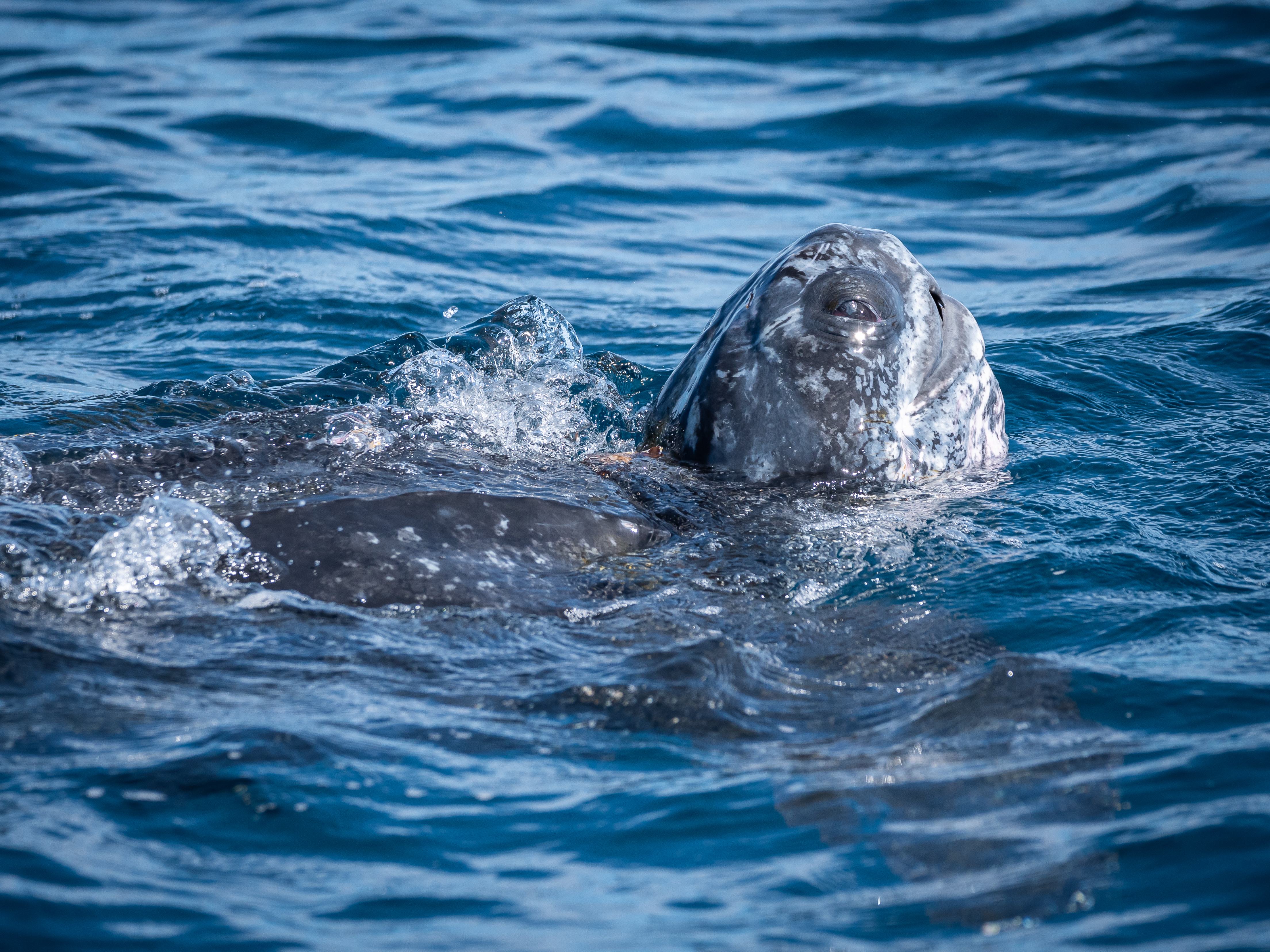
    Human for scale: Upwell Executive Director George Shillinger tagging nesting leatherbacks in Playa Grande Costa Rica in 2007 | Upwell Turtles

    Running the gauntlet 

    Leatherbacks face many risks in various countries across the huge distances they travel between foraging grounds and nesting beaches. Threats can include unintentional capture by fisheries (bycatch), the harvesting of adult turtles and eggs, plastic pollution, nesting beach habitat loss, climate change, and vessel strike.

    Currently, the biggest threat to leatherback turtles, globally, is from commercial fishing. Most turtles accidentally caught by fisheries in New Zealand waters are released alive, but we need to learn how to reduce bycatch numbers to better protect them. 

    It’s a minefield for a turtle travelling across international boundaries, and we’ve seen a decline in this population of over 80% in the last 40 years. That’s why international collaboration is so important for their research and conservation if we are to have any chance of recovering the population. 

    Collaborating for conservation  

    We’re working with scientists who have been studying leatherbacks for decades. Being able to work together to study their habitat use in New Zealand waters will be another piece in the migration puzzle for these ancient turtles. 

    Dr George Shillinger, Executive Director of Upwell Turtles, says leatherbacks are among the most highly migratory and transboundary marine species on the planet.  

    “Effective conservation requires international collaboration from nesting beaches all the way to distant foraging habitats.” 

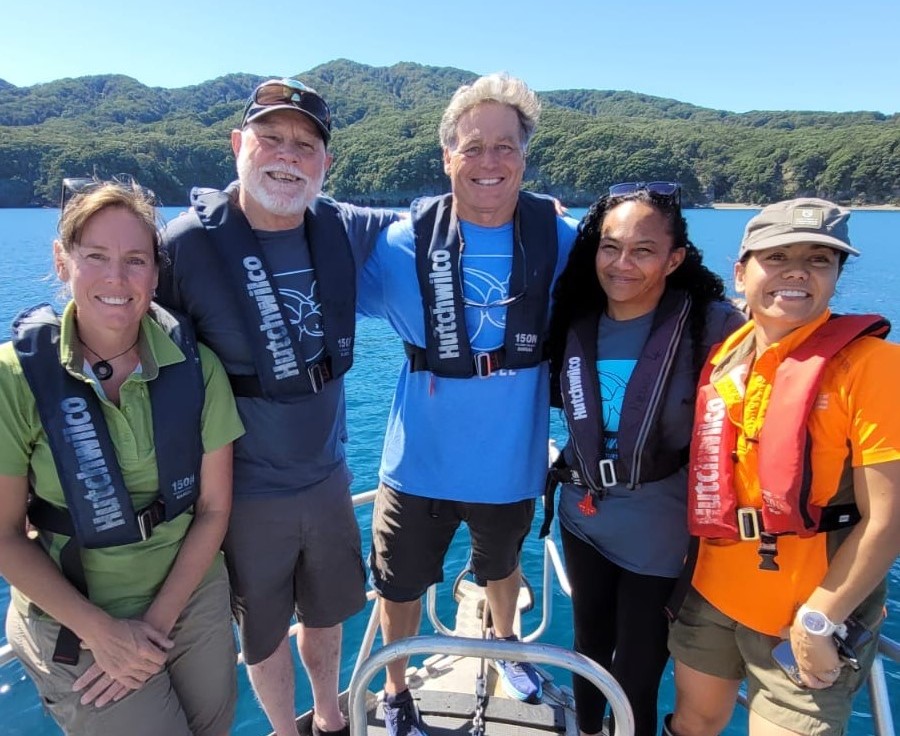
    Some of the leatherback researchers and partners out on the boat | DOC

    Taking to the air 

    Our turtle-team recently took to the air over the Bay of Plenty as a starting point to find out more about leatherbacks in New Zealand waters. We worked with Upwell Turtles, and with support and expertise from NIWA, Monash University (Australia), and Moss Landing Marine Laboratories (USA).  

    While we had George and Scott here from Upwell Turtles, they graciously gave us some of their time and expertise, to help develop our own techniques to catch and tag leatherbacks. 

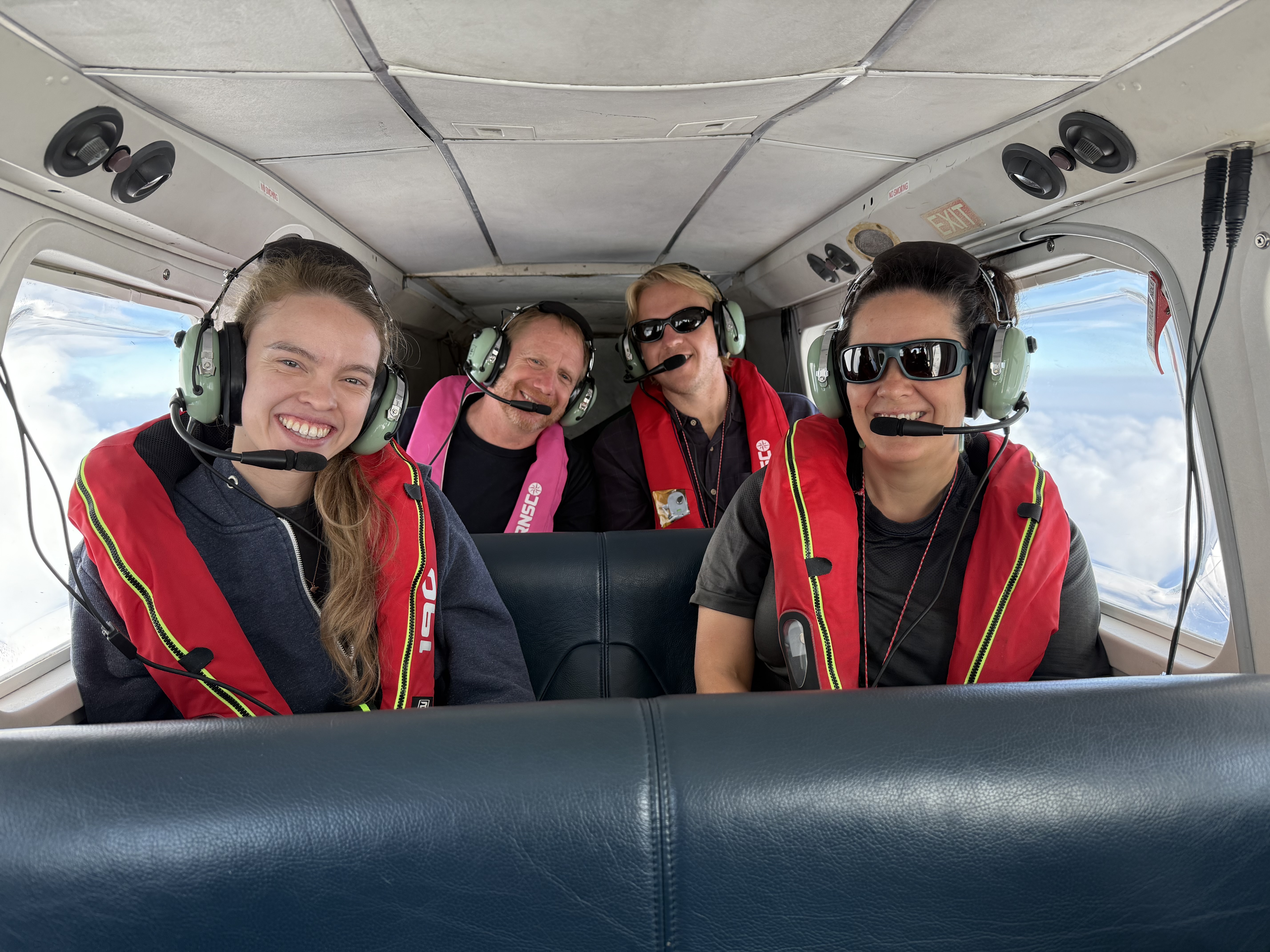
    The international research crew monitoring for leatherbacks from a plane | Sean Williamson

    Practice Makes Perfect 

    Along with our international experts, we assembled an array of technical equipment, and formed a team including Tauranga DOC staff, Tuhua Island kaitiaki, and a local marine conservationist, all eager to embrace the challenge of finding and netting such large animals. 

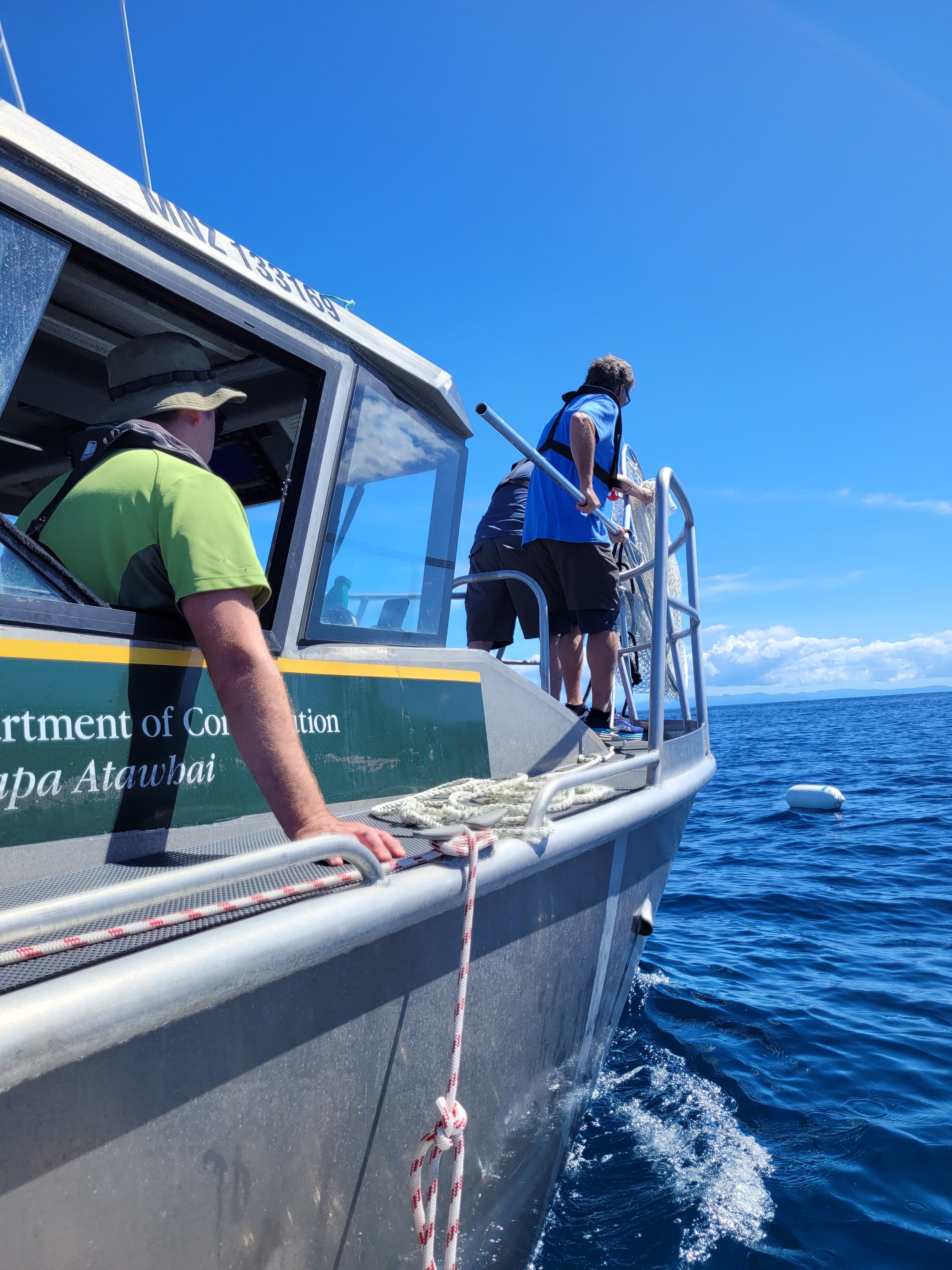
    Heading out on our DOC boat off the coast of Tauranga on calm, sunny weekend in March we focused our efforts on a large rubber fender co-opted as a ‘pretend’ turtle. Few fenders have had such an exciting couple of days! 

    The team has now honed the required skills and techniques to safely net actual turtles. In future, when we do this for real, we will have a spotter plane in the air and other boats on the water to help us find turtles – leatherbacks can be tricky to spot from sea level. 

    Where to from here? 

    Because leatherback turtles have historically visited the Bay of Plenty, we’re working to build partnerships with local iwi and hapū, and the Bay of Plenty community, as well as collaborating with our research partners. 

    We’re starting to plan our next steps into the world of tagging, aiming for next summer when the turtles and jellyfish have returned to the Bay.  

    Everything we learn from tagging studies of leatherback turtles in our waters will help inform future conservation efforts for this species, which is so ancient we call it the tuatara of our oceans. We’ll be doing our part in the international effort to protect a species on the brink of extinction.   

    How you can help leatherback turtles: 

    • No marine turtles nest on beaches in New Zealand, any turtle on the beach should be reported immediately to 0800 DOC HOT (0800 362 468).
    • Spot a sea turtle in the water around New Zealand? You can report sightings to
    turtles@doc.govt.nz 
    • You can help protect leatherbacks and other marine animals by preventing plastics and pollution from reaching our oceans. 

    MIL OSI New Zealand News

  • MIL-OSI Banking: African Development Bank and Mozambique launch drone-based initiative to strengthen country’s disaster preparedness

    Source: African Development Bank Group
    The African Development Bank, the government of Mozambique, and Korea’s government agency Busan Technopark have launched an innovative drone-driven initiative to strengthen disaster preparedness in Mozambique, a country frequently hit by floods, mudslides, cyclones, and other weather-related crises.
    The launch event took…

    MIL OSI Global Banks

  • MIL-OSI Canada: G7 Foreign Ministers’ statement on China’s large-scale military drills around Taiwan

    Source: Government of Canada News

    April 6, 2025 – Ottawa, Ontario – Global Affairs Canada

    We, the G7 Foreign Ministers of Canada, France, Germany, Italy, Japan, the United Kingdom and the United States of America and the High Representative of the European Union, express deep concern about China’s provocative actions, particularly the recent large-scale military drills around Taiwan.

    These increasingly frequent and destabilizing activities are raising cross-Strait tensions and put at risk global security and prosperity.

    G7 members and the larger international community have an interest in the preservation of peace and stability across the Taiwan Strait. We oppose any unilateral actions to threaten such peace and stability, including by force or coercion.

    G7 members continue to encourage the peaceful resolution of issues through constructive cross-Strait dialogue.

    MIL OSI Canada News

  • MIL-OSI United Kingdom: G7 Foreign Ministers’ statement on China’s large-scale military drills around Taiwan

    Source: United Kingdom – Executive Government & Departments

    News story

    G7 Foreign Ministers’ statement on China’s large-scale military drills around Taiwan

    G7 Foreign Ministers’ statement

    6 April 2025

    We, the G7 Foreign Ministers of Canada, France, Germany, Italy, Japan, the United Kingdom and the United States of America and the High Representative of the European Union, express deep concern about China’s provocative actions, particularly the recent large-scale military drills around Taiwan.

    These increasingly frequent and destabilizing activities are raising cross-Strait tensions and put at risk global security and prosperity.

    G7 members and the larger international community have an interest in the preservation of peace and stability across the Taiwan Strait. We oppose any unilateral actions to threaten such peace and stability, including by force or coercion.

    G7 members continue to encourage the peaceful resolution of issues through constructive cross-Strait dialogue.

    Updates to this page

    Published 6 April 2025

    MIL OSI United Kingdom

  • MIL-Evening Report: The graver Israel’s atrocities in Gaza, the quieter the BBC grows

    ANALYSIS: By Jonathan Cook

    The BBC’s news verification service, Verify, digitally reconstructed a residential tower block in Mandalay earlier this week to show how it had collapsed in a huge earthquake on March 28 in Myanmar, a country in Southeast Asia largely cut off from the outside world.

    The broadcaster painstakingly pieced together damage to other parts of the city using a combination of phone videos, satellite imagery and Nasa heat detection images.

    Verify dedicated much time and effort to this task for a simple reason: to expose as patently false the claims made by the ruling military junta that only 2000 people were killed by Myanmar’s 7.7-magnitude earthquake.

    The West sees the country’s generals as an official enemy, and the BBC wanted to show that the junta’s account of events could not be trusted. Myanmar’s rulers have an interest in undercounting the dead to protect the regime’s image.

    The BBC’s determined effort to strip away these lies contrasted strongly with its coverage — or rather, lack of it — of another important story this week.

    Israel has been caught in another horrifying war crime. Late last month, it executed 15 Palestinian first responders and then secretly buried them in a mass grave, along with their crushed vehicles.

    Israel is an official western ally, one that the United States, Britain and the rest of Europe have been arming and assisting in a spate of crimes against humanity being investigated by the world’s highest court. Fourteen months ago, the International Court of Justice ruled it was “plausible” that Israel was committing genocide in Gaza.

    Israeli Prime Minister Benjamin Netanyahu, meanwhile, is a fugitive from its sister court, the International Criminal Court. Judges there want to try him for crimes against humanity, including starving the 2.3 million people of Gaza by withholding food, water and aid.

    Israel is known to have killed tens of thousands of Palestinians, many of them women and children, in its 18-month carpet bombing of the enclave. But there are likely to be far more deaths that have gone unreported.

    This is because Israel has destroyed all of Gaza’s health and administrative bodies that could do the counting, and because it has created unmarked “kill zones” across much of the enclave, making it all but impossible for first responders to reach swathes of territory to locate the dead.

    The latest crime scene in Gaza is shockingly illustrative of how Israel murders civilians, targets medics and covers up its crimes — and of how Western media collude in downplaying such atrocities, helping Israel to ensure that the extent of the death toll in Gaza will never be properly known.

    Struck ‘one by one’
    Last Sunday, United Nations officials were finally allowed by Israel to reach the site in southern Gaza where the Palestinian emergency crews had gone missing a week earlier, on March 23. The bodies of 15 Palestinians were unearthed in a mass grave; another is still missing.

    All were wearing their uniforms, and some had their hands or legs zip-tied, according to eyewitnesses. Some had been shot in the head or chest. Their vehicles had been crushed before they were buried.

    Two of the emergency workers were killed by Israeli fire while trying to aid people injured in an earlier air strike on Rafah. The other 13 were part of a convoy sent to retrieve the bodies of their colleagues, with the UN saying Israel had struck their ambulances “one by one”.

    Even the usual excuses, as preposterous as they are, simply won’t wash in the case of Israel’s latest atrocity — which is why it initially tried to black out the story

    More details emerged during the week, with the doctor who examined five of the bodies reporting that all but one — which had been too badly mutilated by feral animals to assess — were shot from close range with multiple bullets. Ahmad Dhaher, a forensic consultant working at Nasser hospital in Khan Younis, said: “The bullets were aimed at one person’s head, another at their heart, and a third person had been shot with six or seven bullets in the torso.”

    Bashar Murad, the Red Crescent’s director of health programmes, observed that one of the paramedics in the convoy was in contact with the ambulance station when Israeli forces started shooting: “During the call, we heard the sound of Israeli soldiers arriving at the location, speaking in Hebrew.

    “The conversation was about gathering the [Palestinian] team, with statements like: ‘Gather them at the wall and bring some restraints to tie them.’ This indicated that a large number of the medical staff were still alive.”

    Jonathan Whittall, head of the UN office for the coordination of humanitarian affairs in Palestine, reported that, on the journey to recover the bodies, he and his team witnessed Israeli soldiers firing on civilians fleeing the area. He saw a Palestinian woman shot in the back of the head and a young man who tried to retrieve her body shot, too.

    Concealing slaughter
    The difficulty for Israel with the discovery of the mass grave was that it could not easily fall back on any of the usual mendacious rationalisations for war crimes that it has fed the Western media over the past year and a half, and which those outlets have been only too happy to regurgitate.

    Since Israel unilaterally broke a US-backed ceasefire agreement with Hamas last month, its carpet bombing of the enclave has killed more than 1000 Palestinians, taking the official death toll to more than 50,000. But Israel and its apologists, including Western governments and media, always have a ready excuse at hand to mask the slaughter.

    Israel disputes the casualty figures, saying they are inflated by Gaza’s Health Ministry, even though its figures in previous wars have always been highly reliable. It says most of those killed were Hamas “terrorists”, and most of the slain women and children were used by Hamas as “human shields”.

    Israel has also destroyed Gaza’s hospitals, shot up large numbers of ambulances, killed hundreds of medical personnel and disappeared others into torture chambers, while denying the entry of medical supplies.

    Israel implies that all of the 36 hospitals in Gaza it has targeted are Hamas-run “command and control centres”; that many of the doctors and nurses working in them are really covert Hamas operatives; and that Gaza’s ambulances are being used to transport Hamas fighters.

    Even if these claims were vaguely plausible, the Western media seems unwilling to ask the most obvious of questions: why would Hamas continue to use Gaza’s hospitals and ambulances when Israel made clear from the outset of its 18-month genocidal killing rampage that it was going to treat them as targets?

    Even if Hamas fighters did not care about protecting the health sector, which their parents, siblings, children, and relatives desperately need to survive Israel’s carpet bombing, why would they make themselves so easy to locate?

    Hamas has plenty of other places to hide in Gaza. Most of the enclave’s buildings are wrecked concrete structures, ideal for waging guerrilla warfare.

    Israeli cover-up
    Even the usual excuses, as preposterous as they are, simply won’t wash in the case of Israel’s latest atrocity — which is why it initially tried to black out the story.

    Given that it has banned all Western journalists from entering Gaza, killed unprecedented numbers of local journalists, and formally outlawed the UN refugee agency Unrwa, it might have hoped its crime would go undiscovered.

    But as news of the atrocity started to appear on social media last week, and the mass grave was unearthed on Sunday, Israel was forced to concoct a cover story.

    It claimed the convoy of five ambulances, a fire engine, and a UN vehicle were “advancing suspiciously” towards Israeli soldiers. It also insinuated, without a shred of evidence, that the vehicles had been harbouring Hamas and Islamic Jihad fighters.

    Once again, we were supposed to accept not only an improbable Israeli claim but an entirely nonsensical one. Why would Hamas fighters choose to become sitting ducks by hiding in the diminishing number of emergency vehicles still operating in Gaza?

    Why would they approach an Israeli military position out in the open, where they were easy prey, rather than fighting their enemy from the shadows, like other guerrilla armies — using Gaza’s extensive concrete ruins and their underground tunnels as cover?

    If the ambulance crews were killed in the middle of a firefight, why were some victims exhumed with their hands tied? How is it possible that they were all killed in a gun battle when the soldiers could be heard calling for the survivors to be zip-tied?

    And if Israel was really the wronged party, why did it seek to hide the bodies and the crushed vehicles under sand?

    ‘Deeply disturbed’
    All available evidence indicates that Israel killed all or most of the emergency crews in cold blood — a grave war crime.

    But as the story broke on Monday, the BBC’s News at Ten gave over its schedule to a bin strike by workers in Birmingham; fears about the influence of social media prompted by a Netflix drama, Adolescence; bad weather on a Greek island; the return to Earth of stranded Nasa astronauts; and Britain’s fourth political party claiming it would do well in next month’s local elections.

    All of that pushed out any mention of Israel’s latest war crime in Gaza.

    Presumably under pressure from its ordinary journalists — who are known to be in near-revolt over the state broadcaster’s persistent failure to cover Israeli atrocities in Gaza — the next day’s half-hour evening news belatedly dedicated 30 seconds to the item, near the end of the running order.

    This was the perfect opportunity for BBC Verify to do a real investigation, piecing together an atrocity Israel was so keen to conceal

    The perfunctory report immediately undercut the UN’s statement that it was “deeply disturbed” by the deaths, with the newsreader announcing that Israel claimed nine “terrorists” were “among those killed”.

    Where was the BBC Verify team in this instance? Too busy scouring Google maps of Myanmar, it would seem.

    If ever there was a region where its forensic, open-source skills could be usefully deployed, it is Gaza. After all, Israel keeps out foreign journalists, and it has killed Palestinian journalists in greater numbers than all of the West’s major wars of the past 150 years combined.

    This was the perfect opportunity for BBC Verify to do a real investigation, piecing together an atrocity Israel was so keen to conceal. It was a chance for the BBC to do actual journalism about Gaza.

    Why was it necessary for the BBC to contest the narrative of an earthquake in a repressive Southeast Asian country whose rulers are opposed by the West but not contest the narrative of a major atrocity committed by a Western ally?

    Missing in action
    This is not the first time that BBC Verify has been missing in action at a crucial moment in Gaza.

    Back in January 2024, Israeli soldiers shot up a car containing a six-year-old girl, Hind Rajab, and her relatives as they tried to flee an Israeli attack on Gaza City. All were killed, but before Hind died, she could be heard desperately pleading with emergency services for help.

    Two paramedics who tried to rescue her were also killed. It took two weeks for other emergency crews to reach the bodies.

    It was certainly possible for BBC Verify to have done a forensic study of the incident — because another group did precisely that. Forensic Architecture, a research team based at the University of London, used available images of the scene to reconstruct the events.

    It found that the Israeli military had fired 335 bullets into the small car carrying Hind and her family. In an audio recording before she was killed, Hind’s cousin could be heard telling emergency services that an Israeli tank was near them.

    The sound of the gunfire, most likely from the tank’s machine gun, indicates it was some 13 metres away — close enough for the crew to have seen the children inside.

    Not only did BBC Verify ignore the story, but the BBC also failed to report it until the bodies were recovered. As has happened so often before, the BBC dared not do any reporting until Israel was forced to confirm the incident because of physical evidence.

    We know from a BBC journalist-turned-whistleblower, Karishma Patel, that she pushed editors to run the story as the recordings of Hind pleading for help first surfaced, but she was overruled.

    When the BBC very belatedly covered Hind’s horrific killing online, in typical fashion, it did so in a way that minimised any pushback from Israel. Its headline, “Hind Rajab, 6, found dead in Gaza days after phone calls for help”, managed to remove Israel from the story.

    Evidence buried
    A clear pattern thus emerges. The BBC also tried to bury the massacre of the 15 Palestinian first responders — keeping it off its website’s main page — just as Israel had tried to bury the evidence of its crime in Gaza’s sand.

    The story’s first headline was: “Red Cross outraged over killing of eight medics in Gaza”. Once again, Israel was removed from the crime scene.

    Only later, amid massive backlash on social media and as the story refused to go away, did the BBC change the headline to attribute the killings to “Israeli forces”.

    But subsequent stories have been keen to highlight the self-serving Israeli claim that its soldiers were entitled to execute the paramedics because the presence of emergency vehicles at the scene of much death and destruction was “suspicious”.

    In one report, a BBC journalist managed to shoe-horn this same, patently ridiculous “defence” twice into her two-minute segment. She reduced the discovery of an Israeli massacre to mere “allegations”, while a clear war crime was soft-soaped as only an “apparent” one.

    Notably, the BBC has on one solitary occasion managed to go beyond other media in reporting an attack on an ambulance crew. The footage incontrovertibly showed a US-supplied Apache helicopter firing on the crew and a young family they were trying to evacuate.

    There was no possibility the ambulance contained “terrorists” because the documentary team were filming inside the vehicle with paramedics they had been following for months. The video was included near the end of a documentary on the suffering of Palestinians in Gaza, seen largely through the eyes of children.

    But the BBC quickly pulled that film, titled Gaza: How to Survive a War Zone, after the Israel lobby manufactured a controversy over one of its child narrators being the son of Gaza’s deputy Agriculture Minister, who served in the Hamas-run civilian government.

    Wholesale destruction
    The unmentionable truth, which has been evident since the earliest days of the 18-month genocide, is that Israel is intentionally dismantling and destroying Gaza’s health sector, piece by piece.

    According to the UN, Israel’s war has killed at least 1060 healthcare workers and 399 aid workers — those deaths it has been possible to identify — and wrecked Gaza’s health facilities. Israel has rounded up hundreds of medical staff and disappeared many of them into what Israeli human rights groups call torture chambers.

    One doctor, Dr Hussam Abu Safiya, director of the Kamal Adwan hospital in northern Gaza, has been held by Israel since he was abducted in late December. During brief contacts with lawyers, Dr Safiya revealed that he is being tortured.

    Other doctors have been killed in Israeli detention from their abuse, including one who was allegedly raped to death.

    Israel’s destruction of Gaza’s hospitals and execution of medical personnel is part of the same message: there is nowhere safe, no sanctuary, the laws of war no longer apply

    Why is Israel carrying out this wholesale destruction of Gaza’s health sector? There are two reasons. Firstly, Netanyahu recently reiterated his intent to carry out the complete ethnic cleansing of Gaza.

    He presents this as “voluntary migration”, supposedly in accordance with US President Donald Trump’s plan to relocate the enclave’s population of 2.3 million Palestinians to other countries.

    There can be nothing voluntary about Palestinians leaving Gaza when Israel has refused to allow any food or aid into the enclave for the past month, and is indiscriminately bombing Gaza. Israel’s ultimate intention has always been to terrify the population into flight.

    Israel’s ambassador to Austria, David Roet, was secretly recorded last month stating that “there are no uninvolved in Gaza”— a constant theme from Israeli officials. He also suggested that there should be a “death sentence” for anyone Israel accuses of holding a gun, including children.

    Meanwhile, Israeli Defence Minister Israel Katz has threatened the “total devastation” of Gaza’s civilian population should they fail to “remove Hamas” from the enclave, something they are in no position to do.

    Not surprisingly, faced with the prospect of an intensification of the genocide and the imminent annihilation of themselves and their loved ones, ordinary people in Gaza have started organising protests against Hamas — marches readily reported by the BBC and others.

    Israel’s destruction of Gaza’s hospitals and execution of medical personnel is part of the same message: there is nowhere safe, no sanctuary, the laws of war no longer apply, and no one will come to your aid in your hour of need.

    You are alone against our snipers, drones, tanks and Apache helicopters.

    Too much to bear
    The second reason for Israel’s destruction of Gaza’s health sector is that we in the West, or at least our governments and media, have consented to Israel’s savagery — and actively participated in it — every step of the way. Had there been any meaningful pushback at any stage, Israel would have been forced to take another course.

    When David Lammy, Britain’s Foreign Secretary, let slip in Parliament last month the advice he has been receiving from his officials since he took up the job last summer — that Israel is clearly violating international law by starving the population — he was immediately rebuked by Prime Minister Keir Starmer’s office.

    Let us not forget that Starmer, when he was opposition leader, approved Israel’s genocidal blocking of food, water and electricity to Gaza, saying Israel “had that right”.

    In response to Lammy’s comments, Starmer’s spokesperson restated the government’s view that Israel is only “at risk” of breaching international law — a position that allows the UK to continue arming Israel and providing it with intelligence from British spy flights over Gaza from a Royal Air Force base in Cyprus.

    Our politicians have consented to everything Israel has done, and not just in Gaza over the past 18 months. This genocide has been decades in the making.

    Three-quarters of a century ago, the West authorised the ethnic cleansing of most of Palestine to create a self-declared Jewish state there. The West consented, too, to the violent occupation of the last sections of Palestine in 1967, and to Israel’s gradual colonisation of those newly seized territories by armed Jewish extremists.

    The West nodded through waves of house demolitions carried out against Palestinian communities by Israel to “Judaise” the land. It backed the Israeli army creating extensive “firing zones” on Palestinian farmland to starve traditional agricultural communities of any means of subsistence.

    The West ignored Israeli settlers and soldiers destroying Palestinian olive groves, beating up shepherds, torching homes, and murdering families. Even being an Oscar winner offers no immunity from the rampant settler violence.

    The West agreed to Israel creating an apartheid road system and a network of checkpoints that kept Palestinians confined to ever-shrinking ghettoes, and building walls around Palestinian areas to permanently isolate them from the rest of the world.

    It allowed Israel to stop Palestinians from reaching one of their holiest sites, Al-Aqsa Mosque, on land that was supposed to be central to their future state.

    The West kept quiet as Israel besieged the two million people of Gaza for 17 years, putting them on a tightly rationed diet so their children would grow ever-more malnourished. It did nothing — except supply more weapons — when the people of Gaza launched a series of non-violent protests at their prison walls around the enclave, and were greeted with Israeli sniper fire that left thousands dead or crippled.

    The West only found a collective voice of protest on 7 October 2023, when Hamas managed to find a way to break out of Gaza’s choking isolation to wreak havoc in Israel for 24 hours. It has been raising its voice in horror at the events of that single day ever since, drowning out 18 months of screams from the children being starved and exterminated in Gaza.

    The murder of 15 Palestinian medics and aid workers is a tiny drop in an ocean of Israeli criminality — a barbarism rewarded by Western capitals decade after decade.

    This genocide was made in the West. Israel is our progeny, our ugly reflection in the mirror — which is why Western leaders and establishment media are so desperate to make us look the other way. That reflection is too much for anyone with a soul to bear.

    Jonathan Cook is a writer, journalist and media critic, and author of many books about Palestine. He is a winner of the Martha Gellhorn Special Prize for Journalism. Republished from the Middle East Eye and the author’s blog with permission.
    MIL OSI AnalysisEveningReport.nz

  • MIL-OSI China: China’s Yunnan rescue team completes quake response in Myanmar

    Source: People’s Republic of China – State Council News

    KUNMING, April 6 — A 37-member rescue and medical team from southwest China’s Yunnan Province returned from Myanmar on Sunday afternoon, after completing their earthquake relief work.

    A 7.9-magnitude quake struck Myanmar on March 28. At around 6:30 a.m. Beijing time on March 29, the team from Yunnan Province, which borders Myanmar, took off from Kunming — Yunnan’s capital city — to the quake-stricken areas in Myanmar boarding a flight, carrying with them life detectors, seismic warning systems, portable satellite telephones and drones.

    As the first Chinese rescue team to arrive in Myanmar, they immediately joined forces with local firefighters and rescuers to carry out rescue and medical operations in the severely-affected Naypyidaw, which lasted for over 150 hours.

    At 5 a.m. March 30 local time, the team, joined by local forces, rescued an elderly person who had been trapped for nearly 40 hours at a local hospital.

    A China Media Group report said on Wednesday that more than 500 Chinese rescue workers were in Myanmar for rescue and relief missions, all together. As of Thursday, Chinese rescue teams had successfully saved nine survivors from the quake-affected areas.

    MIL OSI China News

  • MIL-OSI China: Book of Xi’s discourses on Chinese modernization published in Spanish

    Source: People’s Republic of China – State Council News

    BEIJING, April 6 — A compilation of excerpts from discourses on Chinese modernization by Xi Jinping, general secretary of the Communist Party of China (CPC) Central Committee, has been published in Spanish by the Central Compilation and Translation Press.

    Compiled by the Institute of Party History and Literature of the CPC Central Committee, the book collects a series of important discourses by Xi on Chinese modernization.

    The book has previously been published in English, French, Russian, Arabic and Japanese.

    According to an official statement, the foreign-language versions of the book are conducive to helping overseas readers gain a deep understanding of the theoretical system of Chinese modernization.

    The book also helps foster a common understanding of the need to enhance international collaboration in pursuing a global modernization characterized by peaceful development, mutually beneficial cooperation, and shared prosperity, the statement said.

    MIL OSI China News

  • MIL-OSI China: Chinese travelers invigorate global tourism with visa-free, convenient trips

    Source: People’s Republic of China – State Council News

    TAIYUAN, April 5 — China’s Tomb-Sweeping Day, traditionally a time for remembering the deceased, is also a perfect occasion for spring outings and sightseeing. While the country has a three-day holiday that started on Friday, Chinese tourists are leveraging visa-free policies, cost-effective flights and tech-driven tools to embark on “instant getaways” abroad, injecting new vitality into global tourism.

    Wang Liuqing, a white-collar worker from Taiyuan, capital of north China’s Shanxi Province, headed to Jeju Island in the Republic of Korea (ROK) for the holiday.

    “A visa-free destination is a priority,” said Wang, adding that the island’s jelly-like sea and cherry blossoms have offered fantastic opportunities for photography. On the social platform Rednote, numerous Chinese tourists have shared their travel tips for Jeju Island, with over 1 million related posts.

    The latest booking data from the Chinese travel platform Tuniu shows the number of outbound travelers during this year’s holiday is expected to reach a three-year high.

    As of 2025, over 80 countries and regions offer visa-free or visa-on-arrival entry to Chinese citizens.

    Wang Liyang, the operation manager of Fliggy, a leading online travel agency, said that individual travel has become the main way for Chinese tourists to travel abroad. Consumers are keen on designing their own itineraries based on online travel guides and booking unique local attractions and activities online, such as diving, sea fishing, hot spring soaking and boat tours.

    New digital tools are optimizing travel routes for Chinese tourists. Several domestic travel apps have introduced AI solutions, offering customized international travel guides, personalized itineraries and real-time ticket booking — making short trips more convenient than ever.

    Low-cost air tickets and efficient customs clearance have also contributed to the popularity of international travel. Online ticketing platforms show that direct flights from Beijing to cities like Hanoi and Bangkok, and from Shanghai to cities like Seoul and Osaka, all cost less than 1,000 yuan (about 140 U.S. dollars).

    “A budget-friendly trip sparks more passion for travel,” said Wang with Fliggy.

    According to Skift, a U.S. travel industry news site, China’s outbound tourism market is projected to surge to 200 million trips by 2028.

    Dai Bin, president of the China Tourism Academy, said that more Chinese tourists are now willing to pay for a better lifestyle — opting for good hotels, fine dining, and high-quality cultural performances during trips.

    These minor but exquisite, beautiful and heartwarming experiences with deep immersion will bring warmth and vitality to international destinations, said Dai.

    MIL OSI China News

  • MIL-OSI China: Japanese fishing vessel expelled for unlawfully entering waters of China’s Diaoyu Dao

    Source: China State Council Information Office

    A China Coast Guard (CCG) spokesperson on Sunday said that a Japanese fishing vessel had been expelled for unlawfully entering into the territorial waters of China’s Diaoyu Dao.

    The CCG has taken necessary control measures in accordance with the law, issued warnings and drove the Japanese fishing vessel away after it illegally entered the waters between Saturday and Sunday, according to spokesperson Liu Dejun.

    Emphasizing that Diaoyu Dao and its affiliated islands are China’s inherent territory, Liu urged the Japanese side to immediately cease all illegal activities in these waters.

    The CCG will continue to carry out law enforcement operations in the territorial waters of Diaoyu Dao to safeguard China’s territorial sovereignty and maritime rights and interests, he added. 

    MIL OSI China News

  • MIL-Evening Report: Ian Powell: When apartheid met Zionism – the case for NZ recognising Palestine as a state

    COMMENTARY: By Ian Powell

    The 1981 Springbok Tour was one of the most controversial events in Aotearoa New Zealand’s history. For 56 days, between July and September, more than 150,000 people took part in more than 200 demonstrations in 28 centres.

    It was the largest protest in the country’s history.

    It caused social ruptures within communities and families across the country. With the National government backing the tour, protests against apartheid sport turned into confrontations with both police and pro-tour rugby fans — on marches and at matches.

    The success of these mass protests was that this was the last tour in either country between the two teams with the strongest rivalry among rugby playing nations.

    This deeply rooted antipathy towards the racism of apartheid helps provide context to today’s growing opposition by New Zealanders to the horrific actions of another apartheid state.

    Depuis la révolte de 1976, le nom de ce township noir symbolise la lutte de la population noire contre le système d’apartheid. Les habitants mènent leur vie quotidienne au milieu des conflits et manifestations, le 15 juin 1980. (Photo by William Campbell/Sygma via Getty Images)

    ” data-medium-file=”https://politicalbytes.blog/wp-content/uploads/2025/03/apartheid-in-south-africa.jpg?w=300″ data-large-file=”https://politicalbytes.blog/wp-content/uploads/2025/03/apartheid-in-south-africa.jpg?w=612″/>

    A township protest against apartheid in South Africa in 1980. Image: politicalbytes.blog

    Understanding apartheid
    Apartheid is a humiliating, repressive and brutal legislated segregation through separation of social groups. In South Africa, this segregation was based on racism (white supremacy over non-whites; predominantly Black Africans but also Asians).

    For nearly three centuries before 1948, Africans had been dispossessed and exploited by Dutch and British colonists. In 1948, this oppression was upgraded to an official legal policy of apartheid.

    Apartheid does not have to be necessarily by race. It could also be religious based. An earlier example was when Christians separated Jews into ghettos on the false claim of inferiority.

    In August 2024, Le Monde Diplomatic published article (paywalled) by German prize-winning journalist and author Charlotte Wiedemann on apartheid in both Israel and South Africa under the heading “When Apartheid met Zionism”:

    She asked the pointed question of what did it mean to be Jewish in a country that saw Israel through the lens of its own experience of apartheid?

    It is a fascinating question making her article an excellent read. Le Monde Diplomatic is a quality progressive magazine, well worth the subscription to read many articles as interesting as this one.

    Relevant Wiedemann observations
    Wiedemann’s scope is wider than that of this blog but many of her observations are still pertinent to my analysis of the relationship between the two apartheid states.

    Most early Jewish immigrants to South Africa fled pogroms and poverty in tsarist Lithuania. This context encouraged many to believe that every human being deserved equal respect, regardless of skin colour or origin.

    Blatant widespread white-supremacist racism had been central to South Africa’s history of earlier Dutch and English colonialism. But this shifted to a further higher level in May 1948 when apartheid formally became central to South Africa’s legal and political system.

    Although many Jews were actively opposed to apartheid it was not until 1985, 37 years later, that Jewish community leaders condemned it outright. In the words of Chief Rabbi Cyril Harris to the post-apartheid Truth and Reconciliation Commission:

    “The Jewish community benefited from apartheid and an apology must be given … We ask forgiveness.”

    On the one hand, Jewish lawyers defended Black activists, But, on the other hand, it was a Jewish prosecutor who pursued Nelson Mandela with “extraordinary zeal” in the case that led to his long imprisonment.

    Israel became one of apartheid South Africa’s strongest allies, including militarily, even when it had become internationally isolated, including through sporting and economic boycotts. Israel’s support for the increasingly isolated apartheid state was unfailing.

    Jewish immigration to South Africa from the late 19th century brought two powerful competing ideas from Eastern Europe. One was Zionism while the other was the Bundists with a strong radical commitment to justice.

    But it was Zionism that grew stronger under apartheid. Prior to 1948 it was a nationalist movement advocating for a homeland for Jewish people in the “biblical land of Israel”.

    Zionism provided the rationale for the ideas that actively sought and achieved the existence of the Israeli state. This, and consequential forced removal of so many Palestinians from their homeland, made Zionism a “natural fit” in apartheid South Africa.

    Nelson Mandela and post-apartheid South Africa
    Although strongly pro-Palestinian, post-apartheid South Africa has never engaged in Holocaust denial. In fact, Holocaust history is compulsory in its secondary schools.

    Its first president, Nelson Mandela, was very clear about the importance of recognising the reality of the Holocaust. As Charlotte Wiedemann observes:

    “Quite the reverse . . .  In 1994 Mandela symbolically marked the end of apartheid at an exhibition about Anne Frank. ‘By honouring her memory as we do today’ he said at its opening, ‘we are saying with one voice: never and never again!’”

    In a 1997 speech, on the International Day of Solidarity with the Palestinian People, Mandela also reaffirmed his support for Palestinian rights:

    “We know too well that our freedom is incomplete without the freedom of the Palestinians.”

    There is a useful account of Mandela’s relationship with and support for Palestinians published by Middle East Eye.

    Mandela’s identification with Palestine was recognised by Palestinians themselves. This included the construction of an impressive statue of him on what remains of their West Bank homeland.

    Palestinians stand next to a giant statue of Nelson Mandela following its inauguration ceremony in the West Bank city of Ramallah on April 26, 2016. – Palestinians inaugurated the statue of Mandela donated by the South African city of Johannesburg to their political capital. The six-metre (20-foot) two-tonne bronze statue was a gift from Johannesburg with which Ramallah is twinned. (Photo by ABBAS MOMANI / AFP)

    ” data-medium-file=”https://politicalbytes.blog/wp-content/uploads/2025/03/mandela-statue-in-west-bank-city-of-ramallah.jpg?w=300″ data-large-file=”https://politicalbytes.blog/wp-content/uploads/2025/03/mandela-statue-in-west-bank-city-of-ramallah.jpg?w=750″/>

    Palestinians stand next to a 6 metre high statue of Nelson Mandela following its inauguration ceremony in the West Bank city of Ramallah in 2016. It was donated by the South African city of Johannesburg, which is twinned with Ramallah. Image: politicalbytes.blog

    Comparing apartheid in South Africa and Israel
    So how did apartheid in South Africa compare with apartheid in Israel. To begin with, while both coincidentally began in May 1948, in South Africa this horrendous system ended over 30 years ago. But in Israel it not only continues, it intensifies.

    Broadly speaking, this included Israel adapting the infamously cruel “Bantustan system” of South Africa which was designed to maintain white supremacy and strengthen the government’s apartheid policy. It involved an area set aside for Black Africans, purportedly for notional self-government.

    In South Africa, apartheid lasted until the early 1990s culminating in South Africa’s first democratic election in 1994.

    Tragically, for Palestinians in their homeland, apartheid not only continues but is intensified by ethnic cleansing delivered by genocide, both incrementally and in surges.

    Apartheid Plus: ethnic cleansing and genocide
    Israel has gone further than its former southern racist counterpart. Whereas South Africa’s economy depended on the labour exploitation of its much larger African workforce, this was relatively much less so for Israel.

    As much as possible Israel’s focus was, and still is, instead on the forcible removal of Palestinians from their homeland.

    This began in 1948 with what is known by Palestinians as the Nakba (“the catastrophe”) when many were physically displaced by the creation of the Israeli state. Genocide is the increasing means of delivering ethnic cleansing.

    Ethnic cleansing is an attempt to create ethnically homogeneous geographic areas by deporting or forcibly displacing people belonging to particular ethnic groups.

    It can also include the removal of all physical vestiges of the victims of this cleansing through the destruction of monuments, cemeteries, and houses of worship.

    This destructive removal has been the unfortunate Palestinian experience in much of today’s Israel and its occupied or controlled territories. It is continuing in Gaza and the occupied West Bank.

    Genocide involves actions intended to destroy, in whole or in part, a national, ethnic, racial, or religious group.

    In contrast with civil war, genocide usually involves deaths on a much larger scale with civilians invariably and deliberately the targets. Genocide is an international crime, according to the Convention on the Prevention and Punishment of the Crime of Genocide (1948).

    Today the Israeli slaughter and destruction in Gaza is a huge genocidal surge with the objective of being the “final solution” while incremental genocide of Palestinians speeds up in the occupied West Bank.

    Notwithstanding the benefits of the recent ceasefire, it freed up Israel to militarily focus on repressing West Bank Palestinians.

    Meanwhile, Israel’s genocide in Gaza during the current vulnerable hiatus of the ceasefire has shifted from military action to starvation.

    The final word
    One of the encouraging features has been the massive protests against the genocide throughout the world. In a relative context, and while not on the same scale as the mass protests against the racist South African rugby tour in 1981, this includes New Zealand.

    Many Jews, including in New Zealand and in the international protests such as at American universities, have been among the strongest critics of the ethnic cleansing through genocide of the apartheid Israeli state.

    They have much in common with the above-mentioned Bundist focus on social justice in contrast to the dogmatic biblical extremism of Zionism.

    Amos Goldberg, professor of genocidal studies at the Hebrew University in Jerusalem is one such Jew. Let’s leave the final word to him:

    “It’s so difficult and painful to admit it, but we can no longer avoid this conclusion. Jewish history will henceforth be stained.”

    This is a compelling case for the New Zealand government to join the many other countries in formally recognising the state of Palestine.

    Ian Powell is a progressive health, labour market and political “no-frills” forensic commentator in New Zealand. A former senior doctors union leader for more than 30 years, he blogs at Second Opinion and Political Bytes, where this article was first published. Republished with the author’s permission.

    MIL OSI AnalysisEveningReport.nz

  • MIL-OSI China: New study offers insights into ancient human evolution in East Asia

    Source: China State Council Information Office 2

    Researchers have uncovered the first definitive evidence of Middle Paleolithic Quina technology in East Asia, shedding new light on the evolution of the region’s early hominins.
    The findings, published in the Proceedings of the National Academy of Sciences, are based on artifacts excavated from the Longtan site in Heqing County, southwest China’s Yunnan Province. A multidisciplinary team led by the Institute of Tibetan Plateau Research (ITP) of the Chinese Academy of Sciences conducted the study.
    The Middle Paleolithic period, spanning roughly 300,000 to 40,000 years ago, was marked by the coexistence of early modern humans, Denisovans and Neanderthals, alongside significant technological advancements. While prevailing theories have suggested slow technological development among early hominins in China, the discovery at Longtan provides fresh insights into regional tool-making traditions, according to the study.
    Excavations at the Longtan site, which began in 2010, revealed stone tools exhibiting key features of Quina technology. This lithic tradition is associated with Neanderthals in cold, arid European environments around 70,000 to 40,000 years ago.
    According to the researchers, the Longtan lithic assemblage exhibits classic Quina traits, including the systematic production of thick flakes as tool blanks, selective edge retouching using both soft and hard hammers, continuous edge rejuvenation to extend tool life, and multi-stage reduction strategies. Micro-wear analysis also confirms that Quina scrapers were used to process bone, wood and hides.
    “The presence of Quina technology in East Asia has never been definitively confirmed until now,” said Li Hao, co-first author of the study and a researcher at the ITP, adding that the findings reshape people’s understanding of the evolutionary landscape of early hominins in East Asia.
    The discovery has extended the known range of this tool-making tradition and suggested the possibility of Neanderthals reaching southwest China, a hypothesis that researchers say warrants further investigation. 

    MIL OSI China News

  • MIL-OSI New Zealand: Greenpeace Statement – ‘Anchor Rainforest Killer’ palm kernel protest continues in New Plymouth

    Source: Greenpeace

    Greenpeace activists remain on the roof of an Agrifeeds palm kernel storage warehouse in Port Taranaki despite police intervention to remove other protestors inside the facility.

    Two orangutans have attached a 70-metre banner reading ‘Anchor Rainforest Killer’ to the roof and have locked themselves to the building. They are now entering their tenth hour on the roof of the building.
    Greenpeace is also suing Fonterra for misleading claims on Anchor Butter packaging. The packaging claims that the butter is ‘100% New Zealand grass-fed’, however, a Fonterra dairy cow’s diet can be composed of up to 20% palm kernel – a product linked to rainforest destruction in Indonesia.
    From inside the Agrifeeds storage shed, Greenpeace spokesperson Sinéad Deighton-O’Flynn said, “Fonterra markets its Anchor butter as ‘grass-fed’, but this is a deception. Every year, dairy cows in New Zealand are fed almost two million tonnes of palm kernel imported from Southeast Asia.
    “Rainforests are being burned, peatlands are being drained, and rows of palm trees are being planted in their place to feed Fonterra’s oversized dairy herd.
    “This facility here in New Plymouth has been linked to illegal palm plantations in Indonesia, connecting Anchor butter and other Fonterra products with the destruction of lush rainforests and the wildlife that depend on them.
    “As more and more evidence emerges of New Zealand’s link to destructive palm kernel, Fonterra must ban the use of this blood-soaked animal feed on all their farms across Aotearoa.”
    In Taranaki, New Zealand – Greenpeace activists dressed as orangutans climbed onto the roof of Fonterra’s biggest palm kernel supplier, where they deployed a 500 square meter banner that reads ‘Anchor Rainforest Killer’. Meanwhile, three more activists inside the Agrifeeds facility locked themselves to pillars, stopping a ship from Indonesia carrying 30 thousand tonnes of palm kernel expeller from unloading. The Greenpeace activists are protesting against the use of palm kernel as cow feed on Fonterra farms due to the product’s links to illegal palm plantations and deforestation of paradise rainforests in Southeast Asia.

    MIL OSI New Zealand News

  • MIL-OSI Economics: Secretary-General of ASEAN to participate in the 12th ASEAN Finance Ministers’ and Central Bank Governors’ Meeting (AFMGM) and Related Meetings in Malaysia

    Source: ASEAN

    At the invitation of H.E. Datuk Seri Amir Hamzah Azizan, Minister of Finance II of Malaysia, Secretary-General of ASEAN, Dr. Kao Kim Hourn, will lead the ASEAN Secretariat delegation to attend the 12th ASEAN Finance Ministers’ and Central Bank Governors’ Meeting and Related Meetings in Kuala Lumpur, Malaysia, on 8-10 April 2025. This series of Ministerial meetings will provide an opportunity for the ASEAN Member States to discuss and share views on global and regional economic outlook, note the progress of the initiatives under the ASEAN Finance and Central Bank tracks, and provide guidance on relevant issues. Under Malaysia’s ASEAN Chairmanship theme “Inclusivity and Sustainability,” the series of meetings will also serve as an important platform to strengthen regional cooperation, review priority economic deliverables, and advance discussions on critical financial matters that will shape ASEAN’s future.
    The post Secretary-General of ASEAN to participate in the 12th ASEAN Finance Ministers’ and Central Bank Governors’ Meeting (AFMGM) and Related Meetings in Malaysia appeared first on ASEAN Main Portal.

    MIL OSI Economics

  • MIL-Evening Report: Fiji solidarity group condemns Rabuka plans for embassy in Jerusalem

    Asia Pacific Report

    A Fiji-based Pacific solidarity group supporting the indigenous Palestine struggle for survival against the Israeli settler colonial state has today issued a statement condemning Fiji backing for Israel.

    In an open letter to the “people of Fiji”, the Fijians for Palestine Solidarity Network (F4P) has warned “your government openly supports Israel despite its genocidal campaign against Palestinians”.

    “It is directly complicit in Israel’s genocide against Palestinians and history will not forgive their inaction.”

    The group said the struggle resonated with all who believed in justice, equality, and the fundamental rights of every human being.

    Fijians for Palestine has condemned Prime Minister Sitiveni Rabuka’s coalition government plans to open a Fijian embassy in Jerusalem with Israeli backing and has launched a “No embassy on occupied land” campaign.

    The group likened the Palestine liberation struggle to Pacific self-determination campaigns in Bougainville, “French” Polynesia, Kanaky and West Papua.

    Global voices for end to violence
    The open letter on social media said:

    “Our solidarity with the Palestinian people is a testament to our shared humanity. We believe in a world where diversity, is treated with dignity and respect.

    “We dream of a future where children in Gaza can play without fear, where families can live without the shadow of war, and where the Palestinian people can finally enjoy the peace and freedom they so rightly deserve.

    “We join the global voices demanding a permanent ceasefire and an end to the violence. We express our unwavering solidarity with the Palestinian people.

    “The Palestinian struggle is not just a regional issue; it is a testament to the resilience of a people who, despite facing impossible odds, continue to fight for their right to exist, freedom, and dignity. Their struggle resonates with all who believe in justice, equality, and the fundamental rights of every human being.

    “The images of destruction, the stories of families torn apart, and the cries of children caught in the crossfire are heart-wrenching. These are not mere statistics or distant news stories; these are real people with hopes, dreams, and aspirations, much like us.

    “As Fijians, we have always prided ourselves on our commitment to peace, unity, and humanity. Our rich cultural heritage and shared values teach us the importance of standing up for what is right, even when it is not popular or convenient.

    “We call on you to stand in solidarity with the Palestinian people this Thursday with us, not out of political allegiance but out of a shared belief in humanity, justice, and the inalienable human rights of every individual.

    “There can be no peace without justice, and we stand in unity with all people and territories struggling for self-determination and freedom from occupation. The Pacific cannot be an Ocean of Peace without freedom and self determination in Palestine, West Papua, Kanaky and all oppressed territories.

    “To the Fijian people, please know that your government openly supports Israel despite its genocidal campaign against Palestinians. It is directly complicit in Israel’s genocide against Palestinians and history will not forgive their inaction.”

    MIL OSI AnalysisEveningReport.nz

  • MIL-OSI China: China-Cambodia joint logistics, training center launched

    Source: China State Council Information Office 3

    A joint logistics and training center established by the armed forces of China and Cambodia was officially inaugurated and put into operation on Saturday at the Ream Naval Base in Cambodia.

    The center is designed to support the two militaries in conducting regional counter-terrorism, disaster prevention and mitigation, humanitarian assistance, joint training and other operations, according to a statement released by China’s Ministry of National Defense.

    Both sides will dispatch personnel to jointly maintain the regular operation of the center, said the statement.

    The construction and operation of the center reflect mutual respect and equal consultation between China and Cambodia. The initiative fully complies with the domestic laws of the two countries, relevant international laws and international practices, which is not aimed at any third party, according to the statement.

    The establishment of the center is conducive to further strengthening practical cooperation between the two militaries and helps them to better fulfill international obligations and provide international public security products.

    MIL OSI China News

  • MIL-Evening Report: Trump funding cuts on media impacts on independent Asia Pacific outlet

    Pacific Media Watch

    One of the many casualties of the Trump administration’s crackdown on “soft power” that enabled many democratic media and truth to power global editorial initiatives has been BenarNews, a welcome contribution to the Asia-Pacific region.

    BenarNews had been producing a growing range of insightful on powerful articles on the region’s issues, articles that were amplified by other media such as Asia Pacific Report.

    Managing editor Kate Beddall and her deputy, Imran Vittachi, announced the suspension of the decade-old BenarNews editorial operation this week, stating in their “Letter from the editors”:

    “After 10 years of reporting from across the Asia-Pacific, BenarNews is pausing operations due to matters beyond its control.

    “The US administration has withheld the funding that we rely on to bring our readers and viewers the news from Indonesia, Malaysia, Thailand, Bangladesh, the Philippines and island-states and territories in the Pacific.

    “We have always strived to offer clear and accurate news on security, politics and human rights, to shed light on news that others neglect or suppress, and to cover issues that will shape the future of Asia and the Pacific.

    “Only last month, we marked our 10th anniversary with a video showcasing some of the tremendous but risky work done by our journalists.

    “Amid uncertainty about the future, we’d like to take this opportunity to thank our readers and viewers for their loyalty and trust in BenarNews.

    “And to Benar journalists, cartoonists and commentary writers in Washington, Asia, Australia and the Pacific, thank you for your hard work and passion in serving the public and helping make a difference.

    “We hope that our funding is restored and that we will be back online soon.”


    BenarNews: A decade of truth in democracies at risk.    Video: BenarNews

    One of the BenarNews who has contributed much to the expansion of Pacific coverage is Brisbane-based former SBS Pacific television journalist Stefan Ambruster.

    He has also been praising his team in a series of social media postings, such as Papua New Guinea correspondent Harlyne Joku — “from the old school with knowledge of the old ways”. Ambruster writes:

    “Way back in December 2022, Harlyne Joku joined Radio Free Asia/BenarNews and the first Pacific correspondent Stephen Wright as the PNG reporter to help kick this Pacific platform off.

    “Her first report was Prime Minister James Marape accusing the media of creating a bad perception of the country.

    “Almost 90 stories in just over two years carry Harlyne’s byline, covering politics, geopolitics, human and women’s rights, media freedom, police and tribal violence, corruption, Bougainville, and also PNG’s sheep.

    “Her contacts allowed BenarNews Pacific to break stories consistently. She travelled to be on-ground to cover massacre aftermaths, natural disasters and the Pope in Vanimo (where she broke another story).

    “Particularly, Harlyne — along with colleagues Victor Mambor in Jayapura and Ahmad Panthoni and Dandy Koswaraputra in Jakarta — allowed BenarNews, to cover West Papua like no other news service. From both sides of the border.

    “And it was noticed in Indonesia, PNG and the Pacific region.

    “Last year, she was barred from covering President Probowo Subianto’s visit to Moresby, a move condemned by the Media Council of Papua New Guinea.

    “At press conferences she questioned Marape about the failure to secure a UN human rights mission to West Papua, as a Melanesian Spearhead Group special envoy, which led to an eventual apology by fellow envoy, Fiji’s Prime Minister Rabuka, to Pacific leaders.”

    PNG correspondent Harlyne Joku (right) with Stefan Armbruster and Rado Free Asia president Bay Fang in Port Moresby in February 2025. Image: Stefan Armbruster/BN

    MIL OSI AnalysisEveningReport.nz

  • MIL-OSI China: Ancient Silk Road grottoes in Xinjiang open to public

    Source: China State Council Information Office 3

    Tourists view murals in the Ya’er Lake Grottoes in the city of Turpan, northwest China’s Xinjiang Uygur Autonomous Region, April 5, 2025. (Photo by Liu Jian/Xinhua)

    Two Buddhist cave complexes along the ancient Silk Road in northwest China’s Xinjiang Uygur Autonomous Region opened to the public for the first time on Saturday.

    The Ya’er Lake Grottoes, part of a UNESCO World Heritage site in the city of Turpan, welcomed visitors following a year of restoration work and digital upgrades.

    “Wearing VR glasses, we learned the grottoes’ history and saw digitally restored Buddha statues. The visuals were incredibly lifelike, creating a truly immersive experience,” said Wang Juan, a tourist from the city of Korla.

    Formerly serving as a monastery, the grottoes are composed of 22 caves dating back to the fifth century and containing Buddhist murals and inscriptions in multiple languages, including Chinese and Old Uygur.

    The caves are arranged in two tiers: an upper level which served as meditation spaces for monks, and a lower level which likely functioned as a living area. Cave 4 and Cave 7 are currently open to the public.

    The grottoes are part of the Jiaohe Ruins — among the largest and best-preserved ancient clay cities in the world and one of the sites along the ancient Silk Road added to the UNESCO World Heritage list in 2014.

    Wang Jiandong, head of the ruins’ administrative office, said that the restoration team adopted a digital approach to their work, allowing visitors to experience the artistic appeal of the millennia-old grottoes through an immersive blend of virtual and physical elements.

    In 2014, a joint application from China, Kazakhstan and Kyrgyzstan led to the inclusion of the ancient Silk Road on the UNESCO World Heritage list. China is home to 22 of the Silk Road’s 33 UNESCO heritage sites. There are another eight in Kazakhstan, and three in Kyrgyzstan. The route, which started in Xi’an in northwest China’s Shaanxi Province, was once the main corridor for trade and cultural exchange between Asia and Europe.

    Some 40 km away, four caves of the Shengjinkou Grottoes in Turpan also opened to the public on Saturday, set to offer 300 visitor slots per day. The Shengjinkou site has 13 caves dating back to the seventh century, where murals, woodware, pottery, fabrics and paintings on silk have been unearthed.

    Since 2012, China has invested 29.79 million yuan (4.14 million U.S. dollars) in five related conservation projects, including reinforcement and mural restoration, laying the groundwork for the public opening of the Shengjinkou Grottoes.

    Zhang Yong, deputy director of Turpan’s cultural heritage bureau, said that with the simultaneous opening of the Shengjinkou and Ya’er Lake grottoes, Turpan now has the most publicly accessible cave sites in Xinjiang.

    The Turpan Basin is home to 14 known grotto sites collectively encompassing over 400 caves, including the Shengjinkou and Ya’er Lake sites. As Turpan was a critical node on the ancient Silk Road, its grottoes reveal a unique fusion of Buddhist traditions, reflecting its role as a Buddhist hub linking Central Asia and China.

    An aerial drone photo taken on April 5, 2025 shows a view of the Ya’er Lake Grottoes in the city of Turpan, northwest China’s Xinjiang Uygur Autonomous Region. (Photo by Liu Yujie/Xinhua)

    MIL OSI China News

  • MIL-OSI China: Iran denies reports of casualties in US airstrike on Yemen

    Source: China State Council Information Office

    No Iranian personnel were killed in a recent U.S. airstrike on Yemen, according to Iran’s Tasnim news agency, which is known to have close ties to the Islamic Revolution Guards Corps (IRGC).

    The statement came in response to a claim made by Yemen’s Minister of Information, Moammar al-Eryani, who posted on social media platform X on Friday that 70 members of the Houthi group — including senior field commanders and Iranian experts from the IRGC — were killed in a U.S. strike on Tuesday. The attack reportedly targeted a Houthi gathering in Al-Fazah, a coastal area in the Red Sea port city of Hodeidah.

    Tasnim dismissed the report as false, stating: “The released report about the martyrdom of Iranian forces in Yemen is not correct. Follow-ups by Tasnim’s reporter indicate that the claim is false and no Iranian has been martyred in Yemen.”

    Tasnim added that the “false” news appeared to be in line with the anti-Iran psychological warfare aimed at escalating tensions in the West Asia region. It reiterated previous statements by Iranian officials asserting that Houthi forces are fighting the United States and Israel independently.

    MIL OSI China News

  • MIL-OSI China: China-Cambodia joint logistics, training center officially launched

    Source: China State Council Information Office

    A joint logistics and training center established by the armed forces of China and Cambodia was officially inaugurated and put into operation on Saturday at the Ream Naval Base in Cambodia.

    The center is designed to support the two militaries in conducting regional counter-terrorism, disaster prevention and mitigation, humanitarian assistance, joint training and other operations, according to a statement released by China’s Ministry of National Defense.

    Both sides will dispatch personnel to jointly maintain the regular operation of the center, said the statement.

    The construction and operation of the center reflect mutual respect and equal consultation between China and Cambodia. The initiative fully complies with the domestic laws of the two countries, relevant international laws and international practices, which is not aimed at any third party, according to the statement.

    The establishment of the center is conducive to further strengthening practical cooperation between the two militaries and helps them to better fulfill international obligations and provide international public security products.

    MIL OSI China News

  • MIL-OSI China: Taiwan’s youth delegation wraps up mainland visit

    Source: China State Council Information Office 2

    A group of 30 young people from Taiwan wrapped up their eight-day visit to the eastern province of Shandong on Friday.
    They set off from Taiwan on March 28, participated in a cross-Strait Confucius cultural exchange event, and visited places including Tai’an and Zaozhuang.
    Hsiao Hsu-tsen, executive director of the Ma Ying-jeou Culture and Education Foundation in Taiwan, led the delegation.
    During the visit, the delegation visited the Temple of Confucius in Qufu, where they paid respects to the ancient Chinese sage Confucius.
    A Taiwan youth participating in the ceremony told Xinhua that people usually pray for success in exams and academic progress at the Confucius Temple in Taiwan. This time, he prayed for realizing his dream of becoming a civil engineering technician.
    Traditional sacrificial activities such as those honoring Confucius and the Yan Emperor are shared spiritual bonds for people on both sides of the Taiwan Strait, carrying deep emotional significance and playing a crucial role in strengthening cross-Strait relations, said Hsiao.
    He emphasized that this shared cultural understanding demonstrates the inseparable cultural ties between the two sides. “No matter how external forces may try to interfere, this inherent and close connection cannot be severed,” he said.
    As the visit coincided with the approach of the Qingming Festival, the delegation attended a flower-wreath-presenting ceremony at the Taierzhuang War Memorial Hall in the city of Zaozhuang.
    Hsiao and the young participants laid flowers at a monument commemorating the Battle of Taierzhuang, the first major Japanese defeat during the Chinese People’s War of Resistance Against Japanese Aggression, in tribute to the war heroes.
    They also visited a cross-Strait themed park in Taierzhuang.
    “Cross-Strait people-to-people exchanges are essential. The more the people understand each other, the more consensus and fewer misunderstandings there will be. Therefore, we continue to promote various exchanges,” Hsiao said.
    During the visit, youth from both sides of the Taiwan Strait engaged in friendly exchanges.
    Earlier this year, Hsiao led a group of about 40 Taiwan students to Beijing for cultural and sports exchanges. In late 2024, the foundation invited 40 students and faculty from seven mainland universities to Taiwan. Their visit received a warm welcome. 

    MIL OSI China News

  • MIL-OSI China: Chinese int’l rescue team continues to conduct medical outreach in Myanmar’s Mandalay

    Source: China State Council Information Office

    A member of China Search and Rescue Team provides medical consultations for local residents in Mandalay, Myanmar, April 5, 2025. (Xinhua/Cai Yang)

    The China International Search and Rescue Team continued to conduct medical outreach on Saturday in the urban area of Mandalay region, Myanmar.

    Through disease screening, consultations, medication guidance, and medicine distribution, the team provided “zero-distance” medical services to the 7.9-magnitude earthquake-affected residents.

    At a relief camp near the University of Medicine in Mandalay, the team’s medical personnel utilized self-developed mobile diagnostic equipment such as handheld ultrasound devices, portable X-ray machines, and bedside ECG monitors to conduct free examinations for over 250 local residents. Essential medications, including anti-infectives, analgesics, and antihypertensives, were distributed on-site based on diagnoses.

    Near Mandalay Palace, the medical personnel team tailored solutions for prevalent local diseases, particularly respiratory, digestive, and immune system disorders exacerbated by the high temperatures in the earthquake-affected areas, providing medication guidance and conducting health education on respiratory care and chronic disease management to enhance public health awareness and self-care capabilities.

    The team comprises over 10 experts from the China International Search and Rescue Team, spanning 14 specialties, including internal medicine, surgery, and pediatrics.

    Since deploying to Myanmar, they have supported search-and-rescue operations and structural assessments while disinfecting over 120,000 square meters of rescue and operational zones.

    Collaborating with other Chinese rescue teams, including China Search and Rescue Team, a rescue team from China’s Hong Kong and Shenzhen Public Welfare Rescue Team, they have provided round-the-clock medical support, conducting over 500 medical consultations.

    The China International Search and Rescue Team will continue to conduct medical outreach across Mandalay’s relief camps in batches, prioritizing treatment for acute and chronic conditions such as respiratory, hepatobiliary, cardiovascular, and endocrine disorders.

    Additionally, they plan to donate urgently needed medical supplies and equipment to local facilities. 

    MIL OSI China News

  • MIL-OSI Asia-Pac: MICE tourism gains momentum

    Source: Hong Kong Information Services

    Ballroom inspections and mahjong sessions may not be what automatically springs to mind when you consider Hong Kong’s appeal to visitors. Meetings, incentives, conferences and exhibitions tourism – MICE tourism, for short – is not about being conventional, however.

    Recently, nine representatives from the International Association of Professional Congress Organisers, hailing from Germany, Canada, Mexico and elsewhere, embarked on a five-day MICE tourism study mission in Hong Kong, at the invitation of the Tourism Board.

    Their first stop was a Wan Chai hotel that opened late last year. The delegation inspected its banquet halls, suites and facilities, and enjoyed an unexpected highlight – an impromptu mahjong session in the games room that gave them a taste of one of the most popular Chinese pastimes.

    The group then proceeded to the Hong Kong Convention & Exhibition Centre (HKCEC) where they were shown around several exhibition venues and meeting rooms, learning about their layout and design, as well as the centre’s transport connectivity, and took the opportunity to gaze out over Victoria Harbour.

    Multiple facets
    For MICE visitors – whether squeezing in sightseeing activities around conferences or enjoying company incentive trips – riding the 130-year-old Peak Tram remains an essential Hong Kong experience, of course.

    Having ascended Victoria Peak by tram, the delegation embarked on a nostalgic journey through 1970s–80s Hong Kong at the Peak Tower museum, before marvelling at magnificent panoramic views of the city’s famous skyline and Victoria Harbour from the Sky Terrace.

    The group then descended to Man Mo Temple in Sheung Wan, where they performed the ritual of touching the holy deer statue with gold foil to seek blessings. All in all, they were able to immerse themselves fully in Hong Kong’s commercial, cultural and religious facets in a single day.

    The tour participants represented diverse clients across sectors ranging from government to technology and pharmaceuticals, and are responsible for planning events across Asia, Europe, Africa and the Middle East. They said their experiences in Hong Kong would inform future decisions about staging professional conferences and summits in the city.

    Lasting impressions
    Among the delegation was Jocelyne Mulli, managing director of a German organiser of professional conferences. Her firm has been using Hong Kong as its springboard into the Asia-Pacific region since 2012.

    Though a frequent visitor to Hong Kong and to the HKCEC, she said her latest trip had opened her eyes to ongoing upgrades and more flexible service offerings in the city. In particular, she praised Hong Kong’s fusion of heritage and modernity, applauding its sustained achievements in MICE tourism development over the years.

    “You are a hub, you are a base, and you are in the best place to welcome international delegates,” she said. “It is not everywhere that you have ballrooms, venue spaces of such size. You have a multilingual society and you have these historical aspects.”

    For his part, Alejandro Ramirez Tabche, the CEO of a Mexican event planning company, said that seeing specific venues for himself had made him realise Hong Kong is the perfect MICE destination. Describing the city as “gorgeous”, he said he would recommend it to his peers as a location for holding events without hesitation.

    “Hong Kong is always a top destination and people experience real fun and happiness,” he enthused. “And also, you have luxurious hotels, good food and good attractions. The people are so kind and they are very eager to help anytime.”

    While in Hong Kong, the group also explored the Old Town Central neighbourhood’s blend of modern and historic elements, visited the giant panda twins at Ocean Park, and toured the newly opened Kai Tak Sports Park, gaining a full appreciation of the city’s diverse offerings.

    Robust revival
    MICE tourism has emerged as a key driver of high-value travel to Hong Kong, with the city welcoming over 1.42 million overnight MICE visitors in 2024, a year-on-year increase of about 10%. Their average spending per capita outperformed overall overnight visitor expenditure by about 40% and catalysed growth across sectors including convention services, retail, dining and entertainment.

    The Tourism Board is adopting a multipronged approach to developing MICE tourism, sparing no effort to secure major events for Hong Kong, while also inviting global conference organisers to experience the city’s MICE facilities and tourism assets first-hand.

    Tourism Board Director & Business Development Team Lead of MICE Phoebe Shing outlined that the organisation has been successful in bidding for and facilitating 56 large-scale MICE events in Hong Kong this year, including 16 which are debuting in the city. The events span sectors ranging from innovation and technology to fintech, medical science and aviation.

    “In June, Hong Kong will host the International Society for Stem Cell Research 2025 annual meeting for the first time,” she said. “For the aviation sector, we will welcome Routes World 2025 in September, and also Airspace Asia Pacific 2025 in December.”

    These events are projected to attract approximately 170,000 MICE visitors from the Mainland and overseas, with total participation reaching 260,000.

    Ms Shing added that with MICE tourism’s robust recovery, coupled with the ongoing restoration of international flight capacity, further growth in MICE visitors is expected.

    “The Hong Kong Tourism Board will continue to promote MICE tourism, striving to bring more MICE events to Hong Kong. We will also solidify Hong Kong as the world’s meeting place in order to attract more high-yield visitors to our city.”

    MIL OSI Asia Pacific News

  • MIL-OSI New Zealand: Greenpeace Statement – Taranaki: Greenpeace activists stop unloading of palm kernel sourced from Indonesian rainforests

    Source: Greenpeace

    Greenpeace Aotearoa activists in Taranaki have occupied the storage facility of Fonterra’s biggest palm kernel supplier Agrifeeds this morning, stopping a ship from Indonesia carrying 30 thousand tonnes of palm kernel expeller from unloading.
    The organisation says that it is protesting against the use of palm kernel as cow feed on Fonterra farms due to the product’s links to illegal palm plantations and deforestation of paradise rainforests in Southeast Asia.
    Inside the facility, two activists have locked themselves to pillars, preventing trucks of feed from unloading. Meanwhile, a team on the roof has unfurled a 500 square metre banner labelling the Fonterra butter brand Anchor as a ‘rainforest killer’.
    Greenpeace spokesperson Sinéad Deighton-O’Flynn is inside the facility and says, “Fonterra markets its Anchor butter as ‘grass-fed’, but this is a deception. Every year, dairy cows in New Zealand are eating almost two million tonnes of palm kernel imported from Southeast Asia.
    “Rainforests are being burned, peatlands are being drained, and rows of palm trees are being planted in their place to feed Fonterra’s oversized dairy herd.”
    Greenpeace activist Danika Plowman, also inside the storage facility, says, “Rainforests and the wildlife that inhabit them should not be destroyed to feed to dairy cows here in New Zealand. We’re here to tell Fonterra to end the use of palm kernel and cut its ties to deforestation now.”
    Deighton-O’Flynn says, “Just this year, this facility was linked to illegal palm plantations in Indonesia, connecting Anchor butter and other Fonterra products with the destruction of lush rainforests and the wildlife that depend on them.
    “Fonterra has failed to take accountability for the deforestation in its supply chain, and instead has tried to hide behind greenwash, by falsely claiming that its products are “grass-fed”.
    “No one should have to worry about whether the butter they are spreading on their toast is fuelling deforestation and driving orangutans towards extinction. We are calling on Fonterra to stop its greenwash and cut its ties to deforestation. “
    “As more and more evidence emerges of New Zealand’s link to destructive palm kernel, Fonterra must ban the use of this blood-soaked animal feed on all their farms across Aotearoa.”

    MIL OSI New Zealand News

  • MIL-OSI New Zealand: Myanmar – One week after Myanmar earthquake, children grieve for lost parents while needs, including water and shelter, remain high – Save the Children

    Source: Save the Children

    One week on from the powerful 7.7 magnitude earthquake that hit central Myanmar, children are grieving for loved ones lost in the disaster while immediate needs such as water, food and shelter remain high, Save the Children said.
    With local partners, Save the Children is delivering emergency health care and first aid medical services to children and their families, including psychosocial support to children who are experiencing fear, shock and loss after the earthquake.
    Myat Nyein-, 15, lives in a village on Myanmar’s iconic Inle Lake in Shan State, where houses and farms are built on the water.
    When the earthquake struck, Myat Nyein, along with his younger brother and father, were out fishing near their village. They survived by jumping into the lake as the earthquake hit but when they returned, they found their village in ruins.
    Myat Nyein said:
    “The houses, which were all built on the water, were gone – all flattened. My heart pounded as we rushed toward our home, only to find it destroyed. My mother was nowhere to be seen.
    Then, my uncle came running toward us. “Your mother is at the hospital,” he said.
    We didn’t even stop to change our wet clothes. When we arrived, the scene before us shattered our hearts-our mother’s lifeless body – the bruises covering her, the stitches on her head, the wound on her neck.
    “My grandmother told us that until her last breath, my mother was asking for us.”
    “I will never forget the moment I pulled my younger brother into the water, the sight of our fallen village, or my mother’s broken body. These memories will stay with me forever.”
    Similar scenes have unfolded across Myanmar which has declared a state of emergency across six regions that are home to over 28 million people, including an estimated 6.7 million children.
    Kyaing Thin-, 41, who is the mother of two children aged 13 and 15, and lives in Mandalay:
    “Right after the earthquake, my sister called me, crying. Her house had collapsed, and my niece was injured. She was hysterical with fear and begged me to come and take my niece, as their place was no longer safe. Despite the continuing aftershocks, I didn’t think about my own safety-I just drove to her house.
    On the way, I saw many injured people, bleeding, lying on the ground-some conscious, some unconscious-all begging for help.”
    Homes and critical infrastructure have collapsed, and many families are still seeking shelter in monasteries, football fields, and open spaces over fears of aftershocks. Many children and their families have no electricity or running water and with the country entering its peak summer season, and soaring temperatures earlier this week , children also risk heat stroke or exhaustion.
    Jeremy Stoner, interim Asia Regional Director, Save the Children, said:
    “One week on from this hugely traumatic event for the children of Myanmar, they will still be feeling scared and many children in the affected areas will have lost both homes and loved ones. They may even have witnessed the death of loved ones and need specialist support to overcome this.
    Where homes have been destroyed, they will need immediate shelter and emergency relief items which Save the Children and our local partners are providing.”
    Conflict and climate fueled disasters have left 6.3 million children among the 19.9 million people – or more than one third of the population – already in need of humanitarian support in Myanmar before the earthquake. [1]
    Save the Children’s teams are responding in affected areas alongside local partners to ensure children get the support they need. We’re distributing food and water and working to provide personal hygiene kits and child friendly recreational materials.
    Save the Children has been working in Myanmar since 1995, providing life-saving healthcare, food and nutrition, education and child protection programmes.  
    In New Zealand, Save the Children has launched an emergency appeal. To donate, go to:  Myanmar-Thailand Earthquake Emergency – Save the Children NZ.

    MIL OSI New Zealand News

  • MIL-OSI Europe: OCEANIA – Debt crisis in the Pacific: Jubilee Year campaign aims to provide relief

    Source: Agenzia Fides – MIL OSI

    Port Moresby (Agenzia Fides) – “Fiji, Papua New Guinea, and Samoa are Pacific countries at risk of experiencing the worst consequences of internal and external debt. The Caritas Internationalis Jubilee campaign, ‘Transform Debt into Hope,’ should convince everyone to be vigilant about what political elites could do to avoid the dire circumstances of debt growth,” writes Father Giorgio Licini, missionary of PIME (Pontifical Institute for Foreign Missions) and Caritas collaborator of the Episcopal Conference of Papua New Guinea and the Solomon Islands, in a letter sent to Fides. “About fifty civil society and religious organizations around the world support the ‘Turn Debt into Hope’ petition and campaign. However, there are none from Oceania,” Father Licini points out, referring to the specific situation in Papua New Guinea, the country where he lives.”Papua New Guinea,” he points out, “owes creditors approximately 50 billion kina (approximately 11 billion euros, ed.), as the country prepares to celebrate the fiftieth anniversary of its independence in September. The country’s solid financial position in the first two decades after independence from Australia, when the national currency was essentially equal to or more than the US dollar, is now a distant memory.” “The country,” he explains, “is classified as rich in resources but has poor human development indicators. About 75 percent of the population lives in poverty or has only the bare necessities of life, often in remote and inaccessible areas lacking basic services. The debt accumulated in recent years is more or less evenly distributed between domestic and foreign debt.”Corruption is a social challenge: “The perception that the country is at least partially determined by corruption and mismanagement is strong. Gaining government positions and jobs is widely perceived as an opportunity for personal enrichment, with family, clan, and allies benefiting in every way possible,” the missionary reports. “Yet,” he continues, “with clear political will, Papua New Guinea can curb corruption, keep its debt under control, and avoid the worst results seen in other developing countries, which are now unable even to pay the interest on their debts.”In light of this global concern, Caritas Internationalis has launched a campaign in the 2025 Jubilee Year entitled “Turn Debt into Hope,” which puts into practice the call for debt relief suggested by Pope Francis in the Bull of Indiction for the Jubilee Year.There are concrete figures on the current “debt crisis,” which affects more than 100 countries: The International Monetary Fund and the World Bank estimate that 60 percent of low-income countries are in “debt distress” or are on the verge of defaulting on their repayment obligations. “As many as 48 developing countries,” says Father Licini, “spend more on debt interest payments than on health and education, further perpetuating inequality and poverty. More than 3.3 billion people live in these countries.”And while rich countries hold the majority of the debt, “the cost of borrowing for developing countries is two to twelve times higher, trapping many of them in a cycle of rising debt,” Father Licini notes. “In 2023, countries in the Global South spent 12.5 times more on debt repayment than on combating climate change, making them vulnerable to its devastating impacts. What we urgently need, then, is a bold commitment from governments and financial institutions to stop the debt crisis now: the cancellation of unjust and unsustainable debts to prevent debt crises from recurring by addressing their root causes.” They also call for “a reform of the global financial system to prioritize people and the planet” so that the same crisis cannot repeat itself cyclically.A particular goal of the Caritas Internationalis campaign, according to the missionary, “is the cancellation of ‘unsustainable debt,’ i.e., debt that cannot truly be repaid.” At the international level, the petition will be presented wherever world leaders gather to discuss politics and economics, for example at the G7 summit in Canada in June, the G20 summit in South Africa in November, and the COP30 summit in Brazil. (PA) (Agenzia Fides, 5/4/2025)
    Share:

    MIL OSI Europe News

  • MIL-OSI USA: Davids Works to Protect Tribal Schools, Students from Trump’s Harmful Voucher Plan

    Source: United States House of Representatives – Congresswoman Sharice Davids (KS-3)

    This week, Representative Sharice Davids urged the U.S. Secretary of the Interior Doug Burgum and U.S. Secretary of Education Linda McMahon to listen to widespread Tribal opposition to their proposed school voucher program and fully fund Tribal education and BIE programs. Representatives Melanie Stansbury (NM-01) and Teresa Leger Fernández (NM-03) also led the effort. 

    “We urge the Department of the Interior and Department of Education to heed the call of dozens of Tribal Nations who continue to voice their opposition to the proposed efforts by the Administration to restructure tribal education and Bureau of Indian Education (BIE) programs into school voucher programs,” the Members wrote. “As you heard during the March 14, 2025 tribal meeting held via Zoom, many Tribal Nations across the country oppose the proposition. The proposal would effectively defund BIE schools, threaten Tribal self-determination, and violate multiple federal statutes, including the federal trust and treaty responsibilities.” 

    “The proposed voucher system would weaken BIE schools in profound ways … Over 90% of BIE-funded schools are located in remote locations with no alternative schools. Destabilizing and closing schools would be traumatic for the students and families in these communities,” the Members wrote. “BIE-funded schools are the schools of choice for Tribes and students because they reflect the cultures, languages, traditional belief systems, and priorities of the communities that other educational options cannot provide. These schools often provide critical support services for the most vulnerable in their community, such as housing, meals, and internet access.”

    This week’s letter follows up on a February 11, 2025 letter from Reps. Davids, Stansbury, and Leger Fernández to Secretary Burgum, where they raised concerns about an executive order that could enable families with students eligible to attend BIE schools to use federal funding for other educational options — including private, faith-based, or public charter schools — as soon as the 2025–2026 school year.

    The full letter is here or below: 

    Dear Secretary Burgum and Secretary McMahon:


    We urge the Department of the Interior and Department of Education to heed the call of dozens of Tribal Nations who continue to voice their opposition to the proposed efforts by the Administration to restructure tribal education and Bureau of Indian Education (BIE) programs into school voucher programs. As you heard during the March 14, 2025 tribal meeting held via Zoom, many Tribal Nations across the country oppose the proposition. The proposal would effectively defund BIE schools, threaten Tribal self-determination, and violate multiple federal statutes, including the federal trust and treaty responsibilities. 


    On February 11, 2025, we sent a letter to Secretary Burgum about our concerns regarding Executive Order 14191 on “Expanding Educational Freedom and Opportunity for Families,” which directs the Secretary of the Interior to “review any available mechanisms under which families of students eligible to attend BIE schools may use their Federal funding for educational options of their choice, including private, faith-based, or public charter schools, and submit a plan to the President describing such mechanisms and steps that would be necessary to implement them for the 2025-2026 school year.” It is clear that implementing Section 7 of Executive Order 14191, as discussed above would violate multiple federal statutes, and impact the fundamental education programs that serve tens of thousands of tribal students. It is also our understanding that the overwhelming consensus on the March 14th call was that Tribes are not supportive of this proposal or any proposal that would weaken or defund the BIE and tribal education systems, including moving to a lump-sum voucher system. Many tribal communities schools are distinctive in that they are often the only educational institution serving students within a 45+ mile radius.  


    Therefore, the proposed voucher system would weaken BIE schools in profound ways. By redirecting federal funds away from BIE schools, it would create funding instability that will almost certainly lead to school closures. Over 90% of BIE-funded schools are located in remote areas with no alternative schools. For example, Seba Dalkai Community School in Arizona requires students and parents to travel over an hour round trip for services. Destabilizing and closing schools would be traumatic for the students and families in these communities. Redirecting federal funds would also bypass Tribal governance and oversight, particularly in the case of the nearly 70% of BIE-funded schools that are Tribally-Controlled Schools.  


    As you know, the U.S. government has both trust and treaty responsibilities to provide Tribal education services. The BIE administers funding for hundreds of schools and programs that are vital to meeting the Federal government’s obligations to Tribes—obligations that in many cases predate both the Department of the Interior and the Department of Education. Congress has laid out a detailed system for funding this trust and treaty responsibility in P.L. 95-561 and P.L. 100-297. The proposed lump-sum voucher system stands in direct violation of these statutes.  


    Congress has also already worked with Tribes to place school choice into the hands of Tribal communities through the Tribally Controlled Schools Act (P.L. 100-297), which President Reagan signed into law in 1988. We again urge you to review sections (a) through (d) of the Act, which clearly state that “Congress declares that a national goal of the United States is to provide the resources, processes, and structure that will enable tribes and local communities to obtain the quantity and quality of educational services and opportunities that will permit Indian children— (1) to compete and excel in areas of their choice; and (2) to achieve the measure of self-determination essential to their social and economic well-being.” In the words of the National Indian Education Association’s January 30, 2025, letter to you: “These schools are our schools of choice.” 


    BIE-funded schools are the schools of choice for Tribes and students because they reflect the cultures, languages, traditional belief systems, and priorities of the communities that other educational options cannot provide. These schools often provide critical support services for the most vulnerable in their community, such as housing, meals, and internet access. And they serve as community centers for sporting and cultural events in rural areas where there are few other options. That is why, time and time again, Tribal leaders, educators, parents, and students have affirmed the importance of BIE programs and the need to increase—not decrease—funding for them. 


    The proposed educational restructuring of the BIE and tribal school programs into a voucher system was not requested by Tribes, is not supported by Tribal nations pursuant to your consultation, and is a clear violation of federal law. We again urge you to abandon efforts to implement the voucher system and ensure that tribal education and BIE programs are fully funded, as appropriated by Congress. Further, we welcome your team to visit many of these BIE schools and learn more on their position on why this proposal is not fitting for the demographics being served.

    MIL OSI USA News

  • MIL-OSI United Nations: UN deplores deadly attack on city in central Ukraine

    Source: United Nations 2-b

    Peace and Security

    The UN Humanitarian Coordinator in Ukraine has strongly condemned a missile strike in Kryvyi Rih on Friday which killed more than a dozen people, including at least nine children, and left several others injured.

    Matthias Schmale said he was outraged by reports of yet another Russian attack on the city, which is located in the Dnipro region.

    “This attack follows a deeply disturbing pattern of repeated attacks on populated areas across Ukraine that continue to kill and maim civilians,” he said, noting that the country’s second-largest city, Kharkiv, was “still reeling” from a massive attack the night before.

    “The cost to families is unbearable. Civilians are protected under international humanitarian law. They are not a target,” he said.

    Young lives lost

    In response to the incident, the UN Children’s Fund (UNICEF) called for an immediate end to attacks on civilian areas in Ukraine.

    “We are devastated by the horrific attack in Kryvyi Rih that reportedly killed at least nine children and injured many more, including one as young as three months old,” said UNICEF Regional Director for Europe and Central Asia, Regina De Dominicis.

    The missile reportedly struck a residential neighbourhood in the Saksahanskyi district in the early evening, when many families gathering ahead of the weekend, she said, adding that it landed near a playground, tearing through homes, schools and a restaurant.

    “Among the scenes of devastation, parents were seen weeping, cradling the body of their dead son. No child should ever suffer such terror. No parent should ever endure such pain,” she said.

    Stolen futures

    UNICEF and partners are on the ground supporting affected families and coordinating with local authorities to deliver emergency assistance.

    Ms. De Dominicis noted that more than 2,500 children have been killed or injured, and millions of young lives have been upended, since the start of the full-scale Russian invasion of Ukraine in February 2022.

    “Every child killed is a future stolen,” she remarked.  “The brutal use of explosive weapons in populated areas and attacks on civilian facilities and infrastructure, which disproportionally harm children, must end.”

    MIL OSI United Nations News

  • MIL-OSI: BexBack Launches No KYC, 100x Leverage, $50 Welcome Bonus, and Double Deposit – Start Trading Today!

    Source: GlobeNewswire (MIL-OSI)

    SINGAPORE, April 05, 2025 (GLOBE NEWSWIRE) — As Bitcoin continues to trade below $85,000 and analysts predict that the crypto market will remain volatile, holding spot positions may not generate short-term profits. Recent economic shifts, including policy announcements such as President Trump’s tariff decisions, have brought some stabilization, but the volatility remains. For investors seeking to maximize returns in these uncertain times, BexBack Exchange offers a powerful solution. With 100x leverage, a 100% deposit bonus, and a $50 welcome bonus for new users, BexBack empowers traders to seize market opportunities. And with no KYC requirements, it provides a seamless and efficient way to trade.

    What Is 100x Leverage and How Does It Work?

    Simply put, 100x leverage allows you to open larger trading positions with less capital. For example:

    Suppose the Bitcoin price is $60,000 that day, and you open a long contract with 1 BTC. After using 100x leverage, the transaction amount is equivalent to 100 BTC.

    One day later, if the price rises to $63,000, your profit will be (63,000 – 60,000) * 100 BTC / 60,000 = 5 BTC, a yield of up to 500%.

    With BexBack’s deposit bonus

    BexBack offers a 100% deposit bonus. If the initial investment is 2 BTC, the profit will increase to 10 BTC, and the return on investment will double to 1000%.

    Note: Although leveraged trading can magnify profits, you also need to be wary of liquidation risks.

    How Does the 100% Deposit Bonus Work?
    The deposit bonus from BexBack cannot be directly withdrawn but can be used to open larger positions and increase potential profits. Additionally, during significant market fluctuations, the bonus can serve as extra margin, effectively reducing the risk of liquidation.

    About BexBack?

    BexBack is a leading cryptocurrency derivatives platform that offers 100x leverage on BTC, ETH, ADA, SOL, XRP, and more than 50 other major altcoins. Headquartered in Singapore, with offices in Hong Kong, Japan, the United States, the United Kingdom, and Argentina, BexBack holds a US MSB (Money Services Business) license and is trusted by over 500,000 traders worldwide. The platform accepts users from the United States, Canada, and Europe, and offers no deposit fees, along with exceptional customer service, including 24/7 support.

    Why recommend BexBack?

    No KYC Required: Start trading immediately without complex identity verification.

    100% Deposit Bonus: Double your funds, double your profits.

    High-Leverage Trading: Offers up to 100x leverage, maximizing investors’ capital efficiency.

    Demo Account: Comes with 10 BTC in virtual funds, ideal for beginners to practice risk-free trading.

    Comprehensive Trading Options: Feature-rich trading available via Web and mobile applications.

    Convenient Operation: No slippage, no spread, and fast, precise trade execution.

    Global User Support: Enjoy 24/7 customer service, no matter where you are.

    Lucrative Affiliate Rewards: Earn up to 50% commission, perfect for promoters.

    Take Action Now—Don’t Miss Another Opportunity!

    If you missed the previous crypto bull run, this could be your chance. With BexBack’s 100x leverage and 100% deposit bonus and $50 bonus for new users (complete one trade within one week of registration), you can be a winner in the new bull run.

    Sign up on BexBack now, claim your exclusive bonus and start accumulating more BTC today!

    Website: www.bexback.com

    Contact: business@bexback.com

    Contact:
    Amanda
    business@bexback.com

    Disclaimer: This content is provided by BexBack. The statements, views, and opinions expressed in this content are solely those of the content provider and do not necessarily reflect the views of this media platform or its publisher. We do not endorse, verify, or guarantee the accuracy, completeness, or reliability of any information presented. This content is for informational purposes only and should not be considered financial, investment, or trading advice. Investing in crypto and mining related opportunities involves significant risks, including the potential loss of capital. Readers are strongly encouraged to conduct their own research and consult with a qualified financial advisor before making any investment decisions. However, due to the inherently speculative nature of the blockchain sector–including cryptocurrency, NFTs, and mining–complete accuracy cannot always be guaranteed. Neither the media platform nor the publisher shall be held responsible for any fraudulent activities, misrepresentations, or financial losses arising from the content of this press release. Speculate only with funds that you can afford to lose. Neither the media platform nor the publisher shall be held responsible for any fraudulent activities, misrepresentations, or financial losses arising from the content of this press release. In the event of any legal claims or charges against this article, we accept no liability or responsibility.

    Legal Disclaimer: This media platform provides the content of this article on an “as-is” basis, without any warranties or representations of any kind, express or implied. We do not assume any responsibility or liability for the accuracy, content, images, videos, licenses, completeness, legality, or reliability of the information presented herein. Any concerns, complaints, or copyright issues related to this article should be directed to the content provider mentioned above.

    Photos accompanying this announcement are available at
    https://www.globenewswire.com/NewsRoom/AttachmentNg/fa9c9661-4f4c-4058-8a5c-b80f23c6a3ab

    https://www.globenewswire.com/NewsRoom/AttachmentNg/2fa88f18-0399-440b-843f-cfb31754755d

    https://www.globenewswire.com/NewsRoom/AttachmentNg/90f64f56-584d-4b70-bcfd-3bf00d5bc386

    https://www.globenewswire.com/NewsRoom/AttachmentNg/7fd8eb43-e490-4c56-a15b-a29400d96de5

    The MIL Network

  • MIL-OSI United Kingdom: PM call with President Macron of France: 5 April 2025

    Source: United Kingdom – Government Statements

    Press release

    PM call with President Macron of France: 5 April 2025

    The Prime Minister spoke to the President of France, Emmanuel Macron, this afternoon.

    The Prime Minister spoke with President Macron following this week’s announcement that the US will impose additional tariffs.

    They agreed that a trade war was in nobody’s interests, but nothing should be off the table and that it was important to keep business updated on developments.

    The Prime Minister and President also shared their concerns about the global economic and security impact, particularly in South East Asia.

    Following discussions between military planners in Ukraine this week, they discussed the good progress that has been made on the Coalition of the Willing.

    The Prime Minister and President agreed to stay in close contact over the coming weeks.

    Updates to this page

    Published 5 April 2025

    MIL OSI United Kingdom