The Ministry of Environment, Forest and Climate Change (MoEF&CC) notified the Environment Protection (End-of-Life Vehicles) Rules, 2025 vide S.O. 98(E) dated 06th January, 2025 for environmentally sound management of end-of-life vehicles. The rules are based on the principle of extended producer responsibility (EPR) where producers of vehicles are given mandatory EPR targets for scrapping of end-of-life vehicles. The rules cover all types of transport and non-transport vehicles, except agricultural tractor, agricultural trailer, combine harvester and power tiller.
Under the said rules, producers have been mandated to fulfil the obligation of Extended Producer Responsibility for the vehicles that the producer has introduced or introduces in the domestic market, including vehicles put to self-use to ensure the specified scrapping targets. Producers have been provided annual targets for scrapping of End-of-life vehicles starting from the year 2025-26 for the vehicles put in the market 15 years ago in case of transport vehicles and 20 years ago in case of non-transport vehicles.
Registered Vehicle Scrapping Facilities (RVSFs) have been mandated to receive unfit vehicles or End-of-Life vehicles for scrapping and must carry out treatment, depolluting, dismantling, segregation and scrapping activities. They are required to send all the recovered and segregated materials from End-of-Life vehicles to the registered recyclers or refurbishers, co-processors for recycling and reuse of components or materials, in case RVSF does have recycling or refurbishing facility. They are further required to send all non-recyclable or non-refurbishable materials and non-utilizable hazardous materials to Common Hazardous Waste Treatment, Storage and Disposal Facility authorised under Hazardous and Other Wastes (Management and Transboundary Movement) Rules, 2016.
Designated Collection Centres by producers are required to handle the End-of-Life Vehicles in an environmentally sound manner and send them to Registered Vehicle Scrapping Facility. Registered owner of the vehicle or bulk consumer is required to deposit the End-of-Life vehicle at any of the producer’s designated sales outlet or designated Collection Centre or Registered Vehicle Scrapping Facility within a period of one hundred and eighty days from the date the vehicle becomes the End-of-Life vehicle.
Under the rules, Central Pollution Control Board (CPCB) in case of producer and State Pollution Control Board (SPCB) in case of RVSF and bulk consumer may, after giving an opportunity of being heard, suspend or cancel their registration, in case of violation or non-compliance of any provisions of these rules. Returns in respect of obligations provided under the rules are required to be filed by producer, bulk consumer and RVSF on centralised online portal.
CPCB has been mandated to undertake periodic inspection and audit of the producer to ensure that such facility is complying with the requirement under the provisions of these rules. CPCB may undertake or cause to be undertaken by an authorised agency the periodic inspection and audit of the Registered Vehicle Scrapping facility. CPCB may take necessary actions against violations or for non-fulfilment of obligations under these rules against a producer or Registered Vehicle Scrapping Facility or any other person.
Similarly, SPCB has been mandated to undertake periodic inspection and audit, or cause to be inspected by an authorised agency, of the RVSF to ensure compliance of the rules. SPCB is required to undertake periodic inspection and audit, or cause to be inspected by an authorised agency, of the Registered Vehicle Scrapping Facility to ensure the compliance of these rules and may take necessary actions against violations or for non-fulfilment of obligations under these rules against a Registered Vehicle Scrapping Facility or bulk consumer or any other person.
In case, producer or Registered Vehicle Scrapping Facility or bulk consumer fails to comply with the provisions relating to handling and scrapping of End-of-Life vehicles in environmentally sound manner under these rules, are liable to pay environmental compensation for causing loss, damage or injury to environment or public health.
Ministry of Road Transport and Highways (MoRTH) has formulated the Vehicle Scrapping Policy for creation of an ecosystem to phase out older unfit and polluting vehicles. The policy targets scrapping of unfit and polluting vehicles strictly based on their fitness. Under this policy, a network of Registered Vehicle Scrapping Facilities (RVSFs) is envisaged across the country. As on January 2025, 84 RVSFs are operational in the country.
MoRTH notified the Motor Vehicles (Registration and Functions of Vehicle Scrapping Facility) Rules, 2021 prescribe for registration of Registered Vehicle Scrapping Facility (RVSF), criteria for scrapping vehicles, scrapping procedure, audit and certifications for functioning of RVSFs. In addition, RVSF is required to comply with the guidelines ‘Environmentally Sound Management of End-of-Life Vehicles’ issued by CPCB.
MoRTH notifiedthe Central Motor Vehicles (Twenty Third Amendment) Rules, 2021 videGSR 714 (E) dated 04.10.2021, whichprovide that if a buyer of a new vehicle submits ‘Certificate of Deposit’ of an end-of-life vehicle then the Registration fee on the new vehicle will not be levied.Further, MoRTH underthe Central Motor Vehicles (Twenty fourth Amendment) Rules, 2021 vide GSR 720 (E) dated 05.10.2021 provides for concession in the motor vehicle tax upto twenty five percent in case of non-transport vehicles and fifteen percent in case of transport vehicles.
In addition, MoRTH has issued the following notifications or advisories to promote adoption of Electric Vehicles and eco-friendly alternatives:
Vide S.O. 5333 (E) dated 18.10.2018, granted the exemption to the Battery-Operated Transport Vehicles and Transport Vehicles running on Ethanol and Methanol fuels from the requirements of permit.
Vide GSR 525 (E) dated 2.8.2021 exempted the Battery-Operated Vehicles from the payment of fees for the purpose of issue or renewal of registration certificate and assignment of new registration mark.
Vide GSR 302 (E) dated 18.4.2023 to issue All India Tourist permit for Battery Operated Vehicles without payment of any permit fee.
Vide GSR 749 (E) dated 7.8.2018 to issue registration mark for the Battery-Operated Vehicles to be in Yellow colour on Green background for the transport vehicles and for all other cases, in White in colour on Green background.
Further, Ministry of Heavy Industries launched ‘PM Electric Drive Revolution in Innovative Vehicle Enhancement (PM E-DRIVE) Scheme’ on 29th September, 2024 for promotion of electric mobility in the country with and outlay of Rs 10,900 crore over a period of two years. The scheme provides subsidies or demand incentives worth Rs.3,679 crore to e-2Ws, e-3Ws, e-ambulances, e-trucks and other emerging EVs. It will support 24.79 lakh e-2Ws, 3.16 lakh e-3Ws, and 14,028 e-buses.
This information was provided by UNION MINISTER OF STATE FOR ENVIRONMENT, FOREST AND CLIMATE CHANGE, SHRI KIRTI VARDHAN SINGH, in a written reply to a question in Lok Sabha today.
Nano bubble technology is a method of water treatment that uses tiny bubbles to improve water quality. The important ecological benefits are to remove contaminants, increase dissolved oxygen content, help in the removal of phytoplankton (algae), reduce biofilm, and ultimately improve the properties of water suitable for aquatic animals. The nano bubble technology can lead to a more homogeneous distribution due to the minuscule size and persistence of the bubbles in the water bodies. On the other hand, traditional systems may exhibit less uniformity in distribution, which can result in variable oxidation and disinfection performance across the water volume.
The Management of National Parks and Sanctuaries, including those Protected Areas having aquatic animals, is done as per the Management Plan prepared under the provisions of the Wild Life (Protection) Act, 1972. These include maintaining water level, water circulation and dilution, silt removal, aeration, establishing STP along the water bodies and aquatic weed removal through mechanical and manual methods. The Central Zoo Authority, in fulfilment of the functions assigned, implemented the standard and norms, inclusive of proper hygiene and health of all captive animals in zoos including aquatic animals, as prescribed in the Recognition of Zoo Rules, 2009 notified by the Central Government under section 63 of the Wild Life (Protection) Act, 1972. Further, the Central Zoo Authority has issued guidelines to zoos time to time for proper hygiene and health of all captive animals in zoos.
As nano bubble technology has been used in India for water treatment recently only on a pilot basis, the long-term impact of this technology on water quality and animal health can be known in due course of time.
This information was provided by UNION MINISTER OF STATE FOR ENVIRONMENT, FOREST AND CLIMATE CHANGE, SHRI KIRTI VARDHAN SINGH, in a written reply to a question in Lok Sabha today.
The Central Government has amended Section 21 of Air (Prevention and control of Pollution) Act, 1981 and Section 25 of Water (Prevention and control of Pollution) Act, 1974 and exempted certain categories of industries from obtaining consents. Consequently, notifications [G. S. R. 702 (E) dated 12-11-2024 under section 21(1) of the Air Act and G. S. R. 703 (E) dated 12-11-2024 under section 25(1) of the Water Act] have been issued to exempt white category of industries completely from consent mechanism and other categories from Consent to Establish if the project or activity has obtained environmental clearance under the Environmental (Protection) Act, 1986. In view of the above, the project / activities requiring prior EC as per the Environmental Impact Assessment Notification, 2006 (as amended from time to time) under Environment (Protection) Act, 1986 are exempted from obtaining previous Consent To Establish (CTE) separately.
Subsequently, the Ministry has issued a Standard Operating Procedure (SOP) dated 14thNovember 2024, which has been partially modified vide OM dated 14thJanuary 2025, for implementing the notifications mentioned above. In the SOP, it has been, inter-alia, directed that, for the projects / activities requiring prior EC, the exemption provided from obtaining CTE is subject to obtaining necessary EC and the environmental safeguards related to the establishment of industries, as may be required, will be integrated in the conditions of EC itself. The above-mentioned OMs provide for seeking the comments of the respective SPCBs on the project site, the feasibility of the project and the environmental safeguards for the concerned project, which will be integrated in the conditions of EC. Further provision for payment of requisite fees to the SPCBs has also been made.
The Ministry has undertaken systemic and policy reforms to streamline and expedite the Environment Clearance process by taking into account the imperative need for development while balancing the same with due environmental safeguards in line with the concept of sustainable development. This exemption will not only reduce compliance burden on industries but also promote Ease of Doing Business by reducing duplication of approvals since the criteria for environmental clearance and consent were overlapping.
Exempting certain categories of industries will not have any adverse impacts on environment, since the above notification effectively integrates the two procedures. As mentioned above, the SPCBs will have opportunity to put forth their comments/conditions during environmental appraisal process, which will be included in the EC conditions. Also, the existing mechanism of ‘Consent to Operate’ will continue as such and the SPCBs will continue to regulate and monitor the potential environmental implications by projects through the mechanism of Consent to Operate.
This information was provided by UNION MINISTER OF STATE FOR ENVIRONMENT, FOREST AND CLIMATE CHANGE, SHRI KIRTI VARDHAN SINGH, in a written reply to a question in Lok Sabha today.
NATIONAL METADATA STRUCTURE (NMDS 2.0) is designed to uniformly represented data and information NATIONAL METADATA STRUCTURE (NMDS 2.0) is to provide clarity on data sources and collection methods
Posted On: 03 FEB 2025 3:31PM by PIB Delhi
The National Metadata Structure (NMDS 2.0) is designed with the objective that data and information are uniformly represented, provide clarity on the data sources, collection methods and enhance discoverability of data sets. It is to bring in improved understanding of various data sets in public domain such as census, surveys, administrative and those from other sources.
The NMDS 2.0 has been shared with Ministries/Departments for implementation. The Ministry of Statistics and Programme Implementation regularly interacts with the Statistical Advisors of Ministries/Departments on various issues, including this.
This information was given by the Minister of State (I/C) for the Ministry of Statistics and Programme Implementation, Ministry of Planning and Minister of State in the Ministry of Corporate Affairs, Rao Inderjit Singh in a written reply in the Rajya Sabha today.
Source: France-Diplomatie – Ministry of Foreign Affairs and International Development
From February 6 to 11, 2025, Paris will become the artificial intelligence (AI) capital of the world on the occasion of the AI Action Summit. This event will bring together heads of State and Government, international organizations and companies of all sizes, representatives from academia, researchers, non-governmental organizations, artists and other members of civil society from across the globe.
Artificial intelligence, which is developing faster and faster, is completely transforming our societies and economies. This breakthrough technology is opening up unprecedented opportunities that could revolutionize key sectors, including health, education and labour. Its rapid deployment also creates major challenges in terms of the reliability of information, the protection of basic rights and accessibility. It is the international community’s responsibility to maintain balance in our societies and to craft AI that respects universal values.
France, a global leader in artificial intelligence
France has emerged as a major artificial intelligence player thanks to:
A national strategy deployed in 2018, built on the excellence of French research, the development of computing capacities (Jean Zay and Alice Recoque supercomputers) and the massive adoption of AI in the economy;
An ecosystem of 600 start-ups specialized in AI, which receive increasing amounts of financing;
A fully mobilized diplomatic apparatus, France being one of the seven countries participating in all landmark international AI initiatives;
Albert, an administrative model designed for government employees.
What is the AI Action Summit?
The AI Action Summit, to be held on February 10 and 11, 2025 at the Grand Palais in Paris, aims to collectively establish scientific foundations, solutions and standards for more sustainable AI working for collective progress and in the public interest.
Co-chaired with India, the event builds on the advances made at the Bletchley Park Summit in November 2023 and the Seoul Summit in May 2024 and will draw on the expertise of a steering committee bringing together some 30 countries and international institutions to ensure inclusive and diverse contributions.
The Summit, together with the AI Action Week, will be an important opportunity to showcase ecosystems fostering the development and deployment of AI and to promote concrete initiatives by a wide range of actors who contribute to this collective effort.
The participants will seek to achieve three major objectives:
Provide access to independent, safe and reliable AI to a wide range of users
Develop AI that is more environmentally friendly
Ensure global governance of artificial intelligence that is both effective and inclusive
A programme based on 5 strategic focuses
Summit discussions will focus on five major themes:
More than 800 participants (public and private sector partners, researchers, NGOs from around the world) have taken part in contact groups, meeting regularly from summer 2024.
AI Action Week
A series of Road to the Summit events helped prepare this major event. At some 100 events around the world, participants took part in discussions on the Summit’s themes.
These international efforts will come to fruition in an AI Action Week in Paris from February 6 to 11, culminating in the Summit.
February 6 and 7: International AI, Science and Society Conference at the Institut Polytechnique de Paris (IP Paris)
February 10: The Summit will begin in the Grand Palais with a forum bringing together many stakeholders from around the world (including representatives of governments, businesses and civil society, researchers, artists and journalists).
February 11: Summit of the heads of State and Government on the major common AI actions on the occasion of the plenary session
February 11: More than 100 events will be held in the margins of the Summit, including a Business Day at Station F, with participants from businesses and companies of all sizes, financial institutions, and investors.
Side events to be held on the closing day of AI Action Week in Paris will include events dedicated to artificial intelligence and democracy and the environmental impact of these technologies at the École Normale Supérieure (ENS) and the Ministry for the Ecological Transition, respectively.
A virulent strain of bird flu continues to spread across the world. Australia, New Zealand and Pacific nations are the only countries free from the infection, but this will no doubt change.
Known as “Highly Pathogenic Avian Influenza” or H5N1, the bird flu strain had killed more than 300 million birds worldwide as of December last year, including both poultry and wild bird populations.
Birds have always been part of the cultures and livelihoods of Australia Indigenous people. They feature in songs and dance, and are used for food and customary practices such as ceremonies and craft. Many of these practices continue today.
To date however, Indigenous peoples have not been adequately included in federal government planning for the arrival of H5N1.
So what is the likely result? Agencies and organisations will be ill-prepared to support Indigenous people experiencing intense social and cultural shock. And the opportunity to draw from the strengths of Indigenous organisations to tackle this impending disaster will have been squandered.
What is H5N1?
First identified in Hong Kong in 1997, H5N1 has since spread globally.
H5N1 is a viral infection primarily affecting birds – both poultry and wildlife. As overseas experience has shown, it can lead to population declines in wild birds and disrupt local ecosystems. Infected birds may exhibit symptoms such as lethargy, respiratory distress and neurological signs such as paralysis, seizures and tremors, and sudden death.
The virus also affects mammals including humans.
Since November 2003, more than 900 human cases have been reported across 24 countries. About half these people died.
Birds are highly significant to many Indigenous groups.
The adult magpie goose and its eggs, for example, are an important food source for groups in the Kakadu region.
In Tasmania, Indigenous groups are revitalising customary practices by harvesting mutton birds. And bird feathers are used by Indigenous artisans in fashion and jewellery-making.
If H5N1 makes birds sick and diminishes their populations, Indigenous people’s livelihoods and wellbeing – social, emotional, and spiritual – will be severely affected.
Many birds are already struggling
Of greatest concern are the fate of threatened and endangered bird species. Indeed, Australia’s Threatened Species Commissioner, Dr Fiona Fraser, has warned the forthcoming H5N1 event may be more ecologically devastating than the 2019–20 bushfires.
Migratory birds, such as waders that travel from Siberia to lake systems throughout Australia, may take years or decades to return – if they return at all.
Even relatively healthy bird populations, such as emus, may be at risk in areas where local populations are dwindling.
The challenge has become more pronounced following the 2019–20 bushfires that affected vast areas of Australia’s southeast. Biodiversity in these burnt forests was later found to have declined, especially in bird populations.
These challenges mean Australia’s native bird populations may struggle to remain healthy and sustainable, and their availability to Indigenous groups is likely to diminish.
Mobilising Indigenous know-how
Indigenous people are deeply engaged in caring for Country and caring for their communities. This makes them a strategic asset when planning for the arrival of H5N1.
For example, Indigenous rangers are deeply engaged in land and water management including habitat restoration and biodiversity surveys. So, they are well placed to protect and monitor native species.
Indigenous health organisations will also be crucial to identifying human illness, should rare animal-to-human transmissions occur.
Shire councils and land councils are also well-placed to identify and monitor the impacts of bird flu.
It’s time for Indigenous inclusion
Indigenous inclusion in the federal government’s response to the threat H5N1 has been late and inadequate
This means Australia is already behind in supporting Indigenous groups to understand the threat and how to respond if they observe it – including how to deal with sick or dead birds.
To fill these gaps in public information, National Indigenous Disaster Resilience at Monash University has produced a bird flu fact sheet.
Indigenous community organisations demonstrated an extraordinary capacity for leadership during COVID-19. The muscle memory to mobilise in response to another outbreak remains strong.
Indigenous groups must be centred in preparing and responding to H5N1. What’s more, Indigenous culture needs to be foregrounded when considering how the virus might affect the social, psychological, spiritual, and economic wellbeing of communities.
In response to concerns raised in this article, a spokesperson for the Department of Agriculture, Fisheries and Forestry said the federal government was “working to engage with First Nations communities to ensure we meet community needs” before and during an outbreak of H5N1.
The department’s Northern Australia Quarantine Strategy was surveilling for avian influenza in northern Australia, including working with Indigenous Rangers. Indigenous engagement has also included presentations delivered virtually and on-country.
“By fostering close partnerships with First Nations communities and Indigenous rangers, and leveraging access to a broad collaborative network, NAQS is able to facilitate trusted avenues for First Nations communities and Indigenous rangers to report concerns about wild bird health across northern Australia,” the spokesperson said.
States and territories were planning local responses, and nationally coordinated, culturally appropriate communication activities were being developed. The spokesperson said Parks Australia was also working with Traditional Owners at jointly managed national parks, and with the Indigenous Protected Areas network, in developing plans to prepare and respond to any H5N1 detection.
Bhiamie Williamson is a director of Country Needs People, and the Australian Indigenous Governance Institute
Vinod Balasubramaniam receives funding from Ministry of Higher Education (MOHE) Malaysia.
Nell Reidy does not work for, consult, own shares in or receive funding from any company or organisation that would benefit from this article, and has disclosed no relevant affiliations beyond their academic appointment.
NEW ORLEANS, LA – U.S. Attorney Duane A. Evans announced that ROBERT LAKE (“LAKE”), age 62, a resident of East Rockaway, New York, was arrested in the Dallas Fort Worth International Airport, after disembarking from an international flight, after being previously indicted for federal healthcare fraud.
LAKE had been indicted on October 18, 2025 for one count of conspiracy to commit healthcare fraud, in violation of 18 U.S.C. §§ 1347 and 1349, and three counts of healthcare fraud, in violation of 18 U.S.C. § 1347. According to the indictment, LAKE wasa licensed prosthetist and orthotist who operated his own durable medical equipment (“DME”) supply companies, TRISETO and ORTHO WORKS. From 2017 to around July 2019, LAKE purchased doctors’ orders for medically unnecessary orthotic braces and submitted claims to Medicare. After Medicare revoked TRISETO’s enrollment in the program in July 2019, LAKE shifted to selling doctors’ orders through his marketing company, CRANIAL SCIENTIFIC, in exchange for kickbacks. The doctors’ orders were medically unnecessary and, at times, manipulated at LAKE’s direction.
LAKE is charged with conspiring with others, including Houma resident, Patrick Haydel. Haydel had previously pled guilty to his role in this same fraudulent scheme. Haydel and LAKE later learned that several physicians complained that they never signed the orders sold by LAKE, and further that Medicare beneficiaries and their caregivers, complained they neither requested nor needed the DME they received. After the government executed a search warrant on Haydel’s business, LAKE transferred over $2 million to a Philippine account. In total, LAKE and Haydel submitted more than $17 million in fraudulent DME claims to Medicare, for which Medicare reimbursed them more than $8 million.
As to each count, LAKE faces up to ten years in prison, followed by up to three years of supervised release after release from prison, a fine of up to $250,000, or twice the gross gain to LAKE or the gross loss to any victims, and a mandatory $100 special assessment fee.
U.S. Attorney Evans reiterated that an indictment is merely a charge and that the guilt of the defendant must be proven beyond a reasonable doubt.
U.S. Attorney Evans praised the work of the Health and Human Services Office of Inspector General. Trial Attorney Kelly Walters of the Criminal Division’s Fraud Section and Assistant U.S. Attorney Nicholas Moses, Healthcare Fraud Coordinator for the Eastern District of Louisiana, are prosecuting the case.
WASHINGTON –Briyon Shuford, 30, of Washington D.C., was sentenced today to 161 months in prison for his participation in a daylight drive-by shooting – while he served as a DC Violence Interrupter — that seriously injured four people. Shuford also was sentenced for his participation in a violent, armed group of drug dealers known as the “21st and Vietnam” crew. The crew distributed significant quantities of crack cocaine, fentanyl, methamphetamine, PCP, and n-n-dimethylpentylone (“boot”) in the area of 21st Street and Maryland Ave. NE.
The sentence was announced by U.S. Attorney Edward R. Martin, Jr., FBI Special Agent in Charge Sean Ryan of the Washington Field Office’s Criminal and Cyber Division, DEA Acting Special Agent in Charge Ibrar A. Mian of the Washington Division, Special Agent in Charge Troy Springer of the National Capital Region of the U.S. Department of Labor – Office of Inspector General, and Chief Pamela Smith of the Metropolitan Police Department.
Shuford, aka “Breezy,” pleaded guilty on October 31, 2024, to conspiracy to distribute fentanyl, possessing a firearm in furtherance of a drug trafficking crime, and aggravated assault while armed. In addition to the 161-month prison sentence, U.S. District Court Judge Beryl A. Howell ordered Shuford to serve five years of supervised release.
According to court documents, the 21st and Vietnam crew used an apartment building on the 1900 block of I Street, NE, as a base of operations. The crew ran an open-air drug market around the building and sold narcotics outside on apartment grounds as well as on the first-floor hallway of the building. The sales of crack cocaine, fentanyl, methamphetamine, PCP, and n-n-dimethylpentylone (“boot”) occurred on a near daily basis between at least June 2023 through May 2024 when the crew members were arrested.
On the morning of April 19, 2024, Shuford arrived at the apartment building to meet co-defendant Trevon Palmer. The pair departed in Shuford’s own vehicle and then exchanged it for a stolen Infiniti sedan. Shuford drove the stolen Infiniti to the 1200 block of Mt. Olivet Road NE, Washington, D.C. The men – both armed with firearms –hunted for members of a rival crew. After finding what they believed to be appropriate targets, both Shuford and Palmer opened fire from the vehicle, shooting indiscriminately into the parking lot of the Circle 7 Food and Grocery Mart without regard for innocent bystanders or passing cars. Shuford almost lost control of the vehicle as he opened fire. Shuford and Palmer’s shots injured four individuals.
Shuford was an equal participant in the 21st and Vietnam crew’s drug activities. He drove co-defendant Damien Jenkins to make a sizable drug sale during which Jenkins sold more than 80 grams of fentanyl. During that sale, Shuford remained nearby in his car, conducting another narcotics sale.
On May 15, 2024, law enforcement arrested Shuford and searched his residence. Law enforcement officers recovered distribution quantities of suspected marijuana, packaging supplies, a Glock 30 firearm, and $12,637 in cash.
This case was investigated by the DEA Washington Division Office, the FBI Washington Field Office, and the MPD. It is being prosecuted by Assistant United States Attorneys Andrea Duvall and Solomon Eppel.
Briyon Shuford uploaded photos to the internet in 2023 of himself carrying firearms.
JACKSON, Wyo., Feb. 03, 2025 (GLOBE NEWSWIRE) — Brand EngagementNetwork Inc. (“BEN” or the “Company”) (Nasdaq: BNAI), a global leader in secure and reliable conversational AI solutions, today announced that Paul Chang, CEO, will present live at the Small Cap Growth Virtual Investor Conference hosted by VirtualInvestorConferences.com, on February 6th, 2025.
DATE: February 6th TIME: 2:00 PM ET LINK:https://bit.ly/42JmFaP Available for 1×1 meetings: February 6th and 7th
This will be a live, interactive online event inviting investors to ask the company questions in real-time. If attendees cannot join the event live on the day of the conference, an archived webcast will also be made available after the event. It is recommended that online investors pre-register and run the online system check to expedite participation and receive event updates. Learn more about the event at www.virtualinvestorconferences.com.
Why BEN?
High-Growth Market Leader: BEN is positioned to capture opportunities in the $30B conversational AI industry with tailored, impactful solutions. Unlike generalist AI models that rely on expensive GPUs, BEN AI’s small language models run efficiently on CPUs, offering unmatched scalability and cost-effectiveness for businesses.
Proven Innovation and Technology: With 21 granted and 27 pending patents, BEN leads in personalization, adaptive AI, and secure integration. Cataneo’s MYDAS platform optimizes advertising for major broadcasters like Disney and BBC, unlocking new revenue streams.
Industry Versatility: BEN’s scalable AI-powered solutions transform customer engagement across industries, including automotive, healthcare, and media, creating measurable impact and value.
Commitment to Trust and Security: BEN AI ensures transparency, reliability, and U.S.-based data security with HIPAA and SOC2 compliance. Its Virginia-hosted servers and offline capabilities make it ideal for regulated industries like healthcare.
Visionary Leadership: BEN’s leadership team has the expertise to drive industry transformation and maintain its position at the forefront of customer engagement.
Recent Company Highlights:
Transformational Acquisition: BEN recently announced the acquisition of Cataneo GmbH, a media technology leader managing over €5 billion in annual media spend. This $19.5 million deal combines BEN’s Generative AI with Cataneo’s Mydas platform, setting a new benchmark in global media engagement and interactive advertising.
Strategic Partnerships: The Company has partnered with Kangaroo Health, IntelliTek, and INTERVENT to advance AI-driven solutions in healthcare, enhancing patient engagement, chronic care management, and operational efficiency.
Expanding Market Reach: BEN continues to explore new verticals and applications for its AI solutions, positioning the company to capture untapped opportunities and deliver sustained growth.
About BEN Brand Engagement Network Inc. is a global leader in providing secure and reliable conversational AI solutions for businesses and consumers. With offices in Jackson, Wyoming, and Seoul, South Korea, BEN offers a powerful and flexible platform that enhances customer experiences, boosts productivity, and delivers business value. At the heart of BEN’s offerings are AI-powered digital assistants and lifelike avatars, providing more personal and engaging experiences through browsers, mobile applications, and even life-size kiosks. These safe, intelligent, and inherently scalable AI solutions empower businesses to efficiently serve customers using validated data delivered through SaaS, Private Cloud, and On-Premises technology. BEN’s commitment to data sovereignty ensures that consumer and business data remain private, protected, and wholly owned by the respective parties. BEN’s mission is to make AI friendly and helpful for all, ensuring more people benefit from the AI-enhanced world. For more information about BEN’s safe, intelligent, scalable AI, please visit www.beninc.ai.
About Virtual Investor Conferences® Virtual Investor Conferences (VIC) is the leading proprietary investor conference series that provides an interactive forum for publicly traded companies to seamlessly present directly to investors.
Providing a real-time investor engagement solution, VIC is specifically designed to offer companies more efficient investor access. Replicating the components of an on-site investor conference, VIC offers companies enhanced capabilities to connect with investors, schedule targeted one-on-one meetings and enhance their presentations with dynamic video content. Accelerating the next level of investor engagement, Virtual Investor Conferences delivers leading investor communications to a global network of retail and institutional investors.
Media Contact Amy Rouyer E: amy@beninc.ai P: 503-367-7596
Virtual Investor Conferences John M. Viglotti SVP Corporate Services, Investor Access OTC Markets Group (212) 220-2221 johnv@otcmarkets.com
Forward-Looking Statements This communication contains “forward-looking statements” within the meaning of Section 27A of the Securities Act of 1933, as amended, and Section 21E of the Securities Exchange Act of 1934, as amended, that are not historical facts and involve risks and uncertainties that could cause actual results of BEN to differ materially from those expected and projected. These forward-looking statements can be identified by the use of forward-looking terminology, including the words “anticipates,” “believes,” “continue,” “estimates,” “expects,” “intends,” “may,” “plans,” “potential,” “predicts,” “projects,” “should,” “will,” or “would,” or, in each case, their negative or other variations or comparable terminology.
These forward-looking statements involve significant risks and uncertainties that could cause the actual results to differ materially from the expected results. Most of these factors are outside BEN’s control and are difficult to predict. Factors that may cause such differences include, but are not limited to, the risk factors that are described under the section titled “Risk Factors” in BEN’s Annual Report on Form 10-K and Quarterly Reports on Form 10-Q subsequently filed with the Securities and Exchange Commission.
BEN cautions that the foregoing list of factors is not exclusive. BEN cautions readers not to place undue reliance upon any forward-looking statements, which speak only as of the date made. BEN does not undertake nor does it accept any obligation or undertaking to release publicly any updates or revisions to any forward-looking statements to reflect any change in its expectations or any change in events, conditions or circumstances on which any such statement is based, and it does not intend to do so unless required by applicable law. Further information about factors that could materially affect BEN, including its results of operations and financial condition, is set forth under “Risk Factors” in BEN’s Annual Report on Form 10-K and Quarterly Reports on Form 10-Q subsequently filed with the Securities and Exchange Commission.
NEW YORK, Feb. 03, 2025 (GLOBE NEWSWIRE) — Willis, a WTW business, (Nasdaq: WTW), today announced the appointment of Paul Graziano as Growth Leader for North America. Graziano will focus on driving the development of a consistent framework to unify our revenue growth efforts across Willis in North America.
Graziano has more than thirty years of industry experience. He joins Willis from Marsh, where he was most recently Managing Director and Global Engagement Partner. He also brings extensive experience working with C-suite executives from Fortune 500 companies, as well as entrepreneurs, COIs and emerging growth companies. Previously, Graziano was Chief Business Development Officer at JLT, prior to its acquisition by Marsh in 2019. Before joining JLT, he spent 18 years at Aon as an Executive Vice President with numerous leadership roles.
Graziano is based in Denver and is a graduate of Indiana University.
Commenting on Graziano’s appointment, Adam Garrard, Chairman, Global Risk and Broking, said, “I am delighted to welcome Paul to the Willis team. His extensive experience focused on growth strategies and unique solutions for clients with complex risk profiles aligns perfectly with the growth plans for Willis in North America.”
About WTW
At WTW (NASDAQ: WTW), we provide data-driven, insight-led solutions in the areas of people, risk, and capital. Leveraging the global view and local expertise of our colleagues serving 140 countries and markets, we help organizations sharpen their strategy, enhance organizational resilience, motivate their workforce, and maximize performance.
Working shoulder to shoulder with our clients, we uncover opportunities for sustainable success—and provide perspective that moves you.
Source: The Conversation – UK – By Takahiro Kubo, Senior Researcher in National Institute for Environmental Studies (NIES) & Visiting Researcher in ICCS, University of Oxford
Governments often use bans to protect wildlife that’s most threatened by trade. However, in our recent study we ask the question: could banning wildlife trade in one threatened species increase the trade in other threatened species?
The expansion of online markets has made it easier for people to buy and sell wildlife. This potential for larger-scale commercial trade creates a potential threat to wildlife, particular when populations are small, which is often the case for species that inhabit islands.
To deal with the risk of overexploitation, the government of Japan, one of the world’s largest wildlife markets, banned the trade of three threatened species: the giant water bug, the Tokyo salamander and the golden venus chub.
While the ban successfully halted legal sales of the policy-targeted species, it had an unintended consequence: an increase in the sales of similar, non-banned species, some of which are threatened.
This pattern, known as the “spillover effect”, suggests that when a species is no longer available, demand often moves to alternative species rather than disappearing entirely. However, these effects affected different species in different ways, with the spillover lasting for more than a year for water bugs, but disappearing over the same period for the salamanders and freshwater fish.
These spillovers can be problematic as they can drive buyers to seek exotic pet species from other countries or even continents. Based on past experience in Japan and elsewhere, we know that these are often then released into nature by those that can no longer keep them. This increases the pressure on native fauna through competition and the spread of disease which may threaten not only native wildlife but also human health. Our findings highlight the need for a more comprehensive approach to wildlife trade regulations – one that considers both direct conservation efforts and indirect global impacts.
Balancing bans
While wildlife trade bans can play an important step, their ability to address overexploitation on their own is limited. To conserve species, we need complementary strategies that can manage demand and monitor supply.
Prior to a ban, it is key to work to reduce the demand for the species to be targeted or redirect it to species that are well managed and not of conservation concern. This would be likely to minimise the effects of any unintended spillover after the trade ban comes into effect. If buyers understand why a species is at risk and are offered sustainable alternatives, they may be less likely to shift their interest to other vulnerable wildlife.
Governments also need to enforce stronger monitoring to be able to track which species are traded and in what amount. This may be hard to implement across all trade but is feasible when we talk about online legal trade, which represents a large part of the global wildlife trade. Instead of focusing only on banned species, authorities should keep an eye on similar species that could become the next target for trade.
For this to be effective, international cooperation, in the form of data sharing, for example, is critical since wildlife trade crosses borders. Countries need to work together to track and regulate trade so that bans don’t simply push demand to other regions.
Finally, promoting legal, ethical and sustainable alternatives – such as responsible captive breeding programs or well-managed wild source populations – can help meet consumer demand without harming wild species.
Our study serves as an important reminder: conservation has no silver bullets and we must be willing to embrace a multitude of tools if we are to deal with the different sides of an issue as complex as the wildlife trade. If we only focus on banning species without considering how the market will react, we risk simply moving the risk of extinction from one species to the next. A well-rounded approach – one that includes consumer behaviour change, improved monitoring and sustainable alternatives – offers the best chance of protecting wildlife for the long term.
Don’t have time to read about climate change as much as you’d like?
Takahiro Kubo receives funding from Japan Society for the Promotion of Science (JSPS). He is a member of the IUCN SSC CEC Behaviour Change Taskforce.
Diogo Veríssimo is the Chair of the IUCN SSC CEC Behaviour Change Taskforce.
Taro Mieno does not work for, consult, own shares in or receive funding from any company or organisation that would benefit from this article, and has disclosed no relevant affiliations beyond their academic appointment.
In January, the United States’ Office of the Surgeon General, the country’s leading public health spokesperson, recommended warnings about alcohol’s cancer risks should be displayed on drink packaging.
So, do they work? And should we mandate them here?
Isn’t a glass of wine or two good for me?
Most of us know heavy drinking is unhealthy.
Yet the belief a few glasses of wine helps protect against heart disease and other conditions has persisted. That is despite evidence in recent years showing the benefits have been overestimated and the harms underplayed.
In fact, any level of alcohol use increases the risk for several types of cancer, including colorectal cancer (affecting the large intestine and rectum) and breast cancer.
One study estimated how many new cancer cases will develop across the lifetimes of the 18.8 million Australian adults who were alive in 2016. It predicted a quarter of a million (249,700) new cancers – mostly colorectal – will arise due to alcohol.
We know what causes this harm. For example, acetaldehyde – a chemical produced by the body when it processes alcohol – is carcinogenic.
Alcohol also increases cancer risk through “oxidative stress”, an imbalance in the body’s antioxidants and free radicals which causes damage to DNA and inflammation.
It can also affect hormone levels, which raises the risk for breast cancer in particular.
Australians unaware of the risk
While the harms are well-known to researchers, many Australians remain unaware.
This follows Ireland, the first country to mandate cancer labels for alcohol. From 2026, alcohol packaging will include the warning: “there is a direct link between alcohol and fatal cancers”.
Since 2017, alcohol producers in South Korea have had to choose between three compulsory warning labels – two of which warn of cancer risks. However they can instead opt for a label which warns about alcohol’s risks for dementia, stroke and memory loss.
Currently, whether to include warnings about alcohol’s general health risks is at the discretion of the manufacturer.
Many use vague “drink responsibly” messages or templates provided by DrinkWise, an organisation funded by the alcohol industry.
Pregnancy warning labels (“Alcohol can cause lifelong harm to your baby”) only became obligatory in 2023. Although this covers just one of alcohol’s established health effects, it has set an important precedent.
We now have a template for how introducing cancer and other health warnings might work.
Cancer warnings already feature on some tobacco products in Australia. Galexia/Shutterstock
Would it work?
We know the existing “drink responsibly”-style warnings are not enough. Research shows consumers find these messages ambiguous.
But would warnings about cancer be an improvement? Ireland’s rules are yet to come into effect, and it’s too early to tell how well South Korea’s policy has worked (there are also limitations give manufacturers can choose a warning not related to cancer).
But a trial of cancer warnings in one Canadian liquor store found they increased knowledge of the alcohol–cancer link by 10% among store customers.
Cancer messages would likely increase awareness about risks. But more than that – a 2016 study that tested cancer warnings on a group of 1,680 adults across Australia found they were also effective at reducing people’s intentions to drink.
It may take years before Australia changes its rules on alcohol labelling.
In the meantime, it’s important to familiarise yourself with the current national low-risk drinking guidelines, which aim to minimise harm from alcohol across a range of health conditions.
Rachel Visontay receives funding from the University of Sydney and the University of New South Wales.
Louise Mewton receives funding from the National Institutes of Health (NIH), Dementa Australia, Australian Rotary Health, National Health and Medical Research Council (NHMRC), Australian Government Department of Health and Aged Care (DoHAC).
Source: United States Senator for Illinois Tammy Duckworth
January 31, 2025
[WASHINGTON, D.C.] – Yesterday, combat Veteran and U.S. Senator Tammy Duckworth (D-IL)—a member of the U.S. Senate Armed Services Committee who served 23 years in the Reserve Forces—successfully pressed President Trump’s Secretary of the Army nominee Daniel Driscoll to pledge that he would refuse to obey an illegal order from President Trump, such as following through on the President’s dangerous freeze and withholding hundreds of millions of dollars in grants awarded to the Department of Army. Mr. Driscoll stated that he “would only follow lawful orders.” Duckworth’s full remarks can be found on the Senator’s YouTube.
“I was distinctly unimpressed and disappointed with the lack of preparation Mr. Driscoll brought to our personal meeting earlier this month and I had hoped that he would take the time to do his homework before today’s confirmation hearing,” said Duckworth. “While I remain dissatisfied by Mr. Driscoll’s utter lack of qualifications to lead an organization as big and complex as the Army, I hope, for the sake of our Soldiers, that his improved preparation for this hearing is a sign that he takes seriously the incredible responsibility inherent in being Secretary of the Army. We ask our troops to operate at the highest possible level and it would be an insult to our brave Soldiers to confirm someone who does not meet that same standard to lead them.”
Duckworth underscored her concerns with Mr. Driscoll’s lack of preparedness for their meeting ahead of the hearing and offered him another chance to prove his qualifications to lead the largest and most complex branch of our Defense. Duckworth pressed Mr. Driscoll to answer basic questions, including naming the components and elements of force posture. This comes after Duckworth also pressed Secretary of Defense nominee Pete Hegseth on his lack of qualifications during his confirmation hearing, in which he could not correctly name a single nation that is a part of ASEAN. Duckworth’s full remarks can be found on the Senator’s YouTube.
Duckworth is a proven leader and fierce advocate for our servicemembers, Veterans and their families. In the Fiscal Year (FY) 2025National Defense Authorization Act(NDAA) that was signed into law, Duckworth secured several important provisions that support our servicemembers and their families, enhance strategic partnerships in the Indo-Pacific region, improve logistics to bolster readiness and energy resiliency as well as continue to restore American competitiveness.
During Secretary Hegseth’s confirmation hearing, Duckworth demonstrated some of the areas where he lacks the experience or knowledge that a serious Defense Secretary nominee should have, grilling him on basic questions that he failed to answer. She asked him if he ever led an audit. He would not confirm. She asked him to describe at least one of the main international security agreements a Secretary of Defense is responsible for leading. He could not name any. She asked him to name at least one nation that is a part of ASEAN, an organization with several member states who have mutual defense treaties, alliances or enhanced defense cooperation agreements with the U.S. None of the three countries he named were correct.
Duckworth then delivered an impassioned speech on the Senate floor slamming Hegseth for his lack of experience and qualifications to lead the Department of Defense. Speaking next to a framed copy of the Soldier’s Creed—a copy that hangs over her desk in the Senate and hung above her bed during her recovery at Walter Reed Medical Center after the helicopter she co-piloted was shot down—Duckworth underscored that it is insulting to ask our servicemembers to train and perform to the absolute highest standards when the Senate confirms a Secretary of Defense who is wholly unprepared and unqualified to lead them in any way.
On 1 February 2025, Japan provided the IAEA with a copy of a report on the discharge record and the seawater monitoring results at the Fukushima Daiichi Nuclear Power Station during September, which the Ministry of Foreign Affairs has sent to all international Missions in Japan.
The report contains information on discharges from the subdrain and groundwater drain systems, as well as on groundwater bypassing conducted during the month of September. In both cases, in advance of the action, TEPCO analyzes the quality of the groundwater to be discharged and announces the results. These results confirm that the radiation level of sampled water are substantially below the operational targets set by TEPCO.
It has taken decades for some to accept the devastating effects of climate change on our planet. Despite scientific evidence that was available years ago, many people were reluctant to make the connection between increasing use of fossil fuels, rising global temperatures and devastating weather events.
A key reason for this reluctance is the dislocation of cause and effect, both in time and geography. And here there are clear parallels with another deadly human activity that is causing increasing levels of suffering across the planet: the production, trafficking and consumption of illicit drugs. Here are some troubling “highlights” from the UN’s latest World Drugs Report:
Cocaine production is reaching record highs, with production climbing in Latin America coupled with drug use and markets expanding in Europe, Africa and Asia.
Synthetic drugs are also inflicting great harm on people and communities, caused by an increase in methamphetamine trafficking in south-west Asia, the near and Middle East and south-eastern Europe, and fentanyl overdoses in North America.
Meanwhile, the opium ban imposed by the de facto authorities in Afghanistan is having a significant impact on farmers’ livelihoods and incomes, necessitating a sustainable humanitarian response.
The report notes how organised criminal groups are “exploiting instability and gaps in the rule of law” to expand their trafficking operations, “while damaging fragile ecosystems and perpetuating other forms of organised crime such as human trafficking”.
Illicit drug use is damaging large parts of the world socially, politically and environmentally. Patterns of supply and demand are changing rapidly. In our new longform series Addicted, leading drug experts bring you the latest insights on drug use and production as we ask: is it time to declare a planetary emergency?
At every stage of the process of producing drugs such as cocaine, there are not only societal impacts but environmental ones too. An example of the interconnected relationship between climate change and drugs is demonstrated in the use of land.
Demand for cocaine has grown rapidly across many western countries, and meeting this can only be met by changing how land is used. Forests are cleared in South America to make way for growing coca plants. The refinement of coca into cocaine involves toxic chemicals that pollute the soil and nearby watercourses. This in turn compromises those living in these areas as access to clean water and fertile land is reduced.
Until this is reversed, these local communities will not be able to cultivate the land to earn an income or rely on water sources to live. And each year, some of their number will add to the hundreds of thousands of people around the world who die, directly or indirectly, as a result of illicit drug use.
People in the world with drug use disorders (1990-2021)
Having spent most of my career researching the human toll of drug use at almost every stage of the supply and consumption chain, I believe a complete shift in the way we think about the world’s drug problem is required.
We already have many years of evidence of the ways that drugs – both natural and (increasingly) synthetic – are destabilising countries’ legal and political institutions, devastating entire communities, and destroying millions of lives. My question is, as with climate change, why are we so slow to recognise the existential threat that drug use poses to humanity?
The disconnect between users and producers
For decades, problems with drugs have been viewed as a mainly western issue, affecting Europe, North America and Australasia in terms of drug taking. This perception was fostered in part by US president Richard Nixon’s “war on drugs” announcement in June 1971, when he declared drug abuse to be “public enemy number one”.
This western-centric focus has come at a cost – we still have little data and information about drug use and problems in Africa, for example. But we are beginning to see how far drugs and their associated devastation has reached beyond traditional western borders.
Illicit drug use has increased by 20% over the past decade, only partly due to population growth. Almost 300 million people are estimated to consume illicit drugs regularly, with the three most popular being cannabis (228 million users), opioids (60 million) and cocaine (23 million). According to the UN report:
The range of drugs available to consumers has expanded, making patterns of use increasingly complex and polydrug use a common feature in most drug markets. One in 81 people (64 million) worldwide were suffering from a drug use disorder in 2022, an increase of 3% compared with 2018.
There are multiple harmful consequences of drug use. The largest global burden of disease continues to be attributed to opioids, use of which appears to have remained stable at the global level since 2019, in contrast to other drugs.
In the same way that climate change has threatened whole populations, so too have drugs. Yet many of us remain disconnected from how they are produced and distributed – and the misery they cause throughout the supply chain, all over the world.
The production of cocaine, for example, is associated with violence and exploitation at every stage of the manufacturing process. Death threats to farmers and unwilling traffickers have all increased in parallel with the growing demand for cocaine in the US and Europe.
Global drug use disorder deaths by substance (2000-21):
Organised crime groups not only supply and distribute drugs but also trade in people, whether for the commercial sex trade or other forms of modern slavery. This makes sense as the infrastructure and contacts to move drugs are similar to those used to move humans across borders and even continents. Yet many cocaine users are oblivious – wilfully or otherwise – of the violence associated with how this drug is supplied to them. As the UK National Crime Agency points out:
Reducing demand is another critical factor in reducing the supply of illegal drugs. Many people see recreational drug use as a victimless crime. The reality is that the production of illegal drugs for western markets has a devastating impact in source countries in terms of violence, exploitation of vulnerable and indigenous people and environmental destruction.
While some of the suffering associated with the production of drugs like cocaine makes the headlines, it’s often overshadowed by the glamorisation of criminal drug gangs in films and on TV. To the extent that people worry about the impact of drugs, it’s usually focused on those in our immediate communities, such as people dependent on heroin who are sleeping rough and vulnerable to exploitation. But there have already been other victims before the drug reaches our streets.
Shifts in the global supply chain
Tracking heroin routes demonstrates the way that drug supply is an international effort which affects every community on its journey, from the Afghan farmer to officials who are bribed so the drug can cross borders or be let through ports without being seized, to the person injecting or smoking the finished product.
Much of Europe’s heroin is produced in Afghanistan by small farming operations growing opium, which is then transformed into the drug. Most Afghan farmers are simply surviving growing the crop, and don’t reap significant wealth from their harvest. It is those supplying and distributing the opium as heroin who can make serious money from it.
Meanwhile, following the return of the Taliban to power in Afghanistan in August 2021, those farmers’ livelihoods have faced a new threat.
The Taliban is ideologically opposed to the production of opium. Soon after assuming control, its leaders issued a decree banning farmers from growing opium. They have enforced this by destroying crops when farmers have ignored the ban – although there is still believed to be a significant stockpile of heroin in the country, meaning that as yet, there has not been a big impact on supply to Europe and the UK. But this could change amid the emergence of more deadly synthetic alternatives, including nitazenes and other new synthetic opioids.
Heroin trafficking flows based on reported seizures (2019-22):
Either way, the drug gangs who traffic heroin won’t worry about the opium farmers’ wellbeing. As so often happens with changes in the availability of illicit drugs, when there is a shortage, these groups prove adaptable and nimble at providing alternatives quickly.
While gathering intelligence about organised crime gangs is difficult and potentially dangerous, the European Union Drugs Agency (EUDA) has provided some insights about who these groups are and how they operate. The Netherlands remains an important hub for the distribution of heroin, with several Dutch criminal groups involved in importing and distributing heroin from Afghanistan.
But others are involved too: the EUDA’s intelligence shows that criminal networks with members from Kurdish background are central to the wholesale supply and have control over many parts of the supply chain. These professional, well-organised groups have established legal businesses throughout the route of supply that facilitate their illicit activities – largely along the Balkan route with hubs in Europe.
Intermediate & final recipients of heroin shipments (2019-22):
Unlike these organised crime gangs, governments and law enforcement appear to respond to emerging threats slowly and lack the flexibility and ingenuity that the gangs repeatedly demonstrate.
As drug detection techniques have improved, organised crime has shown how inventive it can be. Taking advantage of the COVID-19 pandemic, dealers used consignments of surgical masks to conceal large quantities of cocaine being trafficked to China and Hong Kong from South America.
And as western markets for cocaine become saturated, organised crime gangs have exploited new markets in Asia, where cocaine seizures, a proxy for use of cocaine, have increased. But the shifting landscape is also reflected in changes in consumption, with use of the synthetic stimulant methamphetamine growing rapidly in Asia – reflected in record levels of seizures in the region in 2023.
For the organised crime gangs, production and supply of synthetic drugs is in many ways easier, as it is not reliant on an agricultural crop in the way that heroin and cocaine are and can be manufactured locally. This reduces the distribution logistics and distance needed for an effective supply chain. According to the UN Office on Drugs and Crime, organised crime gangs are exploiting gaps in law enforcement and state governance to both traffic large volumes of drugs and expand their production in the region.
Where there is destabilisation, there is opportunity for those who seek to profit from drug addiction. In Syria, Russia and Ukraine, war has made some people very rich.
Syria and Russia: the new drug hotspots
The wars in Syria and Ukraine bear testament to the way drugs provide solutions to people who are experiencing the worst of times – and to governments that are ready to exploit evolving situations.
As the war in Syria progressed, the Bashar Al-Assad regime actively developed a strategy to dominate the captagon market in the Middle East and North Africa. First produced in the 1960s in Germany to treat conditions such as attention deficit disorders and narcolepsy and other conditions, captagon is a stimulant that staves off hunger and sleep, making it ideal for military use – particularly in countries where food supplies are inconsistent. It has been referred to as the “drug of jihad” used by Islamic fighters in the region.
As the war progressed in Syria, the country and its leader became increasingly isolated, its economy crashed creating the perfect conditions to develop the trade in captagon. Rather than drug production leading to the collapse of law and order, it was the other way round.
Isolated by the west and with a historically strained relationship with its neighbours including Saudi Arabia, the Assad regime – under the guidance, reportedly, of Assad’s brother Maher al-Assad– ruthlessly positioned itself as the world’s main producer and distributor of this drug, then used this position to leverage its influence and try to reintegrate into the Arab world.
Video by TRT World.
Captagon also provided much-needed revenue for the Assad regime. The drug was estimated to be worth US$5.7 billion annually to the Syrian economy – at a time when western governments have placed severe sanctions on the country, restricting its ability to raise revenue. Saudi Arabia was one of the main countries being supplied captagon by Syria. Until the fall of Assad, it was the senior leadership in Syria that controlled the supply and distribution of the drug – giving rise to the label “the world’s largest narco state”.
The Assad government achieved this position by making captagon good value – a viable alternative to alcohol in terms of price and for those who don’t drink. Exploiting many of its own citizens, the regime encouraged individuals and businesses to participate in manufacturing and distributing the drug.
The fall of Assad and his hurried escape to Russia left the rebel fighters to pick up vast hauls of captagon and other drug ingredients. “We found a large number of devices that were stuffed with packages of captagon pills meant to be smuggled out of the country. It’s a huge quantity,” one fighter belonging to the Hayat Tahrir al-Sham (HTS) group told the Guardian. What this will do to drug production and supply in the region is unclear.
While the latest UN World Drug Report highlights “a rapid increase in both the scale and sophistication of drug trafficking operations in the region over the past decade”, it goes on to highlight that “one of the most striking changes worldwide in drug trafficking and drug use over the past decade has taken place in Central Asia, Transcaucasia [Armenia, Azerbaijan and Georgia] and eastern Europe”, where there has been a shift “away from opiates, mostly originating in Afghanistan – towards the use of synthetic stimulants, notably cathinones … There is hardly any other region where cathinones play such a significant role.”
This is part of “a groundbreaking shift in the global drug trade, pioneered in Russia and now spreading globally,” according to the Global Initiative Against Transnational Organized Crime. This shift is changing the nature of drug sales, using “darknet markets and cryptocurrency for anonymous transactions, allowing buyers to retrieve drugs from hidden physical locations or ‘dead drops’, rather than direct exchanges.”
The rise of Russia’s dead drop drug trade stems from several unique national factors: restrictive anti-drug policies, strained western trade relations, and a strong technological foundation. Enabled by these conditions, the dead drop model has reshaped how drugs are distributed in Russia.
Drug transactions now involve no face-to-face interactions; instead, orders are placed online, paid for with cryptocurrency, and retrieved from secret locations across cities within hours. This system, offering convenience and anonymity, has seen synthetic drugs – especially synthetic cathinones like mephedrone – overtake traditional imported substances like cocaine and heroin in Russia … These potent synthetic drugs are cheap, easy to manufacture, and readily distributed through Russia’s vast delivery networks.
The report notes that this shift in drug distribution has been accompanied by rising levels of violence including punishment beatings, and a public health crisis.
Podcast by the Global Initiative Against Transnational Organized Crime.
Yet officially, there is very little reliable data about drug use in Russia. Under the premiership of Vladimir Putin, Russia has no sympathy with those who are dependent, viewing them as weak and without value. And its invasion of Ukraine three years ago has had ramifications for Ukraine’s users too.
Prior to the war, Ukraine had demonstrated an increasingly progressive policy towards those who had problems with drugs, establishing treatment centers and encouraging access to treatment. Since Russia invaded Ukraine in February 2022, this strategy has been severely set back, with many people who need access to substitute treatments such as methadone unable to secure consistent supply of these drugs.
Another global blind spot is China, where, like Russia, little is known about the extent or type of problems that drugs are causing. Both regimes are ideologically opposed to recreational or problem drug use and, as far as we know, there is no state-funded rehabilitation provided in either country; the approach is to criminalise people rather than offer health-based interventions.
We shouldn’t be too critical as many western countries, including the UK, also need to pivot from a criminal approach to drug problems towards a health-focused one. Portugal made such a policy change several years ago, recognising that people who develop problems with drugs such as dependency need help rather than punishment.
This radical shift in thinking has made a significant change to the way those using drugs are treated, in the main offered help and specialist support rather than being arrested and sent to jail, only to be released and then repeat the same cycle of drug use, arrest and prison.
The evidence of this policy change is impressive: not only have drug-related deaths fallen, but population-level drug use is among the lowest in Europe. Nowhere is this policy shift more urgent than the US.
North America: epicentre of the opioid crisis
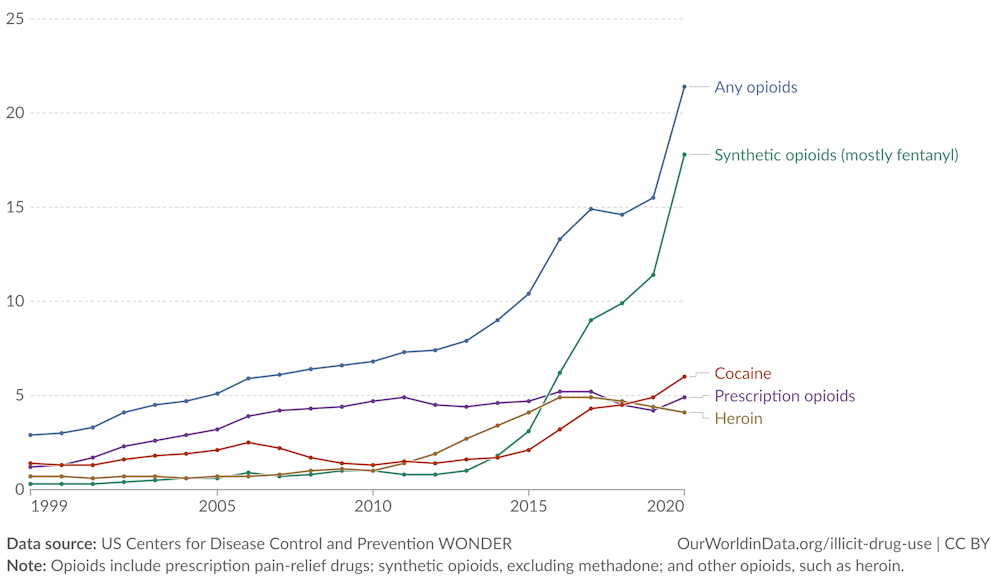
In the US, the synthetic opioids fentanyl and oxycodone have contributed to more than 100,000 fatal overdoses each year since 2021. While there are signs this deaths toll is at last beginning to fall, the harm and pain of addiction and overdose affects every strata of American society – as shown in moving portrayals of America’s opioid crisis such as Painkiller and Dopesick. Most fatalities are caused by respiratory depression where breathing is significantly slowed or stops altogether.
Official trailer for Painkiller (Netflix)
Fentanyl is an analgesic drug that is 50-100 times more potent than heroin or morphine. Where China used to be the principal manufacturer and supplier of fentanyl to the US, Mexico is now the primary source. In December 2024, Mexican authorities announced “the largest mass seizure of fentanyl pills ever made” – amounting to more than 20 million doses of fentanyl pills worth nearly US$400 million. The pills were found in Mexico’s Sinaloa state, home of the Sinaloa drug cartel and a hub of fentanyl production,
“This is what makes us rich,” one fentanyl cook recently told the New York Times. He was scathing about the idea that Donald Trump would be able to stamp out the supply of fentanyl from Mexico to the US by threatening Mexico’s government with tariffs. “Drug trafficking is the main economy here.”
However, the introduction of synthetic opioids to the US came not via organised crime but through a deliberate strategy of the pharmaceutical industry. Upon launching its prescription opioid painkiller OxyContin (a brand name for oxycodone) in 1996, Perdue Pharma, owned by the Sackler family, devised a plan to increase prescriptions of the drug by incentivizing and rewarding doctors to give these drugs to their patients. On a business level, this was a success; on a human level, it has been a disaster.
As patients quickly developed tolerance to drugs such as OxyContin, they had to take higher doses to avoid withdrawal symptoms or the positive feelings it gave them. Taking more of these opiates increases the risk of accidental overdose, many of which proved to be fatal. It has also driven those dependent on drugs to the black market, and into the hands of organised drug gangs, as they seek the drugs in greater quantities.
Dependency on fentanyl and other opioids is all-consuming. When not using these drugs, people are entirely focused on ensuring sufficient supply of the next dose. This includes funding supply which can take people to places they thought they would never be, for example breaking the law, shoplifting or getting involved in commercial sex to make enough money to buy drugs.
Synthetic opiates like OxyContin and fentanyl have proved to be classless, ageless and sex blind. The first-hand experience of addiction and fatalities have radically altered the way many Americans think about drugs and the problems they cause. Canada, too, is suffering a major crisis.
Compounding this tragedy is the failure of the state to provide interventions and treatment that could have reduced fatal and non-fatal overdoses. It is only now that evidence-based interventions are beginning to be made widely available, such as access to Naloxone – a drug that can reverse the effects of opiates and potentially save a life.
Of course, it isn’t just hospitals and health professionals that are challenged by the results of widespread use of opioids, but public services like the police and fire service. In some areas of the US, there have been so many daily overdoses that every service was called on to try and deal with it. Local mayors have made it a priority to train police and fire personnel to be trained as first responders, such is the scale of the problem.
But it is not just in North America that we see the failure of politicians and the state to act when faced with growing problems with drugs. In the UK, where record numbers are dying because of using drugs such as heroin, the government has not invested in overdose prevention strategies. At a time when fatal overdoses increase year on year, budgets for specialist treatment have been reduced. It remains to be seen what the recently elected Labour government will do, if anything, to tackle the tragic rise in drug related fatalities.
What connects both examples from the US and UK is the attitude and perception of drug use many of us have. Drug use and the heavy use of prescription painkillers is still heavily stigmatised. Many of us still view this as something individuals bring on themselves or have a choice about.
So, if we don’t care about what happens to people who develop problems with drugs, why should our elected representatives? In part, it is our bigotry that is enabling the lack of timely intervention, despite us possessing the knowledge and evidence of how drug harms can be minimised.
Latin America: breakdown of the rule of law
Under the last Conservative government, the UK Home Office asserted that people who used cocaine recreationally are supporting violence not only in the UK but in the countries that produce its raw ingredients. It’s not clear if this has made any difference to those using cocaine in the UK – personally, I doubt many people consider or are aware of how cocaine is produced or its provenance.
Perhaps if those using cocaine, mainly in western countries, realised the extent of violence and suffering that cocaine manufacture causes they might think again. Latin America has suffered enormously, with few countries there not touched in some way by the violence and breakdown of law associated with drug production and supply. According to the latest UN World Drugs Report:
Global cocaine supply reached a record high in 2022, with more than 2,700 tons of cocaine produced that year, 20% more than in the previous year … The impact of increased cocaine trafficking has been felt in Ecuador in particular, which has seen a wave of lethal violence in recent years linked to both local and transnational crime groups, most notably from Mexico and the Balkan countries.
Cocaine seizures and homicide rates increased five-fold between 2019 and 2022 in Ecuador, with the highest such rates reported in the coastal areas used for trafficking the drug to major destination markets in North America and Europe.
Cocaine trafficking flows based on reported seizures (2019-22):
As with opium production in Afghanistan, it is small-scale farmers in Colombia, Peru and Bolivia that grow the coca plant that will be turned into cocaine. Like their Afghan counterparts, they grow coca as it is more profitable than alternatives such as coffee. While it may be profitable in the short term, there are greater costs to them and their society.
Cocaine production brings with it violence as those further up the drug production chain try to control its trade. Few parts of these societies are unscathed, from bribing local politicians through to whole regions that are controlled by organised crime. Keeping control means that the use of firearms and violence increases. Against this backdrop, it is unsurprising that basic health and social services suffer.
So, while a coca grower may have more money, every other aspect of their life is negatively impacted. Whether it is regional or state institutions, both are compromised by the drug trade and those that control it. While this may not lead to the total collapse of law and order, it does create injustice and distorts the rule of law in many areas of Latin America and the Caribbean, where competition between gangs has also resulted in an increase in homicides.
The impact is on all sectors of society, now and into the future. For example, while historically the role of women has been largely underrepresented in research and drug policy, the UN report recognises that this is changing:
As women increasingly participate in economic activities, the role that women play in the drug phenomenon may become increasingly important. For example, a shift away from plant-based drug production may affect many women in rural households involved in opium poppy and coca bush cultivation.
The UN also identifies the specific risk to young people and the drugs trade, highlighting:
Long-term efforts to dismantle drug economies must provide socioeconomic opportunities and alternatives, which go beyond merely replacing illicit crops or incomes and instead address the root structural causes behind illicit crop cultivation, such as poverty, underdevelopment, and insecurity. They must also target the factors driving the recruitment of young people into the drug trade, who are at particular risk of synthetic drug use.
Meanwhile, demand for treatment in Europe due to problems with cocaine has risen significantly in recent years, since 2011 there has been an 80% increase in treatment presentations. This reflects the growing number of people using cocaine and the rise in purity of the drug.
Amid what may seem to be a story of unrelenting despair and hopelessness, there are local initiatives and even a few state-wide policies that provide optimism that change is possible.
In my roles both as clinician and scientist, I’ve often been amazed by how ingenious people can be when faced with the apparently impossible. For example, the way some people use heroin to dampen their psychotic symptoms, such as auditory and visual hallucinations – or the development of Naloxone, a drug that can temporarily reverse the effects of opioids, providing a short window for emergency services to treat people who have overdosed.
Early in my career, I witnessed the emergence of HIV in the UK in the 1980s. The speed at which this disease spread was not matched by our ability to treat it. Our response to HIV was undoubtedly hampered by prejudice and stigma towards marginalised groups in society, namely gay men and those using drugs (particularly injecting them).
However, unexpectedly and courageously, the Conservative government recognised those who were most at risk of contracting HIV, and organised a package of measures to contain the spread of infection. One part of this was a media campaign based on public health messaging designed to reduce the risk of contracting the disease. But the government also invested in treatment for those who had been infected and engaged with people at high risk, such as those intravenously injecting drugs.
I worked in specialist HIV clinics for those using drugs. At the time, methadone and diamorphine were provided as an alternative to heroin. Regulations and protocols that restricted the prescribing of these medical opioids were eased, so we could ensure patients attending these clinics were given sufficient oral and injectable opioids that they didn’t need to source street heroin.
This meant they had access to medical grade opioids and, crucially, were given regular supplies of sterile injecting equipment. It was this that reduced the risk of contracting HIV, as some people would share injecting equipment when using heroin.
This impressive policy ran counter to the Conservative party’s ideology at the time, which was to punish rather than help those using drugs like heroin. It showed me how, even with traditional mindsets, it is possible to shift policy thinking in the face of a health crisis. And make no mistake, the global drug problem is an ongoing health crisis. Today, the UN points to the risks that intravenous users of drugs still face:
An estimated 13.9 million people injected drugs in 2022, with the largest number living in North America and East and South-East Asia … The relative risk of acquiring HIV is 14 times higher for those who inject drugs than in the wider population globally.
There are, though, signs of positive change in the way some countries and regions are changing their drug policies. Scotland recently opened a drug consumption facility in Glasgow – a safe place for people to use their drugs, usually injecting drugs like heroin. Such spaces provide access to sterile injecting equipment, reducing the risk of blood-borne infections such as HIV or Hepatitis. At the same time, they offer the opportunity to engage with people who have not accessed traditional health services.
Portugal, as mentioned earlier, has made substantial changes to the way it approaches drug use and the problems associated with it. This policy shift since 2000 has saved lives and brought a more humane way of treating people who develop problems with drugs.
Contrast this with the wasted effort and resources ploughed into the war on drugs – initiated by Nixon and followed by so many western governments ever since. My plea to policymakers is simple: employ the same evidence-based science you use for health issues towards drugs and problem drug use.
Science and research can help in many ways, if given the chance. Some of it might seem radical, like providing safe drug consumption spaces. Some of it is more mundane, but vital – like tackling inequality, a clear driver of problem drug use across the world.
But while we often look to politicians to take the lead on change, it is people – us – that really hold the solution. By far the greatest threat to people and society from drugs is ignorance and bigotry. So many lives have been lost to drugs because of shame, either as a driver of drug use or a barrier to seeking help.
Beliefs are notoriously difficult to shift. As with climate change, the most powerful driver of change is personal experience. We know that when a family or community is affected by a drug overdose, their beliefs and perceptions change. But this is not the way any of us should want to see change happen.
To hear about new Insights articles, join the hundreds of thousands of people who value The Conversation’s evidence-based news. Subscribe to our newsletter.
Ian Hamilton does not work for, consult, own shares in or receive funding from any company or organisation that would benefit from this article, and has disclosed no relevant affiliations beyond their academic appointment.
Source: The Conversation – UK – By Jennifer Mathers, Senior Lecturer in International Politics, Aberystwyth University
North Korea is believed to be preparing to send another group of soldiers to come to Vladimir Putin’s aid in the war in Ukraine, despite heavy combat losses already suffered by troops from the east Asian country.
When Ukrainian forces crossed the border into the Kursk region of Russia in August 2024, Ukraine’s military commanders hoped that their surprise move would force Moscow to withdraw troops from eastern Ukraine to defend Russia’s own territory. Kyiv did not expect its troops to end up fighting North Koreans.
Neither Moscow nor Pyongyang have officially confirmed that North Korean troops are fighting side by side with Russians. But South Korean intelligence has been reporting on their presence since October 2024, when approximately 1,500 North Korean special forces were observed to have arrived in Russia’s far eastern city of Vladivostok, initially for training.
This group was later joined by another 10,000 or so of their comrades (some of whom are also believed to be from North Korean special forces units). They were transported nearly 7,000 kilometres across Russia to reach the combat zone.
North Korea, an isolated dictatorship with few allies, is one of Russia’s most reliable suppliers of weapons, including missiles and millions of rounds of ammunition that Russia needs to continue to fight its war against Ukraine. North Korea, however, would seem to have little reason to send its own people to risk their lives in that conflict. But North Korean soldiers appear to be at the heart of a deal struck by North Korea’s supreme leader Kim Jong-un and Russian president Vladimir Putin.
What does Putin want?
For Putin the gains are clear. His campaign in Ukraine has received a much-needed influx of trained soldiers to shore up efforts to retake Russian territory occupied by Ukrainian forces.
Although the numbers of North Korean troops are relatively small, their strategic deployment allows Russia to push the Ukrainians back without diverting any of its forces from their offensive operations in eastern Ukraine. Expectations are high that Donald Trump’s return to the White House could mean an end to the war – or at least a pause – sooner rather than later. This gives Putin an incentive to occupy as much Ukrainian territory as possible ahead of a ceasefire, when occupied areas are likely to form the basis of territorial settlements.
The suggestion that Russia is not capable of maintaining its position in Ukraine and also defending its own territory without the addition of foreign troops is very revealing.
Moscow is struggling to recruit enough of its own citizens to fight in Ukraine. This is despite offering salaries and benefits packages to prospective soldiers that are beyond generous. The lack of resistance to Kyiv’s summer incursion into Russian territory made it clear that Russia is relying upon barely trained conscripts – that is, teenage boys doing their one year of compulsory military service – to defend its borders rather than professional soldiers. And while Russia has regained control of a substantial proportion – perhaps more than 60% – of the area seized by Ukraine in the summer, this has taken nearly six months to accomplish.
What does Kim Jong-un want?
For Kim Jong-un, sending his soldiers to fight with Russia provides his troops with valuable experience of combat in a conflict that is rapidly defining how war will be waged in the future.
Since the end of the Korean War (1950-53), Pyongyang has placed a high priority on maintaining a large and heavily armed standing army. After training, North Korean soldiers are mostly used for patrolling the de-militarized zone that marks its border with South Korea. Participating in Russia’s war against Ukraine provides the North Korean military with its first experience of combat in more than 70 years.
North Korean soldiers captured in Ukraine.
Observations from Ukrainian soldiers suggest the North Korean soldiers are courageous and determined fighters but with no experience of actual combat. The Ukrainians have described the North Koreans as relying on strategies typical of the second world war – for example advancing in large groups on foot, where they provide easy targets for artillery and drone strikes. They were also apparently bemused by the appearance of drones on the battlefield and had no idea that these objects could deliver lethal attacks.
This degree of inexperience, together with Russia’s tactic of using the North Koreans to draw the fire of the Ukrainians and clear the way for the Russians to advance, is believed to be the reason for such high losses so soon after their deployment.
In January the Ukrainians managed to capture two North Koreans and question them, which has provided the clearest picture so far of their experiences of fighting with the Russian armed forces. The North Korean soldiers both had false identity papers with Russian names, which is consistent with official denials of their presence. The men, who do not speak any foreign languages and had to be questioned through an interpreter, said that they had both been soldiers for several years. This supports the Ukrainians’ impression that the North Koreans are trained and disciplined. Both prisoners, however, reportedly believed they were being sent to Russia to participate in training exercises, not to fight in a war.
Considering the heavy losses and the brutal treatment that North Korean troops have already suffered, Kim Jong-un might be expected to seek the speedy return of his soldiers rather than preparing to send more of their comrades to fight with Russia. But high casualties on the battlefield seems to be a price that North Korea’s president is willing to pay for combat experience that might give his army an edge in any future war that he fights on his own behalf.
Jennifer Mathers does not work for, consult, own shares in or receive funding from any company or organisation that would benefit from this article, and has disclosed no relevant affiliations beyond their academic appointment.
EVANSVILLE— James Henley, 35, of Greenwood, Indiana, has been sentenced to ten years in federal prison, followed by three years of supervised release after pleading guilty to aggravated identity theft, conspiracy to commit access device fraud, two counts of money laundering, and eight counts of wire fraud. Henley has also been ordered to pay $1,887,426.63 in restitution.
According to court documents, over the course of three years, Henley orchestrated multiple large and complex fraud schemes, resulting in a total loss of $2,927,758.95 to individual homeowners, an Indiana attorney, a bank, and ten state governments. As part of his fraud schemes, Henley registered five fake businesses (OnTrack Real Estate Solutions, LDI Investments Corp, Lucario Investments, 317 Traffic, and Henley Real Estate Solutions) with the states of Indiana and Kentucky, claiming to serve as the Chief Executive Officer for most of them. None of the businesses were legitimate. Instead, Henley used the businesses to mask his identity, make his schemes appear more credible, and launder the stolen money.
Henley’s schemes are broken down as follows:
COVID-19 Fraud:
Between May 2020 and March 2021, James Henley, his wife Jameka Henley, and his associate Jimmie Bickers used the stolen personally identifiable information of 76 real individuals to submit 120 unemployment insurance applications to ten states during the COVID-19 pandemic. Once the applications were approved, the trio used 65 unemployment insurance debit cards to make purchases at retailers and withdraw cash at ATMs in the Evansville and Indianapolis areas. The states paid a total of $1,119,426.63 in unemployment benefits in connection with the group’s fraudulent applications. In July 2020, Henley used funds withdrawn from ATMs to buy a Chevrolet Camaro for $22,801.
Bickers and Jameka Henley have been formally charged for their roles in this scheme but have not pleaded guilty.
Home Title Fraud:
Between December 2021 and May 2023, Henley stole five homes in Indianapolis by filing fraudulent deeds with the Marion County Recorder’s Office. Through the filings, Henley claimed that the homeowners had sold their homes to his fake businesses, but, in reality, he had never even spoken with the homeowners. Unbeknownst to the victims, Henley filed these fraudulent deeds and then sold the homes for significantly less than their market value, pocketing more than $260,000 in profits.
Henley also attempted to steal and sell an additional 14 homes in Indianapolis and Evansville. With one exception, the individuals who bought the homes from Henley took possession and ultimately kept the homes.
For one homeowner, the property Henley stole was her childhood home. She purchased the home while her mother was in the hospital with the hope that, when her mother’s condition improved, her mother would be able to live out her remaining years in the house.
Mortgage Fraud:
In November 2021, an associate of Henley’s purchased a home in Indianapolis, using a mortgage loan from a bank. In April 2022, Henley filed a fraudulent document with the Marion County Recorder’s Office to make it seem as if the mortgage loan had been paid off, when it had not been paid. Henley then filed a deed naming himself a joint owner of the home. Henley and his associate subsequently sold the property for $255,000, pocketing all the proceeds, even though the bank should have received the majority of the funds.
Auto Loan Fraud:
In March 2023, Henley purchased a Dodge Durango in Indianapolis for $71,479, using an auto loan from Everwise Credit Union. A few months later, in June 2023, Henley purchased a Chevrolet Silverado in Plainfield for $54,270, using a second loan from Everwise Credit Union.
In October 2023, Henley connected a JPMorgan Chase bank account to his auto loans, via Everwise’s online payment portal. Henley falsely represented that the Chase account belonged to Jimmie Bickers, and that he had authority to make payments on his loans using funds from the Chase account.
The Chase account was actually an Indiana attorney’s Interest on Lawyers’ Trust Account (IOLTA), which is a highly regulated bank account used by lawyers to hold client funds. The interest earned on IOLTA accounts is used to fund grants for nonprofit groups that promote pro bono and access to justice programs. Henley did not have the attorney’s permission to access or withdraw funds from the IOLTA account.
Between October and November 2023, Henley used the IOLTA account to make two payments, totaling $98,000, toward his auto loans.
Henley has prior felony convictions for financial crimes, including theft, forgery, and fraud.
“James Henley went to great lengths to coordinate exceptionally greedy, complex schemes that exploited hard-working families and state government programs,” said John E. Childress, Acting U.S. Attorney for the Southern District of Indiana. “Undeterred by prior felony convictions for the same conduct, this defendant stole over a million dollars, wreaking financial and logistical havoc on hundreds of victims. The Department of Justice will continue to work with our law enforcement partners to investigate allegations of fraud and seek prosecution as appropriate.”
“James Henley filed fraudulent unemployment insurance (UI) claims in the names of identity theft victims in order to receive UI benefits to which he was not entitled. He enriched himself by defrauding a program that was intended to assist struggling American workers during an unprecedented global pandemic,” said Megan Howell, Acting Special Agent-in-Charge, Great Lakes Region, U.S. Department of Labor, Office of Inspector General. “We and our law enforcement partners are committed to protecting the integrity of the UI system from those who seek to exploit this critical benefit program.”
“This lengthy prison sentence sends a clear message: individuals who attempt to exploit and commit financial crime and identity theft will be brought to justice,” said Ramsey E. Covington, Acting Special Agent in Charge, IRS Criminal Investigation, Chicago Field Office. “IRS Criminal Investigation and our fellow law enforcement partners are committed to protecting the integrity of our financial institutions and will continue to hold criminals like James Henley accountable to the fullest extent of the law.”
“This case should serve as a powerful reminder that individuals with a history of financial crimes will face significant consequences when they demonstrate a blatant disregard for the law and continue to exploit and deceive others for personal gain,” said FBI Indianapolis Special Agent in Charge Herbert J. Stapleton. “The FBI, working alongside our law enforcement partners, will continue to hold those who perpetuate such offenses accountable and protect the public from those who manipulate the system for their own benefit.”
The Federal Bureau of Investigation, Internal Revenue Service-Criminal Investigation, Department of Labor-Office of the Inspector General, and the Indiana Attorney General’s Office Homeowner Protection Unit investigated this case. The sentence was imposed by U.S. District Judge Matthew B. Brookman.
Acting U.S. Attorney Childress thanked Assistant U.S. Attorney Matthew Miller, who prosecuted this case.
On May 17, 2021, the Attorney General established the COVID‑19 Fraud Enforcement Task Force to marshal the resources of the Department of Justice in partnership with agencies across government to enhance efforts to combat and prevent pandemic-related fraud. The Task Force bolsters efforts to investigate and prosecute the most culpable domestic and international criminal actors and assists agencies tasked with administering relief programs to prevent fraud by augmenting and incorporating existing coordination mechanisms, identifying resources and techniques to uncover fraudulent actors and their schemes, and sharing and harnessing information and insights gained from prior enforcement efforts.
Anyone with information about allegations of attempted fraud involving COVID‑19 can report it by calling the Department of Justice’s National Center for Disaster Fraud (NCDF) Hotline at 866-720-5721 or via the NCDF Web Complaint Form at https://www.justice.gov/disaster-fraud/ncdf-disaster-complaint-form
Signature of a term sheet to combine two technologies and bring SAF production to the next level
Evry, 03 February 2025 – 05:45 p.m.:Global Bioenergies has signed a term sheet with a large international industrialist (undisclosed) to co-develop a process leading to Sustainable Aviation Fuels (“SAF”) at a reduced cost and an improved CO2reduction. This process will rely on the combination of Global Bioenergies’ bio-isobutene process and the industrialist’s proprietary technology. Such combination, which reached early proof-of-concept stage, would have a decisive competitive advantage among the existing SAF technologies, aiming at relaying the current SAF production based on used cooking oil.
Marc Delcourt, co-founder and CEO of Global Bioenergies, states: “Following our ASTM certification during the summer 2023, we have teamed up with a large industrialist who had identified a perfect match between their technology and Global Bioenergies’. The combination of both technologies would result in a process overcoming the two major barriers for SAF production: capex and opex costs.”
As of today, the only commercial technologies are the HEFA process and its co-processing variation, both based on used cooking oil and animal tallow oil. These resources are soon to plateau, and the SAF community is now focused on identifying the best suited technology to take the relay.
Frédéric Ollivier, CTO at Global Bioenergies, comments:” The combination of the two technologies will lead to a much simpler and straightforward process to produce SAF, designed for implementation in existing facilities. Such combination could lower feedstock, capex, and processing costs very substantially, and utilize existing biorefinery assets such as corn dry mills, after minor retrofitting, limiting main investment to the downstream stages of converting isobutene into SAF. CO2savings would also be improved. We already obtained early proof of concept, and are now preparing for the next phase.”
If developments are successful, the technology will be ready to take up mandated and targeted SAF volumes from 2030 and beyond.
The SAF market just passed the 1 million tons per year mark (0.3% of global jet fuel production) in 20241 and is expected to reach 16 million tons annually in 2030 and up to 250 million tons per year by 20502, due to the European increasing SAF mandates and the American ‘Grand Challenge’. A growing number of countries, including the UK, Japan and Singapore, are also progressively putting mandates in place.
Martin Stephan, CBO at Global Bioenergies, concludes:” The accomplishment of this vision, where SAF production follows an exponential growth, will encounter a serious hurdle coming from the investment needs. IATA estimates that 3 840 billion dollars investment will be necessary in the next 30 years1 to building the corresponding facilities and reach net zero. Our combination of technologies, aimed at reducing capex by 4 folds if compared to other SAF technologies, already finds interested ears in the industry. These new perspectives can also be transposed to the cosmetics sector, which remains our stepping stone market.”
About GLOBAL BIOENERGIES
As a committed player in the fight against global warming, Global Bioenergies has developed a unique process to produce SAF and e-SAF from renewable resources, thereby meeting the challenges of decarbonising air transport. Its technology is one of the very few solutions already certified by ASTM. Its products also meet the high standards of the cosmetics industry, and L’Oréal is its largest shareholder with a 13.5% stake. Global Bioenergies is listed on Euronext Growth in Paris (FR0011052257 – ALGBE).
Contacts
1 IATA (International Air Transport Association), December 2024 – IATA 2 SAF market outlook 2024, SkyNRG – SAF-Market-Outlook-2024-Summary.pdf
Source: United Nations General Assembly and Security Council
United Nations Secretary-General António Guterres has appointed Arnaud Peral of France as the United Nations Resident Coordinator in the Philippines, with the host Government’s approval, on 1 February.
Mr. Peral was most recently the United Nations Resident Coordinator in Tunisia since 2020. Prior to that, he served successively as United Nations Resident Coordinator and United Nations Development Programme (UNDP) Resident Representative in Ecuador, UNDP Country Director in Colombia, UNDP Deputy Resident Representative in México and then Brazil, Programme Manager and Chief of Staff in UNDP´s Regional Bureau for Latin America and the Caribbean in New York and Programme Officer in UNDP Cuba.
Prior to joining the UN system in 2000, Mr. Peral served as Cooperation Counsellor for Scientific and Technical Cooperation in the French Embassy in Cuba, Research Assistant in the Ministry of Environment in France and Research Assistant in public policy in the Ministry of Agriculture in Chile.
Mr. Peral holds a master’s degree in development economics from the University of Paris X-Nanterre and a bachelor’s degree in economic policy from the University Pierre Mendes France, Grenoble.
__________
* This supersedes Press Release SG/A/1982 of 17 September 2020.
WASHINGTON, D.C. – Yesterday, House Foreign Affairs Committee Chairman Brian Mast joined Margaret Brennan on CBS’ “Face the Nation” to discuss the review of foreign assistance and the Biden State Department’s fixation on DEI.
WATCH HERE
-Transcript-
MARGARET BRENNAN: And we’re joined now by Florida Republican Congressman Brian Mast, who is the chairman of the Foreign Affairs Committee, which has oversight over the State Department and its programs.
He joins us from Fort Pierce, Florida.
Good morning to you.
CHAIRMAN BRIAN MAST (R-Florida): Good morning.
BRENNAN: I want to start first on the tariffs that were announced overnight by President Trump. You know there’s a free trade agreement with Mexico and Canada. President Trump negotiated it during his first term.
The tariffs may violate that deal. If he’s invoking tariffs on a national security basis, can you explain the threat posed by Canada?
CHAIRMAN MAST: Yes, and he was – President Trump, that is to say, was very specific in his executive order, outlined that it’s specifically related to fentanyl. It’s specifically related to human trafficking.
And there’s a trust, but verify situation that has to go on here.
BRENNAN: Through Canada?
CHAIRMAN MAST: Through Canada as well, absolutely, fentanyl through Canada, human trafficking through Canada, also with China in that mix for fentanyl as well.
That was specifically outlined in it. And until that comes to an end, this is what’s going to be on the table. And bear in mind as well that USMCA reauthorization is coming up in the coming-up months and years.
BRENNAN: So you don’t believe that this violates the trade agreement, the treaty?
CHAIRMAN MAST: The violation has been to the United States of America. It’s been to our sovereignty. It’s been to our people. We’ve been taken for granted.
BRENNAN: Right, but Congress votes on these things. So…
CHAIRMAN MAST: And I will make sure certainly, as the Foreign Affairs chairman, that we give every single authority as we go through State Department reauthorization, to make sure that this moves forward, as well as purging of people throughout the State Department, other agencies, where we’re freezing aid.
These are all very important and necessary steps to make sure that we secure America. And we’re going to support that.
BRENNAN: I’m sorry. Can I follow up on what you just said there?
CHAIRMAN MAST: Please do.
BRENNAN: You want to authorize purging of State Department personnel? What does that mean exactly?
CHAIRMAN MAST: Well, if you want to take a look at the State Department, where DEI has been a priority over, let’s say, diplomacy on many accounts, I can give you hundreds of examples of where they were authorizing…
BRENNAN: What proof do you have of that?
CHAIRMAN MAST: Sure, let’s list them off, half-a-million dollars to expand atheism in Nepal, $50,000 to do, let’s see, a transgender opera in Colombia, $47,000 to do an LGBTQ trans comic book in Peru, $20,000 a pop to do drag shows in Ecuador.
Shall I continue with more examples of where DEI was a priority?
BRENNAN: Oh, it certainly seems like there could be a review of things. Foreign aid, as you know, is less than 1 percent of the entire federal budget. So we’re talking small amounts of money by comparison. But when…
CHAIRMAN MAST: We’re still talking about tens and tens of billions of dollars.
And if you want to go to somebody else, on the other side of the aisle, Samantha Power, she had a worthy goal, although it was a stupid goal. She said she was hoping to get the amount of foreign aid, U.S. aid dollars that go to actual aid up to 30 cents on the dollar from 10 cents on the dollar. That’s a major problem that we have this agency that that’s all that goes abroad…
BRENNAN: I think you’re talking about…
CHAIRMAN MAST: … when it should be the American worker’s dollar.
BRENNAN: I think now you’re talking about the USAID, the aid agency…
CHAIRMAN MAST: Yes.
BRENNAN: … which is a – separate from the State Department currently and has about $40 billion worth…
CHAIRMAN MAST: Which is likely going to be rolled more closely under Secretary Rubio.
BRENNAN: Tell – yes, tell me about that, because that’s where I was going.
Has the Trump administration informed you of plans to dismantle or significantly shrink this agency?
CHAIRMAN MAST: This is something that I’m working on very specifically, in conjunction with Secretary Rubio, to make sure that there’s the appropriate command-and-control of these agencies, where, again, to make that same point, right now, maybe 10 to 30 cents…
BRENNAN: They already report to the secretary of state.
CHAIRMAN MAST: But 10 to 30 cents on the dollar is what actually goes to aid. So there’s not the right amount of command-and- control that’s going on with the way that it’s set up currently.
And let’s make another point on this as well.
BRENNAN: Congress – Congress authorizes and earmarks funding.
CHAIRMAN MAST: Most of these dollars – most of these dollars that go out of USAID, 70-plus percent don’t come from U.S. growers, U.S. farmers, U.S. ranchers, or go through us ports. And that’s another big problem for America.
BRENNAN: So – I’m sorry. If Congress already authorizes and earmarks the funding, just to be very clear, you’re not endorsing getting rid of USAID as a separate department, which already reports to the secretary of state, are you?
CHAIRMAN MAST: I would be absolutely for, if that’s the path we go down, removing USAID as a separate department and having it fall under one of the other parts of United States Department of State, because of its failure.
I just went over the numbers twice with you in the amount of aid that actually makes it into the hands. I mean, you could you could almost say – this is a little bit hyperbole – but there’s probably more dollars that go towards state dinners around the D.C. Beltway than what actually goes into rice and beans abroad.
That’s the state of what’s going on with USAID. And Samantha Power said no less herself.
BRENNAN: Well, I think every single administration authorizes reviews, could increase efficiencies. There are plenty of people who propose bringing it more under the authority of the State Department. Madeleine Albright tried to do that. That’s not a new MAGA idea.
I think the question here, though, is about how you do it. Do you still believe that in the law signed in the 1960s that Congress has to sign off on any changes to USAID? Or do you think President Trump can just make all of this happen through executive order?
CHAIRMAN MAST: So, all of those examples that you just gave of those historical figures, the difference is now the job is going to get done.
It’s going to be 99.99 percent of cents on the dollar actually go towards what it’s intended, instead of people around the Beltway.
BRENNAN: OK, so you’re talking about – you’re talking about…
CHAIRMAN MAST: That’s what’s going to happen. That’s the change.
BRENNAN: … efficiencies in aids versus restructuring.
So let me ask you about that. Well, like I said…
CHAIRMAN MAST: Well, that requires restructuring, 100 percent. You can’t create that efficiency just by wishing it into existence.
BRENNAN: Sure.
CHAIRMAN MAST: You have to restructure where the failures are and put the right things in place.
BRENNAN: Of course.
But what we’re hearing from many of these aid organizations and officials is that, can you restructure after you finish the review and not freeze funding now, immediately? I spoke to former USAID global health head Atul Gawande yesterday. He told me this isn’t a pause in foreign aid. It is a demolition of USAID.
As he put it, you can’t pause a flight in midair. That’s what’s happening.
CHAIRMAN MAST: Let’s…
BRENNAN: This immediate freeze in funding is stopping agencies in the field from being able to do the work they do.
CHAIRMAN MAST: Let’s say why that is so important. And let’s talk about the real facts on the ground.
The Trump administration comes in or representatives like myself that do oversight. The agencies will literally not tell us what they are writing grants for, literally, or they will lie about it, or they will tell the new political appointees under the Trump administration, I’m just not going to tell you that. Those are real things that have happened.
So the way that you make them come and answer for where they are actually sending dollars is to say, we’re freezing that. We’re putting it on hold. You need to come to us and explain what it is you’re doing, why you’re doing it and where it’s actually saving life. And guess what?
BRENNAN: But…
CHAIRMAN MAST: When they don’t come explain something, that also begs the question, why were they doing it in the first place?
BRENNAN: But the way these things work is, the contractors have to front the cash, then go to the U.S. government for reimbursement.
So when you put in an immediate freeze, that means drugs don’t get delivered. That means they don’t get distributed. That means bomb disposal units don’t get to go out there in places like Cambodia and remove ordnance or provide help to people who receive it.
That’s the pushback from aid organizations, who are saying they’re going to have to carry out layoffs in the thousands in the coming week. Does that concern you at all?
CHAIRMAN MAST: They will have an opportunity. It doesn’t concern me because of the grift that has been going on to the American taxpayer, the American worker.
That’s what needs to be answered for. And so you look at this. Let’s use PEPFAR as an example. You were talking about drugs going to individuals. There was a release of that hold that was put – that was authorized. But it shouldn’t be the case that the American people fund HIV and AIDS drugs for 20 million people across Africa, where many of these countries are working very directly with our adversaries like China.
That is an example of them taking us for granted. We need to be asking the question, should they be weaning off of this? Should we be paying it for these very expensive HIV and AIDS drugs?
BRENNAN: Yes.
CHAIRMAN MAST: Should the American worker be footing the bill for that? Those are real questions.
BRENNAN: Yes, real questions, but, in the meantime, people need their drugs while you ask those questions. So that’s where the disagreement is with the aid organizations.
But let me ask you about air traffic controllers and what’s happening here at home.
CHAIRMAN MAST: Not with all the leaders of other countries, though. I believe I saw the leader of Kenya as one step up and say, hey, this is an example where we need to step up for ourselves and show how we can take care of ourselves. And I believe that was the president there.
BRENNAN: I want to ask you, as I was saying, about another committee you sit on, Transportation Committee.
The FAA hiring policy for air traffic controllers, including under the first Trump administration, offered equal opportunity to those with targeted disabilities, including, as the president read, hearing, vision, missing extremities, partial paralysis, complete paralysis, severe intellectual debility – disability. Excuse me.
The president singled this out, this policy, as a contributor possibly to the crash. Do you agree with the diversity policy, or do you agree with the president? I know you lost two limbs serving this country in Afghanistan. Do you hear those words and take offense to them or…
CHAIRMAN MAST: No, no offense. Let’s unpack it.
Number one, I will use myself as an example, right? There are things that I am suited to do, no doubt. But flying an aircraft, to stick with the subject at hand, would not be one of them. I could fly a personal – a personal aircraft.
BRENNAN: This is air traffic controllers.
CHAIRMAN MAST: But to put me in charge of traffic or 150 lives, that would not be the right case for me personally, given my physical disabilities and foot pedals on an aircraft.
To go to the diversity side of it and the actual crash, yes, there were very real errors that took place both in the air traffic control tower and with the helicopter pilots, it seems. But, more systemically, is there a big hiring problem across all federal agencies, to include the FAA, where they made the priority diversity and inclusion…
BRENNAN: Yes.
CHAIRMAN MAST: … instead of excellence and performance? Yes, that’s the case. They made the priority appearance and lifestyle and not the big deal.
BRENNAN: Congressman, thank you for your time today.
Source: Federal Bureau of Investigation (FBI) State Crime Alerts (b)
BOSTON – Four indictments were unsealed today if federal court in Boston charging a second wave of alleged members and associated of the Asian Boyz gang for their roles in a distribution network of homemade methamphetamine pills, branded as “Adderall.”
The following five men were arrested this morning and will appear in federal court in Boston later today:
Sovath Yern, a/k/a “Stryke,” 35, of Billerica, charged with one count of conspiracy to distribute and to possess with intent to distribute 500 grams and more of methamphetamine;
Owen Landry, a/k/a “Oski,” 22, of Lowell, charged with one count was charged with one count of conspiracy to distribute and to possess with intent to distribute 500 grams and more of methamphetamine; one count of distribution of and possession with intent to distribute 50 grams and more of methamphetamine, aiding and abetting; and one count of distribution of and possession with intent to distribute 500 grams and more of methamphetamine;
Zachary Hansen, 29, of Lowell, charged with one count was charged with one count of conspiracy to distribute and to possess with intent to distribute 500 grams and more of methamphetamine and one count of distribution of and possession with intent to distribute 500 grams and more of methamphetamine;
Scott Fournier, a/k/a “S.G.,” 33, of Lowell, charged with one count of conspiracy to distribute and to possess with intent to distribute 500 grams and more of methamphetamine; two counts of possession with intent to distribute 500 grams and more of methamphetamine; two counts of distribution of and possession with intent to distribute 50 grams and more of methamphetamine; and three counts of distribution of and possession with intent to distribute 500 grams and more of methamphetamine; and
Richard Nguyen, a/k/a “Cheese,” a/k/a “Cheeseburger,” 29, of Lowell, charged with two counts of distribution of and possession with intent to distribute 500 grams and more of methamphetamine and one count of distribution of and possession with intent to distribute 50 grams and more of methamphetamine.
An indictment has also been unsealed against a sixth man currently serving a state prison sentence who will make an initial appearance in federal court in Boston at a later date:
Isiah Lyons, a/k/a “Tank,” a/k/a “Rozay,” 29, of Lowell, was charged with one count of conspiracy to distribute and to possess with intent to distribute 500 grams and more of methamphetamine.
According to court records, today’s charges are a continuation of an investigation into the Asian Boyz gang that began in 2021 to disrupt the manufacturing and distribution of methamphetamine pills impacting Lowell. It is alleged that a total of over 57,000 counterfeit Adderall pills, consisting of over 18 kilograms of a mixture or substance of methamphetamine, were seized from or purchased from the defendants named in the indictments unsealed today.
Previously, in July 2023, nine members and associates of the Asian Boyz were arrested and charged with conspiracies for drug trafficking and transferring illegal firearms, include machinegun conversion devices. Of the nine defendants, five have pleaded guilty and are awaiting sentencing.
The charges of distribution of and possession with intent to distribute 500 grams and more of methamphetamine and conspiracy to distribute and to possess with intent to distribute 500 grams and more of methamphetamine each provide for a sentence of at least 10 years and up to life in prison, at least five years and up to a lifetime of supervised release and a fine of up to $10 million. The charges of distribution of and possession with intent to distribute 50 grams and more of methamphetamine each provide for a sentence of at least five year and up to life in prison, at least four years and up to a lifetime of supervised release and a fine of up to $5 million. Sentences are imposed by a federal district court judge based upon the U.S. Sentencing Guidelines and statutes which govern the determination of a sentence in a criminal case.
United States Attorney Leah B. Foley; Jodi Cohen, Special Agent in Charge of the Federal Bureau of Investigation, Boston Division; and Greg C. Hudon, Superintendent of the Lowell Police Department made the announcement today. Valuable assistance was provided by the Massachusetts State Police and the Billerica, Haverhill, Methuen, North Andover and Salem Police Departments. Assistant U.S. Attorney Fred M. Wyshak, III of the Organized Crime & Gang Unit is prosecuting the case.
This case is part of Project Safe Neighborhoods (PSN), a program bringing together all levels of law enforcement and the communities they serve to reduce violent crime and gun violence, and to make our neighborhoods safer for everyone. On May 26, 2021, the Department launched a violent crime reduction strategy strengthening PSN based on these core principles: fostering trust and legitimacy in our communities, supporting community-based organizations that help prevent violence from occurring in the first place, setting focused and strategic enforcement priorities, and measuring the results. For more information about Project Safe Neighborhoods, please visit https://www.justice.gov/PSN.
The case was investigated under the Organized Crime Drug Enforcement Task Forces (OCDETF). OCDETF identifies, disrupts, and dismantles the highest-level criminal organizations that threaten the United States using a prosecutor-led, intelligence-driven, multi-agency approach. For more information about Organized Crime Drug Enforcement Task Forces, please visit Justice.gov/OCDETF.
The details contained in the charging documents are allegations. The defendants are presumed innocent unless and until proven guilty beyond a reasonable doubt in a court of law.
Qingzhou Wang, the Company’s Principal Executive, and Yiyi Chen, the Company’s Marketing Manager, Conspired to Import Ton Quantities of Fentanyl Precursors from China to the United States in Exchange for Payment in Cryptocurrency
Danielle R. Sassoon, the United States Attorney for the Southern District of New York, and Derek S. Maltz, the Acting Administrator of the U.S. Drug Enforcement Administration (“DEA”), announced that a jury returned a guilty verdict against QINGZHOU WANG, a/k/a “Bruce” (“WANG”), and YIYI CHEN, a/k/a “Chiron” (“CHEN”), on fentanyl precursor importation and money laundering charges. WANG was also convicted of importing a methamphetamine precursor. WANG and CHEN, both nationals of China, were found guilty following a two-week trial before U.S. District Judge Paul G. Gardephe.
U.S. Attorney Danielle R. Sassoon and Acting Administrator Derek S. Maltz also announced today the seizure of domain names for seven websites and four cryptocurrency accounts, totaling approximately $900,000 worth of digital funds, tied to the illicit precursor chemical business of WANG and CHEN’s company, HUBEI AMARVEL BIOTECH CO., LTD., a/k/a “AmarvelBio,” (“AMARVEL BIOTECH”), its related entities, and its executives and employees. Five additional websites tied to AMARVEL BIOTECH, including its principal website, were previously seized in June 2023.
U.S. Attorney Danielle R. Sassoon said: “Qingzhou Wang and Yiyi Chen conspired to import massive amounts of fentanyl precursors from China into the United States. They did so with callous disregard for the effect that such deadly chemicals would ultimately have here in the United States. Now, they stand convicted in an American courtroom and face a substantial term of imprisonment for their crimes. And we are not done. The seizures announced today continue the ongoing fight against the fentanyl supply chain. The message should be clear: we are watching, and we will continue to dismantle these fentanyl precursor operations, and bring the individuals responsible to justice.”
Acting Administrator Derek S. Maltz said: “I have personally seen the devastation that illicit fentanyl has had on American families. I have looked into the eyes of hundreds of mothers, fathers, sisters, and brothers, who would give anything to have one more moment with their loved one. The DEA’s top priority is protecting the safety of the American people. These convictions, and the seizures of these websites and accounts, show that no matter where you live in the world or where you operate in the fentanyl supply chain, the DEA will utilize all of our resources to bring you to justice. I’m incredibly proud of the men and women of DEA, alongside our law enforcement partners, who worked tirelessly on this investigation and the unrelenting fight against illicit fentanyl.”
As reflected in the Indictment, public filings, and the evidence presented at trial:
AMARVEL BIOTECH was a chemical manufacturer based in the city of Wuhan, in Hubei province, China, that exported vast quantities of the precursor chemicals used to manufacture fentanyl and its analogues. A synthetic opioid that is 50 times more potent than heroin, fentanyl is now the leading cause of death for Americans ages 18 to 49. Fentanyl analogues, similar in chemical makeup and effect to fentanyl, can be even more potent and lethal than fentanyl. Fentanyl and its analogues have devastated communities across the U.S. and are fueling the ongoing opioid epidemic, which killed at least 105,263 Americans between February 2022 and January 2023 alone.
During the course of an undercover investigation by the Drug Enforcement Administration (“DEA”), AMARVEL BIOTECH and its principal executive, WANG, its marketing manager, CHEN, and a sales representative, FNU LNU, a/k/a “Er Yang,” a/k/a “Anita” (“YANG”), shipped more than 200 kilograms from China to the United States of precursor chemicals used to make fentanyl and its analogues. AMARVEL BIOTECH, WANG, CHEN, and YANG shipped the precursors to the U.S. after being told that the chemicals would be used to produce fentanyl in New York, and they agreed to supply multi-ton shipments of fentanyl precursors despite being told that Americans had died after consuming fentanyl made from the chemicals that the defendants had sold.
For example, on or about November 17, 2022, a DEA confidential source (“CS-1”) wrote to YANG using an encrypted messaging application, “You know I making fentanyl,” and “Is not safe.” YANG replied, “i know.” On or about December 1, 2022, YANG wrote to CS-1, promising that CS-1 would be “happy with our product” and noting that CS-1 would “be able to synthesize fentanyl.” In exchange for payment in cryptocurrency, AMARVEL BIOTECH thereafter shipped from China to New York approximately 999.7 grams of the fentanyl precursor 1-boc-4-AP, approximately 1,002.6 grams of the fentanyl precursor 1-boc-4-piperidone, and approximately 893.6 grams of the methamphetamine precursor methylamine.
In or about March 2023, WANG and CHEN traveled from China to Bangkok, Thailand, to meet with an individual whom CS-1 represented was CS-1’s boss, but was in fact another DEA confidential source (“CS-2”). During the meeting, WANG and CHEN discussed AMARVEL BIOTECH’s ability to supply ton-quantities of fentanyl precursors to New York for CS-1 and CS-2’s fentanyl manufacturing operation. After CS-2 stated that CS-2 wanted a different formula for manufacturing fentanyl and that several of CS-2’s American customers had purportedly died, WANG and CHEN advised they had “a lot of customers in America and Mexico” who could provide technical assistance with fentanyl production.
After the March 2023 meeting in Bangkok, AMARVEL BIOTECH, WANG, CHEN, and YANG agreed to sell CS-1 and CS-2 approximately 210 kilograms of fentanyl precursors in exchange for payment in cryptocurrency. During an April 10, 2023 video call with WANG and CHEN, CS-2 stated that the approximately 210 kilograms of fentanyl precursors would be used to manufacture approximately 50 to 55 kilograms of fentanyl—an amount that could contain approximately 25 million deadly doses.
In or about May 2023, AMARVEL BIOTECH, WANG, CHEN, and YANG sent to the U.S. the shipment ordered by CS-1 and CS-2. On or about May 5, 2023, the DEA retrieved the precursor shipment from a warehouse near Los Angeles, California. Lab testing confirmed the presence of a precursor chemical for a fentanyl analogue. In an encrypted messaging group chat with CS-1, CS-2, WANG, and CHEN, YANG explained that “New York, the United States, has been strict in checking the precursors of the ‘final product’ some time ago, so for the sake of safety, this time it is sent to California.”
In or about June 2023, WANG and CHEN traveled from China to meet again with CS-2. During the meeting, WANG and CHEN discussed with CS-2 a multi-ton order of fentanyl precursor chemicals. WANG and CHEN also discussed the need to take additional measures to protect themselves from detection and interdiction of their shipments “because recently American government . . . seized some Mexican group and they followed the routes to China,” where the U.S. Government found “our competitor in China”—an apparent reference to fentanyl-related charges filed in the Southern District of New York and announced in April 2023 against, among others, leadership of the Sinaloa Cartel and certain China-based precursor chemical company executives.
AMARVEL BIOTECH openly advertised online its sale of precursor chemicals for use in manufacturing fentanyl. Through its website and a host of other storefront sites, AMARVEL BIOTECH targeted precursor chemical customers in Mexico, where drug cartels operate clandestine laboratories and distribute finished fentanyl into and throughout the United States, including by advertising fentanyl precursors as a “Mexico hot sale,” guaranteeing “100% stealth shipping” abroad, and posting to its websites documentation of AMARVEL BIOTECH shipping chemicals to Culiacan, the home city of the Sinaloa Cartel, one of the dominant drug trafficking organizations in the Western Hemisphere and which is largely responsible for the massive influx of fentanyl into the U.S. in recent years. Below is a screenshot of one of AMARVEL BIOTECH’s store pages for a fentanyl precursor:
AMARVEL BIOTECH also endeavored to thwart law enforcement interdiction of its precursor chemical shipments. AMARVEL BIOTECH advertised online the business’s ability to use deceptive packaging—such as packaging indicating the contents are dog food, nuts, or motor oil—to ensure “safe” delivery of the illicit contents such shipments. An example of one of AMARVEL BIOTECH’s online advertisements are shown below:
* * *
WANG, 36, of China, and CHEN, 32, of China, were each convicted of: one count of conspiracy to import the fentanyl precursor chemical 1-boc-4-AP, knowing or having reasonable cause to believe it will be used to manufacture fentanyl, which carries a maximum sentence of 20 years in prison, and one count of conspiracy to commit money laundering, which carries a maximum sentence of 20 years in prison. WANG was also convicted of: one count of importation of the fentanyl precursor chemical 1-boc-4-AP, knowing or having reasonable cause to believe it will be used to manufacture fentanyl, which carries a maximum sentence of 20 years in prison, and one count of importation of the methamphetamine precursor chemical methylamine, which carries a maximum sentence of 10 years in prison. WANG and CHEN were each acquitted of one count of conspiracy to manufacture, distribute, and possess with intent to distribute fentanyl and a fentanyl-related substance.
The maximum penalties are prescribed by Congress and are provided here for informational purposes only, as any sentencing of the defendants will be determined by a judge.
A table listing the websites for which the domain names have been seized pursuant Title 21, U.S. Code, Sections 853 and 970 is set forth below:
Internet users attempting to access the seized domains now see the following:
Ms. Sassoon praised the outstanding efforts of the DEA’s Special Operations Division Bilateral Investigations Unit. Ms. Sassoon also thanked the DEA Bangkok Country Office, DEA Wellington Country Office, DEA Beijing Country Office, DEA Honolulu District Office, DEA New York Organized Crime Drug Enforcement Task Force (“OCDETF”) Strike Force, DEA Riverside District Office, DEA Special Testing Laboratory, the DEA Southwest Laboratory, the Office of International Affairs of the Department of Justice’s Criminal Division, the Royal Thai Police Narcotics Suppression Bureau, the Fiji Police Force Narcotic Bureau, the Fiji Office of the Director of Public Prosecutions, and the U.S. Attorney’s Office for the District of Hawaii for their assistance.
This case is being handled by the Office’s National Security and International Narcotics Unit. Assistant U.S. Attorneys Alexander Li and Kevin Sullivan are in charge of the prosecution, with assistance from Paralegal Specialist Sabrina Jim Munoz.
The Parkinson’s disease (PD) market across the seven major markets (7MM*) is projected to grow at a compound annual growth rate (CAGR) of 8.9% from $3.4 billion in 2023 to $7.9 billion in 2033, driven by the introduction of 10 pipeline products, the increased adoption of novel levodopa delivery methods, and the rising prevalence of PD due to the aging population across the 7MM, according to GlobalData, a leading data and analytics company.
GlobalData’s latest report, “Parkinson’s Disease: Seven-Market Drug Forecast and Market Analysis,” anticipates an increase in sales across most currently marketed PD drug classes. Specifically, levodopa therapies, catechol-o-methyltransferase (COMT) inhibitors, dopamine agonists, monoamine oxidase B (MOA-B) inhibitors, other antiparkinsonian agents, and PD dementia agents.
Among the pre-existing drug-classes, the agents targeting PD dementia are expected to see the greatest growth with a CAGR of 24.5% during the forecast period. Additionally, the launch of 10 late-stage pipeline therapies—including two disease-modifying therapies (DMT) and several symptomatic treatments targeting diverse PD needs—will collectively drive an estimated $3.5 billion in sales by 2033.
Lorraine Palmer, Pharma Analyst at GlobalData, comments: “The treatment of PD dementia is consistently rated one of the highest unmet needs by key opinion leaders (KOLs) and high-prescribers. Currently, there is only one agent, rivastigmine, indicated for the treatment of PD dementia within the 7MM. However, it is anticipated that two agents—Anavex’s blarcamesine and Irlab Therapeutics’s pirepemat—targeting PD dementia will launch by 2033.”
The expansion of the levodopa delivery system AbbVie’s Produodopa/Vyalev across the 7MM (following its launch in Japan in 2023, expansion into the 5EU in 2024, and anticipated launch in the US in 2025) is expected to drive it into the highest-grossing PD treatment by 2033, with projected sales of $1.2 billion by 2033. This also reflects strong enthusiasm from KOLs regarding its broader availability.
Palmer adds: “The anticipated launch of Roche/Prothena’s prasinezumab and Annovis Bio’s buntanetap as the first DMTs for PD will reshape the treatment space. These treatments aim to address the underlying biology of the disease by targeting α-synuclein aggregation, a key factor in disease progression. While KOL opinions are divided on their efficacy, the introduction of these DMTs will be an important step towards addressing the field’s most pressing unmet need. Therefore, it is expected that these two therapies alone will make up a large portion of the market come 2033. GlobalData forecasts sales of $1.5 billion by 2033.”
GlobalData’s analysis also highlights the growing prevalence of PD, with diagnosed cases expected to increase from 2.6 million in 2023 to 3.1 million by 2033 across the 7MM. The number of treated cases is forecasted to rise in parallel, from 1.9 million in 2023 to 2.3 million in 2033, reflecting the aging population within the 7MM.
However, the patent expiry of key therapies including Nuplazid (pimavanserin), Rytary (carbidopa/levodopa), Ongentys (opicapone), and Xadago (safinamide mesylate) is expected to curtail the market growth. Collectively, the therapies anticipated to lose their patent protection within the forecast period accounted for $1.1 billion in 2023 sales across the 7MM but are forecasted to decline to $202.8 million by 2033.
Palmer concludes: “The PD market is extremely dynamic. However, the next decade is promising transformative growth. With the expansion and launch of groundbreaking therapies, particularly DMTs and novel mechanisms of action to address PD dementia and motor complications. The late-stage pipeline is well positioned to meet the needs of a growing patient population.”
*7MM = The US, France, Germany, Italy, Spain, the UK, and Japan.
On Jan 26, 2025, Colombian President Gustavo Petro turned away American military planes carrying people being deported from the United States. In response, U.S. President Donald Trump threatened 25% tariffs and travel bans on Colombian government officials. Despite insisting that “the U.S. cannot treat Colombian migrants as criminals” and needed to “establish a protocol for the dignified treatment of migrants before we receive them,” Petro’s government backed down and resumed cooperation with U.S. immigration officials.
All this took place in the span of just a few hours. But “migration diplomacy” – the use of diplomatic tools and threats to control the number and flow of migrants – isn’t new. Indeed, it was a feature of Trump’s first administration. And it is not unique to Trump; it has been in the foreign policy playbook of previous U.S. presidents as well as the European Union and governments around the world.
Richer countries with increasingly populist, nationalist bases are putting in place anti-migrant policies. But these same nations depend on poorer countries to accept deportations and host the majority of the world’s refugees – governments can’t unilaterally “dump” deported immigrants back into the home country, or in a third country.
And while migration diplomacy can be cooperative, there’s always the possibility a disagreement will spiral into diplomatic spats or outright conflict.
Threats to control migration
Migration diplomacy is a relatively recent academic term. But the practice of using foreign policy tools to control migration is centuries old. Common tools of migrant diplomacy fall between the “carrots” of bilateral treaties, development aid and infrastructure investment, and the “sticks” of tariffs, travel bans and sanctions.
Trump, during his first term, focused more on the sticks, frequently threatening tariffs or cuts in aid to push through deals on migration. For example, in 2018, Trump posted on Twitter that if Honduras and other Central American governments did not stop migrant caravans to the U.S., he would cut all aid: “no more money or aid will be given … effective immediately!”
A few months later, Trump followed through with the threat, suspending US$400 million in aid to Guatemala, Honduras and El Salvador.
Trump then upped the ante, posting: “Now we are looking at the ‘BAN,’ … Tariffs, Remittance Fees, or all of the above. Guatemala has not been good.”
Within three days, Guatemala signed a deal with the U.S. to cooperate on asylum and deportations. Honduras and El Salvador followed suit two months later.
Similarly, in 2019, Trump threatened Mexico that the U.S. would impose a 5% tariff on goods “until such time as illegal migrants coming through Mexico, and into our Country, STOP.”
Within 11 days, Mexico signed the Migrant Protection Protocols, known as the “Remain in Mexico” policy, institutionalizing what human rights groups called “illegal pushbacks” that put people at risk of torture, sexual violence and death.
And during his first term, Trump imposed visa restrictions on people from Cambodia, Eritrea, Ghana, Guinea, Laos, Myanmar, Pakistan and Sierra Leone because those countries were deemed to be not cooperating with deportations.
Nations also use migration policy as tools to push other foreign policy goals not necessarily related to migration. As political scientist Kelly Greenhill explored in her book “Weapons of Mass Migration,” governments are using coercive engineered migration to create pressure against other rival nations. This was seen in 2021 when Belarus bused asylum seekers to the Polish border in an apparent effort to overwhelm the EU’s asylum system.
Similarly, Trump used migration policies to bully other nations into cooperating with the United States. The “Muslim ban” of his first administration – rebranded in later iterations as travel bans – banned entry of citizens from Chad, Iran, Iraq, Libya, Somalia, Sudan, Syria and Yemen. While the first executive order pertaining to the ban was immediately criticized as Islamophobic, the administration changed legal reasoning in front of the Supreme Court, arguing that the ban stemmed from nations not sharing information about potential terrorists and due to their passports being vulnerable to fraud.
The travel bans were an attempt to coerce nations into sharing information with the U.S. and enforcing U.S. standards of identity documents. Indeed, Chad was later removed from the ban when it adopted these standards.
The use of migration diplomacy by the U.S. government predates Trump. Tit-for-tat restrictions on travel were common throughout the Cold War. In 2001, President George W. Bush applied visa sanctions to Guyana when its government refused to cooperate on deportations. In 2016, President Barack Obama also applied retaliatory visa restrictions on Gambia for failing to accept U.S. deportation flights.
Conditional aid from EU
The European Union tends to use carrots rather than sticks to encourage cooperation on deportations. For example, a 2016 EU-Turkey deal provided 6 billion euros (US$6.25 million) in aid for refugees in Turkey in exchange for accepting the deportation of what the EU describes as “irregular migrants.” In 2023, the EU also struck a 105 million euro ($109 million) deal with Tunisia in return for the North African country’s cooperation on preventing irregular migration.
Trump’s threats and EU migration deals reveal a type of migration interdependence: Rich states in the Global North don’t want to host large numbers of migrants and refugees and need willing partners in the Global South to accept deportations, enforce emigration restrictions and continue hosting the majority of the world’s refugees.
This interdependence is typically balanced by rich countries footing the bill and poor countries accepting deportations. But migration diplomacy is also used by less powerful nations aware of the opportunity of exacting concessions out of countries, blocs or international bodies. For example, the Kenyan government repeatedly threatened to close the Dadaab refugee camp and expel all Somali refugees unless it received more international aid. Similarly, Pakistan threatened to deport Afghan refugees unless the international community did more, but backed down after significant increases in aid.
Similarly, the small South Pacific island nation of Nauru was paid more than $118 million with the aim of hosting all asylum seekers to Australia. The policy broke down after reports of abysmal conditions in Nauru’s detention facilities.
While migration diplomacy does work both ways, richer countries by and large have the upper hand. And Trump’s threats against Colombia – and others – are just one example of this hardball migration diplomacy.
Nicholas R. Micinski does not work for, consult, own shares in or receive funding from any company or organization that would benefit from this article, and has disclosed no relevant affiliations beyond their academic appointment.
Where does black fall on the color spectrum? – Utsav, age 17, Navi Mumbai, Maharashtra, India
People love the rainbow of ROYGBIV colors: red, orange, yellow, green, blue, indigo and violet. Human eyes perceive visible light as this array of colors.
You may notice that some colors you can perceive aren’t part of the classic rainbow, though. Where is black, for example?
I’m an associate professor of color science, a field that combines physics and perception. Color scientists are interested in learning more about human vision and applying that knowledge to make color systems – such as in cameras, screens or lighting systems – work better.
To understand where black falls on the color spectrum, first consider what light actually is.
Light is radiation visible to the human eye
Light is energy called electromagnetic radiation. It’s made up of a stream of energy particles called photons.
Each photon has its own energy level. There are two characteristics you can use to describe a photon. Its frequency is how fast it vibrates back and forth – or oscillates – as it travels. And its wavelength is the distance between those oscillations in space.
As photons with wavelengths within a range of about 400–700 nanometers stream into your eyes, your brain perceives them as light. Scientists call these photons visible radiation. You perceive photons with different wavelengths as different colors.
Photons outside that range of wavelengths are invisible to human eyes. Shorter wavelength energy includes ultraviolet, X-ray and gamma radiation, while longer wavelength energy includes infrared and radio waves.
Color perception is also affected by the quantity of photons – what physicists call the power – at different visible wavelengths. More photons means more powerful light, which looks brighter. A very vivid color consists mostly of photons of similar wavelength. For example, a pure red may consist of photons that all share the same wavelength near 620 nanometers.
A stream of photons with a wider range of wavelengths will appear as a paler, less saturated color. White light, such as natural daylight, consists of photons with wavelengths spread fairly evenly across a wide range of the visible spectrum. LEDs and other electric light sources are not quite as uniform across the spectrum, but they still appear white or achromatic, meaning without color.
Mixtures of wavelengths combine and appear as new colors. The human visual system interprets pure red light and pure green light combined as yellow. Add in pure blue, and this mix of radiation appears white. Scientists and engineers take advantage of this quality in display devices, which are able to create a huge range of perceived colors by mixing the primary colors red, green and blue.
Black on the color spectrum
While there’s no black in a rainbow, photons anywhere in the electromagnetic spectrum can be seen as black. Or in some cases, they can’t be seen at all!
Radiation within the visible spectrum can appear black if it is low in power – more specifically, lower in power than its surroundings.
Additionally, radiation outside the visible range of wavelengths appears black to our eyes. For example, infrared radiation appears black because it is invisible to humans.
Perception is subjective
Our eyes detect the wavelength and power of the light, but our brains interpret it. So color perception always depends on the context.
People are good at adapting to a wide range of light levels, from sunlight to starlight. So our perception of color and brightness depends on what’s around and what we’ve been looking at recently. If you step from outdoor daylight into a dark theater, at first you probably perceive the whole environment as black, and you may even have trouble finding your way.
However, your visual system immediately begins to adapt to the low light level. Soon, visual details begin to emerge. What appeared black now has different levels of lightness and color.
Color perception depends on the surrounding environment. Michael J. Murdoch
Consider the optical illusion that consists of a light rectangle next to a dark rectangle. Each rectangle contains a circle. The circles appear to be different shades but in fact are identical. Against the light background, the circle is dark enough to appear black. Surrounded by the black background, it becomes clear that the circle is merely dark gray. Even when you know the circles are the same, it’s hard to believe because the effect of the surrounding background is so strong.
In a smooth gradient from gray to black, where does black begin? Michael J. Murdoch
You might be asking yourself, how dark must a color be to appear black? Another way to ask the question is, how low in power must the physical light be in order to look black?
For a visual answer, look at a gradient from dark gray to black. Where in the gradient is the boundary, or threshold, at which you call it black? What if you dim your display or view the screen in a much brighter or much darker environment? Probably the best answer for how dark it must be is, “It depends.”
Color perception is a fascinating topic, and we color scientists are continuing to uncover details of how the human visual system works while also applying our knowledge to many other useful things, including dyes, cameras, printers, LED lighting systems and AR/VR displays.
Hello, curious kids! Do you have a question you’d like an expert to answer? Ask an adult to send your question to CuriousKidsUS@theconversation.com. Please tell us your name, age and the city where you live.
And since curiosity has no age limit − adults, let us know what you’re wondering, too. We won’t be able to answer every question, but we will do our best.
Michael Murdoch is a member and former board member of the Inter-Society Color Council, part of the Color Literacy Project.
Source: People’s Republic of China – State Council News
China’s CPC sends congratulatory message over 95th anniversary of Vietnam’s communist party
BEIJING, Feb. 3 — The Communist Party of China (CPC) Central Committee on Monday sent a congratulatory message to the Communist Party of Vietnam (CPV) marking the latter’s 95th anniversary of founding. The message is as follows:
In the past 95 years, the CPV has united and led the Vietnamese people in successfully realizing national unification and liberation with remarkable achievements in the cause of the country’s socialist construction and transformation.
Notably since the 13th CPV Central Committee meeting, the CPV stepped up efforts to build and reorganize the party, leading to political and social stability as well as vigorous economic development in the country with a steady rise in its international status.
Currently, under the CPV’s strong leadership led by General Secretary To Lam, the CPV and the Vietnamese people are striving to complete the goals and missions set by the 13th CPV Central Committee meeting, and are marching towards the two centennial goals to welcome the holding of the 14th CPV Central Committee meeting. We believe you will surely realize the goals.
The CPC and the CPV share a long-standing revolutionary friendship and amicable partnership. Under the personal guidance and careful nurturing of the leaders of previous generations including Mao Zedong and Ho Chi Minh, the two peoples have supported each other in revolutionary struggles, marching together in socialist construction, in the drive of reform and opening-up and on the journey of socialist modernization.
The CPC has always viewed the development of relations between the two parties and the two countries from a strategic and long-term perspective. The CPC is willing to work with the CPV to implement the important consensus reached by the top leaders of the two parties, uphold the 16-word guideline of “long-term stability, future orientation, good-neighborly friendship and comprehensive cooperation” and the spirit of “good neighbors, good friends, good comrades and good partners,” and in line with the six major goals of greater political mutual trust, to increase high-level exchanges, strengthen strategic communication, consolidate traditional friendship, expand cooperation across various fields, and deepen exchanges and mutual learning on the theory and practice of party and state governance, jointly explore a socialist development path suited to their respective national conditions, and push for more progress in building a China-Vietnam community with a shared future to bring greater benefits to both peoples and contribute further to the cause of peace and progress for humanity.
Source: People’s Republic of China – State Council News
2025 Asian Winter Games Torch Relay kicks off in Harbin
Updated: February 3, 2025 19:28Xinhua
Torch bearer, Shen Xue greets audience during the 2025 Asian Winter Games Torch Relay in Harbin, northeast China’s Heilongjiang Province, on Feb. 3, 2025. [Photo/Xinhua]Torch bearer, Liu Jiayu poses during the 2025 Asian Winter Games Torch Relay in Harbin, northeast China’s Heilongjiang Province, on Feb. 3, 2025. [Photo/Xinhua]Artists perform during the 2025 Asian Winter Games Torch Relay in Harbin, northeast China’s Heilongjiang Province, on Feb. 3, 2025. [Photo/Xinhua]Photo taken on Feb. 3, 2025, shows the general view of the launch ceremony of the 2025 Asian Winter Games Torch Relay in Harbin, northeast China’s Heilongjiang Province. [Photo/Xinhua]Torch bearer, Wang Shun holds the torch during the 2025 Asian Winter Games Torch Relay in Harbin, northeast China’s Heilongjiang Province, on Feb. 3, 2025. [Photo/Xinhua]Torch bearer, Sui Wenjing lights the caldron during the Flame Retrieval Ceremony of the 2025 Asian Winter Games Torch Relay in Harbin, northeast China’s Heilongjiang Province, on Feb. 3, 2025. [Photo/Xinhua]Artists perform during the Flame Retrieval Ceremony of the 2025 Asian Winter Games Torch Relay in Harbin, northeast China’s Heilongjiang Province, on Feb. 3, 2025. [Photo/Xinhua]Artists perform during the Flame Retrieval Ceremony of the 2025 Asian Winter Games Torch Relay in Harbin, northeast China’s Heilongjiang Province, on Feb. 3, 2025. [Photo/Xinhua]Spectators take photos during the launch ceremony of the 2025 Asian Winter Games Torch Relay in Harbin, northeast China’s Heilongjiang Province, on Feb. 3, 2025. [Photo/Xinhua]Spectators cheer for the torch bearers during the 2025 Asian Winter Games Torch Relay in Harbin, northeast China’s Heilongjiang Province, on Feb. 3, 2025. [Photo/Xinhua]Artists perform during the launch ceremony of the 2025 Asian Winter Games Torch Relay in Harbin, northeast China’s Heilongjiang Province, on Feb. 3, 2025. [Photo/Xinhua]
The community should heighten its vigilance and enhance protection measures against influenza, including receiving the seasonal influenza vaccination (SIV), and those who plan to travel should stay alert to the situation of infectious diseases at their destination.
The Centre for Health Protection (CHP) made the plea today as the seasonal influenza activity in Hong Kong and many other countries and regions in the northern hemisphere remains at a high level.
Noting that Hong Kong entered the influenza season in early January, the CHP said it recorded 199 adult cases of intensive care unit admissions or deaths due to influenza in the first four weeks, as compared with 127 cases in the same period in the previous influenza season.
Among them, there were 122 deaths and over 70% of these severe or death cases did not receive the SIV. For the deaths, nearly 90% involved people aged 65 or above, and nine cases of severe paediatric influenza-associated complications were recorded for children with seven of them unvaccinated.
CHP Controller Edwin Tsui said that with the influenza activity in many parts of the northern hemisphere including the Mainland, Japan, Korea as well as Europe and North America staying at a high level, those planning to travel should monitor the flu situation at their destination before departure and take personal protective measures.
These measures include receiving the SIV as soon as possible and wearing a surgical mask while in crowded places. Whether in Hong Kong or abroad, people who develop respiratory symptoms, even mild ones, should wear surgical masks and seek medical advice, he added.
With reference to previous surveillance data, virus activity will continue to increase for a period of time after the start of the flu season before peaking. Currently, available data indicates that the influenza activity level is still on the rise.
In view of the high levels of flu activity locally and in the northern hemisphere in the coming weeks, Dr Tsui urged people aged six months and above, particularly seniors and children with higher risk of getting infected and developing complications, to act immediately to minimise the risk of serious complications and death after infection.
As of yesterday, about 1,932,000 vaccine doses were administered under the various vaccination programmes, about a 6.4% increase over the same period last year and an all time high, surpassing the 1,873,000 doses administered in 2023-24.
The number of schools participating in the SIV School Outreach has also increased significantly this year. However, the SIV coverage rate for children aged six months to under two years remained relatively low.
The Government has opened the Department of Health’s Maternal & Child Health Centres for children of that age range to receive the jab. Parents can book an appointment for them online.
CAMARILLO, CA, Feb. 03, 2025 (GLOBE NEWSWIRE) —NEWTON GOLF Company (Nasdaq: SPGC) (“NEWTON GOLF” or the “Company”), a technology-forward golf company with a growing portfolio of golf products, including putters, golf shafts, golf grips, and other golf-related accessories, announces that its Board of Directors has approved a share repurchase authorization of up to $1 million of its common stock, effective January 31, 2025 and expiring January 31, 2026. The Company may repurchase the shares in open market transactions, privately negotiated transactions, or a combination thereof. Share repurchases are subject to the Company’s discretion based on market conditions, business considerations, legal requirements, and other factors. There is no guarantee as to the number of shares that will be repurchased, and the repurchase program may be extended, suspended, or discontinued without prior notice at the Company’s discretion.
“Our share repurchase authorization reflects the confidence we have in our business, our outlook for continued growth, and a path to breakeven. Growing adoption of our Newton Motion replacement shafts is a significant factor that provides us the flexibility and discretion to repurchase our common stock,” commented NEWTON GOLF Executive Chairman Greg Campbell.
About NEWTON GOLF: A Sacks Parente Company
NEWTON GOLF: A Sacks Parente Company, is a technology-forward golf company that help golfers elevate their game. With a growing portfolio of golf products, including putters, golf shafts, golf grips, and other golf-related accessories, the Company’s innovative accomplishments include: the First Vernier Acuity putter, patented Ultra-Low Balance Point (ULBP) putter technology, weight-forward Center-of-Gravity (CG) design, and pioneering ultra-light carbon fiber putter shafts.
In consideration of its growth opportunities in golf shaft technologies, the Company expanded its manufacturing business in April of 2022 to develop the advanced Newton brand of premium golf shafts by opening a new shaft manufacturing facility in St. Joseph, MO. It is the Company’s intent to manufacture and assemble substantially all products in the United States, while also expanding into golf apparel and other golf-related product lines to enhance its growth.
The Company’s future expansions may include broadening its offerings through mergers, acquisitions or internal developments of product lines that are complementary to its premium brand. The Company currently sells its products through resellers, the Company’s websites, Club Champion retail stores, and distributors in the United States, Japan, and South Korea.
For more information, please visit the Company’s website at www.newtongolfco.com or on social media at @newtongolfco.com, @newtonshafts, or @gravityputters.
Source: The Conversation – UK – By Adam Hanieh, Professor of Political Economy and Global Development, Institute of Arab and Islamic Studies, University of Exeter
In early December 2024, hopes for a landmark global treaty to curb plastic pollution were dashed as negotiations in South Korea stalled. Leading the campaign against the deal were major oil-producing nations, especially Saudi Arabia and Russia, who argued for a more flexible approach to any legally binding limits on plastic manufacturing.
The collapse of any agreement came despite scientific research delivering ever more alarming warnings about the dangers of plastic pollution. Over the last two years, an avalanche of studies have revealed the pervasive presence of tiny plastic particles in human blood, brains, and even placental tissue.
These particles, which stem from the breakdown of larger plastic waste, have been linked to everything from inflammation to hormonal disruption, and potential long-term health risks such as cancer. Aside from their effects on human health, plastics are wreaking havoc on marine ecosystems, with microplastics now found in Arctic ice and in the bodies of fish and birds.
Behind these alarming studies stands a seemingly unstoppable juggernaut of plastic production. The annual global production of plastics reportedly grew nearly two hundredfold between 1950 (two million tonnes) and 2015 (381 million tonnes), and the pace of growth is accelerating.
Over half of all plastics ever made were produced in the past 25 years, and production levels are estimated to double or triple again by 2050. And more production brings more waste.
Less than 10% of all plastics ever produced have been recycled. And the volume of “mismanaged plastics” – those which are not recycled, incinerated, or sealed in landfills – is also estimated to double by 2050.
It seems as if humans have become the organic detritus within a plastic world of our own creation.
Plastic elephants
But despite growing awareness around the problems associated with plastic, there is a fundamental flaw in how we tend to think about it as a product.
For there is a tendency to frame plastic as a problem of pollution and recycling, rather than as an integral part of our fossil fuel-driven world. This narrative is also promoted by major oil companies, such as the American giant, ExxonMobil, which stated in the lead up to the South Korean summit: “The issue is pollution. The issue is not plastic.”
The problem with this perspective is that it obscures the fact that plastics are petrochemical products: substances which are ultimately derived from oil and gas.
Indeed, the future of fossil fuels is increasingly tied to the future of plastics. It has been estimated that by 2040, plastics will account for as much as 95% of net growth in oil demand.
This is perhaps why 220 fossil fuel lobbyists attended those recent treaty discussions, outnumbering all other delegations. It could also explain why Saudi Arabia, home to one of the world’s largest petrochemical companies, led the opposition to any global limits on plastic production.
At the core of capitalism
The problem we confront is not simply the presence of an oil lobby, it is the systemic role that plastics play within capitalism.
Plastics, and the wider petrochemical industry, played a crucial part in the transformation of global capitalism from the mid-20th century onwards.
As I explore in my book, Crude Capitalism, the things we used to need to build and make things previously relied on sourcing naturally occurring, labour-intensive goods like timber, cotton or metals. But the invention of plastics and other synthetic materials separated commodity production from nature.
Oil became more than a fuel – it was the substance that came to dominate our lives. A petrochemical shift to the rise of an oil-dominated world. With capitalism untethered from natural cycles, there was a radical reduction in the time taken to produce commodities and an end to any limits on the quantity and diversity of goods produced.
Along with this, consumption habits became centred around notions of disposability and obsolescence. Plastics made the essential features of contemporary capitalism possible: a drive to limitless growth, continual acceleration of production and consumption, and the frenzied expansion of markets.
The emergence of fast fashion is just one example. Alongside poorly paid garment workers in countries such as Bangladesh, really cheap clothing was only made possible through the massive expansion of polyester production (a kind of plastic), which freed the industry from its dependence on supplies of wool and cotton.
The consumption of plastics looms large in today’s ecological crisis. And having become so accustomed to thinking about oil and gas as primarily an issue of energy and fuel choice, perhaps we have lost sight of how much of our lives depend upon the products of petroleum.
These synthetic materials drove a post-war revolution in productivity, bringing labour-saving technology and mass consumption. It is now almost impossible to identify an area of life that has not been radically transformed by the presence of plastics and other petrochemicals.
Plastic products have become normalised as natural parts of our daily existence. And it is this paradox which must be fully confronted if we are to move beyond fossil fuels.
Adam Hanieh’s research into petrochemicals has been supported by a Political Economy Fellowship from the Independent Social Research Foundation (ISRF).