Source: The Conversation (Au and NZ) – By Nick Thieberger, Associate Professor in Linguistics and a Chief Investigator in the Centre of Excellence for the Dynamics of Language, The University of Melbourne
Nick Thieberger
Remember cassettes? If you’re old enough, you might remember dropping one into a player, only to have it screech at you when you pressed “play”. We’ve fixed that problem. But why would we bother?
Before the iPod came along, people recorded their favourite tunes straight from the radio. Some of us made home recordings with our sibling and grandparents – precious childhood snippets.
And a few of us even have recordings from that time we travelled to a village in Vanuatu, some 40 years ago, and heard the locals performing in a language that no longer exists.
In the field of linguistics, such recordings are beyond priceless – yet often out of reach, due to the degradation of old cassettes over time. With a new tool, we are able to repair those tapes, and in doing so can recover the stories, songs and memories they hold.
A digital humanities telescope
Our digital archive, PARADISEC (Pacific and Regional Archive for Digital Sources in Endangered Cultures) contains thousands of hours of audio – mainly from musicological or linguistic fieldwork. This audio represents some 1,360 languages, with a major focus on languages of the Pacific and Papua New Guinea.
The PARADISEC research project was started in 2003 as a collaboration between the universities of Melbourne and Sydney, and the Australian National University.
Like a humanities telescope, PARADISEC allows us to learn more about the language diversity around us, as we explained in a 2016 Conversation article.
Lubing the screech
While many of the tapes we get are in good condition and can be readily played and digitised, others need special care, and the removal of mould and dirt.
We work with colleagues at agencies such as the Solomon Islands National Museum, for whom we recently repaired a set of cassettes that were previously unplayable and just screeched. We’ll be taking those cassettes, now repaired and digitised, back to Honiara in February and expect to pick up more for further treatment.
Screeching happens when a tape is dried out and can’t move through the mechanism easily. The screeching covers the audio signal we want to capture.
In 2019, my colleague Sam King built (with the help of his colleague Doug Smith) a cassette-lubricating machine while working at the Australian Institute of Aboriginal and Torres Strait Islander Studies. This machine – likely the first of its kind in Australia – allowed us to play many previously unplayable tapes.
Last year, Sam built two versions of an updated machine called the LM-3032 Tape Restorator for PARADISEC, improving on the previous model. Between hand building some parts, 3D printing others and writing code for the controllers, it took him more than a year.
The 2024 LM-3032 Tape Restorator is an improved version of a model built in 2019. Sam King
Preserving culture and heritage
The LM-3032 Tape Restorator works by applying cyclomethicone (a silicone-based solvent used in cosmetics) to the length of a tape. This leaves behind an extremely thin film of lubrication that allows smoother playback, making digitisation possible. See more details here.
Tests have shown this process has no negative long-term effects on the tape. In fact, tapes treated with this method five years ago still play without issues.
This technological wizardry allows us to salvage precious analogue recordings before it’s too late. For many languages, these may be the only known recordings – stored on a single cassette, in a single location, and virtually inaccessible. Some of the primary research records digitised by PARADISEC have survived long periods of neglect in offices, garages and attics.
The audio below is from a tape that was kept at Fitzroy Crossing in the Kimberley for 40 years. It features beautiful singing in the local Walmajarri language, with guitar accompaniment. The first seven seconds are from the untreated tape, while the rest is from the treated version.
Singing in Walmajarri, with guitar accompaniment. A side-by-side comparison of a tape treated with the LM-3032 Tape Restorator. CC BY-NC-SA410 KB(download)
Our experience has shown community members truly value finding records in their own languages, and we’re committed to making this process easier for them.
Here’s one testimonial from E’ava Geita, Papua New Guinea’s current acting Solicitor General. In 2015, Geita was overjoyed to hear digitised records capturing PNG’s Koita language:
If only you witnessed and captured the reaction in me going through the recordings at home! It is quite an amazing experience! From feeling of awe to emotion to deep excitement! The feeling of knowing that your language has been documented or recorded in a structured way, kept safely somewhere in the world, hearing it spoken 50–60 years ago and by some people you haven’t seen but whose names you only hear in history is quite incredible. It is most heartwarming to know that it is possible to sustain the life of my language. Thank you once again for the opportunity to listen to the records.
Acknowlegement: I’d like to thank Sam King for the technical information provided in this article.
The Tape Restorator was funded by the School of Languages and Linguistics, University of Melbourne, and by a grant from the Australian Research Council (LE220100010)
The Security Bureau tonight confirmed that one more Hong Kong resident who had been detained for illegal work in Myanmar has been rescued and smoothly arrived in Thailand.
The bureau added that its dedicated task force has been maintaining communication with Thai authorities and the rescued Hong Kong resident, and will arrange for the individual’s return home as soon as possible.
For Canada, the tariffs on Canadian products will significantly affect Canada’s competitiveness in the U.S. market by driving up prices. Such tariffs could pose serious challenges for various sectors in Canada, given the country’s heavy reliance on the U.S. economy.
Effects on different sectors
The impact of U.S. tariffs on Canadian prices is likely to differ across sectors and products, depending on their reliance on the U.S. market.
Sectors with a higher dependence on U.S. trade are likely to experience more severe disruptions. If the tariffs make certain products uncompetitive, Canadian producers may struggle to secure alternative markets in the short term.
In the agricultural and forestry sector, wood and paper products, along with cereals, are among Canada’s largest exports to the U.S., with the U.S. accounting for 86 to 96 per cent of these exports, according to data from the World Integrated Trade Solution.
When examining the impact on different products, it’s not only the value of trade that matters, but also the share of trade. The share of trade indicates how reliant Canada is on the U.S. compared to other markets.
A high trade share with the U.S. suggests a product is particularly vulnerable to trade disruptions, as Canada depends heavily on the U.S. market for that product. Conversely, a lower share indicates that Canada has diversified suppliers, which reduces its dependence on the U.S.
For instance, in 2023, Canada’s top exports to the U.S. included vehicles and parts, nuclear machinery and plastics, according to data from the World Integrated Trade Solution. The U.S. accounted for 93 per cent of vehicle and parts exports, 82 per cent of nuclear machinery exports, and 91 per cent of plastics exports.
This data highlights Canada’s extreme dependence on the U.S. market, making these industries within the manufacturing sector highly susceptible to the tariff. This could harm jobs in the manufacturing sector, which is vital to employment in Canada, providing jobs for over 1.8 million people.
Canada’s reliance on the U.S. is also evident in imports. In 2023, vehicle imports totalled US$92 billion, with the U.S. accounting for 58 per cent of that amount.
The dependence is also evident in the agri-food and forestry sector, where Canada heavily relies on U.S. imports. This suggests that retaliatory tariffs on agricultural goods from the U.S. could have a substantial impact on food prices in Canada.
Prime Minister Justin Trudeau says this includes immediate tariffs on $30 billion worth of goods as of Tuesday, followed by further tariffs on $125 billion worth of American products in 21 days’ time to “allow Canadian companies and supply chains to seek to find alternatives.”
This will include tariffs on “everyday items such as American beer, wine and bourbon, fruits and fruit juices, including orange juice, along with vegetables, perfume, clothing and shoes,” and also on major consumer products like household appliances, furniture and sports equipment, and materials like lumber and plastics.
Given Canada’s significant dependence on U.S. imports, the retaliatory tariffs will raise the cost of American goods entering the country, further driving up consumer prices and exacerbating inflation.
In its latest policy rate announcement, the Bank of Canada warned of the severe economic consequences of Trump’s tariffs, highlighting their potential to reverse the current downward trend in inflation.
What should Canada do now?
Canada must extend its economic diplomacy efforts beyond the Trump administration, engaging with the U.S. Congress and Senate to advocate for the reconsideration of tariffs on Canadian goods. The Canadian government should persist in leveraging this channel to push for a reversal of the tariffs. This kind of broader negotiation remains the most effective approach to mitigating trade tensions and ensuring stable economic relations with the U.S.
At the same time, Canada must reduce dependence on the U.S. market by adopting a comprehensive export diversification strategy. While the U.S. remains a convenient and accessible trade partner, expanding into emerging and developing markets would help mitigate risks and create more stable long-term trade opportunities.
One effective way to achieve export diversification is by expanding free trade agreements (FTAs) with emerging and developing economies. Currently, Canada has 15 FTAs covering about 51 countries, but there is room for expansion. However, signing FTAs alone is insufficient; Canada must ensure these agreements translate into tangible trade growth with partner countries.
International politics is increasingly shaping global trade, making it imperative for Canada to proactively manage diplomatic and trade relations. In recent years, tensions have emerged with key partners such as China, India and Saudi Arabia. These countries could all become potential markets for Canadian products. Given that China is Canada’s second-largest export destination, there is significant potential to expand trade ties.
Canada stands at a critical juncture in its trade relationship with the U.S. While diplomatic efforts remain essential to averting harmful tariffs, they cannot be the country’s only line of defence.
Boosting productivity is one of the most effective ways for Canada to improve its competitiveness in global markets. Canadian producers should prioritize innovation and the adoption of advanced technologies to enhance efficiency and maintain a competitive edge, particularly as they seek to expand beyond the U.S.
In response to potential U.S. tariffs, the Canadian government should implement a bailout strategy to provide short-term relief and mitigate revenue losses to firms that will be mostly affected. Additionally, Canada should leverage its embassies and consulates worldwide to promote exports and help affected firms identify and access new market opportunities.
By doing this, Canada can position itself as a more self-reliant and competitive player in the global economy — one less vulnerable to shifting U.S. policies.
Sylvanus Kwaku Afesorgbor receives funding from the OMAFRA and the USDA. He is affiliated with the Centre for Trade Analysis and Development (CeTAD Africa).
Naduni Uduwe Welage and Promesse Essolema do not work for, consult, own shares in or receive funding from any company or organisation that would benefit from this article, and have disclosed no relevant affiliations beyond their academic appointment.
J’JO35, the project’s premier solution, is an index of the top 35 cryptocurrencies by market capitalization. This index provides users with a simplified way to invest in digital assets through a strategy focused on minimizing risk.
SINGAPORE, Feb. 02, 2025 (GLOBE NEWSWIRE) — J’JO Finance, a user-centric solution for risk-minimized crypto investing, launches “Market Segment Indexes,” its’ latest feature enabling users to customize their digital asset indexes. This solution offers users, particularly retail investors, a flexible tool to build their own crypto-investing strategy by hand-picking the specific tokens for their portfolio and determining specific allocations per currency.
For new users and retail investors, investing in digital assets can be overwhelming for several reasons. As a nascent industry known for its drastic price swings, crypto investing usually requires a solid understanding of technical jargon and the know-how to navigate a complex landscape of digital wallets and exchange platforms. This learning curve also presents challenges in finding reliable information needed for informed investment decisions. Furthermore, the ever-changing market conditions require investing a lot of time while constantly learning about new technologies with a vast ecosystem, meaning that no matter how much time spent, most users won’t ever fully understand what they are investing in.
J’JO’s core product is the J’JO35 index which provides users with a stable and diversified portfolio of the top 35 cryptocurrencies based on market capitalization, automatically rebalancing each month. New users only need an existing exchange account with one of the supported centralized exchanges to invest in the index. Included among these exchanges are Kraken, Binance, KuCoin, ByBit, Gate.io, and OKX. Users can choose any cryptocurrencies from any of the more than 11 supported centralized exchanges, allocating their funds however they see fit. J’JO automatically manages user funds via an API but never controls custody of the funds, nor will it transfer or withdraw them from an exchange.
By introducing the Market Segment Indexes feature, J’JO aims to expand its user-oriented ecosystem by offering savvy investors greater control over their investing strategy. This feature allows users to not only build customized indexes based on preference but also create an index from a preset based on the market segment, such as DeFi, AI, real-world assets, etc. Market Segment Indexes also enables experienced investors who recognize the potential of a specific segment to leverage J’JO’s dynamism and adaptability to try to maximize their profits. Of course, this approach can provide greater profit potential, but at a higher risk.
J’JO is free for investments of up to $500 as part of its mission to help onboard new users and get them acquainted with the service and empower them to invest confidently and in an informed manner. JJO’s Light plan costs $140 a year, offering unlimited investing amounts while allowing a single user to connect to up to three supported exchanges. Its Pro plan, priced at $188 a year, enables unlimited connections to supported exchanges while granting users access to the new Market Segment Indexes feature. Pro plan users also receive advanced analytics tools to track and compare returns.
“At J’JO we aim to provide a sustainable and secure mechanism for crypto users with the intent of being the primary tool for investing and managing their peer-to-peer finances,” says Andrei Ponomarev, Co-Founder of J’JO. “Market Segment Indexes allows experienced investors to fine-tune their strategies and maximize profits through their market knowledge and valuations. While this new feature enables investors to take more initiative, our top-35 index remains our core offering, providing new users and non-crypto natives with a diversified and user-friendly investing solution. By spreading their investments across the top 35 projects, users avoid putting all their eggs in one basket and don’t have to study blockchain theory or analyze hundreds of projects and market trends to make smart decisions.”
About J’JO: Founded in 2020 and based in Singapore, J’JO offers the J’JO35, an index of the top 35 cryptocurrencies in the market. The service connects users to their exchange of choice and balances their portfolios according to the index. As the S&P 500 of the decentralized economy, J’JO is a service for investing in a market index of cryptocurrencies that allows users to maintain full control over their assets. Since 2020, J’JO35 has outperformed Bitcoin and Ethereum and has an APY of 67 percent. For more information, visit: https://jjo.finance/en
Disclaimer: This content is provided by jjo.finance. The statements, views and opinions expressed in this column are solely those of the content provider. The information provided in this press release is not a solicitation for investment, nor is it intended as investment advice, financial advice, or trading advice. It is strongly recommended you practice due diligence, including consultation with a professional financial advisor, before investing in or trading cryptocurrency and securities. Please conduct your own research and invest at your own risk.
In his capacity as a member of the High-Level Task Force on ASEAN Community’s Post-2025 Vision, Secretary-General of ASEAN Dr. Kao Kim Hourn will lead the ASEAN Secretariat delegation to participate in the 21st Meeting of the High-Level Task Force on ASEAN Community’s Post-2025 Vision, which will be held in Manila, the Philippines, on 3 to 5 February 2025.
The post Secretary-General of ASEAN to participate in the 21st Meeting of the High-Level Task Force on ASEAN Community’s Post-2025 in Manila, the Philippines appeared first on ASEAN Main Portal.
Sultan Barakat, a professor at Qatar’s Hamad Bin Khalifa University, says the release of Palestinian prisoners is a “symbolic win” rather than a victory for the Palestinians, primarily showing the inhumane conditions they live under.
“Israel can capture people in the West Bank and Gaza because they all live in a confinement area under the control of Israel,” he told Al Jazeera.
Dr Barakat discussed the way Palestinians were “arbitrarily rounded up, taken to prison and treated badly” by Israel.
A total of 183 Palestinian prisoners were released today from Israeli jails as part of the exchange for three Israeli hostages under the ceasefire deal between Hamas and Israel.
They included 18 serving life sentences and 54 serving lengthy sentences, as well as 111 detained in Gaza since 7 October 2023.
Barakat stressed that the release of prisoners also “shows the unity of the Palestinians in the face of occupation”.
“The prisoners are not all necessarily Hamas sympathisers — some were at odds with Hamas for a long time,” the academic said.
“But they are united in their refusal of occupation and standing up to Israel,” he added.
Hamas ‘needs to stay in power’ Another academic, Dr Luciano Zaccara, an associate professor at Qatar University’s Gulf Studies Center, told Al Jazeera that Hamas needed to stay in power for the ceasefire agreement to be implemented in full.
“How are you going to reconstruct Gaza without Hamas? How are you going to make this deal complied [with] if Hamas is not there?” he questioned.
Dr Zaccara also said Israel seemed to have no plan on what to do in Gaza after the war.
“There was never a plan,” he said, adding that Israel did not want Hamas or the Palestinian Authority in the enclave running the administration.
The Israeli newspaper Ha’aretz, quoting a security source, reported that the Red Cross had expressed “outrage” at how the Israel Prison Service handled the Palestinian prisoners being released from Ketziot Prison.
Ha’aretz said the Red Cross alleged that the prisoners were led handcuffed with their hands above their heads and bracelets with the inscription “Eternity does not forget”.
The newspaper quoted the Israel Prison Service spokesman as saying that “the prison warders are dealing with the worst of Israel’s enemies, and until the last moment on Israeli soil, they will be treated under prison-like rule.
“We will not compromise on the security of our people.”
Source: United Kingdom – Executive Government & Departments
G7 Foreign Ministers have issued the following statement strongly condemning the Rwanda-backed M23 offensive in the eastern Democratic Republic of the Congo, and the the capture of Minova, Saké and Goma.
We, the G7 Foreign Ministers of Canada, France, Germany, Italy, Japan, the United Kingdom and the United States of America and the High Representative of the European Union, strongly condemn the Rwanda-backed M23 offensive in the eastern Democratic Republic of the Congo, and in particular, the capture of Minova, Saké and Goma. We urge M23 and the Rwanda Defence Force (RDF) to cease their offensive in all directions. We call for the urgent protection of civilians.
We also call for an end to all direct and indirect support to the M23 and all non-state armed groups in the DRC. This offensive constitutes a flagrant disregard for the sovereignty and territorial integrity of the DRC. We also condemn M23’s intention to continue expansion into South Kivu.
This latest M23 offensive has led to a dramatic increase in displaced civilians in Goma and across eastern DRC, on top of the displacement of hundreds of thousands of people since the start of the M23 offensive in January. We deplore the devastating consequences of the renewed M23 and RDF offensive, worsening already difficult humanitarian conditions.
G7 Foreign Ministers call for the rapid, safe and unimpeded passage of humanitarian relief for civilians and reiterate that humanitarian personnel must be provided assurances of safety.
We urge all parties to return to the negotiating table and honour their commitments under the Luanda Process. We urge the M23 to withdraw from all controlled areas. We also urge all parties to fully commit to a peaceful and negotiated resolution of the conflict.
We reiterate our full support to the United Nations Organization Stabilization Mission in the DRC (MONUSCO) to protect civilians and stabilize the region and call on all parties to respect its mandate.
Attacks against peacekeeping personnel are entirely unacceptable. We extend our deepest condolences to the families of the fallen peacekeepers of MONUSCO and the Southern African Development Community Mission in the Democratic Republic of the Congo (SAMIDRC).
We strongly condemn all attacks against diplomatic missions in Kinshasa. We urge the Congolese authorities to take all appropriate steps to protect diplomats and the premises of diplomatic missions, as is their responsibility in accordance with international law.
China’s manned deep-sea submersible Jiaolong and research vessel Dayang Yihao (Ocean No.1) are set to complete major upgrades in preparation for deep-sea exploration missions this year, according to the country’s oceanic affairs administration. Jiaolong, named after a mythical sea dragon, is capable of diving to depths exceeding 7,000 meters. The China-made underwater ship has explored waters in the Pacific Ocean, Indian Ocean and Atlantic Ocean. Its upgrades are currently in progress, and technicians have already completed major enhancements to its critical components, including the lithium battery system. The sea dragon-inspired submersible is scheduled to undergo tank tests in February and sea trials in the South China Sea in March. Major upgrades on Ocean No.1 include the installation of remotely-operated underwater vehicles, which will enhance its capabilities and provide reliable support for future deep-sea resources survey and development, said the administration. Ocean No.1 is China’s first modern comprehensive ocean-going scientific research vessel. With over four decades of service, it has conducted 27 oceanographic scientific expeditions.
Source: State University of Management – Official website of the State –
February 2nd is celebrated in Russia as the Day of the defeat of the Nazi troops by the Soviet troops in the Battle of Stalingrad (1943). This was the largest land battle of the Second World War, which had a decisive strategic significance and became a turning point in the Great Patriotic War.
Stalingrad, in its very name, carried great ideological significance for the USSR, but there were also economic reasons to hold the city at any cost – it opened access to oil sources in the Caucasus and the rich arable lands of the Don, Kuban and Lower Volga region.
The Battle of Stalingrad was divided into two stages: defensive (from July 17 to November 19, 1943) and offensive (from November 19, 1942 to February 2, 1943). The Red Army was forced to enter the battle with an acute shortage of equipment, on unprepared lines and with recently formed units that were not battle-tested. At the initial stage of the battle, the Germans fought actively and skillfully, surrounded the Russians with entire divisions, took one of the two Soviet armies in pincers, and eventually quickly pushed the defenders back beyond the Don. On July 28, Stalin issued the famous order No. 227 (“Not one step back!”). The stubborn resistance of the Russians, even in encirclement, and the extended front slowed the Wehrmacht’s advance so much that our troops managed to launch a number of counterattacks. Nevertheless, by August 23, the battle had already begun within the city limits.
The fighting in the city is the most famous part of the Battle of Stalingrad. It was particularly brutal and was fought literally for every house, some of which changed hands so often that they even received their own names on military maps. Both sides suffered huge losses and were short of food. This battle eventually became one of the bloodiest in the history of mankind in terms of the number of irreparable losses: in the Red Army they amounted to just under 480 thousand people, in the Wehrmacht and allied forces – about half a million. The number of civilians killed is still difficult to establish even approximately.
Realizing that the German troops were bogged down in heavy fighting, the Red Army command began to hatch a plan for a large-scale counterattack in mid-September, which eventually evolved into Operation Uranus. It began on November 19. As a result, General Friedrich Pauls’ 6th Army was surrounded. As is well known, even the promotion of its commander to the rank of Field Marshal did not save it. Another Field Marshal, Erich Manstein, tried to save the situation by developing Operation Winter Storm, and he almost managed to break through the encirclement, but this was thwarted by fresh reinforcements of Soviet troops and his own completely demoralized allies – the Italians, Hungarians and Romanians. “Dumitrescu was powerless to fight the demoralization of his troops alone. “There was nothing left to do but remove them and send them to the rear, to their homeland,” Manstein wrote in his post-war memoirs, “Lost Victories,” about the 3rd Romanian Army and its commander.
The German group at Stalingrad was completely liquidated as a result of Operation Ring. But it cannot be said that it was easy. The operation was interrupted and adjusted in view of the desperate resistance of the enemy. Nevertheless, the outcome is known. The Germans lost about a quarter of all personnel fighting on the Eastern Front. Germany, for the first time since the beginning of World War II, declared national mourning. Its European allies began to look for ways to leave the war, and Turkey and Japan abandoned their plans to invade the USSR.
In memory of this battle, one of the largest and most famous memorials in honor of the participants of the Great Patriotic War, “To the Heroes of the Battle of Stalingrad,” was erected on Mamayev Kurgan, the height where the most fierce fighting took place, with the main monument “The Motherland Calls!” The ashes of more than 35,000 defenders of the city rest there in individual and mass graves. The monument-ensemble is an object of cultural heritage of the peoples of Russia and a candidate for inclusion in the UNESCO World Heritage List.
The State University of Management congratulates on this day of military glory and recalls our #scientific regiment near Stalingrad – university employees who took part in this grand battle:
-Hero of the Soviet Union, Alexander Davydov, Guard Lieutenant Colonel, Deputy Head of the Nile MIE-MIU department from 1962 to 1985;
-Gennady Belykh, Colonel, Head of the educational and methodological department of the MIU;
– George Bryansky, assistant to the division commander for political units, dean of the faculty of organizers of industrial production and construction of MIEI;
-Peter Burov, Major Engineer, Vice-Rector for the Academic Affairs of MIEI from 1952 to 1962;
– Vasily Svetlov, assistant to the platoon commander, associate professor of the Department of Political Economy of MEII, chairman of the University Council of Veterans from 1993 to 1997.
We also remind you that in the Year of the Defender of the Fatherland, on the initiative of the State University of Management, together with the Association “I am proud” and the “People’s Front” of the DPR, the All-Russian competition “Family history. Immortal memory” is being held.
Subscribe to the TG channel “Our GUU” Date of publication: 02.02.2025
Please note: This information is raw content directly from the source of the information. It is exactly what the source states and does not reflect the position of MIL-OSI or its clients.
Source: United Kingdom – Executive Government & Departments
His Royal Highness The Duke of Edinburgh arrives in India today [2 February] on a three-day visit, with a focus on championing young people and promoting the benefits of non-formal education across the world.
His Royal Highness will travel to Mumbai and Delhi to promote The Duke of Edinburgh’s International Award, delivered as The International Award for Young People (IAYP) in India: a non-formal education and learning framework supporting young people to find their purpose, place and passion in the world. Since its inception in India in 1962, the Award has helped more than 150,000 students from 325 schools and educational institutions across the country.
In addition to meeting with members of the government, His Royal Highness is scheduled to undertake varied engagements spanning the breadth of the living bridge that connects the UK and India. This includes discussions with Indian education and business leaders and philanthropists, and joining events that celebrate our shared love for sport and the arts.
Lindy Cameron, British High Commissioner to India, said:
I am delighted to welcome His Royal Highness The Duke of Edinburgh to India. The visit is an important reminder of the vibrant and enduring links between our countries, including through a 1.7 million-strong Indian diaspora in the UK.
The UK-India partnership is helping drive solutions to some of the world’s most pressing issues. By investing in our youth today and ensuring they have all the opportunities to succeed, we can continue to build on the shared vision of a better tomorrow.
Kapil Bhalla, National Director, The International Award for Young People, India said:
We are deeply honoured to welcome His Royal Highness The Duke of Edinburgh to India as part of his continued commitment to inspiring young people worldwide. His visit reaffirms the transformative impact of The International Award for Young People in empowering the youth of India to realise their full potential. His Royal Highness’ presence is a testament to the enduring legacy of this programme and its ability to connect communities across the globe.
At the conclusion of the visit to India, The Duke will travel on to join The Duchess of Edinburgh in visiting Nepal.
Further information
Prince Edward, The Duke of Edinburgh, is His Majesty The King’s brother and the youngest child of Queen Elizabeth II and Prince Philip, The late Duke of Edinburgh.
His Royal Highness last visited India in 2018. This is his first official visit to India after being conferred the Dukedom of Edinburgh in 2023 by His Majesty King Charles III.
Founded by Prince Philip in 1956, The Duke of Edinburgh’s Award helps young people build their confidence and develop key life skills in order to reach their full potential. Today nearly half a million young people are actively doing their DofE in the UK, and more than a million are taking on the challenge of The Duke of Edinburgh’s International Award in more than 130 countries.
The Duke of Edinburgh’s International Award, delivered as The International Award for Young People (IAYP) in India, is the world’s leading youth achievement award, available to all young people aged 14-24. To know more about IAYP in India, visit www.iayp.co.in
Media
David Russell, Communications Counsellor and Spokesperson,
British High Commission, Chanakyapuri,
New Delhi 110021. Tel: 24192100
Australian Prime Minister Anthony Albanese addresses a celebration of the Chinese New Year in Melbourne, Australia, Feb. 1, 2025. (Xinhua/Ma Ping)
Australian Prime Minister Anthony Albanese on Saturday expressed the wish to see stronger ties between Australia and China.
Speaking at a Chinese New Year celebration event in Melbourne, Albanese said it is in the interest of both Australia and China to be “great friends and that the Australian government is committed to stabilizing relations and cooperation between the two sides.
The prime minister said that economic ties between the two countries are very important as Australia exports products such as beef, lobsters and wine to China.
He stressed that in comparison with the economic ties, the relationship between the two peoples is even more important.
Tourists attend a celebration of the Chinese New Year in Melbourne, Australia, Feb. 1, 2025. (Xinhua/Ma Ping)
“Chinese culture has enriched Australia and broadened our horizons,” he said, adding that the Chinese New Year celebrations are part of Australia’s cultural heritage.
At the event, Australia’s opposition leader Peter Dutton said the Chinese New Year is a wonderful opportunity to celebrate a connection between Australia and China.
“The future, which is the most important element of this relationship, is brighter than it’s ever been before,” Dutton said.
The event was held by the Asian Business Association of Whitehorse, a non-profit organization to promote and facilitate trade and investment between Australia and China.
A flooded street in TownsvilleJohn Wilkinson/Facebook
Record-breaking floods across north Queensland have now turned deadly, with one woman drowning while being rescued on Sunday morning. And the floodwaters are still rising, with rain set to continue.
Over the 48 hours to Sunday, there were reports of up to 1 metre of rainfall in parts of northeast Queensland. The torrential rain continues, particularly in the Herbert Coast region and north to around Tully.
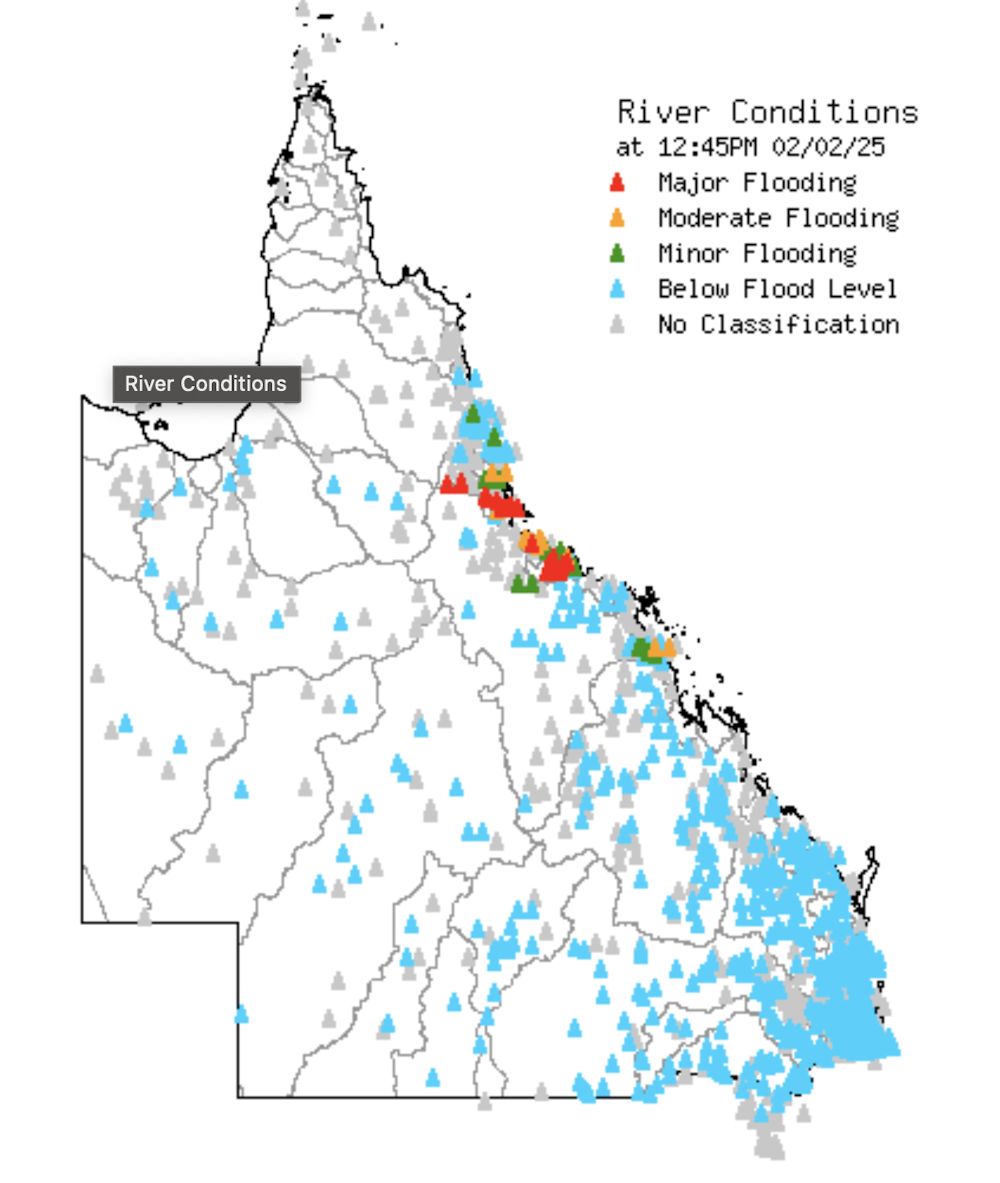
Major flooding in northern Queensland rivers, as of 12.45pm February 2. Bureau of Meteorology
Residents of Ingham and nearby towns, about 100km from Townsville, are witnessing flooding from the nearby Herbert River. This morning, it was at 15 metres and rising. With more heavy rain forecast for the next 24 hours, the Herbert River is likely to break the 1967 record of 15.2 metres later today.
Queensland Premier David Crisafulli – who grew up on his family’s sugar cane farm in Ingham – has said the floods will be a “once in a century” event for the town. To make matters worse, authorities say the town has lost power and an extended outage is likely.
The atmospheric factors behind these floods are very similar to recent floods in the region – and climate change is no doubt playing a role.
The flood level for the Herbert River at Ingham set in 1967 was 15.2 metres. It’s likely to be breached this afternoon (Sunday February 2). Australian Bureau of Meteorology, CC BY
Where are the floods hitting?
For many people in Townsville – the largest city in Northern Australia – the unfolding emergency will bring back memories of the devastating February 2019 floods, which caused A$1.24 billion in damage. Residents have been asked to evacuate from several low-lying suburbs which were inundated in 2019.
Authorities in Townsville asked all residents in the low-lying black zone to evacuate by midday Sunday February 2. Floodwaters could reach second-storey heights in this zone. Residents in pink suburbs have been asked to be on standby. Townsville Council, CC BY
It is too early to say if this flood event will be worse. Fortunately, water levels in the city’s Ross River Dam are much lower than 2019. Townsville Airport has recorded 545mm of rain over the past 48 hours, with many northwest suburbs recording much higher levels. The township of Rollingstone – 60km northwest of Townsville – recorded a whopping 702mm over the 24 hours to 9am Sunday.
Further north in the Cairns to Daintree region, residents are watching with concern, with many still raw after the record-breaking floods of December 2023.
What triggered each of these floods was prolonged heavy rain falling on the southeast flank of a stationary tropical low weather system. Normally, tropical lows bring wind and rain, but move through quite quickly. But in recent years, we have seen a tendency for these systems to stall, sitting in place over or near land and dumping huge volumes of rain.
Last week, the Bureau of Meteorology warned that five tropical lows were forming around northern Australia. Most tropical cyclones form from tropical lows embedded in the region’s monsoon trough, a large low pressure band which forms over summer and draws in warm, moist air from the adjacent tropical seas.
But significant rain events like this one don’t necessarily require a tropical cyclone. Slow-moving deep monsoon lows over land can also deliver huge amounts of rain and widespread flooding.
These atmospheric conditions allow intense rain bands to form between converging winds: warm, moist winds from the northeast and southeast winds originating from the Coral Sea. As the winds collide, they push the moist air up into the cooler parts of the atmosphere where it condenses and falls as torrential rain.
More extreme rainfall and higher frequencies of flooded rivers and flash floods around the world have a clear link to climate change and ongoing global heating.
The main drivers behind these events include warming of the atmosphere. For every 1°C of warming, the atmosphere holds 7% more water vapour. Recent research suggests this figure could be even higher for short duration rainfall.
Hotter oceans hold more energy, meaning they can also amplify the global water cycle when atmospheric conditions are suitable.
This year’s latest ever monsoon
This year, sea surface temperatures in the northwest Coral Sea are 1-2°C above average. Ocean temperatures have risen because of a lack of cloud cover and rain last month. In northwestern Australia, this has given rise to an intensifying marine heatwave.
This ocean heat is likely to be driven by the Australian monsoon’s latest ever arrival. The monsoon brings heavy rains to northern Australia, triggering the wet season. When it arrives, sea surface temperatures generally drop due to a combination of high cloud cover and the cooling effect of rainwater.
After a slow start, the North Australian monsoon season is now in full swing.
The Bureau of Meteorology is monitoring an active monsoon trough for any low pressure systems, which may develop into tropical cyclones over the next week or so. If any cyclone does form, it will gain energy from warmer than usual sea surface temperatures.
What’s next for north Queensland?
The flood emergency in north Queensland is far from over. All global circulation models predict heavy rain to continue in the region, extending up towards Cape York and the Gulf Country as an active monsoon surge moves in from Indonesia.
As river catchments get saturated, more and more water will run off and engorge rivers. Forecasts are for rain to continue well into tonight and the next few days. We are likely to see more flooding in more places this week.
A flooded street in TownsvilleJohn Wilkinson/Facebook
Record-breaking floods across north Queensland have now turned deadly, with one woman drowning while being rescued on Sunday morning. And the floodwaters are still rising, with rain set to continue.
Over the 48 hours to Sunday, there were reports of up to 1 metre of rainfall in parts of northeast Queensland. The torrential rain continues, particularly in the Herbert Coast region and north to around Tully.
Major flooding in northern Queensland rivers, as of 12.45pm February 2. Bureau of Meteorology
Residents of Ingham and nearby towns, about 100km from Townsville, are witnessing flooding from the nearby Herbert River. This morning, it was at 15 metres and rising. With more heavy rain forecast for the next 24 hours, the Herbert River is likely to break the 1967 record of 15.2 metres later today.
Queensland Premier David Crisafulli – who grew up on his family’s sugar cane farm in Ingham – has said the floods will be a “once in a century” event for the town. To make matters worse, authorities say the town has lost power and an extended outage is likely.
The atmospheric factors behind these floods are very similar to recent floods in the region – and climate change is no doubt playing a role.
The flood level for the Herbert River at Ingham set in 1967 was 15.2 metres. It’s likely to be breached this afternoon (Sunday February 2). Australian Bureau of Meteorology, CC BY
Where are the floods hitting?
For many people in Townsville – the largest city in Northern Australia – the unfolding emergency will bring back memories of the devastating February 2019 floods, which caused A$1.24 billion in damage. Residents have been asked to evacuate from several low-lying suburbs which were inundated in 2019.
Authorities in Townsville asked all residents in the low-lying black zone to evacuate by midday Sunday February 2. Floodwaters could reach second-storey heights in this zone. Residents in pink suburbs have been asked to be on standby. Townsville Council, CC BY
It is too early to say if this flood event will be worse. Fortunately, water levels in the city’s Ross River Dam are much lower than 2019. Townsville Airport has recorded 545mm of rain over the past 48 hours, with many northwest suburbs recording much higher levels. The township of Rollingstone – 60km northwest of Townsville – recorded a whopping 702mm over the 24 hours to 9am Sunday.
Further north in the Cairns to Daintree region, residents are watching with concern, with many still raw after the record-breaking floods of December 2023.
What triggered each of these floods was prolonged heavy rain falling on the southeast flank of a stationary tropical low weather system. Normally, tropical lows bring wind and rain, but move through quite quickly. But in recent years, we have seen a tendency for these systems to stall, sitting in place over or near land and dumping huge volumes of rain.
Last week, the Bureau of Meteorology warned that five tropical lows were forming around northern Australia. Most tropical cyclones form from tropical lows embedded in the region’s monsoon trough, a large low pressure band which forms over summer and draws in warm, moist air from the adjacent tropical seas.
But significant rain events like this one don’t necessarily require a tropical cyclone. Slow-moving deep monsoon lows over land can also deliver huge amounts of rain and widespread flooding.
These atmospheric conditions allow intense rain bands to form between converging winds: warm, moist winds from the northeast and southeast winds originating from the Coral Sea. As the winds collide, they push the moist air up into the cooler parts of the atmosphere where it condenses and falls as torrential rain.
More extreme rainfall and higher frequencies of flooded rivers and flash floods around the world have a clear link to climate change and ongoing global heating.
The main drivers behind these events include warming of the atmosphere. For every 1°C of warming, the atmosphere holds 7% more water vapour. Recent research suggests this figure could be even higher for short duration rainfall.
Hotter oceans hold more energy, meaning they can also amplify the global water cycle when atmospheric conditions are suitable.
This year’s latest ever monsoon
This year, sea surface temperatures in the northwest Coral Sea are 1-2°C above average. Ocean temperatures have risen because of a lack of cloud cover and rain last month. In northwestern Australia, this has given rise to an intensifying marine heatwave.
This ocean heat is likely to be driven by the Australian monsoon’s latest ever arrival. The monsoon brings heavy rains to northern Australia, triggering the wet season. When it arrives, sea surface temperatures generally drop due to a combination of high cloud cover and the cooling effect of rainwater.
After a slow start, the North Australian monsoon season is now in full swing.
The Bureau of Meteorology is monitoring an active monsoon trough for any low pressure systems, which may develop into tropical cyclones over the next week or so. If any cyclone does form, it will gain energy from warmer than usual sea surface temperatures.
What’s next for north Queensland?
The flood emergency in north Queensland is far from over. All global circulation models predict heavy rain to continue in the region, extending up towards Cape York and the Gulf Country as an active monsoon surge moves in from Indonesia.
As river catchments get saturated, more and more water will run off and engorge rivers. Forecasts are for rain to continue well into tonight and the next few days. We are likely to see more flooding in more places this week.
Trucks transport railway containers at the Kunming cargo terminal of China United International Rail Containers Co., Ltd. (CRIntermodal) in Kunming, southwest China’s Yunnan Province, on Jan. 2, 2025. [Photo/Xinhua]
Having long been poring over China’s diversified culture, German vlogger Robert Adolf is particularly fascinated by Yunnan Province, home to over 20 ethnic groups.
This year’s Spring Festival is unique to Adolf and his mother, who traveled by train to Xishuangbanna, a tropical autonomous prefecture in Yunnan Province and one of the stations along the China-Laos Railway route.
Adolf has previously explored this 1,035 km-long route linking Kunming of Yunnan to the Laotian capital of Vientiane with eight stops in between, and felt a surge of excitement over how railroads have expanded to smaller cities and villages.
“It’s now much easier to visit rural areas,” he said.
Dressed in the traditional attire of the Shui ethnic group, Adolf told Xinhua that he felt “more real … and more to the hearts” in smaller towns. “There’s a family atmosphere.”
In Yunnan, Adolf has observed the Dai people’s Water-Splashing Festival and the Munao Zongge Festival (meaning “Dancing together”) of the Jingpo people. During the journey, Adolf posted videos on social platforms like Douyin and YouTube, with his bio describing him “on the quest to film all 56 Ethnic Groups in China.”
He said that people always find ways to keep traditions up to date, and the government helps preserve them by supporting cultural heritage, investing in museums and funding inheritors. “In China, they really keep the culture alive.”
His mother Anna Adolf referred to the journey in Yunnan as an adventure. “Everywhere I look, people are wearing beautiful clothes, singing and dancing.”
During the Spring Festival travel season, thousands of passengers travel home or explore new destinations via the China-Laos cross-border train.
At Kunming South Station, the starting point of the railway, waiting rooms were abuzz with travelers speaking Chinese, Lao, Thai and English, a testament to the cross-border railway’s growing international appeal.
“We’ve always had a good experience on trains in China. I’m sure this time it will be convenient and comfortable,” Susie, an American living in Beijing, told Xinhua, as she queued up for a train heading to Laos.
The railway also benefits Thai travelers, who said that it makes the homebound journey faster.
Since its launch in 2021, the China-Laos Railway, a flagship Belt and Road Initiative project, has handled over 43 million passenger trips and more than 48.3 million tonnes of cargo.
The Kunming-Vientiane D87 train is painted deep green. It might evoke memories of the old-style passenger trains in China, but its designed speed of 160 km/h integrates efficiency with the need to navigate complex terrain, transporting both passengers and freight.
Inside some of the train compartments during the Spring Festival holiday, red paper-cut decorations on the windows added a festive touch, marking the first Spring Festival since UNESCO listed the tradition as intangible cultural heritage.
For Southikiat Thavisouk, a Laotian TV host returning to Vientiane, the railway trip is more than transportation. “It’s a bridge between the Chinese and Laotian people,” he said.
Having studied at Huaqiao University in China’s Fujian Province, Thavisouk recalled the warm hospitality he received there. Now back in Laos, he sees the Chinese New Year celebrated as well.
Soulideth Lavanphone, a Laotian tour guide accompanying a group of Chinese travelers, shared a similar sentiment. “I studied in Sichuan, and China is my second home. I’ll do my best to make sure Chinese visitors have a great time in Laos,” he said.
“Many travelers from Western countries and ASEAN nations have all come to experience the Laos-China Railway firsthand,” said Laotian Consul General in Kunming Pongdong Paxaphacdy with much pride.
“Tickets are often sold out due to high demand, and we are working on solutions to improve capacity,” Paxaphacdy said.
“This railway has boosted investment, tourism and connectivity, bringing real benefits to the people. With strong support from both governments, this railway will only continue to grow,” he added.
The Ministry of Commerce said Japan’s plans for export controls on semiconductors will undermine the stability of the global industrial and supply chains as well as disrupt normal business operations.
“For some time, certain countries have been stretching the concept of national security and abusing export control measures to impose sanctions aimed at suppressing China’s semiconductor and other industries,” a spokesperson with the Ministry of Commerce said on Friday.
The spokesperson highlighted that Japan’s plans for export controls on chips will also harm the interests of both Chinese and Japanese companies.
According to the MOC spokesperson, China urges Japan to listen to the rational voices of industry stakeholders and reconsider its course of action. “We hope Japan will take into account the broader picture of international trade rules and China-Japan economic cooperation, and promptly correct these measures to avoid hindering the healthy development of bilateral economic relations.”
As Japan has announced tech and trade curbs including sanctions on some Chinese firms, China made it clear that it reserves the right to take countermeasures to safeguard its legitimate rights and interests, the spokesperson said. China also reaffirmed its stance on ensuring the smooth functioning of global industrial and supply chains.
Jin Xu, chairman of the China Association of International Trade, said some countries’ efforts to “decouple and sever industrial and supply chains” and build “small yards with high fences” will not benefit the local people and will ultimately harm local businesses.
China, with its robust technological capabilities, solid industrial foundation, and strong government support, is well-positioned to overcome any technological blockades, Jin said.
“I firmly believe China will make breakthroughs in the fields of chips. I am convinced that the suppression by some countries will not last,” he said.
A flooded street in TownsvilleJohn Wilkinson/Facebook
Record-breaking floods across north Queensland have now turned deadly, with one woman drowning while being rescued on Sunday morning. And the floodwaters are still rising, with rain set to continue.
Over the 48 hours to Sunday, there were reports of up to 1 metre of rainfall in parts of northeast Queensland. The torrential rain continues, particularly in the Herbert Coast region and north to around Tully.
Major flooding in northern Queensland rivers, as of 12.45pm February 2. Bureau of Meteorology
Residents of Ingham and nearby towns, about 100km from Townsville, are witnessing flooding from the nearby Herbert River. This morning, it was at 15 metres and rising. With more heavy rain forecast for the next 24 hours, the Herbert River is likely to break the 1967 record of 15.2 metres later today.
Queensland Premier David Crisafulli – who grew up on his family’s sugar cane farm in Ingham – has said the floods will be a “once in a century” event for the town. To make matters worse, authorities say the town has lost power and an extended outage is likely.
The atmospheric factors behind these floods are very similar to recent floods in the region – and climate change is no doubt playing a role.
The flood level for the Herbert River at Ingham set in 1967 was 15.2 metres. It’s likely to be breached this afternoon (Sunday February 2). Australian Bureau of Meteorology, CC BY
Where are the floods hitting?
For many people in Townsville – the largest city in Northern Australia – the unfolding emergency will bring back memories of the devastating February 2019 floods, which caused A$1.24 billion in damage. Residents have been asked to evacuate from several low-lying suburbs which were inundated in 2019.
Authorities in Townsville asked all residents in the low-lying black zone to evacuate by midday Sunday February 2. Floodwaters could reach second-storey heights in this zone. Residents in pink suburbs have been asked to be on standby. Townsville Council, CC BY
It is too early to say if this flood event will be worse. Fortunately, water levels in the city’s Ross River Dam are much lower than 2019. Townsville Airport has recorded 545mm of rain over the past 48 hours, with many northwest suburbs recording much higher levels. The township of Rollingstone – 60km northwest of Townsville – recorded a whopping 702mm over the 24 hours to 9am Sunday.
Further north in the Cairns to Daintree region, residents are watching with concern, with many still raw after the record-breaking floods of December 2023.
What triggered each of these floods was prolonged heavy rain falling on the southeast flank of a stationary tropical low weather system. Normally, tropical lows bring wind and rain, but move through quite quickly. But in recent years, we have seen a tendency for these systems to stall, sitting in place over or near land and dumping huge volumes of rain.
Last week, the Bureau of Meteorology warned that five tropical lows were forming around northern Australia. Most tropical cyclones form from tropical lows embedded in the region’s monsoon trough, a large low pressure band which forms over summer and draws in warm, moist air from the adjacent tropical seas.
But significant rain events like this one don’t necessarily require a tropical cyclone. Slow-moving deep monsoon lows over land can also deliver huge amounts of rain and widespread flooding.
These atmospheric conditions allow intense rain bands to form between converging winds: warm, moist winds from the northeast and southeast winds originating from the Coral Sea. As the winds collide, they push the moist air up into the cooler parts of the atmosphere where it condenses and falls as torrential rain.
More extreme rainfall and higher frequencies of flooded rivers and flash floods around the world have a clear link to climate change and ongoing global heating.
The main drivers behind these events include warming of the atmosphere. For every 1°C of warming, the atmosphere holds 7% more water vapour. Recent research suggests this figure could be even higher for short duration rainfall.
Hotter oceans hold more energy, meaning they can also amplify the global water cycle when atmospheric conditions are suitable.
This year’s latest ever monsoon
This year, sea surface temperatures in the northwest Coral Sea are 1-2°C above average. Ocean temperatures have risen because of a lack of cloud cover and rain last month. In northwestern Australia, this has given rise to an intensifying marine heatwave.
This ocean heat is likely to be driven by the Australian monsoon’s latest ever arrival. The monsoon brings heavy rains to northern Australia, triggering the wet season. When it arrives, sea surface temperatures generally drop due to a combination of high cloud cover and the cooling effect of rainwater.
After a slow start, the North Australian monsoon season is now in full swing.
The Bureau of Meteorology is monitoring an active monsoon trough for any low pressure systems, which may develop into tropical cyclones over the next week or so. If any cyclone does form, it will gain energy from warmer than usual sea surface temperatures.
What’s next for north Queensland?
The flood emergency in north Queensland is far from over. All global circulation models predict heavy rain to continue in the region, extending up towards Cape York and the Gulf Country as an active monsoon surge moves in from Indonesia.
As river catchments get saturated, more and more water will run off and engorge rivers. Forecasts are for rain to continue well into tonight and the next few days. We are likely to see more flooding in more places this week.
An aerial drone photo taken on Dec. 15, 2023 shows a view of the Hong Kong-Zhuhai-Macao Bridge in south China. [Photo/Xinhua] The Zhuhai port of the Hong Kong-Zhuhai-Macao Bridge handled 156,000 inbound and outbound passenger trips on Friday, a daily record since the bridge’s opening in 2018. The 55-km bridge links China’s Hong Kong Special Administrative Region (SAR), Macao SAR, and the city of Zhuhai in Guangdong Province. It is the world’s longest bridge-and-tunnel sea crossing. According to the border inspection authorities in Zhuhai, more than 454,000 passenger trips and over 69,000 vehicle trips were recorded through the bridge’s Zhuhai port from Tuesday to Friday, the first four days of the Spring Festival holiday, up 22 percent and 32 percent respectively year on year. Daily passenger flows at the port exceeded 100,000 on 50 days in 2024, a 10-fold increase from 2023. More than 3 million trips by vehicles carrying number plates from Hong Kong or Macao were recorded at the port in 2024, accounting for 55 percent of its total traffic.
ADDRESSING AN EMERGENCY SITUATION: The extraordinary threat posed by illegal aliens and drugs, including deadly fentanyl, constitutes a national emergency under the International Emergency Economic Powers Act (IEEPA).
Until the crisis is alleviated, President Donald J. Trump is implementing a 25% additional tariff on imports from Canada and Mexico and a 10% additional tariff on imports from China. Energy resources from Canada will have a lower 10% tariff.
President Trump is taking bold action to hold Mexico, Canada, and China accountable to their promises of halting illegal immigration and stopping poisonous fentanyl and other drugs from flowing into our country.
The orders make clear that the flow of contraband drugs like fentanyl to the United States, through illicit distribution networks, has created a national emergency, including a public health crisis. Chinese officials have failed to take the actions necessary to stem the flow of precursor chemicals to known criminal cartels and shut down money laundering by transnational criminal organizations.
In addition, the Mexican drug trafficking organizations have an intolerable alliance with the government of Mexico. The government of Mexico has afforded safe havens for the cartels to engage in the manufacturing and transportation of dangerous narcotics, which collectively have led to the overdose deaths of hundreds of thousands of American victims. This alliance endangers the national security of the United States, and we must eradicate the influence of these dangerous cartels.
There is also a growing presence of Mexican cartels operating fentanyl and nitazene synthesis labs in Canada. A recent study recognized Canada’s heightened domestic production of fentanyl, and its growing footprint within international narcotics distribution
USING OUR LEVERAGE TO ENSURE AMERICANS’ SAFETY: Previous Administrations failed to fully leverage America’s economic position as a tool to secure our borders against illegal migration and combat the scourge of fentanyl, preferring to let problems fester.
Access to the American market is a privilege. The United States has one of the most open economies in the world, and the lowest average tariff rates in the world.
While trade accounts for 67% of Canada’s GDP, 73% of Mexico’s GDP, and 37% of China’s GDP, it accounts for only 24% of U.S. GDP. However, in 2023 the U.S. trade deficit in goods was the world’s largest at over $1 trillion.
Tariffs are a powerful, proven source of leverage for protecting the national interest. President Trump is using the tools at hand and taking decisive action that puts Americans’ safety and our national security first.
Though previous Administrations have failed to leverage America’s combination of exceptional strength and its unique role in world trade to advance the security interests of the American people, President Trump has not.
PRESIDENT TRUMP IS KEEPING HIS PROMISE TO STOP THE FLOOD OF ILLEGAL ALIENS AND DRUGS: When voters overwhelmingly elected Donald J. Trump as President, they gave him a mandate to seal the border. That is exactly what he is doing.
The Biden Administration’s policies have fueled the worst border crisis in U.S. history.
More than 10 million illegal aliens attempted to enter the United States under Biden’s leadership, including a rising number of Chinese nationals and people on the terror watchlist.
This problem is not confined to the southern border – encounters at the northern border with Canada are rising as well.
The sustained influx of illegal aliens has profound consequences on every aspect of our national life – overwhelming our schools, lowering our wages, reducing our housing supply and raising rents, overcrowding our hospitals, draining our welfare system, and causing crime.
Gang members, smugglers, human traffickers, and illegal drugs and narcotics of all kinds are pouring across our borders and into our communities.
Last fiscal year, Customs and Border Protection (CBP) apprehended more than 21,000 pounds of fentanyl at our borders, enough fentanyl to kill more than 4 billion people.
It is estimated that federal officials are only able to seize a fraction of the fentanyl smuggled across the southern border.
These drugs kill tens of thousands of Americans each year, including 75,000 deaths per year attributed to fentanyl alone.
More Americans are dying from fentanyl overdoses each year than the number of American lives lost in the entirety of the Vietnam War.
BUILDING ON PAST SUCCESS: President Trump continues to demonstrate his commitment to ensuring U.S. trade policy serves the national interest.
As President Trump said in the Presidential Memorandum on American First Trade Policy, trade policy is a critical component in national security.
President Trump promised in November to “sign all necessary documents to charge Mexico and Canada a 25% Tariff on ALL products coming into the United States, and its ridiculous Open Borders. This Tariff will remain in effect until such time as Drugs, in particular Fentanyl, and all Illegal Aliens stop this Invasion of our Country!”
During his first term as President of the United States, President Trump established the President’s Commission on Combating Drug Addiction and the Opioid Crisis and declared the Opioid Crisis a public health emergency.
President Trump also has a long record of putting America first on trade. In his first term, President Trump successfully used threats of tariffs on Mexico to help secure our border.
When our national security was threatened by a global oversupply of steel and aluminum, President Trump took swift action to protect America’s national security by implementing tariffs on imports of these goods.
In response to China’s intellectual property theft, forced technology transfer, and other unreasonable behavior, President Trump acted with conviction to impose tariffs on imports from China, using that leverage to reach a historic bilateral economic agreement.
Just last week, President Trump leveraged tariffs to successfully resolve national security concerns with Colombia, swiftly reaching an outcome that prioritizes the safety and security of the American people and the sanctity of our national borders.
The Indonesian government’s proposal to grant amnesty to pro-independence rebels in West Papua has stirred scepticism as the administration of new President Prabowo Subianto seeks to deal with the country’s most protracted armed conflict.
Without broader dialogue and accountability, critics argue, the initiative could fail to resolve the decades-long unrest in the resource-rich region.
Yusril Ihza Mahendra, coordinating Minister for Law, Human Rights, Immigration and Corrections, announced the amnesty proposal last week.
On January 21, he met with a British government delegation and discussed human rights issues and the West Papua conflict.
“Essentially, President Prabowo has agreed to grant amnesty . . . to those involved in the Papua conflict,” Yusril told reporters last week.
On Thursday, he told BenarNews that the proposal was being studied and reviewed.
“It should be viewed within a broader perspective as part of efforts to resolve the conflict in Papua by prioritising law and human rights,” Yusril said.
‘Willing to die for this cause’ Sebby Sambom, a spokesman for the West Papua National Liberation Army (TPNPB) rebels, dismissed the proposal as insufficient.
“The issue isn’t about granting amnesty and expecting the conflict to end,” Sambom told BenarNews. “Those fighting in the forests have chosen to abandon normal lives to fight for Papua’s independence.
“They are willing to die for this cause.”
Despite the government offer, those still engaged in guerrilla warfare would not stop, Sambon said.
Papua, Indonesia’s easternmost region that makes up the western half of New Guinea island, has been a flashpoint of tension since its controversial incorporation into the archipelago nation in 1969.
Papua, referred to as “West Papua” by Pacific academics and advocates, is home to a distinct Melanesian culture and vast natural resources and has seen a low-level indpendence insurgency in the years since.
The Indonesian government has consistently rejected calls for Papua’s independence. The region is home to the Grasberg mine, one of the world’s largest gold and copper reserves, and its forests are a critical part of Indonesia’s climate commitments.
Papua among poorest regions Even with its abundant resources, Papua remains one of Indonesia’s poorest regions with high rates of poverty, illiteracy and infant mortality.
Critics argue that Jakarta’s heavy-handed approach, including the deployment of thousands of troops, has only deepened resentment.
President Prabowo Subianto . . . “agreed to grant amnesty . . . to those involved in the Papua conflict.” Image: Kompas
Yusril, the minister, said the new proposal was separate from a plan announced in November 2024 to grant amnesty to 44,000 convicts, and noted that the amnesty would be granted only to those who pledged loyalty to the Indonesian state.
He added that the government was finalising the details of the amnesty scheme, which would require approval from the House of Representatives (DPR).
Prabowo’s amnesty proposal follows a similar, albeit smaller, move by his predecessor, Joko “Jokowi” Widodo, who granted clemency to several Papuan political prisoners in 2015.
While Jokowi’s gesture was initially seen as a step toward reconciliation, it did little to quell violence. Armed clashes between Indonesian security forces and pro-independence fighters have intensified in recent years, with civilians often caught in the crossfire.
Cahyo Pamungkas, a Papua researcher at the National Research and Innovation Agency (BRIN), argued that amnesty, without prior dialogue and mutual agreements, would be ineffective.
“In almost every country, amnesty is given to resistance groups or government opposition groups only after a peace agreement is reached to end armed conflict,” he told BenarNews.
No unilateral declaration Yan Warinussy, a human rights lawyer in Papua, agreed.
“Amnesty, abolition or clemency should not be declared unilaterally by one side without a multi-party understanding from the start,” he told BenarNews.
Warinussy warned that without such an approach, the prospect of a Papua peace dialogue could remain an unfulfilled promise and the conflict could escalate.
Usman Hamid, director of Amnesty International Indonesia, said that while amnesty was a constitutional legal instrument, it should not apply to those who have committed serious human rights violations.
“The government must ensure that perpetrators of gross human rights violations in Papua and elsewhere are prosecuted through fair and transparent legal mechanisms,” he said.
Papuans Behind Bars, a website tracking political prisoners in Papua, reported 531 political arrests in 2023, with 96 political prisoners still detained by the end of the year.
Only 11 linked to armed struggle Most were affiliated with non-armed groups such as the West Papua National Committee (KNPB) and the Papua People’s Petition (PRP), while only 11 were linked to the armed West Papua National Liberation Army (TPNPB).
The website did not list 2024 figures.
Anum Siregar, a lawyer who has represented Papuan political prisoners, said that the amnesty proposal has sparked interest.
“Some of those detained outside Papua are requesting to be transferred to prisons in Papua,” she said.
Meanwhile, Agus Kossay, leader of the National Committee for West Papua, which campaigns for a referendum on self-determination, said Papuans would not compromise on “their God-given right to determine their own destiny”.
In September 2019, Kossay was arrested for orchestrating a riot and was sentenced to 11 months in jail. More recently, in 2023, he was arrested in connection with an internal dispute within the KNPB and was released in September 2024 after serving a sentence for incitement.
“The right to self-determination is non-negotiable and cannot be challenged by anyone. As long as it remains unfulfilled, we will continue to speak out,” Kossay told BenarNews.
Victor Mambor and Tria Dianti are BenarNews correspondents. Republished with permission.
“I am disappointed with U.S. President Donald Trump’s decision to place tariffs on all Canadian goods. This decision will harm Canadians and Americans alike and strain the important relationship and alliance between our two nations.
“Alberta will do everything in its power to convince the U.S. President and Congress, as well as the American people, to reverse this mutually destructive policy.
“We note the reduced 10 per cent tariff for Canadian energy. That is partially a recognition of the advocacy undertaken by our government and industry to the U.S. Administration. We’ve pointed outthe substantial wealth created in the U.S. by American companies and tens of thousands of American workers who upgrade and refine approximately $100 billion of Canadian crude into $300 billion of product sold all over the world by those same U.S. companies.
“It is also worth noting that if oil and gas exports are excluded, the United States actually sells more to Canada than Canada sells to the U.S. As I’ve stated to every American policymaker I’ve met with in these past months, Canada buys more from the U.S. than does any country on earth – more than the U.K., France, Germany, Italy and Vietnam combined. There is, therefore, no economic justification for tariffs imposed on any Canadian goods.
“Alberta will continue diplomatic efforts in the United States to persuade the U.S. President, lawmakers, administration officials and the American people to lift all tariffs on Canadian goods as soon as possible and to repair our relationship with the United States. I encourage all premiers and federal officials to do the same, especially as the effects of these tariffs begin to take their toll south of the border. Americans need to understand the detrimental consequences of this policy decision.
“Alberta will also work collaboratively with the federal government and other provinces on a proportionate response to the imposed U.S. tariffs through the strategic use of Canadian import tariffs on U.S. goods that are more easily purchased from Canada and non-U.S. suppliers. This will minimize costs to Canadian consumers while creating maximum impact south of the border. All funds raised from such import tariffs should go directly to benefit the Canadians most harmed by the imposed U.S. tariffs.
“Alberta will, however, continue to strenuously oppose any effort to ban exports to the U.S. or to tax our own people and businesses on goods leaving Canada for the United States. Such tactics would hurt Canadians far more than Americans.
“We also continue Alberta’s call for the appointment of a border czar to coordinate the securing of our border against illegal migrants and drugs moving in both directions, and to achieve our nation’s two per cent of GDP NATO commitment by 2027. These things should be done for the safety of all Canadians regardless of our trade dispute with the United States
“Despite the disappointment of today’s decision there is also an incredible opportunity before us as a nation. Canada can and must come together in an unprecedented effort to preserve the livelihoods and futures of our people and expand our political and trade relationships across the globe. We can no longer afford to be so heavily reliant on one primary customer. We must stop limiting our prosperity and inflicting economic wounds on ourselves.
“Rather, we must unleash the true economic potential of our country, which possesses more wealth and natural resources than any other nation on earth.
“To this end, Alberta calls on the federal government and our fellow provinces to immediately commence a national effort to fast track and build oil and gas pipelines to the east and west coasts of Canada, construct multiple LNG terminals on each coast, increase internal refining capacity, unleash the development of critical minerals, lower taxes, reduce red tape, tear down interprovincial trade barriers and re-empower provinces to develop our unique economies without constant federal interference and imposition of anti-resource development laws.
“Our province and our nation can overcome the formidable economic challenges ahead. But we can only do so if we start acting like a healthy and functional country that supports every province to export their best resources and products to world markets, thereby achieving their unique potential. By so doing, Canada can become one of the most prosperous and powerful nations on earth. Alberta stands ready to do our part if this true Team Canada approach is taken.”
Samsung Electronics is the world’s best brand among global consumers, according to YouGov’s Best Global Brands 2025 rankings.
This marks the second year in a row that Samsung has topped the rankings. After placing fourth in 2017, the company consistently finished within the top 4 on YouGov’s yearly lists before ranking second in 2021 and first in 2022. Only two of this year’s top 10 global brands originate from Asia, including Samsung.
* YouGov did not publish a Global Top 10 list in its Best Global Brands rankings in 2023 and 2024.
The YouGov Best Global Brand 2025 rankings draw on more than 1 million consumer surveys across 28 markets to identify the best-performing global and national brands. Respondents are asked their opinions of thousands of brands, rating them on six key attributes: Impression, Quality, Value, Customer Satisfaction, Reputation and Recommendation.
“Brands have never been more important — and in today’s dynamic marketplace, where consumer sentiment can make or break a company’s success, understanding brand perception is imperative,” said YouGov CEO Steve Hatch.
Back in October 2024, Samsung was recognized by Interbrand as a “Global Top 5” brand for the fifth consecutive year on the global brand consultancy’s annual “Best Global Brands” rankings. Samsung’s brand value surpassed the $100 billion mark for the first time on last year’s list, and Interbrand mainly attributed this to the expansion of Samsung’s portfolio of products infused with AI technologies, substantial consumer benefits derived from increased device connectivity and the company’s ongoing commitment to a more sustainable future.
Earlier today, Governor Kathy Hochul marched in the Flushing Chinese Business Association’s Lunar New Year parade.
B-ROLL of the Governor during the parade can be found on YouTube here and in TV quality (h.264, mp4) format here.
VIDEO: The event is available to stream on YouTube here and TV quality video is available here (h.264, mp4).
AUDIO: The Governor’s remarks are available in audio form here.
PHOTOS: The Governor’s Flickr page will post photos of the event here.
A rush transcript of the Governor’s remarks is available below:
Xin nian kuai le! I want to wish everyone a happy Lunar New Year. I just had a wonderful celebration meeting members of the community. We had some dance and celebration of culture, and I’m so proud to be Governor of a state where one out of 10 New Yorkers can claim Asian or AAPI descendance. It’s part of our vibrancy.
Also, this past week was the first time ever in the history of our state that children could get a day off school to celebrate the Lunar New Year holiday with their families and to continue on embracing these great traditions.
I also want to convey that we’re continuing our efforts to fight hate crimes against all peoples, but as we saw during the pandemic, there was a spike in Asian hate crimes. We want to make sure people know that we’ll do whatever we can to protect them. We’ve added more money to our Budget to give them the security they need to feel safe in their homes, but also on our streets and in our subways.
Why has any discussion about Israel, its violations of international law, and the international legal expectations for third party states to hold IDF soldiers accountable not been addressed in Aotearoa New Zealand?
ANALYSIS:By Katrina Mitchell-Kouttab
Palestine Solidarity Network Aotearoa national chair John Minto’s campaign to identify Israeli Defence Force (IDF) soldiers in New Zealand and then call a PSNA number hotline has come under intense criticism from the likes of Winston Peters, Stephen Rainbow, the Jewish Council and NZ media outlets. Accusations of antisemitism have been made.
Despite making it clear that holding IDF soldiers accountable for potential war crimes is his goal, not banning all Israelis or targeting Jewish people, there are many just concerns regarding Minto’s campaign. He is clear that his focus remains on justice, not on creating divisions or fostering discrimination, but he has failed to provide strict criteria to distinguish between individuals directly involved in human rights violations and those who are innocent, or to ground the campaign in legal frameworks and due process.
Any allegations of participation in war crimes should be submitted through proper legal channels, not through the PSNA. Broader advocacy could have been used to address concerns of accountability and to minimise any risk that the campaign could lead to profiling based on religion, ethnicity, or language.
While there are many concerns that need to be addressed with PSNA’s campaign, why has the conversation stopped there? Why has the core issue of this campaign been ignored? Namely, that IDF soldiers who have committed war crimes in Gaza have been allowed into New Zealand?
PSNA’s controversial Gaza “genocide hotline” . . . why has the conversation stopped there? Why has the core issue about war crimes been ignored? Image: PSNA screenshot APR
Why has any discussion about Israel, its violations of international law, and the international legal expectations for third party states to hold IDF soldiers accountable not been addressed? Why is criticism of Israel being conflated with racism, even though many Jewish people oppose Israel’s war crimes, and what about Palestinians, what does this mean for a people experiencing genocide?
Concerns should be discussed but they must not be used to protect possible war criminals and shield Israel’s crimes.
It is true that PSNA’s campaign may possibly target individuals, including targeting individuals solely based on their nationality, religion, or language. This is not acceptable. But it has also uncovered the exceptionally biased, racist, and unjust views towards Palestinians.
Racism against Palestinians ignored Palestinians have been dehumanised by Israel for decades, but real racism against Palestinians is being ignored. As a Christian Palestinian I know all too well what it is like to be targeted.
In fact, it was only recently at a New Zealand First State of the Nation gathering last year that Winston Peter’s followers called me a terrorist for being Palestinian and told me that all Muslims were Hamas lovers and were criminals.
The question that has been ignored in this very public debate is simple: are Israeli soldiers who have participated in war crimes in Aotearoa, if so, why, and what does this mean for the New Zealand Palestinian population and the upholding of international law?
By refusing to address concerns of IDF soldiers the focus is deliberately shifted away from the actual genocide happening in Gaza. If IDF soldiers have engaged in rape, extrajudicial executions, torture, destruction of homes, or killing of civilians, they should be investigated and held accountable.
Countries have a legal and moral duty to prevent war criminals from using their nations as safe havens.
Since 1948, Palestinians have been subjected to systematic oppression, apartheid, ethnic cleansing, violence and now, genocide. From its creation and currently with Israel’s illegal occupation, Palestinian massacres have been frequent and unrelenting.
This includes the execution of my great grandmother on the steps of our Katamon home in Jerusalem. Land has been stolen from Palestinians over the decades, including well over 42 percent of the West Bank. Palestinians have been denied the right to return to their country, the right to justice, accountability, and self-determination.
Living under illegal military law We are still forced to live under illegal military law, face mass arrests and torture, and our history, identity, culture and heritage are targeted.
Almost 10 children lose one or both of their legs every day in Gaza according to the UN agency for Palestinian refugees (UNWRA). 2.2 million people are starving because Israel refuses them access to food. 95 percent of Gaza’s population have been forced onto the streets, with only 25 percent of Gaza’s shelters needs being met, according to the Norwegian Refugee Council.
One out of 20 people in Gaza have been injured and 18,000 children have been murdered. 6500 Palestinians from the Gaza Strip were taken hostage by Israel who also stole 2300 bodies from numerous cemeteries. 87,000 tons of explosives have been dropped on all regions in the Gaza Strip.
Dr Ghassan Abu-Sittah, a British Palestinian reconstructive surgeon who worked in Al Shifa and Al Ahly Baptist hospital and who is part of Medicine Sans Frontiers, estimates as many as 300,000 Palestinian civilians, most of them children, have been murdered by Israel.
This is because official numbers do not include those bodies that cannot be recognised or are blown to a pulp, those buried under the rubble and those expected to die and have died of disease, starvation and lack of medicine — denied by Israel to those with chronic illnesses.
‘A Genocidal Project’: real death toll closer to 300,000. Video: Democracy Now!
As a signatory to the Geneva Convention, the Rome Statute of the International Criminal Court (ICC), and UN resolutions, New Zealand is expected to investigate, prosecute and deport any individual accused of these serious crimes. This government has an obligation to deny entry to any individual suspected of war crimes, crimes against humanity or genocide.
IDF has turned war crimes into entertainment Israel has violated all of these, its IDF soldiers filming themselves committing such atrocities and de-humanising Palestinians over the last 15 months on social media.
IDF soldiers have posted TikTok videos mocking their Palestinian victims, celebrating destruction, and making jokes about killing civilians, displaying a disturbing level of dehumanisation and cruelty. They have filmed themselves looting Palestinian homes, vandalising property, humiliating detainees, and posing with dead bodies.
They have turned war crimes into entertainment while Palestinian families suffer and mourn. Israel has deliberately targeted civilians, bombing schools, hospitals, refugee camps, and even designated safe zones, then lied about their operations, showing complete disregard for human life.
Israel and the IDF’s global reputation among ordinary people are not positive. Out on the streets over 15 months, millions have been demonstrating against Israel. They do not like what its army has done, and rightly so. Many want to see justice and Israel and its army held accountable, something this government has ignored.
Israel’s state forced conscription or imprisonment, enforced military service that contributes to the occupation, ethnic cleansing, systematic oppression of a people, war crimes and genocide is fascism on display. Israel is a totalitarian, apartheid, military state, but this government sees no problems with that.
The UN and human rights organisations like Amnesty International and Human Rights Watch have repeatedly condemned Israeli military operations, including the indiscriminate killing of civilians, the use of white phosphorus, and sexual violence by Israeli forces.
While not all IDF soldiers may have committed direct atrocities, those serving in occupied Palestinian territories are complicit in enforcing illegal occupation, which itself is a violation of international law.
Following orders not an excuse The precedent set by international tribunals, such as Nuremberg, establishes that following orders is not an excuse for war crimes — meaning IDF soldiers who have participated in military actions in occupied areas should be subject to scrutiny.
This government has a duty to protect Palestinian communities from further harm, this includes preventing known perpetrators of ethnic cleansing from entering New Zealand. The presence of IDF soldiers in New Zealand is a direct threat to the safety, dignity, and well-being of our communities.
Many Palestinian New Zealanders have lost family members, homes, and entire communities due to the IDF’s actions. Seeing known war criminals walking freely in New Zealand re-traumatises those who have suffered from Israel’s illegal military brutality.
Survivors of ethnic cleansing should not have to live in fear of encountering the very people responsible for their suffering. This was not acceptable after the Second World War, throughout modern history, and is not acceptable now.
IDF soldiers are also trained in brutal tactics, including arbitrary arrests, sexual violence, and the assassination of Palestinian civilians. The presence of war criminals in any society creates a climate of fear and intimidation.
Given their history, there is a concern within New Zealand that these soldiers will engage in racist abuse, Islamophobia, or Zionist hate crimes not only against Palestinians and Arabs, but other communities of colour.
New Zealand society should be scrutinising not just this government’s response to the genocide against Palestinians, but also our political parties.
Moral bankruptcy and xenophobia This moral bankruptcy and neutral stance in the face of genocide and racism has been clearly demonstrated this week in Parliament with both Shane Jones and Peter’s xenophobic remarks, and responses to the PSNA’s campaign.
Winston Peter’s tepid response to Israel’s behaviour and its violations is a staggering display of double standards and hypocrisy. Racism it seems, is clearly selective.
His comments about Mexicans in Parliament this week were xenophobic and violate the principles of responsible governance by promoting discrimination. Peters’ comments that immigrants should be grateful creates a hierarchy of worthiness.
Similarly, Shane Jones calling for Mexicans to go home does not uphold diplomatic and professional standards, reinforces harmful racial stereotypes and discriminates based on one’s nationality. Mexicans, Māori, and Palestinians are not on equal standing as others when it comes to human rights.
Why is there a defence of foreign soldiers who may have participated in genocide or war crimes in the occupied Palestinian territories, but then migrants and refugees are attacked?
“John Minto’s call to identify people from Israel . . . is an outrageous show of fascism, racism, and encouragement of violence and vigilantism. New Zealand should never accept this kind of extreme totalitarian behaviour in our country”. Why has Winston Peter’s never condemned the actual racism Palestinians are facing — including ethnic cleansing, forced displacement, and apartheid?
Why has he never used such strong language and outrage to condemn Israel’s actions despite evidence of violations of international law? Instead, he directs outrage at a human rights activist who is pointing out the shortcomings of the government’s response to Israels violations.
IDF soldiers’ documented atrocities ignored Peters has completely ignored IDF soldiers’ documented atrocities and distorted the campaign’s purpose for legal accountability to that of violence.
There has been no mention of Palestinian suffering associated with the IDF and Israel, nor has the government been transparent in admitting that there are no security measures in place when it comes to Israel.
For Peters, killing Palestinians in their thousands is not racist but an activist wanting to prevent war criminals from entering New Zealand is?
Recently, Simon Court of the ACT party in response to Minto wrote: “Undisguised antisemitic behaviour is not acceptable . . . military service is compulsory for Israeli citizens . . . any Israeli holidaying, visiting family or doing business in New Zealand could be targeted . . . it is intimidation towards Jewish visitors . . . and should be condemned by parties across Parliament.”
This comment is misleading, and hypocritical.
PSNA’s campaign is not targeting Jewish people, something the Jewish Council has also misrepresented. It is about identifying Israeli soldiers who have actively participated in human rights violations and war crimes in the occupied Palestinian territories.
It intentionally blurs the lines between Israeli soldiers and Jewish civilians, as the lines between Palestinian civilians and Hamas have been blurred.
Erases distinction between civilians and a militant group Even MFAT cannot use the word “Palestinian” but identifies us all as “Hamas” on its website. This erases the distinction between civilians and a militant group, and conflates Israeli military personnel with Jewish civilians, which is both deceptive and dangerous.
The MFAT website states the genocide in Gaza is an “Israel-Hamas” conflict, denying the intentional targeting of Palestinian civilians and erasing our humanity.
Israel’s assault has purposely killed thousands of children, women and men, all innocent civilians. Israel has not provided any evidence of any of its claims that it is targeting “Hamas” and has even been caught out lying about the “mass rapes and burned babies”, the tunnels under the hospitals and militants hiding behind Palestinian toddlers and whole generations of families.
Despite this, MFAT had not condemned Israeli war crimes. This is not a just war. It is a genocide against Palestinians which is also being perpetrated in the West Bank. There is no Hamas in the West Bank.
The ACT Party has been silent or outright supportive of Israel’s atrocities in Gaza and the West Bank, despite overwhelming evidence of war crimes. If they were truly concerned about targeting individuals as they are with Minto’s campaign, then they would have called for an end to Israel’s assaults against Palestinians, sanctioned Israel for its war crimes, and called for investigations into Israeli soldiers for mass killings, sexual violence and starving the Palestinian people.
What is clear from Court and Seymour (who has also openly supported Israel alongside members of the Zionist Federation), is that Palestinian lives are irrelevant, we should silently accept our genocide, and that we do not deserve justice. That Israeli IDF soldiers should be given impunity and should be able to spend time in New Zealand with no consequences for their crimes.
This is simply xenophobic, dangerous and “not acceptable in a liberal democracy like New Zealand”.
New Zealand cartoonist Malcolm Evans with two of his anti-Zionism placards at yesterday’s “march for the martyrs” in Auckland . . . politicians’ silence on Israel’s war crimes and violations of international law fails to comply with legal norms and expectations. Image: Asia Pacific Report
Erased the voice of Jewish critics ACT, alongside Peters, Prime Minister Christopher Luxon, Labour leader Chris Hipkins, and the Jewish council have erased the voice of Jewish people who oppose Israel and its crimes and who do not associate being Jewish with being Israeli.
There is a clear distinction, something Alternative Jewish Voices, Jewish Voices for Peace, Holocaust survivors and Dayenu have clearly reiterated. Equating Zionism with Judaism, and identifying Israeli military actions with Jewish identity, is dangerously antisemitic.
By failing to distinguish Judaism from Zionism, politicians and the Jewish Council are in danger of fuelling the false narrative that all Jewish people support Israel’s actions, which ultimately harms Jewish communities by increasing resentment and misunderstanding.
Antisemitism should never be weaponised or used to silence criticism of Israel or justify Israel’s impunity. This is harmful to both Palestinians and Jews.
Seymour’s upcoming tenure as deputy prime minister should also be questioned due to his unwavering support and active defence of a regime committing mass atrocities. This directly contradicts New Zealand’s values of justice and accountability demonstrating a complete disregard for human rights and international law.
His silence on Israel’s war crimes and violations of international law fails to comply with legal norms and expectations. He has positioned himself away from representing all New Zealanders.
While we focus on Minto, let’s be fair and ensure Palestinians are also being protected from discrimination and targeting in New Zealand. Are the Zionist Federation, the New Zealand Jewish Council, and the Holocaust Centre supporting Israel economically or culturally, aiding and abetting its illegal occupation, and do they support the genocide?
Canada investigated funds linked to illegal settlements Canada recently investigated the Jewish National Fund (JNF) of Canada for potentially violating charitable tax laws by funding projects linked to Israeli settlements in the occupied Palestinian territories, which are illegal under international law.
In August 2024, the Canada Revenue Agency (CRA) revoked the Jewish National Fund of Canada’s (JNF Canada) charitable status after a comprehensive audit revealed significant non-compliance with Canadian tax laws.
On the 31 January 2025, Haaretz reported that Israel had recruited the Jewish National Fund to illegally secretly buy Palestinian land in the Occupied Palestinian Territories. What does that mean for the New Zealand branch of the Jewish National Fund?
None of these organisations should be funnelling resources to illegal settlements or supporting Israel’s war machine. A full investigation into their financial and political activities is necessary to ensure any money coming from New Zealand is not supporting genocide, land theft or apartheid.
The government has already investigated Palestinians sending money to relatives in Gaza, the same needs to be done to organisations supporting Israel. Are any of these groups supporting war crimes under the guise of charity?
While Jewish communities and Palestinians have rallied together and supported each other these last 15 months, we have received no support from the Jewish Council or the Holocaust Centre, who have remained silent or have supported Israel’s actions. Dayenu, and Alternative Jewish voices have vocally opposed Israel’s genocide in Gaza and reached out to us. As Jews dedicated to human rights, justice, and the prevention of genocide because of their own history, they unequivocally condemn Israel’s actions.
Given the Holocaust, you would expect the Holocaust Centre and the Jewish Council to oppose any acts of violence, especially that on such an industrial scale. You would expect them to oppose apartheid, ethnic cleansing, and the dehumanisation of Palestinians as the other Jewish organisations are doing.
Genocide, war crimes must not be normalised War crimes and genocide must never be normalised. Israel must not be shielded and the suffering and dehumanisation of Palestinians supported.
We must ensure that all New Zealanders, whether Jewish, Israeli or Palestinian are not targeted, and are protected from discrimination, racism, violence and dehumanisation. All organisations are subject to scrutiny, but only some have been.
Instead of just focusing on John Minto, the ACT Party, NZ First, National, and Labour should be answering why Israeli soldiers who may have committed atrocities, are allowed into New Zealand in the first place.
Israel and its war criminals should not be treated any differently to any other country.
We must shift the focus back to Israel’s genocide, apartheid, and impunity, while exposing the hypocrisy of those who defend Israel but attack Palestinian solidarity.
UN Special Rapporteur to the Occupied Palestinian Territory Francesca Albanese has hailed the formation of The Hague Group, describing it as the “best news” from a coalition of policymakers “in a long time”.
Formed on Friday in the city of its namesake, The Hague Group’s members — Belize, Bolivia, Colombia, Cuba, Honduras, Malaysia, Namibia, Senegal and South Africa — have joined together to “end Israeli occupation of the State of Palestine”.
The groups said in a joint statement that they could not “remain passive in the face of such international crimes” committed by Israel against the Palestinians.
They said they would work to see the “realisation of the inalienable right of the Palestinian people to self-determination, including the right to their independent State of Palestine”.
Albanese said on social media: “Let’s make it real. And let’s keep growing.”
“The Hague Group’s formation sends a clear message — no nation is above the law, and no crime will go unanswered,” said the South African Minister of International Relations and Cooperation Ronald Lamola.
South Africa filed a case before the International Court of Justice alleging genocide in 2023 and an interim ruling in January 2024 said that there was “plausible genocide” and accepted the case for substantive judgment. Since then, 14 countries have joined the proceedings in support of South Africa and Palestine.
Joyful scenes erupted today as buses carrying Palestinian prisoners released under last month’s Gaza ceasefire deal arrived in Ramallah, in the occupied West Bank. A total of 183 prisoners were due to be freed today.
Three captives — Keith Siegel, Ofer Kalderon and Yarden Bibas– were earlier released in two separate locations in southern and northern Gaza.
Samoan artist Michel Mulipola with his characteristic clutch of protest flags at the “march of the martyrs” in Auckland today . . . latest addition is the flag of the Democratic Republic of Congo to acknowledge a brutal war being waged by M23 rebels. Image: David Robie/APR
NZ ‘march of the martyrs’ protest In New Zealand’s largest city Auckland Tāmaki Makaurau today, hundreds of pro-Palestinian protesters staged a vigil and march for the more than 47,000 Palestinians killed in Israel’s war on Gaza — mostly women and children.
Hamas released three more hostages from Gaza today – a total of 14 since the ceasefire. Image: Al Jazeera screenshot APR
More than 44,500 names of the victims of the genocidal war were spread out on the pavement of Te Komititanga Square in the heart of Auckland and one of the organisers, Dr Abdallah Gouda, said: “It is important to honour the names, they are people, families — they are not just numbers, statistics.”
A canvas with an outline of Palestine flag was also spread out and protesters invited to dip their fingers in black, red and green paint — the colours of the Palestinian flag — and daub the ensign with their collective fingerprints.
This was part of a global campaign to “stamp my imprint” for the return to Palestine.
“Each mark represents solidarity and remembrance for those who have lost their lives in the struggle for justice,” said the campaign.
“As you add your fingerprint, please take a moment to reflect on their sacrifice and the collective desire for peace and freedom.
“This canvas will become a living tribute with each fingerprint contributing to a powerful symbol of unity and support.”
Today’s Palestinian and decolonisation “march of the martyrs” in Auckland. Image: David Robie/APR
The protesters followed with a “march for the martyrs” through central streets of Auckland past the consulate of the United States, main backer and arms supplier to Israel, and beside the city’s iconic harbourside.
A young girl keeps vigil over more than 44,000 names from the 47,000 people killed in Israel’s war on Gaza at today’s pro-Palestinian demonstration in Auckland today. Image: David Robie/APR
UNRWA chief “salutes’ aid staff defying Israeli ban Meanwhile, Al Jazeera reports that the head of the UN’s agency for Palestinian refugees (UNRWA) has hailed staff for continuing to work despite an Israeli ban on their operations coming into force on Thursday.
In a post on social media, Philippe Lazzarini said: “I salute the commitment of UNRWA staff”.
“We remain committed to upholding the humanitarian principles and fulfil our mandate,” Lazzarini said.
He noted that nearly 500,000 Palestinians in the occupied West Bank, including occupied East Jerusalem, continued to access healthcare provided by UNRWA.
Since the start of the ceasefire in Gaza, UNRWA has ensured that humanitarian food supplies entering the territory under bombardment have reached more than 600,000 people, he said.
“UNRWA must be allowed to do its work until Palestinian institutions are empowered and capable within a Palestine State,” he added.
Israel passed a law in October that came into effect this week, banning UNRWA from operating on Israeli territory — including in East Jerusalem where its headquarters is located — and prohibiting contact with Israeli authorities.
However, Israel is occupying the Palestinian territories illegally in defiance of many UN resolutions ordering it to leave.
UNRWA has said that it is mandated by the UN General Assembly and is committed to staying open and delivering services to Palestinians despite Israel’s prohibitions.
Israeli Prime Minister Benjamin Netanyahu as he was portrayed on a banner at the Palestinian “march of the martyrs” in Auckland today . . . he is “wanted” by the International Criminal Court to face charges of war crimes and crimes against humanity. Image: APR
The interconnectivity of all health concerns could offer food and beverages brands innovation opportunities in 2025 by addressing multiple wellness concerns at once.
Several key trends are set to influence consumer purchasing behavior in 2025, including personalized health and wellness with a focus on women, health longevity, personalized products and experiences, and sustainability solutions aided by new technologies. GlobalData, a leading data and analytics company, highlights four food and beverages trends that are set to offer consumer packaged goods brands innovation opportunities in 2025:
Personalized Health and Wellness: Women’s Health
Women’s health has long been under-researched, presenting an opportunity for brands to create new products and new marketing initiatives to meet women’s unique health needs.
In the supplements market, product ranges catering to reproductive and hormonal health concerns are now expanding into women’s fitness, digestion, and sleep – all of which require different supplements to men. Brands like Women Best recognize this and solely target women, providing them with supplements to support their dietary needs with functional benefits such as energy, focus, and stress relief. Unilever’s SmartyPants Vitamins range also offers multivitamins and pre and probiotic supplements that cater specifically to women’s health needs. In line with this, the women’s supplement market has seen double-digit value growth over the last two years, according to GlobalData Market Analyzers.
Fahima Omer, Food Consultant and analyst at GlobalData, comments: “Whilst the health benefits of supplements are harnessed in products such as vitamins and protein bars, consumer packaged goods manufacturers could explore opportunities to develop new food and beverages products using supplement ingredients. One such opportunity is to recognize the interconnectivity of all health concerns and release more products aimed at addressing multiple wellness concerns at once.”
Sustainability solutions based on new technologies
Cell-based foods first emerged in 2013 when a scientist in the Netherlands managed to cultivate a burger patty. With new technological advancements and the use of molecular biology, brands such as GoodMeat create meat simply by feeding cells in a sterile environment. Widespread adoption of cell-based meat products has been slow thus far, but this developing technology offers the potential to produce meat products at scale in a more sustainable way. This is becoming increasingly important as The Food and Agricultural Organization at the United Nations* revealed in its 2017 report, “Tackling Climate Change Through Livestock”, that livestock is a significant contributor to climate change with emissions estimated at 7.1 gigatonnes CO2, representing 14.5% of human-induced GHG emissions.
According to GlobalData’s consumer survey (Q3 2024), this kind of sustainability initiative resonates with 74% of global consumers who say that ‘sustainable/environmentally friendly’ is an ‘essential’ or ‘nice to have’ feature when deciding to make a product purchase.
Cell-based foods could also address food insecurity. In a UN/WHO** joint report from 2022, the organization estimated that 11% of people globally suffer from undernourishment despite the planet being able to produce enough food.
Health Longevity: An aging population and the rise of personalization
With 22% of the world’s population expected to be over 60 years old by 2050, according to WHO***, there will be growing demand for food and beverage products that support this cohort’s desire for a long, healthy, and active life. Meal kits with claims around health management have grown in value by 67% during 2016-23, according to GlobalData Market Analysers’ health and wellness data on prepared meals.
As older adults become more proactive about their health, they are choosing products that align with their wellness goals, including dietary supplements and foods rich in vitamins and nutrients that support longevity. Food manufacturer Chin Huay has responded to this demand with a selection of snacks formulated with probiotics, which support senior consumers’ dietary needs, and coffee brand UDA infuses several longevity-centric supplements to help fight aging. These include NMN, which increases metabolism and aids DNA repair; cognitive enhancer L-Theanine; quercetin, an anti-senescence and anti-inflammatory; and ashwagandha, to reduce fatigue and stress.
This trend reflects a broader societal shift towards preventative health measures and lifestyle improvements, which have gained traction following the pandemic. Personalized health and wellness solutions from companies that provide health advice from the analysis of personal health data are growing in popularity. Everlywell provide at-home test kits that check age and gender-related conditions with the aim of providing consumers with specific lifestyle recommendations.
Flavor expansion in Foods and Foodservice
The ubiquity of foreign travel and the rise in social media usage have exposed consumers to global cuisines and flavors, which they have embraced, providing companies with the opportunity to expand their product and flavor choices beyond core brands and gain awareness for them through social media.
According to GlobalData’s Consumer Survey (Q1 2024), 56% of 25-34-year-olds, globally, use social media to discover products and new flavors. A further 51% of the same age group agree with the statement ‘when I find a product in a new flavor I like, I enjoy sharing this knowledge on social media’.
Foodservice operators such as UK-based Los Mochis have been successful in merging Japanese and Mexican cuisines using ingredients such as chipotle and kombu broth to create a chipotle miso soup, exposing their customers to bold new flavor choices.
Omer adds: “Food and beverages trends in 2025 will reflect a complex interplay of functional health & wellness, sustainability, digitalization, and flavor choice. Innovation will not only cater to consumers’ immediate health needs but also prioritize health longevity. There could be a renewed focus on lab-grown meat which has the potential to address food insecurity whilst also combatting climate change. These trends will also present opportunities for brands to sell more value-added and premium products to meet the evolving expectations of consumers in a rapidly changing marketplace.”
GlobalData Consumer Custom Solutions offers sector-level expertise in the Consumer Packaged Goods, Food, Beverages, Foodservice, Retail, Apparel, Packaging,Agribusiness, and Automotiveindustries. We use our unique data, insights and analytics to answer your bespoke questions with a tailored approach and deliverables. To learn more about this press release or have a chat, please drop us an email consulting@globaldata.com or contact us here and we’ll get in touch!
Source: People’s Republic of China – State Council News
NANJING, Feb. 1 — At midnight, after a busy day, a high-speed train rolls into Nanjing South Railway Station, a key hub in east China’s Jiangsu Province. Here, a team of technicians and intelligent robots stand ready to perform inspection tasks.
Using laser radar navigation and positioning technology, the robots move smoothly along tracks. Equipped with two articulated arms featuring imaging devices, they adjust height and angle, meticulously scanning the train’s underside and components, while transmitting real-time artificial intelligence (AI) analysis for further review.
During this year’s 40-day Spring Festival travel rush, which began on Jan. 14, China’s railway network is expected to transport 510 million passengers, with around 14,000 trains operating daily. To ensure operational safety during this high-traffic period, trains must undergo rigorous inspections every three days of service.
Inspecting these sophisticated trains is no small task. A standard eight-carriage high-speed railway requires a comprehensive check of more than 10,000 components, from bolt tightness to oil leakage and component wear.
“The manual inspection of a standard train requires at least two inspectors working for two and a half hours. With the use of robots, the process is reduced to just one hour, and staff only need 10 minutes for a final review — tripling efficiency compared to manual inspections, while also improving our working conditions,” said Qi Zhengang, an inspector at the railway station.
Currently, intelligent inspection robots are deployed not only in Jiangsu but also in railway stations across cities like Jinan, Beijing and Shanghai.
Across the country, a variety of high-tech solutions are being implemented to ensure the safety of the high-speed rail network during the travel surge.
Electricity is the primary power source for high-speed trains. To meet soaring energy demand, the Haogang substation in south China’s Guangdong Province has adopted drones equipped with infrared, ultraviolet and sonic imagers to patrol the Shenzhen section of the Guangzhou-Shenzhen-Hong Kong high-speed railway.
With the technology, invisible currents can be converted into visual patterns, cutting the maintenance time from 30 minutes to 15 minutes, said Tan Chuanbin, an employee at the substation.
Featuring a wide field of view and AI-driven analysis, drones are also used to monitor and assess precarious rock formations and geological hazards along railway tracks in mountainous regions such as southwest China’s Guizhou and Sichuan.
China’s high-speed rail network has seen extraordinary growth. In 2010, the country had 8,358 kilometers of operational high-speed rail. The number had skyrocketed to 48,000 kilometers by the end of 2024.
“China’s high-speed rail advancements are built on continuous technological innovation,” said Duan Wei, deputy chief of the high-speed rail infrastructure department of the Huai’an section of Jiangsu.
“Looking ahead, we expect AI and the Internet of Things to be further integrated, enhancing real-time monitoring and predictive warnings to better ensure passenger safety,” he said.
One person was confirmed dead and three others went missing Saturday after two fishing boats carrying 15 crew members ran aground in waters off South Korea’s southern resort island of Jeju, according to Yonhap news agency.
It was reported to the coast guard at about 9:24 a.m. local time (0024 GMT) that a 32-ton fishing vessel with seven people on board and a 29-ton vessel carrying eight were stranded in waters off the island.
Twelve people were rescued around noon (0300 GMT), and three remained unaccounted for.
Among the rescued, a captain of the 32-ton vessel in his 50s was taken in cardiac arrest to a hospital while receiving first-aid treatment such as cardiopulmonary resuscitation (CPR), but he died later.
The others showed symptoms of hypothermia, but it was not a life-threatening injury.
The captains of both vessels were South Koreans, while the other crew members were foreigners, such as Vietnamese and Indonesians.
Search and rescue operations had been underway for the missing three crew members
The Taxi Service Commendation Scheme 2024 is open for public voting until May 31, the Transport Department said today.
Members of the public are welcome to cast their votes online or by scanning the QR code printed on the scheme’s promotional materials for the “Quality Taxi Drivers” and “Good Driver, Good Service” awards.
The department said this year’s scheme received a record high number of over 1,400 nominations for the “Quality Taxi Drivers” and “Good Driver, Good Service” awards. Among them, 70 nominees for the “Quality Taxi Drivers” award and six nominees for the “Good Driver, Good Service” award were shortlisted for public voting.
At the same time, a professional assessment panel will evaluate the nominees’ driving records, conduct, in-service training records, commended behaviour and passengers’ satisfaction levels.
Twenty nominees for the “Quality Taxi Drivers” award and two nominees for the “Good Driver, Good Service” award who obtain the highest combined scores from the public vote and professional assessment will win the accolade, while the driver with the highest score from the vote will be the “Most Popular Taxi Driver”.
Meanwhile, the assessment panel will evaluate taxi service management teams on taxi service quality, application of advanced technology in enhancing the efficiency and quality of the service, and social responsibility. The team with the highest score will be given the “Quality Taxi Service Management Team” award.
Source: United States Senator for New York Charles E Schumer
After Securing $300,000+ From U.S. Economic Development Administration in 2020, Schumer Pushed For More To Cover Increased Project Costs And Has Now Secured Over $2M In Total Fed Investment
Senator Says Millions In Fed $$ To Upgrade Sherrill’s Electrical Infrastructure Is Key To Unlocking New Shovel-Ready Sites, Attracting New Commercial Development & Supporting New Growth At Legacy Manufacturing Companies In Oneida County
Schumer: Fed $$ Will Help Oneida County Power Commercial & Manufacturing Growth
U.S. Senator Charles E. Schumer today announced he is delivering $1,797,780 in new federal funding to help the City of Sherrill modernize the substation and electrical infrastructure servicing the Silver City Industrial Park, bringing the total federal investment to $2,103,780. The senator explained these critical infrastructure upgrades will help Oneida County and Mohawk Valley EDGE attract new businesses and jobs while continuing to support the growth and prosperity of legacy manufacturers like Sherrill Manufacturing and Briggs & Stratton.
“Bringing new companies to Oneida County starts with ensuring that Silver City Industrial Park is shovel-ready. I’m proud to deliver nearly $1.8 million in new federal funding to upgrade critical electrical infrastructure in the City of Sherrill so we can fuel new commercial investments and catalyze new growth at legacy manufacturing companies in the Mohawk Valley,” said Senator Schumer. “Across Upstate New York, we are seeing a resurgence in manufacturing with Micron’s historic $100+ billion investment in Clay and Wolfspeed’s investment in Marcy thanks to my bipartisan CHIPS & Science Law. The time to prepare for even more investment is now. This federal funding is an essential piece of the puzzle needed to modernize Sherrill’s electrical infrastructure so Silver City can be shovel-ready for businesses to move in and set up shop and legacy manufacturers can continue to grow and prosper in our community.”
Schumer previously helped secure $306,000 for the City of Sherrill’s Project Powerslam in 2020. Unfortunately, the estimated cost of the project more than quadrupled due to the increased cost of construction and labor in recent years, forcing the City to press pause on the project and seek additional funding. The senator pushed the U.S. Economic Development Administration (EDA) for additional federal investment to make up the shortfall and get the project back on track. Schumer said this multi-million dollar strategic investment from the EDA will finally allow the City to upgrade its 50+-year-old “South” substation to provide more reliable, resilient power to Sherill’s business and residential community for decades to come and help pave the way for planned expansion at Silver City Industrial Park. As part of the agreement, the City of Sherrill will contribute approximately $500,000 in matching funds.
The upgraded electrical infrastructure will help provide the reliable power needed for continued growth at legacy manufacturing companies, specifically Sherrill Manufacturing, which is the only American manufacturer of flatware, and Briggs and Stratton, which is a lawn and garden equipment manufacturer. These companies have already brought millions in investments and hundreds of jobs to Oneida County, and the City of Sherrill hopes continued investment in its critical infrastructure will set the stage for these companies to keep growing and for new companies to locate alongside them.
“On behalf of the City of Sherrill, I would like to extend our sincerest thanks to Senator Chuck Schumer for his unwavering support and tireless advocacy in securing millions in Economic Development Administration funding for the City of Sherrill. Alongside the Senator, I would also like to thank the incredible team at Mohawk Valley EDGE for their hard work and commitment throughout the grant process. This funding will play a pivotal role in upgrading our electric distribution substation, supporting not only the long-term sustainability of our power grid but also fostering continued growth and jobs in our region,” said Brandon Lovett, Sherill City Manager. “Thanks to extraordinary collaboration between the Senator, the incredible team at Mohawk Valley EDGE, and the Sherrill community, we are closer than ever before growth and advancement at the Silver City Industrial Park. This project will provide critical infrastructure to support recent growth at existing businesses from Briggs & Stratton to Sherrill Manufacturing, while also paving the way for new investment and economic development in the years to come.”
“Sherrill has seen tremendous industrial development success with companies like Sherrill Manufacturing, Upstate Stone, and Briggs & Stratton expanding in the Silver City Industrial Park, drawing significant attention to the area as a prime location for manufacturers,” said Oneida County Executive Anthony J. Picente Jr. “Thanks to Senator Schumer’s leadership in securing this funding, we can modernize the city’s electrical infrastructure to further support our legacy manufacturers and fuel new investment. The benefit of municipal power in Sherrill is already a major incentive in an otherwise high-cost energy environment, and these upgrades will enhance reliability and capacity, ensuring the city remains a competitive and attractive hub for industry in Oneida County.”
“We at Sherrill Manufacturing and Liberty Tabletop are excited to hear about further investment to improve the infrastructure within the Silver City Industrial Park. As our business continues to grow, updated and reliable infrastructure is critical to our success as the only manufacturer of flatware in the United States,” said Matthew A. Roberts, President and Co-Founder, Sherrill Manufacturing Inc. and Liberty Tabletop. “We would like to once again thank Senator Schumer for his dedication to assisting both legacy and new business in the Mohawk Valley and across New York State. His hard work and partnership will help to ensure that Sherrill, NY can truly continue to be the Silver City.”
Schumer has a long history of fighting for economic development in Oneida County and the Mohawk Valley. Last year, Schumer secured $500,000 for Brownfield’s Community-wide Assessment for MV EDGE to safely clean up and sustainably reuse contaminated properties across Oneida County and to position underused properties like the former St. Luke’s Campus for redevelopment. Last September, Schumer delivered nearly $13 million from his Bipartisan Infrastructure Law for the Oneida Indian Nation to install 50+ new electric fast charging stations in the Mohawk Valley. Last October, Schumer announced a $750 million federal investment in Wolfspeed from his bipartisan Chips & Science Law that will accelerate the company’s ongoing Mohawk Valley expansion and hiring of hundreds of good-paying jobs. In 2023, Schumer delivered $2 million to Mohawk Valley Community College to help create a new semiconductor and advanced manufacturing training center to give the Mohawk Valley workforce the skills and training they need to be prepared for future investment in economic development.
In December of last year, Schumer also announced that he successfully included in the reauthorization of the Economic Development Administration the bipartisan ONSHORE Act to surge more EDA resources into shovel-ready site development. Schumer was able to steer this reauthorization into law at the end of last year. Schumer’s provision creates a new grant program to support site development or expansion projects for manufacturing industries critical to national or economic security, all of which are modeled on the ONSHORE Act. Through this program, EDA will assist with site and utility readiness, workforce development, distribution, and logistics, to prepare strategic mega sites and regionally impactful sites across places like Upstate NY for new industrial investment. The EDA funding will place an emphasis on building up the workforce through training and other support as a key priority for attracting and scaling new employers at these industrial sites, providing new federal resources for the pressing priority of workforce development.
Cambodia has halted mine clearance projects in eight provinces after the United States has frozen funding, a mine clearance chief said on Friday.
Heng Ratana, director-general of the Cambodian Mine Action Center (CMAC), said the U.S.-funded mine clearance projects in Ratanakiri, Mondulkiri, Stung Treng, Kratie, Tboung Khmum, Kampong Cham, Prey Veng, and Svay Rieng provinces have been suspended for 85 days from Jan. 25 onwards.
He said in a statement posted on social media that these projects, carried out by CMAC in cooperation with development partners, are to clear “the U.S. origin unexploded ordinances as the remnants of war.”
CMAC has received a grant of 6.35 million U.S. dollars from the U.S. for mine clearance operations from March 2022 to November 2025, Ratana said, adding that this funding has supported some 200 technical Unexploded Ordnance (UXO) experts.
He said under these projects, CMAC had so far made remarkable achievements by clearing 561 polygons or 11,195 hectares of cluster munitions or UXOs affected fields, finding and destroying 27,022 landmines and UXOs that included 17,971 cluster munitions and 69 aerial bombs.
The halt was made after U.S. President Donald Trump last week ordered a sweeping 90-day pause on foreign aid, which included suspending its funded mine clearance projects around the world.
Cambodia is one of the countries worst affected by landmines and explosive remnants of war (ERWs). An estimated 4 million to 6 million landmines and other munitions had been left over from three decades of war and internal conflicts that ended in 1998.
According to the Yale University, from 1965 to 1973, the U.S. had dropped over 2.75 million tons of ordnance in 230,516 sorties on 113,716 sites in Cambodia.
The CMAA’s report showed that from 1979 to 2024, landmine and ERW explosions had claimed 19,834 lives and maimed 45,252 others.