Category: Asia

  • MIL-OSI USA: 3 Days Left To Apply for FEMA Assistance Following Hurricane Helene in South Carolina

    Source: US Federal Emergency Management Agency 2

    strong>COLUMBIA, S.C. – FEMA is encouraging South Carolinians affected by Hurricane Helene to apply for federal disaster assistance as soon as possible. The deadline to apply is Jan. 28, just three days away.
    If you sustained losses or damage from Hurricane Helene, you should register for assistance even if you have insurance. FEMA cannot duplicate insurance payments, but underinsured applicants may receive help after their claims have been settled.
    Homeowners and renters in Abbeville, Aiken, Allendale, Anderson, Bamberg, Barnwell, Beaufort, Cherokee, Chester, Edgefield, Fairfield, Greenville, Greenwood, Hampton, Jasper, Kershaw, Laurens, Lexington, McCormick, Newberry, Oconee, Orangeburg, Pickens, Richland, Saluda, Spartanburg, Union and York counties and the Catawba Indian Nation can apply for federal assistance.
    The quickest way to apply is to go online to DisasterAssistance.gov. You can also visit a Disaster Recovery Center, or apply using the FEMA App for mobile devices or by calling toll-free 800-621-3362. The telephone line is open every day, and the help is available in many languages. If you use a relay service, such as Video Relay Service (VRS), captioned telephone or other service, give FEMA your number for that service. For a video with American Sign Language, voiceover and open captions about how to apply for FEMA assistance, select this link.
    FEMA programs are accessible to survivors with disabilities and others with access and functional needs. 

    MIL OSI USA News

  • MIL-OSI USA: 1 Day Left To Apply for FEMA Assistance Following Hurricane Helene in South Carolina

    Source: US Federal Emergency Management Agency 2

    strong>COLUMBIA, S.C. – FEMA is encouraging South Carolinians affected by Hurricane Helene to apply for federal disaster assistance as soon as possible. The deadline to apply is Jan. 28, just one day away.
    If you sustained losses or damage from Hurricane Helene, you should register for assistance even if you have insurance. FEMA cannot duplicate insurance payments, but underinsured applicants may receive help after their claims have been settled.
    Homeowners and renters in Abbeville, Aiken, Allendale, Anderson, Bamberg, Barnwell, Beaufort, Cherokee, Chester, Edgefield, Fairfield, Greenville, Greenwood, Hampton, Jasper, Kershaw, Laurens, Lexington, McCormick, Newberry, Oconee, Orangeburg, Pickens, Richland, Saluda, Spartanburg, Union and York counties and the Catawba Indian Nation can apply for federal assistance.
    The quickest way to apply is to go online to DisasterAssistance.gov. You can also visit a Disaster Recovery Center, or apply using the FEMA App for mobile devices or by calling toll-free 800-621-3362. The telephone line is open every day, and the help is available in many languages. If you use a relay service, such as Video Relay Service (VRS), captioned telephone or other service, give FEMA your number for that service. For a video with American Sign Language, voiceover and open captions about how to apply for FEMA assistance, select this link.
    FEMA programs are accessible to survivors with disabilities and others with access and functional needs. 

    MIL OSI USA News

  • MIL-OSI Economics: RBI publishes Payment System Report, December 2024

    Source: Reserve Bank of India

    The Reserve Bank has today published the Payment System Report, December 2024. This report, in addition to analysing the trends in payment transactions carried out using various payment systems in India during the last five calendar years up to CY-2024, covers important developments in the payment ecosystem and provides an in-depth analysis into UPI. Henceforth, the Report will be published on RBI website on half yearly basis.

    (Puneet Pancholy)  
    Chief General Manager

    Press Release: 2024-2025/2019

    MIL OSI Economics

  • MIL-OSI Asia-Pac: Apology issued over backup tape loss

    Source: Hong Kong Information Services

    The Official Receiver’s Office (ORO) today expressed its sincere apologies over the loss of seven magnetic backup tapes on December 23 last year, and the delay in reporting the incident.

    The ORO received a report on January 22 that the magnetic backup tapes were lost in transit from the Immigration Tower to Queensway Government Offices by ORO staff.

    The tapes contain personal data of about 76,000 individuals. The ORO said it is notifying the affected parties by batch.

    The tapes were stored in a locked protective case and the data therein is encrypted with AES-256, a highly secure encryption algorithm. Having consulted the Digital Policy Office, the ORO considers that the risk of personal data leakage is extremely low.

    Based on the current investigation, the ORO said there is no evidence that the data contained on the tapes has been read or compromised.

    The incident has been reported to the Police Force, the Office of the Privacy Commissioner for Personal Data, the Security Bureau and the Digital Policy Office.

    In addition to stressing that it is extremely concerned about the incident and has taken immediate action to review all transit procedures and data protection practices, the ORO made it clear that it has refined such procedures with immediate effect.

    It is also conducting a thorough investigation into the staff concerned and the details of the case, including the delay in reporting the loss to senior management.

    Appropriate disciplinary actions will be taken, the ORO noted.

    It added that it has reminded its staff to comply with departmental guidelines and exercise due care in handling personal data. Furthermore, the ORO will review all guidelines on data security and examine the adoption of safer and more effective backup methods and procedures.

    For enquiries, call 2867 2448 or write to oroadmin@oro.gov.hk.

    MIL OSI Asia Pacific News

  • MIL-OSI: Pacvue Rolls Out Amazon DSP Management and Optimization Tools to LATAM, EMEA and APAC

    Source: GlobeNewswire (MIL-OSI)

    LOS ANGELES, Jan. 27, 2025 (GLOBE NEWSWIRE) — Pacvue, the leading commerce acceleration platform that integrates retail media, commerce management and measurement, today announced expanded access to its full range of Amazon DSP capabilities beyond North America, bringing Pacvue’s intelligent automation, reporting and optimization solutions to 16 countries across LATAM, EMEA and APAC. Through Pacvue, brands in these regions now have self-serve access to a full suite of programmatic media solutions to elevate their growth strategies. 

    “Our partners around the globe have been eagerly awaiting access to Amazon DSP tools, so we’re excited to be among the first platforms to unlock these new capabilities for them,” said Melissa Burdick, president and co-founder at Pacvue. “Access to Amazon DSP tools brings greater capabilities and reach for advertisers in these regions, as well as opportunities for growth from a wider variety of ad types, channels and audiences.”

    Pacvue is an early adopter of the Amazon DSP Campaign Management API’s global expansion. Previously, Pacvue’s Amazon DSP customers outside North America only had access to reporting capabilities. Now, advertisers in these regions are able to leverage the Pacvue platform to reach Amazon Ads audiences via Amazon DSP. This expansion includes campaign creation and management, budget, bid and dayparting automation controls.

    “The synergy between Amazon DSP, Amazon Search and Pacvue’s intelligent platform has transformed how we are able to measure success on a global scale for Crucial, Micron’s only consumer brand,” said Becky Durbin, VP Marketplaces at Labelium. “By combining our Amazon targeting strategy with Pacvue’s advanced optimization and reporting tools, we successfully activated new AMC audiences, drove campaign efficiencies and delivered impactful, full-funnel measurement across multiple markets.”

    Pacvue announced the following features for customers in expanded regions:

    • Amazon sponsored ads & Amazon DSP combined dashboard
    • AMC audience creation that enables seamless transitions from insights to action via Amazon DSP campaigns
    • Automation tools like dayparting, allowing for precise optimizations throughout the day
    • Automated budget management that controls monthly and daily spend without manual oversight
    • Advanced reporting and analytics powered by Amazon Ads performance data and Pacvue’s industry-leading tech

    Countries where Pacvue’s full Amazon DSP platform will now be available:

    • North America: United States, Canada and Mexico
    • EMEA: Germany, Spain, France, Italy, Netherlands, Poland, Sweden, Turkey, United Kingdom, Saudi Arabia, United Arab Emirates
    • LATAM: Brazil 
    • APAC: Australia, India, Japan, Singapore

    In addition to the expansion of Amazon DSP campaign management tools, Pacvue is also an official Amazon DSP Reseller. As a reseller, Pacvue offers businesses access to Amazon DSP capabilities, empowering advertisers with the tools and support needed to maximize their digital advertising impact.

    Visit Pacvue.com to learn about its latest commerce solutions and recent company developments.

    About Pacvue:
    Pacvue is the leading commerce acceleration platform that integrates retail media, commerce management, and measurement. The company’s first-to-market platform drives incrementality, profitability and market share for brands, while turning insights into actionable recommendations. Backed by a global team of experts, Pacvue works with over 70,000 brands and agencies across 95+ retailers worldwide including Amazon, Walmart, Target and Instacart. With the incorporation of Pacvue’s enterprise solution with Helium 10 for SMBs, Pacvue is now the most comprehensive commerce and retail media platform available in the market. Founded in 2018, their global presence includes locations in Seattle, New York, Los Angeles, Washington DC, London, Shanghai and Tokyo. For more information, visit www.pacvue.com.

    The MIL Network

  • MIL-OSI Asia-Pac: Officials celebrate with the grassroots

    Source: Hong Kong Information Services

    Chief Secretary Chan Kwok-ki and other principal officials of the Government met different families on the third day of their year-end caring visits across Hong Kong’s 18 districts in celebration of the upcoming Lunar New Year.
     
    While visiting elderly singleton and doubleton grassroots families living in Po Lam Estate, Mr Chan chatted with them and celebrated the festive joy together.
     
    Over in Kennedy Town, Secretary for Justice Paul Lam visited seniors living there to learn about their daily lives and needs and presented them with Chinese New Year blessing bags.
     
    Deputy Financial Secretary Michael Wong visited elderly couples, grassroots and ethnic-minority households living in Lei Muk Shue Estate.
     
    Meantime, other principal officials toured Kwun Tong, Yuen Long, Sham Shui Po, Eastern, North, Wan Chai and Tai Po districts to meet grassroots families, seniors and people with disabilities.
     
    Secretary for Environment & Ecology Tse Chin-wan, Secretary for Commerce & Economic Development Algernon Yau, Secretary for Housing Winnie Ho, Secretary for the Civil Service Ingrid Yeung, Secretary for Transport & Logistics Mable Chan, Secretary for Culture, Sports & Tourism Rosanna Law and Acting Secretary for Labour & Welfare Ho Kai-ming also joined the event.
     
    They were accompanied by the district council members and representatives from the District Services & Community Care Team.

    MIL OSI Asia Pacific News

  • MIL-OSI: Hola Prime Enhances Global Access with Visa Card and New London Office

    Source: GlobeNewswire (MIL-OSI)

    NEW YORK, NY, Jan. 27, 2025 (GLOBE NEWSWIRE) — Hola Prime, a leading name in the prop trading industry, has taken another leap in empowering traders by launching the Hola Prime Visa Card. Designed to streamline access to earnings, this innovative solution ensures that traders can effortlessly manage their payouts whenever and wherever they need.

    With the new Visa Card, Hola Prime addresses a major pain point for traders – delayed or complicated payout processes. This card provides instant access to funds, allowing traders to seamlessly handle their earnings through online transactions, in-store purchases, and ATM withdrawals worldwide.

    A New Standard in Trader Accessibility

    Instant Payouts: Traders can access their earnings immediately without relying on lengthy bank transfers.

    Global Usability: Whether online shopping, dining out, or withdrawing cash, the Visa Card works everywhere Visa is accepted.

    Enhanced Security: Transactions are safeguarded with 3D Secure technology, providing traders with peace of mind.

    Flexible Payments: From contactless payments to POS systems and ATM cash withdrawals, this card caters to all needs.

    “Traders can directly receive their payouts on the Hola Prime Visa Card and use them however they like – whether for online purchases, in-store transactions, or ATM withdrawals. These cards now serve as a standard payout withdrawal method for traders,” said CFO, Ms. Sumedha Sharma.

    “We already offer one-hour payouts, and this Visa Card takes convenience to the next level, providing traders with the freedom and flexibility they deserve anytime, anywhere” she added.

    Global Expansion: Hola Prime Opens Office in London

    In a strategic move to expand its global footprint, Hola Prime has inaugurated a new office in London, one of the world’s leading financial hubs. This milestone underlines the firm’s vision of empowering traders globally while ensuring top-notch support for its European clientele.

    The London office will enable Hola Prime to serve traders in the region with greater efficiency, offering localized solutions and bolstering its reputation as a global leader in prop trading.

    “London is a pivotal market for finance and trading. Establishing our presence here allows us to engage closely with traders and cater to their unique needs in a dynamic and international environment,” said Ms. Sharma.

    A Vision for Innovation and Empowerment

    Hola Prime’s dual initiatives – the Visa Card and its London expansion – demonstrate its unwavering focus on innovation and trader-centric solutions. From simplifying financial management to enhancing global accessibility, the company is setting benchmarks that resonate with modern traders.

    As Hola Prime continues to break new ground, its dedication to fostering a transparent, accessible, and empowering trading ecosystem remains its defining ethos.

    About Hola Prime

    Hola Prime is a leading global proprietary trading firm with a strong presence in the UK, Hong Kong, Cyprus, Dubai, and India. Renowned for its commitment to transparency, Hola Prime serves prop traders across 175+ countries, offering access to over 50 trading instruments. The firm is dedicated to empowering traders with real-time risk management, advanced technological infrastructure, and a secure trading environment. Committed to fairness and trust, Hola Prime ensures seamless payouts, robust compliance, and a reliable trading experience. With multiple trading platforms and a focus on bringing freshness to the prop trading industry, Hola Prime is redefining the future of trading.

    Social Links

    Facebook: https://fb.com/profile.php?id=61565158992654&sk=about_contact_and_basic_info

    Instagram: https://www.instagram.com/holaprime_global/

    YouTube: https://www.youtube.com/channel/UCtVEJa1Ml132Be7tnk-DjeQ

    LinkedIn: https://www.linkedin.com/company/hola-prime/?viewAsMember=true

    Twitter: https://x.com/HolaPrimeGlobal

    Discord: https://discord.gg/TJ7TcHPXBf

    Quora: https://www.quora.com/profile/HolaPrime/

    Reddit: https://www.reddit.com/user/HolaPrime/

    Medium: https://medium.com/@social_46267

    Media Contact

    Company: Hola Prime

    Contact: Media Team

    Email: marketing@holaprime.com

    Website: https://holaprime.com/

    SOURCE: Hola Prime

    The MIL Network

  • MIL-OSI Global: Why Trump’s tariffs can’t solve America’s fentanyl crisis

    Source: The Conversation – USA – By Rodney Coates, Professor of Critical Race and Ethnic Studies, Miami University

    Americans consume more illicit drugs per capita than anyone else in the world; about 6% of the U.S. population uses them regularly.

    One such drug, fentanyl – a synthetic opioid that’s 50 to 100 times more potent than morphine – is the leading reason U.S. overdose deaths have surged in recent years. While the rate of fentanyl overdose deaths has dipped a bit recently, it’s still vastly higher than it was just five years ago.

    Ending the fentanyl crisis won’t be easy. The U.S. has an addiction problem that spans decades – long predating the rise of fentanyl – and countless attempts to regulate, legislate and incarcerate have done little to reduce drug consumption. Meanwhile, the opioid crisis alone costs Americans tens of billions of dollars each year.

    With past policies having failed to curb fentanyl deaths, President Donald Trump now looks set to turn to another tool to fight America’s drug problem: trade policy.

    During his presidential campaign, Trump pledged to impose tariffs on Canada and Mexico if they don’t halt the flow of drugs across U.S. borders. Trump also promised to impose a new set of tariffs against China if it doesn’t do more to crack down on the production of chemicals used to make fentanyl. He reiterated his plan on his first day back in office, saying to reporters, “We’re thinking in terms of 25% on Mexico and Canada because they’re allowing … fentanyl to come in.”

    Speaking as a professor who studies social policy, I think both fentanyl and the proposed import taxes represent significant threats to the U.S. While the human toll of fentanyl is undeniable, the real question is whether tariffs will work – or worsen what’s already a crisis.

    Fentanyl: The ‘single greatest challenge’

    In 2021, more than 107,000 Americans died from overdoses – the most ever recorded – and nearly seven out of 10 deaths involved fentanyl or similar synthetic opioids. In 2022, fentanyl was killing an average of 200 people each day. And while fentanyl deaths declined slightly in 2023, nearly 75,000 Americans still died from synthetic opioids that year. In March of that year – the most recent for which full-year data on overdose deaths is available – the then-secretary of homeland security declared fentanyl to be “the single greatest challenge we face as a country.”

    But history shows that government efforts to curb drug use often have little success.

    The first real attempt to regulate drugs in the U.S. occurred in 1890, when, amid rampant drug abuse, Congress enacted a law taxing morphine and opium. In the years that followed, cocaine use skyrocketed, rising 700% between 1890 and 1902. Cocaine was so popular, it was even found in drinks such as Coca-Cola, from which it got its name.

    This was followed by a 1909 act banning the smoking of opium, and, in 1937, the “Marihuana Tax Act.” The most comprehensive package of laws was instituted with the Controlled Substances Act of 1970, which classified drugs into five categories based on their medical uses and potential for abuse or dependence. A year later, then-President Richard Nixon launched the “War on Drugs” and declared drug abuse as “public enemy No. 1.” And in 1986, Congress passed the Anti-Drug Abuse Act, directing US$1.7 billion for drug enforcement and control.

    President Richard Nixon declared drug abuse “Public enemy No. 1” at this 1971 press conference.

    These policies have generally failed to curb drug supply and use, while also causing significant harm to people and communities of color. For example, between 1980 and 1997, the number of incarcerations for nonviolent drug offenses went from 50,000 to 400,000. But these policies hardly put a dent in consumption. The share of high school seniors using drugs dipped only slightly over the same period, from 65% in 1980 to 58% in 1997.

    In short, past U.S. efforts to reduce illegal drug use haven’t been especially effective. Now, it looks like the U.S. is shifting toward using tariffs – but research suggests that those will not lead to better outcomes either, and could actually cause considerable harm.

    Why tariffs won’t work

    America’s experiments with tariffs can be traced back to the founding era with the passage of the Tariff Act of 1789. This long history has shown that tariffs, industrial subsidies and protectionist policies don’t do much to stimulate broad economic growth at home – but they raise prices for consumers and can even lead to global economic instability. History also shows that tariffs don’t work especially well as negotiating tools, failing to effect significant policy changes in target countries. Economists generally agree that the costs of tariffs outweigh the benefits.

    Over the course of Trump’s first term, the average effective tariff rate on Chinese imports went from 3% to 11%. But while imports from China fell slightly, the overall trade relationship didn’t change much: China remains the second-largest supplier of goods to the U.S.

    The tariffs did have some benefit – for Vietnam and other nearby countries with relatively low labor costs. Essentially, the tariffs on China caused production to shift, with global companies investing billions of dollars in competitor nations.

    This isn’t the first time Trump has used trade policy to pressure China on fentanyl – he did so in his first term. But while China made some policy changes in response, such as adding fentanyl to its controlled substances list in 2019, fentanyl deaths in the U.S. continued to rise. Currently, China still ranks as the No. 1 producer of fentanyl precursors, or chemicals used to produce illicit fentanyl. And there are others in the business: India, over that same period, has become a major producer of fentanyl.

    A question of supply and demand

    Drugs have been pervasive throughout U.S. history. And when you investigate this history and look at how other nations are dealing with this problem rather than criminalization, the Swiss and French have approached it as an addiction problem that could be treated. They realized that demand is what fuels the illicit market. And as any economist will tell you, supply will find a way if you don’t limit the demand. That’s why treatment works and bans don’t.

    The U.S. government’s ability to control the production of these drugs is limited at best. The problem is that new chemical products will continually be produced. Essentially, failure to restrict demand only places bandages on hemorrhaging wounds. What the U.S. needs is a more systematic approach to deal with the demand that’s fueling the drug crisis.

    Rodney Coates does not work for, consult, own shares in or receive funding from any company or organization that would benefit from this article, and has disclosed no relevant affiliations beyond their academic appointment.

    ref. Why Trump’s tariffs can’t solve America’s fentanyl crisis – https://theconversation.com/why-trumps-tariffs-cant-solve-americas-fentanyl-crisis-245978

    MIL OSI – Global Reports

  • MIL-OSI Asia-Pac: Second patient transferred point to point to Hong Kong for treatment by direct cross-boundary ambulance transfer in GBA

    Source: Hong Kong Government special administrative region

    Second patient transferred point to point to Hong Kong for treatment by direct cross-boundary ambulance transfer in GBA
    Second patient transferred point to point to Hong Kong for treatment by direct cross-boundary ambulance transfer in GBA
    ******************************************************************************************

    The following is issued on behalf of the Hospital Authority:     The Hospital Authority (HA) announced today (January 27) that Tuen Mun Hospital (TMH) received the second patient under the Pilot Scheme for Direct Cross-boundary Ambulance Transfer in the Greater Bay Area (Pilot Scheme) yesterday afternoon. The patient was transferred to Hong Kong for treatment by a point-to-point cross-boundary ambulance. The HA expresses sincere gratitude to various units in Guangdong and Hong Kong for their proactive co-ordination and collaboration, which enabled the smooth point-to-point transfer of the patient to Hong Kong.     A patient was previously admitted to the University of Hong Kong-Shenzhen Hospital (HKU-SZH). After thorough assessment and discussion with patient and family by the medical team, it was decided to transfer the patient back to Hong Kong for ongoing treatment. The patient departed from the HKU-SZH at 2.00pm yesterday and arrived at TMH before 3.00pm, where he is currently receiving treatment and is in stable condition.     The spokesperson for the HA stated that upon receiving notification, TMH promptly communicated with the medical team in Shenzhen to understand the patient’s clinical situation and prepare for admitting the patient. The HA expresses heartfelt thanks to all parties involved for their substantial co-ordination and co-operation, ensuring that the patient was swiftly transported directly point to point to Hong Kong for treatment under the care of medical personnel. Without the handover of patients between ambulances at boundary control points, the direct transport not only minimise the risks posed to patients during transfers and improve the patients’ chances of recovery, but also exemplifies that the close collaboration and development of quality healthcare co-operation in the Greater Bay Area (GBA) supports Hong Kong patients residing in the GBA.     The spokesperson emphasised that the Pilot Scheme has a mechanism in place to avoid abuse while ensuring the safety of cross-boundary transfer. Doctors at the sending hospital will assess the clinical diagnosis and condition of the patients to determine the necessity for cross-boundary inter-hospital transfer for continuous treatment or recovery services. In general, taking patients safety into consideration, the Pilot Scheme will only facilitate the transfer of emergency patients who have clinical needs, are unable to cross the boundary independently, and whose clinical conditions are stable. Patients who are clinically unstable cannot participate in the scheme. The medical teams from both regions will jointly evaluate cases, exchange information, and co-ordinate to decide whether to initiate the transfer mechanism, ensuring that both the patients and their family are informed of the relevant arrangements and the risks involved in the transfer.     The study on the provision of land-based cross-boundary transfers for non-emergency and non-critically ill patients and the exploration of rolling out a pilot co-operation scheme for cross-boundary referrals of patients between designated public hospitals were put forward in the Outline Development Plan for the GBA. The Chief Executive also put forward in his 2023 Policy Address the initiative to explore cross-boundary ambulance transfer arrangements between hospitals in the GBA. Under the staunch support and guidance of various national ministries as well as the concerted efforts of the government departments of Hong Kong, Guangdong and Macao, the Pilot Scheme was set for official launch on November 30 last year. The first patient was transferred point to point from Shenzhen to Hong Kong for treatment by direct cross-boundary ambulance on January 10 this year.

     
    Ends/Monday, January 27, 2025Issued at HKT 21:35

    NNNN

    MIL OSI Asia Pacific News

  • MIL-OSI: GCM Grosvenor to Announce Fourth Quarter and Full Year 2024 Financial Results and Host Investor Conference Call on February 10, 2025

    Source: GlobeNewswire (MIL-OSI)

    CHICAGO, Jan. 27, 2025 (GLOBE NEWSWIRE) — GCM Grosvenor (Nasdaq: GCMG), a global alternative asset management solutions provider, announced today that it will release its results for the fourth quarter and full year 2024 on Monday, February 10, 2025.

    Management will host a webcast and conference call on Monday, February 10, 2025, at 10:00 a.m. ET to discuss the results and provide a business update. The conference call will be available via public webcast through the Public Shareholders section of GCM Grosvenor’s website at www.gcmgrosvenor.com/public-shareholders and a replay will be available on the website soon after the call’s completion for at least seven (7) days.

    To register for the call, visit www.gcmgrosvenor.com/public-shareholders.

    About GCM Grosvenor

    GCM Grosvenor (Nasdaq: GCMG) is a global alternative asset management solutions provider with approximately $80 billion in assets under management across private equity, infrastructure, real estate, credit, and absolute return investment strategies. The firm has specialized in alternatives for more than 50 years and is dedicated to delivering value for clients by leveraging its cross-asset class and flexible investment platform.

    GCM Grosvenor’s experienced team of approximately 550 professionals serves a global client base of institutional and individual investors. The firm is headquartered in Chicago, with offices in New York, Toronto, London, Frankfurt, Tokyo, Hong Kong, Seoul and Sydney. For more information, visit: gcmgrosvenor.com.

    Source: GCM Grosvenor

    Public Shareholders Contact
    Stacie Selinger
    sselinger@gcmlp.com
    312-506-6583

    Media Contact
    Tom Johnson and Abigail Ruck
    H/Advisors Abernathy
    tom.johnson@h-advisors.global / abigail.ruck@h-advisors.global
    212-371-5999

    The MIL Network

  • MIL-OSI Global: Understanding paranormal beliefs and conspiracy theories isn’t just about misinformation – this course unpacks the history

    Source: The Conversation – USA – By Jeb Card, Associate Teaching Professor of Anthropology, Miami University

    The ‘black mailbox’ along Highway 375 near Rachel, Nev., a traditional spot for UFO hunters to meet and search the skies near Area 51. AP Photo/John Locher

    Uncommon Courses is an occasional series from The Conversation U.S. highlighting unconventional approaches to teaching.

    Title of course:

    “Investigating the Paranormal”

    What prompted the idea for the course?

    My training and professional work have been in Mesoamerican archaeology, but I’ve had a lifelong fascination with paranormal concepts. In fact, I considered studying the UFO community for my doctoral research in cultural anthropology.

    I eventually fused these two interests in my book “Spooky Archaeology: Myth and the Science of the Past,” which examines why archaeology shows up so much in ideas about the mysterious and weird. Most people are familiar with pop culture characters like Indiana Jones seeking magical artifacts. Perhaps less immediately obvious is just how common archaeological topics are in paranormal and conspiracy culture.

    The popularity of paranormal ideas – from television shows and thousands of podcasts to UFOs on the front page of The New York Times and in government investigations – made it clear that a course on paranormal culture would be an excellent way for students to get a taste of social science research.

    What does the course explore?

    The material begins with premodern ideas of magic, myth and metaphysics. The narrative that “Western” societies tell of the development of the modern world is that the Enlightenment cast off supernatural thinking in favor of science. The historical reality, however, is not so simple.

    As science based on observation of material evidence emerged in the 17th through 19th centuries, so did a paranormal worldview: theories about a nonmaterial or hidden reality beyond the mundane, from monsters to psychic powers. Some of these ideas were tied to older religious notions of the sacred or strange but not divine phenomena. Others were new – particularly those suggesting the hidden existence of prehistoric extinct creatures or lost cities.

    In either case, the key element was that proponents of these ideas often tried to support their existence with the kind of evidence used in science, though their “proofs” fell short of scientific standards. In other words, the paranormal is in conflict with the knowledge and worldview of modernity but also attempts to use the concepts of modernity to oppose it.

    The class examines how this tension produced 20th century “-ologies” like parapsychology, which examines evidence for consciousness beyond matter, and cryptozoology, which searches the ends of the Earth for creatures tied to the mythic past. We also learn about UFOlogy, whose proponents have collected alleged contacts with technology and beings from beyond this world ever since the Cold War, as great earthly powers filled the skies with secretive hi-tech aircraft and spaceships.

    As the class concludes, we examine how the “-ologies” declined after the Cold War, alongside the cultural capital of science, whose height of public respect was in the mid-20th century. Since then, proving the existence of paranormal things to institutional scientists has become less important in paranormal communities than promoting them to a broader public.

    Why is this course relevant now?

    Beyond public interest in paranormal topics, the paranormal is entwined with sociocultural forces that have dramatically increased the role of conspiracy rhetoric in the United States and elsewhere. At their core, both types of belief claim to have figured out some kind of supposedly hidden knowledge.

    Furthermore, the conspiracy theories that are now commonplace in American political discourse are more rooted in paranormal ideas than in previous decades. Conspiracy theories about the JFK assassination or even 9/11 were still largely within the materialist realm. People argued that “the truth” had been covered up, but their arguments did not rely on metaphysical ideas. Today, major conspiracy theories involve secret cabals, mystical symbols and code words, demonic forces and extraterrestrial entities.

    What’s a critical lesson from the course?

    Evidence must be interrogated on its own, regardless of whether it fits your perspective. I find time and again that students have a hard time approaching evidence without bias, whether that bias is conscious or not: “knowing” that something must be true, or must be absurd.

    One person apparently makes a death bed confession of faking a famous Loch Ness Monster photo, pleasing skeptics. Another claims to have seen a Bigfoot at close range, pleasing believers. Without further evidence, both are stories: no more, no less.

    The issue isn’t to draw an equivalence between the bigger concepts. Not all narratives are equally well-founded. But students learn how to collect evidence, rather than simply rely on their gut sense of what is plausible or not.

    What will the course prepare students to do?

    This course is meant to help students discern useful and reliable information about claims and events, separating them from irrelevant or inaccurate narratives or sources. The goal is not just “critical thinking” aimed at combating disinformation, though that is part of what they should learn. Students practice evaluating evidence but also develop an approach for analyzing and understanding phenomena behind it: how factors like history, culture and institutions of authority, such as science and government, shape what people trust and what they believe.

    Jeb Card does not work for, consult, own shares in or receive funding from any company or organization that would benefit from this article, and has disclosed no relevant affiliations beyond their academic appointment.

    ref. Understanding paranormal beliefs and conspiracy theories isn’t just about misinformation – this course unpacks the history – https://theconversation.com/understanding-paranormal-beliefs-and-conspiracy-theories-isnt-just-about-misinformation-this-course-unpacks-the-history-242007

    MIL OSI – Global Reports

  • MIL-OSI Global: ‘Sorry, I didn’t get that’: AI misunderstands some people’s words more than others

    Source: The Conversation – USA – By Roberto Rey Agudo, Research Assistant Professor of Spanish and Portuguese, Dartmouth College

    Speech recognition systems are less accurate for women and Black people, among other demographics. Jacob Wackerhausen/iStock via Getty Images

    The idea of a humanlike artificial intelligence assistant that you can speak with has been alive in many people’s imaginations since the release of “Her,” Spike Jonze’s 2013 film about a man who falls in love with a Siri-like AI named Samantha. Over the course of the film, the protagonist grapples with the ways in which Samantha, real as she may seem, is not and never will be human.

    Twelve years on, this is no longer the stuff of science fiction. Generative AI tools like ChatGPT and digital assistants like Apple’s Siri and Amazon’s Alexa help people get driving directions, make grocery lists, and plenty else. But just like Samantha, automatic speech recognition systems still cannot do everything that a human listener can.

    You have probably had the frustrating experience of calling your bank or utility company and needing to repeat yourself so that the digital customer service bot on the other line can understand you. Maybe you’ve dictated a note on your phone, only to spend time editing garbled words.

    Linguistics and computer science researchers have shown that these systems work worse for some people than for others. They tend to make more errors if you have a non-native or a regional accent, are Black, speak in African American Vernacular English, code-switch, if you are a woman, are old, are too young or have a speech impediment.

    Tin ear

    Unlike you or me, automatic speech recognition systems are not what researchers call “sympathetic listeners.” Instead of trying to understand you by taking in other useful clues like intonation or facial gestures, they simply give up. Or they take a probabilistic guess, a move that can sometimes result in an error.

    As companies and public agencies increasingly adopt automatic speech recognition tools in order to cut costs, people have little choice but to interact with them. But the more that these systems come into use in critical fields, ranging from emergency first responders and health care to education and law enforcement, the more likely there will be grave consequences when they fail to recognize what people say.

    Imagine sometime in the near future you’ve been hurt in a car crash. You dial 911 to call for help, but instead of being connected to a human dispatcher, you get a bot that’s designed to weed out nonemergency calls. It takes you several rounds to be understood, wasting time and raising your anxiety level at the worst moment.

    What causes this kind of error to occur? Some of the inequalities that result from these systems are baked into the reams of linguistic data that developers use to build large language models. Developers train artificial intelligence systems to understand and mimic human language by feeding them vast quantities of text and audio files containing real human speech. But whose speech are they feeding them?

    If a system scores high accuracy rates when speaking with affluent white Americans in their mid-30s, it is reasonable to guess that it was trained using plenty of audio recordings of people who fit this profile.

    With rigorous data collection from a diverse range of sources, AI developers could reduce these errors. But to build AI systems that can understand the infinite variations in human speech arising from things like gender, age, race, first vs. second language, socioeconomic status, ability and plenty else, requires significant resources and time.

    ‘Proper’ English

    For people who do not speak English – which is to say, most people around the world – the challenges are even greater. Most of the world’s largest generative AI systems were built in English, and they work far better in English than in any other language. On paper, AI has lots of civic potential for translation and increasing people’s access to information in different languages, but for now, most languages have a smaller digital footprint, making it difficult for them to power large language models.

    Even within languages well-served by large language models, like English and Spanish, your experience varies depending on which dialect of the language you speak.

    Right now, most speech recognition systems and generative AI chatbots reflect the linguistic biases of the datasets they are trained on. They echo prescriptive, sometimes prejudiced notions of “correctness” in speech.

    In fact, AI has been proved to “flatten” linguistic diversity. There are now AI startup companies that offer to erase the accents of their users, drawing on the assumption that their primary clientele would be customer service providers with call centers in foreign countries like India or the Philippines. The offering perpetuates the notion that some accents are less valid than others.

    Human connection

    AI will presumably get better at processing language, accounting for variables like accents, code-switching and the like. In the U.S., public services are obligated under federal law to guarantee equitable access to services regardless of what language a person speaks. But it is not clear whether that alone will be enough incentive for the tech industry to move toward eliminating linguistic inequities.

    Many people might prefer to talk to a real person when asking questions about a bill or medical issue, or at least to have the ability to opt out of interacting with automated systems when seeking key services. That is not to say that miscommunication never happens in interpersonal communication, but when you speak to a real person, they are primed to be a sympathetic listener.

    With AI, at least for now, it either works or it doesn’t. If the system can process what you say, you are good to go. If it cannot, the onus is on you to make yourself understood.

    Roberto Rey Agudo does not work for, consult, own shares in or receive funding from any company or organization that would benefit from this article, and has disclosed no relevant affiliations beyond their academic appointment.

    ref. ‘Sorry, I didn’t get that’: AI misunderstands some people’s words more than others – https://theconversation.com/sorry-i-didnt-get-that-ai-misunderstands-some-peoples-words-more-than-others-239281

    MIL OSI – Global Reports

  • MIL-OSI Global: How does raw water compare to tap water? A microbiologist explains why the risks outweigh the benefits

    Source: The Conversation – USA – By Bill Sullivan, Professor of Microbiology and Immunology, Indiana University

    Water that comes straight from natural sources, dubbed “raw water,” is gaining popularity. Raw water advocates reject public water supplies, including tap water, because they don’t enjoy the taste or believe it’s unsafe and depleted of vital minerals.

    On the surface, raw water might seem alluring – the natural surroundings may look beautiful, and the water may look clean and taste refreshing. But unlike tap or commercially bottled water, raw water is not evaluated for safety. This leaves the people who drink it vulnerable to infectious microbes or potentially other toxic contaminants.

    I’m a microbiology researcher studying infectious diseases. From a public health perspective, clarifying misconceptions about tap water and the health hazards of raw water can protect consumers and curtail the spread of infectious diseases.

    A short history of public drinking water

    Archaeological evidence suggests that humans have long associated dirty water with negative health outcomes. As early as 1500 BCE, ancient Egyptians added a binding agent to their water to clump contaminants together for easy removal.

    Two major developments in the mid-1800s showed why impure water is dangerous. First, physician John Snow traced a deadly cholera outbreak to contaminated water from London’s Broad Street pump. Second, Louis Pasteur advanced the germ theory of disease, which postulated that microbes can cause illness. Pasteur established that consumable liquids like raw water and milk can harbor disease-causing pathogens.

    Physician John Snow’s 1854 map of cholera cases in London, highlighted in black, clustered around a contaminated pump.
    John Snow/Wellcome Collection

    These discoveries paved the way for large-scale infrastructure projects in the 20th century to ensure the public water supply is safe.

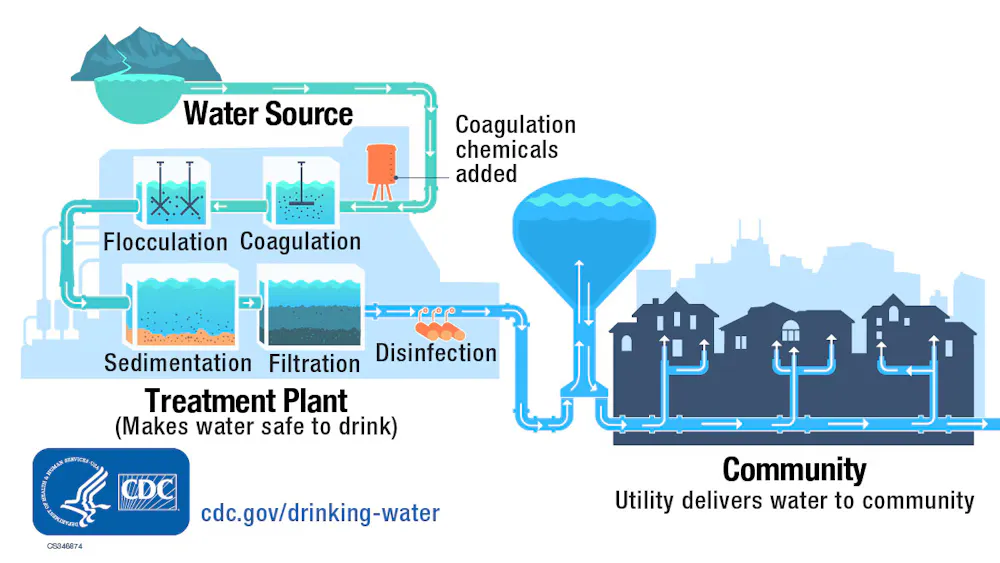
    Today, the process of cleaning water begins with the same steps employed by the ancient Egyptians, followed by extensive filtration to get rid of debris as well as most germs and chemicals. Chlorine is added to kill lingering pathogens, including those that may reside in the service pipes carrying the water to the faucet. Beginning in the 1940s, a small amount of fluoride was added as an inexpensive, safe and effective means to improve dental health.

    The cleanliness and fluoridation of the water supply has dramatically reduced infectious disease and cavities, and has been heralded as one of the 20th century’s greatest public health achievements.

    Is raw water healthier than tap water?

    People who champion raw water claim it has health benefits, such as essential minerals and beneficial bacteria called probiotics, that are stripped from tap water. Let’s unpack each of these claims.

    Water dissolves bits of soil and rock at its source; therefore, its mineral content depends on the local geology. Areas with a lot of limestone, like the Midwest, have water that is higher in calcium. Water from deeper in the ground may have higher mineral content since it passes through more rock on its way to the surface.

    The mineral content of water largely depends on its source and location.
    Sergii Zyskо/iStock via Getty Images Plus

    The idea that tap water is depleted of essential minerals is not true, as these nutrients are too small to be excluded by the filtration process. Test kits can determine the mineral content of your water, and if you find it lacking, mineral supplements can be added. Experts suggest, however, that most minerals you need come from your diet, not water.

    Some also claim that raw water contains probiotics that are removed from tap water. The amount of probiotics in water would also vary by location, and the notion that health-promoting bacteria reside in raw water has not been proved.

    There are no studies associating raw water with any health benefit. Anecdotal claims about smoother skin or increased energy are likely to be placebo effects. Even the idea that raw water tastes better might be more psychological than physiological – a 2018 study showed that most people preferred tap water over bottled water in a blind taste test.

    Risks of drinking raw water

    Raw water carries the risk of serious gastrointestinal infection from a wide variety of pathogens.

    Water-borne viruses include rotavirus and norovirus, which cause rapid-onset diarrhea and vomiting, and hepatitis A, which infects the liver. Bacteria such as E. coli and Salmonella, or parasites like Cryptosporidium and Giardia, also cause severe diarrhea that can lead to dangerous levels of dehydration. Toxoplasma gondii can also lurk in raw water and can cause miscarriage or birth defects if consumed during pregnancy.

    Tap water undergoes several treatment steps before it reaches your faucet.
    CDC

    Carriers of diarrheal infections can transmit them to others if they swim in public pools or fail to properly wash their hands before touching others or preparing food. Norovirus is particularly durable and can survive on surfaces for days, increasing chances of it infecting someone else.

    Raw water can also contain algae that release toxins causing abdominal issues and damage to the brain and nervous system.

    Cholera, dysentery and typhoid fever are no longer health burdens in the U.S. thanks to a robust water treatment system. But areas of the world lacking this privilege suffer high child mortality and widespread diarrheal diseases.

    How safe is tap water in the US?

    Tap water in the U.S. is among the safest to drink in the world. The Biden administration took steps to further improve it, including funding to replace lead pipes and new rules to monitor forever chemicals like perfluoroalkyl and polyfluoroalkyl substances, or PFAS, which have been linked to cancer and developmental disorders.

    Importantly, raw water is not necessarily free from lead, arsenic, pesticides or industrial contaminants. Raw water sources are not reliably monitored by experts, so it is difficult to say which ones pose less risk. In addition, the water may be acceptably safe one day, but not on another. For example, soil runoff from a storm could introduce new germs or pollutants into the area.

    The Environmental Protection Agency routinely screens for nearly 100 contaminants to ensure tap water is safe. In contrast, raw water remains untested, unregulated and untreated, leaving its safety to drink in question. In terms of risks and benefits, there are no demonstrated health benefits from drinking raw water, but clear evidence that you may be exposing yourself to harmful infectious and toxic contaminants.

    Bill Sullivan receives funding from the National Institutes of Health.

    ref. How does raw water compare to tap water? A microbiologist explains why the risks outweigh the benefits – https://theconversation.com/how-does-raw-water-compare-to-tap-water-a-microbiologist-explains-why-the-risks-outweigh-the-benefits-246866

    MIL OSI – Global Reports

  • MIL-OSI Global: Compendium of the Occult by Liz Williams is a rich and appealing history

    Source: The Conversation – UK – By Martha McGill, Honorary Research Fellow, Historian of Supernatural Beliefs, University of Warwick

    In the fourth century BC, an unknown – but clearly disgruntled – schemer from the Greek city of Antioch had a curse tablet made. Inscribed on a thin piece of lead and deposited in a well, the tablet called for a “thunder-and-lightning-hurling” god to “strike, bind, bind together Babylas the greengrocer”.

    Around 1,400 years later, an Anglo-Saxon charm advised on how to protect a field. The secret was to take a piece of turf from each corner and anoint it with a mixture of oil, honey, yeast, milk from the animals on the land, pieces of the trees and plants on the land, and water consecrated to the god Thunor.

    In 17th-century England, the antiquarian Elias Ashmole hoped an astrological talisman would expel vermin from his house. Meanwhile, the diarist Samuel Pepys cured his upset stomach by purchasing a new hare’s foot. In 19th-century New Orleans, the Louisiana Creole woman Marie Laveau became famous for her healing, clairvoyance and work as a voodoo priestess, which she displayed in public gatherings at Congo Square.

    These are among the many fascinating snippets discussed in Liz Williams’s new book, Compendium of the Occult: Arcane Artefacts, Magic Rituals and Sacred Symbolism. Looking at western occult traditions from ancient times to the present day, the book explores how human societies have sought power, protection and insight from gods and stars, spells and amulets, sacred places and seductively enigmatic organisations.


    Looking for something good? Cut through the noise with a carefully curated selection of the latest releases, live events and exhibitions, straight to your inbox every fortnight, on Fridays. Sign up here.


    The book is made up of 65 short articles, grouped into six sections: the origins of western occultism; divination, rituals and rites; charms and talismans; curses and hexes; secret societies; and sites of significance.

    Many of the articles cover several centuries, meaning there is no scope for detailed analysis. However, Williams strikes an effective balance between general overview and colourful examples. She is sensitive to differences in perspective, noting the competing explanations for phenomena such as dowsing or Ouija boards.

    She also acknowledges the complexities of reconstructing past beliefs and practices from imperfect surviving evidence, although occasionally unreliable source material is not sufficiently interrogated. The book accepts too readily, for example, the questionable story that Louis XIV’s mistress Madame de Montespan arranged “black masses” in which she used the blood of babies to summon the devil.

    Magic and maladies

    Compendium of the Occult is handsomely bound, pleasingly laid out and beautifully illustrated. There are images of ancient clay tablets crisscrossed with incantations, witch bottles stuffed with nails and urine, voodoo dolls, mummies, skulls, books, statues, artworks and protective amulets in the shape of jaunty phalluses.

    The book accepts too readily that Louis XIV’s mistress Madame de Montespan used the blood of babies to summon the devil.
    Wiki Commons

    Some of the printing causes confusion, however. “Gold dots” on the timelines are difficult to see, as is the introduction’s small white text on black pages. The dating of some entries lacks obvious logic: “palmistry” is dated from the 5th to the 1st century BC, even though the article stretches to the 20th century, and other practices get the vaguer label “ancient times to the present day”. But these are minor quibbles.

    More significantly, the book’s geographical remit is limited. The introduction refers to occult traditions in “the west”, but Britain is a particular focal point. Williams discusses eight “sites of significance”, of which three (Glastonbury, Avebury and Stonehenge) can be found within a 75-mile span in England.

    She does cover ancient Egypt and Mesopotamia; there is an entry on voodoo; there are references to the influences of Arabic astrologers, and occasional mentions of practices in east Asia. But more engagement with occult traditions from beyond Europe, particularly in modern times, would have enhanced the volume and better justified the ambitious title.

    A 1660 illustration of Claudius Ptolemy’s geocentric model of the Universe, from Compendium of the Occult.
    Wikimedia Commons

    All the same, this is a rich and appealing book. Humankind’s inventiveness in conceptualising the workings of the world emerges with force. Much magic is underpinned by a belief that the everything is interwoven: the earth corresponds to the skies, the microcosm of the human body to the macrocosm of the universe.

    Williams quotes the physician and polymath Cornelius Agrippa (1486-1535), who described how a square inscribed with numbers, stamped on a silver plate at the right hour, could call on Jupiter to bring the owner wealth and peace. If printed on coral, it could destroy evil spells.

    Material objects, plants, numbers and heavenly bodies are drawn into a symbiotic relationship, and invested with the power to reshape human lives. Agrippa’s plates reflect an enduring desire to situate humankind in relation to the environment, and impose meaning and harmony on a chaotic cosmos.

    Martha McGill does not work for, consult, own shares in or receive funding from any company or organisation that would benefit from this article, and has disclosed no relevant affiliations beyond their academic appointment.

    ref. Compendium of the Occult by Liz Williams is a rich and appealing history – https://theconversation.com/compendium-of-the-occult-by-liz-williams-is-a-rich-and-appealing-history-246925

    MIL OSI – Global Reports

  • MIL-OSI United Kingdom: UK Government in Scotland marks Holocaust Memorial Day

    Source: United Kingdom – Executive Government & Departments

    Scotland Office Minister Kirsty McNeill marked Holocaust Memorial Day by urging Scots to “unite in the stand against hatred, intolerance and prejudice”

    Minister McNeill was shown around the Scottish Jewish Heritage Centre, located within Garnethill Synagogue, by manager Kerry Patterson and Lionel Most, chair of the centre.

    This year’s Holocaust Memorial Day (HMD) is the 80th anniversary since the liberation of the Nazi concentration and death camp, Auschwitz-Birkenau.

    Events are taking place across Scotland, the UK and worldwide to remember the six million Jewish men, women and children who were murdered in the Holocaust, other victims of Nazi persecution and those who died in subsequent genocides.

    Increasing education about the danger of discrimination and preventing the spread of hatred is a key objective of the activity.

    The UK Government is committed to supporting all communities so they can live and worship safely – and through the Plan for Change will deliver a decade of national renewal, providing opportunity for all.

    Among the events in Scotland, Minister McNeill visited the Scottish Jewish Heritage Centre and Garnethill Synagogue in Glasgow ahead of HMD.

    Here she heard more about the community’s history and vast contributions to life in Scotland, the venue’s Holocaust education programmes and modern day antisemitism challenges.

    The Minister also hosted a pre-HMD event at the UK Government’s Edinburgh hub, Queen Elizabeth House, with Gillian Field – daughter of Holocaust survivors Henry Wuga MBE and Ingrid Wolff BEM.

    Here a captivated audience heard Gillian describe the story of how her parents met in Glasgow after they were brought to the city in 1939, aged 15, through Kindertransport – a rescue operation that moved Jewish children from Nazi-controlled Europe to safety in Britain.

    Both her parents deservedly received honours for their services to Holocaust education and Gillian now continues their legacy by shining a light on Jewish life across Scotland.

    Minister McNeill said:

    The annual Holocaust Memorial Day is a moment for us all to pause, reflect, and remember the six million Jews murdered during the Holocaust. It also commemorates other victims of Nazi persecution, those who died in more recent genocides, and educates about the importance of continuing to unite in the stand against hatred, intolerance and prejudice.

    For the past 200 years the Jewish community has made a significant contribution to life in Scotland, a nation which I’m proud to say played a key role in providing sanctuary to so many refugees. It was a privilege to meet community leaders at the Scottish Jewish Heritage Centre and Garnethill Synagogue and hear of their excellent work. My conversations with them and Gillian Field fill me with hope that the horrors of the past will never be forgotten and that love and respect continue to be the values by which our diverse range of Scottish communities enjoy their lives.

    To mark HMD communities and organisations from across the UK are taking part in events including ones by the Holocaust Memorial Day Trust – the charity established and funded by the UK Government to promote and support HMD.
    HMD also commemorates the victims of more recent genocides of Rwanda, Srebrenica, and acts of genocide in Cambodia and against the Yazidi people.

    The BBC is marking HMD with programmes across tv, radio and online, as well as full coverage of the Auschwitz Ceremony from Poland and commemorative events across the UK.

    Further information

    • The Scottish Jewish Heritage Centre, located within Garnethill Synagogue, houses Scotland’s Jewish Archive Centre and tells the story of Jewish life in Scotland.
      Garnethill Synagogue, opened in 1879, is Scotland’s oldest purpose-built synagogue and is Category A listed.
    • The centre plays a vital role in Holocaust education and preserving the memories of Jewish refugees who made Scotland their home.
    • Minister McNeill was shown around the synagogue and centre by manager Kerry Patterson and Lionel Most, chair of the centre.

    Updates to this page

    Published 27 January 2025

    MIL OSI United Kingdom

  • MIL-OSI: NEWTON GOLF Company Provides Preliminary Financial Results for Fourth Quarter 2024 and Full Year 2024

    Source: GlobeNewswire (MIL-OSI)

    CAMARILLO, CA, Jan. 27, 2025 (GLOBE NEWSWIRE) — NEWTON GOLF Company (Nasdaq: SPGC) (“NEWTON GOLF” or the “Company”), a technology-forward golf company with a growing portfolio of golf products, including putters, golf shafts, golf grips, and other golf-related accessories, reports preliminary financial results for the fourth quarter of 2024 (three months ended December 31, 2024) and full year of 2024 ahead of its quarterly filing.

    Financial Highlights

    • Revenue is expected to be between $1.1 million – $1.3 million in 4Q24, an increase of 882% at the midpoint of the range from revenue of $117,000 in 4Q23
    • Gross margin is expected to increase from 36% in 4Q23 to 72-74% in 4Q24, driven by increased sales and efficiencies in the manufacturing process in calendar 2024
    • Full year 2024 revenue is expected to increase from $349,000 in fiscal 2023 to $3.4 million – $3.6 million, representing almost 10-fold growth
    • Full year 2024 gross margin is expected to increase from 35% in fiscal 2023 to 65-67%, driven by increased volume in manufacturing in calendar 2024

    2024 Corporate Highlights

    • Announced a complete rebranding of the Company to NEWTON GOLF Company
    • Launched the Newton Fairway Motion shafts
    • Launched the new Newton Gravity premium putter line through the introduction of five new putter models
    • Expanded the Company’s global presence with the launch of the Newton Motion shafts in 50 of Japan’s largest golf retail locations
    • Increased the number of golf professionals using the Newton Motion Shafts on the PGA TOUR Champions from less than five at the beginning of 2024 to 34 at the end of 2024
    • Executed successful digital campaigns with high return on ad spending that were instrumental in the Company’s revenue growth
    • Closed on $9.1 million in financings to support the Company’s strategic growth
    • Introduced new advanced performance shafts for higher swing speeds in January 2025

    NEWTON GOLF Executive Chairman Greg Campbell commented, “Our expected improved results in 4Q24 and full year 2024 is reflective of the growing acceptance of our unique technology and design elements in our putters and replacement shafts. We recognized significantly increased sales of our NEWTON Motion replacement shafts throughout 2024 from both professional and recreational golfers, and we expect that momentum to continue in 2025. Despite it being generally off season for golf, we were pleased with our Black Friday and Cyber Monday sales, and we look forward to improved gross margin performance as we scale production and bring down unit cost.”

    This press release contains preliminary estimated financial results for the quarter and fiscal year ended December 31, 2024, and the financial results may change as a result of management’s continued review. The preliminary financial information included in this press release reflects the Company’s current estimates based on information available as of the date of this press release and has been prepared by Company management. This preliminary financial and operational information should not be viewed as a substitute for full financial statements and is not necessarily indicative of the results to be achieved for any future periods. This preliminary financial and operational information could be impacted by the effects of financial closing procedures, final adjustments, and other developments.

    About NEWTON GOLF: A Sacks Parente Company

    NEWTON GOLF: A Sacks Parente Company, is a technology-forward golf company that help golfers elevate their game. With a growing portfolio of golf products, including putters, golf shafts, golf grips, and other golf-related accessories, the Company’s innovative accomplishments include: the First Vernier Acuity putter, patented Ultra-Low Balance Point (ULBP) putter technology, weight-forward Center-of-Gravity (CG) design, and pioneering ultra-light carbon fiber putter shafts.

    In consideration of its growth opportunities in golf shaft technologies, the Company expanded its manufacturing business in April of 2022 to develop the advanced Newton brand of premium golf shafts by opening a new shaft manufacturing facility in St. Joseph, MO. It is the Company’s intent to manufacture and assemble substantially all products in the United States, while also expanding into golf apparel and other golf-related product lines to enhance its growth.

    The Company’s future expansions may include broadening its offerings through mergers, acquisitions or internal developments of product lines that are complementary to its premium brand. The Company currently sells its products through resellers, the Company’s websites, Club Champion retail stores, and distributors in the United States, Japan, and South Korea.

    For more information, please visit the Company’s website at www.newtongolfco.com or on social media at @newtongolfco.com, @newtonshafts, or @gravityputters.

    Investor Contact for NEWTON GOLF
    CORE IR
    516-222-2560
    investors@sacksparente.com

    The MIL Network

  • MIL-OSI China: Chinese FM calls on China, India to foster cooperation, not division

    Source: China State Council Information Office

    China and India should strive for mutual understanding, support and collaboration, rather than fostering suspicion, alienation and consuming each other, Chinese Foreign Minister Wang Yi said Monday.

    Wang, also a member of the Political Bureau of the Communist Party of China Central Committee, made the remarks during a meeting with India’s Foreign Secretary Vikram Misri in Beijing.

    Noting that since the leaders of the two countries met in Kazan last year, the two sides have earnestly implemented the important consensus reached by the leaders, carried out active interactions at all levels, and accelerated the process of improving China-India relations, Wang said both sides should seize the opportunity to meet each other halfway and explore more substantive measures.

    The improvement and development of China-Indian relations are fully in line with the fundamental interests of the two countries and peoples, and are conducive to safeguarding the legitimate rights and interests of the Global South countries and contributing to the peace, stability, development and prosperity of Asia and the world, Wang added.

    Misri said that India and China have carried out a series of useful dialogues and communications in accordance with the consensus reached by the leaders of the two countries in Kazan, properly managed and resolved differences, and promoted the resumption of pragmatic cooperation in various fields.

    India is willing to celebrate the 75th anniversary of the establishment of diplomatic relations with China, and will fully support China’s work as the presidency of the Shanghai Cooperation Organization, Misri added.

    MIL OSI China News

  • MIL-OSI Economics: RBI imposes monetary penalty on The Kheralu Nagrik Sahakari Bank Limited, Dist. Mehsana, Gujarat

    Source: Reserve Bank of India

    The Reserve Bank of India (RBI) has, by an order dated January 24, 2025, imposed a monetary penalty of ₹1.50 lakh (Rupees One Lakh Fifty Thousand only) on The Kheralu Nagrik Sahakari Bank Limited, Dist. Mehsana, Gujarat (the bank) for non-compliance with directions issued by RBI on ‘Investment by Primary (Urban) Co-operative Banks’ and ‘Know Your Customer (KYC)’. This penalty has been imposed in exercise of powers conferred on RBI under the provisions of Section 47A(1)(c) read with Sections 46(4)(i) and 56 of the Banking Regulation Act, 1949.

    The statutory inspection of the bank was conducted by RBI with reference to its financial position as on March 31, 2023. Based on supervisory findings of non-compliance with RBI directions and related correspondence in that regard, a notice was issued to the bank advising it to show cause as to why penalty should not be imposed on it for its failure to comply with the said directions. After considering the bank’s reply to the notice and oral submissions made during the personal hearing, RBI found, inter alia, that the following charges against the bank were sustained, warranting imposition of monetary penalty:

    The bank had:

    1. breached the prescribed ceiling of total investments held under Held to Maturity (HTM) category; and

    2. failed to carry out periodic review of risk categorization of certain accounts at least once in six months.

    This action is based on deficiencies in regulatory compliance and is not intended to pronounce upon the validity of any transaction or agreement entered into by the bank with its customers. Further, imposition of this monetary penalty is without prejudice to any other action that may be initiated by RBI against the bank.

    (Puneet Pancholy)  
    Chief General Manager

    Press Release: 2024-2025/2016

    MIL OSI Economics

  • MIL-OSI Economics: RBI imposes monetary penalty on Marketyard Commercial Cooperative Bank Limited, Unjha, Dist. Mehsana, Gujarat

    Source: Reserve Bank of India

    The Reserve Bank of India (RBI) has, by an order dated January 23, 2025, imposed a monetary penalty of ₹5.50 lakh (Rupees Five Lakh Fifty Thousand only) on Marketyard Commercial Cooperative Bank Limited, Unjha, Dist. Mehsana, Gujarat (the bank) for non-compliance with certain directions issued by RBI on ‘Donations / Contributions for public /charitable purposes out of profits of UCBs’, ‘Donations to Trusts and Institutions where Directors, their relatives hold position or are interested’, ‘Loans and advances to directors, their relatives, and firms / concerns in which they are interested’ and ‘Know Your Customer (KYC)’. This penalty has been imposed in exercise of powers conferred on RBI, under the provisions of Section 47A(1)(c) read with Sections 46(4)(i) and 56 of the Banking Regulation Act, 1949.

    The statutory inspection of the bank was conducted by RBI with reference to its financial position as on March 31, 2023. Based on supervisory findings of non-compliance with RBI directions and related correspondence in that regard, a notice was issued to the bank advising it to show cause as to why penalty should not be imposed on it for its failure to comply with the said directions. After considering the bank’s reply to the notice and oral submissions made during the personal hearing, RBI found, inter alia, that the following charges against the bank were sustained, warranting imposition of monetary penalty:

    The bank had:

    1. made donation to trusts in excess of prescribed ceiling;

    2. made donations to certain trusts in which the bank’s directors were interested;

    3. sanctioned certain director related loans; and

    4. failed to carry out periodic review of risk categorization of certain accounts at least once in six months.

    This action is based on deficiencies in regulatory compliance and is not intended to pronounce upon the validity of any transaction or agreement entered into by the bank with its customers. Further, imposition of this monetary penalty is without prejudice to any other action that may be initiated by RBI against the bank.

    (Puneet Pancholy)  
    Chief General Manager

    Press Release: 2024-2025/2015

    MIL OSI Economics

  • MIL-OSI United Kingdom: Foreign Secretary marks 80th anniversary of Auschwitz-Birkenau liberation on Holocaust Memorial Day

    Source: United Kingdom – Government Statements

    Foreign Secretary David Lammy will co-host the FCDO’s annual Holocaust Memorial Day reception with the Israeli Embassy today

    • Foreign Secretary will co-host a reception with the Embassy of Israel in the Foreign Office today
    • David Lammy will meet Holocaust survivor Janine Webber, who survived Nazi persecution in occupied Poland.
    • Senior UK delegation including HMTK will join world leaders at Auschwitz-Birkenau commemoration ceremony in Poland

    The Foreign Secretary will today co-host a reception with the Her Excellency the Ambassador of Israel to the United Kingdom to mark Holocaust Memorial Day and the 80th anniversary of the liberation of Auschwitz-Birkenau concentration camp.

    Prior to the commemoration, the Foreign Secretary will meet Holocaust survivor Janine Webber BEM, who survived the Holocaust as child in occupied Poland, enduring the tragic loss of her parents and brother at the hands of the Nazis.

    The commemoration will showcase innovative approaches to Holocaust education. These include Testimony 360, a virtual reality programme preserving survivor testimonies for future generations, and ‘In Their Footsteps’, a powerful exhibition featuring 3D-printed shoes that symbolise Holocaust remembrance.    

    Foreign Secretary David Lammy is expected to say:

    Never again’ is a solemn promise, which we owe to the victims, but also which we must uphold for our own sake and for the sake of future generations.

    We need Holocaust remembrance. Holocaust education. Action against antisemitism.

    It is how we build a better future for all.

    A high-level UK delegation, including senior government officials, His Majesty The King and Holocaust survivors, will join world leaders today at the Auschwitz-Birkenau commemoration ceremony in Poland today.

    As part of the UK’s commitment to Holocaust remembrance, the Prime Minister pledged at least £2.2 million in September to continue to fund the Holocaust Educational Trust’s Lessons from Auschwitz project, enabling UK students to visit Auschwitz and learn about the history of the Holocaust.

    Background

    • Holocaust Memorial Day is marked annually on 27 January. As set out by the Holocaust Memorial Day Trust, the Holocaust is central to Holocaust Memorial Day and we remember the six million Jews murdered during the Holocaust. It also commemorates the millions more people murdered through the Nazi persecution of other groups and in the more recent genocides of Rwanda, Srebrenica, and acts of genocide in Cambodia and against the Yazidi people.
    • The UK currently holds the presidency of the International Holocaust Remembrance Alliance, until 28 February.
    • See more information about Holocaust Memorial Day, and Janine Webber BEM.
    • All imagery from the event and the Foreign Secretary’s attendance will be available on flickr, following its conclusion.
    • Remarks from the Foreign Secretary’s speech will be available on gov.uk shortly after the event.

    Media enquiries

    Email newsdesk@fcdo.gov.uk

    Telephone 020 7008 3100

    Contact the FCDO Communication Team via email (monitored 24 hours a day) in the first instance, and we will respond as soon as possible.

    Updates to this page

    Published 27 January 2025

    MIL OSI United Kingdom

  • MIL-OSI Europe: ASIA/PHILIPPINES – A cap on the price of rice: the government’s measure to prevent speculation

    Source: Agenzia Fides – MIL OSI

    Manila (Agenzia Fides) – In an effort to curb the rise in rice prices, the Manila government has set a limit of 58 pesos per kilogram for imported rice, after carrying out “extensive consultations” with importers, retailers and government agencies. The measure, which came into effect on January 20, provides for a gradual reduction in the cost of rice. The Minister of Agriculture, Francisco Tiu Laurel Jr., explained that the initial recommended selling price will be 58 pesos per kilo, focused mainly on containing prices in the metropolitan area of Manila. Subsequently, the price will be reduced progressively: to 55 pesos on February 5, to 52 pesos on February 15 and, finally, to 50 pesos on March 1, with the expectation of reaching 49 pesos if international prices remain stable.According to Minister Laurel, “the gradual reduction will allow for an orderly transition in the market, avoiding destabilization of the rice sector and ensuring that companies can adapt without major disruption.” The recommended price of the staple food will be reviewed every month to take into account new factors affecting cereal prices. On the one hand, the Government wants to ensure that “the price of rice is fair and affordable”; on the other, it wants to ensure that the rice industry remains profitable, but avoiding speculation: “We cannot allow the greed of a few to endanger the well-being of an entire nation,” he said. The Agriculture Minister has reiterated plans to distribute subsidies to rice farmers during the planting season to increase local production of palay (unhulled rice) by 2025. The “Rice Competitiveness Enhancement Fund” is a government fund dedicated to rice farmers, the amount of which has been tripled to reach 30 billion pesos by 2025. This has come about following the Rice Tariff Law, enacted in 2018 and amended by Congress last December, to expand funding for the modernization of the rice industry. About 6 billion of the initial 10 billion will go to agricultural mechanization, and 4 billion to seeds. Other components to be funded include solar irrigation, diversification and financial aid to rice farmers. The aim is to help farmers get agricultural support during the planting season, including timely delivery of seeds and fertilizers, which will ensure efficient planting and increase productivity. National rice production this year is expected to be 20 million tons, compared to the 19.3 million tons estimated for the end of 2024. In the Philippines, rice production is a key aspect of the country’s food supply and economy. There are an estimated 2.4 million rice farmers in the country. “They are the backbone of the country and provide basic food for everyone. It is important to protect their work and ensure that the population can benefit from rice at a fair price,” explain the priests of the Diocese of San Jose, in the province of Nueva Ecija, in the north of the Philippines. They point out that “if rice is overpriced, it is above all the poor and the less well-off who suffer.” In the area, known as the “rice field of the Philippines”, the local Catholic Church has always supported farmers and, in recent years, has also launched training programs to teach organic farming techniques. (PA) (Agenzia Fides, 27/1/2024)
    Share:

    MIL OSI Europe News

  • MIL-OSI Europe: VATICAN – Pope Francis: The Word of God always amazes us and calls us to be witnesses of the Gospel

    Source: Agenzia Fides – MIL OSI

    Sunday, 26 January 2025

    Vatican Media

    Vatican City (Agenzia Fides) – “The salvation Jesus bestows on us is not yet fully realized. We know this. Yet wars, injustice, pain and death will not have the final word. The Gospel never disappoints”.In St. Peter’s Basilica in the Vatican, Pope Francis presided over the Holy Mass on the occasion of the VI Sunday of the Word of God, established in 2019 by the Pontiff himself. The Celebration also marked the conclusion of the three-day event dedicated to the Jubilee of the world of Communication.When we hear the Gospel, the words of God, the Pope suggested, “it is not simply a matter of listening to or understanding them, no. They must reach our hearts and bring about what I said, “amazement”. The word of God always amazes us; it always renews us. It enters our hearts and always renews us”. In fact, “the whole Bible speaks of Christ and his work, which the Spirit makes present and active in our lives and in history. When we read the Scriptures, when we pray and study them, we do not simply receive information about God; we receive his Spirit, who reminds us of all that Jesus said and did. In this way, our hearts, inflamed by faith, wait in hope for the coming of God”.“Let us respond with ardor to the joyful announcement of Christ! The Lord, in fact, did not speak to us as silent listeners, but as witnesses, calling us to evangelize at all times and in all places”, concluded the Pope who then conferred the ministry of Lector to forty lay men and women, from various nations: 4 from Albania, 3 from Argentina, 5 from Austria, 1 from Bolivia, 4 from Brazil, 5 from the Philippines, 1 from Iceland, 6 from Italy, 5 from Mexico, 1 from Poland, 5 from Slovenia.According to the rite, each of them received a copy of the Nova Vulgata Bible: “We are grateful to them and we pray for them. We are all praying for you. Let us commit ourselves to bringing the good news to the poor, proclaiming release to captives and recovery of sight to the blind, letting the oppressed go free and announcing the year of the Lord’s favour”.After the celebration, the Pontiff appeared in St. Peter’s Square for the Angelus prayer. And on the eve of the International Day of Commemoration in memory of the victims of the Holocaust, which this year coincides with the 80th anniversary of the liberation of the Auschwitz concentration camp, Pope Francis recalled the horrors of the Shoah, during which “many Christians also died, including numerous martyrs. The horror of the extermination of millions of Jews and people of other faiths during those years can neither be forgotten nor denied”.The Pontiff then turned his thoughts to the ongoing conflict in Sudan, which “is causing the most serious humanitarian crisis in the world, with dramatic consequences in South Sudan too. I am close to the peoples of both countries and I invite them to fraternity, solidarity, to avoid any kind of violence and not to allow themselves to be exploited. I renew my appeal to those who are at war in Sudan for them to put an end to hostilities and to agree to sit at the negotiating table. I urge the international community to do all it can to get the necessary humanitarian aid to the displaced people and to help the belligerents find paths to peace soon”.The Pope also drew attention to the situation in Colombia, in particular in the Catatumbo region, “where clashes between armed groups have claimed many civilian lives and displaced more than thirty thousand people. I express my closeness to them and pray for them”, added the Bishop of Rome, who did not forget that today is World Leprosy Day: “I encourage all those who work on behalf of those afflicted by this disease to continue their efforts, also helping those who heal to be reintegrated into society. May they not be marginalized!” (F.B.) (Agenzia Fides, 26/1/2025)
    Share:

    MIL OSI Europe News

  • MIL-OSI Europe: EUROPE/ITALY – The testimony of Roseline Hamel at the ‘Jubilee of the world of Communication’: “forgiveness is a force for peace and hope”

    Source: Agenzia Fides – MIL OSI

    by Pascale RizkRome (Agenzia Fides) – In a “world that is falling apart everywhere”, where many end up surrendering to evil even “for convenience”, there are also men and women of faith and good will who live and bear witness to “good and love above all”. And it is always worth being amazed by their stories, and telling them.These are words of humanity and hope that Roseline Hamel – sister of Father Jacques Hamel, the priest slaughtered in Normandy on 26 July 2016 by two young men addicted to Islamist propaganda – spoke on Saturday afternoon (January 25) in the Roman church of San Luigi dei Francesi during her speech at the event organised on the initiative of the “Fédération des Médias Catholiques” as part of the “Jubilee of Communication” celebrated in Rome over the weekend.Roseline Hamel, 84, who came to the meeting in a wheelchair, has herself become a tireless witness to what has happened in her life since the death of her brother, murdered in front of the altar of their church in the parish of Saint Etienne du Rouvray, near Rouen. With a radiant face and a calm, firm voice, Roseline left her house in Armentières for the third time this January to commemorate her brother, killed by those who mocked the name of God with their expressions of hatred.A few weeks after her brother’s death, Roseline had to undergo emergency surgery: she had become ill from the terrible pain. Then she set out to find the person who – she thought – could feel a similar pain to her own: the mother of Adel Kermiche, one of the two murderers. From that moment on, a story of healing and friendship began between the two women that has overcome all distances and differences. A story that Roseline tells whenever possible. “Father Jacques,” said the woman in a white blouse and scarf in the Roman church of San Luigi dei Francesi, “had begun interreligious dialogue with the Muslim community six years before his murder. To understand each other, we must know each other, and to know each other, we must talk to each other, despite the differences that can intimidate us. Only by facing them and their differences will we not be afraid of others. By sharing our joys and sorrows, not to unite us, but above all to understand each other. We are all human.””This is how Roseline Hamel was able to rediscover humanity in the overwhelming, powerful event of her brother’s murder during Mass,” stressed Samuel Lieven, editor of the weekly newspaper ‘le Pélerin’, who was also present at the meeting. Roseline had also been in Rome last year to meet Pope Francis for the third time. She had given him a homily by Father Jacques on the occasion of the awarding of the Father Jacques Hamel Prize for Interreligious Dialogue, established in 2017, which is awarded for “edifying testimonies that never ignore the incredible suffering, and the pain, and the desire that asks for grace to overcome them”, explained Philippine de Saint-Pierre, general director of the Catholic television station KTO. Philippe Lansac, general director of the Catholic radio station RCF, also spoke at the meeting, which was dedicated to the theme “How can Catholic media be builders of peace?” In her speech, Roseline Hamel recalled the urgency of “provoking” dialogue “by moving towards the unknown, towards the different,” recognizing that “we are all children of God, and therefore we are all brothers, children of the same Father.”The memory of Father Jacques Hamel, concluded Sister Roseline, , is also “the memory of his life lived in faith in Christ until the end, and testifies that in France and throughout the world, forgiveness is a force of peace and hope”.After an announcement on Good Friday, April 13, 2017, the diocesan phase of the beatification process was officially opened on May 20, 2017 and concluded last March 9 with the final session in the church of Notre Dame de l’Annonciation in the Archdiocese of Rouen (see Fides 12/03/2019). During this phase, 66 hearings were held, during which the five eyewitnesses to the murder were heard, 51 other witnesses were summoned (including family members of Father Hamel, friends, parishioners, priests …) and 5 ex officio witnesses. The main questions concerned the murder, the circumstances of the martyrdom under investigation, the life of Father Hamel and how he lived the Christian virtues, as well as his reputation for holiness and the events of grace attributed to his intercession. (Agenzia Fides, 26/1/2025)
    Share:

    MIL OSI Europe News

  • MIL-OSI: Greenbacker secures nearly $1 billion financing to support acquisition and construction of largest solar project in New York State

    Source: GlobeNewswire (MIL-OSI)

    • Greenbacker, together with Hecate Energy, has completed the development of its largest clean energy project to date. After acquiring the project from Hecate, Greenbacker closed on construction financing in conjunction with commencing construction.
    • Greenbacker partnered with six of the world’s leading project finance banks and financial institutions to secure $869 million in construction-to-term, letter of credit, and tax equity bridge loan financing and with a global investment manager for an additional $81 million development loan facility.
    • The 674 MWdc solar project is expected to power over 120,000 New York homes, support hundreds of green jobs.

    NEW YORK, Jan. 27, 2025 (GLOBE NEWSWIRE) — Greenbacker Renewable Energy Company LLC (“Greenbacker”), an independent power producer and energy transition-focused investment manager, today announced it has secured $950 million in aggregate financing to support the acquisition, construction, and operation of its largest clean energy project to date. When complete, the 674 MWdc / 500 MWac utility-scale solar farm (“Cider”) will be the largest solar project in the state of New York.

    Greenbacker acquired Cider from Hecate Energy LLC (“Hecate”), one of the largest renewable energy developers in the US. The two companies initially entered into a development partnership in 2021 to bring the project through development, financing, and the commencement of construction.

    Following the acquisition, Greenbacker closed on an $869 million financing composed of a construction-to-term loan, a tax equity bridge loan, and letters of credit. The financing was led collectively by six Coordinating Lead Arrangers: MUFG, KeyBanc Capital Markets, ING Capital LLC (“ING”), Intesa Sanpaolo S.p.A., New York Branch (“Intesa Sanpaolo”), Societe Generale, and Wells Fargo. MUFG and KeyBanc Capital Markets served as the Co-Documentation Agents and Co-Administrative Agents; ING, Intesa Sanpaolo, and Societe Generale, served as Co-Syndication Agents; ING and Wells Fargo served as Co-Green Structuring Agents. ING, Intesa Sanpaolo, and Societe Generale acted as Bookrunners.

    Greenbacker also successfully closed on an $81 million development loan with Voya Investment Management (“Voya IM”). The development loan with Voya IM was utilized to support Cider’s late-stage development, preliminary construction activities, and equipment procurement.

    With committed funds totaling nearly $1 billion, Cider represents another milestone for Greenbacker—its largest project financing to date.

    “Greenbacker has called New York home for 14 years, and we’re proud to be both the owner of the largest solar energy project in the state’s history and a driving force in accelerating its ambitious clean energy goals,” said Charles Wheeler, CEO of Greenbacker. “This substantial achievement—the result of successful collaboration across a group of top-tier institutions, including our long-time development partner Hecate—will create hundreds of green jobs, deliver affordable clean power, and help continue to build a sustainable future for New Yorkers.”

    Cider also marks the third clean energy collaboration between Greenbacker and Hecate. Over the past several years, Greenbacker has acquired over 70 MWac of utility-scale solar in New York from the developer.

    “Hecate is proud to once again partner with Greenbacker to complete the development of the Cider Project, which represents a landmark accomplishment for renewable energy development in the state,” said Nick Bullinger, Hecate’s Chief Operating Officer. “This project embodies Hecate’s mission to make impact at scale building out clean generation to power our future.”

    “This is the latest in a long history of project financing transactions with Greenbacker, highlighting our ongoing commitment to deploying capital with high-quality partners to help grow the clean energy industry,” said Gregory Berman, Director KeyBanc Capital Markets.

    “This transaction reflects our strong partnership with Greenbacker, belief in its sustainability mission, and commitment to advancing clean energy in New York and nationwide,” said Alberto Mihelcic Bazzana, Director at MUFG.

    Cider will utilize approximately 2,500 acres of land in Genesee County, where it began construction in late 2024. The project is expected to generate enough annual clean electricity to power approximately 120,000 average New York households.1

    “Greenbacker’s successful closing on this development loan facility and the bank syndicate’s construction and long-term facility is a pivotal achievement for our organization,” said Carl Weatherley-White, Greenbacker’s Head of Capital Markets. “Finalizing $950 million in capital to build the largest solar project in New York is a testament to the deep expertise and dedication of all parties involved.”

    Sheppard Mullin and Barclay Damon served as counsel for Greenbacker; Winston & Strawn LLP served as counsel for Hecate; Winston & Strawn LLP and Rath, Young, and Pignatelli, PC served as counsel for the bank syndicate; Latham & Watkins LLP served as counsel for Voya.

    Greenbacker is committed to empowering a sustainable world by connecting individuals and institutions with investments in clean energy. As of September 30, 2024, the company’s fleet of clean energy projects have produced over 10 million MWh of clean energy since 2016, abating more than 7 million metric tons of carbon2 and supporting thousands of green jobs.3

    About Greenbacker Renewable Energy Company
    Greenbacker Renewable Energy Company LLC is a publicly reporting, non-traded limited liability sustainable infrastructure company that both acquires and manages income-producing renewable energy and other energy-related businesses, including solar and wind farms, and provides asset management services to other renewable energy investment vehicles. We seek to acquire and operate high-quality projects that sell clean power under long-term contracts to high-creditworthy counterparties such as utilities, municipalities, and corporations. We are long-term owner-operators, who strive to be good stewards of the land and responsible members of the communities in which we operate. Greenbacker conducts its asset management business through its wholly owned subsidiary, Greenbacker Capital Management, LLC, an SEC-registered investment adviser. We believe our focus on power production and asset management creates value that we can then pass on to our shareholders—while facilitating the transition toward a clean energy future. For more information, please visit https://greenbackercapital.com.

    About Hecate Energy
    Hecate Energy was founded in 2012 by a team of energy industry veterans and has successfully developed 4.1 GWs of projects to construction or operations. Hecate believes in establishing beneficial, sustainable, and collaborative partnerships with the host communities where its projects are located and tailors each renewable energy project it develops to better meet the needs of project stakeholders.
    Hecate Energy has entered over 6 GWac of renewable power purchase agreements (PPAs) across 55 PPAs with 24 counterparties as well as projects that are selling through merchant markets. Projects that Hecate has developed and that are constructed or are under construction include over 4 GWac of solar projects and 103 MWac of battery storage projects totaling over $6 billion in asset value. Hecate has an active development pipeline of over 43.7 GWac of renewable projects.

    About MUFG and MUFG Americas
    Mitsubishi UFJ Financial Group, Inc. (MUFG) is one of the world’s leading financial groups. Headquartered in Tokyo and with over 360 years of history, MUFG has a global network with approximately 2,100 locations in more than 50 countries. MUFG has nearly 160,000 employees and offers services including commercial banking, trust banking, securities, credit cards, consumer finance, asset management, and leasing. The Group aims to be “the world’s most trusted financial group” through close collaboration among our operating companies and flexibly respond to all the financial needs of our customers, serving society, and fostering shared and sustainable growth for a better world. MUFG’s shares trade on the Tokyo, Nagoya, and New York stock exchanges.

    MUFG’s Americas operations, including its offices in the U.S., Latin America, and Canada, are primarily organized under MUFG Bank, Ltd. and subsidiaries, and are focused on Global Corporate and Investment Banking, Japanese Corporate Banking, and Global Markets. MUFG is one of the largest foreign banking organizations in the Americas. For locations, banking capabilities and services, career opportunities, and more, visit www.mufgamericas.com.

    About Voya Investment Management
    Voya Investment Management (IM) has approximately $392 billion in assets under management and administration as of Sept. 30, 2024, across public and private fixed income, equities, multi-asset solutions and alternative strategies for institutions, financial intermediaries and individual investors, drawing on a 50-year legacy of active investing and the expertise of 300+ investment professionals. Voya IM has cultivated a culture grounded in a commitment to understanding and anticipating clients’ needs, producing strong investment performance, and embedding diversity, equity and inclusion in its business.

    Forward-Looking Statements
    This press release contains forward-looking statements within the meaning of the federal securities laws. Forward-looking statements are not guarantees of future performance and involve known and unknown risks, uncertainties and other factors that may cause the actual results to differ materially from those anticipated at the time the forward-looking statements are made. Although Greenbacker believes the expectations reflected in such forward-looking statements are based upon reasonable assumptions, it can give no assurance that the expectations will be attained or that any deviation will not be material. Greenbacker undertakes no obligation to update any forward-looking statement contained herein to conform to actual results or changes in its expectations.

    Greenbacker media contact
    Chris Larson
    Media Communications
    646.569.9532
    c.larson@greenbackercapital.com

    MUFG media contact
    Alicia Faugier
    Corporate Communications
    afaugier@mufg.jp


    1Governor Hochul Announces Siting Approval of New York’s Largest Solar Facility to Date, governor.ny.gov.
    2EPA Greenhouse Gas Equivalencies Calculator. September 30, 2024.
    3 Data is as of September 30, 2024. Green jobs calculated using The National Renewable Energy Laboratory (NREL) State Clean Energy Employment Projection Support, nrel.gov.

    The MIL Network

  • MIL-OSI: Blackford Capital Acquires Ace Controls, Expanding PACIV, its Industrial Automation Platform

    Source: GlobeNewswire (MIL-OSI)

    GRAND RAPIDS, Mich., Jan. 27, 2025 (GLOBE NEWSWIRE) — Blackford Capital (“Blackford”), a leading lower middle market private equity firm, announced today the acquisition of Ace Controls, a Houston, Texas-based company renowned for designing and building industrial control panels. This acquisition diversifies Blackford’s Industrial Automation Platform, PACIV, to service a broader range of customers. Terms of the transaction are not being disclosed.

    Ace Controls is the third acquisition for the PACIV platform since its establishment in June 2023, following its add-on acquisitions of Data Science Automation in January 2024, and Eight12 Automation in May 2024. PACIV has already established a strong presence in the healthcare and life science industries, and the addition of Ace Controls brings a new focus on industrial applications in the water and wastewater industry, and also further expands the platform’s control panel capabilities. Ace Controls has a 95% repeat business rate from its customers, who represent the equipment manufacturing, electrical contracting, and general contracting sectors.

    Martin Stein, Founder and Managing Director of Blackford Capital, said, “Entering an additional highly regulated, strict tolerance end market with high entry barriers will enable PACIV to scale and diversify its business. Our PACIV platform thesis is to be a multi-dimensional industrial automation enterprise catering to life sciences, food and beverage, and water and wastewater companies.”

    Ace Controls President Agmed Aguirre founded the company in 2005 with a vision to serve the water and wastewater industries by building and distributing high-quality wholesale control panels designed with the end user in mind. Under his leadership over the past 20 years, Ace Controls has flourished, earning recognition as an industry leader. Agmed’s wife Lindsey Aguirre joined the business in 2006, playing a crucial role in administration and bookkeeping, which has helped to build a solid foundation for the company. The entire management team and all employees will remain with the PACIV platform post-acquisition.

    “We are excited to join the PACIV platform and are eager to gain access to new customers, receive additional services, and collaboratively achieve significant growth,” said Mr. Aguirre.

    Jeff Johnson, Managing Director and Chairman of the Board of PACIV, said, “We welcome the Ace Controls team to PACIV, who impressed us with their strong culture of continuous improvement, dedication to cost control, and customer service. We believe that by expanding PACIV’s control panel offerings we can achieve our ’one-stop’ goal for the platform and create a truly synergistic portfolio company.”

    The platform is headquartered in ​San Juan, Puerto Rico with offices in Indiana, Pennsylvania, California, Ireland, and now Texas.

    Generational Group served as exclusive financial advisor and Lancaster | Helling served as legal advisor to Ace Controls. Varnum LLP served as legal advisor and RSM US LLP served as the financial and tax advisor to Blackford and PACIV. Mercantile Bank provided debt financing, and Rush Street Capital provided financing advisory services in support of the transaction.

    About Blackford Capital
    Founded in 2010, Blackford Capital is a private equity investment firm headquartered in Grand Rapids, Michigan. Blackford acquires, manages, and builds founder and family-owned, lower middle-market companies, with a focus on the manufacturing, industrial and distribution industries. Blackford has a track record of exceptional returns, a disciplined and relentless approach to value creation, and a focus on operational excellence and a compelling culture. In 2023 and 2024, Blackford Capital was named to Inc’s list of Founder-Friendly Investors, was recognized by ACG Detroit with the 2023 M&A Dealmaker of the Year Award and awarded the 2023 Small Markets Deal of the Year award by both Buyouts Magazine and the Global M&A Network Atlas Awards. For more information, visit www.blackfordcapital.com.

    About Ace Controls
    Established in January 2005, Ace Controls leverages over 30 years of combined expertise in control panel design, fabrication, and integration to deliver reliable and cost-effective solutions. Serving the water and wastewater industries, as well as the oil and gas industries, Ace Controls caters to manufacturers of process equipment such as pumps, compressors, blowers, conveyors, mixers, and clarifiers, making Ace Controls a trusted partner in these critical sectors.

    Media Contact:
    Lambert by LLYC
    Jennifer Hurson
    (845) 729-3100
    jhurson@lambert.com

    Jackson Lin
    (646) 717-4593
    jlin@lambert.com

    A photo accompanying this announcement is available at https://www.globenewswire.com/NewsRoom/AttachmentNg/72daeb91-d04c-4f9e-a1d3-5374ce84b9fb

    The MIL Network

  • MIL-OSI: First commercial launch of biometric payment cards in Japan with LIFE CARD and IDEX Biometrics

    Source: GlobeNewswire (MIL-OSI)

    Oslo, Norway and Tokyo, Japan – 27 January 2025 – IDEX Biometrics enters a new market, together with LIFE CARD, Japan’s most innovative credit card issuer. This marks the market introduction of biometric payment cards in Japan. LIFE CARD is targeting commercial deployment in the first half of 2025.

    Japan is one of the largest payment markets in Asia, with a very advanced acceptance landscape which is ready for biometric smart cards. Credit cards have emerged to become the most popular alternative to cash in Japan, with 314 million cards issued. Accounting for more than 80% percent of cashless transactions, credit cards are used far more than any other digital payment instrument in Japan1.

    As a credit card issuer of Visa and Mastercard, LIFE CARD is commercializing premium, corporate and student card programs. Biometric payment cards will be a key differentiator and amplifier as LIFE CARD continues to lead innovation in the market.

    “LIFE CARD provides innovative, secure and frictionless payment solutions to our growing consumer base. Introducing the latest biometric technology and security to the Japanese market, will reinforce our market positioning, as we attract new customers and increase transactions and customer lifetime value” says Keiji Masui, President at LIFE CARD.

    “LIFE CARD and IDEX Biometrics are bringing more seamless and secure payments to consumers, confirming Japan’s technology and innovation leadership in payments. IDEX is committed to make card payments easier, more secure and accessible for Japanese consumers”, shared Catharina Eklof, Chief Executive Officer at IDEX Biometrics.

    1Source: Statista

    For further information contact:
    Marianne Bøe, Head of Investor Relations, + 47 91800186
    Kristian Flaten, CFO, +47 95092322
    E-mail:ir@idexbiometrics.com

    About IDEX Biometrics
    IDEX Biometrics ASA (OSE: IDEX) is a global technology leader in fingerprint biometrics, offering authentication solutions across payments, access control, and digital identity. Our solutions bring convenience, security, peace of mind and seamless user experiences to the world. Built on patented and proprietary sensor technologies, integrated circuit designs, and software, our biometric solutions target card-based applications for payments and digital authentication. As an industry-enabler we partner with leading card manufacturers and technology companies to bring our solutions to market.

    For more information, please visit www.idexbiometrics.com

    About LIFE CARD Co., Ltd.
    Since its inception in 1952, LIFE CARD has been at the forefront of pioneering advancements in Japan’s credit system. Leveraging its rich legacy of expertise and industry insights, LIFE CARD is dedicated to providing unparalleled support and service toits partners as well as customers.
    As a proud member of the esteemed AIFUL Group, one of the largest non-bank financial institutions in the nation, LIFE CARD remains steadfast in its commitment to driving financial inclusivity and empowerment across diverse sectors.

    Through synergistic collaborations within the group, LIFE CARD endeavors to spearhead the development of multifaceted financial ecosystems, catering to the evolving needs of its partners and clientele.

    For more information, please visit www.lifecard.co.jp

    Trademark Statement
    IDEX, IDEX Biometrics and the IDEX logo are trademarks owned by IDEX Biometrics ASA. All other brands or product names are the property of their respective holders.

    About this notice:
    This notice discloses inside information pursuant to the EU Market Abuse Regulation and was issued by Marianne Bøe, Head of Investor Relations, on 27 January 2025 at 13:02 CET on behalf of IDEX Biometrics ASA. The notice is published in accordance with section 5-12 the Norwegian Securities Trading Act.

    The MIL Network

  • MIL-OSI Economics: RBI announces measures to manage liquidity conditions

    Source: Reserve Bank of India

    On a review of current liquidity and financial conditions, the Reserve Bank has decided to conduct the following operations to inject liquidity into the banking system:

    1. OMO purchase auctions of Government of India securities for an aggregate amount of ₹60,000 crore in three tranches of ₹20,000 crore each to be held on January 30, 2025, February 13, 2025, and February 20, 2025

    2. 56-day Variable Rate Repo (VRR) auction for a notified amount of ₹50,000 crore to be held on February 7, 2025

    3. USD/INR Buy/Sell Swap auction of USD 5 billion for a tenor of six months to be held on January 31, 2025

    2. Detailed instructions for each operation shall be issued separately.

    3. The Reserve Bank will continue to monitor evolving liquidity and market conditions and take measures as appropriate to ensure orderly liquidity conditions.

    (Puneet Pancholy)  
    Chief General Manager

    Press Release: 2024-2025/2013

    MIL OSI Economics

  • MIL-Evening Report: Trump’s ‘ethnic cleansing’ Gaza idea dismissed by analysts – rejected by Jordan, Egypt on ‘Day of Return’

    Asia Pacific Report

    UN President Donald Trump’s idea of mass expulsion of Palestinians in Gaza to Jordan and Egypt has been dismissed by analysts as unaccepable “ethnic cleansing” and rejected by the governments of both neigbouring countries.

    Middle East analyst Mouin Rabbani, a nonresident research fellow at the Middle East Council on Global Affairs and commentator specialising in Palestinian affairs and the Arab-Israeli conflict, said the US and Israel would “fail” over such a plan.

    President Trump’s suggestion had been to “clean out” Gaza and move 1.5 million Palestinians to Jordan and Egypt.

    “Even if [President Trump] applies pressure on Jordan and Egypt, I think their leaderships will recognise the price of going along with Trump is going to be much greater than the price of resisting him — in terms of the survival of their leaderships for participating in something like this,” Rabbani told Al Jazeera, referring to Trump’s plan as “ethnic cleansing”.

    The rebuttals to the Trump idea came as Gaza experienced an historic day with jubilant scenes as tens of thousands of Palestinians crossed the so-called Netzarim Corridor to return home in the north showing their determination to survive under the 15-month onslaught by Israel’s military.

    Al Jazeera journalist Tamer al-Misshal said it was a “significant and historic moment” for the Palestinians.

    “It’s the first time since 1948 those who have been forced out of their homes and land managed to get back — despite the destruction and despite the genocide,” he said.

    He quoted one Palestinian man who returned as saying he would erect a tent on his destroyed home, “which is much better than being forcibly displaced from Gaza”.

    Al-Misshal noted Hamas recently said 18 more Israeli captives were alive and would be returned each Saturday in exchange for Palestinian prisoners over the next few weeks.

    He said the next main step was to get the Rafah land crossing opened so aid could flow and thousands of badly wounded Palestinians could get medical treatment abroad.

    ‘Blanket refusal’

    Analyst Mouin Rabbani . . . “Israel is not going to succeed in ethnically cleansing the Gaza Strip after a war.” Image: Middle East Council on Global Affairs

    Analyst Mouin Rabbani told Al Jazeera about the Trump displacement idea: “This isn’t going to happen because Israel is not going to succeed in ethnically cleansing the Gaza Strip after a war, after having failed to do so during a war.”

    When former US Secretary of State Antony Blinken went on a tour of Arab states to promote this idea late last year, he had been met with a “blanket refusal”, Rabbani added.

    Meanwhile, in Tel Aviv Prime Minister Benjamin Netanyahu was feeling the heat from his coalition partners over the ceasefire deal who view the Israeli leader as succumbing to US demands, the analyst said.

    “I think there’s a kind of a mix of personal, political and ideological factors at play,” Rabbani said.

    “Day of victory” . . . How Al Jazeera reported the return of Palestinians to north Gaza today. Image: AJ screenshot APR

    “But ultimately, I think the key relationship to look at here is not that between Netanyahu and his coalition partners, or between Israelis and Palestinians, but between Washington and Israel — because Washington is the one calling the shots, and Israel has no choice but to comply.”

    A senior Hamas official, Basem Naim, has described the “return” day as “the most important day in the current history of this conflict”.

    He said that Israel was “for the first time” obliged to allow Palestinians to return to their houses after being forced “by the resistance”, in a similar way that it was “forced to release” Palestinian prisoners.

    Al Jazeera’s Hani Mahmoud reporting on the “Day of Return” for Palestinians going back to north Gaza. Image: AJ screenshot APR

    ‘Very symbolic day’ in conflict
    “This is, I think, a very symbolic day,” he said. “This is a very important day in how to approach this conflict with the Israelis, which language they understand.”

    Naim also reaffirmed Hamas’s commitment to the ceasefire agreement and said the group was “ready to do the maximum to give this deal a chance to succeed”.

    He also accused Netanyahu and the Israeli government of playing “dirty games” in a bid to “sabotage the deal”.

    Jordanian officials have rejected President Trump’s “clean out” Gaza suggestion with
    Jordanian Foreign Minister Ayman Safadi saying that all talk about an alternative homeland for the Palestinians was rejected and “we will not accept it”.

    Al Jazeera’s Tareq Abu Azzoum reports from Salah al-Din Road, Gaza. Image: AJ screenshot APR

    He said any attempt to displace Palestinians from their land would not bring security to the region.

    The Jordanian House of Representatives said: “The absurdity and denial of Palestinian rights will keep the region on a simmering and boiling plate.”

    Jordan would not be an alternative homeland for displacement attempts against “the patient Palestinian people”.

    In Cairo, the Foreign Ministry reaffirmed in a statement Egypt’s “continued support for the steadfastness of the Palestinian people on their land.”

    It “rejected any infringement on those inalienable rights, whether by settlement or annexation of land, or by the depopulation of that land of its people through displacement, encouraged transfer or the uprooting of Palestinians from their land, whether temporarily or long-term.”

    The 1948 Nakba . . . more than 750,000 Palestinians were forced to leave their homeland and become exiles in neighbouring states and in Gaza. Many dream of their UN-recognised right to return. Image: Wikipedia

    MIL OSI AnalysisEveningReport.nz

  • MIL-OSI Asia-Pac: Sha Tin residential site sold

    Source: Hong Kong Information Services

    The tender for a residential site in Sha Tin has been awarded on a 50-year land grant at a premium of $606 million, the Lands Department announced today.

    Sha Tin Town Lot No. 651 at Mei Tin Road in Tai Wai was awarded to Forum Pacific, a subsidiary of Sun Hung Kai Properties.

    It has a site area of about 3,600 sq m and is designated for private residential purposes.

    The site’s minimum and maximum gross floor area are 10,800 sq m and 18,000 sq m.

    MIL OSI Asia Pacific News

  • MIL-OSI Asia-Pac: Traffic measures to be implemented

    Source: Hong Kong Information Services

    To facilitate festive events occurring on the first two days of the Lunar New Year, the Government will roll out special traffic and transport arrangements at various locations on Hong Kong Island and in Kowloon.

    In connection with the International Chinese New Year Night Parade due to be held in Tsim Sha Tsui at 8pm on January 29, the first day of the Lunar New Year, special traffic arrangements will be implemented in phases starting from 3.30pm that day. They will remain in place until the crowd has dispersed and the roads are safe for re-opening.

    During this period, the Star Ferry Bus Terminus and the China Ferry Terminal Bus Terminus will not be operational. On-street parking will be suspended, and pick-up/drop-off areas and carparks will be closed.

    With regard to the Lunar New Year fireworks display, which will be staged at 8pm on January 30, Police will enforce crowd safety management measures and special traffic arrangements on both sides of Victoria Harbour starting from 5pm.

    In addition, the Marine Department will implement marine traffic control measures and strengthen inspections of spectator vessels to ensure that safety requirements are met.

    MIL OSI Asia Pacific News