Category: Australia

  • MIL-OSI USA: Cole Secures Funding for Historic Areas Affected by Natural Disasters

    Source: United States House of Representatives – Congressman Tom Cole (OK-04)

    FOR IMMEDIATE RELEASE | CONTACTOlivia Porcaro 202-225-6165

    Washington, D.C. – Through his legislation, The American Relief Act, Congressman Tom Cole (OK-04) secured $50 million in competitive grant funding for the Historic Preservation Fund. This funding will allow areas, such as Historic Downtown Sulphur Commercial District, to be able to reconstruct and rehabilitate resources that were damaged or destroyed by natural disasters occurring in 2023 and/or 2024. After securing the funding, Congressman Cole released the following statement:

    “As a lifelong Oklahoman, I know just how much devastation and destruction natural disasters, like tornadoes, can cause. This past Spring, multiple tornadoes devastated parts of my district, including the Town of Sulphur and its Historic Downtown Commercial District. Therefore, today, I am proud to announce that $50 million secured in my legislation is now available to apply for to help rebuild and support the local downtowns, businesses, and historic areas that have been crushed,” said Congressman Cole. “As the representative for the Fourth District of Oklahoma, I will always ensure that I am fighting for my local communities, and I look forward to seeing this funding be put to good use.”

    How to apply for assistance:

    Entities will be able to apply for two types of funding needs – preservation and capacity.

    PRESERVATION:

    For this grant, eligible applicants are state governments, city of town governments, county governments, Native American tribes, certain nonprofits, special district governments, public and state-controlled institutions of higher education, independent school districts, Native American tribal organizations, and private institutions of higher education. The funding can be used for construction and rebuilding efforts of Historic Preservation Funding sites that have incurred damage in a natural disaster in 2023 and/or in 2024.

    To apply for the emergency supplemental historic preservation fund for preservation needs, click here. The application period is now open and will close on July 15, 2025.

    CAPACITY:

    For this grant, eligible applicants are nonprofits having a 501(c)(3) status, Native American tribes, and state governments. This funding can be used for capacity building, completing compliance requirements, survey, planning, and design.

    To apply for the emergency supplemental historic preservation fund for capacity needs, click here. The application is now open and will close on June 12, 2025.

    Please stay tuned for future announcements as additional disaster assistance is released and available to Oklahomans.

    ###

    MIL OSI USA News

  • MIL-OSI USA: Cole Conducts Hearing with Secretary of State Marco Rubio

    Source: United States House of Representatives – Congressman Tom Cole (OK-04)

    FOR IMMEDIATE RELEASE | CONTACT: Olivia Porcaro 202-225-6165

    Washington, D.C. – Today, Congressman Tom Cole (OK-04) and Subcommittee Chairman Mario Diaz-Balart (FL-26) led a budget hearing on the Department of State, where they collected testimony from Secretary of State Marco Rubio. After the hearing, Congressman Cole released the following statement:

    “Peace through strength is not a matter of chance. It is the result of effective policy, national focus, and marshaling resources to where they drive the maximum impact – and the America First agenda advances that critical doctrine. Under the Trump Administration, weakness and the detrimental policies of the previous administration will no longer harm our nation. U.S. taxpayer dollars will not be funneled to extreme agendas and initiatives that have undermined trust in foreign assistance programs. The Trump Administration has been clear about a new path forward, and I thank and support Secretary Rubio for his efforts to reorganize and streamline State Department operations to better integrate programs with our nation’s diplomatic and strategic objectives,” said Congressman Cole.

    ###

    MIL OSI USA News

  • MIL-OSI USA: Reps. Lofgren, Min, and Thompson Lead Letter To Remove Cap on SALT Deductions and Lower Taxes for California Households

    Source: United States House of Representatives – Representative Zoe Lofgren (D-San Jose)

    WASHINGTON, DC – Today, Representatives Zoe Lofgren (CA-18), Dave Min (CA-47), and Mike Thompson (CA-04) led 18 of their California colleagues in a letter to Speaker Mike Johnson and Chairman Jason Smith (MO-08) demanding tax relief for Californians. The lawmakers called for no cap on State and Local Tax (SALT) deductions in the GOP’s taxation bill. The letter was first reported by POLITICO

    The lawmakers wrote, “As the state with the largest economy in the country and the fourth largest economy in the world, California is by far the most generous of the thirteen donor states, meaning its residents paid far more in taxes to the federal government than it received in support. According to a 2022 Rockefeller Institute of Government study, California residents paid $83 billion more in federal taxes than they received in support. This means that for every dollar our constituents pay to the federal government, they get less than 88 cents in return. Our constituents pay more than their fair share of taxes to our nation and deserve tax relief in these difficult economic times.”

    The lawmakers continued, writing, “We respectfully request that you honor your commitment to states’ rights and tax relief by not imposing another painful and massive tax on California families and small businesses by creating a new SALT deduction cap.”

    The SALT deduction was created at the same time as the federal income tax in 1861 and was the first and only deduction allowed at that time. The SALT deduction has always been seen as the most important tax deduction, and is rooted in the principles of preventing federal overreach into states’ rights and preventing double taxation on hardworking Americans. The SALT dedication is as essential today as it was when it was first introduced in the 19th century.

    The full letter is available here. Representatives Gil Cisneros (CA-31), Lou Correa (CA-46), Jim Costa (CA-21), Laura Friedman (CA-30), Jimmy Gomez (CA-34), Jared Huffman (CA-2), Ted Lieu (CA-36), Jimmy Panetta (CA-19), Linda Sánchez (CA-38), Norma Torres (CA-35), Derek Tran (CA-45), George Whitesides (CA-27), Julia Brownley (CA-26), Salud Carbajal (CA-24), Judy Chu (CA-28), Mark DeSaulnier (CA-10), Sydney Kamlager-Dove (CA-37), and Mark Takano (CA-41), co-signed the letter.

    ###

    MIL OSI USA News

  • MIL-OSI USA: Garamendi Demands FEMA Deliver Remaining COVID-19 Payments to California Hospitals

    Source: United States House of Representatives – Congressman John Garamendi – Representing California’s 3rd Congressional District

    WASHINGTON, D.C. — This week, Representative John Garamendi (D-CA-08) led a letter, along with 24 California Democratic colleagues, urging that the Federal Emergency Management Agency (FEMA) reimburse the $460 million still owed to California Hospitals for emergency expenses incurred during the COVID-19 pandemic.

    During COVID-19, hospitals expanded capacity and invested in ventilators and PPE, often at the request of state or local governments. These funds from FEMA are crucial for California’s healthcare system, where nearly half of all hospitals operate at a loss.

    In the letter, the lawmakers wrote, “Throughout the COVID-19 pandemic, hospitals in California were essential in treating patients while also maintaining their core mission of delivering healthcare services to everyone in need. However, in their response to the crisis, these hospitals faced significant financial burdens as they expanded their capacity—often at the request of state or local governments. They also invested in critical resources such as ventilators, secured substantial supplies of personal protective equipment, and hired additional clinical staff to ensure they could continue providing care to their communities.”

    “However, FEMA has failed to fulfill its obligation to reimburse our healthcare systems for the care and services they delivered. Recent data shows that 260 of California’s hospitals and health systems have applied for $3.4 billion in FEMA public assistance and $2.84 billion has been obligated.1 Many of these outstanding claims date back to 2020.2 We appreciate the progress FEMA has made since November in obligating these funds and ask that the remaining funds be promptly obligated to ensure California’s hospitals can continue their vital work.”

    The full text of the letter can be found here and below. 

    Dear Acting Administrator Hamilton,

    We respectfully request that you take immediate steps to expeditiously obligate and disburse the remaining $460 million outstanding claims for eligible expenses incurred in responding to the COVID-19 pandemic submitted by Californian hospitals and health systems.

    Throughout the COVID-19 pandemic, hospitals in California were essential in treating patients while also maintaining their core mission of delivering healthcare services to everyone in need. However, in their response to the crisis, these hospitals faced significant financial burdens as they expanded their capacity—often at the request of state or local governments. They also invested in critical resources such as ventilators, secured substantial supplies of personal protective equipment, and hired additional clinical staff to ensure they could continue providing care to their communities.

    However, FEMA has failed to fulfill its obligation to reimburse our healthcare systems for the care and services they delivered. Recent data shows that 260 of California’s hospitals and health systems have applied for $3.4 billion in FEMA public assistance and $2.84 billion has been obligated.

    Many of these outstanding claims date back to 2020.2 We appreciate the progress FEMA has made since November in obligating these funds and ask that the remaining funds be promptly obligated to ensure California’s hospitals can continue their vital work.

    California’s hospitals were critical in ensuring the health and safety of our communities during the COVID-19 pandemic. Yet, the failure to deliver on the outstanding FEMA applications has left our hospitals in a precarious position. Nearly half of the state’s hospitals operate at a loss every day while providing care, and an additional 12% are only just above breaking even. Already, our communities are seeing service cuts and facility closures.

    Moreover, by 2030, our hospital and health systems will face a critical inflection point as state requirements for seismic safety will go into effect. Current budget deficits, made worse by delayed FEMA payments, will only be exacerbated by the proposed decreases in federal reimbursement for Medicare and Medicaid patients. This combination of factors could put California’s healthcare system, particularly for care providers in rural and low-income areas, on the brink of crisis.

    It is critical to act quickly to allocate the remaining $460 million in federal reimbursements for hospitals’ costs incurred in responding to the COVID-19 pandemic and ensure that our healthcare systems receive the compensation they deserve. We stand ready to work with you to accomplish this.

    The letter was co-signed by the following California members: Representative Nanette Barragán, Representative Julia Brownley, Representative Salud Carbajal, Representative Judy Chu, Representative Gilbert Cisneros, Representative Lou Correa, Representative Jim Costa, Representative Laura Friedman, Representative Robert Garcia, Representative Jimmy Gomez, Representative Jared Huffman, Representative Sydney Kamlager-Dove, Representative Ted Lieu, Representative Doris Matsui, Representative Kevin Mullin, Representative Jimmy Panetta, Representative Nancy Pelosi, Representative Raul Ruiz, Representative Linda Sánchez, Representative Mark Takano, Representative Mike Thompson, Representative Norma Torres, Representative Juan Vargas, and Representative George Whitesides.

    ### 

    MIL OSI USA News

  • MIL-OSI New Zealand: Over $6,000 Raised for Breast Cancer Foundation NZ at Pink Ribbon Breakfast

    Source: ACT Party

    More than 100 people gathered this morning to support breast cancer awareness at a Pink Ribbon Breakfast at Ōrākei Bay this morning, raising over $6,000 for Breast Cancer Foundation NZ.

    The event was co-hosted by Tāmaki MP Brooke van Velden and Epsom MP David Seymour with proceeds supporting research, education, and patient care across New Zealand.

    “This is a cause that touches thousands of Kiwi families every year,” said van Velden.

    “It’s great to see so many people from our community come together to support such an important cause.”

    “Every dollar raised helps fund better outcomes for people facing breast cancer. We’re grateful to everyone who came along and contributed,” said Seymour.

    “A huge thank you to our guest speaker Jude Dobson, Breast Cancer Foundation NZ ambassador, for joining us and sharing her perspective. We’re also incredibly grateful to the Foundation’s experts who gave up their time to answer questions and engage with attendees. Their presence made the event truly meaningful.”

    The breakfast was made possible thanks to the generosity of local businesses. Collective Hospitality provided the stunning Ōrākei Bay venue free of charge, ensuring that all proceeds could go directly to the Breast Cancer Foundation. Function Staff, Insphire, and The Revelry also generously donated their services.

    Breast Cancer Foundation NZ relies on the support of community events like this one to fund life-saving initiatives. Donations can still be made at https://fundraise.bcf.org.nz/fundraisers/DavidSeymourBrookevanVeldensPinkRibbonBreakkfast

    MIL OSI New Zealand News

  • MIL-OSI New Zealand: Speech: ACT Celebration Brunch

    Source: ACT Party

    Speech
    ACT Leader David Seymour
    Sunday 1 June, 2025
    ACT New Zealand Celebration Brunch

    Intro

    “It does not take a majority to prevail … but rather an irate, tireless minority, keen on setting brushfires of freedom in the minds of men and woman.”

    That was Sam Adams, one of the United States’ founding fathers. So many people here today, and some who sadly couldn’t be, fit Sam Adams’ description:

    I know one or two here are, occasionally, irate.

    To get this far, we’ve had to be tireless.

    I suspect we’ll always be a minority, but we succeed by setting brushfires in people’s minds.

    Human freedom, to do what you like if you don’t harm others, is the only thing truly worth fighting for. Only when that principle prevails can we turn our efforts on fighting problems in the natural world, instead of each other.

    This is no swansong, just a little rest before the next climb, perhaps the next setback, we’ve had lots of both, and we’ll have lots more.

    Today’s an opportunity to thank you for all your efforts setting brushfires of freedom in the minds of New Zealanders, and recommit ourselves to the mission of promoting a free society.

    Challenges I’ve faced and people who’ve helped/what I’ve learned from them

    Now, it hasn’t always been easy. If I had to pick a theme song for the last ten years, it could be one of Mark Knopfler. The Scaffolder’s Wife. Mark always writes with great empathy for the struggling.

    “In the wicked old days, when we went it alone. Kept the company goin,’ on a wing and a prayer.”

    Those words really stick with me, because sum up my first six years of leading ACT.

    In fact, it hasn’t just been a bit difficult. Most of the time it seemed bloody impossible.

    It’s a happy miracle our party exists. There is no party committed to human freedom anywhere in the world as successful as ACT. Most politicians find it too easy to get votes by promising other people’s money, or promising to regulate other people’s choices.

    We take the hard road. We seek political power by promising voters only the freedom to make the most of their own lives. We do so because only the creative powers of a free society can generate the wealth to overcome our challenges.

    Not only is our mission fundamentally hard, but sometimes we’ve made it harder than necessary. I hesitate to bring it up, but we’ve burned ourselves on one or two of our own brushfires along the way.

    Our perk buster took a perk. Our tough on crime guy got convicted. Our leadership had a civil war. We were subject to an unconventional coup.

    In 2011, ACT ran one of the most corageous three-pronged election campaigns in modern history. Supply side economics, one law for all, and freeing the weed. There are constituencies for all three causes, but they don’t all get along.

    John Banks steadied the ship, and I want to thank him for his unconditional support. John didn’t just allow the party to survive, he allowed it to survive as a liberal party.

    I imagine being turned around to vote for gay marriage wasn’t easy for him. On the other hand, saying no to Jenny isn’t easier either.

    John’s sacrifices allowed Jamie Whyte and I to run a ticket in 2014, but things could still get much worse. It turned out my dear friend with a CV from heaven was brilliant at everything but politics.

    I say all this because it’s the backdrop to one hell of a climb. You have to see where we started to see how far we’ve come. That is, to see the full achievement of the people in this room and some who can’t be here today. We’ve made ACT the world’s most successful classical liberal party.

    For five years, nothing we did made a jot of difference. There was a Facebook group called ‘Is ACT polling 1 per cent yet,’ and it seemed like it would be forever.

    People said our party was not legitimate. They said we shouldn’t even be in Parliament. They said we had no real agency, being an offshoot of another party. When they talked about us, they didn’t talk about what I was saying in the present. Instead, they judged us by others had taken while I myself had been living in another country.

    After the election disaster of 2017, I said that it didn’t matter what our shop was selling. We just couldn’t get anyone in the door, let alone buying.

    This kind of relentless doomism was the opposite of everything ACT stands for. We believe, as Richard Prebble says in I’ve Been Thinking, that life isn’t like bad weather, you can make a difference in your time on Earth.

    Unfortunately, some things were like the weather. We couldn’t make it rain financially. Eric Clapton said nobody knows you when you’re down and out. I can tell you from experience that very few donate to your political party, either.

    Lindsay Fergusson is one who can’t be here, may he rest in peace. I remember we got to $7,000 left. We’d miss rent on the office and be kicked out if something didn’t change. Lindsay put $5,000 in ACT’s account and said ‘don’t tell Lynne.’ Lynne, I hope the secret’s ok to let out now.

    I used to try to call two ACT members every week day. One day I called a guy called Chris Reeve. I noticed his email address was superman. He also said he wanted to donate. Could this guy be for real?

    I earnestly explained where the party was up to and what I needed to raise in a year to keep it going. He looked at me and said “I’ll do half if that Jenny Gibbs will do the other half.”

    I still remember clearly the first time I met Jenny, in 2005. “I’m a social liberal, too,” she said. Her generous support of ACT is published by the Electoral Commission, but her personal support of successive ACT leaders is not. She is one of the warmest and wisest women in New Zealand and we’re lucky to have her.

    Not every donor gives in the thousands, but thousands have given donations to keep our party alive, even when it might have seemed like palliative care. I thank everyone who’s given to ACT, whether you gave $5 or $5,000.

    Some people give their time. In the wicked old days when we went it alone, I was never really alone. So many people helped, delivering mail, erecting signs, filing the party accounts, and opening up their homes for house meetings.

    Alison and Stu Macfarlane rapidly edited my second book Own Your Future. They said the timeline was mad. I said we couldn’t move the election. I think that book helped keep the party together. Most parties couldn’t publish a book of their policies. Some probably think books are a symbol of colonisation anyway. What sets ACT apart is that we are a party of ideas.

    People think a political party is an enormous enterprise with limitless resources required to Govern a country. If you were taking hope or reassurance from that, I’m sorry to disappoint.

    We’re more reliant on wings and prayers than massive resources. One person who found this out the hard way was Malcolm Pollock. Chis Fletcher, Auckland’s mother, introduced him to me.

    He thought he might get a minor role making the tea on the sidelines of this vast edifice. We walked out of Fraser’s café as the bewildered new Chair of the Party’s only functioning electorate committee! In similar circumstances, Ruwan Premathilaka became party President.

    So many Malcolms and Margarets up and down this country have volunteered to make our party possible. ACT has ten times more members today than it did when Malcolm joined.

    Perhaps the hardest role in the Party is being the President. You’re legally responsible for the organization, but to survive it needs to change strategy at a moment’s notice. It must be the Governance equivalent of riding a mechanical Bull.

    We’ve been lucky to have very patient presidents, who’ve been prepared to hold the ship together. The current President, John Windsor, is perhaps New Zealand’s greatest political activist.

    John has never met a problem he can’t quickly and quietly fix. Signs, mail, volunteers, no problem. They say amateurs talk strategy, professional’s talk logistics. In that sense John is a true professional, and a great ACT President.

    Some roles are so difficult we need to pay people to do them. That would be our parliamentary staff. If I’ve done anything right in politics, it’s been attracting and retaining great people.

    Yesterday my electorate office staff came with me to Government House for the swearing in ceremony. I wanted them to be there because they’re be best electorate team in the country. They get swamped with requests for help from other electorates. There’s three positions and we’ve had one change in ten years, if turnover rates mean anything then we have a great team.

    The same thing goes for ACT’s team in Wellington. We’ve been ranked by far the best working environment on the Parliamentary Precinct, and we keep attracting great talent.

    One talent stood out more than any. When Brooke van Velden came to work in Wellington, the End of Life Choice Bill was still possible, but far from inevitable.

    It got stuck in Select Committee for sixteen months, and the antis refused to be constructive. We couldn’t make the changes we needed to get political buy in, let-alone make good law.

    We’d have to make these changes in The Committee of the Whole House stage, where each MP can individually vote on every word of the legislation. One wrong vote and the Bill could end up a nonsense, sinking a three-year project in a heartbeat.

    That’s when we came up with the Sponsor’s Report. If the eight MPs on the Select Committee, supported by the Ministry of Health, couldn’t come up with a coherent set of reforms, then a 26-year-old woman with a sharp mind would.

    The Sponsor’s Report remains one of the most effective policy documents ever produced in New Zealand. It was written by Brooke but, like Helen Clark, I just signed it. In the end we got MPs to vote for every change we needed to make the law, and oppose every change that would have stuffed it up.

    Besides Brooke, there have been 13 other new ACT MPs in the last decade, and they have been extraordinary. Nicole, Chris, Simon, James, Karen, Mark, Toni, Damien, Todd, Andrew, Parmjeet, Laura, and Cameron have been an exceptional team of players. However, they’ve also formed a great playing team, and we know a playing team always beats a team of players.

    Today our MPs in Government are delivering that real change that you asked for and we campaigned on.

    Our Parliamentarians are taking on the scourge of deepfake porn. I bet Roger Douglas never thought that would be come a cause when he founded the Party.

    We’re standing up for academic freedom. We’re keeping a watchful eye on bureaucracy for farmers and tradies alike.

    In Government, our Ministers are reforming, reforming, reforming. Brooke is taking on our calcified Health and Safety.laws and the hoary old Holidays Act.

    Nicole is finally delivering a rational approach to firearms law even as she changes the courts to speed up the clogged system.

    Karen is turning the department that failed her so deeply and personally into an effective protector of those who came after her.

    Andrew is standing up for the property rights of farmers when he defends New Zealand’s biosecurity.

    Simon is the unsung hero of this Government, because delivering resource management law based on property rights will do more for the people who live in this country than any other reform this term.

    Of course, the Party’s also bringing back charter schools, opening up overseas investment, saving the taxpayer billions, bringing Pharmac into the 21st century, slashing red tape, and legislating the Regulatory Standards Bill so for the first time our property rights will be in law. We’ve been busy.

    Some people have helped ACT in more creative, unexpected ways. When the female pro dancers first met for the 2018 season of Dancing with the Stars, they all agreed on one thing. Nobody wanted to be paired with ‘that guy’. It was a guaranteed ticket home on the first elimination.

    Even my own family came to opening night. They thought it would be their only chance, and I might need consolation after the show.

    If I’d had any partner except Amelia McGregor, they would have been right. But we ended up campaigning as much as dancing. We took on the bullies and fought for the downtrodden, the overlooked, and the physically uncoordinated up and down New Zealand!

    The kindest thing the judges said is that I proved absolutely anyone can dance.

    I think that’s what our tireless minority has proven over the years. With quiet determination we can change our future, and the future course of this country. Anyone can dance.

    That’s why we stand for the farmers, the landlords, the licensed firearm owners, the free speech advocates, the small business owners, and the ethnic and religious minorities. Everyone has the right to live free in the country, because anyone can dance.

    Why New Zealand needs more of a movement like ours

    Now, this must all sound very nostalgic. If our opponents have listened this far, they’re probably hoping I’m building up to a retirement.

    I’ve talked about how we got to today because it’s worth pausing and looking back. It’s essential to acknowledge and thank the many people who got us this far. We should, as our stalwart member Vince Ashworth says, foster a culture of appreciation.

    That said, I’m not going anywhere but ahead.  Sorry Labour, ACT remains your worst nightmare, and New Zealand’s best hope.

    Nearly every single press release, fundraising email, talking point from Labour lately has been about how dangerous David Seymour is. I get so much free accommodation living in Willie Jackson’s head, I might need to declare it to Parliament’s register of interests.

    To Labour, yes I am dangerous, but only to you and your batty outriders. What’s more your strategy of directing more attention to ACT will backfire.

    To paraphrase Br’er Rabbit, we’re born and bred under political pressure. When you put the spotlight on ACT, you show people the party and the attitude this country needs.

    We can be down and out, through wicked old days, and rise again.

    We’ve been able to do it because we have something you can never take away, our philosophy. Our core beliefs are the beliefs that founded this country.

    Wave after wave of migrants have taken huge risks to give their children a better life on these islands.

    We are a nation of pioneers united in the belief that things can get better, no matter how hard they seem there is always hope.

    We don’t discriminate against each other, based on things we can’t change about ourselves. We only discriminate based on the choices we do make. Human freedom, and personal responsibility under the law.

    We know the world is unpredictable, and the only path to success is letting a thousand flowers bloom, looking for success that we can push up, instead of pull down.

    Our opponents are a Labour Party best described as lost. There is a Green Party that barely talks about the environment. There is the extraordinary spectre of a race-based party that increasingly threatens violence against its opponents, tolerated by the media.

    What unites them is a poverty of spirit. The idea that other people’s success is not an example of what’s possible, but somehow the source of their supporters’ problems.

    They traffic in the idolisation of envy, and even if they manage to sell it, it still won’t work.

    ACT on the other hand, and our celebration today, shows that anyone can dance. Yes our country faces problems, but ACT knows how to overcome them.

    It starts with belief. When seemed easiest to give up, you may find you were really just turning the corner. Today there are too many Kiwis leaving, and not enough believing.

    I believe New Zealand remains a good bet. We have no excuses for not creating a great country, but it’s the culture that matters. The real culture war today is not about which bathroom you go to, it is about whether we are here to push people up or pull them down.

    Can we move past the dark underbelly of tall poppy, and celebrate the achievements of Sheppard, Rutherford, Ngata and Hillary, with many more to come?

    We have to believe life is a positive sum game, that win-wins are possible if we treat each other with mutual respect and dignity.

    We can become a kind of Athens of the modern world, a place where creative people are welcomed to move and invest, joining people already here who fundamentally believe the point of our country is to make success possible.

    Every policy should be measured against the simple test, will this create the environment for New Zealanders to solve problems and make tomorrow better than today. It’s what we used to call, progressive. It used to be an idea owned by the left, but today they are far too busy tearing people down and putting them in boxes, virtue signaling, categorising, and otherwise discriminating.

    If there’s any party that can offer the values and the grit to take this country out of the doldrums and constant ‘meh’ that befalls New Zealand today, it’s the party that’s had to overcome the great Kiwi knocking machine from palliative care to the centre of Government.

    That effort would not have been possible without the people in this room and beyond who believed in us when no-one else would, because they believe in the Party’s ideas.

    Thank you for getting us to this milestone, and buckle yourselves in because in Hillary terms, today is only base camp.

    MIL OSI New Zealand News

  • MIL-Evening Report: ER Report: A Roundup of Significant Articles on EveningReport.nz for June 2, 2025

    ER Report: Here is a summary of significant articles published on EveningReport.nz on June 2, 2025.

    Your smartphone is a parasite, according to evolution
    Source: The Conversation (Au and NZ) – By Rachael L. Brown, Director of the Centre for Philosophy of the Sciences and Associate Professor of Philosophy, Australian National University vchal/shutterstock, The Conversation Head lice, fleas and tapeworms have been humanity’s companions throughout our evolutionary history. Yet, the greatest parasite of the modern age is no blood-sucking

    As the NRL edges into Darwin, does the AFL need to be more proactive in the NT?
    Source: The Conversation (Au and NZ) – By Tim Harcourt, Industry Professor and Chief Economist, University of Technology Sydney The Northern Territory government recently announced the Dolphins, the NRL’s newest team that entered the league in 2023, would play a home game at TIO Stadium in Darwin every year from 2026 to 2028. The Dolphins

    What is populism?
    Source: The Conversation (Au and NZ) – By Benjamin Moffitt, Senior Lecturer in Politics and International Relations, Monash University In 2017, in the wake of Brexit and Donald Trump’s first election win, populism was named the “word of the year” by Cambridge University Press. Almost a decade later, we might have thought the term’s popularity

    Bougainville wants independence. China’s support for a controversial mine could pave the way
    Source: The Conversation (Au and NZ) – By Anna-Karina Hermkens, Senior Lecturer and Researcher, Anthropology, Macquarie University Bougainville, an autonomous archipelago currently part of Papua New Guinea, is determined to become the world’s newest country. To support this process, it’s offering foreign investors access to a long-shuttered copper and gold mine. Formerly owned by the

    Australia’s plan to protect its trade in war is flawed. We can’t do it with nuclear submarines
    Source: The Conversation (Au and NZ) – By Albert Palazzo, Adjunct Professor in the School of Humanities and Social Sciences at UNSW Canberra, UNSW Sydney If war breaks out someday between the United States and China, one of the major concerns for Australia is the impact on its trade. Our trade routes are long and

    Three years after the Jenkins report, there is still work to be done on improving parliament culture
    Source: The Conversation (Au and NZ) – By Maria Maley, Senior Lecturer in Politics, School of Politics and International Relations, Australian National University Three and a half years ago, then-sex discrimination commissioner Kate Jenkins’ Set the Standard report was handed to federal parliament, commissioned after Brittany Higgins’ allegations of sexual assault in Parliament House, which

    Police aren’t properly trained for mental health crises – but they’re often the first responders. Here’s what works better
    Source: The Conversation (Au and NZ) – By Panos Karanikolas, Research officer, Melbourne Social Equity Institute, The University of Melbourne Rosie Marinelli/Shutterstock In an emergency, police are often the first called to the scene. But they are rarely equipped to deal with complex mental health crises. Following recent parliamentary inquiries and royal commissions there has

    These 5 roadblocks are standing in the way of energy-efficient homes
    Source: The Conversation (Au and NZ) – By Jaime Comber, Senior Research Consultant in Energy Futures, University of Technology Sydney Westend61, GettyImages We all want homes that keep us warm in winter and cool in summer, without breaking the bank. However, Australian homes built before 2003 have a low average energy rating of 1.8 stars

    With interest rates on the way down, could house prices boom? Here’s what research suggests
    Source: The Conversation (Au and NZ) – By James Graham, Senior Lecturer in Economics, University of Sydney Jenny Evans/Stringer/Getty With the Reserve Bank of Australia easing monetary policy, interest rates are on the way down. Already this year, mortgage pre-approvals had begun to rise, suggesting many aspiring home buyers are excited by the prospect of

    Scandalous mormons, dystopian Buenos Aires and Nicolas Cage down under: what to watch in June
    Source: The Conversation (Au and NZ) – By Claudia Sandberg, Senior Lecturer, Technology in Culture and Society, The University of Melbourne As we head into a new month of streaming, here’s a fresh wave of TV ready to challenge, transport and entertain you. This month’s picks span genre and geography, from an eerie dystopian Buenos

    How Israel manufactured a looting crisis to cover up its Gaza famine
    By Muhammad Shehada Since the onset of its genocide, Israel has persistently pushed a narrative that the famine devastating Gaza is not of its own making, but the result of “Hamas looting aid”. This claim, repeated across mainstream media and parroted by officials, has been used to deflect responsibility for what many human rights experts

    PNG faces deadline for fixing issues with money laundering and terrorist financing
    ANALYSIS: By Scott Waide, RNZ Pacific PNG correspondent Papua New Guinea has five months remaining to fix its anti-money laundering and counter-terrorist financing (AML/CTF) systems or face the severe repercussions of being placed on the Financial Action Task Force’s (FATF) “grey list”. The FATF has imposed an October 2025 deadline, and the government is scrambling

    Phil Goff: Israel doesn’t care how many innocent people, children it’s killing
    COMMENTARY: By Phil Goff “What we are doing in Gaza now is a war of devastation: indiscriminate, limitless, cruel and criminal killing of civilians. It’s the result of government policy — knowingly, evilly, maliciously, irresponsibly dictated.” This statement was made not by a foreign or liberal critic of Israel but by the former Prime Minister

    MIL OSI AnalysisEveningReport.nz

  • MIL-Evening Report: In Bradfield, the election is not yet over. What happens when a seat count is ultra close?

    Source: The Conversation (Au and NZ) – By Graeme Orr, Professor of Law, The University of Queensland

    Election day was over four weeks ago. Yet the outcome in one House of Representatives remains unclear. That is the formerly Liberal Sydney electorate of Bradfield.

    In real time, you can watch the lead tilt between Liberal hopeful, Gisele Kapterian and her teal independent rival, Nicolette Boele. The difference between them has been as small as one vote. As of Monday, that had shifted to 12 votes in the Teal’s favour. Still too close even for Antony Green to call.

    What are the processes for resolving ultra-marginal results? And, more broadly, what accountability is there for problems in campaigning or the running of the election, such as the allegation that voters in one NSW town were misled about how to vote?

    First, to the Bradfield saga. The Australian Electoral Commission (AEC) has until July 9 to declare the result. It then certifies a list of successful candidates, which it “returns”, attached to the original writ the governor-general used to formally begin the election.

    Electoral challenges

    Within 40 days of the writ being returned, any candidate or elector from the seat can “petition” its result. That’s not a petition calling for parliament to handle the matter. It means a formal pleading to the Court of Disputed Returns. For national elections, that means the High Court.

    Remarkably few seats are challenged in Australia. On the happy side, this is because our election agencies are very professional. It’s also a matter of legal principle, arithmetic and resources.

    To succeed in a challenge, you must show the outcome was likely to have been affected, by errors or breaches of the electoral act. With more than 100,000 voting in House of Representatives electorates, even a 0.5% margin means convincing a judge that a 500-vote lead was uncertain.

    The last successful petition nationally was 12 years ago. The AEC admitted some lost ballots meant that the last couple of Western Australian Senate seats could have been different. The whole race had to be re-run.

    In Bradfield, there’s no suggestion of impropriety. So it’s not like the last unsuccessful petition, from 2019, where the Liberals survived claims that misleading how-to-vote posters, directed at Chinese language speakers, might have affected the result.

    Instead, the Bradfield loser would focus on disputed ballots. That would mean, for example, votes where their scrutineers noted some uncertainty. Such as whether a “1” was a “7”. A judge can then give a binding ruling on the intent of the ballot.

    The loser might also try to find evidence of people being wrongly denied a ballot or wrongly issued one. The 40-day period to marshal evidence is strict.

    Besides time limits, a challenger needs lawyers and risks paying the other side’s (and perhaps the AEC’s) legal costs if they lose the hearing.

    Counts and recounts

    Australian election counts are very thorough. This is in contrast to the United Kingdom, where local officials literally rush to be the first to declare, in the wee hours of Friday morning after voting closes at 10pm on a Thursday.

    The figures we see on election night are “indicative” only, drawing on counts in thousands of polling places. Every ballot is transferred to a more central location, for official tallying. Ballots for weaker candidates are reviewed multiple times, as they pass on according to each elector’s preferences.

    When a seat is ultra-close, the law permits a complete recount. AEC policy is to conduct one whenever the result is within 100 votes: in Bradfield, the initial result was a mere eight votes.

    A losing candidate can also request a recount. Teal independent Zoe Daniel did that in her Melbourne seat of Goldstein, where Liberal Tim Wilson finished 260 votes ahead.

    Recounts are resource intensive. So the AEC agreed to review all “1” votes for those candidates, and ballots put in the “informal” or invalid pile. Wilson finally won by 175 votes. A challenge to a margin of that size seems very unlikely.

    Bad form or protest? Informal votes

    What of votes that couldn’t be counted? We call these “informal”. Given turning-out to vote is compulsory – and the requirement to give preferences – Australia has long had a lot of informal ballots.

    Upwards of half tend to be accidental, caused by people misnumbering the ballot or not understanding the rules. The highest rates are in seats with many new citizens from overseas, especially as long ballots of many of candidates is becoming common.

    Votes that cannot be counted are called ‘informal’, and can be a source of dispute in a seat count.
    Shutterstock

    Maybe more than half, however, are deliberate, intended as protests against the system or parties. These include blanks and those scribbled with (sometimes obscene) comments. As faith in parties has declined, informals have risen. Also, due to “automatic enrolment”, more people are enrolled than ever, including some who’d rather not be. Informal ballots this year reached 5.6% of turnout. For perspective, that’s up just 0.4%.

    Voters in the small town of Missabotti in the New South wales seat of Cowper, however, were miffed to find their polling booth had a 45% informal rate. That’s quite an outlier, even for a seat where electors had to rank a dizzying 11 candidates.

    There are allegations a polling official misled some electors, by telling them they only had to number “6” candidates for the House. That is the rule for the Senate, not the House.

    As preferences are not mandatory at NSW state elections, it’s understandable voters may have heeded such advice rather than the actual rule on the ballot. Such an error would be embarrassing for the AEC. But it could hardly ground an election challenge: the Nationals held Cowper by almost 5,500 votes.

    Does that mean there’s no accountability? Anyone affected does not get to vote again. But the AEC is investigating. And after every election, it is grilled by a parliamentary inquiry that the public can contribute to.

    In the end, every vote should be sacred. In reality, elections are huge logistical events and nothing is perfect. But there are courts and inquiries to offer remedies and improve things for the future.

    Graeme Orr does not work for, consult, own shares in or receive funding from any company or organisation that would benefit from this article, and has disclosed no relevant affiliations beyond their academic appointment.

    ref. In Bradfield, the election is not yet over. What happens when a seat count is ultra close? – https://theconversation.com/in-bradfield-the-election-is-not-yet-over-what-happens-when-a-seat-count-is-ultra-close-257956

    MIL OSI AnalysisEveningReport.nz

  • MIL-OSI Global: Scandalous mormons, dystopian Buenos Aires and Nicolas Cage down under: what to watch in June

    Source: The Conversation – Global Perspectives – By Claudia Sandberg, Senior Lecturer, Technology in Culture and Society, The University of Melbourne

    As we head into a new month of streaming, here’s a fresh wave of TV ready to challenge, transport and entertain you.

    This month’s picks span genre and geography, from an eerie dystopian Buenos Aires, to a witty, awkward cyborg hero. Reality TV also gets a scandalous twist with the return of The Secret Lives of Mormon Wives. And Deaf President Now! delivers a powerful documentary on a historical milestone for Deaf rights.

    There’s something for every kind of viewer — and every kind of mood.

    The Eternaut

    Netflix

    Argentine sci-fi The Eternaut opens with a group of old friends in Buenos Aires meeting to play the card game truco on a hot summer night – when things suddenly get eerie.

    The power goes out and a poisonous snowfall starts to blanket the city, killing thousands of people instantly. The survivors must get answers, quickly, as they start to grasp the true strength of their invisible enemy.

    Based on Héctor Germán Oesterheld’s 1950s comic of the same name, The Eternaut portrays apocalypse through a deeply local and political lens – and in doing so has struck a chord in Argentina.

    Directed by Bruno Stagnaro and led by Argentine film icon Ricardo Darín, as protagonist Juan Salvo, the series emphasises the power of collective heroism, and subtly critiques the current government’s uncompromising neoliberal approach.

    It also pulses with national pride. Buenos Aires is not glamorized; real neighbourhoods are shown as classic Argentine tango, rock and folk plays in the background. Most importantly, Argentine identity is celebrated through themes of community spirit, grassroots resistance, and ingenuity in times of crisis.

    The Eternaut feels both timely and timeless. Its slogan, “no one survives alone,” resonates for a country that has been long marked by both trauma and resistance efforts.

    Its emotional weight is further deepened by Oesterheld’s legacy, including the tragic disappearance of him and his family members under the military rule of the 1970s.

    With a second season on the way, this series is a powerful ode to Argentina.

    – Claudia Sandberg


    Read more:
    Why Netflix’s The Eternaut is one of the most important shows to come out of Argentina in recent years


    Murderbot

    Apple TV+

    Murderbot, Apple’s adaptation of Martha Wells’ science-fiction novella, All Systems Red (2017) is a satisfying combination of action, sci-fi and comedy. The show centres on a security unit (SecUnit) – an indentured private security cyborg – who secretly cracks the programming of its governing chip, granting itself autonomy.

    Murderbot (Alexander Skarsgård), as it dubs itself, is both horrified and fascinated by humans. It’s far more afraid of eye contact, emotions and direct conversation than any physical danger. It’s also obsessed with mainlining media, particularly the ridiculous soap opera The Rise and Fall of Sanctuary Moon.

    Murderbot is hired, reluctantly, by some hippy scientists from a group of “freehold” planets – ones that exist outside the Corporation Rim – to act as protection on a scientific expedition. It goes quickly awry.

    Wells’ award-winning novella, the first in an equally good series, limits us to the first-person perspective of the sarcastic cyborg. The series expands this frame beautifully, building on the source material’s dry humour to create a world that is both goofy and grounded.

    And while there are serious themes at play, such as the way SecUnits are effectively enslaved, and the violent capitalist dominance of the Corporation Rim, the show is not heavy. Skarsgård offers a pitch-perfect performance of the awkward, anxious robot – its eyes flickering in horror as the scientists try to befriend it.

    The opening minutes of the first episode are clumsy and on-the-nose, but ignore them. This otherwise well-designed and well-directed show cracks along with brisk, highly-entertaining 22-minute episodes.

    – Erin Harrington

    The Secret Lives of Mormon Wives, season two

    Disney+

    Season one of The Secret Lives of Mormon Wives had us hooked at the end of 2024. Now, the women have returned for an explosive 10-episode second season.

    The reality series follows a group of Mormon women living in Utah. While the title may have you anticipating stories of faith and motherhood, the show is more focused on the personal lives of Mormon mothers who rose to TikTok fame due to scandal and infamy.

    Season one saw the women grapple with balancing traditional Mormon values with their online lives and subsequent businesses (along with the fallout from a “soft-swinging scandal”). Season two further highlights infidelity, jealously and money.

    Old characters are brought back, with finger-pointing ex-husbands and former alienated friends adding to the fray. Police are called, insults are thrown and many of the women delve deeper into their pasts.

    The show flips flops between difficult moments such as processing the death of loved ones and difficult pregnancies, with parties and poorly executed party games. At one point the women play pregnancy roulette (a game no one should recommend), and take pregnancy tests which are anonymously read out to the group. Chaos ensues.

    And after watching, you can search for the TikTok accounts of the stars and watch new drama unfold in real-time – or watch them “correct” and expand on past situations based on their own perspectives – far removed from show’s editors.

    – Edith Jennifer Hill

    Deaf President Now!

    Apple TV+

    Deaf President Now! is a stirring documentary about an iconic student uprising at Gallaudet University, the world’s only Deaf university, in 1988. The film chronicles how Deaf students – tired of being led by hearing leadership – decided to take things in their own hands come the 1988 Gallaudet presidential election.

    With two of the three candidates being Deaf, the appointment of Elisabeth Zinser, a hearing candidate unfamiliar with Deaf culture, sparked outrage. Fuelled by decades of marginalisation, the students barricaded campus gates, burned effigies of Zinser and marched to the Capitol, calling for Deaf leadership in Deaf spaces.

    It worked. The protest forced Zinser’s resignation and ushered in Irving King Jordan, Gallaudet’s first Deaf president.

    The film juxtaposes historic footage with present-day interviews with key leaders of the movement, allowing them to tell their stories their own way. These reflections, delivered in American Sign Language (ASL), underscore how storytelling itself can become an act of resistance for Deaf people.

    At the same time, the documentary wrestles with a paradox. Co-directed by Deaf activist Nyle DiMarco and hearing filmmaker Davis Guggenheim, the film exemplifies how Deaf storytelling still often has hearing involvement, especially when the story is packaged for a mainstream audience.

    Nevertheless, the release of Deaf President Now! couldn’t have been more timely. With disability rights in the United States threatened under Trump, the film is a call to action. It reminds us Deaf culture isn’t just about language: it’s about Pride, self-determination and visibility.

    – Gemma King, Samuel Martin and Sofya Gollan


    Read more:
    Deaf President Now! traces the powerful uprising that led to Deaf rights in the US – now again under threat


    The Surfer

    Stan, from June 15

    In Lorcan Finnegan’s The Surfer, our unnamed protagonist (Nicolas Cage) is returning to his former Australian home from the United States. He is newly divorced, and trying to buy a beachside property to win back his family.

    He takes his teenage son (Finn Little) for a surf near the property, but they are run off by an unfriendly pack of locals.

    Returning alone to the beachside car park to make some calls, he is besieged there by the same gang, and this continues over the next several days. The gang is led by a terrifying middle-aged Andrew Tate-esque influencer, Scally (Julian McMahon), who runs the beach like a combination of a frat bro party and wellness retreat.

    It is impossible to think of an actor other than Cage who could make a character like this so enjoyable to watch. Cage’s distinctively American confidence has no resistance to the terrifying switches of Australian masculinity from friendly to teasing to violent.

    The Surfer is an absolute blast. A lot of the fun is in anticipating each dreadful humiliation – and it somehow turning out worse than you could have expected.

    The Surfer beautifully captures the natural surroundings, stunning views and shimmering heat of Australian coastal summer. At the same time, a confined, semi-urban feature like a beachside car park feels bleak and uninviting.

    As a film setting, it is both a spectacular wide-open vista and stiflingly claustrophobic – a perfect mechanism for The Surfer’s psychological horror.

    Grace Russell


    Read more:
    Dishevelled, dehydrated delirium: new Aussie film The Surfer, starring Nicolas Cage, is an absolute blast


    Fred and Rose West: A British Horror Story

    Netflix

    The story of serial killers, Fred and Rose West, has been highly narrativised since their shocking crimes were discovered in Gloucester in 1994. The horror of the Wests lies in the juxtaposition of their seemingly ordinary suburban family and what was hidden beneath the foundations of their home.

    Fred and Rose West: A British Horror Story takes us back to the moment of that revelation via previously unheard interview tapes and recordings of the property search – and of Rose while she was kept in a safe house. Family home videos add to the disturbing sense of the couple’s duplicity.

    Interviews with the family of some of the victims emphasise the ongoing pain caused by the Wests, who preyed on vulnerable young women. Meanwhile, Fred’s interviews reinforce his determination to protect his wife: “I trained Rose to do what I wanted. That is why our marriage worked out so well.”

    Many details of the Wests’ true horror, however, are absent: the incredible torture suffered by the victims; Fred and Rose’s own childhoods of abuse and Fred’s earlier assault of young girls, including his own sister; and any reference to the couple’s surviving children and the extraordinary abuse they suffered.

    The horror of this new documentary is present in the couple’s habitual lies, their casual attitude to violence and murder, and their refusal to take responsibility for their many crimes. Yet it only scratches the surface of the Wests’ true horror story.

    – Jessica Gildersleeve

    The Four Seasons

    Netflix

    The Four Seasons follows three 50-something affluent couples as they holiday together over the course of a year.

    Friends since college, the group’s easy camaraderie is upended by Nick’s (Steve Carroll) bombshell decision to leave his seemingly unsuspecting wife, Anne (Kerri Kenney-Silver), after 25 years of marriage. The announcement sends shockwaves through the other couples, testing their own relationships.

    Adapted from Alan Alda’s bittersweet 1981 comedy of the same name, the series preserves the film’s narrative conceit, unfolding over four seasonal mini trips. Episode one opens in full spring at Nick and Anne’s bucolic lake house.

    Given the luxury on display, you’d be forgiven for mistaking The Four Seasons as another entry in the “rich-people-behaving-badly” genre. But while there’s plenty of quips and snarky humour, what unfolds is ultimately much kinder – less a scathing indictment of wealth and more a gentle exploration of the banalities of love and middle age.

    The show’s creators make the most of the expanded running time to humanise the sextet. The open marriage between gregarious Italian Claude (Marco Calvini) and husband Danny (a marvellous Colman Domingo) updates the source material without sliding into tokenism or homonormativity.

    The prickly Type-A Kate (Tina Fey) and peacekeeper Jack (Will Forte) provide the series’ beating heart, in a relationship that feels lived-in and familiar.

    Despite its focus on ageing, loss, mortality and grief, The Four Seasons offers comfort viewing at its finest, best enjoyed with a cup of tea and a loved one who’s known you for decades.

    – Rachel Williamson

    Gemma King receives funding from the Australian Research Council.

    Claudia Sandberg, Edith Jennifer Hill, Erin Harrington, Grace Russell, Jessica Gildersleeve, Rachel Williamson, Samuel Martin, and Sofya Gollan do not work for, consult, own shares in or receive funding from any company or organisation that would benefit from this article, and have disclosed no relevant affiliations beyond their academic appointment.

    ref. Scandalous mormons, dystopian Buenos Aires and Nicolas Cage down under: what to watch in June – https://theconversation.com/scandalous-mormons-dystopian-buenos-aires-and-nicolas-cage-down-under-what-to-watch-in-june-257549

    MIL OSI – Global Reports

  • MIL-OSI Global: Your smartphone is a parasite, according to evolution

    Source: The Conversation – Global Perspectives – By Rachael L. Brown, Director of the Centre for Philosophy of the Sciences and Associate Professor of Philosophy, Australian National University

    vchal/shutterstock, The Conversation

    Head lice, fleas and tapeworms have been humanity’s companions throughout our evolutionary history. Yet, the greatest parasite of the modern age is no blood-sucking invertebrate. It is sleek, glass-fronted and addictive by design. Its host? Every human on Earth with a wifi signal.

    Far from being benign tools, smartphones parasitise our time, our attention and our personal information, all in the interests of technology companies and their advertisers.

    In a new article in the Australasian Journal of Philosophy, we argue smartphones pose unique societal risks, which come into sharp focus when viewed through the lens of parasitism.

    What, exactly, is a parasite?

    Evolutionary biologists define a parasite as a species that benefits from a close relationship with another species – its host – while the host bears a cost.

    The head louse, for example, is entirely dependent on our own species for its survival. They only eat human blood, and if they become dislodged from their host, they survive only briefly unless they are fortunate enough to fall onto another human scalp. In return for our blood, head lice give us nothing but a nasty itch; that’s the cost.

    Smartphones have radically changed our lives. From navigating cities to managing chronic health diseases such as diabetes, these pocket-sized bits of tech make our lives easier. So much so that most of us are rarely without them.

    Yet, despite their benefits, many of us are hostage to our phones and slaves to the endless scroll, unable to fully disconnect. Phone users are paying the price with a lack of sleep, weaker offline relationships and mood disorders.

    From mutualism to parasitism

    Not all close species relationships are parasitic. Many organisms that live on or inside us are beneficial.

    Consider the bacteria in the digestive tracts of animals. They can only survive and reproduce in the gut of their host species, feeding on nutrients passing through. But they provide benefits to the host, including improved immunity and better digestion. These win-win associations are called mutualisms.

    The human-smartphone association began as a mutualism. The technology proved useful to humans for staying in touch, navigating via maps and finding useful information.

    Philosophers have spoken of this not in terms of mutualism, but rather as phones being an extension of the human mind, like notebooks, maps and other tools.

    From these benign origins, however, we argue the relationship has become parasitic. Such a change is not uncommon in nature; a mutualist can evolve to become a parasite, or vice versa.

    Smartphones as parasites

    As smartphones have become near-indispensible, some of the most popular apps they offer have come to serve the interests of the app-making companies and their advertisers more faithfully than those of their human users.

    These apps are designed to nudge our behaviour to keep us scrolling, clicking on advertising and simmering in perpetual outrage.

    The data on our scrolling behaviour is used to further that exploitation. Your phone only cares about your personal fitness goals or desire to spend more quality time with your kids to the extent that it uses this information to tailor itself to better capture your attention.

    So, it can be useful to think of users and their phones as akin to hosts and their parasites – at least some of the time.

    While this realisation is interesting in and of itself, the benefit of viewing smartphones through the evolutionary lens of parasitism comes into its own when considering where the relationship might head next – and how we could thwart these high-tech parasites.

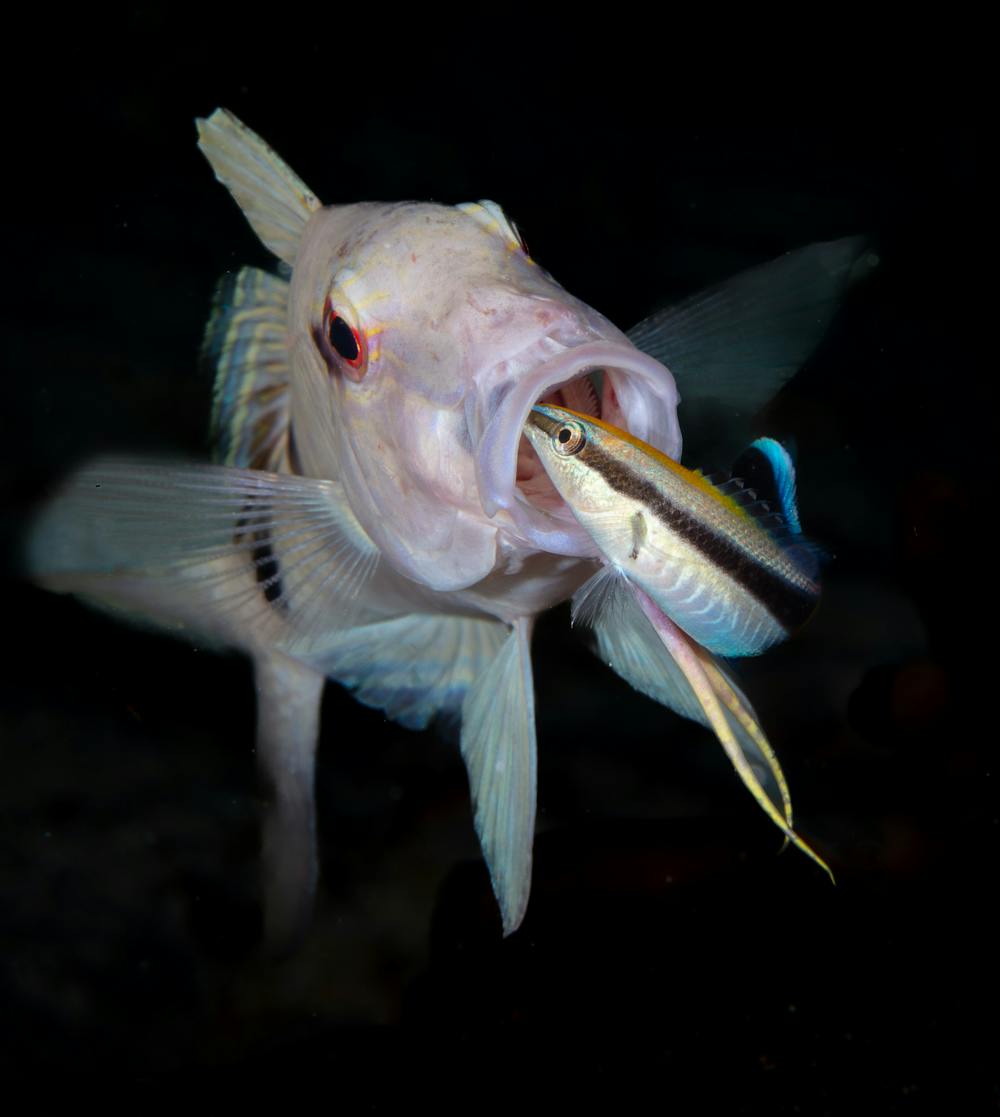
    A bluestreak cleaner wrasse at work cleaning the mouth of a goatfish.
    Wayne and Pam Osborn/iNaturalist, CC BY-NC

    Where policing comes in

    On the Great Barrier Reef, bluestreak cleaner wrasse establish “cleaning stations” where larger fish allow the wrasse to feed on dead skin, loose scales and invertebrate parasites living in their gills. This relationship is a classic mutualism – the larger fish lose costly parasites and the cleaner wrasse get fed.

    Sometimes the cleaner wrasse “cheat” and nip their hosts, tipping the scale from mutualism to parasitism. The fish being cleaned may punish offenders by chasing them away or withholding further visits. In this, the reef fish exhibit something evolutionary biologists see as important to keeping mutualisms in balance: policing.

    Could we adequately police our exploitation by smartphones and restore a net-beneficial relationship?

    Evolution shows that two things are key: an ability to detect exploitation when it occurs, and the capacity to respond (typically by withdrawing service to the parasite).

    A difficult battle

    In the case of the smartphone, we can’t easily detect the exploitation. Tech companies that design the various features and algorithms to keep you picking up your phone aren’t advertising this behaviour.

    But even if you’re aware of the exploitative nature of smartphone apps, responding is also more difficult than simply putting the phone down.

    Many of us have become reliant on smartphones for everyday tasks. Rather than remembering facts, we offload the task to digital devices – for some people, this can change their cognition and memory.

    We depend on having a camera for capturing life events or even just recording where we parked the car. This both enhances and limits our memory of events.

    Governments and companies have only further cemented our dependence on our phones, by moving their service delivery online via mobile apps. Once we pick up the phone to access our bank accounts or access government services, we’ve lost the battle.

    How then can users redress the imbalanced relationship with their phones, turning the parasitic relationship back to a mutualistic one?

    Our analysis suggests individual choice can’t reliably get users there. We are individually outgunned by the massive information advantage tech companies hold in the host-parasite arms race.

    The Australian government’s under-age social media ban is an example of the kind of collective action required to limit what these parasites can legally do. To win the battle, we will also need restrictions on app features known to be addictive, and on the collection and sale of our personal data.

    Rob Brooks receives funding from the Australian Research Council.

    Rachael L. Brown does not work for, consult, own shares in or receive funding from any company or organisation that would benefit from this article, and has disclosed no relevant affiliations beyond their academic appointment.

    ref. Your smartphone is a parasite, according to evolution – https://theconversation.com/your-smartphone-is-a-parasite-according-to-evolution-256795

    MIL OSI – Global Reports

  • MIL-OSI Global: Bougainville wants independence. China’s support for a controversial mine could pave the way

    Source: The Conversation – Global Perspectives – By Anna-Karina Hermkens, Senior Lecturer and Researcher, Anthropology, Macquarie University

    Bougainville, an autonomous archipelago currently part of Papua New Guinea, is determined to become the world’s newest country.

    To support this process, it’s offering foreign investors access to a long-shuttered copper and gold mine. Formerly owned by the Australian company Rio Tinto, the Panguna mine caused displacement and severe environmental damage when it operated between 1972 and 1989.

    It also sparked a decade-long civil war from 1988 to 1998 that killed an estimated 10,000 to 15,000 civilians and caused enduring traumas and divisions.

    Industry players believe 5.3 million tonnes of copper and 547 tonnes of gold remain at the site. This is attracting foreign interest, including from China.

    Australia views Bougainville as strategically important to “inner security arc”. The main island is about 1,500 kilometres from Queensland’s Port Douglas.

    Given this, the possibility of China’s increasing presence in Bougainville raises concerns about shifting allegiances and the potential for Beijing to exert greater influence over the region.

    Australia’s tangled history in Bougainville

    Bougainville is a small island group in the South Pacific with a population of about 300,000. It consists of two main islands: Buka in the north and Bougainville Island in the south.

    Bougainville has a long history of unwanted interference from outsiders, including missionaries, plantation owners and colonial administrations (German, British, Japanese and Australian).

    Two weeks before Papua New Guinea received its independence from Australia in 1975, Bougainvilleans sought to split away, unilaterally declaring their own independence. This declaration was ignored in both Canberra and Port Moresby, but Bougainville was given a certain degree of autonomy to remain within the new nation of PNG.

    The opening of the Panguna mine in the 1970s further fractured relations between Australia and Bougainville. Landowners opposed the environmental degradation and limited revenues they received from the mine. The influx of foreign workers from Australia, PNG and China also led to resentment. Violent resistance grew, eventually halting mining operations and expelling almost all foreigners.

    Under the leadership of Francis Ona, the Bougainville Revolutionary Army (BRA) fought a long civil war to restore Bougainville to Me’ekamui, or the “Holy Land” it once was.

    Australia supported the PNG government’s efforts to quell the uprising with military equipment, including weapons and helicopters.

    After the war ended, Australia helped broker the Bougainville Peace Agreement in 2001. Although aid programs have since begun to heal the rift between Australia and Bougainville, many Bougainvilleans feel Canberra continues to favour PNG’s territorial integrity.

    In 2019, Bougainvilleans voted overwhelmingly for independence in a referendum. Australia’s response, however, was ambiguous.

    Despite a slow and frustrating ratification process, Bougainvilleans remain adamant they will become independent by 2027.

    As Bougainville President Ishmael Toroama, a former BRA commander, told me in 2024:

    We are moving forward. And it’s the people’s vision: independence. I’m saying, no earlier than 2025, no later than 2027. My benchmark is 2026, the first of September. I will declare. No matter what happens. I will declare independence on our republican constitution.

    Major issues to overcome

    Bougainville leaders see the reopening of Panguna mine as key to financing independence. Bougainville Copper Limited, the Rio Tinto subsidiary that once operated the mine, backs this assessment.

    The Bougainville Autonomous Government has built its own gold refinery and hopes to create its own sovereign wealth fund to support independence. The mine would generate much-needed revenue, infrastructure and jobs for the new nation.

    But reopening the mine would also require addressing the ongoing environmental and social issues it has caused. These include polluted rivers and water sources, landslides, flooding, chemical waste hazards, the loss of food security, displacement, and damage to sacred sites.

    Many of these issues have been exacerbated by years of small-scale alluvial mining by Bougainvilleans themselves, eroding the main road into Panguna.

    Some also worry reopening the mine could reignite conflict, as landowners are divided about the project. Mismanagement of royalties could also stoke social tensions.

    Violence related to competition over alluvial mining has already been increasing at the mine.

    More broadly, Bougainville is faced with widespread corruption and poor governance.

    The Bougainville government cannot deal with these complex issues on its own. Nor can it finance the infrastructure and development needed to reopen the mine. This is why it’s seeking foreign investors.

    Open for business

    Historically, China has a strong interest in the region. According to Pacific researcher Anna Powles, Chinese efforts to build relationships with Bougainville’s political elite have increased over the years.

    Chinese investors have offered development packages contingent on long-term mining revenues and Bougainville’s independence. Bougainville is showing interest.

    Patrick Nisira, the minister for commerce, trade, industry and economic development, said last year the proposed Chinese infrastructure investment is “aligning perfectly with Bougainville’s nationhood aspirations”.

    The government has also reportedly made overtures to the United States, offering a military base in Bougainville in return for support reopening the mine.

    Given American demand for minerals, Bougainville could very well end up in the middle of a battle between China and the US over influence in the new nation, and thus in our region.

    Which path will Bougainville and Australia take?

    There is support in Bougainville for a future without large-scale mining. One minister, Geraldine Paul, has been promoting the islands’ booming cocoa industry and fisheries to support an independent Bougainville.

    The new nation will also need new laws to hold the government accountable and protect the people and culture of Bougainville. As Paul told me in 2024:

    […]the most important thing is we need to make sure that we invest in our foundation and that’s building our family and culture. Everything starts from there.

    What happens in Bougainville affects Australia and the broader security dynamics in the Indo-Pacific. With September 1 2026 just around the corner, it is time for Australia to intensify its diplomatic and economic relationships with Bougainville to maintain regional stability.

    Anna-Karina Hermkens receives funding from the Australian Research Council to follow and analyse Bougainville’s journey towards independence.

    ref. Bougainville wants independence. China’s support for a controversial mine could pave the way – https://theconversation.com/bougainville-wants-independence-chinas-support-for-a-controversial-mine-could-pave-the-way-254320

    MIL OSI – Global Reports

  • MIL-OSI Australia: 12 months of taking domestic violence by storm sees 311 arrests

    Source: New South Wales – News

    Stage four of a major state-wide South Australia Police (SAPOL) operation has garnered impressive results in the fight against domestic and family violence, including 66 arrests across a recent two-week period.

    Operation Storm’s fourth dedicated anti-domestic abuse operation ran from April 28, 2025, to May 12, 2025, with 331 police officers targeting 411 offenders and attending 408 addresses throughout the state to locate high risk domestic abuse offenders, issue intervention orders and ensure offender’s bail conditions were met.

    Deputy Commissioner of Police Linda Williams said, overall, Operation Storm has improved the safety of hundreds of victims and children in South Australia.

    Operation Storm has resulted in the arrest of 311 domestic abuse offenders and the issue of 98 intervention orders since its commencement in July 2024.

    Within the eight weeks of dedicated days to Operation Storm in the 2024/2025 period, SAPOL has utilised 1175 police members to investigate 1423 domestic violence offenders in South Australia, seeing 1636 addresses attended and 516 support referrals for offenders to access rehabilitation services.

    “The recent days of action demonstrate we will continue to check on high-risk individuals, we will take action against offending, we will monitor compliance of bail and intervention order condition to help protect victims and prevent future domestic and family violence offending,” Deputy Commissioner Williams said.

    “I commend the hundreds of dedicated officers across the state for their commitment to deterring domestic abuse and referring offenders to behaviour change programs.

    “This operation sends a strong message that domestic and family violence will not be tolerated, and those who commit serious criminal offences will be held accountable and can expect to come to the attention of SAPOL.”

    The conclusion of the first 12 months of Operation Storm has seen the following outcomes:

    • Arrests 311
    • Reports 73
    • Warrants cleared 71
    • Offences charged 657
    • Bail compliance checks 239
    • Intervention Orders issued 98
    • Support referral provided 516
    • Firearm Prohibition Order searches 26
    • Stalking Cautions issued 17

    During Stage 4 of the Operation a 22-year-old Evanston Gardens man was among the arrests following a domestic disturbance. Police attended his home after he threatened to stab the family dog and then threatened family members with a knife. He was arrested for Aggravated Assault, Property Damage, and Assaulting an Emergency Services worker.

    In another case, a 44-year-old Berri man, who is recorded as a high-risk domestic abuse offender, was arrested for five counts of Aggravated Assault and Cause Harm, including several strangulation offences. The man was taken into custody, and a full non-contact police intervention was issued at the Berri Magistrates Court. The man was remanded in custody.

    “All members of our community have a right to be safe, and we encourage anyone experiencing family and domestic violence to contact police,” Deputy Commissioner Williams added.

    “If you’re not confident or comfortable in talking to a police officer, go to a family violence service provider and they will assist you and contact police if necessary.

    “We continue to monitor and assess risk, while sharing the information with other services as part of a multi-agency response.”

    Meanwhile, Operation Storm has strengthened accountability for people who choose to use violence with specific and measurable targets, as outlined it the National Plan to End Violence Against Women and Children 2022-2032.

    For more information on domestic violence, visit SAPOL – Domestic violence

    If this media release has raised any concerns for you, 1800RESPECT, the national 24-hour sexual assault, family and domestic violence counselling line, can be contacted on 1800 737 732 or by visiting www.1800respect.org.au. Help and support are also available through Lifeline on 13 11 14. In an emergency, call triple zero.

    MIL OSI News

  • MIL-OSI USA: Rep. Roy Congratulates Exceptional High School Seniors in TX-21

    Source: United States House of Representatives – Representative Chip Roy (R-TX)

    Hays County, Texas — Representative Chip Roy (TX-21) offered his congratulations today to thirty-six stellar high school students across Texas’ 21st congressional district who achieved the Exceptional Senior Award (ESA). This award is in its sixth year of existence. 

    ESA winners have consistently displayed high levels of character, leadership, integrity, and diligence. These virtues are evident through their philanthropic activities, academic success, and reputations among peers and teachers.  

    Congressman Roy said: “I am proud of all that the incredible young men and women of Texas’ 21st Congressional District have achieved. Texans have reason to be optimistic about our great state’s destiny with them as our future leaders.”

    Rep. Roy is deeply grateful to the families of these exceptional seniors for their love and support throughout their educational journeys. He would also like to thank the faculty of schools across his district who recommended these individuals for the ESA.

    The Exceptional Senior Award winners, Class of 2025:

    Ms. Victoria Allen, Geneva School of Boerne

    Ms. Sophia Arreguin, Memorial Early College High School (New Braunfels) 

    Ms. Anneliese Bacon, Harper High School

    Mr. Keegan Ballard, Dripping Springs High School

    Ms. Kaitlyn Best, New Braunfels High School

    Ms. Taylor Bloom, Our Lady of the Hills Catholic School (Kerrville)

    Ms. Sienna Carter, Medina Secondary School

    Mr. Stephen “Finn” Cone, Kerrville Christian Homeschoolers

    Mr. Corey Cook, Boerne Champion High School

    Mr. Jonathon Davenport, Wimberley High School

    Ms. Perry Faught, Blanco High School

    Ms. Evelyn Garrett, Tivy High School (Kerrville)

    Ms. Jalyn Lamb, Bandera High School

    Ms. Jillian Land, Bracken Christian School (Bulverde)

    Mr. Cole Leidy, New Braunfels Christian Academy

    Ms. Casey Loewer, LBJ High School (Johnson City)

    Ms. Madeline McAdams, Regents School of Austin

    Ms. Audrey McFarlane, Heritage School of Fredericksburg

    Ms. Schreiner Meredith, Nueces Canyon High School

    Mr. Aidan Nolen, San Marcos Academy

    Ms. Kaylin O’Rourke, Boerne Area Christian Homeschoolers

    Ms. Aven Ottmers, Fredericksburg High School

    Ms. Katelynn Salazar, Leakey School

    Ms. Kinsley Sawyer, Boerne High School

    Ms. Abbigail Shultz, Hill Country Preparatory High School (New Braunfels) 

    Ms. Athena Sorenson, Davenport High School (Garden Ridge)

    Ms. Hailey Turner, Hill Country Christian Homeschool Association (Kerrville)

    Mr. Brody Vanacker, Ingram Tom Moore High School

    Ms. Hope Van Geffen, Comfort High School

    Ms. Donna Verkamp, St. Anthony Catholic High School (San Antonio)

    Mr. Aidan Williams, Gloria Deo Academy (Bulverde)

    Ms. Peyton Wilson, Canyon High School (New Braunfels) 

    Ms. Rachel Wood, Jack C.Hays High School (Buda)

    Ms. Rylee Wunderlich, Canyon Lake High School

    Ms. Eliana Wyche, Saint Mary’s Hall (San Antonio)

    Mr. Elijah Yun, Alamo Heights High School

    ###

    MIL OSI USA News

  • MIL-OSI USA: Congresswoman Sylvia Garcia Condemns Trump Administration for Threatening Arrests Over Congressional Oversight

    Source: United States House of Representatives – Congresswoman Sylvia Garcia (TX-29)

    FOR IMMEDIATE RELEASE
    May 10, 2025

    MEDIA CONTACT:
    Joseph Guzman
    202-355-8084
    joseph.guzman@mail.house.gov

    HOUSTON, T.X. – Today, Congresswoman Sylvia Garcia (D-TX-29) issued the following statement in response to the confrontation at the Delaney Hall ICE detention center in Newark, New Jersey, where Democratic Representatives Bonnie Watson Coleman, Rob Menendez Jr., and LaMonica McIver were carrying out their lawful oversight duties. During the incident, Newark Mayor Ras Baraka was arrested, and the Trump administration is now reportedly considering arrests for the lawmakers involved:

    “America, this must be our clarion call. We are at risk of backsliding into a dictatorship as Trump continues trying to enact his authoritarian playbook. Republicans and Democrats must stand together against this absurdity. Today it’s Representatives Watson Coleman, Menendez, and McIver. Tomorrow, it’s you. 

    “Members of Congress are tasked with conducting oversight of the federal government, and these Members were doing just that. I stand with my colleagues who were doing their job and will always stand with those who do the same, regardless of political affiliation.

    “We must come together and stand up against Trump and his administration’s all-out assault against a co-equal branch of government, the rule of law, and our Constitution. We must all do our part to protect our great American experiment from those who seek to perverse it. We must all make our voices heard against the Trump-Vance administration to ensure we leave a stronger and more resilient democracy for the next generation.”

    HOUSTON, T.X. – Hoy, la Congresista Sylvia R. García (D-TX-29) emitió la siguiente declaración en respuesta al enfrentamiento en el centro de detención de ICE Delaney Hall en Newark, Nueva Jersey, donde los congresistas demócratas Bonnie Watson Coleman, Rob Menendez Jr. y LaMonica McIver estaban cumpliendo con sus deberes legales de supervisión. Durante el incidente, el alcalde de Newark, Ras Baraka, fue arrestado, y ahora se informa que la administración de Trump está considerando arrestar a los legisladores involucrados:

    “America, esto debe de ser nuestro llamado para actuar decisivamente. Estamos en riesgo de retroceder hacia una dictadura mientras Trump sigue intentando de actualizar sus aspiraciones autoritarias. Tanto los republicanos como los demócratas debemos unirnos en contra de las acciones ilegales de esta administración. Hoy quieren perseguir a los congresistas Watson Coleman, Menéndez y McIver. Mañana podrías ser tú.

    “Los miembros del Congreso tienen la responsabilidad y autoridad de supervisar al gobierno federal, y estos legisladores estaban cumpliendo con ese deber. Yo apoyo a mis colegas que estaban haciendo su trabajo y siempre apoyaré a quienes hagan lo mismo, sin importar su afiliación política.

    “Debemos unirnos y alzar la voz para rechazar rotundamente el asalto total de la administración Trump-Vance contra una rama del gobierno co-igualitaria, el imperio de la ley y nuestra Constitución. Todos debemos hacer nuestra parte para proteger este gran experimento conocido como los Estados Unidos de todos que buscan corromperlo. Todos debemos hacernos escuchar y oponernos a la administración Trump-Vance para asegurar que dejemos una democracia mas fuerte y resiliente para la próxima generación”.

    MIL OSI USA News

  • MIL-OSI USA: Congresswoman Sylvia Garcia Slams Trump-Republican Budget for Slashing Medicaid, SNAP, and Raising Taxes on the Most Vulnerable

    Source: United States House of Representatives – Congresswoman Sylvia Garcia (TX-29)

    FOR IMMEDIATE RELEASE
    MEDIA CONTACT:
    Joseph Guzman
    202-355-8084
    joseph.guzman@mail.house.gov

    WASHINGTON, D.C. — Congresswoman Sylvia R. Garcia (D-TX-29) released the following statement in response to House passage of the harmful Republican budget bill:

    “Matthew 25 teaches us to care for the poor, feed the hungry, and tend to the sick. Republicans say they believe in those values, but their budget scam does the exact opposite.

    “The budget Republicans rammed through the House includes the largest Medicaid cuts in our nation’s history. It guts SNAP, targeting single mothers and taking food out of the mouths of children. It will kick seniors out of nursing homes. It pushes disabled children even further into the margins. And why? To hand more tax breaks to Trump’s billionaire donors.

    “The Trump-Republican budget scam is a reverse Robin Hood. It takes from the poor to give to the rich. To make matters worse, this budget would raise taxes on the lowest-income families all while handing out giveaways to those who need it least.

    “The American people are watching. They know the difference between leadership and cruelty. They will not forget Republicans chose to give billionaires tax breaks at the expense of children, mothers, seniors, and working people. I will keep fighting, and I will not back down.”

    MIL OSI USA News

  • MIL-OSI USA: Congressman Van Drew Releases Statement on the Passage of the Reconciliation Package through the House

    Source: United States House of Representatives – Congressman Jeff Van Drew (NJ02)

    Washington, DC –Today, Congressman Van Drew discussed the passage of H.R. 1, the budget reconciliation.

    “This morning, House Republicans passed the budget reconciliation package,” said Congressman Van Drew. “I want to make it clear that in this bill there are NO cuts to Medicaid, Medicare, or Social Security for the people these programs were designed to serve. I have been deeply disturbed by the misinformation the left has been circulating surrounding this bill, so I wanted to take the opportunity to give you a breakdown of what is being said versus what is actually true.”

    Medicaid-

    FICTION: Millions of eligible Americans will lose their coverage.

    FACT: Medicaid for eligible individuals remains fully funded and protected.

    • Children, seniors, the disabled, pregnant women, and working families remain fully protected.
    • The bill ends loopholes that allow illegal immigrants to access Medicaid.
    • The bill enacts work requirements for able-bodied adults without dependents—20 hours a week of work/volunteer requirements, including online courses.
    • The estimate of eligible Americans losing coverage comes from a Congressional Budget Office (CBO) projection which assumes no compliance with these work requirements over 10 years which is just not realistic.

    Medicare-

    FICTION: Medicare is being slashed by $500 billion.

    FACT: Medicare remains untouched, unharmed, and fully funded.

    • The $500 billion figure comes from a technical scoring mechanism, not from any policy that is actually in the bill. There will be no cuts.
    • House Republicans are already preparing a waiver to the mechanism so no Medicare cuts will ever take effect under this bill.

    Social Security-

    FICTION: This bill cuts Social Security benefits.

    FACT: There are no changes to eligibility, benefits, or payment schedules.

    • Not one line of the bill touches Social Security at all.
    • The bill even includes a $4,000 tax deduction for individuals over 65, offering relief to our seniors.
    • Some may be curious why ‘No Tax on Social Security’ was not included:
      • A Senate rule, the Byrd rule, prohibits non-budgetary items like Social Security changes from being included in a reconciliation bill to ensure that reconciliation legislation focuses strictly on budget-related changes.
    • In light of this, I recently introduced H.R. 904, the No Tax on Social Security Act, which would provide much-needed relief for our seniors. I will not give up on this fight to stop taxing Social Security benefits. We need to get this done.

    Supplemental Nutrition Assistance Program (SNAP)-

    FICTION: SNAP benefits are being slashed.

    FACT: SNAP remains fully funded and intact under the legislation.

    • Vulnerable Americans, including children, the elderly, and individuals with disabilities, will not see a reduction in access to SNAP benefits.
    • The reforms apply only to able-bodied adults without dependents and are aimed at increasing accountability.
    • The reforms focus solely on reducing administrative costs, not cutting benefits.
    • The legislation rebalances the cost-sharing structure between the federal government and the states to improve oversight, reduce fraud, ensure benefits go only to eligible recipients, and protect the long-term sustainability of the program.
    • States with high payment error rates exceeding 10% will now have to share in the cost of those administrative errors, ensuring that the money is not wasted and that it is actually going to the people who deserve and need it.

    “I do want to note the version the House voted on is not the final version of the bill. There will be changes as it now moves to the Senate before final passage and signature into law,” Congressman Van Drew continued. “I have been heavily involved in negotiations for the House version of this bill, and I will continue to closely monitor the bill as changes are made in the Senate to ensure there are no cuts to the programs our people rely on. I have said it before, and I will say it again: we owe it to hardworking American families to ensure these vital programs remain strong and funded.”

    Other Key Provisions of the Bill Include:

    • Locking in the 2017 Trump tax cuts to prevent a 22% tax increase on working families
    • Eliminating federal taxes on tips, overtime pay, and car loan interest
    • Repealing Biden’s Green New Deal mandates, EV rules, and environmental slush funds
    • Resuming oil and gas leasing on federal lands and streamlining energy permitting
    • Investing over $140 billion in border security—the largest investment in U.S. history
    • Completing the border wall and enabling over 1 million deportations annually
    • Hiring 10,000 new ICE personnel and expanding detention capacity to 100,000 beds
    • Modernizing national defense with nearly $144 billion in military investments
    • Achieving over $1.5 trillion in net deficit reduction—the largest in nearly 30 years

    MIL OSI USA News

  • MIL-OSI New Zealand: Discipline pays off with interest rate relief

    Source: ACT Party

    Welcoming the Reserve Bank’s decision to cut the Official Cash Rate by another 0.25% points, ACT Leader David Seymour says:

    “New Zealanders’ hard work and the Government’s focus on fiscal discipline are paying off.

    “Another rate cut is real relief for firms, farms, and families. Households with a $500,000 mortgage can expect to save around $100 a month, money that can go toward groceries, power bills, or building a better future.

    “By finding savings and prioritising spending carefully, like we’ve seen in Budget 2025, the Coalition Government has got inflation under control, making room for the Reserve Bank to ease pressure on borrowers.

    “Our best hope for continued relief is in ACT’s push to cut bureaucracy, eliminate inefficient programs, and unwind red tape. We must stay the course, so Kiwis can keep more of what they earn, and invest in the things that matter to themselves and their loved ones.”

    MIL OSI New Zealand News

  • MIL-OSI New Zealand: Time to dump Te Mana o te Wai, national bottom lines

    Source: ACT Party

    ACT is welcoming public consultation on changes to New Zealand’s freshwater national direction and encouraging New Zealanders to engage in the process.

    “Under Labour and the Greens, farmers not only had to manage the day-to-day challenges of farming but also navigate an onslaught of red tape and costs,” says ACT MP and dairy farmer Mark Cameron.

    “The coalition government was elected with a mandate to end this war on farming. We’ve made excellent progress, but the National Policy Statement on Freshwater Management 2020 still lingers.

    “NPS-FM centralised control in Wellington and elevated the vague, spiritual concept of Te Mana o te Wai, or the mana of the water.

    “ACT believes the Government should scrap Te Mana o te Wai and national bottom lines, allowing regional councils to set their own standards.

    “The vague concept of ‘Te Mana o te Wai’ replaces scientific benchmarks with a subjective idea of the mana of the water that leads to co-governance and unequal treatment based on who someone’s ancestors were.

    “At the moment, iwi have a right of veto over how water is used. The NPS-FM requires Te Mana o te Wai to apply to the consenting of all projects involving freshwater management.

    “Consenting is now subject to consideration of mauri, or the “life-force” of water.

    “It has led to water users making large one-off and on-going payments for ‘cultural monitoring’ services which do nothing for the environment but add costs to consumer and business power bills.

    “Is requiring farmers to comply with a spiritual concept going to make them farm better? Of course not. It means they’ll have to employ a cultural consultant and waste time and money that could instead be spent improving their farming practices. That’s what happens when we regulate water quality based on superstition not science.

    “Farmers just want to grow food and look after their land, incorporating spiritual concepts isn’t necessary for them to do that.

    “The broad and ambiguous interpretation of Te Mana o te Wai by councils and courts has led to confusion, time and money being wasted, and a new cottage industry of cultural consultants.

    “We should get rid of it.

    “We should also let local communities decide what standards work best for them. The NPS-FM is too inflexible. Standards set nationally aren’t appropriate for all catchments.

    “Our diverse geography and conditions mean farming practices vary across regions as farmers adapt best practices to their local conditions. Blanket regulations set by bureaucrats in Wellington are unsuitable.

    “We should get rid of national bottom lines and devolve these decisions to regional councils who are best positioned to understand the local conditions and who have direct relationships with stakeholders.

    “ACT is dedicated to real change. We cannot continue with a policy that burdens our farmers unnecessarily. We campaigned on a complete overhaul of the NPS-FM to remove subjective concepts and ensure that our freshwater management is scientifically sound and adapted to the needs of local communities.

    “It is time to protect our farmers from the ongoing effects of what has effectively been a war on the rural sector.”

    MIL OSI New Zealand News

  • MIL-OSI New Zealand: David Seymour to the Waikato Chamber of Commerce

    Source: ACT Party

    ACT Leader David Seymour to the Waikato Chamber of Commerce: Budget 2025 and Beyond

    Thank you for the opportunity to be here, and hear from you today. Wherever I go, and I’ve said it here in Hamilton before, I say business is a beautiful form of human cooperation that too many people demonise.

    Thank you for being in business. Bringing together ideas, investment, workers, and customers is almost magic. It means people can achieve together what they couldn’t do alone. That’s what I mean by beautiful, voluntary, human cooperation.

    Every year, Government sets a Budget. Every three years, the people elect a new Parliament. About every six-to-nine years, the Government changes, but the real change is invisible at the time.

    Politics has a rhythm that could put you to sleep, if it wasn’t so maddening: headlines, hot takes, and handouts. At least that’s what it seems like in the moment. But when you look back at politics a generation or two ago, you can see it was actually going somewhere.

    What’s difficult is looking through the now, and seeing backwards from the future. How will today look in your children’s rear view mirror? What big trends were we part of, whether we realised it or not? What things will we wish we’d spent more time on, even if they don’t stand out right now?

    If this sounds familiar, it should. Politics, like business, is just another extension of life.

    New Zealand is in the middle of a repair job. After years of economic mismanagement and runaway spending, the Government is patching the roof while the rain still falls. But a team that’s always rebuilding never lifts the trophy. That’s why we need to move from recovery to victory.

    My speech today is about acknowledging where we’re at, and feeling today’s very real challenges. But, it’s also about asking what choices we need to make if we’re going to look good in our children’s rear view mirror.

    There are lots of answers. Mine is cultural. We’ll only build a winning economy for future generations is if we restore freedom and personal responsibility to the individual, and reward effort and innovation.

    If you get those values right, and have agreement on the values, the policy choices can be easy.

    Budget 2025 and ACT’s influence

    Anyone who’s read one of ACT’s alternative budgets knows we’d like to spend less than the coalition. It’s also true that the coalition spends less than the other parties would without ACT.

    We’ve been identifying savings and instilling fiscal discipline. Collectively, our Ministers have saved current and future taxpayers billions. Brooke van Velden saved the most. Her long-overdue changes to a broken pay equity system didn’t just save the budget, they are good policy. No country got rich by inventing more complicated ways to argue with itself.

    As usual, Labour and the unions responded with scare tactics and misinformation. The fact is that Brooke’s changes bring back common sense. Pay equity claims will still be possible – but they’ll need real evidence of discrimination, not assumptions. That means a system that’s fair, workable, and sustainable for the long term.

    Not many MPs would have the guts to take this on, but Brooke is an ACT MP. We’re willing to take on tough issues and stand by our principles. This approach needs to be replicated and applied across a wider range of issues in order for New Zealand to tackle long-term issues.

    While it doesn’t go as far as we’d like, in many ways this budget reflects ACT’s values: freedom, responsibility, growth, and efficiency. It reduces the share of the nation’s economic pie consumed by Government and redirects spending to areas that generate long-term prosperity.

    Inflation is currently 2.5 per cent and the population has grown 0.9 per cent in the last year. That means our country’s inflation plus population growth is 3.4 per cent.

    If the Government’s Budget grew by 3.4 per cent, it would grow by $4.9 billion. The question is, does this Budget increase spending by $4.9 billion?

    No, it does not. It increases by a fraction of that. This Budget increases spending by $1.3 billion. That’s a 0.9 per cent increase.

    When the Government reduces its share of the economy, there is more for the firms, farms, and families of this country to consume.

    Debt remains the biggest issue for the future of our country though. Government spending has a diabolical power: time travel. It borrows today and sends the bill into the future, landing with children who are learning their ABCs this afternoon.

    Our national debt is now $175 billion, heading past $200 billion by 2026, and $234 billion by 2029. That’s $46,800 per New Zealander.

    Debt is rising by $2 million per hour, or $48 million a day.

    The status quo is not sustainable. We cannot keep borrowing at the expense of the next generation.

    Cutting waste, reinvesting in what matters

    Savings in this budget have been substantial. Take public broadcasting – $18.4 million cut from RNZ. Or the end of the EECA, a department which tells people what they already know, energy is expensive. That saves $56.2 million over four years.

    Then there’s the $375.5 million saved from scrapping Communities of Learning – a failed concept that pulled teachers out of classrooms.

    Other examples include Kiwisaver subsidies for those already well-off – halved and means-tested. Bilingual towns and climate resilience grants funding – eliminated.

    We’re also saving money by returning responsibility to Kiwis. Tightening benefit eligibility for 18-19 year olds saves $163 million, but it also promotes the value of work. Many teenagers who might have been going down a pathway of benefit dependency will now learn the value of providing for themselves instead. There will also be more aggressive recovery of court fines and legal aid debt, because responsibility goes both ways.

    These savings are not all cost-cutting, they’re a change in priorities. Every dollar saved is a dollar redirected to what truly matters: education, infrastructure, security, and growth.

    Policies that unleash growth

    At the heart of this Budget is a new 20% capital asset deduction for business investment.

    If you’re a farmer upgrading milking machines…

    A restaurant expanding its kitchen…

    A startup buying lab equipment…

    A logistics firm improving software systems…

    You’ll now get to write off 20% of tax from those capital investments immediately. Treasury estimates this policy alone will lift wages by 1.5% by the time today’s children enter the workforce.

    Why? Because investment drives productivity, and productivity drives higher wages. When people can reinvest more of what they earn, a virtuous cycle begins. Investment → productivity → profits → reinvestment → higher wages. The best part is that the Government just gets out of the way.

    I’ve heard some people complain that there is no cap on the policy, which might be the first time I’ve heard people upset that a policy might be too successful. The fact is that if the level of investment exceeds Treasury’s calculation then that is a good thing. Sure, it won’t be taxed as much as it would have previously, but that investment would likely have never entered the country otherwise.

    Spending on what’s important

    This Budget rightly focuses on the basics, and nothing is more basic than security.

    ACT has long called for Defence spending at 2% of GDP. This Budget makes progress, with a $500 million boost to Defence and Foreign Affairs. In a volatile world, alliances are our best defence. Peace through alliances beats peace through strength.

    At home, we’re investing in law and order. Nearly half a billion dollars to lock up the worst offenders. Because if you think prison is expensive, try the cost of letting criminals roam the streets.

    If there’s one long-term investment that always pays off, it’s education.

    The Budget includes $140 million to boost school attendance, and new investments in maths and learning support. We’re addressing the legacy of poor education policy head-on.

    Parents who choose private schooling, often making real financial sacrifices, will now receive more equitable treatment. Their GST bill is higher than the government support they receive, and that’s not fair.

    What next?

    This Budget doesn’t go as far as ACT would, but we’re proud to support it because it’s pregnant with our values. It gives more resources and choices to the people, compared with government.

    It focuses on growing the New Zealand economy, rather than government spending. It gives a ray of hope, that New Zealanders can achieve their potential in a place where your efforts make a difference.

    That’s the good news. This budget is a reset from the tax, borrow, and spend years. We might have won a battle but it’s a long war to reclaim New Zealand’s economic prosperity.

    Interest on debt is now a major expense in its own right, at $9 billion per year. Interest costs more than police and prisons combined, or about as much as primary, intermediate, and secondary schooling.

    That’s because the debt is nearly $200 billion, and welfare is over $50 billion a year. Nearly half of that is pensions, which rise by a billion and a half each year as more people retire and live longer. Put it another way: $50 billion is nearly $10,000 per person. If you’re in a family of four that is not getting $40,000 of taxpayer cash a year, you are below average.

    Health spending is up $13 billion in seven years, but results have been getting worse for years now. We could go on, but the point is the Government is currently borrowing $14.7 billion a year, and its plan to borrow only $3 billion in four years’ time depends on nothing going wrong for four years. What we’re doing is not sustainable.

    The options are either:

    1. Tax more, such as the Green’s and Labour’s wealth or capital gains tax
    2. Keep borrowing and see what happens (some people genuinely think this is the answer)
    3. Spend less.

    If we do nothing, it is a matter of time before the left gets back in and defaults to option 1. More taxes that are tall poppy syndrome in tax law. Your problems are caused by others’ successes, the story goes, and your solution is to take their money. It will deaden our society from the inside out.

    Option 2 is the road to some sort of banana republic status. The problem is some would default to it through inaction, and some others think using debt is actually an enlightened idea. The downward spiral from this approach goes like this:

    Investors lose faith in the New Zealand Government paying back its bonds, so they demand higher interest rates to buy its bonds. That makes it harder to pay. Everyone loses and we all find our dollar goes towards a lot less than it used to. That is the spiral that so many South American and Southeast Asian countries have experienced.

    If you’re not keen on new taxes, or the Government going broke, then you’re with us. The next five years of New Zealand politics will be in large part about which of the three options to choose. The Greens have set out their stall. Labour hasn’t come up with any policy since the election, but we can predict they’ll campaign on more taxes. Te Pāti Māori base their policy on TikTok trends, which admittedly is more than Labour is trying to propose.

    The coalition hasn’t seriously reduced spending yet though. Even Grant Robertson was spending far less as a percentage of GDP (28%) towards the beginning of his tenure than the current Government (33%). That five-point difference equates to about $23 billion more.

    There’s only one option left. If the Government’s going to balance its budget without more taxes, it’ll need to be smaller and more efficient. There’s four ways we can do that.

    Zero-basing Government

    Government has grown by default, not by design. We have zombie departments and bureaucracies that outlived their usefulness decades ago.

    We need to stop assuming government departments and activities should continue because they always have. It’s easy to think of New Zealand companies that no longer exist. Anyone shopped at Deka lately? Read the Auckland Star? Got a loan from South Canterbury Finance? Had Mainzeal put anything up for you? Anyone here had a night in thanks to Video Ezy this decade?

    What if we zero-based government?

    Every department should have to answer: “If you didn’t exist, who would notice and why?”

    If the answer is vague, bureaucratic, or defensive, it’s probably time to shut it down.

    We would:

    • Cut to 20 ministers – no associates (except Finance).
    • Eliminate the bloat of 82 ministerial portfolios.
    • Merge and reduce departments to no more than 30.
    • Assign each department to one Minister, with eight under-secretaries as a training ground for talent.

    This is not austerity. It’s clarity, on what Government can and cannot do.

    Make transfers fair on every generation

    Superannuation is the biggest elephant in the room.

    Every year, 60,000 New Zealanders turn 65. Each generation lives longer, and has fewer children. That fundamentally changes the maths, or more specifically the dependency ratios. There are more eligible recipients for each active taxpayer.

    The issue can’t be ducked forever. There’s been too much ducking already, and we’re starting to look like geese. My Party says gradually raising the superannuation age by two months per year until it reaches 67 is the right thing to do. Let’s make it fair, predictable, and, most importantly, sustainable.

    Government ownership

    The one thing we know is that the government is hopeless at owning things. State houses? You can tell which houses the Government owns as you drive by. Hospital projects, say no more.

    If in your next life you come back as a farm animal, I hope you don’t live on a Government farm. You are more likely to die on a Government owned farm than a privately owned one, taxpayers are not the only victim of Government going into business.

    Did you know you own Quotable Value, a property valuation company chaired by a former race relations conciliator that contracts to the government of New South Wales? You’re welcome.

    What about 60,000 homes? The government doesn’t need to own a home to house someone. We know this because it also spends billions subsidising people to live in homes it doesn’t own. On the other hand, the taxpayer is paying $10 billion a year servicing debt, and the KiwiBuild and Kainga Ora debacles show the government should do as little in housing as possible.

    There are greater needs for government capital. We haven’t built a harbour crossing for nearly seven decades. Four hundred people die every year on a substandard road network. Beaches around here get closed thanks to sewerage overflow, but we need more core infrastructure. Sections of this city are being red zoned from having more homes built because the council cannot afford the pipes and pumping stations.

    We need to get past squeamishness about privatisation and ask a simple question: if we want to be a first world country, then are we making the best use of the government’s half a trillion dollars plus worth of assets? If something isn’t getting a return, the government should sell it so we can afford to buy something that does.

    A regulatory reset

    We also need to stop strangling our economy with unnecessary regulation.

    The Regulatory Standards Bill, now before Parliament, will finally hold lawmakers accountable. Every new law will have to state:

    • What problem it addresses
    • Its cost-benefit analysis
    • The impact on liberty and property rights

    This Bill turns ‘because we said so’ into ‘because here’s the evidence.’ So if my colleagues want to tax you, take your property, or restrict your livelihood, they should be able to show you their work. This is a game-changer for transparency.

    Let’s take a real-world example: earthquake regulations in Auckland. The chance of a major quake is one in 110,000 years, yet owners are forced into costly upgrades because Christchurch had a disaster. This is not rational policy.

    Instead, we propose risk-based regulation, rooted in evidence, not fear. The same applies to housing. ACT fought hard to overhaul the RMA and introduce property-rights-based planning, because homes are for people, not bureaucrats.

    What comes next?

    New Zealand’s population will reach 6 million by 2043. That’s a good thing, but only if we create a high-performing economy that retains our best and brightest. In the year to February 2025, 69,100 Kiwis left the country. That is ambition seeking a home elsewhere.

    If we carry on in this direction, we’ll become a middling Pacific Island, lamenting the opportunities we let slip.

    This Budget is not the championship match, but it is a turning point.

    We’ve begun the repair work. Cutting waste, restraining spending, rebalancing priorities, but the goal is not just to fix what’s broken. The goal is to build a New Zealand that’s stronger, smarter, and more secure than ever before.

    A country where your effort matters more than where you were born.

    Where rewards come from risk and responsibility, not red tape and redistribution.

    Where the next generation doesn’t inherit a fiscal time bomb, but a ladder to opportunity.

    It won’t be done in a single Budget or a single term. But ACT is committed to seeing it through, because we believe in New Zealanders. We believe that if we give people the freedom, tools, and trust to succeed, they will.

    So, more than just rebuilding. Let’s start playing to win.

    MIL OSI New Zealand News

  • MIL-OSI Australia: Police pump up blood drive

    Source: New South Wales – News

    South Australia Police (SAPOL) has once again joined emergency services partners to rescue winter blood supplies as part of a lifesaving campaign.

    Today Commissioner of Police Grant Stevens joined forces with other agencies to launch the 2025 Emergency Services Blood Drive at South Australian Metropolitan Fire Service (MFS) headquarters.

    The blood drive, held annually by Australian Red Cross Lifeblood from 1 June to 31 August, calls on emergency services workers to compete in a special type of battle and make the highest number of blood and plasma donations.

    “Our members are always onboard to help others, and I encourage them to continue making a life-changing impact by rolling up their sleeves and donating,” Commissioner Stevens said.

    “Police often attend incidents where people have been seriously injured, and we understand firsthand that the need for blood is ongoing.

    “I encourage all SAPOL staff and their family members who are able to donate via the South Australia Police Lifeblood team and contribute to this incredible cause.”

    Last year overall SAPOL’s Lifeblood team helped save 6381 lives through 2127 donations: 963 blood, 1138 plasma, and 26 platelet.

    Through the 2024 Emergency Services Blood Drive alone, SAPOL made 578 donations: 264 blood, 301 plasma, and 13 platelet – helping to save 1734 lives.

    Recently, the Bleed 4 Blue Blood Drive from 1 December 2024 to 28 February 2025 also saw SAPOL’s team make 594 donations, helping to save 1782 lives.

    In this current drive, SAPOL will compete against SA-based Australian Federal Police, SA Country Fire Service, SA Ambulance Service, St John Ambulance, SA Metropolitan Fire Service, SA Department of Correctional Services, SA State Emergency Service, Royal Flying Doctor Service and Aviation Rescue Fire Fighting Service – Airservices Australia.

    “SAPOL’s efforts last year saw our team keep the state trophy and jump one place up the national leader board,” Commissioner Stevens added.

    “We hope anyone in the community who is able to donate will be inspired by the efforts of police and our fellow first responders and will take the short time out of their day to make a lifesaving donation.”

    Five metropolitan donor centres: Adelaide (Regent Donor Centre), Marion, Port Adelaide, Noarlunga, and Modbury are open for donations. Pop-up and mobile donor centres are also operating in metropolitan and regional areas.

    Only donations made during the challenge period (1 June – 31 August) count towards the tally, however, Lifeblood Teams operate year-round.

    To book a donation visit lifeblood.com.au, call 13 14 95 or download the donate blood app.

    Commissioner of Police Grant Stevens joined forces with other agencies to launch the 2025 Emergency Services Blood Drive at South Australian Metropolitan Fire Service (MFS) headquarters this morning. He encourages those who are able to donate.

    Senior Constable Bennett donating plasma for SAPOL’s Lifeblood team on Monday.

    MIL OSI News

  • MIL-Evening Report: Bougainville wants independence. China’s support for a controversial mine could pave the way

    Source: The Conversation (Au and NZ) – By Anna-Karina Hermkens, Senior Lecturer and Researcher, Anthropology, Macquarie University

    Bougainville, an autonomous archipelago currently part of Papua New Guinea, is determined to become the world’s newest country.

    To support this process, it’s offering foreign investors access to a long-shuttered copper and gold mine. Formerly owned by the Australian company Rio Tinto, the Panguna mine caused displacement and severe environmental damage when it operated between 1972 and 1989.

    It also sparked a decade-long civil war from 1988 to 1998 that killed an estimated 10,000 to 15,000 civilians and caused enduring traumas and divisions.

    Industry players believe 5.3 million tonnes of copper and 547 tonnes of gold remain at the site. This is attracting foreign interest, including from China.

    Australia views Bougainville as strategically important to “inner security arc”. The main island is about 1,500 kilometres from Queensland’s Port Douglas.

    Given this, the possibility of China’s increasing presence in Bougainville raises concerns about shifting allegiances and the potential for Beijing to exert greater influence over the region.

    Australia’s tangled history in Bougainville

    Bougainville is a small island group in the South Pacific with a population of about 300,000. It consists of two main islands: Buka in the north and Bougainville Island in the south.

    Bougainville has a long history of unwanted interference from outsiders, including missionaries, plantation owners and colonial administrations (German, British, Japanese and Australian).

    Two weeks before Papua New Guinea received its independence from Australia in 1975, Bougainvilleans sought to split away, unilaterally declaring their own independence. This declaration was ignored in both Canberra and Port Moresby, but Bougainville was given a certain degree of autonomy to remain within the new nation of PNG.

    The opening of the Panguna mine in the 1970s further fractured relations between Australia and Bougainville. Landowners opposed the environmental degradation and limited revenues they received from the mine. The influx of foreign workers from Australia, PNG and China also led to resentment. Violent resistance grew, eventually halting mining operations and expelling almost all foreigners.

    Under the leadership of Francis Ona, the Bougainville Revolutionary Army (BRA) fought a long civil war to restore Bougainville to Me’ekamui, or the “Holy Land” it once was.

    Australia supported the PNG government’s efforts to quell the uprising with military equipment, including weapons and helicopters.

    After the war ended, Australia helped broker the Bougainville Peace Agreement in 2001. Although aid programs have since begun to heal the rift between Australia and Bougainville, many Bougainvilleans feel Canberra continues to favour PNG’s territorial integrity.

    In 2019, Bougainvilleans voted overwhelmingly for independence in a referendum. Australia’s response, however, was ambiguous.

    Despite a slow and frustrating ratification process, Bougainvilleans remain adamant they will become independent by 2027.

    As Bougainville President Ishmael Toroama, a former BRA commander, told me in 2024:

    We are moving forward. And it’s the people’s vision: independence. I’m saying, no earlier than 2025, no later than 2027. My benchmark is 2026, the first of September. I will declare. No matter what happens. I will declare independence on our republican constitution.

    Major issues to overcome

    Bougainville leaders see the reopening of Panguna mine as key to financing independence. Bougainville Copper Limited, the Rio Tinto subsidiary that once operated the mine, backs this assessment.

    The Bougainville Autonomous Government has built its own gold refinery and hopes to create its own sovereign wealth fund to support independence. The mine would generate much-needed revenue, infrastructure and jobs for the new nation.

    But reopening the mine would also require addressing the ongoing environmental and social issues it has caused. These include polluted rivers and water sources, landslides, flooding, chemical waste hazards, the loss of food security, displacement, and damage to sacred sites.

    Many of these issues have been exacerbated by years of small-scale alluvial mining by Bougainvilleans themselves, eroding the main road into Panguna.

    Some also worry reopening the mine could reignite conflict, as landowners are divided about the project. Mismanagement of royalties could also stoke social tensions.

    Violence related to competition over alluvial mining has already been increasing at the mine.

    More broadly, Bougainville is faced with widespread corruption and poor governance.

    The Bougainville government cannot deal with these complex issues on its own. Nor can it finance the infrastructure and development needed to reopen the mine. This is why it’s seeking foreign investors.

    Open for business

    Historically, China has a strong interest in the region. According to Pacific researcher Anna Powles, Chinese efforts to build relationships with Bougainville’s political elite have increased over the years.

    Chinese investors have offered development packages contingent on long-term mining revenues and Bougainville’s independence. Bougainville is showing interest.

    Patrick Nisira, the minister for commerce, trade, industry and economic development, said last year the proposed Chinese infrastructure investment is “aligning perfectly with Bougainville’s nationhood aspirations”.

    The government has also reportedly made overtures to the United States, offering a military base in Bougainville in return for support reopening the mine.

    Given American demand for minerals, Bougainville could very well end up in the middle of a battle between China and the US over influence in the new nation, and thus in our region.

    Which path will Bougainville and Australia take?

    There is support in Bougainville for a future without large-scale mining. One minister, Geraldine Paul, has been promoting the islands’ booming cocoa industry and fisheries to support an independent Bougainville.

    The new nation will also need new laws to hold the government accountable and protect the people and culture of Bougainville. As Paul told me in 2024:

    […]the most important thing is we need to make sure that we invest in our foundation and that’s building our family and culture. Everything starts from there.

    What happens in Bougainville affects Australia and the broader security dynamics in the Indo-Pacific. With September 1 2026 just around the corner, it is time for Australia to intensify its diplomatic and economic relationships with Bougainville to maintain regional stability.

    Anna-Karina Hermkens receives funding from the Australian Research Council to follow and analyse Bougainville’s journey towards independence.

    ref. Bougainville wants independence. China’s support for a controversial mine could pave the way – https://theconversation.com/bougainville-wants-independence-chinas-support-for-a-controversial-mine-could-pave-the-way-254320

    MIL OSI AnalysisEveningReport.nz

  • MIL-Evening Report: What is populism?

    Source: The Conversation (Au and NZ) – By Benjamin Moffitt, Senior Lecturer in Politics and International Relations, Monash University

    In 2017, in the wake of Brexit and Donald Trump’s first election win, populism was named the “word of the year” by Cambridge University Press.

    Almost a decade later, we might have thought the term’s popularity would have faded.

    But with Trump back in power in the United States, the Reform Party polling very well in the United Kingdom, and Argentinian president Javier Milei wielding his chainsaw at public events, populism is very much still with us.

    But what is populism? Is it a left or right phenomenon? And is it here to stay?

    What is populism?

    Put simply, populism is a political phenomenon that revolves around the central divide between “the people” and “the elite”.

    Although there is agreement on this divide, academics tend to disagree on two things when it comes to populism.

    The first is what kind of phenomenon it is. Is populism an ideology (that is, a belief system)? A strategy? Or is it a kind of performative political style?

    Secondly, experts disagree on whether populism is a threat or corrective to democracy. Some think it can be both.

    Populism: left or right?

    Much of the confusion about populism stems from the fact that it can appear across the ideological spectrum.

    This is because “the people” and “the elite” are flexible terms, and populists can characterise them in very different ways.

    Right-wing populists tend to characterise “the people” in socio-cultural terms, and often combine their populism with nativism.

    Think for instance, of how Trump’s “people” are coded as White Americans.

    Or, how Indian Prime Minister Narendra Modi evokes Hindu nationalism in his definition of “the people”.

    Other prominent right-wing populist leaders include the likes of Viktor Orban of Hungary, Nigel Farage of the United Kingdom, Geert Wilders of the Netherlands, and Australia’s Pauline Hanson.

    Left-wing populists, meanwhile, tend to characterise “the people” in socio-economic terms. They often combine their populism with calls for economic redistribution or shifts in power.

    Examples include Latin American populist leaders like Evo Morales of Bolivia and Hugo Chavez of Venezuela, who sought to bring the poor into their conception of “the people”.

    In the US, Bernie Sanders’ 2016 and 2020 presidential primary campaigns put the working class and people in precarious work at the heart of his “people”.

    Other examples of left-wing populism include the Podemos and Syriza parties in Spain and Greece respectively.

    This also means the way populists tend to define “the elite” is quite different.

    Right-wing populist targets often include:

    • government and policy elites (think of Trump’s “drain the swamp”)
    • cultural elites (Trump’s attacks on media as “fake news”)
    • academics (attacks on the “ivory tower”) and
    • transnational bodies (such as attacks on the United Nations).

    These groups are connected in right-wing populist discourse and purported to be undermining “the people’s” livelihood by abetting increased immigration or the destruction of “traditional values”.

    Left-wing populists tend to target business and power elites, who they see as fleecing “the people” economically and keeping them from expressing their popular power (think of Occupy Wall Street’s divide between the 99% and the 1%).

    Populists also tend to have a suspicion of transnational organisations. But while right-wing populists tend to focus on the likes of the United Nations and World Health Organisation, left-wing populists are more suspicious of business transnationals such as the World Trade Organization or World Economic Forum.

    Is populism here to stay?

    After every major election where a populist leader or party succeeds, there is inevitably talk of a “populist earthquake”, “populist wave” or “populist tsunami”.

    These metaphors suggest populism has come out of nowhere, and is causing a major and unexpected shock to the system.

    But that’s simply not the case.

    If anything, the story of 21st century politics has been one in which populism has become “normalised” and “mainstreamed”.

    Populists are no longer merely “challenger” parties nor minor parties.

    They increasingly are among the top three parties in their respective countries (particularly in Europe), and have won government in places from the US to India to the Netherlands to Italy to Greece.

    This success has seen them steadily viewed as viable and “normal” political players.

    Meanwhile, mainstream parties and leaders have increasingly adopted elements of populists’ discourse, platforms and political styles, as a way to compete with populists.

    This, ironically, has had the effect of legitimising populists in many countries; it makes their policies and discourse look more “acceptable”.

    It’s important to be cynical about any pundit crowing about the “death” of populism – or, on the flipside, the idea it has come out of nowhere.

    Populism is here to stay. Acknowledging that can help us better understand its appeal, which in turn, can provide hints about how to best deal with it.

    Benjamin Moffitt receives or has received funding from the Australian Research Council and the Marianne and Marcus Wallenberg Foundation.

    ref. What is populism? – https://theconversation.com/what-is-populism-249369

    MIL OSI AnalysisEveningReport.nz

  • MIL-Evening Report: As the NRL edges into Darwin, does the AFL need to be more proactive in the NT?

    Source: The Conversation (Au and NZ) – By Tim Harcourt, Industry Professor and Chief Economist, University of Technology Sydney

    The Northern Territory government recently announced the Dolphins, the NRL’s newest team that entered the league in 2023, would play a home game at TIO Stadium in Darwin every year from 2026 to 2028.

    The Dolphins deal replaces a 12-year partnership between the NT and the Parramatta Eels, which ran from 2014 to 2025.

    The NRL announcement came soon after the AFL’s Gold Coast played two “home” games at TIO Stadium during Sir Doug Nicholls Round, which is dedicated to Indigenous players, cultures and communities.

    Looking ahead, Darwin will be the only capital city in Australia without an AFL or NRL team when the Tasmania Devils join the AFL in 2028 as its 19th team. The NT is, however, pushing hard to join as the AFL’s 20th club.

    So, as the NRL dips its toes into the NT, will the AFL look to defend its territory?

    The case for an AFL team in the NT

    The “footy case” for a standalone NT team is strong: the Territory has produced rich reservoirs of football talent from Alice Springs to the Arafura Sea, with stars such as Michael Long, the Rioli family (Maurice Snr, Cyril, Dean, Daniel, Willie and Maurice Jnr) and Andrew McLeod dominating games and delighting fans.

    According to James Coventry’s book Footballistics, the NT shines in terms of participation rates. Only about 250,000 people live in the Top End, but more than 13% participate in Aussie rules programs compared to 8% in Western Australia, 6% in South Australia and 2% in Victoria. In terms of girls and women, the Territory boasts the highest Aussie rules participation rate in the country.

    The NT has traditionally been a strong source of AFL draftees, producing more per capita than any other state or territory except for Victoria and South Australia. Around 10% of AFL players are Indigenous, with many emanating from the NT.

    But in recent years, Indigenous numbers have declined. In 2024, 70 men and 21 women players identified as Aboriginal and/or Torres Strait Islander – a decrease of 17% since 2020.


    Read more:
    It’s clear footy has an Indigenous participation problem, and the AFL draft is only part of the solution


    An NT team would surely be a boon for Indigenous players who want to stay local.

    In the NRL, about 12% of players identify as Indigenous, although only a handful come from the NT.

    How would an AFL team look?

    The Territory AFL Team Taskforce, in its strategic business case for the 20th licence, has examined a number of options.

    These include current AFL clubs playing more matches in Darwin and Alice Springs, a relocated club, or a Darwin-based standalone NT team that also plays in Alice Springs.

    The taskforce has also considered a northern Australia team (Darwin based but also playing in Cairns), although that is a less likely option at this stage given it would be hard to have two home grounds so far apart, along with the need to play some games in Alice Springs.

    The NT plan also includes an AFLW team and possibly a reserves team in second tier competitions such as the Victorian Football League (VFL) or maybe even the South Australian National Football League (SANFL) or West Australian Football League (WAFL).

    Of course, that’s the footy case. The economic case is much more complex.

    Dollars and cents

    A standalone NT team would need significant financial assistance from the AFL and governments to be successful.

    The AFL distributes its profits among its clubs, with smaller teams receiving a greater share as part of its equalisation aims.

    Even with a significant AFL contribution of A$7.83 million per year, the taskforce forecasted an NT club would need the federal and NT government to fund an operation funding gap of $18.89 million annually.

    This would include a new or upgraded stadium, which would “anchor the opportunity to bid for a 20th licence,” according to AFL NT chairman Sean Bowden.

    The taskforce noted:

    The economic benefit to the NT could be as much as $559 million if the new club was provided with a new stadium. An AFL team would create 160 full-time jobs, bring game day activation of the economy and add $116 million a year in economic output to the Territory economy.

    Other considerations

    Hand in hand with the economic benefits come the social impacts.

    The NT has serious problems with diabetes and associated health problems, education and imprisonment.

    The taskforce has committed to develop pathways for elite AFL and AFLW footballers and also create a safety net of social programs for all Territorians under the umbrella of the NT AFL team.

    The taskforce stated having elite pro sports teams could inspire Indigenous children, particularly in remote communities.

    A big decision to make

    As the NRL continues to make its presence felt in the NT, the AFL faces a big decision as the Territory pushes for a standalone team.

    The prospect of Australia’s only indigenous game boasting teams from Tasmania to the Top End, and from the east coast to the west coast in every capital city, would no doubt warm the hearts of all football supporters.

    It might also be too much for the AFL, as custodians of the great Australian game, to resist.

    Tim Harcourt does not work for, consult, own shares in or receive funding from any company or organisation that would benefit from this article, and has disclosed no relevant affiliations beyond their academic appointment.

    ref. As the NRL edges into Darwin, does the AFL need to be more proactive in the NT? – https://theconversation.com/as-the-nrl-edges-into-darwin-does-the-afl-need-to-be-more-proactive-in-the-nt-257809

    MIL OSI AnalysisEveningReport.nz

  • MIL-Evening Report: Your smartphone is a parasite, according to evolution

    Source: The Conversation (Au and NZ) – By Rachael L. Brown, Director of the Centre for Philosophy of the Sciences and Associate Professor of Philosophy, Australian National University

    vchal/shutterstock, The Conversation

    Head lice, fleas and tapeworms have been humanity’s companions throughout our evolutionary history. Yet, the greatest parasite of the modern age is no blood-sucking invertebrate. It is sleek, glass-fronted and addictive by design. Its host? Every human on Earth with a wifi signal.

    Far from being benign tools, smartphones parasitise our time, our attention and our personal information, all in the interests of technology companies and their advertisers.

    In a new article in the Australasian Journal of Philosophy, we argue smartphones pose unique societal risks, which come into sharp focus when viewed through the lens of parasitism.

    What, exactly, is a parasite?

    Evolutionary biologists define a parasite as a species that benefits from a close relationship with another species – its host – while the host bears a cost.

    The head louse, for example, is entirely dependent on our own species for its survival. They only eat human blood, and if they become dislodged from their host, they survive only briefly unless they are fortunate enough to fall onto another human scalp. In return for our blood, head lice give us nothing but a nasty itch; that’s the cost.

    Smartphones have radically changed our lives. From navigating cities to managing chronic health diseases such as diabetes, these pocket-sized bits of tech make our lives easier. So much so that most of us are rarely without them.

    Yet, despite their benefits, many of us are hostage to our phones and slaves to the endless scroll, unable to fully disconnect. Phone users are paying the price with a lack of sleep, weaker offline relationships and mood disorders.

    From mutualism to parasitism

    Not all close species relationships are parasitic. Many organisms that live on or inside us are beneficial.

    Consider the bacteria in the digestive tracts of animals. They can only survive and reproduce in the gut of their host species, feeding on nutrients passing through. But they provide benefits to the host, including improved immunity and better digestion. These win-win associations are called mutualisms.

    The human-smartphone association began as a mutualism. The technology proved useful to humans for staying in touch, navigating via maps and finding useful information.

    Philosophers have spoken of this not in terms of mutualism, but rather as phones being an extension of the human mind, like notebooks, maps and other tools.

    From these benign origins, however, we argue the relationship has become parasitic. Such a change is not uncommon in nature; a mutualist can evolve to become a parasite, or vice versa.

    Smartphones as parasites

    As smartphones have become near-indispensible, some of the most popular apps they offer have come to serve the interests of the app-making companies and their advertisers more faithfully than those of their human users.

    These apps are designed to nudge our behaviour to keep us scrolling, clicking on advertising and simmering in perpetual outrage.

    The data on our scrolling behaviour is used to further that exploitation. Your phone only cares about your personal fitness goals or desire to spend more quality time with your kids to the extent that it uses this information to tailor itself to better capture your attention.

    So, it can be useful to think of users and their phones as akin to hosts and their parasites – at least some of the time.

    While this realisation is interesting in and of itself, the benefit of viewing smartphones through the evolutionary lens of parasitism comes into its own when considering where the relationship might head next – and how we could thwart these high-tech parasites.

    A bluestreak cleaner wrasse at work cleaning the mouth of a goatfish.
    Wayne and Pam Osborn/iNaturalist, CC BY-NC

    Where policing comes in

    On the Great Barrier Reef, bluestreak cleaner wrasse establish “cleaning stations” where larger fish allow the wrasse to feed on dead skin, loose scales and invertebrate parasites living in their gills. This relationship is a classic mutualism – the larger fish lose costly parasites and the cleaner wrasse get fed.

    Sometimes the cleaner wrasse “cheat” and nip their hosts, tipping the scale from mutualism to parasitism. The fish being cleaned may punish offenders by chasing them away or withholding further visits. In this, the reef fish exhibit something evolutionary biologists see as important to keeping mutualisms in balance: policing.

    Could we adequately police our exploitation by smartphones and restore a net-beneficial relationship?

    Evolution shows that two things are key: an ability to detect exploitation when it occurs, and the capacity to respond (typically by withdrawing service to the parasite).

    A difficult battle

    In the case of the smartphone, we can’t easily detect the exploitation. Tech companies that design the various features and algorithms to keep you picking up your phone aren’t advertising this behaviour.

    But even if you’re aware of the exploitative nature of smartphone apps, responding is also more difficult than simply putting the phone down.

    Many of us have become reliant on smartphones for everyday tasks. Rather than remembering facts, we offload the task to digital devices – for some people, this can change their cognition and memory.

    We depend on having a camera for capturing life events or even just recording where we parked the car. This both enhances and limits our memory of events.

    Governments and companies have only further cemented our dependence on our phones, by moving their service delivery online via mobile apps. Once we pick up the phone to access our bank accounts or access government services, we’ve lost the battle.

    How then can users redress the imbalanced relationship with their phones, turning the parasitic relationship back to a mutualistic one?

    Our analysis suggests individual choice can’t reliably get users there. We are individually outgunned by the massive information advantage tech companies hold in the host-parasite arms race.

    The Australian government’s under-age social media ban is an example of the kind of collective action required to limit what these parasites can legally do. To win the battle, we will also need restrictions on app features known to be addictive, and on the collection and sale of our personal data.

    Rob Brooks receives funding from the Australian Research Council.

    Rachael L. Brown does not work for, consult, own shares in or receive funding from any company or organisation that would benefit from this article, and has disclosed no relevant affiliations beyond their academic appointment.

    ref. Your smartphone is a parasite, according to evolution – https://theconversation.com/your-smartphone-is-a-parasite-according-to-evolution-256795

    MIL OSI AnalysisEveningReport.nz

  • MIL-OSI Australia: More time to update your NFP’s governing documents

    Source: New places to play in Gungahlin

    The NFP self-review return asks if your organisation has and follows clauses in its governing document that prohibit the distribution of income or assets to members while it is operating and winding up.

    We are providing additional support to NFPs and have extended the due date to update governing documents from 30 June 2025 to 30 June 2026 for organisations that have not made any distributions of income or assets to members.

    To get the extension, answer ‘Yes’ to the question in the return about your NFP’s governing document.

    If you answer ‘No’ to this question, your NFP will become taxable and we’ll contact you to confirm whether you’re eligible to income tax exempt status.

    Although your organisation has another year to get your governing documents in order, we strongly recommend you update your documents as soon as possible. That way you can tick the task off your to-do list, avoid a last minute rush, and provide assurance to your members and the community that your NFP is managing its affairs appropriately.

    Find out more about governing document requirements at NFP governing documents

    With many NFPs getting ready for their annual general meeting (AGM), now is a good time to get your governing documents in order. For more tips about preparing for your AGM, check out this edition’s article Are you preparing for your NFP’s AGM?

    Stay up to date

    • You can read more articles in the Not-for-profit newsroom and, if you haven’t already, subscribeExternal Link to our free monthly newsletter Not-for-profit news to be alerted when we publish new articles.
    • For updates throughout the month, Assistant Commissioner Jennifer Moltisanti regularly shares blog posts and updates on her LinkedInExternal Link profile. And you can check out our online platform ATO CommunityExternal Link to find answers to your tax and super questions.

    MIL OSI News

  • MIL-OSI United Kingdom: Record levels of peatland restored

    Source: Scottish Government

    Scotland on track to meet interim peatland restoration target.

    **Embargoed until 0001 Monday 2 June**

    More than 14,000 hectares of degraded peatlands have been restored across Scotland in the last year, helping to reduce carbon emissions and restore biodiversity.

    Peatlands are areas of wet land that support habitats and species that are important for biodiversity, they also protect the wider ecosystem by improving water quality and reducing the severity of flooding. 

    Covering nearly two million hectares, Scotland is home to two-thirds of the UK’s peatlands. However, nearly three-quarters of Scotland’s peatlands is currently degraded.

    The Scottish Government has pledged £250 million to support the restoration of 250,000 hectares of peatlands by 2030, with an interim target of 110,000 hectares by 2026. A total of 90,000 hectares have been restored since 1990 and 14,860 of those were completed throughout the 2024-25 financial year.

    Agriculture Minister Jim Fairlie said:

    “As we celebrate World Peatlands Day, I am very pleased to report Scotland’s Peatland ACTION partnership has put 14,860 hectares of degraded peatlands on the road to recovery last year. This is a new record in one year.

    “Restoring peatland benefits our environment by reducing emissions, reducing risks of flooding and wildfires and improving water quality, it also invests in people and skills, creating green jobs in rural communities.

    “This means we have exceeded our 2024 Programme for Government commitment and represents a 42% increase over the 10,360 hectares restored during 2023-24. I thank all of our partners for their sustained efforts and tenacity in delivering another milestone figure.”

    Nick Halfhide, NatureScot Interim Chief Executive, said:

    “As key partners in the Scottish Government’s Peatland ACTION Partnership, NatureScot has successfully facilitated 65% of the restoration work completed in 2024-25. This significant achievement contributes substantially towards the overall target of 250,000 hectares of degraded peatland being put on the road to recovery by 2030.

    “Restoring Scotland’s degraded peatlands is essential to addressing both the climate and nature emergencies – it makes a vitally important contribution to reducing greenhouse gas emissions while providing broader benefits for biodiversity and water quality.”

    A key delivery partner of the Peatland ACTION Partnership, Forestry and Land Scotland has delivered 1744ha of peatland restoration work across Scotland in the last year surpassing its yearly target of 1500ha. CEO Kevin Quinlan said:

    “Forestry and Land Scotland is proud to be supporting the Scottish Government’s commitment to restoring 250,000 hectares of peatlands by 2030 as a key delivery partner in the Peatland ACTION Partnership.

    “Every site we restore adds to the scale of the contribution we make in efforts to transform and restore one of Scotland’s largest degraded ecosystems to create a far healthier landscape.”

    Background

    NatureScot is due to publish the Peatland ACTION Annual Review 2024-25 this week.

    Peatland ACTION | NatureScot

    Peatlands | Forestry and Land Scotland

    Third World Peatlands Day – International Peatland Society

    MIL OSI United Kingdom

  • MIL-OSI Australia: PAYG instalments for business and investment income

    Source: New places to play in Gungahlin

    Pay as you go (PAYG) instalments are regular prepayments of tax on your business and investment income. By paying regular instalments throughout the year, you shouldn’t have a large tax bill when you lodge your tax return.

    PAYG instalments are reassessed after you lodge your tax return. If you have higher or lower business and investment income in your latest tax return, your instalment amount or rate may change.

    If you think you’ll earn business and investment income over the threshold, it’s a good idea to voluntarily enter PAYG instalments.

    If you pay PAYG instalments using the amount method, your instalments have increased by the gross domestic product (GDP) adjustment factor. For the 2024–25 income year, the GDP adjustment factor is 6%.

    We encourage you to review your tax position regularly and vary your PAYG instalments if needed, to reflect your expected tax for the year and to avoid penalties.

    For examples on how to manage PAYG instalments for investment income, see our fact sheet on PAYG instalments.

    Keep up to date

    We have tailored communication channels for medium, large and multinational businesses, to keep you up to date with updates and changes you need to know.

    Read more articles in our online Business bulletins newsroom.

    Subscribe to our free:

    • fortnightly Business bulletins email newsletterExternal Link
    • email notifications about new and updated information on our website – you can choose to receive updates relevant to your situation. Choose the ‘Business and organisations’ category to ensure your subscription includes notifications for more Business bulletins newsroom articles like this one.

    MIL OSI News

  • MIL-OSI United Kingdom: expert reaction to a conference abstract looking at the effect of nanoplastic consumption on metabolism and liver function in mice

    Source: United Kingdom – Executive Government & Departments

    A conference abstract presented at NUTRITION 2025 looks at the effect of nanoplastic consumption on metabolism and liver function in mice. 

    Prof Oliver Jones, Professor of Chemistry, RMIT University, said:

    “While we only have the press release and abstract to go on, the keywords are ‘in mice’. Mice are not mini-humans; we can’t assume the result would automatically translate to humans.

    “The methods are not clear, but it seems the mice were given 60 mg/kg per day of a solution that was 10% polystyrene (so 6 mg/kg of plastic per kg of body weight per day). It is equivalent to an 80 kg human eating half a gram of plastic per day. This is just not a realistic dose [see 1]. A recent independent review suggests that we ingest only 0.0000006 g of plastic per day [2]. Even then, they likely pass straight out again as the gut wall is relatively thick and well-regulated in humans.

    “The mice were also force-fed this diet directly into the stomach for 6-7 weeks before the biochemical analysis was performed. If I were force-fed almost 0.5 grams of plastic a day for 6-7 weeks, I expect I would have some sort of metabolic response, but that would not necessarily be bad in itself, and in any case, this just isn’t what happens in real life.  

    “The researchers only used one plastic, polystyrene, which is far from the most common plastic found in the environment. However, it is readily available and is often used in such studies, even if it is not the best plastic to use.

    “Another issue is that the type of mouse (C57/B6J) used may have problems with glucose metabolism under normal circumstances anyway [3]. Metabolic analyses also only give you an idea of what was happening at the single point in time the sample was taken. We don’t know if the metabolic changes were permanent or went back to normal later.

    “The World Health Organisation (WHO) says there is no clear evidence that microplastics pose a threat to human health. Now, this is not the same as saying they are safe, it simply means they feel there is no proof they pose a risk, despite the numerous papers published on microplastics each year. 

    “I don’t think this study is helpful for human risk assessment. It uses unrealistically high amounts of a plastic, which is not the major type found in the environment, fed to a type of mouse prone to glucose issues, in an unrealistic manner.”

    References:

    1. Green, H. (2022) Are You Eating a Credit Card Every Week? https://www.youtube.com/watch?v=2Ntp6BqhSng accessed 29/05/25
    2. Mohamed Nor N.H., Kooi M., Diepens N.J. & Koelmans A.A. (2021) Lifetime Accumulation of Microplastic in Children and Adults. Environmental Science & Technology 55, 5084-96. https://pubs.acs.org/doi/10.1021/acs.est.0c07384
    3. Freeman H.C., Hugill A., Dear N.T., Ashcroft F.M. & Cox R.D. (2006) Deletion of nicotinamide nucleotide transhydrogenase: a new quantitive trait locus accounting for glucose intolerance in C57BL/6J mice. Diabetes 55, 2153-6.https://diabetesjournals.org/diabetes/article/55/7/2153/14138/Deletion-of-Nicotinamide-Nucleotide”

    Adverse Effects of Nanoplastics Administration on the Metabolic Profile and Glucose Control in Mice’ is a conference abstract which was presented by Amy Parkhurst at NUTRITION 2025. The embargo lifted at 21:45 UK Time, Sunday 1st June 2025.

    Declared interests

    Prof Oliver Jones: “I am a professor of chemistry at RMIT University in Melbourne. I don’t have any conflicts of interest to declare. However, I do conduct research into environmental pollution, such as microplastics. Sixteen years ago, I worked on a toxicology project funded by the UK Food Standards Agency.”

    MIL OSI United Kingdom

  • MIL-OSI Australia: Athelstone house fire investigation

    Source: New South Wales – News

    A woman has been arrested following the investigation into a house fire at Athelstone on Sunday afternoon.

    About 1pm Sunday 1 June, police and emergency services were called to Burton Road, Athelstone after reports of a house fire. On arrival, patrols found the home engulfed by fire and despite efforts by fire crews, it was destroyed. A female occupant was detained by police at the scene, during which a female police officer was allegedly assaulted.

    The occupant was taken to hospital for a mental health assessment and the police officer was taken to hospital for treatment of minor injuries.

    Eastern District detectives and fire cause investigators attended the scene and following their investigation, the occupant, a 21-year-old woman, was arrested and charged with arson, aggravated assault, causing harm to an emergency service worker and resisting police. She was refused bail and will appear in the Adelaide Magistrates Court today (Monday 2 June).

    MIL OSI News

  • MIL-OSI Australia: National Anti-Scam Centre calls for stronger business role to disrupt scams

    Source: Australian Ministers for Regional Development

    The National Anti-Scam Centre is calling on businesses to join the fight against increasingly sophisticated scams by partnering and sharing data after Australians reported about $119 million in scam-related losses in the first four months of 2025.

    The statistics, sourced from reports to Scamwatch, show that despite a 24 per cent drop in overall scam reports to 72,230, reported losses increased by 28 per cent to $118,993,148 compared to the same time last year.

    However, the reported losses for early 2025 were 38 per cent below the $193.2 million in reported losses in the first four months of 2023.

    The biggest increase in reported losses in 2025 came from phishing scams, which involve scammers impersonating entities such as government agencies or financial institutions, which accounted for $13.7 million in financial losses, compared to $4.6 million in early 2024.

    “Scams are affecting Australians of all ages, often beginning with an unprompted or unexpected contact via social media and other digital platforms,” ACCC Deputy Chair Catriona Lowe said.

    “Our approach to scam prevention is grounded in partnership. Sharing information is a key step towards improving community safety – organisations, such as banks, digital platforms, and telecommunication companies, can help disrupt scams faster and reduce the harm they cause.”

    “The work of our fusion cells has demonstrated that a piece of data that may be unremarkable on its own, when joined with other pieces of data, can form powerful intelligence. With data held across the ecosystem, sharing data with the National Anti-Scam Centre enables those vital connections to be made,” Ms Lowe said.

    The number of people reporting financial loss to social media scams increased by almost 50 per cent to 3,336 (up from 2,232 in 2024) and overall losses to these scams increased by 30 per cent to $23.4 million. Increases in the number of people reporting loss were also reported where initial scam contact occurred via digital channels including websites, email and mobile apps.

    Phone scams appear to be declining, with an 11 per cent drop in reports compared to early 2024; however, they still account for the highest overall financial losses of any contact method, with $25.8 million lost in the first four months of 2025.

    “While the average and median losses per victim have slightly decreased, the rise in overall financial loss and the number of people being impacted is a reminder to stay alert. We encourage all Australians to report suspicious scam activity, even if no money is lost as you can provide us with vital intelligence, and talk to friends and family to help spread awareness,” Ms Lowe said.

    “Businesses in all industries also need to stay alert to the risk of scams and adapt their systems to keep customers safe.”

    Scam Trends

    • Phishing scams had $13.7 million in financial losses reported to these scams, compared to $4.6 million in early 2024.
    • Investment scams also remain a significant issue, accounting for over half of all reported scam losses. In the first four months of 2025, Australians lost a total of $59 million to investment scams, a slight decrease of 1.4 per cent compared to last year. Despite this, investment scams continue to target vulnerable individuals with promises of high returns.
    • Scams through social media have increased considerably. There was a 50 per cent increase in people reporting financial loss through social media, with 3,300 reports totalling $23.4 million.
    • Older Australians aged 65 and over reported the highest total losses of any age group, totalling $33.1 million. However, younger Australians aged 25 to 34 (1,504 reports) and 35 to 44 (1,678 reports) were the most likely to report having lost money.

    How to spot and avoid scams

    STOP – Don’t give money or personal information to anyone if you’re unsure. Scammers will create a sense of urgency. Don’t rush to act. Say ‘no’, hang up, delete.

    CHECK – Ask yourself could the call or text be fake? Scammers pretend to be from organisations you know and trust. Contact the organisation using information you source independently, so that you can verify if the call is real or not.

    PROTECT – Act quickly if something feels wrong. Contact your bank immediately if you lose money. If you have provided personal information call IDCARE on 1800 595 160. The more we talk the less power they have. Report scams to the National Anti-Scam Centre’s Scamwatch service at scamwatch.gov.au when you see them. If you’re contacted on a messaging platform like WhatsApp or iMessage, please also report the scam in the app.

    Background

    The ACCC runs the National Anti-Scam Centre, which commenced on 1 July 2023, and Scamwatch service. The National Anti-Scam Centre is a virtual centre that sits within the ACCC and brings together experts from government, law enforcement and the private sector, to disrupt scams before they reach consumers.

    The National Anti-Scam Centre analyses and acts on trends from shared data and raises consumer awareness about how to spot and avoid scams.

    Scamwatch collects reports about scams to help us warn others and to take action to stop scams. It also provides up-to-date information to help consumers spot and avoid scams.

    MIL OSI News