Released by: Minister for Energy and Climate Change
Residents in Northern NSW are being warned they could be without electricity for multiple days, as Tropical Cyclone Alfred delivers hazardous winds and rain, damaging the electricity network.
As of 4pm today, more than 38,000 homes and businesses are without power in the Northern Rivers and Far North Coast, mostly due to damage caused by falling trees and branches. The worst hit areas are between Tweed Heads and Yamba.
Essential Energy, the electricity distributor for the region, is warning residents that due to severe weather, it is currently unsafe to access and repair damaged power infrastructure. However, they will resume repairs as soon as conditions allow.
This means households and businesses need to preparefor the possibility of extensive and extended power interruptions over the coming days.
What to do before a power outage:
Keep battery-powered torches charged and easy-to-find.
Ensure your car has petrol or if you have an EV, make sure it is charged.
Have backup methods to safely prepare food and boil water, such as a camp stove or gas BBQ.
Know how to turn off power to your home.
Have manual overrides for garage doors and gates so you can enter and exit.
If you rely on an electric pump for your household water supply, store enough water for your needs while the power is off.
Have a list of emergency and important phone numbers, in case your mobile phone battery runs out.
What to do during a power outage:
Stay 8 metres away from damaged wires and fallen powerlines. Call Essential Energy on 13 20 80 to report the damage.
Never enter flood waters, as damaged electricity infrastructure can cause electric shock.
Limit mobile phone use. Save your battery for important calls and updates.
Switch off appliances that can be damaged during power surges, including TVs, computers and Wi-Fi routers.
Do not attempt to repair electrical issues yourself or try to use any external power generation sources indoors, such as an external or portable generator.
Petrol or diesel-powered generators can produce carbon monoxide gas and must only be operated in a well-ventilated outdoor area away from open windows and vents.
If you must run your vehicle to charge devices, do it outside with good ventilation.
Follow the NSW Food Authority’s advice on food safety and try to limit the number of times you open the fridge and freezer.
In a life-threatening situation, always call Triple Zero (000).
Energy retailers are supporting residents who rely on medical equipment. If you have registered your medical equipment, you should be contacted by Essential Energy or your energy retailer (the company that delivers your electricity bill).
The NSW Government is working with partners in the energy industry to coordinate preparation for the Tropical Cyclone and ensure all resources are ready to respond.
Essential Energy has moved additional crews, generators, fuel pods and mobile communication systems into the region. It has also established support arrangements with Ausgrid and Energy Queensland in case they are required. Endeavour Energy has also offered support if needed.
Ampol and BP are publishing on their websites the locations of service stations that will be open throughout the duration of Tropical Cyclone Alfred. These are mainly self-service stations and are intended mainly for use by emergency services. For further fuel station impacts and closures use the FuelCheck App.
NSW authorities are working with the Commonwealth to secure additional generator capacity.
“Households and businesses need to prepare for the real possibility that they will be without power for an extended period of time.
“We know this is distressing. Energy companies are working to restore power as soon as it is safe to do so. However, dangerous conditions will likely prevent crews accessing and repairing damage to the network for some time.
“Energy and water do not mix, and pose a threat to residents and energy workers. It is crucial residents stay well away from fallen power lines and damaged electrical equipment.”
The APS Data, Digital, and Cyber Workforce Plan 2025-30 sets out how we will build a capable, sustainable, and future-ready workforce. The Workforce Plan provides a coordinated approach to attract, develop, and retain the talent we need to navigate the complexities of a modern digital government.
A sparkling collection of trophies celebrating the history of agriculture shows and sport will travel to the Naracoorte Regional Art Gallery thanks to the Albanese Labor Government’s Sharing the National Collection program.
On loan from the National Gallery of Australia, the sixteen objects include an AFL goblet, an historic Championship Boxing belt buckle, and multiple works by Adelaide based J.M. Wendt, one of the best-known silversmiths of the 19th century.
Naracoorte Regional Art Gallery is the oldest public regional art gallery in South Australia, located four hours outside Adelaide. It will display these valuable works of art for two years.
Minister for the Arts, Tony Burke, said the loan is a great gain for people in Naracoorte and the surrounding region.
“Our Sharing the National Collection initiative is getting works out of storage in Canberra and into communities across Australia.
“At any point 98 per cent of our national collection is held in storage. This initiative will allow these normally unseen pieces to shine in Naracoorte.”
Director of the National Gallery of Australia, Dr Nick Mitzevich, said the loan showed cooperation between the Gallery and its regional partners.
“The Sharing the National Collection program allows collaboration with regional partners to curate exhibitions that will resonate with local audiences.”
Chair of the Naracoorte Regional Art Gallery, Julie Earle, said the Naracoorte community had strong ties to the sporting, agricultural and racing industries.
“This has been reflected in the pieces we have chosen from the national collection with the intent of inviting new audiences into our gallery. We look forward to placing these works of art in conversation to highlight stories from the region.”
Sharing the National Collection is part of Revive, Australia’s national cultural policy. The program has provided $11.8m over four years to fund the costs of transporting, installing and insuring works in the national art collection so that they can be seen right across the country.
Regional and suburban galleries can register their interest in the loan program here.
Works can be viewed via the National Gallery’s website.
A brutal attack on a crocodile which left it with an arrow or spear protruding from its head at Cape Tribulation is being investigated.
Wildlife rangers from the Department of the Environment, Science, Tourism and Innovation received a report about the injured crocodile on 20 February 2025.
The crocodile was not seen during a subsequent site inspection, but wildlife rangers reviewed a social media video showing the animal swimming with an arrow or spear protruding from the right side of its head.
Under the Nature Conservation Act 1992, it is an offence to deliberately harm or kill an estuarine crocodile, with a maximum penalty of $36,292.
DETSI Program Coordinator Simon Booth said anyone with information about the attack on the crocodile is urged to contact DETSI on 1300 130 372.
“The crocodile would be in extreme pain and if not captured and assessed, will most likely die a slow and agonising death,” Mr Booth said.
“Unfortunately, if we are successful in locating and capturing the animal, it may have to be euthanised due to the extent of its injuries.
“We are disgusted by this shocking incident, and it is disheartening to know that people can be so cruel.
“Queenslanders do not tolerate animal cruelty and targeting and deliberately shooting an arrow at a crocodile or any native animal is unacceptable.
“Crocodile sightings need to be reported to the department, and people should not deliberately harm them.”
Released by: The Premier, Minister for Emergency Services
A $15 million Community Recovery Support Fund, jointly funded by the Albanese and Minns Governments, is now available to NSW councils and their communities following the impacts of the Cyclone Alfred weather event.
Activated councils will have up to $1 million in funding made available once impacts are known. This will provide proactive support for communities to undertake essential immediate clean up and restoration activities for important community assets such as pre-schools, senior citizen centres, libraries and community halls.
Support has been made available under the joint Commonwealth-state Disaster Recovery Funding Arrangements (DRFA).
The NSW Government is coordinating a multi-agency response to the cyclone, which has been forecast to significantly impact Northern NSW and Southern Queensland.
The currently weather modelling suggests that these 15 NSW Local Government Areas (LGAs) will sustain the most immediate impact of the cyclone,
The Commonwealth Government is working closely with both the New South Wales and Queensland Governments to ensure appropriate support is provided to impacted communities over the coming days.
Quotes attributable to Prime Minister Anthony Albanese:
“Northern NSW residents, and their neighbours to the north, are on high alert watching Tropical Cyclone Alfred approach.
“We are providing assistance now, but also have this future support on standby, ready to roll should recovery and cleanup work be needed in the immediate aftermath.
“Having this support ready to go means, if needed, essential work can begin and people’s lives can begin to return to normal as soon as possible.”
Quotes attributable Minister for Emergency Management Jenny McAllister:
“It’s a challenging time for communities in the Northern Rivers, who are experiencing the impacts of Tropical Cyclone Alfred.
“Having grown up in the Northern Rivers, I know these communities well. I am acutely aware of how worrying this event will be for local people.
“I’ve been incredibly grateful for the work of the local mayors, Councils and community leaders, supporting their communities.
“We are activating this assistance quickly to ensure councils are supported in their work.
“We seek to be good partners to Premier Minns and his government, through the immediate event and into the recovery”.
Quotes attributable to Premier Chris Minns:
“This is a pre-emptive step to help local councils quickly respond to this disaster.
“Councils are helping their communities prepare for the onslaught, and this will help them in the aftermath.
“This is just one early part of the support for the regions that get impacted by this disaster.”
Quotes attributable to New South Wales Minister for Emergency Services Jihad Dib:
“The NSW Government with the support of the Commonwealth is continuing to roll out support for the Northern NSW communities facing the impacts of Tropical Cyclone Alfred.
“This funding will be directed to councils in the local communities who need it most, with many of them still recovering after the devastating 2022 floods.
“The NSW Government is committed to providing ongoing support to the communities impacted by Tropical Cyclone Alfred in the days and weeks ahead.”
Source: The Conversation (Au and NZ) – By Amy Peden, NHMRC Research Fellow, School of Population Health & co-founder UNSW Beach Safety Research Group, UNSW Sydney
Social media is awash with images of surfers chasing waves as Cyclone Alfred whips up seas off Australia’s east coast.
Queensland Premier David Crisafulli has branded beachgoers as “idiots”. On Friday morning, he said those going to the beach as the cyclone approaches put themselves and emergency services at risk, adding:
I plead to the people who might think that now is a great time to go out on the surf – it’s not. It’s not just for you I’m concerned, but for the innocent person who has to go in after you.
In Queensland, surfers have been warned they may face fines up to $16,000 for reckless behaviour.
Despite all this, surfers and others continue to enter the water. It’s important to ask why – and what will it take to get them to stop?
Only a surfer knows the feeling
I research injury prevention with a focus on drowning and safety in the water. As cofounder of the UNSW Beach Safety Research Group, I have also led research into surfing.
Surfers frequently chase waves in big surf. Research by my colleagues and I shows under normal conditions, surfers have a lower risk of dying during this activity than people taking part in other water-related activities such as swimming, wading, snorkelling and scuba diving.
Although drowning is the leading cause of death while surfing, other severe injuries are relatively rare.
Of course, injuries can occur. These include cervical spine fractures and other spinal cord injuries, head injuries and lacerations. These can be due to collision with a surfboard, a fin, or the ocean floor.
Yet most surfers usually manage to avoid serious injury. Throw some mega waves into the mix, however, and things can turn deadly, fast.
Research shows the risk of injury is almost 2.5 times higher when surfing in waves that were over head height or bigger, relative to other waves.
Research shows surfers are motivated by what’s known as “sensation seeking”. In other words, they are more likely to seek out intense experiences than those who participate in other, less extreme sports.
The desire to “master nature” – or go into battle with a big wave and come out on top – has been documented in analyses of surfing motivation.
For big wave surfers, the reward – and the risk – can can be even greater. The physical and mental preparation needed to take on such extremes are immense. Tragically, deaths do occur even when attempts are made to improve safety.
Beyond the waves, other hazards can cause increased risk of ill health and injury in stormy seas. Debris can increase the risk of blunt-force trauma, while fecal and other bacteria in stormwater can cause illness.
Sea foam should not be considered harmless either, having been implicated in rescues and tragic cases of drowning in the past.
In the long term, coastal erosion due to storm surges and powerful surf can create permanent changes, impacting infrastructure and changing the location and strength of rip currents – the number-one coastal drowning hazard.
Having a cyclone this far south is a rare event, so it’s only natural for people to want to take a look. But sometimes there’s no safe viewing distance, and the safest place to be is at home.
Unsafe behaviours in and around the surf are rife on social media. Mainstream media outlets often model unsafe behaviours too, with reporters delivering their “piece to camera” about the importance of staying away from the beach while themselves standing on the shore.
Conditions are unpredictable. These include powerful waves and storm surges that can knock you off your feet and sweep you out to sea.
Remember, emergency services are stretched right now. If you get into trouble in the surf, there may be no one to rescue you. Or untrained bystanders may come to your aid and get into trouble themselves.
With numerous flood warnings in place and roads closed, as well as the risks present on the coast, it’s best to stay away from beaches, rock platforms and coastal areas for now. Hit the waves again when conditions have calmed down.
Amy Peden receives funding from the Australian National Health and Medical Research Council, Surf Life Saving Australia and the NSW National Parks and Wildlife Service. She maintains an honorary (unpaid) affiliation with Royal Life Saving Society – Australia.
Topics: Labor reform of the National Insurance Disability Scheme.
DR GEORGE TALEPOROS, HOST: Minister Rishworth, welcome to the show.
AMANDA RISHWORTH, MINISTER FOR SOCIAL SERVICES: Thank you for having me. It’s great to be with you.
GEORGE TALEPOROS: It’s so good to have you on. You are now the Minister for NDIS, and that’s on top of your role as Minister for Social Services. That’s a lot – a lot for one person. How’s it going for you?
AMANDA RISHWORTH: It’s going really well. There’s a saying, give a busy person a job because you know they’ll get it done. But look, it’s really well. I think there’s a really lovely synergy between of course the work I was doing as Minister for Social Services under Australia’s Disability Strategy and some of the reform we’ve been doing in the Disability Employment Services, for example, to have that alongside the National Disability Insurance Scheme, because of course we need to be – in addition to making the NDIS the best it can be, in addition we need to make sure our communities, and Australia, is more inclusive of people with disability to ensure that people can be part of community. So, I have really enjoyed – I’ve had a good relationship with a lot of people within the disability community. So, by taking on the National Disability Insurance Scheme, it really adds to that work that we’re able to do to make Australia a more inclusive place.
GEORGE TALEPOROS: Absolutely, that’s so important that we’re heading in that direction. Now let’s talk about Support Needs Assessments. This is a major change that’s coming for NDIS participants, and I understand that it’s going to commence in September of this year. There’s a lot of apprehension and concern about what this means for our community. Can you walk us through what these assessments might look like?
AMANDA RISHWORTH: I really want to reassure participants that the new Needs Assessment work, we’ll be really taking a whole person approach, which I think is really important, and ensure that their support needs as a whole person are properly assessed, rather than focus just on functional capacity. So, I think as a principle that’s a really important principle, and look at how people can be best supported. I think in terms of the rollout, I think I need to be clear and reassure people here, it’s not expected that in September everyone will go to the new planning framework. It is expected that this planning framework will be rolled out over five years. So, I just wanted to reassure people this isn’t a big change that’s coming in right away, but we are working, and the NDIA’s working, on what some of the tool settings will look like, and then we’ll be working with states and territories, along with the disability community, about putting the rules in place.
But I need to be really clear, a lot of people have raised concerns with me around the equity and fairness of decision making, and issues around transparency as well. What the new planning framework will be able to do it is really support planners in their decision making, while making sure that an individual’s goals and requirements are taken into consideration. So, this is a big bit of work, but we are working very constructively across the board. And I really do need to say that this is about looking at what support people need in a really clear-eyed way and supporting them with that. But in terms of rolling out, it is over a five-year period, and of course we’ll continue, as these things are rolled out, to refine the process as well.
GEORGE TALEPOROS: People are saying to me that they’re concerned about having their fund being reduced after having an assessment. What would you say to participants who are a bit concerned?
AMANDA RISHWORTH: This is really about making sure people’s support needs are met, and that there is transparency and equity in decision making, which is also really important. So, this is really taking a whole of person approach, which is really important as part of it. So, I’d like to reassure people that we are looking at how we can make this process better for people, and make sure that it’s strength-based, but importantly that their supports needs across the whole of person are appropriately assessed. And of course, if there’s other supports that are already out there available for people, that they will be connected up with those supports as well. A great example of that is our new Disability Employment Service, which we have revamped to put the needs of people with disability at the centre, incentivise providers to provide quality.
If a participant’s goal is to get employment, then we want to connect those participants up with our new revamped Disability Employment Service which is there to meet the needs of people, not just tick off, for example, mutual obligation requirements. So, we are opening that up to volunteers, people that would like to access it. So that’s just one example of where a whole needs assessment – if employment is a goal for people, that we can connect them up with the other Disability Employment Service as well.
GEORGE TALEPOROS: Employment’s incredibly important, I agree with you. The NDIS review said that we need to codesign these Support Needs Assessments, do you think that we have enough time to do that between now and September?
AMANDA RISHWORTH: I do think the agency is very committed to codesign, as am I. I think there is work to be done in which we can all work together to do this work, but I would say that we’re not starting from scratch. The NDIS Review spoke to a lot of people about the direction of the NDIS, there were thousands of submissions, the NDIA continues to work – and as I said, when we start rolling out the new support framework there will be of course unintended consequences that we may become aware of, and that we will refine the process along the way. So, I think sometimes there’s circumstances where until you start implementing something you need to listen to feedback from people within the disability community how it’s practically working on the ground. I’m very much committed to, in the leadup to the new Supports Needs Assessment, but even after that’s been rolled out, to make sure that we’re always refining, improving, and making sure the process is as seamless as possible.
GEORGE TALEPOROS: Refining is incredibly important, and that’s relevant to Section 10 and the interim rule, I’ve had – a lot of people have found that interim rule quite inflexible, and we’re talking about Section 10, the in and the out lists. Are you aware of the frustration that people are having with the in and out lists, and will you be looking at fixing the problems with the more permanent rule?
AMANDA RISHWORTH: Obviously we responded with the Section 10 lists as a very clear guide to people about what is a NDIS support and what’s not, and I heard from a lot of people confusion about what people could spend their money on and what they couldn’t spend their money on. Of course, as we move to a more permanent list, which will be a new rule, of course we will continue to consult with people as we refine the permanent rule. But having guidance of what is a NDIS and isn’t a NDIS support doesn’t take away from the flexibility of how you use your money on NDIS supports.
The Section 10 list really is important guidance, which was already operational in many instances. A number of the things that are not deemed NDIS supports were already operationally not deemed, but there wasn’t the clear transparency about that. So, the new rule gives good transparency. But as we move to the permanent rule of course we will consider and continue to work with people where there may be some confusion or issues that need to be ironed out.
GEORGE TALEPOROS: That’s very reassuring, thank you for that. Let’s turn to the Royal Commission, that was a very important Commission for people with disability around violence, abuse, neglect and exploitation. The Commission found that group homes were often unsafe for people, and that we’ve seen more and more people being forced to live in group homes. So here at the Summer Foundation we really want people with disabilities to be able to build individualised living arrangements alternative from group homes, be part of the community and to choose who we live with and where we live. What is the government doing to enable more choice, so people aren’t forced to live in group homes?
AMANDA RISHWORTH: Thank you for that question and thank you for your advocacy on the importance of choice and control in terms of living arrangements. There’s quite a bit of work being done at the moment, particularly in light of the eight inclusive housing recommendations. Firstly, we have announced, and I’ll just get these details right, funding of close to $50 million over two years to support better design and consultation on reforms to housing and living supports. And there is a new Supported Independent Living pilot under the Quality Supports Program to look at better models of delivery support for people and looking at those pathways for people. So, there is work being done in how we design and implement new innovative models of living arrangements.
Of course, in addition, what’s really important as we do that work is making sure that there is improved safety in existing places where people are living together, and of course part of that is about the – we’re moving towards compulsory registration of group homes as part – through the NDIS Quality and Safeguards Commission, and that’s I think really, really important, and making sure, for example, to have an NDIS practice standards, or a review of the NDIS practice standards for supported independent living. So, it is an area that the government is very focused on, and looking at what are the new models, how do we work on those new models to ensure people do have genuine choice and control.
GEORGE TALEPOROS: Thank you, I think that’s critical. I’d like to talk to your favourite topic, and that’s foundational supports. I know that you’ve been putting a lot of work into this, this has been a real focus for you. Can you give us a timeline of when these supports will be in place?
AMANDA RISHWORTH: We’re working with our state and territory colleagues on what these look like. What the review identified was that there were current gaps, and just as some examples, in terms of early intervention for children for example, before they may even meet the eligibility of the NDIS making sure that that type of support was available, family capacity building, individual capacity building as just some examples of supports that need to be available, that may or may not be funded as part of the NDIS, but need to be available outside the scheme. So, we are working with our states and territories on what that system might look like and build that system. We’re working with our state and territory colleagues very closely. It’s not expected that these supports would be all up and running at once.
As with many of these elements, it is being phased in, and we expect it to start being phased in at the second half of this year. So that’s what we’re aiming towards. But certainly, the idea is that we will be continuing to rollout this concept of foundational supports. As you may, or you would be aware, George, the old concept of tier two supports that would be available to everyone with disability, not just NDIS participants, was a key concept when the design of the NDIS had happened. What became really clear I think during the NDIS review is that many of what was envisaged are just not available. So, we’re working to build this new system. I need to be clear that these supports are envisaged to be there for everyone.
So, if we look at early intervention supports for children that might make up part of foundational supports, it’s not about children not getting access to the NDIS versus getting access to foundational supports, what it’s about is trying to provide support so early on that they don’t actually need the NDIS later down the track. So, this is the concept of foundational supports, and a really important I think misnomer that some people have suggested that these will exist – they will exist only for people that otherwise would’ve been on the NDIS. These are about putting supports in place to make sure there’s a solid foundation whether or not people are on the NDIS or not.
GEORGE TALEPOROS: Absolutely. We originally envisaged that the NDIS wouldn’t be the only lifeboat in the ocean, and here we are. So, I’m interested in whether you feel like these foundational supports will be in place in time so that people don’t fall through the cracks. So that something that you’re going to make sure doesn’t happen?
AMANDA RISHWORTH: There’s no plan to change access to people – the Support Needs Assessment is not reliant on foundational supports. Obviously, the Support Needs Assessment changes are looking at what someone’s support needs are and are not reliant on foundational support. So, I need to be really clear that a lot of the reforms that we are embarking on do not rely on having foundational supports, but we recognise that if we’re going to have a functioning Disability Support System, we need these foundational supports. If we look at the numbers there’s about 680,000 people that are NDIS participants, but 5.5 million Australians that identify as having a disability. Now some of those people are aged, some of them are in different categories, but the foundational support system is looking much more broadly than servicing NDIS participants. There are no changes we’re proposing to accessing the NDIS. We’ll keep working on those, but they’re an important complement to make sure that we’ve got a functioning disability ecosystem that works together.
GEORGE TALEPOROS: That’s what we need. Looking ahead there could be an election soon, if Labor does win the election what other reforms can we expect in the NDIS, and what will your key priorities be if you’re the next Minister?
AMANDA RISHWORTH: George, it wouldn’t be a surprise to say I hope that we do win, and I hope that I will get to be the Minister because I am really passionate about this work. I think there’s a couple of reforms that are on the agenda. Of course, there are reforms around how we build quality supports and quality services, and making sure we have the right safeguarding in place for people with disability. So, for me, whether it’s been in the Disability Employment Services, I was stunned that quality was not a – while it was a KPI, it wasn’t something that services were measured on. So, I think that people have a pretty varied experience when it comes to quality service provision. And so, I would like to see a focus on quality and safeguarding, and I think that’s really critical, and looking at how the NDIS Safeguards and Quality Commission can play an even more important role.
So, for me that is an absolute focus. It is building these foundational supports and making sure that we continue to invest, so that will be critically important. We will have setup our NDIS Reform Advisory Committee that will be doing a lot of work and working with the government. I very much look forward to working with them. We’ll be standing up our Evidence Advisory Committee. Really important to make sure that people with disability are getting the most – the best evidence supports available. That is really critical, particularly in the areas that may be contestable, that we get good evidence of what’s available there. And standing up that committee to make sure it has lived experience on it is really, really critical.
There’s work to be done in pricing as well. Making sure that we are pricing – that prices for services reflects quality is a key interest of mine, and making sure, once again, that quality piece, that people with disability are getting the best quality services. And ultimately, I think making sure that people with disability are absolutely at the centre of the NDIS. I think what became really clear to me before Minister Shorten stepped into the role. Under the previous government, the NDIS had become a system that had been built around people with disability, not with and for people with disability. And so, for me I want to bring that focus back, but also make sure that we’re maintaining the social licence that we need for an excellent, world class National Disability Insurance Scheme. They’re some of the areas I’m very interested in focusing on, along with, of course, the housing challenge that we’ve got in front of us.
GEORGE TALEPOROS: Natalie Wade [Associate Commissioner, NDIS Quality and Safeguards Commission] was before the Senate yesterday, and to see her as a woman with a disability in that role was fantastic, and the work that she did with the taskforce. I’m really excited about the self-directed registration category.
AMANDA RISHWORTH: That piece of work was absolutely excellent work by Natalie Wade, and that is something I’m certainly eager to have a really good look at and look at how we progress it.
GEORGE TALEPOROS: Finally, Minister, before we wrap up, we have a lot of NDIS participants and families and also providers that listen to this podcast. Is there anything that you’d like to say to them directly?
AMANDA RISHWORTH: I would like to say that it is not lost on me that the NDIS has changed lives, and I think it’s important, out there some of the media commentary can be quite negative, but I know as Minister how lifechanging the NDIS is, and I am very keen to work across the board with people with disability, service providers, to make sure that we have got the NDIS the best it can be. It does need to be sustainable, but of course it does need to put people with disability at the centre of it, and I look forward to working with all of you to make that happen.
GEORGE TALEPOROS: Minister, thank you so much for coming on the show, and all the best.
AMANDA RISHWORTH: Thank you very much. Have a great day.
Source: Australia Government Statements – Agriculture
7 March 2025
Who does this notice affect?
All internal and external stakeholders who may require Department of Agriculture, Fisheries and Forestry regulatory services across southern Queensland and northern New South Wales.
What has changed?
As Tropical Cyclone Alfred continues towards the coast, communities across south-east Queensland and north-east New South Wales are already experiencing severe weather, including heavy rainfall and strong winds.
Police call for witnesses of Devonport structure fire
Friday, 7 March 2025 – 3:04 pm.
Police are calling for witnesses as they investigate a deliberately lit structure fire in Devonport. Police, firefighters and other emergency services were called to the scene on the corner of William and Madden Streets about 12:30pm yesterday. The unit was fully destroyed by the fire, and fire investigators have determined it was deliberately lit. A 39-year-old Devonport woman is currently assisting police with their enquiries, and investigators would like to hear from anyone with information about the incident. Information can be provided to Western Criminal Investigation Division on 131 444 – quote ESCAD 184-06032025. Information can also be provided to Crime Stoppers Tasmania anonymously at crimestopperstas.com.au or on 1800 333 000.
Source: Northern Territory Police and Fire Services
The Northern Territory Police Force has issued a Notice to Appear to a 77-year-old man in relation to firearms offences in Palmerston.
On 10 December 2024, police responded to reports of an unsecured firearm at the man’s residence in Driver. A subsequent search of the residence located a further 3 unsecured firearms along with an imitation firearm. The man’s four registered firearms were seized by police.
The matter was referred to the Northern Territory Police Firearms Audit and Enforcement Unit who, after further investigation, issued the man with a Notice to Appear in the Darwin Local Court on 17 April 2025 for the offences of:
Fail to Meet Storage Requirements x 4
Breach of Firearms Licence Conditions
Possess Prohibited Weapon
The man’s NT firearms licence has also been revoked for 5 years.
Acting Senior Sergeant Aaron Chapman said “Firearms ownership is not a right, it is a responsibility. Licence holders that at found to have blatantly failed to comply with the conditions of their licence or provisions of the Firearms Act 1997 should expect to have their licence revoked.”
Anyone with information on illegal or misuse of firearms is encouraged to report it on 131 444. You can also report anonymously through Crime Stoppers on 1800 333 000 or through https://crimestoppersnt.com.au
Source: Australian Government – Minister of Foreign Affairs
Jodie Oddy, host: Well, Hayesy, you know, I love myself a good politician. Am I right?
Andrew Hayes, host: Yes, you do.
Oddy: And one of the best in the business is Senator Penny Wong, and she is joining us ahead of International Women’s Day tomorrow. Good morning, Penny, and I’m really, really sorry that you had to listen while you were on hold to our fight about battle of the bangers. And…
Foreign Minister: Well, I learned a lot, mate. I did!
Oddy: Will you vote for me next week? For my song?
Foreign Minister: I’ll try and remember, I’ll try and remember to do that.
Hayes: I dare say, if Penny votes, it’s probably worth two or three, isn’t it?
Oddy: Yes, yes, very true.
Foreign Minister: Oh, I don’t know about that.
Oddy: Penny, you’ve just come off an International Women’s Day breakfast – 3000 people – what an event.
Foreign Minister: Oh, look, it’s amazing. You know, I feel so, so proud of Adelaide every time I host this event. We sell out within minutes. Three thousand people come to this event. It’s the largest International Women’s Day breakfast in Australia. So, it just tells you something about how Adelaide comes together. We’re very good at remembering events and anniversaries. And I’m so grateful we get so many women and men, and particularly so many school kids. It’s just wonderful.
Oddy: And Penny, I sit back and watch in your industry, and we’ve had a really historic moment in Adelaide radio this morning where we got all four breakfast hosts from all the, what are normally competing stations on together, in a show of unification? What is it like amongst the female politicians in Canberra? Is that, is there a sense of unity and that we’ve got to support each other, or are there bitter feuds going on everywhere?
Foreign Minister: Probably a bit of both, I think, like most things. Certainly, you know within, I can say within our government, and within the Labor Party, we’ve got 51% women now. We’re the first majority woman government in Australia’s history. And it’s a pretty extraordinary experience to be part of. I’ve been around a while, got a lot greyer over many years, as you know. But the difference now in our caucus where we’ve got 51% women, not just the focus on women’s issues, things like putting new contraceptives on the PBS for the first time in 30 years, but more generally, on so many issues and it’s a really good sense of camaraderie. So, I’m very privileged to be part of it.
Oddy: International relations are high on your agenda. Do you still encounter misogyny from blokes across the globe? Or have you seen an improvement in that space?
Foreign Minister: Look, I think you know, I always say to people, progress is not linear. Do you know what I mean? So you often it’s sort of whether it’s in your personal life, or it’s in your work life. You know, it’s often three steps forward, one or two steps back. But the thing is, you’ve got to, we’ve all got to keep working. You know, one of the things I spoke about today is, you’ve got to work hard for change, and you have to work hard to make sure change isn’t unwound. And you know that should be our approach in politics and in life, and when it comes to equality.
Oddy: I’m going to take that as a yes then…
Foreign Minister: And winning, winning, next week, there you go.
Oddy: Absolutely. Alright, Penny, I look forward to you voting for my battle of the banger song.
Thank you so much for joining us this morning on the eve of International Women’s Day. I know how busy you are. So, we really appreciate it. Thank you so much.
Foreign Minister: I really appreciate it. Thanks for having me, cheers.
People in southeast Queensland and northern NSW have spent days racing to prepare their homes ahead of Tropical Cyclone Alfred, now expected to make landfall over several hours on Saturday.
It’s not possible to completely cyclone-proof a house. But there’s a lot you can do – in the short and long term – to boost the resilience of your home and reduce damage caused by future cyclones.
How winds affects pressure on and in the house
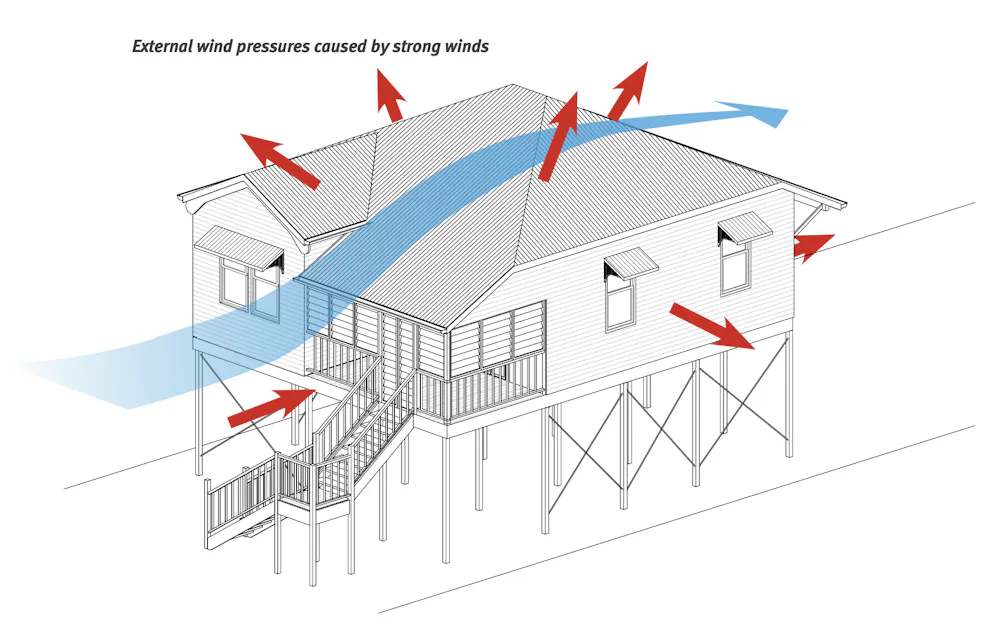
Strong winds generate pressure pushing and pulling on the outside and inside of a house.
When wind gusts hit a building, the wind is pushing on what we call the windward wall and going up and over the roof, creating a suction effect. The wind is trying very hard to peel the roof off your house, and in a cyclone is hammering the building for many hours.
If a windward window or door blows in or gets broken by debris, wind instantaneously enters the space. This almost doubles the load that the roof now has to resist.
In southeast Queensland and northern NSW, housing is not typically designed to resist that extra upward load on the roof if a door or window blows in.
Cyclone resilience is about maintaining the function of a building during severe weather, so even if there is some damage, it still can be used after the storm has passed. So it’s vital the roof stays on.
In practice, that means thinking about what’s known as the “tie down chain” – how all pieces of the house are held together to carry the wind loads from the roof to the ground.
A weak link in this tie down chain can lead to winds lifting entire roofs from homes. All the connections involved in keeping a roof on the house are exceptionally important.
Weather resistance in building codes is generally designed for rain that falls straight down and flows off the roof.
But in a cyclone, rain can come horizontally. It can get pushed under the the roof, into gutters and under sliding doors. And it’s not just a little bit – buckets and buckets of water can inundate a house.
Wind pressure can also mean water is blown into the house through gaps you may not even know existed. Wind-driven rain ingress can happen at wind speeds that don’t cause structural damage.
It comes in under doors and through windows, including holes in window sills. It can lead to buildings being unusable and a large number of insurance claims.
Dispelling major myths
You might have seen people taping a big “X” on their windows and glass doors. Unfortunately, this doesn’t really do much to improve window strength.
Some people put the tape on and then, during the cyclone, sit there watching their glass flex, falsely believing tape magically makes the window stronger. This is incredibly dangerous. If that glass shatters, the bystander would be hit by shards of glass travelling at high speed.
Sometimes people open a window to reduce pressure inside the house that happens if a door or window breaks. It’s true this might reduce some pressure, but it depends which side of the house is currently being hit by wind. And given wind direction can change during a cyclone, emergency services recommend it’s better just to stay sheltered in the smallest room; they don’t want you standing in front of a window during a cyclone.
Close all internal doors so if any windows do blow in, the high pressure is restricted to just that room (not spread throughout the house).
Designing beyond the bare minimum
Building codes require buildings to build to a “wind classification” according to the “wind zone” of that area.
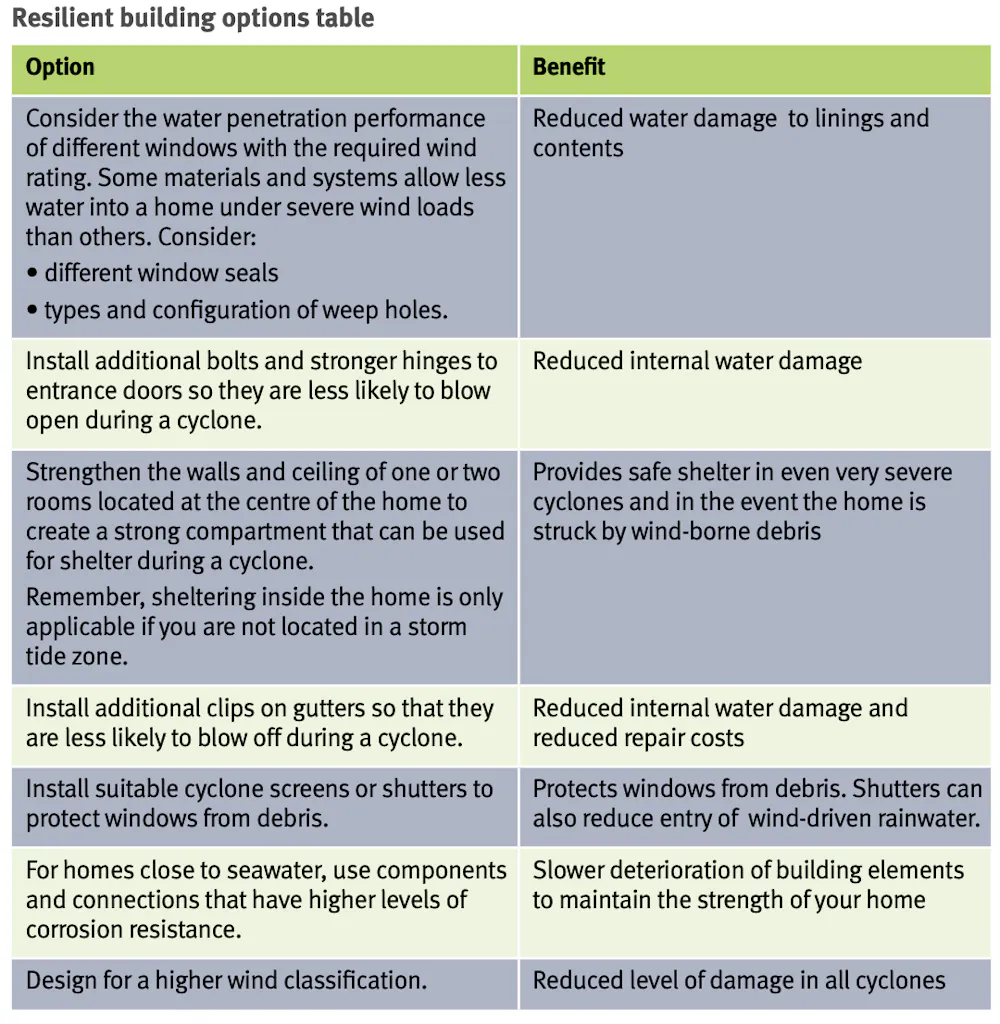
Buildings are often built only to the minimum standard of the Building Code. However, if we want a house to function after an extreme tropical cyclone, we should consider building beyond the minimum standard using resilience features that will keep your roof on in a cyclone and minimise the entry of rainwater.
Cyclone resilience also includes incorporating resilient building materials in your home – such as linoleum or vinyl floors instead of carpet, and ceilings from fibre-cement sheeting instead of plasterboard.
It’s also important all elements holding your house together are well maintained through the life of the building.
That means ensuring regular inspections by a trained professional to identify any potential weaknesses such as rot, rust or UV damage.
These inspections are not something you and a mate can do yourselves. It requires a building professionals to get into the roof and look for weak spots.
Think beyond your house. What about the carport? A pergola? That shed or patio you added? Are the solar panels installed correctly with the right fixings and brackets to resist the wind forces?
If all these things are not fixed down and maintained well, strong winds can pick them up and throw them at your house or your neighbours.
Just as you get your car serviced, you should get your house checked every five to seven years. Our homes have many important parts and a failure in one can lead to disastrous and expensive problems.
David Henderson serves on committees for Standards Australia. He is a member of Engineers Australia and has done consulting work with the Resilient Building Council.
Geoffrey Boughton serves on committees for Standards Australia. He is a member of Engineers Australia and has done consulting work with the Resilient Building Council.
Celebrate your multicultural community this Harmony Week, with a host of exciting events happening across the City of Wanneroo.
Running from 15 to 21 March each year, Harmony Week encourages all Western Australians to experience, explore and appreciate the State’s cultural, religious and linguistic diversity.
Wanneroo Mayor Linda Aitken said the City was proud to celebrate Harmony Week with a range of community activities designed to celebrate multiculturalism, and promote inclusiveness, respect and a sense of belonging for everyone.
“More than 40 per cent of the City’s population were born overseas and 20 per cent of residents speak a language other than English at home, with the most common languages being Vietnamese, Afrikaans, Arabic, Gujarati, Filipino and Mandarin,” she said.
“It is this multiculturalism that makes our City such a vibrant, progressive and incredible place to live.
“This year’s Harmony Week events will conclude with a colourful multicultural festival in the heart of Girrawheen on Friday 21 March, and I encourage everyone to come along and join in the celebrations.”
In 2011, as Cyclone Yasi approached the Queensland coast, I sat in my home in the tropical far north of the state and worried what the future would hold. Would my family be OK? Would our home be destroyed? Would my workplace be damaged and my job uncertain? Would my community be devastated?
Now, as we wait for Cyclone Alfred to make landfall, I am watching on from my new home in Melbourne. I am safe. But last night, I couldn’t sleep. I’m having intrusive thoughts, remembering what it was like when Cyclone Yasi barrelled into us. I feel agitated, distracted and anxious. The news coverage of the impending cyclone makes my heart race, so I have turned off the television.
As someone who has researched the impact of disasters for more than 20 years, I recognise what I am feeling now is similar to how I felt all those years ago. Again, I am experiencing the normal range of stress reactions common after living through a disaster, even though I am not directly impacted by this one.
This is known as retraumatisation, where we re-live stress reactions experienced as a result of a traumatic event when faced with a new, similar incident.
As a researcher in emergency responses to a broad range of disasters, I understand why I am feeling like this.
However, many people may not realise the stress they are experiencing right now is related to an earlier disaster or traumatic event in their life. That earlier disaster could be another cyclone, or a different event, such as a flood or bushfire.
Some signs and symptoms of retraumatisation might be:
intrusive thoughts (for example, I keep remembering my fear of the predicted tidal surge of water rushing up at me in the darkness as Cyclone Yasi made landfall)
nightmares and having trouble sleeping
hypervigilance (for example, feeling “on edge” all day)
sensitivity to triggers (for example, the sound of intense wind and windows creaking can trigger intense feelings because they remind me of the night we lived through Cyclone Yasi passing over the top of us)
feeling isolated
thinking about, planning or attempting suicide
panic atacks
using/abusing substances, such as alcohol and other drugs
increase in unhealthy behaviours (for example, being more prone to aggression or violence).
For many of us, Cyclone Alfred is awakening memories and feelings, and the re-emergence of those stress reactions can be confronting. It can feel like re-opening a wound that hasn’t quite healed.
Disaster upon disaster take their toll
We are now beginning to understand the effects of being exposed to multiple disasters – bushfires, cyclones, floods, and let’s not forget the COVID pandemic – that erode our resilience.
This type of multiple exposure influences our feelings of safety, security and even our hope for the future, all increasing the risk of poorer mental health.
For people with post-traumatic stress disorder (PTSD), retraumatisation may cause people to relive their past traumas in intense detail. It can feel like past traumatic events are happening all over again.
What to do now, and in the future
However, there are steps we can take to help build our resilience in the face of multiple disasters.
For now
Right now, it is useful to understand how we respond to trauma. We may notice a range of physical responses (for example, my heart has been racing), psychological reactions (for example, I am feeling more anxious than usual) and social impacts (for example, I cancelled dinner plans last night as I did not want to leave the house).
So, even though I stayed home last night, I was on a group chat discussing the Real Housewives of Sydney with friends, which helped reduce both the physical and psychological stress reactions I was experiencing.
Staying connected to friends, family, neighbours and other supports will help. Caftor/Shutterstock
For later
In the longer term, it is useful to develop and implement a self-care plan that includes activities to support our emotional, physical and spiritual health.
Self-care means taking the time to do things that help your wellbeing and improve your physical health and mental health. This can help you manage the stress reactions that may emerge as part of retraumatisation. Even small acts of self-care in your daily life can have a big impact.
Today, I made the time to go for a short walk in the park and listened to some of my favourite music. It helped in the moment, but it also helps me in the longer term when I routinely include these small acts of self-care in my daily life.
Most importantly, we need to understand that the way we are feeling is normal. Be patient with yourself and look for small opportunities to take control of your reactions.
I am keeping the television turned off (except when the Real Housewives is on).
Some resources
The website blueknot, from the National Centre of Excellence for Complex Trauma, gives more information about how we respond to trauma. The Black Dog Institute guides you through developing a self-care plan.
If this article has raised issues for you, or if you’re concerned about someone you know, call Lifeline on 13 11 14.
Erin Smith does not work for, consult, own shares in or receive funding from any company or organisation that would benefit from this article, and has disclosed no relevant affiliations beyond their academic appointment.
Glimmers is a new Artists on View exhibition at Dudley House that tackles the sensitive and difficult topic of family violence and its impact in the Greater Bendigo community.
The exhibition tells stories from people who have experienced family violence or who have supported someone who has been directly affected.
Glimmers is curated by emerging artist Rhayven Jane and features a powerful collection of artworks, stories, submissions and poetry for this collaborative community exhibition.
Some of the entries for the exhibition are anonymous to protect their safety and participants can choose whether to sell their work or not, due to the personal nature of the pieces.
Rhayven is also the founder of The Glimmer Initiative. This is a survivor-led organisation providing accessible support, safety, sanctuary, education and creative opportunities for women and children affected by family violence in the region. The Glimmer Initiative was an idea developed as part of the 2024 Incubator Professional development program run through Emporium Creative Hub, combining art, advocacy and wellbeing.
The exhibition’s name, Glimmers, is interpreted as the opposite of a ‘trigger’ to describe a moment that creates a strong sense of calm, reflection, safety and strength.
Rhayven said the aim of the exhibition was to raise awareness about the trauma of family violence and its impact on the community.
“As the launch project for The Glimmer Initiative, the Glimmers exhibition showcases the diversity of experiences and encourages attendees to understand the complexities around family violence, empowering those who have chosen to share their stories using creativity as the catalyst for validation, expression and healing,” Rhayven said.
The exhibition on View Street is open to the public from 10am to 3pm, Friday March 7 to Sunday March 16. Please note the gallery will be closed on the Monday public holiday, March 10, and Thursday March 13.
This exhibition is supported by the City of Greater Bendigo as part of the 2025 Artists on View program.
Source: Australia Government Statements – Agriculture
7 March 2025
Who does this notice affect?
Stakeholders in the import and shipping industries—including vessel masters, freight forwarders, offshore treatment providers, Biosecurity Industry Participants, importers, customs brokers, principal agents and master consolidators.
What has changed?
Following identification of critical non-compliance, we have suspended Ser.Chim. Fumigazioni S.R.L. (AEI: IT4027SB) from AusTreat.
It’s important to know that when you link your myID to your not-for-profit (NFP) in Relationship Authorisation Manager (RAM), it will not link your personal records with the records of your NFP. Your personal tax records are separate from those of the NFP.
Each person within your NFP who needs to access Online services for business will need to set up their own individual myID. This is because myID is unique to each person and shouldn’t be shared. Linking your myID to the NFP in RAM ensures only you and authorised users can transact for your NFP in Online services for business.
Why do you need a myID to lodge online?
Your myID is a secure way to prove who you are when logging into government online services.
Non-charitable NFPs with an active Australian business number (ABN) need to lodge an NFP self-review return to notify eligibility to self-assess as income tax exempt. This can be completed through Online services for business.
Before you can link your myID and lodge online, you need to check your organisation’s details are up to date. This includes the organisation’s associates, as they will be the principal authorityExternal Link for the NFP. If the associate isn’t up to date, notify us of changes by completing a Change of details form to request an update. You can also advise us of new authorised contacts, postal and email address details as well.
Once you’ve set-up access to Online services for business, you can use it to lodge the NFP self-review return. The first return is due to be lodged for the 2023–24 income year, by 31 March 2025.
Source: The Conversation (Au and NZ) – By Prema Arasu, Postdoctoral Research Fellow, Minderoo-UWA Deep-Sea Research Centre, The University of Western Australia
In February, researchers from conservation organisation Condrik Tenerife were about two kilometres off the coast of Tenerife Island, looking for sharks, when they caught sight of something much stranger.
Photographer David Jara Boguñá filmed a humpback anglerfish (Melanocetus johnsonii, a species of black seadevil) swimming near the surface in sunlit waters. These fish have never before been seen alive in daylight, as they normally dwell in the “twilight zone” at depths from 200m to 600m.
The video has provoked an enormously empathetic response on social media, with some seeing the fish as a feminist icon or an Icarus-like figure who swam too close to the Sun. The reaction shows our views of the deep sea – long ignored or seen as a realm of monsters – may at last be changing.
The strange lives of anglerfish
Anglerfish are much smaller than you probably think they are. The specimen Boguñá filmed was a female, which typically grow up to 15cm long.
The creatures are named for their bioluminescent lure (or esca). This modified dorsal fin ray can produce a glow used to fish (or angle) for prey in the dim depths of the sea. The bioluminescence is produced by symbiotic bacteria that live inside the bulbous head of the esca.
Male anglerfish lack the iconic lure and are much smaller, usually reaching a length of only 3cm.
A male anglerfish spends the first part of his life searching for a female to whom he will then attach himself. He will eventually fuse his circulatory system with hers, depending on her entirely for nutrients, and live out his life as a parasite or “living testicle”.
It is unknown why this fish was swimming vertically near the surface. Researchers have speculated that the behaviour may have been related to changes in water temperature, or that the fish was simply at the end of her life.
Watchers observed the fish for several hours, until it died. Its body was preserved and taken to the Museum of Nature and Archaeology in Santa Cruz de Tenerife, where it will be further studied.
I like to think she is a respected old grandmother who has dreamed her entire life of seeing the sunlight and the world above the water. She knows her time is nigh so she bade farewell to her friends and family and swam up towards the light and whatever it might hold for her as her life as an anglerfish comes to a close.
One person described the fish as her “feminist Roman Empire”, in the sense of an inspirational obsession that filled the same role for her that the Roman Empire supposedly does for many men.
Boguñá and Condrik Tenerife have since commented on the public reaction. (The original post is in Spanish, but Instagram’s automated English translation is below.)
He’s become a global icon, that’s clear. But far from the romanticisation and attempt to humanise that has been given to its tragic story, I think that what this event has been for is to awaken the curiosity of the sea to PEOPLE, especially the younger ones, and perhaps, it also serves that messages about marine ecosystem conservation can reach so many more people.
From horrors to heroes
The outpouring of empathy for the anglerfish is unexpected. With their glowing lures and fang-filled mouths, the creatures have long been archetypal horrors of the abyss.
As I have written elsewhere, the anglerfish’s extreme sexual dimorphism and parasitism, along with its unsettling anatomy, have made it the “iconic ambassador of the deep sea”. Anglerfish or angler-inspired aliens have appeared as antagonists in films such as Star Wars Episode I: The Phantom Menace (1999), Finding Nemo (2003), The SpongeBob SquarePants Movie (2004) and Luca (2021).
Star Wars film The Phantom Menace features a large anglerfish-inspired sea monster. Disney
The reception of “Icarus” (as some call her) in popular culture indicates a perhaps surprising capacity for empathy toward animals that aren’t conventionally cute or beautiful. It stands in stark contrast to the fate of the deep-sea blobfish Psychrolutes marcidus, which in 2013 was voted the world’s ugliest animal.
Perhaps the name is a clue: people have seen in the fish a creature striving to reach the light, who died as a result of her quest.
But does our projection of human emotions and desires onto non-human animals risk misunderstanding scientific reality? Almost certainly – but, as US environmental humanities researcher Stacy Alaimo has argued, it may also have benefits:
Deep-sea creatures are often pictured as aliens from another planet, and I think that gets people interested in them because we’re all interested in novelty and weirdness and the surreal […] I think that can be positive, but the idea of the alien can also cut us off from any responsibility.
Prema Arasu does not work for, consult, own shares in or receive funding from any company or organisation that would benefit from this article, and has disclosed no relevant affiliations beyond their academic appointment.
Source: United States Senator for Illinois Tammy Duckworth
March 06, 2025
[WASHINGTON, D.C.] – Today, combat Veteran and U.S. Senator Tammy Duckworth (D-IL)—a member of the Senate Veterans’ Affairs Committee (SVAC)—joined SVAC Ranking Member Richard Blumenthal (D-CT), all other SVAC Democrats and House Veterans’ Affairs Committee Ranking Member Mark Takano (D-CA-39) in demanding immediate answers from Department of Veterans Affairs (VA) Secretary Doug Collins regarding the disastrous impact of the Trump Administration’s plans to cut more than 80,000 VA employees this year—including at least 20,000 Veterans. The lawmakers’ bicameral letter comes after an internal memo leaked earlier this week detailed a plan to slash VA’s workforce to fiscal year 2019 levels.
The lawmakers expressed their extreme concern with the impact this massive reduction in force plan will have on Veterans—despite Collins’ unsupported claims that scaling back VA’s workforce by at least 15% will have no impact on VA care or benefits: “This planned [Reduction in Force] and [Reorganization Plan], coupled with the ongoing hiring freeze and illegal terminations of probationary employees, will be catastrophic for the agency; its workforce; and for the veterans, caregivers, and survivors it serves…You have promised on several occasions that any reductions in the VA workforce will not impact delivery of care and benefits to veterans. It defies logic and reason that the agency could cut an additional 83,000 employees, beyond the 2,400 or more you have already terminated, without healthcare and benefits being interrupted.”
The lawmakers emphasized the harm in reducing VA’s workforce back to pre-PACT Act levels: “Congress passed the Honoring Our PACT Act in 2022, which authorized the largest expansion of veterans’ benefits in decades. Millions of veterans either became newly eligible for VA benefits or saw their benefits increase due to authorities in the PACT Act. To meet the growth in demand and to deliver the care and benefits veterans earned, Congress included provisions in the legislation that allowed VA to grow its workforce across the system…These new hires made the Department more efficient and productive, and the reduction in claims processing turnaround can be directly attributed to the growth in the workforce. Returning to pre-PACT levels explicitly goes against Congressional intent.”
The lawmakers concluded their letter by demanding immediate answers to a series of questions and requests for documentation, including:
A full and unredacted copy of the memo leaked this week including attachments referenced;
Full and unredacted copies of the information gathered and submitted by Administrations and Staff Offices that is due by March 10, 2025, as referenced in the memo;
The names, jobs titles, job duties and onboarding dates of the “DOGE leads” and “VA liaisons to DOGE” referenced in the memo;
A detailed list of VA Administration and Staff Office personnel who will be detailed to support the Reduction in Force and Reorganization Plan efforts referenced in the memo;
A detailed timeline of the proposed Reduction in Force and Reorganization Plan;
A list of the designated senior leaders who will serve as central points of contact for time sensitive issues designated by Administration and Staff Offices as referenced in the memo;
What future objectives related to any RIFs or adjustments to VA staffing levels are being contemplated or planned; and
To confirm the exact data and goals the Secretary is referencing to implement these plans.
Along with Duckworth, the letter was co-signed in the Senate by SVAC Ranking Member Blumenthal (D-CT) and U.S. Senators Patty Murray (D-WA), Bernard Sanders (I-VT), Mazie Hirono (D-HI), Maggie Hassan (D-NH), Angus King (I-ME), Ruben Gallego (D-AZ) and Elissa Slotkin (D-MI).
In the House, the letter is also co-signed by House Veterans’ Affairs Committee Ranking Member Mark Takano (D-CA) and numerous House Democratic Committee members.
The full text of the letter is available on the Committee Democrats’ website and below.
Dear Secretary Collins:
We write to express our extreme concern regarding reports that through Agency Reductions in Force (RIF) and Reorganization Plan (ARRP), the Department of Veterans Affairs (VA) plans to cut its staff by an estimated 83,000 employees by the end of this fiscal year. VA Chief of Staff Christopher Syrek stated in a March 4, 2025, memorandum to key VA officials that the “initial objective” at the agency will be to reduce the VA workforce to end of fiscal year 2019 levels. This planned RIF and ARRP, coupled with the ongoing hiring freeze and illegal terminations of probationary employees, will be catastrophic for the agency; its workforce; and for the veterans, caregivers, and survivors it serves.
Congress passed the Honoring Our PACT Act in 2022, which authorized the largest expansion of veterans’ benefits in decades. Millions of veterans either became newly eligible for VA benefits or saw their benefits increase due to authorities in the PACT Act. To meet the growth in demand and to deliver the care and benefits veterans earned, Congress included provisions in the legislation that allowed VA to grow its workforce across the system. Those new hires were not limited to clinicians who provide direct care. Claims processors, benefits counselors, IT professionals, and essential support staff were also onboarded to ensure veterans could access their earned disability compensation and programs like the G.I. Bill and Veteran Readiness and Employment (VR&E). These new hires made the Department more efficient and productive, and the reduction in claims processing turnaround can be directly attributed to the growth in the workforce. Returning to pre-PACT levels explicitly goes against Congressional intent.
You have promised on several occasions that any reductions in the VA workforce will not impact delivery of care and benefits to veterans. It defies logic and reason that the agency could cut an additional 83,000 employees, beyond the 2,400 or more you have already terminated, without healthcare and benefits being interrupted. To that end and due to the urgency of this matter, we request answers to the following questions by March 14, 2025. We also request our staff be briefed on these RIF and ARRP plans by March 12, 2025.
Please provide a full and unredacted copy of the March 4, 2025, memorandum from the VA Chief of Staff to key Administration officials, “Department of Veterans Affairs Agency Reduction in Force (RIF) and Reorganization Plan (ARRP)” including “Attachment 1”.
Please provide full and unredacted copies of the information gathered and submitted by Administrations and Staff Offices that is due by March 10, 2025, as referenced in the March 4, 2025 memorandum related to the proposed RIF and ARRP.
Please provide the names, jobs titles, job duties, and onboarding dates of the “DOGE leads” and “VA liaisons to DOGE” referenced in the March 4, 2025 memorandum.
Please provide a detailed list of VA Administration and Staff Office personnel who will be detailed to support the RIF and ARRP efforts, as referenced in the March 4, 2025, memorandum. Please include the following data: name, occupation, job description, work experience, job location, and other relevant information.
Please provide a detailed timeline of the proposed RIF and ARRP plans, including all due dates for information from VA Administrations and Staff Offices and dates on which each step in the RIF and ARRP plan will be executed.
Please provide a list of the designated senior leaders who will serve as central points of contact for time sensitive issues designated by Administration and Staff Offices as referenced in the March 4, 2025 memorandum.
Please provide a list of Under Secretaries, Assistant Secretaries, other Key Officials, Senior Advisors, DOGE liaisons, and any other personnel who will serve on the Executive Review Group (ERG) referenced in the March 4, 2025 memorandum.
Please provide a list of participants and a detailed summary of the initial senior level meeting chaired by the Secretary that is planned for March 5, 2025 as referenced in the March 4, 2025 memorandum.
In the March 4, 2025 memorandum, the VA Chief of Staff states, “…the Department’s initial objective is to return to 2019 end-strength numbers of 399, 957 employees.” What future objectives related to any RIFs or adjustments to VA staffing levels are being contemplated or planned?
In the March 4, 2025 memorandum, the Chief of Staff refers to 2019 numbers as 399,957 employees, but according to data reported as required by Section 505 of Public Law 115-82, the MISSION Act, the Department’s numbers were below that level until 2020. Please confirm the exact data and goals you’ll be referencing as you implement these plans.
Source: Northern Territory Police and Fire Services
The Northern Territory Police Force has charged three male youths in relation to a crime series that commenced on Monday in the Greater Darwin Region.
Strike Force Trident detectives have conducted extensive investigations to identify the perpetrators of multiple thefts and unlawful entries whilst using a stolen motor vehicle.
About 1:40pm on Monday, police allege a male youth and a female youth attended a shopping centre in Yarrawonga and stole small items from a business.
The following day at about 3:15pm, the same male youth involved in the incident the day before allegedly returned to the same shopping centre and stole further items from a separate business whilst in the company of other male youths.
Three male youths then attended a recreational on The Boulevard where they stole car keys to a blue Nissan X-trail from a worker.
The group of three subsequently met up with the male youth who was involved in both shopping centre thefts, located the vehicle and drove off from the location.
The group of four males went on to unlawfully enter four separate businesses in Winnellie, Berrimah and Holtze before attempting to unlawfully enter a fifth business.
About 1am the following morning on Wednesday, the same group allegedly attempted to unlawfully enter a further two businesses within the Bellamack Business Precinct before being disturbed by police in the area.
The stolen vehicle was recovered at 5am that morning and has been seized for forensic analysis.
Yesterday morning, Strike Force Trident detectives arrested and charged three male youths, aged 13, 14 and 16 with:
Drive/Ride/Use MV without consent
4 x Aggravated Burglary
3 x Attempted Burglary
7 x Damage to Property
3 x Theft
Trespass
The 13 and 14-year-old males received an extra charge of Breach Bail.
Further charges were laid on the 13-year-old in relation to the incidents, including two extra counts of shoplifting and Drive Unlicenced.
Investigations remain ongoing with Strike Force Trident working to arrest the remaining offenders.
Anyone with information is urged to make contact on 131 444 or anonymously through Crime Stoppers on 1800 333 000.
This International Women’s Day, the Commissioners at the Australian Human Rights Commission stand together to call for urgent action to ensure that all women and girls—of every background, age or disability—can live free from violence, discrimination, and inequality.
This year’s International Women’s Day theme, “For ALL women and girls: Rights. Equality. Empowerment,” is a reminder that gender equality can only be achieved when every woman and girl has their rights upheld, their safety guaranteed, and their voices heard. Gender equality benefits all of us.
For too many women, this vision remains out of reach. Women in Australia continue to face gender-based violence at devastating rates, economic insecurity that puts them at risk, and structural barriers that leave them without access to support or justice. These issues are not separate—they are interconnected. That is why we must take a prevention-first approach that reflects the diversity of Australian women and girls.
We also urge governments to commit to sustainable funding for community-led, trauma-informed, and person-centred solutions, ensuring that the women and communities most affected by violence and discrimination lead the responses. This cannot be achieved without real accountability.
This International Women’s Day, we ask Australia to move beyond rhetoric and commit to genuine systemic change. Women’s safety must be a guarantee – it cannot be an afterthought.
“International Women’s Day is a moment to celebrate progress, but it is also a call to action. We cannot achieve gender equality while women continue to live in fear of violence and discrimination. We know what works in communities, workplaces, and homes, let’s listen to women and girls and be led by them.” Dr Anna Cody, Sex Discrimination Commissioner
“For migrant, refugee, and First Nations women and girls, safety is often undermined by racism, visa insecurity, and systemic barriers to justice. True empowerment means ensuring negatively racialised women and girls have equal protection under the law and that their perspectives are built into policy and practice.” Giridharan Sivaraman, Race Discrimination Commissioner
“While Aboriginal and Torres Strait Islander women are the bedrock of our communities, we also face challenges like domestic and family violence at disproportionate rates – a crisis further compounded by the ongoing issue of misidentification as perpetrators. Too often, these women remain invisible within the statistics that should be driving our reforms. We must have targeted, culturally informed strategies that acknowledge and address these systemic shortcomings.” Katie Kiss, Aboriginal and Torres Strait Islander Social Justice Commissioner
“Housing insecurity has become increasingly widespread among older women. The rate of homelessness among older women has grown by almost 40% in the last ten years. We cannot talk about women’s safety without addressing economic inequality and the structural barriers that put them at risk.” Robert Fitzgerald AM, Age Discrimination Commissioner
Women and girls with disability experience higher rates of violence, yet their specific and unique experiences are often not recognised or addressed in gender-based violence responses. We need accessible, and rights-based solutions to ensure no woman or girl is excluded.” Rosemary Kayess, Disability Discrimination Commissioner
“All children should be safe, and their wellbeing should be made a national priority for Australia. 1 in 3 girls experience child sexual abuse. If we are serious about ending gender-based violence, we must stop the violence experienced by children in their homes and ensure that children with trauma get the help they need. For too long we have neglected the wellbeing of children – this International Women’s Day I call for child wellbeing to be made a priority for National Cabinet.” Anne Hollonds, National Children’s Commissioner
“Australian women and girls are diverse, but one thing that should be shared by us all is being able to live free from violence and fear. International Women’s Day is a day to reaffirm the importance of ensuring that these shared rights are upheld for all women and girls.” Lorraine Finlay, Human Rights Commissioner
This International Women’s Day, we call on governments, policymakers, and communities to act. For ALL women and girls—Rights, Equality, Empowerment.
E tū is deeply concerned by comments made by NZME investor and billionaire James Grenon, that he wants to replace the board of directors with four new people – including himself.
Grenon owns a 9.3% stake in NZME, and has been a controversial figure in the media landscape.
NZME delegate Isaac Davison said the takeover proposal created significant uncertainty about the company’s potential direction and the newsroom’s editorial independence.
“Our top priority is preserving the impartiality of our journalism and the independence of the newsroom,” Isaac says.
“E tū journalists follow a code of ethics which includes a commitment to reporting and interpreting the news with “scrupulous honesty” and without fear or favour.
“While the intentions of the potential new board members remain unclear, we are concerned about an apparent record of backing news ventures which lack transparency.
“Further, NZME is in the last stages of a major change process which has had a profound impact on staff morale. We believe it is a time for consistency and stability rather than more uncertainty.”
E tū Director Michael Wood says that Grenon has a clear agenda to use NZME for his own interests.
“Mr Grenon clearly wants to use his financial clout to steer the editorial direction of one of New Zealand’s largest and most important media networks,” Michael says.
“While changes to media ownership in New Zealand are common, there is not any recent example of an extremely wealthy individual seeking to use an ownership stake to steer public discourse in the way that Mr Grenon, based on his track record, seems to be attempting.
“These concerns are heightened by a lack of transparency. When his initial stake in NZME was revealed, Mr Grenon indicated that he was not intending to make any further moves, yet within a week it has been reported that he is working closely with an NZ On Air board member and a high-profile businessman to take over the board.
“The idea that a shadowy cabal, backed by extreme wealth, is planning to take over such an important institution in our democratic fabric should be of concern to all New Zealanders.”
Michael calls on the current board to re-affirm its commitment to the editorial independence of NZME’s publications.
“While there is clearly a commercial process to play out, we must protect the rights of NZME journalists to report free from undue interference. We urge other shareholders to think carefully about the impact on the value and standing of NZME if they allow it to be turned into a plaything for the agendas of billionaires like Mr Grenon.”
Responding to Chris Hipkins’s State of the Nation speech, ACT Leader David Seymour says:
“It was a deck chair speech. All the changes he’s proposing involve politicians and bureaucrats being reorganised, and will have no effect on actual people.
“A new ‘economic team’ of Labour MPs, a new ‘jobs and incomes’ portfolio for Ginny Anderson, talking to ‘experts’ and ‘unions’ – none of this is real change.
“We’ve seen this before. Hipkins spent resources reorganising the health system, and what we got was a new org chart while patients were ignored.
“We won’t reshuffle our way to prosperity. But to give Hipkins credit, giving a speech in Auckland was probably a bold step for someone who struggles to think outside the Wellington bubble.
“By contrast, we’ve got a Government that is making real change to red tape and regulation, focusing public services on patients and students, reducing government waste so inflation and interest rates are lower for the people.
“The amazing thing is Chris Hipkins’s changes could all be made without any real person in New Zealand noticing. It may not be long before some of Hipkins’s caucus decide to reorganise him.”
PERTH, Australia, March 06, 2025 (GLOBE NEWSWIRE) — Canyon Resources Limited (ASX: CAY) (‘Canyon’ or the ‘Company’) is pleased to announce that the Board of CAMRAIL SA (‘Camrail’) has approved Total Energies Marketing Cameroun SA (‘Total Cameroon’) and Societe d’Exploitation des Bois du Cameroun (‘SEBC’) to enter into two share sale agreements with the Company’s wholly owned in-country subsidiary Camalco Cameroon SA (‘Camalco’). The agreements will see Camalco acquire a strategic 9.1% investment in Camrail as well as secure a position on the Camrail Board upon the completion of the two acquisitions.
Camalco acquired a 3.8% equity interest in Camrail from SEBC for an upfront cash consideration of XAF 575,700,000 (approximately A$1.4 million) and this unconditional acquisition was completed on the 28th of February 2025. Camalco will separately acquire a 5.3% equity interest in Camrail from Total Cameroon for an upfront cash consideration of XAF 812,850,000 (approximately A$2.0 million). Completion of this acquisition from Total Cameroon is subject to the remaining condition precedent of internal approval by the Apex Committee of Total Cameroon, which is expected to be completed by the end of March 2025. The total consideration of approximately A$3.4 million for the 9.1% holding in Camrail will be paid from the Company’s existing cash reserves.
Establishing and accessing a transport network within the region, notably within the mine and from mine-to-port is a key focus area for Canyon, and the execution of these agreements and investment in Camrail which operates Cameroon’s rail network (refer to Image 1), has further de-risked the Company’s position in securing and optimising the logistics solution for its world-class, flagship Minim Martap Bauxite Project (‘Minim Martap’ or ‘the Project’).
Minim Martap ranks among the world’s richest bauxite deposits, with an Ore Reserve of 109Mt at 51.1% Al2O3 and 2.0% SiO2 and a JORC Mineral Resource Estimate of 1,027Mt at 45.3% Al2O3.
Mr Jean-Sebastien Boutet, Canyon Chief Executive Officer commented: “This investment in Camrail is a major milestone for Canyon, as we continue to work on establishing an optimal logistics plan for the Minim Martap Project
“Minim Martap is a standout, tier-one bauxite project, which Canyon believes has all the required characteristics to become a long-term, low-cost operation, supplying a high-quality product into a growing and constrained market. To unlock the significant value potential of Minim Martap, Canyon has been focused on progressing and completing key discussions with with Ministry of Mines, Ministry of Transport, the Port Authority of Douala, Camrail and other relevant authorities to sign agreements for rail and port and secure logistics support.
“We welcome the Board of Camrail’s approval of the 9.1% stake sale previously held by Total Energy and SEBC, to Camalco and look forward to working alongside the current shareholders in Camrail, State of Cameroon and Africa Global Logistics.
“This acquisition is a significant step forward in gaining access to rail infrastructure and delivering on our logistics objectives in the first half of 2025, and I would like to take the time to recognise the ongoing hard efforts of the Canyon team as we rapidly develop Minim Martap towards production.”
Image 1:Camrail transport route (source: http://www.camrail.net/)
This announcement has been approved for release by the Canyon’s Board of Directors.
Forward looking statements
This announcement contains forward-looking statements. These statements can be identified by words such as “anticipate”, “may”, “will”, “expect”, “intend”, “estimate”, “opportunity”, “plan”, “potential”, “project”, “seek”, “believe”, “could”, “future” and other similar words that involve risks and uncertainties. These statements are based on an assessment of present economic and operating conditions, and on a number of assumptions regarding future events and actions that are expected to take place. Such forward-looking statements are not guarantees of future performance and involve known and unknown risks, uncertainties, assumptions and other important factors, many of which are beyond the control of the Company, its directors and management that could cause the Company’s actual results to differ materially from the results expressed or anticipated in these statements.
The Company cannot and does not give any assurance that the results, performance or achievements expressed or implied by the forward-looking statements contained in this announcement will actually occur and investors are cautioned not to place undue reliance on these forward-looking statements. The Company does not undertake to update or revise forward-looking statements, regardless of whether any new information, future events or any other factors affect the information contained in this announcement, except where required by applicable law and ASX requirements.
Mineral Resources and Ore Reserves
The information in this announcement that relates to the Mineral Resources and Ore Reserves at the Minim Martap Bauxite Project has been extracted from the ASX releases by Canyon entitled ‘Minim Martap Mineral Resource Estimate upgrade adds Measured Resource’ dated 11 May 2021, and ‘Positive BFS for Canyon’s Minim Martap Bauxite Project’ dated 21 June 2022, available at www.canyonresources.com.au and www.asx.com (Canyon Releases). Canyon confirms that it is not aware of any new information or data that materially affects the information included in the Canyon Releases and that all material assumptions and technical parameters underpinning the estimates in the Canyon Releases continue to apply and have not materially changed.
Some 50 years ago, on March 1 1975, Australian television stations officially moved to colour.
Networks celebrated the day, known as “C-Day”, with unique slogans such as “come to colour” (ABC TV), “Seven colours your world” (Seven Network), “living colour” (Nine Network) and “first in colour” (0-10 Network, which later became Network Ten). The ABC, Seven and Nine networks also updated their logos to incorporate colour.
For most viewers, however, nothing looked much different. The majority owned a black and white TV, while a coloured broadcast required a colour TV set.
Advertisers were initially reluctant to accept the change, which required them to re-shoot black and white commercials with colour stock at a significantly higher cost.
Many reasoned viewers were still watching the ads in black and white. And initially this assumption was correct. But by nine months later, 17% of Australian homes had a colour receiver. This rose to 31% by July 1976.
By 1978, 64% of Melbourne and 70% of Sydney households owned colour TV sets, making Australia one of the world’s fastest adopters of colour TV.
According to the Federation of Australian Commercial Television Stations (FACTS) annual report for 1975–76, colour TV increased overall viewership by 5%, with people watching for longer periods.
The 1976 Montreal Olympics also led to an increase in TV sales, with the colour broadcast shared between the ABC, Seven and Nine.
Highlights from the Montreal 1976 Olympic Games marathon event.
A late start
With the United States introducing colour TV from 1954, it’s peculiar that Australia took so long to make the transition – especially since conversations about this had been underway since the 1960s.
In 1965, a report outlining the process and economic considerations of transitioning to colour was tabled in parliament.
Feedback from the US highlighted problems around broader acceptance in the marketplace. Colour TV sets were expensive and most programs were still being shot in black and white, despite the availability of colour.
Networks were the most hesitant (even though they’d go on to become one of the most major benefactors). In 1969, it was estimated transitioning to colour would cost the ABC A$46 million (the equivalent of $265,709,944 today) over six years.
The federal government, led by then prime minister Robert Menzies, decided to take a cautious approach to the transition – allowing manufacturers, broadcasters and the public time to prepare.
The first colour “test” broadcast took place on June 15 1967, with live coverage of a Pakenham country horse racing event in Victoria (although few people would have had coloured TV sets at this point).
Other TV shows also tested broadcasting in colour between 1972 and 1974, with limited colour telecasts aired from mid-1974. It wasn’t until March 1975 that colour TV was being transmitted permanently.
‘Aunty Jack Introduces Colour’ was a one-off television special of The Aunty Jack Show, broadcast on the ABC on February 28 1975.
The cinema industry panics
Australia’s involvement in the Vietnam War created further urgency to televise in colour. With the war ending in April 1975, Australians watched the last moments in colour.
Other significant events broadcast in colour that year included the December federal election, in which Malcolm Fraser defeated Gough Whitlam after the latter was dramatically dismissed as prime minister on November 11.
With the public’s growing interest in colour TV, local manufacturers began lobbying for higher tariffs on imports to encourage domestic colour TV production.
In the mid 1970s, a new colour set in Australia cost between $1,000 and $1,300, while the average full-time annual income was around $8,000. Still in the throes of a financial recession, customers began seeking out illegally-imported colour TV sets – which were appearing at car boot markets across the country.
British childrens show The Wombles came to Australian screens shortly after colour TV was introduced.
The government also created an advertising campaign warning the public of scammers who would offer to convert black-and-white TVs to colour. These door-to-door “salesmen” claimed to have a special screen which, when placed over a TV, would magically turn it colourful.
By 1972, the estimated cost of upgrading broadcasting technology to colour had reached $116 million. The cinema industry, in a panic, even questioned whether colour TV could damage a viewer’s eyesight.
The industry had previously suffered huge losses in cinema attendance with the introduction of black-and-white TV from 1956. Cinemas had a monopoly on colour and were petrified over what the introduction of colour to television could do to their attendances.
Such fears were founded. In 1974 Australia had 68 million admissions to the cinema. By 1976, there were just 28.9 million admissions. Never again would yearly cinema admissions reach above 40 million.
But despite the complaints – from the cinema industry, advertisers, broadcasters and manufacturers – audiences were ready for colour. And any network that dared to program in black and white would subject itself to a barrage of annoyed viewers.
Colour TV was here to stay.
Stephen Gaunson does not work for, consult, own shares in or receive funding from any company or organisation that would benefit from this article, and has disclosed no relevant affiliations beyond their academic appointment.
The opposition wants to call time on letting public servants work from home. In a speech to the Menzies Research Institute this week, shadow public service minister Jane Hume said, if elected, a Coalition government would require public servants in the office five days a week:
While work from home arrangements can work, in the case of the [Australian Public Service], it has become a right that is creating inefficiency.
Hume said Labor had given public servants a “blank cheque” to work from home, creating an “unsustainable” system that was no longer working.
She stressed that exceptions “can and will be made”, but only “where they work for everyone rather than be enforced on teams by an individual”.
Few workplace issues have drawn such heated debate as whether people should be allowed to work from home. The Coalition’s latest election promise, with parallels to a similar move by Donald Trump in the United States, has brought these questions back into the spotlight.
What impact do work from home arrangements have, not only on performance and productivity but also employee wellbeing? Is it really wise to reverse course?
Our research has examined these questions in detail – and we’ve found a changing picture.
We have examined the impacts of working from home on staff performance and productivity in Australian workplaces as part of the Australian Workplace Index, surveying 2,932 Australian employees across 2022 and 2024.
This is a research collaboration project between Australian National University and University of Newcastle.
An Australian Workplace Index 2022 working paper (which has not been peer-reviewed) actually suggested working from home was linked with a number of negative impacts.
In 2022, we saw that compared to those who didn’t, employees who worked from home three to four days a week experienced lower wellbeing, higher depression and anxiety, and higher loneliness.
They also experienced more administrative hassles, higher pressure to meet targets and increased levels of conflict with supervisors and colleagues.
We found working from home was also associated with a reduction in staff productivity, job-target performance and an increase in staff turnover intentions.
A changing picture
We have recently completed analysis for a similar study based on data from 2024, to be published in an upcoming working paper. And it paints a very different picture.
We found the negative impacts of working from home, originally found in 2022, had reversed in 2024.
In the most recent 2024 Australian Workplace Index employment data, we see no significant difference in productivity between employees who work from home and those in the office.
In fact, the latest data suggest numerous benefits.
For example, staff who worked from home one or more days a week had 9.9% more autonomy in how they carried out their work. Those with higher job autonomy were up to 16.8% more productive in their work when compared to those with low job autonomy.
We found staff who work from home also save on average 100 minutes in commuting time each day.
But on top of this, staff who worked from home one or more days a week were 10.6% less burnt out from work compared to those who never did, and had reported lower intention to quit their jobs.
This positive trend likely reflects investment by employers in improving support for staff who work from home.
In 2024, we found a majority of organisations (69%) now had a work-from-home policy in place.
There was also an increase in the physical, technological and psychological infrastructure support available to staff who work from home. For example:
Physical: 82% of staff have a dedicated workspace, 93% have their own desk, and 93% have air conditioning.
Technological: 85% of staff have access to IT support, 94% have access to collaborative technology and 95% have internet access.
Psychological: 80% of staff have access to psychological support from their supervisor and 72% have access to counselling services.
Importantly, employees still value the opportunity highly. Our 2024 data show 38% of Australian employees chose to work from home for 50% or more of their work hours.
32% of Australian employees would prefer to exclusively work from home, 41% prefer a hybrid option, while 27% prefer to work exclusively from the office.
Christina Boedker has received research grant funding from the University of Newcastle’s RSP Stimulus Funding Scheme and from The Australian National University for this research project.
Kieron Meagher received research grant funding from the University of Newcastle’s RSP Stimulus Funding Scheme and from The Australian National University for this research project.
Aeson Luiz Dela Cruz does not work for, consult, own shares in or receive funding from any company or organisation that would benefit from this article, and has disclosed no relevant affiliations beyond their academic appointment.
Source: Australian Government – Antarctic Division
This is the first of our weekly updates on the science and shipboard activities happening on the Denman Marine Voyage, a 60-day collaborative science voyage to the Denman Glacier region. There are about 60 scientists on board, and they’re already hard at work.
RSV Nuyina has been at sea for almost a week and is expected to reach the target area in the next few days. It’s been rough at times but the crew and science groups have managed to get a fair bit done, deploying argo and BGC floats, the Continuous Plankton Recorder (CPR) and Moving Vessel Profiler (MVP). The eDNA team has been sampling the moon pool for invasive species and phytoplankton, wet well operations have begun and radiosonde air chemistry and modelling are being done by the atmospheric team, with twice daily balloon releases. Daily science talks are being held on subjects like biogeochemistry (BGC), seal tagging, physical oceanography and sediments. Over the next few days there will be more talks on krill and their diets, benthic trawling and atmospherics. Some of the teams have switched to their shifts as they prepare for 24-hour operations. There’s now a meal at midnight and plenty of food options, including curry at breakfast and eggs and bacon ready for lunch. In a surprise turn, unofficial Antarctic mascot, Stay – the Guide Dog’s Tasmania collection dog – has turned up! (She was last spotted at Mawson research station). As usual, she came from nowhere and took a star turn on the bridge before disappearing again. You can find out more about Stay, the Antarctic enigma, here. Air temp: 2°C, Sea temp: 3°C, Wind speed: 5.8kts, Significant wave height: 2.43m, Distance to Hobart: 1518nm
Hobart Burnie Casey Davis Mawson Macquarie Island Denman Glacier Bunger Hills Dome C Heard Island Fremantle
RSV Nuyina
Voyage track of the RSV Nuyina over the last 10 weeks, from 28 December 2024 to 7 March 2025
To find out more, visit our website. The Denman Marine Voyage is a collaboration between the Australian Centre for Excellence in Antarctic Research (ACEAS), the Australian Antarctic Program Partnership (AAPP), Securing Antarctica’s Environmental Future (SAEF) and the Australian Antarctic Division. This content was last updated 12 hours ago on 7 March 2025.