Category: Australia

  • MIL-OSI Australia: Powerhouse Speakers named for Untapped 2025

    Source: Australia Government Statements 4

    06 03 2025 – Media release

    Top (L-R): Jet Wilkinson, Michael Shanks. Bottom (L-R): Ryan O’Connell, Megan Park.
    Australians in Film and Screen Australia are proud to announce the highly anticipated UNTAPPED 2025 Masterclass Speakers, featuring a powerful line-up of four industry trailblazers, shaping the future of film and television. 
    The esteemed speakers — Michael Shanks, Megan Park, Ryan O’Connell, and Jet Wilkinson — will bring their unparalleled expertise to Australia’s premier artist development program, UNTAPPED, which continues to break boundaries by nurturing undiscovered and emerging writers and directors.
    This year’s speakers are true visionaries in the entertainment industry:

    Michael Shanks – the writer and director of the critically acclaimed horror feature Together, which premiered at the 2025 Sundance Film Festival and sold to Neon for a record-breaking $15 million. Shanks’ remarkable debut has earned widespread praise and positioned him as a rising star in cinema.
    Megan Park – the writer, director, and actor known for her hit films My Old Ass (starring Aubrey Plaza), and The Fallout, (starring Jenna Ortega), Park has firmly established herself as one of the most exciting new voices in international filmmaking, with a distinctive style that resonates globally.
    Ryan O’Connell – the writer, director, and actor of the ground-breaking series Special, which premiered worldwide on Netflix and garnered 4 Emmy nominations. O’Connell’s poignant storytelling and authentic representation of disability have earned him recognition as one of the industry’s most influential new talents.
    Jet Wilkinson – the acclaimed director, whose recent episodic work includes Lena Waithe’s The Chi, The Old Man (starring Jeff Daniels and John Lithgow), and Percy Jackson and the Olympians, in which she was nominated for an Emmy. Wilkinson’s impressive body of work as a director has earned her recognition for her dynamic, character-driven storytelling.

    UNTAPPED, now in its fifth year, is Australia’s most prestigious and globally recognized artist development program, designed to provide emerging filmmakers with invaluable access to international professionals. Previous mentors have included executives from Lucky Chap, Blossom Films, Hello Sunshine and Atomic Monster, and writers from Beef and Dave.
    Executive Director of Australians in Film Peter Ritchie said, “We are thrilled to unveil this extraordinary line-up of visionary international Masterclass speakers for UNTAPPED 2025. With AiF’s deep-rooted connections in Los Angeles and our influential global network, we ensure access to the most creative trailblazers, who are passionate about giving back and empowering the next wave of Australian talent.
    “Thanks to the vital support of the Federal Government through Screen Australia, AiF is forging critical international pathways for Australia’s brightest emerging film and television writers and directors. This strategic investment not only guarantees our unique cultural narrative, and distinct voice will resonate globally for years to come, but also ensures the sustainability of a thriving Australian industry which continues to inspire and innovate around the world.”
    Screen Australia Chief Operating Officer Grainne Brunsdon said, “UNTAPPED continues to provide a critical pathway for emerging filmmakers to launch global careers and forge important connections in the US market. To have such an esteemed line-up of guest speakers on board to inspire the 2025 cohort is testament to the reputation of Australia’s creative talent and I’ve no doubt their wealth of experience will be invaluable.”
    Past UNTAPPED participant Nicholas Lin said, “This program exceeded my expectations. I couldn’t have made the connections I’ve made without this program. Everyone involved in UNTAPPED have been invaluable in my learning experience; without them, I couldn’t have expanded my creative craft and learnt how to construct stories for an international audience.”
    The strategic structure of UNTAPPED involves an open invitation for anyone to apply for four online Masterclasses. Following the Masterclasses, five projects will move forward to a four-month Development Lab, where participants receive mentoring, pitch coaching, and expert guidance on script development.
    First Nations Australians, people who are culturally and linguistically diverse, living with disability, LGBTQIA+, and/or living in regional and remote locations are encouraged to apply for UNTAPPED.
    With its ongoing commitment to fostering the next generation of global filmmaking talent, UNTAPPED 2025 promises to be another ground-breaking year for the Australian screen industry.
    Application Deadline: March 26, 2025, at 11:59 p.m. (PDT) | March 27, 2025, at 5:59 p.m. (AEDT)
    For more information about UNTAPPED 2025 and how to apply click here.
    Presenting Partners:
    Australians in Film and Screen Australia
    Supporting Partners:
    Screen NSW, Screen Queensland, Screenwest and VicScreen
    Industry Partners:
    Australian Directors Guild, Australian Writers Guild, Screen Canberra, Screen Producers Australia, Screen Tasmania, Screen Territory, South Australian Film Corporation, Screenworks. 
    AiF Media Enquiries
    Jane Lunn 
    [email protected] 
    +61 402 248 811 
    Media enquiries
    Maddie Walsh | Publicist
    + 61 2 8113 5915  | [email protected]
    Jessica Parry | Senior Publicist (Mon, Tue, Thu)
    + 61 428 767 836  | [email protected]
    All other general/non-media enquiries
    Sydney + 61 2 8113 5800  |  Melbourne + 61 3 8682 1900 | [email protected]
    MIL OSI News

  • MIL-Evening Report: How Trump is weaponising the Department of Justice, and the ‘dark’ tactic he’s using to get away with it

    Source: The Conversation (Au and NZ) – By Stephen Harrington, Associate Professor, School of Communication, Queensland University of Technology

    It’s hard to keep track of US President Donald Trump’s many notable acts since returning to the White House. His recent pro-Russia stance on the war in Ukraine has, rightly, received a lot of attention.

    But for every big moment, there are others that fly under the radar. One such issue is the politicisation of the Department of Justice (DoJ).

    Although there is longstanding precedent that the DoJ remains politically neutral in its operations, recent events have indicated a dramatic break from that tradition.

    And, importantly, Trump has been laying the groundwork to justify this for nearly two years, using a propaganda tactic that’s been employed by authoritarian governments throughout history.

    Strategic sidelining

    The current administration has attempted to fire or sideline anyone at the DoJ who was involved with prior investigations and prosecutions of the now-president.

    This includes special counsel Jack Smith’s investigations into several aspects of Trump’s wrongdoing, which have since ended. Several lawyers have been fired, ostensibly because “the Acting Attorney-General does not trust these officials to assist in faithfully implementing the President’s agenda”.

    This action is not only vindictive, but likely designed to intimidate would-be investigators and make them think twice before further examining any wrongdoing by Trump or his associates.

    Equally noteworthy has been the department’s attempts to drop corruption charges against New York mayor Eric Adams.
    The official reason is that pursuing the charges might “interfere” with Adams’ reelection campaign.

    In reality, however, Adams has been accused of cutting a deal with the administration: he agrees to assist with Trump’s immigration crackdown in return for having the charges against him withdrawn (although not dropped entirely).

    Adams denies the existence of a quid pro quo, but he did joke about it on national television with Tom Homan, Trump’s “Border Czar”.

    So deeply problematic was all this that two US attorneys for the Southern District of New York opted to resign in protest, rather than be party to what they saw as a nakedly corrupt act.

    The whole scenario is eerily reminiscent of 1973’s “Saturday Night Massacre”, when President Richard Nixon ordered his Attorney-General Elliot Richardson to fire the special prosecutor investigating the Watergate scandal.

    Nixon eventually had his way, but not before refusals and resignations from both Richardson, and the Deputy Attorney-General William Ruckleshaus.

    But, where Nixon’s move dramatically hastened his own downfall, Trump’s actions have barely raised an eyebrow. Why?

    The propaganda play

    The answer lies in a propaganda technique known as “accusation in a mirror”, which entails accusing one’s opponents of the very wrongdoing one plans to commit.

    As one legal scholar explains, it’s:

    a rhetorical practice in which one falsely accuses one’s enemies of conducting, plotting, or desiring to commit precisely the same transgressions that one plans to commit against them.

    Accusation in a mirror has been used in the past, including in the Rwandan genocide. There, trusted voices claimed the Tutsi wanted to “exterminate” the Hutu. Tragically, it helped bring about the exact opposite circumstance.

    Similarly, in February 2022 Russian President Vladimir Putin accused the Ukrainian government of committing genocide against Russian-speaking populations in the Donbas region. This baseless accusation provided a justification for invading Ukraine, which mirrored Russia’s own indiscriminate shelling of Ukrainian civilians.

    We suggest Trump has been using this technique since he was first criminally indicted, in early 2023, on 34 felony charges related to the falsification of business records. He and his supporters have insisted the department, under President Joe Biden, was “weaponised” against him.

    Trump repeatedly claimed those charges – and subsequent indictments – were a politically motivated “witch hunt”. He reiterated these claims in his first speech to Congress.

    Many elected Republicans have also supported and amplified that narrative.

    These claims of victimhood have helped prime Trump’s base to appraise any subsequent legal scrutiny of him as purely partisan, and therefore invalid.

    In reality, the facts were straightforward. Prosecutors were sure there was enough proof to proceed with the case, including evidence Trump illegally kept classified documents at his Mar-a-Lago residence, and obstructed attempts to retrieve them.

    In a functioning legal system, nobody is “above the law”. This means even former presidents can be prosecuted if there’s enough evidence.

    Yet Trump’s accusations of a partisan DoJ completely reframed legitimate investigations into alleged political vendettas. In doing so, it effectively justified his subsequent decisions.

    A self-fulfilling prophecy

    The idea that “if they did it to me, I’m entitled to do it back” was made explicit by Trump in late 2023.

    When asked if he would use the DoJ to go after his political rivals, Trump argued he would only be levelling the playing field, stating:

    they’ve already done it, but if they want to follow through on this, yeah, it could certainly happen in reverse.

    In short, Trump’s false claim of being victimised by a politicised DoJ served as moral cover for his own politicisation of it.

    This is a textbook example of how accusation in a mirror can help manufacture the reality it pretends to condemn.

    Addressing the problem

    This tactic has long been a play by totalitarian and authoritarian leaders.

    Foundational propaganda scholars such as Hannah Arendt and Jacques Ellul highlighted how authoritarian rulers often repeat falsehoods – flipping the aggressor and victim – until the masses become desensitised, alienated and confused.

    Once enough people believe the system is already corrupt and untrustworthy, they are less likely to be shocked by an actual purge (such as firing DoJ officials).

    The implications of such tactics extend internationally, not just to the US.

    History cries out to us about the risks of this sort of public discourse. It erodes trust in institutions and liberal democratic processes, paving the road for leaders to undermine them further, corrupting the system in the name of rooting out corruption.

    Ultimately, one of the best antidotes is awareness. By exposing these tactics, we can better safeguard against disinformation, protect the rule of law and hold leaders accountable.

    Stephen Harrington receives funding from the Australian Research Council, for the Discovery Project ‘Understanding and Combatting “Dark Political Communication”‘.

    Timothy Graham receives funding from the Australian Research Council (ARC) for his Discovery Early Career Researcher Award, ‘Combatting Coordinated Inauthentic Behaviour on Social Media’. He also receives ARC funding for the Discovery Project, ‘Understanding and Combatting “Dark Political Communication”‘.

    ref. How Trump is weaponising the Department of Justice, and the ‘dark’ tactic he’s using to get away with it – https://theconversation.com/how-trump-is-weaponising-the-department-of-justice-and-the-dark-tactic-hes-using-to-get-away-with-it-250760

    MIL OSI AnalysisEveningReport.nz

  • MIL-OSI Australia: Allens advises Barrenjoey in connection with Mayur Resources’ ~A$100 million Placement

    Source: Allens Insights

    Allens is pleased to have advised Barrenjoey Markets as Lead Manager and Underwriter in connection with an approximately A$100 million partially underwritten two-tranche placement of new CHESS Depository Interests by Mayur Resources (ASX:MRL), as announced to ASX on 21 February 2025.

    Mayur’s placement was strongly supported, and upsized to approximately $100m following excess demand in the bookbuild. It included pre-commitments and direct subscriptions from new and existing sophisticated and professional investors.

    Allens’ role as counsel to the Lead Manager and Underwriter is a reflection of the Firm’s unique and extensive capability acting on both ‘bank-side’ and ‘issuer-side’ mandates across the full spectrum of capital market transactions.

    This builds on a busy few months for Allens’ capital markets team, including acting as lead manager counsel in connection with an upsized A$130m placement and A$30 placement for Lotus Resources (ASX:LOT) and DUG Technology (ASX:DUG), respectively. The Firm also acted as issuer counsel in connection with Northern Minerals ‘ (ASX: NTU) A$43m placement, Patriot Battery Metals’  (ASX:PMT/TSX:PMET) US$48m strategic placement to Volkswagen Group, Golden Horse Minerals’ (ASX:GHM) A$18m IPO and most recently, Minerals 260’s (ASX:MI6) current A$200m – A$220m (min-max) public offer in connection with its proposed re-compliance listing.

    Allens legal team

    M&A 

    Bryn Hardcastle (Partner), Jesse Lines (Associate), Christopher Shields (Lawyer)

    MIL OSI News

  • MIL-OSI Australia: Albanese Government strengthening support for victims and survivors in the justice system

    Source: Ministers for Social Services

    The Albanese Government has tabled the Australian Law Reform Commission’s (ALRC) inquiry into justice responses to sexual violence report and announced a $21.4 million package to strengthen support for victims and survivors.

    Victims of crime don’t always have faith that the justice system will deliver justice – 92% of women chose not to go to the police after they were sexually assaulted, and for those who do, up to 85% of sexual violence reports made to police do not progress to a charge.

    The Albanese Government is working to end gendered violence and help deliver justice for victims of sexual assault. The Government initiated the ALRC inquiry to examine how the experience of victims and survivors of sexual violence in the justice system can be improved, including by examining relevant laws and legal frameworks, justice sector practices, support services and transformative approaches to justice, while maintaining the central right to a fair trial.

    The report: Safe, Informed, Supported: Reforming Justice Responses to Sexual Violence, found there are systemic barriers to reporting sexual violence and engaging with the justice system. When victims and survivors do engage in the justice system it often causes further harm or re-traumatisation.

    The Albanese Government is taking important early actions to build on work already underway, with announcements today focused on piloting specialist, trauma-informed sexual assault legal services in every state and territory.

    The Government will invest $21.4 million over three years from 2025-26 to address barriers to access to justice for victims and survivors of sexual violence, including:

    • $19.6 million over three years to extend the current three specialist trauma-informed sexual assault legal services in Victoria, Western Australia and the Australian Capital Territory, and nationally expand the pilots to include one in each jurisdiction. This will include trialling new non-legal services recommended by the ALRC including culturally safe Justice System Navigators and supporting access to restorative justice pathways.
    • $0.6 million in 2025-26 to engage academic experts to address systemic reasons for the withdrawal of complaints, scope an independent complaints mechanism to seek review of police decisions not to pursue charges, and conduct a review of supports provided during the police investigation phase.
    • $1.2 million over two years from 2025-26 to expand and extend the scope of the ALRC’s Expert Advisory Group to advise on implementation of the ALRC Inquiry report, including advice from victim and survivors to states and territories through the Standing Council of Attorneys-General.

    Justice System Navigators are appropriately trained people who will support victims and survivors of sexual violence to access any chosen justice pathway. For those victims and survivors who choose to pursue a criminal justice pathway, the Justice System Navigator will provide individual advocacy and support in initial and ongoing interactions with police, prosecutors, the court and related systems.

    The ALRC’s report makes clear that reform is complex and will take careful consideration. We need to make sure the system can deliver justice to victims while maintaining the central right to a fair trial. Many of the report’s recommendations are the responsibility of states and territories.

    The Government is carefully considering the report’s recommendations and will work closely with states and territories, experts and people with lived experience through the Expert Advisory Group to consider a longer-term response.

    The report and initial response today is an important part of improving access to justice for victims and survivors of sexual violence, a key objective of the National Plan to End Violence against Women and Children 2022-2032.  

    It complements initiatives under the Standing Council of Attorneys-General Work Plan to Strengthen Criminal Justice Responses to Sexual Assault 2022-2027 and forms part of the Government’s broader commitment to end gender-based violence and achieve gender equality as outlined in Working for Women: a strategy for gender equality

    The final report and further information are available from the ALRC’s website.

    Quotes attributable to the Minister for Women, Senator the Hon Katy Gallagher:

     “Far too many women experience sexual violence in their lifetime, and for many, their experience with the justice system can only add to that trauma.

    “This report from the ALRC is an important step towards ending that cycle of trauma.

    “We will continue to work hand in hand with victim-survivors, advocates, and states and territories on the next steps from this report, but this announcement also increases access to services right now – ensuring women can access the more support when they need it.

    Quotes attributable to the Minister for Social Services, Amanda Rishworth MP:

    “Through the National Plan to End Violence against Women and Children 2022-2032, the Albanese Labor Government is committed to driving reforms to improve justice responses to all forms of gender-based violence.

    “We are working to ensure victim-survivors have better experiences and get better outcomes from their engagement with the justice system – so people impacted by violence can achieve justice and people using violence and abuse are held to account.

    “We welcome the findings and recommendations of the ALRC and will carefully consider how they may help us achieve our goal of better protecting victim-survivors.”

    Quotes attributable to Attorney-General, the Hon Mark Dreyfus KC MP:

    “Seeking justice should not add to the trauma experienced by victims and survivors.

    “Victims and survivors of sexual violence deserve to have confidence that they will be safe and supported to report these crimes. At the same time, it is vital the right to a fair trial be preserved.

    “I thank the ALRC for its hard work conducting this inquiry and to all those who contributed to it, especially the victims and survivors who generously shared their lived experience in order to improve outcomes for others.”

    If you or someone you know is experiencing, or at risk of experiencing, domestic, family or sexual violence, call 1800RESPECT on 1800 737 732, chat online via www.1800RESPECT.org.au, or text 0458 737 732.

    MIL OSI News

  • MIL-OSI Australia: Police seize car and petrol-powered bike following hooning incidents

    Source: Tasmania Police

    Police seize car and petrol-powered bike following hooning incidents

    Thursday, 6 March 2025 – 3:23 pm.

    Bridgewater Police has charged two people in relation to hooning offences today and seized a car and a petrol-powered bike.
    A 22-year-old man from Granton was charged following an alleged hooning incident on Lamprill Circle at Herdsmans Cove. He had his vehicle seized for three months.
    A 15-year-old youth from Gagebrook was charged after allegedly riding at speed and without safety gear on Tottenham Road at Gagebrook. Their petrol-powered bike was seized for 28 days.
    Inspector Luke Horne said, “Hooning is reckless and dangerous, and no matter how skilled the driver or rider believes they are, hooning behaviours put lives at risk.”
    “Tasmania Police are out on the roads every day enforcing road rules to keep motorists safe.”
    “You can help us by reporting dangerous driving if you see it.”
    “By working together, we can hold reckless drivers accountable and make our roads safer for everyone.”
    If you witness a dangerous driving incident happening now and do not have footage call Tasmania Police on 131 444.
    If you have witnessed dangerous driving at an earlier time and have digital evidence (including video footage), you can submit it via the secure online portal – https://www.police.tas.gov.au/services-online/dangerous-driving-report/

    MIL OSI News

  • MIL-Evening Report: Cyclone Alfred is slowing down – and that could make it more destructive. Here’s how climate change might have influenced it

    Source: The Conversation (Au and NZ) – By Liz Ritchie-Tyo, Professor of Atmospheric Sciences, Monash University

    Cyclone Alfred has now been delayed, as the slow-moving system stalls in warm seas off southeast Queensland. Unfortunately, the expected slow pace of the cyclone will bring even more rain to affected communities.

    This is because it will linger for longer over the same location, dumping more rain before it moves on. Alfred’s slowing means the huge waves triggered by the cyclone will last longer too, likely making coastal erosion and flooding worse.

    Cyclone Alfred is unusual – the first cyclone in half a century to come this far south and make expected landfall.

    When unusual disasters strike, people naturally want to know what role climate change played – a process known as “climate attribution”. Unfortunately, this process takes time if you want details on a specific event.

    We can’t yet say if Alfred’s unusual path and slow speed are linked to climate change. But climate change is driving very clear trends which can load the dice for more intense cyclones arriving in subtropical regions. These include the warm waters which fuel cyclones spreading further south, and cyclones dumping more rain than they used to.

    So, let’s unpick what’s driving Cyclone Alfred’s behaviour – including the potential role of climate change.

    A Bureau of Meteorology update on Cyclone Alfred dated Thursday, March 6.

    Not necessarily climate linked: Alfred’s southerly path

    Many cyclones make it as far south as Brisbane – but they’re nearly all far out at sea. Weather patterns mean most cyclones heading south are diverted to the east, where remnants can hit New Zealand as large extratropical storms.

    The fact that Alfred is set to make landfall is very unusual. But we can’t yet definitively say this is due to climate change. Cyclones are steered by winds and weather patterns, and the Coral Sea’s complex weather makes cyclone paths here very hard to predict.

    Alfred’s abrupt westward shift is due to a large region of high pressure to its south, which has pushed it directly towards heavily populated areas of southeast Queensland and northern New South Wales. These steering winds are not very strong, which is why Alfred is moving slowly.

    In 2014, researchers showed cyclones are reaching their maximum intensity in areas further south in the southern hemisphere and north in the northern hemisphere than they used to. In 2021, researchers also found cyclones were reaching their maximum intensity closer to coasts, moving about 30 km closer per decade.

    Climate link: Warmer seas

    Cyclones typically need water temperatures of 26.5°C or more to form.

    More than 90% of all extra heat trapped by greenhouse gas emissions is stored in the seas. The oceans are the hottest on record, and records keep falling. But normal seasonal variability and shifting ocean currents are still at work too, and we can get unusually warm waters without climate change as a cause.

    What we do know is that ocean temperatures around much of Australia have been unusually warm.

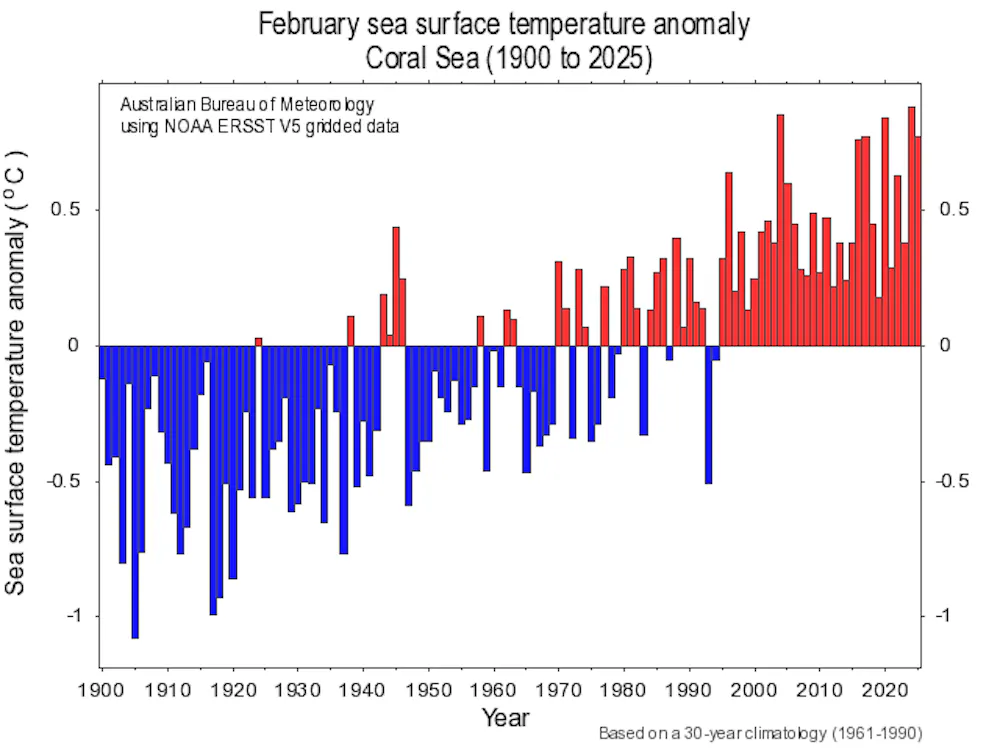
    The northeastern Coral Sea, where Cyclone Alfred formed, experienced the fourth-hottest temperatures on record for February and the hottest on record for January.

    In the Coral Sea, sea surface temperatures were the fourth highest on record in February 2025 and the highest on record in January 2025. This figure shows the trend over time for February.
    Bureau of Meteorology, CC BY-NC-ND

    We also know Australia’s southern waters are warming up too.

    The energy available to power tropical cyclones in subtropical regions has also increased in recent decades, due largely to rising ocean temperatures.

    Average sea surface temperatures in central and southern Queensland on Thursday March 6th. Point Danger is on the Gold Coast.
    Bureau of Meteorology, CC BY-NC-ND

    Climate link: Fewer cyclones but more likely to be intense

    In the northern hemisphere, researchers have found a trend towards fewer cyclones over time. But of those which do form, a higher proportion are more intense.

    It’s not fully clear if the same trend exists in the southern hemisphere, though we are seeing fewer cyclones forming over time.

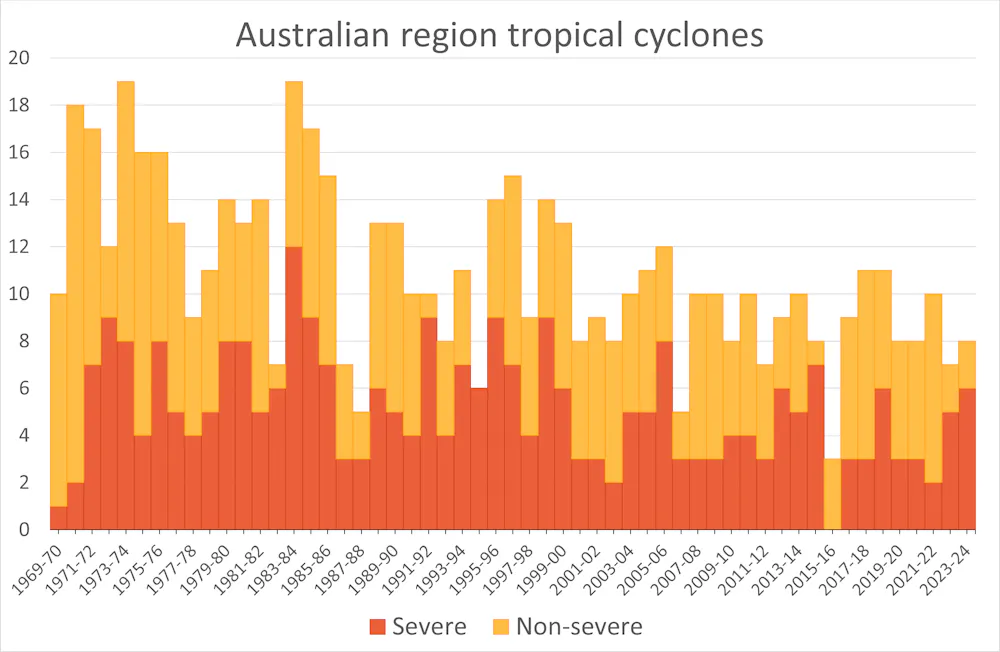
    This summer, eight tropical cyclones have formed in Australian waters. Six were classified as severe (category 3 and up). Historically, Australia has experienced a higher proportion of category 1 and 2 cyclones, which bring weaker wind speeds.

    On average, we see about 11 cyclones form and 4-5 make landfall. There has been a downward trend in the number of cyclones forming in the Australian region in recent decades.

    Fewer cyclones, but more likely to be intense: this figure shows the number of severe (Category 3 and up) and non-severe tropical cyclones (Category 1 and 2) since 1970/71.
    Bureau of Meteorology, CC BY-NC-ND

    Climate link: Cyclones dumping more rain

    The intensity of a cyclone refers to the speed of the wind and size of the wind-affected area.

    But a cyclone’s rain field is also important. This refers to the area of heavy rain produced by storms when they’re at cyclone intensity and afterwards as they decay into tropical lows.

    The rate of rainfall brought by cyclones in Australia isn’t necessarily increasing, but more cyclones are moving slowly, such as Alfred. This means more rain per cyclone, on average.

    Rising ocean temperatures mean more water evaporates off the sea surface, meaning forming cyclones can absorb more moisture and dump more rain when it reaches land.

    Why are cyclones slowing down? This is likely because air current circulation in the tropics has weakened. This has a clear link to climate change. Wind speeds have fallen 5 to 15% in the tropics, depending on where you are in the world. It’s hard to pinpoint the change clearly in our region, because the historic record of cyclone tracks isn’t very long.

    For every degree (°C) of warming, rainfall intensity increases 7%. This is well established. But newer research is showing the rate may actually be double this or even higher, as the process of condensation releases heat which can trigger more rain.

    Clear climate link: Bigger storm surges due to sea level rise

    Sea levels are on average about 20 centimetres higher than they were before 1880.

    When a cyclone is about to make landfall, its intense winds push up a body of seawater ahead of it – the storm surge. In low lying areas, this can spill out and flood streets.

    Because climate change is causing baseline sea levels to rise, storm surges can reach further inland. Sea-level rise will also make coastal erosion more destructive.

    What should we take from this?

    We can’t say definitively that climate change is behind Cyclone Alfred’s unusual track.

    But factors such as rising sea levels, slower cyclones and warmer oceans are changing how cyclones behave and the damage they can do.

    Over time, we can expect to see cyclones arriving in regions not historically affected – and carrying more rain when they arrive.

    Liz Ritchie-Tyo receives funding from The Australian Research Council and the U.S. Office of Naval Research

    Andrew Dowdy receives funding from University of Melbourne as well as supported through the Australian Research Council.

    Hamish Ramsay receives funding from the Australian Climate Service.

    ref. Cyclone Alfred is slowing down – and that could make it more destructive. Here’s how climate change might have influenced it – https://theconversation.com/cyclone-alfred-is-slowing-down-and-that-could-make-it-more-destructive-heres-how-climate-change-might-have-influenced-it-251594

    MIL OSI AnalysisEveningReport.nz

  • MIL-Evening Report: HILDA data shows income inequality is at a 20-year high

    Source: The Conversation (Au and NZ) – By Ferdi Botha, Senior Research Fellow, Melbourne Institute: Applied Economic & Social Research, The University of Melbourne

    ArliftAtoz2205/Shutterstock

    The 19th annual report from the Household, Income and Labour Dynamics in Australia (HILDA) Survey was released today.

    The HILDA Survey has been following the same people every year since 2001, which makes it possible to examine how the lives of Australians have changed across several aspects.

    With data from 2001 to 2022, in this year’s report we looked at issues including income inequality, household chores, and the impact of natural disasters on Australian households.

    Income inequality is the highest since 2001

    Funded by the Australian government and managed by the Melbourne Institute, the survey is one of Australia’s most valuable social research tools.

    HILDA examined the lives of 14,000 Australians in 2001 and has kept coming back each year to discover what has changed over the course of their lifetimes. It now covers 17,000 Australians, due to the expansion of participants’ families.

    The survey shows that since COVID-era financial support ended, income inequality has risen substantially.

    The increase in inequality stems from growth in higher incomes as compared to middle incomes, as well as a fall in the growth of lower incomes relative to middle incomes.

    This means, relative to the median earner, Australians already earning a high income have seen the growth in their incomes rise. In contrast, Australians with low incomes have seen a decrease in the rate of growth in their incomes.

    Between 2021 and 2022, 51.2% of respondents reported their real incomes have declined. This is up from about 41% in preceding years, suggesting a decrease in people’s purchasing power.

    A technical measure called the Gini coefficient was 0.32 in 2022, the highest since we started the survey in 2001. The measure ranges from 0 to 1 and is an index that measures overall inequality, with higher scores suggesting greater income inequality.

    Older Australians are getting richer too

    Over the same period, household wealth has continued to grow.

    However, there are large and growing age differences in the growth in household wealth. For young people aged between 18 and 34, net wealth rose by 72.4% to $238,942 over the 20 years to 2022.

    But for older Australians aged 65 to 74, net household wealth jumped by 125% to about $1.26 million.

    These age disparities in household wealth are partly explained by rates of home ownership, which are much higher among older Australians.

    Home ownership is also the most important asset component in terms of total wealth. In 2022, almost 65% of households owned their home, and just over 20% of households held investment properties and holiday homes.

    As a proportion of total wealth, the family home accounts for 44.5% and investment properties account for 14.9%.

    Women are still doing most of the housework

    Australian women still undertake the majority of housework, whereas men’s share of housework has remained constant over 20 years.

    Men’s time spent on housework has not changed in 20 years.
    Diego Cervo/Shutterstock

    Women’s time spent on housework (such as cleaning, cooking, running errands) has fallen slightly from 23.8 hours per week in 2002 to 18.4 hours per week in 2022.

    Men spent 12.8 hours per week on housework, precisely the same amount they did 20 years earlier. Thus, women are still doing close to 50% more housework than men are.

    Men have increased the time they spend on caring responsibilities (such as playing with their children, helping with homework, caring for an elderly relative), from 5 hours per week in 2002 to 5.5 hours per week in 2022. The time women spend on care has risen from 10.1 hours per week to 10.7 hours per week over the same period. In 2022, women spent almost double the time on care duties than men.

    Among couples, men are generally more satisfied than women are with the current division of unpaid work. Most women feel they do more than their fair share at home. Men tend to believe they share the housework and care fairly with their partner.

    Surge in home damage due to weather-related disasters

    Respondents were asked if a weather-related disaster (such as floods, bushfires or cyclone) had damaged or destroyed their home in the past 12 months. In 2022, 4.5% reported experiencing such an event.

    This is a substantial increase from the year before, when only 1.3% of Australians reported weather-related home damage, and exceeding the previous peak of 2.7% in 2011.

    There are also regional differences, closely corresponding with the timing of specific floods or bushfires in the states and territories. In 2022, 9% of New South Wales residents and 6% of Queensland reported home damage, consistent with major floods experienced in these regions in the months prior to the survey.

    Among all Australians who in 2022 reported home damage due to a weather-related disaster, 62.5% were in NSW and 27.3% were in Queensland.

    With the current cyclone Alfred forecast to hit Queensland and northern NSW on Friday, we expect a further significant increase in reported home damage.

    Ferdi Botha is affiliated with the ARC Centre of Excellence for Children and Families over the Life Course.

    ref. HILDA data shows income inequality is at a 20-year high – https://theconversation.com/hilda-data-shows-income-inequality-is-at-a-20-year-high-251596

    MIL OSI AnalysisEveningReport.nz

  • MIL-OSI Australia: Payments System Board Update: March 2025 Meeting

    Source: Reserve Bank of Australia

    At its meeting today, the Payments System Board discussed a number of issues, including:

    • CHESS batch failure incident. Members discussed the issues that contributed to the CHESS batch failure incident on 20 December 2024. The Board viewed the disruption this caused to clearing and settlement of cash equities as a major operational incident. As the RBA had highlighted for some time that ASX’s aging assets, including CHESS, were raising the risk of operational disruptions to critical financial infrastructure, members viewed the incident as deeply disappointing and resolved to take regulatory interventions to provide assurance that the ASX addresses related risks as a matter of priority. Further details on the RBA’s regulatory response to the incident will be published by the end of March.
    • Developments in the account-to-account payments system. The Board discussed the risks associated with the Australian payments industry’s intended decommissioning of the Bulk Electronic Clearing System (BECS) by a target date of 2030. BECS is currently Australia’s primary system for account-to-account payments – Australians rely on BECS for a wide range of critical payments including welfare, pension, salary and bill payments. The Board endorsed a set of recommendations designed to address the significant risks and challenges identified by the RBA.
    • Members agreed that the foundational next steps for industry should include: defining a vision for the target future state and strategic objectives for account-to-account payments in Australia, in collaboration with the Government and the RBA; comprehensive consideration of options for achieving that target future state; and establishing appropriate mechanisms for coordination and stakeholder engagement. A report detailing the findings and recommendations of the RBA’s risk assessment will be published later in March. Members requested an update on industry’s progress in implementing the recommendations in a year’s time.

      Members also discussed end-user costs for account-to-account payments in Australia, which highlighted potential impediments that end-users would face if they had to migrate away from BECS. Members agreed that greater pricing transparency was required from providers of these services to end-users. They expressed support for the RBA establishing a robust pricing data collection to support future policy deliberations.

    • Review of Retail Payments Regulation. The Board considered the arguments for and against various policy options on merchant card payment costs and surcharging, informed by a wide range of views from stakeholder submissions. The Board is actively exploring options to promote the public interest by supporting safety, competition and efficiency in the payments system. Members agreed to release a consultation paper in mid-2025 that will outline the Board’s preferred policy options and seek further feedback.
    • International and domestic work on central bank digital currencies. Members discussed the ongoing program of international and domestic research on CBDCs. Domestically, the RBA has a collaborative research project underway, Project Acacia, which is investigating how innovations in wholesale digital money could support tokenised asset settlement. The project team is currently reviewing expressions of interest from industry participants wanting to collaborate in the testing of settlement models as part of the applied research phase taking place this year. An Industry Advisory Group has also recently been launched to support the project. Members also discussed the Bank’s plans to use focus groups to explore whether there are unmet payment needs that could be satisfied with a retail CBDC in Australia. This work is expected to take place in the second half of the year.

    MIL OSI News

  • MIL-Evening Report: Robert F. Kennedy Jr says vitamin A protects you from deadly measles. Here’s what the study he cites actually says

    Source: The Conversation (Au and NZ) – By Evangeline Mantzioris, Program Director of Nutrition and Food Sciences, Accredited Practising Dietitian, University of South Australia

    RobsPhoto/Shutterstock

    Robert F. Kennedy Jr, who oversees the health of more than 340 million Americans, says vitamin A can prevent the worst effects of measles rather than urging more people to get vaccinated.

    In an opinion piece for Fox News, the US health secretary said he was “deeply concerned” about the current measles outbreak in Texas. However, he said the decision to vaccinate was a “personal one” and something for parents to discuss with their health-care provider.

    Kennedy mentioned updated advice from the Centers for Disease Control (CDC) to treat measles with vitamin A. He also cited a study he said shows vitamin A can reduce the risk of dying from measles.

    Here’s what the vitamin A study actually says and why public health officials are so concerned about Kennedy’s latest statement.

    Why is a measles outbreak so worrying?

    Measles is a highly contagious disease caused by a virus. It spreads easily including when an infected person breathes, coughs or sneezes.

    Measles initially infects the respiratory tract and then the virus spreads throughout the body. Symptoms include a high fever, cough, red eyes, runny nose and a rash all over the body.

    Measles can also be severe, can cause complications including blindness and swelling of the brain, and can be fatal. Measles can affect anyone but is most common in children.

    The Texan health department has confirmed 150-plus cases of measles and one death of an unvaccinated child during the current outbreak. While this is by far the largest measles outbreak in the US in 2025, the CDC has reported smaller outbreaks in several other states so far this year.

    Why vitamin A?

    Vitamin A is essential for our overall health. It has many roles in the body, from supporting our growth and reproduction, to making sure we have healthy vision, skin and immune function.

    Foods rich in vitamin A or related molecules include orange, yellow and red coloured fruits and vegetables, green leafy vegetables, as well as dairy, egg, fish and meat. You can take it as a supplement.

    Vitamin A can also be used therapeutically. In other words, doctors may prescribe vitamin A to treat a deficiency. Vitamin A deficiency has long been associated with more severe cases of infectious disease, including measles. Vitamin A boosts immune cells and strengthens the respiratory tract lining, which is the body’s first defence against infections.

    Because of this, the CDC has recently said vitamin A can also be prescribed as part of treatment for children with severe measles – such as those in hospital – under doctor supervision.

    One key message from the CDC’s advice is that people are already sick enough with measles to be in hospital. They’re not taking vitamin A to prevent catching measles in the first place.

    The other key message is vitamin A is taken under medical supervision, under specific circumstances, where patients can be closely monitored to prevent toxicity from high doses.

    Vitamin A toxicity can cause birth defects and increase the risk of fractures in elderly people. Vitamin A and beta-carotene (which the body turns into vitamin A) from supplements may also increase your risk of cancer, especially if you smoke.

    Taking too much vitamin A can lead to toxicity and cause birth defects.
    ChameleonsEye/Shutterstock

    How about the study Kennedy cites?

    Kennedy cites and links to a 2010 study, a type known as a systematic review and meta-analysis. Researchers reviewed and analysed existing studies, which included ones that looked at the effectiveness of vitamin A in preventing measles deaths.

    They found three studies that looked at vitamin A treatment by specific dose. There were different doses depending on the age of the children, measured in IU (international units). Having two doses of vitamin A (200,000IU for children over one year of age or 100,000IU for infants below one year) reduced mortality by 62% compared to children who did not have vitamin A.

    The 2010 study did not show vitamin A reduced your risk of getting measles from another infected person. To my knowledge no study has shown this.

    To be fair, Kennedy did not say that vitamin A stops you from catching measles from another infected person. Instead, he used the following vague statement:

    Studies have found that vitamin A can dramatically reduce measles mortality.

    It’s easy to see how a reader could misinterpret this as “take vitamin A if you want to avoid dying from measles”.

    We know what works – vaccines

    The World Health Organization recommends all children receive two doses of measles vaccine.

    The CDC states two doses of the measles vaccine (measles-mumps-rubella or MMR vaccine) is 97% effective against getting measles. This means out of every 100 people who are vaccinated only three will get it, and this will be a milder form.

    But these facts were missing from Kennedy’s statement. Should we be surprised? Kennedy is well known for his vaccine sceptism and for undermining vaccination efforts, including for the measles vaccine.

    As Sue Kressly, president of the American Academy of Pediatrics, told the Washington Post:

    relying on vitamin A instead of the vaccine is not only dangerous and ineffective […] it puts children at serious risk.

    Evangeline Mantzioris is affiliated with Alliance for Research in Nutrition, Exercise and Activity (ARENA) at the University of South Australia. Evangeline Mantzioris has received funding from the National Health and Medical Research Council, and has been appointed to the National Health and Medical Research Council Dietary Guideline Expert Committee.

    ref. Robert F. Kennedy Jr says vitamin A protects you from deadly measles. Here’s what the study he cites actually says – https://theconversation.com/robert-f-kennedy-jr-says-vitamin-a-protects-you-from-deadly-measles-heres-what-the-study-he-cites-actually-says-251465

    MIL OSI AnalysisEveningReport.nz

  • MIL-Evening Report: Woolly mice are cute and impressive – but they won’t bring back mammoths or save endangered species

    Source: The Conversation (Au and NZ) – By Emily Roycroft, Research Group Leader & ARC DECRA Fellow, Monash University

    Colossal Biosciences

    US company Colossal Biosciences has announced the creation of a “woolly mouse” — a laboratory mouse with a series of genetic modifications that lead to a woolly coat. The company claims this is the first step toward “de-extincting” the woolly mammoth.

    The successful genetic modification of a laboratory mouse is a testament to the progress science has made in understanding gene function, developmental biology and genome editing. But does a woolly mouse really teach us anything about the woolly mammoth?

    What has been genetically modified?

    Woolly mammoths were cold-adapted members of the elephant family, which disappeared from mainland Siberia at the end of the last Ice Age around 10,000 years ago. The last surviving population, on Wrangel Island in the Arctic Ocean, went extinct about 4,000 years ago.

    The house mouse (Mus musculus) is a far more familiar creature, which most of us know as a kitchen pest. It is also one of the most studied organisms in biology and medical research. We know more about this laboratory mouse than perhaps any other mammal besides humans.

    Colossal details its new research in a pre-print paper, which has not yet been peer-reviewed. According to the paper, the researchers disrupted the normal function of seven different genes in laboratory mice via gene editing.

    By tinkering with different genes, researchers produced mice with different kinds of fur.
    Colossal Biosciences

    Six of these genes were targeted because a large body of existing research on the mouse model had already demonstrated their roles in hair-related traits, such as coat colour, texture and thickness.

    The modifications in a seventh gene — FABP2 — was based on evidence from the woolly mammoth genome. The gene is involved in the transport of fats in the body.

    Woolly mammoths had a slightly shorter version of the gene, which the researchers believe may have contributed to its adaptation to life in cold climates. However, the “woolly mice” with the mammoth-style variant of FABP2 did not show significant differences in body mass compared to regular lab mice.

    What would it mean to de-extinct a species?

    This work shows the promise of targeted editing of genes of known function in mice. After further testing, this technology may have a future place in conservation efforts. But it’s a long way from holding promise for de-extinction.

    Colossal Biosciences claims it is on track to produce a genetically modified “mammoth-like” elephant by 2028, but what makes a mammoth unique is more than skin-deep.

    De-extinction would need to go beyond modifying an existing species to show superficial traits from an extinct relative. Many aspects of an extinct species’ biology remain unknown. A woolly coat is one thing. Recreating the entire suite of adaptations, including genetic, epigenetic and behavioural traits that allowed mammoths to thrive in ice age environments, is another.

    Prehistoric drawings of an ibex (left) and a mammoth (right) found at Rouffignac cave in France.
    Cave Painter / Wikimedia

    Unlike the thylacine (or Tasmanian tiger) — another species Colossal aims to resurrect — the mammoth has a close living relative in the modern Asian elephant. The closer connections between the genomes of these two species may make mammoth de-extinction more technically feasible than that of the thylacine.

    But whether or not a woolly mouse brings us any closer to that prospect, this story forces us to consider some important ethical questions. Even if we could bring back the woolly mammoth, should we? Is the motivation behind this effort conservation, or entertainment? Is it ethical to bring a species back into an environment that may no longer sustain it?

    Focus on conserving what remains

    In Australia alone, we’ve lost at least 100 species to extinction since European colonisation in 1788, largely due the introduction of feral predators and land clearing.

    The idea of reversing extinction is understandably appealing. We might like to think we could undo the past.

    According to Colossal’s website,

    Extinction is a colossal problem facing the world. And Colossal is the company that’s going to fix it.

    It’s hard to argue with the first part of that. But focusing on bringing back extinct species distracts from a more urgent reality: species are going extinct right now, and we are not doing enough to save them.

    We should first focus on promises to save surviving species, rather than promises to bring back the dead.

    With more investment in threatened species monitoring, new pest control methods, and conservation genetic management, we can turn the tide of extinction and secure the future for species that remain.

    There’s a long list of threatened species that are still alive now. With the right funding and conservation attention, we can do something to save them before it’s too late.

    Emily Roycroft receives funding from the Australian Research Council, the L’Oréal-UNESCO For Women in Science Programme, and the Australian Academy of Science.

    ref. Woolly mice are cute and impressive – but they won’t bring back mammoths or save endangered species – https://theconversation.com/woolly-mice-are-cute-and-impressive-but-they-wont-bring-back-mammoths-or-save-endangered-species-251595

    MIL OSI AnalysisEveningReport.nz

  • MIL-OSI Australia: Active transport boost for Western Australia

    Source: Australian Ministers 1

    Cyclists and pedestrians across Western Australia will have more opportunities to walk, cycle and actively move through their communities thanks to support from the Albanese Government.  

    More than $15 million will be invested under the Active Transport Fund in 12 new projects across the state to build or upgrade existing bicycle and walking paths. 

    City of Canning will receive more than $1.1 million, for a new path and another upgraded path to increase active connectivity between METRONET’s Elevated Rail Project and the Canning River Regional Park through the Canning City Centre. 

    The improved facilities will benefit local students at Cannington Community College, Sevenoaks College and St Norbert College as well as people visiting Cannington Leisureplex.

    More than $4.8 million will be provide to the City of Mandurah to build the 3.9km Falcon Coastal Shared Path project stretching along the entire Falcon Coast, linking existing coastal paths in Wannanup to the south and Halls Head to the north.

    The Town of Cottesloe, on Perth’s southern beaches, will receive more than $4.1 million to widen and upgrade four kilometres of the pathway along Marine Parade between Curtin Avenue and North Street.

    Other projects receiving funding include:

    • The Shire of Cunderdin, north east of Perth, which will have more than $852,000 to design and build new footpaths along Togo Avenue, Watts Avenue, Hodgson Street and Yilgarn Avenue, about 3.25 kilometres long and 1.8 metres wide.
    • The City of Karratha, up north in the Pilbara, to receive $774,000 to build 1.3 kilometres of path linking Bathgate and Dampier Road to connect to the shopping centre.
    • The Shire of Nannup, on the south west tip of WA, will have more than $611,000 to build two 2.5-metre-wide shared paths, separated by Vasse Highway, known as the Southern Bridges Shared Path.

    Safe and accessible active transport options promote net zero-emissions travel, social connection and healthy choices, making our cities and regions more vibrant.

    This program supports the government’s commitment to invest in infrastructure planning, design and construction that improves safety outcomes for vulnerable road users under the National Road and Safety Strategy 2021-2030.

    For more information visit Active Transport Fund | Infrastructure Investment Program.  

    Quotes attributable to Minister for Infrastructure, Transport, Regional Development and Local Government Catherine King:

    “Whether you’re on a motor scooter, pushing a pram, walking or cycling, we’re making it easier for people to get to school, work or local services, without having to jump in the car. 

    “This is about so much more than bike lanes and footpaths, it’s about reshaping our cities and regional centres, connecting our everyday places, and making our towns better to live in and easier to visit.”

    Quotes attributable to Member for Perth Patrick Gorman: 

    “I love cycling and my kids love their scooters. I am proud to be part of an Albanese Government that is making our communities healthier and more liveable. 

    “There are so many benefits that come from people traveling by using physical activity.

    “Perth is an active city, and I welcome this national investment in our local our communities.”

    Quotes attributable to Member for Swan Zaneta Mascarenhas: 

    “By linking METRONET’s with the Canning River Regional Park, we’re creating a safe and convenient pathway for walking, cycling, and enjoying our local environment.

    “This $1.1 million investment is about making it easier for our community to stay active and connected. It will be safer for kids getting to school, for commuters, and people accessing Cannington Leisureplex.” 

    MIL OSI News

  • MIL-OSI Economics: Payments System Board Update: March 2025 Meeting

    Source: Reserve Bank of Australia

    At its meeting today, the Payments System Board discussed a number of issues, including:

    • CHESS batch failure incident. Members discussed the issues that contributed to the CHESS batch failure incident on 20 December 2024. The Board viewed the disruption this caused to clearing and settlement of cash equities as a major operational incident. As the RBA had highlighted for some time that ASX’s aging assets, including CHESS, were raising the risk of operational disruptions to critical financial infrastructure, members viewed the incident as deeply disappointing and resolved to take regulatory interventions to provide assurance that the ASX addresses related risks as a matter of priority. Further details on the RBA’s regulatory response to the incident will be published by the end of March.
    • Developments in the account-to-account payments system. The Board discussed the risks associated with the Australian payments industry’s intended decommissioning of the Bulk Electronic Clearing System (BECS) by a target date of 2030. BECS is currently Australia’s primary system for account-to-account payments – Australians rely on BECS for a wide range of critical payments including welfare, pension, salary and bill payments. The Board endorsed a set of recommendations designed to address the significant risks and challenges identified by the RBA.
    • Members agreed that the foundational next steps for industry should include: defining a vision for the target future state and strategic objectives for account-to-account payments in Australia, in collaboration with the Government and the RBA; comprehensive consideration of options for achieving that target future state; and establishing appropriate mechanisms for coordination and stakeholder engagement. A report detailing the findings and recommendations of the RBA’s risk assessment will be published later in March. Members requested an update on industry’s progress in implementing the recommendations in a year’s time.

      Members also discussed end-user costs for account-to-account payments in Australia, which highlighted potential impediments that end-users would face if they had to migrate away from BECS. Members agreed that greater pricing transparency was required from providers of these services to end-users. They expressed support for the RBA establishing a robust pricing data collection to support future policy deliberations.

    • Review of Retail Payments Regulation. The Board considered the arguments for and against various policy options on merchant card payment costs and surcharging, informed by a wide range of views from stakeholder submissions. The Board is actively exploring options to promote the public interest by supporting safety, competition and efficiency in the payments system. Members agreed to release a consultation paper in mid-2025 that will outline the Board’s preferred policy options and seek further feedback.
    • International and domestic work on central bank digital currencies. Members discussed the ongoing program of international and domestic research on CBDCs. Domestically, the RBA has a collaborative research project underway, Project Acacia, which is investigating how innovations in wholesale digital money could support tokenised asset settlement. The project team is currently reviewing expressions of interest from industry participants wanting to collaborate in the testing of settlement models as part of the applied research phase taking place this year. An Industry Advisory Group has also recently been launched to support the project. Members also discussed the Bank’s plans to use focus groups to explore whether there are unmet payment needs that could be satisfied with a retail CBDC in Australia. This work is expected to take place in the second half of the year.

    MIL OSI Economics

  • MIL-OSI New Zealand: Breathing New Life into Takarunga/ Mt Victoria: Revitalising the Summit

    Source: Auckland Council

    The Tūpuna Maunga Authority is pleased to share a major transformation at the tihi (summit)of Takarunga / Mt Victoria in Devonport. This is a significant milestone for the Authority in fulfilling its role of protecting the Maunga and providing for their ongoing manaaki and hauora.

    A key focus of the project has been restoring the tihi as a predominantly pedestrian space. The removal of the carpark has made way for new pathways, native planting, and accessible seating—creating a more welcoming environment that encourages visitors to slow down, take in the views, and connect with the rich history and cultural significance of the Maunga.

    Takarunga tihi restoration showing new upgrades. Photo credit: Cactus Photography

    Tūpuna Maunga Authority Chairperson, Paul Majurey, says, “we are guided by a vision to better acknowledge the wairuatanga, mana aotūroa, takotoranga whenua, mauri pūnaha hauropi, mana hononga tangata, wahi rawa whakauka and mana whai a Rēhia for each individual Maunga.”

    Majurey further states this project is significant in appreciating the vision set out in the Integrated Management Plan. “The Maunga are taonga tuku iho. This project allows people to experience Takarunga in a way that respects cultural significance, and the vision set out by Mana Whenua and the Authority.”

    Mana Whenua artist Arapeta Hākura played a key role in shaping the cultural design elements of the upgrade. Hakura was the first recipient of the Tūpuna Maunga Authority’s research scholarship and was later invited to contribute to this project, bringing Māori histories and stories of Takarunga to life. His work reflects the migration of the Toroa bird, symbolising shared purpose and collective effort, while Hononga a Takarunga represents unity, interconnectedness, and the deep bonds between the land and its people.

    “Being part of this project has been an incredible experience,” says Hakura. “It’s a journey of storytelling through design, weaving our histories into something tangible. The elements we’ve created reflect the deep connection between Mana Whenua and the Maunga, and it’s exciting to see these stories become part of the landscape.”

    The newly restored tihi ready for visitors. The Tūpuna Maunga Authority looks forward to welcoming the public to experience the revitalised space and connect with the rich cultural heritage of Takarunga / Mt Victoria.

    MIL OSI New Zealand News

  • MIL-OSI Australia: ARENA welcomes new board member

    Source: Australian Renewable Energy Agency

    Overview

    • Category

      News

    • Date

      06 March 2025

    • Classification

    The Australian Renewable Energy Agency (ARENA) welcomes the announcement by the Minister for Climate Change and Energy, the Hon Chris Bowen MP, of a new appointment to the ARENA Board and the re-appointment of two existing board members.  

    Marianna O’Gorman and Stephen McIntosh have been re-appointed to the board for their second and third terms respectively. Ms O’Gorman will also step into the newly created Deputy Chair role.  

    Angela Karl is joining the ARENA Board for the first time.  

    The additional board seat and Deputy Chair position were established through amendments to the Australian Renewable Energy Act 2011.   

    Ms Karl has more than two decades of experience in investment and advisory services in the energy transition and more than a decade of merger and acquisition advisory experience at both JP Morgan and UBS, where she was the Australasian Head of Energy and Utilities Advisory.  

    Angela is currently Managing Director, Head of Energy Transition with HMC Capital and prior to that was Partner at QIC Global Infrastructure, where she held several positions, including Founding Director, Powering Australian Renewables Fund/Tilt Renewables.  

    ARENA Board Chair Justin Punch congratulated both Marianna and Stephen and welcomed Angela to the board, saying that her extensive experience in professional services and the clean energy transition will be invaluable as ARENA continues to support the global transition to net zero emissions.  

    “Australia’s shift to renewable energy, and ARENA’s role in facilitating it, requires bold and experienced leadership. Angela’s experience in investment and finance and her commitment to Australia’s net zero future make her an invaluable addition to the board,” said Mr Punch.  

    “The ongoing presence of Marianna and Stephen and new insight from Angela will help us to continue to drive innovation in renewable energy technologies, ensuring we can continue to have an impact and deliver on our investment priorities.”  

    ARENA’s Board has overall responsibility for the operations of the agency. It is a skills-based, decision-making body, responsible for recommending the agency’s annual general funding strategy to the Minister, setting investment priorities, overseeing the running of the organisation and approving project funding. 

    For more information on ARENA’s Board and structure, visit arena.gov.au. 

    ARENA media contact:

    media@arena.gov.au

    Download this media release (PDF 143KB)

    MIL OSI News

  • MIL-OSI Australia: 3BA The Big Show, Ballarat

    Source: Australian Ministers 1

    PAUL TAYLOR [HOST]: Let’s go local, Ballarat, and I was going to speak to Lilly from Not Your Grandma’s Pantry, but unfortunately Lilly’s not answering her phone. We’ll get her on another time, though. I tell you what, her replacement though this morning has a major announcement to make, that is for sure. And the Honourable Catherine King MP, Minister for Infrastructure, Transport, Regional Development and Local Government – good morning to you, Catherine.

    CATHERINE KING [MINISTER]: Good morning, and also the most important title I have and the one I am proudest of is Federal Member of Ballarat. But I’m doing- I’m here in my ministerial capacity today.

    PAUL TAYLOR: Absolutely you are. Could we add any extra duties to your portfolio, do you think?

    CATHERINE KING: [Laughs] No, I’m pretty busy, to be honest. I’ve got some terrific junior ministers who help me out a fair bit, it’s a big portfolio and really busy. But I’m at home today, which is really lovely to actually be able to be in Ballarat. And I can smell the smoke in the air, and I hope everyone’s all right out at Buninyong Surrounds. That would’ve been a pretty scary event [indistinct] …

    PAUL TAYLOR: [Talks over] Our emergency services once again did a wonderful job in protecting our communities out Mount Clear and Mount Buninyong way.

    Speaking of which, Anthony Albanese up- is he still in Queensland at the moment, with the cyclone happening?

    CATHERINE KING: Yeah, as I understand it that’s where he is. He was certainly there yesterday with the Emergency Services Minister Jenny McAllister. She’s sort of basing herself up there at the moment, and we’ve got the National Emergency Management Agency – obviously the state of Queensland takes the lead, but we’ve got all of those national assets in place who’ve had time to prepare. But yeah, it’s pretty scary watching it. It seems unbelievable to imagine how much rain they’ve had right up the top of the state, and then to see this. And I’m sure there’s many people who know I’ve got family there, I’ve got staff there as well. I know there’s people who know- have lots of family, lots of people who- known up there, so I think our thoughts are all with them at the moment.

    PAUL TAYLOR: Catherine, a lot of pundits were saying Sunday was going to be the day that Mr Albanese would head to the GG’s office. But given Cyclone Alfred, that’s not likely to happen, do you think?

    CATHERINE KING: Well, again, the election timing’s a matter for him. But look, I think that he’s pretty focused on- you know, you’ve got such a big emergency up the top of the country. I don’t think it’s- I think we’re focused on how do we help, what do we do, what do we actually need to do to make sure people are safe. And then if there is, in the event of terrible and- you know, the sort of things we think might happen, then how do we help people recover quickly. And so I think he’s pretty focused on that at the moment. The election obviously is going to have to be held before May, but I think when you’ve got something like that happening, we’re all just like, okay what do we need to do, is really the mode we’re in at the moment, and the election sort of takes a bit of a backseat. But again, that’ll be a matter for him.

    PAUL TAYLOR: Catherine King, let’s get to the announcement at hand. If anyone’s travelled the Western Freeway, in particular around Melton and Caroline Springs, those sorts of areas, it’s a very frustrating drive, especially at peak hour. What’s going on where the Western Freeway is concerned? A lot of money to be thrown at this to make it a lot safer, Catherine King.

    CATHERINE KING: Yeah, absolutely. So the Victorian Government and the Albanese Labor Government, we put in money – about 20 million – to do a joint business case that has finished. There’s still some more work to be done on that, but in order to get the ball really rolling on the highway- it just really can’t wait, it’s at capacity or it’s about to be at capacity in the next five years or so, so we’re being told. So we’re putting in $1 billion- $1.1 billion actually, to- particularly from that Melton to Caroline Springs end to try and look at how can we make the road safer, how can we ease some of that congestion, particularly in those peak hours in the morning as people are coming out of Bacchus Marsh, out of Melton, out of Rockbank and trying to get into work- that really from 6am onwards, it’s very difficult to get through there, and the state of the road is not really keeping up with the demands of the population there. And then obviously the return peak hour, that also is really significant problem. We know that once the West Gate Tunnel is done, there’ll be some alleviation of the sort of bottleneck at the end, but really at the moment the road is just not keeping up.

    So that $1.1 billion, there’s also out of that 100 million to try and really resolve the issue that we’ve got down our end around Brewery Tap Road. It’s a really dangerous intersection there. I’ve had lots of people talking to me about really that needs to be fixed. It’s an accident waiting to happen, so we want to try and get ahead of that. It’s really awful when you’re trying to run the gambit crossing there, so we’ll do the work with the Victorian state government about what the solutions are to try and resolve that. But we’re putting 100 million in there.

    And there’s also a smaller amount of money down a bit further, which is to fix some of the bridges heading towards [indistinct], but all of the remaining money, there’s already $1 billion in the highway to do a range of other things down the other end of the highway. So that’s really what we’re announcing today. I use it- at least weekly I’m down that highway. I know lots of people use it to get to and from work, to get to and from family. It’s a really important piece of infrastructure for the whole west of the state. So we’ll be pleased to be making that announcement today.

    PAUL TAYLOR: Catherine, is that money guaranteed, even though we’ve got an election looming? If the Albanese Government is ousted, does that money stay? What’s …

    CATHERINE KING: Yeah. Well, any announcements we’re making before the election is called are obviously decisions of government. So they’re budgeted decisions that will show up in the Pre-Election Financial Outlook. The only risk, of course, is if the Liberals come in and say they want to cut things. And unfortunately, we do know that they’ve got to find money for the cuts that they do want to make, and that is always a risk when elections change. But this obviously is money that we’re making as a decision of government announced as government.

    PAUL TAYLOR: Well, good to see money being thrown at the Brewery Tap Road intersection at Warrenheip. It is a worrisome intersection and needs to be fixed as soon as possible, as does the congestion further down the Freeway towards Melton and Rockbank, Caroline Springs, those sorts of areas.

    The Honourable Catherine King, MP for Ballarat and all the other titles that you hold nowadays, thank you so much for coming on The Big Show. Few and far between nowadays with you jet setting around and looking after a whole heap of other things in your portfolio, but we appreciate your time this morning, Catherine. And take care on the roads, won’t you?

    CATHERINE KING: I will do. It’s always good to be with you, and a privilege that as the Member for Ballarat, I then get to hold these bigger roles. But it’s only because I’m the Member of Ballarat that I get to hold those bigger roles, so always an incredible privilege to be that and to hold that in the community as well. So I’m very, very appreciative for the opportunity afforded to me by the people of Ballarat, really.

    PAUL TAYLOR: Thank you so much, the Honourable Catherine King MP.

    MIL OSI News

  • MIL-OSI Australia: Australian Deputy PM: Press Conference – Melton

    Source: Minister of Infrastructure

    SAM RAE [FEDERAL MEMBER FOR HAWKE]: …We’re here in the seat of Hawk. I am Sam Rae, the Federal member for Hawke. I’m very happy to be here today. I’m joined by two wonderful ministers, the Federal Minister for Infrastructure, Minister Catherine King and the state minister, Minister Gabrielle Williams. And as you can see, I have a whole host of colleagues from both local government, state government and federal Labor with us here as well. And I’m going to run through – I’m going to look over my shoulder while I do it so I don’t miss anybody. We’ve got the Member for Melton, Steve McGhie here. We have Melton Mayor Steve Abboushi. We have Dr Phillip Zader from LeadWest. We have Brendan O’Connor, the Member for Gorton, a long standing member for Gorton. We have Alice Jordan-Baird, our fantastic new candidate for Gorton. And as I said, the two ministers who are here with us today, we’ve got a very exciting announcement about the Western Freeway. We stood here on the Western Freeway just before the last election. I stood here with Minister King, and we announced that the Labor government, state and federal, would work together to get a business case done to upgrade the Western freeway. And today is a very exciting announcement, building upon that, the delivery of that business case just before Christmas. So hand over to Minister King, great. Thanks so much.

    CATHERINE KING [MINISTER]: Thanks so much, Sam. And it’s terrific to be here with state and local government colleagues, because really, this is a partnership about how we actually get good infrastructure in place for our growing suburbs, and this is a terrific announcement today that we’re making alongside the Victorian Government. This is one of the busiest highways in the state. It is an incredibly important freight route. I live down the other end, down Ballarat end, and used to represent the people of Stawell. Sam and Alice and Brendan and Steve all live around this part of the world, and they know we’ve seen significant growth. There are thousands of people traveling on this road every single day, and the road hasn’t quite kept up with the amount of housing development that we’ve seen in this area. So today, we’re announcing $1.1 billion from the federal government, a decision of government to invest in the Western Highway, in particular, the billion dollars will go towards the Melton and Caroline Springs area, where we know there has been significant growth and there needs to be upgrades in order to keep up with the amount of housing than the amount of people using this road, that work has been underway. As Sam said, the business case has been completed. We needed to make sure we had a good understanding of what are the things that you can do to improve this corridor. $100 million is to go down to the other end of the highway, down to Brewery Tap Road, and there’s also work to be done on additional bridges. This brings the Commonwealth’s total investment in the Western Freeway, Western Highway, to just over $2 billion. We know how important this road is from a freight and logistics point of view, but we also know how important it is to be able to get people to work. I think all of us here use this road on a regular basis. We know what happens from 6am to 9:30am in the morning and when people are trying to get home, that tail back, getting back into Melton in particular, but the Rock Bank area, this is a significant and serious investment from the Albanese Labor Government to make sure we improve these corridors. I do want to particularly welcome both LeadWest and the Melton Council here today, who have been advocating alongside our state and federal members, Sam, Brendan and Steve as well, to advocate for this road project. And I’ll hand over to Gab for a minute, and then I think the mayor will say a few words, and then we’ll take some questions. Thanks, Gab.

    GABRIELLE WILLIAMS [STATE MINISTER FOR TRANSPORT INFRASTRUCTURE]: Thank you. Thanks, minister, and thank you for being here to make what is a wonderful announcement. And can I say how great it is for us as the Allan Labor government to have a partner in Canberra that has been something that has been missing in Victoria for the best part of 10 years. Victorians have been short changed to the tune of billions by successive Liberal National Coalition Governments, and finally, with the Albanese Government, we have a partner, a partner willing to work with us, willing to invest with us on the projects that matter most to Victorians. So, the $1.1 billion announced today is a very welcome investment in one of Melbourne’s fastest growing areas. People love living in the west, that’s the reality, and the population growth shows that. But as Minister King has outlined, we need to make sure that the surrounding infrastructure also keeps pace with that growth, and that we’re investing where it’s most needed, in our community, and out here in the west is a perfect example of that. Minister King also outlined that this has been a partnership with the state government for some time in doing that essential planning work to make sure that we understand where the priorities and the needs are along what is a very long stretch of road in the Western Highway all the way to Adelaide, and making sure that we can deliver the greatest value where it’s needed most. That work has allowed us now, with a funding commitment from the Commonwealth, to then fine tune and determine exactly what that will look like. Now that we’ve got the dollars attached, we can go back to that business case and look at the options that have been put forward in that and start to select our solutions and get moving, most importantly, on the project to deliver the congestion busting solutions that we know this project will deliver, making life easier for people in Melbourne’s west making that commute much easier, and basically catering to the growth that we know is taking place out here in Melbourne’s western suburbs. Can I also thank the many representatives we have here across local and state and federal governments, as well as LeadWest, we have an incredible team of advocates here in Melbourne’s west, those who live in their suburbs, they know their suburbs, and they know and understand the needs. And again, can I say a big thank you to the federal government for partnering with us, for being a part of the solution to being able to meet the growth in Melbourne’s outer suburbs, and for finally giving Victoria its fair share of infrastructure funding. Steve 

    STEVE ABBOUSHI [MAYOR OF MELTON]: Council is very thankful for the recent announcement for the $1.1 billion upgrade. We – it’s been – formed part of our main advocacy priorities for more than nine to 10 years. And finally, we’re seeing, you know, a western upgrade highway going to mean so much for our community. I’d like to thank the state and federal government for partnering with council. We would – we just had a meeting with residents last week around providing a voice for our community on their concerns to the Western Highway. Last year, we had the business case, and now we’ve got an announcement. So, this is what it means to partner, and this is what happens when you partner. It means that our community will see delivery, we’ll see safety. And we’re very, very thankful for this announcement, and we look forward to hearing more about what it means for our community. Thanks very much. 

    JOURNALIST: I’ve got some questions for Minister Catherine King, please. Can you provide us with a breakdown of the $1.1 billion? 

    CATHERINE KING: …So $1 billion is going on the Melton Caroline Springs area. And Minister Williams might talk a little bit more about the business case. There’s been a number of options put forward as part of the business case, and we’ll now go back and fine tune those, to select the projects, but to do a little bit of work to get there, but we’re not far off. And then there’s $100 million for Brewery Tap Road just as you head into Ballarat. And then there’s also $6.1 million to fix two bridges, one around Dadswell Creek and Dimboola is the other one. Those projects have been in planning for a while. They’re not they’re ready to go. They’ll start this year. And then, obviously, there is also money that is already in the Western Highway corridor. And so there’s a number of projects that will continue. There’s one down at Pykes Creek, and there’s further ones further down along Stawell. And those projects will continue as well. 

    JOURNALIST: And what will it actually improve? Is it like a few barriers or?

    CATHERINE KING: So, there’s a range of things. So obviously there’s some safety work that can be done fairly quickly. So that’s, you know, widening shoulders, looking at the road resurfacing where that needs to happen. But when you’re looking at things like as part of the project, when you’re looking at like, you know, more interchanges, they are a bit more complex and take a bit more time to do. But I might ask Minister Williams to talk about more of the data, sure.

    GABRIELLE WILLIAMS: and look in part, it’s a bit of a process question. So what we do when we partner with the Commonwealth to do the planning for this project is look at where, if you like, the biggest choking points were across the Western Highway, where population growth was, meaning that there was particularly acute points of congestion, and then therefore working out where the priorities were. What engineers tend to do is never come to the table with just one option, but come to the table with multiple different options for each priority site. What we can now do, though, that we have a financial commitment money on the table, is go back and start working through the options that we’ve been provided and ensuring that we’re choosing the best possible ones within our funding envelope, and making sure that we’ve got those priorities right now. So this cash injection of $1.1 billion and now allows us to get going and get shovels in the ground and make sure we’re choosing from those options, the best possible ones to meet the priorities that have been identified through that through that process. So Minister King has outlined where some of those, some of the other funding will go, in terms of Dimboola and Dadswell Bridge, and we will now be hard at work in partnership with the Commonwealth Government to go back to that, that planning that business case and then working out from the options that we’ve been provided, which ones will deliver the best outcomes for our communities out here in Melbourne’s west. 

    JOURNALIST: Sure, about the Brewery Tap Road. 

    GABRIELLE WILLIAMS: Yep, there’s some upgrades going there. 

    JOURNALIST: Can you go into more detail? 

    GABRIELLE WILLIAMS: I’ll tell you what I reckon Minister King is the expert on Brewery Tap Road.

    CATHERINE KING: So when, when, when the Western highway, it’s years ago now. So I’ve been driving this road for a long, long time. So there was always meant to be some treatment down at that Warrenheip section. And we know now that what’s happened there, you’ve got a service station. You’ve got a very old hotel on one side that’s now been closed but still utilised at certain times. You’ve got a school up in Warrenheip as well. You’ve got an industrial precinct. And what’s happening is, increasingly, we’ve got truck traffic using that intersection, crossing over the highway, and it’s really become quite a significant safety concern. We’ll have to work with the Victorian Government about this. Again, engineers have come up with a range of solutions for the particular site, but what we’re committing to as part of the $1.1 billion is $100 million to do both the planning, the early services work, and to really start to get moving, to try and deal with that intersection, which, again, has been, you know, really, one of the projects along the highway that has been needed for quite some time, but hasn’t had, but hasn’t had the funding to actually deliver an upgrade there. And that’s what we’re doing today. 

    JOURNALIST: just on the federal election coming up. Is this an attempt to sort of show up support for the government? 

    CATHERINE KING: Well, can I just remind people what’s happened here is that three years ago, both Labor federally and at the state, we weren’t in government, then came together and said, we know we’ve got a problem here. This isn’t a problem the previous LNP government had identified at all. They completely neglected the west, and in fact, neglected Victoria. When we came, and I’ll just remind people, when we came to office,  I think the investment from the federal government in Victoria was around about $17 billion. This announcement today brings it up to $24 billion. We’ve done that in a term of government. And so what we had three years ago was no one other than the Victorian Government, saying we got some problems here. Can you come and partner with us? So what we’ve done is do the business case, which we want to make sure we understand. How do you fix these problems? These are not new, but they are complex problems when you’ve got a highway of this nature that now is reaching capacity. And so we’ve started this work three years ago. This today, we’re making an announcement as a decision of government. We’re not in an election campaign yet that we are putting $1.1 billion now in to actually get this work progress. That’s what this is about, and a billion dollars will go a long way to addressing many of the problems along the highway that we’ve been working together on for some time now. 

    JOURNALIST: And just one more question for me, how concerned is the government about losing Labor votes in the Melbourne south and west? 

    CATHERINE KING: Well, can I just say that every seat matters. Every seat, whether it’s west, whether it’s in the east, whether it’s in Victoria or right the way across the country. We are very determined that the work that we have done as a country together to get the economy back on track, to make sure that we’re actually getting inflation down. We’re keeping people employed. We’re actually investing in the future. Every single seat matters. Every seat matters. The west matters. The east matters. But I know we have got the best member in Sam Rae. We’ve got the best candidate in Alice. She’s going to make an amazing member for Gorton, following, of course, in the footsteps of the fabulous – my fabulous friend and colleague, Brendan O’Connor, who I will miss dearly, but know is going to go on to wonderful things. We have got terrific advocates here in this community. And the only reason, the only reason this announcement is being made today is because the people behind me care about their communities. They care about the west, and we care about it, too.

    MIL OSI News

  • MIL-OSI Australia: Australian Deputy PM: ABC Radio Melbourne, Breakfast with Justin Smith

    Source: Minister of Infrastructure

    JUSTIN SMITH [HOST]: Well, we’ve been hearing your assessments of the current state of the Western Freeway. Is it now about to- and this is obviously not new news. Is it now about to finally get fixed with the Albanese Government today announcing that they’re going to inject $1.1 billion into upgrading the Western Freeway? Catherine King is the Minister for Infrastructure, Transport, Regional Development and also MP for Ballarat, is on the phone. Minister, thank you very much for your time.

    CATHERINE KING [MINISTER, MEMBER FOR BALLARAT]: Really good to be with you, Justin.

    JUSTIN SMITH: A billion dollars for the Western Freeway. You must be really worried about the west.

    CATHERINE KING: Well, this has been a project in the making for some time. We committed with the Victorian state government a few years ago now to do a major study into the Western Highway. Anyone who drives along that road regularly, as I do, knows there’s been significant housing development occur, particularly along Rockbank, Caroline Springs, Melton has been expanding, so that business case has been underway. $20 million has gone to that. And so this is really our now commitment to move the project along beyond the business case, to start to do the work, to try and fix really that area between Melton and Caroline Springs where that significant congestion is occurring.

    JUSTIN SMITH: Is it just- reading through what is being announced today, though? Does it really move it beyond the business case, though? I mean, because the federal government, then you still need to deal with the state government and figure out exactly what you’re going to fix, though, don’t you? So does it really move it beyond the business case?

    CATHERINE KING: Yes, it does. So I mean, what the business case is about is actually trying to work out what do you do to try and actually deal with the congestion there. So we’ve got a fair idea about where widening needs to occur, where there’s overpasses that will need to occur as well. So that business case work has now been done. And really what this is now is a commitment from the federal government to say we are now partnering with the Victorian Government to actually start to deliver projects along this highway. There’s already a billion dollars on projects along the highway, but mostly they are in, you know, the Stawell area. And so those projects are continuing. This is now trying to really deal with the problem that we’ve got, that this highway is now getting or starting to get beyond its capacity, because we’ve seen so many new developments along that area.

    JUSTIN SMITH: But you see what I’m saying? And I’m sorry, I’m not trying to pick a fight, but you’re saying that you’re still yet to identify the areas that you need to prioritise.

    CATHERINE KING: Well, we’ve just said that priority is on that Melton to Caroline Springs area. It’s a very long highway. So that is the area that the billion dollars is being concentrated on. There’s a couple of other projects that are part of the announcement today as well. But the billion dollars really is focused on trying to look at that section and then work with the Victorian Government to actually look at where we can widen, look at where there are safety measures. Those things can happen pretty quickly. Some of the bigger things which are required, which are going to be overpasses, new diamond interchanges, they are going to take a little bit longer because they are bigger to build. But this is really the money being committed. We’ll work with the Victorian Government on the project- the program of works to actually progress this.

    JUSTIN SMITH: How long have you had this money?

    CATHERINE KING: Certainly, this has been part of our upcoming budget cycle. But because we are now making it as a decision of government, this is part of the budget- the upcoming budget process. So we’ve been working on this for a while now because the business case has been underway.

    JUSTIN SMITH: Is it because things look so bad for you in the west at the moment?

    CATHERINE KING: Not at all. Not at all. And so this is what I’ve been at pains to do, is to make sure we are making decisions about our infrastructure investments based on business cases, based on proper planning, and based on where we know the strong need is across the community. There’s a lot of need in terms of our road infrastructure, our rail infrastructure, and what I’ve been at pains to do, as minister, is to really work closely with the Victorian Government to ensure we’re investing where it is needed.

    Now, to be honest, in terms of the Western Highway, I think the growth that we have seen, particularly along that Rockbank area, has sort of outpaced the capacity of the road. Everybody who travels along that is feeling that particularly, you know, between 6:00AM and 9:30 each morning and then coming home. So this is really us stepping in and stepping up with the Victorian Government to really make sure we actually try and resolve this issue.

    JUSTIN SMITH: But again, that is not new. I read out a social media post from somebody from three years ago and they said, you know, when is it going to take the government to do something about this? And they said, is it when Labor starts to lose those safe western suburb seats? Is that when- now, that was- that was from three years ago. So the things that you’re talking about these are not- you would concede, these are not new problems.

    CATHERINE KING: Well again, that’s why we put the investment in to do the business case. And that’s why we’re doing now the investment to put money in to construct new projects along the highway. I’ve lived in this area for- you know, I’ve lived in the east and I’ve lived in the west, and I represent the seat of Ballarat. I drive on the highway two to three times a week, and I am well aware of the problems that are on that highway. I’ve been driving the highway long enough. When we didn’t have Anthony’s Cutting, when we didn’t have the Deer Park Bypass. They are all significant investments Labor governments have made in the Western Highway.

    This is now again a Labor government stepping up, saying, we know we need to resolve the issues that we’re seeing along this part of the corridor and stepping into that space with this $1.1 billion announcement today.

    JUSTIN SMITH: Look, I know that you know the road very well. At Thornhill Park, just east of Melbourne. There are people who …

    CATHERINE KING: [Interrupts] Yes. Huge development. Yeah.

    JUSTIN SMITH: Yeah, and people can’t turn right to go onto the freeway. They’ve got to go and do the U-turn, you understand …

    CATHERINE KING: [Talks over] Yeah.

    JUSTIN SMITH: … and everyone who does that understands exactly what I’m talking about. Is that going to get fixed as part of this?

    CATHERINE KING: Well, certainly that would be our plan is to try and work out how do you get, particularly, as I say, where you’ve had these massive new housing developments and the road is no longer able to meet its capacity, how do you get people on and off the highway more quickly? People will know- you know, the big bank up of people trying to get home from work to Melton. That happens every afternoon as well. How do you actually look at- you know, what do you need to do there as well? So really this is part of putting that investment in where you’re going to need overpasses, where you’re going to need road widening. All of that is part of the billion dollars. The Victorian Government, they’ll be there with us today at the announcement. They’ve got some work to do through their budget process also. But we’re very committed to trying to make sure we try and resolve the issues that this- this has been a long standing issue. We’re stepping in with the money to try and resolve it.

    JUSTIN SMITH: Minister, respectfully, going back to the question, will people not have to do that u-turn to head into the city from Thornhill Park again?

    CATHERINE KING: [Talks over] Again, I’ll work on the …

    JUSTIN SMITH: … is that going to get fixed?

    CATHERINE KING: Again, I’ll work on the specifics with the Victorian Government. I don’t know, and I’m not an engineer. I don’t know what the best solution to that is, but that has been part of the business case planning …

    JUSTIN SMITH: [Talks over] Well …

    CATHERINE KING: … is to look at all of that. So that has been part of the business case to look at, you know, what do you need to do in each of the different sections. And that again will be part of the work we do with the Victorian Government going forward.

    JUSTIN SMITH: But if we don’t know- you concede that Thornhill Park has been a massive development …

    CATHERINE KING: [Interrupts] It’s not the only one. There’s a lot along that …

    JUSTIN SMITH: [Talks over] No, no, no. But …

    CATHERINE KING: … a lot along that highway. And again, that’s- you know, that’s what we’re trying to resolve is how do you get people on and off quickly. But in terms of whether there’s an overpass, whether it’s an extra turning lane, whether there’s some other treatment, that I’ll leave to the experts, and that has been part of the business case planning. We’ve got a fair idea about what we need to do. Each of those projects will …

    JUSTIN SMITH: [Talks over] It doesn’t sound-

    CATHERINE KING: … come on stream. But what we are doing today is putting the money on the table to make sure that the Victorian Government can actually do that work.

    JUSTIN SMITH: So it sounds like it hasn’t been set in stone yet, what’s going to get done.

    CATHERINE KING: There’s a fairly clear idea about what each of those projects will be, but that will be work we’ll need to do with the Victorian Government, who of course deliver these projects. We invest in them, and the Victorian Government will need to deliver these projects.

    JUSTIN SMITH: Maybe not so clear for Thornhill Park. But thank you, Minister. Thank you for your time.

    CATHERINE KING: Yup. Good to be with you. Thank you.

    JUSTIN SMITH: Catherine King is the Minister for Infrastructure, Transport, Regional Development and also the MP for Ballarat.

    MIL OSI News

  • MIL-OSI Australia: Press Conference – Melton

    Source: Australian Ministers for Regional Development

    SAM RAE [FEDERAL MEMBER FOR HAWKE]: …We’re here in the seat of Hawk. I am Sam Rae, the Federal member for Hawke. I’m very happy to be here today. I’m joined by two wonderful ministers, the Federal Minister for Infrastructure, Minister Catherine King and the state minister, Minister Gabrielle Williams. And as you can see, I have a whole host of colleagues from both local government, state government and federal Labor with us here as well. And I’m going to run through – I’m going to look over my shoulder while I do it so I don’t miss anybody. We’ve got the Member for Melton, Steve McGhie here. We have Melton Mayor Steve Abboushi. We have Dr Phillip Zader from LeadWest. We have Brendan O’Connor, the Member for Gorton, a long standing member for Gorton. We have Alice Jordan-Baird, our fantastic new candidate for Gorton. And as I said, the two ministers who are here with us today, we’ve got a very exciting announcement about the Western Freeway. We stood here on the Western Freeway just before the last election. I stood here with Minister King, and we announced that the Labor government, state and federal, would work together to get a business case done to upgrade the Western freeway. And today is a very exciting announcement, building upon that, the delivery of that business case just before Christmas. So hand over to Minister King, great. Thanks so much.

    CATHERINE KING [MINISTER]: Thanks so much, Sam. And it’s terrific to be here with state and local government colleagues, because really, this is a partnership about how we actually get good infrastructure in place for our growing suburbs, and this is a terrific announcement today that we’re making alongside the Victorian Government. This is one of the busiest highways in the state. It is an incredibly important freight route. I live down the other end, down Ballarat end, and used to represent the people of Stawell. Sam and Alice and Brendan and Steve all live around this part of the world, and they know we’ve seen significant growth. There are thousands of people traveling on this road every single day, and the road hasn’t quite kept up with the amount of housing development that we’ve seen in this area. So today, we’re announcing $1.1 billion from the federal government, a decision of government to invest in the Western Highway, in particular, the billion dollars will go towards the Melton and Caroline Springs area, where we know there has been significant growth and there needs to be upgrades in order to keep up with the amount of housing than the amount of people using this road, that work has been underway. As Sam said, the business case has been completed. We needed to make sure we had a good understanding of what are the things that you can do to improve this corridor. $100 million is to go down to the other end of the highway, down to Brewery Tap Road, and there’s also work to be done on additional bridges. This brings the Commonwealth’s total investment in the Western Freeway, Western Highway, to just over $2 billion. We know how important this road is from a freight and logistics point of view, but we also know how important it is to be able to get people to work. I think all of us here use this road on a regular basis. We know what happens from 6am to 9:30am in the morning and when people are trying to get home, that tail back, getting back into Melton in particular, but the Rock Bank area, this is a significant and serious investment from the Albanese Labor Government to make sure we improve these corridors. I do want to particularly welcome both LeadWest and the Melton Council here today, who have been advocating alongside our state and federal members, Sam, Brendan and Steve as well, to advocate for this road project. And I’ll hand over to Gab for a minute, and then I think the mayor will say a few words, and then we’ll take some questions. Thanks, Gab.

    GABRIELLE WILLIAMS [STATE MINISTER FOR TRANSPORT INFRASTRUCTURE]: Thank you. Thanks, minister, and thank you for being here to make what is a wonderful announcement. And can I say how great it is for us as the Allan Labor government to have a partner in Canberra that has been something that has been missing in Victoria for the best part of 10 years. Victorians have been short changed to the tune of billions by successive Liberal National Coalition Governments, and finally, with the Albanese Government, we have a partner, a partner willing to work with us, willing to invest with us on the projects that matter most to Victorians. So, the $1.1 billion announced today is a very welcome investment in one of Melbourne’s fastest growing areas. People love living in the west, that’s the reality, and the population growth shows that. But as Minister King has outlined, we need to make sure that the surrounding infrastructure also keeps pace with that growth, and that we’re investing where it’s most needed, in our community, and out here in the west is a perfect example of that. Minister King also outlined that this has been a partnership with the state government for some time in doing that essential planning work to make sure that we understand where the priorities and the needs are along what is a very long stretch of road in the Western Highway all the way to Adelaide, and making sure that we can deliver the greatest value where it’s needed most. That work has allowed us now, with a funding commitment from the Commonwealth, to then fine tune and determine exactly what that will look like. Now that we’ve got the dollars attached, we can go back to that business case and look at the options that have been put forward in that and start to select our solutions and get moving, most importantly, on the project to deliver the congestion busting solutions that we know this project will deliver, making life easier for people in Melbourne’s west making that commute much easier, and basically catering to the growth that we know is taking place out here in Melbourne’s western suburbs. Can I also thank the many representatives we have here across local and state and federal governments, as well as LeadWest, we have an incredible team of advocates here in Melbourne’s west, those who live in their suburbs, they know their suburbs, and they know and understand the needs. And again, can I say a big thank you to the federal government for partnering with us, for being a part of the solution to being able to meet the growth in Melbourne’s outer suburbs, and for finally giving Victoria its fair share of infrastructure funding. Steve 

    STEVE ABBOUSHI [MAYOR OF MELTON]: Council is very thankful for the recent announcement for the $1.1 billion upgrade. We – it’s been – formed part of our main advocacy priorities for more than nine to 10 years. And finally, we’re seeing, you know, a western upgrade highway going to mean so much for our community. I’d like to thank the state and federal government for partnering with council. We would – we just had a meeting with residents last week around providing a voice for our community on their concerns to the Western Highway. Last year, we had the business case, and now we’ve got an announcement. So, this is what it means to partner, and this is what happens when you partner. It means that our community will see delivery, we’ll see safety. And we’re very, very thankful for this announcement, and we look forward to hearing more about what it means for our community. Thanks very much. 

    JOURNALIST: I’ve got some questions for Minister Catherine King, please. Can you provide us with a breakdown of the $1.1 billion? 

    CATHERINE KING: …So $1 billion is going on the Melton Caroline Springs area. And Minister Williams might talk a little bit more about the business case. There’s been a number of options put forward as part of the business case, and we’ll now go back and fine tune those, to select the projects, but to do a little bit of work to get there, but we’re not far off. And then there’s $100 million for Brewery Tap Road just as you head into Ballarat. And then there’s also $6.1 million to fix two bridges, one around Dadswell Creek and Dimboola is the other one. Those projects have been in planning for a while. They’re not they’re ready to go. They’ll start this year. And then, obviously, there is also money that is already in the Western Highway corridor. And so there’s a number of projects that will continue. There’s one down at Pykes Creek, and there’s further ones further down along Stawell. And those projects will continue as well. 

    JOURNALIST: And what will it actually improve? Is it like a few barriers or?

    CATHERINE KING: So, there’s a range of things. So obviously there’s some safety work that can be done fairly quickly. So that’s, you know, widening shoulders, looking at the road resurfacing where that needs to happen. But when you’re looking at things like as part of the project, when you’re looking at like, you know, more interchanges, they are a bit more complex and take a bit more time to do. But I might ask Minister Williams to talk about more of the data, sure.

    GABRIELLE WILLIAMS: and look in part, it’s a bit of a process question. So what we do when we partner with the Commonwealth to do the planning for this project is look at where, if you like, the biggest choking points were across the Western Highway, where population growth was, meaning that there was particularly acute points of congestion, and then therefore working out where the priorities were. What engineers tend to do is never come to the table with just one option, but come to the table with multiple different options for each priority site. What we can now do, though, that we have a financial commitment money on the table, is go back and start working through the options that we’ve been provided and ensuring that we’re choosing the best possible ones within our funding envelope, and making sure that we’ve got those priorities right now. So this cash injection of $1.1 billion and now allows us to get going and get shovels in the ground and make sure we’re choosing from those options, the best possible ones to meet the priorities that have been identified through that through that process. So Minister King has outlined where some of those, some of the other funding will go, in terms of Dimboola and Dadswell Bridge, and we will now be hard at work in partnership with the Commonwealth Government to go back to that, that planning that business case and then working out from the options that we’ve been provided, which ones will deliver the best outcomes for our communities out here in Melbourne’s west. 

    JOURNALIST: Sure, about the Brewery Tap Road. 

    GABRIELLE WILLIAMS: Yep, there’s some upgrades going there. 

    JOURNALIST: Can you go into more detail? 

    GABRIELLE WILLIAMS: I’ll tell you what I reckon Minister King is the expert on Brewery Tap Road.

    CATHERINE KING: So when, when, when the Western highway, it’s years ago now. So I’ve been driving this road for a long, long time. So there was always meant to be some treatment down at that Warrenheip section. And we know now that what’s happened there, you’ve got a service station. You’ve got a very old hotel on one side that’s now been closed but still utilised at certain times. You’ve got a school up in Warrenheip as well. You’ve got an industrial precinct. And what’s happening is, increasingly, we’ve got truck traffic using that intersection, crossing over the highway, and it’s really become quite a significant safety concern. We’ll have to work with the Victorian Government about this. Again, engineers have come up with a range of solutions for the particular site, but what we’re committing to as part of the $1.1 billion is $100 million to do both the planning, the early services work, and to really start to get moving, to try and deal with that intersection, which, again, has been, you know, really, one of the projects along the highway that has been needed for quite some time, but hasn’t had, but hasn’t had the funding to actually deliver an upgrade there. And that’s what we’re doing today. 

    JOURNALIST: just on the federal election coming up. Is this an attempt to sort of show up support for the government? 

    CATHERINE KING: Well, can I just remind people what’s happened here is that three years ago, both Labor federally and at the state, we weren’t in government, then came together and said, we know we’ve got a problem here. This isn’t a problem the previous LNP government had identified at all. They completely neglected the west, and in fact, neglected Victoria. When we came, and I’ll just remind people, when we came to office,  I think the investment from the federal government in Victoria was around about $17 billion. This announcement today brings it up to $24 billion. We’ve done that in a term of government. And so what we had three years ago was no one other than the Victorian Government, saying we got some problems here. Can you come and partner with us? So what we’ve done is do the business case, which we want to make sure we understand. How do you fix these problems? These are not new, but they are complex problems when you’ve got a highway of this nature that now is reaching capacity. And so we’ve started this work three years ago. This today, we’re making an announcement as a decision of government. We’re not in an election campaign yet that we are putting $1.1 billion now in to actually get this work progress. That’s what this is about, and a billion dollars will go a long way to addressing many of the problems along the highway that we’ve been working together on for some time now. 

    JOURNALIST: And just one more question for me, how concerned is the government about losing Labor votes in the Melbourne south and west? 

    CATHERINE KING: Well, can I just say that every seat matters. Every seat, whether it’s west, whether it’s in the east, whether it’s in Victoria or right the way across the country. We are very determined that the work that we have done as a country together to get the economy back on track, to make sure that we’re actually getting inflation down. We’re keeping people employed. We’re actually investing in the future. Every single seat matters. Every seat matters. The west matters. The east matters. But I know we have got the best member in Sam Rae. We’ve got the best candidate in Alice. She’s going to make an amazing member for Gorton, following, of course, in the footsteps of the fabulous – my fabulous friend and colleague, Brendan O’Connor, who I will miss dearly, but know is going to go on to wonderful things. We have got terrific advocates here in this community. And the only reason, the only reason this announcement is being made today is because the people behind me care about their communities. They care about the west, and we care about it, too.

    MIL OSI News

  • MIL-OSI Australia: ABC Radio Melbourne, Breakfast with Justin Smith

    Source: Australian Ministers for Regional Development

    JUSTIN SMITH [HOST]: Well, we’ve been hearing your assessments of the current state of the Western Freeway. Is it now about to- and this is obviously not new news. Is it now about to finally get fixed with the Albanese Government today announcing that they’re going to inject $1.1 billion into upgrading the Western Freeway? Catherine King is the Minister for Infrastructure, Transport, Regional Development and also MP for Ballarat, is on the phone. Minister, thank you very much for your time.

    CATHERINE KING [MINISTER, MEMBER FOR BALLARAT]: Really good to be with you, Justin.

    JUSTIN SMITH: A billion dollars for the Western Freeway. You must be really worried about the west.

    CATHERINE KING: Well, this has been a project in the making for some time. We committed with the Victorian state government a few years ago now to do a major study into the Western Highway. Anyone who drives along that road regularly, as I do, knows there’s been significant housing development occur, particularly along Rockbank, Caroline Springs, Melton has been expanding, so that business case has been underway. $20 million has gone to that. And so this is really our now commitment to move the project along beyond the business case, to start to do the work, to try and fix really that area between Melton and Caroline Springs where that significant congestion is occurring.

    JUSTIN SMITH: Is it just- reading through what is being announced today, though? Does it really move it beyond the business case, though? I mean, because the federal government, then you still need to deal with the state government and figure out exactly what you’re going to fix, though, don’t you? So does it really move it beyond the business case?

    CATHERINE KING: Yes, it does. So I mean, what the business case is about is actually trying to work out what do you do to try and actually deal with the congestion there. So we’ve got a fair idea about where widening needs to occur, where there’s overpasses that will need to occur as well. So that business case work has now been done. And really what this is now is a commitment from the federal government to say we are now partnering with the Victorian Government to actually start to deliver projects along this highway. There’s already a billion dollars on projects along the highway, but mostly they are in, you know, the Stawell area. And so those projects are continuing. This is now trying to really deal with the problem that we’ve got, that this highway is now getting or starting to get beyond its capacity, because we’ve seen so many new developments along that area.

    JUSTIN SMITH: But you see what I’m saying? And I’m sorry, I’m not trying to pick a fight, but you’re saying that you’re still yet to identify the areas that you need to prioritise.

    CATHERINE KING: Well, we’ve just said that priority is on that Melton to Caroline Springs area. It’s a very long highway. So that is the area that the billion dollars is being concentrated on. There’s a couple of other projects that are part of the announcement today as well. But the billion dollars really is focused on trying to look at that section and then work with the Victorian Government to actually look at where we can widen, look at where there are safety measures. Those things can happen pretty quickly. Some of the bigger things which are required, which are going to be overpasses, new diamond interchanges, they are going to take a little bit longer because they are bigger to build. But this is really the money being committed. We’ll work with the Victorian Government on the project- the program of works to actually progress this.

    JUSTIN SMITH: How long have you had this money?

    CATHERINE KING: Certainly, this has been part of our upcoming budget cycle. But because we are now making it as a decision of government, this is part of the budget- the upcoming budget process. So we’ve been working on this for a while now because the business case has been underway.

    JUSTIN SMITH: Is it because things look so bad for you in the west at the moment?

    CATHERINE KING: Not at all. Not at all. And so this is what I’ve been at pains to do, is to make sure we are making decisions about our infrastructure investments based on business cases, based on proper planning, and based on where we know the strong need is across the community. There’s a lot of need in terms of our road infrastructure, our rail infrastructure, and what I’ve been at pains to do, as minister, is to really work closely with the Victorian Government to ensure we’re investing where it is needed.

    Now, to be honest, in terms of the Western Highway, I think the growth that we have seen, particularly along that Rockbank area, has sort of outpaced the capacity of the road. Everybody who travels along that is feeling that particularly, you know, between 6:00AM and 9:30 each morning and then coming home. So this is really us stepping in and stepping up with the Victorian Government to really make sure we actually try and resolve this issue.

    JUSTIN SMITH: But again, that is not new. I read out a social media post from somebody from three years ago and they said, you know, when is it going to take the government to do something about this? And they said, is it when Labor starts to lose those safe western suburb seats? Is that when- now, that was- that was from three years ago. So the things that you’re talking about these are not- you would concede, these are not new problems.

    CATHERINE KING: Well again, that’s why we put the investment in to do the business case. And that’s why we’re doing now the investment to put money in to construct new projects along the highway. I’ve lived in this area for- you know, I’ve lived in the east and I’ve lived in the west, and I represent the seat of Ballarat. I drive on the highway two to three times a week, and I am well aware of the problems that are on that highway. I’ve been driving the highway long enough. When we didn’t have Anthony’s Cutting, when we didn’t have the Deer Park Bypass. They are all significant investments Labor governments have made in the Western Highway.

    This is now again a Labor government stepping up, saying, we know we need to resolve the issues that we’re seeing along this part of the corridor and stepping into that space with this $1.1 billion announcement today.

    JUSTIN SMITH: Look, I know that you know the road very well. At Thornhill Park, just east of Melbourne. There are people who …

    CATHERINE KING: [Interrupts] Yes. Huge development. Yeah.

    JUSTIN SMITH: Yeah, and people can’t turn right to go onto the freeway. They’ve got to go and do the U-turn, you understand …

    CATHERINE KING: [Talks over] Yeah.

    JUSTIN SMITH: … and everyone who does that understands exactly what I’m talking about. Is that going to get fixed as part of this?

    CATHERINE KING: Well, certainly that would be our plan is to try and work out how do you get, particularly, as I say, where you’ve had these massive new housing developments and the road is no longer able to meet its capacity, how do you get people on and off the highway more quickly? People will know- you know, the big bank up of people trying to get home from work to Melton. That happens every afternoon as well. How do you actually look at- you know, what do you need to do there as well? So really this is part of putting that investment in where you’re going to need overpasses, where you’re going to need road widening. All of that is part of the billion dollars. The Victorian Government, they’ll be there with us today at the announcement. They’ve got some work to do through their budget process also. But we’re very committed to trying to make sure we try and resolve the issues that this- this has been a long standing issue. We’re stepping in with the money to try and resolve it.

    JUSTIN SMITH: Minister, respectfully, going back to the question, will people not have to do that u-turn to head into the city from Thornhill Park again?

    CATHERINE KING: [Talks over] Again, I’ll work on the …

    JUSTIN SMITH: … is that going to get fixed?

    CATHERINE KING: Again, I’ll work on the specifics with the Victorian Government. I don’t know, and I’m not an engineer. I don’t know what the best solution to that is, but that has been part of the business case planning …

    JUSTIN SMITH: [Talks over] Well …

    CATHERINE KING: … is to look at all of that. So that has been part of the business case to look at, you know, what do you need to do in each of the different sections. And that again will be part of the work we do with the Victorian Government going forward.

    JUSTIN SMITH: But if we don’t know- you concede that Thornhill Park has been a massive development …

    CATHERINE KING: [Interrupts] It’s not the only one. There’s a lot along that …

    JUSTIN SMITH: [Talks over] No, no, no. But …

    CATHERINE KING: … a lot along that highway. And again, that’s- you know, that’s what we’re trying to resolve is how do you get people on and off quickly. But in terms of whether there’s an overpass, whether it’s an extra turning lane, whether there’s some other treatment, that I’ll leave to the experts, and that has been part of the business case planning. We’ve got a fair idea about what we need to do. Each of those projects will …

    JUSTIN SMITH: [Talks over] It doesn’t sound-

    CATHERINE KING: … come on stream. But what we are doing today is putting the money on the table to make sure that the Victorian Government can actually do that work.

    JUSTIN SMITH: So it sounds like it hasn’t been set in stone yet, what’s going to get done.

    CATHERINE KING: There’s a fairly clear idea about what each of those projects will be, but that will be work we’ll need to do with the Victorian Government, who of course deliver these projects. We invest in them, and the Victorian Government will need to deliver these projects.

    JUSTIN SMITH: Maybe not so clear for Thornhill Park. But thank you, Minister. Thank you for your time.

    CATHERINE KING: Yup. Good to be with you. Thank you.

    JUSTIN SMITH: Catherine King is the Minister for Infrastructure, Transport, Regional Development and also the MP for Ballarat.

    MIL OSI News

  • MIL-OSI Australia: Boost for health services on the South Coast

    Source: New South Wales Government 2

    Headline: Boost for health services on the South Coast

    Published: 6 March 2025

    Released by: Minister for Regional Health


    The Minns Labor Government has today announced Nowra will benefit from a $21 million investment in health worker housing, as the site of the $438 million Shoalhaven Hospital Redevelopment reached a major milestone.

    These investments will provide a significant boost to healthcare on the South Coast of NSW, a rapidly growing region which deserves the best access to world class healthcare.

    $21 million Key Health Worker Investment

    Nowra will receive new key health worker accommodation which will support staff and the community across the broader Shoalhaven region.

    The Minns Labor Government will invest $21 million as part of the broader $200.1 million Key Health Worker Accommodation program.

    Now funding has been allocated, planning for the health worker accommodation works is underway.

    This planning will determine the best delivery model for Nowra and how many healthcare workers will be accommodated. This will include consultation with health workers and other local stakeholders.

    $438 million Shoalhaven Hospital Redevelopment

    The $438 million Shoalhaven Hospital Redevelopment has reached its highest point, with a topping out of the new seven-storey acute services building.

    As part of the traditional ceremony, a tree was lifted onto the roof, with messages tied to its branches from staff, construction workers, and project team members, sharing their excitement and well wishes for the future redeveloped hospital.

    The new acute services building is a key feature of the redevelopment and will enable the delivery of contemporary health services and facilities for the local community. The Shoalhaven Hospital Redevelopment will become a health hub for the region, providing the majority of emergency, critical care, acute, sub-acute and non-admitted health services locally, reducing the need to transfer patients to Wollongong and Sydney.

    The new acute services building will deliver a range of new and expanded health services including:

    • a new emergency department and emergency short-stay unit
    • new intensive care unit
    • medical wards
    • dedicated acute mental health unit
    • double the number of operating theatres, endoscopy and procedure rooms
    • a dedicated cardiology inpatient unit, coronary care unit and cardiac catheterisation laboratory
    • a new rooftop helipad.

    Consultation with staff, patients and the community has been a key part of planning and design for the redevelopment, ensuring the new hospital meets the unique health needs of the Shoalhaven region.

    The new hospital building is on track for completion in 2026.

    Quotes attributable to Minister for Regional Health, Ryan Park:

    “Today’s topping out ceremony marks a major achievement for the $438 million Shoalhaven Hospital Redevelopment project.

    “The redevelopment will transform healthcare delivery for local residents, and ensure they continue to have access to quality care closer to home without needing to travel to Wollongong or Sydney.

    “Our government is committed to investing in modern, sustainable accommodation options for key health workers who are the backbone of our regional, rural and remote communities.

    “Strengthening our regional health workforce is a key priority for our government and this $21 million investment in accommodation will support attraction of key healthcare workers to Nowra.”

    Quotes attributable to Member for the South Coast, Liza Butler:

    “Funding for Key Health Worker Accommodation in Nowra will enhance the Local Health District’s ability to attract and retain essential healthcare professionals to Shoalhaven Hospital.

    “As work continues on the $438 million Shoalhaven Hospital Redevelopment this will be particularly important, with the project set to transform healthcare services across the region, delivering modern health facilities and expanded health services for communities across the South Coast.

    “Not only is this redevelopment great for healthcare in the region, but it has also been great for local jobs and I am really proud that more than 70 per cent of the construction workforce is based locally.”

    MIL OSI News

  • MIL-OSI Australia: UPDATE: Missing Person Located – Tiwi Islands

    Source: Northern Territory Police and Fire Services

    The Northern Territory Police Force can report that the 59-year-old man who went missing near Tarntipi Bush Camp on Bathurst Island earlier this week has been located safe and well.

    Around 3pm on Tuesday, police received reports that the man went missing near Tarntipi Bush Camp. He was travelling with a group who were collecting wood for carving at a local art centre in Wurrumiyanga and did not return.

    An extensive search operation was launched with 22 community and family members and 15 police and Aboriginal Liaison Officers from Wurrumiynaga, Milikapiti, Pirlingimpi and The Specialist Response Division, including the Search and Rescue Section and the Territory Response Group.

    Northern Territory Emergency Service volunteers also remained on standby.

    Search teams deployed as both ground and aerial teams, with the 59-year-old located within the 85sqkm search radius earlier today.

    He was airlifted back to Wurrumiyanga and is currently receiving treatment at the local clinic for exposure.

    Superintendent Jak Evans said “This is a fantastic result that highlights the incredible collaboration between the community and police over the past 2 days.

    “The search area consisted predominantly of light to dense scrubland with pandanis, gum tress and 20m tall thick grassy areas. Not only that, the area is populated by an array of dangerous animals including crocodiles and snakes.

    “Police conducted detailed briefings with the community, whose extensive knowledge of the area and the coordinated search effort has allowed us to effectively cover a large area, which has resulted in this terrific outcome.

    “I would like to commend everyone involved in this search, your tireless work has bought Barry back home safely.”

    MIL OSI News

  • MIL-OSI Australia: Next step taken to better protect Australians from SMS scams

    Source: Australia Government Ministerial Statements

    The Albanese Government has taken the next formal step to commence the SMS Sender ID Register to make it easier for Australian consumers to identify potential scams.
     
    Minister for Communications, Michelle Rowland, has directed the Australian Communications and Media Authority (ACMA) to implement an industry standard which telcos must follow regarding messages sent using sender IDs.
     
    The new standard will place rules on telcos requiring them to check whether messages being sent using a sender ID correspond with the legitimate registered sender.
     
    All messages with unregistered sender IDs will be disrupted, with telcos to be required to either block or flag as scams SMS and MMS messages that do not comply with Register rules.
     
    With SMS a lucrative option for criminals to take advantage of unsuspecting consumers, the Register will help by identifying messages which cannot be verified as from a trusted source, and stop scammers using names of well-known brands to defraud consumers.
     
    Consultation will be undertaken with industry representatives, regulators and consumer advocacy groups on this direction.
     
    The ACMA anticipates the Register will be open for registration of Sender IDs from late 2025.
     
    The Albanese Government is committed to protecting consumers by ensuring it fosters an environment which frustrates and disrupts criminal operations like SMS scams, and incentivises telcos to comply with the rules and provide protection to consumers.
     
    This direction follows the Government’s commitment to introduce reforms to ensure the ACMA has the necessary powers to swiftly and proportionately hold telcos to account for breaches of industry codes and standards bringing penalties in line with other sectors like banking and energy.
     
    The new standard underpinning the SMS Sender ID Register rules will form part of those industry standards enforceable by the ACMA.
     
    Quotes attributable to the Minister for Communications, the Hon Michelle Rowland MP:
     
    “This direction is an important step in protecting consumers from SMS scams, which costs every day Australians millions each year.
     
    “We’re ensuring the ACMA has the tools it needs to protect consumers and hold industry to account if telcos don’t do their part.
     
    “We want Australia to be the toughest landscape in the world for scammers to make a living – so we’re implementing measures to frustrate their attempts to defraud Australians at every step of the way.”
     
    Quotes attributable to the Assistant Treasurer and Minister for Financial Services, the Hon Stephen Jones MP:
     
    “Australians are sick of being bombarded by scam texts and our government is working to stamp them out. 

    “Cutting off the avenues scammers use to reach their victims is a key strategy in our fight against scammers.

    “The register will keep us one step ahead of scammers and is part of our comprehensive plan to make Australia the toughest target for scammers.”

    MIL OSI News

  • MIL-OSI: Australian Traders Are Winning Big with UCFXMarkets High-Precision Trading AI

    Source: GlobeNewswire (MIL-OSI)


    London, UK, March 05, 2025 (GLOBE NEWSWIRE) — Next-Generation AI Trading Technology Helps Australian Investors Stay Ahead of the Market

    UCFXMarkets is transforming the way Australian traders approach the financial markets with its high-precision AI trading technology. Designed to optimize market predictions, enhance trade execution, and minimize risks, this next-generation AI-driven trading platform is helping investors achieve consistent success in today’s fast-moving financial landscape.

    With market volatility at an all-time high, traders can no longer afford to rely on outdated strategies. UCFXMarkets delivers real-time market intelligence, predictive analytics, and automated execution tools that give Australian investors the competitive advantage they need.

    Cutting-Edge AI Trading for Australian Investors

    The UCFXMarkets AI system continuously scans global financial markets, identifying high-probability opportunities across forex, equities, and commodities. By leveraging advanced machine learning models, the platform adapts to changing market conditions, ensuring traders maximize profitability while mitigating risk.

    What Makes UCFXMarkets AI Trading So Powerful?

    • Real-Time Market Scanning – AI-powered analysis detects profitable trends before price movements happen.
    • Precision Trade Execution – The AI system executes trades with exact timing, reducing slippage and improving entry points.
    • Advanced Risk Management – Built-in tools automatically adjust trading strategies to minimize potential losses.
    • Multi-Asset Trading – Compatible with forex, stocks, commodities, and indices, allowing for diversified investment opportunities.
    • AI-Powered Learning – Constantly adapts to market trends, refining its predictive models for increased accuracy over time.

    “Trading is no longer just about experience—it’s about having the right technology,” said a UCFXMarkets spokesperson. “Our AI system gives Australian traders an advanced edge, ensuring they capitalize on market trends before the competition.”

    Australian Traders Are Seeing Real Results

    The AI-powered trading system from UCFXMarkets is already delivering exceptional results for Australian investors. Traders report higher accuracy in trade predictions, increased profitability, and reduced emotional decision-making.

    Testimonials from UCFXMarkets Traders in Australia:

    Mark S. – Sydney, NSW
    “I’ve been trading for years, but nothing comes close to the accuracy of UCFXMarkets. The AI spots patterns instantly, and my win rate has never been higher.”

    Emma R. – Melbourne, VIC
    “This system is a game-changer! I used to stress over charts for hours—now the AI does it for me, and my results have improved dramatically.”

    Liam D. – Brisbane, QLD
    “What I love about UCFXMarkets is the built-in risk management. The AI adjusts my strategy in real-time, helping me avoid bad trades and protect my capital.”

    Sophie M. – Perth, WA
    “I’ve tried multiple trading tools, but nothing compares to this. The AI adapts to market shifts in real time, keeping me ahead of every move.”

    The Future of Trading in Australia Is Here

    With financial markets becoming increasingly unpredictable, UCFXMarkets is providing Australian traders with the tools they need to navigate volatility and maximize their returns. Whether you’re a seasoned investor or just starting out, AI-powered trading is the future—and it’s available now.

    Are You Ready to Trade Smarter?

    UCFXMarkets is now offering its high-precision AI trading system to Australian traders who want to gain a strategic edge in the financial markets. With real-time data analysis, automated trade execution, and dynamic risk management, traders can now win bigger, trade smarter, and stay ahead of the competition.

    Disclaimer:

    This press release is for informational purposes only and does not constitute financial advice, investment recommendations, or an offer to buy or sell any financial instruments. Trading involves risk, and past performance is not indicative of future results. Investors should conduct their own research and consult with a licensed financial advisor before making any investment decisions.

    The MIL Network

  • MIL-OSI China: Britain to require electronic travel authorization for European visitors

    Source: China State Council Information Office

    The British government announced on Wednesday that European visitors will need to apply for an Electronic Travel Authorization (ETA) starting April 2, as part of the final phase of a global rollout aimed at enhancing border security and streamlining entry processes.

    According to the Home Office, eligible people can apply for the ETA – a digital travel permit linked to their passports – starting on Wednesday. This replaces traditional visa requirements for short-term visits.

    The policy follows the system’s implementation for non-European travelers, including those from the United States, Canada, and Australia. To date, more than 1.1 million ETAs have been issued globally.

    “Expanding the ETA worldwide underscores our commitment to a secure, contactless border system while ensuring a seamless travel experience,” Minister for Migration and Citizenship Seema Malhotra said. She added that the digital approach strengthens immigration controls and aligns with Britain’s broader strategy to innovate through technology.

    Applicants can obtain an ETA via the British government’s official website or mobile application by submitting biometric and biographic details, along with responses to eligibility questions. The government is working with airlines, ferry operators, and rail carriers to ensure smooth compliance with the new requirements, the Home Office said in a statement. 

    MIL OSI China News

  • MIL-OSI USA: Duckworth Reacts to Trump’s Plan to Fire More Than 80,000 VA Employees Which Would Further Jeopardize Veterans’ Access to Care

    US Senate News:

    Source: United States Senator for Illinois Tammy Duckworth

    March 05, 2025

    [WASHINGTON, D.C.] – Today, combat Veteran and U.S. Senator Tammy Duckworth (D-IL)—a member of the Senate Veterans’ Affairs Committee (SVAC)—issued the following statement in response to reporting on an internal memo from senior Trump Administration officials at the Department of Veterans Affairs (VA) detailing their plans to fire more than 80,000 VA employees this year, after the VA already fired over 2,400 VA employees last month:

    “Since the bipartisan PACT Act overhauled our VA to better care for our nation’s heroes, the VA has approved over one million claims from Veterans suffering from toxic-exposure—helping more Veterans than ever receive the care they’ve earned. And yet, by planning to fire more than 80,000 VA employees, Donald Trump is dooming not only our VA’s ability to handle the influx of claims, but also brave Veterans who will wait even longer to get the quality care they need. Let’s call this what it is: Republicans’ plan to dismantle the VA so they can justify privatizing the Department.

    “Trump’s all-out assault on the VA is a complete betrayal of our Veterans and has absolutely nothing to do with making our government more efficient. No, Trump and Elon Musk are kicking tens of thousands of devoted public servants to the curb—many of whom are Veterans themselves—in order to carve out tax cuts for billionaires. And it is our Veterans who will pay the price.”

    In the wake of Trump and Elon Musk’s mass federal layoffs, Duckworth has repeatedly expressed her outrage that many Veterans have been left jobless. After the first VA purge laid off workers with the Veterans Crisis Line—including several Veterans—Duckworth successfully pushed the Trump Administration to reinstate these devoted public servants that work to support our Veterans in their darkest moments.

    Additionally, at an emergency national town hall hosted by VoteVets, Duckworth called out Trump and Musk for inflicting needless pain and chaos on our nation’s Veterans. During the town hall, Veterans who have been fired by Musk’s DOGE bravely came forward to share how Trump’s cuts and layoffs have uprooted their lives.

    Additionally, Duckworth joined U.S. Senator and SVAC Ranking Member Richard Blumenthal (D-CT) and a group of 34 Democratic Senators calling on VA Secretary Collins to immediately reinstate the more than 1,000 VA employees terminated last month who serve Veterans and their families nationwide.

    If you are a VA employee or Veteran impacted by Trump and Musk’s mass layoffs, please reach out to the Senate Veteran Affairs Committee by filling out this form.

    -30-


    MIL OSI USA News

  • MIL-OSI Australia: Disaster support for fifteen Northern NSW LGAs ahead of TC Alfred

    Source: New South Wales Premiere

    Published: 6 March 2025

    Released by: Minister for Emergency Services


    The Albanese and Minns Governments have activated disaster assistance to communities in 15 Local Government Areas (LGAs) in Northern NSW in anticipation of the impacts of Tropical Cyclone Alfred.

    The NSW Government’s Natural Disaster Declaration applies to the LGAs of: Ballina, Bellingen, Byron, Clarence Valley, Coffs Harbour, Dungog, Kempsey, Kyogle, Lismore, Lord Howe Island, MidCoast, Nambucca Valley, Port Macquarie-Hastings, Richmond Valley and Tweed.

    Support has been made available under the joint Commonwealth-state Disaster Recovery Funding Arrangements (DRFA).

    Assistance measures that may be provided to communities include:

    • Assistance for eligible residents to help meet immediate needs like emergency accommodation and essential items generally provided from evacuation or recovery centres.
    • Grants for eligible low-income residents to replace lost essential household items to maintain basic standard of living.
    • Grants for eligible low-income residents to undertake essential structural repairs to restore their homes to a basic, safe and habitable condition.
    • Support for affected local councils to help with the costs of cleaning up and restoring damaged essential public assets.
    • Concessional interest rate loans for small businesses, primary producers, and non-profit organisations and grants to sporting and recreation clubs to repair or replace damaged or destroyed property.
    • Freight subsidies for primary producers to help transport livestock and fodder.
    • Financial support towards counter disaster activity undertaken by emergency service organisations to keep communities safe

    Federal Minister for Emergency Management Jenny McAllister said it’s a challenging time as communities are already experiencing the impacts of Tropical Cyclone Alfred.

    “We are activating a range of support to assist flood impacted residents begin their recovery as soon as possible,” Minister McAllister said.

    “As we understand the full extent of damage from this event, we will move quickly to activate appropriate support for these communities.”

    “We are working closely with Premier Minns and his government as we prepare and respond to this event.”

    “Our message to community is clear. Know your local risk, have a plan and prepare your home now.”

    NSW Minister for Emergency Services Jihad Dib said natural disaster declarations are a vital step in unlocking joint assistance so communities can begin the clean-up, rebuilding and recovery process.

    “We are rolling out support measures for communities we know are likely to be impacted by Tropical Cyclone Alfred. As the event unfolds and impacts are known, further measures will be considered in response to community need,” Minister Dib said.

    “The NSW State Emergency Service and other emergency services along with the NSW Reconstruction Authority are on the ground in Northern NSW, preparing for the impact of the cyclone and working to keep the community safe.

    “For a region already in recovery from the devastating 2022 floods, we understand this latest disaster will be difficult for many people, and we are committed to continuing to support this resilient community through these challenges.

    “We are thankful for the dedication of our emergency services – including the incredible volunteers from the local area and across the state – who are already working around the clock to support communities in Northern NSW.”

    More information on disaster assistance can be found at NSW Government and Disaster Assist websites.

    MIL OSI News

  • MIL-OSI Australia: NSW Women of the Year 2025 award recipients honoured

    Source: New South Wales Government 2

    Headline: NSW Women of the Year 2025 award recipients honoured

    The NSW Women of the Year Awards are the centrepiece of NSW Women’s Week, which runs from Sunday 2 March and concludes on International Women’s Day on Saturday 8 March.

    The five 2025 Award recipients are:

    Dr Jessica Luyue Teoh (Hornsby), NSW Young Woman of the Year

    Dr Jessica Luyue Teoh is a domestic violence advocate and 2023 Churchill Fellow – one of only two women under 30 in Australia to receive this honour.

    Sandy Rogers (Tweed), NSW Community Hero

    Sandy Rogers has dedicated 40 years to improving the lives of children with intellectual and physical disability and their families.

    Dr Vanessa Pirotta (Canada Bay), Premier’s NSW Woman of Excellence

    Dr Vanessa Pirotta is a wildlife scientist renowned for her impact on marine conservation and science communication.

    Kirsty Evans (Orange), NSW Regional Woman of the Year

    Kirsty Evans has led efforts to provide pro bono legal advice to the community of Molong, affected by severe flooding in 2022.

    Marjorie Anderson (Georges River), NSW Aboriginal Woman of the Year

    Marjorie Anderson is a dedicated leader who has been pivotal in the success of 13YARN – the first national crisis support service for Aboriginal & Torres Strait Islander people in crisis, since its inception.

    The Ones to Watch (girls aged 7-15 years)

    • Aish Khurram (The Hills Shire)
    • Ashleen Khela (The Hills Shire)
    • Aurora Iler (Campbelltown)
    • Chloe Croker (Goulburn Mulwaree)
    • Emilia Trustum (Richmond Valley)
    • Hayley Paterson (Hornsby)
    • Jiayi Fang (Ku-ring-gai)
    • Kat Mulcair (Yass Valley)
    • Lydia Tofaeono (Strathfield)
    • Waniya Syed (Camden)

    This year, a special In Memoriam was added to the Awards ceremony for Maddy Suy, a vibrant girl whose love for life inspired many. Diagnosed with a brain tumour at age six, Maddy faced the challenge with bravery and positivity. Maddy advocated for those who could not. She wanted to leave a legacy and to inspire others to contribute through the Maddy & Co hubs.

    Local Woman of the Year 2025 recipients, who were nominated by their local MP also attended the Awards ceremony today and received certificates for exemplary service to their communities. The Local Woman Honour Roll will be published on the Women of the Year Awards webpage.

    The NSW Women of the Year Awards have been running since 2012, recognising and celebrating the New South Wales’s revolutionary thinkers, everyday heroes, social advocates and innovative role models.

    More details about the NSW Women of the Year Awards program and recorded livestream of 2025 ceremony are available on the Women of the Year Awards webpage.

    Premier Chris Minns said:

    “I’m delighted to congratulate NSW’s most remarkable women and girls, for breaking barriers and achieving the highest success in their respective fields.”

    “You are the future of NSW, inspiring everyone right across the state with your dedication, passion and lasting impacts in the community.”

    Minister for Women Jodie Harrison said:

    “Congratulations to the recipients of the NSW Women of the Year Awards. You are truly deserving of the recognition you received today. The New South Wales Government is proud to celebrate your incredible success and highlight your role in inspiring other women and girls across the state.

    “You can’t be what you can’t see, and you all are paving the way forward for women and girls with your strength, resilience and achievements.

    “The program also recognises women at the core of communities and families, with our Local Women of the Year recognition.

    “I also look forward to following the journeys of our incredible young recipients. You are all already hitting goals and making waves in your communities, so I’m sure you have bright futures ahead.”

    NSW Young Woman of the Year 2025 recipient Jessica Teoh said:

    “To stand alongside such a diverse and passionate group of women, each making impactful contributions to their communities and fields, is truly inspiring. This recognition highlights the collective strength of women driving change, and I am grateful to be part of this incredible journey.”

    NSW Community Hero 2025 recipient Sandy Rogers said:

    “I have been fortunate enough to be given great opportunities to help many in our community. Being able to support those needing a ‘little helping hand’ when times and money are tough, make me feel good and I know it means a lot to those we support.”

    Premier’s NSW Woman of Excellence 2025 recipient Dr Vanessa Pirotta said:

    “This recognition is so powerful and means a lot to me as an early career researcher in science and as a mum. So much of my work is intergenerational and community based, which enables me to ask questions to help equip future generations with important information now about our marine environment. This recognition will help make waves – pardon the pun – across the state to encourage communities to connect with the sea, regardless of whether they live in Bondi, Forbes or where I grew up in Murrumbateman.”

    NSW Regional Woman of the Year 2025 recipient Kirsty Evans said:

    “It’s a privilege to be acknowledged among such inspiring women who are making a meaningful impact across our state. This recognition is not just a personal milestone but also a reflection of the incredible support I’ve received from my community, my colleagues and family.”

    NSW Aboriginal Woman of the Year 2025 recipient, Marjorie Anderson said:

    “I am passionate about having healthy, sustainable and safe Aboriginal communities. This award reflects my important work in the community and delivery of a world first national crisis line for Indigenous people. Women need to be recognised for the outstanding work they do and supported to continue to achieve greatness.”

    MIL OSI News

  • MIL-Evening Report: Why rating your pain out of 10 is tricky

    Source: The Conversation (Au and NZ) – By Joshua Pate, Senior Lecturer in Physiotherapy, University of Technology Sydney

    altanaka/Shutterstock

    “It’s really sore,” my (Josh’s) five-year-old daughter said, cradling her broken arm in the emergency department.

    “But on a scale of zero to ten, how do you rate your pain?” asked the nurse.

    My daughter’s tear-streaked face creased with confusion.

    “What does ten mean?”

    “Ten is the worst pain you can imagine.” She looked even more puzzled.

    As both a parent and a pain scientist, I witnessed firsthand how our seemingly simple, well-intentioned pain rating systems can fall flat.

    What are pain scales for?

    The most common scale has been around for 50 years. It asks people to rate their pain from zero (no pain) to ten (typically “the worst pain imaginable”).

    This focuses on just one aspect of pain – its intensity – to try and rapidly understand the patient’s whole experience.

    How much does it hurt? Is it getting worse? Is treatment making it better?

    Rating scales can be useful for tracking pain intensity over time. If pain goes from eight to four, that probably means you’re feeling better – even if someone else’s four is different to yours.

    Research suggests a two-point (or 30%) reduction in chronic pain severity usually reflects a change that makes a difference in day-to-day life.

    But that common upper anchor in rating scales – “worst pain imaginable” – is a problem.

    People usually refer to their previous experiences when rating pain.
    sasirin pamai/Shutterstock

    A narrow tool for a complex experience

    Consider my daughter’s dilemma. How can anyone imagine the worst possible pain? Does everyone imagine the same thing? Research suggests they don’t. Even kids think very individually about that word “pain”.

    People typically – and understandably – anchor their pain ratings to their own life experiences.

    This creates dramatic variation. For example, a patient who has never had a serious injury may be more willing to give high ratings than one who has previously had severe burns.

    “No pain” can also be problematic. A patient whose pain has receded but who remains uncomfortable may feel stuck: there’s no number on the zero-to-ten scale that can capture their physical experience.

    Increasingly, pain scientists recognise a simple number cannot capture the complex, highly individual and multifaceted experience that is pain.

    Who we are affects our pain

    In reality, pain ratings are influenced by how much pain interferes with a person’s daily activities, how upsetting they find it, their mood, fatigue and how it compares to their usual pain.

    Other factors also play a role, including a patient’s age, sex, cultural and language background, literacy and numeracy skills and neurodivergence.

    For example, if a clinician and patient speak different languages, there may be extra challenges communicating about pain and care.

    Some neurodivergent people may interpret language more literally or process sensory information differently to others. Interpreting what people communicate about pain requires a more individualised approach.

    Impossible ratings

    Still, we work with the tools available. There is evidence people do use the zero-to-ten pain scale to try and communicate much more than only pain’s “intensity”.

    So when a patient says “it’s eleven out of ten”, this “impossible” rating is likely communicating more than severity.

    They may be wondering, “Does she believe me? What number will get me help?” A lot of information is crammed into that single number. This patient is most likely saying, “This is serious – please help me.”

    In everyday life, we use a range of other communication strategies. We might grimace, groan, move less or differently, use richly descriptive words or metaphors.

    Collecting and evaluating this kind of complex and subjective information about pain may not always be feasible, as it is hard to standardise.

    As a result, many pain scientists continue to rely heavily on rating scales because they are simple, efficient and have been shown to be reliable and valid in relatively controlled situations.

    But clinicians can also use this other, more subjective information to build a fuller picture of the person’s pain.

    How can we communicate better about pain?

    There are strategies to address language or cultural differences in how people express pain.

    Visual scales are one tool. For example, the “Faces Pain Scale-Revised” asks patients to choose a facial expression to communicate their pain. This can be particularly useful for children or people who aren’t comfortable with numeracy and literacy, either at all, or in the language used in the health-care setting.

    A vertical “visual analogue scale” asks the person to mark their pain on a vertical line, a bit like imagining “filling up” with pain.

    Modified visual scales are sometimes used to try to overcome communication challenges.
    Nenadmil/Shutterstock

    What can we do?

    Health professionals

    Take time to explain the pain scale consistently, remembering that the way you phrase the anchors matters.

    Listen for the story behind the number, because the same number means different things to different people.

    Use the rating as a launchpad for a more personalised conversation. Consider cultural and individual differences. Ask for descriptive words. Confirm your interpretation with the patient, to make sure you’re both on the same page.

    Patients

    To better describe pain, use the number scale, but add context.

    Try describing the quality of your pain (burning? throbbing? stabbing?) and compare it to previous experiences.

    Explain the impact the pain is having on you – both emotionally and how it affects your daily activities.

    Parents

    Ask the clinician to use a child-suitable pain scale. There are special tools developed for different ages such as the “Faces Pain Scale-Revised”.

    Paediatric health professionals are trained to use age-appropriate vocabulary, because children develop their understanding of numbers and pain differently as they grow.

    A starting point

    In reality, scales will never be perfect measures of pain. Let’s see them as conversation starters to help people communicate about a deeply personal experience.

    That’s what my daughter did — she found her own way to describe her pain: “It feels like when I fell off the monkey bars, but in my arm instead of my knee, and it doesn’t get better when I stay still.”

    From there, we moved towards effective pain treatment. Sometimes words work better than numbers.

    Joshua Pate has received speaker fees for presentations on pain and physiotherapy. He receives royalties for children’s books.

    Dale Langford has received honoraria and research support from the Analgesic, Anesthetic, and Addiction Clinical Trials, Translations, Innovations, and Opportunities Network (ACTTION), a public-private partnership with the United States (US) Food & Drug Administration. She has also been supported by the US National Institutes of Health.

    Tory Madden works for the University of Cape Town, where she directs the African Pain Research Initiative. She receives funding from the US National Institutes of Health. She is affiliated with the University of South Australia, KU Leuven, and the Train Pain Academy not-for-profit organisation.

    ref. Why rating your pain out of 10 is tricky – https://theconversation.com/why-rating-your-pain-out-of-10-is-tricky-246140

    MIL OSI AnalysisEveningReport.nz

  • MIL-OSI USA: Murray Statement on Trump & Elon Plans to Decimate the VA, Firing 80,000 Employees and Putting Veterans’ Care in Grave Danger

    US Senate News:

    Source: United States Senator for Washington State Patty Murray

    Washington, D.C. – Today, U.S. Senator Patty Murray (D-WA), Vice Chair of the Senate Appropriations Committee and a senior member and former Chair of the Senate Veterans’ Affairs Committee, issued the following statement on the Trump administration’s plans to fire 80,000 employees at the Department of Veterans Affairs (VA), seriously risking the medical care and benefits that veterans have earned and deserve.More than 25 percent of VA’s workforce are veterans themselves.

    “Donald Trump and Elon Musk are escalating their full-scale, no-holds-barred assault on veterans–and putting the health care and benefits they have earned in grave danger. It’s infuriating that two billionaires think they can fire tens of thousands of people responsible for administering the services and care that over nine million veterans across the country count on. It’s flat-out immoral and a breach of the sacred commitment we make to our veterans to take care of them when they return home.

    “Just yesterday, I spoke with a disabled veteran who worked at the Seattle VA helping homeless veterans. He told me how devastating it was when, without warning, without cause, and without explanation, he was suddenly terminated from a role that meant everything to him and was cast aside by the very system he had fought in combat to defend. Now, there will be thousands more stories like his and millions more veterans who will pay the price. Trump’s own attorney has said that this administration thinks veterans they laid off for NO REASON may not be ‘fit to have a job at this moment’it’s an astounding level of contempt for our veterans that’s reflected throughout this administration’s thoughtless mass firings.

    “These arbitrary mass layoffs, at the very least, are going to mean longer processing times for disability or education claims veterans are desperately waiting on, and longer wait times for veterans to see a doctor–to say nothing of the serious threat to patient safety or the threat of VA medical centers closing. Make no mistake: this will only empower Elon to privatize VA by breaking it first. The consequences of Trump and Elon’s sheer recklessness will reverberate for generations—in more veterans sick and unable to get their benefits, more veterans out of a job, and fewer men and women willing to sign up to serve a nation that shows it will not keep their promises to them.”

    ENDANGERING VETERANS’ ACCESS TO BENEFITS AND CARE—AND PATIENT SAFETY

    Firing VA employees will–among much else–likely force veterans to wait longer:

    • To see health care providers;
    • To have their disability claims adjudicated;
    • To have someone to pick up their calls at the Veterans Crisis Line;
    • To have burial and funeral expense reimbursement requests processed;
    • And much more.

    A number of staff supporting the Veterans Crisis Line–which provides 24/7, confidential crisis support for veterans and their loved ones–were among those fired by Trump and Musk.

    In 2022, Congress also passed the PACT Act, the largest expansion of veterans’ benefits in two decades, which requires a significant influx of resources and staff to deliver the benefits and care under the law. Trump and Musk’s firings–and hiring freeze–badly undercut VA’s ability to process claims under the law. The mass firings and the ongoing hiring freeze, which prohibits new disability claims raters from coming on board, will force the backlog of unprocessed claims to grow above 254,000.

    Firing long-time VA researchers also puts clinical trials that veterans are enrolled in at risk and jeopardizes research that could yield critical breakthroughs for veterans.

    • Ongoing VA research is examining treatment options for PTSD and opioid addiction, as well as for cancer that was caused by veterans’ exposure to toxic chemicals, among much else.
    • According to VA, in fiscal year 2024, there were 102 active research sites nationwide, with 3,685 active principal investigators who led 7,278 active funded research projects involving teams of researchers. In addition, VA investigators authored or coauthored 11,732 published research articles.

    Recent dangerous directives from VA last week, which they have already begun to walk back, cause more harmful chaos and confusion and also have detrimental impacts on the ability of veterans to receive their care and benefits.

    • VA issued a blanket cancellation last Tuesday of nearly 900 contracts–supporting patient safety efforts like chemical waste disposal and monitoring of hospital air quality, systems providing secure storage of veterans’ private records, clinical recruitment efforts, and more.
    • VA also implemented a decision to reduce purchase card limits to $1–curbing VA medical centers’ ability to purchase supplies and equipment they need to serve veterans or to provide lodging for transplant patients. 

    While the Trump administration tries to rehire clinical staff they have already fired and may ultimately walk back the purchase card limits and contract cancellations, it is clear that they are acting before thinking–and the people paying the price are veterans.

    BETRAYING VETERANS WITH ZERO JUSTIFICATION

    Beyond indiscriminately firing workers who help get veterans the benefits and care they have earned, Trump and Musk have also already indiscriminately fired thousands of veterans who have served our country in uniform. In firing probationary and other federal workers across government, Trump and Musk have fired scores of veterans.

    • Veterans make up 30% of the federal workforce, and the federal government is the largest single employer of veterans in the country.
    • Trump and Musk have already fired nearly 6,000 veterans, by one recent estimate.
    • Federal agencies uniquely work to hire and accommodate veterans with service-related disabilities. Longstanding law requires, for example, that veterans who are disabled or who serve on active duty in the Armed Forces in military campaigns are entitled to preference over others in hiring from a list of eligible, competitive applicants. In 2021, there were 337,000 disabled Veterans serving in the federal government, making up 16% of the federal workforce.

    As veterans working at VA in Washington state who were recently laid off through no fault of their own have told Senator Murray:

    “I swore an oath to serve our country—first in the U.S. Army and then at the VA—only to be abruptly terminated by the very institution that promised to care for those who have served. My termination isn’t just a personal tragedy; it’s a stark reminder that our federal government is dismantling essential support systems for veterans and vulnerable communities. When cost-cutting means sacrificing dedicated, disabled service members and committed federal employees, it isn’t about efficiency—it’s about eroding the trust and dignity that our nation owes to those who answer the call to serve.” — Raphael Garcia, former Management Analyst for VA, Seattle

    “Working at the VA gave me purpose. I understood the struggles veterans faced, whether physical, mental, or emotional. I took pride in being part of something bigger than myself, in continuing to serve even after taking off the uniform… The next chapter in my service led me to working with unhoused Veterans. Limiting roles like mine, means other VA employees will have to take on more and cutting into valuable clinical time directly serving veterans. That’s why it was so devastating when, without warning, without cause, I was terminated. No explanation, no justification just a cold dismissal from a role that meant everything to me. It felt like a betrayal, not just of my dedication but of the values I thought the VA stood for. I had fought through war, through cancer, and through every challenge life had thrown at me only to be cast aside by the very system I had believed in.” — Scott Olson, former Program Support for VA’s Community Housing Program, Seattle

    MIL OSI USA News

  • MIL-OSI Australia: NAB support for customers and colleagues impacted by Tropical Cyclone Alfred

    Source: National Australia Bank

    • NAB announces assistance for customers and colleagues affected by Tropical Cyclone Alfred
    • Customers encouraged to contact bank when ready to discuss available financial assistance
    • Temporary closures of select branches to ensure customer and colleague safety

    NAB has today announced disaster relief assistance for customers and colleagues affected by Tropical Cyclone Alfred.

    NAB encourages affected customers to contact the bank when they’re ready to discuss a range of financial relief measures, including:

    • Credit card and personal loan relief
    • Waiving the establishment fee for restructuring business facilities
    • ​​​​​​​Concessional loans to customers seeking support to restructure existing facilities to assist in repairs, restocking and re-opening for business
    • Reducing and moratorium on home and personal loan repayments
    • Wellbeing support for colleagues and customers

    NAB’s Local Personal Banking Executive Tony Story said the measures provide customers with peace of mind, and access to immediate financial support.

    “We want our customers and colleagues to know we’re here to help,” Mr Story said.

    “The number one priority here is their safety. In the coming days, our teams will be on standby to support impacted customers. We are committed to providing extra care and support during these difficult times.

    “Anyone who needs assistance or advice can contact us by calling us or choosing the chat option in the app.

    “When it’s safe to reopen our branches, we’ll also be happy to welcome you back for face to face service.”

    To access financial assistance please call NAB Assist on:  

    • 1300 661 114 for personal customers
    • 1300 881 661 for business customers

    Additional help is available via:  

    • NAB messaging in the App and on Internet Banking
    • At nab.com.au/disaster
    • Agri customers who need help can contact their banker.
    • For NAB insurance claims (damaged homes, contents, and vehicles), please call Allianz on 1300 555 013

    Be aware of Frauds and Scams

    During this time, customers are reminded to stay alert to potential scams. Criminals may use events like this natural disaster as an opportunity to impersonate well-known organisations including banks, insurance or telecommuication providers and government agencies. NAB will never send customers links in unexpected text messages, or ask customers for personal information like passwords or pins.

    Environment

    SEE ALL TOPICS

    Media Enquiries

    For all media enquiries, please contact the NAB Media Line on 03 7035 5015

    MIL OSI News