Category: Australia

  • MIL-OSI: DIGITALIST GROUP’S FINANCIAL STATEMENT RELEASE, 1 JANUARY–31 DECEMBER 2024

    Source: GlobeNewswire (MIL-OSI)

    DIGITALIST GROUP’S FINANCIAL STATEMENT RELEASE, 1 JANUARY–31 DECEMBER 2024 
    (Not audited)

    DIGITALIST 2024 

    SUMMARY

    October–December 2024 (comparable figures for 2023 in parentheses):

    • Turnover: EUR 4.7 million (EUR 4.2 million), change 12.9%. 
    • EBITDA: EUR -0.2 million (EUR -0.4 million*), -4.3% of turnover (-9.1%).
    • EBIT: EUR -0.3 million (EUR -0.6 million*), -7.1% of turnover (-14.4%). 
    • Net income: EUR -1.0 million (EUR -1.6 million*), -21.3% of turnover (-38.9%).
    • Earnings per share EUR -0.00 (EUR -0.00).

    January–December 2024 (comparable figures for 2023 in parentheses): 

    • Turnover: EUR 16.2 million (EUR 16.7 million), change -3.1%. 
    • EBITDA: EUR -1.5 million (EUR -0.9 million**), -9.4% of turnover (-5.2%). 
    • EBIT: EUR -2.0 million (EUR -1.7 million**), -12.3% of turnover (-10.2%). 
    • Net income: EUR -5.0 million (EUR -4.1 million**), -31.0% of turnover (-24.5%). 
    • Earnings per share: EUR -0.01 (EUR -0.01). 
    • Earnings per share (diluted): EUR -0.01 (EUR -0.01). 
    • Cash flow from operations EUR -1.4 million (EUR -2.9 million). 
    • Number of employees at the end of the review period: 122 (126), decrease of 3.2%.

    *) EBIT, EBITDA, and net income for the comparison period were affected by a recorded gain of EUR 0.3 million, resulting from the write-down of Turret accounts payable and an additional purchase price related to the Ticknovate divestment.

    **) EBIT, EBITDA, and net income for the period were affected by a one-time gain of EUR 1.0 million, which includes a recorded gain of EUR 0.6 million from the FutureLab Share transaction, EUR 0.3 million from the write-down of Turret accounts payable and an additional purchase price adjustment related to the Ticknovate divestment.

    CEO’s review 

    As we close the year 2024, Digitalist Group stands at the intersection of ongoing market challenges and promising opportunities. While the Finnish economy remained weak, causing clients to hesitate in initiating new projects, we observed steady growth in Sweden. We are committed to coping with the challenges in the Finnish market, but we have increased focus on exploiting opportunities in the Swedish market and have expanded our offering with new applied AI services.

    Despite the turnover growth in the last quarter, the Group’s turnover in 2024 slightly declined to EUR 16.2 million (from EUR 16.7 million in 2023) and EBITDA ended at EUR -1.5 million (EUR -0.9 million in 2023 including a one-time gain of EUR 1.0 million). This outcome mirrors both the current market conditions and the positive but not sufficient impact of the strategic measures we implemented throughout the year.

    A key driver of our performance has been the Swedish market, where demand remained robust enough to offset weaker activity in Finland. In 2024 Sweden contributed around 70% of our total turnover, up from 61% in the same period last year. We also intensified our cost-saving efforts, reducing personnel costs and streamlining our organizational structure to create a stronger foundation for future improvements.

    This year, we enhanced our service portfolio through the full launch of Digitalist Open Cloud AB and the introduction of Digitalist Private AI Hub, offering secure and GDPR-compliant AI capabilities. These new solutions cater to the rising demand for data privacy and advanced digital services, attracting clients who recognize the value of our approach.

    Looking ahead, we remain focused on driving operational efficiency, sharpening our service offerings, and capitalizing on growth opportunities. Although the market may remain challenging in the near term, our product innovation and constant focus on cost management, positions Digitalist Group for long-term success.

    I extend my sincere gratitude to our employees for their commitment and to our clients for their trust. Together, we have navigated a demanding year, and together we will seize the opportunities that lie ahead.

    Magnus Leijonborg
    CEO, Digitalist Group

    Future prospects

    In 2025, it is expected that turnover and EBITDA will improve in comparison with 2024.

    SEGMENT REPORTING

    Digitalist Group reports its business in a single segment.

    TURNOVER

    In the fourth quarter, the Group’s turnover was EUR 4.7 million (EUR 4.2 million), reflecting a 12.9% increase compared to the previous year. The increase was due to the strengthening of the Swedish business.

    The Group’s turnover for the period totalled EUR 16.2 million (EUR 16.7 million), which is 3.1% lower than the previous year, as a result of the weak market situation in Finland. The turnover for the whole year fell short of the targets, as the economic slowdown and uncertainty have made customers more cautious when starting new projects.

    Market conditions in Finland have been challenging. The share of turnover outside Finland rose to 70 percent (61 %), and the increase was mainly due to the strengthening of the Swedish business. The net impact on turnover from the divestment of FutureLab and the acquisition of Open Communications for the review period is EUR 0.1 million compared to the comparison period.

    RESULT

    In the fourth quarter, EBITDA was EUR -0.2 million (EUR -0.4 million), EBIT was EUR -0.3 million (EUR -0.6 million) and profit before taxes was EUR -0.9 million (EUR -1.6 million). EBITDA was positively affected by improved sales and a EUR 0.3 million reduction in personnel and operating expenses. Net income for the final quarter amounted to EUR -1.0 million (EUR -1.6 million), earnings per share were EUR -0.00 (EUR -0.00).

    EBITDA for the financial period amounted to EUR -1.5 million (EUR -0.9 million), EBIT was EUR -2.0 million (EUR -1.7 million) and profit before taxes was EUR -4.9 million (EUR -4.0 million). Expenses were EUR 0.7 million lower compared to the previous year, of which operating expenses were EUR 0.3 million lower and personnel expenses EUR 0.4 million lower. Cost savings improved EBITDA, but the decline in sales weakened the overall impact.

    The EBIT was influenced by the decrease of depreciations of balance sheet items by EUR 0.4 million. EBIT, EBITDA and net income of the comparison period were impacted by a booked gain of EUR 0.6 million from the FutureLab Share transaction and EUR 0.3 million is attributed to the write-down of Turret accounts payable and an additional purchase price related to the Ticknovate divestment.

    Net financial items amounted to EUR -3.0 million (EUR -2.3 million), mainly comprising external interest expenses related to loans from financial institutions and related parties. External interest expenses were EUR -2.2 million (EUR -2.1 million). Financial items in the comparison period were positively impacted by Business Finland’s non-collection decision on a EUR 0.3 million part of the product development loan and unrealized exchange gains. Net income for the financial period amounted to EUR -5.0 million (EUR -4.1 million), earnings per share totalled EUR -0.01 (EUR -0.01).

    RETURN ON EQUITY

    The Group’s shareholders’ equity amounted to EUR -37.7 million (EUR -32.7 million). The Group’s equity considering the capital loans was EUR -13.8 million (EUR -15.8 million). Return on equity (ROE) was negative. Return on investment (ROI) was -161.9% (-27.8%).

    BALANCE SHEET AND FINANCING

    The balance sheet total was EUR 10.1 million (EUR 11.4 million). The solvency ratio was -379.1% (-285.9%). 

    At the end of the period, the Group’s liquid assets totalled EUR 0.9 million (EUR 0.9 million).

    At the end of the financial period the Group’s interest-bearing liabilities amounted to EUR 38.2 million (EUR 35.7 million). The Group’s balance sheet recognised EUR 11.0 million (EUR 11.4 million) in loans from financial institutions, including the overdrafts in use. IFRS 16 leasing debts were EUR 0.6 million (EUR 1.0 million). 

    In addition, the company has loans from its main owners. The loans from related parties amount to EUR 26.6 million (EUR 23.4 million). EUR 23.9 million (EUR 16.9 million) related party loans were capital loans, EUR 0 million (EUR 5.8 million) were convertible bonds, EUR 2.8 million (EUR 0.8 million) were other related party loans, of which EUR 2.0 million were short term. The changes result from the conversion of convertible bonds into capital loans in accordance with Chapter 12 of the Limited Liability Companies Act and from the new loan installments from Turret. More information about the arrangements can be found in the section of the review: Related party transactions.

    CASH FLOW

    The Group’s cash flow from operating activities during the review period was EUR -1.4 million (EUR -2.9 million), a change of EUR 1.5 million. The development of the company’s liquid assets was influenced by improved working capital. In order to reduce the rate of turnover of trade receivables, the Group sells part of its trade receivables from Finnish customers. In addition, some Swedish trade receivables are financed through factoring arrangements.

    GOODWILL

    On 31 December 2024, the Group’s balance sheet included goodwill of EUR 5.2 million (EUR 5.4 million). The company tested goodwill in accordance with IAS 36 on 31 December 2024 and no need for an impairment charge was detected. 

    PERSONNEL

    During the financial period, the Group had an average of 123 employees (139). At the end of the financial period, the total number of employees was 122 (126), with 52 (52) working for the Group’s Finnish companies and 70 (74) employed by its foreign subsidiaries.

    SHARES AND SHARE CAPITAL

    Share turnover and price

    During the financial period, the company’s share price hit a high of EUR 0.02 (EUR 0.03) and a low of EUR 0.01 (EUR 0.01), and the closing price on 31 December 2024 was EUR 0.01 (EUR 0.02). The average price in the financial period was EUR 0.01 (EUR 0.02). During the financial period 78,321,067 (40,711,793) shares were traded, corresponding to 11.3% (6.0%) of the number of shares in circulation at the end of the period. The Group’s market capitalisation at the closing share price on 31 December 2024 was EUR 9,985,399 (EUR 10,236,341).
         
    Share capital

    At the beginning of the period under review, the company’s registered share capital was EUR 585,394.16, and there were 693,430,455 shares. At the end of the period, the share capital was EUR 585,394.16, and there were 693,430,455 shares. The company has one class of shares. At the end of the reporting period, the company held a total of 7,664,943 treasury shares corresponding to 1.1% of the total shares. 

    Option plan 2019 and 2021

    The option plan 2019 has expired.

    The option rights belonging to the company’s option program 2021 are marked as series 2021A1, 2021A2, 2021B1, 2021B2 and 2021C1. A maximum of 60,000,000 stock options can be issued and they entitle to subscribe for a maximum of 60,000,000 new shares of the Company. A total of 38,450,000 options belonging to the 2021A1 and 2021A2 series have been distributed among the options included in the option program. The last exercise date for the series 2021A1 was 31.12.2024. 28,650,000 of the distributed options have expired, so based on the terms of the option program, it is possible to subscribe for a maximum of 9,800,000 new shares of the Company.

    The theoretical market value of the options allocated by the end of the financial period is approximately EUR 0.8 million, which is recognised as an expense in accordance with IFRS 2 for the years 2021-2025. The expense recognition for 2024 is EUR 0.1 million. The expense recognition does not have cash flow impact.

    Terms and conditions of option programs can be found at the Company’s web site https://investor.digitalistgroup.com//investor

    Shareholders

    The number of shareholders on 31 December 2023 was 5,705 (5,578). Private individuals owned 11.8% (10.4%) of the shares, and institutions held 78.4% (79.5%). Foreign nationals or entities held 9.8% (10.0%) of the shares. Nominee-registered shares accounted for 12.6% (6.3%) of the total.

    AUTHORIZATIONS OF THE BOARD OF DIRECTORS

    Annual General Meeting 25 April 2024

    The company held its Annual General Meeting on 25 April 2024. The minutes of the Annual General Meeting and the decisions made are on the company’s website at https://investor.digitalistgroup.com/investor/governance/annual-general-meeting

    The financial statements and consolidated financial statements for the financial year ended December 31, 2023, were approved as presented.

    The Annual General Meeting resolved that the loss EUR 4,575,895.22 indicated by the financial statements for 2023 be recorded in the Company’s profit and loss account, and that no dividend be paid to shareholders for the financial period 2023.

    The Annual General Meeting elected Johan Almquist, Paul Ehrnrooth, Peter Eriksson, Esa Matikainen, and Andreas Rosenlew as ordinary members of the Board of Directors, and Magnus Wetter as a new member of the Board of Directors. At the Board meeting held on 25 April 2024 after the Annual General Meeting, the Board of Directors elected Esa Matikainen as the Chair of the Board and Andreas Rosenlew as the Deputy Chair of the Board. The Board resolved to continue with the Audit Committee. Esa Matikainen was elected as a chairman and Peter Eriksson and Magnus Wetter as members of the Audit Committee.

    The Board of Directors evaluated on the date of the financial statement release the independence of the Committee members in compliance with the recommendations of the Finnish Corporate Governance Code 2020 as follows. Esa Matikainen and Magnus Wetter are independent of the company and independent of a significant shareholder. Peter Eriksson is independent of the company and dependent on a significant shareholder.

    Audit firm KPMG Oy Ab was appointed as the company’s auditor.

    Authorisation of the Board of Directors to decide on share issues and on granting special rights entitling to shares

    The Annual General Meeting authorised the Board to decide on a paid share issue and on granting option rights and other special rights entitling to shares that are set out in Chapter 10 Section 1 of the Finnish Limited Liability Companies Act, or on the combination of all or some of the aforementioned instruments in one or more tranches on the following terms and conditions:

    The total number of the Company’s treasury shares and new shares to be issued under the authorisation may not exceed 346,715,227, which corresponds to approximately 50 per cent of all the Company’s shares at the time of convening the Annual General Meeting.

    Within the limits of the aforementioned authorisation, the Board of Directors may decide on all terms and conditions applied to the share issue and to the special rights entitling to shares, such as that the payment of the subscription price may take place not only by cash but also by setting off receivables that the subscriber has from the Company.

    The Board of Directors shall be entitled to decide on crediting the subscription price either to the Company’s share capital or, entirely or in part, to the invested unrestricted equity fund.

    The share issue and the issuance of special rights entitling to shares may also take place in a directed manner in deviation from the pre-emptive rights of shareholders if there is a weighty financial reason for the Company to do so, as set out in the Limited Liability Companies Act. In such a case, the authorisation may be used to finance corporate acquisitions or other investments related to the operations of the Company as well as to maintain and improve the solvency of the Group and to carry out an incentive scheme.

    The authorisation is proposed to be effective until the Annual General Meeting held in 2025, yet no further than until 30 June 2025.

    Authorising the Board of Directors to decide on the acquisition and/or on the acceptance as pledge of the Company’s treasury shares

    The Annual General Meeting authorised the Board to decide on acquiring or accepting as pledge, using the Company’s distributable funds, a maximum of 69,343,000 treasury shares, which corresponds to approximately 10 per cent of the Company’s total shares at the time of convening the Annual General Meeting. The acquisition may take place in one or more tranches. The acquisition price shall not exceed the highest market price of the share in public trading at the time of the acquisition.

    In executing the acquisition of treasury shares, the Company may enter into derivative, share lending or other contracts customary in the capital market, within the limits set out in laws and regulations. The authorisation entitles the Board to decide on an acquisition in a manner other than in a proportion to the shares held by the shareholders (directed acquisition).

    The Company may acquire the shares to execute corporate acquisitions or other business arrangements related to the Company’s operations, to improve its capital structure, or to otherwise further transfer the shares or cancel them.

    The authorisation is proposed to include the right for the Board of Directors to decide on all other matters related to the acquisition of shares. The authorisation is proposed to be effective until the Annual General Meeting held in 2025, yet no further than until 30 June 2025.

    The Annual General Meeting approved the Board’s proposals to change the terms of the Convertible Bonds 2021/1, 2021/3, and 2022/1 issued to Turret Oy Ab without modifications.

    The Annual General Meeting approved the Board’s proposals to change the terms of the Convertible Bonds 2021/2 and 2021/4 issued to Holdix Oy Ab without modifications.

    It was noted that the following measures have been taken in the Company after the end of the fiscal year on December 31, 2023:

    ●     Convertible bonds 2021/3 and 2021/4 were partially converted into capital loans as per Chapter 12 of the Companies Act, as announced on March 22, 2024; and
    ●     the General Meeting has decided, following the board’s proposals, to change the terms of the Convertible Bonds 2021/1, 2021/2, 2021/3, 2021/4, and 2022/1, including their maturity extensions until September 30, 2026.

    It was noted that these actions have supported and will support the Company’s balance sheet and solvency.

    It was resolved to accept the proposition of the Board of Directors of the Company not to implement immediate additional measures to rectify the Company’s financial position, but the Company will actively evaluate other possibilities and means to support the Company’s financial standing.

    The stock exchange releases are on the company’s website at https://investor.digitalistgroup.com/investor/releases

    CHANGES IN THE GROUP STRUCTURE

    Digitalist Open Tech AB sold part of its IT and SaaS business to the newly established Digitalist Open Cloud AB through an internal business transfer agreement 1 April 2024. Digitalist Open Cloud AB is now a subsidiary of Digitalist Open Tech AB, with a 15% minority stake held by the subsidiary management.

    Digitalist Group divested its fully-owned subsidiary Open Communications International AB 31 May 2024 to its subsidiary Grow AB, in which it holds a 90% ownership. Sales price was EUR 0.9 million.

    In addition, Digitalist Group has closed non-operative companies. Digitalist USA Ltd was formally dissolved in 2024. Grow Finland Oy and Ixonos Estonia have been removed from the trade register in 2024.

    EVENTS SINCE THE FINANCIAL PERIOD

    There have been no significant events since the end of the financial period.

    RELATED-PARTY TRANSACTIONS 

    Financing arrangements with related parties:

    Strengthening Digital Group Plc’s equity, conversion of convertible bonds partly into capital loans

    In order to strengthen the Company’s equity, Digital Group decided on 22 March 2024 to utilize the right provided by Turret Oy Ab and Holdix Oy Ab to convert a total of 1,907,175.40+interest 334,513.29 euros of the principal and interest of the convertible bonds 2021/3 and 2021/4 subscribed by Turret and Holdix into a capital loan in accordance with Chapter 12 of the Limited Liability Companies Act.

    Amendment of the terms concerning Convertible Bonds 2021/1, 2021/2, 2021/3, 2021/4 and 2022/1 issued by Digitalist Group Plc

    Convertible Bonds 2021/1, 2021/3 and 2022/1 directed to Turret Oy Ab

    The Annual General Meeting of Digitalist Group 25 April 2024 resolved on the amendments to the Terms of the Convertible Bonds 2021/1, 2021/3, and 2022/1 issued to Turret.

    Digitalist Group Plc and Turret Oy Ab signed agreements April 26 2024 to amend the terms of the Convertible Bonds 2021/1, 2021/3, and 2022/1 and the option rights and other special rights pursuant to Chapter 10 section 1(2) of the Limited Liability Companies Act attached to them issued to Turret.

    The maturity of the Convertible Bonds was extended to 30 September 2026.

    Convertible Bonds 2021/2 and 2021/4 directed to Holdix Oy Ab

    The Annual General Meeting of Digitalist Group 25 April 2024 resolved on the amendments to the Terms of the Convertible Bonds 2021/2 and 2021/4 issued to Holdix.

    Digitalist Group and Holdix Oy Ab signed agreements April 26 2024 to amend the terms of the Convertible Bonds 2021/2 and 2021/4 and the option rights and other special rights pursuant to Chapter 10 section 1(2) of the Limited Liability Companies Act attached to them issued to Holdix.

    The maturity of the Convertible Bonds was extended to 30 September 2026.

    Digitalist Group structures its financing

    Digitalist Group Plc’s agreed 28.10.2024 with Turret Oy Ab on a loan amounting to EUR 1,000,000 in order to strengthen the Company’s working capital. The Company has the right to withdraw the Loan in instalments by 31 December 2025 at the latest. The Loan was granted on market terms and it will fall due on 31 December 2026.

    Strengthening Digitalist Group Plc’s balance sheet position and conversion of convertible bonds 2021/1, 2021/2, 2021/3 and 2021/4 into capital loans

    Digitalist Group Plc decided 30.12.2024, in order to strengthen the Company’s balance sheet position, to utilize the right offered by Turret Oy Ab and Holdix Oy Ab to convert a total of 3,860,763.40 + interest 861,271.93 euros of the principal and interest of the convertible bonds 2012/1, 2021/2, 2021/3 and 2021/4 subscribed by Turret and Holdix into a capital loan in accordance with Chapter 12 of the Limited Liability Companies Act.

    OTHER EVENTS DURING THE FINANCIAL PERIOD

    Digitalist Group decreased its earlier guidance regarding future prospects 17.10.2024. The new guidance was: In 2024, turnover and EBITDA are expected to decrease in comparison with 2023.

    Operationally, not including the impact of other operating income (EUR 1.0 million), the current financial year was expected to be stronger than the previous year.

    The stock exchange releases for the review period are on the company’s website at https://investor.digitalistgroup.com/investor/releases

    RISK MANAGEMENT AND SHORT-TERM UNCERTAINTIES

    The objectives of Digitalist Group Plc’s risk management are to ensure the undisrupted continuity and development of the company’s operations, support the achievement of the company’s business objectives and increase the company’s value. For more details about the organisation of risk management, processes and identified risks, see the company’s website at https://investor.digitalistgroup.com/investor

    The company has been making a loss despite the efficiency measures it has taken. The company’s loss-making performance directly affects its working capital and the sufficiency of its financing. This risk is managed by maintaining the capacity to use different financing solutions. The company aims to continuously assess and monitor the amount of necessary business financing to ensure that it has sufficient liquid assets to finance its operations and repay maturing loans. Any disruptions in the financial arrangements would weaken Digitalist Group’s financial position.

    The company is currently dependent on external financing, most of which has been obtained from related-party companies and financial institutions. Digitalist Group’s ability to finance its operations and reduce the amount of its debt depends on several factors, such as the cash flow from operations and the availability of debt and equity financing, and there is no certainty that such financing will be available in the future. Similarly, there can be no certainty in the long term that Digitalist Group will be able to obtain additional debt or refinance its current debt on acceptable terms, if at all.

    During 2024, negotiations regarding the restructuring of maturing convertible bonds held by related parties were concluded, and the maturity date was extended until autumn 2026. The convertible bonds were converted into capital loans in two tranches in accordance with Chapter 12 of the Limited Liability Companies Act in 2024, strengthening the company’s balance sheet.

    Any changes to key client accounts could have a substantial impact on Digitalist Group’s operations, earning potential and financial position. If one of Digitalist Group’s largest clients decided to switch to a competing company or drastically altered its operating model, the chances of finding client volumes to replace the shortfall in the near term would be limited.

    The Group’s business consists mainly of individual client agreements, which are often relatively short-term. Forecasting the start dates and scopes of new products is occasionally challenging, while the cost structure is largely fixed. The aforementioned aspects can lead to unpredictable fluctuations in turnover and, thereby, in profitability. The Group’s business consists of some fixed-price deliveries (65%). Fixed-price client deliveries carry risks related to timing and content. The company endeavours to manage these risks through contractual and project management measures.

    Irrespective of the market situation, there is a shortage of certain experts in the Group’s business sector. Although the aggressive recruitment policies that occasionally arise in the Group’s business sector have decreased significantly, there is still a risk of personnel moving to competitors. There are no guarantees that the company will be able to retain its current personnel and recruit new employees to enable growth. If Digitalist Group loses a significant number of its current personnel, it would be more difficult to complete existing projects and acquire new ones. This could have an adverse impact on Digitalist Group’s business, earnings and financial position.

    The cost inflation has decreased significantly but can still exert pressure to raise salaries, so the importance of cost monitoring is emphasised further. Variation in interest rates do not have a significant direct impact on financing costs because most of the company’s debts have fixed interest rates. If the interest rates on the company’s loans from financial institutions rose by 1 per cent, the company’s annual interest costs would rise by approximately EUR 0.1 million.

    Part of the Group’s turnover is invoiced in currencies other than the euro – mainly in the Swedish krona. The risk associated with changes in exchange rates can be managed in various ways, including net positioning and currency hedging contracts. In 2024 and 2023, the Group had no hedging contracts.

    The Group’s balance sheet contains goodwill that is subject to impairment risk in the event that the Group’s future yield expectations decrease due to internal or external factors. The goodwill is tested for impairment every six months and whenever the need arises.

    General economic uncertainty and low growth forecasts in the company’s key markets affected the Group’s business during the financial period, but the future impact is difficult to estimate. Geopolitical uncertainty may affect the business activities of some of the Group’s clients, thereby indirectly affecting the Group’s business. The Group has no business activities in Russia or Ukraine.

    LONG-TERM GOALS AND STRATEGY

    Digitalist Group aims to achieve a profit margin of at least 10% over the long term. In order to achieve its long-term goals, Digitalist Group strives for profitable, international growth by shaping new forms of thinking, services and technological solutions for a variety of sectors. These sectors include, among others, the technology industry, energy industry, transport and logistics, as well as consumer services in both the public and private sectors. Digitalist Group’s strategy focuses on enhancing its service and solution business and seamlessly integrating user and operational research, branding, design and technology.

    PROPOSAL BY THE BOARD OF DIRECTORS TO THE ANNUAL GENERAL MEETING

    The Board of Directors of Digitalist Group Plc proposes to the Annual General Meeting that the distributable funds be retained in shareholders’ equity and that no dividend be distributed to shareholders for the 2024 financial period. On 31 December 2024, the parent company’s distributable assets were negative.

    Digitalist Group Plc’s Annual General Meeting will be held on 29 April 2025. 
    Digitalist Group’s Financial Statements 2024 will be published and posted on the company’s website on 28 March 2025. Digitalist Group Plc’s Financial Statements will be published in Finnish and English and they are available on the Group’s website https://investor.digitalistgroup.com/investor immediately after publication.

    NEXT REVIEW

    The Business review for January–March 2025 will be published on Friday 25 April 2025.

    DIGITALIST GROUP PLC
    Board of Directors

    Further information:
    Digitalist Group Plc
    CEO Magnus Leijonborg, tel. +46 76 315 8422, magnus.leijonborg@digitalistgroup.com
    Chairman of the Board Esa Matikainen, tel. +358 40 506 0080, esa.matikainen@digitalistgroup.com

    Distribution:
    NASDAQ Helsinki

    Key media
    https://investor.digitalistgroup.com/investor

    DIGITALIST GROUP 

    SUMMARY OF THE FINANCIAL STATEMENTS AND NOTES, 1 JANUARY–31 DECEMBER 2024

    CONSOLIDATED INCOME STATEMENT, EUR THOUSAND 

      1 Oct – 31 Dec 24 1 Oct – 31 Dec 23 Change (%) 1 Jan – 31 Dec 24 1 Jan – 31 Dec 23 Change (%)
    Turnover 4,698.85 4,160.22 12,9 % 16,164.54 16,680.74 -3,1 %
    Other operating income -41.02 280.21 -114,6 % 50.00 1,006.67 -95,0 %
                 
    Materials and services -932.52 -639.82 -45,7 % -3,102.99 -3,202.01 3,1 %
    Expenses from employee benefits -3,251.70 -3,331.27 2,4 % -11,874.22 -12,269.02 3,2 %
    Depreciation and impairment -132.28 -218.14 39,4 % -469.53 -834.41 43,7 %
    Other operating expenses -673.33 -848.57 20,7 % -2,750.27 -3,077.67 10,6 %
    Total expenses -4,989.83 -5,037.80 1,0 % -18,197.01 -19,383.11 6,1 %
                 
    EBIT -331.99 -597.37 44,4 % -1,982.47 -1,695.70 -16,9 %
                 
    Financial income 78.27 4.17 1779,2 % 155.41 752.50 -79,3 %
    Financial expenses -695.08 -1,021.72 32,0 % -3,103.37 -3,026.21 -2,5 %
    Total financial income and expenses -616.81 -1,017.55 39,4 % -2,947.96 -2,273.71 -29,7 %
                 
    Profit before taxes -948.80 -1,614.92 41,2 % -4,930.43 -3,969.41 -24,2 %
    Income taxes -50.82 -3.87 -1214,3 % -87.04 -115.46 24,6 %
    PROFIT/LOSS FOR FINANCIAL PERIOD -999.62 -1,618.78 38,2 % -5,017.47 -4,084.87 -22,8 %
                 
    Distribution:            
    Parent company shareholders -875.12 -1,557.64 43,8 % -4,707.38 -4,042.14 -16,5 %
    Non-controlling interests -124.50 -61.15 -103,6 % -310.09 -42.73 -625,8 %
    Earnings per share:            
    Undiluted (EUR) 0.00 0.00   -0.01 -0.01  
    Diluted (EUR) 0.00 0.00   -0.01 -0.01  

    COMPREHENSIVE INCOME STATEMENT, EUR THOUSAND

      1 Oct – 31 Dec 24 1 Oct – 31 Dec 23 Change (%) 1 Jan – 31 Dec 24 1 Jan – 31 Dec 23 Change (%)
    Profit/loss for the financial period -999.62 -1,618.78 38,2% -5,017.47 -4,084.87 -22,8%
    Other items of comprehensive income            
    Translation difference -140.67 663.20 -121,2% -67.99 229.71 -129,6%
    TOTAL COMPREHENSIVE INCOME FOR THE YEAR -1,140.29 -955.58 -19,3% -5,085.47 -3,855.45 -31,9%
    Parent company shareholders -1,006.68 -869.23 -15,8% -4,759.00 -3,807.09 -25,0%
    Non-controlling interests -133.61 -86.35 -54,7% -327.00 -48.06 -580,4%

    CONSOLIDATED BALANCE SHEET, EUR THOUSAND

    ASSETS 31 December 2024 31 December 2023
    NON-CURRENT ASSETS    
    Intangible assets 313.78 422.06
    Goodwill 5,244.98 5,444.44
    Tangible assets 569.43 916.99
    Buildings and structures, rights-of-use 528.59 867.73
    Machinery and equipment 27.55 34.52
    Other tangible assets 13.29 14.74
    Investments 6.23 6.28
    Other non-current financial assets 88.02 24.35
    NON-CURRENT ASSETS 6,222.44 6,814.12
         
    CURRENT ASSETS    
    Trade and other receivables 2,612.34 3,508.10
    Income tax asset 320.88 228.46
    Cash and cash equivalents 943.53 893.65
    CURRENT ASSETS 3,876.75 4,630.21
    ASSETS 10,099.19 11,444.12
         
    SHAREHOLDERS’ EQUITY AND LIABILITIES    
    SHAREHOLDERS’ EQUITY    
    Parent company shareholders    
    Share capital 585.39 585.39
    Share premium account 218.73 218.73
    Invested non-restricted equity fund 73,916.78 73,916.78
    Retained earnings -107,368.76 -103,343.29
    Profit/loss for the financial period -4,707.38 -4,042.14
    Non-controlling interests -311.28 -53.08
    Parent company shareholders -37,355.24 -32,664.53
    SHAREHOLDERS’ EQUITY -37,666.53 -32,717.43
    NON-CURRENT LIABILITIES 25,438.08 3,748.88
    CURRENT LIABILITIES 22,327.73 40,412.84
    SHAREHOLDERS’ EQUITY AND LIABILITIES 10,099.29 11,444.28

    CALCULATION OF CHANGES IN CONSOLIDATED SHAREHOLDERS’ EQUITY, EUR THOUSAND
    A:   Share capital
    B:   Share premium account
    C:  Invested unrestricted equity fund
    D:  Translation difference
    E:   Retained earnings
    F:   Total shareholders’ equity attributable to the parent company’s
    G: Non-controlling interests
    H:  Total shareholders’ equity

      A B C D E F G H
    Shareholders’ equity 1 Jan 2023 585.39 218.73 73,662.55 -1,197.92 -104,545.23 -31,276.47 503.13 -30,773.34
    Other changes                
    Profit/loss for the financial period         -4,042.14 -4,042.14 -42.73 -4,084.87
    Purchase of own shares       235.05   235.05 -5.33 229.72
    Other items of comprehensive income           -3,807.09    
    Paid in capital     253.98     253.98   253.98
    Translation difference         176.44 176.44   176.44
    Share-based remuneration         0.00 0.00   0.00
    Transactions with non-controlling interests             -508.15 1,480.52
    Shareholders’ equity 31 December 2023 585.00 219.00 73,916.78 -1,192.36 -106,192.89 -32,664.35 -53.08 -32,717.43
                     
      A B C D E F G H
    Shareholders’ equity 1 Jan 2024 585.00 219.00 73,916.78 -1,192.36 -106,192.89 -32,664.35 -53.08 -32,717.43
    Other changes       0.00 0.00      
    Profit/loss for the financial period         -4,707.38 -4,707.38 -310.09 -5,017.47
    Purchase of own shares       -51.33   -51.33 -16.66 -67.99
    Other items of comprehensive income           -4,758.71    
    Translation difference         54.23 54.23   54.23
    Share-based remuneration         -14.40 -14.40   -14.40
    Sale of subsidiary         13.81 13.81   13.81
    Transactions with non-controlling interests         14.18 14.18 68.55 82.73
    Shareholders’ equity 31 December 2024 585.00 219.00 73,916.78 -1,243.69 -110,832.45 -37,355.23 -311.29 -37,666.52

    CONSOLIDATED CASH FLOW STATEMENT, EUR THOUSAND 

      1 Jan – 31 Dec 24 1 Jan – 31 Dec 23 1 Jul – 31 Dec 24 1 Jul – 31 Dec 23
    Cash flow from operations        
    Earnings before taxes in the period -5,017.47 -4,084.87 -2,461.65 -2,094.96
    Adjustments to cash flow from operations:        
    Other income and expenses with no payment -235.55 -76.63 -261.44 -174.25
    Depreciation, impairment 469.53 834.41 265.81 417.90
    Income taxes 87.04 115.46 42.16 31.37
    Unrealised foreign exchange gains and losses -85.26 -255.59 124.47 -296.11
    Financial income and expenses 3,057.58 2,273.71 1,655.67 1,704.54
    Other adjustments 4.81 -561.90 3.25 -576.30
    Cash flow financing before changes in working capital -1,719.32 -1,755.41 -631.73 -987.82
             
    Change in working capital 1,290.45 -262.04 936.75 -313.93
    Interest received 47.37 0.72 10.04 3.07
    Interest paid -883.89 -710.82 -395.39 -333.90
    Taxes paid -133.04 -149.35 -40.34 -46.81
    Net cash flow from operations -1,398.42 -2,876.89 -120.68 -1,679.39
             
    Cash flow from investments        
    Acquisition of shares in group companies 0.00   0.00  
    Proceeds from disposal of shares in group companies 0.00   0.00  
    Investments in tangible and intangible assets -15.42 -22.33 -6.49 -9.95
    Proceeds from repayment of loans 0.00      
    Interest received on investments 0.00      
    Taxes paid on investments 0.00      
    Cash flow from investments -15.42 2,447.66 -6.49 1,049.09
             
    Net cash flow before financial items -1,413.84 -429.23 -127.18 -630.30
             
    Cash flow from financing activities        
    Transactions with non-controlling interests 19.53 136.18 -6.25 -12.17
    Drawdown of long-term loans 2,025.00 750.00 1,275.00 750.00
    Drawdown of short-term loans 0.00 736.90 -212.58  
    Repayment of short-term loans -129.07   -105.31 -1.81
    Repayment of lease liabilities -429.40 -697.51 -184.02 -354.56
    Net cash flow from financing 1,486.06 423.76 766.83 441.83
             
    Change in cash and cash equivalents 72.22 -5.46 639.66 -188.47
    Liquid assets, beginning of period 893.44 898.55 308.06 1,041.04
    Impact of changes in exchange rates -22.14 0.36 -4.20 40.88
    Liquid assets, end of period 943.53 893.44 943.53 893.44

    Accounting principles

    This release has been prepared in accordance with IAS 34 – Interim Financial Reporting. The interim report release complies with the same accounting principles and calculation methods as the annual financial statements. The updates to the IFRS standards that entered into force on 1 January 2024 do not have a significant impact on the figures presented.

    The preparation of a financial statement release in accordance with IFRS requires the management to use certain estimates and assumptions that affect the amounts recognised in assets and liabilities when the balance sheet was prepared, as well as the amounts of income and expenses in the period. In addition, discretion must be used in applying the accounting policies. As the estimates and assumptions are based on outlooks on the balance sheet date, they contain risks and uncertainties. The realised values may deviate from the original assessments and assumptions.

    The original release is in Finnish. The English release is a translation of the original.

    Going concern

    The Group’s result has remained negative, and the financial situation has been challenging at times but the financial statement release has been prepared in accordance with the principle of the business as a going concern. The assumption of continuity is based management assumptions on several factors, including the following:

    • The cost-saving programs have improved the Group’s profitability in 2023 and 2024. Operating expenses and personnel expenses have decreased by EUR 0.7 million in comparison with the review period and the cost structure is now lighter.
    • Additional cost-saving programs started in 2024 will have nearly full effect in 2025.
    • The Group is finding new growth areas and reinforcing its market position in Sweden, which is expected to have a positive impact on sales trends.
    • Negotiations regarding the arrangements for related party convertible bonds maturing in 2024 were successfully completed in 2024, resulting in the extension of their maturity to the autumn 2026.

    EUR 2.0 million of the Group’s financial institution loans are set to begin repayment on April 30, 2025. As of the publication date of the financial statement release, negotiations to extend the loan’s maturity date are still ongoing. However, management is confident that the outcome will be favorable for the company.

    At the time of the financial statement release, the company expects its working capital to be sufficient to cover its requirements over the next 12 months based on the financing support provided by the main owner if needed. Negotiations with the main owner to secure financing for the next 12 months are ongoing and are expected to be completed before the publication of the financial statements and based on this the financial statement release has been prepared in accordance with the going concern principle.

    Goodwill impairment testing and recognised impairment

    Digitalist Group tested its goodwill for impairment on 30 June 2024 and 31 December 2024. The goodwill is allocated to one cash-generating unit. No need to write down goodwill was identified.

    The value in use of the tested property exceeded the tested amount by EUR 9.0 million. The tested amount of goodwill in the balance sheet at the end of the review period is EUR 4.9 million.

    The company tests its goodwill based on the utility value of the assets. In the testing conducted on 31 December 2024 in conjunction with the financial statements, the cash flow forecasting period was from 2025 to 2029. During the forecast period, average growth in revenue of 15% is expected to be achieved which is supported by the market growth of the group’s industries and the increasingly extensive impact of digitalization in business life. In addition, the rapid development of artificial intelligence (AI) and its integration into service offerings will accelerate growth by offering more efficient and innovative solutions to customers. The efficiency measures and strategic recruitment carried out provide a solid basis for growth. EBITDA is projected to rise to 7% in 2026 and to 12% by the end of the forecasting period, being 9% on average.

    The method involves comparing the tested assets with their cash flow over the selected period, taking into account the discount rate and the growth factor of the cash flows after the forecast period. The discount rate is 11.4% (11.4%). The growth factor used to calculate the cash flows after the forecast period is 2.35%.

    The average EBITDA margin for the forecast period was used to calculate the value of the terminal period. A significant negative change in individual assumptions used in the calculations can necessitate a goodwill impairment charge. The sensitivity analysis indicates that an impairment charge may be necessary if the average growth in turnover is below 14% in the forecasting period and the fixed cost structure does not change. If the EBITDA falls below 6% in the forecasting period or the WACC surpasses 28%, all else equal, impairment charges may become necessary.

    CONSOLIDATED INCOME STATEMENT BY QUARTER, EUR THOUSAND

      Q4/2024 Q3/2024 Q2/2024 Q1/2024 Q4/2023
      1.10.-31.12.24 1.7.-30.9.24 1.4.-30.6.24 1.1.-31.3.24 1.10.-31.12.21
    Turnover 4,698.85 3,585.61 4,021.60 3,858.48 4,160.22
    Other operating income and expenses -5,031.05 -3,898.35 -4,749.35 -4,468.49 -4,757.59
    EBIT -331.99 -312.54 -727.84 -610.10 -597.37
    Financial income and expenses -616.81 -1,158.14 -783.20 -389.80 -1,017.55
    Profit before taxes -948.80 -1,470.68 -1,511.03 -999.91 -1,614.92
    Income taxes -50.64 8.66 -1.20 -43.68 -3.87
    PROFIT/LOSS FOR COMPARISON PERIOD -999.62 -1,462.03 -1,512.24 -1,043.59 -1,618.78

    CHANGES IN INTANGIBLE AND TANGIBLE ASSETS, EUR THOUSAND
      

      Goodwill Intangible assets Tangible fixed assets Right-of-use assets Other investments Total
    Carrying value 1 Jan 2023 4,677.98 109.82 65.08 1,135.06 101.76 6,090.22
    Increases   462.69 26.56 416.91 4.70 2,059.07
    Decreases            
    Changes in exchange rates 43.80 6.30 -0.40 -5.85   43.85
    Depreciation for the review period   -156.59 -37.63 -640.18   -834.47
    Carrying value 31 Dec 2023 5,444.44 422.53 48.47 867.05 6.27 6,789.76
                 
                 
      Goodwill Intangible assets Tangible fixed assets Right-of-use assets Other investments Total
    Carrying value 1 Jan 2024 5,444.44 422.53 48.47 867.05 6.27 6,789.76
    Increases 0.00 0.42 15.97 482.60 0.00 498.99
    Decreases 0.00   0.00 -462.23 0.00 -462.23
    Changes in exchange rates -199.68 -22.70 -1.35 -12.90   -236.64
    Depreciation for the review period   -85.57 -22.18 -344.61   -452.36
    Carrying value 31 Dec 2024 5,244.75 314.67 40.91 529.90 6.27 6,137.51

    KEY INDICATORS

      1 Jan – 31 Dec 2024 1 Jan – 31 Dec 2023
    Earnings per share (EUR) diluted -0.01 0.00
    Earnings per share (EUR) -0.01 -0.01
    Shareholders’ equity per share (EUR) -0.05 -0.05
    Cash flow from operations per share (EUR) diluted 0.00 0.00
    Cash flow from operations per share (EUR) 0.00 0.00
    Return on capital employed (%) -161.86 -27.8
    Return on equity (%) neg. neg.
    Operating profit/turnover (%) -12.27 -10.2
    Gearing as a proportion of shareholders’ equity (%) -99.00 -106.5
    Equity ratio as a proportion of shareholders’ equity (%) -379.11 -285.9
    EBITDA (EUR thousand) -1,512.94 -861.30

    MATURITY OF FINANCIAL LIABILITIES AND INTEREST ON LOANS

    31 December 2023 Balance sheet value Cash flow Under 1 year 1-5 years Over 5 years
    Loans from financial institutions 2,865.85 3,067.25 340.83 2,726.43  
    Credit limits 8,525.07 8,525.07 8,525.07    
    Convertible bonds 5,767.94 6,849.62   0.00  
    Capital loans 16,865.42 19,265.00   0.00  
    Other related-party loans 750.00 876.00 0.00    
    Lease liabilities IFRS 16 973.00 961.00 701.00 260.00  
    Accounts payable 864.66 864.66 864.66    
               
    31 December 2024 Balance sheet value Cash flow Under 1 year 1-5 years Over 5 years
    Loans from financial institutions 2,783.19 2,828.47 2,362.78 465.69  
    Credit limits 8,258.19 8,258.19 8,258.19    
    Capital loans 23,867.82 29,233.30   29,233.30  
    Other related-party loans 2,775.00 3,191.33   907.67  
    Lease liabilities IFRS 16 555.71 562.27 298.30 264.32  
    Accounts payable 1,124.07 1,124.07 1,124.07 0.00  

    Credit limits are valid until further notice.

    OTHER INFORMATION

      1 Jan – 31 Dec 2024 1 Jan – 31 Dec 2023
    NUMBER OF EMPLOYEES, average 123 139
    Personnel at the end of the period 122 126
         
    LIABILITIES, EUR THOUSAND    
    Pledges made for own obligations    
    Corporate mortgages 13,300.00 13,300.00
         
    Total interest-bearing liabilities    
    Long-term loans from financial institutions 458.98 2,659.11
    Other long-term liabilities 24,902.02 1,007.67
    Short-term loans from financial institutions 2,221.92 414.39
    Other short-term interest-bearing liabilities 10,657.00 31,665.62
    Total 38,239.92 35,746.80
         

    CALCULATION OF KEY FINANCIAL FIGURES

    EBITDA = earnings before interest, tax, depreciation and amortisation

    Diluted earnings per share = Profit for the financial period / Average number of shares, adjusted for share issues and for the effect of dilution

    Earnings per share = Profit for the financial period / Average number of shares adjusted for share issues

    Shareholders’ equity per share = Shareholders’ equity / Number of undiluted shares on the balance sheet date

    Cash flow from operations per share (EUR) diluted = Net cash flow from operations / Average number of shares, adjusted for share issues and for the effect of dilution

    Return on investment (ROI) =
    (Profit before taxes + Interest expenses + Other financial expenses) /
    (Balance sheet total – non-interest-bearing liabilities (average)) x 100

    Return on equity (ROE) = Net income / Total shareholders’ equity (average) x 100

    Gearing = interest-bearing liabilities – liquid assets / total shareholders’ equity x 100

    Attachment
    The MIL Network

  • MIL-OSI: Innofactor Plc Financial Statements Bulletin 2024 (IFRS)

    Source: GlobeNewswire (MIL-OSI)

    Innofactor Plc Financial Statements Bulletin February 28, 2025, at 9:00 a.m. Finnish time

    Key figures of the group, IFRS

    . Jul 1–Dec 31, 2024 Jul 1–Dec 31, 2023 Change   Jan 1–Dec 31, 2024 Jan 1–Dec 31, 2023 Change
    Net sales, EUR thousand 36,525 39,945 -8.6%   77,576 80,263 -3.3%
    Growth of net sales -8.6% 0.9%     -3.3% 12.8%  
    Operating result before depreciation and amortization (EBITDA), EUR thousand 3,134 4,849 -35.4%   6,338 9,101 -30.4%
    percentage of net sales 8.6% 12.1%     8.2% 11.3%  
    Operating profit/loss (EBIT), EUR thousand 1,693 3,140 -46.1%   3,386 5,835 -42.0%
    percentage of net sales 4.6% 7.9%     4.4% 7.3%  
    Earnings before taxes, EUR thousand 1,399 3,051 -58.4%   2,940 5,174 -45.7%
    percentage of net sales 3.8% 7.6%     3.8% 6.4%  
    Earnings, EUR thousand * -771 1,942 -146.5%   263 3,438 -96.2%
    percentage of net sales -2.1% 4.9%     0.3% 4.3%  
    Net gearing 30.1% 36.1% -5.8%   30.1% 36.1% -5.8%
    Net gearing without IFRS 16 12.2% 23.2% -10.8%   12.2% 23.2% -10.8%
    Equity ratio 46.8% 48.3% -1.8%   46.8% 48.3% -1.8%
    Equity ratio without IFRS 16 51.0% 51.5% -0.8%   51.0% 51.5% -0.8%
    Active personnel on average during the review period** 571 583 -2.1%   576 578  

    -0.3%

    Active personnel at the end of the review period** 571 581 -1.7%   571 581 -1.7%
    Earnings per share (EUR) -0.021 0.053 -146.2%   0.007 0.094 -96.2%

    *) In accordance with IFRS 3, the operating result for July 1–December 31, 2024, includes EUR 117 thousand (2023: 136) and for January 1–December 31, 2024, EUR 233 thousand (2023: 359) in depreciation related to acquisitions, consisting of allocations of the purchase price to intangible assets.

    On December 31, 2024, the Innofactor Group recognized write-downs on deferred tax assets related to the Group’s business operations in Denmark, as the Group considers it possible that it will not accrue taxable income against which the losses could be utilized.

    **) The Innofactor Group monitors the number of active personnel. The number of active personnel does not include employees who are on leave for more than three months.

    Innofactor’s future outlook for 2025

    Innofactor’s business is expected to continue as normal in 2025. Innofactor is in redemption proceedings concerning all shares in the company. The redemption proceedings are expected to be completed during the financial year, and the company will not issue more detailed financial guidance for the financial year 2025.

    CEO Sami Ensio’s review: I want to thank all of the investors and partners who participated in Innofactor’s journey as a listed company

    This Financial Statements Bulletin is likely to be Innofactor’s last earnings report as a listed company, at least for the time being. At the end of 2024, a consortium formed for the purposes of a voluntary recommended public cash tender offer achieved an ownership of over 90 percent of the company and commenced compulsory redemption proceedings for the remaining shares. It is estimated that the redemption proceedings will take a few months. Our period as a listed company lasted for over 14 great years, more than half of the total journey of Innofactor, which celebrated its 25th anniversary at the beginning of this year. Our years as a listed company included many successes but, naturally, also some challenges.

    Between 2012 and 2016, we achieved strong growth in the Nordic countries in line with our strategy, as we used our listed share as a means of payment for acquisitions. In 2013, the financial publication Kauppalehti rated Innofactor as Finland’s most successful listed company. The period from 2017 to 2020 was a more challenging time for the company, as we integrated the acquired entities and did not achieve much growth. We then resumed our growth in 2021 and 2022, but were subsequently affected by the challenges of the IT market in 2024.

    Delisting the company is not an easy decision for me, personally. However, I am confident that, in the present moment, it is unquestionably the best move with regard to the company’s success, customers, employees and investors. I want to take this opportunity to thank all of the investors and partners who have been part of our journey, and I wish you all success in the future.

    Innofactor updated its strategy and organizational structure effective from the beginning of 2025. Going forward, our business will be divided into four main business areas: Platforms, Solutions, Code and Dynasty, which have been incorporated into separate companies. The members of the Group Executive Board are as follows:

    • Sami Ensio, Chief Executive Officer
    • Anni Wahlroos, Chief People Officer and Deputy CEO
    • Aki Rahunen, Chief Financial Officer (appointed on February 7, 2025, will take up his post on May 8, 2025 at the latest)
    • Martin Söderlind, Chief Strategy Implementation Officer
    • Jørn Ellefsen, Managing Director, Innofactor Platforms
    • Jyrki Vepsäläinen, Managing Director, Innofactor Solutions
    • Marko Lybeck, Managing Director, Innofactor Code
    • Vesa Niinistö, Managing Director, Innofactor Dynasty

    In 2024, Innofactor’s business was affected by a number of extraordinary factors, including measures and costs related to the public tender offer and unforeseen legal costs related to an individual acquisition, as well as the preparation of the Group’s new strategy and the related changes in the organizational and corporate structure. Due to these factors and the challenging market situation in the IT industry, we were not able to achieve the targets we had set for our business for 2024. Net sales for the year 2024 totaled EUR 77.6 million, representing a year-on-year decrease of 3.3 percent. The operating margin (EBITDA) was EUR 6.3 million (8.2 percent of net sales).

    Board of Directors’ proposal on the distribution of profits

    Innofactor is a growing company and intends to use its operating profit on actions promoting growth, for example, on realizing mergers. According to the dividend distribution policy, Innofactor will generally not pay dividends in the future but will instead use the retained earnings for growth-enhancing measures.

    For 2024, the Group’s result for the financial period was EUR 263,161.73. In making the proposal on the dividend, the Board of Directors takes into account the company’s financial situation, profitability and near-term outlook. At the end of the financial year 2024, the distributable assets of the Group’s parent company amounted to EUR 7,949,235.09.

    The Board of Directors proposes that no dividend be distributed for the financial period of January 1–December 31, 2024.

    Espoo, February 28, 2025

    INNOFACTOR PLC

    Board of Directors

    Additional information:
    CEO Sami Ensio, Innofactor Plc
    tel. +358 50 584 2029
    sami.ensio@innofactor.com

    Financial releases in 2025

    The annual report for 2024 will be published on the company’s website on Monday, March 31, 2025.

    The Annual General Meeting is scheduled to be held on Wednesday, June 25, 2025.

    The schedule for financial releases in 2025 is as follows:

    • Half-yearly report January–June 2025 (H1) on Tuesday, September 30, 2025.

    Distribution:
    NASDAQ Helsinki
    Main media
    www.innofactor.com

    Innofactor
    Innofactor is the leading driver of the modern digital organization in the Nordic Countries for its about 1,000 customers in commercial and public sector. Innofactor has the widest solution offering and leading know-how in the Microsoft ecosystem in the Nordics. Innofactor has about 600 enthusiastic and motivated top specialists in Finland, Sweden, Denmark and Norway. www.innofactor.com #AIDriven #PeopleFirst #BeTheRealYou

    Attachment

    The MIL Network

  • MIL-OSI Australia: Regulatory scrutiny of private capital increases

    Source: Allens Insights

    Private capital funds, managers and superannuation trustees should be on notice 11 min read

    Private capital is becoming a growing focus of regulators, both in Australia and internationally, given the ever-increasing flow of capital to the sector in recent years.

    ASIC’s recently released discussion paper, Australia’s evolving capital markets: A discussion paper on the dynamics between public and private markets (Discussion Paper), provides a timely reminder that Australia’s corporate regulator is upping its scrutiny of private markets and is carefully considering its current investigatory and enforcement powers.

    In this Insight, we explore the Discussion Paper and outline the regulatory tools ASIC may use to investigate and enforce its concerns, and the steps that private capital funds, managers and superannuation funds might consider to mitigate the risk of enforcement action.

    Key takeaways

    • ‘Private capital’ in this context covers a very broad range of investors and asset classes, including private equity, private credit, infrastructure and property funds and managers, as well as (in the current context at least) the increasing portion of superannuation assets that are invested in those funds (and their underlying asset classes).
    • ASIC is undertaking an active consultation into private markets. The Discussion Paper raises a number of concerns and seeks responses to a broad range of questions. While currently a voluntary process, ASIC expressly says it may need to take further regulatory action this year.
    • Private capital funds and managers should be on notice that they are now under increased regulatory scrutiny and that this could lead to investigations and/or enforcement action, as ASIC seeks to test some of its assumptions. There are active investigations already under way.
    • Private capital funds and managers should also monitor ASIC’s statements closely and consider whether, in light of the concerns identified (regarding governance, confidential information, disclosure of information to investors and valuations, amongst other things) their policies, systems and controls require uplift.
    • Superannuation trustees should monitor developments closely in light of the regulatory focus and their perceived role as ‘gatekeepers’.

    Background

    The value of assets under management (AUM) in Australia’s private capital market has been steadily growing in Australia:1 in 2024, the overall value of private capital funds AUM was $148.6 billion, a 161% increase since 2014. Part of this growth is a product of private capital funds raising money from Australia’s unique superannuation system, which has also increased by 118% since 2014 to reach a value of $4.083 trillion in 2024. At the same time, the number of initial public offerings (IPOs) in Australia is at its lowest in a decade.2

    Against that background, both the Australian Securities and Investments Commission (ASIC) and the Australian Prudential Regulation Authority (APRA) have made a number of public statements indicating that they intend to apply increased scrutiny to the private capital sector.

    • ASIC’s 2024-25 Corporate Plan states that one of its ‘key activities’ will be examining changes in public and private markets, including the ‘significant growth of private markets and the implications for the integrity and efficiency of public markets’.3
    • ASIC has also recently established a dedicated private markets unit focused on reinforcement of expectations around governance and accountability (including due to the reduced transparency associated with the less-onerous financial reporting), and management of conflicts of interest.4
    • APRA has concerns about the robustness of valuations for some classes of unlisted assets, including those relied on by superannuation trustees, as well as the inflation of valuations to support borrowing and broader fund performance measures and goals (ie fundraising).5 This is consistent with the position taken by regulators overseas: in July 2024, Britain’s Financial Conduct Authority initiated a review into the quality, robustness and integrity of private market valuation practices.
    • Most recently, ASIC’s Discussion Paper articulates a range of ASIC’s concerns in this space with more precision (which it has been discussing in various public forums during 2024).
    • We can expect more from ASIC in 2025, where it has said it will use the feedback it receives on the Discussion Paper to inform its priorities and work program over the next 12 months, including whether it needs to consider any regulatory interventions.

    ASIC’s concerns

    ASIC considers that the key risks of investments in private capital funds include:

    • opacity and unfair treatment of investors (eg preferential redemption rights for some investors and misclassification of retail investors as wholesale investors);
    • management of conflicts of interest (eg misaligned incentives, related-party transactions and treatment of confidential information);
    • valuation of illiquid assets (which impacts investment entry and exit prices, performance measurement and fees);
    • vulnerabilities from leverage; and
    • investment illiquidity (generally, private market investments cannot be realised quickly to meet an investor’s liquidity needs).

    As to how each of those issues might play out among specific asset classes and advisers, governance and conflicts issues are clearly of key concern to ASIC. It has said its concerns are:

    • for corporate advisers—governance arrangements; the management of conflicts of interest, staff and insider trading; and the protection of confidential information;
    • for wholesale private equity and private credit funds—governance; valuation practices; information rights provided to investors; management and/or performance fees; the management of conflicts of interest, staff and insider trading; the protection of confidential information; and fair treatment of investors;
    • for retail private credit funds—governance; valuation practices; the management of conflicts of interest; disclosure; distribution of products; credit risk and liquidity management; and
    • for superannuation funds—financial reporting and audits, encompassing valuation issues.

    How might ASIC investigate the concerns?

    While participation in ASIC’s consultation process on the Discussion Paper is voluntary, it may be that it engages in a more formal industry supervisory review, and through that process seeks more specific information from funds and other market participants, including through compulsory information gathering processes (ie requests for documents and information).

    Consistent with its approach in other sectors, ASIC may use its surveillance powers to obtain information about the state of the market and then consolidate those learnings into a report. By way of analogy, in scrutinising the retail banking, superannuation and financial advice sectors in recent years, ASIC has adopted an approach of:

    Alternatively, it may seek to fast-track that process by running an early test case. There are active investigations in analogous issues that may provide a suitable vehicle.

    Regulatory toolbox

    Importantly, ASIC notes it intends later this year to publicly communicate its findings from any consultation and surveillance work it conducts, and that there may be a ‘need to take further regulatory action’.

    If ASIC does choose to take further regulatory action, it may rely on the following existing regulatory levers:

    Item Description
    Surveillance powers

    ASIC has expressed a concern that it has a lack of data to analyse the sector and that this is impacting its ability to understand the risks. It points to the more detailed data its international counterparts have (including in the US). While ASIC has said publicly that it is not seeking proprietary data at this stage of its consultation, depending on the response from the industry it may ultimately decide it needs to either:

    • undertake a more formal industry supervisory review; or
    • use its compulsory information gathering processes to seek documents and information under either the ASIC Act or the Corporations Act.
    Publication of regulatory guidance or supervisory report

    ASIC publishes regulatory guides to assist entities to understand the law. Following receipt of responses to the Discussion Paper and further stakeholder engagement, ASIC may publish regulatory guides on the regulation of private capital. ASIC may also release supervisory reports outlining the results of any further research and analysis on the private capital market.

    Expectations and recommendations in regulatory guidance are (at least in most cases) not themselves enforceable. However, recent experience has indicated that regulators may treat a failure to meet expectations and recommendations set out in published guidance as indicative of a failure to comply with these conduct provisions.

    General conduct provisions

    Once it has gathered this data, ASIC may consider whether any provisions of the ASIC Act or Corporations Act have been breached. The Discussion Paper sets out some provisions which it identifies may be of concern, including:

    • AFSL obligations: ASIC notes that private capital funds are often required to hold an Australian Financial Services Licence (AFSL) (if they are managed investment schemes) and that requires them to comply with (amongst other things) the s912A(1)(a) obligation to act efficiently, honestly and fairly, and comply with conflicts, competence and risk management obligations.
    • RE obligations: responsible entities of managed investment funds are also subject to duties to act honestly, with care and diligence and in members’ best interests.9
    • Financial product and service conduct obligations: other investment activities (even if not subject to an AFSL) may nevertheless be covered by other existing financial product conduct obligations, including those set out in Part 7.10 of the Corporations Act (eg misleading or deceptive conduct and insider trading, amongst other things).

    Recent enforcement action also demonstrates that ASIC may attempt to translate broader, conduct obligations into more refined obligations on businesses to have in place systems and processes to identify and mitigate risks.10 It is possible that a similar approach will be taken when scrutinising private market participants’ conduct (ie disclosure obligations to investors, rules around valuations).

    Confidential information

    Given ASIC’s focus on the protection of confidential information, it may also consider how it could utilise s183 of the Corporations Act, being the obligation not to improperly use confidential information that a person has gained as an employee, officer or director of a corporation, to gain an advantage for themselves or someone else or cause detriment to the corporation.

    ASIC has recently emphasised the responsibility that companies have in maintaining effective information barriers and policies that govern the handling of inside information (in particular, in relation to proposed transactions that companies are involved in or advising on) in REP 786, released in July 2024.11 There are also more specific Regulatory Guides covering adjacent areas, including RG-264 (Sell-side research), RG-393 (Handling of confidential information: Briefings and unannounced corporate transactions) and RG-73 (Continuous disclosure obligations: Infringement notices).

    Other regulators

    Regulators other than ASIC likewise have a considerable range of powers at their disposal, relevant for registrable superannuation entities (RSEs) like the industry and retail super funds. APRA, for example, has a comprehensive suite of legally binding Prudential Standards setting out its minimum requirements in relation to a range of areas, including capital, governance and risk management. It also publishes non-binding Prudential Guidelines setting out practices and steps entities can follow to comply with the Prudential Standards.

    Of particular note in the present context is Prudential Standard SPS 530, which sets out APRA’s requirements for investment governance by RSEs. Among other things, the Standard requires RSEs to develop, maintain and implement an effective valuation governance framework.12 The framework must include a board-approved valuation policy.13 APRA also expects that trustees undertake valuations on at least a quarterly basis.14

    Risk of enforcement action

    Recent examples suggest that the risk of enforcement action being taken where regulators’ expectations have not been met is likely to be higher in respect of:

    • larger entities, noting that penalties are generally increasing and are assessed for bodies corporate based on ‘whole of group’ revenue, meaning that targeting larger entities maximises the impact of enforcement action;
    • entities which are perceived to be outliers in terms of industry standards, or where ASIC can use an entity as an ‘industry example’ to have a deterrent effect on other entities; and
    • high-profile corporate collapses, or where there are public allegations of major compliance breaches.

    In relation to the last of these points, we note ASIC recently demonstrated a focus on ‘gatekeeper’ entities like superannuation trustees. Enforcement action indicates ASIC considers that upstream gatekeeper entities are in a position to enforce higher standards of conduct, and may suggest they could and should have driven better standards where there is a high-profile corporate collapse or major compliance issue.15 As part of its investigation into these gatekeeper entities, ASIC would likely seek to assess whether the onboarding and ongoing monitoring procedures that were applied to the downstream entity were compliant with any internal policies and procedures and/or statutory duties.16

    Actionable steps for organisations

    In our view, in circumstances where regulatory practice in this area continues to develop, private capital funds, managers and superannuation funds might consider the following steps to mitigate the risk of enforcement action:

    • Monitoring guidance: actively monitor for regulatory updates and guidance as and when they are released by regulators, and update internal policies, systems and processes in at timely way once regulatory guidance is available.
    • Future-proofing compliance: consider reviewing their existing internal compliance processes against existing standards (ie in advance of specific regulatory guidance being released) in light of statements made by regulators (including in ASIC’s Discussion Paper) that certain issues or practices may be the subject of regulatory scrutiny. For example, given the recent indications that regulators intend to focus on the use of confidential information and valuations, private capital funds, managers and super funds might consider conducting a preliminary review of their confidentiality and valuation practices (by, for example, ensuring they’re compliant with Prudential Standard SPS 530 – Investment Governance, where appropriate).
    • Enhancing review of public statements and disclosures: as noted earlier, disclosure documents and market-facing statements can contain implied representations that an organisation has adequate systems and processes in place about valuations, management and/or performance fees and expected performance of assets. Private capital funds, managers and super funds should carefully consider whether the information used in any market-facing statements and disclosures is accurate, complete and appropriately qualified to reflect potential uncertainties.

    MIL OSI News

  • MIL-OSI Australia: Arrests – Stolen motor vehicles – Winnellie

    Source: Northern Territory Police and Fire Services

    The Northern Territory Police Force are calling for information in relation to multiple stolen motor vehicles from Winnellie overnight.

    Around 11:30pm yesterday, a business premises on Downes Street, Winnellie was unlawfully entered with the offenders then stealing five vehicles; being a blue Porsche Macan, a light blue BMW 118i, a blue Audi 8R, a black Saab Convertible and a Volkswagen Golf Alltrack.

    At 1:30pm today, members from Strike Force Trident and the Dog Operations Unit sighted the BMW and Volkswagen driving around Palmerston. The Volkswagen was apprehended when it stopped at a retail precinct in Durack with a 22-year-old female and a 46-year-old male being taken into custody.

    The BWW was later found abandoned in Bakewell and the other vehicles all remain outstanding.

    Strike Force Trident Detectives have carriage of the investigation.
    If you have any information in relation to the stolen vehicles, police urge you to make contact on 131 444. You can anonymously report crime through Crime Stoppers on 1300 333 000.

    MIL OSI News

  • MIL-OSI Economics: The SOC files: Chasing the web shell

    Source: Securelist – Kaspersky

    Headline: The SOC files: Chasing the web shell

    Web shells have evolved far beyond their original purpose of basic remote command execution, and many now function more like lightweight exploitation frameworks. These tools often include features such as in-memory module execution and encrypted command-and-control (C2) communication, giving attackers flexibility while minimizing their footprint.

    This article walks through a SOC investigation where efficient surface-level analysis led to the identification of a web shell associated with a well-known toolset commonly associated with Chinese-speaking threat actors. Despite being a much-discussed tool, it is still used by the attackers for post-exploitation activities, thanks to its modular design and adaptability. We’ll break down the investigative process, detail how the analysts uncovered the web shell family, and highlight practical detection strategies to help defenders identify similar threats.

    Onset

    It’s early Monday morning, almost 4am UTC time, and the apparent nighttime calm inside the SOC is abruptly interrupted by an alert from our SIEM. It indicates that Kaspersky Endpoint Security’s heuristic engine has detected a web shell (HEUR:Backdoor.MSIL.WebShell.gen) on the SharePoint server of a government infrastructure in Southeast Asia, a warning that no SOC analyst would want to ignore.

    The night shift team springs into action, knowing that the web shell could be the beginning of much worse activity, and that every second counts. Initial analysis of the telemetry suggests that the attackers exploited the affected web server, either by taking advantage of another web shell or a command injection vulnerability.

    From the listing above, where the process tree that triggered the first detection is reported, it is possible to observe an attempt to deploy a web shell disguised as a 404 page. The certutil utility was used to download the ASPX payload, which was hosted by abusing Bashupload. This web service, which is used to upload files from the command line and allows one-time downloads of samples, is no stranger to being abused as an ingress tool transfer technique.

    As is common practice, the command has been slightly obfuscated by using escape characters (such as ^ and “) to break up the keywords “certutil” and “urlcache” in order to bypass basic detection rules based on simple pattern matching.
    As part of our MDR service, we are required to operate within pre-established boundaries that are tailored to the customer’s business continuity needs and risk tolerance. In this case, the customer retains ownership of decisions regarding sensitive assets, including the isolation of compromised hosts, so we can’t instantly block the attack and must continue to observe and perform a preliminary threat analysis.

    A manual reconnaissance and discovery activity by an operator starts appearing, and despite the tension, an occasional typo (“localgorup”) manages to draw a smile:

    Aftermath

    To gain system privileges, the threat actors used several variants of the well-known Potato tools, either as memory-only modules or as standalone executables:

    To bring standalone binaries into the environment, the attackers again used the Bashupload free web service, which we saw in the initial web shell alert. Of all the tools, the GodPotato standalone binary ultimately succeeded in gaining system privileges.

    With elevated access, the attackers moved on to domain trust enumeration, mapping relationships between domains and identifying potential targets for lateral movement. But let’s get back to the main question: What kind of web shell are we dealing with here?

    Identifying the threat

    Unfortunately, we were unable to retrieve the web shell sample used during the initial access phase. However, starting with the privilege escalation phase, several .NET modules began to appear in the memory of the IIS worker process ( w3wp.exe), ranging from popular tools like Potato to other lesser known ones. One set of libraries in particular caught our attention, so we decided to investigate further by performing a manual inspection.

    Fortunately, the libraries were not obfuscated and lent themselves to quick static analysis:

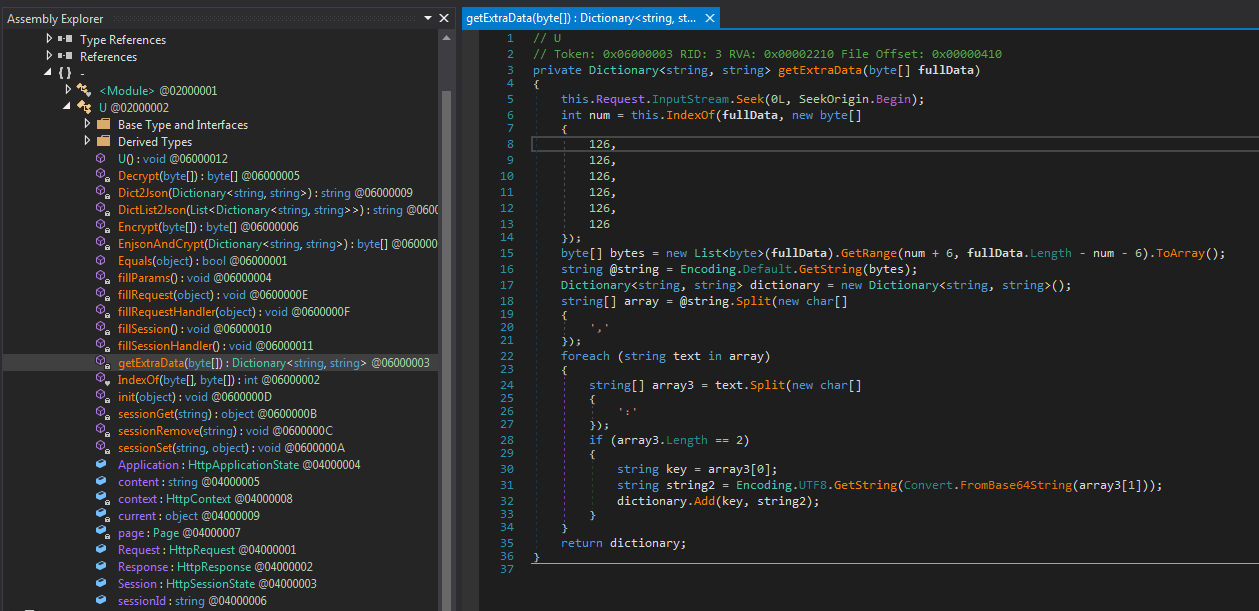
    Example of a library detected in IIS process memory (0x0B593115C273A90886864AF7D4973EED)

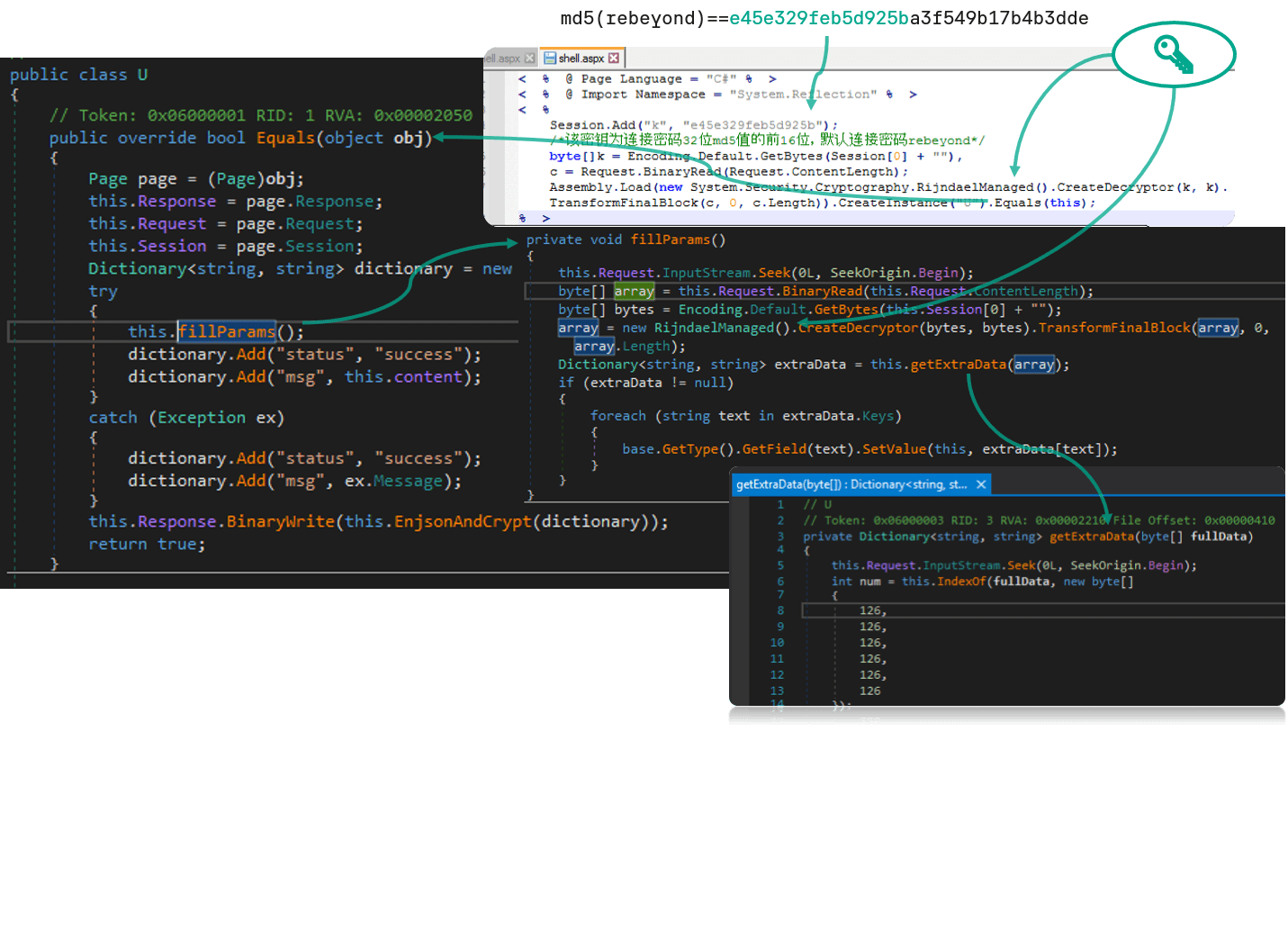
    In the image above, if you look at the orange method names in the Assembly Explorer on the left, you can observe some peculiarities that can be used to identify similar samples. Although many of the methods names are very generic, there is one that is quite unique, EnjsonAndCrypt. A quick Google search of this name yields no results, which means it may be sample-specific.

    The getExtraData method is also interesting: although it has a non-specific name, there is a sequence of bytes [126, 126, 126, 126, 126, 126] that is used to parse key:value pairs whose value is base64 encoded:

    The “extraData” structure example

    Threat actors need to use the same byte sequence if they want to maintain backward compatibility across different implant versions, but since it is also very generic, we should combine both indicators, the getExtraData name and this byte array, to define a sufficiently precise detection condition that can be used in conjunction with EnjsonAndCrypt to create a detection rule.

    Uncovering modules and variants

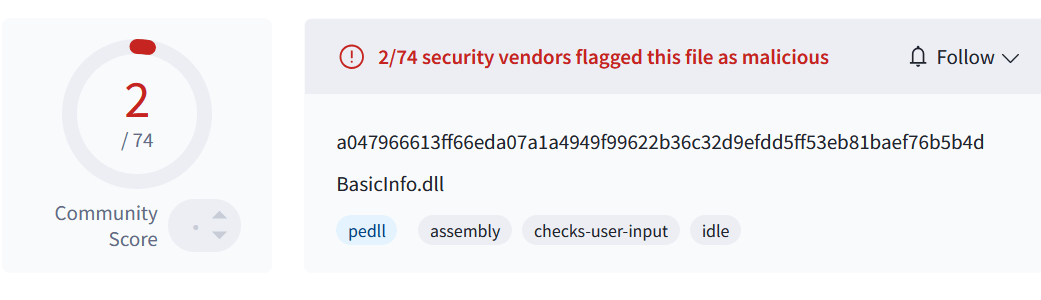
    By feeding our newly created YARA rule to a multi-AV platform such as VirusTotal, we can identify additional samples that differ from those observed in the targeted infrastructure. It is worth noting that some of these have a poor detection rate:

    Poorly detected BasicInfo.dll (32865229279DE31D08166F7F24226843) sample

    Below are the most common names of libraries that match the rule:

    Module filenames

    Those familiar with the toolkit used may have already identified it by looking at these filenames, but if not, it is also possible to infer the relationship by simply pivoting to the samples available on VT:

    Sample FC793D722738C7FCDFE8DED66C96495B relations on VT

    Behinder, also known as Rebeyond, Ice Scorpion, 冰蝎 (Bīng xiē), is known as a cross-platform web shell designed to be compatible with most popular web servers running PHP, Java or ASP.NET as in our investigation. Although the web shell sample itself is very lightweight and somewhat basic, the tool includes a powerful GUI for operators with numerous capabilities including loading additional modules and giving them full control over compromised environments.

    Its built-in AES-encrypted communication allows threat actors to maintain stealthy control over a compromised web server, often bypassing traditional network detection mechanisms, and its modular, flexible nature allows malicious actors to use it as a base for customization even though it is only available as a pre-built tool on GitHub. Moreover, the presence of several step-by-step Chinese language tutorials on CSDN (Chinese Software Developer Network) makes it widely accessible to opportunistic bad actors.

    The bigger picture

    Taking a step back, the relationship between the memory artifacts observed on the customer’s server during the post-exploitation phase and the web shell source code becomes evident. The web shell is not just a foothold, it’s a fully functional backdoor that facilitates encrypted communication with the operators’ infrastructure, allowing them to call built-in or custom-loaded libraries, deploy additional tools, conduct reconnaissance and exfiltrate data while remaining hidden:

    ASPX web shell side by side with .NET payload

    Although the Behinder web shell has been widely discussed in the past, especially the PHP and JSP variants, it is still a current and evolving cyberweapon. Even if attackers make mistakes or act carelessly by reusing the same encryption keys or exhibiting the same patterns, we can’t afford to let our guard down. In the incident described in this article, if we had not taken the time to dig deeper into the artifacts observed in memory, we likely would have missed the toolkit altogether.

    Threats evolve quickly, and signature-based malware detection only catches what we already know. Underestimating the potential of memory-based payloads can lead to a false sense of security. Teams may assume that if they haven’t detected any suspicious files, they are safe, when in fact threats may be actively operating in memory.

    For SOC teams, continuous learning, proactive threat hunting, and refining detection techniques are essential to staying ahead of adversaries.

    Happy hunting and see you on the next mission!

    YARA rule

    Indicators of compromise

    Payloads
    EF153E1E216C80BE3FDD520DD92526F4                          god.exe
    B8A468615E0B0072D2F32E44A7C9A62F                          BadPotato.dll
    B5755BE4AAD8D8FE1BD0E6AC5728067B                          SweetPotato.dll
    578A303D8A858C3265DE429DB9F17695                         BasicInfo.dll
    EA19D6845B6FC02566468FF5F838BFF1                          FileOperation.dll
    CD56A5A7835B71DF463EC416259E6F8F                          Cmd.dll
    5EA7F17E75D43474B9DFCD067FF85216                          Echo.dll

    File paths

    C:ProgramDataDRM
    C:UsersDefaultVideos

    MIL OSI Economics

  • MIL-Evening Report: How ‘muscular Christianity’ strove to bring men back to religion – and what it can teach us today

    Source: The Conversation (Au and NZ) – By Gavin Brown, Lecturer in Religious Education, Australian Catholic University

    Wikimedia Commons

    Most people recognise organisations such as the YMCA and the Boy Scouts, or events such as the Modern Olympic Games, summer camps and wilderness retreats.

    Few, though, have ever heard of the movement from which they took their principal inspiration: muscular Christianity.

    The term sounds odd indeed, conjuring up images of Jesus with an impressively chiselled physique or, for devotees of the eighties, Vangelis’ memorable soundtrack to Chariots of Fire.
    However, the term arose because it once carried Christian hopes of a solution to a longstanding problem: men.

    That is, in the 19th century especially, Christian churches became particularly alarmed more and more men were leaving religion to women – from attendance at worship to running parish organisations or establishing charitable endeavours.

    Worse still was the fear Christianity itself had become soft and even effeminate through the Victorian age.

    Christians, especially the Protestants who started the movement, needed to present Christianity in ways attractive to men. But how?

    A literary beginning

    In 1857, the Englishman Thomas Hughes published the novel Tom Brown’s School Days, followed later by Tom Brown at Oxford in 1859.

    In the first book, Tom attends the prestigious Rugby School, before making his way to Oxford in the sequel. This character would epitomise a “muscular Christian”, as Hughes put it. In the sequel, Hughes wrote:

    The least of the muscular Christians has hold of the old chivalrous and Christian belief, that a man’s body is given him to be trained and brought into subjection, and then used for the protection of the weak, the advancement of all righteous causes, and the subduing of the earth which God has given to the children of men.

    Author Thomas Hughes largely based Tom Brown’s School Days on his own years at Rugby School.
    Wikimedia Commons

    Men precisely as men could use their bodies to Christianise the world. A movement with twin aims was born: first, encourage men to embrace their physicality and second, through such disciplining of their bodies, to glorify God.

    Rise and fall

    From England, the movement spread through the Anglosphere, including Australia.

    And it has some impressive credentials. Pierre de Coubertin’s inspiration for reviving the Olympic Games was, in part, inspired by reading Tom Brown’s School Days.

    In the United States, the YMCA – the Young Men’s Christian Association – in New York added a gymnasium in 1869, which soon became a permanent fixture at the “Y.” The physical director at Boston’s Y coined the term “body building”. James Naismith would later invent basketball in 1891 while working at a Y.

    The YMCA on Melbourne’s St. Kilda Road during WWI.
    Aussie~mobs/flickr

    Many Protestant churches drew upon muscular Christianity to bring men back into the fold. They masculinised church services through hymns which celebrated manliness and virtue, encouraged ministers to embody more masculine traits, brought men into the company of other men through brotherhoods and promoted vigorous missionary activity.

    Even Jesus received a makeover – arguably the most popular being Warner Sallman’s 1940 portrait painting Head of Christ.

    Sallman’s original motivation for such depictions came from the dean of a Chicago Bible College in 1914:

    I hope you can give us your conception of Christ. And I hope it’s a manly one. Most of our pictures today are too effeminate.

    There is evidence, too, of Catholics muscling in. Take, for example, Notre Dame’s football team’s successes in the 1920s and 30s in the US, or the Italian cyclist Gino Bartali, winner of the Tour de France in 1938 and 1948 and, according to the Catholic press, the ideal Catholic sportsman.

    Most historians will mark the decline of the movement after the first world war, though its influence continues to be felt to this day.

    A continuing legacy?

    So, apart from indulging in historical curiosity, what does it offer us?

    Muscular Christianity highlights both the dangers and continuing challenges raised when navigating the complex relationship between religion, culture and gender.

    It pursued a worthy goal, but tended to play a zero-sum gender game: gains for men in the churches often came at the expense of women. Such emphasis on masculinity easily slipped into gender bias, where a “church full of men” was deemed more valuable than churches full of women.

    The effort to bolster masculinity also traded in narrow gender stereotypes, though as the historian Clifford Putney reminds us, there was some flow-on effect for women and their organisational engagement in sport and physical activity.

    Some evangelical Christians have recently re-engaged its ethos.

    And perhaps muscular Christianity still has something valuable to say. At the very least, scratch beneath the surface of modern Western culture and you will often find Christianity or values which originated from it.

    Muscular Christianity can also remind us to reconnect with our bodies. We now live in a world which, as Australian author Michael Frost argues, has become increasingly “excarnate” – that is, less bodily.

    Muscular Christianity recognised bodies matter and matter spiritually. It encouraged people not to treat health and physical activity as ends in their own right or as a servant of the ego but, rather, a means to an end: wholeness, good character, the cultivation of virtue and the selfless desire to help others.

    An 1867 wood engraving of the Lady Muscular Christians.
    Wikimedia Commons

    Gavin Brown does not work for, consult, own shares in or receive funding from any company or organisation that would benefit from this article, and has disclosed no relevant affiliations beyond their academic appointment.

    ref. How ‘muscular Christianity’ strove to bring men back to religion – and what it can teach us today – https://theconversation.com/how-muscular-christianity-strove-to-bring-men-back-to-religion-and-what-it-can-teach-us-today-249485

    MIL OSI AnalysisEveningReport.nz

  • MIL-OSI Australia: Thailand’s deportation of Uyghurs to China

    Source: Australian Government – Minister of Foreign Affairs

    The Australian Government strongly disagrees with the decision of the Thai Government to transfer a cohort of 40 Uyghurs to China against their will.

    Australia expects all countries to adhere to their domestic and international legal obligations, including non-refoulement obligations. We have repeatedly raised our concerns with the Thai Government and have also now raised our expectations about the group’s treatment with the Chinese authorities.

    The Australian Government has consistently expressed our grave concerns about the human rights situation in Xinjiang, and the treatment of Uyghur and other Muslim minorities in China. We continue to raise these concerns at the highest levels with China.

    We urge China to uphold its international human rights obligations, including to ensure due process and proper treatment are afforded to these individuals.

    MIL OSI News

  • MIL-Evening Report: Diversity, equity and inclusion in the workplace are under attack. Here’s why they matter more than ever

    Source: The Conversation (Au and NZ) – By Gemma Hamilton, Senior Lecturer, RMIT University

    Jacob Lund/Shutterstock

    As International Women’s Day approaches, we must redouble our efforts to champion social justice and the principles of diversity, equity and inclusion (DEI). These are under unprecedented attack by some political leaders.

    In the United States, President Donald Trump has recently dismantled DEI measures, claiming they are wasteful and discriminatory. Without evidence, he even blamed diversity hirings for a deadly collision between a military helicopter and a passenger plane that killed 67 people.

    In Australia, Opposition Leader Peter Dutton is echoing a similar agenda with his criticism of “culture, diversity and inclusion” positions in the public service.

    We must resist attempts to tear down all the progress that has been made and remind ourselves of the many good reasons why we pursue DEI in the workplace.

    Women, racial minorities, people with disability and others continue to face barriers to equal opportunities at work. Too often, they remain excluded from leadership and decision-making roles.

    Defending diversity

    Given the assault on DEI measures, it is worth restating why they are so important to a truly inclusive modern workplace.

    DEI initiatives work to address obstacles and correct disadvantages so everyone has a fair chance of being hired, promoted and paid, regardless of their personal characteristics.

    They ensure every person has a genuinely equal chance of access to social goods. They can be seen as “catch up” mechanisms, recognising that we don’t all start our working lives on an equal footing.

    Gender equality initiatives address discrimination, stereotypes and structural barriers that disadvantage people on the basis of their gender.

    These initiatives call into question the idea of “merit-based” hiring, which often disguises the invisible biases which are held by many people in power – for example, against someone of a particular gender.

    Australia’s story

    In Australia, we have a mixed story to tell when it comes to diversity, equity and inclusion.

    The federal workplace gender laws require companies with more than 100 employees to report annually on gender equality indicators, including pay gaps and workforce composition.

    DEI initiatives are already being dismantled in the United States.
    Gorodenkoff/Shutterstock

    In Victoria, the Gender Equality Act 2020
    promotes “positive action” to improve gender equality in higher education, local government and the public sector, which covers around 11% of the total state workforce.

    Despite these laws, Australia is behind on gender equality indicators compared to other countries such as Iceland, Norway and New Zealand. According to the World Economic Forum’s Global Gender Gap report, Australia is ranked 26th out of 146 countries, albeit a step up from 54th in 2021.

    The report shows continuing and significant gender gaps, particularly regarding women’s representation in various industries such as science and political leadership.

    Increased recognition

    But in a cross section of fields, including politics, sports, medicine, media and academia there have been positive changes. Gender equality is being promoted through a wide range of initiatives that seek to push back against centuries of patriarchal dominance.

    Workplace policies around paid parental leave, flexible working arrangements, part-time work, breastfeeding and anti-discrimination are part of the broader agenda to make workplaces more inclusive for women, gender-diverse people and working parents.

    Many workplaces accommodate the needs of working mothers.
    Jacob Lund/Shutterstock

    While many would not consider these improvements specific diversity initiatives, they are clear examples of the ways in which workplaces now recognise the different needs of women and working mothers.

    Today, we see more women in the workplace and in positions of leadership across sectors.

    But as feminist Sara Ahmed has noted, it is often the marginalised employees who carry the burden of doing all the “diversity work” in the workplace.

    Diversity becomes work for those who are not accommodated by an existing system.

    Redoubling efforts

    Despite the welcome advances made, inequalities persist in the workplace.

    We recognise many in positions of power are not willing (or able) to acknowledge their own privileged positions. Therefore they do not see the barriers that exist for others.

    Social justice will not simply be gifted by those in power.

    Given the challenging political climate, it is more important than ever that we continue to strive for gender equality – rather than simply uphold the status quo.

    Gemma Hamilton receives funding from the Australian Research Council (ARC).

    Nicola Henry receives funding from the Australian Research Council (ARC) and Google. She is also a member of the Australian eSafety Commissioner’s Expert Advisory Group.

    Bess Schnioffsky does not work for, consult, own shares in or receive funding from any company or organisation that would benefit from this article, and has disclosed no relevant affiliations beyond their academic appointment.

    ref. Diversity, equity and inclusion in the workplace are under attack. Here’s why they matter more than ever – https://theconversation.com/diversity-equity-and-inclusion-in-the-workplace-are-under-attack-heres-why-they-matter-more-than-ever-250651

    MIL OSI AnalysisEveningReport.nz

  • MIL-Evening Report: A quantum computing startup says it is already making millions of light-powered chips

    Source: The Conversation (Au and NZ) – By Christopher Ferrie, A/Prof, UTS Chancellor’s Postdoctoral Research and ARC DECRA Fellow, University of Technology Sydney

    PsiQuantum

    American quantum computing startup PsiQuantum announced yesterday that it has cracked a significant puzzle on the road to making the technology useful: manufacturing quantum chips in useful quantities.

    PsiQuantum burst out of “stealth mode” in 2021 with a blockbuster funding announcement. It followed up with two more last year.

    The company uses so-called “photonic” quantum computing, which has long been dismissed as impractical.

    The approach, which encodes data in individual particles of light, offers some compelling advantages — low noise, high-speed operation, and natural compatibility with existing fibre-optic networks. However, it was held back by extreme hardware demands to manage the fact photons fly with blinding speed, get lost, and are hard to create and detect.

    PsiQuantum now claims to have addressed many of these difficulties. Yesterday, in a new peer-reviewed paper published in Nature, the company unveiled hardware for photonic quantum computing they say can be manufactured in large quantities and solves the problem of scaling up the system.

    What’s in a quantum computer?

    Like any computer, quantum computers encode information in physical systems. Whereas digital computers encode bits (0s and 1s) in transistors, quantum computers use quantum bits (qubits), which can be encoded in many potential quantum systems.

    Superconducting quantum computers require an elaborate cooling rig to keep them at temperatures close to absolute zero.
    Rigetti

    The darlings of the quantum computing world have traditionally been superconducting circuits running at temperatures near absolute zero. These have been championed by companies such as Google, IBM, and Rigetti.

    These systems have attracted headlines claiming “quantum supremacy” (where quantum computers beat traditional computers at some task) or the ushering in of “quantum utility” (that is, actually useful quantum computers).

    In a close second in the headline grabbing game, IonQ and Honeywell are pursuing trapped-ion quantum computing. In this approach, charged atoms are captured in special electromagnetic traps that encode qubits in their energy states.

    Other commercial contenders include neutral atom qubits, silicon based qubits, intentional defects in diamonds, and non-traditional photonic encodings.

    All of these are available now. Some are for sale with enormous price tags and some are accessible through the cloud. But fair warning: they are more for experimentation than computation today.

    Faults and how to tolerate them

    The individual bits in your digital computers are extraordinarily reliable. They might experience a fault (a 0 inadvertently flips to a 1, for example) once in every trillion operations.

    PsiQuantum’s new platform has impressive-sounding features such as low-loss silicon nitride waveguides, high-efficiency photon-number-resolving detectors, and near-lossless interconnects.

    The company reports a 0.02% error rate for single-qubit operations and 0.8% for two-qubit creation. These may seem like quite small numbers, but they are much bigger than the effectively zero error rate of the chip in your smartphone.

    However, these numbers rival the best qubits today and are surprisingly encouraging.

    One of the most critical breakthroughs in the PsiQuantum system is the integration of fusion-based quantum computing. This is a model that allows for errors to be corrected more easily than in traditional approaches.

    Quantum computer developers want to achieve what is called “fault tolerance”. This means that, if the basic error rate is below a certain threshold, the errors can be suppressed indefinitely.

    Claims of “below threshold” error rates should be met with skepticism, as they are generally measured on a few qubits. A practical quantum computer would be a very different environment, where each qubit would have to function alongside a million (or a billion, or a trillion) others.

    This is the fundamental challenge of scalability. And while most quantum computing companies are tackling the problem from the ground up – building individual qubits and sticking them together – PsiQuantum is taking the top down approach.

    Scale-first thinking

    PsiQuantum developed its system in partnership with semiconductor manufacturer GlobalFoundries. All the key components – photon sources and detectors, logic gates and error correction – are integrated on single silicon-based chip.

    PsiQuantum says GlobalFoundries has already made millions of the chips.

    A diagram showing the different components of PsiQuantum’s photonic chip.
    PsiQuantum

    By making use of techniques already used to fabricate semiconductors, PsiQuantum claims to have solved the scalability issue that has long plagued photonic approaches.

    PsiQuantum is fabricating their chips in a commercial semiconductor foundry. This means scaling to millions of qubits will be relatively straightforward.

    If PsiQuantum’s technology delivers on its promise, it could mark the beginning of quantum computing’s first truly scalable era.

    A fault-tolerant photonic quantum computer would have major advantages and lower energy requirements.

    Christopher Ferrie is a founder of Eigensystems. He receives funding from the Australian Research Council.

    ref. A quantum computing startup says it is already making millions of light-powered chips – https://theconversation.com/a-quantum-computing-startup-says-it-is-already-making-millions-of-light-powered-chips-251057

    MIL OSI AnalysisEveningReport.nz

  • MIL-OSI Australia: Productivity Commission appointment

    Source: Australian Treasurer

    The Government has agreed to recommend to the Governor‑General, Her Excellency the Honourable Sam Mostyn AC, the appointment of Dr Angela Jackson as a full‑time Social Policy Commissioner to the Productivity Commission (PC), for a five‑year period.

    This is a key appointment for one of Australia’s key economic institutions.

    Driving productivity and higher living standards is a Government priority, and to do that we need the highest calibre of Commissioners at the PC.

    Dr Jackson is the Lead Economist at Impact Economics and Policy. She has been a part‑time Commissioner of the Commonwealth Grants Commission, a Member of the Economic Inclusion Advisory Committee and Chair of the Women in Economics Network that works to build the pipeline of female Australian economists.

    Dr Jackson was part of the independent panel that reviewed the Commonwealth Government’s response to the COVID‑19 pandemic and was also a Board Member and Chair of the Finance Committee at Royal Melbourne Hospital.

    She has also held senior economic advisory roles for the Commonwealth Government.

    Dr Jackson holds a PhD in Health Economics from Monash University and a Masters in International Health Policy (Health Economics) from the London School of Economics and Political Science.

    This proposed appointment would continue the high level of skills and experience within the PC, to help ensure its continued high‑quality research and advice on the key sectors of our economy.

    If appointed, Dr Jackson’s work at the PC will make a key contribution to the five pillars of the Government’s productivity agenda to build a more productive Australia.

    MIL OSI News

  • MIL-Evening Report: Australia’s retirement savings are too big to invest at home – here’s why super funds are looking to the US

    Source: The Conversation (Au and NZ) – By Susan Thorp, Professor of Finance, University of Sydney

    Marek Masik/Shutterstock

    You might remember Pesto, the king penguin chick who became a star attraction at Melbourne Aquarium last year. Good food, good genes and a safe home let Pesto grow into a huge ball of brown fluff twice the size of his parents. Pesto became a local and international celebrity.

    While not cute or funny like Pesto, Australia’s financial sector gave birth to its own baby three decades ago that has since rapidly grown into a big adult – superannuation. It, too, has become internationally famous.

    This week, our superannuation sector attracted the attention of US asset managers and government officials, including the new US Treasury Secretary Scott Bessent, at a summit in Washington DC.

    Super industry leaders joined Treasurer Jim Chalmers and the Australian ambassador to the US, Kevin Rudd, to pitch a strengthening of ties. So, why are Australian super funds so keen to shore up support in the United States?


    Read more:
    Your super fund is invested in private markets. What are they and why has ASIC raised concerns?


    A giant nest egg

    Figures from the Australian Prudential Regulation Authority (APRA) show the total pool of superannuation assets had grown to about A$4.2 trillion by December 2024. That’s up 11.5% on the year before.

    That’s about 160% of the value of all goods and services produced in Australia – the gross domestic product (GDP) – over the year to June 2024 at $2.6 trillion.

    This scales to a very large pool of investable retirement money – the fifth largest in the world. Australia’s population ranks just 54th in the world.

    Some of the biggest individual funds have significant assets under management. Australian Super and Australian Retirement Trust, for example, both manage more than $300 billion in retirement savings.

    Looking overseas

    This leads us to why the Australian super industry is securing openings in the US. Australian super funds have invested some funds overseas since their inception. But this practice is expanding quickly for two reasons.

    First, the sheer size of the superannuation investment pool has largely outgrown its Australian asset base.

    To illustrate, our $4.2 trillion super pool is significantly larger than the total market capitalisation of the Australian Securities Exchange (ASX), about $3.1 trillion.

    Without new places to invest our super, it’s impossible to keep earning a return on it.

    The second – and related – reason is the need for diversification. It makes sense to lower risk by spreading funds across industries, geographies and jurisdictions.

    A scan of the aggregated asset allocation of large Australian super funds shows that around half of the funds invested in equities, property and infrastructure are currently in overseas assets.

    The US accounts for about 45% of aggregate financial assets of all investors worldwide – more than US$90 trillion (A$144 trillion).

    The strategy to diversify investments has paid off. The US stock market has seen some spectacular recent returns, with annual returns of more than 20% in some years. These have far outpaced those of the ASX.

    Compulsory savings

    Australia’s super sector has been fed by compulsory contributions (savings) and investment returns. Super has also been protected by legislation that makes participation compulsory for most workers and preserves savings until retirement.

    Australia has had a system of compulsory employer superannuation contributions for workers since 1992.
    DGLimages/Shutterstock

    Since 1992, employers have made compulsory (superannuation guarantee) contributions on behalf of workers into superannuation accounts. The compulsory contribution has risen significantly from an initial 3% of earnings to 12% of earnings from July this year.

    High coverage (well over 90% of workers), combined with rising contribution rates, has meant the amount of money flowing into superannuation accounts has grown at a remarkable compound annual rate of 14% since 1992.

    Even after the superannuation guarantee rate peaks at 12% this year, growth in labour earnings, fed by workforce and productivity growth, will continue to generate substantial inflows.

    Can’t touch our nest egg early

    Australia’s strict rules preventing withdrawals from super are among the tightest in the world. With some exceptions for extreme hardship, members of super funds can withdraw their savings from age 60 if they retire, and from age 65 even if they have not retired.

    An ageing population will mean more retirees in future decades, speeding up outflows. But so far, Australian retirees are proving to be very cautious with their nest eggs.

    Along with compulsory contributions and rules on withdrawing it, investment returns have grown the super baby, at rates of 7.3% annually over the past 30 years, or about 4.4% annually above inflation.

    The super sector is still smaller than its older sibling, the banking system, where assets of A$6.3 trillion are about 240% of the value of annual GDP. But super is forecast to grow to 200% of annual GDP over the next two decades.

    Riskier investments

    To generate these rates of return, Australian super funds have invested in a wide range of financial assets, and with a substantial exposure to high return (but riskier) assets.

    In Australia, super funds invest around two-thirds
    of funds in equities, property, infrastructure and commodities, and around one-third in safer bonds and cash.

    That contrasts with some other pension systems, such as Japan and the UK, where a majority of funds are invested in safer assets like government bonds.

    Susan Thorp is a member of UniSuper. She receives and has received research funding from the Australian Research Council, the Australian Securities and Investments Commission, the TIAA Institute (USA), IFM, and UniSuper and Cbus Superannuation funds via ARC Linkage Grants. Thorp was previously Professor of Finance and Superannuation at UTS, a position that was partly funded by Sydney Financial Forum (Colonial First State Global Asset Management), the NSW Government, the Association of Superannuation Funds of Australia (ASFA), the Industry Superannuation Network (ISN), and the Paul Woolley Centre for the Study of Capital Market Dysfunctionality, UTS. She was an Associate Investigator for the ARC Centre of Excellence in Population Ageing Research (CEPAR), and is a member of the OECD-International Network on Financial Education Research Committee, the Steering Committee of the Mercer CFA Global Pensions Index, the Australian Securities and Investments Commission (ASIC) Consultative Committee, the Board of New College (UNSW) and the Research Committee of Super Consumers Australia, a not-for-profit advocacy organisation for Australian pension plan participants.

    ref. Australia’s retirement savings are too big to invest at home – here’s why super funds are looking to the US – https://theconversation.com/australias-retirement-savings-are-too-big-to-invest-at-home-heres-why-super-funds-are-looking-to-the-us-250920

    MIL OSI AnalysisEveningReport.nz

  • MIL-Evening Report: Nangs are popular with young people. But are they aware of the serious harms of nitrous oxide?

    Source: The Conversation (Au and NZ) – By Julaine Allan, Professor, Mental Health and Addiction, Rural Health Research Institute, Charles Sturt University

    Lenscap Photography/Shutterstock

    Nitrous oxide – also known as laughing gas or nangs – is cheap, widely available and popular among young people.

    Yet it often flies under the radar in public health programs and education settings. For example, it’s not included in the drug education curriculum in Australian schools.

    In our new study, we spoke to young people (aged 18 to 25) who have used nitrous oxide. We found they were are unaware of its risks – even when they reported symptoms such as “brain fog” and seizures.

    What is nitrous oxide?

    Nitrous oxide is regularly used for sedation and pain relief in dentistry and childbirth.

    The gas, which has no colour or flavour, is also used recreationally and is known as nangs, nos, whippits and balloons.

    In fact, nitrous oxide has been used to get intoxicated since its creation in 1722, and wasn’t used in surgery until 1842. It can create a feeling of dissociation from the body, changes in perception and euphoria. This lasts about one minute.

    In Australia, nitrous oxide is cheap and accessible. This is because the gas is also used in baking, for example to whip cream.

    So, while it’s not legal to sell nitrous oxide for recreational use, the canisters or “bulbs” are widely available online via 24-hour delivery services.

    People usually discharge the gas into a balloon or a whipped cream dispenser and then inhale. Nitrous oxide is intensely cold – minus 40 degrees Celsius.

    People inhale the gas using a balloon.
    Ink Drop/Shutterstock

    How common is it?

    We still don’t have much data about who uses nitrous oxide and how often. Compared to other drugs, there is minimal research on its recreational use.

    However researchers believe it is becoming more common globally, especially among young people.

    For example, in 2022, nitrous oxide was the second-most used controlled substance among 16–24 year olds in the United Kingdom after cannabis.

    In January 2023, the Netherlands banned the sale and possession of nitrous oxide after 1,800 road accidents, including 63 fatal crashes, were linked to the drug in a three-year period.

    The Global Drug Survey reported a doubling in nitrous oxide use between 2015 and 2021, from 10% of respondents to 20%. But this voluntary survey is not representative of all people who use drugs. While it is an indication of people’s nitrous oxide use, the picture remains patchy.

    What are the health risks?

    Nitrous oxide is not the most harmful drug people can use but that doesn’t make it safe.

    Inhaling nitrous oxide has short-term health risks, including:

    • cold burns from the gas

    • injuries from falling over

    • nausea and dizziness.

    Using a lot of nitrous oxide at one time can result in passing out (from lack of oxygen) and seizures. Calling an ambulance is necessary if this happens.

    Longer-term health problems may include:

    • vitamin B12 loss (causing numbness of hands and feet and eventually paralysis)

    • urinary incontinence

    • strokes

    • memory loss

    • mental health conditions, including depression and psychosis.

    The availability of much larger canisters (including flavoured varieties) is also linked to an increase in significant harms. These can deliver roughly 70 times the amount of nitrous oxide as traditional small canisters.

    Larger bulbs allow people to consume more of the gas at one time and they often experience health problems more quickly as a result.

    However, there is still limited knowledge about nitrous oxide in the health system. This means its health risks are often compounded because it is overlooked by those assessing medical conditions and because people deny using it.

    Large gas canisters mean people consume a lot more nitrous oxide in one go.
    joshua snow/Shutterstock

    Our research

    During the first stage of our 2025 Australian study, we interviewed seven young people (aged 18 to 25) who had used nitrous oxide at least ten times.

    While the number of interviewees was small, the stories they told were very similar.

    They were either unaware of, or unconcerned about, the drug’s potential risks. This is despite their own experiences of psychological and physical problems.

    They reported becoming unconscious, getting burns from the gas on their hands and faces, sores around the mouth and even having seizures.

    Of particular concern to us was use before driving because people did not recognise the lingering effects of the gas on concentration.

    Our study participants also spoke about “memory zaps” or “brain fog”. Regular use of nitrous oxide affected people’s ability to participate in work and study, with some saying it was also bad for their mental health.

    These thinking problems are a concerning side effect. Yet it’s one that has not been adequately investigated.

    The role of social media

    Videos of young people using nitrous oxide can easily be found on social media. This not only points to its popularity but suggests social media could be a good place to reach young people with information about the drug and harm reduction.

    In the second stage of our research we worked with 30 young people who used nitrous oxide to co-create harm reduction resources.

    As a group, we developed videos, photos and text for
    our nitrous oxide specific social media accounts on Tik Tok and Instagram and for posts on various sub-reddits.

    These describe ways to use the drug more safely. For example the “take a breath” messaging suggests breathing the nitrous oxide in for only ten seconds at a time to ensure enough oxygen. “Take a seat” advises sitting down while using nangs, to avoid injuries from falling.

    Julaine Allan receives funding from the National Health and Medical Research Council and the Commonwealth Department of Health and Aging to conduct research on substance use and mental health programs. She has received funding in the past from other state and commonwealth departments and entities for research.

    Helen Simpson, Jacqui Cameron, and Kenny Kor do not work for, consult, own shares in or receive funding from any company or organisation that would benefit from this article, and have disclosed no relevant affiliations beyond their academic appointment.

    ref. Nangs are popular with young people. But are they aware of the serious harms of nitrous oxide? – https://theconversation.com/nangs-are-popular-with-young-people-but-are-they-aware-of-the-serious-harms-of-nitrous-oxide-250654

    MIL OSI AnalysisEveningReport.nz

  • MIL-Evening Report: Yes, paper straws suck. Rather than bring back plastic ones, let’s avoid single-use items

    Source: The Conversation (Au and NZ) – By Bhavna Middha, ARC DECRA Senior Research Fellow, Centre for Urban Research, RMIT University

    Dragon Images/Shutterstock

    When US President Donald Trump ordered federal agencies to return to plastic straws, claiming the paper version is ineffective and “disgustingly dissolves in your mouth”, he was widely criticised for setting back efforts to reduce plastic pollution. But many alternatives designed to help phase out single-use plastics don’t really solve the problem at all.

    It’s not unusual to see plastic bans challenged or overturned. However, a government ban on the substitute is altogether new.

    It’s true paper straws can disintegrate and become soggy before we finish a drink. Problems with finding viable substitutes to single-use plastics is one of the many challenges involved in phasing them out.

    Sometimes, swapping one single-use item for another really is more trouble than it’s worth. A better approach would be to change our society’s single-use and disposal mindset.

    The problem with plastic

    Plastic pollution is an urgent problem for the environment and human health. Microplastics are everywhere, from Antarctica to our brains.

    Plastic is made from fossil fuels, and so contributes to global warming. What’s more, plastic production is forecast to triple by 2050.

    But recycling is difficult. Less than 10% of the world’s plastic has been recycled.

    So we need to reduce our use of plastic in the first place, rather than trying to clean it up afterwards.

    Substituting plastic straws for paper still involves using virgin materials.
    JeniFoto/Shutterstock

    Poor substitutes and other traps

    Trump rejected paper straws, saying they “don’t work” as well as plastic straws. The poor consumer experience of drinking through a soggy straw is one thing, but there are other problems too.

    Swapping one problematic or hazardous material for another is sometimes called “regrettable substitution”, because the replacement has its own issues. For example, one harmful chemical used to make plastics is often replaced with others that are as bad or worse.

    Paper straws, like paper cups, are often coated with plastics such as polyethylene or acrylic resin. This makes them difficult to recycle but also raises the risk of pollution. Some paper straws have been shown to contain more “forever chemicals” (per- and polyfluoroalkyl substances, or PFAS) than plastic.

    Along with paper, other plant-based materials such as corn starch and bamboo are increasingly replacing single-use plastics – especially in food packaging. These substitutes carry a cost that is passed down to consumers, and many are more expensive to produce than plastic.

    Some are labelled “compostable” or “biodegradable”. The term compostable suggests they will break down in home compost heaps or green waste bins, but that has been called into question.

    Unfortunately, the term “biodegradable” does not necessarily mean a material will break down in home compost, or even landfill. It may require heat or pressure – in an industrial setting – for it to disintegrate enough to be harmless or safely used on your garden.

    When it comes to straws, paper, bamboo, metal and glass have all been adopted as substitutes. Metal and glass straws could be dangerous for kids and less able-bodied people. They can also be hard to clean. Again, “biodegradable plastic” products have been accused of greenwashing and have been banned from organic composting bins in New South Wales and potentially Victoria because they don’t disintegrate well or are contaminated.

    Meanwhile, thicker plastic bags labelled “reusable” have been introduced following bans on lightweight “single-use” plastic bags. While these durable bags may be reused for months at a time, they will eventually wear out and then they are even harder to break down in landfill.

    Plastic bans can be problematic

    Governments all over the world have attempted to ban single-use plastic. Often these bans are introduced without considering how the products are used in daily life and how those services will be replaced. The changes may disadvantage certain groups and new supply chains need to be created.

    Often, governments wanting to be seen as protecting the environment target the low-hanging fruit such as plastic straws and plastic bags, rather than packaging as a whole.

    So it’s no surprise these bans have faced opposition. Many have already been repealed or diluted.

    In India, for example, the plastic ban was criticised for shifting the burden of waste management away from larger, more polluting industries on to smaller businesses. Larger establishments were also accused of passing the costs of substitute packaging, such as more expensive paper and cloth, to consumers.

    Better to avoid single-use items

    It’s time to stop searching for the perfect substitute. Let’s instead focus on getting rid of single-use items altogether.

    Remember, straws were originally used for very specific cases and places: very young children and others unable to drink straight from a cup. They might still need straws.

    Single-use bottles are unnecessary. We should learn from Germany’s glass bottle reuse system and set up circular loops of production and distribution.

    Get serious about reducing plastic packaging

    While some packaging – even some plastics – is needed for food safety and freshness, an overhaul of unnecessary packaging would go a long way.

    In the United Kingdom, anti-waste charity WRAP examined fresh produce in supermarkets and called for the government to ban packaging on 21 fruits and vegetables sold in supermarkets by 2030. These included cucumbers, bananas and potatoes.

    Removing unnecessary packaging and plastics involves reconfiguring social rules, knowledge, standards and expectations such as making items without packaging affordable and widely available. We must challenge our disposable society by creating spaces and practices that allow reuse.

    Better policies and regulations

    Policies that prevent plastics from reaching consumers in the first place would be better than bans on single-use items.

    Governments should put the onus on the corporations that have profited from plastic and their role in plastic pollution.

    Supermarkets and the food industry as a whole must also take responsibility for their part in the plastic waste problem.

    Voluntary codes have not worked. Government regulation levels the playing field, but industry expertise and technical and social knowledge is needed to ensure systems work. While not without its challenges, Australia’s tyre recycling system has addressed many similar issues. The scheme’s approach to developing a national market for used tyres could be replicated for plastics, packaging and glass.

    Meaningful change for our environment and health requires government regulations done well and fairly. It also requires coordinated waste infrastructure and industry practices that build on technical expertise and consumers’ lived experience.

    Bhavna Middha receives funding from the Australian Research Council through the Discovery Early Career Research Award.

    Ralph Horne receives funding from the Australian Research Council (ARC) and a range of industry and government partners from time to time, to support research activities relevant to this article. In particular, he is a Chief Investigator on the ARC Research Hub Transformation of Reclaimed Waste Resources to Engineered Materials and Solutions for a Circular Economy (TREMS).

    Kajsa Lundberg does not work for, consult, own shares in or receive funding from any company or organisation that would benefit from this article, and has disclosed no relevant affiliations beyond their academic appointment.

    ref. Yes, paper straws suck. Rather than bring back plastic ones, let’s avoid single-use items – https://theconversation.com/yes-paper-straws-suck-rather-than-bring-back-plastic-ones-lets-avoid-single-use-items-250266

    MIL OSI AnalysisEveningReport.nz

  • MIL-OSI Economics: Well into the Future: A Recap of Panasonic at CES 2025

    Source: Panasonic

    Headline: Well into the Future: A Recap of Panasonic at CES 2025

    Exhibiting at this premier consumer technology event for the 58th consecutive year, Panasonic used the theme “Well into the future” to express the company’s vision of utilizing AI and data-driven businesses to build a more resilient and sustainable future for generations to come. The event began with a keynote delivered by CEO Yuki Kusumi, who was joined by leaders from across the company to explain what’s to come for Panasonic and how they’re working to create a better global society and planet.

    Under the theme “Well into the future,” Yuki Kusumi marked a new chapter for Panasonic’s commitment to innovation, emphasizing AI expansion and initiatives like Panasonic Go. By 2035, 30% of revenue will come from software and AI-enabled solutions.

    As part of Panasonic GREEN IMPACT’s commitment to addressing global environmental issues, the company announced the expansion of Panasonic HX in Europe, the production and recycling of automotive lithium-ion batteries, and the launch of OASYS, a whole-house air conditioning system designed for energy efficiency.

    As part of Panasonic Go, Blue Yonder continues to deliver safe, sustainable solutions through its global supply chain. And Panasonic Well introduced Umi, a digital family wellness service that supports families via an app. The company also announced various partnerships, including one with Anthropic, Inc., to further promote Panasonic Go.

    Click here for the article.

    CES 2025 was attended by over 141,000 people, and this year’s Panasonic booth led visitors through the story of the company’s shift toward AI and data-driven businesses, exemplified by Umi, a digital wellness coach using AI to help families build healthy habits and routines.

    Carbon Neutral and Circular Economy—two areas in the exhibition space—introduced solutions and technologies that will be contributing to achieving the goals established under Panasonic’s long-term environmental vision, Panasonic GREEN IMPACT.

    Watch this interview with Mike King, Director of Brand Marketing & Creative Services, to see how Panasonic aimed to use storytelling at this year’s booth to emphasize their 100-year commitment to improving people’s lives.

    Click here for the article.

    The seventh episode of the Panasonic PR People Vlog takes you behind the scenes at CES 2025, featuring keynote preparations and must-see booth exhibits recommended by our team. If you missed it, watch here.

    Find more CES-related content here: CES 2025 Press Kit

    MIL OSI Economics

  • MIL-OSI New Zealand: Rare Disorders New Zealand 25th anniversary

    Source: New Zealand Governor General

    E nga mana, e nga reo, e nga iwi o te motu e huihui nei, tēnei aku mihi nui ki a koutou. Kia ora tātou katoa.

    I specifically acknowledge

    • John Forman, founder of Rare Disorders New Zealand
    • James McGoram, Board Chair; and
    • Chris Higgins, Chief Executive of Rare Disorders New Zealand

    My warmest welcome to members of the Rare Disorders community, to whānau, and to carers and supporters.

    I am very pleased to be Patron of Rare Disorders New Zealand, and to support your work by joining you in celebrating your 25th anniversary with this afternoon’s reception and awards ceremony.

    It’s a truism worth repeating that we judge a society by the way it cares for its most vulnerable people. Twenty-five years ago, Rare Disorders New Zealand took up the challenge of representing people who understand what it is to feel alone and isolated, and appreciate the huge difference the right diagnosis and treatment can make to their lives. By helping them and representing their interests, you have helped Aotearoa New Zealand to be a better place.

    The concept of an ‘umbrella organisation’ evokes manaakitanga, support and shelter from the elements.

    I like to think you will also relate to this whakataukī: ‘Ki te kotahi te kakaho, ka whati; ki te kapuia, e kore e whati’ – which translates as ‘a reed that stands alone can be broken, but it will not be broken if it stands alongside others’.

    Rare Disorders New Zealand has enabled people to experience strength and support by standing together in whanaungatanga.

    You have been tireless advocates for a more coordinated approach to diagnosis and treatment, and your mahi bore fruit with the launch, last year, of New Zealand’s first national strategy for rare disorders.

    The Aotearoa New Zealand Rare Disorders Strategy is a significant milestone, responding as it does to the lived experiences and needs of your community, as revealed through your own surveys.

    I appreciate the impact of the Strategy has yet to be felt – and you will be eager to see meaningful progress – whether that be with earlier diagnosis, clearer pathways for clinical care, better access to support and medicines, appropriate training for the health workforce, or the gathering of research data.

    With my own background in health and academia, I am delighted to see the establishment of the Rare Disorders Research Network,  based in Victoria University. The Network will enable New Zealand researchers to experience the support of colleagues working in similar fields, and encourage coordinated research programmes.

    Their findings will have real-life implications for your community, and contribute to global understanding of rare disorders and their treatment.

    I appreciate that as a charitable organisation, Rare Disorders New Zealand is reliant on the tireless dedication of a small number of staff and a large number of volunteers. I welcome this opportunity to thank you all for devoting your time, energy and expertise to such a worthy cause.

    Today we are also formally acknowledging award recipients for their steadfast commitment to the rare disorders community, and thanking them, on behalf of all New Zealanders, for what they have achieved.

    Once again, I welcome you all to Government House. Please allow me to extend to you all the aroha and manaakitanga you so often extend to others, and are so deserving of receiving yourselves.

    Kia ora, kia kaha, huihui tātou katoa

    MIL OSI New Zealand News

  • MIL-OSI Australia: Australian Deputy PM: Regional airports in Victoria set to soar

    Source: Minister of Infrastructure

    The Albanese Labor Government is building Australia’s future, investing almost $4.5 million to upgrade nine regional airports across Victoria. 

    Airports are vital for regional communities, providing critical access to emergency healthcare, as well as commerce, industry, tourism and education. 

    Funded under Round 4 of the Regional Airports Program, these essential upgrades will include runway resurfacing and sealing, line marking and drainage – which will improve safety and enhance accessibility at these regional airports. 

    City of Ballarat will receive $1.1 million to repurpose an old terminal building at Ballarat Airport into a new, fit for purpose space for emergency responders as well as medical patients awaiting transfer. 

    A dedicated aircraft parking area for aeromedical aircraft will also be provided allowing direct access to the facility.

    Other works to be funded under Round 4 in Victoria include: 

    $1.9 million for the Mildura Airport to rejuvenate and repair the main runway and related pavement areas ensuring the safety of aircraft, operations and passengers, maintaining connectivity for the region.

    $210,000 for upgrades to the Maryborough Aerodrome which will support the continued safe use, communication and access at the airport for emergency services, including aeromedical and fire services as well as general aviation use.

    $138,463 for the reseal of the Yarrawonga Runway to allow for the continued use of the aerodrome for delivery of essential goods and services, aeromedical flights, and general and recreational aviation.

    $185,955 to upgrade the main apron at Warrnambool Airport which will allow for two further aircraft to park and improve aircraft manoeuvring and parking.

    Today’s announcement builds on the nearly $100 million that has already been delivered to support 194 projects under the first three rounds of the program. 

    For more information on the Regional Airports Program, including a full list of Round 4 projects in Victoria, visit www.infrastructure.gov.au/infrastructure-transport-vehicles/aviation/regional-remote-aviation/regional-airports-program.

    Quotes attributable to Minister for Infrastructure, Transport, Regional Development and Local Government Catherine King:

    “We’re backing regional communities across Victoria by backing our regional airports, which keep communities connected, and support increased economic opportunities. 

    “The new facility will mean that whether you’re on your way to fight a fire, or have a family member needing emergency health care, there will be a safe and appropriate place to wait, regardless of the weather outside. 

    “Ballarat Airport plays a critical role within our region throughout bushfire season, and in supporting emergency healthcare all year long. The benefits of this investment will be felt far beyond the boundaries of the City of Ballarat.” 

    Quotes attributable to City of Ballarat Mayor, Cr Tracey Hargreaves:

    “The Ballarat Airport serves as a key hub for much of western Victoria, particularly in relation to aeromedical patient transfers and as an operational base for emergency services, including aerial firefighting crews.  

    “The new facility will provide emergency services personnel, air crews and patients with a dedicated, safe and protected space at the airport to conduct patients transfers and medical examinations while waiting for aircraft to arrive — out of the often-harsh Ballarat weather.

    “This facility, together with the recently completed runway extension, is essential to the Ballarat Airport’s envisioned future as a hub for the west of the state that can cater to larger commercial and emergency services aircraft. The City of Ballarat thanks the Australian Government for their investment in this critical facility.”  

    MIL OSI News

  • MIL-OSI Australia: Regional airports in Victoria set to soar

    Source: Australian Ministers for Regional Development

    The Albanese Labor Government is building Australia’s future, investing almost $4.5 million to upgrade nine regional airports across Victoria. 

    Airports are vital for regional communities, providing critical access to emergency healthcare, as well as commerce, industry, tourism and education. 

    Funded under Round 4 of the Regional Airports Program, these essential upgrades will include runway resurfacing and sealing, line marking and drainage – which will improve safety and enhance accessibility at these regional airports. 

    City of Ballarat will receive $1.1 million to repurpose an old terminal building at Ballarat Airport into a new, fit for purpose space for emergency responders as well as medical patients awaiting transfer. 

    A dedicated aircraft parking area for aeromedical aircraft will also be provided allowing direct access to the facility.

    Other works to be funded under Round 4 in Victoria include: 

    $1.9 million for the Mildura Airport to rejuvenate and repair the main runway and related pavement areas ensuring the safety of aircraft, operations and passengers, maintaining connectivity for the region.

    $210,000 for upgrades to the Maryborough Aerodrome which will support the continued safe use, communication and access at the airport for emergency services, including aeromedical and fire services as well as general aviation use.

    $138,463 for the reseal of the Yarrawonga Runway to allow for the continued use of the aerodrome for delivery of essential goods and services, aeromedical flights, and general and recreational aviation.

    $185,955 to upgrade the main apron at Warrnambool Airport which will allow for two further aircraft to park and improve aircraft manoeuvring and parking.

    Today’s announcement builds on the nearly $100 million that has already been delivered to support 194 projects under the first three rounds of the program. 

    For more information on the Regional Airports Program, including a full list of Round 4 projects in Victoria, visit www.infrastructure.gov.au/infrastructure-transport-vehicles/aviation/regional-remote-aviation/regional-airports-program.

    Quotes attributable to Minister for Infrastructure, Transport, Regional Development and Local Government Catherine King:

    “We’re backing regional communities across Victoria by backing our regional airports, which keep communities connected, and support increased economic opportunities. 

    “The new facility will mean that whether you’re on your way to fight a fire, or have a family member needing emergency health care, there will be a safe and appropriate place to wait, regardless of the weather outside. 

    “Ballarat Airport plays a critical role within our region throughout bushfire season, and in supporting emergency healthcare all year long. The benefits of this investment will be felt far beyond the boundaries of the City of Ballarat.” 

    Quotes attributable to City of Ballarat Mayor, Cr Tracey Hargreaves:

    “The Ballarat Airport serves as a key hub for much of western Victoria, particularly in relation to aeromedical patient transfers and as an operational base for emergency services, including aerial firefighting crews.  

    “The new facility will provide emergency services personnel, air crews and patients with a dedicated, safe and protected space at the airport to conduct patients transfers and medical examinations while waiting for aircraft to arrive — out of the often-harsh Ballarat weather.

    “This facility, together with the recently completed runway extension, is essential to the Ballarat Airport’s envisioned future as a hub for the west of the state that can cater to larger commercial and emergency services aircraft. The City of Ballarat thanks the Australian Government for their investment in this critical facility.”  

    MIL OSI News

  • MIL-OSI Australia: Allens advises on sale of Tasmania JackJumpers NBL Club

    Source: Allens Insights

    Allens is proud to have advised the LK Group on the sale of the National Basketball League’s (NBL) Tasmania JackJumpers to alternative asset manager, Altor Capital.

    Altor Capital will acquire 51% of the club in mid-2025 before assuming full ownership after a 24-month transition.

    A substantial proportion of the sale proceeds will be reinvested by the LK Group into the NBL and its clubs, as well as the development of the Wilkinsons Point precinct in Hobart.

    ‘We are pleased to have continued our work with the LK Group on the sale of this much-loved Tasmanian team, which will provide continued momentum for the sport of basketball in Tasmania and the wider community,’ said lead partner Mark Malinas.

    ‘We look forward to continuing to watch the NBL continue to grow its fan base and see the JackJumpers flourish under their new owners in Altor Capital.’

    The Allens team worked closely with Group General Counsel of the LK Group, Jeremy Zwaigoft.

    ‘We were delighted to partner with Allens once again on this important transaction. Allens delivered professional, timely and strategic advice throughout the negotiations, and kept us well ahead of the curve, even when working to an accelerated timeline,’ Zwaigoft said.

    ‘This deal secures the JackJumpers’ future with Altor Capital and supports the NBL’s commitment to growing the game of basketball across Australia and internationally.’

    The transaction continues Allens’ work with the NBL and LK Group, with the firm having also advised the NBL on its investment in the WNBL in 2024. 

    Allens legal team

    Mark Malinas (Partner), Nicholas Ng (Partner), Daniel Conti (Senior Associate), Eirene Vlahogiannis (Associate), Grace Vipen (Associate)

    MIL OSI News

  • MIL-Evening Report: Political fighting over Chinese warships misses the point: Australia’s navy is no match for China’s built-up force

    Source: The Conversation (Au and NZ) – By Richard Dunley, Senior Lecturer in History and Maritime Strategy, UNSW Sydney

    Over the past few days, the Australian media has been dominated by the activities of the Chinese navy’s Task Group 107 as it has progressed south along the Australian coast and conducted a series of live-fire exercises.

    Much of the discussion has been rather breathless in nature, with accusations of “gunboat diplomacy” being bandied around.

    The live-fire exercises have also dominated the Australian political debate. Amid all the accusations, the fact that these exercises are routine and entirely legal has gotten lost.

    The Australian government was correct to lodge a complaint with its Chinese counterpart when one of these exercises disrupted civilian aviation. But the overall response has been an extraordinary overreaction.

    There is no indication the Chinese vessels undertook any surface-to-air exercises, and it remains unclear whether the initial firings involved medium-calibre weapons or smaller arms.

    Either way, the facts suggest the disruption from the Chinese vessels was caused by inexperience or poor procedure, rather than some more nefarious purpose.

    This is not to suggest the People’s Liberation Army-Navy’s (PLA-N) deployment is unimportant, but as happens all too often, the Australian public debate is missing the wood for the trees.

    While a number of retired naval officers have publicly played down the significance of the live-fire exercises, these voices have generally been drowned out by the politicisation of the issue. This highlights the failure of the Department of Defence to communicate effectively to the public.

    In other countries, including the United States, senior officers are given far more leeway to make public statements in matters within their purview.

    Had Vice Admiral Mark Hammond, the chief of navy, or Vice Admiral Justin Jones, the chief of Joint Operations, been empowered to explain how live-fire exercises are routine and are commonly carried out by Australian warships on deployment in our region, we may have avoided this unhelpful stoush.

    The remarkable growth of the Chinese navy

    The real significance of the activities of Task Group 107 is the way it has revealed the very different trajectories of the PLA-N and its Royal Australian Navy counterpart.

    The task group is made up of a Type 055 Renhai-class cruiser, a Type 054A Jiangkai II frigate and a Type 903 Fuchi-class replenishment ship. This is a powerful force that symbolises the rapid development of the Chinese navy.

    The Renhai-class cruisers are acknowledged to be some of the most capable surface combatants currently in operation.

    They are 13,000 tonnes in size and are armed with 112 vertical-launch system (VLS) missile tubes. The Australian navy’s premier surface warship, the Hobart-class destroyer, is just 7,000 tonnes and has 48 VLS missiles cells.

    These are very crude metrics, but it would be foolhardy to assume Chinese technology is dramatically inferior to that of Australia or its allies. Similarly, China’s Type 054A frigates are comparable to the general-purpose frigates that Australia is currently trying to acquire.

    Since 2020, China has commissioned eight Type 055 cruisers, adding to a fleet of more than 30 Type 52C and Type 52D destroyers and an even greater number of Type 054A frigates.

    This build-up vastly exceeds that of any other navy globally. Chinese shipyards are churning out the same combat power of the entire Royal Australian Navy every couple of years.

    Until recently, we have seen remarkably little of this naval capability in our region. A PLA-N task force operated off the northeast coast of Australia in 2022. Last year, a similar force was in the South Pacific. Most analysts expect to see more Chinese vessels in Australia’s region over the coming years.

    One significant limitation on Chinese overseas deployments has been the PLA-N’s small force of replenishment ships, which resupply naval vessels at sea.

    As the PLA-N’s capabilities continue to grow and priorities shift, this appears to be changing. A recent US Department of Defence report noted that China was expected to build further replenishment ships “to support its expanding long-duration combatant ship deployments”.

    Australia struggling to keep up

    In response to the Chinese build-up, Australia is investing heavily to rebuild its navy. However, this process has been slow and beset by problems.

    Indeed, this week, the Defence Department revealed that the selection of the design for the new Australian frigate has been postponed into 2026.

    This leaves the navy with a limited fleet of just 11 surface combatants, the majority of which are small and ageing Anzac-class frigates.

    The arrival of the Chinese task group also sheds an unfavourable light on other recent decisions.

    The cuts to the Arafura-class offshore patrol vessel program make sense from some perspectives. But these ships would have provided additional options to persistently shadow foreign warships in Australian areas of interest.

    Similarly, the growing need of Australian ships to escort Chinese vessels in our region will place an increasing strain on Australian replenishment capability.

    At present, both of Australia’s resupply ships are out of service. Additional capacity was also cut from the recent defence budget.

    The activities of the Chinese task force are not some aggressive move of gunboat diplomacy in our region.

    In many ways, this sensationalist messaging has distracted from a much bigger issue. The presence of Chinese naval ships in our region is going to be a fact of life. And due to failures from both sides of politics over the past 15 years, Australia’s navy is ill-equipped to meet that challenge.

    Richard Dunley does not work for, consult, own shares in or receive funding from any company or organisation that would benefit from this article, and has disclosed no relevant affiliations beyond their academic appointment.

    ref. Political fighting over Chinese warships misses the point: Australia’s navy is no match for China’s built-up force – https://theconversation.com/political-fighting-over-chinese-warships-misses-the-point-australias-navy-is-no-match-for-chinas-built-up-force-251039

    MIL OSI AnalysisEveningReport.nz

  • MIL-OSI Australia: Critically acclaimed exhibition comes to Wanneroo

    Source: Government of Western Australia

    Now open at the Wanneroo Regional Gallery, The Antipodean Manifesto presents a visionary dialogue of art, identity and culture in 1950s Australia.

    Now open at the Wanneroo Regional Gallery, The Antipodean Manifesto presents a visionary dialogue of art, identity and culture in 1950s Australia. 

    The prestigious art collection has made its way to Perth’s northern corridor, where it will be on show until 3 May 2025. 

    The exhibition features a selection of representational paintings, prints and ceramics by the seven artists who formed the Antipodean group in Melbourne in 1959 – Charles Blackman, Arthur Boyd, David Boyd, John Brack, Robert Dickerson, John Perceval, and Clifton Pugh.

    Wanneroo Mayor Linda Aitken said it was an honour to showcase another chapter of Australia’s art history at the Wanneroo Regional Gallery.

    The Antipodean Manifesto is a beautiful selection of figurative art that takes you on a journey through the social and political context of 1950s Australia,” she said.

    “We’re proud to add this to our exciting roster of exhibitions, offering visitors the chance to connect with different cultures and stories.”

    The Antipodean Manifesto features a catalogue of works that express a longing to preserve figurative art and its image, while redefining boundaries in contemporary art.

    Drawn from the State Art Collection, the exhibition is curated by The Art Gallery of Western Australia Associate Curator of Historical Art, Emma Bitmead.

    Ms Bitmead said she curated the exhibition to tell the story of how the Antipodean group of postwar artists came together.

    “Many of these artists served in the war, so a lot of the themes relate to loss and their understanding of humanity and society during that time,” she said.

    “The artwork is figurative, and in some instances portraits, but at the same time, there’s quite an emotional and expressive component.

    “It was very experimental at the time, so there’s definitely a heaviness in the imagery of the exhibition, but also playfulness as well. 

    “I think people could relate to it on a lot of different levels.”

    For more information, visit our event listing.

    The Antipodean Manifesto exhibition 
    Date: 19 February to 3 May 2025
    Location: Wanneroo Regional Gallery, Wanneroo Library and Cultural Centre, 3 Rocca Way, Wanneroo 
    Opening hours: Wednesday to Saturday // 10am to 4pm
    Cost: Free
     

    MIL OSI News

  • MIL-OSI Australia: 54-2025: Scheduled Outage: Tuesday 04 March 2025 – PEBS

    Source: Australia Government Statements – Agriculture

    28 February 2025

    Who does this notice affect?

    All importers of plants, cats and/or dogs who will be required to use the Post Entry Biosecurity System during this planned maintenance period.

    Information

    Due to scheduled infrastructure maintenance, the Post Entry Biosecurity System (PEBS) will be unavailable between 23:00 to 23:59 Tuesday 04 March 2025 (AEDT). 

    Action

    Clients are advised to await the completion of this maintenance period before…

    MIL OSI News

  • MIL-OSI Australia: Active transport boost for Queensland

    Source: Australia Government Ministerial Statements

    People living in Queensland will have more opportunities to walk, cycle and actively move through their communities thanks to support from the Albanese Government. 

    $24 million will be invested in 25 projects across Queensland to build new or upgrade existing bicycle and walking paths.

    Residents and visitors to the Capricorn Coast are set to benefit from two 2.5-metre-wide shared paths on Emu Park Road. The $2.3 million investment will support the Queensland Department for Transport and Main Roads with the design and construction of these new paths.  

    Further north, $300,000 will be invested to connect the Les Wilson Barramundi Discovery Centre to the Karumba CBD with new footpaths. 

    In South East Queensland, a brand new walking and cycling bridge over Terrors Creek in Dayboro will be constructed with a $2 million investment from the Albanese Government. The Moreton Bay Regional Council project will create a much safer and accessible alternative for people walking and cycling, compared to the narrow shoulders on the existing Mount Mee Road Bridge. 

    Moreton Bay Regional Council will also receive a $515,000 investment to improve the intersection at Diamond Jubilee Way with Discovery Drive, Memorial Drive and Endeavour Boulevard in North Lakes, $450,000 to deliver 1.3 kilometres of footpaths on Bridges Road in Morayfield and $225,000 to construct a 650-metre shared path on Scarborough Road in Scarborough.

    The Albanese Government is making our cities and regions even better places to live, building social infrastructure, connecting place and designing healthier, more liveable towns. 

    Our new Active Transport Fund is one part of this, providing safe and accessible transport options that are good for the planet and good for ourselves.  

    This program supports the Government’s commitment to invest in infrastructure planning, design and construction that improves safety outcomes for vulnerable road users under the National Road and Safety Strategy 2021-2030. 

    For the full list of successful projects in Queensland visit: Active Transport Fund | Infrastructure Investment Program 

    Quotes attributable to Minister for Infrastructure, Transport, Regional Development and Local Government Catherine King:

    “Queensland is famous for being warm year-round, making it the perfect state to be out and about, enjoying the fresh air. Investing in active transport options right across Queensland will give locals and visitors more ways move and make the most of the outdoors. 

     “Whether you’re pushing a pram, walking, cycling or making the most of Brisbane’s e-scooter trial, we’re making it easier for people to get to school, work or anywhere else, without having to jump in the car.” 

    MIL OSI News

  • MIL-OSI Australia: Life saving road and level crossing upgrades for Western Australia

    Source: Australia Government Ministerial Statements

    Local roads and railway crossings across Western Australia will receive important safety upgrades thanks to more than $17 million in new funding from the Albanese Government.

    The funding includes $9.9 million for 21 high-priority railway level crossing improvements across the state’s regional road network under Round 2 of the Regional Level Crossing Upgrade Fund (RLCUF).

    A further $7.5 million will help fund the following four new projects under the Safer Local Roads and Infrastructure Program (SLRIP):

    • City of Albany – sealing, widening and improving drainage on Chillinup Road to alleviate traffic congestion and improve efficiency
    • City of Swan – construction of a Safe Active Street on Helena Street in Guildford, including reducing traffic speed to 30km/hr
    • Shire of Kondinin – sealing and upgrading a 17km gravel section of the Hyden-Norsman Road
    • Town of Victoria Park – safety improvements to the State Street and Albany Highway intersection.

    The SLRIP is part of the Australian Government’s commitment to strengthen investment to support the delivery of safer and more productive roads across Australia. 

    The RLCUF aims to improve railway crossing safety in regional areas and reduce serious and fatal accidents that have a devastating impact on communities.

    The 21 level crossing upgrades will include treatments such as flashing lights and boom gates or bells, pedestrian mazes and improved signage.

    For more information, visit: 

    Quotes attributable to Minister for Infrastructure, Transport, Regional Development and Local Government Catherine King:

    “The Albanese Government has increased funding to both the Safer Local Roads and Infrastructure Program and the Roads to Recovery Program to support councils to maintain and repair their local road networks.

    “By delivering the funding local councils need to improve road safety we’re freeing up money to be spent on projects that benefit local communities. 

    “The Safer Local Roads and Infrastructure Program is delivering safer, more productive and more resilient local roads across Western Australia and the rest of the country.” 

    Quotes attributable to Federal Member for Brand Madeleine King:

    “Western Australia is the engine room of the nation’s economy and the arteries of any economy are road and rail networks.

    “These upgrades will help farmers and miners get their products to their destinations faster and safer, creating more jobs and wealth for all.

    “The Albanese Government is investing in regional communities that support Western Australia’s agriculture and resources sector.”

    Funded projects – Regional Level Crossing Upgrade Fund:

    Project / Railway crossing

    Project location 

    Brookton Highway

    Brookton

    Mather Road

    Doodlakine

    Robinson Road

    Brookton

    Henrietta Street

    York

    Yarri Road

    Kalgoorlie

    Drove Street

    Katanning

    Bulong Road

    Parkeston

    South Street

    York

    Ryans Find Road

    Boorabbin

    Mt Burgess Homestead Rd

    Mount Burges

    Lavanter Road

    Picton East

    Ninth Road

    York

    Murdong Road

    Murdong

    Hannan Way

    Narrikup

    Dowerin Road

    Koorda

    Ballast Road

    Yikari

    Tom Starvevich VC Road

    Grass Patch

    Mather Street

    Lake Grace

    Desmond Road

    Tenindewa

    Stop Sign Improvements – Wheatbelt

    multiple locations

    Stop Sign Improvements – Regional

    multiple locations

    MIL OSI News

  • MIL-OSI Australia: Regional airports in Western Australia set to soar

    Source: Australian Executive Government Ministers

    The Australian Government is building Australia’s future, investing almost $800,000 to upgrade four regional airports across Western Australia. 

    Airports are vital for regional communities, providing critical access to emergency healthcare, as well as commerce, industry, tourism and education. 

    Funded under Round 4 of the Regional Airports Program, these essential upgrades will include runway resurfacing and sealing, line marking and drainage – which will improve safety and enhance accessibility at these regional airports. 

    In Northam, $357,553 will support construction of a fit-for-purpose sealed apron and associated line marking at Northam Airfield.

    This will improve access and safety for emergency services, including fire-fighting aircraft and general aviation.

    Other works to be funded under Round 4 in Western Australia are: 

    • $236,817 for the Shire of Katanning to restore and reseal the runway at Katanning Aerodrome, which will support its use for healthcare, including the RFDS and fire and emergency services.

    • $153,000 for the Shire of Cunderdin to upgrade drainage, repair the runway seal, and deliver new line marking and navigational aids at Cunderdin Airport. This will improve the airfield’s safety for users, which include the RFDS, fire-fighting, general aviation and recreational flights. 

    • $26,662 for the Shire of Boyup Brook to resurface the runway at Boyup Brook’s Airstrip, to provide a safe and accessible runway for the RFDS to use during medical emergencies, as well as fire-fighting aircraft and general aviation use.

    Today’s announcement builds on the nearly $100 million that has already been delivered to support 194 projects under the first three rounds of the program. 

    For more information on the Regional Airports Program, including a full list of Round 4 projects in Western Australia, visit www.infrastructure.gov.au/infrastructure-transport-vehicles/aviation/regional-remote-aviation/regional-airports-program.

    Quotes attributable to Minister for Infrastructure, Transport, Regional Development and Local Government Catherine King:

    “We’re backing regional communities in Western Australia by backing regional airports, which provide critical connectivity to other towns, to economic opportunities, and to services like emergency healthcare. 

    “Importantly, this funding will support safer, better runways that RFDS and fire-fighting aviation services rely on to help communities when they need it most.”

    Quotes attributable to Minister for Resources, Minister for Northern Australia and Federal Member for Brand Madeleine King:

    “These sorts of works can make a real and lasting difference in our state’s regional communities, allowing them to access health and other services from their own towns. 

    “I look forward to seeing the profound benefits these projects will unlock as they get underway.”

    MIL OSI News

  • MIL-OSI Australia: Man detected high range drink driving at Huonville

    Source: Tasmania Police

    Man detected high range drink driving at Huonville

    Friday, 28 February 2025 – 12:25 pm.

    A 53-year-old Cygnet man has been charged with drink driving offences after being intercepted by police on the Channel Highway, Huonville yesterday afternoon.
    He was intercepted by police about 5.00pm and reportedly returned a reading of 0.210 after being breath tested – four times the legal limit.
    The man was charged with driving under the influence, exceeding the prescribed alcohol limit, driving whilst disqualified and failing to wear a seatbelt, and was detained to appear in Hobart Magistrates Court today.
    This incident highlights how police and the community can work together to support road safety.
    To report dangerous driving, call police on 131 444 or Triple Zero (000) in an emergency.
    Sergeant Simon Ward from Huonville Police said driving while under the influence of alcohol puts both the individual and other road users at risk.
    “We will continue to proactively patrol our roads to ensure everyone is doing the right thing,” he said.
    “Road safety is a community responsibility.”
    Police will continue to proactively patrol the roads to ensure everyone is doing the right thing and ask anyone who witnesses dangerous driving behaviours to report to police on 131 444 or Triple Zero (000) in an emergency.

    MIL OSI News

  • MIL-OSI Australia: Wimmera pair join forces to take on state’s best

    Source: Victoria Country Fire Authority

    Claire Longstaff from Horsham and Isabella Orszulak from Warracknabeal

    Two young women from the Wimmera are teaming up to make their mark at this year’s CFA/VFBV Firefighting State Championships, set to take place during the last two weekends in March at Mooroopna.

    Claire Longstaff from Horsham and Isabella Orszulak from Warracknabeal have competed against each other for years at local demonstrations, but when female events were introduced at the State Championships, they saw an opportunity to combine their strengths.

    “We go to a lot of demos together and have been friends for years,” Isabella said.

    “When they first brought in the female events, it was a great chance to work together, especially since we were both the only senior female runners representing our towns at the time.”

    Claire said their partnership has been a game changer.

    “Teaming up with Isabella has been a great experience. We push each other to do our best, and it’s been exciting to see more women getting involved in the sport,” Claire said.

    The duo will take on a range of events, including the one-person and two-person races, the hydrant race, and the two-person water event.

    After making the step up from Juniors, Isabella admitted that competing at a senior level was initially daunting but became second nature over time.

    “It wasn’t intimidating at first, but once you turn 16 and start running with seniors, you gradually find your footing at training sessions,” she said.

    “Now, I love it.”

    This year, she is looking forward to the challenge and hopes to improve on her personal bests.

    “Hopefully, we can secure a few wins and maybe even break some PBs.”

    For Claire, the Championships are about more than just winning, they’re an opportunity to connect with athletes from across Victoria and beyond, enjoy the camaraderie, and inspire more women to get involved.

    “It’s just a great atmosphere to be part of, you have people from all around the state and even from places as far away as Western Australia all in the same location,” Claire said.

    “If you’ve ever thought about being involved, I’d definitely recommend it.”

    And when it comes to competition, Claire is ready for the challenge.

    “We’ve got to show these blokes who’s boss,” she laughed.

    If you’re interested in witnessing the CFA State Championships up close, all members of the community are welcome to experience the action, you can find out more information here.

    Submitted by CFA Media

    MIL OSI News

  • MIL-OSI Australia: Address at the Royal Australian Mint 60th anniversary, Canberra

    Source: Australian Treasurer

    I acknowledge the Ngunnawal people on whose lands we meet today, and all First Nations people present. Thank you, and welcome to the voice of Trixie Heeler, Myf Warhurst. It’s wonderful to have you as part of this special occasion.

    A big thank you to the Royal Australian Mint and Acting CEO Emily Martin for hosting this event, and to all of you – coin collectors, visitors, Mint staff, and Canberrans – for being here today.

    Today, we celebrate 60 years of the Royal Australian Mint—a milestone that reflects not only the passage of time but also the evolution of our nation’s currency, craftsmanship, and innovation.

    The story of Australian coinage is one of transformation and progress. When the Mint opened its doors in 1965, Australia was on the cusp of a historic shift – from the familiar imperial system of pounds, shillings, and pence to a modern decimal currency.

    Proposals to adopt decimal currency emerged shortly after Federation, but it was not until Leslie Melville’s 1957 Decimal Currency Council report that momentum began. The new Currency Act was enacted in 1963, and the public were asked what to call the new currency. Suggested names included ‘Austral’, ‘Oz’, ‘Boomer’, ‘Emu’, ‘Deci‑mate’, ‘Kwid’, ‘Kanga’, ‘Digger’, ‘Dinkum’ and ‘Roo’. Some rue the fact that we eventually went with ‘dollar’.

    The switch to decimal currency was a national effort, one that required education, precision, and trust – all embodied in the very coins produced within these walls.

    Befitting the romantic approach of the Mint, Valentine’s Day 1966 was chosen for the changeover, and public education campaigns began. One jingle was sung by a character dubbed ‘Dollar Bill’ to the tune of the folk song ‘Click Go the Shears’:

    In come the dollars and in come the cents
    To replace the pounds and the shillings and the pence.
    Be prepared folks when the coins begin to mix
    On the 14th of February 1966.

    I wasn’t born until the following decade, but the Mint’s jingle was such an effective earworm that my parents often sang it to my brother and me as young children.

    Handling 2 currencies wasn’t easy. Many shopkeepers had conversion charts behind the counter, and there were humorous moments as Australians adjusted. One story, possibly apocryphal, is of a man who walked into a bar a few weeks after the introduction of decimal currency and attempted to pay for his drink using a mixture of new and old coins. The bartender, flummoxed by the mix of pence and cents, apparently decided it was easier to give the bloke his drink on the house.

    The designer who gave these coins their first distinct character was Stuart Devlin, a Melbourne‑born artist and silversmith. His designs, chosen through a national competition, brought our native wildlife to life on the 1, 2, 5, 10, 20, and 50‑cent pieces. The bounding kangaroo, the spiky echidna, and the playful platypus became symbols of Australian pride. Devlin’s artistry set a benchmark for numismatic design, and his influence continues to be felt in the coins produced by the Mint today.

    The history of Australian currency stretches back well before decimalisation. Before the Mint’s founding, before Federation, before European settlement, different forms of exchange shaped our economy. Aboriginal and Torres Strait Islander people engaged in sophisticated barter systems, trading goods such as ochre, shell, and tools across vast distances. The earliest colonial transactions were conducted with rum, promissory notes, and an eclectic mix of foreign coins before the establishment of our first official currency. Today, the Mint serves as the custodian of the National Coin Collection, preserving these stories and artefacts so future generations can walk through history – not just since 1965, but from our nation’s earliest days.

    The Mint has also played a key role in preserving Australia’s military history through commemorative coin releases. From ANZAC Day coins to the first coloured red poppy coin in 2012, released in partnership with the RSL to commemorate the wartime sacrifice of Australian service personnel, these pieces honour our nation’s service and sacrifice. During World War II, Australia faced severe coin shortages and had to mint coins in the USA and India. This experience reinforced the need for a sovereign minting facility, leading to the foundation of the Royal Australian Mint.

    The Mint’s work has never been confined to our own shores. Over the decades, it has become a respected global producer, currently supplying coins to 7 nations in the Asia‑Pacific. This international role highlights the skill and reputation of the Mint and has supported the economies of many countries, reinforcing Australia’s standing in the numismatic world.

    This global reputation for craftsmanship and innovation has positioned the Royal Australian Mint as more than just a manufacturer – it is a creator of currency that tells a story. Each coin it produces carries history in its design, whether celebrating our culture, achievements, or aspirations.

    Coins don’t just mark history—they make history. We’ve seen that most recently with the transition of the effigy on our coinage. For more than 70 years, coins in Australia bore the right‑facing portrait of Queen Elizabeth II, evolving through 6 different designs as her reign progressed. Then, in October 2023, in this very building, I had the honour of unveiling the left‑facing effigy of King Charles III. It was the first change in monarch on our coins since decimalisation – a reminder that history is reflected in the coins we carry in our pockets.

    Looking ahead, the future of coins is a subject of great interest. The rise of digital payments has led some to question their place in modern society. Yet, coins continue to hold cultural, historical, and collectible value. Some of Australia’s most collectible coins, such as the rare 1930 penny, fetch tens of thousands at auction. Error coins, such as the famous 2000 $1 ‘mule’ coin, which was mistakenly struck with a 10c die, remain highly sought after.

    The Mint has adapted to technological advancements, from new minting techniques to sustainable materials, ensuring that Australian coins remain relevant in an evolving world. The introduction of coloured and uniquely shaped coins demonstrates the Mint’s continuous innovation.

    Today, as we reflect on the past 6 decades, we acknowledge the skill, dedication, and vision of those who have contributed to the Royal Australian Mint’s success. From its first decimal coins to its latest commemorative releases, this institution has helped shape the way Australians interact with their currency, history and culture. It has been more than a manufacturer of money – it has been a storyteller, an innovator, and a guardian of tradition.

    Coins of the future will evolve in design, composition, and possibly even purpose. But one thing remains certain – the Royal Australian Mint will continue to play a defining role in Australia’s numismatic legacy. Happy 60th anniversary.

    MIL OSI News

  • MIL-Evening Report: ‘Brain vitrification’: new research shows how the Vesuvius eruption turned a man’s brain to glass

    Source: The Conversation (Au and NZ) – By Louise Zarmati, Senior Lecturer in Humanities and Social Sciences Education, Faculty of Education, University of Tasmania

    A fragment of vitrified brain found at Herculaneum. Guido Giordano et al. / Scientific Reports

    A young man killed in the eruption of Mount Vesuvius in 79 CE was likely overcome by a fast-moving cloud of gas at a temperature of more than 500°C in a process that transformed fragments of his brain into glass, according to new research.

    The man’s remains were discovered in 1961, and in 2020 researchers confirmed that parts of his brain had been turned into glass. This is only example of vitrified brain matter found to date at any archaeological site.

    The new study, led by Guido Giordano of Roma Tre University and published in Scientific Reports, explains how the unusual sequence of rapid heating and cooling required to turn organic matter into glass may have occurred.

    Pompeii’s less famous neighbour

    The city of Pompeii is one of the most famous archaeological sites in Italy and the world. Fewer people know about its smaller neighbour, Herculaneum, which was also destroyed by the devastating eruption of Mount Vesuvius in 79 CE.

    Herculaneum was settled during the sixth century BCE by Greek traders who named it after the Greek hero Herakles (whom the Romans called Hercules). By the first century CE, it had developed into a typical Roman town.

    The excavated ruins of Herculaneum today. Mount Vesuvius can be seen in the background.
    WitR / Shutterstock

    Built on a grid plan, Herculaneum boasted a forum, theatre, elaborate bath complexes, multi-storey buildings and luxurious private seafront villas with spectacular views over the Bay of Naples.

    The town’s population is estimated to have been around 5,000 people at the time of the eruption. They consisted of wealthy Roman citizens, merchants, artisans, and current and freed slaves. About 7 kilometres to the east, Mount Vesuvius loomed.

    A tale of two destructions

    Although Pompeii and Herculaneum were both destroyed, their experiences of the eruption were different.

    Located about 8km southeast of Vesuvius, Pompeii was violently pelted by falling pumice and ash for about 12 hours before its final destruction by what are called “pyroclastic surges”: fast-moving, turbulent clouds filled with hot gases, ash and steam. Pompeii’s end arrived some 18–20 hours after the eruption began.

    Herculaneum’s destruction came much sooner. During the first hours it experienced light ash and pumice fall. Most of the population is believed to have left during this time.

    Then, about 12 hours after the eruption began, in the early hours of the morning, Herculaneum was engulfed by a swift-moving, deadly pyroclastic surge. The deadly cloud of gas, ash and rock swept over the town at speeds greater than 150km per hour. Anyone who had not already escaped died rapidly and violently as the town was buried.

    A rain of ash, a sudden heat

    Casts of the bodies of victims found at Pompeii.
    Lancevortex / Wikimedia, CC BY-SA

    Because of the differences in how the eruption hit the two towns, those who died in each were preserved in different ways.

    At Pompeii, victims were buried under ash that hardened around their bodies. This allowed archaeologist Giuseppe Fiorelli to develop a technique in the 1860s for creating the now-famous plaster casts that dramatically preserved the victims’ final positions at the moment of death.

    At Herculaneum, extreme heat (400–500°C) from pyroclastic surges caused instant death. As a result, we see skeletal remains with signs of thermal shock: skulls fractured from boiling brain tissue and rapidly carbonised flesh.

    Victims found in boat houses and along the shore at Herculaneum in the 1980s appear to have died quickly while waiting to escape by sea.

    ‘The custodian’

    In 1961, Italian archaeologist Amedeo Maiuri discovered a skeleton in a small room of the College of the Augustales, a public building dedicated to worship of the emperor. The victim was lying face-down on the charred remains of a wooden bed.

    Maiuri identified the person as male and about 20 years old, and dubbed him “the custodian” of the Augustales. What was unusual about this skeleton was the appearance of glassy, black material scattered within the cranial cavity, something archaeologists had not seen before at either Herculaneum or Pompeii.

    The carbonised remains of ‘the custodian’ found at Herculaneum.
    Guido Giordano et al. / Scientific Reports

    In 2020, a scientific team led by anthropologist PierPaolo Petrone and volcanologist Guido Giordano conducted the first study of the glassy material using a scanning electron microscope and a neural network image-processing tool. They identified traces of the victim’s brain cells, axons and myelin in the well-preserved sample.

    Petrone and Giordano concluded that the conversion of the man’s brain tissue into glass was the result of its sudden exposure to scorching volcanic ash followed by a rapid drop in temperature.

    Brain of glass

    The follow-up study, released today in Scientific Reports, provides a more detailed analysis of the vitrification process. The scientists estimate the temperature at which the brain transformed into glass had to be above 510°C, followed by rapid cooling.

    The researchers propose the following scenario to describe the victim’s death and explain how his brain was vitrified.

    The victim died when he was engulfed by the fast-moving, extremely hot ash cloud of the pyroclastic surge. His brain rapidly heated to a temperature exceeding 510°C. The thick bones of the skull may have protected the brain tissue from turning to gas and vaporising.

    Fragments of the man’s brain were turned into glass by a very particular process of rapid heating and cooling.
    Guido Giordano et al. / Scientific Reports

    Within minutes, the ash cloud dissipated and the temperature quickly dropped to around 510°C, a temperature suitable for vitrification. The researchers also believe the fact the brain was broken into small pieces allowed it to cool quickly and therefore vitrify.

    In the final phase of the eruption, Herculaneum was buried by thick, lower-temperature deposits that preserved what remained of the man’s body in cement-like material. The vitrification resulted in the preservation of complex neural structures such as neurons and axons.

    This research makes a significant contribution to scientific knowledge. After centuries of archaeological research, this is still the only known example of human brain matter preserved by vitrification.

    Louise Zarmati does not work for, consult, own shares in or receive funding from any company or organisation that would benefit from this article, and has disclosed no relevant affiliations beyond their academic appointment.

    ref. ‘Brain vitrification’: new research shows how the Vesuvius eruption turned a man’s brain to glass – https://theconversation.com/brain-vitrification-new-research-shows-how-the-vesuvius-eruption-turned-a-mans-brain-to-glass-250918

    MIL OSI AnalysisEveningReport.nz

  • MIL-OSI Australia: 53-2025: Services Restored: Friday 28 February 2025 – COLS

    Source: Australia Government Statements – Agriculture

    28 February 2025

    Who does this notice affect?

    All importers and customs brokers who will be required to lodge imported cargo documentation to the department for biosecurity assessment.

    Information

    The unplanned service disruption to the department’s Cargo Online Lodgement System (COLS) has been resolved.

    Detail: Between 07:55 and 10:50 Friday 28 February 2025 (AEDT) there was an unplanned service disruption to COLS. As a result, some users…

    MIL OSI News

  • MIL-OSI Australia: ‘The key question is what’s driving the changes we’re seeing in the satellite record?’: Research voyage heads to Denman Glacier

    Source: Australian Government – Antarctic Division

    Data crucial to understanding diversity, distribution, connectivity
    The Denman Marine Voyage has a large number of early career researchers and Professor Delphine Lannuzel from the University of Tasmania, working with ACEAS, said she was particularly excited by the “breadth of expertise and career stages brought together on this voyage”. 
    “The Denman Glacier is one of the most dynamic and vulnerable parts of the East Antarctic Ice Sheet,” she said.
    “This is a unique opportunity for ACEAS scientists and collaborators to study this remote area and contribute our piece of the puzzle to understand the drivers and consequences of changes.”
    Scientists from SAEF will investigate the region’s biodiversity. One major project will seek to reveal life on the seafloor, including octopus, sea spiders, starfish and urchins.
    “The ocean off the Denman Glacier terminus is a freezing, remote and almost unexplored habitat, yet if it is anything like other parts of the Southern Ocean, it could be home to a surprising diversity of life, potentially rivalling that found in tropical seas,” SAEF science coordinator Professor Jan Strugnell, from James Cook University, said.
    “The data gathered on this trip will be crucial to understanding the diversity, distribution and connectivity of life in this habitat, which is key to its conservation.
    “In addition, harnessing some of the information encoded in their DNA will enable us to look into the future and improve projections of the behaviour of the East Antarctic Ice Sheet and its contributions to sea level rise.”
    It is scheduled to leave Hobart on March 1 and return in early May. 
    The DMV is a collaboration between the Australian Antarctic Division, Securing Antarctica’s Environmental Future (SAEF), the Australian Centre for Excellence in Antarctic Science (ACEAS) and the Australian Antarctic Program Partnership (AAPP).

    The Denman Glacier Photo: Dr David Souter

    MIL OSI News