Released by: Minister for Homelessness, Minister for Housing
Work has started on the refurbishing and repairing ‘The Three Sisters’ also known as the Wade Street Towers in Telopea. This will breathe new life into nearly 150 vacant public housing units that were originally set for demolition under the former Government.
This comes as the Minns Labor Government ended it’s ‘dud-deal’ partnership with Frasers in October 2024 that would have seen the privatisation, demolition of the towers and with skyrocketing costs and lengthy delays.
The refurbishment of 148 units in the Wade Street Towers is the first important step to help people in need get a safe roof over their head.
Work is expected to be completed by the end of the year. Once complete, the Wade Street Towers will provide around 240 residents a safe place to call home for the next 5-10 years while longer term renewal plans for Telopea are developed.
The commencement of these works also marks the one-year anniversary since the establishment of Homes NSW by the Minns Labor Government, bringing the management of public homes and tenants under one roof to rebuild a broken public housing system.
This is part of the NSW Government’s historic $6.6 Billion Building Homes for NSW Program which will build up to 30,000 homes as well as 8400 public homes.
Minister for Housing and Homelessness Rose Jackson said:
“Last year we put an end to the Liberal/National’s dud-deal which left the future of Telopea at a standstill and nearly 150 homes sitting empty in the middle of a housing crisis. This is a commonsense practical approach to help tackle the housing crisis and get homes built quickly.
“We have taken more action in 1 year than the former Government made in 12 years. Getting people in safe, modern homes is what we are focused on.”
Since the announcement to scrap the former Government’s dud-deal we have had an outpouring of support from the community who have been waiting for action. Today is another step forward to build more homes to help those who need it most.
“This project is an opportunity to reaffirm our commitment to put people back at the heart of housing and rebuild our state’s public and affordable housing system.”
Headline: Dumaresq Overflow Channel Bridge back in business
Published: 5 February 2025
Released by: Minister for Emergency Services, Minister for Regional Transport and Roads
Motorists west of Tenterfield will soon have improved access on Bruxner Way with the completion of work to rebuild the Dumaresq Overflow Channel Bridge following serious damage in the March 2021 flooding event.
Bruxner Way is a regional road linking Tenterfield to Boggabilla and Goondiwindi, and services a largely agricultural region, with vehicles forced to use a single lane side road under traffic control since the bridge was washed away.
Work started in May 2023 and included the demolition of the damaged bridge and approach embankments, reconstruction and rehabilitation of the channel and surrounding riverbanks, and installation of steel guardrail.
This project was jointly funded by the Commonwealth Government, with Tenterfield Shire Council, Transport for NSW and the NSW Reconstruction Authority, contributing through a NSW Government Tripartite funding initiative. This type of agreement reduces the financial pressure on councils, providing advanced funding and ensuring faster repairs for communities.
Work to build the new bridge was carried out for Tenterfield Shire Council by Transport for NSW and was jointly funded through the federal-state Disaster Recovery Funding Arrangements.
The new three-span concrete bridge opened in an event yesterday attended by Parliamentary Secretary for Disaster Recovery Janelle Saffin, Tenterfield Mayor Bronwyn Petrie, and representatives from Transport for NSW.
Quotes attributable to Federal Minister for Emergency Management, Jenny McAllister:
“We know that the consecutive flooding events across 2021 and 2022 had a significant impact on communities across northern NSW.
“The Albanese and Minns Governments are working together to not just rebuild assets damaged across these flooding events, but where possible to build back in a way that makes infrastructure more resilient, reducing the impact of future disasters.
“The completed Dumaresq Overflow Channel Bridge means that residents and local agribusiness have an easier and quicker regional access.”
Quotes attributable to NSW Minister for Emergency Services, Jihad Dib:
“Northern NSW continues to build back its essential infrastructure following the devasting flood events that caused billions of dollars in damage across the region.
“It’s vital we restore infrastructure damaged by natural disasters.
“This is a great example of three levels of government working together to ensure residents, businesses, and visitors are all able to drive safely on these roads once more.”
Quotes attributable to NSW Minister for Regional Transport and Roads, Jenny Aitchison:
“The NSW Government is pleased to be working with our Federal and local government colleagues to help restore access via the Dumaresq Overflow Channel Bridge.
“Residents in northern NSW have proven how resilient they can be in the face of the destruction they experienced in these significant flood events.
“It’s great that this project will once again allow vehicles to access Bruxner Way.”
Quotes attributable to NSW Parliamentary Secretary for Disaster Recovery and Member for Lismore, Janelle Saffin:
“I’m glad to be here today to be able to attend the official bridge reopening.
“Locals and visitors who use this road will be delighted that work on this bridge has been completed, providing access for residents, agriculture, business and tourism in this part of the world.
“As recovery and rebuilding continues, this project is another example of the hard work being done by all levels of government to aid those who rely on the local road network every day.
“I’d like to thank Tenterfield Council and Transport for NSW for getting this finished to such a high standard.”
Quotes attributable to Tenterfield Shire Mayor Bronwyn Petrie:
“We are pleased to see the reopening of the bridge on the Bruxner Way, west of Tenterfield, which is a significant regional and interstate road.
“It has been nearly four years since the embankments were washed away in a devastating flood in March 2021, requiring road users to use a detour subject to closure during flood events, disrupting local traffic and heavy freight transport.
“Tenterfield Shire Council greatly appreciates the disaster funding from the State and Federal governments to enable the rebuild and expresses our thanks to Transport for NSW and contractors for their work on the reconstruction.”
Headline: Additional support for healthcare students and graduates from Rural, Regional and Remote locations
Published: 5 February 2025
Released by: Minister for Regional Health, Minister for Regional NSW
Healthcare students and graduates living or seeking employment in rural, regional and remote NSW can now apply for 9 types of scholarships designed to support their studies and boost the state’s regional health workforce.
Minister for Regional Health Ryan Park today opened the first round of the NSW Government’s $5 million Rural and Regional Health Career Scholarships Program for 2025, which support Students of Nursing, Midwifery, Medicine, Dentistry and Allied Health.
Applications are now open for the Diploma of Nursing Rural Travel Support Incentive, which provides financial travel assistance for Diploma of Nursing students from a rural area (Modified Monash Model locations 3 or above) and live more than 100km (one way) from the Registered Training Organisation. Eligible students can apply for a travel incentive of $5,000 to go towards the cost of travel and accommodation related to their Diploma of Nursing studies.
Applications are also open for the New Graduate Nursing and Midwifery Rural Support Incentive, which provides a one-off payment of $1,000 to support relocation costs for non-local graduate registered nurses and midwives seeking employment in identified rural or remote LHD locations.
These scholarships are expected to support more than 1,100 healthcare workers.
The full list of scholarships include:
Diploma of Nursing Rural Travel Support Incentive
New Graduate Nursing and Midwifery Rural Support Incentive
Allied Health Rural Generalist Program (Level 1) Scholarship
Allied Health Rural Generalist Diploma Rural Practice (Level 2) Scholarship
Rural Allied Health Assistant Scholarship
Aboriginal Rural Allied Health University Student Scholarship
Supporting Entry into University Medicine or Dentistry Scholarship (GAMSAT)
Supporting Entry into University Medicine or Dentistry Scholarship (UCAT)
Getting Started in Medicine Scholarship for First Year Students
For more information on the $5 million Rural and Regional Health Career Scholarships Program, including eligibility criteria and opening dates, visit the NSW Health website.
These scholarships build on a series of measures The Minns Labor Government has introduced to strengthen the state’s health workforce including:
Implementing the Safe Staffing Levels initiative in our emergency departments
Providing permanent funding for 1,112 FTE nurses and midwives on an ongoing basis
Abolishing the wages cap and delivering the highest pay increase in more than a decade for nurses and other health workers
Investing an additional $200.1 million in key worker accommodation
Beginning to roll out 500 additional paramedics in regional, rural and remote communities
Boosting subsidies for regional health workers.
Quotes attributable to Minister for Regional Health Ryan Park:
“Staffing our regional, rural and remote healthcare facilities is a major challenge.
“This year the program is expected to support 150 nursing and midwifery students, 100 medical and dentistry and 35 allied health students from regional, rural and remote locations while they undertake their healthcare studies.
“This Program is helping to strengthen our regional, rural and remote health workforce in NSW, which will result in improved experiences for patients living in these locations.”
Quotes attributable to Minister for Regional NSW Tara Moriarty:
“Ensuring rural and regional communities have access to the best healthcare is a key priority for the Minns Government and also a significant challenge.
“These scholarships are not just a great opportunity for regional and rural students looking for a career in healthcare, but they will also play a part in helping recruit and retain healthcare workers in our regional communities.”
Milo Hartill is “Black, fat and f**gy”, according to the title of her new cabaret work.
Actor, model, influencer and one helluva singer, 24-year-old Hartill shines. Black, Fat and F**gy is an autobiographical show, tracing defining moments of Hartill’s life as a Black, fat and queer person who grew up in Western Australia and now works in show biz.
Centred in its name, the performance wades through aspects of her intersectional identity. This itself serves as a loose structure for the production: Blackness to fatness to queerness, with clear overlaps.
The unapologetic self
Hartill leans into stereotypes and tropes so hard she ultimately upends them.
An early moment has her teasing an audience member – importantly, a white audience member – with an invitation to touch her hair. It’s a stunning moment within the work as it plays out, an image potentially loaded with racism interjected into performance with subversive, tongue-in-cheek humour and support for the chosen audience member.
It leads immediately into a rendition of Solange’s Don’t Touch My Hair. Other featured songs include Chaka Khan’s I’m Every Woman, Frank Sinatra’s Something Stupid (performed with puppetry) and Whitney Houston’s I Have Nothing, with notable changes to the lyrics to fit the themes and tone of the show.
Hartill is supported onstage by Lucy O’Brien on piano, who regularly chimes in with commentary and humour. The duo share a strong bond, their rapport is apparent and endearing. Within the first minute of the show we are eating from the palm of their hands.
The duo read out examples of real, fat-phobic hate mail sent to Hartill’s social media inboxes.
As an artist and researcher in fat-centred performance, for me, this is one of the more interesting moments in the show. It unapologetically adopts a didactic mode of delivery, revealing to audiences the kinds of despicable, violent language directed at fat people.
Black, Fat and F**gy is an entirely unique, memorable and vital performance work. Matto Lucas/UMAC/Midsumma
Theatre audiences (and makers, especially) tend to despise these kinds of didactic moments, especially pertaining to identity politics, as it marks a shift from “showing” (with metaphor) to “telling” in its messaging.
But how else can performance give contextual significance to something without this kind of direct telling, especially when most audiences will not have an embodied experience of fatness to draw on and make inferences?
Unless you have directly seen or heard the unrelenting, unmitigated hate speech directed at fat bodies, it is difficult to capture or convey. The “unique” aspect of this language, laid bare by Hartill in performance, is that it is delivered with a sense of righteousness: that this person is in a way helping the fat person by shaming them.
Moments like this serve a vital function in how performance can, broadly, capture both actual experiences and associated feelings related to a topic, while aiming to impart some new knowledge or finding for its audience to take away, to sit with, to talk about and maybe go on to learn more on.
A beautiful mixed bag
This didactic mode of delivery is only fleeting within the show. Adopting a cabaret-style delivery (but with standard theatre seated rows), Black, Fat and F**gy weaves together aspects of musical theatre (songs), stand-up (humour) and drag performance (aesthetic): it is a queerly hybrid form.
The show is rough around the edges. The performance allows for a high level of improvisation and audience engagement, which can lead to stalled moments and interruptions of laughter. Performance scholar T.L. Cowan writes the improvisatory nature of cabaret informs a “cabaret consciousness” that “allows an audience to enjoy a show not in spite of the mixed-bag-ness of cabaret, but because of it”.
The mixed-bag-ness of Black, Fat and F**gy is its charm, and Hartill complements this style with a mixed-bag delivery of tricks from her deep repertoire of skills.
The show weaves together songs, stand-up and drag: it is a queerly hybrid form. Matto Lucas/UMAC/Midsumma
Black, Fat and F**gy is an entirely unique, memorable and vital performance work you should move to the top of your list of must-see Midsumma events. The production is a 70-minute-plus romp which will leave you crying, both from laughter and by acknowledging the current climate against Black, fat f*gs everywhere.
Black Fat and F**gy is at the Guild Theatre, University of Melbourne, for Midsumma Festival until February 6.
Jonathan Graffam-O’Meara does not work for, consult, own shares in or receive funding from any company or organisation that would benefit from this article, and has disclosed no relevant affiliations beyond their academic appointment.
Wellington drivers need to be ready for major maintenance works on Wellington’s urban motorway next week.
Full night closures, north and southbound, are planned from Sunday 9 February to Thursday 13 February, between 9pm and 4:30am.
The works are weather-dependent, so closures may be delayed into the following week if required.
While the resurfacing and maintenance work is underway, the motorway will be closed to northbound traffic between Karo Drive and Ngauranga Interchange.
It will also be closed to southbound traffic between the Terrace offramp and Vivian Street.
Drivers will have to use alternate routes to get in and out of Wellington city, and it means it will take drivers a little longer to get in and out of the central city.
Road users must plan ahead and allow extra time for their trips– particularly if they are heading to Wellington Hospital or Wellington Airport.
Planned works
Resurfacing work is planned for around five lane kilometres of the motorway’s northbound lanes between Aotea Quay onramp and the Ngauranga Interchange. This will help make the road’s surface safer and smoother.
To make the most of the closure and ensure as much work can be completed as possible, the Terrace Tunnel will also be closed for its annual Building Warrant of Fitness (BWoF) inspection. Because it is a vital piece of infrastructure, the tunnel must be inspected, tested, and maintained regularly.
Road crews will also complete other essential maintenance work during the closures. This includes renewing digital signs, streetlight maintenance, sign gantry assessments, carrying out structural inspections on overbridges and on and offramps, assessing safety barriers, clearing drains, removing graffiti, and clearing rubbish.
Works schedule and detour routes
Sunday, 9 February to Thursday 13 February. 9pm – 4:30am.
Traffic management set up from 7 pm – drivers can expect delays during this time.
Northbound closure
SH1 Urban Motorway closed between Karo Drive and Ngauranga Interchange
All northbound on and offramps will be closed – Clifton onramp, Tinakori onramp, Tinakori offramp, May Street onramp and Aotea Quay onramp.
Drivers should detour via Karo Drive – Willis Street – Customhouse/Waterloo/Aotea Quay – Hutt Road – Ngauranga Interchange. See the detour map below.
Southbound closure
SH1 Urban Motorway closed to southbound traffic between The Terrace offramp and Vivian Street
Drivers should detour via The Terrace offramp and Ghuznee/Victoria/Vivian Streets. See the detour map below.
Exciting news! A permanent bronze statue to honour the legacy of pioneering cricketer Barbara Rae will be installed in Greater Bendigo later this year.
It follows the City of Greater Bendigo’s successful submission for funding from the Victorian Women’s Public Art Program to commemorate the 19 year old cricketer.
It is the first statue to honour a female cricketer in Victoria and only the second in Australia.
Bendigo is the birthplace of women’s cricket in Australia and the first match between the ‘Blues’ and the ‘Reds’ occurred as part of the Easter Fair in 1874 to raise funds for the Bendigo Hospital and Benevolent Asylum.
Primary school teacher Barbara Rae was pivotal in organising the inaugural match, recruiting players and running coaching sessions at local cricket grounds. At that time, women required permission to play in ‘male-only’ sports in public.
As captain of the winning Blues team, Barbara was the top scorer and named player of the match.
The inaugural match was initially deemed a success and attended by thousands. It was during the following days that match players faced hostility in many Victorian newspapers for what was considered ‘deplorable’ and ‘unseemly’ behaviour for women to play public sport.
Now, almost 151 years since that first match, Barbara Rae’s leadership and legacy lives on as women’s cricket in Australia thrives, with record-breaking crowds and participation levels.
The City made a submission to the Victorian Women’s Public Art Program last year and was shortlisted with 12 others from across the state. The program honours legacies of those who have forged a path for all Victorian women – reflecting diversity, and highlighting leadership, excellence, and service to the community across a range of fields.
The program’s aim is to address the under-representation of women and their achievements by funding six public artworks in Victoria.
Public engagement on the submissions attracted more than 10,000 submissions before a final decision was made by the Minister for Women. The statue of Barbara Rae is the first of the six successful projects to be announced publicly.
The artist involved in the project will be revealed soon and the statue is expected to be installed in the latter half of 2025 in Bendigo.
Mayor Cr Andrea Metcalf said it was fantastic news for the cricketer to be immortalised in this way.
“Barbara Rae paved the way for women’s cricket in Australia and it happened right here in Greater Bendigo,” Cr Metcalf said.
“I’d like to take this opportunity to thank the community for getting behind the campaign for Barbara.
“Barbara was a trailblazer who challenged the values of 19th century society.
“This new statue will be an important landmark for Greater Bendigo and Australia’s cricketing history and a fitting tribute to Barbara’s legacy to women’s sport.”
Barbara Rae’s great granddaughter Diane Robertson said she was delighted to see Barbara honoured in this way.
“It has been such a thrill to see our great grandmother’s contribution recognised for what has now become an established and vibrant sport. Barbara set a wonderful example for women and girls in sport,” Ms Robertson said.
Last year’s Easter Festival marked the 150th anniversary of Australia’s first women match with a commemorative celebration at the Queen Elizabeth Oval and a representative T20 match between Bendigo and Ballarat. The anniversary event was supported by the City, the Bendigo Easter Fair Society, the Bendigo Historical Society, the Bendigo District Cricket Association and Cricket Victoria.
The Bendigo Historical Society held its inaugural exhibition, Frisky Matrons & Forward Spinsters to honour Barbara and women’s cricket in the region. The City’s Heritage Collections Officer Simone Ewenson curated the stunning exhibition.
Bendigo Easter Fair Society President Simon Mulqueen said the statue was a wonderful celebration of women’s cricket which began at the Bendigo Easter Fair in 1874.
“The Bendigo Easter Fair Society is extremely proud and excited about the Barbara Rae statue which represents the women who played the first game during the Bendigo Easter Fair in 1874. It was not easy for women to play the game that they loved as there was a lot of adversity. This is a wonderful acknowledgment,” Mr Mulqueen said.
Bendigo Historical Society President Euan McGillivray said it was important for Greater Bendigo.
“The Bendigo Historical Society is thrilled with the news. It’s a wonderful way to mark this moment in our history and pay tribute to Barbara Rae with a permanent statue,” Mr McGillivray said.
Species fall swiftly and silently to extinction. The language of bird-song collapses. For many peoples, and for many species, apocalypse is past tense.
For climate risk researchers Laurie Laybourn and James Dyke, politics illustrates a doom loop, a political diving-towards apocalypse.
Artists in this year’s Sydney Festival imagine exit strategies from this doom loop – and dream of taking root in its post-apocalyptic rubble.
Anito
Phasmahammer is the alter-ego and ongoing creative project of artist Justin Talplacido Shoulder. Anito is the latest in a series of their theatre-scale works that blend live performance with mythology, story-telling, costume and ceremony.
We begin in the cavernous Carriageworks foyer with a living miniature fig tree.
Damun (as it is known in the Gadigal language), Ficus rubingosa (Latin), the Port Jackson fig, is known for establishing itself insurgently in the pavements and gutters of the city’s colonial (apocalyptic) architecture.
Here, the bonsai sits like a welcome party, stifled and vibrant in its little pot.
In an introductory speech, Shoulder’s collaborator Matthew Stegh acknowledges the city of Sydney as “a theatre and a prison” – tripling in reference to both the experience of producing theatre for institutions, and the stunted experience of our little fig.
Anito blends live performance with mythology, story-telling, costume and ceremony. Sarah Walker/Sydney Festival
He pays homage to the ecological and cosmological traditions of Gadigal Country, and to the ancestral Philippines of Shoulder. In the next breath Stegh shifts his homage to Sydney’s histories of queer and counter-cultural performance, to sex workers, strippers, clowns, club kids and drag queens.
He offers reflections on apocalypse and ruin, referring to the “cultish suicide pact” of white supremacy, capitalism, imperialism and colonialism – to doom loops.
We are led into the auditorium, where Shoulder and fellow performer Eugene Choi animate a series of hallucinatory images.
Using their bodies, costume pieces, puppetry and inflatable set design, they work with immaculate sound (Corin Ileto) and lighting (Fausto Brusamolino).
A ghostly hologram of the buttress of a great tree fills the stage. Metallic roots writhe at its foundation. Shoulder and Choi emerge, and from there, eruptions: the first man and woman, a pair of thunder-lizards, bickering, a quadruped. A scale-bending colonial ghost smothered in lace searches tragically for something among planetary ruins. A stony reef of polyps and anemones blooms and dances. A single clap by three pairs of hands. The Big Bang.
It is often hard to discern exactly how the images are performed. They are both magic and bewildering. Liz Ham/Sydney Festival
By design, it is often hard to discern exactly how these images are performed. They are both magic and bewildering.
For philosopher Ben Ware, thinking about the horizon of the extinction of all biological life on Earth poses a paradoxical opportunity. The only thing that can thwart the end of this world – “a world of converging and multiplying catastrophes” – is the recognition that the politics of this time have one outcome: “the slow unravelling of intimately entangled forms of life”.
The fantasy theatre of Anito makes those intimate entanglements visual. We must begin from understanding that the way the world is organised produces its own end.
Like Shoulder, artist communities of the Pacific know this intimately.
Re-Stor(y)ing Oceania
Re-Stor(y)ing Oceania is an exhibition led by artists of the South Pacific Ocean.
Originally conceived for the Venice Biennale, and curated by Taloi Havini, the exhibition comprises two commissions by Elisapeta Hinemoa Heta and Latai Taumoepeau.
This is a space for conversation, performance, song and activism. Giacomo Cosua/Sydney Festival
The rooms of a freshly-renovated Artspace in Woolloomooloo are transformed by Heta’s architectural interventions. In one, a mass of bricks creates an altar-like structure, on which bowls of coconut milk sit in concentric circles. In another, pavers form a platform for a circle of seats. They function as stages or gathering places for conversation, performance, song and activism.
Within these happenings, Havini and her artists speak to the narrative and politics that have produced and compounded catastrophe in the South Pacific.
Taumoepeau’s interactive installation Deep Communion sung in minor (ArchipelaGO, THIS IS NOT A DRILL) requires visitors to row on standing-paddle-board-like treadmills, which activate immersive songs sung by Taumoepeau and her collaborators.
The physical exacerbation and the ecological trauma on the screens coalesce in our bodies. Giacomo Cosua/Sydney Festival
In conversation with Heta’s installation, these songs rise and fall, the edges of the artworks and activations become blurry. Visitors paddle towards projections visualising the rubble of marine-ecological wastelands produced by regional deep-sea extraction.
The physical exacerbation and the ecological trauma on the screens coalesce in our bodies. To drop the oar enacts the fading of the song from the speakers. We are left with reflections of the connections between bodies and calamity, and the labour of working towards futures beyond ruin.
Plant a Promise
Henrietta Baird’s Plant a Promise, like Anito and Re-Stor(y)ing Oceania, is a performance with blurry edges. Its roots spread out of Bangarra’s Studio Theatre to incorporate installation, in-situ yarns (storytelling and conversation) and tree-planting projects across the city.
Inside the theatre, three contemporary dancers animate recorded stories of Indigenous experiences of bushfires beside frustrations with the surrounding political footballing. The sentiment is clear: less talk, more action.
Plant a Promise beckons audiences into attentiveness to the lives of trees, fire and people. Stephen Wilson Barker/Sydney Festival
At its finale, audience members are invited to the stage to collaborate in the transformation of the set. We are led to take handfuls of verdant eucalyptus and acacia leaves and implant them into large woven columns that have functioned theatrically as abstracted tree-forms. The stage is transformed into a forest of our making together.
Through its many stories, Plant a Promise beckons audiences into attentiveness to the lives of trees, fire and people.
In the shadows of catastrophe, the roots of Indigenous knowledge systems and environmental science cross-pollinate to share and enact care for Country.
The stage is transformed into a forest of our making together. Stephen Wilson Barker/Sydney Festival
Generously, we receive a gift as we exit the theatre. The exchange of a native sapling invites us into casual conversation – into reflections on Country, and how we might, all of us, commit to it.
Again, we begin, from the recognition of an end. More rubble. More roots.
Putricia
At the time of writing, Sydneysiders are enamoured with the life of another plant, gathered around livestreams and making excited trips to the city’s Botanic Gardens.
Putricia, the resident titan arum, or corpse flower (Amorphophallus titanium), has thrown her immense flower spike into the air. She has commenced her slow strip-tease after a week of tantalising her admirers.
In a few weeks we have become attentive to her story of life and renewal. She will likely have bloomed, wilted and returned to the soil before this text goes live.
Performances like Putricia’s blooming, Anito, Re-Stor(y)ing Oceania and Plant a Promise offer new vantage points from which to understand ourselves in relation to the natural world, and to glimpse myriad alternatives to what feels like a diving towards our own demise.
Performances of aliveness beside and within the ecologies we inhabit move us beyond what Ben Ware sees as a naïve sense of “hope”. Instead, these stories make material, make cultural, make real, the impossible task of imagining what comes next.
Amid the smell of rotting corpses, the pillowy puppetry of a theatrical coral spawning event, the planting of a forest or the singing of invocations for the protection of the planet’s oceans, we might yet find ourselves. This is not a drill.
Blake Lawrence does not work for, consult, own shares in or receive funding from any company or organisation that would benefit from this article, and has disclosed no relevant affiliations beyond their academic appointment.
Many people looking to improve their health try to boost fibre intake by eating more vegetables.
But while all veggies offer health benefits, not all are particularly high in fibre. You can eat loads of salads and vegetables and still fall short of your recommended daily fibre intake.
So, which vegetables pack the biggest fibre punch? Here’s what you need to know.
What is fibre and how much am I supposed to be getting?
Fibre, or dietary fibre, refers to the parts of plant foods that our bodies cannot digest or absorb.
It passes mostly unchanged through our stomach and intestines, then gets removed from the body through our stool.
There are two types of fibre which have different functions and health benefits: soluble and insoluble.
Soluble fibre dissolves in water and can help lower blood cholesterol levels. Food sources include fruit, vegetables and legumes.
Insoluble fibre adds bulk to the stool which helps move food through the bowels. Food sources include nuts, seeds and wholegrains.
Both types are beneficial.
Australia’s healthy eating guidelines recommend women consume 25 grams of fibre a day and men consume 30 grams a day.
However, research shows most people do not eat enough fibre. Most adults get about 21 grams a day.
4 big reasons to increase fibre
Boosting fibre intake is a manageable and effective way to improve your overall health.
Making small changes to eat more fibrous vegetables can lead to:
1. Better digestion
Fibre helps maintain regular bowel movements and can alleviate constipation.
2. Better heart health
Increasing soluble fibre (by eating foods such as fruit and vegetables) can help lower cholesterol levels, which can reduce your risk of heart disease.
3. Weight management
High-fibre foods are filling, which can help people feel fuller for longer and prevent overeating.
Recent research published in prestigious medical journal The Lancet provided some eye-opening stats on why fibre matters.
The researchers, who combined evidence from clinical trials, found people who ate 25–29 grams of fibre per day had a 15–30% lower risk of life-threatening conditions like heart disease, stroke, high blood pressure, and type 2 diabetes compared to those who consumed fewer than 15 grams of fibre per day.
Vegetables are excellent sources of both soluble and insoluble fibre, along with essential vitamins, minerals, and antioxidants.
The following veggies are some of the highest in fibre:
green peas
avocado
artichokes
parsnips
brussels sprouts
kale
sweet potatoes
beetroot
carrots
broccoli
pumpkin
Which vegetables are low in fibre?
Comparatively lower fibre veggies include:
asparagus
spinach (raw)
cauliflower
mushrooms
capsicum
tomato
lettuce
cucumber
These vegetables have lots of health benefits. But if meeting a fibre goal is your aim then don’t forget to complement these veggies with other higher-fibre ones, too.
Vegetables are excellent sources of both soluble and insoluble fibre – but some have more fibre than others. anna.q/Shutterstock
Does it matter how I prepare or cook the vegetables?
Yes.
The way we prepare vegetables can impact their fibre content, as cooking can cause structural changes in the dietary fibre components.
Some research has shown pressure cooking reduces fibre levels more greatly than roasting or microwave cooking.
For optimal health, it’s important to include a mix of both cooked and raw vegetables in your diet.
It’s worth noting that juicing removes most of the fibre from vegetables, leaving mostly sugars and water.
For improved fibre intake, it’s better to eat whole vegetables rather than relying on juices.
What about other, non-vegetable sources of fibre?
To meet your fibre recommendations each day, you can chose from a variety of fibre-rich foods (not only vegetables) including:
legumes and pulses (such as kidney beans and chickpeas)
wholegrain flour and bread
fruits
wholegrains (such oats, brown rice, quinoa, barley)
nuts and seeds (such as flaxseeds and chia seeds)
A fibre-rich day that meets a recommended 30 grams would include:
breakfast: 1⁄2 cup of rolled oats with milk and 1⁄2 cup of berries = about 6 grams of fibre
snack: one banana = about 2 grams
lunch: two cups of salad vegetables, 1⁄2 cup of four-bean mix, and canned tuna = about 9 grams
snack: 30 grams of almonds = about 3 grams
dinner: 1.5 cups of stir-fried vegetables with tofu or chicken, one cup of cooked brown rice = about 10 grams
supper: 1⁄2 a punnet of strawberries with some yoghurt = about 3 grams.
Bringing it all together
Vegetables are a key part of a healthy, balanced diet, packed with fibre that supports digestion, blood glucose control, weight management, and reduces risk of chronic disease.
However, the nutritional value of them can vary depending on the type and the cooking method used.
By understanding the fibre content in different veggies and how preparation methods affect it, we can make informed dietary choices to improve our overall health.
Lauren Ball receives funding from the National Health and Medical Research Council, Queensland Health and Mater Misericordia. She is a Director of Dietitians Australia, a Director of Food Standards Australia and New Zealand, a Director of the Darling Downs and West Moreton Primary Health Network and an Associate Member of the Australian Academy of Health and Medical Sciences.
Emily Burch does not work for, consult, own shares in or receive funding from any company or organisation that would benefit from this article, and has disclosed no relevant affiliations beyond their academic appointment.
Released by: Minister for Regional Transport and Roads
Early work is about to start to pave the way for removal of two railway level crossings and improved safety at key locations along the Inland Rail project corridor near Parkes and Illabo in regional New South Wales.
The Albanese Labor Government is investing $280 million and the Minns Labor Government is contributing $70 million in the project, which will improve road and rail safety while allowing freight to be delivered faster and more reliably.
The Australian Government contribution is part of a broader $450 million commitment to grade-separating Inland Rail interfaces with roads across NSW.
Level crossings on the Newell Highway at Tichborne and on the Olympic Highway at Harris Gates will be removed and replaced using grade separation as either overpasses or underpasses.
Geotechnical investigations, biodiversity studies and Aboriginal cultural heritage surveys of the Tichborne site and surrounds will begin on Wednesday 12 February.
Work is due to be carried out on weekdays from 7am to 6pm until the end of March, weather permitting, with intermittent changed traffic conditions in place on the Newell Highway including stop/slow traffic movements.
The geotechnical investigations at the Tichborne site will be followed by similar work at the Harris Gates intersection in coming months.
Quotes attributable to Federal Infrastructure, Transport, Regional Development and Local Government Minister Catherine King:
“We are working in partnership with the NSW Government to remove rail level crossings by building bridges to separate road and rail along the Inland Rail route in the state.
“Australia’s investment in Inland Rail is critical to help us move more freight as our population grows.
“Inland Rail can reduce our transport emissions and make our roads safer, and we are prioritising delivery of the sections between Beveridge and Parkes in line with our independent review of the project, which was handed down in mid-2023.”
Quotes attributable to NSW Regional Transport and Roads Minister Jenny Aitchison:
“This investment will improve safety at two key intersections on the Inland Rail route while realising the projects potential to expedite the movement of freight on our road and rail networks.
“Crashes at level crossings have the potential to cause major trauma and even fatalities, which have devastating impacts on families and local communities.
“By grade separating road and rail we will eliminate the potential of incident at these two locations while paving the way for faster freight movements and business benefits for regional NSW.”
Quotes attributable to Senator for NSW Deborah O’Neill:
“The development of Inland Rail will be a boost for regional NSW, creating thousands of jobs and better connecting our cities, helping to move goods between Melbourne and Brisbane via inland NSW efficiently.
“Once these works are complete, there will be capacity for double-stacked train movements up to 1.8 kilometres long.
“Inland Rail is an investment in better connecting regional business, manufacturers and producers to national and global markets while enhancing national freight and supply chains networks.”
Released by: The Premier, Minister for Sport, Minister for Women
The Minns Labor Government has today unveiled the artist and artwork that will be projected onto Accor Stadium to celebrate the Matildas’ history-making campaign at the 2023 Women’s World Cup.
This is the first mural in a new series that will commemorate the greatest moments in sport and entertainment at Australia’s home of major events at Accor Stadium, which is celebrating 25 years since the 2000 Sydney Olympic and Paralympic Games.
In their first World Cup on home soil, the Matildas progressed through to the semi-final smashing all records in the process across crowds, TV viewership and inspiring a new generation with rapidly increasing participation rates.
Artist Kirthana Selvaraj has painted a striking artwork that captures the key players who inspired a nation. The artwork will be transformed into a 57-metre-long immersive mural that extends across the exterior of Accor Stadium’s Cathy Freeman Stand.
Matildas captain Sam Kerr’s wonder strike and celebration against England has been illustrated in the mural, as has Mackenzie Arnold’s brilliance in goals and young star Courtney Vine’s composure to kick the winning penalty goal against France in the quarter-final, among other key moments.
The public will have an opportunity to view the mural for the first time in April to celebrate the team’s two upcoming Sydney and Newcastle games which have been announced for April 4 (Allianz Stadium) and April 7 (McDonald Jones Stadium).
Sydney was the main host city of the tournament, with 11 games and more than 600,000 fans hosted across Accor and Allianz stadiums.
This mural further builds on the Minns Labor Government’s acknowledgement of great female athletes in our sporting venues including through the renaming of Accor Stadium’s eastern grandstand in honour of sporting legend Cathy Freeman OAM.
Premier of New South Wales Chris Minns said:
“It’s long overdue that our nation’s inspirational female athletes are provided with recognition of some of the greatest sporting achievements in our nation’s history.
“The Matildas captivated the nation like never before smashing all kinds of records and inspiring a new generation of sports stars, participants and fans.
“Their game-changing tournament will be perfectly honoured with this mural which will be fittingly projected onto the exterior of the Cathy Freeman Stand – the first grandstand in a major Australian stadium to be named after a female athlete.”
Minister for Sport Steve Kamper said:
“The saying goes, you can’t be what you can’t see. It’s fair to say the Matildas World Cup campaign opened the eyes of a generation.
“The Matildas effect is still being felt today with more girls and women playing the game thanks to the team’s achievement at the Women’s World Cup.
“This mural will forever celebrate the success of the Matildas who inspired us all.”
Minister for Women Jodie Harrison said:
“The Matildas are one of our most admired national sporting teams and have inspired a whole generation of women and girls to participate in sports and dream big.
“This mural is a great way to immortalise an incredible sporting moment, as well as public recognition of women’s sporting achievements.
“It also symbolises the NSW government’s ongoing commitment to recognising and empowering women and girls to have full access to opportunity and choice, and excel in the world of sport.”
Artist Kirthana Selvaraj said:
“It has been an honour to create this painting commemorating the Matildas during the 2023 FIFA Women’s World Cup.
“Women in sport have always been a vital part of the game’s history, and this work is a celebration of their enduring legacy.
“Through this piece, I hoped to capture not only the strength and grace of the Matildas but also the unyielding spirit and unity they inspire in all of us.
“I hope this artwork stands as a permanent reminder of the impact women have made – and continue to make – not just on the field but in shaping the broader public’s connection to sport. It’s a tribute to the trailblazers who came before, the athletes who shine today, and the young people who will carry their legacy forward.”
Released by: Minister for Environment and Heritage
Three pioneering projects have been awarded $1.25 million by the NSW Government to tackle plastic pollution through innovative and impactful solutions.
Previous governments left Greater Sydney on the brink of a waste crisis. Without new waste and recycling solutions, Greater Sydney’s landfill capacity will be exhausted by 2030.
The Minns Labor Government is committed to solving the waste challenges and supporting future technologies that will continue to drive us to a circular economy where nothing is wasted.
Universities and government research institutions were invited to apply for funding under the Plastic Research Program.
Following a competitive process, three exciting projects were successful in securing funding:
Research to develop ways to reliably collect and analyse microplastics in soil, compost and treated sewage (NSW Department of Climate Change, Energy, the Environment and Water (DCCEEW) and CSIRO).
A project to create tools to identify and prioritise harmful chemicals from plastics in agricultural soils (NSW Department of Primary Industries and Regional Development (DPIRD) and CSIRO).
Study into plastic fabrics like polyester to track harmful chemicals in new and recycled textiles (University of Technology Sydney’s Institute for Sustainable Futures).
The Plastic Research Program is focused on making NSW a leader in managing plastic waste and the findings from these projects will guide future policies, regulations, and actions.
Each project will receive between $308,000 and $493,000, and completion is expected by 31 May 2027.
Quote attributable to Minister for the Environment Penny Sharpe:
“NSW is facing a landfill crisis. New solutions are needed and needed quickly.
“Hidden chemicals in plastic waste make recycling harder.
“This investment into cutting edge research will help uncover hidden chemicals in soils and everyday fabrics, to assist in finding better solutions to get rid of them.”
Melbourne’s status as the sporting capital of Australia is well-established: the Victorian city hosts annual events such as the Australian Open tennis tournament, the Formula 1 Grand Prix, Melbourne Cup horseracing carnival, Boxing Day cricket Test and more.
Now the United States’ National Football League (NFL) is set to join the party.
Now it has been reported the NFL is set to lock-in three regular season games in Melbourne at the MCG, starting in October 2026, just after the Australian Football League (AFL) Grand Final.
The teams set to feature in the first game are 2022 Super Bowl winners the Los Angeles Rams and the Philadelphia Eagles. The Eagles will play in next week’s Super Bowl and feature an Australian, Jordan Mailata, on their team.
The Rams and the Eagles both have international marketing rights to Australia – giving the clubs an opportunity to build brand awareness and fandom beyond the US through fan engagement, events and commercial opportunities.
What’s in it for Victoria?
The NFL contests would pour millions of dollars into the Victorian economy; each team would travel with hundreds of staff, while thousands of fans would likely travel from interstate and overseas.
The Victorian government has not revealed any revenue estimates but last year’s Super Bowl week in Las Vegas generated more than $US1 billion ($A1.61 billion) in economic impact.
Given the NFL’s love of razzmatazz, it would likely host a week-long procession of activities and fan zones across the city before almost certainly filling the MCG with 100,000 spectators.
However, the choice of the MCG as a venue was not without controversy.
The MCG boasts the biggest capacity of any stadium in Australia, but it is an oval shape, not rectangular, which makes the viewing experience more difficult when it hosts sports such as soccer, rugby – or NFL.
American football is far from a dominant sports code in Australia but is still a significant global market for the NFL, with an estimated fan base of more than six million supporters across the country.
The media platforms are essential – we want to reach the most people we can through our media partners, because that’s how most people experience football. But when we bring games (to international markets), it is […] the spark that lights the flame. Playing the games is a big part of making our game global.
The NFL is also looking to Australia for future athletic talent.
In recent years, NFL and college football teams have regularly recruited Australian athletes as punters (specialist kickers), who grew up kicking balls and can transfer their skills to the American game.
The NFL also recently set up a talent academy on the Gold Coast to encourage talented youngsters from Australia, New Zealand and the Pacific to pursue their NFL dream.
What fans can expect
Melbourne is not Las Vegas, but even so, if confirmed, the games will deliver some old-fashioned American showbiz to the state.
The MCG will likely be packed with fans (both hardcore and casual) for the contest, and of course the sport’s famous half-time shows.
And then there’s the athletic brilliance of the players: the game is considered by some to be as intellectual as chess but with enormous physical prowess required. The chance to see these massive athletes up close will no doubt be a huge drawcard.
NFL fans in Australia – and very likely New Zealand, the Pacific and even further abroad – will no doubt be waiting with bated breath for the league to confirm the games, and then try to find a way to secure sought-after tickets.
Tim Harcourt supports both the Green Bay Packers to keep his Wisconsin in laws happy and the Minnesota Vikings as he once lived in Minneapolis.
Government Powhiri Address David Seymour, Leader ACT New Zealand Wednesday 5th February, 2025
E ngā mana, e ngā reo, e rau Rangatira
Two years ago here, I set out my party’s three goals for the Treaty.
Tuatahi, ki a maimoatia te reo me te ahurea Māori
(one, to cherish the Māori language and culture).
Tuarua, ki a whakatika ngā hapa o mua.
(two, to put right the wrongs of the past)
Tuatouru, ki a ōrite ai te āhei atu o ngā Tamariki katoa ki a puāwaitia.
(three, to give every child an equal chance to flourish)
Since then I’ve held to these goals and promises. Some who heard my words here and understood them have tried to pretend they didn’t.
Instead they’ve poured poison in the ears of young people. They’ve said that I want to take away their mana, their reo, and their culture.
Some of the poison goes so far it’s actually funny. Rawiri Waititi even wrote in the newspaper that I want to take away people’s outdoor hobbies.
What is the point of these claims. It cannot be seeking the truth, because the things they say are not true.
Perhaps blaming me is a convenient distraction from other failures.
The numbers don’t lie.
Māori home ownership. Māori school attendance. Māori crime victimization. Māori unemployment. Māori incomes. Māori life expectancy.
None of it is good news, and none of it’s getting better because people think the Treaty is a partnership.
If this is what a Treaty partnership looks like, how is it working out for Māori?
What is good news is we now have a Government with practical solutions to these problems, and the ACT Party is proud to play its part.
New resource management laws and building laws will make it easier for the next generation to build a place of their own in this country.
Charter schools, and curriculums and assessments with rich content will provide young New Zealanders with useful maps for navigating the twenty first century.
We’ve got the values right on crime. Now the Government stands beside the victims, who are disproportionately Māori.
We know there’s no mana in dependency, it’s a trap, and traps Māori the most. That’s why the Government is bringing back mutual obligation in welfare.
Getting off welfare means jobs in a growing economy. I’m proud to lead the charge against the red tape that crushes the wairua of our economy.
The Government is funding more medicine than ever, by a lot. It’s setting ambitious targets to get health wait times down. The biggest health benefits will go to those with the biggest needs.
That is the mahi. Kia ōrite ai te āhei atu o ngā tamariki katoa ki a puāwaitia.
My critics need to explain why these problems can’t be solved under a treaty that granted equal rights.
They need to explain why divisive identity politics is necessary to solve these problems, especially when it’s going out of fashion around the world.
The Albanese Government’s work to address seafarer wage theft has taken an important step forward, with the signing of an enhanced Memorandum of Understanding (MoU) between the Fair Work Ombudsman and Australian Maritime Safety Authority.
The MoU paves the way for these agencies to improve seafarer wage compliance monitoring, share regional contacts, and conduct joint inspections of foreign-flagged vessels suspected of wage non-compliance.
This will help level the playing field for Australian crewed vessels by preventing foreign vessels from undercutting Australian legal requirements to pay correct wages.
It forms part of our Government’s commitment to ensuring seafarers on foreign vessels operating under a temporary licence in Australian waters are paid the wages they are owed.
It also helps deliver on our priority of ensuring all employers comply with the Fair Work Act, and our commitment to protecting workers from wage theft.
This MoU is an important milestone in our $2.7 million compliance program pilot, which is allowing the Fair Work Ombudsman, Australian Maritime Safety Authority and the Department of Infrastructure, Transport, Regional Development to ramp up monitoring activities of seafarer wages on foreign-flagged vessels – as well as investigations into potential non-compliance by employers.
We look forward to seeing this work continue and to support all seafarers and our maritime industry.
Quotes attributable to the Minister for Infrastructure, Transport, Regional Development and Local Government, Catherine King:
“The Albanese Government is committed to rebuilding Australia’s shipping capabilities and supporting its current and future seafarers.
“That is why we have committed to the establishment of a strategic fleet and appointed a taskforce to provide recommendation to government on its establishment. Additional funding for increased compliance activity related to the payment of wages was one of the recommendations.
“We are delivering on our commitments to build Australia’s future.”
Quotes attributable to the Minister for Employment and Workplace Relations, Murray Watt:
“The Albanese Government is committed to standing up for Australian workers so to ensure they earn more and keep more of what they earn.
“This work builds on the workplace relations changes we’ve already delivered, including criminalising wage theft.
“The MoU is an important step towards better protecting seafarers from wage theft and ensuring no worker is underpaid.”
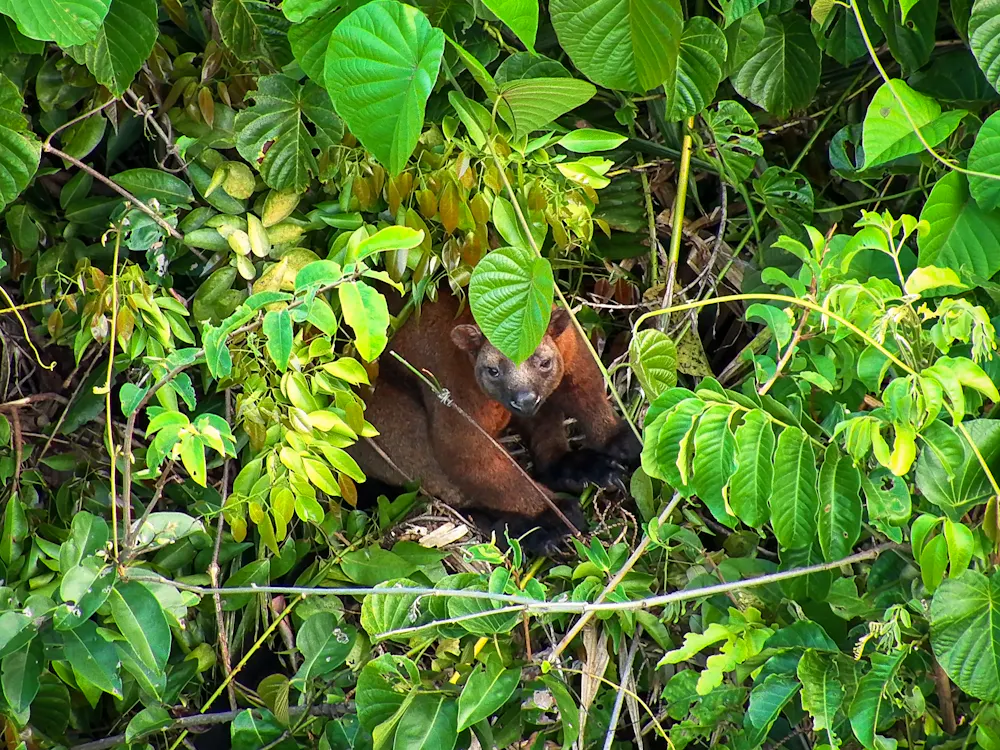
Tree kangaroos are easily spotted with thermal drones.Emmeline Norris
Bennett’s tree kangaroos, one of Australia’s most mysterious marsupials, have long eluded researchers. Our new study, published in Australian Mammalogy today, has achieved a breakthrough: using thermal drones to detect these rare animals with unprecedented efficiency.
Tree kangaroos are found only in the tropical rainforests of Australia and New Guinea. Unlike their ground-dwelling relatives, they spend their lives in treetops, feeding on leaves and vines. Their dependence on rainforest trees makes them vulnerable to deforestation and climate change.
Alarmingly, 12 of the 14 species of tree kangaroos are listed as threatened. Yet we know little about their numbers or habits due to difficulties studying them in dense rainforest.
Our new findings mark a significant step forward, offering hope for improved conservation of these elusive, near-mythical creatures. Thermal drones, which detect animals by their body heat, may help to unravel the mysteries of tree kangaroos and guide efforts to protect them.
Rugged, dense rainforests
Bennett’s tree kangaroos inhabit Australia’s most rugged and densely vegetated rainforests north of the Daintree River in Far North Queensland. They rarely descend from their vine-covered treetop roosts, which can be up to 40 metres high.
Traditional survey methods like spotlighting (that is, methodically using flashlights) or handheld thermal cameras (using infrared sensors to detect warm bodies) often fail to detect tree kangaroos, as these tools are limited to what can be seen from the ground.
As a result, there have been no systematic surveys of Bennett’s tree kangaroos. Population estimates rely on outdated observations and anecdotal evidence, leaving their conservation status unclear.
We need robust population estimates to detect shifting population trends and prevent population declines. This requires new monitoring methods to help us find these elusive animals.
Hotspots in the treetops
Thermal drones are just what they sound like – drones equipped with infrared cameras that detect heat signatures from the air.
Warm-blooded animals like tree kangaroos stand out against the cooler rainforest background, even when partially hidden by foliage. This technology offers a powerful advantage over traditional methods, allowing researchers to scan large areas from above and see past vegetation.
In our study, we conducted three drone flights at the Daintree Rainforest Observatory, Cape Tribulation, during the morning and evening.
To our surprise, we detected six Bennett’s tree kangaroos in under an hour of flight time – an unprecedented result. These included a solitary animal, a pair, and a group of three, all consistent with known home range sizes for the species.
By comparison, traditional ground surveys often require several nights of survey effort to spot a single animal. The drones not only made detection easier but also allowed us to closely observe the animals’ behaviour, such as feeding on specific plant species, without disturbing them.
Side-by-side comparison of the same image in colour and in thermal view, with three tree kangaroos clearly visible (circled in yellow) in the thermal image. Emmeline Norris
Shedding light on a hidden species
Our findings suggest Bennett’s tree kangaroos are thriving in Cape Tribulation’s lowland rainforest.
While this is encouraging, further systematic surveys are needed to assess how population density varies with forest type, elevation and other factors.
Another intriguing discovery was the tree kangaroos’ diet. Using the drone’s colour zoom camera, we identified the vines and leaves they were eating. Mile-a-minute vine (Decalobanthus peltatus) and fire vine (Tetracera daemeliana) were popular choices on the menu.
These observations deepen our understanding of the species’ habitat needs and could inform future conservation efforts.
Conservation research methods must prioritise minimising stress on wildlife. The tree kangaroos showed no signs of disturbance, continuing to forage after briefly pausing to look at the drone.
This non-invasive approach is a promising alternative to traditional methods, like radio tracking (where a tag is attached to the animal), which can disrupt natural behaviours.
A Bennett’s tree kangaroo peeks at the thermal drone through the vines. Emmeline Norris
Craning for a better view
Despite showing promise, drone-based wildlife monitoring has its challenges. Regulations require drone operators to maintain visual line of sight with their drone. This can be difficult in a rainforest due to the height and density of the canopy.
To overcome this, we remotely operated our drone from a 47-metre-high canopy crane designed for research. This extra height allowed us to maintain a clear view while surveying a larger area.
The 47-metre high canopy crane at the Daintree Rainforest Observatory, Cape Tribulation. Emmeline Norris
However, canopy cranes are rare – there’s only one in tropical Australia. Expanding this approach will require alternative strategies, such as using mountaintops or canopy walkways as vantage points.
Our study is just the beginning. The next step is designing methods to estimate population densities more accurately – not only for Bennett’s tree kangaroos but also other tree kangaroo species in the remote mountains of New Guinea. By identifying individual tree kangaroos based on their unique fur markings, we aim to also study their social structure and sex ratios.
Thermal drones have the potential to revolutionise conservation efforts for hard-to-study wildlife. They offer a powerful tool to monitor populations and guide management decisions.
For the rare and remarkable Bennett’s tree kangaroo, this technology could make the difference between obscurity and security.
The study authors flying drones from the upper platform of the canopy crane. Emmeline Norris
Emmeline Norris does not work for, consult, own shares in or receive funding from any company or organisation that would benefit from this article, and has disclosed no relevant affiliations beyond their academic appointment.
Source: Australian Government – Minister of Foreign Affairs
Thank you very much Simone.
Can I, in her absence, thank Aunty Violet for her welcome and wisdom – she’s had to go do school drop off. I told her it was much more important than listening to me.
I acknowledge also the traditional owners, the Ngunnawal people, and I pay my respects to Elders past, present and emerging.
And I offer that acknowledgement as a mark of respect for our history and an expression of hope for our future.
First Nations people were this continent’s first diplomats, first traders and they are connected to our region – it is a connection that makes our nation stronger.
Thanks UN Women for all you do. Thank you Christine, thank you Georgina for all you do here and in the world.
To my Ministerial colleagues, particularly the Minister for Women Katy Gallagher, to the Leader of the Opposition, Members and Senators, friends – it’s really great to be here.
The Prime Minister just talked about progress. He talked about the work we have done – the community has done, the Government has done – to make Australia a more equal country, as part of the “march forward” on gender equality.
But I regret to report that the situation around the world is not quite as encouraging.
More than 380 million women and girls worldwide are living in extreme poverty.
We talk a lot about economic empowerment, 2.4 billion women of working age do not have equal economic opportunities.
In countries like Iran and Afghanistan, repressive authorities deplete their nations’ souls but also their prospects, by denying the rights of women and girls.
Across the world, women are facing more sexual and gender-based violence, and less access to sexual and reproductive health services.
An estimated one in three women experiencing physical or sexual violence in their lifetime globally.
Closer to home, that figure is even more stark – two in three women experience physical or sexual violence in the Pacific.
And as we have seen a surge in conflict and humanitarian crises internationally, we see devastating effects on women and girls.
Last year alone, cases of conflict-related sexual violence surged by 50 percent – almost a third of these cases involved girls.
These terrible facts and they underline the costs of gender inequality.
We know that gender equality is as a stronger predictor of peace than a nation’s wealth or political system.
We know that peace agreements are more likely to last when women can participate in them.
And we know that gender equality reduces poverty, strengthens social cohesion, unlocks economic productivity and enhances prosperity for current and future generations.
If women participated in the economy on equal terms with men, it could add up to US$28 trillion to the international economy.
So the whole world pays the price for the lack of gender equality.
We pay that price in a world that is more dangerous, more divided, less stable, and poorer.
And so it is in this context that today I release Australia’s International Gender Equality Strategy.
The Strategy outlines how Australia is driving gender equality with action to end sexual and gender-based violence.
Action to protect and advance women’s sexual and reproductive health and rights.
Action to increase the security of women and girls and to ensure our humanitarian responses integrate the needs of women and girls.
Action to improve women’s economic security, through social protection, financial inclusion, reform to workplace gender equality…
And action to support women’s leadership, to drive change that benefits everyone.
Now I’m sure some will try to delegitimise this strategy as being about a “special interest”.
So I want to emphasise one thing the Prime Minister said – and something I believe passionately.
Gender equality is not a “special interest”. Gender equality is a matter of national interest.
Australia is always better off if our region and world is more prosperous and more secure.
So as we advance our interests in the world, policies that contribute to the women and girls’ empowerment are not simply an appendix to the rest of our foreign policy.
This Strategy reaffirms the centrality of Australia’s commitment to gender equality.
Because gender equality benefits everyone.
And when women march forward, the whole world makes progress.
ACHESON, Alberta, Feb. 04, 2025 (GLOBE NEWSWIRE) — North American Construction Group Ltd. (“NACG” or “the Company”) (TSX:NOA.TO/NYSE:NOA) announced today that it will release its financial results for the fourth quarter ended December 31, 2024 on Wednesday, March 5, 2025 after markets close. Following the release of its financial results, NACG will hold a conference call and webcast on Thursday, March 6, 2025, at 7:00 a.m. Mountain Time (9:00 a.m. Eastern Time).
The call can be accessed by dialing: Toll free: 1-800-717-1738 Conference ID: 71653
A replay will be available through April 6, 2025, by dialing: Toll Free: 1-888-660-6264 Conference ID: 71653 Playback Passcode: 71653
A slide deck for the webcast will be available for download the evening prior to the call and will be found on the company’s website at www.nacg.ca/presentations/
A replay will be available until April 6, 2025, using the link provided.
About the Company
North American Construction Group Ltd. is a premier provider of heavy civil construction and mining services in Canada, the U.S. and Australia. For over 70 years, NACG has provided services to the mining, resource and infrastructure construction markets.
For further information, please contact:
Jason Veenstra, CPA, CA Chief Financial Officer North American Construction Group Ltd. Phone: (780) 960-7171 Email: ir@nacg.ca
Sabra Lane: The US-China trade war is escalating, with Beijing imposing retaliatory tariffs and restrictions on critical mineral exports. Where does Australia stand? Senator Don Farrell is Australia’s Trade and Tourism Minister and Special Minister of State. Minister, thanks for joining the program.
Minister for Trade: Nice to be with you, Sabra.
Sabra Lane: China has announced retaliatory action to Mr. Trump’s tariffs. They’re both Australia’s friends, but only one is an ally. Does the government back Mr Trump?
Minister for Trade: We want to have a cool, calm and collected approach to this issue. We believe that we have a very strong argument to defend free and fair trade, and that’s the argument that we put to the Chinese Government. And at the end of last year, the last of the products that had been subject to those impediments, namely crayfish, were sent back into China. When the opportunity arises, I’ll be putting exactly the same argument to my American counterpart that we support free and fair trade and it’s in the best interests of both our countries to continue to do that.
Sabra Lane: Some say it’s shakedown diplomacy. You argue, and the government says, Australia is prepared, but a slowdown in China could affect Australia. How hard could this be?
Minister for Trade: Well, it’s always possible that higher tariffs on Chinese products going into the United States will have an impact on the Australian economy. As I say, what Australia needs to do is to push issues that are in our national interest. We’re an island. We rely on trade to produce our prosperity. It’s been very successful in recent years. We’ve had record trade. One thing that this government has managed to do is to diversify our trading relationship. So, we now have new free trade agreements with the with the United Kingdom, with India. In fact, in the last few days, India made us a fresh offer to extend our free trade agreement. We’ve negotiated a new free trade agreement with the United Arab Emirates. So, all around the world, we’re looking to diversify our trading relationship so that we’re not simply reliant on one or two countries to provide for our prosperity. We’re looking for a much broader relationship and we’ve been successful in that.
Sabra Lane: Mr. Trump’s choice of Commerce Minister Howard Lutnick has not been confirmed just yet. Have you spoken with him yet or when do you expect to meet with him to discuss trade?
Minister for Trade: No, I haven’t spoken with him yet, Sabra, but I have approached the person who will be his Chief of Staff. We’ve indicated that we are very keen to talk. under their system until you get approved by the Senate, you’re not in a position to discuss with other countries. But we’ve made it very clear, and the message that’s come back from Mr Lutnick is that he is very happy to talk with us as soon as he’s legally able to do that. And I hope to be, if not the first person or first overseas minister to speak with him, to be one of the first. And when we get that opportunity, we will push our argument in our national interests that we believe in free and fair trade. That there is no reason for the American Government to impose tariffs on Australia.
Sabra Lane: We avoided them last time round on steel and aluminium. Are you confident that we can do that again?
Minister for Trade: What I’m confident about, Sabra, is that we will push the issues that are in our national interest. One of the points I’ll be making to Mr Lutnick is that since President Trump was last in the White House, American sales to Australia have virtually doubled. So, free trade has been very good for the American businesses in Australia. Of course, it’s been good for us because we have increased our trade with the United States. But right at the moment, the balance is very much in the United States’ favour. We buy almost twice as much from the United States as we sell to them. So, I pose this question; why would you impose a tariff on a country where you’ve got a surplus? And, of course, that was the argument that former Prime Minister Turnbull used with Mr Trump last time. So, I think we’ve got a very strong argument. In Singapore mid-last year, we signed another trade agreement with the United States, the Indo-Pacific Economic Framework. So, we’ve been building strong relations with the United States over the last few years. And I think we have a very, very good and strong argument. And I want to do, I want to present that argument to the United States and ask for their serious consideration about what further action they might take.
Sabra Lane: We have heard this morning with your Special Minister of State hat on, the group Advance is sending out material right now to voters that the Electoral Commission ruled at the last election was misleading. The group says it’s legal right now because it’s being sent before the writs have been issued. Do our laws need tightening to stop this kind of misleading material being sent all the time?
Minister for Trade: Well, we’ve got laws to deal with the issue of truth in advertising in the electoral context.
Sabra Lane: Well, this is getting through right now.
Minister for Trade: Well, those laws haven’t yet passed. We’ve got legislation before the Parliament that’s coming on this Thursday. They’re trying to put downward pressure on the cost of Australian elections. We want every ordinary Australian to be able to participate in the electoral process. And as you saw earlier in the week, Sabra, there’s massive amounts of money going into the Australian electoral system. We want to stop that.
Sabra Lane: Have you got to deal with the Coalition to get this passed?
Minister for Trade: Well, I’m talking to everybody, Sabra, as I have been for the last couple of years. And I’m hopeful that this Senate, this week will see the merit in putting downward pressure on the amount of money that’s being spent in Australian elections. It’s interesting over the break, President Biden himself warned that we can’t have a situation where the billionaire oligarchs simply determine who gets into the Australian Parliament. Ordinary Australians, people like you and me, Sabra, have to be able to participate in the electoral process without having billionaire sponsors determining who will and won’t get into the Parliament. So, I’m hopeful that all the discussions I’ve had and I’ve, you know, met with all of the serious players in this space and I’m hopeful that the arguments that we’re presenting for putting downward pressure on the cost of Australian elections will be successful.
Sabra Lane: Minister, thanks for joining us this morning.
Minister for Trade: Nice talking with you, Sabra.
Sabra Lane: That’s Don Farrell, the Minister for Trade and Tourism and the Special Minister of State.
David Seymour’s speech at the Treaty Grounds today is widely anticipated. This week’s Free Press covers other matters, but for a preview of ACT’s Treaty approach, you can read Seymour’scolumn in the Herald.
The COVID Royal Commission, Mark II, designed by Brooke van Velden, is open to public submissions, and now there’san online portal to make it easy.After Labour’s attempted whitewash, ACT campaigned for people to be able to say what they think about the lockdowns, mandates, and other public health measures. There will be another pandemic, probably not this decade but almost certainly this century, and lessons learned from this one could be worth hundreds of billions of dollars.
If you don’t normally listen to Radio New Zealand, we understand. However Kathryn Ryan interviewed David Seymour for half an hour on the Regulatory Standards Bill, andwe think it’s worth an exception.
Owning the Wrong Stuff
Last Monday we shared David Seymour’s State of the Nation speech. This week it is still in the headlines. How is this possible? The speech said two things people know deep down are true, but politicians are afraid to say.
The Government owns the wrong stuff. Its books show $570 billion worth of assets, enough to build a four-lane highway from Whangarei to Invercargill six times, but you wouldn’t know it. The Government is having to downsize hospitals while the rest of the world is buying military hardware, and our roads and pipes need attention.
Meanwhile, in New Zealand, the Government is invested in houses (60,000), a property valuation firm, farms, electricity generators, and sunset industries such as mail and television, among many other weird and wonderful things.
Could it be an idea to, just maybe, just ask the question, without anyone getting their knickers in a knot: Does the Government own the right stuff. And if not, should it try selling some shares in power companies to invest in some roads and water treatment plants?
Perhaps all Governments should think of ownership like this. Every year we ask what we own, what benefits the public get from it, and could the Government own something with greater public benefits for the same money? If the answer is yes, and it doesn’t look like it’s going to change, then sell the thing that doesn’t pay and buy something that does.
As for healthcare and education, the Government shells out a fortune, nearly $6,000 in healthcare for every single person each year. That’s up from $4,000 five years ago, but nobody’s happy. Perhaps it is time to say, if you want to take your $6,000 to a private insurer like Southern Cross, you can.
There would have to be rules. The company would need to accept any patient who applied, without discrimination. The company could never cancel anyone’s policy. They would become responsible for all of the person’s care. Hospitals still owned by the Government would need to accept patients from any insurer at the same price.
If this all sounds out there, fear not. It’s roughly how most healthcare systems in Europe work. It means that there would be people with an incentive to sort out the endless waste and dysfunction in what’s been described as our third world system run by first world medics.
The Left say in a private system the poor miss out. Europeans would be surprised to hear this. What the Left don’t seem to get is this: You can have equal public funding, but allow competition to provide the service. Some would say the best of all worlds.
Of course there is a reason why few politicians dare to raise these questions. The media have demanded to know from David Seymour exactly what he will sell tomorrow. They want a list. The hard Left say this is another Seymourian conspiracy, but they can’t say what. The Opposition have called on the Chris Luxon to rule out ever selling anything. Luxon says he won’t now but might in the future.
There’s another reason why there are still articles in today’s papers, ten days after the speech was given. People know that, while New Zealand is a success story, as countries go, we’re not holding our ground at the moment. What we’re doing isn’t working.
If we want to remain a first world nation and an island paradise—most countries can only do one—we need to work differently. That’s the other thing about Seymour’s speech, it told the truth we avoided all through the Clark-Key-Ardern era.
As goes the Treaty Principles Bill, so goes this speech. This country needs a party that’s brave, articulate, and patriotic, and we’re glad we have ACT.
Writer/Director of Penny Lane Is Dead, Mia’Kate Russell Sanctuary Pictures and Screen Australia are thrilled to announce Penny Lane Is Dead, an electrifying Australian punk-horror written and directed by award-winning filmmaker Mia’Kate Russell (Maggie May, Liz Drives). Set to launch at the European Film Market (EFM) in two weeks, the film is a high-energy blend of horror, action, and suspense, infused with the rebellious spirit of the 1980s. Supported by Screen Australia, VicScreen, and ANZ distributor Umbrella Entertainment, Penny Lane Is Dead is produced by Julie Ryan (Late Night with the Devil), Ari Harrison (Talk to Me), and Andre Lima. Set during a scorching Australian summer in 1986, the film follows three teenage best friends whose celebratory night at a beach house spirals into a blood-soaked battle for survival after a prank takes a deadly turn. “This film is a rollercoaster ride of love and chaos set against the rebellious spirit of the 1980s,” said writer-director Mia’Kate Russell. “I’m excited to take audiences on this wild, unexpected journey with these girls and their crazy night at the beach.” Ari Harrison, Director and Owner of Sanctuary Pictures, said “Mia’Kate infuses Penny Lane Is Dead with her unmistakable storytelling style, crafting a film that crackles with razor-sharp tension, raw emotion, and unflinching violence. This is a bold, relentless ride that will leave audiences breathless.” Screen Australia’s Director of Narrative Content Louise Gough said, “Penny Lane Is Dead is a gripping feature debut from Sanctuary Pictures, poised to launch Mia’Kate onto the global stage. With an exceptional creative team and riveting storytelling, this film has the potential to engage audiences both locally and internationally. Prepare to be taken on a high-octane ride of feminist-lensed terror.” Currently in casting, Penny Lane Is Dead is set to begin production in Q2 2025. Production credit: A Sanctuary Pictures and Buffalo Media production, Penny Lane Is Dead is financed with major production investment from Screen Australia in association with VicScreen. Local distribution by Umbrella Entertainment, with international sales handled by Upgrade. The film was developed with the assistance of the South Australian Film Corporation and Umbrella Entertainment. Media Contact: Jasmin McSweeney | Head of Sales & Acquisitions (NZ), Umbrella Entertainment [email protected] Media enquiries Maddie Walsh | Publicist + 61 2 8113 5915 | [email protected] Jessica Parry | Senior Publicist (Mon, Tue, Thu) + 61 428 767 836 | [email protected] All other general/non-media enquiries Sydney + 61 2 8113 5800 | Melbourne + 61 3 8682 1900 | [email protected]
Firearm, drugs seized during vehicle intercept at Claremont
Wednesday, 5 February 2025 – 9:50 am.
A man has been charged after police seized a loaded firearm and a trafficable quantity of methylamphetamine (ice) from a vehicle at Claremont yesterday. The driver of the vehicle – a 29 year old Claremont man – was arrested and charged with driving while disqualified, trafficking in a controlled substance, and multiple firearm offences. During a subsequent search of an address at Claremont, officers from Southern Drugs & Firearms Unit, the Dog Handler Unit, and Glenorchy Criminal Investigation Branch seized additional ammunition and a trafficable quantity of MDMA. The driver was detained to appear in the Hobart Magistrates Court today. Detective Acting Inspector Richard Penney said “One loaded firearm on the streets illegally, is one too many”. “Tasmania Police remains committed to ensuring those who deal in illicit drugs and firearms are brought to justice.” Anyone with information about illegal drug and firearm activity is urged to contact police on 131 444 or Crime Stoppers anonymously on 1800 333 000 or online at crimestopperstas.com.au
Applications under the fifth round of the National Industry PhD Program have opened for PhD candidates and businesses interested in turning their big ideas into new products and services, with scholarships set to build on $13.3 million of funding on 70 projects underway since the Program started.
Assistant Minister for Education, Anthony Chisholm, said the program was part of a $296 million initiative creating powerful opportunities for developing a new workforce skilled in turning our world-class research into commercial outcomes.
“Empowering our aspiring researchers through this program will make it easier for industry to tap into an inspiring talent pool of PhD candidates or for industry employees to undertake a PhD, helping to turn those ideas into Australian inventions that contribute to a stronger and more productive economy,” Assistant Minister Chisholm said.
“It’s been really encouraging to see how the previous four rounds of this program have supported innovators from academia and industry with a passion for big ideas, and who are contributing to the success of Australia.
“Projects recently kick-started include improving the safety of self-driving vehicles through better driver interaction, improving the lives of people with dementia, and supporting the medical profession to predict a patient’s response to therapy.”
Four PhD students at Griffith University have been some of the latest researchers to commence their study thanks to the support offered through the National Industry PhD Program.
Their work with cutting edge renewable energy start-up RedX aims to create world-leading expertise in energy storage and grid stability, with these four PhD students also being brought on board by RedX to integrate research findings into the start-up’s operations.
“We are thrilled to embark on this promising collaboration with RedX. When academia and industry join forces, the pace of innovation accelerates, and this project is a testament to that potential,” Professor Alan Liew, Head of School, the School of Information and Communication Technology at Griffith University said.
“The Industry PhD Program supports our employees to pursue a PhD with guidance from a world-leading university, allowing them to explore innovative ideas and create something beneficial for society,” RedX CEO Jonathan Chen said.
PhD Student and Director of Software Engineering at RedX Chois Cai said: “The support and structure provided by the National Industry PhD Program has been instrumental in driving this research forward.”
Applications for Round 5 close on 14 March 2025. Further information about the program and application process can be found here.
VANCOUVER, British Columbia, Feb. 04, 2025 (GLOBE NEWSWIRE) — Diversified Royalty Corp. (TSX: DIV and DIV.DB.A) (the “Corporation” or “DIV”) is pleased to announce that its board of directors has approved a cash dividend of $0.02083 per common share for the period of February 1, 2025 to February 28, 2025, which is equal to $0.25 per common share on an annualized basis. The dividend will be paid on February 28, 2025 to shareholders of record as of the close of business on February 14, 2025.
About Diversified Royalty Corp.
DIV is a multi-royalty corporation, engaged in the business of acquiring top-line royalties from well-managed multi-location businesses and franchisors in North America. DIV’s objective is to acquire predictable, growing royalty streams from a diverse group of multi-location businesses and franchisors.
DIV currently owns the Mr. Lube + Tires, AIR MILES®, Sutton, Mr. Mikes, Nurse Next Door, Oxford Learning Centres, Stratus Building Solutions and BarBurrito trademarks. Mr. Lube + Tires is the leading quick lube service business in Canada, with locations across Canada. AIR MILES® is Canada’s largest coalition loyalty program. Sutton is among the leading residential real estate brokerage franchisor businesses in Canada. Mr. Mikes operates casual steakhouse restaurants primarily in western Canadian communities. Nurse Next Door is a home care provider with locations across Canada and the United States as well as in Australia. Oxford Learning Centres is one of Canada’s leading franchisee supplemental education services. Stratus Building Solutions is a leading commercial cleaning service franchise company providing comprehensive janitorial, building cleaning, and office cleaning services primarily in the United States. BarBurrito is the largest quick service Mexican restaurant food chain in Canada.
DIV’s objective is to increase cash flow per share by making accretive royalty purchases and through the growth of purchased royalties. DIV intends to continue to pay a predictable and stable monthly dividend to shareholders and increase the dividend over time, in each case as cash flow per share allows.
Forward Looking Statements
Certain statements contained in this news release may constitute “forward-looking information” within the meaning of applicable securities laws that involve known and unknown risks, uncertainties and other factors which may cause the actual results, performance or achievements to be materially different from any future results, performance or achievements expressed or implied by such forward-looking information. The use of any of the words “anticipate”, “continue”, “estimate”, “expect”, “intend”, “may”, “will”, ”project”, “should”, “believe”, “confident”, “plan” and “intends” and similar expressions are intended to identify forward-looking information, although not all forward-looking information contains these identifying words. Specifically, forward-looking information in this news release includes, but is not limited to, statements made in relation to: the amount and timing of the February 2025 dividend to be paid to DIV’s shareholders; DIV’s objective to continue to pay predictable and stable monthly dividends to shareholders; and DIV’s corporate objectives. These statements involve known and unknown risks, uncertainties and other factors that may cause actual results or events, performance, or achievements of DIV to differ materially from those anticipated or implied by such forward-looking information. DIV believes that the expectations reflected in the forward-looking information included in this news release are reasonable but no assurance can be given that these expectations will prove to be correct. In particular there can be no assurance that: DIV will be able to make monthly dividend payments to the holders of its common shares; or DIV will achieve any of its corporate objectives. Given these uncertainties, readers are cautioned that forward-looking information included in this news release are not guarantees of future performance, and such forward-looking information should not be unduly relied upon. More information about the risks and uncertainties affecting DIV’s business and the businesses of its royalty partners can be found in the “Risk Factors” section of its Annual Information Form dated March 21, 2024 and in its most recent Management’s Discussion and Analysis, copies of each of which are available under DIV’s profile on SEDAR+ atwww.sedarplus.com.
In formulating the forward-looking information contained herein, management has assumed that, among other things, DIV will generate sufficient cash flows from its royalties to service its debt and pay dividends to shareholders; the business and economic conditions affecting DIV and its royalty partners will continue substantially in the ordinary course, including without limitation with respect to general industry conditions, general levels of economic activity and regulations. These assumptions, although considered reasonable by management at the time of preparation, may prove to be incorrect.
All of the forward-looking statements made in this news release are qualified by these cautionary statements and other cautionary statements or factors contained herein, and there can be no assurance that the actual results or developments will be realized or, even if substantially realized, that they will have the expected consequences to, or effects on, DIV. The forward-looking information included in this news release is presented as of the date of this news release and DIV assumes no obligation to publicly update or revise such information to reflect new events or circumstances, except as may be required by applicable law.
THE TORONTO STOCK EXCHANGE HAS NOT REVIEWED AND DOES NOT ACCEPT RESPONSIBILITY FOR THE ADEQUACY OR THE ACCURACY OF THIS RELEASE.
Additional Information
Additional information relating to the Corporation and other public filings, is available on SEDAR+ at www.sedarplus.com.
Contact: Sean Morrison, President and Chief Executive Officer Diversified Royalty Corp. (236) 521-8470
Source: Australian Government – Minister of Foreign Affairs
Today marks one year since Australian citizen, Dr Yang Jun, received a suspended death sentence in Beijing.
The past year, and the five years of detention before his sentencing, have been a difficult and dark time for Dr Yang. Throughout, he has demonstrated his inner strength and remarkable resilience.
Today, my thoughts are with Dr Yang, his family and his many loved ones.
The Australian Government has made clear to China that we remain appalled by Dr Yang’s suspended death sentence. We hold serious concerns about Dr Yang’s health and conditions. We continue to press to ensure his needs are met and he receives appropriate medical care.
Dr Yang is entitled to basic standards of justice, procedural fairness and humane treatment, in accordance with international norms and China’s legal obligations.
In his communication with the Government, Dr Yang has made clear he knows he has the support of his country. We want to see him reunited with his family. The Government will continue to advocate for Dr Yang at every opportunity.
CHANDLER, Ariz., Feb. 04, 2025 (GLOBE NEWSWIRE) — Microchip Technology Incorporated, a leading provider of smart, connected and secure embedded control solutions, today announced that Victor Peng, former President of Advanced Micro Devices, Inc. (AMD), will join the Board of Directors of Microchip effective February10, 2024.
Regarding Mr. Peng’s appointment to the board, Microchip’s President and CEO, Steve Sanghi, said, “Victor most recently served as the President of AMD, a publicly held company that designs and manufactures hardware for high-performance computing. Prior to that, he served Xilinx for 14 years, most recently holding roles of president, CEO, board member. With over 40 years of industry experience, Victor has held leadership roles of increasing responsibility at Xilinx where he worked from 2008 until 2022, and at AMD from 2022 until his retirement in 2024. He brings years of industry experience in technology, strategy, and operations to Microchip. This knowledge of technology and of the semiconductor industry will be invaluable to our Board. Victor has also served on the board of KLA Corporation (a provider of process control and yield management systems for semiconductor manufacturing) since February 2019. We welcome Victor to our board and look forward to benefitting from his experience.”
Mr. Peng commented, “I am honored to be appointed to the Microchip board. I believe that my industry experience and leadership skills can have a positive impact on the company’s strategic direction and plans. I look forward to working with the Microchip board to achieve the company’s goals”.
About Microchip:
Microchip Technology Incorporated is a leading provider of smart, connected and secure embedded control solutions. Its easy-to-use development tools and comprehensive product portfolio enable customers to create optimal designs, which reduce risk while lowering total system cost and time to market. The company’s solutions serve approximately 112,000 customers across the industrial, automotive, consumer, aerospace and defense, communications and computing markets. Headquartered in Chandler, Arizona, Microchip offers outstanding technical support along with dependable delivery and quality. For more information, visit the Microchip website at www.microchip.com.
The Microchip logo and name are registered trademarks of Microchip Technology Incorporated.
INVESTOR RELATIONS CONTACT: Sajid Daudi – Head of investor Relations….. (480) 792-7385
Source: United States Senator for Virginia Tim Kaine
WASHINGTON, D.C. — Today, U.S. Senators Tim Kaine (D-VA), co-chair of the Senate Career and Technical Education (CTE) Caucus and a member of the Senate Health, Education, Labor and Pensions (HELP) Committee, Susan Collins (R-ME), Tina Smith (D-MN), and Roger Marshall (R-KS) introduced the Jumpstarting Our Businesses by Supporting Students (JOBS) Act, bipartisan legislation to help more Americans get good-paying jobs by allowing students to use federal Pell Grants—need-based education grants for lower-income individuals—to pay for shorter-term job training programs for the first time. Currently, students can only use Pell Grants for two- and four-year colleges and universities. By expanding Pell Grant eligibility, the JOBS Act would help close the skills gap by allowing people to access job training they might otherwise be unable to afford but need for careers in high-demand fields.
“No one should be priced out of an education—including a technical education—but I hear from many Virginians that access to high-quality job training programs that align with their goals is out of reach because of financial barriers,” said Kaine. “Simultaneously, I hear from employers throughout the Commonwealth about their struggles to fill skilled labor positions. With these Virginians in mind, I wrote the JOBS Act to help remedy these issues and provide more workers with the skills they need to get good-paying jobs and provide for their families. This bill is good for workers, good for employers, and good for our economy as a whole.”
Thanks to historic investments like the Bipartisan Infrastructure Law, the job market has boomed in recent years. From January 2021–January 2025, the U.S. economy added 14.8 million jobs. But there’s also a skilled labor shortage that is expected to intensify in the coming years, in part because unemployed Americans lack access to the job training needed to fill vacant jobs.
“Job training programs are proven, successful tools that help people gain the skills they need to prepare for rewarding careers,” said Collins. “By helping students in Maine and across the country access this career pathway, this bipartisan legislation would assist young people with obtaining good-paying jobs and make it easier for businesses to find qualified workers.”
“Some of the most in-demand jobs don’t require a four-year college degree — they require shorter-term training. People like welders, machine operators and medical technicians. We need to make it easier to get people into these career fields, and letting students use Pell Grants to make it happen just makes sense,” said Smith. “This bill will open up more career opportunities for people and will help boost our economy.”
“The JOBS Act will provide an incredible opportunity for students that increasingly don’t find the value of a four-year degree,” said Marshall. “With a changing job market, our legislation will give Americans the chance to learn critical skills for a successful career. I look forward to getting the JOBS Act across the finish line with my colleagues.”
“We’re so grateful that Senator Kaine has reintroduced the JOBS Act, and is willing to continue advocating for this important legislation which will re-skill and upskill our citizens who want to improve their income and the lives of themselves and their families,” said Virginia Community College System Chancellor David Doré. “Thousands of Virginians are eager to learn new skills to advance their careers and would benefit from being able to use Pell Grants to pay for high quality workforce training for in-demand jobs. We urge Congress to support Senator Kaine’s JOBS Act.”
The JOBS Act would allow Pell Grants to be used for high-quality job training programs that are at least eight weeks in length and lead to industry-recognized credentials or certificates. Under current law, Pell Grants can only be applied toward programs that are over 600 clock hours or at least 15 weeks in length, rendering students in shorter-term high-quality job training programs ineligible for crucial assistance.
Specifically, the JOBS Act would amend the Higher Education Act by:
Expanding Pell Grant eligibility to students enrolled in rigorous and high-quality, short-term skills and job training programs that lead to industry-recognized credentials and certificates and ultimately employment in high-wage, high-skill industry sectors or careers.
Ensuring students who receive Pell Grants are earning high-quality postsecondary credentials by requiring that the credentials:
Meet the standards under the Workforce Innovation and Opportunity Act (WIOA), such as meaningful career counseling and aligning programs to in-demand career pathways or registered apprenticeship programs
Are recognized by employers, industry, or sector partnerships
Align with the skill needs of industries in the state or local economy
Are approved by the state workforce board in addition to the U.S. Department of Education
Defining eligible job training programs as those providing career and technical education instruction at an institution of higher education, such as a community or technical college that provides:
At least 150 clock hours of instruction time over a period of at least 8 weeks
Training that meets the needs of the local or regional workforce and industry partnerships
Streamlined ability to transfer credits so students can continue to pursue further education in their careers
Students with licenses, certifications, or credentials that meet the hiring requirements of multiple employers in the field for which the job training is offered
The legislation is cosponsored by U.S. Senators Tammy Baldwin (D-WI), Richard Blumenthal (D-CT), Lisa Blunt Rochester (D-DE), Cory Booker (D-NJ), John Boozman (R-AR), Shelley Moore Capito (R-WV), Chris Coons (D-DE), Catherine Cortez Masto (D-NV), Kevin Cramer (R-ND), Steve Daines (R-MT), Tammy Duckworth (D-IL), Kirsten Gillibrand (D-NY), Maggie Hassan (D-NH), Martin Heinrich (D-NM), John Hickenlooper (D-CO), John Hoeven (R-ND), Cindy Hyde-Smith (R-MS), Mark Kelly (D-AZ), Angus King (I-ME), Amy Klobuchar (D-MN), Jeff Merkley (D-OR), Jon Ossoff (D-GA), Gary Peters (D-MI), Jacky Rosen (D-NV), Jeanne Shaheen (D-NH), Dan Sullivan (D-AK), Thom Tillis (R-NC), Tommy Tuberville (R-AL), Chris Van Hollen (D-MD), Mark R. Warner (D-VA), Roger Wicker (R-MS), and Ron Wyden (D-OR).
The JOBS Act is supported by Advance CTE, the American Association of Community Colleges (AACC), the Association for Career and Technical Education (ACTE), the Association of Community College Trustees (ACCT), the Association of Equipment Manufacturers (AEM), Business Roundtable, the Center for Law and Social Policy (CLASP), the Exhibitions and Conferences Alliance (ECA), Higher Learning Advocates (HLA), HP Inc., the Information Technology Industry Council (ITI), Jobs for the Future (JFF), the Joint Center for Political and Economic Studies, NAF, the National Association of Workforce Boards (NAWB), the National Association of Workforce Development Professionals (NAWDP), the National Skills Coalition (NSC), the Progressive Policy Institute (PPI), Rebuilding America’s Middle Class (RAMC), and the Virginia Community College System.
Full text of the bill is available here, and a summary of the bill is available here.
Teachers will be able to upskill for free with a new microcredential course focused on teaching phonics, launched by the University of Adelaide.
The Teaching Phonics microcredential will help primary and secondary teachers learn how to teach synthetic phonics in a systematic and explicit way using contemporary, evidence-based practices.
The evidence shows explicit instruction is a very efficient strategy for helping students learn by breaking down new information into smaller learning outcomes and modelling each step.
Students are more likely to progress in their reading skills from the explicit teaching of phonics, especially for children at risk of reading difficulties.
It is a focus of many reforms, including the Better and Fairer Schools Agreement and changes being made to strengthen initial teacher education.
The Albanese Government is investing more than $3 million in funding to the University of Adelaide to design and deliver microcredentials courses for teachers.
The Teaching Phonics microcredential is the third free course for teachers funded by the Albanese Government and developed by the University of Adelaide.
It adds to the Explicit Teaching microcredential and Classroom Management microcredential released in 2024.
As of January 2025:
More than 1,800 educators have enrolled in the classroom management microcredential (5 months after launch)
More than 900 educators have enrolled in the explicit teaching microcredential (1.5 months after launch)
More than 750 educators have begun one of the four-module courses and completed at least one assessment task, and
95 educators have completed an entire microcredential – a total of 48 hours of learning.
More than 4,300 teachers across the country have registered interest in the phonics microcredential program.
The free courses will provide vital professional development opportunities for teachers, school leaders and other school staff.
The qualifications will offer teachers a potential credit pathway towards post-graduate study with the School of Education at the University of Adelaide.
This investment is part of the National Teacher Workforce Action Plan and builds on the Government’s Engaged Classrooms initiative, which is developing free classroom management resources for teachers.
The self-paced online course can be completed in the teacher’s own time, at their own pace, to fit in around their other commitments.
GAAP Net Income of$163 million, or$1.05per diluted share Adjusted Operating Income of$169 million, or$1.09per diluted share Return on Equity of13.0%and Adjusted Operating Return on Equity of13.5% Record Primary insurance in-force of$269 billion, a2%increase fromfourthquarter 2023 PMIERs Sufficiency of167%or$2,052 million Book Value Per Share of$32.80and Book Value Per Share excluding AOCI of$34.16 Returned over $350 million of capital to shareholders in 2024 Announces quarterly cash dividend of $0.185 per common share
RALEIGH, N.C., Feb. 04, 2025 (GLOBE NEWSWIRE) — Enact Holdings, Inc. (Nasdaq: ACT) today announced its fourth quarter and full-year 2024 results.
“Our very strong performance in 2024 underscores the effectiveness of our strategy and the continued successful execution of our priorities,” stated Rohit Gupta, President and CEO of Enact. “In a complex economic environment, we responsibly grew our portfolio, drove operational efficiencies, maintained a strong balance sheet and generated meaningful capital returns to our shareholders. As we look to the future, our proven strategy and disciplined execution position us well to realize the opportunities ahead and to create long-term value for our stakeholders.”
Key Financial Highlights
(In millions, except per share data or otherwise noted)
4Q24
3Q24
4Q23
2024
2023
Net Income (loss)
$163
$181
$157
$688
$666
Diluted Net Income (loss) per share
$1.05
$1.15
$0.98
$4.37
$4.11
Adjusted Operating Income (loss)
$169
$182
$158
$718
$676
Adj. Diluted Operating Income (loss) per share
$1.09
$1.16
$0.98
$4.56
$4.18
NIW ($B)
$13
$14
$10
$51
$53
Primary IIF ($B)
$269
$268
$263
Primary Persistency Rate
82%
83%
86%
83%
85%
Net Premiums Earned
$246
$249
$240
$980
$957
Losses Incurred
$24
$12
$24
$39
$27
Loss Ratio
10%
5%
10%
4%
3%
Operating Expenses
$58
$56
$59
$223
$223
Expense Ratio
24%
22%
25%
23%
23%
Net Investment Income
$63
$61
$56
$241
$207
Net Investment gains (losses)
$(7)
$(1)
$(1)
$(23)
$(14)
Return on Equity
13.0%
14.7%
13.8%
14.3%
15.2%
Adjusted Operating Return on Equity
13.5%
14.8%
13.9%
14.9%
15.5%
PMIERs Sufficiency ($)
$2,052
$2,190
$1,887
PMIERs Sufficiency (%)
167%
173%
161%
Fourth Quarter 2024 Financial and Operating Highlights
Net income was $163 million, or $1.05 per diluted share, compared with $181 million, or $1.15 per diluted share, for the third quarter of 2024 and $157 million, or $0.98 per diluted share, for the fourth quarter of 2023. Adjusted operating income was $169 million, or $1.09 per diluted share, compared with $182 million, or $1.16 per diluted share, for the third quarter of 2024 and $158 million, or $0.98 per diluted share, for the fourth quarter of 2023.
New insurance written (NIW) was approximately $13 billion, down 2% from the third quarter of 2024 primarily from seasonality partially offset by an estimated increase in refinance originations and up 27% from the fourth quarter of 2023 primarily driven by estimated higher originations. NIW for the current quarter was comprised of 96% monthly premium policies and 86% purchase originations.
Primary insurance in-force (IIF) was a record $269 billion, up from $268 billion in the third quarter of 2024 and up 2% from $263 billion in the fourth quarter of 2023.
Persistency remained elevated at 82%, down slightly from 83% in the third quarter of 2024 and down from 86% in the fourth quarter of 2023. The decrease year-over-year was primarily driven by a decline in mortgage rates in September 2024. Approximately 70% of our IIF had mortgage rates below 6%.
Net premiums earned were $246 million, down 1% from $249 million in the third quarter of 2024 and up 2% from $240 million in the fourth quarter of 2023. Net premiums decreased sequentially, primarily driven by higher ceded premiums and increased year over year driven by premium growth from attractive adjacencies and growth in primary insurance in-force, partially offset by higher ceded premiums.
Losses incurred for the fourth quarter of 2024 were $24 million and the loss ratio was 10%, compared to $12 million and 5%, respectively, in the third quarter of 2024 and $24 million and 10%, respectively, in the fourth quarter of 2023. The current quarter reserve release of $56 million from favorable cure performance and loss mitigation activities compares to a reserve release of $65 million and $53 million in the third quarter of 2024 and fourth quarter of 2023, respectively. The sequential increase in losses and the loss ratio were primarily driven by a lower reserve release and new delinquencies are up 1% excluding hurricane-related delinquencies.
Operating expenses in the current quarter were $58 million and the expense ratio was 24%. This compared to $56 million and 22%, respectively, in the third quarter of 2024 and $59 million and 25%, respectively in the fourth quarter of 2023. The sequential increase was driven by incentive-based compensation while the year-over-year decrease was driven in part by the impact of our cost reduction initiatives.
Net investment income was $63 million, up from $61 million in the third quarter of 2024 and $56 million in the fourth quarter of 2023, driven by the continuation of elevated interest rates and higher average invested assets.
Net investment loss in the quarter was $(7) million, as compared to $(1) million sequentially and $(1) million in the same period last year. The current period was primarily driven by the identification of assets that upon selling allow us to recoup losses through higher net investment income.
Annualized return on equity for the fourth quarter of 2024 was 13.0% and annualized adjusted operating return on equity was 13.5%. This compares to third quarter 2024 results of 14.7% and 14.8%, respectively, and to fourth quarter 2023 results of 13.8% and 13.9%, respectively.
Capital and Liquidity
We returned $354 million to shareholders in 2024 inclusive of quarterly dividends and share repurchases.
During the quarter, we announced two quota share reinsurance agreements with a panel of highly-rated reinsurers that will cede approximately 27% of a portion of expected new insurance written for the 2025 and 2026 book years.
As previously announced, we paid approximately $28 million, or $0.185 per share, dividend in the fourth quarter.
For the full year 2024, we repurchased 7.6 million shares at a weighted average share price of $31.95 for a total of $243 million.
EMICO completed a distribution of approximately $230 million in the fourth quarter that will primarily be used to support our ability to return capital to shareholders and bolster financial flexibility.
Enact Holdings, Inc. held $243 million of cash and cash equivalents plus $298 million of invested assets as of December 31, 2024. Combined cash and invested assets increased $98 million from the prior quarter, primarily due to a contribution from EMICO, partially offset by share buybacks and our quarterly dividend.
PMIERs sufficiency was 167% and $2.1 billion above the PMIERs requirements, compared to 173% and $2.2 billion above the PMIERs requirements in the third quarter of 2024.
Recent Events
In January 2025, Fitch Ratings (“Fitch”) upgraded the Insurer Financial Strength rating for EMICO to A from A- and also upgraded Enact’s senior debt rating to BBB. The outlook for both ratings is stable.
Subsequent to quarter end, we announced two excess of loss reinsurance agreements with a panel of highly rated reinsurers that will provide ~$225M and ~$260M of coverage on a portion of expected new insurance written for the 2025 and 2026 book years, respectively.
We repurchased approximately 2.1 million shares at an average price of $34.75 for a total of approximately $74 million in the quarter. Additionally, through January 31, 2024, we repurchased 0.6 million shares at an average price of $32.60 for a total of $19 million. There remains approximately $74 million of our $250 million repurchase authorization.
We announced today that the Board of Directors declared a quarterly dividend of $0.185 per common share, payable on March 14, 2025, to shareholders of record on February 21, 2025.
Conference Call and Financial Supplement Information This press release, the fourth quarter 2024 financial supplement and earnings presentation are now posted on the Company’s website, https://ir.enactmi.com. Investors are encouraged to review these materials.
Enact will discuss third quarter financial results in a conference call tomorrow, Wednesday, February 5, 2025, at 8:00 a.m. (Eastern). Participants interested in joining the call’s live question and answer session are required to pre-register by clicking here to obtain your dial-in number and unique PIN. It is recommended to join at least 15 minutes in advance, although you may register ahead of the call and dial in at any time during the call. If you wish to join the call but do not plan to ask questions, a live webcast of the event will be available on our website, https://ir.enactmi.com/news-and-events/events.
The webcast will also be archived on the Company’s website for one year.
About Enact Enact (Nasdaq: ACT), operating principally through its wholly-owned subsidiary Enact Mortgage Insurance Corporation since 1981, is a leading U.S. private mortgage insurance provider committed to helping more people achieve the dream of homeownership. Building on a deep understanding of lenders’ businesses and a legacy of financial strength, we partner with lenders to bring best-in class service, leading underwriting expertise, and extensive risk and capital management to the mortgage process, helping to put more people in homes and keep them there. By empowering customers and their borrowers, Enact seeks to positively impact the lives of those in the communities in which it serves in a sustainable way. Enact is headquartered in Raleigh, North Carolina.
Safe Harbor Statement This communication contains “forward-looking statements” within the meaning of the Private Securities Litigation Reform Act of 1995. These forward-looking statements may address, among other things, our expected financial and operational results, the related assumptions underlying our expected results, guidance concerning the future return of capital and the quotations of management. These forward-looking statements are distinguished by use of words such as “will,” “may,” “would,” “anticipate,” “expect,” “believe,” “designed,” “plan,” “predict,” “project,” “target,” “could,” “should,” or “intend,” the negative of these terms, and similar references to future periods. These views involve risks and uncertainties that are difficult to predict and, accordingly, our actual results may differ materially from the results discussed in our forward-looking statements. Our forward-looking statements contained herein speak only as of the date of this press release. Factors or events that we cannot predict, including risks related to an economic downturn or a recession in the United States and in other countries around the world; changes in political, business, regulatory, and economic conditions; changes in or to Fannie Mae and Freddie Mac (the “GSEs”), whether through Federal legislation, restructurings or a shift in business practices; failure to continue to meet the mortgage insurer eligibility requirements of the GSEs; competition for customers; lenders or investors seeking alternatives to private mortgage insurance; an increase in the number of loans insured through Federal government mortgage insurance programs, including those offered by the Federal Housing Administration; and other factors described in the risk factors contained in our most recent Annual Report on Form 10-K and other filings with the SEC, may cause our actual results to differ from those expressed in forward-looking statements. Although Enact believes the expectations reflected in such forward-looking statements are based on reasonable assumptions, Enact can give no assurance that its expectations will be achieved and it undertakes no obligation to update publicly any forward-looking statements as a result of new information, future events, or otherwise, except as required by applicable law.
GAAP/Non-GAAP Disclosure Discussion This communication includes the non-GAAP financial measures entitled “adjusted operating income (loss)”, “adjusted operating income (loss) per share,” and “adjusted operating return on equity.” Adjusted operating income (loss) per share is derived from adjusted operating income (loss). The chief operating decision maker evaluates performance and allocates resources on the basis of adjusted operating income (loss). Enact Holdings, Inc. (the “Company”) defines adjusted operating income (loss) as net income (loss) excluding the after-tax effects of net investment gains (losses), restructuring costs and infrequent or unusual non-operating items, and gain (loss) on the extinguishment of debt. The Company excludes net investment gains (losses), gains (losses) on the extinguishment of debt and infrequent or unusual non-operating items because the Company does not consider them to be related to the operating performance of the Company and other activities. The recognition of realized investment gains or losses can vary significantly across periods as the activity is highly discretionary based on the timing of individual securities sales due to such factors as market opportunities or exposure management. Trends in the profitability of our fundamental operating activities can be more clearly identified without the fluctuations of these realized gains and losses. We do not view them to be indicative of our fundamental operating activities. Therefore, these items are excluded from our calculation of adjusted operating income. In addition, adjusted operating income (loss) per share is derived from adjusted operating income (loss) divided by shares outstanding. Adjusted operating return on equity is calculated as annualized adjusted operating income for the period indicated divided by the average of current period and prior periods’ ending total stockholders’ equity.
While some of these items may be significant components of net income (loss) in accordance with U.S. GAAP, the Company believes that adjusted operating income (loss) and measures that are derived from or incorporate adjusted operating income (loss), including adjusted operating income (loss) per share on a basic and diluted basis and adjusted operating return on equity, are appropriate measures that are useful to investors because they identify the income (loss) attributable to the ongoing operations of the business. Management also uses adjusted operating income (loss) as a basis for determining awards and compensation for senior management and to evaluate performance on a basis comparable to that used by analysts. Adjusted operating income (loss) and adjusted operating income (loss) per share on a basic and diluted basis are not substitutes for net income (loss) available to Enact Holdings, Inc.’s common stockholders or net income (loss) available to Enact Holdings, Inc.’s common stockholders per share on a basic and diluted basis determined in accordance with U.S. GAAP. In addition, the Company’s definition of adjusted operating income (loss) may differ from the definitions used by other companies.
Adjustments to reconcile net income (loss) available to Enact Holdings, Inc.’s common stockholders to adjusted operating income (loss) assume a 21% tax rate.
The tables at the end of this press release provide a reconciliation of net income (loss) to adjusted operating income (loss) and U.S. GAAP return on equity to adjusted operating return on equity for the three months and twelve months ending December 31, 2024 and 2023, as well as for the three months ended September 30, 2024
Exhibit A:Consolidated Statements of Income (amounts in thousands, except per share amounts)
4Q24
3Q24
4Q23
2024
2023
REVENUES:
Premiums
$245,735
$249,055
$240,101
$980,104
$957,075
Net investment income
62,624
61,056
56,161
240,564
207,369
Net investment gains (losses)
(7,167)
(1,243)
(876)
(22,807)
(14,022)
Other income
584
720
804
3,913
3,264
Total revenues
301,776
309,588
296,190
1,201,774
1,153,686
LOSSES AND EXPENSES:
Losses incurred
23,813
12,164
24,372
38,657
27,165
Acquisition and operating expenses, net of deferrals
55,325
53,091
56,560
213,310
212,491
Amortization of deferred acquisition costs and intangibles
2,522
2,586
2,566
9,659
10,654
Interest expense
12,262
12,290
12,948
51,157
51,867
Loss on debt extinguishment
0
0
0
10,930
0
Total losses and expenses
93,922
80,131
96,446
323,713
302,177
INCOME BEFORE INCOME TAXES
207,854
229,457
199,744
878,061
851,509
Provision for income taxes
45,116
48,788
42,436
189,993
185,998
NET INCOME
$162,738
$180,669
$157,308
$688,068
$665,511
Net investment (gains) losses
7,167
1,243
876
22,807
14,022
Costs associated with reorganization
411
848
408
4,652
(131)
Loss on debt extinguishment
0
0
0
10,930
0
Taxes on adjustments
(1,591)
(439)
(270)
(8,061)
(2,917)
Adjusted Operating Income
$168,725
$182,321
$158,322
$718,396
$676,485
Loss ratio(1)
10%
5%
10%
4%
3%
Expense ratio(2)
24%
22%
25%
23%
23%
Earnings Per Share Data:
Net Income per share
Basic
$1.06
$1.16
$0.99
$4.40
$4.14
Diluted
$1.05
$1.15
$0.98
$4.37
$4.11
Adj operating income per share
Basic
$1.10
$1.17
$0.99
$4.60
$4.21
Diluted
$1.09
$1.16
$0.98
$4.56
$4.18
Weighted-average common shares outstanding
Basic
153,537
155,561
159,655
156,277
160,870
Diluted
154,542
157,016
160,895
157,554
161,847
(1) The ratio of losses incurred to net earned premiums.
(2) The ratio of acquisition and operating expenses, net of deferrals, and amortization of deferred acquisition costs and intangibles to net earned premiums. Expenses associated with strategic transaction preparations and restructuring costs increased the expense ratio by one percentage point for the three-month period ended December 31, 2024, and zero percentage points for the three-month periods ended September 30, 2024, and December 31, 2023. Expenses associated with strategic transaction preparations and restructuring costs increased the expense ratio by one percentage point for the year ended December 31, 2024 and zero percentage points for the year ended December 31, 2023.
Exhibit B:Consolidated Balance Sheets (amounts in thousands, except per share amounts)
Assets
4Q24
3Q24
4Q23
Investments:
Fixed maturity securities available-for-sale, at fair value
$5,624,773
$5,652,399
$5,266,141
Short term investments
3,367
1,550
20,219
Total investments
5,628,140
5,653,949
5,286,360
Cash and cash equivalents
599,432
673,363
615,683
Accrued investment income
49,595
45,954
41,559
Deferred acquisition costs
23,771
24,160
25,006
Premiums receivable
53,031
48,834
45,070
Other assets
102,549
100,723
88,306
Deferred tax asset
65,013
50,063
88,489
Total assets
$6,521,531
$6,597,046
$6,190,473
Liabilities and Shareholders’ Equity
Liabilities:
Loss reserves
$524,715
$510,401
$518,191
Unearned premiums
114,680
121,382
149,330
Other liabilities
142,990
186,312
145,189
Long-term borrowings
743,050
742,706
745,416
Total liabilities
1,525,435
1,560,801
1,558,126
Equity:
Common stock
1,523
1,544
1,593
Additional paid-in capital
2,076,788
2,145,518
2,310,891
Accumulated other comprehensive income
(207,455)
(101,984)
(230,400)
Retained earnings
3,125,240
2,991,167
2,550,263
Total equity
4,996,096
5,036,245
4,632,347
Total liabilities and equity
$6,521,531
$6,597,046
$6,190,473
Book value per share
$32.80
$32.61
$29.07
Book value per share excluding AOCI
$34.16
$33.27
$30.52
U.S. GAAP ROE(1)
13.0%
14.7%
13.8%
Net investment (gains) losses
0.6%
0.1%
0.1%
Costs associated with reorganization
0.0%
0.1%
0.0%
(Gains) losses on early extinguishment of debt
0.0%
0.0%
0.0%
Taxes on adjustments
(0.1)%
0.0%
0.0%
Adjusted Operating ROE(2)
13.5%
14.8%
13.9%
Debt to Capital Ratio
13%
13%
14%
(1) Calculated as annualized net income for the period indicated divided by the average of current period and prior periods’ ending total stockholders’ equity
(2) Calculated as annualized adjusted operating income for the period indicated divided by the average of current period and prior periods’ ending total stockholders’ equity
This press release was published by a CLEAR® Verified individual.