A flooded street in TownsvilleJohn Wilkinson/Facebook
Record-breaking floods across north Queensland have now turned deadly, with one woman drowning while being rescued on Sunday morning. And the floodwaters are still rising, with rain set to continue.
Over the 48 hours to Sunday, there were reports of up to 1 metre of rainfall in parts of northeast Queensland. The torrential rain continues, particularly in the Herbert Coast region and north to around Tully.
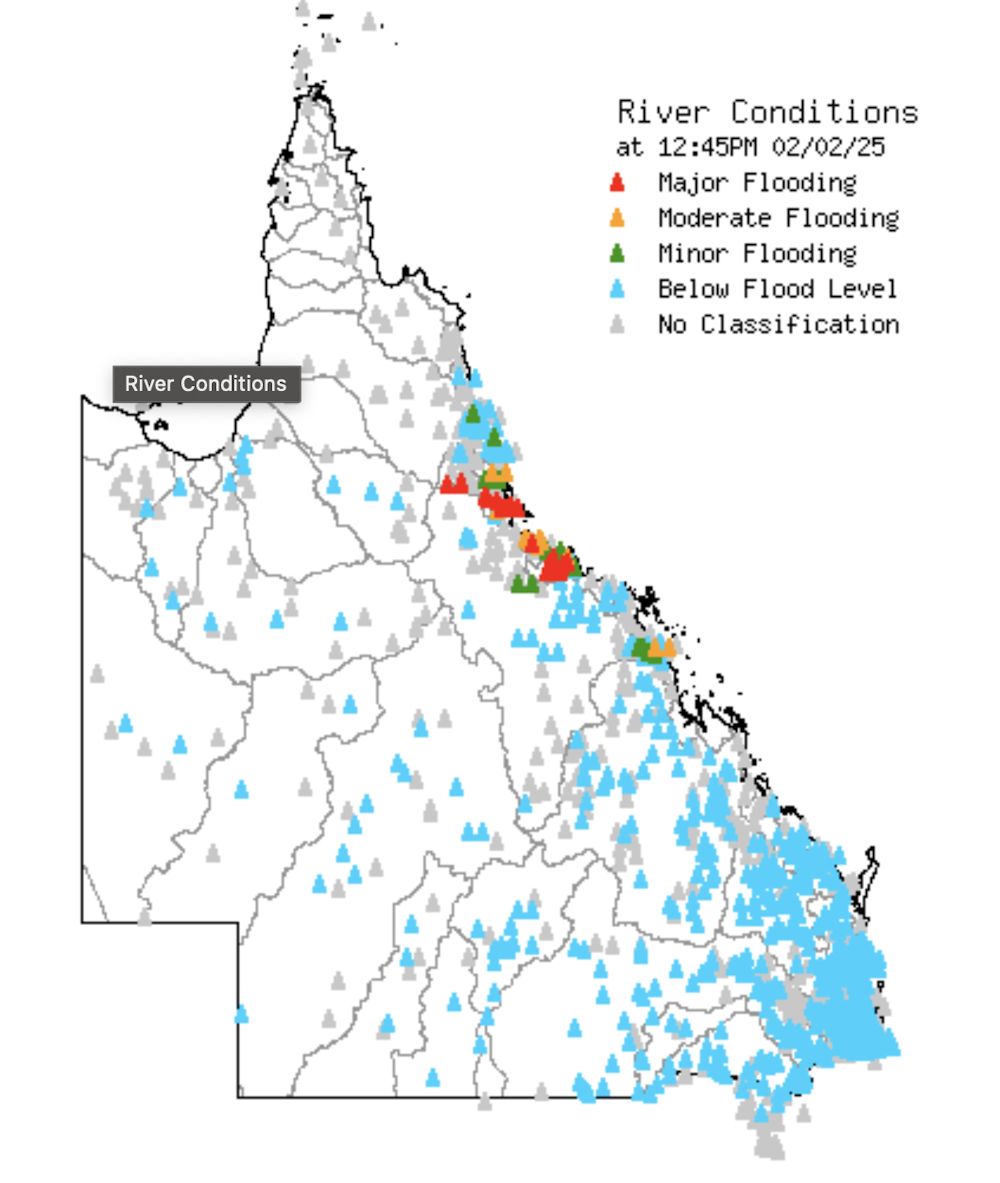
Major flooding in northern Queensland rivers, as of 12.45pm February 2. Bureau of Meteorology
Residents of Ingham and nearby towns, about 100km from Townsville, are witnessing flooding from the nearby Herbert River. This morning, it was at 15 metres and rising. With more heavy rain forecast for the next 24 hours, the Herbert River is likely to break the 1967 record of 15.2 metres later today.
Queensland Premier David Crisafulli – who grew up on his family’s sugar cane farm in Ingham – has said the floods will be a “once in a century” event for the town. To make matters worse, authorities say the town has lost power and an extended outage is likely.
The atmospheric factors behind these floods are very similar to recent floods in the region – and climate change is no doubt playing a role.
The flood level for the Herbert River at Ingham set in 1967 was 15.2 metres. It’s likely to be breached this afternoon (Sunday February 2). Australian Bureau of Meteorology, CC BY
Where are the floods hitting?
For many people in Townsville – the largest city in Northern Australia – the unfolding emergency will bring back memories of the devastating February 2019 floods, which caused A$1.24 billion in damage. Residents have been asked to evacuate from several low-lying suburbs which were inundated in 2019.
Authorities in Townsville asked all residents in the low-lying black zone to evacuate by midday Sunday February 2. Floodwaters could reach second-storey heights in this zone. Residents in pink suburbs have been asked to be on standby. Townsville Council, CC BY
It is too early to say if this flood event will be worse. Fortunately, water levels in the city’s Ross River Dam are much lower than 2019. Townsville Airport has recorded 545mm of rain over the past 48 hours, with many northwest suburbs recording much higher levels. The township of Rollingstone – 60km northwest of Townsville – recorded a whopping 702mm over the 24 hours to 9am Sunday.
Further north in the Cairns to Daintree region, residents are watching with concern, with many still raw after the record-breaking floods of December 2023.
What triggered each of these floods was prolonged heavy rain falling on the southeast flank of a stationary tropical low weather system. Normally, tropical lows bring wind and rain, but move through quite quickly. But in recent years, we have seen a tendency for these systems to stall, sitting in place over or near land and dumping huge volumes of rain.
Last week, the Bureau of Meteorology warned that five tropical lows were forming around northern Australia. Most tropical cyclones form from tropical lows embedded in the region’s monsoon trough, a large low pressure band which forms over summer and draws in warm, moist air from the adjacent tropical seas.
But significant rain events like this one don’t necessarily require a tropical cyclone. Slow-moving deep monsoon lows over land can also deliver huge amounts of rain and widespread flooding.
These atmospheric conditions allow intense rain bands to form between converging winds: warm, moist winds from the northeast and southeast winds originating from the Coral Sea. As the winds collide, they push the moist air up into the cooler parts of the atmosphere where it condenses and falls as torrential rain.
More extreme rainfall and higher frequencies of flooded rivers and flash floods around the world have a clear link to climate change and ongoing global heating.
The main drivers behind these events include warming of the atmosphere. For every 1°C of warming, the atmosphere holds 7% more water vapour. Recent research suggests this figure could be even higher for short duration rainfall.
Hotter oceans hold more energy, meaning they can also amplify the global water cycle when atmospheric conditions are suitable.
This year’s latest ever monsoon
This year, sea surface temperatures in the northwest Coral Sea are 1-2°C above average. Ocean temperatures have risen because of a lack of cloud cover and rain last month. In northwestern Australia, this has given rise to an intensifying marine heatwave.
This ocean heat is likely to be driven by the Australian monsoon’s latest ever arrival. The monsoon brings heavy rains to northern Australia, triggering the wet season. When it arrives, sea surface temperatures generally drop due to a combination of high cloud cover and the cooling effect of rainwater.
After a slow start, the North Australian monsoon season is now in full swing.
The Bureau of Meteorology is monitoring an active monsoon trough for any low pressure systems, which may develop into tropical cyclones over the next week or so. If any cyclone does form, it will gain energy from warmer than usual sea surface temperatures.
What’s next for north Queensland?
The flood emergency in north Queensland is far from over. All global circulation models predict heavy rain to continue in the region, extending up towards Cape York and the Gulf Country as an active monsoon surge moves in from Indonesia.
As river catchments get saturated, more and more water will run off and engorge rivers. Forecasts are for rain to continue well into tonight and the next few days. We are likely to see more flooding in more places this week.
The Albanese Labor Government is extending the National Early Childhood Program (NECP) to support young children with disability or developmental concerns, their families and carers.
Autism Queensland and the Australian Catholic University (ACU) will each receive an additional $5 million from 2025-26 to 2026-27 to continue activities funded under the NECP.
Minister for Social Services Amanda Rishworth said the $10 million Federal investment for this extension will mean more children with disability or developmental concerns aged 0-8 years and their families are supported.
“We recognise the importance of a child’s early years and ensuring they and their families have what they need to ensure a bright future,” Minister Rishworth said.
“For children with developmental concerns or disability, it is crucial they and their families are given tailored support to ensure they can have their best start in life.
“The early childhood program activities under the NECP align withAustralia’s Disability Strategy 2021-2031and theEarly Years Strategy 2024-2034, helping children and building capacity in their families to support their development.
“The NECP was designed in consultation with parents, carers and peak bodies, and the Government is pleased to continue to fund these important activities.”
The NECP supports young children with newly identified disability or emerging developmental concerns and their parents and carers, increasing readiness for educational environments and providing opportunities to socialise with their peers and siblings in a supported and family-centred environment.
Initial funding of $13.8 million was awarded following two open grant rounds for 2022-23 to 2024-25. Under these grants:
Autism Queensland lead a consortium of organisations including playgroup and autism associations to provide regular, facilitated supports, including playgroups and music programs across the country.
ACU provides facilitated group workshops for parents and carers whose children have a newly identified disability or who have concerns regarding their child’s development.
Topics: NDIS; Foundational Supports; The Budget, Antisemitism; Nature Positive bill; Peter Dutton’s proposed investor visa.
ANDREW CLENNELL, HOST: Joining me live is the new NDIS Minister. She replaced Bill Shorten about a month ago, Amanda Rishworth, thanks for your time. Let me start with this news I’ve just revealed. Can you tell us what is the nature of the one-year deal being offered by the PM on Foundational Support money for the NDIS and why is it being tied to the hospital agreement?
AMANDA RISHWORTH, MINISTER FOR THE NATIONAL DISABILTY INSURANCE SCHEME: Firstly, I would say it’s not new that we are working with the states and territories to develop Foundational Supports. In fact, I have been working with my counterparts to work out the design of Foundational Supports, what they might look like and how we might go forward on that in terms of the agreements with states and territories. There are a lot of agreements with states and territories that our government is progressing. Certainly, the health reform is one of those. NDIS reform is another one. So, there is a lot of agreements to land with states and territories and what I’ve been doing is working very hard to put some meat on the bones about what we would be funding with Foundational Supports.
ANDREW CLENNELL: Well, you say it’s not new. The fact it’s a one-year deal is new, isn’t it, that you’re looking at?
AMANDA RISHWORTH: We’ve been working towards Foundational Supports for a long time. I’m not privy to the First Ministers negotiations, but I’ve been working very much with the idea of how we stand up supports outside the NDIS that are there to support people that may not need the intensity that the NDIS provides. So, the First Ministers will continue to have their discussions, but I’m certainly working on what Foundational Support looks like. How do we roll those out and how do we make a difference outside side of the scheme so that there are supports available.
ANDREW CLENNELL: Do you expect states to be providing these Foundational Supports by mid-year as envisioned? Are the states fair dinkum about this or could the deal just collapse?
AMANDA RISHWORTH: It’s never been expected that all the Foundational Supports would be stood up this year. Indeed, as the review outlined, they will have to be rolled out in a progressive way. But we’ve had good cooperation with states and territories. Just one example of a system change that we have with South Australia, for example, is what’s called the Inklings program. And the idea of that is to provide intervention before there is a diagnosis to ensure that children are put on a strong developmental pathway and don’t need the NDIS. There is already work being done around what these systems look like outside the NDIS. But we’ll keep working with the states and territories to start sending these supports up.
ANDREW CLENNELL: What money are you proposing to give the states to deliver these services which can act as a NDIS substitute? Is there a danger of just cost shifting from the NDIS or are there going to be real savings here?
AMANDA RISHWORTH: Let’s be clear. The NDIS is a joint endeavour by states and territories and the Commonwealth, and they co-govern. But what we’re talking about, and the review made it clear, is that for some people, for some children as well, that may have developmental delay, they might be served outside of the scheme with lower intensity supports. So, they don’t require the full individualised plan that is provided by the NDIS. And just in the nature of the way the supports will be delivered, they will be a lower cost. But I have to say, Andrew, when it comes to sustainability of the NDIS, Foundational Supports are not the only element that goes to sustainability. There is a lot of work we’ve been doing and will continue to do to improve the sustainability of the scheme and to hit that 8 per cent growth target which we are on track for.
ANDREW CLENNELL: I’m told, in terms of saving money through the Foundational Support one example is the Federal Government would want schools to have a staff speech pathologist, for example, rather than have say 10 private speech pathologists visit schools to see students one on one. Is that a good example of what you’re trying to achieve here?
AMANDA RISHWORTH: I don’t want to be so prescriptive because we’re still working through it, but a good example would be if a child might have some fine motor delay. Rather than an individualised plan that has a range of different supports they might be serviced with, for example, some adaptive technology like some specialised cutlery that helps them with their fine motor skills and perhaps some periodic OT input rather than a full individualised plan that gets reassessed and re put in place every single year. So, they are the types of things that we are looking at. How do you provide much more targeted, much more often episodic or periodic interventions that do not require this sort of individualised plan. I don’t think anyone accepted that for children with developmental delay that they would have an individualised plan for a lifetime. That certainly was not the vision for the scheme which is for significant and permanent impairment. So, we’ve got to work and identify these. Things look different in different states and that’s why systems are different in different states, and we will be working with each state and territory about what that looks like and how it might be delivered.
ANDREW CLENNELL: How did we get to the point where something like 35 per cent of people on this scheme have autism? Could there be closer scrutiny of who gets this support? When this scheme was set up, it was for people with significant and permanent disability. There was even an ANU study in 2023 which suggested there were more autism diagnoses in this country and that could be linked to accessing the NDIS.
AMANDA RISHWORTH: What the review said, Andrew, was that with the NDIS the only level of support, I think the review said is the only lifeboat in the ocean. Of course it has led to people gravitate to get support. That is partly what I said Foundational Supports are about. It’s also partly that there are two pathways in the NDIS. Firstly, the permanent and significant pathway and then there’s the early intervention pathway. And for me, I want to make sure that the early intervention pathway is making a difference, that it is evidence based and that we are seeing interventions that improve the developmental trajectory of a child, so that they don’t need to, on an ongoing basis, actually rely on the NDIS. The NDIS was never designed that it would be diagnosis driven. It was about functional capacity and what supports you need. We need to get back to having a focus on that and also make sure for those that may need a lower intensity of support, that it’s out there in the broader community through different service systems. And that’s what we’re working to. And quite frankly it’s been really left to drift under the previous government. There wasn’t the sustained focus. Now Former Minister Shorten had a sustained focus on this and I will continue that.
ANDREW CLENNELL: When Julia Gillard rose in the Parliament to announce this scheme, she said there were more than 400,000 people living with significant and permanent disabilities. And then 13 years later, we have 650,000 participants of the scheme. How many people do you envisage in say three to five years being on this scheme?
AMANDA RISHWORTH: I don’t have those projections, but I have to say what’s driving the scheme is or the costs in the scheme is not only the number of participants on the Scheme. It has been identified that intra-plan inflation also has an impact on the fiscal elements of the Scheme. So, while numbers are important, we’ve got to make sure that eligibility is correct and that it’s significant and permanent. And the supports put in place are about supporting people with supports that are reasonable and necessary. It is not just the numbers that are driving the cost. Here we had a situation where we’ve put some new rules in place to be clear about what’s funded and what’s not. There were grey areas about what is funded, what was not, and so we were seeing some confusion around that. We’ve put very clear guidelines now about what should be funded and what shouldn’t be funded. We’ve also put some clear guidelines about how people manage their budgets and their plans, and also make sure, for example, that there isn’t service providers gouging participants. It’s taken a lot of work to look at how we bring these costs down. Just to give you an example, 2021-22, when the previous government was in charge, there was a 23 per cent growth in the cost of the scheme. 2024-25 we have been able to bring that down to about 12 per cent.
ANDREW CLENNELL: It’s still 12 per cent. Your target’s eight per cent. Let me ask you this, I appreciate your point on the numbers, but Julia Gillard spoke about 400,000. We’ve now got 650,000. Could you envisage a million Australians being on the NDIS? Because it looks like we’re headed that way.
AMANDA RISHWORTH: I don’t think that’s right to characterise the trajectory. I’ll just give you an example. Recently, the numbers were revised of the number of Australians living with disability in this country, and it’s 5.5 million people. So, if we look at the numbers that are on the NDIS, it is certainly not all people living with disability in Australia. And of course, that 5.5 million had been revised, up from over 4.5 million. So, we are seeing the trajectory of people reporting disability increase in this country across the board. Not all of them are on the NDIS. In fact, only a small proportion of people are getting support from the NDIS. And that’s why we’ve got to be continuing to work hard to look at what other supports we can give people to make sure that they don’t need necessarily the NDIS but can get support elsewhere.
ANDREW CLENNELL: Peter Dutton’s spoken about cutting 36,000 public servants. Your predecessor, Bill Shorten, won the budget support to hire another 1,000 public servants in a bid to get the NDIS under control. In particular to look at eligibility for the scheme, what progress have they so far made and what sort of people are now being rejected from the scheme that were being accepted?
AMANDA RISHWORTH: I need to be clear in terms of the early intervention pathway, there has always been a reassessment at six years of age and nine years of age, because we’re hoping, of course, that the early interventions has made a difference and those children do not require the scheme anymore. Thee work that’s been undertaken is to make sure that those reassessments have happened. When Peter Dutton talks about cutting public servants, what he’s saying is he doesn’t want those reassessments to happen. He doesn’t want to make sure that plans are done efficiently, effectively and quickly. Is he planning to cut the Fraud Fusion Task Force? Because there was no focus on fraud in the NDIS previously. That requires people from across agencies to make sure that taxpayers money is spent correctly and is not gouged. When it comes to my other hat as Social Services Minister, is he talking about pensioners waiting on the phone for longer? These are frontline public servants that are making a difference. But importantly, when it comes to the NDIS, paying attention to all these elements that the previous government dropped, whether it’s fraud, whether it’s reassessment, whether it’s proper efficient planning, whether it’s responsiveness when people have a query, they are the public servants that Peter Dutton is talking about.
ANDREW CLENNELL: I just want to get through a couple more things. When it comes to a possible budget, we don’t know if it’s happening or during the election campaign the PM, Treasurer and Finance Minister have flagged more cost-of-living assistance. I ask you, in your social services portfolio, do you expect to be promising more in terms of rental assistance or in terms of welfare benefits or pension payments?
AMANDA RISHWORTH: We’ve been working through the budget process and Andrew; you’ll be not surprised. I won’t be announcing what will be in the budget here today, but when it comes to supporting people with cost of living, it’s clear. Two rent assistance increases that have led to the largest rent assistance in over 30 years. Of course we’ve increased other payments, we’ve improved arrangements for the pension, supporting pensioners with cost of living, we’ve supported more pensioners onto the concession card, helping them with cost doctors. Of course, there’s been medicines and a range of other cost of living measures. So, we’ve got a strong record when it comes to supporting people right across the board, including our tax cuts. Look, I’m going to say watch out on budget night. I know you’re an avid watcher of the budget and all will be revealed on budget night.
ANDREW CLENNELL: It sounds like you think there is a budget, Amanda Rishworth. I’m not so confident we’ll see in good time. I wanted to ask now about but this issue of the anti-Semitic attacks and the criticism of the Prime Minister in terms of either he didn’t get briefings, and he should investigate it. That’s what Peter Dutton and the opposition say. Or another version I’ve heard is he’s hearing things but not broadcasting them. There Is a fine balance here, isn’t there? Could it be politically detrimental for the Government if he doesn’t look on top of it? The Prime Minister?
AMANDA RISHWORTH: I think this is a ridiculous criticism from Peter Dutton and just shows that all he wants to do is play politics with what is a really serious issue. It is unacceptable that there are people of Jewish faith feeling unsafe in this country. But for the Government it is about being responsible in making sure people are actually safe, not playing politics. And I have to say, ensuring police and security agencies, can do their job and keep the community safe should be, in my view, the number one outcome we all want to see. So, if the leader of the Opposition just wants to play politics with this then he should be condemned, quite frankly, because it is about what leads to safety in our community. That should be a priority of every member of Parliament.
ANDREW CLENNELL: Health Minister Mark Butler made an announcement Friday concerning the establishment of an inquiry into the use of gender changing medicine. Is this a bid to head off Peter Dutton doing a Donald Trump on this issue this year?
AMANDA RISHWORTH: These guidelines have not been reviewed since 2018. It is timely that the guidelines be reviewed with the most up to date evidence, particularly when we’re talking about children. As a mum I would like to know that the guidelines are absolutely up to date, we’ve got proper medical evidence on the table and that young people in this country are getting the best possible medical care. So, it is timely that the evidence is looked at, that the input from research is added and that we have the most up to date medical guidelines in this country.
ANDREW CLENNELL: The Nature Positive bill, it looks dead in this term of Parliament. The Prime Minister is going to pull it. I understand?
AMANDA RISHWORTH: I think it’s clear that The Greens keep making more and more extreme demands. Peter Dutton has been incredibly oppositional to this will not even engage. This is despite the Samuel review identifying that both businesses wanted faster approvals, and we needed stronger protections for our environment. But with this type of opposition and people not willing to have discussions and make compromises, I think it’s clear that we won’t be able to pursue this piece of legislation in the Parliament.
ANDREW CLENNELL: What do you make of these comments by Peter Dutton at a fundraiser that he might reintroduce this significant investor visa and him trying to re-establish relations with the Chinese Australian community?
AMANDA RISHWORTH: I would say when it comes to migration, it just shows Peter Dutton likes to talk a lot of political game. But when it comes down to taking action, he failed to support our legislation to put a cap on international students. After being lobbied against that, he has now signalled that he will bring back a visa that we abolished. It really does show that he’s not serious when it comes to tackling our migration system. But we shouldn’t be surprised because he left it in a complete mess when he was in charge. And of course, you know, we’re getting down to the political season. You know, there’ll be a lot of political statements made clearly in the leader of the opposition’s case, it is contradictory from one day to the other, but that’s politics and that’s an election season.
ANDREW CLENNELL: We’ll have plenty more of it. Amanda Rishworth, thanks so much for your time.
New traffic signals will be installed at the intersection of Brighton Road, Ocean Boulevard and Scholefield Road in South Australia to improve safety for road users, pedestrians and cyclists.
This work forms part of a $30 million upgrade to two intersections along Brighton Road with upgrades already delivered at the intersection of Brighton Road and Edwards Street.
As traffic demand has grown and with new development in the area, getting access to the arterial road network for communities in Seacliff, Kingston Park and Marino has become increasingly difficult and dangerous.
The Ocean Boulevard carries around 30 000 vehicles a day and Scholefield Road carries around 4,000 vehicles each day.
The new traffic signals will maintain a consistent and reliable level of service and access for these communities whilst improving pedestrian and cyclist access and safety through the creation of a new signalised crossing of Brighton Road / Ocean Boulevard.
Design development is planned throughout 2025, with a possible construction start date mid-2026 and completion late 2026 to early 2027.
The Australian and South Australian governments have each contributed $15 million to fund the $30 million Brighton Road Intersection Improvements project.
Quotes attributable to Federal Infrastructure, Transport, Regional Development and Local Government Minister Catherine King:
“Funding the intersection upgrade is an important investment in making sure people can get to where they want to go and home again safely.
“We have listened to the local community, particularly the messages from Louise Miller-Frost and Alex Dighton about the need for these traffic signals.
“South Australians deserve quality infrastructure, and the Albanese and Malinauskas Labor Governments are partnering to making that happen.”
Quotes attributable to South Australian Minister for Infrastructure and Transport Tom Koutsantonis:
“The intersection of Scholefield Road and Ocean Boulevard is the primary access point onto the arterial road network for the Kingston Park and Marino community.
“We know this intersection is already causing access issues due to traffic volumes and the Villawood and Seacliff developments currently underway will only add to that, particularly during peak hours.
“We committed to look into solutions and I’m delighted the Albanese Government has partnered with us to make this happen.”
Quotes attributable to the Federal Member for Boothby Louise Miller-Frost:
“Traffic lights and upgrades at the intersection of Brighton Road, Ocean Boulevard and Schofield Road at Seacliff will significantly reduce congestion and improve safety for vehicles, pedestrians and cyclists.
“I’ve heard what communities in Seacliff, Kingston Park and Marino have to say, and I am pleased that the Albanese Labor Government is delivering this in partnership with the Malinauskas Government.”
Quotes attributable to the South Australian Member for Black Alex Dighton:
“My community has consistently raised with me concerns over the difficulty of access at this intersection due to traffic volumes on Ocean Boulevard, which carries around 30,000 vehicles a day at this location.
“I’m delighted that the Albanese and Malinauskas Governments have followed through on this commitment to the community to properly consider solutions and ensure funding to make sure this gets done.”
Around 100 young people from across the country will be in Canberra this week to work with the Albanese Labor Government on issues that affect them and their communities.
Young people will meet with various Ministers across the week to discuss policy solutions to topics that matter to them.
The week will include the second annual National Youth Forum, where young people will come together to work on policy ideas across the theme of ‘regional, rural, and remote’.
Attendees will focus on building drought resilience, involving young people in disaster preparedness and response, and getting more regional, rural and remote young people into tertiary education.
Minister for Youth Dr Anne Aly said the Albanese Government is ensuring young people are genuinely engaged in the policy making process.
“By listening to the valuable insights of young people, we can create a better Australia for everyone,” Minister Aly said.
“The National Youth Forum provides a valuable opportunity for young people to come together with each other and Government to hash out solutions to real-world problems.
“All young people from all backgrounds, no matter where you live, no matter who you are, should be able to have a say on government decisions.”
Aged 13 to 25, participants come from diverse backgrounds and bring a range of experiences to the Forum.
This includes Aboriginal and Torres Strait Islanders, participants from culturally or linguistically diverse backgrounds, experience of mental ill-health, participants from regional or remote communities, migrants, young parents, participants with experience of being a carer, participants from LGBTQIA+ communities and participants with disability.
The second annual National Youth Forum will be held on Wednesday 5 February.
Premier David Eby has issued the following statement celebrating Black History Month:
“Black History Month is an opportunity for us all to learn about and celebrate the many and diverse contributions of Black people to our province.
“In 1858, more than 800 Black settlers came north from California to Vancouver Island on the invitation of colonial governor James Douglas. They were promised equality under the law, as well as the right to vote and purchase property. Some settlers formed the Victoria Pioneer Rifle Corps, an all-Black police force.
“One of the settlers, Mifflin Gibbs, was elected to Victoria council eight years later, becoming the first Black person to hold public office in British Columbia. He was a prominent voice in favour of the colony joining the Canadian Confederation. More than a century later, social worker Rosemary Brown became the first Black woman to be elected to the B.C. legislature. Emery Barnes, a former professional football player with the B.C. Lions, served as the province’s first Black Speaker of the legislative assembly.
“A Black presence has been a constant in the province’s history, including descendants of the original immigrants. From salmon canner John Sullivan Deas to Emma Stark’s contributions as a school teacher to Seraphim Joe Fortes’ celebrated lifesaving to Barbara Howard on the track in the 1930s to Harry Jerome on the track in the 1960s to Eleanor Collins becoming the first Black entertainer in Canada to host her own national television program, the rich and varied achievements of Black British Columbians have helped make the province the place it is today.
“We should all feel pride in these accomplishments, while acknowledging the unjust barriers Black people face in their daily lives. Government is working to build an inclusive province where everyone feels they belong, as we build a more just and equitable society for all. Taking part in Black History Month enriches everyone.”
Lisa Beare, Minister of Education and Child Care, said: “Students in B.C. have opportunities to learn about the diverse communities that shape our province, including the accomplishments and challenges of historic and contemporary Black British Columbians. Learning about Black History and other cultural histories helps students appreciate our province’s rich cultural heritage and supports the development of school communities where everyone feels safe, included and represented.”
Jessie Sunner, parliamentary secretary for anti-racism initiatives, said: “Black History Month is a time to honour pioneers like Mifflin Wistar Gibbs, Harry Jerome, Eleanor Collins and Rosemary Brown, whose legacies continue to inspire us. This month gives us the chance to reflect on the ongoing fight against anti-Black racism. Legislation like the Anti-Racism Act aims to remove systemic barriers to government programs and services that Black communities face in the province. Let’s recommit to amplifying Black voices. As we celebrate the rich history and resilience of B.C.’s Black communities, we strive to build a welcoming province for everyone.”
George Anderson, parliamentary secretary for transit, said: “Black History Month is an opportunity to celebrate the excellence and contributions of Black individuals like John Sullivan Deas, Rosemary Brown, Justice Selwyn Romilly and June Francis, who have enriched every facet of our society, from culture and innovation to leadership and service. Here in British Columbia, we honour the achievements of those who have broken barriers and inspired progress, while recognizing the work still needed to ensure equal opportunity for all. I carry with me the stories of struggle, perseverance and hope paved by so many. By breaking down systemic barriers, we can create a future where everyone, regardless of background, can thrive and contribute to a more just world.”
Why has any discussion about Israel, its violations of international law, and the international legal expectations for third party states to hold IDF soldiers accountable not been addressed in Aotearoa New Zealand?
ANALYSIS:By Katrina Mitchell-Kouttab
Palestine Solidarity Network Aotearoa national chair John Minto’s campaign to identify Israeli Defence Force (IDF) soldiers in New Zealand and then call a PSNA number hotline has come under intense criticism from the likes of Winston Peters, Stephen Rainbow, the Jewish Council and NZ media outlets. Accusations of antisemitism have been made.
Despite making it clear that holding IDF soldiers accountable for potential war crimes is his goal, not banning all Israelis or targeting Jewish people, there are many just concerns regarding Minto’s campaign. He is clear that his focus remains on justice, not on creating divisions or fostering discrimination, but he has failed to provide strict criteria to distinguish between individuals directly involved in human rights violations and those who are innocent, or to ground the campaign in legal frameworks and due process.
Any allegations of participation in war crimes should be submitted through proper legal channels, not through the PSNA. Broader advocacy could have been used to address concerns of accountability and to minimise any risk that the campaign could lead to profiling based on religion, ethnicity, or language.
While there are many concerns that need to be addressed with PSNA’s campaign, why has the conversation stopped there? Why has the core issue of this campaign been ignored? Namely, that IDF soldiers who have committed war crimes in Gaza have been allowed into New Zealand?
PSNA’s controversial Gaza “genocide hotline” . . . why has the conversation stopped there? Why has the core issue about war crimes been ignored? Image: PSNA screenshot APR
Why has any discussion about Israel, its violations of international law, and the international legal expectations for third party states to hold IDF soldiers accountable not been addressed? Why is criticism of Israel being conflated with racism, even though many Jewish people oppose Israel’s war crimes, and what about Palestinians, what does this mean for a people experiencing genocide?
Concerns should be discussed but they must not be used to protect possible war criminals and shield Israel’s crimes.
It is true that PSNA’s campaign may possibly target individuals, including targeting individuals solely based on their nationality, religion, or language. This is not acceptable. But it has also uncovered the exceptionally biased, racist, and unjust views towards Palestinians.
Racism against Palestinians ignored Palestinians have been dehumanised by Israel for decades, but real racism against Palestinians is being ignored. As a Christian Palestinian I know all too well what it is like to be targeted.
In fact, it was only recently at a New Zealand First State of the Nation gathering last year that Winston Peter’s followers called me a terrorist for being Palestinian and told me that all Muslims were Hamas lovers and were criminals.
The question that has been ignored in this very public debate is simple: are Israeli soldiers who have participated in war crimes in Aotearoa, if so, why, and what does this mean for the New Zealand Palestinian population and the upholding of international law?
By refusing to address concerns of IDF soldiers the focus is deliberately shifted away from the actual genocide happening in Gaza. If IDF soldiers have engaged in rape, extrajudicial executions, torture, destruction of homes, or killing of civilians, they should be investigated and held accountable.
Countries have a legal and moral duty to prevent war criminals from using their nations as safe havens.
Since 1948, Palestinians have been subjected to systematic oppression, apartheid, ethnic cleansing, violence and now, genocide. From its creation and currently with Israel’s illegal occupation, Palestinian massacres have been frequent and unrelenting.
This includes the execution of my great grandmother on the steps of our Katamon home in Jerusalem. Land has been stolen from Palestinians over the decades, including well over 42 percent of the West Bank. Palestinians have been denied the right to return to their country, the right to justice, accountability, and self-determination.
Living under illegal military law We are still forced to live under illegal military law, face mass arrests and torture, and our history, identity, culture and heritage are targeted.
Almost 10 children lose one or both of their legs every day in Gaza according to the UN agency for Palestinian refugees (UNWRA). 2.2 million people are starving because Israel refuses them access to food. 95 percent of Gaza’s population have been forced onto the streets, with only 25 percent of Gaza’s shelters needs being met, according to the Norwegian Refugee Council.
One out of 20 people in Gaza have been injured and 18,000 children have been murdered. 6500 Palestinians from the Gaza Strip were taken hostage by Israel who also stole 2300 bodies from numerous cemeteries. 87,000 tons of explosives have been dropped on all regions in the Gaza Strip.
Dr Ghassan Abu-Sittah, a British Palestinian reconstructive surgeon who worked in Al Shifa and Al Ahly Baptist hospital and who is part of Medicine Sans Frontiers, estimates as many as 300,000 Palestinian civilians, most of them children, have been murdered by Israel.
This is because official numbers do not include those bodies that cannot be recognised or are blown to a pulp, those buried under the rubble and those expected to die and have died of disease, starvation and lack of medicine — denied by Israel to those with chronic illnesses.
‘A Genocidal Project’: real death toll closer to 300,000. Video: Democracy Now!
As a signatory to the Geneva Convention, the Rome Statute of the International Criminal Court (ICC), and UN resolutions, New Zealand is expected to investigate, prosecute and deport any individual accused of these serious crimes. This government has an obligation to deny entry to any individual suspected of war crimes, crimes against humanity or genocide.
IDF has turned war crimes into entertainment Israel has violated all of these, its IDF soldiers filming themselves committing such atrocities and de-humanising Palestinians over the last 15 months on social media.
IDF soldiers have posted TikTok videos mocking their Palestinian victims, celebrating destruction, and making jokes about killing civilians, displaying a disturbing level of dehumanisation and cruelty. They have filmed themselves looting Palestinian homes, vandalising property, humiliating detainees, and posing with dead bodies.
They have turned war crimes into entertainment while Palestinian families suffer and mourn. Israel has deliberately targeted civilians, bombing schools, hospitals, refugee camps, and even designated safe zones, then lied about their operations, showing complete disregard for human life.
Israel and the IDF’s global reputation among ordinary people are not positive. Out on the streets over 15 months, millions have been demonstrating against Israel. They do not like what its army has done, and rightly so. Many want to see justice and Israel and its army held accountable, something this government has ignored.
Israel’s state forced conscription or imprisonment, enforced military service that contributes to the occupation, ethnic cleansing, systematic oppression of a people, war crimes and genocide is fascism on display. Israel is a totalitarian, apartheid, military state, but this government sees no problems with that.
The UN and human rights organisations like Amnesty International and Human Rights Watch have repeatedly condemned Israeli military operations, including the indiscriminate killing of civilians, the use of white phosphorus, and sexual violence by Israeli forces.
While not all IDF soldiers may have committed direct atrocities, those serving in occupied Palestinian territories are complicit in enforcing illegal occupation, which itself is a violation of international law.
Following orders not an excuse The precedent set by international tribunals, such as Nuremberg, establishes that following orders is not an excuse for war crimes — meaning IDF soldiers who have participated in military actions in occupied areas should be subject to scrutiny.
This government has a duty to protect Palestinian communities from further harm, this includes preventing known perpetrators of ethnic cleansing from entering New Zealand. The presence of IDF soldiers in New Zealand is a direct threat to the safety, dignity, and well-being of our communities.
Many Palestinian New Zealanders have lost family members, homes, and entire communities due to the IDF’s actions. Seeing known war criminals walking freely in New Zealand re-traumatises those who have suffered from Israel’s illegal military brutality.
Survivors of ethnic cleansing should not have to live in fear of encountering the very people responsible for their suffering. This was not acceptable after the Second World War, throughout modern history, and is not acceptable now.
IDF soldiers are also trained in brutal tactics, including arbitrary arrests, sexual violence, and the assassination of Palestinian civilians. The presence of war criminals in any society creates a climate of fear and intimidation.
Given their history, there is a concern within New Zealand that these soldiers will engage in racist abuse, Islamophobia, or Zionist hate crimes not only against Palestinians and Arabs, but other communities of colour.
New Zealand society should be scrutinising not just this government’s response to the genocide against Palestinians, but also our political parties.
Moral bankruptcy and xenophobia This moral bankruptcy and neutral stance in the face of genocide and racism has been clearly demonstrated this week in Parliament with both Shane Jones and Peter’s xenophobic remarks, and responses to the PSNA’s campaign.
Winston Peter’s tepid response to Israel’s behaviour and its violations is a staggering display of double standards and hypocrisy. Racism it seems, is clearly selective.
His comments about Mexicans in Parliament this week were xenophobic and violate the principles of responsible governance by promoting discrimination. Peters’ comments that immigrants should be grateful creates a hierarchy of worthiness.
Similarly, Shane Jones calling for Mexicans to go home does not uphold diplomatic and professional standards, reinforces harmful racial stereotypes and discriminates based on one’s nationality. Mexicans, Māori, and Palestinians are not on equal standing as others when it comes to human rights.
Why is there a defence of foreign soldiers who may have participated in genocide or war crimes in the occupied Palestinian territories, but then migrants and refugees are attacked?
“John Minto’s call to identify people from Israel . . . is an outrageous show of fascism, racism, and encouragement of violence and vigilantism. New Zealand should never accept this kind of extreme totalitarian behaviour in our country”. Why has Winston Peter’s never condemned the actual racism Palestinians are facing — including ethnic cleansing, forced displacement, and apartheid?
Why has he never used such strong language and outrage to condemn Israel’s actions despite evidence of violations of international law? Instead, he directs outrage at a human rights activist who is pointing out the shortcomings of the government’s response to Israels violations.
IDF soldiers’ documented atrocities ignored Peters has completely ignored IDF soldiers’ documented atrocities and distorted the campaign’s purpose for legal accountability to that of violence.
There has been no mention of Palestinian suffering associated with the IDF and Israel, nor has the government been transparent in admitting that there are no security measures in place when it comes to Israel.
For Peters, killing Palestinians in their thousands is not racist but an activist wanting to prevent war criminals from entering New Zealand is?
Recently, Simon Court of the ACT party in response to Minto wrote: “Undisguised antisemitic behaviour is not acceptable . . . military service is compulsory for Israeli citizens . . . any Israeli holidaying, visiting family or doing business in New Zealand could be targeted . . . it is intimidation towards Jewish visitors . . . and should be condemned by parties across Parliament.”
This comment is misleading, and hypocritical.
PSNA’s campaign is not targeting Jewish people, something the Jewish Council has also misrepresented. It is about identifying Israeli soldiers who have actively participated in human rights violations and war crimes in the occupied Palestinian territories.
It intentionally blurs the lines between Israeli soldiers and Jewish civilians, as the lines between Palestinian civilians and Hamas have been blurred.
Erases distinction between civilians and a militant group Even MFAT cannot use the word “Palestinian” but identifies us all as “Hamas” on its website. This erases the distinction between civilians and a militant group, and conflates Israeli military personnel with Jewish civilians, which is both deceptive and dangerous.
The MFAT website states the genocide in Gaza is an “Israel-Hamas” conflict, denying the intentional targeting of Palestinian civilians and erasing our humanity.
Israel’s assault has purposely killed thousands of children, women and men, all innocent civilians. Israel has not provided any evidence of any of its claims that it is targeting “Hamas” and has even been caught out lying about the “mass rapes and burned babies”, the tunnels under the hospitals and militants hiding behind Palestinian toddlers and whole generations of families.
Despite this, MFAT had not condemned Israeli war crimes. This is not a just war. It is a genocide against Palestinians which is also being perpetrated in the West Bank. There is no Hamas in the West Bank.
The ACT Party has been silent or outright supportive of Israel’s atrocities in Gaza and the West Bank, despite overwhelming evidence of war crimes. If they were truly concerned about targeting individuals as they are with Minto’s campaign, then they would have called for an end to Israel’s assaults against Palestinians, sanctioned Israel for its war crimes, and called for investigations into Israeli soldiers for mass killings, sexual violence and starving the Palestinian people.
What is clear from Court and Seymour (who has also openly supported Israel alongside members of the Zionist Federation), is that Palestinian lives are irrelevant, we should silently accept our genocide, and that we do not deserve justice. That Israeli IDF soldiers should be given impunity and should be able to spend time in New Zealand with no consequences for their crimes.
This is simply xenophobic, dangerous and “not acceptable in a liberal democracy like New Zealand”.
New Zealand cartoonist Malcolm Evans with two of his anti-Zionism placards at yesterday’s “march for the martyrs” in Auckland . . . politicians’ silence on Israel’s war crimes and violations of international law fails to comply with legal norms and expectations. Image: Asia Pacific Report
Erased the voice of Jewish critics ACT, alongside Peters, Prime Minister Christopher Luxon, Labour leader Chris Hipkins, and the Jewish council have erased the voice of Jewish people who oppose Israel and its crimes and who do not associate being Jewish with being Israeli.
There is a clear distinction, something Alternative Jewish Voices, Jewish Voices for Peace, Holocaust survivors and Dayenu have clearly reiterated. Equating Zionism with Judaism, and identifying Israeli military actions with Jewish identity, is dangerously antisemitic.
By failing to distinguish Judaism from Zionism, politicians and the Jewish Council are in danger of fuelling the false narrative that all Jewish people support Israel’s actions, which ultimately harms Jewish communities by increasing resentment and misunderstanding.
Antisemitism should never be weaponised or used to silence criticism of Israel or justify Israel’s impunity. This is harmful to both Palestinians and Jews.
Seymour’s upcoming tenure as deputy prime minister should also be questioned due to his unwavering support and active defence of a regime committing mass atrocities. This directly contradicts New Zealand’s values of justice and accountability demonstrating a complete disregard for human rights and international law.
His silence on Israel’s war crimes and violations of international law fails to comply with legal norms and expectations. He has positioned himself away from representing all New Zealanders.
While we focus on Minto, let’s be fair and ensure Palestinians are also being protected from discrimination and targeting in New Zealand. Are the Zionist Federation, the New Zealand Jewish Council, and the Holocaust Centre supporting Israel economically or culturally, aiding and abetting its illegal occupation, and do they support the genocide?
Canada investigated funds linked to illegal settlements Canada recently investigated the Jewish National Fund (JNF) of Canada for potentially violating charitable tax laws by funding projects linked to Israeli settlements in the occupied Palestinian territories, which are illegal under international law.
In August 2024, the Canada Revenue Agency (CRA) revoked the Jewish National Fund of Canada’s (JNF Canada) charitable status after a comprehensive audit revealed significant non-compliance with Canadian tax laws.
On the 31 January 2025, Haaretz reported that Israel had recruited the Jewish National Fund to illegally secretly buy Palestinian land in the Occupied Palestinian Territories. What does that mean for the New Zealand branch of the Jewish National Fund?
None of these organisations should be funnelling resources to illegal settlements or supporting Israel’s war machine. A full investigation into their financial and political activities is necessary to ensure any money coming from New Zealand is not supporting genocide, land theft or apartheid.
The government has already investigated Palestinians sending money to relatives in Gaza, the same needs to be done to organisations supporting Israel. Are any of these groups supporting war crimes under the guise of charity?
While Jewish communities and Palestinians have rallied together and supported each other these last 15 months, we have received no support from the Jewish Council or the Holocaust Centre, who have remained silent or have supported Israel’s actions. Dayenu, and Alternative Jewish voices have vocally opposed Israel’s genocide in Gaza and reached out to us. As Jews dedicated to human rights, justice, and the prevention of genocide because of their own history, they unequivocally condemn Israel’s actions.
Given the Holocaust, you would expect the Holocaust Centre and the Jewish Council to oppose any acts of violence, especially that on such an industrial scale. You would expect them to oppose apartheid, ethnic cleansing, and the dehumanisation of Palestinians as the other Jewish organisations are doing.
Genocide, war crimes must not be normalised War crimes and genocide must never be normalised. Israel must not be shielded and the suffering and dehumanisation of Palestinians supported.
We must ensure that all New Zealanders, whether Jewish, Israeli or Palestinian are not targeted, and are protected from discrimination, racism, violence and dehumanisation. All organisations are subject to scrutiny, but only some have been.
Instead of just focusing on John Minto, the ACT Party, NZ First, National, and Labour should be answering why Israeli soldiers who may have committed atrocities, are allowed into New Zealand in the first place.
Israel and its war criminals should not be treated any differently to any other country.
We must shift the focus back to Israel’s genocide, apartheid, and impunity, while exposing the hypocrisy of those who defend Israel but attack Palestinian solidarity.
Prime Minister Anthony Albanese has dumped – for the second time – the government’s controversial “Nature Positive” legislation, which had run into strong opposition from the Western Australian Labor government.
Albanese, speaking on The Conversation’s Politics podcast ahead of a fortnight parliamentary sitting starting next week, said there was not enough support for the legislation, which had been on the draft list of bills for next week, circulated by the government.
This is the second time the Prime Minister has pulled back from the legislation. Late last year he also said it did not have enough support, despite Environment Minister Tanya Plibersek believing she had a deal with the Greens and crossbench for its passage.
The legislation would set up a federal Environment Protection Agency, which has riled miners who claim it would add to bureaucracy and delay approvals.
In recent days WA premier Roger Cook, who was instrumental in heading off the legislation last year, has been lobbying the federal government again. WA faces an election on March 8.
In an interview on Saturday, Albanese told The Conversation: “I can’t see that it has a path to success. So at this stage, I can say that we won’t be proceeding with it this term. There simply isn’t a [Senate] majority, as there wasn’t last year.
“The Greens Party on one hand have changed their views”, making another demand during the week, he said. While the Liberals – who began the review of the present Environment Protection Act – “have chosen an obstructionist path,” he said.
Albanese said the government would continue to discuss the issue with stakeholders in the next term of parliament.
“Does the environment and protection act need revision from where it was last century? Quite clearly it does. Everyone says that that’s the case. It’s a matter of working to, in a practical way, a commonsense reform that delivers something that supports industry.
“I want to see faster approvals. We in fact have speeded up approvals substantially.
“But we also want proper sustainability as well.”
Albanese also flagged the government might cut back its legislation to reform rules covering electoral donations and spending in order to get a deal to pass it.
Special Minister of State Don Farrell and the Liberals had been on the brink of a deal in the final week of parliament last year, but negotiations imploded at the eleventh hour.
Albanese told The Conversation he hoped the legislation could still be passed. “I spoke with [Farrell] today, he is consulting with people across the parliament.
“What I would say is that we are looking to get reform through. Now whether that is a bigger, broader reform or whether it needs to be narrowed down, we’ll wait and see.
“But we’re very serious about the reform which would lower the donation declarations, that would put a cap on donations, a cap on expenditure, that would lead to more transparency as well. It’s an important part of supporting our democracy.
“We see overseas and we’ve seen people like Clive Palmer here spend over $100 million on a campaign. That’s a distortion of democracy – if one person can spend that much money to try to influence an election and we don’t find out all of that information till much later on.”
The reforms would not start operating until the next term of parliament.
Albanese said he thought the reform would have “overwhelming support” with the public “and I hope that it receives overwhelming support in the Senate as well”.
Michelle Grattan does not work for, consult, own shares in or receive funding from any company or organisation that would benefit from this article, and has disclosed no relevant affiliations beyond their academic appointment.
There has rightly been much debate and analysis over New Zealand’s decision to review the aid it gives to Kiribati.
It’s a big deal. So much is at stake, especially for the I-Kiribati people who live with many challenges and depend on the $100 million aid projects New Zealand delivers.
It would be clearly unwise for New Zealand to threaten or cut aid to Kiribati — but it has every right to expect better engagement than it has been getting over the past year.
What has been disturbing is the airtime and validation given to a Kiribati politician, newly appointed Minister of Women, Youth, Sport and Social Affairs Ruth Cross Kwansing.
It’s helpful to analyse where this is coming from so let’s make this very clear.
She supports and is currently a minister of a government that in 2022 suspended Chief Justice William Hastings and Justice David Lambourne of the High Court, and justices Peter Blanchard, Rodney Hansen and Paul Heath of the Court of Appeal.
She supports and is part a government that deported Lambourne, who is married to Opposition Leader Tessie Lambourne — and they have I-Kiribati children. (He is Australian but has been in the Kiribati courts since 1995).
She supports and is part of a government that requires all journalists — should they get a visa to go there — to hand over copies of all footage/information collected.
She also benefits from a 220 percent pay rise that her government passed for MPs in 2021.That same year, ministers were gifted cars with China Aid embossed on the side, as well as a laptop from Beijing.
Amidst a gushing post about a president who recently gave this rookie MP a ministerial post, Cross Kwansing wrote of the “media manufactured drama” and “the New Zealand media, in its typical fashion, seized the opportunity to patronise Kiribati, and the familiar whispers about Chinese influence began to circulate”.
These comments shouldn’t come as any surprise as blaming the media is a common tactic of politicians and Cross Kwansing is no different.
Just because the new minister doesn’t like what New Zealand has decided to do doesn’t mean it must be “media manufactured”.
Her comment that “the New Zealand media, in its typical fashion, seized the opportunity to patronise Kiribati” is also ridiculous.
The journalist that broke the story — myself — is half I-Kiribati and incredibly proud of her heritage and the gutsy country that she was born in and grew up in, with family who still live there.
Cross Kwansing has been a member of parliament for less than six months. To not discuss the geopolitical implications with China, given the way the world is evolving and Kiribati’s close ties, would be naive and ignorant.
Pacific leaders frustrated It is not just New Zealand that Maamau has refused to meet. Over the last two years, Pacific Island leaders have spoken of frustration in trying to engage with the president.
Maamau is known to be a pleasant man and enjoyable to converse with. But, for whatever reason, he has chosen not to engage with many leaders or foreign ministers.
Cross Kwansing has helpfully shared that the president announced to his cabinet ministers that he would delegate international engagements to his vice president so he could concentrate “intently on domestic matters”.
Fair enough. Except that Maamau has chosen to hang on to the foreign minister portfolio.
It is quite right that New Zealand Foreign Minister Winston Peters would expect to engage with his Kiribati counterpart — especially given the level of investment and numerous attempts being made, and then a date finally agreed on by Maamau himself.
Six days before Peters was meant to arrive in Kiribati, the island nation’s Secretary of Foreign Affairs told the NZ High Commission there that the president was now “unavailable”. In the diplomatic world, especially given the attempts that had preceded it, that is hugely disrespectful.
There are different strategies the New Zealand government could have chosen to take to deal with this. Peters has had enough and chosen a hardline course that is likely to have negative impacts on New Zealand in the long term, but it’s a risk he obviously thinks is worth taking.
Cross Kwansing has spoken about prioritising cooperation and mutual respect over ego and political posturing. Absolutely right — except that this piece of helpful advice should also be taken by her own government. It works both ways for the sake of the people.
Barbara Dreaver is of Kiribati and Cook Islands descent. She was made an Officer of the New Zealand Order of Merit in 2024 for services to investigative journalism and Pacific communities. This TVNZ News column has been republished with permission.
The Albanese Labor Government and Cook Labor Government have signed an updated school funding and reform agreement.
As part of this updated agreement, the Commonwealth will provide an additional 5 per cent of the Schooling Resource Standard (SRS) to WA public schools.
This will lift the Commonwealth’s contribution from 20 per cent to 25 per cent of the SRS by 2034.
This represents the biggest new investment in WA public schools by the Australian Government ever. This will be tied to reforms to help more students in public schools keep up, catch up and finish high school.
This includes more individualised support for students, mandating evidenced-based teaching practices and more mental health support in schools.
As part of the Agreement, WA will remove the provision put in by the Morrison Government allowing the state to claim 4 per cent of public school funding for indirect school costs such as capital depreciation and replace it with recurrent funding on eligible expenses, while also maintaining a share of at least 75 per cent of the SRS for public schools.
This is not a blank cheque. The Agreement signed today will be followed by an updated WA Bilateral Agreement, which will tie funding to reforms already being delivered in WA schools that will help students catch up, keep up and finish school, such as:
Year 1 phonics and early years numeracy checks to identify students in the early years of school who need additional help
evidence-based teaching and targeted and intensive supports such as small-group or catch-up tutoring to help students who fall behind
support for students to come to school ready to learn, such as greater wellbeing support for learning and engagement, including counsellors, school psychologists and health nurses
trialling place-based approaches to delivering a full-service school model in at least four WA public schools from 2026 which includes community, health and social services support
recruiting more co-ordinators to better support students with the most complex needs
identifying opportunities to reduce workloads and better support teachers and school leaders through professional learning
providing more support and pathways for people to transition to a teaching career in Western Australian public schools, with a focus on First Nations people, people with disability and those from culturally and linguistically diverse backgrounds.
In addition, the following national targets will be included:
increasing the proportion of students leaving school with a Year 12 certificate by 7.5 percentage points (nationally) by 2030
reducing the proportion of students in the NAPLAN ‘Needs Additional Support’ proficiency level for reading and numeracy nationally by 10 per cent
increasing the proportion of students in the ‘Strong’ and ‘Exceeding’ proficiency levels for reading and numeracy by 10 per cent by 2030 and trend upwards for priority equity cohorts in the ‘Strong’ and ‘Exceeding’ proficiency levels nationally
increasing the Student Attendance Rate, nationally, to 91.4 per cent (2019 level) by 2030
increasing the engagement rate (completed or still enrolled) of initial teacher education students by 10 percentage points to 69.7 per cent by 2035.
This means more help for students and more support for teachers.
This agreement builds on the previous agreement with Western Australia signed in September last year.
Quotes attributable to Minister for Education, Jason Clare:
“This agreement lifts the Commonwealth’s contribution to 25 percent of the Schooling Resource Standard for WA public schools.
“This investment is tied to real, practical reforms to help students catch up, keep up and finish school.”
Quotes attributable to Premier Roger Cook:
“The Cook Labor Government is firmly committed to doing what is right for WA students, which is why we were the first state to sign the Better and Fairer Schools Agreement in September last year. This further agreement builds on that deal and provides hundreds of millions of dollars of additional Commonwealth funding to the State through to 2034.
“This is fantastic news for Western Australian students and teaching staff, it will provide the essential funding needed to ensure students can keep up, catch up and finish school.
“In particular, students with complex needs will get more support, which is something that the Cook Government has been working on for many years.”
Quotes attributable to WA Minister for Education Tony Buti:
“This agreement is good news for Western Australia. Teachers, students and families across the State will benefit as a result of increased funding and increased support for mental health and preparing students for school.
“I am delighted that Western Australia is one of the first jurisdictions to sign up to this new agreement.”
Authorities in southeast Australia have ordered communities to evacuate as bushfires in western Melbourne, the capital city of Australia’s state of Victoria, continue to spread.
Victorian emergency services on Thursday morning urged about 100 residents of four small towns near the southwestern edge of the Grampians National Park, about 250 km west of Melbourne, to leave immediately to escape the threat posed by a nearby out-of-control fire.
A warning issued by VicEmergency shortly after 7:30 a.m. local time said that there was a significant increase in fire activity overnight that caused a fire burning along the national park’s western edge to spread in multiple directions.
“Leaving immediately is the safest option, before conditions become too dangerous. Emergency services may not be able to help you if you decide to stay,” it said.
Residents of three more towns to the east of the fire, which was sparked on Monday by dry lightning, have been told that leaving now is the safest option.
Incident controller Peter Western told the Australian Broadcasting Corporation (ABC) that the fire had increased in size to 7,000 hectares overnight despite mild conditions.
He said that it has burnt through some private property at the western edge of the park.
Communities near a second fire in the national park’s north have been told to monitor changing conditions and prepare to evacuate.
He added that crews were working hard to contain the fires before a heatwave that is forecast to last from Saturday until Tuesday.
Dai Mo, co-director of “Detective Chinatown 1900,” spoke with China.org.cn about the film’s latest installment, highlighting its exploration of Chinatown’s origins in San Francisco and the historical challenges faced by the overseas Chinese communities in the United States.
Director Dai Mo. [Photo courtesy of As One Production]
The first three “Detective Chinatown” films have grossed more than 8.7 billion yuan ($1.2 billion) since the series launched 10 years ago. The films follow the boisterous private investigator Tang Ren, played by Wang Baoqiang, and his introverted, highly intelligent nephew Qin Feng, portrayed by Liu Haoran, as they tackle mystery cases in cities like Bangkok, New York and Tokyo.
“This time, we wanted to offer audiences a story that feels both familiar and fresh, so we chose a different longitudinal time period to offer a unique perspective,” Dai said. He added that the film not only explores Chinatown’s historical roots but also illustrates the prejudices overseas Chinese faced in 1900.
For the creative team, the year 1900 is a significant intersection in history. It was the Year of Gengzi in the lunar calendar, a year associated with misfortune in Chinese folklore. The year saw the peak of the Boxer Rebellion amid widespread chaos in China. The Qing dynasty also declared war on foreign powers but was ultimately defeated by the Eight-Nation Alliance, resulting in forced war indemnities.
In stark contrast, the U.S. was experiencing modernization and prosperity. Chinese immigrants moved to America in search of work, including jobs in railroad construction, but faced severe discrimination, such as the Chinese Exclusion Act. At the same time, the fictional detective Sherlock Holmes gained prominence as a cultural icon. “There were many stories and inspirations from that period for us,” Dai said.
A poster for “Detective Chinatown 1900.” [Image courtesy of As One Production]
The leading characters are once again portrayed by Wang Baoqiang and Liu Haoran, but their new roles are entirely different from those in previous installments. Wang plays Ah Gui, a versatile Chinese descendant adopted by an Indigenous American tribe, while Liu takes on the role of Qin Fu, an extroverted practitioner of Chinese medicine. Set in San Francisco in the 1900s, the story centers on the murder of a white woman in Chinatown, for which a Chinese man is the main suspect. This shocking crime ignites public outrage, leading to demands to shut down Chinatown. The duo gets caught up in the investigation, racing against time to reveal the true murderer in a tense battle of wits and bravery.
As a long-time collaborator with Chen Sicheng, the mastermind behind the “Detective Chinatown” franchise, Dai — director of hits like “Endless Journey” and “Fireflies in the Sun” — described their collaboration in co-directing the film as seamless, owing to the deep mutual understanding they have cultivated over the years. He fondly recalled how Chen would frequently laugh and cry behind the camera during the shoot, describing him as a deeply sensitive person.
The most ambitious and challenging aspect of the film was constructing a 1:1 replica of San Francisco’s landmarks from over a century ago in just seven months. This replica spans 200,000 square meters at Laoling Film Studio in Shandong province. Supported by the local government and enterprises, the project showcases China’s remarkable construction capabilities. The replica is open to the public during the Spring Festival, giving visitors the chance to explore it after viewing the film.
A replica of 1900s San Francisco at Laoling Film Studio in Laoling, Shandong province. [Photo courtesy of As One Production]
Dai noted that the set is incredibly realistic, as the film’s production design department conducted extensive research and collected historical documents to authentically replicate every detail of the props and the set from that era. This included constructing slopes that mirrored the actual geographical features of San Francisco. He added that foreign actors, including Hollywood veteran John Cusack, who stars in the film, were in awe of the replica town during filming.
The director expressed his hope that the film could serve as an important vehicle for promoting Chinese culture and also bring more resonance to overseas Chinese, while calling for the solidarity of Chinese communities abroad. Additionally, he hopes the film will inspire audiences to explore the history of China during that era. “When audiences engage with this history, they will see how strong we are today and gain a sense of confidence, perseverance and a commitment to continuous self-improvement,” he said.
Dai said he was excited about the potential for future expansions in the “Detective Chinatown” universe, which could explore different timelines. “Anything is possible,” he laughed. “As long as audiences continue to enjoy their adventures, we are eager to create more.”
A still from “Detective Chinatown 1900,” featuring the iconic actor Chow Yun-fat. [Photo courtesy of As One Production]
“Detective Chinatown 1900,” featuring a star-studded cast that includes legendary actor Chow Yun-fat along with comedians Bai Ke, Wei Xiang and Yue Yunpeng, was released on Jan. 29, the first day of the Chinese New Year. The film premiered simultaneously in major markets worldwide, including North America, Australia, Malaysia and the United Kingdom. The film is a notable addition to China’s profitable Spring Festival film season, which has seen record-breaking box office performances this year, bolstered by a strong lineup of releases.
JASON CLARE, MINISTER FOR EDUCATION: G’day everyone. Thanks very much for coming along. I think this sign says it all. If Labor wins the next election, we’ll cut student debt by 20 per cent. It’ll be the first piece of legislation that we introduce to the Parliament after the election and it’ll cut the debt of three million Aussies. Today we’re releasing information on what this means in every state and territory across the country and how much average debt people will see cut if we win the next election.
What this means for a person with the average student debt is we’ll cut their debt by over 5,000 bucks. That’s real money. That’ll make a real difference. And if you’ve got a student debt of $50,000 it will mean that debt is cut by $10,000. That’ll help a lot of some people in their 20s, in their 30s, who’ve just finished uni, got their first job. They might have just moved out of home and are just getting started. Labor will cut your student debt by 20 per cent.
Now compare that to Peter Dutton. The only policy that he’s got to help people with the cost of living is this crazy idea that says that he wants taxpayers to pay for their boss’ lunch. Labor will cut your debt. The Liberals want you to pick up the boss’ tab. It’s as basic as that.
Today I can also announce that the Student Ombudsman has started work. This is a national first, a National Student Ombudsman. You ask why we need this? Well, the evidence is compelling. One in 20 students at university report being raped. One in six students say they’ve been the victims of sexual harassment and one in two say that when they complain to their university, nothing happens. Now for too long, universities have failed their students on this front and previous governments have failed students as well.
I want to give a quick shout out to organisations like End Rape on Campus, STOP and Fair Agenda for never giving up and for fighting for this. For wanting a Student Ombudsman to make sure that when the worst happens to students, that there’s somewhere to go to report, to see that real action happens. And that’s what this Student Ombudsman is all about. They start work today.
But it’s just the first step. The next step is legislation that I’ll introduce to the Parliament next week to give me the power as the Minister for Education to set up a National Code that will set rules that universities need to comply with. That includes requiring vice chancellors to report to their boards every six months on the actions that they’re taking here, making sure that their staff are properly trained to do the investigations they need to do and to make sure that this Ombudsman’s recommendations have real teeth. This Code will mean that when the Ombudsman makes a recommendation about what a university has to do, this Code will require them to implement it. This is real change that’s long overdue and it’s finally happening. Happy to take questions.
JOURNALIST: Thanks, Minister. It’s Amanda from Nine here. Just a couple on the second announcement, what kind of powers will the Ombudsman actually have to compel universities to do anything at this stage?
CLARE: The National Student Ombudsman will have the same sort of powers as a Royal Commission does. It’ll have the power to go into university, it’ll have the power to get documents, it’ll have the power to compel people to give evidence. But not only that, the laws that I’ll introduce into the Parliament this week are the next step. They will make sure that when the Ombo makes a recommendation, that it’s implemented. There are ombudsmen all around the country at the moment doing different things. They have the power to make recommendations, but they don’t have the power to make sure they’re implemented. This Ombudsman will, and they will because of the Code that we will introduce legislation to make real this week.
JOURNALIST: And you talked a bit about sexual assault on campus there but antisemitism has also been a huge issue over the last couple of months, if not years. So, will the Ombudsman have any kind of powers to try and stop the antisemitism that we’re seeing on university campuses?
CLARE: The short answer to that is yes. The powers of this Ombudsman are broader than just dealing with complaints from students about sexual assault, sexual harassment and sexual violence. They’ll be able to deal with complaints from students about antisemitism or any sort of discrimination or hate that students experience at university. I want our students to be safe. And that’s what the job of this Ombudsman is, to make sure that when the worst happens to students that there’s action that can be taken.
JOURNALIST: Minister, it’s Josh from Seven News. Just on the debt bill, you said will be the first bill you’ll introduce in the new Parliament. Why not do it in the next two weeks and give students certainty that their debts will be reduced?
CLARE: We’ve made it very clear when the Prime Minister announced this policy late last year that this is a policy we would take to the next election. We’ve made it clear to 3 million Aussies right across the country that have got a HECS debt that if Labor wins the next election, we will cut your debt by 20 per cent. And this will make a big difference to 3 million Aussies right across the country. What’s the Liberal Party got to offer? They oppose this, Josh. This is the thing people have got to remember when we announced this, the Liberal Party said that they would oppose this. So, if the Liberals win the next Election, this will never happen. We’re making it very clear here today, if Labor wins the next Election, we’ll cut your student debt by 20 per cent.
JOURNALIST: The PM and Opposition Leader are both at a Lunar New Year event in the electorate of Chisholm today, how important will the Chinese-Australian vote be at the next election? It seems both sides are doing their best to court that vote.
JASON CLARE: I think everyone’s vote’s going to be critical. You know, in a couple of months time, all Australians will get a chance to vote. They’ll get a chance to choose who they want to run the country for the next three years. And I think the choice is clear. There’s a choice between a Labor government which is acting to help people with the real pressures that they’re under, with the cost of living through tax cuts for every taxpayer, through a $300 energy rebate, through things like the things I’m talking about today, cutting your student debt by 20 per cent, or the Liberal Party that have no real answers at all. And the only policy that they’ve got on this is to make taxpayers’ pay for their boss’ lunch. You know, how crazy is that? This policy is that insane, they had to put out a statement the other day saying it won’t apply to brothels or strip clubs. When you have to put out a statement like that, I think that shows just how insane this policy is. It shows that Peter Dutton hasn’t any real answers for the challenges the Australian people face.
JOURNALIST: The Trump administration has announced again that it’s going to proceed with tariffs on China. How concerned is the government considering China’s obvious trading economy?
CLARE: You’re right. China is our biggest trading partner. And the work that we’ve done with China over the last two years, over the last two and a half years, has helped to remove those trade barriers with China. That’s creating jobs here in Australia. When you remove trade barriers for the exports that we sell to China, whether it’s meat or wine or anything else, it creates jobs for farmers, it creates jobs for Aussie workers and that’s a good thing. I think one in four jobs in Australia are related to trade. The things that we dig out of the ground, the things we grow, the things we make and create for our jobs here in Australia. I’d just make the other important point about trade with the US and that is Australia is different to most countries around the world in that America has a trade surplus with Australia. America sells us more than we sell them.
JOURNALIST: It’s Pablo here from the ABC. Just back on the Ombudsman. The Coalition is being quite critical of the government’s response to anti-Semitism in universities. Have you spoken with the Opposition and do you expect the support on the introduction of this Ombudsman?
CLARE: The Liberal Party had 10 years to act here and they did bugger all. They did nothing. For 10 years, organisations like End Rape on Campus and STOP and Fair Agenda have been knocking on doors in Parliament House asking for politicians to listen, asking for politicians to act. And the Liberal Party slammed the door on these organisations that are fighting for victims and survivors of sexual assault. I’ve listened and I’ve acted. That’s why we’ve got the Parliament to pass laws to create this Student Ombudsman. It should have happened years ago. It’s finally happening because a Labor government listened and is acting. I hope that the Liberal Party will support this legislation.
JOURNALIST: And the former boss of the Home Affairs Department, Mike Pezzullo, has been quite critical of the Coalition’s response to the rise in antisemitism and he’s calling for an Operation Sovereign Borders type, multi agency campaign to combat this. Is this something that the government should consider?
CLARE: The bottom line here is that governments take the advice of our law enforcement agencies on this. Now law enforcement agencies are working hand in glove across the country. Federal agencies and state agencies, federal police, state police, our security agencies, they’re all working closely together and can I give them a shout out. As a former Minister for Home Affairs and a former Minister for Justice, I know how important the work they do is. I’ve got 100 per cent confidence in the work that they’re doing. The work that they’re doing is helping to keep Australians safe. The work that they’re doing is helping to hunt down the perpetrators of these violent evil acts and make sure that they’re locked up. And I back them and I hope that everybody else does too.
JOURNALIST: Just one more from me, Josh from Seven News. Earlier this week, Peter Dutton claimed the Coalition would be a better friend of China than the Albanese Government. Do you think that claim has any credibility? And should Peter Dutton outline what he’s going to do to improve the relationship?
CLARE: I think that’s laughable. Just Google what Peter Dutton has said about China over the last 10 years and you’ll realise how ridiculous that statement is.
JOURNALIST: That’s all the questions we have. Thanks so much for taking us on the phone.
With only a few weeks until Germany’s election, Elon Musk has unambiguously thrown his support behind the far-right Alternative for Germany (AfD) party. In a video address to a party rally last week, he appeared to urge Germans to “move on” from any “past guilt” related to the Holocaust.
It’s good to be proud of German culture, German values, and not to lose that in some sort of multiculturalism that dilutes everything.
Troublingly, the AfD is now firmly entrenched as Germany’s second-most popular political party, behind the centre-right Christian Democratic Union (CDU). Like all parties in German elections, however, it cannot win an outright majority. It is also unlikely to be invited to join any ruling coalition that emerges from the February 23 election.
But the AfD’s anti-migrant, anti-government sloganeering has already seriously distorted Germany’s public debate and democratic culture, leaving many to ask whether it even needs to win elections to see its policies implemented.
This was evident following a dramatic week in Germany’s Bundestag.
First, in a radical break with Germany’s political norms, opposition leader Friedrich Merz deliberately drew on the votes of the AfD on Wednesday to ram a radical anti-asylum seeker motion through the parliament.
It was the first time in the history of the Bundestag that a parliamentary majority was reached with the help of the far right. Merz’s action was widely condemned as a “taboo-breaking” step towards legitimising the AfD.
Merz tried to take this a step further with a far-reaching bill to tighten immigration controls on Friday. Although the bill narrowly failed, all of the AfD voted with Merz. Twelve members of his own CDU party refused to back him.
Merz’s courting of the far right is widely seen as politically unnecessary, given his conservative CDU is already leading the national polls, making him the favourite to succeed the Social Democratic Party (SDP)‘s Olaf Scholz as chancellor.
This raises a couple crucial questions heading into the election. Is it insiders or outsiders that are playing the biggest role in bringing the far right into the mainstream? And just how big a role will the AfD play after the election?
The Musk effect
Musk’s embrace of the AfD should come as no surprise, given the integral part he played in Donald Trump’s election victory in the United States. In the German context, however, his behaviour and statements have taken on darker hues.
Germans know only too well what is at stake when democracy is eroded by those who abuse its freedoms to attack it. Had Musk’s now notorious Nazi salutes following Trump’s inauguration been performed in Berlin, for example, he might have faced up to three years in prison.
The catchphrase “never again” has underpinned German politics since the second world war. Yet, the response to Musk’s recent provocations was oddly muted in some sections of the German media.
With a few notable exceptions, it was left to activists to remind Germans of the severity of this gesture – projecting an image of Musk’s salute on a German Tesla plant, alongside the word “heil”.
Given the seriousness with which Germany patrols representations of its Nazi past, it was surprising just how few journalists were prepared to state without equivocation that “a Hitler salute is a Hitler salute is a Hitler salute”.
Merz’s embrace of the far right
Initially, there were some signs Germany’s main political leaders would decry Musk’s attempts to normalise far-right politics in the country.
Scholz has continued to label Musk’s blatant attempts to influence German politics as “unacceptable” and “disgusting”.
Merz claims to be keeping his distance from Musk. But it appears his strategy for winning the election is not far from what Musk is suggesting – mimicking AfD policies and collaborating with the party on anti-immigration votes.
In his most radical break with the centrism that characterised the CDU under former Chancellor Angela Merkel, Merz cracked the “firewall” against working with the far-right this week. Knowing just what it meant, he used the AfD’s support to pass the starkly worded nationalist border protection motion in the Bundestag.
Democratic party leaders, meanwhile, registered their shock and dismay. Merkel herself spoke out against Merz, saying it was “wrong” to “knowingly” work with the AfD.
Her intervention appears to have been critical to the immigration bill failing on Friday, with many of her former supporters in the CDU withholding their votes.
What AfD’s rise could mean
Given the two votes in the past week and Musk’s high-profile intervention, many in Germany now fear a CDU victory in the election could signal more collaboration with the AfD.
The Greens’ Robert Habeck, Germany’s vice chancellor, has said Merz’s nationalist coalition would “destroy Europe”. He has also warned Musk to keep his “hands off our democracy”, prompting Musk to label Habeck “a traitor to the German people”.
Musk is by no means the cause of the AfD’s popularity, but his embrace of the extremist party has given it a global profile and credibility in circles that might not have otherwise considered supporting it.
As some commentators have suggested, it is probably not coincidental the AfD’s plans for the German economy would benefit Musk’s business interests. Economic self-interest alone seems insufficient, however, to explain why Musk has gravitated to the extreme right.
The same might be said of Merz. Electoral calculations alone cannot explain his risky courting of the far right. He has long been the frontrunner to win the next election. Cosying up to the AfD will only make it harder to form a coalition with either Scholz’s Social Democratic Party or the Greens.
If these two parties refuse to deal with Merz, the only other bloc large enough to deliver his party control of the government would be the AfD. Would he go so far?
Whether it is formally part of the next government or not, the AfD and its camp followers (such as Musk) could be set to have a much bigger influence on German politics. How this will change Germany in the long term remains to be seen.
Matt Fitzpatrick receives funding from the Australian Research Council.
The Hon Amanda Rishworth MP Minister for Social Services Minister for the National Disability Insurance Scheme Member for Kingston
Senator the Hon Murray Watt Minister for Employment and Workplace Relations Senator for Queensland
Today marks the second-year anniversary of the Albanese Labor Government’s introduction of paid family and domestic violence leave.
Labor believes no one should ever have to choose between their job or their safety.
As one of the first acts of our Government, Labor ensured all 12.4 million workers in Australia – including casuals – received a minimum legislated entitlement of up to 10 days of paid leave each year.
Violence against women and children is a problem of epidemic proportions in Australia. One in three women has experienced physical violence since the age of 15, and one in five has experienced sexual violence.
An independent statutory review into the operation of paid family and domestic violence leave conducted by Flinders University found it is succeeding in supporting the financial security of those escaping or experiencing violence, without jeopardising their income or employment.
The review found that of the victim-survivors who had taken paid family and domestic violence leave, 91 per cent surveyed said it helped them maintain their income, and 89 per cent said it helped them to retain their employment, with 41 per cent of victim-survivors using the leave to arrange for their safety, 43 per cent to arrange for their children’s safety, 39 per cent to access police services, 22 per cent to access medical services, and 24 per cent to access legal services.
Minister for Social Services Amanda Rishworth said legislating paid family and domestic violence leave was a milestone achievement which has saved and changed lives.
“We know from our many consultations with victim-survivors just how difficult it can be to leave violent situations – and financial means should not be a barrier to safety,” Minister Rishworth said.
“This entitlement allows people who are working full-time, part-time and casually in Australia to make arrangements to support their safety, and the safety of their families, without fear of losing their jobs or income.
“We refuse to be a country where people have to sacrifice their safety for a wage. Our legislated 10 days of paid FDV leave provides all employees who are experiencing family and domestic violence the opportunity to build a better life for themselves, free from violence.”
Minister for Employment and Workplace Relations Senator Murray Watt said these changes are an important step towards making sure workers no longer have to choose between their pay and safety.
“This change meant for the first time, all Australian employees – including casuals – can access 10 days paid leave each year when impacted by family and domestic violence,” Minister Watt said.
“This critical leave entitlement ensures workers can maintain their financial independence through what is an incredibly difficult and terrifying time in their lives and it saves lives.
“But this entitlement is under threat from Peter Dutton and the Coalition, with Shadow Minister for Employment and Workplace Relations, Michaelia Cash claiming it’s a ‘perverse disincentive’ to employers hiring women.
“Peter Dutton and Michaelia Cash need to tell Australians whether paid family and domestic violence leave will be part of the “targeted set of repeals” of workplace laws they’ve promised to take to the election.”
The Government gave small businesses additional time to adjust to the payment and invested $3.4 million to support the creation and updating of resources on paid FDV leave, including those specifically for small business.
Paid FDV leave is one of many actions the Government has taken to address family and domestic violence. All governments have committed to ending gender-based violence in one generation under the National Plan to End Violence Against Women and Children 2022-32, supported by Government investment of $4 billion.
Small businesses can find out more about how to support employees impacted by FDV by listening to the Small Business, Big Impact podcast, available on the Acast website, Spotify, Google Podcasts, Apple Podcasts, and a range of other podcast platforms.
If you or someone you know is experiencing, or at risk of experiencing, domestic, family, or sexual violence, call 1800 737 732, text 0458 737 732 or visit www.1800RESPECT.org.au for online chat and video call services.
If you are concerned about your behaviour or use of violence, you can contact the Men’s Referral Service on 1300 766 491 or visit www.ntv.org.au
Feeling worried or no good? Connect with 13YARN Aboriginal & Torres Strait Islander Crisis Supporters on 13 92 76, available 24/7 from any mobile or pay phone, or visit www.13yarn.org.au No shame, no judgement, safe place to yarn.
It’s official. On February 1, US President Donald Trump will introduce a sweeping set of new 25% tariffs on imports from Canada and Mexico. China will also face new tariffs of 10%.
During the presidential campaign, Trump threatened tariffs against all three countries, claiming they weren’t doing enough to prevent an influx of “drugs, in particular fentanyl” into the US, while also accusing Canada and Mexico of not doing enough to stop “illegal aliens”.
There will be some nuance. On Friday, Trump said tariffs on oil and gas would come into effect later, on February 18, and that Canadian oil would likely face a lower tariff of 10%.
This may only be the first move against China. Trump has previously threatened the country with 60% tariffs, asserting this will bring jobs back to America.
But the US’ move against its neighbours will have an almost immediate impact on the three countries involved and the landscape of North American trade. It marks the beginning of what could be a radical reshaping of international trade and political governance around the world.
What Trump wants from Canada and Mexico
While border security and drug trade concerns are the official rationale for this move, Trump’s tariffs have broader motivations.
The first one is protectionist. In all his presidential campaigning, Trump portrayed himself as a champion of US workers. Back in October, he said tariff was “the most beautiful word in the dictionary”.
Trump hasn’t hidden his fondness for protectionist trade measures.
This reflects the ongoing scepticism toward international trade that Trump – and politicians more generally on both ends of the political spectrum in the US – have held for some time.
It’s a significant shift in the close trade links between these neighbours. The US, Mexico and Canada are parties to the successor of the North American Free Trade Agreement (NAFTA): the United States-Mexico-Canada Agreement (USMCA).
Trump has not hidden his willingness to use tariffs as a weapon to pressure other countries to achieve unrelated geopolitical goals. This is the epitome of what a research project team I co-lead calls “Weaponised Trade”.
This was on full display in late January. When the president of Colombia prohibited US military airplanes carrying Colombian nationals deported from the US to land, Trump successfully used the threat of tariffs to force Colombia to reverse course.
The volume of trade between the US, Canada, and Mexico is enormous, encompassing a wide range of goods and services. Some of the biggest sectors are automotive manufacturing, energy, agriculture, and consumer goods.
In 2022, the value of all goods and services traded between the US and Canada came to about US$909 billion (A$1.46 trillion). Between the US and Mexico that same year, it came to more than US$855 billion (A$1.37 trillion).
One of the hardest hit industries will be the automotive industry, which depends on cross-border trade. A car assembled in Canada, Mexico or the US relies heavily on a supply of parts from throughout North America.
Tariffs will raise costs throughout this supply chain, which could lead to higher prices for consumers and make US-based manufacturers less competitive.
There could also be ripple effects for agriculture. The US exports billions of dollars in corn, soybeans, and meat to Canada and Mexico, while importing fresh produce such as avocados and tomatoes from Mexico.
Tariffs may provoke retaliatory measures, putting farmers and food suppliers in all three countries at risk.
Trump’s decision to delay and reduce tariffs on oil was somewhat predictable. US imports of Canadian oil have increased steadily over recent decades, meaning tariffs would immediately bite US consumers at the fuel pump.
We’ve been here before
This isn’t the first time the world has dealt with Trump’s tariff-heavy approach to trade policy. Looking back to his first term may provide some clues about what we might expect.
In his first term, Trump imposed major tariffs on US steel imports. ABCDstock/Shutterstock
Canada and Mexico imposed retaliatory tariffs. Ultimately, all countries removed tariffs on steel and aluminium in the process of finalising the United States-Mexico-Canada Agreement.
This signalled a bipartisan scepticism of unfettered trade and a shift toward on-shoring or re-shoring in US policy circles.
The options for Canada and Mexico
This time, Canada and Mexico’s have again responded with threats of retaliatorytariffs.
But they’ve also made attempts to mollify Trump – such as Canada launching a “crackdown” on fentanyl trade.
Generally speaking, responses to these tariffs could range from measured diplomacy to aggressive retaliation. Canada and Mexico may target politically sensitive industries such as agriculture or gasoline, where Trump’s base could feel the pinch.
There are legal options, too. Canada and Mexico could pursue legal action through the United States-Mexico-Canada Agreement’s dispute resolution mechanisms or the World Trade Organization (WTO).
Both venues provide pathways for challenging unfair trade practices. But these practices can be slow-moving, uncertain in their outcomes and are susceptible to being ignored.
A more long-term option for businesses in Canada and Mexico is to diversify their trade relationships to reduce reliance on the US market. However, the facts of geography, and the large base of consumers in the US mean that’s easier said than done.
The looming threat of a global trade war
Trump’s latest tariffs underscore a broader trend: the widening of the so-called “Overton window” to achieve unrelated geopolitical goals.
The Overton Window refers to the range of policy options politicians have because they are accepted among the general public.
Arguments for bringing critical industries back to the US, protecting domestic jobs, and reducing reliance on foreign supply chains gained traction after the ascent of China as a geopolitical and geoeconomic rival.
These arguments picked up steam during the COVID-19 pandemic and have increasingly been turned into actual policy.
The potential for a broader trade war looms large. Trump’s short-term goal may be to leverage tariffs as a tool to secure concessions from other jurisdictions.
Trump’s threats against Denmark – in his quest to obtain control over Greenland – are a prime example. The European Union (EU), a far more potent economic player, has pledged its support for Denmark.
A North American trade war – foreshadowed by the Canadian and Mexican governments – might then only be harbinger of things to come: significant economic harm, the erosion of trust among trading partners, and increased volatility in global markets.
Markus Wagner receives funding from the Department of Defence, Australia as a Chief Investigator on a project titled Weaponised Trade.
With only a few weeks until Germany’s election, Elon Musk has unambiguously thrown his support behind the far-right Alternative for Germany (AfD) party. In a video address to a party rally last week, he appeared to urge Germans to “move on” from any “past guilt” related to the Holocaust.
It’s good to be proud of German culture, German values, and not to lose that in some sort of multiculturalism that dilutes everything.
Troublingly, the AfD is now firmly entrenched as Germany’s second-most popular political party, behind the centre-right Christian Democratic Union (CDU). Like all parties in German elections, however, it cannot win an outright majority. It is also unlikely to be invited to join any ruling coalition that emerges from the February 23 election.
But the AfD’s anti-migrant, anti-government sloganeering has already seriously distorted Germany’s public debate and democratic culture, leaving many to ask whether it even needs to win elections to see its policies implemented.
This was evident following a dramatic week in Germany’s Bundestag.
First, in a radical break with Germany’s political norms, opposition leader Friedrich Merz deliberately drew on the votes of the AfD on Wednesday to ram a radical anti-asylum seeker motion through the parliament.
It was the first time in the history of the Bundestag that a parliamentary majority was reached with the help of the far right. Merz’s action was widely condemned as a “taboo-breaking” step towards legitimising the AfD.
Merz tried to take this a step further with a far-reaching bill to tighten immigration controls on Friday. Although the bill narrowly failed, all of the AfD voted with Merz. Twelve members of his own CDU party refused to back him.
Merz’s courting of the far right is widely seen as politically unnecessary, given his conservative CDU is already leading the national polls, making him the favourite to succeed the Social Democratic Party (SDP)‘s Olaf Scholz as chancellor.
This raises a couple crucial questions heading into the election. Is it insiders or outsiders that are playing the biggest role in bringing the far right into the mainstream? And just how big a role will the AfD play after the election?
The Musk effect
Musk’s embrace of the AfD should come as no surprise, given the integral part he played in Donald Trump’s election victory in the United States. In the German context, however, his behaviour and statements have taken on darker hues.
Germans know only too well what is at stake when democracy is eroded by those who abuse its freedoms to attack it. Had Musk’s now notorious Nazi salutes following Trump’s inauguration been performed in Berlin, for example, he might have faced up to three years in prison.
The catchphrase “never again” has underpinned German politics since the second world war. Yet, the response to Musk’s recent provocations was oddly muted in some sections of the German media.
With a few notable exceptions, it was left to activists to remind Germans of the severity of this gesture – projecting an image of Musk’s salute on a German Tesla plant, alongside the word “heil”.
Given the seriousness with which Germany patrols representations of its Nazi past, it was surprising just how few journalists were prepared to state without equivocation that “a Hitler salute is a Hitler salute is a Hitler salute”.
Merz’s embrace of the far right
Initially, there were some signs Germany’s main political leaders would decry Musk’s attempts to normalise far-right politics in the country.
Scholz has continued to label Musk’s blatant attempts to influence German politics as “unacceptable” and “disgusting”.
Merz claims to be keeping his distance from Musk. But it appears his strategy for winning the election is not far from what Musk is suggesting – mimicking AfD policies and collaborating with the party on anti-immigration votes.
In his most radical break with the centrism that characterised the CDU under former Chancellor Angela Merkel, Merz cracked the “firewall” against working with the far-right this week. Knowing just what it meant, he used the AfD’s support to pass the starkly worded nationalist border protection motion in the Bundestag.
Democratic party leaders, meanwhile, registered their shock and dismay. Merkel herself spoke out against Merz, saying it was “wrong” to “knowingly” work with the AfD.
Her intervention appears to have been critical to the immigration bill failing on Friday, with many of her former supporters in the CDU withholding their votes.
What AfD’s rise could mean
Given the two votes in the past week and Musk’s high-profile intervention, many in Germany now fear a CDU victory in the election could signal more collaboration with the AfD.
The Greens’ Robert Habeck, Germany’s vice chancellor, has said Merz’s nationalist coalition would “destroy Europe”. He has also warned Musk to keep his “hands off our democracy”, prompting Musk to label Habeck “a traitor to the German people”.
Musk is by no means the cause of the AfD’s popularity, but his embrace of the extremist party has given it a global profile and credibility in circles that might not have otherwise considered supporting it.
As some commentators have suggested, it is probably not coincidental the AfD’s plans for the German economy would benefit Musk’s business interests. Economic self-interest alone seems insufficient, however, to explain why Musk has gravitated to the extreme right.
The same might be said of Merz. Electoral calculations alone cannot explain his risky courting of the far right. He has long been the frontrunner to win the next election. Cosying up to the AfD will only make it harder to form a coalition with either Scholz’s Social Democratic Party or the Greens.
If these two parties refuse to deal with Merz, the only other bloc large enough to deliver his party control of the government would be the AfD. Would he go so far?
Whether it is formally part of the next government or not, the AfD and its camp followers (such as Musk) could be set to have a much bigger influence on German politics. How this will change Germany in the long term remains to be seen.
Matt Fitzpatrick receives funding from the Australian Research Council.
Source: The Conversation (Au and NZ) – By Markus Wagner, Professor of Law and Director of the UOW Transnational Law and Policy Centre, University of Wollongong
It’s official. On February 1, US President Donald Trump will introduce a sweeping set of new 25% tariffs on imports from Canada and Mexico. China will also face new tariffs of 10%.
During the presidential campaign, Trump threatened tariffs against all three countries, claiming they weren’t doing enough to prevent an influx of “drugs, in particular fentanyl” into the US, while also accusing Canada and Mexico of not doing enough to stop “illegal aliens”.
There will be some nuance. On Friday, Trump said tariffs on oil and gas would come into effect later, on February 18, and that Canadian oil would likely face a lower tariff of 10%.
This may only be the first move against China. Trump has previously threatened the country with 60% tariffs, asserting this will bring jobs back to America.
But the US’ move against its neighbours will have an almost immediate impact on the three countries involved and the landscape of North American trade. It marks the beginning of what could be a radical reshaping of international trade and political governance around the world.
What Trump wants from Canada and Mexico
While border security and drug trade concerns are the official rationale for this move, Trump’s tariffs have broader motivations.
The first one is protectionist. In all his presidential campaigning, Trump portrayed himself as a champion of US workers. Back in October, he said tariff was “the most beautiful word in the dictionary”.
Trump hasn’t hidden his fondness for protectionist trade measures.
This reflects the ongoing scepticism toward international trade that Trump – and politicians more generally on both ends of the political spectrum in the US – have held for some time.
It’s a significant shift in the close trade links between these neighbours. The US, Mexico and Canada are parties to the successor of the North American Free Trade Agreement (NAFTA): the United States-Mexico-Canada Agreement (USMCA).
Trump has not hidden his willingness to use tariffs as a weapon to pressure other countries to achieve unrelated geopolitical goals. This is the epitome of what a research project team I co-lead calls “Weaponised Trade”.
This was on full display in late January. When the president of Colombia prohibited US military airplanes carrying Colombian nationals deported from the US to land, Trump successfully used the threat of tariffs to force Colombia to reverse course.
The volume of trade between the US, Canada, and Mexico is enormous, encompassing a wide range of goods and services. Some of the biggest sectors are automotive manufacturing, energy, agriculture, and consumer goods.
In 2022, the value of all goods and services traded between the US and Canada came to about US$909 billion (A$1.46 trillion). Between the US and Mexico that same year, it came to more than US$855 billion (A$1.37 trillion).
One of the hardest hit industries will be the automotive industry, which depends on cross-border trade. A car assembled in Canada, Mexico or the US relies heavily on a supply of parts from throughout North America.
Tariffs will raise costs throughout this supply chain, which could lead to higher prices for consumers and make US-based manufacturers less competitive.
There could also be ripple effects for agriculture. The US exports billions of dollars in corn, soybeans, and meat to Canada and Mexico, while importing fresh produce such as avocados and tomatoes from Mexico.
Tariffs may provoke retaliatory measures, putting farmers and food suppliers in all three countries at risk.
Trump’s decision to delay and reduce tariffs on oil was somewhat predictable. US imports of Canadian oil have increased steadily over recent decades, meaning tariffs would immediately bite US consumers at the fuel pump.
We’ve been here before
This isn’t the first time the world has dealt with Trump’s tariff-heavy approach to trade policy. Looking back to his first term may provide some clues about what we might expect.
In his first term, Trump imposed major tariffs on US steel imports. ABCDstock/Shutterstock
Canada and Mexico imposed retaliatory tariffs. Ultimately, all countries removed tariffs on steel and aluminium in the process of finalising the United States-Mexico-Canada Agreement.
This signalled a bipartisan scepticism of unfettered trade and a shift toward on-shoring or re-shoring in US policy circles.
The options for Canada and Mexico
This time, Canada and Mexico’s have again responded with threats of retaliatorytariffs.
But they’ve also made attempts to mollify Trump – such as Canada launching a “crackdown” on fentanyl trade.
Generally speaking, responses to these tariffs could range from measured diplomacy to aggressive retaliation. Canada and Mexico may target politically sensitive industries such as agriculture or gasoline, where Trump’s base could feel the pinch.
There are legal options, too. Canada and Mexico could pursue legal action through the United States-Mexico-Canada Agreement’s dispute resolution mechanisms or the World Trade Organization (WTO).
Both venues provide pathways for challenging unfair trade practices. But these practices can be slow-moving, uncertain in their outcomes and are susceptible to being ignored.
A more long-term option for businesses in Canada and Mexico is to diversify their trade relationships to reduce reliance on the US market. However, the facts of geography, and the large base of consumers in the US mean that’s easier said than done.
The looming threat of a global trade war
Trump’s latest tariffs underscore a broader trend: the widening of the so-called “Overton window” to achieve unrelated geopolitical goals.
The Overton Window refers to the range of policy options politicians have because they are accepted among the general public.
Arguments for bringing critical industries back to the US, protecting domestic jobs, and reducing reliance on foreign supply chains gained traction after the ascent of China as a geopolitical and geoeconomic rival.
These arguments picked up steam during the COVID-19 pandemic and have increasingly been turned into actual policy.
The potential for a broader trade war looms large. Trump’s short-term goal may be to leverage tariffs as a tool to secure concessions from other jurisdictions.
Trump’s threats against Denmark – in his quest to obtain control over Greenland – are a prime example. The European Union (EU), a far more potent economic player, has pledged its support for Denmark.
A North American trade war – foreshadowed by the Canadian and Mexican governments – might then only be harbinger of things to come: significant economic harm, the erosion of trust among trading partners, and increased volatility in global markets.
Markus Wagner receives funding from the Department of Defence, Australia as a Chief Investigator on a project titled Weaponised Trade.
Source: United Kingdom – Executive Government & Departments
Joint statement by Australia, Canada, the European Union, the Republic of Korea, New Zealand, Norway, Switzerland, the United Kingdom and the United States
Today marks four years since the Myanmar military regime overthrew the democratically elected government in Myanmar, creating one of the largest crises in the Indo-Pacific. Since the coup, the people of Myanmar remain subject to military rule that has deprived many of their rights, democratic aspirations and, for thousands, their liberty and their lives.
We condemn in the strongest terms the Myanmar military regime’s escalating violence harming civilians, including human rights violations, sexual and gender-based violence, and systematic persecution and discrimination against all religious and ethnic minorities. The military’s airstrikes are killing civilians, destroying schools, markets, places of worship and medical facilities; with almost a 25-fold increase since 2021 this represents an average of three airstrikes per day. The rise in airstrikes in areas with no active conflict has marked a clear escalation by the military.
We call on the Myanmar military regime to immediately de-escalate violence, ensure unhindered and safe humanitarian access across the country, and we urge all parties to prioritize the protection of civilians and fully adhere to International Humanitarian Law and International Human Rights Law.
As of 2025, humanitarian needs have increased twenty-fold since the coup. Over one-third of the population,19.9 million people, are now in need of humanitarian assistance to meet their basic needs. An estimated 15.2 million people are in need of food assistance and cases of preventable diseases are on the rise.
Increasing needs and ongoing conflict have displaced up to 3.5 million people internally – an increase of nearly one million in the last year. Many more people are forced to flee across Myanmar’s borders. Rising transnational crime, including narcotics production and trafficking, scam centres and human trafficking, harm the people of Myanmar and affect neighbouring countries, risking instability in the broader region.
The current trajectory is not sustainable for Myanmar or the region. Now is the time for the Myanmar military regime to immediately change course. We strongly urge the Myanmar military regime to cease violence, including harming civilians and civilian infrastructure, release all political prisoners, and engage in genuine and inclusive dialogue with all stakeholders. These are essential first steps towards any peaceful, democratic transition, reflecting the will of Myanmar’s people.
We reiterate our support for the central role of the Association of Southeast Asian Nations (ASEAN) and the Five Point Consensus, including the ASEAN Chair’s Special Envoy, in addressing the Myanmar and resultant refugee crisis. We strongly welcome collaboration between the ASEAN and United Nations (UN) Special Envoys. We call on the international community to continue to support the implementation of UN Security Council Resolution 2669 (2022). We underline the need for accountability for all atrocities committed in Myanmar, human rights must be safeguarded, violations and abuses must be prevented.
We will continue to stand in solidarity with the people of Myanmar and support their vision for an inclusive, peaceful and prosperous future.
The former Papua New Guinea Defence Force (PNGDF) commander who defied a government decision to send mercenaries to Bougainville during the civil war in the late 1990s has paid tribute to Sir Julius Chan, prime minister at the time.
Retired Major-General Jerry Singirok, who effectively ended the Bougainville War and caused Sir Julius to step aside as Prime Minister in 1997, expressed his condolences, saying he had the highest respect for Sir Julius — who died on Thursday aged 85 — for upholding the constitution when the people demanded it.
“Today, I mourn with his family, the people of New Ireland and the nation for his loss. We are for ever grateful for such a selfless servant as Sir Julius Chan,” he said.
Retired Major-General Jerry Singirok . . . “We are for ever grateful for such a selfless servant as Sir Julius Chan.” Image: PNG Post-Courier
As a captain, Jerry Singirok had served on the PNGDF’s first-ever overseas combat deployment in Vanuatu to quell an independence rebellion.
The decision to send PNGDF forces to Vanuatu was made when Sir Julius was prime minister in 1980.
Seventeen years later, again under Sir Julius’ leadership, the 38-year-old Singirok was elevated to be the PNGDF commander as the government struggled to put an end to the decade-long Bougainville War.
Under the arrangement, 44 British, South African and Australian mercenaries supported by the PNGDF, would be sent in to Bougainville to end the conflict.
Singirok disagreed with the decision, disarmed and arrested the mercenaries during the night of 16 March 1997, and with the backing of the army he called for Sir Julius to step aside as prime minster. Sir Julius’ defiance triggered violent protests.
“Yes, I disagreed with him and opposed the use of mercenaries on Bougainville and the nation mobilised and expelled Sandline mercenaries,” he said.
“But it did not once dampen my respect for him.”
Under immense public pressure, Sir Julius stepped aside.
Throughout the period of unrest, Singirok maintained that the military operation called “Opareisen Rausim Kwik” (Tok Pisin for “Get rid of them quickly”), was aimed at expelling mercenaries and was not a coup against the government.
His book about the so-called Sandline affair, A Matter of Conscience, was published in 2023.
This article is republished under a community partnership agreement with RNZ.
Source: United States Senator Marsha Blackburn (R-Tenn)
NASHVILLE, Tenn. – U.S. Senators Marsha Blackburn (R-Tenn.), Alex Padilla (D-Calif.), Thom Tillis (R-N.C.), and Cory Booker (D-N.J.) introduced the bipartisan American Music Fairness Act to ensure artists and music creators are paid for the use of their songs on AM/FM radio. This legislation would bring corporate radio broadcasters in line with all other music streaming platforms, which already pay artists for their music.
“As the heart of country music and the birthplace of the blues, Tennessee has produced so many songwriters and artists that have undeniably made their mark on history, whether that be on Beale Street, Music Row, or the hills of East Tennessee,” said Senator Blackburn. “The United States is the only democratic country in the world in which artists are not paid for the use of their music on AM and FM radio. This legislation would close an outdated loophole that has allowed corporate broadcasters to take advantage of artists and their songs for decades.”
“California’s artists enrich our country’s music scene, but our laws unfairly deny them the pay they deserve for their work on AM/FM radio broadcasts,” said Senator Padilla. “As we celebrate the accomplishments of our musical artists at the Grammy Awards in Los Angeles this weekend, we must also commit to treating them with the dignity and respect they deserve for the music they produce and we enjoy every day.”
“Artists and music creators deserve to be fairly compensated for their work,” said Senator Tillis. “For too long, FM and AM radio stations have enjoyed the benefits of playing music without compensating the artists. This commonsense legislation makes an important step towards ensuring that our nation’s artists are recognized and paid for the value that they bring to our airwaves.”
“America’s musical artists enrich our lives, yet they are denied royalties when their music is broadcast on AM/FM radio,” said Senator Booker. “This bipartisan legislation will close a loophole that keeps artists and creators from being paid for their work, while also ensuring that small and local stations are protected and preserved. Musicians bring joy and vibrancy to our country, and they should be compensated for their hard work.”
Representative Darrell Issa (R-Calif.) is introducing companion legislation in the House of Representatives this week:
“Now is the time for the United States to finally adopt the proven global standard of compensating our artists for music broadcast over the radio,” said Representative Issa. “AMFA represents a best effort to modernize our system and finally recognize and reward the artists for all they have given us. After significant progress last Congress, I thank my friend Senator Blackburn for her continued leadership and look forward to working with my colleagues on both sides of the aisle and on both ends of Capitol Hill to make this overdue reform a reality.”
AMERICAN MUSIC FAIRNESS ACT:
The United States is the only democratic country in the world in which artists are not compensated for the use of their music on AM/FM radio. By requiring broadcast radio corporations to pay performance royalties to creators for AM/FM radio plays, the American Music Fairness Actwould close an antiquated loophole that has allowed corporate broadcasters to forgo compensating artists for the use of their music for decades.
The American Music Fairness Actwould:
Require terrestrial radio broadcasters to pay royalties to American music creators when they play their songs;
Protect small and local stations who qualify for exemptions – specifically those that fall under $1.5 million in annual revenue and whose parent companies fall under less than $10 million in annual revenue overall – by allowing them to play unlimited music for less than $500 annually; and
Create a fair global market that ensures foreign countries pay U.S. artists for the use of their songs overseas.
In recognition of the important role of locally owned radio stations in communities across the U.S., the American Music Fairness Act also includes strong protections for small, college, and non-commercial stations.
Clickherefor bill text.
ENDORSEMENTS:
The American Music Fairness Act is endorsed by the Recording Academy, SAG-AFTRA, the American Association of Independent Music, the MusicFirst Coalition, the Recording Industry Association of America, SoundExchange, and the American Federation of Musicians.
“For more than a century, American artists and producers have been denied the basic right to earn compensation for their own creation broadcast on AM/FM Radio. The Recording Academy is grateful for the leadership of Reps. Issa and Nadler and Senators Blackburn and Padilla for introducing the American Music Fairness Act, and we urge Congress to finally pay creators for their work.” – Harvey Mason Jr., CEO of the Recording Academy
“Just a few notes of a beloved song can transport you a million miles away. Popular music has helped define and reflect the culture in which we live, speaking to our evolving values and shared concerns. It’s outrageous that the recording artists, vocalists and musicians who bring it to life and enrich our lives receive no compensation from airplay on AM/FM radio. It’s downright un-American to exploit people and not pay them. The AMFA legislation will help close that loophole and restore fairness, so that artists are paid when their songs are played on AM/FM radio, just as they are in other mediums. Our gratitude to Reps Issa and Nadler and Sens. Padilla and Blackburn for taking leadership roles on this important legislation.” – Fran Drescher, President of SAG-AFTRA
“The American Music Fairness Act is long overdue. The radio industry has no valid justification for refusing to compensate the recording artists who form the backbone of their business. Our laws align us with regimes like Iran and North Korea, allowing foreign broadcasters to exploit American musicians without paying them a dime. Congress must hold mega broadcasters accountable to put American musicians first. A2IM commits to working with our congressional champions to get it done.” – Dr. Richard James Burgess MBE, President and CEO of American Association of Independent Music
“For too long, big radio companies have had a powerful hold on Washington, D.C. It’s time for Congress to stand up for artists, not big radio companies, and ensure working musicians – backup musicians and vocalists who work 9-to-5 jobs to make ends meet – can better earn a living. That means passing the American Music Fairness Act and ensuring that artists are finally compensated when their music plays on AM/FM radio.” – Former U.S. Senator Mark Pryor, Co-Chair of the MusicFirst Coalition
“The American Music Fairness Act takes a smart, calibrated approach towards solving a decades old problem in the radio industry. When enacted into law, AMFA will ensure recording artists and copyright owners are paid fairly for recorded music regardless of the technology used to broadcast it while carefully protecting small and noncommercial stations to preserve truly local radio our communities depend upon. This practical, compromise legislation has previously passed the House Judiciary Committee with bipartisan support and we applaud Chairman Issa and his colleagues for working to advance this important legislation.” – Mitch Glazier, Chairman and CEO of the Recording Industry Association of America
“Radio conglomerates operating thousands of AM/FM stations across the U.S., make billions in profits, employ legions of lobbyists, and spend millions each year to influence lawmakers, all while continuing to refuse to pay the artists whose songs they play on the airwaves. This unfair double standard is the result of a loophole – one that can only be closed by Congress by passing the American Music Fairness Act so artists are paid for the work they do.” – Michael Huppe, President & CEO of SoundExchange
“The American Music Fairness Act (AMFA) will fix a broken and unfair system. Musicians deserve compensation when their work is played on terrestrial radio. On this issue, the United States is out of step with the rest of the free world. AMFA will correct that. Thank you, Reps. Issa and Nadler, for recognizing the value of our work.” – Tino Gagliardi, International President of the American Federation of Musicians
A re-elected Albanese Labor Government will cut a further 20 per cent off all student loan debts, wiping around $16 billion in student debt for around three million Australians.
University students and graduates will see an average of $5,520 wiped from their HECS debt and new data has revealed how each state and territory is expected to benefit.
Labor has also promised students cost-of-living relief under changes to repayment arrangements.
The minimum threshold for repayments would be lifted by more than $10,000 a year, from about $54,000 to $67,000.
For someone on an income of $70,000 this will mean they will pay around $1,300 less per year in repayments.
These changes will provide significant relief to Australian students and workers with a student loan debt.
20 PER CENT STUDENT DEBT CUT BY STATE AND TERRITORY
This builds on our reforms to fix the student loan indexation formula, which has cut around $3 billion in student debt.
Labor has already delivered this change with the majority of those with a student debt receiving their credit or refund from the ATO in December last year.
This means, all up, the Albanese Labor Government will cut close to $20 billion in student loan debt for more than three million Australians.
These changes apply to HELP, VET Student Loan, Australian Apprenticeship Support Loan and other student support loans.
We’re helping with the cost of degrees and the cost of living.
Australians can calculate how much their student debt could be cut here.
Quotes attributable to Minister for Education, Jason Clare:
“This is a game-changer for the more than three million Australians. If Labor wins the next election, we will wipe around a further $16 billion from all Australians with a student debt.
“Last year we wiped $3 billion in student debt and this is the next step. All up, it means we are wiping close to $20 billion in student debt.
“The Liberals called these changes ‘terrible’. Peter Dutton wants Australians to struggle with more debt, we want to cut it.
“The next election is a choice between building Australia’s future or taking Australia backwards.
“Only a Labor Government will make these changes to help us build a better and fairer education system.”
Quotes attributable to Assistant Minister for Education, Anthony Chisholm:
“While Peter Dutton offers no plan to help students and workers with the cost of living, Labor isn’t just offering relief now, we’ve put forward a plan to go further.
“We said we’d create a better and fairer education system, our HECS debt relief and changes to how indexation is calculated are a major part of this plan.
“Wiping a further $16 billion in student debt will bring millions of current and former students a bit closer to paying off their student loans.
“But we’re not just cutting HECS debts, we’ve cut taxes, we’ve cut the cost of childcare and we’ve cut the cost of medicines too.
“When it comes to the cost of living, the Albanese Labor Government has proven that we’ll do all we can to take the pressure off those doing it tough.”
The National Student Ombudsman commences from today to hear from students, investigate complaints and resolve disputes with universities.
Sarah Bendall will lead the new National Student Ombudsman function of the Commonwealth Ombudsman’s office.
The National Student Ombudsman forms part of the Action Plan to address gender-based violence in higher education, agreed to by Education Ministers earlier last year.
Not enough has been done to address sexual violence in our universities, and for too long, students haven’t been heard.
The 2021 National Student Safety Survey shows one in 20 students have been sexually assaulted since they started university and one in six have been sexually harassed. One in two have felt like they weren’t heard when they made a complaint.
The Ombudsman will also be able to take complaints from students about a provider’s handling of other matters, for example where a student is subjected to antisemitism, Islamophobia or other forms of racism on campus.
It will not handle complaints about issues such as academic judgement or employment matters.
The Ombudsman will allow higher education students to escalate complaints about the actions of their higher education provider.
The Ombudsman will:
consider whether decisions and actions taken by higher education providers are unreasonable, unjust, oppressive, discriminatory, or otherwise wrong
recommend a provider takes specific steps to resolve the complaint
share information with relevant regulators for further compliance action if needed
offer a restorative engagement process between the student and the provider where appropriate, and
bring parties together to resolve complaints through an alternative resolution process.
The Ombudsman will also have strong investigative powers, similar to those of a Royal Commission, including:
to require a university to provide information, documents or other records relevant to an investigation
to enter premise of a university as part of an investigation, and
to require an officer or employee of a university to attend and answer questions before the Ombudsman.
The Albanese Government will also next week introduce legislation to establish a National Higher Education Code to Prevent and Respond to Gender-based Violence.
The National Code will set standards and requirements that all higher education providers must meet to make students and staff safer.
Addressing sexual assault and sexual harassment in universities was one of five priority actions from the Australian Universities Accord Interim Report.
The Action Plan was informed by consultation with victim-survivor advocates, students, staff, the higher education sector, student accommodation providers and subject matter experts, including the CEO of Our Watch, Patty Kinnersly, and across governments.
The Action Plan will contribute to the work to end gender-based violence in one generation as outlined in the National Plan to End Violence against Women and Children 2022–2032, which is being led by Minister for Social Services, the Hon Amanda Rishworth MP.
Students can lodge a complaint or find out more by visiting www.nso.gov.au
Quotes attributable to Minister for Education Jason Clare:
“The new National Student Ombudsman will be able to support students and resolve disputes with university providers.
“Not enough has been done to address sexual violence in our universities and for too long students haven’t been heard. We’re changing that.
“Universities aren’t just places where people work and study, they are also places where people live, and we need to ensure they are safe.
“That’s why the Albanese Labor Government has listened to students and survivors and taking action and there’s more to come.
“We will introduce legislation for a new National Code that will give the Student Ombudsman real teeth to hold providers to account.”
Quotes attributable to Attorney-General Mark Dreyfus:
“Everyone should feel safe and supported on university campuses so they have the best chance to succeed and thrive.
“The National Student Ombudsman opening its doors means that now students have a place to go where they can be heard and action can be taken.”
If you or someone you know is experiencing, or at risk of experiencing, domestic, family or sexual violence, call 1800RESPECT on 1800 737 732, chat online viawww.1800respect.org.auor text 0458 737 732.
Doctors, Sportspersons and people from different walks of life support PM’s clarion call to fight obesity and reduce oil consumption Actor Akshay Kumar praises PM’s message and highlights the importance of good health
WHO South-East Asia highlights PM’s call for regular physical activity and a balanced nutritious diet
Doctors from across the country and of multiple specialities speak out in support of PM’s call to action against obesity
Posted On: 31 JAN 2025 6:25PM by PIB Delhi
Prime Minister Shri Narendra Modi recently gave a clarion call to fight obesity and reduce oil consumption. This has received wide support from doctors, sportspersons as well as people from different walks of life.
During his address at the opening ceremony of 38th National Games in Dehradun, Prime Minister discussed how the problem of obesity is increasing rapidly in the country which is a matter of concern because obesity increases the risk of diseases like diabetes, heart disease. Talking about the Fit India Movement, he spoke about the importance of exercise and diet, with focus on balanced intake. He underlined the importance of reducing unhealthy fat and oil in food, and gave the novel suggestion of reducing daily oil consumption by 10%.
Actor Akshay Kumar praised the Prime Minister’s message and highlighted the importance of good health.
How true!! I’ve been saying this for years now…love it that the PM himself has put it so aptly. Health hai toh sab kuchh hai. Obesity se fight karne ke sabse bade hathiyaar 1. Enough sleep 2. Fresh air and Sunlight 3. No processed food, less oil. Trust the good old desi ghee… pic.twitter.com/CxnYjb4AHv
The health fraternity has come out in huge numbers supporting the Prime Minister’s clarion call. The World Health Organization South-East Asia highlighted Prime Minister’s call for regular physical activity and a balanced nutritious diet.
Gautam Khanna, CEO, P. D. Hinduja Hospital, called it a timely message on the importance of reducing obesity and associated risks.
“Health is our greatest asset,” says Gautam Khanna, CEO, P. D. Hinduja Hospital.
He emphasizes the essential role of preventive healthcare, echoing Hon. Prime Minister Modi’s timely message on the importance of reducing obesity & associated risks, especially in today’s India. https://t.co/TsV7fibZyNpic.twitter.com/mFverrR19V
Dr Harsh Mahajan, Founder & Chairman, Mahajan Imaging & Labs lauded Prime Minister’s call to action to fight against obesity.
Dr Shuchin Bajaj, Founder Director, Ujala Cygnus Healthcare Services said obesity is a serious challenge which we as a country have to fight immediately and together.
#WATCH | Dr Shuchin Bajaj, Founder Director, Ujala Cygnus Healthcare Services says, “Recently Prime Minister Narendra Modi said that obesity is posing a huge threat to our country and his message is clear that it is a serious challenge which we as a country have to fight… pic.twitter.com/akqBBaMwR7
Various other doctors too spoke in support of the importance of tackling the menace of obesity.
Mumbai: On PM Modi statement regarding obesity in kids, Padma Shri Awardee Dr. T. P. Lahane says, “When we are eating, we are not burning the calories that we are getting from it. So, you should give yourself an hour daily and exercise in that hour. Because of this, whatever… pic.twitter.com/WwF7KDXsXe
Several hospitals, medical bodies and associations too came out in support of the movement against obesity, including Indian Dental Association, Tata Memorial Hospital, Endocrine Society of Delhi, among others.
Oral health and obesity are deeply interconnected through shared risk factors like diet and lifestyle. And the only way to go forward is the Common Risk Factor Approach (CRFA) which is a method for creating health promotion programs that address common risk factors for disease… pic.twitter.com/JPS6GzYblQ
— Indian Dental Association (IDA) (@ida_head_office) January 31, 2025
Thank you, Hon’ble PM @narendramodi, for highlighting the urgent need to tackle obesity and its health risks. Obesity has been linked to several common cancers. A healthier India starts with awareness and action. #HealthForAll#FitIndiahttps://t.co/hCIZXjfgTL
Honorable PM talked about the rapidly yet silently spreading epidemic of obesity and its associated co-morbidities such as Diabetes and heart diseases. He emphasized on the role of dietary modifications and regular exercise in combating this. #FitIndia#stopobesity#healthforall https://t.co/qnJ0pVmELL
Sportspersons too have spoken in support of the call given by the Prime Minister. Boxer Vijender Singh said that the campaign launched by PM Modi regarding balanced diet, exercise and health is commendable.
Watch: On PM Modi’s ‘Fit India’ movement, Boxer Vijender Singh says, “The campaign launched by PM Modi regarding balanced diet, exercise and health is commendable. This initiative can greatly benefit many people, especially those suffering from diabetes or obesity. By making… pic.twitter.com/nZfbrQeBwa
Fitness coach Mickey Mehta and World Championship bronze medalist boxer Gaurav Bidhuri have also spoken in support of the initiative by the Prime Minister.
Mumbai: On PM Modi’s ‘Fit India’ movement, Mickey Mehta, Fit India champion and Fitness coach, says, “What Prime Minister Narendra Modi said is absolutely correct. Obesity is a serious issue, and it can lead to death in the long run. Along with obesity, there can be several… pic.twitter.com/youooybZ3n
Watch: On PM Modi’s ‘Fit India’ movement, World Championship bronze medalist boxer Gaurav Bidhuri says, “Our country has a major problem that PM Modi has addressed today—the rising obesity among people. Earlier, Modi ji started the Fit India Movement, but fitness training alone… pic.twitter.com/LePpkVcwip
CALGARY, Alberta, Jan. 31, 2025 (GLOBE NEWSWIRE) — PrairieSky will release its 2024 annual and fourth quarter results on Monday, February 10, 2025 after markets close. The news release detailing PrairieSky’s 2024 fourth quarter and year-end results will provide operating and financial information. Financial statements, management’s discussion and analysis and the annual information form will be available on PrairieSky’s website at www.prairiesky.com and on SEDAR+ at www.sedarplus.com.
A conference call to discuss the results will be held for the investment community on Tuesday, February 11, 2025 beginning at 6:30 am MT (8:30 am ET). To participate in the conference call, you are asked to register at the link provided below. Details regarding the call will be provided to you upon registration.
About PrairieSky Royalty Ltd.
PrairieSky is a royalty-focused company, generating royalty revenues as petroleum and natural gas are produced from its properties. PrairieSky has a diverse portfolio of properties that have a long history of generating free cash flow and that represent the largest and most concentrated independently-owned fee simple mineral title position in Canada. PrairieSky common shares trade on the Toronto Stock Exchange under the symbol PSK.
Source: The Conversation – UK – By Tom Stacey, Senior Lecturer in Operations and Supply Chain Management, Anglia Ruskin University
In perhaps one of the greatest brand comeback stories in automotive since the Fiat 500 in 2007, British car company Austin announced the return of the Austin Arrow.
Its name is an unashamed reference to one of the most memorable Austin 7 models – first introduced in the 1920s the Arrow was the original “everyman sportscar”, before the muscle cars (think of the Dodge Challenger) of the US became popular in the 1960s. Now reimagined as an electric Vehicle (EV), the Arrow is designed and made in the UK and aims to be to 2020s consumers what the original was 90 years ago.
A number of cars are synonymous with the British car industry. In fact, as a small nation, Britain punches above its weight when it comes to classic automobile brands – The Mini, the Range Rover, London black cabs, James Bond’s Aston Martins, and even the London red bus. However, if one car can be credited for creating the dawn of the motor vehicle in the UK, it would be the diminutive Austin 7.
The car was created in the 1920s at the time when Austin was struggling. New laws were pushing manufacturers to produce smaller, less powerful cars. But Austin’s board of directors didn’t support a cheap, small car with low profit margins. Austin was known for its larger, luxury products.
However, Sir Herbert Austin and his 18-year-old apprentice Stanley Edge decided to secretly create a small car. Thank god they didn’t heed the board, because they ended up creating the greatest democratising automotive product Britain had ever seen (until they repeated it with the Austin Mini).
The reason why products such as the Austin 7 come to define their period is rarely due to their technical prowess or exhilarating performance – it’s because they bring to the masses a technology that is both useful and traditionally seen as out of reach.
The Austin 7 was a bit like the iPhone. There were smartphones that came before it, like the Sony Ericsson p800. However, these were considered expensive and out of reach for the average consumer. The Iphone did the same thing but at a cheaper price and so came to be the definitive smartphone.
Looking for something good? Cut through the noise with a carefully curated selection of the latest releases, live events and exhibitions, straight to your inbox every fortnight, on Fridays. Sign up here.
With the Austin 7, Herbert Austin’s team applied the key lessons from Ford’s Model T – creating a simple, modestly powered car with just enough features for mass appeal while incorporating clever design elements that earned the respect of car enthusiasts.
When the Austin 7 was unveiled in July 1922, it was priced at just £165, when an Austin 20 was between £600 and £700. At a time when the average British worker earned around £5 per week, the only real affordable car had been Ford’s basic and utilitarian Model T at around £250.
The 7’s ingenious design was the key to its success. With a shared base frame for the car, it could be a four-seater family car, a stylish coupe, or even a racing car.
This cheap, tiny car not only was a legend in its own right and familiar around the world, but it influenced other legends too.
Colin Chapman, the founder of Lotus Cars, based his first Lotus 1 on the Austin 7. What is less known is that German car manufacturer BMW built Austin 7s under licence in the 1920s and 30s but called them “Dixis”. Nissan did the same in Japan in the pre-war period. Such licensing deals helped set up both manufacturers’ future success as the powerhouses they are today.
Austin 7s were produced all over Europe, Asia and even in Australia. The 7 was also produced in the US as the “American Bantam” and its design contributed to the “Willy’s Jeep”, one of the US’s most famous vehicles.
Ultimately, the beginning of the second world war marked the end of Austin 7 production as the Austin factory at Longbridge, near Birmingham, needed to be repurposed to produce munitions. When the war ended, tastes for vehicles had changed and factories started to produce more modern designs, and not those from the 1920s, marking the end of a British automotive icon in 1939.
Now it’s back, thanks to the engineer John Stubbs who bought the Austin brand after noticing the brand and trademarks were available. The rights to these had been owned by the Nanjing Automobile Group, which bought MG Rover when it collapsed in 2005. However, Nanjing had let these lapse and Stubbs bought them for £170 in 2015.
The new Essex-based Austin Motor Company aims to recreate this classic brand, tugging at the heartstrings of those looking nostalgically at Britain’s automotive heyday. The announcement featured images of fun, cheap (£31,000) and light cars driving around the B-roads of Britain, or perhaps being taken to a racetrack for an amateur competition, harking back to earlier days. However, this car is thoroughly modern, featuring an electric motor.
The new Austin Arrow is not meant to be the usable “everyman” car the original 7 was. For starters, to be compliant with quadricycle (a micro car with less than 6kW of power and an unladen mass no more than 425 kg) legislation it is limited to 60mph as a top speed and the range will be a maximum of 100 miles on one charge.
However, as that fun, racy, open-top car that it’s predecessors were, it very much captures the spirit of the original Austin 7 Arrow.
Tom Stacey does not work for, consult, own shares in or receive funding from any company or organisation that would benefit from this article, and has disclosed no relevant affiliations beyond their academic appointment.
Source: The Conversation – UK – By Stephanie Hernandez, PhD Candidate, Literature and Music, University of Liverpool
Marianne Faithfull, the London-born singer with an inimitable voice, has passed away at the age of 78. She was known for many things: she was a pop star, an actress and a muse. But she was probably best known for her voice.
When she first entered the world of pop in 1964, her high-pitched tones rang with mellifluous vibrato. As she grew older and lived an increasingly excessive lifestyle, she developed a rasp – a quality borne of her unique experiences.
Faithfull’s final musical releases were works that incorporated Romantic poetry in different ways. She Walks in Beauty (2021) is a spoken-word album of canonical Romantic poetry by the likes of Lord Byron, Percy Shelley and John Keats. Songs of Innocence and Experience 1965-1995 (2022) is a chronological retrospective of her career which uses the name of William Blake’s poetry collection (1789) as its title.
As a PhD student focused on the legacy of Romanticism in 1960s and 1970s popular music, I’ve closely examined Faithfull’s engagement with Romantic literature throughout her career. These final two albums represent a beautiful culmination of her artistic journey, and are a testament to her unique voice and strong poetic influences.
Looking for something good? Cut through the noise with a carefully curated selection of the latest releases, live events and exhibitions, straight to your inbox every fortnight, on Fridays. Sign up here.
Songs of Innocence and Experience 1965-1995, like Blake’s poetry collection, is broken up into the sections Innocence and Experience.
The Innocence portion of the album covers Faithfull’s youth, featuring early hits such as This Little Bird. Her early sound incorporated baroque pop instrumentation, including harps, harpsichord and horn arrangements (Come and Stay with Me), as well as folk styles with the acoustic guitar at the centre of the sound (Cockleshells).
Faithfull’s voice in this section portrays her as an “innocent” girl in pop stardom, as its high pitch and pure tone embody a sense of naivete that is also reflected in her lyrics about young love, such as in Come and Stay With Me:
We’ll live a life no one has ever known
But I know you’re thinking that I’m hardly grown
But oh thank God, at last and finally
I can see you’re gonna stay with me
There is a noticeable shift in the Innocence section of the album with the song Sister Morphine. As the song was made in collaboration with her then-boyfriend, Mick Jagger, it features a noticeably more rock sound in contrast to her previous pop productions. You can also hear subtle changes in Faithfull’s voice: it cracks and sounds strained in places.
The song’s lyrics (“Please, Sister Morphine, turn my nightmares into dreams”) reflect the darker side of the mythologised “swinging sixties” lifestyle and its drug culture, which Faithfull has come to symbolise.
Blake’s Songs of Innocence features a piper as the presiding narrator over the poems. In contrast, Songs of Experience is meant to be heard through the voice of an ancient bard, as established in Introduction to the Songs of Experience:
Hear the voice of the Bard!
Who Present, Past, & Future sees
Whose ears have heard,
The Holy Word
That walk’d among the ancient trees.
The Experience section of Faithfull’s album features music from Broken English (1979) and her re-recording of As Tears Go By, from Strange Weather (1987). The songs in this portion of the album exhibit her completely transformed voice: from piper to bard, it is deeper, raw and more weathered as a result of her struggles with addiction and bouts of illness. This brought a distinct edge to her music, marking a new phase in her career.
Beyond the qualities of her voice, Faithfull’s song selection reflects Blake’s notions of Experience. Strange Weather (“Will you take me across the Channel / London Bridge is falling down”) aligns with Blake’s London geographically and thematically, as both explore entrapment and decay. Faithfull’s depiction of societal monotony, as in “Strangers talk only about the weather / All over the world / It’s the same …” echo Blake’s “charter’d street(s)” and “mind-forg’d manacles”.
Faithfull’s connection to Romantic poetry is most overt in She Walks in Beauty, which she made with Warren Ellis (Australian composer and member of Nick Cave and the Bad Seeds). In this album, she recites Romantic poetry set to Ellis’s music.
The poems she selected to recite are all by male poets and many feature voiceless female subjects, such as Byron’s She Walks in Beauty or Thomas Hood’s The Bridge of Sighs. On the album’s liner notes, Faithfull described how she related with these women, particularly Alfred, Lord Tennyson’s Lady of Shalott.
The Lady of Shalott is a woman cursed to live alone in a tower near Camelot – unable to look directly at the world, forced to weave what she sees in the mirror. Faithfull uses the Lady to reflect on the pressure she felt to conform to the expectations imposed on her by the press and music industry. There is a parallel between the Lady’s forced isolation and her struggles with being controlled and defined by external forces, as she explained:
Do I identify with the Lady? Oh yeah, always. I’m nothing like the Lady of Shalott, but I guess I wanted to be … When Mick Jagger wrote the lyrics for As Tears Go By, he knew this poem. There’s a bit he always said he used from here, the thing about ‘it was the closing of the day’.
In the liner notes, Faithfull also mentioned that her love of poetry was thanks to her English teacher at St Joseph’s Convent in Reading, Mrs Simpson, and to Palgrave’s Golden Treasury, an anthology of English poetry, which she had bought as a teenager.
Faithfull’s lifelong interest in literature came to fruition in her two final projects. They exemplify how she was a pop star, muse and chanteuse – and also a Romantic.
Stephanie Hernandez does not work for, consult, own shares in or receive funding from any company or organisation that would benefit from this article, and has disclosed no relevant affiliations beyond their academic appointment.
Paris, France – (31 January 2025) — PROACTIS (ISIN code : FR0004052561) announces that its registered office has been transferred from 26-28, quai Gallieni – 92150 Suresnes to 54, rue de Londres – 75008 Paris. The company is now attached to the registry of the Tribunal des Affaires Economiques (formerly the Tribunal de Commerce) in Paris.
PROACTIS’ Articles of Association have been amended accordingly.
This transfer of the registered office is in line with the company’s policy of reducing its fixed costs.
Proactis SA connects companies by providing business spend management and collaborative business process automation solutions for both goods and services, through The Business Network. Our solutions integrate with any ERP or procurement system, providing our customers with an easy-to-use solution which drives adoption, compliance and savings.
Proactis SA has operations in France, Germany, USA and Manila.
Listed in Compartment C on the Euronext Paris Eurolist.