Category: Australia

  • MIL-OSI United Kingdom: Westminster launches latest round of Community Priorities Programme funding | Westminster City Council

    Source: City of Westminster


    Provider Name 

     Amount awarded

    Project Name 

    Project Description


    Individual Provider  

    £10,000

    Westminster Throws 

    Judo project offering structured activities to promote physical fitness, mental well-being, and community development among children in Westminster.


    Happy Lizzy​  

    £32,000

    Happy Hub Holiday Clubs & ​ Wild Kittens Wild Cats 

    Holiday clubs every school holiday. During the Summer the club is for children aged 7 and over. Play, explore, plant gardens, build LEGO, learn chess and hold community events.


    WECH​ 

    £28,960 (Health and Well-being project)

    £28,960 (Foodbank)

    £13,816 (Welfare Benefits Service)

    The Maida Hill Foodbank, Maida Hill Health & Well- Being Project​​, Harrow Road Welfare Benefits Service  

    Sustain the weekly Foodbank from Nov 24 for a year, to continue providing food to 50 families per week for 46 weeks, benefiting at least 300 families over the year. approx. Also engaging 15 residents as volunteers and support staff.

    sustain delivery of the health and well-being activities.


    Next Generation CIC​ 

    £31,040

    Next Gen Intense Mentoring/ Business mentoring​  

    We aim to work with 50 young people (ages 11-25) and their support networks, focusing on those at risk or involved in SYV. Our goal is to encourage them to pursue their dreams and career aspirations while steering them away from antisocial behaviour. We take a holistic mentoring approach, emphasizing diverse career pathways, particularly entrepreneurship.


    The Flourish Group​ 

    £30,000

    Creativity Calling​  

    Creativity Calling’ is the first project of its kind in London. At its core are the Flourish-Banks, that act like food banks only donating and distributing art and craft materials to those that need them. Circular and sustainable, Flourish-Bank ‘bins’ positioned throughout Westminster allow the community to donate unwanted creative resources to be redistributed.


    The Pepper Pot Centre ​ 

    £30,000

    Harrow Road Elderly African and Caribbean Health & Wellbeing Project​  

    Stimulate Creativity: encourage participants to express themselves through art and creative materials.


    Westbourne Park Family Centre​ 

    £16412.80

    £10,000

    Parent Power​ & Westbourne Park Pantry

    A 36-week programme to help young people to tackle issues on bullying, boundaries, stop & search, drugs and alcohol, peer pressure and gangs (Parent Power).

    The pantry stocks a range of fresh, cupboard essentials and toiletries (fruit, vegetables, dairy, pasta, rice, cereals, toilet paper, soap etc.) The pantry provides a service for those impacted by the cost-of-living crises and may not qualify for a food bank, or who prefer to choose their food selection.


    Paddington Arts​ 

    £24,000

    Every Child Matters​  

    Dance activities for age groups 6-10; 11-15; 16-22, Emotional support programme for age 8 – 18, Wellbeing programme for girls’ group, Health advice and signposting for children and families.


    The Grove Think Tank​ 

    £38,000

    Westbourne Holistic & Development Project​  

    Boxing and basketball sessions for young people targeting 24-30 participants.


    In Deep​ 

    £24923.86

    In – Deep music therapy for children with send​ & Music Therapy &   Art therapy for People with SEND 

    free weekly group music therapy sessions in Edward Wilson Primary School, senior street, w2 for children with special needs.


    Abundance Arts​ 

    £21,000

    Community Unity – SEND Wellbeing, Music and Art project​  

    Interactive drumming and percussion games and stories incorporating basic sign language, enhancing sensory engagement and communication skills, including multicultural music, sign language, performances and community events.


    Fun4over 50’s 

    £41819.32

    Zumba Gold Over 50’s & Fun Social Events​  

    Zumba Gold: specialised version of Zumba fitness program designed for older adults or those with physical limitations including community events.


    Urban wise​ 

    £27397.60

    Discover and Share!​  

    Project consists of some short arts, culture and heritage courses, discovery walks and visits to places of cultural interest to build connections between people.


    Blind Aid​ 

    £25,365

    Reducing isolation and improving wellbeing of blind and visually impaired adults in Westminster​  

    Blind Aid’s flagship Sight Support Project provides free ongoing home-based support to isolated, blind and visually impaired residents of Westminster.


    Adebo Stitch​ 

    £29999.40

    Adebo Stitch​  

    Weekly sewing, knitting and crochet sessions for 15-20 participants per week.


    Dutch Pot​ 

    £20,736

    Dutch Pot Lunch & Social Club phase 2​ 

    professional wellbeing activities – chair & gentle exercises, special events for birthdays & other special days, signposting & visits from other services in Westminster and a minibus pick up door to door for the most vulnerable operates one day a week. Hand crafts, music, bingo with prizes is the highlight of the day, seaside visits and other places of interest. Cultural dancers & musical entertainers are invited to perform.


    London Disability Network​ 

    £35,844

    LDN London Community Hub​  

    We run group activities and workshops for people with learning disabilities.


    Kulan Somali Organisation​ 

    £29,985

    SAAXIB​  

    Weekly cultural activities/workshops such as cultural dancing, poetry, singing, cookery activities, telephone befriending service, physical activities and Nutrional meals.


    Avenues​ 

    £27,750

    Friday Night Seniors – The Avenues Youth Project​  

    Youth club providing a range of activities designed to enhance health and wellbeing including sports activities – dance, basketball, MMA, table tennis and teq ball. We provide balanced nutritious meals and a space to decompress. Socially the connections are strong, and we frequently run workshops on mental health, sexual health and managing emotions.


    Treasure Sports​ 

    £30,000

    Making Westminster Healthier​  

    The main activity of the project is to help uplift the most disadvantaged and vulnerable in Westminster through sports and exercise.


    All Stars Youth Club 

    £35,552

    Community Active 

    Kids boxing, female only boxing, Muay Thai and kickboxing.


    Adventure Play Hub 

    £16,453.20

    Saturday Play Days at Adventure Play Hub 

    Main activities of the project are to help uplift the most disadvantaged and vulnerable in Westminster through exercise classes as well as financial literacy and community engagement classes for children, young people and female only.


    Unfold​ 

    £29,992.66

    Peer Support Groups and Mentoring Programme for Women​ 

    Weekly peer support group for women in the local community in the North of the borough.


    Women’s Trust​ 

    £24,000

    Specialist Domestic Abuse Counselling Project​ 

    We offer an initial assessment session (IS) and then up to 18 weekly counselling sessions per client, which is longer than statutory provision (IAPT is usually 6 sessions).


    The Floating Classroom​ 

    £12,618.60

    Community Trips on the Floating Classroom (FC)​ 

    We are applying for funding to offer 20 trips on our electric canal barge for community groups and people accessing services provided by organizations.


    St Andrew’s Club 

    £55,188

    Active at the Andrew’s – Sports and Physical Activity Programme​ 

    St Andrew’s will support up to 150 children and adults to stay physically active, including football, basketball, yoga and other various physical activities.


    Make it Happen​ 

    £7,500

    Carers Mental Health​ 

    Bi-weekly group counselling sessions to provide emotional support and coping strategies. Those session are tailored for Parent Carers and offered by a credited counsellor who is a parent carer herself. The sessions will cover topics such as acceptance, managing feeling, anxiety and low mood. Other topics voted for by parents will be added.


    Echo of Hope​ 

    £10,718

    Strive Together​ 

    EOH will bring together leading experts, organization leaders, and housing specialists to offer invaluable advice and workshops.


    Individual​ 

    £20,000

    Carlys Angels Stay and Play​ 

    Activities for the stay and play sessions will include outdoor play and exploration, creative arts and crafts, music and movement, storytelling and literacy, physical activities, educational and social play, healthy eating, mindfulness and relaxation and parent engagement. These activities aim to provide a balanced mix of physical, creative, educational and social experiences, supporting children’s overall development and preparing them for future educational settings. I plan to deliver the sessions weekly, dependant on how much funding is awarded, but at least once a week session. Number of participants will be 15-30 to begin with to offer a more personal approach and avoid overwhelming families.


    St Vincent’s Family Project​ 

    £20,000

    SVFP Drop-In and Lunch​ 

    Our charity targets young vulnerable families on low incomes. The drop in will provide two main responses to help families affected by this, including the cost of living crises with lots of free activities for children


    Individual​ 

    £8,611.26

    Stay Safe Stay Creative​ 

    Intro of the project for 30 minutes, partnership delivery with STREETDOCTORS for 1 hour to empower individuals affected by violence to keep themselves and others safe and in charge of delivering FREE Knife Wound 1st Aid Training. This also include a 1-hour art therapy through artwork craft and outdo of project.


    Basch Helps ​ 

    £16,598

    Angel Box​ 

    Emergency relief package which acts to alleviate conditions of distress, deprivation and disadvantage to parents, factors that contribute to social exclusion, self-harm & neglect


    Individual​ 

    £14,890

    Happy Feet Haven​ 

    We will offer people a programme of 6 reflexology sessions of 30-mins each. We will register 6 people for each 4-week block and deliver a total of 9 x 4 weeks sessions each year. This means we will be able to provide free reflexology sessions to 54 people each year. After the 30min reflexology session, people will have a 20-min foot spa session which will detoxify the feet and is a very relaxing experience.


    Sport 4 Health​ 

    £17,200

    Filipino Women Health and Support Project​ 

    Regular weekly indoor physical and social activities for improving physical health, and for mental wellbeing through creating strong friendship and support networks for Filipino Women. We will provide 2-hour activity sessions twice a week for 30 weeks per year (for 2 years) in both Pimlico South (at St. Gabriel’s Parish House) and Pimlico North (at Queen Mother Sports Centre). Activities (their choice) will include table-tennis, badminton, Pilates/stretching classes, etc and we aim to reach approx. 40 participants – mostly women.


    Motivez 

    £15,000

    Sustainable London​ 

    ‘Engage & Inspire’, ‘Empower’ and ‘Unleash’ using a hackathon approach to build community, strengthen confidence and increase feelings of inclusivity. Through 15+ fun activities, intimate fireside chats, team-building activities, site visits, and mentoring led by relatable and inspirational young professionals (volunteers), the students will increase their awareness of how they can solve these issues through STEM.


    Well Played​ 

    £17,340

    Well Played Community Hubs​  

    Invited by forthcoming ‘community hubs’ at Charing Cross/Victoria Libraries. Fulfilling established need (having completed community engagement). Increasing social barriers e.g. homelessness, isolation/mental health, increasing confidence/communication skills. Creative Writing with professional poets/writers, queer arts group and family story time.


    Individual​ Provider  

    £4,000

    Community Arts & Crafts Through Conversations​  

    Through arts and craft, we allow our participants to express themselves through nonverbal and verbal cues. The activity is also key to bringing the community together. We use mainly preloved materials and encourage sustainability creating sustainable art. This process is scientifically proven to enhance mental health. Single mothers, young adults, ethnic minorities who are less unaware of sustainable living and the public.


    WBWT​ 

    £25,000

    Stitch, Shuttle, and Soar​  

    The main activities of the “Stitch, Shuttle, and Soar” project include sewing classes, badminton sessions, 2 summer trips per year, along with two additional day outings for volunteers per year. The sewing classes will cater to 10-15 participants per session, with a total of 40 sessions held throughout the year. These classes provide a creative and cost-saving skill, enhancing mental well-being and community ties. Badminton sessions will host 10-12 participants per session, totalling 60 sessions over 2 years.


    Chinese Community Council​ 

    £7,632

    Outreach to the vulnerable​  

    Social “hub” for older Chinese people who either live or work in Chinatown as it is a service-providing charity organisation.   This fact affords us with daily face-to-face interactions with the community and hours spent building organic relationships with the people we serve, consequently developing deep insight into the complex and diverse views of disadvantaged people.  


    Bear Fitness​ 

    £29,659.20

    Bear Fitness Street Homelessness Programme​  

    Bear Fitness provides twice weekly fitness classes (~1 hour in length) in The Passage for people experiencing homelessness.


    Pro Touch SA CIC​ 

    £37,000

    Inspiring Youths in Health & Wellbeing ​ 

    Physical activities programme, mental health workshops, nutritional education sessions, community engagement events.


    Hotel School ​ 

    £30,000

    Hotel School 10-week programme​  

    Hotel School teaches hospitality skills to people experiencing homelessness and those who are vulnerable.


    Volta Theatre​ 

    £15,014

    Bright Lights​  

    Provide a 1hr after-school class three times per week, including yoga, pilates bodywork, fitness, stretching, breathing exercises, voice technique, yoga, bodyweight exercises, object-work, visualisation relaxation technique, stress management and performance science theory.


    Shop and Donate​ 

    £25,000

    Shop And Donate – Strengthening and Building Resilient Communities​  

    providing residents and families with essential food and goods which will help them with their health, diet and nutrition.  


    Individual provider ​ 

    £10,000

    Lunchtime Meals for Homeless​  

    The main activities are: preparing/sourcing the lunchtime meals


    Age UK, Westminster​ 

    £15,000

    Maintenance Cognitive Stimulation Therapy (MCST) & Outreach Project​ 

    Over 24-months deliver 2 MCST sessions weekly for Westminster residents aged 60+ and family/carers. Each 2-hour session provides structured, and cognitively stimulating activities.


    The Feathers Association​ 

    £40,000

    Community Inclusion Project​ 

    Youth club, cultural events, residentials, vocational traing, including first aid, food sfety, & sports development.


    Mala CHERGA Theatre​ 

    £59,732

    Yoga and Dance for Adults and Children ​ 

    Mixed yoga class for men & women in the evenings, yoga class for women only in the mornings.

             49

    Photojournalism Hub CIC​ 

    £19,218

    Seeing the Green​  

    A nine-month project for 20 beneficiaries, each session will include learning documentary photography, followed by practical photography and group activities.

             50

    Creative Futures Ltd (London)​ 

    £20,000

    Community Families​  

    Community Families consists of 8 completely free music sessions every week during term-time for families with children aged 0-4 years old in north Westminster. (Nurture groups)

          51

    London Tigers​ 

    £47,398

    Tigers Connect: Supporting and empowering young people

    Sports to break down barriers of fear and distrust between communities including football, basketball, sports events, mentoring and volunteering activites.

    52

    North Paddington Youth Club​ 

    £40,000

    NPYC Intergenerational Project​  

    Youth club which provides health and fitness sessions and some therapeutic gardening sessions in our brand new 4 story building in Maida Vale.

    53

    Daily Veda​ 

    £22,260

    Little Lotus Meditation and Breathwork Sessions​  

    deliver weekly yoga sessions for 30 children which would consist of 3 x weekly sessions of 10 children per group.

    54

    Earth Living​ 

    £15,000

    Wellbeing Food Drive

    Our project supports over 70 residents who rely on our services, providing full-course meals, massage services for chronic pain relief, providing food parcels as we work with the local food banks to deliver the food parcels to the resident of Westminster.

    55

    Community for all​ 

    £30,000

    C4A’s Community Domino Effect (DE)

    DE is a bespoke culturally appropriate service that celebrates Caribbean culture whilst empowering individuals to make positive choices around health and lifestyle. DE provides a weekly social space that includes dominoes, music and food. It provides vital connections in the community for vulnerable isolated individuals as well as routine in a friendly environment.

    56

    Right at home​ 

    £6,000

    Memory Café for above 65 & carers​  

    The project aims to assist remote, localised communities by organising educational sessions on various subjects such as falls prevention, nutrition, home infection control, art, and chair exercises conducted by our team of senior physiotherapists.

    57

    West London Doulas​ 

    £26,843.5

    Free Birth Preparation Classes​ ​  

    run 8 free, 8 week antenatal courses, for expectant parents. Each weekly session is themed and led by a specialist speaker on that topic. Participants have the opportunity to ask questions and discussion is encouraged. Each session includes yoga and relaxation to promote physical and mental health and wellbeing.  

    58

    Zodiac Arts / Sports4all​ 

    £29487.30

    Bee fit ​  

    Main activities of our project is to enhance health and well-being, community safety, and community development through chair based yoga, hydro swim sessions and windrush workshops.

              59

    7 Spheres 

    £28,976

    Church Street Community Cohesion Project 

    Yoga & Mindfulness and chess club

           60

    Individual 

    £19,010

    Dodge the Laziness 

    Dodgeball sessions for children and young people

            61

    Individual 

    £15,450

    Exploring Themes and Cultures through mosaics 

    Aims to reconnect children through 20 mosaic sessions, offering a fun environment to learn new skills/techniques. The final goal is for children to create a collaborative artwork for donation to hospitals/hospices/care homes.

           62

    Financial Harmony  

    £14,402

    Thrive & Tribe: Building Strong Futures Together  

    Fun workshops for young people to learn about financial concepts like budgeting and credit management.

          63

    Harrow Road Soup Kitchen

    £18,730

     HRSK Mentoring

    Training and mentoring for young people confidence-building, career exploration, and gaining real-world experience.

          64

    Plant Environment  

    £20,250

    What’s Growing On  

    Gardening and environmental awareness for the community

          65

       Cartoon Studios 

    £23,400

    JKCS: Arty and Wellbeing Wednesdays 

    Health and wellbeing workshops and events through art for mum’s, young & vulnerable people.

         66

       Vital Connections 

    £12,600

    “I Am – A Woman’s Voice” 

    67

    ESP Foundation 

    £30,000

    Girls Allowed 

    Sports and wellbeing activities for young girls.

    68

    Family Friends UK 

    £9,898

    Family Friends Befriending 

    Befriending and mentoring service for families from disadvantaged communities.

    69

    Jojays 

    £14,000

    Jojays Community Lunch Club 

    Help the local community improve their physical health and tackle social isolation through healthy meals.

    70

    MEWSO 

    £21,480

    Women’s Circle II 

    Sewing classes and walk & talk sessions for women – predominantly from the middle eastern background.

    71

    PACE 

    £18,984

    PACE Boccia at Beethoven 

    Bespoke physical activity programmes, including coaching in Boccia for all.

    72

    Progressay 

    £4,384

    Girl Power – Football for Girls 

    Football sessions for girls, including information and advice, parent support group and tuition classes

    73

    Queen’s Park Bangladeshi Association 

    £20,222

    Let’s Get Moving! 

    Sports & physical activities programmes to increase participation amongst the BME communities.

    74

    Queen’s Park Community Council 

    £20,000

    Queen’s Park Youth Holiday Camps 

    Youth activities for youths during the school holidays.

    75

    GarmHub

    £15,158

    GarmHubs – Clothes Bank

    Clothes Bank
               

    MIL OSI United Kingdom

  • MIL-OSI: MiddleGround Capital secures 83.54 percent of all shares in Takeover Offer for STEMMER IMAGING AG

    Source: GlobeNewswire (MIL-OSI)

    THIS ANNOUNCEMENT IS NOT AN OFFER, WHETHER DIRECTLY OR INDIRECTLY, IN THE UNITED STATES OF AMERICA, AUSTRALIA, CANADA, HONG KONG, JAPAN, NEW ZEALAND, RUSSIA, SINGAPORE, OR SOUTH AFRICA OR IN ANY OTHER JURISDICTION WHERE SUCH OFFER PURSUANT TO LEGISLATION AND REGULATIONS IN SUCH RELEVANT JURISDICTION WOULD BE PROHIBITED BY APPLICABLE LAW.

    LEXINGTON, Ky., Oct. 23, 2024 (GLOBE NEWSWIRE) — Ventrifossa BidCo AG (the “Bidder”), a holding company controlled by MiddleGround Capital (“MiddleGround“) has secured 10.00 percent of all shares of STEMMER IMAGING AG (“STEMMER”; ISIN DE000A2G9MZ9 / GSIN A2G9MZ) in its voluntary public takeover offer for STEMMER (“Takeover Offer”). The additional acceptance period ended on October 18, 2024. In addition, the Bidder has signed a purchase agreement for approximately 69.36 percent of the shares with the majority shareholder of STEMMER, PRIMEPULSE SE. Together, with the shares it already holds, the Bidder has now secured a total of 83.54 percent of STEMMER shares.

    All required merger control and foreign direct investment clearances have been obtained and the Takeover Offer is not subject to any further conditions. The settlement of the Takeover Offer is currently expected to occur on November 5, 2024.

    About MiddleGround
    MiddleGround Capital is a private equity firm based in Lexington, Kentucky with over $3.7 billion of assets under management. MiddleGround makes majority investments in middle market B2B industrial and specialty distribution businesses. MiddleGround works with its portfolio companies to create value through a hands-on operational approach and partners with its management teams to support long-term growth strategies. For more information, please visit: https://middleground.com.

    About STEMMER IMAGING AG
    STEMMER IMAGING AG is the leading international systems house for machine vision technology. With a background of all-round engineering expertise, STEMMER IMAGING AG delivers the entire spectrum of machine vision services for both, industrial and non-industrial applications – from value-added services to the development of subsystems and its own products, based on an extensive commercial range of products. For more information, please visit: https://www.stemmer-imaging.com/.

    Media Contacts:

    International media inquiries
    Stephan Göttel
    Kekst CNC
    Stephan.Goettel@kekstcnc.com   
    +49 162 269 4588

    US media inquiries
    Doug Allen/Maya Hanowitz
    Dukas Linden Public Relations
    MiddleGround@dlpr.com
    +1 (646) 722-6530

    Important Note

    This announcement is neither an offer to purchase nor a solicitation of an offer to sell shares in STEMMER, whether directly or indirectly in or into the United States of America, Australia, Canada, Hong Kong, Japan, New Zealand, Russia, Singapore or South Africa, in jurisdictions where such offer pursuant to legislation and regulations in such relevant jurisdictions would be prohibited by applicable law.

    The Takeover Offer itself as well as its terms and conditions and further provisions concerning the Takeover Offer is set out in in detail in the offer document as approved by the German Federal Financial Supervisory Authority (Bundesanstalt für Finanzdienstleistungsaufsicht). Investors and holders of shares in STEMMER are strongly advised to thoroughly read the offer document and all other relevant documents regarding the Takeover Offer since they will contain important information. Shareholders not resident in Germany wanting to accept the Offer must make inquiries on relevant and applicable legislation, including but not limited to whether governmental consent is required and possible tax consequences. The Takeover Offer is not made, directly or indirectly, and sale will not be accepted from, or on behalf of, shareholders in any jurisdiction where presenting the Takeover Offer or acceptance thereof would be in conflict with the laws of such jurisdictions.

    The Takeover Offer is exclusively subject to the laws of the Federal Republic of Germany. Any agreement that is entered into as a result of accepting the Takeover Offer will be exclusively governed by the laws of the Federal Republic of Germany and is to be interpreted in accordance with such laws.

    The Takeover Offer and the information and documents contained in the offer document are not being made and have not been approved by an “authorized person” for the purposes of section 21 of the UK Financial Services and Markets Act 2000 (the “FSMA“). Accordingly, the information and documents contained in the offer document are not being distributed to, and must not be passed on to, the general public in the United Kingdom unless an exemption applies. The communication of the information and documents contained in the offer document is exempt from the restriction on financial promotions under section 21 of the FSMA on the basis that it is a communication by or on behalf of a body corporate which relates to a transaction to acquire day to day control of the affairs of a body corporate; or to acquire 50 per cent or more of the voting shares in a body corporate, within article 62 of the FSMA (Financial Promotion) Order 2005.

    The Takeover Offer described herein is made on the basis of the exemptions to publish a prospectus in Switzerland set out in article 36 para. 1 lit. b of the Swiss Financial Services Act (“FinSA“). None of the offering documentation or information relating to the Takeover Offer constitutes a prospectus pursuant to the FinSA. No such documentation or information has been nor will be filed with or approved by any Swiss regulatory authority.

    The MIL Network

  • MIL-OSI: 45.5 million in financing to accelerate Laserax’s international growth

    Source: GlobeNewswire (MIL-OSI)

    QUEBEC CITY, Oct. 23, 2024 (GLOBE NEWSWIRE) — Laserax announces the raising of $45.5 million in its Series C financing led by the Business Development Bank of Canada, BDC, through its Industrial Innovation Venture Fund, with significant participation from existing investors Investissement Québec (IQ), Desjardins Capital. The package also includes a new credit facility from Desjardins Technologie & Innovation and support from the National Research Council of Canada (NRC-IRAP). This achievement testifies to the investors’ confidence in the Québec-based company’s ability to materialize its ambitious growth plan aimed at making it a world leader in the industrial laser technology sector.

    “In an ecosystem where successful start-ups are too often bought by foreign multinationals, this round of financing sends a strong message to our industry that Laserax is fully committed to its ambition to conquer and dominate the market. Beyond this investment, which will substantially accelerate our organic growth, we intend to rapidly add other financial tools to make strategic acquisitions in order to strengthen our geographic positioning and diversify our technological portfolio”, says Xavier Godmaire, President of Laserax.

    A PLAYER IN THE ENERGY TRANSITION

    Through its many innovations, Laserax is actively participating in the transition to a greener, more efficient economy by developing laser technologies that have a major impact on the productivity and carbon footprint reduction of its manufacturing customers.

    The company is particularly active in the transportation electrification and renewable energy production markets. Laserax has a strong intellectual property position, guaranteeing protection and differentiation of its technologies. The new investments will be used in particular to accelerate Laserax’s innovation velocity through the hiring of new talent and the acquisition of specialized equipment.

    “Over the past 14 years, Laserax has built strong relationships with leaders in the transition to electric vehicles (EVs) and battery manufacturers. We have a team of brilliant professionals, and I’m very proud to be pushing the boundaries of laser with them to propel Laserax to new heights,” insists Alex Fraser, CTO and co-founder of Laserax.

    QUOTES

    “Laserax continues to assert its leadership in industrial laser solutions. With an experienced management team and exceptional technological know-how, the company is well-positioned to seize significant market share in a rapidly transforming sector. BDC is proud to lead this round of financing and contribute to the energy transition by supporting the development of more sustainable industrial innovations.”
    Geneviève Bouthillier, Executive Vice President, BDC Capital

    “With its innovative technologies, Laserax plays an important role in the manufacture of electric vehicles and batteries that are at the heart of Quebec’s energy transition. We’re proud to support this dynamic company in its initiatives to enhance its performance and make its ingenuity more widely known in industries committed to decarbonizing our economy.”
    Christine Fréchette, Minister of the Economy, Innovation and Energy, Minister responsible for Regional Economic Development and Minister responsible for the Greater Montreal Area

    “Laserax continues to grow in the Capitale-Nationale region with this major investment project. Already recognized for its expertise in technological innovation, the company is taking another step forward to strengthen its competitiveness and accelerate the production of its laser solutions, which are assets for the electrification of transportation and energy storage in all our regions.”
    Jonathan Julien, Minister responsible for Infrastructure and Minister responsible for the National Capital Region

    “As a financial partner of Laserax since 2013, Desjardins Capital is proud to once again support Laserax in its growth. From its modest beginnings as a startup with a few employees in the basement of Laval University, Laserax has become a young multinational. It is now a major player in the automotive industry. Laserax embodies our ability to support Quebec entrepreneurs at every stage of their growth.
    Nathalie Bernard, Chief Operating Officer, Desjardins Capital

    ABOUT LASERAX

    Founded in 2010, Laserax is an innovative company specializing in industrial laser solutions. With over 115 employees, the company has recorded an average annual growth rate of 60% in recent years, and is forecasting revenues of $100 million in 2026-2027. Headquartered in Quebec City, the company also operates facilities in Michigan, Germany and Japan.

    SOURCE

    info@laserax.com

    Laserax | LinkedIn | Facebook | YouTube

    MEDIA CONTACT :

    Anne-Marie-A. Savoie | annemarie@fernandezcom.ca | C 418 934-7448

    The MIL Network

  • MIL-OSI Global: Immunotherapy was meant to defeat cancer – what happened to the great promise?

    Source: The Conversation – UK – By Jonathan Fisher, Associate Professor, UCL

    In 1893, the American Journal of the Medical Sciences reported on ten patients whose large and hitherto incurable cancers had been injected with bacteria taken from skin infections. In every case, striking improvement was seen, marking the birth of “cancer immunotherapy” – using the power of the immune system to attack cancer.

    The immune system is the body’s most powerful weapon against cancer and infection. For a cancer cell, surviving long enough to divide and eventually form a lump or tumour is the result of a brutal Darwinian process. To reach this point, cancer must adapt, hiding from immune detection and co-opting patients’ immune machinery to betray its original programming and instead protect the cancer.

    Immunotherapy – which really started to take off just over a decade ago – is an attempt to artificially tip the balance back in favour of tumour elimination. Sometimes this can be done by taking off the brakes from immune cells already in the cancer.

    This works because cancers have fooled the body by using its own natural safety switches, or “checkpoints”, that usually keep our immune systems under control. Blocking these switches using specially chosen antibodies – biological drugs – turns the immune response back on. This approach is called “immune checkpoint blockade”.

    Mutations are alterations in genetic code that can lead to cancer. All cancers fall on a spectrum, depending on how many mutations the cells have. Typically, cancers caused by exposure to toxic or harmful things have higher numbers of mutations than those which are not – examples include melanoma, a type of skin cancer, and some types of colon cancer.

    From the perspective of the immune system, the more mutations there are, the “hotter” the cancer is. This may make a cancer more aggressive, but it also increases the chances that the immune system will have detected it and mounted a response. This is why immune checkpoint blockade therapy works well for these high-mutation cancers, but less well for others.

    The other type of immunotherapy does not rely on the natural activity of the immune system. This approach uses immune machinery that is designed in a laboratory, a bit like biological Lego. Scientists take pieces of existing immune mechanisms and combine them to make new ones, which enhance the way the body’s defence system responds.

    When put into the patient’s T-cells (a type of immune cell that usually fights viruses), this machinery allows them to attack and kill cancer. Called cell therapy, this approach has cured patients with previously incurable leukaemia.

    The new machinery, called a “chimeric antigen receptor” or “Car”, transforms a diverse T-cell population into Car-T, where the engineered cells all respond to the same cancer-associated marker.

    Victims of their own success

    Both types of immunotherapy have been victims of their own success. This has led to the replication of existing technology rather than riskier diversification. Of 11 immune checkpoint blockade treatments approved by American regulators, nine target the same immune interaction. And of the Car-T cell treatments approved in the US since their debut in 2017, all target one of two markers found exclusively on blood cancers.

    Substantial effort has been spent on iterative developments of the existing Car concept. Examples include changing the target or tuning the signals that stimulate the T-cells.

    This has yielded important advances, but the saturation of both academic and commercial research space has contributed to a diminishing appetite for funding more cell therapy programmes.

    Success against solid cancers has also been extremely low. The Darwinian adaptiveness shown by cancer creates a suppressive environment in a cancer lump, where it is hard for Car-T to work properly. So, reliance on a single technology has not delivered on its initial promise.

    Given that Car-T costs around £282,000 per patient in the UK, and the patient’s disease often worsens in the two-to-three weeks it takes to manufacture them, confidence is waning.

    This phenomenon is not new. In the 1950s, confidence in chemotherapy was low because single drugs failed to produce lasting cures. But by the 1960s, combination chemotherapy began to deliver durable patient benefit, and multi-drug regimens now form a mainstay of cancer therapy.

    Immunotherapies that use combination approaches are now emerging. Recent research from University College London demonstrated how engineered immune cells called gamma-delta T-cells could act as delivery vehicles for anti-cancer antibodies.

    In this approach, not only did the engineered cells kill cancer in mice, they also empowered other cells to join the fight. Also, gamma-delta T-cells can be safely taken from a healthy donor and given to several patients.

    So there is hope.

    Cell therapies that can be made beforehand from healthy donor cells and then stored, ready to use, are receiving more interest. For example, the number of trials using gamma delta T-cells doubled between 2022 and 2023, the fastest-growing area of activity.

    This could remove the waiting time for treatment manufacture, reducing the chance of disease worsening in the interim. A move away from reliance on single-axis immune interventions, such as immune checkpoint blockade or Car-T in isolation, should yield better outcomes.

    The immune system is highly complex. Our attempts to manipulate it must live up to this complexity if we are to deliver lasting patient benefit.

    Jonathan Fisher works for University College London and is an inventor on patents pertaining to gamma-delta T cell immunotherapy. In the past 5 years he has received research funding from UKRI, the Academy of Medical Sciences, Cancer Research UK, CCLG, and the UCL Technology Fund.

    ref. Immunotherapy was meant to defeat cancer – what happened to the great promise? – https://theconversation.com/immunotherapy-was-meant-to-defeat-cancer-what-happened-to-the-great-promise-241232

    MIL OSI – Global Reports

  • MIL-OSI USA News: On-the-Record Press Call on the G7’s Extraordinary Revenue Acceleration Loans  Effort

    Source: The White House

    Via Teleconference

    9:09 A.M. EDT

    MODERATOR:  Good morning, everyone.  Thanks so much for joining today’s call to discuss the G7’s Extraordinary Revenue Acceleration loans effort for Ukraine. 

    As a reminder, this call is going to be on the record, and it is embargoed until its conclusion. 

    The speaker on today’s call is Daleep Singh, who’s the White House Deputy National Security Advisor for International Economics.  He’ll have a few words at the top, and then we’ll take some of your questions.

    With that, Daleep, I’ll turn it over to you. 

    MR. SINGH:  Thanks, Eduardo.  Thanks, everybody, for joining. 

    Since Russia’s invasion began over two years ago, the United States has rallied the world to defend Ukraine’s freedom, leading a coalition of allies and partners to surge security, economic, and humanitarian assistance, while spearheading unprecedented efforts to impose costs on Russia for its senseless aggression. 

    At the G7 Leaders’ Summit in Apulia this June, the United States proposed an idea to ensure Putin pays for the damage he’s caused in Ukraine by committing we issue $50 billion in loans to Ukraine, backed by the interest earned on the Russian sovereign assets we collectively immobilized just after the invasion began.  We call these Extraordinary Revenue Acceleration loans. 

    Today, we’re announcing that of the $50 billion G7 commitment, the United States plans to provide a loan of $20 billion.  The other $30 billion in loans will come from a combination of our G7 partners, including the European Union, the United Kingdom, Canada, and Japan. 

    To be clear, nothing like this has ever been done before.  Never before has a multilateral coalition frozen the assets of an aggressor country and then harnessed the value of those assets to fund the defense of the aggrieved party, all while respecting the rule of law and maintaining solidarity.  And as a result, Ukraine will receive the assistance it needs now without burdening our taxpayers.

    As we committed in June, the G7 will begin disbursing assistance for the benefit of Ukraine by the end of this year so that we can meet Ukraine’s urgent needs as we approach the winter, while sending an unmistakable signal: The United States and its G7 partners will not fatigue.  We will continue to use our creativity and collaboration to support Ukraine’s fight for independence and sovereignty.  And tyrants are responsible for the damages they cause, not U.S. taxpayers. 

    It’s also a testament to this administration’s belief that multilateralism is a force multiplier.  We couldn’t have done this by ourselves.  The income used to repay these loans will be generated from frozen Russian assets held in the European Union.  This is another example of how Putin’s war of aggression has unified and strengthened the resolve of G7 countries and our partners to defend shared values.  It’s also a model for how we can rally our closest allies towards a shared purpose while ensuring that each country contributes its fair share. 

    Let me give you a few more details, and then I’ll be happy to take your questions. 

    So, the United States will provide at least $10 billion of our loan via economic support.  The World Bank recently established what’s called a financial intermediary fund for Ukraine, which will be the vehicle through which we will disburse U.S. loan proceeds for economic support to Ukraine. 

    The financial intermediary fund, or FIF, will be subject to robust accountability and transparency measures, much like those used for existing U.S. economic assistance to Ukraine. 

    The United States also hopes to provide up to $10 billion

    of our loan as U.S. military support, but our ability to do that relies on Congress taking action before mid-December on certain legislative changes that allow us to make loans for military support under the contours of this broader G7 initiative. 

    To be clear, either way, the U.S. will provide $20 billion in support for Ukraine through this effort, whether it’s split between economic and military support or provided entirely via economic assistance. 

    In terms of next steps, the United States will now work with Ukraine to sign loan agreements in order to execute the loan and begin disbursing funds for the benefit of Ukraine before the end of this year.  More details will be available at the conclusion of the G7 finance ministers meeting later this week or early next.

    Let me stop there and take your questions.

    MODERATOR:  Thanks.  If folks have questions, please use the “raise your hand” function on Zoom and we’ll turn to you. 

    First up, we’ll go to Alan Rappeport.  You should be able to unmute yourself.

    Q    Hi.  Thanks very much, Daleep.  A couple things.  One, can we expect a G7 statement today saying that this is fully done?  Because I know, yesterday, Secretary Yellen said it was 99 percent done. 

    And then, second of all, can you explain how the U.S. has gotten around the need to appropriate any funds to account for the risk associated with the loan?  I know there were concerns about the EU needing to extend its sanctions renewal period, or something like that, to minimize the risk.

    MR. SINGH:  (Inaudible.)  (Audio muted) — from partners, if we had sufficiently strong repayment assurances from the immobilized assets.  And since the Leaders’ Summit, we’ve engaged in intensive diplomacy and technical negotiations every day with our partners to secure the strongest possible repayment assurances. 

    Let me just mention a few.  Number one, the EU Council released a statement at the end of June, and again in October, from all 27 EU heads of state to keep Russia’s central bank assets immobilized until there’s a just peace with a free and sovereign Ukraine and until Russia pays for the damages it’s caused.  This represents an expansion of the G7 leaders’ commitment to the entire EU, including Hungary.

    Number two, equal burden sharing.  So, the EU committed to provide at least $20 billion in loans alongside the United States, which means the Europeans have equal skin in the game and, therefore, fully aligned incentives to keep the assets immobilized until we get fully repaid. 

    Number three, we’ve worked with Ukraine on loan agreements under which, at the conclusion of this war, Ukraine would use settlement proceeds it receives from Russia towards repayment of these loans.

    Number four, we’ve negotiated loan terms with our partners that further reduces any fiscal risks to the U.S. taxpayer. 

    And number five, history.  You know, the EU has had sanctions in place against Russia for almost 10 years now.  Every six months, those sanctions need EU unanimity to get rolled over for another six months.  And, yes, there’s grandstanding and drama, but the EU has built a track record of staying the course, and that adds to our confidence that Russia’s sovereign assets will remain immobilized until Russia ends its war and pays for the damages it’s caused. 

    One last point, Alan.  I’m sorry to belabor this, but it’s a really important question.  While we have found a way to move forward without legal changes to the EU sanctions regime, we will keep pushing for those changes to get made.

    MODERATOR:  Alan, I think we had a little bit of trouble hearing the first part of your question, if you could ask that again.

    Q    Oh, sorry.  Yeah.  I think maybe — or maybe you were muted in the first part of your response.  I was trying to understand if there was going to be a G7 statement today and if this is fully done now.  I know Secretary Yellen said it was 99 percent done yesterday.

    MR. SINGH:  Oh, I’m sorry if you didn’t hear me.  You should expect further statements today, both from the United States and from the G7.

    MODERATOR:  Next up we’ll go to Victoria.  You should be able to unmute yourself.

    Q    Hi.  Thank you.  I just had a couple of questions.  First, I was wondering if you could explain a bit the part you talked in the beginning on the Congress contribution side of things.  What needs to happen from Congress exactly for the $10 billion, the second half, to come through the military aid part?  Is it a matter of using appropriations that have happened already, different appropriations?  If you could just explain that.  And just to clarify that if that doesn’t happen, you could give the other ten through economic support.

    And then, just a second question on the timing of things.  I’m just wondering if you could talk us through how frontloaded you expect this load to be, as in, you know, do you think over the next couple of months we’re going to get a big chunk of it over to Ukraine?  Just the timeline of the disbursements.  Thank you.

    MR. SINGH:  Sure.  So, on the second part of your question, we expect to disburse at least half of our $20 billion loan to the World Bank Trust Fund this December, and possibly the entire amount. 

    And this kind of gets to your first question: We do need authority from Congress to raise the amount of foreign military financing we can provide to Ukraine and also to make certain technical changes that would allow us to split the loan in half between economic assistance and security assistance.  And we’ll be having conversations with Congress between now and December to assess those odds.

    MODERATOR:  Next up, we’ll go to Colby Smith.

    Q    Hi.  Thank you so much.  I just wanted — a couple questions just to follow up on — in terms of assessing the odds.  Did you have, kind of, an initial assessment as it stands today?  And how do you kind of — do you expect that support to come through?

    And then, just more specifically on the economic support side of things, can you just mention a couple of specifics there in terms of how you expect this money to be used?

    MR. SINGH:  Sure.  Thanks, Colby.  So, I just want to be clear: The only question we’re talking about here is the split between economic assistance and security assistance.  We’re going to provide $20 billion either way.

    But, you know, we’ll work with Congress over the next few months to assess whether we can get sufficient authority through foreign military financing loan guarantee authorities to provide half of our assistance through military support. 

    In terms of your question, Colby, on what kinds of projects could the economic assistance support, you know, I would highlight a couple:  Energy assistance.  So, we all know Ukraine is at risk of being plunged into cold and darkness this winter.  Helping to fund the rapid repairs that will be needed to stabilize the grid and also to provide passive protection against drone attacks for substations and transformers.  That’s an urgent priority that we hope this assistance can help meet.

    There are a number of other initiatives that relate to Ukraine’s infrastructure that can create the conditions for an eventual economic recovery that we expect this fund can also support through World Bank project support. 

    And there are many other projects that we can assess, but those are just a couple of examples.

    MODERATOR:  And our last question will go to Daniel.  You should be able to unmute yourself.

    Q    Hi.  How are you doing?  Thank you for taking my question.  I wanted to ask about any potential Russian reprisals.  I know that was a large consideration when you guys were determining the mechanism for these loans.  Are you guys expecting any kind of retaliation?  And do you guys have any preparations for that, whether it be European assets or American?  Thank you very much.

    MR. SINGH:  Well, Russia has been expropriating assets, seizing assets, really, from close to the beginning of its invasion.  So, nothing — nothing new would change on that front if they continue to do so.

    I would just make clear, though, that the revenues that we are using to repay these loans, under European law, these revenues don’t belong to Russia.  It’s actually contractual law. The interest earned doesn’t belong to Russia but rather the custody in Belgium.  And so, we don’t view this as a seizure of Russia’s assets, per se.

    MODERATOR:  Thanks, everyone.  Thanks for joining.  If there are any follow-up questions, do reach out to us, and we’ll get back to you. 

    As a reminder, this call was on the record, and the person you heard from was Daleep Singh, Deputy National Security Advisor for International Economics.  The embargo on this call is now lifted.  Thanks again.

    9:23 A.M. EDT

    MIL OSI USA News

  • MIL-OSI: Community Savings Launches AnXin, the first credit union brand for Chinese Canadians and Chinese-Language communities in BC

    Source: GlobeNewswire (MIL-OSI)

    VANCOUVER, BC / Unceded Territories of the Musqueam, Squamish and Tsleil-Waututh Nations, Oct. 23, 2024 (GLOBE NEWSWIRE) — Today, Community Savings is proud to announce the launch of AnXin Community Savings, the first credit union brand dedicated to Chinese Canadians and Chinese-language communities in BC. AnXin is located in downtown Richmond, and offers specialized, diverse and reliable financial products in Mandarin, Cantonese and other Chinese dialects.

    AnXin is led by Katrina Chen, former Member of the Legislative Assembly for Burnaby-Lougheed and Minister of State for Child Care. During her time in office, Katrina has played an active role in various social justice issues, including housing affordability, child care and racial equity and she continues engaging the local community. A proud immigrant who moved to Canada from Taiwan on her own, Katrina knows first hand the need for culturally tailored financial services.

    “Supporting newcomers, immigrant families and Chinese-language communities is immensely meaningful to me. Over the years, I’ve learned that financial services need to be accessible, diverse and community-driven. With AnXin, I am grateful to take my experience and layer it with a grassroots based approach to serve our community. AnXin’s values and virtue of prioritizing members over profits will build a stronger community”, said Katrina Chen, President, AnXin Community Savings.

    Close to 30% of the population in Metro Vancouver are Chinese-language speaking communities, and in the city of Richmond, 44% of the population speak Chinese-languages as their first language. This community credit union will specifically cater to the unique cultural and linguistic needs of the community. This is especially important for newcomers that can benefit from additional guidance and support to establish financial security in a new country. AnXin Community Savings will provide a trusted space that is developed on a shared mission with the Chinese Canadian and Chinese-language communities of delivering innovative, progressive, diverse and tailored banking products.

    Mike Schilling, President & CEO, Community Savings said, “The launch of AnXin Community Savings is a significant milestone in support of our Chinese Canadians and Chinese-language communities in Vancouver. These groups have long experienced discrimination and systemic financial inequities and I’m proud that AnXin is offering inclusive and culturally relevant financial services. Credit unions are grounded in the community. They are owned by the members and this credit union will be the same. For the community, and by the community. I know that with Katrina Chen’s leadership, AnXin will fulfil its mission of enriching BC’s financial sector and addressing systemic inequities.”
    AnXin is a new brand of Community Savings – one of the fastest growing credit unions in BC. AnXin draws on Community Savings’ 80 years of long-standing expertise to offer leading personal banking products and services such as lending, deposits, mortgages, no-fee transactions and more. Its first branch is located at 175-6386 No. 3 Road, Richmond, BC. The branch will provide full-service banking to members by Spring 2025.

    If you’re looking to bank with a community-driven financial institution dedicated to serving Chinese Canadian and Chinese-language communities, sign up here: www.anxinsavings.com

    About AnXin (安信) Community Savings:
    AnXin Community Savings is founded to address the financial needs of Chinese Canadians and Chinese-language communities. With specialized, diverse and reliable financial products, services in Mandarin, Cantonese and other Chinese dialects, and investments in local community initiatives, AnXin Community Savings aims to unite the Chinese Canadian and Chinese-language communities in British Columbia. Through AnXin Community Savings, we seek to expand tangible financial opportunities while advancing diversity and equity.

    AnXin is part of Community Savings Credit Union, a leading BC-based financial institution.

    About Community Savings:
    Community Savings Credit Union is driven by its purpose to unite working people to build a just world. As BC’s largest fully unionized credit union, Community Savings provides best-in-class personal and business banking.

    Community Savings operates six branches across the Lower Mainland and Victoria. It lives by its values, from being the first financial institution to become a Living Wage employer in 2010 to winning the 2022 BCBusiness Business of Good Workplace Wellness Award for its innovative staff wellness programs. For more about Community Savings, visit www.comsavings.com.

    Media Contact
    Yulu Public Relations
    cscu@yulupr.com

    The MIL Network

  • MIL-OSI USA: Melbourne City Lights

    Source: NASA

    Astronaut Don Pettit captured this image of Melbourne, Australia from the International Space Station on Oct. 9, 2024, as it orbited 271 miles above the city. Astronauts aboard the space station take photos using handheld digital cameras, usually through windows in the station’s cupola, for Crew Earth Observations. Crew members have produced hundreds of thousands of images of the Moon and Earth’s land, oceans, and atmosphere.
    Image credit: NASA/Don Pettit­

    MIL OSI USA News

  • MIL-OSI Global: Bank of Canada’s latest interest rate cut: Monetary policy is not enough to address economic issues on its own

    Source: The Conversation – Canada – By Sorin Rizeanu, Assistant Professor, Gustavson School of Business, University of Victoria

    The Canadian and American economies are deeply intertwined. With the United States Federal Reserve cautious amid mixed signals from the labour market and rising inflation worries, the Bank of Canada has just lowered its key interest rate to 3.75 per cent – cutting it by half a percentage point.

    Strong U.S. job growth and cooling inflation could result in a smaller Fed rate cut compared to its previous cut and to Canada’s recent cut. It could also pause the rate entirely, which may change economic conditions in the U.S. and Canada in the months to come. Upcoming U.S. elections complicate the problem further.

    In Canada, cooling inflation, slowing manufacturing sales and more cautious consumer spending opens the door to another half percentage point rate cut by the end of the year.

    But does the Bank of Canada have the ability to offset shifts in U.S. monetary policies through its own monetary instruments? In fact, how much room does it have to diverge from U.S. policy at all?

    Monetary conditions are transmitted from the world’s biggest financial centres to the rest of the world through gross credit flows and leverage. Any policy differences between Canada and the U.S. immediately impact Canada, including spillover effects on the loonie exchange rates and other widespread economical and social effects.

    Canada’s double trilemmas

    Canada’s key challenges include economic growth as a potential recession looms, taming inflation, housing, managing interest rates while private and public debt is sky-high and stabilizing Canada’s commodity-linked currency in an increasingly volatile geopolitical environment. Failing to address these challenges could lead to severe systemic imbalances.

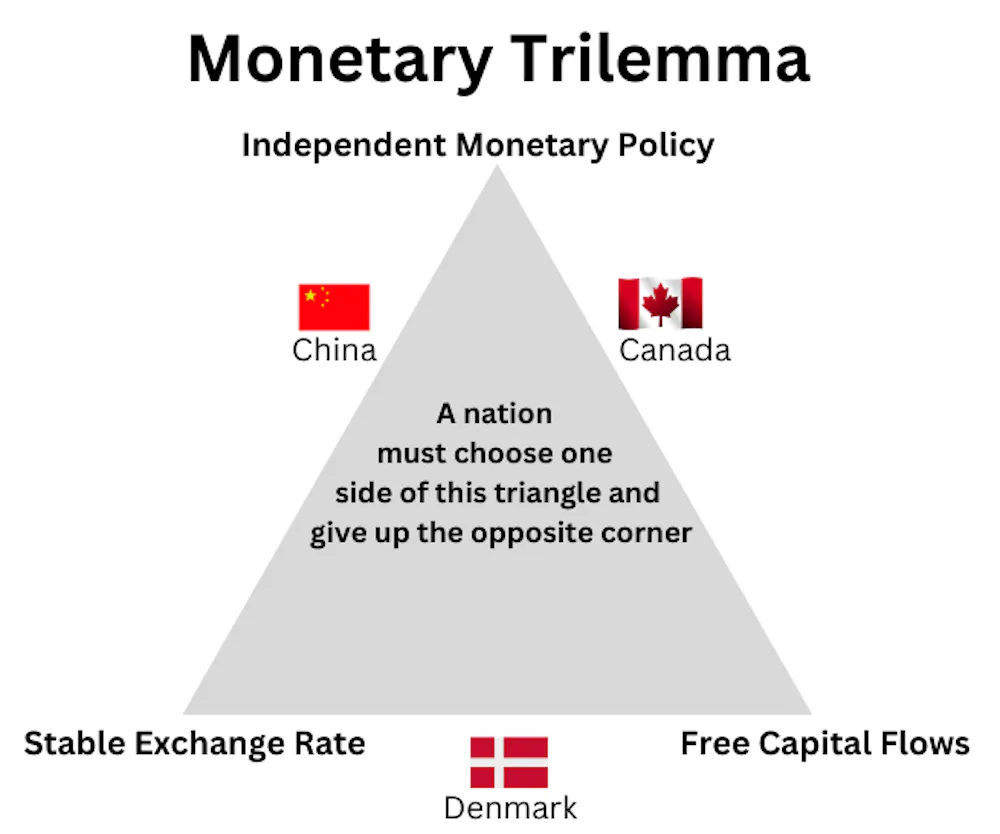
    A country cannot have an independent monetary policy, stable exchange rate and free capital flows simultaneously. It must choose one side of this triangle and give up the opposite corner.
    (Sorin Rizeanu), CC BY-ND

    The Bank of Canada has good reasons to cut the interest rate back to 2.5 to 3.5 per cent, but this could have a significant impact on the loonie.

    Canada is facing two sets of trilemmas: a monetary one for the central bank and a fiscal one for the government. On the monetary side, stable exchange rates, independent monetary policy and financial market openness are three objectives that cannot all be achieved simultaneously. European countries have sacrificed monetary independence in exchange for a strong euro and financial openness.

    It’s impossible for policymakers to pursue all three choices at the same time. For instance, a country spending more without raising taxes has to increase public debt and deficit.
    (Sorin Rizeanu), CC BY-ND

    Canada, in contrast, has opted for free capital mobility and independent monetary policy at the expense of exchange rate stability. This allows the loonie to be determined by market forces, giving the central bank the ability to adjust interest rates while capital moves freely across the border.

    On the fiscal side, the government is grappling with climate change, immigration and wealth inequality. However, there is also strong public resistance to higher taxes, and public debt and deficits are currently at alarming levels.

    If the central banks are at odds

    If the Bank of Canada were to cut interest rates while the Fed doesn’t, the loonie would likely depreciate sharply, forcing a response. Such a divergence happened in June 2024, with the Fed following with a 0.5 per cent cut only in September.

    On such short-term deviations, sterilization is typically implemented to dampen the depreciation of the loonie by acquiring Canadian dollars and selling reserves.

    If the central banks were to remain at odds in the longer term, a decrease in money supply as investors flee would likely cause a decrease in domestic bank lending, which is already under pressure from public and private debt and increased default rates.

    This could decrease longer term interest rates and put additional pressure on the economy through the capital account. If investors believe the central bank is merely delaying the inevitable depreciation of its currency, it could also reinforce carry trade dynamics — an investment strategy where money is borrowed at a low cost in one currency to earn higher returns from investments in another currency.

    The bond market would also react, with notable effects in key economic sectors and asset valuation. Long-term interest rates tend to align more across countries than short-term rates, especially if global factors are influencing real rates or if investors are seeking safer assets.

    While the Bank of Canada can set its policy rate independently of the Fed’s rate, it has less control over the long-term. Long-term rates are tied to exchange rates and reflect expectations for future short-term rates and risk factors. Mortgage rates and corporate borrowing rates would be affected as well.

    Monetary policy can’t be the only answer

    The Bank of Canada’s mandate is to “keep inflation low, stable and predictable.” While this can be fulfilled through rate cuts, diverging from U.S. policy will have widespread effects on the Canadian economy. These impacts will be uneven, with indebted investors and banks likely benefiting while the working class may bear the brunt.

    The Bank of Canada focuses on providing liquidity to the financial sector, often with little regulation or oversight. However, this approach tends to overlook challenges faced by the working class. In 2022, for instance, Bank of Canada Governor Tiff Macklem advised against employers increasing wages to match inflation over concern that a wage-price spiral would occur.

    Even if the central bank wanted to address these issues, it’s limited by the ability to manage multiple outputs with just one instrument. As a result, the central bank should report not only on inflation, but also on the overall trade-offs of rate cuts.

    The Bank of Canada has a vested interest in tampering the effects of a new rate cut, especially since it could trigger a “capital famine” in the long-term and weaken the Canadian dollar. In the short-term, divergences from the U.S. will likely be manageable, but in the longer term, currency depreciation may be unavoidable to keep the economy afloat.

    Monetary policy is vital, but it’s merely the first line of defence against inflation. To truly address Canada’s economic issues, both monetary and fiscal policies need to work together in harmony, with a broader public discussion that goes beyond inflation.

    Sorin Rizeanu does not work for, consult, own shares in or receive funding from any company or organisation that would benefit from this article, and has disclosed no relevant affiliations beyond their academic appointment.

    ref. Bank of Canada’s latest interest rate cut: Monetary policy is not enough to address economic issues on its own – https://theconversation.com/bank-of-canadas-latest-interest-rate-cut-monetary-policy-is-not-enough-to-address-economic-issues-on-its-own-238396

    MIL OSI – Global Reports

  • MIL-OSI USA: Department of Veterans Affairs Implements Rosen’s Bipartisan Law to Strengthen Cybersecurity of Veterans’ Personal Information

    US Senate News:

    Source: United States Senator Jacky Rosen (D-NV)

    Senator Rosen’s Bipartisan Strengthening VA Cybersecurity Act Required the Department to Obtain An Independent Cybersecurity Assessment And Submit A Plan To Congress To Address Cyber Vulnerabilities
    LAS VEGAS, NV – U.S. Senator Jacky Rosen (D-NV) announced that the Department of Veterans Affairs (VA) has implemented her bipartisan law to strengthen the cybersecurity of veterans’ personal information and data. Her Strengthening VA Cybersecurity Act, signed into law in 2022, directed the Secretary to obtain an independent cybersecurity assessment of VA information systems, and submit to Congress the findings and a remediation plan to address the cybersecurity vulnerabilities. Following the recent completion of that assessment, the VA has submitted a detailed plan to Congress on how it will address vulnerabilities.
    “Our veterans rely on the VA to access medical care, benefits, and other critical services, and we must ensure their most personal information is protected from bad actors,” said Senator Rosen. “I worked across party lines to pass bipartisan legislation to protect Nevada veterans’ information, and I’m glad to see that the VA is implementing it by submitting a report to Congress outlining cybersecurity vulnerabilities and their plan to address them. I’ll continue working with the VA to make sure they address these vulnerabilities identified.”
    Senator Rosen has been leading bipartisan efforts to deliver for Nevada’s veterans. Last month, she helped pass bipartisan legislation to allocate billions of dollars for PACT Act benefits. Earlier this year, she helped introduce bipartisan legislation to officially authorize the construction of a new VA hospital in Reno, which followed Senator Rosen’s successful push with Senator Cortez Masto to include the hospital in the President’s 2024 Budget Request. She also introduced bipartisan legislation to permanently maintain a helpline for veterans to obtain information and assistance with VA services, which is included in this year’s Senate version of the National Defense Authorization Act. Senator Rosen secured funding to increase access to affordable housing for veterans, continue building Nevada’s first national veterans cemetery in Elko, and increase funding for veteran’s access to telehealth in the last bipartisan government funding package.

    MIL OSI USA News

  • MIL-OSI Security: River Bennett — Victoria County District RCMP investigates fatal crash in River Bennett

    Source: Royal Canadian Mounted Police

    Victoria County District RCMP is investigating a fatal crash that occurred in River Bennett.

    On October 22, at approximately 6:08 p.m., Victoria County District RCMP and fire services responded to a report of a single-vehicle crash in the 46000 block of the Cabot Trail. RCMP officers learned that a Nissan Frontier had left the roadway and rolled, coming to rest in the ditch.

    The driver and sole occupant of the Frontier, a 22-year-old woman from Englishtown, was located deceased at the scene.

    An RCMP collision reconstructionist attended the scene and the investigation is ongoing. The Cabot Trail was partially closed for several hours but has since fully reopened.

    Our thoughts are with the victim’s loved ones at this difficult time.

    MIL Security OSI

  • MIL-OSI Canada: Manitoba Government Helping More Vulnerable Manitobans Stay Housed

    Source: Government of Canada regional news

    Manitoba Government Helping More Vulnerable Manitobans Stay Housed

    – – –
    New Community-Based Support Services Will Improve Housing Stability for Manitobans with Complex Mental Health Needs: Smith


    The Manitoba government will be helping more Manitobans through a new initiative to ensure individuals with serious, long-term mental health disorders can access comprehensive wraparound supports that help keep them housed, Housing, Addictions and Homelessness Minister Bernadette Smith, minister responsible for mental health, announced today.  

    “Meeting the needs of people living with severe, complex mental health disorders requires a range of programs and services,” said Smith. “This investment will build effective and sustainable services along that continuum of care by providing supports right in the community. We will help vulnerable Manitobans stay out of hospitals and emergency rooms by providing safety and stability in their homes.” 

    The new $4.3-million initiative will establish a co-ordination hub and expand community-based care, adding 22 new mental health workers to Manitoba’s mental health service system, the minister noted.  The investment will enable Shared Health to establish two new interdisciplinary teams that use the Assertive Community Treatment (ACT) model to treat and support up to 300 individuals with severe mental illnesses in community settings.   

    “These new teams fill a major gap in the suite of community-based services in Winnipeg, supporting Manitobans who often have several co-occurring and complex mental health and addiction needs,” said Arlene MacLennan, director of health services for adult outpatient mental health and addictions, Shared Health. “There is strong evidence from other jurisdictions that this flexible, co-ordinated and streamlined approach reduces costly visits to hospitals and emergency departments, and helps individuals manage their mental health and substance use problems so they can increase stability and make improvements in their lives.”  

    ACT is an evidence-based service delivery model that provides comprehensive, community-based mental health and addiction services, crisis intervention, medication management, community integration, peer support and housing support services. Flexible Assertive Community Treatment (FACT) teams also use the ACT approach but can adapt the support provided, based on the individual’s needs and without some of the constraints of individual services, such as the length of time a service may be offered.   

    Shared Health will also pilot a new FACT/ACT Hub to support comprehensive assessments of individuals in the community and in hospital. The investment is a significant first step in building housing with support services while improving access to mental health-care wraparound supports, the minister noted.  

    The hub will also work to standardize ACT services across the province and provide provincial oversight, added Smith. 

    – 30 –

    MIL OSI Canada News

  • MIL-Evening Report: Netflix’s Territory is a Succession-like drama packed with family rivalry and betrayal, set in Australia’s outback

    Source: The Conversation (Au and NZ) – By Alexa Scarlata, Research Fellow, Media & Communication, RMIT University

    Netflix

    The Australian commissioning team at Netflix has had a pretty good run over the past 12 months. In January, the adaptation of Trent Dalton’s novel Boy Swallows Universe proved to be the most successful Australian-made show to that point, scoring 7.6 million views globally in its first two weeks.

    A few months later, the second season of the streamer’s Heartbreak High reboot debuted at number one in Australia, and stayed on the Global Top 10 English TV Series list for three consecutive weeks.

    Will Netflix’s latest Australian series – one without any ties to a familiar book or TV show – be as well received? Luckily for the streamer, its new six-part outback western, Territory, has already been described as “epic”, “unforgettable” and “rollicking TV”.

    Robert Taylor plays patriarch Colin Lawson.
    Netflix

    Premium bush family drama

    The series takes place in the Northern Territory, on the “world’s largest cattle station”. The fictional Marianne Station is about the size of Belgium.

    The once-great dynasty of its owners, the Lawson family, is thrown into doubt when their heir apparent dies in the first episode. The Top End’s most powerful players – billionaire miners, rival cattle barons, desert gangsters and Indigenous elders – immediately start circling.

    While this is an original concept by creators Timothy Lee and Ben Davies, you’d be forgiven for feeling a sense of déjà vu, as Territory has been described as equal parts Succession and Yellowstone. I can imagine Netflix executives running the numbers on the returns from those two hits and saying, “let’s throw some money into this”. And boy, did they.

    The show could double as a sophisticated Tourism Australia ad.
    Netflix

    No expenses spared on hats and helicopters

    Territory was directed by Wolf Creek heavyweight Greg McLean. According to him, it’s the

    biggest South Australian TV production ever. Possibly one of the biggest TV productions in Australia just in terms of the amount of crew (and) the incredible support that we had to put in place to go to the locations we went to.

    As Netflix put it, Bondi Beach this is not. While the interiors were filmed in South Australia, half of the series was filmed in stunning remote locations across the NT.

    As a result, the show looks like the most ambitious and sophisticated Tourism Australia ad you’ve ever seen. The wildlife! The panoramic drone shots! The hat budget! The rest of the world could go from thinking we ride kangaroos to work, to assuming we’ve all got our own helicopters.

    Overseas viewers watching would be forgiven for thinking the lot of us have our own helicopters.
    Netflix

    The show looks as expensive as it sounds, but is still kind of soapy. The irony in this story is that everyone’s dirty, but no one ever sweats.

    Territory was originally announced as “Desert King”. Changing the name was wise. The landscape is, for the most part, pretty lush – and not in a “look at this oasis we’ve stumbled upon” kind of way. I counted one fly.

    Desert queens

    What’s more, while the male characters are brilliant sources of humour and violence, it’s the ladies in Territory that bring the heart.

    Anna Torv leads the series as Emily Lawson. Emily is the wife to the next-in-line but perpetually drunk Graham (Michael Dorman). She’s also the girl from the property next door, belonging to the rival Hodge family – a slightly shifty bunch who’ve been known to steal the Lawson’s cattle.

    Anna Torv plays Emily Lawson with a keen sense of cunning.
    Netflix

    Torv was the perfect choice to embody Emily as the long-suffering wife, disdained daughter-in-law, loving sister and exasperated mother. Her poker face kept me guessing. She may not be a Lawson by blood, but her cunning makes her a great fit in this powerful family.

    Kylah Day plays Sharnie Kennedy, a young kid kicking (and fooling) around with a couple of Top End bandits. It was fun – if a little frustrating – to watch her figure out her loyalties and her limits.

    Finally, Sara Wiseman plays Sandra Kirby, a disgustingly wealthy and ruthless land developer who doubles as the quintessential villain. Sandra plays everyone – even her own son. Her merciless manipulation of aspiring Indigenous cattle baron Nolan Brannock (Clarence Ryan) stings, even as it feels quite heavy-handed.

    Clarence Ryan is impressive in his role as Indigenous station owner Nolan Brannock (left), who gets caught up in the drama.
    Netflix

    Whose land and whose legacy?

    Territory does a great job of establishing a simmering tension between the traditional owners of the land and the families and businesses that have taken possession of it.

    But for a show that’s so centred on the battle for power in the Top End, the plotlines that deal with the issue of dispossession move at a frustratingly slow pace.

    Perhaps this is to cater to a global audience, which will likely lack the context that local viewers have. And maybe, for Australian viewers, the enduring subordination and struggle of the original landowners is the intended takeaway.

    Ultimately, Territory is an ambitious and attractive series. It was wonderful to see so many resources poured into a new concept, filmed and set in a part of Australia that rarely sees the kind of spotlight it deserves.

    Sam Delich and Kylah Day play petty thieves Rich Petrakis and Sharnie Kennedy.
    Netflix

    Territory is streaming on Netflix from today.

    Alexa Scarlata does not work for, consult, own shares in or receive funding from any company or organisation that would benefit from this article, and has disclosed no relevant affiliations beyond their academic appointment.

    ref. Netflix’s Territory is a Succession-like drama packed with family rivalry and betrayal, set in Australia’s outback – https://theconversation.com/netflixs-territory-is-a-succession-like-drama-packed-with-family-rivalry-and-betrayal-set-in-australias-outback-241896

    MIL OSI AnalysisEveningReport.nz

  • MIL-Evening Report: Unemployment’s up, house prices are stagnating. But is the Victorian economy doing as badly as it seems?

    Source: The Conversation (Au and NZ) – By David Hayward, Emeritus Professor of Public Policy, RMIT University

    The early 1990s in Victoria were tough. The economy was contracting severely, the population was shrinking, employment was collapsing and the unemployment rate skyrocketed to the highest in the land.

    A long-term Labor government got the blame for allowing state debt to spiral out of control. Victoria, reckoned a popular joke at the time, was “Australia’s Mexico without the sunshine”.

    Is it happening all over again?

    Some reporting in national media would suggest it is.

    The Australian Financial Review has recently run a series on the state, including a piece last week quoting business leaders saying the Victorian economy was in trouble.

    Reference was made to the latest unemployment figures as supporting evidence. Victoria’s unemployment rate has risen over the last year, and at 4.4% is now the highest in the country. Rising numbers of company failures and stagnant house prices were also cited.

    Earlier in the month, data showing a falling rate of Victorian business start-ups was highlighted, while another Financial Review article examined the decline in the number of conferences. All this was referred to as evidence of a state struggling under the weight of

    $8.6 billion in levies [imposed] in [Labor’s] 2023 budget to curb a mountain of state debt that is forecast to reach $188 billion by 2028.

    The Australian also ran a feature on Victoria echoing the same themes.

    Readers were asked, “What the hell has gone wrong with Victoria?”. Public debt and taxation figured as prominent causes of an economic catastrophe in the making. The Australian deemed the state to be

    at best, trapped in stagnation, forcing it to cover falling private investment and expenditure with ever greater public largesse. And at worst […] as the spending and debt build-up sets off the alarms, a vicious spiral is triggered […] until the whole Ponzi scheme collapses.

    But are things that bad? What does the economic data actually show?

    Some positive signs

    It is true that unemployment in Victoria is rising, and is also high compared to the rest of the country. But it has been stable for the last four months, reflecting the impact of interest rate increases over the previous couple of years.

    Also, looking back over the last 40 years, the increase has been from a very low base, and remains at an historically low level – and a long way off the highs of the 1990s.


    The number of people in the labour force is continuing to grow at a healthy clip. The participation rate is now the highest on record.

    Last month, the labour force increased in seasonally adjusted terms by 20,000, and almost all of these additional people ended up in employment.

    The growth in employment since the end of the pandemic is notable.

    Since January 2023, employment has increased by 268,000, or 8% in seasonally adjusted terms. That’s 37% of the jobs added in the whole of Australia during that time.

    Yes, the share of job growth is falling, but it is still higher than the state’s population share, and it is from an unbelievably high base (55% of all jobs created nationally in July were in Victoria).

    The Australian Financial Review acknowledged that the latest jobs data were indeed “unexpectedly strong”.

    What about business insolvencies?

    Victorian insolvencies are on the rise (up 61% in September compared to the same month last year). But so too are they across Australia, with the national number rising at a higher clip (up 70%).

    What about the number of conferences in Victoria? We simply cannot be sure whether they are up or down, because there is no consistent data base to settle the matter.

    And while Victoria may have fallen behind other states in the number of new startups per 1,000 businesses, the actual number of businesses has increased by more than 31,000, or 3%, since the beginning of the year.

    How are house prices and rents holding up?

    Yes, house prices are tumbling. In real terms, they are around 20% below their pandemic peak, at least partly caused by a bundle of new property taxes introduced in the 2023/24 state budget to help pay for pandemic-related debt.

    But with housing affordability at an all-time low courtesy of high interest rates, that is no bad thing, especially for those keen to buy their first home.

    That fall in house prices stands in contrast to a boom in rents over the same time period.

    Over the last 12 months, median rents in Victoria have increased by 13.3%, and by 4.3% over the last quarter. In the March quarter, the rental stock fell for the first time on record, perhaps supporting those who see an economy in trouble.

    But that fall amounted to barely 10,000 dwellings, or only 2.7% of the stock. Those properties had to be sold to someone, and it is likely many were sold to first time buyers who, in changing tenure, had no net effect on the rental market. A redistribution of wealth like that may be no bad thing.

    Debt is high – but so is infrastructure spending

    There is no doubt the Victorian economy has been slowing, as has the rest of the country. That is exactly the outcome sought by the Reserve Bank when it pushed up interest rates last year.

    But there is little evidence to show Victoria is following the disastrous path of the early 1990s.

    Back then, state debt grew alarmingly because of a savage recession. This time round, state debt has grown strongly, but largely to fund a construction pipeline on a scale the state has not seen before.

    Infrastructure spending is now running close to $25 billion a year, almost five times what it was a decade ago. There’s a lot of jobs in those numbers, and shortly a lot of that infrastructure will come on line, boosting the state’s economic potential.


    There is one other factor driving Victoria’s surprisingly resilient economy. Net international migration increased by 152,000 in the year to March 2024 – almost 30% of the Australian total – driven partly by the return of international students.


    Very fast, migration-driven population growth is not being matched by increased output, and the state’s household income per person is continuing its long-term decline, leading some to argue it has become a “poor state”.

    Treasurer Tim Pallas will hope that the increase stock of debt-funded infrastructure provides the productivity boost sorely needed to turn that around.

    While on several indicators Victoria’s economy is slowing, this largely reflects a national trend. Drilling down into the data shows there are signs of growth, which suggest alarm at this stage is not justified.

    David Hayward does not work for, consult, own shares in or receive funding from any company or organisation that would benefit from this article, and has disclosed no relevant affiliations beyond their academic appointment.

    ref. Unemployment’s up, house prices are stagnating. But is the Victorian economy doing as badly as it seems? – https://theconversation.com/unemployments-up-house-prices-are-stagnating-but-is-the-victorian-economy-doing-as-badly-as-it-seems-241762

    MIL OSI AnalysisEveningReport.nz

  • MIL-Evening Report: If a Year 12 student gets an early offer for uni, does it mean they stop trying?

    Source: The Conversation (Au and NZ) – By Andrew J. Martin, Scientia Professor and Professor of Educational Psychology, UNSW Sydney

    Ground Picture/Shutterstock

    Early entry schemes for university – where students get an offer before their final exams – are increasingly popular.

    For example, more than 27,000 students applied to the Universities Admissions Centre (which mostly deals with New South Wales and Australian Capital Territory unis) for an early offer in 2024. This was a record number and an almost 19% increase on 2023.

    On the one hand, early offers are seen as a way to reduce pressure on Year 12 students. But they are also increasingly criticised, with concerns students may stop trying once they receive an offer.

    Our new research shows applying for an early offer does not make a significant difference to how hard a student tries leading up to their final exams or their final results.

    What are early offers?

    The main round of university offers is in December-January, after students have done their final exams in the previous October and November and have their final results or ATAR.

    With early entry offer schemes, universities assess students using criteria other than (or on top of) final results.

    Amid concerns about students reducing their efforts, in February this year, federal and state education ministers agreed there would be no university offers until September. Federal Education Minister Jason Clare is pushing for a new, national approach to early entry by 2027.

    Year 12 students around Australia sit their final exams in October and November.
    Monkey Business Images/ Shutterstock


    Read more:
    ‘I don’t believe I would have gotten into university’: how early entry schemes help Year 12 students experiencing disadvantage


    Our research

    Our new study investigated the role of early entry offers on Year 12 students’ academic and personal wellbeing.

    We looked at three types of students: students applying for and receiving an early offer, students applying for but not receiving an early offer, and students who did not apply for an early offer.

    We then looked at multiple forms of academic and personal wellbeing, including:

    • the ATAR

    • motivation at school (their interest, energy, and drive to learn) and enjoyment of school

    • how students dealt with academic challenges (also called “academic buoyancy”)

    • study burnout

    • overall life satisfaction, mental health and self-esteem.

    Who did we study?

    The study involved Year 12 students in 2022 from schools in New South Wales.

    The average age for participants was 17, most (68%) were female, the majority (69%) lived in an urban area, just under a quarter (23%) were from a non-English speaking background, and just over half were from government schools (52%).

    We tracked the ATARs of 1,512 students for whom we had early offer data.

    We also surveyed a subset of 525 students from this group. We surveyed them in term 2 of Year 12 and then followed up with a second survey in term 4, about 2 weeks before their final exams.

    The surveys included questions about their academic and personal wellbeing. Both surveys were done online.

    What we found

    In terms of early entry status, 16% did not apply for an early offer, 21% applied but were unsuccessful, and 63% received an early offer.

    Using statistical modelling to control for prior differences in achievement and motivation between the groups, as well as age, gender, school type and learning difficulties, we found an early offer did not appear to have an impact on a student’s ATAR.

    We also found no impact on their motivation, effort, burnout or mental health.

    In fact, the best predictors of students’ final results were their previous results and their efforts earlier in Year 12.

    As our research showed, the findings for these predictors were statistically significant, meaning we can have confidence the results were not due to chance.

    This mirrors other research that suggests you can predict a student’s ATAR from their Year 11 results.

    Students in our study did not stop trying if they had an early offer to uni.
    Jacob Lund/ Shutterstock

    One important difference

    We did find one statistically significant effect. Those receiving an early offer scored about 10% higher in academic buoyancy than the other two groups.

    This means these students reported they were better able to overcome academic challenges, such as difficult assessment tasks and competing deadlines, as they approached their final exams.

    We found this difference even after controlling for any prior group differences in academic buoyancy.

    But we note it was only a relatively small effect.

    Why was there so little difference?

    Some possible explanations about why early offers did not appear to make much difference include:

    • Year 12 is a busy year full of activities (from formals and other events, to plans for life after school). It could be early entry status is quickly absorbed in all the demands of the final year and becomes normalised

    • the joy or relief of an early offer is short-lived and students return to their emotional equilibrium or their typical “set point” in terms of outlook on life

    • the ATAR looms large in students’ lives, so they may still want to do as well as they can – regardless of whether they get an early offer or not.

    What does this mean?

    Our study suggests receiving an early offer for university does not make much of a difference to final outcomes.

    So this suggests students can apply for an early entry offer if they want to.

    But once the application is submitted, they need to return their focus to factors that are influential in final outcomes — such as their learning, motivation, and engagement through Year 12.


    Helen Tam, Kim Paino, Anthony Manny, Mitch Smith and Nicole Swanson from the Universities Admissions Centre helped with the research on which this article is based.

    Andrew J. Martin has received funding from the Australian Research Council, International Boys’ Schools Coalition, NSW Department of Education, and Commonwealth Department of Education.

    ref. If a Year 12 student gets an early offer for uni, does it mean they stop trying? – https://theconversation.com/if-a-year-12-student-gets-an-early-offer-for-uni-does-it-mean-they-stop-trying-241787

    MIL OSI AnalysisEveningReport.nz

  • MIL-Evening Report: Cultural burning isn’t just important to Indigenous culture – it’s essential to Australia’s disaster management

    Source: The Conversation (Au and NZ) – By Bhiamie Williamson, Research Fellow, Monash University

    Toa55/Shutterstock

    Last month, Australia’s newly appointed minister for emergency management, Senator Jenny McAllister, and Senator Tony Sheldon, special envoy for disaster recovery, took part in a cultural burn outside Lismore in New South Wales, as part of the National Gathering on Indigenous Disaster Resilience.

    It was significant to see members of the federal government listening to and taking direction from a cultural burn expert, Oliver Costello of Jagun Alliance, before undertaking a burn.

    Cultural burning is increasingly being used in disaster management. Pictured: Oliver Costello, Senator Jenny McAllister, Bhiamie Williamson and Senator Tony Sheldon at a cultural burn held during the National Gathering.
    Gabrielle Connole, CC BY-NC-ND

    It represented a hopeful sign that cultural burning might be increasingly used as a tool for disaster mitigation. After all, McAllister isn’t the minister for Indigenous affairs or the environment – her role is emergency management. At last month’s meeting, Indigenous peoples spoke of their desire and inherent right to be involved in disaster management.

    Cultural burning is, of course, vitally important to culture. But these gentle, regular burns were one of the main ways Indigenous groups managed land. They created mosaics of burned and unburned land, reducing the chance of megafires by burning fuel loads and creating safe havens in dangerous times.

    Networks of Indigenous groups have begun using fire to once again care for Country all around Australia. These are positive signs. But there is more to do to dismantle remaining barriers to mainstreaming cultural burning – and making it possible to use these ancient techniques to reduce, or avoid, disasters.

    An ancient practice rekindled

    The evidence of Indigenous land management using fire is significant and growing.

    This evidence has emerged through formal truth-telling processes such as Yoorrook, whose commissioners heard about the deliberate suppression of Indigenous land management in Victoria. It has come from ongoing academic research stitching settler accounts of the land and observations of how Indigenous groups used fire. In 1802, for instance, the settler John Murray recorded his amazement at how Boon Wurrung people set and controlled fire in Victoria’s Western Port Bay. The fire, which “must have covered an acre of ground”, was “dous’d […] at once”.

    In Mary Gilmore’s account of 19th-century colonial life in the New South Wales Riverina, she writes:

    As to fire, it was [Indigenous people] who taught our first settlers to get bushes and beat out a conflagration […] Indeed, it was a constant wonder, when I was little, how easily [Indigenous people] would check a fire before it grew too big for close handling or start a return fire when and where it was safest.

    These historical observations are complementary to the work of passing on knowledge of fire to the next generation. Taken together, they reveal a fundamental truth about Australia – it is a land of fire, and Indigenous people are the masters.

    The return of parcels of land to Indigenous groups in recent decades means we can restart these ancient fire regimes, through Indigenous rangers and other organisations.

    The return of ancient practices

    The management of land over deep time by Indigenous groups has meant people and the land effectively co-evolved.

    Since 1788, colonisation and Indigenous dispossession have radically altered many parts of Australia. Land was cleared for farms, cities, roads and infrastructure. Rivers were dammed for irrigation.

    Grasslands and yam fields were converted to livestock farms or cropping. Forested areas in some areas were cleared and in other areas thickly regrew, replacing the park-like mix of grassland and stands of trees produced by Indigenous land management. Thirsty crops such as cotton were planted, siphoning off huge volumes of water from lakes and rivers.

    John Glover’s 1838 painting shows open savannahs and grasslands in the Surrey Hills district of north-west Tasmania. In our time, this area has become temperate rainforest.
    Art Gallery of NSW

    Even the creation of national parks transformed landscapes, as Western practices of more passive management replaced active Indigenous management.

    The suppression of cultural burning brought yet more difficult change to Australia’s plants and animals. Australia now has one of the highest extinction rates of animals in the world. But cultural burning is being applied as a method to help protect vulnerable species, such as the Corroboree Frog.

    Over years, Indigenous groups have worked diligently and strategically to rekindle this ancient practice. But they have also reimagined it. It’s time to ask the question: what would it mean to bring back cultural burning at scale?

    No longer do Indigenous groups apply fire as a normal and everyday rhythm of life, stopping to light small fires as they walk. It’s now much more deliberate, requiring careful planning, creation of fire breaks and management of fire using trucks and heavy machinery.

    Even ignition is done differently. For a ceremony, firesticks will be used, with further lighting done using drip torches. In remote areas, fires are lit from helicopters, making it possible to cover vast areas.

    Combining these ancient and contemporary practices creates something fundamentally new. We require innovative discourses to better describe these developments.

    Indigenous Yika rangers burn using drip torches.
    Rohan Carboon/Indigenous Desert Alliance, CC BY

    New fire season, new hazards

    This fire season is likely to be a dangerous one. The seasonal bushfire outlook released by the Australasian Fire and Emergency Council projects the risk of early fires and a higher-than-usual bushfire risk over vast areas of Australia.

    Large parts of Australia are forecast to have a higher fire risk this spring.
    Australasian Fire and Emergency Council, CC BY-SA

    Recent rainy La Nina years triggered rapid vegetation growth in many areas, increasing the fuel load. Fire authorities are worried about what a forecast hot, dry, windy summer will mean.

    In recent years, Indigenous ranger groups have been undertaking cool burns as much as possible. In arid areas, there are fears of fast-moving grass fires due to the spread of introduced and highly flammable buffel grass.

    As danger from climate change intensifies, making volatile and combustible landscapes safer poses challenges both complex – and urgent.

    Indigenous groups around Australia have begun the work of rekindling cultural burns, but barriers still remain. Responsibility for fire management in state forests, national parks and on private land has long been split between government authorities and landholders. It’s time this disaster management work by Indigenous groups was recognised and magnified by governments.

    To mainstream cultural burning will mean finding ways of sharing the knowledge of when and how to burn, and resourcing Indigenous groups to undertake training and burns. Doing this will not only benefit the land and Indigenous groups, but all Australians.


    Read more:
    Before the colonists came, we burned small and burned often to avoid big fires. It’s time to relearn cultural burning


    Bhiamie Williamson leads the National Indigenous Disaster Resilience Program at Monash University. He is also a Director of the environmental charity Country Needs People.

    ref. Cultural burning isn’t just important to Indigenous culture – it’s essential to Australia’s disaster management – https://theconversation.com/cultural-burning-isnt-just-important-to-indigenous-culture-its-essential-to-australias-disaster-management-241269

    MIL OSI AnalysisEveningReport.nz

  • MIL-Evening Report: Abortion is back in the headlines in Australia. The debates in the United States tell us why

    Source: The Conversation (Au and NZ) – By Prudence Flowers, Senior Lecturer in US History, College of Humanities, Arts, and Social Sciences, Flinders University

    The 2022 news that the US Supreme Court had overturned Roe v Wade and ended the constitutional right to abortion sent shockwaves around the world.

    For Australian opponents of abortion who had long looked to the US for leadership and inspiration, it prompted rejoicing.

    As a leader of Cherish Life Queensland put it, “if the USA can do it, with God’s help, so can we”.

    In late 2024, the abortion issue has suddenly erupted in Queensland and South Australia. A subset of local conservatives, energised by the fall of Roe v Wade and the example of Donald Trump, are embracing the divisive “culture war” tactics that dominate US politics.

    Abortion and Australian politics in 2024

    In the 2020 Queensland election, the Liberal National Party (LNP) has promised a “review” of the legislation that had decriminalised abortion two years prior. However, the party has spent most of the 2024 campaign studiously avoiding the issue.

    That is, until Robbie Katter MP, of Katter’s Australia Party, threw a spanner in the works.

    On October 8, Katter announced that if the LNP won, as was widely predicted, he would immediately introduce a private member’s bill to repeal the state abortion law.

    LNP leader David Crisafulli, who voted against decriminalisation, insists that changing the law is “not part of our plan”.

    However, last week Crisafulli was asked 132 times about abortion and the issue of conscience votes and refused to provide a clear answer.

    In the final leaders’ debate on Tuesday night, Crisafulli finally said there would be no change to abortion law and he was “pro-choice”.

    However, that is unlikely to be the end of the issue – opposition to abortion runs deep in the LNP.

    Party policy in 2018 was that abortion should remain a criminal offence. Despite being a conscience vote, the three LNP members who voted for decriminalisation were threatened with “punishment” afterwards.

    In 2024, several new antiabortion candidates are running for the LNP. Former Liberal senator Amanda Stoker is a particularly high-profile one, having repeatedly addressed the Brisbane March for Life rally.

    The furore over the future of reproductive rights in Queensland occurred in parallel with controversy over anti-abortion legislation introduced by state Liberal MP Ben Hood in South Australia.

    His bill required anyone needing to end a pregnancy after 28 weeks to have labour induced and for the baby to be delivered alive, regardless of the health outcomes for the pregnant person or infant.

    Peak medical and legal bodies condemned the bill, which critics described as a “forced birth” measure. It was narrowly defeated in the upper house on October 16.

    Federally, Senator Jacinta Price has also called for abortion to be back on the “national agenda” and condemned abortion after the first 12 weeks of pregnancy. Her stance is out of step with abortion law in all Australian jurisdictions.


    Read more:
    Abortion is now legal across Australia – but it’s still hard to access. Doctors are both the problem and the solution


    Public and party opinion

    This sudden uptick in anti-abortion politics does not reflect Australian attitudes.

    A 2024 poll found 75% of Queenslanders agreed that decriminalising abortion had been the right action.

    This view was shared across partisan and geographical lines, held by 73% of LNP voters and 78% of regional Queenslanders.

    Historian Cassandra Byrnes demonstrates that these pro-choice attitudes have deep roots. A majority of the public opposed the police raids on abortion clinics that occurred under Nationals premier Sir Joh Bjelke-Petersen.

    A 2020 poll of South Australians found 80% supported decriminalisation. And 63% considered that later abortion should be available “when the woman and her healthcare team decide it is necessary”.

    The LNP’s hostility towards decriminalisation was also markedly different from the approach in other states.

    Notably, in both New South Wales and South Australia, prominent Liberals, including premiers, voted to decriminalise abortion.

    In South Australia, two senior Liberals, Minister for Human Services Michelle Lensink and Attorney-General Vickie Chapman, led the cross-party group that achieved law reform.

    Importing the culture wars

    When Australian states and territories debated decriminalisation, anti-abortion opponents relied heavily on tactics, pseudoscientific evidence and outright misinformation that first emerged in the United States.


    Read more:
    How the US right-to-life movement is influencing the abortion debate in Australia


    For example, in 2008, one Victorian group controversially distributed graphic photographs of aborted fetuses, and American diagrams and descriptions of later abortion procedures.

    Now, as Australian conservatives seek to reopen the debate over abortion, American influence underpins the rhetoric and framing.

    For decades, opponents of abortion in the United States focused on chipping away abortion rights and eroding access. They never accepted that abortion was health care.

    Since 1995, their central focus was also on the statistically rare abortions performed after 20 weeks gestation. This focus has been imported wholesale into Australia.

    The anti-abortion activism surrounding Hood’s bill reflects these approaches. Opponents of abortions waged a broad and stigmatising campaign against abortion after 22 weeks and six days, the legal point in South Australia after which two medical practitioners must approve an abortion.

    Hood’s bill is best interpreted as an anti-abortion “messaging” exercise rather than a genuine attempt to amend the law.

    For decades, this was the default tactic motivating Republicans when they introduced extreme, unenforceable bills. The purpose was not legislative change but to amplify their rhetoric and arguments and energise conservative voters.

    Opposition to abortion is also part of a broader rightward shift taking place among some state Liberal branches.

    In South Australia, conservatives launched a power grab after abortion was decriminalised in 2021. This included a significant recruitment drive among Pentecostals.

    A similar recruiting focus on conservative religious faith groups has also occurred in Victoria, triggered by LGBTQI+ victories.

    In South Australia, the party takeover is openly led by Senator Alex Antic. He made a name for himself through his hostility to COVID-19 vaccines and his opposition to trans and abortion rights.

    Antic praises Trump and seeks out connections with conservatives who are or have been close to him, including Steven Bannon and Donald Trump junior.

    Meanwhile, in Queensland, Crisafulli’s desperate efforts not to be pinned down on abortion offer a local version of themes in the 2024 presidential election.

    Because Republicans have experienced significant voter backlash over abortion, Trump has charted an uneasy course.

    Trump claims sole responsibility for the end of Roe v Wade while simultaneously denying any connection to the abortion bans now in place in many states.

    Like Crisafulli, Trump has been unclear about what his victory would mean for reproductive rights.

    Political commentator Mark Kenny concludes that an “ideological battle” is unfolding among Australian Liberals.

    As in the United States, unwavering hostility to abortion is proving central to these politicians as a way to signify their priorities to voters and define themselves against others in their party.

    Prudence Flowers has received funding from the South Australian Department of Human Services. She is a member of the South Australian Abortion Action Coalition.

    ref. Abortion is back in the headlines in Australia. The debates in the United States tell us why – https://theconversation.com/abortion-is-back-in-the-headlines-in-australia-the-debates-in-the-united-states-tell-us-why-241778

    MIL OSI AnalysisEveningReport.nz

  • MIL-OSI Australia: Bolstering Food Security in Africa

    Source: Australian Government – Minister of Foreign Affairs

    The Australian Government is bolstering Africa’s ability to withstand the escalating impacts of climate change and combatting food insecurity through a new Africa-Australia Partnership for Climate Responsive Agriculture.

    To be announced at the Commonwealth Heads of Government Meeting where climate change is a major focus, the Partnership will use Australian expertise to support the climate resilience of farming communities in Africa. 

    Delivered by the Australian Centre for International Agricultural Research (ACIAR) over a six-year period, the first year of $11.9 million in funding will contribute to the development of new bilateral research projects and training programs, in close collaboration with local partners. 

    ACIAR is already supporting impactful research in Eastern and Southern Africa, including the improvement of sustainable crop and livestock systems, and forest management practices as well as plant biosecurity to stimulate commercial options for smallholder farmers.

    The Partnership will allow ACIAR to expand its operations into Northern and Western Africa, as well as deliver capacity development and innovative partnerships across the continent.

    Quotes attributable to Minister for Foreign Affairs, Senator the Hon Penny Wong: 

    “Through innovative partnerships and Australian know-how, we are helping build a future where communities are fed, economies are stronger and the environment is protected. It’s about securing a better, more resilient future for all.

    “This initiative will help address food insecurity in regions most exposed to climate change’s devastating impacts.

    “It is another example of the Albanese Government’s commitment to helping our partners across the world in the fight against climate change and our work to shape the world for the better.”

    Quotes attributable to Minister for International Development, the Hon Pat Conroy MP:

    “Investing in Africa’s food security through climate-responsive agriculture is also an investment in Australian farmers and those throughout our region who are facing similar climate impacts.

    “This will help secure lives and livelihoods for decades to come.”

    Quotes attributable to Assistant Minister for Foreign Affairs, the Hon Tim Watts MP: 

    “Australia is a trusted partner in agricultural innovation and this Partnership will further deepen our economic and research ties with Africa.

    “By sharing expertise and resources with African nations, we are helping to build resilient communities that can withstand the interconnected challenges of food security and climate change.”

    MIL OSI News

  • MIL-OSI Australia: UPDATE: Fatal crash at Meadows

    Source: South Australia Police

    A woman has died following a crash at Meadows yesterday.

    Just after 3.30 pm, Wednesday 23 October, emergency services were called to Dashwood Gully Road after reports of a crash between a Suzuki sedan and Hyundai sedan.

    The 76-year-old driver of the Suzuki was taken to hospital for treatment of life-threatening injuries but sadly, she died yesterday (Wednesday 23 October).

    The 68-year-old driver of the Hyundai was taken to hospital with minor injuries.

    Dashwood Gully Road was closed between Brookman Road and Ellis Road for a period of time however has since re-opened.

    Major Crash Investigators attended the scene to investigate the circumstances surrounding the crash.

    The woman’s death is the 70th life lost on SA roads.

    MIL OSI News

  • MIL-OSI: Greenway Technologies Announces Gas to Hydrogen System H-Reformer®

    Source: GlobeNewswire (MIL-OSI)

    ARLINGTON, Texas, Oct. 23, 2024 (GLOBE NEWSWIRE) — Greenway Technologies, Inc. (OTC: GWTI), (“Greenway”), is an advanced gas-to-liquids (“GTL”) and gas-to-hydrogen (“GTH”) technology development company. Greenway has developed and marketed a patented system, the G-Reformer®, that converts natural gas (methane) from various sources to a mixture of hydrogen and carbon monoxide (syngas). Continued ongoing research has developed a new version of the G-Reformer®, named the “H-Reformer®,” which converts natural gas to hydrogen and carbon dioxide. The H-Reformer® system is modular and small enough to be deployed in areas close to consumption, eliminating the cost of compressing and transporting the resultant hydrogen while separating and removing created carbon dioxide.

    Two significant changes have been made to the original G-Reformer® to make a reforming system focused on hydrogen creation rather than syngas creation. First, enhancements to the controlling software have modified the G-Reformer® to convert approximately 50% of the created carbon monoxide to carbon dioxide while also producing additional hydrogen. The H-Reformer® also includes an extension to the reforming vessel used in the G-Reformer®. This module will house the physical components needed to convert the remaining carbon monoxide to hydrogen and carbon dioxide within the reforming unit. The result is the generation of considerably more hydrogen per unit of natural gas input than the original G-Reformer® produces and high conversion of carbon monoxide to carbon dioxide. Carbon dioxide is externally separated from resultant hydrogen by commercially available processes, yielding highly pure hydrogen and liquid carbon dioxide, which will be removed, sold, or sequestered. This new reforming system is named the H-Reformer®.

    Created hydrogen will be available for use at the point of manufacture. Hydrogen compression or liquefaction costs are also eliminated for applications that do not need compressed hydrogen (e.g., electrical power generation). In cases where compressed hydrogen is required, the hydrogen can undergo the compression process at the consumption site while eliminating hydrogen transportation.

    Unlike other natural gas-to-hydrogen technologies, the Greenway reforming process does not require external heating sources, resulting in a highly efficient and lower carbon-generating process. When pipeline-quality fossil natural gas is the input, the system will make “blue hydrogen.” When renewable pipeline-quality methane is the input, the system will make “green hydrogen.” These distinctions are important for associated clean air credits, which depend on the input natural gas source and the resultant carbon’s disposition.

    The Greenway system is modular and can be scaled by adding additional H-Reformer® modules. The system produces hydrogen at an extremely low cost per unit compared to other technologies.

    Currently, Greenway is in discussions with several prospective parties interested in creating hydrogen for various potential uses.

    Notice Regarding Forward-Looking Statements:

    This news release contains “forward-looking statements,” as that term is defined in Section 27A of the United States Securities Act of 1933 and Section 21E of the Securities Exchange Act of 1934. Statements in this news release which are not purely historical are forward-looking statements and include any statements regarding beliefs, plans, expectations or intentions regarding the future. Such forward-looking statements include, among other things, the ongoing effects of the pandemic on delays and orders regarding Greenway’s proprietary gas-to-liquids system, potential business developments and future interest in our clean fuel technologies.

    Actual results could differ from those projected in any forward-looking statements due to numerous factors. Such factors include, among others, general economic and political conditions, the continuation of the JV withThe University of Texas at Arlington, and the ongoing impact of the pandemic. These forward-looking statements are made as of the date of this news release, and we assume no obligation to update the forward-looking statements, or to update the reasons why actual results could differ from those projected in the forward-looking statements. Although we believe that the beliefs, plans, expectations and intentions contained in this news release are reasonable, there can be no assurance that such beliefs, plans, expectations or intentions will prove to be accurate. Investors should consult all the information set forth herein and should also refer to the risk factors disclosure outlined in our annual report on Form 10-K for the most recent fiscal year, our quarterly reports on Form 10-Q and other periodic reports filed from time-to-time with the Securities and Exchange Commission.

    CONTACT:
    Robert Kevin Jones
    Greenway Technologies, Inc.
    kevin.jones@gwtechinc.com

    For more information, visit GWTI’s website: www.gwtechinc.com

    The MIL Network

  • MIL-OSI Europe: JOINT MOTION FOR A RESOLUTION on the misinterpretation of UN resolution 2758 by the People’s Republic of China and its continuous military provocations around Taiwan – RC-B10-0134/2024

    Source: European Parliament

    Michael Gahler, Miriam Lexmann, Sebastião Bugalho, Rasa Juknevičienė, Danuše Nerudová
    on behalf of the PPE Group
    Yannis Maniatis, Kathleen Van Brempt, Tonino Picula
    on behalf of the S&D Group
    Joachim Stanisław Brudziński, Adam Bielan, Mariusz Kamiński, Charlie Weimers, Michał Dworczyk, Alexandr Vondra, Veronika Vrecionová, Ondřej Krutílek, Rihards Kols, Maciej Wąsik, Sebastian Tynkkynen, Alberico Gambino, Bert‑Jan Ruissen, Carlo Fidanza
    on behalf of the ECR Group
    Engin Eroglu, Petras Auštrevičius, Helmut Brandstätter, Dan Barna, Veronika Cifrová Ostrihoňová, João Cotrim De Figueiredo, Bernard Guetta, Svenja Hahn, Ľubica Karvašová, Karin Karlsbro, Moritz Körner, Nathalie Loiseau, Jan‑Christoph Oetjen, Ana Vasconcelos, Dainius Žalimas
    on behalf of the Renew Group
    Markéta Gregorová
    on behalf of the Verts/ALE Group

    European Parliament resolution on the misinterpretation of UN resolution 2758 by the People’s Republic of China and its continuous military provocations around Taiwan

    (2024/2891(RSP))

    The European Parliament,

     having regard to its previous resolutions on the People’s Republic of China (PRC) and Taiwan,

     having regard to its resolution of 16 September 2021 on a new EU-China strategy[1],

     having regard to its recommendation of 21 October 2021 to the Vice-President of the Commission / High Representative of the Union for Foreign Affairs and Security Policy on EU-Taiwan political relations and cooperation[2],

     having regard to its resolution of 7 June 2022 on the EU and the security challenges in the Indo-Pacific[3],

     having regard to its resolution of 15 September 2022 on the situation in the Strait of Taiwan[4],

     having regard to its resolution of 13 December 2023 on EU-Taiwan trade and investment relations[5],

     having regard to the Strategic Compass for Security and Defence, approved by the Council on 21 March 2022,

     having regard to the joint communication from the Commission and the High Representative of the Union for Foreign Affairs and Security Policy of 16 September 2021 entitled ‘The EU strategy for cooperation in the Indo-Pacific’ (JOIN(2021)0024),

     having regard to the EU’s ‘One China’ policy,

     having regard to the EU-China summit of 7 December 2023,

     having regard to the European Council conclusions on China of 30 June 2023,

     having regard to the visits of the Committee on Foreign Affairs of 25 to 27 July 2023 and of the Committee on International Trade of 19 to 21 December 2022 to Taiwan,

     having regard to the statement of 1 September 2024 by the Spokesperson of the High Representative of the Union for Foreign Affairs and Security Policy on the latest dangerous actions in the South China Sea,

     having regard to the statements by the Spokesperson of the High Representative of the Union for Foreign Affairs and Security Policy on China’s military drills around Taiwan, including the most recent statement of 14 October 2024,

     having regard to the G7 Foreign Ministers’ statements of 18 April 2023 and of 3 August 2022 on preserving peace and stability across the Taiwan Strait,

     having regard to the statement by the Chair of the G7 Foreign Ministers’ Meeting of 23 September 2024,

     having regard to the joint declaration by the G7 Defence Ministers of 19 October 2024,

     having regard to the urgency motion on Taiwan passed by the Australian Senate on 21 August 2024,

     having regard to UN General Assembly Resolution 2758 (XXVI) of 25 October 1971,

     having regard to the motion on UN Resolution 2758 passed by the Dutch House of Representatives on 12 September 2024,

     having regard to the press statement by the US Department of State of 13 October 2024,

     having regard to the UN Convention on the Law of the Sea (UNCLOS),

     having regard to Article 7 of the UN Framework Convention on Climate Change (UNFCCC), concluded on 9 May 1992,

     having regard to Rule 5 of the Standing Rules of Procedure of the Assembly of the International Civil Aviation Organization (ICAO),

     having regard to Article 4 of the Constitution of the International Criminal Police Organization (Interpol),

     having regard to Article 8 and Article 18(h) of the Constitution of the World Health Organization (WHO),

     having regard to Rules 136(2) and (4) of its Rules of Procedure,

    A. whereas UN Resolution 2758 was passed by the UN General Assembly on 25 October 1971 and shifted the official recognition from the Republic of China (Taiwan) to the People’s Republic of China (PRC); whereas today Taiwan, while not being a member of the United Nations, maintains diplomatic relations with 11 of the 193 United Nations member states, as well as with the Holy See;

    B. whereas the EU and Taiwan are like-minded partners that share the common values of freedom, democracy, human rights and the rule of law; whereas Taiwan is a vibrant democracy, with a flourishing civil society; whereas Taiwan held peaceful and well-organised elections on 13 January 2024;

    C. whereas following the adoption of UN Resolution 2758, Taiwan lost its access to participation in multilateral forums, such as the WHO;

    D. whereas Taiwan has never been part of the PRC; whereas the Republic of China was established in 1912 and the PRC in 1949;

    E. whereas UN Resolution 2758 addresses the status of the PRC, but does not determine that the PRC enjoys sovereignty over Taiwan, nor does it make any judgement on the future inclusion of Taiwan in the UN or any other international organisation; whereas, however, the PRC continues to misinterpret UN Resolution 2758 to block Taiwan’s meaningful participation in international organisations and unilaterally change the status quo; whereas these actions highlight the PRC’s ambition to alter the existing multilateral international order and undermine international law, and can be seen as an expression of systemic rivalry;

    F. whereas the EU continues to maintain its own ‘One China’ policy, which is different from the PRC’s ‘One China’ principle; whereas the EU’s long-standing position has been to support the status quo and a peaceful resolution of differences across the Taiwan Strait, while encouraging dialogue and constructive engagement;

    G. whereas through their statement of 23 September 2024 the G7 members, among other things, underlined their support for ‘Taiwan’s meaningful participation in international organizations as a member where statehood is not a prerequisite and as an observer or guest where it is’;

    H. whereas supporting Taiwan’s participation in international organisations does not undermine the EU’s commitment to its ‘One China’ policy, which remains the political foundation of EU-China relations;

    I. whereas over the past decade the PRC has persistently tried to increase its influence over international institutions, using this to sideline Taiwan and prevent Taiwanese passport holders, including journalists, non-governmental organisation workers and political activists, from accessing international institutions; whereas the PRC exercises transnational repression by misusing extradition treaties to target Taiwanese people abroad and therefore put them at risk of arbitrary persecution and human rights abuses;

    J. whereas the statutes of most international organisations tasked to address global issues, including the WHO, the UNFCCC, Interpol and the ICAO, provide opportunities for entities such as Taiwan to participate without infringing on the rights of member states;

    K. whereas Taiwan has consistently demonstrated a peaceful and cooperative attitude globally, has significantly enhanced global developments and thus could contribute greatly to the work of various international organisations;

    L. whereas the PRC is a one-party state that is entirely controlled and ruled by the Chinese Communist Party;

    M. whereas in a speech on Taiwan’s national day of 10 October 2024, Taiwan’s President Lai Ching-te stated that the PRC has ‘no right to represent Taiwan’ and reiterated that the two sides are ‘not subordinate’ to each other; whereas the PRC has justified its recent military exercise by claiming that President Lai Ching-te is pursuing a separatist strategy;

    N. whereas on 14 October 2024 the PRC launched a large-scale military drill, named Joint Sword-2024B, that simulated a blockade of Taiwan; whereas during this exercise a record number of 153 PRC aircraft,18 warships and 17 PRC coastguard ships were detected around Taiwan;

    O. whereas during the exercises four formations of the PRC coastguard patrolled the island and briefly entered its restricted waters; whereas the very frequent deployment of the coastguard by the PRC in the Strait in what the PRC considers ‘law enforcement’ missions is putting constant pressure on the Taiwanese authorities and causing a dangerous increase in the risk of collisions, in what is one of the most concrete indications of the PRC’s intention to erode the status quo; whereas the exercises launched on 14 October 2024 were the fourth round of large-scale war games by the PRC in just over two years;

    P. whereas these activities were condemned by Taiwan as an ‘unreasonable provocation’ and are the latest in a series of war games conducted by the PRC against Taiwan; whereas these military drills came days after Lai Ching-te, Taiwan’s new president, gave a speech vowing to protect Taiwan’s sovereignty in the face of challenges from the PRC;

    Q. whereas the median line, which was set up in a decades-old tacit agreement between both sides of the Taiwan Strait, was designed to reduce the risk of conflict by keeping the military aircraft from both sides of the Strait at a safe distance and thus prevent fatal miscalculations; whereas the PRC’s People’s Liberation Army violated the median line only four times between 1954 and 2020, but now routine incursions reflect Beijing’s intent to irreversibly reset long-standing benchmarks;

    R. whereas the press statements by the High Representative of the Union for Foreign Affairs and Security Policy and the US Department of State reaffirm that peace and stability in the Taiwan Strait are of strategic importance for regional and global security and prosperity; whereas the High Representative’s statement recalls the need to preserve the status quo in the Taiwan Strait, opposes any unilateral actions that change the status quo by force or coercion and calls on all parties to exercise restraint and avoid any actions that may further escalate cross-Strait tensions;

    S. whereas on 23 May 2024 the PRC launched a military drill called Joint Sword-2024A, just days after the inauguration of Lai Ching-te as the new President of Taiwan;

    T. whereas over the past few years the PRC has held similar military drills around Taiwan; whereas these military drills have increased in intensity and have been moved closer and closer to Taiwan’s mainland; whereas during a previous drill in August 2022 the PRC also fired missiles into Japan’s exclusive economic zone;

    U. whereas on top of military pressure the PRC has long been pursuing a sophisticated strategy of targeting Taiwan with foreign information manipulation and interference (FIMI), including hybrid and cyberattacks with the goal of undermining Taiwan’s democratic society;

    V. whereas the PRC, under the leadership of Xi Jinping, has said that it will not renounce the use of force to seek unification with Taiwan;

    W. whereas the PRC’s 2005 Anti-Secession Law includes the use of non-peaceful means, triggered by ambiguous thresholds, to achieve what the PRC calls ‘unification’ with Taiwan; whereas such military action is a grave threat to the security and stability of the entire region, with potentially dire global consequences; whereas EU and US deterrence is of strategic importance to dissuade the PRC from undertaking any unilateral action against Taiwan;

    X. whereas the PRC’s increasingly aggressive behaviour, in particular in its own neighbourhood, such as the Taiwan Strait and the South China Sea, poses a risk to regional and global security; whereas since 2019 the PRC has violated the Taiwanese air defence identification zone (ADIZ) with increasing regularity; whereas the PRC has been behaving aggressively across vast areas of the Indo-Pacific and exerting varying degrees of military or economic coercion, which has led to disputes with neighbours such as Japan, India, the Philippines and Australia;

    Y. whereas the EU has condemned the dangerous actions conducted by Chinese coastguard vessels against lawful Philippine maritime operations in the South China Sea on 31 August 2024; whereas this incident is the latest in a series of actions endangering the safety of life at sea and violating the right to freedom of navigation and overflight in compliance with international law; whereas maritime security and freedom of navigation must be ensured in accordance with international law and, in particular, UNCLOS;

    Z. whereas the PRC is supporting Russia’s war of aggression against Ukraine, in particular through the export of dual-use goods to Russia and the ongoing involvement of PRC-based companies in sanctions evasion and circumvention;

    AA. whereas as a permanent member of the UN Security Council, the PRC has a responsibility to work for peace and stability in the region, and particularly in the Taiwan Strait;

    AB. whereas through its 2021 strategy for cooperation in the Indo-Pacific, the EU and its Member States increased their presence in the region, including through a higher military presence of certain Member States and the continued passage of military ships through the Taiwan Strait;

    AC. whereas Taiwan is located in a strategic position in terms of trade, notably in high-tech supply chains; whereas the Taiwan Strait is the primary route for ships travelling from China, Japan, South Korea and Taiwan towards Europe; whereas Taiwan dominates semiconductor manufacturing markets, as its producers manufacture around 50 % of the world’s semiconductor output; whereas the EU’s strategy for cooperation in the Indo-Pacific argues for increasing trade and investment cooperation with Taiwan;

    AD. whereas the EU is Taiwan’s fourth largest trading partner after the PRC, the United States and Japan; whereas in 2022 Taiwan was the EU’s 12th largest trading partner; whereas the EU is the largest source of foreign direct investment in Taiwan; whereas Taiwanese investments in the EU remain below their potential;

    AE. whereas members of the Australian Senate and of the Dutch House of Representatives have recently adopted motions concerning the distortion of UN Resolution 2758 by the PRC and called for support for Taiwan’s greater participation in multilateral organisations;

    1. Reiterates that Taiwan is a key EU partner and a like-minded democratic friend in the Indo-Pacific region; commends Taiwan and the Taiwanese people for their strong democracy and vibrant civil society, demonstrated once more by the peaceful and well-organised elections of 13 January 2024;

    2. Opposes the PRC’s constant distortion of UN Resolution 2758 and its efforts to block Taiwan’s participation in multilateral organisations; calls for the EU and its Member States to support Taiwan’s meaningful participation in relevant international organisations such as the WHO, the ICAO, Interpol and the UNFCCC; further calls on the UN Secretariat to grant Taiwanese nationals and journalists the right to access UN premises for visits, meetings and newsgathering activities;

    3. Strongly condemns the PRC’s unwarranted military exercises of 14 October 2024, its continued military provocations against Taiwan and its continued military build-up, which is changing the balance of power in the Indo-Pacific, and reiterates its firm rejection of any unilateral change to the status quo in the Taiwan Strait; lauds the restraint and disciplined reaction of the Taiwanese authorities and calls for regular exchanges between the EU and its Taiwanese counterparts on relevant security issues;

    4. Reaffirms its strong commitment to the status quo in the Taiwan Strait; underlines that any attempt to unilaterally change the status quo in the Taiwan Strait, particularly by means of force or coercion, will not be accepted and will be met with a decisive and firm reaction;

    5. Underlines that UN Resolution 2758 takes no position on Taiwan; strongly rejects and refutes the PRC’s attempts to distort history and international rules;

    6. Reiterates the EU’s commitment to its ‘One China’ policy as the political foundation of EU-China relations; recalls that the EU’s China strategy emphasises that constructive cross-strait relations are part of promoting peace and security in the whole Asia-Pacific region and that the EU supports initiatives aimed at dialogue and confidence-building;

    7. Underlines that in Taiwan it is up to the people to democratically decide how they want to live and that the status quo in the Taiwan Strait must not be unilaterally changed by the use or threat of force;

    8. Reiterates its strong condemnation of statements by Chinese President Xi Jinping that the PRC will never renounce the right to use force with respect to Taiwan; underlines that the PRC’s use of force or threats or other highly coercive measures to achieve unification is incompatible with international law; expresses grave concern over the PRC’s use of hostile disinformation to undermine trust in Taiwan’s democracy and governance; reiterates its previous calls for the EU and its Member States to cooperate with international partners in helping to sustain democracy in Taiwan, keeping it free from foreign interference and threats; underlines that only Taiwan’s democratically elected government can represent the Taiwanese people on the international stage;

    9. Condemns the PRC’s systematic grey-zone military actions, including cyber and disinformation campaigns against Taiwan, and urges the PRC to halt these activities immediately; calls, in this regard, for cooperation between the EU and Taiwan to be deepened further to enhance structural cooperation on countering disinformation and foreign interference; welcomes the posting of a liaison officer at the European Economic and Trade Office in Taiwan to coordinate joint efforts to tackle disinformation and interference as a first important step towards deeper EU-Taiwan cooperation, and calls for the EU to further deepen cooperation with Taiwan in this key area; praises the courage of the Taiwanese people and the proportionate and dignified reactions of the Taiwanese authorities and institutions in the face of intensifying Chinese threats and activities;

    10. Firmly rejects the PRC’s economic coercion against Taiwan and other countries, as well as against EU Member States, and underlines that such practices are not only illegal under World Trade Organization rules, but that they also have a devastating effect on the PRC’s reputation around the world and will lead to a further loss of trust in the PRC as a responsible actor; stresses the independent right of the EU and its Member States to develop relations with Taiwan in line with their interests and shared values of democracy and human rights without foreign interference; calls on EU and Member State missions abroad to address and provide alternatives to malign PRC business practices, especially in the Global South;

    11. Is very concerned at the adoption of the so-called guidelines for punishing ‘diehard Taiwan independence separatists’ for committing crimes of secession and the incitement of secession jointly announced by the Supreme People’s Court, the Supreme People’s Procuratorate, the ministries for public security and state security and the justice ministry in June 2024, which could lead to harsh punishments for the crime of secession, up to and including the death penalty; strongly condemns the sentencing of one Taiwanese activist to nine years in prison in September 2024 after his arrest in the PRC in 2022, as well as the constant harassment of Taiwanese people working and living in the PRC;

    12. Is seriously concerned about the situation in the East and South China Seas; recalls the importance of respecting international law, including UNCLOS and, in particular, its provisions on the obligation to settle disputes by peaceful means and on maintaining the freedom of navigation and overflight; calls on all countries that have not done so to swiftly ratify UNCLOS; calls for the EU and its Member States to step up their own maritime capacities in the region; reminds the PRC of its responsibilities, as a permanent member of the UN Security Council, to uphold international law and emphasises the obligation to resolve disputes peacefully;

    13. Reaffirms its grave concerns about China’s increasing military investments and capabilities; expresses grave concerns about the renewed Chinese and Russian commitment to further strengthen their military ties and condemns the Chinese supply of components and equipment to Moscow’s military industry; welcomes the Council decision to impose sanctions on Chinese companies for supporting Russia’s war against Ukraine; deplores the ‘no limits’ partnership between Russia and the PRC; welcomes the increasing commitment and military presence of the United States in the Indo-Pacific; reiterates its calls for a coordinated approach to deepening EU-US cooperation on security matters, including through transatlantic parliamentary dialogue;

    14. Strongly welcomes the close cooperation and alignment of Taiwan with the EU and the United States in responding to Russia’s war against Ukraine and issuing sanctions in response to this blatant violation of international law; recalls Taiwan’s help in addressing the humanitarian crisis caused by Russia’s war of aggression against Ukraine and its continuous involvement and support for the Ukrainian government and countries hosting Ukrainian refugees;

    15. Highlights that the PRC’s various actions in the field of cognitive and legal warfare are slowly undermining the status quo, as well as intensifying grey-zone activities that are intended to circumvent detection, existing laws and response thresholds; calls for the EU to establish and enforce its redlines through its toolbox of sanctions, including sectoral sanctions, against hybrid activities and cyberthreats, and to coordinate strong diplomatic and economic deterrence measures with liked-minded partners;

    16. Expresses its gratitude for Taiwan’s help and assistance during the COVID-19 pandemic;

    17. Recognises the importance of Taiwan in securing global supply chains, especially in the high-tech sector where Taiwan is the leading producer of semiconductors, and calls for the EU and its Member States to engage in closer cooperation with Taiwan;

    18. Calls on the Commission to launch, without delay, preparatory measures for negotiations on a bilateral investment agreement, or other kinds of agreement, with Taiwan; highlights the potential for cooperation on foreign direct investment screening policy and on tackling economic coercion and retaliation;

    19. Applauds the increase in freedom of navigation exercises conducted by several EU countries, including France, the Netherlands and Germany; notes that these activities are in line with international law and calls for more cooperation and coordination with regional partners in order to increase freedom of navigation operations in the region;

    20. Welcomes visits by former and current Taiwanese politicians to Europe, including the recent visit of former President Tsai Ing-wen to the European Parliament on 17 October 2024; welcomes, furthermore, continued exchanges of its Members with Taiwan and encourages further visits of official European Parliament delegations to Taiwan; additionally encourages further exchanges between the EU and Taiwan at all levels, including political meetings and people-to-people encounters;

    21. Encourages, in this light, increased economic, scientific and cultural interactions and exchanges, focusing, among other areas, on youth, academia, civil society, sports, culture and education, as well as city-to-city and region-to-region partnerships; reiterates its call on the Member States to engage in meaningful and structural technical cooperation with Taiwan’s National Fire Agency and National Police Agency and with local administrations in the field of civil protection and disaster management;

    22. Instructs its President to forward this resolution to the Council, the Commission, the Vice-President of the Commission / High Representative of the Union for Foreign Affairs and Security Policy and the governments of the People’s Republic of China and Taiwan.


    MIL OSI Europe News

  • MIL-OSI Asia-Pac: Union Minister Shri Jayant Chaudhary to felicitate WorldSkills 2024 winners tomorrow

    Source: Government of India

    Posted On: 23 OCT 2024 5:45PM by PIB Delhi

    Minister of State (I/C), Ministry of Skill Development and Entrepreneurship (MSDE) and MoS, Ministry of Education Shri Jayant Chaudhary to honor the outstanding achievements of the Indian delegation at the WorldSkills 2024 competition during a  Felicitation Ceremony in New Delhi tomorrow.

    India has made a remarkable mark on the global stage at WorldSkills 2024 at Lyon in France, by winning four Bronze medals in different categories. These are: Ashwitha Police in Patisserie and confectionery; Dhrumil Kumar Dhirendra Kumar Gandhi and Sathyajith Balakrishnan in Industry 4.0; Joethir Adithya Krishnapriya Ravikumar in Hotel Reception and Amaresh Kumar Sahu in Renewable Energy category.

    In addition, the Indian delegation earned 12 Medallions of Excellence, a testament to their exceptional skills and consistent performance across various trades. India’s performance at WorldSkills 2024 was a strong showing on the global stage, with the country competing against other global giants like China, Japan, Germany, and the USA.

    The event will also be graced by Shri Atul Kumar Tiwari, Secretary, MSDE, and Shri Ved Mani Tiwari, CEO, NSDC, Sector Skill Council Experts and Industry/Academia Partners for WorldSkills 2024.

    WorldSkills Lyon 2024 saw more than 1,400 participants from over 70 countries competing in diverse skill categories, and the Indian competitors stood its ground among the best in the world, showcasing their talent and innovation in front of an international audience. India competed in 52 skills against countries like China, Japan, Korea, Singapore, Germany, Brazil, Australia, Columbia, Denmark, France, UK, South Africa, Switzerland, USA, etc.

    The Indian contingent’s success at WorldSkills 2024 is a significant milestone in the country’s journey toward becoming a global skills leader. Winning the Bronze medal in Patisserie and Confectionery in France, the global epicenter of fine pastry and baking, is an extraordinary achievement. It signifies India’s rising prowess in culinary arts, proving that Indian talent can stand shoulder-to-shoulder with the best in a country renowned for its mastery in this craft.

    India’s 12 Medallions of Excellence at WorldSkills 2024 highlight the nation’s prowess across a range of traditional and emerging skills, from Mechatronics and Cyber Security to Jewellery and Beauty Therapy. These achievements underscore India’s leadership in both innovation-driven fields like Additive Manufacturing and Web Technology, as well as craftsmanship in areas like Cabinet Making and Cooking.

    The success of the Indian competitors at WorldSkills 2024 is a testament to the rigorous preparation and industry support they received throughout their journey. Each participant underwent extensive training, supported by industry experts, mentors, and the best-in-class infrastructure provided by organizations across various sectors.

    ****

    PSF/DK

    (Release ID: 2067389) Visitor Counter : 51

    MIL OSI Asia Pacific News

  • MIL-OSI: Eagle Bancorp, Inc. Announces Third Quarter 2024 Results

    Source: GlobeNewswire (MIL-OSI)

    BETHESDA, Md., Oct. 23, 2024 (GLOBE NEWSWIRE) — Eagle Bancorp, Inc. (“Eagle”, the “Company”) (NASDAQ: EGBN), the Bethesda-based holding company for EagleBank, one of the largest community banks in the Washington D.C. area, reported its unaudited results for the third quarter ended September 30, 2024.

    Eagle reported net income of $21.8 million or $0.72 per share for the third quarter 2024, compared to a net loss of $83.8 million during the second quarter in which the Company recorded a $104.2 million impairment in the value of goodwill. Operating net income1 in the second quarter, adjusted to exclude the impairment charge on goodwill, was $20.4 million or $0.67 per share per diluted share. Pre-provision net revenue (“PPNR”)1 in the third quarter was $35.2 million compared to a pre-provision net loss of $69.8 million for the prior quarter, or $34.4 million of PPNR when adjusted to exclude the impairment charge on goodwill1.

    The $1.4 million increase in operating net income1 over the prior quarter is attributed to a positive variance of $2.2 million related to the change in provision for unfunded commitments; $1.6 million increase in non-interest income; and a $490 thousand increase in net interest income, offset by a $1.3 million increase in operating non-interest expense, adjusted to exclude the impairment charge on goodwill, and a $1.1 million increase in provision for credit losses.

    “We continue to strategically position the Company for future growth as evidenced by actions taken during the quarter with the refinancing of our maturing subordinated debt and the recalibration of our common dividend strategy,” said Susan G. Riel, President and Chief Executive Officer of the Company. “We announced the addition of Evelyn Lee to our senior leadership as our Chief Lending Officer for our commercial lending team. As a 25 year banker in the Washington D.C. market, I am excited about accomplishing our strategic goal of continuing to build out our commercial banker group and pursuing diversification of the loan portfolio and growing our relationship deposits,” added Ms. Riel.

    Eric R. Newell, Chief Financial Officer of the Company said, “Raising senior debt in the third quarter demonstrates the confidence debt investors have in our vision and the future of the Company. Operating performance was stable from last quarter evidenced by operating net income1 increasing $1.4 million to $21.8 million in the third quarter. We continued to build our reserve for credit losses, with coverage as a percentage of total held for investment loans at 1.40% increasing 7 basis points from last quarter. Common equity tier one capital increased to 14.5% and our tangible common equity1 ratio exceeds 10%.”

    Ms. Riel added, “I thank all of our employees for their hard work and their commitment to a culture of respect, diversity and inclusion in both the workplace and the communities we serve.”

    Third Quarter 2024 Highlights

    • The Company repaid $70 million of maturing subordinated debt and issued $77.7 million of 10% unsecured senior debt maturing September 30, 2029.
    • During the quarter, the Company announced a recalibration of the common stock dividend to $0.165 per share from $0.45 per share in the second quarter an action estimated to retain an additional $32 million of capital annually to meet growth and investment objectives.
    • The ACL as a percentage of total loans held for investment was 1.40% at quarter-end; up from 1.33% at the prior quarter-end. Performing office coverage2 was 4.55% at quarter-end; as compared to 4.05% at the prior quarter-end.
    • Nonperforming assets increased $38.2 million to $137.1 million as of September 30, 2024 and were 1.22% of total assets compared to 0.88% as of June 30, 2024. Inflows to non-performing loans in the quarter totaled $45.5 million offset by $9 million of outflows, of which $5 million was the loan held for sale at June 30, 2024 and an increase of other real estate owned of $2.0 million. The inflows were predominantly associated with $27.3 million in mixed use land loans and $17.9 million in an assisted living facility loan.
    • Substandard loans declined $17.0 million to $391.3 million and special mention loans increased $57.1 million to $365.0 million at September 30, 2024.
    • Net charge-offs for the third quarter were 0.26% compared to 0.11% for the second quarter 2024. Of the total $5.3 million of net charge offs in the quarter, $3.8 million is associated with a senior living property that has not stabilized.
    • The net interest margin (“NIM”) decreased slightly to 2.37% for the third quarter 2024, compared to 2.40% for the prior quarter, primarily due to continued decline in average non-interest bearing deposits. Net interest income increased $490 thousand from the second quarter to $71.8 million in the third quarter.
    • At quarter-end, the common equity ratio, tangible common equity ratio1, and common equity tier 1 capital (to risk-weighted assets) ratio were 10.86%, 10.86%, and 14.54%, respectively.
    • Total estimated insured deposits at quarter-end were $6.4 billion, or 74.5% of deposits, stable from the second quarter total of 72.5% of deposits.
    • Total on-balance sheet liquidity and available capacity was $4.6 billion at quarter-end compared to $4.0 billion at June 30, 2024.

    Income Statement

    • Net interest income was $71.8 million for the third quarter 2024, compared to $71.4 million for the prior quarter. The increase in net interest income was primarily driven by an increase in the average balances of deposits held with other banks and average loans partially offset by higher average interest-bearing deposits and higher rates paid on those deposits in the third quarter from the prior quarter.
    • Provision for credit losses was $10.1 million for the third quarter 2024, compared to $9.0 million for the prior quarter. The increase in the provision quarter over quarter reflects higher net charge-offs in the third quarter from the prior quarter. Reserve for unfunded commitments was a reversal of $1.6 million due to lower unfunded commitments in our construction portfolio. This compared to a reserve for unfunded commitments in the prior quarter of $0.6 million.
    • Noninterest income was $6.95 million for the third quarter 2024, compared to $5.33 million for the prior quarter. The primary driver for the increase was higher swap fee income.
    • Noninterest expense was $43.6 million for the third quarter 2024, compared to $146.5 million for the prior quarter. The decrease over the comparative quarters was primarily due to a goodwill impairment charge of $104.2 million in the second quarter 2024. When excluding the goodwill impairment charge, the increase quarter over quarter was associated with increased FDIC insurance expense.

    Loans and Funding

    • Total loans were $8.0 billion at September 30, 2024, down 0.4% from the prior quarter-end. The decrease in total loans was driven by a reduction in commercial loans and income producing commercial real estate loans from the prior quarter-end, partially offset by increased fundings of ongoing construction projects for commercial and residential properties.

      At September 30, 2024, income-producing commercial real estate loans secured by office properties other than owner-occupied properties were 10.8% of the total loan portfolio, down from 11.3% at the prior quarter-end.

    • Total deposits at quarter-end were $8.5 billion, up $273.5 million, or 3.3%, from the prior quarter-end. The increase was primarily attributable to an increase in time deposits from the company’s digital acquisition channel. Period end deposits have increased $165 million when compared to prior year comparable period end of September 30, 2023.
    • Other short-term borrowings were $1.2 billion at September 30, 2024, down 25.3% from the prior quarter-end as maturing FHLB borrowings were paid down with increased cash from deposits.

    Asset Quality

    • Allowance for credit losses was 1.40% of total loans held for investment at September 30, 2024, compared to 1.33% at the prior quarter-end. Performing office coverage was 4.55% at quarter-end; as compared to 4.05% at the prior quarter-end.
    • Net charge-offs were $5.3 million for the quarter compared to $2.3 million in the second quarter of 2024.
    • Nonperforming assets were $137.1 million at September 30, 2024.
      • NPAs as a percentage of assets were 1.22% at September 30, 2024, compared to 0.88% at the prior quarter-end. At September 30, 2024, other real estate owned consisted of four properties with an aggregate carrying value of $2.7 million. The increase in NPAs was predominantly associated with $27.3 million in mixed use land loans and $17.9 million in an assisted living facility loan.
      • Loans 30-89 days past due were $56.3 million at September 30, 2024, compared to $8.4 million at the prior quarter-end. Of the total increase, $25 million was brought current subsequent to quarter-end.

    Capital

    • Total shareholders’ equity was $1.2 billion at September 30, 2024, up 4.8% from the prior quarter-end. The increase in shareholders’ equity of $56.0 million was primarily due to increased valuations of available-for-sale securities and an increase in retained earnings.
    • Book value per share and Tangible book value per share3 was $40.61, up $1.86 from the prior quarter-end.

    Additional financial information: The financial information that follows provides more detail on the Company’s financial performance for the three months ended September 30, 2024 as compared to the three months ended June 30, 2024 and September 30, 2023, as well as eight quarters of trend data. Persons wishing additional information should refer to the Company’s Annual Report on Form 10-K for the year ended December 31, 2023, and other reports filed with the SEC.

    About Eagle Bancorp: The Company is the holding company for EagleBank, which commenced operations in 1998. The Bank is headquartered in Bethesda, Maryland, and operates through twelve banking offices and four lending offices located in Suburban Maryland, Washington, D.C. and Northern Virginia. The Company focuses on building relationships with businesses, professionals and individuals in its marketplace, and is committed to a culture of respect, diversity, equity and inclusion in both its workplace and the communities in which it operates.

    Conference call: Eagle Bancorp will host a conference call to discuss its third quarter 2024 financial results on Thursday, October 24, 2024 at 10:00 a.m. Eastern Time.

    The listen-only webcast can be accessed at:

    • https://edge.media-server.com/mmc/p/79xpxyi2
    • For analysts who wish to participate in the conference call, please register at the following URL:

      https://register.vevent.com/register/BI6cdce3c45a9f49219ea94a6f7c9fa083

    • A replay of the conference call will be available on the Company’s website through November 7, 2024: https://www.eaglebankcorp.com/

    Forward-looking statements: This press release contains forward-looking statements within the meaning of the Securities Exchange Act of 1934, as amended, including statements of goals, intentions, and expectations as to future trends, plans, events or results of Company operations and policies and regarding general economic conditions. In some cases, forward-looking statements can be identified by use of words such as “may,” “will,” “can,” “anticipates,” “believes,” “expects,” “plans,” “estimates,” “potential,” “continue,” “should,” “could,” “strive,” “feel” and similar words or phrases. These statements are based upon current and anticipated economic conditions, nationally and in the Company’s market (including volatility in interest rates and interest rate policy; the current inflationary environment; competitive factors) and other conditions (such as the impact of bank failures or adverse developments at other banks and related negative press about the banking industry in general on investor and depositor sentiment regarding the stability and liquidity of banks), which by their nature are not susceptible to accurate forecast and are subject to significant uncertainty. Because of these uncertainties and the assumptions on which this discussion and the forward-looking statements are based, actual future operations and results in the future may differ materially from those indicated herein. For details on factors that could affect these expectations, see the risk factors and other cautionary language included in the Company’s Annual Report on Form 10-K for the year ended December 31, 2023 and in other periodic and current reports filed with the SEC. Readers are cautioned against placing undue reliance on any such forward-looking statements. The Company’s past results are not necessarily indicative of future performance, and nothing contained herein is meant to or should be considered and treated as earnings guidance of future quarters’ performance projections. All information is as of the date of this press release. Any forward-looking statements made by or on behalf of the Company speak only as to the date they are made. Except to the extent required by applicable law or regulation, the Company undertakes no obligation to revise or update publicly any forward-looking statement for any reason.

    Eagle Bancorp, Inc.
    Consolidated Statements of Operations (Unaudited)
    (Dollars in thousands, except per share data)
               
      Three Months Ended
      September 30,   June 30,   September 30,
        2024       2024       2023  
    Interest Income          
    Interest and fees on loans $ 139,836     $ 137,616     $ 132,273  
    Interest and dividends on investment securities   12,578       12,405       13,732  
    Interest on balances with other banks and short-term investments   21,296       19,568       15,067  
    Interest on federal funds sold   103       142       77  
    Total interest income   173,813       169,731       161,149  
    Interest Expense          
    Interest on deposits   81,190       76,846       70,929  
    Interest on customer repurchase agreements   332       330       311  
    Interest on other short-term borrowings   20,448       21,202       18,152  
    Interest on long-term borrowings $             1,038  
    Total interest expense   101,970       98,378       90,430  
    Net Interest Income   71,843       71,353       70,719  
    Provision for Credit Losses   10,094       8,959       5,644  
    Provision (Reversal) for Credit Losses for Unfunded Commitments   (1,593 )     608       (839 )
    Net Interest Income After Provision for Credit Losses   63,342       61,786       65,914  
               
    Noninterest Income          
    Service charges on deposits   1,747       1,653       1,631  
    Gain on sale of loans   20       37       (5 )
    Net gain on sale of investment securities   3       3       5  
    Increase in cash surrender value of bank-owned life insurance   731       709       669  
    Other income   4,450       2,930       4,047  
    Total noninterest income   6,951       5,332       6,347  
    Noninterest Expense          
    Salaries and employee benefits   21,675       21,770       21,549  
    Premises and equipment expenses   2,794       2,894       3,095  
    Marketing and advertising   1,588       1,662       768  
    Data processing   3,435       3,495       3,194  
    Legal, accounting and professional fees   3,433       2,705       2,162  
    FDIC insurance   7,399       5,917       3,342  
    Goodwill impairment         104,168        
    Other expenses   3,290       3,880       3,523  
    Total noninterest expense   43,614       146,491       37,633  
    (Loss) Income Before Income Tax Expense   26,679       (79,373 )     34,628  
    Income Tax Expense   4,864       4,429       7,245  
    Net (Loss) Income $ 21,815     $ (83,802 )   $ 27,383  
               
    (Loss) Earnings Per Common Share          
    Basic $ 0.72     $ (2.78 )   $ 0.91  
    Diluted $ 0.72     $ (2.78 )   $ 0.91  


    Eagle Bancorp, Inc.
    Consolidated Balance Sheets (Unaudited)
    (Dollars in thousands, except per share data)
      September 30,   June 30,   September 30,
        2024       2024       2023  
    Assets          
    Cash and due from banks $ 16,383     $ 10,803     $ 8,625  
    Federal funds sold   9,610       5,802       13,611  
    Interest-bearing deposits with banks and other short-term investments   584,491       526,228       235,819  
    Investment securities available-for-sale at fair value (amortized cost of $1,550,038, $1,613,659, and $1,732,722, respectively, and allowance for credit losses of $17, $17 and $17, respectively)   1,433,006       1,584,435       1,474,945  
    Investment securities held-to-maturity at amortized cost, net of allowance for credit losses of $1,237, $2,012 and $2,010, respectively (fair value of $868,425, $856,275 and $923,313, respectively)   961,925       982,955       1,032,485  
    Federal Reserve and Federal Home Loan Bank stock   37,728       54,274       25,689  
    Loans held for sale         5,000        
    Loans   7,970,269       8,001,739       7,916,391  
    Less: allowance for credit losses   (111,867 )     (106,301 )     (83,332 )
    Loans, net   7,858,402       7,895,438       7,833,059  
    Premises and equipment, net   8,291       8,788       11,216  
    Operating lease right-of-use assets   15,167       16,250       20,151  
    Deferred income taxes   74,381       86,236       98,987  
    Bank-owned life insurance   115,064       114,333       112,234  
    Goodwill and intangible assets, net   21       129       105,239  
    Other real estate owned   2,743       773       1,487  
    Other assets   167,840       174,396       190,667  
    Total Assets $ 11,285,052     $ 11,465,840     $ 11,164,214  
    Liabilities and Shareholders’ Equity          
    Liabilities          
    Deposits:          
    Noninterest-bearing demand $ 1,609,823     $ 1,693,955     $ 2,072,665  
    Interest-bearing transaction   903,300       1,123,980       932,779  
    Savings and money market   3,316,819       3,165,314       3,129,773  
    Time deposits   2,710,908       2,284,099       2,241,089  
    Total deposits   8,540,850       8,267,348       8,376,306  
    Customer repurchase agreements   32,040       39,220       25,689  
    Other short-term borrowings   1,240,000       1,659,979       1,300,001  
    Long-term borrowings   75,812             69,887  
    Operating lease liabilities   18,755       20,016       24,422  
    Reserve for unfunded commitments   5,060       6,653       6,183  
    Other liabilities   147,111       139,348       145,842  
    Total Liabilities   10,059,628       10,132,564       9,948,330  
    Shareholders’ Equity          
    Common stock, par value $0.01 per share; shares authorized 100,000,000, shares issued and outstanding 30,173,200 30,180,482, and 30,185,732, respectively   298       297       296  
    Additional paid-in capital   382,284       380,142       372,394  
    Retained earnings   967,019       949,863       1,054,699  
    Accumulated other comprehensive loss   (124,177 )     (160,843 )     (211,505 )
    Total Shareholders’ Equity   1,225,424       1,169,459       1,215,884  
    Total Liabilities and Shareholders’ Equity $ 11,285,052     $ 11,302,023     $ 11,164,214  


    Loan Mix and Asset Quality
    (Dollars in thousands)
     
      September 30,   June 30,   September 30,
        2024       2024       2023  
      Amount %   Amount %   Amount %
    Loan Balances – Period End:                
    Commercial $ 1,154,349     14 %   $ 1,238,261     15 %   $ 1,418,760     18 %
    PPP loans   348     %     407     %     588     %
    Income producing – commercial real estate   4,155,120     52 %     4,217,525     53 %     4,147,301     52 %
    Owner occupied – commercial real estate   1,276,240     16 %     1,263,714     16 %     1,182,959     15 %
    Real estate mortgage – residential   57,223     1 %     61,338     1 %     76,511     1 %
    Construction – commercial and residential   1,174,591     15 %     1,063,764     13 %     904,282     11 %
    Construction – C&I (owner occupied)   100,662     1 %     99,526     1 %     129,616     2 %
    Home equity   51,567     1 %     52,773     1 %     53,917     1 %
    Other consumer   169     %     4,431     %     2,457     %
    Total loans $ 7,970,269     100 %   $ 8,001,739     100 %   $ 7,916,391     100 %
                                             
      Three Months Ended or As Of
      September 30,   June 30,   September 30,
        2024       2024       2023  
    Asset Quality:          
    Net charge-offs $ 5,303     $ 2,285     $ 340  
    Nonperforming loans $ 134,371     $ 98,169     $ 70,148  
    Other real estate owned $ 2,743     $ 773     $ 1,757  
    Nonperforming assets $ 137,114     $ 98,942     $ 71,905  
    Special mention $ 364,983     $ 307,906     $ 158,182  
    Substandard $ 391,301     $ 408,311     $ 219,001  
                           
    Eagle Bancorp, Inc.
    Consolidated Average Balances, Interest Yields And Rates vs. Prior Quarter (Unaudited)
    (Dollars in thousands)
                           
      Three Months Ended
      September 30, 2024   June 30, 2024
      Average Balance   Interest   Average
    Yield/Rate
      Average Balance   Interest   Average
    Yield/Rate
    ASSETS                      
    Interest earning assets:                      
    Interest-bearing deposits with other banks and other short-term investments $ 1,577,464     $ 21,296       5.37 %   $ 1,455,007     $ 19,568       5.41 %
    Loans held for sale (1)   4,936       1       0.08 %     8,045       100       5.00 %
    Loans (1) (2) $ 8,026,524       139,835       6.93 %     8,003,206       137,516       6.91 %
    Investment securities available-for-sale (2)   1,479,598       7,336       1.97 %     1,478,856       7,048       1.92 %
    Investment securities held-to-maturity (2)   974,366       5,242       2.14 %     995,274       5,357       2.16 %
    Federal funds sold   10,003       103       4.10 %     13,058       142       4.37 %
    Total interest earning assets   12,072,891     $ 173,813       5.73 %     11,953,446     $ 169,731       5.71 %
    Total noninterest earning assets   397,006               510,725          
    Less: allowance for credit losses   (108,998 )             (102,671 )        
    Total noninterest earning assets   288,008               408,054          
    TOTAL ASSETS $ 12,360,899             $ 12,361,500          
                           
    LIABILITIES AND SHAREHOLDERS’ EQUITY                    
    Interest bearing liabilities:                      
    Interest-bearing transaction $ 1,656,676     $ 14,596       3.51 %   $ 1,636,795     $ 16,100       3.96 %
    Savings and money market   3,254,128       34,896       4.27 %     3,321,001       33,451       4.05 %
    Time deposits   2,517,944       31,698       5.01 %     2,215,693       27,295       4.95 %
    Total interest bearing deposits   7,428,748       81,190       4.35 %     7,173,489       76,846       4.31 %
    Customer repurchase agreements   38,045       332       3.47 %     38,599       330       3.44 %
    Other short-term borrowings   1,615,867       20,448       5.03 %     1,682,684       21,202       5.07 %
    Long-term borrowings   824             %                 %
    Total interest bearing liabilities   9,083,484     $ 101,970       4.47 %     8,894,772     $ 98,378       4.45 %
    Noninterest bearing liabilities:                      
    Noninterest bearing demand   1,915,666               2,051,777          
    Other liabilities   160,272               151,324          
    Total noninterest bearing liabilities   2,075,938               2,203,101          
    Shareholders’ equity   1,201,477               1,263,627          
    TOTAL LIABILITIES AND SHAREHOLDERS’ EQUITY $ 12,360,899             $ 12,361,500          
    Net interest income     $ 71,843             $ 71,353      
    Net interest spread           1.26 %             1.26 %
    Net interest margin           2.37 %             2.40 %
    Cost of funds           3.69 %             3.61 %

    (1) Loans placed on nonaccrual status are included in average balances. Net loan fees and late charges included in interest income on loans totaled $3.9 million and $4.8 million for the three months ended September 30, 2024 and June 30, 2024, respectively.
    (2) Interest and fees on loans and investments exclude tax equivalent adjustments.

    Eagle Bancorp, Inc.
    Consolidated Average Balances, Interest Yields And Rates vs. Year Ago Quarter (Unaudited)
    (Dollars in thousands)
                           
      Three Months Ended September 30,
        2024       2023  
      Average Balance   Interest   Average
    Yield/Rate
      Average Balance   Interest   Average
    Yield/Rate
    ASSETS                      
    Interest earning assets:                      
    Interest bearing deposits with other banks and other short-term investments $ 1,577,464     $ 21,296       5.37 %   $ 1,127,451     $ 15,067       5.30 %
    Loans held for sale (1)   4,936       1       0.08 %                 %
    Loans (1) (2)   8,026,524       139,835       6.93 %     7,795,144       132,273       6.73 %
    Investment securities available-for-sale (2)   1,479,598       7,336       1.97 %     1,554,348       8,126       2.07 %
    Investment securities held-to-maturity (2)   974,366       5,242       2.14 %     1,047,515       5,606       2.12 %
    Federal funds sold   10,003       103       4.10 %     7,728       77       3.95 %
    Total interest earning assets   12,072,891     $ 173,813       5.73 %     11,532,186     $ 161,149       5.54 %
    Total noninterest earning assets   397,006               489,683          
    Less: allowance for credit losses   (108,998 )             (78,964 )        
    Total noninterest earning assets   288,008               410,719          
    TOTAL ASSETS $ 12,360,899             $ 11,942,905          
                           
    LIABILITIES AND SHAREHOLDERS’ EQUITY                    
    Interest bearing liabilities:                      
    Interest bearing transaction $ 1,656,676     $ 14,596       3.51 %   $ 1,421,522     $ 12,785       3.57 %
    Savings and money market   3,254,128       34,896       4.27 %     3,113,755       32,855       4.19 %
    Time deposits   2,517,944       31,698       5.01 %     2,162,582       25,289       4.64 %
    Total interest bearing deposits   7,428,748       81,190       4.35 %     6,697,859       70,929       4.20 %
    Customer repurchase agreements   38,045       332       3.47 %     36,082       311       3.42 %
    Other short-term borrowings   1,615,867       20,448       5.03 %     1,610,097       19,190       4.73 %
    Long-term borrowings   824             %                 %
    Total interest bearing liabilities   9,083,484     $ 101,970       4.47 %     8,344,038     $ 90,430       4.30 %
    Noninterest bearing liabilities:                      
    Noninterest bearing demand   1,915,666               2,248,782          
    Other liabilities   160,272               114,923          
    Total noninterest bearing liabilities   2,075,938               2,363,705          
    Shareholders’ equity   1,201,477               1,235,162          
    TOTAL LIABILITIES AND SHAREHOLDERS’ EQUITY $ 12,360,899             $ 11,942,905          
    Net interest income     $ 71,843             $ 70,719      
    Net interest spread           1.26 %             1.24 %
    Net interest margin           2.37 %             2.43 %
    Cost of funds           3.69 %             3.39 %

    (1) Loans placed on nonaccrual status are included in average balances. Net loan fees and late charges included in interest income on loans totaled $3.9 million and $4.1 million for the three months ended September 30, 2024 and 2023, respectively.
    (2) Interest and fees on loans and investments exclude tax equivalent adjustments.

    Eagle Bancorp, Inc.
    Statements of Operations and Highlights Quarterly Trends (Unaudited)
    (Dollars in thousands, except per share data)
                                   
      Three Months Ended
      September 30,   June 30,   March 31,   December 31,   September 30,   June 30,   March 31,   December 31,
    Income Statements:   2024       2024       2024       2023       2023       2023       2023       2022  
    Total interest income $ 173,813     $ 169,731     $ 175,602     $ 167,421     $ 161,149     $ 156,510     $ 140,247     $ 129,130  
    Total interest expense   101,970       98,378       100,904       94,429       90,430       84,699       65,223       43,530  
    Net interest income   71,843       71,353       74,698       72,992       70,719       71,811       75,024       85,600  
    Provision (reversal) for credit losses   10,094       8,959       35,175       14,490       5,644       5,238       6,164       (464 )
    Provision (reversal) for credit losses for unfunded commitments   (1,593 )     608       456       (594 )     (839 )     318       848       161  
    Net interest income after provision for (reversal of) credit losses   63,342       61,786       39,067       59,096       65,914       66,255       68,012       85,903  
    Noninterest income before investment gain (loss)   6,948       5,329       3,585       2,891       6,342       8,593       3,721       5,326  
    Net gain (loss) on sale of investment securities   3       3       4       3       5       2       (21 )     3  
    Total noninterest income   6,951       5,332       3,589       2,894       6,347       8,595       3,700       5,329  
    Salaries and employee benefits   21,675       21,770       21,726       18,416       21,549       21,957       24,174       23,691  
    Premises and equipment expenses   2,794       2,894       3,059       2,967       3,095       3,227       3,317       3,292  
    Marketing and advertising   1,588       1,662       859       1,071       768       884       636       1,290  
    Goodwill impairment         104,168                                      
    Other expenses   17,557       15,997       14,353       14,644       12,221       11,910       12,457       10,645  
    Total noninterest expense   43,614       146,491       39,997       37,098       37,633       37,978       40,584       38,918  
    (Loss) income before income tax expense   26,679       (79,373 )     2,659       24,892       34,628       36,872       31,128       52,314  
    Income tax expense   4,864       4,429       2,997       4,667       7,245       8,180       6,894       10,121  
    Net (loss) income $ 21,815     $ (83,802 )   $ (338 )   $ 20,225     $ 27,383     $ 28,692     $ 24,234     $ 42,193  
    Per Share Data:                              
    (Loss) earnings per weighted average common share, basic $ 0.72     $ (2.78 )   $ (0.01 )   $ 0.68     $ 0.91     $ 0.94     $ 0.78     $ 1.32  
    (Loss) earnings per weighted average common share, diluted $ 0.72     $ (2.78 )   $ (0.01 )   $ 0.67     $ 0.91     $ 0.94     $ 0.78     $ 1.32  
    Weighted average common shares outstanding, basic   30,173,852       30,185,609       30,068,173       29,925,557       29,910,218       30,454,766       31,109,267       31,819,631  
    Weighted average common shares outstanding, diluted   30,241,699       30,185,609       30,068,173       29,966,962       29,944,692       30,505,468       31,180,346       31,898,619  
    Actual shares outstanding at period end   30,173,200       30,180,482       30,185,732       29,925,612       29,917,982       29,912,082       31,111,647       31,346,903  
    Book value per common share at period end $ 40.61     $ 38.75     $ 41.72     $ 42.58     $ 40.64     $ 40.78     $ 39.92     $ 39.18  
    Tangible book value per common share at period end (1) $ 40.61     $ 38.74     $ 38.26     $ 39.08     $ 37.12     $ 37.29     $ 36.57     $ 35.86  
    Dividend per common share $ 0.165     $ 0.45     $ 0.45     $ 0.45     $ 0.45     $ 0.45     $ 0.45     $ 0.45  
    Performance Ratios (annualized):                              
    Return on average assets   0.70 %     (2.73 )%     (0.01 )%     0.65 %     0.91 %     0.96 %     0.86 %     1.49 %
    Return on average common equity   7.22 %     (26.67 )%     (0.11 )%     6.48 %     8.80 %     9.24 %     7.92 %     13.57 %
    Return on average tangible common equity (1)   7.22 %     (28.96 )%     (0.11 )%     7.08 %     9.61 %     10.08 %     8.65 %     14.82 %
    Net interest margin   2.37 %     2.40 %     2.43 %     2.45 %     2.43 %     2.49 %     2.77 %     3.14 %
    Efficiency ratio (2)   55.4 %     191.0 %     51.1 %     48.9 %     48.8 %     47.2 %     51.6 %     42.8 %
    Other Ratios:                              
    Allowance for credit losses to total loans (3)   1.40 %     1.33 %     1.25 %     1.08 %     1.05 %     1.00 %     1.01 %     0.97 %
    Allowance for credit losses to total nonperforming loans   83 %     110 %     109 %     131 %     119 %     268 %     1,160 %     1,151 %
    Nonperforming assets to total assets   1.22 %     0.88 %     0.79 %     0.57 %     0.64 %     0.28 %     0.08 %     0.08 %
    Net charge-offs (recoveries) (annualized) to average total loans (3)   0.26 %     0.11 %     1.07 %     0.60 %     0.02 %     0.29 %     0.05 %     0.05 %
    Tier 1 capital (to average assets)   10.94 %     10.58 %     10.26 %     10.73 %     10.96 %     10.84 %     11.42 %     11.63 %
    Total capital (to risk weighted assets)   15.74 %     15.07 %     14.87 %     14.79 %     14.54 %     14.51 %     14.74 %     14.94 %
    Common equity tier 1 capital (to risk weighted assets)   14.54 %     13.92 %     13.80 %     13.90 %     13.68 %     13.55 %     13.75 %     14.03 %
    Tangible common equity ratio (1)   10.86 %     10.35 %     10.03 %     10.12 %     10.04 %     10.21 %     10.36 %     10.18 %
    Average Balances (in thousands):                              
    Total assets $ 12,360,899     $ 12,361,500     $ 12,784,470     $ 12,283,303     $ 11,942,905     $ 11,960,111     $ 11,426,056     $ 11,255,956  
    Total earning assets $ 12,072,891     $ 11,953,446     $ 12,365,497     $ 11,837,722     $ 11,532,186     $ 11,546,050     $ 11,004,817     $ 10,829,703  
    Total loans (3) $ 8,026,524     $ 8,003,206     $ 7,988,941     $ 7,963,074     $ 7,795,144     $ 7,790,555     $ 7,712,023     $ 7,379,198  
    Total deposits $ 9,344,414     $ 9,225,266     $ 9,501,661     $ 9,471,369     $ 8,946,641     $ 8,514,938     $ 8,734,125     $ 9,524,139  
    Total borrowings $ 1,654,736     $ 1,721,283     $ 1,832,947     $ 1,401,917     $ 1,646,179     $ 2,102,507     $ 1,359,463     $ 411,060  
    Total shareholders’ equity $ 1,201,477     $ 1,263,627     $ 1,289,656     $ 1,238,763     $ 1,235,162     $ 1,245,647     $ 1,240,978     $ 1,233,705  

    (1) A reconciliation of non-GAAP financial measures to the nearest GAAP measure is provided in the tables that accompany this document.
    (2) Computed by dividing noninterest expense by the sum of net interest income and noninterest income.
    (3) Excludes loans held for sale.

    GAAP Reconciliation to Non-GAAP Financial Measures (unaudited)
    (dollars in thousands, except per share data)
               
      September 30,   June 30,   September 30,
        2024       2024       2023  
    Tangible common equity          
    Common shareholders’ equity $ 1,225,424     $ 1,169,459     $ 1,215,884  
    Less: Intangible assets   (21 )     (129 )     (105,239 )
    Tangible common equity $ 1,225,403     $ 1,169,330     $ 1,110,645  
               
    Tangible common equity ratio          
    Total assets $ 11,285,052     $ 11,302,023     $ 11,164,214  
    Less: Intangible assets   (21 )     (129 )     (105,239 )
    Tangible assets $ 11,285,031     $ 11,301,894     $ 11,058,975  
               
    Tangible common equity ratio   10.86 %     10.35 %     10.04 %
               
    Per share calculations          
    Book value per common share $ 40.61     $ 38.75     $ 40.64  
    Less: Intangible book value per common share         (0.01 )     (3.52 )
    Tangible book value per common share $ 40.61     $ 38.74     $ 37.12  
               
    Shares outstanding at period end   30,173,200       30,180,482       29,917,982  
                           
        Three Months Ended
        September 30,   June 30,   September 30,
          2024       2024       2023  
    Average tangible common equity            
    Average common shareholders’ equity   $ 1,201,477     $ 1,263,627     $ 1,235,162  
    Less: Average intangible assets     (24 )     (99,827 )     (104,639 )
    Average tangible common equity   $ 1,201,453     $ 1,163,800     $ 1,130,523  
                 
    Return on average tangible common equity            
    Net (loss) income   $ 21,815     $ (83,802 )   $ 27,383  
    Return on average tangible common equity     7.22 %   (28.96)%     9.61 %
                 
    Net (loss) income   $ 21,815     $ (83,802 )   $ 27,383  
    Add back of goodwill impairment   $       104,168        
    Operating net (loss) income (Non-GAAP)     21,815       20,366       27,383  
    Operating Return on average tangible common equity (Non-GAAP)     7.22 %     7.04 %     9.61 %
                 
    Efficiency ratio            
    Net interest income   $ 71,843     $ 71,353     $ 70,719  
    Noninterest income     6,951       5,332       6,347  
    Operating revenue   $ 78,794     $ 76,685     $ 77,066  
    Noninterest expense   $ 43,614     $ 146,491     $ 37,633  
    Add back of goodwill impairment           (104,168 )      
    Operating Noninterest expense (Non-GAAP)     43,614       42,323       37,633  
                 
    Efficiency ratio     55.35 %     191.03 %     48.83 %
    Operating Efficiency ratio (Non-GAAP)     55.35 %     55.19 %     48.83 %
                 
    Pre-provision net revenue            
    Net interest income   $ 71,843     $ 71,353     $ 70,719  
    Noninterest income     6,951       5,332       6,347  
    Less: Noninterest expense     (43,614 )     (146,491 )     (37,633 )
    Pre-provision net revenue   $ 35,180     $ (69,806 )   $ 39,433  
                 
    Pre-provision net revenue   $ 35,180     $ (69,806 )   $ 39,433  
    Add back of goodwill impairment   $     $ 104,168     $  
    Operating Pre-provision net revenue (Non-GAAP)   $ 35,180     $ 34,362     $ 39,433  
                 

    Tangible common equity, tangible common equity to tangible assets (the “tangible common equity ratio”), tangible book value per common share, average tangible common equity, annualized return on average tangible common equity, and the operating annualized return on average tangible common equity are non-GAAP financial measures derived from GAAP based amounts. The Company calculates the tangible common equity ratio by excluding the balance of intangible assets from common shareholders’ equity, or tangible common equity, and dividing by tangible assets. The Company calculates tangible book value per common share by dividing tangible common equity by common shares outstanding, as compared to book value per common share, which the Company calculates by dividing common shareholders’ equity by common shares outstanding. The Company calculates the annualized return on average tangible common equity ratio by dividing net income available to common shareholders by average tangible common equity, which is calculated by excluding the average balance of intangible assets from the average common shareholders’ equity. The Company calculates the operating annualized return on average tangible common equity ratio by dividing operating net income available to common shareholders, which adds back the goodwill impairment, by average tangible common equity, which is calculated by excluding the average balance of intangible assets from the average common shareholders’ equity. The Company considers this information important to shareholders as the significant impact of the goodwill impairment is a one-time event that obscures the operating performance of the company. Further related to other measures, tangible equity is a measure that is consistent with the calculation of capital for bank regulatory purposes, which excludes intangible assets from the calculation of risk based ratios, and as such is useful for investors, regulators, management and others to evaluate capital adequacy and to compare against other financial institutions.

    The efficiency ratio is a non-GAAP measure calculated by dividing GAAP noninterest expense by the sum of GAAP net interest income and GAAP noninterest income. The efficiency ratio measures a bank’s overhead as a percentage of its revenue. The Company believes that reporting the non-GAAP efficiency ratio more closely measures its effectiveness of controlling operational activities. Further, the operating efficiency ratio is measured by dividing non-GAAP noninterest expense, which excludes the goodwill impairment, by the sum of GAAP net interest income and GAAP noninterest income. The Company considers this information important to shareholders as the significant impact of the goodwill impairment is a one-time event that obscures the operating performance of the company.

    Pre-provision net revenue is a non-GAAP financial measure calculated by subtracting noninterest expenses from the sum of net interest income and noninterest income. The Company considers this information important to shareholders because it illustrates revenue excluding the impact of provisions and reversals to the allowance for credit losses on loans. Operating pre-provision net revenue is a non-GAAP financial measure calculated by subtracting noninterest expenses with the impact of the goodwill impairment added back from the sum of net interest income and noninterest income. The Company considers this information important to shareholders as the significant impact of the goodwill impairment is a one-time event that obscures the operating performance of the company.

        Three Months Ended
        September 30,   June 30,   September 30,
          2024       2024       2023  
    Net (loss) income   $ 21,815     $ (83,802 )   $ 27,383  
    Add back of goodwill impairment           104,168        
    Operating Net (loss) income (Non-GAAP)   $ 21,815     $ 20,366     $ 27,383  
                 
    (Loss) earnings per share (diluted)4   $ 0.72     $ (2.78 )   $ 0.91  
    Add back of goodwill impairment per share (diluted)           3.45        
    Operating earnings (loss) per share (diluted) (Non-GAAP)   $ 0.72     $ 0.67     $ 0.91  
                 

    Operating net (loss) income and operating (loss) earnings per share (diluted) are non-GAAP financial measures derived from GAAP based amounts. The Company calculates operating net (loss) income by excluding from net (loss) income the one-time goodwill impairment of $104.2 million. During the second quarter of 2024, the Company performed an annual impairment test as a result of management’s evaluation of current economic conditions, and concluded that goodwill had become impaired, which resulted in an impairment charge of $104.2 million to reduce the carrying value of the Company’s goodwill to zero. The Company calculates operating earnings (loss) per share (diluted) by dividing the one-time goodwill impairment of $104.2 million by the weighted average shares outstanding (diluted) for the three and six months ended June 30, 2024. The Company considers this information important to shareholders because operating net (loss) income and operating (loss) earnings per share (diluted) provides investors insight into how Company earnings changed exclusive of the impairment charge to allow investors to better compare the Company’s performance against historical periods. The table above provides a reconciliation of operating net income (loss) and operating earnings (loss) per share (diluted) to the nearest GAAP measure.

    _______________
    1
    A reconciliation of non-GAAP financial measures and the nearest GAAP measures is provided in the GAAP Reconciliation to Non-GAAP Financial Measure that accompany this document.
    Calculated as the ACL attributable to loans collateralized by performing office properties as a percentage of total loans.
    3 A reconciliation of non-GAAP financial measures and the nearest GAAP measures is provided in the GAAP Reconciliation to Non-GAAP Financial Measure that accompany this document.
    4 For periods ended with a net loss, anti-dilutive financial instruments have been excluded from the calculation of GAAP diluted EPS. Operating diluted EPS calculations include the impact of outstanding equity-based awards for all periods.

    EAGLE BANCORP, INC.
    CONTACT:
    Eric R. Newell
    240.497.1796

    For the September 30, 2024 Earnings Presentation, click http://ml.globenewswire.com/Resource/Download/d55e221f-6ef9-45bd-8784-011bf19dce58

    The MIL Network

  • MIL-OSI: Greystone Housing Impact Investors LP Schedules Third Quarter 2024 Earnings Conference Call for Wednesday, November 6, 2024 at 4:30 p.m. Eastern Time

    Source: GlobeNewswire (MIL-OSI)

    OMAHA, Neb., Oct. 23, 2024 (GLOBE NEWSWIRE) — Greystone Housing Impact Investors LP (NYSE: GHI) (the “Partnership”) announced today that it will host a conference call for investors on Wednesday, November 6, 2024 at 4:30 p.m. Eastern Time to discuss the Partnership’s Third Quarter 2024 results.

    For those interested in participating in the question-and-answer session, participants may dial-in toll free at (877) 407-8813. International participants may dial-in at +1 (201) 689-8521. No pin or code number is needed.

    The call is also being webcast live in listen-only mode. The webcast can be accessed via the Partnership’s website under “Events & Presentations” or via the following link: https://event.choruscall.com/mediaframe/webcast.html?webcastid=6F6i7Etd

    It is recommended that you join 15 minutes before the conference call begins (although you may register, dial-in or access the webcast at any time during the call).

    A recorded replay of the webcast will be made available on the Partnership’s Investor Relations website at http://www.ghiinvestors.com.

    About Greystone Housing Impact Investors LP
    Greystone Housing Impact Investors LP was formed in 1998 under the Delaware Revised Uniform Limited Partnership Act for the primary purpose of acquiring, holding, selling and otherwise dealing with a portfolio of mortgage revenue bonds which have been issued to provide construction and/or permanent financing for affordable multifamily, seniors and student housing properties. The Partnership is pursuing a business strategy of acquiring additional mortgage revenue bonds and other investments on a leveraged basis. The Partnership expects and believes the interest earned on these mortgage revenue bonds is excludable from gross income for federal income tax purposes. The Partnership seeks to achieve its investment growth strategy by investing in additional mortgage revenue bonds and other investments as permitted by its Second Amended and Restated Limited Partnership Agreement, dated December 5, 2022, taking advantage of attractive financing structures available in the securities market, and entering into interest rate risk management instruments. Greystone Housing Impact Investors LP press releases are available at www.ghiinvestors.com.

    Safe Harbor Statement

    Information contained in this press release contains “forward-looking statements,” which are based on current expectations, forecasts and assumptions that involve risks and uncertainties that could cause actual outcomes and results to differ materially. These risks and uncertainties include, but are not limited to, risks involving current maturities of our financing arrangements and our ability to renew or refinance such maturities, fluctuations in short-term interest rates, collateral valuations, mortgage revenue bond investment valuations and overall economic and credit market conditions. For a further list and description of such risks, see the reports and other filings made by the Partnership with the Securities and Exchange Commission, including but not limited to, its Annual Report on Form 10-K, Quarterly Reports on Form 10-Q, and Current Reports on Form 8-K. Readers are urged to consider these factors carefully in evaluating the forward-looking statements. The Partnership disclaims any intention or obligation to update or revise any forward-looking statements, whether as a result of new information, future events or otherwise.

    CONTACT:
    Ken Rogozinski
    Chief Executive Officer
    402-952-1235

    The MIL Network

  • MIL-OSI Australia: WELLINGTON ROAD, HIGHLAND VALLEY (Grass Fire)

    Source: Country Fire Service – South Australia

    Issued on
    25 Jan 2025 14:03

    Issued for
    HIGHLAND VALLEY near Woodchester on Wellington Road 12 kilometers from Mount Barker.

    Warning level
    Advice – Stay Informed

    Action
    CFS is responding to a fire near Wellington Road, Woodchester 12 kilometers from Mount Barker.

    If you are in this area, stay informed and monitor local conditions. More information will be provided by the CFS when it is available.

    MIL OSI News

  • MIL-OSI Australia: RIVOLI DRIVE, BEACHPORT (Grass Fire)

    Source: Country Fire Service – South Australia

    Advice – Reduced Threat

    We will issue a Reduced Threat message when the threat to the community has reduced.

    All bushfire incidents that have had an Advice, Watch and Act or Emergency Warning message issued will be finalised with an Advice – Reduced Threat message.

    MIL OSI News

  • MIL-OSI Australia: Serious assault at Hendon

    Source: South Australia Police

    Police are investigating a domestic assault at Hendon this afternoon.

    About 12.20pm Saturday 25 January emergency services were called to a home on Avro Avenue after reports that a person had sustained a stab wound.

    The victim has been taken to hospital in a critical condition, while the suspect was arrested at the scene.

    More details will be provided when known.

    Avro Avenue is currently closed while police are at the scene.

    Anyone with information that may assist is asked to contact Crime Stoppers on 1800 333 000 or online at www.crimestopperssa.com.au – you can remain anonymous

    MIL OSI News

  • MIL-OSI USA: News 01/24/2025 Blackburn, Colleagues Introduce Veterans Health Care Freedom Act

    US Senate News:

    Source: United States Senator Marsha Blackburn (R-Tenn)
    WASHINGTON, D.C. – U.S. Senators Marsha Blackburn (R-Tenn.), Tommy Tuberville (R-Ala.), Roger Wicker (R-Miss.), Tim Sheehy (R-Mont.), and Ted Cruz (R-Texas) released the following statements after introducing the Veterans Health Care Freedom Act, which would help improve veterans’ access to health care by reducing the Department of Veterans Affairs’ (VA) role in the community care referral process:
    “Under the Biden-Harris administration, veterans were discouraged from seeking community care by layers of bureaucratic red tape and a lack of accessibility to their local medical providers,” said Senator Blackburn. “The Veterans Health Care Freedom Act would right this wrong by empowering veterans to directly schedule appointments at non-VA medical facilities, which will remove unnecessary barriers and provide veterans with greater autonomy to access the care they need.” 
    “Our veterans should be able to see a doctor as quickly and easily as possible,” said Senator Tuberville. “Taking care of our veterans is a sacred duty. They should have access to the best medical care in the country. Streamlining the VA community care program is a commonsense way we can increase access to care and cut through red tape. I’m proud to join this legislation to eliminate the community care referral process and make life easier for those who have served.”
    “Veterans must have access to community health care facilities. This legislation gives them more choices for medical care and helps avoid long wait times at VA facilities,” said Senator Wicker. “By enabling community care, transportation burdens will be reduced for veterans who live in rural areas. These changes will greatly improve the lives of our nation’s heroes.”
    “For too many veterans, especially those in small towns and rural communities, barriers to access and bureaucratic red tape have stood in the way when seeking medical care,” said Senator Sheehy. “Our nation has a solemn responsibility to take care of those who have put their lives on the line for our freedoms, and I am proud to join my Senate colleagues on this important legislation that will increase health care options and make it easier for our veterans to seek the quality care they deserve.”
    “America’s veterans deserve access to quality health care and the freedom to make decisions involving their health without unnecessary government interference,” said Senator Cruz. “The Veterans Health Care Freedom Act gives back those choices, cutting through bureaucratic red tape that often delays or denies access to life-saving care. This bill honors our commitment to those who have served and ensures they receive the respect and care they have earned.”
    Senators Kevin Cramer (R-N.D.) and Mike Rounds (R- S.D.) also co-sponsored this legislation. It was introduced in the House by Representative Andy Biggs (R-Ariz.).

    BACKGROUND:

    The VA MISSION Act was enacted in 2018 to enhance veterans’ access to healthcare by expanding their options to receive care from community providers outside the VA system.
    This landmark legislation aimed to streamline and consolidate community care programs, establish clear eligibility criteria, and ensure timely access to care, reducing both wait times and travel burdens for veterans.
    However, in the years following its passage, veterans have frequently reported challenges in obtaining referrals for community care. Despite the VA MISSION Act’s objectives, evidence suggests that the Biden administration’s VA introduced extensive bureaucratic obstacles, discouraging veterans from seeking community care in favor of retaining them within the VA’s direct care system. These actions have undermined the intent of the VA MISSION Act by creating unnecessary delays and complexities in the referral process.
    Currently, veterans must meet certain eligibility criteria, and the VA must approve the provider referral to seek care in non-VA facilities under the Veterans Community Care Program. The Veterans Health Care Freedom Act would remove the VA from the referral process to allow veterans to seek care where it is most convenient. 

    VETERANS HEALTH CARE FREEDOM ACT:

    Specifically, the Veterans Health Care Freedom Act would:
    Create a three-year pilot program within the VA Center for Innovation Care and Payment to improve veterans’ access to health care in the free market;
    Require that the pilot program be carried out in at least four Veteran Integrated Service Networks (VISN);
    Improve access to free market health care by allowing veterans to access primary, specialty, and mental health care outside of their corresponding VISN and at non-VA facilities;
    Require the VA to give veterans information about eligibility, cost sharing, treatments, and providers so that they can make informed decisions with respect to selection of primary and specialty care providers and other available treatments;
    Make the pilot program permanent nationwide four years after enactment of the Veterans Health Care Freedom Act;
    Require the VA to submit reports to House and Senate Veterans’ Affairs Committees on the implementation and results of the pilot program, as well as the final design; and
    Fund the pilot program using appropriations otherwise made available to the Veterans Health Administration.
    Click here for bill text.

    MIL OSI USA News

  • MIL-OSI USA: January 24th, 2025 Heinrich, Senate Democrats Demand Trump Except All VA Employees from Hiring Freeze

    US Senate News:

    Source: United States Senator for New Mexico Martin Heinrich
    WASHINGTON – U.S. Senator Martin Heinrich (D-N.M.) and 24 Democratic senators called on President Trump to put veterans first and immediately exempt all Department of Veterans Affairs (VA) employees from the hiring freeze he issued on Monday. In a letter to Trump, the senators stressed concerns about the negative impact the hiring freeze will have on the delivery of veterans’ health care and benefits nationwide – if not quickly reversed.
    “As written, this Memorandum could dramatically impair the ability of veterans across the country to get the care and benefits they desperately need,” the senators wrote. “It could also delay or deny various other services across VA – from burial services to job training to assistance for homeless veterans to life-saving assistance from the Veterans Crisis Line. That is why it is imperative for you to provide an immediate, clear, and full exemption to this hiring freeze for VA so it can continue to deliver on its sacred mission for veterans.”
    The senators also underscored that despite assurances of exemptions, they have heard from employees on the ground that the hiring freeze will extend to certain positions promised to be exempt: “In your Memorandum, little detail is provided to understand the scope of its exemptions. And despite assurances that VA benefits would be exempt, we have become aware the hiring freeze will extend to the Veterans Benefits Administration – a decision that will dramatically impact the processing of disability claims, growing the backlog and making it more difficult for veterans to access their earned benefits, including those promised in the PACT Act.”
    The senators pressed Trump for scaling back on VA employees, rather than continuing efforts to address chronic workforce shortages Congress has implemented over the last few years: “Instead of building upon those efforts, one of your first actions was to stop them entirely, and to issue new directives to VA personnel across the country to not only leave vacancies unaddressed, but to revoke job offers that have already been made. That is a betrayal of trust to veterans on day one of your Administration, and it is a betrayal of trust to prospective VA employees intent on serving veterans – an action that will undoubtedly have long-term impacts on VA’s ability to effectively recruit and retain the physicians, nurses, and other critical positions that make VA the preferred option for care for veterans.”
    The letter was led by Senate Veterans’ Affairs Committee Ranking Member Richard Blumenthal (D-Conn.). Alongside Heinrich, the letter was signed by U.S. Senators Mazie Hirono (D-Hawaii), Catherine Cortez Masto (D-Nev.), Mark Warner (D-Va.), Jack Reed (D-R.I.), Bernard Sanders (I-Vt.), Jeff Merkley (D-Ore.), Tina Smith (D-Minn.), Dick Durbin (D-Ill.), Maggie Hassan (D-N.H.), Ruben Gallego (D-Ariz.), Patty Murray (D-Wash.), Alex Padilla (D-Calif.), Jon Ossoff (D-Ga.), Jeanne Shaheen (D-N.H.), Tim Kaine (D-Va.), Tammy Baldwin (D-Wis.), Ben Ray Lujan (D-N.M.), Sheldon Whitehouse (D-R.I.), Cory Booker (D-N.J.), Jacky Rosen (D-Nev.), Mark Kelly (D-Ariz.), Amy Klobuchar (D-Minn.), and Peter Welch (D-Vt.).
    The full text of the Senators’ letter is available here and below:
    Dear President Trump,
    We write with urgent concerns about the Presidential Memorandum issued on January 20, 2025, which instituted an immediate hiring freeze, with few exceptions, across the federal civil service. Veterans have earned and deserve the best quality health care and benefits possible. Delivering on that sacred promise starts with ensuring the Department of Veterans Affairs (VA) has the appropriate personnel in place to serve them. As written, this Memorandum could dramatically impair the ability of veterans across the country to get the care and benefits they desperately need. It could also delay or deny various other services across VA – from burial services to job training to assistance for homeless veterans to life-saving assistance from the Veterans Crisis Line. That is why it is imperative for you to provide an immediate, clear, and full exemption to this hiring freeze for VA so it can continue to deliver on its sacred mission for veterans.
    In your Memorandum, little detail is provided to understand the scope of its exemptions. And despite assurances that VA benefits would be exempt, we have become aware the hiring freeze will extend to the Veterans Benefits Administration – a decision that will dramatically impact the processing of disability claims, growing the backlog and making it more difficult for veterans to access their earned benefits, including those promised in the PACT Act. Additionally, there is no explicit exemption for employees serving the more than 9.2 million veterans enrolled in VAhealth care.
    Veterans deserve the best care possible from the best medical professionals in the country. To deliver on that obligation, VA continues to utilize various hiring authorities and incentives provided by Congress to address chronic medical workforce shortages, particularly in rural areas. Instead of building upon those efforts, one of your first actions was to stop them entirely, and to issue new directives to VA personnel across the country to not only leave vacancies unaddressed, but to revoke job offers that have already been made. That is a betrayal of trust to veterans on day one of your Administration, and it is a betrayal of trust to prospective VA employees intent on serving veterans – an action that will undoubtedly have long-term impacts on VA’s ability to effectively recruit and retain the physicians, nurses, and other critical positions that make VA the preferred option for care for veterans.
    Mr. President, to prevent the delay or denial of life-saving services and benefits for our nation’s heroes, we urge you to provide an immediate, clear, and full exemption to VA personnel from your hiring freeze. Thanks largely to the PACT Act and the leadership of the Biden Administration, VA is providing more care and more benefits to more veterans than at any time in its history. We are hopeful to work with you to build upon our nation’s promise to these men and women, but we also vow to fight every effort that dishonors their service and reneges upon that sacred promise.  

    MIL OSI USA News

  • MIL-OSI Europe: Answer to a written question – Export of asbestos banned in the EU – P-002866/2024(ASW)

    Source: European Parliament

    Regulation (EU) No 649/2012[1] implements the United Nations Rotterdam Convention on the Prior Informed Consent (PIC) procedure for certain hazardous chemicals and pesticides in international trade.

    The export notification is built on the principle that it is for importing countries to decide whether to consent to the import of certain chemicals ( including asbestos ) and that exporting countries must respect those decisions.

    According to the Commission’s information, in the past 5 years Chrysotile was exported in 2021 from France to India in a quantity of 0.001 tonnes in the form of articles containing the fibre (contained in aircrafts).

    As regards exports of asbestos fibres ( Actinolite, Amosite, Anthophyllite, Chrysotile, Crocidolite, Tremolite) in the past 5 years, according to the database on export notifications[2], exports from EU Member States had only been planned in 2020 (to Australia, Canada, China, Israel, Switzerland, Singapore, Taiwan, United States) and in 2022 (to the United Kingdom).

    These exports are exempted from the scope of the PIC Regulation as the chemicals are ‘exported for the purpose of research or analysis in quantities that are unlikely to affect human health or the environment and that in any event do not exceed 10 kg from each exporter to each importing country per calendar year’[3]. But the Commission does not know whether these exports took place and in which quantity below 10 kg.

    In parallel, the Chemicals strategy for sustainability[4] states that the EU will, in line with international commitments, ensure that hazardous chemicals banned in the EU are not produced for export, including by amending relevant legislation if and as needed. A study on this initiative is ongoing and will inform about the available options.

    • [1] Regulation (EU) No 649/2012 of the European Parliament and of the Council of 4 July 2012 concerning the export and import of hazardous chemicals (recast), OJ L 201, 27.7.2012, p. 60-106.
    • [2] https://echa.europa.eu/fr/information-on-chemicals/pic/export-notifications
    • [3] Article 2(3) of the PIC Regulation.
    • [4] https://environment.ec.europa.eu/strategy/chemicals-strategy_en

    MIL OSI Europe News

  • MIL-OSI Europe: Briefing – The EU’s new bilateral security and defence partnerships – 24-01-2025

    Source: European Parliament

    The Strategic Compass, adopted by the 27 EU Member States in March 2022 – only weeks after the onset of Russia’s unjustified and unprovoked aggression on Ukraine –emphasised the need for robust partnerships, for the EU to be able to achieve its objectives in the area of security and defence. Alongside ‘acting’ (operations), ‘securing’ (resilience) and ‘investing’, ‘partnering’ is one of the four main pillars of the Compass. The document itself outlines specific targets and deadlines to measure progress in this area. While the EU has partnered with other security and defence actors (essentially states and international organisations) in the past, a new model of tailored security and defence partnership was launched shortly after the adoption of the Compass, as a reinforced framework for enhanced partnership. To date, the EU has signed six such partnerships – with (by date of signature) Norway, Moldova, South Korea, Japan, Albania and North Macedonia, and more are envisaged. While the partnerships vary in content, depending on the assessed mutual interests of the EU and each individual partner, some ten areas of cooperation are common to all six. The European Parliament has highlighted the significance of the Strategic Compass’s partnership dimension and, in particular, the value of security and defence dialogues with partners from the Western Balkans, the Eastern Partnership, as well as with key partners in strategic maritime areas such as the Southern Neighbourhood and the Indo-Pacific. Parliament has underlined that cooperation with countries such as the United States, the United Kingdom, Canada, Norway, Ukraine, Georgia, the Western Balkans, Japan, Australia and certain African countries serves as a key element of the common security and defence policy. In 2023, it called for deeper military and defence cooperation with Japan and South Korea, and for closer cooperation with partners in Latin America and the Caribbean.

    MIL OSI Europe News