NewzIntel.com

    • Checkout Page
    • Contact Us
    • Default Redirect Page
    • Frontpage
    • Home-2
    • Home-3
    • Lost Password
    • Member Login
    • Member LogOut
    • Member TOS Page
    • My Account
    • NewzIntel Alert Control-Panel
    • NewzIntel Latest Reports
    • Post Views Counter
    • Privacy Policy
    • Public Individual Page
    • Register
    • Subscription Plan
    • Thank You Page

Category: Australia

  • MIL-Evening Report: 5 reasons why wind farms are costing more in Australia – and what to do about it

    Source: The Conversation (Au and NZ) – By Magnus Söderberg, Professor and Director, Centre for Applied Energy Economics and Policy Research, Griffith University

    Saeed Khan/Getty

    Building a solar farm in Australia is getting about 8% cheaper each year as panel prices fall and technology improves, according to an official new report. Battery storage costs are falling even more sharply, dropping 20% over the past year alone.

    But the same can’t be said for wind farms, the second-largest source of renewable energy in Australia. Onshore wind costs actually rose about 8% in 2023–24 and another 6% in 2024–25.

    The findings are contained in the GenCost 2024–25 report by CSIRO and the Australian Energy Market Operator, released this week.

    Rising costs are putting real pressure on the wind industry, undermining investor confidence. Developers of offshore wind projects are walking away, and even cheaper on-shore wind projects are under strain. Even as wind energy becomes a mainstay in China, the United States and Germany, the industry faces real headwinds in Australia.

    This is surprising. Wind, like solar, was projected to get steadily cheaper. The fuel is free and turbines are getting better and better. Instead, wind in Australia has remained stubbornly expensive. Solving the problem will be challenging. But solutions have to be found fast if Australia is to reach the goal of 82% renewable power in the grid by 2030 – now less than five years away.

    Australia has no offshore wind projects up and running – and cost spikes may put planned projects at risk.
    Obatala-photography/Shutterstock

    Five reasons why this is happening

    Here’s what’s going on:

    1. Global supply chains have been disrupted

    The cost of steel, copper, fibreglass and other materials vital for wind turbines shot up during the pandemic. As a result, turbine prices rose almost 40% between 2020 and 2022. While input costs have fallen, turbine prices remain high. Solar panels can be churned out in factories, but modern wind turbines are massive, complex structures that require specialised manufacturing and logistics. That makes them more sensitive to global price fluctuations.

    2. Good wind is often in remote places

    Australia’s best wind resources are typically far from cities and existing grid infrastructure. Connecting far-flung wind farms such as Tasmania’s Robbins Island to the grid can require new and very expensive transmission lines. Remote sites mean extra costs such as temporary worker accommodation. The GenCost report notes this has added about 4% to wind project budgets in 2024–25 compared with the year before.

    Many other countries rely heavily on offshore wind, because wind blows more strongly and reliably over oceans. Unfortunately, spiking costs are likely to further delay the arrival of offshore wind in Australia. GenCost projects the first offshore wind projects in Australia will face even steeper costs.

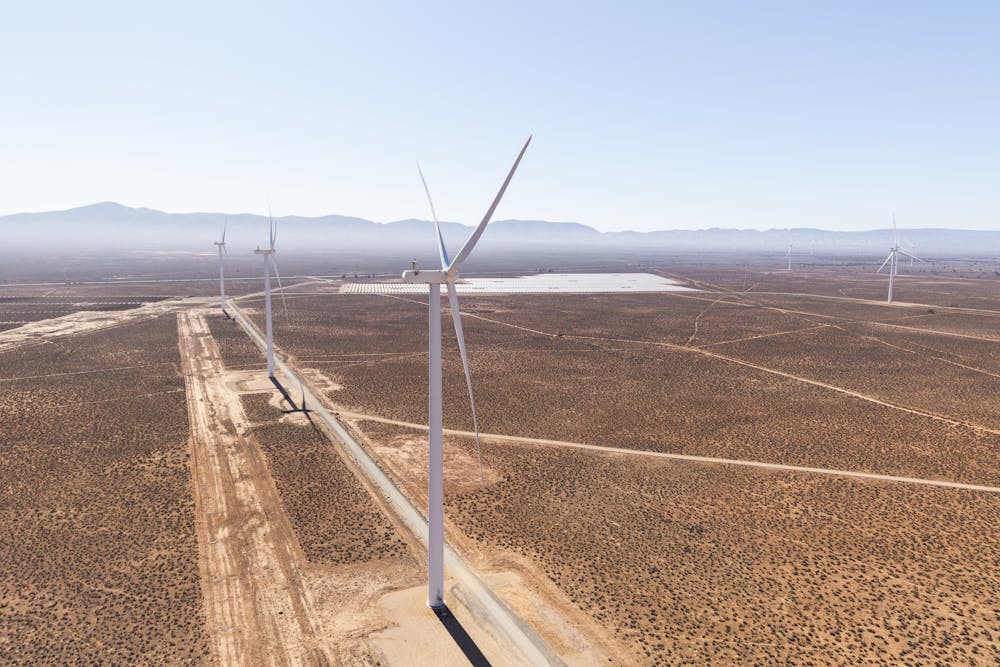
    Good wind resources are often located in remote areas of Australia.
    Brook Mitchell/Stringer via Getty

    3. Local construction and labour costs have soared

    Australia faces a shortage of workers with the skills to build and maintain wind farms, resulting in higher wages and recruitment costs. Wind developers say construction costs have become a real issue. Wind farms are more labour-intensive than solar.

    4. Interest rates have raised financing costs

    Wind farms require large upfront investments and lengthy construction periods. Even a small increase in interest rates can make them unviable – and interest rates have been high for some time.

    5. Reliability concerns, regulatory delay and community opposition

    According to US researchers, technical issues have emerged for some new wind turbines, creating unexpected costs for developers. The long, complex process of getting permits, carrying out environmental assessments and building community support is pushing out project timelines, increasing costs and uncertainty for developers.

    Will solar take over?

    Solar faces far fewer challenges. Solar panels are mass-produced, meaning costs are steadily driven down through economies of scale. Panels can be deployed quickly and solar farms tend to face less community opposition.

    Wind turbines have to spin to function, while solar panels have no moving parts (though systems that track the Sun do). As a result, solar farms require less maintenance and are more reliable.

    It’s no surprise large-scale solar has been on a record-breaking run, growing 20-fold between 2018 and 2023.

    Solar panels make electricity during daylight hours, especially in summer. By contrast, wind tends to produce more power at night and during winter months. This is why wind is so useful to a green grid.

    Generating power from both wind and sunshine can slash how much storage is needed to ensure grid reliability, lowering overall system costs. A balanced mix of wind, solar and storage will meet Australia’s electricity needs more efficiently and reliably than just solar and storage, according to the International Renewable Energy Agency and independent researchers.

    Could wind come back?

    Making wind more viable will take work. Potential solutions do exist, such as expanding the skilled workforce and investing in specialised ships and equipment to install turbines offshore.

    Shipping large turbines from Denmark or China is expensive. To avoid these costs, it could make sense to encourage local manufacturing of large and heavy parts such as the main tower.

    Other options include finding lower-cost turbine suppliers and streamlining regulatory processes.

    Rising material and labour costs have driven up the cost of wind turbines. Pictured: turbine blades in China’s Jiangsu province in 2022 about to be shipped to Australia.
    Xu Congjun/Future Publishing via Getty Images

    The newly announced expansion of the government’s Capacity Investment Scheme could help reduce risks and give certainty, alongside public investment in new transmission lines.

    If nothing is done or if new measures don’t help, wind is likely to stall while solar and storage race ahead.

    That’s not the worst outcome. Australia could get a long way by relying on batteries and pumped hydro to store power from solar during the day and release it in the evenings, as California is doing. But this strategy involves trade offs, such as higher storage-capacity needs and the risk of insufficient power during long cloudy periods.

    For Australia to optimise its mix of renewables and storage, policymakers will have to tackle wind’s cost challenges. Effective action could lower costs, accelerate project timelines and bolster flagging investor confidence.

    Magnus Söderberg does not work for, consult, own shares in or receive funding from any company or organisation that would benefit from this article, and has disclosed no relevant affiliations beyond their academic appointment.

    – ref. 5 reasons why wind farms are costing more in Australia – and what to do about it – https://theconversation.com/5-reasons-why-wind-farms-are-costing-more-in-australia-and-what-to-do-about-it-262126

    MIL OSI Analysis – EveningReport.nz –

    July 31, 2025
  • MIL-Evening Report: ER Report: A Roundup of Significant Articles on EveningReport.nz for July 31, 2025

    ER Report: Here is a summary of significant articles published on EveningReport.nz on July 31, 2025.

    5 reasons why wind farms are costing more in Australia – and what to do about it
    Source: The Conversation (Au and NZ) – By Magnus Söderberg, Professor and Director, Centre for Applied Energy Economics and Policy Research, Griffith University Saeed Khan/Getty Building a solar farm in Australia is getting about 8% cheaper each year as panel prices fall and technology improves, according to an official new report. Battery storage costs are

    Sporty spice: how romance fiction is adding a new dynamic to sports fandom
    Source: The Conversation (Au and NZ) – By Kasey Symons, Lecturer of Communication, Sports Media, Deakin University Sports fans might love their teams, cheer or curse each game’s result and admire their favourite athletes, but we rarely associate sports with romance. However, that may be slowly changing thanks to the recent spike in the popularity

    Just as NZ began collecting meaningful data on rainbow communities, census changes threaten their visibility
    Source: The Conversation (Au and NZ) – By Lori Leigh, Research Fellow in Public Health, University of Otago Getty Images New Zealand’s 2023 census was the first to collect data on gender identity and sexual orientation, showing one in 20 adults identify as LGBTQIA+. But just as reports from this more inclusive census are being

    Big tech says AI could boost Australia’s economy by $115 billion a year. Does the evidence stack up?
    Source: The Conversation (Au and NZ) – By Uri Gal, Professor in Business Information Systems, University of Sydney Imaginima / Getty Images AI is on the agenda in Canberra. In August, the Productivity Commission will release an interim report on harnessing data and digital technology such as AI “to boost productivity growth, accelerate innovation and

    Progress on Closing the Gap is stagnant or going backwards. Here are 3 things to help fix it
    Source: The Conversation (Au and NZ) – By Madeleine Pugin, Research Fellow, School of Government and International Relations, Griffith University The Productivity Commission’s latest data on Closing the Gap progress represents an unsurprisingly grim overview of the socioeconomic inequalities experienced by Aboriginal and Torres Strait Islander peoples. Closing the Gap is the plan federal and

    More than 2 in 5 young Australians are lonely, our new report shows. This is what could help
    Source: The Conversation (Au and NZ) – By Michelle H. Lim, Associate Professor, Sydney School of Public Health, University of Sydney Oliver Rossi/Getty Images Loneliness is not a word often associated with young people. We tend to think of our youth as a time spent with family, friends and being engaged with school and work

    How migrant business owners turn their identity into an asset, despite some bumps along the way
    Source: The Conversation (Au and NZ) – By Shea X. Fan, Associate Professor, Human Resource Management, Deakin University Odua Images/Shutterstock Too often, it’s anti-immigration sentiment dominating headlines in Australia. But a quieter story is going untold. Migrants are not just fitting into Australian society, they’re actively reshaping it through entrepreneurship. Starting a business is difficult

    The Man from Hong Kong at 50: how the first ever Australian–Hong Kong co-production became a cult classic
    Source: The Conversation (Au and NZ) – By Gregory Ferris, Senior Lecturer, Media Arts & Production, University of Technology Sydney LMPC via Getty Images A cinematic firecracker of a film exploded onto international screens 50 years ago this week, blending martial arts mayhem, Bond-esque set pieces, casual racism – and a distinctly Australian swagger. From

    Rules for calculating climate risk in financial reporting by NZ businesses need revisiting – new research
    Source: The Conversation (Au and NZ) – By Martien Lubberink, Associate Professor of Accounting and Capital, Te Herenga Waka — Victoria University of Wellington Andrew MacDonald/Getty Images The recent International Court of Justice (ICJ) decision on climate action marked a significant step forward in formalising an idea many already accept: climate inaction is not merely

    Climate justice victory at the ICJ – the student journey from USP lectures to The Hague
    By Vahefonua Tupola in Suva The University of the South Pacific (USP) is at the heart of a global legal victory with the International Court of Justice (ICJ) delivering a historic opinion last week affirming that states have binding legal obligations to protect the environment from human-induced greenhouse gas emissions. The case, hailed as a

    Climate justice victory at the ICJ – the student journey from USP lectures to The Hague
    By Vahefonua Tupola in Suva The University of the South Pacific (USP) is at the heart of a global legal victory with the International Court of Justice (ICJ) delivering a historic opinion last week affirming that states have binding legal obligations to protect the environment from human-induced greenhouse gas emissions. The case, hailed as a

    Kamchatka earthquake is among top 10 strongest ever recorded. Here’s what they have in common
    Source: The Conversation (Au and NZ) – By Dee Ninis, Earthquake Scientist, Monash University Today at about 11:30am local time, a magnitude 8.8 earthquake struck off the coast of Russia’s Kamchatka Peninsula in the country’s far east. Originating at a depth of roughly 20 kilometres, today’s powerful earthquake – among the ten strongest in recorded

    Kamchatka earthquake is among top 10 strongest ever recorded. Here’s what they have in common
    Source: The Conversation (Au and NZ) – By Dee Ninis, Earthquake Scientist, Monash University Today at about 11:30am local time, a magnitude 8.8 earthquake struck off the coast of Russia’s Kamchatka Peninsula in the country’s far east. Originating at a depth of roughly 20 kilometres, today’s powerful earthquake – among the ten strongest in recorded

    Tsunami warnings are triggering mass evacuations across the Pacific – even though the waves look small. Here’s why
    Source: The Conversation (Au and NZ) – By Milad Haghani, Associate Professor and Principal Fellow in Urban Risk and Resilience, The University of Melbourne Last night, one of the ten largest earthquakes ever recorded struck Kamchatka, the sparsely populated Russian peninsula facing the Pacific. The magnitude 8.8 quake had its epicentre in the sea just

    NAPLAN is just one test. Here’s what to do if your child’s results were in the bottom bands
    Source: The Conversation (Au and NZ) – By Sally Larsen, Senior Lecturer in Education, University of New England Rawpixel/ Getty Images The latest round of NAPLAN results are out, along with a string of news reports about “students falling behind” and “failing”, and experts sounding the “alarm” about school progress. In March, all Australian students

    Inflation slows again — but is it enough for the Reserve Bank to cut interest rates?
    Source: The Conversation (Au and NZ) – By Stella Huangfu, Associate Professor, School of Economics, University of Sydney Doublelee/Shutterstock Inflation is moving in the right direction, but new figures released today may not be soft enough to trigger a cut in official interest rates in August. The Australian Bureau of Statistics released the June quarter

    With the UK and France moving toward recognising Palestine, will Australia now follow suit?
    Source: The Conversation (Au and NZ) – By Donald Rothwell, Professor of International Law, Australian National University One of the smallest and most exclusive clubs in the world belongs to states. The US Department of State puts the number of independent recognised states at 197, while others count 200. The United Nations, meanwhile, has 193

    With the UK and France moving toward recognising Palestine, will Australia follow suit?
    Source: The Conversation (Au and NZ) – By Donald Rothwell, Professor of International Law, Australian National University One of the smallest and most exclusive clubs in the world belongs to states. The US Department of State puts the number of independent recognised states at 197, while others count 200. The United Nations, meanwhile, has 193

    An underwater observatory keeping the pulse of the Southern Ocean for nearly 30 years yields fresh results
    Source: The Conversation (Au and NZ) – By Christopher Traill, PhD Candidate Southern Ocean biogeochemistry, University of Tasmania Elizabeth Shadwick In a world affected by climate change, the Southern Ocean plays an outsized role. It absorbs up to 40% of the human-caused emissions taken up by the oceans while also being home to some of

    MIL OSI Analysis – EveningReport.nz –

    July 31, 2025
  • MIL-OSI: Euronet Worldwide Reports Second Quarter 2025 Financial Results – Highlighted by 13% Operating Income Growth

    Source: GlobeNewswire (MIL-OSI)

    • Digital growth strategy accelerated with the announced acquisition of leading credit card issuing platform
    • Ren signs agreement with top tier United States bank
    • Money Transfer expands digital remittance through Google partnership
    • Money Transfer enters Japanese market with acquisition of Kyodai Remittance
    • Operating margin expansion of 112 basis points

    LEAWOOD, Kan., July 30, 2025 (GLOBE NEWSWIRE) — Euronet (“Euronet” or the “Company”) (NASDAQ: EEFT), a global leader in payments processing and cross-border transactions, announced today second quarter 2025 financial results.

    Euronet reports the following consolidated results for the second quarter 2025 compared with the same period of 2024:

    • Revenues of $1,074.3 million, a 9% increase from $986.2 million (6% increase on a constant currency1 basis).
    • Operating income of $158.6 million, an 18% increase from $134.3 million (13% increase on a constant currency basis).
    • Adjusted EBITDA2 of $206.2 million, a 16% increase  from $178.2 million (11% increase on a constant currency basis).
    • Net income attributable to Euronet of $97.6 million, or $2.27 diluted earnings per share, compared with $83.1 million, or $1.73 diluted earnings per share.
    • Adjusted earnings per share3 of $2.56, a 14% increase from $2.25. 

    See the reconciliation of non-GAAP items in the attached financial schedules.   

    “I’m very pleased with the business’ constant currency operating profit growth of 13% and the margin expansion of 112 basis points—on its own, this is exciting.  But, I’m more excited about our accomplishments to further our digital strategy through the acquisition of a leading credit card issuing platform – CoreCard – and the signing of a Ren agreement with one of the top three banks in the United States. 

    The acquisition of CoreCard fits nicely with our Ren platform. As described in a separate press release, this is not just a credit issuing platform, it’s a platform serving leading brands in the US, processing at scale, tried and tested. This premier product gives us yet more opportunity to go after the $10 billion issuing market where the market growth rates are much stronger outside the United States, which aligns strongly with our global business where more than 75% of our revenues are from outside the United States.  Moreover, another exciting aspect of the issuing business is its margin opportunity, nearing 50 percent.  It’s these kinds of initiatives that have contributed to our 20-year double digit growth rate and will continue to drive future growth – focused on digital payments.  This acquisition is directly in line with our strategy to shift a stronger mix of our business toward the digital economy. 

    Not only did we advance our digital agenda with the credit issuing platform, we just signed an agreement with one of the top three banks in the United States for the deployment of our Ren ATM operating and switching product.  While we have had many successes with Ren outside the US, this is not just the first agreement in the US we’ve signed, but it is with super impressive top-tiered bank – a real testament to the value proposition of Ren”, said Michael J. Brown, Euronet’s Chairman and Chief Executive Officer.

    Segment and Other Results

    The EFT Processing Segment reports the following results for the second quarter 2025 compared with the same period or date in 2024:

    • Revenues of $338.5 million, an 11% increase from $305.4 million (6% increase on a constant currency basis).
    • Operating income of $84.6million, a 6% increase from $79.9 million (1% increase on a constant currency basis).
    • Adjusted EBITDA of $110.6 million, a 5% increase from $105.0 million (no change on a constant currency basis).
    • Total of 57,326 installed ATMs as of June 30, 2025, a 5% increase from 54,736. We operated 56,760 active ATMs as of June 30, 2025, a 5% increase from 54,005 as of June 30, 2024.

    Constant currency revenue, operating income, and adjusted EBITDA growth in the second quarter 2025 was driven by market expansion, growth across most existing markets and the addition of access fees and an increase in interchange fees in certain markets. 

    The epay Segment reports the following results for the Q2 2025 compared with the same period or date in 2024:

    • Revenues of $280.1 million, a 7% increase from $260.9 million (5% increase on a constant currency basis).
    • Operating income of $31.1 million, a 19% increase from $26.2 million (17% increase on a constant currency basis).
    • Adjusted EBITDA of $32.8 million, a 17% increase from $28.0 million (15% increase on a constant currency basis).
    • Transactions of 1,107 million, consistent with prior year.
    • POS terminals of approximately 721,000 as of June 30, 2025, a 3% increase from 703,000.
    • Retailer locations of approximately 354,000 as of June 30, 2025, a 4% increase from 340,000.

    Constant currency revenue growth was driven by continued payments and digital media growth. Operating income and adjusted EBITDA grew faster than revenue, driven by a shift in product mix and effective operating expense management. Transaction growth from payments and digital media was offset by a decrease in low margin mobile transactions in India.

    The Money Transfer Segment reports the following results for the Q2 2025 compared with the same period or date in 2024:

    • Revenues of $457.9 million, a 9% increase from $421.8 million (6% increase on a constant currency basis).
    • Operating income of $65.6 million, a 39% increase from $47.3 million (33% increase on a constant currency basis).
    • Operating margin expansion of 296 basis points
    • Adjusted EBITDA of $71.6 million, a 33% increase from $54.0 million (28% increase on a constant currency basis).
    • Total transactions of 46.1 million, a 4% increase from 44.3 million.
    • Total digital transactions of 5.8 million, a 29% increase from 4.5 million.
    • Network locations of approximately 631,000 as of June 30, 2025, an 8% increase from approximately 586,000.

    Constant currency revenue growth was primarily driven by growth in cross-border transactions, partially offset by a decrease in intra-US transactions. Direct-to-consumer digital transactions grew by 29%, reflecting continued consumer demand for digital products. Operating income and adjusted EBITDA growth outpaced revenue growth due to gross margin expansion and leverage of scale. Additionally, the Money Transfer segment continued to expand both its market footprint through the acquisition of a 60% interest in Kyodai Remittance as well as its industry leading global payments network to now reach 4.1 billion bank accounts, 3.2 billion wallet accounts and 631,000 payment locations.

    Corporate and Other reports $22.7 million of expense for the second quarter 2025 compared with $19.1 million for the second quarter 2024. The increase in corporate expenses is largely from the increase in long-term share-based compensation.

    Balance Sheet and Financial Position
    Unrestricted cash and cash equivalents on hand was $1,329.3 million as of June 30, 2025, compared to $1,393.6 million as of March 31, 2025. Total indebtedness was $2,438.1 million as of June 30, 2025, compared to $2,202.5 million as of March 31, 2025. Availability under the Company’s revolving credit facilities was approximately $884.2 million as of June 30, 2025. 

    The change in net cash is the result of cash generated from operations, working capital fluctuations and share repurchases of $2.3 million shares for $247 million during the second quarter.

    Outlook
    Taking into consideration recent trends in the business and the global economy, the Company anticipates its 2025 adjusted EPS will grow 12% to 16% year-over-year, consistent with its 10- and 20-year compounded annualized growth rates. This outlook does not include any changes that may develop in foreign exchange rates, interest rates or other unforeseen factors.

    Non-GAAP Measures
    In addition to the results presented in accordance with U.S. GAAP, the Company presents non-GAAP financial measures, such as constant currency financial measures, operating income, adjusted EBITDA, and adjusted earnings per share. These measures should be used in addition to, and not a substitute for, revenues, operating income, net income and earnings per share computed in accordance with U.S. GAAP. We believe that these non-GAAP measures provide useful information to investors regarding the Company’s performance and overall results of operations. These non-GAAP measures are also an integral part of the Company’s internal reporting and performance assessment for executives and senior management. The non-GAAP measures used by the Company may not be comparable to similarly titled non-GAAP measures used by other companies. The attached schedules provide a full reconciliation of these non-GAAP financial measures to their most directly comparable U.S. GAAP financial measure.

    The Company does not provide a reconciliation of its forward-looking non-GAAP measures to GAAP due to the inherent difficulty in forecasting and quantifying certain amounts that are necessary for GAAP and the related GAAP and non-GAAP reconciliation, including adjustments that would be necessary for foreign currency exchange rate fluctuations and other charges reflected in the Company’s reconciliation of historic numbers, the amount of which, based on historical experience, could be significant.  

    (1) Constant currency financial measures are computed as if foreign currency exchange rates did not change from the prior period. This information is provided to illustrate the impact of changes in foreign currency exchange rates on the Company’s results when compared to the prior period.

    (2) Adjusted EBITDA is defined as net income excluding, to the extent incurred in the period, interest expense, income tax expense, depreciation, amortization, share-based compensation and other non-cash purchase accounting adjustments, non-operating or non-recurring items that are considered expenses or income under U.S. GAAP. Adjusted EBITDA represents a performance measure and is not intended to represent a liquidity measure.

    (3) Adjusted earnings per share is defined as diluted U.S. GAAP earnings per share excluding, to the extent incurred in the period, the tax-effected impacts of: a) foreign currency exchange gains or losses, b) share-based compensation, c) acquired intangible asset amortization, d) non-cash income tax expense, e) non-cash investment gain f) other non-operating or non-recurring items and g) dilutive shares relate to the Company’s convertible bonds. Adjusted earnings per share represent a performance measure and is not intended to represent a liquidity measure. 

    Conference Call and Slide Presentation
    Euronet Worldwide will host an analyst conference call on July 31, 2025, at 9:00 a.m. Eastern Time to discuss these results. The call may also include discussion of Company developments on the Company’s operations, forward-looking information, and other material information about business and financial matters. The conference call and accompanying slide show presentation will be accessible via webcast by following the link posted on http://ir.euronetworldwide.com.  Participants wanting to access the conference call by telephone should dial (800)715-9871 (USA) or (646)307-1963 (international).

    A webcast replay will be available beginning approximately one hour after the event at http://ir.euronet worldwide.com and will remain available for one year.

    About Euronet Worldwide, Inc.
    A global leader in payments processing and cross-border transactions, Euronet moves money in all the ways consumers and businesses depend upon. This includes money transfers, credit/debit processing, ATMs, point-of-sale services, branded payments, currency exchange and more. With products and services in more than 200 countries and territories provided through its own brand and branded business segments, Euronet and its financial technologies and networks make participation in the global economy easier, faster and more secure for everyone. Visit the company’s website at www.euronetworldwide.com.

    Starting in Central Europe in 1994, Euronet now supports an extensive global real-time digital and cash payments network that includes 57,326 installed ATMs, approximately 1.2 million EFT point-of-sale terminals and a growing portfolio of outsourced debit and credit card services which are under management in 69 countries; card software solutions; a prepaid processing network of approximately 721,000 point-of-sale terminals at approximately 354,000 retailer locations in 64 countries; and a global money transfer network of approximately 631,000 locations serving 200 countries and territories with digital connections to 4.1 billion bank accounts, 3.2 billion digital wallet accounts and 4.0 billion Visa debit cards through Visa Direct payments. Euronet serves clients from its corporate headquarters in Leawood, Kansas, USA, and 67 worldwide offices. For more information, please visit the company’s website at www.euronetworldwide.com.

    Cautionary Statement Regarding Forward-Looking Statements
    This communication contains “forward-looking statements” within the United States Private Securities Litigation Reform Act of 1995. You can identify these statements and other forward-looking statements in this document by words such as “may,” “will,” “should,” “can,” “could,” “anticipate,” “estimate,” “expect,” “predict,” “project,” “future,” “potential,” “intend,” “plan,” “assume,” “believe,” “forecast,” “look,” “build,” “focus,” “create,” “work,” “continue,” “target,” “poised,” “advance,” “drive,” “aim,” “forecast,” “approach,” “seek,” “schedule,” “position,” “pursue,” “progress,” “budget,” “outlook,” “trend,” “guidance,” “commit,” “on track,” “objective,” “goal,” “strategy,” “opportunity,” “ambitions,” “aspire” and similar expressions, and variations or negative of such terms or other variations thereof. Words and terms of similar substance used in connection with any discussion of future plans, actions, or events identify forward-looking statements. 

    Forward-looking statements by their nature address matters that are, to different degrees, uncertain, such statements regarding the transactions contemplated by the Agreement and Plan of Merger (the “Merger Agreement’), dated as of July 30, 2025, by and among CoreCard, Euronet and Genesis Merger Sub Inc. (the “Transaction”), including the expected timing of the closing of the Transaction; future financial and operating results; benefits and synergies of the Transaction; future opportunities for the combined company; the conversion of equity interests contemplated by the Merger Agreement; the issuance of common stock of Euronet contemplated by the Merger Agreement; the expected filing by Euronet with the SEC of the Registration Statement and the proxy statement/prospectus; the ability of the parties to complete the proposed Transaction considering the various closing conditions and any other statements about future expectations that constitute forward-looking statements within the meaning of the Private Securities Litigation Reform Act of 1995, Section 27A of the Securities Act of 1933 and Section 21E of the Securities Exchange Act of 1934. All such forward-looking statements are based upon current plans, estimates, expectations and ambitions that are subject to risks, uncertainties and assumptions, many of which are beyond the control of Euronet and CoreCard, that could cause actual results to differ materially from those expressed in such forward-looking statements. Key factors that could cause actual results to differ materially include, but are not limited to, the expected timing and likelihood of completion of the Transaction, including the timing, receipt and terms and conditions of any required governmental and regulatory approvals of the Transaction; the occurrence of any event, change or other circumstances that could give rise to the termination of the definitive agreement; the possibility that CoreCard’s shareholders may not approve the Transaction; the risk that the parties may not be able to satisfy the conditions to the Transaction in a timely manner or at all; risks related to disruption of management time from ongoing business operations due to the Transaction; the risk that any announcements relating to the Transaction could have adverse effects on the market price of Euronet’s common stock; the risk that the Transaction and its announcement could have an adverse effect on the parties’ business relationships and business generally, including the ability of CoreCard or Euronet to retain customers and retain and hire key personnel and maintain relationships with their suppliers and customers, and on their operating results and businesses generally; the risk of unforeseen or unknown liabilities; customer, shareholder, regulatory and other stakeholder approvals and support; the risk of potential litigation relating to the Transaction that could be instituted against CoreCard or its directors and/or officers; the risk associated with third party contracts containing material consent, anti-assignment, transfer or other provisions that may be related to the Transaction which are not waived or otherwise satisfactorily resolved; the risk of rating agency actions and Euronet’s ability to access short- and long-term debt markets on a timely and affordable basis; the risk of various events that could disrupt operations, including: conditions in world financial markets and general economic conditions; inflation; the war in Ukraine and the related economic sanctions; and military conflicts in the Middle East.

    These risks, as well as other risks related to the proposed Transaction, will be described in the Registration Statement that will be filed with the SEC in connection with the proposed Transaction. While the list of factors presented here and the list of factors to be presented in the Registration Statement are considered representative, no such list should be considered to be a complete statement of all potential risks and uncertainties. Additional factors that may affect future results are contained in each company’s filings with the SEC, including each company’s most recent Annual Report on Form 10-K, as it may be updated from time to time by quarterly reports on Form 10-Q and current reports on Form 8-K, all of which are available at the SEC’s website http://www.sec.gov. Euronet regularly posts important information to the investor relations section of its website. Any forward-looking statements made in this release speak only as of the date of this release. Except as may be required by law, neither Euronet nor CoreCard intends to update these forward-looking statements and undertakes no duty to any person to provide any such update under any circumstances.

    Important Information for Investors and Stockholders
    In connection with the proposed transaction, Euronet plans to file with the SEC a registration statement on Form S-4 (the “Registration Statement”), which will include a proxy statement of CoreCard that also constitutes a prospectus of Euronet, and any other documents in connection with the transaction. After the Registration Statement has been declared effective by the SEC, the definitive proxy statement/prospectus will be sent to the holders of common stock of CoreCard. INVESTORS AND SHAREHOLDERS OF CORECARD AND EURONET ARE URGED TO READ THE PROXY STATEMENT/PROSPECTUS AND ANY OTHER DOCUMENTS FILED OR TO BE FILED WITH THE SEC IN CONNECTION WITH THE TRANSACTION WHEN THEY BECOME AVAILABLE, AS THEY WILL CONTAIN IMPORTANT INFORMATION ABOUT EURONET, CORECARD, THE TRANSACTION AND RELATED MATTERS. The registration statement and proxy statement/prospectus and other documents filed by Euronet or CoreCard with the SEC, when filed, will be available free of charge at the SEC’s website at www.sec.gov. Alternatively, investors and stockholders may obtain free copies of documents that are filed or will be filed with the SEC by Euronet, including the registration statement and the proxy statement/prospectus, on Euronet’s website at https://ir.euronetworldwide.com/for-investors, and may obtain free copies of documents that are filed or will be filed with the SEC by CoreCard, including the proxy statement/prospectus, on CoreCard’s website at https://investors.CoreCard.com/. The information included on, or accessible through, Euronet’s or CoreCard’s website is not incorporated by reference into this press release.

    No Offer or Solicitation
    This press release is not intended to and shall not constitute an offer to sell or the solicitation of an offer to buy any securities, nor shall there be any sale of securities in any jurisdiction in which such offer, solicitation or sale would be unlawful prior to appropriate registration or qualification under the securities laws of such jurisdiction. No offering of securities shall be made except by means of a prospectus meeting the requirements of Section 10 of the Securities Act of 1933, as amended.

    Participants in the Solicitation
    Euronet and CoreCard and their respective directors, executive officers and other employees may be deemed to be participants in the solicitation of proxies from CoreCard’s shareholders in connection with the proposed Transaction. A description of participants’ direct or indirect interests, by security holdings or otherwise, will be included in the proxy statement/prospectus relating to the proposed Transaction when it is filed with the SEC. Information regarding Euronet’s directors and executive officers is contained in the definitive proxy statement, dated April 4, 2025, for its 2025 annual meeting of stockholders, and in Euronet’s Annual Report on Form 10-K for the fiscal year ended December 31, 2024. Information regarding CoreCard’s directors and executive officers is contained in CoreCard’s definitive proxy statement, dated April 14, 2025, for its 2025 annual meeting of shareholders, and CoreCard’s Annual Report on Form 10-K for the fiscal year ended December 31, 2024. Additional information regarding ownership of Euronet’s securities by its directors and executive officers, and of ownership of CoreCard’s securities by its directors and executive officers, is included in each such person’s SEC filings on Forms 3 and 4. These documents and the other SEC filings described in this paragraph may be obtained free of charge as described above under the heading “Important Information for Investors and Stockholders.”

     EURONET WORLDWIDE, INC.
     Condensed Consolidated Balance Sheets
     (in millions)
      As of    
      June 30,   As of
      2025   December 31,
      (unaudited)   2024
    ASSETS          
    Current assets:          
    Cash and cash equivalents $ 1,329.3   $ 1,278.8
    ATM cash   937.4     643.8
    Restricted cash   40.3     9.2
    Settlement assets   1,547.1     1,522.7
    Trade accounts receivable, net   328.4     284.9
    Prepaid expenses and other current assets   353.8     297.1
    Total current assets   4,536.3     4,036.5
               
    Property and equipment, net   365.0     329.7
    Right of use lease asset, net   152.5     132.1
    Goodwill and acquired intangible assets, net   1,160.4     1,048.1
    Other assets, net   340.7     288.1
    Total assets $ 6,554.9   $ 5,834.5
               
    LIABILITIES AND EQUITY          
    Current liabilities:          
    Settlement obligations $ 1,547.1   $ 1,522.7
    Accounts payable and other current liabilities   898.3     842.3
    Current portion of operating lease obligations   55.0     48.3
    Short-term debt obligations   1,434.8     812.7
    Total current liabilities   3,935.2     3,226.0
               
    Debt obligations, net of current portion   1,002.3     1,134.4
    Operating lease obligations, net of current portion   100.8     87.4
    Capital lease obligations, net of current portion   1.0     1.4
    Deferred income taxes   64.4     71.8
    Other long-term liabilities   87.8     84.3
    Total liabilities   5,191.5     4,605.3
    Total equity   1,363.4     1,229.2
    Total liabilities and equity $ 6,554.9   $ 5,834.5
     EURONET WORLDWIDE, INC.
     Consolidated Statements of Operations
     (unaudited – in millions, except share and per share data)
       Three Months Ended
       June 30,
      2025     2024  
    Revenues $ 1,074.3     $ 986.2  
               
    Operating expenses:          
    Direct operating costs, exclusive of depreciation   620.6       580.8  
    Salaries and benefits   173.5       158.0  
    Selling, general and administrative   87.8       79.4  
    Depreciation and amortization   33.8       33.7  
    Total operating expenses   915.7       851.9  
    Operating income   158.6       134.3  
               
    Other income (expense):          
    Interest income   6.2       5.9  
    Interest expense   (28.2 )     (20.1 )
    Foreign currency exchange loss, net   (5.7 )     1.5  
    Other income   0.4       0.8  
    Total other expense, net   (27.3 )     (11.9 )
    Income before income taxes   131.3       122.4  
               
    Income tax expense   (33.6 )     (39.2 )
    Net income   97.7       83.2  
    Net loss attributable to noncontrolling interests   (0.1 )     (0.1 )
    Net income attributable to Euronet Worldwide, Inc. $ 97.6     $ 83.1  
    Add: Interest expense from assumed conversion of convertible notes, net of tax   0.1       1.0  
    Net income for diluted earnings per share calculation $ 97.7     $ 84.1  
    Earnings per share attributable to Euronet          
    Worldwide, Inc. stockholders – diluted $ 2.27     $ 1.73  
               
    Diluted weighted average shares outstanding   42,954,631       48,700,270  
     EURONET WORLDWIDE, INC.
    Reconciliation of Net Income to Operating Income (Expense) to Operating Income (Expense) and Adjusted EBITDA
     (unaudited – in millions)

    .

      Three months ended June 30, 2025
      EFT
    Processing
    epay Money
    Transfer
    Corporate
    Services
    Consolidated
    Net income                         $ 97.7
    Add: Income tax expense                           33.6
    Add: Total other expense, net                           27.3
    Operating income (expense) $ 84.6   $ 31.1   $ 65.6   $ (22.7 )   $ 158.6
    Add: Depreciation and amortization   26.0     1.7     6.0     0.1       33.8
    Add: Share-based compensation   —     —     —     13.8       13.8
    Earnings before interest, taxes, depreciation, amortization, share-based
    compensation (Adjusted EBITDA)
    $ 110.6   $ 32.8   $ 71.6   $ (8.8 )   $ 206.2

    .

      Three months ended June 30, 2024
      EFT
    Processing
    epay Money
    Transfer
    Corporate
    Services
    Consolidated
    Net income                         $ 83.2
    Add: Income tax expense                           39.2
    Add: Total other expense, net                           11.9
    Operating income (expense) $ 79.9   $ 26.2   $ 47.3   $ (19.1 )   $ 134.3
    Add: Depreciation and amortization   25.1     1.8     6.7     0.1       33.7
    Add: Share-based compensation   —     —     —     10.2       10.2
    Earnings before interest, taxes, depreciation, amortization, share-based
    compensation (Adjusted EBITDA) (1)
    $ 105.0   $ 28.0   $ 54.0   $ (8.8 )   $ 178.2


    (1)
    Adjusted EBITDA is a non-GAAP measure that should be considered in addition to, and not a substitute for, net income computed in accordance with U.S. GAAP.

     EURONET WORLDWIDE, INC.
     Reconciliation of Adjusted Earnings per Share
     (unaudited – in millions, except share and per share data)
     
      Three Months Ended
      June 30,
      2025     2024  
    Net income attributable to Euronet Worldwide, Inc. $ 97.6     $ 83.1  
    Foreign currency exchange loss (gain)   5.7       (1.5 )
    Intangible asset amortization (1)   4.7       6.5  
    Share-based compensation (2)   13.8       10.2  
    Income tax effect of above adjustments (3)   (13.7 )     4.3  
    Non-cash investment gain (4)   (0.4 )     —  
    Non-cash GAAP tax expense (5)   3.0       1.9  
    Adjusted earnings (6) $ 110.7     $ 104.5  
    Adjusted earnings per share – diluted (6) $ 2.56     $ 2.25  
    Diluted weighted average shares outstanding (GAAP)   42,954,631       48,700,270  
    Effect of adjusted EPS dilution of convertible notes   (176,123 )     (2,781,818 )
    Effect of unrecognized share-based compensation on diluted shares
    outstanding
      406,912       420,305  
    Adjusted diluted weighted average shares outstanding   43,185,420       46,338,757  

    (1) Intangible asset amortization of $4.7 million and $6.5 million are included in depreciation and amortization expense of $33.8 million and $33.7 million for both the three months ended June 30, 2025 and June 30, 2024, in the consolidated statements of operations.

    (2) Share-based compensation of $13.8 million and $10.2 million are included in salaries and benefits expense of $173.5 million and $158.0 million for the three months ended June 30, 2025 and June 30, 2024, respectively, in the consolidated statements of operations.

    (3) Adjustment is the aggregate U.S. GAAP income tax effect on the preceding adjustments determined by applying the applicable statutory U.S. federal, state and/or foreign income tax rates. 

    (4) Non-cash investment gain of $0.4 million is included in other income in the consolidated statement of operations.

    (5) Adjustment is the non-cash GAAP tax impact recognized on certain items such as the utilization of certain material net deferred tax assets and amortization of indefinite-lived intangible assets.

    (6) Adjusted earnings and adjusted earnings per share are non-GAAP measures that should be considered in addition to, and not as a substitute for, net income and earnings per share computed in accordance with U.S. GAAP. 

    The MIL Network –

    July 31, 2025
  • MIL-Evening Report: Politics with Michelle Grattan: independent MP Allegra Spender on making tax fairer for younger Australians

    Source: The Conversation (Au and NZ) – By Michelle Grattan, Professorial Fellow, University of Canberra

    With parliament now finished its first fortnight’s session, attention will soon be on the government’s August 19-21 economic reform roundtable, bringing together business, unions, experts and community representatives to pursue consensus on ways to lift Australia’s flagging productivity.

    Independent member for Wentworth Allegra Spender is one of the 25 participants invited to the roundtable. She’s particularly focused on tax reform and last week held a tax roundtable of her own.

    Spender joined the podcast to talk about making tax fairer, the need for greater economic reform, climate policy, the social media ban for under 16s, a ceasefire in Gaza, and more.

    On her ambitions on tax policy, Spender says income tax indexation is something that would benefit younger, working Australians:

    Myself and actually another number of crossbenchers […] wrote to both the government and the opposition last term, really pushing for tax indexation. And really the heart of this is startling statistics from last term. The [Reserve Bank of Australia] put out some information that showed that bracket creep was a bigger impost on average households’ budgets than the RBA increases in the interest rate.

    […] Just to give you two statistics about young working people: households over the age of 65, in the last 10 odd years, have grown their wealth by around 50%. Households under the age of 35 have not grown their worth at all, pretty much. So they are going backwards relative to the rest of the country. A household, two households, both on a $100,000, sitting next to each other. If [one] household is retired, they have to pay on average half the tax of a working age household.

    Spender says the system is stacked against young people, who “are really struggling economically compared to previous generations”.

    It’s in your early and midlife that you need money for housing, to raise kids and everything else. So we don’t have a tax system that works for younger people. We have a tax system that burdens younger people strongly and then actually gives people more tax breaks when they’re older, and normally wealthier.

    On climate targets, Spender says while she’ll be guided by the yet-to-be-provided Climate Change Authority’s advice, she wants to see Australia “try and lead other countries” – pointing to the United Kingdom, which has set a target to cut emissions by at least 81% by 2035.

    The Climate Change Authority put out their interim guidance to say that a target within 65 to 75% [emissions reduction on 2005 levels] was both achievable from an economic point of view and also appropriate towards a scientific point of view.

    My view is that we should be at the very top end of that. Now, if the Climate Change Authority significantly reviews, you know, revises down their targets, I will reconsider. But I think really what we should be doing is to say how can we be as ambitious as possible. And the reason I think that is important is actually, you know, from a business point of view, ambition and certainty is what they need to make the big investments that will actually achieve it.

    Ambition is needed from a scientific point of view, because if we took, say, less than 75% [emissions reduction], and the rest of the world did too, we would be looking at outcomes that are catastrophic for Australia. Regular days in Sydney and Melbourne that are above 50 degrees. A huge loss of coral reef. Continued adverse weather events.

    On the news that the government will include YouTube in its social media ban for under 16s, Spender says it’s now up to social media companies to make their websites safer to lift the bans.

    My eldest daughter [who’s 12] has a strong view on this. And she’s actually a big fan of the ban. She was like, ‘I just don’t understand how it makes sense to leave YouTube in and TikTok out’. […] She’s not on social media, but other people are, and she finds it sometimes frustrating.

    But I think the challenge on this is always going to be the implementation. I think it’s fiendishly complicated to implement. I think genuinely the most valuable part of this ban is actually the signal to families and parents about what is expected and what isn’t.

    […] I think the ball’s in the social media companies’ courts. If they want to move to a life beyond the ban, they need to show how they can make their platforms safe for younger Australians, because I don’t think they have delivered that to date. So I’d be open if they can provide the evidence of how they can change things. I’m always open minded to reversing or changing those bans. But at the moment, [social media] isn’t safe.

    Michelle Grattan does not work for, consult, own shares in or receive funding from any company or organisation that would benefit from this article, and has disclosed no relevant affiliations beyond their academic appointment.

    – ref. Politics with Michelle Grattan: independent MP Allegra Spender on making tax fairer for younger Australians – https://theconversation.com/politics-with-michelle-grattan-independent-mp-allegra-spender-on-making-tax-fairer-for-younger-australians-262225

    MIL OSI Analysis – EveningReport.nz –

    July 31, 2025
  • MIL-OSI Australia: UAE trade agreement one step closer

    Source: Australian Attorney General’s Agencies

    Today, the Albanese Labor Government took the next major step towards implementation of our landmark trade agreement with the United Arab Emirates.

    The passing of necessary legislation today will incorporate the Australia-United Arab Emirates Comprehensive Economic Partnership Agreement (CEPA) into law.

    Marking Australia’s first trade agreement in the Middle East region, this deal delivers on the Albanese Government’s commitment to open new export opportunities and create more well-paying local jobs through trade.

    The UAE is Australia’s largest trade and investment partner in the Middle East with total trade between Australia and the UAE worth $12.3 billion in 2024.

    When fully implemented, over 99 per cent of Australian products will enter the UAE tariff free, including meat, dairy, grains and minerals. The agreement will also deliver cheaper prices at the checkout, with Australian households and businesses saving around $40 million a year.

    Details on the full CEPA package, including independent modelling and key benefits to agricultural businesses and Australia more broadly are published on the DFAT website.

    Quotes attributable to Minister for Trade and Tourism, Senator the Hon Don Farrell:

    “We are a trading nation. More trade means more higher-paying jobs, more opportunities for businesses, greater investment and cheaper bills for Australian households.”

    “As Australia’s first trade agreement in the Middle East, this unlocks significant potential in the region.”

    “Passing this legislation is an important step in locking in the gains we’ve made which will deliver for Australian businesses, local jobs and Australian consumers.”

    “We will continue working closely with the UAE to bring it into force as soon as possible.”

    MIL OSI News –

    July 31, 2025
  • MIL-OSI: Caliber Sets Date for Second Quarter 2025 Earnings Announcement & Investor Conference Call

    Source: GlobeNewswire (MIL-OSI)

    SCOTTSDALE, Ariz., July 30, 2025 (GLOBE NEWSWIRE) — Caliber (NASDAQ: CWD), a real estate investor, developer, and manager, today announced that it will release its second quarter 2025 financial results after the close of the stock market on Wednesday, August 13, 2025. Management invites all interested parties to its webcast/conference call the same day at 5:00 pm ET to discuss the results.

    Investors and interested parties can access the live earnings call by dialing (800) 715-9871 (domestic) or (646) 307-1963 (international) and ask to join the Caliber call or use conference ID 7312901.

    To listen to the call online, investors can visit the investor relations page of Caliber’s website at https://ir.caliberco.com/. The webcast replay of the conference call will be available on Caliber’s website shortly after the call concludes.

    Additional details:
    The news release and presentation materials will also be available on the Investor Relations site under “Financial Results”.

    About Caliber (CaliberCos Inc.)
    With over $2.9 billion in Managed Assets, Caliber’s 16-year track record of managing and developing real estate is built on a singular goal: to make money in all market conditions, specializing in hospitality, multi-family residential, and multi-tenant industrial. Our growth is fueled by performance and a key competitive advantage: we invest in projects, strategies, and geographies that global real estate institutions often overlook. Integral to this advantage is our in-house shared services group, which gives Caliber greater control over our real estate and enhanced visibility into future investment opportunities. There are multiple ways to participate in Caliber’s success: invest in Nasdaq-listed CaliberCos Inc. and/or invest directly in our Private Funds.

    Forward-Looking Statements
    This press release contains “forward-looking statements” that are subject to substantial risks and uncertainties. All statements, other than statements of historical fact, contained in this press release are forward-looking statements. Forward-looking statements contained in this press release may be identified by the use of words such as “anticipate,” “believe,” “contemplate,” “could,” “estimate,” “expect,” “intend,” “seek,” “may,” “might,” “plan,” “potential,” “predict,” “project,” “target,” “aim,” “should,” “will” “would,” or the negative of these words or other similar expressions, although not all forward-looking statements contain these words. Forward-looking statements are based on the Company’s current expectations and are subject to inherent uncertainties, risks and assumptions that are difficult to predict. Further, certain forward-looking statements are based on assumptions as to future events that may not prove to be accurate. These and other risks and uncertainties are described more fully in the section titled “Risk Factors” in the final prospectus related to the Company’s public offering filed with the SEC and other reports filed with the SEC thereafter. Forward-looking statements contained in this announcement are made as of this date, and the Company undertakes no duty to update such information except as required under applicable law.

    CONTACTS:
    Caliber Investor Relations:
    Ilya Grozovsky
    +1 480-214-1915
    Ilya@CaliberCo.com

    The MIL Network –

    July 31, 2025
  • MIL-OSI Australia: Canberra’s best dog-friendly walks

    Source: Northern Territory Police and Fire Services

    Our CBR is the ACT Government’s key channel to connect with Canberrans and keep you up-to-date with what’s happening in the city. Our CBR includes a monthly print edition, email newsletter and website.

    You can easily opt in or out of the newsletter subscription at any time.

    MIL OSI News –

    July 31, 2025
  • MIL-Evening Report: Grief is the Thing with Feathers comes to the stage with a glorious intensity of purpose

    Source: The Conversation (Au and NZ) – By Huw Griffiths, Associate Professor of English Literature, University of Sydney

    Brett Boardman/Belvoir

    The idea of the titular Crow in Ted Hughes’ poems is wild, untameable and irreducible to words. In an early poem in the sequence, words come at Crow from all angles but he just ignores them. Finally, “Words retreated, suddenly afraid / Into the skull of a dead jester / Taking the whole world with them”.

    Crow just yawns: “long ago / He had picked that skull empty”. A figure that is ancient and beyond the reach of gods or human belief systems, Hughes’ Crow resists ever being pinned down or fully understood.

    In Max Porter’s 2015 novella, Grief is the Thing with Feathers, a version of Hughes’ Crow enters the life of a bereaved Dad, newly left to look after his two sons after the death of his wife.

    Dad is a literary scholar, writing a book about Ted Hughes, and Crow is a metaphor come to life, some version of the endless grief through which he is living.

    But Porter’s Crow is not quite the same thing as Hughes’ irredeemable half-myth/half-beast. This crow cares: “I do eat baby rabbits, plunder nests, swallow filth, cheat death […] But I care, deeply. I find humans dull except in grief”. And he is self-aware, too – aware that Hughes’ mythical beast image can also just be a performance, a piece of schtick: “I do this, perform some unbound crow stuff, for him”.

    Now, a new adaptation of the novella brings the story to the Belvoir stage.

    Devastation and renewal

    Toby Schmitz as both Dad and Crow is just brilliant. He exactly captures the messy contradictions of this situation, shifting between the quiet melancholy and stifled rage of the widower and the restless, contradictory energies of Crow.

    The latter he performs in recognisable Schmitz fashion: a leery and mischievous outsider, challenging the audience and holding their attention just as much as he teases, taunts and cajoles both Dad and his two sons.

    His performance brings out the humour of Porter’s book, the sense of its own absurdity that shadows his story of devastation and tentative renewal.

    Toby Schmitz as both Dad and Crow is just brilliant.
    Brett Boardman/Belvoir

    Also on stage are Philip Lynch and Fraser Morrison as the two boys, doing a great job (as the characters do in Porter’s book) of providing an emotional antidote to the wheeling terror that sometimes spins off Dad’s encounter with Crow.

    Schmitz adapted the book with director, Simon Phillips, and designer, Nick Schlieper. They have only very subtly altered the text in ways that enable a dynamic live performance, conversations between Dad, Crow and Boys.

    Tying the piece together are compelling video direction and live music. The former is genuinely exciting, as it etches the presence of Crow’s mythology across the stage, aided by Craig Wilkinson’s work as illustrator, clearly taking inspiration from Hughes’ original illustrator, Leonard Baskin. Composer and cellist, Freya Schack-Arnott provides a stunning and emotional soundtrack throughout, at times improvising to the action.

    An intensity of purpose

    Porter’s novel is ten years old this year. It has been ridiculously successful for a slender (114 pages) and apparently unconventional book.

    Seeming to imitate some of the conventions of 20th century modernism (non-linear narratives; stream-of-consciousness; an interplay of myth and reality; shifting perspectives from miniscule detail to grand narrative), it should not have been destined to occupy the best-seller list.

    And, yet, multiple awards later, it remains in regular rotation on the central displays of high street bookstores around the world. It has been adapted for the stage before, in a successful production in London starring Cillian Murphy in 2019, and in a less well-received 2025 film starrring Benedict Cumberbatch.

    Philip Lynch and Fraser Morrison as the two boys provide an emotional antidote.
    Brett Boardman/Belvoir

    It would be easy to dismiss this success as something to do with the aesthetic world within which it situates itself. Careful to use Faber and Faber’s classic font, Albertus (something it shares with the Belvoir production when passages are projected above the stage), the book is an elegant product that advertises its own self-conscious literariness.

    But this assessment would miss the brilliance, the sophistication and the tender power of Porter’s writing, as well as the way that the book has already got there before you.

    Porter plays with his own contemporary taming of older and wilder literary traditions. If Hughes’ Crow has been domesticated in Porter’s use of him (I can’t imagine Hughes’ Crow leaving us with the line, “Just be kind and look out for your brother”), he knows that this sentimentality is now hard-earned and not to be ignored.

    What this production adds to Porter’s beautiful book is an intensity of purpose. This is a gloriously collaborative effort, from theatre makers at the height of their powers, to communicate the beauty that persists through the pain and degradation that life throws at us.

    Grief is the Thing with Feathers is at Belvoir St Theatre, Sydney, until August 24.

    Huw Griffiths does not work for, consult, own shares in or receive funding from any company or organisation that would benefit from this article, and has disclosed no relevant affiliations beyond their academic appointment.

    – ref. Grief is the Thing with Feathers comes to the stage with a glorious intensity of purpose – https://theconversation.com/grief-is-the-thing-with-feathers-comes-to-the-stage-with-a-glorious-intensity-of-purpose-260414

    MIL OSI Analysis – EveningReport.nz –

    July 31, 2025
  • Trump hits Brazil with tariffs, sanctions but key sectors excluded

    Source: Government of India

    Source: Government of India (4)

    U.S. President Donald Trump on Wednesday slapped a 50% tariff on most Brazilian goods to fight what he has called a “witch hunt” against former President Jair Bolsonaro, but softened the blow by excluding sectors such as aircraft, energy and orange juice from heavier levies.

    Trump announced the tariffs, some of the steepest levied on any economy in the U.S. trade war, as his administration also unveiled sanctions on the Brazilian supreme court justice who has been overseeing Bolsonaro’s trial on charges of plotting a coup.

    “Alexandre de Moraes has taken it upon himself to be judge and jury in an unlawful witch hunt against U.S. and Brazilian citizens and companies,” Treasury Secretary Scott Bessent said in a statement.

    Bessent said Moraes “is responsible for an oppressive campaign of censorship, arbitrary detentions that violate human rights, and politicized prosecutions — including against former President Jair Bolsonaro.”

    Last week, the Brazilian justice levied search warrants and restraining orders against Bolsonaro over allegations he courted Trump‘s interference in his criminal case, in which he is accused of plotting to stop President Luiz Inacio Lula da Silva from taking office in 2023.

    Trump‘s final tariff order and the sanctions followed weeks of sparring with Lula, who has likened the U.S. president, a close ideological ally of Bolsonaro’s, to an unwanted “emperor.”

    On Wednesday, Lula and his government closed ranks behind Moraes, calling the U.S. sanctions “unacceptable.”

    “The Brazilian government considers the use of political arguments to defend the trade measures announced by the U.S. government against Brazilian exports to be unjustifiable,” it said in a statement.

    Lula added that Brazil was willing to negotiate trade with the U.S., but that it would not give up on the tools it had at hand to defend itself, hinting that retaliation was possible.

    Still, Trump‘s tariff order threatened that if Brazil were to retaliate, the U.S. would also up the ante.

    DIPLOMACY AT WORK

    Despite Trump‘s effort to use the tariffs to alter the trajectory of a pivotal criminal trial, the range of exemptions came as a relief for many in Brasilia, who since Trump announced the tariff earlier this month had been urging protections for major exporters caught in the crossfire.

    “We’re not facing the worst-case scenario,” Brazilian Treasury Secretary Rogerio Ceron told reporters.

    The new tariffs will go into effect on August 6, not on Friday as Trump announced originally.

    Trump‘s executive order formalizing a 50% tariff excluded dozens of key Brazilian exports to the United States, including civil aircraft, pig iron, precious metals, wood pulp, energy and fertilizers.

    Planemaker Embraer EMBR3.SA, whose chief executive has met with officials in Washington and U.S. clients in recent days to plead its case for relief, said an initial review indicated that a 10% tariff imposed by Trump in April remains in place, with the exclusion applying to the additional 40%.

    The exceptions are likely a response to concerns from U.S. companies, rather than a step back from Trump‘s efforts to influence Brazilian politics, said Rafael Favetti, a partner at political consultancy Fatto Inteligencia Politica in Brasilia.

    “This also shows that Brazilian diplomacy did its work correctly by working to raise awareness among U.S. companies,” he said.

    Brazil‘s minister of foreign affairs, Mauro Vieira, said he met with U.S. Secretary of State Marco Rubio on Wednesday to express the nation’s willingness to discuss tariffs after negotiations stalled in June, though he stressed Bolsonaro’s legal troubles were not up for debate.

    It remains unclear what Brazilian authorities “are bringing to the negotiating table to, for instance, open the domestic market,” Goldman Sachs said in a note to clients.

    IMPACT SMALLER THAN EXPECTED

    The effective tariff rate on Brazilian shipments to the U.S. should be around 30.8%, lower than previously expected due to the exemptions, according to Goldman.

    Oil shipments to the U.S., which had been suspended, are set to restart after being spared, lobby group IBP said. Meanwhile, mining lobby Ibram said the exemptions covered 75% of mining exports.

    However, it was still too soon to celebrate, said former Brazilian trade secretary Welber Barral, estimating that Brazil exports some 3,000 different products to the United States.

    “There will be an impact,” Barral said.

    Trump‘s tariff exemptions did not shield two of Brazil‘s key exports to the U.S., beef and coffee.

    Meatpackers expect to log $1 billion in losses in the second half of the year on the new tariffs, lobby group Abiec, which represents beef producers including JBS JBS3.SA and Marfrig MRFG3.SA, said.

    Coffee exporters will also continue to push for exemptions, they said in a statement.

    The government said it was readying measures to protect Brazil‘s businesses and workers.

    If Brazil were to retaliate against Trump‘s measures, that “would generate a larger negative impact” on activity and inflation, Goldman said.

    “The political inclination may be to retaliate, but exporters and business associations have been urging the Brazilian administration to engage, negotiate and de-escalate.”

    (Reuters)

    July 31, 2025
  • MIL-OSI Security: A Chaplain No Matter Where

    Source: United States Navy (Logistics Group Western Pacific)

    For 250 years, our Navy has served the United States of America, but one community also proudly celebrates 250 years of service: our proud and sacred Chaplains.

    On November 28, 1775, Benjamin Balch was appointed to serve religious services on the frigates Alliance and Boston as the first Naval Chaplain. Balch was given the nickname “The Fighting Parson” as he started the Navy Chaplain Corps’ strong and mighty history.

    On a ship, a Chaplain is known for their services and open-door policies, but they are also seen as a pillar of support for the entire crew. They not only serve those in their religious community but also anyone willing to speak to them. In addition to the ship’s religious services outside their span, if the crew needs it, our Chaplain will provide.

    Lieutenant Reginald Anderson-Exul is a proud Chaplain with over twenty years of experience in official ministry, dedicating six of those years to the Navy. Today, he works with the crew of the USS Pearl Harbor.

    “My job on the USS Pearl Harbor is to provide spiritual needs of the crew,” said Lieutenant Reginal Anderson-Exul, the USS Pearl Harbor’s Chaplain. “There is a lot of resiliency-type of training that is tied in with that, and to make sure the overall morale of the crew is as high as can possibly be”. On board Anderson-Exul, he has worked hard to offer many different religious services, working to add services on Saturday for his Jewish community on board.

    The USS Pearl Harbor is Anderson-Exul’s first deployment in his military career. USS Pearl Harbor is currently partaking in Pacific Partnership 2025, a humanitarian aid and disaster management mission. Pacific Partnership is not only an effort to help others, but also to strengthen the bond of allied nations. In its 21st iteration, Pacific Partnership has brought eight nations together: Australia, Canada, Germany, Japan, New Zealand, the Republic of Korea, the United Kingdom, and the United States. All the countries work alongside the crew of the USS Pearl Harbor and the staff of PACIFIC PARTNERSHIP 2025 to safely get to every port of the deployment. One of these volunteers is Lieutenant Commander Dave Godkin, who has served for the last twelve years as a Canadian Navy Chaplain.

    “I was introduced to a series of different American Chaplains and then was asked if I was interested in participating, and I was,” spoke Godkin when asked about how he joined PACIFIC PARTNERSHIP 2025. He takes pride in his work as a Chaplain, working around the clock to help everyone and anyone he can. He has been on three ships, with Pacific Partnership being his third deployment. Godkin spoke highly of his work on the USS Pearl Harbor. “I’m there to support them, and I’m also there to support the chain of command. Helping people be in a position where they can be spiritually fit and operationally fit,” stated Godkin in an interview, “I really do; I really like helping people in general. I enjoy especially one-on-one, taking time to listen to a person,”.

    Anderson-Exul and Godkin are excited to work together on the mission of Pacific Partnership, bringing communities closer and sharing the good word to those who need it. Anderson-Exul spoke on how it was to work together, “We both provide for people, care for people, and have a passion for religion, and it’s different, but it’s very much the same.” Godkin shares his sentiment, sharing that he is happy to get to know how everyone works. “You get used to a certain box of doing things, but then when you partner with nations that have their sphere of work, it’s a great way of pushing your boundaries to learn new things,”. Both Chaplains say that everything is coming together really well and are excited to continue working together on this mission. Even saying that it is a “Once-in-a-lifetime opportunity to serve other countries in humanitarian efforts and to contribute to the mission.”

    In 1775, the first Chaplain was appointed to serve his mission. Now, 250 years later, no matter where a Chaplain comes from or what a Chaplain practices, they always have their sailors’ interests at heart. Doing whatever needs to be done to help their crew, whether it is conducting a religious ceremony or extending a hand, a Chaplain will always be there for you.

    MIL Security OSI –

    July 31, 2025
  • MIL-OSI: ING posts 2Q2025 net result of €1,675 million, with strong growth in lending volumes and fee income

    Source: GlobeNewswire (MIL-OSI)

    ING posts 2Q2025 net result of €1,675 million, with strong growth in lending volumes and fee income

     
    2Q2025 profit before tax of €2,369 million with a CET1 ratio of 13.3%
    • Well on track to reach our targets, one year into our ‘Growing the difference’ strategy
    • Continued strong increase in mobile primary customers of over 300,000 to 14.9 million
    • Resilient total income, supported by higher customer balances, with particularly strong growth of our mortgage portfolio
    • Further growth in fee income in both Retail and Wholesale Banking, up 12% year-on-year
    • ING will pay an interim cash dividend of €0.35 per ordinary share
     

    CEO statement
    “During the second quarter of 2025, we have continued to successfully execute our strategy, which we set out one year ago, by accelerating growth, increasing impact and delivering value,” said Steven van Rijswijk, CEO of ING. “The quarter started with heightened market volatility, as well as macroeconomic and geopolitical uncertainty, which still continue to this day. In that context, we are pleased that our customer base has shown significant growth and that our volumes have increased as we further diversified our income streams, with fees now making up almost 20% of our total income. We are well on track to reach our financial targets for 2027.

    “We have seen continued commercial momentum, with significant core lending growth, continued strong deposit gathering and a double-digit increase in fee income. Commercial NII declined year-on-year due to margin pressure and currency fluctuations, leaving total income stable.

    “In Retail Banking, we have gained over 300,000 mobile primary customers during the quarter, and 1.1 million, or 8% growth, year-on-year, with Germany, Spain, Italy, and Romania leading this growth. Net core lending growth has reached a quarterly record of €11.3 billion, including €7.2 billion in mortgages, mainly in the Netherlands, Australia and Germany, and €3.2 billion in Business Banking, driven by higher loan demand from our SME clients. We have attracted €8.9 billion in net customer deposits, partly from seasonal holiday allowances, and achieved a 12% increase year-on-year in retail fee income, primarily from higher investment activity.

    “In Wholesale Banking, net core lending growth was €4.1 billion, driven by strong momentum in Working Capital Solutions and in short-term trade-related financing. Demand for long-term corporate loans has remained subdued due to economic uncertainty, which impacted total income. Fee income has risen 12% year-on-year, driven by Lending, Global Capital Markets and Payments & Cash Management.

    “Costs have developed as expected, increasing moderately year-on-year. Prudent expense management remains a priority and the impact of inflation and investments was partly offset by efficiency measures. As part of this, we are making ongoing improvements to our KYC processes and we have announced the restructuring of our Wholesale Banking workforce, while continuing to invest in our commercial and product capabilities in both Retail and Wholesale Banking.

    “Risk costs were below our through-the-cycle average, reflecting the quality of our loan portfolio. Our CET1 ratio was 13.3%, including the impact of the share buyback programme, which was announced in May 2025 and is well underway. Our 4-quarter rolling average return on equity came out at 12.7%.

    “We continue to find ways to support our customers on their journeys to net zero. We have increased our sustainable volume mobilised to €67.8 billion for the first half of 2025, a 19% increase compared to the first half of 2024. In the Netherlands, we have introduced a new mortgage pricing model tied to energy labels that offers lower interest rates when eligible customers improve the energy label for their homes.

    “We are pleased with our results during a volatile first half of 2025. Although macroeconomic conditions remain challenging we are confident that our strategy sets us on course to become the best European bank and deliver on our targets. I want to thank our customers and clients for their continued trust in us and our employees for their continued dedication.”

     
    Further information
    All publications related to ING’s 2Q 2025 results can be found at the quarterly results page on ING.com.
    For more on investor information, go to www.ing.com/investors.

    A short ING ON AIR video with CEO Steven van Rijswijk discussing our 2Q 2025 results is available on Youtube.
    For further information on ING, please visit www.ing.com. Frequent news updates can be found in the Newsroom or via the @ING_news feed on X. Photos of ING operations, buildings and our executives are available for download at Flickr.

     
    Investor conference call and webcast
    Steven van Rijswijk, Tanate Phutrakul and Ljiljana Čortan will discuss the results in an Investor conference call on 31 July 2025 at 9:00 a.m. CET. Members of the investment community can join the conference call at +31 20 708 5074 (NL), or +44 330 551 0202 (UK) (registration required via invitation) and via live audio webcast at www.ing.com.
     
    Investor enquiries
    E: investor.relations@ing.com

    Press enquiries
    T: +31 20 576 5000
    E: media.relations@ing.com


    ING PROFILE 
    ING is a global financial institution with a strong European base, offering banking services through its operating company ING Bank. The purpose of ING Bank is: empowering people to stay a step ahead in life and in business. ING Bank’s more than 60,000 employees offer retail and wholesale banking services to customers in over 100 countries. 

    ING Group shares are listed on the exchanges of Amsterdam (INGA NA, INGA.AS), Brussels and on the New York Stock Exchange (ADRs: ING US, ING.N). 

    ING aims to put sustainability at the heart of what we do. Our policies and actions are assessed by independent research and ratings providers, which give updates on them annually. ING’s ESG rating by MSCI was reconfirmed by MSCI as ‘AA’ in August 2024 for the fifth year. As of June 2025, in Sustainalytics’ view, ING’s management of ESG material risk is ‘Strong’ with an ESG risk rating of 18.0 (low risk). ING Group shares are also included in major sustainability and ESG index products of leading providers. Here are some examples: Euronext, STOXX, Morningstar and FTSE Russell. Society is transitioning to a low-carbon economy. So are our clients, and so is ING. We finance a lot of sustainable activities, but we still finance more that’s not. Follow our progress on ing.com/climate.

    IMPORTANT LEGAL INFORMATION
    Elements of this press release contain or may contain information about ING Groep N.V. and/ or ING Bank N.V. within the meaning of Article 7(1) to (4) of EU Regulation No 596/2014 (‘Market Abuse Regulation’). 

    ING Group’s annual accounts are prepared in accordance with International Financial Reporting Standards as adopted by the European Union (‘IFRS- EU’). In preparing the financial information in this document, except as described otherwise, the same accounting principles are applied as in the 2024 ING Group consolidated annual accounts. All figures in this document are unaudited. Small differences are possible in the tables due to rounding. 

    Certain of the statements contained herein are not historical facts, including, without limitation, certain statements made of future expectations and other forward-looking statements that are based on management’s current views and assumptions and involve known and unknown risks and uncertainties that could cause actual results, performance or events to differ materially from those expressed or implied in such statements. Actual results, performance or events may differ materially from those in such statements due to a number of factors, including, without limitation: (1) changes in general economic conditions and customer behaviour, in particular economic conditions in ING’s core markets, including changes affecting currency exchange rates and the regional and global economic impact of the invasion of Russia into Ukraine and related international response measures (2) changes affecting interest rate levels (3) any default of a major market participant and related market disruption (4) changes in performance of financial markets, including in Europe and developing markets (5) fiscal uncertainty in Europe and the United States (6) discontinuation of or changes in ‘benchmark’ indices (7) inflation and deflation in our principal markets (8) changes in conditions in the credit and capital markets generally, including changes in borrower and counterparty creditworthiness (9) failures of banks falling under the scope of state compensation schemes (10) non-compliance with or changes in laws and regulations, including those concerning financial services, financial economic crimes and tax laws, and the interpretation and application thereof (11) geopolitical risks, political instabilities and policies and actions of governmental and regulatory authorities, including in connection with the invasion of Russia into Ukraine and the related international response measures (12) legal and regulatory risks in certain countries with less developed legal and regulatory frameworks (13) prudential supervision and regulations, including in relation to stress tests and regulatory restrictions on dividends and distributions (also among members of the group) (14) ING’s ability to meet minimum capital and other prudential regulatory requirements (15) changes in regulation of US commodities and derivatives businesses of ING and its customers (16) application of bank recovery and resolution regimes, including write down and conversion powers in relation to our securities (17) outcome of current and future litigation, enforcement proceedings, investigations or other regulatory actions, including claims by customers or stakeholders who feel misled or treated unfairly, and other conduct issues (18) changes in tax laws and regulations and risks of non-compliance or investigation in connection with tax laws, including FATCA (19) operational and IT risks, such as system disruptions or failures, breaches of security, cyber-attacks, human error, changes in operational practices or inadequate controls including in respect of third parties with which we do business and including any risks as a result of incomplete, inaccurate, or otherwise flawed outputs from the algorithms and data sets utilized in artificial intelligence (20) risks and challenges related to cybercrime including the effects of cyberattacks and changes in legislation and regulation related to cybersecurity and data privacy, including such risks and challenges as a consequence of the use of emerging technologies, such as advanced forms of artificial intelligence and quantum computing (21) changes in general competitive factors, including ability to increase or maintain market share (22) inability to protect our intellectual property and infringement claims by third parties (23) inability of counterparties to meet financial obligations or ability to enforce rights against such counterparties (24) changes in credit ratings (25) business, operational, regulatory, reputation, transition and other risks and challenges in connection with climate change, diversity, equity and inclusion and other ESG-related matters, including data gathering and reporting and also including managing the conflicting laws and requirements of governments, regulators and authorities with respect to these topics (26) inability to attract and retain key personnel (27) future liabilities under defined benefit retirement plans (28) failure to manage business risks, including in connection with use of models, use of derivatives, or maintaining appropriate policies and guidelines (29) changes in capital and credit markets, including interbank funding, as well as customer deposits, which provide the liquidity and capital required to fund our operations, and (30) the other risks and uncertainties detailed in the most recent annual report of ING Groep N.V. (including the Risk Factors contained therein) and ING’s more recent disclosures, including press releases, which are available on www.ING.com. 

    This document may contain ESG-related material that has been prepared by ING on the basis of publicly available information, internally developed data and other third-party sources believed to be reliable. ING has not sought to independently verify information obtained from public and third-party sources and makes no representations or warranties as to accuracy, completeness, reasonableness or reliability of such information. 

    Materiality, as used in the context of ESG, is distinct from, and should not be confused with, such term as defined in the Market Abuse Regulation or as defined for Securities and Exchange Commission (‘SEC’) reporting purposes. Any issues identified as material for purposes of ESG in this document are therefore not necessarily material as defined in the Market Abuse Regulation or for SEC reporting purposes. In addition, there is currently no single, globally recognized set of accepted definitions in assessing whether activities are “green” or “sustainable.” Without limiting any of the statements contained herein, we make no representation or warranty as to whether any of our securities constitutes a green or sustainable security or conforms to present or future investor expectations or objectives for green or sustainable investing. For information on characteristics of a security, use of proceeds, a description of applicable project(s) and/or any other relevant information, please reference the offering documents for such security. 

    This document may contain inactive textual addresses to internet websites operated by us and third parties. Reference to such websites is made for information purposes only, and information found at such websites is not incorporated by reference into this document. ING does not make any representation or warranty with respect to the accuracy or completeness of, or take any responsibility for, any information found at any websites operated by third parties. ING specifically disclaims any liability with respect to any information found at websites operated by third parties. ING cannot guarantee that websites operated by third parties remain available following the publication of this document, or that any information found at such websites will not change following the filing of this document. Many of those factors are beyond ING’s control. 

    Any forward-looking statements made by or on behalf of ING speak only as of the date they are made, and ING assumes no obligation to publicly update or revise any forward-looking statements, whether as a result of new information or for any other reason. 

    This document does not constitute an offer to sell, or a solicitation of an offer to purchase, any securities in the United States or any other jurisdiction.

    Attachment

    • Full ING 2Q2025 Results Press Release (PDF)

    The MIL Network –

    July 31, 2025
  • MIL-OSI: Credit Agricole Sa: Results for the second quarter and first half 2025 – The Group is accelerating its development

    Source: GlobeNewswire (MIL-OSI)

    THE GROUP IS ACCELERATING ITS DEVELOPMENT  
               
      CRÉDIT AGRICOLE S.A. CRÉDIT AGRICOLE GROUP    
    €m Q2 2025 Change Q2/Q2 Q2 2025 Change Q2/Q2  
    Revenues 7,006 +3.1% 9,808 +3.2%  
    Expenses -3,700 +2.2% -5,872 +3.2%  
    Gross Operating Income 3,306 +4.1% 3,936 +3.1%  
    Cost of risk -441 +4.2% -840 -3.7%  
    Net income group share 2,390 +30.7% 2,638 +30.1%  
    C/I ratio 52.8% -0.5 pp 59.9% +0.0 pp  
    STRONG ACTIVITY IN ALL BUSINESS LINES

    • Confirmation of the upturn of loan production in France, international credit activity still strong and consumer finance at a higher level
    • Record net inflows in life insurance, high net inflows in asset management (driven by the medium/long-term and JVs); in insurance, revenues at a higher level driven by all activities
    • CIB: record half year and strong quarter

    CONTINUOUS FLOW OF STRATEGIC OPERATIONS

    • Gradual achievement of synergies in the ongoing integrations: progress of around 60% for RBC IS Europe and 25% for Degroof Petercam in Belgium
    • Transactions concluded this quarter: launch of partnership with Victory Capital in the United States, increased stake in Banco BPM in Italy, acquisition of Merca Leasing in Germany and Petit-fils and Comwatt in France and acquisition of Santander’s 30.5% stake in CACEIS1
    • New projects initiated: Acquisitions of Banque Thaler in Switzerland, Comwatt and Milleis in France, partnership with the Crelan Group in Belgium and development of Indosuez Wealth Management in Monaco

    HALF-YEARLY AND QUARTERLY RESULTS AT THEIR HIGHEST

    • High profitability (Return on Tangible Equity of 16.6%), driven by high and growing revenues, a low cost/income ratio (53.9% in the first half) and a stable cost of risk (34 basis points on outstandings)
    • Results especially benefiting from the capital gain related to the deconsolidation of Amundi US

    HIGH SOLVENCY RATIOS

    • Crédit Agricole S.A.’s phased-in CET1 at 11.9% and CA Group phased-in CET1 at 17.6%

    CONTINUOUS SUPPORT FOR TRANSITIONS, WITH AN AWARD FROM EUROMONEY

    • Continued withdrawal from fossil energies and reallocation to low-carbon energy sources
    • Support for the transition of households and corporates
    • Crédit Agricole named World’s Best Bank for Sustainable Finance at the Euromoney Awards for Excellence 2025

    PRESENTATION OF THE MEDIUM-TERM PLAN ON 18 NOVEMBER 2025


    Dominique Lefebvre,
    Chairman of SAS Rue La Boétie and Chairman of the Crédit Agricole S.A. Board of Directors

    “The high-level results we are publishing this quarter serve our usefulness to the economy and European sovereignty.” ‍


    Olivier Gavalda,
    Chief Executive Officer of Crédit Agricole S.A.

    “With this high level of results, we are confident in Crédit Agricole S.A.’s ability to achieve a net profit in 2025 higher than 2024, excluding the corporate tax surcharge. These results constitute a solid foundation for Crédit Agricole S.A.’s medium-term strategic plan, which will be unveiled on November 18, 2025.”


    This press release comments on the results of Crédit Agricole S.A. and those of Crédit Agricole Group, which comprises the Crédit Agricole S.A. entities and the Crédit Agricole Regional Banks, which own 63.5% of Crédit Agricole S.A.

    All financial data are now presented stated for Crédit Agricole Group, Crédit Agricole S.A. and the business lines results, both for the income statement and for the profitability ratios.

    Crédit Agricole Group

    Group activity

    The Group’s commercial activity during the quarter continued at a steady pace across all business lines, with a good level of customer capture. In the second quarter of 2025, the Group recorded +493,000 new customers in retail banking. More specifically, over the year, the Group gained 391,000 new customers for Retail Banking in France and 102,000 new International Retail Banking customers (Italy and Poland). At 30 June 2025, in retail banking, on-balance sheet deposits totalled €838 billion, up +0.6% year-on-year in France and Italy (+0.7% for Regional Banks and LCL and +0.3% in Italy). Outstanding loans totalled €885 billion, up +1.4% year-on-year in France and Italy (+1.4% for Regional Banks and LCL and +1.6% in Italy). Housing loan production continued its upturn in France compared to the low point observed at the start of 2024, with an increase of +28% for Regional Banks and +24% for LCL compared to the second quarter of 2024. For CA Italia, loan production was down -8.1% compared to the high second quarter of 2024. The property and casualty insurance equipment rate (2) rose to 44.2% for the Regional Banks (+0.7 percentage points compared to the second quarter of 2024), 28.4% for LCL (+0.6 percentage point) and 20.6% for CA Italia (+0.9 percentage point).

    In Asset Management, quarterly inflows were very high at +€20 billion, fuelled by medium/long-term assets (+€11 billion) and JVs (+€10 billion). In insurance, savings/retirement gross inflows rose to a record €9.9 billion over the quarter (+22% year-on-year), with the unit-linked rate in production staying at a high 32%. Net inflows were at a record level at +€4.2 billion, spread evenly between euro-denominated funds and unit-linked contracts. The strong performance in property and casualty insurance was driven by price changes and portfolio growth (16.9 million contracts at end-June 2025, +3% year-on-year). Assets under management stood at €2,905 billion, up +5.2% year on year for the three business segments: in asset management at €2,267 billion (+5.2% year on year) despite a negative scope effect linked to the deconsolidation of Amundi US and the integration of Victory, in life insurance at €359 billion (+6.4% year on year) and in wealth management (Indosuez Wealth Management and LCL Private Banking) at €279 billion (+3.7% year on year).

    Business in the SFS division showed strong activity. At CAPFM, consumer finance outstandings increased to €121.0 billion, up +4.5% compared with end-June 2024, with car loans representing 53% (3) of total outstandings, and new loan production up by +2.4% compared with the second quarter of 2024 (+12.4% compared to the first quarter of 2025), driven by traditional consumer finance, but with the automotive market remaining complex in Europe and China. Regarding Crédit Agricole Leasing & Factoring (CAL&F), lease financing outstandings are up +5.0% compared to June 2024 to €20.8 billion; however, production is down -19.4% compared to the second quarter of 2024, mainly in France. Factoring activity remains very strong, with a production of +26.6% year on year.

    Momentum is strong in Large Customers, which again posted record revenues for the half-year in Corporate and Investment Banking and a high-level quarter. Capital markets and investment banking showed a high level of revenues driven by capital markets, especially from trading and primary credit activities, which partially offset the drop in revenues from structured equity activities. Financing activities are fuelled by structured financing with strong momentum in the renewable energy sector, and by CLF activities, driven by the acquisition financing sector. Lastly, Asset Servicing recorded a high level of assets under custody of €5,526 billion and assets under administration of €3,468 billion (+11% and +1.2%, respectively, compared with the end of June 2024), with good sales momentum and positive market effects over the quarter.

    Continued support for the energy transition

    The Group is continuing the mass roll-out of financing and investment to promote the transition. Thus, the exposure of Crédit Agricole Group (4) has increased 2.4 fold between 2020 and 2024 with €26.3 billion at 31 December 2024. Investments in low-carbon energy (5) increased 2.8 fold between end-2020 and June 2025, and represented €6.1 billion at 30 June 2025.

    At the same time, as a universal bank, Crédit Agricole is supporting the transition of all its customers. Thus, outstandings related to the environmental transition (6) amounted to €111 billion at 31 March 2025, including €83 billion for energy-efficient property and €6 billion for “clean” transport and mobility.

    In addition, the Group is continuing to move away from carbon energy financing; the Group’s phased withdrawal from financing fossil fuel extraction resulted in a -40% decrease in exposure in the period 2020 to 2024, equating to €5.6 billion at 31 December 2024. 

    In the field of sustainable finance, Crédit Agricole was named World’s Best Bank for Sustainable Finance at the Euromoney Awards for Excellence 2025. 

    Group results

    In the second quarter of 2025, Crédit Agricole Group’s net income Group share came to €2,638 million, up +30.1% compared to the second quarter of 2024, and up +14.8% excluding capital gains related to the deconsolidation of Amundi US.

    In the second quarter of 2025, revenues amounted to €9,808 million, up +3.2% compared to the second quarter of 2024. Operating expenses were up +3.2% in the second quarter of 2025, totalling -€5,872 million. Overall, Credit Agricole Group saw its cost/income ratio reach 59.9% in the second quarter of 2025, stable compared to the second quarter of 2024. As a result, the gross operating income stood at €3,936 million, up +3.1% compared to the second quarter of 2024.

    The cost of credit risk stood at -€840 million, a decrease of -3.7% compared to the second quarter of 2024. It includes a reversal of +€24 million on performing loans (stage 1 and 2) linked to reversals for model updates which offset the updating of macroeconomic scenarios and the migration to default of some loans. The cost of proven risk shows an addition to provisions of -€845 million (stage 3). There was also an addition of -€18 million for other risks. The provisioning levels were determined by taking into account several weighted economic scenarios and by applying some flat-rate adjustments on sensitive portfolios. The weighted economic scenarios for the second quarter were updated, with a central scenario (French GDP at +0.8% in 2025, +1.4% in 2026) an unfavourable scenario (French GDP at +0.0% in 2025 and +0.6% in 2026) and an adverse scenario (French GDP at -1.9% in 2025 and -1.4% in 2026). The cost of risk/outstandings (7)reached 27 basis points over a four rolling quarter period and 28 basis points on an annualised quarterly basis (8).

    Pre-tax income stood at €3,604 million, a year-on-year increase of +19.6% compared to second quarter 2024. This includes the contribution from equity-accounted entities of €56 million (down -24.0%) and net income on other assets, which came to +€452 million this quarter, due to a capital gain of €453 million on the deconsolidation of Amundi US. The tax charge was -€615 million, down +€147 million, or -19.3% over the period.

    Net income before non-controlling interests was up +32.8% to reach €2,990 million. Non-controlling interests increased by +57%, a share of the capital gain on the deconsolidation of Amundi US being reversed to non-controlling interests.

    Net income Group share in first half 2025 amounted to €4,803 million, compared with €4,412 million in first half 2024, an increase of +8.9%.

    Revenues totalled €19,856 million, up +4.3% in first half 2025 compared with first half 2024.

    Operating expenses amounted to -€11,864 million up +5.2% compared to the first half of 2024, especially due to support for business development, IT expenditure and the integration of scope effects. The cost/income ratio for the first half of 2025 was 59.8%, up +0.5 percentage points compared to the first half of 2024.

    Gross operating income totalled €7,992 million, up +3.0% compared to the first half of 2024.

    Cost of risk for the half-year rose moderately to -€1,575 million (of which -€23 million in cost of risk on performing loans (stage 1 and 2), -€1,522 million in cost of proven risk, and +€29 million in other risks, i.e. an increase of +3.4% compared to first half 2024.

    As at 30 June 2025, risk indicators confirm the high quality of Crédit Agricole Group’s assets and risk coverage level. The prudent management of these loan loss reserves has enabled the Crédit Agricole Group to have an overall coverage ratio for doubtful loans (83.3% at the end of June 2025).

    Net income on other assets stood at €456 million in first half 2025, vs. -€14 million in first half 2024. Pre-tax income before discontinued operations and non-controlling interests rose by +10.1% to €7,004 million. The tax charge stood at -€1,66 million, a +9.1% increase. This change is related to the exceptional corporate income tax for -€250 million (corresponding to an estimation of -€330 million in 2025, assuming the 2025 fiscal result being equal to 2024 fiscal result).

    Underlying net income before non-controlling interests was therefore up by +10.4%. Non-controlling interests stood at -€545 million in the first half of 2024, up +26.1%, a share of the capital gain on the deconsolidation of Amundi US being reversed to non-controlling interests.

    Credit Agricole Group, Income statement Q2 and H1 2025

    En m€ Q2-25 Q2-24 ∆ Q2/Q2   H1-25 H1-24 ∆ H1/H1
    Revenues 9,808 9,507 +3.2%   19,856 19,031 +4.3%
    Operating expenses (5,872) (5,687) +3.2%   (11,864) (11,276) +5.2%
    Gross operating income 3,936 3,819 +3.1%   7,992 7,755 +3.0%
    Cost of risk (840) (872) (3.7%)   (1,575) (1,523) +3.4%
    Equity-accounted entities 56 74 (24.0%)   131 142 (7.9%)
    Net income on other assets 452 (7) n.m.   456 (14) n.m.
    Change in value of goodwill – – n.m.   – – n.m.
    Income before tax 3,604 3,014 +19.6%   7,004 6,361 +10.1%
    Tax (615) (762) (19.3%)   (1,656) (1,517) +9.1%
    Net income from discontinued or held-for-sale ope. 0 – n.m.   0 – n.m.
    Net income 2,990 2,252 +32.8%   5,348 4,843 +10.4%
    Non controlling interests (352) (224) +57.0%   (545) (432) +26.1%
    Net income Group Share 2,638 2,028 +30.1%   4,803 4,412 +8.9%
    Cost/Income ratio (%) 59.9% 59.8% +0.0 pp   59.8% 59.2% +0.5 pp

    Regional banks

    Gross customer capture stands at +285,000 new customers. The percentage of customers using their current accounts as their main account is increasing and the share of customers using digital tools remains at a high level. Credit market share (total credits) stood at 22.6% (at the end of March 2025, source: Banque de France), stable compared to March 2024. Loan production is up +18.8% compared to the second quarter of 2024, linked to the confirmed upturn in housing loans, up +28.3% compared to the second quarter of 2024 and +10% compared to the first quarter of 2025, and also driven by specialised markets up +13.4% compared to the second quarter of 2024. The average lending production rate for home loans stood at 3.02% (9), -16 basis points lower than in the first quarter of 2025. By contrast, the global loan stock rate improved compared to the second quarter of 2024 (+7 basis points). Outstanding loans totalled €652 billion at the end of June 2025, up by +1.2% year-on-year across all markets and up slightly by +0.5% over the quarter. Customer assets were up +2.8% year-on-year to reach €923.3 billion at the end of June 2025. This growth was driven both by on-balance sheet deposits, which reached €606.1 billion (+0.8% year-on-year), and off-balance sheet deposits, which reached €317.2 billion (+7.1% year-on-year) benefiting from strong inflows in life insurance. Over the quarter, demand deposits drove customer assets with an increase of +2.0% compared to the first quarter of 2025, while term deposits decreased by -0.4%. The market share of on-balance sheet deposits is up compared to last year and stands at 20.2% (Source Banque de France, data at the end of March 2025, i.e. +0.1 percentage points compared to March 2024). The equipment rate for property and casualty insurance (10) was 44.2% at the end of June 2025 and is continuing to rise (up +0.7 percentage points compared to the end of June 2024). In terms of payment instruments, the number of cards rose by +1.5% year-on-year, as did the percentage of premium cards in the stock, which increased by 2.2 percentage points year-on-year to account for 17.8% of total cards.

    In the second quarter of 2025, the Regional Banks’ consolidated revenues including the SAS Rue La Boétie dividend stood at €5,528 million, up +4.2% compared to the second quarter of 2024, including the reversal of Home Purchase Saving Plans provisions in the second quarter of 2025 for €16.3 million and in the second quarter of 2024 for +€22 million (11). Excluding this item, revenues were up +4.3% compared to the second quarter of 2024, fuelled by the increase in fee and commission income (+1.9%), driven by insurance, account management and payment instruments, and by portfolio revenues (+9.2%) benefiting from the increase in dividends traditionally paid in the second quarter of each year. In addition, the intermediation margin was slightly down over one year (-2.5%) but remained stable compared to the first quarter of 2025. Operating expenses were up +5.1%, especially relating to IT expenditure. Gross operating income was up year-on-year (+3.4%). The cost of risk was down -13.3% compared with the second quarter of 2024 to -€397 million. The cost of risk/outstandings (over four rolling quarters) was stable compared to the first quarter of 2025, at a controlled level of 21 basis points. Thus, the net pre-tax income was up +7.3% and stood at €2,482 million. The consolidated net income of the Regional Banks stood at €2,375 million, up +5.0% compared with the second quarter of 2024. Lastly, the Regional Banks’ contribution to net income Group share was €182 million in the second quarter of 2025, down -12.7% compared to the second quarter of 2024.

    In the first half 2025, revenues including the dividend from SAS Rue La Boétie were up (+3.1%) compared to the first half of 2024. Operating expenses rose by +3.4%, and gross operating income consequently grew by +2.6% over the first half. Finally, with a cost of risk up slightly by +1.4%, the Regional banks’ net income Group share, including the SAS Rue La Boétie dividend, amounted to €2,721 million, up +0.7% compared to the first half of 2024. Finally, the Regional Banks’ contribution to the results of Crédit Agricole Group in first half 2025 amounted to €523 million (-19.6%) with revenues of €6,716 million (+2.2%) and a cost of risk of -€717 million (+3.7%).

    Crédit Agricole S.A.

    Results

    Crédit Agricole S.A.’s Board of Directors, chaired by Dominique Lefebvre, met on 30 July 2025 to examine the financial statements for the second quarter of 2025.

    In the second quarter of 2025, Crédit Agricole S.A.’s net income Group share amounted to €2,390 million, an increase of +30.7% from the second quarter of 2024. The results of the second quarter of 2025 are based on high revenues, a cost/income ratio maintained at a low level and a controlled cost of risk. They were also favourably impacted by the change in corporate income tax, and the capital gain related to the deconsolidation of Amundi US.

    Revenues are at a high level and increasing. Revenues totalled €7,006 million, up +3.1% compared to the second quarter of 2024. The growth in the Asset Gathering division (+1.3%) is related to strong activity in Insurance, the impact of volatility and risk aversion of customers for Amundi, the deconsolidation of Amundi US (-€89 million) and the integration of Degroof Petercam (+€96 million). Revenues for Large Customers are stable and stood at a high level both for Crédit Agricole CIB and CACEIS. Specialised Financial Services division revenues (-1.0%) were impacted by a positive price effect in the Personal Finance and Mobility business line and by a cyclical drop in margins on factoring. Revenues for Retail Banking in France (-0.3%) were impacted by an unfavourable base effect on the interest margin, offset by good momentum in fee and commission income. Finally, international retail banking revenues (-1.9%) were mainly impacted by the reduction in the intermediation margin in Italy, partially offset by good momentum in fee and commission income over all the entities of the scope. Corporate Centre revenues were up +€214 million, positively impacted by Banco BPM (+€109 million, mainly related to the increase in dividends received).

    Operating expenses totalled -€3,700 million in the second quarter of 2025, an increase of +2.2% compared to the second quarter of 2024. The -€80 million increase in expenses between the second quarter of 2024 and the second quarter of 2025 was mainly due to -€25 million in scope effect and integration costs, (especially including -€51 million related to the deconsolidation of Amundi US, +€89 million related to the integration of Degroof Petercam and -€20 million related to the reduction in ISB integration costs into CACEIS) and +€58 million due to a positive base effect related to the contribution on the DGS (deposit guarantee fund in Italy).

    The cost/income ratio thus stood at 52.8% in the second quarter of 2025, an improvement of -0.5 percentage point compared to second quarter 2024. Gross operating income in the second quarter of 2025 stood at €3,306 million, an increase of +4.1% compared to the second quarter of 2024.

    As at 30 June 2025, risk indicators confirm the high quality of Crédit Agricole S.A.’s assets and risk coverage level. The Non Performing Loans ratio showed little change from the previous quarter and remained low at 2.3%. The coverage ratio (12) was high at 72.2%, down -2.8 percentage points over the quarter. Loan loss reserves amounted to €9.4 billion for Crédit Agricole S.A., relatively unchanged from the end of March 2025. Of these loan loss reserves, 35.3% were for provisioning for performing loans.

    The cost of risk was a net charge of -€441 million, up +4.2% compared to the second quarter of 2024, and came mainly from a provision for non-performing loans (level 3) of -€524 million (compared to a provision of -€491 million in the second quarter of 2024). Net provisioning on performing loans (stages 1 and 2) is a reversal of +€91 million, compared to a reversal of +€31 million in the second quarter of 2024, and includes reversals for model effects and the migration to default of some loans, which offset the prudential additions to provisions for updating macroeconomic scenarios. Also noteworthy is an addition to provisions of -€8 million for other items (legal provisions) versus a reversal of +€37 million in the second quarter of 2024. By business line, 53% of the net addition for the quarter came from Specialised Financial Services (50% at end-June 2024), 21% from LCL (22% at end-June 2024), 14% from International Retail Banking (17% at end-June 2024), 4% from Large Customers (9% at end-June 2024) and 5% from the Corporate Centre (1% at end-June 2024). The provisioning levels were determined by taking into account several weighted economic scenarios and by applying some flat-rate adjustments on sensitive portfolios. The weighted economic scenarios for the second quarter were updated, with a central scenario (French GDP at +0.8% in 2025, +1.4% in 2026) an unfavourable scenario (French GDP at +0.0% in 2025 and +0.6% in 2026) and an adverse scenario (French GDP at -1.9% in 2025 and -1.4% in 2026). In the second quarter of 2025, the cost of risk/outstandings remained stable at 34 basis points over a rolling four quarter period (13) and 32 basis points on an annualised quarterly basis (14).

    The contribution of equity-accounted entities stood at €30 million in second quarter 2025, down -€17 million compared to second quarter 2024, or -35.1%. This drop is related to the impairment of goodwill of a stake in CAL&F and non-recurring items especially the drop in remarketing revenues at CAPFM, offset by the impact of the first consolidation of Victory Capital (+€20 million). The net income on other assets was €455 million in the second quarter of 2025 and includes the capital gain related to the deconsolidation of Amundi US of €453 million. Pre-tax income, discontinued operations and non-controlling interests therefore increased by +19% to €3,350 million.

    The tax charge was -€541 million, versus -€704 million for the second quarter 2024. This quarter’s tax includes positive elements, especially the non-taxation of the capital gain linked to the deconsolidation of Amundi US. The tax charge for the quarter remains estimated and will be reassessed by the end of the year.

    Net income before non-controlling interests was up +33.1% to €2,809 million. Non-controlling interests stood at -€420 million in the second quarter of 2025, up +48.7%, a share of the capital gain on the deconsolidation of Amundi US being reversed to non-controlling interests.

    Stated net income Group share in the first half of 2024 amounted to €4,213 million, compared with €3,731 million in the first half of 2024, an increase of +12.9%.

    Revenues increased +4.9% compared to the first half of 2024, driven by the performance of the Asset Gathering, Large Customers, and Specialised Financial Services business lines and the Corporate Centre. Operating expenses were up +5.5% compared to the first half of 2024, especially in connection with supporting the development of business lines and the integration of scope effects. The cost/income ratio for the first half of the year was 53.9%, an improvement of 0.3 percentage points compared to first half 2024. Gross operating income totalled €6,571 million, up +4.1% compared to first half 2024. The cost of risk increased by +3.8% over the period, to -€-855 million, versus -€824 million for first half 2024.

    The contribution of equity-accounted entities stood at €77 million in first half 2025, down -€13 million compared to first half 2024, or -14.1%. Net income from other assets was €456 million in the first half of 2025. Pre-tax income, discontinued operations and non-controlling interests therefore increased by +11.9% to €6,250 million. The tax charge was -€1,368 million, versus -€1,315 million for first half 2024. This includes the exceptional corporate income tax of -€152 million, corresponding to an estimation of -€200 million in 2025 (assuming 2025 fiscal result being equal to 2024 fiscal result). Net income before non-controlling interests was up +14.3% to €4,882 million. Non-controlling interests stood at -€669 million in first half 2025, up +23.5% compared to first half 2024.

    Earnings per share stood at €0.74 per share in the second quarter 2025, versus €0.58 in the second quarter 2024.

    RoTE (15), which is calculated on the basis of an annualised net income Group share (16) and IFRIC charges, additional corporate tax charge and the capital gain on deconsolidation of Amundi US linearised over the year, net of annualised Additional Tier 1 coupons (return on equity Group share excluding intangibles) and net of foreign exchange impact on reimbursed AT1, and restated for certain volatile items recognised in equity (including unrealised gains and/or losses), reached 16.7% in the first half of 2024, up +1.3 percentage points compared to the first half of 2024.

    Crédit Agricole S.A. – Income statement, Q2 and H1-25

    En m€ Q2-25 Q2-24 ∆ Q2/Q2   H1-25 H1-24 ∆ H1/H1
    Revenues 7,006 6,796 +3.1%   14,263 13,602 +4.9%
    Operating expenses (3,700) (3,621) +2.2%   (7,691) (7,289) +5.5%
    Gross operating income 3,306 3,175 +4.1%   6,571 6,312 +4.1%
    Cost of risk (441) (424) +4.2%   (855) (824) +3.8%
    Equity-accounted entities 30 47 (35.2%)   77 90 (14.1%)
    Net income on other assets 455 15 x 29.4   456 9 x 50.7
    Change in value of goodwill – – n.m.   – – n.m.
    Income before tax 3,350 2,814 +19.0%   6,250 5,587 +11.9%
    Tax (541) (704) (23.2%)   (1,368) (1,315) +4.0%
    Net income from discontinued or held-for-sale ope. 0 – n.m.   0 – n.m.
    Net income 2,809 2,110 +33.1%   4,882 4,273 +14.3%
    Non-controlling interests (420) (282) +48.7%   (669) (542) +23.5%
    Net income Group Share 2,390 1,828 +30.7%   4,213 3,731 +12.9%
    Earnings per share (€) 0.74 0.58 +29.1%   1.30 1.08 +20.3%
    Cost/Income ratio (%) 52.8% 53.3% -0.5 pp   53.9% 53.6% +0.3 pp

    Analysis of the activity and the results of Crédit Agricole S.A.’s divisions and business lines

    Activity of the Asset Gathering division

    At end-June 2025, the assets under management of the Asset Gathering (AG) division stood at €2,905 billion, up +€27 billion over the quarter (i.e. +1%), mainly due to positive net inflows in asset management, and insurance, and a positive market and foreign exchange effect over the period. Over the year, assets under management rose by +5.2%.

    Insurance activity (Crédit Agricole Assurances) was very strong, with total revenues at a high level of €12.7 billion, up +17.9% compared to second quarter 2024.

    In Savings/Retirement, second quarter 2025 revenues reached €9.9 billion, up +22.3% compared to second quarter 2024, in a buoyant environment, especially in France. Unit-linked rate in gross inflows(17) is stable year-on-year at 32.0%. The net inflows reached a record +€4.2 billion (+€2.7 billion compared to the second quarter of 2024), comprised of +€2.4 billion net inflows from euro funds and +€1.8 billion from unit-linked contracts.

    Assets under management (savings, retirement and funeral insurance) continued to grow and came to €359.4 billion (up +€21.5 billion year-on-year, or +6.4%). The growth in outstandings was driven by the very high level of quarterly net inflows and favourable market effects. Unit-linked contracts accounted for 30.2% of outstandings, up +0.6 percentage points compared to the end of June 2024.

    In property and casualty insurance, premium income stood at €1.4 billion in the second quarter of 2025, up +9.3% compared to the second quarter of 2024. Growth stemmed from a price effect, with the increase in the average premium benefiting from revised rates induced by climate change and inflation in repair costs as well as changes in the product mix, and a volume effect, with a portfolio of over €16.9 million (18) policies at the end of June 2025 (or +2.8% over the year). Lastly, the combined ratio at the end of June 2025 stood at 94.7% (19), stable year-on-year and an improvement of +1.4 percentage points compared to the last quarter.

    In death & disability/creditor insurance/group insurance, premium income for the second quarter of 2025 stood at €1.4 billion, down slightly by -0.6% compared to the second quarter of 2024. Individual death & disability showed growth of +7.1% related to the increase in the average amount of guarantees. Creditor insurance showed a drop in activity of -4.3% over the period, especially related to international consumer finance. Group insurance was slightly up at +2.2%.

    In Asset Management (Amundi), assets under management by Amundi increased by +0.9% and +5.2% respectively over the quarter and the year, reaching a new record of €2,267 billion at the end of June 2025. They take into account the first integration of Victory Capital over the quarter with a scope effect of -€9.7 billion (effect of the deconsolidation of Amundi US for -€70 billion and the integration of Victory for +€60 billion). US business assets amount to €94 billion at end-June 2025, including €36 billion of assets distributed by Amundi to non-US customers (fully integrated) and €58 billion of assets distributed by Victory to US customers (26% share). In addition to the scope effect, assets benefited from a high level of inflows over the quarter (+€20.5 billion) a positive market effect of +€57 billion, and a strong negative exchange rate impact of -€48 billion related to the drop in the US dollar and Indian rupee. Net inflows are balanced between medium/long term assets (+€11 billion) and JVs (+€10 billion). The Institutionals segment also recorded net inflows of +€8.7 billion over the quarter, driven by strong seasonal activity in employee savings (+€4 billion in MLT assets). The JV segment showed net inflows of €10.3 billion over the period, with an upturn of inflows in India and a confirmed recovery in China. Finally, the retail segment showed net inflows of €1.4 billion over the quarter.

    In Wealth management, total assets under management (CA Indosuez Wealth Management and LCL Private Banking) amounted to €279 billion at the end of June 2025, and were up +3.7% compared to June 2024 and stable compared to March 2025.

    For Indosuez Wealth Management assets under management at the end of June stood at €214 billion (20), up +0.4% compared to the end of March 2025, with slightly negative net inflows of -€0.1 billion. Production is supported by structured products and mandates, partially offsetting the outflow especially linked to liquidity events of large customers. The market and foreign exchange impact of the quarter is positive at €1 billion. Compared to end-June 2024, assets are up by +€9 billion, or +4.5%. Also noteworthy is the announcement of the Banque Thaler acquisition project in Switzerland on 4 April 2025 and that of the plan to acquire the Wealth Management customers of BNP Paribas Group in Monaco on 23 June 2025.

    Results of the Asset Gathering division

    In the second quarter of 2025, Asset Gathering generated €1,970 million of revenues, up +1.3% compared to the second quarter of 2024. Expenses increased +6.2% to -€864 million and gross operating income came to €1,106 million, -2.2% compared to the second quarter of 2024. The cost/income ratio for the second quarter of 2025 stood at 43.8%, up +2.0 percentage points compared to the same period in 2024. Equity-accounted entities showed a contribution of €58 million, up +77.4%, especially in relation to the first integration of the contribution of Victory Capital of 26% over this quarter in the Asset Management division for €20 million. The net income on other assets is impacted by the recognition of a capital gain of €453 million also related to the partnership with Victory Capital. Consequently, pre-tax income was up by +40.1% and stood at €1,610 million in the second quarter of 2025. The net income Group share showed an increase of +49.3% to €1,100 million.

    In the first semester of 2025, the Asset Gathering division generated revenues of €4,028 million, up +7.9% compared to first half 2024. Expenses increased by +14.8%. As a result, the cost/income ratio stood at 44.7%, up +2.7 percentage points compared to the first half of 2024. Gross operating income stood at €2,229 million, a increase of +2.9% compared to first half 2024. Equity-accounted entities showed a contribution of €86 million, up +39.4%, especially in relation to the first integration of the contribution of Victory Capital of 26% over the second quarter of 2025 in the Asset Management division. The net income on other assets is impacted by the recognition of a capital gain of €453 million also related to the partnership with Victory Capital in second quarter 2025. Taxes stood at €601 million, a +19.8% increase. Net income Group share of the Asset Gathering division includes the additional corporate tax charge in France and amounted to €1,780 million, up +22.5% compared to the first half of 2024. The increase affected all the business lines of the division, (+66.1% for Asset Management, +0.8% for Insurance and +92.3% for Wealth Management).

    In the second quarter of 2025, the Asset Gathering division contributed by 41% to the net income Group share of the Crédit Agricole S.A. core businesses and 28% to revenues (excluding the Corporate Centre division).

    As at 30 June 2025, equity allocated to the division amounted to €13.2 billion, including €10.6 billion for Insurance, €1.9 billion for Asset Management, and €0.7 billion for Wealth Management. The division’s risk weighted assets amounted to €51.4 billion, including €24.0 billion for Insurance, €19.7 billion for Asset Management and €7.7 billion for Wealth Management.

    Insurance results

    In the second quarter of 2025, insurance revenues amounted to €790 million, up +2.1% compared to the second quarter of 2024. They are supported by Savings/Retirement in relation to the growth in activity and a positive financial result over the period, Property & Casualty which benefits from a good level of activity and financial results, and by the performance of Death & Disability, which offsets a tightening of technical margins in creditor. Revenues for the quarter included €587 million from savings/retirement and funeral insurance (21), €89 million from personal protection (22) and €114 million from property and casualty insurance (23).

    The Contractual Service Margin (CSM) totalled €26.8 billion at the end of June 2025, an increase of +6.3% compared to the end of December 2024. It benefited from a contribution of new business greater than the CSM allocation and a positive market effect. The annualised CSM allocation factor was 8.0% at end-June 2025.

    Non-attributable expenses for the quarter stood at -€87 million, down -0.9% over the second quarter of 2024. As a result, gross operating income reached €703 million, up +2.5% compared to the same period in 2024. The net pre-tax income was up +2.2% and stood at €703 million. The tax charge totalled €143 million, down -19.9% during the period. Net income Group share stood at €557 million, up +12.6% compared to the second quarter of 2024.

    Revenues from insurance in the first half of 2025 came to €1,517 million, up +1.5% compared to the first half of 2024. Gross operating income stood at €1,335 million, up +1.4% compared to the first half of 2024. Non-attributable expenses came to €182 million, i.e. an increase of +2.0%. The cost/income ratio is thus 12.0%, below the target ceiling set by the Medium-Term Plan of 15%. The net income Group share includes the additional corporate tax charge in France and reached €997 million, up +0.8% compared to first half 2024.

    Insurance contributed 23% to the net income Group share of Crédit Agricole S.A.’s business lines (excluding the Corporate Centre division) at end-June 2025 and 10% to their revenues (excluding the Corporate Centre division).

    Asset Management results

    In the second quarter of 2025, revenues amounted to €771 million, showing a fall of -10.8% compared to the second quarter of 2024. The deconsolidation of Amundi US (previously fully consolidated) and the integration of Victory Capital (at 26% on the equity-accounted entities line) took effect this quarter. As a result, restated for this scope effect,(24), revenues were stable (-0.6%) compared with the second half of 2024. Net management fee and commission income was up +1.0% (25) compared with second quarter 2024. Amundi Technology’s revenues recorded a significant increase and rose +50% over the second quarter of 2024, thanks to the integration of Aixigo (the European leader in Wealth Tech, the acquisition of which was finalised in November 2024) which amplified the continued strong organic growth. Performance fee income fell -29%25 from the second quarter of 2024 due to market volatility and financial revenues fell in connection with the drop in rates. Operating expenses amounted to -€429 million, a decline of -8.8% from the second quarter of 2024. Excluding the scope effect related to the Victory Capital partnership24, they were up +2.2% over the period. The cost/income ratio was up at 55.7% (+1.2 percentage points compared to second quarter 2024). Gross operating income stood at €341 million, down -13.2% compared to the second quarter of 2024. The contribution of the equity-accounted entities, carrying the contribution of Amundi’s Asian joint ventures as well as the new contribution of Victory Capital starting this quarter, was €58 million (+€20 million of which for Victory Capital, whose contribution is recognised with an offset of one quarter, so excluding the synergies already realised in the second quarter of 2025; the contribution of the joint ventures rose sharply to +16.6%, particularly in India), an increase of +77.4% over the second quarter of 2024. Net income on other assets was impacted by the recognition of a non-monetary capital gain of €453 million, also related to the partnership with Victory Capital, over the second quarter of 2025. Consequently, pre-tax income came to €850 million, double the second quarter of 2024. Non-controlling interests were impacted by the partnership with Victory Capital and amounted to €249 million over the quarter. Net income Group share amounted to €506 million, up sharply (x2.3) compared to the second quarter of 2024, taking account of the impact of the partnership with Victory Capital.

    Over the first half of 2025, revenues remained stable at €1,663 million (-0.3%). Excluding the scope effect related to the partnership with Victory Capital in the second quarter of 2025, it would represent an increase of +5.3% over the period. Operating expenses posted a slight increase of +0.7%. Excluding the scope effect related to the partnership with Victory Capital, they would increase +5.3% over the period. The cost/income ratio was 55.7%, an increase of +0.5 percentage points compared to first half 2024. This resulted in a -1.5% decline in gross operating income from the first half of 2024. The income of the equity-accounted entities rose +39.4%, primarily reflecting the first integration of the Victory Capital contribution over second quarter 2025. Net income on other assets was impacted by the recognition of a non-monetary capital gain of €453 million also related to the partnership with Victory Capital over the second quarter of 2025. In total, net income Group share for the half includes the additional corporate tax charge in France and stood at €689 million, an increase of +66.1%.

    Asset management contributed 16% to the underlying net income Group share of Crédit Agricole S.A.’s core businesses (excluding the Corporate Centre division) at end June 2025 and by 12% to their underlying revenues.

    At 30 June 2025, equity allocated to the Asset Management business line amounted to €1.9 billion, while risk weighted assets totalled €19.7 billion.

    Wealth Management results (26)

    In the second quarter of 2025, revenues from wealth management amounted to €409 million, up +33.3% compared to the second quarter of 2024, benefiting from the impact of the integration of Degroof Petercam in June 2024. Excluding this effect, (27) revenues were sustained by the positive momentum of transactional income and the good resilience of the net interest margin, despite falling rates. Expenses for the quarter amounted to -€348 million, up +36.4% compared to the second quarter of 2024, impacted by a Degroof Petercam scope effect27 and -€22.5 million in integration costs in the second quarter of 2025 (28). Excluding these impacts, expenses rose slightly at +1.7% compared to the second quarter of 2024. The cost/income ratio for the second quarter of 2025 stood at 85%, up +1.9 percentage points compared to the same period in 2024. Excluding integration costs, it amounted to 79.5%. Gross operating income reached €61 million, an increase of (+18.3%) compared to the second quarter of 2024. Cost of risk remained moderate at -€5 million. Net income Group share amounted to €36 million, up +52.7% compared to the second quarter of 2024.

    In the first half of 2025, wealth management revenues rose by +48.6% over the first half of 2024, notably benefiting from the integration of Degroof Petercam(29) in June 2024 to reach €848 million. Expenses rose by +47.5% due to the impact of the integration of Degroof Petercam29 in June 2024 and integration costs. Gross operating income was therefore up +54.0% at €156 million. Net income on other assets was nil in the first half of 2025 compared with -€20 million in the first half of 2024, corresponding to Degroof Petercam acquisition costs. Net income Group share was €94 million over the first half, up +92.3% from first half 2024. The additional net income Group share target of +€150 million to +€200 million in 2028 following the integration of Degroof Petercam is confirmed and the rate of progression in synergies realised was approximately 25%.

    Wealth Management contributed 2% to the net income Group share of Crédit Agricole S.A.’s business lines (excluding the Corporate Centre division) at end-June 2025 and 6% of their revenues (excluding the Corporate Centre division).

    At 30 June 2025, equity allocated to Wealth Management was €0.7 billion and risk weighted assets totalled €7.7 billion.

    Activity of the Large Customers division

    The large customers division posted good activity in the second quarter of 2025, thanks to good performance from Corporate and Investment banking (CIB) and strong activity in asset servicing.

    In the second quarter of 2025, revenues from Corporate and Investment Banking were stable at €1,705 million, which is -0.1% compared to second quarter 2024 (+5% excluding FVA/DVA volatile elements and foreign exchange impact). Capital Markets and Investment Banking activity was down -2.7% from second quarter 2024 (+3% excluding non-recurring items and foreign exchange impact), but remained at a high level at €860 million, supported in part by a new progression in revenues from Capital Market activities (+2.8% over second quarter 2024, +10% excluding FVA/DVA volatile items and foreign exchange impact) particularly on the trading and primary credit activities that partially offset the decline in structured equity revenues. Revenues from financing activities rose to €845 million, an increase of +2.8% compared to the second quarter of 2024 (+7% excluding non-recurring items and foreign exchange impact). This mainly reflects the performance of structured financing, where revenues rose +6.8% compared to the second quarter of 2024, primarily explained by the dynamism of the renewable energy sector (increase in production on wind and solar projects). Commercial Banking was up +0.7% versus second quarter 2024, driven by the activities of Corporate & Leveraged Finance, boosted by the acquisition financing sector.

    Financing activities consolidated its leading position in syndicated loans (#1 in France (30) and #2 in EMEA30). Crédit Agricole CIB reaffirmed its strong position in bond issues (#2 All bonds in EUR Worldwide30) and was ranked #1 in Green, Social & Sustainable bonds in EUR (31). Average regulatory VaR stood at €11.1 million in the second quarter of 2025, up from €10.5 million in the first quarter of 2025, reflecting changes in positions and financial markets. It remained at a level that reflected prudent risk management.

    For Asset Servicing, business growth was supported by strong commercial activity and favourable market effects.

    Assets under custody rose by +1.1% at the end of June 2025 compared to the end of March 2025 and increased by +11.3% compared to the end of June 2024, to reach €5,526 billion. Assets under administration fell by
    -3.0% over the quarter because of a planned customer withdrawal, and were up +1.2% year-on-year, totalling €3,468 billion at end-June 2025.

    On 4 July 2025, Crédit Agricole S.A. announced the finalisation of the buyback of the 30.5% interest held by Santander in CACEIS.

    Results of the Large Customers division

    In the second quarter of 2025, revenues of the Large Customers division once again reached a record level at €2,224 million (stable from second quarter 2024), buoyed by an excellent performance in the Corporate and Investment Banking and Asset Servicing business lines.

    Operating expenses increased by +4.4% due to IT investments and business line development. As a result, the division’s gross operating income was down -5.1% from the second quarter of 2024, standing at €967 million. The division recorded a limited addition for provision of the cost of risk of -€20 million integrating the update of economic scenarios and benefiting from favourable model effects, to be compared with an addition of -€39 million in the second quarter of 2024. Pre-tax income amounted to €958 million, down -3.3% compared to the second quarter of 2024. The tax charge amounted to -€149 million in second quarter 2025. Finally, net income Group share totalled €752 million in the second quarter of 2025, an increase of +8.3% over the second quarter of 2024.

    In first half 2025, the revenues of the Large Customers business line amounted to a historic high of €4,632 million (+3.2% compared to first half 2024). Operating expenses rose +4.6% compared to first half 2024 to €2,617 million, largely related to staff costs and IT investments. Gross operating income for first half of 2025 therefore totalled €2,015 million, up +1.4% from first half 2024. The cost of risk ended the first half of 2025 with a net provision to provisions of -€5 million, which was stable compared with the first half of 2024. The business line’s contribution to underlying net income Group share was at €1,475 million, up +4.1% compared to first half 2024.

    The business line contributed 34% to the net income Group share of Crédit Agricole S.A.’s core businesses (excluding the Corporate Centre division) at end-June 2025 and 32% to revenues excluding the Corporate Centre.

    At 30 June 2025, the equity allocated to the division was €12.8 billion and its risk weighted assets were €134.7 billion.

    Corporate and Investment Banking results

    In the second quarter of 2025, revenues from Corporate and Investment Banking posted a strong performance at €1,705 million (stable in relation to second quarter 2024, +5% excluding FVA/DVA volatile items and foreign exchange impact).

    Operating expenses rose by +6.7% to -€895 million, mainly due to IT investments and the development of business line activities. Gross operating income declined -6.6% compared to second quarter 2024 and recorded a high level of +€810 million. Cost/income ratio was 52.5%, an improvement of +3.3 percentage points for the period. Cost of risk recorded a limited net provision of -€19 million integrating the update of economic scenarios and benefiting from positive model effects. Pre-tax income in second quarter 2025 stands at €793 million, down -5.7% compared to the second quarter of 2024. Lastly, stated net income Group share was up +6.7% to €659 million in the second quarter of 2025.

    In first half 2025, stated revenues rose by +3.7% compared to first half 2024, to €3,591 million, the highest historical half-year level ever. Operating expenses rose +7.1%, mainly due to variable compensation and IT investments to support the development of the business lines. As a result, gross operating income was €1,704 million and stable compared to first half 2024. The cost of risk recorded a net reversal of +€4 million in the first half of 2025, compared to a reversal of +€7 million in the first half of 2024. The income tax charge stood at -€376 million, down -9.3%. Lastly, stated net income Group share for first half 2025 stood at €1,307 million, an increase of +3.0% over the period.

    Risk weighted assets at end-June 2025 were down -€6.6 billion compared to end-March 2025, to €123.6 billion, mainly explained by model effects.

    Asset servicing results

    In the second quarter of 2025, revenues for Asset Servicing remained stable compared to second quarter 2024 at €519 million, as the solid performance of the net interest margin was offset by a drop in fee and commission income (notably on foreign exchange). Operating expenses were down by -1.1% to -€361 million, due to the decrease in ISB integration costs compared to the second quarter of 2024 (32). Apart from this effect, expenses were up slightly pending the acceleration of synergies. As a result, gross operating income was up by +3.8% to €158 million in the second quarter of 2025. The cost/income ratio for the second quarter of 2025 stood at 69.6%, down -1.0 percentage points compared to the same period in 2024. Consequently, pre-tax income was up by +8.8% and stood at €165 million in the second quarter of 2025. Net income Group share rose +21.1% compared to second quarter 2024.

    Stated revenues for first half 2025 were up +1.5% compared with first half 2024, buoyed by the strong commercial momentum and a favourable trend in the interest margin over the period. Expenses declined -1.3% and included -€13.7 million in integration costs related to the acquisition of ISB’s activities (versus -€44.3 million in integration costs in the first half of 2024). Gross operating income rose +8.8% increase compared to first half 2024.
    The cost/income ratio stood at 70.1%, down 2.0 points compared to the second half of 2024. The additional net income target (33)of +€100 million in 2026 following the integration of ISB is confirmed and the rate of progression in synergies realised is approximately 60%.

    Finally, the contribution of the business line to net income Group share in the first half of 2025 was €168 million, representing a +13.9% increase compared to the first half of 2024.

    Specialised financial services activity

    Crédit Agricole Personal Finance & Mobility’s (CAPFM) commercial production totalled €12.4 billion in second quarter 2025, an increase of +2.4% from second quarter 2024, and an increase of +12.4% compared to first quarter 2025. This increase was carried by traditional consumer finance, while the automobile activity remained stable in a still complex market in Europe and China. The share of automotive financing (34) in quarterly new business production stood at 49.6%. The average customer rate for production was down slightly by -9 basis points from the first quarter of 2025. CAPFM assets under management stood at €121.0 billion at end-June 2025, up +4.5% from end-June 2024, over all scopes (Automotive +6.6% (35), LCL and Regional Banks +4.2%, Other Entities +2.5%), benefiting from the expansion of the management portfolio with the Regional Banks and the promising development of car rental with Leasys and Drivalia. Lastly, consolidated outstandings totalled €68.0 billion at end-June 2025, down -0.9% from end-June 2024.

    The commercial production of Crédit Agricole Leasing & Factoring (CAL&F) was down -19.4% from second quarter 2024 in leasing, primarily in France in an unfavourable market context (36). In International, production was up, particularly in Poland. Leasing outstandings rose +5.0% year-on-year, both in France (+4.1%) and internationally (+8.6%), to reach €20.8 billion at end-June 2025 (of which €16.4 billion in France and €4.5 billion internationally). Commercial production in factoring was up +26.6% versus second quarter 2024, carried by France, which rose +83.8%, which benefited from the signing of a significant contract; international fell by -27.0%, mainly in Germany. Factoring outstandings at end-June 2025 were up +3.7% compared to end-June 2024, and factored revenues were up by +5.0% compared to the same period in 2024.

    Specialised financial services’ results

    In the second quarter of 2025, revenues of the Specialised Financial Services division were €881 million, down -1.0% compared to the second quarter of 2024. Expenses stood at -€438 million, down -1.0% compared to the second quarter of 2024. The cost/income ratio stood at 49.8%, stable compared to the same period in 2024. Gross operating income thus stood at €442 million, down -1.0% compared to the second quarter of 2024. Cost of risk amounted to -€235 million, up +11.7% compared to the second quarter of 2024. Income for the equity-accounted entities amounted to -€13 million, a significant decline from second quarter 2024 which was €29 million, mainly linked to the drop in remarketing revenues for CAPFM as well as a depreciation of goodwill for CAL&F. Pre-tax income for the division amounted to €194 million, down -26.7% compared to the same period in 2024. Net income Group share amounted to €114 million, down -38.9% compared to the same period in 2024.

    In the first half of 2025, revenues for the Specialised Financial Services division were €1,749 million, which was up +0.8% from first half 2024. Operating expenses were up +1.7% from first half 2024 at -€912 million. Gross operating income amounted to €837 million, stable (-0.2%) in relation to first half 2024. The cost/income ratio stood at 52.1%, up +0.5 percentage points compared to the same period in 2024. The cost of risk increased by +12.8% compared to the first quarter of 2024 to -€484 million. The contribution of the equity-accounted entities dropped -62.2% from the same period in 2024, mainly linked to the decline in remarketing revenues CAPFM and a depreciation of goodwill for CAL&F (in the second quarter of 2025). Net income Group share includes the corporate tax additional charge in France and amounted to €263 million, down -20.3% compared to the same period in 2024.

    The business line contributed 6% to the net income Group share of Crédit Agricole S.A.’s core businesses (excluding the Corporate Centre division) at end-June 2025 and 12% to revenues excluding the Corporate Centre.

    At 30 June 2025, the equity allocated to the division was €7.7 billion and its risk weighted assets were €80.7 billion.

    Personal Finance and Mobility results

    In the second quarter of 2025, CAPFM revenues totalled €697 million, up +0.3% from the second quarter of 2024, with a positive price effect benefiting from the improvement in the production margin rate, which rose +35 basis points compared to second quarter 2024 (and which was down -7 basis points from first quarter 2025), partially absorbed by the increase in subordinated debt (37). Expenses totalled -€339 million, a drop of -1.1% and the jaws effect was positive over the quarter at +1.3 percentage points. Gross operating income thus stood at €358 million, an increase of +1.5% compared to the second quarter of 2024. The cost/income ratio stood at 48.7%, up -0.6 percentage points compared to the same period in 2024. The cost of risk stood at -€228 million, up +19.6% from the second quarter of 2024. The cost of risk/outstandings thus stood at 135 basis points(38), a slight deterioration of +5 basis points compared to the first quarter of 2025, especially in international activities. The Non Performing Loans ratio was 4.6% at end-June 2025, slightly up by +0.1 percentage points compared to end-March 2025, while the coverage ratio reached 73.2%, down -0.2 percentage points compared to end-March 2025. The contribution from the equity-accounted entities fell by -71.4% compared to the same period in 2024, related mainly to the drop in remarketing revenues. Pre-tax income amounted to €140 million, down -27.1% compared to the same period in 2024. Net income Group share amounted to €81 million, down -38.4% compared to the previous year.

    In the first half of 2025, CAPFM revenues reached €1,380 million, i.e. +1.1% over the first half of 2024, benefiting from volume and positive price effects partially offset by the increase in subordinated debt37. The expenses came to -€709 million, up +1.7% compared to the first half of 2024, related primarily to employee expenses and IT expenses. Gross operating income stood at €671 million, up +0.6%. The cost/income ratio stood at 51.4%, up +0.3 percentage points compared to the same period in 2024. The cost of risk rose by +16.3% over the first half of 2024 to -€453 million, notably related to a slight degradation on the international subsidiaries. The contribution from equity-accounted entities fell by -25.9% compared to the same period in 2024, primarily due to the decline in remarketing revenues. Therefore, net income Group share, which includes the additional corporate tax charge in France, amounted to €188 million, down -18.7% from the first half of 2024.

    Leasing & Factoring results

    In the second quarter of 2025, CAL&F revenues totalled €183 million, down -5.4% from second quarter 2024 due to the decline in factoring margins (related to the rate decrease). Revenues were up in leasing. Operating expenses stood at -€99 million, down -0.8% over the quarter, and the cost/income ratio stood at 54.0%, an improvement of +2.6 percentage points compared to the second quarter of 2024. Gross operating income stood at €84 million, down -10.4% compared to the second quarter of 2024. The cost of risk includes a provision reversal on performing loans of +€20 million and thus amounted to -€7 million over the quarter, a drop of -63.9% from the same period in 2024. Cost of risk/outstandings stood at 21 basis points38, down -4 basis points compared to second quarter 2024. Income of the equity-accounted entities totalled -€22 million in second quarter 2025, a sharp decline from second quarter 2024 at -€2 million, due to a depreciation of goodwill. Pre-tax income amounted to €54 million, down -25.4% compared to the same period in 2024. Net income Group share includes the corporate tax additional charge in France and amounted to €33 million, down -40.2% compared to the previous year.

    In the first half of 2025, revenues were stable (-0.6%) from first half 2024 at €369 million with an increase on leasing absorbed by a decrease in factoring margins because of the decrease in rates. Operating expenses increased by +1.9% to -€203 million. Gross operating income was down -3.5% from the first half of 2024 to total €166 million. The cost/income ratio stood at 55.0%, up +1.3 percentage points compared to first half 2024. The cost of risk declined from the first half of 2024 (-21.8%) because of a provision reversal of +€20 million on performing loans in the second quarter of 2025. The contribution of the equity-accounted entities amounted to -€24 million in the first half of 2025, down sharply from the first half of 2024 at -€4 million due to a depreciation of goodwill in first half 2025. Finally, net income Group share includes the additional corporate tax charge in France and amounted to €75 million, down -24.1% from the first half of 2024.

    Crédit Agricole S.A. Retail Banking activity

    In Retail Banking at Crédit Agricole S.A. this quarter, loan production in France continued its upturn compared to the second quarter of 2024. It was down in Italy in a very competitive housing market. The number of customers with insurance is progressing.

    Retail banking activity in France

    In the second quarter of 2025, activity was steady, with an upturn in loan activity, especially real estate loans, compared with the second quarter of 2024, and an increase in inflows. Customer acquisition remained dynamic, with 68,000 new customers this quarter.

    The equipment rate for car, multi-risk home, health, legal, all mobile phones or personal accident insurance rose by +0.6 percentage points to stand at 28.4% at end-June 2025.

    Loan production totalled €6.8 billion, representing a year-on-year increase of +14%. Second quarter 2025 recorded an increase in the production of real estate loans (+24% over second quarter 2024). The average production rate for home loans came to 3.07%, down -11 basis points from the first quarter of 2025 and -77 basis points year on year. The home loan stock rate improved by +3 basis points over the quarter and by +18 basis points year on year. The strong momentum continued in the corporate market (+10% year on year) and the small business market (+15% year on year) and remains up in the consumer finance segment (+2%).

    Outstanding loans stood at €171.5 billion at end-June 2025, representing a quarter-on-quarter increase (+0.5%) and year-on-year (+2.0%, including +1.8% for home loans, +1.7% for loans to small businesses, and +3.4% for corporate loans). Customer assets totalled €256.0 billion at end-June 2025, up +1.7% year on year, driven by off-balance sheet funds and with a slight increase of on-balance sheet deposits. Over the quarter, customer assets remained stable at -0.2% in relation to end-March 2025, with an increase of demand deposits for +2.6% while term deposits dropped -8.5% over the quarter in an environment that remains uncertain. Off-balance sheet deposits benefited from a positive year-on-year market effect and on the quarter and positive net inflows in life insurance.

    Retail banking activity in Italy

    In the second quarter of 2025, CA Italia posted gross customer capture of 54,000.

    Loans outstanding at CA Italia at the end of June 2025 stood at €62.0 billion (39), up +1.6% compared with end-June 2024, in an Italian market up slightly (40), driven by the retail market, which posted an increase in outstandings of +2.8%. The loan stock rate declined by -96 basis points against the second quarter of 2024 and by -24 basis points from the first quarter of 2025. Loan production for the quarter was down -8.1% compared with a high second quarter 2024, in a very competitive home market in the second quarter of 2025. Loan production for the half rose by +1.3% compared with the first half of 2024.

    Customer assets at end-June 2025 totalled €120.5 billion, up +3.2% compared with end-June 2024; on-balance sheet deposits were relatively unchanged (+0.3%) from end-June 2024. Finally, off-balance sheet deposits increased by +6.9% over the same period and benefited from net flows and a positive market effect.

    CA Italia’s equipment rate in car, multi-risk home, health, legal, all mobile phones or personal accident insurance was 20.6%, up +0.9 percentage points over the second quarter of 2024.

    International Retail Banking activity excluding Italy

    For International Retail Banking excluding Italy, loan outstandings were €7.4 billion, up +5.2% at current exchange rates at end-June 2025 compared with end-June 2024 (+6.6% at constant exchange rates). Customer assets rose by +€11.7 billion and were up +6.4% over the same period at current exchange rates (+9.7% at constant exchange rates).

    In Poland in particular, loan outstandings increased by +5.2% compared to end-June 2024 (+3.6% at constant exchange rates) driven by the retail segment and on-balance sheet deposits of +8.2% (+6.6% at constant exchange rates). Loan production in Poland rose this quarter compared to the second quarter of 2024 (+7.9% at current exchange rates and +6.5% at constant exchange rates). In addition, gross customer capture in Poland reached 48,000 new customers this quarter.

    In Egypt, commercial activity was strong in all markets. Loans outstanding rose +6.8% between end-June 2025 and end-June 2024 (+20.9% at constant exchange rates). Over the same period, on-balance sheet deposits increased by +9.0%% and were up +23.3% at constant exchange rates.

    Liquidity is still very strong with a net surplus of deposits over loans in Poland and Egypt amounting to +€2.0 billion at 30 June 2025, and reached €3.5 billion including Ukraine.

    French retail banking results

    In the second quarter of 2025, LCL revenues amounted to €976 million, stable from the second quarter of 2024. The increase in fee and commission income (+3.1% over second quarter 2024) was driven by the strong momentum in insurance (life and non-life). NIM was down -3.4%, under the impact of an unfavourable base effect, but improved compared to the first quarter of 2025 (+7.8%), thanks to the progressive repricing of loans and the decrease in the cost of customer-related funds (which benefited from a positive change in the deposit mix) and of refinancing, offset by a lower contribution from macro-hedging.

    Expenses were up slightly by +1.0% and stood at -€597 million linked to ongoing investments. The cost/income ratio stood at 61.1%, an increase by 0.8 percentage points compared to second quarter 2024. Gross operating income fell by -2.4% to €380 million.

    The cost of risk was stable (-0.3% compared with second quarter 2024) and amounted to -€95 million (including an addition to provisions of -€104 million on proven risk and a reversal of +€10 million on healthy loans, incorporating the impact of the scenario update offset by the model update. The cost of risk/outstandings was stable at 20 basis points, with its level still high in the professional market. The coverage ratio still remains at a high level and was 60.9% at the end of June 2025. The Non Performing Loans ratio was 2.1% at the end of June 2025.

    Finally, pre-tax income stood at €286 million, down -3.4% compared to the second quarter of 2024, and net income Group share was down -5.7% from the second quarter of 2024.

    In the first half of 2025, LCL revenues were stable, up +0.3% compared to first half 2024 and totalled €1,939 million. The net interest margin was down (-2.6%), benefiting from gradual loan repricing and lower funding and refinancing costs, although the impact of macro-hedging remained positive, though less favourable, and there was an unfavourable base effect in the second quarter. Fee and commission income rose +3.4% compared to first half 2024, particularly on insurance. Expenses rose by +2.4% over the period and the cost/income ratio remained under control (+1.3 percentage points compared with first half 2024) at 63.0%. Gross operating income fell by -3.1% and the cost of risk improved by -12.9%. Lastly, the business line’s contribution to net income Group share includes the additional corporate tax charge in France and amounted to €337 million (-14.4% compared to the first half of 2024).

    In the end, the business line contributed 8% to the net income Group share of Crédit Agricole S.A.’s core businesses (excluding the Corporate Centre division) in the second quarter of 2025 and 13% to revenues excluding the Corporate Centre division.

    At 30 June 2025, the equity allocated to the business line stood at €5.3 billion and risk weighted assets amounted to €55.7 billion.

    International Retail Banking results (41)

    In the second quarter of 2025, revenues for International Retail Banking totalled €1,007 million, down compared with the second quarter of 2024 (-1.9% at current exchange rates, -1.3% at constant exchange rates). Operating expenses amounted to -€520 million, down -6.3% (-6.0% at constant exchange rates), and benefited from the end of the contribution to the DGS in 2025, which was recorded for -€58 million in the second quarter of 2024. Gross operating income consequently totalled €487 million, up +3.2% (+4.3% at constant exchange rates) for the period. Cost of risk amounted to -€61 million, down -15.5% compared to second quarter 2024 (-19.8% at constant exchange rates). All in all, net income Group share for CA Italia, CA Egypt, CA Poland and CA Ukraine amounted to €238 million in the second quarter of 2025, up +4.3% (and +6.4% at constant exchange rates).

    In first half 2025, International Retail Banking revenues fell by -2.5% to €2,033 million (-0.7% at constant exchange rates). Operating expenses totalled -€1,035 million, down -2.4% (-4% at constant exchange rates) from the first half of 2024, and benefited from the end of the contribution to the DGS in 2025, which had been recorded for -€58 million in the second quarter of 2024. Gross operating income totalled €998 million, down -2.6% (+2.9% at constant exchange rates). The cost of risk fell by -17.3% (-14.2% at constant exchange rates) to -€128 million compared to first half 2024. Ultimately, net income Group share of International Retail Banking was €483 million, stable in comparison with €485 million in the first half of 2024.

    At 30 June 2025, the capital allocated to International Retail Banking was €4.3 billion and risk weighted assets totalled €44.9 billion.

    Results in Italy

    In the second quarter of 2025, Crédit Agricole Italia’s revenues amounted to €767 million, down -2.2% from second quarter 2024, due to the decline in the net interest margin (-4.4% compared with the second quarter of 2024 related to the decrease in rates). The net interest margin was up +2% compared to first quarter 2025. Fee and commission income on managed assets rose significantly by +11.6% compared to second quarter 2024. Operating expenses were -€398 million, down -9.5% from second quarter 2024, due to the end of the contribution to the DGS in 2025, whereas an amount of -€58 million had been recognised in this respect in the second quarter of 2024. Excluding the DGS, expenses rose by +4.3% compared to the second quarter of 2024 because of employee and IT expenses to support the growth of the business lines.

    The cost of risk was -€45 million in the second quarter of 2025, a decrease of -26.4% from second quarter 2024, and continues to fall with an improvement in the quality of the assets and the coverage ratio. In effect, the cost of risk/outstandings (42) is 36 basis points, an improvement of 3 basis points versus the first quarter of 2025; the Non Performing Loans ratio is 2.7% and is improved from the first quarter of 2025, just like the coverage ratio which is 81.0% (+3.1 percentage points over the first quarter of 2025). This translates into a net income Group share of €172 million for CA Italia, up +12.3% compared to the second quarter of 2024.

    In first half 2025, revenues for Crédit Agricole Italia fell by -0.9% to €1,545 million. Operating expenses amounted to -€781 million, down -4.8% from the first half of 2024, and an increase of +2.4% excluding the DGS for -€58 million in the second quarter of 2024. This took gross operating income to €763 million, up +3.4% compared to first half 2024. The cost of risk amounted to -€102 million, down -17.2% compared to the first half of 2024. As a result, net income Group share of CA Italia totalled €350 million, an increase of +5.2% compared to first half 2024.

    Results for Crédit Agricole Group in Italy (43)

    In the first half of 2025, the net income Group share of entities in Italy amounted to €652 million, down -1.1% compared to the first half of 2024. The breakdown by business line is as follows: Retail Banking 54%; Specialised Financial Services 14%; Asset Gathering and Insurance 19%; and Large Customers 13%. Lastly, Italy’s contribution to net income Group share of Crédit Agricole S.A. in first half 2025 was 15%.

    International Retail Banking results – excluding Italy

    In the second quarter of 2025, revenues for International Retail Banking excluding Italy totalled €240 million, down -1.1% (+1.7% at constant exchange rates) compared to the second quarter of 2024. Revenues in Poland were up +9.5% in the second quarter of 2024 (+8.3% at constant exchange rates), boosted by net interest margin and fee and commission income. Revenues in Egypt were down -9.2% (-4.8% at constant exchange rates) with a residual base effect related to the exceptional foreign exchange activity of the second quarter of 2024. The increase in fee and commission income does not offset the slight decline in net interest margin. Operating expenses for International Retail Banking excluding Italy amounted to -€123 million, up +6.0% compared to the second quarter of 2024 (+7.5% at constant exchange rates) due to the effect of employee expenses and taxes in Poland as well as employee expenses and IT expenses in Egypt. At constant exchange rates, the jaws effect was positive by +2.6 percentage points in Poland. Gross operating income amounted to €117 million, down -7.5% (-3.6% at constant exchange rates) compared to the second quarter of 2024. The cost of risk is low at -€16 million, compared with -€11 million in the second quarter of 2024. Furthermore, at end-June 2025, the coverage ratio for loan outstandings remained high in Poland and Egypt, at 124% and 135%, respectively. In Ukraine, the local coverage ratio remains prudent (558%). All in all, the contribution of International Retail Banking excluding Italy to net income Group share was €66 million, down -11.9% compared with the second quarter of 2024 (-6.5% at constant exchange rates).

    In the first half of 2025, revenues for International Retail Banking excluding Italy totalled €488 million, down -7.1% (-1.1% at constant exchange rates) compared to the first half of 2024. Operating expenses amounted to -€254 million, up +5.9% compared to the first half of 2024 (+8.4% at constant exchange rates). The cost/income ratio stood at 52.0% at the end of June 2025, decreasing by 6.4 percentage points compared to the first half of 2024. Gross operating income amounted to €235 million, down -17.9% (-9.7% at constant exchange rates) compared to the first half of 2024. Cost of risk amounted to -€26 million, down -17.8% (-19.7% at constant exchange rates) compared to the first half of 2024. All in all, International Retail Banking excluding Italy contributed €133 million to net income Group share.

    At 30 June 2025, the entire Retail Banking business line contributed 19% to the net income Group share of Crédit Agricole S.A.’s core businesses (excluding the Corporate Centre division) and 28% to revenues excluding the Corporate Centre.

    At 30 June 2025, the division’s equity amounted to €9.6 billion. Its risk weighted assets totalled €100.6 billion.

    Corporate Centre results

    The net income Group share of the Corporate Centre was -€22 million in second quarter 2025, up +€217 million compared to second quarter 2024. The contribution of the Corporate Centre division can be analysed by distinguishing between the “structural” contribution (-€60 million) and other items (+€39 million).
    The contribution of the “structural” component (-€60 million) was up by +€184 million compared with the second quarter of 2024 and can be broken down into three types of activity:

    • The activities and functions of the Corporate Centre of the Crédit Agricole S.A. Parent Company. This contribution was -€287 million in the second quarter of 2025, up +€45 million.
    • The businesses that are not part of the business lines, such as CACIF (Private equity), CA Immobilier, CATE and BforBank (equity-accounted), and other investments. Their contribution, at +€217 million in the second quarter of 2025, was up +€140 million compared to the second quarter of 2024, including the positive impact of the Banco BPM dividend linked to an increased stake of 19.8% combined with a rise in the value of the securities (+€143 million).
    • Group support functions. Their contribution amounted to +€9 million this quarter (unchanged compared with the second quarter of 2024).

    The contribution from “other items” amounted to +€39 million, up +€32 million compared to the second quarter of 2024, mainly due to ESTER/BOR volatility factors.

    The underlying net income Group share of the Corporate Centre division in first half 2025 was -€124 million, up +€221 million compared to first half 2024. The structural component contributed -€114 million, while the division’s other items contributed -€10 million over the half-year.
    The “structural” component contribution was up +€237 million compared to first half 2024 and can be broken down into three types of activity:

    • The activities and functions of the Corporate Centre of the Crédit Agricole S.A. Parent Company. This contribution amounted to -€601 million for first half 2025, up +€26 million compared to first half 2024;
    • Business lines not attached to the core businesses, such as Crédit Agricole CIF (private equity) and CA Immobilier, BforBank and other investments: their contribution, which stood at +€469 million in first half 2025, an increase compared to the first half of 2024 (+€207 million).
    • The Group’s support functions: their contribution for the first half of 2025 was +€18 million, up +€4 million compared to the first half of 2024.

    The contribution of “other items” was down -€15 million compared to first half 2024.

    At 30 June 2025, risk weighted assets stood at €38.3 billion.

    Financial strength

    Crédit Agricole Group has the best level of solvency among European Global Systemically Important Banks.

    Capital ratios for Crédit Agricole Group are well above regulatory requirements. At 30 June 2025, the phased Common Equity Tier 1 ratio (CET1) for Crédit Agricole Group stood at 17.6%, or a substantial buffer of 7.7 percentage points above regulatory requirements. Over the quarter, the CET1 ratio remained stable, reflecting the increase in retained earnings of +31 basis points (bp), -29 bp of organic growth in the business lines, +5 bp of methodological impact and -13 bp of M&A transactions, OCI and other items.

    Crédit Agricole S.A., in its capacity as the corporate centre of the Crédit Agricole Group, fully benefits from the internal legal solidarity mechanism as well as the flexibility of capital circulation within the Crédit Agricole Group. Its phased-in CET1 ratio as at 30 June 2025 stood at 11.9%, 3.2 percentage points above the regulatory requirement, -20 bp compared to the March 2025. The change over the quarter was due to the retained earnings of +28 bp, business lines’ organic growth of -23 bp, +4 bp from methodology impacts and -33 bp from M&A transactions, OCI and other44. The proforma CET1 ratio Including M&A transactions completed after 30 June 2025 would be 11.6%.

    The breakdown of the change in Crédit Agricole S.A.’s risk weighted assets by business line is the combined result of:  +€3.4 billion for the Retail Banking divisions linked to changes in the business lines, -€0.3 billion for Asset Gathering, taking into account the increase in insurance dividends, +€1.7 billion for Specialised Financial Services, -€7.0 billion for Large Customers, linked to favourable methodology and FX impact and moderate business line growth, and  +€3.2 billion for the Corporate Centre division, notably linked to the impact of the increase in the Banco BPM stake to 19.8%.

    For the Crédit Agricole Group, the Regional Banks’ risk weighted assets increased by +€6.9 billion. The evolution of the other businesses follows the same trend as for Crédit Agricole S.A.

    Crédit Agricole Group’s financial structure

        Crédit Agricole Group   Crédit Agricole S.A.
        30/06/25 31/03/25 Exigences 30/06/25   30/06/25 31/03/25 Exigences 30/06/25
    Phased-in CET1 ratio45   17.6% 17.6% 9.88%   11.9% 12.1% 8.71%
    Tier1 ratio45   18.9% 19.0% 11.72%   14.0% 14.3% 10.52%
    Total capital ratio45   21.4% 21.8% 14.17%   17.8% 18.4% 12.94%
    Risk-weighted assets (€bn)   649 641     406 405  
    Leverage ratio   5.6% 5.6% 3.5%   3.9% 4.0% 3.0%
    Leverage exposure (€bn)   2,191 2,173     1,445 1,434  
    TLAC ratio (% RWA)45,46   27.6% 28.5% 22.4%        
    TLAC ratio (% LRE)46   8.2% 8.4% 6.75%        
    Subordinated MREL ratio (% RWA)45   27.6% 28.5% 21.6%        
    Subordinated MREL ratio (% LRE)   8.2% 8.4% 6.25%        
    Total MREL ratio (% RWA)45   32.7% 34.0% 26.2%        
    Total MREL ratio (% LRE)   9.7% 10.0% 6.25%        
    Distance to the distribution restriction trigger (€bn)47   46 46     13 14  

    For Crédit Agricole S.A., the distance to the trigger for distribution restrictions is the distance to the MDA trigger48, i.e. 318 basis points, or €13 billion of CET1 capital at 30 June 2025. Crédit Agricole S.A. is not subject to either the L-MDA (distance to leverage ratio buffer requirement) or the M-MDA (distance to MREL requirements).

    For Crédit Agricole Group, the distance to the trigger for distribution restrictions is the distance to the L-MDA trigger at 30 June 2025. Crédit Agricole Group posted a buffer of 209 basis points above the L-MDA trigger, i.e. €46 billion in Tier 1 capital.

    At 30 June 2025, Crédit Agricole Group’s TLAC and MREL ratios are well above requirements49. Crédit Agricole Group posted a buffer of 530 basis points above the M-MDA trigger, i.e. €34 billion in CET1 capital. At this date, the distance to the M-MDA trigger corresponds to the distance between the TLAC ratio and the corresponding requirement. The Crédit Agricole Group’s 2025 target is to maintain a TLAC ratio greater than or equal to 26% of RWA excluding eligible senior preferred debt.

    Liquidity and Funding

    Liquidity is measured at Crédit Agricole Group level.

    As of 31 December 2024, changes have been made to the presentation of the Group’s liquidity position (liquidity reserves and balance sheet, breakdown of long-term debt). These changes are described in the 2024 Universal Registration Document.

    Diversified and granular customer deposits remain stable compared to March 2025 (€1,147 billion at end-June 2025).

    The Group’s liquidity reserves, at market value and after haircuts50, amounted to €471 billion at 30 June 2025, down -€16 billion compared to 31 March 2025.

    Liquidity reserves covered more than twice the short-term debt net of treasury assets.

    This change in liquidity reserves is notably explained by:

    • The decrease in the securities portfolio (HQLA and non-HQLA) for -€7 billion;
    • The decrease in collateral already pledged to Central Banks and unencumbered for -€13 billion, linked to the decline in self-securitisations for -€7 billion and the decrease in receivables eligible for central bank for -€6 billion;
    • The increase in central bank deposits for +€4 billion.

    Crédit Agricole Group also continued its efforts to maintain immediately available reserves (after recourse to ECB financing). Central bank eligible non-HQLA assets after haircuts amounted to €131 billion.

    Standing at €1,696 billion at 30 June 2025, the Group’s liquidity balance sheet shows a surplus of stable funding resources over stable application of funds of €179 billion, down -€18 billion compared with end-March 2025. This surplus remains well above the Medium-Term Plan target of €110bn-€130bn.

    Long term debt was €316 billion at 30 June 2025, slightly up compared with end-March 2025. This included:

    • Senior secured debt of €93 billion, up +€4 billion;
    • Senior preferred debt of €162 billion;
    • Senior non-preferred debt of €38 billion, down -€2 billion due to the MREL/TLAC eligible debt;
    • And Tier 2 securities of €23 billion, down -€1 billion.

    Credit institutions are subject to a threshold for the LCR ratio, set at 100% on 1 January 2018.

    At 30 June 2025, the average LCR ratios (calculated on a rolling 12-month basis) were 137% for Crédit Agricole Group (representing a surplus of €87 billion) and 142% for Crédit Agricole S.A. (representing a surplus of €84 billion). They were higher than the Medium-Term Plan target (around 110%).

    In addition, the NSFR of Crédit Agricole Group and Crédit Agricole S.A. exceeded 100%, in accordance with the regulatory requirement applicable since 28 June 2021 and above the Medium-Term Plan target (>100%).

    The Group continues to follow a prudent policy as regards medium-to-long-term refinancing, with a very diversified access to markets in terms of investor base and products.

    At 30 June 2025, the Group’s main issuers raised the equivalent of €21.3 billion51in medium-to-long-term debt on the market, 84% of which was issued by Crédit Agricole S.A.

    In particular, the following amounts are noted for the Group excluding Crédit Agricole S.A.:

    • Crédit Agricole Assurances issued €750 million in RT1 perpetual NC10.75 year;
    • Crédit Agricole Personal Finance & Mobility issued:
      • €1 billion in EMTN issuances through Crédit Agricole Auto Bank (CAAB);
      • €420 million in securitisations through Agos;
    • Crédit Agricole Italia issued one senior secured debt issuance for a total of €1 billion;
    • Crédit Agricole next bank (Switzerland) issued two tranches in senior secured format for a total of 200 million Swiss francs, of which 100 million Swiss francs in Green Bond format.

    At 30 June 2025, Crédit Agricole S.A. raised the equivalent of €16.5 billion through the market 51,52.

    The bank raised the equivalent of €16.5 billion, of which €7.3 billion in senior non-preferred debt and €2.8 billion in Tier 2 debt, as well as €1.7 billion in senior preferred debt and €4.7 billion in senior secured debt at end-June. The financing comprised a variety of formats and currencies, including:

    • €2.75 billion 52,53 ;
    • 5.4 billion US dollars (€5.1 billion equivalent);
    • 1.6 billion pounds sterling (€1.9 billion equivalent);
    • 179.3 billion Japanese yen (€1.1 billion equivalent);
    • 0.4 billion Singapore dollars (€0.3 billion equivalent);
    • 0.6 billion Australian dollars (€0.4 billion equivalent);
    • 0.3 billion Swiss francs (€0.3 billion equivalent).

    At end-June, Crédit Agricole S.A. had issued 77%52,53 of its funding plan in currencies other than the euro.

    In addition, on 13 February 2025, Crédit Agricole S.A. issued a PerpNC10 AT1 bond for €1.5 billion at an initial rate of 5.875% and announced on 30 April 2025 the regulatory call exercise for the AT1 £ with £103m outstanding (XS1055037920) – ineligible, grandfathered until 28/06/2025 – redeemed on 30/06/2025.

    The 2025 MLT market funding programme was set at €20 billion, with a balanced distribution between senior preferred or senior secured debt and senior non-preferred or Tier 2 debt.

    The programme was 82% completed at 30 June 2025, with:

    • €4.7 billion in senior secured debt;
    • €1.7 billion equivalent in senior preferred debt;
    • €7.3 billion equivalent in senior non-preferred debt;
    • €2.8 billion equivalent in Tier 2 debt.

    Economic and financial environment

    Review of the first half of 2025

    An even more conflict-ridden and unpredictable environment, causing a slowdown

    The first half of the year took place in an even more conflict-ridden and unpredictable environment, marked by open wars and powerful geopolitical and trade tensions. The war in Ukraine remained a major unresolved issue: President Trump’s initiatives aimed at ending the conflict proved fruitless, while signalling a strategic shift in US policy, notably away from protecting European territory. President Trump’s statements on NATO (demanding that military spending be increased to 5% of GDP) forced Europe to accelerate the overhaul of its defence strategy, as evidenced by the announcement of a white paper detailing defence support measures worth €800 billion. With the Israeli-Palestinian conflict continuing without any lasting political solution in sight, international tensions peaked in June with Israel’s attack on Iran, quickly joined by its US ally. After twelve days of clashes, a ceasefire was announced on 24 June.

    Donald Trump’s return to the US presidency has obviously resulted in a protectionist offensive of unexpected violence. This offensive culminated in “Liberation Day” on 2 April, when “reciprocal” tariffs were imposed on all of the United States’ trading partners. While China was particularly targeted, the European Union was also severely affected; even the countries participating in the North American Free Trade Agreement (NAFTA, United States, Canada, Mexico) were not spared, as they were subject to sector-specific tariffs applicable everywhere (steel, aluminium, automobiles, semiconductors). However, these announcements were followed by a presidential U-turn on 9 April, with reciprocal tariffs being lowered to 10% and a 90-day truce agreed upon to allow for the negotiation of bilateral trade agreements. At the end of this pause (9 July), the US president decided to extend it (to 1 August), offering hope to major trading partners (the European Union, Japan and South Korea) that agreements could be reached to reduce tariffs, while leaving economic players in uncertainty about international trade conditions. Only the United Kingdom, China and Vietnam have signed an agreement.

    The unpredictability of US trade policy, characterised by dramatic announcements followed by partial reversals, has created ongoing uncertainty. In the first half of the year, this was reflected in mixed economic and financial performances across countries, suggesting a more pronounced global slowdown. The IMF has therefore revised its global growth forecast for 2025 downwards to 2.8% (a decrease of -0.5 percentage points (pp) compared to its January forecast and the growth observed in 2024).

    The US economy has shown early signs of slowing down, hit by weaker consumer spending and, above all, a sharp rise in imports as companies seek to build up stocks ahead of the entry into force of new tariffs. GDP contracted by 0.5% in the first quarter (annualised quarter-on-quarter change). After moderating but remaining above the Federal Reserve’s (Fed) 2% target, inflation (year-on-year) stood at 2.7% in June (after 2.4% in May). Core inflation (excluding volatile components, food and energy) reached 2.9%; the increase in tariffs (although not yet finalised) already seems to be visible in the cost of certain goods (furniture, textiles and clothing, household appliances). Despite this turbulence, the job market has stayed relatively strong (unemployment rate at 4.2% in May, still within the narrow range it has been in since May 2024), providing some stability for an otherwise fragile economy.

    In China, despite a very difficult external environment and punitive US tariffs, growth (5.4% and 5.2% in the first and second quarters) stabilised above the official target of 5% for 2025. While consumption is sluggish, a weakness reflected in the absence of inflation (which has not exceeded 1% year-on-year since February 2024), exports have continued to accelerate, making a surprising contribution to growth. At 2.1 percentage points in the first quarter of 2025, the contribution from net external demand reached an historic high (excluding Covid), reflecting China’s undisputed dominance in global manufacturing, although temporary positive effects (anticipation of US tariffs at the beginning of the year) should not be overlooked.

    In an unfavourable environment, the eurozone held up well, with growth initially estimated at 0.3% (quarter-on-quarter) and then revised upwards (0.6%, or 1.5% year-on-year). Growth in the eurozone was mainly driven by investment, followed by net external demand and finally household consumption (with respective contributions to growth of 0.4 pp, 0.3 pp and 0.1 pp), while inventories subtracted 0.1 pp from growth and final public expenditure was “neutral”. This overall performance continued to mask varying national fortunes: among the largest member countries, Spain continued to post very strong growth (0.6%) and Germany saw an upturn (0.4%), while Italy and France posted fairly sustained (0.3%) and weak (0.1%) growth rates, respectively. Continued disinflation (to 1.9% year-on-year in May after 2.2% in April and 2.6% in May 2024) and anchored expectations made it possible for the ECB to continue its monetary easing, reassured by the convergence of inflation towards its 2% target.

    In France, in particular, after benefiting from the boost provided by the Paris Olympic and Paralympic Games in the third quarter of 2024 (+0.4% quarter-on-quarter), activity declined slightly in the last quarter of last year (-0.1%) due to after-effects. It picked up again in the first quarter of 2025, but growth remained weak (+0.1%). Domestic demand, which contributed negatively to growth, is largely responsible for this sluggishness. Household consumption declined (-0.2%), undermined by a record savings rate (18% of household disposable income, compared with 15.4% in the eurozone) for 45 years (excluding the Covid period), while public consumption slowed (+0.2% after +0.4%). Investment continued to stagnate, reflecting the fact that companies in France are more indebted than in the rest of the eurozone (making them more vulnerable to past interest rate hikes) and the budgetary efforts of public administrations to reduce the public deficit. As a result, domestic demand weighed on growth in the first quarter (-0.1 pp). However, it was mainly foreign trade that undermined growth (-0.8 pp) due to the collapse of exports, particularly in the aerospace sector. Unlike its European peers, France did not benefit from the sharp rise in global trade in the first quarter (+1.7%) in anticipation of US tariffs.

    In terms of monetary policy, the first half of 2025 was marked by a notable divergence between the status quo of the Federal Reserve (Fed) and the continued easing by the European Central Bank (ECB). The ECB cut interest rates four times by 25 basis points (bp) each, bringing the cumulative reduction in the deposit rate (2% since 11 June) to 200 bp since the start of easing (June 2024). However, after cutting its policy rate by 100 bp in 2024 (to 4.50%), the Fed kept rates unchanged due to overly modest progress on inflation, even though growth did not appear to be definitively at risk. Inflationary risks linked to tariffs led it to adopt a very cautious stance, which was widely criticised by President Trump.
    The financial markets, while remaining subject to bouts of nervousness prompted by geopolitical events, generally kept pace with Donald Trump’s stated ambitions, their feasibility and his U-turns. Thus, the theme of the American exception at the beginning of the year (growth exceeding potential, resilience despite interest rates set to rise, the privileged status of the dollar, unlimited capacity to borrow and shift risks to the rest of the world) has been supplanted by disenchantment with US assets following “Liberation Day”. Following the president’s backtracking and announcement of a 90-day pause, serious doubts were raised about his ability to truly deliver on his domestic and international commitments. Periods marked by exaggerated negativity have therefore alternated with periods dominated by equally exaggerated positivity.

    Bond markets therefore experienced mixed movements. During the first half of the year, in the United States, the decline in yields (54) on short maturities was ultimately quite sharp (nearly 60 bp for the two-year swap rate to nearly 3.50%) and exceeded that of the ten-year swap rate (down 38 bp to 3.69%), giving the curve a steeper slope. Despite Moody’s rating downgrade, the yield on 10-year sovereign bonds (US Treasuries) fell in line with the swap rate for the same maturity, which it now exceeds by more than 50 bp (at 4.23%). In the eurozone, the steepening effect was less pronounced and unfolded differently: there was a less marked decline in the two-year swap rate (from 22 bp to 1.90%) and an increase in the ten-year swap rate (from 23 bp to 2.57%). Under the influence of the Merz government’s expansionary budget programme, the German 10-year yield (Bund) rose (24 bp to 2.61%) and exceeded the swap rate for the same maturity by a few basis points. Ten-year swap spreads on benchmark European sovereign bonds narrowed in the first half of the year, with Italy posting the strongest performance (spread down 27 bp to 90 bp). This improvement reflects a more favourable perception of Italy’s public finances and a degree of political stability, in contrast to the turbulence of previous years. Italian growth also showed unexpected resilience in the face of trade tensions. Penalised since the dissolution of parliament in June 2024 by a damaging lack of a parliamentary majority and severely deteriorated public finances, the French spread nevertheless narrowed during the half-year, falling from a high level (85 bp) to 71 bp. It now exceeds the Spanish spread (at 67 bp).

    On the equity markets, European indexes outperformed their US counterparts, with the Euro Stoxx 50 up 10% since the start of the year (and a spectacular rise of nearly 25% for the banking sector), while the S&P 500, which was much more volatile over the period, rose by nearly 7%, buoyed by high-tech stocks. The US dollar lost some of its lustre amid economic and international policy uncertainty, with the euro appreciating by 14% against the dollar and 6% in nominal effective terms. Finally, the price of gold rose by 26% in the first half of the year, reaching a record high of US$3,426 per ounce in April, confirming its status as a preferred safe haven during this period of intense uncertainty.

    2025–2026 Outlook

    An anxiety-inducing context, some unprecedented resistance

    The economic and financial scenario, which has already had to contend with the volatility and unpredictability of US economic policy, is unfolding against an even more uncertain international backdrop, in which the risk of disruptive events (blockade of the Strait of Hormuz, incidents affecting infrastructure in the Gulf etc.) cannot be entirely ruled out.

    Our economic scenario for the United States has always been based on a two-step sequence in line with the pace of the economic policy planned by Donald Trump: a positive impact on inflation but a negative impact on growth from tariffs (which fall within the president’s prerogatives), followed by a positive but delayed effect from aggressive budgetary policy (which requires congressional approval). Although our forecasts for 2025 have been revised slightly downwards, our US scenario remains on track, in line with the timetable for economic policy measures: while avoiding recession, growth is expected to slow sharply in 2025, coupled with a pick-up in inflation, before regaining momentum in 2026.

    Even with the recent de-escalation, tariff rates remain significantly higher than they were before Donald Trump’s second election. The negative impact of the new trade policy is the main driver of the decline in the growth forecast for 2025 (1.5% after 2.8% in 2024), while more favourable aspects (the “One Big Beautiful Bill”, tax cuts and deregulation) should contribute to the expected upturn in 2026 (2.2%). The possibility of a recession in 2025 has been ruled out due to solid fundamentals, including lower sensitivity to interest rates, very healthy household finances and a labour market that remains relatively robust, even if there are signs of deterioration. Despite the expected slowdown in growth, our inflation forecasts have been revised upwards. Tariffs are expected to cause year-on-year inflation to rise by around 80 basis points (bp) at peak impact. Although this effect is temporary, inflation (annual average) is expected to reach 2.9% in 2025 and 2.7% in 2026. It is therefore expected to continue to exceed 2%, with underlying inflation stabilising at around 2.5% at the end of 2026.

    In a conflict-ridden and unpredictable external environment, Europe is expected to find salvation in domestic demand, allowing it to better withstand the global slowdown. Two alternative scenarios, between which the balance is delicate, are likely to unfold: a scenario of resilience in the eurozone economy based on an increase in private spending but also, and perhaps above all, in public spending on defence and infrastructure; a scenario of stagnating activity under the effect of a series of negative shocks: competitiveness shocks linked to higher tariffs, appreciation of the euro and the negative impact of uncertainty on private confidence.

    We favour the scenario of resilience against a backdrop of a buoyant labour market, a healthy economic and financial situation for the private sector and a favourable credit cycle. The effective implementation of additional public spending, particularly the “German bazooka”(55), certainly needs to be confirmed. However, this spending could provide the eurozone with growth driven by stronger domestic demand at a time when global growth is slowing. It would offer a type of exceptionalism, especially compared to the past decade, which would put eurozone growth above its medium-term potential. Average annual growth in the eurozone is expected to accelerate slightly in 2025 to 0.9% and strengthen to 1.3% in 2026. Average inflation is expected to continue to moderate, reaching 2.1% and 1.8% in 2025 and 2026, respectively.

    In Germany, the sluggish economy should return to robust growth. Although more exposed than its partners to protectionist policies, the economy should be boosted by the public investment plan. This plan and the removal of barriers to financing infrastructure and defence investment that had previously seemed insurmountable give hope for a significant, albeit not immediate, recovery. While the effects are likely to be minimal in 2025 due to implementation delays, a significant flow of funds is expected in 2026, with positive spillover effects for Germany’s European neighbours and the eurozone as a whole. German growth could recover significantly, rising from -0.2% in 2024 to 0.1% in 2025 and, above all, 1.2% in 2026. In France, growth is expected to remain sluggish in the second quarter of 2025, before accelerating slightly in the second half of the year. The real upturn would not come until 2026, driven by a recovery in investment and the initial favourable impact of German government measures. The risks remain mainly on the downside for activity in the short term. Our scenario assumes growth rates of 0.6% and 1.2% in 2025 and 2026, respectively (after 1.1% in 2024). In Italy, incomplete catching-up and a recent decline in purchasing power, despite strong employment, are likely to limit the potential for a recovery in household consumption. Positive surprises on the investment front are likely to continue, thanks to improved financing conditions and subsidies for the energy and digital transitions. While the recent weakness in industrial orders may weigh on productive investment, construction is holding up well. However, doubts remain about growth potential, with post-pandemic sector allocation favouring less productive sectors. Growth is expected to reach 0.6% in 2025 and 0.7% in 2026 (after 0.7% in 2024).

    The central scenario for the eurozone (developed and quantified in June) assumes that the tariff dispute with the United States will remain unchanged as of 4 June, i.e. a general increase in tariffs to 10% (except for exempted products), 25% on cars and 50% on steel. The risks associated with this central scenario are bearish. The stagnation scenario could materialise if the trade dispute with the United States were to escalate, if competitive pressures were to intensify, if private confidence were to deteriorate significantly and, finally, if fiscal stimulus were to be implemented more gradually than anticipated.

    Such an uncertain environment, characterised by global slowdown and shrinking export opportunities, would certainly have led in the past (and not so long ago) to underperformance by emerging economies, which are further hampered by risk aversion in the markets, higher interest rates and pressure on their currencies. However, despite tariffs (the effects of which will obviously vary greatly from one economy to another), our scenario remains broadly optimistic for the major emerging countries. These countries could show unprecedented resilience thanks to support measures that are likely to partially cushion the impact of an unfavourable environment: relatively strong labour markets, fairly solid domestic demand, monetary easing (with a few exceptions), and a limited slowdown in China (after holding up well in the first half of the year, growth is expected to approach 4.5% in 2025 due to the anticipated slowdown in the second half linked to the trade war). Finally, emerging market currencies have held up well and the risk of defensive rate hikes, which would weigh heavily on growth, is lower than might have been feared. However, these relatively positive prospects are accompanied by higher-than-usual risks due to the unpredictability of US policy.

    In terms of monetary policy, the end of the easing cycles is drawing nearer. In the US, the scenario (a sharp slowdown in 2025, an upturn in 2026 and inflation continuing to significantly exceed the target) and the uncertainties surrounding it should encourage the Fed to remain patient, despite Donald Trump’s calls for a more accommodative policy. The Fed is likely to proceed with a slight easing followed by a long pause. Our scenario still assumes two cuts in 2025, but pushes them back by one quarter (to September and December, from June and September previously). After these two cuts, the Fed is likely to keep rates unchanged with a maximum upper limit of 4% throughout 2026.

    As for the ECB, although it refuses to rule out any future rate cuts, it may well have reached the end of its easing cycle due to an expected recovery in growth and inflation on target. Of course, a deterioration in the economic environment would justify further easing: the ECB stands ready to cut rates if necessary. Our scenario assumes that the deposit rate will remain at 2% in 2026.

    On the interest rate front, in the United States, persistent inflationary risks and a budgetary trajectory deemed unsustainable, a compromised AAA rating, the volatility of economic decisions and heightened investor concerns are exerting upward pressure. Our scenario assumes a 10-year US Treasury yield of around 4.70% at the end of 2025 and 4.95% at the end of 2026. In the eurozone, resilient growth that is expected to accelerate, inflation on target and the ECB believed to have almost completed its easing cycle point to a slight rise in interest rates and a stabilisation or even tightening of sovereign spreads. The German 10-year yield (Bund) could thus approach 2.90% at the end of 2025 and 2.95% at the end of 2026. For the same maturity, the spread offered by France relative to the Bund would fluctuate around 60/65 bp, while Italy’s would narrow to 90 bp by the end of 2026.

    Finally, the US dollar continues to lose ground. The inconsistency and unpredictability of Donald Trump’s economic policies, the deteriorating US budget outlook and speculation about official plans to devalue the dollar, combined with resistance from other economies, are all factors putting pressure on the dollar, although this does not necessarily spell the end of its status as a key reserve currency in the short term. The euro/dollar exchange rate is expected to settle at 1.17 in the fourth quarter of 2025, before depreciating in 2026 (1.10).

    Appendix 1 – Crédit Agricole Group: income statement by business line

    Credit Agricole Group – Results par by business line, Q2-25 and Q2-24

      Q2-25
    €m RB LCL IRB AG SFS LC CC Total
                     
    Revenues 3,364 976 1,031 1,967 881 2,224 (635) 9,808
    Operating expenses (2,690) (597) (540) (864) (438) (1,257) 514 (5,872)
    Gross operating income 674 380 491 1,104 442 967 (121) 3,936
    Cost of risk (397) (95) (61) (7) (235) (20) (26) (840)
    Equity-accounted entities 1 – – 58 (13) 10 – 56
    Net income on other assets 1 1 0 449 1 0 0 452
    Income before tax 278 286 430 1,604 194 958 (147) 3,604
    Tax (96) (69) (130) (249) (58) (149) 136 (615)
    Net income from discontinued or held-for-sale ope. – – 0 – – – 0 0
    Net income 182 218 300 1,356 136 810 (11) 2,990
    Non-controlling interests (0) (0) (40) (247) (22) (43) 1 (352)
    Net income Group Share 182 217 260 1,108 114 767 (10) 2,638
      Q2-24
    €m RB LCL IRB AG SFS LC CC Total
                     
    Revenues 3,255 979 1,051 1,946 889 2,223 (837) 9,507
    Operating expenses (2,560) (591) (573) (813) (443) (1,204) 497 (5,687)
    Gross operating income 694 389 477 1,133 447 1,019 (340) 3,819
    Cost of risk (444) (95) (75) (2) (211) (39) (6) (872)
    Equity-accounted entities 2 – – 33 29 10 – 74
    Net income on other assets 1 2 0 (12) (1) 2 (0) (7)
    Income before tax 253 296 402 1,152 265 993 (347) 3,014
    Tax (44) (65) (117) (282) (54) (248) 48 (762)
    Net income from discontinued or held-for-sale ope. – – – – – – – –
    Net income 209 231 285 870 210 745 (299) 2,252
    Non-controlling interests (1) (0) (38) (124) (23) (36) (2) (224)
    Net income Group Share 208 231 247 746 187 710 (300) 2,028

    Credit Agricole Group – Results par by business line, H1-25 and H1-24

      H1-25
    €m RB LCL IRB AG SFS LC CC Total
                     
    Revenues 6,716 1,939 2,079 4,016 1,749 4,632 (1,275) 19,856
    Operating expenses (5,220) (1,222) (1,075) (1,799) (912) (2,617) 982 (11,864)
    Gross operating income 1,496 717 1,003 2,217 837 2,015 (293) 7,992
    Cost of risk (717) (186) (128) (17) (484) 5 (48) (1,575)
    Equity-accounted entities 7 – – 86 23 16 – 131
    Net income on other assets 3 2 0 449 1 0 0 456
    Income before tax 790 533 875 2,734 376 2,036 (341) 7,004
    Tax (267) (181) (267) (599) (71) (453) 182 (1,656)
    Net income from discontinued or held-for-sale ope. – – 0 – – – – 0
    Net income 523 352 608 2,135 305 1,583 (159) 5,348
    Non-controlling interests (0) (0) (82) (348) (43) (78) 7 (545)
    Net income Group Share 523 352 526 1,787 263 1,504 (151) 4,803
      H1-24
    €m RB LCL IRB AG SFS LC CC Total
                     
    Revenues 6,568 1,933 2,131 3,739 1,736 4,489 (1,565) 19,031
    Operating expenses (5,044) (1,193) (1,098) (1,567) (897) (2,501) 1,024 (11,276)
    Gross operating income 1,524 740 1,033 2,172 839 1,988 (541) 7,755
    Cost of risk (691) (214) (159) (5) (429) (5) (20) (1,523)
    Equity-accounted entities 7 – – 61 59 14 – 142
    Net income on other assets 3 4 (0) (20) (1) 2 (2) (14)
    Income before tax 842 530 875 2,208 468 1,999 (563) 6,361
    Tax (191) (119) (260) (501) (97) (482) 133 (1,517)
    Net income from discontinued or held-for-sale ope. – – – – – – – –
    Net income 651 412 615 1,707 372 1,517 (430) 4,843
    Non-controlling interests (1) (0) (89) (236) (42) (69) 6 (432)
    Net income Group Share 650 412 525 1,471 330 1,448 (424) 4,412

    Appendix 2 – Crédit Agricole S.A.: ‍ Income statement by business line

    Crédit Agricole S.A. – Results par by business line, Q2-25 and Q2-24

      Q2-25
    €m AG LC SFS FRB (LCL) IRB CC Total
                   
    Revenues 1,970 2,224 881 976 1,007 (51) 7,006
    Operating expenses (864) (1,257) (438) (597) (520) (25) (3,700)
    Gross operating income 1,106 967 442 380 487 (76) 3,306
    Cost of risk (7) (20) (235) (95) (61) (24) (441)
    Equity-accounted entities 58 10 (13) – – (24) 30
    Net income on other assets 453 0 1 1 0 0 455
    Income before tax 1,610 958 194 286 426 (125) 3,350
    Tax (249) (149) (58) (69) (129) 113 (541)
    Net income from discontinued or held-for-sale operations – – – – 0 – 0
    Net income 1,361 810 136 218 297 (12) 2,809
    Non-controlling interests (261) (58) (22) (10) (59) (10) (420)
    Net income Group Share 1,100 752 114 208 238 (22) 2,390
      Q2-24  
    €m AG LC SFS FRB (LCL) IRB CC Total  
                   
    Revenues 1,944 2,223 889 979 1,027 (267) 6,796
    Operating expenses (813) (1,204) (443) (591) (555) (15) (3,621)
    Gross operating income 1,131 1,019 447 389 472 (283) 3,175
    Cost of risk (2) (39) (211) (95) (72) (5) (424)
    Equity-accounted entities 33 10 29 – – (25) 47
    Net income on other assets (12) 2 (1) 2 0 24 15
    Income before tax 1,150 993 265 296 400 (289) 2,814
    Tax (283) (248) (54) (65) (117) 63 (704)
    Net income from discontinued or held-for-sale operations – – – – – – –
    Net income 867 745 210 231 283 (226) 2,110
    Non-controlling interests (131) (51) (23) (10) (55) (12) (282)
    Net income Group Share 736 694 187 220 228 (238) 1,828

    Crédit Agricole S.A. – Results par by business line, H1-25 and H1-24

      H1-25
    €m AG LC SFS FRB (LCL) IRB CC Total
                   
    Revenues 4,028 4,632 1,749 1,939 2,033 (118) 14,263
    Operating expenses (1,799) (2,617) (912) (1,222) (1,035) (106) (7,691)
    Gross operating income 2,229 2,015 837 717 998 (224) 6,571
    Cost of risk (17) 5 (484) (186) (128) (45) (855)
    Equity-accounted entities 86 16 23 – – (47) 77
    Net income on other assets 453 0 1 2 0 0 456
    Income before tax 2,749 2,037 376 533 870 (316) 6,250
    Tax (601) (454) (71) (181) (266) 205 (1,368)
    Net income from discontinued or held-for-sale operations – – – – 0 – 0
    Net income 2,148 1,583 305 352 604 (111) 4,882
    Non-controlling interests (368) (108) (43) (16) (121) (13) (669)
    Net income Group Share 1,780 1,475 263 337 483 (124) 4,213
      H1-24  
    €m AG LC SFS FRB (LCL) IRB CC Total  
                   
    Revenues 3,733 4,489 1,736 1,933 2,085 (374) 13,602
    Operating expenses (1,567) (2,501) (897) (1,193) (1,060) (71) (7,289)
    Gross operating income 2,166 1,988 839 740 1,024 (445) 6,312
    Cost of risk (5) (5) (429) (214) (154) (16) (824)
    Equity-accounted entities 61 14 59 – – (46) 90
    Net income on other assets (20) 2 (1) 4 (0) 24 9
    Income before tax 2,203 1,999 468 530 870 (483) 5,587
    Tax (502) (482) (97) (119) (259) 144 (1,315)
    Net income from discontinued or held-for-sale operations – – – – – – –
    Net income 1,701 1,517 372 412 610 (339) 4,273
    Non-controlling interests (248) (101) (42) (18) (126) (7) (542)
    Net income Group Share 1,453 1,416 330 393 485 (345) 3,731

    Appendix 3 – Data per share

    Credit Agricole S.A. – Earnings p/share, net book value p/share and ROTE
                   
    €m   Q2-25 Q2-24   H1-25 H1-24  
    Net income Group share   2,390 1,828   4,213 3,731  
    – Interests on AT1, including issuance costs, before tax   (141) (83)   (270) (221)  
    – Foreign exchange impact on reimbursed AT1   4 –   4 (247)  
    NIGS attributable to ordinary shares [A] 2,252 1,745   3,947 3,263  
    Average number shares in issue, excluding treasury shares (m) [B] 3,025 3,025   3,025 3,008  
    Net earnings per share [A]/[B] 0.74 € 0.58 €   1.30 € 1.08 €  
                   
    €m         30/06/25 30/06/24  
    Shareholder’s equity Group share         75,528 70,396  
    – AT1 issuances         (8,612) (7,164)  
    – Unrealised gains and losses on OCI – Group share         872 1,305  
    Net book value (NBV), not revaluated, attributable to ordin. sh. [D]       67,787 64,537  
    – Goodwill & intangibles** – Group share         (18,969) (17,775)  
    Tangible NBV (TNBV), not revaluated attrib. to ordinary sh. [E]       48,818 46,763  
    Total shares in issue, excluding treasury shares (period end, m) [F]       3,025 3,025  
    NBV per share, after deduction of dividend to pay (€) [D]/[F]       22.4 € 21.3 €  
    TNBV per share, after deduction of dividend to pay (€) [G]=[E]/[F]       16.1 € 15.5 €  
    ** y compris les écarts d’acquisition dans les participations ne donnant pas le contrôle             
    €m         H1-25 H1-24  
    Net income Group share       4,213 3,731  
    Added value Amundi US         304 0  
    Additionnal corporate tax         -129 0  
    IFRIC         -173 -110  
    NIGS annualised (1) [N]       8,382 7,572  
    Interests on AT1, including issuance costs, before tax, foreign exchange impact, annualised [O]       -536 -689  
    Result adjusted [P] = [N]+[O]       7,846 6,884    
    Tangible NBV (TNBV), not revaluated attrib. to ord. shares – average*** (2) [J]       47,211 44,710    
    ROTE adjusted (%) = [P] / [J]       16.6% 15.4%  
    *** including assumption of dividend for the current exercise         0,0%    
                 

    (1)ROTE calculated on the basis of an annualised underlying net income Group share and linearised IFRIC costs over the year
    (2)Average of the NTBV not revalued attributable to ordinary shares. calculated between 31/12/2024 and 30/06/2025 (line [E]), restated with an assumption of dividend for current exercises

    Alternative Performance Indicators56

    NBV Net Book Value (not revalued)
    The Net Book Value not revalued corresponds to the shareholders’ equity Group share from which the amount of the AT1 issues, the unrealised gains and/or losses on OCI Group share and the pay-out assumption on annual results have been deducted.

    NBV per share Net Book Value per share – NTBV Net Tangible Book Value per share
    One of the methods for calculating the value of a share. This represents the Net Book Value divided by the number of shares in issue at end of period, excluding treasury shares.

    Net Tangible Book Value per share represents the Net Book Value after deduction of intangible assets and goodwill, divided by the number of shares in issue at end of period, excluding treasury shares.

    EPS Earnings per Share
    This is the net income Group share, from which the AT1 coupon has been deducted, divided by the average number of shares in issue excluding treasury shares. It indicates the portion of profit attributable to each share (not the portion of earnings paid out to each shareholder, which is the dividend). It may decrease, assuming the net income Group share remains unchanged, if the number of shares increases.

    Cost/income ratio
    The cost/income ratio is calculated by dividing operating expenses by revenues, indicating the proportion of revenues needed to cover operating expenses.

    Cost of risk/outstandings
    Calculated by dividing the cost of credit risk (over four quarters on a rolling basis) by outstandings (over an average of the past four quarters, beginning of the period). It can also be calculated by dividing the annualised cost of credit risk for the quarter by outstandings at the beginning of the quarter. Similarly, the cost of risk for the period can be annualised and divided by the average outstandings at the beginning of the period.

    Since the first quarter of 2019, the outstandings taken into account are the customer outstandings, before allocations to provisions.

    The calculation method for the indicator is specified each time the indicator is used.

    Doubtful loan
    A doubtful loan is a loan in default. The debtor is considered to be in default when at least one of the following two conditions has been met:

    • a payment generally more than 90 days past due, unless specific circumstances point to the fact that the delay is due to reasons independent of the debtor’s financial situation.
    • the entity believes that the debtor is unlikely to settle its credit obligations unless it avails itself of certain measures such as enforcement of collateral security right.

    Impaired loan
    Loan which has been provisioned due to a risk of non-repayment.

    Impaired (or non-performing) loan coverage ratio 
    This ratio divides the outstanding provisions by the impaired gross customer loans.

    Impaired (or non-performing) loan ratio 
    This ratio divides the impaired gross customer loans on an individual basis, before provisions, by the total gross customer loans.

    Net income Group share
    Net income/(loss) for the financial year (after corporate income tax). Equal to net income Group share, less the share attributable to non-controlling interests in fully consolidated subsidiaries.

    Net income Group share attributable to ordinary shares
    The net income Group share attributable to ordinary shares represents the net income Group share from which the AT1 coupon has been deducted, including issuance costs before tax.

    RoTE Return on Tangible Equity
    The RoTE (Return on Tangible Equity) measures the return on tangible capital by dividing the Net income Group share annualised by the Group’s NBV net of intangibles and goodwill. The annualised Net income Group share corresponds to the annualisation of the Net income Group share (Q1x4; H1x2; 9Mx4/3) excluding impairments of intangible assets and restating each period of the IFRIC impacts in order to linearise them over the year.

    Disclaimer

    The financial information on Crédit Agricole S.A. and Crédit Agricole Group for second quarter and first half 2025 comprises this presentation and the attached appendices and press release which are available on the website: https://www.credit-agricole.com/finance/publications-financieres.

    This presentation may include prospective information on the Group, supplied as information on trends. This data does not represent forecasts within the meaning of EU Delegated Act 2019/980 of 14 March 2019 (Chapter 1, article 1, d).

    This information was developed from scenarios based on a number of economic assumptions for a given competitive and regulatory environment. Therefore, these assumptions are by nature subject to random factors that could cause actual results to differ from projections. Likewise, the financial statements are based on estimates, particularly in calculating market value and asset impairment.

    Readers must take all these risk factors and uncertainties into consideration before making their own judgement.

    Applicable standards and comparability

    The figures presented for the six-month period ending 30 June 2025 have been prepared in accordance with IFRS as adopted in the European Union and applicable at that date, and with the applicable regulations in force. This financial information does not constitute a set of financial statements for an interim period as defined by IAS 34 “Interim Financial Reporting” and has not been audited.

    Note: The scopes of consolidation of the Crédit Agricole S.A. and Crédit Agricole groups have not changed materially since the Crédit Agricole S.A. 2024 Universal Registration Document and its A.01 update (including all regulatory information about the Crédit Agricole Group) were filed with the AMF (the French Financial Markets Authority).

    The sum of values contained in the tables and analyses may differ slightly from the total reported due to rounding.

    Financial Agenda

    30 October 2025                Publication of the 2025 third quarter and first nine months results
    18 November 2025        Presentation of the Medium-Term Plan
    4 February 2026                Publication of the 2025 fourth quarter and full year results
    30 April 2026                Publication of the 2026 first quarter results
    20 May 2026                2026 General Meeting
    31 July 2026                Publication of the 2026 second quarter and the first half-year results
    30 October 2026                Publication of the 2026 third quarter and first nine months results

    Contacts

    CREDIT AGRICOLE PRESS CONTACTS

    CRÉDIT AGRICOLE S.A. INVESTOR RELATIONS CONTACTS

    Institutional investors   investor.relations@credit-agricole-sa.fr
    Individual shareholders + 33 800 000 777 (freephone number – France only) relation@actionnaires.credit-agricole.com
         
    Cécile Mouton + 33 1 57 72 86 79 cecile.mouton@credit-agricole-sa.fr
     

    Equity investor relations:

       
    Jean-Yann Asseraf
    Fethi Azzoug
    + 33 1 57 72 23 81
    + 33 1 57 72 03 75
    jean-yann.asseraf@credit-agricole-sa.fr fethi.azzoug@credit-agricole-sa.fr
    Oriane Cante + 33 1 43 23 03 07 oriane.cante@credit-agricole-sa.fr
    Nicolas Ianna + 33 1 43 23 55 51 nicolas.ianna@credit-agricole-sa.fr
    Leila Mamou + 33 1 57 72 07 93 leila.mamou@credit-agricole-sa.fr
    Anna Pigoulevski + 33 1 43 23 40 59 anna.pigoulevski@credit-agricole-sa.fr
         
         
    Debt investor and rating agency relations:  
    Gwenaëlle Lereste + 33 1 57 72 57 84 gwenaelle.lereste@credit-agricole-sa.fr
    Florence Quintin de Kercadio + 33 1 43 23 25 32 florence.quintindekercadio@credit-agricole-sa.fr
    Yury Romanov + 33 1 43 23 86 84 yury.romanov@credit-agricole-sa.fr


    See all our press releases at: www.credit-agricole.com – www.creditagricole.info


    1 Closing at 4thof July
    (2)Car, home, health, legal, all mobile phones or personal accident insurance.
    (3)CA Auto Bank, automotive JVs and automotive activities of other entities        
    (4)Low-carbon energy exposures made up of renewable energy produced by the clients of all Crédit Agricole Group entities, including nuclear energy exposures for Crédit Agricole CIB.
    (5)CAA outstandings (listed investments managed directly, listed investments managed under mandate and unlisted investments managed directly) and Amundi Transition Energétique.
    (6)Crédit Agricole Group outstandings, directly or via the EIB, dedicated to the environmental transition according to the Group’s internal sustainable assets framework, as of 31/03/2025. Change of method on property compared with the outstandings reported at 30/09/2024: with the same method, the outstandings at 31/03/2025 would be €85.9 billion.
    (7)The cost of risk/outstandings (in basis points) on a four-quarter rolling basis is calculated on the cost of risk of the past four quarters divided by the average outstandings at the start of each of the four quarters
    (8)The cost of risk/outstandings (in basis points) on an annualised basis is calculated on the cost of risk of the quarter multiplied by four and divided by the outstandings at the start of the quarter
    (9)Average rate of loans to monthly production for April to May 2025
    (10)Equipment rate – Home-Car-Health policies, Legal, All Mobile/Portable or personal accident insurance
    (11)Reversal of the provision for Home Purchase Saving Plans: +€16.3m in Q2-25 vs. +€22m in Q2-24 in revenues (+€12.1m in Q2-25 vs. +€17m in Q2-24 in net income Group share)

    (12)Provisioning rate calculated with outstandings in Stage 3 as denominator, and the sum of the provisions recorded in Stages 1, 2 and 3 as numerator.
    (13)The cost of risk/outstandings (in basis points) on a four-quarter rolling basis is calculated on the cost of risk of the past four quarters divided by the average outstandings at the start of each of the four quarters
    (14)The cost of risk/outstandings (in basis points) on an annualised basis is calculated on the cost of risk of the quarter multiplied by four and divided by the outstandings at the start of the quarter
    (15)See Appendixes for details on the calculation of the RoTE (return on tangible equity)
    (16)The annualised net income Group share corresponds to the annualisation of the net income Group share (Q1x4; H1x2; 9Mx4/3) by restating each period for IFRIC impacts, the effects of the additional corporate tax charge and the capital gain related to the deconsolidation of Amundi US to linearise them over the year.
    (17)In local standards
    (18)Scope: property and casualty in France and abroad
    (19)Combined property & casualty ratio in France (Pacifica) including discounting and excluding undiscounting, net of reinsurance: (claims + operating expenses + fee and commission income)/gross premiums earned. Undiscounted ratio: 97.4% (+0.1 pp over the year)
    (20)Excluding assets under custody for institutional clients
    (21)Amount of allocation of Contractual Service Margin (CSM), loss component and Risk Adjustment (RA), and operating variances net of reinsurance, in particular
    (22)Amount of allocation of CSM, loss component and RA, and operating variances net of reinsurance, in particular.
    (23)Net of reinsurance cost, including financial results
    (24)Pro forma scope effect of deconsolidated Amundi US in Q2 2024: €89m in revenues and €51m in expenses.
    (25)Excluding scope effect
    (26)Indosuez Wealth Management scope
    (27)Degroof Petercam scope effect April/May 2025: Revenues of €96m and expenses of -€71m
    (28)Q2-25 Integration costs: -€22.5m vs -€5.4m in Q2-24
    (29)Degroof Petercam scope effect over H1-25: reminder of figures for Degroof Petercam scope effect of Q1-25 revenues of €164m and expenses of -€115m
    (30)Refinitiv LSEG
    (31)Bloomberg in EUR
    (32)ISB integration costs: -€5m in Q2-25 (vs -€24.4m in Q2-24)
    (33)Net income becomes net income Group share following the purchase of minority shares in Santander by Crédit Agricole S.A.
    (34)CA Auto Bank, automotive JVs and auto activities of other entities
    (35)CA Auto Bank and automotive JVs
    (36)Lease financing of corporate and professional equipment investments in France: -7.5% in Q1-25 (source: ASF)
    (37)Increase in RWA of around +€7G primarily connected to the consolidation of the leasing activities in Q4-24
    (38)Cost of risk for the last four quarters as a proportion of the average outstandings at the beginning of the period for the last four quarters.
    (39)Net of POCI outstandings
    (40)Source: Abi Monthly Outlook, July 2025: +0.9% June/June for all loans
    (41)At 30 June 2025 this scope includes the entities CA Italia, CA Polska, CA Egypt and CA Ukraine.

    (42) Over a rolling four quarter period.
    (43)At 30 June 2025, this scope corresponds to the aggregation of all Group entities present in Italy: CA Italia, CAPFM (Agos, Leasys, CA Auto Bank), CAA (CA Vita, CACI, CA Assicurazioni), Amundi, Crédit Agricole CIB, CAIWM, CACEIS, CALEF.
    (44)Banco BPM stake -21 bps; Stake in Victory Capital: – 8 bps or –1 bp including capital gain from the deconsolidation of Amundi US; Additional threshold excess for other financial participations: -7 bps.

    (48)
    (49)

    (54)This refers to the change between the value at 30 June 2025 and the value at 1 (or 2) January 2025; the latter is the value of the variable concerned at 30 June 2025.
    (55)In March, Parliament approved the creation of a €500 billion infrastructure investment fund over 12 years. The first phase of the reform of the debt brake was also approved, allowing regions to run a structural deficit of up to 0.35% of GDP. Finally, defence spending above 1% of GDP will be exempt from the deficit calculation. The adoption of these measures has broken down barriers to financing infrastructure and defence investment that had previously seemed insurmountable.
    (56)APMs are financial indicators not presented in the financial statements or defined in accounting standards but used in the context of financial communications, such as net income Group share or RoTE. They are used to facilitate the understanding of the company’s actual performance. Each APM indicator is matched in its definition to accounting data.

    Attachment

    • CASA_PR_2025-Q2

    The MIL Network –

    July 31, 2025
  • MIL-Evening Report: Kids need to floss too, even their baby teeth. But how do you actually get them to do it?

    Source: The Conversation (Au and NZ) – By Dileep Sharma, Professor and Head of Discipline – Oral Health, University of Newcastle

    Jonathan Borba/Pexels

    A survey from the Australian Dental Association out this week shows about three in four children never floss their teeth, or have adults do it for them. Many of the survey respondents thought it wasn’t worthwhile for baby teeth.

    As anyone who cares for kids knows, it can be hard enough to get them to brush twice daily, let alone floss.

    So how do you actually get kids to floss? Why do they need to anyway?

    Do kids really need to floss?

    Flossing can reach between the teeth where toothbrushes can’t. It removes the soft food debris and biofilm, a slimy layer on teeth that harbours microbes, and so reduces the risk of dental decay and gum disease.

    So flossing is essential as soon as children’s teeth erupt and are in contact with the next one. This is typically at the age of six to eight months when the lower front teeth start to emerge through their gums.

    But they’re just baby teeth, right?

    You may be thinking flossing is not worth the time or trouble, especially for younger children who’ll lose their baby teeth in a few years anyway.

    However, baby teeth play a vital role in how children’s jaw bones develop and their face appears. And losing baby teeth early – due to the dental decay that can arise from not flossing – can have several effects.

    As a child, it can change their speech and appearance. These can affect a child’s self-esteem and impact their wellbeing, depending on their age.

    Losing baby teeth early can also affect them as a teenager or adult. Baby teeth act as a guide to where permanent teeth should erupt so losing them early can lead to crowding of teeth, needing orthodontic treatment (braces). In fact, premature loss of baby teeth can increase the risk of “malocclusion” or problems in the position of permanent teeth by more than 2.5 times.

    Cleaning between the teeth is also vital for teens to reduce the risk of gingivitis (inflammation of the gums). This is very common in this age group due to changes in hormone levels.

    Yes, it can be challenging

    Setting up a regular flossing routine may be challenging for many families. It’s one more thing to squeeze into the early morning rush to get to school or work. It can be hard to motivate tired children to floss at the end of the day too.

    The technique itself also needs a level of manual dexterity for the kids themselves or for the parents who floss younger kids’ teeth.

    You or your kids may have some form of dental anxiety due to previous negative experiences with dental visits. This may affect dental hygiene, or your likelihood to floss.

    All of these factors can lead to lack of motivation or reluctance to floss, and so increases the risk of dental decay and gum disease in children.

    But there are ways to help you and your kids develop and stick to a flossing regime.

    OK, you’ve convinced me. What next?

    First, gather your equipment.

    Interdental brushes look like mini bottle brushes. These are more effective for larger spaces between adjacent teeth, or if your child has braces.

    Floss or floss picks are only effective for areas with smaller or no spaces between adjacent teeth. Kid-friendly designs, such as animal-shaped and colourful floss and floss picks, can be an excellent option to make this routine more enjoyable. Flavoured floss, or floss that smells like fruit or chocolate can be appealing. Involving kids in the choice of floss or floss picks can boost their motivation to floss.

    Alternatively, a waterjet flosser can make cleaning between the teeth more engaging. It’s as effective as regular dental floss.

    For toddlers and preschoolers, using rewards and positive reinforcements, such as sticker charts or gold stars, can keep kids motivated to floss. So stock up.

    Then choose your timing. Flossing is best done once a day, either in the morning or before bedtime. That’s because flossing can effectively remove biofilm between the teeth for 24 hours. You can floss before or after brushing.

    Parents will need to brush and floss the teeth of infants and children up to five years old, until the children develop their own manual dexterity.

    For infants, it’s easier if one adult holds them upright or sits them on their lap while the other does the flossing. For toddlers and preschoolers it may be easier to floss if they are sitting on the toilet, or standing at the basin with their head tilted back.

    Last of all, lead by example. Kids with parents who regularly floss tend to pick up the routine quickly.

    Any more tips?

    Flossing is only one part of preventing tooth decay and dental diseases, such as gum disease. It’s also important for children to:

    • avoid snacking on food with a high sugar content

    • choose plain water over fruit juices or fizzy drinks

    • avoid falling asleep with a feeding bottle containing milk, fruit juice or sugary liquids

    • avoid using a dummy dipped in sugary liquids or honey

    • clean their tongue while brushing their teeth

    • see a dentist or oral health professional well before their first tooth erupts so they can get used to the idea of a dental appointment.

    Dileep Sharma receives funding from the Dental Council of NSW, International Association for Dental, Oral, and Craniofacial Research, Australian government Department of Foreign Affairs and Trade, International College of Dentists and Tropical Australian Academic Health Centre for his dental research projects. He is affiliated with The International Association for Dental, Oral, and Craniofacial Research and Australian Dental Association.

    – ref. Kids need to floss too, even their baby teeth. But how do you actually get them to do it? – https://theconversation.com/kids-need-to-floss-too-even-their-baby-teeth-but-how-do-you-actually-get-them-to-do-it-262209

    MIL OSI Analysis – EveningReport.nz –

    July 31, 2025
  • MIL-OSI Australia: Human remains located in Port Lincoln

    Source: New South Wales – News

    Detective Superintendent Darren Fielke, the Officer in Charge of Major Crime provided an update to the media in relation to human remains being located in scrubland near Port Lincoln, believed to be that of Julian Storey.

    Remains located north of Slipway Road and east of Hindmarsh Street where the white box with three stripes is located on the map

    MIL OSI News –

    July 31, 2025
  • MIL-Evening Report: The Muslim world has been strong on rhetoric, short on action over Gaza and Afghanistan

    Source: The Conversation (Au and NZ) – By Amin Saikal, Emeritus Professor of Middle Eastern and Central Asian Studies, Australian National University; and Vice Chancellor’s Strategic Fellow, Australian National University

    When it comes to dealing with two of the biggest current crises in the Muslim world – the devastation of Gaza and the Taliban’s draconian rule in Afghanistan – Arab and Muslim states have been staggeringly ineffective.

    Their chief body, the Organisation of Islamic Cooperation (OIC), in particular, has been strong on rhetoric but very short on serious, tangible action.

    The OIC, headquartered in Saudi Arabia, is composed of 57 predominantly Muslim states. It is supposed to act as a representative and consultative body and make decisions and recommendations on the major issues that affect Muslims globally. It calls itself the “collective voice of the Muslim world”.

    Yet the body has proved to be toothless in the face of Israel’s relentless assault on Gaza, triggered in response to the Hamas attacks of October 7 2023.

    The OIC has equally failed to act against the Taliban’s reign of terror in the name of Islam in ethnically diverse Afghanistan.

    Many strong statements

    Despite its projection of a united umma (the global Islamic community, as defined in my coauthored book Islam Beyond Borders), the OIC has ignominiously been divided on Gaza and Afghanistan.

    True, it has condemned Israel’s Gaza operations. It’s also called for an immediate, unconditional ceasefire and the delivery of humanitarian aid to the starving population of the strip.

    It has also rejected any Israeli move to depopulate and annex the enclave, as well as the West Bank. These moves would render the two-state solution to the long-running Israeli–Palestinian conflict essentially defunct.

    Further, the OIC has welcomed the recent joint statement by the foreign ministers of 28 countries (including the United Kingdom, many European Union members and Japan) calling for an immediate ceasefire in Gaza, as well as France’s decision to recognise the state of Palestine.

    The OIC is good at putting out statements. However, this approach hasn’t varied much from that of the wider global community. It is largely verbal, and void of any practical measures.

    What the group could do for Gaza

    Surely, Muslim states can and should be doing more.

    For example, the OIC has failed to persuade Israel’s neighbouring states – Egypt and Jordan, in particular – to open their border crossings to allow humanitarian aid to flow into Gaza, the West Bank or Israel, in defiance of Israeli leaders.

    Nor has it been able to compel Egypt, Jordan, the United Arab Emirates, Bahrain, Sudan and Morocco to suspend their relations with the Jewish state until it agrees to a two-state solution.

    Further, the OIC has not adopted a call by Malaysian Prime Minister Anwar Ibrahim and the United Nations special rapporteur on Palestinian territories, Francesca Albanese, for Israel to be suspended from the UN.

    Nor has it urged its oil-rich Arab members, in particular Saudi Arabia and the UAE, to harness their resources to prompt US President Donald Trump to halt the supply of arms to Israel and pressure Israeli Prime Minister Benjamin Netanyahu to end the war.

    Stronger action on Afghanistan, too

    In a similar vein, the OIC has failed to exert maximum pressure on the ultra-extremist and erstwhile terrorist Taliban government in Afghanistan.

    Since sweeping back into power in 2021, the Taliban has ruled in a highly repressive, misogynist and draconian fashion in the name of Islam. This is not practised anywhere else in the Muslim world.

    In December 2022, OIC Secretary General Hissein Brahim Taha called for a global campaign to unite Islamic scholars and religious authorities against the Taliban’s decision to ban girls from education.

    But this was superseded a month later, when the OIC expressed concern over the Taliban’s “restrictions on women”, but asked the international community not to “interfere in Afghanistan’s internal affairs”. This was warmly welcomed by the Taliban.

    In effect, the OIC – and therefore most Muslim countries – have adopted no practical measures to penalise the Taliban for its behaviour.

    It has not censured the Taliban nor imposed crippling sanctions on the group. And while no Muslim country has officially recognised the Taliban government (only Russia has), most OIC members have nonetheless engaged with the Taliban at political, economic, financial and trade levels.

    Why is it so divided?

    There are many reasons for the OIC’s ineffectiveness.

    For one, the group is composed of a politically, socially, culturally and economically diverse assortment of members.

    But more importantly, it has not functioned as a “bridge builder” by developing a common strategy of purpose and action that can overcome the geopolitical and sectarian differences of its members.

    In the current polarised international environment, the rivalry among its member states – and with major global powers such as the United States and China – has rendered the organisation a mere talking shop.

    This has allowed extremist governments in both Israel and Afghanistan to act with impunity.

    It is time to look at the OIC’s functionality and determine how it can more effectively unite the umma.

    This may also be an opportunity for its member states to develop an effective common strategy that could help the cause of peace and stability in the Muslim domain and its relations with the outside world.

    Amin Saikal does not work for, consult, own shares in or receive funding from any company or organisation that would benefit from this article, and has disclosed no relevant affiliations beyond their academic appointment.

    – ref. The Muslim world has been strong on rhetoric, short on action over Gaza and Afghanistan – https://theconversation.com/the-muslim-world-has-been-strong-on-rhetoric-short-on-action-over-gaza-and-afghanistan-262121

    MIL OSI Analysis – EveningReport.nz –

    July 31, 2025
  • MIL-OSI United Kingdom: Students get exclusive preview of Salisbury River Park play area

    Source: United Kingdom – Executive Government & Departments

    News story

    Students get exclusive preview of Salisbury River Park play area

    The Salisbury River Park project reduces the flood risk to over 350 homes and businesses along the River Avon.

    Children from Sarum St. Paul’s C of E Primary School at the park

    Students from Sarum St. Paul’s C of E Primary School were given an exclusive preview of Salisbury River Park before its official opening, allowing them to see their creative designs incorporated into the new public space and experience the innovative play area first hand. 

    The visit on 23 July 2025 provided the young designers with the exciting opportunity to witness how their contributions have helped shape this transformational project, which will serve as a legacy for future generations whilst protecting over 350 homes and businesses from flooding. 

    As part of the design process, all pupils of Sarum St. Paul’s C of E Primary School were invited to take part in a design competition, with workshops conducted for Year 5 and 6 students to gather input on what they would like to see in the play park design. Several students’ artwork was chosen and incorporated into the final design through engraved images on the play equipment and sculpted animals. 

    Eight pupils and teachers visited the site to discover their designs integrated throughout the play park and test the new play equipment. 

    Lizzie Weaver, Headteacher of Sarum St. Paul’s C of E Primary School, said:  

    We had such a lovely time visiting the new play park. The children were incredibly excited to find their designs that had been carved into the equipment.

    The area is a beautiful space for families to enjoy, and the placement of equipment, benches and artwork has been carefully considered. I look forward to returning soon with my own children!

    Our school has loved being involved with the River Park Project, it has enhanced so many curriculum areas and provided many wider opportunities for our pupils.

    Andy Wallis, Salisbury River Park project lead at the Environment Agency, said:  

    It’s wonderful to see the young people from Sarum St. Paul’s experiencing their designs come to life in this special preview. Their creativity and input have genuinely contributed to making this play area a space that reflects what local children want to see.

    The fact that their artwork is now permanently part of this transformational project shows how community engagement can create lasting benefits for future generations.

    Andy Wallis at Salisbury River Park Ashley Rd Play Park pre-opening event with Cllr Victoria Charleston

    Cllr Victoria Charleston, councillor for the St Paul’s Ward, said:  

    It was very exciting to visit the new playpark and to see the schoolchildren experiencing it for the first time. The children who joined us had won the art competition, and their artwork is now hidden throughout the park.

    They thoroughly enjoyed exploring the new equipment, which will be a huge asset for the city council and the community. 

    We’ve watched this project come together, both as a city and as a family, and we’re excited to see it officially open. Thank you to the Environment Agency for all its dedication and hard work.

    Cllr Chris Taylor, councillor for the St Paul’s Ward, said:  

    The new play area on Ashley Road is an impressive facility with colourful design using natural materials, incorporating accessibility features like flat surfacing, wheelchair access, and equipment designed for all children to enjoy safely.

    I was particularly pleased to see the Environment Agency’s engagement with Sarum St Paul’s School, ensuring pupils who contributed to the park’s graphics were the first to play there.  

    Despite weather delays, I’m assured it will open before the end of school holidays, which will be marvellous for local families.

    The Salisbury River Park project is a collaboration between the Environment Agency, Wiltshire Council and Salisbury City Council, and is constructed by Kier. Construction began in summer 2022 and is due to complete this autumn, despite challenges including the exceptionally wet 2023/24 winter – the wettest in the Avon catchment since records began in 1871.  

    Once the grass has fully established, the play park will be opened, and we are committed that this will happen during the school summer holidays. 

    The scheme has created enhanced riverside habitat for wildlife, removed obstructions to allow fish migration upstream, and established high-quality public open space. Over 650 metres of new and improved cycle routes and 1,600 metres of footpaths have been created to improve access and encourage active travel. More than 1,000 new trees have been planted, enhancing habitat for water voles, otters, bats and birds. 

    The park design, created by Green Play Projects, is based on the local ecology, with the central climbing feature mimicking the burrow of a water vole and filled with information and activities reflecting the flora and fauna of the River Avon. The development has been designed in consultation with DIGS Salisbury (Disability Interest Group of Salisbury), ensuring accessibility for all abilities so children can play side by side. 

    The park’s colour palette was created by artist Zac Newham in collaboration with students from South Wilts Grammar School, chosen to reflect natural colours observed within the river whilst maintaining visual accessibility. 

    Background

    • Phase 1 of Salisbury River Park is due to complete autumn 2025. 
    • The project reduced flood risk to over 350 homes and businesses. 
    • The scheme has created new wetland areas, boardwalks, and enhanced biodiversity along the River Avon 
    • Plans for additional phases are in place and will progress as funding becomes available 

    Share this page

    The following links open in a new tab

    • Share on Facebook (opens in new tab)
    • Share on Twitter (opens in new tab)

    Updates to this page

    Published 30 July 2025

    MIL OSI United Kingdom –

    July 31, 2025
  • MIL-OSI Africa: Modi’s visit to Ghana signals India’s broader Africa strategy. A researcher explains

    Source: The Conversation – Africa – By Veda Vaidyanathan, Associate, Harvard University Asia Center, Harvard Kennedy School

    Ghana has historically been an anchor of Indian enterprise and diplomacy on the African continent.

    New Delhi and Accra formalised ties in 1957. At the time, their partnership was grounded in shared anti-colonial ideals and a common vision for post-independence development. India offered counsel on building Ghana’s institutions, including its external intelligence agency. Meanwhile, Indian teachers, technicians, and traders regularly travelled to the west African country in search of opportunity.

    The July 2025 visit of the Indian prime minister, Narendra Modi, to Ghana – the first by an Indian leader in over three decades – came at a critical moment for the continent. As the global order shifts towards multi-polarity, countries like Ghana are navigating a complex landscape, which includes western donors scaling back commitments. This has opened space to deepen cooperation through pragmatic, interest-driven collaborations with longstanding partners like India. Speaking at the Munich Security Conference, Ghana’s President John Mahama captured the spirit of this global realignment, noting that

    as bridges are burning, new bridges are being formed.

    Against this backdrop, Prime Minister Modi’s visit offered an opportunity to both revive and recalibrate bilateral ties. The visit carried a strong economic and strategic orientation. Ghana positioned itself as a partner in areas where India holds comparative advantage, such as pharmaceuticals. Over 26% of Africa’s generic medicines are sourced from India. The Food and Drugs Authority’s (Ghana’s regulator of pharmaceutical standards) listing of foreign pharmaceutical manufacturing facilities is dominated by Indian firms.

    Defence cooperation was also on the agenda. Ghana is looking to India for training, equipment and broader security engagement in response to rising threats from the Sahel and coastal piracy.

    This emphasis on shared security interests is underscored by Ghana’s alignment with India on counter-terrorism. President Mahama for instance has condemned the Pahalgam terrorist attacks that occurred in April, 2025.

    Reviving economic ties

    Economic ties are at the heart of this renewed engagement between the two countries. Bilateral trade currently stands at around US$3 billion. Both leaders aim to double it to US$6 billion over the next five years. Currently, Ghana enjoys a trade surplus with India. This is mainly due to gold exports, which account for over 70% of its shipments. Cocoa, cashew nuts, and timber are also key exports, while imports from India include pharmaceuticals, machinery, vehicles, and various industrial goods.

    India has invested more than US$2 billion in Ghana. These investments span private capital, concessional finance and grants across 900 projects. India now ranks among Ghana’s top investors. Indian firms and state-backed institutions play a key role in critical infrastructure development. Landmark projects include the 97km standard gauge Tema-Mpakadan Railway Line and the Ghana-India Kofi Annan ICT Centre, a hub for innovation and research.

    In an earlier study, I documented the perspectives of Indian entrepreneurs in Ghana. The findings underscored the country’s appeal as a land of economic opportunity. In interviews, Indian businesses highlighted Ghana’s stable political environment. An expanding consumer base, and relatively transparent regulatory framework were also mentioned. Together, these factors continue to attract investor interest.

    This economic momentum likely paved the way to pursue a closer bilateral relationship, marked by the elevation to a ‘Comprehensive Partnership’.

    While delegates in the July visit addressed issues such as financial inclusion, healthcare and agriculture, the tangible outcomes were limited. Four memoranda of understanding were signed. They cover cooperation on traditional medicine, regulatory standards and cultural exchange. The creation of a joint commission to structure and advance bilateral collaboration across priority sectors was also signed.

    Moving forward, Ghana offers India an entry point into west Africa’s resource landscape. With reserves of gold, bauxite, manganese and lithium, Ghana is well positioned to contribute to India’s needs for critical minerals. President Mahama’s invitation for investment in mineral extraction and processing aligns with India’s National Critical Mineral Mission, New Delhi is looking for supply chains for its energy transition. It creates an opportunity for Indian mining companies to expand into African markets.


    Read more: The world is rushing to Africa to mine critical minerals like lithium – how the continent should deal with the demand


    Pragmatic diplomacy

    With nearly US$100 billion in trade, cumulative investments of nearly US$75 billion, and a 3.5 million strong diaspora, the broader contours of India’s Africa policy is increasingly pragmatic and issue based.

    New Delhi’s evolving relations with Accra reflects this. It comes as Ghana is making sweeping economic reforms domestically, particularly in fiscal management and debt restructuring.

    This ambitious “economic reboot” hinges on attracting private sector investment. In this context, the Indian diaspora, already deeply embedded in Ghana’s commercial networks, is well positioned to foster stronger economic ties.

    In his address to Ghana’s Parliament, The Indian Prime Minister spoke of development cooperation that is demand driven and focused on building local capacity and creating local opportunities. This approach “to not just invest, but empower”, signals India’s growing intent to anchor relationships in mutual agency, rather than dependency.

    – Modi’s visit to Ghana signals India’s broader Africa strategy. A researcher explains
    – https://theconversation.com/modis-visit-to-ghana-signals-indias-broader-africa-strategy-a-researcher-explains-261187

    MIL OSI Africa –

    July 31, 2025
  • MIL-OSI Analysis: How the UK’s cold weather payments need to change to help prevent people freezing in winter

    Source: The Conversation – UK – By Thomas Longden, Senior Researcher, Urban Transformations Research Centre, Western Sydney University

    DimaBerlin/Shutterstock

    The UK government recently expanded the warm home discount by removing restrictions that had previously excluded many people who can’t always afford to heat their homes. Now, the payment of £150 will be received by 2.7 million more households than last winter.

    The UK government has also reversed its decision to limit winter fuel payments to only the poorest pensioners. This could benefit up to 9 million people.

    The UK government has two other mechanisms for reducing heating costs over winter. The warm home discount and winter fuel payment are both one-off payments that help people pay their heating bills. The cold weather payment aims to support people during spells of very cold weather.

    Recipients of specific means-tested benefits in England, Wales and Northern Ireland automatically receive £25 after cold weather occurs in their region. Another policy applies in Scotland, where some people get a single winter heating payment.

    While these changes to the winter fuel payment and warm home discount are welcome, the cold weather payment has long been seen as an outdated, old-fashioned scheme in need of change. For example, it is paid after cold weather happens. Our research indicates that it can be improved by changing this.

    The wide use of smart meters means that researchers like us can now produce data-driven studies that improve our understanding of energy use and expenditure during cold weather. Our recent studies of prepayment meter customers’ energy use indicate ways to improve the cold weather payments.

    Analysis of electricity and gas smart-meter data from 11,500 Utilita Energy prepayment customers showed that 63% of households self-disconnected from energy supply at least once a year. In this study, published in Energy Research & Social Science, we found that more homes self-disconnected from gas during cold periods than at other times. There was no evidence to show that the cold weather payment as presently designed reduced this risk.

    Also using smart meter data from energy company Utilita Energy, a recent study published in the journal Energy Economics shows that prepayment gas customers in regions with high fuel poverty tend to struggle at temperatures below −4°C. Below this temperature, prepayment gas customers need to top up more often and with higher amounts. People using prepayment tend to top-up their credit in advance of cold weather.

    Cold weather payments could be sent directly to customers with smart meters.
    Daisy Daisy/Shutterstock

    In colder weather, more people use emergency credit and disconnect from power more often. Emergency credit is provided by the utility as a short-term loan. Self-disconnections occur when the household has no credit left and they have no energy supply.

    The government’s payment is triggered when the average temperature falls below 0°C for seven consecutive days. As this metric is not reported by news media or meteorology services, it’s hard to know when the cold weather payment will be received. The easiest way to find out if a payment will be made, after cold weather, requires people to enter their postcode at a Department for Work and Pensions website.

    If people are unsure if severe weather is forecast, they may not increase their top-up in advance. They may, however, self-ration or limit energy use to save money.

    The cold weather payment is only paid once even when there are multiple periods of cold. This “overlap penalty” severely affects those living in northern England and particularly Yorkshire, which is a colder region where cold weather spells are more common.

    Cause for reform

    The payment should be made in advance of cold weather, and utility companies could pay it directly to customers who have smart meters. Credits could be applied for those using other types of meters. This is likely to reduce self-disconnections and self-rationing during very cold nights.

    Payments should be triggered by the minimum night-time temperature. The temperature measure used at present is confusing and the money is not paid until up to two weeks after extremely cold weather, which is problematic for those on tight budgets.

    To better match the support needed during cold weather, the amount paid should be increased to £10 a day for every day that minimum temperatures are forecast to be below −4°C. This would improve energy security for people in England, Wales and Northern Ireland.

    A policy will only be effective when it is clearly communicated and understood by those it applies to. To prevent self-rationing, people need to know that payment support has arrived, otherwise they may hesitate to turn up the heating on the coldest days of winter, with all the risks that involves.


    Don’t have time to read about climate change as much as you’d like?

    Get a weekly roundup in your inbox instead. Every Wednesday, The Conversation’s environment editor writes Imagine, a short email that goes a little deeper into just one climate issue. Join the 45,000+ readers who’ve subscribed so far.


    Thomas Longden has recently received funding from Energy Consumers Australia and Original Power – a community-focused, Aboriginal organisation. He is a member of the ACT Climate Change Council and the NSW branch of the Economic Society of Australia.

    Brenda Boardman is affiliated in the UK with the End Fuel Poverty Coalition and the Labour Party. Her research on pre-payment meter households was co-funded by Utilita Giving.

    Tina Fawcett currently receives funding from UKRI. Her research on pre-payment meter households was co-funded by Utilita Giving.

    – ref. How the UK’s cold weather payments need to change to help prevent people freezing in winter – https://theconversation.com/how-the-uks-cold-weather-payments-need-to-change-to-help-prevent-people-freezing-in-winter-259339

    MIL OSI Analysis –

    July 31, 2025
  • MIL-OSI Analysis: Modi’s visit to Ghana signals India’s broader Africa strategy. A researcher explains

    Source: The Conversation – Africa (2) – By Veda Vaidyanathan, Associate, Harvard University Asia Center, Harvard Kennedy School

    Ghana has historically been an anchor of Indian enterprise and diplomacy on the African continent.

    New Delhi and Accra formalised ties in 1957. At the time, their partnership was grounded in shared anti-colonial ideals and a common vision for post-independence development. India offered counsel on building Ghana’s institutions, including its external intelligence agency. Meanwhile, Indian teachers, technicians, and traders regularly travelled to the west African country in search of opportunity.

    The July 2025 visit of the Indian prime minister, Narendra Modi, to Ghana – the first by an Indian leader in over three decades – came at a critical moment for the continent. As the global order shifts towards multi-polarity, countries like Ghana are navigating a complex landscape, which includes western donors scaling back commitments. This has opened space to deepen cooperation through pragmatic, interest-driven collaborations with longstanding partners like India. Speaking at the Munich Security Conference, Ghana’s President John Mahama captured the spirit of this global realignment, noting that

    as bridges are burning, new bridges are being formed.

    Against this backdrop, Prime Minister Modi’s visit offered an opportunity to both revive and recalibrate bilateral ties. The visit carried a strong economic and strategic orientation. Ghana positioned itself as a partner in areas where India holds comparative advantage, such as pharmaceuticals. Over 26% of Africa’s generic medicines are sourced from India. The Food and Drugs Authority’s (Ghana’s regulator of pharmaceutical standards) listing of foreign pharmaceutical manufacturing facilities is dominated by Indian firms.

    Defence cooperation was also on the agenda. Ghana is looking to India for training, equipment and broader security engagement in response to rising threats from the Sahel and coastal piracy.

    This emphasis on shared security interests is underscored by Ghana’s alignment with India on counter-terrorism. President Mahama for instance has condemned the Pahalgam terrorist attacks that occurred in April, 2025.

    Reviving economic ties

    Economic ties are at the heart of this renewed engagement between the two countries. Bilateral trade currently stands at around US$3 billion. Both leaders aim to double it to US$6 billion over the next five years. Currently, Ghana enjoys a trade surplus with India. This is mainly due to gold exports, which account for over 70% of its shipments. Cocoa, cashew nuts, and timber are also key exports, while imports from India include pharmaceuticals, machinery, vehicles, and various industrial goods.

    India has invested more than US$2 billion in Ghana. These investments span private capital, concessional finance and grants across 900 projects. India now ranks among Ghana’s top investors. Indian firms and state-backed institutions play a key role in critical infrastructure development. Landmark projects include the 97km standard gauge Tema-Mpakadan Railway Line and the Ghana-India Kofi Annan ICT Centre, a hub for innovation and research.

    In an earlier study, I documented the perspectives of Indian entrepreneurs in Ghana. The findings underscored the country’s appeal as a land of economic opportunity. In interviews, Indian businesses highlighted Ghana’s stable political environment. An expanding consumer base, and relatively transparent regulatory framework were also mentioned. Together, these factors continue to attract investor interest.

    This economic momentum likely paved the way to pursue a closer bilateral relationship, marked by the elevation to a ‘Comprehensive Partnership’.

    While delegates in the July visit addressed issues such as financial inclusion, healthcare and agriculture, the tangible outcomes were limited. Four memoranda of understanding were signed. They cover cooperation on traditional medicine, regulatory standards and cultural exchange. The creation of a joint commission to structure and advance bilateral collaboration across priority sectors was also signed.

    Moving forward, Ghana offers India an entry point into west Africa’s resource landscape. With reserves of gold, bauxite, manganese and lithium, Ghana is well positioned to contribute to India’s needs for critical minerals. President Mahama’s invitation for investment in mineral extraction and processing aligns with India’s National Critical Mineral Mission, New Delhi is looking for supply chains for its energy transition. It creates an opportunity for Indian mining companies to expand into African markets.


    Read more:
    The world is rushing to Africa to mine critical minerals like lithium – how the continent should deal with the demand


    Pragmatic diplomacy

    With nearly US$100 billion in trade, cumulative investments of nearly US$75 billion, and a 3.5 million strong diaspora, the broader contours of India’s Africa policy is increasingly pragmatic and issue based.

    New Delhi’s evolving relations with Accra reflects this. It comes as Ghana is making sweeping economic reforms domestically, particularly in fiscal management and debt restructuring.

    This ambitious “economic reboot” hinges on attracting private sector investment. In this context, the Indian diaspora, already deeply embedded in Ghana’s commercial networks, is well positioned to foster stronger economic ties.

    In his address to Ghana’s Parliament, The Indian Prime Minister spoke of development cooperation that is demand driven and focused on building local capacity and creating local opportunities. This approach “to not just invest, but empower”, signals India’s growing intent to anchor relationships in mutual agency, rather than dependency.

    Veda Vaidyanathan is Fellow, Foreign Policy and Security Studies, at a leading Indian think tank.

    – ref. Modi’s visit to Ghana signals India’s broader Africa strategy. A researcher explains – https://theconversation.com/modis-visit-to-ghana-signals-indias-broader-africa-strategy-a-researcher-explains-261187

    MIL OSI Analysis –

    July 31, 2025
  • MIL-OSI Analysis: 8 policies that would help fight poverty in South Africa’s economic hub Gauteng

    Source: The Conversation – Africa – By Adrino Mazenda, Senior Researcher, Associate Professor Economic Management Sciences, University of Pretoria

    Poverty goes beyond income. It often arises when health, education and opportunities fall short of meeting people’s needs.

    Individuals are classified as impoverished when they face deprivation in one-third or more of the indicators in a multidimensional poverty index. The index reflects the various influences on socioeconomic class. These include housing, sanitation, electricity, cooking fuel, nutrition and school attendance.

    The index is one of the most comprehensive measures of poverty. The fact that the multidimentional index captures multiple dimensions enables it to reflect overlapping disadvantages. And provides a fuller picture of well-being. Other monetary measures such as income aren’t as comprehensive.

    About 18% of the world’s population are poor by the definition of the multidimentional poverty index. Sub-Saharan Africa is especially affected, with a multidimensional poverty rate nearing 59%.

    In South Africa, it is at around 40%. This means it experiences four in 10 of the dimensions of poverty.

    The province of Gauteng is South Africa’s economic hub. Nevertheless it contains pockets of severe deprivation. About 4.6% of households are poor. In some wards up to 68% are severely deprived.

    We are social scientists with research histories in food systems and livelihoods, public policy and economics of human capital. We recently conducted a study focused on Gauteng. We wanted to determine what could enable poor and vulnerable households to move out of those categories.

    We used a modelling exercise that allowed us to isolate the most relevant factors for this transition.

    The study found six factors: education, age, income, working time, medical aid and being a recipient of a low income municipal support grant. We concluded from this that attending to these six variables was the foundation for upward mobility.

    Conversely, vulnerability to economic shocks, such as job loss or food insecurity, can trigger rapid downward mobility.

    Based on our findings we make eight policy recommendations. These include boosting education and skills training, better healthcare and affordable, reliable transport.

    Range of factors

    Multidimensional poverty intersects with socioeconomic class structures. It reinforces inequality by placing individuals into hierarchical groups. These range from the affluent and middle class to the transient, vulnerable, and chronically poor.

    These disparities shape access to resources, opportunities and upward mobility.

    Lower-class households differ from middle-class and affluent (non-poor) households across multiple dimensions. These differences include income stability, consumption patterns, access to services, asset ownership, social capital and vulnerability to shocks.

    In the light of this we adopted a multidimensional poverty approach to classify households. We used various dimensions and indicators of poverty to assess the extent of deprivation and associated poverty levels.

    We calculated the deprivation score and classified households into three levels: not poor, moderate poverty (vulnerable), and severe poverty (chronically poor).

    Working time had the strongest effect. Part- or full-time work greatly lowered odds of severe poverty (chronic poverty) and moderate poverty (transient poverty). Working time refers to the duration that a person is engaged in paid employment or work-related activities. This is usually between 35 and 45 hours per week for full-time employment. And fewer than 35 hours per week for part-time employment.

    Some factors only influenced certain groups. For severe poverty, transport access, household health, food parcel reliance, household size, and skipping meals were significant. For moderate poverty, gender, food parcel reliance and skipping meals mattered. And for the vulnerable non-poor (middle class), distance from public transport was the only additional factor.

    Social grants and being part of the black population group showed little influence. Transitions and the ability to transcend poverty classes were driven mainly by direct socio-economic factors.

    These dynamics underscore the precariousness of low-income households. They also highlight the importance of targeted interventions to break cycles of poverty.

    Higher education, stable income and access to full-time work, drastically reduce the odds of remaining in severe or moderate poverty or being vulnerable. Medical aid access and municipal assistance programmes that provide free or subsidised basic services, also serve as protective factors. These help households meet essential health and welfare needs.

    However, several structural and socio-economic constraints hinder transitions out of poverty. For example, living a greater distance from public transport increases the likelihood of severe poverty and vulnerability.

    Food insecurity, measured by skipping meals or dependence on food parcels, remains a persistent marker of entrenched deprivation.

    Gender disparities suggest underlying labour market or social vulnerabilities that require targeted policy interventions. For example, male-headed households are more likely than female-headed households to be moderately poor.

    What can be done

    Escaping multidimensional poverty in Gauteng requires targeted, practical and complementary interventions. Examples include subsidised transport, decentralised clinics, or housing closer to jobs.

    This will enable grants to be translated to improved well-being.

    We suggest eight areas for improvement:

    • access to education, vocational training and digital skills. This will help to increase employment prospects

    • public works and youth entrepreneurship support. This will boost income generation

    • social protection like indigent benefits, food vouchers and subsidised medical aid

    • food security. This can be done through community gardens and nutrition programmes

    • support for female-headed households and young people

    • affordable, reliable public transport. Services also need to be decentralised

    • data-driven municipal planning to guide infrastructure and service investments

    • consistently tracking progress against defined objectives.

    The province implements multiple poverty-reduction initiatives. These include expanded public works, township economy support, food gardens, free basic services, subsidised housing, and public transport projects.

    These efforts address income, food security and mobility. But they have limited impact due to persistent barriers. This is because many, particularly young people, don’t have market-relevant skills. In addition, spatial inequality results in long, costly commutes. And housing shortages and rising food prices deepen vulnerability.

    Fragmented funding, weak coordination and inadequate data tracking also undermine progress.

    Massimiliano Tani receives funding from Australian Research Council (unrelated to this article).

    Adrino Mazenda and Catherine Althaus do not work for, consult, own shares in or receive funding from any company or organisation that would benefit from this article, and have disclosed no relevant affiliations beyond their academic appointment.

    – ref. 8 policies that would help fight poverty in South Africa’s economic hub Gauteng – https://theconversation.com/8-policies-that-would-help-fight-poverty-in-south-africas-economic-hub-gauteng-261388

    MIL OSI Analysis –

    July 31, 2025
  • MIL-OSI Canada: New York Call – Joint statement of the Ministers of Foreign Affairs

    Source: Government of Canada News

    July 30, 2025 – Ottawa, Ontario – Global Affairs Canada

    The Foreign Ministers of Andorra, Australia, Canada, Finland, France, Iceland, Ireland, Luxembourg, Malta, New Zealand, Norway, Portugal, San Marino, Slovenia and Spain, issued the following statement:

    “We, Ministers of Foreign Affairs of Andorra, Australia, Canada, Finland, France, Iceland, Ireland, Luxembourg, Malta, New Zealand, Norway, Portugal, San Marino, Slovenia and Spain, condemn the heinous and antisemitic terrorist attack of October 7th, 2023;

    “Demand an immediate ceasefire, the immediate and unconditional release of all hostages of Hamas, including the remains, as well as ensuring unhindered humanitarian access;

    “Reiterate our unwavering commitment to the vision of the two-State solution where two democratic States, Israel and Palestine, live side by side in peace within secure and recognized borders, consistent with international law and relevant UN resolutions, and in this regard stress the importance of unifying the Gaza Strip with the West Bank under the Palestinian Authority;

    “Express grave concern over the high number of civilian casualties and humanitarian situation in Gaza and emphasize the essential role of the United Nations and its agencies in facilitating humanitarian assistance;

    Welcome the commitments made by the President of the Palestinian Authority on June 10th where he (i) condemns the October 7th terrorist attacks (ii) calls for the liberation of hostages and disarmament of Hamas (iii) commits to terminate the prisoner payment system (iv) commits to schooling reform, (v) commits to call for elections within a year to trigger generational renewal and (vi) accepts the principle of a demilitarized Palestinian State;

    “Ahead of the meeting of the Heads of State and Government that will take place during the high-level week of the 80th session of the United Nations General Assembly (UNGA 80) in September 2025, we, Ministers of Foreign Affairs of Andorra, Australia, Canada, Finland, France, Iceland, Ireland, Luxembourg, Malta, New Zealand, Norway, Portugal, San Marino, Slovenia and Spain, have already recognized, have expressed or express the willingness or the positive consideration of our countries to recognize the State of Palestine, as an essential step towards the two-State solution, and invite all countries that have not done so to join this call;

    “Urge countries who have not done so yet to establish normal relations with Israel, and to express their willingness to enter into discussions on the regional integration of the State of Israel;

    “Express our determination to work on an architecture for the ‘day after’ in Gaza which guarantees the reconstruction of Gaza, the disarmament of Hamas and its exclusion from the Palestinian governance.”

    MIL OSI Canada News –

    July 31, 2025
  • MIL-OSI: SUSE Recognized as a Leader in Analyst Evaluation on Multicloud Container Platforms, Q3 2025

    Source: GlobeNewswire (MIL-OSI)

    LUXEMBOURG, July 30, 2025 (GLOBE NEWSWIRE) — SUSE®, a global leader in enterprise open source solutions, today announced it was recognized as a leader in The Forrester Wave™ for Multicloud Container Platforms, Q3 2025 for SUSE Rancher Prime. This evaluation explores how multicloud container platforms are responding by doubling down on enterprise-grade solutions for cloud, data center, and edge or by targeting specialized use cases, from AI to industrial operations.

    “To us, this recognition as a leader in The Forrester Wave™ for Multicloud Container Platforms, Q3 2025, shows what our customers already know: SUSE is built for composability, performance and flexibility. We empower enterprises to run securely at the edge, in the cloud and in the data center without compromise. Our open source foundation, paired with a customer-first support model, is what sets SUSE Rancher Prime apart,” said Peter Smails, SVP, General Manager, Cloud Native at SUSE. “Our strategic direction is focused on supporting customers and partners with digital sovereignty, driving cloud cost efficiency, elevating security and compliance for risk mitigation and empowering resilient business operations.”

    The Forrester Wave™: Multicloud Container Platforms, Q3 2025 report notes that:

    • “Today, [SUSE Rancher Prime’s] flexible packaging stands out.”
    • ”SUSE is above par in many categories, including serverless, DevOps automation, service and application catalogs, integration, runtime, control plane configuration, and cost management.”
    • ”SUSE customers praise the vendor’s can-do approach to support and its willingness to solve issues…”
    • ”SUSE is a good fit for enterprise customers who are comfortable with cloud-native technologies and want to prioritize composability and options and/or cloud, data center, and edge.”

    SUSE Rancher Prime stands as the partner of choice for organizations including Aussie Broadband, Lumen and Switch. It offers a unified, self-service Kubernetes platform that simplifies complex cloud-native transformation, accelerates time-to-market, and ensures enterprise-grade security and compliance across any environment. It leverages SUSE’s decades of trusted open source innovation and leadership to build a robust foundation for the future of modern applications, all while guaranteeing vendor independence.

    To learn more, visit the official announcement blog or access the full report here.

    Information on The Forrester Wave:
    Forrester does not endorse any company, product, brand, or service included in its research publications and does not advise any person to select the products or services of any company or brand based on the ratings included in such publications. Information is based on the best available resources. Opinions reflect judgment at the time and are subject to change. For more information, read about Forrester’s objectivity here .

    About SUSE
    SUSE is a global leader in innovative, reliable and secure enterprise open source solutions, including SUSE® Linux Suite, SUSE® Rancher Suite, SUSE® Edge Suite and SUSE® AI Suite. More than 60% of the Fortune 500 rely on SUSE to power their mission-critical workloads, enabling them to innovate everywhere – from the data center to the cloud, to the edge and beyond. SUSE puts the “open” back in open source, collaborating with partners and communities to give customers the agility to tackle innovation challenges today and the freedom to evolve their strategy and solutions tomorrow. For more information, visit www.suse.com.

    Media Contact
    Rachel Romoff, SUSE
    rachel.romoff@suse.com

    The MIL Network –

    July 31, 2025
  • MIL-OSI: BSNFinance Expands Global Operations, Marking 10+ Years of Consistent Growth

    Source: GlobeNewswire (MIL-OSI)

    London, UK, July 30, 2025 (GLOBE NEWSWIRE) — In a significant milestone for the company, BSNFinance has announced the expansion of its global operations, underscoring more than a decade of sustained performance in the rapidly evolving digital asset landscape. This latest development reinforces the platform’s longstanding commitment to innovation, market stability, and delivering value to a growing base of international investors.

    With over 10 years in operation, BSNFinance has established itself as a trusted name in the world of cryptocurrency trading, offering a comprehensive suite of tools designed to meet the demands of both institutional and retail clients. The platform’s ability to adapt to market changes while maintaining consistent growth has positioned it as a leader among multi-asset trading solutions.

    Throughout its history, BSNFinance has focused on delivering high-performance technology and reliable execution, attributes that have earned it a strong reputation within the industry. Its expansion into new global markets reflects a strategic plan to leverage this experience, ensuring clients benefit from advanced infrastructure and seamless access to a diverse range of crypto assets.

    One of the key elements that has fueled this growth is the platform’s emphasis on continuous technological development. Over the past decade, BSNFinance has invested heavily in infrastructure that enables faster trade execution, enhanced risk management tools, and advanced analytical features for traders seeking precision in volatile markets. These efforts have contributed to the company’s reputation as a forward-thinking trading platform that consistently delivers measurable value.

    As the digital asset market becomes increasingly competitive, trust and credibility play a crucial role in client acquisition and retention. Independent analyses and numerous BSNFinance reviews highlight the platform’s ability to combine stability with innovation, making it a preferred choice for traders navigating diverse market conditions. The expansion of operations is expected to strengthen these capabilities further, enabling the company to deliver its proven solutions on a larger scale.

    Another significant factor behind BSNFinance’s success is its commitment to client-centric development. The platform has spent over a decade refining user experience, ensuring that both new and seasoned traders have access to intuitive interfaces and reliable market data. This approach has been consistently reflected in BSNFinance reviews, which emphasize the company’s focus on user satisfaction and long-term relationship building.

    The expansion plan includes the integration of advanced liquidity networks, allowing BSNFinance to offer enhanced market depth and competitive pricing. These improvements are designed to support traders across a wide range of strategies, from day trading to long-term portfolio management. Such strategic developments underscore the platform’s ability to evolve in response to changing market demands while preserving the consistency that has defined its operations for over a decade.

    Industry observers note that BSNFinance reviews frequently highlight the company’s ability to maintain high performance across different market cycles. This consistency is a direct result of its comprehensive approach to risk management and technology integration, both of which are at the core of the platform’s expansion initiatives. By scaling its operations globally, BSNFinance aims to ensure that its clients continue to benefit from the same stability and reliability, regardless of market volatility.

    The company’s decade-long presence in the crypto trading space has also allowed it to develop strong partnerships and networks within the financial ecosystem. These connections play a crucial role in supporting the platform’s expansion strategy, ensuring seamless access to liquidity and market insights. Many BSNFinance reviews emphasize this depth of market integration as one of the defining features that separate the platform from newer entrants in the industry.

    With more than 10 years of operational excellence, BSNFinance is uniquely positioned to navigate the complexities of today’s digital asset landscape. Its latest global expansion is not just a reflection of past success but also a signal of its continued commitment to delivering cutting-edge solutions to traders worldwide. This strategic move ensures that the platform remains a key player in the crypto trading sector, balancing innovation with the proven stability that clients have come to expect.

    As the company enters this next phase of growth, BSNFinance reviews are expected to continue reinforcing its reputation as a trusted and established leader in the market. The combination of technological advancement, client-focused development, and over a decade of experience provides a strong foundation for sustained success in an increasingly competitive environment.

    Australia – Sydney
    “BSNFinance has been my go-to trading platform for years. The stability and accuracy of their tools are unmatched, especially during volatile market swings.”

    Australia – Melbourne
    “After using several platforms, BSNFinance stands out for its consistency and execution speed. A decade of experience really shows in the way they operate.”

    Canada – Toronto
    “I’ve seen steady growth in my portfolio thanks to BSNFinance. The platform combines advanced technology with a user-friendly interface that makes trading efficient.”

    Canada – Vancouver
    “Reliable, professional, and innovative. BSNFinance has maintained a high standard for over a decade, and it continues to deliver excellent results.”

    About BSNFinance

    BSNFinance is a global cryptocurrency trading platform with over 10 years of operational excellence in the digital asset market. The company provides a comprehensive suite of trading solutions, advanced analytics, and robust infrastructure designed to serve both institutional and retail traders worldwide. Known for its consistent performance and client-focused innovation, BSNFinance continues to deliver trusted solutions that adapt to evolving market dynamics.

    Disclaimer: trading involves risk and may not be suitable for all investors. This content is for informational purposes only and does not constitute investment or legal advice.

    The MIL Network –

    July 31, 2025
  • MIL-OSI United Kingdom: expert reaction to study estimating the number of lung microplastics people inhale daily in homes and cars

    Source: United Kingdom – Executive Government & Departments

    July 30, 2025

    A study published in PLOS One estimates human exposure to microplastics in homes and cars. 

    Prof Oliver Jones, Professor of Chemistry, RMIT University, said:

    “The only thing this paper measured was the concentrations of microplastics in a limited set of environments. The authors tested the air in three apartments and two cars via a total of 12 samples (plus four blanks). This is simply not enough data to make generalisations about the cities in France where the work took place, let alone the rest of the world. The authors did not conduct any testing to determine whether the microplastics they found were associated with or caused any health effects. The results should thus be treated as preliminary at best.

    “But what if there were more samples? What would the results mean?

    “When we talk about air pollution, you often hear the terms PM10 and PM2.5. The PM stands for particulate matter, and the numbers stand for the diameter of the particle in micrometres (microns). PM10 means particulate matter 10 micrometres (0.01 mm) in diameter or smaller, while PM2.5 means particles of matter 2.5 micrometres (0.0025 mm) in diameter or smaller. They usually come from dust and smoke, and we know that very fine particulate matter, no matter the source, can be a health risk; that’s why air quality is regularly tested, and there are guidelines in place for total PM10 and PM2.5 concentrations in the air in many countries [1].

    “Particles at the top end of the PM10 range generally do not travel further into the lungs than the upper respiratory tract (nose and throat). Plastic particles in the PM2.5 range (or smaller) might travel further, but the keyword here is ‘might’; this is a relatively new area of research.

    “However, even if we assume plastic PM2.5 were an issue, their effects are already considered as part of the general impact of PM2.5 pollution, and any effect from plastics would likely be dwarfed by the contribution of PM2.5 particles from burning petrol oil and other fossil fuels, which are present in much greater abundance (while a figure like 2238 particles per cubic meter sounds like a large number, the particles themselves are very small, so the total physical amount of particles is also very small).

    “In short, while particulate pollution is an issue we should pay attention to, you don’t have to worry about breathing plastic air just yet.

    [1] Accredited official statistics, particulate matter (PM10/PM2.5), https://www.gov.uk/government/statistics/air-quality-statistics/concentrations-of-particulate-matter-pm10-and-pm25 accessed 30/06/25″

    ‘Human exposure to PM10 microplastics in indoor air’ by Nadiia Yakovenko et al. will be published in PLOS One at 19:00 UK time Wednesday 30 July 2025, which is when the embargo will lift.

    DOI: 10.1371/journal.pone.0328011

    Declared interests

    Prof Oliver Jones: I am a Professor of Chemistry at RMIT University in Melbourne. I have previously published research on microplastics in the environment. I have no conflicts of interest to declare but I have received funding from the Environment Protection Authority Victoria and various Australian Water utilities for research into environmental pollution.

    MIL OSI United Kingdom –

    July 31, 2025
  • MIL-OSI USA: Fact Sheet: President Donald J. Trump is Protecting the United States’ National Security and Economy by Suspending the De Minimis Exemption for Commercial Shipments Globally

    US Senate News:

    Source: US Whitehouse
    TAKING DECISIVE ACTION GLOBALLY TO PROTECT AMERICANS: Today, President Donald J. Trump signed an Executive Order suspending duty-free de minimis treatment for low-value shipments, closing the catastrophic loophole used to, among other things, evade tariffs and funnel deadly synthetic opioids as well as other unsafe or below-market products that harm American workers and businesses into the United States.
    President Trump is taking action to deal with the national emergencies that he has recently declared with respect to unusual and extraordinary threats to the national security, foreign policy, and economy of the United States.
    Effective August 29, imported goods sent through means other than the international postal network that are valued at or under $800 and that would otherwise qualify for the de minimis exemption will be subject to all applicable duties.
    For goods shipped through the international postal system, packages will instead be assessed duties according to one of the following methodologies:
    Ad valorem duty: A duty equal to the effective tariff rate imposed under the International Emergency Economic Powers Act (IEEPA) that is applicable to the country of origin of the product. This duty shall be assessed on the value of each package.
    Specific duty: A duty ranging from $80 per item to $200 per item, depending on the effective IEEPA tariff rate applicable to the country of origin of the product. The specific duty methodology will be available for six months, after which all applicable shipments must comply with the ad valorem duty methodology.  

    Longstanding exemptions under 19 U.S.C. 1321(a)(2)(A) and (B) remain in place – meaning American travelers can still bring back up to $200 in personal items and individuals can continue to receive bona fide gifts valued at $100 or less duty-free.
    COMBATTING ESCALATING DECEPTIVE SHIPPING PRACTICES, ILLEGAL MATERIAL, AND DUTY CIRCUMVENTION: President Trump is putting an end to the proliferation of shippers worldwide that, among other things, deceptively exploit the de minimis privilege in an effort to evade duties, inspection, and U.S. law.
    Packages entering the United States using the duty-free de minimis exemption are typically subject to less scrutiny than traditional imports; however, the packages can pose health, safety, national and economic security risks. 
    Between 2015 and 2024, the volume of de minimis shipments entering the U.S. increased from 134 million shipments to over 1.36 billion shipments. On average, CBP processes over 4 million de minimis shipments into the U.S. each day.
    The de minimis exemption has been abused, with shippers sending illicit fentanyl and other synthetic opioids, precursors, and paraphernalia into the United States in reliance on the lower security measures applied to de minimis shipments, killing Americans.
    Enforcement data consistently shows that de minimis shipments account for the majority of all cargo enforcement actions. In FY24, 90% of all cargo seizures originated as de minimis shipments, including:
    98% of narcotics seizures (by number of cases).97% of intellectual property rights seizures, totaling 31 million counterfeit items. 
    77% of health and safety/prohibited items seizures totaling more than 20 million dangerous or illicit items (e.g., weapons parts and Glock switches).

    The volume of de minimis shipments, even from countries that historically have not been the primary source of de minimis abuse, has skyrocketed this year, with 309 million so far for FY25 (through June 30), compared to 115 million for all of FY24 resulting in significant lost revenue for the United States.
    CBP is increasingly interdicting de minimis shipments where the certificate of origin is misrepresented in an attempt to circumvent duties.
    BUILDING ON A RECORD OF FIGHTING HARMFUL TRADE LOOPHOLES:   President Trump is delivering on his promise to “put an end” to the “big scam” of de minimis shipments killing Americans and hurting U.S. businesses.
    In February, President Trump declared national emergencies on the United States’ northern and southern borders, including the public health crisis caused by fentanyl and other illicit drugs.
    In April, President Trump declared a national emergency relating to the conditions underlying the United States’ exploding trade deficit and the implications of that deficit for the United States’ economy and national security.
    Effective May 2, President Trump suspended de minimis treatment for low-value packages from China and Hong Kong, which account for the majority of de minimis shipments to the United States.
    The President signed into law the One Big Beautiful Bill Act, which permanently repeals the statutory basis for the de minimis exemption worldwide effective July 1, 2027.
    President Trump is acting more quickly to suspend the de minimis exemption than the OBBBA requires, to deal with national emergencies and save American lives and businesses NOW.

    MIL OSI USA News –

    July 31, 2025
  • MIL-OSI Europe: Written question – Access to the technologies and intellectual property rights of third-country participants in projects funded by the European Defence Fund – E-003012/2025

    Source: European Parliament

    Question for written answer  E-003012/2025
    to the Commission
    Rule 144
    Marc Botenga (The Left)

    Investigate Europe and Reporters United have revealed that the European Defence Fund is subsidising Intracom Defense, a Greek company. However, according to Intracom’s financial reports, since 2023 it has actually been controlled by Israel Aerospace Industries (IAI), an Israeli state-owned company, which holds 94.5 % of its shares and 100 % of its voting rights[1].

    The technologies and results of EU projects could thus end up in the hands of a government-owned company of a third country. The Commission’s response was that the projects could not be controlled by, or transferred to, a third-country government, neither while they were in progress nor after they had ended[2].

    • 1.Does this ban apply to non-EU public companies, such as IAI, which are owned or controlled by the government of a third country?
    • 2.Intracom is currently developing technologies as part of the ACTUS project. Given that Intracom is controlled by IAI, a non-EU state-owned company, can the Commission guarantee that the latter has absolutely no access to the technologies developed, and if so, how is it able to give that guarantee?
    • 3.Who will own the intellectual property rights for the results of the ACTUS project?

    Submitted: 18.7.2025

    • [1] https://www.investigate-europe.eu/posts/european-defence-fund-millions-benefiting-israeli-state-owned-drone-manufacturer
    • [2] https://agenceurope.eu/fr/bulletin/article/13657/18
    Last updated: 30 July 2025

    MIL OSI Europe News –

    July 31, 2025
  • MIL-OSI Canada: Province, Powell River work together to address homelessness

    Source: Government of Canada regional news

    More support is on the way for people experiencing homelessness as the Province and the City of Powell River partner on a new temporary shelter.

    “We’re focused on bringing people indoors, keeping people safe and building strong communities where no one is left behind,” said Christine Boyle, Minister of Housing and Municipal Affairs. “Addressing homelessness is a complex challenge, but the work we’re doing is starting to make real progress. We’re helping people move indoors so they can access the supports that help stabilize their lives.”

    The Province, through BC Housing, the City of Powell River and Lift Community Services, are working together to support people sheltering outdoors and in encampments, prioritizing their health and safety.

    A proposed new 40-bed temporary shelter at 7104 Barnet St. will replace the 20-bed emergency shelter at 4746 Joyce Ave. that closed in March, doubling available shelter capacity in the community. The shelter will be operated by Lift and will offer 24/7 staffing, meals, laundry, showers and storage, as well as connections to housing and support services. It will also have security measures in place, including fenced grounds, controlled access, security cameras and lighting. If approved by city council, it is expected to open this winter as the Province works to deliver more housing options in the community.

    In addition, in response to the toxic-drug crisis, the qathet overdose prevention service, previously at 4752 Joyce Ave., will also be located at the temporary shelter site. Funded by Vancouver Coastal Health and operated by Lift, the site will provide life-saving services, including a stand-alone trailer, outdoor inhalation support and a peer-recovery navigator to connect people with recovery services.

    “This response reflects the collaboration we need to address complex challenges like homelessness,” said Ron Woznow, mayor of Powell River. “The Province, through BC Housing, is leading the delivery and funding of the shelter, Vancouver Coastal Health is providing funding for vital health services, Lift Community Services will operate the site and the city will provide the land. Together, we will provide opportunities for Powell River residents to have the accommodation and medical support they require.”

    This initiative reflects a shared commitment between the Province and the city to intensify efforts and bring more resources, helping people who are sheltering outdoors transition into safe, indoor spaces. The commitment supports a more co-ordinated response to homelessness and encampments, focusing on outreach and the rapid delivery of temporary housing so people can access support as quickly as possible.

    Building on progress made in Abbotsford, Campbell River, Chilliwack, Duncan, Kamloops, Kelowna, Nanaimo, Prince George, Vancouver, and Victoria, Powell River will be the first of a second group of local governments partnering with the Province to put in place homeless and encampment responses and temporary housing solutions.

    This work is part of the Province’s Belonging in B.C. plan to help prevent homelessness and bring more people indoors quickly. Since 2017, the Province has more than 93,250 homes delivered or underway, including more than 230 homes in Powell River.

    Quotes:

    Randene Neill, MLA for Powell River-Sunshine Coast –

    “These new shelter spaces will offer safety, dignity and a path toward stability for people experiencing homelessness. I’m proud to see Powell River taking action to ensure everyone has access to the supports they need in the community they call home.”

    Jeremy Valeriote, MLA for West Vancouver-Sea to Sky, and interim BC Green leader –

    “Smaller communities in B.C. are often underserved when it comes to appropriate housing options, which only compounds economic and social challenges. We’re pleased to see the Province supporting Powell River through the HEART and HEARTH fund to advance housing models that meet local needs. We’re hopeful that more communities will gain access to these funds to support those most at risk of homelessness.”

    Kim Markel, executive director, Lift Community Services –

    “We’re very grateful for the collaborative action being taken to provide vital, life-saving services in qathet. Everyone, no matter their life circumstances, has a right to shelter and health care, and we’re proud to be part of the team providing these services to community members.”

    Quick Facts:

    • The Province, through BC Housing, is providing $4.6 million toward construction of the shelter through the Homeless Encampment Action Response Temporary Housing (HEARTH) program and $1.6 million in annual operating funding.
    • The City of Powell River will lease the land for the project to BC Housing.
    • Vancouver Coastal Health is funding the relocation and operation of the overdose prevention service.
    • The Province, through BC Housing, Lift Community Services and the city, are also partnering to implement Powell River Homeless Encampment Action Response Teams (HEART), a multidisciplinary outreach partnership that includes local governments, Indigenous partners, health-care agencies and non-profit organizations.  
    • The program is designed to rapidly respond to encampments of people sheltering outdoors, assess their needs and better support people to move indoors.

    Learn More:   

    To read the Belonging in B.C. plan, visit: https://news.gov.bc.ca/files/BelongingStrategy.pdf 

    For information about the HEART and HEARTH programs, visit: https://www.bchousing.org/housing-assistance/homelessness-services/HEART-HEARTH 

    To learn about the steps the Province is taking to tackle the housing crisis and deliver affordable homes for British Columbians, visit: https://strongerbc.gov.bc.ca/housing/

    To see a map showing the location of all announced provincially funded housing projects in B.C., visit: https://www.bchousing.org/homes-for-BC

    MIL OSI Canada News –

    July 31, 2025
  • MIL-OSI USA: CUMBERLAND COUNTY – Shapiro Administration to Highlight Conservation Workforce Successes of Pennsylvania Outdoor Corps

    Source: US State of Pennsylvania

    July 31, 2025 – Carlsie, PA

    ADVISORY – CUMBERLAND COUNTY – Shapiro Administration to Highlight Conservation Workforce Successes of Pennsylvania Outdoor Corps

    Department of Conservation and Natural Resources (DCNR) Secretary Cindy Adams Dunn and Department of Labor & Industry (L&I) Secretary Nancy A. Walker will visit Pennsylvania Outdoor Corps crew members at Kings Gap Environmental Education Center in Cumberland County.

    The Pennsylvania Outdoor Corps is a statewide workforce initiative to introduce people ages 15-25 to natural resource conservation and related jobs. It also teaches participants about public service and provides job skills to help develop them better employees.

    Governor Josh Shapiro’s 2024-25 bipartisan budget included a $5 million investment in supporting the Pennsylvania Outdoor Corps efforts to expand program operations and strengthen conservation career and workforce pathways for young people.

    WHO:
    DCNR Secretary Cindy Adams Dunn
    L&I Secretary Nancy A. Walker

    WHEN:
    Thursday, July 31, 2025, 11:00 AM

    WHERE:
    Kings Gap Environmental Education Center
    500 Kings Gap Rd
    Carlisle, PA 17015
    Google Maps Location

    MEDIA CONTACT:
    Wesley Robinson, werobinson@pa.gov, 717.877.6315

    MIL OSI USA News –

    July 31, 2025
  • MIL-Evening Report: Rules for calculating climate risk in financial reporting by NZ businesses need revisiting – new research

    Source: The Conversation (Au and NZ) – By Martien Lubberink, Associate Professor of Accounting and Capital, Te Herenga Waka — Victoria University of Wellington

    Andrew MacDonald/Getty Images

    The recent International Court of Justice (ICJ) decision on climate action marked a significant step forward in formalising an idea many already accept: climate inaction is not merely a policy failure, but potentially a breach of legal duty by governments.

    The court’s opinion is not legally binding but establishes global expectations. Crucially, the court confirmed environmental protection includes a duty to regulate private businesses and organisations.

    In New Zealand, large organisations already have to list climate-related risks in their annual reports and regulatory filings under the External Reporting Board’s Climate Standards.

    But our latest research suggests the benefits of mandatory climate reporting regulation in New Zealand may not be as straightforward as they appear.

    Extreme weather, limited financial impact

    We analysed how New Zealand’s stock market responds to extreme weather events (heavy rain, windstorms, snow, temperature spikes and thunderstorms) using data curated by Earth Sciences New Zealand.

    Climate risk is widely assumed to have an impact on markets. So, we expected investors would respond to damaging weather with selloffs or price adjustments.

    Instead, we found most extreme weather events had little to no impact on the share prices of New Zealand’s 50 largest listed companies, those on the NZX50.

    Even firms directly exposed to these events – airlines, utilities, logistics companies – showed only muted reactions, if any.

    It may be that markets already price in these risks. Or that firms have managed them effectively through infrastructure investment and planning.

    What is more, the location and severity of extreme weather in New Zealand have remained relatively stable over the past three decades.

    Using a statistical analysis, we found no evidence of accelerating trends typically attributed to global warming. This technique assessed whether a particular extreme weather event can be linked to human-induced climate change.

    New Zealand’s extreme weather events tend to involve cold, rain and wind – unlike the heatwaves, wildfires and droughts that dominate international headlines.

    What this means for disclosure mandates

    If markets are already efficiently pricing in these risks – or if the risks are genuinely immaterial for the company – the benefits of mandatory disclosure may be overstated.

    Our study suggests the case for universal, mandatory disclosure of extreme weather events under the climate board’s standards may not be strong. If financial impacts are already reflected in stock prices, the current voluntary framework may suffice for many firms.

    This is not an argument against disclosure broadly. While our study did not assess other climate-related risks – such as supply chain disruption or chronic sea level rises – these may well be material for some organisations, especially unlisted or regionally exposed firms.

    But for the NZX50, where climate regulation is currently focused, the value of standardised extreme weather events disclosures seems limited.

    Global principles, local realities

    None of this contradicts the ICJ’s opinion.

    The court emphasised that states must act, not only to reduce emissions but to protect against climate-related harm. That includes harm caused by private actors, who must be subject to effective regulation.

    But the ICJ also recognises the importance of national circumstances. While bound by international obligations, each country still needs to tailor its climate policies to the actual risks it faces.

    To do otherwise risks shifting government energy and private capital towards compliance that offers little benefit to investors, the public or the climate.

    New Zealand at a crossroads

    The ICJ decision comes as New Zealand’s climate ambition appears to be softening.

    The government recently released an updated emissions pledge that barely improves on its predecessor. At the same time, it is also reviving offshore oil and gas exploration, expanding coal production and backing legislation to shield carbon-intensive firms from environmental, suitability and governance aligned lending decisions by banks.

    Such moves may be politically popular in some quarters, but they sit uneasily with both the ICJ’s vision and New Zealand’s obligations under the Paris Agreement and various trade deals.

    If New Zealand wants to avoid being seen as lagging – or worse, a bad-faith actor – it must reconcile its domestic policies with international decision-making.

    That does not mean copying regulation from other countries. But it does mean being honest about what is material, what is symbolic and what actually helps reduce emissions or build resilience.

    Regulation needs to be smart, not just visible

    The ICJ opinion should not be used to justify every climate policy proposal. Rather, it should encourage governments to develop regulation that is meaningful, proportionate and based on evidence.

    Our study offers one such piece of evidence. In terms of financial market impacts, New Zealand’s extreme weather may not justify the same disclosure obligations as those in countries where the physical risks are more severe or more clearly linked to climate change.

    This is not a reason to do less. It is a reason to do better. Policy needs to target disclosure where it matters, to focus adaptation spending where it is needed and to measure the impact of climate policies not only by their intentions, but by their outcomes.

    In short, the ICJ has spoken. Now it is up to each country to act wisely.

    The authors do not work for, consult, own shares in or receive funding from any company or organisation that would benefit from this article, and have disclosed no relevant affiliations beyond their academic appointment.

    – ref. Rules for calculating climate risk in financial reporting by NZ businesses need revisiting – new research – https://theconversation.com/rules-for-calculating-climate-risk-in-financial-reporting-by-nz-businesses-need-revisiting-new-research-262024

    MIL OSI Analysis – EveningReport.nz –

    July 31, 2025
  • MIL-OSI: FormFactor, Inc. Reports 2025 Second Quarter Results

    Source: GlobeNewswire (MIL-OSI)

    LIVERMORE, Calif., July 30, 2025 (GLOBE NEWSWIRE) — FormFactor, Inc. (Nasdaq: FORM) today announced its financial results for the second quarter of fiscal 2025 ended June 28, 2025. Quarterly revenues were $195.8 million, an increase of 14.3% compared to $171.4 million in the first quarter of fiscal 2025, and a decrease of 0.8% from $197.5 million in the second quarter of fiscal 2024.

    • Anticipated strength in HBM and Foundry & Logic probe cards drove sequentially stronger second-quarter revenue
    • FormFactor is now shipping in volume to all three major HBM manufacturers
    • Closed acquisition of Farmers Branch manufacturing facility, providing significant operational flexibility in lower operating cost region

    “FormFactor reported sequentially stronger second-quarter revenue that exceeded the high end of our outlook range, due to higher-than-anticipated growth in our probe-card business,” said Mike Slessor, CEO of FormFactor, Inc. “Despite this revenue strength, non-GAAP gross margin and overall profitability fell short of our outlook, mainly caused by an unfavorable shift in product mix and unforecasted ramp-up costs for a second HBM DRAM customer.”

    Second Quarter Highlights

    On a GAAP basis, net income for the second quarter of fiscal 2025 was $9.1 million, or $0.12 per fully-diluted share, compared to net income for the first quarter of fiscal 2025 of $6.4 million, or $0.08 per fully-diluted share, and net income for the second quarter of fiscal 2024 of $19.4 million, or $0.25 per fully-diluted share. Gross margin for the second quarter of 2025 was 37.3%, compared with 37.7% in the first quarter of 2025, and 44.0% in the second quarter of 2024.

    On a non-GAAP basis, net income for the second quarter of fiscal 2025 was $21.2 million, or $0.27 per fully-diluted share, compared to net income for the first quarter of fiscal 2025 of $18.0 million, or $0.23 per fully-diluted share, and net income for the second quarter of fiscal 2024 of $27.3 million, or $0.35 per fully-diluted share. On a non-GAAP basis, gross margin for the second quarter of 2025 was 38.5%, compared with 39.2% in the first quarter of 2025, and 45.3% in the second quarter of 2024.

    GAAP net cash provided by operating activities for the second quarter of fiscal 2025 was $18.9 million, compared to $23.5 million for the first quarter of fiscal 2025, and $21.9 million for the second quarter of fiscal 2024. Free cash flow for the second quarter of fiscal 2025 was negative $47.1 million, compared to free cash flow for the first quarter of fiscal 2025 of $6.3 million, and free cash flow for the second quarter of 2024 of $14.2 million.

    A reconciliation of GAAP to non-GAAP measures is provided in the schedules included below.

    Outlook

    Dr. Slessor added, “In the current third quarter, we expect to deliver revenue comparable to the second quarter, with slightly higher gross margin and operating profit.”

    For the third quarter ending September 27, 2025, FormFactor is providing the following outlook*:

        GAAP   Reconciling Items**   Non-GAAP
    Revenue   $200 million +/- $5 million   —   $200 million +/- $5 million
    Gross Margin   38.5% +/- 1.5%   $3 million   40% +/- 1.5%
    Net income per diluted share   $0.14 +/- $0.04   $0.11   $0.25 +/- $0.04
    *This outlook assumes consistent foreign currency rates.
    **Reconciling items are stock-based compensation, amortization of intangible assets and fixed asset fair value adjustments due to acquisitions, and restructuring charges, net of applicable income tax impacts.
     

    We posted our revenue breakdown by geographic region, by market segment and with customers with greater than 10% of total revenue on the Investor Relations section of our website at www.formfactor.com. We will conduct a conference call at 1:25 p.m. PT, or 4:25 p.m. ET, today.

    The public is invited to listen to a live webcast of FormFactor’s conference call on the Investor Relations section of our website at www.formfactor.com. A telephone replay of the conference call will be available approximately two hours after the conclusion of the call. The replay will be available on the Investor Relations section of our website, www.formfactor.com.

    Use of Non-GAAP Financial Information:

    To supplement our condensed consolidated financial results prepared under generally accepted accounting principles, or GAAP, we disclose certain non-GAAP measures of non-GAAP net income, non-GAAP net income per basic and diluted share, non-GAAP gross profit, non-GAAP gross margin, non-GAAP operating expenses, non-GAAP operating income and free cash flow, that are adjusted from the nearest GAAP financial measure to exclude certain costs, expenses, gains and losses. Reconciliations of the adjustments to GAAP results for the three and six months ended June 28, 2025, and for outlook provided before, as well as for the comparable periods of fiscal 2024, are provided below, and on the Investor Relations section of our website at www.formfactor.com. Information regarding the ways in which management uses non-GAAP financial information to evaluate its business, management’s reasons for using this non-GAAP financial information, and limitations associated with the use of non-GAAP financial information, is included under “About our Non-GAAP Financial Measures” following the tables below.

    About FormFactor:

    FormFactor, Inc. (NASDAQ: FORM), is a leading provider of essential test and measurement technologies along the full semiconductor product life cycle – from characterization, modeling, reliability, and design de-bug, to qualification and production test. Semiconductor companies rely upon FormFactor’s products and services to accelerate profitability by optimizing device performance and advancing yield knowledge. The Company serves customers through its network of facilities in Asia, Europe, and North America. For more information, visit the Company’s website at www.formfactor.com.

    Forward-looking Statements:

    This press release contains forward-looking statements within the meaning of the “safe harbor” provisions of the federal securities laws, including with respect to the Company’s future financial and operating results, and the Company’s plans, strategies and objectives for future operations. These statements are based on management’s current expectations and beliefs as of the date of this release, and are subject to a number of risks and uncertainties, many of which are beyond the Company’s control, that could cause actual results to differ materially from those described in the forward-looking statements. These forward-looking statements include, but are not limited to, statements regarding future financial and operating results, including under the heading “Outlook” above, and the Company’s performance, and other statements regarding the Company’s business. Forward-looking statements may contain words such as “may,” “might,” “will,” “expect,” “plan,” “anticipate,” “forecast,” “continue,” and “prospect,” and the negative or plural of these words and similar expressions, and include the assumptions that underlie such statements. The following factors, among others, could cause actual results to differ materially from those described in the forward-looking statements: changes in and impacts from export control, tariffs and other trade barriers; changes in demand for the Company’s products; customer-specific demand; market opportunity; anticipated industry trends; the availability, benefits, and speed of customer acceptance or implementation of new products and technologies; manufacturing, processing, and design capacity, goals, expansion, volumes, and progress; difficulties or delays in research and development; industry seasonality; risks to the Company’s realization of benefits from acquisitions; reliance on customers or third parties (including suppliers); changes in macro-economic environments; events affecting global and regional economic and market conditions and stability such as tariffs, military conflicts, political volatility, infectious diseases and pandemics, and similar factors, operating separately or in combination; and other factors, including those set forth in the Company’s most current annual report on Form 10-K, quarterly reports on Form 10-Q and other filings by the Company with the U.S. Securities and Exchange Commission. In addition, there are varying barriers to international trade, including restrictive trade and export regulations such as the US-China restrictions, dynamic tariffs, trade disputes between the U.S. and other countries, and national security developments or tensions, that may substantially restrict or condition our sales to or in certain countries, increase the cost of doing business internationally, and disrupt our supply chain. No assurances can be given that any of the events anticipated by the forward-looking statements within this press release will transpire or occur, or if any of them do so, what impact they will have on the results of operations or financial condition of the Company. Unless required by law, the Company is under no obligation (and expressly disclaims any such obligation) to update or revise its forward-looking statements whether as a result of new information, future events, or otherwise.

    FORMFACTOR, INC. 
    CONDENSED CONSOLIDATED STATEMENTS OF INCOME
    (In thousands, except per share amounts)
    (Unaudited)
     
      Three Months Ended   Six Months Ended
      June 28,
    2025
      March 29,
    2025
      June 29,
    2024
      June 28,
    2025
      June 29,
    2024
    Revenues $ 195,798     $ 171,356     $ 197,474     $ 367,154     $ 366,199  
    Cost of revenues   122,860       106,833       110,574       229,693       216,561  
    Gross profit   72,938       64,523       86,900       137,461       149,638  
    Operating expenses:                  
    Research and development   28,793       27,800       31,564       56,593       60,191  
    Selling, general and administrative   31,839       33,454       37,874       65,293       70,953  
    Total operating expenses   60,632       61,254       69,438       121,886       131,144  
    Gain on sale of business   —       —       310       —       20,581  
    Operating income   12,306       3,269       17,772       15,575       39,075  
    Interest income, net   2,642       3,317       3,415       5,959       6,571  
    Other income (expense), net   (6 )     890       360       884       880  
    Income before income taxes   14,942       7,476       21,547       22,418       46,526  
    Provision for income taxes   2,372       1,075       2,155       3,447       5,353  
    Loss from equity investment   3,484       —       —       3,484       —  
    Net income $ 9,086     $ 6,401     $ 19,392     $ 15,487     $ 41,173  
    Net income per share:                  
    Basic $ 0.12     $ 0.08     $ 0.25     $ 0.20     $ 0.53  
    Diluted $ 0.12     $ 0.08     $ 0.25     $ 0.20     $ 0.52  
    Weighted-average number of shares used in per share calculations:                
    Basic   77,107       77,345       77,235       77,226       77,343  
    Diluted   77,527       77,884       78,717       77,721       78,746  
                                           
    FORMFACTOR, INC.
    NON-GAAP FINANCIAL MEASURE RECONCILIATIONS
    (In thousands, except per share amounts)
    (Unaudited)
     
      Three Months Ended   Six Months Ended
      June 28,
    2025
      March 29,
    2025
      June 29,
    2024
      June 28,
    2025
      June 29,
    2024
    GAAP Gross Profit $ 72,938     $ 64,523     $ 86,900     $ 137,461     $ 149,638  
    Adjustments:                  
    Amortization of intangibles and fixed asset fair value adjustments due to acquisitions   528       542       545       1,070       1,131  
    Stock-based compensation   1,690       2,005       1,932       3,695       3,860  
    Restructuring charges   183       60       39       243       83  
    Non-GAAP Gross Profit $ 75,339     $ 67,130     $ 89,416     $ 142,469     $ 154,712  
                       
    GAAP Gross Margin   37.3 %     37.7 %     44.0 %     37.4 %     40.9 %
    Adjustments:                  
    Amortization of intangibles and fixed asset fair value adjustments due to acquisitions   0.3 %     0.3 %     0.3 %     0.3 %     0.3 %
    Stock-based compensation   0.8 %     1.2 %     1.0 %     1.0 %     1.1 %
    Restructuring charges   0.1 %     — %     — %     0.1 %     — %
    Non-GAAP Gross Margin   38.5 %     39.2 %     45.3 %     38.8 %     42.3 %
                       
    GAAP operating expenses $ 60,632     $ 61,254     $ 69,438     $ 121,886     $ 131,144  
    Adjustments:                  
    Amortization of intangibles   (191 )     (191 )     (191 )     (382 )     (382 )
    Stock-based compensation   (7,701 )     (7,791 )     (8,277 )     (15,492 )     (16,754 )
    Restructuring charges   (195 )     (2,823 )     (49 )     (3,018 )     (98 )
    Costs related to sale and acquisition of businesses   (55 )     (217 )     (43 )     (272 )     (689 )
    Non-GAAP operating expenses $ 52,490     $ 50,232     $ 60,878     $ 102,722     $ 113,221  
                       
    GAAP operating income $ 12,306     $ 3,269     $ 17,772     $ 15,575     $ 39,075  
    Adjustments:                  
    Amortization of intangibles and fixed asset fair value adjustments due to acquisitions   719       733       736       1,452       1,513  
    Stock-based compensation   9,391       9,796       10,209       19,187       20,614  
    Restructuring charges   378       2,883       88       3,261       181  
    Gain on sale of business, net of costs and acquisition related expenses   55       217       (267 )     272       (19,892 )
    Non-GAAP operating income $ 22,849     $ 16,898     $ 28,538     $ 39,747     $ 41,491  
                                           
    FORMFACTOR, INC.
    NON-GAAP FINANCIAL MEASURE RECONCILIATIONS
    (In thousands, except per share amounts)
    (Unaudited)
     
      Three Months Ended   Six Months Ended
      June 28,
    2025
      March 29,
    2025
      June 29,
    2024
      June 28,
    2025
      June 29,
    2024
    GAAP net income $ 9,086     $ 6,401     $ 19,392     $ 15,487     $ 41,173  
    Adjustments:                  
    Amortization of intangibles and fixed asset fair value adjustments due to acquisitions   719       733       736       1,452       1,513  
    Stock-based compensation   9,391       9,796       10,209       19,187       20,614  
    Restructuring charges   378       2,883       88       3,261       181  
    Gain on sale of business and assets, net of costs and acquisition related expenses   3,460       217       (267 )     3,677       (19,892 )
    Income tax effect of non-GAAP adjustments   (1,812 )     (2,026 )     (2,835 )     (3,838 )     (1,922 )
    Non-GAAP net income $ 21,222     $ 18,004     $ 27,323     $ 39,226     $ 41,667  
                       
    GAAP net income per share:                  
    Basic $ 0.12     $ 0.08     $ 0.25     $ 0.20     $ 0.53  
    Diluted $ 0.12     $ 0.08     $ 0.25     $ 0.20     $ 0.52  
                       
    Non-GAAP net income per share:                  
    Basic $ 0.28     $ 0.23     $ 0.35     $ 0.51     $ 0.54  
    Diluted $ 0.27     $ 0.23     $ 0.35     $ 0.50     $ 0.53  
                       
    GAAP net cash provided by operating activities $ 18,893     $ 23,539     $ 21,878     $ 42,432     $ 54,890  
    Adjustments:                  
    Sale of business and acquisition related payments in working capital   168       1,221       630       1,389       677  
    Cash paid for interest   95       92       101       187       201  
    Capital expenditures   (66,256 )     (18,584 )     (8,398 )     (84,840 )     (21,834 )
    Free cash flow $ (47,100 )   $ 6,268     $ 14,211     $ (40,832 )   $ 33,934  
                       
    GAAP net cash used in investing activities $ (78,553 )   $ (84,660 )   $ (6,140 )   $ (163,213 )   $ (9,960 )
    GAAP net cash used in financing activities $ (4,214 )   $ (2,964 )   $ (4,934 )   $ (7,178 )   $ (19,426 )
                                           
    FORMFACTOR, INC.
    CONDENSED CONSOLIDATED STATEMENTS OF CASH FLOWS
    (In thousands)
    (Unaudited)
     
      Six Months Ended
      June 28,
    2025
      June 29,
    2024
    Cash flows from operating activities:      
    Net income $ 15,487     $ 41,173  
    Selected adjustments to reconcile net income to net cash provided by operating activities:      
    Depreciation   17,051       14,563  
    Amortization   1,339       1,280  
    Stock-based compensation expense   19,187       20,614  
    Provision for excess and obsolete inventories   6,695       6,277  
    Loss from equity investment   3,484       —  
    Gain on sale of business and assets   (103 )     (20,581 )
    Non-cash restructuring charges   2,160       —  
    Other activity impacting operating cash flows   (22,868 )     (8,436 )
    Net cash provided by operating activities   42,432       54,890  
    Cash flows from investing activities:      
    Acquisition of property, plant and equipment   (84,840 )     (21,834 )
    Proceeds from sale of business and assets   103       21,585  
    Purchase of equity investment   (67,156 )     —  
    Purchases of marketable securities, net   (11,320 )     (9,711 )
    Net cash used in investing activities   (163,213 )     (9,960 )
    Cash flows from financing activities:      
    Purchase of common stock through stock repurchase program, including excise tax paid   (24,586 )     (20,271 )
    Proceeds from issuances of common stock   21,576       4,948  
    Principal repayments on term loans   (549 )     (534 )
    Tax withholdings related to net share settlements of equity awards   (3,619 )     (3,569 )
    Net cash used in financing activities   (7,178 )     (19,426 )
    Effect of exchange rate changes on cash, cash equivalents and restricted cash   1,658       (2,826 )
    Net increase (decrease) in cash, cash equivalents and restricted cash   (126,301 )     22,678  
    Cash, cash equivalents and restricted cash, beginning of period   197,206       181,273  
    Cash, cash equivalents and restricted cash, end of period $ 70,905     $ 203,951  
                   
    FORMFACTOR, INC.
    CONDENSED CONSOLIDATED BALANCE SHEETS
    (In thousands)
    (Unaudited)
     
      June 28,
    2025
      December 28,
    2024
    ASSETS      
    Current assets:      
    Cash and cash equivalents $ 67,380     $ 190,728  
    Marketable securities   181,949       169,295  
    Accounts receivable, net of allowance for credit losses   115,199       104,294  
    Inventories, net   110,789       101,676  
    Restricted cash   1,061       3,746  
    Prepaid expenses and other current assets   48,884       35,389  
    Total current assets   525,262       605,128  
    Restricted cash   2,464       2,732  
    Operating lease, right-of-use-assets   19,475       22,579  
    Property, plant and equipment, net of accumulated depreciation   259,288       210,230  
    Equity investment   67,264       —  
    Goodwill   200,858       199,171  
    Intangibles, net   9,017       10,355  
    Deferred tax assets   94,795       92,012  
    Other assets   3,185       4,008  
    Total assets $ 1,181,608     $ 1,146,215  
           
    LIABILITIES AND STOCKHOLDERS’ EQUITY      
    Current liabilities:      
    Accounts payable $ 59,932     $ 62,287  
    Accrued liabilities   38,545       43,742  
    Current portion of term loan, net of unamortized issuance costs   1,121       1,106  
    Deferred revenue   16,450       15,847  
    Operating lease liabilities   7,919       8,363  
    Total current liabilities   123,967       131,345  
    Term loan, less current portion, net of unamortized issuance costs   11,644       12,208  
    Long-term operating lease liabilities   15,231       17,550  
    Deferred grant   18,000       18,000  
    Other liabilities   22,743       19,344  
    Total liabilities   191,585       198,447  
           
    Stockholders’ equity:      
    Common stock   77       77  
    Additional paid-in capital   850,064       837,586  
    Accumulated other comprehensive income (loss)   3,450       (10,840 )
    Accumulated income   136,432       120,945  
    Total stockholders’ equity   990,023       947,768  
    Total liabilities and stockholders’ equity $ 1,181,608     $ 1,146,215  
                   

    About our Non-GAAP Financial Measures:

    We believe that the presentation of non-GAAP net income, non-GAAP net income per basic and diluted share, non-GAAP gross profit, non-GAAP gross margin, non-GAAP operating expenses, non-GAAP operating income and free cash flow provides supplemental information that is important to understanding financial and business trends and other factors relating to our financial condition and results of operations. Non-GAAP net income, non-GAAP net income per basic and diluted share, non-GAAP gross profit, non-GAAP gross margin, non-GAAP operating expenses, and non-GAAP operating income are among the primary indicators used by management as a basis for planning and forecasting future periods, and by management and our board of directors to determine whether our operating performance has met certain targets and thresholds. Management uses non-GAAP net income, non-GAAP net income per basic and diluted share, non-GAAP gross profit, non-GAAP gross margin, non-GAAP operating expenses, and non-GAAP operating income when evaluating operating performance because it believes that the exclusion of the items indicated herein, for which the amounts or timing may vary significantly depending upon our activities and other factors, facilitates comparability of our operating performance from period to period. We use free cash flow to conduct and evaluate our business as an additional way of viewing our liquidity that, when viewed with our GAAP results, provides a more complete understanding of factors and trends affecting our cash flows. Many investors also prefer to track free cash flow, as opposed to only GAAP earnings. Free cash flow has limitations due to the fact that it does not represent the residual cash flow available for discretionary expenditures, and therefore it is important to view free cash flow as a complement to our entire consolidated statements of cash flows. We have chosen to provide this non-GAAP information to investors so they can analyze our operating results closer to the way that management does, and use this information in their assessment of our business and the valuation of our Company. We compute non-GAAP net income, non-GAAP net income per basic and diluted share, non-GAAP gross profit, non-GAAP gross margin, non-GAAP operating expenses, and non-GAAP operating income, by adjusting GAAP net income, GAAP net income per basic and diluted share, GAAP gross profit, GAAP gross margin, GAAP operating expenses, and GAAP operating income to remove the impact of certain items and the tax effect, if applicable, of those adjustments. These non-GAAP measures are not in accordance with, or an alternative to, GAAP, and may be materially different from other non-GAAP measures, including similarly titled non-GAAP measures used by other companies. The presentation of this additional information should not be considered in isolation from, as a substitute for, or superior to, net income, net income per basic and diluted share, gross profit, gross margin, operating expenses, or operating income in accordance with GAAP. Non-GAAP financial measures have limitations in that they do not reflect certain items that may have a material impact upon our reported financial results. We may expect to continue to incur expenses of a nature similar to the non-GAAP adjustments described above, and exclusion of these items from our non-GAAP net income, non-GAAP net income per basic and diluted share, non-GAAP gross profit, non-GAAP gross margin, non-GAAP operating expenses, and non-GAAP operating income should not be construed as an inference that these costs are unusual, infrequent or non-recurring. For more information on the non-GAAP adjustments, please see the table captioned “Non-GAAP Financial Measure Reconciliations” included in this press release.

    Investor Contact:
    Stan Finkelstein
    Investor Relations
    (925) 290-4273
    ir@formfactor.com

    Source: FormFactor, Inc.
    FORM-F

    The MIL Network –

    July 31, 2025
←Previous Page
1 … 3 4 5 6 7 … 546
Next Page→
NewzIntel.com

NewzIntel.com

MIL Open Source Intelligence

  • Blog
  • About
  • FAQs
  • Authors
  • Events
  • Shop
  • Patterns
  • Themes

Twenty Twenty-Five

Designed with WordPress