Category: Australia

  • MIL-OSI Security: IAEA Experts Find Evidence of Microplastic Pollution in Antarctica from NUTEC Plastics Research Mission

    Source: International Atomic Energy Agency – IAEA

    The NUclear TEChnology for Controlling Plastic Pollution (NUTEC Plastics) initiative uses nuclear-derived tools and technology to fight global plastic pollution on two fronts: at point of source, by introducing new technologies to improve plastic upcycling; and to monitor plastic pollution in the ocean, where the bulk of plastic waste ends up. IAEA NUTEC experts work for and with countries to address this growing threat and ensure that they have the knowledge and capacity they need to assess, monitor and mitigate plastic pollution.

    Sharing preliminary findings at a side event of the 68th IAEA General Conference last week, NUTEC Plastics experts informed the delegates about the process of developing protocols and analysing these microplastic particles.

    “While microplastics have been studied for a few years now, we are now addressing the presence of microplastics even smaller than what previous research has been able to analyse. As the techniques and protocols have never been harmonized for microplastics of this size, it can take significant time to test or develop these methods and ultimately apply them”, said IAEA Research Scientist Marc Metian. “Preparation and analysis can take up to twenty days for just one sample.”

    Preliminary results show that every sample analysed to date, contained microplastics, namely Teflon, polyvinyl chloride (PVC), polypropylene (PP) and polyethylene terephthalate (PET). Once the analysis of all samples collected will have been completed, the results will be published and shared with the Scientific Committee for Antarctic Research, an interdisciplinary body of the International Science Council which provides scientific advisory to the Antarctic Treaty.

    Speaking at the side event, Argentine Foreign Minister Diana Mondino said: “Our country’s commitment to the Antarctic environment, as well as to international and scientific cooperation, is clearly demonstrated. We believe that the NUTEC Portal will be a valuable and effective tool to support the IAEA’s efforts to address shared challenges through the peaceful applications of nuclear energy”.

    (From right) Deputy Director General Najat Mokhtar, IAEA Director General Rafael Mariano Grossi, Argentine Minister of Foreign Affairs H Diana Mondina and Director Luis Longoria Gandara attend the side event “NUTEC Plastics Outlook and the Antarctic Mission” at the 68th General Conference of the IAEA in Vienna, Austria, 16 September 2024.  (Photo: D. Calma/IAEA)

    Representatives of Australia, Malaysia, Peru and the United States of America also made speeches. IAEA experts shared progress made in both aspects of NUTEC, including an updated roadmap for upscaling regional and national capacity to use irradiation technology for recycling and a revamped NUTEC portal for Member States to access up-to-date information.

    The Antarctic mission is part of the IAEA’s ongoing action to build capacity in laboratories worldwide to generate information on plastic pollution levels and sources of plastic pollution through marine microplastic monitoring, and is a key step in advancing an overarching goal of developing a global marine monitoring network.

    MIL Security OSI

  • MIL-OSI United Nations: Consolidating North Macedonia’s institutional framework for circular economy transition

    Source: United Nations Economic Commission for Europe

    8:30 – 9:00

    Registration

    9:00 – 9:20

    Opening

    • H.E. Mr. Kire Ilioski, Ambassador, Director for Multilateral Relations, Ministry of Foreign Affairs and Foreign Trade, North Macedonia
    • Mr. Blerim Zllatku, State Advisor, Ministry of Economy and Work, North Macedonia
    • Ms. Rita Columbia, Resident Coordinator, United Nations Resident Coordination Office, North Macedonia

    9:20 – 10:25

    North Macedonia’s development landscape: National reforms and future challenges

    • Trade Facilitation

    Mr. Marjan Tasevski, Director of Sector for Customs System, Customs Administration, North Macedonia

    • Environmental sustainability

    Ms. Ana Karanfilova Maznevska, Head of Waste Department, Ministry of Environment, North Macedonia

    • Energy sustainability

    Ms. Valentina Stardelova, Ministry of Energy, Mining and Mineral Resources, North Macedonia

    • Quality Infrastructure

    Ms. Neriman Xheladini, Head of Department Single Market, Ministry of Economy and Work, North Macedonia

    • Construction

    Mr. Toni Arangelovski, Professor, Civil Engineering Faculty, Ss. Cyril and Methodius University in Skopje, North Macedonia (UKIM)

    10:25 – 10:40

    Unpacking the concept of the circular economy: Principles and business models

    • Ms. Hana Daoudi, Economic Affairs Officer, Economic Cooperation and Trade Division, UNECE

    10:40 – 11:00

    Upscaling the textile industry’s circular practices: the role of traceability

    • Ms. Claudia Di Bernardino, Lawyer and UN/CEFACT (United Nations Centre for Trade Facilitation and Electronic Business) project expert, UNECE Team of Specialists on Environmental, Social and Governance (ESG) Traceability of Supply Value Chains

    11:00 – 11:15

    Coffee Break

    11:15 – 11:50

    Circular stories from North Macedonia’s textiles industry

    • Ms. Natasha Sivevska, Executive Director, Textile Trade Association, North Macedonia
    • Ms. Evgenija Najdska, Manager, Waste Management, Comfy Angel, North Macedonia
    • Ms. Sirma Zheleva, Head of Sustainable Solutions Textile Recovery Solutions, TexCycle, Republic of Bulgaria 

    11:50 – 12:10

    From farm to fork: Circular innovations in the food industry

    • Mr. Shane Ward, Professor Emeritus of Biosystems Engineering, School of Biosystems and Food Engineering, University College Dublin

    12:10 – 13:00

    Circular stories from North Macedonia’s food industry

    • Mr. Petar Georgievski, President, Rural Development Network of the North Macedonia
    • Mr. Abdulezel Dogani, Chief Executive Officer, Vezë Sharri, North Macedonia
    • Mr. Jana Klopcevska, Associate Professor, Department of Food and Biotechnology, Ss. Cyril and Methodius University in Skopje, North Macedonia (UKIM)
    • Mr. Ismail Ferati, Assistant Professor, Faculty of Food Technology and Nutrition, University of Tetova, North Macedonia
    • Ms. Irena Djimrevska, Advisor and Project Coordinator, Deutsche Gesellschaft fürInternationale Zusammenarbeit (GIZ) GmbH

    13.00 – 13.20

    Questions and answers

    13:20 – 14:20

    Lunch Break

    14:20 – 14:40

    Closing the loop: Best practices in waste management for circularity

    • Mr. Gergely Hankó, Managing Director, Hungarian Association of Environmental Enterprises (HAEE)

    14:40 – 15:40

    Circular stories from North Macedonia’s waste treatment industry

    • Mr. Filip Ivanov, Deputy President, Macedonian Solid Waste Association
    • Mr. Filip Ivanovski, Managing Director, Pakomak, North Macedonia
    • Mr. Ljubomir Pejovski, Environment Manager, Makstil AD, North Macedonia
    • Mr. Vlado Momirovski, Manager, Ekocentar 97, North Macedonia 
    • Ms. Angelina Taneva-Veshoska, Institute for Research in Environment, Civil Engineering and Energy (IEGE)
    • Ms. Tamara Todorovska, Deputy Chief of Party/ Public-Private Dialogue Lead, USAID Partnerships for Economic Growth, North Macedonia

    15:40 – 15:55

    Questions and answers

    15:55 – 16:25

    Researching circularity: academic perspectives on the transition

    • Mr. Dejan Mirakovski, Rector, Goce Delcev University of Štip, North Macedonia
    • Ms. Emilija Fidanchevski, Full Professor, Faculty of Technology and Metallurgy, Ss. Cyril and Methodius University in Skopje, North Macedonia (UKIM)
    • Ms. Aleksandra Martinovska Stojcheska, Full Professor, Faculty of Agricultural Sciences and Food at the Ss. Cyril and Methodius University in Skopje (UKIM)

    16:25 – 16:40

    Coffee Break

    16:40 – 17:30

    Supporting circular economy practices among enterprises: the experience of North Macedonia’s Chamber of Commerce and Industry

    • Ms. Daniela Mihajlovska, Manager, Centre for Circular Economy, Economic Chamber of North Macedonia
    • Mr. Edvard Sofevski, President, Small Business Chamber of Commerce, North Macedonia
    • Ms. Elena Miloshevska Jovanovska, Country Representative, Swiss Import Promotion Program (SIPPO), North Macedonia
    • Mr. Goran Damovski, Team Leader, Swiss Agency for Development and Cooperation (SDC) Increasing Market Employability (IME) Program, North Macedonia
    • Ms. Irina Janevska, President, Organization for Social Innovation (ARNO), North Macedonia

    17:30 – 17:45

    Financing the circular transition

    • Delegation of the European Union to North Macedonia

    17:45 – 18.00

    Questions and answers

    18:00 – 18:15

    Closing remarks: Mapping future cooperation with UNECE

    • Mr. Blerim Zllatku, State Advisor, Ministry of Economy and Work, North Macedonia
    • Mr. Ariel Ivanier, Chief, Market Access Section, Economic Cooperation and Trade Division, UNECE

    MIL OSI United Nations News

  • MIL-OSI: YieldMax™ Launches Option Income Strategy ETF on Palantir Technologies (PLTR)

    Source: GlobeNewswire (MIL-OSI)

    CHICAGO, MILWAUKEE and NEW YORK, Oct. 08, 2024 (GLOBE NEWSWIRE) — YieldMax™ announced the launch today of the following ETF:

    YieldMax™ PLTR Option Income Strategy ETF (NYSE Arca: PLTY)

    PLTY seeks to generate current income by pursuing options-based strategies on Palantir Technologies Inc. (“PLTR”). PLTY is actively managed by ZEGA Financial. PLTY does not invest directly in PLTR.

    PLTY is the newest member of the YieldMax™ ETF family and like all YieldMax™ ETFs, aims to deliver current income to investors. With respect to distributions, PLTY will be a Group B ETF and its first distribution is expected to be announced on November 6, 2024. Please see table below for distribution and yield information for all outstanding YieldMax™ ETFs.

    ETF
    Ticker
    1
    ETF Name Reference
    Asset
    Distribution
    Rate
    2,4,5
    30-Day
    SEC Yield
    3
    TSLY YieldMax™ TSLA Option Income Strategy ETF TSLA 115.53% 3.09%
    OARK YieldMax™ Innovation Option Income Strategy ETF ARKK 53.47% 3.37%
    APLY YieldMax™ AAPL Option Income Strategy ETF AAPL 31.19% 3.17%
    NVDY YieldMax™ NVDA Option Income Strategy ETF NVDA 65.43% 3.24%
    AMZY YieldMax™ AMZN Option Income Strategy ETF AMZN 41.70% 3.27%
    FBY YieldMax™ META Option Income Strategy ETF META 31.65% 3.22%
    GOOY YieldMax™ GOOGL Option Income Strategy ETF GOOGL 22.22% 3.28%
    NFLY YieldMax™ NFLX Option Income Strategy ETF NFLX 36.06% 3.45%
    CONY YieldMax™ COIN Option Income Strategy ETF COIN 97.94% 3.70%
    MSFO YieldMax™ MSFT Option Income Strategy ETF MSFT 27.17% 3.33%
    DISO YieldMax™ DIS Option Income Strategy ETF DIS 35.17% 3.41%
    XOMO YieldMax™ XOM Option Income Strategy ETF XOM 18.73% 3.32%
    JPMO YieldMax™ JPM Option Income Strategy ETF JPM 34.76% 3.60%
    AMDY YieldMax™ AMD Option Income Strategy ETF AMD 73.41% 3.24%
    PYPY YieldMax™ PYPL Option Income Strategy ETF PYPL 102.97% 2.94%
    SQY YieldMax™ SQ Option Income Strategy ETF SQ 86.71% 3.44%
    MRNY YieldMax™ MRNA Option Income Strategy ETF MRNA 71.92% 3.91%
    AIYY YieldMax™ AI Option Income Strategy ETF AI 47.26% 3.76%
    MSTY YieldMax™ MSTR Option Income Strategy ETF MSTR 81.35% 0.00%
    YBIT YieldMax™ Bitcoin Option Income Strategy ETF Bitcoin ETP 87.09% 4.07%
    CRSH YieldMax™ Short TSLA Option Income Strategy ETF TSLA 101.44% 3.61%
    GDXY YieldMax™ Gold Miners Option Income Strategy ETF GDX® 40.15% 3.27%
    SNOY YieldMax™ SNOW Option Income Strategy ETF SNOW 40.64% 3.44%
    ABNY YieldMax™ ABNB Option Income Strategy ETF ABNB 33.60% 2.84%
    FIAT YieldMax™ Short COIN Option Income Strategy ETF COIN 110.90% 3.22%
    DIPS YieldMax™ Short NVDA Option Income Strategy ETF NVDA 87.48% 3.69%
    BABO YieldMax™ BABA Option Income Strategy ETF BABA 33.24% 2.62%
    YQQQ YieldMax™ Short N100 Option Income Strategy ETF NDX® 26.88% 3.63%
    TSMY YieldMax™ TSM Option Income Strategy ETF TSM 23.98% 3.48%
    SMCY* YieldMax™ SMCI Option Income Strategy ETF SMCI
    YMAX YieldMax™ Universe Fund of Option Income ETFs Multiple 61.63% 62.93%
    YMAG YieldMax™ Magnificent 7 Fund of Option Income ETFs Multiple 45.17% 50.85%
    ULTY YieldMax™ Ultra Option Income Strategy ETF Multiple 113.94% 0.00%


    The performance data quoted above represents past performance. Past performance does not guarantee future results. The investment return and principal value of an investment will fluctuate so that an investor’s shares, when sold or redeemed, may be worth more or less than their original cost and current performance may be lower or higher than the performance quoted above. Performance current to the most recent month-end can be obtained by calling (833) 378-0717.

    Note: CRSH, FIAT, DIPS and YQQQ are hereinafter referred to as the “Short ETFs” and “ADR” stands for American Depositary Receipt.

    Distributions are not guaranteed. The Distribution Rate and 30-Day SEC Yield are not indicative of future distributions, if any, on the ETFs. In particular, future distributions on any ETF may differ significantly from its Distribution Rate or 30-Day SEC Yield. You are not guaranteed a distribution under the ETFs. Distributions for the ETFs (if any) are variable and may vary significantly from month to month and may be zero. Accordingly, the Distribution Rate and 30-Day SEC Yield will change over time, and such change may be significant.

    Investors in the Funds will not have rights to receive dividends or other distributions with respect to the underlying reference asset(s).

    * The inception date for SMCY is September 11, 2024.

    1. All YieldMax™ ETFs shown in the table above (except YMAX, YMAG and ULTY) have a gross expense ratio of 0.99%. YMAX and YMAG have a Management Fee of 0.29% and Acquired Fund Fees and Expenses of 0.99% for a gross expense ratio of 1.28%. “Acquired Fund Fees and Expenses” are indirect fees and expenses that the Fund incurs from investing in the shares of other investment companies, namely other YieldMax™ ETFs. ULTY has a gross expense ratio of 1.24% but the investment adviser has agreed to a 0.10% fee waiver through at least February 28, 2025.
    2. The Distribution Rate shown is as of close on October 7, 2024. The Distribution Rate is the annual distribution rate an investor would receive if the most recently declared distribution, which includes option income, remained the same going forward. The Distribution Rate is calculated by multiplying such distribution by twelve (12), and dividing the resulting amount by the ETF’s most recent NAV. The Distribution Rate represents a single distribution from the ETF and does not represent its total return. As a result, an investor may suffer significant losses to their investment. These Distribution Rates may be caused by unusually favorable market conditions and may not be sustainable. Such conditions may not continue to exist and there should be no expectation that this performance may be repeated in the future.
    3. The 30-Day SEC Yield represents net investment income, which excludes option income, earned by such ETF over the 30-Day period ended September 30, 2024, expressed as an annual percentage rate based on such ETF’s share price at the end of the 30-Day period. As of such date, the ULTY subsidized and unsubsidized 30-Day SEC Yields were 0.00% and 0.00%, respectively. The subsidized yield reflects fee waivers in effect while the unsubsidized yield does not adjust for any fee waivers in effect.
    4. Each ETF’s strategy (except those of the Short ETFs) will cap potential gains if its reference asset’s shares increase in value, yet subjects an investor to all potential losses if the reference asset’s shares decrease in value. Such potential losses may not be offset by income received by the ETF. Each Short ETF’s strategy will cap potential gains if its reference asset decreases in value, yet subjects an investor to all potential losses if the reference asset increases in value. Such potential losses may not be offset by income received by the ETF.
    5. As of the date hereof, distributions for the following ETFs have included return of investor capital: TSLY, OARK, APLY, AMZY, NVDY, GOOY, JPMO, XOMO, PYPY, CONY, DISO, FBY, MSFO, NFLY, SQY, AMDY, MRNY, AIYY, MSTY, ULTY, YMAX, YMAG, YBIT, SNOY, CRSH and GDXY. For additional information, please visit http://www.YieldMaxETFs.com/TaxInfo.

    Standardized Performance

    For TSLY, click here. For OARK, click here. For APLY, click here. For NVDY, click here. For AMZY, click here. For FBY, click here. For GOOY, click here. For NFLY, click here. For CONY, click here. For MSFO, click here. For DISO, click here. For XOMO, click here. For JPMO, click here. For AMDY, click here. For PYPY, click here. For SQY, click here. For MRNY, click here. For AIYY, click here. For MSTY, click here. For YBIT, click here. For CRSH, click here. For GDXY, click here. For SNOY, click here. For ABNY, click here. For FIAT, click here. For DIPS, click here. For BABO, click here. For YQQQ, click here. For TSMY, click here. For SMCY, click here. For YMAX, click here. For YMAG, click here. For ULTY, click here.

    Prospectuses

    Click here.

    Before investing you should carefully consider the Fund’s investment objectives, risks, charges and expenses. This and other information are in the prospectus. Please read the prospectuses carefully before you invest.

    There is no guarantee that any Fund’s investment strategy will be properly implemented, and an investor may lose some or all of its investment in any such Fund.

    Contact Gavin Filmore at gfilmore@tidalfg.com for more information.

    Tidal Financial Group is the adviser for all YieldMax™ ETFs and ZEGA Financial is their sub-adviser.

    THE FUND, TRUST, AND SUB-ADVISER ARE NOT AFFILIATED WITH ANY UNDERLYING REFERNCE ASSET.

    Risk Disclosures (applicable to all YieldMax ETFs referenced above, except the Short ETFs)

    YMAX and YMAG generally invest in other YieldMax™ ETFs. As such, these two Funds are subject to the risks listed in this section, which apply to all the YieldMax™ ETFs they may hold from time to time.

    Investing involves risk. Principal loss is possible.

    Call Writing Strategy Risk. The path dependency (i.e., the continued use) of the Fund’s call writing strategy will impact the extent that the Fund participates in the positive price returns of the underlying reference asset and, in turn, the Fund’s returns, both during the term of the sold call options and over longer time periods.

    Counterparty Risk. The Fund is subject to counterparty risk by virtue of its investments in options contracts. Transactions in some types of derivatives, including options, are required to be centrally cleared (“cleared derivatives”). In a transaction involving cleared derivatives, the Fund’s counterparty is a clearing house rather than a bank or broker. Since the Fund is not a member of clearing houses and only members of a clearing house (“clearing members”) can participate directly in the clearing house, the Fund will hold cleared derivatives through accounts at clearing members.

    Derivatives Risk. Derivatives are financial instruments that derive value from the underlying reference asset or assets, such as stocks, bonds, or funds (including ETFs), interest rates or indexes. The Fund’s investments in derivatives may pose risks in addition to, and greater than, those associated with directly investing in securities or other ordinary investments, including risk related to the market, imperfect correlation with underlying investments or the Fund’s other portfolio holdings, higher price volatility, lack of availability, counterparty risk, liquidity, valuation and legal restrictions.

    Options Contracts. The use of options contracts involves investment strategies and risks different from those associated with ordinary portfolio securities transactions. The prices of options are volatile and are influenced by, among other things, actual and anticipated changes in the value of the underlying instrument, including the anticipated volatility, which are affected by fiscal and monetary policies and by national and international political, changes in the actual or implied volatility or the reference asset, the time remaining until the expiration of the option contract and economic events.

    Distribution Risk. As part of the Fund’s investment objective, the Fund seeks to provide current income. There is no assurance that the Fund will make a distribution in any given month. If the Fund does make distributions, the amounts of such distributions will likely vary greatly from one distribution to the next.

    High Portfolio Turnover Risk. The Fund may actively and frequently trade all or a significant portion of the Fund’s holdings.

    Liquidity Risk. Some securities held by the Fund, including options contracts, may be difficult to sell or be illiquid, particularly during times of market turmoil.

    Non-Diversification Risk. Because the Fund is “non-diversified,” it may invest a greater percentage of its assets in the securities of a single issuer or a smaller number of issuers than if it was a diversified fund.

    New Fund Risk. The Fund is a recently organized management investment company with no operating history. As a result, prospective investors do not have a track record or history on which to base their investment decisions.

    Price Participation Risk. The Fund employs an investment strategy that includes the sale of call option contracts, which limits the degree to which the Fund will participate in increases in value experienced by the underlying reference asset over the Call Period.

    Single Issuer Risk. Issuer-specific attributes may cause an investment in the Fund to be more volatile than a traditional pooled investment which diversifies risk or the market generally. The value of the Fund, which focuses on an individual security (ARKK, TSLA, AAPL, NVDA, AMZN, META, GOOGL, NFLX, COIN, MSFT, DIS, XOM, JPM, AMD, PYPL, SQ, MRNA, AI, MSTR, Bitcoin ETP, GDX®, SNOW, ABNB, BABA, TSM, SMCI, PLTR), may be more volatile than a traditional pooled investment or the market as a whole and may perform differently from the value of a traditional pooled investment or the market as a whole.

    Inflation Risk. Inflation risk is the risk that the value of assets or income from investments will be less in the future as inflation decreases the value of money. As inflation increases, the present value of the Fund’s assets and distributions, if any, may decline.

    Risk Disclosures (applicable only to BABO and TSMY)

    Currency Risk: Indirect exposure to foreign currencies subjects the Fund to the risk that currencies will decline in value relative to the U.S. dollar. Currency rates in foreign countries may fluctuate significantly over short periods of time for a number of reasons, including changes in interest rates and the imposition of currency controls or other political developments in the U.S. or abroad.

    Depositary Receipts Risk: Investment in ADRs may be less liquid than the underlying shares in their primary trading market.

    Foreign Market and Trading Risk: The trading markets for many foreign securities are not as active as U.S. markets and may have less governmental regulation and oversight.

    Foreign Securities Risk: Investments in securities of non-U.S. issuers involve certain risks that may not be present with investments in securities of U.S. issuers, such as risk of loss due to foreign currency fluctuations or to political or economic instability, as well as varying regulatory requirements applicable to investments in non-U.S. issuers. There may be less information publicly available about a non-U.S. issuer than a U.S. issuer. Non-U.S. issuers may also be subject to different regulatory, accounting, auditing, financial reporting and investor protection standards than U.S. issuers.

    Risk Disclosures (applicable only to GDXY)

    Risk of Investing in Foreign Securities. The Fund is exposed indirectly to the securities of foreign issuers selected by GDX®’s investment adviser, which subjects the Fund to the risks associated with such companies. Investments in the securities of foreign issuers involve risks beyond those associated with investments in U.S. securities.

    Risk of Investing in Gold and Silver Mining Companies. The Fund is exposed indirectly to gold and silver mining companies selected by GDX®’s investment adviser, which subjects the Fund to the risks associated with such companies.

    The Fund invests in options contracts based on the value of the VanEck Gold Miners ETF (GDX®), which subjects the Fund to some of the same risks as if it owned GDX®, as well as the risks associated with Canadian, Australian and Emerging Market Issuers, and Small-and Medium-Capitalization companies.

    Risk Disclosures (applicable only to YBIT)

    YBIT does not invest directly in Bitcoin or any other digital assets. YBIT does not invest directly in derivatives that track the performance of Bitcoin or any other digital assets. YBIT does not invest in or seek direct exposure to the current “spot” or cash price of Bitcoin. Investors seeking direct exposure to the price of Bitcoin should consider an investment other than YBIT.

    Bitcoin Investment Risk: The Fund’s indirect investment in Bitcoin, through holdings in one or more Underlying ETPs, exposes it to the unique risks of this emerging innovation. Bitcoin’s price is highly volatile, and its market is influenced by the changing Bitcoin network, fluctuating acceptance levels, and unpredictable usage trends.

    Digital Assets Risk: Digital assets like Bitcoin, designed as mediums of exchange, are still an emerging asset class. They operate independently of any central authority or government backing and are subject to regulatory changes and extreme price volatility. Potentially No 1940 Act Protections. As of the date of this Prospectus, there is only a single eligible Underlying ETP, and it is an investment company subject to the 1940 Act.

    Bitcoin ETP Risk: The Fund invests in options contracts that are based on the value of the Bitcoin ETP. This subjects the Fund to certain of the same risks as if it owned shares of the Bitcoin ETP, even though it does not. Bitcoin ETPs are subject, but not limited, to significant risk and heightened volatility. An investor in a Bitcoin ETP may lose their entire investment. Bitcoin ETPs are not suitable for all investors. In addition, not all Bitcoin ETPs are registered under the Investment Company Act of 1940. Those Bitcoin ETPs that are not registered under such statute are therefore not subject to the same regulations as exchange traded products that are so registered.

    Risk Disclosures (applicable only to the Short ETFs)

    Investing involves risk. Principal loss is possible.

    Price Appreciation Risk. As part of the Fund’s synthetic covered put strategy, the Fund purchases and sells call and put option contracts that are based on the value of the underlying reference asset. This strategy subjects the Fund to certain of the same risks as if it shorted the underlying reference asset, even though it does not. By virtue of the Fund’s indirect inverse exposure to changes in the value of the underlying reference asset, the Fund is subject to the risk that the value of the underlying reference asset increases. If the value of the underlying reference asset increases, the Fund will likely lose value and, as a result, the Fund may suffer significant losses.

    Put Writing Strategy Risk. The path dependency (i.e., the continued use) of the Fund’s put writing (selling) strategy will impact the extent that the Fund participates in decreases in the value of the underlying reference asset and, in turn, the Fund’s returns, both during the term of the sold put options and over longer time periods.

    Purchased OTM Call Options Risk. The Fund’s strategy is subject to potential losses if the underlying reference asset increases in value, which may not be offset by the purchase of out-of-the-money (OTM) call options. The Fund purchases OTM calls to seek to manage (cap) the Fund’s potential losses from the Fund’s short exposure to the underlying reference asset if it appreciates significantly in value. However, the OTM call options will cap the Fund’s losses only to the extent that the value of the underlying reference asset increases to a level that is at or above the strike level of the purchased OTM call options. Any increase in the value of the underlying reference asset to a level that is below the strike level of the purchased OTM call options will result in a corresponding loss for the Fund. For example, if the OTM call options have a strike level that is approximately 100% above the then-current value of the underlying reference asset at the time of the call option purchase, and the value of the underlying reference asset increases by at least 100% during the term of the purchased OTM call options, the Fund will lose all its value. Since the Fund bears the costs of purchasing the OTM calls, such costs will decrease the Fund’s value and/or any income otherwise generated by the Fund’s investment strategy.

    Counterparty Risk. The Fund is subject to counterparty risk by virtue of its investments in options contracts. Transactions in some types of derivatives, including options, are required to be centrally cleared (“cleared derivatives”). In a transaction involving cleared derivatives, the Fund’s counterparty is a clearing house rather than a bank or broker. Since the Fund is not a member of clearing houses and only members of a clearing house (“clearing members”) can participate directly in the clearing house, the Fund will hold cleared derivatives through accounts at clearing members.

    Derivatives Risk. Derivatives are financial instruments that derive value from the underlying reference asset or assets, such as stocks, bonds, or funds (including ETFs), interest rates or indexes. The Fund’s investments in derivatives may pose risks in addition to, and greater than, those associated with directly investing in securities or other ordinary investments, including risk related to the market, imperfect correlation with underlying investments or the Fund’s other portfolio holdings, higher price volatility, lack of availability, counterparty risk, liquidity, valuation and legal restrictions.

    Options Contracts. The use of options contracts involves investment strategies and risks different from those associated with ordinary portfolio securities transactions. The prices of options are volatile and are influenced by, among other things, actual and anticipated changes in the value of the underlying reference asset, including the anticipated volatility, which are affected by fiscal and monetary policies and by national and international political, changes in the actual or implied volatility or the reference asset, the time remaining until the expiration of the option contract and economic events.

    Distribution Risk. As part of the Fund’s investment objective, the Fund seeks to provide current income. There is no assurance that the Fund will make a distribution in any given month. If the Fund does make distributions, the amounts of such distributions will likely vary greatly from one distribution to the next.

    High Portfolio Turnover Risk. The Fund may actively and frequently trade all or a significant portion of the Fund’s holdings.

    Liquidity Risk. Some securities held by the Fund, including options contracts, may be difficult to sell or be illiquid, particularly during times of market turmoil.

    Non-Diversification Risk. Because the Fund is “non-diversified,” it may invest a greater percentage of its assets in the securities of a single issuer or a smaller number of issuers than if it was a diversified fund.

    New Fund Risk. The Fund is a recently organized management investment company with no operating history. As a result, prospective investors do not have a track record or history on which to base their investment decisions.

    Price Participation Risk. The Fund employs an investment strategy that includes the sale of put option contracts, which limits the degree to which the Fund will participate in decreases in value experienced by the underlying reference asset over the Put Period.

    Single Issuer Risk. Issuer-specific attributes may cause an investment in the Fund to be more volatile than a traditional pooled investment which diversifies risk or the market generally. The value of the Fund, for any Fund that focuses on an individual security (e.g., TSLA, COIN, NVDA), may be more volatile than a traditional pooled investment or the market as a whole and may perform differently from the value of a traditional pooled investment or the market as a whole.

    Inflation Risk. Inflation risk is the risk that the value of assets or income from investments will be less in the future as inflation decreases the value of money. As inflation increases, the present value of the Fund’s assets and distributions, if any, may decline.

    Risk Disclosures (applicable only to YQQQ)

    Index Overview. The Nasdaq 100 Index is a benchmark index that includes 100 of the largest non-financial companies listed on the Nasdaq Stock Market, based on market capitalization.

    Index Level Appreciation Risk. As part of the Fund’s synthetic covered put strategy, the Fund purchases and sells call and put option contracts that are based on the Index level. This strategy subjects the Fund to certain of the same risks as if it shorted the Index, even though it does not. By virtue of the Fund’s indirect inverse exposure to changes in the Index level, the Fund is subject to the risk that the Index level increases. If the Index level increases, the Fund will likely lose value and, as a result, the Fund may suffer significant losses. The Fund may also be subject to the following risks: innovation and technological advancement; strong market presence of Index constituent companies; adaptability to global market trends; and resilience and recovery potential.

    Index Level Participation Risk. The Fund employs an investment strategy that includes the sale of put option contracts, which limits the degree to which the Fund will benefit from decreases in the Index level experienced over the Put Period. This means that if the Index level experiences a decrease in value below the strike level of the sold put options during a Put Period, the Fund will likely not experience that increase to the same extent and any Fund gains may significantly differ from the level of the Index losses over the Put Period. Additionally, because the Fund is limited in the degree to which it will participate in decreases in value experienced by the Index level over each Put Period, but has significant negative exposure to any increases in value experienced by the Index level over the Put Period, the NAV of the Fund may decrease over any given time period. The Fund’s NAV is dependent on the value of each options portfolio, which is based principally upon the inverse of the performance of the Index level. The Fund’s ability to benefit from the Index level decreases will depend on prevailing market conditions, especially market volatility, at the time the Fund enters into the sold put option contracts and will vary from Put Period to Put Period. The value of the options contracts is affected by changes in the value and dividend rates of component companies that comprise the Index, changes in interest rates, changes in the actual or perceived volatility of the Index and the remaining time to the options’ expiration, as well as trading conditions in the options market. As the Index level changes and time moves towards the expiration of each Put Period, the value of the options contracts, and therefore the Fund’s NAV, will change. However, it is not expected for the Fund’s NAV to directly inversely correlate on a day-to-day basis with the returns of the Index level. The amount of time remaining until the options contract’s expiration date affects the impact that the value of the options contracts has on the Fund’s NAV, which may not be in full effect until the expiration date of the Fund’s options contracts. Therefore, while changes in the Index level will result in changes to the Fund’s NAV, the Fund generally anticipates that the rate of change in the Fund’s NAV will be different than the inverse of the changes experienced by the Index level.

    Holdings

    As of October 7, 2024, the YieldMax™ PLTR Option Income Strategy ETF did not hold any shares of Palantir Technologies Inc. (“PLTR”). As of such date, the holdings of PLTR in such fund were 0.00%.

    YieldMax™ ETFs are distributed by Foreside Fund Services, LLC. Foreside is not affiliated with Tidal Financial Group, YieldMax™ ETFs or ZEGA Financial.

    © 2024 YieldMax™ ETFs

    The MIL Network

  • MIL-OSI Australia: Labor’s reforms to boost financial market competition pave way for new provider

    Source: Australian Treasurer

    A new provider of clearing and settlement services has emerged following the passage of the Albanese Government’s new legislation to improve competition in financial markets, with news ASIC has approved a licence for a new player, FinClear.

    Labor’s reforms are making our economy and our financial system more competitive.

    Clearing and settlement services are critical to the functioning and stability of financial markets and our changes made it possible for more providers to emerge.

    The legislation which passed late last year created a framework for fair, transparent and non‑discriminatory access to market infrastructure for competitors, allowing them to offer their own clearing and settlement services, and that’s what’s happening.

    The licence provided by ASIC recently will underpin the operations of FinClear’s subsidiary FCX.

    By making our markets more modern, we will make our economy more productive, competitive and dynamic.

    Our reforms are all about ensuring we have a competitive financial system that works for consumers, businesses and investors – and that delivers for the Australian economy and the Australian people.

    Whether it’s our reforms to boost competition, our efforts to renew and renovate our economic institutions or our policies to modernise our financial system, the Albanese Government has a big and broad reform agenda designed to make our economy more prosperous and productive.

    The emergence of a new provider of clearing and settlement services is evidence that our economic plan is helping to make our economy more competitive and our financial system stronger.

    MIL OSI News

  • MIL-Evening Report: From mass deportations to huge tariff hikes, here’s what Trump’s economic program would do the US and to Australia

    Source: The Conversation (Au and NZ) – By Peter Martin, Visiting Fellow, Crawford School of Public Policy, Australian National University

    Prashantrajsingh/Shutterstock

    It’s time to take Donald Trump seriously. Betting markets say it’s as likely as not he will be elected US president four weeks from today.

    And unlike in 2016 when his program wasn’t clearly defined, he has set out plainly what he intends to do. Which means it’s possible to model the consequences.

    The three Trump promises with the greatest economic impact are

    • the deportation of millions of US residents

    • steep restrictions on imports, especially from China

    • presidential influence over interest rates.

    The best way to model the consequences is with an established model of the kind used by the International Monetary Fund and central banks around the world rather than one set up for the purpose that could be seen as designed to favour or not favour Trump.

    The Washington-based Peterson Institute for International Economics has just done that, noting that during Trump’s first term as president he “by and large” did what he said he would do.

    It finds

    ironically, despite his ‘make the foreigners pay rhetoric’, Trump’s package of policies does more damage to the US economy than to any other in the world.

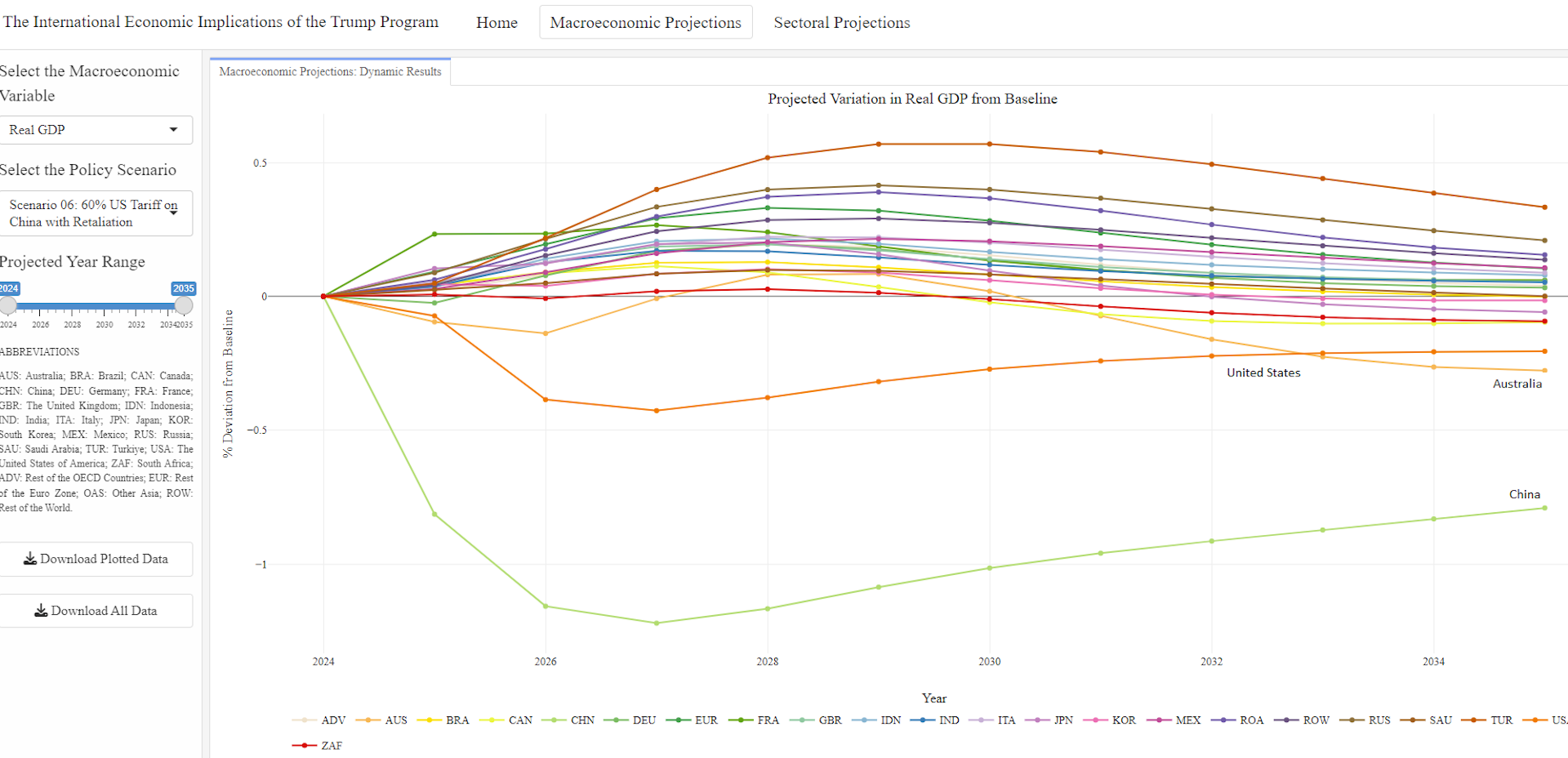
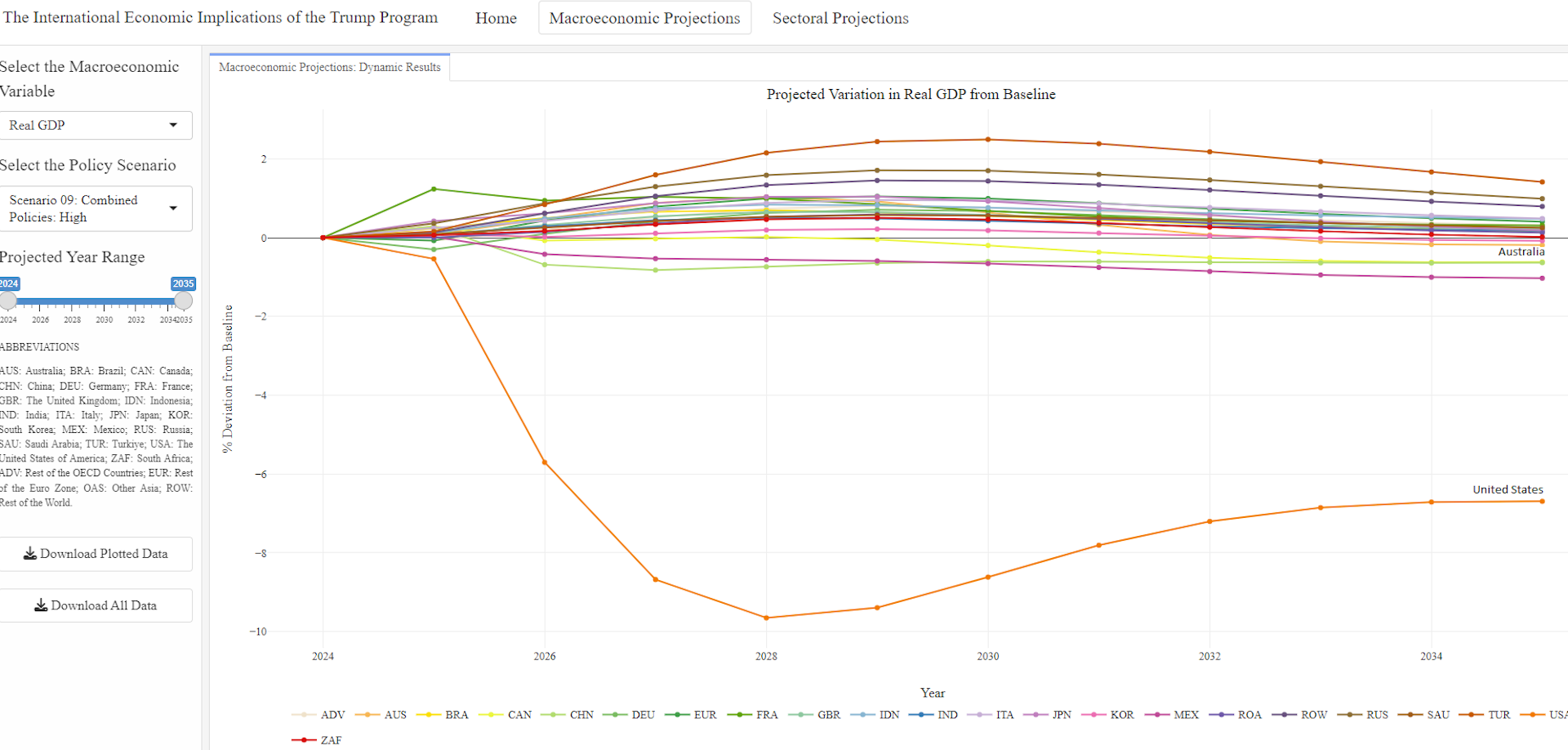
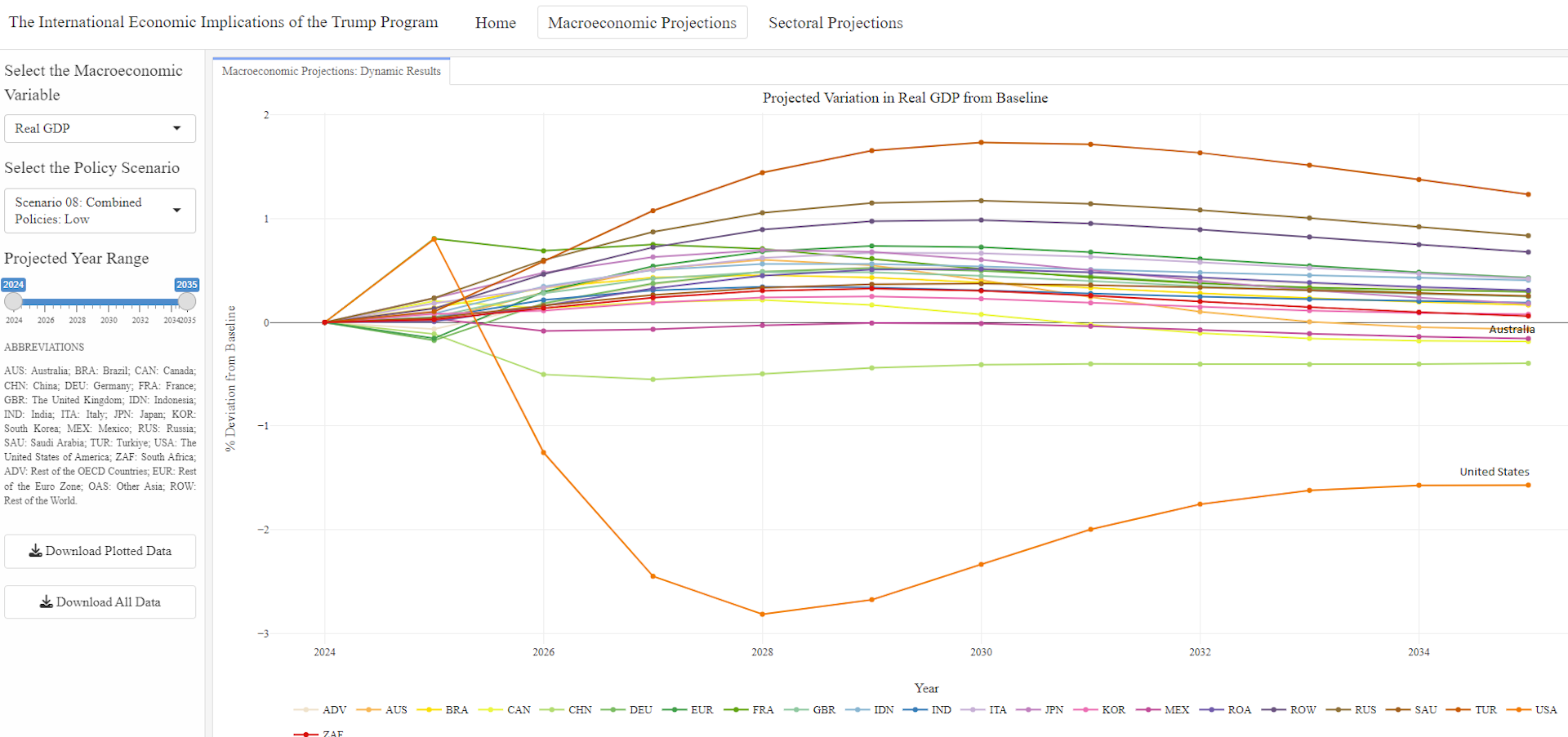
    No other country in the world would be hurt by Trump’s program as much as the US – not even China – although several US allies would suffer, including Australia, which would be the fourth-worst hit by the most extreme version of what Trump is proposing.

    Peterson Institute for International Economics.

    Mass deportations

    Trump has repeatedly promised the “largest domestic deportation operation in American history,” targeting up to 20 million unauthorised immigrants, including about 8.3 million thought to be in the workforce.

    He says his model is Operation Wetback – a 1956 Eisenhower administration program that used military-style tactics to deport 1.3 million Mexicans.

    The institute says Eisenhower’s success makes it easy to believe Trump could remove 1.3 million immigrant workers. It has modelled two scenarios: removing 1.3 million and 8.3 million, both over two years in 2025 and 2026.

    Both slash employment, including the employment of non-immigrants, both push up inflation, which eventually is brought under control, and both make the US a less attractive place to invest, which benefits much of the rest of the world.

    The institute says the low and high scenarios differ “only by the degree of damage inflicted on people, households, firms, and the overall economy”.

    Huge tariff hikes

    Trump wants to increase every tariff on goods imported to the US by 10 percentage points, including where there is at present no tariff. And he wants at least a 60% tariff on imports from China. The institute has modelled both, with and without retaliatory tariffs from China and the rest of the world.

    It finds, unsurprisingly, that extra tariffs push up the price of US imports and the prices of US-produced goods that compete with imports. Many are used as inputs in manufacturing, which means US manufacturing suffers (which is probably not what Trump had in mind).

    Fewer imports mean less demand for foreign exchange within the US, which means a higher US dollar which makes US exports less competitive. The US economy is weaker as a result, although China’s is weaker still and Australia’s is weakened as much as the US given its role in providing resources to China.

    Nobbling the Fed

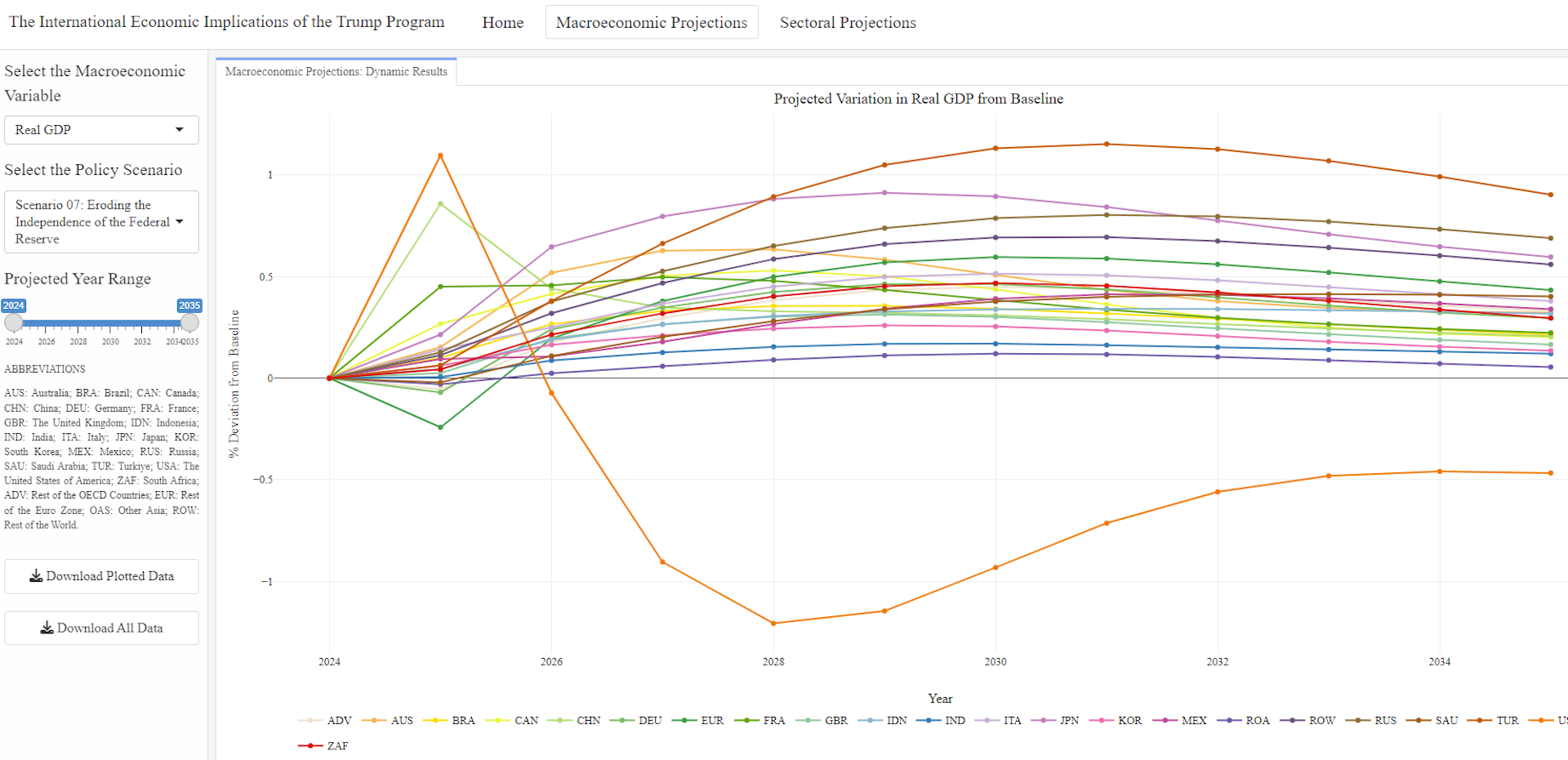
    Trump has raised the prospect of more presidential influence over interest rates, saying he thinks he has “a better instinct than, in many cases” the board of US Federal Reserve. This could be achieved by requiring the president to be consulted on rate decisions or by appointing a compliant chair.

    However it’s done, the institute’s “conservative” assumption based on what happens in developing countries with less central bank independence is that it will push inflation two percentage points higher.

    The modelled result is capital flight. While the US economy is initially stronger than it would have been because of the Fed’s willingness to tolerate higher inflation, after a few years it is weaker and every other economy is stronger.

    When all the measures are combined, under the extreme scenarios the US economy is 6.7% weaker than it would have been by 2035 and Australia’s is 0.2% weaker. Under the more modest scenarios, the US economy is 1.6% weaker and Australia’s is 0.06% weaker.

    Why not examine Harris?

    Despite a history of non-partisanship, the Peterson Institute is prepared for criticism. It points out that the economic model it used is regarded as the best in the world for scenario planning and is Australian, built by Warwick McKibbin of the Australian National University.

    And it says it has modelled the Trump policies rather than the Harris policies because only Trump’s represent a departure from business as usual.

    As the Institute’s president Adam Posen put it in Washington last month, the Harris campaign has said it will not impose across-the-board tariffs, will not engage in mass deportations and will not interfere with the independence of the US Federal Reserve.

    The Trump campaign has indicated it will do all three.

    It’s entirely possible that in office Trump wouldn’t do everything he proposed while campaigning, and it’s entirely possible that he would change course if what was doing damaged the US in the way the modelling suggests.

    But there’s something to be said for taking people at their word, at least to get an idea of what we could be in store for after a knife-edge election.

    Peter Martin is Economics Editor of The Conversation.

    ref. From mass deportations to huge tariff hikes, here’s what Trump’s economic program would do the US and to Australia – https://theconversation.com/from-mass-deportations-to-huge-tariff-hikes-heres-what-trumps-economic-program-would-do-the-us-and-to-australia-240650

    MIL OSI AnalysisEveningReport.nz

  • MIL-OSI Asia-Pac: PRESS RELEASE – Australian rugby teams enjoy local hospitality as part of Samoa’s 100 years of rugby celebrations.

    Source: Government of Western Samoa

    Share this:

    (25 September 2024)

    Apia, SAMOA – Last week, three Australian rugby teams visited to take part in Samoa’s 100 years of rugby celebrations.

    Women’s Australia A team faced off against Manusina in a thrilling match that ended with a penalty kick in the final seconds, securing a hard-fought victory for the Samoan side.

    In addition to the epic clash between Australia A and Manusina, Rugby Australia partnered with Llyod McDermott Foundation to form a First Nations men’s team comprised of indigenous players from across Australia.

    The First Nations team accompanied Australia Women’s Development 7s team to participate in the inaugural Lakapi Samoa Teuila 7s tournament. This marked a milestone for Australian rugby as it was the first time a First Nations team has travelled to the Pacific to showcase their talent and cultures.

    “This opportunity allows us to highlight the next wave of indigenous rugby talent. Many of our players have ambitions to represent Australia at the highest level, and this is the perfect platform to showcase their abilities,” said Matthew Sonter, Director Llyod McDermott Foundation.

    The visit by Australian teams was also an opportunity for learning and cultural exchange. Teams engaged in community activities, visiting local schools and rugby clubs to learn and share knowledge and skills with young Samoan athletes. Players also experienced the rich traditions of Samoa, including participating in traditional ava ceremonies.

    “This week has been a remarkable celebration of rugby, culture, and community. The connections formed here extend beyond the field, fostering mutual respect and understanding between our nations,” said HE Mr Will Robinson, Australia’s High Commissioner to Samoa.

    This investment in rugby reflects the Australian Government’s continuous commitment in supporting sports in Samoa and the Blue Pacific, recognising its power to bring people and communities to learn, grow, and play together.

    The visit was supported through the Australian Government’s PacificAus Sports initiative together with Rugby Australia.

    For further information, please contact jordan.kwan@dfat.gov.au.

    END.

    SOURCE – Australian High Commission, Samoa

    +6

    See insights and ads

    Boost post

    All reactions:

    57Australian High Commission, Samoa and 56 others

    Share this:

    MIL OSI Asia Pacific News

  • MIL-OSI Asia-Pac: Keynote address for the Honorable Minister of Health Official Handover of the Vaccine Van

    Source: Government of Western Samoa

    Share this:

    25th September, 2024; Pharmaceutical Warehouse @ 12noon

    Lau Susuga le Ta’ita’i o le Sauniga; Rev. Saaga Tuiletufuga

    Australian High Commissioner to Samoa – H.E Will Robinson

    and the Australian Department of Foreign and Trade in Samoa

    UNICEF Chief of Field Office in Samoa – Ms. Khin Moe Aye and

    the UNICEF office in Samoa

    Ladies and Gentlemen,

    Samoa has been making steady progress in terms of reaching all

    eligible children with the vaccines as per the National

    Immunisation Schedule. There has been successful roll out of 4

    lifesaving childhood vaccines in the last 3 years like Rotavirus

    vaccine, Pneumococcal Vaccine, HPV vaccine and Typhoid vaccine

    to protect our children respectively from Diarrhoea, Pneumonia,

    Cervical cancer and Typhoid fever. This year the coverage for the 2

    doses of Measles vaccine has been quite encouraging for Samoa.

    The coverage of first dose of Measles has reached 91% for the first time in the last 5 years after the Measles outbreak and the 2nd dose of Measles vaccine is around 64%. I am confident that our

    Immunization Program or EPI team will be able to reach the

    missed children in the remaining months of this year to achieve a

    good coverage for the year through our continuous and existing

    outreach vaccinations.

    The new vaccine introduction initiative, Post-Measles Outbreak

    recovery plan and COVID-19 Pandemic, brought in a C-change to

    the immunization domain of Samoa. There are significant

    developments in Cold Chain, capacity building of health workers,

    documentation and reporting to strengthen the Health System

    with regards to Immunization with technical support from UNICEF.

    The transportation and distribution of vaccines in the country was

    identified as a gap. Now with this new vehicle procured with the

    funding support from Australian Government, transportation of

    vaccines will be faster, which means a boost in efficient and timely

    vaccine supply of vaccines and logistics to the healthcare facilities.

    The vehicle is also covered to protect vaccines against

    unfavourable weather conditions. Though this vehicle will have

    priority for vaccines, it may be considered to accommodate the

    pharmaceutical supplies for distribution to the health facilities

    across the country to improve the cost efficiency.

    We are immensely grateful to Australian Government for their

    timely support and also to UNICEF for their able technical guidance

    and support for strengthening our Health system to get equipped

    to provide quality services in a cost-effective way.

    SOIFUA MA IA MANUIA!

    Lauga a le Afioga le Minisita o le Soifua Maloloina

    Tatala Aloaia le Tauaaoina o le Ta’avale mo le tufaina/kilivaina o Tui Puipui ma Vailaau

    Lau Susuga le Ta’ita’i le Sauniga – Rev. Saaga Tuiletufuga

    Lau Susuga le Komisina Maualuga o Ausetalia i Samoa, H.E

    Will Robinson

    Lau Susuga le Sui o le Ofisa o le Faalapotopotoga o le UNICEF i

    Samoa – Khin Moe Aye

    Le paia o le aofia ua potopoto,

    Ua molimauina e tusa ai ma fa’amaumauga lata mai, le alualu i

    luma o taumafaiga a Samoa, e ala i le to’atele o alo ma fanau ua

    fa’atino o latou tui puipui fa’aauau. I totonu o le 3 tausaga talu ai,

    na fa’amauina le lelei o le faatinoina o nisi o tui Puipui fou na

    fa’amanuiaina ai lo tatou atunu’u mo le puipuiga o alo ma fanau

    mai le tele o fa’ama’i.

    O nei tui Puipui e aofia ai tui e puipuia mai fa’ama’i e pei o le

    manava tatā, o fa’ama’i e aofia ai le nimonia, o le fa’ama’i o le

    taifoi, faapea ma tui puipui mo alo ma fanau teine e puipuia mai

    nisi o Kanesa o tama’ita’i.

    O le tausaga lenei, e fa’alototeleina lava le auaunaga, ona o le

    maoa’e o le tulaga ua o’o iai le fa’atinoga o tui Puipui o le Misela.

    O le tui muamua lava o le Misela (MR1) e 91% le faitau aofa’i o alo

    ma fanau e agava’a na faia tui Puipui. Ao le tui lona lua o le Misela (MR2) e 64%. O lo’o mafanafana lava, o le a fa’aauau le una’i a le aufaigaluega ina ia ausia le 90-100% o le tui puipui lenei o le Misela i nai masina o totoe o lenei tausaga.

    O le o’o mai o nisi o tui Puipui fou e faaopoopo i tui Puipui fa’aauau a le fanau e puipuia mai fa’ama’i e pei ona ou ta’ua, o

    taumafaiga o le una’i o le faia o tui ina ua mae’a le pipisi o le

    Misela, faapea ma le KOVITI-19 o ni matati’a sili ia mo le

    Polokalame o Tui Puipui mo Samoa. Ua si’itia fo’i le tulaga o le

    mata’itūina o le mālūlū ma le vevela talafeagai e teu malu ai tui

    Puipui, aemaise le taimi e feavea’i ma kiliva ai i tua i falema’i ma

    nofoaga o lo’o faatino ai tūiga.

    O lo’o fa’aauau pea a’oa’oga mo le si’itia o le silafia o tausi soifua

    i le fa’atinoga o tui Puipui. E le gata i lea a’o le si’itia o le silafia e

    fa’aleleia atili ai fa’amaumauga e ala i metotia fa’aona-po-nei. O

    le naunautaiga o nei taumafaiga uma, ina ia mautinoa e faia uma

    tui Puipui o alo ma fanau faapea ma tagata matutua e agava’a. Ia

    mafai ai ona puipuia mai le tele o fa’ama’i pipisi. E le galo Afia i si

    ona vao, ma e faafetai ai le lagolago a le Faalapotopotoga o le

    UNICEF faapea ma le Polokalame mo Tui Puipui Fou o lo’o

    faatupeina e le ADB mo nei taumafaiga.

    A’o le meaalofa o le a tau’aaoina nei, e pei ona iai le ta’avale

    faapitoa mo le kilivaina o tui Puipui, o se foa’i sili lea ua

    fa’aopoopo e unaia ai le auaunaga o tūiga. E le gata ina ia mautinoa e vave ona taunu’u le tufaina ma le kilivaina o Tui Puipui mana’omia mo falema’i uma. Ae faapea fo’i ma le puipuia mai o nei vailaau ma tui mai le vevela ma vave ona fa’aleaogāinaai.

    O lenei foa’i o le a fesoasoani tele, e le na’o le fa’aaogaina mo Tui

    Puipui, ae mo le kilivaina o nisi o vailaau mo’omia i tua i falema’i

    fa’aitūmalo ma nofoaga mamao o lo’o faatinoina ai le auaunaga

    fa’asoifua maloloina.

    O le agaga fa’agae’etia mai le Malo o Samoa e tauala atu le

    Matagaluega o le Soifua Maloloina, e fa’afetaia ai le Malo o

    Ausetalia faapea ma le Faalapotopotoga o le UNICEF mo lenei

    foa’i, ina ia si’itia le auaunaga mo le mamalu o le atunu’u.

    Ia fa’aauau ai pea le tatou galulue fa’atasi aua se Samoa

    maloloina mo nei ma le lumana’i.

    SOIFUA MA IA MANUIA

    Share this:

    MIL OSI Asia Pacific News

  • MIL-OSI: ZeroDual, Powered by OPTIZMO™ Technologies, Debuts as an Innovative Solution to Dual Representation Issues in the MDL Arena

    Source: GlobeNewswire (MIL-OSI)

    AUSTIN, Texas, Oct. 08, 2024 (GLOBE NEWSWIRE) — OPTIZMO Technologies, recognized for its leading solutions in email compliance, data security, and suppression list management, proudly introduces ZeroDual. This innovative platform is specifically designed to revolutionize the management of dual representation challenges faced by law firms in Mass Tort and Class Action litigation. ZeroDual harnesses OPTIZMO’s industry-leading technology to offer a secure, and intuitive approach to ensure clean dockets and reduce case attrition.

    Launched in 2009 by co-founders Khris Thayer and Grant Fern, OPTIZMO has been at the cutting edge of managing and securing sensitive data for 15 years. With the launch of ZeroDual, OPTIZMO delivers a solution critically needed to enhance efficiency and data integrity within the mass tort industry.

    ZeroDual: An Innovative Shift in Docket Management
    Catering to the complexities of Mass Tort litigation, ZeroDual presents a pivotal advancement in real-time case management and duplication checks. The platform enables law firms to ensure that cases being onboarded are not already represented by another firm, promoting real-time transparency in docket management, and reducing overall case attrition in the census/certification process.

    Why ZeroDual is the Definitive Solution:

    • Instant Duplicate Claimant Checks: Instantaneously verify if claimants are unique within the MDL upon intake, significantly mitigating duplicate retainer purchases and longer-term case processing costs.
    • Streamlined Docket Certification: Facilitate smoother docket certification processes with courts, enhancing the efficiency of legal proceedings.
    • Privacy and Security at the Forefront: With encoded, anonymized case data, ZeroDual keeps your case demographics confidential and shielded from other law firms.
    • Centralized Plaintiff Database: ZeroDual creates a comprehensive, centralized case database for each MDL, streamlining case management.
    • User-Friendly Interface: Equipped with a simple, one-click tool for instant claimant duplicate checks, ZeroDual is designed for ease of use without compromising on precision.

    Advanced Data Security Measures
    Building on OPTIZMO’s core commitment to data security, ZeroDual incorporates extensive security protocols, ensuring sensitive case information is rigorously protected. Through encoding, anonymization, and an array of vulnerability assessments, ZeroDual delivers industry-best data security protocols within the legal industry.

    As OPTIZMO continues to expand its product and service offerings, ZeroDual exemplifies the company’s innovation-driven philosophy. By introducing ZeroDual, OPTIZMO not only addresses an industry-wide challenge but also reinforces its reputation as a pioneer in technological solutions for complex data management issues.

    Learn more at ZeroDual.com

    About OPTIZMO

    OPTIZMO Technologies is the recognized thought leader in the email and online marketing space for email suppression list management, email campaign management, data management, and risk mitigation services relative to email compliance. With an expert staff in pursuit of unrivaled efficiency, innovative technology, and an insatiable desire to problem-solve, clients find a customer-centric business model that not only enhances the way OPTIZMO clients do business but drives the company forward. The company is headquartered in Austin, TX, and has offices and team members in Charleston, Denver, and Brisbane, Australia.

    Media Contact:
    Antonio Jones
    Marketing Manager
    antonio@optizmo.com

    Tom Wozniak
    Chief Operations Officer
    tom@optizmo.com

    The MIL Network

  • MIL-Evening Report: From mass deportations to huge tariff hikes, here’s what Trump’s economic program would do to the US and Australia

    Source: The Conversation (Au and NZ) – By Peter Martin, Visiting Fellow, Crawford School of Public Policy, Australian National University

    Prashantrajsingh/Shutterstock

    It’s time to take Donald Trump seriously. Betting markets say it’s as likely as not he will be elected US president four weeks from today.

    And unlike in 2016 when his program wasn’t clearly defined, he has set out plainly what he intends to do. Which means it’s possible to model the consequences.

    The three Trump promises with the greatest economic impact are

    • the deportation of millions of US residents

    • steep restrictions on imports, especially from China

    • presidential influence over interest rates.

    The best way to model the consequences is with an established model of the kind used by the International Monetary Fund and central banks around the world rather than one set up for the purpose that could be seen as designed to favour or not favour Trump.

    The Washington-based Peterson Institute for International Economics has just done that, noting that during Trump’s first term as president he “by and large” did what he said he would do.

    It finds

    ironically, despite his ‘make the foreigners pay rhetoric’, Trump’s package of policies does more damage to the US economy than to any other in the world.

    No other country in the world would be hurt by Trump’s program as much as the US – not even China – although several US allies would suffer, including Australia, which would be the fourth-worst hit by the most extreme version of what Trump is proposing.

    Peterson Institute for International Economics.

    Mass deportations

    Trump has repeatedly promised the “largest domestic deportation operation in American history,” targeting up to 20 million unauthorised immigrants, including about 8.3 million thought to be in the workforce.

    He says his model is Operation Wetback – a 1956 Eisenhower administration program that used military-style tactics to deport 1.3 million Mexicans.

    The institute says Eisenhower’s success makes it easy to believe Trump could remove 1.3 million immigrant workers. It has modelled two scenarios: removing 1.3 million and 8.3 million, both over two years in 2025 and 2026.

    Both slash employment, including the employment of non-immigrants, both push up inflation, which eventually is brought under control, and both make the US a less attractive place to invest, which benefits much of the rest of the world.

    The institute says the low and high scenarios differ “only by the degree of damage inflicted on people, households, firms, and the overall economy”.

    Huge tariff hikes

    Trump wants to increase every tariff on goods imported to the US by 10 percentage points, including where there is at present no tariff. And he wants at least a 60% tariff on imports from China. The institute has modelled both, with and without retaliatory tariffs from China and the rest of the world.

    It finds, unsurprisingly, that extra tariffs push up the price of US imports and the prices of US-produced goods that compete with imports. Many are used as inputs in manufacturing, which means US manufacturing suffers (which is probably not what Trump had in mind).

    Fewer imports mean less demand for foreign exchange within the US, which means a higher US dollar which makes US exports less competitive. The US economy is weaker as a result, although China’s is weaker still and Australia’s is weakened as much as the US given its role in providing resources to China.

    Nobbling the Fed

    Trump has raised the prospect of more presidential influence over interest rates, saying he thinks he has “a better instinct than, in many cases” the board of US Federal Reserve. This could be achieved by requiring the president to be consulted on rate decisions or by appointing a compliant chair.

    However it’s done, the institute’s “conservative” assumption based on what happens in developing countries with less central bank independence is that it will push inflation two percentage points higher.

    The modelled result is capital flight. While the US economy is initially stronger than it would have been because of the Fed’s willingness to tolerate higher inflation, after a few years it is weaker and every other economy is stronger.

    When all the measures are combined, under the extreme scenarios the US economy is 6.7% weaker than it would have been by 2035 and Australia’s is 0.2% weaker. Under the more modest scenarios, the US economy is 1.6% weaker and Australia’s is 0.06% weaker.

    Why not examine Harris?

    Despite a history of non-partisanship, the Peterson Institute is prepared for criticism. It points out that the economic model it used is regarded as the best in the world for scenario planning and is Australian, built by Warwick McKibbin of the Australian National University.

    And it says it has modelled the Trump policies rather than the Harris policies because only Trump’s represent a departure from business as usual.

    As the Institute’s president Adam Posen put it in Washington last month, the Harris campaign has said it will not impose across-the-board tariffs, will not engage in mass deportations and will not interfere with the independence of the US Federal Reserve.

    The Trump campaign has indicated it will do all three.

    It’s entirely possible that in office Trump wouldn’t do everything he proposed while campaigning, and it’s entirely possible that he would change course if what was doing damaged the US in the way the modelling suggests.

    But there’s something to be said for taking people at their word, at least to get an idea of what we could be in store for after a knife-edge election.

    Peter Martin is Economics Editor of The Conversation.

    ref. From mass deportations to huge tariff hikes, here’s what Trump’s economic program would do to the US and Australia – https://theconversation.com/from-mass-deportations-to-huge-tariff-hikes-heres-what-trumps-economic-program-would-do-to-the-us-and-australia-240650

    MIL OSI AnalysisEveningReport.nz

  • MIL-OSI Economics: Hera planetary defence mission successfully launched

    Source: Thales Group

    Headline: Hera planetary defence mission successfully launched

    • Hera aims to confirm if it is possible to deflect a hazardous asteroid on a collision course with the Earth, as a repeatable strategy ready for use in case of an actual asteroid threat
    • Thales Alenia Space provided key technologies onboard the Hera spacecraft, which will send essential data from the Didymos binary asteroid, similar to one that could potentially impact our Planet

    Madrid, 8 October, 2024 – Hera, the European Space Agency’s (ESA) first planetary defence mission,  was successfully launched yesterday aboard a SpaceX Falcon 9 rocket, from Cape Canaveral in Florida. The satellite is now heading to a unique target among the 1.3 million known asteroids of our Solar System.

    If an incoming asteroid were to threaten Earth, what could be done to cope with the situation? On September 26th 2022, NASA’s Double Asteroid Redirection Test (DART) mission performed humankind’s first test of asteroid deflection by crashing into the Great-Pyramid-sized Dimorphos moonlet. This resulted in a shift of its orbit around the mountain-sized Didymos main asteroid.

    Hera networking with Cubesats ©ESA 

    Next comes ESA’s own contribution to the international Asteroid Impact & Deflection Assessment (AIDA) collaboration: the Hera mission will travel to Dimorphos so as to gather vital close-up data regarding the deflected body and turn DART’s grand-scale kinetic impact experiment into a well-understood and potentially repeatable planetary defence technique. Hera will provide in particular accurate measurements concerning the asteroid’s mass, as well as crucial information about its make-up and structure, which are essential to interpret the outcome of the impact.

    The Hera mission, will also carry out the most detailed exploration to date of a binary asteroid system – although binaries make up 15% of all known asteroids, they have never been studied in detail. Hera will also perform technology demonstration experiments, including the deployment of ESA’s first deep space ‘CubeSats’ – shoebox-sized spacecraft to venture closer than the main mission then eventually land – and an ambitious test of ‘self-driving’ for the main spacecraft, based on vision-based navigation. The OHB System AG (Germany), as prime contractor of Hera, led the industrial consortium, including responsibility for the overall spacecraft design, development, assembly, and testing.

    Thales Alenia Space’s contribution: a teamwork between Spain, Italy and Belgium

    Thales Alenia Space, a joint venture between Thales (67%) and Leonardo (33%), provided key technologies onboard Hera spacecraft. Thales Alenia Space in Spain was responsible for the communications subsystem, which allows to control and track the spacecraft from a distance up to 500 million kilometre away and to send all the information gathered by Hera back to Earth. Thales Alenia Space in Italy developed the state-of-art Deep Space Transponder, while Thales Alenia Space in Belgium developed the Travelling Wave Tube Amplifiers (TWTA), as well as the Power Conditioning and Distribution Unit (PCDU), which provides power to the spacecraft during all its lifetime.

    Safeguarding our planet

    Asteroids are bodies originated in the young stars nebulae that never grew to planets, formed of rock and metal. Among them, those that have an orbit that brings them close to Earth (within 45 million kilometres), known as near-Earth asteroids, represent a risk of hitting the Earth. There are plenty of such bodies in our Solar system, from tiny little ones measuring a few meters (there are 40-50 millions of them) up to larger ones, measuring more than 1 km but much more scarce (there’s less than 1000 of them).

    Neither the smaller near-Earth asteroids nor the larger ones represent a real threat to humanity. Small asteroids actually hit the Earth quite frequently (every two weeks) with no consequences. The larger ones, although potentially dangerous, are well known and tracked, and it takes millions of years to have one of them hitting the Earth. Actually, a 10km asteroid impact is the most accepted theory of the Cretaceous extinction around 66 million years ago, ending with three-quarters of the plant and animal species, among others the dinosaurs.

    Hera scans DART’s impact crater ©ESA 

    The mid-sized class asteroids of more than 100 meters are the ones we need to worry about. There are about 30,000 near-Earth asteroids of the 100 to 300 meter size class, 82% of them still to be spotted, hitting the Earth every 10,000 years. The impact energy of such an asteroid is equivalent to around 50 megatons of TNT, the power of a “Tsar Bomba”. The effect of such an impact would be devastating if it reached a populated area, capable of destroying an entire city or to create a tsunami if it impacted a sea.

    The Didymos binary asteroid system is prototypical in terms of size of the thousands of asteroids that pose a hazardous risk of impact to our planet. Around the Dydimos main body, 780 meter in diameter, orbits the 150 meter Dimorphos moonlet, which is the first body in the Solar System to have had its orbit measurably changed through human action, by the DART impact, and it is also the smallest asteroid yet visited by humankind.

    The Hera spacecraft will reach the binary asteroid in October 2026, after a two-year cruise phase. The day Hera reaches Didymos, it will be 195 million km away from Earth.

    ABOUT THALES ALENIA SPACE

    Drawing on over 40 years of experience and a unique combination of skills, expertise and cultures, Thales Alenia Space delivers cost-effective solutions for telecommunications, navigation, Earth observation, environmental management, exploration, science and orbital infrastructures. Governments and private industry alike count on Thales Alenia Space to design satellite-based systems that provide anytime, anywhere connections and positioning, monitor our planet, enhance management of its resources and explore our Solar System and beyond. Thales Alenia Space sees space as a new horizon, helping to build a better, more sustainable life on Earth. A joint venture between Thales (67%) and Leonardo (33%), Thales Alenia Space also teams up with Telespazio to form the parent companies’ Space Alliance, which offers a complete range of services. Thales Alenia Space posted consolidated revenues of approximately €2.2 billion in 2023. Thales Alenia Space has around 8,600 employees in 9 countries, with 16 sites in Europe and a plant in the US.

    http://www.thalesaleniaspace.com

    THALES ALENIA SPACE – PRESS CONTACTS

    Oriol Casas Thió
    Tel.: +34 618 509 197
    oriol.casasthio@thalesaleniaspace.com

    Tarik Lahlou
    Tel: +33 (0)6 87 95 89 56
    tarik.lahlou@thalesaleniaspace.com

    Catherine des Arcis
    Tel: +33 (0)6 78 64 63 97
    catherine.des-arcis@thalesaleniaspace.com

    MIL OSI Economics

  • MIL-OSI USA: U.S. International Trade in Goods and Services, August 2024

    Source: US Bureau of Economic Analysis

    The U.S. Census Bureau and the U.S. Bureau of Economic Analysis announced today that the goods and services deficit was $70.4 billion in August, down $8.5 billion from $78.9 billion in July, revised.

    U.S. International Trade in Goods and Services Deficit
    Deficit: $70.4 Billion  –10.8%°
    Exports: $271.8 Billion  +2.0%°
    Imports: $342.2 Billion  –0.9%°

    Next release: Tuesday, November 5, 2024

    (°) Statistical significance is not applicable or not measurable. Data adjusted for seasonality but not price changes

    Source: U.S. Census Bureau, U.S. Bureau of Economic Analysis; U.S. International Trade in Goods and Services, October 8, 2024

    Exports, Imports, and Balance (exhibit 1)

    August exports were $271.8 billion, $5.3 billion more than July exports. August imports were $342.2 billion, $3.2 billion less than July imports.

    The August decrease in the goods and services deficit reflected a decrease in the goods deficit of $8.4 billion to $94.9 billion and an increase in the services surplus of $0.1 billion to $24.4 billion.

    Year-to-date, the goods and services deficit increased $47.1 billion, or 8.9 percent, from the same period in 2023. Exports increased $79.0 billion or 3.9 percent. Imports increased $126.1 billion or 4.9 percent.

    Three-Month Moving Averages (exhibit 2)

    The average goods and services deficit decreased $1.6 billion to $74.1 billion for the three months ending in August.

    • Average exports increased $3.7 billion to $267.8 billion in August.
    • Average imports increased $2.0 billion to $342.0 billion in August.

    Year-over-year, the average goods and services deficit increased $11.1 billion from the three months ending in August 2023.

    • Average exports increased $13.3 billion from August 2023.
    • Average imports increased $24.4 billion from August 2023.

    Exports (exhibits 3, 6, and 7)

    Exports of goods increased $4.4 billion to $179.4 billion in August.

      Exports of goods on a Census basis increased $4.9 billion.

    • Capital goods increased $1.7 billion.
      • Telecommunications equipment increased $0.5 billion.
      • Civilian aircraft increased $0.4 billion.
      • Computer accessories increased $0.4 billion.
      • Other industrial machinery increased $0.4 billion.
      • Semiconductors decreased $0.8 billion.
    • Consumer goods increased $1.0 billion.
      • Pharmaceutical preparations increased $1.0 billion.
    • Industrial supplies and materials increased $0.9 billion.
      • Nonmonetary gold increased $1.5 billion.
      • Crude oil decreased $1.1 billion.
    • Automotive vehicles, parts, and engines increased $0.8 billion.
      • Passenger cars increased $0.6 billion.

      Net balance of payments adjustments decreased $0.5 billion.

    Exports of services increased $0.9 billion to $92.3 billion in August.

    • Travel increased $0.5 billion
    • Government goods and services increased $0.2 billion.
    • Transport decreased $0.2 billion.

    Imports (exhibits 4, 6, and 8)

    Imports of goods decreased $3.9 billion to $274.3 billion in August.

      Imports of goods on a Census basis decreased $3.8 billion.

    • Industrial supplies and materials decreased $3.9 billion.
      • Nonmonetary gold decreased $1.2 billion.
      • Finished metal shapes decreased $1.0 billion.
      • Crude oil decreased $1.0 billion.
    • Automotive vehicles, parts, and engines decreased $1.3 billion.
      • Passenger cars decreased $1.1 billion.

      Net balance of payments adjustments decreased $0.2 billion.

    Imports of services increased $0.7 billion to $67.9 billion in August.

    • Travel increased $0.4 billion.
    • Charges for the use of intellectual property increased $0.4 billion.
    • Transport decreased $0.3 billion.

    Real Goods in 2017 Dollars – Census Basis (exhibit 11)

    The real goods deficit decreased $8.6 billion, or 8.9 percent, to $88.6 billion in August, compared to an 8.5 percent decrease in the nominal deficit.

    • Real exports of goods increased $5.5 billion, or 3.8 percent, to $150.1 billion, compared to a 2.9 percent increase in nominal exports.
    • Real imports of goods decreased $3.2 billion, or 1.3 percent, to $238.7 billion, compared to a 1.4 percent decrease in nominal imports.

    Revisions

    Revisions to July exports

    • Exports of goods were revised down less than $0.1 billion.
    • Exports of services were revised down $0.1 billion.

    Revisions to July imports

    • Imports of goods were revised up $0.1 billion.
    • Imports of services were revised down $0.1 billion.

    Goods by Selected Countries and Areas: Monthly – Census Basis (exhibit 19)

    The August figures show surpluses, in billions of dollars, with Netherlands ($5.5), South and Central America ($4.0), Australia ($1.9), Hong Kong ($1.6), Brazil ($0.8), Singapore ($0.5), and United Kingdom ($0.3). Deficits were recorded, in billions of dollars, with China ($24.7), European Union ($19.1), Mexico ($14.3), Vietnam ($9.8), Ireland ($8.0), Taiwan ($7.3), Germany ($6.6), Japan ($4.9), South Korea ($4.9), Canada ($3.9), Italy ($2.9), India ($2.7), Switzerland ($2.5), France ($1.7), Malaysia ($1.1), Israel ($1.0), Belgium ($0.6), and Saudi Arabia ($0.1).

    • The deficit with Canada decreased $3.8 billion to $3.9 billion in August. Exports increased $1.1 billion to $28.5 billion and imports decreased $2.7 billion to $32.3 billion.
    • The deficit with China decreased $2.6 billion to $24.7 billion in August. Exports increased $1.1 billion to $12.6 billion and imports decreased $1.5 billion to $37.3 billion.
    • The balance with Belgium shifted from a surplus of $1.0 billion in July to a deficit of $0.6 billion in August. Exports decreased $0.1 billion to $2.8 billion and imports increased $1.5 billion to $3.4 billion.

    All statistics referenced are seasonally adjusted; statistics are on a balance of payments basis unless otherwise specified. Additional statistics, including not seasonally adjusted statistics and details for goods on a Census basis, are available in exhibits 1-20b of this release. For information on data sources, definitions, and revision procedures, see the explanatory notes in this release. The full release can be found at http://www.census.gov/foreign-trade/Press-Release/current_press_release/index.html or http://www.bea.gov/data/intl-trade-investment/international-trade-goods-and-services. The full schedule is available in the Census Bureau’s Economic Briefing Room at www.census.gov/economic-indicators/ or on BEA’s website at http://www.bea.gov/news/schedule.

    Next release: November 5, 2024, at 8:30 a.m. EST
    U.S. International Trade in Goods and Services, September 2024

    MIL OSI USA News

  • MIL-OSI Asia-Pac: Interdepartmental working group on festival arrangements summarises visitor arrivals to Hong Kong during National Day Golden Week

    Source: Hong Kong Government special administrative region

         The seven-day National Day Golden Week of the Mainland ended yesterday (October 7), with the overall number of inbound visitors aligning with earlier estimates. The number recorded on National Day (October 1) reached a daily record high since the post-pandemic full opening of the borders.     During the seven-day National Day Golden Week, the Immigration Department recorded a total of around 1.38 million visitors coming to Hong Kong through various sea, land and air control points. Among them, Mainland visitors accounted for about 1.22 million, representing 88 per cent of the total arrivals. The daily average of Mainland visitors was around 170 000, which exceeded that of the 2023 National Day Golden Week and the 2024 Labour Day Golden Week around 27 per cent and some 13 per cent respectively.     Mainland inbound visitor arrivals peaked on National Day with around 220 000 visitors arriving in Hong Kong, marking a daily record high since the post-pandemic opening of the borders and setting a corresponding record for the overall number of visitors to Hong Kong in a single day. During the National Day Golden Week, the Lok Ma Chau Spur Line and the Express Rail Link West Kowloon were the two ports with the highest daily average number of Mainland visitors, and operations at various control points and transport services ran smoothly.     Regarding large-scale events, the National Day Fireworks Display over Victoria Harbour on October 1 attracted over 330 000 spectators. The event concluded with effective crowd control arrangements and was well-received by local residents and tourists.     Visitors went to different parts of Hong Kong during the National Day Golden Week, with high visitor flow observed at major tourist attractions including the West Kowloon Cultural District, Ocean Park, Hong Kong Disneyland, the Peak Tram and Ngong Ping 360. Smooth and effective crowd management measures were implemented. In addition, according to the information provided by the hotel industry, the overall hotel occupancy rate during the first four days of the Golden Week (October 1 to 4) reached 90 per cent.      In terms of tour groups, according to the Travel Industry Authority’s information, around 1 050 Mainland inbound tour groups visited Hong Kong during the National Day Golden Week, with around 80 per cent engaged in overnight itineraries. These tour groups involved around 36 000 visitors, accounting for around 3 per cent of all Mainland visitors, and they were generally in good order.     The interdepartmental working group on festival arrangements, led by the Chief Secretary for Administration, Mr Chan Kwok-ki, is pleased to note that the rich array of National Day special offers from the Government and various sectors of society were well-received by the public. Among them, the 1st October Movie Fiesta: Half-Price Spectacular 2024 organised by the Hong Kong Theatres Association and subsidised by the Government took place in 59 commercial theatres across Hong Kong. On the day of the event, there were nearly 2 000 screenings, with cumulative admissions reaching 189 000, breaking last year’s record of 155 000 and representing an increase of 22 per cent. Free admission was offered to museums and art spaces under the Leisure and Cultural Services Department on October 1, attracting nearly 60 000 attendees. Among them, there were more than 11 000 visitors to the Hong Kong Space Museum, setting a record for single-day attendance.     In addition, several public transportation services provided free rides or discounts during National Day, benefitting a total of approximately 4.43 million passengers. Different sectors such as catering and retail actively launched special offers to attract spending from both locals and visitors, contributing to a festive atmosphere throughout the city. Various trade representatives and merchants reported increased customer flow and business during National Day.     The embarkation and disembarkation arrangements for two homeport deployments of a mega cruise ship at Kai Tak Cruise Terminal (KTCT) during the National Day Golden Week of the Mainland were smooth, with various transport services arranged to adequately meet visitor needs. Notably, direct coach services connecting the Heung Yuen Wai Boundary Control Point and KTCT were arranged by the Hong Kong Tourism Board in collaboration with a local coach operator to provide facilitation for a total of 3 500 Mainland visitors.     Mr Chan said, “Thanks to the concerted efforts of relevant government departments, organisations and industries in making preparations and responses, this year’s arrangements for receiving visitors during the National Day Golden Week operated smoothly, enabling both locals and visitors to celebrate National Day together. The Government will draw on this experience and further enhance various arrangements in future to provide an even better experience for visitors to Hong Kong during festive periods.”

    MIL OSI Asia Pacific News

  • MIL-OSI: Apollo Commercial Real Estate Finance, Inc. Announces Dates for Third Quarter 2024 Earnings Release and Conference Call

    Source: GlobeNewswire (MIL-OSI)

    NEW YORK, Oct. 08, 2024 (GLOBE NEWSWIRE) — Apollo Commercial Real Estate Finance, Inc. (the “Company” or “ARI”) (NYSE:ARI), today announced the Company will hold a conference call to review its third quarter 2024 financial results on Thursday, October 31, 2024 at 9:00 a.m. Eastern Time. The Company’s third quarter 2024 financial results will be released after the market closes on Wednesday, October 30, 2024. During the conference call, Company officers will review third quarter 2024 performance, discuss recent events and conduct a question-and-answer period.

    To register for the call, please use the following link:

    https://register.vevent.com/register/BIa37467c5213342ac9459168840830682

    After you register, you will receive a dial-in number and unique pin. The Company will also post a link in the Stockholders’ section on ARI’s website for a live webcast. For those unable to listen to the live call or webcast, there will be a webcast replay link posted in the Stockholders’ section on ARI’s website approximately two hours after the call.

    About Apollo Commercial Real Estate Finance, Inc.
    Apollo Commercial Real Estate Finance, Inc. (NYSE: ARI) is a real estate investment trust that primarily originates, acquires, invests in and manages performing commercial first mortgage loans, subordinate financings and other commercial real estate-related debt investments. The Company is externally managed and advised by ACREFI Management, LLC, a Delaware limited liability company and an indirect subsidiary of Apollo Global Management, Inc., a high-growth, global alternative asset manager with approximately $696 billion of assets under management as of June 30, 2024.

    Additional information can be found on the Company’s website at http://www.apollocref.com. Please note that our URL address has changed.

    Forward-Looking Statements
    Certain statements contained in this press release constitute forward-looking statements as such term is defined in Section 27A of the Securities Act of 1933, as amended, and Section 21E of the Securities Exchange Act of 1934, as amended, and such statements are intended to be covered by the safe harbor provided by the same. Forward-looking statements are subject to substantial risks and uncertainties, many of which are difficult to predict and are generally beyond the Company’s control. These forward-looking statements include information about possible or assumed future results of the Company’s business, financial condition, liquidity, results of operations, plans and objectives. When used in this release, the words believe, expect, anticipate, estimate, plan, continue, intend, should, may or similar expressions, are intended to identify forward-looking statements. Statements regarding the following subjects, among others, may be forward-looking: higher interest rates and inflation; market trends in the Company’s industry, real estate values, the debt securities markets or the general economy; the timing and amounts of expected future fundings of unfunded commitments; the return on equity; the yield on investments; the ability to borrow to finance assets; the Company’s ability to deploy the proceeds of its capital raises or acquire its target assets; and risks associated with investing in real estate assets, including changes in business conditions and the general economy. For a further list and description of such risks and uncertainties, see the reports filed by the Company with the Securities and Exchange Commission. The forward-looking statements, and other risks, uncertainties and factors are based on the Company’s beliefs, assumptions and expectations of its future performance, taking into account all information currently available to the Company. Forward-looking statements are not predictions of future events. The Company disclaims any intention or obligation to update or revise any forward-looking statements, whether as a result of new information, future events or otherwise, except as required by law.

    CONTACT: Hilary Ginsberg
    Investor Relations
    (212) 822-0767

    The MIL Network

  • MIL-Evening Report: Government to put pressure on opposition with legislation to ensure NBN stays in public hands

    Source: The Conversation (Au and NZ) – By Michelle Grattan, Professorial Fellow, University of Canberra

    The Albanese government on Wednesday will introduce legislation to ensure the NBN remains in government ownership.

    The move is designed to set up a test for the Coalition, putting pressure on the opposition ahead of the election to declare whether it would try to privatise the NBN.

    The government said in a statement from Prime Minister Anthony Albanese, Finance Minister Katy Gallagher and Communications Minister Michelle Rowland: “The Coalition rushed to declare the NBN ‘complete’ so they could put it on the block for sale – selling out Australian consumers and regional communities.

    “The Albanese government won’t let that happen. This legislation will ensure the NBN is owned by who it belongs to – the Australian people.”

    The upgrades the government had undertaken “are already making a real difference in the lives of Australians through faster, more reliable internet access. Keeping the NBN in public hands will lock in affordable and accessible high speed internet for all Australians for generations to come.”

    Albanese said:“The Coalition made a mess of the NBN – my government is getting on with the job of fixing it and making sure it stays in public hands, where it belongs.”

    Rowland said: “Australians don’t trust the Coalition not to flog off the NBN just like they did with Telstra, resulting in higher prices and poorer services, especially in the regions.”

    Downgraded

    The Rudd Labor government announced what was to be a predominantly fibre-to-the-home wholesale network in 2009, promising it would cost $43 billion and later be privatised to claw back the expense.

    In 2010 Communications Minister Stephen Conroy said Labor “remained firmly committed to selling its stake in NBN Co after the network was fully built and operational, subject to market conditions and security considerations”.

    By 2020 the government was estimated to have spent $51 billion on a scaled-down version of the project completed using a mix of technologies.

    In June that year a review by the Parliamentary Budget Office put its fair value at $8.7 billion.

    Michelle Grattan does not work for, consult, own shares in or receive funding from any company or organisation that would benefit from this article, and has disclosed no relevant affiliations beyond their academic appointment.

    ref. Government to put pressure on opposition with legislation to ensure NBN stays in public hands – https://theconversation.com/government-to-put-pressure-on-opposition-with-legislation-to-ensure-nbn-stays-in-public-hands-240807

    MIL OSI AnalysisEveningReport.nz

  • MIL-OSI USA: Hurricane Helene update #10 from Congressman Edwards

    Source: United States House of Representatives – Congressman Chuck Edwards (NC-11)

    Dear enewsletter.salutation_for_merging.merge,

    Here’s to hope: 6,586 people have been rescued, evacuated or assisted by search and rescue teams since Hurricane Helene hit, including 39 survivors being rescued on Saturday, October 5, over eight full days into rescue efforts.

    More than 4,000 first responders, national guardsmen, and active-duty military are in Western North Carolina looking for your friends, your family, or if you’re still stranded waiting for help – they’re looking for you. And they won’t stop until every missing person is accounted for.

    I’m sure many of you have heard that there is a second hurricane brewing on the coast of Florida. It is not expected to hit Western North Carolina, but if it maintains it’s intensity as a Category 4 hurricane, it is expected to be catastrophic. I’m here to tell you that we will support Florida in any way we can, but I am also committed to making sure Western North Carolina does not get left behind in place of the newest natural disaster.

    The resources and help I have listed over the last nine days are here to stay.

    Today is update number 10 and includes details on where to find critical health care services including orthopedic care, dialysis treatments, and oxygen tanks, and an updated timeline on power restoration for individuals in the hardest hit areas. More information is to come in the following days.

    As always, please make sure to read everything and share it with your friends and family.

    • Supplying drinkable water remains a top priority for emergency crews.
      • 84 water systems are on a boil advisory.
      • 24 treatment plants have reported having no power and 33 systems are out of water.
        • Water restoration trends continue to move in a positive direction.
    • The Federal Emergency Management Agency has promised 120 truckloads a day of food and water with no specified end date.
      • FEMA has shipped 13 million meals and 13 million liters of water utilizing the $20 billion in funds that I helped to draft and pass for disaster relief just two days before Hurricane Helene hit.
        • Of the shipped food and water, more than 6 million liters of water and 4 million individual meals have already been delivered to Western NC communities.
    • Walmart is hosting activities at the following locations:
      • Hendersonville, NC Store 1242
        • 250 Highlands Square Dr., Hendersonville, NC 28792
          • Portable restrooms
          • Serving hot meals at 12:00 p.m. and 4:00 p.m. daily
      • Arden, NC Store 1179
        • 60 Airport Rd., Arden, NC 28704
          • Portable restrooms
          • Laundry
          • Showers
          • Wi-fi hotspot and charging stations
        • Buncombe County
          • Buncombe County has begun water distribution at multiple sites. Each will be available daily from 1:00 -7:00 p.m.:
            • Pack Square Park – you MUST bring your own container for this site
              • 80 Court Plz., Asheville, NC 28801
            • William W. Estes Elementary School
              • 275 Overlook Rd., Asheville, NC 28803
            • Sand Hill-Venable Elementary
              • 154 Sand Hill School Rd., Asheville, NC 28806
            • North Windy Ridge Intermediate School
              • 20 Doan Rd., Weaverville, NC 28787
            • Fairview Elementary
              • 1355 Charlotte Hwy., Fairview, NC 28730
          • The following major feeding site is available in Buncombe County, where citizens can access food, water and other basic necessities:
            • Biltmore Baptist Church
              • 35 Clayton Rd., Arden, NC 28704
                • Distribution and bulk pickup for volunteers looking to take bulk loads of supplies to in-need community members
                  • Saturday hours: 10:00 a.m. – 1:00 p.m.
                • Community drive-thru for anyone in the community needing supplies
                  • Saturday hours: 3:00-6:00 p.m.
            • First Baptist Church – Weaverville
              • 63 N. Main St., Weaverville, NC 28787
                • Hot showers available from 10:00 a.m. to 6:00 p.m.
                • Unlimited clean drinking water is available, bring your own container.
                • Supplies and bottled water.
                • Hot lunch served at 1:30 p.m.
          • Food and drinking water are available from 9:00 a.m. to 7:00 p.m. daily at the following locations:
            • Asheville Middle School
              • 211 S. French Broad Ave., Asheville, NC 28801
            • Ingles
              • 550 NC-9, Black Mountain, NC 28711
                • This location also has handwashing stations and portable restrooms
            • Linwood Crump Shiloh Community Center
              • 121 Shiloh Rd., Asheville, NC 28803
            • Lucy Herring Elementary
              • 98 Sulphur Springs Rd., Asheville, NC 28806
            • Oakley Elementary School
              • 753 Fairvew Rd., Asheville, NC 28803
        • Haywood County
          • The following locations are providing community members with essential resources such as but not limited to, food, water, cleaning products, baby formula, and pet food, Monday through Fridays:
            • Fines Creek Community Center
              • 190 Fines Creek Rd., Clyde, NC 28721
              • Open every day until 6:00 p.m.
            • Pigeon Community Center
              • 450 Pigeon St., Waynesville, NC 28786
                • Also offering hot meals every day at 2:00 p.m.
                • Daily Hours: 9:00 a.m. – 4:00 p.m.
            • Cruso Community Center
              • 13186 Cruso Rd., Canton, NC 28716
                • Daily Hours: 10:00 a.m. to 2:00 p.m.
            • First United Methodist Church
              • 566 S. Haywood St., Waynesville, NC 28786
                • Includes shower access.
                • Daily Hours: 9:00 a.m. to 12:00 p.m.
            • Maggie Valley Pavilion
              • 3935 Soco Rd., Maggie Valley, NC 28751
                • Daily Hours: 8:00 a.m. to 8:00 p.m.
            • Woodland Baptist Church
              • 545 Crabtree Rd., Waynesville, NC 28786
                • Daily Hours: 9:00 a.m. to 6:00 p.m.
            • Bethel Elementary School
              • 4700 Old River Rd., Canton, NC 28716
                • Daily Hours: 9:00 a.m. to 6:00 p.m.
            • Jonathan Valley Elementary School
              • 410 Hall Dr., Waynesville, NC 28786
                • Daily Hours: 9:00 a.m. to 6:00 p.m.
                • Monday through Friday
            • St. John the Evangelist Catholic Church – in the Parish Hall
              • 234 Church St., Waynesville, NC 28786
                • Daily Hours: 9:00 a.m. to 5:00 p.m.
                  • Monday to Friday
                • Hot food available from 4:00 p.m. to 7 :00 p.m. daily.
            • St. Barnabas Catholic Church
              • 109 Crescent Hill Rd., Arden, NC 28704
                • Daily Hours: 10:00 a.m. to 2:00 p.m.
            • Reynolds Baptist Church – Family Life Center
              • 520 Rose Hill Rd., Asheville, NC 28803
                • Daily Hours: 9:00 a.m. to 4:00 p.m.
                • This location also has potable water available to residents who bring their own vessels to fill.
          • The following location offers hot meals daily:
            • Maggie Valley Fire Department
              • 2901 Soco Rd., Maggie Valley, NC 28751
          • The following location offers showers daily from 7:00 a.m. to 7:00 p.m.:
            • Calvary Baptist Church
              • 2701 Soco Rd., Maggie Valley, NC 28751
        • Henderson County
          • Henderson County has stood up Resource Hub locations for water distribution and other supplies as they become available.
          • Distribution will be taking place daily from 10:00 a.m. – 4:00 p.m. on Sunday, October 6 at the following locations:
            • Etowah Elementary: 320 Etowah School Rd., Etowah, NC 28729
            • Rugby Middle School: 3345 Haywood Rd., Hendersonville, NC 28791
            • East Henderson High School: 150 Eagle Pride Dr., East Flat Rock, NC 28726
            • North Henderson High School: 35 Fruitland Rd., Hendersonville, NC 28792
            • Mills River Town Hall: 124 Town Center Dr., Mills River, NC 28759
            • Fletcher Town Hall: 300 Old Cane Creek Rd., Fletcher, NC 28732
          • Each family unit will be provided supplies for one day’s meal and water as available.
          • Individuals are asked to enter the drive-through and remain in your car unless otherwise instructed by volunteers to ensure an efficient process.
        • Jackson County
          • In partnership with the Red Cross, the following is available for citizens of Jackson County:
            • The Boys & Girls Club of the Plateau are providing shelf-stable meals at the following location:
              • 558 Frank Allen Rd., Cashiers, NC 28717
              • Hours of operation to come.
              • The Canada Fire Department is distributing emergency supplies at the following location:
                • 149 Charleys Creek Rd., Tuckasegee, NC 28783
                • Hours of operation to come.
        • Madison County
          • The following locations are offering food, water, and some supply distribution in Madison County:
            • Beech Glen Community Center
              • 2936 Beech Glen Rd., Mars Hill, 28754
              • Daily hours: Unable to locate daily hours at this time.
            • Center Community Center
              • 1300 Grapevine Rd., Marshall, NC 28753
              • Daily hours: 8:00 a.m. – 4:00 p.m.
            • Ebbs Chapel Community Center
              • 281 Laurel Valley Rd., Mars Hill, NC 28754
              • Daily hours: 9:00 a.m. – 5:00 p.m.
            • Enon Baptist Church
              • 174 Ammons Branch Rd., Marshall, NC 28753
              • Open Sunday 12:00-4:00 p.m.
            • Freedom Christian Church
              • 7350 US 25/70 Bypass, Marshall, NC 28753
              • Daily hours: 10:00 a.m. – 5:00 p.m.
              • This location offers additional resources such as hygiene products, blankets, clothes, cleaning supplies, diapers, pet food, etc.
            • Laurel Community Center – also has supplies
              • 4100 NC 212 Hwy., Marshall, NC 28753
              • Daily Hours: 8:00 a.m. – 8:00 p.m.
            • Revere-Rice Community Center
              • 3980 Revere Rd., Marshall, NC 28753
              • Daily hours: 11:00 a.m. – 2:00 p.m. (Mon-Sat)
            • Spring Creek Community Center
              • 13075 NC 209 Hwy., Hot Springs, NC 28743
              • Daily hours: 11:00 a.m. – 5:00 p.m.
              • This location also has additional resources such as pet food, livestock feed and hay.
            • Walnut Community Center – also has supplies
              • 46 School Rd., Marshall, NC 28753
              • Daily hours: Unable to locate daily hours at this time.
            • N.C. Cooperative Extension – Madison County Center
              • 258 Carolina Ln., Marshall, NC 28753
              • Daily hours: 10:00 a.m. – 6:00 p.m.
              • This location is offering drive-thru food distribution only.
        • McDowell County
          • McDowell County has established multiple points of distribution that are open daily from 10:00 a.m. – 12:00 p.m. and 4:00-6:00 p.m., depending on supply levels.
          • Distribution takes place daily at the following locations:
            • Former TJ’s Discounts – North Cove
              • 8153 US 221 N., Marion, NC 28752
            • Old Fort Town Hall
              • 38 Catawba Ave., Old Fort, NC 28762
            • New Manna Baptist Church
              • 225 E. Court St., Marion, NC 28752
            • Solid Rock Free Will Baptist Church – Dysartsville 
              • 7860 NC 226 S., Nebo, NC 28761
            • Zion Hill Baptist Church
              • 1036 Zion Hill Rd., Marion, NC 28752
          • Hot meals are also being provided at the following location:
            • Grace Community Church
              • 5182 US 70 W., Marion, NC 28752
                • Lunch is served every day from 11:00 a.m. to 12:30 p.m.
                • Dinner is available from 4:00-5:30 p.m.
          • First Baptist Church of Marion is offering hot showers, air conditioning, and areas to charge devices.
            • Current hours: 9:00 a.m. – 12:00 p.m. and 2:00-5:00 p.m., Monday-Saturday.
        • Polk County
          • The following locations are offering food and water distribution for residents in need from 1:00-5:00 p.m.:
            • Mill Spring/Green Creek Community
              • 25 International Blvd., Mill Spring, NC 28756
            • Columbus Community
              • 95 Walker St., Columbus, NC 28722
            • Saluda Community Bus Parking Lot
              • 214 E. Main St., Saluda, NC 28773
            • Tryon Community
              • 301 N. Trade St., Tryon, NC 28782
            • Sunny View
              • 86 Sunny View School Rd., Mill Spring, NC 28756
        • Rutherford County
          • The following locations are open from 9:00 a.m. – 6:00 p.m. for citizens to get food and emergency supplies:
            • Thomas Jefferson High School
              • 2527 US-221A Hwy., Mooresboro, NC 28114
            • Florence Baptist Church
              • 201 S. Broadway St., Forest City, NC 28043
            • Rutherford County Health Department
              • 221 Callahan Koon Rd., Spindale, NC 28160
            • Gilkey Church of God
              • 255 Oak Springs Rd., Rutherfordton, NC 28139
            • Parks, Recreation, & Lake Office
              • 658 Memorial Hwy., Lake Lure, NC 28746
            • Lake Lure Baptist Church
              • 6837 US-74 ALT, Lake Lure, NC 28746
            • Ingles at Lake Lure – meals only
              • 276 NC-9, Lake Lure, NC 28746
                • Offers hot meals at 11:30 a.m. – 1:30 p.m. and 4:30-6:30 p.m.
                • Also offers showers, restrooms, a mobile health van, a tool trailer, a charging station (please bring your own charging cord), and wi-fi.
            • Father’s Vineyard – also has shower and charging stations
              • 724 Oakland Rd., Spindale, NC 28160
            • Spencer Baptist Church – water distribution only
              • 187 N Oak St., Spindale, NC 28160
            • United Way of Rutherford County – water distribution and charging stations only
              • 668 Withrow Rd., Forest City, NC 28043
            • The Church at Sapphire – through October 10
              • 620 Whitewater Rd., Sapphire, NC 28774
              • Daily hours: 12:00 – 4:00 p.m.
            • Little River Baptist Church – through October 11
              • 51 Little River Church Rd., Penrose, NC 28766
              • Breakfast hours: 8:00-10:00 a.m.
              • Lunch hours: 12:30-2:00 p.m.
              • Dinner hours: 6:00-7:30 p.m.
        • Transylvania County
          • The following locations are providing hot meals to county residents:
            • The Church at Sapphire – through October 10
              • 620 Whitewater Rd., Sapphire, NC 28774
                • Daily hours: 12:00-4:00 p.m.
              • Little River Baptist Church – through October 11
                • 51 Little River Church Rd., Penrose, NC 28766
                  • Breakfast hours: 8:00-10:00 a.m.
                  • Lunch hours: 12:30-2:00 p.m.
                  • Dinner hours: 6:00-7:30 p.m.
              • Cedar Mountain Community Center
                • 10635 Greenville Hwy., Cedar Mountain, NC 28718
                  • Breakfast hours: 9:00-11:00 a.m.
                  • Lunch hours: 12:00-2:00 p.m.
                  • Dinner hours: 4:00-6:00 p.m.
              • Balsam Grove Community Center – daily until power is fully restored
                • 8732 Parkway Rd., Balsam Grove, NC 28708
                  • Daily hours: 11:00 a.m. – 4:00 p.m.Resource pick-up locations are listed below by county. As I learn more, I will keep you posted:
          • Bottled water is available daily at local fire departments and 9:00 a.m. – 5:00 p.m. at Anchor Baptist Church located at:
            • 3232 Hendersonville Hwy., Pisgah Forest, NC 28768
          • Water filling stations can be found at the following locations:
            • City Sports Complex
              • 824 Ecusta Rd., Brevard, NC 28712
              • Daily hours: 10:00 a.m. – 2:00 p.m.
            • Cedar Mountain Outpost
              • 8431 Greenville Hwy., Brevard, NC 28712
              • No posted daily hours.
            • Territory Brevard
              • 43 S. Broad St, Brevard, NC 28712
              • No posted daily hours.
            • DD Bullwinkles
              • 60 E. Main St., Brevard, NC 28712
              • No posted daily hours.
            • First United Methodist Church
              • 325 N. Broad St., Brevard, NC 28712
              • Daily hours: 9:00 a.m. – 12:00 p.m.
            • Pisgah Forest Baptist Church
              • 494 Hendersonville Hwy., Pisgah Forest, NC 28768
              • Daily hours: 10:00 a.m. – 4:00 p.m.
            • Newfound Artisan
              • 22 W. Jordan St., Brevard, NC 28712
              • Through today, October 6.
              • Hours: 12:00-5:00 p.m.
          • Food, water, and other supplies such as hygiene products are being distributed at the following locations:
            • Anchor Baptist Church
              • 3232 Hendersonville Hwy., Pisgah Forest, NC 28768
              • Daily hours: 9:00 a.m. – 5:00 p.m.
            • The Church at Sapphire
              • 620 Whitewater Rd., Sapphire, NC 28774
              • Through October 10.
              • Daily hours: 12:00-4:00 p.m.
        • Yancey County
          • Yancey County has transitioned to one centralized distribution site for water, food and ice located at the following address:
            • Altec
              • 150 Altec Rd., Burnsville, NC 28714
          • Mobile laundry facilities are available in the GO Grocery parking lot located at the following address:
            • 631 W Hwy. 19E Bypass, Burnsville, NC 28714

    • Additionally, the following counties have resources for where to take debris waste.
      • Buncombe
        • Curbside collection will begin Monday for City of Asheville sanitation customers.
          • There will be no recycling pick up until the recycling plant is operational.
          • Residents can use both recycling and trash carts for household waste.
            • The following materials cannot be collected at this time: Mud, construction debris, concrete and other bulky or hazardous items.
          • Debris collection is estimated to start in mid-October.
        • The Town of Black Mountain Public Works Department has secured four 15-yard dumpsters located in two sites for Black Mountain residents to throw away household trash ONLY:
          • Tractor Supply: 125 Old US Hwy. 70 E., Black Mountain, NC 28711
          • Ingles: 550 NC-9, Black Mountain, NC 28711
          • Please Note: Yard waste, bulk item, separate recycling and debris collection are not available at this time. 
        • Waste Pro collection service will resume today, October 7, for regular Monday route customers.
          • Recycling services are currently suspending while repair work is underway at the recycling process facility.
      • Haywood
        • Household waste will be accepted at the Materials Recovery Facility at 247 Recycle Rd., Clyde and at Convenience Centers at Jonathan Creek, Beaverdam, Bethel, Hazelwood, Mauney Cove, Jones Cove and Highway 110.
        • White Oak Landfill has reopened.
      • Henderson
        • Henderson County Transfer Station is open and accepting storm debris with normal fees.
        • Henderson County has begun curbside storm debris removal to county residents as a free service.
          • The county will pick up storm debris for free if it is pushed to the right of way of a property.
        • Storm debris includes tree branches, leaves, logs, building materials, furniture, paint etc.
          • Please be patient.
          • The county will pick up storm debris for free as quickly as possible.
      • Madison
        • The Hot Springs collection center is operating on normal hours for household trash ONLY:
          • Monday: 7:30 a.m. – 6:00 p.m.
          • Wednesday: 7:30 a.m. – 5:30 p.m.
          • Friday: 7:30 a.m. – 6:00 p.m.
          • Saturday: 8:00 a.m. – 5:00 p.m.
        • Hot Springs trash pickup is returning to Mondays like usual.
          • Please only use this pickup service if you cannot bring it to the collection center yourself.
          • The pickup service is being led by volunteers at this time.
      • Polk
        • The Polk County landfill is open Monday-Friday, 8:00 a.m. – 4:30 p.m. and Saturday 8:00 a.m. – 4:30 p.m.
          • 322 Landfill Rd., Mill Spring, NC 28756
          • The service fee is waived through October 8.
          • Beginning on October 9, drop off of residential trash will be $10.
        • GFL trash services will continue on the regular schedule. However, certain areas may be inaccessible due to ongoing power outages from Hurricane Helene.
          • Two dumpsters are located on Gibson Street for immediate trash disposal due to road inaccessibility.
      • Transylvania
        • The City of Brevard has resumed regular trash pickup.
      • Yancey
        • The Riverside and East Yancey Recycling Centers were expected to resume operations by yesterday, October 5.
        • No update has been published, but I will keep you posted once I have received confirmation that the facilities have been reopened.

    • The North Carolina State Board of Elections has provided pertinent information and recommendations for voters in the Helene disaster area during the 2024 general election.
      • To review information on voting in the 2024 general election after Hurricane Helene, you can follow this link.
        • The site provides information on absentee voting, how to change your polling location, county board of elections, office closures and more.
        • For any additional questions on voting post-hurricane, please contact your county Board of Elections.
          • Please note: Your county Board of Elections is the best place to get any questions answered.
            • I have been permitted to share the above, nonpartisan information but am prohibited from answering any questions related to the 2024 general election.

    • USPS anticipates continued improvement of mail delivery operations with local recovery efforts, to include power, connectivity, and roads.
    • There are some facilities unable to provide full retail and mail delivery due to road closures and current conditions.
      • No drop shipments will be accepted at any of the locations listed below.
        • The following sites are closed with no retail or delivery:
          • Barnardsville – 28709
          • Cedar Mountain – 28718
          • Hot Springs – 28743
          • Rosman – 28772
          • Swannanoa – 28778
        • The following site is closed with no retail, but delivery is being attempted where it is safe to do so:
          • Newland – 28657
        • The following sites are closed with alternative facilities listed:
          • Alexander – 28701
          • Alternative location: 270 N. Main St., Weaverville, NC 28787
            • Daily hours M-F: 8:45 a.m. – 5:00 p.m.
            • Open Saturdays: 9:00 a.m. – 12:00 p.m.
          • Bat Cave – 28710
            • Alternative location: 1800 Four Season Blvd., Ste. 11, Hendersonville, NC 28739
              • Daily hours M-F: 9:00 a.m. – 5:00 p.m.
              • Open Saturdays: 9:00 a.m. – 12:00 p.m.
          • Chimney Rock – 28720
            • Alternative location: 2432 Memorial Hwy., Lake Lure, NC 28746
            • Daily hours M-F: 8:00 a.m. – 4:00 p.m., closed 12:00-1:00 p.m.
          • Edneyville – 28727
            • Alternative location: 1800 Four Seasons Blvd., Ste. 11, Hendersonville, NC 28739
              • Daily hours M-F: 9:00 a.m. – 5:00 p.m.
              • Open Saturdays: 9:00 a.m. – 12:00 p.m.
          • Gerton – 28735
            • Alternative location: 1352 Charlotte Hwy., Fairview, NC 28730
              • Daily Hours M-F: 8:30 a.m. – 4:30 p.m.
              • Open Saturdays: 10:00 a.m. – 12:00 p.m.
          • Green Mountain – 28740
            • Alternative location: 670 W. Main St., Burnsville, NC 28714
            • Daily hours M-F: 8:30 a.m. – 4:30 p.m.
            • Open Saturdays: 9:00 a.m. – 12:00 p.m.
          • Marshall – 28753
            • Alternative Location: 270 N. Main St., Weaverville, NC 28787
              • Daily hours M-F: 8:45 a.m. – 5:00 p.m.
              • Open Saturdays: 9:00 a.m. – 12:00 p.m.
          • Micaville – 28755
            • Alternative location: 670 W. Main St., Burnsville, NC 28714
              • Daily hours M-F: 8:30 a.m. – 4:30 p.m.
              • Open Saturdays: 9:00 a.m. – 12:00 p.m.
          • Montreat – 28757
            • Alternative location: 2 Tucker Rd., Ridgecrest, NC 28770
              • Daily hours M-F: 12:30-4:30 p.m.
          • Penland – 28765
            • Alternative location: 899 Oak Ave., Spruce Pine, NC 28777
              • Daily hours M-F: 8:00 a.m. – 4:30 p.m.
              • Open Saturdays: 10:00 a.m. – 12:00 p.m.
        • All remaining locations are attempting delivery where it is safe to do so.
        • Due to internet outages and connectivity issues, the following sites are providing retail services with cash only, PO Box only:
          • Dana – 28724
          • Enka – 28728
          • Flat Rock – 28731
          • Hendersonville MPO – 28739
          • Lake Lure (OIC) – 28746
          • Little Switzerland – 28749
          • Mountain Home – 28758
          • Naples – 28760
          • Pisgah Forest – 28768
          • Ridgecrest – 28770
          • Skyland – 28776
          • Zirconia – 28790
          • Bostic – 28018
      • Multiple United Parcel Service (UPS) sites continue to be affected by power, flooding, and downed trees/power and lines/storm related obstacles.
        • The Hendersonville and Asheville UPS buildings in North Carolina are currently operational and are being powered by portable generators.
        • Delivery of packages in these areas is increasing as road conditions improve daily.

    • The Administration for Strategic Preparedness and Response under the Department of Health and Human Services has activated the Emergency Prescription Assistance Program (EPAP) for North Carolinians as of Friday, October 4.
      • The EPAP program helps uninsured residents replace prescription medication or certain medical equipment lost or damaged during Hurricane Helene.
      • Through the program, uninsured residents can:
        • Request a free 30-day supply of certain prescription medications at any EPAP-participating pharmacy which can be renewed every 30 days while the EPAP is active.
        • Replace certain medical equipment and supplies such as canes, crutches, walkers, wheelchairs, blood sugar meters and blood sugar test strips for diabetics.
          • Uninsured North Carolina residents affected by the recent hurricane can call the EPAP hotline, 855-793-7470, or visit the EPAP website to check their eligibility, determine if their medications or medical equipment are covered, or locate a participating pharmacy.
      • Prescription Pad is open from 9:00 a.m. – 5:00 p.m. and filling prescriptions for Yancey County residents at the following location:
        • 730 E. Main St., Burnsville, NC 28714
    • For individuals able to safely travel to fill a prescription, CVS at the following locations are actively open as of October 2:
      • 324 Long Shoals Rd., Arden, NC 28704
      • 505 Smokey Park Hwy., Asheville, NC 28806
      • 371 Asheville Hwy., Brevard, NC 28712
      • 3450 Hendersonville Rd., Fletcher, NC 28732
      • 1605 Four Seasons Blvd., Hendersonville, NC 28792
      • 2001 Spartanburg Hwy., Hendersonville, NC 28792
      • 111 S Main St., Rutherfordton, NC 28139
      • 773 Russ Ave., Waynesville, NC 28786
    • You can also use this link to locate non-CVS pharmacy locations open to the public by county.
    • How to Acquire a Prescription:
      • If a store is closed, you can still call the number and the pharmacy’s phone lines have been rerouted to a nearby CVS Pharmacy that is open to help patients access their prescriptions.
      • Patients can visit any CVS Pharmacy for assistance with immediate prescription needs.

    • There is a field hospital with physicians, nurses and paramedics who can treat patients at the Burnsville Fire Department. The address is as follows:
      • 305 Pineola St., Burnsville, NC 28714
    • The following urgent cares are open and accessible for community members with non-life-threatening illnesses and injuries:
      • Locations open between 8:30 a.m. – 6:00 p.m.:
        • Mercy Urgent Care Weaverville
          • 61 Weaver Blvd., Weaverville, NC 28787
        • Mercy Urgent Care West Asheville
          • 1201 Patton Ave., Asheville, NC 28806
        • Mercy Urgent Care Waynesville
          • 120 Frazier St., Ste. 6, Waynesville, NC 28786
      • Locations open between 9:00 a.m. – 5:00 p.m.:
        • Mercy Urgent Care Brevard
          • 22 Trust Ln., Brevard, NC 28712
      • Locations open between 8:30 a.m. – 5:00 p.m.:
        • Mercy Urgent Care Columbus
          • 140 West Mills St., Columbus, NC 28722
      • Locations open between 9:00 a.m. – 6:00 p.m.:
        • Mobile Urgent Care Clinic
          • 12 Florida Ave., Black Mountain, NC 28711
        • Mental Health & Basic Medical Support Center
          • 130 Montreat Rd., Black Mountain, NC 28711
        • Pardee Urgent Care
          • 45 Hendersonville Hwy., Ste. A, Pisgah Forest, NC 28768
      • Locations open from 12:00-5:00 p.m.
        • Hot Springs Elementary School – Art Room (mental health services only)
        • 63 N. Serpentine Ave., Hot Springs, NC 28743
      • The following emergency orthopedic offices are open from 8:00 a.m. to 4:00 p.m. daily:
        • 800 Fleming St., Hendersonville, NC 28791
        • 2585 Hendersonville Rd., Arden, NC 28704
        • 9 Haywood Office Park, Ste. 102 and 103, Waynesville, NC 28785
        • Please Note: Emergency orthopedic phone services are down so patients will be seen on a walk-in basis without appointment.

    • The following location is open and available for dialysis treatments in NC-11:
      • Pardee Hospital
        • 800 N. Justice St., Hendersonville, NC 28791
          • This location can dialyze 30 patients a day.
        • DaVita Kidney Care nurses are reaching out to their patients to coordinate treatment, but the following DaVita locations are available:
          • DaVita Greer South Dialysis
            • 3254 Brushy Greek Rd., Greer, SC 29650
            • Contact Number: (864) 801-2065
          • DaVita Saluda River Dialysis
            • 8080 Augusta Rd., Piedmont, SC 29673
            • Contact Number: (833) 378-2702
          • DaVita Wofford at Home
            • 8024 White Ave., Spartanburg, SC 29303
            • Contact Number: (864) 583-4788
          • DaVita Boiling Springs Dialysis
            • 196 Sloane Garden Rd., Boiling Springs, SC 29316
            • Contact Number: (833) 458-4809

    • Hendersonville High School
      • 1 Bearcat Blvd., Hendersonville, NC 28791
        • Must be assessed through Pardee Hospital.
      • Lincare is only serving established patients.
        • Patients must bring in empty tanks to one of the following locations:
          • Asheville Lincare
            • 103 Elk Park Dr., Asheville, NC 28804
            • Fax number: (866) 234-6698
          • Greenville Lincare
            • 355 Woodruff Rd., Ste. 204 and 205, Greenville, SC 29607
            • Fax Number: (864) 288-0339
      • The following locations are available for oxygen refills, but patients must bring their own oxygen equipment – fire departments are available 24/7:
        • Boiling Springs Fire Department
          • 186 Rainbow Lake Rd., Boiling Springs, SC 29316
        • Reidville Fire Department
          • 7450 Reidville Rd., Woodruff, SC 29388
        • Inman City Fire Department
          • 6 Humphrey St., Inman, SC 29349
        • First Presbyterian Church
          • 393 E. Main St., Spartanburg, SC 29302
          • Daily hours: 9:00 a.m. to 8:00 p.m.
        • Greer Relief Indigo Hope Neighborhood Impact Center
          • 113C Berry Ave., Greer, SC 29651
          • Daily hours: 2:00-5:00 p.m.
        • Croft Fire Department
          • 370 Cedar Springs Rd., Spartanburg, SC 29302
        • Arkwright Fire Department
          • 1070 Southport Rd., Spartanburg, SC 29306
        • Roebuck Fire Department
          • 2639 Stone Station Rd., Roebuck, SC 29376
        • North Spartanburg Fire Department
          • 8767 Asheville Hwy., Spartanburg, SC 29316

    • Legionnaires, Sons of the American Legion members and Legion Posts that have been displaced from their primary residence due to damage sustained during Hurricane Helene may be eligible for financial assistance through the American Legion.
      • Legionnaires and Sons of the American Legion members may be eligible for up to $3,000.
      • Legion Posts may be eligible for up to $10,000.
        • To learn more or to request assistance, please use this link.
        • Applications must be submitted within 90 days of the disaster: Dec. 26, 2024.
    • The Charles George VA Medical Center in Asheville and Master Sergeant Jerry K. Crump VA Clinic in Forest City are open for essential and emergency services.
      • Veterans can:
        • Visit the Asheville VA Hospital pharmacy for medication refills or:
        • Call the Regional Clinical Contact Center at (855) 679-0074 and press 1 for pharmacy representatives.
      • Local pharmacies in the VA’s community care network will also fill written prescriptions, or prescriptions as they appear on an active VA prescription bottle that is not older than six months and has available refills, to provide a 30-day supply.
    • Hickory and Franklin outpatient VA clinics are now operating regularly.
      • Due to the damage and personal losses caused by Hurricane Helene to the staff of the VA, it will take some time to bring staffing to full capacity.
      • Please be patient as the VA works to rebuild their workforce.

    • The United States Department of Agriculture is beginning to put together a list of resources for farmers and other agricultural industry members.
      • If your agricultural operation has been impacted by Hurricane Helene, you can review this link, farmers.gov, for emergency and disaster assistance programs.

    • About 117,000 customers remain without power in Western North Carolina.
      • Customers whose properties are inaccessible or not able to receive power may be without electricity for an extended period of time as Duke Energy works to rebuild critical infrastructure.
    • Restoration of service for all other customers in the heavily impacted areas is anticipated within a week, by Sunday, October 13.
      • Crews are working around the clock to restore power as quickly as possible.
    • As work on substations conclude, Duke Energy is moving personnel to work on the power grid’s thousands of miles of lines and poles that serve individual homes and businesses.
      • This work can feel slower because the same amount of work restores fewer customers.
    • For more information on Duke Energy’s power restoration efforts, you can review the following links:

    • A “DO NOT DRIVE” message remains in place from the North Carolina Department of Transportation for most of Western North Carolina.
      • Unless it is an emergency, please do not travel to the hardest hit communities.
      • Cherokee, Graham, Clay and Swain counties ARE FULLY OPEN to people who can access them through safe routes.
        • Please DO NOT try to visit or travel through the areas hardest hit by the storm such as Henderson and Buncombe counties.
    • USDOT approved an initial $100 million in Emergency Repair funds to NCDOT.
      • Damage to our mountain roads exceeds $100 million but USDOT’s investment is a significant and most welcome start.
    • A total of 2,050 DOT employees are working to restore and repair road access in WNC.
      • NCDOT also has:
        • DOT also has:
          • 1,100 pieces of heavy equipment for debris clearance and road repairs in affected areas, including dump trucks, backhoes, loaders, graders, etc.
          • More than 50 personnel from neighboring states on the ground providing assistance.
    • NCDOT is reporting about 650 road closures, 106 of which are to primary routes.
      • Now that communications have been largely restored, NCDOT has a more comprehensive picture of debris blocking roadways, road damage, and necessary repairs in our mountains.
      • At least 100 bridges are irreparable and will require replacement.
    • All roadways in Alleghany, Ashe, Avery, Caldwell, and Wilkes counties are accessible, although some are requiring four-wheel drive.
      • While none of the above-listed counties are in NC-11, they are a welcome sign of what’s to come.
    • Progress has been made on NCDOT and Tennessee DOT’s plans for reconstruction of I-40 in the Pigeon River Gorge.
      • Bids for stabilization of the westbound lanes of I-40 where the eastbound lanes no longer exist will be opening today, October 7.
      • A contract will be awarded shortly after the bid closes.
      • NCDOT is working to expedite the necessary repairs to restore mobility to the area as soon as possible.
    • Air traffic has sustained at 300 percent above pre-hurricane levels in Western NC.
      • NCDOT’s aviation division continue to work to make sure flight operations are safe coming into and out of airports, including by:
        • Scheduling landing/unloading times and aircraft parking so aircraft are spaced out and to reduce the risk of incidents.
        • Establishing a first of its kind “corridors in the sky” to separate civilian and military aircraft in the air.
        • Having search and rescue partners use short, time and location specific restrictions on air operations to enhance safety when multiple helicopters are engaged in search and rescue efforts.
      • The state of North Carolina is NOT turning away civil aviation support so long as it has been coordinated through the proper channels with NC Emergency Management.
        • If you or someone you know is interested in providing civil aviation support and don’t know where to coordinate your efforts, please call my office and we will help you get in touch with the right folks.
    • NCDOT has launched a detour map to show motorists how to get around closures on I-26 and I-40 at the Tennessee border.
      • You can access the map here.

    • Internet providers are working with local energy and cell providers to restore service for customers across Western North Carolina.
      • Restoration timelines are not available at this time.
    • Internet providers including Optimum and Spectrum are working around the clock to restore service for customers. However, part of the network’s infrastructure was destroyed by mudslides and collapsed bridges making restoration a lengthy process.
      • As a result, some impacted areas will require a rebuild of the network from scratch.
    • To mitigate the lack of service, Optimum, formerly Altice USA, has set up an Optimum Wi-Fi Trailer that is open from 8:00 a.m. to 8:00 p.m. at the following locations:
      • 717 S. Grove St., Hendersonville, NC 28792
      • 1800 Four Seasons Blvd., Hendersonville, NC 28792
    • The following locations are offering free public wi-fi:
      • First Baptist Church – Weaverville
        • 63 N. Main St, Weaverville, NC 28787
      • Downtown Franklin
        • The Town of Franklin has free wi-fi on the town hill area in downtown.
      • Transylvania County Library – 24/7
        • 212 S. Gaston St., Brevard, NC 28712
      • Newfound Artison through today, October 6
        • High-speed internet and charging outlets
        • Available 12:00-5:00 p.m.
      • The Yard Brevard
        • 284 Railroad Ave., Brevard, NC 28712
      • Brevard Visitor Center
        • 175 E. Main St., Brevard, NC 28712
        • Available daily from 9:00 a.m. – 5:00 p.m.

    • Communications in the region are improving rapidly.
      • Cell service providers reported significant gains in service coverage on Sunday, October 6.
      • Roughly 80 percent of access to cell service has been restored in Western North Carolina.
      • More than 100 temporary network assets have been deployed across all service providers in NC-11 to assist with service quality.
    • Cell service providers have implemented disaster roaming for any phone located in Western North Carolina to maximize phone service for all users.
      • Disaster roaming allows users to connect to any mobile network during a disaster when other networks are down.
        • This allows users to access emergency services, such as 911, even when their own network is out.
      • If you have service one moment, but experience a reduction in service the next, try restarting your phone to jumpstart disaster roaming again.
    • UpCycle Tech in Transylvania County is offering free computers and phones for use at the following location:
      • 470 Asheville Hwy., Brevard, NC 28712
    • AT&T has deployed its Mobile Connectivity Center to the following location:
      • Sam’s Club: 645 Patton Ave., Asheville, NC 28806
        • The Mobile Connectivity Center is an air-conditioned mobile unit open to the public, equipped with laptops, charging stations and wi-fi.
        • The public can use the center for various needs including contacting your insurance company, filling out paperwork or connecting with loved ones.
    • Verizon has deployed Wireless Emergency Communication Centers to help hurricane survivors stay connected to their friends, family and other important contacts.
      • Wireless Emergency Communication Centers are generator-powered mobile units that have device charging and computer workstations, along with wireless phones, tablets, and other devices available for use.
      • Verizon’s Wireless Emergency Communication Centers have been set up at the following locations:
        • A-B Technical Community College
          • 340 Victoria Rd., Asheville, NC 28801
        • Asheville YMCA
          • 30 Woodfin St., Asheville, NC 28801
        • Family Justice Center
          • 35 Woodfin St., Asheville, NC 28801
        • Groce United Methodist Church
          • 954 Tunnel Rd., Asheville, NC 28805
      • Verizon also has charging stations at the following locations:
        • YMCA of Western North Carolina
          • 348 Grace Corpening Dr., Marion, NC 28752
            • Two charging stations at this location
        • WNC Agricultural Center
          • 761 Boylston Hwy., Fletcher, NC 28732
            • Three charging stations at this location
        • A-B Technical Community College
          • 340 Victoria Rd., Asheville, NC 28801
          • One charging station at this location
    • T-Mobile has set up satellite cellular on light trucks (SatCOLTs), providing cellular voice and data along with wi-fi and charging stations at the following locations:
      • Asheville Middle School
        • 211 S. French Broad Ave., Asheville, NC 28801
      • Dr. Wesley Grant Sr. Southside Community Center
        • 285 Livingston St., Asheville, NC 28801
      • First Baptist Church
        • 130 Montreat Rd., Black Mountain, NC 28711
    • Additional T-Mobile satellite cell on trucks are located in Hendersonville and at a Tractor Supply Co. in Asheville, with others planned for Mission Hospital in Asheville, Cherokee County Emergency Operations Center in Murphy, and in Cherokee.

    • Almost 1,800 North Carolina National Guard soldiers and airmen have been deployed to provide support to Western North Carolina so far.
      • The total number of deployed guardsmen will continue to increase over the coming days.
    • The National Guard has more than 700 vehicles and 50 helicopters from six states and two active-duty units in Western NC for rescue and recovery, debris clearing, and other missions.
      • So far, the National Guard has:
        • Delivered more than 2,614 tons of commodities to affected areas
        • Cleared 1,052 obstacles
        • Rescued nearly 1,000 individuals
    • The Guard’s key tasks continue to be search and rescue of impacted civilian personnel, followed by:
      • Delivery of essential relief supplies to points of need
      • Clearing of routes to gain access to isolated communities
    • Although airspace is limited due to ongoing missions by the National Guard and Department of Defense, a process has been established for private pilots seeking to fly in humanitarian relief to coordinate with local authorities.
      • If you are looking to fly in resources and don’t know where to turn, call my office and we will get you in contact with the right coordinators.
    • On October 2, the Secretary of Defense authorized the movement of up to 1,000 active-duty soldiers, including soldiers from the 82nd Airborne Division from Ft. Liberty (formerly Ft. Bragg).
      • Nearly all 1,000 of the authorized active-duty soldiers have been mobilized to support the residents and affect counties devastated by Hurricane Helene in Western NC.
      • These soldiers are providing additional manpower and logistics capabilities to reach the hardest hit areas as quickly as possible.
    • In addition to the 1,000 previously authorized soldiers, another 500 troops with advanced technological assets were approved for deployment to Western NC to provide greater situational awareness on the ground.
      • These troops are not yet in NC-11, but coordination is taking place for rapid deployment over the coming days.
      • The Department of Defense has also committed 22 helicopters to assist with search and rescue operations.
    • Here are a few key phone numbers from the NCNG:
      • HOTLINE: 888-892-1162
      • Emergency management watch: 919-733-3300
      • Donated goods: 919-825-2474
        • These lines have very high call volumes. If you do not get through the first try, keep calling.

    • Asheville Regional Airport closed mid-day on Friday, September 27, due to risk of flooding.
    • Commercial flights at Asheville Regional Airport have resumed.
    • If you parked your car in an Asheville Regional Airport lot and could not retrieve the vehicle due to the storm, great news – none of the airport’s lots flooded and all cars are fine.
      • Stay safe and pick up your car when you are able.
    • PLEASE NOTE:
      • No general aviation pilots are allowed to land at Asheville Regional Airport without prior clearance from FEMA to ensure the safety of aircraft and personnel.
        • Supply deliveries by civilian pilots ARE permitted to land at Asheville Regional Airport so long as they have prior clearance from FEMA.
        • FEMA is not turning away any pilot that has gone through the proper channels to coordinate delivery and ensure the safety of his fellow aircraft and personnel.

    Federal Nutrition Programs

      • SNAP
        • North Carolina was granted a waiver for the 10-day reporting requirement for the replacement of food purchased with SNAP benefits lost because of the hurricane.
        • This waiver provides additional time beyond the standard 10-day time frame for households to report food losses and receive replacement benefits for food that was destroyed and previously purchased with SNAP benefits.
      • Child Nutrition
        • The North Carolina Department of Public Instruction was approved for a waiver pertaining to the child nutrition programs.
          • Under the waiver approval, NCDPI’s local program operators may:
            • Serve meals in a non-congregate setting
            • Adjust the time of meal service
            • Allow parent pick-up
            • Allow service of meals at school sites
      • Food and Nutrition Services Program
        • People and families in North Carolina who are enrolled in the Food and Nutrition Services program can now use their EBT card to purchase hot food.
          • This flexibility will remain in effect until November 3.
      • Special Supplemental Nutrition Program for Women, Infants, & Children (WIC)
        • Families participating in WIC who may have relocated to a new area can go to any NC WIC agency to:
          • Have a new eWIC card issued
          • Request replacement breastfeeding supplies or breast pumps
          • Request replacement food that was purchased with current WIC benefits and lost due to Hurricane Helene

    • If you own a medical practice in NC-11 and are experiencing financial hardship due to Hurricane Helene, the North Carolina Medical Society will be reactivating its Financial Recovery Program (FRP) to help you recover and open your doors again.
      • The FRP will be back online to provide much needed assistance soon.
      • More information to follow.
    • The Department of Health and Human Services through the Centers for Medicare & Medicaid Services (CMS) has made available:
      • Accelerated payments to Medicare Part A providers affected by Hurricane Helene
      • Advance payments to Medicare Part B suppliers affected by Hurricane Helene

    • For county leaders: This is a reminder to make sure your Emergency Operation Center has submitted the request for gasoline, food, water, cell service deployables, etc. with North Carolina Emergency Management to have your request processed and resources delivered.
      • My office stands ready to assist with checking the status of your request if the county or municipality has not heard back from NC Emergency Management within 24 hours.

    North Carolina received a Major Disaster Declaration for the following counties: Buncombe, Clay, Haywood, Henderson, Jackson, Macon, Madison, McDowell, Polk, Rutherford, Swain, Transylvania and Yancey counties and the Eastern Band of Cherokee Indians.

    People with damage to their homes or personal property who live in one of the above-listed counties should apply for Individual Assistance through FEMA, which may include upfront funds to help with essential items like food, water, baby formula and other emergency supplies.

    • Funds may also be available to repair storm-related damage to homes and personal property, as well as assistance to find a temporary place to stay.

    Individual Assistance provides financial aid and services to eligible individuals and households that have been affected by a disaster to assist with the recovery process. Individuals can officially begin applying for Individual Assistance online at www.DisasterAssistance.gov, or by calling the application phone number at 1-800-621-3362 (TTY: 800-462-7585) between 7:00 a.m. and 10:00 p.m. EST.

    • To date, FEMA has paid out more than $30 million in housing and other types of assistance and more than 96,000 Western North Carolinians have registered for Individual Assistance.

    • Residents trying to connect with family members may call NC 211 (or 1-888-892-1162 if calling from out-of-state) to report missing loved ones or request a welfare check.
    • People in the impacted areas can indicate that they are safe by reporting themselves safe through Red Cross Reunification by calling 1-800-RED-CROSS (1-800-733-2767).
      • Please only use 911 for life-threatening emergencies so the lines remain open for critical situations.
    • If you are still trying to locate a friend or family member, please complete this form to notify local officials of their missing status.
      • The form was created by Buncombe County but information is being shared amongst all counties.
      • Regardless of which county your loved one was last known to be in, you can still submit the form.
        • Buncombe County will share the information with the appropriate officials to initiate search and rescue efforts.
      • United Way is also fielding missing person/welfare check requests.
        • Text PERSON to 40403 to add a loved one to search and rescue efforts or fill out this form.

    For information on the status of utilities, debris sites, etc., we want to share the following resources. As communications are restored and more information becomes available, these sites will continue to be updated.

      • Filing FEMA claims and appeals (a process which can be overwhelmingly bureaucratic and burdensome)
      • Replacement of lost or destroyed legal and government documents, including driver’s licenses and identification cards
      • Medical and insurance claims
      • Home repair contracts
      • Utility disputes related to restoration of services
      • Consumer protection issues like construction fraud, price-gouging on repairs and identity theft
      • Housing issues such as unlawful eviction and foreclosures
      • Bankruptcy
      • Probate and clearing title for survivors living in generational homes without a clear title
      • Family law cases and children in need of services (unfortunately, domestic violence tends to rise following a natural disaster)
    • If you need civil legal assistance, please contact Legal Aid of North Carolina via the following toll-free hotline:
      • (866) 219-LANC or (866) 219-5262
        • The hotline is available from:
          • 8:30 a.m. to 1:30 p.m., Monday through Friday; and 5:30 p.m. to 8:30 p.m. on Monday and Thursdays.
        • Constituents can also apply online at legalaidnc.org/get-help/ between 1:00-4:30 p.m., Monday – Friday.

      • IRS has extended various filing deadlines for taxpayers in impacted areas, including 2024 individual/business returns, certain quarterly estimated income tax payments, and certain payroll/excise taxes.
      • Tax relief for qualified payments, disaster-related losses:
        • IRS released provided guidance to taxpayers on how to address disaster-related losses in their 2024 tax return, as well as providing guidance on how qualified disaster relief payments – like government assistance payments – are generally excluded from gross income.

    • For those unable to evacuate to a safe location or in need of a place to go, the following shelters are currently open and available as of October 5:
      • Buncombe
        • A-B Technical Community College
          • 340 Victoria Rd., Asheville, NC 28801
        • Gold’s Gym
          • 801 Fairview Rd, Asheville, NC 28803
        • WNC Agricultural Center
          • 1301 Fanning Bridge Rd., Fletcher, NC 28732
      • Haywood
        • Haywood County Government Armory
          • 285 Armory Dr., Clyde, NC 28781
      • Henderson
        • Edneyville Elementary School
          • 2875 Pace Rd., Hendersonville, NC 28792
        • Henderson County Recreation Center
          • 708 S. Grove St., Hendersonville, NC 28792
      • Madison
        • Madison Early College High School
          • 5374 US Hwy 25-70, Marshall, NC 28755
      •  McDowell
        • Glenwood Baptist Church
          • 1550 Glenwood Baptist Church Rd., Marion, NC 29640
        • YMCA of Western North Carolina
          • 348 Grace Corpening Dr., Marion, NC 28752
      • Polk
        • Polk County High School
          • 1681 NC 108 Hwy. E., Columbus, NC 28722
      • Rutherford
        • Rutherfordton/Spindale Central High School
          • 641 US 221 Hwy. N., Rutherfordton, NC 28139
      • Transylvania
        • Transylvania Parks & Rec
          • 1078 Ecusta Rd., Brevard, NC 28712
      • Yancey
        • Blue Ridge Elementary
          • 910 Cane River School Rd., Burnsville, NC 28714
        • Cane River Middle School
          • 1128 Cane River School Rd., Burnsville, NC 28714

    With my warmest regards,

    Chuck Edwards
    Member of Congress

    MIL OSI USA News

  • MIL-OSI: Euronext announces volumes for September 2024

    Source: GlobeNewswire (MIL-OSI)

    Contacts Media Contact Investor Relations
    Amsterdam +31 20 721 4133 Brussels +32 2 620 15 50 +33 1 70 48 24 17
    Dublin +39 02 72 42 62 13 Lisbon +351 91 777 68 97  
    Milan +39 02 72 42 67 56 Oslo +47 41 69 59 10  
    Paris +33 1 70 48 24 45      

    Euronext announces volumes for September 2024

    Amsterdam, Brussels, Dublin, Lisbon, Milan, Oslo and Paris – 7 October 2024 – Euronext, the leading pan-European market infrastructure, today announced trading volumes for September 2024.

    Monthly and historical volume tables are available at this address:

    https://euronext.com/investor-relations#monthly-volumes

    CONTACTS

    About Euronext
    Euronext is the leading pan-European market infrastructure, connecting European economies to global capital markets, to accelerate innovation and sustainable growth. It operates regulated exchanges in Belgium, France, Ireland, Italy, the Netherlands, Norway and Portugal. With nearly 1,900 listed issuers and around €6.3 trillion in market capitalisation as of end of September 2024, it has an unmatched blue-chip franchise and a strong diverse domestic and international client base. Euronext operates regulated and transparent equity and derivatives markets, one of Europe’s leading electronic fixed income trading markets and is the largest centre for debt and funds listings in the world. Its total product offering includes Equities, FX, Exchange Traded Funds, Warrants & Certificates, Bonds, Derivatives, Commodities and Indices. The Group provides a multi-asset clearing house through Euronext Clearing, and custody and settlement services through Euronext Securities central securities depositories in Denmark, Italy, Norway and Portugal. Euronext also leverages its expertise in running markets by providing technology and managed services to third parties. In addition to its main regulated market, it also operates a number of junior markets, simplifying access to listing for SMEs. For the latest news, go to euronext.com or follow us on Twitter (twitter.com/euronext) and LinkedIn (https://www.linkedin.com/company/euronext)

    Disclaimer

    This press release is for information purposes only: it is not a recommendation to engage in investment activities and is provided “as is”, without representation or warranty of any kind. While all reasonable care has been taken to ensure the accuracy of the content, Euronext does not guarantee its accuracy or completeness. Euronext will not be held liable for any loss or damages of any nature ensuing from using, trusting or acting on information provided. No information set out or referred to in this publication may be regarded as creating any right or obligation. The creation of rights and obligations in respect of financial products that are traded on the exchanges operated by Euronext’s subsidiaries shall depend solely on the applicable rules of the market operator. All proprietary rights and interest in or connected with this publication shall vest in Euronext. This press release speaks only as of this date. Euronext refers to Euronext N.V. and its affiliates. Information regarding trademarks and intellectual property rights of Euronext is available at http://www.euronext.com/terms-use.

    © 2024, Euronext N.V. – All rights reserved. 

    The Euronext Group processes your personal data in order to provide you with information about Euronext (the “Purpose”). With regard to the processing of this personal data, Euronext will comply with its obligations under Regulation (EU) 2016/679 of the European Parliament and Council of 27 April 2016 (General Data Protection Regulation, “GDPR”), and any applicable national laws, rules and regulations implementing the GDPR, as provided in its privacy statement available at: http://www.euronext.com/privacy-policy. In accordance with the applicable legislation you have rights with regard to the processing of your personal data: for more information on your rights, please refer to: http://www.euronext.com/data_subjects_rights_request_information. To make a request regarding the processing of your data or to unsubscribe from this press release service, please use our data subject request form at connect2.euronext.com/form/data-subjects-rights-request or email our Data Protection Officer at dpo@euronext.com.

    Attachment

    The MIL Network

  • MIL-OSI Global: We’ve worked out a way of understanding how microbial communities shape life on Earth

    Source: The Conversation – UK – By Miguel Lurgi, Associate Professor in Computational Ecology, Swansea University

    Microbial communities – vast ecosystems teeming with millions of different cells from different species – play a fundamental role in life on Earth, from producing oxygen to aiding digestion. Despite their importance, it has been a challenge for scientists to fully understand how these intricate communities form and function.

    But in a new study, my colleagues and I have developed a new mathematical framework aimed at explaining how microbial relationships emerge. By better understanding these communities, we could better protect and manage them, which could have profound implications for the health of our planet.

    Most of our understanding of microbiomes – the collections of thousands of microbes that inhabit different environments and organisms – has come from studies on the differences between them. Researchers often investigate the ecological and evolutionary factors that appear to shape these microbial communities.

    But it has been hard to determine whether these factors are actually causing the differences or are merely coincidental. This is why understanding the true drivers behind microbiome formation is so important. It helps us see why these communities exist and how they function.

    If, like me, you’ve ever marvelled at the plants and animals thriving in nature, you’ve seen ecological and evolutionary forces in action, just as Charles Darwin did during the 19th century. The same principles that govern these larger ecosystems also apply to the microbial world.

    So, for our research, my colleagues and I took a leaf out of Darwin’s book. We examined the ecological and evolutionary factors that could lead to the formation of such diverse microbiomes across many multicellular organisms. These included marine sponges, insects, humans and squid. What we found was striking. Despite the vast differences between species, the same basic rules apply to their microbiomes.

    For example, the ability of microbes to move between environments and their rapid rate of evolution are important factors in determining where they live, whether in a plant’s roots or an animal’s gut. There are, of course, exceptions. In giant and red pandas, for instance, diet plays a vital role in shaping gut microbes, while certain plants, like the small brassica Arabidopsis, control their root microbiomes through chemical defences.

    Once we had identified these mechanisms, the challenge was to organise our insights into a coherent framework. This is similar to what Darwin did with his theory of evolution by natural selection. And this is where maths came into play.

    Maths is essential to our understanding of the world around us, whether we’re talking about quantum mechanics or the complexities of life itself. By applying mathematical models, we could make sense of the complex factors that shape microbiomes.

    A new model for microbial ecosystems

    Our framework helps explain puzzling observations, such as why some marine sponges are teeming with microbes while others harbour just a few. Our study is unique because it allows us, for the first time, to think about these intricate symbiotic relationships holistically. It integrates both ecological and evolutionary ways of thinking. We hope our framework will form the basis of future studies investigating other microbial ecosystems.

    We’re currently expanding our research into marine sponges by exploring how the exchange of metabolic products (like vitamins and amino acids) between microbes, affects their community structure. The flexibility of our framework means it can be adapted to study different systems. It could help provide a deeper understanding of the interactions between microbes and their hosts.

    This type of quantitative approach is crucial as humans continue to affect our natural ecosystems. It could help us come up with solutions to those problems.

    Better understanding microbial communities could help us better protect the natural world.
    Damsea/Shutterstock

    For example, we recently demonstrated how microbiome studies can improve coral reef conservation efforts by examining the microbial networks that support coral settlement. By manipulating these networks, we could help to restore coral populations more effectively.

    Of course, challenges remain. For example, we still don’t understand microbial dormancy, which is a strategy some microbes adopt when under stress. They reduce their activity while at the same time increasing resistance to harsh external conditions. It’s a bit like bears hibernating to avoid the winter.

    In spite of issues like those, we’re optimistic that mathematical frameworks like ours will pave the way for future discoveries. It could advance our understanding of ecosystems both large and small – from microbiomes to large ecosystems involving plants and animals. This in turn could help to unlock the secrets of the natural world. That knowledge could be used to preserve biodiversity for future generations.

    Miguel Lurgi receives funding from the Leverhulme Trust under Research Project Grant # RPG-2022-114

    ref. We’ve worked out a way of understanding how microbial communities shape life on Earth – https://theconversation.com/weve-worked-out-a-way-of-understanding-how-microbial-communities-shape-life-on-earth-238716

    MIL OSI – Global Reports

  • MIL-OSI Canada: CBSA announces significant meth seizures destined for Australia

    Source: Government of Canada News

    The Canada Border Services Agency (CBSA) invites members of the media to attend the announcement of multiple significant methamphetamine seizures destined for Australia.

    Richmond, British Columbia, October 7, 2024 – The Canada Border Services Agency (CBSA) invites members of the media to attend the announcement of multiple significant methamphetamine seizures destined for Australia.

    CBSA officials will be available to answer questions from the media following the press conference.

            Date:              October 8, 2024

            Time:              10 a.m. PST

            Location:       Vancouver International Mail Centre

                                     Dogwood training room (Canada Post)

                                     5940 Ferguson Road, Gate 3

                                     Richmond, BC     V7B 0B4

                                     On-site parking available

    Note: There will be a photo opportunity at the beginning of the event. We recommend that media arrive at 10 a.m. The press conference will start at 10:30 a.m.

    The event will end with a demonstration from the Detector Dog Service.

    RSVP: Media representatives are asked to register by email for this in-person event: commswest@cbsa-asfc.gc.ca.

    MIL OSI Canada News

  • MIL-OSI USA: Kamlager-Dove Statement on 1 year since October 7th

    Source: United States House of Representatives – Congresswoman Sydney Kamlager California (37th District)

    LOS ANGELES, CA — Today, Congresswoman Sydney Kamlager-Dove (CA-37) released the following statement marking one year since Hamas’ October 7th Terror Attack on Israel:

    “One year after Hamas’ October 7th terror attack on Israel, the scope and evil of Hamas’ atrocities are still difficult to comprehend. 1,200 people—women, children, the elderly, and other civilians—were massacred in Kibbutzim, villages, and even at a music festival for peace. Another 251 were stolen from their lives and taken hostage by Hamas, with many murdered by Hamas in captivity. A year later, dozens remain trapped in Gaza, with hostage families left in the dark about the wellbeing of their relatives. Hamas inflicted even further trauma by weaponizing sexual violence against its victims.

    “These heinous war crimes knew no borders. Nationals from at least 40 countries were murdered or kidnapped, including Americans, of whom at least 43 are dead and seven remain hostage in Gaza. And while Hamas sought to target Jewish Israelis, their victims included people from Muslim, Christian, Druze, Bedouin, and Arab communities too.

    “The world witnessed the horrors inflicted by Hamas on October 7th, and we must continue to stand together to condemn them and oppose vile efforts to justify Hamas’ actions or deny its brutality. We must also continue to stand with the Jewish community here in Los Angeles and worldwide, recognizing the deep wounds that the pain of this day and subsequent surge in antisemitism across the globe have reopened. It is unfathomable that the deadliest day for the Jewish people since the Holocaust occurred not in the distant past but just one year ago today.

    “I know that our Los Angeles Jewish community is once again fearing for the safety of loved ones—the same fear felt just a year ago—in wake of Iran’s reckless missile attack on Israel, which killed a Palestinian in the West Bank. The U.S. must work with our allies to de-escalate the situation in the Middle East, ensure Israel’s security, and protect innocent lives in Israel, Gaza, the West Bank, and Lebanon. Now is the time to secure a ceasefire in Gaza to free the hostages, prevent the outbreak of a regional war, protect civilians, and ensure that an October 7th can never happen again.”

    ###

    MIL OSI USA News

  • MIL-OSI Security: North Sydney — RCMP investigates fatal vehicle-pedestrian collision

    Source: Royal Canadian Mounted Police

    RCMP Northeast Traffic Services (NETS) is investigating a fatal vehicle-pedestrian collision that occurred in North Sydney.

    On October 4, at approximately 7:55 p.m., RCMP NETS, Cape Breton Regional Police (CBRP), fire services, and EHS responded to a report of a crash on Hwy. 125. RCMP officers learned that a pedestrian was on the roadway when they were struck by a Nissan Murano travelling eastbound.

    The pedestrian, a 65-year-old Sydney Mines man, was transported to hospital and pronounced deceased.

    The driver and passenger of the Nissan did not report physical injuries.

    An RCMP collision reconstructionist attended the scene and the investigation is ongoing.

    Hwy. 125 was closed for several hours but has since reopened.

    Our thoughts are with the victim’s loved ones at this difficult time.

    MIL Security OSI

  • MIL-OSI USA: 40 Years Ago: STS-41G – A Flight of Many Firsts and Records

    Source: NASA

    The 13th flight of the space shuttle program and the sixth of Challenger, STS-41G holds many distinctions. As the first mission focused almost entirely on studying the Earth, it deployed a satellite, employed multiple instruments, cameras, and crew observations to accomplish those goals. The STS-41G crew set several firsts, most notably as the first seven-member space crew. Other milestones included the first astronaut to make a fourth shuttle flight, the first and only astronaut to fly on Challenger three times and on back-to-back missions on any orbiter, the first crew to include two women, the first American woman to make two spaceflights, the first American woman to conduct a spacewalk, and the first Canadian and the first Australian-born American to make spaceflights.
    Left: The STS-41G crew patch. Right: The STS-41G crew of Jon A. McBride, front row left, Sally K. Ride, Kathryn D. Sullivan, and David C. Leestma; Paul D. Scully-Power, back row left, Robert L. Crippen, and Marc Garneau of Canada.
    In November 1983, NASA named the five-person crew for STS-41G, formerly known as STS-17, then planned as a 10-day mission aboard Columbia in August 1984. When assigned to STS-41G, Commander Robert L. Crippen had already completed two missions, STS-1 and STS-7, and planned to command STS-41C in April 1984. On STS-41G, he made a record-setting fourth flight on a space shuttle, and as it turned out the first and only person to fly aboard Challenger three times, including back-to-back missions. Pilot Jon A. McBride, and mission specialists Kathryn D. Sullivan from the Class of 1978 and, David C. Leestma from the Class of 1980, made their first flights into space. Mission specialist Sally K. Ride made her second flight, and holds the distinction as the first American woman to return to space, having flown with Crippen on STS-7. The flight marked the first time that two women, Ride and Sullivan, flew in space at the same time. In addition, Sullivan holds the honor as the first American woman to conduct a spacewalk and made her second flight and holds the distinction as the first American woman to return to space, having flown with Crippen on STS-7. The flight marked the first time that two women, Ride and Sullivan, flew in space at the same time. In addition, Sullivan holds the honor as the first American woman to conduct a spacewalk, and Leestma as the first of the astronaut Class of 1980 to make a spaceflight.
    Columbia’s refurbishment following STS-9 ran behind schedule and could not meet the August launch date, so NASA switched STS-41G to the roomier and lighter weight Challenger. This enabled adding crew members to the flight. In February 1984, NASA and the Canadian government agreed to fly a Canadian on an upcoming mission in recognition for that country’s major contribution to the shuttle program, the Remote Manipulator System (RMS), or robotic arm. In March, Canada named Marc Garneau as the prime crewmember with Robert B. Thirsk as his backup. NASA first assigned Garneau to STS-51A, but with the switch to Challenger transferred him to the STS-41G crew. On June 1, NASA added Australian-born and naturalized U.S. citizen Paul D. Scully-Power, an oceanographer with the Naval Research Laboratory who had trained shuttle crews in recognizing ocean phenomena from space, to the mission rounding out the seven-person crew, the largest flown to that time. Scully-Power has the distinction as the first person to launch into space sporting a beard.
    Left: Space shuttle Challenger returns to NASA’s Kennedy Space Center (KSC) in Florida atop a Shuttle Carrier Aircraft following the STS-41C mission. Middle: The Earth Resources Budget Satellite during processing at KSC for STS-41G. Right: Technicians at KSC process the Shuttle Imaging Radar-B for the STS-41G mission.
    The STS 41G mission carried a suite of instruments to study the Earth. The Earth Radiation Budget Satellite (ERBS), managed by NASA’s Goddard Space Flight Center in Greenbelt, Maryland, contained three instruments, including the Stratospheric Aerosol and Gas Experiment-2 (SAGE-2), to measure solar and thermal radiation of the Earth to better understand global climate changes. NASA’s Office of Space and Terrestrial Applications sponsored a cargo bay-mounted payload (OSTA-3) consisting of four instruments. The Shuttle Imaging Radar-B (SIR-B), managed by NASA’s Jet Propulsion Laboratory in Pasadena, California, and an updated version of SIR-A flown on STS-2, used synthetic aperture radar to support investigations in diverse disciplines such as archaeology, geology, cartography, oceanography, and vegetation studies. Making its first flight into space, the 900-pound Large Format Camera (LFC) took images of selected Earth targets on 9-by-18-inch film with 70-foot resolution. The Measurement of Air Pollution from Satellites (MAPS) experiment provided information about industrial pollutants in the atmosphere. The Feature Identification and Location Experiment (FILE) contained two television cameras to improve the efficiency of future remote sensing equipment. In an orbit inclined 57 degrees to the Equator, the instruments aboard Challenger could observe more than 75% of the Earth’s surface. 
    The Orbital Refueling System (ORS), managed by NASA’s Johnson Space Center in Houston, while not directly an Earth observation payload, assessed the feasibility of on-orbit refueling of the Landsat-4 remote sensing satellite, then under consideration as a mission in 1987, as well as Department of Defense satellites not designed for on-orbit refueling. In the demonstration, the astronauts remotely controlled the transfer of hydrazine, a highly toxic fuel, between two tanks mounted in the payload bay. During a spacewalk, two crew members simulated connecting the refueling system to a satellite and later tested the connection with another remotely controlled fuel transfer. Rounding out the payload activities, the large format IMAX camera made its third trip into space, with footage used to produce the film “The Dream is Alive.”
    Four views of the rollout of space shuttle Challenger for STS-41G. Left: From inside the Vehicle Assembly Building (VAB). Middle left: From Firing Room 2 of the Launch Control Center (LCC). Middle right: From the crawlerway, with the LCC and the VAB in the background. Right: From atop the VAB.
    Left: The STS-41G astronauts answer reporters’ questions at Launch Pad 39A during the Terminal Countdown Demonstration Test. Right: The STS-41G crew leaves crew quarters and prepares to board the Astrovan for the ride to Launch Pad 39A for liftoff.
    Following the STS-41C mission, Challenger returned to KSC from Edwards Air Force Base in California on April 18. Workers in KSC’s Orbiter Processing Facility refurbished the orbiter and changed out its payloads. Rollover to the Vehicle Assembly Building (VAB) took place on Sept. 8 and after workers stacked Challenger with its External Tank and Solid Rocket Boosters, they rolled it out of the VAB to Launch Pad 39A on Sept. 13. Just two days later, engineers completed the Terminal Countdown Demonstration Test, a final dress rehearsal before the actual countdown and launch, with the astronaut crew participating as on launch day. They returned to KSC on Oct. 2 to prepare for the launch three days later.
    Left: Liftoff of space shuttle Challenger on the STS-41G mission. Middle: Distant view of Challenger as it rises through the predawn skies. Right: The Earth Resources Budget Satellite just before the Remote Manipulator System released it.
    Space shuttle Challenger roared off Launch Pad 39A at 7:03 a.m. EDT, 15 minutes before sunrise, on Oct. 5, 1984, to begin the STS-41G mission. The launch took place just 30 days after the landing of the previous mission, STS-41D. That record-breaking turnaround time between shuttle flights did not last long, as the launch of Discovery on STS-51A just 26 days after Challenger’s landing set a new record on Nov. 8.
    Eight and a half minutes after liftoff, Challenger and its seven-member crew reached space and shortly thereafter settled into a 218-mile-high orbit, ideal for the deployment of the 5,087-pound ERBS. The crew noted that a 40-inch strip of Flexible Reusable Surface Insulation (FRSI) had come loose from Challenger’s right-hand Orbiter Maneuvering System (OMS) pod, presumably lost during launch. Mission Control determined that this would not have any impact during reentry. Ride grappled the ERBS with the shuttle’s RMS but when she commanded the satellite to deploy its solar arrays, nothing happened. Mission Control surmised that the hinges on the arrays had frozen, and after Ride oriented the satellite into direct sunlight and shook it slightly on the end of the arm, the panels deployed. She released ERBS about two and a half hours late and McBride fired Challenger’s steering jets to pull away from the satellite. Its onboard thrusters boosted ERBS into its operational 380-mile-high orbit. With an expected two-year lifetime, it actually operated until October 14, 2005, returning data about how the Earth’s atmosphere absorbs and re-radiates the Sun’s energy, contributing significant information about global climate change.
    Left: The SIR-B panel opens in Challenger’s payload bay. Right: Jon A. McBride with the IMAX large format camera in the middeck. 
    Near the end of their first day in space, the astronauts opened the panels of the SIR-B antenna and activated it, also deploying the Ku-band antenna that Challenger used to communicate with the Tracking and Data Relay System (TDRS) satellite. The SIR-B required a working Ku-band antenna to downlink the large volume of data it collected, although it could store a limited amount on onboard tape recorders. But after about two minutes, the data stream to the ground stopped. One of the two motors that steered the Ku antenna failed and it could no longer point to the TDRS satellite. Mission Control devised a workaround to fix the Ku antenna in one position and steer the orbiter to point it to the TDRS satellite and downlink the stored data to the ground. Challenger carried sufficient fuel for all the maneuvering, but the extra time for the attitude changes resulted in achieving only about 40% of the planned data takes. The discovery of the 3,000-year-old lost city of Udar in the desert of Oman resulted from SIR-B data, one of many interesting findings from the mission.
    Left: The shuttle’s Canadian-built Remote Manipulator System or robotic arm closes the SIR-B panel. Middle: The patch for Canadian astronaut Marc Garneau’s mission. Right: Spiral eddies in the eastern Mediterranean Sea.
    During the second mission day, the astronauts lowered Challenger’s orbit to an intermediate altitude of 151 miles. Flight rules required that the SIR-B antenna be stowed for such maneuvers but the latches to clamp the antenna closed failed to activate. Ride used the RMS to nudge the antenna panel closed. From the orbiter’s flight deck, Leestma successfully completed the first ORS remote-controlled hydrazine fuel transfer. Garneau began working on his ten CANEX investigations related to medical, atmospheric, climatic, materials and robotic sciences while Scully-Power initiated his oceanographic observations. Despite greater than expected global cloud cover, he successfully photographed spiral eddies in the world’s oceans, particularly notable in the eastern Mediterranean Sea.
    Left: Mission Specialists Kathryn D. Sullivan, left, and Sally K. Ride on Challenger’s flight deck. Right: Payload Specialists Marc Garneau and Paul D. Scully-Power working on a Canadian experiment in Challenger’s middeck.
    The third day saw the crew lower Challenger’s orbit to 140 miles, the optimal altitude for SIR-B and the other Earth observing instruments. For the next few days, all the experiments continued recording their data, including Garneau’s CANEX and Scully-Power’s oceanography studies. Leestma completed several scheduled ORS fuel transfers prior to the spacewalk. Preparations for that activity began on flight day 6 with the crew lowering the cabin pressure inside Challenger from the normal sea level 14.7 pounds per square inch (psi) to 10.2 psi. The lower pressure prevented the buildup of nitrogen bubbles in the bloodstreams of the two spacewalkers, Leestma and Sullivan, that could result in the development of the bends. The two verified the readiness of their spacesuits.
    Left: David C. Leestma, left with red stripes on his suit, and Kathryn D. Sullivan during their spacewalk. Middle: Leestma, left, and Sullivan working on the Orbital Refueling System during the spacewalk. Right: Sullivan, left, and Leestma peer into Challenger’s flight deck during the spacewalk.
    On flight day 7, Leestma and Sullivan, assisted by McBride, donned their spacesuits and began their spacewalk. After gathering their tools, the two translated down to the rear of the cargo bay to the ORS station. With Sullivan documenting and assisting with the activity, Leestma installed the valve assembly into the simulated Landsat propulsion plumbing. After completing the ORS objectives, Leestma and Sullivan proceeded back toward the airlock, stopping first at the Ku antenna where Sullivan secured it in place. They returned inside after a spacewalk that lasted 3 hours and 29 minutes, and the crew brought Challenger’s cabin pressure back up to 14.7 psi.
    STS-41G crew Earth observation photographs. Left: Hurricane Josephine in the Atlantic Ocean. Middle: The Strait of Gibraltar. Right: Karachi, Pakistan, and the mouth of the Indus River.
    False color image of Montreal generated from SIR-B data.
    Left: Traditional inflight photo of the STS-41G crew on Challenger’s flight deck. Right: Robert L. Crippen with the orange glow generated outside Challenger during reentry.
    Left: Kathryn D. Sullivan photograph of NASA’s Kennedy Space Center (KSC) in Florida during Challenger’s approach, minutes before touchdown. Middle: Space shuttle Challenger moments before touchdown at N KSC at the end of the STS-41G mission. Right: The crew of STS-41G descends from Challenger after completing a highly successful mission.
    During their final full day in space, Challenger’s crew tidied the cabin for reentry and completed the final SIR-B and other Earth observations. On Oct. 13, the astronauts closed the payload bay doors and fired the OMS engines over Australia to begin the descent back to Earth. Because of the mission’s 57-degree inclination, the reentry path took Challenger and its crew over the eastern United States, another Shuttle first. Crippen guided the orbiter to a smooth landing at KSC, completing a flight of 8 days, 5 hours, and 24 minutes, the longest mission of Challenger’s short career. The crew had traveled nearly 3.3 million miles and completed 133 orbits around the Earth.
    Left: Missing insulation from Challenger’s right hand Orbiter Maneuvering System pod as seen after landing. Middle: Missing tile from the underside of Challenger’s left wing. Right: Damage to tiles on Challenger’s left wing.
    As noted above, on the mission’s first day in space the crew described a missing strip of FRSI from the right-hand OMS pod. Engineers noted additional damage to Challenger’s Thermal Protection System (TPS) after the landing, including several tiles on the underside the vehicle’s left wing damaged and one tile missing entirely, presumably lost during reentry. Engineers determined that the water proofing used throughout the TPS that allowed debonding of the tiles as the culprit for the missing tile. To correct the problem, workers removed and replaced over 4,000 tiles, adding a new water proofing agent to preclude the recurrence of the problem on future missions.
    Read recollections of the STS-41G mission by Crippen, McBride, Sullivan, Ride, and Leestma in their oral histories with the JSC History Office. Enjoy the crew’s narration of a video about the STS-41G mission.

    MIL OSI USA News

  • MIL-OSI Asia-Pac: Darjeeling’s Padmaja Naidu Himalayan Zoo’s Red Panda Program Selected as Finalist for 2024 WAZA Conservation Award

    Source: Government of India

    Darjeeling’s Padmaja Naidu Himalayan Zoo’s Red Panda Program Selected as Finalist for 2024 WAZA Conservation Award

    Padmaja Naidu Himalayan Zoo Strengthens Conservation with Biobanking Facility to Preserve Red Panda Genetic Resources for Future

    Posted On: 07 OCT 2024 8:50PM by PIB Delhi

    Red Panda Conservation Breeding and Augmentation Programme of Padmaja Naidu Himalayan Zoological Park, Darjeeling has been shortlisted as one of the top three finalists by World Association of Zoos and Aquariums for the 2024 WAZA Conservation & Environmental Sustainability Awards. Winner will be announced at 79th WAZA Annual Conference at Tarongo Zoo, Sydney, Australia on 7th Nov 2024. Between 2022 and 2024, nine captive-bred red pandas (seven females and two males) were released into Singalila National Park (SNP) in West Bengal. Of the seven released females, three gave birth to five cubs in wild.

    PNHZP, in collaboration with the Wildlife Wing of the Government of West Bengal, has undertaken several habitat restoration initiatives in Singalila National Park and Darjeeling division. PNHZP is taking several in-house and collaborative research works related to Red Panda with institutions like CCMB, IISER and WII.

    PNHZP’s conservation efforts are further strengthened by its Biobanking and Genetic Resource Facility, wherein gametes, tissues, and DNA of Red Pandas and other endangered species will be preserved for future use.

    These initiatives will be further continued in future for long term augmentation and conservation of Red Pandas in their natural habitat.

    *****

    VM/GS

    (Release ID: 2062982) Visitor Counter : 18

    MIL OSI Asia Pacific News

  • MIL-Evening Report: Failure to launch: why the Albanese government is in trouble

    Source: The Conversation (Au and NZ) – By Carol Johnson, Emerita Professor, Department of Politics and International Relations, University of Adelaide

    It wasn’t meant to be like this.

    In her 2022 study of Anthony Albanese, Katharine Murphy describes a prime minister who thought he’d be successfully managing an idealistic, collaborative and positive “new politics” that would favour the Teal independents rather than Dutton’s Liberals. Albanese seemed confident that Labor was destined for an extended period in office. Given he later appointed Murphy to his communications team, he apparently approved of her analysis.

    However, even at the time Murphy’s Lone Wolf: Albanese and the New Politics was published, various commentators, including myself, queried the “new politics” scenario. While the Teals may represent a new politics, it is clear that the old Liberal politics — of culture wars and denouncing Labor’s economic and climate change policies — is also still very much with us.

    Labor and the Liberals are now neck-and-neck in some polls, with minority government (or worse) potentially looming for Labor. Meanwhile, Gareth Evans and Bill Kelty, key figures from the Hawke/Keating period, have excoriated the Albanese government’s allegedly lacklustre performance.

    How did it all go so wrong?

    Great expectations; modest reality

    Some of the reasons can be traced back to difficulties addressing unrealistic expectations in Labor’s 2022 election strategy. Albanese went to the 2022 election with a “new politics”, collaborative style agenda that sought to bring all Australians, including business, labour, Indigenous and non-Indigenous Australians together. It was a small target strategy based on assumed common interests, kindness and compassion rather than divisiveness.

    As a result, Labor successfully countered Scott Morrison’s populist, “us versus them” campaign strategy. However, Labor’s approach was to prove easier to implement as an election strategy than in government, as three examples show.

    First, Albanese was channelling Bob Hawke when it came to bringing business and labour together. Yet, the Hawke government’s rapprochement with business was based on business being able to pay lower wages, because workers would be compensated by a government-funded “social wage” in the form of benefits and entitlements.

    By contrast, the Albanese government pledged to end the wage stagnation of the Liberal years and generally increase wages. A major emphasis was placed on improving the wages of low-paid women workers. In the process, Labor tackled issues that arose from Keating’s flawed, neoliberal-influenced, enterprise bargaining model.

    However, key business groups criticised Labor’s resulting industrial relations measures, including multi-employer bargaining, increases in the minimum wage, and measures designed to address precarious and contract work. The Liberals have largely sided with business critiques.

    Second, Labor’s attempts to bring Indigenous and non-Indigenous Australians together, via the Voice referendum, fell victim to a divisive, populist campaign by Dutton and others. Dutton depicted the Voice proposal not as arising from a major national meeting of Indigenous representatives but as being an elite “Canberra voice” that would give special rights to Indigenous Australians that were denied to others. Furthermore, he argued that government was so focused on elite “woke” issues such as the Voice, it was neglecting Australian workers’ cost-of-living crisis. Labor’s strategy for countering right-wing populism was in disarray.

    Albanese’s response to the Voice loss was to go even more “small target” in ways that alienated progressive supporters. He abandoned key commitments ranging from the Indigenous Makarrata commission process of Treaty and Truth-telling, to protecting LGBTQI+ teachers and students from being sacked by religious schools. The debacle over including gender identity questions in the census was another result.

    Third, international events, and other parties’ politicisation of them, have impeded the government’s attempts at social cohesion. Australian political debate has become so polarised over developments in the Middle East that the Albanese government is accused of abandoning support for Israel by the Liberals and the Murdoch press, while simultaneously being accused of being “complicit in Israel’s genocide” by the Greens and pro-Palestinian groups.

    Narrative failure

    As its original story of bringing Australians together has been increasingly undermined, the government has floundered when it comes to telling a clear narrative about itself. By contrast, Dutton’s relentless, focused and simply expressed negativity has been cutting through.

    Part of Labor’s problem in countering Dutton is that he is targeting them for things that are often beyond their control.

    For example, Dutton’s claim the government has been too distracted by so-called “woke” issues to address the cost-of-living crisis has been particularly electorally damaging for Labor. So have his claims that Labor’s renewable energy policies are fuelling inflation and pushing up the cost of living still further.

    The government argues it has been providing extensive cost-of-living relief in the form of tax cuts, energy bill relief, rental assistance, wage increases, cheaper medicines and reduced child care costs. However, the problem is that such government measures are being continually undercut by inflation, price increases, high interest rates, and the housing affordability and supply crisis.

    Yet, the housing affordability and supply crisis has been aggravated by decades of poor housing policy that long predate the Albanese government. Furthermore, Labor’s attempts to address it are currently being stymied by a combination of Coalition and Greens opposition, once again sandwiching Labor.

    Meanwhile, the Coalition argues that government spending is exacerbating inflation and high interest rates. However, even the independent Reserve Bank, which sets cash interest rates and is also critical of government spending, has drawn attention to multiple international factors playing a role in inflation. Price increase gouging by some businesses to augment their profits has exacerbated the problem.

    Furthermore, Treasurer Jim Chalmers argues that existing government spending levels have been essential to preventing Australia sliding into recession, while still enabling a budget surplus.

    Chalmers has struggled to cut through in the way that Keating’s messages did. However, Keating benefited from the Coalition largely agreeing with his neoliberal-influenced “reform” agenda, despite arguing it wasn’t going far enough. By contrast, Chalmers has been facing a fundamentally hostile opposition, unsympathetic to key influences on his thought, such as Mariana Mazzucato.

    Labor has also had trouble selling the government’s achievements because, as I argue in a recent book, some of the Albanese government’s most successful reform measures have been in gender equality (although much more still needs to be done). Despite women making up more than half of the population, reforms that affect women tend to be undervalued in what is still a male defined political culture. Furthermore, the working class is often conceived in terms of blue collar male employment, so benefits for women workers are not being adequately recognised. This is particularly the case in Dutton’s hyper-masculine, strongman discourse.

    Mobilising gendered leadership stereotypes has been central to Dutton’s populist “us” versus “them” politics. Dutton consistently depicts Albanese as an emasculated “weak” leader on issues ranging from addressing the cost of living crisis to detaining asylum seekers freed by a High Court decision, and supporting Israel. By contrast, Dutton is depicted as the strong leader who will stand up for everyday Australians allegedly abandoned by Labor and the so-called elites.

    This does not look like a “new politics” at all and it is a divisive, populist terrain that Labor is finding very difficult to negotiate.

    Carol Johnson has received past funding from the Australian Research Council for work on Labor governments and on gender equality policy. .

    ref. Failure to launch: why the Albanese government is in trouble – https://theconversation.com/failure-to-launch-why-the-albanese-government-is-in-trouble-239730

    MIL OSI AnalysisEveningReport.nz

  • MIL-Evening Report: One of science’s greatest achievements: how the rapid development of COVID vaccines prepares us for future pandemics

    Source: The Conversation (Au and NZ) – By Paul Griffin, Professor, Infectious Diseases and Microbiology, The University of Queensland

    Since COVID was first reported in December 2019, there have been more than 775 million recorded infections and more than 7 million deaths from the disease. This makes COVID the seventh-deadliest pandemic in recorded history.

    Factors including climate change, disruption of animal habitats, poverty and global travel mean we’re only likely to see more pandemics in the future.

    It’s impossible to predict exactly when the next pandemic will happen, or what it will be. But experts around the world are working to prepare for this inevitable “disease X”.

    One of the cornerstones of being prepared for the next pandemic is being in the best possible position to design and deploy a suitable vaccine. To this end, scientists and researchers can learn a lot from COVID vaccine development.

    A look back

    After SARS-CoV-2 (the virus that causes COVID) was discovered, vaccine development moved very quickly. In February 2020 the first batch of vaccines was completed (from Moderna) and the first clinical trials began in March.

    An mRNA vaccine from Pfizer/BioNTech was the first to be approved, on December 2 2020 in the United Kingdom. Approvals for this and other vaccines, including shots developed by Moderna (another mRNA vaccine) and Oxford/AstraZeneca (a viral vector vaccine), followed elsewhere soon afterwards.

    Previously the fastest vaccine developed took around four years (for mumps in the 1960s). Had COVID vaccines taken this long it would mean we would only just be rolling them out this year.

    An estimated 13.72 billion COVID vaccine doses have now been administered, with more than 70% of the world’s population having received at least one dose.

    The rapid development and rollout of COVID vaccines is likely to be one of the greatest achievements of medical science ever. It also means we are in a much better position to respond to future emerging pathogens.

    New vaccine technology

    A lot of work over many years prepared us to develop COVID vaccines as quickly as we did. This included developing new platforms such as viral vector and mRNA vaccines that can be adapted quickly to new pathogens.

    While scientists had been working on mRNA vaccines for decades before the COVID pandemic, the COVID shots from Pfizer/BioNTech and Moderna were the first mRNA vaccines to be approved for human use.

    These vaccines work by giving our body instructions (the “m” in mRNA stands for messenger) to make SARS-CoV-2 spike proteins. These are proteins on the surface of the virus which it uses to attach to our cells. This means when we encounter SARS-CoV-2, our immune system is poised to respond.

    This technology will almost certainly be used to protect against other diseases, and could potentially help with a future pandemic.

    In the meantime, scientists are working to improve mRNA technology even further. For example, “self-amplifying RNA” has the potential to enhance immune responses at lower doses compared with conventional mRNA.

    mRNA vaccines teach our bodies to make SARS-CoV-2’s spike protein.
    Kateryna Kon/Shutterstock

    While our current COVID vaccines are safe and very effective at protecting against severe disease, they’re not perfect. We may never be able to achieve a “perfect” vaccine, but some additional properties we’d like to see in future COVID vaccines include being better at reducing transmission, lasting longer, and needing to be updated less often as new variants emerge.

    Even now there are many COVID vaccines in clinical trials. So hopefully, COVID vaccines that improve on the initial shots will be available relatively soon.

    Other desirable attributes include vaccines we can administer by alternate routes to needles. For COVID and other diseases such as influenza, we’re seeing significant developments locally and internationally on vaccines than can be administered via skin patches, through the nose, and even orally.

    Some challenges

    Developing vaccines for COVID was a huge challenge, but one that can mostly be judged a success. Research has estimated COVID vaccines saved 14.4 million lives across 185 countries in just their first year.

    However, the story of COVID vaccination has also had many other challenges, and arguably a number of failures.

    First, the distribution of vaccines was not equitable. Analysis of the initial rollout suggested nearly 80% of eligible people in high-income countries were vaccinated, compared with just over 10% in low-income nations.

    Supply of vaccines was an issue in many parts of the world, so expanding local capacity to enable more rapid production and distribution of vaccines will be important for the next pandemic.

    Further, adverse events linked to COVID vaccines, such as rare blood clots after the AstraZeneca vaccine, affected perceptions of vaccine safety. While every serious adverse event is significant, these incidents were very rare.

    However, these issues exacerbated other challenges that hampered vaccine uptake, including the spread of misinformation.

    Misinformation remains a problem now and will probably still be prevalent whenever we face the next pandemic. Addressing this challenge involves understanding what’s deterring people from getting vaccinated, then informing and educating, addressing misinformation both about vaccination and the risks of the disease itself.

    Restoring and building trust in public health authorities also needs to continue to be a focus. Trust in governments and health authorities declined during the COVID pandemic, and evidence shows lower trust is associated with lower vaccine uptake.

    The COVID vaccine rollout faced a variety of challenges.
    Yuganov Konstantin/Shutterstock

    Ongoing preparation

    There’s no doubt our recent experience with COVID, particularly the rapid development of multiple safe and effective vaccines, has put us in a better position for the next pandemic.

    This didn’t happen by accident. There was a lot of preparation even before COVID was first discovered that facilitated this. Organisations like the Coalition for Epidemic Preparedness Innovations (CEPI) have been supporting research to develop vaccines rapidly to respond to a new threat for some time.

    CEPI has an ongoing program that aims to be able to develop a vaccine against a new threat, or disease X, in just 100 days. While COVID vaccines have been a huge achievement, work continues in the hope we will be able to develop a vaccine even faster next time.

    This article is part of a series on the next pandemic.

    Paul Griffin is a director and scientific advisory board member of the immunisation coalition. He has served on Medical Advisory Boards including for AstraZeneca, GSK, MSD, Moderna, Biocelect/Novavax, Seqirus and Pfizer and has received speaker honoraria including from Seqirus, Novartis, Gilead, Sanofi, MSD and Janssen.

    ref. One of science’s greatest achievements: how the rapid development of COVID vaccines prepares us for future pandemics – https://theconversation.com/one-of-sciences-greatest-achievements-how-the-rapid-development-of-covid-vaccines-prepares-us-for-future-pandemics-228787

    MIL OSI AnalysisEveningReport.nz

  • MIL-Evening Report: I think my child might need a tutor. What do I need to consider first?

    Source: The Conversation (Au and NZ) – By Matthew White, Lecturer and Researcher Australian Catholic University, Australian Catholic University

    School tutoring is a huge business. Australian estimates suggest it was worth more than of A$1.5 billion as of 2021.

    In Australia, we see frequent media reports of parents using tutors to help their children through school.

    How can you tell if tutoring is right for your child?

    What is tutoring?

    Private tutoring can be take many forms, but involves parents paying for additional lessons outside of schools hours. These are either one-to-one or in small groups.

    There are services available for students in primary school through to senior high school.

    Some tutoring services target specific skills, such as literacy or numeracy. Others offer support for young people with organisation skills and homework or preparation for certain exams.

    Tutoring can go for a short burst over a few weeks to prepare for an exam or it may be regular and ongoing to maintain learning.

    Tutoring could be to catch up on one element of school, such as handwriting or reading.
    Deyan Georgiev/ Shutterstock

    Why do people get tutoring?

    Families can get tutoring for a student for a wide range of reasons.

    A child may be struggling with certain elements of schooling – such as reading, writing, or maths. Tutoring can provide an opportunity to catch-up with tailored support.

    Tutoring can also help children prepare for tests and exams, such as NAPLAN or Year 12.

    Tutoring is used to prepare students for government selective school programs or private school scholarship exams.

    Researchers have highlighted some cultural backgrounds see investing in tutoring as an essential part of educating their children and helping them reach their full potential.

    The tutoring debate

    Tutoring can be expensive and time consuming for families. Families may pay between $30 and $200 a session, depending on the subject and qualifications of the tutor.

    Some argue this gives some children an unfair advantage and students should instead rely on their natural ability.

    Despite the criticism, there are benefits to tutoring. This includes giving students extra opportunities to consolidate their knowledge – we know this can help students learn.

    It can also help build their confidence if a tutor can step through learning in a less pressured environment. As my research has shown, academic progress relies heavily on a students’ belief in their capacity to succeed.

    Does my child need a tutor?

    All students can benefit from personalised support and coaching in whatever they wish to peruse. However, all students do not need a tutor. The choice to engage a tutor should be attached to a goal that you and your child agree on.

    If the young person does not want to engage in tutoring having a tutor is not going to help. Rather, it is more likely to lead to stress and arguments.

    It may help to talk to your child’s teacher and review school reports before starting with a tutor to work out which particular areas need extra attention.

    Depending on what you need, your child’s tutor may be a university student or someone who has made a career out of tutoring.
    Dmytro Zinkevvych/Shutterstock

    If your shared goal is to catch up or help with certain academic skills, it is important to find a tutor who is experienced and can explain the approach they take and what evidence it is based on.

    If the goal is organisation, homework or even just to improve confidence, you could at first try a university student who has past success themselves or with other students. For more specialised goals, seek out tutors who are open about their qualifications, experience and past success.

    Child safety should also be a consideration. The Australian Tutoring Association provides practical advice for parents choosing a tutor and a code of conduct for tutors.

    There is no requirement for tutors to be a member of the association. So parents should make sure any tutor has a current Working with Children check. You can of course also talk to other parents and teachers for recommendations.

    Matthew White does not work for, consult, own shares in or receive funding from any company or organisation that would benefit from this article, and has disclosed no relevant affiliations beyond their academic appointment.

    ref. I think my child might need a tutor. What do I need to consider first? – https://theconversation.com/i-think-my-child-might-need-a-tutor-what-do-i-need-to-consider-first-240091

    MIL OSI AnalysisEveningReport.nz

  • MIL-Evening Report: Ocean protection accounts for 10% of fish in the world’s coral reefs – but we could save so much more

    Source: The Conversation (Au and NZ) – By Joshua Cinner, Professor & ARC Laureate Fellow, Thriving Oceans Research Hub, School of Geosciences, University of Sydney

    Ocean fish populations have fallen dramatically in the past half-century, and climate change is expected to make the problem worse. Governments have designated “marine protected areas”, where where human activity is constrained to protect ocean life. But have these efforts worked?

    About 8% of Earth’s oceans are protected, including about 3% where fishing is banned altogether. Our new study of nearly 2,600 tropical coral reefs around the world is the first to examine whether these areas have helped fish populations.

    We found about one in ten kilograms of fish on coral reefs is the result of efforts such as marine protected areas and other restrictions on fishing. This is promising news. But our study also reveals great room for improvement.

    A video discussing how Earth’s fish stocks are declining.

    Getting to grips with marine protection

    Maintaining healthy fish populations is important. Many communities depend on fishing for their food and livelihoods. And fish play a vital role in ocean ecosystems.

    Marine protected areas are a key policy tool used to increase fish populations. They cover a range of ocean areas including lagoons, coastal waters, deep seabed waters and coral reefs.

    The areas go by several names, including marine parks and conservation zones. Some, where fishing is prohibited, are known as no-take zones.

    Governments often quote figures on the area of ocean protected when seeking to tout their conservation policies. For example in Australia, we are told the federal, state and territory governments have established marine parks covering 4.3 million square kilometres or 48% of our oceans.

    But the extent to which marine protected areas actually conserve marine life varies enormously from place to place. So simply counting up the protected ocean area doesn’t tell you much about what has actually been achieved.


    Measuring success

    We and our colleagues wanted to assess the extent to which marine protection efforts have increased the amount of fish on coral reefs.

    We developed a computer model based on about 2,600 reefs across the global tropics, which includes reefs in the Pacific, Indian, and Atlantic oceans. From that, we estimated the amount of fish currently on each reef – measured in the kilograms of fish per hectare, or “biomass”.

    The estimations were based on information such as:

    • environmental conditions such as ocean temperature and the type of habitat where the reef is located

    • the intensity of fishing activity, known as “fishing pressure”

    • how strong the protection is – for example whether it bans fishing, or just restricts it

    • the level of compliance with no-take zones.

    We then simulated what would happen if we changed the type of protection strategy in each location while keeping everything else the same.

    We ran a few scenarios:

    • no coral reef conservation existed anywhere and all reefs could be fished without constraint

    • sites currently fished without constraint (which amounted to over half of our sites) had restrictions in place

    • fishing was prohibited on 30% of all reefs.

    And the results?

    We found both marine protected areas and other fishing restrictions account for about 10% of the fish “biomass” on reefs. In other words, about one in ten kilograms of fish on coral reefs is due to protection efforts.

    No-take zones punch above their weight. Of the fish biomass attributable to protection efforts, about 20% comes from just 3% of sites in no-take zones. This proportion would be even higher if illegal fishing in no-take zones was stamped out.

    But we found any type of fishing restriction was useful. If everywhere currently fished without constraint was subject to some level of protection – such as banning nets or spear guns – the biomass of fish globally would be another 10.5% higher, our study found. This essentially matches all conservation efforts to date.

    Our modelling also showed fish on coral reefs could be increased by up to 28% globally if the area of no-take zones rose to 30%.

    But these reefs must be chosen strategically. That’s because protection strategies can lead to wildly different results, depending on local conditions. For example, sites with lower fishing pressure in the surrounding seascape got a bigger boost from protection than places surrounded by intensive fishing effort.

    This may be because at heavily fished locations, algae often overtakes coral as the dominant feature. Algae is less fish-friendly than coral, so fish populations may not bounce back quickly even when fishing pressure is reduced.

    Grounds for optimism

    Our study tested the mettle of global coral reef conservation. On one hand, we found conservation efforts have made a contribution to the amount of fish on global coral reefs, which provides grounds for cautious optimism.

    But on the other hand, this contribution is quite modest. Our study shows much greater gains could be made not only by expanding protected marine areas, but also by improving compliance in existing ones.

    Most nations have signed a global agreement to protect 30% of Earth’s land and waters by 2030. That means the amount of ocean in marine protected areas globally will increase nearly fourfold in just six years.

    As governments continue this task, we hope our results help identify ocean sites that will benefit most from protection.

    Joshua Cinner receives funding from the Australian Research Council and National Geographic Society. He is a Fellow of the Academy of Social Sciences in Australia and the International Coral Reef Society.

    Iain R. Caldwell is affiliated with the Wildlife Conservation Society

    ref. Ocean protection accounts for 10% of fish in the world’s coral reefs – but we could save so much more – https://theconversation.com/ocean-protection-accounts-for-10-of-fish-in-the-worlds-coral-reefs-but-we-could-save-so-much-more-239188

    MIL OSI AnalysisEveningReport.nz

  • MIL-Evening Report: Still with the Tony Soprano memes? Young audiences are watching the series with fresh eyes

    Source: The Conversation (Au and NZ) – By Alexander H. Beare, Lecturer in Media, University of Adelaide

    HBO’s latest crime drama The Penguin came with a flood of memes on TikTok, X and Instagram. They compare actor Colin Farrell’s Oswald Cobblepot to James Gandolfini’s Tony Soprano.

    It’s true, there are undeniable similarities between the two portrayals and shows. HBO’s official TikTok account went so far as to upload an edit of The Penguin trailer cut to the rhythm of Alabama 3’s Woke Up This Morning – the title theme for The Sopranos.

    Running for six seasons from 1999 to 2007, The Sopranos is enjoying a sustained cultural relevancy in 2024 – something other prestige dramas of the same era such as Six Feet Under and The Shield have not achieved. A new two-part documentary about the making of the The Sopranos just premiered on HBO, 25 years after the show made its debut.

    For the last couple of years, fans have been discovering the show and making it their own. But how does it fit the present moment?

    The Sopranos as catharsis

    My research and upcoming book is based on in-depth interviews with a group of new Sopranos fans all aged between 19–26. In other words, not old enough to have watched the show when it first aired.

    During the pandemic, The Sopranos saw a surge in viewership and interest that outstripped its contemporaries like Deadwood.

    Superficially, the show is visually comparable to COVID lockdown. Tony and his kids are regularly shown sleeping in, dressed in baggy clothes, and shuffling around the kitchen picking at cold cuts.

    For those I spoke with, viewing The Sopranos wasn’t a way to escape from lockdown: it was a way to purge pent-up emotion.

    For Darcy, the show became:

    Like a cathartic tool, like, I can relate, this is how life feels right now […] A bit of relief, and a sense of relatability, you know? It was always comforting when things are not good.

    Tom shared this feeling:

    One of the cool things about The Sopranos is that a lot of the stuff is really mundane […] It’s about drudgery more than anything […] That’s what lockdown feels like – and it definitely is what a lot of daily life feels like […] it’s those moments of opening up the fridge and just eating like 20 slices of gabagool because you can’t be fucked making something to eat.

    The Sopranos as nostalgia

    The Sopranos is a profoundly negative show and yet it was being viewed by the young people I spoke to through quite an optimistic lens.

    Alannah said:

    It makes me feel nostalgic for a time when things felt a little bit like […] simpler, even though they have complications. It just seemed like a good stage of history to be in.

    In a similar vein, Callum positively characterised this feeling as an “added bonus” that “drew him into watching the show”. Selina fondly remembered the fashion and music of the show.

    Watching with a new lens

    During its original run, The Sopranos was often lauded by scholars for its deconstruction of patriarchal masculinity. This was not so much the case for the people I spoke to.

    Alannah worried The Sopranos could easily be placed in the toxic online “manosphere”:

    [The Sopranos is] like Fight Club and American Psycho. White dudes will watch it and be like, ‘Yeah, this is fucking sick – that’s me man’. And it’s like, you don’t want to be these people! You have to criticise it yourself because it is not overt in my opinion.

    Stuart expressed a similar concern about The Sopranos’ ability to be a dangerous power fantasy.

    In his experience with online Sopranos content, he observed:

    [There are fans] who see Tony Soprano as the ideal man and don’t notice that the show is supposed to be critiquing his behaviour.

    These concerns about “misunderstanding” the show very much reflect current anxieties. The reporting about how the 2019 Joker film might incite violence from white men provides a salient reference point for these worries.

    For the new viewers I spoke to, there was a real concern The Sopranos could combine dangerously with today’s toxic misogynistic online content. They were worried Tony Soprano could be interpreted as a celebration of patriarchal masculinity rather than a critique.

    Born under a bad sign

    In 2024, The Sopranos is still managing to click with new audiences. But these fans interpret the show differently and take new meaning from it. When we look at their responses, we can see how The Sopranos intersects with the attitudes and anxieties of modern audiences.

    Next time you see a meme about Tony Soprano, consider what context today’s viewers place him in – and whether an audience from 20 years ago would have done the same. Today, he might be considered even more dangerous.

    Alexander H. Beare does not work for, consult, own shares in or receive funding from any company or organisation that would benefit from this article, and has disclosed no relevant affiliations beyond their academic appointment.

    ref. Still with the Tony Soprano memes? Young audiences are watching the series with fresh eyes – https://theconversation.com/still-with-the-tony-soprano-memes-young-audiences-are-watching-the-series-with-fresh-eyes-237982

    MIL OSI AnalysisEveningReport.nz

  • MIL-OSI Translation: 03/10/2024 Armed Forces Innovation Forum 2024

    MIL AXIS Translation. Region: Polish/Europe –

    Fuente: Gobierno de Polonia en poleco.

    Armed Forces Innovation Forum 202403.10.202416 in energy in 2024 The 4th edition of the Armed Forces Innovation Forum of the Republic of Poland will be held in the complex of the Military University of Technology, a flagship undertaking of the Ministry of National Defence, constituting a meeting platform for the army, science and industry.

    FORO DE ASSUMPTIONS:Placing emphasis on the role of innovation in the development of the Polish Armed Forces and the need for the Ministry of National Defence to take decisive action in this direction.Promoting innovation in building and strengthening the capabilities of the Polish Armed Forces.Increasing competitiveness among project contractors – an opportunity for innovative enterprises.Specialization, building and strengthening the potential of domestic research and development entities and industries in the area of new and breakthrough technologies.Promoting new international tools as an opportunity for the development of innovation.Promoting the use of the capabilities of the Polish space industry in meeting the needs of the Polish Armed Forces as part of the implementation of the operational domain of space.FORO GOALS:UNDERTAKING ACTIONS FOR THE DEVELOPMENT OF THE INNOVATION SYSTEM IN THE FORUM is a good platform for starting a debate on the needs of the Polish Armed Forces and the possibilities of meeting them through the use of new solutions, including dual-use technologies. The implementation of this goal requires the creation of an appropriate system that promotes innovation in the RON, which is also to be served by the currently developed departmental innovation strategy. Initiating a debate on the role of tactical level commanders in the process of identifying, developing and using dual-use products for the needs of the Polish Armed Forces. PERFORMING THE FUNCTION OF A MEETING PLATFORM FOR THE ARMY, SCIENCE AND INDUSTRY A platform for meetings of representatives of the army, science and industry. During the sessions (discussion panels), a discussion will be held on the needs of the Polish army and the opportunities and innovation in science and industry in Poland and around the world. During the Forum, experiences will be exchanged and cooperation will be established between representatives of various environments. PRESENTATION OF CONCEPTS AND SOLUTIONS BY RESEARCH CENTRES, UNIVERSITIES AND POLISH INDUSTRY The Innovation Forum enables the presentation of new concepts and ideas that may have an impact on increasing the potential of the Polish Armed Forces, while at the same time being a platform for cooperation, exchange of information and experiences with research centers, universities and representatives of the Polish defense industry. Participation in the Forum of Polish Scientists is an opportunity for them to use their ideas and concepts for the benefit of Poland’s security and defence. STRENGTHENING COOPERATION FOR POLAND’S DEFENCE AND SECURITY The Forum has become one of many mechanisms that support the use of the research potential of Polish centers and the discovery of new opportunities among Polish scientific entities (or among Polish scientists). THEMATIC PANELS Three thematic panels will be held during the Forum: Dual-use technologies – a new trend that will pass, or a way to build the capabilities of the Polish Armed Forces? The prospect of developing the innovation system in the Ministry of National Defense. The area of outer space – the needs of the Polish Armed Forces and the capabilities of Polish industry and science. FORO PARTICIPATION IN THE INNOVATION OF THE ARMED FORCES 2024 The Forum will be held in a stationary form on October 16, 2024. The event will be a closed conference, in which invited participants will participate guests. An online broadcast will be held simultaneously for interested representatives of the world of science, industry, the Polish army and communities dealing with security and defense. Please send your online applications by October 11 to the electrifying director: forum@mon.gov.pl. Participation will be confirmed via the link to the online broadcast of the event. In case of questions or concerns, please contact the electrifying director: forum@mon.gov.pl.

    MILES AXIS

    EDITOR’S NOTE: This article is a translation. Apologies should the grammar and/or sentence structure not be perfect.

    MIL Translation OSI

  • MIL-OSI USA: CLARKE ISSUES STATEMENT MARKING ONE YEAR SINCE THE OCTOBER 7 ATTACK ON ISRAEL

    Source: United States House of Representatives – Congresswoman Yvette D Clarke (9th District of New York)

    FOR IMMEDIATE RELEASE:

    October 7, 2024

    MEDIA CONTACT: 

    e: jessica.myers@mail.house.gov

    c: 202.913.0126

    Washington, D.C. — Today, Congresswoman Yvette D. Clarke (NY-09) issued the following statement:

    “It has been a difficult year since October 7th, 2023, where we watched in horror as 1,200 innocent people, including 46 Americans, were brutally killed by Hamas terrorists. We must all condemn the heinous acts of brutality they perpetrated on the people of Kfar Aza, the Nova Music Festival, and the oppressive hold that Hamas has over the people of Gaza – the victims of this war. The indifference to killing must end.

    “As, we continue to mourn all those lost on that terrible day, and as we continue our work to free the hostages from their captors, I am mindful that this tragic chapter is only the most recent in a long and devastating history of antisemitism, hatred, and pain that the Jewish community has confronted over the millennia. But it has also reaffirmed the spirit of perseverance that will forever define the Jewish people.

    “In this painful and pivotal moment, it is imperative for the United States to maintain its commitment to the our ally Israel and continue in its efforts to bring about the release of the hostages that have been held in Gaza for the past year and secure a pathway to peace and stability to the war that is engulfing the Middle East.

    “Through this past year, too much blood has been shed, and too many lives have been lost. Too much pain has found innocent people, and too many families have been torn apart. The trauma and aftershocks of the October 7th attack continue to be felt beyond our shores as war and tragedy continues to plague the Middle East. Here at home, we are confronting rising hate and antisemitism and Islamophobia in our own communities. Sadly, too many of our visibly religious neighbors feel unsafe walking their own streets. As the Congressional representative of one of our nation’s most diverse populations, like any blended community, we take great pride in supporting one another during trying times. We pray and work for brighter days, because these times of conflict and hardship must come to an end.

    “As we mark today’s devastating anniversary, let it remind each of us that Israelis and Palestinians deserve to live in dignity, safety, and security. In memory of all those innocent people that we have lost, and in full consideration of all those we hope to save, it is time to embrace a lasting ceasefire and to, at long last, begin walking the path towards peace.”

    ###

    MIL OSI USA News

  • MIL-OSI Global: The youth-led research giving voice to teen mothers in Uganda

    Source: The Conversation – Canada – By Doris Kakuru, Professor, School of Child and Youth Care, University of Victoria

    Pregnancy can be a stressful enough time for any expecting mother, but it can be even more so for teenage girls navigating the added challenges they face. (Shutterstock)

    The global rate of teen pregnancies has been decreasing in recent decades. According to the World Health Organization, worldwide adolescent birth rates have decreased from 64.5 births per 1,000 women aged 15–19 years in 2000 to 41.3 births per 1,000 women in 2023.

    However, those numbers can differ significantly by region. Every year, around 21 million teenage girls in developing countries become pregnant, and around 12 million give birth.

    In Uganda, the teenage pregnancy rate remains among the highest in Sub-Saharan Africa, at 25 per cent. Cultural and religious norms often make adolescent sexuality a highly sensitive subject. Many girls can be ostracized or face marginalization if they become pregnant. And the long-term impacts on their lives can be significant. Almost 60 per cent of school dropouts in Uganda are due to pregnancy, and many never return to the education system.

    Pregnancy can be a stressful enough time for any expecting mother, but it can be even more so for a pregnant teenager in places where engaging in sexual relations is taboo, especially for girls.

    Along with colleagues in Uganda and Canada, we are conducting a community-engaged research project to understand the experiences of young mothers. Our project, Centering Marginal Voices, aims to build research and advocacy skills for young mothers in Uganda.

    A clip outlining the Centering Marginal Voices project.

    Community-engaged research

    Community-engaged research has emerged in social work as an important approach that empowers communities experiencing particular issues to make decisions concerning those issues. This approach cultivates long-term relationships and promotes the development of sustainable solutions for community problems.

    One form of this approach focuses on engaging youth in researching about their experiences with the issues affecting their lives. This can boost our understanding as researchers and make young people feel heard and empowered.

    Engaging young people in research requires clear communication, the use of appropriate channels of communication, constant feedback and listening. It can also mean providing logistical support like transportation or food, among other things. It is vital for researchers to listen to young people when they describe what they need to be participants in the research process.

    Many adolescent girls already face vulnerabilities and challenges when it comes to their reproductive health. Pregnancy can often add another layer of complexity to those challenges.

    While there is much discussion about teenage pregnancy in Uganda, rarely are young mothers given platforms to speak their truths to help policymakers understand and address the root causes. Their voices are muted and their lived experiences are not represented in policy.

    Teen motherhood presents girls with numerous challenges. They must navigate parenthood while still at a young age. They must figure out ways to support their children while still being dependents themselves. They also have to make important decisions and provide child care with limited experience to draw from, and manage their health needs alongside maternal care, among others.

    Their ability to conduct research may be influenced by a combination of these factors and by the skills they have, how they navigate relational dynamics, and the stigmatization they face being teen mothers.

    A webinar with the researchers and young mothers on the Centering Marginal Voices project.

    Centering young mothers in research

    As we began the research process, we held consultative meetings with community leaders who identified 40 young mothers from urban and rural parts of Uganda. We engaged the young mothers in discussions about their life journeys and in team building exercises. We later divided them into groups based on their villages. Each group then selected two peers to continue on the project as 12 youth peer researchers.

    When conducting this kind of community-engaged project, it is important for researchers to consider the ways they approach and include youth participants:

    Consent — Our first aim with the 12 selected young mothers was to seek consent from their parents or guardians. The young mothers also told us to speak with their live-in partners, whom we had not initially considered. They spoke to their parents or guardians, who were already expecting our team and eased the consent process for us.

    Communication — Young mothers in the capital Kampala preferred phone calls, WhatsApp and physical meetings. However, those in the rural areas did not all have smartphones or understand social media. This posed a challenge as our project entailed them conducting surveys using smartphones. We therefore revised our training to include basics on how to use the smartphone.

    Designing tools — We further engaged the youth peer researchers to refine our research tools. They helped us rephrase questions in local languages, especially those related to sexual relations.

    Mutual support — The youth peer researchers were trained to lead a survey and collect quantitative data from 766 participants in total. They prioritized teamwork and support, with some collecting more data than others. They also requested autonomy in scheduling their data collection to balance their research activities with their maternal duties and caring for their families.

    Navigating environments — The young mothers provided us with a descriptive tour of their environments. They advised us on where to go and how to behave when visiting. They always accompanied us within their community, acting as our guides.

    Young mothers know best about their own experiences, and this accords them a legitimate space in research as researchers. Practitioners and planners should be intent on being open to meaningfully engaging them while learning from them.

    Doris Kakuru has received funding from the Social Sciences and Humanities Research Council of Canada. The Centering Marginal Voices project is supported by a consortium partnership of Makerere University, Nascent Research and Development Organization, and the University of Victoria.

    Jacqueline Nassimbwa does not work for, consult, own shares in or receive funding from any company or organisation that would benefit from this article, and has disclosed no relevant affiliations beyond their academic appointment.

    ref. The youth-led research giving voice to teen mothers in Uganda – https://theconversation.com/the-youth-led-research-giving-voice-to-teen-mothers-in-uganda-239876

    MIL OSI – Global Reports