NewzIntel.com

    • Checkout Page
    • Contact Us
    • Default Redirect Page
    • Frontpage
    • Home-2
    • Home-3
    • Lost Password
    • Member Login
    • Member LogOut
    • Member TOS Page
    • My Account
    • NewzIntel Alert Control-Panel
    • NewzIntel Latest Reports
    • Post Views Counter
    • Privacy Policy
    • Public Individual Page
    • Register
    • Subscription Plan
    • Thank You Page

Category: Aviation

  • MIL-OSI USA: Hickenlooper, Bennet Introduce Resolution Celebrating 30th Anniversary of Denver International Airport

    US Senate News:

    Source: United States Senator John Hickenlooper – Colorado

    WASHINGTON – Today, U.S. Senators John Hickenlooper and Michael Bennet introduced a resolution to recognize February 28th, 2025 as the 30th anniversary of the Denver International Airport (DIA).

    “DIA has become one of the great airports in the world. It will welcome nearly 100 million passengers this year, almost double what was projected as the original capacity. It is part of the foundation of Colorado’s economy and an essential connection to the rest of America and the world!” said Hickenlooper.

    “For 30 years, the Denver International Airport has connected our communities and helped fuel Colorado’s economy,” said Bennet. “I was glad to introduce this resolution celebrating three decades of this fixture for travelers worldwide.”

    The Denver International Airport is the third-busiest airport in the United States, and the sixth-busiest in the world. In 2024, the airport set a record for passenger traffic, serving more than 82 million passengers.

    The text of the resolution is available HERE.

    MIL OSI USA News –

    March 1, 2025
  • MIL-OSI USA: Q&A: Farm Matters on the Menu

    US Senate News:

    Source: United States Senator for Iowa Chuck Grassley
    Q: What ag policies are on your radar in the new Congress?
    A: While work is underway on writing a new farm bill, I’m also rolling up my sleeves on legislative proposals and oversight efforts to address key issues facing the farm economy and rural communities. Since the new Congress started in January, I’m working on issues that matter to the bottom lines of Iowa farmers, including: Highly Pathogenic Avian Influenza (HPAI); Prop 12 restrictions; foreign ownership of U.S. farmland; renewable fuels, including nationwide year-round sales of E15 and sustainable aviation fuel; and tax relief, including a permanent repeal of the death tax.
    Let’s start with the HPAI outbreak that’s ravaging the livelihoods of Iowa’s poultry and egg producers and leading to egg shortages and higher prices for consumers. As a member of the Senate Agriculture Committee, I participated in two hearings in February gathering feedback from farmers and ranchers about their operations. I asked representatives from turkey growers and egg producers about the importance of vaccines for egg-laying hens and how USDA’s indemnity program helps producers stay afloat during this crisis in the farm economy. I also pushed for swift confirmation in the U.S. Senate to get Secretary Brooke Rollins at the helm of the USDA. During her first week on the job, Secretary Rollins visited an egg farm in Texas and announced a comprehensive strategy to tackle the crisis that’s wiped out 166 million laying hens since 2022. I’ll continue keeping in touch with Iowa farmers as the USDA rolls out its plan to get this outbreak behind us. I’ll also keep pushing to reduce regulatory burdens that restrict market access and add costly decisions for producers to do business in states like California and Massachusetts. California’s Prop 12, what I call its “War on Breakfast” has jacked up the price for eggs and bacon, making protein-rich nutrition unaffordable for American families. I’ll continue working to restore common sense and economic freedom to the farm economy.
    Q: What is the Farmland Security Act?
    A: Foreign ownership of U.S. farmland has increased 85 percent in the last 15 years. Decades ago, when I represented Iowans in the House of Representatives, I co-sponsored the first-ever reporting requirement called the Agricultural Foreign Investment Act of 1978. It required foreign persons who purchase, transfer or hold interests in crop acres to report transactions to the USDA. They must file an FSA-153 in the local Farm Service Agency office where the land is located, within 90 days of the transaction. Our bipartisan law also directed the Secretary of Agriculture to analyze the information and its impact on family farms and rural communities.
    The upward trend of foreign ownership of U.S. farmland comes up regularly at my annual 99 county meetings. Farmland is finite, once it’s paved over with suburban sprawl or sold to foreign owners, America has one less acre to feed and fuel our people. In addition, foreign buyers needlessly increase competition for young and beginning farmers. There are also serious national security implications if a foreign adversary buys up farmland near U.S. military installations. Last year, the Government Accountability Office (GAO) published a report that showed as foreign investment in U.S. farmland climbs, the USDA’s processes to collect, track and report key information are flawed. The Consolidated Appropriations Act of 2023 included my bipartisan proposal that required the USDA to adopt an online submission process and public database by 2025. Currently, real-time data isn’t available for federal agencies, including the Departments of Treasury and Defense and Committee on Foreign Investment in the United States to review for potential national security risks.
    I’ve teamed up again with Sen. Tammy Baldwin of Wisconsin to beef up existing federal law. Our Farmland Security Act of 2025 builds on our previous efforts to protect America’s rural communities from shady foreign investments. It would ensure all foreign investors, including “shell companies” who buy U.S. farmland must report their holdings and strengthens penalties for those who evade or misreport their filing obligations. Plus, it invests in research to better understand the impact foreign ownership of farmland has on agricultural production. As a lifelong farmer in the U.S. Senate, I’m proud to champion the livelihoods and way of life in rural America. Food security is national security.

    MIL OSI USA News –

    March 1, 2025
  • MIL-OSI New Zealand: First Responders – Waipoua River fire update #7

    Source: Fire and Emergency New Zealand

    The Waipoua River fire is now 91 hectares. We have been able to more accurately measure the perimeter, which now stands at 5.8 kms.
    Incident Controller Phil Larcombe said this morning, “we are hoping to further strengthen the fire containment lines and push back in on the fire area over the course of today.”
    96 firefighters, three aircraft and heavy machinery are keeping the fire contained.
    “The conditions today are favourable with light easterly winds, and the fire is being driven by fuel and the topography of the area. It is very dry here, and no rain is expected.
    “Whānau evacuated from their homes are not yet able to return but we are working hard to get them back as soon as it is safe.”
    Parts of Te Tai Tokerau Northland are in a prohibited fire zone from today until further notice. This means no outdoor fires can be lit and all fire permits are revoked. People should go to Checkitsalright.nz to check fire season in their area and for advice and guidance on lighting fires outside.
    “The fire at Waipoua River is a good example of how quickly a fire can get out of control, and the impacts it can have on the land and on people.”
    Unless there are significant changes during the day, the next update will be around 5 pm.

    MIL OSI New Zealand News –

    March 1, 2025
  • MIL-OSI Asia-Pac: Leaders’ Statement: Visit of Ms. Ursula von der Leyen, President of the European Commission and EU College of Commissioners to India (February 27-28, 2025)

    Source: Government of India (2)

    Posted On: 28 FEB 2025 6:05PM by PIB Delhi

    Prime Minister Shri Narendra Modi and President of the European Commission Ms. Ursula von der Leyen affirmed that the EU-India Strategic Partnership has delivered strong benefits for their peoples and for the larger global good. They committed to raise this partnership to a higher-level, building upon 20 years of India-EU Strategic Partnership and over 30 years of India-EC Cooperation Agreement.

    President von der Leyen was on her landmark official visit as she led the European Union College of Commissioners to India on 27-28 February 2025. This is the first visit of the College of Commissioners outside the European continent since the start of their new mandate and also the first such visit in the history of India-EU bilateral ties.

    As the two largest democracies and open market economies with diverse pluralistic societies, India and EU underscored their commitment and shared interest in shaping a resilient multipolar global order that underpins peace and stability, economic growth and sustainable development.

    The leaders agreed that shared values and principles including democracy, rule of law, and the rules-based international order in line with the purposes and principles of the UN Charter make India and the EU like-minded and trusted partners. The India-EU Strategic partnership is needed now, more than ever, to jointly address global issues, foster stability, and promote mutual prosperity.

    In this context, they stressed the importance of intensifying cooperation between India and Europe in trade and de-risking of supply chains, investment, emerging critical technologies, innovation, talent, digital and green industrial transition, space and geospatial sectors, defence and people-to-people contacts. They also highlighted the need to cooperate on tackling common global challenges, including climate change, the governance of Artificial Intelligence, development finance, and terrorism in an interdependent world.

    The two leaders welcomed the progress made by the second ministerial meeting of the India-EU Trade and Technology Council (TTC) that took place during the visit in fostering deeper collaboration and strategic co-ordination at the intersection of trade, trusted technology, and green transition.

    They also welcomed the specific outcomes emerging from deliberations conducted between the EU College of Commissioners and their Indian counterpart Ministers.

    The leaders committed to as follows:

    i. Task their respective negotiating teams to pursue negotiations for a balanced, ambitious, and mutually beneficial FTA with the aim of concluding them within the course of the year, recognizing the centrality and importance of growing India EU trade and economic relations. The leaders asked the officials to work as trusted partners to enhance market access and remove trade barriers. They also tasked them to advance negotiations on an Agreement on Investment Protection and an Agreement on Geographical Indications.

    ii. Direct the India-EU Trade and Technology Council to further deepen its engagement to shape outcome-oriented cooperation in areas of economic security and supply chain resilience, market access and barriers to trade, strengthening of semiconductor ecosystems, trustworthy and sustainable Artificial Intelligence, high-performance computing, 6G, Digital Public Infrastructure, joint research and innovation for green and clean energy technologies with a focus on trusted partnerships and industry linkages across these sectors, including the recycling of batteries for electric vehicles (EVs), marine plastic litter, and waste to green/renewable hydrogen. In this context, they welcomed the progress in the implementation of MoU on semiconductors for boosting the semiconductor supply chains, leveraging complementary strengths, facilitating talent exchanges and fostering semiconductor skills among students and young professionals; as well as the signing of MoU between Bharat 6G alliance and the EU 6G Smart Networks and Services Industry Association for creating secured and trusted telecommunications and resilient supply chains.

    iii. Further expand and deepen cooperation under India-EU partnerships in areas of connectivity, clean energy and climate, water, smart and sustainable urbanization, and disaster management as well as work to intensify cooperation in specific areas such as clean hydrogen, offshore wind, solar energy, sustainable urban mobility, aviation, and railways. In this context, they welcomed the agreement on holding an India-EU Green Hydrogen Forum and the India-EU Business Summit on Offshore Wind Energy.

    iv. Develop new specific areas of co-operation identified during the bilateral discussions between the EU Commissioners and Indian Ministers to be reflected in the future joint Strategic Agenda to drive mutual progress.

    v. Undertake concrete steps for the realization of the India-Middle East-Europe Economic Corridor (IMEC) announced during the G20 Leaders’ Summit in New Delhi, deepen their cooperation in the framework of the International Solar Alliance (ISA), the Coalition for Disaster Resilient Infrastructure (CDRI), Leadership Group for Industry Transition (LeadIT 2.0), and Global Biofuels Alliance.

    vi. Strengthen people-to-people ties especially in the areas of higher education, research, tourism, culture, sports, and between their youths, and create an enabling environment for enhancing such exchanges. Also to promote legal, safe and orderly migration in areas of skilled workforce and professionals in view of India’s growing human capital and taking into account EU member states’ demographic profile and labour market needs.

    The leaders reaffirmed their commitment to promote a free, open, peaceful and prosperous Indo-Pacific built on international law and mutual respect for sovereignty and peaceful resolution of disputes underpinned by effective regional institutions. India welcomed the EU joining the Indo-Pacific Oceans Initiative (IPOI). Both sides also committed to explore trilateral co-operation including in Africa and the Indo-Pacific.

    The two leaders expressed satisfaction at growing cooperation in the defence and security domain, including joint exercises and collaboration between Indian Navy and EU Maritime security entities. The EU side welcomed India’s interest in joining the projects under the EU’s Permanent Structured Cooperation (PESCO) as well as to engage in negotiations for a Security of Information Agreement (SoIA). The leaders also committed to explore a security and defence partnership. They reiterated their commitment to international peace and security, including maritime security by tackling traditional and non-traditional threats to safeguard trade & sea lanes of communication. They emphasised the need to deepen collaboration in counter terrorism and to strengthen international cooperation to combat terrorism, including cross-border terrorism and terrorism financing in a comprehensive and sustained manner.

    The two leaders also discussed key international and regional issues, including on the situation in the Middle-East and the war in Ukraine. They expressed support for a just and lasting peace in Ukraine based on respect for international law, principles of the UN charter and territorial integrity and sovereignty. They also reiterated their commitment to the vision of the two-State solution with Israel and Palestine living side by side in peace and security within recognized borders, consistent with international law.

    The Leaders recognized the productive and forward-looking nature of the discussions and agreed on the following concrete steps:

    (i) Expedite the conclusion of the FTA by the end of the year.

    (ii) Further focused discussions on defence industry and policy to explore opportunities from new initiatives and programmes.

    (iii) A review meeting with partners to take stock on the IMEC initiative.

    (iv) Engage on maritime domain awareness with a view to promoting shared assessment, coordination and interoperability.

    (v) Convene the next meeting of the TTC at an early date to deepen cooperation in semiconductors and other critical technologies.

    (vi) Enhance the dialogue on clean and green energy between governments and industry, with a focus on green hydrogen.

    (vii) Strengthening collaboration in the Indo-Pacific including through trilateral cooperation projects.

    (viii) Strengthen cooperation on Disaster Management through the development of appropriate arrangements including on policy and technical level engagement for preparedness, response capacities and coordination.

    Both leaders expressed confidence that this momentous visit will mark the beginning of a new chapter in the history of relations and reaffirmed their commitment to further expand and deepen the India-EU Strategic Partnership. They looked forward to the next India EU Summit being organized in India at the earliest mutually convenient time and to the adoption of a new joint Strategic Agenda on that occasion. President von der Leyen thanked Prime Minister Modi for his warm hospitality.

    *****

    MJPS/ST

    (Release ID: 2107015) Visitor Counter : 10

    MIL OSI Asia Pacific News –

    March 1, 2025
  • MIL-OSI Europe: Answer to a written question – An end to Ryanair’s abusive fines at the airport? – E-002920/2024(ASW)

    Source: European Parliament

    Fines for air passengers not having checked in online by a certain time before departure are usually stipulated in the relevant airline’s terms and conditions of carriage.

    Under Council Directive 93/13/EEC[1] on unfair terms in consumer contracts, standard contract terms are regarded as unfair ‘if, contrary to the requirement of good faith, they cause a significant imbalance in the parties’ rights and obligations arising under the contract, to the detriment of the consumer’. Unfair contract terms are not binding on consumers.

    The indicative list of unfair terms in the annex to the directive mentions disproportionately high penalties that consumers are requested to pay when failing to comply with their obligations.

    Under current EU consumer law, the Member States are responsible for the enforcement of consumer law. Whether or not a specific contract term is unfair under Council Directive 93/13/EEC is therefore assessed by national authorities and courts.

    Depending on their assessment, Member State authorities may take appropriate action against the use of such terms. In the event of a suspected widespread infringement of consumer law, Member State authorities may also activate the Consumer Protection Cooperation Network[2] established under Regulation (EU) 2017/2394[3].

    • [1] Council Directive 93/13/EEC of 5 April 1993 on unfair terms in consumer contracts, OJ L 95, 21.4.1993, p. 29-34.
    • [2] https://commission.europa.eu/live-work-travel-eu/consumer-rights-and-complaints/enforcement-consumer-protection/consumer-protection-cooperation-network_en
    • [3] Regulation (EU) 2017/2394 of the European Parliament and of the Council of 12 December 2017 on cooperation between national authorities responsible for the enforcement of consumer protection laws and repealing Regulation (EC) No 2006/2004, OJ L 345, 27.12.2017, p.1-26.
    Last updated: 28 February 2025

    MIL OSI Europe News –

    March 1, 2025
  • MIL-OSI Security: 909th ARS and 134th EFS soar in Cope North 25

    Source: United States INDO PACIFIC COMMAND

    For over four decades, Cope North has served as a cornerstone of U.S. military cooperation in the Indo-Pacific. This trilateral exercise brings together American, Japanese, and Australian forces for realistic combat training, strengthening their ability to seamlessly operate together.

    This year’s exercise focused on enhancing teamwork capabilities and tactical skills in a complex and dynamic Indo-Pacific region. Participating assets included the F-35A/B Lighting II; F-16 Fighting Falcon; F-18C/D Hornet; EA-18G Growler; KC-46 Pegasus; Boeing KC-135 Stratotanker; KC-130J Hercules; Lockheed C-130J Super Hercules; E-3G Sentry; MH-60S Seahawk; and the E-11A Battlefield Airborne Communications Node.

    “Exercises like Cope North provide invaluable training for our Airmen,” said Air Force Lt. Col. Travis Epp, 909th ARS commander. “The significantly larger airspace around Guam permits larger exercises than our local airspace.”

    Epp continued to say this higher-level training allowed the 909th ARS to integrate with allies and partners in ways that they could not at their home -station, better preparing the joint and allied force for future challenges together.

    Rotational units – like the 134th Expeditionary Fighter Squadron, which sent their F-35A Lightning II’s to CN 25 – regularly conduct missions to enhance Kadena Air Base’s operational readiness to defend Japan and ensure a free and open Indo-Pacific.

    Other rotational units currently stationed at Kadena include the 77th EFS from Shaw Air Force Base, S.C., operating the F-16 Fighting Falcon and the 525th EFS from Joint Base Elmendorf-Richardson, Alaska, operating the F-22 Raptor.

    CN25 showcased seamless collaboration and communication between the U.S., Japanese, and Australian air forces, by the integration of their F-35 fighters. This provided a platform for these nations to exchange knowledge and best practices on the effective deployment, maintenance, and command and control of these advanced fifth-generation aircraft.

    “When multiple nations operate the same advanced platforms, joint training becomes essential. It enables us to identify and understand the subtle differences in how each country deploys, maintains, and commands these aircraft,” said Air Force Lt. Col. Trevor Callens, 134th EFS commander.

    He also said the critical knowledge provided by combined and joint exercises would be difficult to acquire without forming partnerships with allies.

    CN-25 continues this legacy of partnership, emphasizing the importance of interoperability and advanced defense capabilities in maintaining regional stability.

    MIL Security OSI –

    March 1, 2025
  • MIL-OSI Security: Commander, Naval Air Forces Concludes Visit to Japan and Guam, Reinforcing Warfighting Readiness and Sailor Quality of Service

    Source: United States INDO PACIFIC COMMAND

    During the visit, Cheever, the U.S. Navy’s “Air Boss,” engaged leadership and Sailors at Kadena Air Base, Marine Corps Air Station Iwakuni, Naval Air Facility Atsugi, Fleet Activities Yokosuka and Andersen Air Force Base, Guam. He also visited the forward-deployed Nimitz-class aircraft carrier USS George Washington (CVN 73), Carrier Air Wing (CVW) 5 and multiple forward-deployed squadrons, emphasizing the integral role of Naval Aviation in the Indo-Pacific.

    “Our forward-deployed aviation forces are the tip of the spear, and their ability to operate at the highest levels helps maintain a secure and prosperous Indo-Pacific,” said Cheever. “It is critical that we provide them with the training, resources and support they need to maintain readiness and execute the mission.”

    Throughout the visit, the Air Boss and Force Master Chief met with command leadership to discuss key priorities, including sustaining warfighting excellence, improving the quality of life for Sailors and their families overseas and fostering a culture of trust and respect. They also took time to recognize outstanding Sailors for their hard work and contributions.

    “People are our most valuable asset,” said Kuers. “We must ensure every Sailor – whether on the flight line, in maintenance shops, onboard the ship or supporting operations – has what they need to succeed and thrive.”

    Air Boss also had the opportunity to see the U.S. Navy’s latest aviation capabilities in action, including the F-35C Lightning II, the CMV-22B Osprey and the MQ-4C Triton. These platforms enhance the U.S. Navy’s ability to strengthen deterrence to advance a shared vision for a free and open Indo-Pacific region.

    During engagements with squadron personnel, Air Boss flew with Strike Fighter Squadron (VFA) 195, reinforcing his commitment to safe, effective operations and firsthand understanding of the challenges they face.

    “Our aviators and maintainers work around the clock to ensure our air wing is combat-ready, strong and lethal,” said Capt. Brian Kesselring, commander of CVW-5. “Having the Air Boss fly with our squadrons and engage with our teams underscores the importance of our mission and the trust he has in our warfighters.”

    While in Guam, Air Boss visited Helicopter Sea Combat Squadron (HSC) 25, the U.S. Navy’s only forward-deployed MH-60S expeditionary squadron, which plays a critical role in search and rescue, logistics and fleet support operations across the Indo-Pacific.

    The visit marked the first time Cheever visited Japan and Guam as Air Boss, and reinforced morale, strengthened trust and underscored Naval Aviation as indispensable to operations around the world.

    MIL Security OSI –

    March 1, 2025
  • MIL-OSI USA: Hickenlooper, Bennet, Neguse, Colleagues Introduce Bipartisan Bill to Honor Edward J. Dwight, Jr. with Congressional Gold Medal

    US Senate News:

    Source: United States Senator for Colorado John Hickenlooper
    WASHINGTON – Today, U.S. Senators John Hickenlooper and Michael Bennet and U.S. Representative Joe Neguse reintroduced their bipartisan Edward J. Dwight, Jr. Congressional Gold Medal Act of 2025 to honor the life and legacy of author, sculptor, and astronaut Ed Dwight, Jr., who made history at 90-years-old as the oldest person on Earth to travel to space.
    “Ed Dwight is an inspiration to every American seeking to push the limits of what’s possible,” said Hickenlooper. “It’s high time we recognize his many contributions to our nation and to Colorado.”
    “Ed Dwight is one of our country’s greatest living legends,” said Bennet. “Despite racism and prejudice, Ed never stopped reaching higher and became a trailblazer in the worlds of art, science, aviation, and most recently, space travel. His successes are Colorado’s successes. It is a privilege to highlight Ed’s accomplishments and advocate for him to receive the highest honor bestowed by the United States Congress.”
    “Ed Dwight was a barrier breaker, overcoming obstacles to become the first African American candidate selected for the U.S. Air Force’s astronaut training program. Since then, he has continued to uplift and celebrate
    the contributions of Black Americans—both across the country and in Colorado—through his art,” said Neguse. “We are incredibly proud of his contributions to our nation, and I am honored to join Senator Bennet in the effort to award Ed with a Congressional Gold Medal.”
    Dwight became our country’s first African American astronaut candidate when President John F. Kennedy invited him to join the U.S. Air Force’s astronaut training program in 1961. However, he was never granted the opportunity to fly to space due to racism within the program.
    After completing his military service, Dwight moved to Denver, where he became an IBM engineer. He later opened a restaurant and worked as a real estate developer before pursuing his passion for sculpting full-time. Today, Dwight’s sculptures are collected by museums, institutions, and art enthusiasts around the world, including the Smithsonian.
    In 2020, U.S. Space Force Chief of Space Operations General Jay Raymond presented Dwight with the Commander’s Public Service Award and inducted him as an honorary member of the Space Force, for his contributions to the United States, space, and history.
    Then, in 2024, aboard Blue Origin’s New Shepard spacecraft, 90-year-old Dwight made history as the oldest person to travel to space.
    “The Congressional Gold Medal would bestow recognition to a man who has fulfilled his lifelong dream of going to space,” said Patricia Duncan, Colorado activist and author. “Senator Bennet’s bill honors Ed Dwight, the first Black astronaut candidate, a humble man receiving all the recognition he has earned and deserves.”
    “As of May 2024, Ed Dwight, using the moniker of ‘Justice’, was able to fulfill a 60 year dream of flying into space and earning the official title of Astronaut. I would like to sincerely thank Senator Bennet for recognizing and acknowledging my father, Ed Dwight’s contributions to Colorado, our culture, and the country as a whole,” said Tamara Rhone, Ed Dwight’s daughter. “It means so much to me and my family as I know he appreciates that he is not forgotten in this journey to reach and attain his dreams and be a positive example for others to follow.”
    The Congressional Gold Medal would recognize Dwight’s historic service, example of excellence despite adversity, and contributions to art and Black history.
    Representative Neguse introduced companion legislation in the House.
    The text of the bill is available HERE.

    MIL OSI USA News –

    March 1, 2025
  • MIL-OSI USA: Workers at Unifi Aviation Vote to Join IAM Union

    Source: US GOIAM Union

    Approximately 60 Unifi Aviation ground handling workers based in San Jose, Calif., last week voted nearly 70 percent to join the IAM Union. Unifi Aviation waged a scorched-Earth union-busting campaign, led by the anti-worker law firm Jones Day. The workers cited low and stagnant wage rates, poor benefits and working conditions as reasons to form a union and gain a seat at the table.

    Although the IAM Union filed the petition to hold a representation election in July 2024, it took six months for an election to be held due to management’s stall tactics.

    “I am very proud to welcome these determined and courageous workers into aviation’s largest union, the IAM,” said IAM Air Transport Territory General Vice President Richie Johnsen. “And a special thanks to District 141 Director of Membership Services Frank Giannola, Local 1781 veteran organizer Danny Paulazzo, and the IAM Legal Department for leading the campaign to a successful conclusion.” 

    “District 141 salutes these Unifi workers who never backed down and took on these high-priced union-busters and sent them packing,” said IAM District 141 President Mike Klemm. “We will now continue this campaign and negotiate the dignified first contract that these workers deserve.”

    Unifi Aviation employs approximately 60 workers at San Jose Mineta International Airport who perform ground handling services for Delta Air Lines. The IAM Union is also currently working to organize approximately 20,000 Delta Air Lines ramp, cargo and tower workers nationwide.

    “Proud is an understatement,” said IAM District 141 Director of Membership Services Frank Giannola. “Not only do these workers endure the disrespect of low wages and poor treatment on a daily basis, but they had to withstand the lies and threats for six months because of stalling and union-busting tactics.”

    Unifi Aviation operates in approximately 180 airports across the United States performing ground handling and other services for airlines.

    Share and Follow:

    MIL OSI USA News –

    March 1, 2025
  • MIL-OSI Canada: Start of 2025 wildfire season: Minister Todd Loewen

    “With wildfire season officially beginning on March 1, I want to talk to all Albertans about the importance of being prepared and proactive. Alberta has faced unprecedented wildfire challenges, and our government is committed to a three-pronged approach to wildfire preparations: prevention, mitigation and readiness to respond.

    “The key to prevention efforts is stopping wildfires before they start. It is essential that every Albertan understands their role in preventing wildfires, which is why we are increasing public awareness campaigns and promoting safe practices for outdoor activities, while also enforcing fire bans as necessary. Every small effort counts in preventing wildfires and protecting our communities and natural resources.

    “For situations where prevention is not enough, we have strengthened our wildfire mitigation efforts. This includes controlled burns, creating firebreaks and managing forest vegetation to minimize fuel for fires. Fireguard projects are currently underway in the Bow Valley near Canmore, as well as Cypress Hills Provincial Park, Hinton, Whitecourt and Slave Lake. In 2024, the Forest Resource Improvement Association of Alberta (FRIAA) funded 38 FireSmart projects across the province worth more than $3.4 million. These measures focus on wildfire prevention and mitigation, educating communities on fire safety and supporting local emergency response plans.

    “Alberta is home to some of the best firefighting personnel in the world, and our teams are well trained, well equipped and ready to respond to any wildfire incidents. We continue investing in the technology and resources needed to support firefighting efforts through Budget 2025, which provides $160 million in base funding for wildfire personnel, equipment, training and contracts for aircraft, dozers and night vision-equipped helicopters. This ensures we can mobilize significant resources quickly and effectively when needed. I have every confidence in our wildfire teams and their ability to meet the challenges ahead.

    “This year, we are entering the wildfire season with 10 active fires, a significant change from the almost 60 wildfires we saw this time last year. This is in large part thanks to the incredible work of Alberta’s wildland firefighters and support teams, the resilience of Alberta’s communities, and to the province’s historic investments, preparations and quick response to last year’s wildfires.

    “As Albertans take the time to enjoy our incredible outdoor opportunities this year, it is important to remember we all have a shared responsibility in preventing wildfires. I encourage everyone to follow fire bans and restrictions, remember you must have a permit for any burning in the Forest Protection Area, and follow the soak it, stir it and soak it again method to ensure your campfires are extinguished completely. By working together, we will be ready to face whatever the 2025 wildfire season brings.”

    MIL OSI Canada News –

    March 1, 2025
  • MIL-OSI United Kingdom: Deputy Prime Minister speech at Convention of the North

    Source: United Kingdom – Executive Government & Departments

    Speech

    Deputy Prime Minister speech at Convention of the North

    The DPM gave the keynote address at the event in Lancashire.

    Thank you everyone, it’s an absolute pleasure to be here at the Convention of the North again.  

    I apologise if I go too Northern for you, but it’s good to be back in this region, and it is great to be here in Preston.  

    A year ago, I was stood in front of this same Convention at Leeds Dock – talking about the change this country so desperately needs.  A lot has changed!  

    But just like last year, we’re meeting today on the spot of real Northern success.  

    For two centuries, this university has opened its doors. Not just for students across the country, but for the people of the proud city too.  

    Over those last two centuries, this mill town – just like the rest of the North – has seen entire industries rise and fall.  

    Today, as I look out towards our fantastic Northern leaders, businesses and innovators, I want you to know that I am determined to fight for a future that’s brighter and more ambitious. 

    Just over 6 months ago, this government was elected to deliver change. I know that the North is as impatient as anyone for that change – as I am too.  

    The gears of change haven’t always been well-oiled, in fact, a decade of decline has seen them rusted.  As you work to improve the places you call home, you’re being resisted by a system that hoards power and investment away from where it needs to be – making regional inequalities worse, and not better.  

    The truth is that for all the promises of levelling up, central government’s first instinct is too often to hoard power and hold our economy back.  Too many decisions affecting too many people are made by too few.  I’m here to help you break that system, and build a fairer one in its place.  

     Last year I promised this Convention that I would be a Deputy Prime Minister for the North. And working with many of you sat here today, I’m proud of what we’ve achieved so far.  

    We’ve taken a hammer to business-as-usual in Whitehall, and within days of getting into government, Labour Secretaries of State were giving up newly won powers for the sake of our towns and cities, with the Prime Minister leading the charge.  It has not been comfortable!  But it wasn’t supposed to be.  After all, we are undergoing a generational power shift from Whitehall to the town hall.   

    We’re putting support for business at the heart of this with funding rolled into integrated settlements. An Office for Investment working with mayors to develop funding opportunities and regional innovation funding.  

    In just six short months we are on track to complete devolution in the North.  This means decisions for the North, will be made by the North. So that Northerners will no longer be dictated to from Whitehall.   And this change will be irreversible.  And that’s important, because I know first-hand that decisions are made best by those with skin in the game.  

     That’s what our English Devolution White Paper is all about. Nothing less than a total rewiring of power in England.  For all the techy talk of devolution, the goal is simple:  We will give mayors the power to drive growth, to use new levers over planning, housing and regeneration to Get Britain Building.  

    We are ending the begging bowl culture and giving local leaders flexibility over their spending. For the first time in British history, we have created a department-style integrated settlement giving Mayor Parker and Mayor Burnham over a billion pounds in flexible funding.  

     And next year, I am delighted that Liverpool, the North East, and South and West Yorkshire will all follow. This will be a game-changer for families across England, giving mayors the freedom and flexibility to make the right decisions for their place.  

     And you only need to look at what our Northern mayors are already achieving, to see why this is so important. Just look at Mayor Brabin’s SME Graduate Scheme, keeping homegrown talent in West Yorkshire, and her investment in bus routes getting people to work quicker and cheaper.  

    Or Mayor Coppard’s Pathways to Work Commission, putting 10,000 residents in South Yorkshire back to work.  In York and North Yorkshire, Mayor Skaith is investing millions in high streets, supporting local business to thrive.  Mayor Rotherham is bringing award-winning TV and film productions to Liverpool, with investment in new studios.  

    The success of our Northern mayors doesn’t stop there. In Greater Manchester, Mayor Burnham’s Bee Network is making it simpler and more affordable to get the bus and tram.  And further north, Mayor McGuinness has set up the first mayoral child support poverty reduction unit to support families across the North East.  

    A future for the North, built by those that call it home. Uniting under the banner of Great North and a vision for a new era of Northern cooperation. This isn’t about pitting place against place.  This is about understanding what our towns and cities can achieve together. It’s about releasing Britain’s untapped potential.  

    And don’t underestimate the effect of Cabinet Ministers having mayors at the end of the phone.  Let me tell you – not one of them will shy away from telling us how it is.  

    It isn’t by accident that devolution sits in my department.  It is by design.  Because mayors aren’t just a helpful tool to unlock housing, transport and infrastructure, they are a critical levers in our mission of growth.   

    Let me tell you why. All of you in this room are trying – like I am – to get Britain building again. Yes, building houses, but also building your business, building renewable energy, building data centres.   

    All too often, we are met by a system that says: “don’t bother”. Well, I am determined to break that system.  And I am handing mayors the sledgehammer!  

    Earlier this year we published a new national planning framework to break down the barriers to sustainable growth.  And today, I want to share more details on how we will go even further, in our Planning and Infrastructure Bill.  

    Mayors are at the centre of our plans to build 1.5 million homes, by giving them the powers they need, mayors are an army to take on the blockers. We are backing them to work across huge regional geographies to get the job done.  It’s why we’re giving them the powers to call in applications on those large, strategic sites that will really turn the wheel on growth.   

    And it’s why we’re putting grant funding for regeneration and housing in their hands. To enable mayors to deliver on their plans, we will forge a stronger partnership between them and Homes England. Over time, we will move Homes England to a more regionalised model so that the agency is even more responsive to the economic plan of an area.  

    We’ve already committed to strategic authorities for the entire country – but we can’t waste any time in building the homes we desperately need. That’s why I can confirm that the Planning and Infrastructure Bill I will introduce to Parliament in the weeks ahead will allow councils without a mayor to come together and set spatial development strategies.  

    This means bringing forward housebuilding powers as soon as we can.  I think there is huge potential here.  If we can get building, and boost productivity of just 11 city regions, we could add £20.5 billion each year to the Exchequer. Imagine the jobs, opportunities and growth that comes with it.  

    But devolving powers is only half the plan, if we’re not matching it with investment, we won’t see the results. The history of our Northern towns and cities is one of great industrialists, and workers who grafted for something better. And it’s in that same image, that the North today can provide the growth this country needs.  

    Here in Preston, people have decent jobs to be proud of – just look at the Eurofighter Typhoon programme. We cannot underestimate the impact that business investment like that can have on an area. This is a sector that is critical for our national security, and economic growth.  

    Over in West Yorkshire, we’re backing the new Mass Transit Scheme with two hundred million pounds of funding to support its development. Anyone who expects the businesses of Leeds to meet their economic potential without a proper transport network needs to ask themselves why they expect the North to settle for less.  

    And as we support the recreation of Doncaster-Sheffield Airport it’s the job of this government to ask how we can best support our nation’s regional airports. Teesside has shown that regional airports can prosper, and now it’s time to back South Yorkshire too.  

    Up in Blyth, plans are also being delivered for Europe’s biggest AI data centre.  These projects are not just about driving growth for the sake of it but driving growth in the places where potential is greatest.  The places which once built Britain, and once again deserve to be the centres of economic and industrial excellence.  

    [political content removed] I share the Chancellor’s determination to review the Green Book to properly recognise the potential of places across the country. This means a full review of what it means for a project to be value for money.  

    Alongside this, our industrial strategy led by the Business Secretary, will see a complete rewiring of the state. The mayors’ local growth plans are the bedrock of our industrial strategy, underpinning how we drive growth in every town and city. And finally, harness the great potential of the North. 

    These plans are already underway. Every mayor is working with government to align priorities. Time is of the essence, which is why we’re wasting no time in publishing local growth plans, setting out these blueprints to deliver the manufacturing and green jobs of the future.  

    That’s only part of our efforts to rebalance the economy. My Department and the Treasury are working with all strategic mayors with expert units laser-focused on unlocking devolution opportunities in skills, transport, and business support.  

    And as we kickstart growth, it is only right that the workers who fuel the economy, get back what they put in. This government’s Employment Rights Bill means the biggest upgrade to rights at work in a generation. A bill that takes the very best standards from the very best businesses – and extends it to millions more workers.   

    We are clear – better living standards is our number one mission. And we will succeed in our mission when working people can contribute to growth and benefit fairly from it. In some of the most deprived parts of the country – in places across the North – this legislation could save workers up to £600 in lost income.  

    Giving people a stable income, a chance to get a mortgage, putting more money in people’s pockets which in turn can be spent on the high streets and in local businesses. Boosting town centres and local economies with regenerative effects – this is about building a new route to prosperity from the bottom up, and the middle out, not the top down. 

    Managers and senior decision-makers agree that this bill will boost productivity. Which is good for workers, and good for business. We all know that treating workers decently is just what good businesses already do.  We are backing business to level the playing field so that good employers aren’t undercut. Encouraging businesses to compete on quality and innovation in a race to the top. 

    Without our bill, more working days will be lost through ill-health, costing businesses money. Inaction isn’t an option.  Businesses have everything to gain from this bill but I recognise it will be a big change which is why where businesses have raised concerns we have listened. It’s why we introduced a statutory probation period.  

    We want businesses to be able to hire with confidence whilst still extending new protections for workers. These are plans which are pro-business, as well as pro-worker, which is why I am hell bent on making work pay.  

     And just as we’ll leave no worker behind, we’ll also be fighting for every single town, village and estate. Too many neighbourhoods have been underestimated and overlooked for too long.   

    [political content removed]

    When I first stepped into government, we inherited a burnt-out shell that they called levelling up.  It promised to rebalance the North and South. But when I got into government, the truth is, the money didn’t exist.  There was this warped idea that all places needed was a lick of paint and a chess board in the park.  

    [political content removed]

    We’re doing away with the sticking plaster policies of old and working towards national renewal.  To achieve that, we need to start empowering people to drive change in their communities.  And to anyone who doubts this ambition, to anyone who doubts the North, I say that our region has been underestimated and overlooked for far too long.  

     This government is only giving the North what it’s owed, and what it deserves. For too long, our outdated system of council funding has been stacked against the north.  The days of Ministers expecting the North to go cap in hand ends now. That’s why with Jim McMahon, our Minister for English Devolution and Local Government, we are making simpler and clearer structures and will fix the foundations of local government. He is already beginning to replace the funding formula to give the North nearly £840 million more this year.  That brings the North’s total increase to just over 8 per cent – the biggest rise of all regions in England, by a good distance.  

    If this new formula had been applied under the last government, the North would’ve seen billions more in funding. Instead, councils saw cuts of 23 per cent. So we’re starting to right that wrong.  

    And we realise that every council has different needs. That’s why we’ve set aside a cash-terms increase for local government of 6.8 per cent. That’s over £69 billion for local government. All councils are facing pressures, but it’s particularly hard for those that bore the brunt of austerity. And this year’s settlement marks a clear direction of travel for the rest of the Parliament.  

     But I know that the change this country needs can’t be micromanaged from Whitehall. It’s people in this room today – mayors, councillors, business owners and investors – who will drive us forward.  And as that happens, I can promise that the full force of the government will be behind you.  

    Transferring power out of Westminster, getting Britain building, letting our towns and cities fire on all cylinders, doing whatever it takes to kickstart economic growth and leaving no one behind in that government-defining mission.  

    Thank you.

    Updates to this page

    Published 28 February 2025

    MIL OSI United Kingdom –

    March 1, 2025
  • MIL-OSI Global: The science behind airplane deicing – a mechanical engineer explains how chemistry and physics make flying a more uplifting experience

    Source: The Conversation – USA – By Andrew Sommers, Professor of Mechanical and Manufacturing Engineering, Miami University

    A worker deices an airplane at the airport in Brussels. AP Photo/Virginia Mayo

    If you are a frequent flyer, you’ve probably been at the airport waiting to jet somewhere on a winter trip when the voice of an airline employee announces over the intercom that there will be a slight delay while the plane gets deiced. But how does this process actually work, and why is it needed?

    As a mechanical engineer who studies frost growth and water droplets on surfaces, I have come to appreciate the importance of deicing planes. Indeed, deicing is an important safety step performed by the airlines on wintry days because of how snow and ice can affect the physics of flying.

    Why deice?

    In short, deicing is necessary because snow and ice on airplane wings can decrease lift by as much as 30%. Lift is the vertical upward force that keeps a plane in the sky. It is generated when air flows over the wings of a plane.

    Ice and snow can alter how air flows over the wings, which can affect a pilot’s ability to maneuver and control the aircraft. It can also increase the stall speed, which is not good either. Stall speed is the minimum speed needed by an aircraft to generate enough lift to keep it aloft.

    Additionally, ice on the wings can break off in flight, potentially damaging one or more of the flaps on the wings or an engine. Needless to say, deicing has become an indispensable part of flying, especially in the winter months.

    Operators apply green anti-icing fluid to the wing of a plane. The green hue, which indicates a Type IV fluid, helps the operators see which parts they might have missed.
    Orchidpoet/E+ via Getty Images

    Deicing chemicals

    Most people are familiar with the chemical deicers that are used on roads during the winter months. However, the salts in these products can be corrosive, so they’re not used on aircraft.

    Aircraft deicers consist of a water-based solution of glycol – a colorless, odorless organic liquid – mixed with various additives. These additives might include a thickening agent; a substance that prevents corrosion; a surfactant, which decreases the surface tension; a flame retardant, and a dye.

    Glycols are very good at lowering the freezing point of water, which makes it harder for water to freeze or stay frozen on surfaces. Propylene glycol and ethylene glycol are the two most common types used, typically making up 30% to 70% of the deicing solution.

    Glycols are made up of carbon, hydrogen and oxygen atoms. Pictured here is the chemical structure of ethlyene glycol.
    Cacycle/Wikimedia Commons, CC BY-SA

    For years, only ethylene glycol was used in deicers because of its low cost. However, because propylene glycol is less toxic to wildlife and humans, its adoption by commercial airlines has grown steadily since the 1980s.

    How does the deicing process work?

    Airlines use four standard fluid types when deicing aircraft. These fluids have different viscosities – viscosity is a measure of a fluid’s resistance to flow – and holdover times, which is the length of time the fluids are expected to protect the plane during snow or icing conditions.

    The deicing process includes both complex crew logistics and interesting science.

    In the United States, airlines typically use a two-step process before flying. First, they perform deicing using either a heated Type I fluid or a heated solution of Type I fluid and water.

    Deicing removes existing ice and snow from the wings of the plane, which is why airlines often heat the deicing fluid to around 140 to 150 degrees Fahrenheit (60 to 66 degrees Celsius) before application.

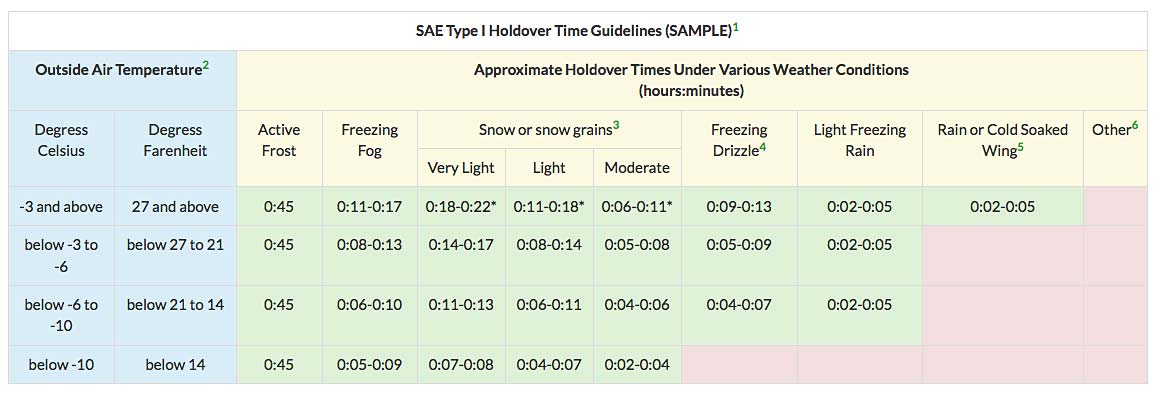
    Type I fluids are the thinnest of the deicing fluids, and they’re often red or orange. They spread the easiest on a plane’s surface because they have the lowest viscosity. Since they’re thin enough to flow off a plane when it’s not moving – or moving slowly – they can be applied to any aircraft.

    But as a result, they also have the shortest holdover times, often less than 20 minutes depending on the weather conditions. These holdover times vary, though, and can be less than five minutes for snow if the outside air temperature is below 14 F (minus 10 C).

    Next, the ground crews will typically apply an anti-icing fluid to the aircraft – often Type II or Type IV. Anti-icing solutions are used to help prevent the future accumulation of snow and ice on the wings of planes.

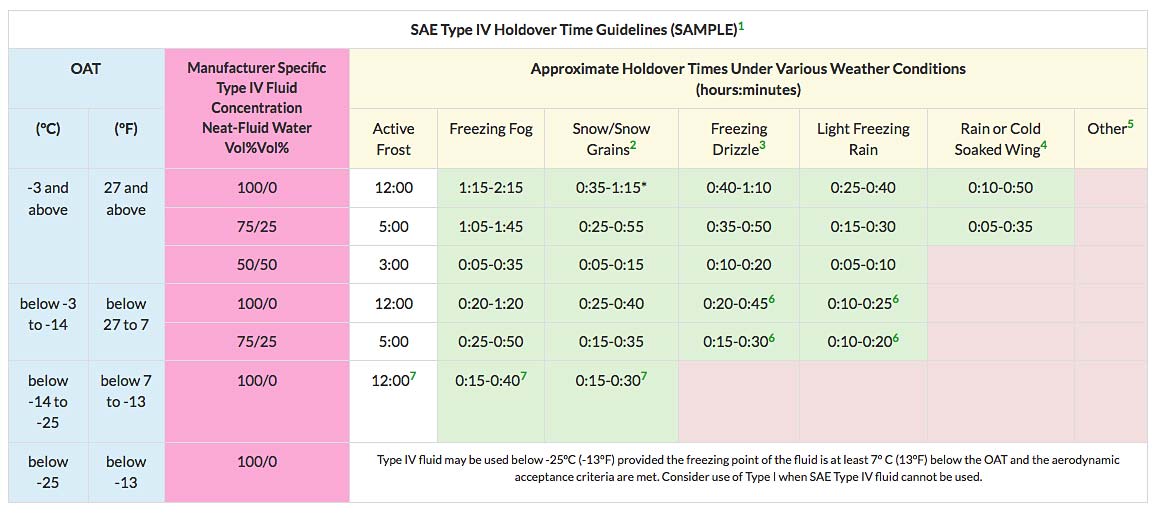
    Type II and Type IV fluids contain thickening agents that increase their viscosity. These thickeners allow the fluid to remain on the aircraft longer to help melt newly forming frost or ice. This translates to longer holdover times – often more than 30 minutes for snow – but it also means the plane needs to reach a higher speed to shear, or blow off, the fluid.

    Once applied, Type II and IV fluids will generally stay on the aircraft until the plane is taxiing down the runaway during takeoff. By then, it has gained enough speed to produce the shear force necessary to remove the fluid from the plane. Type II fluids are a clear or pale straw color, while Type IV fluids are generally green. Including a colored dye helps the ground crew clearly see what parts of the plane have been coated and which areas still need application.

    Type III fluids are not as common anymore. They are formulated to shear off at lower speeds and thus are sometimes used on small commuter aircraft since these planes typically don’t go as fast as commercial jetliners.

    Environmental impact of deicing

    Environmental considerations are also an important part of deicing. Glycols require a lot of oxygen to biodegrade, which can deplete dissolved oxygen in streams or lakes. This, in turn, can threaten aquatic life, like fish and other organisms, that need dissolved oxygen to breathe.

    In addition, ethylene glycol is toxic to wildlife, so the Environmental Protection Agency requires airports to monitor their stormwater runoff. For this reason, most airports collect and treat stormwater runoff on-site or send it to a municipal wastewater treatment facility.

    Airports are also increasingly starting to use fluid recovery systems to recycle the glycols and capture the additives in these fluids, which are often toxic, too. They’ll often use designated areas outside for deicing planes so they can collect and store the fluids after they run off the plane in holding tanks underground until they can be recycled.

    Atmospheric icing

    During flight, planes use other technologies to mitigate the icing risks. For example, most modern aircraft use bleed air systems, which channel hot air from the engine’s compressor through interior ducts to the leading edges of the wings and other critical areas to help prevent ice buildup while the plane is in the sky.

    Some planes also use electrically heated panels embedded in the aircraft’s wings to generate heat. These control systems typically cannot be used while the plane is on the ground, since they rely on cold air flowing across the wing’s surface. This airflow is usually achieved at cruising altitude and is necessary to prevent the plane’s surface from getting too hot.

    Airlines may sometimes also use icephobic coatings to help keep new ice from forming and sticking on the outside surfaces of planes. These coatings delay how soon new ice can form. They can also reduce how strongly the ice adheres to the surface.

    Icephobic polymer coatings can mitigate ice buildup and help reduce ice adhesion on surfaces.
    Hernández Rodríguez et al., 2024., CC BY-SA

    Smaller planes may also use inflatable rubber strips called pneumatic boots on the wings that can be inflated as needed to break off accumulated ice on the leading edge of the wings.

    Flying is truly a modern scientific marvel. A lot of engineering goes into not only getting planes off the ground but also keeping them ice-free during flight. So the next time you experience a weather-related delay at the airport, just remember that deicing is needed to ensure both a safe flight and a truly uplifting one.

    Andrew Sommers does not work for, consult, own shares in or receive funding from any company or organization that would benefit from this article, and has disclosed no relevant affiliations beyond their academic appointment.

    – ref. The science behind airplane deicing – a mechanical engineer explains how chemistry and physics make flying a more uplifting experience – https://theconversation.com/the-science-behind-airplane-deicing-a-mechanical-engineer-explains-how-chemistry-and-physics-make-flying-a-more-uplifting-experience-248732

    MIL OSI – Global Reports –

    March 1, 2025
  • MIL-OSI Asia-Pac: PRESS RELEASE – Samoa Airways Responds to False Allegations of Drug Transport in Coffin

    Source: Government of Western Samoa

    Share this:

    APIA, Samoa – Samoa Airways would like to address the false and damaging allegations made by an individual named Mau Hunt this week regarding the transport of an empty coffin from Pago Pago, which he claims contained illegal drugs. These claims are entirely unfounded, and we would like to clarify the situation for the public and our valued customers.

    Samoa Airways has strict guidelines and processes in place to ensure the safe and respectful transport of human remains, should a coffin need to be transported on one of our aircraft. All coffins transported by Samoa Airways are accompanied by family members or authorized representatives, and the entire process is fully documented and compliant with all applicable laws and regulations.

    We want to emphasize that Samoa Airways has never transported a coffin in the manner described by Mr. Hunt, and there is no truth to the allegations of drug trafficking associated with any cargo we have handled. The safety and security of our passengers and cargo is a top priority, and we take any attempt to undermine the integrity of our operations seriously.

    These allegations not only harm the reputation of Samoa Airways, but they also erode the trust that the public has in the professionalism and dedication of our staff. In light of the severity of these false claims, Samoa Airways is referring the matter to the Police. We are committed to fully cooperating with any investigation and will take all necessary steps to protect the integrity of our airline.

    We strongly advise against the circulation of misinformation that could damage the trust and reputation of Samoa Airways, as well as the livelihoods of our dedicated employees.

    We remain committed to providing safe, reliable, and professional services to our passengers, and we thank our customers for their ongoing trust and support.

    END.

    SOURCE – Samoa Airways

    Share this:

    February 28, 2025

    MIL OSI Asia Pacific News –

    March 1, 2025
  • MIL-OSI Video: Secretary-General/Bangladesh, Ramadan, Türkiye & other topics – Daily Press Briefing (27 February)

    Source: United Nations (Video News)

    Noon Briefing by Stéphane Dujarric, Spokesperson for the Secretary-General.

    Highlights:
    Secretary-General/Bangladesh
    Secretary-General/Ramadan Message
    Türkiye
    Haiti
    Ukraine
    Sudan
    Democratic Republic of the Congo/Jean-Pierre Lacroix
    Democratic Republic of the Congo
    Occupied Palestinian Territory
    Lebanon
    Staff Security

    SECRETARY-GENERAL/BANGLADESH
    Every year, the Secretary-General does a Ramadan solidarity visit, where he likes to visit and fast with a Muslim community, which is facing distress. He began this tradition when he was High Commissioner for Refugees. In his own words, the Secretary-General said that Ramadan embodies the values of compassion, empathy and generosity. It is an opportunity to reconnect with family, with community and a chance to remember those less fortunate. These missions are to remind the world of the true face of Islam.
    This year, the Secretary-General will be going to Bangladesh from the 13-16 March. He will travel to Cox’s Bazaar to join an Iftar and meet with Rohingya refugees who have been forcibly displaced from their homes in Myanmar, and also, of course, with the host Bangladeshi communities who have been generously in hosting the refugees from Myanmar.
    During his visit, he will also be in the capital of Bangladesh, Dhaka, where he will meet with the Chief Adviser for the interim government, Professor Muhammed Yunus, as well as with young women and men and representatives from civil society.

    SECRETARY-GENERAL/RAMADAN MESSAGE
    In his annual message at the start of Ramadan, the Secretary-General expressed a special message of support to all those who will spend this sacred time in displacement and violence. From Gaza and the wider region, to Sudan, the Sahel and beyond.
    The Secretary-General stands with all those who are suffering and joins those observing Ramadan to call for peace and mutual respect.

    TÜRKIYE
    On the reports coming out of Türkiye regarding Abdullah Öcalan, the imprisoned leader of the Kurdistan Workers Party, the PKK, and his message calling for fighters to lay down their arms and the PKK to dissolve itself, the spokesperson said that the Secretary-General welcomes this important development. This represents a glimmer of hope, which would lead to the resolution of a long-standing conflict.

    HAITI
    The World Food Programme (WFP) today said that, as part of their emergency response in Haiti, they continue to provide critical food assistance, cash-based transfers, and hot meals across the Artibonite, Nord, and Ouest departments. This includes $1.2 million in cash assistance, as well as nearly 3,000 meals distributed in border regions to Haitians deported back to their country.
    Last week, the WFP organized the first of two humanitarian cargo flights from Panama City to Port-au-Prince. This was the first humanitarian cargo flight to land at the Port-au-Prince airport since its closure lastNovember.
    The flight carried medicines, vaccines, and medical supplies for eight humanitarian organizations. A second flight is scheduled in about one month.

    Full highlights: https://www.un.org/sg/en/content/noon-briefing-highlight?date%5Bvalue%5D%5Bdate%5D=27%20February%202025

    https://www.youtube.com/watch?v=nX1Wlh5xwHk

    MIL OSI Video –

    March 1, 2025
  • MIL-OSI USA: Cyclone Flurry in the Southern Hemisphere

    Source: NASA

    Two different oceans were crowded with tropical cyclones in late February 2025. In the South Pacific, three storms were active at one point—an occurrence that is rare but not unheard of. Simultaneously, a trio of cyclones roiled in the neighboring Indian Ocean.
    Five tropical cyclones are visible in this false-color image, acquired on February 26 by the VIIRS (Visible Infrared Imaging Radiometer Suite) sensor on the NOAA-20 satellite. The image depicts infrared signals known as brightness temperature, which are useful for distinguishing cooler cloud structures (white and purple) from the warmer surface below (yellow and orange). The day before this image was acquired, a sixth storm, Tropical Cyclone Rae, was weakening east of the area shown here after bringing heavy rain to Fiji.
    Cyclones Alfred and Seru lurked alongside Rae in the South Pacific. Seru lingered offshore of Australia, reaching Category 1 strength on the Saffir-Simpson wind scale for a short time. Alfred was also forecast to stay offshore, according to the Australian Bureau of Meteorology, but was expected to bring hazardous coastal conditions to southern Queensland. The storm was at Category 2 strength on the day of this image but would intensify to Category 4 on February 27.
    Off Western Australia, Tropical Cyclone Bianca was on the tail end of its journey, having weakened to tropical storm status on February 26. The previous day, it had intensified to Category 3 but stayed far enough from land that mainland Australia and island communities were not expected to feel its effects.
    Bianca’s Indian Ocean cohabitants, Honde and Garance, posed more hazards to land. The island nation of Mauritius, east of Madagascar, shut down its airport on February 26 as Garance approached, according to news reports. The storm would strengthen from Category 2 that day to Category 3 the next, with wind speeds of 190 kilometers (120 miles) per hour. Meanwhile, Honde skirted south of Madagascar as a Category 1 storm. Heavy rain, strong winds, and storm surge were forecast for central and southern Madagascar, Mauritius, and Réunion island.
    Meteorologists noted that warm sea surface temperatures and weak wind shear conditions may have contributed to the proliferation of storms. A marine heat wave has lingered off of Western Australia since September 2024, and anomalously high sea surface temperatures warmed in the area in late February 2025. For the South Pacific, the Australian Bureau of Meteorology had predicted a higher-than-average likelihood of severe tropical cyclones this season due to expected warm ocean temperatures. Tropical cyclone season generally runs from November through April in the Southern Hemisphere.
    NASA Earth Observatory image by Michala Garrison, using MODIS and VIIRS data from NASA EOSDIS LANCE and GIBS/Worldview and the Joint Polar Satellite System (JPSS). Story by Lindsey Doermann.

    MIL OSI USA News –

    March 1, 2025
  • MIL-OSI Asia-Pac: CAD follows up on air traffic control incident

    Source: Hong Kong Government special administrative region

         The Civil Aviation Department (CAD) is following up on an air traffic control (ATC) incident that occurred yesterday morning (February 27). At around 7am yesterday, an MNG Airlines’ A330 cargo flight (flight number MNB380) from Hong Kong International Airport (HKIA) to Turkmenistan and another Silk Road Western Airlines’ B777 cargo flight (flight number AZG625) to Baku were granted clearance by ATC officers to depart from the Centre Runway (Runway 07C) and the South Runway (Runway 07R) of HKIA, respectively, following standard flight procedures. After taking off, both cargo flights were subsequently instructed by ATC officers to climb to 5 000 feet and 3 000 feet, respectively, to maintain vertical separation. However, as the climbing rates of the two cargo flights varied from what the ATC officers had anticipated, the desired vertical separation was not achieved. During this time, both cargo flights followed standard departure procedures and maintained visual contact with each other. When the aircraft were approximately 7 nautical miles northeast of HKIA, the traffic collision avoidance system of the Silk Road Western Airlines’ B777 cargo flight issued an alert to its crew, and the aircraft then descended to 2 500 feet. After the incident, both aircraft continued to their destinations according to their flight plans.

         The CAD is highly concerned about the incident and has immediately initiated an investigation and follow-up actions according to procedures. Preliminary information indicates that the incident may involve non-compliance by ATC personnel with established procedures for arranging aircraft for take-off. The relevant ATC personnel have been temporarily removed from frontline ATC duties.

    MIL OSI Asia Pacific News –

    March 1, 2025
  • MIL-OSI Asia-Pac: SECOND ADVANCE ESTIMATES OF ANNUAL GROSS DOMESTIC PRODUCT FOR 2024-25, QUARTERLY ESTIMATES OF GROSS DOMESTIC PRODUCT FOR THE THIRD QUARTER (OCTOBER-DECEMBER) OF 2024-25 AND FIRST REVISED & FINAL ESTIMATES OF GROSS DOMESTIC PRODUCT, NATIONAL INCOME, CONSUMPTION EXPENDITURE, SAVING AND CAPITAL FORMATION FOR 2023-24 & 2022-23 RESPECTIVELY

    Source: Government of India (2)

    SECOND ADVANCE ESTIMATES OF ANNUAL GROSS DOMESTIC PRODUCT FOR 2024-25, QUARTERLY ESTIMATES OF GROSS DOMESTIC PRODUCT FOR THE THIRD QUARTER (OCTOBER-DECEMBER) OF 2024-25 AND FIRST REVISED & FINAL ESTIMATES OF GROSS DOMESTIC PRODUCT, NATIONAL INCOME, CONSUMPTION EXPENDITURE, SAVING AND CAPITAL FORMATION FOR 2023-24 & 2022-23 RESPECTIVELY

    Real GDP Growth Rate of 9.2% for 2023-24 is the highest in the previous 12 years except for 2021-22

    Growth Rate of Real GDP for 2024-25 is estimated as 6.5%

    Real GDP has observed a Growth Rate of 6.2% in Q3 of FY 2024-25

    Posted On: 28 FEB 2025 4:00PM by PIB Delhi

          The National Statistics Office (NSO), Ministry of Statistics and Programme Implementation (MoSPI) is releasing in this Press Note the Second Advance Estimates (SAE) of Annual Gross Domestic Product (GDP) for Financial Year (FY) 2024-25; Quarterly Estimates of GDP for October-December Quarter (Q3) of FY 2024-25 along with its expenditure components and following Revised Estimates of GDP, National Income, Consumption Expenditure, Saving and Capital Formation:

    a.  First Revised Estimates (FRE) for the Financial year 2023-24;

    b.  Second Revised Estimates or Final Estimates (FE) for the Financial year 2022-23.

         These estimates are released both at Constant (2011-12) and Current Prices, in accordance with the release calendar of National Accounts. Detailed Notes on: (i) Second Advance Estimates (SAE) of Annual Gross Domestic Product (GDP) of FY 2024-25, Quarterly Estimates of GDP for October-December Quarter (Q3) of FY 2024-25 and (ii) Abovementioned Revised Estimates for financial years 2023-24 and 2022-23 are given respectively in Part A and Part B of the Press Note.

    Key Highlights:

    1.    Real GDP has been estimated to grow by 6.5% in FY 2024-25. Nominal GDP is expected to witness a growth rate of 9.9% in FY 2024-25. Both the growth rates are revised upward from their respective First Advance Estimates.

    2.    As per the First Revised Estimates, Real GDP has grown by 9.2% in the financial year 2023-24, which is highest in the previous 12 years except for the financial year 2021-22 (the post-covid year). This growth has been contributed by double-digit growth rates in ‘Manufacturing’ sector (12.3%), ‘Construction’ sector (10.4%) and ‘Financial, Real Estate & Professional Services’ sector (10.3%).

    3.    As per the Final Estimates, Real GDP has observed a growth rate of 7.6% in the financial year 2022-23, mainly contributed by double-digit growth rates in ‘Trade, Hotels, Transport, Communication & Services related to Broadcasting’ sector (12.3%), ‘Financial, Real Estate & Professional Services’ sector (10.8%) and ‘Electricity, Gas, Water Supply & Other Utility Services’ sector (10.8%).

    4.    Real GDP is estimated to grow by 6.2% in Q3 of FY 2024-25. Growth rate in Nominal GDP for Q3 of FY 2024-25 has been estimated at 9.9%.

    5.    The growth rate of Real GDP for Q2 of financial year 2024-25 has been revised upward to 5.6%.

    6.    ‘Construction’ sector is estimated to observe a growth rate of 8.6%, followed by ‘Financial, Real Estate & Professional Services’ sector (7.2%) and ‘Trade, Hotels, Transport, Communication & Services related to Broadcasting’ sector (6.4%) during 2024-25.

    7.    Private Final Consumption Expenditure (PFCE) is expected to register a good growth of 7.6% during 2024-25 as compared to 5.6% growth observed during 2023-24.


      PART A

    NOTE ON SECOND ADVANCE ESTIMATES OF ANNUAL GROSS DOMESTIC PRODUCT FOR 2024-25 

    QUARTERLY ESTIMATES OF GROSS DOMESTIC PRODUCT FOR THE THIRD QUARTER (OCT-DEC) OF 2024-25  

             The National Statistics Office (NSO), Ministry of Statistics and Programme Implementation (MoSPI) is releasing in this Press Note, the Second Advance Estimates (SAE) of Annual Gross Domestic Product (GDP) for the Financial Year (FY) 2024-25 and Quarterly Estimates of GDP for the Third quarter (October-December) of 2024-25 along with its expenditure components both at Constant (2011-12) and Current Prices. Annual, Quarterly as well as April-December estimates of Gross Value Added (GVA) at Basic Prices by kind of economic activity along with year on year percent changes, expenditure components of GDP and annual estimates of Gross/Net National Income and Per Capita Income for the Financial years 2022-23, 2023-24 and 2024-25 at Constant and Current Prices are given in Statements 1A to 12A of Annexure A.

    I.  Annual Estimates and Growth Rates

              Real GDP or GDP at Constant Prices is estimated to attain a level of ₹187.95 lakh crore in the financial year 2024-25, against the First Revised Estimate of GDP for the year 2023-24 of ₹176.51 lakh crore. The growth rate in Real GDP during 2024-25 is estimated at 6.5% as compared to 9.2% in 2023-24. Nominal GDP or GDP at Current Prices is estimated to attain a level of ₹331.03 lakh crore in the year 2024-25, against ₹301.23 lakh crore in 2023-24, showing a growth rate of 9.9%.

               Real GVA is estimated at ₹171.80 lakh crore in the year 2024-25, against the FRE for the year 2023-24 of ₹161.51 lakh crore, registering a growth rate of 6.4% as compared to 8.6% growth rate in 2023-24. Nominal GVA is estimated to attain a level of ₹300.15 lakh crore during FY 2024-25, against ₹274.13 lakh crore in 2023-24, showing a growth rate of 9.5%


    Fig. 1: Annual GDP and GVA Estimates along with Y-o-Y Growth Rates at Constant Prices


    Fig. 2: Sectoral Composition and Growth Rates of Annual GVA

    Sectoral Composition of Nominal GVA in FY 2024-25


    Fig. 3: Composition and Growth Rates of Annual GVA in Broad Sectors


    II. Quarterly Estimates and Growth Rates

               Real GDP or GDP at Constant Prices in Q3 of FY 2024-25 is estimated at ₹47.17 lakh crore, against ₹44.44 lakh crore in Q3 of FY 2023-24, showing a growth rate of 6.2%. Nominal GDP or GDP at Current Prices in Q3 of FY 2024-25 is estimated at ₹84.74 lakh crore, against ₹77.10 lakh crore in Q3 of FY 2023-24, showing a growth rate of 9.9%.

                Real GVA in Q3 of FY 2024-25 is estimated at ₹43.13 lakh crore, against ₹40.60 lakh crore in Q3 of FY 2023-24, showing a growth rate of 6.2%. Nominal GVA in Q3 of FY 2024-25 is estimated at ₹77.06 lakh crore, against ₹69.90 lakh crore in Q3 of FY 2023-24, showing a growth rate of 10.2%.

    Fig. 4: Quarterly GDP and GVA Estimates along with Y-o-Y Growth Rates from Q1 FY 2021-22 to Q3 FY 2024-25 at Constant Prices


    Fig. 5: Sectoral Composition and Growth Rates of Quarterly GVA

    Sectoral Composition of Nominal GVA in Q3 of FY 2024-25


    Fig. 6: Composition and Growth Rates of Quarterly GVA in Broad Sectors


    [Primary Sector: Agriculture, Livestock, Forestry & Fishing and Mining & Quarrying 

    Secondary Sector: Manufacturing, Electricity, Gas, Water supply & Other Utility Services and    Construction

    Tertiary Sector: Trade, Hotels, Transport, Communication and Services related to Broadcasting, Financial, Real Estate & Professional Services and Public Administration, Defence & Other Services]


    III. Methodology and Major Data Sources:            

               Second Advance Estimates of Annual GDP and Quarterly Estimates GDP are compiled using the Benchmark-indicator method i.e. the estimates available for the previous financial year (2023-24) are extrapolated using the relevant indicators reflecting the performance of sectors. The First Advance Estimates (FAE) of Annual GDP for the financial year 2024-25 were released on 7th January, 2025, which were based on very limited data and used Provisional Estimates of 2023-24 as Benchmark Estimates. For Compilation of SAE, 2024-25, the Provisional Estimates of 2023-24 used at the time of FAE have been replaced by FRE, 2023-24 which have been compiled using industry-wise/institution-wise detailed information. Thus, overall as well as sectoral variations in SAE from FAE is attributed to revision of benchmark estimates and additional or updated data available on various indicators. The quarterly estimates of previous years along with the First and Second quarter estimates of 2024-25 released earlier have also undergone revision in accordance with the revision policy of National Accounts.

                The sector-wise estimates have been compiled using indicators/data sources like (i) Index of Industrial Production (IIP), (ii) Financial performance of Listed Companies based on available quarterly financial results of these companies upto Q3 FY 2024-25, (iii) Estimates of Major Agricultural Crops and Horticultural crops for 2024-25, as provided by Ministry of Agriculture and Farmers’ Welfare (iv) Production Targets and Summer as well as Rainy season production estimates of Major Livestock Products for FY 2024-25; (v) Fish Production, (vi) Production of Coal, Crude Petroleum, Natural Gas, Cement and Consumption of Steel, (vii) Net Tonne Kilometres and Passenger Kilometres for Railways, (viii) Passenger and Cargo traffic handled by Civil Aviation, (ix) Cargo traffic handled at Major and Minor Sea Ports, (x) Sales of Commercial Vehicles, (xi) Bank Deposits and Credits, (xii) Premium related information of Life and Non-Life Insurance companies, (xiii) Data on outward Supplies of Goods and Services available from GSTN upto January, 2025 (xiv) Accounts of Central and State Governments, (xv) Goods and Services Tax collections etc., available for first 9-10 months of the FY 2024-25. Year-on-Year growth rates (%) in the main indicators used in the estimation are given in the Annexure B.

                Total tax revenue used for GDP compilation includes non-GST revenue as well as GST revenue. The Revised Estimates of Tax revenue for 2024-25 as available in the Annual Financial Statement of the Central Government, along with latest available information from the websites of Controller General of Accounts (CGA) and Comptroller and Auditor General of India (CAG) have been used for estimating taxes on products at Current Prices. For compiling taxes on products at Constant Prices, volume extrapolation is done using volume growth of taxed goods and services. The total product subsidies at Current prices were compiled using the latest information on major subsidies viz. Food, Urea, Petroleum and Nutrient based subsidy for Centre as available on CGA website and the expenditure incurred on subsidies by most States up to December 2024 as available on CAG website along with the Centre/State-wise RE and BE provision for FY 2024-25. Information available on Revenue expenditure, Interest payments, Subsidies etc. from Centre and States for FY 2024-25 were used for estimating Government Final Consumption Expenditure (GFCE).

                Improved data coverage and revision in input data made by source agencies would have a bearing on subsequent revisions of these estimates. Estimates are, therefore, likely to undergo revisions for the aforesaid causes in due course, as per the release calendar. Users should take these into consideration while interpreting the figures. The Provisional Estimates of Annual GDP for FY 2024-25 along with Quarterly GDP estimates for the quarter January-March of FY 2024-25 (Q4 2024-25) will be released on 30.05.2025.


    ***********

    Annexure A


    Annexure B


    PART B

    NOTE ON FIRST REVISED & FINAL ESTIMATES OF GROSS DOMESTIC PRODUCT, NATIONAL INCOME, CONSUMPTION EXPENDITURE, SAVING AND CAPITAL FORMATION FOR 2023-24 & 2022-23 RESPECTIVELY

                In this part of the press note, First Revised Estimates of GDP, National Income, Consumption Expenditure, Saving and Capital Formation for the financial year 2023-24 and Second Revised/ Final Estimates for the financial year 2022-23 are given.

    2.         The First Revised Estimates for the year 2023-24 have been compiled using industry-wise/institution-wise detailed information instead of using the benchmark-indicator method employed at the time of release of Provisional Estimates on 31st May, 2024. The estimates of Gross Domestic Product (GDP) and other aggregates for the year 2022-23 have also undergone revisions on account of use of latest available datasets on agricultural production; industrial production (final results of Annual Survey of Industries: 2022-23); government data as available in budget documents (replacing Revised Estimates with actuals for the year 2022-23); comprehensive data available from various source agencies like Ministry of Corporate Affairs (MCA), Reserve Bank of India (RBI), National Bank for Agriculture and Rural Development (NABARD) etc. and additional data from State/UT Directorates of Economics and Statistics (DES).

    3.         The salient features of the revised estimates at aggregate level are given in the paras as follows.

    Gross Domestic Product

    4.         Real GDP or GDP at constant (2011-12) prices for the years 2023-24 and 2022-23 stands at ₹176.51 lakh crore and ₹161.65 lakh crore, respectively, showing a growth of 9.2 per cent during 2023-24 as compared to growth of 7.6 per cent during 2022-23.

    5.         Nominal GDP or GDP at current prices for the year 2023-24 is estimated at ₹301.23 lakh crore, against ₹268.90 lakh crore for the year 2022-23, showing a growth of 12.0 per cent during 2023-24 as compared to growth of 14.0 per cent during 2022-23.

    GVA and its Industry-wise Analysis

    6.         At the aggregate level, nominal Gross Value Added (GVA) at basic prices has increased by 11.2 per cent during 2023-24 compared to growth of 13.9 per cent during 2022-23. Real GVA, i.e., GVA at constant (2011-12) prices, has increased by 8.6 per cent in 2023-24, compared to 7.2 per cent growth in 2022-23.

    7.         The shares of broad sectors of the economy in overall GVA during 2011-12 to 2023-24 and the annual growth rates during these periods are mentioned below:

    #: Final Estimates; @: First Revised Estimates

    8.         The growth rates of Primary sector (comprising Agriculture, Livestock, Forestry, Fishing and Mining & Quarrying), Secondary sector (comprising Manufacturing, Electricity, Gas, Water Supply & Other Utility Services, and Construction) and Tertiary sector (Services) have been estimated as 2.7 per cent, 11.4 per cent and 9.0 per cent respectively in 2023-24 as against growth rates of 5.9 per cent, 2.4 per cent and 10.3 per cent respectively in the previous years. The growth in real GVA during 2023-24 is on account of growth in ‘Manufacturing’, ‘Electricity, Gas, Water Supply & Other Utility Services’, ‘Construction’, ‘Trade, repair, Hotels and Restaurants’, ‘Financial Services’, ‘Real Estate, Ownership of Dwelling & Professional Services’ and ‘Other services’ as may be seen from Statement 4.2B. However, ‘Agriculture, Livestock, Forestry and Fishing’, ‘Mining and Quarrying’ and ‘Public Administration and Defense’ have witnessed modest growth.

    Net National Income

    9.         Net National Income (NNI) at current prices for the year 2023-24 stands at ₹263.50 lakh crore as against ₹233.91 lakh crore in 2022-23, showing a growth of 12.7 per cent during 2023-24 as compared to growth of 13.3 per cent in the previous year.

    Gross National Disposable Income

    10.       Gross National Disposable Income (GNDI) at current prices is estimated at ₹305.94 lakh crore for the year 2023-24, while the estimate for the year 2022-23 stands at ₹273.39 lakh crore, showing a growth of 11.9 per cent for year 2023-24 as compared to growth of 14.3 per cent in the year 2022-23.

    Saving

    11.       Gross Saving during 2023-24 is estimated at ₹92.59 lakh crore against ₹82.44 lakh crore during 2022-23. Share of Non-financial corporations, Financial corporations, General Government and Household sectors in Gross Savings during 2023-24 stands at 36.0%, 8.2%, (-) 3.1% and 59.0% respectively. Rate of Gross Saving to GNDI for 2023-24 is estimated at 30.3 per cent as against 30.2 per cent for 2022-23.

    Capital Formation

    12.       Gross Capital Formation (GCF) at current prices is estimated at ₹94.68 lakh crore for the year 2023-24 as compared to ₹87.72 lakh crore during 2022-23. The rate of GCF to GDP is 31.4 per cent during 2023-24 as against 32.6 per cent in the 2022-23. The rates of capital formation in the years 2011-12 to 2019-20 and 2021-22 to 2023-24 have been higher than the rate of saving because of positive net capital flow from Rest of the World (RoW).

    13.       In terms of the share to the total GFCF (at current prices), the highest contributor is Non-Financial Corporations followed by Household sector, share of which stood at 44.2% and 41.7% respectively in 2023-24.

    14.       The rate of GCF to GDP at constant (2011-12) prices was 35.2 per cent in 2022-23 and 34.6 per cent in 2023-24.

    Consumption Expenditure

    15.       Private Final Consumption Expenditure (PFCE) at current prices is estimated at ₹181.30 lakh crore for the year 2023-24 as against ₹165.28 lakh crore in 2022-23. In relation to GDP, the PFCE to GDP ratio at current prices during 2022-23 and 2023-24 are 61.5 per cent and 60.2 per cent respectively. At constant (2011-12) prices, the PFCE is estimated at ₹93.85 lakh crore and ₹99.07 lakh crore, respectively for the years 2022-23 and 2023-24. The corresponding PFCE to GDP ratio for the years 2022-23 and 2023-24 are 58.1 per cent and 56.1 per cent respectively.

    16.       Government Final Consumption Expenditure (GFCE) at current prices is estimated at ₹31.04 lakh crore for the year 2023-24 as against ₹27.58 lakh crore during 2022-23. At constant (2011-12) prices the estimates of GFCE for the years 2022-23 and 2023-24 stand at ₹15.44 lakh crore and ₹16.70 lakh crore respectively.

    Per Capita Estimates

    17.       Per Capita Income i.e. Per Capita Net National Income at current prices is estimated at ₹1,69,145 and ₹1,88,892 respectively for the years 2022-23 and 2023-24. Per Capita PFCE at current prices, for the years 2022-23 and 2023-24 is estimated at ₹1,19,516 and ₹1,29,967 respectively.

    Summary of Revisions in the GDP Estimates

    Revision in the estimates of the year 2023-24

    18.       The following statement gives the major reasons of variation between the Provisional Estimates (released on 31st May, 2024) and the First Revised Estimates of GVA for 2023-24.


    Sector

    GVA growth in 2023-24

    (at 2011-12 Prices)

    Major reasons for variation

    Provisional Estimate (PE),

    May 2024

    First Revised Estimate (FRE),

    Feb 2025

    Primary

    2.1

    2.7

    GVA estimates of Agriculture, Livestock, Forestry and Fishing sectors have undergone revision due to revision in production estimates of crop sector as per Final Estimate of Ministry of Agriculture and Farmers welfare. The revision in other industries in Primary Sector is due to the incorporation of latest revised data.

    Secondary

    9.7

    11.4

    Estimates of secondary sector have undergone revision due to use of data from source agencies along with detailed analysis of Non-departmental Enterprises (NDE) & Private Corporate sectors and budget documents of Government whereas provisional estimates were indicator based.

    Tertiary

    7.6

    9.0

    Data from source agencies along with detailed analysis of Departmental Enterprises (DE), NDE and Private Corporate sectors have been used for compilation of estimates for FRE 2023-24 whereas provisional estimates were indicator based. Furthermore, the revision in Public Administration and Defence sector is due to the use of detailed analysis of Budget documents (Centre and State Governments) and latest information of Local Bodies and Autonomous Bodies. In case of Financial services, FRE is based on analysis of annual reports of Financial Corporations and data released by RBI, NABARD and other financial regulators.

    Total GVA at Basic Prices

    7.2

    8.6


    GDP

    8.2

    9.2


    [Primary Sector: Agriculture, Livestock, Forestry & Fishing and Mining & Quarrying 

    Secondary Sector: Manufacturing, Electricity, Gas, Water supply & Other Utility Services and    Construction

    Tertiary Sector: Trade, Hotels, Transport, Communication and Services related to Broadcasting, Financial, Real Estate & Professional Services and Public Administration, Defence & Other Services]


    Revisions in the estimates of the year 2022-23

    19.       The use of latest available data from various agencies has resulted in changes in both the levels of GVA and growth estimates for the years 2022-23.

    Revisions in Major Aggregates

    20.       The level of revisions in the major aggregates at current and constant (2011-12) prices are given in the following table:


    Major National Income Aggregates and their % Changes

                                                                                       (₹ in Lakh Crore)

    Sl. No.

    Item

    2022-23

    1st RE

    Final Estimates

    % change

    At Current Prices

    1

    GVA at basic prices

    246.59  

    246.47

    -0.1

    2

    GDP

    269.50

    268.90

    -0.2

    3

    GNI

    265.79

    265.20

    -0.2

    4

    NNI

    234.39

    233.91

    -0.2

    5

    GNDI

    273.99

    273.39

    -0.2

    At Constant Prices

    1

    GVA at basic prices

    148.05

    148.78

    0.5

    2

    GDP

    160.71

    161.65

    0.6

    3

    GNI

    158.31

    159.39

    0.7

    4

    NNI

    137.47

    138.51

    0.8


    Major reasons for revisions in GVA/GDP estimates for FY 2022-23 are as given below:

    • Use of updated production estimates (Final Estimates) of horticulture crops from Ministry of Agriculture and Farmers’ Welfare, increase in area under fodder crop and increase in production of sugarcane.
    • Increase in input value due to use of Cost of Cultivation Survey (CCS) 2022-23 and Electricity tariff for agriculture sector for the year 2022-23.
    • Use of updated information from NDE and updated information on minor minerals from States in case of Mining & Quarrying sector.
    • Use of final results of Annual Survey of Industries (ASI): 2022-23 and augmented data for non-financial private corporate sector.
    • Use of ‘Actuals’ in place of ‘Revised Estimates’ of different items of expenditure and receipts in the Central & State government budgets.
    • Use of updated information on Local Bodies & Autonomous Institutions.
    • Use of latest annual reports of Public Sector Enterprises.
    • Use of latest data received for Cooperative Banks, Post Office Saving Bank (POSB), Non-Banking Financial Institutions (NBFIs), and Financial Auxiliaries.

    Detailed statements

    21.       List of Statements released in part ‘B’ of the press note is given below. More details of the revised estimates, i.e., FRE 2023-24 and FE 2022-23 are available in Statements 1.1B to 9B of Annexure C, which are given in the PDF format of the press note.

    1. Statement 1.1B:          Key Aggregates of National Accounts at Current Prices
    2. Statement 1.2B:          Key Aggregates of National Accounts at Constant (2011-12) Prices
    3. Statement 2B:             Per Capita Income, Product and Final Consumption
    4. Statement 3.1B:          Output by Economic Activity and Capital Formation by Industry of Use at Current Prices
    5. Statement 3.2B:          Output by Economic Activity and Capital Formation by Industry of Use at Constant (2011-12) Prices
    6. Statement 4.1B:          Gross Value Added by Economic Activity at Current Basic Prices
    7. Statement 4.2B:          Gross Value Added by Economic Activity at Constant (2011-12) Basic Prices
    8. Statement 5B:             Finances for Gross Capital Formation
    9. Statement 6.1B:          Gross Capital Formation by Industry of Use at Current Prices
    10. Statement 6.2B:          Gross Capital Formation by Industry of Use at Constant (2011-12) Prices
    11. Statement 7.1B:          Gross Fixed Capital Formation by Asset & Institutional Sector at Current Prices
    12. Statement 7.2B:          Gross Fixed Capital Formation by Asset & Institutional Sector at Constant (2011-12) Prices                   
    13. Statement 8.1B:          Private Final Consumption Expenditure at Current Prices
    14. Statement 8.2B:          Private Final Consumption Expenditure at Constant (2011-12) Prices
    15. Statement 9B:             Institutional Sectors – Key Economic Indicators at Current Prices

    **************

    Annexure C

    FORMULAE

    1. GVA at basic prices (Production Approach) = Output at basic prices – Intermediate Consumption
    2. GVA at basic prices (Income Approach) = CE + OS/MI + CFC + Production taxes less Production subsidies(i)
    3. GDP = ∑ GVA at basic prices + Product taxes less Product subsidies(ii)
    4. NDP/NNI = GDP/GNI – CFC
    5. GNI = GDP + Net primary income from ROW (Receipts less payments)
    6. Primary Incomes = CE + Property and Entrepreneurial Income
    7. NNDI =NNI + other current transfers(iii) from ROW, net (Receipts less payments)
    8. GNDI = NNDI + CFC = GNI + other current transfers(iii) from ROW, net (Receipts less payments)
    9. Gross Capital Formation(iv) (Financing Side) = Gross Savings + Net Capital Inflow from ROW
    10. GCF (Expenditure Side) = GFCF + CIS + Valuables
    11. Gross Disposable Income of Govt. = GFCE + Gross Saving of General Government
    12. Gross Disposable Income (GDI) of Households = GNDI – GDI of Govt. – Gross Savings of All Corporations


    REMARKS ON THE FORMULAE

    1. Production taxes or subsidies are paid or received with relation to production and are independent of the volume of actual production. Some examples are:

    Production Taxes – Land Revenues, Stamps & Registration fees and Tax on profession

    Production Subsidies – Subsidies to Railways, Subsidies to village and small industries.

    1. Product taxes or subsidies are paid or received on per unit of product. Some examples are:

    Product Taxes- Goods & Service Tax, Excise duties, Sales tax, Service Tax and Import, Export duties

    Product Subsidies- Food, Petroleum and fertilizer subsidies.

    1. Other Current Transfers refers to current transfers other than the primary incomes.

    Gross Capital Formation (GCF) at the current as well as the constant prices is estimated by two approaches: – (i) through flow of funds, derived as Gross Saving plus net capital flow from Rest of the World (RoW); and (ii) by the commodity flow approach, derived by the type of assets.

    Click here to see Press Note in PDF format

    ********

    Samrat/ Dheeraj/Allen

    (Release ID: 2106921) Visitor Counter : 310

    MIL OSI Asia Pacific News –

    March 1, 2025
  • MIL-OSI United Kingdom: Coming up next week at the London Assembly W/C 3 March

    Source: Mayor of London

    PUBLIC MEETINGS
      
    Tuesday 4 March
     
    Q&A with the Deputy Mayor for Environment and Energy
    Environment Committee
    – Chamber, City Hall, Kamal Chunchie Way, 10am

    The London Assembly Environment Committee will meet with the Deputy Mayor for Environment and Energy for a question and answer session, exploring the progress made in achieving the Mayor’s manifesto priorities, as well as wider progress on areas in the London Environmental Strategy and London’s 2030 net zero target.

    Other topics will include noise pollution, airport expansion, the proposed new green roots fund, and swimmable rivers.

    The guests are:

    • Mete Coban MBE, Deputy Mayor of London for Environment and Energy
    • Megan Life, Assistant Director for Environment and Energy, Greater London Authority (GLA)
    • Pete Daw, Head of Climate Change, GLA

    MEDIA CONTACT: Tony Smith on 07763 251727 / [email protected] 
     
    Wednesday 5 March
     
    End-of-life Care in London
    Health Committee – Chamber, City Hall, Kamal Chunchie Way, 10am

    The London Assembly Health Committee will ask guests about the state of end-of-life care provision in London, with a particular focus on end-of-life care for elderly people.

    The guests are:

    Panel 1: 10am – 11.25am

    •    Dr Katherine Buxton, Clinical Director for Palliative and End-of-Life Care Network, NHS England, London
    •    Dr Lyndsey Williams, General Practitioner and Clinical Lead for End-of-Life Care, North West London Integrated Care Board
    •    Sarah Scobie, Deputy Director of Research, Nuffield Trust

    Panel 2: 11.30am – 1pm

    • Becca Trower, Joint CEO and Clinical Director, St Raphael’s Hospice
    • Ruth Driscoll, Associate Director for Policy & Public Affairs, Marie Curie
    • Dr Armita Jamali, Consultant in Palliative Medicine, The Royal Marsden and Royal Brompton Hospitals
    • Dr Libby Sallnow, Associate Professor, Head of Marie Curie Palliative Care Research Department, University College London

    MEDIA CONTACT: Alison Bell on 07887 832918 / [email protected]  
     

    MIL OSI United Kingdom –

    March 1, 2025
  • MIL-OSI China: China’s AG600 amphibious aircraft completes all prior-certification flight tests

    Source: People’s Republic of China – State Council News

    BEIJING, Feb. 28 — China’s AG600 large amphibious aircraft on Friday completed all of its prior-certification flight test subjects, a key step toward achieving its airworthiness certification target, announced the Aviation Industry Corporation of China (AVIC).

    The Chinese independently-developed AG600 aircraft on Friday accomplished the compliance flight test subject of combustible liquid discharge at a civil aircraft flight test center in Pucheng County in northwest China’s Shaanxi Province, the AVIC said.

    Over the past two years, the AG600 aircraft conducted up to 2,014 flight movements totaling 3,560 flight hours for flight test missions prior to its airworthiness certification, said the developer.

    The AG600 aircraft traveled to multiple sites across the country to carry out its flight tests in order to secure special meteorological conditions for some flight tests.

    The AVIC said the flight tests were conducted in diversified scenarios, such as water surface, extreme cold, high temperature and humidity, crosswinds, and typical firefighting tasks to verify the aircraft’s operational capabilities in various special environments.

    China’s AG600 large amphibious aircraft family is being developed as vital advanced aeronautical equipment to strengthen the country’s emergency rescue and natural disaster prevention capabilities.

    The AG600 aircraft family is tailored to carry out rescue missions such as firefighting and maritime search and rescue in all types of terrain across the country.

    MIL OSI China News –

    February 28, 2025
  • MIL-OSI Russia: NSU Master’s students took part in the “Forum of Future Technologies”

    Translartion. Region: Russians Fedetion –

    Source: Novosibirsk State University – Novosibirsk State University –

    The forum has been held at the initiative of the President of Russia since 2023. This year, it was attended by about 1,800 people from the fields of science, technology, politics and business from all over Russia. Among them are master’s degree students Physics Department of NSU, employees of the Institute of Hydrodynamics named after. M.A. Lavrentyeva Alexander Paraskun and Artur Asylkaev.

    The forum’s business program included 37 sessions. The key event of the forum was the plenary session with the participation of Russian President Vladimir Putin.

    — The level of development of materials science is a kind of marker of the level of technology of the country as a whole. Thus, for the synthesis of superheavy elements with numbers 119 and 120, accelerator targets based on intermetallic compounds of berkelium-249 and californium and curium, respectively, are needed. The discovery of new elements expands our knowledge of matter, and it is important to note that it was in our country that the element with atomic number 118, related to inert gases, was synthesized, but its properties are very different from other representatives of the group, — said Alexander Paraskun, a master’s student at the Physics Department of NSU.

    NSU representatives took part in several panel discussions in their fields.

    — Several panel discussions were taking place in parallel, so we visited the most interesting and closest to our specialty. Important topics were discussed at the session “Nature-like technologies: restoring the balance between the biosphere and the technosphere”. Biologization of the technosphere is one of the tasks of the century. However, without understanding how nature works at the molecular level, we will not be able to create nature-like technologies, which is exactly what megascience research facilities are needed for, — noted Alexander Paraskun.

    For two days, the forum featured an exhibition where high-tech companies from all over the country presented their innovative developments. These included titanium products, including those used in the medical field, plant growth stimulants, and 3D-printed intervertebral disc prostheses. Projects created using artificial intelligence were also presented.

    — Visiting the Future Technologies Forum is like looking into tomorrow. Here, ideas turn into projects, and an ordinary conversation can become the beginning of something grand. One of the key topics of discussion was innovative materials. For example, materials with extreme characteristics open up wide opportunities for increasing the efficiency of devices in such areas as energy, transport, aircraft engine building and space technologies. Their unique ability to withstand extreme conditions — high temperatures, pressure, mechanical loads and aggressive chemical environments — makes them indispensable for creating more reliable and efficient solutions, — shared his impressions Artur Asylaev, a master’s student at the NSU Physics Department.

    Please note: This information is raw content directly from the source of the information. It is exactly what the source states and does not reflect the position of MIL-OSI or its clients.

    MIL OSI Russia News –

    February 28, 2025
  • MIL-OSI Australia: Australian Deputy PM: Regional airports in Victoria set to soar

    Source: Minister of Infrastructure

    The Albanese Labor Government is building Australia’s future, investing almost $4.5 million to upgrade nine regional airports across Victoria. 

    Airports are vital for regional communities, providing critical access to emergency healthcare, as well as commerce, industry, tourism and education. 

    Funded under Round 4 of the Regional Airports Program, these essential upgrades will include runway resurfacing and sealing, line marking and drainage – which will improve safety and enhance accessibility at these regional airports. 

    City of Ballarat will receive $1.1 million to repurpose an old terminal building at Ballarat Airport into a new, fit for purpose space for emergency responders as well as medical patients awaiting transfer. 

    A dedicated aircraft parking area for aeromedical aircraft will also be provided allowing direct access to the facility.

    Other works to be funded under Round 4 in Victoria include: 

    $1.9 million for the Mildura Airport to rejuvenate and repair the main runway and related pavement areas ensuring the safety of aircraft, operations and passengers, maintaining connectivity for the region.

    $210,000 for upgrades to the Maryborough Aerodrome which will support the continued safe use, communication and access at the airport for emergency services, including aeromedical and fire services as well as general aviation use.

    $138,463 for the reseal of the Yarrawonga Runway to allow for the continued use of the aerodrome for delivery of essential goods and services, aeromedical flights, and general and recreational aviation.

    $185,955 to upgrade the main apron at Warrnambool Airport which will allow for two further aircraft to park and improve aircraft manoeuvring and parking.

    Today’s announcement builds on the nearly $100 million that has already been delivered to support 194 projects under the first three rounds of the program. 

    For more information on the Regional Airports Program, including a full list of Round 4 projects in Victoria, visit www.infrastructure.gov.au/infrastructure-transport-vehicles/aviation/regional-remote-aviation/regional-airports-program.

    Quotes attributable to Minister for Infrastructure, Transport, Regional Development and Local Government Catherine King:

    “We’re backing regional communities across Victoria by backing our regional airports, which keep communities connected, and support increased economic opportunities. 

    “The new facility will mean that whether you’re on your way to fight a fire, or have a family member needing emergency health care, there will be a safe and appropriate place to wait, regardless of the weather outside. 

    “Ballarat Airport plays a critical role within our region throughout bushfire season, and in supporting emergency healthcare all year long. The benefits of this investment will be felt far beyond the boundaries of the City of Ballarat.” 

    Quotes attributable to City of Ballarat Mayor, Cr Tracey Hargreaves:

    “The Ballarat Airport serves as a key hub for much of western Victoria, particularly in relation to aeromedical patient transfers and as an operational base for emergency services, including aerial firefighting crews.  

    “The new facility will provide emergency services personnel, air crews and patients with a dedicated, safe and protected space at the airport to conduct patients transfers and medical examinations while waiting for aircraft to arrive — out of the often-harsh Ballarat weather.

    “This facility, together with the recently completed runway extension, is essential to the Ballarat Airport’s envisioned future as a hub for the west of the state that can cater to larger commercial and emergency services aircraft. The City of Ballarat thanks the Australian Government for their investment in this critical facility.”  

    MIL OSI News –

    February 28, 2025
  • MIL-OSI Australia: Regional airports in Victoria set to soar

    Source: Australian Ministers for Regional Development

    The Albanese Labor Government is building Australia’s future, investing almost $4.5 million to upgrade nine regional airports across Victoria. 

    Airports are vital for regional communities, providing critical access to emergency healthcare, as well as commerce, industry, tourism and education. 

    Funded under Round 4 of the Regional Airports Program, these essential upgrades will include runway resurfacing and sealing, line marking and drainage – which will improve safety and enhance accessibility at these regional airports. 

    City of Ballarat will receive $1.1 million to repurpose an old terminal building at Ballarat Airport into a new, fit for purpose space for emergency responders as well as medical patients awaiting transfer. 

    A dedicated aircraft parking area for aeromedical aircraft will also be provided allowing direct access to the facility.

    Other works to be funded under Round 4 in Victoria include: 

    $1.9 million for the Mildura Airport to rejuvenate and repair the main runway and related pavement areas ensuring the safety of aircraft, operations and passengers, maintaining connectivity for the region.

    $210,000 for upgrades to the Maryborough Aerodrome which will support the continued safe use, communication and access at the airport for emergency services, including aeromedical and fire services as well as general aviation use.

    $138,463 for the reseal of the Yarrawonga Runway to allow for the continued use of the aerodrome for delivery of essential goods and services, aeromedical flights, and general and recreational aviation.

    $185,955 to upgrade the main apron at Warrnambool Airport which will allow for two further aircraft to park and improve aircraft manoeuvring and parking.

    Today’s announcement builds on the nearly $100 million that has already been delivered to support 194 projects under the first three rounds of the program. 

    For more information on the Regional Airports Program, including a full list of Round 4 projects in Victoria, visit www.infrastructure.gov.au/infrastructure-transport-vehicles/aviation/regional-remote-aviation/regional-airports-program.

    Quotes attributable to Minister for Infrastructure, Transport, Regional Development and Local Government Catherine King:

    “We’re backing regional communities across Victoria by backing our regional airports, which keep communities connected, and support increased economic opportunities. 

    “The new facility will mean that whether you’re on your way to fight a fire, or have a family member needing emergency health care, there will be a safe and appropriate place to wait, regardless of the weather outside. 

    “Ballarat Airport plays a critical role within our region throughout bushfire season, and in supporting emergency healthcare all year long. The benefits of this investment will be felt far beyond the boundaries of the City of Ballarat.” 

    Quotes attributable to City of Ballarat Mayor, Cr Tracey Hargreaves:

    “The Ballarat Airport serves as a key hub for much of western Victoria, particularly in relation to aeromedical patient transfers and as an operational base for emergency services, including aerial firefighting crews.  

    “The new facility will provide emergency services personnel, air crews and patients with a dedicated, safe and protected space at the airport to conduct patients transfers and medical examinations while waiting for aircraft to arrive — out of the often-harsh Ballarat weather.

    “This facility, together with the recently completed runway extension, is essential to the Ballarat Airport’s envisioned future as a hub for the west of the state that can cater to larger commercial and emergency services aircraft. The City of Ballarat thanks the Australian Government for their investment in this critical facility.”  

    MIL OSI News –

    February 28, 2025
  • MIL-Evening Report: Political fighting over Chinese warships misses the point: Australia’s navy is no match for China’s built-up force

    Source: The Conversation (Au and NZ) – By Richard Dunley, Senior Lecturer in History and Maritime Strategy, UNSW Sydney

    Over the past few days, the Australian media has been dominated by the activities of the Chinese navy’s Task Group 107 as it has progressed south along the Australian coast and conducted a series of live-fire exercises.

    Much of the discussion has been rather breathless in nature, with accusations of “gunboat diplomacy” being bandied around.

    The live-fire exercises have also dominated the Australian political debate. Amid all the accusations, the fact that these exercises are routine and entirely legal has gotten lost.

    The Australian government was correct to lodge a complaint with its Chinese counterpart when one of these exercises disrupted civilian aviation. But the overall response has been an extraordinary overreaction.

    There is no indication the Chinese vessels undertook any surface-to-air exercises, and it remains unclear whether the initial firings involved medium-calibre weapons or smaller arms.

    Either way, the facts suggest the disruption from the Chinese vessels was caused by inexperience or poor procedure, rather than some more nefarious purpose.

    This is not to suggest the People’s Liberation Army-Navy’s (PLA-N) deployment is unimportant, but as happens all too often, the Australian public debate is missing the wood for the trees.

    While a number of retired naval officers have publicly played down the significance of the live-fire exercises, these voices have generally been drowned out by the politicisation of the issue. This highlights the failure of the Department of Defence to communicate effectively to the public.

    In other countries, including the United States, senior officers are given far more leeway to make public statements in matters within their purview.

    Had Vice Admiral Mark Hammond, the chief of navy, or Vice Admiral Justin Jones, the chief of Joint Operations, been empowered to explain how live-fire exercises are routine and are commonly carried out by Australian warships on deployment in our region, we may have avoided this unhelpful stoush.

    The remarkable growth of the Chinese navy

    The real significance of the activities of Task Group 107 is the way it has revealed the very different trajectories of the PLA-N and its Royal Australian Navy counterpart.

    The task group is made up of a Type 055 Renhai-class cruiser, a Type 054A Jiangkai II frigate and a Type 903 Fuchi-class replenishment ship. This is a powerful force that symbolises the rapid development of the Chinese navy.

    The Renhai-class cruisers are acknowledged to be some of the most capable surface combatants currently in operation.

    They are 13,000 tonnes in size and are armed with 112 vertical-launch system (VLS) missile tubes. The Australian navy’s premier surface warship, the Hobart-class destroyer, is just 7,000 tonnes and has 48 VLS missiles cells.

    These are very crude metrics, but it would be foolhardy to assume Chinese technology is dramatically inferior to that of Australia or its allies. Similarly, China’s Type 054A frigates are comparable to the general-purpose frigates that Australia is currently trying to acquire.

    Since 2020, China has commissioned eight Type 055 cruisers, adding to a fleet of more than 30 Type 52C and Type 52D destroyers and an even greater number of Type 054A frigates.

    This build-up vastly exceeds that of any other navy globally. Chinese shipyards are churning out the same combat power of the entire Royal Australian Navy every couple of years.

    Until recently, we have seen remarkably little of this naval capability in our region. A PLA-N task force operated off the northeast coast of Australia in 2022. Last year, a similar force was in the South Pacific. Most analysts expect to see more Chinese vessels in Australia’s region over the coming years.

    One significant limitation on Chinese overseas deployments has been the PLA-N’s small force of replenishment ships, which resupply naval vessels at sea.

    As the PLA-N’s capabilities continue to grow and priorities shift, this appears to be changing. A recent US Department of Defence report noted that China was expected to build further replenishment ships “to support its expanding long-duration combatant ship deployments”.

    Australia struggling to keep up

    In response to the Chinese build-up, Australia is investing heavily to rebuild its navy. However, this process has been slow and beset by problems.

    Indeed, this week, the Defence Department revealed that the selection of the design for the new Australian frigate has been postponed into 2026.

    This leaves the navy with a limited fleet of just 11 surface combatants, the majority of which are small and ageing Anzac-class frigates.

    The arrival of the Chinese task group also sheds an unfavourable light on other recent decisions.

    The cuts to the Arafura-class offshore patrol vessel program make sense from some perspectives. But these ships would have provided additional options to persistently shadow foreign warships in Australian areas of interest.

    Similarly, the growing need of Australian ships to escort Chinese vessels in our region will place an increasing strain on Australian replenishment capability.

    At present, both of Australia’s resupply ships are out of service. Additional capacity was also cut from the recent defence budget.

    The activities of the Chinese task force are not some aggressive move of gunboat diplomacy in our region.

    In many ways, this sensationalist messaging has distracted from a much bigger issue. The presence of Chinese naval ships in our region is going to be a fact of life. And due to failures from both sides of politics over the past 15 years, Australia’s navy is ill-equipped to meet that challenge.

    Richard Dunley does not work for, consult, own shares in or receive funding from any company or organisation that would benefit from this article, and has disclosed no relevant affiliations beyond their academic appointment.

    – ref. Political fighting over Chinese warships misses the point: Australia’s navy is no match for China’s built-up force – https://theconversation.com/political-fighting-over-chinese-warships-misses-the-point-australias-navy-is-no-match-for-chinas-built-up-force-251039

    MIL OSI Analysis – EveningReport.nz –

    February 28, 2025
  • MIL-OSI Australia: Regional airports in Western Australia set to soar

    Source: Australian Executive Government Ministers

    The Australian Government is building Australia’s future, investing almost $800,000 to upgrade four regional airports across Western Australia. 

    Airports are vital for regional communities, providing critical access to emergency healthcare, as well as commerce, industry, tourism and education. 

    Funded under Round 4 of the Regional Airports Program, these essential upgrades will include runway resurfacing and sealing, line marking and drainage – which will improve safety and enhance accessibility at these regional airports. 

    In Northam, $357,553 will support construction of a fit-for-purpose sealed apron and associated line marking at Northam Airfield.

    This will improve access and safety for emergency services, including fire-fighting aircraft and general aviation.

    Other works to be funded under Round 4 in Western Australia are: 

    • $236,817 for the Shire of Katanning to restore and reseal the runway at Katanning Aerodrome, which will support its use for healthcare, including the RFDS and fire and emergency services.

    • $153,000 for the Shire of Cunderdin to upgrade drainage, repair the runway seal, and deliver new line marking and navigational aids at Cunderdin Airport. This will improve the airfield’s safety for users, which include the RFDS, fire-fighting, general aviation and recreational flights. 

    • $26,662 for the Shire of Boyup Brook to resurface the runway at Boyup Brook’s Airstrip, to provide a safe and accessible runway for the RFDS to use during medical emergencies, as well as fire-fighting aircraft and general aviation use.

    Today’s announcement builds on the nearly $100 million that has already been delivered to support 194 projects under the first three rounds of the program. 

    For more information on the Regional Airports Program, including a full list of Round 4 projects in Western Australia, visit www.infrastructure.gov.au/infrastructure-transport-vehicles/aviation/regional-remote-aviation/regional-airports-program.

    Quotes attributable to Minister for Infrastructure, Transport, Regional Development and Local Government Catherine King:

    “We’re backing regional communities in Western Australia by backing regional airports, which provide critical connectivity to other towns, to economic opportunities, and to services like emergency healthcare. 

    “Importantly, this funding will support safer, better runways that RFDS and fire-fighting aviation services rely on to help communities when they need it most.”

    Quotes attributable to Minister for Resources, Minister for Northern Australia and Federal Member for Brand Madeleine King:

    “These sorts of works can make a real and lasting difference in our state’s regional communities, allowing them to access health and other services from their own towns. 

    “I look forward to seeing the profound benefits these projects will unlock as they get underway.”

    MIL OSI News –

    February 28, 2025
  • MIL-OSI New Zealand: Aviation – Airways New Zealand announces FY25 half year result

    Source: Airways NZ

    Airways New Zealand has today announced its interim results for the half-year ending 31 December 2024, reporting solid safety and operational performance alongside a positive financial result.
    The air navigation services provider is reporting an after-tax profit of $6.7 million for the half-year, $0.5 million ahead of budget. The result is primarily due to lower depreciation, equipment costs, and professional services expenses.
    Airways safely managed 242,538 flight movements across the 30 million square kilometres of airspace it controls during the period.
    Air traffic services revenue for the half year was impacted by fewer flight movements, driven by challenges faced by airlines, including engine and servicing issues. While headwinds are expected to persist, core revenue is anticipated to recover through the second half of the year and Airways remains on track to achieve its budgeted Group profit for the full year.
    “The steady interim result reflects our continued focus on operational excellence and efficient cost management,” Airways Chair Denise Church says. “As the aviation industry continues to navigate a challenging environment, Airways remains committed to managing costs appropriately, maintaining our high safety standards and advancing our strategic objectives.”
    In addition to sound financial and safety performance, Airways has continued to advance its strategy to create the airspace environment of the future.
    “Our strategic initiatives are designed to ensure we are well-positioned to meet the future needs of the aviation industry,” Airways CEO James Young says. “We are focused on creating a safe, flexible, and accessible airspace environment that benefits all users.”

    MIL OSI New Zealand News –

    February 28, 2025
  • MIL-OSI China: Beijing-Tianjin-Hebei region makes further progress in coordinated development

    Source: People’s Republic of China – State Council News

    BEIJING, Feb. 27 — China’s Beijing-Tianjin-Hebei region has made remarkable progress in coordinated development across economic, ecological and social sectors, an official told Xinhua Thursday.

    In early 2014, China initiated a key strategy to coordinate the development of Beijing, Tianjin and Hebei — a regional city cluster referred to as “Jing-Jin-Ji.”

    Eleven years later, the region has seen the establishment of 14 innovation platforms and seven national advanced manufacturing clusters, according to an official of the Office of the Central Leading Group for Coordinated Regional Development and the National Development and Reform Commission.

    Coordination schemes have also been introduced for industrial chains covering sectors like new energy, high-end instruments, and robotics, the official told Xinhua in an interview.

    Transportation infrastructure was upgraded through newly opened railways and highways last year, creating a one to one-and-a-half-hour traffic circle between major cities in the region. Regional airport cluster development has been accelerated as well, handling 150 million passenger trips last year.

    On environmental fronts, days with good air quality in the region approached 75 percent last year alongside enhanced surface water quality.

    Public services are progressing steadily as well. The social security service of the region has achieved interoperability across designated medical institutions, transportation routes and tourist attractions.

    In 2024, the region’s gross domestic product reached 11.5 trillion yuan (about 1.6 trillion U.S. dollars), which, at current prices, is 2.1 times that in 2013.

    The official stressed that the primary task of the coordinated development of the Beijing-Tianjin-Hebei region is to relieve Beijing of non-essential functions related to its status as the nation’s capital, and that the Xiong’an New Area has been designed to fulfill that task.

    Xiong’an has made significant strides in coordinated development of the region, with Beijing-based universities establishing branch campuses, major Beijing-based hospitals constructing medical complex projects, and central state-owned enterprises initiating operations.

    Since China announced plans to establish the Xiong’an New Area in April 2017, it has evolved from a blueprint into a vibrant city. As of the end of 2024, Xiong’an has developed an area of over 200 square kilometers and has drawn investments exceeding 830 billion yuan.

    Over 200 community service centers have been established in newly built areas of Xiong’an, creating a “15-minute life circle” that meets residents’ basic needs for shopping and leisure, according to the official.

    MIL OSI China News –

    February 28, 2025
  • MIL-OSI: Intermap Announces Date for 2024 Financial Results and Conference Call

    Source: GlobeNewswire (MIL-OSI)

    DENVER, Feb. 27, 2025 (GLOBE NEWSWIRE) — Intermap Technologies (TSX: IMP; OTCQB: ITMSF) (“Intermap” or the “Company”), a global leader in 3D geospatial products and intelligence solutions, today announced that it plans to release fourth quarter and full year 2024 financial results after market close on Thursday, March 27, 2025.

    Intermap’s CEO Patrick A. Blott, CFO Jennifer Bakken and COO Jack Schneider will host a live webinar on Thursday, March 27, 2025, at 5:00 pm ET to review the results, provide Company updates and answer investor questions following the presentation.

    Intermap invites shareholders, analysts, investors, media representatives and other stakeholders to attend the earnings webinar to discuss fourth quarter 2024 results.

    CONFERENCE CALL DETAILS
    DATE:     Thursday, March 27, 2025
    TIME:     5:00 pm ET
    WEBCAST:     Register

    A recording of the webinar and supporting materials will be made available in the investor’s section of the Company’s website at https://www.intermap.com/investors.

    Intermap Reader Advisory 
    Certain information provided in this news release, including reference to revenue growth, constitutes forward-looking statements. The words “anticipate”, “expect”, “project”, “estimate”, “forecast”, “will be”, “will consider”, “intends” and similar expressions are intended to identify such forward-looking statements. Although Intermap believes that these statements are based on information and assumptions which are current, reasonable and complete, these statements are necessarily subject to a variety of known and unknown risks and uncertainties. Intermap’s forward-looking statements are subject to risks and uncertainties pertaining to, among other things, cash available to fund operations, availability of capital, revenue fluctuations, nature of government contracts, economic conditions, loss of key customers, retention and availability of executive talent, competing technologies, common share price volatility, loss of proprietary information, software functionality, internet and system infrastructure functionality, information technology security, breakdown of strategic alliances, and international and political considerations, as well as those risks and uncertainties discussed Intermap’s Annual Information Form and other securities filings. While the Company makes these forward-looking statements in good faith, should one or more of these risks or uncertainties materialize, or should underlying assumptions prove incorrect, actual results may vary significantly from those expected. Accordingly, no assurances can be given that any of the events anticipated by the forward-looking statements will transpire or occur, or if any of them do so, what benefits that the Company will derive therefrom. All subsequent forward-looking statements, whether written or oral, attributable to Intermap or persons acting on its behalf are expressly qualified in their entirety by these cautionary statements. The forward-looking statements contained in this news release are made as at the date of this news release and the Company does not undertake any obligation to update publicly or to revise any of the forward-looking statements made herein, whether as a result of new information, future events or otherwise, except as may be required by applicable securities law.

    About Intermap Technologies 

    Founded in 1997 and headquartered in Denver, Colorado, Intermap (TSX: IMP; OTCQB: ITMSF) is a global leader in geospatial intelligence solutions, focusing on the creation and analysis of 3D terrain data to produce high-resolution thematic models. Through scientific analysis of geospatial information and patented sensors and processing technology, the Company provisions diverse, complementary, multi-source datasets to enable customers to seamlessly integrate geospatial intelligence into their workflows. Intermap’s 3D elevation data and software analytic capabilities enable global geospatial analysis through artificial intelligence and machine learning, providing customers with critical information to understand their terrain environment. By leveraging its proprietary archive of the world’s largest collection of multi-sensor global elevation data, the Company’s collection and processing capabilities provide multi-source 3D datasets and analytics at mission speed, enabling governments and companies to build and integrate geospatial foundation data with actionable insights. Applications for Intermap’s products and solutions include defense, aviation and UAV flight planning, flood and wildfire insurance, disaster mitigation, base mapping, environmental and renewable energy planning, telecommunications, engineering, critical infrastructure monitoring, hydrology, land management, oil and gas and transportation. 

    For more information, please visit www.intermap.com or contact:
    Jennifer Bakken
    Executive Vice President and CFO
    CFO@intermap.com
    +1 (303) 708-0955

    Sean Peasgood
    Investor Relations
    Sean@SophicCapital.com
    +1 (647) 7260-9266

    The MIL Network –

    February 28, 2025
  • MIL-Evening Report: Cook Islands government to seek update on China’s naval exercises

    By Talaia Mika of the Cook Islands News

    As concerns continue to emerge over China’s “unusual” naval exercises in the Tasman Sea, raising eyebrows from New Zealand and Australia, the Cook Islands government was questioned for an update in Parliament.

    This follows the newly established bilateral relations between the Cook Islands and China through a five-year agreement and Prime Minister Mark Brown’s accusations of the New Zealand media and experts looking down on the Cook Islands.

    A Chinese Navy convoy held two live-fire exercises in the Tasman Sea between Australia and New Zealand on Friday and Saturday, prompting passenger planes to change course mid-flight and pressuring officials in both countries.

    Akaoa MP Robert Heather queried the Prime Minister whether the government had spoken to Chinese embassy officials in New Zealand for a response in this breach of Australian waters?

    “One thing I do know is that just in the recent weeks, New Zealand navy was part of an exercise with the Australians and Americans conducting naval exercises in the South China Sea and perhaps that’s why China decided to exercise naval exercises in the international waters off the coast of Australia,” he said.

    “And I also know that in the last two weeks, the government of Australia and China signed a security treaty between the two countries.

    “However in due course, we may be informed more about these naval exercises that these countries conduct in international waters off each other’s coasts.”

    According to Brown, he had not been briefed by any government whether it’s New Zealand, Australia, or China about these developments.

    Asking for an update
    He added that while the Minister of Foreign Affairs Elikana was currently in the Solomon Islands attending a forum on fisheries together with other ministers of the Pacific Region, he would ask him about whether he could make any inquiries to find out whether the government could be updated or briefed on this issue.

    Meanwhile, New Zealand Foreign Minister Winston Peters said after a meeting with his Chinese counterpart in Beijing, that lack of sufficient warning from China about the live-fire exercises was a “failure” in the New Zealand-China relationship.

    A spokesperson for China’s Ministry of National Defence, Wu Qian explained that China’s actions were entirely in accordance with international law and established practices and would not impact on aviation safety.

    He added that the live-fire training was conducted with repeated safety notices that had been issued in advance.

    Republished with permission from the Cook Islands News.

    MIL OSI Analysis – EveningReport.nz –

    February 28, 2025
  • MIL-OSI USA: Cantwell, Democrats Vote NO on Advancing Deputy DOT Nominee Bradbury: “It Simply Does Not Matter If You’re Saving Dollars, If You’re Not Saving Lives”

    US Senate News:

    Source: United States Senator for Washington Maria Cantwell

    02.27.25

    Cantwell, Democrats Vote NO on Advancing Deputy DOT Nominee Bradbury: “It Simply Does Not Matter If You’re Saving Dollars, If You’re Not Saving Lives”

    As DOT General Counsel from 2017-2021, Bradbury helped sideline a crucial safety regulation for plane manufacturers in immediate aftermath of fatal crashes

    WASHINGTON, D.C. – Today, U.S. Senator Maria Cantwell (D-WA), ranking member of the Senate Committee on Commerce, Science, and Transportation, and senior member of the Senate Finance Committee, led committee Democrats in voting against advancing Steven Bradbury – President Donald Trump’s pick to serve as Deputy Secretary of the U.S. Department of Transportation – to the full Senate for a confirmation vote.

    From 2017 to 2021, Bradbury served as the General Counsel of DOT. Under his leadership, Sen. Cantwell said, the DOT rolled back multiple “common sense requirements.”

    “It simply does not matter if you’re saving dollars, if you’re not saving lives. The last thing we need is someone who won’t stand up to the industry or [for] aviation safety needs,” Sen. Cantwell said. “Fatigue prevention requirements for truck drivers were loosened. A record number of rail safety requirements were waived. And most troubling, a proposed rule on Safety Management System for aviation manufacturers such as Boeing was sidelined.”

    The Committee on Commerce, Science, and Transportation ultimately voted 15-13 to advance Bradbury’s nomination to the full Senate. In spite of Bradbury’s record of rolling back and blocking safety regulations during the first Trump administration, all Republicans voted to advance his nomination.

    Last week, during a committee hearing, Sen. Cantwell pressed Bradbury on his decision to sideline a proposed requirement that plane manufacturers must adopt a mandatory Safety Management System (SMS), which an expert panel determined would decrease the likelihood of another fatal accident. His decision came just nine days after the fatal Lion Air flight 610 crash in 2018 on a Boeing 737 MAX, which killed 189 people, and halted the introduction of a critical aviation safety rule advocated for by crash victim family members.

    Sen. Cantwell asked him at the hearing: “We know that the rule was halted nine days after the MAX crash. Why did you stop the rulemaking from happening?”

    Bradbury: “Well, I don’t know that I stopped it.”

    Sen. Cantwell: “That’s what’s reported in the paper, and I mentioned the FAA person, who was in charge of the process, who said the industry and everybody wanted to move forward, and it was submitted, and then next thing you know, it’s pulled, so…”

    Bradbury: “Well, certainly we go through a review of every regulation, and as I recall, in that regulation, there were questions on the merits about which entities it should apply to and how it might apply to small businesses or small entities. Those are the kinds of questions that need to be addressed whenever you’re –“

    Sen. Cantwell: “So you’re saying you might have killed the SMS rule because you didn’t want it to apply to all manufacturers.”

    Bradbury: “I wouldn’t say I killed the SMS rule. And let me say –”

    Sen Cantwell: “We still don’t have one. Our committee has worked hard to get one, and now it’s going to be in law. But I have more questions about this. But yes, you did stop it from happening. There was a recommendation to move forward on it, and your office stopped it.”

    Earlier this month, Sen. Cantwell also sent a letter to Secretary of Transportation Sean Duffy calling on him to ensure that Elon Musk stays out of the Federal Aviation Administration (FAA), citing Musk’s clear conflicts of interest.

    In August, Sen. Cantwell introduced the FAA SMS Compliance Review Act. The bill directs the Federal Aviation Administration (FAA) to:

    • Convene an independent review panel that will make recommendations to help the FAA implement a robust, comprehensive Safety Management System across all lines of business at the agency, which includes Aviation Safety, Air Traffic Organization, Airports, Security & Hazardous Materials Safety, and the Office of Commercial Space Transportation.
    • Develop and implement effective processes for performing root cause analyses to identify opportunities for improvement in the FAA’s execution of its regulatory oversight responsibilities.
    • Revise its procedures to shorten the time that manufacturers have to prepare for audits from 50 days to one week. 

    Following the Alaska Airlines flight 1282 incident in January 2024, Sen. Cantwell has held a series of aviation safety hearings, along with leading legislation and letters calling for stronger safety oversight at the FAA.

    In January 2023 and January 2024, Sen. Cantwell requested that FAA perform a special technical audit of Boeing’s production line. The FAA later said the audit found multiple instances where Boeing and Spirit AeroSystems failed to comply with manufacturing quality control requirements.

    Sen. Cantwell held an April hearing to review the independent Organization Designation Authorization (ODA) Expert Review Panel’s final report, a March 2024 hearing with National Transportation Safety Board (NTSB) Chair Jennifer Homendy on its investigation of the January incident and a June hearing with FAA Administrator Michael Whitaker on the agency’s oversight.

    In May, Sen. Cantwell and Sen. Duckworth led the passage of the FAA Reauthorization Act of 2024, which includes new measures to improve aviation safety, such as putting more safety inspectors on factory floors, addressing the nation’s shortage of air traffic controllers, deploying new runway technology to prevent close calls, mandating new 25-hour cockpit recording systems to assist in investigations, and enhancing aircraft certification reforms.

    The FAA Reauthorization Act builds upon the Aircraft Certification, Safety and Accountability Act of 2020, spearheaded by Sen. Cantwell in the aftermath of the Boeing 737 Max crashes in 2018 and 2019.

    Video of Sen. Cantwell’s remarks today is HERE; a transcript is HERE.

    MIL OSI USA News –

    February 28, 2025
  • MIL-OSI United Nations: Haiti: Over one million displaced by gang violence

    Source: United Nations MIL OSI

    27 February 2025 Humanitarian Aid

    Ongoing gang violence in Haiti has displaced more than a million people, nearly a tenth of the population, or three times more than last year, the UN Humanitarian Coordinator in the country said on Thursday. 

    Every number presented “is a new record,” said Ulrika Johnson, speaking from neighbouring Dominican Republic to journalists at UN Headquarters in New York.

    “The suffering that this is causing is immense, and I would say it is really heartbreaking to see, to witness, to listen to victims of violence,” she added.

    An ‘unprecedented crisis’

    The “unprecedented crisis” in Haiti continues to unfold as funding for humanitarian operations globally dwindles following the recent decision by the United States to halt foreign aid disbursements.

    A Multinational Security Support Mission (MSS), authorized by the UN Security Council, is on the ground to assist the national police in combatting the gangs.  UN Secretary-General António Guterres recently proposed that the global body assume funding for structural and logistical support.

    Children suffer most

    Ms. Richardson said human rights violations have risen when compared to 2024. 

    Over 5,600 people were killed last year, according to the UN human rights office, OHCHR.   Sexual violence is “rampant” and UN children’s agency UNICEF reports “a staggering” 1,000 per cent increase in cases involving children between 2023 and 2024. 

    “The impact on women and children is enormous,” she said, noting that children comprise half of the displaced. 

    “They are really bearing the brunt of the crisis,” she continued.  “They’re also recruited by gangs. We’ve seen a 70 per cent increase in one year of how they coerce children into gangs.”

    Deportees and refugees

    Meanwhile, five million Haitians require food assistance, the number of children suffering from malnutrition and stunting has increased, and only a third of health institutions are operating.

    Haiti is also dealing with the impact of deportations. Last year, some 200,000 nationals were sent back to the country, and many had no home to go to. Haitians are also leaving their homeland, often at great risk. Reports indicate that nearly 400,000 fled last year.

    Despite the realities on the ground, and access limitations, humanitarian response continues, including in gang-controlled areas.  

    It is taking place even as the main airport in Port-au-Prince remains closed since November, affecting the movement of humanitarian goods and personnel both into the country and out from the capital city to the regions.

    “We’ve been able to set up a logistics hub in the north, and this has been very helpful, obviously, to be able to receive humanitarian goods and then trying to bring them into the capital,” Ms. Richardson said.

    US aid freeze

    In 2024, the humanitarian community launched a $600 million plan for Haiti, receiving just over 40 per cent of the funding. Around 60 per cent came from the United States.

    “Obviously, the US temporary freeze and the stop work order has an impact on us,” she underlined.

    This year’s plan will call for just over $900 million to cover assistance such as food, medicine, protection, healthcare and psychosocial support for rape victims.

    She expressed confidence that if the UN and partners can mobilize this funding, “we can do our absolute best, and more than that, in terms of the seamless delivery of humanitarian aid to the people that so desperately need this aid.”  

    MIL OSI United Nations News –

    February 28, 2025
←Previous Page
1 … 120 121 122 123 124 … 185
Next Page→
NewzIntel.com

NewzIntel.com

MIL Open Source Intelligence

  • Blog
  • About
  • FAQs
  • Authors
  • Events
  • Shop
  • Patterns
  • Themes

Twenty Twenty-Five

Designed with WordPress