Category: Business

  • MIL-OSI Russia: Marat Khusnullin: More than 215 thousand square meters of housing have been commissioned and 22 billion rubles have been attracted to the economy on the Crimean peninsula thanks to infrastructure projects

    Translartion. Region: Russians Fedetion –

    Source: Government of the Russian Federation – An important disclaimer is at the bottom of this article.

    Square on Novikov Street, Balaklava, Sevastopol

    Since the reunification of Crimea with Russia in 2014, a large-scale comprehensive work on infrastructure development has been carried out on the peninsula, aimed at creating comfortable living conditions for people and sustainable socio-economic development of the regions. Modern housing, roads, social institutions, housing and communal services facilities are being built, and public spaces are being improved, Deputy Prime Minister Marat Khusnullin reported.

    “Today we celebrate 11 years since the Crimean Peninsula returned to Russia. During this time, the peninsula has been transformed almost beyond recognition. The state program of socio-economic development, national projects and targeted support instruments have allowed us to create and update the peninsula’s infrastructure at an accelerated pace. This work has yielded results. I would like to note the good pace of housing construction. In particular, effective regional development instruments have contributed – infrastructure budget and special treasury loans (IBK and STK). The projects implemented since 2022 with their help have stimulated the commissioning of 215.5 thousand square meters of housing and attracted more than 22.1 billion rubles of private investment to the local economy,” said Marat Khusnullin.

    Thus, with the involvement of IBC and SKK funds, six housing and communal services facilities were commissioned in the Republic of Crimea. Among them are the reconstructed Moinaki electrical substations in Yevpatoria, Foton and Severnaya in Simferopol. They made it possible to ensure a stable and uninterrupted power supply to thousands of consumers, and also, due to the increase in capacity, to form a reserve for connecting new facilities to the power grid. In addition, the reconstruction of Mramorny Lane, leading to a developing residential area in Simferopol, was completed, and a kindergarten for 250 children was built in the city of Saki. At the expense of IBC, the construction of a kindergarten for 280 children in Yevpatoria and Antichny Prospekt in Sevastopol continues.

    When creating comfortable living conditions for people, much attention is also paid to the improvement of populated areas. This work was successfully carried out within the framework of the national project “Housing and Urban Environment”.

    “Since 2019, about 500 public areas and courtyards have been renovated in the Republic of Crimea and Sevastopol. Moreover, the opinions of local residents are taken into account when choosing priority locations. Last year, more than 213 thousand residents of the peninsula took part in the voting for improvement sites. Now, work on creating a comfortable urban environment continues within the framework of the national project “Infrastructure for Life”. In 2025, it is planned to improve 100 public areas: 77 in Crimea and 23 in Sevastopol,” said Minister of Construction and Housing and Public Utilities Irek Fayzullin.

    For example, the central city square in Yalta was improved. A light and music fountain was installed there, an amphitheater was arranged, navigation systems, shaded areas, and places for tourist groups to gather appeared for the convenience of vacationers. Now this square can host small events and open-air film screenings.

    A promising mechanism for the high-quality renewal of cities, the formation of a comfortable environment for life, work and recreation of citizens is the integrated development of territories. This tool allows for the renewal of housing stock, modernization or creation of the necessary social, communal and transport infrastructure, and the involvement of inefficiently used areas in municipalities in circulation.

    “By the decision of the Government, the Territorial Development Fund, with the involvement of a subsidiary, is implementing the KRT project in the village of Privetnoye in the urban district of Alushta. The total area of the territory to be developed is 480.6 hectares. It is planned to build more than 3.2 million square meters of real estate there. The implementation of the project will contribute to the socio-economic development of the Republic of Crimea, create a year-round resort with beaches and berths for small vessels, as well as with modern infrastructure for comfortable living, increase the tourist flow and attract additional investment to the region. Currently, urban development documentation is being developed, support measures for the construction of infrastructure facilities are being worked out,” said Ilshat Shagiakhmetov, General Director of the Territorial Development Fund.

    In addition, large social facilities are being built on the peninsula. Thus, on the instructions of the President, the Federal Children’s Rehabilitation Center is being built in Yevpatoria. The work is being carried out under the supervision of the public-law company “Single Customer in the Sphere of Construction”.

    “The first stage of the center’s construction is currently being completed. A consultative and diagnostic building and a hospital building with 300 beds have already been erected. They are currently being equipped with new technological and medical equipment. The administrative building was previously put into operation. The construction of a boarding house for accommodating young patients with their parents and a dormitory for medical workers is also ongoing,” said Karen Oganesyan, General Director of the Unified Customer PPC.

    Construction and reconstruction of facilities is underway on the territory of the Kiparisny and Solnechny camps of the International Children’s Center Artek. The infrastructure for the Krymsky training center in Alushta is actively developing – a new sports complex with a swimming pool and a hotel are already ready, and reconstruction of the incline-cross track is ongoing.

    Also in Sevastopol, on Cape Khrustalny, a large cultural cluster with a total area of 150 thousand square meters will appear. The Academy of Choreography has already opened and is working. The museum complex, in which the Russian State Art Gallery will open, is at a high level of readiness.

    The work on the development of the peninsula is aimed not only at updating the infrastructure, but also at creating a favorable investment climate. The growth of the economy of Crimea and Sevastopol is also facilitated by the free economic zone, which has been operating since 2015, and which provides for a special legal regime for doing business. In 2024 alone, its participants invested 58.2 billion rubles in the economy. Today, there are 1,526 participants in the free economic zone, thanks to which 6.4 thousand infrastructure facilities have been commissioned and 111.5 thousand jobs have been created, and 481.2 billion rubles have been invested in the economy of the peninsula, including 272.4 billion rubles in capital investments.

    Please note: This information is raw content directly from the source of the information. It is exactly what the source states and does not reflect the position of MIL-OSI or its clients.

    MIL OSI Russia News

  • MIL-OSI United Nations: 18 March 2025 Departmental update New Health Investment Platform to improve primary health care convenes its first Steering Committee

    Source: World Health Organisation

    Yesterday the Health Impact Investment Platform (HIIP) held its inaugural Steering Committee meeting, marking a significant milestone in advancing innovative financing for global health. As the Platform’s highest decision-making body, the Committee – consisting of representatives from the World Health Organization (WHO), the European Investment Bank, and the Islamic Development Bank – reviewed progress, endorsed key governance and operational priorities, and provided strategic guidance on HIIP’s efforts to expand primary health care (PHC) services in low- and middle-income countries. The meeting represents a significant step forward in advancing sustainable financing solutions for global health.

    The HIIP was unveiled during the Summit for a New Global Financing Pact in Paris in 2023, and is a landmark partnership between WHO, multilateral development banks and beneficiary countries. Amid a US$ 371 billion annual health financing gap for health-related Sustainable Development Goals (SDGs) and a US$ 31.1 billion annual funding requirement for pandemic preparedness, the Platform innovates multilateral solutions to increase the share of development funding going to the health sector. Integrating technical expertise, financial resources and local knowledge into impactful, country-driven investments in vulnerable communities, the Platform has mobilized over US$ 30 million of investment for WHO to support countries in developing prioritized investment plans for potential support from MDBs and donors.

    The Platform aims to use these plans to generate over US$1.5 billion funding for low- and middle-income country governments to build resilience against pandemic threats and the climate crisis.

    “Primary health care is the cornerstone of equitable, cost-effective, and inclusive health systems,” said Catharina Boehme, Assistant Director-General at the World Health Organization. “The Health Impact Investment Platform is a transformative initiative to mobilize financing for climate-adaptive and crisis-resilient primary health care in the countries that need it most. WHO is proud to partner with multilateral development banks and countries to ensure these funds deliver tangible impact for the communities we serve.”

    The First Steering Committee builds on months of progress since the Platform’s official launch in September 2024, with early-stage engagements in more than 10 countries. During the meeting, Committee members approved key operational documents for the platform, reviewed Concept Notes developed to operationalize primary health care investments in Burundi, The Gambia, Guinea Bissau, Kazakhstan, Maldives, Morocco and Zambia and formally approved the Proposal for Action in Ethiopia, unlocking funding to support the finalization of its national PHC investment plan. Members reinforced the platform’s core focus on scaling primary health care investments, accelerating progress toward universal health coverage, and strengthening health system resilience in low- and middle-income countries.

    Issa Faye, Director General of Global Practice and Partnerships at the Islamic Development Bank noted, “We are committed to catalyzing impactful, sustainable investments that strengthen health systems in low- and middle-income countries. Today’s discussions reaffirmed our shared vision and commitment to scaling up investment in primary health care, ensuring that no country is left behind in achieving universal health coverage and pandemic preparedness.”

    The next Steering Committee meeting will convene on the margins of the Seventy-Eighth World Health Assembly (19–27 May 2025), where progress on Ethiopia’s investment plan and new country engagements will be reviewed.

    Thomas Östros, Vice President at the European Investment Bank and the newly appointed Chair of the Steering Committee emphasized, “The Health Impact Investment Platform is a unique opportunity to bridge the health financing gap and drive sustainable investments where they are most needed. As we look ahead to the next Steering Committee, our focus remains on turning commitments into action. We call on all stakeholders to join us in expanding access to quality primary health care, ensuring that investments today translate into stronger, more resilient health systems for the future.”

    Going forward, the HIIP will deepen engagements with the first wave of applicants and expand support to other interested countries. Eligible countries for the HIIP include low- and middle-income countries which are a country of operation for at least one of the partner Multilateral Development Banks. Governments seeking to strengthen PHC through tailored technical assistance and investment support are invited to express their interest via an email addressed to hiip_secretariat@who.int.

    MIL OSI United Nations News

  • MIL-OSI: Growers Edge, Compeer Financial, and Evergreen Bank Group Partner to Deliver Rapid Input Financing Offering

    Source: GlobeNewswire (MIL-OSI)

    JOHNSTON, Iowa, March 18, 2025 (GLOBE NEWSWIRE) — Growers Edge, a technology firm that provides modern financial products and data-driven tools for agricultural retailers, manufacturers and lenders, today announced a new partnership with Evergreen Bank Group and Compeer Financial.

    Faced with low profit margins and high interest rates, agricultural retailers and manufacturers have embraced in-house input financing programs to increase wallet share and better serve their grower customers. In-house input financing helps retailers and manufacturers retain sales opportunities and valuable data, unlike other lines of credit (like local operating loans), which can be used elsewhere.

    Together, Compeer Financial, Evergreen Bank Group and Growers Edge provide funding liquidity and a partner branded SaaS platform that simplifies the application, credit decisioning, and loan management process. By empowering agricultural retailers and manufacturers to provide growers with instant financing decisions at competitive rates, the partnership helps growers manage risk and defer payment on new, innovative crop inputs.

    “Given the current state of the ag economy, input financing is a powerful sales tool,” said Andy Flores, Business Development Director at Growers Edge. “Our customer agronomists report that financing conversations are often initiated by growers. They’re willing to try new inputs, but they need their retailer partners to help mitigate the risk.”

    Aligned in their missions of supporting rural communities, Compeer Financial, Evergreen Bank Group and Growers Edge will also partner in the development of other financial products and new digital tools that help growers maximize output, achieve peace of mind and secure their economic futures.

    “This partnership brings financing options to farmers when and where they need it,” said Kelly Miller, Director of AgTech at Compeer Financial. “Growers Edge and Evergreen Bank Group understand the importance of making it easier for clients to do business in their local communities and Compeer Financial is proud to provide a cutting-edge option to do just that.”

    The landmark partnership follows a series of major achievements for Growers Edge. In addition to serving four of the top ten largest retailers in the country with the Crop Plan Warranty, Growers Edge has partnered with organizations like Nutrien, PepsiCo, Mondelez and Helena Agri-Enterprises to boost sustainable agriculture practices.

    In 2024, Growers Edge acquired AQUAOSO Technologies, which offers its services under the Agcor brand and provides mapping, data, and analytics software for agricultural lenders, and expanded its farmland valuation tool to cover more than 144 million acres of land across nine states. Earlier this year, Growers Edge announced it protected over 1 million acres of American farmland from downside risk through its crop plan warranty program.

    To request an input financing platform demo from Growers Edge and request a term sheet, go demo at Growers Edge.

    About Growers Edge

    Growers Edge provides modern financial products and data-driven tools that help forward-thinking agriculture retailers, manufacturers, and lenders reduce their growers’ risks and costs when adopting newer innovative solutions and practices. The company’s crop plan warranties and input financing solutions are trusted by dozens of retailers and manufacturers to assist hundreds of growers affordably purchase their products and guarantee yields on over one million acres of cropland.

    About Compeer Financial

    Compeer Financial is a member-owned Farm Credit cooperative serving and supporting agriculture and rural communities. The $33.1 billion organization provides loans, leases, risk management and other financial services throughout 144 counties in Illinois, Minnesota and Wisconsin. Based in the Upper Midwest, Compeer Financial exists to champion the hopes and dreams of rural America, while providing personalized service and expertise to clients and the agriculture industry.

    About Evergreen Bank Group

    Founded in 2007 and headquartered in Oak Brook, IL, Evergreen Bank Group is a leading tech-savvy community bank serving the greater Chicago area and beyond. In addition to its retail and commercial banking services, Evergreen is a national leader in niche lending markets, including collector car, powersports, and manufactured housing loans. With a focus on delivering exceptional customer experiences through innovative digital platforms, Evergreen is redefining community banking for the modern era.

    Media Contact
    Sergut Dejene
    sergut@propllr.com

    The MIL Network

  • MIL-OSI Video: UK Supporting people into apprenticeships | House of Lords

    Source: United Kingdom UK House of Lords (video statements)

    Members discuss easing entry requirements for apprenticeships.

    Read a transcript of this question:
    https://hansard.parliament.uk/lords/2025-03-10/debates/D671E841-131C-4391-A51F-001AC01010DF/ApprenticeshipsEntryRequirements

    Catch-up on House of Lords business:

    Watch live events: https://parliamentlive.tv/Lords
    Read the latest news: https://www.parliament.uk/lords/

    Stay up to date with the House of Lords on social media:

    • X: https://twitter.com/UKHouseofLords
    • Bluesky: https://bsky.app/profile/houseoflords.parliament.uk
    • Instagram: https://www.instagram.com/UKHouseofLords/
    • Facebook: https://www.facebook.com/UKHouseofLords
    • Flickr: https://flickr.com/photos/ukhouseoflords/albums
    • LinkedIn: https://www.linkedin.com/company/the-house-of-lords
    • Threads: https://www.threads.net/@UKHouseOfLords

    #HouseOfLords #UKParliament

    https://www.youtube.com/watch?v=0H4k2GI5vgo

    MIL OSI Video

  • MIL-OSI Global: An artist traces her choices under Putin’s Russia – from resistance to retreat to exile – one mural at a time

    Source: The Conversation – USA – By Stephen Norris, Professor of History; Director of the Havighurst Center for Russian and Post-Soviet Studies, Miami University

    ‘Atlases,’ Victoria Lomasko’s mural at Miami University Used by permission of Victoria Lomasko

    Victoria Lomasko, a graphic artist and muralist, has spent her career documenting how authoritarianism took hold in Vladimir Putin’s Russia. What she has illustrated – as well as the personal journey she has taken – affords a chance to see how dictatorship can develop and strengthen across a decade.

    In 2019, I invited Lomasko – who goes by Vika for short – to Miami University, where I teach Imperial Russian and Soviet history. The Havighurst Center for East European, Russian and Eurasian Studies was holding a semester-long series on “Truth and Power” that also included two other Russian dissidents: Leonid Volkov, then chief of staff for opposition leader Alexei Navalny; and Mikhail Zygar, who helped found the independent news station TV Rain in 2010.

    I asked Lomasko to paint a mural illustrating the consequences of telling the truth in Putin’s Russia – a theme she has explored in all her works. Her completed mural, “Atlases,” depicted the struggle individuals face between desires to protest or to turn inward under authoritarianism.

    Taking action

    Lomasko first gained acclaim for “Other Russias,” which was published in English in 2017. The book is a collection of what she terms “graphic reportage”: comic-style art combined with current events.

    In it, she covered Russians who are largely invisible: activists, sex workers, truckers, older people, provincial residents, migrants and minorities. She wanted to represent them as “heroes” in their own lives, giving them agency and visibility.

    Her heroes came into the public spotlight in 2011 and 2012, when mass protests began in Russia after fraudulent elections and Putin’s return to the presidency. Lomasko attended the protests and sketched the participants. The rallies of 2012 seemed to signify that Russian citizens from a wide range of backgrounds could unite to resist creeping authoritarianism.

    A protester in Moscow asks a police officer, ‘Are the police with the people?’ in an illustration from ‘Other Russias.’
    Used by permission of Victoria Lomasko

    In addition to publishing her drawings, Lomasko also exhibited her work in Moscow and St. Petersburg – a seeming sign that censorship could not prevent an artist or ordinary citizen from voicing their frustration.

    This hope did not last long. Over the next few years, the Kremlin passed a series of laws that designated organizations, then media outlets and eventually individuals as “foreign agents” if they received any funding from abroad.

    Led by then Minister of Culture Vladimir Medinsky, who was appointed by Putin in 2012, the Russian state also began to demand “patriotic” culture supporting the government, and label anyone who resisted as “unpatriotic.”

    In these years, Lomasko documented how protests shrunk to local levels – truckers who decried a new tax, Muscovites who lamented the destruction of local parks, and urban activists who protested plans to tear down Soviet-era apartments. She still depicted participants as everyday heroes, yet she also noticed how protesters’ brief sense of power through collective action faded into disillusionment after the Kremlin went ahead with its plans.

    An illustration from ‘Other Russias’ of a truckers protest camp in 2016 in Khimki.
    Used by permission of Victoria Lomasko

    Changing tack

    “Other Russias” introduced Lomasko to a worldwide audience. By the time the book came out in 2017, however, she began to question the very basis of her graphic reportage.

    The protests that had inspired hope in 2011 and 2012 had not prevented a more aggressive, more oppressive form of Putinism from taking hold. After the protests, the Kremlin further concentrated power and employed propaganda to stifle dissent, becoming what the scholars Sergei Guriev and Daniel Triesman have called “spin dictators.”

    Was it enough for an artist to document social change? Lomasko concluded that the answer was no – art should offer solutions. She decided to paint murals that would move beyond graphic reportage.

    This new trajectory informed her Miami University project. By the time she arrived in March 2019, Lomasko had completed her first two murals: one for a gallery in England and a second in Germany.

    The first, “The Daughter of an Agitprop Artist,” featured her father, who had worked as a propaganda poster artist in her hometown of Serpukhov in the 1980s. In the mural, her father gazes at his work, the rituals of government-sponsored marches, and Lenin posters plastered everywhere. Young Vika stands with her back to her father, holding a red balloon. She stares at her future self, a woman covering the grassroots protests of 2012.

    Victoria Lomasko’s mural at the Arts Centre HOME in Manchester, England.
    Used by permission of Victoria Lomasko

    “Our Post-Soviet Land,” her second mural, depicted the ways some former Soviet states, particularly Ukraine, were distancing themselves from their communist past after independence – while others, particularly Russia itself, seemed to be increasingly nostalgic for the Soviet era.

    Two paths

    Lomasko spent two weeks on campus at Miami University here in Ohio, completing a mural that built on these themes.

    The central feature are two figures representing contemporary versions of Atlas, the titan who held up the world in Greek mythology. One faces left, toward a group of people praying in front of an Orthodox icon of Jesus. Here Lomasko depicts one path Russians took in response to the oppressive nature of Putinism: turning inward, retreating to a spiritual life.

    The second Atlas gazes upward, holding an artist’s brush. Below this figure a series of people take to the streets, protesting. They hold flags and banners representing a number of causes, including the 2011 “Occupy” movement in the United States. Lomasko’s message seems clear: This is a second path to take to resist authoritarianism – one that might succeed if participants see themselves connected across borders.

    Victoria Lomasko stands with her mural ‘Atlases’ at Miami University.
    Stephen Norris

    Art in exile

    After unveiling “Atlases,” Lomasko mentioned that she was still trying to retain hope for her country and for humanity. Once again, it did not last long.

    During the first two terms of Putin’s presidency, and that of Dmitry Medvedev, the government had largely left citizens’ speech alone, though it controlled information through state media. In 2018 and 2019, however, Russia passed laws that clamped down on internet access and mobile communication.

    Lomasko could no longer exhibit her work in Russia and was increasingly unable to find paid work as an artist. As she told me, the state considered her unvarnished depictions of ordinary Russians to be distasteful, while publishers and gallery owners considered her works politically dangerous.

    When the country began its full-scale invasion of Ukraine in 2022, these changes allowed the government to criminalize opposition. Lomasko made the difficult decision to flee Moscow. She took her cat and as many artworks as she could carry, but she had to abandon most of her possessions. She documented this new journey the only way she knew: through a series of art panels titled “Five Steps.”

    “Isolation” encapsulates how Lomasko and dissidents like her grew ever more cut off from the rampant patriotism espoused by Putin. “Escape” shows her leap into the unknown, fleeing her country because she feared arrest, while others are caught up in war and political repression.

    “Exile” depicts Lomasko starting anew in a different country. “Shame,” the most powerful, seeks to capture her emotions at having to flee, as well as the shame she felt for what Russia was doing to Ukraine. “Humanity” retains the artist’s attempt to preserve her optimism – her sense that humans have more in common than they have differences, and that seeing oneself within a larger, global community might give power to the invisible.

    ‘Humanity,’ by Victoria Lomasko.
    Used by permission of Victoria Lomasko

    Tens of thousands of Russians have left the country since the start of the war, many of them artists and activists. Zygar and Volkov – the two other Russian citizens on campus for our university’s 2018-19 series – have also had to flee.

    Lomasko’s art helps trace how authoritarianism took hold in Russia across the past decade. I believe her responses to Putin’s dictatorship, including her decision to flee her homeland, offer us all something to ponder.

    Stephen Norris does not work for, consult, own shares in or receive funding from any company or organization that would benefit from this article, and has disclosed no relevant affiliations beyond their academic appointment.

    ref. An artist traces her choices under Putin’s Russia – from resistance to retreat to exile – one mural at a time – https://theconversation.com/an-artist-traces-her-choices-under-putins-russia-from-resistance-to-retreat-to-exile-one-mural-at-a-time-250486

    MIL OSI – Global Reports

  • MIL-OSI Global: Social movements constrained Trump in his first term – more than people realize

    Source: The Conversation – USA – By Kevin A. Young, Associate Professor of History, UMass Amherst

    Donald Trump’s first term as president saw some of the largest mass protests seen in the U.S. in over 50 years, from the 2017 Women’s March to the 2020 protests after George Floyd’s murder.

    Things feel different this time around. Critics seem quieter. Some point to fear of retribution. But there’s also a sense that the protests of Trump’s first term were ultimately futile. This has contributed to a widespread mood of despair.

    As The New York Times noted not long ago, Trump “had not appeared to be swayed by protests, petitions, hashtag campaigns or other tools of mass dissent.” That’s a common perspective these days.

    But what if it’s wrong?

    As a historian, I study how our narratives about the past shape our actions in the present. In this case, it’s particularly important to get the history right.

    In fact, popular resistance in Trump’s first term accomplished more than many observers realize; it’s just that most wins happened outside the spotlight. In my view, the most visible tactics – petitions, hashtags, occasional marches in Washington – had less impact than the quieter work of organizing in communities and workplaces.

    Understanding when movements succeeded during Trump’s first term is important for identifying how activists can effectively oppose Trump policy in his second administration.

    Quiet victories of the sanctuary movement

    Mass deportation has been a cornerstone of Trump’s agenda for more than a decade. Yet despite his early pledge to create a “deportation force” that would expel millions, Trump deported only half as many people in his first term as Barack Obama did in his first term.

    Progressive activists were a key reason. By combining decentralized organizing and nationwide resource-sharing, they successfully pushed scores of state and local governments to adopt sanctuary laws that limited cooperation with Immigration and Customs Enforcement, or ICE.

    When the sociologist Adam Safer examined thousands of cities and dozens of states, he found that a specific type of sanctuary law that activists supported – barring local jails and prisons from active cooperation with ICE – successfully reduced ICE arrests. A study by legal scholar David K. Hausman confirmed this finding. Notably, Hausman also found that sanctuary policies had “no detectable effect on crime rates,” contrary to what many politicians allege.

    Another important influence on state and local officials was employers’ resistance to mass deportation. The E-Verify system requiring employers to verify workers’ legal status went virtually unenforced, since businesses quietly objected to it. As this example suggests, popular resistance to Trump’s agenda was most effective when it exploited tensions between the administration and capitalists.

    The ‘rising tide’ against fossil fuels

    In his effort to prop up the fossil fuel industry, Trump in his first term withdrew from the Paris climate agreement, weakened or eliminated over 100 environmental protections and pushed other measures to obstruct the transition to green energy.

    Researchers projected that these policies would kill tens of thousands of people in just the United States by 2028, primarily from exposure to air pollutants. Other studies estimated that the increased carbon pollution would contribute to tens of millions of deaths, and untold other suffering, by century’s end.

    That’s not the whole story, though. Trump’s first-term energy agenda was partly thwarted by a combination of environmental activism and market forces.

    His failure to resuscitate the U.S. coal industry was especially stark. Coal-fired plant capacity declined faster during Trump’s first term than during any four-year period in any country, ever. Some of the same coal barons who celebrated Trump’s victory in 2016 soon went bankrupt.

    CBS News covered the bankruptcy of coal firm Murray Energy, founded by Trump supporter Robert E. Murray.

    The most obvious reasons for coal’s decline were the U.S. natural gas boom and the falling cost of renewable energy. But its decline was hastened by the hundreds of local organizations that protested coal projects, filed lawsuits against regulators and pushed financial institutions to disinvest from the sector. The presence of strong local movements may help explain the regional variation in coal’s fortunes.

    Environmentalists also won some important battles against oil and gas pipelines, power plants and drilling projects. In a surprising number of cases, organizers defeated polluters through a combination of litigation, civil disobedience and other protests, and by pressuring banks, insurers and big investors.

    In 2018, one pipeline CEO lamented the “rising tide of protests, litigation and vandalism” facing his industry, saying “the level of intensity has ramped up,” with “more opponents” who are “better organized.”

    Green energy also expanded much faster than Trump and his allies would have liked, albeit not fast enough to avert ecological collapse. The U.S. wind energy sector grew more in Trump’s first term than under any other president, while solar capacity more than doubled. Research shows that this progress was due in part to the environmental movement’s organizing, particularly at the state and local levels.

    As with immigration, Trump’s energy agenda divided both political and business elites. Some investors became reluctant to keep their money in the sector, and some even subsidized environmental activism. Judges and regulators didn’t always share Trump’s commitment to propping up fossil fuels. These tensions between the White House and business leaders created openings that climate activists could exploit.

    Worker victories in unlikely places

    Despite Trump self-promoting as a man of the people, his policies hurt workers in numerous ways – from his attack on workers’ rights to his regressive tax policies, which accelerated the upward redistribution of wealth.

    Nonetheless, workers’ direct action on the job won meaningful victories. For example, educators across the country organized dozens of major strikes for better pay, more school funding and even against ICE. Workers in hotels, supermarkets and other private-sector industries also walked out. Ultimately, more U.S. workers went on strike in 2018 than in any year since 1986.

    This happened not just in progressive strongholds but also in conservative states like West Virginia, Oklahoma and Kentucky. At least 35 of the educators’ strikes defied state laws denying workers the right to strike.

    In addition to winning gains for workers, the strike wave apparently also worked against Republicans at election time by increasing political awareness and voter mobilization. The indirect impact on elections is a common side effect of labor militancy and mass protest.

    Quiet acts of worker defiance also constrained Trump. The early months of the COVID-19 pandemic featured widespread resistance to policies that raised the risk of infection, particularly the lack of mask mandates.

    Safety-conscious workers frequently disobeyed their employers, in ways seldom reflected in official strike data. Many customers steered clear of businesses where people were unmasked. These disruptions, and fears they might escalate, led businesses to lobby government for mask mandates.

    This resistance surely saved many lives. With more coordination, it might have forced a decisive reorientation in how government and business responded to the virus.

    Labor momentum could continue into Trump’s second term. Low unemployment, strong union finances and widespread support for unions offer opportunities for the labor movement.

    Beyond marches

    Progressive movements have no direct influence over Republicans in Washington. However, they have more potential influence over businesses, lower courts, regulators and state and local politicians.

    Of these targets, business ultimately has the most power. Business will usually be able to constrain the administration if its profits are threatened. Trump and Elon Musk may be able to dismantle much of the federal government and ignore court orders, but it’s much harder for them to ignore major economic disruption.

    While big marches can raise public consciousness and help activists connect, by themselves they will not block Trump and Musk. For that, the movement will need more disruptive forms of pressure. Building the capacity for that disruption will require sustained organizing in workplaces and communities.

    Kevin A. Young does not work for, consult, own shares in or receive funding from any company or organization that would benefit from this article, and has disclosed no relevant affiliations beyond their academic appointment.

    ref. Social movements constrained Trump in his first term – more than people realize – https://theconversation.com/social-movements-constrained-trump-in-his-first-term-more-than-people-realize-248843

    MIL OSI – Global Reports

  • MIL-OSI Global: Water cooperation is essential when countries share lakes and rivers – yet it’s been deteriorating in many places, with serious consequences

    Source: The Conversation – USA – By Susanne Schmeier, Associate Professor of Water Law and Diplomacy, IHE Delft

    Lake Chad once provided adequate livelihoods for 20 million people in Africa, but it lost 90% of its surface area in 30 years. AP Photo/Christophe Ena

    Just over half the world’s population shares a river or lake basin with at least one other country. To sustainably manage those water resources for the health of people, ecosystems and economies, neighboring countries must work together.

    However, many countries have been less willing to cooperate in recent years, even to protect a resource as vital as freshwater.

    This trend away from multilateralism isn’t unique to water. The world is seeing a decline in the general willingness of countries to jointly solve many interstate, regional and global challenges. It shows as countries, like the U.S., pull out of the global institutions, such as the World Health Organization, and drop their support for global climate goals.

    The breakdown in cooperation can have severe consequences. If one country takes more water than agreed upon, and builds dams or pollutes the water, its neighbors and their people, cities, agriculture, energy production and wildlife can suffer. That can ultimately destabilize local communities, deteriorate relations between countries and endanger regional peace and stability.

    Water flowing into Africa’s Nile River affects several countries. A large dam being built by Ethiopia has led to concerns and disputes in the region.
    AP Photo/Amr Nabil

    We conduct research and work with governments and international organizations on environment and water law, policy and governance. The shift we’re seeing away from multilateral cooperation and rules-based order to more nationalistic tendencies, in which a country prioritizes itself to the detriment of all others, is raising concerns about the future.

    Thousands of years of water cooperation paid off

    More than 4,000 years ago, two Sumerian city-states – Lagash and Umma – were engaged in a fierce war over a strip of fertile land and a canal fed by the Tigris River in what today would be southern Iraq.

    The conflict ended in 2550 B.C. with the first known precursor to an international water treaty. The Mesilim Treaty included payments and agreements on collaborative water use. It didn’t hold the peace permanently, but it created a model that lasted.

    Conflict still occurs over shared waters; however, since the late 1800s, and particularly since the end of World War II, cooperation has been the dominant interaction between countries in the world’s 313 surface water basins, 468 transboundary aquifers and more than 300 transboundary wetlands.

    In Europe, for example, countries have worked together through treaties, data sharing and joint projects to improve water quality, including in the Rhine and Danube rivers.

    Nine countries work closely to protect the health of the Rhine River, which each depends on. In 2018, that cooperation became essential as water levels dropped to levels that interrupted ship travel.
    AP Photo/Martin Meissner

    Having cooperative processes in place also helps when disagreements arise. In Southeast Asia, negotiations and technical exchanges between countries that share the Mekong River have helped to ease tensions over the construction of dams in Laos.

    Unilateralism is rising

    Despite the proven benefits from cooperating over water resources, we’re seeing a troubling trend: Countries are increasingly taking actions that undermine water cooperation.

    Even in the Columbia River Basin, often considered a model of cross-border cooperation, the status of an updated treaty between the U.S. and Canada is in question after the Trump administration paused talks in March 2025.

    Since 1964, the U.S. has paid Canada to control the river’s flow to prevent flooding and to serve U.S. hydropower plants. The updated deal has been agreed to in principle, but is not signed. That’s raising questions about what will happen if the interim agreements expire in 2027 before the new treaty comes into force.

    Another example is in the Zambezi River Basin in southern Africa, where countries increasingly disregard agreements to notify one another before building projects that will affect the water flow. Similar behavior happens in the Nile and Aral Sea regions, among others.

    Ethiopia’s construction of a large hydroelectric damage on the Blue Nile has upset its downstream neighbors.

    As unilateral actions over shared water resources become more frequent, the willingness of governments to enter into agreements and establish joint institutions to guide that cooperation is declining. The rate of establishing multilateral agreements has significantly slowed since the 2010s. Only around 10 agreements have been signed since 2020, and only two joint institutions have been established. A large proportion of basins have no agreements or institutions at all.

    The few recent attempts to establish cooperative mechanisms have stalled or failed. The formal establishment of an organization to manage Lake Kivu and the Ruzizi River basin, shared by Congo, Rwanda and Burundi, was never formally ratified by its member countries. That left the once-promising organization a zombie.

    Even when institutions already exist, some governments are withdrawing from them. But moves made for short-term gain can have long-term repercussions.

    An example involves the Aral Sea, which has shrunk dramatically since the 1960s due to a combination of water demand for cotton crops and climate change drying the region.

    The International Fund for Saving the Aral Sea, IFAS, was created in 1993 by five countries to support projects designed to ensure water use remains possible along its rivers. However, in 2016, Kyrgyzstan froze its membership, arguing that the organization wasn’t taking Kyrgyzstan’s national interests into account. Kyrgyzstan contributes about 25% of water flowing into the region. Its frozen participation limits IFAS’ effectiveness.

    The Aral Sea in Central Asia has been shrinking since the 1960s, but dramatically lost water each year over the past two decades. The top left image is from 2000.
    NASA

    Similarly, Egypt and Sudan froze their participation in the Nile Basin Initiative in 2010 over a cooperative agreement that they saw as violating their historical water rights – established in colonial 1929 and 1959 agreements – in favor of governance centered on “equitable water allocations.” While Sudan resumed participation in the Nile Basin Initiative in 2012, Egypt’s participation remains frozen.

    Erosion of multilateralism

    The changes we’re seeing with water agreements and institutions reflect a broader decline in countries’ willingness to address shared problems through multilateral cooperation — a trend that seems to be rapidly increasing.

    In the United States, the Trump administration is pursuing expansionist foreign policies and protectionist trade policies. The administration has also publicly wavered on the U.S. commitment to NATO and announced it was leaving the World Health Organization.

    Argentina also announced it would withdraw from the WHO. Mali, Burkina Faso and Niger have withdrawn from the Economic Community of West African States, which promotes economic and political cooperation in the region.

    The environment has been particularly affected by this trend. The U.S. move to withdraw from the Paris climate agreement and the difficulty of reaching a global plastics treaty also reflect the growing difficulty in reaching cooperative solutions to benefit future generations.

    Harm to ecosystems, people and countries

    As climate change shrinks freshwater resources, and growing populations lead to overexploitation of water supplies, countries will increasingly need multilateral cooperation to avoid conflict.

    These agreements and institutions provide forums for communication and cooperation. Losing them can lead to less well-governed water resources, declining environmental, economic and health benefits, and increasing conflict.

    Lake Chad is a cautionary example. The Lake Chad Basin Commission was established in 1964 by Cameroon, Chad, Niger and Nigeria to oversee its water and other natural resources and coordinate projects related to the lake. But the countries never fully committed to cooperating.

    Since then, the lake has shrunk by around 90%, which has increased poverty by reducing people’s access to vital water resources to support their livelihoods. And that has created optimal conditions for terrorist group Boko Haram’s violent insurgency to succeed in recruiting young men who had limited livelihood options left.

    People collect water from a branch of Lake Chad in Ngouboua, Chad, which has been attacked by the terrorist group Boko Haram. People depend on the lake for water, but it has been shrinking.
    Philippe Desmazes/AFP via Getty Images

    We believe this decline in countries’ commitment to multilateral cooperation should be a wake-up call for everyone. If the world’s most precious resource is not managed cooperatively and sustainably across international boundaries, more than just water is at risk.

    Melissa McCracken has not received funding related to this article.

    Susanne Schmeier does not work for, consult, own shares in or receive funding from any company or organization that would benefit from this article, and has disclosed no relevant affiliations beyond their academic appointment.

    ref. Water cooperation is essential when countries share lakes and rivers – yet it’s been deteriorating in many places, with serious consequences – https://theconversation.com/water-cooperation-is-essential-when-countries-share-lakes-and-rivers-yet-its-been-deteriorating-in-many-places-with-serious-consequences-251864

    MIL OSI – Global Reports

  • MIL-OSI Global: A brief history of Medicaid and America’s long struggle to establish a health care safety net

    Source: The Conversation – USA – By Ben Zdencanovic, Postdoctoral Associate in History and Policy, University of California, Los Angeles

    President Lyndon B. Johnson, left, next to former President Harry S. Truman, signs into law the measure creating Medicare and Medicaid in 1965. AP Photo

    The Medicaid system has emerged as an early target of the Trump administration’s campaign to slash federal spending. A joint federal and state program, Medicaid provides health insurance coverage for more than 72 million people, including low-income Americans and their children and people with disabilities. It also helps foot the bill for long-term care for older people.

    In late February 2025, House Republicans advanced a budget proposal that would potentially cut US$880 billion from Medicaid over 10 years. President Donald Trump has backed that House budget despite repeatedly vowing on the campaign trail and during his team’s transition that Medicaid cuts were off the table.

    Medicaid covers one-fifth of all Americans at an annual cost that coincidentally also totals about $880 billion, $600 billion of which is funded by the federal government. Economists and public health experts have argued that big Medicaid cuts would lead to fewer Americans getting the health care they need and further strain the low-income families’ finances.

    As a historian of social policy, I recently led a team that produced the first comprehensive historical overview of Medi-Cal, California’s statewide Medicaid system. Like the broader Medicaid program, Medi-Cal emerged as a compromise after Democrats failed to achieve their goal of establishing universal health care in the 1930s and 1940s.

    Instead, the United States developed its current fragmented health care system, with employer-provided health insurance covering most working-age adults, Medicare covering older Americans, and Medicaid as a safety net for at least some of those left out.

    Health care reformers vs. the AMA

    Medicaid’s history officially began in 1965, when President Lyndon B. Johnson signed the system into law, along with Medicare. But the seeds for this program were planted in the 1930s and 1940s. When President Franklin D. Roosevelt’s administration was implementing its New Deal agenda in the 1930s, many of his advisers hoped to include a national health insurance system as part of the planned Social Security program.

    Those efforts failed after a heated debate. The 1935 Social Security Act created the old-age and unemployment insurance systems we have today, with no provisions for health care coverage.

    Nevertheless, during and after World War II, liberals and labor unions backed a bill that would have added a health insurance program into Social Security.

    Harry Truman assumed the presidency after Roosevelt’s death in 1945. He enthusiastically embraced that legislation, which evolved into the “Truman Plan.” The American Medical Association, a trade group representing most of the nation’s doctors, feared heightened regulation and government control over the medical profession. It lobbied against any form of public health insurance.

    This PBS ‘Origin of Everything!’ video sums up how the U.S. wound up with its complex health care system.

    During the late 1940s, the AMA poured millions of dollars into a political advertising campaign to defeat Truman’s plan. Instead of mandatory government health insurance, the AMA supported voluntary, private health insurance plans. Private plans such as those offered by Kaiser Permanente had become increasingly popular in the 1940s in the absence of a universal system. Labor unions began to demand them in collective bargaining agreements.

    The AMA insisted that these private, employer-provided plans were the “American way,” as opposed to the “compulsion” of a health insurance system operated by the federal government. They referred to universal health care as “socialized medicine” in widely distributed radio commercials and print ads.

    In the anticommunist climate of the late 1940s, these tactics proved highly successful at eroding public support for government-provided health care. Efforts to create a system that would have provided everyone with health insurance were soundly defeated by 1950.

    JFK and LBJ

    Private health insurance plans grew more common throughout the 1950s.

    Federal tax incentives, as well as a desire to maintain the loyalty of their professional and blue-collar workers alike, spurred companies and other employers to offer private health insurance as a standard benefit. Healthy, working-age, employed adults – most of whom were white men – increasingly gained private coverage. So did their families, in many cases.

    Everyone else – people with low incomes, those who weren’t working and people over 65 – had few options for health care coverage. Then, as now, Americans without private health insurance tended to have more health problems than those who had it, meaning that they also needed more of the health care they struggled to afford.

    But this also made them risky and unprofitable for private insurance companies, which typically charged them high premiums or more often declined to cover them at all.

    Health care activists saw an opportunity. Veteran health care reformers such as Wilbur Cohen of the Social Security Administration, having lost the battle for universal coverage, envisioned a narrower program of government-funded health care for people over 65 and those with low incomes. Cohen and other reformers reasoned that if these populations could get coverage in a government-provided health insurance program, it might serve as a step toward an eventual universal health care system.

    While President John F. Kennedy endorsed these plans, they would not be enacted until Johnson was sworn in following JFK’s assassination. In 1965, Johnson signed a landmark health care bill into law under the umbrella of his “Great Society” agenda, which also included antipoverty programs and civil rights legislation.

    That law created Medicare and Medicaid.

    From Reagan to Trump

    As Medicaid enrollment grew throughout the 1970s and 1980s, conservatives increasingly conflated the program with the stigma of what they dismissed as unearned “welfare.” In the 1970s, California Gov. Ronald Reagan developed his national reputation as a leading figure in the conservative movement in part through his high-profile attempts to cut and privatize Medicaid services in his state.

    Upon assuming the presidency in the early 1980s, Reagan slashed federal funding for Medicaid by 18%. The cuts resulted in some 600,000 people who depended on Medicaid suddenly losing their coverage, often with dire consequences.

    Medicaid spending has since grown, but the program has been a source of partisan debate ever since.

    In the 1990s and 2000s, Republicans attempted to change how Medicaid was funded. Instead of having the federal government match what states were spending at different levels that were based on what the states needed, they proposed a block grant system. That is, the federal government would have contributed a fixed amount to a state’s Medicaid budget, making it easier to constrain the program’s costs and potentially limiting how much health care it could fund.

    These efforts failed, but Trump reintroduced that idea during his first term. And block grants are among the ideas House Republicans have floated since Trump’s second term began to achieve the spending cuts they seek.

    Protesters in New York City object to Medicaid cuts sought by the first Trump administration in 2017.
    Erik McGregor/LightRocket via Getty Images

    The ACA’s expansion

    The 2010 Affordable Care Act greatly expanded the Medicaid program by extending its coverage to adults with incomes at or below 138% of the federal poverty line. All but 10 states have joined the Medicaid expansion, which a U.S. Supreme Court ruling made optional.

    As of 2023, Medicaid was the country’s largest source of public health insurance, making up 18% of health care expenditures and over half of all spending on long-term care. Medicaid covers nearly 4 in 10 children and 80% of children who live in poverty. Medicaid is a particularly crucial source of coverage for people of color and pregnant women. It also helps pay for low-income people who need skilled nursing and round-the-clock care to live in nursing homes.

    In the absence of a universal health care system, Medicaid fills many of the gaps left by private insurance policies for millions of Americans. From Medi-Cal in California to Husky Health in Connecticut, Medicaid is a crucial pillar of the health care system. This makes the proposed House cuts easier said than done.

    Ben Zdencanovic does not work for, consult, own shares in or receive funding from any company or organization that would benefit from this article, and has disclosed no relevant affiliations beyond their academic appointment.

    ref. A brief history of Medicaid and America’s long struggle to establish a health care safety net – https://theconversation.com/a-brief-history-of-medicaid-and-americas-long-struggle-to-establish-a-health-care-safety-net-251776

    MIL OSI – Global Reports

  • MIL-OSI Global: Plastic pyrolysis − chemists explain a technique attempting to tackle plastic waste by bringing the heat

    Source: The Conversation – USA – By Kevin A. Schug, Professor of Analytical Chemistry, University of Texas at Arlington

    Large proportions of plastic waste don’t get recycled. Westend61 via Getty Images Plus

    In 1950, global plastic production was about 2 million tons. It’s now about 400 million tons – an increase of nearly 20,000%.

    As a material, it has seemingly limitless potential. Plastic is inexpensive to produce while being lightweight and sturdy. Its applications range from food and beverage packing to clothing and health care.

    When a plastic item ends its useful life, it can take a very long time to decompose, up to 500 years in some cases. Even then, the plastic pieces don’t disappear entirely – instead, they break down into smaller and smaller pieces, eventually becoming microplastics that end up in the soil where we grow food, the water we drink and the air we breathe.

    Research has linked these microplastics to health issues such as diabetes, heart disease and low male fertility.

    For years, local governments and manufacturers have relied on recycling as the answer to keep plastic waste from accumulating. However, despite their efforts to sort and separate recyclables, most plastics still end up in landfills – or worse, in green spaces and waterways.

    According to the U.S. Environmental Protection Agency, the overall recycling rate for plastics is 8.7%. About a third of milk jugs and plastic bottles are recycled – a higher rate than other types of plastic.

    Because plastic is so commonly used, finding new ways to manage and recycle plastic waste is becoming ever more important. Plastic waste pyrolysis is one technology that could help address this issue.

    This is a relatively new technique, so researchers still have only a limited knowledge of the pyrolysis process. As analytical chemists, we strive to understand the composition of complex mixtures, especially new creations from sources such as plastic waste pyrolysis.

    What is plastic pyrolysis?

    Plastic pyrolysis is a chemical process that involves chemically breaking down plastics into other molecules by heating the plastics to extremely high temperatures in the absence of oxygen.

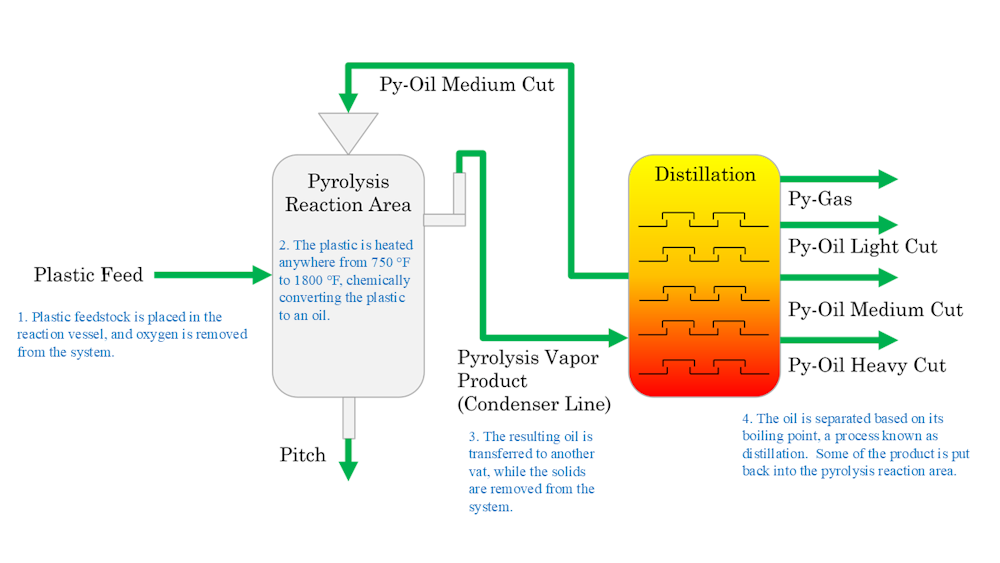
    Plastics are fed into the pyrolysis reactor, where they get hot and turn to oil. The oil moves to another vat where it’s boiled and distilled.
    Alexander Kaplitz and Kevin A. Schug

    Unlike traditional plastic recycling, pyrolysis theoretically isn’t limited to specific types of plastic. It could be made to accommodate many of them, although current technology is limited to a few types – polyethylene and polypropylene, used in food containers and bottles – at an industrial scale.

    So, plastic pyrolysis could help handle the waste from consumer products such as plastic bags, bottles, milk jugs, packaging materials, wet wipes and even discarded children’s toys. Pyrolysis can also handle more complex plastic waste such as tires and discarded electronics, although solid waste handlers and recyclers avoid certain plastic types in pyrolysis, such as polyvinyl chloride – or PVC, which is found in pipes and roofing products – and polystyrene, used in packaging, as these can create harmful byproducts.

    During pyrolysis, the plastic polymers are broken down into smaller molecules, resulting in the production of liquid oil, fuel source gases such as methane, propane and butane, and char.

    Char is the solid residue left at the end of the pyrolysis process. It can be used as a carbon-rich material for various applications, including adding it to soil to make it healthier for farming, as it increases soil moisture and pH, benefiting nutrient absorption. Char also has the ability to absorb harmful carbon gases from the air, which can help prevent climate change.

    The main downside of char is if it’s used too much it can increase soil alkalinity, which may hinder plant growth.

    Plastic pyrolysis uses heat to break down plastic, with the intent to convert plastic waste into usable materials.

    How pyrolosis works

    The plastic pyrolysis process typically involves several key steps.

    In the first step of pyrolysis, community recyclers collect the plastic waste and clean it to remove any contaminants. The plastic then gets shredded into smaller pieces to facilitate the pyrolysis process. Unlike traditional recycling, it needs only minimal sorting.

    Chemical recyclers operating pyrolysis plants feed the shredded plastic into a pyrolysis reactor, where they heat it to temperatures ranging from 600 to 1,600 degrees Fahrenheit (315 to 871 degrees Celsius). Without oxygen, plastics in the reactor don’t catch fire and emit fumes into the air. Instead, this high-temperature environment causes the plastic polymers to break down into smaller hydrocarbon molecules. These smaller molecules can be further refined.

    The high temperature turns some molecules into vapors, which condense into liquid oil. Chemical companies can further refine this oil to be used as fuel or as a raw material to make other chemicals or plastics.

    In addition to liquid oil, the pyrolysis process generates natural gases, such as methane, ethane, butane and propane. Pyrolysis operators then capture these gases, and they can sometimes use them as a source of energy to power the pyrolysis reactor or other industrial processes.

    Plastic pyrolysis generates oil, which engineers can use to create new materials or fuels.
    BASF, CC BY-NC-ND

    Benefits of pyrolysis

    When done effectively, plastic pyrolysis offers several benefits.

    By expanding recycling beyond just plastic bottles and milk jugs, pyrolysis could reduce the amount of plastic waste pollution that ends up in landfills and oceans.

    Additionally, converting plastic waste into usable products could help lower the production demand for new plastics from petroleum hydrocarbons. The byproducts could get used in recycled plastics.

    Some researchers are also testing pyrolysis oils to see whether they can use them instead of gasoline to fuel vehicles. The gases produced during pyrolysis can even generate energy that fuels the pyrolysis reactor, making the process more self-sustaining and reducing the need for external energy sources.

    Currently, about 15% to 20% of the pyrolysis products are recycled into new propylene and ethylene, while most – about 80% to 85% – becomes diesel fuel, hydrogen, methane and other chemicals.

    While plastic pyrolysis holds some promise, it also faces challenges. The cost of setting up and operating pyrolysis plants is high. How profitable the process is depends on the availability of suitable plastic waste, the market demand for the oils and gases produced, and the costs of energy and staff necessary to operate the reactor.

    Another issue is quality control. Most plastic types can undergo pyrolysis, but different plastics create oils with different chemical makeups. Scientists will need to understand the composition of these oils before industry can determine which plastic types to focus on and how each oil could create new materials.

    Pyrolysis oils have unique chemical compositions depending on the type of plastics used to create them.
    Alexander Kaplitz and Kevin A. Schug

    Researchers like us at The University of Texas at Arlington and our international colleagues are studying new chromatography-based oil-separation techniques that can successfully identify some types of pyrolysis oils. Chromatography is the process of separating components in a mixture by passing them through a stiff material.

    Different components in the mixture are attracted to this material to different degrees. So, they exit the chromatography system at different times, which separates them from one another.

    With more research into the technique’s efficiency and technological advancements to scale up pyrolysis, this technique could be one part of a sustainable solution to plastic waste management. In the meantime, pyrolysis is being used now, with one report estimating the market for pyrolysis plants at US$40 billion in 2024 and predicting it to grow to $1.2 billion by 2033.

    Kevin A. Schug receives funding from the National Science Foundation, the National Institutes for Health, ExxonMobil, and Weaver Consultants Group. He is affiliated with VUV Analytics, Inc. and Infinity Water Solutions as a member of their scientific advisory boards. Lummus Technology, LLC provided the funding for research on plastic waste pyrolysis oils at UT Arlington.

    Alexander Kaplitz does not work for, consult, own shares in or receive funding from any company or organization that would benefit from this article, and has disclosed no relevant affiliations beyond their academic appointment.

    ref. Plastic pyrolysis − chemists explain a technique attempting to tackle plastic waste by bringing the heat – https://theconversation.com/plastic-pyrolysis-chemists-explain-a-technique-attempting-to-tackle-plastic-waste-by-bringing-the-heat-234453

    MIL OSI – Global Reports

  • MIL-OSI United Kingdom: Council Visit Winchester team showcases Jane Austen during English Tourism Week

    Source: City of Winchester

    A Morning of Jane Austen was led by Visit Winchester – which is managed by Winchester City Council’s Economy and Tourism team – to mark English Tourism Week, showcasing some of the local author-related highlights.

    2025 is the 250th anniversary of Jane Austen’s birth and a range of special events are taking place including the first-ever public access to the house in College Street where she died.

    Winchester’s year-long birthday celebration includes partners from across the city and surrounding district, who have come together to devise a series of over 35 special events, tours, and exhibitions to celebrate Austen’s life and works.

    The showcase, on Saturday 15 March, included a visit to Winchester Visitor Information Centre, and a themed Jane Austen tour by one of Winchester Tourist Guides which took in the key landmarks to Austen’s time in Winchester including College Street and Winchester Cathedral, where the author is buried, before finishing at Winchester City Museum.

    Visit Winchester has also recently launched a new self-guided trail around the city which highlights all places the author would have visited during her time in the city and gives visitors an insight into Winchester’s Georgian history. The trail has launched as part of English Tourism Week and is available to download on the Visit Winchester website or from the visitor information centre.

    Winchester City Council’s Cabinet Member for Business and Culture Councillor Lucille Thompson said: “Winchester district’s first-class tourism offering brings in millions for our economy each year, supporting thousands of jobs and driving growth into our local communities. A thriving visitor destination is also a welcome benefit for local residents, who can also access a year-round vibrant programme of experiences and events right on their doorstep.

    “This English Tourism Week we have a lot to celebrate – not only are we celebrating 250 years since the birth of one of the world’s most famous authors, but also all the hard work our visitor economy does, welcoming our visitors and showcasing Winchester to the world.”

    Louise West, Chair of Collections Committee and Trustee at Hampshire Cultural Trust, said: “Jane Austen was a Hampshire girl through and through, with an inextricable link to Winchester. 250 years on since her birth, her life, literature and legacy continue to be an irresistible draw to visitors from all over the UK and beyond. We are proud and honoured to have the privilege of counting some of her personal possessions among the collections that we care for, and are looking forward to showcasing these, along with our full programme of Austen-themed events, to visitors to the city throughout the year.”

    Dr Danny Chambers, MP for the Winchester Constituency, said: “Jane Austen’s novels and film adaptations have been enjoyed by fans for decades and bring so many people from around the whole world to Winchester. We’re fortunate to have a literary superstar bringing people to our city. Winchester City Council and other organisations across the city, including the amazing tour guides, have done an excellent job to promote this 250th anniversary celebration, and I thank them for showing me the work they’ve put in to make it happen.”

    To see a full list of Winchester’s attractions and businesses taking part in Jane Austen’s 250th anniversary celebrations, visit www.visitwinchester.co.uk/jane-austen-250.

    ENDS

    Notes to Editors

    Over eight million people visit the Winchester district every year, spending over £370 million in the local area and supporting over 5,760 jobs, both for local residents and those living nearby, making it one of Winchester’s largest and most valuable industries. – The Economic Impact of Tourism on Winchester, 2022, Tourism South East

    Visit England’s English Tourism Week – 14-23 March 2025 – celebrates this diverse, exciting and vibrant sector, and highlights the quality and value of English tourism. 

    Jane Austen was a Hampshire girl through and through, with an inextricable link to Winchester. 250 years on since her birth, her life, literature and legacy continue to be an irresistible draw to visitors from all over the UK and beyond. We are proud and honoured to have the privilege of counting some of her personal possessions in the collections that we care for, and are looking forward to showcasing these, along with our full programme of Austen-themed events, to visitors to the city throughout the year. For further information, please email tourism@winchester.gov.uk.

    MIL OSI United Kingdom

  • MIL-OSI Canada: Government of Yukon offers letters of support for foreign nationals with work permits expiring in 2025

    Source: Government of Canada regional news

    The Government of Yukon has extended an agreement with Immigration, Refugees and Citizenship Canada (IRCC) to facilitate the issuance of work permits to prospective applicants of the Yukon Nominee Program (YNP). Foreign nationals who were living and working in the Yukon on May 16, 2024, with work permits that have expired since January 1, 2025, or that are set to expire before December 31, 2025, will be eligible to apply for a new Yukon-specific work permit. This permit will be valid for up to two years.

    This temporary measure specifically applies to foreign nationals who are currently established in the Yukon. Their employer must plan to nominate them for permanent residency through the YNP in 2025 or 2026. If eligible, the foreign national will receive a letter of support from the Government of Yukon to accompany their work permit application to IRCC.

    The intake period to request a temporary measure letter of support will open on March 19, 2025, at 9 am Yukon Standard Time. Foreign nationals must submit their request by April 2, 2025, at 4:30 pm Yukon Standard Time. To prepare, foreign nationals can find information about what they will need to submit on the webpage: Request support as a potential nominee. The form to submit requests will be available on this page when the intake opens.

    In January 2025, IRCC informed the Yukon of a 50 per cent reduction in nominee program allocations for the year. In consideration of the Government of Canada’s priority to stabilize immigration levels across the country, lower allocation limits are expected to continue. This means fewer foreign nationals will be able to pursue participation in the YNP as a pathway to permanent residence each year. The department encourages anyone with an expiring work permit in 2025, and who intends to pursue candidacy for the YNP, to consider submitting a request. Extending this measure to people with work permits expiring in 2025 gives individuals and their employers time to apply in 2025 or 2026.

    The Department of Economic Development is finalizing the approach for YNP intake for 2025. This work has been done in conversation with industry organizations. Updates will be made in consideration of feedback and how the program can better meet participant and labour market needs. Information on the 2025 process will be announced in the coming weeks.

    MIL OSI Canada News

  • MIL-OSI USA: Gov. Kemp: TriNet to Create 750 Jobs in Metro Atlanta

    Source: US State of Georgia

    ATLANTA – Governor Brian P. Kemp today announced that TriNet is planning to create 750 new jobs at a new corporate center in Dunwoody over the next five years, representing an estimated $15.4 million in investment in DeKalb County.

    “As the No. 1 state for business, one of the key drivers of our success is our metro Atlanta area that continues to attract a strong ecosystem of job creators like TriNet,” said Governor Brian Kemp. “TriNet’s services for small businesses will further that network while creating meaningful jobs and investment for the Dunwoody and DeKalb County community.”

    TriNet provides comprehensive HR solutions, technology, expertise, and access to world-class benefits that enable small and medium-sized businesses (SMBs) to attract and develop top-tier talent.

    “We look forward to opening a new TriNet office in metro Atlanta and becoming a part of this vibrant and growing business community,” saidMike Simonds, TriNet President and CEO. “We are excited to partner with Atlanta’s strong universities and thriving small business ecosystem as we expand our local team and establish a hub where TriNet colleagues from across the country can come together for training, development, and collaboration to better serve our customers.”

    “At TriNet, our people are the heart of everything we do, and we are thrilled to expand our team here in metro Atlanta,” said Catherine Wragg, TriNet Chief People Officer. “This new office will help us attract top talent, foster our strong culture of collaboration and making an impact, and further invest in the professional growth of our colleagues. We are committed to creating a workplace where our colleagues can thrive and look forward to making a positive impact in this community.”

    TriNet’s new approximately 150,000-square-foot space will be located in Dunwoody. The company will immediately begin hiring for technology, HR consulting, client management, and sales roles, with plans to leverage its increased presence to grow its regional Atlanta and Southeast customer base. To learn more about TriNet, including where interested individuals can apply for jobs, visit www.trinet.com/about-us/careers.

    “Dunwoody provides the ideal setting for TriNet, offering unparalleled access to the region’s talented workforce and a vibrant, mixed-use environment surrounded by top-tier restaurants, shops, and entertainment,” said Dunwoody Mayor Lynn Deutsch. “We are thrilled to welcome TriNet, whose investment will bring hundreds of new jobs to our community. This is another example of a growing company choosing Dunwoody.”

    “TriNet’s investment in DeKalb County is a testament to the strength of our workforce, our infrastructure, and our commitment to fostering a thriving business environment,” said DeKalb County CEO Lorraine Cochran-Johnson. “The creation of 750 new jobs will bring invaluable opportunities to our residents while reinforcing DeKalb as a premier destination for corporate growth and innovation. We proudly welcome TriNet to our community and look forward to the positive impact this expansion will have on our local economy and workforce.”

    “TriNet’s investment in DeKalb County will create jobs, drive innovation, and strengthen our economy,” said Katie Kirkpatrick, President and CEO of the Metro Atlanta Chamber. “With direct access to a pipeline of emerging talent from metro Atlanta’s renowned universities, TriNet is uniquely positioned to connect businesses with the next generation of HR and business professionals.” 

    Assistant Director of Statewide Projects John Soper represented the Georgia Department of Economic Development’s (GDEcD) Global Commerce team on this project in partnership with the City of Dunwoody, Decide DeKalb, Metro Atlanta Chamber, University System of Georgia, and Georgia Power.

    “TriNet’s decision to locate in Georgia reflects the confidence companies have in the state as a hub for innovation, talent, and long-term success,” said GDEcD Commissioner Pat Wilson. “Strong partnerships between industry, communities, and higher education drive economic growth. We’re excited about the opportunities this investment will bring and congratulate Dunwoody and DeKalb County on this milestone. Welcome to Georgia, TriNet!”

    About TriNet 

    TriNet provides small and medium-sized businesses (SMBs) with HR solutions and offers access to human capital expertise, benefits, risk mitigation, compliance, and payroll services, all enabled by industry-leading technology. TriNet’s suite of products also includes services and software-based solutions to help streamline workflows by connecting HR, benefits, employee engagement, payroll, and time and attendance. Rooted in more than 30 years of supporting entrepreneurs and adapting to the ever-changing modern workplace, TriNet empowers SMBs to focus on what matters most – growing their business and enabling their people. For more information, visit TriNet.com

    MIL OSI USA News

  • MIL-OSI Security: The ‘Wolf of West Virginia’ Pleads Guilty to Wire Fraud

    Source: Federal Bureau of Investigation (FBI) State Crime Alerts (c)

    CHARLESTON, W.Va. – Theodore Miller, 35, of South Charleston, pleaded guilty today to two counts of wire fraud. Miller admitted to defrauding more than 170 individuals through two real estate-related investment schemes that caused losses of between $395,000 and $434,501.

    According to court documents and statements made in court, Miller conceived and perpetrated the two fraudulent schemes between the spring of 2022 and September 2024. One scheme solicited direct investments to develop modern residential duplexes and a dry-storage lot on Bigley Avenue in Charleston. The other scheme offered a pooled real estate investment vehicle dubbed “Bear Lute.”

    To carry out these schemes, Miller portrayed himself on social media as the “Wolf of West Virginia,” a wealthy, successful and knowledgeable real estate mogul with enough disposable income to travel the world at his leisure. As part of his guilty pleas, Miller admitted that in reality, he had poor credit, thin month-to-month financial margins, was delinquent on property taxes and bills, and defaulted on loans.

    In each scheme, Miller made multiple misrepresentations to investors. These misrepresentations included that individuals would receive returns on their investments, that their investments were secured by real property, and that they could withdraw their investments. As part of his guilty pleas, Miller admitted that there were no returns on investments, that he never owned the real property he identified as security for the investments, and that he used the money from his fraud schemes to pay unrelated expenses, debts and obligations.

    Miller’s victims included an individual who wired $20,000 to Miller from California for the storage lot project on July 5, 2022, and an individual who wired $2,500 to Miller from Texas for Bear Lute on December 12, 2022.

    The money from the schemes was deposited into bank accounts for several entities Miller solely owned and operated including Bear Industries LLC, which initially served as an umbrella entity for the related businesses. Miller’s mother, Deanna Drumm, served as vice president of operations for Bear Industries from in or around 2019 to September 2024. While Miller lived outside the United States from in or about June  2021 to on or about August 8, 2024, he directed his mother to handle the day-to-day operational tasks for the Bear entities including the management of finances and transfer of funds.

    Drumm, 61, of Charleston, pleaded guilty on November 21, 2024, to aiding and abetting the sale and offer of unregistered securities. Both the direct investments and the Bear Lute investments were securities as defined by federal law, offered through interstate commerce via the internet, and were required to be registered. Drumm admitted that no registration statement was in effect for either of these securities, and that neither was exempt from the registration requirement. Drumm further admitted that she aided and abetted the offering of these unregistered securities in the course of her duties as vice president of operations for Bear Industries. Drumm is scheduled to be sentenced on May 29, 2025.

    In September 2022, the West Virginia Securities Commission issued a cease-and-desist letter to Bear Industries ordering it to stop the unregistered sale and offering of securities in Bear Lute. In November 2022, the West Virginia Securities Commission issued a cease-and-desist order regarding the same. Miller admitted that he continued to operate Bear Lute in violation of the order and never disclosed the order to his investors.

    On August 9, 2024, law enforcement officers arrested Miller following his return to the United States. Miller admitted that he told his wife during a recorded jail phone call on August 11, 2024, to report his iPhone stolen to make it inaccessible to law enforcement and to hide a backpack containing his laptop computer. Miller further admitted that the laptop contained most of the documents related to the direct investments and Bear Lute.

    Miller is scheduled to be sentenced on July 2, 2025, and faces a maximum penalty of 40 years in prison, up to three years of supervised release, and a $500,000 fine. Miller also owes restitution of between $395,000 and $434,501, with the final amount to be determined by the Court.

    Acting United States Attorney Lisa G. Johnston made the announcement and commended the investigative work of the Federal Bureau of Investigation (FBI), the West Virginia Fusion Center, the West Virginia Securities Commission, and the U.S. Securities and Exchange Commission.

    United States District Judge Irene C. Berger presided over the hearing. Assistant United States Attorneys Holly Wilson and Joshua Hanks are prosecuting the case.

    The U.S. Securities and Exchange Commission filed a parallel civil action against Miller, Bear Industries LLC, Bear Investments and Business Consulting LLC, and Drumm in U.S. District Court for the Southern District of West Virginia. The lawsuit alleges that Miller has engaged in the unregistered and fraudulent offer of securities related to his real estate-related investment programs since at least 2022, and that Miller’s social-media persona and businesses were all a calculated fraud to divert investor funds for his own personal benefit. The lawsuit seeks permanent injunctive relief, disgorgement of ill-gotten gains and prejudgment interest, and civil penalties.

    A copy of this press release is located on the website of the U.S. Attorney’s Office for the Southern District of West Virginia. Related court documents and information can be found on PACER by searching for Case Nos. 2:24-cr-145 and 2:24-cv-479.

    ###


    MIL Security OSI

  • MIL-OSI: LockerMap Expands with Fleet Pricing and Mobile Apps to Help Truck Drivers Receive Personal Packages on the Road

    Source: GlobeNewswire (MIL-OSI)

    Austin, TX, March 18, 2025 (GLOBE NEWSWIRE) — LockerMap, the leading package pickup locator, has announced new fleet pricing and mobile apps designed to help truck drivers easily receive their personal online orders while on the road. LockerMap aggregates publicly accessible, secure package lockers, helping truck drivers and travelers find a convenient pickup location for their personal packages. With thousands of retail lockers and other pickup locations mapped, LockerMap is now offering fleet subscriptions at just $20 per driver per year, making it an affordable perk for trucking companies to provide their drivers. Individual drivers can also subscribe to LockerMap Plus for access to premium features designed to make finding pickup locations even easier.

    “Truckers spend weeks or months on the road, and receiving personal packages isn’t as easy as it is for someone at home,” said Justin Capogna, founder of LockerMap. “Our new Fleet Pricing makes it simple for companies to give their drivers easy access to pickup locations nationwide, with zero management required. And for individual drivers, LockerMap Plus provides powerful tools to find the most convenient pickup spots along their routes.”

    Drivers Experiencing Real Benefits on the Road

    “As a professional driver, finding package lockers along my route was nearly impossible before LockerMap. This application has completely solved that challenge for me,” said Chris K., independent owner-operator.

    “LockerMap has allowed me to discover convenient pickup locations along my regular routes. It’s significantly improved my quality of life on the road,” said Shannon B., long-haul driver.

    Fleet Pricing: Hassle-Free for Companies, Game-Changing for Drivers

    LockerMap’s Fleet Pricing is designed to be a low-cost, zero-maintenance benefit for trucking companies. Every driver enrolled through a fleet subscription receives full access to LockerMap Plus, ensuring they can take advantage of premium features like truck stop filtering and route-based searching. Fleets receive a custom signup link for drivers to join, and there’s no need to manage seats or subscriptions, just a simple, flat-rate cost per driver with bulk discounts available.

    For truck drivers, LockerMap makes picking up personal packages significantly easier—reducing the frustration of rejected deliveries at truck stops, unnecessary detours, and wasted time searching for lockers.

    Learn more at lockermap.com/fleet-pricing.

    LockerMap Plus: Premium Features for Individual Drivers

    LockerMap is free to use, allowing anyone to browse and locate pickup locations. For truck drivers and frequent travelers who need more advanced features, LockerMap Plus provides:

    • Truck stop filtering – Find pickup locations at truck stops nationwide.
    • Route-based searching – Easily locate package pickup points along your planned route.
    • More detailed location info – Get precise details on locker types and operating hours.

    Drivers can upgrade to LockerMap Plus to access advanced search and filtering options, making it faster and easier to find the best pickup locations along their route.

    New iOS & Android Apps Make Finding Pickup Locations Even Easier

    LockerMap is available on web, iOS, and Android, ensuring drivers can access it anywhere. The new apps are available now in the App Store and Google Play and introduce truck stop filtering and route-based searching, helping drivers find the most convenient package pickup points without detouring off their route.

    With over 20,000 pickup locations in the U.S., including 650+ at truck stops, LockerMap is the first and only tool built specifically to help truckers, RVers, and frequent travelers access convenient package pickup locations.

    About LockerMap

    LockerMap helps people find package pickup locations with ease, offering a powerful search tool for Amazon lockers, package pickup solutions, and more. Whether you’re a trucker, RVer, traveler, or a shopper looking for a secure delivery option, LockerMap makes it easy to pick up packages safely and conveniently. Learn more at lockermap.com. 

    Press inquiries

    LockerMap
    https://lockermap.com
    Justin Capogna
    press@lockermap.com

    The MIL Network

  • MIL-OSI: Anjuna Named to Fast Company’s 2025 Most Innovative Companies List

    Source: GlobeNewswire (MIL-OSI)

    PALO ALTO, Calif., March 18, 2025 (GLOBE NEWSWIRE) — Anjuna, a leader in Universal Confidential Computing and AI Data Fusion Clean Rooms, today announced its selection to Fast Company’s Most Innovative Companies of 2025. This recognition underscores Anjuna’s groundbreaking advancements in security and privacy, enabling enterprises to unlock new value from AI and data collaboration without compromising confidentiality.

    Fast Company’s annual Most Innovative Companies list celebrates organizations that are reshaping industries and redefining business. This is not Anjuna’s first recognition; the company was also named a winner in the Next Big Things in Tech Awards in the Security & Privacy category in 2023 for its Universal Confidential Computing Platform, Anjuna Seaglass.

    Anjuna’s latest honor comes amid significant company momentum. Earlier this year, Gartner recognized Anjuna as a Tech Innovator in Preemptive Cybersecurity for its role in safeguarding enterprises against emerging AI-driven threats. Additionally, Anjuna announced this month that it has secured major customers in the digital payments industry, including a Fortune 500 financial institution, all leveraging Anjuna’s technology to implement secure AI-driven processing, analytics, and collaboration in financial services.

    Innovation at the Core of Anjuna’s Mission

    At the heart of Anjuna’s innovation is Anjuna Northstar, the first AI Data Fusion Clean Room, which redefines secure AI-driven collaboration by enabling enterprises to fuse, analyze, and derive insights from multiple data sources without ever exposing it. First announced in December of 2024, Northstar offers an out-of-the-box, intrinsically secure environment, supporting industries from financial services to healthcare in unlocking AI-driven innovation.

    “Being named to Fast Company’s Most Innovative Companies list is an incredible honor that validates our mission to make security intrinsic, not an obstacle, to AI-driven collaboration,” said Ayal Yogev, CEO and co-founder of Anjuna. “This recognition highlights not only our cutting-edge technology but also the real-world impact we’re having—helping enterprises across industries securely unlock the value of their most sensitive data.”

    The full list of Fast Company’s Most Innovative Companies honorees can now be found at fastcompany.com. It will also be available on newsstands beginning March 25. To learn more about Anjuna, please visit anjuna.io

    Meet Anjuna at NVIDIA GTC 2025

    Anjuna’s recognition comes as the NVIDIA GTC conference is underway in San Jose CA, where the company is showcasing its latest innovations. Anjuna’s solutions integrate seamlessly with NVIDIA’s Confidential Computing-enabled Hopper and Blackwell architectures, empowering enterprises to run AI workloads with uncompromising security and privacy. Attendees are invited to visit booth #3311 to chat with Anjuna experts and see firsthand how Anjuna Northstar and Seaglass are enabling AI security and data collaboration.

    About Anjuna
    Anjuna unlocks secure, AI-driven innovation with two groundbreaking solutions. Anjuna Seaglass, the Universal Confidential Computing Platform, delivers ubiquitous data privacy and intrinsic cloud security. Anjuna Northstar, the AI Data Fusion Clean Room, builds on Seaglass to provide an out-of-the-box, private environment for limitless AI-driven data collaboration and value discovery. Anjuna works with enterprises around the globe, including financial services, government, healthcare and SaaS. Anjuna is backed by prominent investors, including Playground Global, Insight Partners, M Ventures, and SineWave Ventures.

    Media Contact:
    Mauricio Barra, VP of Marketing for Anjuna
    Email: mauricio.barra@anjuna.io

    An image accompanying this announcement is available at https://www.globenewswire.com/NewsRoom/AttachmentNg/9ac29037-1bfb-456f-84f8-33af76572a4e

    The MIL Network

  • MIL-OSI: Karolinska Development’s portfolio company Umecrine Cognition provides update on ongoing Phase 1b/2a clinical study

    Source: GlobeNewswire (MIL-OSI)

    STOCKHOLM, SWEDEN – March 18, 2025. Karolinska Development AB (Nasdaq Stockholm: KDEV) today announces that its portfolio company Umecrine Cognition has provided an update regarding the ongoing clinical phase 1b/2a trial evaluating the drug candidate golexanolone in PBC patients. Due to technical issues in the production of capsules used in the study, the clinical trial has been delayed. No patient safety concerns have been noted, and Umecrine Cognition is working intensively together with its supplier to resolve the issue.

    Umecrine Cognition is developing a new class of drugs to alleviate cognitive symptoms caused by liver disease. The company’s most advanced drug candidate, golexanolone, is currently being evaluated in a randomized, double-blind, placebo-controlled, clinical phase 1b/2a study in patients with primary biliary cholangitis (PBC) who experience clinically significant fatigue and cognitive symptoms.

    Karolinska Development’s ownership in Umecrine Cognition amounts to 73%.

    For further information, please contact:

    Viktor Drvota, CEO, Karolinska Development AB
    Phone: +46 73 982 52 02, e-mail: viktor.drvota@karolinskadevelopment.com 

    Johan Dighed, General Counsel and Deputy CEO, Karolinska Development AB
    Phone: +46 70 207 48 26, e-mail: johan.dighed@karolinskadevelopment.com

    TO THE EDITORS

    About Karolinska Development AB

    Karolinska Development AB (Nasdaq Stockholm: KDEV) is a Nordic life sciences investment company. The company focuses on identifying breakthrough medical innovations in the Nordic region that are developed by entrepreneurs and leadership teams. The company invests in the creation and growth of companies that advance these assets into commercial products that are designed to make a difference to patient’s lives while providing an attractive return on investment to shareholders.

    Karolinska Development has access to world-class medical innovations at the Karolinska Institutet and other leading universities and research institutes in the Nordic region. The company aims to build companies around scientists who are leaders in their fields, supported by experienced management teams and advisers, and co-funded by specialist international investors, to provide the greatest chance of success.

    Karolinska Development has a portfolio of eleven companies targeting opportunities in innovative treatment for life-threatening or serious debilitating diseases.

    The company is led by an entrepreneurial team of investment professionals with a proven track record as company builders and with access to a strong global network.

    For more information, please visit www.karolinskadevelopment.com.

    Attachment

    The MIL Network

  • MIL-OSI: Mark Werner, CFA Joins Laffer Tengler Investments as Portfolio Manager

    Source: GlobeNewswire (MIL-OSI)

    SCOTTSDALE, Ariz. and NASHVILLE, Tenn., March 18, 2025 (GLOBE NEWSWIRE) — Laffer Tengler Investments, Inc., a boutique investment management firm for high-net worth individuals, institutional clients and platform advisors is pleased to announce the addition of Mark Werner as Portfolio Manager and Strategy Team member of the Dividend Growth Strategy team. Werner brings with him over two decades of investment experience at asset and wealth management firms.  

    “Our dividend growth strategy is best in an important and unique strategy; we welcome Mark’s experience and market expertise,” says Nancy Tengler, CEO and CIO of Laffer Tengler Investments. “Adding Mark to our team will help expand our investment strategy offerings as well as add to the firms’ equity research efforts. His background offers the team additional expertise in portfolio management to benefit our valued clients.”  

    “Laffer Tengler’s proven model was immediately appealing,” says Werner. “I am excited to join the Laffer Tengler team to provide the firm’s clients with diversified and tailored investment strategies.”  

    Werner’s background includes building and developing asset allocation strategies, conducting in-depth fundamental equity research across global markets, and managing portfolios for both institutional and private clients. Throughout his career, he has held investment and portfolio management roles at firms such as Fred Alger Management, Merrill Lynch, Ashfield Capital Partners, and AXA Rosenberg Investment Management.  

    Werner holds a Bachelor of Science in Marketing from Arizona State University, a Master of Science in Financial Analysis and Investment Management from St. Mary’s College and is a CFA charter holder.  

    About Laffer Tengler Investments, Inc.  

    Laffer Tengler Investments, Inc., headquartered in Nashville, Tennessee, with national distribution and an office in Scottsdale, Arizona, is an asset management firm providing investment solutions to Institutional, Platform and high-net worth clients. The company is an investment advisor registered with the SEC, and it offers advisory services. Laffer Tengler Investments, Inc. is an affiliate of ButcherJoseph. Nancy Tengler, CEO and CIO, has been managing large cap value strategies for over 35 years. The investment team has an average of 20 years of experience in the investment management business.  

    Media Contact

    Deborah Kostroun, Zito Partners
    deborah@zitopartners.com
    +1 (201) 403-8185

    The MIL Network

  • MIL-OSI: Notice to annual general meeting in Agillic A/S

    Source: GlobeNewswire (MIL-OSI)

    Announcement no. 4 – 2025

    Copenhagen – 18 March 2025 – Agillic A/S

    Notice is hereby given to shareholders in Agillic A/S of the annual general meeting scheduled for 3 April 2025 at 14:30 (CET). 

    The general meeting is held at the company’s address at Masnedøgade 22, 2, DK-2100 Copenhagen.

    Enclosed please find notice and agenda for the annual general meeting. 

    For further information, please contact:
    Christian Samsø, CEO
    +45 24 88 24 24
    Christian.samsoe@agillic.com

    Certified Adviser
    HC Andersen Capital
    Pernille Friis Andersen

    About Agillic A/S
    Agillic (Nasdaq First North Growth Market Denmark: AGILC) is a Danish software company offering brands a platform through which they can work with data-driven insights and content to create, automate and send personalised communication to millions. Agillic is headquartered in Copenhagen, Denmark. For further information, please visit www.agillic.com.

    Attachments

    The MIL Network

  • MIL-OSI: TopLine Financial Credit Union Advocates for Members in Washington D.C.

    Source: GlobeNewswire (MIL-OSI)

    MAPLE GROVE, Minn., March 18, 2025 (GLOBE NEWSWIRE) — TopLine Financial Credit Union, a Twin Cities-based member-owned financial services cooperative, visited Capitol Hill in Washington, D.C., March 2 to March 5, 2025, as part of the annual America’s Credit Unions Governmental Affairs Conference, the credit union industry’s largest advocacy event.

    During the conference, TopLine executives and officials, along with over 6,000 other credit union professionals, board members and Minnesota Credit Union Network (MnCUN) staff members, discussed several top credit union issues with key legislative staff members. The group met with U.S. Senators Amy Klobuchar and Tina Smith as well as members of the U.S. House and their staff. Meetings focused on expanding credit union’s opportunities to serve more Minnesotans, emphasizing the importance of preserving our not-for-profit financial cooperative tax status, fighting back on efforts to disrupt the interchange system, and maintaining an independent credit union regulator – all are very important to the health of the credit union industry.

    TopLine spent valuable face time meeting with lawmakers and sharing members’ stories on how TopLine provides safe and affordable financial services to help members with all of their financial needs, from buying cars and homes, saving for retirement and investing in small businesses. These conversations emphasized the importance of preserving the tax status of credit unions, which allows credit unions to continue to do what they do best: focus on serving members and communities instead of chasing profits. Credit unions advocates shared with lawmakers that any limitation or curtailment of the tax status would have a dramatic impact on the $950 million in direct financial benefits Minnesota credit unions provide their members and over $4 billion in economic output in the state.

    “The Governmental Affairs Conference united credit union champions from across the nation to discuss key policies, engage with legislators on Capitol Hill, and reinforce to lawmakers and regulators why credit unions are America’s best financial partner—prioritizing people over profits, strengthening communities, and enhancing financial well-being for all,” said Mick Olson, President and Chief Executive Officer at TopLine Financial Credit Union. “TopLine representatives had meaningful discussions with our state lawmakers, emphasizing the importance of preserving our not-for-profit financial cooperative tax status. This fundamental aspect of our structure enables us to build a stronger, healthier financial future for the consumers we serve.”

    America’s Credit Unions is the premier national trade association serving America’s credit unions. The not-for-profit trade group is governed by volunteer directors who are elected by their credit union peers. To learn more, visit www.americascreditunions.org.

    Minnesota Credit Union Network (MnCUN) is the statewide trade association that works to ensure the success, growth and vitality of Minnesota credit unions. For more information, visit www.mncun.org.

    TopLine Financial Credit Union, a Twin Cities-based credit union, is Minnesota’s 9th largest credit union, with assets of over $1.1 billion and serves over 70,000 members. Established in 1935, the not-for-profit financial cooperative offers a complete line of financial services from its ten branch locations — in Bloomington, Brooklyn Park, Champlin, Circle Pines, Coon Rapids, Forest Lake, Maple Grove, Plymouth, St. Francis and in St. Paul’s Como Park — as well as by phone and online at www.TopLinecu.com or www.ahcu.coop. Membership is available to anyone who lives, works, worships, attends school or volunteers in Anoka, Benton, Carver, Chisago, Dakota, Hennepin, Isanti, Kanabec, Mille Lacs, Pine, Ramsey, Scott, Sherburne, Washington and Wright counties in Minnesota and their immediate family members, as well as employees and retirees of Anoka Hennepin School District #11, Anoka Technical College, Federal Premium Ammunition, Hoffman Enclosures, Inc., GRACO, Inc., and their subsidiaries. Visit us on our Facebook or Instagram. To learn more about the credit union’s foundation, visit www.TopLinecu.com/Foundation.

    CONTACT:
    Vicki Roscoe Erickson
    Senior Vice President and Chief Marketing Officer
    TopLine Financial Credit Union
    verickson@toplinecu.com | 763.391.0872

    A photo accompanying this announcement is available at https://www.globenewswire.com/NewsRoom/AttachmentNg/46b657cc-d617-4f18-a6af-6e6d0a03cb26

    The MIL Network

  • MIL-OSI: HUMAN Sightline Revolutionizes Bot Management with AI-Enhanced Insights to Detect, Isolate, and Track Attackers

    Source: GlobeNewswire (MIL-OSI)

    NEW YORK, March 18, 2025 (GLOBE NEWSWIRE) — HUMAN Security, Inc., a leading cybersecurity company committed to safeguarding every step of the customer’s online journey by defending against bots, fraud, and digital risk, announced today HUMAN Sightline, an innovative suite of capabilities that detects, isolates, and tracks individual bot profiles. HUMAN Sightline enables security teams to conduct faster investigations and optimize their response to evolving threats in the era of AI. This fundamentally transforms bot management by delivering never-before-seen insights into automated traffic.

    “The bot mitigation landscape is swiftly evolving with the proliferation of AI-generated threats, and the industry can no longer rely on last-gen methods to detect and investigate next-gen threats,” said Christos Kalantzis, CTO of HUMAN. “Bots are becoming more sophisticated, and organizations must respond with advanced detection techniques to protect their business and drive security optimization strategies at scale. With HUMAN Sightline, we are putting data-driven investigation tools straight into the hands of our customers and their security teams.”

    With HUMAN Sightline, customers can isolate individual attacker profiles and uncover what each one is doing in granular detail. HUMAN’s secondary detection engine analyzes all automated activity on an application and segments it into distinct profiles, going beyond simple anomaly detection or basic signature mapping. Using sophisticated data modeling, HUMAN Sightline identifies and tracks nuanced shifts in bot behavior as they occur. This enables security analysts to see the activity of individual bot profiles over time, as well as their sophistication, capabilities, and the specific factors that distinguish them from humans and other bots on the application.

    “The responsibility of security is making decisions, and HUMAN Sightline helps us make decisions,” said Omri Lotan, Site Reliability Engineer at Fiverr. “Of course, we want to block bots, but when a tool just blocks bots without explaining why, I still have to investigate it. HUMAN Sightline gives me all the details I need to understand what exactly a bot was doing and why it was blocked. I can zero in on specific threat behaviors and turn these learnings into targeted mitigation strategies.”

    HUMAN Sightline offers three key benefits that revolutionize bot management:

    1. Focus and accelerate investigations: Surfaces distinct bot activities, attack paths, and changing behaviors, such as bots targeting specific products or visiting select pages at a glance. Security teams can then uncover hidden patterns and zero in on key attacks, transforming their investigative capabilities.
    2. Translate attack data into a board-ready threat narrative: Allows teams to present business-level visualizations of bot behavior and show the effect of their actions over time. This empowers security teams to lead with data-backed authority, bridging the gap between deep technical analysis and business actions.
    3. Optimize your security strategy for your unique threats: This enables security teams to gain unprecedented clarity on each attacker’s actions and intent to define threat priorities. This real-time adaptability empowers security teams to proactively identify new threat patterns, respond faster, and stay agile against evolving risks.

    “HUMAN Sightline completely transforms how the industry thinks about bot management,” said Bryan Becker, Senior Director of Project Management at HUMAN. ”In an industry used to anomaly detection as the only way to measure bot attacks, HUMAN Sightline isolates each bot profile to give security practitioners unprecedented visibility into the behavior of specific threats on their application.”

    HUMAN Sightline insights will be available through a new set of dashboards in HUMAN’s Application Protection package. They will also be available in Account Takeover Defense and Scraping Defense at no additional cost.

    About HUMAN
    HUMAN is a leading cybersecurity company committed to protecting the integrity of the digital world. We ensure that every digital interaction, transaction, and connection is authentic, secure, and human. Our Human Defense Platform safeguards the entire customer journey with high-fidelity decision-making that defends against bots, fraud, and digital threats. Each week, HUMAN verifies 20 trillion digital interactions, providing unparalleled telemetry data to enable rapid, effective responses to even the most sophisticated threats. Recognized by our customers as a G2 Leader, HUMAN continues to set the standard in cybersecurity. To ensure your digital connections are trusted, visit www.humansecurity.com

    Contact information:
    Masha Krylova, Director of Communications
    masha.krylova@humansecurity.com

    A photo accompanying this announcement is available at https://www.globenewswire.com/NewsRoom/AttachmentNg/65debe93-90d3-4833-b82d-dabd0a88cb38

    The MIL Network

  • MIL-OSI: SECU Foundation Awards $150,000 to Rural Investment Collaborative for Improving Rural Leadership and Economic Opportunities in Appalachian Region of North Carolina

    Source: GlobeNewswire (MIL-OSI)

    RALEIGH, N.C., March 18, 2025 (GLOBE NEWSWIRE) — Rural Investment Collaborative (RIC), a program of Appalachian Community Capital, has received a $150,000 challenge grant from SECU Foundation. The funding will support a two-year pilot program to improve leadership and economic opportunities for rural communities across North Carolina.

    RIC was created by the Federal Reserve Bank of Richmond and is a collective of foundations, financial centers, educational institutions, and government agencies working cooperatively to enhance the workforce and economic outcomes for rural communities.

    “We are thrilled to provide essential funding to help the Rural Investment Collaborative expand access to needed resources and systems to foster long-term change,” said SECU Foundation Board Vice Chair Mona Moon. “We look forward to seeing the positive impacts as the participating groups work to address rural infrastructure, social determinants of health, access to care, disaster recovery, and healthy living in their communities.”

    “The SECU Foundation’s generous support of the Richmond Federal Reserve’s Rural Investment Collaborative has been critical to ensuring the success of the program,” said President and CEO of Appalachian Community Capital Donna Gambrell. “The Foundation’s grant is assisting community leaders from small towns and rural areas in North Carolina to develop investment-ready project proposals and to make access to funding easier.” 

    About SECU and SECU Foundation
    A not-for-profit financial cooperative owned by its members, and federally insured by the National Credit Union Administration (NCUA), SECU has been providing employees of the state of North Carolina and their families with consumer financial services for 87 years. SECU is the second largest credit union in the United States with $53 billion in assets. It serves more than 2.8 million members through 275 branch offices, 1,100 ATMs, Member Services Support via phone, www.ncsecu.org, and the SECU Mobile App. The SECU Foundation, a 501(c)(3) charitable organization funded by the contributions of SECU members, promotes local community development in North Carolina primarily through high-impact projects in the areas of housing, education, healthcare, and human services. Since 2004, SECU Foundation has made a collective financial commitment of over $300 million for initiatives to benefit North Carolinians statewide.

    Contact: Jama Campbell, Executive Director, secufoundation@ncsecu.org

    A photo accompanying this announcement is available at https://www.globenewswire.com/NewsRoom/AttachmentNg/720d3f26-4426-401d-9148-bf0b71d93183

    The MIL Network

  • MIL-OSI Global: Ethiopia’s war may have ended, but the Tigray crisis hasn’t

    Source: The Conversation – Africa – By Assefa Leake Gebru, Assistant Professor of Political Science and Strategic Studies , Mekelle University

    For over 20 years, Ethiopia was led by the Ethiopian People’s Revolutionary Democratic Front, a coalition of four ethnic-based political parties representing Tigray, Amhara, Oromo, and Southern nations, nationalities and peoples. The Tigray People’s Liberation Front was the most influential party within the coalition. However, in 2018, when the Prosperity Party came into power, the front lost its important role in government.

    On 4 November 2020, the federal government launched an attack on Tigray, terming it a military offensive against political aggression from the Tigrayan front. This sparked a war that lasted two years, and caused severe damage to people and resources. The African Union’s lead mediator in the crisis, Olusegun Obasanjo, estimated about 600,000 civilians were killed. This makes it one of the most destructive conflicts of the 21st century.

    On 2 November 2022, the Ethiopian government and the Tigray People’s Liberation Front signed a peace deal in South Africa, the Pretoria agreement. More than two years later, however, Tigray still faces immense political and humanitarian challenges. Assefa Leake Gebru, who has studied post-war Tigray, explains what’s happening.

    What’s the current situation in Tigray?

    The 2022-2022 war and its lingering effects have thrown the Tigray region into chaos. People are grappling to get basics like food, water and medicine. The regional economy was devastated by the war. There have been no rehabilitation and reconstruction efforts so far. Humanitarian aid is limited. Imagine if your local grocery store ran out of everything and couldn’t restock – that’s the situation I have witnessed and studied in Tigray, which is affecting millions of residents.

    Additionally, the leaders of the Tigray People’s Liberation Front are now fighting among themselves for power. The division is mainly between two factions: one led by former regional president Debretsion Gebremichael and the other by Getachew Reda, who heads the interim administration.

    In January 2025, leaders of Tigray’s military forces supported calls from the Debretsion faction for new regional leadership. The interim administration opposed this, calling it a soft coup. The federal government considers the political faction led by Debretsion illegitimate. The military leaders’ decision also sparked public protests, with Tigrayans calling for a separation between the military and politics.

    This internal division has weakened the interim administration, which was installed as part of the Pretoria agreement in March 2023.

    Given this situation, the interim administration remains fragile amid serious humanitarian concerns and security threats facing the region. The interim government and dysfunctional law enforcement institutions aren’t strong enough to fix things.


    Read more:
    What is federalism? Why Ethiopia uses this system of government and why it’s not perfect


    Economically, jobs remain scarce. A 2024 survey found a youth unemployment rate of 81%. This situation has been created by economic collapse, asset plunder during the war and the absence of a functioning government.

    Socially, people are stressed and hurting, like a community still reeling from a major fallout. It’s a pile-up of problems that are making life incredibly tough.

    What, exactly, is the Pretoria agreement?

    The Pretoria agreement is an important peace deal between Tigray’s political leaders and the federal government. It was signed in Pretoria, South Africa, on 2 November 2022. The African Union facilitated the peace talks hosted by South Africa.

    The goal of the agreement? End the violence that began in 2020, keep people safe by calling for an immediate cessation of hostilities, allow aid like food trucks to roll in, disarm Tigray fighters and set up an interim government to restore order.

    It also aimed to re-establish the Ethiopian government’s control over federal installations in Tigray.

    What has been implemented and what hasn’t?

    There has been some positive progress. The Pretoria agreement established the interim government. Some everyday services are back, like banks reopening and planes flying again. A few Tigray fighters have put down their weapons.

    But here’s where it gets messy. Soldiers from Eritrea – which supported the Ethiopian army in the Tigray war – and militias from another Ethiopian region, Amhara, are still hanging around Tigray, raising security threats. They’re preventing internally displaced persons from going back home.

    The plan to fully disarm Tigrayan fighters hasn’t been completed either. This threatens regional stability, undermines peace efforts and increases the risk of renewed violence.

    What are the implications of not fully executing the Pretoria agreement?

    First, the region’s humanitarian crisis could worsen. An estimated one million displaced people are grappling with high levels of food insecurity, and thousands of schools remain closed. A weak interim government and the continued occupation of parts of Tigray by armed groups has hindered the restoration of services and stifled economic progress.

    Second, the division within the Tigray People’s Liberation Front makes it hard to lead the region under an interim administration. A lack of consensus on power-sharing has hindered effective governance, undermining the intended transitional authority.

    Third, a weak interim government can’t keep civilians safe, which was a pillar of the Pretoria agreement. Economically, the lack of jobs and skyrocketing prices are hitting Tigrayans hard. Socially, everyone’s on edge.

    Finally, there’s a risk of igniting further conflict in the region along the political fault lines between Debretsion and Getachew. There is a high chance of this situation being manipulated by Eritrean forces, who weren’t involved in the negotiations that led to the Pretoria agreement. The fractures in the interim government provide an opportunity for neighbouring Eritrea to support one faction against the other, which could escalate into war between Ethiopia and Eritrea. The Tigray People’s Liberation Front has been one of Eritrea’s bitterest enemies. The antagonism between the two led to the 1998-2000 war between Ethiopia and Eritrea.

    If these tensions keep up, Tigray will remain stuck in an awful cycle. The African Union and international community must address these issues to prevent a spiral into further chaos.

    Assefa Leake Gebru does not work for, consult, own shares in or receive funding from any company or organisation that would benefit from this article, and has disclosed no relevant affiliations beyond their academic appointment.

    ref. Ethiopia’s war may have ended, but the Tigray crisis hasn’t – https://theconversation.com/ethiopias-war-may-have-ended-but-the-tigray-crisis-hasnt-251846

    MIL OSI – Global Reports

  • MIL-OSI Global: People say they prefer stories written by humans over AI-generated works, yet new study suggests that’s not quite true

    Source: The Conversation – USA – By Martin Abel, Assistant Professor of Economics, Bowdoin College

    Artificial intelligence is expected to generate a growing share of the world’s creative work. karetoria/Moment via Getty Images

    People say they prefer a short story written by a human over one composed by artificial intelligence, yet most still invest the same amount of time and money reading both stories regardless of whether it is labeled as AI-generated.

    That was the main finding of a study we conducted recently to test whether this preference of humans over AI in creative works actually translates into consumer behavior. Amid the coming avalanche of AI-generated work, it is a question of real livelihoods for the millions of people worldwide employed in creative industries.

    To investigate, we asked OpenAI’s ChatGPT 4 to generate a short story in the style of the critically acclaimed fiction author Jason Brown. We then recruited a nationally representative sample of over 650 people and offered participants US$3.50 to read and assess the AI-generated story. Crucially, only half the participants were told that the story was written by AI, while the other half was misled into believing it was the work of Jason Brown.

    After reading the first half of the AI-generated story, participants were asked to rate the quality of the work along various dimensions, such as whether they found it predictable, emotionally engaging, evocative and so on. We also measured participants’ willingness to pay in order to read to the end of the story in two ways: how much of their study compensation they’d be willing to give up, and how much time they’d agree to spend transcribing some text we gave them.

    So, were there differences between the two groups? The short answer: yes. But a closer analysis reveals some startling results.

    To begin with, the group that knew the story was AI-generated had a much more negative assessment of the work, rating it more harshly on dimensions like predictability, authenticity and how evocative it is. These results are largely in keeping with a nascent but growing body of research that shows bias against AI in areas like visual art, music and poetry.

    Nonetheless, participants were ready to spend the same amount of money and time to finish reading the story whether or not it was labeled as AI. Participants also did not spend less time on average actually reading the AI-labeled story.

    When asked afterward, almost 40% of participants said they would have paid less if the same story was written by AI versus a human, highlighting that many are not aware of the discrepancies between their subjective assessments and actual choices.

    Why it matters

    Our findings challenge past studies showing people favor human-produced works over AI-generated ones. At the very least, this research doesn’t appear to be a reliable indicator of people’s willingness to pay for human-created art.

    The potential implications for the future of human-created work are profound, especially in market conditions in which AI-generated work can be orders of magnitude cheaper to produce.

    Even though artificial intelligence is still in its infancy, AI-made books are already flooding the market, recently prompting the authors guild to instate its own labeling guidelines.

    Our research raises questions whether these labels are effective in stemming the tide.

    What’s next

    Attitudes toward AI are still forming. Future research could investigate whether there will be a backlash against AI-generated creative works, especially if people witness mass layoffs. After all, similar shifts occurred in the wake of mass industrialization, such as the arts and crafts movement in the late 19th century, which emerged as a response to the growing automation of labor.

    A related question is whether the market will segment, where some consumers will be willing to pay more based on the process of creation, while others may be interested only in the product.

    Regardless of how these scenarios play out, our findings indicate that the road ahead for human creative labor might be more uphill than previous research suggested. At the very least, while consumers may hold beliefs about the intrinsic value of human labor, many seem unwilling to put their money where their beliefs are.

    The Research Brief is a short take about interesting academic work.

    The authors do not work for, consult, own shares in or receive funding from any company or organization that would benefit from this article, and have disclosed no relevant affiliations beyond their academic appointment.

    ref. People say they prefer stories written by humans over AI-generated works, yet new study suggests that’s not quite true – https://theconversation.com/people-say-they-prefer-stories-written-by-humans-over-ai-generated-works-yet-new-study-suggests-thats-not-quite-true-251347

    MIL OSI – Global Reports

  • MIL-OSI Global: Spanish speakers in Philadelphia break traditional rules of formal and informal speech in signs around town

    Source: The Conversation – USA – By Daniel Guarin, Adjunct professor, Temple University

    Spanish-language signs in Philadelphia contradict the grammar lessons most of us were taught. Daniel Guarin Buitrago, CC BY-ND

    I’ve discovered something fascinating about how Spanish speakers in Philadelphia address each other and communicate through public signs.

    The discovery is part of my research on language patterns in Philadelphia – and it challenges what many students learn in Spanish class.

    Remember those lessons where you learned to use the formal “usted” with strangers and “tú” with friends? Well, the signs on Philadelphia’s streets show that Spanish speakers actually use pronouns differently.

    In Spanish, unlike modern English, speakers must choose between different ways of saying “you” when addressing someone. Some Spanish dialects use up to four different forms – “tú,” “usted,” “vos” and the Colombian “sumercé” – but the Spanish speakers writing signs in Philadelphia have settled on just two: “tú” and “usted.”

    But here’s where it gets interesting: In Philadelphia, the choice between these forms doesn’t follow the traditional rules we all thought we knew.

    What the signs tell us

    After analyzing 250 signs across three neighborhoods with a significant number of Spanish speakers – the Golden Block, in North Philadelphia; Olney, in North Philadelphia; and South Philadelpha’s Italian Market corridor – and online spaces such as social media from different Hispanic organizations in the city, I found some surprising patterns in how these forms are used.

    Bilingual signs written in both Spanish and English tend to use the verb form associated with formal “usted” – imagine a store window announcing, “Please wear a mask / Por favor, utilice una mascarilla.” But signs written only in Spanish often use the informal “tú,” even when addressing strangers. This challenges the common assumption that we should always use formal language with people we don’t know.

    My study suggests the purpose of the message matters more than formality. When signs make requests, they typically use “usted.” But when they’re trying to persuade or invite people to do something, “tú” is more common. A sign saying, “Please wait to be seated” typically uses “usted,” while one saying “Join us for our grand opening!” uses “tú.”

    A city’s changing voice

    Philadelphia’s Spanish-speaking history stretches back to the late 1800s, with waves of migration bringing distinct varieties of the Spanish language to the city.

    Puerto Rican communities arrived in the 1940s and ‘50s, followed by Colombians in the ’70s and ’80s, and more recently, Mexican and Central American immigrants in the early 2000s.

    What’s particularly noteworthy is the absence of “vos” in these signs, despite Philadelphia’s significant Salvadoran population who traditionally use this form. This suggests newer communities are adapting their language in signs to match the more established Spanish-speaking groups in the city.

    Why this matters

    These findings tell us something important about language in immigrant communities.

    Rather than creating an entirely new dialect, Philadelphia’s Spanish speakers are finding common ground in how they communicate. It’s a reminder that language rules are often more flexible than we think, shaped by real-world use rather than textbook guidelines.

    The next time you’re walking through Philadelphia’s Spanish-speaking neighborhoods, pay attention to the signs around you. They’re not just giving directions or advertising services – they’re showing us how language evolves when different communities come together in a new home.

    Read more of our stories about Philadelphia.

    Daniel Guarin does not work for, consult, own shares in or receive funding from any company or organization that would benefit from this article, and has disclosed no relevant affiliations beyond their academic appointment.

    ref. Spanish speakers in Philadelphia break traditional rules of formal and informal speech in signs around town – https://theconversation.com/spanish-speakers-in-philadelphia-break-traditional-rules-of-formal-and-informal-speech-in-signs-around-town-249444

    MIL OSI – Global Reports

  • MIL-OSI: Summit Nanotech Corporation Closes US$25.5M Funding Round to Accelerate Commercialization of their Direct Lithium Extraction Technology

    Source: GlobeNewswire (MIL-OSI)

    CALGARY, Alberta, March 18, 2025 (GLOBE NEWSWIRE) — Summit Nanotech Corporation (“Summit”), a leader in sustainable lithium extraction technology, announced today that it has successfully closed US$25.5 million in funding led by Evok Innovations and BDC Capital’s Climate Tech Fund, with participation from Xora Innovation, Capricorn Investment Group, Mitsui Kinzoku – SBI Material Innovation Fund, and LG Technology Ventures.

    “This funding comes at a pivotal time for Summit as we strengthen our strategic partnerships and transition from demonstration to full-scale commercial design,” said Amanda Hall, Founder and CEO. “We are ready to provide our industry-leading solution to lithium mining companies who want to maintain a strong focus on economics and environmental responsibility.”

    Summit’s innovative direct lithium extraction (“DLE”) technology, denaLi™, combines system and fully integrated water recycling. Data analytics and AI are harnessed for advanced process control that ensures reduced water use, maximum sorbent lifespan, maximum lithium recovery and leading on-stream reliability, driving levelized lithium costs down. By unlocking more resources economically, Summit’s technology will strengthen international supply chains.

    Nobuyoshi Sogabe, General Manager at Mitsui Kinzoku, expressed enthusiasm about the investment: “We are committed to make an effort to achieve a lithium supply chain from brine by collaborating our advanced material synthesis, processing, and scaling technologies with Summit’s innovative denaLi™ system, thereby contributing to the realization of a sustainable society.”

    In the last six months, Summit has achieved key milestones, including commissioning a demonstration plant in Northern Chile, successful sorbent qualification results with a major lithium mining company, and launching their proprietary data analytics platform. With strong investor backing and a commitment to innovation and cost reduction, Summit is well-positioned to drive the future of sustainable lithium extraction.

    “The demand for electric vehicles will soon outpace growth in lithium supply. Summit’s technology addresses this challenge by optimizing lithium extraction from brine to produce high-quality lithium at a lower cost,” said Cheri Corbett, Partner at BDC Capital’s Climate Tech Fund. “We need to get more competitive lithium to market if we are to meet the global demand for electric vehicles. That’s why we’re working with results-driven leaders like Amanda and her team. A great example of a growth-minded Canadian business, exactly the kind that BDC is designed to help get to the next level.”

    About Summit Nanotech Corporation

    Summit is a leading provider of direct lithium extraction (DLE) technology for the lithium mining industry. Founded in 2018 and headquartered in Calgary, Alberta, Summit has invented a patented sorbent, DLE process technology, and data analytics platform that, when combined, improves project economics by over $1,000 per tonne LCE and unlocks additional plant capacity compared to competing DLE technologies. Its technology selectively and efficiently captures lithium ions from brine which, after conversion, can be sold directly to a battery manufacturer. Summit partners with mining and oil and gas companies to accelerate and optimize their lithium resources.

    As the world shifts toward electrification, Summit is committed to building a cleaner, more responsible lithium supply chain for future generations.

    Learn more at summitnanotech.com.

    Media Contact:

    Kristen Gray
    Manager, Communications and Investor Relations
    media@summitnanotech.com

    A photo accompanying this announcement is available at https://www.globenewswire.com/NewsRoom/AttachmentNg/20d7e71d-1bb4-4c64-b152-1b74dfa09897

    The MIL Network

  • MIL-OSI: Fullstory Has Successful Second Half: Sees Sustained Enterprise Customer Growth, Launches Innovation Solutions with Google, and Becomes First In Industry Certified In Responsible AI

    Source: GlobeNewswire (MIL-OSI)

    ATLANTA, March 18, 2025 (GLOBE NEWSWIRE) — Fullstory, a leading behavioral data company, today announced several milestones the company reached in the second half of its fiscal year, including customer growth in key market segments, co-developed partner solutions, and certification for responsible AI.

    Following a strong first half, Fullstory’s momentum carried through the remainder of its year, and the company continues to see an increasing appetite for digital behavioral data. Its recent research findings highlighted the significant opportunity for enterprises to improve customer experiences and anticipate buyer needs through AI-driven personalization, a task that hinges on nuanced customer behavioral insights made available only through this unique data source.

    Customer and Partner Momentum
    Fullstory continues to see noteworthy growth in its enterprise customer base. Large accounts have been its fastest-growing customer segment for the past six consecutive quarters, with sustained double-digit growth for the past 14 consecutive quarters. In the second half of its fiscal year, Fullstory added several large and well-respected organizations to its customer portfolio, including: one of the largest crowdfunding platforms; a top 10 airline; one of the largest cruise lines; a Fortune 100 technology company; a high-end fashion house; a prominent online retail styling service; a Fortune 500 bank; a luxury women’s retailer; and one of the largest online gaming and sports betting companies in North America.

    Its inaugural customer awards, announced in January 2025, included winners across industries. The winners were Autodesk—Customer Experience Champion; Chipotle—Analytics In Action; LTK—AI Innovator; NOBULL—Fastest Time To Value; Patagonia—Data-Driven Innovator; PepsiCo—Cross-Platform Creator; and Pizza Hut—Digital Transformation Leader.

    Fullstory also continued to deepen its relationship with key partners across the ecosystem, activating its digital behavioral data in unique ways to deliver value to customers. In the fall of 2024, Fullstory and Google launched a number of Innovation Solutions that address specific mission-critical use cases across industries:

    Fullstory, alongside NVIDIA and Palo Alto Networks, will present additional top-of-mind use cases, like monetizing AI agents, at Google Cloud Next in April 2025.

    Leadership Appointments
    In addition to the appointments of President Jason Wolf and Chief Product and Technology Officer Claire Fang in the first half of its year, Fullstory added notable roles, including:

    • Chief Customer Officer: Adam Spisak, who has nearly two decades of experience and a depth of knowledge in customer success, was appointed Chief Customer Officer.
    • Chief Revenue Officer: Phil Simpson, a longtime Fullstory employee and former Salesforce sales executive, was appointed Chief Revenue Officer.

    Industry Recognition
    Fullstory continued to lead and innovate by being the first in the digital behavioral data analytics space to receive ISO/IEC 42001, the accredited certification for responsible AI.

    “We are honored to be not only the first in our industry but also amongst some of the largest and most trusted companies in the world to receive ISO/IEC 42001 certification,” said Mark Stanislav, vice president of security engineering & governance, risk, and compliance at Fullstory. “The power of AI must be matched with responsible, early security diligence to allow exciting new solutions to meet the expectations that customers should place on their vendors.”

    To learn more about Fullstory, visit www.fullstory.com.  

    About Fullstory
    Fullstory is on a mission to help technology leaders make better, more informed decisions by injecting behavioral data into their analytics stack. The company’s patented technology unlocks the power of quality behavioral data at scale by transforming every digital visit into actionable data and insights. With Fullstory, enterprises can get closer to their customers’ true sentiments and intentions to predict what they want, create personalized experiences, and drive conversion, loyalty, and revenue. Fullstory is headquartered in Atlanta, USA, with regional teams across North America, EMEA, and APAC. For more information, visit www.fullstory.com.

    Fullstory Media Relations
    Alexandra King
    Director of Communications
    pr@fullstory.com 

    The MIL Network

  • MIL-OSI: Pivotal Appoints Marjorie Dickman to its Board of Directors

    Source: GlobeNewswire (MIL-OSI)

    PALO ALTO, March 18, 2025 (GLOBE NEWSWIRE) — Pivotal, the market leader in light electric vertical takeoff and landing (eVTOL) aircraft, today announced the appointment of Marjorie Dickman to its board of directors. A global government affairs and geopolitical expert, Ms. Dickman is consistently recognized among the nation’s top public policy executives and top women in technology. For decades, she has led corporate strategies that navigate complex regulatory landscapes in the U.S. and abroad – creating opportunities, managing risk and growing market share.

    “We are thrilled to welcome Marjorie to Pivotal’s Board of Directors. Her wisdom of U.S. and global government affairs and her deep business acumen in the emerging tech and transportation sectors are invaluable to our growth,” said Ken Karklin, Chief Executive Officer, Pivotal. “This is an exciting time for Pivotal. Our aircraft offer a new way to experience flight, and our aero architecture is ready for public safety and defense use cases.”

    “I am excited to join the board and delighted that my extensive experience in tech and transportation innovation aligns with Pivotal’s mission,” said Marjorie Dickman. “I am especially pleased that my regulatory expertise in navigating global market access and competition can be an asset for Pivotal’s growth in the eVTOL market.”

    About Marjorie Dickman
    Ms. Dickman is a highly seasoned government affairs expert and attorney, based in Washington, D.C.

    She built her career leading government engagement and communication strategies for multinational technology companies – with a focus on rapidly evolving sectors like AI, automated and connected vehicles, cybersecurity, data privacy, Internet of Things (transport, energy, manufacturing), and secure communications for defense and first responders. Her track record of success building trusted government relationships, influencing public policy, and navigating regulatory and legal frameworks has earned numerous accolades. Examples include “Tech Titan” Policy Influencer, Global HERoes Role Model, and Most Powerful Women in Tech.

    As BlackBerry’s first Chief Government Affairs and Public Policy Officer and direct report to the CEO/Executive Chairman, Ms. Dickman opened the company’s Washington, D.C. office in 2020. She built BlackBerry’s Global Government Affairs and Public Policy organization from the ground up, including the company’s Government Relations and Technical Standards teams operating in the U.S., Canada, EMEA, the UK, LATAM, and APJ.

    Prior to BlackBerry, Ms. Dickman led a highly successful 16-year career at Intel Corporation – most recently launching and leading global government affairs for two of Intel’s most ‘disruptive’ businesses: Automated Driving and the Internet of Things – where she managed teams across the U.S., EMEA, China and Japan. Prior to Intel, she practiced law at a prominent Washington firm, specializing in telecom regulation and M&A.

    Ms. Dickman has been appointed to the Boards of the Eno Center for Transportation, Consumer Technology Association (CES), U.S. Chamber of Commerce’s Technology Engagement Center and Cybersecurity Leadership Council, No. Virginia Technology Council, and George Mason University’s College of Engineering and Computing. She is an honors graduate of Georgetown University Law Center (J.D.) and Duke University (A.B., Public Policy).

    About Pivotal
    Pivotal designs, develops, and manufactures light eVTOL aircraft. An industry pioneer, Pivotal is renowned for the BlackFly, the first light eVTOL to be commercially available and delivered to customers in the United States. In October 2023, Pivotal introduced its next generation production aircraft, the Helix, and in January 2024 began sales of the Helix. The company’s distinctive tilt-aircraft architecture and scalable technology platform have been under continuous improvement for well over a decade, and today, Pivotal has the most mature technology in the light eVTOL category. Efficient, compact, and simple, Pivotal vehicles are designed for a wide range of consumer, public safety, and defense applications. The company is headquartered in Palo Alto, CA. For videos and more information, visit https://pivotal.aero.

    Media Contact:
    Heidi Groshelle
    press@pivotal.aero

    A photo accompanying this announcement is available at https://www.globenewswire.com/NewsRoom/AttachmentNg/7fd7ffc9-f2e7-429c-b5b0-55ff0a50da3d

    The MIL Network

  • MIL-OSI: Pacific AI Launches to Tackle Growing AI Legal Risks with a Free AI Policy Suite

    Source: GlobeNewswire (MIL-OSI)

    LEWES, Del., March 18, 2025 (GLOBE NEWSWIRE) — Pacific AI, a new company focused on helping organizations deliver legal and compliant artificial intelligence (AI) systems, has launched today. Created by the CEO of John Snow Labs, Pacific AI was established to address the rapidly changing regulatory landscape. The company offers a free AI Policy Suite, as well AI Governance Certification to guarantee responsible use of AI in accordance with the most current laws and regulations.

    The AI Policy Suite is a comprehensive, continuously updated set of policies designed to ensure compliance with more than 80 AI-related laws, regulations, and standards across national, state, and international jurisdictions. By translating complex legal and regulatory requirements into clear, actionable policies within one, central framework, the AI Policy Suite:

    • Eliminates compliance overhead by keeping organizations up to date with evolving laws, from NIST, ISO, and the EU AI Act, down to state and local laws
    • Translates legal requirements into practical controls and policies
    • De-duplicates overlapping obligations from multiple regulatory sources

    To accelerate industry-wide adoption and encourage community feedback, Pacific AI is making the AI Policy Suite available for free. The suite will be introduced in an upcoming webinar at 2pm ET on Wednesday, March 19. Hosted by Pacific AI CEO David Talby and AI Governance Lead Maria Baranchikova, the event will provide insights into today’s AI governance landscape and how to best mitigate risks.

    “In 2024, lawmakers in 45 states introduced 635 AI-related bills, of which 99 became laws. In the healthcare industry alone, there were an additional 13 guidance frameworks, not even inclusive of all new regulatory rules and industry standards,” said Talby. “Compliance requirements are emerging faster than teams with even the best intentions can track. Pacific AI aims to reduce legal liability, financial, and reputational risks by providing a framework that simplifies AI compliance so businesses can focus on growing and innovating.”

    Pacific AI also offers an AI Governance Certification, available when organizations adopt AI policies, implement AI governance, and pass a Pacific AI audit. With certification, companies can attest that an AI governance framework has been implemented and that its AI services are compliant across the US. Companies like Opptly are already experiencing value in certification for their proprietary AI platform.

    “At Opptly, ensuring compliance with evolving AI regulations is a top priority. We recognize the need for proactive solutions to keep pace with rapid changes. Pacific AI’s Governance Certification ensures our AI platform meets the highest compliance standards, enhancing risk management and strengthening customer trust,” said Lori Hock, CEO, Opptly.

    For an introduction to the Pacific AI Policy Suite, register for our webinar. To learn more about Pacific AI, visit https://pacific.ai/.

    About Pacific AI
    Pacific AI is dedicated to helping organizations deliver AI systems that comply with the rapidly evolving regulatory landscape in the USA. Whatever your starting point, Pacific AI can help you reach the next level of AI governance, implement tools and controls for compliance, or audit and certify what you’ve already built. To learn more, visit: https://www.pacific.ai.

    Contact
    Gina Devine
    Head of Communications
    Pacific AI Corp.
    gina@pacific.ai

    The MIL Network

  • MIL-OSI: Nowutalk AI Unveils Voice-First Sales Agent for Shopify

    Source: GlobeNewswire (MIL-OSI)

    HOLMDEL, N.J., March 18, 2025 (GLOBE NEWSWIRE) —

    The AI-powered sales agent enhances sales processes while assisting merchants in making informed decisions—Nowutalk AI is now live.

    Nowutalk AI has set to transform online shopping with the first voice-driven sales agent for Shopify stores, bringing the ease of in-store conversation to digital shopping. Unlike traditional chatbots, Nowutalk AI goes beyond answering questions by actively facilitating sales.

    With a simple voice command, customers can browse products, get instant recommendations, and complete purchases hands-free. But it’s not just about voice—behind every interaction, Nowutalk AI gathers real-time intelligence to help merchants make data-backed business decisions.

    “E-commerce owners struggle with data overload. We don’t just automate sales—we help them understand their customers better, in real-time,” said Serge Beck, CEO of Nowutalk AI. “We built a voice agent that does more than just talk—it learns, adapts, and helps businesses grow.”

    LIVE on Shopify & Protected by a Patent
    Merchants can install it on Shopify and start converting voice interactions into sales. The technology is also patented, making it a first-mover in voice-driven e-commerce intelligence.

    Real Traction & Influencer Backing

    • Strategic partnerships are rolling out to integrate Nowutalk AI into more high-traffic e-commerce platforms.
    • 60% of the team are engineers, ensuring a product built for scale.

    Why This Matters for E-commerce Owners

    • Increased Conversions: Customers shop faster with conversational commerce.
    • Data-Driven Sales: Merchants receive intelligence reports to optimize inventory & marketing.
    • Seamless Integration: Works instantly with Shopify—no complex setup.

    Getting Involved

    About Nowutalk AI
    Nowutalk AI is transforming digital interactions with next-generation AI-powered voice sales agents. The company delivers human-like conversations that convert browsers into buyers by integrating core Intelligence, natural language processing, and adaptive learning. As a leader in voice-first AI technology, Nowutalk AI is setting a new standard for customer engagement and sales automation in e-commerce.

    Testing the waters legal disclosure.
    We are ‘testing the waters’ to gauge investor interest in an offering under Regulation Crowdfunding. No money or other consideration is being solicited. If sent, it will not be accepted. No offer to buy securities will be accepted. No part of the purchase price will be received until a Form C is filed and only through Wefunder’s platform. Any indication of interest involves no obligation or commitment of any kind.

    Contact

    Nowutalk Team
    Nowutalkai, Inc.
    c.calvo@nowutalk.ai

    A photo accompanying this announcement is available at https://www.globenewswire.com/NewsRoom/AttachmentNg/99efae28-802e-4274-b92d-b32c1f912421

    The MIL Network

  • MIL-OSI: Nexla Open Sources its Agentic Chunking Technology to Improve AI Accuracy for All

    Source: GlobeNewswire (MIL-OSI)

    SAN MATEO, Calif., March 18, 2025 (GLOBE NEWSWIRE) — Nexla, a leader in AI-powered integration for data and AI, is contributing key innovations from its cutting-edge agentic AI framework to the open source community, reinforcing its commitment to advancing enterprise-grade AI technology. Building on years of technological leadership, Nexla has released its groundbreaking advancements in agentic chunking to developers worldwide, empowering organizations to create more accurate GenAI-powered agents and assistants while accelerating industry-wide innovation.

    Nexla has the industry’s first AI-powered integration platform that handles today’s overwhelming data variety, replacing endless connectors, diverse formats, and infinite schemas with AI-ready data products. With Nexla, you can integrate any document, data, app, or API, create AI-ready data products, and deliver GenAI projects without coding, up to 10x faster than the alternatives.

    Nexla uses AI to connect, extract metadata, and transform source data into human-readable data products, called Nexsets, that can be shared in a built-in marketplace for true data reuse and governance. Nexla’s agentic AI framework lets companies implement agentic RAG for agents and assistants without coding, using LLMs during each stage to improve accuracy. For example, Nexla can get context from multiple data products, use a unique algorithm to rank, prioritize, and eliminate data, and then combine the context with a rewritten query and submit it to just about any LLM.

    Agentic chunking represents the next evolution of document processing for Retrieval-Augmented Generation (RAG), providing AI engineers with an intelligent, structured, and scalable way to break down complex documents for optimal retrieval and generation.

    Agentic chunking has delivered the following benefits over other chunking techniques across internal tests and production deployments:

    • Smarter document understanding: Instead of blindly splitting text into fixed-sized chunks, agentic chunking treats documents as structured knowledge, identifying key sections, headings, and relationships.
    • Precision-driven efficiency: Uses LLMs like GPT-4o only where they add real value—detecting and classifying headings—while relying on smaller models and deterministic rule-based processing for everything else to achieve the best price-performance.
    • Improved retrieval and accuracy: By preserving hierarchical relationships and semantic structure, chunks retain essential context, leading to significantly better responses from RAG-based systems.
    • Enterprise-grade: Scales linearly with document size and has proven its reliability in production deployments.
    • Domain adaptability: Incorporates domain-specific chunking strategies beyond generic embeddings, ensuring AI-powered retrieval works optimally for financial reports, technical manuals, legal documents, and more.

    “Companies who have deployed GenAI assistants and agents often cite data quality and AI accuracy as two of their top challenges. They’re related: bad data leads to bad outcomes and AI hallucinations,” said Saket Saurabh, Nexla Co-founder and CEO. “Our agentic AI framework has dramatically improved AI accuracy and scale for our customers. But we believe the best solution is to solve these problems together as an industry by jointly contributing to open source. Open sourcing agentic chunking is just the first step. We’re excited to work with other vendors, and to release more of our agentic AI technology to help companies get to even higher quality data and outcomes.”

    To learn more about Nexla, visit us at GTC 2025 in San Jose at booth No. 2008, or visit:

    About Nexla

    Nexla is a leader in AI-powered integration for data and AI whose mission is to make data ready-to-use for everyone. The Nexla Integration Platform is the first integration platform powered by AI and built to handle today’s data variety. With Nexla you can integrate any data, create AI-ready data products, and deliver enterprise-grade GenAI without coding, up to 10x faster than the alternatives.

    Trusted to deliver mission-critical data by leading companies including DoorDash, LinkedIn, Johnson & Johnson, and LiveRamp, Nexla is headquartered in San Mateo, California. It has been recognized in the 2022, 2023, and 2024 Gartner Magic Quadrant™ for Data Integration Tools and top-rated by customers on Gartner Peer Insights.

    Media Contact:
    Nexla@bocamarketing.com

    The MIL Network