A five-count criminal indictment was unsealed today in federal court in New York charging a Canadian man with exploiting vulnerabilities in two decentralized finance protocols to fraudulently obtain about $65 million from the protocols’ investors.
According to court documents, from 2021 to 2023, Andean Medjedovic, 22, allegedly exploited vulnerabilities in the automated smart contracts used by the KyberSwap and Indexed Finance decentralized finance protocols. Medjedovic borrowed hundreds of millions of dollars in digital tokens, which he used to engage in deceptive trading that he knew would cause the protocols’ smart contracts to falsely calculate key variables. Through his deceptive trades, Medjedovic was able to, and ultimately did, withdraw millions of dollars of investor funds from the protocols at artificial prices, rendering the victims’ investments essentially worthless.
Medjedovic also allegedly laundered the proceeds of his fraudulent schemes through a series of transactions designed to conceal the source and ownership of the funds, including through swap transactions, “bridging transactions,” and the use of a digital assets “mixer.” With others, Medjedovic also allegedly schemed to open accounts with digital assets exchanges using false and borrowed identifying information to conceal the source and true ownership of the proceeds. In around November 2023, after executing the KyberSwap exploit, Medjedovic also allegedly attempted to extort the victims of the KyberSwap exploit through a sham settlement proposal, in which he demanded complete control of the KyberSwap protocol and the decentralized autonomous organization that oversaw the KyberSwap protocol in exchange for returning 50 percent of the digital assets that he fraudulently obtained through his scheme.
Medjedovic is charged with one count of wire fraud, one count of unauthorized damage to a protected computer, one count of attempted Hobbs Act extortion, one count of money laundering conspiracy, and one count of money laundering. If convicted, he faces a maximum penalty of 10 years in prison on the unauthorized damage to a protected computer count and 20 years in prison on each of the other counts. A federal district court judge will determine any sentence after considering the U.S. Sentencing Guidelines and other statutory factors.
Supervisory Official Antoinette T. Bacon of the Justice Department’s Criminal Division, U.S. Attorney John J. Durham for the Eastern District of New York, Chief Guy Ficco of IRS Criminal Investigation (IRS-CI), Special Agent in Charge William S. Walker of Homeland Security Investigations (HSI) New York, and Assistant Director in Charge James E. Dennehy of the FBI New York Field Office made the announcement.
IRS-CI, HSI, and the FBI New York Field Office are investigating the case, with valuable assistance provided by U.S. Customs and Border Protection’s New York Field Office and the Justice Department’s Office of International Affairs. The Justice Department also thanks the Netherlands’ Public Prosecution Service and Cybercrime Unit — the Hague of the Dutch National Police for their significant assistance with the investigation.
Trial Attorney Tian Huang of the Criminal Division’s Fraud Section, who is a member of the National Cryptocurrency Enforcement Team (NCET), and Assistant U.S. Attorneys Nicholas Axelrod and Andrew Reich for the Eastern District of New York are prosecuting the case. SEC Enforcement Attorney Daphna A. Waxman, formerly a member of the NCET, provided significant assistance.
An indictment is merely an allegation. All defendants are presumed innocent until proven guilty beyond a reasonable doubt in a court of law.
A five-count criminal indictment was unsealed today in federal court in New York charging a Canadian man with exploiting vulnerabilities in two decentralized finance protocols to fraudulently obtain about $65 million from the protocols’ investors.
According to court documents, from 2021 to 2023, Andean Medjedovic, 22, allegedly exploited vulnerabilities in the automated smart contracts used by the KyberSwap and Indexed Finance decentralized finance protocols. Medjedovic borrowed hundreds of millions of dollars in digital tokens, which he used to engage in deceptive trading that he knew would cause the protocols’ smart contracts to falsely calculate key variables. Through his deceptive trades, Medjedovic was able to, and ultimately did, withdraw millions of dollars of investor funds from the protocols at artificial prices, rendering the victims’ investments essentially worthless.
Medjedovic also allegedly laundered the proceeds of his fraudulent schemes through a series of transactions designed to conceal the source and ownership of the funds, including through swap transactions, “bridging transactions,” and the use of a digital assets “mixer.” With others, Medjedovic also allegedly schemed to open accounts with digital assets exchanges using false and borrowed identifying information to conceal the source and true ownership of the proceeds. In around November 2023, after executing the KyberSwap exploit, Medjedovic also allegedly attempted to extort the victims of the KyberSwap exploit through a sham settlement proposal, in which he demanded complete control of the KyberSwap protocol and the decentralized autonomous organization that oversaw the KyberSwap protocol in exchange for returning 50 percent of the digital assets that he fraudulently obtained through his scheme.
Medjedovic is charged with one count of wire fraud, one count of unauthorized damage to a protected computer, one count of attempted Hobbs Act extortion, one count of money laundering conspiracy, and one count of money laundering. If convicted, he faces a maximum penalty of 10 years in prison on the unauthorized damage to a protected computer count and 20 years in prison on each of the other counts. A federal district court judge will determine any sentence after considering the U.S. Sentencing Guidelines and other statutory factors.
Supervisory Official Antoinette T. Bacon of the Justice Department’s Criminal Division, U.S. Attorney John J. Durham for the Eastern District of New York, Chief Guy Ficco of IRS Criminal Investigation (IRS-CI), Special Agent in Charge William S. Walker of Homeland Security Investigations (HSI) New York, and Assistant Director in Charge James E. Dennehy of the FBI New York Field Office made the announcement.
IRS-CI, HSI, and the FBI New York Field Office are investigating the case, with valuable assistance provided by U.S. Customs and Border Protection’s New York Field Office and the Justice Department’s Office of International Affairs. The Justice Department also thanks the Netherlands’ Public Prosecution Service and Cybercrime Unit — the Hague of the Dutch National Police for their significant assistance with the investigation.
Trial Attorney Tian Huang of the Criminal Division’s Fraud Section, who is a member of the National Cryptocurrency Enforcement Team (NCET), and Assistant U.S. Attorneys Nicholas Axelrod and Andrew Reich for the Eastern District of New York are prosecuting the case. SEC Enforcement Attorney Daphna A. Waxman, formerly a member of the NCET, provided significant assistance.
An indictment is merely an allegation. All defendants are presumed innocent until proven guilty beyond a reasonable doubt in a court of law.
SAN JUAN, Puerto Rico, Feb. 03, 2025 (GLOBE NEWSWIRE) — Red Cat Holdings, Inc. (Nasdaq: RCAT) (“Red Cat” or the “Company”), a drone technology company integrating robotic hardware and software for military, government, and commercial operations, will host an Investor and Analyst Day on Thursday, February 27 from 11:00 a.m. – 1:00 p.m. eastern time at the Nasdaq MarketSite in New York City.
The event will feature presentations by Jeff Thompson, Red Cat’s CEO; Geoffrey Hitchcock, Red Cat’s chief revenue officer and other members of the executive leadership team. Robert Imig, Head of USG Research and Development at Palantir Technologies, Inc. (Nasdaq: PLTR) will also present a roadmap for its recently announced strategic partnership with RedCat.
Registration for the event is available on the Investor Relation’s section of Red Cat’s website https://redcat.red/investor-day/. Registrants that are not attending in person will be emailed a link to a video recording of the event once it is available.
About Red Cat Holdings, Inc.
Red Cat (Nasdaq: RCAT) is a drone technology company integrating robotic hardware and software for military, government, and commercial operations. Through two wholly owned subsidiaries, Teal Drones and FlightWave Aerospace, Red Cat has developed a Family of Systems. This includes the Black Widow™, a small unmanned ISR system that was awarded the U.S. Army’s Short Range Reconnaissance (SRR) Program of Record contract. The Family of Systems also includes TRICHON™, a fixed-wing VTOL for extended endurance and range, and FANG™, the industry’s first line of NDAA-compliant FPV drones optimized for military operations with precision strike capabilities. Learn more at www.redcat.red.
Forward Looking Statements This press release contains “forward-looking statements” that are subject to substantial risks and uncertainties. All statements, other than statements of historical fact, contained in this press release are forward-looking statements. Forward-looking statements contained in this press release may be identified by the use of words such as “anticipate,” “believe,” “contemplate,” “could,” “estimate,” “expect,” “intend,” “seek,” “may,” “might,” “plan,” “potential,” “predict,” “project,” “target,” “aim,” “should,” “will” “would,” or the negative of these words or other similar expressions, although not all forward-looking statements contain these words. Forward-looking statements are based on Red Cat Holdings, Inc.’s current expectations and are subject to inherent uncertainties, risks and assumptions that are difficult to predict. Further, certain forward-looking statements are based on assumptions as to future events that may not prove to be accurate. These and other risks and uncertainties are described more fully in the section titled “Risk Factors” in the Form 10-K filed with the Securities and Exchange Commission on July 27, 2023. Forward-looking statements contained in this announcement are made as of this date, and Red Cat Holdings, Inc. undertakes no duty to update such information except as required under applicable law.
BIRMINGHAM, United Kingdom, Feb. 03, 2025 (GLOBE NEWSWIRE) — DDB Miner is making headlines with its latest innovation in cloud mining, combining sustainability with high profitability. As the cryptocurrency market expands, DDB Miner is leading the charge by harnessing renewable energy to power its mining operations. This groundbreaking approach not only reduces costs but also integrates surplus electricity into the grid, allowing investors to maximize their returns effortlessly.
The Rise of New Energy Cloud Mining
Cloud mining has become a preferred choice for cryptocurrency enthusiasts due to its accessibility and convenience. Unlike traditional mining, which requires expensive hardware and technical expertise, cloud mining allows users to participate in crypto mining effortlessly. DDB Miner simplifies this process by enabling users to rent mining algorithms from remote data centers and receive a share of the profits without managing complex setups.
DDB Miner: Simplified Cloud Mining for Maximum Profit
DDB Miner takes cloud mining to the next level with a user-friendly platform designed for both beginners and seasoned investors. With over 100 mining farms worldwide and more than 500,000 mining devices powered by renewable energy, DDB Miner has earned the trust of over 9 million users. The platform’s seamless experience ensures that anyone can participate in crypto mining, turning passive income dreams into reality.
Unprecedented Earning Potential
What sets DDB Miner apart is its high-yield potential. Users can earn up to $7,950 per day, making it one of the most lucrative cloud mining platforms available. This passive income model allows investors to generate substantial earnings without requiring extensive knowledge or involvement in the mining process.
Security and Sustainability: A Trustworthy Investment
Security and transparency are at the core of DDB Miner’s operations. The platform ensures user funds are protected while maintaining compliance with industry regulations. By utilizing clean energy sources, DDB Miner not only maximizes profits but also minimizes its environmental footprint, making it a truly sustainable investment opportunity.
Multi-cryptocurrency support including BTC, ETH, DOGE, SOL, USDT, XRP, and more.
Referral program offering up to $22,000 in bonuses.
Top-tier security with McAfee® and Cloudflare® protection.
24/7 live technical support and guaranteed 100% uptime.
How to Get Started with DDB Miner
Register an Account – Sign up quickly with an email and start mining immediately.
Choose a Mining Contract – Select from a range of investment plans, starting from $100.
Earn Daily Profits – Enjoy steady returns with minimal effort.
Withdraw Earnings or Reinvest – Withdraw once profits reach $100 or reinvest for compounded growth.
Affiliate Program: Earn Without Investment
For those looking to earn additional income, DDB Miner offers an exclusive affiliate program where users can refer others and earn commissions up to $22,000. With unlimited referrals, earning potential is limitless.
Start Earning Today!
If you’re seeking a passive income opportunity, DDB Miner is your gateway to financial growth. With a seamless platform, secure infrastructure, and unmatched profitability, DDB Miner is reshaping the future of cloud mining.
Visit the official website:https://ddbminer.com Download the mobile app from: Google Play or Apple Store.
Disclaimer: This press release is provided by “DDB Miner”. The statements, views, and opinions expressed in this content are solely those of the sponsor and do not necessarily reflect the views of this media platform. We do not endorse, verify, or guarantee the accuracy, completeness, or reliability of any information presented. This content is for informational purposes only and should not be considered as financial, investment, or trading advice. Investing in cloud mining and related opportunities involves significant risks, including the potential loss of capital. Readers are strongly encouraged to conduct their own research and consult with a qualified financial advisor before making any investment decisions.
For much of the 20th century, efforts to remake government were driven by a progressive desire to make the government work for regular Americans, including the New Deal and the Great Society reforms.
But they also met a conservative backlash seeking to rein back government as a source of security for working Americans and realign it with the interests of private business. That backlash is the central thread of the Heritage Foundation’s “Project 2025” blueprint for a second Trump Administration.
But Project 2025 does so with particular detail and urgency, hoping to galvanize dramatic change before the midterm elections in 2026. As its foreword warns: “Conservatives have just two years and one shot to get this right.”
The standard for a transformational “100 days” – a much-used reference point for evaluating an administration – belongs to the first administration of Franklin D. Roosevelt.
President Franklin D. Roosevelt signs the Social Security Bill in Washington on Aug. 14, 1935. AP Photo, file
Social reforms and FDR
In 1933, in the depths of the Great Depression, Roosevelt faced a nation in which business activity had stalled, nearly a third of the workforce was unemployed, and economic misery and unrest were widespread.
But Roosevelt’s so-called “New Deal” unfolded less as a grand plan to combat the Depression than as a scramble of policy experimentation.
Roosevelt did not campaign on what would become the New Deal’s singular achievements, which included expansive relief programs, subsidies for farmers, financial reforms, the Social Security system, the minimum wage and federal protection of workers’ rights.
A generation later, another wave of social reforms unfolded in similar fashion. This time it was not general economic misery that spurred actions, but the persistence of inequality – especially racial inequality – in an otherwise prosperous time.
LBJ’s Great Society
President Lyndon B. Johnson’s Great Society programs declared a war on poverty and, toward that end, introduced a raft of new federal initiatives in urban, education and civil rights.
As with the New Deal, the substance of these policies rested less with national policy designs than with the aspirations and mobilization of the era’s social movements.
Resistance to policy change
Since the 1930s, conservative policy agendas have largely taken the form of reactions to the New Deal and the Great Society.
The central message has routinely been that “big government” has overstepped its bounds and trampled individual rights, and that the architects of those reforms are not just misguided but treasonous. Project 2025, in this respect, promises not just a political right turn but to “defeat the anti-American left.”
After the 1946 midterm elections, congressional Republicans struck back at the New Deal. Drawing on business opposition to the New Deal, popular discontent with postwar inflation, and common cause with Southern Democrats, they stemmed efforts to expand the New Deal, gutting a full employment proposal and defeating national health insurance.
They struck back at organized labor with the 1947 Taft-Hartley Act, which undercut federal law by allowing states to pass anti-union “right to work” laws. And they launched an infamous anti-communist purge of the civil service, which forced nearly 15,000 people out of government jobs.
In 1971, the U.S. Chamber of Commerce commissioned Lewis Powell – who would be appointed by Republican President Richard Nixon to the Supreme Court the next year – to assess the political landscape. Powell’s memorandum characterized the political climate at the dawn of the 1970s – including both Great Society programs and the anti-war and Civil Rights movements of the 1960s – as nothing less than an “attack on the free enterprise system.”
In a preview of current U.S. politics, Powell’s memorandum devoted special attention to a disquieting “chorus of criticism” coming from “the perfectly respectable elements of society: from the college campus, the pulpit, the media, the intellectual and literary journals, the arts and sciences, and from politicians.”
Powell characterized the social policies of the New Deal and Great Society as “socialism or some sort of statism” and advocated the elevation of business interests and business priorities to the center of American political life.
A copy of Project 2025 is held during the Democratic National Convention on Aug. 21, 2024, in Chicago. AP Photo/J. Scott Applewhite
Building a conservative infrastructure
Powell captured the conservative zeitgeist at the onset of what would become a long and decisive right turn in American politics. More importantly, it helped galvanize the creation of a conservative infrastructure – in the courts, in the policy world, in universities and in the media – to push back against that “chorus of criticism.”
In national politics, the conservative resurgence achieved full expression in President Ronald Reagan’s 1980 campaign. The “Reagan Revolution” united economic and social conservatives around the central goal of dismantling what was left of the New Deal and Great Society.
Publicly, the Reagan administration argued that tax cuts would pay for themselves, with the lower rates offset by economic growth. Privately, it didn’t matter: Either growth would sustain revenues, or the resulting budgetary hole could be used to “starve the beast” and justify further program cuts.
Project 2025, the latest in this series of blueprints for dramatic change, draws most deeply on two of those plans.
As in the congressional purges of 1940s, it takes aim not just at policy but at the civil servants – Trump’s “deep state” – who administer it.
In the wake of World War II, the charge was that feckless bureaucrats served Soviet masters. Today, Project 2025 aims to “bring the Administrative State to heel, and in the process defang and defund the woke culture warriors who have infiltrated every last institution in America.”
Whatever their source – party platforms, congressional bomb-throwers, think tanks, private interests – the success or failure of these blueprints rested not on their vision or popular appeal but on the political power that accompanied them. The New Deal and Great Society gained momentum and meaning from the social movements that shaped their agendas and held them to account.
The lineage of conservative responses has been largely an assertion of business power. Whatever populist trappings the second Trump administration may possess, the bottom line of the conservative cultural and political agenda in 2025 is to dismantle what is left of the New Deal or the Great Society, and to defend unfettered “free enterprise” against critics and alternatives.
Colin Gordon receives funding from the National Endowment for the Humanities, the Mellon Foundation, and the Russell Sage Foundation.
MARIETTA, Pa., Feb. 03, 2025 (GLOBE NEWSWIRE) — Donegal Group Inc. (NASDAQ:DGICA) and (NASDAQ:DGICB) announced today that it plans to release its results for fourth quarter and full-year ended December 31, 2024, on Thursday, February 20, 2025, before the opening of regular trading on the NASDAQ Stock Market. The Company will provide a supplemental investor presentation in the Investors section of its website at investors.donegalgroup.com, concurrently with its earnings press release.
At approximately 8:30 am ET on Thursday, February, 20, 2025, the Company will make available in the Investors section of its website a pre-recorded audio webcast featuring management commentary by Kevin Burke, President and Chief Executive Officer; Jeffrey Miller, Executive Vice President and Chief Financial Officer; and select members of the senior management team. A pre-recorded question and answer session will follow formal remarks by management. Questions for consideration should be submitted via e-mail to investors@donegalgroup.com by 5:00 pm ET on Thursday, February 13, 2025.
About Donegal Group Inc.
Donegal Group Inc. is an insurance holding company whose insurance subsidiaries and affiliates offer property and casualty lines of insurance in 21 Mid-Atlantic, Midwestern, Southern and Southwestern states. Donegal Mutual Insurance Company and its insurance subsidiaries conduct business together with the insurance subsidiaries of Donegal Group Inc. as the Donegal Insurance Group. The Donegal Insurance Group has an A.M. Best rating of A (Excellent).
The Class A common stock and Class B common stock of Donegal Group Inc. trade on the NASDAQ Global Select Market under the symbols DGICA and DGICB, respectively. The Company is focused on several primary strategies, including achieving sustained excellent financial performance, strategically modernizing its operations and processes to transform its business, capitalizing on opportunities to grow profitably and providing superior experiences to its agents, customers and employees.
Investor Relations Contact
Karin Daly Vice President, The Equity Group Inc. Phone: (212) 836-9623 E-mail: kdaly@equityny.com
Source: United States Senator for Illinois Tammy Duckworth
January 31, 2025
[WASHINGTON, D.C.] – U.S. Senator Tammy Duckworth (D-IL)—a member of the U.S. Senate Committee on Commerce, Science and Transportation (CST)—helped reintroduce bipartisan legislation alongside U.S. Senator Deb Fischer (R-NE) aimed at addressing freight fraud. The Household Goods Shipping Consumer Protection Act would help provide the Federal Motor Carrier Safety Administration (FMCSA) with the tools needed to protect consumers from fraud by scammers in the interstate transportation of household goods.
“Bad actors are constantly developing new ways to defraud hardworking Americans, so it’s critical we keep our legislation up to speed so we can protect our constituents from the latest scamming techniques,” said Senator Duckworth. “Moving is stressful enough without worrying about whether your movers are actually scammers trying to steal your money and belongings. I’m proud to help introduce this bipartisan legislation alongside Senator Fischer to help ensure FMCSA has the tools it needs to shield American consumers from these thieves.”
“We cannot allow bad actors in the shipping and moving industry to violate consumer trust and harm our nation’s supply chain,” said Senator Fischer. “Our bipartisan, bicameral legislation will give the Federal Motor Carrier Safety Administration the tools they need to hold these thieves accountable. I look forward to working with my colleagues in both the House and the Senate to get our bill signed into law.”
Freight fraud, particularly in the household goods sector, is a growing problem that continues to undermine the integrity of the shipping and logistics industry. The bipartisan Household Goods Shipping Consumer Protection Act seeks to help address the issue of household goods fraud by empowering FMCSA with the tools it needs to combat fraudulent actors in the shipping industry. Duckworth is an advocate for stronger consumer protections—in 2023, she and several Senate colleagues called on the Consumer Financial Protection Bureau (CFPB) to improve their oversight over financial firms offering “buy now, pay later” products to ensure they comply with consumer protection laws.
Euronext upgraded from ‘BBB+, Positive Outlook‘ to ‘A-, Stable Outlook‘ by S&P
Amsterdam, Brussels, Dublin, Lisbon, Milan, Oslo and Paris – 3 February 2025 – Euronext, the leading pan-European market infrastructure, today announces the decision of S&P to upgrade Euronext from ‘BBB+, Positive Outlook’ to ‘A-, Stable Outlook’.
S&P’s decision reflects the completion of the integration of the Borsa Italiana Group, the successful expansion of Euronext Clearing and the continued deleveraging thanks to the Group’s strong cash flow generation.
Stéphane Boujnah, Chief Executive Officer and Chairman of the Managing Board of Euronext, said: “We are pleased today to see Euronext’s rating upgraded by S&P to A-. This upgrade is a strong recognition of the success of the transformation journey we engaged in since the closing of the acquisition of the Borsa Italiana Group. We have pursued our deleveraging path, from 3.2x net debt to EBITDA at the closing of the transaction, to 1.5x at the end of Q3 2024. In the meantime, we continued to return capital to our shareholders, including through our ongoing €300 million share repurchase programme, which was launched in November 2024. Euronext is today stronger than ever, with a diversified business profile. Combined with our recognised solid financial position and cash generation, we are in the ideal position to achieve our ambitious targets set out in our new strategic plan ‘Innovate for Growth 2027’.” Download S&P report
France, Corporate Flavio Bornancin-Tomasella +33 1 70 48 24 45
Ireland Andrea Monzani +39 02 72 42 62 13
Italy Ester Russom +39 02 72 42 67 56
The Netherlands Marianne Aalders +31 20 721 41 33
Norway Cathrine Lorvik Segerlund +47 41 69 59 10
Portugal Sandra Machado +351 91 777 68 97
Corporate Services Coralie Patri +33 7 88 34 27 44
About Euronext
Euronext is the leading European capital market infrastructure, covering the entire capital markets value chain, from listing, trading, clearing, settlement and custody, to solutions for issuers and investors. Euronext runs MTS, one of Europe’s leading electronic fixed income trading markets, and Nord Pool, the European power market. Euronext also provides clearing and settlement services through Euronext Clearing and its Euronext Securities CSDs in Denmark, Italy, Norway, and Portugal.
As of December 2024, Euronext’s regulated exchanges in Belgium, France, Ireland, Italy, the Netherlands, Norway, and Portugal host over 1,800 listed issuers with around €6 trillion in market capitalisation, a strong blue-chip franchise and the largest global centre for debt and fund listings. With a diverse domestic and international client base, Euronext handles 25% of European lit equity trading. Its products include equities, FX, ETFs, bonds, derivatives, commodities and indices.
This press release is for information purposes only: it is not a recommendation to engage in investment activities and is provided “as is”, without representation or warranty of any kind. While all reasonable care has been taken to ensure the accuracy of the content, Euronext does not guarantee its accuracy or completeness. Euronext will not be held liable for any loss or damages of any nature ensuing from using, trusting or acting on information provided. No information set out or referred to in this publication may be regarded as creating any right or obligation. The creation of rights and obligations in respect of financial products that are traded on the exchanges operated by Euronext’s subsidiaries shall depend solely on the applicable rules of the market operator. All proprietary rights and interest in or connected with this publication shall vest in Euronext. This press release speaks only as of this date. Euronext refers to Euronext N.V. and its affiliates. Information regarding trademarks and intellectual property rights of Euronext is available at www.euronext.com/terms-use.
The Euronext Group processes your personal data in order to provide you with information about Euronext (the “Purpose”). With regard to the processing of this personal data, Euronext will comply with its obligations under Regulation (EU) 2016/679 of the European Parliament and Council of 27 April 2016 (General Data Protection Regulation, “GDPR”), and any applicable national laws, rules and regulations implementing the GDPR, as provided in its privacy statement available at: www.euronext.com/privacy-policy. In accordance with the applicable legislation you have rights with regard to the processing of your personal data: for more information on your rights, please refer to: www.euronext.com/data_subjects_rights_request_information. To make a request regarding the processing of your data or to unsubscribe from this press release service, please use our data subject request form at connect2.euronext.com/form/data-subjects-rights-request or email our Data Protection Officer at dpo@euronext.com.
NEW HAVEN, Conn., Feb. 03, 2025 (GLOBE NEWSWIRE) — Woodbridge International, a global mergers and acquisitions firm, is pleased to announce the acquisition of its client, YES LLC and ENETK LLC by Kelso Industries.
YES LLC, an electrical contractor, and ENETK LLC, an automation, integration and instrumentation company are located within the energy-rich State of North Dakota. Together, their comprehensive electrical and automation service offerings cover all project stages including preplanning, preconstruction and construction. The company services a diverse customer base active in various industries such as oil production, natural gas processing, midstream gathering systems, refining facilities, automation and integration, prefabrication services and commercial services.
Kelso Industries, headquartered in Phoenix, Arizona is the Nation’s Preferred MEP+ Solutions Partner. They lead the industry in mechanical, electrical, plumbing, and HVAC service and maintenance.
Woodbridge International’s ground-breaking approach to marketing a company globally has transformed the way the sell-side M&A industry does business. Woodbridge is a Mariner Company.
LONDON, Feb. 03, 2025 (GLOBE NEWSWIRE) — ‘GameFi’ the gaming with finance sectors have been changing gears and are constantly approaching a new milestone, and the launch of some known projects such as Monsta Mash and a few others have changed the old school mentality of one seeking opportunity to earn with playing.
The data available shows that the GameFi market is expected to reach $126 billion in the near future, and to this massive figure $MASH the utility token of the Monsta Mash ecosystem has majorly contributed and continues to contribute by luring hundreds of new investors and traditional gamers.
The opportunity to become a millionaire is ending soon!
$MASH token has gathered huge attention in its ongoing phase 3 of pre-sale, till press time the total raised amount by the token was $ 1,030,985 and in the ongoing phase it is priced at $0.00365 and in the next pre-sale which is phase 4 the token will be priced at $0.00671.
The total raised amount in the ongoing sale signifies the hidden potential that an investor should explore and grab to become a millionaire in 2025.
Thousands of whales have reportedly invested in $MASH, and worth noting that thanks to the ones who adopted the Mash token to explore the new potential the Mash ecosystem has offered a bonus code ‘MONSTA50’ for the ones who left the chance to invest in the hero of the GameFi.
The growth between the current pre-sale and the fourth pre-sale is approximately 84%. Don’t miss the opportunity to invest in the “Bitcoin” of the current GameFi market – act now before it’s too late to capitalize on this potential millionaire-making opportunity in 2025.
Monsta stands top of all GameFi
The growing popularity of GameFi over traditional gaming has opened new doors for firms and institutions to help transform the pre-existing gaming industry with the usage of blockchain technology.
The GameFi project Monsta Mash is gaining attention for its unique mechanism, it is built on the Solana blockchain, known for its speed and scalability. The number of GameFi projects on Solana has grown in recent quarters as it achieves new milestones with advanced technology and an experienced team.
The presale accelerated the last week of December 2024 due to the Tap-to-Earn game launched on Christmas the gaming spree and a growing community have increased Monsta Mash’s popularity, attracting more investor gamers.
Disclaimer: This content is provided by Cryptids Game. The statements, views and opinions expressed in this column are solely those of the content provider. The information provided in this press release is not a solicitation for investment, nor is it intended as investment advice, financial advice, or trading advice. It is strongly recommended you practice due diligence, including consultation with a professional financial advisor, before investing in or trading cryptocurrency and securities. Please conduct your own research and invest at your own risk.
A nationwide plan to digitise immigration documents recently came into force. Since January 1, millions of foreign nationals who live in the UK must now use digital-only status documents, as all biometric residence permits expired at the end of 2024.
The Home Office says an online system will mean faster processing times and lower risk of fraud. However, the rollout has created significant problems for some migrants, with reports of non-citizens being denied entry to the UK after border agents did not accept their proof of status.
My recent work with colleagues at the Oxford Migration Observatory suggests this was predictable. When migration rules and processes change, non-citizens are less likely to understand the rules. This can have serious consequences, as their access to housing, employment and healthcare hinges on their ability to show they have a valid immigration status.
Even when migrants do understand the rules, they may still experience problems proving their status if the people they interact with – such as employers and landlords – do not, or if the processes are unclear. This has been the case for some Ukrainians in the UK, who have been unable to renew their tenancies and face losing their jobs because of uncertainty surrounding visa extensions.
Want more politics coverage from academic experts? Every week, we bring you informed analysis of developments in government and fact check the claims being made.
The results of an online survey by the Migration Observatory reveal non-UK citizens’ knowledge of the rights and conditions attached to their immigration status. The survey asked respondents which immigration status they held, a question not usually included in British surveys or the census.
Using this data, we compared the experiences and understanding of people who received their status under the EU Settlement Scheme (EU citizens and their family members who came to the UK under EU free movement rules) and those with “non-EUSS” statuses (typically non-EU citizens arriving on family, work or study visas).
We found that migrants were less likely to understand their rights and responsibilities when immigration rules related to their situation had recently changed.
There was, for example, no consensus among EUSS pre-settled status holders (people who arrived in the UK under EU free movement but have lived in the UK for fewer than five years) as to whether their status had an expiry date. While 72% said their status would not expire, 17% said they would need to reapply, and 11% did not know. For comparison, 99% of respondents with temporary immigration statuses – such as a work or family visa – knew their status had an expiry date.
One likely reason for the confusion is that the situation is genuinely a bit complicated and keeps changing. When the EU settlement scheme was introduced, pre-settled status lasted for only five years. People who did not upgrade to the more secure “settled status” would see their leave expire.
However, since December 2022, people with pre-settled status can stay in the UK indefinitely if they still meet the original eligibility criteria. Rules on permitted absences (the amount of time somebody can spend outside the UK without it affecting their immigration status) have also changed several times.
Similarly, almost a third of in-work pre-settled status holders did not know they were eligible for most benefits, such as universal credit. This is another area where the rules have evolved following several court cases. A surprisingly high share also did not know they were entitled to free NHS hospital treatment.
By contrast, pre-settled status holders were more likely to know they could work for any employer, an area where the conditions for access have been consistent. This suggests that some people who are not aware of what they are entitled to access may refrain from seeking support they require.
Changing immigration processes
To access the labour and housing markets, receive secondary healthcare, or get married, migrants must show they hold valid leave (permission to live in the UK). At the time of the survey, most non-EUSS status holders could show a physical document, such as a biometric residence permit.
Most EUSS status holders, however, had a digital eVisa. This is a relatively new addition to the immigration system. People with an eVisa prove their status by presenting a “share code” linked to gov.uk.
Most respondents from both groups – 92% – had not experienced issues proving their right to live and work in the UK. However, problems were more common among people with a digital-only status than with physical documentation.
In addition, this group faced different challenges — 48% of digital-only respondents who encountered an issue said it was because the person checking their status would not accept the proof provided, compared to 29% of people with physical documentation.
While most people with a digital-only status were confident they could generate a share code to demonstrate their status to an employer or landlord, a substantial minority of older respondents lacked this confidence. People who had experienced a problem proving their status in the past also lacked confidence, and they considered having a physical card to prove their status to be more important to them.
The challenges migrants face in navigating the UK immigration system are unlikely to disappear — rules and processes will continue to evolve in the years ahead in response to changes in UK migration patterns more broadly. However, policymakers cannot assume that everyone understands the rules, particularly when they keep changing.
Ben Brindle does not work for, consult, own shares in or receive funding from any company or organisation that would benefit from this article, and has disclosed no relevant affiliations beyond their academic appointment.
Source: The Conversation – UK – By Sofia Nilsson Warkander, PhD Candidate, 17th-Century Literature, Stockholm University
José Lourenço’s film adaptation of German author Johann Wolfgang von Goethe’s epistolary novel The Sorrows of Young Werther opens with a line on screen stating it is “based on the smash hit 1774 novel of tragic romance”. Set in contemporary Canada, it revolves around Werther (Douglas Booth), who falls tragically in love with Charlotte (Alison Pill), who is already engaged to Albert (Patrick J. Adams).
Goethe’s “smash hit” was written in a new literary landscape, where both readers and writers increasingly belonged to the growing middle class. It was one of the most influential works of the Sturm und Drang movement, also called Geniezeit (the age of genius), which cultivated individual emotion and expression, rejecting antiquated class structures in favour of an “aristocracy of feeling”.
The movement’s interest in the individual’s inner life was revolutionary at the time. Today, it has become an integral part of western ideology and culture, and is arguably part of the reason that romantic comedy is such a popular genre.
Looking for something good? Cut through the noise with a carefully curated selection of the latest releases, live events and exhibitions, straight to your inbox every fortnight, on Fridays. Sign up here.
In recent years, movie adaptations of early modern works have been made with a tongue-in-cheek style far removed from BBC adaptations of the 1990s. One notable example is Carrie Cracknell’s 2022 adaptation of Jane Austen’s Persuasion, where much of the original novel’s tone was changed for a strong flavour of the television series Fleabag. But still, successful reworkings generally show a director’s appreciation for the original.
Lourenço’s comedy, however, strips away much of the complexity of Goethe’s masterpiece. In I’ve Never Wanted Anyone More, the literary genius of The Sorrows of Young Werther is metamorphosed into tropes so contemporary that they already seem dated.
The jovial movie Werther is a trust-fund baby who loves gelato and bespoke tailoring. Instead of an artist, here he is an aspiring science-fiction writer. And although they share an enthusiasm for J.D. Salinger, the film’s Werther and Charlotte generally find more joy in sample sales and smoking joints than poetry.
The trailer for I’ve Never Wanted Anyone More.
The film also has a bizarre penis fixation. Werther’s confidant, Paul, has an obsession with semen, and his uncle repeatedly urges him to avoid condoms. In the moment of their greatest confrontation, Charlotte’s fiancé Albert and Werther agree that linden trees (a passing reference to the ones the literary Werther is buried between) smell like semen.
Apparently, after a fistfight, this is all two romantic rivals have to talk about. As the seminal male bond prevails, I can’t help feeling that the film would have been more credible without trying to be American Pie.
Adapting Goethe
Beyond passion, Goethe’s novel also depicts different social dilemmas. In the book, Werther leaves a promising bureaucratic career because he cannot overcome a sense of disgust at having to navigate social hierarchies with flattery and falseness. In fact, it often seems that it is this social order that he cannot survive, rather than his infatuation with Charlotte.
Unlike Werther, in the novel Charlotte can’t give in to her feelings, because of the expectations of female modesty of the time as well as her duty to provide for her younger siblings by marrying the well-to-do Albert.
In the film version, Charlotte is despondent about how much of her own life she has had to sacrifice to care for her family. The film’s exploration of this sacrifice, and her loneliness as Albert neglects her in favour of his work, shows the potential for a more nuanced characterisation of the heroine.
Unfortunately, I’ve Never Wanted Anyone More is typical of much contemporary screenwriting in its over-explanation of actions and desires, telling rather than showing.
Lourenço often appears inspired by Whit Stillman’s deftly crafted romantic comedies. Love and Friendship (2016), Stillman’s brilliantly funny adaptation of Jane Austen’s novella Lady Susan, could be a model for any attempt to rework centuries-old prose. However, I’ve Never Wanted Anyone More lacks the light touch and meticulous writing that made that adaptation glimmer, exposing original genius alongside the new version’s appeal.
Instead, the film turns both social analysis and tragedy into pat, moral lessons. The literary Werther’s reluctance to partake in a society still ruled by arbitrary privilege is excised from the movie. After being chastised by a friend for being unhappy instead of recognising the advantages he already possesses, Werther instead helps Albert and Charlotte improve their marital relationship.
This therapy speak seems oddly in touch with contemporary pop psychology touting the benefits of gratitude. Instead of suicide, in the film Werther’s despair is transmuted into an artistic breakthrough and an exultant trip to Berlin with Paul, as Charlotte and Albert settle into wedded bliss.
Touching on the novel’s social critique would have made for a more complex and satisfying adaptation. It also has its own interest in times of increasing income disparity and the eradication of the middle class. Keeping more such characteristic marks could have made this reworking stand out among blander cinematic fare.
I’ve Never Wanted Anyone More’s problem is that it cannot decide whether to be burlesque or emotional, whether it’s adapting a novel or its Sparknotes summary. Again, differences between model and adaptation might not be a work’s most important quality. But if the director wants to deviate so consistently, why choose a literary model at all?
Sofia Nilsson Warkander does not work for, consult, own shares in or receive funding from any company or organisation that would benefit from this article, and has disclosed no relevant affiliations beyond their academic appointment.
It has taken decades for some to accept the devastating effects of climate change on our planet. Despite scientific evidence that was available years ago, many people were reluctant to make the connection between increasing use of fossil fuels, rising global temperatures and devastating weather events.
A key reason for this reluctance is the dislocation of cause and effect, both in time and geography. And here there are clear parallels with another deadly human activity that is causing increasing levels of suffering across the planet: the production, trafficking and consumption of illicit drugs. Here are some troubling “highlights” from the UN’s latest World Drugs Report:
Cocaine production is reaching record highs, with production climbing in Latin America coupled with drug use and markets expanding in Europe, Africa and Asia.
Synthetic drugs are also inflicting great harm on people and communities, caused by an increase in methamphetamine trafficking in south-west Asia, the near and Middle East and south-eastern Europe, and fentanyl overdoses in North America.
Meanwhile, the opium ban imposed by the de facto authorities in Afghanistan is having a significant impact on farmers’ livelihoods and incomes, necessitating a sustainable humanitarian response.
The report notes how organised criminal groups are “exploiting instability and gaps in the rule of law” to expand their trafficking operations, “while damaging fragile ecosystems and perpetuating other forms of organised crime such as human trafficking”.
Illicit drug use is damaging large parts of the world socially, politically and environmentally. Patterns of supply and demand are changing rapidly. In our new longform series Addicted, leading drug experts bring you the latest insights on drug use and production as we ask: is it time to declare a planetary emergency?
At every stage of the process of producing drugs such as cocaine, there are not only societal impacts but environmental ones too. An example of the interconnected relationship between climate change and drugs is demonstrated in the use of land.
Demand for cocaine has grown rapidly across many western countries, and meeting this can only be met by changing how land is used. Forests are cleared in South America to make way for growing coca plants. The refinement of coca into cocaine involves toxic chemicals that pollute the soil and nearby watercourses. This in turn compromises those living in these areas as access to clean water and fertile land is reduced.
Until this is reversed, these local communities will not be able to cultivate the land to earn an income or rely on water sources to live. And each year, some of their number will add to the hundreds of thousands of people around the world who die, directly or indirectly, as a result of illicit drug use.
People in the world with drug use disorders (1990-2021)
Having spent most of my career researching the human toll of drug use at almost every stage of the supply and consumption chain, I believe a complete shift in the way we think about the world’s drug problem is required.
We already have many years of evidence of the ways that drugs – both natural and (increasingly) synthetic – are destabilising countries’ legal and political institutions, devastating entire communities, and destroying millions of lives. My question is, as with climate change, why are we so slow to recognise the existential threat that drug use poses to humanity?
The disconnect between users and producers
For decades, problems with drugs have been viewed as a mainly western issue, affecting Europe, North America and Australasia in terms of drug taking. This perception was fostered in part by US president Richard Nixon’s “war on drugs” announcement in June 1971, when he declared drug abuse to be “public enemy number one”.
This western-centric focus has come at a cost – we still have little data and information about drug use and problems in Africa, for example. But we are beginning to see how far drugs and their associated devastation has reached beyond traditional western borders.
Illicit drug use has increased by 20% over the past decade, only partly due to population growth. Almost 300 million people are estimated to consume illicit drugs regularly, with the three most popular being cannabis (228 million users), opioids (60 million) and cocaine (23 million). According to the UN report:
The range of drugs available to consumers has expanded, making patterns of use increasingly complex and polydrug use a common feature in most drug markets. One in 81 people (64 million) worldwide were suffering from a drug use disorder in 2022, an increase of 3% compared with 2018.
There are multiple harmful consequences of drug use. The largest global burden of disease continues to be attributed to opioids, use of which appears to have remained stable at the global level since 2019, in contrast to other drugs.
In the same way that climate change has threatened whole populations, so too have drugs. Yet many of us remain disconnected from how they are produced and distributed – and the misery they cause throughout the supply chain, all over the world.
The production of cocaine, for example, is associated with violence and exploitation at every stage of the manufacturing process. Death threats to farmers and unwilling traffickers have all increased in parallel with the growing demand for cocaine in the US and Europe.
Global drug use disorder deaths by substance (2000-21):
Organised crime groups not only supply and distribute drugs but also trade in people, whether for the commercial sex trade or other forms of modern slavery. This makes sense as the infrastructure and contacts to move drugs are similar to those used to move humans across borders and even continents. Yet many cocaine users are oblivious – wilfully or otherwise – of the violence associated with how this drug is supplied to them. As the UK National Crime Agency points out:
Reducing demand is another critical factor in reducing the supply of illegal drugs. Many people see recreational drug use as a victimless crime. The reality is that the production of illegal drugs for western markets has a devastating impact in source countries in terms of violence, exploitation of vulnerable and indigenous people and environmental destruction.
While some of the suffering associated with the production of drugs like cocaine makes the headlines, it’s often overshadowed by the glamorisation of criminal drug gangs in films and on TV. To the extent that people worry about the impact of drugs, it’s usually focused on those in our immediate communities, such as people dependent on heroin who are sleeping rough and vulnerable to exploitation. But there have already been other victims before the drug reaches our streets.
Shifts in the global supply chain
Tracking heroin routes demonstrates the way that drug supply is an international effort which affects every community on its journey, from the Afghan farmer to officials who are bribed so the drug can cross borders or be let through ports without being seized, to the person injecting or smoking the finished product.
Much of Europe’s heroin is produced in Afghanistan by small farming operations growing opium, which is then transformed into the drug. Most Afghan farmers are simply surviving growing the crop, and don’t reap significant wealth from their harvest. It is those supplying and distributing the opium as heroin who can make serious money from it.
Meanwhile, following the return of the Taliban to power in Afghanistan in August 2021, those farmers’ livelihoods have faced a new threat.
The Taliban is ideologically opposed to the production of opium. Soon after assuming control, its leaders issued a decree banning farmers from growing opium. They have enforced this by destroying crops when farmers have ignored the ban – although there is still believed to be a significant stockpile of heroin in the country, meaning that as yet, there has not been a big impact on supply to Europe and the UK. But this could change amid the emergence of more deadly synthetic alternatives, including nitazenes and other new synthetic opioids.
Heroin trafficking flows based on reported seizures (2019-22):
Either way, the drug gangs who traffic heroin won’t worry about the opium farmers’ wellbeing. As so often happens with changes in the availability of illicit drugs, when there is a shortage, these groups prove adaptable and nimble at providing alternatives quickly.
While gathering intelligence about organised crime gangs is difficult and potentially dangerous, the European Union Drugs Agency (EUDA) has provided some insights about who these groups are and how they operate. The Netherlands remains an important hub for the distribution of heroin, with several Dutch criminal groups involved in importing and distributing heroin from Afghanistan.
But others are involved too: the EUDA’s intelligence shows that criminal networks with members from Kurdish background are central to the wholesale supply and have control over many parts of the supply chain. These professional, well-organised groups have established legal businesses throughout the route of supply that facilitate their illicit activities – largely along the Balkan route with hubs in Europe.
Intermediate & final recipients of heroin shipments (2019-22):
Unlike these organised crime gangs, governments and law enforcement appear to respond to emerging threats slowly and lack the flexibility and ingenuity that the gangs repeatedly demonstrate.
As drug detection techniques have improved, organised crime has shown how inventive it can be. Taking advantage of the COVID-19 pandemic, dealers used consignments of surgical masks to conceal large quantities of cocaine being trafficked to China and Hong Kong from South America.
And as western markets for cocaine become saturated, organised crime gangs have exploited new markets in Asia, where cocaine seizures, a proxy for use of cocaine, have increased. But the shifting landscape is also reflected in changes in consumption, with use of the synthetic stimulant methamphetamine growing rapidly in Asia – reflected in record levels of seizures in the region in 2023.
For the organised crime gangs, production and supply of synthetic drugs is in many ways easier, as it is not reliant on an agricultural crop in the way that heroin and cocaine are and can be manufactured locally. This reduces the distribution logistics and distance needed for an effective supply chain. According to the UN Office on Drugs and Crime, organised crime gangs are exploiting gaps in law enforcement and state governance to both traffic large volumes of drugs and expand their production in the region.
Where there is destabilisation, there is opportunity for those who seek to profit from drug addiction. In Syria, Russia and Ukraine, war has made some people very rich.
Syria and Russia: the new drug hotspots
The wars in Syria and Ukraine bear testament to the way drugs provide solutions to people who are experiencing the worst of times – and to governments that are ready to exploit evolving situations.
As the war in Syria progressed, the Bashar Al-Assad regime actively developed a strategy to dominate the captagon market in the Middle East and North Africa. First produced in the 1960s in Germany to treat conditions such as attention deficit disorders and narcolepsy and other conditions, captagon is a stimulant that staves off hunger and sleep, making it ideal for military use – particularly in countries where food supplies are inconsistent. It has been referred to as the “drug of jihad” used by Islamic fighters in the region.
As the war progressed in Syria, the country and its leader became increasingly isolated, its economy crashed creating the perfect conditions to develop the trade in captagon. Rather than drug production leading to the collapse of law and order, it was the other way round.
Isolated by the west and with a historically strained relationship with its neighbours including Saudi Arabia, the Assad regime – under the guidance, reportedly, of Assad’s brother Maher al-Assad– ruthlessly positioned itself as the world’s main producer and distributor of this drug, then used this position to leverage its influence and try to reintegrate into the Arab world.
Video by TRT World.
Captagon also provided much-needed revenue for the Assad regime. The drug was estimated to be worth US$5.7 billion annually to the Syrian economy – at a time when western governments have placed severe sanctions on the country, restricting its ability to raise revenue. Saudi Arabia was one of the main countries being supplied captagon by Syria. Until the fall of Assad, it was the senior leadership in Syria that controlled the supply and distribution of the drug – giving rise to the label “the world’s largest narco state”.
The Assad government achieved this position by making captagon good value – a viable alternative to alcohol in terms of price and for those who don’t drink. Exploiting many of its own citizens, the regime encouraged individuals and businesses to participate in manufacturing and distributing the drug.
The fall of Assad and his hurried escape to Russia left the rebel fighters to pick up vast hauls of captagon and other drug ingredients. “We found a large number of devices that were stuffed with packages of captagon pills meant to be smuggled out of the country. It’s a huge quantity,” one fighter belonging to the Hayat Tahrir al-Sham (HTS) group told the Guardian. What this will do to drug production and supply in the region is unclear.
While the latest UN World Drug Report highlights “a rapid increase in both the scale and sophistication of drug trafficking operations in the region over the past decade”, it goes on to highlight that “one of the most striking changes worldwide in drug trafficking and drug use over the past decade has taken place in Central Asia, Transcaucasia [Armenia, Azerbaijan and Georgia] and eastern Europe”, where there has been a shift “away from opiates, mostly originating in Afghanistan – towards the use of synthetic stimulants, notably cathinones … There is hardly any other region where cathinones play such a significant role.”
This is part of “a groundbreaking shift in the global drug trade, pioneered in Russia and now spreading globally,” according to the Global Initiative Against Transnational Organized Crime. This shift is changing the nature of drug sales, using “darknet markets and cryptocurrency for anonymous transactions, allowing buyers to retrieve drugs from hidden physical locations or ‘dead drops’, rather than direct exchanges.”
The rise of Russia’s dead drop drug trade stems from several unique national factors: restrictive anti-drug policies, strained western trade relations, and a strong technological foundation. Enabled by these conditions, the dead drop model has reshaped how drugs are distributed in Russia.
Drug transactions now involve no face-to-face interactions; instead, orders are placed online, paid for with cryptocurrency, and retrieved from secret locations across cities within hours. This system, offering convenience and anonymity, has seen synthetic drugs – especially synthetic cathinones like mephedrone – overtake traditional imported substances like cocaine and heroin in Russia … These potent synthetic drugs are cheap, easy to manufacture, and readily distributed through Russia’s vast delivery networks.
The report notes that this shift in drug distribution has been accompanied by rising levels of violence including punishment beatings, and a public health crisis.
Podcast by the Global Initiative Against Transnational Organized Crime.
Yet officially, there is very little reliable data about drug use in Russia. Under the premiership of Vladimir Putin, Russia has no sympathy with those who are dependent, viewing them as weak and without value. And its invasion of Ukraine three years ago has had ramifications for Ukraine’s users too.
Prior to the war, Ukraine had demonstrated an increasingly progressive policy towards those who had problems with drugs, establishing treatment centers and encouraging access to treatment. Since Russia invaded Ukraine in February 2022, this strategy has been severely set back, with many people who need access to substitute treatments such as methadone unable to secure consistent supply of these drugs.
Another global blind spot is China, where, like Russia, little is known about the extent or type of problems that drugs are causing. Both regimes are ideologically opposed to recreational or problem drug use and, as far as we know, there is no state-funded rehabilitation provided in either country; the approach is to criminalise people rather than offer health-based interventions.
We shouldn’t be too critical as many western countries, including the UK, also need to pivot from a criminal approach to drug problems towards a health-focused one. Portugal made such a policy change several years ago, recognising that people who develop problems with drugs such as dependency need help rather than punishment.
This radical shift in thinking has made a significant change to the way those using drugs are treated, in the main offered help and specialist support rather than being arrested and sent to jail, only to be released and then repeat the same cycle of drug use, arrest and prison.
The evidence of this policy change is impressive: not only have drug-related deaths fallen, but population-level drug use is among the lowest in Europe. Nowhere is this policy shift more urgent than the US.
North America: epicentre of the opioid crisis
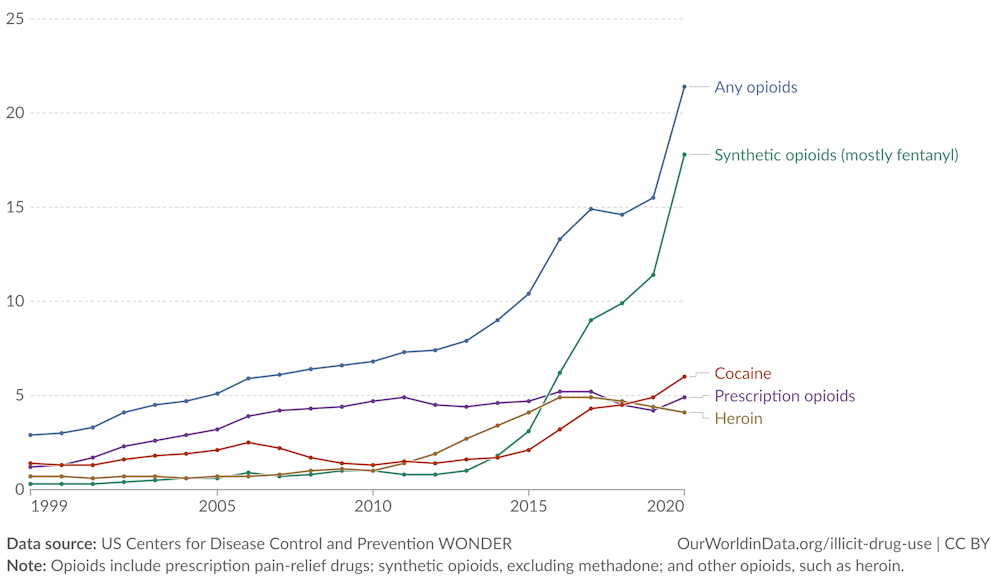
In the US, the synthetic opioids fentanyl and oxycodone have contributed to more than 100,000 fatal overdoses each year since 2021. While there are signs this deaths toll is at last beginning to fall, the harm and pain of addiction and overdose affects every strata of American society – as shown in moving portrayals of America’s opioid crisis such as Painkiller and Dopesick. Most fatalities are caused by respiratory depression where breathing is significantly slowed or stops altogether.
Official trailer for Painkiller (Netflix)
Fentanyl is an analgesic drug that is 50-100 times more potent than heroin or morphine. Where China used to be the principal manufacturer and supplier of fentanyl to the US, Mexico is now the primary source. In December 2024, Mexican authorities announced “the largest mass seizure of fentanyl pills ever made” – amounting to more than 20 million doses of fentanyl pills worth nearly US$400 million. The pills were found in Mexico’s Sinaloa state, home of the Sinaloa drug cartel and a hub of fentanyl production,
“This is what makes us rich,” one fentanyl cook recently told the New York Times. He was scathing about the idea that Donald Trump would be able to stamp out the supply of fentanyl from Mexico to the US by threatening Mexico’s government with tariffs. “Drug trafficking is the main economy here.”
However, the introduction of synthetic opioids to the US came not via organised crime but through a deliberate strategy of the pharmaceutical industry. Upon launching its prescription opioid painkiller OxyContin (a brand name for oxycodone) in 1996, Perdue Pharma, owned by the Sackler family, devised a plan to increase prescriptions of the drug by incentivizing and rewarding doctors to give these drugs to their patients. On a business level, this was a success; on a human level, it has been a disaster.
As patients quickly developed tolerance to drugs such as OxyContin, they had to take higher doses to avoid withdrawal symptoms or the positive feelings it gave them. Taking more of these opiates increases the risk of accidental overdose, many of which proved to be fatal. It has also driven those dependent on drugs to the black market, and into the hands of organised drug gangs, as they seek the drugs in greater quantities.
Dependency on fentanyl and other opioids is all-consuming. When not using these drugs, people are entirely focused on ensuring sufficient supply of the next dose. This includes funding supply which can take people to places they thought they would never be, for example breaking the law, shoplifting or getting involved in commercial sex to make enough money to buy drugs.
Synthetic opiates like OxyContin and fentanyl have proved to be classless, ageless and sex blind. The first-hand experience of addiction and fatalities have radically altered the way many Americans think about drugs and the problems they cause. Canada, too, is suffering a major crisis.
Compounding this tragedy is the failure of the state to provide interventions and treatment that could have reduced fatal and non-fatal overdoses. It is only now that evidence-based interventions are beginning to be made widely available, such as access to Naloxone – a drug that can reverse the effects of opiates and potentially save a life.
Of course, it isn’t just hospitals and health professionals that are challenged by the results of widespread use of opioids, but public services like the police and fire service. In some areas of the US, there have been so many daily overdoses that every service was called on to try and deal with it. Local mayors have made it a priority to train police and fire personnel to be trained as first responders, such is the scale of the problem.
But it is not just in North America that we see the failure of politicians and the state to act when faced with growing problems with drugs. In the UK, where record numbers are dying because of using drugs such as heroin, the government has not invested in overdose prevention strategies. At a time when fatal overdoses increase year on year, budgets for specialist treatment have been reduced. It remains to be seen what the recently elected Labour government will do, if anything, to tackle the tragic rise in drug related fatalities.
What connects both examples from the US and UK is the attitude and perception of drug use many of us have. Drug use and the heavy use of prescription painkillers is still heavily stigmatised. Many of us still view this as something individuals bring on themselves or have a choice about.
So, if we don’t care about what happens to people who develop problems with drugs, why should our elected representatives? In part, it is our bigotry that is enabling the lack of timely intervention, despite us possessing the knowledge and evidence of how drug harms can be minimised.
Latin America: breakdown of the rule of law
Under the last Conservative government, the UK Home Office asserted that people who used cocaine recreationally are supporting violence not only in the UK but in the countries that produce its raw ingredients. It’s not clear if this has made any difference to those using cocaine in the UK – personally, I doubt many people consider or are aware of how cocaine is produced or its provenance.
Perhaps if those using cocaine, mainly in western countries, realised the extent of violence and suffering that cocaine manufacture causes they might think again. Latin America has suffered enormously, with few countries there not touched in some way by the violence and breakdown of law associated with drug production and supply. According to the latest UN World Drugs Report:
Global cocaine supply reached a record high in 2022, with more than 2,700 tons of cocaine produced that year, 20% more than in the previous year … The impact of increased cocaine trafficking has been felt in Ecuador in particular, which has seen a wave of lethal violence in recent years linked to both local and transnational crime groups, most notably from Mexico and the Balkan countries.
Cocaine seizures and homicide rates increased five-fold between 2019 and 2022 in Ecuador, with the highest such rates reported in the coastal areas used for trafficking the drug to major destination markets in North America and Europe.
Cocaine trafficking flows based on reported seizures (2019-22):
As with opium production in Afghanistan, it is small-scale farmers in Colombia, Peru and Bolivia that grow the coca plant that will be turned into cocaine. Like their Afghan counterparts, they grow coca as it is more profitable than alternatives such as coffee. While it may be profitable in the short term, there are greater costs to them and their society.
Cocaine production brings with it violence as those further up the drug production chain try to control its trade. Few parts of these societies are unscathed, from bribing local politicians through to whole regions that are controlled by organised crime. Keeping control means that the use of firearms and violence increases. Against this backdrop, it is unsurprising that basic health and social services suffer.
So, while a coca grower may have more money, every other aspect of their life is negatively impacted. Whether it is regional or state institutions, both are compromised by the drug trade and those that control it. While this may not lead to the total collapse of law and order, it does create injustice and distorts the rule of law in many areas of Latin America and the Caribbean, where competition between gangs has also resulted in an increase in homicides.
The impact is on all sectors of society, now and into the future. For example, while historically the role of women has been largely underrepresented in research and drug policy, the UN report recognises that this is changing:
As women increasingly participate in economic activities, the role that women play in the drug phenomenon may become increasingly important. For example, a shift away from plant-based drug production may affect many women in rural households involved in opium poppy and coca bush cultivation.
The UN also identifies the specific risk to young people and the drugs trade, highlighting:
Long-term efforts to dismantle drug economies must provide socioeconomic opportunities and alternatives, which go beyond merely replacing illicit crops or incomes and instead address the root structural causes behind illicit crop cultivation, such as poverty, underdevelopment, and insecurity. They must also target the factors driving the recruitment of young people into the drug trade, who are at particular risk of synthetic drug use.
Meanwhile, demand for treatment in Europe due to problems with cocaine has risen significantly in recent years, since 2011 there has been an 80% increase in treatment presentations. This reflects the growing number of people using cocaine and the rise in purity of the drug.
Amid what may seem to be a story of unrelenting despair and hopelessness, there are local initiatives and even a few state-wide policies that provide optimism that change is possible.
In my roles both as clinician and scientist, I’ve often been amazed by how ingenious people can be when faced with the apparently impossible. For example, the way some people use heroin to dampen their psychotic symptoms, such as auditory and visual hallucinations – or the development of Naloxone, a drug that can temporarily reverse the effects of opioids, providing a short window for emergency services to treat people who have overdosed.
Early in my career, I witnessed the emergence of HIV in the UK in the 1980s. The speed at which this disease spread was not matched by our ability to treat it. Our response to HIV was undoubtedly hampered by prejudice and stigma towards marginalised groups in society, namely gay men and those using drugs (particularly injecting them).
However, unexpectedly and courageously, the Conservative government recognised those who were most at risk of contracting HIV, and organised a package of measures to contain the spread of infection. One part of this was a media campaign based on public health messaging designed to reduce the risk of contracting the disease. But the government also invested in treatment for those who had been infected and engaged with people at high risk, such as those intravenously injecting drugs.
I worked in specialist HIV clinics for those using drugs. At the time, methadone and diamorphine were provided as an alternative to heroin. Regulations and protocols that restricted the prescribing of these medical opioids were eased, so we could ensure patients attending these clinics were given sufficient oral and injectable opioids that they didn’t need to source street heroin.
This meant they had access to medical grade opioids and, crucially, were given regular supplies of sterile injecting equipment. It was this that reduced the risk of contracting HIV, as some people would share injecting equipment when using heroin.
This impressive policy ran counter to the Conservative party’s ideology at the time, which was to punish rather than help those using drugs like heroin. It showed me how, even with traditional mindsets, it is possible to shift policy thinking in the face of a health crisis. And make no mistake, the global drug problem is an ongoing health crisis. Today, the UN points to the risks that intravenous users of drugs still face:
An estimated 13.9 million people injected drugs in 2022, with the largest number living in North America and East and South-East Asia … The relative risk of acquiring HIV is 14 times higher for those who inject drugs than in the wider population globally.
There are, though, signs of positive change in the way some countries and regions are changing their drug policies. Scotland recently opened a drug consumption facility in Glasgow – a safe place for people to use their drugs, usually injecting drugs like heroin. Such spaces provide access to sterile injecting equipment, reducing the risk of blood-borne infections such as HIV or Hepatitis. At the same time, they offer the opportunity to engage with people who have not accessed traditional health services.
Portugal, as mentioned earlier, has made substantial changes to the way it approaches drug use and the problems associated with it. This policy shift since 2000 has saved lives and brought a more humane way of treating people who develop problems with drugs.
Contrast this with the wasted effort and resources ploughed into the war on drugs – initiated by Nixon and followed by so many western governments ever since. My plea to policymakers is simple: employ the same evidence-based science you use for health issues towards drugs and problem drug use.
Science and research can help in many ways, if given the chance. Some of it might seem radical, like providing safe drug consumption spaces. Some of it is more mundane, but vital – like tackling inequality, a clear driver of problem drug use across the world.
But while we often look to politicians to take the lead on change, it is people – us – that really hold the solution. By far the greatest threat to people and society from drugs is ignorance and bigotry. So many lives have been lost to drugs because of shame, either as a driver of drug use or a barrier to seeking help.
Beliefs are notoriously difficult to shift. As with climate change, the most powerful driver of change is personal experience. We know that when a family or community is affected by a drug overdose, their beliefs and perceptions change. But this is not the way any of us should want to see change happen.
To hear about new Insights articles, join the hundreds of thousands of people who value The Conversation’s evidence-based news. Subscribe to our newsletter.
Ian Hamilton does not work for, consult, own shares in or receive funding from any company or organisation that would benefit from this article, and has disclosed no relevant affiliations beyond their academic appointment.
Source: The Conversation – UK – By Jennifer Mathers, Senior Lecturer in International Politics, Aberystwyth University
North Korea is believed to be preparing to send another group of soldiers to come to Vladimir Putin’s aid in the war in Ukraine, despite heavy combat losses already suffered by troops from the east Asian country.
When Ukrainian forces crossed the border into the Kursk region of Russia in August 2024, Ukraine’s military commanders hoped that their surprise move would force Moscow to withdraw troops from eastern Ukraine to defend Russia’s own territory. Kyiv did not expect its troops to end up fighting North Koreans.
Neither Moscow nor Pyongyang have officially confirmed that North Korean troops are fighting side by side with Russians. But South Korean intelligence has been reporting on their presence since October 2024, when approximately 1,500 North Korean special forces were observed to have arrived in Russia’s far eastern city of Vladivostok, initially for training.
This group was later joined by another 10,000 or so of their comrades (some of whom are also believed to be from North Korean special forces units). They were transported nearly 7,000 kilometres across Russia to reach the combat zone.
North Korea, an isolated dictatorship with few allies, is one of Russia’s most reliable suppliers of weapons, including missiles and millions of rounds of ammunition that Russia needs to continue to fight its war against Ukraine. North Korea, however, would seem to have little reason to send its own people to risk their lives in that conflict. But North Korean soldiers appear to be at the heart of a deal struck by North Korea’s supreme leader Kim Jong-un and Russian president Vladimir Putin.
What does Putin want?
For Putin the gains are clear. His campaign in Ukraine has received a much-needed influx of trained soldiers to shore up efforts to retake Russian territory occupied by Ukrainian forces.
Although the numbers of North Korean troops are relatively small, their strategic deployment allows Russia to push the Ukrainians back without diverting any of its forces from their offensive operations in eastern Ukraine. Expectations are high that Donald Trump’s return to the White House could mean an end to the war – or at least a pause – sooner rather than later. This gives Putin an incentive to occupy as much Ukrainian territory as possible ahead of a ceasefire, when occupied areas are likely to form the basis of territorial settlements.
The suggestion that Russia is not capable of maintaining its position in Ukraine and also defending its own territory without the addition of foreign troops is very revealing.
Moscow is struggling to recruit enough of its own citizens to fight in Ukraine. This is despite offering salaries and benefits packages to prospective soldiers that are beyond generous. The lack of resistance to Kyiv’s summer incursion into Russian territory made it clear that Russia is relying upon barely trained conscripts – that is, teenage boys doing their one year of compulsory military service – to defend its borders rather than professional soldiers. And while Russia has regained control of a substantial proportion – perhaps more than 60% – of the area seized by Ukraine in the summer, this has taken nearly six months to accomplish.
What does Kim Jong-un want?
For Kim Jong-un, sending his soldiers to fight with Russia provides his troops with valuable experience of combat in a conflict that is rapidly defining how war will be waged in the future.
Since the end of the Korean War (1950-53), Pyongyang has placed a high priority on maintaining a large and heavily armed standing army. After training, North Korean soldiers are mostly used for patrolling the de-militarized zone that marks its border with South Korea. Participating in Russia’s war against Ukraine provides the North Korean military with its first experience of combat in more than 70 years.
North Korean soldiers captured in Ukraine.
Observations from Ukrainian soldiers suggest the North Korean soldiers are courageous and determined fighters but with no experience of actual combat. The Ukrainians have described the North Koreans as relying on strategies typical of the second world war – for example advancing in large groups on foot, where they provide easy targets for artillery and drone strikes. They were also apparently bemused by the appearance of drones on the battlefield and had no idea that these objects could deliver lethal attacks.
This degree of inexperience, together with Russia’s tactic of using the North Koreans to draw the fire of the Ukrainians and clear the way for the Russians to advance, is believed to be the reason for such high losses so soon after their deployment.
In January the Ukrainians managed to capture two North Koreans and question them, which has provided the clearest picture so far of their experiences of fighting with the Russian armed forces. The North Korean soldiers both had false identity papers with Russian names, which is consistent with official denials of their presence. The men, who do not speak any foreign languages and had to be questioned through an interpreter, said that they had both been soldiers for several years. This supports the Ukrainians’ impression that the North Koreans are trained and disciplined. Both prisoners, however, reportedly believed they were being sent to Russia to participate in training exercises, not to fight in a war.
Considering the heavy losses and the brutal treatment that North Korean troops have already suffered, Kim Jong-un might be expected to seek the speedy return of his soldiers rather than preparing to send more of their comrades to fight with Russia. But high casualties on the battlefield seems to be a price that North Korea’s president is willing to pay for combat experience that might give his army an edge in any future war that he fights on his own behalf.
Jennifer Mathers does not work for, consult, own shares in or receive funding from any company or organisation that would benefit from this article, and has disclosed no relevant affiliations beyond their academic appointment.
The UK government’s new plan to foster innovation through artificial intelligence (AI) is ambitious. Its goals rely on the better use of public data, including renewed efforts to maximise the value of health data held by the NHS. Yet this could involve the use of real data from patients using the NHS. This has been highly controversial in the past and previous attempts to use this health data have been at times close to disastrous.
Patient data would be anonymised, but concerns remain about potential threats to this anonymity. For example, the use of health data has been accompanied by worries about access to data for commercial gain. The care.data programme, which collapsed in 2014, had an similar underlying idea: sharing health data across the country to both publicly funded research bodies and private companies.
Poor communication about the more controversial elements of this project and a failure to listen to concerns led to the programme being shelved. More recently, the involvement of the US tech company Palantir in the new NHS data platform raised questions about who can and should access data.
The new effort to use health data to train (or improve) AI models, similarly relies on public support for success. Yet perhaps unsurprisingly, within hours of this announcement, media outlets and social media users attacked the plan as a way of monetising health data. “Ministers mull allowing private firms to make profit from NHS data in AI push,” one published headline reads.
These responses, and those to care.data and Palantir, reflect just how important public trust is in the design of policy. This is true no matter how complicated technology becomes – and crucially, trust becomes more important as societies increase in scale and we’re less able to see or understand every part of the system. It can, though, be difficult, if not impossible, to make a judgement as to where we should place trust, and how to do that well. This holds true whether we are talking about governments, companies, or even just acquaintances – to trust (or not) is a decision each of us must make every day.
The challenge of trust motivates what we call the “trustworthiness recognition problem”, which highlights that determining who is worthy of our trust is something that stems from the origins of human social behaviour. The problem comes from a simple issue: anyone can claim to be trustworthy and we can lack sure ways to tell if they genuinely are.
If someone moves into a new home and sees ads for different internet providers online, there isn’t a sure way to tell which will be cheaper or more reliable. Presentation doesn’t need – and may not even often – reflect anything about a person or group’s underlying qualities. Carrying a designer handbag or wearing an expensive watch doesn’t guarantee the wearer is wealthy.
Luckily, work in anthropology, psychology and economics shows how people – and by
consequence, institutions like political bodies – can overcome this problem. This work is known as signalling theory, and explains how and why communication, or what we can call the passing of information from a signaller to a receiver, evolves even when the individuals communicating are in conflict.
For example, people moving between groups may have reasons to lie about their identities. They might want to hide something unpleasant about their own past. Or they might claim to be a relative of someone wealthy or powerful in a community. Zadie Smith’s recent book, The Fraud, is a fictionalised version of this popular theme that explores aristocratic life during Victorian England.
Yet it’s just not possible to fake some qualities. A fraud can claim to be an aristocrat, a doctor, or an AI expert. Signals that these frauds unintentionally give off will, however, give them away over time. A false aristocrat will probably not fake his demeanour or accent effectively enough (accents, among other signals, are difficult to fake to those familiar with them).
The structure of society is obviously different than that of two centuries ago, but the problem, at its core, is the same — as, we think, is the solution. Much as there are ways for a truly wealthy person to prove wealth, a trustworthy person or group must be able to show they are worth trusting. The way or ways this is possible will undoubtedly vary from context to context, but we believe that political bodies such as governments must demonstrate a willingness to listen and respond to the public about their concerns.
The care.data project, was criticised because it was publicised via leaflets dropped at people’s doors that did not contain an opt-out. This failed to signal to the public a real desire to alleviate people’s concerns that information about them would be misused or sold for profit.
The current plan around the use of data to develop AI algorithms needs to be different. Our political and scientific institutions have a duty to signal their commitment to the public by listening to them, and through doing so develop cohesive policies that minimise the risks to individuals while maximising the potential benefits for all.
The key is to place sufficient funding and effort to signal – to demonstrate – the honest motivation of engaging with the public about their concerns. The government and scientific bodies have a duty to listen to the public, and further to explain how they will protect it. Saying “trust me” is never enough: you have to show you are worth it.
Richard Milne receives funding from Wellcome under grant 220540/Z/20/A to the Wellcome Sanger Institute and the Kavli Foundation, grant G115418 to the University of Cambridge.
Jonathan R Goodman does not work for, consult, own shares in or receive funding from any company or organisation that would benefit from this article, and has disclosed no relevant affiliations beyond their academic appointment.
Visit a supermarket in 2025 and you’ll see that a tub of Lurpak butter can cost £5.70. It may strike you that this represents a staggering increase from £3.65 just three years ago, so instead of paying the premium, you reach for the supermarket’s own brand at £3.80.
This kind of switch, multiplied across millions of shopping baskets, represents a massive shift in consumer behaviour that has been largely invisible to official statistics. But that’s changing, as the UK embarks on its biggest revolution in measuring living costs since the second world war.
The Office for National Statistics (ONS) is transforming the way it tracks inflation, moving from painstakingly checking prices to analysing millions of real purchases through supermarket scanners. Consider olive oil, the price of which surged by 47% in a year, or milk, which jumped by more than 25%. While official statistics captured these price rises, they couldn’t track how households adapted – whether by switching to cheaper alternatives, buying less, or cutting back elsewhere. This was a blind spot in our understanding of consumer behaviour.
Currently, price collectors visit stores across the country each month, checking the prices of about 25,000 products. It’s like taking a snapshot of what’s on the shelves at a particular moment. But this system, designed decades ago, often misses the real impact of inflation on different household types in things like choosing different products or switching stores.
This is crucial for understanding the real impact of inflation on lower-income households. These families often have less flexibility in their budgets and must make more dramatic changes to their shopping habits when prices rise. During recent periods of high inflation, many on low incomes found that official figures didn’t match their experience, which was of even higher inflation than the headline rates. And there’s a good reason why.
Inflation statistics aren’t just academic exercises. They drive decisions that affect every aspect of our financial lives. The Bank of England uses them to set interest rates, which in turn influence mortgage payments and savings returns. Employers use them in wage negotiations. Government uses them to adjust benefits, state pensions and tax thresholds. Even commercial contracts, including mobile phone bills and rail fares, are often linked to inflation rates.
When these numbers don’t accurately reflect price pressures, it can have serious consequences. If official figures underestimate the inflation experienced by lower-income households, benefit increases might not keep pace with their actual cost increases. Similarly, if wages don’t rise in line with real living costs, workers effectively experience a pay cut.
The scanner data revolution
The ONS’s new approach, to be introduced next year, will analyse around 300 million price points from supermarket scanners, covering about half of all grocery transactions in the UK. Instead of just seeing what’s on the shelf, they’ll know exactly what prices people are paying at checkouts across the country.
This massive increase in data points – from 25,000 to 300 million – will allow for a more nuanced understanding of consumer behaviour.
The change will also enable quicker identification of emerging price trends. After the start of the COVID pandemic and the Ukraine war, prices of certain goods changed rapidly. Scanner data could help spot these changes faster, allowing for more timely policy responses. It might also reveal regional variations in price pressures.
Take the 2023 surge in food prices – while overall food inflation hit 19%, the impact varied dramatically across households. Current statistics would not capture lower-income families switching from fresh to frozen vegetables, or from branded to value ranges.
In times of cost pressures, shoppers may switch from fresh produce to frozen. sirtravelalot/Shutterstock
With scanner data, policymakers could spot these trends quickly and respond more precisely – perhaps by adjusting benefit payments or targeting support to specific households when essential food costs spike. Instead of waiting for quarterly surveys to reveal hardship, they will be able to see in real time how different groups are coping with price pressures.
The ONS recently said full implementation will come in 2026, a year later than planned. While it will have the technical capability ready by March 2025, it is opting for a year of parallel running to ensure accuracy. This approach reflects how crucial these statistics are for the economy.
It has already modernised other areas of price collection, including incorporating 40 million train fare data points and 300,000 used car prices. But grocery prices, being central to household budgets and varying significantly across different income groups, require extra attention.
The change is coming at a crucial time. Recent years have shown how rapidly economic conditions can change and how differently these changes can affect various segments of society. The pandemic, Brexit adjustments, and global supply chain disruptions have all contributed to price pressures.
For consumers, while the changes won’t directly lower prices, they could lead to more appropriate responses from the Bank of England, government and employers. Most importantly, it could ensure that official inflation figures better reflect the reality of the weekly shop, particularly during times of economic stress.
The transformation of inflation statistics might seem like a technical detail, but its implications reach far beyond government offices and economic reports. It’s about ensuring that the official measures of living costs better reflect the reality experienced by millions of households across the UK. In this challenging economic environment, that’s something worth getting right.
Marcel Lukas receives funding from the British Academy. He is the Director of Executive Education at the University of St Andrews and Fellow of the ONS. The presented views are his own and do not represent the ONS.
DENVER — Today, Governor Jared Polis, the Office of Just Transition (OJT) within the Colorado Department of Labor and Employment (CDLE), and the Office of Economic Development and International Trade (OEDIT) announced two new Coal Transition Community Assistance grants aimed at supporting local economic diversification efforts in Moffat and Rio Blanco Counties. These grants are part of the state’s broader initiative to support communities impacted by the decline of coal-powered electricity production in Colorado.
“Colorado is helping communities succeed in new ways, which will create more jobs for local workers and save people money. We are committed to helping communities in Western Colorado plan for the future,” said Governor Polis.
“Communities in Northwest Colorado are working hard to diversify their economies, and we are pleased to support those efforts. When economic development plans are based on local strengths and opportunities, we see greater impacts for Coloradans,” said Eve Lieberman, OEDIT Executive Director.
City of Craig Awarded $1,051,000 for Business and Industrial Park In Moffat County, the City of Craig has been awarded $1,051,000 to purchase property for the development of a new business and industrial park. The park will be strategically located with access to both the Union Pacific rail line and 1st Street in Craig, offering excellent opportunities for growth and investment.
“The Office of Just Transition plays a critical role in promoting stability, recovery, and sustainability for regions like NW Colorado, as we all anticipate the impacts from coal mine and power plant closures,” said Craig City Manager Peter Brixius. “In the face of these impacts, we are very pleased that OJT is a partner in our vision for the future growth and development of new and expanding opportunities for our region. The acquisition of this property in Craig will establish a business park in an area that will provide a skilled and ready workforce with a quality of life that includes world class recreational opportunities right in our backyard. We are planning a business park for those looking for flexibility and services, as they make fiscally responsible decisions, and at the same time realize their dreams.”
The City of Craig will collaborate with a private developer to begin the master planning process for the park. In addition to the Coal Transition Community grant, the project has been awarded $2.5 million in Congressionally Designated Spending to cover horizontal infrastructure costs.
Rio Blanco Water Conservancy District Awarded $100,000 for Wolf Creek Reservoir Study The Rio Blanco Water Conservancy District has been awarded $100,000 to conduct a comprehensive survey and report on the potential impacts of a new reservoir in Rio Blanco County. The study will evaluate the impact of the proposed new reservoir on agricultural production, flatwater recreation, and a countywide water augmentation plan designed to increase the supply of water available for beneficial use. This award will not bias various state and federal permitting processes required for this project.
“Our economy is transitioning away from fossil fuel electric generation, and a reliable water supply is a key component of this critical economic transition,” said Alden Vanden Brink with the Rio Blanco Water Conservancy District.
“This study will provide important information that will guide the future of the Wolf Creek Reservoir and help ensure that we understand the economic potential of the project,” said OJT Director Wade Buchanan. “By investing in such efforts, we continue to support the long-term prosperity of communities in the Yampa Valley.”
About the Office of Just Transition: Colorado created the Office of Just Transition within Colorado’s Department of Labor and Employment in 2019 to assist workers and communities that will be adversely affected by the loss of jobs and revenues due to the closure of coal mines and coal-fired power plants. Its purpose is to help workers transition to new, high-quality, jobs, to help communities continue to thrive by expanding and attracting diverse businesses, and to replace lost revenues. To learn more about the Office of Just Transition, its action plan and the corresponding legislation, please visit cdle.colorado.gov/offices/the-office-of-just-transition.
About Colorado Office of Economic Development and International Trade: The Colorado Office of Economic Development and International Trade (OEDIT) works with partners to create a positive business climate that encourages dynamic economic development and sustainable job growth. OEDIT partners with businesses and communities to offer financial, technical, and advisory assistance. From business retention services to incentives and funding, OEDIT supports economic growth across Colorado through its diverse programs and services. To learn more, visit oedit.colorado.gov.
CHARLOTTE, N.C. – Marc Weiss, 50, of Charlotte, was sentenced today to 40 months in prison followed by three years of supervised release for embezzling approximately $1.6 million from two small businesses, announced Dena J. King, U.S. Attorney for the Western District of North Carolina. In addition to the prison term imposed, Weiss was ordered to pay restitution in the amount of $1,644,235.77.
Jason Byrnes, Special Agent in Charge of the United States Secret Service, Charlotte Field Office, and Sheriff Darren Campbell of the Iredell County Sheriff’s Office, join U.S. Attorney King in making today’s announcement.
According to filed court documents and the sentencing hearing, from 2016 to 2022, Weiss engaged in a scheme to defraud two Mooresville, N.C. small businesses that employed him as a bookkeeper. Over the course of the scheme, Weiss, who was a trusted employee, abused his position and access to the companies’ financial accounts to make more than 100 fraudulent transfers totaling $1.6 million from the companies’ accounts into bank accounts under Weiss’s control. Court documents show that Weiss began to embezzle from the second company while he was already stealing from the first one. To disguise the fraud, Weiss created fake entries in the victim companies’ books and records, categorizing the fraudulent transfers as payments to existing vendors for software development, and advertising and marketing expenses.
According to court records, Weiss used the embezzled funds, in part, to pay for his personal lifestyle, including rent payments for a luxury apartment uptown; payments for high-end vehicles, including an Audi and a Mercedes-Benz; purchases at luxury retail stores, including Luis Vuitton, Gucci, Neiman Marcus, and Tiffany, among others; and luxury vacations, including multiple stays in The Ritz Carlton hotel.
In October 2023, Weiss pleaded guilty to wire fraud. He will be ordered to report to the Federal Bureau of Prisons upon designation of a federal facility.
In making today’s announcement, U.S. Attorney King thanked the U.S. Secret Service and the Iredell County Sheriff’s Office for their investigation of the case.
Assistant U.S. Attorney William Bozin of the U.S. Attorney’s Office in Charlotte prosecuted the case.
EVANSVILLE— James Henley, 35, of Greenwood, Indiana, has been sentenced to ten years in federal prison, followed by three years of supervised release after pleading guilty to aggravated identity theft, conspiracy to commit access device fraud, two counts of money laundering, and eight counts of wire fraud. Henley has also been ordered to pay $1,887,426.63 in restitution.
According to court documents, over the course of three years, Henley orchestrated multiple large and complex fraud schemes, resulting in a total loss of $2,927,758.95 to individual homeowners, an Indiana attorney, a bank, and ten state governments. As part of his fraud schemes, Henley registered five fake businesses (OnTrack Real Estate Solutions, LDI Investments Corp, Lucario Investments, 317 Traffic, and Henley Real Estate Solutions) with the states of Indiana and Kentucky, claiming to serve as the Chief Executive Officer for most of them. None of the businesses were legitimate. Instead, Henley used the businesses to mask his identity, make his schemes appear more credible, and launder the stolen money.
Henley’s schemes are broken down as follows:
COVID-19 Fraud:
Between May 2020 and March 2021, James Henley, his wife Jameka Henley, and his associate Jimmie Bickers used the stolen personally identifiable information of 76 real individuals to submit 120 unemployment insurance applications to ten states during the COVID-19 pandemic. Once the applications were approved, the trio used 65 unemployment insurance debit cards to make purchases at retailers and withdraw cash at ATMs in the Evansville and Indianapolis areas. The states paid a total of $1,119,426.63 in unemployment benefits in connection with the group’s fraudulent applications. In July 2020, Henley used funds withdrawn from ATMs to buy a Chevrolet Camaro for $22,801.
Bickers and Jameka Henley have been formally charged for their roles in this scheme but have not pleaded guilty.
Home Title Fraud:
Between December 2021 and May 2023, Henley stole five homes in Indianapolis by filing fraudulent deeds with the Marion County Recorder’s Office. Through the filings, Henley claimed that the homeowners had sold their homes to his fake businesses, but, in reality, he had never even spoken with the homeowners. Unbeknownst to the victims, Henley filed these fraudulent deeds and then sold the homes for significantly less than their market value, pocketing more than $260,000 in profits.
Henley also attempted to steal and sell an additional 14 homes in Indianapolis and Evansville. With one exception, the individuals who bought the homes from Henley took possession and ultimately kept the homes.
For one homeowner, the property Henley stole was her childhood home. She purchased the home while her mother was in the hospital with the hope that, when her mother’s condition improved, her mother would be able to live out her remaining years in the house.
Mortgage Fraud:
In November 2021, an associate of Henley’s purchased a home in Indianapolis, using a mortgage loan from a bank. In April 2022, Henley filed a fraudulent document with the Marion County Recorder’s Office to make it seem as if the mortgage loan had been paid off, when it had not been paid. Henley then filed a deed naming himself a joint owner of the home. Henley and his associate subsequently sold the property for $255,000, pocketing all the proceeds, even though the bank should have received the majority of the funds.
Auto Loan Fraud:
In March 2023, Henley purchased a Dodge Durango in Indianapolis for $71,479, using an auto loan from Everwise Credit Union. A few months later, in June 2023, Henley purchased a Chevrolet Silverado in Plainfield for $54,270, using a second loan from Everwise Credit Union.
In October 2023, Henley connected a JPMorgan Chase bank account to his auto loans, via Everwise’s online payment portal. Henley falsely represented that the Chase account belonged to Jimmie Bickers, and that he had authority to make payments on his loans using funds from the Chase account.
The Chase account was actually an Indiana attorney’s Interest on Lawyers’ Trust Account (IOLTA), which is a highly regulated bank account used by lawyers to hold client funds. The interest earned on IOLTA accounts is used to fund grants for nonprofit groups that promote pro bono and access to justice programs. Henley did not have the attorney’s permission to access or withdraw funds from the IOLTA account.
Between October and November 2023, Henley used the IOLTA account to make two payments, totaling $98,000, toward his auto loans.
Henley has prior felony convictions for financial crimes, including theft, forgery, and fraud.
“James Henley went to great lengths to coordinate exceptionally greedy, complex schemes that exploited hard-working families and state government programs,” said John E. Childress, Acting U.S. Attorney for the Southern District of Indiana. “Undeterred by prior felony convictions for the same conduct, this defendant stole over a million dollars, wreaking financial and logistical havoc on hundreds of victims. The Department of Justice will continue to work with our law enforcement partners to investigate allegations of fraud and seek prosecution as appropriate.”
“James Henley filed fraudulent unemployment insurance (UI) claims in the names of identity theft victims in order to receive UI benefits to which he was not entitled. He enriched himself by defrauding a program that was intended to assist struggling American workers during an unprecedented global pandemic,” said Megan Howell, Acting Special Agent-in-Charge, Great Lakes Region, U.S. Department of Labor, Office of Inspector General. “We and our law enforcement partners are committed to protecting the integrity of the UI system from those who seek to exploit this critical benefit program.”
“This lengthy prison sentence sends a clear message: individuals who attempt to exploit and commit financial crime and identity theft will be brought to justice,” said Ramsey E. Covington, Acting Special Agent in Charge, IRS Criminal Investigation, Chicago Field Office. “IRS Criminal Investigation and our fellow law enforcement partners are committed to protecting the integrity of our financial institutions and will continue to hold criminals like James Henley accountable to the fullest extent of the law.”
“This case should serve as a powerful reminder that individuals with a history of financial crimes will face significant consequences when they demonstrate a blatant disregard for the law and continue to exploit and deceive others for personal gain,” said FBI Indianapolis Special Agent in Charge Herbert J. Stapleton. “The FBI, working alongside our law enforcement partners, will continue to hold those who perpetuate such offenses accountable and protect the public from those who manipulate the system for their own benefit.”
The Federal Bureau of Investigation, Internal Revenue Service-Criminal Investigation, Department of Labor-Office of the Inspector General, and the Indiana Attorney General’s Office Homeowner Protection Unit investigated this case. The sentence was imposed by U.S. District Judge Matthew B. Brookman.
Acting U.S. Attorney Childress thanked Assistant U.S. Attorney Matthew Miller, who prosecuted this case.
On May 17, 2021, the Attorney General established the COVID‑19 Fraud Enforcement Task Force to marshal the resources of the Department of Justice in partnership with agencies across government to enhance efforts to combat and prevent pandemic-related fraud. The Task Force bolsters efforts to investigate and prosecute the most culpable domestic and international criminal actors and assists agencies tasked with administering relief programs to prevent fraud by augmenting and incorporating existing coordination mechanisms, identifying resources and techniques to uncover fraudulent actors and their schemes, and sharing and harnessing information and insights gained from prior enforcement efforts.
Anyone with information about allegations of attempted fraud involving COVID‑19 can report it by calling the Department of Justice’s National Center for Disaster Fraud (NCDF) Hotline at 866-720-5721 or via the NCDF Web Complaint Form at https://www.justice.gov/disaster-fraud/ncdf-disaster-complaint-form
MINNEAPOLIS – A Shakopee woman pleaded guilty for her role in the $250 million fraud scheme that exploited a federally funded child nutrition program during the COVID-19 pandemic, announced Acting U.S. Attorney Lisa D. Kirkpatrick.
According to court documents, at times between October 2020 and January 2022, Mekfira Hussein knowingly and willfully conspired with others to participate in a fraudulent scheme to obtain and misappropriate millions in federal child nutrition funds. Specifically, Hussein and her husband, Abduljabar Hussein, fraudulently obtained millions of dollars in federal child nutrition program funds by falsely claiming to have served meals to thousands of children per day.
According to court documents, in October 2020, the defendant enrolled her non-profit, Shamsia Hopes, in the Federal Child Nutrition Program under the sponsorship of Feeding Our Future, at the direction of one of its employees, Abdikerm Eidleh. The defendant submitted her application to Aimee Bock, Feeding Our Future’s executive director. In December 2020, and also at the direction of Abdikerm Eidleh, the defendant’s husband registered his company, Oromia Feeds LLC, with the State of Minnesota as a food vendor. Abduljabar Hussein’s company, Oromia Feeds, had a contract to prepare meals to be served by Shamsia Hopes sites run by Mekfira Hussein.
According to the plea agreement entered today, Hussein submitted fraudulently inflated invoices for reimbursement—including inflated meal counts and false attendance rosters. As part of their scheme, the defendant and her husband paid at least $140,000 in kickbacks to Eidleh and least $12,000 in kickbacks to Aimee Bock. In some instances, these kickback payments were disguised as “consulting fees,” when, in fact, neither Eidleh nor Aimee Bock provided any service to justify these payments. In other instances, Feeding Our Future billed hundreds of thousands of dollars in Federal Child Nutrition Program claims under the name of the defendant’s organization, Shamsia Hopes, without the defendant’s knowledge or authorization, and Feeding Our Future siphoned those funds to others involved in the conspiracy.
Throughout the fraudulent conspiracy, the Husseins obtained up to $8.8 million in federal child nutrition program funds some of which they used to pay for personal expenditures unrelated to feeing children. For instance, the defendant and her husband used $173,438 of their proceeds to pay off the mortgage on their home in Shakopee, Minnesota, and also purchased a 2021 Porsche for $93,250, a 2022 GMC truck for $61,722.
Hussein pleaded guilty last Friday in U.S. District Court before Judge Nancy E. Brasel to one count of conspiracy to commit wire fraud. Her sentencing hearing will be scheduled at a later date.
The case is the result of an investigation by the FBI, IRS – Criminal Investigations, and the U.S. Postal Inspection Service.
Assistant U.S. Attorneys Matthew S. Ebert, Joseph H. Thompson, and Harry M. Jacobs are prosecuting the case. Assistant U.S. Attorney Craig Baune is handling the seizure and forfeiture of assets.
Issuer Name: Rubis (LEI: 969500MGFIKUGLTC9742) Category of securities: Ordinary shares (ISIN: FR0013269123) Period: From 27 to 31 January 2025
Upon the authorisation granted by the Ordinary Shareholders’ Meeting held on 11 June 2024 to implement a share buyback program, the Company carried out, between 27 to 31 January 2025, the repurchases of its own shares in order to transfer them to employees and/or corporate officers of the Company and/or companies related to it in the context of a shareholding plan.
Aggregate presentation per day and per market:
Name of issuer
Identification code of issuer (Legal Entity Identifier)
Day of transaction
Identification code of financial instrument
Aggregated daily volume (in number of shares)
Daily weighted average price of the purchased shares *
Market (MIC Code)
RUBIS
969500MGFIKUGLTC9742
27/01/2025
FR0013269123
2,668
24.7824
AQEU
RUBIS
969500MGFIKUGLTC9742
27/01/2025
FR0013269123
12,385
24.7926
CEUX
RUBIS
969500MGFIKUGLTC9742
27/01/2025
FR0013269123
3,311
24.7927
TQEX
RUBIS
969500MGFIKUGLTC9742
27/01/2025
FR0013269123
24,115
24.7972
XPAR
RUBIS
969500MGFIKUGLTC9742
28/01/2025
FR0013269123
2,533
24.9753
AQEU
RUBIS
969500MGFIKUGLTC9742
28/01/2025
FR0013269123
12,207
24.9777
CEUX
RUBIS
969500MGFIKUGLTC9742
28/01/2025
FR0013269123
3,402
24.9745
TQEX
RUBIS
969500MGFIKUGLTC9742
28/01/2025
FR0013269123
24,017
24.9735
XPAR
RUBIS
969500MGFIKUGLTC9742
29/01/2025
FR0013269123
2,516
24.8467
AQEU
RUBIS
969500MGFIKUGLTC9742
29/01/2025
FR0013269123
11,979
24.8569
CEUX
RUBIS
969500MGFIKUGLTC9742
29/01/2025
FR0013269123
3,440
24.8613
TQEX
RUBIS
969500MGFIKUGLTC9742
29/01/2025
FR0013269123
23,712
24.8586
XPAR
RUBIS
969500MGFIKUGLTC9742
30/01/2025
FR0013269123
2,691
25.1200
AQEU
RUBIS
969500MGFIKUGLTC9742
30/01/2025
FR0013269123
12,580
25.1201
CEUX
RUBIS
969500MGFIKUGLTC9742
30/01/2025
FR0013269123
3,629
25.1160
TQEX
RUBIS
969500MGFIKUGLTC9742
30/01/2025
FR0013269123
24,419
25.1217
XPAR
RUBIS
969500MGFIKUGLTC9742
31/01/2025
FR0013269123
2,000
25.2381
AQEU
RUBIS
969500MGFIKUGLTC9742
31/01/2025
FR0013269123
10,000
25.2418
CEUX
RUBIS
969500MGFIKUGLTC9742
31/01/2025
FR0013269123
3,000
25.2404
TQEX
RUBIS
969500MGFIKUGLTC9742
31/01/2025
FR0013269123
20,800
25.2464
XPAR
* Four-digit rounding after the decimal
TOTAL
205,404
24.9915
Detailed presentation per transaction:
Detailed information on the transactions carried out from 27 to 31 January 2025 is available on the Company’s website (www.rubis.fr) in the section “Investors – Regulated information – Share buyback programme”.
HOUSTON, Feb. 03, 2025 (GLOBE NEWSWIRE) — Skyward Specialty Insurance Group, Inc.™ (NASDAQ: SKWD) (“Skyward Specialty” or “the Company”) expects to issue its fourth quarter 2024 earnings results after the market closes on Tuesday, February 25th which will be available on the Company website at investors.skywardinsurance.com/ under Quarterly Results.
Skyward Specialty will host its earnings call to review the fourth quarter 2024 financial results on Wednesday, February 26 at 9:30 a.m. EDT.
Investors may access the live audio webcast via the link on the Company’s investor site at investors.skywardinsurance.com/ under Events & Presentations. Additionally, investors can access the earnings call via conference call by registering via the conference link. Users will receive dial-in information and a unique PIN to join the call upon registering.
A webcast replay will be available two hours following the call in the same location on the Company’s investor website.
About Skyward Specialty
Skyward Specialty (NASDAQ: SKWD) is a rapidly growing and innovative specialty insurance company, delivering commercial property and casualty products and solutions on a non-admitted and admitted basis. The Company operates through eight underwriting divisions — Accident & Health, Captives, Global Property & Agriculture, Industry Solutions, Professional Lines, Programs, Surety and Transactional E&S.
Skyward Specialty’s subsidiary insurance companies consist of Houston Specialty Insurance Company, Imperium Insurance Company, Great Midwest Insurance Company, and Oklahoma Specialty Insurance Company. These insurance companies are rated A (Excellent) with a stable outlook by A.M. Best Company. For more information about Skyward Specialty, its people, and its products, please visit skywardinsurance.com.
Coface: agreement to acquire Cedar Rose Group, strengthening its information services in the Middle East and Africa
Paris, 3 February 2025 – 17.35
Coface announces that it has signed an agreement with Mr. Antoun Massaad and Mrs. Christina Massaad, co-founders of the company, to acquire the Cedar Rose Group.
With over 25 years’ experience, Cedar Rose is one of the leading providers of business information solutions in the Middle East and Africa region. In a region where information is difficult to access and with positive economic growth outlook, Cedar Rose has built up a vast business network enabling it to produce data whose quality is recognized by its customers, including a number of multinationals.
Following the acquisition, Cedar Rose will become Coface’s information provider in the region, for both credit insurance and information services sales. All Coface’s customers will benefit from enhanced Coface data.
This external growth operation will enable Coface to further strengthen its information production capabilities in areas where information is not readily available. This acquisition aligns perfectly with the objectives of Power the Core ‘s strategic plan, which notably focuses on data excellence.
The closing of the acquisition is subject to customary closing conditions.
Ernesto de Martinis, CEO for Mediterranean and Africa region said:
“This acquisition enables Coface to strengthen its position in a zone that promises strong growth, where information remains difficult to obtain, and in which Coface has now been operating for many years. We look forward to welcoming Cedar Rose’s teams to Coface and to working with their partners in the region.”
Antoun Massaad, Cedar Rose Group’s CEO and co-founder said:
“We are delighted to join the Coface team in the Mediterranean & Africa region (MAR). This acquisition is a major milestone in the Cedar Rose story, and I believe it will supercharge Coface’s business information strategy. We are confident that our company, our employees and our international partners will all benefit from this smart strategic alliance.”
FY-2024 results: 20 February 2025 (after market close) Q1-2025 results: 5 May 2025 (after market close) Annual General Shareholders’ Meeting: 14 May 2025 H1-2025 results: 31 July 2025 (after market close) 9M-2025 results: 3 November 2025 (after market close)
FINANCIAL INFORMATION This press release, as well as COFACE SA’s integral regulatory information, can be found on the Group’s website: http://www.coface.com/Investors
For regulated information on Alternative Performance Measures (APM), please refer to our Interim Financial Report for H1-2024 and our 2023 Universal Registration Document (see part 3.7 “Key financial performance indicators”).
Les documents distribués par COFACE SA sont sécurisés et authentifiés avec Wiztrust. Vous pouvez vérifier l’authentification sur le sitewww.wiztrust.com.
COFACE: FOR TRADE With over 75 years of experience and the most extensive international network, Coface is a leader in trade credit insurance & risk management, and a recognised provider of Factoring, Debt Collection, Single Risk insurance, Bonding, and Information Services. Coface’s experts work to the beat of the global economy, helping around 100,000 clients in 100 countries build successful, growing, and dynamic businesses. With Coface’s insight and advice, these companies can make informed decisions. The Group’ solutions strengthen their ability to sell by providing them with reliable information on their commercial partners and protecting them against non-payment risks, both domestically and for export. In 2023, Coface employed ~4,970 people and registered a turnover of €1.87 billion.
COFACE SA est cotée sur le Compartiment A d’Euronext Paris Code ISIN : FR0010667147 / Mnémonique : COFA
DISCLAIMER – Certain declarations featured in this press release may contain forecasts that notably relate to future events, trends, projects or targets. By nature, these forecasts include identified or unidentified risks and uncertainties, and may be affected by many factors likely to give rise to a significant discrepancy between the real results and those stated in these declarations. Please refer to chapter 5 “Main risk factors and their management within the Group” of the Coface Group’s 2023 Universal Registration Document filed with AMF on 5 April 2024 under the number D.24-0242 in order to obtain a description of certain major factors, risks and uncertainties likely to influence the Coface Group’s businesses. The Coface Group disclaims any intention or obligation to publish an update of these forecasts, or provide new information on future events or any other circumstance.
Three motorists, one in Marystown, one in Bonavista and one in Deer Lake, were arrested for impaired driving this past weekend by RCMP NL.
On Saturday, February 1, 2025, shortly before 2:00 a.m., Burin Peninsula RCMP received a report of a suspected impaired driver at a commercial property in Marystown. Police attended the area, located the described vehicle and conducted a traffic stop. The driver, a 25-year-old man, showed signs of alcohol impairment, resisted arrest and threatened a police officer. At the detachment, the man provided breath samples that were twice the legal limit.
Later in the day, shortly after 7:30 a.m., Bonavista RCMP responded to the report of a motor vehicle crash on Route 230 near Bonavista. Officers attended the scene and observed a vehicle resting on its roof on the roadway. The driver, a 37-year-old man, failed to remain at the scene of the collision and departed prior to police arrival. He was located a short time later at a residence, showed signs of alcohol impairment and was arrested. At the detachment, the man provided breath samples that were more than one and a half times the legal limit.
The next day, on Sunday, February 2, 2025, shortly before 1:00 p.m., RCMP Traffic Services West stopped a vehicle on Commerce Street in Deer Lake. The driver, a 59-year-old man, showed signs of alcohol impairment, failed a roadside breath test and was arrested. At the detachment, the man provided breath samples that were more than twice the legal limit.
All three drivers are set to appear in court at later dates to answer to charges of impaired operation. One driver faces additional charges of resisting arrest and uttering threats. Another motorist was ticketed for failing to remain at the scene of a crash. The three drivers also received licence suspensions and their vehicles were seized and impounded.
RCMP NL has zero tolerance for those who choose to drive while impaired. Please report suspected impaired drivers to your local police detachment or call 911.
ATLANTA, Feb. 03, 2025 (GLOBE NEWSWIRE) — Bitcoin Depot (NASDAQ: BTM) (“Bitcoin Depot” or the “Company”), a U.S.-based Bitcoin ATM operator and leading fintech company, today announced it has purchased an additional $5 million in Bitcoin as part of its treasury strategy, first announced in June of last year.
With yesterday’s purchase of 51 BTC, the Company now holds 71.5 Bitcoin in its treasury, substantially increasing its position in the leading cryptocurrency.
“Adopting Bitcoin as part of our treasury strategy underscores our long-standing belief in Bitcoin as a significant financial asset and a store of value,” said Brandon Mintz, CEO of Bitcoin Depot. “We have always believed in providing easy access to Bitcoin for everyone, and this move reaffirms our confidence in Bitcoin’s potential for growth. Given the recent accounting standards update, it also allows our shareholders to benefit from future BTC appreciation.”
About Bitcoin Depot Bitcoin Depot Inc. (Nasdaq: BTM) was founded in 2016 with the mission to connect those who prefer to use cash to the broader, digital financial system. Bitcoin Depot provides its users with simple, efficient and intuitive means of converting cash into Bitcoin, which users can deploy in the payments, spending and investing space. Users can convert cash to bitcoin at Bitcoin Depot kiosks in 48 states and at thousands of name-brand retail locations in 29 states through its BDCheckout product. The Company has the largest market share in North America with approximately 8,400 kiosk locations as of December 31, 2024. Learn more at www.bitcoindepot.com.
Cautionary Statement Regarding Forward-Looking Statements This press release and any oral statements made in connection herewith include “forward-looking statements” within the meaning of Section 27A of the Securities Act of 1933, as amended, and Section 21E of the Exchange Act of 1934, as amended. Forward-looking statements are any statements other than statements of historical fact, and include, but are not limited to, statements regarding the expectations of plans, business strategies, objectives and growth and anticipated financial and operational performance, including our growth strategy and ability to increase deployment of our products and services, our ability to strengthen our financial profile, and worldwide growth in the adoption and use of cryptocurrencies. These forward-looking statements are based on management’s current beliefs, based on currently available information, as to the outcome and timing of future events. Forward-looking statements are often identified by words such as “anticipate,” “appears,” “approximately,” “believe,” “continue,” “could,” “designed,” “effect,” “estimate,” “evaluate,” “expect,” “forecast,” “goal,” “initiative,” “intend,” “may,” “objective,” “outlook,“ ”plan,“ ”potential,“ ”priorities,“ ”project,“ ”pursue,“ ”seek,“ ”should,“ ”target,“ ”when,“ ”will,“ ”would,” or the negative of any of those words or similar expressions that predict or indicate future events or trends or that are not statements of historical matters, although not all forward-looking statements contain such identifying words. In making these statements, we rely upon assumptions and analysis based on our experience and perception of historical trends, current conditions, and expected future developments, as well as other factors we consider appropriate under the circumstances. We believe these judgments are reasonable, but these statements are not guarantees of any future events or financial results. These forward-looking statements are provided for illustrative purposes only and are not intended to serve as, and must not be relied on by any investor as, a guarantee, an assurance, a prediction or a definitive statement of fact or probability. Actual events and circumstances are difficult or impossible to predict and will differ from assumptions. Many actual events and circumstances are beyond our control.
These forward-looking statements are subject to a number of risks and uncertainties, including changes in domestic and foreign business, market, financial, political and legal conditions; failure to realize the anticipated benefits of the business combination; risks relating to the uncertainty of our projected financial information; future global, regional or local economic and market conditions; the development, effects and enforcement of laws and regulations; our ability to manage future growth; our ability to develop new products and services, bring them to market in a timely manner and make enhancements to our platform; the effects of competition on our future business; our ability to issue equity or equity-linked securities; the outcome of any potential litigation, government and regulatory proceedings, investigations and inquiries; and those factors described or referenced in filings with the Securities and Exchange Commission. If any of these risks materialize or our assumptions prove incorrect, actual results could differ materially from the results implied by these forward-looking statements. There may be additional risks that we do not presently know or that we currently believe are immaterial that could also cause actual results to differ from those contained in the forward-looking statements. In addition, forward-looking statements reflect our expectations, plans or forecasts of future events and views as of the date of this press release. We anticipate that subsequent events and developments will cause our assessments to change.
We caution readers not to place undue reliance on forward-looking statements. Forward-looking statements speak only as of the date they are made, and we undertake no obligation to update publicly or otherwise revise any forward-looking statements, whether as a result of new information, future events, or other factors that affect the subject of these statements, except where we are expressly required to do so by law. All written and oral forward-looking statements attributable to us are expressly qualified in their entirety by this cautionary statement.
The way you see nutrition labels on food packaging is about to change. By 2025, new front-of-package labels will start appearing on grocery store shelves, and by January 2026, they’ll be mandatory.
Over the past two decades, nutrition labelling has evolved into a cornerstone of public health strategies worldwide. Traditional back-of-package labels, which provide comprehensive nutritional details, are often overlooked due to their complexity and placement, making them less effective in guiding consumer choices.
Front-of-package labels address this issue by simplifying key nutritional information and positioning it in a more prominent, visible space. This streamlined approach has proven successful in leading consumers toward healthier choices, as research indicates that simplified, visible labels can influence purchasing decisions.
Globally, front-of-package systems vary, with some countries employing warning symbols to flag excessive nutrient levels, while others use colour-coded “traffic light” systems or endorsement icons to promote healthier options.
Canadian policy
The Canadian government’s new policy requiring front-of-package nutrition symbols aims to guide consumers toward healthier food choices by highlighting foods high in sodium, sugars or saturated fats. These nutrients are closely linked to chronic conditions such as heart disease, diabetes and hypertension.
Designed for simplicity and consistency, the labels feature a black-and-white magnifying glass icon. This design’s uniformity in size, placement and bilingual presentation is intended to make it easily recognizable and understandable.
Fresh produce, plain dairy products and raw, single-ingredient meats are exempt from the regulations, acknowledging their inherent nutritional benefits.
The policy is intended to promote transparency and improve public health by helping Canadians make more informed food choices. With full implementation set for January 2026, further research and targeted actions such as meetings and correspondence on healthy eating by Health Canada are required to ensure the effectiveness of the policy.
Since 2016, extensive consumer testing, including focus groups, online surveys and in-store experiments, has informed decisions regarding the labels’ design, size and placement. As a result, the labels have been refined to better meet their goal of providing consumers with clearer, more actionable nutritional information.
While the initiative holds promise, several gaps could undermine its overall effectiveness. Varying levels of health literacy may hinder consumers’ ability to fully comprehend and act on the front-of-package labels, with some potentially unaware of the health risks associated with flagged nutrients like sodium, sugars and saturated fats.
Additionally, manufacturers face challenges in adhering to new labelling standards, reformulating products to meet healthier benchmarks and overcoming potential consumer resistance.
Addressing these issues requires significant investment in consumer education, alongside targeted support for manufacturers from the Canadian government in form of consultation in adapting to the new requirements.
The policy also presents an opportunity to engage consumers more deeply in their health choices. Education campaigns such as community workshops and public health initiatives, and point of sale posters that explain the purpose and interpretation of front-of-package labels, can empower consumers to make informed decisions.
These campaigns should address disparities in health literacy, ensuring that all Canadians benefit from the initiative regardless of socioeconomic status. Collaborative efforts among government agencies, health-care providers and community organizations could amplify these educational initiatives, reaching a wider audience.
Industry response
For manufacturers, the introduction of front-of-package labels often triggers efforts to reformulate products, reducing sodium, sugars or saturated fats to avoid negative labelling.
This process frequently involves ingredient substitution, recipe adjustments or portion size reductions. However, retaining the taste, texture and overall consumer satisfaction of a product while meeting nutritional targets requires significant innovation. If reformulated products fail to meet consumer expectations, brands risk losing loyalty and market share.
The stakes are particularly high for manufacturers whose flagship products are most at risk of being flagged. To overcome these challenges, collaboration with food scientists, ingredient suppliers and regulatory bodies is essential. Research and development efforts must focus on finding innovative solutions that meet regulatory requirements without sacrificing consumer preferences.
Beyond reformulation, compliance with front-of-package labelling requirements presents logistical and financial challenges. Packaging must be redesigned to incorporate the bilingual, standardized labels, often at significant cost. Smaller manufacturers with limited resources may find these changes particularly burdensome.
Updating supply chains to include new packaging materials and ensuring consistent application across product lines add further complexity. In addition to these financial and operational pressures, reformulation may affect production processes and shelf life, necessitating further adjustments.
Potential impact
Despite these challenges, front-of-package labelling has the potential to drive significant change within the food industry. By prioritizing healthier formulations, companies can gain a competitive advantage, particularly as consumer demand for health-conscious products grows.
Over time, this shift could lead to broader industry trends, pushing manufacturers toward greater transparency and accountability in their product offerings.
However, these positive outcomes require supportive policies. Tax incentives, subsidies for reformulation and clear regulatory guidance can help ease the financial and operational burdens faced by manufacturers, particularly smaller businesses.
While front-of-package labelling shows promise in promoting healthier choices and encouraging innovation, its long-term impact remains to be fully understood.
Key areas for future research include examining how manufacturers prioritize reformulation, tracking changes in nutrient composition over time, and analyzing consumer behaviour in response to labelled products. Studies that link front-of-package labels to dietary intake and health outcomes could provide a comprehensive view of their effectiveness in achieving public health goals.
This story was co-authored by Christopher Marinangeli. He is a nutrition scientist and regulatory expert with the Centre for Regulatory Research and Innovation at Protein Industries Canada, a not-for-profit organization and one of Canada’s five Global Innovation Clusters.
Zahra Saghafi receives funding from Arrell Food Institute, Protein Industries Canada, and Mitacs for her PhD research. She is affiliated with the Lang School of Business and Economics at the University of Guelph.
Trading Standards is recommending that children’s plastic beach shoes are tested nationally after some products on sale in Devon, Plymouth, Somerset and Torbay were found to contain banned levels of chemicals and had to be removed from sale. Clothing retailers and importers are being urged to consider and review how and where they source their stock.
It follows Heart of the South West Trading Standards conducting a market surveillance operation on a number of importers and retailers across the Service Area.
Officers purchased 15 pairs of beach shoes – all of which included ‘glossy’ plastic such as jelly shoes – with varying price points from a range of outlets and tested them for the presence of phthalates. Phthalates are plastic-softening chemicals that are used to make plastic more durable but their use in many products is strictly controlled.
Six of the 15 samples were found to contain phthalates in excess of the permitted levels and these findings were shared with the Office of Product Safety and Standards (OPSS) alongside a recommendation that further market surveillance is carried out in this product sector nationally.
Ben Newell, Business and Commercial Team Manager at Heart of the South West Trading Standards said: “We urge businesses to think carefully about the supply chains they are using to source their products, and if buying from overseas sellers they should be checking for product safety testing information and ensure they have contact details that can be used to trace the products back to the manufacturer in the event of a problem.”
Councillor Sally Haydon, Cabinet Member with responsibility for Trading Standards, added: “The message from Trading Standards is to urge businesses to check the safety of the products they are purchasing and to make sure that they can contact the suppliers if there are any issues, we want to mitigate this happening as much as possible, there is information and guidance on the Trading Standards website to support businesses.”
A painting of President Andrew Jackson hangs in the Oval Office on the day Donald Trump was inaugurated for the second time, Jan. 20, 2025.AP Photo/Evan Vucci)
The portrait of President Andrew Jackson has recently made a comeback in the Oval Office. “Old Hickory” – Jackson’s nickname – has long been a favorite of President Donald Trump.
And there is a commonality of philosophical and political visions. The two tap into the same definition of freedom. They both believe the president has freedom from all restraint and from every form of legislative or judicial control.
However, differences exist between the two that might prompt Trump to consider the potential danger of how he governs and whom he listens to.
When Jackson had to choose his advisers and shape his first Cabinet, he relied on cronies from his beloved Tennessee – plus a handful of relatives.
The most famous and infamous of those chums was John H. Eaton. Eaton had developed a brotherly relationship with Jackson. Jackson felt indebted to him because Eaton had run his presidential campaigns of 1824 and 1828. Eaton would become secretary of war, but he also ended up embarrassing the president.
A political cartoon depicts President Andrew Jackson sitting stunned as his Cabinet, represented as rats, runs to escape his falling house during the political scandal surrounding the Eaton Affair. Bettman/Getty Images
First off, he had an affair with a married woman, Margaret O’Neale Timberlake, whose husband was often at sea. When in 1828 Mr. Timberlake died abroad, rumor spread that he had slashed his own throat because of Margaret’s infidelity.
Jackson was irate. He had always realized he didn’t belong in the elite society of Washington, D.C. He was too self-conscious about his entire persona and too aware that he was perceived as an interloper. Consequently, he usually reacted defensively and often violently, thus betraying insecurity: “Our society wants purging here,” he wrote to one of his friends in 1829.
Under the same roof
Jackson’s clan lived with him in the White House. There was Andrew Jackson Jr., a nephew and his adopted son. Andrew Jr. would inherit a huge fortune, but he would die in debt. It’s no surprise that historians have described him as “irresponsible and ambitionless, a considerable disappointment to his father.”
There was Andrew Jackson Donelson and his wife, Emily. Donelson was the nephew of the just-deceased wife of the president, Rachel Jackson, who tragically died just days after her husband won the 1828 election. Donelson had served with Jackson in the Florida War – known as the First Seminole War – and later became his private secretary. Emily Donelson would act as the president’s hostess in the White House.
Another close friend from Tennessee, Maj. William B. Lewis, also moved into the White House. Also a presidential adviser, Lewis gained the official title of second auditor of the Treasury. But the Donelsons couldn’t stand the man. Emily Donelson would eventually label him a “sycophant” who had seized an opportunity to “save himself all expense.”
As he shaped his first Cabinet, Jackson consistently ignored the suggestions coming from the two higher-profile characters of his administration, Martin Van Buren and John C. Calhoun. It wasn’t just an ideological difference; it was that neither of them had been early Jackson men.
Surrounded by a few favorites
Jackson, the president who made no secret that he was running a one-man show, had a presidential style derived from his military experience. As a general, Jackson rarely summoned councils of war. When he had to decide on a given course of action, he didn’t share responsibility.
To describe the informal group of friends, family members and advisers whom they believed maintained too great an influence over the president, the opposition coined the phrase “kitchen cabinet.”
But the opposition’s image of the “kitchen cabinet” was not the reality. No matter his personal quirks, Jackson proved to be an excellent administrator. And contrary to Emily Donelson’s fears, he resisted sycophants and self-interested counselors.
Elon Musk, right, is a top adviser and donor to Donald Trump and directs the administration’s effort to cut government spending. Brandon Bell/Getty Images
He sought to create a blueprint for a government that would outlast him. He enacted impersonal rules that were sustained by elaborate systems of checks and balances. Whether you like him or not, Jackson was a builder, not a destroyer, of administrations.
The circumstances of the Jackson and Trump presidencies might look similar, but the key is that they are two very different men. Both wanted to fully reform the federal government, faced scandal, felt like an outsider in Washington, D.C., and had all sorts of close loyalists around pushing their agendas.
But Jackson didn’t get distracted. So he was not a useful puppet for those who sought to exploit him that way.
There’s no doubt that they are a potential liability more dangerous than Jackson’s sycophants, more problematic than his cronies, more embarrassing than his wacky nephews.
Maurizio Valsania does not work for, consult, own shares in or receive funding from any company or organization that would benefit from this article, and has disclosed no relevant affiliations beyond their academic appointment.