Category: Business

  • MIL-OSI Europe: Financing food security will yield high returns

    Source: European Investment Bank

    The problem is that countries with the highest levels of food insecurity often have the hardest time accessing financing. Among the biggest obstacles are high transaction costs, fragmented agriculture markets, insecure land rights, poor administrative capacity, weak governance, and political instability.

    One of the keys to overcoming these hurdles is to pursue stronger international partnerships. That is why the EIB, the Food and Agriculture Organization of the United Nations, and other international organizations are working together closely to promote food security, environmental sustainability, and climate resilience. By pooling resources and experience, especially in Sub-Saharan Africa, we can overcome the chronic financing challenges.

    For example, by drawing on the expertise and convening power of FAO, we can provide more funding for agrifood and bioeconomy activities. In 2023 alone, the FAO Investment Centre helped mobilize $6.6 billion in new investment by designing 38 public investment projects backed by financing partners in 26 countries. And this came on top of implementation support to ongoing projects, representing a total of around $46.7 billion.

    But scaling up such financing requires the right kind of tools, not least financial products that reduce risk for the private sector. For example, blended finance – which combines public and private funds – and innovative financing mechanisms like climate bonds can make these investments more attractive to capital that is still sitting on the sidelines.

    Feeding the world is not just a moral responsibility; it is a strategic imperative. Hunger is an immediate global crisis that demands massive investments. Fortunately, the potential rewards are well worth it. Sustainable agrifood systems do far more than simply reduce poverty and hunger. They also create jobs, promote economic growth, reduce gender inequality, improve health, and build stronger communities. The return is enormous, and the cost of doing nothing is even greater.

    This article was originally published by Project Syndicate.

    MIL OSI Europe News

  • MIL-OSI Europe: EIB Group hosts the Grand Duchess of Luxembourg and Chékéba Hachemi for discussions on wartime sexual violence

    Source: European Investment Bank

    ©Vio Dudau/ EIB

    On 14 October 2024, the European Investment Bank (EIB) Group held an event for staff focused on tackling sexual violence in conflict zones.

    Guests at the EIB’s Luxembourg headquarters included Her Royal Highness the Grand Duchess Maria Teresa of Luxembourg, who is president of the association Stand Speak Rise Up!, and Ms. Chékéba Hachemi, former first female Afghan diplomat, women’s rights activist and the co-founder of the association. 

    The event highlighted the association’s transformative work in advocating for and supporting survivors of sexual violence in fragile environments as well as children born of rape.

    EIB President Nadia Calviño opened the discussion, saying that investing in women is key to building stronger communities worldwide. She stressed the EIB Group’s commitment to protecting women and empowering them economically, particularly in conflict areas.

    The Grand Duchess and Ms. Hachemi presented projects led by Stand Speak Rise Up! aimed at increasing access to education, housing, health and justice and at driving economic independence for survivors and children born of rape. The presentations were followed by a lively exchange of views with EIB staff members.

    The association provides a platform for victims to share their experiences and receive support. Since its creation in 2019, Stand Speak Rise Up! has offered direct help to over 6,000 women from 13 countries including Afghanistan, Bosnia and Herzegovina, the Democratic Republic of Congo, Uganda and Ukraine.

    This EIB event offered a reminder of the shared responsibility to support victims of sexual violence, amplify their voices, advocate to end the use of rape as a weapon of war and strive for the universal protection of human rights.


    MIL OSI Europe News

  • MIL-OSI Europe: Written question – Activities of Liberty Media Corporation and EU competition law – E-002003/2024

    Source: European Parliament

    Question for written answer  E-002003/2024
    to the Commission
    Rule 144
    Pascal Arimont (PPE)

    Liberty Media Corporation (LMC) is the owner of the Formula One Group (FOG), which holds Formula 1’s commercial rights until the end of 2110. A separation of commercial and regulatory activities in motor sport was approved by the Commission in 2001.

    Over time, FOG has added the Formula 2 and Formula 3 series to its roster, and affiliate company Liberty Global controls Formula E. Through F1TV, FOG controls global broadcasts. Commercial agreements also make it very difficult for new teams to join the Formula 1 series, possibly restricting competition in an unlawful way – a point the US Department of Justice is investigating[1].

    LMC has now committed to acquiring Spanish-based Dorna SL, rights holder of all MotoGP and affiliated motorcycle circuit racing events. According to LMC, approval has been granted in most major jurisdictions. In 2006, the Commission gave permission to CVC Capital Partners to proceed with a buy-out of Formula One shares, only after the firm agreed to get rid of its interests in MotoGP EU[2].

    In view of these developments, and the fact that Parliament has called for an investigation into competition concerns arising from the Formula 1 motor sport industry[3]:

    Will the Commission finally start an anti-trust investigation into regulations and commercial arrangements involving LMC, in order to protect consumers and guarantee fair competition?

    Submitted: 9.10.2024

    • [1] https://www.motorsport.com/f1/news/f1-owner-liberty-media-anti-trust-probe-andretti-rejection/10643128/.
    • [2] Competition Commissioner Neelie Kroes stated at the time that this was a necessary step to ward off the risk of a reduction in consumer choice.
    • [3] https://www.europarl.europa.eu/doceo/document/TA-8-2017-0027_EN.html.
    Last updated: 15 October 2024

    MIL OSI Europe News

  • MIL-OSI: Nokia Corporation: Repurchase of own shares on 15.10.2024

    Source: GlobeNewswire (MIL-OSI)

    Nokia Corporation
    Stock Exchange Release
    15 October 2024 at 22:30 EET

    Nokia Corporation: Repurchase of own shares on 15.10.2024

    Espoo, Finland – On 15 October 2024 Nokia Corporation (LEI: 549300A0JPRWG1KI7U06) has acquired its own shares (ISIN FI0009000681) as follows:

    Trading venue (MIC Code) Number of shares Weighted average price / share, EUR*
    XHEL 1,793,972 4.07
    CEUX 465,034 4.07
    BATE
    AQEU
    TQEX
    Total 2,259,006 4.07

    * Rounded to two decimals

    On 25 January 2024, Nokia announced that its Board of Directors is initiating a share buyback program to return up to EUR 600 million of cash to shareholders in tranches over a period of two years. The first phase of the share buyback program started on 20 March 2024. On 19 July 2024, Nokia decided to accelerate the share buybacks by increasing the number of shares to be repurchased during the year 2024. The post-increase repurchases in compliance with the Market Abuse Regulation (EU) 596/2014 (MAR), the Commission Delegated Regulation (EU) 2016/1052 and under the authorization granted by Nokia’s Annual General Meeting on 3 April 2024 started on 22 July 2024 and end by 31 December 2024 with a maximum aggregate purchase price of EUR 600 million for all purchases during 2024.

    Total cost of transactions executed on 15 October 2024 was EUR 9,195,510. After the disclosed transactions, Nokia Corporation holds 169,913,637 treasury shares.

    Details of transactions are included as an appendix to this announcement.

    On behalf of Nokia Corporation

    BofA Securities Europe SA

    About Nokia
    At Nokia, we create technology that helps the world act together.

    As a B2B technology innovation leader, we are pioneering networks that sense, think and act by leveraging our work across mobile, fixed and cloud networks. In addition, we create value with intellectual property and long-term research, led by the award-winning Nokia Bell Labs.

    Service providers, enterprises and partners worldwide trust Nokia to deliver secure, reliable and sustainable networks today – and work with us to create the digital services and applications of the future.

    Inquiries:

    Nokia Communications
    Phone: +358 10 448 4900
    Email: press.services@nokia.com
    Maria Vaismaa, Global Head of External Communications

    Nokia Investor Relations
    Phone: +358 40 803 4080
    Email: investor.relations@nokia.com

    Attachment

    The MIL Network

  • MIL-Evening Report: China’s government is about to spend big on stimulus – can it turn around the country’s sluggish economy?

    Source: The Conversation (Au and NZ) – By Wenting He, PhD candidate of International Relations, Australian National University

    Sanga Park/Shutterstock

    China’s relentless economic growth used to be the marvel of the world. Oh, what a memory.

    The past couple of years have seen China contend with an economic slowdown amid colliding crises, many of which make it internationally unique. Consumer prices have been approaching deflationary territory, there’s an oversupply of housing, and youth unemployment has soared.

    Mounting pressure has forced the Chinese government to step in. Over the past month, Beijing has put forward a set of significant economic stimulus measures aimed at reviving China’s faltering economy.

    According to a research note by Deutsche Bank, this stimulus could potentially become “the largest in history” in nominal terms. But there’s still a lot we don’t know. So what kinds of measures that are in this package so far, and has China been here before?

    What’s in the package?

    On September 24, Pan Gongsheng, governor of China’s central bank, unveiled the country’s boldest intervention to boost its economy since the pandemic.

    The initiatives included reducing mortgage rates for existing homes and reducing the amount of cash commercial banks are required to hold in reserves. The latter is expected to inject about 1 trillion yuan (A$210 billion) into the financial market by letting the banks lend out more.

    China has been grappling with an oversupply of housing and a property sector crisis.
    Charles Bowman/Shutterstock

    On top of this, 800 billion yuan (A$168 billion) was announced to strengthen China’s capital market.

    This comprised a new 500 billion yuan (A$105 billion) monetary policy facility to help institutions more easily access funds to buy stocks, and a 300 billion yuan (A$63 billion) re-lending facility to help speed up sales of unsold housing.

    Further signs of economic revitalisation became evident at a Politburo meeting of China’s top government officials, two days after this announcement.

    Chinese President Xi Jinping stressed the urgency of economic revival. Xi even encouraged officials to “go bold in helping the economy” without having to fear the consequences.

    That same day, seven government departments released a joint policy package to stabilise China’s 500 billion yuan (A$105 billion) dairy industry, which has been severely impacted by declining milk and beef prices since 2023.

    A market rollercoaster

    Initially, the market’s response was overwhelmingly positive. Perhaps too positive. In the last week of September, stock markets in Shanghai, Shenzhen, and Hong Kong saw their biggest weekly rise in 16 years.

    On October 8, following China’s National Day holiday, turnover on the Shanghai and Shenzhen stock exchanges hit an unprecedented 3.43 trillion yuan (A$718 billion). However, expectations for further stimulus measures were met with disappointment.

    China’s National Development and Reform Commission brought forward 100 billion yuan (A$21 billion) in spending from the 2025 budget. That wasn’t enough to sustain market optimism. On October 9, Chinese stocks saw their most severe drop in 27 years.

    This downturn only worsened a few days later, when China’s Ministry of Finance hinted there was “ample room” to raise debts but did not specify any new stimulus measures.

    Still thin on the details

    The market remains deeply uncertain about the future direction of China’s economic policies and what they might mean for the world. Hopes that more details might be released over the weekend were largely dashed.

    Back in July, Chinese authorities asserted in their Third Plenary Session communique that China “must remain firmly committed” to achieving this year’s economic growth target of 5%. Compared to the country’s reform-era economic performance, that’s a modest goal.

    But facing a persistently sluggish economic outlook, Xi later seemed to subtly shift the tone, changing the language from “remain firmly committed” to “strive to fulfill” in September.

    Over the past decades, China has frequently employed massive-scale stimulus measures to revive its economy during downturns. These policies have been able to significantly rejuvenate the economy, though occasionally with some worrying side effects.

    In response to the 2008 global financial crisis, China’s State Council released a 4 trillion yuan (A$837 billion) stimulus package. This successfully helped China stand firm through the crisis and was credited as a key stabiliser of the global economy.

    But it also accumulated trillions of yuan in debt through local government financing and accelerated the rise of “shadow banking” – unregulated financial activities.

    China also spent big on stimulating its economy in 2015, following stock market turbulence, and then again in the wake of the pandemic.

    What should we expect?

    What should we expect this time? How balanced or sustainable will any ensuing growth be?

    We are still waiting on many of the details about the size and scope of the package, but any big increase in Chinese economic demand will likely have “spillover” effects.

    As we’ve discussed, many of the measures announced to date will have their most immediate effect on borrowing, lending and liquidity in China’s stock markets.

    That suggests we should watch for what’s called the “wealth effect” in economics. This is the theory that rising asset prices – such as for housing or shares – make people feel wealthier and therefore spend more.

    If China’s big stimulus spend causes sustained increases in asset values, it could give rise to economic optimism. Chinese consumers – and investors – may become less anxious about the future.

    From Australia’s point of view, that could see increases in demand in areas where our economies are interlinked – iron ore, tourism, education and manufactured food exports.

    More broadly, Chinese demand could contribute to growth in other global economies, with a self-reinforcing effect on the world as a whole.

    Beware financialisation

    On the other hand, China’s shift to depending more on volatile asset price rises in its capital markets to sustain growth could have destabilising effects. Where asset price increases benefit those at the “top end of town,” they can breed inequities and imbalances of their own.

    China’s “Black Monday” stock market crash in 2015 raised alarm in Beijing. Partly reflecting a wariness of excess financialisation, Xi cautioned at the time that “housing is for living in, not for speculation”.

    So far, China is still navigating its path towards a more sustainable development model, striving to strike a balance between sustaining economic growth and stabilising its domestic markets and political landscape. As for the outcome, it remains a profound uncertainty for us all – perhaps China itself included.

    Wesley Widmaier receives funding from the Australian Research Council.

    Wenting He does not work for, consult, own shares in or receive funding from any company or organisation that would benefit from this article, and has disclosed no relevant affiliations beyond their academic appointment.

    ref. China’s government is about to spend big on stimulus – can it turn around the country’s sluggish economy? – https://theconversation.com/chinas-government-is-about-to-spend-big-on-stimulus-can-it-turn-around-the-countrys-sluggish-economy-241260

    MIL OSI AnalysisEveningReport.nz

  • MIL-Evening Report: AI is creeping into the visual effects industry – and it could take the human touch out of film and TV

    Source: The Conversation (Au and NZ) – By AD Narayan, Visual Effects Artist and Lecturer in Digital Communication, Auckland University of Technology

    IMDB

    From the mind-bending reality warps of Doctor Strange in the Multiverse of Madness (2022) to the breathtaking alien vistas of Avatar: The Way of Water (2022), visual effects have transported us to worlds beyond imagination. Yet the future of visual effects (VFX) could hang in the balance as artificial intelligence is subsumed into screen production processes.

    Lionsgate’s recent partnership with AI startup Runway has sparked controversy in the visual effects industry.

    By allowing Runway to train AI on Lionsgate’s vast film and TV catalogue, the collaboration promises increased efficiency and financial savings – but at what cost?

    Growing apprehension among workers

    According to a research report published in January, 75% of 300 entertainment industry leaders surveyed said generative AI tools, software and models had contributed to the elimination, reduction or consolidation of jobs within their business divisions.

    The report highlighted the visual effects sector as being particularly vulnerable, as AI techniques are often applied in post-production processes. This vulnerability was typified in our own research published today.

    Our work reveals visual effects artists have serious concerns about generative AI’s integration into screen production. These include worries over job insecurity, creative devaluation, and the potential for AI to produce derivative content that fails to meet audience expectations.

    Challenges of AI in the VFX industry

    Our findings reflect growing concerns that AI’s use in filmmaking could magnify existing industry problems. It could, for instance, exacerbate unfair working conditions. Or it could undermine creativity if artists are expected to “clean up” AI-generated work rather than create their own.

    Visual effects artists, who have typically been early adopters of new technologies, acknowledge AI could bring both opportunities and challenges. While it could help streamline certain tasks, it could equally impact on the overall quality of their work.

    The artists we spoke to were worried a reliance on AI might stifle creativity and skill development, by making the work “more mechanical and less creative”. In a recent example, the AI-generated title sequence for Marvel’s Secret Invasion series was widely criticised for lacking artistic merit.

    There were also questions about how artists would be compensated if their work is used to train AI models.

    Some senior supervisors were particularly concerned about the ethical and legal considerations of using AI on commercial projects. They were uncertain around intellectual property rights for AI-generated content, as well as the potential for copyright infringement.

    On the creative and technical front, artists recognised AI’s value in generating ideas and automating repetitive tasks. However, nearly all of them said AI tools weren’t yet production-ready, and highlighted difficulties with integrating said tools into existing pipelines.

    The next steps

    The VFX industry was already struggling with profits and sustainability before the AI boom. Visual effects companies often face bankruptcy – even Oscar-winning ones. In many cases, artists will get laid off once a project is complete.

    Life of Pi (2012) won an Oscar for its visual effects work – but the company responsible for it went bankrupt.
    IMDB

    The partnership between Lionsgate and Runway represents the industry’s collective failure to address concerns over AI. But there’s still time to fix things.

    The first step is developing clear industry guidelines for AI’s use in visual effects. Above all else, AI should help augment human creativity, rather than replace it. And artists should be fairly compensated if their work is used to train AI models.

    Investment in training programs could also help artists adapt to new AI tools without compromising their creativity. As one interviewee told us, human expertise and creativity remain important in visual effects.

    “Understanding the why behind certain choices, the creative decision making, that’s something I haven’t really seen AI effectively do,” they said.

    As the industry stands at a technological crossroads, it must balance the pursuit of efficiency with genuine creativity. Otherwise, we risk losing the human touch that brings our favourite films to life.

    The authors do not work for, consult, own shares in or receive funding from any company or organisation that would benefit from this article, and have disclosed no relevant affiliations beyond their academic appointment.

    ref. AI is creeping into the visual effects industry – and it could take the human touch out of film and TV – https://theconversation.com/ai-is-creeping-into-the-visual-effects-industry-and-it-could-take-the-human-touch-out-of-film-and-tv-240112

    MIL OSI AnalysisEveningReport.nz

  • MIL-Evening Report: Three letters, one number, a knife and a stone bridge: how a graffitied equation changed mathematical history

    Source: The Conversation (Au and NZ) – By Robyn Arianrhod, Affiliate, School of Mathematics, Monash University

    William Murphy / Flickr, CC BY

    On October 16 1843, the Irish mathematician William Rowan Hamilton had an epiphany during a walk alongside Dublin’s Royal Canal. He was so excited he took out his penknife and carved his discovery right then and there on Broome Bridge.

    It is the most famous graffiti in mathematical history, but it looks rather unassuming:

    ²

     = j 

    ²

     = k 

    ²

     = ijk = 

    –1

    Yet Hamilton’s revelation changed the way mathematicians represent information. And this, in turn, made myriad technical applications simpler – from calculating forces when designing a bridge, an MRI machine or a wind turbine, to programming search engines and orienting a rover on Mars. So, what does this famous graffiti mean?

    Rotating objects

    The mathematical problem Hamilton was trying to solve was how to represent the relationship between different directions in three-dimensional space. Direction is important in describing forces and velocities, but Hamilton was also interested in 3D rotations.

    Mathematicians already knew how to represent the position of an object with coordinates such as x, y and z, but figuring out what happened to these coordinates when you rotated the object required complicated spherical geometry. Hamilton wanted a simpler method.

    He was inspired by a remarkable way of representing two-dimensional rotations.
    The trick was to use what are called “complex numbers”, which have a “real” part and an “imaginary” part. The imaginary part is a multiple of the number i, “the square root of minus one”, which is defined by the equation i ² = –1.

    By the early 1800s several mathematicians, including Jean Argand and John Warren, had discovered that a complex number can be represented by a point on a plane. Warren had also shown it was mathematically quite simple to rotate a line through 90° in this new complex plane, like turning a clock hand back from 12.15pm to 12 noon. For this is what happens when you multiply a number by i.

    When a complex number is represented as a point on a plane, multiplying the number by i amounts to rotating the corresponding line by 90° anticlockwise.
    The Conversation, CC BY

    Hamilton was mightily impressed by this connection between complex numbers and geometry, and set about trying to do it in three dimensions. He imagined a 3D complex plane, with a second imaginary axis in the direction of a second imaginary number j, perpendicular to the other two axes.

    It took him many arduous months to realise that if he wanted to extend the 2D rotational wizardry of multiplication by i he needed four-dimensional complex numbers, with a third imaginary number, k.

    In this 4D mathematical space, the k-axis would be perpendicular to the other three. Not only would k be defined by k ² = –1, its definition also needed k = ij = –ji. (Combining these two equations for k gives ijk = –1.)

    Putting all this together gives i ² = j ² = k ² = ijk = –1, the revelation that hit Hamilton like a bolt of lightning at Broome Bridge.

    Quaternions and vectors

    Hamilton called his 4D numbers “quaternions”, and he used them to calculate geometrical rotations in 3D space. This is the kind of rotation used today to move a robot, say, or orient a satellite.

    But most of the practical magic comes into it when you consider just the imaginary part of a quaternion. For this is what Hamilton named a “vector”.

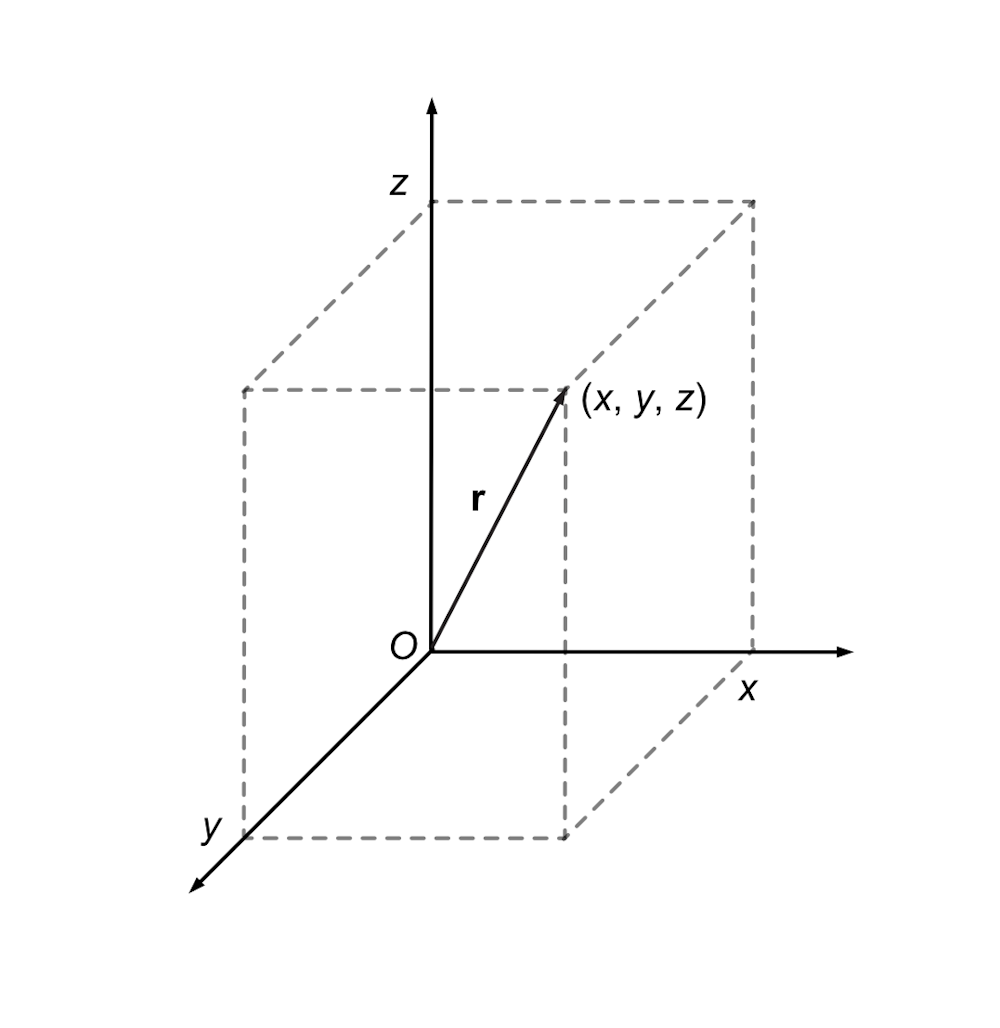
    A vector encodes two kinds of information at once, most famously the magnitude and direction of a spatial quantity such as force, velocity or relative position. For instance, to represent an object’s position (xyz) relative to the “origin” (the zero point of the position axes), Hamilton visualised an arrow pointing from the origin to the object’s location. The arrow represents the “position vector” x i + y j + z k.

    This vector’s “components” are the numbers x, y and z – the distance the arrow extends along each of the three axes. (Other vectors would have different components, depending on their magnitudes and units.)

    A vector (r) is like an arrow from the point O to the point with coordinates (x, y, z).
    The Conversation, CC BY

    Half a century later, the eccentric English telegrapher Oliver Heaviside helped inaugurate modern vector analysis by replacing Hamilton’s imaginary framework i, j, k with real unit vectors, i, j, k. But either way, the vector’s components stay the same – and therefore the arrow, and the basic rules for multiplying vectors, remain the same, too.

    Hamilton defined two ways to multiply vectors together. One produces a number (this is today called the scalar or dot product), and the other produces a vector (known as the vector or cross product). These multiplications crop up today in a multitude of applications, such as the formula for the electromagnetic force that underpins all our electronic devices.

    A single mathematical object

    Unbeknown to Hamilton, the French mathematician Olinde Rodrigues had come up with a version of these products just three years earlier, in his own work on rotations. But to call Rodrigues’ multiplications the products of vectors is hindsight. It is Hamilton who linked the separate components into a single quantity, the vector.

    Everyone else, from Isaac Newton to Rodrigues, had no concept of a single mathematical object unifying the components of a position or a force. (Actually, there was one person who had a similar idea: a self-taught German mathematician named Hermann Grassmann, who independently invented a less transparent vectorial system at the same time as Hamilton.)

    Hamilton also developed a compact notation to make his equations concise and elegant. He used a Greek letter to denote a quaternion or vector, but today, following Heaviside, it is common to use a boldface Latin letter.

    This compact notation changed the way mathematicians represent physical quantities in 3D space.

    Take, for example, one of Maxwell’s equations relating the electric and magnetic fields:


    ×


    E


    = –∂
    B
    /∂

    t

    With just a handful of symbols (we won’t get into the physical meanings of ∂/∂t and ∇ ×), this shows how an electric field vector (E) spreads through space in response to changes in a magnetic field vector (B).

    Without vector notation, this would be written as three separate equations (one for each component of B and E) – each one a tangle of coordinates, multiplications and subtractions.

    The expanded form of the equation. As you can see, vector notation makes life much simpler.
    The Conversation, CC BY

    The power of perseverance

    I chose one of Maxwell’s equations as an example because the quirky Scot James Clerk Maxwell was the first major physicist to recognise the power of compact vector symbolism. Unfortunately, Hamilton didn’t live to see Maxwell’s endorsement. But he never gave up his belief in his new way of representing physical quantities.

    Hamilton’s perseverance in the face of mainstream rejection really moved me, when I was researching my book on vectors. He hoped that one day – “never mind when” – he might be thanked for his discovery, but this was not vanity. It was excitement at the possible applications he envisaged.

    A plaque on Dublin’s Broome Bridge commemorate’s Hamilton’s flash of insight.
    Cone83 / Wikimedia, CC BY-SA

    He would be over the moon that vectors are so widely used today, and that they can represent digital as well as physical information. But he’d be especially pleased that in programming rotations, quaternions are still often the best choice – as NASA and computer graphics programmers know.

    In recognition of Hamilton’s achievements, maths buffs retrace his famous walk every October 16 to celebrate Hamilton Day. But we all use the technological fruits of that unassuming graffiti every single day.

    Robyn Arianrhod does not work for, consult, own shares in or receive funding from any company or organisation that would benefit from this article, and has disclosed no relevant affiliations beyond their academic appointment.

    ref. Three letters, one number, a knife and a stone bridge: how a graffitied equation changed mathematical history – https://theconversation.com/three-letters-one-number-a-knife-and-a-stone-bridge-how-a-graffitied-equation-changed-mathematical-history-241034

    MIL OSI AnalysisEveningReport.nz

  • MIL-Evening Report: Has Kamala Harris reached the ceiling of her ability to make gains against Trump?

    Source: The Conversation (Au and NZ) – By Jared Mondschein, Director of Research, US Studies Centre, University of Sydney

    With less than three weeks to go before Election Day, the polling at this point is clear: Kamala Harris and Donald Trump are effectively tied.

    Harris has led the Democratic ticket for less than three months, but in that short time she has galvanised Democratic voters and significantly increased the popularity of the Democratic ticket. Yet, current levels of US political polarisation and, perhaps more notably, calcification, make one wonder just how much more support she could win.

    In other words, few Americans are undecided in their views of Donald Trump – he galvanises both his base and his opponents alike – so there are simply not many American voters remaining for Harris to try to win over.

    Initial momentum has plateaued

    When 81-year-old Joe Biden led the Democratic ticket in early 2024, only 55% of Democrats and Democratic-leaning voters were enthusiastic about the election.

    While the 2020 presidential election between Biden and Trump broke records for US voter turnout, the 2024 redux was looking like it would break the opposite sort of records – for voter disinterest.

    That is, at least, until Harris assumed the top of the Democratic ticket on 21 July 2024. Within a month of Biden stepping down as the party’s nominee, Democratic enthusiasm for their significantly younger candidate jumped 23 points to 78%. This eclipsed not only levels of enthusiasm that Democrats had for Barack Obama in 2008, but also the levels of enthusiasm that Republicans currently have for Donald Trump.

    Harris’ momentum saw the race quickly move on from deep analysis of the “double haters” – the record 25% US voters who disliked both Trump and Biden and were simply deciding which they hated less. With a much closer contest now likely, attention shifted to key swing states such as Pennsylvania, where Harris closed Trump’s five-point lead over Biden to now be around even.

    Small changes can make a big difference

    Harris’ ability to make the Democratic ticket competitive should not be undervalued. After all, as recently as June 2024, she was one of the few Democratic politicians who actually had a lower national approval rating than Joe Biden.

    With that said, the momentum for Harris should not be seen as a sea change across the country. As much as she energised a previously lacklustre Democratic ticket, approval of Harris among self-described Independent voters only increased from 36% to 43% in the same timeframe. Republican approval of Harris decreased slightly from 6% to 4% over the same period.

    Ultimately, even the slightest of changes can completely shift the nature of the race, particularly given how slim the margins have been in the last two presidential elections. In the 2016 presidential election, for example, Trump’s margin of victory was some 75,000 votes across three swing states. In 2020, Biden’s margin of victory was about 45,000 votes across three swing states.

    Harris or Trump’s 2024 margin of victory very well may be less than 0.03% of the US electorate, making this potentially the closest US election in decades.

    Has support for Harris peaked?

    For the first half of 2024, Trump polled considerably ahead of Biden in the key swing states that will most likely decide the US election. Then, within weeks of Harris becoming the presidential nominee in July, the difference in the swing states between Trump and his opponent shrank to around 1-2 percentage points.

    Now, nearly three months later, the polling is essentially unchanged – remaining well within the standard margin of error of around ±3%.

    As much as Harris has eclipsed Biden in the race against Trump, there is no denying the statistical reality that Harris is no longer gaining ground on Trump in the way that she was in the early weeks of her candidacy.

    Some have argued that Harris’ liabilities – and perhaps the reason she has stalled in the polls – are that Americans remain fairly negative on the economy, she is in the incumbent administration instead of on an outsider ticket, and that many view her as simply too progressive.

    Yet judging by the fact that Harris appears to be polling better than “a generic Democrat” – who generally are more popular than any other Democrats because they are not real people with real positions – it’s perhaps more likely that in these polarised and calcified times, Harris very well may have simply peaked as high as any other Democratic candidate possibly could.

    With American voter intentions barely shifting after an insurrection, pandemic and assassination attempts, it’s hard to imagine Harris can do much better than she already is doing.

    Harris’ best strategy for success on November 5 may therefore need to be less focused on winning over more of the very few undecided voters remaining, and instead more focused on simply getting her energised supporters to turn up on Election Day.

    Jared Mondschein does not work for, consult, own shares in or receive funding from any company or organisation that would benefit from this article, and has disclosed no relevant affiliations beyond their academic appointment.

    ref. Has Kamala Harris reached the ceiling of her ability to make gains against Trump? – https://theconversation.com/has-kamala-harris-reached-the-ceiling-of-her-ability-to-make-gains-against-trump-240902

    MIL OSI AnalysisEveningReport.nz

  • MIL-Evening Report: An immediate ban has been issued for the herbicide dacthal. What are the health risks?

    Source: The Conversation (Au and NZ) – By Ian Musgrave, Senior lecturer in Pharmacology, University of Adelaide

    Last week the Australian government cancelled the registration of all products containing chlorthal dimethyl, a weedkiller commonly known as dacthal.

    No phase out period applies. The cancellation is immediate, due to the risks it poses to human health – primarily unborn babies.

    This means using dacthal as a chemical agricultural product “is now illegal”, according the Australian Pesticides and Veterinary Medicines Authority.

    So what has changed? What are the health risks of being exposed to dacthal – and how long have we known about them?

    What is dacthal?

    Dacthal and chlorthal dimethyl are alternative names for dimethyl tetrachloroterephthalate, or DCPA. This is a herbicide registered to control weeds in both agricultural and non-agricultural settings.

    Dacthal works by inhibiting auxin, a growth hormone in plants which promotes the development of buds, roots and lengthening cells.

    It is used to selectively kill annual grasses and many other common weeds, without killing turf grasses, flowers, fruits and vegetables. Dacthal is applied before weeds emerge, often when still in their seed stage.

    In Australia it is used in twelve herbicide products. All have been cancelled as of October 10 2024.

    Farmers and retailers are allowed to hold products until they’re recalled, but must not use them. The government says it will provide information about product recall shortly.

    What are the health risks?

    As dacthal targets a hormone found only in plants, for adult humans and mammals the chemical has limited acute and subchronic toxicity. This means brief exposure to high levels of dacthal, or longer-term exposure to modestly high levels, have no effect.

    However there is a health risk for unborn babies whose mothers have been directly exposed. This could be through mixing the chemical, loading and applying it, or from residue on treated crops – for up to five days after first applied.

    The chemical has been linked to low birth weight, and life-long impacts, which can include impaired brain development and motor skills.

    The government has advised pregnant agricultural workers who are concerned to speak to their clinician.

    What changed?

    Safety data for chemicals such as pesticides are periodically reevaluated. This is to see if any new risks have become apparent with advances in technology and our understanding of biology.

    In 2013, the United States Environmental Protection Agency called for fresh safety data to look at effects of dacthal on thyroid hormones.

    Fast forward to 2022. In that time, the company producing dacthal had failed to produce the required study. So the US Environmental Protection Agency issued a notice it would suspend technical-grade products containing dacthal.

    In response, the company submitted a thyroid study performed in rats. This study showed dacthal could affect thyroid function at doses lower than previously known.

    The US government determined this did not change recommendations for adults. However dacthal may affect thyroid function of a fetus at lower doses than those those that harm adults.

    What did the study in rats find?

    Dacthal was found to inhibit two thyroid hormones in rat pups whose mother had been exposed while pregnant.

    There was a 35-53% decrease in the hormone triiodothyronine, known as T3. And for thyroxine (T4), rat pups experienced a 29-66% decrease after their mother’s exposure.

    Decreases in these two hormones are associated with risks to unborn children including low birth weight and impaired brain development, IQ and motor skills.

    Of particular concern was the effects occurred at much lower levels than previously thought. The decreases in T3 and T4 occurred in rat pups exposed to levels of dacthal ten times lower than the safe threshold for their mothers. This means pregnant rats exposed to dacthal at those levels had no adverse effects, but their unborn babies did.

    Exactly how the chemical caused decreases in T3 and T4 in rat pups is not clear.

    However the Australian Pesticides and Veterinary Medicines Authority considers this study relevant to humans. The changes in regulation are based on the potential harms if unborn babies are exposed via their mothers.

    The health risk is to the development of an unborn baby exposed to dachtal via their mother.
    Fox_Ana/Shutterstock

    What exposure is safe?

    The rat study was used to calculate maximum levels of exposure for pregnant workers. This maximum – 0.001 mg dachtal/kg body weight/day – was considered appropriate to reduce risk to the unborn child (and was not expected to harm adults).

    However, the maximum acceptable level was exceeded in all estimates of exposure to dachtal. This was the case even when the person was wearing protective clothing, gloves, and using a respirator.

    Even under stringent safety conditions, potential harms to an unborn child could not be ruled out. For this reason the US stopped sale of dacthal via an Emergency Order on 6 August 2024. Australia has since followed suit with its own ban.

    How long have we known about this?

    The US government only received the thyroid information in 2022. It then had to determine whether the levels of exposure under real world conditions would equate to risk in humans.

    This is not straightforward, as the pesticide is used under a variety of conditions, including:

    • mixing and preparing the pesticide using personal protective equipment
    • downstream spay drift
    • treatment of lawns and exposure to the lawn after treatment.

    Each of these scenarios requires careful analysis of potential risks.

    In addition, exposure can be through inhalation and/or skin contact. All this must be taken into account and these calculations take time.

    Should I be worried?

    If you were not pregnant and using personal protective clothing while using or applying dacthal herbicides, this is little cause for worry. Your exposure is below the maximum limit.

    But if you were pregnant when using dacthal pesticides, please consider consulting your child’s paediatrician.

    Ian Musgrave has received funding from the National health and Medical Research Council to study contaminants in herbal medicines. He has received ARC funding for studying Alzheimer’s disease in the recent past. He is a member of the Science Communicators South Australian Branch.

    ref. An immediate ban has been issued for the herbicide dacthal. What are the health risks? – https://theconversation.com/an-immediate-ban-has-been-issued-for-the-herbicide-dacthal-what-are-the-health-risks-241257

    MIL OSI AnalysisEveningReport.nz

  • MIL-Evening Report: Australian schools need to address racism. Here are 4 ways they can do this

    Source: The Conversation (Au and NZ) – By Aaron Teo, Lecturer in Curriculum and Pedagogy, University of Southern Queensland

    The Australian Human Rights Commission wants to see schools address racism, as part of a broader push to address the problem across Australian society.

    As it says in a recent report,

    People are not born with racist attitudes or beliefs […] Addressing racism in schools is crucial to ensure that victims do not leave education facing lifelong disadvantage, and perpetrators do not enter adulthood believing racist behaviours are acceptable […].

    But racism is hardly mentioned in the Australian Curriculum – for example, it is noted in passing in the health and physical education curriculum for years 5 to 8. However, there is no consistent approach across subject areas, or at the state level.

    This means teaching about racism is largely left up to individual schools and teachers.

    Yet research shows they can be reluctant to speak about these issues with students. This is for a range of reasons, such as worrying they will say the wrong thing.

    How should school systems, schools and teachers address racism? Here are four ways.

    1. Teach racial literacy

    We know children demonstrate stereotyping and prejudice from an early age and students from racial minorities are frequently targets of racism and discrimination at school.

    In Australia, racism debates can also involve dangerous and ill-informed opinions.

    So we need to start teaching children and young people about racial literacy skills from the first year of schooling. This means they grow up to have the knowledge and language to talk about and confront racism.

    Some of these skills include:

    • being able to identify how racism appears in everyday interactions, the media and society more broadly

    • debunking common myths about racism, such as it is a “thing of the past”. Or “everyone has equal access to the same opportunities and outcomes if they work hard enough”

    • understanding the impacts of racism, including on people’s opportunities, education and their health and wellbeing

    • understanding how our own backgrounds, privilege and bias can influence how we confront or don’t confront racism.

    Students also need to learn how racism can be structural, systemic and institutional. This means racism is not just about an individuals’ beliefs or actions. Laws, policies, the way organisations are run and cultural norms can all result in inequitable treatment, opportunities and outcomes.

    2. Teach students how to react

    We also need to teach children how to react when they witness racism with age-appropriate tools.

    For both primary and secondary students, the first question should always be, “Is it safe for me to act?”, followed by “Am I the best person to act in this situation?”. Depending on their answers, they could:

    • report the incident to an appropriate adult or person in authority

    • show solidarity with the victim by comforting them and letting them know what happened was not OK

    • interrupt, distract or redirect the perpetrator

    • seek help from friends, a passerby or teacher.

    3. Create safe classrooms and playgrounds

    Teachers need to ensure classrooms and schools are safe spaces to discuss racism.

    This can include:

    • acknowledging how our own experiences, biases and privileges shape our world views

    • clearly defining the purpose of a discussion and the ground rules

    • using inclusive language.

    In particular, schools have a unique duty of care for minority students, who need to know they can talk openly about these issues with their peers and teachers without fear or judgement.

    This includes addressing sensitive topics like how they might experience or witness racism, the effect it can have on their health and wellbeing and those around them, and the consequences of talking about or reporting racism.

    4. Develop teachers’ skills

    As part of creating safe classrooms, teachers need to be able to confidently discuss tricky topics in an age-appropriate way.

    Our work has shown some teachers deny racism or perpetuate racist stereotypes. Others may avoid the topic, worrying they will say or do the wrong thing.

    Our current (as yet unpublished) research on anti-racism training with classroom teachers suggests they can increase their confidence to talk and teach about racism if given appropriate, and sustained training.

    What needs to happen now?

    We need anti-racism education to be an official part of school curricula. To accompany this, we need genuine commitments and modelling from policymakers, school leaders, teachers, parents and carers to address racism in schools.

    We need to talk openly about racism in schools. That means explicitly naming it, calling it out, and not getting defensive when it is identified and action is required.

    Aaron Teo is Convenor for the Australian Association for Research in Education Social Justice Special Interest Group, Queensland Convenor for the Asian Australian Alliance, member of the Challenging Racism Project, and member of the Advisory Committee for the Australian Human Rights Commission’s study into racism in Australian universities

    Rachel Sharples has received funding from the Australian Research Council and the NSW Department of Education. She is a member of the Challenging Racism Project (CRP) and the Centre for Resilient and Inclusive Communities (CRIS).

    ref. Australian schools need to address racism. Here are 4 ways they can do this – https://theconversation.com/australian-schools-need-to-address-racism-here-are-4-ways-they-can-do-this-239823

    MIL OSI AnalysisEveningReport.nz

  • MIL-OSI: First Merchants Corporation Announces Cash Dividend on Its Preferred Stock

    Source: GlobeNewswire (MIL-OSI)

    MUNCIE, Ind., Oct. 15, 2024 (GLOBE NEWSWIRE) — First Merchants Corporation has declared a quarterly cash dividend of $46.88 per share on its 7.50% Non-Cumulative Perpetual Preferred Stock Series A, represented by depositary shares (NASDAQ: FRMEP) each representing a 1/100th interest in a share of the Series A preferred stock. Holders of depositary shares will receive $0.4688 per depositary share. The dividend will be payable on November 15, 2024, to stockholders of record on October 31, 2024.

    About First Merchants Corporation:

    First Merchants Corporation is a financial holding company headquartered in Muncie, Indiana. The Corporation has one full-service bank charter, First Merchants Bank. The Bank also operates as First Merchants Private Wealth Advisors (as a division of First Merchants Bank).

    First Merchants Corporation’s common stock is traded on the NASDAQ Global Select Market System under the symbol FRME. Depositary shares representing a 1/100th interest in a share of First Merchants Corporation’s 7.50% Non-Cumulative Perpetual Preferred Stock, Series A are traded on the NASDAQ Global Select Market System under the symbol FRMEP. Quotations are carried in daily newspapers and can be found on the company’s Internet web page (http://www.firstmerchants.com).

    FIRST MERCHANTS and the Shield Logo are federally registered trademarks of First Merchants Corporation.

    For more information, contact:
    Nicole M. Weaver, Vice President and Director of Corporate Administration
    765-521-7619
    http://www.firstmerchants.com

    The MIL Network

  • MIL-OSI USA: Justice Department Secures $8M from Fairway Independent Mortgage Corporation to Address Redlining in Black Communities in Birmingham, Alabama

    Source: US State of California

    Combating Redlining Initiative Surpasses $150M in Relief for Redlined Communities at its Third Anniversary

    The Justice Department and Consumer Financial Protection Bureau (CFPB) announced today that Fairway Independent Mortgage Corporation (Fairway) has agreed to pay $8 million and a $1.9 million civil money penalty to resolve allegations that it engaged in a pattern or practice of lending discrimination by redlining predominantly Black neighborhoods in and around Birmingham, Alabama.

    Redlining is an illegal practice by which lenders avoid providing credit services to individuals living in communities of color because of the race, color, or national origin of residents in those communities.

    With this settlement, the Justice Department’s Combating Redlining Initiative surpassed $150 million in relief for communities of color nationwide that have experienced lending discrimination. This settlement marks the Justice Department’s 15th redlining settlement in three years. Under the Combating Redlining Initiative, the Department has secured a historic amount of relief that is expected to generate over $1 billion in investment in communities of color in places such as Houston; Memphis; Los Angeles; Philadelphia; and Birmingham.

    “This settlement, and the over $150 million in relief the Justice Department has secured for communities across the country through our Combating Redlining Initiative, will help to ensure that future generations of Americans inherit a legacy of home ownership that they too often have been denied,” said Attorney General Merrick B. Garland. “This case is a reminder that redlining is not a relic of the past, and the Justice Department will continue to work urgently to combat lending discrimination wherever it arises and to secure relief for the communities harmed by it.”

    The Justice Department and CFPB allege that Fairway illegally redlined Black neighborhoods in Birmingham, including through its marketing and sales actions, and discouraged residents of those neighborhoods from applying for mortgage loans. The settlement announced today requires Fairway to provide $7 million for a loan subsidy program to offer affordable home purchase, refinance, and home improvement loans in Birmingham’s majority-Black neighborhoods, invest an additional $1 million in programs to support that loan subsidy fund, and pay a $1.9 million civil penalty to the CFPB’s victims relief fund.

    This case is the third redlining enforcement action brought jointly by the Justice Department and the CFPB under the initiative, highlighting the strong partnership between the agencies to root out and address lending discrimination.

    “Birmingham lies at the heart of our nation’s civil rights struggle but is also a community that bears the legacy of discriminatory redlining and other exclusionary policies,” said Assistant Attorney General Kristen Clarke of the Justice Department’s Civil Rights Division. “This settlement will provide Birmingham’s Black neighborhoods with the access to credit they have long been denied and increase opportunities for homeownership and generational wealth. This settlement makes clear our intent to uproot modern-day redlining in every corner of the country, including in the deep South. With more than $150 million in total relief secured in three short years, our Combating Redlining Initiative is generating real economic opportunity for communities of color while sending a strong message to mortgage lenders, no matter their business model, that discriminatory lending will not be tolerated in America.”

    “The settlement reached with Fairway Mortgage is a win for communities of color here in Birmingham that have historically been denied access to vital economic resources,” said U.S. Attorney Prim Escalona for the Northern District of Alabama. “Our office is committed to ensuring that these communities have equal access to housing and credit resources.”

    “The CFPB and Justice Department are holding Fairway accountable for redlining Black neighborhoods,” said CFPB Director Rohit Chopra. “Fairway’s unlawful redlining discouraged families from seeking loans for homes in Birmingham’s Black neighborhoods.”

    Fairway is a non-depository mortgage company headquartered in Madison, Wisconsin. In 2022, Fairway was the nation’s fifth-largest lender by origination volume and ninth-largest by application volume. Fairway operates in the Birmingham area under the trade name MortgageBanc.

    The complaint describes how Fairway redlined majority-Black neighborhoods in the Birmingham Metropolitan Statistical Area (Birmingham MSA). During the period covered by the complaint, the Birmingham MSA included six counties in north central Alabama with a combined population of about 1.1 million. While Fairway claimed to serve the entire metropolitan area, it concentrated all its retail loan offices in majority-white areas, directed less than 3% of its direct mail advertising to consumers in majority-Black areas, and for years discouraged homeownership in majority-Black areas by generating loan applications at a rate far below its peer institutions.

    The Justice Department and CFPB allege that Fairway violated the Fair Housing Act, Equal Credit Opportunity Act, and Consumer Financial Protection Act. Specifically, the government alleges problematic conduct by Fairway including:

    • Failing to address known signs of discrimination: Fairway’s own data showed that, since at least 2017, it was failing to serve majority-Black neighborhoods in the Birmingham area, but before October 2022, it took no meaningful actions to address redlining risk. Between 2018 and 2022, only 3.7% of Fairway’s applications were for properties in majority-Black areas, compared to 12.2% for Fairway’s peer lenders. In other words, Fairway’s peer lenders generated applications for properties in majority-Black areas at over three times the rate of Fairway. This disparity was even higher in neighborhoods with 80% or more Black residents, where Fairway made loans at less than one-eighth of the rate of its peer lenders. Despite these figures, Fairway failed to adopt any written plan for marketing or growth to address the concern.
    • Redlining Black neighborhoods: From 2015 through 2022, Fairway operated three retail loan offices and three loan production desks within real estate offices in the Birmingham MSA, all of which were in majority-white areas. Fairway also relied on referrals from real estate professionals and its loan officers’ personal contacts to generate applications, and the vast majority of Fairway’s referral sources and referred consumers were located in majority-white areas. Fairway predominantly directed its marketing to majority-white areas and failed to train or incentivize its existing loan officers to better serve majority-Black areas. By taking these actions, Fairway discriminated against, and unlawfully discouraged mortgage loan applications for properties in, majority-Black neighborhoods.

    The proposed consent order, which awaits approval by the Federal District Court for the Northern District of Alabama, would require Fairway to:

    • Provide $7 million for a loan subsidy program: The order would require Fairway to offer home purchase, refinance, and home improvement loans on a more affordable basis than otherwise available in majority-Black neighborhoods in the Birmingham MSA. The program may provide lower interest rates, down payment assistance, closing cost assistance, or payment of initial mortgage insurance premiums.
    • Invest at least $1 million in redlined neighborhoods: Fairway would be required to open or acquire a new loan production office or full-service retail office in a majority-Black neighborhood in the Birmingham MSA. The company must also spend at least $500,000 on advertising and outreach, at least $250,000 on consumer financial education, and at least $250,000 on partnerships with one or more community-based or governmental organizations to serve the affected neighborhoods.
    • Pay a $1.9 million penalty: The proposed order imposes a $1.9 million civil penalty against Fairway, which would be paid into the CFPB’s Civil Penalty Fund, also referred to as the victims’ relief fund.

    Information about the Justice Department’s fair lending enforcement work can be found at www.justice.gov/fairhousing. Individuals may report lending discrimination by calling the Justice Department’s housing discrimination tip line at 1-833-591-0291 or submitting a report online.

    Consumers can submit complaints about financial products and services by visiting the CFPB’s website or by calling (855) 411-CFPB (2372).

    Employees who believe their company has violated federal consumer financial protection laws are encouraged to send information about what they know to whistleblower@cfpb.gov. To learn more about reporting potential industry misconduct, visit the CFPB’s website.

    MIL OSI USA News

  • MIL-OSI USA: Jon Irvine Appointed IAM Healthcare Coordinator

    Source: US GOIAM Union

    IAM International President Brian Bryant has appointed Jon Irvine as IAM Healthcare Coordinator, effective Oct. 1, 2024. This appointment will build on the IAM’s commitment to empowering technical and professional workers in the healthcare industry.

    Irvine’s first exposure to the importance of a strong union voice for healthcare workers came from his mother, who spent her career as a Registered Nurse and proud AFSCME member. Jon would follow in his mother’s footsteps during the 2008 Great Recession and attended the Institute of Technology’s Licensed Practical Nursing program. Irvine eventually returned to work in the forestry field leading to his tenure with the IAM.

    Irvine began his IAM service in 2010 with Local W130 at the Port of Olympia in Washington state, where he served in many roles from Chief Shop Steward to Local President. He would go on to hone his skills as a professional trade unionist as a full-time team member with the Oregon AFL-CIO, providing collective bargaining, organizing and legislative support to affiliated unions.

    Eventually, Irvine returned to the IAM as a Business Representative with District W24, where he led the district’s organizing and legislative efforts. Irvine proved to be crucial part of District W24’s organizing success winning several campaigns for working people in the healthcare, automotive and manufacturing industry. 

    Irvine has spent the last two years of his career as an Education Representative at the IAM’s Winpisinger Education and Technology Center developing and teaching high level labor education to empower IAM members. As an Education Rep, Irvine played a pivotal role in supporting the educational needs of the IAM’s Healthcare, Railroad, Organizing and Woodworker Departments.

    “I’m grateful and humbled by the International President’s faith in my ability to help this team grow the IAM’s footprint in this industry and look forward to working with the IAM Healthcare team to reach this end,” said Irvine. “Healthcare workers play a vital role in our society. Diagnosing, treating and comforting people who are sick or injured is a noble endeavor. These workers deserve a collective voice, and I believe IAM Healthcare is the union to make sure these essential workers issues are heard loud and clear.”

    “Jon’s education and experience in healthcare work, organizing, collective bargaining and legislative action makes for a welcome addition to the IAM Healthcare team,” said International President Bryant. “Jon is joining IAM Healthcare at a critical moment for our union’s growing advocacy for both healthcare professionals and patients.” 

    Share and Follow:

    MIL OSI USA News

  • MIL-OSI USA: IAM District 142 Holds First Guide Dogs of America Tender Loving Canines Charity Golf Tournament

    Source: US GOIAM Union

    The IAM Air Transport Territory members of District 142 recently gathered in Chandler, Ariz., to hold its first-ever charity golf outing for the IAM’s favorite charity, Guide Dogs of America and Tender Loving Canines (GDA | TLC).

    More than 100 attendees had a fun day playing Golf, Corn Hole, and Frisbee games at the Ocotillo Golf Club. IAM District 142 President John Coveny, who leads approximately  30,000 members, was happy with the participation of the attendees.

    “The support has been tremendous,” said Coveny. “We had over 30 major companies and union local sponsors for the event, which made it a very special day.”

    Watch the video here. https://www.dropbox.com/scl/fi/pefiabgeo5gvryrob063i/10-4-DL-142-GDA-PHX.mp4?rlkey=bri5i1eyewm4dqt0em4vdqc2k&st=1wts2rct&dl=0
     
    IAM Air Transport Territory General Vice President Richie Johnsen spent the day meeting and enjoying solidarity with the many members. 

    “What a wonderful event,” said Johnsen. “The planning shows, and the members had a good time raising money for the IAM’s charity of choice.” 

    Share and Follow:

    MIL OSI USA News

  • MIL-OSI USA: CFTC Charges Several People and Companies in a $280 Million Ponzi Scheme

    Source: US Commodity Futures Trading Commission

    — The Commodity Futures Trading Commission today announced it filed a civil enforcement action in the U.S. District Court for the Southern District of Florida against:

    The complaint alleges that, among other things, the defendants individually, and at times working in conjunction, made material fraudulent representations to their customers and misappropriated customer funds. In sum, more than 2,000 customers deposited no less than $283 million in connection with the alleged fraud.

    The CFTC seeks disgorgement of ill-gotten gains, civil monetary penalties, restitution, trading and registration bans, and a permanent injunction against further violations of the Commodity Exchange Act and CFTC regulations.

    On Oct. 3, Federal District Court Judge Roy K. Altman entered a statutory restraining order against the defendants, freezing their assets, and giving the CFTC immediate access to their books and records. The court scheduled a preliminary injunction hearing for Oct. 29.

    Case Background

    The complaint alleges from at least November 2019 through the present, TD, Safranko, and Negus-Romvari orchestrated a multi-layered scheme to solicit funds for trading leveraged or margined retail commodity transactions, specifically gold-to-U.S. dollar pairs (XAU/USD), as well as assorted other commodities, through pooled and individual accounts. 

    The complaint states TD, Safranko, and Negus-Romvari made fraudulent and material oral and written misrepresentations and omissions, and misappropriated customer funds. The complaint alleges TD and Safranko falsified trading records and TD’s successor, Trubluefx, further misappropriated customer funds by failing to refund the money despite repeated attempts by thousands of customers to access and/or liquidate their accounts.

    According to the complaint, TD, Safranko, and Negus-Romvari also used other individuals and entities (sponsors) on TD’s behalf, with each sponsor acting like a spoke extending from the TD hub. 

    The sponsors Algo Capital and Algo FX Capital Advisor n/k/a Quant5, and their agents Collazo, Herman, Fortini, and Likos; Sims; Buggs; and Centurion, and its agents Santi, Beltran, and Rice, also fraudulently solicited customers and misappropriated funds. The sponsors actively downplayed red flags and continued to solicit customers, helping to create the false impression customers were participating in legitimate trading even as the scheme was on the brink of collapse.

    In the fall of 2022, customers began to experience extreme withdrawal delays and/or were unable to withdraw their funds. According to the complaint, TD, Safranko, and Negus-Romvari, and the sponsor defendants provided numerous, conflicting excuses for the delays — falsely assuring customers their funds were safe, and withdrawals would be processed. All while the sponsor defendants continued to solicit funds from new and existing customers to be traded in the TD Pool, allowing the defendants to continue their fraudulent scheme for more than six months and bilk customers out of millions of additional dollars.

    The CFTC appreciates the assistance of the National Futures Association, Ontario Securities Commission, the Financial Services Authority Saint Vincent & The Grenadines, Finantsinspektsioon (Estonian Financial Supervision and Resolution Authority), and Vanuatu Financial Services Commission. 

    The Division of Enforcement staff responsible for this matter are Alison B. Wilson, Sean Hennessy, Sarah Wastler, Kelly Folks, Maura Viehmeyer, Michelle Bougas, Erica Bodin, Stephanie Cooper, and Rick Glaser. Jeremy Christianson and Christopher Beatty from the CFTC’s Office of Data and Technology also assisted.

    CFTC’s Commodity Pool Fraud Advisory

    The CFTC has issued several customer protection Fraud Advisories and Articles, including the Commodity Pool Fraud Advisory, which provides information about a type of fraud involving individuals and firms, often unregistered, offering investments in commodity pools. The CFTC also urges the public to verify a company’s registration at NFA BASIC before investing funds. If an entity is unregistered, a customer should be wary of providing funds to that entity.

    Suspicious activities or information, such as possible violations of commodity trading laws, should be reported to the Division of Enforcement via a toll-free hotline 866-FON-CFTC (866-366-2382) or file a tip or complaint online or contact the CFTC Whistleblower Office. Whistleblowers are eligible to receive between 10 and 30 percent of the monetary sanctions collected, paid from the CFTC Customer Protection Fund financed through monetary sanctions paid to the CFTC by violators of the CEA.

    MIL OSI USA News

  • MIL-OSI United Nations: Experts of the Committee on the Elimination of Discrimination against Women Praise Chile’s Laws on Violence against Women, Ask about Measures to Prevent Trafficking of Children and Sexual Abuse of Girls

    Source: United Nations – Geneva

    The Committee on the Elimination of Discrimination against Women today considered the eighth periodic report of Chile, with Committee Experts praising the State’s laws on violence against women and femicide, and raising questions about measures to prevent trafficking of children and sexual abuse of girls.

    One Committee Expert said Chile had impressive laws on violence against women and femicide.  What was the reparation regime for femicide?

    A Committee Expert said trafficking remained a problem in Chile.  There were around 20,000 illegal adoptions; the stealing of children was reportedly a lucrative business for criminal groups.  What measures were in place to support women and children who were at risk of trafficking?

    Another Expert said the Committee was concerned by the high rates of teenage pregnancy and sexual abuse of teenage girls.  What was being done to prevent early pregnancies, sexual abuse of girls, and delays in processing of abortion requests?

    Introducing the report, Antonia Orellana Guarello, Minister of Women and Gender Equity of Chile and head of the delegation, said an emblematic advance in the fight against violence in Chile was the enactment this June of the comprehensive law against gender violence. In the last two years, law reform had established a comprehensive protection and reparation regime for victims of femicide. National violence against women programmes had been redesigned to offer care to a wider range of victims.

    Ms. Orellana Guarello said the Government had developed the National Action Plan against Trafficking in Persons 2023-2026, focusing on prevention, protection of victims, prosecution of crimes, intersectoral coordination, and international cooperation.  This plan had made it possible to double the State’s capacity to care for adult victims.

    The delegation added that the State had a new procedure for assessing international adoptions and was supporting investigations into kidnapping of children. One individual who had been kidnapped had been identified and reunited with their family.  The State party was working to establish a genetic database to help reunite families and victims.

    Chile had seen a downward trend in teenage pregnancies since 2016, the delegation noted, influenced by the free distribution of contraception.  The State party was developing legislation that decriminalised abortion.  Around 70 per cent of girls under 14 who requested abortions did so on the grounds of rape.  An early referrals programme had been developed to speed up their access to abortions.

    In closing remarks, Ms. Orellana Guarello said Chile was committed to implementing the rights of women in all their diversity.  The State party would work to collect disaggregated data on women, achieve gender parity at all levels, increase access to abortion, promote the rights of older women and reform the pension system, and improve the situation of women deprived of liberty.

    Ana Peláez Narváez, Committee Chair, in concluding remarks, said that the dialogue had helped the Committee to better understand the situation of women and girls in the State party.  It would develop recommendations based on the dialogue to strengthen the implementation of the Convention for the benefit of all women and girls in Chile.

    The delegation of Chile consisted of representatives from the Supreme Court; Ministry of Justice and Human Rights; National Migration Service; Ministry of Foreign Affairs; Ministry of Women and Gender Equity; Ministry of the Interior and Public Security; Public Prosecutor’s Office; Gendarmerie; Public Criminal Defender’s Office; Cabinet of the Minister of Social Development and Family; and the Permanent Mission of Chile to the United Nations Office at Geneva.

    The Committee will issue the concluding observations on the report of Chile at the end of its eighty-ninth session on 25 October.  All documents relating to the Committee’s work, including reports submitted by States parties, can be found on the session’s webpage.  Meeting summary releases can be found here.  The webcast of the Committee’s public meetings can be accessed via the UN Web TV webpage.

    The Committee will next meet in public at 10 a.m. on Wednesday, 16 October to consider the tenth periodic report of Canada (CEDAW/C/CAN/10).

    Report

    The Committee has before it the eighth periodic report of Chile (CEDAW/C/CHL/8).

    Presentation of Report

    ANTONIA ORELLANA GUARELLO, Minister of Women and Gender Equity of Chile and head of the delegation, said that since the last dialogue, Chile had experienced social protests, the COVID-19 pandemic, and the emergence of “anti-rights” groups.  Despite these challenges, the State had made progress in institutional, legal and administrative mechanisms to ensure the rights of women.  The National Equality Plan, updated in 2023, was the roadmap for equality policies in Chile. Minority groups had participated in the construction and monitoring of the plan.  In 2023 and 2024, six billion pesos were allocated to projects that directly benefited the diversity of women in different State institutions.

    An emblematic advance in the fight against violence was the enactment this June of the comprehensive law against gender violence, which established measures to punish and eradicate gender-based violence.  It created a judicial supervision mechanism, recognised children and adolescents as victims, and established an integrated data system on cases of gender violence. In the last two years, law reform had improved procedural guarantees and protected the rights of victims of sexual crimes; advanced the prevention, investigation and punishment of workplace sexual harassment; and established a comprehensive protection and reparation regime for victims of femicide, including a pension for sons and daughters, which until August 2024 has benefited 126 children and adolescents. National violence against women programmes had been redesigned to offer care to a wider range of victims.  The budget allocated to the prevention of violence against women had been increased by 22 per cent between 2021 and 2024.

    In 2022, a law prohibiting child marriage was enacted.  Thanks to this law, in the last two years there were no marriages with spouses under 18 years of age.  The Government had also developed the National Action Plan against Trafficking in Persons 2023-2026, focusing on prevention, protection of victims, prosecution of crimes, intersectoral coordination, and international cooperation. This plan had made it possible to double the State’s capacity to care for adult victims.  As of May 2024, humanitarian visas were issued to 21 women victims.  Progress had also been made with respect to the payment of child support through the creation of the National Registry of Alimony Debtors and the effective payment law. This had allowed the payment of more than 333 million United States dollars for alimony, benefiting more than 50,000 families as of May 2024.

    Chile was processing the bill that modified the Labour Code to promote equal pay between men and women, seeking to address the persistent gender wage gap, which stood at 23.3 per cent.  The Buenos Aires Commitment recognised the right to care and be cared for.  The Government had introduced a bill to establish a national policy on care to guarantee access to care in conditions of dignity.  Resources for care systems would be increased by 40 per cent by 2025, with the goal of serving 75,000 people with severe dependency.

    The More Women Scientists Programme had provided posts to women in science, technology, engineering and maths programmes at the university level.  The number of women selected for such programmes had since increased by 16.8 per cent.  The Government had implemented an inspection manual for the voluntary interruption of pregnancy law, which gave tools to local authorities for the supervision of health facilities.  It had also reduced the prices of oral, vaginal and long-acting contraception.

    The percentage of women participating in politics had increased in recent decades.  Chile was ranked sixth worldwide in high-level representation of women, with 58.3 per cent of members of the Cabinet of Ministers being women.  The Government was also promoting projects such as gender quotas in the elections of regional governors and councillors.  In the last two years, spaces had been created for women to participate in the evaluation and transformation of public policy, such as the Citizen Dialogues for the Care System, which had 12,614 participants, of which 80.4 per cent were women.  Dialogues were also held for rural women and for the lesbian, gay, bisexual, transgender and intersex community, on sexual and reproductive rights and pension reform.

    In the last two years, 119 indigenous language and culture educators were recruited.  The Good Living Plan promoted the participation of Mapuche and rural women in political and social decisions through territorial dialogues.  The Government had also doubled the quota for hiring people with disabilities in companies and public institutions with 100 or more workers.  The National Policy on Migration and Foreigners provided comprehensive care for foreign women victims of domestic and gender-based violence.  Since 2023, the gender identity accompaniment programme had been implemented, serving more than 2,500 transgender and gender non-conforming children and adolescents.  This year, the Protocol for the Protection of Human Rights Defenders was approved, reaffirming the commitment of the State to protect women human rights defenders.  The Protocol on the Treatment of Pregnant Women in Detention sought to guarantee respect for and exercise of these women’s rights.  From 2022 to May of this year, a total of 321 pregnant women had benefited from this law.

    The Committee’s recommendations would allow the State to make progress in complying with its international commitments and to guarantee respect for human rights.

    LORETO CARVAJAL, Senator of the Republic, said she was a member of a group of parliamentarians that promoted the creation of the Commission on Women and Gender Equity, a space to debate policies against discrimination and violence against women. The law on labour conciliation enshrined the right to remote work for all workers who had children under 14 years of age in their care.  Another law prohibited sexual and workplace violence and harassment at work.  The National Congress had also established its first breastfeeding room, and the Senate had installed 24 kits with menstrual hygiene products in its bathrooms.  The Work-Life Balance Protocol supported women with family and care responsibilities. 

    Chile also faced several challenges.  The revision of the civil partnership regime was still pending, as was a bill to strengthen the anti-discrimination law.  It was essential that resources were appropriately allocated to initiatives that addressed gender-based violence and promoted women’s economic empowerment.  There also needed to be increased cooperation between the legislative branch, the executive and civil society.  The delegation would faithfully reflect on both the State’s progress and the challenges remaining regarding the implementation of the Convention.

    ANDREA MUÑOZ SÁNCHEZ, Minister of the Supreme Court of Chile, said Chile’s understanding of the need to increase women’s access to justice had improved over the reporting period, and legal instruments and rulings reflected this.  The Supreme Court of Justice had a technical secretariat on gender equality and a gender equality policy.  There had been rulings regarding cases of violence against women that dealt with abandonment and recognition of non-typical cases of violence, including the use of legitimate use of self-defence by women.  There had also been rulings on the rights of women deprived of liberty and rulings recognising non-binary gender, and alternatives to detention had been issued for pregnant women.  The judiciary had also implemented many measures to eradicate sexual harassment in the workplace.

    Statement by the National Human Rights Institute

    CONSUELO CONTRERAS LARGO, National Director, National Human Rights Institute of Chile, said Chile’s statistics on violence against women were not disaggregated based on ethnicity, location, age, disability, sexual orientation and migrant status; this needed to be done.  It was worrying that amendments to the conjugal partnership law and the anti-discrimination law had not progressed.  The gap in representation between men and women continued to be wide, especially in mayoral offices and in the Senate, where women made up only 17 per cent and 24 per cent of representatives, respectively.  There was no gender quota in municipal elections, and for parliamentary elections, the quota would be in force only until 2029. 

    Difficulties in reporting violence and accessing care for minority women were concerning. There was a low number of personnel responsible for investigating trafficking in persons in the investigative police.  It was also worrying that only 15 universities offered training in gender violence, women’s rights, and gender perspective, and there was no discussion in Congress about comprehensive sex education in the school curriculum. 

    Gaps in wages and employability of men and women remained, while unemployment rates continued to be higher in women than in men.  The Institute was also concerned about barriers that hindered the provision of access to voluntary termination of pregnancy, including training and conscientious objection, and about the situation of pregnant women and women with children in prisons and the lack of progress on the bill prohibiting pretrial detention for such women.  The Institute was concerned about the lack of cultural relevance of policies for the prevention of violence against indigenous women.

    Questions by a Committee Expert

    MARION BETHEL, Committee Expert and Rapporteur for Chile, said that the Committee welcomed the efforts by the State party to disseminate the Convention and the ratification of the Optional Protocol in 2020.  Capacity-building efforts had reached over 46,000 public servants.  Had the State party established a permanent accountability mechanism regarding the Convention?  Was the Convention promoted in rural areas and had it been translated into indigenous languages? 

    The recent reform of the Constitution was a unique opportunity to advance gender equality and incorporate comprehensive protections for women’s rights.  However, this process had faced challenges.  What steps had been taken to anchor women’s rights in the Constitution? The Committee was concerned about discrimination targeting indigenous women and women of African descent.  What steps had been taken to amend the law on discrimination in line with the Convention?  How many cases had been tried under the law and what reparation had been provided to minority women?  What steps had been taken to address the law’s inadequacies?

    The availability of legal assistance for minority women remained insufficient.  How was the State party addressing this?  What training was being provided on gender equality and support for women for members of the judiciary?  Did training provided for the police and prison service improve access to justice for indigenous women, and how was gender mainstreaming being incorporated in the judiciary?

    Ms. Bethel welcomed that the Convention had been invoked in court rulings.  The State party needed to collect disaggregated data to inform public policy on gender.  What had been the impact of the work of the Intersectoral Working Group on the Rights of Indigenous Women?

    Responses by the Delegation

    The delegation said Chile was committed to addressing gaps in monitoring the implementation of the Convention. The State party was making use of the “SEMORE” system, which collected data on the implementation of human rights treaties.  A mechanism had opened that allowed civil society to monitor the implementation of the Convention and a gender budgeting system would soon be implemented.

    More than 33,000 public servants had received training on gender equality.  The State was collaborating with the local office of the United Nations High Commissioner for Human Rights to strengthen training on the Convention for public officials.  Between 2022 and 2024, around 7,500 members of the judiciary took courses on gender issues and more than 900 members of the investigative police had also received such training.  From this year, all criminal and family judges were required to undergo mandatory training on violence against women, and prosecutors also underwent training on the Convention.

    The judiciary provided defence for all individuals.  There were specialised defenders for indigenous women and intercultural communicators who supported these women.  A bill to reform the Anti-Discrimination Act addressed shortcomings in the legislation and the need to compensate victims; this bill had been rejected, but work was underway to reform it so that it could be passed.

    The Government was working to establish institutions, roadmaps and training programmes to promote the rights of indigenous women.  The judiciary had a handbook of good practices related to gender, and a repository of judgements related to gender had been published.  More than 11,000 judgements had referenced the Convention, including 8,000 judgements by family courts.

    The Sub-Commission on Gender Statistics had established a standard on statistics on gender identity.  Upcoming surveys on gender-based violence would cover rural areas.  The new national census would include questions on gender identity, ethnicity and other characteristics.

    Questions by Committee Experts 

    A Committee Expert congratulated the State party on the creation of the Ministry for Women and Gender Equity. What percentage of the national budget had been devoted to gender institutions in the last three years? How did the State party ensure compliance by public officials with the Convention?  What was the mandate of the National Service for Women and Gender Equity? How was the Women’s Ministry empowered to influence other ministries, institutions and the media?

    The fourth national action plan on equality between men and women was commendable.  What budget had been attached to the plan and what achievements had it made?  Were issues concerning disadvantaged women integrated into national priorities? What measures were in place to monitor the implementation of the plan?

    MARION BETHEL, Committee Expert and Rapporteur for Chile, commended the State party for its use of temporary special measures in promoting the representation of women in political bodies.  There was an absence of temporary special measures to promote the rights of disadvantaged women in other areas, however.  What groups of women had been targeted by temporary special measures and what steps had been taken to guarantee women’s rights in the economic recovery plan?  How were temporary special measures being used to address gender stereotypes and promote women’s access to employment?

    Responses by the Delegation

    The delegation said the National Service for Women and Gender Equity promoted gender equality and women’s empowerment in various areas.  The budget for the Service had been increased in recent years, and its programme to combat violence had been strengthened.  Its activities reached more than 150,000 women, preventing violence and promoting women’s political participation.

    Almost 46,000 members of the police service had received training on human rights and gender, including over 500 directors of the police force.  The share of women applying for posts within the police had increased to 40 per cent. 

    The Women’s Ministry had participated in drafting the post-pandemic economic recovery plan in 2022, incorporating gender perspectives into the plan.  The rate of female integration in the workforce had increased by two per cent since the implementation of the plan.  Subsidies were provided to employed women to access childcare, and structures providing care for the elderly had been strengthened to alleviate women’s care burden.  The childcare system had been reformed to increase access for marginalised women.

    The labour inclusion law had helped to double the number of women with disabilities who had access to the labour market.  There was currently a record number of women in construction in Chile.

    Questions by Committee Experts 

    MARION BETHEL, Committee Expert and Rapporteur for Chile, said there was a lack of temporary special measures for indigenous women, lesbian, bisexual, transgender and intersex women, and other disadvantaged women.  Was the State party working to create these?

    ANA PELÁEZ NARVÁEZ, Committee Chair, asked how the State party ensured access to justice for vulnerable women.  Could indigenous women use their own languages in court?  What measures were in place to protect girls in the justice system?  How did the State ensure access to its national surveys for indigenous women, girls and women with disabilities? 

    Responses by the Delegation

    The delegation said the Government was drafting a law on access to justice for gender-based crimes.  The judiciary had training programmes on gender and sexual diversity and there had been an inclusion protocol developed for the lesbian, gay, bisexual, transgender and intersex community.

    The Government was working to ensure access to social programmes for marginalised groups of the population. Community care centres had been set up in rural areas to support the care burden for indigenous peoples. Information on sexual and reproductive rights was being provided to indigenous women in different indigenous languages and in Braille.  The national census was made available in the main three indigenous languages.  A law had been passed to recognise Chilean people of African descent, and the Ministry of Women had a body working to promote the rights of women of African descent.

    Questions by Committee Experts 

    A Committee Expert welcomed that Chile’s domestic legislation needed to be interpreted in line with the international human rights treaties ratified by Chile, and commended the State party’s efforts to address historical wrongs against women.  How was the State party advancing space exploration led by women and addressing the threats posed to women by autonomous weapons systems?  How would the State party incorporate women peacebuilders within its national action plan on women, peace and security?

    Technology-assisted violence disproportionately affected women.  How was the State party addressing algorithmic biases against women in artificial intelligence models?  The State had impressive laws on violence against women and femicide.  What was the reparation regime for femicide?  How did the State party monitor the implementation of the law on workplace harassment and prevent reprisals against women who reported it?  The State party needed to immediately promulgate the law on consent for sexual relations.  Was the monitoring mechanism for discrimination against HIV-positive people still in place?  Did the media law prohibit gender stereotyping? 

    Trafficking remained a problem in Chile. There were around 20,000 illegal adoptions; the stealing of children was reportedly a lucrative business for criminal groups.  Children in child protection centres were at risk of trafficking.  What reparations had been provided for victims of illegal adoptions?  What measures were in place to support women and children who were at risk of trafficking?

    ANA PELÁEZ NARVÁEZ, Committee Chair, congratulated the State party on implementing the ruling of the Inter-American Court of Human Rights regarding reparation for the forced sterilisation of a woman.  Was forced sterilisation of women with disabilities common?  When would the State party criminalise this practice? How was the State party ensuring protection for girls who were wards of the State from institutional violence?

    Responses by the Delegation

    The delegation said women were included in Chile’s armed forces.  The Commission of Peace and Understanding between the State and the Mapuche people, which included Mapuche women, was striving to achieve peace and an end to conflict with the Mapuche.  Chile had had a feminist foreign policy since 2022, and a gender lens was incorporated into foreign aid activities.  Chile was focusing on including women in international peace negotiations, such as negotiations with Colombia.  The State party had included a gender dimension in the regulation of autonomous weapons and in disarmament efforts.

    There were differing opinions on the effectiveness of establishing a law on consent for sexual relations; negotiation on this act was ongoing.  Laws had been implemented that increased penalties for obstetric violence and the non-consensual dissemination of pornographic material.  The new comprehensive law on violence against women addressed obstetric violence.  Courts were providing compensation for moral harm caused by obstetric violence and failed sterilisation procedures requested by women.

    Chile was promoting the inclusion of women in science, technology, engineering and maths careers and there had been an increase in women taking up these careers.  The State party had passed a law that promoted the inclusion of women in the mining sector.

    The State had a new procedure for assessing international adoptions and was supporting investigations into the kidnapping of children.  One individual who had been kidnapped had been identified and reunited with their family. The State party was working to establish a genetic database to help reunite families and victims.

    Chile had not received complaints related to the forced sterilisation of persons with disabilities.  It had recently adopted a law that required free, prior and informed consent for sterilisation procedures.  The State party had created a special body monitoring girls, boys and adolescents who were wards of the State.  Protection measures were implemented as a last resort.

    Questions by Committee Experts 

    A Committee Expert commended the State party’s commitment to female diplomacy and representation in all decision-making arena.  Would the State party implement quotas for 50 per cent representation of women at all levels of government?  The Expert welcomed the definition of “political violence” against women in the State’s legislation.  Was there a system for implementing this legislation?  What measures were in place to promote gender parity in the private sector? Was there a system to assess the environmental and gender impacts of foreign policies?

    Another Committee Expert welcomed efforts to address statelessness, including the implementation of the Statelessness Convention and the granting of Chilean nationality to all people born on Chilean territory.  Many children were born on migratory routes in Chile, increasing their risk of statelessness.  How was the State party working to register the births of migrant children?  Could it provide statistics in this regard?  How was the State party promoting access to refugee status determination procedures?

    Responses by the Delegation

    The delegation said Chile’s feminist foreign policy included measures promoting the representation of women in the foreign service.  Around 24 per cent of Chile’s ambassadors were female, up from around 12 per cent in 2022.  The State was approaching gender parity in its diplomatic corps.  All Chile’s trade agreements had specific chapters on women. Chile had won a prize from the World Trade Organization for promoting gender equality through trade.

    There had been a rise in female participation in the Congress.  Quotas had been established for electoral lists.  Women were currently heading 13 different ministries, including ministries typically led by men.  Quotas were also being implemented in the regional elections that were currently underway.  A tool had been developed to support women wishing to run for election.  The Government had recognised political violence as a form of discrimination.  The Electoral Service was developing clear standards on this form of violence.

    Currently, all children born on migratory routes had access to Chilean nationality.  The State project on statelessness had allowed for the provision of nationality to around 100 children.  The law on immigration respected the best interests of the child. A draft law had been developed to provide nationality to children who did not have identity documents.  The State party worked to prevent refoulement of migrants.

    Questions by Committee Experts 

    A Committee Expert commended the educational reforms implemented by the State party.  What strategy did the State party have to prevent the dissemination of gender stereotypes in education?  What redress systems were in place for victims of discrimination within education? What monitoring was in place to ensure that the language policy empowered and did not stigmatise indigenous children?  What temporary special measures were in place to promote access to education for minority girls? 

    Had the State party developed disability-friendly learning environments and promoted inclusive education?  What was the rate of return for girls who left the education system early?  How did the State party’s science, technology, engineering and maths education programme address structural barriers to women accessing careers in this field?  The reproductive health education programme started in the second education cycle and was not compulsory.  Would the State party make the programme compulsory, continuing and age appropriate?

    Another Committee Expert commended the State party’s gender parity initiative, the law to reduce the maximum weekly working hours, and the law to implement International Labour Organization Convention 190.  The gender pay gap persisted in the State party.  What measures would the State party take to address the gap, particularly in higher paying positions?  The labour participation rate for women was 48.1 per cent in 2021.  What measures were in place to increase the rate and eliminate horizontal and vertical discrimination against women in the workplace? How was the State party promoting women’s participation in the digital economy, and the employment of marginalised women?  How were self-employed women and domestic workers supported to access State benefits? What efforts had been made to promote the equal sharing of household responsibilities between men and women? Could data on this be provided?

    Responses by the Delegation

    The delegation said Chile had developed a draft bill on schooling that addressed discrimination within the educational community.  The bill was currently being assessed by Congress.  National days on non-sexist education had been held; over 450,000 children and parents had participated.  The admission system for higher education had been amended to support women’s access.  Textbooks had been updated to remove gender stereotypes.  The Government was also working to discourage violence in educational settings.  There were seven possible programmes for sex education, and schools could choose which programme they provided.  The State party planned to develop a bill that would improve the quality of sex education.  Educational institutions were being provided with guidance to implement inclusive education for children with disabilities.

    Between 2022 and 2024, women’s wages had increased by six per cent, and employment rates for women had returned to pre-pandemic levels.  The gender wage gap had decreased from 25 per cent in 2022 to 23 per cent in 2023. Most trade unions had greater participation of women than men.  Regulations had been implemented that allowed for shorter working hours for workers with children.  The number of days that parents could have off when their children were sick had been increased from 15 to 30.  Chile’s legislation established the joint responsibility of parents in caring for their children.  A programme had been developed to provide care for children in rural areas during holiday periods to allow their mothers to continue working.  This programme was now being expanded.

    Questions by Committee Experts 

    A Committee Expert said learners with auditory disabilities had complained that digital education portals were not accessible for them.  Had the State addressed this issue?  Each of the seven possible sexual health education programmes needed to be compliant with the Convention.  How many educational institutions had been fined for discrimination against girls?

    Another Committee Expert commended the State party’s initiative to decriminalise abortion on all grounds. The Committee was concerned by the high rates of teenage pregnancy and sexual abuse of teenage girls.  What was being done to prevent early pregnancies, sexual abuse of girls, and delays in processing of abortion requests?  Around 42 per cent of obstetric practitioners were conscientious objectors to abortion.  In rural areas, there were no alternatives if local doctors were conscientious objectors.  How was the State party addressing this?  Many women had experienced obstetric violence.  What support was the State party providing to ensure access to reparation for such violence?

    One Committee Expert commended the State’s pension and labour law reform.  Women’s unpaid working hours exceeded those of men by a large margin. Almost half of households were headed by women, many of which were impoverished.  There was a pay gap regarding pension payments for retirees. How was the State party preventing the widening of the gender wage gap and working to reduce the representation of women in the informal sector?  How would the State party correct the gender inequalities in the pension system and compensate women for unpaid care work?  Over 40 per cent of companies did not have women on their boards; how was this being addressed?

    What measures were in place to promote women and girls’ access to cultural and sporting activities, and to address discrimination against women in sports?

    Responses by the Delegation

    The delegation said Chile had seen a downward trend in teenage pregnancies since 2016, influenced by the free distribution of contraception.  To prevent the underground use of misoprostol, the State party was developing legislation that decriminalised abortion.  Under 10 per cent of health providers had conscientious objectors to abortions.  The State party supported the referral of persons seeking abortions to alternative abortion providers in cases of conscientious objection.  Conscientious objectors were required to provide abortions if there was a risk to the life of the mother.  Chile had amended legislation to require healthcare institutions to provide patients with information on their abortion rights in various languages.  Around 70 per cent of girls under 14 who requested abortions did so on the grounds of rape.  An early referrals programme had been developed to speed up their access to abortions.  Most family court cases concerning abortions for minors who had been raped were decided within two days.

    Coverage of the pension system had reached 80 per cent, increasing greatly in recent years.  The State party was implementing reforms to close the gender pension gap.  It had drafted a law towards this aim that was currently in its second reading.  A national survey was being carried out that assessed the distribution of domestic work responsibilities.  It would inform future support policies.

    Questions by Committee Experts 

    A Committee Expert asked if the State party had considered mechanisms to prevent backstreet abortions.  What support did the State provide to girls who underwent abortions?

    Another Committee Expert asked if girls aged 16 and over could access abortions in cases of rape.

    One Committee Expert asked about measures to support women entrepreneurs’ access to loans and credit.

    A Committee Expert asked about steps that had been taken to develop an action plan on rural women and girls that addressed their access to services and land.  Chile was the only country in Latin America that did not recognise indigenous peoples in its Constitution.  Would the State party establish a ministry of indigenous affairs, as the Committee had previously recommended? What measures were in place to guarantee the right to tenure and ownership of land for indigenous women? Women of African descent were not visible in the State party due to a lack of data. Not all women of African descent were recognised by the State party in its legislation; how would this be addressed?

    Another Committee Expert commended reforms that raised the minimum age of marriage to 18 without exception.  De facto early unions were still being carried out in Chile.  What measures were in place to identify such unions and to support their dissolution, particularly in rural areas?  How was the State party promoting access to adoption for same-sex couples?  What was the status of efforts to amend the marital regime and to educate the population in this regard?  How effectively were temporary protective measures implemented to protect women and children in cases of family violence?

    Responses by the Delegation

    The delegation said Chile planned to collect more data on people of African descent through its 2025 census. The Ministry of Women and Equity had implemented measures to support access to land tenure for indigenous peoples. There had yet to be progress on the draft law establishing a ministry of indigenous affairs; the Government would devote further efforts toward this aim.

    A national roundtable had been set up to support rural and indigenous women.  The roundtable had developed a programme to support access to water for these women.  There was also a programme supporting the development of rural and indigenous women as leaders.

    Amendments to the adoption law had been discussed for over 10 years.  The Government was working to establish a law that allowed for the adoption of children by same-sex couples.  Custody of children was not granted to violent parents.  Recent legislative reform defined children who experienced domestic violence as victims.  The State party was working to reform the marital property regime to increase women’s access to property in cases of divorce.

    Questions by Committee Experts 

    A Committee Expert said extractive industry activities had affected access to water in rural areas.  Would the State party strengthen environmental regulations to ensure that agribusiness activities did not negatively affect rural and indigenous women?  What steps had been taken to hold persons responsible for human rights violations occurring in the context of the 2019 protests?

    Another Committee Expert noted that a case had been brought before the Supreme Court in 2021 by two women regarding the shutting down of a power plant in Huasco.  What measures were in place to protect women in Huasco from pollution from power plants?

    Responses by the Delegation

    The delegation said a plan was being developed to gradually close power plants in Huasco and to provide reparations to persons who had been affected by pollution from these plants.  A draft bill had been put forward to address the loss of rural ecosystems caused by the activities of extractive industries.  A climate change adaption plan was also in place.

    Around 50 complaints had been brought against civil servants related to their actions in response to the 2019 protests, some of which had led to prosecutions.  Five of these cases involved female victims. 

    Concluding Remarks

    ANTONIA ORELLANA GUARELLO, Minister of Women and Gender Equity of Chile and head of the delegation, said the dialogue had been constructive.  The Committee’s inputs had been and would continue to be vital for the State party.  Chile was committed to implementing the rights of women in all their diversity. The State party had made progress but acknowledged that gaps remained.  The Committee’s recommendations would help the State party to move forward.  Chile would work to collect disaggregated data on women, achieve gender parity at all levels, increase access to abortion, promote the rights of older women and reform the pension system, and improve the situation of women deprived of liberty.

    ANA PELÁEZ NARVÁEZ, Committee Chair, said that the dialogue had helped the Committee to better understand the situation of women and girls in Chile.  It would develop recommendations based on the dialogue to strengthen the implementation of the Convention for the benefit of all women and girls in Chile.

    ___________

    Produced by the United Nations Information Service in Geneva for use of the media; 
    not an official record. English and French versions of our releases are different as they are the product of two separate coverage teams that work independently.


    CEDAW24.028E

    MIL OSI United Nations News

  • MIL-OSI USA: Washington Bridge Demolition Resumes, New Procurement Opens for Bridge Reconstruction

    Source: US State of Rhode Island

    Published on Tuesday, October 15, 2024

    McKee Administration Provides Key Updates on the Washington Bridge Project


    PROVIDENCE, RI – Governor Dan McKee and the Rhode Island Department of Transportation (RIDOT) today announced key updates on the Washington Bridge project: demolition has resumed, demolition of the substructure has been moved up to ensure a more timely and efficient continuity of work, and a new procurement for the reconstruction opens today.

    “My priority is to make sure we’re doing everything we can to get a new bridge built as soon as we can — all while keeping Rhode Islanders safe,” said Governor Dan McKee. “We know that ensuring this complex project is done right will take time, but it is encouraging to see demolition resuming and the new procurement for the rebuild moving forward.”

    Demolition resumes, demolition of substructure moved up  

    This morning, demolition of the Washington Bridge resumed with crews working on the shoring towers on the East Providence side of the bridge. Necessary nighttime demolition that involves louder work such as jackhammering will not begin until Sunday, after the community is updated during a public meeting which is scheduled for Thursday, October 17 at 6:00 p.m.

    Additionally, as a direct result of feedback received from the industry during the Request for Information (RFI) process, the State also announced that the demolition of the substructure will be moved up to February 2025 and completed as part of the active demolition contract. Moving the demolition of the substructure from the upcoming reconstruction project to the active demolition project will ensure a more timely and efficient continuity of work as crews and equipment are already mobilized at the site. This will prevent additional time and costs associated with bidding out the contract and remobilizing. This update also removes a level of uncertainty for potential reconstruction bidders, helping ensure the new procurement attracts qualified bids.

    New reconstruction procurement opens  

    Today, the State will open a new two-step procurement for the Washington Bridge reconstruction project. The two-step procurement, preferred by the majority of companies that participated in the RFI, begins with the State issuing a Request for Qualifications, a solicitation that asks interested bidders to submit key criteria, such as experience in complex construction projects and qualifications of key staff.  

    The RFQ will result in a shortlist of two qualified design-build companies that will move on to step two of the procurement, the Request for Proposals (RFP). The two-step procurement is designed to minimize risk to the State and the bidders by narrowing the field down to two highly qualified and interested companies early in the procurement process which also helps ensure that the companies that bid are best able to undertake the work. The RFQ opens today, October 15, and the shortlist will be announced on December 11. 

    Once the two shortlisted companies are selected, the process will move forward as follows:

    • The shortlisted companies will have an opportunity to review and provide feedback on an RFP issued by RIDOT. 
    • If RIDOT determines that the feedback received will result in better proposals from the companies (particularly in terms of time and cost), the feedback will be incorporated into an addendum to the RFP and posted on January 24, 2025. 
    • The shortlisted companies will each submit a technical and cost proposal in response to the RFP with a tentative award to be made on June 6, 2025.

    To encourage participation in the RFP, RIDOT will offer an increased $1.75 million stipend to the unsuccessful shortlisted company to help cover the costs associated with crafting their technical and cost proposal. The RFI process showed that companies are often discouraged from advancing to the technical and cost proposal stage on such a complex project due to the significant costs associated with drafting a proposal.  

    MIL OSI USA News

  • MIL-OSI USA: Dr. Rickey Shyne Named Crain’s Notable Black Leader 

    Source: NASA

    Dr. Rickey J. Shyne, director of Research and Engineering at NASA’s Glenn Research Center in Cleveland, has been named one of Crain’s Cleveland Business’ 2024 Notable Black Leaders.  
    Shyne is responsible for leading a staff of approximately 1,100 engineers and scientists, and managing research and development in propulsion, communications, power, and materials and structures for extreme environments in support of the agency’s missions. He is on the board of Southwest General Health Center and a former board member of Cleveland Engineering Society. 
    Crain’s Notable Black Leaders represent all industries and communities. From magnates to mentors, they are working to enrich their companies, communities and city. Nominees must serve in a senior leadership role at their company or organization; have at least five years of experience in their field; and demonstrate significant accomplishments within their industry, professional organizations, and civic and community groups. They must live and work in the Northeast Ohio area.  
    Shyne is featured in the Crain’s September 30 issue, online and in print.  

    MIL OSI USA News

  • MIL-OSI Video: Secretary Xavier Becerra announces the start of Medicare Open Enrollment

    Source: United States of America – Federal Government Departments (video statements)

    HHS Secretary Becerra announces the start of Medicare Open Enrollment, which runs from October 15 – December 7. Thanks to the Inflation Reduction Act, plans are changing for the better, so it’s more important than ever to review and compare plans to ensure people with Medicare get the right plan for them.

    U.S. Department of Health and Human Services (HHS) | http://www.hhs.gov

    http://www.Twitter.com/HHSGov | http://www.Facebook.com/HHS http://www.Instagram.com/HHSGov
    http://www.LinkedIn.com/company/us-department-of-health-and-human-services

    HHS Privacy Policy: http://www.hhs.gov/Privacy.html

    https://www.youtube.com/watch?v=DfgvSggmrUs

    MIL OSI Video

  • MIL-OSI Global: Latest Canada-India diplomatic tensions are another serious obstacle to an improved relationship

    Source: The Conversation – Canada – By Saira Bano, Assistant Professor in Political Science, Thompson Rivers University

    Canada-India relations have suffered a major setback after Canadian law enforcement authorities accused Indian agents of involvement in “homicides, extortion, and violent acts” on Canadian soil.

    In response, Canada expelled six Indian diplomats, including High Commissioner Sanjay Kumar Verma.

    In a tit-for-tat move, India expelled six Canadian diplomats, rejecting Canada’s allegations as “preposterous” and politically motivated, particularly given the Sikh diaspora’s political significance as a key voting bloc for Justin Trudeau’s Liberal government.

    India has consistently denied the accusations and refused to co-operate with the Canadian investigation, which ultimately compelled the federal government to make these allegations public.

    Trudeau has acknowledged the importance of maintaining strong relations with India, but condemned India’s actions targeting pro-Khalistan leaders as “unacceptable.”

    But without a shared understanding of the pro-Khalistan issue, the relationship between the two countries is likely to remain strained. Both nations continue to approach the situation from fundamentally different perspectives.


    Read more:
    The fraught history of India and the Khalistan movement


    Nijjar’s assassination fallout

    Canada-India relations have been strained since Trudeau’s bombshell statement in September 2023, when he accused India of being involved in the assassination of Hardeep Singh Nijjar, a pro-Khalistan leader based in Canada.

    The Khalistan movement is a separatist movement that aims to establish an independent Sikh state in northern India.

    The assassination led to the expulsion of a senior Indian diplomat linked to the case and a rapid deterioration of bilateral ties, with India expelling Canadian diplomats and suspending visa services. India later demanded the repatriation of 41 Canadian diplomats, citing the principle of diplomatic parity.


    Read more:
    Alleged assassination plots in the U.S. and Canada signal a more assertive Indian foreign policy


    India has long accused Canada of being too lenient on the Khalistan movement, which it views as a serious threat to its national security and territorial integrity.

    The Sikh diaspora in Canada, the largest in the world, includes elements that have supported the pro-Khalistan cause, fuelling India’s concerns. Canada, however, emphasizes the right to freedom of expression, including peaceful protests, as a core tenet of its democratic values.

    In a related incident, the United States revealed in November 2023 that it had thwarted an alleged Indian plot to assassinate a Sikh separatist leader in New York. This development, coupled with Trudeau’s statement in 2023 that there was “credible evidence” linking India to Nijjar’s slaying, has further substantiated concerns over India’s alleged covert actions targeting pro-Khalistan activists.

    India’s strategic calculations

    India’s strategic significance, particularly in counterbalancing China’s growing assertiveness in the Indo-Pacific region, adds complexity to its diplomatic relations.


    Read more:
    Justin Trudeau’s India accusation complicates western efforts to rein in China


    India views its alliance with the United States as essential for safeguarding its interests, given the power imbalance with China. The U.S., in turn, sees India as a cornerstone of its Indo-Pacific strategy, with initiatives like the Quadrilateral Security Dialogue (Quad). It includes the U.S., India, Japan and Australia and is designed to promote the region as an “arc of democracy.”

    Bipartisan support in the U.S. for deepening ties with India has led to expanding defence and economic partnerships, with a growing emphasis on technology transfer as a critical pillar of this relationship.

    During Indian Prime Minister Narendra Modi’s state visit to Washington, D.C. in June 2023, President Joe Biden’s administration finalized an agreement for the joint production of General Electric (GE) F-414 jet engines.

    At present, only four nations — the U.S., U.K., Russia and France — have the capability to manufacture jet engines, with China still lacking this advanced technology. The GE F-414 collaboration is intended to strengthen U.S.-India defence co-operation and improve their collective ability to counter China’s advancements in defence technology.

    India also plays a central role in Canada’s Indo-Pacific strategy, unveiled in 2022. In the official document outlining the strategy, Ottawa described China as a “disruptive power” and emphasized the need to strengthen ties with Indo-Pacific nations, particularly India.

    The strategy highlights “India’s growing strategic, economic, and demographic importance” as key to achieving Canada’s geo-strategic objectives. As part of this approach, Canada committed to negotiating a Comprehensive Economic Partnership Agreement with India. But due to the diplomatic tensions sparked by Canada’s allegations, these negotiations have been suspended.

    The West’s disapproval

    The Modi government may have calculated that India’s strategic value to the West would shield it from criticism over its handling of pro-Khalistani activists abroad. However, the unequivocal response from both the U.S. and Canada suggests otherwise, with the West making it clear that such actions are unacceptable, regardless of India’s strategic significance.

    India will probably continue to deny Canada’s accusations and further sever diplomatic ties in an enduring dispute that will affect all aspects of the bilateral relationship.

    From Canada’s perspective, Indian actions on Canadian soil represent a blatant violation of sovereignty. Ottawa expects co-operation and assurances from India that such transnational repression will not occur in the future. From India’s point of view, it’s a matter of national security issue as Canada appeases pro-Khalistan elements.

    While the Indian diaspora has generally been an asset for the Modi government in fostering relations with western countries, the Sikh diaspora in Canada has been a significant hurdle in improving ties.

    Without a common denominator to reconcile these differing perspectives, the relationship between the two countries is likely to remain strained, despite broader strategic factors that would otherwise encourage closer ties.

    Saira Bano does not work for, consult, own shares in or receive funding from any company or organisation that would benefit from this article, and has disclosed no relevant affiliations beyond their academic appointment.

    ref. Latest Canada-India diplomatic tensions are another serious obstacle to an improved relationship – https://theconversation.com/latest-canada-india-diplomatic-tensions-are-another-serious-obstacle-to-an-improved-relationship-241406

    MIL OSI – Global Reports

  • MIL-OSI Security: California Businessman Sentenced for Tax Evasion

    Source: United States Attorneys General

    Defendant Diverted Income from His Clothing Business and Dealt in Cash to Evade Taxes

    A California man was sentenced today to 15 months in prison for evading more than $1 million of individual and corporate income taxes owed to the IRS and California Franchise Tax Board.

    According to court documents and statements made in court, Haim Jerry Kohen owned and operated a business that bought and sold bulk quantities of used clothing. Between 2005 and 2017, Kohen evaded his taxes by, among other things, filing false individual and corporate income tax returns with federal and state taxing authorities on which he underreported income.

    He also attempted to conceal this income from the IRS by diverting it from his business to himself and by dealing in cash. Kohen collected cash payments owed to his business from a significant customer and kept the cash for himself instead of depositing it into his business’ bank account. Kohen did not report the diverted cash on either the corporate tax returns or on his individual income tax returns. Kohen continued this conduct even after he became aware that he was under criminal investigation by the IRS.

    Additionally, in November 2013, that same customer owed Kohen’s business over $648,000. Kohen and the customer executed a promissory note where the customer agreed to repay the debt to Kohen personally, and not to his business. Kohen received payments pursuant to the note in cash and did not report them on any tax return. Over the years, Kohen also loaned money to people and did not report the interest payments he received on his personal returns.

    Kohen also did not report rental income from two properties he owned in Beverly Hills and Tarzana, California. Kohen bought the Beverly Hills property in 2011 and soon thereafter deeded it to close family members. However, Kohen continued to collect the rental income for the property and exercised ownership and control over it. He also did not report the rental income he received from the Tarzana property.

    In total, Kohen caused a tax loss to the IRS and State of California of $1,471,323.

    In addition to the term of imprisonment, U.S. District Judge Stanley Blumenfeld, Jr. ordered Kohen to serve one year of supervised release, pay a fine of $95,000 and to pay $1,471,323 in restitution.

    Acting Deputy Assistant Attorney General Stuart M. Goldberg of the Justice Department’s Tax Division and U.S. Attorney Martin Estrada for the Central District of California made the announcement.

    IRS Criminal Investigation’s International Tax and Financial Crimes group investigated the case.

    Senior Litigation Counsel Mark F. Daly and Trial Attorneys Sara E. Henderson and John C. Gerardi of the Justice Department’s Tax Division and Assistant U.S. Attorney Ranee Katzenstein for the Central District of California prosecuted the case.

    MIL Security OSI

  • MIL-OSI USA: California Businessman Sentenced for Tax Evasion

    Source: US State of Vermont

    Defendant Diverted Income from His Clothing Business and Dealt in Cash to Evade Taxes

    A California man was sentenced today to 15 months in prison for evading more than $1 million of individual and corporate income taxes owed to the IRS and California Franchise Tax Board.

    According to court documents and statements made in court, Haim Jerry Kohen owned and operated a business that bought and sold bulk quantities of used clothing. Between 2005 and 2017, Kohen evaded his taxes by, among other things, filing false individual and corporate income tax returns with federal and state taxing authorities on which he underreported income.

    He also attempted to conceal this income from the IRS by diverting it from his business to himself and by dealing in cash. Kohen collected cash payments owed to his business from a significant customer and kept the cash for himself instead of depositing it into his business’ bank account. Kohen did not report the diverted cash on either the corporate tax returns or on his individual income tax returns. Kohen continued this conduct even after he became aware that he was under criminal investigation by the IRS.

    Additionally, in November 2013, that same customer owed Kohen’s business over $648,000. Kohen and the customer executed a promissory note where the customer agreed to repay the debt to Kohen personally, and not to his business. Kohen received payments pursuant to the note in cash and did not report them on any tax return. Over the years, Kohen also loaned money to people and did not report the interest payments he received on his personal returns.

    Kohen also did not report rental income from two properties he owned in Beverly Hills and Tarzana, California. Kohen bought the Beverly Hills property in 2011 and soon thereafter deeded it to close family members. However, Kohen continued to collect the rental income for the property and exercised ownership and control over it. He also did not report the rental income he received from the Tarzana property.

    In total, Kohen caused a tax loss to the IRS and State of California of $1,471,323.

    In addition to the term of imprisonment, U.S. District Judge Stanley Blumenfeld, Jr. ordered Kohen to serve one year of supervised release, pay a fine of $95,000 and to pay $1,471,323 in restitution.

    Acting Deputy Assistant Attorney General Stuart M. Goldberg of the Justice Department’s Tax Division and U.S. Attorney Martin Estrada for the Central District of California made the announcement.

    IRS Criminal Investigation’s International Tax and Financial Crimes group investigated the case.

    Senior Litigation Counsel Mark F. Daly and Trial Attorneys Sara E. Henderson and John C. Gerardi of the Justice Department’s Tax Division and Assistant U.S. Attorney Ranee Katzenstein for the Central District of California prosecuted the case.

    MIL OSI USA News

  • MIL-OSI Asia-Pac: Shri Dharmendra Pradhan announces 3 Centres of Excellence in AI in Healthcare, Agriculture and Sustainable Cities

    Source: Government of India

    Shri Dharmendra Pradhan announces 3 Centres of Excellence in AI in Healthcare, Agriculture and Sustainable Cities

    AI-CoEs are going to be solution-providers of the world – Shri Dharmendra Pradhan

    AI-CoEs will create new generation of job creators and wealth creators and establish new paradigms of global public good – Shri Dharmendra Pradhan

    Government approved Rs. 990.00 Crore for creation of three AI-CoEs

    Posted On: 15 OCT 2024 4:35PM by PIB Delhi

    Union Minister for Education, Shri Dharmendra Pradhan, announced the establishment of three AI Centres of Excellence (CoE) focused on Healthcare, Agriculture, and Sustainable Cities in New Delhi today. Secretary, Department of Higher Education, Shri K. Sanjay Murthy; Co-chair of the Apex Committee and Founder and CEO of Zoho Corporation, Shri Sridhar Vembu; Chairman of the National Educational Technology Forum, Prof. Anil Sahasrabudhe; MD, PeakXV Partners and Surge, Shri Rajan Anandan; CEO, Khosla Labs, Shri Srikanth Nadhamuni; Head, Cropin AI Labs, Dr. Praveen Pankajakshan; senior officials from various ministries of the Government of India, Directors of IITs, Heads of higher educational institutions (HEIs), industry leaders, and start-up founders were also present at the event. Shri Pradhan presented a sapling and a Plaque to the representatives of AIIMS and IIT Delhi, IIT Ropar, and IIT Kanpur, which will lead the CoEs, for their commitments and support. Respective Apex Committee members of the AI-CoE Healthcare, Agriculture and Sustainable Cities explained the scope and extent of the projects.


    While speaking at the event, Shri Dharmendra Pradhan hoped that the three AI-CoEs would emerge as temples of global public good. With the unveiling of the Centres, significant strides have been taken to strengthen Bharat’s credentials in the global AI landscape, he added. Shri Pradhan also said that with the talent and zeal that Bharat is blessed with, in the times ahead, these CoEs will be a key element of global public policy and also emerge as solution providers of the world.

    He complimented the apex committee led by Shri Sridhar Vembu for their meticulous and sincere efforts towards the implementation of these COEs in AI in the top academic institutions of the country. Expressing his gratitude to Prime Minister Shri Narendra Modi for his vision to establish India as a global hub of AI, he added that these CoEs in AI will give further impetus to the start-up ecosystem in the country, help create a new generation of job and wealth creators, and establish new paradigms of global public good.

    Shri K. Sanjay Murthy, in his address highlighted that these CoEs are not just institution-based but are designed to serve the entire country. Stressing the importance of interdisciplinary research, he mentioned that with the right kind of collaboration among like-minded resources, optimum results can be achieved. He noted that the competitive-based challenge methods developed in educational institutions have ensured progress toward resolving common problems. He also expressed his gratitude to Shri Dharmendra Pradhan for his leadership and vision in bringing the entire project to fruition.

    Dr. Sridhar Vembu, in his address, highlighted how these projects will holistically benefit the health of villages, cities, and the people of the country. He emphasized the importance of nurturing the country’s talent pool to ensure its members flourish and serve the nation in the coming 10 to 20 years. He added that the CoEs will bootstrap numerous efforts, create companies, nurture talent, and generate opportunities for our talent pool.

    The genesis, implementation and insights into development so far in the AI-CoE was presented by Smt. Saumya Gupta Joint Secretary, Department of Higher Education, Ministry of Education. A short film on the theme, Make AI in India and Make Al work for India, was also shown during the event.

    To realize the vision of “Viksit Bharat,” these three CoEs for Artificial Intelligence (AI) will be led by top educational institutions, in consortium with industry partners and startups. They will conduct interdisciplinary research, develop cutting-edge applications, and create scalable solutions in these three areas. This initiative aims to galvanize an effective AI ecosystem and nurture quality human resources in these critical fields.

    As part of the vision to “Make AI in India and Make AI work for India,” the establishment of these centres was announced under Para 60 of the Budget Announcement for 2023-24. In alignment with this, the Government has approved the creation of the three AI Centres of Excellence, with a total financial outlay of Rs. 990.00 Crore over the period of FY 2023-24 to FY 2027-28.

    To oversee the implementation of this initiative, an industry heavy Apex Committee has been constituted, co-chaired by Dr. Sridhar Vembu.

    *****

    MV/AK

    (Release ID: 2064990) Visitor Counter : 115

    MIL OSI Asia Pacific News

  • MIL-OSI Asia-Pac: India to play a role in making telecom services and digital connectivity available to emerging economies: Shri Goyal

    Source: Government of India

    India to play a role in making telecom services and digital connectivity available to emerging economies: Shri Goyal

    Seamless broadband connectivity across the country has made India the trusted partner of the world: Shri Piyush Goyal

    Innovation defines India growth story, world recognises India as a leader in democratising technology for the world: Shri Goyal

    Posted On: 15 OCT 2024 5:28PM by PIB Delhi

    Union Minister of Commerce & Industry, Shri Piyush Goyal said that India is all set to become a provider of telecom services and Indian companies will become providers of high security and quality technological equipment to emerging economies.

    During his address at the inauguration of World Telecommunication Standardization Assembly and 8th edition of India Mobile Congress today in New Delhi, the Minister expressed confidence that India in the future will lead international telecom supply chains and urged companies to find solutions to help take telecom to countries still behind in network connectivity. India has a role to play in making technology available in the Global South and in leading the world in fulfilling the Sustainable Development Goal (SDG) to make digital connectivity affordable across the globe. He added that  seamless broadband connectivity across the country has earned India the moniker ‘Trusted Partner of the World’.

    Commerce and Industry Minister highlighted India’s stable network connectivity across rural and urban areas as an achievement of the flagship ‘Digital India’ campaign launched by the Prime Minister Shri Narendra Modi in 2015. He hailed the Prime Minister’s foresight of using technology as an enabler for good governance, for providing business opportunities and as an enabler to expand the country’s economic activities. Shri Goyal said that India today thinks as one nation and attributed Prime Minister Shri Narendra Modi of ushering a change in the mindset of the youth and aligning the thought process of the entire country towards the nation’s development.

    Shri Goyal continued that making the digital push back in 2015 helped in continuation of essential services leading to seamless business activities across the country during Covid pandemic. When countries work with India, they are assured of high quality, affordability and cost effective solutions and are assured of uninterrupted business activities allowing companies to look up to India for their global capability centres (GCCs), he said.

    He noted that in terms of technological developments in telecom services like innovation, availability of equipment, services and data India is far ahead of developed countries. Of India celebrating World Standards Day yesterday, Shri Goyal said that the government is working towards making India a provider of quality goods and services. Everything that India does will have an imprint of quality defining the India growth story, he said.

    Alluding to the theme of the event “The Future Is Now”, the Minister said that India is contributing to not only its future but of the world and its offering of digital technologies plays an integral part in bringing the world as one family. He further stated that the entire ecosystem of digitalisation involving machine learning, artificial intelligence and data analytics has its imprint in India. India is recognised for its innovation, talent and the large market it provides. Innovation defines the India growth story and the world recognises India as a leader in democratising technology for the deprived and the whole world, he said.

    While paying his respects to Dr. A.P.J. Abdul Kalam on his birth anniversary, the Union Minister stressed that his pioneering work in cutting edge technology has been appreciated worldwide and his engagement with the youth will always remain a source of inspiration for the country.

    Shri Goyal praised the Telecom Equipment and Services Export Promotion Council (TEPC) for instilling confidence in making India self-reliant in technological achievements. He emphasised that India today is a different story as it has been able to launch 5G parallelly with the rest of the world and underlined that the country will be the leader in launching and developing 6G. He said that through the National Broadband Mission, every corner of the country will benefit from 5G technology.

    ***

    AD/VN/AM

    (Release ID: 2065022) Visitor Counter : 69

    MIL OSI Asia Pacific News

  • MIL-OSI Asia-Pac: Union Finance Minister Smt. Nirmala Sitharaman to leave tonight for an official visit to Mexico and USA from 17th to 26th October 2024

    Source: Government of India

    Union Finance Minister Smt. Nirmala Sitharaman to leave tonight for an official visit to Mexico and USA from 17th to 26th October 2024

    Union Finance Minister to attend Annual Meetings of the IMF-World Bank

    FM will also take part in  G20 Finance Ministers & Central Bank Governors meetings besides bilateral meetings with many countries and organisations

    Smt. Sitharaman will engage in multilateral discussions on multiple fora and also showcase India’s attractiveness as an investment destination

    Posted On: 15 OCT 2024 5:38PM by PIB Delhi

    Union Minister for Finance and Corporate Affairs Smt. Nirmala Sitharaman will embark on a visit to Mexico and USA on an official visit beginning 16th October, 2024.

    During the official leg of her maiden visit to Mexico from 17th to 20th October 2024, the Union Finance Minister will lead an Indian delegation of officials from the Ministry of Finance, underscoring a positive trajectory of growing bilateral economic and trade relations between the two countries.

    Beginning her visit in Guadalajara, Union Finance Minister Smt. Sitharaman will chair the Tech Leaders Roundtable that will bring together global technology leaders, including the major Indian IT giants present in Guadalajara. Later, Smt. Sitharaman will also visit the TCS headquarters in Guadalajara — a significant contributor to the Mexican IT ecosystem and known as the ‘Silicon Valley’ of Mexico with a significant presence of major global IT and tech companies. 

    Smt. Sitharaman will also hold a bilateral meeting with her counterpart H.E. Mr. Rogelio Ramirez de la O, Minister of Finance and Public Credit of Mexico. Besides, the Union Finance Minister will also hold discussions with several members of the Mexican Parliament to strengthen parliamentary cooperation and foster economic development.

    In Mexico City, Smt. Sitharaman will deliver a keynote address at the India-Mexico Trade and Investment Summit with participation from key industry captains from both the countries. Separately, Smt. Sitharaman will also engage with leading business figures and industry representatives from Mexico. These meetings with leading business leaders and investors are aimed at highlighting India’s policy priorities, and deliberate on measures to facilitate foreign investment by showcasing India’s attractiveness as an investment destination.

    In the last leg of her maiden visit to Mexico, the Union Finance Minister will participate in a community event, being hosted by the Indian diaspora.

    During the official leg of her visit to the USA from 20th to 26th Oct. 2024, Smt. Sitharaman will participate in the Annual Meetings of the International Monetary Fund (IMF) and the World Bank, the 4th G20 Finance Ministers and Central Bank Governor (FMCBG) Meetings, besides the G20 Joint Meeting of FMCBGs, Environment Ministers, and Foreign Ministers; and G7 – Africa Ministerial Roundtable.

    In the course of her two-city visit to New York City and Washington D.C., the Union Finance Minister will participate in the Pension Funds Roundtable at New York Stock Exchange; interact with students and faculty at the Wharton School, University of Pennsylvania, and also at the Columbia University; and the Global Sovereign Debt Roundtable (GSDR) and take part in discussions organised by the Coalition for Disaster Resilient Infrastructure (CDRI) and Centre for Strategic and International Studies (CSIS) respectively.

    The Union Finance Minister will take part in bilateral meetings with several countries, including United Kingdom, Switzerland, and Germany, besides holding one-on-one meetings with heads of World Bank (WB), Asian Development Bank (ADB), European Bank for Reconstruction and Development (EBRD), and CEOs of banking and financial institutions.

    In a high-level event, the Union Finance Minister will participate in a World Bank Group discussion ‘From Idea to Implementation: New Financial Solutions to Accelerate Development’.

    The Union Finance Minister will also share her thoughts during a discussion on Bretton Woods Institutions (BWI) with other panelists, Mr. Lawrence H. Summers; Mr. Carlos Cuerpo, Minister of Economy, Trade and Business, Spain; and Ms. Rania Al-Mashat, Minister of Planning, Economic Development, and International Cooperation, Egypt. The event is organised by the Centre for Global Development (CGD).

    ****

    NB/KMN

    (Release ID: 2065036) Visitor Counter : 100

    MIL OSI Asia Pacific News

  • MIL-OSI Asia-Pac: Second meeting of Joint Committee under India-UAE CEPA held

    Source: Government of India (2)

    Second meeting of Joint Committee under India-UAE CEPA held

    Both sides note substantial growth in bilateral trade; to achieve US$100 mn non-oil trade target before 2030

    Posted On: 15 OCT 2024 5:58PM by PIB Delhi

    India and UAE successfully held the second Meeting of the Joint Committee (JC) under the India-UAE Comprehensive Economic Partnership Agreement (CEPA) in UAE yesterday. The Indian delegation was led by Additional Secretary, Department of Commerce, Government of India, Shri Ajay Bhadoo and Assistant Undersecretary for International Trade Affairs, Ministry of Economy of the United Arab Emirates, H.E Juma Al Kait co-chaired from the UAE side.

    Both sides noted substantial growth in bilateral trade during the first two years of implementation of CEPA and expressed optimism in attaining the target of $100 million non-oil trade well before the year 2030. The two sides also held wide-ranging discussions on all aspects of the bilateral partnership including measures to further strengthen and enhance two-way trade.

    The progress achieved in accomplishing agreed outcomes from the 1st Sub-Committee Meeting on Trade in Goods which was held in January, 2024 was also reviewed. In this regard, both sides agreed to establish a technical group of technical experts for seamless and timely exchange of trade-related data. It was decided that the group would meet at the earliest to understand each other’s statistical systems and formulate methodologies for harmonization of bilateral trade statistics. It will enable analysis of trade data in a compatible and comparable format further deepening mutual understanding.

    On the issue of implementation of Tariff Rate Quotas on earmarked products, both sides agreed to work closely to ensure that UAE exporters are able to access the benefits effectively. The Indian side conveyed to the UAE counterparts that the procedure for allocation of licenses under TRQ have been amended by factoring in the feedback received from different stakeholders.

    Indian side reiterated its request that the Indian Jewellery Exposition Center located in Dubai may be categorized as a Designated Zone so that the benefit of concessional duties may be availed by Indian jewellery manufacturers including those which are non-registered entities under UAE’s domestic regulation. UAE side conveyed its willingness to examine this request after consulting its internal stakeholders including federal tax authorities.

    On issues related to SPS/TBT measures, Indian side reiterated that the UAE side may grant recognition to the i-CAS Halal scheme which will considerably ease the certification process and promote export of animal products to the UAE. Both sides also agreed to take forward the discussion on fast tracking of registration as well as reference pricing mechanism for pharma products. Both sides agreed on early finalization of MoU on food safety between their competent authorities.

    On issues related to the trade in services matter, the two sides exchanged focal points and agreed to hold the First Sub-Committee Meeting at the earliest. Indian side highlighted the need of professional bodies from both sides to enter into Mutual Recognition Agreements that would enable professionals like chartered accountants, lawyers, nurses etc. to provide their services without the need for another certification. Both sides agreed to work on an actionable plan in this regard.

    Indian side raised the issue related to the recent surge in imports of silver products, platinum alloy and dry dates and urged UAE to verify compliance to the rules of origin norms and ensure that the rules are not circumvented. UAE agreed to examine concerns raised by the Indian counterparts.

    The two sides agreed to hold the next JC in India at a mutually convenient date. The visit of the Indian delegation led by the Additional Secretary to UAE is in keeping with the well-established mechanism of regular exchanges between India and UAE, and to further strengthen the existing close ties of friendship and cooperation between the two countries.

     ***

    AD/VN

    (Release ID: 2065049) Visitor Counter : 67

    MIL OSI Asia Pacific News

  • MIL-OSI Asia-Pac: Shri Piyush Goyal launches District Master Plan under PM GatiShakti for 27 aspirational districts

    Source: Government of India

    Shri Piyush Goyal launches District Master Plan under PM GatiShakti for 27 aspirational districts

    Shri Piyush Goyal launches ‘Guidelines for Preparing City Logistics Plans for Indian Cities’ to help cities tailor logistics planning

    PM GatiShakti a Super Intelligence tool for infrastructure planning: Shri Goyal

    PM GatiShakti model will be utilised by the world for infra planning in future: Shri Goyal

    Shri Goyal hails the vision of Prime Minister Shri Narendra Modi in conceptualizing Gatishakti as CM of Gujarat in 2003

    Posted On: 15 OCT 2024 6:34PM by PIB Delhi

    Union Minister of Commerce & Industry, Shri Piyush Goyal today launched the district version of PM GatiShakti National Master Plan for 27 aspirational districts in the country on the occasion of completion of 3 years of PM GatiShakti. Speaking on the occasion, Shri Goyal said that Gatishakti is a Super Intellegent tool for infrastructure planning and that the District Master Plan will be expanded to cover more than 750 districts across the country in the next 18 months. Shri Goyal also launched the ‘Guidelines for Preparing City Logistics Plans for Indian Cities’ to help cities tailor their logistics planning to meet its unique vision, objectives, and local characteristics.

    In his address, Shri Goyal said that the National Master Plan is a faster, better, efficient, more cost effective and high quality tool for India to foray into world class infrastructure. He said that speed and strength today are the defining feature of India as the country is recognised worldwide for modern high quality infrastructure delivered on time, planned for future and implemented with efficiency. He said that the tool will be utilised by the world for their infrastructure planning in the future.

    The Minister emphasised that adoption of geospatial and other cutting-edge technologies in the PM GatiShakti Master Plan marks a significant stride towards revolutionising connectivity landscape. Every data in PM GatiShakti is validated, double-checked and a mechanism has been introduced for periodic updation of the data, he said. Applauding the BISAG-N team for developing the master tool, Shri Goyal called PM GatiShakti a superior intelligence and stressed that the GIS enabled platform will help save significant budget for the government and plan to build infrastructure with more efficiency due to its data backed decision making process.

    Shri Goyal added that PM GatiShakti has become the fulcrum around which infrastructure outreach programmes are going from strength to strength. He emphasised that PM GatiShakti has been instrumental in enabling a multiplier effect on the economy and helping India become one of the largest fast growing economies. Shri Goyal noting Prime Minister Shri Narendra Modi’s vision in seeding the idea of spatial technologies 20 years ago, added that the interplay between geo and spatial was recognised by PM Modi and translated into reality in Gujarat.

    The Minister further stated that PM Modi has expanded the ambit of PM GatiShakti to social infrastructure to map power distribution lines, schools, hospitals and others using the ‘Area Development Approach’ initiative. While we are planning for outcomes for physical infrastructure, can we also plan for social infrastructure, for ease of living. PM GatiShakti is progressing now to merge ease of doing business and ease of living because they are synonymous to each other, he said.

    DPIIT had organized a full day meeting today of stakeholders of Gatishakti platform from Central and State Governments to review the performance of the platform and to brainstorm on ways to make it even more useful for central and state level infrastructure planners.

    ***

    AD/VN/AM

    (Release ID: 2065071) Visitor Counter : 94

    MIL OSI Asia Pacific News

  • MIL-OSI Asia-Pac: CCI approves the proposed acquisition of 24.91% shareholding in Future Generali India Insurance by Central Bank of India

    Source: Government of India (2)

    CCI approves the proposed acquisition of 24.91% shareholding in Future Generali India Insurance by Central Bank of India

    Acquisition of 25.18% shareholding in Future Generali India Life Insurance by Central Bank of India also approved

    Posted On: 15 OCT 2024 6:55PM by PIB Delhi

    Competition Commission of India has approved the proposed acquisition of 24.91% shareholding in Future Generali India Insurance and 25.18% shareholding in Future Generali India Life Insurance by Central Bank of India. The proposed combination envisages acquisition by Central Bank of India of 24.91% equity stake in Future Generali India Insurance Company Limited (FGIICL) and 25.18% equity stake in Future Generali India Life Insurance Company Limited (FGILICL) through bid/resolution plan submitted by Central bank of India under Insolvency and Bankruptcy Board of India (Insolvency Resolution Process for Corporate Persons) Regulations, 2016.

    Central Bank of India is a scheduled commercial bank.

    FGIICL is a general insurance company. It provides personal insurance, commercial insurance, social & rural insurance etc.

    FGILICL is a life insurance company. It provides savings insurance, investment plans (ULIP), term insurance plans, health insurance plans, child plans, retirement plans, rural insurance plans and group insurance plans.

    Detailed order of the Commission will follow.

    ****


    NB/AD

    (Release ID: 2065078) Visitor Counter : 61

    MIL OSI Asia Pacific News

  • MIL-OSI Asia-Pac: Department of Administrative Reforms and Public Grievances (DARPG) releases the 29th Monthly Report on Centralized Public Grievance Redress and Monitoring System (CPGRAMS) of Central Ministries/ Departments Performance for the Month of September, 2024

    Source: Government of India (2)

    Department of Administrative Reforms and Public Grievances (DARPG) releases the 29th Monthly Report on Centralized Public Grievance Redress and Monitoring System (CPGRAMS) of Central Ministries/ Departments Performance for the Month of September, 2024

    Total of 1,24,879 Grievances Redressed by Central Ministries/Departments in September, 2024

    For the 27th month in a row, the monthly disposal crossed 1 lakh cases in the Central Secretariat

    Department of Revenue, Central Board of Indirect Taxes and Customs and Department of Posts topped in Group A category in the rankings released for the month of September, 2024

    Department of Land Resources, Department of Investment and Public Asset Management and Department of Empowerment of Persons with Disabilities topped in Group B category in the rankings released for the month of September, 2024

    Posted On: 15 OCT 2024 7:59PM by PIB Delhi

    The Department of Administrative Reforms and Public Grievances (DARPG) released the Centralized Public Grievance Redress and Monitoring System (CPGRAMS) monthly report for September, 2024, which provides a detailed analysis of types and categories of public grievances and the nature of disposal. This is the 29th report on Central Ministries/Departments published by DARPG.

    The progress for September, 2024 indicates 1,24,879 Grievances Redressed by Central Ministries/Departments. The Average Grievance Disposal Time in the Central Ministries/Departments from 1st January to 30th September, 2024 is 13 days. These reports are part of the 10-step CPGRAMS reform process which was adopted by DARPG to improve the quality of disposal and reduce the timelines.

    The report provides the data for new users registered through the CPGRAMS Portal in the month of September, 2024. A total of 50,393 new users registered in the month of September, 2024, with maximum registrations from Uttar Pradesh (8,281) registrations.

    The said report also provides the Ministry/Department-wise analysis on the grievances registered through Common Service Centres in September, 2024. CPGRAMS has been integrated with the Common Service Centre (CSC) portal and is available at more than 5 lakh CSCs, associating with 2.5 lakh Village Level Entrepreneurs (VLEs). 8,017 grievances were registered through CSCs in the month of September, 2024. It also highlights the major issues/categories for which the maximum grievances were registered through CSCs.

    In September, 2024, the Feedback Call Centre collected 84,224 feedbacks. Out of the total feedbacks collected, around 48% citizens expressed satisfaction with the resolution provided to their respective grievances. In September, 2024, 50,737 feedbacks were collected for Central Ministries/Departments by the Feedback Call Centre, out of which around 54% citizens expressed satisfaction with the resolution provided. The performance of Ministries/Departments in the last 9 months, with respect to the satisfaction percentage of citizens is also present in the said report.

    The following are the Key Highlights of the DARPG’s monthly CPGRAMS report for September, 2024 for Central Ministries/ Departments:

    1. Public Grievance Cases:
    • In September 2024, 1,15,813 PG cases were received on the CPGRAMS portal, 1,24,879 PG cases were redressed and there exists a pendency of 61,499 PG cases, as of 30th September, 2024.
    1. Public Grievance Appeals:
    • In September, 2024, 19,876 appeals were received and 21,044 appeals were disposed
    • The Central Secretariat has a pendency of 23,016 PG Appeals at the end of September, 2024
    1. Grievance Redressal Assessment and Index (GRAI) – September, 2024
    • Department of Revenue, Central Board of Indirect Taxes and Customs and Department of Posts are amongst the top performers in the Grievance Redressal Assessment & Index within the Group A (more than equal to 500 grievances) for September, 2024
    • Department of Land Resources, Department of Investment and Public Asset Management and Department of Empowerment of Persons with Disabilities are amongst the top performers in the Grievance Redressal Assessment & Index within the Group B (less than 500 grievances) for September, 2024.

    The report also features 3 success stories of effective grievance resolution from Central Ministries/Departments:


    1. Grievance of Shri Biswa Ranjan Samal – TDS Rectification and Demand Clearance

    Shri Biswa Ranjan Samal filed his income tax return on time for the FY 2009-10. However, due to a delay by the Secretariat Administration Department, Assam Secretariat Civil, his TDS of ₹1,50,000 was not reflected in Form 26AS. After rigorous follow-ups, the TDS return was finally updated and reflected in his Form 26AS. Despite this, the citizen’s request to the IT department for reprocessing, so that the demand could be squared off, was not addressed. As a result, the concerned citizen filed a CPGRAMS grievance.

    Within 16 days of filing the grievance, the JAO passed a rectification order under Section 154 for AY 2010-11, reducing the demand to nil.

    1. Grievance of Shri. Vivek Singh – Account Freeze Due to Suspicious Transactions

    Shri. Vivek, a small business owner, raised a grievance regarding the freezing of his Bank of Baroda account after making multiple transactions. The Bank froze his account due to the cyber fraud flagged against his account. Despite explaining the situation to the bank and undergoing verification (CPV), his account remained frozen and no concrete action was taken.

    Concerned, he filed a CPGRAMS and within 8 days of filing the grievance, post due diligence by the bank, the account freeze was lifted.


    1. Grievance of Shri. Anurag Jain – Pending Payment for Contract GEMC-511************

    The complainant, Anurag Jain reported a pending payment of ₹21,000 for contract GEMC-511687741711265, where materials were delivered on time and the CRAC was generated on 24/06/2023. Despite several reminders to the ordering officer, payment was not received within the stipulated 21 days as per GEM policy.

    Concerned, the citizen filed a CPGRAMS and as a result, the outstanding payment along with the interest was released to the citizen.

    *****

    NKR/DK/AG

    (Release ID: 2065116) Visitor Counter : 32

    MIL OSI Asia Pacific News

  • MIL-OSI Asia-Pac: CBDT issues Frequently Asked Questions (FAQs) on Direct Tax Vivad Se Vishwas Scheme, 2024, to provide clarity

    Source: Government of India (2)

    Posted On: 15 OCT 2024 7:56PM by PIB Delhi

    In order to facilitate the various queries raised by the stakeholders following the enactment of the Direct Tax Vivad Se Vishwas (DTVSV) Scheme, 2024, the Central Board of Direct Taxes (CBDT) has today issued a Guidance Note in the form of Frequently Asked Questions (FAQs). This note is designed to provide clarity and assist taxpayers in better understanding the provisions of the Scheme.

    The Guidance Note can be accessed on the Income Tax Department’s official portal at https://incometaxindia.gov.in/news/circular-12-2024.pdf.

    The Direct Tax Vivad Se Vishwas (DTVSV) Scheme, 2024, was announced in the Union Budget 2024-25 by the Union Finance Minister to resolve pending income tax disputes. The scheme was enacted through the Finance (No. 2) Act, 2024. Additionally, the corresponding Rules and Forms for implementing the Scheme were notified on September 20, 2024.

    For detailed provisions of the DTVSV Scheme, 2024, sections 88 to 99 of the Finance (No. 2) Act, 2024, may be referred along with the Direct Tax Vivad Se Vishwas Rules, 2024.

    ****

    NB/KMN

    (Release ID: 2065115) Visitor Counter : 77

    MIL OSI Asia Pacific News