Category: Business

  • MIL-OSI Global: From Swift to Springsteen to Al Jolson, candidates keep trying to use celebrities to change voters’ songs

    Source: The Conversation – USA – By Matt Harris, Associate Professor of Political Science, Park University

    It’s 2016 all over again. And 2020, for that matter. Democrats are staring at what looks to be another coin flip election between their party’s nominee and Donald Trump.

    In an election that could come down to a few hundred thousand votes in a handful of states, every voter matters – no matter how you reach them. With that in mind, Democrats are communicating not just on matters of policy, but matters of pop culture.

    Specifically, Democrats are embracing football and Taylor Swift. The Harris-Walz campaign trotted out endorsements from 15 Pro Football Hall of Famers and sells Swiftie-style friendship bracelets on its campaign website, among other overtures. Swift herself has endorsed Kamala Harris.

    Tim Walz cited his experience as a football coach and mentioned Swift in the vice presidential debate.

    Democratic challenger and former NFLer Colin Allred, who is running to unseat GOP Sen. Ted Cruz of Texas, has put out ads in which he appears moments from taking to the gridiron.

    But how much does pop culture campaigning, if you will, matter? Does trying to link a campaign to a sport, or a culture, or a style of music actually influence elections? Looking to five different election campaigns in the past can give a sense of the effects, or lack thereof, of such campaigning.

    An ad for Texas Democrat Rep. Colin Allred, a former NFL player, stresses his football past in his bid to unseat GOP Sen. Ted Cruz.

    Reagan and Springsteen

    Any discussion of the embrace of pop culture by candidates should probably start with Ronald Reagan’s Bruce Springsteen era.

    Reagan, attempting to reach beyond his base, viewed 1984 as a vibes-based election and cited Springsteen as an exemplar of the hope his campaign wished to inspire. Springsteen rejected a request from Reagan’s camp to use his often-misunderstood “Born in the U.S.A.” on the campaign trail. The song’s lyrics describe a down-on-his-luck Vietnam War veteran, but if you don’t listen carefully to the lyrics, the song can sound like a celebration of veterans and being American.

    While Reagan went on to win 49 states in that year’s election, perhaps the biggest long-term impact of his courtship of Springsteen fans was to turn Springsteen from a relatively apolitical performer to a staunch supporter of the Democratic Party.

    In this way, Springsteen’s transformation mirrors that of Taylor Swift, with Marsha Blackburn, the Tennessee Republican senator, serving as her Reagan – the person who pushed the performer into the political arena after years on the sidelines.

    Springsteen and Kerry

    Springsteen’s foray into politics eventually led him to back Democratic presidential nominee John Kerry in 2004 with a series of concerts called the “Vote for Change”“ tour.

    Democratic presidential candidate John Kerry greets the crowd with musician Bruce Springsteen while campaigning in Columbus, Ohio, on Oct. 28, 2004.
    AP Photo/Laura Rauch

    Kerry, meanwhile, undertook his own efforts at cultural turf claiming. His attempts to demonstrate his bona fides as a sports-loving everyman went awry at times, when he flubbed the name of “Lambeau Field,” home of Wisconsin’s Green Bay Packers, and referred to a nonexistent Boston Red Sox player, “Manny Ortez.” The ill-fated sports references arguably didn’t hurt his campaign – he won Wisconsin and Massachusetts – but he was ridiculed for a photo-op hunting trip late in the campaign and went on to lose rural Midwestern voters decisively – as well as the election.

    Kerry’s dabbling with hunting imagery was perhaps an attempt to dull President George W. Bush’s advantage in perceived strength of leadership, which was in part burnished by his adoption of a cowboy persona.

    Harding, Jolson and the Cubs

    While Reagan’s attempt to woo 1980s rock fans is one of the best-known attempts to campaign on a mantra of popular culture, it was far from the first.

    Sen. Warren Harding’s 1920 front porch campaign for president was given a jolt of enthusiasm by a visit from singer and actor Al Jolson. Harding was also visited in his hometown, Marion, Ohio, by other actors and celebrities and the Chicago Cubs.

    Harding’s strategy probably better serves as a template for things to come than a decisive move in the 1920 election: His victory with over 60% of the popular vote suggests no celebrity could have saved Democrat James Cox.

    Bill Clinton and MTV

    As the Harris-Walz campaign tries to draw votes from Swift’s young fans, parallels can be drawn to Democratic Arkansas Gov. Bill Clinton’s attempts to embrace youth culture in the 1992 presidential election. Among other appearances, Clinton took questions from young voters on MTV and played saxophone on “The Arsenio Hall Show.”

    While the direct effect of Clinton’s forays into youth culture is difficult to measure, he did surge among young voters relative to Democrat Michael Dukakis’ 1988 presidential campaign.

    In his 1992 campaign, Bill Clinton went on MTV to answer young people’s questions, which included ‘If you had it to do over again, would you inhale?’

    Ford and football

    Any discussion of politicians embracing football culture would be incomplete without a discussion of the American president best at playing football, Gerald Ford, the vice president who became the nation’s 38th president in 1974, when Richard Nixon resigned during the Watergate scandal.

    Ford played center on two national championship teams at the University of Michigan. While not using his football player background to the same level as former football coach Walz did at the Democratic National Convention, Ford did make use of his football credentials on the stump during the 1976 presidential campaign and was joined on the campaign trail by Alabama football coach Paul “Bear” Bryant.

    But the votes of football fans were apparently not enough to keep Ford in the White House for long. He lost the 1976 election to Democrat Jimmy Carter.

    Potentially fruitful pickups

    Will the Harris-Walz strategy of recruiting voters through pop culture be successful? Swift’s fans are largely young, suburban women, and NFL fans are strewn across the political spectrum. There are potentially fruitful pickups in both camps. The candidates certainly think it matters: Walz said he “took football back” from Republicans, a claim disputed by Trump.

    Stressing pop culture credentials can also provide attention to a campaign, regardless of persuasion. Clinton’s pop culture appearances generated coverage beyond the appearances themselves and were cost-effective for a campaign short on funds.

    This type of pop culture campaigning generates coverage, then, even if voters aren’t moved by thinking a candidate shares their love of football or pop music.

    Matt Harris does not work for, consult, own shares in or receive funding from any company or organization that would benefit from this article, and has disclosed no relevant affiliations beyond their academic appointment.

    ref. From Swift to Springsteen to Al Jolson, candidates keep trying to use celebrities to change voters’ songs – https://theconversation.com/from-swift-to-springsteen-to-al-jolson-candidates-keep-trying-to-use-celebrities-to-change-voters-songs-239381
    MIL OSI – Global Reports

  • MIL-OSI Global: As OpenAI attracts billions in new investment, its goal of balancing profit with purpose is getting more challenging to pull off

    Source: The Conversation – USA – By Alnoor Ebrahim, Thomas Schmidheiny Professor of International Business, Tufts University

    What’s in store for OpenAI is the subject of many anonymously sourced reports. AP Photo/Michael Dwyer

    OpenAI, the artificial intelligence company that developed the popular ChatGPT chatbot and the text-to-art program Dall-E, is at a crossroads. On Oct. 2, 2024, it announced that it had obtained US$6.6 billion in new funding from investors and that the business was worth an estimated $157 billion – making it only the second startup ever to be valued at over $100 billion.

    Unlike other big tech companies, OpenAI is a nonprofit with a for-profit subsidiary that is overseen by a nonprofit board of directors. Since its founding in 2015, OpenAI’s official mission has been “to build artificial general intelligence (AGI) that is safe and benefits all of humanity.”

    By late September 2024, The Associated Press, Reuters, The Wall Street Journal and many other media outlets were reporting that OpenAI plans to discard its nonprofit status and become a for-profit tech company managed by investors. These stories have all cited anonymous sources. The New York Times, referencing documents from the recent funding round, reported that unless this change happens within two years, the $6.6 billion in equity would become debt owed to the investors who provided that funding.

    The Conversation U.S. asked Alnoor Ebrahim, a Tufts University management scholar, to explain why OpenAI’s leaders’ reported plans to change its structure would be significant and potentially problematic.

    How have its top executives and board members responded?

    There has been a lot of leadership turmoil at OpenAI. The disagreements boiled over in November 2023, when its board briefly ousted Sam Altman, its CEO. He got his job back in less than a week, and then three board members resigned. The departing directors were advocates for building stronger guardrails and encouraging regulation to protect humanity from potential harms posed by AI.

    Over a dozen senior staff members have quit since then, including several other co-founders and executives responsible for overseeing OpenAI’s safety policies and practices. At least two of them have joined Anthropic, a rival founded by a former OpenAI executive responsible for AI safety. Some of the departing executives say that Altman has pushed the company to launch products prematurely.

    Safety “has taken a backseat to shiny products,” said OpenAI’s former safety team leader Jan Leike, who quit in May 2024.

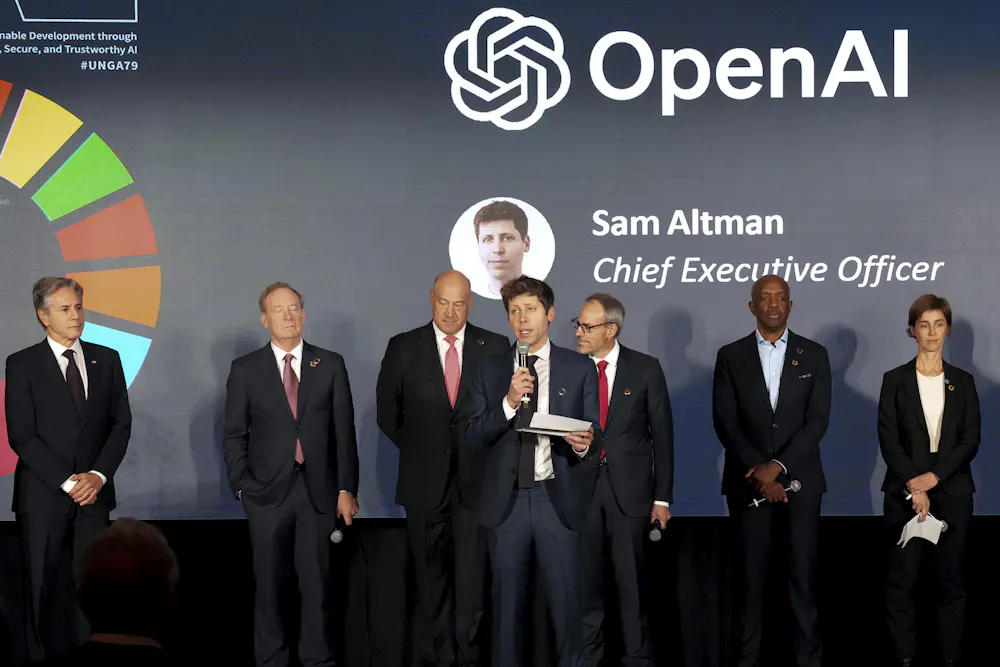
    Open AI CEO Sam Altman, center, speaks at an event in September 2024.
    Bryan R. Smith/Pool Photo via AP

    Why would OpenAI’s structure change?

    OpenAI’s deep-pocketed investors cannot own shares in the organization under its existing nonprofit governance structure, nor can they get a seat on its board of directors. That’s because OpenAI is incorporated as a nonprofit whose purpose is to benefit society rather than private interests. Until now, all rounds of investments, including a reported total of $13 billion from Microsoft, have been channeled through a for-profit subsidiary that belongs to the nonprofit.

    The current structure allows OpenAI to accept money from private investors in exchange for a future portion of its profits. But those investors do not get a voting seat on the board, and their profits are “capped.” According to information previously made public, OpenAI’s original investors can’t earn more than 100 times the money they provided. The goal of this hybrid governance model is to balance profits with OpenAI’s safety-focused mission.

    Becoming a for-profit enterprise would make it possible for its investors to acquire ownership stakes in OpenAI and no longer have to face a cap on their potential profits. Down the road, OpenAI could also go public and raise capital on the stock market.

    Altman reportedly seeks to personally acquire a 7% equity stake in OpenAI, according to a Bloomberg article that cited unnamed sources.

    That arrangement is not allowed for nonprofit executives, according to BoardSource, an association of nonprofit board members and executives. Instead, the association explains, nonprofits “must reinvest surpluses back into the organization and its tax-exempt purpose.”

    What kind of company might OpenAI become?

    The Washington Post and other media outlets have reported, also citing unnamed sources, that OpenAI might become a “public benefit corporation” – a business that aims to benefit society and earn profits.

    Examples of businesses with this status, known as B Corps., include outdoor clothing and gear company Patagonia and eyewear maker Warby Parker.

    It’s more typical that a for-profit businessnot a nonprofit – becomes a benefit corporation, according to the B Lab, a network that sets standards and offers certification for B Corps. It is unusual for a nonprofit to do this because nonprofit governance already requires those groups to benefit society.

    Boards of companies with this legal status are free to consider the interests of society, the environment and people who aren’t its shareholders, but that is not required. The board may still choose to make profits a top priority and can drop its benefit status to satisfy its investors. That is what online craft marketplace Etsy did in 2017, two years after becoming a publicly traded company.

    In my view, any attempt to convert a nonprofit into a public benefit corporation is a clear move away from focusing on the nonprofit’s mission. And there will be a risk that becoming a benefit corporation would just be a ploy to mask a shift toward focusing on revenue growth and investors’ profits.

    Many legal scholars and other experts are predicting that OpenAI will not do away with its hybrid ownership model entirely because of legal restrictions on the placement of nonprofit assets in private hands.

    But I think OpenAI has a possible workaround: It could try to dilute the nonprofit’s control by making it a minority shareholder in a new for-profit structure. This would effectively eliminate the nonprofit board’s power to hold the company accountable. Such a move could lead to an investigation by the office of the relevant state attorney general and potentially by the Internal Revenue Service.

    What could happen if OpenAI turns into a for-profit company?

    The stakes for society are high.

    AI’s potential harms are wide-ranging, and some are already apparent, such as deceptive political campaigns and bias in health care.

    If OpenAI, an industry leader, begins to focus more on earning profits than ensuring AI’s safety, I believe that these dangers could get worse. Geoffrey Hinton, who won the 2024 Nobel Prize in physics for his artificial intelligence research, has cautioned that AI may exacerbate inequality by replacing “lots of mundane jobs.” He believes that there’s a 50% probability “that we’ll have to confront the problem of AI trying to take over” from humanity.

    And even if OpenAI did retain board members for whom safety is a top concern, the only common denominator for the members of its new corporate board would be their obligation to protect the interests of the company’s shareholders, who would expect to earn a profit. While such expectations are common on a for-profit board, they constitute a conflict of interest on a nonprofit board where mission must come first and board members cannot benefit financially from the organization’s work.

    The arrangement would, no doubt, please OpenAI’s investors. But would it be good for society? The purpose of nonprofit control over a for-profit subsidiary is to ensure that profit does not interfere with the nonprofit’s mission. Without guardrails to ensure that the board seeks to limit harm to humanity from AI, there would be little reason for it to prevent the company from maximizing profit, even if its chatbots and other AI products endanger society.

    Regardless of what OpenAI does, most artificial intelligence companies are already for-profit businesses. So, in my view, the only way to manage the potential harms is through better industry standards and regulations that are starting to take shape.

    California’s governor vetoed such a bill in September 2024 on the grounds it would slow innovation – but I believe slowing it down is exactly what is needed, given the dangers AI already poses to society.

    Alnoor Ebrahim does not work for, consult, own shares in or receive funding from any company or organization that would benefit from this article, and has disclosed no relevant affiliations beyond their academic appointment.

    ref. As OpenAI attracts billions in new investment, its goal of balancing profit with purpose is getting more challenging to pull off – https://theconversation.com/as-openai-attracts-billions-in-new-investment-its-goal-of-balancing-profit-with-purpose-is-getting-more-challenging-to-pull-off-240602

    MIL OSI – Global Reports

  • MIL-OSI Global: Godzilla at 70: The monster’s warning to humanity is still urgent

    Source: The Conversation – USA – By Amanda Kennell, Assistant Professor of East Asian Languages and Cultures, University of Notre Dame

    The monster in the 2023 movie “Godzilla Minus One.” Toho Co. Ltd., CC BY-ND

    The 2024 Nobel Peace Prize has been awarded to Nihon Hidankyo, the Japan Confederation of A- and H-bomb Sufferers Organizations. Many of these witnesses have spent their lives warning of the dangers of nuclear war – but initially, much of the world didn’t want to hear it.

    “The fates of those who survived the infernos of Hiroshima and Nagasaki were long concealed and neglected,” the Nobel committee noted in its announcement. Local groups of nuclear survivors created Nihon Hidankyo in 1956 to fight back against this erasure.

    Atomic bomb survivor Masao Ito, 82, speaks at the park across from the Atomic Bomb Dome in Hiroshima in May 15, 2023.
    Richard A. Brooks/AFP via Getty Images

    Around the same time that Nihon Hidankyo was formed, Japan produced another warning: a towering monster who topples Tokyo with blasts of irradiated breath. The 1954 film “Godzilla” launched a franchise that has been warning viewers to take better care of the Earth for the past 70 years.

    We study popular Japanese media and business ethics and sustainability, but we found a common interest in Godzilla after the 2011 earthquake, tsunami and meltdown at Japan’s Fukushima Daiichi nuclear plant. In our view, these films convey a vital message about Earth’s creeping environmental catastrophe. Few survivors are left to warn humanity about the effects of nuclear weapons, but Godzilla remains eternal.

    Into the atomic age

    By 1954, Japan had survived almost a decade of nuclear exposure. In addition to the bombings of Hiroshima and Nagasaki, the Japanese people were affected by a series of U.S. nuclear tests in the Bikini Atoll.

    When the U.S. tested the world’s first hydrogen bomb in 1954, its devastation reached far outside the expected damage zone. Though it was far from the restricted zone, the Lucky Dragon No. 5 Japanese fishing boat and its crew were doused with irradiated ash. All fell ill, and one fisherman died within the year. Their tragedy was widely covered in the Japanese press as it unfolded.

    The Castle Bravo hydrogen bomb test on March 1, 1954, produced an explosion equivalent to 15 megatons of TNT, more than 2.5 times what scientists had expected. It released large quantities of radioactive debris into the atmosphere.

    This event is echoed in a scene at the beginning of “Godzilla” in which helpless Japanese boats are destroyed by an invisible force.

    “Godzilla” is full of deep social debates, complex characters and cutting-edge special effects for its time. Much of the film involves characters discussing their responsibilities – to each other, to society and to the environment.

    This seriousness, like the film itself, was practically buried outside of Japan by an alter ego, 1956’s “Godzilla, King of the Monsters!” American licensors cut the 1954 film apart, removed slow scenes, shot new footage featuring Canadian actor Raymond Burr, spliced it all together and dubbed their creation in English with an action-oriented script they wrote themselves.

    This version was what people outside of Japan knew as “Godzilla” until the Japanese film was released internationally for its 50th anniversary in 2004.

    From radiation to pollution

    While “King of the Monsters!” traveled the world, “Godzilla” spawned dozens of Japanese sequels and spinoffs. Godzilla slowly morphed from a murderous monster into a monstrous defender of humanity in the Japanese films, which was also reflected in the later U.S.-made films.

    In 1971, a new, younger creative team tried to define Godzilla for a new era with “Godzilla vs. Hedorah.” Director Yoshimitsu Banno joined the movie’s crew while he was promoting a recently completed documentary about natural disasters. That experience inspired him to redirect Godzilla from nuclear issues to pollution.

    World War II was fading from public memory. So were the massive Anpo protests of 1959 and 1960, which had mobilized up to one-third of the Japanese people to oppose renewal of the U.S.-Japan security treaty. Participants included housewives concerned by the news that fish caught by the Lucky Dragon No. 5 had been sold in Japanese grocery stores.

    At the same time, pollution was soaring. In 1969, Michiko Ishimure published “Paradise in the Sea of Sorrow: Our Minamata Disease,” a book that’s often viewed as a Japanese counterpart to “Silent Spring,” Rachel Carson’s environmental classic. Ishimure’s poetic descriptions of lives ruined by the Chisso Corp.’s dumping of methyl mercury into the Shiranui Sea awoke many in Japan to their government’s numerous failures to protect the public from industrial pollution.

    The Chisso Corp. released toxic methylmercury into Minamata Bay from 1932 to 1968, poisoning tens of thousands of people who ate local seafood.

    “Godzilla vs. Hedorah” is about Godzilla’s battles against Hedorah, a crash-landed alien that grows to monstrous size by feeding on toxic sludge and other forms of pollution. The film opens with a woman singing jazzily about environmental apocalypse as young people dance with abandon in an underground club.

    This combination of hopelessness and hedonism continues in an uneven film that includes everything from an extended shot of an oil slick-covered kitten to an animated sequence to Godzilla awkwardly levitating itself with its irradiated breath.

    After Godzilla defeats Hedorah at the end of the film, it pulls a handful of toxic sludge out of Hedorah’s torso, gazes at the sludge, then turns to stare at its human spectators – both those onscreen and the film’s audience. The message is clear: Don’t just lazily sing about imminent doom – shape up and do something.

    Official Japanese trailer for ‘Godzilla vs. Hedorah’

    “Godzilla vs. Hedorah” bombed at the box office but became a cult hit over time. Its positioning of Godzilla between Earth and those who would harm it resonates today in two separate Godzilla franchises.

    One line of movies comes from the original Japanese studio that produced “Godzilla.” The other line is produced by U.S. licensors making eco-blockbusters that merge the environmentalism of “Godzilla” with the spectacle of “King of the Monsters.”

    A meltdown of public trust

    The 2011 Fukushima disaster has now become part of the Japanese people’s collective memory. Cleanup and decommissioning of the damaged nuclear plant continues, amid controversies around ongoing releases of radioactive water used to cool the plant. Some residents are allowed to visit their homes but can’t move back there while thousands of workers remove topsoil, branches and other materials to decontaminate these areas.

    Before Fukushima, Japan derived one-third of its electricity from nuclear power. Public attitudes toward nuclear energy hardened after the disaster, especially as investigations showed that regulators had underestimated risks at the site. Although Japan needs to import about 90% of the energy it uses, today over 70% of the public opposes nuclear power.

    The first Japanese “Godzilla” film released after the Fukushima disaster, “Shin Godzilla” (2016), reboots the franchise in a contemporary Japan with a new type of Godzilla, in an eerie echo of the damages of and governmental response to Fukushima’s triple disaster. When the Japanese government is left leaderless and in disarray following initial counterattacks on Godzilla, a Japanese government official teams up with an American special envoy to freeze the newly named Godzilla in its tracks, before a fearful world unleashes its nuclear weapons once again.

    Their success suggests that while national governments have an important role to play in major disasters, successful recovery requires people who are empowered to act as individuals.

    The authors do not work for, consult, own shares in or receive funding from any company or organization that would benefit from this article, and have disclosed no relevant affiliations beyond their academic appointment.

    ref. Godzilla at 70: The monster’s warning to humanity is still urgent – https://theconversation.com/godzilla-at-70-the-monsters-warning-to-humanity-is-still-urgent-237934

    MIL OSI – Global Reports

  • MIL-OSI Global: The return of 90s culture echoes a backlash to feminism that we’ve seen throughout history

    Source: The Conversation – UK – By Julie Whiteman, Lecturer in Marketing, University of Birmingham

    I came of age in the 1990s and lived through the heavily gendered pop culture of Spice Girls and All Saints, Oasis and Blur, of lads and ladettes outdoing each other in heavy drinking and sexual exploits.

    Now in my 40s, I thought this brash and overtly sexist culture had faded out. It appeared to have been replaced by a socially progressive and inclusive generation focused on body and sex positivity, gender and sexual fluidity. And so I was surprised to see my generation Z research participants romanticise the 1990s as a belle epoque.

    First it was Sex and the City, then lad’s mag Loaded and now Oasis. Popular culture from the 1990s is having a moment in the mid-2020s. The 90s have been a stylistic and cultural influence on youth culture for the best part of a decade, with large amounts of money invested in big-name reboots and reunions.

    I began researching young adults’ sexual politics and their relationship to popular culture back in 2016. It was clear from my observations of the clothing, social media and references back then that the 90s were a major cultural influence. I remember being surprised by the popularity of the TV shows like Friends and musicians including Shaggy, Oasis and Suede from my own youth.

    Every generation has a romanticised nostalgia for the fashion, music and attitudes of the previous. When I was a teenager, my friends and I held a romanticised nostalgia for the music, fashion and sense of freedom we believed characterised the 60s and 70s. This view, however, did not align with my parents’ and their peers’ recollections of that time.


    Read more:
    Sick of reboots? How ‘nostalgia bait’ profits off Millennial and Gen Z’s childhood memories


    What is most interesting here is the apparent contradiction in values. The objectification of women at the heart of 90s pop culture does not gel with what we think of as the sexually open, progressive politics of generation Z. But having studied the intersection of pop culture and gender, I see this current resurgence as part of a misogynistic backlash to feminist progress – something that feminist scholars have highlighted as a typical pattern for years.

    Much of 90s popular culture is inherently misogynistic. Loaded and other now-defunct lads’ mags were infamous for their brutal objectification of women, including advice on how to get women into bed by almost any means. The celebrated lad culture epitomised by the likes of Oasis encouraged “men to be men”, with all the macho aggression and limited emotional range that implied.

    A damning 2012 National Union of Students report on sexual harassment and assault on university campuses made explicit links to the prevalence of lad culture in UK higher education. It argued lad culture at best objectifies and is dismissive of women, and at worst glamorises sexual assault.


    Read more:
    Sexual strangulation has become popular – but that doesn’t mean it’s wanted


    Gen Z is widely considered a generation of social activists, having grown up in the shadow of movements like #MeToo and the Women’s March that emerged in protest of the election of Donald Trump as US president. These cultural touchpoints in this generation’s upbringing highlight intersections of sex and power.

    Some young consumers have acknowledged this mismatch, describing Sex and the City as “outdated” and “cringey”. And incoming Loaded editor Danni Levy seems aware of it too, saying the relaunch is necessary because of the “world gone PC mad”.

    Why is 90s culture popular now?

    I argue the resurgence of 90s popular culture is actually part of a backlash against the progressive understandings of gender and sexuality associated with generation Z.

    Research indicates that gen Z men are less likely to support feminism than baby boomers. Young men and boys are increasingly being influenced by figures like self-proclaimed misogynist Andrew Tate, who faces charges of rape and human trafficking among other offences.

    While enjoying 90s television of course doesn’t mean you hold the same misogynistic views as Tate, I believe some popular culture is central to a continuum of backlash against feminist progress.

    To explain this, I suggest turning to feminist scholars – including one of my own 90s favourites, Susan Faludi’s excellent 1992 book Backlash: The undeclared war against women. In this work, Faludi details multiple periods of backlash against women’s liberation dating from 195BC. Each of these is linked to repeated “crises of masculinity”.

    Much feminist writing details how the very notion of masculinity depends on a subordinate femininity. And so, Faludi argues, advances in feminism equal a crisis of masculinity. Progress begets backlash, and popular culture is a key site where this takes place.

    Through my research I work to detail the subtle and nuanced ways this happens. I am currently researching how popular culture interprets and remixes progressive ideas like sex and gender positivity.

    At first glance, songs, films and shows may seem to be supportive of women’s sexual liberation, but on closer inspection they can reinforce traditional ideas of what it is to be a woman, or what it is to be attractive. Katy Perry’s recent music video Woman’s World is a classic example of this. Its lyrical appropriation of feminist messages of empowerment is delivered in an outdated visual style that adheres to the male gaze.

    Perry and her dancers strut around in swimwear costumes adapted to mimic various “masculine” professions. Critiqued for its lack of authenticity, Perry’s video represents a male sexual dreamworld that is inconsistent with the feminist politics it links itself to.

    There is often, in examples like this, a blurring of feminist and anti-feminist ideas – where it seems as though feminism is so commonsense it is no longer necessary, and is therefore neutralised.

    A multitude of literature on female sexual desire has emerged in the last few years. It is wide-ranging and imaginative. And yet, much of 90s popular culture flattens this complexity, painting female desire as only a desire to be desired by men.

    It prioritises male pleasure and advocates for their sexual dominance over women, reverting to understandings of “acceptable” sex as heterosexual, monogamous and male-led. Despite years of feminist progress, popular culture continues to teach us that women are objects of male sexual fantasy.

    Julie Whiteman does not work for, consult, own shares in or receive funding from any company or organisation that would benefit from this article, and has disclosed no relevant affiliations beyond their academic appointment.

    ref. The return of 90s culture echoes a backlash to feminism that we’ve seen throughout history – https://theconversation.com/the-return-of-90s-culture-echoes-a-backlash-to-feminism-that-weve-seen-throughout-history-238162

    MIL OSI – Global Reports

  • MIL-OSI Global: How Mpox anti-vaxx conspiracies target and stigmatise LGBTQ+ people

    Source: The Conversation – UK – By Helen McCarthy, Doctoral Researcher in Criminology and Sociology, York St John University

    According to some conspiracy theorists posting on alternative, uncensored social media networks, Mpox is another “scamdemic”, created by a powerful elite to cull populations and generate profit for “big pharma”. According to these social media users, anyone who takes the Mpox vaccine inevitably faces heart attack and death.

    Other Mpox conspiracies target hate at LGBTQ+ people.

    Through my PhD research into anti-vaccination misinformation, I’ve collected thousands of social media posts, videos, images and links from anti-vaccination Telegram channels, Substack newsletters and Gab groups. Gab Social is a social networking site known for hosting right-wing political content. These platforms are unique in their permissive approach to moderation. Users can post virtually anything they want without restraint.

    According to 2023 research, platforms like Gab have become the home of many “alt-right” content creators who have been de-platformed from mainstream social media channels like Facebook and Instagram. Mpox misinformation is thriving in these online locations.

    Sexuality and stigma

    In the early days of the COVID pandemic, a study identified that misinformation on social media platforms like Facebook, X (formerly known as Twitter) and YouTube frequently blamed specific social groups for infection surges. Now, it’s MPox’s turn.

    One Substack creator, for example, considers gay and bisexual men engaging in “high-risk sexual behaviour” a threat to the heterosexual population. He argues abstinence is the only solution – but only for men who have sex with men.

    As well as accusing gay and bisexual men of having a “perverted lifestyle that goes against nature and God’s laws”, some anti-vaxx content creators stigmatise people with Mpox as a hidden enemy, who could be “teaching in schools and indoctrinating children”.

    One common anti-vaxx conspiracy theory is “vaccine shedding”. This is the idea that vaccinated people can harm the unvaccinated through any kind of contact. One online conspiracy states the Mpox vaccine is particularly prone to shedding. Gay and bisexual men, then, are portrayed as dangerous whether they’re vaccinated or not.

    Mpox is routinely characterised by conspiracy theorists as a virus for immoral people. As a result, some anti-vaxx perspectives are shockingly callous – one commenter claims they wouldn’t care at all if “the gays and communists” died from the Mpox vaccine.

    Misinformation surrounding Mpox and the vaccine is peppered with such homophobic narratives of infection and contamination – and it’s familiar territory. People suffering from HIV and Aids in the 1980s and 1990s were relentlessly stigmatised as a dangerous other.

    While online conspiracy theories present those with Mpox as a menace, in reality, there have only been a small number of mild Mpox cases identified in the UK since 2022. Though the majority of confirmed cases of Mpox in the UK have been in gay and bisexual men – and Mpox can be transmitted through close sexual contact – people can also become infected if they’re exposed to coughing and sneezing, or share clothing, bedding and towels with an infected person.

    Moderation and misinformation

    In August 2024, a new strain of Mpox was identified in the Democratic Republic of the Congo and some neighbouring countries. An estimated 10 million vaccines are needed to meet demand in affected African nations. In September 2024, the UK government ordered 150,000 doses of an Mpox vaccine to be distributed among gay and bisexual men and healthcare and humanitarian workers who may be exposed.

    Just as many of us might check a reliable, verified medical source to find out more about Mpox, so alternative social media users look to the sources they trust. This commonly includes doctors blowing the whistle on alleged vaccine injury, conspiracy theory “news” sites and prominent right wing figures like Tucker Carlson. People selling alternative remedies and products promising miraculous detox are never far away to profit from vaccine misinformation.

    Users share these sources across Gab groups, comment threads and Telegram channels, layering their own beliefs on top. This generates even more views and shares, which is one of the reasons why social media is such a good incubator for conspiracy theories and misinformation.

    Another reason is the lack of content moderation on alternative social media sites. Substack describes itself as “a place for independent writing”. Users are not supposed to share any content which incites violence, contains sex or nudity, or illegal activity. Telegram takes a similar approach. Gab also draws the line at illegal content, but mainly encourages users to hide content they don’t want to see or ignore it.

    The arguments for or against unrestrained free speech on the internet are complex. But sites like Gab reveal what an unmoderated internet can look like – hate of every variety can find a home here if that’s what the users choose to post. Mpox is just another topic to generate even more shareable content.

    Helen McCarthy does not work for, consult, own shares in or receive funding from any company or organisation that would benefit from this article, and has disclosed no relevant affiliations beyond their academic appointment.

    ref. How Mpox anti-vaxx conspiracies target and stigmatise LGBTQ+ people – https://theconversation.com/how-mpox-anti-vaxx-conspiracies-target-and-stigmatise-lgbtq-people-239981

    MIL OSI – Global Reports

  • MIL-OSI USA: Disaster Recovery Centers Open in Aiken, Anderson Counties

    Source: US Federal Emergency Management Agency

    Headline: Disaster Recovery Centers Open in Aiken, Anderson Counties

    Disaster Recovery Centers Open in Aiken, Anderson Counties

    Disaster Recovery Centers are open in Aiken and Anderson counties to provide in-person assistance to South Carolinians affected by Hurricane Helene.  

    Aiken County 
    Nancy Carson Library
    135 Edgefield Road
    North Augusta, SC 29841 

    Open Oct. 14-17 from 8 a.m.-7 p.m. 

    Anderson County 
    Anderson County Library
    300 N. McDuffie St.
    Anderson, SC 29621 

    Open Oct. 14-17 from 9 a.m.-8 p.m.  

    These two locations join the centers previously opened in Barnwell, Greenville and Lexington counties. 

    Barnwell County 
    Barnwell Regional Airport
    155 State Road S-6-398
    Barnwell, SC 29812 

    Open Oct. 13–15 from 8 a.m.–7 p.m.  

    Greenville County 
    Freetown Community Center 
    200 Alice Ave. 
    Greenville, SC 29611 

    Open daily from 8 a.m.–7 p.m. 

    Lexington County 
    Batesburg-Leesville Fire Station 
    537 W. Church St.  
    Batesburg, SC 29006 

    Open Oct. 13–16 from 8 a.m.–7 p.m.   

    Additional Disaster Recovery Centers will open soon in more affected areas. You can visit any open center to meet with representatives of FEMA, the state of South Carolina and the U.S. Small Business Administration. No appointment is needed. To find other center locations, go to fema.gov/drc or text “DRC” and a Zip Code to 43362. 

    Homeowners and renters in Abbeville, Aiken, Allendale, Anderson, Bamberg, Barnwell, Beaufort, Cherokee, Chester, Edgefield, Fairfield, Greenville, Greenwood, Hampton, Jasper, Kershaw, Laurens, Lexington, McCormick, Newberry, Oconee, Orangeburg, Pickens, Richland, Saluda, Spartanburg, Union and York counties and tribal members of the Catawba Indian Nation can apply for federal assistance.

    The quickest way to apply is to go online to DisasterAssistance.gov. You can also apply using the FEMA App for mobile devices or calling toll-free 800-621-3362. The telephone line is open every day and help is available in many languages. If you use a relay service, such as Video Relay Service (VRS), captioned telephone or other service, give FEMA your number for that service. For a video with American Sign Language, voiceover and open captions about how to apply for FEMA assistance, select this link.

    FEMA programs are accessible to survivors with disabilities and others with access and functional needs. 

    kwei.nwaogu

    MIL OSI USA News

  • MIL-OSI Global: When AI plays favourites: How algorithmic bias shapes the hiring process

    Source: The Conversation – Canada – By Mehnaz Rafi, PhD Candidate, Haskayne School of Business, University of Calgary

    Given the rapid integration of AI into human resource management across many organizations, it’s important to raise awareness about the complex ethical challenges it presents. (Shutterstock)

    A public interest group filed a U.S. federal complaint against artificial intelligence hiring tool, HireVue, in 2019 for deceptive hiring practices. The software, which has been adopted by hundreds of companies, favoured certain facial expressions, speaking styles and tones of voice, disproportionately disadvantaging minority candidates.

    The Electronic Privacy Information Center argued HireVue’s results were “biased, unprovable and not replicable.” Though the company has since stopped using facial recognition, concerns remain about biases in other biometric data, such as speech patterns.

    Similarly, Amazon stopped using its AI recruitment tool, as reported in 2018, after discovering it was biased against women. The algorithm, trained on male-dominated resumes submitted over 10 years, favoured male candidates by downgrading applications that included the word “women’s” and penalizing graduates of women’s colleges. Engineers tried to address these biases, but could not guarantee neutrality, leading to the project’s cancellation.

    These examples highlight a growing concern in recruitment and selection: while some companies are using AI to remove human bias from hiring, it can often reinforce and amplify existing inequalities. Given the rapid integration of AI into human resource management across many organizations, it’s important to raise awareness about the complex ethical challenges it presents.

    Ways AI can create bias

    As companies increasingly rely on algorithms to make critical hiring decisions, it’s crucial to be aware of the following ways AI can create bias in hiring:

    1. Bias in training data. AI systems rely on large datasets — referred to as training data — to learn patterns and make decisions, but their accuracy and fairness are only as good as the data they are trained on. If this data contains historical hiring biases that favour specific demographics, the AI will adopt and reproduce those same biases. Amazon’s AI tool, for example, was trained on resumes from a male-dominated industry, which led to gender bias.

    2. Flawed data sampling. Flawed data sampling occurs when the dataset used to train an algorithm is not representative of the broader population it’s meant to serve. In the context of hiring, this can happen if training data over-represents certain groups —typically white men — while under-representing marginalized candidates.

    As a result, the AI may learn to favour the characteristics and experiences of the over-represented group while penalizing or overlooking those from underrepresented groups. For example, facial analysis technologies have shown to have higher error rates for racialized individuals, particularly racialized women, because they are underrepresented in the data used to train these systems.


    Read more:
    Artificial intelligence can discriminate on the basis of race and gender, and also age


    3. Bias in feature selection. When designing AI systems, developers choose certain features, attributes or characteristics to be prioritized or weighed more heavily when the AI is making decisions. But these selected features can lead to unfair, biased outcomes and perpetuate pre-existing inequalities.

    For example, AI might disproportionately value graduates from prestigious universities, which have historically been attended by people from privileged backgrounds. Or, it might prioritize work experiences that are more common among certain demographics.

    This problem is compounded when the features selected are proxies for protected characteristics, such as zip code, which can be strongly related to race and socioeconomic status due to historical housing segregation.

    Bias in hiring algorithms raises serious ethical concerns and demands greater attention toward the mindful, responsible and inclusive use of AI.
    (Shutterstock)

    4. Lack of transparency. Many AI systems function as “black boxes,” meaning their decision-making processes are opaque. This lack of transparency makes it difficult for organizations to identify where bias might exist and how it affects hiring decisions.

    Without insight into how an AI tool makes decisions, it’s difficult to correct biased outcomes or ensure fairness. Both Amazon and HireVue faced this issue; users and developers struggled to understand how the systems assessed candidates and why certain groups were excluded.

    5. Lack of human oversight. While AI plays an important role in many decision-making processes, it should augment, rather than replace, human judgment. Over-reliance on AI without adequate human oversight can lead to unchecked biases. This problem is exacerbated when hiring professionals trust AI more than their own judgment, believing in the technology’s infallibility.

    Overcoming algorithmic bias in hiring

    To mitigate these issues, companies must adopt strategies that prioritize inclusivity and transparency in AI-driven hiring processes. Below are some key solutions for overcoming AI bias:

    1. Diversify training data. One of the most effective ways to combat AI bias is to ensure training data is inclusive, diverse and representative of a wide range of candidates. This means including data from diverse racial, ethnic, gender, socioeconomic and educational backgrounds.

    2. Conduct regular bias audits. Frequent and thorough audits of AI systems should be conducted to identify patterns of bias and discrimination. This includes examining the algorithm’s outputs, decision-making processes and its impact on different demographic groups.

    It is important to actively involve human judgment in AI-driven decisions, particularly when making final hiring choices.
    (Shutterstock)

    3. Implement fairness-aware algorithms. Use AI software that incorporates fairness constraints and is designed to consider and mitigate bias by balancing outcomes for underrepresented groups. This can include integrating fairness metrics such as equal opportunity, modifying training data to show less bias and adjusting model predictions based on fairness criteria to increase equity.

    4. Increase transparency. Seek AI solutions that offer insight into their algorithms and decision-making processes to make it easier to identify and address potential biases. Additionally, make sure to disclose any use of AI in the hiring process to candidates to maintain transparency with your job applicants and other stakeholders.

    5. Maintain human oversight. To maintain control over hiring algorithms, managers and leaders must actively review AI-driven decisions, especially when making final hiring choices. Emerging research highlights the critical role of human oversight in safeguarding against the risks posed by AI applications. However, for this oversight to be effective and meaningful, leaders must ensure that ethical considerations are part of the hiring process and promote the responsible, inclusive and ethical use of AI.

    Bias in hiring algorithms raises serious ethical concerns and demands greater attention toward the mindful, responsible and inclusive use of AI. Understanding and addressing the ethical considerations and biases of AI-driven hiring is essential to ensuring fairer hiring outcomes and preventing technology from reinforcing systemic bias.

    Mehnaz Rafi does not work for, consult, own shares in or receive funding from any company or organisation that would benefit from this article, and has disclosed no relevant affiliations beyond their academic appointment.

    ref. When AI plays favourites: How algorithmic bias shapes the hiring process – https://theconversation.com/when-ai-plays-favourites-how-algorithmic-bias-shapes-the-hiring-process-239471

    MIL OSI – Global Reports

  • MIL-OSI Global: What you need to know about cold and flu season

    Source: The Conversation – Canada – By Jennifer Guthrie, Assistant Professor of Microbiology and Immunology, Western University

    Flu shots are recommended for most Canadians over six months old. (Shutterstock)

    As the fall months settle in, Canadians are being urged to take precautions against the upcoming flu season.

    Flu season in Canada typically peaks between December and February, but the virus can circulate much earlier. Public health officials are advocating for early vaccination, emphasizing that the annual flu vaccine is the most effective way to protect against infection and reduce the severity of illness.

    Clinics across Canada offer flu shots free of charge.

    Influenza

    Influenza, commonly known as the flu, is a respiratory illness caused by influenza viruses that spread easily from person to person. These viruses mainly affect the nose, throat and lungs. Flu symptoms typically include fever, chills, muscle aches, cough, congestion, runny nose, headaches and fatigue.

    Unlike the common cold, which often develops slowly, the flu tends to hit suddenly and can lead to severe complications like pneumonia, bronchitis and even death, particularly in high-risk groups such as young children, seniors over 65, pregnant individuals, and those with chronic conditions like asthma, diabetes or heart disease.

    Influenza spreads mainly through droplets when an infected person coughs, sneezes or talks. These droplets can land in the mouths or noses of people nearby, or they can linger on surfaces where the virus can survive for up to 48 hours. Preventive measures such as handwashing, mask-wearing and staying home when symptomatic help reduce the spread of the virus.

    How the flu vaccine works

    Each year, flu vaccines are updated to protect against the influenza viruses that research indicates will be most common during the upcoming season. The flu shot contains inactivated or weakened influenza viruses, which cannot cause the flu but help the immune system develop antibodies. These antibodies protect against infection when exposed to live flu viruses.

    The vaccine typically takes about two weeks after administration for immunity to build up, which is why public health officials recommend getting vaccinated in the fall, before flu rates start to rise. This gives individuals enough time to develop immunity before influenza becomes more widespread.

    Can you get flu and COVID-19 vaccines together?

    Each year, flu vaccines are updated to protect against the influenza viruses that research indicates will be most common during the upcoming season.
    (Shutterstock)

    Public health experts have confirmed that it is safe to receive the flu vaccine and the COVID-19 vaccine at the same time. Doing so can provide protection against both illnesses and reduce the chances of severe complications from either virus. Administering both vaccines during the same visit is a convenient way to ensure you’re protected for the season, especially as COVID-19 continues to circulate alongside influenza.

    Benefits of the flu shot

    One of the key benefits of flu vaccination is that it significantly reduces the risk of severe illness, hospitalization and death from the flu. While flu vaccines aren’t 100 per cent effective at preventing infection, they greatly lessen the severity of the illness and reduce the spread of the virus in the community. This is especially important for protecting high-risk groups like seniors, children, pregnant people and individuals with chronic health conditions.

    Additionally, widespread flu vaccination helps prevent the health-care system from becoming overwhelmed, especially in a year when other respiratory viruses like respiratory syncytial virus (RSV) and COVID-19 are still circulating. By reducing the overall number of flu-related hospitalizations, vaccines also free up health-care resources for other urgent needs.

    Why get vaccinated every year?

    One of the unique challenges of influenza is that the virus mutates constantly. Because of these frequent changes, immunity from last year’s vaccine won’t provide full protection this season. This is why the flu vaccine is updated annually to match the most prevalent strains of the virus.

    Even if a person received a flu shot the previous year, it’s important to get vaccinated again to stay protected against new viral strains circulating in the population. Flu vaccines are reformulated each year based on global surveillance data collected by organizations like the World Health Organization (WHO) and the U.S. Centers for Disease Control and Prevention (CDC).

    Misconceptions about the flu vaccine

    Despite clear benefits, misconceptions about the flu shot continue to contribute to low vaccination rates.

    Some people believe that the flu vaccine can cause the flu, but this is a myth. The inactivated viruses in the flu vaccine cannot cause illness. After receiving the vaccine, some people may experience mild side-effects like soreness at the injection site or a low-grade fever, but these symptoms are short-lived and far less severe than a full-blown flu infection.

    Another misconception is that the flu shot is not necessary for healthy adults. While healthy people may have a lower risk of severe flu complications, they can still spread the virus to more vulnerable individuals, such as young children, seniors or immunocompromised family members. Getting vaccinated helps protect both the individual and the community through herd immunity.

    Jennifer Guthrie does not work for, consult, own shares in or receive funding from any company or organisation that would benefit from this article, and has disclosed no relevant affiliations beyond their academic appointment.

    ref. What you need to know about cold and flu season – https://theconversation.com/what-you-need-to-know-about-cold-and-flu-season-240962

    MIL OSI – Global Reports

  • MIL-OSI: VERB Chairman & CEO Letter to Stockholders

    Source: GlobeNewswire (MIL-OSI)

    LOS ALAMITOS, Calif. and LAS VEGAS, Oct. 14, 2024 (GLOBE NEWSWIRE) — Verb Technology Company, Inc. (Nasdaq: VERB) (“VERB” or the “Company”), the company behind MARKET.live, a leading livestream social shopping platform, and GO FUND YOURSELF!, a TV show and innovative new platform disrupting the crowd funding industry, releases the full unredacted text of VERB Chairman & CEO Rory J. Cutaia’s Letter to Stockholders, distributed via Form 8-K filed on Friday, October 11, 2024.

    VERB Stockholders:

    I’m Rory J. Cutaia, VERB CEO, and I wanted to take this opportunity to share some information about the Company. Specifically, I want to address the recent reverse stock split, the current share price, the current businesses that comprise the Company, our financial condition, and finally, our future prospects.

    But first – here’s the headline – as of today, October 10, 2024, our market cap is approximately $3.8M, and as of our last Form 10-Q filing, we had cash in the bank of approximately $17.2M – and the only debt we have is a ridiculously small, low interest (3.75%), low payment, 30-year term SBA loan of approximately $125K.

    So do the math – this means if we traded at nothing more than our net cash value, the stock should be trading at more than $22 per share.

    And that assumes we get ZERO value for the underlying businesses – ZERO.

    It makes no sense to me that the stock should trade the way it does. I can only assume that people are not reading the filings, analyzing the financials, and recognizing the amazing opportunity that the new VERB represents.

    This is where I want to direct readers to the safe harbor provision disclosures at the bottom of this letter as I intend to make forward looking statements in what follows.

    We have completely restructured, realigned, reinvented, reconstituted, and reinvigorated our business. We sold an unprofitable business unit that was operating in a challenging business sector. We’ve since restructured VERB as a holding company with three distinct, yet complimentary business units, one of which we have yet to announce. Each is managed by a separate management team, incentivized for success, and all three are currently generating revenue and are growing and growing at a rate that far outpaces the rate of revenue growth we have ever experienced. Third quarter results will be exceedingly better than second quarter results as these business units are now hitting their stride, and based on what we’re seeing right now, fourth quarter will greatly exceed third quarter results.

    I believe we’ve placed ourselves atop a wave of three hot high-growth opportunities that are an outgrowth of recent changes in consumer, business, and societal behaviors, as well as recent changes in securities regulations, that are currently experiencing meaningful growth right now and into the foreseeable future.

    Our MARKET.live business has evolved to one of a service provider to brands fueled by our blossoming partnership with TikTok. Our revenue model has changed from a percent-of-client-sales model to a fixed-price, contract-based, recurring revenue business. Over the past six months you will have seen fewer MARKET.live businesses stream on MARKET.live – NOT because that business is declining – but because as we expanded our partnership with TikTok we shifted most of our live productions to TikTok Shop. A completely revamped MARKET.live is in the works and nearing release. More on that soon.

    Our GO FUND YOURSELF SHOW business vertical, though just-launched, is disrupting the equity crowd-funding sector, offering Reg CF and Reg A issuers an unmatched opportunity to create broad-based awareness for their equity offerings among the investment community. The GO FUND YOURSELF show format also reaches the everyman and everywoman non-accredited investor that can learn about and participate in these types of offerings. Our revenue model includes cash and equity-based fees paid by the issuers for appearances on the show, including fees for show assets we create for the issuers to use for their own marketing purposes. We also take a percentage of sales revenue from those issuers who utilize the Show’s unique shoppable platform to sell their products. We also generate revenue from sponsorships and advertisers.

    Our third business vertical is currently operating in stealth mode as we refine the user/subscriber experience. We believe this business represents an explosive revenue growth opportunity in one of the fastest-growing business sectors in the world today and I can’t wait to reveal it to you.

    As to the reverse stock split, we did everything reasonably possible – and then some – to avoid it. In the end, it’s not our call – let me repeat that because I don’t think some investors realize that – WE DON’T UNILATERALLY DECIDE TO DO A STOCK SPLIT. IT IS A DECISION MADE BY THE STOCKHOLDERS. Because of the way the stock traded, we received a delisting notice from Nasdaq.

    Our obligation as management and as board members is to take the steps required to give our stockholders the option to decide our path forward – delist from Nasdaq and potentially list on the OTC, or reverse split the shares and retain our Nasdaq listing. Neither management, nor our Board is able to implement a reverse stock split unless the stockholders decide to do so. Our job was to provide every stockholder with all the information needed to make that decision for themselves. If we had not given stockholders the option to choose, and if we had unilaterally decided NOT to do a reverse stock split, and we allowed VERB to be delisted – we would have violated our obligations to all stockholders and we would have been held accountable.

    On September 26, 2024, a significant majority of the stockholders that cast a vote, decided to do a reverse stock split in order to stay listed on Nasdaq. It was then our job to carry out that decision, which we’ve done. And now we look forward to the value creation opportunities that lay before us.

    We are extremely well capitalized – on even the most modest revenue assumptions, we have years of cash runway.

    We have virtually no debt to service.

    We have a super clean cap table – all of the warrants have either expired or are so far out of the money as to be irrelevant.

    There’s no hedge fund out there with cheap VERB shares they plan to short against warrants that they picked up for little or no consideration through a bad financing – as they simply don’t exist.

    We have an unbelievably small, tight float – only 763,230 shares as of October 9, 2024.

    We have three revenue generating, high-performing/growing business units.

    And once again – assuming all three of these businesses are worth zero – no value whatsoever – and we trade on nothing more than LIQUIDATION VALUE CASH IN THE BANK – we should be trading at more than $22 per share right now.

    Think about that.

    And think about this – as and when we see the stock trading in the range we believe it should – I will absolutely advocate for, and petition our Board to consider a FORWARD stock split. My interests are completely – 100% aligned with those of every stockholder – as are the interests of our management team and our Board.

    We win together and now is our time.

    Best,

    Rory

    FORWARD-LOOKING STATEMENTS

    This communication contains “forward-looking statements” as that term is defined in the Private Securities Litigation Reform Act of 1995. Forward-looking statements involve risks and uncertainties and include, without limitation, any statement that may predict, forecast, indicate or imply future results, performance, or achievements. Forward-looking statements are neither historical facts nor assurances of future performance. Instead, they are based only on our current beliefs, expectations and assumptions regarding the future of our business, future plans and strategies, projections, anticipated events and trends, the economy and other future conditions. Because forward-looking statements relate to the future, they are subject to inherent uncertainties, risks and changes in circumstances that are difficult to predict and many of which are outside of our control. Our actual results and financial condition may differ materially from those indicated in the forward-looking statements. Therefore, you should not rely on any of these forward-looking statements. Important factors that could cause our actual results and financial condition to differ materially from those indicated in the forward-looking statements include, among others, those identified in our filings with the Securities and Exchange Commission (the “SEC”), including the risk factors included in our annual report on Form 10-K filed with the SEC on April 1, 2024. Any forward-looking statement made by us herein is based only on information currently available to us and speaks only as of the date on which it is made. We undertake no obligation to publicly update any forward-looking statement whether as a result of new information, future developments or otherwise.

    About VERB Technology Company

    Verb Technology Company, Inc. (NASDAQ: VERB), is the innovative force behind interactive video-based social commerce. The Company’s MARKET.live platform is a multi-vendor, livestream social shopping destination at the forefront of the convergence of ecommerce and entertainment, where brands, retailers, creators, and influencers engage their customers, clients, fans, and followers across multiple social media channels simultaneously. GO FUND YOURSELF!, is a revolutionary interactive social crowd funding platform for public and private companies seeking broad-based exposure across social media channels for their crowd-funded Regulation CF and Regulation A offerings. The platform combines a ground-breaking interactive TV show with MARKET.live’s back-end capabilities allowing viewers to tap on their screen to facilitate an investment, in real time, as they watch companies presenting before the show’s panel of “Titans”. Presenting companies that sell consumer products are able to offer their products directly to viewers during the show in real time through shoppable onscreen icons. The Company is headquartered in Las Vegas, NV and operates full-service production and creator studios in Los Alamitos, California and Philadelphia, PA.

    Investor Relations:
    investors@verb.tech

    Media Contact: 
    info@verb.tech 

    The MIL Network

  • MIL-OSI Russia: Representatives of the State University of Management performed in the final of the All-Russian competition “Professional Tomorrow”

    MILES AXLE Translation. Region: Russian Federation –

    Source: State University of Management – Official website of the State –

    Representatives of the State University of Management took part in the final of the All-Russian network competition of student projects “Professional Tomorrow” with the participation of students with disabilities, which was held at the Novosibirsk State Technical University NETI.

    In 2024, the competition had two stages: correspondence and in-person. In total, students from 178 Russian universities from 71 regions took part, 115 students made it to the in-person stage.

    The State University of Management was among the universities that submitted the largest number of applications.

    33 students, including those with disabilities and health limitations, took part in the correspondence stage of the Competition from the RUC GUU and its partner universities in the assigned territories. Three projects became Laureates of the Competition and passed to the face-to-face stage.

    As part of the three-day program, the Institute of Social Technologies of NSTU NETI held defenses of competition works in six nominations: “Professionally Oriented Project”, “Scientific Article”, “Useful Invention”, “Professional Startup”, “Social Advertising and Inclusive Blogging”, and “Social Project”.

    The contestants were also offered a cultural, leisure and educational program, including field trips around Novosibirsk, master classes and motivational lectures.

    Tatyana Beregovskaya, coordinator of the RUC GUU, took part in the business program dedicated to the development of higher inclusive education.

    According to the results of the final, 4th year student of the Institute of Personnel Management, Social and Business Communications of the State University of Management Almira Valitova took 3rd place in the nomination “Professional Startup”, presenting a project aimed at creating a career guidance chatbot for schoolchildren with disabilities.

    Let us recall that the inclusive student competition has been held since 2018 by a network of resource educational and methodological centers for training people with disabilities and individuals with limited health capabilities together with the Ministry of Science and Higher Education of the Russian Federation.

    Subscribe to the TG channel “Our GUU” Date of publication: 10/14/2024

    Please note: This information is raw content directly from the source of the information. It is exactly what the source states and does not reflect the position of MIL-OSI or its clients.

    Please note; This information is raw content directly from the information source. It is accurate to what the source is stating and does not reflect the position of MIL-OSI or its clients.

    Representatives of the State University of Management performed in the final of the All-Russian competition “Professional Tomorrow”

    MIL OSI Russia News

  • MIL-OSI USA: How to Apply for FEMA Assistance in Florida After Hurricane Milton

    Source: US Federal Emergency Management Agency

    Headline: How to Apply for FEMA Assistance in Florida After Hurricane Milton

    How to Apply for FEMA Assistance in Florida After Hurricane Milton

    TALLAHASSEE, Fla. — Homeowners and renters in 34 Florida counties and the Miccosukee Tribe of Indians of Florida who had uninsured or underinsured damage or losses caused by Hurricane Milton may now apply for FEMA disaster assistance.

    FEMA may be able to help with serious needs, displacement, temporary lodging, basic home repair costs, personal property loss or other disaster-caused needs. Homeowners and renters in Brevard, Charlotte, Citrus, Clay, Collier, DeSoto, Duval, Flagler, Glades, Hardee, Hendry, Hernando, Highlands, Hillsborough, Indian River, Lake, Lee, Manatee, Marion, Martin, Okeechobee, Orange, Osceola, Palm Beach, Pasco, Pinellas, Polk, Putnam, Sarasota, Seminole, St. Johns, St. Lucie, Sumter and Volusia counties and the Miccosukee Tribe of Indians of Florida can apply.

    How to Apply

    If you applied to FEMA after Hurricanes Debby or Helene and have additional damage from Hurricane Milton, you will need to apply separately for Milton and provide the dates of your most recent damage. Apply online at DisasterAssistance.gov. You can also apply using the FEMA mobile app or by calling FEMA’s helpline toll-free at 800-621-3362. Lines are open every day and help is available in most languages. If you use a relay service, captioned telephone or other service, give FEMA your number for that service. To view an accessible video on how to apply visit Three Ways to Apply for FEMA Disaster Assistance – YouTube. 

    FEMA’s disaster assistance offers new benefits that provide flexible funding directly to survivors. In addition, a simplified process and expanded eligibility allows Floridians access to a wider range of assistance and funds for serious needs.

    What You’ll Need When You Apply

    • A current phone number where you can be contacted.
    • Your address at the time of the disaster and the address where you are now staying.
    • Your Social Security number.
    • A general list of damage and losses.
    • Banking information if you choose direct deposit.
    • If insured, the policy number or the agent and/or the company name.

    If you have homeowners, renters or flood insurance, file a claim as soon as possible. FEMA cannot duplicate benefits for losses covered by insurance. If your policy does not cover all your disaster expenses, you may be eligible for federal assistance.

    If you applied for assistance for multiple disasters, please note that each event may require a separate home inspection. During these inspections, the inspector will document damage and causes individually.

    FEMA is contacting registered applicants, including those affected by multiple disasters, to help them navigate the process more effectively. These calls may come from unfamiliar area codes or phone numbers. If you are concerned about verifying that FEMA is trying to reach you, call 800-621-3362. FEMA representatives never charge applicants for disaster assistance, FEMA services are free.

    As part of the Major Disaster Declaration, President Biden also authorized FEMA Public Assistance for debris removal and emergency protective measures, including Direct Federal Assistance, for 34 counties and the Miccosukee Tribe of Indians of Florida, and the Hazard Mitigation Grant Program statewide.

    For the latest information about Florida’s recovery, visit fema.gov/disaster/4834. Follow FEMA on X at x.com/femaregion4 or on Facebook at facebook.com/fema.

    kirsten.chambers

    MIL OSI USA News

  • MIL-OSI Europe: AMERICA/HONDURAS – One month after the murder of pastoral worker Juan Antonio López: Three suspects arrested in Honduras

    Source: Agenzia Fides – MIL OSI

    Monday, 14 October 2024

    by Laura Gomez RuizTocoa (Agenzia Fides) – On September 14, Juan Antonio López (46), married and father of two daughters, coordinator of social pastoral care in the diocese of Trujillo and founding member of the Pastoral Care for Integral Ecology in Honduras, was shot dead in his car after attending a Eucharistic celebration in the Fabio Ochoa colony in the municipality of Tocoa, a city where he was also a councilor, about 300 kilometers from Tegucigalpa, the capital of Honduras.López was known for his commitment to social justice and drew strength and courage from the source of his Christian faith. As the person in charge of preaching the Word of God in his parish and a member of the Ecclesial Ecological Network of Mesoamerica (REMAM), his special vocation also led him to work to protect natural resources for the benefit of the most vulnerable in his country. A commitment that brought him into conflict with the interests of the mining companies operating in Honduras.According to witnesses, armed men on motorcycles approached him as he was leaving the church where he had attended the Eucharist that evening and shot him. López died instantly. He had recently denounced the pollution of the Guapinol and San Pedro rivers, which are threatened by illegal mining projects that endanger the water resources on which local communities depend. According to investigators, this may have been the motive for his murder.Local media reported that the crime occurred just hours after a press conference in which López, along with other community leaders, denounced alleged links between members of the Tocoa municipal government and organized crime.The National Police, meanwhile, arrested several suspects, and last Wednesday a court in San Pedro Sula issued an indictment and remanded three alleged perpetrators in custody. The evidence presented included images from security cameras in which the defendants were identified, as well as testimony from protected persons. In addition, the geolocation of the defendants’ phones confirms the suspicion that they had been following the victim for days and planned the murder. The lawyer for Juan López’s family asked prison authorities to guarantee the safety of the defendants in the hope that they would reveal the names of those behind the crime.”Juan’s commitment to ecology was not ideological, but the fruit of his faith,” said the bishop of the diocese of Trujillo, Jenry Ruiz. In a message published after the murder, Ruiz wrote: “For him, social, environmental and political commitment was not a matter of ideology, but an expression of his Christianity. He was a true servant of God and a tireless defender of his people.”López lived with the conviction that faith must be translated into concrete actions in favor of the weakest. His devotion to Saint Oscar Romero and his work in grassroots ecclesial communities drove him to work for social justice and dedicate his life to protecting Honduras’ rural communities and natural resources.”He knew that his commitment to protecting water and rivers put him in danger,” said a relative of the victim, recalling that he had previously received threats. Since 2023, the Inter-American Commission on Human Rights (IACHR) had taken precautionary measures to protect him because he had received death threats for his work in defense of the environment.López’s murder is part of a growing repression against human rights activists in Honduras. “This crime is not an isolated case,” said REMAM and the “Laudato Sì” movement in a joint statement: “He is not just another name in the statistics; he was a child of God, a close and kind brother. We honor his testimony of faith and his work for a better common home,” added the Archbishop of Yucatán and President of REMAM, Gustavo Rodríguez Vega.Already in January 2022, there was a similar murder in Honduras: the pastoralworker Pablo Isabel Hernández (see Fides, 12/1/2022), was killed in the parish of San Marcos de Caiquín, in the department of Lempira, on his way to a celebration of the Word of God. In the same year, on March 2, the Catholic priest Enrique Vásquez was also killed on his way to his parents. His body was found north of San Pedro Sula, in Santa Cruz de Yojoa, with multiple gunshot wounds (see Fides, 4/3/2022).The Bishops’ Conference of Honduras, meanwhile, called on the authorities to conduct a thorough and transparent investigation. “We are deeply saddened,” the statement said the Bishops’ Conference, which asks the faithful to pray for López, “a true disciple and missionary”. “Juan Antonio López was a man committed to the truth, honest and courageous, who demonstrated his faith through his concrete actions,” say the bishops.Pope Francis, after the Angelus prayer, on Sunday 22 September, recalled the importance of protecting those who work for the common good. “I join in the grief of this local Church and in the condemnation of all forms of violence,” said the Pope, “I am close to all those who see their basic rights trampled on, as well as to those who work for the common good and in this way respond to the cry of the poor and the earth”, referring to the sad fate of Juan Antonio López. (Agenzia Fides, 14/10/2024)
    Share:

    MIL OSI Europe News

  • MIL-OSI: LAUD Launches Comprehensive Marketing Solutions for Fintech Companies: Leveraging Blockchain, and Advanced AI Tools

    Source: GlobeNewswire (MIL-OSI)

    LONDON, UK, Oct. 14, 2024 (GLOBE NEWSWIRE) — LAUD, a London-based marketing firm, is at the forefront of fintech innovation, providing comprehensive solutions that empower financial technology companies to maximize their digital presence and operational efficiency. Leveraging the power of blockchain and Web3 technology, LAUD’s specialized services enable fintech firms to streamline processes, optimize client engagement, and build stronger brand identities.

    “We understand the unique challenges faced by fintech companies and have developed tailored solutions that incorporate blockchain, Web3, and advanced AI tools to solve these pain points,” said a representative from LAUD. “Our goal is to help our clients navigate the complexities of the fintech ecosystem, from smart API integrations to CRM automation, ensuring they stay ahead of the competition.”

    In addition to their technology-driven solutions, LAUD offers a full suite of marketing services, including social media management, PR strategy development, and content creation. Their AI-powered social media management platform allows fintech companies to maintain an active online presence, engage with their audience more effectively, and optimize their digital footprint.

    LAUD’s team of experts works closely with clients to design and execute strategies that not only enhance brand visibility but also foster long-term growth. By utilizing advanced analytics and AI tools, LAUD ensures that every marketing campaign is data-driven, measurable, and aligned with the client’s business goals. For more information, visit their official website.

    LAUD is a London-based marketing firm specializing in solutions for fintech companies. Their services range from blockchain and Web3 integrations to CRM automation and AI-powered social media management. LAUD’s comprehensive approach helps fintech firms leverage the latest technologies to drive innovation and market growth.

    LAUD is specializing in solutions for fintech companies. Their services range from blockchain and Web3 integrations to CRM automation and AI-powered social media management. By implementing CRM automation, LAUD streamlines customer relationship processes, allowing fintech firms to enhance engagement, personalize communication, and improve customer retention. This automation not only saves time but also provides valuable insights into customer behavior, enabling companies to tailor their offerings effectively. Additionally, LAUD’s expertise in Web3 integrations empowers fintech businesses to tap into decentralized technologies, fostering transparency and security in transactions. This integration can lead to increased trust among users, thereby attracting a more extensive customer base.

    Through their comprehensive approach, LAUD helps fintech firms leverage the latest technologies to drive innovation and market growth, ensuring they remain competitive in a rapidly evolving landscape.

    Social Links

    LinkedIn: https://www.linkedin.com/company/laud-uk/

    Media contact

    Brand: LAUD

    Contact: Media team

    Email: support@laud.tech

    Website: https://laud.tech

    The MIL Network

  • MIL-OSI: Bybit Announces Growth Milestone for Liquid Staking Token bbSOL, Surpassing $100 Million in Locked Value

    Source: GlobeNewswire (MIL-OSI)

    DUBAI, United Arab Emirates, Oct. 14, 2024 (GLOBE NEWSWIRE) — Bybit, the world’s second-largest crypto exchange by trading volume, is thrilled to announce the continued growth and expansion of its innovative liquid staking token, bbSOL. As Bybit’s inaugural Liquid Staking Token (LST), bbSOL continues to offer users a seamless, secure way to stake SOL and earn competitive rewards.

    The rapid adoption of bbSOL has propelled its total locked value beyond 100 million USD in a short span. Beyond staking rewards, bbSOL holders can now further enhance their earning potential through three key opportunities:

    • Providing Liquidity to bbSOL Trading Pairs: Users can earn trading fees by contributing liquidity on decentralized exchanges such as Orca, Raydium and Kamino.
    • Utilizing bbSOL as Collateral: bbSOL can be used as collateral on partner platforms, including Drift, Kamino, marginfi, Save, enabling users to lend, borrow, and unlock higher returns.
    • Restaking bbSOL for Additional Rewards: Through partner platforms like Solayer, users can restake bbSOL to generate extra rewards while supporting the Solana network’s security and governance.

    “We’re excited to see bbSOL’s continued growth and success. The increasing total locked value demonstrates the trust and confidence our users have in bbSOL as a reliable and rewarding digital asset,” added Emily Bao, Head of Spot and Web3 at Bybit.

    As bbSOL’s reach extends across both centralized and decentralized exchanges, it solidifies its position as a premier liquid staking token. Bybit remains committed to offering innovative products and services that empower users to thrive in the digital asset space.

    #Bybit / #TheCryptoArk 

    About Bybit

    Bybit is the world’s second-largest cryptocurrency exchange by trading volume, serving over 50 million users. Established in 2018, Bybit provides a professional platform where crypto investors and traders can find an ultra-fast matching engine, 24/7 customer service, and multilingual community support. Bybit is a proud partner of Formula One’s reigning Constructors’ and Drivers’ champions: the Oracle Red Bull Racing team.

    For more details about Bybit, users can visit Bybit Press

    For media inquiries, users can contact: media@bybit.com

    For more information, users can visit: https://www.bybit.com

    For updates, users can follow: Bybit’s Communities and Social Media

    Contact

    Head of PR
    Tony Au
    Bybit
    tony.au@bybit.com

    The MIL Network

  • MIL-OSI: 2024 Digital Sales Evolution in the Channel Report: 90% of IT Solution Providers Expect a Rise in Marketplace Sales by 2029

    Source: GlobeNewswire (MIL-OSI)

    New survey finds online marketplaces are essential growth engines to expand customer base, offer new and improved services, and enhance profitability at scale

    DENVER, Oct. 14, 2024 (GLOBE NEWSWIRE) — Pax8, the leading cloud commerce marketplace, today announced the findings of its new global survey, commissioned by Channelnomics, of IT solution providers on the marketplace trends that are transforming the future of digital sales in the channel. Entitled, “Digital Sales Evolution in the Channel,” the report reveals nine out of 10 respondents are experiencing significant benefits of marketplaces and highlights opportunities to tap their customer data analytics and scalability to unlock new and recurring revenue streams.

    “As solution providers look to marketplaces as the sales channels of the future, they are best served by platforms with comprehensive e-commerce solutions that expand their digital capabilities, deliver a seamless online sales experience and maximize opportunities for upselling and cross-selling,” said Ryan Walsh, Chief Strategy Officer at Pax8. “The Pax8 Marketplace is designed to help partners unlock more sales opportunities and enhance relationships with their customers, providing them with the infrastructure and resources to drive profitability at scale.”

    Unlocking the Transformative Potential of Marketplaces

    Embracing the digital economy, more than one-third of solution providers globally generate more than 20% of their revenue through marketplaces. Further, the survey revealed 87% of respondents expect their use of marketplaces to increase in the next five years. Respondents in North America and Europe, where digital infrastructure and fulfillment systems for marketplace activities already exist, echo this sentiment.

    The emergence of marketplaces as growth engines enables solution providers to expand their reach, enhance profitability at scale, and offer new and improved services to customers. Among the vast potential that marketplaces offer, include:

    • Reaching larger audiences and demographics with minimal overhead, while driving sales volume and scalability simultaneously: The scalability of marketplaces enables providers to offer their product and services to a global market, unlocking new business opportunities, including increased profitability (46%), higher demand for professional services (45%), and better customer data analytics (38%).
    • Focusing sales strategies on the customer experience to sustain growth, specifically prioritizing customer retention and satisfaction: Globally, more than half of survey respondents (51%) are upgrading their sales technology and developing new partnerships (51%) and expanding their specialized services (46%) to provide a better customer experience.
    • Evolving GTM strategies shaped by customers buying preferences and behaviors: Three-quarters of respondents acknowledge that customer feedback about marketplace purchases is influencing their decision-making. Further, 46% of solution providers in North America report that customer feedback influences their decision making; 34% providers in Europe and just 18% in Asia-Pacific share this sentiment.

    Key Considerations for Marketplace Adoption

    As marketplace adoption comes into focus, solution providers are navigating a range of factors that can impact their success, from cost-savings to technological compatibility. Among the key considerations highlighted in the report include:

    • Prioritizing cost-effectiveness in the strategic development process: Nearly half of global respondents prioritize cost-effectiveness when developing their marketplace strategies, assessing costs related to fees, commissions, and marketing spend. Balancing incoming expenses against new revenue and growth streams are critical for maintaining scalable profitability.
    • Powering decision-making with advanced analytics: Digital sales platforms provide vast information about customers purchasing history and anticipatory needs through order consumption pattern analysis, data telemetry, and gap analytics. By leading decision-making with data-driven insights, solution providers can drive future sales and improve customer experiences.
    • Boosting sales with a user-friendly platform: A user-friendly marketplace enhances the experience for both solution providers and their customers, facilitating more transactions. Choosing a platform that offers an intuitive interface, efficient search functions, and easy product management can reduce technical barriers, boost profitability and maximize returns from technical infrastructure investments.

    “Marketplaces are becoming indispensable to managed service providers (MSPs) to scale more efficiently, tap into valuable customer insights, and drive new revenue streams,” said Larry Walsh, CEO and chief analyst at Channelnomics. “Our survey’s findings highlight the growing importance of digital sales platforms in transforming go-to-market strategies and optimizing the customer experience. As digital commerce evolves, MSPs should embrace these platforms to ensure long-term growth and profitability.”

    To learn more, download the Digital Sales Evolution in the Channel report here.

    About Pax8
    Pax8 is the technology marketplace of the future, linking partners, vendors, and small to midsized businesses (SMBs) through AI-powered insights and comprehensive product support. With a global partner ecosystem of over 35,000 managed service providers, Pax8 empowers SMBs worldwide by providing software and services that unlock their growth potential and enhance their security. Committed to innovating cloud commerce at scale, Pax8 drives customer acquisition and solution consumption across its entire ecosystem.
    Follow Pax8 on Blog, Facebook, LinkedIn, X, and YouTube

    About Channelnomics
    Channelnomics is a global analyst and research firm that helps technology vendors and service providers fine-tune their channels, win customers, and sharpen their competitive edge. The company offers a portfolio of best-in-class products and services, including research, market analysis, thought-leadership content, and expert guidance. The innovative analysts at Channelnomics leverage data to develop customized route-to-market strategies for any client that wants to translate vision into value.

    Visit us: http://www.channelnomics.com 
    Follow us: @channelnomics (LinkedIn | X (formerly Twitter) | YouTube)
    Contact us: info@channelnomics.com

    Media Contact:
    Kristen Beatty
    Sr. Director of Public Relations
    kbeatty@pax8.com

    The MIL Network

  • MIL-OSI Russia: Denis Manturov awarded the best exporters of Russia

    MILES AXLE Translation. Region: Russian Federation –

    Source: Government of the Russian Federation – An important disclaimer is at the bottom of this article.

    Denis Manturov presented awards to the winners of the All-Russian Exporter of the Year award at the international forum Made in Russia

    First Deputy Prime Minister Denis Manturov took part in the international forum “Made in Russia”, where he presented awards to the winners of the federal stage of the All-Russian “Exporter of the Year” award.

    The leaders of domestic exports were also congratulated on their high achievements by the Minister of Industry and Trade Anton Alikhanov, the Minister of Agriculture Oksana Lut, the Minister of Economic Development Maxim Reshetnikov, the Chairman of the All-Russian public organization “Business Russia” Alexey Repik, the President of the Chamber of Commerce and Industry Sergey Katyrin, the President of the Russian Union of Industrialists and Entrepreneurs Alexander Shokhin, the President of the All-Russian public organization of small and medium-sized businesses “Opora Rossii” Alexander Kalinin.

    “It is becoming increasingly difficult for us to identify the best of the best. Almost 1.7 thousand companies took part in this year’s competition, which together accounted for a tenth of the country’s non-resource non-energy exports in 2023. I would like to thank them all for their work in such difficult conditions. I would especially like to note the winners of the district stages of the Exporter of the Year award, your activities are of great importance for the development of our regions. We can and should look up to you, adopt your experience and best practices in conducting foreign economic activity,” Denis Manturov noted.

    The winners and prize winners of the All-Russian Prize in the field of international cooperation and export are determined in two stages: the first takes place at the level of each federal district, then the best exporters of the country are determined from among the companies that took first place according to the results of the district stage.

    “Exporter of the Year” is not only an opportunity to celebrate the achievements of our companies, but also a platform for exchanging experiences and best practices. We hope that this competition will inspire even more companies to develop their export activities and help them find new opportunities for growth and success in the international arena,” said Veronika Nikishina, CEO of the Russian Export Center (part of VEB.RF), following the award ceremony.

    Winners and prize winners were determined in 20 nominations: six main nominations (separately for SMEs and separately for large businesses, 12 in total) and five additional nominations (depending on the size of the company, 8 in total). Following the meetings of the unified district competition commission, 278 winners and prize winners were selected in eight federal districts. 117 companies entered the federal stage.

    Following the meeting of the federal competition commission, 62 winners and prize winners were determined (47 companies took prize places). The leader among the winning regions was Novosibirsk Oblast. Moscow Oblast was second in terms of export records. Third place was shared by St. Petersburg, Sverdlovsk and Volgograd Oblasts.

    The competition is held within the framework of the national project “International Cooperation and Export” with the support of the Ministry of Industry and Trade, the Ministry of Economic Development, and the Ministry of Agriculture.

    Please note: This information is raw content directly from the source of the information. It is exactly what the source states and does not reflect the position of MIL-OSI or its clients.

    Please note; This information is raw content directly from the information source. It is accurate to what the source is stating and does not reflect the position of MIL-OSI or its clients.

    http://government.ru/nevs/52990/

    MIL OSI Russia News

  • MIL-OSI: Solomon Partners Hires James Butcher as Managing Director in the Technology Group

    Source: GlobeNewswire (MIL-OSI)

    NEW YORK, Oct. 14, 2024 (GLOBE NEWSWIRE) — Solomon Partners, a leading financial advisory firm and independent affiliate of Natixis, announced the appointment of James Butcher as a Managing Director in the Technology group. Based in New York, he will focus on advising companies in the Information Services and Business-to-Business (B2B) sectors and will further enhance Solomon’s Software, Data & Analytics coverage.

    Mr. Butcher joined Solomon from Moelis & Company, where he served as a Managing Director. During his 13-year tenure, he worked with clients in the Media & Technology sector, acting as a trusted advisor to large corporations and mid-market companies, as well as financial sponsors, on a variety of transactions.

    Craig Muir, who joined Solomon in 2023 to build out the Technology practice, noted that Mr. Butcher’s addition to the team expands the range of companies Solomon can serve in the sector.

    “James brings a wealth of experience and expertise in the Information Services and B2B sectors,” Mr. Muir said. “This will be invaluable as we continue to expand our capabilities and deliver exceptional service to our clients.”

    Mr. Butcher commented, “I am excited to be joining Solomon Partners and the Technology group, both of which have significant momentum. I have been impressed by the caliber of the bankers and the firm’s commitment to providing our clients with unrivaled advice and creative solutions. I am looking forward to working with Craig and the team to continue to grow the Technology group and to expand our coverage of the Information Services and B2B sectors.”

    Mr. Butcher earned a BA from University College London and is a Chartered Accountant (FCA).

    To learn more, read a Q&A with Solomon CEO Marc Cooper and Mr. Butcher here.

    About Solomon Partners

    Founded in 1989, Solomon Partners is a leading financial advisory firm with a legacy as one of the oldest independent investment banks. Our difference is unmatched industry knowledge in the sectors we cover, creating superior value with unrivaled wisdom for our clients. We advise clients on mergers, acquisitions, divestitures, restructurings, recapitalizations, capital markets solutions and activism defense across a range of industries. These include Business Services, Consumer Retail, Distribution, Financial Services & FinTech, Financial Sponsors, Healthcare, Grocery, Pharmacy & Restaurants, Industrials, Infrastructure, Power & Renewables, Media and Technology. Solomon Partners is an independently operated affiliate of Natixis, part of Groupe BPCE. For further information, visit solomonpartners.com.

    A photo accompanying this announcement is available at https://www.globenewswire.com/NewsRoom/AttachmentNg/202b978d-935b-4af9-b0b6-120821f1c595

    The MIL Network

  • MIL-OSI: Commvault Joins the Pax8 Marketplace to Bring Enterprise Data Protection to SMBs

    Source: GlobeNewswire (MIL-OSI)

    DENVER, Oct. 14, 2024 (GLOBE NEWSWIRE) — Pax8, the leading cloud commerce marketplace, today announced that Commvault, a leader in cyber resilience and data protection solutions for hybrid cloud organizations, has joined the Pax8 Marketplace. Commvault Cloud is the solution that unifies all the company’s SaaS and software offerings on one platform built to meet the demands of the hybrid organization at the lowest total cost of ownership (TCO). Commvault Cloud combines cloud-based data security with rapid, enterprise-scale recovery and the industry’s most advanced AI to secure data anywhere it lives.

    “The addition of Commvault underscores our continued commitment to bring enterprise-level solutions to our managed service providers to deliver to their small to midsized business customers,” said Ryan Burton, Vice President of Marketplace Vendor Strategy at Pax8. “In addition to being the only vendor partner in Pax8’s Marketplace to backup Salesforce, Commvault Cloud can protect the broadest set of cloud, on-prem and hybrid environments and applications, including Microsoft Dynamics and Microsoft Entra ID, which will provide the flexibility and configurability that our partners want in a data protection solution.”

    Commvault Cloud unifies data protection and management in one single solution for a comprehensive set of workloads. The benefit to SMB customers includes having complete control over where their data is stored, with the option to select a country that maps back to a Microsoft Azure or Oracle Cloud Infrastructure (OCI) region that allows for in-country data residency. In addition, Commvault offers unparalleled flexibility, allowing customers to choose which data resides in primary or secondary storage tiers, optimizing cost and performance.

    “MSPs are a critical component of Commvault’s channel-first strategy and a key pillar for our future business. Today, we are excited for this new partnership to have Pax8 join our growing partner ecosystem and to be listed in the Pax Marketplace,” said Alan Atkinson, Chief Partner Officer, Commvault. “Through this partnership, Pax8’s growing global MSP community will now have access to the Commvault Cloud Platform, arming them with an industry-leading suite of solutions that will enhance their customers’ cyber resilience.”

    Commvault’s commitment to innovation and flexibility helps ensure that MSPs can deliver top-tier data protection services to small businesses, empowering them with the same level of security and control as large enterprises – all while reducing risk, minimizing downtime, and managing costs.

    Commvault is a Diamond sponsor and exhibitor at Pax8’s partner event, Beyond Berlin, October 13-15 at the InterContinental Berlin.

    About Pax8
    Pax8 is the technology marketplace of the future, linking partners, vendors, and small to midsized businesses (SMBs) through AI-powered insights and comprehensive product support. With a global partner ecosystem of over 35,000 managed service providers, Pax8 empowers SMBs worldwide by providing software and services that unlock their growth potential and enhance their security. Committed to innovating cloud commerce at scale, Pax8 drives customer acquisition and solution consumption across its entire ecosystem.

    Follow Pax8 on BlogFacebookLinkedInX, and YouTube

    Pax8 Media Contact:
    Kristen Beatty
    Sr. Director of Public Relations
    kbeatty@pax8.com

    The MIL Network

  • MIL-OSI: AI Powered Web3 wallet with chatGPT UI revolutionizing crypto trading

    Source: GlobeNewswire (MIL-OSI)

    SINGAPORE, Oct. 14, 2024 (GLOBE NEWSWIRE) — Armor Wallet unveils a next generation crypto wallet, powered by AI to supercharge crypto investing. It utilizes a chatGPT style text-to-prompt interface allowing users to type how they want to invest, buy, sell, DCA and more. The integrated AI agents execute your request without the user having to learn complex interfaces or understand crypto and financial jargon .Armor simplifies the often very complex and technical world of crypto investing.

    This wallet is solving one of the biggest problems in crypto. The ability to easily buy, sell, research and trade tokens and track your history, profit, loss and current position. If a person can type in plain english what they want to do, then Armor AI will turn it into a trade or asks additional questions to finalize the trade.

    “Buy $500 worth of Bitcoin.” The AI will find the best price of Bitcoin, place the order (spot price) and fill the order at once. Or maybe you want to wait to buy bitcoin in case the price lowers. Then you can ask “Buy $500 of bitcoin whenever it is down 10%. Armor will watch the market constantly and if the price of bitcoin goes down, it will place the order, anytime night or day.

    Armor Wallet is like having a broker or trading desk in your pocket. It can place very complex trades like dollar cost averaging over months, setup buy limits or sell on a given day and much more.

    The use of AI is to make investing simple and understandable for beginners, but it also benefits professional traders, giving them new tools to make very complex trades and do crucial market research. From scheduling future trades based on market conditions to understanding their past performance better, AI is a new tool for all types of investors.

    Armor Wallet’s AI is trained on Web3 culture as much as investing techniques and vocabulary. This gives the AI an edge in understanding the current trends and narrative that is critical when investing in crypto which is largely trend and narrative based. Armor can also be used with X (formerly Twitter) analyzing twitter accounts to better guidance to investors on new and popular tokens.

    Armor’s use of AI is not designed to try and forecast future crypto prices, it’s built to help users trade better, faster and put powerful trading tools into the hands of everyone with one simple and easy chat based interface. If everyone can easily invest in crypto like a pro we can onboard the next billion users and solve one of the biggest challenges in the space.

    AI is starting to benefit our daily lives and Armor Wallet is harnessing this powerful tool to make crypto investing safer, easier and more profitable than ever before.

    About

    Armor Wallet is an AI powered crypto wallet and trading assistant supporting multiple blockchains to make investing simple and safe. Bringing all your investing data together and managed by an intuitive chatGPT style interface, you have a complete overview of your portfolio. By utilizing AI Agents, Armor Wallet helps you do better research, avoid scams and create sophisticated trades that can execute 24/7.

    You can follow the project and stay up to date with its development at these links: Website | X (Twitter) | Telegram | Discord

    Contact Details:

    Stefan Savevski
    stefan@armorwallet.ai

    Disclaimer: This content is provided by “Armor”. The statements, views and opinions expressed in this column are solely those of the content provider. The information provided in this press release is not a solicitation for investment, nor is it intended as investment advice, financial advice, or trading advice. It is strongly recommended you practice due diligence, including consultation with a professional financial advisor, before investing in or trading cryptocurrency and securities. Please conduct your own research and invest at your own risk.

    Photo accompanying this announcement are available at

    https://www.globenewswire.com/NewsRoom/AttachmentNg/a75f7dee-b38d-49ee-9b61-8cb69f7cad47

    https://www.globenewswire.com/NewsRoom/AttachmentNg/33647cb4-7ab5-447a-9081-f60f95e03220

    The MIL Network

  • MIL-OSI USA: National Tripartite Alliance remains strong during changes

    Source: US International Brotherhood of Boilermakers

    Amid a time of significant change within the Boilermakers union, newly elected International President Tim Simmons set the tone for the 37th MOST National Tripartite Alliance conference held near San Diego Aug. 26-29.  Simmons gave a powerful message, emphasizing the union’s perseverance and the need to serve the members. 

    Simmons acknowledged recent news about indictments handed down by the Department of Justice and the federal investigation into the union, as well as the unprecedented changes in the union’s leadership.

     “We have a constitution that directs us…and we have followed the [Boilermakers union] constitution faithfully. We have made other changes, which our members have appreciated, our contractors have applauded and that have strengthened our organization.”

    He upheld that the union’s future is secure, while also recognizing that the path forward will likely not be without challenges. Simmons pointed to the Boilermakers’ history in steam and the doom that lay over the union when the locomotive steam engine was replaced by diesel—eliminating the bread-and-butter work of many Boilermakers. 

    “It was the dedication and adaptability of union Boilermakers that allowed us as an organization to change course and redirect our resources into new industries and technologies,” he said. “That same determination is alive and well today.”

    He also reaffirmed his commitment to working together with the International Executive Council, staff, local lodge leaders and members to press forward and ensure Boilermakers continue to be the skilled craftspeople contractors and owners know and trust to man their projects. 

    “We are here to listen to each other’s concerns and put our heads together to plot a path forward,” Simmons said. “We owe this to you, and we owe it to our brothers and sisters in the field who want to be able to provide for their families. 

    “The Boilermakers union has faced storms before, and we will do so again—but we will persevere. We were forged by those generations that came before us, and we will build on their foundation to make better the lives of those who come after us.”

    Sonya Bohmann, Executive Director of the Construction Industry Alliance for Suicide Prevention, underscored the critical issue of elevated suicide rates within the construction sector. Notably, the industry’s suicide rate is four times higher than the national average, making it the second highest among U.S. industries. Bohmann emphasized the importance of understanding mental health as a continuum, where individuals may fluctuate between thriving and struggling due to various life events. 

    She advocated for viewing mental health challenges as illnesses, rather than as moral failings. She highlighted that until the 1970s, suicide was considered a crime, leading to stigmatizing language that persists today. 

    Several factors contribute to the heightened suicide risk in construction, including high stress levels, demanding work conditions, and a culture that often stigmatizes seeking help. Additionally, the industry employs a significant number of veterans, who may face challenges stemming from combat-related traumas, further elevating the risk. 

    To address these challenges, CIASP is dedicated to creating a zero-suicide industry by providing resources and tools for suicide prevention and mental health promotion in construction. Bohmann advocates for peer-to-peer support, fostering social connectedness, and encouraging leadership to prioritize mental health alongside safety. She also stresses the importance of open conversations about mental health, suggesting that simple actions like checking in with colleagues or sharing supportive messages can make a significant difference.

    For immediate assistance, individuals can contact the 988 Suicide & Crisis Lifeline, which offers 24/7 access to trained crisis counselors. 

    Nuclear energy is gaining momentum on Wall Street, signaling a shift in this long-overlooked sector, according to Hilary Lane, Director of Fuel and Radiation Safety at the Nuclear Energy Institute. With 94 reactors across 53 U.S. sites, nuclear power provides about 18% of the nation’s energy and nearly half of its clean electricity. Its efficiency is notable, with a power capacity factor over 90%, far exceeding wind and solar’s 25-30%.

    The recent completion of Vogtle Units 3 and 4 in Georgia, each at 1,100 MW, marks a significant milestone for the industry. Looking ahead, nuclear capacity is expected to triple from 100 gigawatts to 300 gigawatts over the next 25 years, driven by advanced nuclear technologies. These range from micro-reactors to large-scale reactors capable of powering cities.

    Beyond electricity, advanced nuclear can produce hydrogen and provide industrial process heat. Sectors like data centers, oil and gas and artificial intelligence are exploring nuclear energy to meet their growing energy needs. Projects such as TerraPower in Wyoming, which is converting coal plants to nuclear, and X-energy in Texas, which is collaborating with Dow Chemical, highlight nuclear’s industrial potential.

    Federal support for nuclear is increasing, with new legislation and tax credits boosting the sector. Bipartisan backing at the state level is also rising, with many states lifting restrictions and exploring ways to accelerate nuclear energy’s growth.

    MOST Programs Administrator Mark Garrett shared training updates and changes to drug testing and OSHA 10. He said that he’s spoken with apprentice coordinators in different areas and is informed about those who are coming into the union who may already have an OSHA 10 certificate. If he can verify a member has passed OSHA 10, they don’t need to retake it. 

    “It streamlines the process and gets people to your jobsites,” he said. 

    Garrett also said that in July, the MOST Board of Trustees decided to remove testing for marijuana metabolites. He said if a contractor or owner requests this testing, it’s still available.

    Garrett said the new mental health program introduced last year has received positive feedback. “I feel like we can’t talk enough about the mental health program.” 

    Caucus reports delivered by chairmen representing each sector of the tripartite alliance detailed opportunities for improvement, but also praised successes. John Burnett with Chevron, chairman of the owners’ caucus, kicked off the reports noting several areas of importance to improve safety: hands-free standard for bolting, rigging training specific to the type of work to be performed, drug testing policies and concerns about opioid use, ongoing focus on significant injuries and fatalities, and attention to detail in permitting. 

    The owners’ caucus also identified staffing and productivity, quality and access requirements as topics to address.

    “We need more up-front discussions about manpower availability and experience, especially at the local level,” Burnett said. “We need more transparency on per diem to obtain quality craftsmen. And contractors should continue to raise the level of expectations. It’s something the owners are passionate about.”

    Owners had a frank discussion about quality, manpower, availability and experience. Burnett stressed the need for transparency in communicating needs among the owners, contractors and Boilermakers to ensure the best quality of work is produced. 

    Reporting for the contractors’ caucus was chairman Mike Bray, Senior Executive Consultant for Riggs Distler and Company, Inc. The caucus homed in on the need to understand referral rules, the need for open solicitation to man smaller work projects and the need for selectivity. Bray said contractors also want to better understand the M.O.R.E. Work Investment Fund—what’s available to help win work and how to go about utilizing the M.O.R.E. Work program.

    Training was also tops on their list, and Bray called for more or updated confined space training (some jobsites don’t accept MOST programs’ certification), advanced training on robotics, use and care of cordless tooling, and torquing and tension training. Also, he said, training is needed in new technology.

    “With new technology, we really have to train our people to get involved, to get into the scheduling and costing aspects of the business so that we can use Boilermakers on these jobs,” Bray said.

    Anthony Howell, AAIP and Executive Director-Construction Sector Operations, represented the labor caucus as chairman.

    Dovetailing with earlier reports, he began with the issue of travel cost and expenses Boilermakers incur to man projects, and he explained that being able to use per diem to offset those costs could make a big impact on recruiting.

    “It’s the first question they ask before they know anything else about us or the job: What’s the per diem?” he said.

    And, he said, the caucus also identified a need for better communication about the M.O.R.E. Work Investment Fund resources.

    “I spoke with some of the owners yesterday, and they told me how they appreciate how hard Boilermaker business managers and reps worked to respond to their needs,” he said. 

    “Anything that can be done to spread out work is good,” Bray said. “Those who are doing that are getting better manpower fulfillment.”

    The National Association of Construction Boilermaker Employers is 49 years old and continues to evolve by identifying and solving safety concerns. NACBE Executive Director Ron Traxler detailed programs offered by the organization, which was began as the result of tripartite discussions to address issues.

    “We’re like a three-legged stool,” Traxler began. “NACBE remains committed to our partnership. We do have a partnership with the IBB. We are stronger together. We all know that there have been some changes, but that’s what we do, we maximize on our strengths. We are stronger together and we must continue to work together.”

    He noted that combined, 417 years of experiences sits on the NACBE Board of Directors. He stressed the importance of being involved in the organization and its programs, especially those involved with safe working conditions. 

    “Safety is paramount, and we collaborate with MOST to educate and develop programs,” Traxler said. “We all need a safe work environment.”

    MIL OSI USA News

  • MIL-OSI USA: IAM Mechanics Local 701 Helps to Feed the Hungry

    Source: US GOIAM Union

    More than 120 members and volunteers from Chicagoland Mechanics Union Local 701 recently volunteered at Feed My Starving Children (FMSC), a charity organization in Aurora, Ill. This effort brought together Local 701 Business Representatives, staff, members, and families as part of the Local 701 annual IAM Midwest Territory H.E.L.P.S. Program.

    Local 701 members helped package 223 boxes, which will provide over 132 children with a daily meal for a year, totaling over 48,000 packaged meals.

    Share and Follow:

    MIL OSI USA News

  • MIL-OSI: Rihanna’s “Goodnight Gotham” Acquisition by Music Licensing, Inc. (OTC: SONG) Unlocks Significant Royalty Opportunities Across Global Platforms

    Source: GlobeNewswire (MIL-OSI)

    Naples, FL, Oct. 14, 2024 (GLOBE NEWSWIRE) — Rihanna’s hit track “Goodnight Gotham” has become a key asset in the expanding portfolio of Music Licensing, Inc. (OTC: SONG), following the company’s acquisition of the sound recording rights to the song. This strategic move complements Music Licensing, Inc.’s prior acquisition of the publishing rights to “Goodnight Gotham,” providing the company with comprehensive control over one of the most celebrated works by the globally renowned artist. With over 250 million records sold and 14 Billboard No. 1 hits, Rihanna’s catalog is a valuable asset in the global music rights market, and this acquisition positions Music Licensing, Inc. as a significant player in this fast-growing sector.

    The sound recording rights will continue to be administered by Universal Music Group (EURONEXT: UMG) (OTC: UNVGY) (OTC: UMGNF), while the publishing rights are administered by Kobalt Music Group. By securing both the sound recording and publishing rights, Music Licensing, Inc. (OTC: SONG) now holds a full stake in the work, opening up diverse revenue streams from multiple platforms and media channels.

    Value Proposition for Shareholders

    This acquisition is a milestone for Music Licensing, Inc. (OTC: SONG), as it underscores the company’s commitment to acquiring high-value, royalty-generating assets that promise consistent and scalable income. The ownership of both sound recording and publishing rights unlocks multiple revenue opportunities, ensuring Music Licensing, Inc. can capitalize on every instance of “Goodnight Gotham” being played, streamed, or licensed.

    Revenue Streams Across Global Platforms

    The acquisition allows Music Licensing, Inc. to generate income across various platforms, including:

    • Streaming Services: Royalties from top digital streaming platforms such as Spotify, Apple Music, Amazon Music, Deezer, Tidal, Tencent Music, and SoundCloud, ensuring consistent revenue from millions of listeners worldwide.
    • Social Media and Short-Form Video: Revenue generated through platforms like TikTok and Instagram, where music is an integral part of user-generated content, presents further monetization opportunities for “Goodnight Gotham” through sync and performance royalties.
    • Radio and Broadcast: Income from the song’s airplay on traditional and digital radio platforms, including iHeartMedia and SiriusXM, provides another consistent stream of royalties through public performance.
    • Synchronization (Sync) Licensing: High-value opportunities arise from licensing “Goodnight Gotham” for use in films, TV shows, commercials, and video games. Rihanna’s widespread appeal makes this track a strong candidate for premium sync placements, driving significant revenue.

    By owning both forms of intellectual property—sound recording and publishing—Music Licensing, Inc. (OTC: SONG) is in a unique position to maximize revenue from “Goodnight Gotham” across these diverse platforms.

    Strategic Growth Opportunity

    As global music consumption continues to rise, particularly through digital and streaming platforms, the acquisition of “Goodnight Gotham” gives Music Licensing, Inc. a valuable asset that offers steady, long-term revenue potential. The music rights industry is experiencing rapid growth, with expanding digital platforms and new technologies creating broader opportunities for music consumption and monetization. For shareholders, this acquisition represents a strategic entry into one of the most scalable sectors in entertainment, positioning Music Licensing, Inc. for sustainable growth and enhanced shareholder value.

    With platforms like Spotify, Apple Music, Deezer, Tidal, and more continuing to experience growth in user engagement and content demand, the value of rights to works like “Goodnight Gotham” will only increase, solidifying Music Licensing, Inc.’s role as a key player in the music rights and intellectual property space.

    About Music Licensing, Inc. (OTC: SONG) (ProMusicRights.com)

    Music Licensing, Inc. (OTC: SONG), also known as Pro Music Rights, is a diversified holding company and the fifth public performance rights organization (PRO) formed in the United States. Its licensees include notable companies such as TikTok, iHeart Media, Triller, Napster, 7Digital, Vevo, and many others. Pro Music Rights holds an estimated market share of 7.4% in the United States, representing over 2,500,000 works by notable artists such as A$AP Rocky, Wiz Khalifa, Pharrell, Young Jeezy, Juelz Santana, Lil Yachty, MoneyBagg Yo, Larry June, Trae Pound, Sauce Walka, Trae Tha Truth, Sosamann, Soulja Boy, Lex Luger, Trauma Tone, Lud Foe, SlowBucks, Gunplay, OG Maco, Rich The Kid, Fat Trel, Young Scooter, Nipsey Hussle, Famous Dex, Boosie Badazz, Shy Glizzy, 2 Chainz, Migos, Gucci Mane, Young Dolph, Trinidad James, Chingy, Lil Gnar, 3OhBlack, Curren$y, Fall Out Boy, Money Man, Dej Loaf, Lil Uzi Vert, and countless others, as well as artificial intelligence (A.I.) created music.

    Additionally, Music Licensing, Inc. (OTC: SONG) owns royalty stakes in Listerine “Mouthwash” Antiseptic and musical works by artists such as The Weeknd, Justin Bieber, Kanye West, Elton John, Mike Posner, blackbear, Lil Nas X, Lil Yachty, DaBaby, Stunna 4 Vegas, Miley Cyrus, Lil Wayne, XXXTentacion, Jeremih, Ty Dolla $ign, Eric Bellinger, Ne-Yo, MoneyBagg Yo, Halsey, Desiigner, DaniLeigh, Rihanna, and numerous others.

    Forward-Looking Statements:

    This press release contains certain forward-looking statements within the meaning of Section 27A of the Securities Act of 1933, as amended and Section 21E of the Securities Exchange Act of 1934, which are intended to be covered by the safe harbors created thereby. Investors are cautioned that, all forward-looking statements involve risks and uncertainties, including without limitation, the ability of Music Licensing, Inc. & Pro Music Rights, Inc. to accomplish its stated plan of business. Music Licensing, Inc. & Pro Music Rights, Inc. believes that the assumptions underlying the forward-looking statements contained herein are reasonable, any of the assumptions could be inaccurate, and therefore, there can be no assurance that the forward-looking statements included in this press release will prove to be accurate. In light of the significant uncertainties inherent in the forward-looking statements included herein, the inclusion of such information should not be regarded as a representation by Pro Music Rights, Inc., Music Licensing, Inc., or any other person.

    Non-Legal Advice Disclosure:

    This press release does not constitute legal advice, and readers are advised to seek legal counsel for any legal matters or questions related to the content herein.

    Non-Investment Advice Disclosure:

    This communication is intended solely for informational purposes and does not in any way imply or constitute a recommendation or solicitation for the purchase or sale of any securities, commodities, bonds, options, derivatives, or any other investment products. Any decisions related to investments should be made after thorough research and consultation with a qualified financial advisor or professional. We assume no liability for any actions taken or not taken based on the information provided in this communication.

    Contact: investors@ProMusicRights.com

    SOURCE: Music Licensing, Inc

    The MIL Network

  • MIL-OSI: Magnus Andersson announces his intention to leave Terranet in early 2025

    Source: GlobeNewswire (MIL-OSI)

    Terranet’s CEO Magnus Andersson has informed the Board of Directors that he intends to leave Terranet in early 2025 for a CEO position in another company in another industry.

    “Magnus has successfully led the development and commercialization work in Terranet and the company has delivered according to plan. It is of course sad that Magnus has chosen to leave the company. While the company has executed on the existing plan, we are now entering the next phase of the commercialization work. Magnus will assist with the handover when a new CEO is in place,” says Terranet’s Chairman of the Board Torgny Hellström.

    A recruitment process to find a successor has been initiated.

    This information is such that Terranet AB is required to make public in accordance with the EU’s Market Abuse Regulation (MAR). The information was made public by the Company’s contact person below on 14 October 2024, at 15.30 CET.

    For more information, please contact:        
    Torgny Hellström, Chairman of the Board        
    E-mail: torgny.hellstrom@terranet.se

    About Terranet AB (publ)
    Terranet’s goal is to save lives in urban traffic. The company develops innovative technical solutions for Advanced Driver Assistance Systems (ADAS) and Autonomous Vehicles (AV). Terranet’s anti-collision system BlincVision laser scans and detects road objects up to ten times faster than any other ADAS technology available today.

    The company is headquartered in Lund, with offices in Gothenburg and Stuttgart. Since 2017, Terranet has been listed on Nasdaq First North Premier Growth Market (Nasdaq: TERRNT-B). Follow our journey at: http://www.terranet.se

    Certified Adviser till Terranet är Mangold Fondkommission AB, 08-503 015 50, ca@mangold.se.

    Attachment

    The MIL Network

  • MIL-OSI: ManTech Appoints Michael Biddick Vice President of Enterprise Program Management, Standards and Quality Assurance

    Source: GlobeNewswire (MIL-OSI)

    HERNDON, Va., Oct. 14, 2024 (GLOBE NEWSWIRE) — ManTech, a leading provider of AI and mission-focused technology solutions, has named Michael Biddick Vice President of Enterprise Program Management, Standards and Quality Assurance.

    Biddick joins ManTech with a distinguished, two-decade career focused on client satisfaction and technology consulting. At ManTech he will accelerate enterprise-wide excellence in program execution and quality assurance aligned with strategy and technology, including digital transformation, AI/ML, cybersecurity and IT.

    “With a 25-year track record of proven expertise in tech consulting and entrepreneurship, Michael excels at building high-performing teams leveraging technology-enabled capabilities, software tools, effective performance measures and indicators to support client and program requirements,” said ManTech Executive Vice President & Chief Performance Officer Bonnie Cook.

    Prior to ManTech, Biddick worked at Gartner, Inc., as the Vice President and Managing Partner leading the national security consulting business, overseeing the growth and delivery of applied research solutions across the community. Prior to Gartner, Biddick founded and served as CEO of Fusion PPT, an award-winning IT consulting company. He also served as Chief Technology Officer of Windward, a successful IT consulting startup venture, and as Strategic Enterprise Network Consultant at Booz Allen Hamilton.

    Biddick holds a Master’s degree from the Johns Hopkins University Cary Business School and an undergraduate degree in Political Science and African American Studies from the University of Wisconsin.

    About ManTech  
    ManTech provides mission-focused technology solutions and services for U.S. Defense, Intelligence and Federal Civilian agencies. In business for more than 55 years, we are a leading provider of AI solutions that power full-spectrum cyber, data collection & analytics, enterprise IT, high-end engineering and software application development solutions that support national and homeland security. Additional information on ManTech can be found at http://www.mantech.com.

    Media Contact: 
    Jim Crawford 
    ManTech 
    Executive Director, External Communications 
    (M) 703-498-7315
    James.Crawford2@ManTech.com 

    A photo accompanying this announcement is available at https://www.globenewswire.com/NewsRoom/AttachmentNg/2e4fe903-5d95-4b83-b202-52ba6550b5da

    The MIL Network

  • MIL-OSI: WISeKey Subsidiary WISeSat to Launch Second Proof of Concept for SEALCOIN Token

    Source: GlobeNewswire (MIL-OSI)

    WISeKey Subsidiary WISeSat to Launch Second Proof of Concept for SEALCOIN Token

    Zug, Switzerland – October 14, 2024: WISeKey International Holding AG (“WISeKey”, SIX: WIHN), a global leader in cybersecurity, blockchain, and IoT solutions, today announced that its subsidiary, WISeSat.Space (“WISeSat”), will conduct the second Proof of Concept (PoC) for SEALCOIN by transacting tokens via satellites to IoT devices. The PoC is set to take place during the launch of a new generation of WISeSat satellites, planned for January 2025. This milestone, once complete, will represent a major leap forward in secure, autonomous machine-to-machine (M2M) transactions using WISeSat’s current satellite constellation.

    The launch of a new generation of WISeSat satellites will feature enhanced operational capabilities specifically designed to support M2M transactions from space. These next-generation satellites will further strengthen the WISeSat constellation, enabling secure and efficient decentralized transactions across a wide range of IoT devices, marking a new era in space-based digital ecosystems.

    This PoC will demonstrate SEALCOIN’s groundbreaking potential to facilitate decentralized transactions in the growing Internet of Things (IoT) ecosystem. Leveraging the SEALCOIN platform, the PoC will enable satellite-initiated transactions to IoT devices without human intervention. The tokens, based on Decentralized Ledger Technology (DLT), ensure secure, transparent, and tamper-proof exchanges, driving the creation of a scalable Transactional IoT (t-IoT) infrastructure.

    Previously, SEALCOIN successfully conducted a Proof of Concept (PoC) for Transactional-IoT (t-IoT) between two devices in early August. This milestone marked a significant step forward in the disintermediation of service providers for interconnected devices, showcasing the transformative potential of SEALCOIN’s innovative platform. For a video presentation of the initial PoC, please visit https://youtu.be/daOvoOxqGvQ.

    Transactional-IoT refers to the automated communication and transactions between devices within the Internet of Things (IoT) ecosystem. SEALCOIN’s PoC demonstrates the use of advanced technology embedded within a semiconductor device to validate and verify transactions autonomously. At the heart of this innovation is the Secure Element, an embedded security hardware that protects the private key and certificate representing the device’s unique identity. Leveraging elliptic curve cryptography (ECC) compatible with Hedera’s Decentralized Ledger Technology (DLT), the device can simultaneously authenticate and sign transactions on-chain.

    SEALCOIN AG

    Backed by over 25 years of experience in cybersecurity and secure semiconductor chips, embedded firmware, and trusted hardware provisioning services, SEALCOIN AG, the WISeKey subsidiary housing the SEALCOIN project, is establishing itself as a trusted partner in safeguarding digital assets. SEALCOIN AG was formed in collaboration with The Hashgraph Group AG, and is poised to revolutionize decentralized services and IoT markets.

    The SEALCOIN platform will seamlessly integrate physical security infrastructure with DLT components, bridging the gap between traditional secure systems and the decentralized digital future. The platform will ensure that all autonomous device interactions occur within a transparent, secure ecosystem, with SEALCOIN’s TIOT token serving as the key enabler of these interactions. This system is designed to eliminate bottlenecks and vulnerabilities associated with centralized transaction models, ushering in a new era of M2M transactions.

    Bridging Satellite and IoT Ecosystems

    SEALCOIN’s first PoC was a success, validating the feasibility of M2M transactions within a terrestrial framework. The second PoC will expand this capability to space-based systems, with SEALCOIN tokens transacted via WISeSat’s satellite constellation to IoT devices on the ground. This innovative approach demonstrates the scalability of decentralized infrastructures to handle real-world applications, from energy trading to automated service exchanges.

    Towards a Decentralized IoT Marketplace

    With SEALCOIN’s TIOT token, IoT devices can autonomously negotiate, execute, and settle transactions securely, without the need for human intervention or centralized intermediaries. This decentralized marketplace allows devices to participate in service-for-payment exchanges and other automated processes, all powered by SEALCOIN’s TIOT token.

    Carlos Moreira, CEO of WISeKey, commented, “This PoC marks an important step towards enabling seamless, decentralized M2M transactions from space. With the SEALCOIN token and WISeSat’s satellite infrastructure, we are moving closer to a future where IoT devices can securely and autonomously manage transactions across vast, interconnected ecosystems. The upcoming launch of the new generation of WISeSat satellites in January 2025 will further accelerate our vision of a decentralized, space-powered IoT network.”

    For more information on WISeSat, SEALCOIN, and their decentralized IoT solutions, please visit http://www.wisekey.com and http://www.sealcoin.com.

    About SEALCOIN AG
    SEALCOIN is a decentralized platform designed to facilitate secure, autonomous transactions between IoT devices. Built on Hedera Hashgraph, SEALCOIN allows devices to engage in seamless service-for-payment exchanges without the need for intermediaries. With a focus on privacy, scalability, and decentralized governance, SEALCOIN is poised to revolutionize the Internet of Things (IoT) landscape.

    About WISeSat.Space

    WISeSat AG is pioneering a transformative approach to IoT connectivity and climate change monitoring through its innovative satellite constellation. By providing cost-effective, secure, and global IoT connectivity, WISeSat is enabling a wide range of applications that support environmental monitoring, disaster management, and sustainable practices. The integration of satellite data with advanced climate models holds great promise for enhancing our understanding of climate change and developing effective strategies to combat its impacts. As the world continues to grapple with the challenges of climate change, initiatives like WISeSat’s IoT satellite constellation are essential for creating a more resilient and sustainable future.

    About WISeKey

    WISeKey International Holding Ltd (“WISeKey”, SIX: WIHN; Nasdaq: WKEY) is a Swiss-based computer infrastructure company specializing in cybersecurity, digital identity, blockchain, Internet of Things (IoT) solutions, and post-quantum semiconductors. As a computer infrastructure company, WISeKey provides secure platforms for data and device management across industries like finance, healthcare, and government. It leverages its Public Key Infrastructure (PKI) to ensure encrypted communications and authentication, while also focusing on next-generation security through post-quantum cryptography.

    WISeKey’s work with post-quantum semiconductors is aimed at future-proofing its security solutions against the threats posed by quantum computing. These advanced semiconductors support encryption that can withstand the computational power of quantum computers, ensuring the long-term security of connected devices and critical infrastructure. Combined with its expertise in blockchain and IoT, WISeKey’s post-quantum technologies provide a robust foundation for secure digital ecosystems at the hardware, software, and network levels.

    WISeKey operates as a holding company through several operational subsidiaries, each dedicated to specific aspects of its technology portfolio. The subsidiaries include (i) SEALSQ Corp (Nasdaq: LAES), which focuses on semiconductors, PKI, and post-quantum technology products, (ii) WISeKey SA which specializes in RoT and PKI solutions for secure authentication and identification in IoT, Blockchain, and AI, (iii) WISeSat AG which focuses on space technology for secure satellite communication, specifically for IoT applications, (iv) WISe.ART Corp which focuses on trusted blockchain NFTs and operates the WISe.ART marketplace for secure NFT transactions, and (v) SEALCOIN AG which focuses on decentralized physical internet with DePIN technology and house the development of the SEALCOIN platform.

    For more information on WISeKey’s strategic direction and its subsidiary companies, please visit http://www.wisekey.com.

    Disclaimer
    This communication expressly or implicitly contains certain forward-looking statements concerning WISeKey International Holding Ltd and its business. Such statements involve certain known and unknown risks, uncertainties and other factors, which could cause the actual results, financial condition, performance or achievements of WISeKey International Holding Ltd to be materially different from any future results, performance or achievements expressed or implied by such forward-looking statements. WISeKey International Holding Ltd is providing this communication as of this date and does not undertake to update any forward-looking statements contained herein as a result of new information, future events or otherwise.

    This press release does not constitute an offer to sell, or a solicitation of an offer to buy, any securities, and it does not constitute an offering prospectus within the meaning of the Swiss Financial Services Act (“FinSA”), the FinSa’s predecessor legislation or advertising within the meaning of the FinSA. Investors must rely on their own evaluation of WISeKey and its securities, including the merits and risks involved. Nothing contained herein is, or shall be relied on as, a promise or representation as to the future performance of WISeKey.

    Press and Investor Contacts

    WISeKey International Holding Ltd 
    Company Contact:  Carlos Moreira
    Chairman & CEO
    Tel: +41 22 594 3000
    info@wisekey.com
    WISeKey Investor Relations (US) 
    The Equity Group Inc.
    Lena Cati
    Tel: +1 212 836-9611 / lcati@equityny.com
    Katie Murphy
    Tel: +1 212 836-9612 / kmurphy@equityny.com

    The MIL Network

  • MIL-OSI: Inside information, positive profit warning: OP Financial Group estimates that its operating profit for 2024 will be higher than that of 2023

    Source: GlobeNewswire (MIL-OSI)

    OP Financial Group
    Inside information
    Stock exchange release, 14 October 2024 at 16:30 EEST

    Inside information, positive profit warning: OP Financial Group estimates that its operating profit for 2024 will be higher than that of 2023

    In its stock exchange release of 15 August 2024, OP Financial Group estimated that its operating profit would be at the same level as that of 2023.

    In 2023, OP Financial Group’s operating profit was EUR 2,050 million.

    OP Financial Group now estimates that its operating profit for 2024 will be higher than its operating profit for 2023.

    In particular, this estimate is based on better-than-expected developments in income from investment activities and impairment loss on receivables.

    OP Financial Group’s earnings performance is currently affected by uncertainties. The most significant uncertainties affecting its earning performance in late 2024 concern developments in the business environment, changes in the interest rate and investment environment, and developments in impairment loss on receivables.

    OP Financial Group’s Interim Report for 1 January–30 September 2024 will be published on 31 October 2024.

    OP Cooperative
    OP Corporate Bank plc

    Additional information:
    OP Financial Group’s Investor Relations, IR@op.fi

    Media enquiries:
    OP Financial Group’s Corporate Communications, tel. +358 10 252 8719, viestinta@op.fi

    DISTRIBUTION
    Nasdaq Helsinki Ltd
    Euronext Dublin (Irish Stock Exchange)
    LSE London Stock Exchange
    Major media
    op.fi

    OP Financial Group is Finland’s largest financial services group, with more than two million owner-customers and over 14,000 employees. We provide a comprehensive range of banking and insurance services for personal and corporate customers. OP Financial Group consists of OP cooperative banks, its central cooperative OP Cooperative, and the latter’s subsidiaries and affiliates. Our mission is to promote the sustainable prosperity, security and wellbeing of our owner-customers and operating region. Together with our owner-customers, we have been building Finnish society and a sustainable future for 120 years now. http://www.op.fi

    The MIL Network

  • MIL-OSI: Agillic audited in accordance with ISAE 3000 Type 2, testament to its commitment to security and compliance

    Source: GlobeNewswire (MIL-OSI)

    Press Release, Copenhagen, 14 October, 2024 

    Data security is non-negotiable. That is why the Agillic platform has undergone a rigorous independent audit of security practices and ensuring full compliance with GDPR and other regulatory requirements.

    Agillic’s security measures include strong encryption, continuous monitoring, stringent access controls, risk assessments, penetration tests, and vulnerability scans are performed regularly to stay ahead of potential threats.

    The ISAE 3000 Type 2 audit is an important and valuable part of Agillic’s ways to conduct business for the many different industries using the platform – not least the finance and public sectors. 

    Says Allan Sørensen, VP, Service Operations:
    “At Agillic, we prioritise our clients’ data security and privacy. We are proud to announce that our omnichannel marketing platform has been independently audited by Deloitte in accordance with the international ISAE 3000 Type 2 standard. This audit underscores our unwavering commitment to protecting clients’ data and ensuring compliance with the highest standards in information security.”

    For further information, please contact
    Emre Gürsoy, CEO, Agillic A/S
    +45 3078 4200
    emre.gursoy@agillic.com

    About Agillic A/S
    Agillic (Nasdaq First North Growth Market Copenhagen: AGILC) is a Danish software company offering brands a platform through which they can work with data-driven insights and content to create, automate and send personalised communication to millions. Agillic is headquartered in Copenhagen, Denmark, with teams in Germany, Norway, and Romania.
    Agillic A/S – Masnedøgade 22 – 2100 Copenhagen – Denmark – www.agillic.com

    The MIL Network

  • MIL-OSI Russia: Time to Become Leaders – The Second Stream of the Leaders of the Future Program Has Been Launched

    MILES AXLE Translation. Region: Russian Federation –

    Source: Peter the Great St Petersburg Polytechnic University – Peter the Great St Petersburg Polytechnic University –

    On October 7, at the opening of the second stream of the “Leaders of the Future St. Petersburg” program, the organizers and graduates spoke, sharing their thoughts and experiences.

    The goal of the program is to help students not only gain important knowledge, but also develop creative thinking and the ability to build a strategic vision, which is essential in any field, be it entrepreneurship or working in a large corporation.

    The Leaders of Tomorrow program has already established itself as a successful educational project, providing students with the necessary tools to create their own projects and prepare for career challenges.

    As noted by the Vice-Rector for Continuing and Pre-University Education Dmitry Tikhonov, the success of the program is directly related to the involvement of the participants. Despite the length and complexity of the program “Leaders of the Future. Petersburg”, the participants of the first stream successfully reached the presentation of the final projects.

    Entrepreneurship is a state of mind, and it can be developed in any status and work team. The main thing is to think creatively and see the value of your business, – Dmitry Vladimirovich emphasized.

    The program also helps students understand that leadership is not only about being responsible for a team, but also about being able to see your project through to the end, despite obstacles. Konstantin Mashyanov, a graduate of the first cohort of the program and a Master’s student at the Institute of Mechanical Engineering, Materials and Transport, gave new participants advice on the importance of useful projects: You need to create and implement not just ideas, but real tools that can benefit a company, society or a specific person.

    The assembled audience has already demonstrated a high interest in the program and is ready to take an active part in its implementation. The organizers promise intensive training with practical tasks and the opportunity to work on real projects.

    The program provides knowledge and develops skills that can be used in any professional activity. We help students develop leadership and entrepreneurial qualities, as well as create communities and projects aimed at improving life around them, – shared the organizer of the program Anastasia Davydova.

    Please note: This information is raw content directly from the source of the information. It is exactly what the source states and does not reflect the position of MIL-OSI or its clients.

    Please note; This information is raw content directly from the information source. It is accurate to what the source is stating and does not reflect the position of MIL-OSI or its clients.

    http://www.spbstu.ru/media/nevs/education/time-to-become-leaders-second-stream-of-the-future-leaders-program-launched/

    MIL OSI Russia News

  • MIL-OSI: BIO-key Accelerates Zero Trust Solutions at Industry-Leading Cybersecurity Conference, ISC² Security Congress 2024

    Source: GlobeNewswire (MIL-OSI)

    LAS VEGAS and HOLMDEL, N.J., Oct. 14, 2024 (GLOBE NEWSWIRE) — BIO-key® International, Inc. (NASDAQ: BKYI), an innovative provider of workforce and customer identity and access management (IAM) solutions featuring phoneless, tokenless, passwordless and phish-resistant authentication solutions, announced the company will sponsor, speak, and exhibit at ISC2 Security Congress 2024, in Las Vegas on October 14 – 16, 2024. BIO-key will be hosting a session on Passkeys. Passkeys and zero trust are core enabling concepts of the National Institute of Standards and Technology (NIST) guidance on cybersecurity for digital identities. Passkeys are identified as aiding adherence to NIST Authentication Assurance Levels (AAL) standards in the NIST 800-63B Passkey Supplementary Guidelines released in May 2024.  

    Passkeys have historically been stored or secured by phones, personal laptops or hardware tokens but many enterprise users work in phone-free, roving user environments. The cost of hardware tokens for thousands of users becomes a drain on critical security budgets. BIO-key’s core differentiator in the authentication category is allowing users to take advantage of a biometric passwordless authentication solution that does not require the use of phones or tokens. This unique capability fills a crucial business use case gap that traditional MFA overlooks – roving users working without phones, providing a secure authentication experience that reduces the total cost of ownership and provides the highest levels of usability and security. BIO-key’s award-winning unified IAM platform, PortalGuard®, has helped organizations of all sizes balance risk with flexibility and productivity for users and identity administrators. The company’s newest offering, Passkey:YOU brings a phoneless, tokenless, passwordless experience to any IdP via a managed passkey secured by a touch of a fingerprint or any door badge.

    The ISC2 Security Congress, themed “Boldly Forward,” brings together thousands of cybersecurity professionals and inspires attendees from all stages of the cybersecurity profession to elevate their careers, providing the opportunity to acquire new strategies, skills, and expertise to overcome the industry’s most pressing challenges.

    “Continuous Education is vital for security professionals to stay ahead of innovative threat actors,” states BIO-key’s Director of Marketing, Mary Roark, CISSP. “Conferences such as this provide attendees with interactive sessions where everyone can learn something new and put it into practice as soon as they return to the office.”

    Attendees are encouraged to stop by booth 716 or join the virtual conference to learn about BIO-key’s IAM solutions and the new Passkey: YOU. If you plan to attend the event, we invite you to our live speaking session: “Introducing Passkey:YOU – a Passwordless Authentication Solution that Checks All the Boxes.” Join us on Monday, October 14, from 12:45 to 1:10 PM PT in Theatre 1. 

    “From shared workstations to remote access, to users prohibited from having phones or tokens, enterprises face a complex and ever-changing landscape of access requirements,” said Galen Rodgers, VP of North America Sales & Channel. “Traditional authentication methods are insufficient, so security leaders attending ISC2 are exploring solutions that can offer flexibility to accommodate the needs of diverse users and use cases while maintaining the highest level of security. BIO-key is confident that adding passkeys and biometric authentication will accelerate their zero trust strategies.”

    RESOURCES:
    https://www.bio-key.com/identity-bound-biometrics/passkey-authentication/ 

    About BIO-key International, Inc. (http://www.BIO-key.com)
    BIO-key is revolutionizing authentication and cybersecurity with biometric-centric, multi-factor identity and access management (IAM) software securing access for over thirty-five million users. BIO-key allows customers to choose the right authentication factors for diverse use cases, including phoneless, tokenless, and passwordless biometric options. Its hosted or on-premise PortalGuard IAM solution provides cost-effective, easy-to-deploy, convenient, and secure access to computers, information, applications, and high-value transactions.

    BIO-key Safe Harbor Statement

    All statements contained in this press release other than statements of historical facts are “forward-looking statements” as defined in the Private Securities Litigation Reform Act of 1995 (the “Act”). The words “estimate,” “project,” “intends,” “expects,” “anticipates,” “believes,” and similar expressions are intended to identify forward-looking statements. Such forward-looking statements are made based on management’s beliefs, as well as assumptions made by, and information currently available to, management pursuant to the “safe-harbor” provisions of the Act. These statements are not guarantees of future performance or events and are subject to risks and uncertainties that may cause actual results to differ materially from those included within or implied by such forward-looking statements. These risks and uncertainties include, without limitation, our history of losses and limited revenue; our ability to raise additional capital to satisfy working capital needs; our ability to continue as a going concern; our ability to protect our intellectual property; changes in business conditions; changes in our sales strategy and product development plans; changes in the marketplace; continued services of our executive management team; security breaches; competition in the biometric technology industry; market acceptance of biometric products generally and our products under development; our ability to convert sales opportunities to customer contracts; our ability to expand into Asia, Africa and other foreign markets; our ability to integrate the operations and personnel of Swivel Secure into our business; fluctuations in foreign currency exchange rates; delays in the development of products, the commercial, reputational and regulatory risks to our business that may arise as a consequence the restatement of our financial statements, including any consequences of non-compliance with Securities and Exchange Commission (“SEC”) and Nasdaq periodic reporting requirements; our temporary loss of the use of a Registration Statement on Form S-3 to register securities in the future; any disruption to our business that may occur on a longer-term basis should we be unable to remediate during fiscal year 2024 certain material weaknesses in our internal controls over financial reporting,  and statements of assumption underlying any of the foregoing as well as other factors set forth under the caption “Risk Factors” in our Annual Report on Form 10-K for the year ended December 31, 2023 and other filings with the SEC. Readers are cautioned not to place undue reliance on these forward-looking statements, which speak only as of the date made. Except as required by law, we undertake no obligation to disclose any revision to these forward-looking statements, whether as a result of new information, future events, or otherwise.

    The MIL Network

  • MIL-OSI: NANO Nuclear Energy Executives Scheduled to Present at the Upcoming Mississippi Public Service Commissioners’ Nuclear Summit

    Source: GlobeNewswire (MIL-OSI)

    New York, N.Y., Oct. 14, 2024 (GLOBE NEWSWIRE) — NANO Nuclear Energy Inc. (NASDAQ: NNE) (“NANO Nuclear” or “the Company”), a leading advanced nuclear energy and technology company focused on developing portable, clean energy solutions, today announced that its Chief Executive Officer and Head of Reactor Development, James Walker, will lead a virtual presentation alongside Founder and Chairman, Jay Yu, at the upcoming Mississippi Public Service Commission Nuclear Summit.

    “A key aspect of the NANO Nuclear story is our participation in the emerging nuclear energy renaissance in the U.S. It is inspiring to see states like Mississippi, in addition to the growing support within the federal government, take the initiative to adopt nuclear-based solutions for their expanding energy needs,” said Jay Yu, Founder and Chairman of NANO Nuclear Energy. “Advanced reactors, such as NANO Nuclear’s ‘ODIN’ and ‘ZEUS’ microreactors in development, can play a pivotal role in this transition, allowing states to deploy portable, safe nuclear energy solutions where they are most needed. We look forward to engaging with fellow attendees and presenters at the Nuclear Summit to discuss the future of Mississippi’s energy landscape.”

    Featuring prominent speakers such as Jeff Merrifield, Chairman of the U.S. Nuclear Industry Council and former NRC Commissioner, and Mike King, Special Assistant for ADVANCE ACT Implementation at the U.S. Nuclear Regulatory Commission, the Summit will provide a platform to explore safe, reliable, and sustainable energy solutions that benefit Mississippi’s communities and economy.

    The Summit is scheduled for October 22, 2024, from 9:00 a.m. to 3:30 p.m. in Jackson, MS. All interested parties are welcome and encouraged to register at ww.psc.ms.gov. “Mississippi has the potential to be a leader in nuclear energy, and this summit will serve as a proactive platform for meaningful dialogue. The Mississippi Public Service Commission is grateful to have an industry leader such as NANO Nuclear Energy take part in the summit.” stated the Commissioners.

    Figure 1 – NANO Nuclear Energy Inc. Executives to Present at the Mississippi Public Service Commission’s Nuclear Summit 2024.

    “We are excited to participate in this Nuclear Summit and support Mississippi in achieving its goals of a sustainable, secure, and efficient energy future powered by advanced nuclear technologies,” said James Walker, Chief Executive Officer and Head of Reactor Development of NANO Nuclear Energy. “Our participation in this important event alongside key representatives of the United States nuclear energy sector is a testament to our continuing networking efforts. The support of both federal and state governments is crucial in accelerating this shift to more sustainable energy solutions, and we are pleased to contribute to discussions on how advanced nuclear technologies and our own microreactors can play a key role in achieving this goal.”

    About NANO Nuclear Energy, Inc.

    NANO Nuclear Energy Inc. (NASDAQ: NNE) is an advanced technology-driven nuclear energy company seeking to become a commercially focused, diversified, and vertically integrated company across four business lines: (i) cutting edge portable microreactor technology, (ii) nuclear fuel fabrication, (iii) nuclear fuel transportation and (iv) nuclear industry consulting services. NANO Nuclear believes it is the first portable nuclear microreactor company to be listed publicly in the U.S.

    Led by a world-class nuclear engineering team, NANO Nuclear’s products in technical development are “ZEUS”, a solid core battery reactor, and “ODIN”, a low-pressure coolant reactor, each representing advanced developments in clean energy solutions that are portable, on-demand capable, advanced nuclear microreactors.

    Advanced Fuel Transportation Inc. (AFT), a NANO Nuclear subsidiary, is led by former executives from the largest transportation company in the world aiming to build a North American transportation company that will provide commercial quantities of HALEU fuel to small modular reactors, microreactor companies, national laboratories, military, and DOE programs. Through NANO Nuclear, AFT is the exclusive licensee of a patented high-capacity HALEU fuel transportation basket developed by three major U.S. national nuclear laboratories and funded by the Department of Energy. Assuming development and commercialization, AFT is expected to form part of the only vertically integrated nuclear fuel business of its kind in North America.

    HALEU Energy Fuel Inc. (HEF), a NANO Nuclear subsidiary, is focusing on the future development of a domestic source for a High-Assay, Low-Enriched Uranium (HALEU) fuel fabrication pipeline for NANO Nuclear’s own microreactors as well as the broader advanced nuclear reactor industry.

    NANO Nuclear Space Inc. (NNS), a NANO Nuclear subsidiary, is exploring the potential commercial applications of NANO Nuclear’s developing micronuclear reactor technology in space. NNS is focusing on applications such as power systems for extraterrestrial projects and human sustaining environments, and potentially propulsion technology for long haul space missions. NNS’ initial focus will be on cis-lunar applications, referring to uses in the space region extending from Earth to the area surrounding the Moon’s surface.

    For more corporate information please visit: https://NanoNuclearEnergy.com/

    For further information, please contact:

    Email: IR@NANONuclearEnergy.com
    Business Tel: (212) 634-9206
    PLEASE FOLLOW OUR SOCIAL MEDIA PAGES HERE:
    NANO Nuclear Energy LINKEDIN
    NANO Nuclear Energy YOUTUBE
    NANO Nuclear Energy TWITTER

    Cautionary Note Regarding Forward Looking Statements

    This news release and statements of NANO Nuclear’s management in connection with this news release or the Mississippi Nuclear Summit described herein contain or may contain “forward-looking statements” within the meaning of Section 21E of the Securities Exchange Act of 1934, as amended, and the Private Securities Litigation Reform Act of 1995. In this context, forward-looking statements mean statements (including relating to the potential for nuclear energy innovation and expansion in Mississippi) related to future events, which may impact our expected future business and financial performance, and often contain words such as “expects”, “anticipates”, “intends”, “plans”, “believes”, “potential”, “will”, “should”, “could”, “would” or “may” and other words of similar meaning. These forward-looking statements are based on information available to us as of the date of this news release and represent management’s current views and assumptions. Forward-looking statements are not guarantees of future performance, events or results and involve significant known and unknown risks, uncertainties and other factors, which may be beyond our control. For NANO Nuclear, particular risks and uncertainties that could cause our actual future results to differ materially from those expressed in our forward-looking statements include but are not limited to the following: (i) risks related to our U.S. Department of Energy (“DOE”) or related state nuclear fuel licensing submissions, (ii) risks related the development of new or advanced technology, including difficulties with design and testing, cost overruns, development of competitive technology, (iii) our ability to obtain contracts and funding to be able to continue operations, (iv) risks related to uncertainty regarding our ability to technologically develop and commercially deploy a competitive advanced nuclear reactor or other technology in the timelines we anticipate, if ever, (v) risks related to the impact of government regulation and policies including by the DOE and the U.S. Nuclear Regulatory Commission, including those associated with the recently enacted ADVANCE Act, and (vi) similar risks and uncertainties associated with the business of a start-up business operating a highly regulated industry. Readers are cautioned not to place undue reliance on these forward-looking statements, which apply only as of the date of this news release. These factors may not constitute all factors that could cause actual results to differ from those discussed in any forward-looking statement, and the NANO Nuclear therefore encourages investors to review other factors that may affect future results in its filings with the SEC, which are available for review at http://www.sec.gov and at https://ir.nanonuclearenergy.com/financial-information/sec-filings. Accordingly, forward-looking statements should not be relied upon as a predictor of actual results. We do not undertake to update our forward-looking statements to reflect events or circumstances that may arise after the date of this news release, except as required by law.

    Attachment

    The MIL Network