NewzIntel.com

    • Checkout Page
    • Contact Us
    • Default Redirect Page
    • Frontpage
    • Home-2
    • Home-3
    • Lost Password
    • Member Login
    • Member LogOut
    • Member TOS Page
    • My Account
    • NewzIntel Alert Control-Panel
    • NewzIntel Latest Reports
    • Post Views Counter
    • Privacy Policy
    • Public Individual Page
    • Register
    • Subscription Plan
    • Thank You Page

Category: Business

  • MIL-OSI Russia: Dmitry Chernyshenko congratulated residents of youth capitals and all of Russia on Youth Day

    Translation. Region: Russian Federal

    Source: Government of the Russian Federation – An important disclaimer is at the bottom of this article.

    On June 28, festive events dedicated to Youth Day are held throughout the country. Youth movements, public organizations and leading Russian companies present their projects and programs with opportunities for young people.

    The youth of Perm and Omsk were greeted by the First Deputy Chief of Staff of the Presidential Executive Office of Russia Sergei Kiriyenko, Deputy Prime Minister Dmitry Chernyshenko, Governor of Perm Krai Dmitry Makhonin, Governor of Omsk Oblast Vitaly Khotsenko, as well as representatives of the Federal Agency for Youth Affairs and the Movement of the First.

    First Deputy Chief of the Presidential Administration Sergei Kiriyenko congratulated the youth of both capitals.

    “This year, Russia has two youth capitals. I congratulate you! You are great! You are capable of doing the impossible. You are the future of Russia. Today, all opportunities are open to you thanks to the decisions of Russian President Vladimir Vladimirovich Putin. Russia is a country of opportunities,” said Sergei Kiriyenko.

    Addressing the youth of the two youth capitals and all of Russia, the Deputy Prime Minister noted: “Happy Youth Day! Now I will say a phrase that every Perm resident knows: in Perm, everything is real! President Vladimir Putin has just opened new youth centers in the regions of the country via video link. Here in Perm, four youth centers have already opened, and by the end of the year there will be three more, where you can realize your talents, your opportunities, become volunteers, create and try. Bon voyage!”

    Dmitry Chernyshenko took part in the opening of new youth centers in the regions of the country via video link, which was held by President Vladimir Putin. Five new youth centers and the first creative village of Russia “Schastlivtsevo” – the space of the art cluster “Tavrida” (a project of Rosmolodezh) in the Kherson region were opened.

    “We proudly bear the title of youth capital this year. I wish for all of us that everything in this city would be real!” – said Governor Dmitry Makhonin.

    Let us recall that Perm, as the youth capital of Russia 2024, became one of the central venues for the Youth Day celebration. The program spanned several days, from June 25 to 29, and included dozens of events.

    Also, as part of a working visit to Perm, the Deputy Prime Minister assessed the “Weapons of Victory” exhibition and met with leaders of Perm youth organizations. The meeting took place at the site of the A. Shpagin plant: during the Great Patriotic War, young Perm residents helped repair armored trains for the front at this place.

    Dmitry Chernyshenko emphasized the importance of their role as leaders, leading tens and hundreds of young people. He noted that there are about 37 million young people in Russia, and it is important that they feel supported.

    In addition, Dmitry Chernyshenko and Dmitry Makhonin greeted the participants of the festive events dedicated to the 30th anniversary of the Ural-Great club.

    They thanked the veterans of the Ural-Great club and the current players of the Parma team.

    “I congratulate the basketball capital of Russia on the 30th anniversary of the legendary club Ural-Great! A huge thank you to everyone who created, supported and developed this club, a true champion in every sense – both in Russia and in Europe. Special words of gratitude to those who created excellent conditions for our youth to play basketball. And on the eve of the 30th anniversary, we witnessed the creation of a magnificent infrastructure. I am sure that Ural-Great will have a bright and victorious future for many years to come! Happy holiday to everyone,” the Deputy Prime Minister emphasized.

    “I am glad that many young guys, looking at you, are involved in sports. Their parents support them. And only thanks to this joint work can we rightfully be considered the basketball capital of the country. I wish you success,” the governor said.

    Let us recall that in 1995, Sergei Kushchenko created the Ural-Great club on the basis of the student team “Polytechnic”. In six years, the team went through the path to great victories: it won the status of two-time champion of Russia in basketball and became the first club, besides CSKA, to conquer this title.

    Please note: This information is raw content directly from the source of the information. It is exactly what the source states and does not reflect the position of MIL-OSI or its clients.
    MIL OSI Russia News –

    June 30, 2025
  • MIL-OSI USA: “It Is Those Who Can Least Afford It Who Are Going To Be Hit The Hardest”– In Speech on Senate Floor, Cantwell Shows How GOP’s Budget Sells Out the American People

    US Senate News:

    Source: United States Senator for Washington Maria Cantwell

    06.29.25

    “It Is Those Who Can Least Afford It Who Are Going To Be Hit The Hardest”– In Speech on Senate Floor, Cantwell Shows How GOP’s Budget Sells Out the American People

    Cantwell: From kicking 17 million Americans off Medicaid & other health insurance to effectively cancelling state AI protections, the budget proposed by Congressional Republicans is a cash grab for corporations & the rich — at the expense of everyone else

    WASHINGTON, D.C. – Today, as the Senate prepares to vote on a new budget that would gut $930 billion from Medicaid, funnel resources to special interests via massive corporate tax breaks, and add $3.3 trillion to the national debt over the next decade, U.S. Senator Maria Cantwell (D-WA) delivered a speech on the Senate floor to highlight how various provisions included in the 940-page document ultimately sell out the American people.

    “This bill would make the entire health care system less responsive and more expensive for everyone by dismantling Medicaid and shifting more of the cost burden on to states — and threatening the very existence of rural hospitals. This bill also sells spectrum out from under our national defense and safety agencies and forces states to choose between protecting their citizens from dangerous AI or providing broadband service, and just gives away big breaks to companies like Meta — that’s Facebook — or Google, who I’m sure at this point in time don’t really need that additional tax break. Clearly, though, the most [egregious] and certainly most destructive part of the bill, of this reconciliation, is the changes to health care,” Sen. Cantwell said.

    “You’re going to increase the cost of uncompensated care. You’re going to make people wait to go to emergency rooms and then they’re going to be sicker,” she said. “It’s ten times more expensive to deal with somebody at an emergency room than just get health insurance and get covered.”

    “Yes, extending the 2017 tax cuts does help some middle-class families, and we would support that. But all the hits in other areas — like health insurance — mean they will lose money overall. The lowest 20% of income brackets are hit even harder. In this massive bill, it is those who can least afford it who are going to be hit the hardest,” Sen. Cantwell concluded.

    Her speech can be watched in full HERE; a transcript is HERE.

    Sen. Cantwell, who serves as ranking member of the Senate Committee on Commerce, Science, and Transportation and senior member of the Senate Finance Committee and Senate Committee on Energy and Natural Resources, has been fighting this proposed budget every step of the way.

    To sound the alarm on proposed Medicaid cuts, Sen. Cantwell hosted a virtual press conference on Friday with Republican leaders from red states – Utah, North Carolina, and Missouri. On Monday, she delivered another speech on the Senate floor highlighting the story of the Winterrose family in Richland, WA, who rely on Medicaid to ensure their 5-year-old daughter can live at home. Last month, she convened a group of health care providers across Washington state for a virtual press conference to highlight statewide opposition to the cuts.  The same day, 23 Republican members of the Washington state legislature sent a letter to the entire Washington state federal congressional delegation, urging the delegation to “protect Medicaid funding for Washington State.”

    When details of her Republican colleagues’ plan to slash Medicaid were made public earlier this year, Sen. Cantwell toured the state to hear from folks who would be directly impacted by the cuts. Doctors, patients, and health care providers in Seattle, Spokane, the Tri-Cities, and Wenatchee warned that such cuts would devastate Washington state’s health care system and limit access to lifesaving care. 

    Sen. Cantwell also released a snapshot report highlighting the impact that Medicaid cuts would have on Washington state’s highly-ranked long-term care system for seniors and people with disabilities. In February, she released a snapshot report that demonstrated how cuts would harm health care access in Washington state, and she followed up with a report in March that dove into impacts on the Puget Sound region. Last week, the Senator released a fact sheet that warned of dire consequences for reproductive health care in Washington state if the Republican reconciliation bill is passed.

    In her remarks today, Sen. Cantwell also discussed new analysis from the Congressional Budget Office (CBO), available here, of the impact of the Republican plan’s cuts to Medicaid.  In addition, a Joint Economic Committee (JEC) fact sheet, available here, provides updated estimates for all 50 states and D.C. of the estimated number of people losing their health insurance. The JEC data broken down by Congressional District is available here.

    A previous version of the bill included a provision that would have required the federal government to sell off millions of acres of public land. On Tuesday, Sen. Cantwell held a virtual press conference with the mayor of Boise, professional climbers, a leader from outdoor gear retailer REI, and a spokesperson for a hunting and angling advocacy group to fight back – yesterday, the provision was dropped.

    Earlier this week, Sen. Cantwell criticized new reconciliation bill language released by U.S. Senator Ted Cruz (R-TX) which forces states receiving Broadband Equity, Access, and Deployment (BEAD) funding to choose between expanding broadband or protecting consumers from harms caused by artificial intelligence for ten years. Cruz’s new language would also auction spectrum critical to national defense: “The newly released language by Chair Cruz continues to hold $42 billion in BEAD funding hostage, forcing states to choose between protecting consumers and expanding critical broadband infrastructure to rural communities,” Sen. Cantwell said earlier this week. “Forty state attorneys general oppose the AI moratorium that would leave every American vulnerable to AI-assisted fraud, theft, and abuse at a time when we should be strengthening consumer protections. This bill would auction off spectrum essential for military drone operations and risk grounding both civilian and military aircraft due to interference with airplane altimeters. It would jeopardize our weather tracking radar systems and the bands we rely on for WiFi connectivity. And for what? So telecommunications companies—the same ones that failed to protect Americans from Salt Typhoon—can profit and Trump can hawk more of his $47.45 phone plans. This is a fundamental threat to our national defense and a massive giveaway to China.” Sen. Cruz claims that the ten-year moratorium on states’ enforcement of AI laws applies only to a new $500 million appropriation. However, concerns remain that the bill’s text still leverages broadband funding to deny states the ability to protect their citizens from AI-assisted fraud, theft, and abuse.

    The Senate is currently scheduled to vote on the budget bill late tonight or early tomorrow morning. If the bill passes the Senate, it will go back to the House for at least 72 hours of consideration before a House vote.

    MIL OSI USA News –

    June 30, 2025
  • MIL-OSI Canada: Canada rescinds digital services tax to advance broader trade negotiations with the United States

    Source: Government of Canada News

    June 29, 2025 – Ottawa, Ontario – Department of Finance Canada

    Canada’s new government is engaged in complex negotiations on a new economic and security partnership with the United States, focused on getting the best deal for Canadian workers and businesses. Prime Minister Carney has been clear that Canada will take as long as necessary, but no longer, to achieve that deal.

    To support those negotiations, the Minister of Finance and National Revenue, the Honourable François-Philippe Champagne, announced today that Canada would rescind the Digital Services Tax (DST) in anticipation of a mutually beneficial comprehensive trade arrangement with the United States. Consistent with this action, Prime Minister Carney and President Trump have agreed that parties will resume negotiations with a view towards agreeing on a deal by July 21, 2025.  

    The DST was announced in 2020 to address the fact that many large technology companies operating in Canada may not otherwise pay tax on revenues generated from Canadians. Canada’s preference has always been a multilateral agreement related to digital services taxation. While Canada was working with international partners, including the United States, on a multilateral agreement that would replace national digital services taxes, the DST was enacted to address the aforementioned taxation gap.

    The June 30, 2025 collection will be halted, and Minister Champagne will soon bring forward legislation to rescind the Digital Services Tax Act.

    MIL OSI Canada News –

    June 30, 2025
  • MIL-OSI Australia: All you need to know about assistance dogs

    Source: Northern Territory Police and Fire Services

    A veteran assistance dog at work.

    In brief

    • People may have an assistance dog for a range of reasons.
    • Depending on the type of assistance animal, there are different places they can and cannot go.
    • This story includes some things you might need to know about assistance dogs in Canberra.

    You may be familiar with guide dogs, but did you know people may have an assistance animal for a range of reasons?

    Dogs are the most common type of assistance animal. They may also be referred to as service dogs.

    This article looks at assistance dogs in the ACT, including things you may find helpful to know.

    Assistance dogs are allowed in all public places.

    Assistance dogs can accompany their owner in any public place in the ACT. This includes:

    • shopping centres and stores
    • cafes, restaurants and clubs
    • hospitals and nursing homes
    • public transport
    • taxis and rideshare vehicles
    • theatres, cinemas and other entertainment venues
    • schools, playgrounds and libraries
    • hotels and motels.

    They’re not allowed in some restricted places. These include commercial kitchens, operating theatres.

    Each airline has its own policy for assistance animals.

    People need assistance dogs for various reasons.

    Assistance dogs work for one person and one person only.

    They can help their person gain independence and confidence to participate more fully in all aspects of life.

    Dogs can provide support for people with disability and/or health conditions.

    It’s important to remember you may not be able to see why someone needs their assistance dog.

    A veteran assistance dog, for example, may provide life-changing support for someone with post-traumatic stress disorder (PTSD).

    There are different types of assistance dogs.

    Guide dogs support people with sight loss. They help them move around more safely.

    Hearing assistance dogs support people with hearing loss. They alert them to sounds and potential risk.

    Mobility assistance dogs help people with mobility issues. They support them with daily activities such as undressing, carrying things, and opening doors.

    Medical alert dogs are trained to constantly monitor their handler’s health condition. They alert them to an impending episode where their health would deteriorate quickly. The alert allows the person to take preventative action to avoid/limit the episode, or to make themselves safer and reduce the risk of injury during the episode. They may also be called:

    • seizure alert dogs
    • diabetic alert dogs
    • cardiac alert dogs
    • allergy alert dogs.

    Autism assistance dogs support people with autism. They can help in many ways, from reducing sensory overload to providing routine and stability.

    Dogs supporting people who have a mental health illness or disorder. These dogs can help reduce anxiety or distress. They support to people with conditions such as depression, anxiety or schizophrenia. They may also be called psychiatric service dogs.

    Therapy dog programs are designed to improve wellbeing. A person or organisation brings a therapy dog to visit a facility. While each dog will have a handler, it’s others who benefit most from its presence. Therapy dogs may visit:

    • hospitals and palliative care
    • aged care facilities and dementia wards
    • mental health facilities.

    Emotional support animals can be any type of animal. They can support people through mental and other medical illnesses. They haven’t been specially trained to alleviate conditions, though. This means that unlike assistance animals, they are not allowed in all public spaces.

    At ACT hospitals, for example, assistance animals can remain with patients during their stay. Emotional support animals may only visit.

    Read more about assistance animals in ACT public healthcare settings.

    The assistance dog-handler bond is extremely important.

    Based on trust and reliability, the relationship benefits both.

    It can provide comfort, security and a sense of independence for the handler. For the dog, it gives a sense of purpose and belonging.

    Note: a person with an assistance dog may be referred to as its owner, handler or partner.

    You should never distract an assistance dog.

    It’s not always easy to be sure a dog is an assistance dog. It’s best to assume they are and avoid calling or patting it.

    Interacting with an assistance dog can distract it. This can interfere with its work and training. It can also cause the handler delays, stress or embarrassment.

    Remember, the animal needs space to focus on its job: keeping their person safe.

    Dogs do not have to be registered as an assistance animal.

    Assistance dogs don’t need to be registered as such. People with an assistance dog do not have to carry an ID.

    The dog may wear an identifiable coat or harness, but this is optional. As such, it may not be immediately obvious that a dog is an assistance dog.

    Owners can register their assistance dog if they choose to.

    The ACT Assistance Animal Accreditation Framework is a voluntary registrations scheme.

    Owners can have their dog tested, accredited and registered as an assistance animal via the ACT Public Access Test.

    The test measures:

    • ability to assist
    • animal welfare
    • obedience and behaviour
    • dealing with distractions, like noise and food
    • handling public places and transport.

    Once the dog has passed the test, the handler receives an Accredited Assistance Animal card (ID card). This is valid for up to two years.

    The card can assure handlers, businesses and the community that the animal meets required standards of behaviour and hygiene.

    Dangerous dogs cannot be registered as assistance animals.

    It’s illegal to discriminate against someone with an assistance dog.

    It’s an offence to refuse someone with an assistance dog access to a public place.

    If someone is refused, they can lodge a complaint with Domestic Animal Services by:

    There are also penalties for falsely claiming a dog is an assistance dog.

    Find out more

    Different states and territories have their own rules and frameworks.

    You can read more about assistance animals in the ACT on the City Services website.

    Read more like this:


    Get ACT news and events delivered straight to your inbox, sign up to our email newsletter:


    MIL OSI News –

    June 30, 2025
  • MIL-OSI: VNBTC Unveils Legally-Compliant Cloud Mining Platform Delivering Consistent Crypto Earnings

    Source: GlobeNewswire (MIL-OSI)

    LONDON, June 30, 2025 (GLOBE NEWSWIRE) — VNBTC, a UK-regulated cloud mining platform, today announced the official launch of its enhanced multi-crypto cloud mining service. In response to the ever-growing demand for alternative crypto investment platforms and passive income streams, VNBTC launched a multi-crypto cloud mining platform. The UK-based cloud mining company continues to roll out diverse cloud mining contracts, starting with the free Dogecoin cloud mining plan.

    “VNBTC was started with the aim of making crypto mining rewards accessible, eco-friendly, and profitable. Without needing mining hardware or expert knowledge, over 20 million users earn crypto profits daily through our platform,” said Robert M., VNBTC spokesperson.

    With an FCA certification, VNBTC has been operating legally across Europe, the USA, and 107 other countries. Today, investors go beyond their free Dogecoin cloud mining plan to mine other crypto, including Bitcoin, Litecoin, and Ethereum.

    A Shift From Crypto Trading to Cloud Mining

    With investors looking for risk-free and effortless ways to benefit from the crypto market, VNBTC is sparking excitement. Traditionally, crypto mining, specifically Bitcoin mining, requires extreme costs and massive energy. But through cloud mining, VNBTC enables investors to earn crypto profits without the hassle of cost and hardware.

    “When I started, I went through a few steps to sign up. Then, I received a $79 bonus for the Dogecoin cloud mining plan. After purchasing a contract, all I had to do was wait for daily earnings and withdrawals,” Reviewed one active VNBTC user.

    It’s no surprise that investors are opting for the simplified way to earn crypto instead of the complex crypto trading market. Individuals looking to get into the crypto investment space have higher chances of winning through cloud mining than crypto trading.

    Earn $1,750 Per Day with Bitcoin Cloud Mining

    Today, VNBTC ranks as one of the highest paying Bitcoin cloud mining sites, with a potential $1,750 in daily earnings. As individuals continue to accumulate Bitcoin, redirecting the investment into a VNBTC Bitcoin cloud mining contract could easily boost their holdings with an additional $52,500 monthly crypto profits.

    However, you don’t need huge capital to start earning through the platform. VNBTC provides a range of high-yield cloud mining contracts that can be purchased with as little as $100 or $500. You can explore more detailed package information here.

    VNBTC cloud mining contracts

    Sustainability, Security, and Compliance

    VNBTC, headquartered in the UK, operates within regulatory frameworks, making it a trustworthy cloud mining platform. Apart from regulatory compliance, VNBTC has demonstrated utmost dedication to user funds protection. Some of its security measures include the use of cold wallet storage and multi-factor verification.

    Employing renewable energy sources to support eco-friendly mining and affordable energy, VNBTC cuts costs significantly. AI-driven mining processes also increase efficiency, ensuring VNBTC saves more on costs. As such, the platform is able to offer the highest ROI in the industry.

    Tip: Learn more about VNBTC Bounty and affiliate programs to join and earn USDT.

    Final Thoughts

    Crypto investors continue to seek and shift to alternative ways to earn crypto profits every day. As cloud mining gains traction and mainstream adoption, VNBTC continues to lead, providing security, reliability, and high daily ROI.

    To start earning stable passive income, join VNBTC cloud mining, purchase the trial Dogecoin cloud mining contract. For higher ROI, purchase advanced VNBTC contracts.

    Contact Information:

    Media Contact:
     James Carter
     Marketing Specialist, VNBTC
     James.Carter@vnbtc.com

    Support Contact:
     support@vnbtc.com

    A photo accompanying this announcement is available at https://www.globenewswire.com/NewsRoom/AttachmentNg/d394b210-dc07-49dc-9cd9-7f39060a34a4

    The MIL Network –

    June 30, 2025
  • MIL-OSI Australia: Reports

    Source: New places to play in Gungahlin

    Viewing reports

    You can access most pre-filled, pre-generated and on demand reports.

    To view reports available to you:

    • select Reports and forms then Reports
    • scroll to the relevant report type
      • Pre-filled reports for the financial year
      • Pre-generated reports
      • On demand reports 
    • select the relevant report from the list. For certain reports you may need to enter additional identifiers or use predictive search to generate and review the report.

    Pre-filled and pre-generated reports

    The reports provide current and historical information that’s regularly updated.

    The reports available are:

    • Pre-filling reports – provides income and expense related information reported to us by various organisations
      • Reports for the 2009–25 financial years will be available to download via Browser view, CSV or HTML
      • For your clients with a compromised TFN, you can access pre-fill for the 2022–25 financial years
      • Refer to Pre-filling reports for more information
    • Client account running balance report
    • Family trust elections (FTE) & Interposed entity elections (IEE) report
    • PAYG Instalments report for the current year and 2 previous years
    • Year to date interest summary report for the current year and 2 previous years
    • Year to date revenue product summary report for the current year and 2 previous years.

    More information about each report is available in the Help content within Online services for agents.

    On demand reports

    The on-demand reports can be generated as needed. The client information in the report will be current as at the time of request.

    ‘Download’ status will display when the report is available to be downloaded. Reports may not be available until the following day. The reports are available for 7 days from the request time. After 7 days have passed the report status will change to ‘Failed time out’ and the report will need to be re-ordered.

    The reports can be downloaded and filtered to suit your information needs.

    You can also watch our videos on:

    Client nominations report

    The client nominations report provides a list of pending client nominations relating to client-to-agent linking.

    Once this report has been requested, you’ll be able to download it in real-time.

    The report displays this information

    Heading

    Description

    Name

    Entity name

    ABN1

    Client identifier

    Expiry date

    Nomination expiry date

    Income tax lodgment status report (current year plus previous 3 years)

    When the report request has been successfully completed a download hyperlink will be displayed. You can filter the report by the following before downloading:

    • All clients
    • Not lodged
    • Lodged
    • Not necessary.
    The report displays this information

    Heading

    Description

    Tax file number

    Client identifier

    Client type

    Entity type, for example, company or superannuation fund

    Client name

    Entity name

    Substituted accounting period (SAP)

    The end month of the client’s reporting year, e.g. 31 December – Early Balancer, 31 August – Late Balancer

    Lodgment code

    Lodgment channel, e.g. digital, paper or blank if not lodged or lodgment isn’t required

    Current year status

    Lodgment status of the return, i.e. received, not received, return not necessary or lodgment status unavailable

    Due date

    Lodgment due date for the current year

    Flexible lodgment eligibility current year

    ‘Y’ if Disaster Support arrangements are applicable to the return

    Status for each of 3 previous years

    Lodgment status of each return

    Flexible lodgment eligibility for each of the 3 previous years

    ‘Y’ if Disaster Support arrangements apply to the return

    Last year lodged

    The last year an income tax lodgment was received.

    Outstanding activity statement report (current and previous 3 years)

    The Outstanding activity statement report:

    • will display one activity statement requiring action per line – as a result, a client may have multiple lines on the report
    • will display activity statement forms N, R, S or T as outstanding or new until the due date has passed, even if payment has already been made – these activity statements don’t need to be lodged unless there are variations to the pre-calculated amounts
    • provides agents with visibility of activity statement lodgment reminders for employers – if an employer has been issued a reminder, the report will provide a summary to support agents prioritise any action required
    • provides tax agents with visibility of
      • all their clients with an activity statement obligation where the tax agent is authorised at the Client, Integrated Client or GST Joint Venture account level
      • the registered agent number of the tax or BAS agent where another agent has an authorisation for the client’s Integrated Client or GST Joint Venture account
    • provides BAS agents with visibility of all their clients with an activity statement obligation where the BAS agent is authorised at the Integrated Client or GST Joint Venture account level.
    The report shows this information

    Heading

    Description

    Client name

    Entity name

    Client type

    Entity type, e.g. company or superannuation fund

    Australian business number

    Client identifier

    Client account number

    Activity statement account number

    Client account type

    Integrated client account or GST Joint Venture account

    Client account status

    Status of the account type, e.g. active

    RAN

    The registered agent number linked to the account

    TFN

    Tax file number

    WPN

    Withholder payer number if the entity isn’t eligible for an ABN and has PAYG withholding obligations

    Destination

    Client, Practice or No preferences set

    Delivery channel

    ECI (digital), Paper or myGov

    Activity statement frequency

    Annually, monthly or quarterly

    DIN

    The unique document identification number for the activity statement

    Status

    New or held

    Hold reason

    Reason activity statement has been held, if applicable.

    HDEF – deferred imports data

    HIAC – incorrect address code

    HOBG – obligation data error

    HREG – registration data error

    HUNT – untraceable

    Type

    Form type, e.g. annual GST return, business activity statement, quarterly PAYG instalment notice

    Name

    Form name, e.g. Form A, Form R

    PAYG and/or GST instalment amount

    ATO calculated instalment amount for forms R, S and T

    Period start date

    Start date of activity statement period

    Period end date

    End date of activity statement period

    Due date

    Legislative concessional or deferred lodgment due date of form

    Status

    Active or blank for each role type, i.e. for GST, PAYGI, FTC, FBT, DGST, WET, LCT

    Flexible lodgment eligibility

    ‘Y’ if Disaster Support arrangements are applicable to the form

    Account balance

    Activity statement account balance at the time of report request

    Payment reference number

    Unique payment reference number for the account type

    Email address

    Account email address

    Postal address

    Account postal address

    Reminder issue date

    Indicates the employer was issued a lodgment reminder for the activity statement and the date of issue.

    Treatment type (Finalised or Unfinalised)

    The action the ATO will take at the Expected Treatment Date if the activity statement remains outstanding.

    Finalised:

    • Amounts we have on record will be added to the client’s integrated account
    • The activity statement will be finalised in ATO systems and considered lodged.

    Unfinalised:

    • Amounts we have on record will be added to the client’s integrated account
    • The activity statement will remain outstanding. The client must lodge to complete their reporting obligation.

    Expected treatment date

    Proposed date treatment will be applied.

    ATO processed date

    Actual date treatment was applied. This will only appear when a treatment type has been applied and the activity statement remains outstanding (Treatment type = Unfinalised). Once an activity statement is finalised in ATO systems, it will no longer be displayed on this report.

    MIL OSI News –

    June 30, 2025
  • MIL-OSI Global: Mr Smith or Gary? Why some teachers ask students to call them by their first name

    Source: The Conversation – Global Perspectives – By Nicole Brownlie, Lecturer in Education, University of Southern Queensland

    Johnny Greig/ Getty Images

    When you went to school, did you call your teacher Mrs, Ms or Mr, followed by their surname? Perhaps you even called them Sir or Miss.

    The tradition of addressing teachers in a formal manner goes back centuries. For many of us, calling a teacher by their first name would have been unthinkable.

    But that’s not automatically the case anymore. Some teachers in mainstream schools now ask students to call them by their first name.

    Why is this? And what impact can teachers’ names have in the classroom?

    There’s no rule

    There’s no official rule in Australia on what students should call teachers.
    Naming is usually decided by schools or individual teachers. This is no official training on this topic before teachers start in classrooms.

    Some primary school teachers now use first names or a less formal name such as “Mr D”. Teachers say this helps break down barriers, especially for young students or those who are learning English as an additional language.

    High schools are more likely to stick with tradition, partly to maintain structure and boundaries, especially with teenagers. Using formal titles can also support early-career teachers or those from minority
    backgrounds
    assert their authority in a classroom.

    But even so, some high school teachers are using their first names to foster a sense of trust and encourage students to see them as a partner in learning, rather than simply an authority figure.

    What does the research say?

    Research – which is mainly from the United States – suggests names have an impact on how students perceive their teachers and feel about school.

    In one study of US high school students, teenagers described teachers they addressed with formal titles as more distant and harder to connect with. Teachers who invited students to use their first name were seen as more supportive, approachable and trustworthy.

    A secondary school principal in the state of Maryland reported students felt more included and respected when they could use teachers’ first names. It made classrooms feel less hierarchical and more collaborative.

    A 2020 US study on teaching students doing practical placements found those who used their first name observed greater student engagement than those who did not. This came as a surprise to the student teachers who expected students would not respect them if they used their first names.

    These findings don’t necessarily mean titles are bad. Rather, they show first names can support stronger teacher-student relationships.

    It’s important to note society in general has become less formal in recent decades in terms of how we address and refer to each other.

    So, what should students call their teachers?

    What works in one school, or even one classroom, may not work in another.

    For example, for Indigenous students or students from non-English speaking households, name practices that show cultural respect and mutual choice can be vital. They help create a sense of safety and inclusion.

    But for other teachers, being called by their title may be a key part of their professional persona.

    That’s why it’s important for naming decisions to be thoughtful and based on the needs of the teacher, students and broader school community.

    The key is to treat naming as part of the broader relationship, not just a habit or automatic tradition. Whether students say “Mrs Lee” or “Jess” matters less than whether they feel safe, respected and included. It’s about the tone and relationship behind the name, not simply what someone is called.

    Nicole Brownlie does not work for, consult, own shares in or receive funding from any company or organisation that would benefit from this article, and has disclosed no relevant affiliations beyond their academic appointment.

    – ref. Mr Smith or Gary? Why some teachers ask students to call them by their first name – https://theconversation.com/mr-smith-or-gary-why-some-teachers-ask-students-to-call-them-by-their-first-name-259790

    MIL OSI – Global Reports –

    June 30, 2025
  • MIL-OSI Global: Scientists look to black holes to know exactly where we are in the Universe. But phones and wifi are blocking the view

    Source: The Conversation – Global Perspectives – By Lucia McCallum, Senior Scientist in Geodesy, University of Tasmania

    ESA / Hubble / L. Calçada (ESO), CC BY

    The scientists who precisely measure the position of Earth are in a bit of trouble. Their measurements are essential for the satellites we use for navigation, communication and Earth observation every day.

    But you might be surprised to learn that making these measurements – using the science of geodesy – depends on tracking the locations of black holes in distant galaxies.

    The problem is, the scientists need to use specific frequency lanes on the radio spectrum highway to track those black holes.

    And with the rise of wifi, mobile phones and satellite internet, travel on that highway is starting to look like a traffic jam.

    Why we need black holes

    Satellites and the services they provide have become essential for modern life. From precision navigation in our pockets to measuring climate change, running global supply chains and making power grids and online banking possible, our civilisation cannot function without its orbiting companions.

    To use satellites, we need to know exactly where they are at any given time. Precise satellite positioning relies on the so-called “global geodesy supply chain”.

    This supply chain starts by establishing a reliable reference frame as a basis for all other measurements. Because satellites are constantly moving around Earth, Earth is constantly moving around the Sun, and the Sun is constantly moving through the galaxy, this reference frame needs to be carefully calibrated via some relatively fixed external objects.

    As it turns out, the best anchor points for the system are the black holes at the hearts of distant galaxies, which spew out streams of radiation as they devour stars and gas.

    These black holes are the most distant and stable objects we know. Using a technique called very long baseline interferometry, we can use a network of radio telescopes to lock onto the black hole signals and disentangle Earth’s own rotation and wobble in space from the satellites’ movement.

    Different lanes on the radio highway

    We use radio telescopes because we want to detect the radio waves coming from the black holes. Radio waves pass cleanly through the atmosphere and we can receive them during day and night and in all weather conditions.

    Radio waves are also used for communication on Earth – including things such as wifi and mobile phones. The use of different radio frequencies – different lanes on the radio highway – is closely regulated, and a few narrow lanes are reserved for radio astronomy.

    However, in previous decades the radio highway had relatively little traffic. Scientists commonly strayed from the radio astronomy lanes to receive the black hole signals.

    To reach the very high precision needed for modern technology, geodesy today relies on more than just the lanes exclusively reserved for astronomy.

    Radio traffic on the rise

    In recent years, human-made electromagnetic pollution has vastly increased. When wifi and mobile phone services emerged, scientists reacted by moving to higher frequencies.

    However, they are running out of lanes. Six generations of mobile phone services (each occupying a new lane) are crowding the spectrum, not to mention internet connections directly sent by a fleet of thousands of satellites.

    Today, the multitude of signals are often too strong for geodetic observatories to see through them to the very weak signals emitted by black holes. This puts many satellite services at risk.

    What can be done?

    To keep working into the future – to maintain the services on which we all depend – geodesy needs some more lanes on the radio highway. When the spectrum is divided up via international treaties at world radio conferences, geodesists need a seat at the table.

    Other potential fixes might include radio quiet zones around our essential radio telescopes. Work is also underway with satellite providers to avoid pointing radio emissions directly at radio telescopes.

    Any solution has to be global. For our geodetic measurements, we link radio telescopes together from all over the world, allowing us to mimic a telescope the size of Earth. The radio spectrum is primarily regulated by each nation individually, making this a huge challenge.

    But perhaps the first step is increasing awareness. If we want satellite navigation to work, our supermarkets to be stocked and our online money transfers arriving safely, we need to make sure we have a clear view of those black holes in distant galaxies – and that means clearing up the radio highway.

    Lucia McCallum does not work for, consult, own shares in or receive funding from any company or organisation that would benefit from this article, and has disclosed no relevant affiliations beyond their academic appointment.

    – ref. Scientists look to black holes to know exactly where we are in the Universe. But phones and wifi are blocking the view – https://theconversation.com/scientists-look-to-black-holes-to-know-exactly-where-we-are-in-the-universe-but-phones-and-wifi-are-blocking-the-view-259977

    MIL OSI – Global Reports –

    June 30, 2025
  • MIL-OSI Global: Scientists look to black holes to know exactly where we are in the Universe. But phones and wifi are blocking the view

    Source: The Conversation – Global Perspectives – By Lucia McCallum, Senior Scientist in Geodesy, University of Tasmania

    ESA / Hubble / L. Calçada (ESO), CC BY

    The scientists who precisely measure the position of Earth are in a bit of trouble. Their measurements are essential for the satellites we use for navigation, communication and Earth observation every day.

    But you might be surprised to learn that making these measurements – using the science of geodesy – depends on tracking the locations of black holes in distant galaxies.

    The problem is, the scientists need to use specific frequency lanes on the radio spectrum highway to track those black holes.

    And with the rise of wifi, mobile phones and satellite internet, travel on that highway is starting to look like a traffic jam.

    Why we need black holes

    Satellites and the services they provide have become essential for modern life. From precision navigation in our pockets to measuring climate change, running global supply chains and making power grids and online banking possible, our civilisation cannot function without its orbiting companions.

    To use satellites, we need to know exactly where they are at any given time. Precise satellite positioning relies on the so-called “global geodesy supply chain”.

    This supply chain starts by establishing a reliable reference frame as a basis for all other measurements. Because satellites are constantly moving around Earth, Earth is constantly moving around the Sun, and the Sun is constantly moving through the galaxy, this reference frame needs to be carefully calibrated via some relatively fixed external objects.

    As it turns out, the best anchor points for the system are the black holes at the hearts of distant galaxies, which spew out streams of radiation as they devour stars and gas.

    These black holes are the most distant and stable objects we know. Using a technique called very long baseline interferometry, we can use a network of radio telescopes to lock onto the black hole signals and disentangle Earth’s own rotation and wobble in space from the satellites’ movement.

    Different lanes on the radio highway

    We use radio telescopes because we want to detect the radio waves coming from the black holes. Radio waves pass cleanly through the atmosphere and we can receive them during day and night and in all weather conditions.

    Radio waves are also used for communication on Earth – including things such as wifi and mobile phones. The use of different radio frequencies – different lanes on the radio highway – is closely regulated, and a few narrow lanes are reserved for radio astronomy.

    However, in previous decades the radio highway had relatively little traffic. Scientists commonly strayed from the radio astronomy lanes to receive the black hole signals.

    To reach the very high precision needed for modern technology, geodesy today relies on more than just the lanes exclusively reserved for astronomy.

    Radio traffic on the rise

    In recent years, human-made electromagnetic pollution has vastly increased. When wifi and mobile phone services emerged, scientists reacted by moving to higher frequencies.

    However, they are running out of lanes. Six generations of mobile phone services (each occupying a new lane) are crowding the spectrum, not to mention internet connections directly sent by a fleet of thousands of satellites.

    Today, the multitude of signals are often too strong for geodetic observatories to see through them to the very weak signals emitted by black holes. This puts many satellite services at risk.

    What can be done?

    To keep working into the future – to maintain the services on which we all depend – geodesy needs some more lanes on the radio highway. When the spectrum is divided up via international treaties at world radio conferences, geodesists need a seat at the table.

    Other potential fixes might include radio quiet zones around our essential radio telescopes. Work is also underway with satellite providers to avoid pointing radio emissions directly at radio telescopes.

    Any solution has to be global. For our geodetic measurements, we link radio telescopes together from all over the world, allowing us to mimic a telescope the size of Earth. The radio spectrum is primarily regulated by each nation individually, making this a huge challenge.

    But perhaps the first step is increasing awareness. If we want satellite navigation to work, our supermarkets to be stocked and our online money transfers arriving safely, we need to make sure we have a clear view of those black holes in distant galaxies – and that means clearing up the radio highway.

    Lucia McCallum does not work for, consult, own shares in or receive funding from any company or organisation that would benefit from this article, and has disclosed no relevant affiliations beyond their academic appointment.

    – ref. Scientists look to black holes to know exactly where we are in the Universe. But phones and wifi are blocking the view – https://theconversation.com/scientists-look-to-black-holes-to-know-exactly-where-we-are-in-the-universe-but-phones-and-wifi-are-blocking-the-view-259977

    MIL OSI – Global Reports –

    June 30, 2025
  • MIL-OSI China: Chelsea’s Maresca slams ‘joke’ Club World Cup weather delays

    Source: People’s Republic of China – State Council News

    Despite Chelsea reached the FIFA Club World Cup quarterfinals on Saturday with a 4-1 win over Benfica in the Bank of America Stadium in Charlotte, Chelsea head coach Enzo Maresca insisted it was “not football.”

    Maresca was furious that the match lasted for four hours and 38 minutes after U.S. safety regulations saw the two teams taken off the pitch and the game suspended for almost two hours due to a thunderstorm in the region.

    Chelsea manager Enzo Maresca criticized the two-hour delay that punctuated his team’s 4-1 win over Benfica.[photo: xinhua]

    The United States safety regulations mean sporting events have to be suspended if there is a thunderstorm within 13 kilometers of the venue. Chelsea-Benfica was the sixth game at the FIFA Club World Cup to be suspended because of this rule, prompting Maresca to issue his displeasure.

    “It’s not normal to suspend a game. In a World Cup, how many games are suspended? Probably zero. In Europe, how many games? Zero,” complained the Italian.

    “For me personally, it’s not football. You cannot be inside for two hours. It is something completely new,” said Maresca, who questioned whether the U.S. – along with Mexico and Canada – would make a suitable host for next summer’s World Cup finals.

    “I can understand that for security reasons, you are to suspend the game. But if you suspend six, seven games that means that probably is not the right place to do this competition,” he said.

    Chelsea had controlled the game and led though Reece James’ 64th-minute strike when the match was stopped with five minutes left on the clock, but Benfica regrouped well in the stoppage, with Angel Di Maria netting an injury-time penalty to force an extra half-hour of play.

    “For 85 minutes we were in control of the game. We didn’t concede anything; we created chances enough to win the game. And then after the break the game changed completely,” complained the Chelsea boss.

    Christopher Nkunku, Pedro Neto and Kiernan Dewsbury-Hall scored the extra-time goals that saw Chelsea seal a quarterfinal place against Brazilian side Palmeiras.

    MIL OSI China News –

    June 30, 2025
  • MIL-Evening Report: Fiji’s Dr Prasad unveils $4.8b budget as deficit widens

    By Kaya Selby, RNZ Pacific journalist

    The Fiji government is spending big on this year’s budget.

    The country’s Deputy Prime Minister and Minister for Finance, Biman Prasad, unveiled a FJ$4.8 billion (about NZ$3.5 billion) spending package, complete with cost of living measures and fiscal stimulus, to the Fijian Parliament on Friday.

    This is about F$280 million more than last year, with the deficit widening to around $886 million.

    Dr Prasad told Parliament that his government had guided the country to a better economic position than where he found it.

    “When we came into office we were in a precarious economic crossroad . . . our first priority was to restore macroeconomic stability, rebuild trust in policymaking institutions, and chart a path towards sustainable and inclusive growth.”

    The 2025/2026 budget consisted of a spending increase across almost every area, with education, the largest area of spending, up $69 million to $847 million overall.

    The health sector received $611.6 million, the Fijian Roads Authority $388 million, and the Police force $240.3 million, all increases.

    A package of cost of living measures costing the government $800 million has also been announced. This includes a value-added tax (VAT) cut from 15 percent to 12.5 percent on goods and services.

    Various import duties, which firms pay for goods from overseas, have been cut, such as  chicken pieces and parts (from 42 to 15 percent) and frozen fish (from 15 to 0 percent).

    A subsidy to reduce bus fares by 10 percent was announced, alongside a 3 percent increase in salaries for civil servants, both beginning in August.

    Drastic international conditions
    In a news conference, Dr Prasad said that responding to difficult global economic shocks was the primary rationale behind the budget.

    “This is probably one of the most uncertain global economic environments that we have gone through. There has been no resolution on the tariffs by the United States and the number of countries, big or small,” he said.

    “We have never had this kind of interest in Fiji from overseas investors or diaspora, and we are doing a lot more work to get our diaspora to come back.”

    When asked why the VAT was cut, reducing government revenue and widening the deficit, Dr Prasad said there was a need to encourage consumer spending.

    “If the Middle East crisis deepens and oil prices go up, the first thing that will be affected will be the supply chain . . . prices could go up, people could be affected more.”

    On building resilience from global shocks, Dr Prasad said the budget would reduce Fiji’s reliance on tourism, remittances, and international supply chains, by building domestic industry.

    “It kills two birds in one [stone]. It addresses any big shock we might get . . .  plus it also helps the people who would be affected.”

    In their Pacific Economic Update, the World Bank projected economic growth of 2.6 percent in 2025, after a slump from 7.5 percent in 2023 to 3.8 percent in 2024.

    Senior World Bank economist Ekaterine Vashakmadze told RNZ that Fiji was an interesting case.

    “Fiji is one of the countries that suffered the sharpest shock [post-covid] . . .  because tourism stopped.”

    “On the other hand, Fiji was one of the first countries in the Pacific to recover fully in terms of the output to pre-pandemic level.”

    Deficit too high — opposition
    Opposition members have hit out at the government over the scale of the spend, and whether it would translate into outcomes.

    Opposition MP Alvick Maharaj, in a statement to local media outlet Duavata News, referred to the larger deficit as “deeply troubling”.

    “The current trajectory is concerning, and the government must change its fiscal strategy to one that is truly sustainable.”

    “The way the budget is being presented, it’s like the government is trying to show that in one year Fiji will become a developed country.”

    MP Ketal Lal on social media called the budget “a desperate cloak for scandal” designed to appeal to voters ahead of elections in 2026.

    “This is what happens when a government governs by pressure instead of principle. The people have been crying out for years. The Opposition has consistently raised concerns about the crushing cost of living but they only act when it becomes politically necessary. And even then, it’s never enough.”

    He also pointed out, regarding the 3 percent increase in civil servants salaries, that someone earning $30,000 a year would only see a pay increase of $900 per year.

    This article is republished under a community partnership agreement with RNZ.

    MIL OSI Analysis – EveningReport.nz –

    June 30, 2025
  • MIL-Evening Report: Fiji’s Dr Prasad unveils $4.8b budget as deficit widens

    By Kaya Selby, RNZ Pacific journalist

    The Fiji government is spending big on this year’s budget.

    The country’s Deputy Prime Minister and Minister for Finance, Biman Prasad, unveiled a FJ$4.8 billion (about NZ$3.5 billion) spending package, complete with cost of living measures and fiscal stimulus, to the Fijian Parliament on Friday.

    This is about F$280 million more than last year, with the deficit widening to around $886 million.

    Dr Prasad told Parliament that his government had guided the country to a better economic position than where he found it.

    “When we came into office we were in a precarious economic crossroad . . . our first priority was to restore macroeconomic stability, rebuild trust in policymaking institutions, and chart a path towards sustainable and inclusive growth.”

    The 2025/2026 budget consisted of a spending increase across almost every area, with education, the largest area of spending, up $69 million to $847 million overall.

    The health sector received $611.6 million, the Fijian Roads Authority $388 million, and the Police force $240.3 million, all increases.

    A package of cost of living measures costing the government $800 million has also been announced. This includes a value-added tax (VAT) cut from 15 percent to 12.5 percent on goods and services.

    Various import duties, which firms pay for goods from overseas, have been cut, such as  chicken pieces and parts (from 42 to 15 percent) and frozen fish (from 15 to 0 percent).

    A subsidy to reduce bus fares by 10 percent was announced, alongside a 3 percent increase in salaries for civil servants, both beginning in August.

    Drastic international conditions
    In a news conference, Dr Prasad said that responding to difficult global economic shocks was the primary rationale behind the budget.

    “This is probably one of the most uncertain global economic environments that we have gone through. There has been no resolution on the tariffs by the United States and the number of countries, big or small,” he said.

    “We have never had this kind of interest in Fiji from overseas investors or diaspora, and we are doing a lot more work to get our diaspora to come back.”

    When asked why the VAT was cut, reducing government revenue and widening the deficit, Dr Prasad said there was a need to encourage consumer spending.

    “If the Middle East crisis deepens and oil prices go up, the first thing that will be affected will be the supply chain . . . prices could go up, people could be affected more.”

    On building resilience from global shocks, Dr Prasad said the budget would reduce Fiji’s reliance on tourism, remittances, and international supply chains, by building domestic industry.

    “It kills two birds in one [stone]. It addresses any big shock we might get . . .  plus it also helps the people who would be affected.”

    In their Pacific Economic Update, the World Bank projected economic growth of 2.6 percent in 2025, after a slump from 7.5 percent in 2023 to 3.8 percent in 2024.

    Senior World Bank economist Ekaterine Vashakmadze told RNZ that Fiji was an interesting case.

    “Fiji is one of the countries that suffered the sharpest shock [post-covid] . . .  because tourism stopped.”

    “On the other hand, Fiji was one of the first countries in the Pacific to recover fully in terms of the output to pre-pandemic level.”

    Deficit too high — opposition
    Opposition members have hit out at the government over the scale of the spend, and whether it would translate into outcomes.

    Opposition MP Alvick Maharaj, in a statement to local media outlet Duavata News, referred to the larger deficit as “deeply troubling”.

    “The current trajectory is concerning, and the government must change its fiscal strategy to one that is truly sustainable.”

    “The way the budget is being presented, it’s like the government is trying to show that in one year Fiji will become a developed country.”

    MP Ketal Lal on social media called the budget “a desperate cloak for scandal” designed to appeal to voters ahead of elections in 2026.

    “This is what happens when a government governs by pressure instead of principle. The people have been crying out for years. The Opposition has consistently raised concerns about the crushing cost of living but they only act when it becomes politically necessary. And even then, it’s never enough.”

    He also pointed out, regarding the 3 percent increase in civil servants salaries, that someone earning $30,000 a year would only see a pay increase of $900 per year.

    This article is republished under a community partnership agreement with RNZ.

    MIL OSI Analysis – EveningReport.nz –

    June 30, 2025
  • MIL-OSI New Zealand: Whānau Ora focused on serving greatest need

    Source: New Zealand Government

    New Zealanders will soon benefit from strengthened Whānau Ora support services with a renewed focus on those in greatest need, Whānau Ora Minister Tama Potaka says.

    Four new Whānau Ora commissioning agencies – Rangitāmiro, Te Rūnanga o Toa Rangatira, Te Tauraki (a subsidiary of Te Runanga o Ngai Tahu), and the Cause Collective (operating as The Tātou Collective) – will begin commissioning services from providers starting 1 July.

    Mr Potaka attended the launch event for Te Rūnanga o Toa Rangatira’s Whānau Ora Commissioning Agency at Hongoeka Marae in Plimmerton this morning.

    “Today, we acknowledge and celebrate the success of Whānau Ora and the great legacy of the late Kahurangi (Dame) Tariana Turia, which will be carried forward by the new commissioning agencies from tomorrow.

    “Since National helped launch Whānau Ora in 2010, the model has become a trusted foundation for whanau-centred services. It’s now time to further strengthen that foundation with a focused plan to better meet whānau needs as well as a more robust data framework to support ongoing improvement.

    “National backed a bright future for Whānau Ora in last year’s Budget by providing a $179 million investment for this 2025/26 year and out years. Starting tomorrow, funding for the four new commissioning agencies will be clearly allocated to regions of greatest need based on the Census 2023 Deprivation Index.

    “These Iwi and agencies know the needs of their communities and are eager to get started supporting whānau aspirations. They are committed to:

    • Expanding the reach of Whānau Ora to engage with more whānau most in need;
    • Strengthening the evidence that Whānau Ora delivers for whānau;
    • Introducing a data driven approach to strategic and investment planning, with Investment Boards to better ensure input from local communities drives investment decisions;
    • Having improved transparency for the use of public funding for delivery outcomes;
    • Developing and investing in the navigator workforce to develop the capability and retention of navigator kaimahi working with whānau; and
    • Increasing capacity for identifying whānau in high-risk situations, and the ability to support whānau through these times.

    “All four commissioning agencies have networks in place to ensure service providers and navigators – local kaimahi employed to work with whānau to identify services and support required to meet their goals, are delivering services on the ground.

    “We know Whānau Ora services can have long-term, life-changing impacts. More consistent data collection will allow us to better measure these impacts and in time provide the foundation for greater, more targeted and evidence-based investment.

    “As a part of our changes, anonymous Whānau Ora data will be further linked to the Stats NZ Integrated Data Infrastructure database, providing key information on the benefits of Whānau Ora.

    “This is consistent with the Government’s broader social investment approach, delivering better outcomes for all New Zealanders.”

    Overview of each incoming Commissioning Agency:

    • National Hauora Coalition, Te Tiratū and Ngaa Pou Hauora o Taamaki Makaurau Consortium operating as Rangitāmiro, which will commission Whānau Ora services in the North Island, down to Taupō (Region 1).
    • Te Rūnanga o Toa Rangatira, which will commission Whānau Ora services in the North Island, south of Taupō and east to Bay of Plenty and the East Coast (Region 2).
    • Te Tauraki Limited, a subsidiary of Te Rūnanga o Ngāi Tahu, which will commission Whānau Ora services in the South Island (Region 3).
    • The Cause Collective, operating as The Tātou Collective, which will commission Whānau Ora services across Aotearoa focussed on delivery methodologies that can deliver for Pacific peoples (Region 4). 

    MIL OSI New Zealand News –

    June 30, 2025
  • MIL-Evening Report: Cities are heating up the planet – how they can do more to fight climate change

    Source: The Conversation (Au and NZ) – By Anna Hurlimann, Associate Professor in Urban Planning, The University of Melbourne

    Quality Stock Arts/Shutterstock

    Cities have a central role to play tackling climate change. They contribute 67–72% of the greenhouse gas emissions which are heating up the planet.

    At the same time, cities are increasingly at risk from global warming. Flood, fire and drought are affecting everything from the cost of insuring homes and businesses, through to impacts on health and safety.

    This is critical given 90% of Australians live in urban areas. Globally, cities are home to more than four billion people.

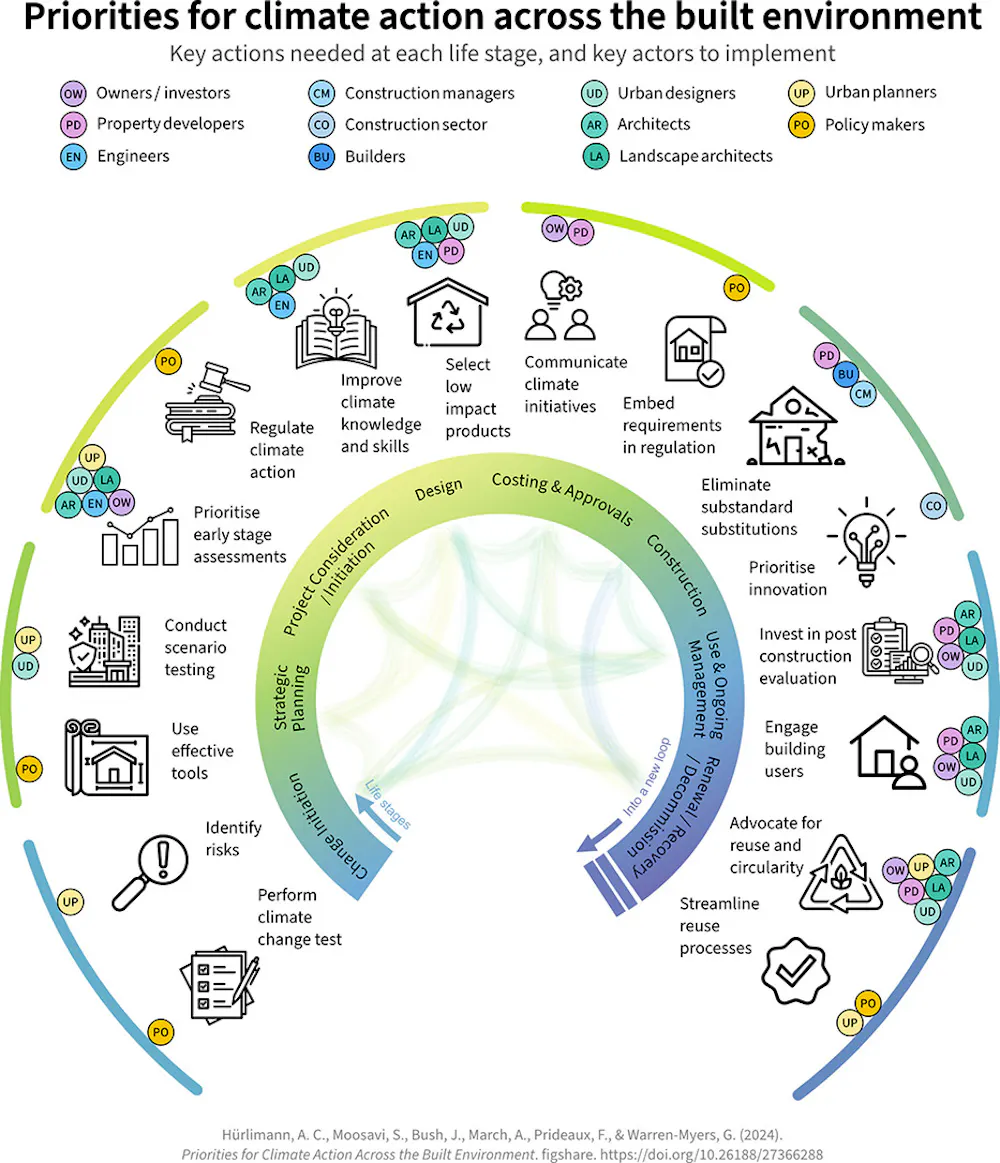
    Our new study identifies 16 priority actions to address climate change in the construction and management of cities.

    Building smarter

    Climate change must be a key consideration when designing, building and managing our cities. The emissions generated need to be minimised and eventually eliminated.

    We must build in locations, and in ways, that reduce climate risks. But policies governing how our cities are designed and constructed don’t achieve this.

    A recent study of three local government areas identified only limited action on adaptation and mitigation. Other research has found few urban development policies include carbon reduction goals that meet international targets.

    The National Housing Accord will see more than one million houses built by 2029. These new homes must address the climate challenge.

    16 areas for priority action

    The priority areas in our new study were informed by interviews with more than 150 stakeholders working in urban planning, architecture, landscape architecture, urban design, sustainability, construction and property.

    Priority areas for minimising damaging emissions generated by cities.
    CC BY

    The actions they identified cover the entire life cycle of the built environment.

    One of the first barriers to overcome is the perceived lack of agency among industry professionals to initiate or demand climate action. They perceive others, such as property owners or clients, to have more influence.

    Climate change risks should be identified in the early stages of planning new developments, backed up by effective tools to make risk identification and action easier:

    There were areas that were identified as being flood prone or risk prone. But there was no strategy to deal with what happens to those areas – An urban planner

    Once specific projects are being considered it is important to prioritise early stage climate assessments, supported by policies which mandate climate action:

    Everyone has good intentions but without big formal legislation around it, everyone’s just sort of making their way in the dark – A construction industry professional

    In the design stage, steps to improve the climate knowledge and skills of the workforce beyond disciplinary boundaries is critical. The selection of low-impact products and materials will also help ensure design is more climate responsive.

    Climate action must be embedded in all stages of design and construction of Australian cities.
    GagliardiPhotography/Shutterstock

    The highest number of hurdles to climate action were found to occur during the costing and approvals stage. Participants spoke of a highly competitive building industry. If climate change initiatives introduced at an earlier stage aren’t required by law, they are likely to be cut.

    unless there’s something in it for them in terms of return on investment, it’s going to be hard to get them to do it, unless we make them – An urban planner

    During the construction phase, product and material substitutions that have detrimental environmental impact should be eliminated. Innovation should be encouraged:

    If you want to push the envelope a little bit in terms of using recycled materials […] that’s a bit of a barrier. To push innovation is difficult – A landscape architect

    Post-construction

    Once construction is complete and buildings and public spaces are being used, it is important to invest in a thorough evaluation process. Building users should be involved to ensure buildings are maintained for optimal climate outcomes:

    [We] tried to achieve the six star rating […] the client has to maintain it [the building] for a year, and that’s when things start to fall off – An architect

    When it comes to area upgrades or building renewals, advocating for reuse and materials circularity is important. But the custom of demolishing and building anew, is hard to shift:

    The reuse of the existing building obviously generates significantly less waste and involves less material. So, design decisions and strategic decisions around using existing buildings is really important – An urban designer

    Working together

    This is a time of significant change in our urban areas.

    We need to make sure climate action is embedded in every stage of decision making. This may mean more efficient use, and reuse, of the existing built stock. This will require an overhaul of policies regarding building retrofits, and a change in mindsets.

    The priority actions to address climate change in cities can be implemented across a range of levels for:

    • individual professionals – pursue development of their climate change skills, including opportunities provided by professional associations

    • professional practices – review internal processes to ensure climate action is mainstreamed across projects, and in company decision making

    • universities teaching built environment professional degrees – embed climate change knowledge, skills, and competencies across the curriculum

    • governments at all levels – review policy settings to mandate mitigation and adaption.

    By addressing these actions, we can collectively work towards achieving our emission reduction targets and making sure our cities minimise climate change risks.

    Anna Hurlimann received funding for the research reported in this article from the Australian Research Council – Discovery Grant DP200101378, with co-chief investigators Georgia Warren-Myers, Alan March, Sareh Moosavi and Judy Bush. She is a member of the Planning Institute of Australia.

    Sareh Moosavi received funding for the research reported in this article from the Australian Research Council – Discovery Grant DP200101378, with co-chief investigators Anna Hurlimann, Georgia Warren-Myers, Alan March, and Judy Bush.

    – ref. Cities are heating up the planet – how they can do more to fight climate change – https://theconversation.com/cities-are-heating-up-the-planet-how-they-can-do-more-to-fight-climate-change-259391

    MIL OSI Analysis – EveningReport.nz –

    June 30, 2025
  • MIL-OSI Economics: Samsung Showcases AI Home Appliance Innovations at DA Global Tech Seminars Across Five Regions

    Source: Samsung

    From March to June, Samsung Electronics hosted Digital Appliances (DA) Global Tech Seminars across five regions — the United States, Europe, Latin America, Southeast Asia and Southwest Asia — to showcase its latest innovations to audiences around the world. The seminars welcomed about 240 media representatives and tech influencers from 40 countries to experience Samsung’s latest AI home appliances firsthand and observe how the company is tailoring features to meet the unique needs of each region.1 Attendees also participated in Q&A sessions with product developers, who shared in-depth insights and explanations.
     
    Samsung Newsroom recaps each regional seminar with on-site highlights and photos.
     
     
    United States: Large-Capacity Washer-Dryers Win Praise for Practicality and Efficiency
    ▲ 2025 DA Global Tech Seminar held in the U.S.
     
    The U.S. Tech Seminar took place on March 18 at Samsung Home, a Bespoke AI experience space in SoHo, New York City — a neighborhood synonymous with art and creative living.
     
    American consumers tend to prioritize practicality and efficiency. Taking this into account, Samsung set up a dedicated experience zone for the large-capacity Bespoke AI Laundry Vented Combo, featuring a product cutaway mock-up that allowed visitors to intuitively understand the product’s core technologies and features. In addition, a live cooking demonstration showcased the AI capabilities of the Bespoke AI Oven, while the Bespoke AI Hybrid Refrigerator — which boosts energy efficiency using a semiconductor-based Peltier module — also mesmerized guests.
     
     
    Europe: Bespoke AI Jet Ultra Takes Center Stage With Industry-Leading Suction Power
    ▲ 2025 DA Global Tech Seminar held in Germany
     
    On the same day, the European Tech Seminar kicked off in Frankfurt, Germany, at World of Samsung — a global showcase designed to provide an in-depth look at Samsung’s products.
     
    A key highlight was the Bespoke AI Jet Ultra, which features the world’s most powerful suction for a cordless stick vacuum cleaner at 400W. Samsung developers gave presentations, offering insight into the vacuum cleaner’s high-performance engineering. The Bespoke AI Jet Ultra recently earned 4.5 out of 5 stars from U.K.-based review outlet Trusted Reviews and ranked first among 43 cordless vacuums tested by German IT outlet Chip.
     
     
    Latin America: SmartThings-Connected Home Appliances Growing at Twice the Global Rate
    ▲ 2025 DA Global Tech Seminar held in Mexico
     
    The Latin America Tech Seminar took place on June 3 in the vibrant metropolis of Mexico City, Mexico, drawing media and influencers from 13 countries to experience Samsung’s new lineup firsthand. Consumers in the region have shown high interest in connected living, with SmartThings-connected appliance adoption growing at more than twice the global average.2
     
    Reflecting this demand, demonstrations highlighted various features including Map View, Bixby, Routines — all easily accessible via SmartThings or the AI Home screen. Attendees also visited Sam’s House, a premium residential showroom where they engaged in hands-on interactions with Samsung’s connected products.
     
     
    Southeast Asia: AI Appliances Optimized for Hot, Humid Climates
    ▲ 2025 DA Global Tech Seminar held in Thailand
     
    On June 20, Samsung held the Southeast Asia Tech Seminar at a showroom in Bangkok, Thailand, where attendees explored the company’s latest products in settings simulating both commercial and residential spaces.
     
    Through demonstrations, attendees experienced how the Voice ID feature on the Bespoke AI Family Hub refrigerator can recognize individual voices to deliver personalized responses. They also saw how Samsung is localizing AI home appliances to better suit Southeast Asia’s hot and humid climate — for example, the 1-Way Cassette system air conditioner and the Bespoke AI Top Load Washer. “The use of AI to enhance user experience and facilitate both usage and energy savings is particularly valuable and useful,” said Kemachad Gunpai of Future Trends Thailand who attended the seminar.
     
     
    Southwest Asia: AI-Powered, Efficient Cooling Solutions in the Spotlight
    ▲ 2025 DA Global Tech Seminar held in India
     
    Held on June 25 in Gurugram, India, the Southwest Asia Tech Seminar focused on SmartThings-connected solutions and energy-efficient features tailored to local preferences.
     
    Among the demonstrations were AI appliances responding to sleep patterns detected by motion sensors, alongside cooling solutions tailored for Indian consumers. Attendees also received detailed explanations on how to track energy usage via SmartThings, a particularly relevant feature amid rising electricity costs. Samsung employees also explained how each product operates in AI Energy Mode to maximize efficiency and minimize energy consumption.
     
    “Samsung will continue to develop and expand the Global Tech Seminars in ways that reflect the unique local characteristics of each region,” said Soohyuk Ro, Vice President and Head of Tech Insight Group at Digital Appliances (DA) Business, Samsung Electronics, as the seminars came to an end. “In doing so, we will provide even deeper insights into how Samsung’s AI Home and innovative AI appliances can bring meaningful benefits to daily life for everyone.”
     
     
    1 Product names and features mentioned in this article may vary by region.
    2 Based on internal data from Samsung, aggregated via BDC (BI & Analytics), reflecting the cumulative annual ratio of Wi-Fi-connected devices.

    MIL OSI Economics –

    June 30, 2025
  • MIL-OSI USA: Myth vs. Fact: The One Big Beautiful Bill

    US Senate News:

    Source: US Whitehouse
    While Democrats spend the day launching desperate, hollow attacks in a last-ditch effort to block President Trump’s One Big Beautiful Bill, the FACTS speak for themselves.
    MYTH: The One Big Beautiful Bill is “just a tax break for billionaires.”FACT: The One Big Beautiful Bill delivers the largest middle- and working-class tax cut in U.S. history. The President’s legislation will put more than $10,000 a year back in the pockets of typical hardworking families. This is the most pro-growth, pro-worker, pro-family legislation ever crafted.
    MYTH: The One Big Beautiful Bill “takes from the poor to give to the rich.”FACT: The lowest-income workers receive the largest percentage tax cuts. The One Big Beautiful Bill delivers the largest tax cut in history for working-and -middle class Americans.
    MYTH: The One Big Beautiful Bill “makes life more unaffordable.”FACT: The bill delivers bigger paychecks, expanding take-home pay by over $10,000 per year for a typical family.
    MYTH: The One Big Beautiful Bill “hurts low-income families.”FACT: The One Big Beautiful Bill is the most pro-family legislation ever crafted. It will deliver bigger paychecks, giving more than a $10,000 boost annually to everyday families. We are also expanding Opportunity Zones, expanding childcare access, increasing the child tax credit, and creating newborn savings accounts.
    MYTH: The One Big Beautiful Bill “is just a handout to corporations.”FACT: This bill drives a Blue-Collar BOOM with tax relief for workers, support for small businesses, and investments in American manufacturing. The One Big Beautiful Bill delivers the largest middle- and working-class tax cut in U.S. history.
    MYTH: The One Big Beautiful Bill “leaves American workers behind.”FACT: This is the most pro-American worker bill in history. The One Big Beautiful Bill boosts pay for millions—and with no tax on tips or overtime, those working hourly and service jobs receive additional tax relief.
    MYTH: The One Big Beautiful Bill “hurts small businesses.”FACT: The One Big Beautiful Bill will make the Trump Tax Cuts permanent, including the small business deduction—helping Main Street grow and hire. Failure to pass this legislation would result in a $4 trillion tax hike.
    MYTH: The One Big Beautiful Bill “kicks American families off Medicaid.”FACT: As the President has said numerous times, there will be no cuts to Medicaid. The One Big Beautiful Bill protects and strengthens Medicaid for those who rely on it—pregnant women, children, seniors, people with disabilities, and low-income families—while eliminating waste, fraud, and abuse. The One Big Beautiful Bill removes illegal aliens, enforces work requirements, and protects Medicaid for the truly vulnerable.
    MYTH: The One Big Beautiful Bill “cuts Medicare.”FACT: Medicare has not been touched in this bill— absolutely nothing in the bill reduces spending on Medicare benefits. This legislation does not make a single cut to welfare programs—it safeguards and protects these programs for all eligible Americans.
    MYTH: The One Big Beautiful Bill “will close rural hospitals.”FACT: Rural hospitals comprise just 7% of all hospital spending on Medicaid, illustrating that they have not benefited from the massive increase in waste, fraud, and abuse under the Biden administration. By strengthening Medicaid, we are making more resources available for vulnerable populations and safety net providers, like rural hospitals. We are expanding rural hospital protection, providing targeted funds for rural care, and giving states flexibility to support local providers.
    MYTH: “People will literally die” from the One Big Beautiful Bill — “and millions will be kicked off their healthcare.”FACT: This is one of the most egregious, deranged attacks from the Left peddling fear over the facts. The One Big Beautiful Bill protects eligible Americans on federal welfare – including Medicaid. By strengthening the integrity of Medicaid by eliminating waste, fraud, and abuse, its resources can be refocused on providing better care for those whom the program was designed to serve: pregnant women, children, people with disabilities, low-income seniors, and other vulnerable low-income families.
    MYTH: The One Big Beautiful Bill “will hurt people with disabilities.”FACT: The One Big Beautiful Bill protects and strengthens Medicaid for Americans with disabilities. Rest assured, those with disabilities receiving Medicaid will receive no loss or change in coverage.
    MYTH: The One Big Beautiful Bill “punishes vulnerable Americans with work requirements to receive their benefits.”FACT: Not true. The 20-hour weekly work requirement applies only to able-bodied adults without young children and promotes dignity, stability, and better health outcomes for families. The One Big Beautiful Bill restores the dignity of work with historically bipartisan work requirements for able-bodied Americans. We are implementing commonsense, Clinton-era work, volunteer, education, or training requirements with broad bipartisan support.
    MYTH: “There’s no fraud in Medicaid — Republicans are just taking coverage away from vulnerable populations.”FACT: In the last 10 years, CMS admitted that improper payments for Medicaid have exceeded HALF A TRILLION dollars. In just the past year, taxpayers spent $56 billion on benefits for able-bodied adults abusing the system—and over a million illegal aliens are receiving free health care on the backs of taxpayers. The One Big Beautiful Bill removes illegal aliens, enacts work requirements for able-bodied adults, and protects Medicaid for the truly vulnerable.
    MYTH: “SNAP work requirements are unnecessary.”FACT: Only 28% of able-bodied adults on SNAP work. The One Big Beautiful Bill promotes work, responsibility, and restores SNAP to serve the truly needy. SNAP enrollment remains high even in a strong economy, including millions of able-bodied adults who could work. In fact, almost three-quarters of able-bodied adults without dependents on SNAP have no earned income. The mission of the program has failed. SNAP was intended to be temporary help for those who encounter tough times—we are strengthening this program to serve those who need it most.
    MYTH: “Illegal aliens don’t get federal benefits.”FACT: Illegals burden taxpayers with billions in costs for free health care and welfare benefits. The One Big Beautiful Bill ends Medicaid and SNAP fraud and ensures these programs serve only eligible Americans.
    MYTH: The One Big Beautiful Bill “doesn’t actually end taxes on Social Security.”FACT: The One Big Beautiful Bill delivers historic tax relief to seniors, with a new tax deduction that, combined with other deductions, ensures the average Social Security beneficiary will pay zero taxes on Social Security.
    MYTH: The One Big Beautiful Bill “increases the deficit.”FACT: The One Big Beautiful Bill reduces deficits by over $2 trillion by increasing economic growth and cutting waste, fraud, and abuse across government programs at an unprecedented rate. This legislation delivers historic levels of mandatory savings. President Trump’s pro-growth economic formula will reduce the deficit, increase wages, deliver American jobs, and drive down the cost of living.
    MYTH: “But the CBO says….”FACT: The Crooked Budget Office has a terrible record with its predictions and hasn’t earned the attention the media gives it. The CBO misreads the economic consequences of not extending the Trump Tax Cuts. The One Big Beautiful Bill delivers real savings that will unleash our economy and prevent the largest tax hike in history, resulting in historic prosperity, while lowering the debt burden.
    MYTH: “There’s too much ‘pork’ in this bill.”FACT: There’s no pork in the bill. Every single provision in the One Big Beautiful Bill is a campaign promise the American people elected President Trump to deliver. The only new spending in the bill is to secure the homeland of the United States and save American sovereignty — which is fully paid for by increased visa fees on foreigners.
    MYTH: “The One Big Beautiful Bill won’t strengthen national security.”FACT: The One Big Beautiful Bill delivers on President Trump’s Peace Through Strength agenda by funding the Golden Dome missile defense system and modernizing our military to prioritize lethality and readiness. It fully equips our war fighters with the resources they need while modernizing and revolutionizing our equipment and technology.
    MYTH: The One Big Beautiful Bill “helps ‘Big Oil’ and locks up U.S. energy resources.”FACT: Quite the opposite. It unleashes American energy, refills the Strategic Petroleum Reserve, and repeals the Green New Scam policies. The One Big Beautiful Bill unleashes clean, American-made energy and will reduce the cost of living for Americans nationwide.
    MYTH: “Manufacturing jobs will still go overseas.”FACT: The One Big Beautiful Bill delivers 100% expensing for new domestic factories, revitalizes Opportunity Zones, and incentivizes companies to keep jobs in America.
    MYTH: The One Big Beautiful Bill “neglects rural America.”FACT: This bill invests in rural communities, expands market access, and delivers historic support to farm families. The One Big Beautiful Bill provides the certainty America’s farm families need to continue operating and producing the affordable, safe, and abundant supply of food, fuel, and fiber that our nation relies on.
    MYTH: “SNAP is being gutted and cutting food stamps for families, causing them to go hungry.”FACT: The One Big Beautiful Bill protects and strengthens SNAP. Right now, almost three-quarters of able-bodied adults without dependents on SNAP have no earned income and the fraud rate is high. The mission of the program has failed: SNAP was intended to be temporary help for those who encounter tough times. Now, it’s become so bloated that it is leaving fewer resources for those who truly need help. We are committed to preserving SNAP for the truly needy.
    MYTH: “Republicans are shutting Democrats out of the legislative process.”FACT: This is not a partisan bill—Democrats shut themselves out by supporting higher taxes, open borders, and giveaways to illegal immigrants. The One Big Beautiful Bill delivers on Republican promises to lower taxes, secure the border, cut spending, and put Americans first.
    MYTH: The One Big Beautiful Bill “border package is not necessary since President Trump has secured the border.”FACT: We must ensure that the invasion we witnessed as a nation under Joe Biden and Kamala Harris never happens again. The One Big Beautiful Bill’s historic investment in our border security ensures we permanently secure our border and protect our homeland by finishing the border wall, hiring 10,000 new ICE officers, and funding efforts to stop the flow of fentanyl.

    MIL OSI USA News –

    June 30, 2025
  • MIL-OSI USA: Wyden, Markey, Leader Schumer Call on Republicans to Stop Solar Cuts That Threaten Funding for K-12 Schools

    US Senate News:

    Source: United States Senator Ron Wyden (D-Ore)
    June 29, 2025
    The lawmakers released data showing more than 250 schools are at risk of project delays and higher energy costs
    Washington, D.C. – U.S. Senator Ron Wyden, D-Ore., said today that he and two Democratic colleagues have written to Donald Trump and Republican congressional leaders about the risks to K-12 funding posed by  the Republican budget reconciliation proposal.
    Projects supported by tax credits, which Republicans want to eliminate, have saved communities tens of thousands of dollars annually. Any cuts could delay or disrupt important, ongoing solar projects, prevent schools and school districts from having access to a tool to save on energy costs, and waste state and school district investments. 
    “By cutting federal clean energy incentives, the Republican budget reconciliation bill would interfere with K-12 school funding across the United States,” wrote Wyden, U.S. Sen.  Edward J. Markey, D-Mass., and Senate Democratic Leader Chuck Schumer, D-N.Y.
    “Clean energy projects can reduce monthly energy costs, allowing schools to spend more on supporting students, faculty, and staff,” Wyden, Markey and Schumer wrote to Trump, Senate Majority Leader John Thune, R-S.D., and Speaker of the House Mike Johnson, R-La. “With its draconian cuts to solar energy incentives, the Republican reconciliation bill promises to stall ongoing state and school district solar projects, disrupt their investments, and eliminate an essential cost-saving tool. We urge you to reconsider cuts to clean energy incentives that provide cost saving benefits to schools.”
    Several stakeholders joined Wyden, Markey and Schumer in voicing their opposition to the proposed cuts. 
    “Across the country, school districts have been saving taxpayers money by taking advantage of clean energy tax credits through direct pay. These projects have created jobs, reduced energy costs, and opened up opportunities for school building improvements out of reach for too long. Rolling back the clean energy tax credits would stop that progress in its tracks and increase costs to local communities. It is critical that these important initiatives remain available to our schools,” said Jason Walsh, Executive Director of BlueGreen Alliance.
    “School districts across the country have been using clean energy tax credits to lower their energy costs and upgrade their facilities. Investments in things like cleaner running buses and new HVAC systems are reducing both indoor and outdoor air pollution, all while creating good paying jobs. We urge Republican leaders to abandon their efforts to end these tax credits,” said Randi Weingarten, President of the American Federation of Teachers.
    “School districts across the country are attempting to move forward on sorely needed repairs and update their school buildings, and solar energy contributes important cost stability and resilience,” said Ally Talcott, Executive Director of the BASIC Coalition. “Our school leaders do not need whiplash amid the important work to finance improvements to our schools; they need support and stability. The cuts to solar energy incentives pull one more resource away from school districts trying to provide safe, modern, and healthy school buildings for their communities.”
    The text of the letter is here.

    MIL OSI USA News –

    June 30, 2025
  • MIL-OSI Economics: Mauritania : African Development Bank Approves €25.5 Million Trade Finance Facility for Générale de Banque de Mauritanie to Support SMEs and Women…

    Source: African Development Bank Group
    The Board of Directors of the African Development Bank Group has approved a €25.5 million trade finance facility for the Générale de Banque de Mauritanie (GBM) to enhance its financial offerings to large corporates, small and medium-sized enterprises (SMEs), and women-led businesses in Mauritania.

    MIL OSI Economics –

    June 30, 2025
  • MIL-OSI United Kingdom: Island resilience fund opens

    Source: Scottish Government

    £4.4 million targeted support for businesses.

    A funding package developed to support island businesses affected by ferry disruption is now ready to accept applications.

    Businesses from eligible sectors on South Uist, Colonsay, North Uist, Eriskay, Benbecula, Berneray, Grimsay and Arran can apply.

    Eligible sectors include those that rely on tourism and those that are engaged in the manufacture or movement of perishable goods, such as seafood.

    £4.4 million has been allocated to the Islands Business Resilience Fund (IBRF) which was established to help address issues, such as travel disruption, that can have a disproportionate impact on people and businesses living, and operating on Scotland’s islands.

    Highlands and Islands Enterprise will manage the IBRF on behalf of the Scottish Government. Applications will be accepted from 2 July until 12 noon 1 September 2025 with decisions and payments expected by 31 October 2025.

    Funding awards will be based on demand and the scale size of organisations that apply for support but awards are expected to range between £3,000 and £35,000

    Islands Secretary Mairi Gougeon said:

    “We know that Scotland’s island communities face distinct challenges, not least in terms of their economic and social resilience. People and businesses require ferry services running reliably and frequently to support their livelihoods.

    “We worked with Highlands and Islands Enterprise to refine the eligibility criteria and identify how this money can make a real difference to the businesses who need it most.

    “Reliable and regular ferry services are key to this connectivity for people and businesses and we know that the current situation of delays and ongoing maintenance to some vessels has created real difficulties for some. We are determined to do everything we can to support islands, their local businesses and employers through these challenging times.”

    Rachel Hunter, HIE’s director of enterprise and community support, said:

    “Island businesses and social enterprises make an important contribution to local economies and provide vital rural employment that helps sustain many communities. Those operating in tourism and production or movement of perishable foods are particularly vulnerable to disruption such as we’ve seen in recent years.

    “This fund is about strengthening the resilience of those organisations operating in the sectors and islands most affected. Our focus will be assessing applications promptly so that funding can be awarded as soon as possible after the closing date.”

    Background

    The application form and guidance will be available on the Highlands and Islands Enterprise website from 12 noon on 2 July.

    Highlands and Islands Enterprise carried out detailed analysis of information and statistics provided by Transport Scotland and CalMac relating to ferry disruption.

    The islands of South Uist, Colonsay, North Uist, Eriskay, Benbecula, Berneray, Grimsay and Arran were chosen as eligible for the Islands Business Resilience Fund as they each had more than 15% ferry disruption over the last three seasons. The average cancellations of ferry services across the Calmac network is during that time has been around 7%. 

    MIL OSI United Kingdom –

    June 30, 2025
  • MIL-OSI USA: Congressman Jonathan L. Jackson Reintroduces Bipartisan Bill, The Marshall “Major” Taylor Congressional Gold Medal Act

    Source: United States House of Representatives – Representative Jonathan Jackson – Illinois (1st District)

    FOR IMMEDIATE RELEASE

    WASHINGTON, D.C. — U.S. Representatives Jonathan L. Jackson (D-IL-01) and Jim Baird (R-IN-04) led 43 of their colleagues in reintroducing the bipartisan Marshall “Major” Taylor Congressional Gold Medal Act. This legislation would posthumously award a Congressional Gold Medal to Marshall Walter “Major” Taylor — America’s first Black sports star, recognizing his significance to the nation as a trailblazing athlete. 

    Taylor managed to become the first African American world champion in any sport and earned the title of “world’s fastest man” despite the extraordinary challenges of the Jim Crow era. He endured attempts by white promoters in both the North and South to exclude him from races. White riders, too, subjected Taylor to curses, insults, and even physical harm during competitions. Despite these adversities, Taylor’s exceptional talent and tenacity turned him into a sensation, drawing tens of thousands at races across the United States, Europe, and Australia.

    “It is without question that Marshall ‘Major’ Taylor was a man before his time, a stellar athlete, a leader in the field of cycling, and a trailblazer,” said Rep. Jackson. “I believe it is fitting that Congress award the ‘world’s fastest man’ one of our nation’s most prestigious honors.”

    “Even when compared to today’s athletes, Marshall ‘Major’ Taylor is among the greatest cyclists of all time,” said Rep. Baird. “His accomplishments are especially impressive considering the challenges he faced on his climb to cycling greatness. Marshall Taylor is one of the greatest athletes in Indiana history, and I can think of no one better suited to receive the Congressional Gold Medal.”

    “Marshall W. ‘Major’ Taylor challenged both the odds and the adversity of his time with dignity and determination, and he went on to ultimately triumph,” said Karen Brown Donovan, the great-granddaughter of Major Taylor. “The awarding of a posthumous Congressional Gold Medal would be a significant achievement towards honoring his life and legacy.”

    Supporting Individuals and Groups

    119th Congress

    Co-lead: Jim Baird (R-IN-04)

    Original Cosponsors (44 total): Shontel Brown (D-OH-11), LaMonica McIver (D-NJ-10), Bonnie Watson Coleman (D-NJ-12), Raja Krishnamoorthi (D-IL-08), Stacey Plaskett (D-VI-AL), Marc Veasey (D-TX-33), Kweisi Mfume (D-MD-07), David Scott (D-GA-13), Sanford Bishop (D-GA-02),  Delia Ramirez (D-IL-03), Frederica Wilson (D-FL-24), Sharice Davis (D-KS-03),  Jan Schakowsky (D-IL-09),  Robin Kelly (D-IL-02), Maxwell Frost (D-FL-10), Hank Johnson (D-GA-04),  Eleanor Holmes Norton (D-DC),  Mikie Sherrill (D-NJ-11), Gwen Moore (D-WI-04), Debbie Dingell (D-MI-06), Maxine Waters (D-CA-43), Sean Casten (D-IL-06), Danny Davis (D-IL-07),  Rashida Tlaib (D-MI-12),  Shri Thanedar (D-MI-13), Cleo Fields (D-LA-06),  Jim McGovern (D-MA-02), Andre Carson (D-IN-07), Jasmine Crockett (D-TX-30), Ro Khanna (D-CA-17), John Garamendi (D-CA-08), Ayanna Pressley (D-MA-07), Ted Lieu (D-CA-36), Becca Balint (D-VT-AL), Timothy Kennedy (D-NY-26), Nanette Barragan (D-CA-44), Troy Carter (D-LA-02),  Terri Sewell (D-AL-07), Brad Sherman (D-CA-32), Robert Garcia (D-CA-42), Dina Titus (D-NV-01), Steven Horsford (D-NV-04), Shomari Figures (D-AL-02).

    Supporting Organizations: Washington Area Bicyclist Association, The League of American Bicyclists, Major Taylor Association, Bike to the Beach, and Black Girls Do Bike, Inc.

    118th Congress

    Co-lead: Jim Baird (R-IN-04)

    Original Cosponsors (32 total): Danny Davis (D-IL-07), Robin Kelly (D-IL-02), André Carson (D-IN-07), Henry “Hank” Johnson (D-GA-04), Barbara Lee (D-CA-12), Eleanor Holmes-Norton (D-DC), Janice Schakowsky (D-IL-09), Mike Quigley (D-IL-05), Earl Blumenauer (D-WA-03), James McGovern (D-MA-02), David Scott (D-GA-13), Gwen Moore (D-WI-04), Sheila Jackson-Lee (D-TX-18), Mike Thompson (D-CA-04), Jasmine Crockett (D-TX-30), Raul Grijalva (D-AZ-07), Alma Adams (D-NC-12), Al Green (D-TX-09), Rashida Tlaib (D-MI-12), Raja Krishnamoorthi (D-IL-08), Sheila Cherfilus-McCormick (D-FL-20), Chuy Garcia (D-IL-04), David Trone (D-MD-06), Ann Kuster (D-NH-02), John Duarte (R-CA-13), Frederica Wilson (D-FL-24), Tony Gonzales (R-TX-23), Debbie Dingell (D-MI-06), Ted Lieu (D-CA-36), Maxwell Frost (D-FL-10), Joe Wilson (R-SC-02). 

    Supporting Organizations: Bronzeville Trail Task Force, Inc., Major Taylor Association, Washington Area Bicyclist Association, League of American Bicyclists, ADD Impact Network & Bike to the Beach, and Black Girls Do Bike, Inc. 

    About Major Taylor

    Taylor, the son of a veteran who fought in the Civil War, was born in 1878. Despite racial tension, Taylor was educated and viewed as an adopted son by an affluent white family from Indianapolis, Indiana, who also employed his father, Gilbert Taylor. Due to his relationship with the family, Taylor received gifts, including his first bicycle. Upon receiving the bicycle, Taylor displayed natural talent. 

    Taylor received the nickname “Major” as a child while performing bicycle tricks outside of his workplace at Hay & Willits Manufacturing, Indiana Bicycle Co., in Indianapolis. His employer was so impressed with his abilities that the company enrolled him in his first race, which he won at the age of eleven. Taylor moved to Worcester, Massachusetts, with his employer, mentor, and racing manager, Louis D. “Birdie” Munger, in 1895, because Munger was forced out of his Indianapolis-based firm due to his mentorship of Taylor. 

    In 1896, at the age of eighteen, Taylor received a professional racing license from the League of American Wheelmen, despite the league’s 1894 “white only” rule for amateur membership. This membership led to his eventual professional debut.  

    Later that year, Taylor gained notoriety in his first professional contest by competing in the “Six Day Race” at Madison Square Garden in New York City. This race was considered a test of endurance, where cyclists would test both their mental and physical ability in front of a packed house at the Garden. At the conclusion of day six, Taylor finished eighth out of twenty-six and cycled roughly 1,732 miles. 

    In 1899, Taylor would win the world one-mile sprint championship in Montréal, becoming the first Black American and the second Black athlete to win a world title. Taylor would go on to set seven cycling records and become the first Black world champion, which led to his being considered the first international superstar. Taylor would even revolutionize the sport by creating an innovative adjustable handlebar stem, which to date is called the “Major Taylor Stem.”

    While experiencing racial prejudice throughout his career, Taylor became one of the first Black athletes to secure corporate sponsorships. He represented bicycle brands such as Iver Johnson, Sager, Stearns, and Orient, eventually becoming one of the wealthiest Black men in America. Due to his devout commitment to his faith, Taylor refused to race on Sundays, which led to him turning down a significant number of lucrative offers to race in Europe. However, once he achieved international superstardom, Taylor was able to negotiate “no Sundays” provisions in his European racing contracts. 

    Taylor retired from racing in 1910 and started many business ventures. In 1928, he published his autobiography “The Fastest Bicycle Rider in the World” with the intent of impacting justice, equal rights, and the ‘square deal’ for African Americans in sports. 

    About the Congressional Gold Medal

    Since the late 1700s, Congress has expressed public gratitude to individuals and groups by awarding medals and other similar decorations. The Continental Congress awarded the first Congressional Gold Medals. Since that time, Congress has awarded gold medals to express public gratitude for distinguished contributions, dramatize the virtues of patriotism, and perpetuate the remembrance of great events. Two-thirds of both the House and Senate must cosponsor the legislation to advance it.

    MIL OSI USA News –

    June 30, 2025
  • MIL-OSI United Kingdom: Upgrading national grid to power AI future to be tackled at AI Energy Council

    Source: United Kingdom – Executive Government & Departments

    Press release

    Upgrading national grid to power AI future to be tackled at AI Energy Council

    The Technology and Energy Secretaries will chair the second meeting of the AI Energy Council today.

    AI Energy Council helping to power new AI breakthroughs.

    • Second meeting to focus on bringing the energy grid up to speed to power the next wave of AI breakthroughs.
    • Major tech and energy companies to attend, following £2 billion to accelerate the use of AI in boosting productivity and growth across the UK.
    • Comes in addition to reforming the connections process so data centres can quickly get up and running – increasing investment and speeding up breakthroughs using AI.

    The energy demands to drive the processing power needed for new waves of AI breakthroughs, and the future energy needs of the wider AI sector will be on the agenda as the AI Energy Council gathers today (30 June).

    With energy providers, tech companies, energy regulator Ofgem and the National Energy System Operator (NESO) convening, this second meeting will discuss how to work together to forecast how much energy will be needed to deliver a twenty-fold increase in compute capacity over the next 5 years.

    Compute represents the key building block of AI development. It captures the vital resources which make AI models work, such as the processing power which allows them to be trained on data and process information. By increasing the UK’s capacity, it will give scientists and AI companies from across the UK access to the systems they need for their cutting-edge research – making the next big breakthrough from personalised medical treatments, more sustainable air travel, or developing new tools in the fight against climate change.

    The meeting is also expected to cover which sectors are likely to quickly adopt AI and how this could drive significant shifts in energy demand. Discussions will focus on what assumptions need to be made to accurately forecast that demand, ensuring the energy system is prepared for AI. 

    Chaired by the Technology and Energy Secretaries, the meeting comes hot on the heels of the UK government announcing £2 billion to deliver the AI Opportunities Action Plan.

    The Action Plan serves as a blueprint to turbocharge the use of AI, whether it’s in hospitals to help diagnose patients more quickly, in schools to help with lesson planning so teachers have more time in front of the whiteboard, or delivering new AI Growth Zones which will unlock scores of new investment and jobs to revitalize local communities and deliver the economic growth driving the government’s Plan for Change.

    Secretary of State for Science, Innovation, and Technology, Peter Kyle said:

    Giving our researchers and innovators access to the processing power they need will not only maintain our standing as the world’s third-biggest AI power, but put British expertise at the heart of the AI breakthroughs which will improve our lives, modernise our public services, and spark the economic growth which is the cornerstone of our Plan for Change.

    We are clear-eyed though on the need to make sure we can power this golden era for British AI through responsible, sustainable energy sources. Today’s talks will help us drive forward that mission, delivering AI infrastructure which will benefit communities up and down the country for generations to come without ever compromising on our clean energy superpower ambitions.

    Secretary of State for Energy Security and Net Zero, Ed Miliband said:

    We are making the UK a clean energy superpower, building the homegrown energy this country needs to get bills down for good and create new jobs as part of our Plan for Change.

    Bringing together the biggest players in AI and energy will help us discuss the role AI can play an important role in building a new era of clean electricity for our country, and meeting the power demands of new technology as we build a clean power system for families and businesses.

    With energy providers, tech companies, energy regulator Ofgem and the National Energy System Operator (NESO) convening today, they’ll discuss how to work together to forecast how much energy will be needed to deliver this twenty-fold increase in compute capacity over the next 5 years. The meeting is also expected to cover which sectors are likely to quickly adopt AI and how this could drive significant shifts in energy demand. 

    The meeting will consider the future energy needs of the AI sector more widely, as the government also continues to move forward with its plans to roll out AI Growth Zones across the country. These hotbeds of AI development will unlock billions in investment and deliver scores of new jobs across the country, with communities throughout the UK having already expressed an interest in being home to future growth zone sites. 

    Since establishing the AI Energy Council in January, government has been deepening its work both Ofgem and the National Energy System Operator (NESO) to deliver fundamental reforms to the UK’s connections process. Once final signoffs from Ofgem are in place, this could mean more than 400GW of additional capacity is freed up from the grid connection queue – turbocharging the AI projects which are vital to economic growth. 

    Further Information

    The Technology and Energy Secretary are joined at today’s meeting by representatives of:

    • Google
    • Microsoft
    • Amazon Web Services
    • Equinix
    • Brookfield
    • ARM
    • Advanced Research and Invention Agency (ARIA)
    • National Energy System Operator (NESO)
    • Ofgem
    • National Grid
    • Energy Networks Association
    • Scottish Power
    • Nuclear Industry Association
    • EDF Energy
    • International Energy Agency

    DSIT media enquiries

    Email press@dsit.gov.uk

    Monday to Friday, 8:30am to 6pm 020 7215 3000

    Share this page

    The following links open in a new tab

    • Share on Facebook (opens in new tab)
    • Share on Twitter (opens in new tab)

    Updates to this page

    Published 30 June 2025

    MIL OSI United Kingdom –

    June 30, 2025
  • MIL-OSI New Zealand: The awkward places NZers admit to using their devices – and why scammers love it

    Source: BNZ Statements

    From the bathroom to the boardroom, New Zealanders are responding to notifications and messages in some pretty awkward places – and it reveals just how distracted and hurried we’ve become, a new survey from BNZ shows.

    The nationwide study found that most New Zealanders have responded to an email, text or notification while doing something else, with 35% admitting they’ve done so in the bathroom, 41% in the middle of a face-to-face conversation, and 28% while in a meeting or webinar.

    “And when we’re rushed or distracted like this, we make mistakes,” says BNZ Head of Fraud Operations, Margaret Miller.

    Nearly a quarter (24%) confess to clicking through to a “great deal” without checking if the link was legitimate, while 19% have hit a link in a text before reading it properly.

    “Scammers prey on the fact that when we’re rushed, distracted, or juggling multiple things we’re more likely to click first and think later,” Miller says.

    The study found that New Zealanders are generally aware of when they’re most vulnerable, with 78% recognising that being distracted, rushed, multitasking, stressed or on autopilot makes them more likely to be scammed or make a mistake with online banking.

    Yet scammers are still succeeding. According to the survey, while 61% of Kiwis spotted a scam in the past year and avoided it, 12% weren’t so lucky.

    Strategic design to slow scams down

    While individual vigilance remains the best defence and the banking sector continues to invest tens of millions in security each year, BNZ is also exploring a different approach through strategic design features that work with how people actually behave.

    “While we all expect seamless digital experiences, we’ve learned that introducing small elements of friction at critical moments helps with focus and ultimately, keeps customers and their money safer,” says BNZ Head of Design, Donal Devlin.

    “In practice, this means things like swapping button locations, adding brief pause notifications, or showing “pause and think” alerts to help customers stay focused when making higher risk transactions or actions in their accounts.

    “It’s about finding the right balance between convenience and security – adding just enough of a moment to think when the stakes are highest.”

    BNZ is also strengthening security in other ways, including being one of only two major banks to offer app-based authentication rather than text messages, which can be intercepted by scammers.

    The bank has also introduced online banking lock, which gives customers the ability to quickly disable all online banking activity and lock access to their online banking if they suspect a scammer has gained access to their accounts.

    It’s all about working with human nature, not against it, Miller says.

    “We know people are busy, we know they multi-task, and we know they sometimes rush.

    “So, while customers should remain vigilant, we’re also designing smart security features that give you a moment to double-check when it matters most.”

    Tips for improving your digital safety and security

    • Pause before clicking – especially if you’re doing something else at the same time
    • Never click on links or attachments sent by someone you don’t know or that seem out of character for someone you do know
    • Keep your computer and phone security software up to date
    • Contact your bank immediately if you think you’ve been scammed

    Red flags to watch for – BNZ will never:

    • Email or text you links to online banking and ask you to log in
    • Send you a text message with a link to a website, or link to call us
    • Ask you for your PIN number or password
    • Ask you to share the authentication codes sent to you by text or email, even with a BNZ staff member
    • Ask you to transfer money to help catch a scammer or a bank employee who is scamming customers
    • Send you a text message about account issues with a link to log in
    • Ask you to download software to access your Internet Banking remotely
    • Use international phone numbers to call or send you notifications

    The BNZ Safe and Secure Survey was conducted by Insights HQ in May 2025, with sample sizes ranging from n=235 to n=478 depending on the question. Overall survey results were weighted to be nationally representative by age (15+ years), gender, and region based on Census 2020.

    The post The awkward places NZers admit to using their devices – and why scammers love it appeared first on BNZ Debrief.

    MIL OSI New Zealand News –

    June 30, 2025
  • MIL-OSI Australia: Does your business pay contractors?

    Source: New places to play in Gungahlin

    If your business pays contractors to deliver any of these services on your behalf, you may need to lodge a Taxable payments annual report (TPAR) online by 28 August:

    • building and construction
    • cleaning
    • courier and road freight
    • information technology (IT)
    • security, investigation or surveillance.

    TPAR help us keep things fair for all businesses by making sure contractors report all their income.

    On your TPAR, you need to record the:

    • contractor’s name, address and ABN
    • total amount you paid them for the previous financial year – including any GST and cash payments.

    You can find these details on your contractor’s invoice. It’s the same information you use to claim income tax deductions through your tax return, and GST credits through your business activity statement.

    Lodging your TPAR online is quick and easy using SBR-enabled softwareExternal Link or through Online services for business. Your registered tax professional can also lodge on your behalf.

    Penalties may apply for overdue TPAR. We’ll no longer be accepting paper lodgments after 28 August 2025, so it’s important to make sure you’re set up for online lodgment.

    Need help?

    For more information on lodging your TPAR, visit ato.gov.au/TPAR or speak to your registered tax professional. You can also watch our Essentials to strengthen your small business TPAR courseExternal Link to help you understand your TPAR obligations.

    Keep up to date

    We’ve set up tailored communication channels for small businesses. They will keep you updated on important information and changes.

    Read more articles in our Small business newsroom.

    Subscribe to our free to our monthly Small business email newsletterExternal Link.

    Get email notifications about new and updated information on our website. You can choose to receive updates that matter to you. Select the ‘Business and organisations’ category. This way, your subscription will get notifications for more Small business newsroom articles like this one.

    MIL OSI News –

    June 30, 2025
  • MIL-OSI USA: SBA Relief Still Available to New York Small Businesses and Private Nonprofits Affected by Excessive Rain

    Source: United States Small Business Administration

    ATLANTA – The U.S. Small Business Administration (SBA) is reminding small businesses and private nonprofit (PNP) organizations in New York of the July 28 deadline to apply for low interest federal disaster loans to offset economic losses caused by excessive winds and rain occurring Aug. 19-20, 2024.  

    The disaster declaration covers the New York counties of Albany, Fulton, Hamilton, Montgomery, Rensselaer, Saratoga, Schenectady, Warren and Washington.

    Under this declaration SBA’s Economic Injury Disaster Loan (EIDL) program is available to small businesses, small agricultural cooperatives, nurseries and PNPs with financial losses directly related to the disaster. The SBA is unable to provide disaster loans to agricultural producers, farmers, or ranchers, except for small aquaculture enterprises.

    EIDLs are available for working capital needs caused by the disaster and are available even if the small business or PNP did not suffer any physical damage. The loans may be used to pay fixed debts, payroll, accounts payable, and other bills not paid due to the disaster.

    “Through a declaration by the U.S. Secretary of Agriculture, SBA provides critical financial assistance to help communities recover,” said Chris Stallings, associate administrator of the Office of Disaster Recovery and Resilience at the SBA. “We’re pleased to offer loans to small businesses and private nonprofits impacted by these disasters.”  

    The loan amount can be up to $2 million with interest rates as low as 4% for small businesses and 3.25% for PNPs, with terms up to 30 years. Interest does not accrue, and payments are not due until 12 months from the date of the first loan disbursement. The SBA sets loan amounts and terms based on each applicant’s financial condition.

    To apply online visit sba.gov/disaster. Applicants may also call SBA’s Customer Service Center at (800) 659-2955 or email disastercustomerservice@sba.gov for more information on SBA disaster assistance. For people who are deaf, hard of hearing, or have a speech disability, please dial 7-1-1 to access telecommunications relay services.

    The deadline to return economic injury applications is July 28, 2025.

    ###

    About the U.S. Small Business Administration

    The U.S. Small Business Administration helps power the American dream of business ownership. As the only go-to resource and voice for small businesses backed by the strength of the federal government, the SBA empowers entrepreneurs and small business owners with the resources and support they need to start, grow or expand their businesses, or recover from a declared disaster. It delivers services through an extensive network of SBA field offices and partnerships with public and private organizations. To learn more, visit www.sba.gov. 

    MIL OSI USA News –

    June 30, 2025
  • MIL-OSI USA: Additional Mississippi Counties Designated Under Amended Presidential Disaster Declaration for Public Assistance

    Source: United States Small Business Administration

    ATLANTA – In response to an amended Presidential disaster declaration, the U.S. Small Business Administration (SBA) announced the availability of low interest federal disaster loans to private nonprofit (PNP) organizations in one additional Mississippi county affected by the severe storms and flooding occurring Mar. 14-15, 2025.

    The amended declaration covers the newly designated county of Montgomery.

    Under this declaration, PNPs providing non-critical services of a governmental nature who suffered financial losses directly related to the disaster are eligible to apply for both physical damage loans and Economic Injury Disaster Loans (EIDLs) from the SBA. Examples of eligible non-critical PNP organizations include, but are not limited to, food kitchens, homeless shelters, museums, libraries, community centers, schools, and colleges.

    PNPs may borrow up to $2 million to repair or replace damaged or destroyed real estate, machinery and equipment, inventory, and other business assets. Applicants may also be eligible for a loan increase of up to 20% of their physical damages, as verified by the SBA, for mitigation purposes.

    EIDLs are for working capital needs caused by the disaster and are available even if the PNP did not suffer any physical damage. The loans may be used to pay fixed debts, payroll, accounts payable, and other bills not paid due to the disaster.

    “SBA loans help eligible small businesses and private nonprofits cover operating expenses after a disaster, which is crucial for their recovery,” said Chris Stallings, associate administrator of the Office of Disaster Recovery and Resilience at the SBA. “These loans not only help business owners get back on their feet but also play a key role in sustaining local economies in the aftermath of a disaster.”  

    The interest rate can be as low as 3.625%, with terms up to 30 years. Interest does not begin to accrue, and monthly payments are not due until 12 months from the date of the initial disbursement. The SBA sets loan amounts and terms based on each applicant’s financial condition.

    To apply online visit sba.gov/disaster. Applicants may also call the SBA’s Customer Service Center at (800) 659-2955 or email disastercustomerservice@sba.gov for information on SBA disaster assistance. For people who are deaf, hard of hearing, or have a speech disability, please dial 7-1-1 to access telecommunications relay services.

    The filing deadline to submit applications for physical property damage is July 22, 2025. The deadline to submit economic injury applications is Feb. 23, 2026.

    ###

    About the U.S. Small Business Administration

    The U.S. Small Business Administration helps power the American dream of business ownership. As the only go-to resource and voice for small businesses backed by the strength of the federal government, the SBA empowers entrepreneurs and small business owners with the resources and support they need to start, grow or expand their businesses, or recover from a declared disaster. It delivers services through an extensive network of SBA field offices and partnerships with public and private organizations. To learn more, visit www.sba.gov. 

    MIL OSI USA News –

    June 30, 2025
  • MIL-OSI USA: SBA Opened Business Recovery Centers in Tennessee to Assist Small Businesses, Private Nonprofits and Residents Affected by Adverse Weather

    Source: United States Small Business Administration

    ATLANTA – The U.S. Small Business Administration (SBA) opened Business Recovery Centers (BRCs) in Davidson and McNairy Counties to assist small businesses, private nonprofits and residents affected by severe storms, straight-line winds, tornadoes and flooding occurring on April 2-24, 2025.

    SBA customer service representatives will be on hand at the BRCs to answer questions about SBA’s disaster loan program, explain the application process and help individuals complete their application. Walk-ins are accepted, but you can schedule an in-person appointment in advance at appointment.sba.gov. The BRCs hours of operation are listed below.

    Business Recovery Center (BRC)  

    Davidson County  

    SBA District Office, Nashville

    2 International Plaza  

    Nashville, TN 37217

    Hours:    Monday – Sunday, 8 a.m. to 6 p.m.  

     Temporary Closed:   Friday, July, 4th  

    in observance of 4th of July Holiday  

    Business Recovery Center (BRC)  

    McNairy County  

     The Latta Theatre

    205 W Court Ave.  

    Selmer, TN 38375

    Hours:   Monday – Sunday, 8 a.m. to 6 p.m.  

     Temporary Closed:   Friday, July, 4th  

    in observance of 4th of July Holiday  

    “SBA’s Business Recovery Centers have consistently proven their value to business owners following a disaster,” said Chris Stallings, associate administrator of the Office of Disaster Recovery and Resilience at the SBA. “Business owners can visit these centers to meet face-to-face with specialists who will guide them through the disaster loan application process and connect them with resources to support their recovery.”

    The SBA’s Economic Injury Disaster Loan (EIDL) program is available to small businesses, small agricultural cooperatives and private nonprofit (PNP) organizations with financial losses directly related to the disaster. The SBA is unable to provide disaster loans to agricultural producers, farmers, or ranchers, except for small aquaculture enterprises.

    EIDLs are available for working capital needs caused by the disaster and are available even if the business or PNP did not suffer any physical damage. The loans may be used to pay fixed debts, payroll, accounts payable, and other bills not paid due to the disaster.

    Businesses and nonprofits are eligible to apply for business physical disaster loans and may borrow up to $2 million to repair or replace disaster-damaged or destroyed real estate, machinery and equipment, inventory, and other business assets.

    Homeowners and renters are eligible to apply for home and personal property loans and may borrow up to $100,000 to replace or repair personal property, such as clothing, furniture, cars, and appliances. Homeowners may apply for up to $500,000 to replace or repair their primary residence.

    Applicants may also be eligible for a loan increase of up to 20% of their physical damage, as verified by the SBA, for mitigation purposes. Eligible mitigation improvements include strengthening structures to protect against high wind damage, upgrading to wind rated garage doors, and installing a safe room or storm shelter to help protect property and occupants from future damage.

    Interest rates are as low as 4% for small businesses, 3.625% for PNPs, and 2.75% for homeowners and renters, with terms up to 30 years. Interest does not begin to accrue, and payments are not due until 12 months from the date of the first loan disbursement. The SBA sets loan amounts and terms based on each applicant’s financial condition.

    Disaster survivors should not wait to settle with their insurance company before applying for a disaster loan. If a survivor does not know how much of their loss will be covered by insurance or other sources, SBA can make a low-interest disaster loan for the total loss up to its loan limits, provided the borrower agrees to use insurance proceeds to reduce or repay the loan.

    With the changes to FEMA’s Sequence of Delivery, survivors are now encouraged to simultaneously apply for FEMA grants and the SBA low-interest disaster loan assistance to fully recover.  FEMA grants are intended to cover necessary expenses and serious needs not paid by insurance or other sources. The SBA disaster loan program is designed for your long-term recovery, to make you whole and get you back to your pre-disaster condition.

    To apply online, visit sba.gov/disaster. Applicants may also call SBA’s Customer Service Center at (800) 659-2955 or email disastercustomerservice@sba.gov for more information on SBA disaster assistance. For people who are deaf, hard of hearing, or have a speech disability, please dial 7-1-1 to access telecommunications relay services.

    The filing deadline to return applications for physical property damage is Aug. 19, 2025. The deadline to return economic injury applications is March 19, 2026.

    ###

    About the U.S. Small Business Administration

    The U.S. Small Business Administration helps power the American dream of business ownership. As the only go-to resource and voice for small businesses backed by the strength of the federal government, the SBA empowers entrepreneurs and small business owners with the resources and support they need to start, grow or expand their businesses, or recover from a declared disaster. It delivers services through an extensive network of SBA field offices and partnerships with public and private organizations. To learn more, visit www.sba.gov. 

    MIL OSI USA News –

    June 30, 2025
  • MIL-OSI USA: Cantwell, Red State Leaders Warn Entire Communities Will Suffer if Residents Lose Health Insurance Due to Medicaid Cuts

    US Senate News:

    Source: United States Senator for Washington Maria Cantwell
    06.29.25
    Cantwell, Red State Leaders Warn Entire Communities Will Suffer if Residents Lose Health Insurance Due to Medicaid Cuts
    Misguided legislation would leave 16 million Americans without health insurance; Officials on the ground in MO, UT, and NC say fewer federal resources means more uninsured Americans, cuts in services, and even hospital closures – with states & counties left to pick up the slack
    WASHINGTON, D.C. – Today, U.S. Senator Maria Cantwell (D-WA), ranking member of the Senate Committee on Commerce, Science, and Transportation and senior member of the Senate Finance Committee, joined local leaders from red states for a virtual press conference to warn that cutting 16 million Americans off of health insurance will put a dramatic strain on the budgets and health of their communities.
    “Policies in this legislation hamper the abilities for states to fund their Medicaid programs,” said Sen. Cantwell. “To make up for lost federal dollars, state governments will have to consider cutting reimbursements to providers, cutting types of services, cutting people from Medicaid rolls, or raising everyone’s taxes. All these decisions lead to poor health outcomes. They increase the cost for taxpayers and strain our healthcare system.”
    “We have a dramatic shortage of mental health beds in our state, and our jails have come become the largest repository for individuals,” said Steve Hobbs, Missouri Association of Counties Executive Director and former Missouri State Representative (R-21), who called into the virtual presser from inside a skid steer at his farm. “Any changes to the premium tax would have a huge impact on our rural hospitals — all of our hospitals, our nursing homes, and so we’re really concerned about those changes as well.”
    “No one knows exactly where the shrapnel will fall, but it will be a very large change to our state budget and the services that we can provide. So I’m really hoping we can find some other, better way forward,” said Utah State Representative Ray Ward (R-19).
    In total, 16 million Americans – including over 300,000 Washingtonians –  will lose the health care coverage they need to get regular check-ups, behavioral health care, family planning services, long-term care, urgent care, and more if the pending reconciliation bill passes the U.S. Senate and is signed into law. Those living in rural areas – which have a higher proportion of residents who rely on Medicaid for health insurance coverage, and where smaller hospitals operate on slimmer margins – would be hit hardest.
    People without health insurance tend to wait until their health problem is an emergency before seeking care in local hospitals. This leads to more crowded emergency rooms for everyone. And hospitals must factor the uncompensated cost of additional uninsured patients into already strained finances – finances which are especially strained at rural hospitals.
    The additional stress and costs to the system will be shared by everyone as premiums rise, hospitals close or cut services, and localities increase taxes to keep up with greater demand for first responders and law enforcement.
    The Congressional Budget Office (CBO) published its updated analysis, available here, after the House of Representatives narrowly passed their budget reconciliation bill with over $800 billion in cuts and significant changes to Medicaid. A Joint Economic Committee (JEC) fact sheet, available here, provides updated estimates for all 50 states and D.C. of the estimated number of people losing their health insurance. The JEC data broken down by Congressional District is available here.
    Sen. Cantwell was joined at today’s virtual press conference by:
    Steve Hobbs, Missouri Association of Counties Executive Director and former Missouri State Representative [link to footage]
    Ray Ward, Utah State Representative (R-19) [link to footage]
    Kevin Leonard, North Carolina Association of County Commissioners Executive Director [link to footage]
    Wendy Sisk, CEO of Peninsula Behavioral Health
    Tristan Twohig, Emergency Department Registered Nurse at Providence Sacred Heart Medical Center in Spokane
     Video of today’s virtual press conference is available HERE; a transcript is available HERE.

    MIL OSI USA News –

    June 30, 2025
  • MIL-OSI New Zealand: Log trailer lifting failure lead to important safety changes on and off ports

    Source: Maritime New Zealand

    Incidents where log trailers fell while being lifted, seriously endangering workers, have led to important safety changes on ports and at other sites where log trailers are lifted onto trucks.

    The Port Health and Safety Leadership Group identified working with suspended loads as one of the key risks on ports in its Port Sector Insights Picture and Action Plan.

    The incidents with log trailers were a call to action for everyone involved to create solutions that will be applied on and beyond ports. Transport and stevedoring companies, Maritime NZ, WorkSafe and industry organisations were all involved, and port operators and others were kept informed.

    The changes are:

    • The Log Transport Safety Council has issued a safety alert to transport operators to upgrade hammerlocks and chains to heavier gauges. The alert also advises that the Council is reviewing and updating its code for checking lifting chains and clarifying who the code defines as ‘competent persons’ to carry out inspections.
    • Prototype equipment and work practices for its use are being trialled at Picton and Nelson. These include a system of tethers, and truck lane and position indicators. The tethers stop log trailers moving when they’re lifted, removing the need for manual handling to try to control trailers while they’re off the ground. Lane and position indicators help drivers line trucks up correctly before trailers are lifted off the road and then again when trucks are reversed for the trailers to be loaded onto the trucks.

    The incident and follow up

    Maritime NZ was notified that lifting gear had failed while hoisting a log trailer at Picton. The trailer fell, narrowly missing workers.

    Maritime NZ inspected the work site and identified two related issues: the strength and inspection of the lifting equipment, and the work practices of drivers and stevedores working with suspended loads while lifting trailers.

    Collaboration with WorkSafe NZ confirmed that similar incidents had occurred outside ports, with log trailers falling when lifting equipment failed. The two agencies understood the solutions would be applicable to many work sites where logging trailers were lifted, not only on ports.

    Both the transport and stevedore company acknowledged the unsafe situation and demonstrated a strong commitment to correcting the issue.

    Maritime NZ accepted a voluntary agreement on the basis that it was confident the two companies involved would work together to develop solutions to manage the risk of working with suspended loads and lifting failure, in a way that included other transport companies.

    The Log Transport Safety Council, which is recognised as a trusted source of log transport research and industry knowledge, has been proactive with the findings and acknowledged this was an industry-wide issue. As a result, following this incident, the Council issued its safety alert.

    Both WorkSafe and Maritime NZ attended a recent Council meeting. They spoke about the incident, how all involved responded, and the prototype systems developed in collaboration by the transport and stevedore companies and being trialled at Port Nelson and Port Marlborough.

    Collaboration for a better outcome

    The Leadership Group says this is a very good example of the positive outcomes from a recommendation in its Action Plan. That is, that Maritime NZ be the regulator responsible for monitoring and enforcing compliance with health and safety legislation on ports, as well as on ships, and collaborate with WorkSafe to resolve issues, particularly where they have wider impact than solely on ports.

    The genuinely tripartite way the Leadership Group works together (industry, unions and regulators) has built trust and understanding.

    When these dangerous incidents occurred, those relationships helped all involved to collaborate, identify the risks and causes behind the incident, and then allowed industry-led, innovative solutions to be formulated.

    If you would like more information, please email [email protected].
     

    MIL OSI New Zealand News –

    June 30, 2025
  • MIL-OSI Video: International Business Forum – 4th International Conference on Financing for Development #FFD4

    Source: United Nations (video statements)

    The International Business Forum (IBF) will open with a high-level gathering of Heads of State, ministers, CEOs, and global business leaders to explore solutions that unlock private finance and investments for sustainable development.  

    The opening of the IBF will set the tone for the importance of driving solutions that unlock private finance and investments for sustainable development. The session will feature welcome addresses by Pedro Sánchez, Prime Minister of Spain, and António Guterres, Secretary-General of the United Nations, followed by remarks from Heads of State, Ministers, CEOs and global business leaders. Speakers will include John Denton, Secretary General of the International Chamber of Commerce; Shinta Kamdani, CEO of Sintesa Group and Co-Chair of the Global Investors for Sustainable Development (GISD) Alliance; and José Viñals, GISD Co-Chair and Senior Advisor to the Board of Standard Chartered. BBC presenter Rajini Vaidyanathan will serve as the moderator. 

    More Info: https://financing.desa.un.org/FFD4/businessforum
    All the FFD4 events: https://webtv.un.org/

    https://www.youtube.com/watch?v=GoV4sA6j7OE

    MIL OSI Video –

    June 30, 2025
  • MIL-OSI USA: Welch Amendments to Senate Republicans’ Tax Bill Aim to Protect Health Care and Support Rural Hospitals, Food Assistance Programs

    US Senate News:

    Source: United States Senator Peter Welch (D-Vermont)

    Trump and Republicans’ so-called ‘One Big Beautiful Bill Act’ will kick millions off Medicaid and SNAP, explode deficits
    WASHINGTON, D.C. – U.S. Senator Peter Welch (D-Vt.), a member of the Senate Finance Committee, today proposed changes to President Trump and Senate Republicans’ disastrous One Big Beautiful Bill Act, which will pay for tax cuts for billionaires by kicking millions of Americans off Medicaid and closing rural hospitals, cutting food assistance programs, and tanking the economy.
    Senator Welch’s changes to the Republican tax bill would protect Vermonters’ access to health care, food assistance, and other critical programs. The Senator’s proposed changes include provisions to prevent harm to rural hospitals, strengthen access to Medicaid and the Affordable Care Act, block cuts and policies that weaken the Supplemental Nutrition Assistance Program (SNAP) and other food assistance programs, protect home energy efficiency tax credits and the home efficiency workforce, and support federal public defenders.  
    “Republicans’ so-called ‘One Big Beautiful Bill’ is a betrayal of American values and an abdication of our responsibility as United States Senators to look out for our constituents. All of us say we are here to help working families in every state succeed, but this bill will only cause bipartisan pain—all to pay for a tax break for those who need it least,” said Senator Welch. “This bill is un-fixable and needs a major rewrite. But I’ll continue to do everything I can to protect the health care, food assistance, and federal programs Vermonters need.” 
    Senator Welch offered amendments and changes to the Republican budget resolution to:   
    Protect Access to Health Care and Support Rural Hospitals: 

    Welch proposed requiring the Finance Committee to rewrite the bill to prevent harm to rural health care and the fiscal wellbeing of rural hospitals; 
    Welch proposed requiring the Finance Committee to exempt managed care programs operated by state governments like Vermont from any changes proposed to state directed payments. 
    Welch proposed requiring the Finance Committee to strike any changes to provider taxes, including changes that would impact states like Vermont with Medicaid expansion; 
    Welch proposed requiring the Health, Education, Labor and Pensions (HELP) Committee to make it easier to verify eligibility for the Affordable Care Act’s premium tax credits, and expand special enrollment periods under certain circumstances.

    Defend Food Assistance Programs: 

    Welch proposed requiring the Agriculture Committee to strike any cost-shifts of administering  SNAP to states, which would kick American families off the food assistance they need and strain state budgets; 
    Welch proposed an amendment to strike administrative cost-shifts for SNAP; 
    Welch proposed an amendment to adjust the Thrifty Food Plan for cities, counties, and regions where the price of food is 10% higher than the national average; 
    Welch proposed an amendment that places a floor on SNAP allotments to households instead of a ceiling; 
    Welch proposed requiring the Agriculture Committee to rewrite the bill to allow volunteer work to qualify under SNAP’s work requirements.  

    Protect Programs and Government Services: 

    Welch proposed requiring the Finance Committee to rewrite the bill to maintain the energy efficient home improvement tax credit at current levels through 2028; 
    Welch proposed an amendment to strike the repeal of several home energy efficiency tax credits, including credits for home energy, rooftop solar, energy efficient homes for homebuilders, and more; 
    Welch proposed striking language in the bill that would rescind funding for state-based contractor training grants, as required in Welch’s HOPE for HOMES Act, passed as part of the Inflation Reduction Act; 
    Welch proposed striking language in the bill that would institute taxes on international remittances. 
    Welch proposed an amendment to dedicate funding for residential reentry centers, which are needed in Vermont; 
    Welch proposed an amendment to dedicate funding for the federal public defenders program, which is currently underfunded. 

    Senator Welch has been an outspoken opponent of the Republicans’ tax bill, the One Big Beautiful Bill Act, which Republicans are advancing through reconciliation process without Democratic support. Welch has slammed the bill for threatening access to health care and cutting food assistance, and has sounded the alarm about how this bill will add more than $4 trillion to the national debt and tank the economy.  
    Learn more about Senator Welch’s work by visiting his website or by following him on social media. 

    MIL OSI USA News –

    June 30, 2025
←Previous Page
1 … 330 331 332 333 334 … 2,041
Next Page→
NewzIntel.com

NewzIntel.com

MIL Open Source Intelligence

  • Blog
  • About
  • FAQs
  • Authors
  • Events
  • Shop
  • Patterns
  • Themes

Twenty Twenty-Five

Designed with WordPress