Category: Business

  • MIL-OSI: Artificial Intelligence Risk, Inc. and Fynancial, Inc. Awarded “Best in Show” at RIA Edge for “Fyn”, the First Agentic AI Powered Assistant for Financial Advisors

    Source: GlobeNewswire (MIL-OSI)

    Greenwich, CT, June 18, 2025 (GLOBE NEWSWIRE) — Artificial Intelligence Risk, Inc. and Fynancial, Inc. were jointly awarded Best in Show at Wealth Management EDGE 2025 in Boca Raton, FL for Fyn, an agentic AI powered assistant for financial advisors.

    Fyn, launched this month in a JV between AI Risk and Fynancial simplifies day-to-day advisor workflows by combining firm data, client activity, and platform integrations into one intelligent command center. 

    Artificial Intelligence Risk, Inc., a firm specializing in AI governance, risk, compliance, and cybersecurity (GRCC), partnered with Fynancial to build out the AI agents for Fyn and operate within a robust safety framework that includes permission-based access, hallucination filtering, agent testing, and role-based control over sensitive data. AI Risk has a patent pending on AI GRCC – a governance, risk, compliance and cybersecurity platform specifically for Gen AI.

    Reflecting on the award, Alec Crawford, CEO and Co-Founder of Artificial Intelligence Risk Inc., notes, “I am so proud of the team effort between Artificial Intelligence Risk, Inc. and Fynancial. Winning shows not just the power of our agentic AI platform to help financial advisors, but also the necessity of having AI governance, risk, compliance, and cyber security at the heart of enterprise AI. That’s what we do.”

    Learn more about Artificial Intelligence Risk Inc.

    About Artificial Intelligence Risk 
    Artificial Intelligence Risk (AI Risk, Inc.) is the leader in AI governance, risk, compliance, and cybersecurity (AI GRCC) software, offering the first comprehensive advanced platform for generative-AI safety, security, and regulatory compliance. Founded in 2023 by Alec Crawford, Frank Fitzgerald and Joe McMann, AI Risk’s team has decades of experience in artificial intelligence, financial services, risk management, and compliance. The company focuses on rapid (one hour) private cloud deployment and strict data confidentiality, enabling secure and regulatory-compliant use of AI and generative-AI technologies for high-risk organizations across the globe. For more information, please visit aicrisk.com

    About Fynancial 
    Fynancial is a mobile-first digital experience platform that redefines how advisors and clients connect. Fully white-labeled and integrated across an RIA’s existing tech stack, Fynancial enables secure messaging, real-time meeting scheduling, document sharing, and personalized push notifications, all through a firm-branded app. By centralizing communication and integrating with platforms like Orion, Tamarac, Addepar, and Black Diamond, Fynancial delivers a seamless, high-engagement experience that helps advisors scale trust, drive referrals, and modernize client service.

    Contact: 

    Alec Crawford, CEO 

    aleccrawford@aicrisk.com 

    The MIL Network

  • MIL-OSI: Artificial Intelligence Risk, Inc. and Fynancial, Inc. Awarded “Best in Show” at RIA Edge for “Fyn”, the First Agentic AI Powered Assistant for Financial Advisors

    Source: GlobeNewswire (MIL-OSI)

    Greenwich, CT, June 18, 2025 (GLOBE NEWSWIRE) — Artificial Intelligence Risk, Inc. and Fynancial, Inc. were jointly awarded Best in Show at Wealth Management EDGE 2025 in Boca Raton, FL for Fyn, an agentic AI powered assistant for financial advisors.

    Fyn, launched this month in a JV between AI Risk and Fynancial simplifies day-to-day advisor workflows by combining firm data, client activity, and platform integrations into one intelligent command center. 

    Artificial Intelligence Risk, Inc., a firm specializing in AI governance, risk, compliance, and cybersecurity (GRCC), partnered with Fynancial to build out the AI agents for Fyn and operate within a robust safety framework that includes permission-based access, hallucination filtering, agent testing, and role-based control over sensitive data. AI Risk has a patent pending on AI GRCC – a governance, risk, compliance and cybersecurity platform specifically for Gen AI.

    Reflecting on the award, Alec Crawford, CEO and Co-Founder of Artificial Intelligence Risk Inc., notes, “I am so proud of the team effort between Artificial Intelligence Risk, Inc. and Fynancial. Winning shows not just the power of our agentic AI platform to help financial advisors, but also the necessity of having AI governance, risk, compliance, and cyber security at the heart of enterprise AI. That’s what we do.”

    Learn more about Artificial Intelligence Risk Inc.

    About Artificial Intelligence Risk 
    Artificial Intelligence Risk (AI Risk, Inc.) is the leader in AI governance, risk, compliance, and cybersecurity (AI GRCC) software, offering the first comprehensive advanced platform for generative-AI safety, security, and regulatory compliance. Founded in 2023 by Alec Crawford, Frank Fitzgerald and Joe McMann, AI Risk’s team has decades of experience in artificial intelligence, financial services, risk management, and compliance. The company focuses on rapid (one hour) private cloud deployment and strict data confidentiality, enabling secure and regulatory-compliant use of AI and generative-AI technologies for high-risk organizations across the globe. For more information, please visit aicrisk.com

    About Fynancial 
    Fynancial is a mobile-first digital experience platform that redefines how advisors and clients connect. Fully white-labeled and integrated across an RIA’s existing tech stack, Fynancial enables secure messaging, real-time meeting scheduling, document sharing, and personalized push notifications, all through a firm-branded app. By centralizing communication and integrating with platforms like Orion, Tamarac, Addepar, and Black Diamond, Fynancial delivers a seamless, high-engagement experience that helps advisors scale trust, drive referrals, and modernize client service.

    Contact: 

    Alec Crawford, CEO 

    aleccrawford@aicrisk.com 

    The MIL Network

  • MIL-Evening Report: Is Sabrina Carpenter’s Man’s Best Friend album cover satire or self-degradation? A psychology expert explores our reactions

    Source: The Conversation (Au and NZ) – By Katrina Muller-Townsend, Lecturer in Psychology, Edith Cowan University

    Island Records

    Sabrina Carpenter’s Man’s Best Friend album cover has fans divided.

    Carpenter poses on all fours, her glossy blond hair grasped by a male figure cropped from the frame. Her wide-eyed expression intensifies an ambiguous performance of subservience, tapping into a visual language tied to female objectification, from classic pin-up imagery to contemporary pop culture.

    The emotionally loaded image plays on her hyper-feminine, tongue-in-cheek pop star persona, forcing us to question where irony ends and objectification begins.

    Is it satire, or self-degradation?

    Up for debate

    At first glance, the cover seems like just another stylised, provocative pop image. It delivers what we’ve come to expect: a bold, ironic twist on the exaggerated Juno-style pose she reinvents on stage.

    To some fans, it’s clever satire: a pop star reclaiming and amplifying her image to mock industry norms. Satire uses exaggeration, irony, or humour to critique power structures – and Carpenter’s pose walks that tightrope.

    To others it crosses a line, reinforcing regressive attitudes about women’s sexuality and drawing criticism from domestic violence advocates.

    The debate reflects our unresolved discomfort about gender, power and control. There is a tension between Carpenter’s ironic persona and the submissive pose, creating uncertainty for the viewer.

    We can use psychology to better understand this dichotomy.

    The schema violation

    This mismatch between expectation and perception is a schema violation.

    A schema is a mental shortcut: a template built from experience and unspoken rules that helps us make sense of the world and predict what to expect. When something breaks that pattern, it’s called a schema violation.

    Carpenter’s brand is cheeky, self-aware irony – so when she adopts a pose steeped in submission and hyper-femininity as in this album image, it feels off.

    That can trigger cognitive dissonance: the mental tension we feel when two ideas (here, empowerment and obedience) don’t align.

    To resolve the conflict, some fans reinterpret the image as feminist sarcasm. Others reject it, fearing it panders to outdated, dangerous norms.

    Both reactions reflect our emotional and ideological investments in who Carpenter is or should be.

    Exploring confirmation bias

    Part of this conflicted reaction is driven by confirmation bias: our tendency to filter information to support what we already believe.

    Fans who see Carpenter as witty and empowered interpret the image as intentionally ironic. Others – more sceptical of the industry’s history of exploiting female sexuality – view it as a throwback to damaging norms.

    Either way, our interpretations often reflect more about ourselves than about Carpenter’s intent.

    When her image contradicts both her public persona and our social values, it creates a gap between what we think is right and what we want to be right. So, we try to explain it away, by either defending the image or criticising it.

    Satire and scandal

    Carpenter’s cover follows a long tradition of female artists whose work straddles satire and scandal, complicating public reception.

    Madonna’s Like a Prayer drew outrage for mixing religion with sexual imagery. Yet it positioned her as a provocateur – a woman resisting the lack of agency that so often defines sexualised media.

    Miley Cyrus’ Bangerz era shocked fans with a bold shift from Hannah Montana innocence to hypersexualised rebellion, challenging the narrow roles women in pop culture are confined to.

    Doja Cat’s shift from glam pop princess to glitch villainess unsettled audiences. Was it satire, rebellion, or just chaos?

    These women, like Carpenter, force us to confront our own discomfort with women who won’t stay in one lane.

    Performer and provocateur

    Audience reaction is also shaped by emotional investment in Carpenter’s persona. Through carefully curated social media, interviews and lyrics, fans build intimate narratives forming parasocial relationships – one-sided emotional bonds with celebrities.

    When an image contradicts that imagined persona, it can feel jarring, even like betrayal.

    Audiences often expect idols to be empowering but not polarising, sexy but safe, to challenge norms – but only in ways that affirm our own values.

    Carpenter’s image breaks that implicit contract, which creates discomfort for some viewers.

    Carpenter’s cover raises uncomfortable but necessary questions about how much freedom female artists have to be both critical and complicit. Can they play with society and play along, to be both performer and provocateur?

    This highlights the double bind many women face in media and popular culture. Female artists are expected to both subvert and satisfy; to entertain without offending; empower without alienating. The burden to be palatable and provocative is one male artists rarely face.

    It’s what we make of it

    Is Carpenter undermining herself or subverting the system? Perhaps both. Or perhaps the image isn’t the message: our reaction is.

    The image forces us to confront not only our perception of Sabrina Carpenter but also our cultural discomfort with women who defy neat categorisation. Satire demands interpretation, especially when it comes from women addressing sex or power.

    More than provocation, Carpenter’s cover mirrors our cultural struggle to accept women who defy simple labels of satire or submission. The image can reflect broader social ideals and tensions projected onto public figures.

    What we see says more about our assumptions than her intent. Understanding those reactions doesn’t kill the fun – it deepens it.

    Katrina Muller-Townsend does not work for, consult, own shares in or receive funding from any company or organisation that would benefit from this article, and has disclosed no relevant affiliations beyond their academic appointment.

    ref. Is Sabrina Carpenter’s Man’s Best Friend album cover satire or self-degradation? A psychology expert explores our reactions – https://theconversation.com/is-sabrina-carpenters-mans-best-friend-album-cover-satire-or-self-degradation-a-psychology-expert-explores-our-reactions-259043

    MIL OSI AnalysisEveningReport.nz

  • MIL-Evening Report: Is Sabrina Carpenter’s Man’s Best Friend album cover satire or self-degradation? A psychology expert explores our reactions

    Source: The Conversation (Au and NZ) – By Katrina Muller-Townsend, Lecturer in Psychology, Edith Cowan University

    Island Records

    Sabrina Carpenter’s Man’s Best Friend album cover has fans divided.

    Carpenter poses on all fours, her glossy blond hair grasped by a male figure cropped from the frame. Her wide-eyed expression intensifies an ambiguous performance of subservience, tapping into a visual language tied to female objectification, from classic pin-up imagery to contemporary pop culture.

    The emotionally loaded image plays on her hyper-feminine, tongue-in-cheek pop star persona, forcing us to question where irony ends and objectification begins.

    Is it satire, or self-degradation?

    Up for debate

    At first glance, the cover seems like just another stylised, provocative pop image. It delivers what we’ve come to expect: a bold, ironic twist on the exaggerated Juno-style pose she reinvents on stage.

    To some fans, it’s clever satire: a pop star reclaiming and amplifying her image to mock industry norms. Satire uses exaggeration, irony, or humour to critique power structures – and Carpenter’s pose walks that tightrope.

    To others it crosses a line, reinforcing regressive attitudes about women’s sexuality and drawing criticism from domestic violence advocates.

    The debate reflects our unresolved discomfort about gender, power and control. There is a tension between Carpenter’s ironic persona and the submissive pose, creating uncertainty for the viewer.

    We can use psychology to better understand this dichotomy.

    The schema violation

    This mismatch between expectation and perception is a schema violation.

    A schema is a mental shortcut: a template built from experience and unspoken rules that helps us make sense of the world and predict what to expect. When something breaks that pattern, it’s called a schema violation.

    Carpenter’s brand is cheeky, self-aware irony – so when she adopts a pose steeped in submission and hyper-femininity as in this album image, it feels off.

    That can trigger cognitive dissonance: the mental tension we feel when two ideas (here, empowerment and obedience) don’t align.

    To resolve the conflict, some fans reinterpret the image as feminist sarcasm. Others reject it, fearing it panders to outdated, dangerous norms.

    Both reactions reflect our emotional and ideological investments in who Carpenter is or should be.

    Exploring confirmation bias

    Part of this conflicted reaction is driven by confirmation bias: our tendency to filter information to support what we already believe.

    Fans who see Carpenter as witty and empowered interpret the image as intentionally ironic. Others – more sceptical of the industry’s history of exploiting female sexuality – view it as a throwback to damaging norms.

    Either way, our interpretations often reflect more about ourselves than about Carpenter’s intent.

    When her image contradicts both her public persona and our social values, it creates a gap between what we think is right and what we want to be right. So, we try to explain it away, by either defending the image or criticising it.

    Satire and scandal

    Carpenter’s cover follows a long tradition of female artists whose work straddles satire and scandal, complicating public reception.

    Madonna’s Like a Prayer drew outrage for mixing religion with sexual imagery. Yet it positioned her as a provocateur – a woman resisting the lack of agency that so often defines sexualised media.

    Miley Cyrus’ Bangerz era shocked fans with a bold shift from Hannah Montana innocence to hypersexualised rebellion, challenging the narrow roles women in pop culture are confined to.

    Doja Cat’s shift from glam pop princess to glitch villainess unsettled audiences. Was it satire, rebellion, or just chaos?

    These women, like Carpenter, force us to confront our own discomfort with women who won’t stay in one lane.

    Performer and provocateur

    Audience reaction is also shaped by emotional investment in Carpenter’s persona. Through carefully curated social media, interviews and lyrics, fans build intimate narratives forming parasocial relationships – one-sided emotional bonds with celebrities.

    When an image contradicts that imagined persona, it can feel jarring, even like betrayal.

    Audiences often expect idols to be empowering but not polarising, sexy but safe, to challenge norms – but only in ways that affirm our own values.

    Carpenter’s image breaks that implicit contract, which creates discomfort for some viewers.

    Carpenter’s cover raises uncomfortable but necessary questions about how much freedom female artists have to be both critical and complicit. Can they play with society and play along, to be both performer and provocateur?

    This highlights the double bind many women face in media and popular culture. Female artists are expected to both subvert and satisfy; to entertain without offending; empower without alienating. The burden to be palatable and provocative is one male artists rarely face.

    It’s what we make of it

    Is Carpenter undermining herself or subverting the system? Perhaps both. Or perhaps the image isn’t the message: our reaction is.

    The image forces us to confront not only our perception of Sabrina Carpenter but also our cultural discomfort with women who defy neat categorisation. Satire demands interpretation, especially when it comes from women addressing sex or power.

    More than provocation, Carpenter’s cover mirrors our cultural struggle to accept women who defy simple labels of satire or submission. The image can reflect broader social ideals and tensions projected onto public figures.

    What we see says more about our assumptions than her intent. Understanding those reactions doesn’t kill the fun – it deepens it.

    Katrina Muller-Townsend does not work for, consult, own shares in or receive funding from any company or organisation that would benefit from this article, and has disclosed no relevant affiliations beyond their academic appointment.

    ref. Is Sabrina Carpenter’s Man’s Best Friend album cover satire or self-degradation? A psychology expert explores our reactions – https://theconversation.com/is-sabrina-carpenters-mans-best-friend-album-cover-satire-or-self-degradation-a-psychology-expert-explores-our-reactions-259043

    MIL OSI AnalysisEveningReport.nz

  • MIL-Evening Report: Companies are betting on AI to help lift productivity. Workers need to be part of the process

    Source: The Conversation (Au and NZ) – By Llewellyn Spink, AI Corporate Governance Lead, Human Technology Institute, University of Technology Sydney

    The Conversation, CC BY-NC

    Australia’s productivity is flatlining, posting the worst vitals we’ve seen in 60 years.

    Politicians and chief executives are prescribing artificial intelligence (AI) like it’s the new penicillin – a wonder drug with almost magical healing powers. Prime Minister Anthony Albanese, Treasurer Jim Chalmers and the Productivity Commission all see AI as a key part of the plan to cure Australia’s productivity ills, with estimates that automation and AI could add A$600 billion to Australia’s annual economy.

    Unfortunately, AI is no panacea. It’s more like physiotherapy after major surgery: it only delivers if you put in the effort, follow the program and work with experts who know which muscles to strengthen and when.

    AI projects have high fail rates

    AI is a broad suite of tools and techniques, of which generative AI such as ChatGPT is just the latest iteration. When implemented well, AI can undoubtedly lift productivity across a wide variety of applications. Unilever’s legal team reports generative AI tools save its lawyers 30 minutes daily on document review and contract analysis.

    Other AI applications can deliver life-saving results at even greater efficiency. In a German study, AI-supported mammography screening reduced radiologists’ reading time by 43% for examinations tagged as normal, while improving cancer detection rates.


    The federal government is focused on improving productivity. In this five-part series, we’ve asked leading experts what that means for the economy, what’s holding us back and their best ideas for reform.


    But the hard truth is that AI-driven productivity gains like these depend on both smart implementation and trusted adoption. Organisations that skip the tough part – such as staff engagement, training and good governance – often find the promised benefits never materialise.

    The numbers back this up: some 80% of AI projects end up failing, twice the rate of traditional IT projects. Only one in four executives in a global survey report meaningful returns on their AI investments.

    We shouldn’t really be surprised. Other general-purpose technologies, such as electricity and earlier digital technologies followed a similar path. US economist Robert Solow famously said: “You can see the computer age everywhere but in the productivity statistics.”

    Workers don’t trust the technology

    Like the early days of the internet in the 1990s, the success of AI relies on adoption and trust. Without trust, uptake stalls and the benefits evaporate.

    That’s a big challenge in Australia, where public trust and optimism in AI remains comparatively low. Why? Australians also report lower levels of AI use, training and confidence. And people are less likely to trust what they don’t understand.

    Closing that trust gap means involving workers from the start. By listening to worker concerns and identifying existing pain points in processes, companies can deploy AI systems that help, rather than sideline employees.

    Conversely, when workers aren’t meaningfully involved, things don’t go well.

    Take Klarna. The Swedish fintech volunteered to be the generative AI platform OpenAI’s “favourite guinea pig”. It slashed jobs and claimed to have automated the equivalent of 700 employees. But
    CEO Sebastian Siemiatkowski now admits the shift to AI hurt customer service, forcing the company to rehire humans.

    Similarly, Duolingo recently faced a user backlash when it replaced 10% of contractors with AI.

    Workers need to be closely involved in developing AI processes.
    Summit Art Creations/Shutterstock

    Regrets? Bosses have a few

    These aren’t isolated cases. Some 55% of UK executives who replaced workers with AI later regretted it. In the rush to automate, workers are often seen as expendable.

    This attitude to AI leads to what US economists Daron Acemoglu and Pascual Restrepro call “so-so automation”, where technology displaces workers without delivering meaningful productivity gains.

    Rather than trying to replace staff with AI, organisations should be deeply engaging with them. Engaging workers can dramatically boost the AI’s return on investment.

    Like other general-purpose technologies, getting the most out of AI means transforming the way we work. And the data show companies that engage workers in organisational transformations are nine times more likely to succeed.

    The companies that are unlocking the benefit of AI understand it works best when it amplifies human capability, rather than replacing it. Workers still know things that algorithms don’t. They deeply understand the practical realities of their jobs, which is crucial for designing AI systems that actually get things done.

    Designing better solutions

    Our own research confirms this. Australian workers feel AI is being imposed on them without adequate consultation or training. This not only creates resistance to adoption but also means organisations are missing the experience of the people who actually do the work.

    Our most recent report shows worker engagement strengthens competitive advantage and profitability, and leads to better AI solutions rooted in workers’ problems and needs. When workers are involved in deciding how AI is used, the solutions are better designed, more effective and more widely adopted.

    Australia’s new Industry and Innovation Minister, Tim Ayres, recognises this. In a recent speech he emphasised the need to work “cooperatively with workers and their unions” on tech adoption.

    It’s a promising place to start. If AI is going to be an effective treatment for Australia’s productivity challenge, then workers must be an essential part of the recovery team.

    Llewellyn Spink receives funding from the Minderoo Foundation as part of the Human Technology Institute’s AI Corporate Governance Program. HTI is funded by a wide variety of academic, corporate and philanthropic partners.

    Nicholas Davis receives funding from the Minderoo Foundation as part of the Human Technology Institute’s AI Corporate Governance Program. HTI is funded by a wide variety of academic, corporate and philanthropic partners.

    ref. Companies are betting on AI to help lift productivity. Workers need to be part of the process – https://theconversation.com/companies-are-betting-on-ai-to-help-lift-productivity-workers-need-to-be-part-of-the-process-258396

    MIL OSI AnalysisEveningReport.nz

  • MIL-Evening Report: Companies are betting on AI to help lift productivity. Workers need to be part of the process

    Source: The Conversation (Au and NZ) – By Llewellyn Spink, AI Corporate Governance Lead, Human Technology Institute, University of Technology Sydney

    The Conversation, CC BY-NC

    Australia’s productivity is flatlining, posting the worst vitals we’ve seen in 60 years.

    Politicians and chief executives are prescribing artificial intelligence (AI) like it’s the new penicillin – a wonder drug with almost magical healing powers. Prime Minister Anthony Albanese, Treasurer Jim Chalmers and the Productivity Commission all see AI as a key part of the plan to cure Australia’s productivity ills, with estimates that automation and AI could add A$600 billion to Australia’s annual economy.

    Unfortunately, AI is no panacea. It’s more like physiotherapy after major surgery: it only delivers if you put in the effort, follow the program and work with experts who know which muscles to strengthen and when.

    AI projects have high fail rates

    AI is a broad suite of tools and techniques, of which generative AI such as ChatGPT is just the latest iteration. When implemented well, AI can undoubtedly lift productivity across a wide variety of applications. Unilever’s legal team reports generative AI tools save its lawyers 30 minutes daily on document review and contract analysis.

    Other AI applications can deliver life-saving results at even greater efficiency. In a German study, AI-supported mammography screening reduced radiologists’ reading time by 43% for examinations tagged as normal, while improving cancer detection rates.


    The federal government is focused on improving productivity. In this five-part series, we’ve asked leading experts what that means for the economy, what’s holding us back and their best ideas for reform.


    But the hard truth is that AI-driven productivity gains like these depend on both smart implementation and trusted adoption. Organisations that skip the tough part – such as staff engagement, training and good governance – often find the promised benefits never materialise.

    The numbers back this up: some 80% of AI projects end up failing, twice the rate of traditional IT projects. Only one in four executives in a global survey report meaningful returns on their AI investments.

    We shouldn’t really be surprised. Other general-purpose technologies, such as electricity and earlier digital technologies followed a similar path. US economist Robert Solow famously said: “You can see the computer age everywhere but in the productivity statistics.”

    Workers don’t trust the technology

    Like the early days of the internet in the 1990s, the success of AI relies on adoption and trust. Without trust, uptake stalls and the benefits evaporate.

    That’s a big challenge in Australia, where public trust and optimism in AI remains comparatively low. Why? Australians also report lower levels of AI use, training and confidence. And people are less likely to trust what they don’t understand.

    Closing that trust gap means involving workers from the start. By listening to worker concerns and identifying existing pain points in processes, companies can deploy AI systems that help, rather than sideline employees.

    Conversely, when workers aren’t meaningfully involved, things don’t go well.

    Take Klarna. The Swedish fintech volunteered to be the generative AI platform OpenAI’s “favourite guinea pig”. It slashed jobs and claimed to have automated the equivalent of 700 employees. But
    CEO Sebastian Siemiatkowski now admits the shift to AI hurt customer service, forcing the company to rehire humans.

    Similarly, Duolingo recently faced a user backlash when it replaced 10% of contractors with AI.

    Workers need to be closely involved in developing AI processes.
    Summit Art Creations/Shutterstock

    Regrets? Bosses have a few

    These aren’t isolated cases. Some 55% of UK executives who replaced workers with AI later regretted it. In the rush to automate, workers are often seen as expendable.

    This attitude to AI leads to what US economists Daron Acemoglu and Pascual Restrepro call “so-so automation”, where technology displaces workers without delivering meaningful productivity gains.

    Rather than trying to replace staff with AI, organisations should be deeply engaging with them. Engaging workers can dramatically boost the AI’s return on investment.

    Like other general-purpose technologies, getting the most out of AI means transforming the way we work. And the data show companies that engage workers in organisational transformations are nine times more likely to succeed.

    The companies that are unlocking the benefit of AI understand it works best when it amplifies human capability, rather than replacing it. Workers still know things that algorithms don’t. They deeply understand the practical realities of their jobs, which is crucial for designing AI systems that actually get things done.

    Designing better solutions

    Our own research confirms this. Australian workers feel AI is being imposed on them without adequate consultation or training. This not only creates resistance to adoption but also means organisations are missing the experience of the people who actually do the work.

    Our most recent report shows worker engagement strengthens competitive advantage and profitability, and leads to better AI solutions rooted in workers’ problems and needs. When workers are involved in deciding how AI is used, the solutions are better designed, more effective and more widely adopted.

    Australia’s new Industry and Innovation Minister, Tim Ayres, recognises this. In a recent speech he emphasised the need to work “cooperatively with workers and their unions” on tech adoption.

    It’s a promising place to start. If AI is going to be an effective treatment for Australia’s productivity challenge, then workers must be an essential part of the recovery team.

    Llewellyn Spink receives funding from the Minderoo Foundation as part of the Human Technology Institute’s AI Corporate Governance Program. HTI is funded by a wide variety of academic, corporate and philanthropic partners.

    Nicholas Davis receives funding from the Minderoo Foundation as part of the Human Technology Institute’s AI Corporate Governance Program. HTI is funded by a wide variety of academic, corporate and philanthropic partners.

    ref. Companies are betting on AI to help lift productivity. Workers need to be part of the process – https://theconversation.com/companies-are-betting-on-ai-to-help-lift-productivity-workers-need-to-be-part-of-the-process-258396

    MIL OSI AnalysisEveningReport.nz

  • MIL-Evening Report: Would you cheat on your tax? It’s a risky move, the tax office knows a lot about you

    Source: The Conversation (Au and NZ) – By Robert B Whait, Senior Lecturer in Taxation Law, University of South Australia

    Soon, more than 15 million Australians should be lodging a tax return with the Australian Taxation Office in the hope of receiving at least a small refund.

    About 60% of taxpayers use an accountant to prepare their tax return while the other 40% lodge their returns via their MyGov account. This links them to the tax office, Medicare and other government services.

    The tax office receives about 1000 tip-offs a week from people who know or suspect evasion. Of these, the office deems about 90% warrant further investigation.

    What to remember when preparing your tax return

    These days, the tax office prefills much of your income information. The ATO will let you know through your MyGov account when your income statements from your employer are “tax ready”.

    But other income including bank interest, dividends and managed investment funds distributions may take longer to appear, so don’t rush to complete and lodge your tax return on July 1 if these aren’t there. When these items prefill, check them for accuracy and correct any errors.

    The tax office does not know about all your income so remember to provide details of other sources including capital gains on investments and income from other jobs for which you have an Australian Business Number.

    Some items, such as private health insurance information, are only partially pre-filled so be sure to check that all questions have been answered and all necessary information provided.

    How to claim deductions

    To claim a deduction you must have spent the money yourself and were not reimbursed from another source.

    The expense must be directly related to earning your income from either employment or services provided, from investments such as shares or a rental property, or from a business you operate.

    And you must have a record to prove your expense. This usually needs to be in the form of a receipt or a diary.

    If you don’t know how to record your deductions, an easy option is to use the tax office myDeductions app. You can scan receipts and allocate them to the correct section of your return.

    What the tax office will be looking for in 2025

    Each year the tax office targets particular areas. For 2025, these are:

    Working from home expenses: you can choose between two methods: the fixed rate method or the actual cost method.

    The fixed rate method allows you to claim 70 cents for each hour worked from home during the year. You do not need to keep receipts, but you must keep a record of the hours worked at home.

    The actual cost method allows you to claim the costs of working from home, but taxpayers must have a dedicated room set aside for the office and remove all private use.

    You cannot claim personal items like interest on a home loan or rent expenses unless you are operating a business from home.

    Personal items, such as coffee machines, are not claimable even if you use them while working from home. Mobile phone and internet costs are included in the 70 cents per hour fixed rate. The ATO will be looking for taxpayers who claim these twice – for example, on their return and from their employer.

    The 70 cents per hour rate does not include depreciation of work-related technology and office furniture, cleaning of the home office and repairs to these items. So these amounts can be claimed separately.

    Motor vehicle expenses: there are also two methods to work out this claim. The log book method requires you to have kept a record for 12 weeks. You then need to work out the percentage you used your car for work or business which is applied to your expenses.

    The cents per kilometre method allows you to claim 88 cents for each kilometre up to 5,000 km of work or business travel. No receipts need to be kept for this method, but you must be able to justify the total kilometres that you have claimed.

    If you use the cents per kilometre method, do not double dip by claiming additional motor vehicle expenses.

    Rental properties: make sure the expenses you claim do not include your personal costs. For example, the interest expenses must only be for the rental property and not interest from your personal home.

    Also, if you own 50% of the rental you can only claim 50% of the expenses, even if your taxable income is higher than the other owner. If you have a holiday home you can only claim expenses for when that home was rented out, not the whole year.

    Cryptocurrency: many taxpayers are buying and selling cryptocurrency. These transactions need to be reported in your tax return when they are sold as a capital gain or capital loss.

    Other forms of income: if you earn money through the sharing or gig economies, you must include all income from these activities in your return. If you sell goods online, the tax office may consider it to be a business, and it will expect the income to be declared.

    Don’t be tempted to cheat

    The ATO already knows a lot about your tax situation, which makes it harder than ever to cheat.

    The tax office uses data matching to check information you include in your return against data provided by other parties including share registries and your health insurer. It also gathers information from the internet.

    If the data doesn’t match your return, or your claim is considered excessive, the ATO may contact you. You may be asked to explain why and, if your explanation is unsatisfactory, you might be audited.

    Penalties of 25% to 75% of the tax owed may apply for falsely claiming deductions. The more dishonest the claim, the higher the penalty).

    The link between what you claim and what you earn has to be real. So do not claim the cost of your Armani suit as a work uniform or your pet as a mascot for your business. Even the cost of a massage chair to relieve work stress cannot be claimed.

    Dubious claims received by the tax office in recent years are many and varied. They have included Lego, school uniforms and sporting equipment purchased for kids, $9000 worth of wine bought by a wine expert while on a European holiday, for personal consumption, and a claim using receipts lodged by a doctor for an overseas conference he didn’t attend.

    What if I make a mistake or the ATO finds an error?

    If you make a mistake in your tax return, you can always amend it via MyTax.

    The tax office will not fine you unless you did not take reasonable care, but you will have to pay back the shortfall in tax.

    The due date to lodge your own return is October 31. If you are having trouble meeting this date, contact the tax office and ask for an extension.


    Disclaimer: this is general information only and not to be taken as financial or tax advice.

    Robert B Whait receives funding from the Federal Government as part of the National Tax Clinic Program, Financial Literacy Australia (now Ecstra Foundation), ANZ Bank, and the Consumer Policy Research Centre (CPRC). He is affiliated with the Tax Institute of Australia and Chartered Accountants Australia and New Zealand.

    Connie Vitale receives funding from the Federal Government as part of the National Tax Clinic Program. She is affiliated with the Institute of Public Accountants and Chartered Accountants Australia and New Zealand.

    ref. Would you cheat on your tax? It’s a risky move, the tax office knows a lot about you – https://theconversation.com/would-you-cheat-on-your-tax-its-a-risky-move-the-tax-office-knows-a-lot-about-you-258587

    MIL OSI AnalysisEveningReport.nz

  • MIL-Evening Report: Would you cheat on your tax? It’s a risky move, the tax office knows a lot about you

    Source: The Conversation (Au and NZ) – By Robert B Whait, Senior Lecturer in Taxation Law, University of South Australia

    Soon, more than 15 million Australians should be lodging a tax return with the Australian Taxation Office in the hope of receiving at least a small refund.

    About 60% of taxpayers use an accountant to prepare their tax return while the other 40% lodge their returns via their MyGov account. This links them to the tax office, Medicare and other government services.

    The tax office receives about 1000 tip-offs a week from people who know or suspect evasion. Of these, the office deems about 90% warrant further investigation.

    What to remember when preparing your tax return

    These days, the tax office prefills much of your income information. The ATO will let you know through your MyGov account when your income statements from your employer are “tax ready”.

    But other income including bank interest, dividends and managed investment funds distributions may take longer to appear, so don’t rush to complete and lodge your tax return on July 1 if these aren’t there. When these items prefill, check them for accuracy and correct any errors.

    The tax office does not know about all your income so remember to provide details of other sources including capital gains on investments and income from other jobs for which you have an Australian Business Number.

    Some items, such as private health insurance information, are only partially pre-filled so be sure to check that all questions have been answered and all necessary information provided.

    How to claim deductions

    To claim a deduction you must have spent the money yourself and were not reimbursed from another source.

    The expense must be directly related to earning your income from either employment or services provided, from investments such as shares or a rental property, or from a business you operate.

    And you must have a record to prove your expense. This usually needs to be in the form of a receipt or a diary.

    If you don’t know how to record your deductions, an easy option is to use the tax office myDeductions app. You can scan receipts and allocate them to the correct section of your return.

    What the tax office will be looking for in 2025

    Each year the tax office targets particular areas. For 2025, these are:

    Working from home expenses: you can choose between two methods: the fixed rate method or the actual cost method.

    The fixed rate method allows you to claim 70 cents for each hour worked from home during the year. You do not need to keep receipts, but you must keep a record of the hours worked at home.

    The actual cost method allows you to claim the costs of working from home, but taxpayers must have a dedicated room set aside for the office and remove all private use.

    You cannot claim personal items like interest on a home loan or rent expenses unless you are operating a business from home.

    Personal items, such as coffee machines, are not claimable even if you use them while working from home. Mobile phone and internet costs are included in the 70 cents per hour fixed rate. The ATO will be looking for taxpayers who claim these twice – for example, on their return and from their employer.

    The 70 cents per hour rate does not include depreciation of work-related technology and office furniture, cleaning of the home office and repairs to these items. So these amounts can be claimed separately.

    Motor vehicle expenses: there are also two methods to work out this claim. The log book method requires you to have kept a record for 12 weeks. You then need to work out the percentage you used your car for work or business which is applied to your expenses.

    The cents per kilometre method allows you to claim 88 cents for each kilometre up to 5,000 km of work or business travel. No receipts need to be kept for this method, but you must be able to justify the total kilometres that you have claimed.

    If you use the cents per kilometre method, do not double dip by claiming additional motor vehicle expenses.

    Rental properties: make sure the expenses you claim do not include your personal costs. For example, the interest expenses must only be for the rental property and not interest from your personal home.

    Also, if you own 50% of the rental you can only claim 50% of the expenses, even if your taxable income is higher than the other owner. If you have a holiday home you can only claim expenses for when that home was rented out, not the whole year.

    Cryptocurrency: many taxpayers are buying and selling cryptocurrency. These transactions need to be reported in your tax return when they are sold as a capital gain or capital loss.

    Other forms of income: if you earn money through the sharing or gig economies, you must include all income from these activities in your return. If you sell goods online, the tax office may consider it to be a business, and it will expect the income to be declared.

    Don’t be tempted to cheat

    The ATO already knows a lot about your tax situation, which makes it harder than ever to cheat.

    The tax office uses data matching to check information you include in your return against data provided by other parties including share registries and your health insurer. It also gathers information from the internet.

    If the data doesn’t match your return, or your claim is considered excessive, the ATO may contact you. You may be asked to explain why and, if your explanation is unsatisfactory, you might be audited.

    Penalties of 25% to 75% of the tax owed may apply for falsely claiming deductions. The more dishonest the claim, the higher the penalty).

    The link between what you claim and what you earn has to be real. So do not claim the cost of your Armani suit as a work uniform or your pet as a mascot for your business. Even the cost of a massage chair to relieve work stress cannot be claimed.

    Dubious claims received by the tax office in recent years are many and varied. They have included Lego, school uniforms and sporting equipment purchased for kids, $9000 worth of wine bought by a wine expert while on a European holiday, for personal consumption, and a claim using receipts lodged by a doctor for an overseas conference he didn’t attend.

    What if I make a mistake or the ATO finds an error?

    If you make a mistake in your tax return, you can always amend it via MyTax.

    The tax office will not fine you unless you did not take reasonable care, but you will have to pay back the shortfall in tax.

    The due date to lodge your own return is October 31. If you are having trouble meeting this date, contact the tax office and ask for an extension.


    Disclaimer: this is general information only and not to be taken as financial or tax advice.

    Robert B Whait receives funding from the Federal Government as part of the National Tax Clinic Program, Financial Literacy Australia (now Ecstra Foundation), ANZ Bank, and the Consumer Policy Research Centre (CPRC). He is affiliated with the Tax Institute of Australia and Chartered Accountants Australia and New Zealand.

    Connie Vitale receives funding from the Federal Government as part of the National Tax Clinic Program. She is affiliated with the Institute of Public Accountants and Chartered Accountants Australia and New Zealand.

    ref. Would you cheat on your tax? It’s a risky move, the tax office knows a lot about you – https://theconversation.com/would-you-cheat-on-your-tax-its-a-risky-move-the-tax-office-knows-a-lot-about-you-258587

    MIL OSI AnalysisEveningReport.nz

  • MIL-Evening Report: Winter viruses can trigger a heart attack or stroke, our study shows. It’s another good reason to get a flu or COVID shot

    Source: The Conversation (Au and NZ) – By Tu Nguyen, PhD Candidate, Department of Paediatrics, University of Melbourne, Murdoch Children’s Research Institute

    Irina Shatilova/Shutterstock

    Winter is here, along with cold days and the inevitable seasonal surge in respiratory viruses.

    But it’s not only the sniffles we need to worry about. Heart attacks and strokes also tend to rise during the winter months.

    In new research out this week we show one reason why.

    Our study shows catching common respiratory viruses raises your short-term risk of a heart attack or stroke. In other words, common viruses, such as those that cause flu and COVID, can trigger them.

    Wait, viruses can trigger heart attacks?

    Traditional risk factors such as smoking, high cholesterol, high blood pressure, diabetes, obesity and lack of exercise are the main reasons for heart attacks and strokes.

    And rates of heart attacks and strokes can rise in winter for a number of reasons. Factors such as low temperature, less physical activity, more time spent indoors – perhaps with indoor air pollutants – can affect blood clotting and worsen the effects of traditional risk factors.

    But our new findings build on those from other researchers to show how respiratory viruses can also be a trigger.

    The theory is respiratory virus infections set off a heart attack or stroke, rather than directly cause them. If traditional risk factors are like dousing a house in petrol, the viral infection is like the matchstick that ignites the flame.

    Think of a viral infection as the matchstick that ignites the flame, leading to a heart attack or stroke.
    anokato/Shutterstock

    For healthy, young people, a newer, well-kept house is unlikely to spontaneously combust. But an older or even abandoned house with faulty electric wiring needs just a spark to lead to a blaze.

    People who are particularly vulnerable to a heart attack or stroke triggered by a respiratory virus are those with more than one of those traditional risk factors, especially older people.

    What we did and what we found

    Our team conducted a meta-analysis (a study of existing studies) to see which respiratory viruses play a role in triggering heart attacks and strokes, and the strength of the link. This meant studying more than 11,000 scientific papers, spanning 40 years of research.

    Overall, the influenza virus and SARS-CoV-2 (the virus that causes COVID) were the main triggers.

    If you catch the flu, we found the risk of a heart attack goes up almost 5.4 times and a stroke by 4.7 times compared with not being infected. The danger zone is short – within the first few days or weeks – and tapers off with time after being infected.

    Catching COVID can also trigger heart attacks and strokes, but there haven’t been enough studies to say exactly what the increased risk is.

    We also found an increased risk of heart attacks or strokes with other viruses, including respiratory syncytial virus (RSV), enterovirus and cytomegalovirus. But the links are not as strong, probably because these viruses are less commonly detected or tested for.

    What’s going on?

    Over a person’s lifetime, our bodies wear and tear and the inside wall of our blood vessels becomes rough. Fatty build-ups (plaques) stick easily to these rough areas, inevitably accumulating and causing tight spaces.

    Generally, blood can still pass through, and these build-ups don’t cause issues. Think of this as dousing the house in petrol, but it’s not yet alight.

    So how does a viral infection act like a matchstick to ignite the flame? Through a cascading process of inflammation.

    High levels of inflammation that follow a viral infection can crack open a plaque. The body activates blood clotting to fix the crack but this clot could inadvertently block a blood vessel completely, causing a heart attack or stroke.

    Some studies have found fragments of the COVID virus inside the blood clots that cause heart attacks – further evidence to back our findings.

    We don’t know whether younger, healthier people are also at increased risk of a heart attack or stroke after infection with a respiratory virus.

    That’s because people in the studies we analysed were almost always older adults with at least one of those traditional risk factors, so were already vulnerable.

    The bad news is we will all be vulnerable eventually, just by getting older.

    What can we do about it?

    The triggers we identified are mostly preventable by vaccination.

    There is good evidence from clinical trials the flu vaccine can reduce the risk of a heart attack or stroke, especially if someone already has heart problems.

    We aren’t clear exactly how this works. But the theory is that avoiding common infections, or having less severe symptoms, reduces the chances of setting off the inflammatory chain reaction.

    COVID vaccination could also indirectly protect against heart attacks and strokes. But the evidence is still emerging.

    Heart attacks and strokes are among Australia’s biggest killers. If vaccinations could help reduce even a small fraction of people having a heart attack or stroke, this could bring substantial benefit to their lives, the community, our stressed health system and the economy.

    What should I do?

    At-risk groups should get vaccinated against flu and COVID. Pregnant women, and people over 60 with medical problems, should receive RSV vaccination to reduce their risk of severe disease.

    So if you are older or have predisposing medical conditions, check Australia’s National Immunisation Program to see if you are eligible for a free vaccine.

    For younger people, a healthy lifestyle with regular exercise and balanced diet will set you up for life. Consider checking your heart age (a measure of your risk of heart disease), getting an annual flu vaccine and discuss COVID boosters with your GP.

    Tu Nguyen is supported by an Australian Government Research Training Program PhD Scholarship and a Murdoch Children’s Research Institute Top-Up Scholarship.

    Christopher Reid receives funding from National Health and Medical Research Council and the Medical Research Future Fund.

    Jim Buttery receives funding from the Medical Research Future Fund, the US Centres for Disease Control, the Coalition for Epidemic Preparedness and Innovation, Department of Foreign Affairs and Trade and the Victorian State Government.

    Diana Vlasenko and Hazel Clothier do not work for, consult, own shares in or receive funding from any company or organisation that would benefit from this article, and have disclosed no relevant affiliations beyond their academic appointment.

    ref. Winter viruses can trigger a heart attack or stroke, our study shows. It’s another good reason to get a flu or COVID shot – https://theconversation.com/winter-viruses-can-trigger-a-heart-attack-or-stroke-our-study-shows-its-another-good-reason-to-get-a-flu-or-covid-shot-256090

    MIL OSI AnalysisEveningReport.nz

  • MIL-Evening Report: Winter viruses can trigger a heart attack or stroke, our study shows. It’s another good reason to get a flu or COVID shot

    Source: The Conversation (Au and NZ) – By Tu Nguyen, PhD Candidate, Department of Paediatrics, University of Melbourne, Murdoch Children’s Research Institute

    Irina Shatilova/Shutterstock

    Winter is here, along with cold days and the inevitable seasonal surge in respiratory viruses.

    But it’s not only the sniffles we need to worry about. Heart attacks and strokes also tend to rise during the winter months.

    In new research out this week we show one reason why.

    Our study shows catching common respiratory viruses raises your short-term risk of a heart attack or stroke. In other words, common viruses, such as those that cause flu and COVID, can trigger them.

    Wait, viruses can trigger heart attacks?

    Traditional risk factors such as smoking, high cholesterol, high blood pressure, diabetes, obesity and lack of exercise are the main reasons for heart attacks and strokes.

    And rates of heart attacks and strokes can rise in winter for a number of reasons. Factors such as low temperature, less physical activity, more time spent indoors – perhaps with indoor air pollutants – can affect blood clotting and worsen the effects of traditional risk factors.

    But our new findings build on those from other researchers to show how respiratory viruses can also be a trigger.

    The theory is respiratory virus infections set off a heart attack or stroke, rather than directly cause them. If traditional risk factors are like dousing a house in petrol, the viral infection is like the matchstick that ignites the flame.

    Think of a viral infection as the matchstick that ignites the flame, leading to a heart attack or stroke.
    anokato/Shutterstock

    For healthy, young people, a newer, well-kept house is unlikely to spontaneously combust. But an older or even abandoned house with faulty electric wiring needs just a spark to lead to a blaze.

    People who are particularly vulnerable to a heart attack or stroke triggered by a respiratory virus are those with more than one of those traditional risk factors, especially older people.

    What we did and what we found

    Our team conducted a meta-analysis (a study of existing studies) to see which respiratory viruses play a role in triggering heart attacks and strokes, and the strength of the link. This meant studying more than 11,000 scientific papers, spanning 40 years of research.

    Overall, the influenza virus and SARS-CoV-2 (the virus that causes COVID) were the main triggers.

    If you catch the flu, we found the risk of a heart attack goes up almost 5.4 times and a stroke by 4.7 times compared with not being infected. The danger zone is short – within the first few days or weeks – and tapers off with time after being infected.

    Catching COVID can also trigger heart attacks and strokes, but there haven’t been enough studies to say exactly what the increased risk is.

    We also found an increased risk of heart attacks or strokes with other viruses, including respiratory syncytial virus (RSV), enterovirus and cytomegalovirus. But the links are not as strong, probably because these viruses are less commonly detected or tested for.

    What’s going on?

    Over a person’s lifetime, our bodies wear and tear and the inside wall of our blood vessels becomes rough. Fatty build-ups (plaques) stick easily to these rough areas, inevitably accumulating and causing tight spaces.

    Generally, blood can still pass through, and these build-ups don’t cause issues. Think of this as dousing the house in petrol, but it’s not yet alight.

    So how does a viral infection act like a matchstick to ignite the flame? Through a cascading process of inflammation.

    High levels of inflammation that follow a viral infection can crack open a plaque. The body activates blood clotting to fix the crack but this clot could inadvertently block a blood vessel completely, causing a heart attack or stroke.

    Some studies have found fragments of the COVID virus inside the blood clots that cause heart attacks – further evidence to back our findings.

    We don’t know whether younger, healthier people are also at increased risk of a heart attack or stroke after infection with a respiratory virus.

    That’s because people in the studies we analysed were almost always older adults with at least one of those traditional risk factors, so were already vulnerable.

    The bad news is we will all be vulnerable eventually, just by getting older.

    What can we do about it?

    The triggers we identified are mostly preventable by vaccination.

    There is good evidence from clinical trials the flu vaccine can reduce the risk of a heart attack or stroke, especially if someone already has heart problems.

    We aren’t clear exactly how this works. But the theory is that avoiding common infections, or having less severe symptoms, reduces the chances of setting off the inflammatory chain reaction.

    COVID vaccination could also indirectly protect against heart attacks and strokes. But the evidence is still emerging.

    Heart attacks and strokes are among Australia’s biggest killers. If vaccinations could help reduce even a small fraction of people having a heart attack or stroke, this could bring substantial benefit to their lives, the community, our stressed health system and the economy.

    What should I do?

    At-risk groups should get vaccinated against flu and COVID. Pregnant women, and people over 60 with medical problems, should receive RSV vaccination to reduce their risk of severe disease.

    So if you are older or have predisposing medical conditions, check Australia’s National Immunisation Program to see if you are eligible for a free vaccine.

    For younger people, a healthy lifestyle with regular exercise and balanced diet will set you up for life. Consider checking your heart age (a measure of your risk of heart disease), getting an annual flu vaccine and discuss COVID boosters with your GP.

    Tu Nguyen is supported by an Australian Government Research Training Program PhD Scholarship and a Murdoch Children’s Research Institute Top-Up Scholarship.

    Christopher Reid receives funding from National Health and Medical Research Council and the Medical Research Future Fund.

    Jim Buttery receives funding from the Medical Research Future Fund, the US Centres for Disease Control, the Coalition for Epidemic Preparedness and Innovation, Department of Foreign Affairs and Trade and the Victorian State Government.

    Diana Vlasenko and Hazel Clothier do not work for, consult, own shares in or receive funding from any company or organisation that would benefit from this article, and have disclosed no relevant affiliations beyond their academic appointment.

    ref. Winter viruses can trigger a heart attack or stroke, our study shows. It’s another good reason to get a flu or COVID shot – https://theconversation.com/winter-viruses-can-trigger-a-heart-attack-or-stroke-our-study-shows-its-another-good-reason-to-get-a-flu-or-covid-shot-256090

    MIL OSI AnalysisEveningReport.nz

  • MIL-Evening Report: Robot eyes are power hungry. What if we gave them tools inspired by the human brain?

    Source: The Conversation (Au and NZ) – By Adam D Hines, Research Fellow, Centre for Robotics, Queensland University of Technology

    A hexapod robot navigating outdoors. Adam Hines

    Robots are increasingly becoming a part of our lives – from warehouse automation to robotic vacuum cleaners. And just like humans, robots need to know where they are to reliably navigate from A to B.

    How far, and for how long, a robot can navigate depends on how much power it consumes over time. Robot navigation systems are especially energy hungry.

    But what if power consumption was no longer a concern?

    Our research on “brain-inspired” computing, published today in Science Robotics, could make navigational robots of the future more energy efficient than previously imagined.

    This could potentially extend and expand what’s possible for battery-powered systems working in challenging environments such as disaster zones, underwater, and even in space.

    How do robots ‘see’ the world?

    The battery going flat on your smartphone is usually just a minor inconvenience. For a robot, running out of power can mean the difference between life and death – including for the people it might be helping.

    Robots such as search and rescue drones, underwater robots monitoring the Great Barrier Reef, and space rovers all need to navigate while running on limited power supplies.

    Robots that navigate challenging environments need a lot of battery power for their cameras and other sensors.
    NASA/JPL-Caltech/MSSS

    Many of these robots can’t rely on GPS for navigation. They keep track of where they are using a process called visual place recognition. Visual place recognition lets a robot estimate where it’s located in the world using just what it “sees” through its camera.

    But this method uses a lot of energy. Robotic vision systems alone can use up to a third of the energy from a typical lithium ion battery found onboard a robot.

    This is because modern robotic vision, including visual place recognition, typically relies on power-hungry machine learning models, similar to the ones used in AI like ChatGPT.

    By comparison, our brains require just enough power to turn on a light bulb, while allowing us to see things and navigate the world with remarkable precision.

    Robotics engineers often look to biology for inspiration. In our new study, we turned to the human brain to help us create a new, energy-efficient visual place recognition system.

    Mimicking the brain

    Our system uses a brain-inspired technology called neuromorphic computing. As the name suggests, neuromorphic computers take principles from neuroscience to design computer chips and software that can learn and process information like human brains do.

    An important feature of neuromorphic computers is that they are highly energy-efficient. A regular computer can use up to 100 times more power than a neuromorphic chip.

    Neuromorphic computing is not limited to just computer chips, however. It can be paired with bio-inspired cameras that capture the world more like the human eye does. These are called dynamic vision sensors, and they work like motion detectors for each pixel. They only “wake up” and send information when something changes in the scene, rather than constantly streaming data like a regular camera.

    What a regular camera sees (left) compared to a bio-inspired camera (right).
    Adam Hines

    These bio-inspired cameras are also highly energy efficient, using less than 1% of the power of normal cameras.

    So if brain-inspired computers and bio-inspired cameras are so wonderful, why aren’t robots using them everywhere? Well, there are a range of challenges to overcome, which was the focus of our recent research.

    A new kind of LENS

    The unique properties of a dynamic vision sensor are, ironically, a limiting factor in many visual place recognition systems.

    Standard visual place recognition models are built on the foundation of static images, like the ones taken by your smartphone. Since a neuromorphic sensor doesn’t produce static images but senses the world in a constantly changing way, we need a brain-inspired computer to process what it “sees”.

    Our research overcomes this challenge by combining neuromorphic chips and sensors for robots that use visual place recognition. We call this system Locational Encoding with Neuromorphic Systems, or LENS for short.

    LENS uses the continuous information stream from a dynamic vision sensor directly on a neuromorphic chip. The system uses a machine learning method known as spiking neural networks. These process information like human brains do.

    By combining all these neuromorphic components, we reduced the power needed for visual place recognition by over 90%. Since nearly a third of the energy needed for a robot is vision related, this is a significant reduction.

    To achieve this, we used an off-the-shelf product called SynSense Speck, which combines a neuromorphic chip and a dynamic vision sensor all in one compact package.

    The entire system only required 180 kilobytes of memory to map an area of Brisbane eight kilometres in length. That’s a tiny fraction of what would be needed in a standard visual place recognition system.

    Hexapod robots have six legs and can walk on different surfaces both indoors and outdoors.

    A robot in the wild

    For testing, we placed our LENS system on a hexapod robot. Hexapods are multi-terrain robots that can navigate both indoors and outdoors.

    In our tests, the LENS performed as well as a typical visual place recognition system, but used much less energy.

    Our work comes at a time when AI development is trending towards creating bigger, more power-hungry solutions for improved performance. The energy needed to train and use systems like OpenAI’s ChatGPT is notoriously demanding, with concerns that modern AI represents unsustainable growth in energy demands.

    For robots that need to navigate, developing more compact, energy-efficient AI using neuromorphic computing could be key for being able to go farther and for longer periods of time. There are still challenges to solve, but we are closer to making it a reality.

    Michael Milford receives funding from the Australian Research Council, the Australian Economic Accelerator, the Queensland Government, Amazon, Ford Motor Company, iMOVE CRC, the DAAD Australia-Germany Co-operation Scheme and DSTG. He is affiliated with the Motor Trades Association of Queensland as a non-executive board member.

    Tobias Fischer receives funding from the Australian Research Council, the DAAD Australia-Germany Co-operation Scheme, the Great Barrier Reef Foundation via the Reef Restoration and Adaptation Program, and the Queensland Department of Environment, Science and Innovation.

    Adam D Hines does not work for, consult, own shares in or receive funding from any company or organisation that would benefit from this article, and has disclosed no relevant affiliations beyond their academic appointment.

    ref. Robot eyes are power hungry. What if we gave them tools inspired by the human brain? – https://theconversation.com/robot-eyes-are-power-hungry-what-if-we-gave-them-tools-inspired-by-the-human-brain-257978

    MIL OSI AnalysisEveningReport.nz

  • MIL-Evening Report: Robot eyes are power hungry. What if we gave them tools inspired by the human brain?

    Source: The Conversation (Au and NZ) – By Adam D Hines, Research Fellow, Centre for Robotics, Queensland University of Technology

    A hexapod robot navigating outdoors. Adam Hines

    Robots are increasingly becoming a part of our lives – from warehouse automation to robotic vacuum cleaners. And just like humans, robots need to know where they are to reliably navigate from A to B.

    How far, and for how long, a robot can navigate depends on how much power it consumes over time. Robot navigation systems are especially energy hungry.

    But what if power consumption was no longer a concern?

    Our research on “brain-inspired” computing, published today in Science Robotics, could make navigational robots of the future more energy efficient than previously imagined.

    This could potentially extend and expand what’s possible for battery-powered systems working in challenging environments such as disaster zones, underwater, and even in space.

    How do robots ‘see’ the world?

    The battery going flat on your smartphone is usually just a minor inconvenience. For a robot, running out of power can mean the difference between life and death – including for the people it might be helping.

    Robots such as search and rescue drones, underwater robots monitoring the Great Barrier Reef, and space rovers all need to navigate while running on limited power supplies.

    Robots that navigate challenging environments need a lot of battery power for their cameras and other sensors.
    NASA/JPL-Caltech/MSSS

    Many of these robots can’t rely on GPS for navigation. They keep track of where they are using a process called visual place recognition. Visual place recognition lets a robot estimate where it’s located in the world using just what it “sees” through its camera.

    But this method uses a lot of energy. Robotic vision systems alone can use up to a third of the energy from a typical lithium ion battery found onboard a robot.

    This is because modern robotic vision, including visual place recognition, typically relies on power-hungry machine learning models, similar to the ones used in AI like ChatGPT.

    By comparison, our brains require just enough power to turn on a light bulb, while allowing us to see things and navigate the world with remarkable precision.

    Robotics engineers often look to biology for inspiration. In our new study, we turned to the human brain to help us create a new, energy-efficient visual place recognition system.

    Mimicking the brain

    Our system uses a brain-inspired technology called neuromorphic computing. As the name suggests, neuromorphic computers take principles from neuroscience to design computer chips and software that can learn and process information like human brains do.

    An important feature of neuromorphic computers is that they are highly energy-efficient. A regular computer can use up to 100 times more power than a neuromorphic chip.

    Neuromorphic computing is not limited to just computer chips, however. It can be paired with bio-inspired cameras that capture the world more like the human eye does. These are called dynamic vision sensors, and they work like motion detectors for each pixel. They only “wake up” and send information when something changes in the scene, rather than constantly streaming data like a regular camera.

    What a regular camera sees (left) compared to a bio-inspired camera (right).
    Adam Hines

    These bio-inspired cameras are also highly energy efficient, using less than 1% of the power of normal cameras.

    So if brain-inspired computers and bio-inspired cameras are so wonderful, why aren’t robots using them everywhere? Well, there are a range of challenges to overcome, which was the focus of our recent research.

    A new kind of LENS

    The unique properties of a dynamic vision sensor are, ironically, a limiting factor in many visual place recognition systems.

    Standard visual place recognition models are built on the foundation of static images, like the ones taken by your smartphone. Since a neuromorphic sensor doesn’t produce static images but senses the world in a constantly changing way, we need a brain-inspired computer to process what it “sees”.

    Our research overcomes this challenge by combining neuromorphic chips and sensors for robots that use visual place recognition. We call this system Locational Encoding with Neuromorphic Systems, or LENS for short.

    LENS uses the continuous information stream from a dynamic vision sensor directly on a neuromorphic chip. The system uses a machine learning method known as spiking neural networks. These process information like human brains do.

    By combining all these neuromorphic components, we reduced the power needed for visual place recognition by over 90%. Since nearly a third of the energy needed for a robot is vision related, this is a significant reduction.

    To achieve this, we used an off-the-shelf product called SynSense Speck, which combines a neuromorphic chip and a dynamic vision sensor all in one compact package.

    The entire system only required 180 kilobytes of memory to map an area of Brisbane eight kilometres in length. That’s a tiny fraction of what would be needed in a standard visual place recognition system.

    Hexapod robots have six legs and can walk on different surfaces both indoors and outdoors.

    A robot in the wild

    For testing, we placed our LENS system on a hexapod robot. Hexapods are multi-terrain robots that can navigate both indoors and outdoors.

    In our tests, the LENS performed as well as a typical visual place recognition system, but used much less energy.

    Our work comes at a time when AI development is trending towards creating bigger, more power-hungry solutions for improved performance. The energy needed to train and use systems like OpenAI’s ChatGPT is notoriously demanding, with concerns that modern AI represents unsustainable growth in energy demands.

    For robots that need to navigate, developing more compact, energy-efficient AI using neuromorphic computing could be key for being able to go farther and for longer periods of time. There are still challenges to solve, but we are closer to making it a reality.

    Michael Milford receives funding from the Australian Research Council, the Australian Economic Accelerator, the Queensland Government, Amazon, Ford Motor Company, iMOVE CRC, the DAAD Australia-Germany Co-operation Scheme and DSTG. He is affiliated with the Motor Trades Association of Queensland as a non-executive board member.

    Tobias Fischer receives funding from the Australian Research Council, the DAAD Australia-Germany Co-operation Scheme, the Great Barrier Reef Foundation via the Reef Restoration and Adaptation Program, and the Queensland Department of Environment, Science and Innovation.

    Adam D Hines does not work for, consult, own shares in or receive funding from any company or organisation that would benefit from this article, and has disclosed no relevant affiliations beyond their academic appointment.

    ref. Robot eyes are power hungry. What if we gave them tools inspired by the human brain? – https://theconversation.com/robot-eyes-are-power-hungry-what-if-we-gave-them-tools-inspired-by-the-human-brain-257978

    MIL OSI AnalysisEveningReport.nz

  • MIL-Evening Report: Jaws at 50: how a single movie changed our perception of white sharks forever

    Source: The Conversation (Au and NZ) – By John Long, Strategic Professor in Palaeontology, Flinders University

    Shane Myers Photography/Shutterstock

    It’s been 50 years since Steven Spielberg’s movie Jaws first cast a terrifying shadow across our screens.

    At a low point during production, Spielberg worried he’d only ever be known for “a big fish story”. The film, however, did not tank.

    Jaws broke box office records and became the highest-grossing movie at the time, only surpassed by the first Star Wars released two years later in 1977.

    A combination of mass advertising, familiar “hero” tropes and old-school showmanship launched Jaws as the first modern blockbuster.

    Hollywood, and our relationship to oceans and the sharks within them, would never be the same.

    The novel Jaws was based on was a bestseller in its own right.
    Snap Shot/Shutterstock

    An unrealistic monster

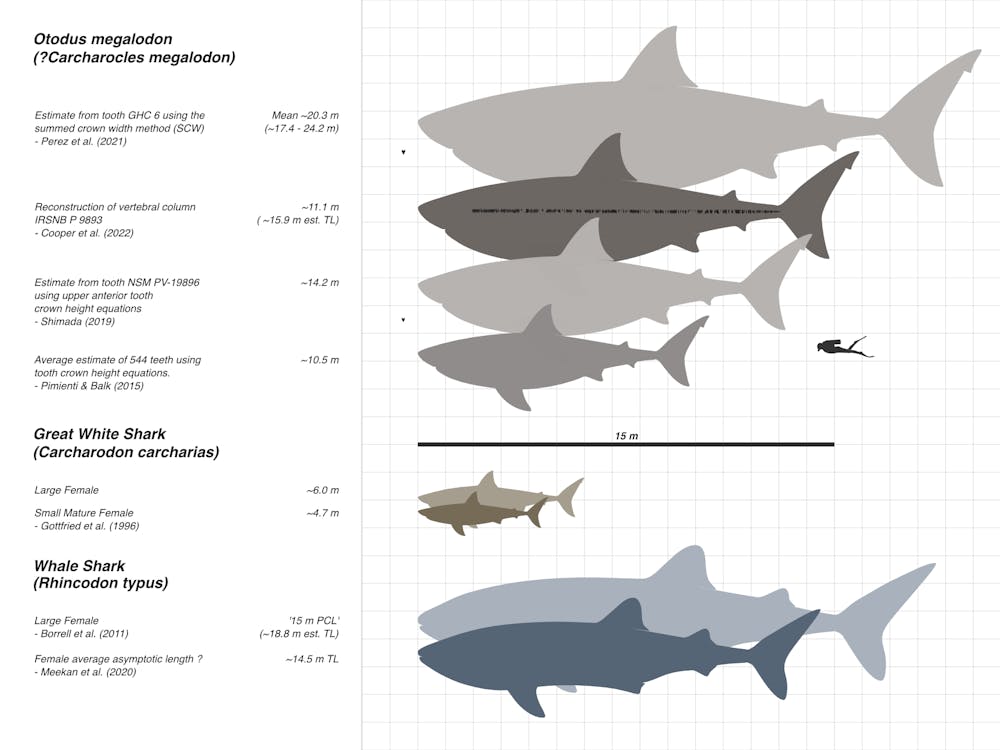
    In Peter Benchley’s 1974 novel that Jaws is based on, the shark is 6 metres long. For added screen excitement, in the movie it grew to a whopping 7.6 metres.

    However, that’s unrealistically large.

    The average size of a mature great white (Carcharodon carcharias, also known as the white shark) is between 4.6 and 4.9 metres for female sharks and up to 4 metres for male sharks.

    The largest recorded living specimens peak at about 6 metres, with one monster specimen caught in Cuba in 1945 reaching 6.4 metres.

    Earth’s oceans have seen bigger predatory sharks in the past. The biggest one of all time was the megalodon (Otodus megalodon) which lived from 23 to 3 million years ago, and may have been up to 24 metres in length. However, it looked nothing like the modern white shark.

    We don’t know precisely how big the megalodon was, but certainly larger than the great white shark.
    Steveoc 86/Wikimedia Commons, CC BY-SA

    They’re not even directly related – another thing scientists learned quite recently.

    Who was the megalodon, then?

    White sharks first evolved between 6 and 4 million years ago in the shadows of the megalodon. A recent study showed the megalodon’s large serrated teeth show signs of it being a supreme opportunistic super-predator.

    That means it ate just about anything, but especially liked whales and marine mammals.


    Read more:
    Friday essay: Giant shark megalodon was the most powerful superpredator ever. Why did it go extinct?


    But white sharks are not directly related to the megalodon, whose lineage began with a shark called Cretalamna during the age of dinosaurs about 100 million years ago.

    By contrast, the white shark lineage began with an ancient mako shark, Carcharodon hastalis. It was 7 to 8 metres long and had large, similarly shaped teeth to the modern white shark but lacking serrated edges.

    A fossil intermediate species, Carcharodon hubbelli shows the transition over time from weakly serrated to strongly serrated teeth.

    White shark fossil species. Left, the serrated fossil tooth teeth of the extant white shark; right, a similarly shaped unserrated tooth of the extinct giant mako shark which gave rise to white sharks.
    John Long, CC BY

    How did Jaws affect white shark populations?

    Last year, the International Shark Attack File reported 47 unprovoked shark bites to humans worldwide, resulting in seven fatalities. This was well below the previous ten-year average of 70 bites per year; your chances of getting bitten by a shark are extremely rare.

    Following the movies that made up the Jaws franchise, there was an increase in hunting and killing sharks – with a particular focus on great white sharks that were already going into a decline due to overfishing, trophy hunting and lethal control programs.

    Between 80% and 90% of white sharks have disappeared globally since the middle of the 20th century. Recent estimates calculate there are probably less than 500 individual white sharks in Australian waters right now.

    When Jaws first aired, scientists didn’t know how long sharks took to reproduce, or how many offspring a white shark could have each year. We now know it takes about 26 years for a male and 33 years for a female to sexually mature before they can start having pups.

    Data about white shark births is sparse, but recently a 5.6-metre-long female caught on a drum line off the coast of Queensland had just four large pups inside her. This is a very small number. Some large sharks, such as the whale shark, can give birth to up to 300 young.

    Now that we know just how slow they are to breed, it’s clear it will take many decades to reestablish the “pre-Jaws” population of white sharks – important apex predators in the marine ecosystem.

    Charlie Huveneers from Flinders University about to take a tissue sample for research on white sharks. There is still a lot we don’t know about their biology.
    Andrew Fox, Adelaide, CC BY

    Will white sharks survive?

    White sharks are currently listed as vulnerable.

    This classification means if we don’t change the current living conditions for white sharks, including impacts caused by human activities such as commercial fishing, and the impacts of climate change and ocean pollution, they will continue to decline and eventually could go extinct.

    Currently, white sharks are protected in several countries and form the basis for an important tourist industry in Australia, South Africa, western United States and most recently Nova Scotia, Canada.

    These sharks are iconic apex predators that fascinate people. One of us (John) went cage diving with them recently off the Neptune Islands of South Australia and can attest to how breathtaking it is to watch them in their natural environment.

    In terms of economic impact, they are worth far more alive than dead.

    White sharks are a growing tourism draw in several countries.
    Andrew Fox, Adelaide, CC BY

    There’s still much we don’t know about white sharks

    The complete white shark genome was first published only in 2019. It has 4.63 billion base pairs, making it much larger than the human genome (3.2 billion base pairs).

    The genome revealed some surprising things, like how white sharks show strong molecular adaptations for wound-healing processes, and a suite of “genome stability” genes – those used in DNA repair or DNA damage response.

    The transcriptome (or sum total of the messenger RNA) of the white shark showed greater similarity to the human transcriptome than to that of other fishes. This hints that “unexpressed genes” in the shark could one day play a role in uncovering genetic pathways for potential cures in human diseases.

    Jaws and its sequels certainly brought white sharks to the attention (and nightmares) of humans, with devastating impacts on how we treated them as a species.

    Our relationship with white sharks reflects our relationship with nature more broadly – a feared antagonist within the current capitalist paradigm; an enemy to be tamed, contained or consumed.

    As we learn more of the peril and potential of these remarkable creatures, we can learn how to live with them, to see beyond our fears and value their role within our delicate ocean ecosystems.

    John Long receives funding from The Australian Research Council.

    Heather L. Robinson does not work for, consult, own shares in or receive funding from any company or organisation that would benefit from this article, and has disclosed no relevant affiliations beyond their academic appointment.

    ref. Jaws at 50: how a single movie changed our perception of white sharks forever – https://theconversation.com/jaws-at-50-how-a-single-movie-changed-our-perception-of-white-sharks-forever-258306

    MIL OSI AnalysisEveningReport.nz

  • MIL-OSI: Oportun Releases Investor Presentation Highlighting Strategic Progress

    Source: GlobeNewswire (MIL-OSI)

    Outlines proactive steps taken by Board and management to drive long-term stockholder value

    Urges stockholders to vote “FOR” Oportun’s two nominees – CEO Raul Vazquez and Carlos Minetti – on the GREEN proxy card

    SAN CARLOS, Calif., June 18, 2025 (GLOBE NEWSWIRE) — Oportun (Nasdaq: OPRT), a mission-driven financial services company, today released an investor presentation in connection with the Company’s upcoming Annual Meeting of Stockholders, scheduled to be held on July 18, 2025. The presentation and additional important information related to the Annual Meeting are available at VoteForOportun.com.

    Oportun’s Board of Directors encourages stockholders to review the Company’s proxy statement carefully and vote “FOR” the Company’s nominees – CEO Raul Vazquez and Carlos Minetti – using the GREEN proxy card or GREEN voting instruction form.

    If you have any questions about how to vote your shares, please call the firm assisting us with the solicitation of proxies:

    INNISFREE M&A INCORPORATED
    Stockholders may call:
    (877) 800-5195 (toll-free from the U.S. and Canada) or
    +1 (412) 232-3651 (from other countries)

    About Oportun

    Oportun (Nasdaq: OPRT) is a mission-driven financial services company that puts its members’ financial goals within reach. With intelligent borrowing, savings, and budgeting capabilities, Oportun empowers members with the confidence to build a better financial future. Since inception, Oportun has provided more than $20.3 billion in responsible and affordable credit, saved its members more than $2.4 billion in interest and fees, and helped its members set aside an average of more than $1,800 annually. For more information, visit Oportun.com.

    Investor Contact
    Dorian Hare
    (650) 590-4323
    ir@oportun.com

    Innisfree M&A Incorporated
    Scott Winter / Gabrielle Wolf / Jonathan Kovacs
    (212) 750-5833

    Media Contact
    FGS Global
    John Christiansen / Bryan Locke
    Oportun@fgsglobal.com

    The MIL Network

  • MIL-OSI: Greystone Housing Impact Investors LP Extends General Line of Credit Facility

    Source: GlobeNewswire (MIL-OSI)

    OMAHA, Neb., June 18, 2025 (GLOBE NEWSWIRE) — Greystone Housing Impact Investors LP (NYSE: GHI) (the “Partnership”) announced today that on June 12, 2025, it amended its existing $50 million secured revolving Line of Credit facility (“LOC”). The LOC is secured by the Partnership’s joint venture equity investments. BankUnited, N.A. serves as sole arranger and administrative agent.

    The amendment extended the maturity date to June 2027, with two additional one-year extension options, increased the maximum allowable seniors housing joint venture equity investments the Partnership can make to 30% of eligible encumbered assets, and increased the Partnership’s maximum allowable limited guaranties of debt associated with its joint venture equity investments.

    An affiliate of the Partnership’s general partner provides a deficiency guaranty for the facility. The affiliate does not charge the Partnership a fee for the deficiency guaranty.

    “The amendment to our general LOC provides valuable liquidity and enhances our operational flexibility to make additional joint venture equity investments in the seniors housing segment,” said Kenneth C. Rogozinski, Chief Executive Officer of the Partnership.

    About Greystone Housing Impact Investors LP

    Greystone Housing Impact Investors LP was formed in 1998 under the Delaware Revised Uniform Limited Partnership Act for the primary purpose of acquiring, holding, selling and otherwise dealing with a portfolio of mortgage revenue bonds which have been issued to provide construction and/or permanent financing for affordable multifamily, seniors and student housing properties. The Partnership is pursuing a business strategy of acquiring additional mortgage revenue bonds and other investments on a leveraged basis. The Partnership expects and believes the interest earned on these mortgage revenue bonds is excludable from gross income for federal income tax purposes. The Partnership seeks to achieve its investment growth strategy by investing in additional mortgage revenue bonds and other investments as permitted by its Second Amended and Restated Limited Partnership Agreement, dated December 5, 2022, taking advantage of attractive financing structures available in the securities market, and entering into interest rate risk management instruments. Greystone Housing Impact Investors LP press releases are available at www.ghiinvestors.com.

    Safe Harbor Statement

    Information contained in this press release contains “forward-looking statements,” which are based on current expectations, forecasts and assumptions that involve risks and uncertainties that could cause actual outcomes and results to differ materially. These risks and uncertainties include, but are not limited to, risks involving current maturities of our financing arrangements and our ability to renew or refinance such maturities, fluctuations in short-term interest rates, collateral valuations, mortgage revenue bond investment valuations and overall economic and credit market conditions. For a further list and description of such risks, see the reports and other filings made by the Partnership with the Securities and Exchange Commission, including but not limited to, its Annual Report on Form 10-K, Quarterly Reports on Form 10-Q, and Current Reports on Form 8-K. Readers are urged to consider these factors carefully in evaluating the forward-looking statements. The Partnership disclaims any intention or obligation to update or revise any forward-looking statements, whether as a result of new information, future events or otherwise.

    MEDIA CONTACT:
    Karen Marotta
    Greystone
    212-896-9149
    Karen.Marotta@greyco.com

    INVESTOR CONTACT:
    Andy Grier
    Senior Vice President
    402-952-1235

    The MIL Network

  • MIL-OSI USA: Senator Markey Demands Answers from Verizon on Worker Exposure to Toxic Lead

    US Senate News:

    Source: United States Senator for Massachusetts Ed Markey
    Letter Text (PDF)
    Washington (June 18, 2025) – Senator Edward J. Markey (D-Mass.), a member of the Commerce, Science, and Transportation Committee and the Health, Education, Labor, and Pensions Committee, today wrote to Hans Vestberg, Chairman and CEO of Verizon, following the publication of a health evaluation from the National Institutes of Occupational Safety and Health (NIOSH) showing extremely high concentrations of toxic lead at Verizon worksites and elevated levels of lead in workers’ blood. In 2023, an extensive Wall Street Journal investigation documented a sprawling nationwide network of legacy lead-sheathed cables that telecommunications companies—including Verizon—installed in the nineteenth and twentieth centuries and left underground, underwater, and overhead.
    In the letter the Senator writes, “It is Verizon’s responsibility—both moral and legal—to safeguard the well-being of its workers and the communities in which it operates. The exposure of telecom workers in Massachusetts to lead-laced environments, including manholes where sediment contained lead concentrations as high as 30,000 parts per million—150 times the Environmental Protection Agency’s (EPA) current safety limit—demands the highest level of attention from Verizon. Verizon must act swiftly to eliminate lead exposure from its operations, remediate affected environments, and commit to full transparency and accountability moving forward.”
    Senator Markey continues, “Most recently, NIOSH completed a Health Hazard Evaluation confirming serious occupational exposures among Verizon workers in Massachusetts; we understand a copy of the final report has been provided to Verizon. NIOSH found that these workers were repeatedly exposed to lead because inadequate safety procedures in place failed to protect them. NIOSH also reviewed past blood-level testing by workers, which found examples of workers with elevated blood lead levels according to federal safety guidelines; this suggests recent worker exposure at unsafe levels of lead. Additionally, NIOSH hygienists found lead on workers hands, boots, and in their trucks, suggesting many may be unknowingly carrying home a substance that could endanger their families. Children are particularly sensitive to lead, with even low levels of exposure resulting in developmental delays, difficulty learning, and behavioral issues.”
    Senator Markey requests responses by July 9, 2025, to questions including:
    What is the status of Verizon’s efforts to compile a comprehensive inventory, including geographic mapping, of all known and suspected lead-sheathed cables it owns or for which it is responsible?
    What steps has Verizon taken since the publication of the Wall Street Journal investigation to:
    (a) Identify and monitor worker exposure to lead from lead-sheathed telecommunications cables?
    (b) Notify and protect workers performing duties in or near areas with lead-sheathed cables?
    (c) Inform the public, especially in environmental justice communities, about risks posed by lead-sheathed cables, and field and respond to concerns?
    (d) Test for and remediate environmental contamination around legacy infrastructure?
    (e) Provide medical monitoring, treatment, or compensation for lead-exposed workers?
    What is the status of any investigations by the U.S. Department of Justice, the EPA, or OSHA into Verizon’s handling of its lead-sheathed cables?
    Will Verizon commit to fully implementing all the NIOSH recommendations, including conducting routine BLL testing and retrofitting hygiene and PPE protocols across all affected facilities? Which recommendations, if any, has Verizon already implemented? What is the status of recommendations not yet implemented?
    Has Verizon conducted its own personal air sampling at work sites containing lead-sheathed cables? If so, please provide the results by year and location of the tests.
    (a) Does Verizon have an explanation for the personal air sample tested by NIOSH that exceeded OSHA limits?
    (b) How did Verizon previously determine whether to conduct a personal air sampling test?
    Has Verizon conducted its own manhole-soil-sediment testing at worksites containing lead-sheathed cables? Does Verizon have an explanation for the bulk sediment sampled that exceeded 30,000 ppm for lead?
    Why was Verizon not providing its workers in Massachusetts with lead removal wipes prior to the NIOSH Health Hazard Evaluation? Why did Verizon start to provide them—in place of wet wipes—between the first and second NIOSH site visits?
    What internal accountability measures is Verizon adopting to ensure executive leadership is fully informed and responsive to worker safety concerns related to lead exposure from legacy telecommunications cables?
    In February 2024, Senator Markey hosted a roundtable event in Chicopee, Massachusetts, along with state and local elected officials, public health leaders, and occupational safety and environmental experts, to discuss the environmental, public health, and occupational safety concerns posed by lead-sheathed telecommunications cables.
    In July 2023, Senator Markey, author of the 1996 Telecommunications Act, wrote to the United States Telecom Association (USTelecom) demanding answers to questions raised by the Wall Street Journal investigation, which found detectable levels of lead contamination in water and soil samples collected near lead-sheathed cables across the country.

    MIL OSI USA News

  • MIL-OSI USA: Ricketts Introduces VARIANCE Act to Strengthen American Trucking

    US Senate News:

    Source: United States Senator Pete Ricketts (Nebraska)
    WASHINGTON, D.C. – Today, U.S. Senator Pete Ricketts (R-NE) introduced the Vehicle Axle Redistribution Increases Allow New Capacities for Efficiency (VARIANCE) Act.  The bill would improve regulations for American truckers by permitting a 10% axle variance for commercial motor vehicles transporting dry bulk goods.  Senator Adam Schiff (D-CA) is a co-lead of this legislation in the Senate.  Representatives Rick Crawford (R-AR-1) and Salud Carbajal (D-CA-24) are leading companion legislation in the House.
    “This is common-sense policymaking,” said Ricketts.  “Allowing flexibility for truckers with naturally shifting goods will help improve efficiency and safety in Nebraska’s agriculture industry.  American truckers want to carry the same sized load in loose dry bulk that they can for any other freight.  This bill is a win for every step along the supply chain.”
    “Providing commonsense flexibility to our transportation and agriculture sectors will ensure California consumers don’t face higher costs due to regulations that don’t acknowledge the realities of basic physics,” said Schiff.  ”The VARIANCE Act is a bipartisan and bicameral solution that will improve our supply chain, reduce congestion, and help California farmers and producers continue to feed the nation and the world.”
    The Variance Act would:
    Grant a 10% axle variance for commercial motor vehicles transporting dry bulk goods and increase the maximum weight on any tandem-axle trailer to 37,400 lbs. 
    Leave the maximum laden vehicle weight untouched at 80,000 lbs.
    The text of the bill is available here.
    “Farmers, manufacturers, miners, and many other industries depend on truckers to get their goods to market.  When dry bulk cargo is in transit, however, a simple physics problem arises: routine braking often causes the contents of trailers to shift,” said Henry Hanscom, American Trucking Associations SVP of Legislative Affairs.  “ATA applauds Senators Ricketts and Schiff for this bipartisan, commonsense solution that will prevent motor carriers from being unfairly penalized for weight variances, promote the efficient movement of freight, and support hardworking Americans in the trucking industry.”
    “The VARIANCE Act is a commonsense solution that helps address transportation bottlenecks in the grain and feed industry,” said Mike Seyfert, National Grain and Feed Association President and CEO.  “By allowing modest axle weight variances for dry bulk shipments, this legislation supports more efficient and sustainable supply chains while maintaining safety standards.”
    “For 37 years, the Agriculture Transportation Coalition has worked with truck, rail, and ocean carriers in pursuit of greater transport efficiency, in order to keep US agriculture and forest products competitive in the global marketplace,” said Peter Friedmann, Agriculture Transportation Coalition Executive Director.  “Domestic trucking is an important component of the international supply chain.  Thus the AgTC supports the VARIANCE Act to allow for variance in axle weight distribution, which will increase efficiency, safety, cost-effectiveness in transport of grains, feeds of our members.” 
    “This expanded partnership in the Senate showcases the broad support and practical impact of the VARIANCE Act. Thank you to Senator Ricketts and Senator Schiff for their commitment to improve the safe and efficient movement of dry bulk commodities across our country,” said Ryan Streblow, National Tank Truck Carriers President & CEO.  “By enhancing weight distribution for dry bulk trailers, we can increase payload efficiency, reduce highway congestion, and boost safety, all without additional infrastructure wear.  Today, many carriers’ underload, and this flexibility will enable them to hit gross vehicle weight limits and reduce truckloads on our roads.”
    “The Agricultural Retailers Association strongly supports the proposal to authorize a ten percent axle weight variance for commercial motor vehicles transporting dry bulk goods like fertilizer on the Interstate Highway System,” said Richard Gupton, Agricultural Retailers Association SVP of Public Policy & Counsel.  “This common-sense solution addresses the unique challenges posed by the natural shifting of dry bulk cargo during transport, ensuring that trucks can operate safely and efficiently without exceeding the maximum gross vehicle weight limit.  By granting this variance, Congress will not only improve the efficiency of transporting essential commodities like fertilizer and grain but also enhance the overall cost-effectiveness and safety of our nation’s infrastructure.  Agricultural retailers, farmers, and other supply chain stakeholders rely on policies like this to maintain the steady flow of critical goods that drive the U.S. economy.  We urge lawmakers to include this vital measure in the next surface transportation reauthorization bill.”
    “All fertilizer touches a truck at least once it its journey to the field.  Any delay in delivery can negatively impact crop yields and contribute to increased food prices for consumers,” said Corey Rosenbush, Fertilizer Institute President and CEO.  “The Fertilizer Institute thanks Senators Ricketts and Schiff, as well as Representatives Crawford and Carbajal, for their bipartisan leadership in introducing this important legislation to help ensure that fertilizer reaches farmers precisely when and where it is needed.”
    BACKGROUND:
    Corn, soybeans, and other dry bulk are key to Nebraska’s $9.9 billion in agricultural exports.  Nebraska has over 1,600 dry bulk trucking companies, with nearly 18,000 dry bulk drivers.
    Present law limits the maximum laden weight of a commercial truck to 80,000 lbs., including the weight of the cargo.  Most trailers transporting dry bulk goods are tandem axle, limiting the weight for each axle to 34,000 lbs.  Dry bulk goods include plastic pellets, flour, aggregates, and other solid substances with individual particles that easily separate.  Bulk loads of dry goods regularly shift during transport and cause the front trailer axle to exceed its maximum 34,000 lbs.  The force generated when braking compacts the cargo at the front end of the trailer, but the relatively weaker forces from acceleration and forward movement fail to evenly redistribute the weight across axles.  So, even when the cargo was properly loaded, the truck’s natural motion causes the load to become improperly distributed.  This bill would maintain maximum laden vehicle weight limits but allow for cargo to become unevenly distributed during the course of transportation.

    MIL OSI USA News

  • MIL-OSI: John Pucin Appointed to Board of Directors of NSTS Bancorp, Inc. and North Shore Trust and Savings

    Source: GlobeNewswire (MIL-OSI)

    WAUKEGAN, Ill., June 18, 2025 (GLOBE NEWSWIRE) — NSTS Bancorp, Inc. (the “Company”), the holding company for North Shore Trust and Savings (the “Bank”), announced today that Mr. John S. Pucin has been appointed to the Board of Directors of both the Company and the Bank. Mr. Pucin was appointed to fill the vacancy in the class of directors whose term expires at the Company’s annual stockholder meeting in 2027.

    Mr. Pucin currently serves as Senior Vice President and Corporate Counsel for Caine & Weiner Company, Inc. and the managing partner of the Law Office of John S. Pucin, P.C. He graduated from Xavier University with a B.S.B.A./Finance and from the Capital University Law School with a Juris Doctor degree. Mr. Pucin has been a member of the Commercial Law League for over twenty years and is a past chair of the Midwest Region.

    “We are excited to have Mr. Pucin join our board. Mr. Pucin’s legal and management experience makes him a valuable resource and a qualified addition to the Company,” said Mr. Stephen G. Lear, Chairman, President and Chief Executive Officer of the Company.

    About NSTS Bancorp, Inc. and North Shore Trusts and Savings

    NSTS Bancorp Inc. is the holding company of North Shore Trust and Savings. As of March 31, 2025, North Shore Trust and Savings had approximately $282.7 million in assets and operates from its headquarters and main banking office in Waukegan, Illinois, as well as two additional full-service branch offices located in Waukegan and Lindenhurst, Illinois, respectively. For over 100 years, North Shore Trust and Savings has served the local communities where it operates and has deep and longstanding relationships with its businesses and retail customers as well as local municipalities.

    Contact:

    Stephen G. Lear
    Chairman, President and Chief Executive Officer
    slear@northshoretrust.com 
    (847) 336-4430

    The MIL Network

  • MIL-OSI: John Pucin Appointed to Board of Directors of NSTS Bancorp, Inc. and North Shore Trust and Savings

    Source: GlobeNewswire (MIL-OSI)

    WAUKEGAN, Ill., June 18, 2025 (GLOBE NEWSWIRE) — NSTS Bancorp, Inc. (the “Company”), the holding company for North Shore Trust and Savings (the “Bank”), announced today that Mr. John S. Pucin has been appointed to the Board of Directors of both the Company and the Bank. Mr. Pucin was appointed to fill the vacancy in the class of directors whose term expires at the Company’s annual stockholder meeting in 2027.

    Mr. Pucin currently serves as Senior Vice President and Corporate Counsel for Caine & Weiner Company, Inc. and the managing partner of the Law Office of John S. Pucin, P.C. He graduated from Xavier University with a B.S.B.A./Finance and from the Capital University Law School with a Juris Doctor degree. Mr. Pucin has been a member of the Commercial Law League for over twenty years and is a past chair of the Midwest Region.

    “We are excited to have Mr. Pucin join our board. Mr. Pucin’s legal and management experience makes him a valuable resource and a qualified addition to the Company,” said Mr. Stephen G. Lear, Chairman, President and Chief Executive Officer of the Company.

    About NSTS Bancorp, Inc. and North Shore Trusts and Savings

    NSTS Bancorp Inc. is the holding company of North Shore Trust and Savings. As of March 31, 2025, North Shore Trust and Savings had approximately $282.7 million in assets and operates from its headquarters and main banking office in Waukegan, Illinois, as well as two additional full-service branch offices located in Waukegan and Lindenhurst, Illinois, respectively. For over 100 years, North Shore Trust and Savings has served the local communities where it operates and has deep and longstanding relationships with its businesses and retail customers as well as local municipalities.

    Contact:

    Stephen G. Lear
    Chairman, President and Chief Executive Officer
    slear@northshoretrust.com 
    (847) 336-4430

    The MIL Network

  • MIL-OSI: The Herzfeld Caribbean Basin Fund, Inc. Announces Results of Special Meeting of Stockholders; Approval of Conversion of Fund to CLO Equity Strategy

    Source: GlobeNewswire (MIL-OSI)

    MIAMI BEACH, FLA., June 18, 2025 (GLOBE NEWSWIRE) — The Herzfeld Caribbean Basin Fund, Inc. (NASDAQ: CUBA) (the “Fund”) today announced that the Fund’s Stockholders have approved the Fund’s conversion from its current investment strategy to focus on a “CLO Equity Strategy”. The approval was voted for at a Special Meeting of Stockholders held on June 17, 2025, with approximately 96% of the votes cast in favor of the changes.

    With this change, the Fund’s primary investment objective will change to a total return strategy with a secondary objective of generating high current income for stockholders. In accordance with the change in investment objective, the Fund will focus on investing in equity and junior debt tranches of collateralized loan obligations, or “CLOs”. CLOs are portfolios of collateralized loans consisting primarily of below investment grade U.S. senior secured loans with a large number of distinct underlying borrowers across various industry sectors.

    The three proposals approved by the Fund’s stockholders at the special meeting were:

    • Proposal 1: approval of an amended and restated investment advisory agreement between the Fund and Thomas J. Herzfeld Advisors, Inc. (the “Adviser”) to permit the Adviser to receive a fee based on “managed assets” and an incentive fee.
    • Proposal 2: approval to revise the Fund’s investment objective from obtaining “long term capital appreciation” to a primary objective of “maximizing risk adjusted total returns” with a secondary objective of “generating high current income;” and to reclassify the Fund’s investment objective as non-fundamental.
    • Proposal 3: approval to amend the fundamental policies of the Fund related to borrowing, the issuance of senior securities, underwriting securities issued by other persons, industry concentration, the purchase or sale of real estate, the purchase or sale of commodities, and making loans to other persons.

    The changes approved by the Fund’s Stockholders will go into effect July 1, 2025.

    Cecilia Gondor, Chairperson of the Fund’s Board of Directors commented: “This marks an important day in the long history of our Fund and the beginning of what we hope is a bright future for our Fund investors. I want to thank my fellow board members and our Chairman Emeritus, Tom Herzfeld, for the hard work that was undertaken in managing this transition.”

    About Thomas J. Herzfeld Advisors, Inc.

    Thomas J. Herzfeld Advisors, Inc., founded in 1984, is an SEC registered investment advisor, specializing in investment analysis and account management in closed-end funds.

    More information about the advisor can be found at www.herzfeld.com.

    Past performance is no guarantee of future performance. An investment in the Fund is subject to certain risks, including market risk. In general, shares of closed-end funds often trade at a discount from their net asset value and at the time of sale may be trading on the exchange at a price which is more or less than the original purchase price or the net asset value. An investor should carefully consider the Fund’s investment objective, risks, charges and expenses. Please read the Fund’s disclosure documents before investing.

    Forward-Looking Statements

    This press release, and other statements that TJHA or the Fund may make, may contain forward looking statements within the meaning of the Private Securities Litigation Reform Act, with respect to the Fund’s or TJHA’s future financial or business performance, strategies or expectations. Forward-looking statements are typically identified by words or phrases such as “trend,” “potential,” “opportunity,” “pipeline,” “believe,” “comfortable,” “expect,” “anticipate,” “current,” “intention,” “estimate,” “position,” “assume,” “outlook,” “continue,” “remain,” “maintain,” “sustain,” “seek,” “achieve,” and similar expressions, or future or conditional verbs such as “will,” “would,” “should,” “could,” “may” or similar expressions. TJHA and the Fund caution that forward-looking statements are subject to numerous assumptions, risks and uncertainties, which change over time. Forward-looking statements speak only as of the date they are made, and TJHA and the Fund assume no duty to and do not undertake to update forward-looking statements. Actual results could differ materially from those anticipated in forward-looking statements and future results could differ materially from historical performance. With respect to the Fund, the following factors, among others, could cause actual events to differ materially from forward-looking statements or historical performance: (1) changes and volatility in political, economic or industry conditions, particularly with respect to Cuba and other Caribbean Basin countries, the interest rate environment, foreign exchange rates or financial and capital markets, which could result in changes in demand for the Fund or in the Fund’s net asset value; (2) the relative and absolute investment performance of the Fund and its investments; (3) the impact of increased competition; (4) the unfavorable resolution of any legal proceedings; (5) the extent and timing of any distributions or share repurchases; (6) the impact, extent and timing of technological changes; (7) the impact of legislative and regulatory actions and reforms, including the Dodd-Frank Wall Street Reform and Consumer Protection Act, and regulatory, supervisory or enforcement actions of government agencies relating to the Fund or TJHA, as applicable; (8) terrorist activities, international hostilities and natural disasters, which may adversely affect the general economy, domestic and local financial and capital markets, specific industries or TJHA or the Fund; (9) TJHA’s and the Fund’s ability to attract and retain highly talented professionals; (10) the impact of TJHA electing to provide support to its products from time to time; (11) the impact of problems at other financial institutions or the failure or negative performance of products at other financial institutions; and (12) the effects of an epidemic, pandemic or public health emergency, including without limitation, COVID-19. Annual and Semi-Annual Reports and other regulatory filings of the Fund with the SEC are accessible on the SEC’s website at www.sec.gov and on TJHA’s website at www.herzfeld.com/cuba, and may discuss these or other factors that affect the Fund. The information contained on TJHA’s website is not a part of this press release.

    TJHA has received certain nominations or awards by third-parties as reflected herein. Investors should review the criteria for each nomination or award as reflected on the third-party’s webpage. In addition, the nominations and awards reflect past performance of the nominee or award designee and may not reflect the current performance or status of any such firm or individual and may no longer be applicable. Morningstar award content presented with permission and licensing fee. Contact us for more information on how the ratings are apportioned and for full disclosures regarding third party news and awards.

    Contact:
    Thomas Morgan
    Chief Compliance Officer
    The Herzfeld Caribbean Basin Fund, Inc.
    1-305-777-1660

    The MIL Network

  • MIL-OSI: The Herzfeld Caribbean Basin Fund, Inc. Announces Results of Special Meeting of Stockholders; Approval of Conversion of Fund to CLO Equity Strategy

    Source: GlobeNewswire (MIL-OSI)

    MIAMI BEACH, FLA., June 18, 2025 (GLOBE NEWSWIRE) — The Herzfeld Caribbean Basin Fund, Inc. (NASDAQ: CUBA) (the “Fund”) today announced that the Fund’s Stockholders have approved the Fund’s conversion from its current investment strategy to focus on a “CLO Equity Strategy”. The approval was voted for at a Special Meeting of Stockholders held on June 17, 2025, with approximately 96% of the votes cast in favor of the changes.

    With this change, the Fund’s primary investment objective will change to a total return strategy with a secondary objective of generating high current income for stockholders. In accordance with the change in investment objective, the Fund will focus on investing in equity and junior debt tranches of collateralized loan obligations, or “CLOs”. CLOs are portfolios of collateralized loans consisting primarily of below investment grade U.S. senior secured loans with a large number of distinct underlying borrowers across various industry sectors.

    The three proposals approved by the Fund’s stockholders at the special meeting were:

    • Proposal 1: approval of an amended and restated investment advisory agreement between the Fund and Thomas J. Herzfeld Advisors, Inc. (the “Adviser”) to permit the Adviser to receive a fee based on “managed assets” and an incentive fee.
    • Proposal 2: approval to revise the Fund’s investment objective from obtaining “long term capital appreciation” to a primary objective of “maximizing risk adjusted total returns” with a secondary objective of “generating high current income;” and to reclassify the Fund’s investment objective as non-fundamental.
    • Proposal 3: approval to amend the fundamental policies of the Fund related to borrowing, the issuance of senior securities, underwriting securities issued by other persons, industry concentration, the purchase or sale of real estate, the purchase or sale of commodities, and making loans to other persons.

    The changes approved by the Fund’s Stockholders will go into effect July 1, 2025.

    Cecilia Gondor, Chairperson of the Fund’s Board of Directors commented: “This marks an important day in the long history of our Fund and the beginning of what we hope is a bright future for our Fund investors. I want to thank my fellow board members and our Chairman Emeritus, Tom Herzfeld, for the hard work that was undertaken in managing this transition.”

    About Thomas J. Herzfeld Advisors, Inc.

    Thomas J. Herzfeld Advisors, Inc., founded in 1984, is an SEC registered investment advisor, specializing in investment analysis and account management in closed-end funds.

    More information about the advisor can be found at www.herzfeld.com.

    Past performance is no guarantee of future performance. An investment in the Fund is subject to certain risks, including market risk. In general, shares of closed-end funds often trade at a discount from their net asset value and at the time of sale may be trading on the exchange at a price which is more or less than the original purchase price or the net asset value. An investor should carefully consider the Fund’s investment objective, risks, charges and expenses. Please read the Fund’s disclosure documents before investing.

    Forward-Looking Statements

    This press release, and other statements that TJHA or the Fund may make, may contain forward looking statements within the meaning of the Private Securities Litigation Reform Act, with respect to the Fund’s or TJHA’s future financial or business performance, strategies or expectations. Forward-looking statements are typically identified by words or phrases such as “trend,” “potential,” “opportunity,” “pipeline,” “believe,” “comfortable,” “expect,” “anticipate,” “current,” “intention,” “estimate,” “position,” “assume,” “outlook,” “continue,” “remain,” “maintain,” “sustain,” “seek,” “achieve,” and similar expressions, or future or conditional verbs such as “will,” “would,” “should,” “could,” “may” or similar expressions. TJHA and the Fund caution that forward-looking statements are subject to numerous assumptions, risks and uncertainties, which change over time. Forward-looking statements speak only as of the date they are made, and TJHA and the Fund assume no duty to and do not undertake to update forward-looking statements. Actual results could differ materially from those anticipated in forward-looking statements and future results could differ materially from historical performance. With respect to the Fund, the following factors, among others, could cause actual events to differ materially from forward-looking statements or historical performance: (1) changes and volatility in political, economic or industry conditions, particularly with respect to Cuba and other Caribbean Basin countries, the interest rate environment, foreign exchange rates or financial and capital markets, which could result in changes in demand for the Fund or in the Fund’s net asset value; (2) the relative and absolute investment performance of the Fund and its investments; (3) the impact of increased competition; (4) the unfavorable resolution of any legal proceedings; (5) the extent and timing of any distributions or share repurchases; (6) the impact, extent and timing of technological changes; (7) the impact of legislative and regulatory actions and reforms, including the Dodd-Frank Wall Street Reform and Consumer Protection Act, and regulatory, supervisory or enforcement actions of government agencies relating to the Fund or TJHA, as applicable; (8) terrorist activities, international hostilities and natural disasters, which may adversely affect the general economy, domestic and local financial and capital markets, specific industries or TJHA or the Fund; (9) TJHA’s and the Fund’s ability to attract and retain highly talented professionals; (10) the impact of TJHA electing to provide support to its products from time to time; (11) the impact of problems at other financial institutions or the failure or negative performance of products at other financial institutions; and (12) the effects of an epidemic, pandemic or public health emergency, including without limitation, COVID-19. Annual and Semi-Annual Reports and other regulatory filings of the Fund with the SEC are accessible on the SEC’s website at www.sec.gov and on TJHA’s website at www.herzfeld.com/cuba, and may discuss these or other factors that affect the Fund. The information contained on TJHA’s website is not a part of this press release.

    TJHA has received certain nominations or awards by third-parties as reflected herein. Investors should review the criteria for each nomination or award as reflected on the third-party’s webpage. In addition, the nominations and awards reflect past performance of the nominee or award designee and may not reflect the current performance or status of any such firm or individual and may no longer be applicable. Morningstar award content presented with permission and licensing fee. Contact us for more information on how the ratings are apportioned and for full disclosures regarding third party news and awards.

    Contact:
    Thomas Morgan
    Chief Compliance Officer
    The Herzfeld Caribbean Basin Fund, Inc.
    1-305-777-1660

    The MIL Network

  • MIL-OSI: KDSA Investment Partners Acquires Williams Distributors

    Source: GlobeNewswire (MIL-OSI)

    SPOKANE, Wash., June 18, 2025 (GLOBE NEWSWIRE) — KDSA Investment Partners (“KDSA”), a food and beverage-focused investment firm, announced today that it has acquired Spokane-based Williams Distributors (“Williams”), the leading direct-store-delivery (“DSD”) distributor of ice cream, frozen pizza and frozen foods in the Northwest. The transaction marks a significant milestone for both companies and a major step forward in KDSA’s strategy to build a rapidly growing and scaled independent DSD platform. The investment was completed in partnership with Greyrock Capital Group.

    Founded in 1992 by Roger Williams and led for the past six years by his son, Tony Williams, Williams operates a full-service DSD distribution network across Eastern Washington, Montana, Idaho, Northeast Oregon, and Northern Wyoming. The company services over 2,000 customer locations, including regional grocers, convenience stores, and independent retailers.

    “This is a major step forward for KDSA,” said David Knopf, Co-Managing Partner of KDSA and new Chaiman of Williams Distributors. “Williams has built a terrific business grounded in customer service and trust, reliability and strong supplier partnerships. It’s a great fit with our long-term vision, and we’re excited to support the team in this next phase of growth.”

    As part of the transition, Tim Valdez, an Operating Partner at KDSA, has been named CEO of Williams. A seasoned DSD executive, Valdez previously served as President of Cold Front Distribution. Tony Williams, who has successfully served the company for over two decades, will remain President through the end of the year and continue as a strategic advisor and brand ambassador.

    “I’m incredibly proud of what we’ve built at Williams,” said Tony Williams, former owner and current President. “We’ve spent decades earning trust in our markets by focusing on best-in-class, flawless customer service. KDSA shares that same mindset. With their support and under Tim’s leadership, I’m confident the business will continue to thrive for years to come.”

    “Williams is a standout operation with a great team and a loyal customer base,” added Tim Valdez, incoming CEO. “We’re stepping into a very strong position with significant opportunity ahead. Our focus will be on maintaining exceptional service while expanding our reach and capabilities across the region.”

    The acquisition underscores KDSA’s commitment to partnering with founder-led and family-owned businesses that combine deep local roots with long-term potential. KDSA plans to support Williams through ongoing infrastructure investments, talent expansion, and targeted organic and inorganic growth across the Northwest and Mountain West.

    Greenberg Traurig served as legal counsel to KDSA. Witherspoon Brajcich McPhee served as legal advisor to Williams.

    About Williams Distributors
    Founded in 1992 by Roger Williams, Williams Distributors is the largest independent, full-service direct-store-delivery (DSD) provider of frozen food products in the Northwest. The company operates across Eastern Washington, Northeast Oregon, Idaho, Montana, and Northern Wyoming, serving more than 2,000 customer locations. Williams is known for its strong customer relationships, reliable service, and exclusive distribution partnerships with leading frozen food brands.

    About KDSA Investment Partners
    KDSA Investment Partners is a private investment firm focused on acquiring and growing founder-led and family-owned businesses in the food and beverage industry. The firm combines deep operational expertise, sector-specific investing experience, and a network of experienced operators to support long-term, sustainable growth in its portfolio companies. For more information, visit www.kdsapartners.com.

    About Greyrock Capital Group
    Since 2002, Greyrock has invested subordinated debt and equity in over 85 companies across a broad range of industries in partnership with equity sponsors and management teams. Greyrock currently invests out of its sixth independent fund and has offices in Chicago, IL, Walnut Creek, CA and the New York metro area. For more information, visit www.greyrockcapitalgroup.com

    For inquiries, please contact:
    David Knopf
    Co-Managing Partner, KDSA
    dknopf@kdsapartners.com

    The MIL Network

  • MIL-OSI: KDSA Investment Partners Acquires Williams Distributors

    Source: GlobeNewswire (MIL-OSI)

    SPOKANE, Wash., June 18, 2025 (GLOBE NEWSWIRE) — KDSA Investment Partners (“KDSA”), a food and beverage-focused investment firm, announced today that it has acquired Spokane-based Williams Distributors (“Williams”), the leading direct-store-delivery (“DSD”) distributor of ice cream, frozen pizza and frozen foods in the Northwest. The transaction marks a significant milestone for both companies and a major step forward in KDSA’s strategy to build a rapidly growing and scaled independent DSD platform. The investment was completed in partnership with Greyrock Capital Group.

    Founded in 1992 by Roger Williams and led for the past six years by his son, Tony Williams, Williams operates a full-service DSD distribution network across Eastern Washington, Montana, Idaho, Northeast Oregon, and Northern Wyoming. The company services over 2,000 customer locations, including regional grocers, convenience stores, and independent retailers.

    “This is a major step forward for KDSA,” said David Knopf, Co-Managing Partner of KDSA and new Chaiman of Williams Distributors. “Williams has built a terrific business grounded in customer service and trust, reliability and strong supplier partnerships. It’s a great fit with our long-term vision, and we’re excited to support the team in this next phase of growth.”

    As part of the transition, Tim Valdez, an Operating Partner at KDSA, has been named CEO of Williams. A seasoned DSD executive, Valdez previously served as President of Cold Front Distribution. Tony Williams, who has successfully served the company for over two decades, will remain President through the end of the year and continue as a strategic advisor and brand ambassador.

    “I’m incredibly proud of what we’ve built at Williams,” said Tony Williams, former owner and current President. “We’ve spent decades earning trust in our markets by focusing on best-in-class, flawless customer service. KDSA shares that same mindset. With their support and under Tim’s leadership, I’m confident the business will continue to thrive for years to come.”

    “Williams is a standout operation with a great team and a loyal customer base,” added Tim Valdez, incoming CEO. “We’re stepping into a very strong position with significant opportunity ahead. Our focus will be on maintaining exceptional service while expanding our reach and capabilities across the region.”

    The acquisition underscores KDSA’s commitment to partnering with founder-led and family-owned businesses that combine deep local roots with long-term potential. KDSA plans to support Williams through ongoing infrastructure investments, talent expansion, and targeted organic and inorganic growth across the Northwest and Mountain West.

    Greenberg Traurig served as legal counsel to KDSA. Witherspoon Brajcich McPhee served as legal advisor to Williams.

    About Williams Distributors
    Founded in 1992 by Roger Williams, Williams Distributors is the largest independent, full-service direct-store-delivery (DSD) provider of frozen food products in the Northwest. The company operates across Eastern Washington, Northeast Oregon, Idaho, Montana, and Northern Wyoming, serving more than 2,000 customer locations. Williams is known for its strong customer relationships, reliable service, and exclusive distribution partnerships with leading frozen food brands.

    About KDSA Investment Partners
    KDSA Investment Partners is a private investment firm focused on acquiring and growing founder-led and family-owned businesses in the food and beverage industry. The firm combines deep operational expertise, sector-specific investing experience, and a network of experienced operators to support long-term, sustainable growth in its portfolio companies. For more information, visit www.kdsapartners.com.

    About Greyrock Capital Group
    Since 2002, Greyrock has invested subordinated debt and equity in over 85 companies across a broad range of industries in partnership with equity sponsors and management teams. Greyrock currently invests out of its sixth independent fund and has offices in Chicago, IL, Walnut Creek, CA and the New York metro area. For more information, visit www.greyrockcapitalgroup.com

    For inquiries, please contact:
    David Knopf
    Co-Managing Partner, KDSA
    dknopf@kdsapartners.com

    The MIL Network

  • MIL-OSI: Red Cat Holdings Announces Closing of $46.75 Million Registered Direct Offering of Common Stock

    Source: GlobeNewswire (MIL-OSI)

    SAN JUAN, Puerto Rico, June 18, 2025 (GLOBE NEWSWIRE) — Red Cat Holdings, Inc. (Nasdaq: RCAT) (“Red Cat” or “Company”), a drone technology company integrating robotic hardware and software for military, government, and commercial operations, has successfully closed the previously announced registered direct offering with certain institutional investors for the purchase and sale of 6,448,276 shares of common stock resulting in gross proceeds of approximately $46.75 million, before deducting placement agent fees and other offering expenses. The offering closed on June 18, 2025.

    The Company intends to use net proceeds from the offering for general corporate and working capital purposes, including but not limited to operating expenditures related to its new unmanned surface vessel division.

    “We believe this financing positions Red Cat for significant growth in the drone industry and will accelerate our product development and production for our newly formed Unmanned Surface Vessels (USVs) division for the maritime autonomy market,” said Jeff Thompson, Founder, Chairman and Chief Executive Officer of Red Cat.

    Recent Operational Highlights

    • Expansion of our manufacturing capacity by moving the Edge 130 production to a new, larger facility that will produce 150 Edge 130s per month and is in process of doubling the Black Widow production capacity, enabling an eventual production of 1,000 per month.
    • We have been diligently working to identify top talent and manufacturing capacity for our USV division to meet end market demand for maritime applications.
    • Reiterate 2025 annual revenue guidance of $80 to $120 million for calendar year 2025, which consists of:
      • $25 to $65 million in SRR-related Black Widow sales
      • $25 million in Non-SRR Black Widow sales
      • $25 million in Edge 130 sales
      • $5m in Fang FPV sales

    Northland Capital Markets acted as the exclusive placement agent and Ladenburg Thalmann served as financial advisor for the transaction.

    The offering is being made pursuant to an effective shelf registration statement on Form S-3 (File No. 333-283242), which was declared effective by the Securities and Exchange Commission (the “SEC”) on December 11, 2024. A final prospectus supplement and the accompanying prospectus relating to the registered direct offering will be filed with the SEC and will be available on the SEC’s website located at http://www.sec.gov. Additionally, when available, electronic copies of the final prospectus supplement and the accompanying prospectus may be obtained, when available, from Northland Securities, Inc., 150 South Fifth Street, Suite 3300, Minneapolis, MN.

    This press release shall not constitute an offer to sell or the solicitation of an offer to buy any of the securities described herein, nor shall there be any sale of these securities in any state or jurisdiction in which such offer, solicitation, or sale would be unlawful prior to registration or qualification under the securities laws of any such state or jurisdiction.

    About Red Cat Holdings, Inc.

    Red Cat (Nasdaq: RCAT) is a drone technology company integrating robotic hardware and software for military, government, and commercial operations. Through two wholly owned subsidiaries, Teal Drones and FlightWave Aerospace, Red Cat has developed a leading-edge Family of Systems. This includes the flagship Black Widow™, a small unmanned ISR system that was awarded the U.S. Army’s Short Range Reconnaissance (SRR) Program of Record contract. The Family of Systems also includes TRICHON™, a fixed wing VTOL for extended endurance and range, and FANG™, the industry’s first line of NDAA compliant FPV drones optimized for military operations with precision strike capabilities. Learn more at www.redcat.red.

    Safe Harbor Forward-Looking Statements

    This press release contains “forward-looking statements” that are subject to substantial risks and uncertainties. All statements, other than statements of historical fact, contained in this press release are forward-looking statements. Forward-looking statements contained in this press release may be identified by the use of words such as “anticipate,” “believe,” “contemplate,” “could,” “estimate,” “expect,” “intend,” “seek,” “may,” “might,” “plan,” “potential,” “predict,” “project,” “target,” “aim,” “should,” “will” “would,” or the negative of these words or other similar expressions, although not all forward-looking statements contain these words. Such statements include, but are not limited to, statements relating to our intended use of proceeds from the offering, annual revenue guidance, future manufacturing capacities and future market demand. Forward-looking statements are based on Red Cat Holdings, Inc.’s current expectations and are subject to inherent uncertainties, risks and assumptions that are difficult to predict. Further, certain forward-looking statements are based on assumptions as to future events that may not prove to be accurate. These and other risks and uncertainties are described more fully in the section titled “Risk Factors” in the Form 10-KT filed with the Securities and Exchange Commission on March 31, 2025. Forward-looking statements contained in this announcement are made as of this date, and Red Cat Holdings, Inc. undertakes no duty to update such information except as required under applicable law.

    Contact:

    INVESTORS:
    E-mail: Investors@redcat.red

    NEWS MEDIA:
    Phone: (347) 880-2895
    Email: peter@indicatemedia.com

    The MIL Network

  • MIL-OSI: Red Cat Holdings Announces Closing of $46.75 Million Registered Direct Offering of Common Stock

    Source: GlobeNewswire (MIL-OSI)

    SAN JUAN, Puerto Rico, June 18, 2025 (GLOBE NEWSWIRE) — Red Cat Holdings, Inc. (Nasdaq: RCAT) (“Red Cat” or “Company”), a drone technology company integrating robotic hardware and software for military, government, and commercial operations, has successfully closed the previously announced registered direct offering with certain institutional investors for the purchase and sale of 6,448,276 shares of common stock resulting in gross proceeds of approximately $46.75 million, before deducting placement agent fees and other offering expenses. The offering closed on June 18, 2025.

    The Company intends to use net proceeds from the offering for general corporate and working capital purposes, including but not limited to operating expenditures related to its new unmanned surface vessel division.

    “We believe this financing positions Red Cat for significant growth in the drone industry and will accelerate our product development and production for our newly formed Unmanned Surface Vessels (USVs) division for the maritime autonomy market,” said Jeff Thompson, Founder, Chairman and Chief Executive Officer of Red Cat.

    Recent Operational Highlights

    • Expansion of our manufacturing capacity by moving the Edge 130 production to a new, larger facility that will produce 150 Edge 130s per month and is in process of doubling the Black Widow production capacity, enabling an eventual production of 1,000 per month.
    • We have been diligently working to identify top talent and manufacturing capacity for our USV division to meet end market demand for maritime applications.
    • Reiterate 2025 annual revenue guidance of $80 to $120 million for calendar year 2025, which consists of:
      • $25 to $65 million in SRR-related Black Widow sales
      • $25 million in Non-SRR Black Widow sales
      • $25 million in Edge 130 sales
      • $5m in Fang FPV sales

    Northland Capital Markets acted as the exclusive placement agent and Ladenburg Thalmann served as financial advisor for the transaction.

    The offering is being made pursuant to an effective shelf registration statement on Form S-3 (File No. 333-283242), which was declared effective by the Securities and Exchange Commission (the “SEC”) on December 11, 2024. A final prospectus supplement and the accompanying prospectus relating to the registered direct offering will be filed with the SEC and will be available on the SEC’s website located at http://www.sec.gov. Additionally, when available, electronic copies of the final prospectus supplement and the accompanying prospectus may be obtained, when available, from Northland Securities, Inc., 150 South Fifth Street, Suite 3300, Minneapolis, MN.

    This press release shall not constitute an offer to sell or the solicitation of an offer to buy any of the securities described herein, nor shall there be any sale of these securities in any state or jurisdiction in which such offer, solicitation, or sale would be unlawful prior to registration or qualification under the securities laws of any such state or jurisdiction.

    About Red Cat Holdings, Inc.

    Red Cat (Nasdaq: RCAT) is a drone technology company integrating robotic hardware and software for military, government, and commercial operations. Through two wholly owned subsidiaries, Teal Drones and FlightWave Aerospace, Red Cat has developed a leading-edge Family of Systems. This includes the flagship Black Widow™, a small unmanned ISR system that was awarded the U.S. Army’s Short Range Reconnaissance (SRR) Program of Record contract. The Family of Systems also includes TRICHON™, a fixed wing VTOL for extended endurance and range, and FANG™, the industry’s first line of NDAA compliant FPV drones optimized for military operations with precision strike capabilities. Learn more at www.redcat.red.

    Safe Harbor Forward-Looking Statements

    This press release contains “forward-looking statements” that are subject to substantial risks and uncertainties. All statements, other than statements of historical fact, contained in this press release are forward-looking statements. Forward-looking statements contained in this press release may be identified by the use of words such as “anticipate,” “believe,” “contemplate,” “could,” “estimate,” “expect,” “intend,” “seek,” “may,” “might,” “plan,” “potential,” “predict,” “project,” “target,” “aim,” “should,” “will” “would,” or the negative of these words or other similar expressions, although not all forward-looking statements contain these words. Such statements include, but are not limited to, statements relating to our intended use of proceeds from the offering, annual revenue guidance, future manufacturing capacities and future market demand. Forward-looking statements are based on Red Cat Holdings, Inc.’s current expectations and are subject to inherent uncertainties, risks and assumptions that are difficult to predict. Further, certain forward-looking statements are based on assumptions as to future events that may not prove to be accurate. These and other risks and uncertainties are described more fully in the section titled “Risk Factors” in the Form 10-KT filed with the Securities and Exchange Commission on March 31, 2025. Forward-looking statements contained in this announcement are made as of this date, and Red Cat Holdings, Inc. undertakes no duty to update such information except as required under applicable law.

    Contact:

    INVESTORS:
    E-mail: Investors@redcat.red

    NEWS MEDIA:
    Phone: (347) 880-2895
    Email: peter@indicatemedia.com

    The MIL Network

  • MIL-OSI: Trupanion Announces Winners of the Veterinary Appreciation Day™ Awards

    Source: GlobeNewswire (MIL-OSI)

    SEATTLE, June 18, 2025 (GLOBE NEWSWIRE) — In honor of Veterinary Appreciation Day on June 18, Trupanion, the leading provider of medical insurance for cats and dogs in North America, held its annual awards event to celebrate and recognize the veterinary community for their profound impact on the lives of pets and their families.

    This year, the awards program saw an incredible outpouring of gratitude across North America, receiving more than 47,000 public votes.

    From the thousands of nominees, just 12 winners were chosen based on their significant influence on their veterinary teams, pet parents, and the communities they serve.

    “This year’s record-breaking voter turnout shows how increasingly important veterinary teams throughout the U.S. and Canada are to pet parents, peers, and their broader communities,” said Margi Tooth, President and CEO of Trupanion. “Each of these professionals works tirelessly to keep pets healthy, making picking just twelve honorees from the thousands of talented nominees a truly difficult job. Today, we’re proud to acknowledge and celebrate their achievements.”

    In 2015, Trupanion established June 18 as Veterinary Appreciation Day to celebrate the veterinary community. The annual awards have since become a platform to honor the extraordinary and often unsung efforts of these professionals.

    Here are the 2025 Veterinary Appreciation Day Award Winners.

    United States

    US West

    Veterinarian of the Year

    • Winner: Yafen Zhen, DVM
    • Practice: VCA San Martin Animal Hospital | San Martin, CA


    Veterinary Professional of the Year

    • Winner: Marie Marquez, CSR
    • Practice: VCA Veterinary Care Animal Hospital | Albuquerque, NM


    US Midwest

    Veterinarian of the Year

    • Winner: Jeffrey Baranack, DVM
    • Practice: West Side Animal Hospital | Alliance, OH


    Veterinary Professional of the Year

    • Winner: Ezzy Mercado, CSR
    • Practice: Buffalo Grove Animal Hospital | Buffalo Grove, IL


    US Northeast

    Veterinarian of the Year

    • Winner: Katherine Wheeler, DVM
    • Practice: Back Bay Veterinary Clinic | Boston, MA


    Veterinary Professional of the Year

    • Winner: Maddie LeMarquand, Veterinary Assistant
    • Practice: Heart + Paw – Glen Mills | Glen Mills, PA


    US South

    Veterinarian of the Year

    • Winner: Caitlin Townes, DVM
    • Practice: Paulding Animal Clinic | Dallas, GA


    Veterinary Professional of the Year

    • Winner: Marissa Love, Firefighter, EMT
    • Practice: Country Oaks Animal Hospital | New Port Richey, FL


    Canada

    Canada West

    Veterinarian of the Year

    • Winner: Jody McMurray, DVM, BSc (Ag)
    • Practice: Heartland Veterinary Clinic | Airdrie, AB


    Veterinary Professional of the Year

    • Winner: Leah Penner, RVT, Practice Manager
    • Practice: Pacific Cat Clinic | Victoria, BC


    Canada East

    Veterinarian of the Year

    • Winner: Deirdra Johnson, DVM
    • Practice: CBS Animal Hospital | Conception Bay South, NL


    Veterinary Professional of the Year

    • Winner: Julie Dorney, BSc, RVT, CCRP, CCFT
    • Practice: Gilmour Road Veterinary Services | Puslinch, ON

    “Few professions embody as much compassion, empathy, and dedication as veterinary medicine,” stated Dr. Steve Weinrauch, Chief Veterinary and Product Officer at Trupanion. “While Trupanion celebrates our community daily, the Veterinary Appreciation Day Awards offer a unique platform for fellow professionals and pet parents to express their gratitude. On behalf of Trupanion, I commend these twelve distinguished winners for their unwavering commitment and incredible achievements.”

    Pet lovers everywhere are encouraged to visit vetappreciationday.trupanion.com to learn more about the 2025 winners.

    About Trupanion

    Trupanion is the leader in medical insurance for cats and dogs throughout the United States, Canada, Europe, and Australia with over 1,000,000 pets enrolled. For over two decades, Trupanion has given pet parents peace of mind so they can focus on their pet’s recovery, not financial stress. Trupanion is committed to providing pet parents with the highest value in pet medical insurance with unlimited payouts for the life of their pets. With its patented process, Trupanion is the only North American provider with the technology to pay veterinarians directly in seconds at the time of checkout. Trupanion is listed on NASDAQ under the symbol “TRUP”. The company was founded in 2000 and is headquartered in Seattle, WA. Trupanion policies are issued, in the United States, by its wholly owned insurance entity American Pet Insurance Company and, in Canada, by Accelerant Insurance Company of Canada or GPIC Insurance Company. Trupanion Australia is a partnership between Trupanion and Hollard Insurance Company. Policies are sold and administered in Canada by Canada Pet Health Insurance Services, Inc. dba Trupanion 309-1277 Lynn Valley Road, North Vancouver, BC V7J 0A2 and in the United States by Trupanion Managers USA, Inc. (CA license No. 0G22803, NPN 9588590). Canada Pet Health Insurance Services, Inc. is a registered damage insurance agency and claims adjuster in Quebec #603927. Trupanion Australia is a partnership between Trupanion and Hollard Insurance Company. For more information, please visit trupanion.com

    Contacts:

    Corporate Communications
    Corporate.Communications@trupanion.com

    The MIL Network

  • MIL-OSI: Trupanion Announces Winners of the Veterinary Appreciation Day™ Awards

    Source: GlobeNewswire (MIL-OSI)

    SEATTLE, June 18, 2025 (GLOBE NEWSWIRE) — In honor of Veterinary Appreciation Day on June 18, Trupanion, the leading provider of medical insurance for cats and dogs in North America, held its annual awards event to celebrate and recognize the veterinary community for their profound impact on the lives of pets and their families.

    This year, the awards program saw an incredible outpouring of gratitude across North America, receiving more than 47,000 public votes.

    From the thousands of nominees, just 12 winners were chosen based on their significant influence on their veterinary teams, pet parents, and the communities they serve.

    “This year’s record-breaking voter turnout shows how increasingly important veterinary teams throughout the U.S. and Canada are to pet parents, peers, and their broader communities,” said Margi Tooth, President and CEO of Trupanion. “Each of these professionals works tirelessly to keep pets healthy, making picking just twelve honorees from the thousands of talented nominees a truly difficult job. Today, we’re proud to acknowledge and celebrate their achievements.”

    In 2015, Trupanion established June 18 as Veterinary Appreciation Day to celebrate the veterinary community. The annual awards have since become a platform to honor the extraordinary and often unsung efforts of these professionals.

    Here are the 2025 Veterinary Appreciation Day Award Winners.

    United States

    US West

    Veterinarian of the Year

    • Winner: Yafen Zhen, DVM
    • Practice: VCA San Martin Animal Hospital | San Martin, CA


    Veterinary Professional of the Year

    • Winner: Marie Marquez, CSR
    • Practice: VCA Veterinary Care Animal Hospital | Albuquerque, NM


    US Midwest

    Veterinarian of the Year

    • Winner: Jeffrey Baranack, DVM
    • Practice: West Side Animal Hospital | Alliance, OH


    Veterinary Professional of the Year

    • Winner: Ezzy Mercado, CSR
    • Practice: Buffalo Grove Animal Hospital | Buffalo Grove, IL


    US Northeast

    Veterinarian of the Year

    • Winner: Katherine Wheeler, DVM
    • Practice: Back Bay Veterinary Clinic | Boston, MA


    Veterinary Professional of the Year

    • Winner: Maddie LeMarquand, Veterinary Assistant
    • Practice: Heart + Paw – Glen Mills | Glen Mills, PA


    US South

    Veterinarian of the Year

    • Winner: Caitlin Townes, DVM
    • Practice: Paulding Animal Clinic | Dallas, GA


    Veterinary Professional of the Year

    • Winner: Marissa Love, Firefighter, EMT
    • Practice: Country Oaks Animal Hospital | New Port Richey, FL


    Canada

    Canada West

    Veterinarian of the Year

    • Winner: Jody McMurray, DVM, BSc (Ag)
    • Practice: Heartland Veterinary Clinic | Airdrie, AB


    Veterinary Professional of the Year

    • Winner: Leah Penner, RVT, Practice Manager
    • Practice: Pacific Cat Clinic | Victoria, BC


    Canada East

    Veterinarian of the Year

    • Winner: Deirdra Johnson, DVM
    • Practice: CBS Animal Hospital | Conception Bay South, NL


    Veterinary Professional of the Year

    • Winner: Julie Dorney, BSc, RVT, CCRP, CCFT
    • Practice: Gilmour Road Veterinary Services | Puslinch, ON

    “Few professions embody as much compassion, empathy, and dedication as veterinary medicine,” stated Dr. Steve Weinrauch, Chief Veterinary and Product Officer at Trupanion. “While Trupanion celebrates our community daily, the Veterinary Appreciation Day Awards offer a unique platform for fellow professionals and pet parents to express their gratitude. On behalf of Trupanion, I commend these twelve distinguished winners for their unwavering commitment and incredible achievements.”

    Pet lovers everywhere are encouraged to visit vetappreciationday.trupanion.com to learn more about the 2025 winners.

    About Trupanion

    Trupanion is the leader in medical insurance for cats and dogs throughout the United States, Canada, Europe, and Australia with over 1,000,000 pets enrolled. For over two decades, Trupanion has given pet parents peace of mind so they can focus on their pet’s recovery, not financial stress. Trupanion is committed to providing pet parents with the highest value in pet medical insurance with unlimited payouts for the life of their pets. With its patented process, Trupanion is the only North American provider with the technology to pay veterinarians directly in seconds at the time of checkout. Trupanion is listed on NASDAQ under the symbol “TRUP”. The company was founded in 2000 and is headquartered in Seattle, WA. Trupanion policies are issued, in the United States, by its wholly owned insurance entity American Pet Insurance Company and, in Canada, by Accelerant Insurance Company of Canada or GPIC Insurance Company. Trupanion Australia is a partnership between Trupanion and Hollard Insurance Company. Policies are sold and administered in Canada by Canada Pet Health Insurance Services, Inc. dba Trupanion 309-1277 Lynn Valley Road, North Vancouver, BC V7J 0A2 and in the United States by Trupanion Managers USA, Inc. (CA license No. 0G22803, NPN 9588590). Canada Pet Health Insurance Services, Inc. is a registered damage insurance agency and claims adjuster in Quebec #603927. Trupanion Australia is a partnership between Trupanion and Hollard Insurance Company. For more information, please visit trupanion.com

    Contacts:

    Corporate Communications
    Corporate.Communications@trupanion.com

    The MIL Network

  • MIL-OSI Canada: Tribunal Initiates Final Injury Inquiry—Polyethylene terephthalate from China and Pakistan

    Source: Government of Canada News (2)

    Ottawa, Ontario, June 18, 2025—The Canadian International Trade Tribunal today initiated an inquiry to determine whether the dumping of polyethylene terephthalate from China and Pakistan and the subsidizing of the above-mentioned goods from China have caused injury or retardation or are threatening to cause injury. This final injury inquiry was initiated further to a notice received from the Canada Border Services Agency stating that preliminary determinations had been made respecting the dumping and subsidizing of the above-mentioned goods.

    On October 15, 2025, the Tribunal will determine whether the dumping and subsidizing have caused injury or retardation or are threatening to cause injury to the domestic industry.

    The Tribunal is an independent quasi-judicial body that reports to Parliament through the Minister of Finance. It hears cases on dumped and subsidized imports, safeguard complaints, complaints about federal government procurement and appeals of customs and excise tax rulings. When requested by the federal government, the Tribunal also provides advice on other economic, trade and tariff matters.

    Any interested person, association or government that wishes to participate in the Tribunal’s inquiry may do so by filing Form I—Notice of Participation.

    MIL OSI Canada News

  • MIL-OSI Canada: Tribunal Continues Orders—Circular Copper Tube from Brazil, Greece, China, South Korea and Mexico

    Source: Government of Canada News (2)

    Ottawa, Ontario, June 18, 2025—The Canadian International Trade Tribunal today continued its orders made on September 25, 2019, in expiry review RR‑2018‑005, concerning the dumping of circular copper tube from Brazil, Greece, China, South Korea and Mexico, and the subsidizing of these goods from China.

    The Tribunal found that the expiry of the orders was likely to result in injury. As such, the Tribunal continued its orders. The Canada Border Services Agency will therefore continue to impose anti-dumping and countervailing duties on these goods.

    The Tribunal is an independent quasi-judicial body that reports to Parliament through the Minister of Finance. It hears cases on dumped and subsidized imports, safeguard complaints, complaints about federal government procurement and appeals of customs and excise tax rulings. When requested by the federal government, the Tribunal also provides advice on other economic, trade and tariff matters.

    MIL OSI Canada News

  • MIL-OSI USA: Congressman Gabe Amo Introduces Bill to Close Gun Resale Loophole, Keep Dangerous Firearms from Returning to Rhode Island Streets

    Source: US Congressman Gabe Amo (Rhode Island 1st District)

    Washington, D.C. – Congressman Gabe Amo (D-RI), along with Congressmen Daniel Goldman (D-NY) and Maxwell Frost (D-FL) introduced the Firearm Destruction Licensure Act, legislation to close a gun loophole that is allowing firearms designated for destruction to be sold back into American communities and potentially into the hands of bad actors.

    “Gun violence is fueled by the large number of illegal firearms flooding our streets. Unscrupulous gun disposal companies claim to destroy firearms, when, in reality, they only destroy part of the weapon before reselling the rest as a kit which can be reassembled into a gun. This is unacceptable,” said Congressman Gabe Amo. “The Firearm Destruction Licensure Act would close this loophole and ensure gun disposal companies destroy the entire firearm. I’m grateful for Senator Adam Schiff’s work and the partnership of my colleagues Congressmen Maxwell Frost and Dan Goldman to get guns off our streets, especially during National Gun Violence Awareness Month.”

    Senator Adam Schiff (D-CA) introduced this legislation in the Senate. 

    “Guns that are taken off our streets through law enforcement seizures or buyback programs should stay off our streets for good. Unfortunately, some companies contracted to destroy these firearms are selling off parts for a profit. This bill will eliminate the loophole that allows these companies to turn a profit off of reselling these firearms, rather than destroying them in whole, as they should. This is a commonsense step toward making our neighborhoods safer for everyone,” Senator Schiff said.

    “The gun violence epidemic our communities are living through is being fueled by illegal guns that shouldn’t have been on our streets in the first place. Gun destruction companies that only destroy one part of the gun and resell the rest of the gun as a kit are a huge part of this problem. We need to make sure that every single gun that is retired, seized, and surrendered to a gun disposal company actually gets destroyed, not re-sold,” said Congressman Maxwell Frost.

    “Firearm buyback programs are designed to take dangerous weapons off of the street, not to be recycled and resold,” Congressman Dan Goldman said. “It is outrageous that companies like GunBusters, which claim to destroy firearms, are instead profiting by reselling do-it-yourself ghost gun kits. We must require these companies to be licensed and certified. When someone turns in a gun for destruction, they deserve the basic assurance that it won’t end up back on the street.”

    The bill requires companies that are contracted by local law enforcement to destroy firearms to be licensed, and adds additional guardrails to prevent guns in these programs from returning to the open market.

    Many states and localities are contracting with a growing private industry to handle the dismantling and destruction of hundreds of thousands of firearms each year that have been recovered by law enforcement through criminal investigations, gun buyback programs, or from their own officers at the end of their service. This has unwittingly fueled a secondary market for firearms parts, components, and accessories that are directly contributing to the gun violence epidemic in America.

    Specifically, the Firearm Destruction Licensure Act would:

    • Require those engaged in the business of firearm destruction to become licensed and certify that they will destroy all firearms received by federal, state, local, and tribal law enforcement in their entirety;

    • Direct the Attorney General to prescribe the acceptable methods of firearm destruction, all of which must render a firearm and all parts, attachments, accessories, or other components unable to be restored to working condition and otherwise reduced to scrap;

    • Offset the additional costs local governments or law enforcement may incur to pay for this service by establishing a new grant program for the purposes of having these firearms destroyed.

    The bill is endorsed by Brady,Giffords, and Newtown Action Alliance.

    “Every year, state and local law enforcement dispose of hundreds of thousands of firearms in their possession to firearm destruction companies for the purpose of destruction. However, many of these private companies are destroying only parts of the guns and are reselling their other components for profit — causing law enforcement to unwittingly become an incidental contributor to the criminal market. The Firearm Destruction Licensure Act of 2025 will put an end to this dangerous practice and ensure that law enforcement firearms are destroyed in their entirety so they cannot contribute to gun violence. Brady thanks Senator Schiff and Representative Amo for introducing this important bill and for their steadfast dedication to freeing America from gun violence,” said Mark Collins, Director of Federal Policy, Brady.

    ###

    MIL OSI USA News