Category: Business

  • MIL-Evening Report: Politics with Michelle Grattan: an ‘impatient’ Jim Chalmers on taking political risks in Labor’s second term

    Source: The Conversation (Au and NZ) – By Michelle Grattan, Professorial Fellow, University of Canberra
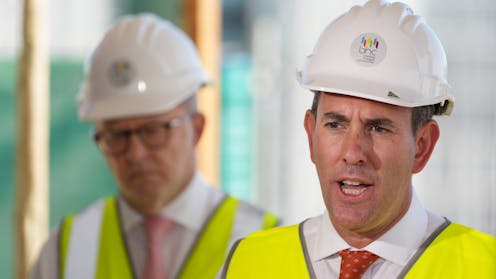
    Asanka Ratnayake/Getty Images

    While the world’s media is largely focused on conflict in the Middle East, the focus for many Australians remains at home, with the government preparing the long task ahead of trying to lift Australia’s productivity.

    Last week, Prime Minister Anthony Albanese announced a productivity roundtable, which will be held in mid-August. Now Treasurer Jim Chalmers has flagged the roundtable will be part of a much more ambitious debate, indicating he’s open to a broad discussion of major tax reform.

    In this podcast, Chalmers is frank about his own belief in the importance of seizing the moment – even if “there’s an element of political risk” whenever governments talk about tax reform.

    The way I see this is that I become very wary of people who say, because of the magnitude of our majority, that we will get another term. There are, as you know, few such assurances in politics, particularly in modern politics.

    I can kind of hear that [office] clock ticking behind us, and I want to get on with it. You know, we’ve got a big job to do to deliver the big, substantial, ambitious agenda that we’ve already determined and taken to an election. But I am, by nature, impatient. I think the country has an opportunity to be ambitious here. And so if you’re detecting that in my language, that’s probably not accidental.

    […] There’s no absence of courage. There is an absence of consensus, and it’s consensus that we need to move forward. And that’s what I’m seeking, not just in the roundtable, but in the second term of our government.

    Chalmers says one of his takeouts from reading Abundance, a new book currently fashionable with progressives, was the need to “get out of our own away” to build more homes and renewable energy, while maintaining high standards.

    A lot of regulation is necessary. So we talk about better regulation. But where we can reduce compliance costs and where we can wind back some of this red tape in ways that doesn’t compromise standards, of course we should seek to do that.

    One of the things I’m really pleased I got the cabinet to agree to earlier this week is we’re going to approach all of the regulators and we’re going to say, ‘please tell us where you think we can cut back on regulation and compliance costs in a way that doesn’t jeopardise your work’ […] We’re not talking about eliminating regulation. We’re talking about making sure that it’s better.

    […] I think renewable energy projects is part of the story here. I speak to a lot of international investors, there’s a big global contest and scramble for capital in the world […] One of the things that international investors say to us about Australia is ‘we don’t want to spend too long burning cash while we wait for approvals from multiple levels of government and other sorts of approvals’.

    So if we can speed some of that up, if we can make sure it makes sense, if our regulation is better, then I think we give ourselves more of a chance of achieving our economic goals, but also our social and environmental goals.

    On the productivity roundtable, Chalmers wants bold ideas.

    We have an open door and an open mind. This is a genuine attempt to see where we can find some common ground. In some areas that won’t be possible, in other areas, I think it will. And I think we owe it to ourselves to try.

    This is a very different discussion to the [2022] Jobs and Skills Summit. Much smaller, much more targeted, a bigger onus on people in the room to build consensus outside of the room.

    We’re specifically asking people to consider the trade-offs, including the fiscal trade-off when it comes to what they’re proposing. We’re asking them to take a nationwide, economy-wide view, not a sectoral view about their own interests.

    On whether any new major changes – including greater tax reform – would require a fresh mandate, Chalmers wants to wait and see.

    I think it depends on the nature of the change. I’m sort of reluctant to think about sequencing and timing and mandates before we’ve got everybody’s ideas on the table and worked out where the consensus and common ground exists […] I think that remains to be seen.

    E&OE Transcript

    MICHELLE GRATTAN, HOST: Treasurer Jim Chalmers has declared improving Australia’s dismal progress on productivity is at the top of his priorities for Labor’s second term, but addressing the National Press Club on Wednesday, it was clear that his ambitions for economic reform are wide, much wider than we’ve heard from him or from the Prime Minister in the previous term or in the election campaign.

    From August 19 to 21, the Government will hold a roundtable to seek ideas for reform from business, unions, civil society and experts. This will be a small gathering held in Parliament House’s Cabinet room.

    Notably, Chalmers has invited participants to put forward ideas on tax reform.

    The Treasurer is our guest today. Jim Chalmers, before we get to the roundtable, let’s start with the escalating Middle East war. What are the economic implications of this so far, and on one specific issue, what are the implications going to be for oil prices?

    JIM CHALMERS, TREASURER: Thanks, Michelle. This is obviously a very perilous part of the world right now, it’s a perilous moment, perilous for the global economy as well.

    We’re primarily focused on the human consequences of what’s going on, including around 2,000 people who’ve registered with DFAT to try and get out of the particularly dangerous areas right now, so that’s our focus, but there will be big economic consequences as well, and we’ve already seen in the volatility in the oil price – the barrel price for oil went up between 10 and 11 per cent last Friday when a lot of this flared up, and I think that is an indication of the volatility that this escalating situation in the Middle East is creating in the economy.

    I get briefed every day on movements in relevant commodity prices and the like, and there’s a lot of concern, again primarily about the human cost, but there’s a lot of concern around the world about what this means for petrol price inflation and what it means for global growth as well.

    GRATTAN: Also on the international scene, are we making any progress on getting concessions on the US tariffs, or will that have to wait for a rescheduled meeting between Donald Trump and Anthony Albanese? There’s now talk, incidentally, of a meeting possibly at NATO next week, although we don’t know whether that will happen or not.

    CHALMERS: The Prime Minister’s made it clear that he is considering going to the NATO meeting. By the time people listen to this podcast, it may be that that’s been determined, but whether or not he goes to Europe, we’ve got a lot of different ways and a lot of different opportunities to engage with the Americans on these key questions, and the Prime Minister met with some of the most senior people in the economic institutions of the US overseas – and he met with leaders from Japan and the UK and Germany and Canada and others, so a very worthwhile trip.

    We’ll continue to engage wherever we can and whenever we can, because our national economic interest is at stake here. We’ll continue to speak up and stand up for our workers and our businesses to try and make progress on this really key question.

    GRATTAN: But no progress yet.

    CHALMERS: We’re continuing to engage. We have had discussions at every level, including at my level, and the Prime Minister’s had discussions. Like the whole world right now, people are trying to get a better deal in the aftermath of the announcement of these tariffs; we’re no exception.

    We’re better placed and better prepared than most countries to deal with the fallout of what’s happening with these escalating trade tensions, but we are seeking a better deal for our workers and businesses and industries. The Prime Minister’s engagement reflects that, and so does the rest of ours.

    GRATTAN: Now, to turn to your productivity roundtable, give us some more details about it, including whether the sessions will be public and will the Premiers be there?

    CHALMERS: There are some of those details that we’re still working out. I can’t imagine it will be public in the sense that we’ll have permanent cameras in the Cabinet room, but we don’t intend to be heavy‑handed about it, we’re not seeking people to sign non‑disclosure agreements ‑ I can’t anticipate that we’ll make it kind of Chatham House rules or confidential discussions, but we’re working through all of those issues. When it comes to the states, obviously we want the states involved in one way or another, and we’re working out the best way to do that.

    I already engage with the state and territory treasurers at the moment on some of these key questions. I’ll continue to do that, I’ll step that up, and we’ll work out the best way to make sure that the states’ views are represented in the room.

    You know how big the Cabinet room is, Michelle, it’s about 25 seats around an oblong table, so we can’t have everybody there, but we will do everything we can to make sure that the relevant views are represented, including the views of the States and Territories.

    GRATTAN: When you say you wouldn’t see you having cameras in the Cabinet room, wouldn’t you want some of it to be public, because if it wasn’t, then whoever was telling the story would be putting their slant on it?

    CHALMERS: Well, we’ll try and strike the best balance. I think what will happen is, inevitably, people who are participating in the roundtable, indeed people who are providing views but not necessarily in the room, there will be a big flourishing of national policy discussion and debate; that’s a good thing. We’ll try not to restrict that excessively. I just think practically having a kind of live feed out of the Cabinet room is probably not the best way to go about things.

    But I’m broadly confident ‑ comfortable, broadly comfortable with people expressing a view outside the room and characterising the discussions inside the room. There may be a convincing reason not to go about it that way, but I’m pretty relaxed about people talking about the discussions.

    GRATTAN: In your Press Club speech, you spoke about seeking submissions. Now, would those be submissions before the roundtable?

    CHALMERS: Absolutely, but also, we’re trying to work out, in addition to structuring this roundtable – which will be a really important way for us to seek consensus – in addition to that, we’re trying to work out how do we become really good at collecting and taking seriously the views that are put to us by people who are experts in their fields.

    Not everybody can be around the Cabinet table. People have well-informed views, and we want to tap them. So we’re working out the best way to open a dedicated Treasury channel, primarily and initially, about feeding views in for the consideration of the roundtable. But if there are ways that we can do that better on an ongoing basis, we’re going to look at that too.

    GRATTAN: What do you say to those in business who came out of the 2022 Jobs and Skills Summit rather cynical thinking, really, they’d been had, frankly, that this was basically a meeting to legitimise the Government giving what it wanted to to the unions?

    CHALMERS: I’ve heard that view, but I don’t share it. I’ve taken the opportunity in recent days to look again at the sorts of things we progressed out of the Jobs and Skills Summit, it was much, much broader than a narrow focus on industrial relations. So I take that view seriously, but I don’t share it.

    And my commitment, I gave this at the Press Club, and I will give this commitment every day between now and the roundtable if that’s necessary, we have an open door and an open mind, this is a genuine attempt to see where we can find some common ground. In some areas, that won’t be possible, in other areas I think it will, and I think we owe it to ourselves to try.

    This is a very different discussion to the Jobs and Skills Summit, much smaller, much more targeted, a bigger onus on people in the room to build consensus outside of the room. We’re specifically asking people to consider the trade-offs, including the fiscal trade-offs. When it comes to what they’re proposing, we’re asking them to take a nationwide, economy-wide view, not a sectoral view about their own interests.

    Let’s see how we go. We are approaching it in that fashion, a different discussion to Jobs and Skills, and we want to give ourselves every chance to progress out of that discussion with something meaningful.

    GRATTAN: You say you accept the need for tax reform. This is really a big statement from you, and it is a change of emphasis from last term. Up to now, you’ve resisted any suggestion of undertaking comprehensive reform of the taxation system. So, where do you actually stand now? Are you looking for ideas for incremental change, or are you looking for something that’s really bold?

    CHALMERS: First of all, I do accept that the economic reform, and particularly the tax reform we’ve engaged in so far, it has been sequenced, it has been methodical – but it’s also been, I think, more substantial than a lot of the commentary allows, about half a dozen ways we’re reforming the tax system, and I’m proud of the progress that we’ve made.

    When it comes to the roundtable, the point I’ve made about tax, the thing I welcome about the roundtable is it’s not possible to think about and talk about productivity, budget sustainability and resilience amidst global volatility without allowing or encouraging, welcoming a conversation about tax. So that’s the approach I’m taking to it.

    What I’m trying to do, and we’ll see how successful we can be at doing this over the course of the next couple of months, but what I’m trying to do is to not pre‑empt that discussion, I’m trying not to artificially limit that discussion about tax, and that’s because I know that people have well‑intentioned, well‑informed views about tax reform; let’s hear them.

    GRATTAN: But you do seem open, from what you said, to a possible switch in the tax mix between direct and indirect.

    CHALMERS: I think that will be one of the considerations that people raise at the roundtable, and I think it would be unusual to discourage that two months out. Let’s see what people want to propose. You know, I think that’s an indication of my willingness, the Prime Minister’s willingness, the Government’s, to hear people out.

    And we broadly, whether it’s in tax and budget, whether it’s in productivity, resilience – I don’t want to spend too much at this roundtable with problem ID, I want to go from problem ID to ideas. That’s because we’ve had really for a long time now – probably as long as you and I have known each other, Michelle – we’ve had a lot of reports about tax, and important ones. I think the time now is to work out where are their common interests, where does the common ground exist, if it exists, on tax, and to see what we can progress together, and that requires on my part an open mind, and that’s what I’ve tried to bring to it.

    GRATTAN: Of course, your former Treasury Secretary, who’s now the Prime Minister’s right-hand man as head of the Prime Minister’s department, I think has made speeches pointing out that you really do need such a switch.

    CHALMERS: Yeah, and Steven Kennedy’s a very influential person in the Government. I’m delighted – we’ve been joking behind closed doors about Steven being demoted to PM&C from Treasury, but the reality is it’s amazing, it’s the best of all worlds from our point of view to have Kennedy at PM&C and Wilkinson at Treasury. That’s an amazing outcome for anyone who cares about economic reform and responsible economic management, a wonderful outcome.

    Steven has made a number of comments in the past about the tax system, probably Jenny has as well. They are very informed, very considered, big thinkers when it comes to economic reform, and we’re going to tap their experience, their interest and their intellect.

    GRATTAN: Well, he can now get into the Prime Minister’s ear on this matter. The other thing on tax, you did seem to wobble a bit on changing the GST; you’ve been pretty against that. I guess you left the impression at the Press Club that basically you were still probably against, but you did seem a bit more open-minded than usual.

    CHALMERS: What I’m trying to do there, Michelle, and I’m pleased you asked me, because I think that was a bit of a test, a bit of an example of what I talk about in the speech, which is that obviously there are some things that governments, sensible, middle of the road, centrist governments like ours don’t consider – we don’t consider inheritance taxes, we don’t consider changing the arrangements for the family home, those sorts of things.

    But what I’ve tried to do and what I tried to say in the speech is if we spend all of our time ruling things in or ruling things out, I think that has a corrosive impact on the nature of our national policy debate, and I don’t want to artificially limit the things that people bring to the roundtable discussion.

    I was asked about the GST – you know that I’ve, for a decade or more, had a view about the GST. I repeated that view at the Press Club because I thought that was the honest thing to do, but what I’m going to genuinely try and do, whether it’s in this policy area or in other policy areas, is to not limit what people might bring to the table.

    And so that’s what you described as a wobble, I think that really just reflects what I’m trying to do here is to not deny what I have said about these things in the past, but to try and give people the ability to raise whatever they would like at the roundtable. I suspect there will be other occasions like that, other opportunities like that between now and the roundtable where I’ll do the same thing. I’ll repeat what I’ve said, I won’t walk away from it, I haven’t changed my view on the GST. I suspect people will bring views to the roundtable about the GST. Let’s hear them.

    GRATTAN: Well, of course, the GST can be a bit like a wild dog when it’s let off the leash. You’ll remember when Malcolm Turnbull let Scott Morrison as Treasurer float the idea of changing the GST, and that didn’t end well.

    CHALMERS: No, I think I can recall a fascinating part of Malcolm’s book about that, if memory serves, or perhaps something else that he said or wrote subsequently. I’m obviously aware of that history, you know, and there’s ‑ let’s be upfront with each other, Michelle, when you do what I did at the Press Club today and say bring us your ideas and let’s see where there’s some common ground, there’s an element of political risk to that.

    There’s a lot of history tied up in a lot of these questions, as you rightly point out in this instance, and I guess I’m demonstrating, or I’m trying to demonstrate, a willingness to hear people out, and there will be people who write about that in a way that tries to diminish this conversation that we’re setting up. That will happen. I’m open to that, relaxed about that, but let’s see what people think about our economy, about productivity, sustainability, tax, resilience, and let’s see if we can’t get around some good ideas that come out of that discussion.

    GRATTAN: Which tempts me to ask, will Ken Henry be on your guest list of the famous Henry review?

    CHALMERS: I think some people were surprised to see Ken there today at the National Press Club. Ken was there at the Press Club, and I think I said in the question and answer, if memory serves, and I hope it’s okay with Ken that I said this, but we’ve been engaging on drafts of the speech – we talk about some of the big issues in the Press Club speech I gave today.

    I’m not sure about the final invite list. Once you start putting together a list of about 25 people, you’ve got some ministerial colleagues, you’ve got peak organisations, including the ACTU, Sally McManus will be there, maybe a community organisation, someone representing the community, some experts. Before long, it’s very easy to hit 25 people.

    You’ve planned a few dinner parties in your time, Michelle, and an invite list of 25 people fills up pretty quick. We haven’t finalised that yet, but whether we invite Ken or Ken’s outside the room, he’s one of a number of people that I speak to about these big policy challenges, and regardless, I hope that he’s okay with us continuing to tap his brain.

    GRATTAN: Maybe you need to adopt a sort of restaurant approach of rotational sittings.

    CHALMERS: Yeah, well! –

    GRATTAN: Now, I know you said today that you don’t like gotcha questions and gave us a bit of a lecture ‑‑

    CHALMERS: This doesn’t sound like a good introduction, Michelle.

    GRATTAN: ‑‑ about that, but your controversial tax on capital gains on superannuation balances that are very big, critics worry that this could in fact be the thin end of the wedge extending to other areas of the tax system. Would you care to rule that out?

    CHALMERS: I think I said today, and I’m happy to repeat with you, Michelle, that we haven’t changed our approach here. We’ve got a policy that we announced almost two and a half years ago now, and we intend to proceed with it.

    What we’re looking for here is not an opportunity at the roundtable to cancel policies that we’ve got a mandate for; we’re looking for the next round of ideas.

    Now again, a bit like some of the other things we’ve been talking about, I suspect people will come either to the roundtable itself or to the big discussion that surrounds it with very strong views, and not unanimous views about superannuation. We read in a couple of our newspapers on an almost daily basis that people have got strong views about the superannuation changes, and not the identical same views, and so I suspect that will continue.

    But our priority is to pass the changes that we announced, really some time ago, that we’ve taken to an election now, and that’s how we intend to proceed.

    GRATTAN: So, you’re open to considering other views?

    CHALMERS: On that particular issue, I think we have a pretty good sense of people’s views. I mean there’s ‑ I don’t pretend for a second that there’s unanimous support for it.

    GRATTAN: I mean, extending it to other areas.

    CHALMERS: No, I mean that’s not something we’ve been contemplating even for a second, and we haven’t done any work on that, we haven’t had a discussion about that, that’s not our intention.

    But more broadly, when it comes to the system, I suspect people will have views about that at the roundtable – but thanks for the opportunity to clarify, we’re not planning for or strategising for extending that in additional ways.

    GRATTAN: Now, artificial intelligence is obviously being seen as the next big productivity enhancer when you’re talking about the big things, but it’s also going to cost jobs, and that will exercise the unions.

    Your Industry Minister Tim Ayres, has emphasised the unions have a role in this transition, must be consulted, brought into it, but you’ve said that while regulation will matter, and I quote, “We are overwhelmingly focused on capabilities and opportunities, not just guardrails. The emphasis here is different”. Do you see this as being a bit like the tariff reforms in the Hawke/Keating time, when there were big gains to be made but there were also very significant losers, and how do you deal with that situation?

    CHALMERS: First of all, I think unions do have a place and a role to play in this. I can’t imagine meaningful progress on AI or technology more broadly where we wouldn’t include unions and workers in that conversation. That wouldn’t be consistent with our approach, and it wouldn’t make a lot of sense, so I share Tim’s view on that. I work closely with Tim Ayres and also Andrew Charlton, who will have a key role in some of these policy questions.

    The point that I was making was it’s not a choice between regulation or capability, it’s not an either/or. Obviously we need guardrails, obviously we need regulation, but from my point of view, I see this as a game‑changer in our economy, I see it as one of the big ways that will make our economy more productive and lift living standards.

    It’s not all downside for workers either – we’re talking about augmenting jobs, we’re talking about some of the routine tasks that are not the most satisfying parts of people’s work, so of course we want to include the union movement, of course we want to make sure that we’ve got appropriate guardrails.

    The point that I was making in that interview with the Financial Review which you’re quoting from is that we need to get our capabilities right, we need the right skills base, I think we’ve got a huge opportunity with data centres and the infrastructure that supports artificial intelligence, and so that is a big part of the focus of our work. When it comes to productivity, when it comes to growth more broadly, industry policy, our work with the Productivity Commission, data and digital, AI, data centres, all of that I think are going to be key parts of the future economy in Australia.

    GRATTAN: The last time we spoke on this podcast, you said you’d been reading the book Abundance by Ezra Klein and Derek Thompson, and you described it as a ripper. Now I think you’re making all your Cabinet colleagues read it too, and I’m not sure whether they thank you for that, but there it goes.

    What are some of the ideas in the book that attracted you, and in particular, do you agree with the thesis that red tape is holding us back, particularly when it comes to housing and renewable energy and the transition to renewables?

    CHALMERS: First of all ‑ we should be on a commission for this book, I think, from Andrew Leigh through a whole bunch of colleagues ‑ a lot of us have either read it or are in the process of reading it.

    The reason that we are attracted to it is because it really is about working out as progressive people who care deeply about building more homes, rolling out more renewable energy, to make sure that the way we regulate that and approach that doesn’t get in our own way, that we don’t make it harder for us to achieve our big economic goals in the energy transformation; in housing and technology and all of these sorts of things.

    What the Abundance book reminds us to do, and I think in a really timely and really punchy way, is it says, “As progressive people, let’s get out of our own way”. A lot of regulation is necessary, so we talk about better regulation, but where we can reduce compliance costs and where we can wind back some of this red tape in ways that doesn’t compromise standards, of course, we should seek to do that.

    One of the things I’m really pleased I got the Cabinet to agree to earlier this week is we’re going to approach all of the regulators, and we’re going to say, “Please tell us where you think we can cut back on regulation and compliance costs in a way that doesn’t jeopardise your work”. I suspect from that, maybe not from every regulator, but from some of the regulators, I think if we are genuine about it, I think we can make some progress there to get compliance costs down, to speed up approvals so that we can deliver the things that we truly value as an economy but also as a society, and that’s what the Abundance book’s about.

    GRATTAN: Of course, one of the problems is, while this sounds very good, a lot of stakeholders say we need more regulation of this or that, we need to protect flora, fauna, climate, whatever.

    CHALMERS: Yeah, of course we do.

    GRATTAN: And that all gets in the way of clearing away red tape, doesn’t it?

    CHALMERS: We’re not talking about eliminating regulation, we are talking about making sure that it’s better, that we can use regulation in the service of our social and environmental and economic goals, but to make sure that we’re not overdoing it, that it’s not unnecessary, that it doesn’t prevent us achieving our aspirations and our objectives, including in the environment.

    I think renewable energy projects are part of the story here, and I speak to a lot of international investors, there’s a big global contest and scramble for capital in the world. People are rethinking their investments, and there’s a lot of interest in Australia, and one of the things that international investors say to us about Australia is we don’t want to spend too long burning cash while we wait for approvals from multiple levels of government and other sorts of approvals.

    If we can speed some of that up, if we can make sure it makes sense, if our regulation is better, then I think we give ourselves more of a chance of achieving our economic goals, but also our social and environmental goals as well.

    GRATTAN: Another of your priorities is budget sustainability, and you say the Government’s made progress, but there’s a way to go. So, where are you going now? Do you need to make big savings in what areas, or are you really having to look at the revenue side more?

    CHALMERS: I think there’s this kind of strange binary analysis of the budget situation. Some people say it doesn’t matter, some people say it’s beyond repair, and obviously, like a lot of things in politics and policy, the truth lies somewhere in between.

    We’ve made a heap of progress on the budget; two surpluses, biggest ever nominal turnaround in the budget, we got the debt down, got the interest costs down. But what I acknowledge and what I will continue to acknowledge is there’s always more work to do to make it more sustainable.

    For us, we made a heap of progress on aged care, the NDIS and interest costs, but we need to make sure that even when we think about the policy ideas that people bring to us at the roundtable, budget sustainability really matters. Where we do find something that we want to invest more in, we’ve got to consider the trade-offs, we’ve got to work out how to pay for things.

    There’s probably not a day, certainly not a week that goes by where Katy Gallagher and I aren’t in one way or another engaging with colleagues on some of these structural pressures on the budget, because they do matter.

    GRATTAN: Well, one, of course, is defence spending, and I was interested that you did in your remarks to the Press Club seem, while cautious, while saying, “We’re spending a lot on defence”, you seemed open to the idea that over the next decade governments will have to increase defence spending.

    CHALMERS: I think the point I was trying to make there, Michelle, was it would be strange over a period of 10 years if there were no changes to any policy or levels of spending. But the thing that’s not, I think, sufficiently acknowledged is we’ve already quite dramatically increased defence spending, and you know, it’s not easy to find the extra $11 billion we found over the forward estimates, or the almost $58 billion I think we found over the decade.

    We are dramatically increasing our defence spending. I acknowledge and accept and respect that some people, including some of our partners, want us to spend more on defence, but we are already spending a heap more on defence, and we’ve had to find room for that in the budget, and that’s what we’ve done.

    GRATTAN: So we should be up for that conversation, as Richard Marles would say?

    CHALMERS: I think what Richard’s saying, to be fair to him, is that we are more or less continuously engaging with our partners about things like defence spending, and when it comes to the Americans, they’ve made it clear around the world that they want people to spend more on defence. That’s not an unreasonable position for the Americans to put to us. We decide our level of defence spending, and we have decided collectively as a government to dramatically increase it.

    GRATTAN: As Treasurer, you’re the gatekeeper for foreign investment decisions, big decisions, and there’s a takeover bid at the moment from Abu Dhabi’s national oil company for Santos. Can you give us some idea of the process, the timetable, when you would make a decision if the matter comes to you?

    CHALMERS: This is a really big transaction potentially, and it raises – there are a lot of considerations around the national interest, it’s in a sensitive part of our economy for all of the obvious reasons.

    What usually happens with a transaction of this magnitude, tens of billions of dollars, is it goes through a number of stages. One of those stages is a Foreign Investment Review Board process where I’ve got a heap of terrific colleagues in the Treasury who advise me on these things. What I try to do is to make sure that I refrain from commenting on these sorts of deals before I’ve got that Foreign Investment Review Board advice. I take that advice very seriously, and that means not pre‑empting it.

    I know that there will be a heap of views, a heap of interest, I do acknowledge it’s a very big transaction which involves a really key sensitive part of our economy, and I’ll do what I always do with these big FIRB approval processes, which is to engage in it in a really methodical and considered way.

    That will roll out over the course of the next few months. The last time I asked, which I think was yesterday, we hadn’t ‑ the FIRB hadn’t had a chance to go through or hadn’t received yet the Foreign Investment Review Board proposal. That may have changed since then, but regardless, these things take a little bit of time.

    GRATTAN: Before we finish, let’s come back to productivity. You’ve said the work will take more than a term. So just give us a snapshot of where you would want to be at the end of say three years, six years.

    CHALMERS: Yeah. The point I’m making there, when it comes to productivity is, unlike some of the other really important measures in our economy, there’s no instant gratification. It’s very hard to flick a switch and get an immediate, substantial, meaningful shift in the data.

    The point that I’ve made is that we’re enthusiastic and very committed, very dedicated to doing meaningful things on productivity, but even those things can sometimes take a while to play out in the data, so I’m just really trying to say to people, this is important, it will pay off, some of it will pay off in the medium term and the longer term, but that shouldn’t deter us, the fact that some of these challenges take a little bit longer to fix.

    Now, if there was a switch that you could flick to make our economy instantly more productive, somebody would have flicked it already. Unfortunately, there’s not, and so we’re left in a world where we have to do a lot of things at once, and some of those things will take a little while to pay off.

    GRATTAN: Can you set any sort of target in terms of growth, annual growth? –

    CHALMERS: I’m reluctant to do that.

    GRATTAN: – productivity growth.

    CHALMERS: I’m reluctant to do that. The budget assumes a level of productivity growth, which is higher than what we are currently seeing, so it wouldn’t be a bad start to try and get closer to the forecast. But I’m reluctant to put a target on it.

    GRATTAN: And that forecast is?

    CHALMERS: The Treasury changed it to 1.2 per cent, and we’re currently tracking a bit lower than that on the current 20-year average, and so we need to do better. I tried to be quite blunt about that at the Press Club. Our economy is growing, but it’s not productive enough, our budget is stronger, but it’s not sustainable enough, our economy is resilient, but not resilient enough. And this is my way of saying to people, we’ve made a lot of progress together, but we’ve got a further ‑ we’ve got more to do, and productivity is our primary focus in that regard, but not our only focus.

    GRATTAN: For really big changes, say for tax changes, do you think you need another mandate or not?

    CHALMERS: I think it depends on the nature of the change. I’m reluctant to think about sequencing and timing and mandates before we’ve got everybody’s ideas on the table and worked out where the consensus and common ground exists, and so I don’t like to be evasive with a good question like that, Michelle, but I think that remains to be seen. It will be to be determined once we get a firmer sense of the way forward.

    GRATTAN: Just finally, you sounded in your speech rather like a man who’s been liberated since the election. Has your attitude changed? Do you think it’s just time to go for it?

    CHALMERS: The way I see this, Michelle, is that I become very wary of people who say, because of the magnitude of our majority, that we will get another term. There are, as you know, few such assurances in politics, particularly in modern politics, and so I can kind of hear that clock ticking behind us, and I want to get on with it.

    We’ve got a big job to do to deliver the big, substantial, ambitious agenda that we’ve already determined and taken to an election. But I am by nature impatient, I think the country has an opportunity to be ambitious here, and so if you’re detecting that in my language, that’s probably not accidental. I think we know what the challenges are, we know what people’s views are broadly, there’s no absence of courage, there is an absence of consensus, and it’s consensus that we need to move forward, and that’s what I’m seeking not just in the roundtable, but in this second term of our Government.

    GRATTAN: Jim Chalmers, it’s going to be an interesting few months, and thank you for talking with us today. That’s all for today’s podcast. Thank you to my producer, Ben Roper. We’ll be back with another interview soon, but good‑bye for now.

    The Conversation

    Michelle Grattan does not work for, consult, own shares in or receive funding from any company or organisation that would benefit from this article, and has disclosed no relevant affiliations beyond their academic appointment.

    ref. Politics with Michelle Grattan: an ‘impatient’ Jim Chalmers on taking political risks in Labor’s second term – https://theconversation.com/politics-with-michelle-grattan-an-impatient-jim-chalmers-on-taking-political-risks-in-labors-second-term-259269

    MIL OSI AnalysisEveningReport.nz

  • MIL-OSI Economics: Bashneft Planted Almost 40,000 Trees

    Source: Rosneft

    Headline: Bashneft Planted Almost 40,000 Trees

    Bashneft (Rosneft subsidiary) continues its large-scale reforestation programme in the Republic of Bashkortostan. The company’s employees planted over 41,000 tree seedlings in the region in the spring of 2025.

    Seedlings of various tree species adapted to the climatic conditions of the regions were planted as part of environmental campaigns. All work was carried out under regional forestry control.

    The Asly-Kul Nature Park in the Davlekanovo District of Bashkiria is a specially protected natural area and an important recreational site. Bashkir oil workers planted 24,000 pine seedlings as part of the all-Russian patriotic campaign Memory Garden. The planting is part of a large-scale programme aimed at preventing waterlogging of Aslikul, the largest lake in Bashkortostan. The action makes a significant contribution to strengthening the ecosystem and preserving the unique natural system of the reservoir. Bashneft-Dobycha employees (Bashneft’s oil and gas production operator) have been systematically restoring the forest frame of Lake Aslikul since 2023. With the support of oil workers, over 100 thousand pine and larch seedlings have already been planted on the territory of the natural park, which in a few years will form four massive forest areas with a total area of 25 hectares.

    The significance of Bashneft’s initiative is also confirmed by experts from the Biology Research Centre of the Ufa Federal Research Centre of the Russian Academy of Sciences. Scientists believe that the establishment of a coniferous forest in the north-western part of Lake Aslikul will help to stop the processes of waterlogging of the shores and preserve the lake for future generations.

    In addition, employees of the Bashneft-Novoil plant cleaned the shores of the lake from household rubbish as part of the federal environmental project Water of Russia. The anthropogenic load on the coastal area is high, as the water body is very popular with tourists. Almost 22 kilometres of coastline were cleaned during the campaign.

    Over the last 5 years, thanks to the initiatives of Bashkir oil workers, more than 5.2 million trees have been planted on over 1.5 thousand hectares. The young green expanses will soon transform into robust coniferous forests, facilitating the restoration and conservation of ecological balance of the areas.

    Preservation of the environment for future generations is an integral part of the corporate culture of Rosneft. The Company implements large-scale environmental programmes aimed at minimising environmental impact, improving the eco-friendly production, and preserving and replenishing natural ecosystems.

    For reference:

    Basheft is one of the oldest oil and gas enterprises in the country engaged in oil extraction and processing. The company’s key assets are located in the Republic of Bashkortostan. Oil and gas exploration and production are also carried out in Khanty-Mansi Autonomous Area-Yugra, Nenets Autonomous Area, Orenburg Region and the Republic of Bashkortostan.

    Department of Information and Advertising
    Rosneft
    May 26, 2025

    MIL OSI Economics

  • MIL-OSI Economics: Bashneft Planted Almost 40,000 Trees

    Source: Rosneft

    Headline: Bashneft Planted Almost 40,000 Trees

    Bashneft (Rosneft subsidiary) continues its large-scale reforestation programme in the Republic of Bashkortostan. The company’s employees planted over 41,000 tree seedlings in the region in the spring of 2025.

    Seedlings of various tree species adapted to the climatic conditions of the regions were planted as part of environmental campaigns. All work was carried out under regional forestry control.

    The Asly-Kul Nature Park in the Davlekanovo District of Bashkiria is a specially protected natural area and an important recreational site. Bashkir oil workers planted 24,000 pine seedlings as part of the all-Russian patriotic campaign Memory Garden. The planting is part of a large-scale programme aimed at preventing waterlogging of Aslikul, the largest lake in Bashkortostan. The action makes a significant contribution to strengthening the ecosystem and preserving the unique natural system of the reservoir. Bashneft-Dobycha employees (Bashneft’s oil and gas production operator) have been systematically restoring the forest frame of Lake Aslikul since 2023. With the support of oil workers, over 100 thousand pine and larch seedlings have already been planted on the territory of the natural park, which in a few years will form four massive forest areas with a total area of 25 hectares.

    The significance of Bashneft’s initiative is also confirmed by experts from the Biology Research Centre of the Ufa Federal Research Centre of the Russian Academy of Sciences. Scientists believe that the establishment of a coniferous forest in the north-western part of Lake Aslikul will help to stop the processes of waterlogging of the shores and preserve the lake for future generations.

    In addition, employees of the Bashneft-Novoil plant cleaned the shores of the lake from household rubbish as part of the federal environmental project Water of Russia. The anthropogenic load on the coastal area is high, as the water body is very popular with tourists. Almost 22 kilometres of coastline were cleaned during the campaign.

    Over the last 5 years, thanks to the initiatives of Bashkir oil workers, more than 5.2 million trees have been planted on over 1.5 thousand hectares. The young green expanses will soon transform into robust coniferous forests, facilitating the restoration and conservation of ecological balance of the areas.

    Preservation of the environment for future generations is an integral part of the corporate culture of Rosneft. The Company implements large-scale environmental programmes aimed at minimising environmental impact, improving the eco-friendly production, and preserving and replenishing natural ecosystems.

    For reference:

    Basheft is one of the oldest oil and gas enterprises in the country engaged in oil extraction and processing. The company’s key assets are located in the Republic of Bashkortostan. Oil and gas exploration and production are also carried out in Khanty-Mansi Autonomous Area-Yugra, Nenets Autonomous Area, Orenburg Region and the Republic of Bashkortostan.

    Department of Information and Advertising
    Rosneft
    May 26, 2025

    MIL OSI Economics

  • MIL-OSI Video: UK UK jobs market under scrutiny in Lords questions

    Source: United Kingdom UK House of Lords (video statements)

    Members discuss employment levels and concerns about job losses in this highlight from the chamber. Catch up.

    Read a transcript of this question: https://hansard.parliament.uk/lords/2025-06-11/debates/FC5406F5-2F01-4993-98B0-E281088579AE/UnitedKingdomJobsMarket

    Catch-up on House of Lords business:

    Watch live events: https://parliamentlive.tv/Lords
    Read the latest news: https://www.parliament.uk/lords/

    Stay up to date with the House of Lords on social media:

    • X: https://twitter.com/UKHouseofLords
    • Bluesky: https://bsky.app/profile/houseoflords.parliament.uk
    • Instagram: https://www.instagram.com/UKHouseofLords/
    • Facebook: https://www.facebook.com/UKHouseofLords
    • Flickr: https://flickr.com/photos/ukhouseoflords/albums
    • LinkedIn: https://www.linkedin.com/company/the-house-of-lords
    • Threads: https://www.threads.net/@UKHouseOfLords

    #HouseOfLords #UKParliament

    https://www.youtube.com/watch?v=yyhencoJX68

    MIL OSI Video

  • MIL-OSI United Kingdom: Armed forces charity receives donation following VE/VJ80 civic event success

    Source: City of Leeds

    The Lord Mayor of Leeds yesterday presented the proceeds of ticket sales generated by the highly successful VE/VJ80 civic event to the Royal British Legion (RBL) Poppy Appeal.

    The civic event, which marked the 80th anniversary of the Victory in Europe and Victory over Japan days, took place at Leeds Minster on May 10. Attracting over 400 guests, including dignitaries, veterans, and members of the public, ticket sales generated £1000 for the RBL. The event also saw the presentation of the Leeds Award to 102-year-old D-Day veteran, Jack Mortimer. The Leeds Award is a formal recognition by Leeds City Council which acknowledges individuals, organisations, or groups who have made outstanding contributions that benefit the city and its residents. It was presented to Jack for his lifelong commitment to veterans’ affairs and, fittingly, his fundraising work for the Royal British Legion. 

    Above: Second World War Wren veteran, Eileen Marshall, singing with members of the Hummingbirds UK at the Civic Hall presentation.

    The cheque presentation, which took place in the Civic Hall’s Ark Royal room, was made to the RBL’s Jonathan Calvert and Emma Osbourne by the new Lord Mayor of Leeds, Councillor Dan Cohen. In attendance were many of those who spoke and performed at the civic event, along with councillors, Second World War veteran Eileen Marshall, and representatives from the businesses and organisations that donated goods and services to the event. 

    Above: The Lord Mayor of Leeds, Councillor Dan Cohen, speaking to guests. 

    The Lord Mayor of Leeds, Councillor Dan Cohen, said: “The VE/VJ 80 civic event was not only a time to commemorate, remember, and reflect on those momentous days at the end of the Second World War 80 years ago. It was also an opportunity to have some fun and raise money for an incredible charity at the same time. 

    “The Royal British Legion works tirelessly for all veterans of the armed forces and their families, so it was my great pleasure to present a cheque for the money raised through ticket sales to help them continue their important work.”

    “I would also like to take the opportunity to give my thanks to all those people, organisations and companies who made the civic event so successful, especially my colleague, Councillor Jane Dowson, who spent many hours on the organisation. Without the donations from some fantastic local businesses, and the magnificent speakers and performers who made no charge for their time, goods, and services, the event would not have achieved such success.”

    MIL OSI United Kingdom

  • MIL-OSI Russia: Moscow Oncology Forum 2025 Opens in the Capital

    Translation. Region: Russian Federal

    Source: Moscow Government – Government of Moscow –

    The Moscow Oncology Forum 2025 has begun its work in the capital. It was opened by Anastasia Rakova, Deputy Mayor of Moscow for Social Development. In her welcoming speech, she spoke about the city’s transition to an electronic format for pathomorphological diagnostics, the completion of the formation of an infrastructural framework for oncological care, and the introduction of robotic systems into the capital’s healthcare system.

    “In five years, we have essentially created a high-tech oncology service from scratch: we have modernized the equipment, worked out standards for drug provision, formed client paths and carried out complete digitalization. Now all oncology hospitals have the most modern robotic systems – and not one in each. And all this is provided with the necessary financial resources. Four thousand operations have already been performed, and our annual capacity is more than five thousand operations per year. All our laboratories work exclusively digitally. But the most important thing is, of course, a new level of quality of medical care for our patients. I would like to separately note the team of Moscow oncologists, who are truly the vanguard of the capital’s healthcare. You are pioneers in almost all innovations and processes. I would like to thank each oncologist for your daily, difficult, but very noble work in the conditions of continuous changes,” said Anastasia Rakova.

    She added that the unprecedented archive of digital medical data, including oncological data, formed in Moscow is an indisputable competitive advantage. In the context of the development of large generative models of artificial intelligence, this archive opens up a unique opportunity to create projects to identify precursors and patterns of disease development.

    According to Anastasia Rakova, the Moscow oncology service today has every opportunity to reach a new level of care and use modern technologies, such as cell therapy, personalized vaccines, isotopes, and minimally invasive surgery. Among the first steps already being implemented in this direction, she noted the creation of a nuclear pharmacy, theranostics, and the successful use of yttrium to treat liver tumors. The deputy mayor expressed hope that successful cases of high-tech care will become a permanent practice available to every Muscovite. To this end, the capital will increase its work with federal centers, scientific organizations, and pharmaceutical companies.

    The Deputy Mayor recalled the classic rule of medicine: it is easier to prevent a disease than to treat it, and the capital is actively moving in this direction. Thanks to the opening of endoscopic centers, it was possible to increase the detection rate of gastrointestinal tract (GIT) cancer at an early stage. The plans include opening several more such centers. At the same time, the capital is implementing proactive programs. For example, as part of a pilot project for the prevention of oncological diseases, a referral for a screening endoscopic examination of the GIT was opened automatically for those who have not undergone it for more than three years and fall into the risk group. More than 50 thousand people have already signed up for the checkup. After the opening ceremony, guests will be able to learn more about the latest achievements in the field of treatment and diagnosis of oncological diseases not only during the speakers’ speeches, but also by visiting an interactive exhibition. It presents 14 stands in different areas. For example, these are “Brain and Nervous System Tumors”, “Oncourology”, “Radiation and Radionuclide Therapy” and others.

    Visitors to the interactive exhibition will be able to participate in master classes, intellectual games and quizzes, examine objects under a microscope, study video recordings of real operations, and also get a visual representation of the work of the operating room. The stands will show the latest equipment, models of tumors and unique clinical cases.

    The largest oncology forum in Russia is taking place from June 18 to 20 at Gostiny Dvor. The event brings together participants from 20 countries. The most pressing aspects of cancer treatment are being discussed by domestic and foreign experts from Singapore, China, the United Arab Emirates, Spain, France, Turkey, the United States, Belgium, Italy and other countries. These are 144 of the best specialists, including academicians and corresponding members of the Russian Academy of Sciences, professors and doctors of science. Together, they will present almost 400 scientific reports on the latest developments in the field of providing medical care to patients with cancer.

    Get the latest news quicklythe city’s official telegram channel Moscow.

    Please note: This information is raw content directly from the source of the information. It is exactly what the source states and does not reflect the position of MIL-OSI or its clients.

    Please Note; This Information is Raw Content Directly from the Information Source. It is access to What the Source Is Stating and Does Not Reflect

    https: //vv.mos.ru/nevs/ite/155424073/

    MIL OSI Russia News

  • MIL-OSI Russia: The best nurse in the capital was named based on the results of the Moscow Masters competition

    Translation. Region: Russian Federal

    Source: Moscow Government – Government of Moscow –

    On June 18, the final stage of the annual city competition of professional skills “Moscow Masters” in the direction of “Nurse” was completed in the capital. 24 specialists took part in the final tests, having successfully passed the test of theoretical knowledge and practical skills.

    The award ceremony took place at Gostiny Dvor. The prizes — car keys — were presented to the three finalists by Anastasia Rakova, Deputy Mayor of Moscow for Social Development.

    “I am pleased to sum up the results of the professional competition of Moscow masters in the nomination “Nursing” today. The nursing community of Moscow is multifaceted – 50 thousand nurses and male nurses work in the capital’s healthcare. Your profession is very important and necessary, and the requirements for it are growing from year to year. You accompany the patient, support him along the entire path to recovery – from the admissions department to discharge. This year the competition was very difficult. Both the number of participants and the number of tests increased. You had to go through interviews, tests, demonstrate your skills. All of today’s finalists are already winners. You have proven that you are sincerely devoted to your work, are professionals and are ready to do everything to make life easier for patients. Once again, I congratulate all the finalists! And I would like to move on to presenting awards to the three main winners. This year, the Mayor of Moscow decided that we will present our branded Moskvich cars as a reward. “And all the finalists will go on an internship to China,” Anastasia Rakova congratulated the winners.

    The best result in the tests was shown by Alena Sokolova from the V.M. Buyanov City Clinical Hospital. Second place was taken by Yulia Nagaytseva, a nurse of a general practitioner (family doctor) of City Polyclinic No. 66, and third place went to Elvira Uldanova, a district nurse. She works at Children’s City Polyclinic No. 38.

    The competition, which has been held in Moscow for the 28th year in a row, not only identifies the best specialists, but also reminds society of the importance of the profession, creating additional motivation for the further development of nursing in the capital.

    Before the final, the contestants went through several stages: initially, more than 700 nurses and brothers selected from medical organizations took part in the competition. After computer testing, 80 people remained, who then demonstrated their practical skills. In the final, they solved situational problems, for example, providing assistance in case of respiratory failure due to a foreign body getting into the respiratory tract or preparing a patient for an electrocardiogram.

    Based on the results of the tests, 24 finalists were determined – three participants in each of the eight nominations.

    The winners of the nominations competed in an interactive game, answering questions about nursing, the history of medicine, anatomy, pharmacology and other areas. In particular, about the discovery of methods for treating the most common diseases that had a significant impact on the development of medical science.

    The competition was organized by the Personnel Center of the capital Department of HealthThis year the event became the largest in 28 years of its holding.

    Get the latest news quicklyofficial telegram channel the city of Moscow.

    Please note: This information is raw content directly from the source of the information. It is exactly what the source states and does not reflect the position of MIL-OSI or its clients.

    Please Note; This Information is Raw Content Directly from the Information Source. It is access to What the Source Is Stating and Does Not Reflect

    https: //vv.mos.ru/nevs/ite/155426073/

    MIL OSI Russia News

  • Yoga, millets, alternative medicine part of our rich cultural heritage: Delhi CM

    Source: Government of India

    Source: Government of India (4)

    Delhi Chief Minister Rekha Gupta on Wednesday emphasized the importance of yoga, millets, and alternative medicine in fostering a balanced and healthy lifestyle.

    Speaking at an event in the national capital ahead of International Yoga Day, Gupta praised the rising popularity of millet-based diets in Delhi, calling it a welcome shift toward wellness rooted in India’s cultural heritage.

    “Yoga, alternative medicine, and millets are part of our glorious cultural legacy,” Gupta said. “Incorporating them into our daily lives will help build a healthier society and nation. My best wishes to everyone on Yoga Day.”

    Referring to the upcoming Yoga Day event scheduled for June 21 at Yamuna Bank, Gupta expressed a personal connection to the river and reiterated her commitment to its cleanliness.

    “I feel deeply connected to the Yamuna. Just seeing the river reminds me of my responsibility to keep it clean,” she said.

    With monsoon rains expected to arrive early in the capital, Gupta assured that the administration is proactively checking drains for blockages and improving drainage connectivity to prevent waterlogging.

    “We’re inspecting whether drains are clogged, too narrow, or poorly connected,” she said, adding that prompt action by the government had prevented water accumulation in the Minto Bridge area during recent showers.

    Gupta also said that comprehensive measures are being implemented to prevent the spread of dengue, which typically spikes during and after the monsoon season.

    (With inputs from ANI)

  • MIL-OSI NGOs: Press Arrangements for Next Week’s IAEA General Conference, Including Media Briefing on New Nuclear Energy Projections

    Source: International Atomic Energy Agency (IAEA) –

    The 68th Annual Regular Session of the International Atomic Energy Agency (IAEA) General Conference, #IAEAGC, will convene from 16 to 20 September at the Vienna International Centre (VIC) in Vienna, Austria. The opening session takes place on Monday, 16 September, at 10:00 CEST. 

    High-ranking officials and representatives from IAEA Member States will consider and make decisions on a range of issues pertaining to the work and the budget of the Agency.

    The main conference events will take place in the M-Building of the VIC.

    All plenary sessions of the General Conference will be livestreamed on the IAEA website (no login required) in Arabic, Chinese, English, French, Russian and Spanish.

    The opening session of the GC will also be streamed live on the lAEA YouTube channel in high definition, and a download link will be made available afterwards.

    Details of the General Conference, including the provisional agenda, are available on the IAEA website and social media (FacebookInstagramLinkedInXWeibo). Photos of the General Conference will be available on Flickr.

    The Press Room on the M-building’s ground floor will be available as a press working area from 08:30 CEST on 16 September.

    Media Briefing on Nuclear Energy Projections

    The IAEA’s latest nuclear power projections will be released on 16 September, in the 44th edition of Energy, Electricity and Nuclear Power Estimates for the Period up to 2050. The report provides detailed global trends in nuclear power by region.

    The IAEA will host a briefing for media on the new projections. IAEA experts, including Henri Paillere, Head of Planning and Economic Studies at the IAEA, will provide the briefing on Monday, 16 September at 09:30 CEST in the Press Room.

    Please note: All information presented during the briefing are under embargo until after the Director General’s opening statement on Monday, 16 September.

    Please inform the IAEA Press Office if you plan to attend the briefing.

    Scientific Forum

    This year’s Scientific Forum, organized on the sidelines of the General Conference on 17 and 18 September, is entitled Atoms4Food – Better Agriculture for Better Life. It will focus on how nuclear science, technology and innovation can enhance sustainable agrifood systems, improve food security and address climate change. 

    The Scientific Forum will cover crop improvement, animal genetics and reproduction, crop and animal disease and pest management, food safety and nutrition, and sustainable management of natural resources, including soil and water. The two-day event will facilitate best practice exchanges, discuss sustainable adoption and scaling up of R&D results, and explore innovative financing and partnerships.

    IAEA Director General Rafael Mariano Grossi will open the Scientific Forum with high-level speakers on Tuesday, 17 September, at 09:30 CEST.

    The Forum will take place in Boardroom D of the C-Building. All sessions will be livestreamed.

    Accreditation

    All journalists – including those with permanent accreditation – are requested to inform the IAEA Press Office of their plans to attend the General Conference. Journalists without permanent accreditation must send copies of their passport and press ID to the IAEA Press Office by 14:00 CEST on Friday, 13 September.

    We encourage those journalists who do not yet have permanent accreditation to request it at UNIS Vienna.

    Access to the plenary sessions of the General Conference and the Scientific Forum for photographers and video camera operators must be requested in advance.

    MIL OSI NGO

  • MIL-OSI NGOs: IAEA Scientific Forum “Atoms4Food” Highlights Role of Nuclear Science in Agriculture

    Source: International Atomic Energy Agency (IAEA) –

    Scientists and experts from around the world will meet at the IAEA Scientific Forum this week to discuss how nuclear science and technology innovations under the framework of Atoms4Food can contribute to enhancing sustainable agrifood systems, improving food security and addressing climate challenges.

    IAEA Director General Rafael Mariano Grossi will open the forum on Tuesday alongside HE Musalia Mudavadi, Prime Cabinet Secretary of Kenya, Mr Abdulhamid Alkhalifa, President of the OPEC Fund, Mr Liu Jing, Vice Chairman, China Atomic Energy Authority, China, HE Mr Sidi Tiémoko Touré, Minister of Animal and Fisheries Resources, Cote d’Ivoire, HE Ms Leila Benali, Minister of Energy Transition and Sustainable Development, Kingdom of Morocco, HE Mr Fernando Mattos, Minister of Livestock, Uruguay, and Mr Giorgio Silli, Undersecretary of Foreign Affairs and International Cooperation, Italy. Director General Grossi will conclude the Forum on Wednesday alongside HE Mr Anxious Jongwe Masuka, Minister of Lands, Agriculture, Fisheries, Water and Rural Development from Zimbabwe, HE Mr Amadou Dicko, Deputy Minister, Ministry of Agriculture, Animal Resources and Fisheries, Burkina Faso and other distinguished representatives from Member States and International Organizations.

    The event under the title Atoms4Food – Better Agriculture for Better Life, takes place from Tuesday, 17 September, 9:30 CEST to Wednesday, 18 September 2024, 13:00 CEST in Board Room D on the 4th floor of the C-Building of the Vienna International Centre (VIC). Open to the media and streamed live, the event will showcase how nuclear science can drive agricultural advancements and support global efforts to combat food insecurity.

    The forum will feature three technical sessions, where international experts will explore the critical role of nuclear science and technology in advancing sustainable agriculture, food production and nutrition. Speakers will discuss innovations using nuclear and isotopic techniques in agriculture and food production, the interconnectedness of agricultural practices with environmental conservation and socioeconomic equity, and the importance of partnering with stakeholders to scale up results and ensure sustainability. More details about the Scientific Forum can be found on the IAEA website and social media (FacebookInstagramLinkedInXWeibo). Photos of the Forum will also be available on Flickr.

    The detailed programme and full list of speakers can be found here. For those interested in interviewing speakers, please contact the IAEA Press Office, and we will assist with interview arrangements.

    Accreditation

    Journalists with permanent credentials to the VIC or journalists who have already obtained accreditation for the IAEA’s General Conference need no additional credentials. We encourage those journalists who do not yet have permanent accreditation to request it at UNIS Vienna.

    Others should contact the IAEA Press Office for accreditation.

    MIL OSI NGO

  • MIL-OSI NGOs: Media Invited to Attend IAEA’s First International SMR Conference, Industry Night

    Source: International Atomic Energy Agency (IAEA) –

    The International Atomic Energy Agency (IAEA) will host the International Conference on Small Modular Reactors and their Applications next week for stakeholders to discuss opportunities, challenges and enabling conditions to accelerate the development and ensure safe and secure operation of SMRs.

    The conference, which is the first IAEA conference on SMRs, will take place from 21 to 25 October at IAEA headquarters in Vienna. The Conference, including Industry Night, is open to the media.

    IAEA Director General Rafael Mariano Grossi will open the conference on 21 October at 14:00 (CET), followed by a ministerial keynote from Ghana and a high-level panel with industry and regulatory executive leaders.

    Over 1000 participants from 95 countries and 17 international organizations and non-governmental organizations are registered to participate in the event. 

    The conference is organized into 44 technical sessions under four main topics: SMR design, technology and fuel cycle; legislative and regulatory frameworks; safety, security and safeguards; and considerations to facilitate deployment of SMRs. In addition, five plenary sessions, four side events and about 100 posters will be presented. The provisional programme is available here

    Plenary sessions will be livestreamed on the IAEA website (no login required). For further virtual access to technical sessions, please register online as an observer. Recordings will be available on the “IAEA Conference and Meetings” App available on Google Play and the iTunes Store.

    Please note, side events will be livestreamed through the app. Industry Night will not be livestreamed.

    IAEA experts will be available for interviews. Please send your request to press@iaea.org.

    Industry Night

    SMR developers will present their projects at all development stages during Industry Night, Tuesday, 22 October, 17:45 to 20:00. Organized by the IAEA and World Nuclear Association, about 20 companies will engage with participants to discuss topics related to specific designs.

    Accreditation

    All journalists – including those with permanent accreditation to the Vienna International Centre (VIC) – are requested to inform the IAEA Press Office of their plans to attend the conference in person. Journalists without permanent accreditation to the VIC must send copies of their passport and press ID to press@iaea.org by 12:00 CEST on Friday, 18 October.

    We encourage those journalists who do not yet have permanent accreditation to request it at UNIS Vienna.

    MIL OSI NGO

  • Sensex, Nifty end lower as Israel-Iran tensions rise

    Source: Government of India

    Source: Government of India (4)

    Benchmark equity indices closed lower on Tuesday, as volatility gripped the markets due to rising geopolitical tensions in West Asia. Despite selective buying in auto and private banking stocks, investor sentiment remained cautious amid the escalating conflict between Israel and Iran and ahead of the U.S. Federal Reserve’s policy announcement.

    The BSE Sensex closed 138.64 points, or 0.17%, lower at 81,444.66 after falling to an intraday low of 81,237. The NSE Nifty declined by 41.35 points to settle at 24,812.05, also down by 0.17%.

    Broader indices mirrored the trend, with the Nifty Midcap100 losing 0.46% and the Nifty Smallcap100 slipping 0.23%. Sectorally, Nifty Media led the losses, falling 1.27%, followed by declines in IT, metal, oil and gas, realty, energy, PSU banking, and FMCG sectors.

    However, gains in consumer durables, automobiles, and banking shares provided some support to the indices. IndusInd Bank, Titan, Mahindra & Mahindra, Maruti Suzuki, Asian Paints, and Bharti Airtel emerged as the top gainers on the Sensex, advancing up to 4.4%.

    On the other hand, TCS, Hindustan Unilever, Nestle India, Bajaj Finserv, and NTPC were among the major laggards, falling by as much as 1.79%.

    Vinod Nair, Head of Research at Geojit Financial Services, said that despite short-term volatility, the long-term domestic outlook remains stable, supported by strong macroeconomic fundamentals. “Investors are likely to focus on quality large-cap stocks until there is more clarity,” he said.

    Market participants are closely tracking the U.S. Federal Reserve’s policy decision due later in the day. The prospect of persistent inflation, especially in light of global supply shocks and rising crude oil prices, may prompt the Fed to maintain its current interest rate stance. Analysts are also awaiting commentary from Fed Chair Jerome Powell on the future trajectory of rates and the broader economic outlook.

    Meanwhile, the India VIX, a measure of market volatility, edged down 0.89% to 14.27, reflecting relatively subdued risk perception despite global uncertainties.

    -IANS

  • MIL-OSI Banking: Marine contractors’ critical role in European economy, energy transition, and security revealed in new economic impact assessment

    Source: International Marine Contractors Association – IMCA

    Headline: Marine contractors’ critical role in European economy, energy transition, and security revealed in new economic impact assessment

    ●     New economic study finds marine contracting sector generates €80bn in GVA and more than 490,000 skilled jobs in Europe.

    ●     However, regulatory certainty is needed to deliver Europe’s ambitious offshore renewable energy targets, International Marine Contractors Association (IMCA) warns.

    ●     IMCA calls for recognition as strategic sector by EU and European governments and partnership to unlock investment, training, and regulatory alignment.

    The marine contracting sector is a “critical” strategic enabler of Europe’s energy and climate ambitions and plays an essential role in safeguarding Europe’s digital connectivity, a new economic impact assessment authored by PA Consulting has revealed.

    The study — covering the Europe, UK, and Norway — finds that the sector is expected to generate more than €45bn in direct gross value added (GVA) in 2025 and support over 220,000 direct jobs, while the GVA-per-worker in marine contracting is more than 2.5 times the European average, highlighting the high-value impact of the sector.

    Including indirect and induced impacts, PA Consulting found that the marine contracting sector will contribute more than 490,000 jobs, and €80bn in GVA in 2025.

    This is the first comprehensive study of its kind into marine contracting’s economic and strategic role.

    The study provides a detailed picture of a sector that remains under-recognised by policymakers — despite being central to Europe’s renewable energy infrastructure — while also highlighting a growing tension around future wind energy targets.

    Responding to the research, IMCA said that Europe’s ambition to install 300-400 GW of offshore wind by 2050 cannot be realised without providing investment certainty to the marine contracting sector, given the offshore construction fleet’s essential role in building, installing, and maintaining the infrastructure powering the clean energy transition.

    PA Consulting’s report sets out how the marine contracting sector is responsible for installing and maintaining offshore wind turbines and all offshore energy infrastructure, including laying subsea cables, deploying power interconnectors, enabling carbon capture and storage (CCS), decommissioning ageing infrastructure, and safeguarding critical energy assets. Its capabilities go beyond vessels alone — including remotely operated vehicles (ROVs), advanced diving operations, survey and trenching equipment, and highly specialised engineering teams that operate in the world’s most challenging offshore environments.

    The sector also plays a critical role in improving energy security by reducing Europe’s reliance on imported fossil fuels. And by protecting European energy supply, interconnector, and telecoms infrastructure, the marine contracting services sector improves European security in an increasingly volatile world, making Europe more resilient to geopolitical and climate threats.

    To meet its 2050 offshore wind targets, Europe will need to deploy more than 10,000 offshore wind turbines. The sector has the potential to enable the installation of the turbines required to meet offshore wind capacity targets in the EU, UK, and Norway, with the right commercial and regulatory environment.

    However, this will demand investment in heavy-lift vessels, specialist equipment, and trained offshore crews, as well as upgraded port infrastructure. With vessels expected to operate for 20 years or more, companies need long-term policy certainty before committing to major investments.

    Between 2025 and 2030, offshore wind installations have the potential to offset up to 3,100 million tonnes of COe — a figure equivalent to removing more than 650 million cars from the road for one year, the report says, citing analysis from the Global Wind Energy Council and US Environmental Protection Agency emissions factors.

    “Europe’s energy transition depends on the capabilities of marine contractors — and our members are ready to partner with EU policymakers to deliver it,” said Iain Grainger, CEO of IMCA. “We need joined-up thinking and long-term policy certainty to meet future demand. The sector is ready — but it cannot do this alone.”

    “Marine contractors are ready to invest,” said Lee Billingham, IMCA Director of Strategy. “But you can’t greenlight multi-million dollar decisions when regulators are pushing rapid decarbonisation — from the EU emissions trading scheme to the IMO’s net zero framework for shipping — without clarity on which alternative fuels will be available, or where. Port access, fuel infrastructure, and regulatory alignment all need to move in sync. To deliver its targets, the EU and European governments need to work closely with the marine contracting sector to provide the certainty required for long-term investment.”

    Alon Carmel, energy transition expert from PA Consulting, said: “Our study finds that the economic contribution of the marine contracting sector to the wider European economy is highly significant. More than 220,000 direct jobs and €45bn in direct GVA a year related to those jobs means there is great economic value in this sector. In addition, the sector plays a critical role installing and maintaining offshore energy infrastructure for net zero investments, as well as telecoms cables vital to our increasingly data-driven economies.”

    “Marine contractors are at the frontline of Europe’s green transition,” added Grainger. “Our sector already delivers tens of billions in value and hundreds of thousands of skilled jobs. Yet Europe’s energy security and climate goals demand investment in offshore infrastructure – and fast. To meet that challenge, policymakers must recognise marine contractors as key providers of strategic infrastructure. We need clear, consistent support for new shipyards, cables and crews, or risk falling behind.”

    Grainger noted that the industry currently “stands alongside Europe’s largest industries” in economic scale and is “a vital part of our industrial base”.

    MIL OSI Global Banks

  • MIL-OSI Banking: Thales and Skydweller join forces to develop an innovative aerial surveillance solution, combining Skydweller’s zero carbon footprint extreme endurance and Thales’ SMART RADAR based on Artificial Intelligence

    Source: Thales Group

    Headline: Thales and Skydweller join forces to develop an innovative aerial surveillance solution, combining Skydweller’s zero carbon footprint extreme endurance and Thales’ SMART RADAR based on Artificial Intelligence

    • Skydweller and Thales are strengthening their collaboration by equipping Skydweller’s unmanned solar powered aircraft (MAPS) with a new solution consisting of the AirMaster S radar, equipped with Artificial Intelligence features allowing optimal and autonomous adaptation to the specific flight conditions.
    • This innovative solution combines a solar-powered extreme endurance aerial platform with next-generation surveillance intelligence, to set a new standard in autonomous, ultra-persistent maritime surveillance.
    • The Skydweller MAPS (medium-altitude pseudo-satellite), an autonomous aircraft with an unrivalled payload carrying capacity (up to 400kg unlike all other solar powered aircraft lacking real payload capability) is capable of flights from weeks to months, destroying the tyranny of distance with no carbon emissions. This capability allows for almost continuous maritime coverage, extending the scope of surveillance missions that require both persistence and operational performance.

    Thales will equip the MAPS Skydweller with the AirMaster S radar system and its advanced SMART RADAR capabilities, whose intelligent functions have already been proven on board the ATL2 maritime patrol aircraft. Operating in X-band with AESA (Active Electronically Scanned Array Antenna) technology, the AirMaster S radar offers significant operational advantages such as immediate and accurate assessment of land, air or sea situation.

    The radar also features auto-tuning capabilities based on flight and mission conditions, perfectly suited to the Skydweller drone’s persistence in flight. Its AI-based target classification feature can detect points of interest among a large volume of data and reduce the amount of information that needs to be transmitted to the ground.

    Thanks to its ability to fly uninterrupted for weeks to months, the MAPS Skydweller solar powered unmanned aircraft allows a permanent presence in sensitive areas. It complements the resources already available (satellites, other types of drones, aircraft, etc.) and makes it possible to redirect resources according to the missions.

    “The combination of Thales’ AirMaster S Smart radar with the MAPS Skydweller will make it possible to change the paradigm for surveillance missions, by offering a unique solution to current sovereignty challenges. We welcome this alliance and think it will be greater to security to NATO, the EU, and allies of western democracies,” Sébastien Renouard, Chief Commercial Officer for Europe Middle East & Africa.

    “We are delighted with this collaboration, which demonstrates the value of our Artificial Intelligence capabilities in the field of radars, which, combined with the innovative Skydweller MAPS, represent a real technological breakthrough for surveillance missions,” Philippe Duhamel, Executive Vice President, Defense Mission Systems, Thales

    About Skydweller

    Skydweller Aero Inc. is an innovative transatlantic aerospace company that develops and manufactures a fleet of solar-powered aircraft capable of perpetual flight with significant payload capacity.

    Skydwellers are autonomous aircraft made of carbon fiber, with a wingspan larger than a Boeing 747, which will be used to carry out long-duration missions such as continuous coverage of theaters of operations, surveillance of exclusive economic zones or detection of drug traffickers and pirates at sea. Powered by solar energy, Skydwellers are inexpensive to operate and maintain and have a zero carbon footprint.

    Skydweller Aero Inc. is primarily backed by venture capital and private equity, has its global and U.S. headquarters in Oklahoma City and European offices in Spain. For more information about Skydweller, please visit http://www.skydweller.aero ​ ​

    About Thales

    Thales (Euronext Paris: HO) is a global leader in advanced technologies for the Defence, Aerospace, and Cyber & Digital sectors. Its portfolio of innovative products and services addresses several major challenges: sovereignty, security, sustainability and inclusion.

    The Group invests more than €4 billion per year in Research & Development in key areas, particularly for critical environments, such as Artificial Intelligence, cybersecurity, quantum and cloud technologies. Thales has more than 83,000 employees in 68 countries.

    In 2024, the Group generated sales of €20.6 billion.

    Thales Media Library – Live photos from the show

    Paris Air Show | Thales Group

    Salon International de l’Aéronautique et de l’Espace | Thales Group

    MIL OSI Global Banks

  • MIL-OSI Banking: Euro area monthly balance of payments: April 2025

    Source: European Central Bank

    18 June 2025

    • Current account recorded €20 billion surplus in April 2025, down from €51 billion in previous month
    • Current account surplus amounted to €419 billion (2.8% of euro area GDP) in the 12 months to April 2025, up from €339 billion (2.3%) one year earlier
    • In financial account, euro area residents’ net acquisitions of non-euro area portfolio investment securities totalled €690 billion and non-residents’ net acquisitions of euro area portfolio investment securities also totalled €690 billion in the 12 months to April 2025

    Chart 1

    Euro area current account balance

    (EUR billions unless otherwise indicated; working day and seasonally adjusted data)

    Source: ECB.

    The current account of the euro area recorded a surplus of €20 billion in April 2025, a decrease of €31 billion from the previous month (Chart 1 and Table 1). Surpluses were recorded for goods (€30 billion) and services (€ 7 billion), while the primary income account was balanced (€0 billion). A deficit was recorded for secondary income (€16 billion).

    Table 1

    Current account of the euro area

    Source: ECB.

    Note: Discrepancies between totals and their components may be due to rounding.

    Data for the current account of the euro area

    In the 12 months to April 2025, the current account surplus widened to €419 billion (2.8% of euro area GDP), up from a surplus of €339 billion (2.3% of euro area GDP) one year earlier. This increase was mainly driven by larger surpluses for goods (up from €342 billion to €384 billion), services (up from €140 billion to €164 billion) and primary income (up from €25 billion to €48 billion). These developments were partly offset by a larger deficit for secondary income (up from €168 billion to €176 billion).

    Chart 2

    Selected items of the euro area financial account

    (EUR billions; 12-month cumulated data)

    Source: ECB.

    Notes: For assets, a positive (negative) number indicates net purchases (sales) of non-euro area instruments by euro area investors. For liabilities, a positive (negative) number indicates net sales (purchases) of euro area instruments by non-euro area investors.

    In direct investment, euro area residents made net investments of €134 billion in non-euro area assets in the 12 months to April 2025, following net disinvestments of €192 billion one year earlier (Chart 2 and Table 2). Non-residents disinvested €20 billion in net terms from euro area assets in the 12 months to April 2025, following net disinvestments of €334 billion one year earlier.

    In portfolio investment, euro area residents’ net purchases of non-euro area equity increased to €135 billion in the 12 months to April 2025, up from €69 billion one year earlier. Over the same period, net purchases of non-euro area debt securities by euro-area residents increased to €555 billion, up from €459 billion one year earlier. Non-residents’ net purchases of euro area equity increased to €365 billion in the 12 months to April 2025, up from €207 billion one year earlier. Over the same period, non-residents made net purchases of euro area debt securities amounting to €325 billion, declining from net purchases of €412 billion one year earlier.

    Table 2

    Financial account of the euro area

    (EUR billions unless otherwise indicated; transactions; non-working day and non-seasonally adjusted data)

    Source: ECB.

    Notes: Decreases in assets and liabilities are shown with a minus sign. Net financial derivatives are reported under assets. “MFIs” stands for monetary financial institutions. Discrepancies between totals and their components may be due to rounding.

    Data for the financial account of the euro area

    In other investment, euro area residents recorded net acquisitions of non-euro area assets amounting to €403 billion in the 12 months to April 2025 (following net acquisitions of €163 billion one year earlier), while they recorded net incurrences of liabilities of €122 billion (following net disposals of €142 billion one year earlier).

    Chart 3

    Monetary presentation of the balance of payments

    (EUR billions; 12-month cumulated data)

    Source: ECB.

    Notes: “MFI net external assets (enhanced)” incorporates an adjustment to the MFI net external assets (as reported in the consolidated MFI balance sheet items statistics) based on information on MFI long-term liabilities held by non-residents, available in b.o.p. statistics. B.o.p. transactions refer only to transactions of non-MFI residents of the euro area. Financial transactions are shown as liabilities net of assets. “Other” includes financial derivatives and statistical discrepancies.

    The monetary presentation of the balance of payments (Chart 3) shows that the net external assets (enhanced) of euro area MFIs increased by €452 billion in the 12 months to April 2025. This increase was driven by the current and capital accounts surplus and, to a lesser extent, by euro area non-MFIs’ net inflows in portfolio investment equity and debt and in other investment. These developments were partly offset by euro area non-MFIs’ net outflows in direct investment.

    In April 2025 the Eurosystem’s stock of reserve assets decreased to €1,496.9 billion from €1,511 billion in the previous month (Table 3). This decrease was driven by negative exchange rate changes (€18.0 billion) and, to a lesser extent, by negative price changes (€ 1.2 billion). These were partly offset by net acquisitions of assets (€ 5.2 billion).

    Table 3

    Reserve assets of the euro area

    (EUR billions; amounts outstanding at the end of the period, flows during the period; non-working day and non-seasonally adjusted data)

    Source: ECB.

    Notes: “Other reserve assets” comprises currency and deposits, securities, financial derivatives (net) and other claims. Discrepancies between totals and their components may be due to rounding.

    Data for the reserve assets of the euro area

    Data revisions

    This press release does not incorporate revisions to previous periods.

    Next releases:

    • Quarterly balance of payments: 03 July 2025 (reference data up to the first quarter of 2025)
    • Monthly balance of payments: 18 July 2025 (reference data up to May 2025)

    For media queries, please contact Benoît Deeg, tel.: +49 172 1683704.

    Notes

    • Current account data are always seasonally and working day-adjusted, unless otherwise indicated, whereas capital and financial account data are neither seasonally nor working day-adjusted.
    • Hyperlinks in this press release lead to data that may change with subsequent releases as a result of revisions.

    MIL OSI Global Banks

  • MIL-OSI Banking: EDGE Signs MoU to Localise Maintenance Capabilities of Thales’ Advanced Optronic Systems in the UAE

    Source: Thales Group

    Headline: EDGE Signs MoU to Localise Maintenance Capabilities of Thales’ Advanced Optronic Systems in the UAE

    © Alexandre LIGHT EX MACHINA / Thales” id=”image-63eff00f-fe4f-4c1f-aa18-ed41376c6598″ data-id=”63eff00f-fe4f-4c1f-aa18-ed41376c6598″ data-original=”https://cdn.uc.assets.prezly.com/63eff00f-fe4f-4c1f-aa18-ed41376c6598/-/inline/no/image.png” data-mfp-src=”https://cdn.uc.assets.prezly.com/63eff00f-fe4f-4c1f-aa18-ed41376c6598/-/format/auto/” alt=”© Alexandre LIGHT EX MACHINA / Thales”/>
    © Alexandre LIGHT EX MACHINA / Thales

    Paris, France/Abu Dhabi, UAE – At the 2025 edition of the Paris Airshow, EDGE, one of the world’s leading advanced technology and defence groups, and Thales, a global leader in high technology solutions for defence and security, have signed a Memorandum of Understanding (MoU) to enhance cooperation in the production and maintenance of Thales’ advanced electro-optic systems. This MoU supports the shared commitment of both parties to strengthen the UAE’s sovereign defence capabilities and localise key technologies through sustainable in-country industrial solutions.

    Under the MoU, EDGE’s Electro-Optic Centre of Excellence (EOCE) and Thales will explore the creation of dedicated capabilities in the UAE for a range of Thales’ cutting-edge optronic systems currently in operational service with the UAE Armed Forces. The areas of intended cooperation include:

    • Hand-Held Thermal Imagers (HHTI): Maintenance of Thales’ field-proven SOPHIE family of thermal imagers, supporting ground forces with superior detection and identification performance.
    • Weapon Sights: Local support for Thales’ XTRAIM weapon sights, which combine red dot sighting and thermal imaging in a compact, high-performance solution.
    • Electro-Optic Vehicular Cameras: Maintenance and support for Thales’ advanced vehicular optronics systems, designed to enhance crew awareness and targeting capabilities across a range of armoured platforms.

    The MoU was signed by Dr. Chaouki Kasmi, President of Technology and Innovation at EDGE, Alexis Morel, Vice-President of the Optronics and Missile Electronics activities at Thales, and Abdelhafid Mordi, Chief Executive Officer of Thales in the UAE. The signing ceremony was witnessed by Hamad Al Marar, Managing Director and CEO of EDGE, Patrice Caine, Chairman and CEO of Thales Group, and Pascale Sourisse, President of Thales International.

    By leveraging their respective areas of expertise, EDGE’s EOCE and Thales aim to increase operational readiness and lifecycle support for advanced defence technologies deployed across the UAE Armed Forces.

    Dr. Chaouki Kasmi, President of Technology and Innovation at EDGE, said: “This MoU marks another important step in our journey to strengthen local defence capabilities through industrial partnerships. Together with Thales, EDGE is taking a significant step towards enabling unique and centralised maintenance capabilities for mission-critical electro-optical systems.”

    Abdelhafid Mordi, CEO of Thales in the UAE, said: “We are proud to deepen our collaboration with EDGE and contribute to the UAE’s strategic vision for localised defence readiness. This partnership will ensure sustained performance of our advanced optronics systems across multiple operational domains, and reinforce our shared commitment to bolster the local industrial ecosystem and reinforce the UAE’s leadership in the global defence sector”.

    About EDGE

    Launched in November 2019, the UAE’s EDGE is one of the world’s leading advanced technology groups, established to develop agile, bold and disruptive solutions for defence and beyond, and to be a catalyst for change and transformation. It is dedicated to bringing breakthrough innovations, products, and services to market with greater speed and efficiency, to position the UAE as a leading global hub for future industries, and to creating clear paths within the sector for the next generation of highly-skilled talent to thrive.

    With a focus on the adoption of 4IR technologies, EDGE is driving the development of sovereign capabilities for global export and for the preservation of national security, working with front-line operators, international partners, and adopting advanced technologies such as autonomous capabilities, cyber-physical systems, advanced propulsion systems, robotics and smart materials. EDGE converges R&D, emerging technologies, digital transformation, and commercial market innovations with military capabilities to develop disruptive solutions tailored to the specific requirements of its customers. Headquartered in Abu Dhabi, capital of the UAE, EDGE consolidates more than 35 entities into six core clusters: Platforms & Systems, Missiles & Weapons, Space & Cyber Technologies, Trading & Mission Support, Technology & Innovation, and Homeland Security.

    For more information, visit edgegroup.ae

    For media enquiries, please contact:

    EDGE Group Press Office

    media@edgegroup.ae

    +971 52 220 2930; +971 55 358 4520

    About Thales

    Thales (Euronext Paris: HO) is a global leader in advanced technologies for the Defence, Aerospace, and Cyber & Digital sectors. Its portfolio of innovative products and services addresses several major challenges: sovereignty, security, sustainability and inclusion.

    The Group invests more than €4 billion per year in Research & Development in key areas, particularly for critical environments, such as Artificial Intelligence, cybersecurity, quantum and cloud technologies.

    Thales has more than 83,000 employees in 68 countries. In 2024, the Group generated sales of €20.6 billion.

    Thales Media Library – Live photos from the show

    Paris Air Show | Thales Group

    Salon International de l’Aéronautique et de l’Espace | Thales Group

    MIL OSI Global Banks

  • MIL-OSI Banking: At Working Party meeting, Uzbekistan affirms focus on concluding WTO accession by MC14

    Source: WTO

    Headline: At Working Party meeting, Uzbekistan affirms focus on concluding WTO accession by MC14

    Led by Deputy Prime Minister Khodjaev, the high-level Uzbek delegation in Geneva included the Special Representative of the President on WTO issues and Chief Negotiator for WTO Accession, Azizbek Urunov, and other senior government officials. These included Deputy Minister of Economy and Finance, Akhadbek Khaydarov, Deputy Minister of Justice, Alisher Karimov, and Deputy Minister of Agriculture, Akmaljon Kasimov. High-level officials from a wide range of ministries and agencies joined virtually from Tashkent.
    In his opening remarks, Deputy Prime Minister Khodjaev noted that Uzbekistan “has taken tangible steps to advance accession” and undertaken key domestic market reforms. Such reforms have included the elimination of export-contingent subsidies and exclusive rights for state-owned enterprises in sectors such as gas, electricity and metals. Other reforms include the liberalization of price controls, acceleration of privatization and compliance with WTO intellectual property norms.
    “We are all aware that the global trading environment is becoming increasingly fragmented,” he said.” In this context, Uzbekistan’s commitment to the WTO and to building a modern, market-oriented economy rooted in rules-based trade has never been stronger. We firmly believe the WTO remains the only credible framework to ensure a transparent, stable and inclusive global trading system.”
    Recalling the ambitious target of concluding Uzbekistan’s WTO accession by MC14, Deputy Prime Minister Khodjaev presented a roadmap entitled “Road to Yaoundé MC14”, which outlines all necessary steps to finalize the accession process with a clear timeline. His full statement is available here.
    WTO Deputy Director-General Xiangchen Zhang congratulated Deputy Prime Minister Khodjaev, Chief Negotiator Urunov, and their interagency team for the hard work and determination in pushing the accession negotiations towards the finishing line. He also congratulated WTO members for their substantive engagement with Uzbekistan on both the bilateral and multilateral tracks. “It’s remarkable to see how the accession process has been transformed, has matured and is now advancing at a rapid pace,” DDG Zhang said.
    WTO members updated the Working Party on progress in their bilateral market access negotiations with Uzbekistan. Several expressed support for Uzbekistan’s ambitious accession goals, commended recent progress in its negotiations and the reforms undertaken to date and said they looked forward to further progress on its accession efforts.
    The Chairperson of the Working Party, Ambassador Yun Seong-deok of the Republic of Korea, also reported to members on three other events on 12 June 2025: an informal meeting on agricultural support, a seminar on Uzbekistan’s economic reforms to support accession organized by the government of Uzbekistan in collaboration with the World Bank and the International Monetary Fund (IMF), and an information session on technical barriers to trade and sanitary and phytosanitary measures. Members expressed appreciation for the sessions which had provided very useful information, fostering transparency.
    Next steps
    In his concluding remarks, Ambassador Yun said Uzbekistan “continues to make steady progress in the negotiations towards its finalization goal, both under the bilateral and multilateral tracks.” He also noted that most remaining bilateral negotiations are at an advanced stage and looked forward to their conclusion before the summer break. On the multilateral front, Uzbekistan has taken “decisive steps” in achieving WTO conformity in several areas where members have repeatedly raised concerns, the Chair said.
    Moving forward, members were requested to submit questions, comments and draft commitments by 11 July 2025. Uzbekistan was also asked to submit replies to members’ questions and a few updated supporting documents.
    The Chair noted that members and Uzbekistan were facing “an extremely tight timeline” to complete all outstanding work if the aim was to finalize the accession talks by MC14. He noted that by the next meeting, it would be “critical that most, if not all, elements of this Draft Accession Package begin to emerge”. 
    Director-General Ngozi Okonjo-Iweala praised Uzbekistan for its recent economic reforms at a high-level meeting during the IMF/World Bank spring meetings held on 24 April.
    Uzbekistan applied for WTO membership in 1994 and has actively been negotiating its membership terms since 2020.
    More information about the WTO accession process is available here.

    Share

    MIL OSI Global Banks

  • MIL-OSI Europe: Press release – National recovery plans should add to EU resilience and strategic autonomy

    Source: European Parliament 3

    MEPs want to extend EU recovery funding beyond 2026 to ensure the completion of key investments and large-scale projects.

    A plenary resolution adopted by 421 votes to 180, and with 55 abstentions highlights the stabilising effect of the Recovery and Resilience Facility (RRF) at a time of significant economic uncertainty in Europe.

    Strengthening EU resilience and autonomy

    MEPs note that the RRF prevented the fragmentation of the EU internal market and promoted recovery. They want RRF funding to respect the principle of additionality and not replace cohesion policy funding. The resolution calls for targeted investment in EU defence, education and skills, and more cross-border and multi-country measures, including high-speed railway. MEPs insist on accelerating investment in social protection and the integration of vulnerable groups. They also encourage member states to amend their national investment plans using REPowerEU to boost EU’s energy autonomy.

    RRF expires in 2026

    MEPs are concerned that the short timeframe for the implementation of outstanding RRF funding poses challenges to the completion of key reforms, large-scale investments and innovative projects, as well as the 70% of milestones and targets that have still to be reached. They urge the Commission to set up new programmes, which should be flexible and reactive to changing circumstances and guarantee predictability. MEPs also demand an 18-month extension for ongoing mature projects.

    Transparency and simplification

    The RRF’s long-term benefits to gross domestic product are likely to be between three to six times greater than the money spent, but MEPs are concerned about the total cost of Next Generation EU (NGEU) capital interest repayments. They reiterate the need for a strong auditing and monitoring mechanism for RRF expenditure to prevent misuse, double funding, and duplication with other EU programmes. They demand clearer links between milestones, targets, and the actual implementation of projects, and urge the Commission to take into account European Court of Auditors recommendations for any future performance-based instruments similar to the RRF, in particular in the context of a more targeted MFF.

    MEPs value the way the Recovery and Resilience Scoreboard provides citizens with basic information on overall progress on the implementation of national plans. They insist, though, that it should include information on the companies involved, including contractors and sub-contractors, and their ultimate owners. They also call for the urgent simplification of application and reporting requirements, to help smaller applicants and maximise the absorption and impact of funding, while reinforcing the role of local and regional authorities in the design, revision and implementation of national recovery and resilience plans (NRRPs).

    Quotes

    Victor Negrescu (S&D, RO), co-rapporteur on behalf of the Committee on Budgets, said: We must ensure that every single euro is spent correctly, transparently and has a positive impact on our citizens and businesses. Unless we act now, critical investments risk being left unfinished after the end of the Facility in August 2026. We need to speed up implementation, reduce the bureaucracy and help the beneficiaries. As Budgets Rapporteur on the file, I pushed for concrete solutions and called for an extension of funding of 18 months for mature projects. I also demanded that unfinished projects can continue under other EU instruments such as the cohesion funds, InvestEU, or a future Competitiveness Fund, and that Member States should be allowed to adjust faster and easier their National Recovery and Resilience Plans in line with the RRF objectives. We do not accept halfway solutions. Today, the Parliament is sending a clear message: we stand by the citizens and fight for the finalisation of essential projects”.

    Siegfried Mureşan (EPP, RO), co-rapporteur on behalf of the Economic and Monetary Affairs Committee, said: “We are determined to ensure that the Recovery and Resilience Facility funds deliver tangible benefits to citizens. This is why the Parliament is calling for an 18‑month extension for mature RRF projects. This extension would apply to projects on track for successful completion, provided the extension is granted. At the same time, we are calling for a review of how unspent RRF funds can support Europe’s new strategic priorities, notably strengthening competitiveness and reinforcing our defence capabilities. In the face of rising geopolitical tensions, Europe must act decisively to defend its citizens.”

    MIL OSI Europe News

  • MIL-OSI Russia: Applications from young scientists of the State University of Management have passed the selection of projects in the field of social and political sciences

    Translation. Region: Russian Federal

    Source: State University of Management – Official website of the State –

    The Expert Institute for Social Research, together with the Ministry of Higher Education and Science of the Russian Federation and the Russian Academy of Sciences, have determined a list of research projects in the field of socio-political sciences that will receive support in the form of a state assignment.

    The list of selected projects includes 29 out of more than 360 applications received. The total amount of support will be more than 60 million rubles.

    Three projects of youth research teams of the State University of Management received support and will be implemented until the end of 2025:

    “Development of the concept of the formation of a digital innovative environment in the context of solving a strategic problem – to achieve technological leadership of Russia.” Head – Candidate of Economics, Associate Professor, Associate Professor of the Department of World Economy and International Economic Relations of IEF GUU Ekaterina Karelina.
    Based on the results of the project, it is expected to develop new mechanisms for the formation of an innovative environment, as well as methods for the formation of corporate strategies of Russian companies in conditions of strengthening international competition due to digital transformation. Based on the results of the project, the foundations will be developed to make changes to the legislation of the Russian Federation on foreign economic activity, including the country’s participation in international trade in digital products, cross-border online trade and import substitution in the technological sector.

    “The historical and political features of Russian civilization as the basic basis of the formation of value sovereignty of Russian youth.” Head-Director of the Business Incubator Guu, graduate student Dmitry Rogov.
    The result of the study will be the recommendations for the support and strengthening of the value sovereignty of the young generation for the executive authorities, which exercise measures of state youth policy to strengthen the traditional spiritual and moral values ​​of the younger generations.

    “Perception and assessment of the youth audience of representation of the value of patriotism on social networks.” Head is a junior researcher at the GUU scientific activity department Anna Sotnikova.
    The purpose of the project is to study and analyze the perception and assessment of the youth audience of representation of the value of patriotism in social networks in the context of the realized state information policy aimed at strengthening the role of traditional Russian spiritual and moral and historical values ​​in the mass consciousness. The result will be the formed system of the main factors of perception and the youth assessment of the value of patriotism on social networks, on the basis of which recommendations will be developed to represent the value of patriotism in social networks for specialized departments and organizations, as well as individual contents manufacturers.

    A special feature of the project selection this year was the expansion of opportunities for young scientists to participate. Based on the results of the selection, support will be given to teams that are 100% composed of young scientists aged up to and including 39 years.

    Experts assessed each submitted application for relevance, quality of planning and scientific novelty of the project. Also among the selection criteria was an assessment of the theoretical and methodological basis of the research and the practical applicability of its results.

    Please note: This information is raw content directly from the source of the information. It is exactly what the source states and does not reflect the position of MIL-OSI or its clients.

    MIL OSI Russia News

  • MIL-OSI NGOs: IAEA Ministerial Conference to Spotlight Nuclear Science, Technology and Technical Cooperation Programme to Address Global Challenges

    Source: International Atomic Energy Agency (IAEA) –

    Ministers and senior officials of governments and international organizations will convene at the International Atomic Energy Agency (IAEA) next week to discuss the role of nuclear science and technology in tackling some of the world’s most pressing challenges. The IAEA Ministerial Conference on Nuclear Science, Technology and Applications and the Technical Cooperation Programme will take place in Vienna, Austria, from 26 to 28 November 2024.

    IAEA Director General Rafael Mariano Grossi will open the conference on Tuesday, 26 November, at 09:30 CET, alongside Co-chair of the Conference Kai Mykkänen, Minister of Climate and the Environment, Finland; Co-chair of the Conference Kwaku Afriyie, Minister for Environment, Science, Technology and Innovation, Ghana; Dongyu Qu, Director General, Food and Agriculture Organization of the United Nations (FAO); Ailan Li, Assistant Director-General, Universal Health Coverage/Healthier Populations, World Health Organization (WHO); Shaimaa Al-Sheiby, Vice President for Public Sector and Strategy, the OPEC Fund for International Development; Demetrios Papathanasiou, Global Director, Energy and Extractives Global Practice, the World Bank; and Tom McCulley, Chief Executive Officer, Anglo American Crop Nutrients. This is the second Ministerial Conference of its kind.

    A ministerial declaration is expected to be adopted on 26 November, recognizing the role of nuclear science and technology and the Technical Cooperation Programme in addressing global challenges, advancing the 2030 Agenda and fostering international collaboration for peaceful purposes, with a focus on capacity building and equitable access for all Member States.

    The conference will take place in Boardroom B/M1, M Building, Vienna International Centre (VIC). The conference, including the ministerial segments, technical sessions and panels, is open to media and will be livestreamed. The provisional programme is available here.

    Nuclear applications are an integral part of the technological solution to address development challenges the world is facing today, including climate change, health, food safety and security, and water resource management. Since the first Ministerial Conference in 2018, the IAEA launched the Zoonotic Disease Integrated Action (ZODIAC), NUclear TEChnology for Controlling Plastic Pollution (NUTEC Plastics), Rays of Hope, Atoms4NetZero and, together with the FAO, the Atoms4Food initiative. Through these initiatives, the IAEA can support its Member States and mobilize resources to realize the full potential of nuclear solutions towards global goals.

    Among 1400 participants, more than 50 high-level officials, including ministers, are expected to deliver national statements. The scientific and technical programme comprises panel discussions among ministers, scientists and experts on the latest developments in nuclear science, technology and applications. Member State’s representatives will also share experiences on how the IAEA Technical Cooperation Programme has contributed to their national development.

    Accreditation

    All journalists interested in covering the meeting in person – including those with permanent accreditation – are requested to inform the IAEA Press Office of their plans. Journalists without permanent accreditation must send copies of their passport and press ID to the IAEA Press Office by 14:00 CET on Monday, 25 November. 

    We encourage those journalists who do not yet have permanent accreditation to request it at UNIS Vienna

    Please plan your arrival to allow sufficient time to pass through the VIC security check. 

    MIL OSI NGO

  • MIL-OSI USA: Congresswoman Ramirez Champions $31.1M for Housing, Infrastructure, & Workforce Priorities

    Source: United States House of Representatives – Representative Delia Ramirez – Illinois (3rd District)

    The selected projects respond to years of local advocacy to address safety concerns in the region, expand affordable housing, and improve infrastructure in our communities.

    Chicago, IL—Today, Congresswoman Delia C. Ramirez (IL-03), local leaders, and regional organizations announced they are advocating to bring more than $31.1 million for the development of 15 community projects in IL-03. When allocated in the FY26 appropriations, the dedicated funding would increase the number of affordable housing units, expand safe outdoor spaces for students and communities, enhance infrastructure and road safety, and support workforce development in IL-03.

    “I’m excited to announce that our community came together to identify and submit the maximum number of projects allowed in the FY26 appropriations process. Thanks to the support of community leaders and local officials, we are ready to champion $31.1 million for critical, transformative projects across IL-03,” said Congresswoman Ramirez. “From Wayne Township to Wheaton to Albany Park, these funds will guarantee that we are investing in critical projects in our district and improving the conditions that keep our communities healthy and thriving.”

    “Now, we need to get this urgent funding and protect the programs and services our communities and working people rely on! We cannot allow the same partisan politics that delayed the appropriations process last year and held up the funds for our communities to continue. I will continue to fight for critical safety net programs that help working families across the country and to bring resources back to IL-03,” added Rep. Ramirez. 

    During the public announcement, Congresswoman Ramirez said she was “particularly proud” of the projects selected because they respond to the immediate needs of the communities and years of advocacy.

    “The Chicago Department of Housing is honored to have been submitted by Congresswoman Delia C. Ramirez for funding consideration by the House Committee on Appropriations. At a time when our nation is facing an unprecedented housing crisis, the need for bold, community-driven solutions has never been greater. Funding for Encuentro Phase II is not just an investment in safe, stable housing for working families in Chicago—it’s an investment in economic opportunity. This project will empower families to thrive, support local businesses, and remain in their communities without being burdened by skyrocketing rents. Building on the success of Phase I, Encuentro Phase II is a critical step toward making Logan Square a more equitable and inclusive neighborhood. We are deeply grateful for Congresswoman Ramirez’s commitment to housing justice and her support of this transformative project,” said Chicago Department of Housing Managing Deputy Commissioner Tamra Collins, requesting $10,000,000 for the construction of a new 98-unit housing development.

    “DuPage and Chicago South Suburbs Habitat for Humanity is honored to have been selected alongside the DuPage Housing Authority, who is a proud partner in this endeavor, for Community Project Funding through our partners in the fight for affordable housing in the IL-03, Congresswoman Ramirez’s office. This infusion of federally directed dollars is a testament of what can happen when we all come together to address a critical need in our local community. A 12-unit townhome development in West Chicago will help in continuing our success of addressing the lack of housing stock within the neighborhoods we serve,” said DuPage Housing Authority Interim CEO Dorian Jenkins, requesting $2,200,000 to facilitate the pre-development of a 12-unit single-family townhome community.

    “This bridge improvement study will identify key infrastructure needs to support potential Metra O’Hare Express service, serving a growing future market for air travelers and other trips,” said Metra CEO/Executive Director Jim Derwinski, requesting $1,500,000 to study viability of infrastructure improvements along the Milwaukee District North and North Central Service Metra lines.

    “As Northeastern Illinois University embarks upon our next strategic plan, the Board of Trustees and I believe that the MSNEP program confers broad societal benefit, which is both economic and social, and is therefore positioned as one of our highest priorities,” said the President of Northeastern Illinois University, Katrina E. Bell-Jordan, Ph.D, requesting $1,283,976 to develop modern classrooms and a dedicated Simulation Lab at the campus. 

    “We are incredibly grateful for the support of U.S. Congresswoman Delia Ramirez as we work to modernize manufacturing education for students in DuPage County. With more than 1,200 manufacturing companies and over 80,000 job opportunities, DuPage plays a vital role in supporting our local workforce and opening doors for students to pursue high-demand, high-skill, and high-wage careers. Partnering with state legislators helps us create a clear, coordinated path from the classroom to the workplace—ensuring students are well-prepared to succeed in our region’s thriving manufacturing sector,” said DuPage Regional Advanced Manufacturing Hub Executive Director, Michael Fumagalli, requesting $500,000 to upgrade equipment at the Manufacturing Lab and drive economic growth.

    “With this critical funding secured, Goethe Elementary School will finally complete its long-awaited outdoor renovation project – transforming the space into a safe, durable, and enriching environment for students and families alike. These improvements will not only enhance daily learning and play for Goethe students but also create a vibrant community resource accessible to all residents in the neighborhood. This investment ensures that every child in and around the Goethe community has access to an outdoor space that encourages physical well-being, supports healthy development, and promotes overall well-being,” said Goethe Elementary School Principal, Nader Elmasri, requesting $1,100,000 for enhancement against flooding of the outdoor playspace at Goethe Elementary School.

    “On behalf of the Park District and the residents of the Montclare community, I’d like to extend my sincerest appreciation to Congresswoman Delia Ramirez for working to secure $3 million in funding for a new fieldhouse at Bell Park. A new fieldhouse at Bell Park to replace the existing facility would bring transformative change to the neighboring children and families by expanding recreational offerings that contribute to overall health and quality of life,” said Chicago Park District General Superintendent & CEO, Ramirez-Rosa, requesting $3,000,000 for the construction of a community field house. 

    “This project is necessary to provide flood relief in this area of the County, it will also improve water quality and replace aging infrastructure,” said DuPage County Board Chair, Deb Conroy, requesting $4,125,000 for the upgrade of outdated storm sewer systems.

    “Every one of our school communities deserves a safe and enriching space for activities such as sporting events and gatherings. The new turf surface at Hanson Park Stadium is environmentally-sound and accessible while benefiting the larger school community. Thanks to Congresswoman Delia Ramirez and our community partners for making this amazing space a reality,” said CPS Chief Operating Officer Charles Mayfield, requesting $1,000,000 for the rehabilitation of the Hanson Park Stadium.

    “This project was student voice in action. Our students have worked tirelessly for years presenting to Chicago Public Schools officials, elected officials, and other members of the community to advocate for this turf field,” said Dever Elementary School Principal Jason Major, requesting $1,100,000 to rehabilitate Dever Elementary School’s field.

    “We are deeply grateful for this investment in our students’ future. This funding marks an exciting step forward, enabling us to modernize our athletic facilities for a safer and more functional environment while simultaneously creating a dynamic new STEM lab in previously underutilized space. This dual investment underscores our commitment to the holistic development of our students, fostering both their physical well-being and their readiness for STEM fields,” said Von Steuben High School Principal Jennifer M. Sutton, requesting $1,000,000 to renovate outdated locker room facilities.

    “Patrick Henry Elementary School is a neighborhood school in the Albany Park area that is a central location for families within the community. We do not have a green space within a 1 mile radius of the school and we are in need of major renovations within the playground and the surrounding area. I am thankful for the opportunity for our school and the community to have a space for families and students to enjoy,” said Patrick Henry Elementary School Principal, Mary Ann Reynolds, requesting $1,250,00 to enhance Patrick Henry Elementary School’s playground and outdoor facilities

    “This high-impact project represents a significant milestone in our efforts to address flood-related challenges in our community. Not only will it directly prevent overland flooding into 27 homes, but by lowering the street, an additional 10 homes will be able to reduce the occurrences of flooding. Over the course of 30 years, this initiative is projected to save homeowners an estimated $19 million in damages currently incurred due to flooding. The project will make a tangible difference in the lives of residents impacted by flooding events, enhance the resilience of our neighborhoods and protect our residents’ properties,” said Wheaton City Manager, Mike Dzugan, requesting $1,200,000 for improvements on a flood-prone area. 

    “We are excited about the project as it will make an immediate and lasting impact on our students and communities. This initiative will provide increased opportunities for physical activity, fostering a stronger focus on the whole child’s development and well being. Ultimately, we believe this project will create a more connected and active place for our entire community to engage,” said Marvin Camras Children’s Engineering Elementary School Principal, Clariza Dominici, requesting $1,000,000 to improve safety at the outdoor space. 

    “Wayne Township is grateful to Congresswoman Ramirez for helping reduce the tax burden on our community by securing funding for much-needed safety improvements to Powis Rd. Partnerships like this show what’s possible when government agencies work together to improve infrastructure and quality of life for all residents,” said Wayne Township Highway Commissioner Martin McManamon, requesting $854 to repair the main entry road at  Pratt Wayne Woods Forest Preserve.

    For the recording of the public announcement, CLICK HERE.

    For photos and videos, CLICK HERE.

    BACKGROUND

    In her first term, Congresswoman Ramirez secured $14.1 MILLION in Community Project Funding for the Illinois Third Congressional District.  The funding for 15 local community projects helped secure safe, affordable housing, expand food security efforts, and make important infrastructure improvements. 

    During the FY25 Appropriation Process, Congresswoman Ramirez fought for $34.5 million in federal funding for 15 community projects. The funding would have increased affordable housing units, expanded safe green spaces for students and communities, strengthened climate change resilience infrastructure and road safety, and supported workforce development in IL-03. Unfortunately, the Continuing Resolution passed by Congress did not include Community Project Funding for FY25. 

    ###

    MIL OSI USA News

  • MIL-OSI Africa: Advisor to Prime Minister and Official Spokesperson for Ministry of Foreign Affairs: Israeli Attack on Iran an Uncalculated Escalation

    Source: Government of Qatar

    Doha, June 17, 2025

    Advisor to the Prime Minister and Official Spokesperson for the Ministry of Foreign Affairs Dr. Majed bin Mohammed Al Ansari said that Israel’s attack on the Islamic Republic of Iran represents an uncalculated escalation with serious consequences for regional security, which is already strained and cannot handle further crises.

    During the Ministry’s weekly press briefing, Al Ansari highlighted the State of Qatar’s deep concern over the situation, describing it as a new chapter in an ongoing pattern of provocations. He pointed out that, while countries across the region are making efforts to de-escalate various tensions, one regional actor continues to be the main source of instability and is undermining every peace effort.

    He strongly criticized what he described as an uncalculated attack on nuclear and energy infrastructure, warning that this move could have far-reaching impacts on both global energy markets and regional security. He particularly highlighted the strategic significance of Gulf waters, not only as a local water source but also as a crucial artery for the world’s energy supply.

    Al Ansari mentioned that, for the first time in over seven years, the region was witnessing real diplomatic momentum in talks between Iran and the United States, momentum that the State of Qatar and other countries were supporting. However, he cautioned that the current escalation could derail these efforts. He reaffirmed the State of Qatar’s commitment to working with both regional and international partners to help return to dialogue and avoid an unpredictable regional war.

    He explained the region’s importance by citing that nearly 30% of the world’s exports of oil and fertilizers, and about 25% of its natural gas, pass through this area and the Strait of Hormuz.

    He expressed confidence in the State of Qatar’s economy, highlighting that things remain very stable. He also noted that the Ministry of Environment and Climate Change announced yesterday that it had not detected any pollution in the water. He added that the government is monitoring the situation closely and, for now, water safety is intact and maritime movement in the Strait of Hormuz is normal, with energy exports proceeding without disruption.

    When asked about contingency plans, he said that the State of Qatar has them in place and for various scenarios covering both the energy sector and public safety. He noted that the State of Qatar has consistently demonstrated readiness and resilience during past regional crises.

    Despite the current calm in shipping and energy flow, he warned that any continued escalation could trigger dangerous and unforeseen consequences.

    He also highlighted that the State of Qatar is in constant contact with its regional and international allies, aiming to end the crisis and facilitate dialogue. According to him, the country is actively engaged in mediation efforts to bring all sides closer together and reach a peaceful resolution to this dangerous escalation.

    Al Ansari stressed that the region’s most urgent challenge now is escalation. He warned that if these tensions are not curbed, the consequences could be increasingly negative. That’s why, he added, all efforts must focus on crisis prevention.

    Regarding Israel’s strike on Iran’s side of the South Pars gas field, He described the strike as a serious concern. He noted that many international companies operate in these energy fields and employ people from various countries. He said that, despite the State of Qatar’s energy infrastructure remaining unaffected and exports continuing normally, the targeting of the field has raised legitimate fears across the region about global energy supply security.

    On Gaza, he confirmed that the State of Qatar’s mediation efforts toward a ceasefire were still underway. But he acknowledged that regional escalations, especially the latest confrontation between Iran and Israel, were severely hampering progress on multiple diplomatic fronts, including Gaza.

    He raised alarm regarding the worsening humanitarian crisis in Gaza, saying that the situation has been deteriorating since early March. Of particular concern, he noted, is the repeated targeting of civilians seeking humanitarian aid. He stressed that the only way to address this crisis is to allow the unconditional entry of aid into Gaza and enable international organizations to distribute it. Al-Ansari dismissed justifications for blocking aid as weak and disconnected from the reality on the ground.

    Spokesperson Al Ansari addressed the recent diplomatic outreach conducted by HE Prime Minister and Minister of Foreign Affairs. He noted that since last Friday and up to Monday, His Excellency made numerous phone calls with his counterparts, including Iranian Minister of Foreign Affairs Dr. Abbas Araghchi. During that call, HE the Prime Minister extended the State of Qatar’s condolences to the families of the victims and emphasized that the State of Qatar would work with both regional and international partners to urgently halt the aggression against Iran and spare the region from its potentially disastrous consequences.

    He also highlighted that HE the Prime Minister held conversations with several high-level officials, including UAE Foreign Minister Sheikh Abdullah bin Zayed Al Nahyan; Egypt’s Minister of Foreign Affairs and Expatriates Dr. Badr Abdelatty; Jordan’s Deputy Prime Minister and Minister of Foreign Affairs Dr. Ayman Safadi, Saudi Foreign Minister Prince Faisal bin Farhan bin Farhan bin Abdullah Al-Saud, Omani Foreign Minister Badr bin Hamad Al Busaidi, UK Foreign Secretary David Lammy, Spanish Foreign Minister Jose Manuel Albares, Italian Deputy Prime Minister and Foreign Minister Antonio Tajani; Canadian Foreign Minister Anita Anand; and Greek Foreign Minister Giorgos Gerapetritis.

    He also highlighted HE the Prime Minister’s expressing the State of Qatar’s condemnation of the repeated Israeli violations and attacks in the region during these conversations, stressing that such actions undermine peace efforts. He called for unified regional and international efforts to de-escalate tensions and resolve disputes through diplomacy.

    The Spokesperson added that HE the Prime Minister hosted German Foreign Minister Johann Wadephul on Saturday in Doha. Their meeting focused on regional developments and enhancing international peace and security.

    In a related development, He said that Minister of State for Foreign Affairs Dr. Mohammed bin Abdulaziz bin Saleh Al Khulaifi held a phone call with Rafael Grossi, Director General of the International Atomic Energy Agency (IAEA), to discuss the recent Israeli attacks on Iranian nuclear facilities and the need to bolster nuclear site security. Dr. Al Khulaifi stressed during the call that targeting such facilities poses a serious threat to regional and global peace, reaffirming that Qatar is working actively with its partners to return to dialogue and promote lasting security and stability.

    Al Ansari also noted that last Thursday marked the opening of the third Qatar-France Strategic Dialogue, held in Paris. The session was co-chaired by HE the Prime Minister and Minister of Foreign Affairs and French Minister for Europe and Foreign Affairs Jean-Noel Barrot. One of the key outcomes of the meeting was mutual appreciation for the progress made since HH the Amir’s state visit to France in February last year, which paved the way for new cooperation initiatives across multiple sectors. Both sides reaffirmed their commitment to deepening strategic partnerships.

    On the sidelines of the dialogue, HE the Prime Minister and Minister of Foreign Affairs and French Minister for Europe and Foreign Affairs discussed ways to strengthen bilateral cooperation and addressed regional developments, particularly the ongoing challenges surrounding the Gaza Strip.

    He further noted that Minister of State for International Cooperation Maryam bint Ali bin Nasser Al Misnad met today with Philippe Lazzarini, Commissioner-General of UNRWA (the UN agency for Palestinian refugees). Their meeting focused on enhancing the collaboration between Qatar and UNRWA.

    Additionally, on Monday, Minister Al Misnad also met with Greek Deputy Foreign Minister Tasos Hadjivassiliou to discuss bilateral cooperation

    MIL OSI Africa

  • MIL-OSI Asia-Pac: LCQ5: Measures to monitor condition of water mains

    Source: Hong Kong Government special administrative region

    ​Following is a question by the Hon Yung Hoi-yan and a reply by the Secretary for Development, Ms Bernadette Linn, in the Legislative Council today (June 18):
     
    Question:
     
         The earlier fresh water quality incidents at Queen’s Hill Estate and Shan Lai Court, as well as the water mains burst incident in Tuen Mun, have aroused public concern about the condition of water mains. In this connection, will the Government inform this Council:
     
    (1) of the staff establishment and work details of the working group established in connection with the water quality incidents at Queen’s Hill Estate and Shan Lai Court, including the estimated number of times that the water tanks will be cleansed and the water quality will be tested, as well as the expenditures involved; whether the group will investigate if the incidents involved human negligence; of the total number of enquiries or requests for assistance from residents on water quality problems received by the offices of the two housing estates/housing courts so far;
     
    (2) as the Water Supplies Department has indicated that it will replace all pipes in Hong Kong which are still coated with bitumen, of the distribution of the pipes concerned in various districts in Hong Kong at present, the names of the housing estates/housing courts involved, as well as the timetable for the relevant pipe replacement work; whether it has plans to inspect the fresh water supply systems of all housing estates/housing courts in Hong Kong to ascertain that they will not accumulate bitumen, resin or other impurities; if so, of the details (including the timetable, the manpower and the expenditure involved); if not, the reasons for that, and the measures in place to prevent similar incidents; and
     
    (3) whether it has plans to enhance the application of technology and artificial intelligence to conduct 24-hour continuous monitoring and analysis of the conditions of water mains and water quality, so as to identify abnormalities in water mains at an early stage and carry out repairs; if so, of the details; if not, the reasons for that?
     
    Reply:
     
    President,
     
         My reply to the questions raised by the Hon Yung Hoi-yan is as follows:
     
    (1) The Government is highly concerned about the incident of bitumen sediments found in the fresh water at Queen’s Hill Estate and Shan Lai Court. After receiving reports of black spots in the water at the end of May, the Water Supplies Department (WSD) and the Housing Department (HD) immediately formed a joint working group to conduct a joint investigation on the incident and formulate measures to resolve the issue. The working group is co-led by the Director of Water Supplies and the Deputy Director (Estate Management) of the HD, with members including 11 staff such as in-service engineers and property management professionals responsible for the operation of the water supply facilities and estate management in that area. The WSD has cleaned 11 times for the water mains under its management and maintenance, while the HD has conducted six and three times of cleaning of the water pipes and water tanks under its management respectively. The HD has also installed 22 screen filters at the water inlet of each building and the estates. The WSD continues to collect water samples from the estates for testing. So far, all samples have complied with the Hong Kong Drinking Water Standards.
     
         Since the establishment with promotion of the 24-hour hotline on June 7, the Government has received a total of about 700 enquiries. In addition, the WSD has received over 1 500 requests for flushing water meters through various channels, including street counters and home visits organised by the members of District Council, the three district committees and the Care Teams, and the WSD has completed the flushing of water meters within one to two days. Currently, most of the residents reported an improvement in water quality and follow-up action is not required.
     
         The WSD believes that the black sediments in the fresh water originated from a 400-metre-long steel water main at the upstream water supply network at Ping Che Road. This water main uses bitumen as an inner lining serving as a protective coating, and the sediment is likely residue that was flushed into the inside service of the estates before the installation of screen filters at the WSD’s water mains by the end of 2022. We have set up an expert group consisting of the Chairman and two members of the Drinking Water Safety Advisory Committee (DWSAC) to assist with the traceability work. The expert group believes that the above assessment is reasonable. The WSD will submit an investigation report of the incident to the DWSAC for review in the near term.
     
         Learning from this experience, we should be able to make improvement in the aspects of the explanation process and handling time. We are now working at full steam on the various tasks and the expenditure involved is part of the expenditure of relevant departments in providing service, making it difficult to be separated out for the time being.
     
    (2) Similar to Hong Kong, water mains with bitumen lining as protection still exist in the water supply systems of some advanced cities. The material is prone to peeling after prolonged use. The WSD has ceased applying bitumen lining on fresh water mains since 2005. At present, we have conducted further classification of water pipes that still contain this type of lining. Only about 230 km are fresh water distribution mains, representing roughly 3.9 per cent of Hong Kong’s total fresh water distribution mains. The distribution of their locations is set out at Annex of the reply.
     
         While the bitumen used in water supplies facilities is inert and insoluble in water, any peeled tiny particles in the water supply can still cause worries among the public. To address this situation, the WSD has installed over 1 000 screen filters in the related water supply network taking into account the amount of peeling, complaint cases and population supplied with the water, etc. These filters effectively prevent peeling materials from entering the inside service of the buildings. The WSD is reviewing the necessity of installing additional screen filters at suitable locations, and revising the guidelines to advise property management companies on the methods to maintain water mains and screen filters.
     
         To expedite the decommissioning of the water mains with bitumen lining at Ping Che Road related to Queen’s Hill incident, the WSD has explored to adopt an out-of-the-box approach over the past week by using exposed temporary water mains. They, together with the Development Bureau (DEVB) and the contractor, collaborate with the Transport Department, the Hong Kong Police Force and the North District Office on inter-departmental and collaborative basis to formulate traffic arrangements. Despite busy traffic conditions and narrow work space of the site, through collective efforts, the WSD will immediately commence the project and work around the clock to complete the temporary water mains by early July. In other words, this section of bitumen lining steel water mains will decommission from early July onwards. The WSD will also strive to replace the exposed temporary water mains with a permanent underground water mains by the end of this year.
     
         Last year, the WSD obtained funding approval from the Legislative Council for replacing or rehabilitating about 20 km (Note) of steel mains with bitumen lining on the inner wall. In response to this incident and ageing water mains burst, the WSD will submit short and medium term proposals for water mains replacement to the DEVB for review. We expect to discuss this at the meeting of the Panel on Development next month.
     
    (3) The WSD will expand the monitoring area of Water Intelligent Network (WIN) to include fresh water trunk mains and all fresh water distribution mains. The sensors used for monitoring the water flow and pressure will also be upgraded to expedite the identification and repair of water mains with potential burst risk. The entire project is expected to be completed in 2027. We have asked the WSD to explore the possibility of early completion.
     
         The WSD will collaborate with the Hong Kong Polytechnic University to set up the joint laboratory of “In-line Robot” this August to conduct high-precision inspections of water mains.
     
         As regards the monitoring of water quality, the WSD has installed 24-hour online water quality monitoring systems in some key reservoirs and water treatment works. In addition, the WSD randomly collects water samples from some 28 000 consumers’ taps in Hong Kong for testing every year. The sampling ratio, testing methods, and parameters covered adhere to international standards. The WSD has also commenced a study since 2023 to construct more water quality monitoring points in the water supply network in the following few years to enhance the alert capability. The study is expected to be completed within this year.
     
         Thank you, President.
     
    Note: Distributed in Sai Kung, Tuen Mun, Eastern and Sham Shui Po

    MIL OSI Asia Pacific News

  • MIL-OSI Europe: Highlights – 23-24 June: EVP Séjourné, Mercosur hearing, CTIP, Ukraine-Moldova, Israel – Committee on International Trade

    Source: European Parliament

    On 23rd and 24th of June Executive Vice President Séjourné will deliver a presentation on the trade dimension of the Clean Industrial Deal. Members will hold exchanges on the review of the EU’s Deep and Comprehensive Free Trade Areas with Ukraine and Moldova. Members will hold a public hearing on the EU-Mercosur Trade Agreement

    Members will exchange with the Commission on the State of Play of EU-US trade relations.

    The European Commission will deliver a presentation on the new task force on import surveillance.

    The new Clean Trade and Investment Partnership negotiations, the first of which were launched with South Africa, will be subject to an exchange of views.

    Members will exchange on the trade aspects of the EU-Israel Association agreement.

    MIL OSI Europe News

  • MIL-OSI Europe: Highlights – 23-24 June: EVP Séjourné, Mercosur hearing, CTIP, Ukraine-Moldova, Israel – Committee on International Trade

    Source: European Parliament

    On 23rd and 24th of June Executive Vice President Séjourné will deliver a presentation on the trade dimension of the Clean Industrial Deal. Members will hold exchanges on the review of the EU’s Deep and Comprehensive Free Trade Areas with Ukraine and Moldova. Members will hold a public hearing on the EU-Mercosur Trade Agreement

    Members will exchange with the Commission on the State of Play of EU-US trade relations.

    The European Commission will deliver a presentation on the new task force on import surveillance.

    The new Clean Trade and Investment Partnership negotiations, the first of which were launched with South Africa, will be subject to an exchange of views.

    Members will exchange on the trade aspects of the EU-Israel Association agreement.

    MIL OSI Europe News

  • MIL-OSI Europe: The EIB strengthens its support for green and sustainable urban development in Greece with a new €500 million financing agreement in partnership with the Consignment Deposits and Loans Fund (CDLF)

    Source: European Investment Bank

    EIB

    • €500 million EIB loan to finance sustainable infrastructure in cities and towns across Greece
    • Total EIB support under the “Antonis Tritsis” programme reaches €1 billion to improve everyday life in cities across the country
    • Funding targets climate-resilient, inclusive projects with strong benefits for local communities

    The European Investment Bank (EIB) and the Consignment Deposits and Loans Fund (CDLF) have signed a new €500 million loan with the Consignment Deposits and Loans Fund (CDLF) to support hundreds of sustainable projects in cities and towns across Greece. The new funding will help local authorities invest in cleaner water, better waste management, safer roads, greener public buildings and smarter urban services.

    This latest operation builds on the success of a previous €500 million loan signed in 2021 under the national “Antonis Tritsis” programme. With today’s signature and, the EIB’s total support for the programme now reaches €1 billion — making it one of the largest urban investment partnerships between Greece and the EU Bank.

    “This new €500 million loan reaffirms the EIB’s strong long-standing partnership with Greece and our joint commitment to enabling sustainable urban development in every corner of the country. By supporting the “Antonis Tritsis” programme, we help local communities improve essential infrastructure, enhance resilience and deliver better quality of life for citizens. We are proud to continue our close collaboration with the Ministry of Interior and the Consignment Deposits and Loans Fund to turn ambitious local projects into reality,” said EIB Vice-President, Yannis Tsakiris.

    EIB helping to harness local impact of CDLF in Greece’s localities

    The CDLF, a financial institution which operates as a Legal Entity of Public Law and is supervised by the Ministry of Interior, is tasked with the registry of consignments and the social and regional development by funding projects of public and social interest. For this purpose, the CDLF mainly grants loans to municipalities and prefectures, participates in development bodies and co-funds projects with the EIB. All projects must meet EU environmental and climate standards and support sustainable, inclusive urban development.

    “With this signing, the funding for the projects included in the “Antonis Tritsis” Program is secured. These are projects that change the quality of life for all residents in the country, create new infrastructure and strengthen Local Government”, said Minister of the Interior of the Hellenic Republic, Thodoris Livanios.

    Unlocking high impact investment across key sectors

    • The EIB financing will support a wide range of projects across Greek cities and towns, includingSustainable water and wastewater management
    • Solid waste infrastructure and recycling
    • Safer and more climate-resilient roads
    • Energy-efficient upgrades to public buildings
    • Urban regeneration and public space improvements
    • Smart city technologies and digital services
    • Anti-seismic measures in schools and other public infrastructure

    CDLF President Mr. Dimitris Stamatis stated: “We are pleased to continue our excellent cooperation with the EIB and proud of our contribution to the design and implementation of the Ministry of Interior’s special development programme Antonis Tritsis. This programme supports a wide range of investments: urban regeneration, flood and seismic protection, water and waste management, e-mobility, renovation and construction of municipal buildings, and smart city initiatives. Our aim is to ensure that every project we finance delivers not only economic returns, but also long-term environmental and social benefits that meet the needs and improve the wellbeing of both current and future generations.”

    Only projects that are climate-aligned and follow the principles of sustainable development will be eligible for funding. The investments will be spread across the country, helping cities and smaller communities address local challenges and improve quality of life.

    The EIB will complement its financing with advisory services under InvestEU and other EU-supported technical assistance programmes to enhance the capacity of smaller municipalities to develop mature, sustainable and bankable projects.

    About the Consignment Deposits and Loans Fund (CDLF)

    The Consignment Deposits and Loans Fund (CDLF) is a public legal entity supervised by the Greek Ministry of Finance. It operates as an autonomous financial and management institution serving local and regional development, the public and social interest, and the exclusive custody and management of all forms of consignments.

    The CDLF provides loans to municipalities, regional authorities and other public sector bodies for infrastructure and general interest projects, while also offering technical assistance either directly or in collaboration with other institutions.

    Under the “Antonis Tritsis” programme, the CDLF has so far signed loan agreements totalling €2.7 billion, of which €1.7 billion has already been disbursed. These are financed either from CDLF’s own resources or co-financed with the EIB.

    Background information  

    EIB 

    The European Investment Bank (ElB) is the long-term lending institution of the European Union, owned by its Member States. Built around eight core priorities, we finance investments that contribute to EU policy objectives by bolstering climate action and the environment, digitalisation and technological innovation, security and defence, cohesion, agriculture and bioeconomy, social infrastructure, high-impact investments outside the European Union, and the capital markets union.  

    The EIB Group, which also includes the European Investment Fund (EIF), signed nearly €89 billion in new financing for over 900 high-impact projects in 2024, boosting Europe’s competitiveness and security.  

    All projects financed by the EIB Group are in line with the Paris Climate Agreement, as pledged in our Climate Bank Roadmap. Almost 60% of the EIB Group’s annual financing supports projects directly contributing to climate change mitigation, adaptation, and a healthier environment.  

    Fostering market integration and mobilising investment, the Group supported a record of over €100 billion in new investment for Europe’s energy security in 2024 and mobilised €110 billion in growth capital for startups, scale-ups and European pioneers. Approximately half of the EIB’s financing within the European Union is directed towards cohesion regions, where per capita income is lower than the EU average.

    High-quality, up-to-date photos of our headquarters for media use are available here.

    MIL OSI Europe News

  • MIL-OSI Europe: The EIB strengthens its support for green and sustainable urban development in Greece with a new €500 million financing agreement in partnership with the Consignment Deposits and Loans Fund (CDLF)

    Source: European Investment Bank

    EIB

    • €500 million EIB loan to finance sustainable infrastructure in cities and towns across Greece
    • Total EIB support under the “Antonis Tritsis” programme reaches €1 billion to improve everyday life in cities across the country
    • Funding targets climate-resilient, inclusive projects with strong benefits for local communities

    The European Investment Bank (EIB) and the Consignment Deposits and Loans Fund (CDLF) have signed a new €500 million loan with the Consignment Deposits and Loans Fund (CDLF) to support hundreds of sustainable projects in cities and towns across Greece. The new funding will help local authorities invest in cleaner water, better waste management, safer roads, greener public buildings and smarter urban services.

    This latest operation builds on the success of a previous €500 million loan signed in 2021 under the national “Antonis Tritsis” programme. With today’s signature and, the EIB’s total support for the programme now reaches €1 billion — making it one of the largest urban investment partnerships between Greece and the EU Bank.

    “This new €500 million loan reaffirms the EIB’s strong long-standing partnership with Greece and our joint commitment to enabling sustainable urban development in every corner of the country. By supporting the “Antonis Tritsis” programme, we help local communities improve essential infrastructure, enhance resilience and deliver better quality of life for citizens. We are proud to continue our close collaboration with the Ministry of Interior and the Consignment Deposits and Loans Fund to turn ambitious local projects into reality,” said EIB Vice-President, Yannis Tsakiris.

    EIB helping to harness local impact of CDLF in Greece’s localities

    The CDLF, a financial institution which operates as a Legal Entity of Public Law and is supervised by the Ministry of Interior, is tasked with the registry of consignments and the social and regional development by funding projects of public and social interest. For this purpose, the CDLF mainly grants loans to municipalities and prefectures, participates in development bodies and co-funds projects with the EIB. All projects must meet EU environmental and climate standards and support sustainable, inclusive urban development.

    “With this signing, the funding for the projects included in the “Antonis Tritsis” Program is secured. These are projects that change the quality of life for all residents in the country, create new infrastructure and strengthen Local Government”, said Minister of the Interior of the Hellenic Republic, Thodoris Livanios.

    Unlocking high impact investment across key sectors

    • The EIB financing will support a wide range of projects across Greek cities and towns, includingSustainable water and wastewater management
    • Solid waste infrastructure and recycling
    • Safer and more climate-resilient roads
    • Energy-efficient upgrades to public buildings
    • Urban regeneration and public space improvements
    • Smart city technologies and digital services
    • Anti-seismic measures in schools and other public infrastructure

    CDLF President Mr. Dimitris Stamatis stated: “We are pleased to continue our excellent cooperation with the EIB and proud of our contribution to the design and implementation of the Ministry of Interior’s special development programme Antonis Tritsis. This programme supports a wide range of investments: urban regeneration, flood and seismic protection, water and waste management, e-mobility, renovation and construction of municipal buildings, and smart city initiatives. Our aim is to ensure that every project we finance delivers not only economic returns, but also long-term environmental and social benefits that meet the needs and improve the wellbeing of both current and future generations.”

    Only projects that are climate-aligned and follow the principles of sustainable development will be eligible for funding. The investments will be spread across the country, helping cities and smaller communities address local challenges and improve quality of life.

    The EIB will complement its financing with advisory services under InvestEU and other EU-supported technical assistance programmes to enhance the capacity of smaller municipalities to develop mature, sustainable and bankable projects.

    About the Consignment Deposits and Loans Fund (CDLF)

    The Consignment Deposits and Loans Fund (CDLF) is a public legal entity supervised by the Greek Ministry of Finance. It operates as an autonomous financial and management institution serving local and regional development, the public and social interest, and the exclusive custody and management of all forms of consignments.

    The CDLF provides loans to municipalities, regional authorities and other public sector bodies for infrastructure and general interest projects, while also offering technical assistance either directly or in collaboration with other institutions.

    Under the “Antonis Tritsis” programme, the CDLF has so far signed loan agreements totalling €2.7 billion, of which €1.7 billion has already been disbursed. These are financed either from CDLF’s own resources or co-financed with the EIB.

    Background information  

    EIB 

    The European Investment Bank (ElB) is the long-term lending institution of the European Union, owned by its Member States. Built around eight core priorities, we finance investments that contribute to EU policy objectives by bolstering climate action and the environment, digitalisation and technological innovation, security and defence, cohesion, agriculture and bioeconomy, social infrastructure, high-impact investments outside the European Union, and the capital markets union.  

    The EIB Group, which also includes the European Investment Fund (EIF), signed nearly €89 billion in new financing for over 900 high-impact projects in 2024, boosting Europe’s competitiveness and security.  

    All projects financed by the EIB Group are in line with the Paris Climate Agreement, as pledged in our Climate Bank Roadmap. Almost 60% of the EIB Group’s annual financing supports projects directly contributing to climate change mitigation, adaptation, and a healthier environment.  

    Fostering market integration and mobilising investment, the Group supported a record of over €100 billion in new investment for Europe’s energy security in 2024 and mobilised €110 billion in growth capital for startups, scale-ups and European pioneers. Approximately half of the EIB’s financing within the European Union is directed towards cohesion regions, where per capita income is lower than the EU average.

    High-quality, up-to-date photos of our headquarters for media use are available here.

    MIL OSI Europe News

  • MIL-OSI Europe: Written question – Europe’s technological reset: harnessing the potential of AI and supporting the European software industry – E-002397/2025

    Source: European Parliament

    Question for written answer  E-002397/2025
    to the Commission
    Rule 144
    Piotr Müller (ECR)

    A new report by Boardwave and McKinsey indicates that the rapid development of AI is creating the conditions for a technological ‘reset’ in which Europe could regain its global competitiveness in the software industry. The report also points out obstacles attributable to public policy, such as limited growth capital, barriers to talent mobility and the fragmentation of the digital market.

    Therefore, I would like to ask the Commission:

    • 1.What measures has the Commission taken, and what measures does it plan to take, to mobilise financial instruments to support the scaling up of European software companies, particularly in the expansion phase?
    • 2.How will the planned special ‘28th regime’ for the digital sector help to overcome the barriers stemming from the fragmentation of the Digital Single Market?
    • 3.What specific measures is the Commission taking to increase the use of European software in the public sector and in strategic sectors?

    Submitted: 13.6.2025

    Last updated: 18 June 2025

    MIL OSI Europe News

  • MIL-OSI Europe: Spain: EIB Group and Santander join forces to unlock €370 million to support small businesses and mid-caps in the green transition, women entrepreneurship and the agriculture sector

    Source: European Investment Bank

    EIB

    • A total of €270 million will address various EIB Group policy objectives, including financing the green transition of SMEs and mid-caps and fostering women entrepreneurship.
    • An additional €100 million will be earmarked exclusively for financing projects in the agricultural sector.
    • The operation contributes to the EIB Group strategic priority of strengthening the European agriculture and bioeconomy sectors, to the competitiveness of European SMEs and mid-caps.

    The EIB Group – made up of the European Investment Bank (EIB) and the European Investment Fund (EIF) – has signed a new €250 million securitisation operation with Santander to boost investment by small businesses (SMEs) and mid-caps companies in Spain and to support the agricultural sector and women entrepreneurship in the country. This investment will allow Santander to mobilise up to €370 million to improve access to financing for companies in strategic sectors, boost agricultural development, and support economic cohesion across regions. 

    Under the operation, the European Investment Fund (EIF) commits €200 million through a bilateral guarantee with ING, while the European Investment Bank (EIB) invests €50 million. The entire EIB Group investment is being made through a single securitisation in which other private investors have also participated.

    The EIF €200 million investment will unlock €270 million of additional financing, covering a broad spectrum of EIB Group policy objectives like supporting SMEs and mid-caps green transition, foster women’s entrepreneurship and extend green loans to private individuals.

    The EIB €50 million investment will mobilize €100 million to finance projects in the agricultural sector carried out by SMEs and midcaps operating in Spain. Investments are expected to cover a broad range of activities, such as sustainable and regenerative agriculture, working capital for climate resilience and adaptation crops varieties, infrastructure improvements and water management systems. Approximately 10% of the financing will specifically benefit young and newly installed farmers with the EIB enabling eligibility for financing the acquisition of agricultural land. The investment takes place under the Pan-European Agricultural Programme, an €3 billion package launched by the EIB in 2024 to support agricultural businesses, with a particular focus on businesses led by young entrepreneurs.

    This operation is one more demonstration of the EIB Group’s role of promoting financial instruments like securitisations that help unlock capital for green projects, reduce the risk borne by sponsoring financial institutions and strengthen the EU capital markets union.

    The agreement with Santander contributes to the eight strategic priorities of the EIB Group, specifically to strengthen agriculture and the bioeconomy sectors in Europe, support climate action, encourage women’s entrepreneurship,  promote economic, social and territorial cohesion and foster the EU capital markets union.

    Background information

    About the EIB Group

    The European Investment Bank (ElB) is the long-term lending institution of the European Union, owned by its Member States. Built around eight core priorities, we finance investments that contribute to EU policy objectives by bolstering climate action and the environment, digitalisation and technological innovation, security and defence, cohesion, agriculture and bioeconomy, social infrastructure, the capital markets union, and a stronger Europe in a more peaceful and prosperous world.

    The EIB Group, which also includes the European Investment Fund (EIF), signed nearly €89 billion in new financing for over 900 high-impact projects in 2024, boosting Europe’s competitiveness and security.

    All projects financed by the EIB Group are in line with the Paris Climate Agreement, as pledged in our Climate Bank Roadmap. Almost 60% of the EIB Group’s annual financing supports projects directly contributing to climate change mitigation, adaptation, and a healthier environment.

    In Spain, the EIB Group signed €12.3 billion of new financing for more than 100 high-impact projects in 2024, helping power the country’s green and digital transition and promote economic growth, competitiveness and better services for its people.

    High-quality, up-to-date photos of our headquarters for media use are available here.

    About Santander

    Banco Santander (SAN SM) is a leading commercial bank, founded in 1857 and headquartered in Spain and one of the largest banks in the world by market capitalization. The group’s activities are consolidated into five global businesses: Retail & Commercial Banking, Digital Consumer Bank, Corporate & Investment Banking (CIB), Wealth Management & Insurance and Payments (PagoNxt and Cards). This operating model allows the bank to better leverage its unique combination of global scale and local leadership. Santander aims to be the best open financial services platform providing services to individuals, SMEs, corporates, financial institutions and governments. The bank’s purpose is to help people and businesses prosper in a simple, personal and fair way. Santander is building a more responsible bank and has made a number of commitments to support this objective, including raising €220 billion in green financing between 2019 and 2030. In the first quarter of 2025, Banco Santander had €1.4 trillion in total funds, 175 million customers, 7,900 branches and 207,000 employees.

    MIL OSI Europe News

  • MIL-OSI: ARRAY Technologies to Acquire APA Solar

    Source: GlobeNewswire (MIL-OSI)

    • Adds domestically manufactured engineered foundations and fixed-tilt solutions to product portfolio, expanding addressable market by nearly 40%
    • Enables integrated tracker + foundation system to address challenging soil conditions, which does not require specialized equipment to install
    • Expands U.S. manufacturing capabilities with new Ohio manufacturing facility
    • Transaction enterprise value of approximately $179 million represents a multiple of 7.6x APA’s trailing 12 months EBITDA excluding 45X credits
    • Expected to be high-single-digit percentage accretive to Adjusted EPS in year one before synergies
    • Closing expected in the third quarter of 2025, subject to regulatory approval and customary closing conditions

    ALBUQUERQUE, N.M., June 18, 2025 (GLOBE NEWSWIRE) — ARRAY Technologies (NASDAQ: ARRY) (“ARRAY” or the “Company”), a leading global provider of solar tracking technology products, software, and services for utility-scale solar energy projects, today announced it has entered into a definitive agreement to acquire APA Solar, LLC (“APA”), a leading provider of engineered foundation solutions and fixed-tilt mounting systems for solar projects. APA’s products are manufactured in Ohio and are eligible for incentives tied to domestic content. APA generated approximately $129 million of revenue and $25 million of EBITDA excluding 45X credits in 2024. The acquisition of APA is expected to be accretive to ARRAY’s Adjusted EPS in year one before synergies.

    Following the closing of the acquisition, ARRAY will begin offering an integrated tracker + foundation system, leveraging ARRAY’s advanced solar tracking technology and APA’s innovative foundation solutions. The integrated product offering will provide EPCs and developers a domestically manufactured, easy to install solution for the hard, mixed, and frost heave soil conditions that are increasingly prevalent in new solar projects. ARRAY will also continue to offer APA’s foundation solutions for other tracker systems as well as the company’s fixed-tilt racking products which are widely used in commercial and industrial solar projects in the Northeast and Midwest.

    “We are thrilled to announce the acquisition of APA, a strategic move that strengthens our capabilities and expands the value we deliver to our customers. Demand for engineered foundations is growing rapidly because of their ability to make projects in areas with more challenging soil conditions economically viable. APA has a proven foundation system that performs in the toughest soil conditions, and is more efficient and less costly to install than competitors’ offerings,” commented Kevin G. Hostetler, Chief Executive Officer of Array. Mr. Hostetler added, “The market has been asking for an integrated tracker plus foundation platform – with this acquisition, ARRAY will be in a position to deliver it. We have a shared vision with APA for what our combined technologies can achieve for customers and I’m incredibly excited about the new opportunities we will be able to unlock together.”

    Josh Von Deylen, Chief Executive Officer of APA, said “Joining forces with ARRAY is a tremendous opportunity for our team and our customers. With our shared commitment to innovation and excellence, we’re excited to combine our strengths to drive even greater value for our solar industry partners. This acquisition marks the beginning of an exciting new chapter for our business.”

    Joe Von Deylen, Chief Operations Officer of APA, added “This is a pivotal moment for the APA team. With ARRAY, we gain access to expanded resources, additional expertise, and a global commercial platform to scale our business. We’re confident this partnership will enhance our ability to serve customers in the utility scale segment and further drive our operational excellence.”

    The transaction values APA at approximately $179 million or 7.6x trailing 12 months EBITDA excluding 45X credits, comprised of $168 million of upfront cash consideration, and $42 million of deferred consideration less $31 million of net present value of tax benefits generated as a result of the transaction. The deferred consideration is payable in two equal installments on the first and second anniversary of the closing, each conditioned on the continued employment of Josh and Joe Von Deylen; and may be paid in cash or stock at ARRAY’s option. The final amount of upfront cash consideration and deferred consideration will be determined at closing subject to customary purchase price adjustments. The sellers of APA are also eligible for a performance based earnout with an initial value of $40 million of ARRAY common stock based upon APA’s achievement of certain EBITDA targets during the three-year period following the closing.

    Josh Von Deylen and Joe Von Deylen, the Chief Executive Officer and Chief Operations Officer of APA, respectively, as well as the rest of the company’s senior management team, will remain with APA following the closing of the acquisition and lead the new “Foundation Solutions Business” of ARRAY. APA’s headquarters and principal manufacturing operations will continue to be located in Ridgeville Corners, Ohio.

    Transaction Approvals and Closing Conditions
    The transaction is expected to close in the third quarter of 2025, subject to receiving any required regulatory approvals and the satisfaction of other customary closing conditions. Jefferies LLC acted as exclusive financial advisor and Kirkland & Ellis acted as legal advisor to ARRAY in connection with the transaction. Donelly Penman & Partners acted as exclusive financial advisor, and Rupp, Hagans & Bohmer, LLP and Eastman & Smith as legal advisors to APA.

    Additional information regarding the transaction will be included in a Current Report on Form 8-K to be filed by ARRAY with the U.S. Securities and Exchange Commission (the “SEC”).

    Transaction Conference Call
    ARRAY will conduct a conference call today at 8:30 a.m. EDT to discuss the transaction. A live webcast of the event will be available on the investor relations section of ARRAY’s website at ir.arraytechinc.com. A replay of the webcast will be available for all stakeholders on the investor relations website following the conclusion of the event.

    Additional Resources
    Associated presentation materials regarding the transaction are available on the investor relations section of ARRAY’s website.

    About ARRAY Technologies, Inc.
    ARRAY Technologies (NASDAQ: ARRY) is a leading global provider of solar tracking technology to utility-scale and distributed generation customers who construct, develop, and operate solar PV sites. With solutions engineered to withstand the harshest weather conditions, ARRAY’s high-quality solar trackers, software platforms and field services combine to maximize energy production and deliver value to our customers for the entire lifecycle of a project. Founded and headquartered in the United States, ARRAY is rooted in manufacturing and driven by technology – relying on its domestic manufacturing, diversified global supply chain, and customer-centric approach to design, deliver, commission, train, and support solar energy deployment around the world. For more news and information on ARRAY, please visit arraytechinc.com.

    Media Contact:
    Nicole Stewart
    505.589.8257
    nicole.stewart@arraytechinc.com

    Investor Relations Contact:
    ARRAY Technologies, Inc.
    Investor Relations
    investors@arraytechinc.com

    Forward Looking Statements
    This press release contains forward-looking statements that are based on our management’s beliefs and assumptions and on information currently available to our management. Forward-looking statements include statements that are not historical facts and can be identified by terms such as “anticipate,” “believe,” “could,” “estimate,” “expect,” “anticipates,” “intend,” “may,” “plan,” “potential,” “predict,” “project,” “seek,” “should,” “will,” “would,” “designed to” or similar expressions and the negatives of those terms. Forward-looking statements include statements regarding the proposed acquisition of APA, the anticipated benefits (including synergies) of the proposed transaction, the anticipated impact of the proposed transaction on the Company’s business and future financial and operating results, the expected timing of the proposed transaction, including the expected closing date of the acquisition and the timing of expected synergies and returns from the proposed transaction, and the Company’s future financial position, business strategy, revenues, earnings, free cash flow, costs, capital expenditures and debt levels of the combined company, and plans and objectives of management for future operations. Actual results and the timing of events could materially differ from those anticipated in such forward-looking statements as a result of certain risks, uncertainties and other factors, including without limitation: the ability to complete the proposed transaction on anticipated terms and timetable; ARRAY’s ability to integrate APA’s operations in a successful manner and in the expected time period; the Company’s ability to achieve the strategic and other objectives relating to the proposed transaction; the possibility that various closing conditions for the proposed transaction may not be satisfied or waived; and risks relating to any unforeseen liabilities of APA; Forward-looking statements should be evaluated together with the risks and uncertainties that affect our business and operations, particularly those described in more detail in the Company’s most recent Annual Report on Form 10-K and subsequent reports and other documents on file with the SEC, each of which can be found on our website, www.arraytechinc.com. The forward-looking statements included in this press release speak only as of the date of this press release. Except as required by law, we assume no obligation to update these forward-looking statements, or to update the reasons actual results could differ materially from those anticipated in these forward-looking statements, even if new information becomes available in the future.

    Non-GAAP Financial Information

    This press release includes certain financial measures that are not presented in accordance with U.S. generally accepted accounting principles (“GAAP”), including EBITDA.

    “EBITDA” means, with reference to any historical period of APA Solar, net income (loss) to common shareholders plus interest expense, income tax expense (benefit), depreciation, and amortization.

    We believe that the presentation of EBITDA enhances the reader’s understanding of past financial performance and future prospects. Our management team uses EBITDA in assessing performance, as well as in planning and forecasting future periods. The non-GAAP financial information is presented for supplemental informational purposes only and should not be considered in isolation or as a substitute for financial information presented in accordance with GAAP.

    EBITDA, as used in this press release, may be different from, and thus may not be comparable to, similarly titled non-GAAP measures used by other companies.

    In the case of non-GAAP financial measures presented for future periods, the Company advises that it is unable to provide reconciliations of such measures without unreasonable effort. Accordingly, such measures should be considered in light of the fact that no GAAP measure of performance or liquidity is available as a point of comparison to such non-GAAP measures.

    The MIL Network