When it was time for Horcasitas to be sentenced by a judge, Pelkey’s family knew they wanted to make a statement – known as a “victim impact statement” – explaining to the judge who Pelkey had been when he was alive.
They found they couldn’t get the words right.
The solution for them turned out to be having Pelkey speak for himself by creating an AI-generated avatar that used his face and voice, allowing him to “talk” directly to the judge.
In Arizona, a judge allowed an AI avatar of a deceased crime victim to “read” an impact statement.
This marked the first time a United States court had allowed an AI-generated victim to make this kind of beyond-the-grave statement, and likely the first time something like this had occurred anywhere in the world.
How was the AI avatar made and received?
The AI avatar was created by Pelkey’s sister Stacey Wales and her husband Tim, with Stacey writing the words “spoken” by Pelkey – words that were not taken from anything he actually said when he was alive but based on what she believed he would have said.
Stacey Wales explained how she came to create an AI video of her brother to allow him to deliver his own victim impact statement.
The avatar was created by using samples of Pelkey’s voice from videos that had been recorded before his death and photos the family had of him – specifically a photo used at his funeral.
In the video, Pelkey “says” he believes in forgiveness and “a God who forgives”, and that “in another life” he and Horcasitas could have been friends.
After the video was played in court, Judge Todd Lang, who had allowed the AI statement to be delivered, stated he “loved” the AI, adding he “heard the forgiveness” contained in it. He further stated he felt the forgiveness was “genuine”.
Judge Todd Lang’s reaction to Chris Pelkey’s AI victim impact statement.
In the end, Horcasitas was sentenced to the maximum of ten-and-a-half years – more than the nine years the prosecution was seeking but equal to what Pelkey’s family asked for in their own victim impact statements.
Could this happen in Australia?
In general, court rules are similar across Australian states and territories and it would be unlikely these technological advances would be acceptable in Australian sentencing courts.
These rules allow victims or their families to read their statement to courts, but this is limited to written statements usually edited by the prosecution, although victims may include drawings and photos where approved.
A victim will generally read their own statement to the court. However, where the victim has died, family members can make a statement speaking to their own trauma and loss.
Sometimes victims ask the prosecutor to read their statement, or the prosecutor merely hands over a written statement to the judge.
To date, no Australian court has permitted family members to speak for the deceased victim personally and family members are generally limited to describing harms they have directly suffered.
Victims may also be cross-examined by defence counsel on the statements’ content.
Creating an AI avatar would be time-consuming and expensive for prosecutors to edit. Cross-examination by the defence would be impossible.
Compared to the US, there is generally far less tolerance in Australian courts for dramatic readings of statements or using audio-visual materials.
In the US, victims enjoy greater freedom to invoke emotions, explore personal narratives and even show videos of the deceased, all to give the court a better sense of the victim as a person.
The use of an AI avatar, therefore, is not too far from what is already allowed in most US courts.
Despite these allowances, there is still concern the emotional impact of a more direct statement from an AI victim could be used to manipulate the court by putting words into the victim’s virtual mouth.
As can be seen in the Arizona sentencing, Judge Lang was clearly affected by the emotions generated by the AI Pelkey.
Changes to Australian law would be needed to ban use of AI recordings specifically. But even without such changes, Australian sentencing practice is already so restrictive as to essentially preclude such technology.
It seems Australia is some ways from joining Arizona in allowing an AI avatar of a deceased person speaking from “beyond the grave”.
The authors do not work for, consult, own shares in or receive funding from any company or organisation that would benefit from this article, and have disclosed no relevant affiliations beyond their academic appointment.
This week, Aotearoa New Zealand officially celebrates Matariki for the fourth time, marked by the reappearance in the night sky of the star cluster also known as the Pleiades.
Yet, ironically, the accompanying celebrations and the legislation that declares Matariki a public holiday miss the mark. They fail to promote and protect the country’s dark skies, which are crucial to seeing the stars in this small constellation.
While the law recognises Matariki’s significance to Māori culture and heritage as the beginning of the Māori New Year, it does not acknowledge that it is predicated on the visual presence of the star cluster.
Even where Matariki is not visible owing to weather conditions, the ability to see other celestial markers is important (for example Puanga/Puaka, also known as Rigel). Light pollution is a visual barrier to experiencing these important stars.
Since the passage of the legislation, local councils across the country have marked the public holiday with various light displays. This year will be no different, with illuminated artworks, projections and lightboxes at Matariki festivals in several cities.
Tirama Mai (bringing the light) will return to Ōtautahi Christchurch with brightly lit displays. Tāmaki Makaurau Auckland will see some of its most popular sites, including Queen Street, lit up as part of Tūrama, a series of large-scale, illuminated art installations.
After initially ignoring Māori advice that fireworks are not appropriate to celebrate Matariki, many local councils have now abandoned them. But festivities will no doubt continue to contribute to light pollution and ignore the need to protect dark skies at night.
These ill-conceived festivities are not surprising given the legislation fails to even mention dark skies. This is exacerbated by New Zealand emerging as a major player in the increasingly commercialised space sector which has developed rapidly since the first rocket lifted off from Mahia peninsula in 2017.
Much of Aotearoa’s landmass has some of the darkest skies on the planet. Based on land area, 74% of the North Island and 93% of the South Island rest beneath night skies that are either pristine or degraded only near the horizon. Indeed, the area affected by direct illumination is very low.
Yet, intense urbanisation means only 3% of the population regularly experience such skies. About half of all New Zealanders can no longer see the Milky Way in winter.
At present, there is no explicit domestic law protecting dark skies, nor any international laws. The law declaring Matariki a public holiday missed an important opportunity to provide such protection.
To address this issue, a petition was presented to parliament in January 2023 calling for national legislation to promote and protect dark skies. In March this year, parliament responded it would not take further actions “due to other priorities on the government’s resource management reform work programme”.
This is not surprising. Nevertheless, we call on the government to develop legislation for the governance of dark skies in Aotearoa New Zealand that incorporates mātauranga Māori (Māori knowledge).
While there are a variety of ways this could be achieved, controlling light pollution is the crux of the issue. Light pollution emanates both from unmitigated urban lighting as well as the expansion of satellite constellations, which is steadily forming a global net of moving points of light in space.
An incremental approach could be a government-backed education programme to raise awareness of light pollution, followed by the development of a national policy for its control. An amendment to the Matariki public holiday law could then follow in recognition of the national interest.
We are aware the challenges ahead are many. Yet, protecting dark skies is vital from a Māori perspective. Practically, such protections are crucial to the enjoyment and honouring of Matariki as we continue to risk disconnection from one of our most important natural features.
Shea Esterling receives funding from the Borrin Foundation.
William Grant does not work for, consult, own shares in or receive funding from any company or organisation that would benefit from this article, and has disclosed no relevant affiliations beyond their academic appointment.
NOT FOR DISTRIBUTION TO U.S. NEWSWIRE SERVICES OR FOR DISSEMINATION IN THE UNITED STATES. ANY FAILURE TO COMPLY WITH THIS RESTRICTION MAY CONSTITUTE A VIOLATION OF U.S. SECURITIES LAW
CALGARY, Alberta, June 17, 2025 (GLOBE NEWSWIRE) — High Arctic Overseas Holdings Corp. (TSXV: HOH) (“High Arctic Overseas” or the “Corporation”) announced today that the TSX Venture Exchange (the “Exchange”) has accepted a notice filed by the Corporation of its intention to make a Normal Course Issuer Bid (the “Bid”) to be transacted through the facilities of the Exchange.
The notice provides that the Corporation may, during the 12-month period commencing June 20, 2025 and ending June 19, 2026 purchase up to 622,408 Common Shares (“Shares”) in total, being approximately 5% of the total number of Shares outstanding as at June 17, 2025. The price which the Corporation will pay for any such Shares will be the prevailing market price at the time of acquisition. The actual number of Shares which may be purchased pursuant to the Bid and the timing of any such purchases will be determined by management of the Corporation. Purchases under the Bid will be made from time to time by ATB Capital Markets on behalf of the Corporation. The Corporation may enter into a pre-defined automatic securities purchase plan with ATB Financial to allow for the repurchase of Shares at times when the Corporation ordinarily would not be active in the market due to its own internal trading blackout periods, insider trading rules or otherwise. Any such plans entered into will be adopted in accordance with applicable Canadian securities laws. Outside of the restricted periods, the timing of purchases will be determined by management of the Corporation.
All Share purchases will be made on the open market through the facilities of the Exchange and will be purchased for cancellation. The funding for any purchase pursuant to the Bid will be financed out of the working capital of the Corporation.
The Board of Directors believes the underlying value of the Corporation may not be reflected in the current market price of its Shares. As a result, depending upon future price movements and other factors, the Board believes that the purchase of the Shares would be an appropriate use of corporate funds and in the best interests of the Corporation and its shareholders. Furthermore, the purchases are expected to benefit all persons who continue to hold Shares by increasing their equity interest in the Corporation if the repurchased Shares are cancelled.
A copy of the Corporation’s notice filed with the Exchange may be obtained, by any shareholder without charge, by contacting the Corporation’s Chief Executive Officer.
About High Arctic Overseas Holdings Corp.
High Arctic Overseas is a market leader in Papua New Guinea providing drilling and specialized well completion services, manpower solutions and supplies rental equipment including rig matting, camps, material handling and drilling support equipment.
For further information, please contact:
Mike Maguire Chief Executive Officer 1.587.320.1301
This press release contains forward-looking information within the meaning of Canadian securities legislation. Forward-looking information relates to future events or the anticipated performance of the Corporation and reflects management’s expectations or beliefs regarding such future events. In certain cases, statements that contain forward-looking information can be identified by the use of words such as “plans”, “expects”, “is expected”, “budget”, “scheduled”, “estimates”, “forecasts”, “intends”, “anticipates”, “believes” or variations of such words and phrases or statements that certain actions, events or results “may”, “could”, “would”, “might”, or “will be taken”, “occur” or “be achieved” or the negative of these words or comparable terminology. Forward-looking information in this press release includes statements with respect to the anticipated benefits of the Bid, the entering into of an automatic securities purchase plan, and the number of Shares that may be purchased under the Bid. By its very nature forward-looking information involves known and unknown risks, uncertainties and other factors that may cause actual performance of the Corporation to be materially different from any anticipated performance expressed or implied by such forward-looking information.
Forward-looking information is subject to a variety of risks and uncertainties, which could cause actual events or results to differ from those reflected in the forward-looking information, including, without limitation, the risks described in the Corporation’s public disclosure documents which are filed on the Corporation’s profile on SEDAR+ at www.sedarplus.ca.
The risk factors referred to above are not an exhaustive list of the factors that may affect any of the Corporation’s forward-looking information. Forward-looking information includes statements about the future and is inherently uncertain, and the Corporation’s actual achievements or other future events or conditions may differ materially from those reflected in the forward-looking information due to a variety of risks, uncertainties and other factors. The Corporation’s statements containing forward-looking information are based on the beliefs, expectations, and opinions of management on the date the statements are made, and the Corporation does not assume any obligation to update such forward-looking information if circumstances or management’s beliefs, expectations or opinions should change, other than as required by applicable law. For the reasons set forth above, one should not place undue reliance on forward-looking information.
Neither the TSX Venture Exchange nor its Regulation Services Provider (as that term is defined in the policies of the TSX Venture Exchange) accepts responsibility for the adequacy or accuracy of this release.
NOT FOR DISTRIBUTION TO U.S. NEWSWIRE SERVICES OR FOR DISSEMINATION IN THE UNITED STATES. ANY FAILURE TO COMPLY WITH THIS RESTRICTION MAY CONSTITUTE A VIOLATION OF U.S. SECURITIES LAW
CALGARY, Alberta, June 17, 2025 (GLOBE NEWSWIRE) — High Arctic Overseas Holdings Corp. (TSXV: HOH) (“High Arctic Overseas” or the “Corporation”) announced today that the TSX Venture Exchange (the “Exchange”) has accepted a notice filed by the Corporation of its intention to make a Normal Course Issuer Bid (the “Bid”) to be transacted through the facilities of the Exchange.
The notice provides that the Corporation may, during the 12-month period commencing June 20, 2025 and ending June 19, 2026 purchase up to 622,408 Common Shares (“Shares”) in total, being approximately 5% of the total number of Shares outstanding as at June 17, 2025. The price which the Corporation will pay for any such Shares will be the prevailing market price at the time of acquisition. The actual number of Shares which may be purchased pursuant to the Bid and the timing of any such purchases will be determined by management of the Corporation. Purchases under the Bid will be made from time to time by ATB Capital Markets on behalf of the Corporation. The Corporation may enter into a pre-defined automatic securities purchase plan with ATB Financial to allow for the repurchase of Shares at times when the Corporation ordinarily would not be active in the market due to its own internal trading blackout periods, insider trading rules or otherwise. Any such plans entered into will be adopted in accordance with applicable Canadian securities laws. Outside of the restricted periods, the timing of purchases will be determined by management of the Corporation.
All Share purchases will be made on the open market through the facilities of the Exchange and will be purchased for cancellation. The funding for any purchase pursuant to the Bid will be financed out of the working capital of the Corporation.
The Board of Directors believes the underlying value of the Corporation may not be reflected in the current market price of its Shares. As a result, depending upon future price movements and other factors, the Board believes that the purchase of the Shares would be an appropriate use of corporate funds and in the best interests of the Corporation and its shareholders. Furthermore, the purchases are expected to benefit all persons who continue to hold Shares by increasing their equity interest in the Corporation if the repurchased Shares are cancelled.
A copy of the Corporation’s notice filed with the Exchange may be obtained, by any shareholder without charge, by contacting the Corporation’s Chief Executive Officer.
About High Arctic Overseas Holdings Corp.
High Arctic Overseas is a market leader in Papua New Guinea providing drilling and specialized well completion services, manpower solutions and supplies rental equipment including rig matting, camps, material handling and drilling support equipment.
For further information, please contact:
Mike Maguire Chief Executive Officer 1.587.320.1301
This press release contains forward-looking information within the meaning of Canadian securities legislation. Forward-looking information relates to future events or the anticipated performance of the Corporation and reflects management’s expectations or beliefs regarding such future events. In certain cases, statements that contain forward-looking information can be identified by the use of words such as “plans”, “expects”, “is expected”, “budget”, “scheduled”, “estimates”, “forecasts”, “intends”, “anticipates”, “believes” or variations of such words and phrases or statements that certain actions, events or results “may”, “could”, “would”, “might”, or “will be taken”, “occur” or “be achieved” or the negative of these words or comparable terminology. Forward-looking information in this press release includes statements with respect to the anticipated benefits of the Bid, the entering into of an automatic securities purchase plan, and the number of Shares that may be purchased under the Bid. By its very nature forward-looking information involves known and unknown risks, uncertainties and other factors that may cause actual performance of the Corporation to be materially different from any anticipated performance expressed or implied by such forward-looking information.
Forward-looking information is subject to a variety of risks and uncertainties, which could cause actual events or results to differ from those reflected in the forward-looking information, including, without limitation, the risks described in the Corporation’s public disclosure documents which are filed on the Corporation’s profile on SEDAR+ at www.sedarplus.ca.
The risk factors referred to above are not an exhaustive list of the factors that may affect any of the Corporation’s forward-looking information. Forward-looking information includes statements about the future and is inherently uncertain, and the Corporation’s actual achievements or other future events or conditions may differ materially from those reflected in the forward-looking information due to a variety of risks, uncertainties and other factors. The Corporation’s statements containing forward-looking information are based on the beliefs, expectations, and opinions of management on the date the statements are made, and the Corporation does not assume any obligation to update such forward-looking information if circumstances or management’s beliefs, expectations or opinions should change, other than as required by applicable law. For the reasons set forth above, one should not place undue reliance on forward-looking information.
Neither the TSX Venture Exchange nor its Regulation Services Provider (as that term is defined in the policies of the TSX Venture Exchange) accepts responsibility for the adequacy or accuracy of this release.
If you’ve got a dodgy tummy, diarrhoea and have been vomiting, it’s easy to blame a “tummy bug” or “off food”.
But which is it? Gastro or food poisoning?
What’s the difference anyway?
What’s gastroenteritis?
Gastroenteritis, or gastro for short, is a gut infection caused by a virus, bacterium or other microbe.
The gut is teeming with cells including healthy microbes and the cells lining the gut. But when viruses, bacteria and other microbes start to invade your gut, they colonise, build up in large numbers and eventually cause the cells lining the gut to inflame. The “-itis” at the end of gastroenteritis means inflammation.
So where do these gastro-causing microbes come from? Eating contaminated food is often the source.
However you can acquire these microbes in other ways. For example, if you touch a surface where someone sick from viral gastroenteritis had vomited on, that virus could transfer to your hands. And if your hands touched your mouth, you in turn could contract viral gastroenteritis.
What’s food poisoning?
Food poisoning refers to getting sick from eating food contaminated with chemicals, microbes or toxins.
For example if you ate food contaminated with insecticides or methyl alcohol (methanol) that would count as food poisoning. If you ate puffer fish or poisonous mushrooms that would count too. But food poisoning doesn’t include the effects of eating a food you’re allergic to.
The vast majority of food poisonings are as a result of food contaminated by microbes and their toxins. When you eat or drink them it’s like a missile strike. The toxins in particular can rapidly cause inflammation and damage the lining of the gut.
Food poisoning (or foodborne gastroenteritis) is also common in Australia. It accounts for about one-third of all cases of gastroenteritis or an estimated 5.4 million cases every year.
How can we tell the two apart?
Both gastroenteritis and food poisoning have symptoms such as diarrhoea, vomiting, nausea, abdominal cramps, fever and headaches. But these symptoms can come on in different ways.
Viral gastroenteritis, such as with norovirus, usually causes symptoms 24–48 hours after exposure, which can last for one to two days.
But food poisoning after eating microbial toxins can come on very quickly. For example, toxins from the bacterium Staphylococcus aureus can cause symptoms within 30 minutes of eating contaminated food, such as undercooked meat. Fortunately, symptoms usually get better within 24 hours.
Symptoms don’t always come on so quickly in all cases of bacterial food poisoning. For example, it can take as long as 70 days between exposure to Listeria and symptoms occurring, although, on average it’s about three weeks. This long incubation period can make it difficult to work out if a particular food is responsible for someone getting sick.
As a general guide food poisoning occurs quite quickly (within hours of eating contaminated food) while gastroenteritis can take a day or more after eating to get sick. But there is no hard and fast rule.
It can take weeks from eating soft cheese contaminated with Listeria before you have symptoms. In Green/Shutterstock
How do I prevent them?
The same precautions when handling food apply to preventing both gastroenteritis and food poisoning. These steps not only lower your risk of being affected in the first place, they lower your risk of you infecting others.
Wash your hands thoroughly with soap and water before preparing food. Use separate cutting boards and utensils for raw and cooked foods to help avoid cross-contamination. Cook food thoroughly and store it at safe temperatures.
Gastroenteritis can involve transmission of microbes through means other than food, for instance, via poo on your hands if you don’t wash your hands after using the toilet or after changing a child’s nappy. So wash your hands afterwards.
To prevent others from becoming sick, make sure you quickly disinfect contaminated surfaces thoroughly after someone vomits or has diarrhoea. First, put on gloves and wash surfaces with hot water and a detergent. Then disinfect using household bleach containing 0.1% hypochlorite.
How can I get better?
Treating both gastroenteritis and food poisoning focuses on preventing dehydration and relieving symptoms.
To avoid dehydration, drink plenty of fluids. For moderate or severe cases, you can buy commercial oral rehydration solution from a pharmacy.
You can also make your own oral rehydration solution by adding 6 teaspoons of sugar, ½ teaspoon of salt and ½ teaspoon of sodium bicarbonate to a litre of water. You can splash in some cordial for taste.
If symptoms are severe or persist you should see your GP or go to the emergency department.
Vincent Ho does not work for, consult, own shares in or receive funding from any company or organisation that would benefit from this article, and has disclosed no relevant affiliations beyond their academic appointment.
Source: The Conversation – USA – By Jeffrey Fields, Professor of the Practice of International Relations, USC Dornsife College of Letters, Arts and Sciences
People observe fire and smoke from an Israeli airstrike on an oil depot in Tehran, Iran, on June 15, 2025. Stringer/Getty Images
The two countries have been particularly hostile to each other since Iranian students took over the U.S. Embassy in Tehran in November 1979, resulting in economic sanctions and the severing of formal diplomatic relations between the nations.
Some of the major events in U.S.-Iran relations highlight the differences between the nations’ views, but others arguably presented real opportunities for reconciliation.
In 1951, the Iranian Parliament chose a new prime minister, Mossadegh, who then led lawmakers to vote in favor of taking over the Anglo-Iranian Oil Company, expelling the company’s British owners and saying they wanted to turn oil profits into investments in the Iranian people. The U.S. feared disruption in the global oil supply and worried about Iran falling prey to Soviet influence. The British feared the loss of cheap Iranian oil.
President Dwight Eisenhower decided it was best for the U.S. and the U.K. to get rid of Mossadegh. Operation Ajax, a joint CIA-British operation, convinced the Shah of Iran, the country’s monarch, to dismiss Mossadegh and drive him from office by force. Mossadegh was replaced by a much more Western-friendly prime minister, handpicked by the CIA.
Demonstrators in Tehran demand the establishment of an Islamic republic. AP Photo/Saris
1979: Revolutionaries oust the shah, take hostages
After more than 25 years of relative stability in U.S.-Iran relations, the Iranian public had grown unhappy with the social and economic conditions that developed under the dictatorial rule of Shah Mohammad Reza Pahlavi.
Iranian students at the U.S. Embassy in Tehran show a blindfolded American hostage to the crowd in November 1979. AP Photo
In October 1979, President Jimmy Carter agreed to allow the shah to come to the U.S. to seek advanced medical treatment. Outraged Iranian students stormed the U.S. Embassy in Tehran on Nov. 4, taking 52 Americans hostage. That convinced Carter to sever U.S. diplomatic relations with Iran on April 7, 1980.
Two weeks later, the U.S. military launched a mission to rescue the hostages, but it failed, with aircraft crashes killing eight U.S. servicemembers.
The shah died in Egypt in July 1980, but the hostages weren’t released until Jan. 20, 1981, after 444 days of captivity.
An Iranian cleric, left, and an Iranian soldier wear gas masks to protect themselves against Iraqi chemical-weapons attacks in May 1988. Kaveh Kazemi/Getty Images
The U.S. was concerned that the conflict would limit the flow of Middle Eastern oil and wanted to ensure the conflict didn’t affect its close ally, Saudi Arabia.
U.S. officials moderated their usual opposition to those illegal and inhumane weapons because the U.S. State Department did not “wish to play into Iran’s hands by fueling its propaganda against Iraq.” In 1988, the war ended in a stalemate. More than 500,000 military and 100,000 civilians died.
1981-1986: US secretly sells weapons to Iran
The U.S. imposed an arms embargo after Iran was designated a state sponsor of terrorism in 1984. That left the Iranian military, in the middle of its war with Iraq, desperate for weapons and aircraft and vehicle parts to keep fighting.
The last shipment, of anti-tank missiles, was in October 1986. In November 1986, a Lebanese magazine exposed the deal. That revelation sparked the Iran-Contra scandal in the U.S., with Reagan’s officials found to have collected money from Iran for the weapons and illegally sent those funds to anti-socialist rebels – the Contras – in Nicaragua.
At a mass funeral for 76 of the 290 people killed in the shootdown of Iran Air 655, mourners hold up a sign depicting the incident. AP Photo/CP/Mohammad Sayyad
Either during or just after that exchange of gunfire, the Vincennes crew mistook a passing civilian Airbus passenger jet for an Iranian F-14 fighter. They shot it down, killing all 290 people aboard.
The U.S. called it a “tragic and regrettable accident,” but Iran believed the plane’s downing was intentional. In 1996, the U.S. agreed to pay US$131.8 million in compensation to Iran.
1997-1998: The US seeks contact
In August 1997, a moderate reformer, Mohammad Khatami, won Iran’s presidential election.
U.S. President Bill Clinton sensed an opportunity. He sent a message to Tehran through the Swiss ambassador there, proposing direct government-to-government talks.
Shortly thereafter, in early January 1998, Khatami gave an interview to CNN in which he expressed “respect for the great American people,” denounced terrorism and recommended an “exchange of professors, writers, scholars, artists, journalists and tourists” between the United States and Iran.
However, Supreme Leader Ayatollah Ali Khamenei didn’t agree, so not much came of the mutual overtures as Clinton’s time in office came to an end.
In his 2002 State of the Union address, President George W. Bush characterized Iran, Iraq and North Korea as constituting an “Axis of Evil” supporting terrorism and pursuing weapons of mass destruction, straining relations even further.
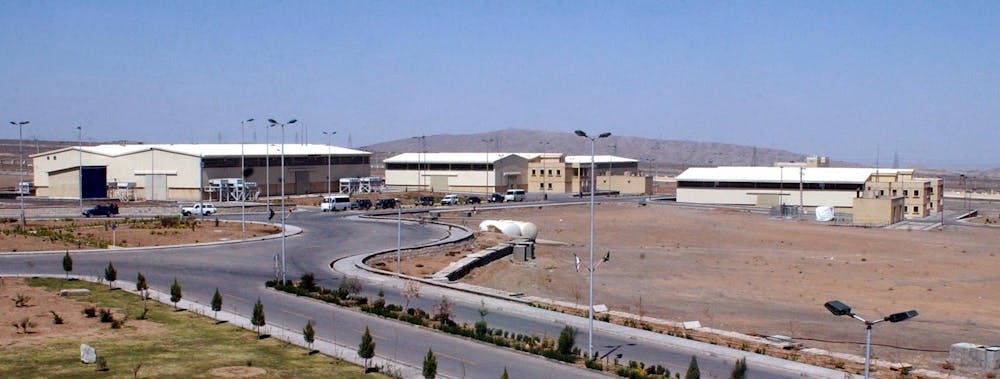
Inside these buildings at the Natanz nuclear facility in Iran, technicians enrich uranium. AP Photo/Vahid Salemi
That was a violation of the terms of the Nuclear Nonproliferation Treaty, which Iran had signed, requiring countries to disclose their nuclear-related facilities to international inspectors.
One of those formerly secret locations, Natanz, housed centrifuges for enriching uranium, which could be used in civilian nuclear reactors or enriched further for weapons.
Starting in roughly 2005, U.S. and Israeli government cyberattackers together reportedly targeted the Natanz centrifuges with a custom-made piece of malicious software that became known as Stuxnet.
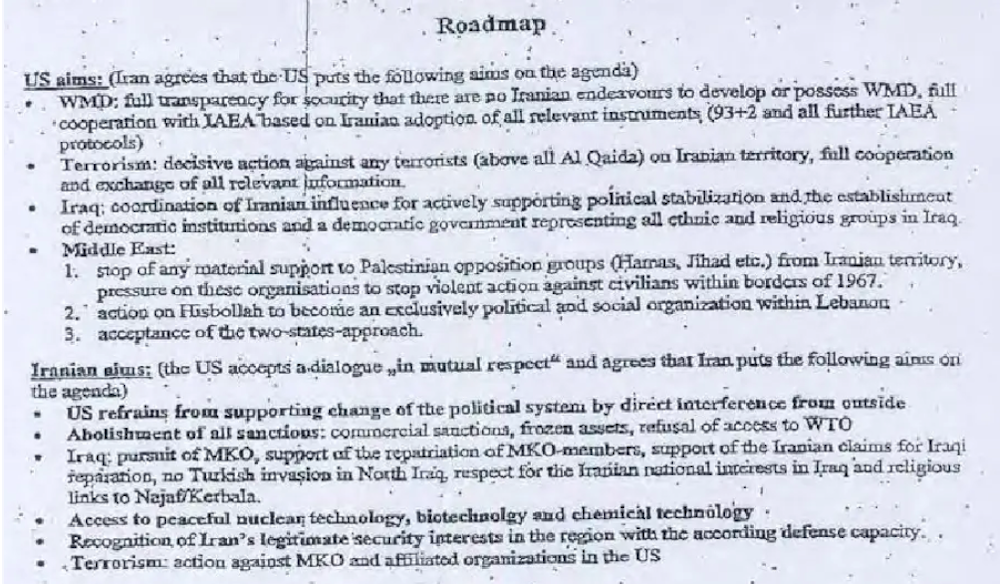
An excerpt of the document sent from Iran, via the Swiss government, to the U.S. State Department in 2003, appears to seek talks between the U.S. and Iran. Washington Post via Scribd
In May 2003, senior Iranian officials quietly contacted the State Department through the Swiss embassy in Iran, seeking “a dialogue ‘in mutual respect,’” addressing four big issues: nuclear weapons, terrorism, Palestinian resistance and stability in Iraq.
Hardliners in the Bush administration weren’t interested in any major reconciliation, though Secretary of State Colin Powell favored dialogue and other officials had met with Iran about al-Qaida.
When Iranian hardliner Mahmoud Ahmadinejad was elected president of Iran in 2005, the opportunity died. The following year, Ahmadinejad made his own overture to Washington in an 18-page letter to President Bush. The letter was widely dismissed; a senior State Department official told me in profane terms that it amounted to nothing.
After a decade of unsuccessful attempts to rein in Iran’s nuclear ambitions, the Obama administration undertook a direct diplomatic approach beginning in 2013.
Iran, the U.S., China, France, Germany, Russia and the United Kingdom signed the deal in 2015. It severely limited Iran’s capacity to enrich uranium and mandated that international inspectors monitor and enforce Iran’s compliance with the agreement.
In return, Iran was granted relief from international and U.S. economic sanctions. Though the inspectors regularly certified that Iran was abiding by the agreement’s terms, President Donald Trump withdrew from the agreement in May 2018.
2020: US drones kill Iranian Maj. Gen. Qassem Soleimani
At the time, the Trump administration asserted that Soleimani was directing an imminent attack against U.S. assets in the region, but officials have not provided clear evidence to support that claim.
Hamas’ brazen attack on Israel on Oct. 7, 2023, provoked a fearsome militarized response from Israel that continues today and served to severely weaken Iran’s proxies in the region, especially Hamas – the perpetrator of the attacks – and Hezbollah in Lebanon.
2025: Trump 2.0 and Iran
Trump saw an opportunity to forge a new nuclear deal with Iran and to pursue other business deals with Tehran. Once inaugurated for his second term, Trump appointed Steve Witkoff, a real estate investor who is the president’s friend, to serve as special envoy for the Middle East and to lead negotiations.
Negotiations for a nuclear deal between Washington and Tehran began in April, but the countries did not reach a deal. They were planning a new round of talks when Israel struck Iran with a series of airstrikes on June 13, forcing the White House to reconsider is position.
Jeffrey Fields receives funding from the Carnegie Corporation of New York and Schmidt Futures.
BROOKLYN, N.Y., June 17, 2025 (GLOBE NEWSWIRE) — Pioneer Acquisition I Corp (Nasdaq: PACHU) (the “Company”) announced today the pricing of its initial public offering of 22,000,000 units at $10.00 per unit. The units are expected to be listed on the Nasdaq Global Market (“Nasdaq”) and trade under the ticker symbol “PACHU” beginning June 18, 2025. Each unit consists of one Class A ordinary share and one-half of one redeemable warrant. Once the securities comprising the units begin separate trading, the Class A ordinary shares and warrants are expected to be listed on Nasdaq under the symbols “PACH” and “PACHW”, respectively. The underwriter has been granted a 45-day option to purchase up to an additional 3,300,000 units offered by the Company to cover over-allotments, if any. The offering is expected to close on June 20, 2025, subject to customary closing conditions.
The Company is a blank check company incorporated as an exempted company under the laws of the Cayman Islands, which will seek to effect a merger, share exchange, asset acquisition, share purchase, reorganization or similar business combination with one or more businesses or entities.
Cantor Fitzgerald & Co. acted as the sole book-running manager of the offering. Odeon Capital Group LLC acted as co-manager of the offering.
Winston & Strawn LLP is serving as legal counsel to the Company. Ellenoff Grossman & Schole LLP is serving as legal counsel to Cantor Fitzgerald & Co.
A registration statement on Form S-1 (333-287656) relating to these securities has been filed with the Securities and Exchange Commission (“SEC”), and was declared effective on June 17, 2025. The offering is being made only by means of a prospectus. When available, copies of the prospectus may be obtained from: Cantor Fitzgerald & Co., Attention: Capital Markets, 499 Park Avenue, 5th Floor New York, New York 10022; Email: prospectus@cantor.com., or from the SEC website at www.sec.gov.
This press release shall not constitute an offer to sell or a solicitation of an offer to buy, nor shall there be any sale of these securities in any state or jurisdiction in which such offer, solicitation or sale would be unlawful prior to registration or qualification under the securities laws of any such state or jurisdiction.
Forward-Looking Statements
This press release includes forward-looking statements that involve risks and uncertainties. Forward-looking statements are statements that are not historical facts. Such forward-looking statements are subject to risks and uncertainties, which could cause actual results to differ from the forward-looking statements. The Company expressly disclaims any obligations or undertaking to release publicly any updates or revisions to any forward-looking statements contained herein to reflect any change in the Company’s expectations with respect thereto or any change in events, conditions or circumstances on which any statement is based. No assurance can be given that the offering discussed above will be completed on the terms described, or at all. Forward-looking statements are subject to numerous conditions, many of which are beyond the control of the Company, including those set forth in the Risk Factors section of the Registration Statement and related preliminary prospectus filed in connection with the initial public offering with the SEC. Copies are available on the SEC’s website, www.sec.gov.
Contacts
Pioneer Acquisition I Corp Mr. Mitchell Creem Chief Executive Officer and Director 131 Concord Street Brooklyn, NY 11201 Email: creem@pioneeracquisition.com
BROOKLYN, N.Y., June 17, 2025 (GLOBE NEWSWIRE) — Pioneer Acquisition I Corp (Nasdaq: PACHU) (the “Company”) announced today the pricing of its initial public offering of 22,000,000 units at $10.00 per unit. The units are expected to be listed on the Nasdaq Global Market (“Nasdaq”) and trade under the ticker symbol “PACHU” beginning June 18, 2025. Each unit consists of one Class A ordinary share and one-half of one redeemable warrant. Once the securities comprising the units begin separate trading, the Class A ordinary shares and warrants are expected to be listed on Nasdaq under the symbols “PACH” and “PACHW”, respectively. The underwriter has been granted a 45-day option to purchase up to an additional 3,300,000 units offered by the Company to cover over-allotments, if any. The offering is expected to close on June 20, 2025, subject to customary closing conditions.
The Company is a blank check company incorporated as an exempted company under the laws of the Cayman Islands, which will seek to effect a merger, share exchange, asset acquisition, share purchase, reorganization or similar business combination with one or more businesses or entities.
Cantor Fitzgerald & Co. acted as the sole book-running manager of the offering. Odeon Capital Group LLC acted as co-manager of the offering.
Winston & Strawn LLP is serving as legal counsel to the Company. Ellenoff Grossman & Schole LLP is serving as legal counsel to Cantor Fitzgerald & Co.
A registration statement on Form S-1 (333-287656) relating to these securities has been filed with the Securities and Exchange Commission (“SEC”), and was declared effective on June 17, 2025. The offering is being made only by means of a prospectus. When available, copies of the prospectus may be obtained from: Cantor Fitzgerald & Co., Attention: Capital Markets, 499 Park Avenue, 5th Floor New York, New York 10022; Email: prospectus@cantor.com., or from the SEC website at www.sec.gov.
This press release shall not constitute an offer to sell or a solicitation of an offer to buy, nor shall there be any sale of these securities in any state or jurisdiction in which such offer, solicitation or sale would be unlawful prior to registration or qualification under the securities laws of any such state or jurisdiction.
Forward-Looking Statements
This press release includes forward-looking statements that involve risks and uncertainties. Forward-looking statements are statements that are not historical facts. Such forward-looking statements are subject to risks and uncertainties, which could cause actual results to differ from the forward-looking statements. The Company expressly disclaims any obligations or undertaking to release publicly any updates or revisions to any forward-looking statements contained herein to reflect any change in the Company’s expectations with respect thereto or any change in events, conditions or circumstances on which any statement is based. No assurance can be given that the offering discussed above will be completed on the terms described, or at all. Forward-looking statements are subject to numerous conditions, many of which are beyond the control of the Company, including those set forth in the Risk Factors section of the Registration Statement and related preliminary prospectus filed in connection with the initial public offering with the SEC. Copies are available on the SEC’s website, www.sec.gov.
Contacts
Pioneer Acquisition I Corp Mr. Mitchell Creem Chief Executive Officer and Director 131 Concord Street Brooklyn, NY 11201 Email: creem@pioneeracquisition.com
Source: United States Senator Alex Padilla (D-Calif.)
Padilla, Schiff Condemn Trump Administration Decision to Terminate $3.7 Billion in Clean Energy Grants, Urge DOE to Reinstate Them
SenatorsPadilla and Schiff: “These unlawful terminations represent a significant setback for American energy independence, and they undermine California and America’s leadership in the globally competitive clean energy industry.”
“These grants were provided through legally binding contract agreements between recipients and the federal government and, therefore, cannot be canceled on a political whim.”
WASHINGTON, D.C — Today, U.S. Senators Alex Padilla and Adam Schiff (both D-Calif.) condemned the Trump Administration’s decision to terminate $3.7 billion in federal funding for clean energy projects across the country, including $845 million in California, and called on the Administration to reinstate them. In the letter to U.S. Department of Energy (DOE) Chris Wright, the Senators note that these grants were previously awarded through legally binding contract agreements between recipients and the federal government and cannot be canceled on a political whim.
The projects targeted include the National Cement Company of California which lost $500 million for their Lebec Net-Zero Project to focus on carbon capture and the development of carbon-neutral cement, a manufacturing process that is notoriously emissions-intensive, $270 million for implementing carbon capture at a natural gas power plant in Yuba City, and $75 million for a project focused on testing new technology at Gallo Glass Company furnaces in Modesto.
“These grants were provided through legally binding contract agreements between recipients and the federal government and, therefore, cannot be canceled on a political whim. DOE claims that the agency evaluated the investments “on a case-by-case basis to identify waste of taxpayer dollars,” and yet your agency has not provided any information to Congress detailing waste of any kind,” wrote the Senators.
“DOE’s attacks on cutting-edge clean energy projects run counter to our shared interest in boosting energy production, innovation, and economic vitality. The United States cannot afford to halt our progress and hinder American companies’ efforts to move beyond outdated technologies if we hope to remain competitive and truly energy dominant around the globe. These irrational cancellations will increase energy prices, hamper innovation, and set us backwards as we strive toward a clean energy future. We ask that you reinstate the $3.7 billion in canceled OCED funding so that we may bolster American energy production and maintain our competitive edge,” concluded the Senators.
A list of DOE awards terminated is available here.
Full text of the letter is available here and below:
Dear Secretary Wright:
We write with deep concern regarding the U.S. Department of Energy’s (DOE) terminations of energy projects in California that were supported by the Office of Clean Energy Demonstrations (OCED). These unlawful terminations represent a significant setback for American energy independence, and they undermine California and America’s leadership in the globally competitive clean energy industry. We urge you to work with recipients to reinstate their grant awards.
On May 30, DOE canceled $3.7 billion in funding for 24 clean energy projects around the country, including in Alabama, Arizona, California, Illinois, Kentucky, Louisiana, Massachusetts, Michigan, Nevada, New York, Ohio, Texas, Washington, and Wyoming. In California alone, DOE terminated $845 million in project funding. These terminations are unnecessarily harmful to California’s industries, who often push the cutting edge of innovation forward.
One of the largest cancellations targeted the National Cement Company of California Inc., which lost $500 million for their Lebec Net-Zero Project to focus on carbon capture and the development of carbon-neutral cement, a manufacturing process that is notoriously emissions-intensive. Not only would this project have accelerated decarbonization efforts, but it would have also created hundreds of local jobs in construction and plant operations. Another canceled project in California was $270 million for implementing carbon capture at a natural gas power plant in Yuba City. This project, which supported the same traditional sources of energy that the Trump DOE claims to support, would have helped reduce 95 percent of CO2 emissions from the plant and provided Northern California with more low-carbon electricity. DOE canceled another $75 million for a project focused on testing new technology at Gallo Glass Company furnaces in Modesto. This project would have reduced natural gas use by 70 percent and would have used union labor to produce glass for California’s wine industry.
These grants were provided through legally binding contract agreements between recipients and the federal government and, therefore, cannot be canceled on a political whim. DOE claims that the agency evaluated the investments “on a case-by-case basis to identify waste of taxpayer dollars,” and yet your agency has not provided any information to Congress detailing waste of any kind. These terminations follow your agency’s May 15 announcement that DOE would review 179 awards totaling over $15 billion for projects dedicated to updating power grids and supporting the domestic manufacture of batteries, which has created significant chaos and uncertainty in America’s energy and manufacturing sectors.
Additionally, it has been reported that DOE may be planning to close OCED, which has contributed to more than 70 percent of staff in that office departing the agency. In 2021, Congress directed the establishment of OCED in the bipartisan Infrastructure Investment and Jobs Act. OCED’s mission is to advance large-scale demonstration projects to accelerate the deployment and market adoption of energy technologies like clean hydrogen, carbon management, advanced nuclear reactors, and long-duration energy storage. Until recently, these were bipartisan initiatives.
DOE’s attacks on cutting-edge clean energy projects run counter to our shared interest in boosting energy production, innovation, and economic vitality. The United States cannot afford to halt our progress and hinder American companies’ efforts to move beyond outdated technologies if we hope to remain competitive and truly energy dominant around the globe. These irrational cancellations will increase energy prices, hamper innovation, and set us backwards as we strive toward a clean energy future. We ask that you reinstate the $3.7 billion in canceled OCED funding so that we may bolster American energy production and maintain our competitive edge.
The Palestine Forum of New Zealand notes with deep appreciation the public statement issued today by ninety‑five New Zealand lawyers urging the Government to adopt a stronger stance on Israel amid escalating tensions in the Middle East.
We stand in solidarity with these respected members of the legal profession who, in highlighting international law, human rights, and the principles underpinning New Zealand’s foreign policy, are calling for moral and political leadership from our nation.
Their call comes at a critical juncture: New Zealand’s vote at the UN in support of the resolution recommending Israel’s withdrawal from occupied territories was a step in the right direction. However, it must now be followed by coherent action—politically, diplomatically, and legally—consistent with our international obligationsscoop.co.nz+12scoop.co.nz+12scoop.co.nz+12.
We concur with the lawyers’ analysis:
ThatIsrael’s occupation of Palestinian landviolates international law.
Thatincreasing violence and civilian suffering, particularly in Gaza and the West Bank, demand concrete responses.
That New Zealand’s standing as a principled actor in world affairs calls for bothclear condemnationof abuses andactive supportfor measures that uphold international law, including:
Support for ICC proceedings and arrest warrants for war crimes suspects;
The use oftargeted sanctions;
Suspension of government contracts and investment ties with entities complicit in occupation;
Advocacy for animmediate ceasefire, unimpeded humanitarian access, and humanitarian visas for Palestinians fleeing conflict.
As legal voices within our own legal fraternity have acknowledged, our Government holdsnot only a right but a dutyto lead—ahead of electoral cycles—by placing human rights and international justice at the heart of its foreign policy.
We call on the Government to honour these principles by engaging thoughtfully with the lawyers’ briefing, committing publicly to concrete measures, and joining the global community in holding violators of international law to account.
Today’s call by our country’s legal community is both timely and courageous. We affirm their voices. And we renew our call for New Zealand to do the same.
Our cultural touchstones series looks at influential works.
Gilles Deleuze was one of the most original and imaginative thinkers of postwar France. A lifelong teacher, he spent most of his career at the University of Paris VIII, influencing generations of students but largely shunning the mantle of public intellectual.
His complex, creative books mix philosophy, literature, film and politics – not to give clear answers, but to spark new ways of thinking.
Written at a time when the Cold War was ending, computers were becoming more common, and the internet was beginning to connect institutions, the essay describes the emergence of a new kind of society – one not ruled by a single stern voice but by the soft hum of networks.
How societies work
Postscript was written as an update to the work of Deleuze’s contemporary Michel Foucault, who had died in 1984. Deleuze called it a “postscript” not just because of its brevity (it’s only around 2,300 words in English translation) but to highlight he wasn’t refuting Foucault, just building on his work.
From the 18th to early 20th centuries, Foucault had argued, Western societies were “disciplinary societies”. Schools, factories, prisons and hospitals – institutions with walls, schedules, routines and clear expectations – moulded behaviour. People were trained, observed, tested and corrected as they passed from one institution to the next.
But in the late 20th century, Deleuze saw something shifting. He thought the stodgy old disciplinary institutions were “in a generalized crisis” due to technological advances and a new form of capitalism that demanded more flexibility in workers and consumers.
New systems of management and technology were starting to reshape people without sending them through traditional institutions. Deleuze wrote presciently, for example, that “perpetual training tends to replace the school, and continuous control to replace the examination”.
In business, he saw a growing idea of “salary according to merit”, transforming work into “challenges, contests, and highly comic group sessions” – something much at odds with the old model of the standard wage and the assembly line. Traditional government institutions like hospitals and the classic factory were embracing the model of the corporation, driven always by a profit motive and the need for better human tools.
To Deleuze, all this meant people were becoming more “free-floating” – they could be still playing socially useful roles but were being gently steered into them. This greater freedom, however, required a new system to keep everyone in line. He called this “modulation” to underline its dynamic, enveloping nature.
Like nudging, but everywhere
Deleuze described modulation as “a self-deforming cast that will continuously change from one moment to the other”. He meant that people were beginning to live in an environment where everything shape-shifts to encourage or discourage us in the right direction without explicitly putting up walls.
A prime example of how modulation has since become commonplace is nudging – the use of psychological techniques, often subtle and data-driven, to shape people’s behaviour.
Nudging didn’t really exist in 1990, but governments and tech companies use nudges all the time now. We’re nudged to eat healthier, buy, save, recycle, donate. Web sites use “dark patterns” – tricky designs that steer (or nudge) us toward certain choices. Social media feeds use algorithms to exclude us if we say the wrong thing. In fact, entire teams of behavioural scientists operate behind the scenes to manipulate many aspects of our lives.
Nudges can be good and can save us from poor choices, but their newfound moral acceptability (sometimes called libertarian paternalism) is very much a clue that Deleuze’s control society has arrived.
Control in your pocket
Deleuze, who died in 1995, wrote Postscript before the advent of the smartphone, but he foresaw that an “electronic collar” would assume a central role in society. He envisaged a “computer that tracks each person’s position – licit or illicit – and effects a universal modulation.”
Smartphones more than fit the bill. In the old disciplinary ways, they track where we go, what we search for, what we buy, how many steps we take, even how well we sleep. But if we apply Deleuze’s ideas to these phones, detailed surveillance is no longer their most important function. Our phones present and curate options.
In effect, they shape how we see the world. When you scroll through news or social media, for instance, you’re reading about a version of the world built just for you, designed to keep you looking, clicking and reacting – and keep you very finely attuned to what is acceptable or dangerous behaviour.
In Deleuze’s terms, this is pure modulation: not a forceful “No” but a softly spoken, “How about this?” Your phone doesn’t lock you in – it draws you in. It shapes what you see, rewards your cooperation, ignores your silence, and always keeps score. And it does this 24/7. You might unlock it hundreds of times a day. And each time it’s updated to guide your next move more precisely.
At the same time our phones quietly turn us into a set of credentials useful for regulating physical access to workplaces, bank accounts, information: In the societies of control, writes Deleuze, “what is important is no longer either a signature or a number, but a code: the code is a password.”
Data points not people?
Deleuze warned that, in a control society: “Individuals have become ‘dividuals,’ and masses have become samples, data, markets, or ‘banks.’” A dividual to Deleuze is a person transformed into a set of data points and metrics.
You are your credit rating, your search history, your likes and clicks – a different dataset to every institution. Such fragments are used to make decisions about you until they effectively replace you. In fact, for Deleuze a dividual has internalised this treatment and thinks of themselves as a net worth, a mortgage size, a car value – psychological anchors for control.
He illustrates this point with healthcare, predicting a
new medicine ‘without doctor or patient’ that singles out potential sick people and subjects at risk, which in no way attests to individuation.
How many health decisions are now made for us collectively before we ever see a doctor? We should be grateful for advances in public health and epidemiology, but this has certainly impacted our individuality and how we are treated.
Hard to detect
An unsettling part of Deleuze’s perspective is that control doesn’t usually feel like control. It’s often dressed up as convenience, efficiency or progress. You set up internet-linked video cameras because then you can work from home. You agree to long terms and conditions because your banking app won’t work otherwise.
One problem is there are no longer clear barriers we can rail against. As Deleuze said:
In disciplinary societies one was always starting again (from school to the barracks, from the barracks to the factory), while in control societies one is never finished with anything.
Control doesn’t always crush – it can enable. Digital networks bring real freedom, economic possibility, even joy. We move more easily – both mentally and geographically – than ever before. But while we move, it always inside a kind of invisible map shaped by capitalism.
It’s no conspiracy because nobody has the whole map. So it’s difficult to work out exactly what action, if any, to take. As Deleuze concludes: “The coils of a serpent are even more complex than the burrows of a molehill.”
So what can we do?
Postscript doesn’t offer a political program beyond the sardonic comment that:
Many young people strangely boast of being ‘motivated’ […] It’s up to them to discover what they’re being made to serve.
There are ways to resist control. Some people demand more privacy or digital rights. Others opt out selectively – logging off, turning off, refusing to be nudged. Some look to art as a way of resisting its smooth grip. These acts – however small – may offer what Deleuze and his collaborator, the French psychiatrist and philosopher Félix Guattari, called lines of flight: creative ways to move not just against control, but beyond it.
The real message of Postscript, however, is its invitation to consider a timeless perspective. Any society must have a way to make people useful. So, what kind of society do we want? What kinds of restrictions are we willing to live under? And, crucial to this current age, how explicit should control be?
Cameron Shackell does not work for, consult, own shares in or receive funding from any company or organisation that would benefit from this article, and has disclosed no relevant affiliations beyond their academic appointment.
From June 19 to 22, 2025, Samsung Electronics will collaborate with globally renowned artists to celebrate global diversity, artistic innovation and the power of display technology at Art Basel in Basel 2025, the world’s largest art fair held in Basel, Switzerland.
▲ As Art Basel’s official display partner, Samsung Electronics offers exclusive access to curated exhibition artworks via the Samsung Art Store, also on display onsite at Art Basel in Basel 2025.
With participation from approximately 280 galleries across 42 countries, Art Basel in Basel 2025 offers a comprehensive view of the latest ideas shaping contemporary art today. As the official display partner, Samsung Electronics presents a new digital art experience that brings together art and technology through its premium screens including The Frame, Micro LED and Neo QLED 8K.
Immersive Digital Art Experience: ‘ArtCube’ Draws Visitors Into the World of Art
At Art Basel in Basel 2025, Samsung Electronics unveiled ‘ArtCube,’ a lounge dedicated to digital art experiences on Samsung devices. Created under the theme “Borderless, Dive Into the Art,” ArtCube offers a progressively immersive journey as visitors navigate the space.
Passing through a large LED entrance where the Art Basel in Basel Collection from Samsung Art Store is reinterpreted as digital artworks, visitors discover a space showcasing the full lineup of Samsung Art TVs in the ArtCube. Artworks from the Samsung Art Store, displayed across ‘The Frame,’ ‘Micro LED’ and ‘Neo QLED 8K’ screens, envelope the front and side walls to create a deeply immersive experience — one that makes visitors feel as though they have stepped directly into the art itself.
▲ Samsung Art TVs — including The Frame Pro, MICRO LED and Neo QLED 8K — line the interior walls of ArtCube.
▲ A visitor views Basim Magdy’s artwork on display at ArtCube, part of the Samsung Art Store collection at Art Basel in Basel 2025.
An interactive experience zone, powered by Samsung Art Store, is also featured. Visitors can select an artist showcased in the exhibition, take a photo and generate a personalized selfie in the chosen artist’s style, using generative AI — offering a distinctive and engaging experience.
Bringing Art Into Everyday Life Through the Samsung Art Store
Earlier this week, Samsung Electronics has unveiled a new collection featuring 38 highlighted pieces from Art Basel in Basel 2025, now available on the Samsung Art Store. With this launch, Samsung Art Store subscribers around the world can enjoy a diverse selection of Art Basel artworks from the comfort of their homes — without needing to travel to Basel, Switzerland.
As the official display partner of Art Basel for 2025, Samsung Electronics will continue its participation in the annual exhibitions held in Basel, Hong Kong, Paris and Miami. Through Samsung Art Store, the company aims to make art more accessible and seamlessly integrated into everyday life.
The Samsung Art Store* is a subscription-based art service available on Samsung’s The Frame and QLED TVs. Now accessible in 117 countries, the Samsung Art Store offers more than 3,500 artworks in stunning 4K resolution through collaboration with over 70 leading partners.
▲ Basim Magdy, featured in the Samsung Art Store collection at Art Basel in Basel 2025, views his own work on display at ArtCube.
▲ Visitors take in the vibrant, dreamlike works of Basim Magdy on display at ArtCube, part of Samsung’s digital art showcase at Art Basel in Basel 2025.
▲ A visitor captures Lee Kun-yong’s artwork on display at Samsung ArtCube.
▲ A visitor views Marc Dennis’ artwork on display at Samsung ArtCube.
▲ A vivid portrait in the style of Marc Dennis captures visitors’ attention at ArtCube, part of Samsung’s digital art showcase at Art Basel in Basel 2025.
▲ A vivid portrait in the style of Saya Woolfalk captures visitors’ attention at ArtCube, part of Samsung’s digital art showcase at Art Basel in Basel 2025.
▲ The experience zone highlights the Samsung Art Store and lets visitors create immersive, AI-powered photos with animated elements from featured artworks.
▲ One of the most striking pieces at ArtCube, Basim Magdy’s “The Dictator and His Cockroach Count Their Blessings” merges satire and dreamlike visuals in Samsung’s digital art showcase.
▲ Visitors explore the immersive artworks by Marc Dennis at ArtCube, where his vivid, hyperreal art pieces are brought to life with digital projections.
* All artworks in Samsung Art Store are available with a membership subscription. Artwork availability is subject to change without prior notice and may vary by region.
Israeli defence systems intercept Iranian missiles over the city of HaifaAhmad Gharabli / AFP via Getty Images
Late last week, Israel began a wave of attacks on Iran under the banner of Operation Rising Lion, with the stated goal of crippling the Islamic republic’s nuclear program and long-range strike capabilities. At the outset, Israel claimed Iran would soon be able to build nine nuclear weapons, a situation Israel regarded as completely unacceptable.
Following Israeli strikes against Iranian nuclear facilities, and targeted assassinations of Iranian nuclear scientists and key members of the Iranian armed forces, Iran retaliated with a large barrage of ballistic missiles and drones against Tel Aviv and Jerusalem. The first wave consisted of some 200 ballistic missiles and 200 drones.
The conflict continues to escalate, with population centres increasingly being targeted. Israel’s missile defence systems (including the vaunted Iron Dome) have so far staved off most of Iran’s attacks, but the future is uncertain.
Ballistic missiles and how to stop them
Iran possesses a large arsenal of ballistic missiles and long-range drones, alongside other long-range weapons such as cruise missiles. Ballistic missiles travel on a largely fixed path steered by gravity, while cruise missiles can adjust their course as they fly.
Iran is approximately 1,000km from Israel, so the current strikes mostly involve what are classified as medium-range ballistic missiles, alongside long-range drones. It is not clear exactly what type of missile Iran has used in its latest strikes, but the country has several including the Fattah-1 and Emad.
It is very difficult to defend against ballistic missiles. There is not much time between launch and impact, and they come down at very high speed. The longer the missile’s range, the faster and higher it flies.
An incoming missile presents a small, fast-moving target – and defenders may have little time to react.
Israel’s missile defence and the Iron Dome
Israel possesses arguably one of the most effective, battle-tested air defence systems in service today. The system is often described in the media as the “Iron Dome”, but this is not quite correct.
Israel’s defences have several layers, each designed to address threats coming from different ranges.
In essence, Iron Dome consists of a network of radar emitters, command and control facilities, and the interceptors (special surface-to-air missiles). The radar quickly detects incoming threats, the command and control elements decide which are most pressing, and the interceptors are sent to destroy the incoming shells or rockets.
Ballistic defence systems
The other layers of Israel’s defence system include David’s Sling, and the Arrow 2 and Arrow 3 interceptors. These are specifically designed to engage longer-range ballistic missiles, both within the atmosphere and at very high altitudes above it (known as exoatmospheric interception).
Spectacular footage has been captured of what are likely exoatmospheric interceptions taking place during this latest conflict, demonstrating Israel’s capacity to engage longer-range missiles.
The US military has comparable missile defence systems. The US Army has the Patriot PAC-3 (comparable to David’s Sling) and THAAD (comparable to Arrow 2), while the US Navy has the Aegis and the SM-3 (comparable to Arrow 3) and the SM-6 (comparable again to Arrow 2).
Iran possesses some air defence systems such as the Russian S300 which has some (very limited) ballistic missile defence capabilities, but only against shorter range (and thus slower) ballistic missiles. Further, Israel has been focusing on degrading Iran’s air defences, so it is not clear how many are still operational.
Iran has been focusing on developing technology such as maneuverable warheads, which are harder to defend against. However, it is not clear whether these are yet operational and in Iranian service.
Missile defences are finite. The defender is always limited by the number of interceptors it possesses.
The attacker is also limited by the number of missiles it possesses. However, the defender must often assign multiple interceptors to each attacking missile, in case the first misses or otherwise fails.
The attacker will plan for some losses to interceptors (or mechanical failures) and send what it determines to be enough missiles for at least some to penetrate the defences.
When it comes to ballistic missiles, the advantage lies with the attacker. Ballistic missiles can carry large explosive payloads (or even nuclear warheads), so even a handful of missiles “leaking” past defensive systems can still wreak significant damage.
What now?
Israel’s missile defences are unlikely to stop working completely. However, as attacks deplete its stocks of interceptors, the system may become less effective.
As the conflict continues, it may become a race to see who runs out of weapons first. Will it be Iran’s stocks of ballistic missiles and drones, or the interceptors and anti-air munitions of Israel, the US and any other supporters?
It is impossible to say who would prevail in such a race of stockpile attrition. Some reports suggest Iran has fired approximately 1,000 ballistic missiles of an estimated 3,000. However, this still leaves it with an enormous stockpile to use, and it is unclear how fast Iran can make new missiles to replenish its resources.
But we should hope it doesn’t come to that. Beyond the tit-for-tat exchange of missiles, the latest conflict between Israel and Iran risks escalating. If it is not resolved soon, and if the US is drawn into the conflict more directly, we may see broader conflict in the Middle East.
James Dwyer does not work for, consult, own shares in or receive funding from any company or organisation that would benefit from this article, and has disclosed no relevant affiliations beyond their academic appointment.
Israeli defence systems intercept Iranian missiles over the city of HaifaAhmad Gharabli / AFP via Getty Images
Late last week, Israel began a wave of attacks on Iran under the banner of Operation Rising Lion, with the stated goal of crippling the Islamic republic’s nuclear program and long-range strike capabilities. At the outset, Israel claimed Iran would soon be able to build nine nuclear weapons, a situation Israel regarded as completely unacceptable.
Following Israeli strikes against Iranian nuclear facilities, and targeted assassinations of Iranian nuclear scientists and key members of the Iranian armed forces, Iran retaliated with a large barrage of ballistic missiles and drones against Tel Aviv and Jerusalem. The first wave consisted of some 200 ballistic missiles and 200 drones.
The conflict continues to escalate, with population centres increasingly being targeted. Israel’s missile defence systems (including the vaunted Iron Dome) have so far staved off most of Iran’s attacks, but the future is uncertain.
Ballistic missiles and how to stop them
Iran possesses a large arsenal of ballistic missiles and long-range drones, alongside other long-range weapons such as cruise missiles. Ballistic missiles travel on a largely fixed path steered by gravity, while cruise missiles can adjust their course as they fly.
Iran is approximately 1,000km from Israel, so the current strikes mostly involve what are classified as medium-range ballistic missiles, alongside long-range drones. It is not clear exactly what type of missile Iran has used in its latest strikes, but the country has several including the Fattah-1 and Emad.
It is very difficult to defend against ballistic missiles. There is not much time between launch and impact, and they come down at very high speed. The longer the missile’s range, the faster and higher it flies.
An incoming missile presents a small, fast-moving target – and defenders may have little time to react.
Israel’s missile defence and the Iron Dome
Israel possesses arguably one of the most effective, battle-tested air defence systems in service today. The system is often described in the media as the “Iron Dome”, but this is not quite correct.
Israel’s defences have several layers, each designed to address threats coming from different ranges.
In essence, Iron Dome consists of a network of radar emitters, command and control facilities, and the interceptors (special surface-to-air missiles). The radar quickly detects incoming threats, the command and control elements decide which are most pressing, and the interceptors are sent to destroy the incoming shells or rockets.
Ballistic defence systems
The other layers of Israel’s defence system include David’s Sling, and the Arrow 2 and Arrow 3 interceptors. These are specifically designed to engage longer-range ballistic missiles, both within the atmosphere and at very high altitudes above it (known as exoatmospheric interception).
Spectacular footage has been captured of what are likely exoatmospheric interceptions taking place during this latest conflict, demonstrating Israel’s capacity to engage longer-range missiles.
The US military has comparable missile defence systems. The US Army has the Patriot PAC-3 (comparable to David’s Sling) and THAAD (comparable to Arrow 2), while the US Navy has the Aegis and the SM-3 (comparable to Arrow 3) and the SM-6 (comparable again to Arrow 2).
Iran possesses some air defence systems such as the Russian S300 which has some (very limited) ballistic missile defence capabilities, but only against shorter range (and thus slower) ballistic missiles. Further, Israel has been focusing on degrading Iran’s air defences, so it is not clear how many are still operational.
Iran has been focusing on developing technology such as maneuverable warheads, which are harder to defend against. However, it is not clear whether these are yet operational and in Iranian service.
Missile defences are finite. The defender is always limited by the number of interceptors it possesses.
The attacker is also limited by the number of missiles it possesses. However, the defender must often assign multiple interceptors to each attacking missile, in case the first misses or otherwise fails.
The attacker will plan for some losses to interceptors (or mechanical failures) and send what it determines to be enough missiles for at least some to penetrate the defences.
When it comes to ballistic missiles, the advantage lies with the attacker. Ballistic missiles can carry large explosive payloads (or even nuclear warheads), so even a handful of missiles “leaking” past defensive systems can still wreak significant damage.
What now?
Israel’s missile defences are unlikely to stop working completely. However, as attacks deplete its stocks of interceptors, the system may become less effective.
As the conflict continues, it may become a race to see who runs out of weapons first. Will it be Iran’s stocks of ballistic missiles and drones, or the interceptors and anti-air munitions of Israel, the US and any other supporters?
It is impossible to say who would prevail in such a race of stockpile attrition. Some reports suggest Iran has fired approximately 1,000 ballistic missiles of an estimated 3,000. However, this still leaves it with an enormous stockpile to use, and it is unclear how fast Iran can make new missiles to replenish its resources.
But we should hope it doesn’t come to that. Beyond the tit-for-tat exchange of missiles, the latest conflict between Israel and Iran risks escalating. If it is not resolved soon, and if the US is drawn into the conflict more directly, we may see broader conflict in the Middle East.
James Dwyer does not work for, consult, own shares in or receive funding from any company or organisation that would benefit from this article, and has disclosed no relevant affiliations beyond their academic appointment.
The Middle East is a region of intense beauty and ancient kingdoms. It has also repeatedly endured periods of geopolitical instability over many centuries.
Today, geopolitical, socio-political and religious tensions persist. The world is currently watching as longstanding regional tensions come to a head in the shocking and escalating conflict between Israel and Iran.
The global airline industry takes a special interest in how such tensions play out. This airspace is a crucial corridor linking Europe, Asia and Africa.
The Middle East is now home to several of the world’s largest international airlines: Emirates, Qatar Airways and Etihad Airways. These airlines’ home bases – Dubai, Doha and Abu Dhabi, respectively – have become pivotal hubs in international aviation.
Keeping passengers safe will be all airlines’ highest priority. What could an escalating conflict mean for both the airlines and the travelling public?
Safety first
History shows that the civil airline industry and military conflict do not mix. On July 3 1988, the USS Vincennes, a US navy warship, fired two surface-to-air missiles and shot down Iran Air Flight 655, an international passenger service over the Persian Gulf.
More recently, on July 17 2014, Malaysian Airlines Flight MH17 was shot down over eastern Ukraine as the battle between Ukrainian forces and pro-Russian separatists continued.
Understandably, global airlines are very risk-averse when it comes to military conflict. The International Civil Aviation Organization requires airlines to implement and maintain a Safety Management System (SMS).
One of the main concerns – known as “pillars” – of the SMS is “safety risk management”. This includes the processes to identify hazards, assess risks and implement risk mitigation strategies.
The risk-management departments of airlines transiting the Middle East region will have been working hard on these strategies.
Headquartered in Montreal, Canada, the International Civil Aviation Organization has strict requirements and protocols to keep passengers safe. meunierd/Shutterstock
Route recalculation
The most immediate and obvious evidence of such strategies being put in place are changes to aircraft routing, either by cancelling or suspending flights or making changes to the flight plans. This is to ensure aircraft avoid the airspace where military conflicts are flaring.
At the time of writing, a quick look at flight tracking website Flightradar24 shows global aircraft traffic avoiding the airspace of Iran, Iraq, Syria, Israel, Jordan, Palestine and Lebanon. The airspace over Ukraine is also devoid of air traffic.
Rerouting, however, creates its own challenges. Condensing the path of the traffic into smaller, more congested areas can push aircraft into and over areas that are not necessarily equipped to deal with such a large increase in traffic.
Having more aircraft in a smaller amount of available safe airspace creates challenges for air traffic control services and the pilots operating the aircraft.
More time and fuel
Avoiding areas of conflict is one of the most visible forms of airline risk management. This may add time to the length of a planned flight, leading to higher fuel consumption and other logistical challenges. This will add to the airlines’ operating costs.
There will be no impact on the cost of tickets already purchased. But if the instability in the region continues, we may see airline ticket prices increase.
It is not just the avoidance of airspace in the region that could place upward pressure on the cost of flying. Airliners run on Jet-A1 fuel, produced from oil.
If Iran closes the Strait of Hormuz, the “world’s most important oil transit chokepoint”, this could see the cost of oil, and in turn Jet-A1, significantly increase. Increasing fuel costs will be passed on the paying passenger. However, some experts believe such a move is unlikely.
A major hub
The major aviation hubs in the Middle East provide increased global connectivity, enabling passengers to travel seamlessly between continents.
Increased regional instability has the potential to disrupt this global connectivity. In the event of a prolonged conflict, airlines operating in and around the region may find they have increased insurance costs. Such costs would eventually find their way passed on to consumers through higher ticket prices.
Across the globe, airlines and governments are issuing travel advisories and warnings. The onus is on the travelling public to stay informed about changes to flight status, and potential delays.
Such warnings and advisories can lead to a drop in passenger confidence, which may then lead to a drop in bookings both into and onwards from the region.
Until the increase in instability in the Middle East, global airline passenger traffic numbers were larger than pre-pandemic figures. Strong growth had been predicted in the coming decades.
Anything that results in falling passenger confidence could negatively impact these figures, leading to slowed growth and affecting airline profitability.
Despite high-profile disasters, aviation remains the safest form of transport. As airlines deal with these challenges they will constantly work to keep flights safe and to win back passenger confidence in this unpredictable situation.
Natasha Heap does not work for, consult, own shares in or receive funding from any company or organisation that would benefit from this article, and has disclosed no relevant affiliations beyond their academic appointment.
Ever find yourself unable to stop scrolling through your phone, chasing that next funny video or interesting post?
Or maybe you’ve felt a rush of excitement when you achieve a goal, eat a delicious meal, or fill your online shopping cart.
Why do some experiences feel so rewarding, while others leave us feeling flat? Well, dopamine might be responsible for that. Here’s what it does in our brains and bodies.
It’s a chemical messenger
Dopamine is a neurotransmitter – a chemical messenger that facilitates communication between the brain and the central nervous system. It sends messages between different parts of your nervous system, helping your body and brain coordinate everything from your movement to your mood.
Dopamine is most known for its role in short-term pleasure, and the boost we get from things such as eating tasty foods, drinking alcohol, scrolling social media or falling in love.
It even plays a role in kidney function by regulating the levels of salt and water we excrete.
Conversely, low levels of dopamine have been linked to neurodegenerative disorders such as Parkinson’s disease.
How dopamine motivates us to pursue pleasure
Dopamine is not just active when we do pleasurable things. It’s active beforehand and it drives us to pursue pleasure.
Say I go to a cafe and decide to buy a doughnut. When I bite into the doughnut, it tastes fantastic. Dopamine surges and I experience pleasure.
The next time I walk past the cafe, dopamine is already active. It remembers the doughnut I had last time and how delicious it was. Dopamine drives me to walk back into the cafe, purchase another doughnut and eat it.
From an evolutionary perspective, dopamine was incredibly important and it ensured survival of the species. It motivated behaviours such as hunting and foraging for food. It reinforced the pursuit of finding shelter and safety and keeping away from predators. And it motivated people to seek out mates and to reproduce.
However, modern technology has amplified the effects of dopamine, leading to negative consequences. Activities such as excessive social media use, gambling, consuming alcohol, drug use, sex, pornography and gaming can stimulate dopamine release, creating cycles of addiction and compulsive behaviours.
Our dopamine levels can vary
Our brain is constantly releasing small amounts of dopamine at a “baseline” rate. This is because dopamine is crucial to the functioning of our brain and body, irrespective of pleasure.
Everyone has a different baseline, influenced by genetic factors such as our DRD2 dopamine receptor genes. Some people produce and metabolise dopamine faster than other people. Our baseline levels can also be influenced by sleep, nutrition and stress in our lives.
If I play games on my phone all morning and get a dopamine release from that, then I eat something tasty for morning tea, I may not experience the same level of fulfilment or enjoyment that I would have had I not played those games.
The brain works hard to regulate itself and it won’t allow us to be in a constant state of dopamine “highs”. This means we can build a tolerance to certain exciting activities if we seek them out too much, as the brain wants to avoid being in a state of constant dopamine “highs”.
Healthy ways to get a dopamine boost
Thankfully, there are healthy, non-addictive ways to boost your dopamine levels.
Exercise is one of the most effective methods for boosting dopamine naturally. Physical activities such as walking, running, cycling, or even dancing can trigger the release of dopamine, leading to improved mood and greater motivation.
Research has shown listening to music you enjoy makes your brain release more dopamine, giving you a pleasurable experience.
And of course, spending time with people whose company we enjoy is another great way to activate dopamine.
Incorporating these habits into daily life can support your brain’s natural dopamine production and help you enjoy lasting improvements in motivation, mood and overall health.
Anastasia Hronis is the author of The Dopamine Brain: Your Science-Backed Guide to Balancing Pleasure and Purpose, published by Penguin Books Aus & NZ.
Our experience of the world often involves hearing our environment before seeing it. Whether it’s the sound of something moving through nearby water, or the rustling of vegetation, our fear of the unseen is rooted in our survival instincts as a species.
Cinematic sound and music taps into these somewhat unsettling instincts – and this is exactly what director Steven Spielberg and composer John Williams achieved in the iconic 1975 thriller Jaws. The sound design and musical score work in tandem to confront the audience with a mysterious killer animal.
In what is arguably the film’s most iconic scene, featuring beach swimmers’ legs flailing underwater, the shark remains largely unseen – yet the sound perfectly conveys the threat at large.
Creating tension in a soundtrack
Film composers aim to create soundscapes that will profoundly move and influence their audience. And they express these intentions through the use of musical elements such as rhythm, harmony, tempo, form, dynamics, melody and texture.
In Jaws, the initial encounter with the shark opens innocently with the sound of an offshore buoy and its clanging bell. The scene is established both musically and atmospherically to evoke a sense of isolation for the two characters enjoying a late-night swim on an empty beach.
But once we hear the the low strings, followed by the central two-note motif played on a tuba, we know something sinister is afoot.
This compositional technique of alternating between two notes at an increasing speed has long been employed by composers, including by Antonín Dvořák in his 1893 work New World Symphony.
John Williams reportedly used six basses, eight cellos, four trombones and a tuba to create the blend of low frequencies that would go on to define his entire Jaws score.
The bass instruments emphasise the lower end of the musical frequency spectrum, evoking a dark timbre that conveys depth, power and intensity. String players can use various bowing techniques, such as staccato and marcato, to deliver dark and even menacing tones, especially in the lower registers.
Meanwhile, there is a marked absence of tonality in the repeating E–F notes, played with increasing speed on the tuba. Coupled with the intensifying dynamics in the instrumental blend, this accelerating two-note motif signals the looming danger before we even see it – tapping into our instinctive fear of the unknown.
The use of the two-note motif and lower-end orchestration characterises a composition style that aims to unsettle and disorientate the audience. Another example of this style can be heard in Bernard Herrmann’s car crash scene audio in North by Northwest (1959).
Similarly, in Sergei Prokofiev’s Scythian Suite, the opening of the second movement (Dance of the Pagan Gods) uses an alternating D#–E motif.
The elasticity of Williams’ motif allows the two notes to be played on different instruments throughout the soundtrack, exploring various timbral possibilities to induce a kaleidoscope of fear, panic and dread.
The psychology behind our response
What is it that makes the Jaws soundtrack so psychologically confronting, even without the visuals? Music scholars have various theories. Some suggest the two notes imitate the sound of human respiration, while others have proposed the theme evokes the heartbeat of a shark.
Williams explained his approach in an interview with the Los Angeles Times:
I fiddled around with the idea of creating something that was very … brainless […] Meaning something could be very repetitious, very visceral, and grab you in your gut, not in your brain. […] It could be something you could play very softly, which would indicate that the shark is far away when all you see is water. Brainless music that gets louder and gets closer to you, something is gonna swallow you up.
Williams plays with the audience’s emotions throughout the film’s score, culminating in the scene Man Against Beast – a celebration of thematic development and heightened orchestration.
The film’s iconic soundtrack has created a legacy that extends beyond the visual. And this suggests the score isn’t just a soundtrack – but a character in its own right.
By using music to reveal what is hidden, Williams creates an intense emotional experience rife with anticipation and tension. The score’s two-note motif showcases his genius – and serves as a sonic shorthand that has kept a generation behind the breakers of every beach.
Alison Cole does not work for, consult, own shares in or receive funding from any company or organisation that would benefit from this article, and has disclosed no relevant affiliations beyond their academic appointment.
Our cultural touchstones series looks at influential works.
Gilles Deleuze was one of the most original and imaginative thinkers of postwar France. A lifelong teacher, he spent most of his career at the University of Paris VIII, influencing generations of students but largely shunning the mantle of public intellectual.
His complex, creative books mix philosophy, literature, film and politics – not to give clear answers, but to spark new ways of thinking.
Written at a time when the Cold War was ending, computers were becoming more common, and the internet was beginning to connect institutions, the essay describes the emergence of a new kind of society – one not ruled by a single stern voice but by the soft hum of networks.
How societies work
Postscript was written as an update to the work of Deleuze’s contemporary Michel Foucault, who had died in 1984. Deleuze called it a “postscript” not just because of its brevity (it’s only around 2,300 words in English translation) but to highlight he wasn’t refuting Foucault, just building on his work.
From the 18th to early 20th centuries, Foucault had argued, Western societies were “disciplinary societies”. Schools, factories, prisons and hospitals – institutions with walls, schedules, routines and clear expectations – moulded behaviour. People were trained, observed, tested and corrected as they passed from one institution to the next.
But in the late 20th century, Deleuze saw something shifting. He thought the stodgy old disciplinary institutions were “in a generalized crisis” due to technological advances and a new form of capitalism that demanded more flexibility in workers and consumers.
New systems of management and technology were starting to reshape people without sending them through traditional institutions. Deleuze wrote presciently, for example, that “perpetual training tends to replace the school, and continuous control to replace the examination”.
In business, he saw a growing idea of “salary according to merit”, transforming work into “challenges, contests, and highly comic group sessions” – something much at odds with the old model of the standard wage and the assembly line. Traditional government institutions like hospitals and the classic factory were embracing the model of the corporation, driven always by a profit motive and the need for better human tools.
To Deleuze, all this meant people were becoming more “free-floating” – they could be still playing socially useful roles but were being gently steered into them. This greater freedom, however, required a new system to keep everyone in line. He called this “modulation” to underline its dynamic, enveloping nature.
Like nudging, but everywhere
Deleuze described modulation as “a self-deforming cast that will continuously change from one moment to the other”. He meant that people were beginning to live in an environment where everything shape-shifts to encourage or discourage us in the right direction without explicitly putting up walls.
A prime example of how modulation has since become commonplace is nudging – the use of psychological techniques, often subtle and data-driven, to shape people’s behaviour.
Nudging didn’t really exist in 1990, but governments and tech companies use nudges all the time now. We’re nudged to eat healthier, buy, save, recycle, donate. Web sites use “dark patterns” – tricky designs that steer (or nudge) us toward certain choices. Social media feeds use algorithms to exclude us if we say the wrong thing. In fact, entire teams of behavioural scientists operate behind the scenes to manipulate many aspects of our lives.
Nudges can be good and can save us from poor choices, but their newfound moral acceptability (sometimes called libertarian paternalism) is very much a clue that Deleuze’s control society has arrived.
Control in your pocket
Deleuze, who died in 1995, wrote Postscript before the advent of the smartphone, but he foresaw that an “electronic collar” would assume a central role in society. He envisaged a “computer that tracks each person’s position – licit or illicit – and effects a universal modulation.”
Smartphones more than fit the bill. In the old disciplinary ways, they track where we go, what we search for, what we buy, how many steps we take, even how well we sleep. But if we apply Deleuze’s ideas to these phones, detailed surveillance is no longer their most important function. Our phones present and curate options.
In effect, they shape how we see the world. When you scroll through news or social media, for instance, you’re reading about a version of the world built just for you, designed to keep you looking, clicking and reacting – and keep you very finely attuned to what is acceptable or dangerous behaviour.
In Deleuze’s terms, this is pure modulation: not a forceful “No” but a softly spoken, “How about this?” Your phone doesn’t lock you in – it draws you in. It shapes what you see, rewards your cooperation, ignores your silence, and always keeps score. And it does this 24/7. You might unlock it hundreds of times a day. And each time it’s updated to guide your next move more precisely.
At the same time our phones quietly turn us into a set of credentials useful for regulating physical access to workplaces, bank accounts, information: In the societies of control, writes Deleuze, “what is important is no longer either a signature or a number, but a code: the code is a password.”
Data points not people?
Deleuze warned that, in a control society: “Individuals have become ‘dividuals,’ and masses have become samples, data, markets, or ‘banks.’” A dividual to Deleuze is a person transformed into a set of data points and metrics.
You are your credit rating, your search history, your likes and clicks – a different dataset to every institution. Such fragments are used to make decisions about you until they effectively replace you. In fact, for Deleuze a dividual has internalised this treatment and thinks of themselves as a net worth, a mortgage size, a car value – psychological anchors for control.
He illustrates this point with healthcare, predicting a
new medicine ‘without doctor or patient’ that singles out potential sick people and subjects at risk, which in no way attests to individuation.
How many health decisions are now made for us collectively before we ever see a doctor? We should be grateful for advances in public health and epidemiology, but this has certainly impacted our individuality and how we are treated.
Hard to detect
An unsettling part of Deleuze’s perspective is that control doesn’t usually feel like control. It’s often dressed up as convenience, efficiency or progress. You set up internet-linked video cameras because then you can work from home. You agree to long terms and conditions because your banking app won’t work otherwise.
One problem is there are no longer clear barriers we can rail against. As Deleuze said:
In disciplinary societies one was always starting again (from school to the barracks, from the barracks to the factory), while in control societies one is never finished with anything.
Control doesn’t always crush – it can enable. Digital networks bring real freedom, economic possibility, even joy. We move more easily – both mentally and geographically – than ever before. But while we move, it always inside a kind of invisible map shaped by capitalism.
It’s no conspiracy because nobody has the whole map. So it’s difficult to work out exactly what action, if any, to take. As Deleuze concludes: “The coils of a serpent are even more complex than the burrows of a molehill.”
So what can we do?
Postscript doesn’t offer a political program beyond the sardonic comment that:
Many young people strangely boast of being ‘motivated’ […] It’s up to them to discover what they’re being made to serve.
There are ways to resist control. Some people demand more privacy or digital rights. Others opt out selectively – logging off, turning off, refusing to be nudged. Some look to art as a way of resisting its smooth grip. These acts – however small – may offer what Deleuze and his collaborator, the French psychiatrist and philosopher Félix Guattari, called lines of flight: creative ways to move not just against control, but beyond it.
The real message of Postscript, however, is its invitation to consider a timeless perspective. Any society must have a way to make people useful. So, what kind of society do we want? What kinds of restrictions are we willing to live under? And, crucial to this current age, how explicit should control be?
Cameron Shackell does not work for, consult, own shares in or receive funding from any company or organisation that would benefit from this article, and has disclosed no relevant affiliations beyond their academic appointment.
The tax cuts bill currently being debated by the US Senate will add another US$3 trillion (A$4.6 trillion) to US debt. President Donald Trump calls it the “big, beautiful bill”; his erstwhile policy adviser Elon Musk called it a “disgusting abomination”.
Foreign investors have already been rattled by Trump’s upending of the global trade system. The eruption of war in the Middle East would usually lead to “flight to safety” buying of the US dollar, but the dollar has barely budged. That suggests US assets are not seen as the safe haven they used to be.
Greg Combet, chair of Australia’s own sovereign wealth fund, the Future Fund, outlined many of the new risks arising from US policies in a speech on Tuesday.
As investors turn cautious on the US, at some point the surging US debt pile will become unsustainable. That could risk a financial crisis. But at what point does that happen?
The public sector holds a range of debt
When talking about the sustainability of US government debt, we have to distinguish between total debt and public debt.
Public debt is owed to individuals, companies, foreign governments and investors. This accounts for about 80% of total US debt. The remainder is intra-governmental debt held by government agencies and the Federal Reserve.
Public debt is a more correct measure of US government debt. And it is much less than the headline total government debt amount that is frequently quoted, which is running at US$36 trillion or 121% of GDP.
Are there limits to government debt?
Governments are not like households. They can feasibly roll over debt indefinitely and don’t technically need to repay it, unlike a personal credit card. And countries such as the US that issue debt in their own currency can’t technically default unless they choose to.
Debt also serves a useful role. It is the main way a government funds infrastructure projects. It is an important channel for monetary policy, because the US Federal Reserve sets the benchmark interest rate that affects borrowing costs across the economy. And because the US government issues bonds, known as Treasuries, to finance the debt, this is an important asset for investors.
There is probably some limit to the amount of debt the US government can issue. But we don’t really know what this amount is, and we won’t know until we get there. Additionally, the US’s reserve currency status, due to the US dollar’s dominant role in international finance, gives the US government more leeway than other governments.
Interest costs are surging
What is important is the government’s ability to service its debt – that is, to pay the interest cost. This depends on two components: growth in economic activity, and the interest rate on government debt.
If economic growth on average is higher than the interest rate, then the government’s effective interest cost is negative and it could sustainably carry its existing debt burden.
The interest cost of US government debt has surged recently following a series of Federal Reserve interest rate hikes in 2022 and 2023 to quell inflation.
The US government is now spending more on interest payments than on defence – about US$882 billion annually. This will soon start crowding out spending in other areas, unless taxes are raised or further spending cuts made.
Recent policy decisions not helping
The turmoil caused by Trump’s “Liberation Day” tariffs and heightened uncertainty about future government policy are expected to weaken US economic growth and raise inflation. This, coupled with the recent credit downgrade of US government debt by ratings agency Moody’s, is likely to put upward pressure on US interest rates, further increasing the servicing cost of US government debt.
Moody’s cited concerns about the growth of US federal debt. This comes as the US House of Representatives passed the “One Big Beautiful Bill Act”, which seeks to extend the 2017 tax cuts indefinitely while slashing social spending. This has caused some to question the sustainability of the US government’s fiscal position.
The non-partisan Congressional Budget Office estimates the bill will add a further US$3 trillion to government debt over the ten years to 2034, increasing debt to 124% of GDP. And this would increase to US$4.5 trillion over ten years and take debt to 128% of GDP if some tax initiatives were made permanent.
Also troubling is Section 899 of the bill, known as the “revenge tax”. This controversial provision raises the tax payable by foreign investors and could further deter foreign investment, potentially making US government debt even less attractive.
A compromised Federal Reserve is the next risk
The passing of the tax and spending bill is unlikely to cause a financial crisis in the US. But the US could be entering into a period of “fiscal dominance”, which is just as concerning.
In this situation, the independence of the Federal Reserve might be compromised if it is pressured to support the US government’s fiscal position. It would do this by keeping interest rates lower than otherwise, or buying government debt to support the government instead of targeting inflation. Trump has already been putting pressure on Federal Reserve chair Jerome Powell, demanding he cut rates immediately.
This could lead to much higher inflation in the US, as occurred in Germany in the 1920s, and more recently in Argentina and Turkey.
Luke Hartigan receives funding from the Australian Research Council (DP230100959)
Source: United States Senator for New York Kirsten Gillibrand
Today, U.S. Senator Kirsten Gillibrand lauded Senate passage of the GENIUS Act, landmark legislation that will establish a regulatory framework for stablecoins. Senator Gillibrand was the lead Democratic senator on the bill and shepherded the legislation through to final passage.
“Senate passage of the GENIUS Act is a landmark moment in the bipartisan effort to regulate stablecoins. This bill will enable U.S. businesses and consumers to take advantage of the next generation of financial innovation,” said Gillibrand. “A product of months of bipartisan negotiations, the GENIUS Act will protect consumers, enable responsible innovation, and safeguard the dominance of the U.S. dollar. The bill targets illicit finance, places limitations on Big Tech, puts in place ethical guardrails, and strengthens national security. I want to extend my sincere gratitude to Senators Hagerty, Scott, Alsobrooks and Lummis, who worked tirelessly to find common ground and produce this excellent legislation. The GENIUS Act will position our country for the 21st century, and I will continue working to ensure it is signed into law.”
Senator Gillibrand, alongside Senators Hagerty (R-TN), Scott (R-SC), Lummis (R-WY), and Alsobrooks (D-MD), introduced the GENIUS Act earlier this year. The bill passed out of the Senate Banking Committee with bipartisan support in March 2025.
Senator Gillibrand has been working on cryptocurrency legislation since 2022, when she and Senator Lummis introduced the Lummis-Gillibrand Responsible Financial Innovation Act, a comprehensive bipartisan framework for cryptocurrency regulation. The framework was re-introduced in 2023. In 2024, Gillibrand and Lummis also introduced a stablecoin bill that included many of the provisions that passed in the GENIUS Act.
Three major French financial institutions, including two of the country’s largest banks and the state’s public investment arm, have announced their rejection of deep sea mining during the United Nations Ocean Conference (UNOC) last week in Nice.
The three institutions are:
BNP Paribas– France’s largest and Europe’s second largest bank.BNP Paribasconfirms itdoes not invest in deep sea mining projectsdue to the intrinsic environmental and social risks involved.
Crédit Agricole– The second largest bank in France and the world’s largest cooperative financial institution.Crédit Agricolestatedit will not finance deep sea mining projectsuntil it has been proven that such operationspose no significant harm to marine ecosystems.
Groupe Caisse des Dépôts– The public investment arm of the French Government, which also holds a majority stake in La Banque Postale.The Grouphas pledgedto exclude all financing and investmentin companies whose main activity is deep sea mining, as well as in deep sea mining projects.
Amundi Asset Managementalso made a statement that it seeks to avoid investment in companies “involved in deep sea mining and/or exploration”.
Deep Sea Mining Campaign Finance Advocacy Officer Andy Whitmore says: “This is a truly significant outcome from UNOC. Until recently no French financiers had matched their Government’s position calling for a ban. This UN Ocean Conference, co-hosted by France, was the perfect opportunity for the most important national players to step up and be counted”
These financial announcements are a sign of global concern pushing itself on to the agenda. World leadersrenewed calls for a global moratoriumon the dangerous industry, with French President Emmanuel Macron denouncing it as “madness”, with UN Secretary-General António Guterres responding to recent announcements from President Trump by warning that the deep sea “cannot become the Wild West.” Slovenia, Latvia, Cyprus and the Marshall Islands also announced their support for a moratorium or precautionary pause, bringing thenumber of like-minded countries to 37.
Andy Whitmore concluded “the events at UNOC have added further momentum to the financial establishment rejecting deep sea mining. The recent unseemly rush to mine is creating push-back from the financial world, as much as from governments and civil society.”
18 JUNE 2025 – Equinor has today been awarded a new exploration opportunity in Brazil, providing the potential for deepening the company’s position in the country.
Equinor has deepened its position in the Santos basin after winning the S-M-1617 block during Brazil’s 5th Open Permanent Concession bid round.
“We are pleased with our success in today’s bidding round, securing a new exploration opportunity in Brazil – a core country in our international portfolio. The license is in close proximity to the S-M-1378 block we already own, an area with strong potential that we can leverage to reinforce our position in the Santos basin. This award provides us with longevity options for Brazil and demonstrates our continuous commitment and appetite to grow in the country,” says Veronica Coelho, Senior Vice President and Brazil Country Manager.
The S-M-1617 license in Brazil was secured by Equinor on a 100% basis with a total signature bonus of around 30.5 million Brazilian Real (around 5.5 MUSD).
The block is located 60 kilometers away from the S-M-1378 block already owned by Equinor. This is an addition to our existing opportunity set in Brazil and demonstrates the company’s continued commitment and growth ambition in the country. Equinor will now work to conduct necessary geological and geophysical assessments for future exploration activities.
Facts about Brazil:
Equinor as an international operator has been present in Brazil for more than two decades and sees the country as a core area for long-term growth. The S-M-1617 license is located in the Santos basin, 400 kilometres off the coast, in water depths up to 2600 metres. Equinor is progressing as an operator of the Bacalhau and Raia projects, in the Santos and Campos basins respectively. Beyond oil and gas, Equinor is expanding investments into renewable energy with onshore assets already in operation and more projects under development through its subsidiary Rio Energy.
Source: United States Senator Amy Klobuchar (D-Minn)
WATCH KLOBUCHAR’S FULL REMARKSHERE
WASHINGTON —On the Senate Floor, U.S. Senators Amy Klobuchar and Tina Smith delivered remarks honoring the life and legacy of Representative Melissa Hortman, former Minnesota House speaker, and her husband Mark Hortman.
A transcript of the Senator Klobuchar’s floor speech is below:
Mr. President, I rise today with my colleague from Minnesota, Senator Smith, to honor two Minnesotans who are friends of ours, who were taken from us this weekend in a shocking act of political violence: Representative Melissa Hortman, our former Speaker of the House and her husband, Mark Hortman.
I’m also continuing to pray for State Senator John Hoffman and his wife Yvette, who survived a brutal assassination attempt. John took nine bullets and Yvette took eight, and they are continuing to recover in the hospital. I’ve been in touch with Yvette, and she is grateful for the outpouring of support from all over the country for their family.
And I want to extend my enormous gratitude to the hundreds and hundreds of local, state and federal law enforcement who worked tirelessly over the course of a 43-hour manhunt to apprehend the suspect. They ran toward the danger. They risked their lives, and because of their bravery and diligence, our state was able to breathe a sigh of relief Sunday night knowing that this man was no longer at large.
The local officers from Brooklyn Park, Minnesota also stopped further assassinations, along with other officers, in the moment by going over to check on legislators after learning about what had happened at Senator Hoffman’s house. We now know that the assassin went to two other legislators’ homes in between the two shootings that night, and in one case, sped off after being spotted by the police.
While it was too late to save Melissa and Mark, the officers’ decision to check on their house allowed them to spot the assassin, separate him from his vehicle, and begin the manhunt.
But right now, we want to focus on who Melissa and Mark were as people. They were great neighbors, wonderful friends and great parents to their beloved children, Sophie and Colin.
Melissa is someone that I wish the whole Senate and the whole nation knew. We treasured her in Minnesota. She was the epitome of what you want in a public servant. She went into it for all the right reasons.
She grew up in Spring Lake Park and Andover Minnesota, working at her family’s used auto parts company in Blaine in the summers. After leaving for college, she came back to Minnesota for law school and began her career in our state.
She was always devoted to her community. She was a girl scout leader and taught Sunday School at her local Catholic Church, and she was always one of the first to raise her hand when someone needed a volunteer for, well, just about anything, including training service dogs for veterans. One of them, Gilbert, was just too friendly for service, and so their family adopted him and loved him very much. Sadly, he was shot that night, and the two children had to make the decision to put him down this weekend. How they loved that dog.
Melissa and I first ran for public office around the same time, both with little kids. Me, for the county attorney’s office, her for the state legislature. That’s how I got to know her. I was the county attorney. She was running for legislature. We went door to door together, and it seemed like she knew everyone in the district already.
She was elected in 2004 and served in the Minnesota House for 20 years. And she left a lasting impact. As a legislator, she authored legislation that created Minnesota’s solar energy standard. As minority leader, she guided her caucus with conviction and a sense of humor. And she wasn’t afraid to call out the all-male card game taking place during debates.
When her colleagues chose to make her the speaker, her first order of business was getting rid of the speaker’s mute button. As she said at the time, “I have a gavel…and a gavel is good enough for me.”
Melissa was one of the most consequential speakers in the history of our state. She knew no limits in terms of trying to get people together, trying to get things done. And while I cannot believe she is gone, Minnesotans will be feeling the impact of her leadership forever.
When a Minnesota student gets a free school lunch, that’s Melissa.
When a Minnesota parent is able to take paid leave to spend those early, precious moments with a newborn, that’s Melissa.
When a Minnesota voter casts a ballot without facing unfair discrimination, that’s Melissa.
When a woman is able to access reproductive care in our state, that’s Melissa, and when our state achieves 100% clean energy by 2040, that will be because of Melissa.
And when we had a tied state house this year, it was Melissa who forged a power sharing agreement and a budget with her Republican counterpart.
She was a generational leader, and she led with integrity and with courage. She, like her husband, Mark, who also was accomplished in business and a kind, kind person, they were compassionate and they were smart, and they were just nice to everyone. And I can’t believe they are gone.
The polarization in our country, the divisions, the online hate, needs to stop. Violence has absolutely no place in our democracy. We need to come together and bring down the rhetoric. We must be united in the face of this attack. It was simply un-American.
That’s why the entire Minnesota delegation, Democrats and Republicans, including Senator Smith, including Congressman Emmer, came together over the weekend to call this violence out. We spoke with one voice to condemn it, and in our state, Melissa’s colleagues on both sides of the aisle have done the same.
We need to recognize the reality that there are unbalanced people out there. Read things online, they believe them. They act on them.
We have seen this too many times. There are many things we can do as a body to fix this problem, and I’m sure in the days to come, we will offer legislation on security and all kinds of things. But we don’t need to pass a law for people to turn down the rhetoric, to treat each other with decency and respect, to act a little more like Melissa and Mark.
Mr. President, Melissa and Mark Hortman were the best of us. I am shattered to have lost them, but eternally grateful to have known them.
I want to end by sharing a message from their beloved kids, Sophie and Colin. They wrote this just last night: “This tragedy must become a moment for us to come together. Hold your loved ones a little closer, love your neighbors and treat each other with kindness and respect. The best way to honor our parents’ memory,” they said,”is to do something, whether big or small, to make our community just a little better for someone else.”
I urge my colleagues to hear that message, and I’m honored to be here with my wonderful colleague, Senator Smith. Thank you and I yield the floor.
Source: People’s Republic of China – State Council News
A new extended reality (XR) experience based on the Terracotta Warriors, titled “The Empire Code: Terracotta Warriors – Secrets of the First Emperor’s Mausoleum,” was unveiled on June 14 at the 27th Shanghai International Film Festival (SIFF).
Wang Yuan, general producer and chairwoman of Xi’an Hongwen Digital Technology Co., introduces “The Empire Code” at the opening of the XR section during the 27th Shanghai International Film Festival, June 14, 2025. [Photo courtesy of Xi’an Hongwen Digital Technology]
“The Empire Code,” the first XR project officially authorized by Emperor Qinshihuang’s Mausoleum Site Museum, draws on the famous Terracotta Warrior pits and other archaeological discoveries from the UNESCO World Heritage site in Xi’an, Shaanxi province. The interactive underground tomb experience is designed to set a new standard for presenting Chinese civilization in the digital age.
The project was unveiled at the launch of the festival’s SIFF XR section. Wang Yuan, general producer and chairwoman of Xi’an Hongwen Digital Technology, a joint venture between Shaanxi Culture Industry Investment Group and HTC, said the team was not using technology to resurrect cultural relics, but to allow them to “open history’s door through technology.”
“Virtual reality serves as a radiant bridge across time, connecting ancient wisdom, eternal art and future imagination,” she added.
A poster for “The Empire Code: Terracotta Warriors – Secrets of the First Emperor’s Mausoleum.” [Image courtesy of Xi’an Hongwen Digital Technology]
Along with a trailer and poster launched in Shanghai, audiences can preview a five-minute immersive experience during the festival. The full version is set to open this summer in Beijing and Xi’an.
The project will also be presented at the festival’s International Film & TV Market, where organizers aim to showcase China’s digital cultural solutions and technological expertise to a global audience.
“The Empire Code” brings together specialists in archaeology, filmmaking and virtual reality. Historical accuracy is overseen by Zhang Weixing, a researcher at Northwest University’s Collaborative Research Center for Archaeology of the Silk Roads and former head of Emperor Qinshihuang’s Mausoleum Site excavation team. Acclaimed director Jin Tiemu crafts the narrative, while production designer Huo Tingxiao recreates authentic Qin dynasty visuals. The project also draws on technical expertise from HTC Vive Arts, which has partnered with more than 70 museums worldwide, and Wevr, known for its work in 3D and game development.
A man experiences a preview of “The Empire Code” during the 27th Shanghai International Film Festival on June 14, 2025. [Photo courtesy of SIFF Organizing Committee]
The project uses XR technology such as 5K ultra-high-definition rendering, six degrees of freedom motion tracking and gesture controls to create an immersive experience aimed at minimizing motion sickness.
Producers say the cross-disciplinary effort combines cultural, artistic and technological elements, providing an interactive way to share China’s history while maintaining cultural authenticity.
“The Empire Code” was announced alongside several upcoming projects at SIFF XR, including virtual reality adaptations of China’s animated blockbuster “Chang An,” Jules Verne’s “Journey to the Center of the Earth” and the historical VR film “Creation of the Gods Prequel: A Female General in Shang Dynasty’s Golden Age.”
Other highlights include the sci-fi VR experience “The Devourer,” based on renowned writer Liu Cixin’s short story in which players defend Earth from aliens, and the location-based mixed reality piece “A Tapestry of a Legendary Land,” adapted from the popular dance drama that immerses audiences in Song dynasty artistry.
The opening of the XR section at the 27th Shanghai International Film Festival, June 14, 2025. [Photo courtesy of Xi’an Hongwen Digital Technology]
SIFF XR, a collaboration between the 27th SIFF and the Putuo Culture and Tourism Bureau, ran from June 14 to 16. The event showcased 16 domestic and international feature films, including several global and Asian premieres.
Highlights included “Mnemosyne,” inspired by the classical Chinese opera “The Peony Pavilion,” and “Golog Unbounded,” which explores the natural landscapes of Qinghai province. Attendees could also explore the anime universe of “Gundam” and experience narrative-driven works such as “Nana Lou” and “Jack & Flo.”
By combining film, gaming, performance and tourism, SIFF XR offered immersive experiences that blurred the line between cinema and reality.
Source: People’s Republic of China – State Council News
An increasing number of exhibitors from the United States will participate in the third China International Supply Chain Expo (CISCE) this July, signaling their confidence in the Chinese economy despite anti-globalization headwinds, the event organizer said Tuesday.
The number of U.S. exhibitors is expected to increase by 15 percent compared with the previous edition, and 60 percent of them are Global Fortune 500 companies, said Yu Jianlong, vice president of the China Council for the Promotion of International Trade (CCPIT), at a press conference.
U.S. tech giant Nvidia is expected to make its debut at the expo. During his visit to Beijing in April, Nvidia CEO Jensen Huang met with CCPIT chairman Ren Hongbin and emphasized that China is a very important market for Nvidia, expressing the company’s willingness to continue cooperation with China.
Overseas participants at the upcoming expo are estimated to account for 35 percent of the total of 650 exhibitors from 75 countries, regions and international organizations, with half of the overseas participants coming from Europe and the United States, according to Yu.
“Against the backdrop of a complex international situation and anti-globalization headwinds, the gathering of so many friends from all over the world, especially those from the global business community, is a vote of confidence in the expo and also in China’s economic development,” Yu said.
The third CISCE will take place in Beijing from July 16 to 20, with Thailand as the guest country of honor.
As the world’s first national-level exhibition focusing on supply chains, the expo is an internationally shared public product. First held in 2023, the expo has contributed to building more secure, stable, open and inclusive global industrial and supply chains, according to the CCPIT.
Last year, U.S. companies made a strong presence at the second edition of the expo in Beijing, with well-known American firms such as Apple and Tesla seeking to further tap into China’s vast market.
The upcoming expo will feature a new exhibition area dedicated to the innovation chain, aimed at promoting the commercialization of lab-developed technologies and fostering seamless integration between the innovation and industrial chains, the CCPIT said.
Source: People’s Republic of China – State Council News
U.S. retail sales declined sharply in May, missing analysts’ expectations, amid concerns that President Donald Trump’s tariffs could damage the economy, according to data released on Tuesday by the U.S. Department of Commerce (DOC).
Retail sales fell 0.9 percent, exceeding the 0.6 percent drop that economists had forecast.
The decline reflected growing worries that the Trump administration’s sweeping tariffs might slow down consumer activity.
One major factor in the decline was a drop in auto sales. Many consumers made large purchases earlier in anticipation of tariff announcements, avoiding car dealerships in May.
In addition to auto sales, building materials and garden supply stores saw a 2.7 percent decline. Lower energy prices led to a 2 percent drop in revenue at gas stations. Sales at food and beverage stores were down 0.7 percent, including a 0.8 percent decline at grocery stores. Health and personal care store sales edged down 0.1 percent.
“Today’s data suggests consumers are downshifting,” Ellen Zentner, chief economic strategist at Morgan Stanley Wealth Management, told reporters.
Following the report, U.S. stock futures remained in negative territory, and Treasury yields also fell.
Source: United States Small Business Administration
SACRAMENTO, Calif. – In response to an amended Presidential public assistance declaration, the U.S. Small Business Administration (SBA) announced the availability of low interest federal disaster loans to private nonprofit (PNP) organizations in Dakota County affected by the severe winter storm and straight-line winds occurring March 18-19.
These low-interest federal disaster loans are available in the Nebraska counties of Boone, Burt, Butler, Cass, Clay, Colfax, Cuming, Dakota, Dodge, Douglas, Fillmore, Hamilton, Jefferson, Johnson, Lancaster, Nuckolls, Otoe, Platte, Polk, Saline, Sarpy, Saunders, Seward, Thayer, Thurston, Washington, Webster and York.
Applicants may be eligible for a loan amount increase of up to 20% of their physical damages, as verified by the SBA, for mitigation purposes. Eligible mitigation improvements might include insulating pipes, walls and attics, weather stripping doors and windows, and installing storm windows to help protect property and occupants from future damage caused by any disaster.
“One distinct advantage of SBA’s disaster loan program is the opportunity to fund upgrades reducing the risk of future storm damage,” said Chris Stallings, associate administrator of the Office of Disaster Recovery and Resilience at the SBA. “I encourage businesses, private nonprofits and homeowners to work with contractors and mitigation professionals to improve their storm readiness while taking advantage of SBA’s mitigation loans.”
PNPs are also eligible to apply for Economic Injury Disaster Loans (EIDLs) to help meet working capital needs. The loans may be used to pay fixed debts, payroll, accounts payable, and other bills not paid due to the disaster. EIDL assistance is available regardless of whether the PNP suffered any physical property damage.
The loan amount can be up to $2 million with interest rates are as low as 3.62% for PNPs, with terms up to 30 years. Interest does not begin to accrue, and payments are not due, until 12 months from the date of the first loan disbursement. The SBA will set loan amounts and terms based on each applicant’s financial condition.
The SBA encourages applicants to submit their loan applications promptly. Applications will be prioritized in the order they are received, and the SBA remains committed to processing them as efficiently as possible.
To apply online, visit sba.gov/disaster. Applicants may also call SBA’s Customer Service Center at (800) 659-2955 or email disastercustomerservice@sba.gov for more information on SBA disaster assistance. For people who are deaf, hard of hearing, or have a speech disability, please dial 7-1-1 to access telecommunications relay services.
The deadline to return applications for physical property damage is July 22, 2025. The deadline to return economic injury applications is Feb. 23, 2026.
###
About the U.S. Small Business Administration
The U.S. Small Business Administration helps power the American dream of business ownership. As the only go-to resource and voice for small businesses backed by the strength of the federal government, the SBA empowers entrepreneurs and small business owners with the resources and support they need to start, grow, expand their businesses, or recover from a declared disaster. It delivers services through an extensive network of SBA field offices and partnerships with public and private organizations. To learn more, visit www.sba.gov.
Source: United States Small Business Administration
SACRAMENTO, Calif. – The U.S. Small Business Administration (SBA) announced the availability of low interest federal disaster loans to private nonprofit (PNP) organizations in Missouri affected by severe storms, straight-line winds, tornadoes and flooding beginning April 29.
The disaster declaration covers the Missouri counties of Barry, Greene, Lawrence, McDonald, Newton and Washington.
Under this declaration, PNPs providing non-critical services of a governmental nature impacted by physical damages or financial losses directly related to the disaster are eligible to apply for both business physical damage loans and Economic Injury Disaster Loans (EIDLs) from the SBA. Examples of eligible non-critical PNP organizations include, but are not limited to, food kitchens, homeless shelters, museums, libraries, community centers, schools, and colleges.
PNPs may borrow up to $2 million to repair or replace damaged or destroyed real estate, machinery and equipment, inventory, and other business assets. Applicants may also be eligible for a loan increase of up to 20% of their physical damages, as verified by the SBA, for mitigation purposes.
EIDLs are for working capital needs caused by the disaster and are available even if the PNP did not suffer any physical damage. The loans may be used to pay fixed debts, payroll, accounts payable, and other bills not paid due to the disaster.
“SBA loans help eligible small businesses and private nonprofits cover operating expenses after a disaster, which is crucial for their recovery,” said Chris Stallings, associate administrator of the Office of Disaster Recovery and Resilience at the SBA. “These loans not only help business owners get back on their feet but also play a key role in sustaining local economies in the aftermath of a disaster.”
Interest rates are as low 3.62% for PNPs, with terms up to 30 years. Interest does not begin to accrue, and payments are not due, until 12 months from the date of the first loan disbursement. The SBA will set loan amounts and terms based on each applicant’s financial condition.
The SBA encourages applicants to submit their loan applications promptly. Applications will be prioritized in the order they are received, and the SBA remains committed to processing them as efficiently as possible.
To apply online, visit sba.gov/disaster. Applicants may also call SBA’s Customer Service Center at (800) 659-2955 or email disastercustomerservice@sba.gov for more information on SBA disaster assistance. For people who are deaf, hard of hearing, or have a speech disability, please dial 7-1-1 to access telecommunications relay services.
The deadline to return physical damage applications is Aug. 11, 2025. The deadline to return economic injury applications is March 9, 2026.
###
About the U.S. Small Business Administration
The U.S. Small Business Administration helps power the American dream of business ownership. As the only go-to resource and voice for small businesses backed by the strength of the federal government, the SBA empowers entrepreneurs and small business owners with the resources and support they need to start, grow, expand their businesses, or recover from a declared disaster. It delivers services through an extensive network of SBA field offices and partnerships with public and private organizations. To learn more, visit www.sba.gov.
Source: Australian Ministers for Regional Development
Scam warning: The ACCC is aware that scammers may call, email or text to falsely offer to help get compensation from various businesses. They may use this media release about compensation to convince people their contact is real.
STOP – Don’t give money or personal information to anyone if you’re unsure. Scammers will create a sense of urgency. Don’t rush to act. Don’t click on links even if the message appears to come from Optus. Say ‘no’, hang up, delete.
CHECK – Ask yourself could the call, email or text be fake? Scammers pretend to be from organisations and entities you know and trust. Contact the organisation using information you source independently, so that you can verify if it is real or not.
PROTECT – Act quickly if something feels wrong. Contact your bank immediately if you lose money. If you have provided personal information call IDCARE on 1800 595 160. The more we talk the less power they have. Report scams to the National Anti-Scam Centre’s Scamwatch service at scamwatch.gov.au when you see them.
Optus Mobile Pty Ltd (Optus) has admitted to engaging in unconscionable conduct when selling telecommunications goods and services to hundreds of consumers, after court action brought by the ACCC.
In many instances the consumers did not want or need, could not use or could not afford what they were sold, and in some cases consumers were pursued for debts resulting from these sales.
Many of the affected consumers were vulnerable or experiencing disadvantage, such as living with a mental disability, diminished cognitive capacity or learning difficulties, being financially dependent or unemployed, having limited financial literacy or English not being a first language. Many of the consumers were First Nations Australians from regional, remote and very remote parts of Australia.
As part of an agreement announced today, the ACCC and Optus will jointly ask the Federal Court to impose a total penalty of $100 million on Optus for breaching the Australian Consumer Law. It is a matter for the Court to decide whether the penalty is appropriate and to make other orders.
Optus has admitted that its sales staff acted unconscionably when selling phones and contracts to over 400 consumers at 16 different stores across Australia between August 2019 and July 2023. Examples of the conduct engaged in by the sales staff included:
putting undue pressure on consumers to purchase a large number of products, including expensive phones and accessories, that they did not want or need, could not use or could not afford;
failing to explain relevant terms and conditions to vulnerable consumers in a manner they could understand, resulting in them not understanding their ongoing payment obligations;
not having regard to whether consumers had Optus coverage where they lived;
selling products and services which Optus knew, or ought reasonably to have known, the consumers could not afford; and
misleading these consumers to believe that goods were free or included as part of a bundle at no additional cost.
Optus has also signed an undertaking, accepted by the ACCC, that it will compensate impacted consumers and improve its internal systems, the commencement of which is subject to the Court making relevant orders.
“The conduct, which included selling inappropriate, unwanted or unaffordable mobiles and phone plans to people who are vulnerable or experiencing disadvantage is simply unacceptable,” ACCC Deputy Chair Catriona Lowe said.
“During our investigation into this case, the ACCC heard many stories of the impact of this conduct on affected consumers.”
“Many of these consumers who were vulnerable or experiencing disadvantage also experienced significant financial harm. They accrued thousands of dollars of unexpected debt and some were pursued by debt collectors, in some instances for years,” Ms Lowe said.
“It is not surprising, and indeed could and should have been anticipated, that this conduct caused many of these people significant emotional distress and fear.”
“We are particularly concerned that Optus engaged debt collectors to pursue some of these consumers after it had launched internal investigations into the sales conduct,” Ms Lowe said.
“Optus has admitted to this conduct and has appropriately committed to changing its systems. It has begun compensating affected consumers.”
“We are grateful to the many advocates, financial counsellors and carers who assisted the impacted individuals. We also thank the Telecommunications Industry Ombudsman for their role in drawing these issues to our attention.”
Optus admits inappropriate practices, using debt collectors
Optus has admitted that the inappropriate sales practices affected many consumers in its two Darwin stores and 24 individuals in stores around Australia.
In respect of the Mount Isa store, which has now closed, Optus pursued debts in circumstances where its senior management knew that those debts related to contracts for goods and services that had been or might have been created without the knowledge of the affected consumers, the majority of whom were First Nations Australians from Mount Isa and the Northern Territory.
Optus’s senior management became increasingly aware that Optus staff were engaging in the inappropriate sales practices and that Optus’s systems and controls could not stop the conduct. Optus acknowledged it failed to promptly take steps to fix deficiencies in its systems, which allowed the conduct to continue.
Commission-based sales arrangements for Optus’s sales staff had the potential to incentivise the inappropriate sales conduct, despite the Telecommunications Consumer Protections Code requiring Optus, from 17 June 2022, to have regard to the ACCC’s best practice recommendations, which recommend businesses avoid commission-based selling because of its potential to exacerbate the vulnerability of consumers.
This case follows similar ACCC action against Telstra, which was ordered in May 2021 to pay a $50 million penalty for engaging in unconscionable conduct when it sold mobile contracts to 108 Indigenous consumers between at least 1 January 2016 and about 27 August 2018.
Summary of the proposed Undertaking
Optus has given an undertaking to provide remediation and has started compensating consumers. It has undertaken to address claims through a clear resolution process.
Optus has undertaken to make a $1 million donation to an organisation facilitating digital literacy of First Nations Australians.
Optus has undertaken to review its complaint handling, improve staff training, change its debt collection systems, and make other changes to systems and procedures.
It has undertaken to change the remuneration structure of sales staff to disincentivise them from engaging in similar conduct.
It has also commenced buying back 34 Optus licensee stores in the Northern Territory, Queensland and South Australia.
Consumers who think they may have been impacted by conduct similar to that outlined in the undertaking can call Optus’s specialist customer care team on 1300 082 820 for further information or support.
The undertaking offered by Optus, and accepted by the ACCC, is available at Optus Mobile Pty Ltd. It will come into force once the court makes final orders.
Examples of alleged conduct
A First Nations consumer, who speaks English as a second language and lives in a remote community with no Optus coverage, was approached by Optus staff outside an Optus store and pressured to enter. They did not want or need a new phone. They thought staff were offering them a free phone and other free products and felt pressured by staff to accept.
They were contracted to two high-end phones, three phone plans, two Device Protect services and one accessories bundle, which had a total minimum cost of $3,808 over 24 months. The following day, the consumer was entered into a second contract for a phone plan and accessories, for a total minimum of $540. The consumer was not informed there was no coverage at their home address, and false information was entered into their credit check. The consumer had their debt referred to debt collectors and was contacted on many occasions by the debt collector. The consumer sought the assistance of a financial counsellor as they did not understand what the debt related to.
Another consumer, who lives with an intellectual disability, attended an Optus store with a support worker to purchase a $20 pre-paid recharge for their phone. The consumer’s main source of income was the disability support pension. They were told by Optus staff that they could get a new phone and a free speaker for $30 a month, and were pressured into the purchase.
Optus staff added a false ABN to their account and manipulated credit checks. The consumer was entered into three separate contracts for a phone, plans and a smart watch and accessories, which they could not afford and would cost over $8,000 over 36 months. The consumer went to a community legal centre who assisted them with cancelling the contracts with Optus.
In 2019 an internal Optus investigation into customer accounts at the Optus store in Mount Isa resulted in a report that identified that the store manager had falsified identification documents and consumer information to create services and had used the identities of First Nations consumers who were not aware that their identities had been used. The report identified 82 contracts that appeared to have been fraudulently completed without consumer knowledge.
After Optus was notified of the conduct the subject of the report, including through its senior management, it referred and sold outstanding debts associated with some of those contracts to third party debt collection and factoring agencies. Some consumers whose identities were associated with the relevant customer accounts were subject to threats of legal proceedings being commenced against them and of reporting defaults to credit reporting bodies. Some customers continued to be pursued by third party collections agencies until as late as July 2024 and Optus had not taken steps to stop that occurring.
Background
Optus is Australia’s second largest telecommunications provider. It is a wholly-owned subsidiary of Singtel Optus Pty Ltd, a foreign owned private company.
In Australia, Optus’s retail stores are either:
owned and operated directly by Optus RetailCo Pty Ltd; or
owned and operated through third party licensees, through Retail License Agreements. For example, prior to Optus buying back certain stores, all Optus stores in the Adelaide region were owned and operated by Mavaya Pty Ltd, and all Optus stores in the Northern Territory, as well as several in regional Queensland, were owned and operated by Suntel Communications Pty Ltd.
The ACCC commenced court action against Optus on 31 October 2024. The investigation was prompted by a referral from the Telecommunications Industry Ombudsman.
Source: People’s Republic of China – State Council News
The logo of TikTok is seen on the screen of a smartphone in Arlington, Virginia, the United States, March 13, 2024. [Photo/Xinhua]
U.S. President Donald Trump will extend the deadline for ByteDance Ltd. to divest TikTok’s U.S. operations for the third time, allowing the app to continue operating in the United States as negotiations continue, the White House said Tuesday.
“As he has said many times, President Trump does not want TikTok to go dark,” White House Press Secretary Karoline Leavitt said in a statement. “This extension will last 90 days, which the Administration will spend working to ensure this deal is closed so that the American people can continue to use TikTok with the assurance that their data is safe and secure.”
This marks the third extension since Trump took office in January. He initially signed an executive order delaying the TikTok ban by 75 days, saying it would permit his administration “an opportunity to determine the appropriate course of action with respect to TikTok.” In April, he granted another 75-day extension to avoid disrupting the app’s operations. The latest extension expires on June 19.
In his first term, Trump signed an executive order effectively seeking to ban the app in the United States unless ByteDance sold its U.S. operations to an American company, but the order didn’t go into effect amid legal challenges.
In April 2024, then-President Joe Biden signed a law giving ByteDance 270 days to sell TikTok, citing national security concerns that critics called unfounded. Under the law, failure to comply would require app store operators like Apple and Google to remove TikTok from their platforms starting Jan. 19, 2025.
The app went dark for hours and resumed its service on Jan. 19, one day before Trump’s inauguration for his second term.