NewzIntel.com

    • Checkout Page
    • Contact Us
    • Default Redirect Page
    • Frontpage
    • Home-2
    • Home-3
    • Lost Password
    • Member Login
    • Member LogOut
    • Member TOS Page
    • My Account
    • NewzIntel Alert Control-Panel
    • NewzIntel Latest Reports
    • Post Views Counter
    • Privacy Policy
    • Public Individual Page
    • Register
    • Subscription Plan
    • Thank You Page

Category: Business

  • MIL-OSI: Silynxcom Secures $140,000 Order from Asia-Pacific Special Forces for Advanced In-Ear Communication Systems

    Source: GlobeNewswire (MIL-OSI)

    Netanya, Israel, June 05, 2025 (GLOBE NEWSWIRE) — Silynxcom Ltd. (NYSE American: SYNX) (“Silynxcom” or the “Company”), a manufacturer and developer of ruggedized tactical communication headset devices, today announced that it has received a $140,000 purchase order from a special forces unit in the Asia-Pacific region for its advanced in-ear communication systems.

    The Company believes that this order reinforces Silynxcom’s expanding global footprint and the growing demand for its cutting-edge communication solutions among elite military units worldwide. The Company’s in-ear headset systems are renowned for their durability, advanced technology, and critical in-ear sound protection, making them a preferred choice for defense organizations operating in challenging environments.

    “We believe that securing this order from a prestigious special forces unit in the Asia-Pacific region is a testament to the reliability and effectiveness of our communication systems,” said Nir Klein, Chief Executive Officer of Silynxcom. “Our products are designed to meet the rigorous demands of elite military operations, and this order reflects the trust placed in our technology by top-tier defense units.”

    Silynxcom’s in-ear communication systems incorporate proprietary technology that allows for “talking from the ear,” combined with enhanced environmental hearing and sound compression features. These systems provide users with clear communication capabilities while protecting their hearing in high-noise environments, thereby enhancing operational effectiveness and safety.

    The Company continues to strengthen its position in the specialized tactical communications market, with recent orders from elite units in various regions, including the Israel Defense Forces and European special forces units.

    About Silynxcom Ltd.

    Silynxcom Ltd. develops, manufactures, markets, and sells ruggedized tactical communication headset devices as well as other communication accessories, all of which have been field-tested and combat-proven. The Company’s in-ear headset devices, or In-Ear Headsets, are used in combat, the battlefield, riot control, demonstrations, weapons training courses, and on the factory floor. The In-Ear Headsets seamlessly integrate with third party manufacturers of professional-grade ruggedized radios that are used by soldiers in combat or by police officers in leading military and law enforcements units. The Company’s In-Ear Headsets also fit tightly into the protective gear to enable users to speak and hear clearly and precisely while they are protected from the hazardous sounds of combat, riots or dangerous situations. The sleek, lightweight, In-Ear Headsets include active sound protection to eliminate unsafe sounds, while maintaining ambient environmental awareness, giving their customers 360° situational awareness. The Company works closely with its customers and seek to improve the functionality and quality of the Company’s products based on actual feedback from soldiers and police officers “in the field.” The Company sells its In-Ear Headsets and communication accessories directly to military forces, police and other law enforcement units. The Company also deals with specialized networks of local distributors in each locale in which it operates and has developed key strategic partnerships with radio equipment manufacturers.

    For additional information about the company please visit: https://silynxcom.com

    Forward-Looking Statements

    This press release contains “forward-looking statements” within the meaning of the “safe harbor” provisions of the Private Securities Litigation Reform Act of 1995 and other federal securities laws and are subject to substantial risks and uncertainties. Forward-looking statements contained in this press release may be identified by the use of words such as “anticipate,” “believe,” “contemplate,” “could,” “estimate,” “expect,” “intend,” “seek,” “may,” “might,” “plan,” “potential,” “predict,” “project,” “target,” “aim,” “should,” “will” “would,” or the negative of these words or other similar expressions, although not all forward-looking statements contain these words. For example, the Company uses forward-looking statements when it discusses: the belief that the order from the special forces unit in the Asia-Pacific region reinforces Silynxcom’s expanding global footprint and the growing demand for its cutting-edge communication solutions among elite military units worldwide; the belief that securing this order is a testament to the reliability and effectiveness of its communication systems; and the belief that this order reflects the trust placed in the Company’s technology by top-tier defense units. Further, certain forward-looking statements are based on assumptions as to future events that may not prove to be accurate. These and other risks and uncertainties are described more fully in the section titled “Risk Factors” in the Company’s Annual Report on Form 20-F for the year ended December 31, 2024 filed with the U.S. Securities and Exchange Commission (the “SEC”) on May 13, 2025, and other documents filed with or furnished to the SEC which are available on the SEC’s website, www.sec.gov. The Company cautions you not to place undue reliance on any forward-looking statements, which speak only as of the date they are made. The Company undertakes no obligation to update these statements for revisions or changes after the date of this release, except as required by law.

    Capital Markets & IR Contact

    Michal Efraty
    ir@silynxcom.com

    The MIL Network –

    June 6, 2025
  • MIL-OSI Global: Cuts to school lunch and food bank funding mean less fresh produce for children and families

    Source: The Conversation – USA – By Marlene B. Schwartz, Professor of Human Development and Family Sciences, University of Connecticut

    For many American children, school lunches are their most nutritious meal of the day. SDI Productions/iStock via Getty Images Plus

    The U.S. government recently cut more than US$1 billion in funding to two long-running programs that helped schools and food banks feed children and families in need. The U.S. Department of Agriculture says the reductions are a “return to long-term, fiscally responsible initiatives.” But advocacy groups say the cuts will hurt millions of Americans.

    The reductions came just days before the release of the Trump administration’s Make America Healthy Again report, an analysis of the factors causing chronic disease in children. One of those factors, the report says, is poor diet.

    Dr. Marlene Schwartz, a professor of human development and family sciences and director of the Rudd Center for Food Policy & Health at the University of Connecticut, discusses why cutting the Local Food for Schools and the Local Food Purchase Assistance programs means less fresh food will be available to children and families – and could hurt local farmers and ranchers too.

    Dr. Marlene Schwartz discusses why these programs were cut.

    The Conversation has collaborated with SciLine to bring you highlights from the discussion, edited here for brevity and clarity.

    Could you explain the two programs that were cut?

    Marlene Schwartz: Most schools were eligible for Local Food for Schools, a $660 million program, which has now been cut. The funds for Local Food for Schools were on top of the reimbursement that schools get for meals and would have allowed them to buy more local, fresh food.

    The Local Food Purchase Assistance program was designed primarily for food banks. Again, the idea was to provide federal money, about $500 million, so food banks could buy from local farmers and support local agriculture. But that too was cut.

    How will these cuts affect families and schoolchildren?

    Schwartz: Many children eat two of their meals, five days a week, at school. During the 2022-2023 school year, about 28 million kids ate lunch at school. More than 14 million had breakfast there.

    Having fresh, local produce in the school cafeteria provides the opportunity to introduce children to more fruits and vegetables and teach them about the food grown in their own communities. Think about how powerful a lesson about nutrition and local agriculture can be when you not only hear and read about it but can taste it too.

    How will these cuts affect farmers and ranchers?

    Schwartz: When the funding was there, the farmers and ranchers knew they had guaranteed buyers for their products. So the loss of these funds, especially so quickly, will have a very negative effect on them. Suddenly, the buyers they counted on don’t have the money to buy from them.

    Food banks provide fresh foods as well as canned.
    RyanJLane/E+ via Getty Images

    How does nutritious food in schools impact kids?

    Schwartz: Both the National School Lunch Program and the School Breakfast Program are required to comply with the dietary guidelines for Americans, so they’ve always had nutrition standards. These guidelines are updated every five years to reflect the most recent science and public health needs.

    The regulations on school meal nutrition were strengthened significantly with the 2010 Healthy, Hunger-Free Kids Act. We’ve done a number of studies showing that because of these changes, healthier meals are available at schools, and children eat better. The U.S. Department of Agriculture also did a large national study that reported much the same.

    Another study looked at the nutritional quality of the food at school, from home and at restaurants. It found that school food was the healthiest of all. Many people were surprised by this, but when you think about it, schools are the only setting required to follow federal and state nutrition regulations – restaurants and grocery stores don’t have to do that.

    But getting kids to eat nutritious food can be a challenge.

    Schwartz: We’ve known for decades that American children are not eating enough fruits and vegetables. We know they’re eating too much added sugar, saturated fat and sodium.

    This is due in part to the millions of dollars food companies spend to entice children to eat more sugary cereals, sweetened beverages and fast food.

    I think the best nutrition education happens on your plate. By maximizing the quality of food served in schools, policymakers can influence the diets of millions of children every single day.

    How nutritious are the foods at food banks?

    Schwartz: Food banks often measure their success in terms of the pounds of food they distribute into a community. But families relying on the charitable food system often have a higher risk of diet-related illness – like high blood pressure or Type 2 diabetes – and many want healthier foods.

    In response, food banks, which nationwide serve about 50 million Americans, have made a concerted effort to improve the nutritional quality of their food. There’s now a system to help food banks consistently track the nutritional quality of what they provide.

    Watch the full interview to hear more.

    SciLine is a free service based at the American Association for the Advancement of Science, a nonprofit that helps journalists include scientific evidence and experts in their news stories.

    Marlene B. Schwartz receives funding from the USDA, National Institutes of Health, Centers for Disease Control, Robert Wood Johnson Foundation, Partnership for a Healthier America, and the CT State Department of Education.

    – ref. Cuts to school lunch and food bank funding mean less fresh produce for children and families – https://theconversation.com/cuts-to-school-lunch-and-food-bank-funding-mean-less-fresh-produce-for-children-and-families-256772

    MIL OSI – Global Reports –

    June 6, 2025
  • MIL-OSI Global: Game theory explains why reasonable parents make vaccine choices that fuel outbreaks

    Source: The Conversation – USA – By Y. Tony Yang, Endowed Professor of Health Policy and Associate Dean, George Washington University

    Vaccination is an example of how people make decisions in an interconnected system. MichelleLWilson via iStock/Getty Images Plus

    When outbreaks of vaccine-preventable diseases such as measles occur despite highly effective vaccines being available, it’s easy to conclude that parents who don’t vaccinate their children are misguided, selfish or have fallen prey to misinformation.

    As professors with expertise in vaccine policy and health economics, we argue that the decision not to vaccinate isn’t simply about misinformation or hesitancy. In our view, it involves game theory, a mathematical framework that helps explain how reasonable people can make choices that collectively lead to outcomes that endanger them.

    Game theory reveals that vaccine hesitancy is not a moral failure, but simply the predictable outcome of a system in which individual and collective incentives aren’t properly aligned.

    Game theory meets vaccines

    Game theory examines how people make decisions when their outcomes depend on what others choose. In his research on the topic, Nobel Prize-winning mathematician John Nash, portrayed in the movie “A Beautiful Mind, showed that in many situations, individually rational choices don’t automatically create the best outcome for everyone.

    Vaccination decisions perfectly illustrate this principle. When a parent decides whether to vaccinate their child against measles, for instance, they weigh the small risk of vaccine side effects against the risks posed by the disease. But here’s the crucial insight: The risk of disease depends on what other parents decide. If nearly everyone vaccinates, herd immunity – essentially, vaccinating enough people – will stop the disease’s spread. But once herd immunity is achieved, individual parents may decide that not vaccinating is the less risky option for their kid.

    In other words, because of a fundamental tension between individual choice and collective welfare, relying solely on individual choice may not achieve public health goals.

    A 1963 poster featuring Wellbee, the CDC’s national symbol of public health, encouraged people to get the polio vaccine.
    CDC via Wikimedia Commons

    This makes vaccine decisions fundamentally different from most other health decisions. When you decide whether to take medication for high blood pressure, your outcome depends only on your choice. But with vaccines, everyone is connected.

    This interconnectedness has played out dramatically in Texas, where the largest U.S. measles outbreak in a decade originated. As vaccination rates dropped in certain communities, the disease – once declared eliminated in the U.S. – returned. One county’s vaccination rate fell from 96% to 81% over just five years. Considering that about 95% of people in a community must be vaccinated to achieve herd immunity, the decline created perfect conditions for the current outbreak.

    This isn’t coincidence; it’s game theory playing out in real time. When vaccination rates are high, not vaccinating seems rational for each individual family, but when enough families make this choice, collective protection collapses.

    The free rider problem

    This dynamic creates what economists call a free rider problem. When vaccination rates are high, an individual might benefit from herd immunity without accepting even the minimal vaccine risks. Game theory predicts something surprising: Even with a hypothetically perfect vaccine – faultless efficacy, zero side effects – voluntary vaccination programs will never achieve 100% coverage. Once coverage is high enough, some rational individuals will always choose to be free riders, benefiting from the herd immunity provided by others.

    And when rates drop – as they have, dramatically, over the past five years – disease models predict exactly what we’re seeing: the return of outbreaks.

    Game theory reveals another pattern: For highly contagious diseases, vaccination rates tend to decline rapidly following safety concerns, while recovery occurs much more slowly. This, too, is a mathematical property of the system because decline and recovery have different incentive structures. When safety concerns arise, many parents get worried at the same time and stop vaccinating, causing vaccination rates to drop quickly.

    But recovery is slower because it requires both rebuilding trust and overcoming the free rider problem – each parent waits for others to vaccinate first. Small changes in perception can cause large shifts in behavior. Media coverage, social networks and health messaging all influence these perceptions, potentially moving communities toward or away from these critical thresholds.

    Mathematics also predicts how people’s decisions about vaccination can cluster. As parents observe others’ choices, local norms develop – so the more parents skip the vaccine in a community, the more others are likely to follow suit.

    Game theorists refer to the resulting pockets of low vaccine uptake as susceptibility clusters. These clusters allow diseases to persist even when overall vaccination rates appear adequate. A 95% statewide or national average could mean uniform vaccine coverage, which would prevent outbreaks. Alternatively, it could mean some areas with near-100% coverage and others with dangerously low rates that enable local outbreaks.

    Not a moral failure

    All this means that the dramatic fall in vaccination rates was predicted by game theory – and therefore more a reflection of system vulnerability than of a moral failure of individuals.
    What’s more, blaming parents for making selfish choices can also backfire by making them more defensive and less likely to reconsider their views.

    Much more helpful would be approaches that acknowledge the tensions between individual and collective interests and that work with, rather than against, the mental calculations informing how people make decisions in interconnected systems.

    People make decisions by balancing individual and collective interests – a calculation that’s crucial for how infectious diseases spread.

    Research shows that communities experiencing outbreaks respond differently to messaging that frames vaccination as a community problem versus messaging that implies moral failure. In a 2021 study of a community with falling vaccination rates, approaches that acknowledged parents’ genuine concerns while emphasizing the need for community protection made parents 24% more likely to consider vaccinating, while approaches that emphasized personal responsibility or implied selfishness actually decreased their willingness to consider it.

    This confirms what game theory predicts: When people feel their decision-making is under moral attack, they often become more entrenched in their positions rather than more open to change.

    Better communication strategies

    Understanding how people weigh vaccine risks and benefits points to better approaches to communication. For example, clearly conveying risks can help: The 1-in-500 death rate from measles far outweighs the extraordinarily rare serious vaccine side effects. That may sound obvious, but it’s often missing from public discussion. Also, different communities need different approaches – high-vaccination areas need help staying on track, while low-vaccination areas need trust rebuilt.

    Consistency matters tremendously. Research shows that when health experts give conflicting information or change their message, people become more suspicious and decide to hold off on vaccines. And dramatic scare tactics about disease can backfire by pushing people toward extreme positions.

    Making vaccination decisions visible within communities – through community discussions and school-level reporting, where possible – can help establish positive social norms. When parents understand that vaccination protects vulnerable community members, like infants too young for vaccines or people with medical conditions, it helps bridge the gap between individual and collective interests.

    Health care providers remain the most trusted source of vaccine information. When providers understand game theory dynamics, they can address parents’ concerns more effectively, recognizing that for most people, hesitancy comes from weighing risks rather than opposing vaccines outright.

    The authors do not work for, consult, own shares in or receive funding from any company or organization that would benefit from this article, and have disclosed no relevant affiliations beyond their academic appointment.

    – ref. Game theory explains why reasonable parents make vaccine choices that fuel outbreaks – https://theconversation.com/game-theory-explains-why-reasonable-parents-make-vaccine-choices-that-fuel-outbreaks-256975

    MIL OSI – Global Reports –

    June 6, 2025
  • MIL-OSI Global: Detroit voters have an opportunity to pick a mayor who will ease zoning, improve transit and protect long-term residents

    Source: The Conversation – USA – By Brian J. Connolly, Assistant Professor of Business Law, University of Michigan

    Five of Detroit’s mayoral candidates discuss their ideas for the future of the city. Detroit PBS

    Five of the nine candidates in Detroit’s mayoral contest debated on May 29, 2025, during the annual Mackinac Policy Conference.

    When asked about outgoing Mayor Mike Duggan’s 11-year tenure, many of the candidates praised him for skillfully steering Detroit through bankruptcy and attracting new business investment.

    But the candidates also saw an opportunity to do more.

    “Without a doubt, we have to ensure that more investment comes back into our neighborhoods and that we’re activating our commercial corridors,” the race’s front-runner, Detroit City Council President Mary Sheffield, said.

    Helping Detroit residents improve their neighborhoods will be an important task for the city’s next mayor. I do not live in Detroit, but my family lived there for generations before my grandparents joined the white flight from the city in the 1970s. And my research on housing, infrastructure and land use law offers some ideas for how the next mayor could encourage investment while at the same time improving social equity.

    Duggan’s legacy

    By most accounts, the Motor City under Duggan has been an urban revitalization success story.

    Once the nation’s murder capital, its crime rate has fallen dramatically.

    And after experiencing the largest-ever municipal bankruptcy, the city boasts an investment-grade credit rating. For the past two years, the city has gained population after decades of losses. But many of the city’s neighborhoods, from Brightmoor to Jefferson-Chalmers, have not experienced the same economic surge as its booming downtown.

    Detroit’s Brightmoor neighborhood has an artsy vibe – and a high crime rate.
    Patrick Gorski/NurPhoto via Getty Images

    In the city center, offices are being converted to apartments, Michigan’s second-tallest building is rising along with other new developments, and the city has hosted major national events such as the NFL draft. Yet some of Detroit’s outlying areas still suffer from disinvestment and abandonment, poor infrastructure, underperforming schools and crime.

    Many Detroiters are concerned the city’s boom might displace longtime residents if it causes housing prices to increase dramatically or removes affordable homes from the market.

    Detroit’s voters will narrow the field to two candidates on Aug. 5. To help voters evaluate the candidates’ positions between now and then, here are some research-backed ideas for improving life in the city.

    Make it easy to build

    Detroit’s next mayor can make it easier to build new homes and businesses in the city’s neighborhoods.

    Repopulating neighborhoods reduces visual blight, brings life to vacant areas and improves the city’s fiscal health by bringing in new tax revenue. Population growth also supports neighborhood businesses that create jobs and serve the community. And it will mitigate the city’s recent, steep growth in housing prices by adding new supply to the market.

    Easing zoning and building rules is a good place to start. U.S. cities such as Minneapolis and Portland have recently reformed zoning laws to simplify housing construction. They’ve also modified single-family zoning citywide to allow multiplexes and accessory dwelling units. Those interventions have resulted in a small increase in new housing. Even more construction has taken place in cities such as Denver that have allowed higher-density development along major corridors – projects that can be more easily scaled and financed due to their larger size and attractiveness to investors.

    To date, Detroit has not adopted any of these reforms.

    Another way to spur building is to offer developers a predictable approval process. Even if cities maintain building height restrictions, setbacks and design requirements – things Detroit has maintained – predictable procedures reduce development costs and assure investors that projects can be completed on time. For example, cities can shorten the time it takes to review a project. They can also avoid city council or planning commission public hearings with subjective review criteria, which Detroit currently allows under its zoning laws.

    Detroit’s initial efforts to update its zoning in 2018 stalled. Yet the city has an opportunity to become the nation’s easiest place to build, and doing so will ensure that it remains affordable while attracting investment.

    Improve transit service

    Detroit’s next mayor can aid its neighborhoods by improving transit service.

    Without a regional transit system, southeast Michigan remains heavily car-dependent. Yet a 2017 study showed less than half of low-income Detroiters own cars. And of those who don’t own a car, 43% missed work, an appointment or something else due to a lack of transportation. Although this study is several years old, these statistics likely haven’t changed much due to rising costs of housing and car ownership.

    Today, nearly one-third of Detroiters live in poverty – meaning, for a family of four, they earn less than US$32,000 per year – yet the national average annual cost of car ownership exceeds $12,000. Giving lower-income Detroiters a low-cost, reliable means to get to work would benefit the city’s neighborhoods, residents and businesses.

    Expanding transit service has other benefits, too. Transit reduces traffic, encourages the healthy habit of walking to and from stops and improves air quality. Transit investments also increase land values around stations and brings new businesses to these neighborhoods. In addition to serving the needs of working Detroiters, more frequent and reliable bus service would increase neighborhood property values, according to research.

    Make property taxes fairer

    Since the city’s emergence from bankruptcy 11 years ago, housing wealth in Detroit has grown by $4.6 billion.

    Although a rise in land values signals investor confidence in the city and benefits its homeowners, high prices limit Detroiters’ ability to afford housing, the wealth is not shared with everyone, and there is heightened risk of displacing low-income residents.

    And, as candidates frequently mentioned during the debate, after more than 40 years of tax increases to make up for sliding property values, the city has one of the highest effective property tax rates in Michigan, over 2.8%, making housing even less affordable. Nevertheless, Detroit routinely abates taxes for major commercial developments such as Hudson’s Detroit and several downtown hotels, which some residents view as unfair.

    Detroit’s next mayor has an opportunity to reduce the property tax burden for residents and businesses, improve the system’s fairness, and use increasing land prices and new development for public benefit.

    Duggan proposed a land-value tax to replace the city’s property tax in 2023. Unlike property taxes, land-value taxes place a levy on the value of land, not structures on the land. These taxes create an incentive for owners to develop their properties for productive use rather than speculate on underutilized land.

    In a city like Detroit, with thousands of vacant properties, a land-value tax would encourage development by limiting the benefits of long-term land speculation. For lower-income homeowners and renters, the city could avoid displacement through exemptions and other mechanisms.

    Duggan’s proposal failed in the Michigan Legislature, which needs to approve changes to the property tax. But Detroit’s next mayor could revive this push.

    The next mayor could also press the Legislature for other tools, such as the authority to levy development impact fees to build parks and schools or provide social services in neighborhoods affected by new development.

    Michigan law allows the formation of special assessment districts, business improvement zones and other special taxing entities to provide public infrastructure. Expanding these tools may allow Detroit to leverage rising property values to provide public benefits such as streets or parks.

    Importantly, the city can gain better public services and infrastructure while encouraging development. Tools such as the city’s community benefits ordinance, which requires developers of large projects to negotiate with neighbors for services and amenities, look good on paper but can delay projects or mistake individuals’ interests for community needs. Similarly, affordable housing mandates often lead to counterproductive results such as discouraging new development or raising costs on market-rate housing.

    Brian J. Connolly does not work for, consult, own shares in or receive funding from any company or organization that would benefit from this article, and has disclosed no relevant affiliations beyond their academic appointment.

    – ref. Detroit voters have an opportunity to pick a mayor who will ease zoning, improve transit and protect long-term residents – https://theconversation.com/detroit-voters-have-an-opportunity-to-pick-a-mayor-who-will-ease-zoning-improve-transit-and-protect-long-term-residents-254540

    MIL OSI – Global Reports –

    June 6, 2025
  • MIL-OSI Africa: Mining in Motion Highlights Role of Artisanal Small-Scale Miners (ASM)-Large-Scale Miners (LSM) Synergies in Africa

    Source: Africa Press Organisation – English (2) – Report:

    ACCRA, Ghana, June 5, 2025/APO Group/ —

    Ghana is making strides towards fostering greater collaboration between Artisanal Small-Scale Miners (ASM) and Large-Scale Miners (LSM), seeking to unlock greater value from the mining industry while creating newfound opportunities for local communities. A discussion at the Mining in Motion 2025 summit highlighted the value of strengthen ASM-LSM synergies, with speakers underscoring the need to promote cooperation among industry stakeholders.

    The session – titled Fostering Synergies Between ASM and LSM: Maximizing Gold Value through Collaboration – shed light on the role ASMs play, not only in Ghana but across the broader African continent. ASMs make up a large part of Ghana’s mining industry, contributing over 35% to the country’s total gold output.

    According to Okyere Yaw Ntrama, General Manager, Ahafo Mine at Newmont Ghana Gold Limited, “The ASM industry is labor-intensive but they are also the best producers in terms of driving value for the economy. Formalization and synergies are not only about co-existence but about co-creation of knowledge, equal access and prosperity. When we talk about shared value, we also talk about resources that should be optimally mined. If there are areas that cannot be mined by larger companies, they should be given to small-scale miners.” 

    Ntrama further explained that through synergies between the ASM and LSM industry, Ghana can optimize mining operations. Specifically, the country can determine areas which are not commercially viable for LSM players, handing them over to ASMs to develop.

    Otu Solomon Kwame from the Association of Small-Scale Miners of Ghana, emphasized that, “Sometimes small-scale miners feel neglected by the larger companies. We need to devise policies to make sure these companies are fixed into lasting cooperation. We need to work with mining companies to determine areas that have been determined as [unfeasible]. Those areas can be given to small-scale miners.” 

    Meanwhile, Edward Bickham, Senior Adviser, World Gold Council, believes that there needs to be greater trust developed between ASM and LSM companies. He stated: “ASMs need to be treated as other stakeholders are: understood and worked with because they are significant. As an LSM, you need to think of the sustainable development of the communities around you. ASM is an important part of livelihoods. There is also the issue of security and collaboration. You need to think about the dynamics and relationships between the two types of miners. There is a huge trust-building initiative that needs to be taken.”

    Echoing these remarks, Eduard Cornew, Co-founder & President of Mwamba Mining, emphasized that trust is an imperative part of improving cooperation and accelerating productivity across Ghana’s mining sector. Cornew drew attention to the need to create trust between different mining corporations – from small-scale miners to larger corporations.

    Beyond Ghana, major mining producers in Africa are turning to regulation to facilitate collaboration across industry players. Jean-Paul Kapongo, Director General, SAEMAPE at the Ministry of Mining of the Democratic Republic of Congo (DRC), explained that, “It all started in our country with the advent of the mining code and the mining regulations. These two documents provide the possibility and the accessibility to access the DRC’s mines.”

    The DRC is one of Africa’s biggest mineral producers. By promoting synergies between ASM and LSM players, the country seeks to reaffirm its position as global supplier.

    MIL OSI Africa –

    June 6, 2025
  • MIL-OSI Africa: Africa Finance Corporation (AFC) Champions Shift of $4 Trillion in Domestic Savings into Africa’s Infrastructure Transformation

    Source: Africa Press Organisation – English (2) – Report:

    LAGOS, Nigeria, June 5, 2025/APO Group/ —

    • Clarion call for scaling electricity generation and transmission to drive structural economic transformation  
    • Installed power capacity per capita stagnated in Africa vs. doubling in India since 2008 
    • Africa’s railway expansion is gaining speed with 7,000 km of new track investments poised to double growth in the next decade 
    • Africa’s rising supply of strategic resources such as iron ore requires a unified continental approach to integrate production, processing and demand centres for steel 

    Africa Finance Corporation (AFC) (www.AfricaFC.org ), the continent’s leading infrastructure solutions provider, today publishes the most comprehensive and up-to-date picture of Africa’s investable capital landscape—revealing over $4 trillion of domestic savings in banking assets, institutional funds and reserves.  

    Download report: https://apo-opa.co/4kWVdwh

    The research in the 2025 edition of the State of Africa’s Infrastructure (SAI) Report underscores AFC’s conviction in the capacity for African-led investment as the foundation for scaling provision of power, transportation and industrialisation across the continent. 

    Specifically, the SAI Report provides a conservative estimate of over $1.1 trillion in long-term institutional capital from pensions, insurance, sovereign wealth funds, and public development banks, along with $2.5 trillion in commercial banking assets and over $470 billion in central bank reserves. 

    Despite the scale of these resources, most investments are allocated to low-risk and short-term instruments rather than being channelled into the real economy. AFC’s report calls for targeted policy reforms, financial innovation, increased use of risk-mitigation tools, and the creation of financial structures—such as pooled funds or investment platforms—to reposition African institutions at the heart of the continent’s infrastructure transformation.  

    Thinking Bigger 

    As part of the process of identifying investment opportunities, the SAI Report seeks to shift Africa’s energy narrative—from small-scale access to large-scale, interconnected power systems capable of driving industrialisation, digital sovereignty, and climate resilience.  

    Under-investment in African energy is stark. In 2024, Africa added just 6.5 GW of grid-connected capacity from all sources—compared to over 18 GW from renewables alone in India. Installed power generation per person has stagnated in Africa while more than doubling in India since 2008, highlighting the widening gap in energy access and industrial potential.   

    The report further advocates for regional grid integration and private sector participation in electricity transmission, noting that Africa—in contrast to other developing regions—has yet to see a single independent transmission project. AFC identifies Angola, DRC, Tanzania, and Mauritania as key interconnector markets that could enable countries with excess generation capacity to supply power to those facing deficits—linking multiple power pools and balancing electricity flows across borders.  

    Rail Renaissance 

    In contrast to the under-investment in energy, the SAI Report spotlights the emergence of a new rail infrastructure cycle, signaling renewed momentum across Africa’s transport landscape. From east to west and southern Africa, a growing pipeline of railway projects—public and private—is reversing decades of neglect and disrepair. 

    Under-construction and planned lines total over 7,000 km, potentially doubling the pace of rail expansion in the decade ahead.  

    To showcase this renaissance, AFC has launched the first-ever Digital Map of African Railways (https://apo-opa.co/3ZhLHLT)—a dynamic, interactive platform that provides real-time insights into the continent’s rail corridors. The tool aims to enhance project visibility, foster investor interest, and support coordination along key transport and trade corridors. 

    Industrial Value Chains 

    The report further identifies steel, fertilizers and oil refining as Africa’s three most important strategic industrial inputs—currently dominated by some $300bn of annual imports but ripe for domestic value addition.  

    As a result of local production shortfalls, Africa currently consumes just 24 kg of steel per capita, compared to a global average of 219 kg, and 23 kg of fertilizer per hectare, versus 140 globally. Notably, the ore-to-steel supply chain represents a major untapped industrial opportunity—but realising its potential will require connecting expanding iron ore supply centres in West Africa with processing hubs and growing consumption markets across the continent. 

    AFC calls for coordinated investment in energy, transport, and logistics to unlock competitiveness in these sectors and anchor regional production hubs. 

    Commenting on the findings, Samaila Zubairu, President & CEO of Africa Finance Corporation, said: “This report provides a practical roadmap for how Africa can channel its significant financial strength into the infrastructure needed to drive industrial transformation—from scaling electricity supply to revitalising rail and building up strategic industries like steel and fertilisers. The tools exist. The capital is available. What’s needed now is coordinated action to unlock it.” 

    MIL OSI Africa –

    June 6, 2025
  • MIL-OSI USA: NORTHAMPTON COUNTY – Governor Shapiro, PennDOT Secretary to Advocate for Mass Transit Investments, Connecting Communities and Powering Pennsylvania’s Economy

    Source: US State of Pennsylvania

    June 05, 2025 – Lower Nazareth Township, PA

    ADVISORY – NORTHAMPTON COUNTY – Governor Shapiro, PennDOT Secretary to Advocate for Mass Transit Investments, Connecting Communities and Powering Pennsylvania’s Economy

    Governor Josh Shapiro and Secretary of PennDOT Mike Carroll will visit Lehigh Valley Hospital-Hecktown Oaks to highlight the importance of investing in mass transit to create jobs, connect communities, and grow Pennsylvania’s economy. The Governor’s 2025-26 Budget Proposal calls for significant investment in mass transit and road and bridge infrastructure all across the Commonwealth ensuring Pennsylvanians can get where they need to go.

    WHO:
    Governor Josh Shapiro
    Secretary Mike Carroll, PennDOT
    Senator Lisa Boscola
    Owen O’Neil, Executive Director of Lehigh and Northampton Transportation Authority
    Dr. Joseph G. Cacchione, CEO of Jefferson Health
    Tony Iannelli, President and CEO of the Greater Lehigh Valley Chamber of Commerce
    Nancy Dischinat, Executive Director Workforce Board Lehigh Valley

    WHERE:
    Lehigh Valley Hospital-Hecktown Oaks
    3780 Hecktown Road,
    Easton, PA 18045

    WHEN:
    TODAY, Thursday, June 5, 2025, at 11:00 AM

    LIVE STREAM:
    pacast.com/live/gov
    governor.pa.gov/live/

    RSVP:
    Press who are interested in attending should RSVP with the names and phone numbers for each member of their team to ra-gvgovpress@pa.gov.

    MIL OSI USA News –

    June 6, 2025
  • MIL-OSI: TOP Ships Inc. Announces Ex-Distribution Date for Planned Spin-Off of Rubico, a New Nasdaq-Listed Suezmax Tanker Company

    Source: GlobeNewswire (MIL-OSI)

    ATHENS, Greece, June 05, 2025 (GLOBE NEWSWIRE) — TOP Ships Inc. (the “Company” or “TOP Ships”) (NYSE American:TOPS), an international owner and operator of modern, fuel-efficient “ECO” tanker vessels, announced today that the NYSE American (the “NYSE”) has established an ex-distribution date for the previously-announced proposed spin-off of two of its Suezmax tanker vessels.

    Rubico Inc. (“Rubico”), currently a subsidiary of TOP Ships, would become an independent publicly-traded company listed on the Nasdaq Capital Market as a result of the planned spin-off. The initial assets of Rubico will be the M/T Eco Malibu and M/T Eco West Coast, each a modern, high specification, scrubber-fitted and fuel-efficient 157,000 dwt Suezmax tanker. As part of the spin-off transaction, TOP Ships intends to distribute 100% of the common shares of Rubico pro rata to its securityholders of record as of June 16, 2025.

    The NYSE has established an ex-distribution date for the distribution of Rubico common shares of June 16, 2025. Beginning on that date, TOP Ships common shares will trade without an entitlement by the purchaser of such shares to Rubico common shares distributed in connection with the spin-off.

    TOP Ships securityholders do not need to take any action to receive Rubico shares to which they are entitled, and do not need to pay any consideration or surrender or exchange TOP Ships common shares or warrants.

    TOP Ships expects that approximately 3,057,337 Rubico common shares will be distributed in the Spin-Off at an assumed distribution ratio of one Rubico common share for every two TOP Ships common shares held by TOP Ships common shareholders (and warrantholders on an as-exercised basis) at the close of business on June 16, 2025. However, such distribution ratio will depend on the number of TOP Ships common shares outstanding, as well as the number of common shares into which outstanding TOP Ships common stock purchase warrants are exercisable, on June 16, 2025, the record date for the spin-off distribution.

    Concurrently and conditioned on the spin-off transaction, Rubico expects to raise $1.5 million in a private placement of its common shares at a purchase price of $20.00 per share.

    Rubico has filed a registration statement on Form 20-F with the Securities and Exchange Commission in connection with the proposed spin-off. The transaction remains subject to such registration statement being declared effective and the approval of the listing of Rubico’s common shares on the Nasdaq Capital Market. There can be no assurance that the transaction will occur or, if it does occur, of its terms or timing. TOP Ships may, at any time, decide to abandon the spin-off. A copy of the registration statement on Form 20-F filed by Rubico is available at www.sec.gov. The information in the filed registration statement on Form 20-F is not final and remains subject to change.

    About TOP Ships Inc.

    TOP Ships Inc. is an international owner and operator of ocean-going vessels focusing on modern, fuel-efficient eco tanker vessels transporting crude oil, petroleum products (clean and dirty) and bulk liquid chemicals. For more information about TOP Ships Inc., visit its website: www.topships.org.

    Cautionary Note Regarding Forward-Looking Statements

    Matters discussed in this press release may constitute forward-looking statements. The Private Securities Litigation Reform Act of 1995 provides safe harbor protections for forward-looking statements in order to encourage companies to provide prospective information about their business. Forward-looking statements include statements concerning plans, objectives, goals, strategies, future events or performance, and underlying assumptions and other statements, which are other than statements of historical facts, including statements regarding the proposed spin-off and the prospects and strategies of TOP Ships and Rubico following the spin-off, the valuation of the shares of Rubico and TOP Ships following the spin-off, and the listing of Rubico’s common shares on the Nasdaq Capital Market.

    The Company desires to take advantage of the safe harbor provisions of the Private Securities Litigation Reform Act of 1995 and is including this cautionary statement in connection with this safe harbor legislation. The words “believe,” “anticipate,” “intends,” “estimate,” “forecast,” “project,” “plan,” “potential,” “may,” “should,” “expect,” “pending,” and similar expressions identify forward-looking statements. The forward-looking statements in this press release are based upon various assumptions, many of which are based, in turn, upon further assumptions, including, without limitation, our management’s examination of historical operating trends, data contained in our records, and other data available from third parties. Although we believe that these assumptions were reasonable when made, because these assumptions are inherently subject to significant uncertainties and contingencies which are difficult or impossible to predict and are beyond our control, we cannot assure you that we will achieve or accomplish these expectations, beliefs, or projections. Please see our filings with the Securities and Exchange Commission for a more complete discussion of these and other risks and uncertainties. The information set forth herein speaks only as of the date hereof, and we disclaim any intention or obligation to update any forward‐looking statements as a result of developments occurring after the date of this communication.

    For further information please contact:

    Alexandros Tsirikos
    Chief Financial Officer
    TOP Ships Inc.
    Tel: +30 210 812 8107
    Email: atsirikos@topships.org

    The MIL Network –

    June 6, 2025
  • MIL-OSI Global: In pardoning reality TV stars Todd and Julie Chrisley, Trump taps into a sense of persecution felt by his conservative Christian base

    Source: The Conversation – USA – By Diane Winston, Professor and Knight Center Chair in Media & Religion, USC Annenberg School for Communication and Journalism

    Savannah Chrisley, left, spearheaded a campaign to pardon her mother, Julie, and father, Todd, right. Noel Vasquez/Getty Images

    President Donald Trump has never met Todd Chrisley, the reality TV star that he pardoned on May 27, 2025, along with Chrisley’s wife, Julie.

    But the pair have much in common.

    Both are admired by their fans for their brash personas and salty ripostes. Both enjoy lavish lifestyles: Trump is known for his real estate deals and rococo White House redecoration, and Chrisley for his entrepreneurial skill and acquisitions of sprawling properties.

    Quick-tempered tycoons, they live large and keep score – especially when people cross them.

    And maybe most importantly, both have run into legal trouble with Georgia prosecutors. In 2019, The U.S. Attorney’s Office for the Northern District of Georgia indicted the Chrisleys for fraud and tax evasion, and the Fulton County district attorney filed charges against Trump in 2023.

    In 2022, Todd and Julie Chrisley were tried in Fulton County, found guilty and sentenced to 12- and seven-year sentences, respectively. A year later, a Fulton County grand jury indicted Trump as part of an alleged conspiracy to overturn the 2020 presidential election results in Georgia, a case that’s currently in limbo.

    After the Chrisleys went to prison, their daughter Savannah began campaigning for their release. Her efforts to win over prominent conservatives – including her outspoken support for Trump – led to a prime-time appearance at the 2024 Republican National Convention.

    “My family has been persecuted by rogue prosecutors due to our public profile and conservative beliefs,” she told the delegates and a television audience of 15 million viewers.

    Turning an insult into an accolade, she claimed prosecutors had called them the “Trumps of the South.”

    Her framing of her parents’ imprisonment aligns with Trump’s broader campaign narrative of victimization, redemption and retribution, which critics say he has continued to promote and carry out during his second term.

    Preaching perfection

    Like Trump, who starred on “The Apprentice” for 11 years, the Chrisleys had their own reality television show.

    “Chrisley Knows Best” aired on USA Network from 2014 to 2023. I’m familiar with the Chrisleys because I wrote about Todd in a 2018 book I co-edited on religion and reality television. The show was particularly popular among viewers in their 30s, who were fascinated by the Chrisleys’ extravagant lifestyle and Todd’s over-the-top personality.

    The self-proclaimed “patriarch of perfection,” Todd flew twice a month to Los Angeles from Atlanta, and later Nashville, to have his hair cut and highlighted. He spoke freely about using Botox and invited viewers into his room-size closet where his clothes were organized by color. No matter the time of day, Todd was camera-ready: buffed, manicured and dressed in designer clothes.

    The family enjoyed all the trappings of success: fancy cars, a palatial home and expensive vacations. Yet, in almost every episode, Todd made clear that his life, and theirs by extension, centered on family, religion and responsibility. In fact, many episodes revolved around Todd’s efforts to promote these values through his parenting lessons.

    On the one hand, Todd tried to teach responsibility and the value of hard work to his five children. On the other hand, he bribed and cajoled them into doing what he wanted. Todd seemed to have it both ways: His strictness and traditional values appealed to Christian viewers, but his sass and cussing won over secular audiences.

    But sometimes his words rang hollow. Todd talked a lot about work, but viewers rarely saw him at a job. He frequently quoted the Bible, but audiences seldom saw him in church. He extolled family, but a few years into the series, his two older children, Lindsie and Kyle, disappeared from the show.

    In 2023, the series disappeared, too. By then, the Chrisleys were in prison.

    Trump knows best

    On the day of his inauguration, when Trump pardoned or commuted the sentences of the roughly 1,500 people involved in the Jan. 6, 2021, insurrection, he vowed to “take appropriate action to correct past misconduct by the Federal Government related to the weaponization of law enforcement.”

    According to the president, the imprisonment of Todd and Julie Chrisley and his pardoning of them is just that.

    “Your parents are going to be free and clean and I hope that we can do it by tomorrow,” Trump told Savannah Chrisley in a recorded phone conversation. “They’ve been given a pretty harsh treatment based on what I’m hearing.”

    Trump’s pardons, which have freed a number of conservatives convicted of fraud, may stem from his belief that he and many others have been falsely accused and persecuted by the elite, liberal establishment.

    But the pardons also strike home for his right-wing religious supporters, many of whom think that Democrats will do anything to quash their faith, including using the justice system to specifically target Christians.

    “We live in a nation founded on freedom, liberty and justice for all. Justice is supposed to be blind. But today, we have a two-faced justice system,” Savannah Chrisley said during her RNC speech. “Look at what they are doing to countless Christians and conservatives that the government has labeled them extremists or even worse.”

    While those claims have been disputed, eradicating anti-Christian bias, at home and abroad, has nevertheless become a centerpiece of Trump’s policies during his second term.

    The lawyers who prosecuted the Chrisleys had a different perspective. They called Todd and Julie “career swindlers who have made a living by jumping from one fraud scheme to another, lying to banks, stiffing vendors and evading taxes at every corner,” and whose reputations were “based on the lie that their wealth came from dedication and hard work.”

    The couple were ultimately found guilty of defrauding Atlanta-area banks of US$36 million by using falsified papers to apply for mortgages, obtaining false loans to repay older loans, and not repaying those loans. They also were convicted of hiding their true income from the IRS and owing $500,000 in back taxes.

    At his sentencing, Todd said that he intended to pay it all back. At a press conference after his pardon, he said he was convicted for something he did not do.

    Todd Chrisley holds a press conference on May 31, 2025, after his release from prison.

    In the days since their release, the Chrisleys announced they were filming a new reality show, which will air on Lifetime. The series will focus on the couple’s legal struggles, imprisonment, pardon and reunification.

    Thanks to the constitutional protections of the presidency, Trump’s reelection has shielded him from ongoing federal criminal prosecution. And now, thanks to the stroke of Trump’s pen, the “Trumps of the South” are back in business, too.

    Diane Winston does not work for, consult, own shares in or receive funding from any company or organization that would benefit from this article, and has disclosed no relevant affiliations beyond their academic appointment.

    – ref. In pardoning reality TV stars Todd and Julie Chrisley, Trump taps into a sense of persecution felt by his conservative Christian base – https://theconversation.com/in-pardoning-reality-tv-stars-todd-and-julie-chrisley-trump-taps-into-a-sense-of-persecution-felt-by-his-conservative-christian-base-257932

    MIL OSI – Global Reports –

    June 6, 2025
  • MIL-OSI Global: Storm damage costs are often a mystery – that’s a problem for understanding extreme weather risk

    Source: The Conversation – USA – By John Nielsen-Gammon, Regents Professor of Atmospheric Sciences, Texas A&M University

    Hail can be destructive, yet the cost of the damage often isn’t publicly tracked. NOAA/NSSL

    On Jan. 5, 2025, at about 2:35 in the afternoon, the first severe hailstorm of the season dropped quarter-size hail in Chatham, Mississippi. According to the federal storm events database, there were no injuries, but it caused $10,000 in property damage.

    How do we know the storm caused $10,000 in damage? We don’t.

    That estimate is probably a best guess from someone whose primary job is weather forecasting. Yet these guesses, and thousands like them, form the foundation for publicly available tallies of the costs of severe weather.

    If the damage estimates from hailstorms are consistently lower in one county than the next, potential property buyers might think it’s because there’s less risk of hailstorms. Instead, it might just be because different people are making the estimates.

    Hail damage in Dallas in June 2012.
    Rondo Estrello/Flickr, CC BY-SA

    We are atmospheric scientists at Texas A&M University who lead the Office of the Texas State Climatologist. Through our involvement in state-level planning for weather-related disasters, we have seen county-scale patterns of storm damage over the past 20 years that just didn’t make sense. So, we decided to dig deeper.

    We looked at storm event reports for a mix of seven urban and rural counties in southeast Texas, with populations ranging from 50,000 to 5 million. We included all reported types of extreme weather. We also talked with people from the two National Weather Service offices that cover the area.

    Storm damage investigations vary widely

    Typically, two specific types of extreme weather receive special attention.

    After a tornado, the National Weather Service conducts an on-site damage survey, examining its track and destruction. That survey forms the basis for the official estimate of a tornado’s strength on the enhanced Fujita scale. Weather Service staff are able to make decent damage cost estimates from knowledge of home values in the area.

    They also investigate flash flood damage in detail, and loss information is available from the National Flood Insurance Program, the main source of flood insurance for U.S. homes.

    Tornadoes in May 2025 destroyed homes in communities in several states, including London, Ky.
    AP Photo/Timothy D. Easley

    Most other losses from extreme weather are privately insured, if they’re insured at all.

    Insured loss information is collected by reinsurance companies – the companies that insure the insurance companies – and gets tabulated for major events. Insurance companies use their own detailed information to try to make better decisions on rates than their competitors do, so event-based loss data by county from insurance companies isn’t readily available.

    Losing billion-dollar disaster data

    There’s one big window into how disaster damage has changed over the years in the U.S.

    The National Oceanic and Atmospheric Administration, or NOAA, compiled information for major disasters, including insured losses by state. Bulk data won’t tell communities or counties about their specific risk, but it enabled NOAA to calculate overall damage estimates, which it released as its billion-dollar disasters list.

    From that program, we know that the number and cost of billion-dollar disasters in the United States has increased dramatically in recent years. News articles and even scientific papers often point to climate change as the primary culprit, but a much larger driver has been the increasing number and value of buildings and other types of infrastructure, particularly along hurricane-prone coasts.

    Critics in the past year called for more transparency and vetting of the procedures used to estimate billion-dollar disasters. But that’s not going to happen, because NOAA in May 2025 stopped making billion-dollar disaster estimates and retired its user interface.

    Previous estimates can still be retrieved from NOAA’s online data archive, but by shutting down that program, the window into current and future disaster losses and insurance claims is now closed.

    Emergency managers at the county level also make local damage estimates, but the resources they have available vary widely. They may estimate damages only when the total might be large enough to trigger a disaster declaration that makes relief funds available from the federal government.

    Patching together very rough estimates

    Without insurance data or county estimates, the local offices of the National Weather Service are on their own to estimate losses.

    There is no standard operating procedure that every office must follow. One office might choose to simply not provide damage estimates for any hailstorms because the staff doesn’t see how it could come up with accurate values. Others may make estimates, but with varying methods.

    The result is a patchwork of damage estimates. Accurate values are more likely for rare events that cause extensive damage. Loss estimates from more frequent events that don’t reach a high damage threshold are generally far less reliable.

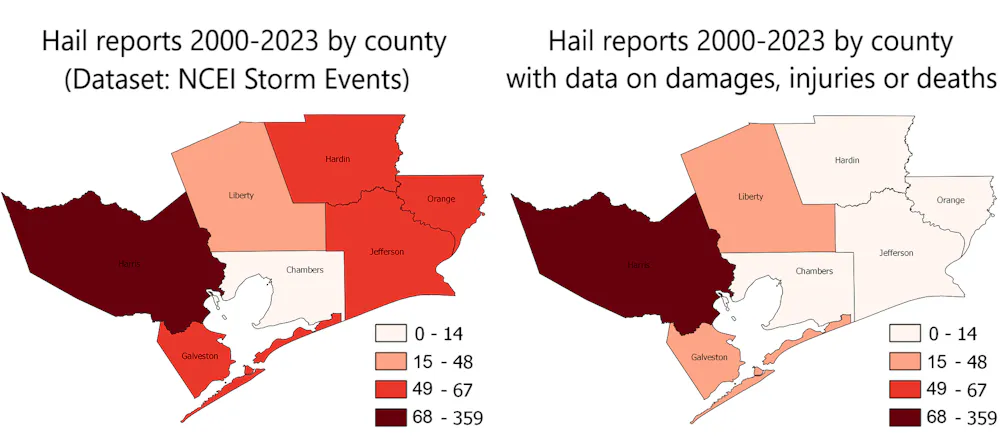
    The number of severe hail reports in southeast Texas listed in the National Centers for Environmental Information’s storm events database is strongly correlated with population. The county with the most reports and greatest detail in those reports is home to Houston. Hailstorms in the three easternmost counties are rarely associated with damage estimates.
    John Nielsen-Gammon and B.J. Baule

    Do you want to look at local damage trends? Forget about it. For most extreme weather events, estimation methods vary over time and are not documented.

    Do you want to direct funding to help communities improve resilience to natural disasters where the need is greatest? Forget about it. The places experiencing the largest per capita damages depend not just on actual damages but on the different practices of local National Weather Service offices.

    Are you moving to a location that might be vulnerable to extreme weather? Companies are starting to provide localized risk estimates through real estate websites, but the algorithms tend to be proprietary, and there’s no independent validation.

    4 steps to improve disaster data

    We believe a few fixes could make NOAA’s storm events database and the corresponding values in the larger SHELDUS database, managed by Arizona State University, more reliable. Both databases include county-level disasters and loss estimates for some of those disasters.

    First, the National Weather Service could develop standard procedures for local offices for estimating disaster damages.

    Second, additional state support could encourage local emergency managers to make concrete damage estimates from individual events and share them with the National Weather Service. The local emergency manager generally knows the extent of damage much better than a forecaster sitting in an office a few counties away.

    Third, state or federal governments and insurance companies can agree to make public the aggregate loss information at the county level or other scale that doesn’t jeopardize the privacy of their policyholders. If all companies provide this data, there is no competitive disadvantage for doing so.

    Fourth, NOAA could create a small “tiger team” of damage specialists to make well-informed, consistent damage estimates of larger events and train local offices on how to handle the smaller stuff.

    With these processes in place, the U.S. wouldn’t need a billion-dollar disasters program anymore. We’d have reliable information on all the disasters.

    John Nielsen-Gammon receives funding from the National Oceanic and Atmospheric Administration and the State of Texas.

    William Baule receives funding from NOAA, the State of Texas, & the Austin Community Foundation.

    – ref. Storm damage costs are often a mystery – that’s a problem for understanding extreme weather risk – https://theconversation.com/storm-damage-costs-are-often-a-mystery-thats-a-problem-for-understanding-extreme-weather-risk-257105

    MIL OSI – Global Reports –

    June 6, 2025
  • MIL-OSI Global: Reproducibility may be the key idea students need to balance trust in evidence with healthy skepticism

    Source: The Conversation – USA – By Sarah R. Supp, Associate Professor of Data Analytics, Denison University

    Reproducing results can increase trust in scientific studies. Huntstock via Getty Images

    Many people have been there.

    The dinner party is going well until someone decides to introduce a controversial topic. In today’s world, that could be anything from vaccines to government budget cuts to immigration policy. Conversation starts to get heated. Finally, someone announces with great authority that a scientific study supports their position. This causes the discussion to come to an abrupt halt because the dinner guests disagree on their belief in scientific evidence. Some may believe science always speaks the truth, some may think science can never be trusted, and others may disagree on which studies with contradicting claims are “right.”

    How can the dinner party – or society – move beyond this kind of impasse? In today’s world of misinformation and disinformation, healthy skepticism is essential. At the same time, much scientific work is rigorous and trustworthy. How do you reach a healthy balance between trust and skepticism? How can researchers increase the transparency of their work to make it possible to evaluate how much confidence the public should have in any particular study?

    As teachers and scholars, we see these problems in our own classrooms and in our students – and they are mirrored in society.

    The concept of reproducibility may offer important answers to these questions.

    Reproducibility is what it sounds like: reproducing results. In some ways, reproducibility is like a well-written recipe, such as a recipe for an award-winning cake at the county fair. To help others reproduce their cake, the proud prizewinner must clearly document the ingredients used and then describe each step of the process by which the ingredients were transformed into a cake. If others can follow the directions and come up with a cake of the same quality, then the recipe is reproducible.

    Think of the English scholar who claims that Shakespeare did not author a play that has historically been attributed to him. A critical reader will want to know exactly how they arrived at that conclusion. What is the evidence? How was it chosen and interpreted? By parsing the analysis step by step, reproducibility allows a critical reader to gauge the strength of any kind of argument.

    We are a group of researchers and professors from a wide range of disciplines who came together to discuss how we use reproducibility in our teaching and research.

    Based on our expertise and the students we encounter, we collectively see a need for higher-education students to learn about reproducibility in their classes, across all majors. It has the potential to benefit students and, ultimately, to enhance the quality of public discourse.

    The foundation of credibility

    Reproducibility has always been a foundation of good science because it allows researchers to scrutinize each other’s studies for rigor and credibility and expand upon prior work to make new discoveries. Researchers are increasingly paying attention to reproducibility in the natural sciences, such as physics and medicine, and in the social sciences, such as economics and environmental studies. Even researchers in the humanities, such as history and philosophy, are concerned with reproducibility in studies involving analysis of texts and evidence, especially with digital and computational methods. Increased interest in transparency and accessibility has followed the rising importance of computer algorithms and numerical analysis in research. This work should be reproducible, but it often remains opaque.

    Broadly, research is reproducible if it answers the question: “How do you know?” − such that another researcher could theoretically repeat the study and produce consistent results.

    Reproducible research is explicit about the materials and methods that were used in a study to make discoveries and come to conclusions. Materials include everything from scientific instruments such as a tensiometer measuring soil moisture to surveys asking people about their daily diet. They also include digital data such as spreadsheets, digitized historic texts, satellite images and more. Methods include how researchers make observations and analyze data.

    To reproduce a social science study, for example, we would ask: What is the central question or hypothesis? Who was in the study? How many individuals were included? What were they asked? After data was collected, how was it cleaned and prepared for analysis? How exactly was the analysis run?

    Proper documentation of all these steps, plus making available the original data from the study, allows other scientists to redo the research, evaluate the decisions made during the process of gathering and analyzing information, and assess the credibility of the findings.

    This short video, made by the National Academies, explains the key concepts in reproducing scientific findings and notes ways the process can be improved.

    Over the past 20 years, the need for reproducibility has become increasingly important. Scientists have discovered that some published studies are too poorly documented for others to repeat, lack verified data sources, are questionably designed, or even fraudulent.

    Putting reproducibility to work: An example

    A highly contentious, retracted study from 1998 linked the measles, mumps and rubella (MMR) vaccine and autism. Scientists and journalists used their understanding of reproducibility to discover the flaws in the study.

    The central question of the study was not about vaccines but aimed to explore a possible relationship between colitis − an inflammation of the large intestine − and developmental disorders. The authors explicitly wrote, “We did not prove an association between measles, mumps, and rubella vaccine and the syndrome described.”

    The study observed just 12 patients who were referred to the authors’ gastroenterology clinic and had histories of recent behavioral disorders, including autism. This sample of children is simply too small and selective to be able to make definitive conclusions.

    In this study, the researchers translated children’s medical charts into summary tables for comparison. When a journalist attempted to reproduce the published data tables from the children’s medical histories, they found pervasive inconsistencies.

    Reproducibility allows for corrections in research. The article was published in a respected journal, but it lacked transparency with regard to patient recruitment, data analysis and conflicts of interest. Whereas traditional peer review involves critical evaluation of a manuscript, reproducibility also opens the door to evaluating the underlying data and methods. When independent researchers attempted to reproduce this study, they found deep flaws. The article was retracted by the journal and by most of its authors. Independent research teams conducted more robust studies, finding no relationship between vaccines and autism.

    Each research discipline has its own set of best practices for achieving reproducibility. Disciplines in which researchers use computational or statistical analysis require sharing the data and software code for reproducing studies. In other disciplines, researchers interpret nonnumerical qualities of data sources such as interviews, historical texts, social media content and more. These disciplines are working to develop standards for sharing their data and research designs for reproducibility. Across disciplines, the core principles are the same: transparency of the evidence and arguments by which researchers arrived at their conclusions.

    Reproducibility in the classroom

    Colleges and universities are uniquely situated to promote reproducibility in research and public conversations. Critical thinking, effective communication and intellectual integrity, staples of higher-education mission statements, are all served by reproducibility.

    Teaching faculty at colleges and universities have started taking some important steps toward incorporating reproducibility into a wide range of undergraduate and graduate courses. These include assignments to replicate existing studies, training in reproducible methods to conduct and document original research, preregistration of hypotheses and analysis plans, and tools to facilitate open collaboration among peers. A number of initiatives to develop and disseminate resources for teaching reproducibility have been launched.

    Despite some progress, reproducibility still needs a central place in higher education. It can be integrated into any course in which students weigh evidence, read published literature to make claims, or learn to conduct their own research. This change is urgently needed to train the next generation of researchers, but that is not the only reason.

    Reproducibility is fundamental to constructing and communicating claims based on evidence. Through a reproducibility lens, students evaluate claims in published studies as contingent on the transparency and soundness of the evidence and analysis on which the claims are based. When faculty teach reproducibility as a core expectation from the beginning of a curriculum, they encourage students to internalize its principles in how they conduct their own research and engage with the research published by others.

    Institutions of higher education already prioritize cultivating engaged, literate and critical citizens capable of solving the world’s most challenging contemporary problems. Teaching reproducibility equips students, and members of the public, with the skills they need to critically analyze claims in published research, in the media and even at dinner parties.

    Also contributing to this article are participants in the 2024 Reproducibility and Replicability in the Liberal Arts workshop, funded by the Alliance to Advance Liberal Arts Colleges (AALAC) [in alphabetical order]: Ben Gebre-Medhin (Department of Sociology and Anthropology, Mount Holyoke College), Xavier Haro-Carrión (Department of Geography, Macalester College), Emmanuel Kaparakis (Quantitative Analysis Center, Wesleyan University), Scott LaCombe (Statistical and Data Sciences, Smith College), Matthew Lavin (Data Analytics Program, Denison University), Joseph J. Merry (Sociology Department, Furman University), Laurie Tupper (Department of Mathematics and Statistics, Mount Holyoke College).

    Sarah Supp receives funding from the National Science Foundation, awards #1915913, #2120609, and #2227298.

    Joseph Holler receives funding from the National Science Foundation, award #2049837.

    Peter Kedron receives funding from the National Science Foundation, award #2049837 and from Esri.

    Richard Ball has received funding from the Alfred P. Sloan Foundation and the United Kingdom Reproducibility Network.

    Anne M. Nurse and Nicholas J. Horton do not work for, consult, own shares in or receive funding from any company or organization that would benefit from this article, and have disclosed no relevant affiliations beyond their academic appointment.

    – ref. Reproducibility may be the key idea students need to balance trust in evidence with healthy skepticism – https://theconversation.com/reproducibility-may-be-the-key-idea-students-need-to-balance-trust-in-evidence-with-healthy-skepticism-251771

    MIL OSI – Global Reports –

    June 6, 2025
  • MIL-OSI Global: How your electric bill may be paying for big data centers’ energy use

    Source: The Conversation – USA – By Ari Peskoe, Lecturer on Law, Harvard University

    Your power bill may be hiding something. photoschmidt/iStock/Getty Images Plus

    In the race to develop artificial intelligence, large technology companies such as Google and Meta are trying to secure massive amounts of electricity to power new data centers. Electric utilities see the prospect of earning large profits by providing electricity to these power-hungry facilities and are competing for their business by offering discounts not available to average consumers.

    In our paper Extracting Profits from the Public, we explain how utilities are forcing regular ratepayers to pay for the discounts enjoyed by some of the nation’s largest companies and identify ways policymakers can limit the costs to the public.

    Shifting costs

    In much of the U.S., utilities are monopolists. Within their service territories, they are the only companies allowed to deliver electricity to consumers. To fund their operations, utilities split the costs of maintaining and expanding their systems among all ratepayers – homeowners, businesses, warehouses, factories and anyone else who uses electricity.

    Historically, a utility expanded its system to meet growing demand for electricity from new factories, businesses and homes. To pay for its expansion − new power plants, new transmission lines and other equipment − the utility would propose to raise electricity rates by different amounts for various types of consumers.

    Public utility commissions are state agencies charged with ensuring that the public gets a fair deal. These commissions monitor how much money the utility spends to provide electric service and how its costs are shared among various types of ratepayers, including residential, commercial and industrial consumers. Ultimately, the public utility commission is supposed to approve any rate increases based on its assessment of what’s fair to consumers.

    Splitting the utility’s costs among all consumers made perfect sense when population growth and economic development across the economy stimulated the need for new infrastructure. But today, in many utility service territories, most of the projected growth in electricity demand is due to new data centers.

    Here’s the problem for consumers: To meet data center demand, utilities are building new power plants and power lines that are needed only because of data center growth. If state regulators allow utilities to follow the standard approach of splitting the costs of new infrastructure among all consumers, the public will end up paying to supply data centers with all that power.

    An artist’s rendering of a proposed Meta data center in Richland Parish, La.
    Meta via Facebook

    A big price tag

    One particularly acute example is in Louisiana. A Meta data center under development in the northeastern corner of the state is projected to use, by our calculations, twice as much energy as the city of New Orleans.

    Entergy, the regional monopoly utility, is proposing to build more than US$3 billion worth of new gas-fired power plants and delivery infrastructure to meet the data center’s energy demand. Rather than billing Meta directly for these costs, Entergy is proposing to include the costs in rates paid by all customers.

    Entergy claims its contract with Meta will cover some portion of the $3 billion price tag and that will mitigate any increases in consumers’ bills. But Entergy has asked state regulators to keep key terms of the contract secret, and only a redacted version of its application is available online.

    The public has no idea how much it might pay if the commission approves the contract. And if the Meta data center ends up using much less power than the company anticipates, the public does not know whether it would be on the hook to pay higher electricity rates for longer periods to guarantee Entergy a profit.

    The electronics in data centers consume large amounts of electricity.
    RJ Sangosti/MediaNews Group/The Denver Post via Getty Images

    Secret agreements

    Our research, reviewing nearly 50 public utility commission proceedings about data centers’ power needs across 10 states, uncovered dozens of secretive contracts between utilities and data centers. Unlike Louisiana, most states require utilities to submit to the public utility commission their one-off deals with data centers, but they allow utilities to conceal the pricing terms from the public.

    In normal rate-review cases, numerous parties advocate for their interests in a public proceeding, including members of the public, industry groups and the utility itself. But as our paper finds, utility commission reviews of data center contracts are based on confidential utility filings that are inaccessible to the general public. Few, if any, outsiders participate, and as a result the commission often hears only the utility’s version of the deal.

    Because the pricing terms are secret, it is impossible to know whether the deal that a utility is offering to a data center is too low to cover the utility’s costs of providing power to the data center, which would mean that the public is subsidizing the deal. History shows, however, that utilities have a long history of exploiting their monopolies to shift costs to the public, including through secret contracts.

    Electric utilities also charge customers for the costs of building and maintaining transmission networks.
    Jay L. Clendenin/Getty Images

    Other public costs

    Our paper also explores other ways that the public pays for data center energy costs. For instance, many high-voltage interstate transmission projects, which connect large power plants to local delivery systems, are developed through regional planning processes run by numerous utilities. These alliances have complex rules for splitting the costs of new transmission lines and equipment among their utility members.

    Once a utility is charged its share, it spreads the costs of new transmission projects among its local ratepayers. Because some regions are building new transmission capacity to accommodate data centers, our analysis finds that the public has been forced to pay billions of dollars for data center growth.

    Data center energy costs can also be shifted when data centers connect directly to existing power plants. Under what are called “co-location” deals, the power plant stops selling energy to the wider public and just sells to the data center. With less supply in the overall market, prices go up and the public faces higher bills as a result.

    Many state legislatures are noticing these problems and working to figure out how to address them. Several recent bills would set new terms and conditions for future data center deals that could help protect the public from data center energy costs.

    Ari Peskoe is the Director of the Electricity Law Initiative at the Harvard Law School Environmental and Energy Law Program (EELP). EELP receives funding from philanthropic foundations that support the clean energy transition.

    Eliza Martin does not work for, consult, own shares in or receive funding from any company or organization that would benefit from this article, and has disclosed no relevant affiliations beyond their academic appointment.

    – ref. How your electric bill may be paying for big data centers’ energy use – https://theconversation.com/how-your-electric-bill-may-be-paying-for-big-data-centers-energy-use-257794

    MIL OSI – Global Reports –

    June 6, 2025
  • MIL-OSI Global: 100 years ago, the Supreme Court made a landmark ruling on parents’ rights in education – today, another case raises new questions

    Source: The Conversation – USA – By Charles J. Russo, Joseph Panzer Chair in Education and Research Professor of Law, University of Dayton

    A selection of books that are part of the Supreme Court case Mahmoud v. Taylor are pictured on April, 15, 2025, in Washington. AP Photo/Pablo Martinez Monsivais

    A century ago, the Supreme Court handed down one of its most important cases about education. On June 1, 1925, the court struck down an Oregon statute requiring all students to attend public school – a law critics argued was meant to limit faith-based schools, at a time when anti-Catholic bias was still common in parts of the United States.

    The majority opinion in Pierce v. Society of Sisters of the Holy Name of Jesus and Mary included a now-famous dictum about parents’ rights to shape their children’s upbringing. According to the court, “the child is not the mere creature of the state; those who nurture him and direct his destiny have the right, coupled with the high duty, to recognize and prepare him for additional obligations.”

    Soon, the Supreme Court is expected to release another decision around parental beliefs and education: Mahmoud v. Taylor. The plaintiffs are parents who want to excuse their children from public school lessons involving storybooks with LGBTQ+ characters – lessons they assert contradict their religious beliefs.

    As someone who teaches education law, I believe this is perhaps the court’s most significant case on parental rights since Pierce. Mahmoud raises questions not only about religious freedom, but also about educators’ ability to determine curricula, and public education in a pluralistic society.

    Picture-book debate

    Controversy arose during the 2022-23 school year in Montgomery County, Maryland’s largest school district, when officials approved various storybooks with LGBTQ+-inclusive themes to be incorporated into the English language-arts curriculum for preschool and elementary students.

    Some parents challenged the materials, including “Pride Puppy!”, a picture book the board later removed from use. Originally approved for preschool and pre-K, the story portrays a family whose puppy gets lost at a LGBTQ+ Pride parade, devoting a page to each letter of the alphabet. At the end of the book, a long “search and find” list of words for children to go back and look for in the pictures of the parade includes “[drag] queen” and “king,” “leather” and “lip ring.”

    Other materials for older children included stories about same-sex marriage, a transgender child and nonbinary bathroom signs.

    Parents who objected to the use of these materials on religious grounds sought to excuse their children from lessons using them. The parents basically argued that requiring their children to participate compelled or coerced them to go against their families’ religious beliefs.

    A group of parents protest in Rockville, Md., on June 27, 2023, in an effort to opt out of books that feature LGBTQ+ characters in Montgomery County schools.
    Sarah L. Voisin/The Washington Post via Getty Images

    Initially, officials agreed to allow opt-outs for elementary schoolers whose parents objected to the materials. However, a day later they changed their minds. Since then, school officials cited concerns about absenteeism, the feasibility of accommodating opt-out requests, and a desire to avoid stigmatizing LGBTQ+ students or families as reasons for their policy.

    A group of Muslim, Orthodox Christian and Catholic families challenged the board’s refusal to excuse their children from lessons using the disputed materials.

    The federal trial court, however, rejected the parents’ claim that having no opt-outs violated their right to due process.

    Parents appealed, and the 4th Circuit affirmed in favor of the school board 2-1. The court added that officials had not violated the parents’ First Amendment rights to freely exercise their faith. “There’s no evidence at present that the Board’s decision not to permit opt-outs compels the Parents or their children to change their religious beliefs or conduct, either at school or elsewhere,” the panel concluded.

    The dissenting judge stridently countered. Officials violated the parents’ free exercise rights by forcing them “to make a choice,” he wrote, between “either adher[ing] to their faith, or receiv[ing] a free public education for their children.” He also noted that the board’s opt-out policy was not neutral toward religion, because under Maryland regulations, children may be excused from sex-ed lessons.

    In January 2025, the Supreme Court agreed to hear the parents’ appeal, addressing whether the schools are burdening parents’ free-exercise rights.

    Court record

    In their brief to the Supreme Court and oral arguments, the parents cited Wisconsin v. Yoder, a Supreme Court ruling from 1972. The court found that Amish parents did not have to send their children to school after the eighth grade, which the families argued would violate their religious beliefs. Amish communities descend from Anabaptist Christians who fled persecution in Europe and emphasize living simply, eschewing many modern technologies.

    In Yoder, the justices agreed with the parents that their children received all the education they needed in their home communities. Under the First Amendment, parents have the right “to guide the religious future and education of their children,” the majority wrote, a matter “established beyond debate.”

    During oral arguments for Mahmoud in April 2025, some justices briefly discussed another precedent: the Supreme Court’s 1943 judgment in West Virginia State Board of Education v. Barnette, resolved at the height of U.S. involvement in World War II. Here, three parents who were Jehovah’s Witnesses refused to have their children participate in public schools’ flag salute and Pledge of Allegiance because they viewed it as a form of idolatry contrary to their religious beliefs. Others objected
    to the salute as “being too much like Hitler’s.”

    The court reasoned that educators could not compel students to participate, because forcing children – or anyone – to engage in activities inconsistent with their beliefs is contrary to their First Amendment rights to the free exercise of religion and freedom of speech.

    Viewed together, these cases highlight how the court has granted parents significant leeway to exempt their children from educational activities inconsistent with their religious beliefs.

    Questions at court

    During oral arguments, a majority of justices appeared to support the parents’ request to excuse children from lessons involving the books about LGBTQ+ characters.

    The board’s attorney argued that students did not have to agree with the books’ messages, simply to participate in the lesson. Being exposed to an idea “does not burden free exercise,” he said.

    Protesters in support of LGBTQ+ rights and against book bans outside the U.S. Supreme Court building on April 22, 2025, the day the court heard arguments in Mahmoud v. Taylor.
    Anna Moneymaker/Getty Images

    Chief Justice John Roberts, however, queried whether it is realistic for 5-year-olds to understand that distinction. He asked, “Do you want to say you don’t have to follow the teacher’s instructions, you don’t have to agree with the teacher? I mean, that may be a more dangerous message than some of the other things.”

    Other conservative justices also appeared skeptical of the idea that the lessons were merely exposing young children to ideas, but not instilling moral lessons. The storybooks do not simply explain that some people believe something and others do not, Justice Amy Coney Barrett suggested; they inform students that “this is the right view of the world.” Similarly, Justice Neil Gorsuch remarked that telling students that “some people think X, and X is wrong and hurtful and negative” is “more than exposure.”

    “What is the big deal about allowing them to opt out of this?” Justice Samuel Alito asked.

    Conversely, Justice Elena Kagan acknowledged that parents’ concerns were “serious,” but wondered how to draw limits on opt-out policies. Did the parents’ argument suggest that anytime “a religious person confronts anything in a classroom that conflicts with her religious beliefs or her parents’ that – that the parent can then demand an opt-out?”

    Justice Sonia Sotomayor pressed the plaintiffs’ attorney on whether “the mere exposure to things that you object to” really counts as coercion. And Justice Ketanji Brown Jackson questioned why, even if opt-outs are not allowed, public schools teaching “something that the parent disagrees with” is coercive, given that homeschooling and private schools are legal.

    Mahmoud raises challenging questions about curricular content, parental control and free exercise of religion – questions the court will hopefully resolve. A ruling is expected in June or early July 2025.

    Charles J. Russo does not work for, consult, own shares in or receive funding from any company or organization that would benefit from this article, and has disclosed no relevant affiliations beyond their academic appointment.

    – ref. 100 years ago, the Supreme Court made a landmark ruling on parents’ rights in education – today, another case raises new questions – https://theconversation.com/100-years-ago-the-supreme-court-made-a-landmark-ruling-on-parents-rights-in-education-today-another-case-raises-new-questions-257876

    MIL OSI – Global Reports –

    June 6, 2025
  • MIL-OSI Russia: Rosneft’s green investment volume in 2024 reached 74 billion rubles

    Translation. Region: Russian Federal

    Source: Rosneft – Rosneft – An important disclaimer is at the bottom of this article.

    June 5 is World Environment Day, its goal is to draw attention to measures to protect ecosystems. In Russia, this date coincides with Ecologist Day.

    Rosneft implements large-scale events and projects aimed at preserving a favorable environment. In 2024, the Company’s “green” investments amounted to 74 billion rubles and exceeded the previous year’s level by 16%. In total, over the past three years, this figure amounted to almost 200 billion rubles.

    The key components of the Company’s long-term environmental agenda are reflected in the strategy “Rosneft-2030: Reliable Energy and Global Energy Transition”. The priorities of the Company and its subsidiaries include the implementation of programs for land reclamation, including “historical heritage”, increasing the reliability of pipelines, preserving water resources and biological diversity in the regions of presence.

    Thus, Samotlorneftegaz completed the implementation of a large-scale program for the reclamation of “historical heritage” lands in 2024 – the total area of restored lands exceeded 2.2 thousand hectares. The company carried out about 85% of all reclamation work using its own eco-service. During the project, new technologies were developed and unique experience was gained, which is in demand by other enterprises.

    Rosneft pays great attention to reforestation activities, thereby contributing to the sustainable development of ecosystems, the preservation of biodiversity, and the fight against climate change. The Company, together with the Government of the Krasnoyarsk Territory, is implementing a comprehensive forest climate project aimed at unlocking the climate-regulating potential of the region’s forests and promoting sustainable development. In 2024, the Company and its subsidiaries in the regions of presence planted almost 11 million seedlings and trees of various species.

    Rosneft is actively implementing the principles of a closed-loop economy (circular economy). Improving the efficiency of waste management processes is one of the priority goals of the Company’s strategy until 2030. The Company’s production enterprises are successfully implementing waste-free technologies that make it possible to obtain artificial soil from drill cuttings – an environmentally friendly building material.

    In addition, the enterprises of the Samara group of the Company handed over almost 300 tons of spent catalyst for recycling. More than 8 thousand tons of non-ferrous and ferrous metal were sent for recycling by the Achinsk Oil Refinery, Saratov Oil Refinery, Syzran Oil Refinery, Kuibyshevsky Oil Refinery, Novokuibyshevsky Oil Refinery, RN-Vankor and Bashneft enterprises.

    The Kuibyshev Oil Refinery, Novokuibyshevsk Oil Refinery, RN-Vankor and Bashneft enterprises also sent about 4.5 thousand tons of waste oils and emulsions, etc. for recycling.

    Biodiversity conservation is another significant area of Rosneft’s environmental activities. The company has been holding annual events to replenish Russia’s aquatic bioresources for over 10 years. In 2024, Rosneft enterprises released over 21.7 million young fish into the country’s water bodies.

    Volunteers of the Company, its subsidiaries and design institutes also actively participate in various environmental initiatives, promote the development of a culture of rational and responsible consumption of natural resources. Employees with children take part in events for greening and improvement of urban areas and natural recreational zones, cleaning of coastlines as part of federal environmental campaigns such as “Green Spring”, “Garden of Memory”, “Water of Russia”, “Clean Shores” and others.

    For over 15 years, Samotlorneftegaz volunteers have been holding clean-up days to clean the shoreline of Lake Kymyl-Emtor as part of the All-Russian campaign “Water of Russia”.

    Samara oil workers help the employees of the Botanical Garden of Samara University to clear the territory of dead wood and leaves, to purchase rare plant species and plant seedlings, and also to restore and improve springs in the region. In 2024, volunteers of the Samara region collected more than 30 cubic meters of garbage from the coastal areas of the Volga and Sok rivers. Volunteers of the Novokuibyshevsk Petrochemical Company collected 930 kg of household waste during an environmental run.

    In 2024, RN-Nyaganneftegaz oil workers collected about 3 tons of household waste from the coastline of the Nyagan-Yugan River.

    Earlier, on the eve of Victory Day, employees of Rosneft enterprises organized the cleaning of parks, memorial complexes and monuments dedicated to the feat of the Soviet people during the Great Patriotic War.

    The Company’s enterprises make a significant contribution to the conservation of natural resources – they organize campaigns to collect used batteries, plastic and waste paper for their further recycling. In 2024, Rosneft employees handed over over 1,100 kg of used batteries, uninterruptible power supplies and disposable batteries for recycling, transferred over 7 tons of plastic for recycling and collected about 180 tons of waste paper.

    Rosneft volunteers also actively promote environmental education of young people and conduct environmental quests, master classes, quizzes and eco-lessons for schoolchildren. For example, Orenburgneft implemented the Eco-School project in 2024 and, together with students from the region’s schools, collected more than 10 tons of waste paper, more than 70 kg of batteries and more than 17 kg of plastic caps.

    For 14 years now, the company has been holding annual environmental safety competitions, which help to raise the level of environmental culture and serve as an incentive for subsidiaries to build up their competencies and improve their work in this area.

    The successful environmental activities of Rosneft subsidiaries have received high public praise. In 2024, the Company’s plants – Syzran Oil Refinery, Novokuibyshevsky Oil Refinery, Kuibyshevsky Oil Refinery – received the highest awards of the All-Russian competition “Leader of Environmental Activities in Russia”.

    Department of Information and Advertising of PJSC NK Rosneft June 5, 2025

    Please note: This information is raw content directly from the source of the information. It is exactly what the source states and does not reflect the position of MIL-OSI or its clients.

    MIL OSI Russia News –

    June 6, 2025
  • The Q4 Growth Numbers Have A Pleasant Message for India

    Source: Government of India

    Source: Government of India (4)

    More good news for India’s economy. Following the news of India becoming the fourth-largest economy, at more than $4 trillion, the numbers for the fourth quarter of FY25 are out. At 7.4 per cent, the growth numbers have exceeded the market expectations, leaving many pleasantly surprised.

    We finished the third quarter at 6.4 per cent, the second quarter at 5.6 per cent, and the first quarter at 6.5 per cent. Interestingly, in FY24, the GDP grew at 9.5 per cent in Q3 and 8.4 per cent in Q4. So, what happened?

    We must factor in the external factors at play here. In FY25, the first quarter, between April and June, was lost to the national elections. Business activity was largely muted, cash flows were restricted, and new orders were delayed. Nothing unusual, for elections of this magnitude and importance do leave the businesses on the precautionary backfoot.

    The second quarter, between July and September, was about getting used to a new avatar of the Narendra Modi Government. People were sceptical, given an unusual alliance in the Centre. However, it was soon visible to everyone that things were not going to change. The Lok Sabha numbers had not dented PM Modi’s socio-economic pursuits, and the show was to go on, uninterrupted.

    Whatever little doubts that remained were decimated on the morning of October 8, 2024. The flip in numbers, within twenty minutes, around 10:00 AM, sealed the political fate of the Congress. The Bharatiya Janata Party had triumphed expectations and predictions, and became the first party to register a third consecutive win (with complete five-year terms). The Haryana victory set up the third quarter for an economic resurgence.

    By the beginning of the fourth quarter, the BJP was in the driver’s seat. Maharashtra had been won with a thumping majority, and the party was eyeing Delhi next. The Budget came with the good news of a tax cut, enabling zero income tax for citizens with Rs. 12.75 Lakh annual income (standard deduction included).

    The larger message behind the fourth quarter numbers must be acknowledged. Political stability is directly proportional to growth numbers. While elections are an unavoidable occurrence in the trajectory of our democracy, the idea of ‘One Nation, One Election’, must be discussed with greater vigour. The continuity offered by the Narendra Modi government, in its third term, has also given the economy a critical thrust.

    From here, it’s a journey of a few years until we become the third-largest economy on the planet, trailing China and the United States of America. The evolution of our economy will add to our geopolitical heft, inevitably. As the largest free market in the world, with over a billion people, consumerism and the growing middle class offers enough nudge for the MSMEs and other aspiring entrepreneurs to embrace manufacturing.

    The tax cuts will also kick in next year, ushering in at least Rs. 1 Lakh Crore more into the economy. This will soon reflect in automobile sales numbers, tourism revenue, and other indirect taxes, as the spending goes up. The mere fact that the Modi Government was able to introduce these tax cuts is a testament to their stupendous fiscal management in the last eleven years.

    The other message is that of self-reliance. While the pandemic, Russia-Ukraine war, and the global supply chains crisis have put the manufacturing ambition into a hyperdrive mode, we can do more. India Stack and UPI are a stunning example of how self-reliance can propel success in other sectors, like the service economy. Close to 1,868 Crore UPI transactions in May 2025 further showcase the resolve of the Indian market.

    However, it’s now time to go big on hardware. The ongoing ‘Operation Sindoor’ proves how warfare is evolving, and why we should not rely on external players, especially China, for critical components. This is where our focus must be. The services industry has sustained the aspiring Indian middle class for almost three decades. It’s now time for manufacturing to take over.

    As we grow to become a ten trillion dollar economy by 2035, the nature of employment will evolve as well. Artificial Intelligence applications, offered at throwaway prices, are making several jobs redundant. The cycle of time moves, as it did when computers replaced typewriters, but no reason for India to be disheartened. Our economy evolved well with computers, it’ll do so with AI and hardware as well.

    The 7.4 per cent growth number has a message for India: keep the hustle going. Do not be afraid to evolve with the times, and while the ten trillion mark is a decade away, start preparing for it today. On the policy front, we must begin pondering ideas that allow us to minimise disruption (One Nation, One Election). On the innovation front, let’s get people to start aspiring for jobs that involve not sitting before a computer, but manufacturing one.

    This is India’s decade. The rise is inevitable and indispensable for the world.

    (Tushar Gupta is a Delhi-based journalist and a political commentator)

    June 6, 2025
  • MIL-OSI Russia: China’s Equipment Upgrade Program Effectively Stimulates Domestic Demand

    Translation. Region: Russian Federal

    Source: People’s Republic of China in Russian – People’s Republic of China in Russian –

    Source: People’s Republic of China – State Council News

    BEIJING, June 5 (Xinhua) — Jiangsu Tengsheng Textile Technology Group Co., Ltd. has been a hub of activity since the beginning of the year. Its participation in the national equipment renewal campaign has opened a promising path to a bright future for the textile manufacturer.

    “After the upgrade is completed, our equipment will reach the leading standards in the domestic industry,” said Chen Guichun, deputy general manager of the company based in east China’s Jiangsu Province. “We expect this upgrade to improve our efficiency by more than 5 percent and increase our unit output by about 20 percent.”

    The company’s efforts are part of China’s massive trade-in program for equipment upgrades and consumer goods replacement, which was launched in March 2024. The program involves various government departments using ultra-long-term special government bonds to accelerate the implementation of related measures to stimulate investment and consumption.

    The People’s Bank of China (PBOC, the central bank) announced last month that it would increase the refinancing quota for technological innovation and technical transformation from 500 billion yuan (about $69.6 billion) to 800 billion yuan. In addition, the regulator also cut the refinancing rate to 1.5 percent from 1.75 percent.

    This innovation is part of the PBOC’s structural monetary instruments aimed at expanding domestic demand, said Ding Zhijie, director of the PBOC Financial Institute. “This will ensure continued support for the implementation of the equipment renewal program and the replacement of consumer goods with new ones under the trade-in scheme,” he stressed in the latest edition of the all-media discussion program “China Economy Roundtable” organized by Xinhua News Agency.

    “It took only four months from the time we applied to receiving government support, which is a very effective indicator for us,” said Xu Guoqiang, assistant manager of Chilwee Group Co., Ltd., a battery manufacturing subsidiary in east China’s Zhejiang Province.

    According to him, the company invested a total of 60 million yuan in upgrading the equipment, of which more than 8 million yuan was provided by the state.

    Likewise, many other companies in the country’s key industries have begun upgrading their equipment and are reaping the benefits. In April, the added value of China’s major high-tech manufacturing and digital products sectors grew 10 percent year-on-year, according to the National Bureau of Statistics (NBS).

    In the year since the campaign was launched, it has successfully identified the huge potential of the country’s domestic market. In the first four months of this year, investments in the acquisition of equipment and devices grew by 18.2 percent year-on-year. According to the State Statistical Service, the share of the indicator in the overall investment growth for the period was 64.5 percent.

    Ding Lin, an official with the National Development and Reform Commission (NDRC), said at a roundtable that China, as the world’s second-largest economy with a population of more than 1.4 billion, has huge potential to expand domestic demand.

    To this end, the country should explore more approaches to increasing household incomes and expanding consumer potential, while continuing to optimize its policies in the area of consumption support, he stressed.

    In addition to accelerating equipment upgrades across the country, Ding Lin said the NDRC will allocate 800 billion yuan in ultra-long-term special government bonds to support the country’s major national strategies and strengthen security capabilities in key areas. Ding Lin called this a “proactive move” to stimulate effective investment.

    “We will accelerate the development of the project and the distribution of funds in order to achieve tangible results as soon as possible,” he concluded. -0-

    MIL OSI Russia News –

    June 6, 2025
  • MIL-OSI Africa: Mining in Motion 2025: Niger Eyes Economic Development Fund

    Source: Africa Press Organisation – English (2) – Report:

    ACCRA, Ghana, June 5, 2025/APO Group/ —

    Colonel Ousmane Abarchi, Minister of Mines of Niger, announced plans to establish a national economic development fund during the Mining in Motion 2025 summit – held in Accra. The fund aims to redirect revenues from the mining sector to strengthen other industries while tackling illicit mining.

    “We seek to develop an economic development fund so that revenues from mining bolster other industries. We are also seeking community development, as illicit mining damages the environment. By addressing illegal mining, we are ensuring the purification of water bodies,” Minister Arbachi stated.

    Minister Arbachi emphasized that addressing the widespread challenges of illegal mining across the continent must begin with the inclusion of local communities in decision-making and direct benefits.

    The proposed fund would aim to reinvest mining profits into local companies – supporting sectors such as agriculture, infrastructure and education – to create alternatives to illegal mining and enhance long-term development.

    The initiative aligns with the broader themes of the Mining in Motion summit, which focuses on sustainable resource governance, responsible mining practices and cross-border collaboration.

    MIL OSI Africa –

    June 6, 2025
  • MIL-OSI: Military Drone Market Size Expected to Reach $15.16 Billion In 2030 as Cutting-Edge Innovations Improve Operations

    Source: GlobeNewswire (MIL-OSI)

    PALM BEACH, Fla., June 05, 2025 (GLOBE NEWSWIRE) — FN Media Group News Commentary – According to industry experts, the Military Drone market is expected to continue substantial growth in the years to come. The market is characterized by a complex interplay of drivers, restraints, and a spectrum of opportunities collectively shaping its trajectory, especially in the military market. Military drones, also known as Unmanned Aerial Vehicles (UAVs), are advanced technological systems used by military forces for various purposes. These drones are designed to operate without a human pilot on board, and they are remotely controlled or autonomously programmed to carry out a range of tasks. Military drones come in various sizes and configurations, from small hand-launched models to more prominent, long-endurance aircrafts. They serve many roles, including reconnaissance, surveillance, target acquisition, intelligence gathering, communication relays, and combat operations. Their ability to operate in challenging environments, gather real-time data, and execute missions with reduced risk to human personnel has made them valuable assets in modern warfare strategies. However, their use raises ethical and legal considerations concerning civilian safety, privacy, and potential misuse. A report from Verified Market Research said that: “The Military Drone market is characterized by a complex interplay of drivers, restraints, and a spectrum of opportunities collectively shaping its trajectory. Technological advancement stands as a prominent driver, propelling the market forward with cutting-edge innovations that enhance the capabilities of unmanned aerial vehicles (UAVs). These advancements encompass a range of functionalities, from improved surveillance and reconnaissance to combat capabilities, all of which contribute to the drones’ strategic significance on the battlefield. Additionally, the cost-effectiveness of Military Drone compared to manned aircraft is a compelling driver, enabling military forces to achieve operational objectives with reduced financial burdens.”   Active Companies in the markets today include ZenaTech, Inc. (NASDAQ: ZENA), Red Cat Holdings, Inc. (NASDAQ: RCAT), Kratos Defense & Security Solutions, Inc. (NASDAQ: KTOS), AeroVironment (NASDAQ: AVAV), Northrop Grumman Corporation (NYSE: NOC).

    Verified Market Research continued: “A range of opportunities beckons the Military Drone market. One such opportunity lies in intelligent swarming, where multiple drones collaborate seamlessly to achieve intricate missions, providing enhanced surveillance and reconnaissance capabilities. Additionally, the development of counter-drone technologies represents a growing niche within the market, as the increasing proliferation of drones necessitates robust defenses against hostile UAVs. The convergence of commercial and military sectors offers a unique avenue for collaboration, fostering cross-pollination of technologies and innovative solutions. Integrating artificial intelligence and automation further widens the scope of Military Drone applications in the realm of technological advancement. These capabilities enable drones to execute complex tasks autonomously, reducing the burden on human operators and opening doors to entirely new mission profiles. Moreover, exploring hybrid power systems and stealth technology holds promise for extending drone endurance and elevating their covert capabilities, expanding the range of potential operations.”

    ZenaTech (NASDAQ:ZENA) Launches Drone as a Service (DaaS) for US Defense and Government Agencies with New Partnerships – ZenaTech, Inc. (FSE: 49Q) (BMV: ZENA) (“ZenaTech”) a technology company specializing in AI (Artificial Intelligence) drones, Drone as a Service (DaaS), Enterprise SaaS, and Quantum Computing solutions, today announces the launch of Drone as a Service specifically for US Defense and Government agencies, and two new partnerships with consulting and government relations firms to assist in selling these services.

    ZenaTech’s ZenaDrone subsidiary has retained the services of Bromelkamp Government Relations and Winning Strategies Washington to provide Congressional lobbying and defense business development consulting services. Bromelkamp is a defense-focused business development consulting firm to small and medium technology companies that are growing their business with the US Department of Defense and other security-related federal agencies. Winning Strategies is an independent bipartisan federal government relations and grants procurement firm.

    “These partnerships will be instrumental in building relationships with the various agencies as we launch our DaaS service and expand our sales efforts in this sector,” said Shaun Passley, Ph.D., CEO of ZenaTech. “Bromelkamp and Winning Strategies have decades of defense industry experience and understand the complexities and culture of the military. As defense priorities shift toward autonomy, resilience, and secure supply chains, ZenaTech is uniquely positioned to deliver scalable, mission-ready drone solutions that align with the US military and the defense industry. Our Drone as a Service model is designed to accelerate adoption, lower barriers, and support operational agility.”

    With a growing demand for advanced drone solutions in security, logistics and tactical operations, the DaaS model allows defense customers to deploy mission-specific drone solutions without the need for capital equipment purchases. To accelerate market entry, ZenaTech has onboarded two seasoned military consultants to lead business developments, identify pilot programs, and secure funding partnerships within the defense sector.

    The ZenaDrone 1000 is an autonomous, military grade aerial solutions built for multi-mission flexibility, featuring a patented foldable-wing design, 40 kg payload capacity, and 1 hour flight time. Its onboard AI, thermal imaging, LiDAR, and multi spectral sensors enable real-time ISR (intelligence, surveillance, and reconnaissance), border patrol, and base surveillance with minimal operator input. The modular cone enables fast swapping of mission-specific payloads like HD Cameras and sensors, making it ideal for tactical resupply, SAR (search and rescue), infrastructure inspection, and operations in high-risk restricted environments. Rugged, AI-powered and rapidly deployable, the ZenaDrone 1000 enhances situational awareness and operational reach for defense forces.

    The ZenaDrone IQ Nano and IQ Square are compact, high-performance drone solutions engineered for intelligence, surveillance, and reconnaissance (ISR), indoor security, and tactical inspection in complex military environments. The IQ Nano, excels in GOS-denied environments like military warehouses or confined infrastructure, offering obstacle avoidance, and precise maneuverability. The IQ Square, with extended flight time and payload options, supports ISR, CBRN monitoring and perimeter patrols. Lightweight and field-ready, both drones deliver rapid situational awareness for mission-critical deployments.

    ZenaTech is actively pursuing Green UAS and Blue UAS certifications to meet stringent federal standards. With recent restrictions on Chinese-made drones in military and government operations, these certifications are mandatory for vendors aiming to participate in DoD and allied agency contracts. ZenaTech’s compliant drone solutions open access to high-value defense contracts and align with increasing demand for secure aerial solutions.

    The DaaS business model offers customers reduced upfront costs and convenience ─ there is no need to purchase drone hardware and software, find a drone pilot, manage maintenance and operation, or acquire regulatory approvals. The model also offers scalability to use more often or less often based on business needs. Continued… Read this full release by visiting: https://www.financialnewsmedia.com/news-zena/.

    Other recent developments in the markets include:

    Red Cat Holdings, Inc. (NASDAQ: RCAT), a drone technology company integrating robotic hardware and software for military, government, and commercial operations, recently reported its financial results for the first quarter ended March 31, 2025 and provides a corporate update.

    “Red Cat’s momentum continues to build as we execute on our strategy to deliver advanced, AI-enabled unmanned systems across air, land, and sea,” said Jeff Thompson, Red Cat CEO. “Our partnership with Palantir to deploy Warp Speed is optimizing our manufacturing and cost efficiency, while our expansion into maritime autonomy with Unmanned Surface Vessels significantly expands our Family of Systems. A strong balance sheet bolstered by a recent $30 million capital raise positions us strongly to meet growing domestic and international demand in the second half of 2025.”

    “Our balance sheet remains strong as we transition to production and delivery of our new Black Widow drones,” said Chris Ericson, Red Cat CFO. “We have bolstered our quarter-end cash and receivables of $9 million with an additional $30 million from a capital raise executed soon after quarter-end. This liquidity has given us ample strength and ability to expand manufacturing to meet the impending demands of the U.S. Army’s SRR program and international opportunities for the second half of 2025.”

    Kratos Defense & Security Solutions, Inc. (NASDAQ: KTOS), a Technology Company in the Defense, National Security and Global Markets, and GE Aerospace (NYSE: GE) recently announced a formal teaming agreement to advance propulsion technologies for the next generation of affordable unmanned aerial systems and Collaborative Combat Aircraft-type (CCA-type) aircraft.

    Eric DeMarco, President and CEO of Kratos, said, “Kratos’ strategically important Teaming Agreement with GE Aerospace continues to rapidly advance and expand, with the GEK family of engines targeting certain of the most important, mission critical and highest priority needs and requirements of United States National Security. At Kratos, affordability is a technology and delivering more capability for less cost as quickly as possible are key contributions we are bringing for truly industry leading GEK offerings with our partner and global leader GE Aerospace.”

    Tomahawk GCS, an AeroVironment (NASDAQ: AVAV) product line specializing in autonomous and intelligent multi-domain systems, has recently been awarded a $5.1 million contract to support the U.S. Army Rapid Capabilities and Critical Technologies Office (RCCTO) Human-Machine Integrated Formations (HMIF) rapid prototyping project. Following a rigorous selection process, AV’s Tomahawk’s Grip TA5 was selected as the Dismounted Common Controller (DCC) to significantly enhance human-machine teaming for battlefield operations.

    The HMIF initiative, led by the U.S. Army RCCTO, is accelerating the integration of autonomous and robotic systems into formations to enhance situational awareness, lethality, and survivability. With its modular architecture and multi-platform compatibility, the Grip TA5 provides operators command-and-control of multiple robotic assets in real-time, enhancing mission adaptability and response speed.

    Northrop Grumman Corporation (NYSE: NOC) has recently invested $50 million into Firefly Aerospace to further advance production of their co-developed medium launch vehicle, now known as Eclipse™. The companies continue to make progress in the development of Eclipse flight hardware with qualification testing underway and more than 60 Miranda engine hot fire tests performed to date.

    “Firefly is incredibly grateful for Northrop Grumman’s investment that further solidifies our first-of-its-kind partnership to build the first stage of Antares 330 and jointly develop Eclipse,” said Jason Kim, CEO of Firefly Aerospace. “Eclipse represents two powerful forces coming together to transform the launch market with decades of flight heritage, a rapid, iterative approach, and bold innovation. With a 16 metric ton to orbit capability, Eclipse is a sweet spot for programs like NSSL Lane 1 and a natural fit to launch proliferated constellations in LEO, MEO, GEO, and TLI.”

    About FN Media Group:

    At FN Media Group, via our top-rated online news portal at www.financialnewsmedia.com, we are one of the very few select firms providing top tier one syndicated news distribution, targeted ticker tag press releases and stock market news coverage for today’s emerging companies. #tickertagpressreleases #pressreleases

    Follow us on Facebook to receive the latest news updates: https://www.facebook.com/financialnewsmedia

    Follow us on Twitter for real time Market News: https://twitter.com/FNMgroup

    Follow us on Linkedin: https://www.linkedin.com/in/financialnewsmedia/

    DISCLAIMER: FN Media Group LLC (FNM), which owns and operates FinancialNewsMedia.com and MarketNewsUpdates.com, is a third party publisher and news dissemination service provider, which disseminates electronic information through multiple online media channels. FNM is NOT affiliated in any manner with any company mentioned herein. FNM and its affiliated companies are a news dissemination solutions provider and are NOT a registered broker/dealer/analyst/adviser, holds no investment licenses and may NOT sell, offer to sell or offer to buy any security. FNM’s market updates, news alerts and corporate profiles are NOT a solicitation or recommendation to buy, sell or hold securities. The material in this release is intended to be strictly informational and is NEVER to be construed or interpreted as research material. All readers are strongly urged to perform research and due diligence on their own and consult a licensed financial professional before considering any level of investing in stocks. All material included herein is republished content and details which were previously disseminated by the companies mentioned in this release. FNM is not liable for any investment decisions by its readers or subscribers. Investors are cautioned that they may lose all or a portion of their investment when investing in stocks. For current services performed FNM has been compensated fifty one hundred dollars for news coverage of the current press releases issued by ZenaTech, Inc. by the Company. FNM HOLDS NO SHARES OF ANY COMPANY NAMED IN THIS RELEASE.

    This release contains “forward-looking statements” within the meaning of Section 27A of the Securities Act of 1933, as amended, and Section 21E the Securities Exchange Act of 1934, as amended and such forward-looking statements are made pursuant to the safe harbor provisions of the Private Securities Litigation Reform Act of 1995. “Forward-looking statements” describe future expectations, plans, results, or strategies and are generally preceded by words such as “may”, “future”, “plan” or “planned”, “will” or “should”, “expected,” “anticipates”, “draft”, “eventually” or “projected”. You are cautioned that such statements are subject to a multitude of risks and uncertainties that could cause future circumstances, events, or results to differ materially from those projected in the forward-looking statements, including the risks that actual results may differ materially from those projected in the forward-looking statements as a result of various factors, and other risks identified in a company’s annual report on Form 10-K or 10-KSB and other filings made by such company with the Securities and Exchange Commission. You should consider these factors in evaluating the forward-looking statements included herein, and not place undue reliance on such statements. The forward-looking statements in this release are made as of the date hereof and FNM undertakes no obligation to update such statements.

    Contact Information:

    Media Contact email: editor@financialnewsmedia.com – +1(561)325-8757

    SOURCE: FN Media Group

    The MIL Network –

    June 6, 2025
  • MIL-OSI: ARKO Corp. Named to Fortune 500 List for Fourth Consecutive Year

    Source: GlobeNewswire (MIL-OSI)

    RICHMOND, Va., June 05, 2025 (GLOBE NEWSWIRE) — ARKO Corp. (Nasdaq: ARKO) (“ARKO” or the “Company”), one of the largest convenience store operators and fuel wholesalers in the United States, today announced it was named to the 2025 Fortune 500 list for the fourth consecutive year. The yearly ranking highlights companies based on total revenue in the United States. ARKO ranked at No. 488.

    “We are proud to be recognized by Fortune for our leadership for the fourth consecutive year,” said Arie Kotler, Chairman, President, and CEO of ARKO Corp. “We believe this accomplishment is a testament to the strength of our business model and the team’s ability to focus on customer engagement and delivering value to our customers. We remain committed to further laying the foundation for continued long-term growth, driving further value to our customers and optimizing our store portfolio.”

    Inclusion on the Fortune 500® is based on total revenue for respective fiscal years. Eligible businesses include U.S.-incorporated private companies and cooperatives that file financial statements with government agencies, along with mutual insurance companies that file with state regulators.

    In 2024, the Company began development of a multi-year transformation plan. As part of this plan, the Company converted 153 company operated stores to dealer sites, while making strategic investments in our retail segment in high-growth areas, including food service and other tobacco products. Since its founding in 2003, ARKO has grown from 169 stores to nearly 3,600 locations, as of March 31, 2025. As of March 31, 2025, the Company is comprised of approximately 1,330 company-operated stores, more than 1,960 independent dealer sites to which it supplies fuel, and approximately 280 unmanned fleet fueling locations.

    Learn more about ARKO Corp. and its family of community of brands here.

    About ARKO Corp.

    ARKO Corp. (Nasdaq: ARKO) is a Fortune 500 company that owns 100% of GPM Investments, LLC and is one of the largest operators of convenience stores and wholesalers of fuel in the United States. Based in Richmond, VA, our highly recognizable Family of Community Brands offers delicious, prepared foods, beer, snacks, candy, hot and cold beverages, and multiple popular quick serve restaurant brands. We operate in four reportable segments: retail, which includes convenience stores selling merchandise and fuel products to retail customers; wholesale, which supplies fuel to independent dealers and consignment agents; fleet fueling, which includes the operation of proprietary and third-party cardlock locations, and issuance of proprietary fuel cards that provide customers access to a nationwide network of fueling sites; and GPM Petroleum, which sells and supplies fuel to our retail and wholesale sites and charges a fixed fee, primarily to our fleet fueling sites. To learn more about GPM stores, visit: www.gpminvestments.com. To learn more about ARKO, visit: www.arkocorp.com.

    Forward-Looking Statements

    This document includes certain “forward-looking statements” within the meaning of the Private Securities Litigation Reform Act of 1995. These forward-looking statements may address, among other things, the Company’s expected financial and operational results and the related assumptions underlying its expected results. These forward-looking statements are distinguished by use of words such as “accretive,” “anticipate,” “aim,” “believe,” “continue,” “could,” “estimate,” “expect,” “guidance,” “intends,” “may,” “might,” “plan,” “possible,” “potential,” “predict,” “project,” “should,” “will,” “would” and the negative of these terms, and similar references to future periods. These statements are based on management’s current expectations and are subject to uncertainty and changes in circumstances. Actual results may differ materially from these expectations due to, among other things, changes in economic, business and market conditions; the Company’s ability to maintain the listing of its common stock and warrants on the Nasdaq Stock Market; changes in its strategy, future operations, financial position, estimated revenues and losses, projected costs, prospects and plans; expansion plans and opportunities; changes in the markets in which it competes; changes in applicable laws or regulations, including those relating to environmental matters; market conditions and global and economic factors beyond its control; and the outcome of any known or unknown litigation and regulatory proceedings. Detailed information about these factors and additional important factors can be found in the documents that the Company files with the Securities and Exchange Commission, such as Form 10-K, Form 10-Q and Form 8-K. Forward-looking statements speak only as of the date the statements were made. The Company does not undertake an obligation to update forward-looking information, except to the extent required by applicable law.

    Media Contact
    Jordan Mann
    ARKO Corp.
    investors@gpminvestments.com

    Investor Contact
    Sean Mansouri, CFA
    Elevate IR
    (720) 330-2829
    ARKO@elevate-ir.com

    The MIL Network –

    June 6, 2025
  • MIL-OSI: Alaris Equity Partners Announces Full Exercise of Over-Allotment Option and Issuance of an Additional $12 Million of Convertible Unsecured Senior Debentures

    Source: GlobeNewswire (MIL-OSI)

    NOT FOR DISTRIBUTION IN THE UNITED STATES.
    FAILURE TO COMPLY WITH THIS RESTRICTION MAY CONSTITUTE A VIOLATION OF UNITED STATES SECURITIES LAW

    CALGARY, Alberta, June 05, 2025 (GLOBE NEWSWIRE) — Unless otherwise stated, all numbers in this press release are presented in Canadian dollars. Alaris Equity Partners Income Trust (“Alaris” or the “Trust“) (TSX: AD.UN) is pleased to announce that further to its previously announced closing of the offering (the “Offering“) of $80 million aggregate principal amount of convertible unsecured senior debentures of the Trust (“Debentures“), the syndicate of underwriters led by National Bank Financial, CIBC Capital Markets and Desjardins Capital Markets, and including Acumen Capital Partners, Raymond James Ltd., RBC Capital Markets, Scotiabank, and Cormark Securities Inc. have exercised their over-allotment option (the “Over-allotment Option“) in full, resulting in the issuance today of an additional $12 million aggregate principal amount of Debentures, bringing the total Offering to $92 million aggregate principal amount of Debentures.

    The Debentures bear interest at a rate of 6.50% per annum, payable semi-annually in arrears on June 30 and December 31 of each year commencing on December 31, 2025 and mature on June 30, 2030. The Debentures are listed for trading on the Toronto Stock Exchange under the symbol “AD.DB.B”.

    The Trust intends to use the net proceeds of the Offering, including the Over-Allotment Option, to partially repay outstanding indebtedness under Alaris’ subsidiary’s senior debt facility which may be subsequently redrawn and used to fund future investments in new Partners (as defined below) investments or general trust purposes.

    ABOUT ALARIS

    The Trust, through its subsidiaries, invests in a diversified group of private businesses (“Partners”) primarily through structured equity. The primary goal of our structured equity investments is to deliver stable and predictable returns to our unitholders through both cash distributions and capital appreciation. This strategy is enhanced by common equity positions, which allow us to generate returns in alignment with the founders of our Partners.

    This news release is not an offer of securities of Alaris for sale in the United States. The Debentures have not been and will not be registered under the U.S. Securities Act of 1933, as amended, and the Debentures may not be offered or sold in the United States except pursuant to an applicable exemption from such registration. No public offering of securities is being made in the United States. This news release shall not constitute an offer to sell or the solicitation of an offer to buy nor shall there be any sale of the securities in any jurisdiction in which such offer, solicitation or sale would be unlawful.

    FORWARD LOOKING STATEMENTS

    This news release contains forward-looking statements, including forward-looking statements within the meaning of “safe harbor” provisions under applicable securities laws (“forward-looking statements“). Statements other than statements of historical fact contained in this news release may be forward-looking statements including, without limitation, management’s expectations, intentions and beliefs concerning the use of proceeds of the Offering and the use of the senior debt facility. Many of these statements can be identified by words such as “believe”, “expects”, “will”, “intends”, “projects”, “anticipates”, “estimates”, “continues” or similar words or the negative thereof. There can be no assurance that the plans, intentions or expectations on which these forward-looking statements are based will occur.

    By their nature, forward-looking statements require Alaris to make assumptions and are subject to inherent risks and uncertainties. Key assumptions include, but are not limited to, assumptions that: Alaris will use the net proceeds from the Offering in the manner described herein and that Alaris will use the senior debt facility as set forth herein.

    Forward-looking statements are subject to risks, uncertainties and assumptions and should not be read as guarantees or assurances of future performance. The actual results of the Trust and the Partners could materially differ from those anticipated in the forward-looking statements contained herein as a result of certain risk factors, including, but not limited to: the use of proceeds from the Offering in a manner that differs than as set forth herein and the use of the senior debt facility in a manner different than set forth herein. Additional risks that may cause actual results to vary from those indicated are discussed under the heading “Risk Factors” and “Forward Looking Statements” in the Trust’s Management Discussion and Analysis for the year ended December 31, 2024, which is filed under the Trust’s profile at www.sedarplus.ca and on its website at www.alarisequitypartners.com.

    Readers are cautioned not to place undue reliance on any forward-looking information contained in this news release as a number of factors could cause actual future results, conditions, actions or events to differ materially from the targets, expectations, estimates or intentions expressed in the forward-looking statements. Statements containing forward-looking information reflect management’s current beliefs and assumptions based on information in its possession on the date of this news release. Although management believes that the assumptions reflected in the forward-looking statements contained herein are reasonable, there can be no assurance that such expectations will prove to be correct.

    The forward-looking statements contained herein are expressly qualified in their entirety by this cautionary statement. The forward-looking statements included in this news release are made as of the date of this news release and Alaris does not undertake or assume any obligation to update or revise such statements to reflect new events or circumstances except as expressly required by applicable securities legislation.

    Neither the TSX nor its Regulation Services Provider (as that term is defined in the policies of the TSX) accepts responsibility for the adequacy or accuracy of this release.

    For further information please contact:

    ir@alarisequity.com
    P: (403) 260-1457
    Alaris Equity Partners Income Trust
    Suite 250, 333 24th Avenue S.W.
    Calgary, Alberta T2S 3E6
    www.alarisequitypartners.com

    The MIL Network –

    June 6, 2025
  • MIL-OSI: Bullet Blockchain, Inc. to Present at Blockchain and Digital Assets Virtual Investor Conference on June 5, 2025

    Source: GlobeNewswire (MIL-OSI)

    RENO, Nev., June 05, 2025 (GLOBE NEWSWIRE) — Bullet Blockchain, Inc. (OTC: BULT), a leading innovator in blockchain technology and digital asset management, today announced that its management will present live at the Blockchain and Digital Assets Virtual Investor Conference, hosted by VirtualInvestorConferences.com, on June 5, 2025, at 2:30 PM ET.

    Event Details for BULT presentation:        

    • Date: Thursday, June 5, 2025
    • Time: 2:30 PM Eastern Time
    • Location: REGISTER HERE

    This will be a live, interactive online event where investors are invited to ask the company questions in real-time. If attendees are not able to join the event live on the day of the conference, an archived webcast will also be made available after the event.

    It is recommended that online investors pre-register and run the online system check to expedite participation and receive event updates.

    Learn more about the event at www.virtualinvestorconferences.com

    Recent Company Highlights

    Attended the Bitcoin2025 Conference – Furthered opportunities across many key aspects of operations including: wallet security partnerships, expansion and implementation of hardware/software capabilities, negotiating new hires and strategic partnerships with crypto focused companies.

    New C-Suite Executive – Appointed Eric Noveshen as the company’s Executive Vice President and interim-Chief Financial Officer.

    Exclusive Cybersecurity Solution for Crypto ATMs – Executed exclusive partnership with Sailo Technologies CY Ltd., to integrate next-generation digital wallet security solutions into crypto ATMs—preventing fraud and affording users a seamless transaction experience.

    Continued Growth – Began operations in QT2 2023 acquiring 26 ATM Kiosks; ending year with 74 crypto ATMs and $1.68M in Revenue (exceeding year’s projections). Closed 2024 year with 200 Crypto ATM Kiosks, operational in 6 states, and $2.21M in Revenue.

    About Bullet Blockchain, Inc.
    Bullet Blockchain, Inc. (OTC: BULT), based in Las Vegas, Nevada, is a diversified blockchain and Web 3.0 technology company. Through its wholly owned subsidiary, First Bitcoin Capital LLC, Bullet holds exclusive rights to two foundational U.S. patents for Bitcoin ATMs—positioning it as the only U.S.-based company with this IP. Its Bitcoin ATMs, operated by licensed third parties, support real-time cash-to-Bitcoin transactions and are part of a growing national network focused on expanding crypto access across diverse communities.

    The company is committed to accelerating blockchain innovation and driving shareholder value through strategic software development, licensing, and decentralized platform solutions. Material updates are shared via Bullet Blockchain’s website, OTC Markets disclosures, press releases, and social media channels.

    Follow us at:
    Website: https://www.bulletblockchain.com/      
    X (f/k/a Twitter): @BULT_stock
    Reddit: https://www.reddit.com/r/BULT/
    Facebook: https://www.facebook.com/BulletBlockchainInc/
    LinkedIn: www.linkedin.com/in/bullet-blockchain-inc

    Find investor and general information at https://www.otcmarkets.com/stock/BULT/profile
    For investor and general information, please email  contact@BulletBlockchain.com

    About Virtual Investor Conferences®
    Virtual Investor Conferences (VIC) is the leading proprietary investor conference series that provides an interactive forum for publicly traded companies to seamlessly present directly to investors. 

    Providing a real-time investor engagement solution, VIC is specifically designed to offer companies more efficient investor access.  Replicating the components of an on-site investor conference, VIC offers companies enhanced capabilities to connect with investors, schedule targeted one-on-one meetings and enhance their presentations with dynamic video content. Accelerating the next level of investor engagement, Virtual Investor Conferences delivers leading investor communications to a global network of retail and institutional investors.

    Forward-Looking Statements:
    Statements in this press release that are not statements of historical or current fact constitute “forward-looking statements.” Such forward-looking statements involve known and unknown risks, uncertainties, and other unknown factors that could cause the Company’s actual operating results to be materially different from any historical results or from any future results expressed or implied by such forward-looking statements. In addition to these factors, actual future performance, outcomes, and results may differ materially because of more general factors, including (without limitation) general industry and market conditions and growth rates, economic conditions, and governmental and public policy changes. The forward-looking statements included in this press release represent the Company’s views as of the date of this press release, and these views could change at some point in the future. However, the Company specifically disclaims any obligation to do so. These forward-looking statements should not be relied upon as representing the Company’s views as of any date subsequent to the date of the press release. In addition to statements that explicitly describe these risks and uncertainties, readers are urged to consider statements that contain terms such as “believes,” “belief,” “expects,” “expect,” “intends,” “intend,” “anticipate,” “anticipates,” “plans,” “plan,” to be uncertain and forward-looking.

    CONTACTS:

    Investor Relations
    Bullet Blockchain, Inc.
    Email: ir@bulletblockchain.com
    Tel: (775) 237-8856

    Virtual Investor Conferences
    John M. Viglotti
    SVP Corporate Services, Investor Access
    OTC Markets Group
    (212) 220-2221
    johnv@otcmarkets.com

    The MIL Network –

    June 6, 2025
  • MIL-OSI: authID Integrates with Ping Identity’s DaVinci to Provide Passwordless, Privacy-Preserving Biometrics

    Source: GlobeNewswire (MIL-OSI)

    Denver, Colorado, June 05, 2025 (GLOBE NEWSWIRE) — authID, a leading provider of identity proofing and biometric authentication, today announced a new integration with Ping Identity, a leader in securing digital identities for the world’s largest enterprises. authID will leverage PingOne DaVinci™, a no-code identity orchestration service, enabling organizations to quickly and easily adopt privacy-preserving biometrics, which will help them eliminate the need for passwords and mitigate account takeover fraud.

    authID’s integration of its Verified platform and PrivacyKey™ solution with PingOne DaVinci empowers companies to easily incorporate biometrics into their onboarding and authentication workflows for both workforce and consumer use cases. With authID and PingOne DaVinci, enterprises can eliminate the friction and vulnerabilities of passwords, improve user experience, and decrease account takeover fraud. authID’s privacy-preserving biometric authentication solution ensures enterprises truly know who is behind the device, while maintaining compliance with government regulations.

    “At authID, our mission is to eradicate identity fraud by delivering secure, frictionless biometric authentication at scale,” said Rhon Daguro, CEO of authID. “This integration with PingOne DaVinci accelerates the path to passwordless security for Ping’s enterprise customers. By embedding our privacy-first biometrics into DaVinci’s orchestration platform, organizations can rapidly deploy biometrics into their existing authentication workflows, effectively strengthening identity assurance, stopping account takeover attacks, and ensuring that only the right person is able to access sensitive systems.”

    authID joins a growing network of technology partners developing integrations with DaVinci through the Ping Identity Global Technology Partner Program. Partner solutions that integrate with DaVinci deliver an improved customer experience in a fraction of the time, through easy drag-and-drop design of digital user journeys across multiple applications and ecosystems.

    “Ping Identity is committed to expanding our technology partner ecosystem to deliver better, more frictionless customer experiences,” said Loren Russon, SVP of Product Management at Ping Identity. “Our collaboration with authID leverages DaVinci’s seamless orchestration to ensure dynamic user journeys are delivered quickly and efficiently at every stage of the user journey.”

    For more information on authID’s work with Ping Identity visit the Integration Directory.

    About authID
    authID (Nasdaq: AUID) ensures enterprises “Know Who’s Behind the Device™” for every customer or employee login and transaction through its easy-to-integrate, patented biometric identity platform. authID powers biometric identity proofing in 700ms, biometric authentication in 25ms, and account recovery with a fast, accurate, user-friendly experience. With our ground-breaking PrivacyKey™ solution, authID provides a 1-to-1-billion false match rate, while storing no biometric data. authID stops fraud at onboarding, blocks deepfakes, prevents account takeover, and eliminates password risks and costs, through the fastest, most frictionless, and most accurate user identity experience demanded by today’s digital ecosystem. For further information please visit authid.ai.

    About Ping Identity
    Ping delivers unforgettable user experiences and uncompromising security. We make crafting digital experiences simple for any type of user—partners, customers, employees, and beyond. We are anti-lock-in. That means integration with existing ecosystems, clouds, and on-prem technologies is simple. Out-of-the-box templates let businesses leverage our identity expertise to give their users frictionless experiences. Whether they’re building a foundation of modern digital identity, or out-innovating their competitors with cutting-edge services like digital credentials, AI-driven fraud prevention and governance, Ping is the one-stop shop for game-changing digital identity.

    ###

    Media Contacts

    authID
    NextTech Communications
    Walter Fowler
    1-631-334-3864
    wfowler@nexttechcomms.com

    Investor Relations Contacts
    Investor-Relations@authid.ai

    Join us on LinkedIn: authID

    Ping Identity Media Relations
    press@pingidentity.com

    Follow Us on Twitter: @PingIdentity
    Join us on LinkedIn: Ping Identity
    Subscribe to our YouTube Channel: PingIdentityTV
    Like Us on Facebook: PingIdentityPage

    The MIL Network –

    June 6, 2025
  • MIL-OSI: Magnite Integrates Anoki ContextIQ Platform and AI Copilot to Bring Scene Level Targeting to CTV

    Source: GlobeNewswire (MIL-OSI)

    NEW YORK, June 05, 2025 (GLOBE NEWSWIRE) — Magnite (NASDAQ:MGNI), the largest independent sell-side advertising company, today announced the integration of Anoki ContextIQ, the industry-leading multimodal AI platform for contextual video intelligence at scale. As the first SSP to adopt ContextIQ, Magnite is helping bring the benefits of the platform and its AI copilot to CTV advertising. The collaboration unlocks exclusive access to ContextIQ through Magnite SpringServe, giving buyers access to scene-level contextual targeting and planning tools.

    Anoki ContextIQ is a purpose-built AI engine that analyzes scene content, sentiment, and brand safety in CTV environments. Integrating the technology within Magnite SpringServe helps unlock greater transparency for buyers and resonance with the scene and emotions ahead of the ad break. This allows campaigns to be aligned with content and helps unlock the full potential of scene-level buying. Publishers can gain deeper insight into the contextual value of their content, helping them to surface high-value inventory that aligns with brand objectives, improves yield and unlocks new monetization opportunities.

    “At Magnite, we’ve long been focused on building and enabling tools that help our clients optimize across every screen, and this integration with Anoki takes that commitment to the next level,” said Kristen Williams, SVP, Partnerships at Magnite. “By embedding AI-powered scene analysis into our CTV stack, we’re equipping advertisers with smarter, more scalable tools to reach their audiences in the most relevant moments, all while maintaining transparency and control.”

    “The integration of ContextIQ within SpringServe allows the industry to reimagine the ad break by opening up a complete picture of scene level analysis across CTV. We partnered with Magnite for their deep leadership in CTV and shared commitment to innovation,” said Abbey Thomas, Chief Commercial Officer at Anoki. “ContextIQ leverages multimodal AI to capture the full emotional, visual, and auditory context of every scene. That allows publishers and advertisers to unlock more precision, brand safety, and emotional resonance in CTV.”

    “At A+E, we’re continually exploring ways to deliver enhanced value for our advertisers,” said Roseann Montenes, Head of Audience Innovation & Digital at A+E Global Media. “This integration allows us to marry the power of A+E’s best-in-class entertainment portfolio with state-of-the-art contextual tech, enriching viewers’ experience with ads far more relevant, resonant, and aligned with the content on screen.”

    About Magnite
    We’re Magnite (NASDAQ: MGNI), the world’s largest independent sell-side advertising company. Publishers use our technology to monetize their content across all screens and formats including CTV, online video, display, and audio. The world’s leading agencies and brands trust our platform to access brand-safe, high-quality ad inventory and execute billions of advertising transactions each month. Anchored in bustling New York City, sunny Los Angeles, mile high Denver, historic London, colorful Singapore, and down under in Sydney, Magnite has offices across North America, EMEA, LATAM, and APAC.

    About Anoki AI
    Anoki AI is a pioneering AI company revolutionizing the world of connected TV (CTV), from content discovery to advertising and engagement. Anoki AI empowers content partners, CTV platforms, and advertisers to connect with their target audiences with unparalleled precision for maximum impact. Our suite of innovative solutions – Live TVx (AI-enhanced native FAST service), ContextIQ (AI-powered contextual CTV advertising), and AdMagic (GenAI for video ad creation and personalization) – harnesses the power of cutting-edge AI to deliver hyper-personalized viewing experiences that seamlessly integrate high-quality content and contextually relevant and dynamically customized ads that resonate deeply with viewers. Learn more at anoki.ai.

    Media Contact:

    Purpose Worldwide
    Alexis Gold
    alexis.gold@purposenorthamerica.com

    The MIL Network –

    June 6, 2025
  • MIL-OSI: SeekOut Appoints Veteran B2B Executive Bala Vishwanath as Chief Marketing Officer to Lead Talent Acquisition’s Agentic AI Revolution

    Source: GlobeNewswire (MIL-OSI)

    SEATTLE, June 05, 2025 (GLOBE NEWSWIRE) — SeekOut, the Agentic AI talent acquisition platform, today announced Bala Vishwanath as Chief Marketing Officer, positioning the company to lead recruiting’s most fundamental transformation since the dawn of the internet. This strategic appointment comes as enterprises have an unprecedented opportunity to embrace Agentic AI and gain significant competitive advantages in securing top talent.

    The talent acquisition industry stands at a critical inflection point. While many organizations celebrate basic AI-powered tools that assist recruiters, a seismic shift to autonomous AI agents is already underway. These agents work continuously, sourcing across platforms, conducting deep research and managing personalized campaigns with superhuman scale and precision. Organizations that embrace this evolution early will gain tremendous competitive advantages in securing exceptional talent.

    “We’re witnessing the emergence of Vertical AI with specialized autonomous agents built for specific functions,” said Anoop Gupta, co-founder and CEO of SeekOut. “Just as AI transformed finance and healthcare, it’s now redefining talent acquisition. Bala understands how to evangelize category-defining transformations. He’ll ensure every enterprise leader grasps a simple truth: Agentic AI isn’t coming. It’s here, and it’s creating incredible opportunities for forward-thinking organizations.”

    SeekOut bridges the transformation gap with two revolutionary approaches. SeekOut Recruit represents the “you do it” solution, empowering internal teams with AI superpowers, including semantic search across one billion profiles and intelligent automation. For organizations ready to leap forward, SeekOut Spot delivers the “we do it” experience through true Agentic AI, where autonomous agents work alongside expert advisors to deliver qualified, interested candidates in 3 to 14 days, versus the industry’s 60- to 80-day standard.

    “Every filled position with exceptional talent becomes a competitive advantage for your organization,” said Bala Vishwanath. “SeekOut Spot doesn’t just accelerate hiring. It fundamentally breaks the speed-quality paradox that has plagued recruiting forever. When AI agents evaluate thousands of candidates in parallel while human experts ensure nuance and fit, you don’t get incremental improvement. You get transformation. My mission is simple: help every talent leader understand the incredible opportunities this transformation creates and how they can lead the way in their industry.”

    With over 25 years leading B2B marketing transformations, including establishing CoreStack as the definitive enterprise cloud governance leader, Vishwanath will spearhead SeekOut’s market expansion as enterprises worldwide embrace Agentic AI.

    About SeekOut

    SeekOut is the Agentic AI talent acquisition platform transforming how enterprises discover and hire exceptional talent. The company’s dual approach includes SeekOut Recruit, the “you do it” AI-powered platform trusted by over 1,000 enterprises, and SeekOut Spot, the “we do it” Agentic AI service where autonomous agents and expert advisors deliver complete hiring outcomes. Founded in 2018, SeekOut has raised $189 million from Tiger Global, Madrona and Mayfield, achieving a $1.2 billion valuation. Learn more at www.seekout.com.

    A photo accompanying this announcement is available at https://www.globenewswire.com/NewsRoom/AttachmentNg/3465e8d9-343d-4a62-b643-53a05cadaf6e

    The MIL Network –

    June 6, 2025
  • MIL-OSI Economics: RBI imposes monetary penalty on Poornawadi Nagarik Sahakari Bank Maryadit Beed, Maharashtra

    Source: Reserve Bank of India

    The Reserve Bank of India (RBl) has, by an order dated June 3, 2025, imposed a monetary penalty of ₹1 lakh (Rupees One Lakh only) on Poornawadi Nagarik Sahakari Bank Maryadit Beed, Maharashtra (the bank) for non-compliance with certain directions issued by RBI on ‘Management of Advances – UCBs’ and ‘Know Your Customer (KYC)’. This penalty has been imposed in exercise of powers conferred on RBI under the provisions of Section 47A(1)(c) read with Sections 46(4)(i) and 56 of the Banking Regulation Act, 1949.

    The statutory inspection of the bank was conducted by the RBI with reference to its financial position as on March 31, 2024. Based on supervisory findings of non-compliance with RBI directions and related correspondence in that regard, a notice was issued to the bank advising it to show cause as to why penalty should not be imposed on it for its failure to comply with the said directions. After considering the bank’s reply to the notice, additional submissions made by it and oral submissions made during the personal hearing, RBI found, inter alia, that the following charges against the bank were sustained, warranting imposition of monetary penalty:

    The bank had:

    1. sanctioned certain gold loans in excess of prescribed ceiling of Loan to Value (LTV) ratio; and

    2. failed to upload the KYC records of certain customers onto Central KYC Records Registry (CKYCR) within the prescribed time.

    This action is based on deficiencies in regulatory compliance and is not intended to pronounce upon the validity of any transaction or agreement entered into by the bank with its customers. Further, imposition of this monetary penalty is without prejudice to any other action that may be initiated by RBI against the bank.

    (Puneet Pancholy)  
    Chief General Manager

    Press Release: 2025-2026/485

    MIL OSI Economics –

    June 6, 2025
  • MIL-OSI Economics: RBI imposes monetary penalty on The Adilabad District Co-operative Central Bank Ltd., Telangana

    Source: Reserve Bank of India

    The Reserve Bank of India (RBI) has, by an order dated June 4, 2025, imposed a monetary penalty of ₹1 lakh (Rupees One Lakh only) on The Adilabad District Co-operative Central Bank Ltd., Telangana (the bank) for contravention of provisions of Section 20 read with Section 56 of the Banking Regulation Act, 1949 (BR Act). This penalty has been imposed in exercise of powers conferred on RBI under the provisions of Section 47A(1)(c) read with Sections 46(4)(i) and 56 of the BR Act.

    The statutory inspection of the bank was conducted by National Bank for Agriculture and Rural Development (NABARD) with reference to its financial position as on March 31, 2024. Based on supervisory findings of contravention of statutory provisions and related correspondence in that regard, a notice was issued to the bank advising it to show cause as to why penalty should not be imposed on it for its failure to comply with the said provisions. After considering the bank’s reply to the notice and oral submissions made during the personal hearing, RBI found, inter alia, that the following charge against the bank was sustained, warranting imposition of monetary penalty:

    The bank had sanctioned loans to its directors.

    This action is based on deficiencies in statutory compliance and is not intended to pronounce upon the validity of any transaction or agreement entered into by the bank with its customers. Further, imposition of this monetary penalty is without prejudice to any other action that may be initiated by RBI against the bank.

    (Puneet Pancholy)  
    Chief General Manager

    Press Release: 2025-2026/486

    MIL OSI Economics –

    June 6, 2025
  • MIL-OSI NGOs: Amnesty Media Awards 2025: Winners announced

    Source: Amnesty International –

    Winners across the 12 award categories include BBC Radio 4, Channel 4, The Guardian, Financial Times, ITV News and BBC Eye Investigations 

    Owen Jones took home The People’s Choice Award 

    Al-Jazeera’s Gaza bureau chief Wael Al-Dahdouh was presented with an Outstanding Contribution to Human Rights Journalism accolade  

    ‘Journalists around the globe are facing increased attacks and being silenced – it is more important than ever that we champion their work and make a stand for press freedom’ – Sacha Deshmukh 

    Images from the ceremony can be downloaded here  

    Amnesty International UK has announced the winners of its prestigious Amnesty Media Awards 2025 in a ceremony at the BFI Southbank London this evening (4 June), hosted by actor, writer and director Jolyon Rubinstein. 

    The 12 categories commended the most outstanding human rights journalism of the last year, with winners including Channel 4 and BBC Eye Investigations. Financial Times won both the Written Feature and Written News awards, while ITV News took home the Broadcast News trophy.  

    The Guardian won the Written Investigations category for reporting on the violent truth behind Italy’s ‘migrant reduction’, whilst BBC Radio 4 won the Radio & Podcasts award for a programme spotlighting the diary of a woman from Afghanistan.  

    Most categories were judged by a panel of prestigious journalists and media workers, including Ayshah Tull, Lindsey Hilsum, and Alex Crawford, but a new award for 2025 – The People’s Choice Award – saw tens of thousands of people across the UK voting for the journalist who they felt has made the biggest contribution to human rights reporting over the past year. This award was handed to Owen Jones, for his tireless efforts highlighting injustices, especially around the ongoing devastating crisis in Gaza.  

    This year, the Amnesty Media Awards shone a spotlight on the dangers that journalists often face to expose the most pressing human rights issues. 2024 was the deadliest year on record for journalists and media workers – at least 124 journalists and media workers were killed. A staggering 70% of those were a result of Israeli military action in Gaza and Lebanon.  

    A special award for Outstanding Contribution to Human Rights Journalism was presented to Al-Jazeera’s Gaza bureau chief, Wael Al-Dahdouh , who gave a speech during the ceremony about the decades he has spent reporting from the Occupied Palestinian Territory.  

    The ceremony, which also featured a performance by singer Emeli Sandé, was live-streamed and attended by hundreds of journalists, broadcasters, producers and presenters.  

    Sacha Deshmukh, Chief Executive of Amnesty International UK, said: 

    “We’ve seen and commended some truly breathtaking journalism this evening – proof that good human rights reporting is absolutely essential for exposing injustices and holding power to account. Journalism is far more than just reporting on the facts – it can instigate very real, concrete change that impacts peoples’ lives across the planet.  

    “At a time when journalists around the globe are under increased attack and at risk of being silenced, it is more important than ever to champion their work and make a stand for press freedom.   

    “While the footage, words and reports we’ve awarded this evening remind us of the horrors we are living through, they are also proof of the many people committed to highlighting, exposing and ending violence and abuse. That is what the Amnesty Media Awards are all about – recognising, celebrating and inspiring the human rights journalism that makes the world a fairer, more equitable and peaceful place.” 

    FULL LIST OF WINNERS  

    Broadcast Feature 

    Basement Films for Channel 4 

    Kill Zone: Inside Gaza 

    Broadcast Investigation 

    BBC Eye Investigations 

    Settlements Above the Law 

    Broadcast News 

    ITV News  

    The White Flag  

    The Gaby Rado Award for New Journalist 

    Sophie Neiman 

    New Internationalist  

    Nations and Regions supported by the Players of the People’s Postcode Lottery  

    BBC Northern Ireland 

    Spotlight: Katie – Coerced and Killed 

    Photojournalism 

    Kiana Hayeri 

    The Guardian 

    Radio & Podcasts 

    BBC Radio 4 

    Our Whole Life is a Secret 

    Written Feature 

    Financial Times 

    How extremist settlers in the West Bank became the law 

    Written Investigation 

    The Guardian 

    The brutal truth behind Italy’s migrant reduction: beatings and rape by EU-funded forces in Tunisia 

    Written News 

    Financial Times 

    FT investigation finds Ukrainian children on Russian adoption sites 

    People’s Choice  

    Owen Jones 

    Outstanding Contribution to Human Rights Journalism 

    Wael Al-Dahdouh 

    MIL OSI NGO –

    June 6, 2025
  • MIL-OSI Banking: Vietnam Space Committee, OSB Group and Thales Partner to Promote Education and Innovation in Space Technologies

    Source: Thales Group

    Headline: Vietnam Space Committee, OSB Group and Thales Partner to Promote Education and Innovation in Space Technologies

    05 Jun 2025

    Share this article

    Vietnam has been building a national framework to advance Space activities over the past decade. Its national strategy for space technology development until 2030 aims to drive the sector forward in socio-economic development, technological innovation and environmental monitoring. Thales and Thales Alenia Space align with these ambitions, with the objective of this partnership to raise awareness and promote education on the immense potential of Space sciences and technologies.

    Through the scope of this MoU, VSC Office, OSB, Thales and Thales Alenia Space will work on jointly developing and deploying training programmes in background and advanced topics in space telecommunications, satellite navigation, and space exploration. From joint research and early outreach in initiatives like STEM (Science, Technology, Engineering, Mathematics) to youth and academic institutions, Thales, Thales Alenia Space and their partners are working to build local technology expertise and capabilities in the coming generations.

    Thales Alenia Space will bring its global expertise in space systems and technologies, together with Thales that will draw on its 30-year history in Vietnam for the aerospace, defence and cybersecurity and digital sectors. These capabilities complement those from the VSC Office who is the primary advisor for the Vietnamese government in its national space development strategies and policies, and with OSB, a leading local, high-tech telecom satellite network agency,

    “Many governments are looking to satellites and communications technologies as the cornerstone in bringing connectivity, promoting economic development and safeguarding a country’s national security and sovereignty. Vietnam has keen ambitions for its Space sector, including the future VINASAT 3, which will bring state-of-the-art connectivity to millions. I am very optimistic on this partnership, signed in the framework of the Strategic Comprehensive Agreement between France and Vietnam, which builds on the 30-year legacy we have in Vietnam.” said Nicolas Bouverot, Vice-President for Asia at Thales.

    “Thales Alenia Space is proud to develop this partnership with the Vietnam Space Committee Office and OSB Group. This collaboration will leverage on Thales Alenia Space’s longstanding capabilities in satellites systems while supporting the development of local talent to nurture innovative space technologies.” said Olivier Guilbert, Vice-President Export Sales at Thales Alenia Space.

    About Thales

    Thales (Euronext Paris: HO) is a global leader in advanced technologies for the Defence, Aerospace, and Cyber & Digital sectors. Its portfolio of innovative products and services addresses several major challenges: sovereignty, security, sustainability and inclusion.

    The Group invests more than €4 billion per year in Research & Development in key areas, particularly for critical environments, such as Artificial Intelligence, cybersecurity, quantum and cloud technologies. Thales has more than 83,000 employees in 68 countries. In 2024, the Group generated sales of €20.6 billion.

    Press contact

    Thales, Communications, Asia

    Serene Koh – serene.koh@asia.thalesgroup.com

    PLEASE VISIT Thales Group

    MIL OSI Global Banks –

    June 6, 2025
  • MIL-OSI United Kingdom: National Drought Group meets after driest spring in 132 years

    Source: United Kingdom – Executive Government & Departments

    Press release

    National Drought Group meets after driest spring in 132 years

    Expert group told England has now experienced driest March, April and May since 1893.

    The Environment Agency convened a National Drought Group meeting today (5 June 2025) to discuss the latest outlook and hear from water companies about steps they are taking to prepare for the summer.  

    England has only seen 57% of the long-term average May rainfall and spring is the driest since the reign of Queen Victoria. However, the recent rain at the end of May and the start of June is helping to stabilise the position.

    The expert group will now meet monthly following a drought declaration in the north-west. Four other areas – the north-east, Yorkshire, east and west midlands – are also experiencing prolonged dry weather.  

    The EA told the group it has stepped up its operational response. This includes more compliance checks on businesses who abstract water, such as manufacturers, and increased monitoring of river and groundwater levels.

    The regulator is also working with all members of the National Drought Group, including the National Farmers Union, to help farmers plan their water needs over the summer.

    Meanwhile, water companies updated the group on how they are implementing their drought plans, including increased communication with customers, and speeding up the fixing of leaks.

    United Utilities in the north-west has increased the rate of finding and fixing leaks by 70% in recent weeks after a strong response from the community in spotting leaks during the dry weather.

    Youlgrave Waterworks, a private firm which supplies 500 homes in Derbyshire, became the first company to introduce a hosepipe ban at the start of June. The major water companies report they have no current plans for hosepipe bans but are keeping this under review.

    Helen Wakeham, EA Director of Water and National Drought Group chair, said: 

    It’s been the driest spring since 1893, and we need to be prepared for more summer droughts as our climate changes.

    The recent rainfall is having a positive effect, but it hasn’t been enough to stop a drought in the north-west and we must ensure we have enough water to last the entire summer.

    We are working with water companies, farmers and other abstractors to help them plan their water usage over the summer and urge people to be mindful about their daily use.

    The National Drought Group heard that without further substantial rain, some water companies may need to implement further drought measures this summer to conserve supplies.

    Water Minister Emma Hardy said:

    We face a water shortage in the next decade. That’s why the government is taking urgent steps to secure supplies into the future, as part of our Plan for Change.

    As an immediate step, we have convened the National Drought Group to make sure water companies are acting to conserve this precious resource and act in line with their drought plans.

    The Government has secured over £104 billion of private sector investment to fund essential infrastructure, including nine new reservoirs, and to cut leakage by 17% over the next five years.

    Dr Will Lang, Chief Meteorologist at the Met Office said: 

    After the driest Spring for more than a century across England, the start of June has brought some much-needed rainfall with a mix of Atlantic weather systems interspersed with drier and sunnier periods expected to continue over the coming days.

    Most areas will experience showers at times with some seeing longer spells of rain.  From mid-June onwards, the forecast becomes less clear with signs of drier conditions becoming more dominant across southern England.

    Looking further ahead, the chance of a hot summer is higher than normal with an associated increased risk of heatwaves and related impacts. After the more unsettled and wetter start to June, the likelihoods of a wetter or drier than average summer remain evenly balanced.

    Periods of dry weather and low rivers can have several consequences for the environment and wildlife. Low oxygen levels in water can lead to fish kills, as well as more algal blooms and lower river flows prevent wildlife from moving up or downstream.  

    The National Drought Group – which includes the Met Office, government, regulators, water companies, farmers, and conservation experts – heard:  

    • Reservoir levels are now at 77%.

    • Fish rescues have been carried out on the Rivers Redlake and Tern in Shropshire.  

    • Navigation issues have been noted with the Canals and Rivers Trust having to implement restrictions on the Leeds-Liverpool Canal and Lancaster Canal because of low water levels.   

    • The quality of spring crops is becoming a concern because of the dry soil and poor grass growth for feed.  

    • Applications for Local Resource Options (LRO) screening studies are now open for groups of farmers to explore ways to improve water availability and reliability.

    The Environment Agency is encouraging the public to report environmental incidents to their 24/7 hotline on 0800 80 70 60. Meanwhile angling groups are also asking members to report signs of environmental impacts.

    Notes to editors: 

    A decision to declare drought is taken based on reservoir levels, river flows and moisture in the soil along with consideration of the long-term weather forecasts.  

    More information on how drought is defined can be found here: Drought explained – Creating a better place

    Share this page

    The following links open in a new tab

    • Share on Facebook (opens in new tab)
    • Share on Twitter (opens in new tab)

    Updates to this page

    Published 5 June 2025

    MIL OSI United Kingdom –

    June 6, 2025
  • MIL-OSI Russia: Vitaly Savelyev: The International Transport and Logistics Forum is an opportunity to build an open, constructive and mutually beneficial dialogue between the state, business and international partners

    Translation. Region: Russian Federal

    Source: Government of the Russian Federation – An important disclaimer is at the bottom of this article.

    Vitaly Savelyev held a meeting of the organizing committee for the preparation and holding of the International Transport and Logistics Forum.

    In Moscow, a meeting of the organizing committee for the preparation and holding of the International Transport and Logistics Forum, which will be held in the spring of 2026 in St. Petersburg, was held under the chairmanship of Deputy Prime Minister Vitaly Savelyev.

    The event was attended by representatives of federal ministries and departments, heads of major transport companies, as well as industry experts and partners.

    “The focus is on the development of international transport corridors, including the North-South ITC, strengthening integration ties within the Union State, the EAEU, the CIS, improving the regulatory framework at the level of global industry regulators, as well as using the potential of such organizations as the SCO and BRICS. Our task is to ensure a high level of preparation and organization of all forum events,” noted Vitaly Savelyev.

    The forum, which will be held in St. Petersburg at the end of April 2026, will become a new strategic platform for a comprehensive discussion of the development of transport logistics, international corridors, legal regulation, digitalization and the implementation of innovative solutions in the transport industry. The Roscongress Foundation has been appointed as the forum operator.

    “We hold many events in the transport sector throughout the year, and with the advent of such a forum, we will be able to clearly structure the annual cycle: in the spring – the international logistics agenda, in the fall – the domestic Russian agenda, as part of the Transport Week. This will allow us to represent Russia’s interests in a coordinated manner at various levels – from the EU and the CIS to BRICS and the SCO,” added Transport Minister Roman Starovoit.

    During the meeting, it was proposed to begin an immediate invitation campaign for foreign and Russian partners. Also in the plans is the development of a corporate style for the forum, the launch of an official website, the formation of a working architecture of the program and the determination of the venue.

    “In this format, we implement the instructions of the President of the Russian Federation to ensure the global competitiveness of our transport corridors, including the implementation of decrees within the framework of national goals until 2030 with a perspective until 2036. The forum is in demand – our international partners have repeatedly said this. We see a high interest in creating such a platform, especially in the inter-forum period, when it will be possible to continue substantive work. Today, the architecture of the forum, including its program content, is being formed with the Ministry of Transport, the Ministry of Foreign Affairs and other departments. This will not be just an event – it will be a point of attraction for advanced solutions, a demonstration of industry achievements and an international dialogue on logistics and infrastructure,” said Anton Kobyakov, Advisor to the President of Russia, Executive Secretary of the Organizing Committee.

    Please note: This information is raw content directly from the source of the information. It is exactly what the source states and does not reflect the position of MIL-OSI or its clients.

    MIL OSI Russia News –

    June 6, 2025
←Previous Page
1 … 562 563 564 565 566 … 2,041
Next Page→
NewzIntel.com

NewzIntel.com

MIL Open Source Intelligence

  • Blog
  • About
  • FAQs
  • Authors
  • Events
  • Shop
  • Patterns
  • Themes

Twenty Twenty-Five

Designed with WordPress