Category: Business

  • MIL-OSI Global: North Korean spy drama in China may signal Beijing’s unease over growing Pyongyang-Moscow ties

    Source: The Conversation – Global Perspectives – By Linggong Kong, Ph.D. Candidate in Political Science, Auburn University

    Chinese authorities in the northeastern city of Shenyang reportedly arrested a North Korean IT specialist in late April 2025, accusing him of stealing drone technology secrets.

    The suspect, apparently linked to North Korea’s main missile development agency, was part of a wider network operating in China, according to the story, which first appeared in South Korea’s Yonhap News Agency. In response, Pyongyang was said to have recalled IT personnel in China.

    The story was later circulated by several Chinese online outlets. Given the tight censorship in China, this implies a degree of tacit editorial approval from Beijing – although some sites later deleted the story. In a response to Yonhap over the alleged incident, a Chinese Foreign Ministry spokesperson noted that North Korea and China were “friendly neighbors” that maintained “normal” personnel exchanges, without denying the details.

    The incident suggests a rare semipublic spat between the two neighboring communist countries, contradicting the image of China and North Korea as “brothers in arms.”

    As a scholar of Northeast Asian security, I see the arrest – which has gotten little attention in English-language media – as representative of a wider, more nuanced picture of the two countries’ current relations. There are signs that Beijing is growing frustrated with Pyongyang – not least over North Korea’s increasing closeness with Moscow. Such a development challenges China’s traditional role as North Korea’s primary patron.

    In short, the arrest could be a symptom of worsening ties between the two countries.

    Beijing’s dilemma over North Korea

    North Korea has long been seen by Beijing as both a strategic security buffer and within its natural sphere of influence.

    From China’s perspective, allowing a hostile force to gain control of the peninsula – and especially the north – could open the door to future military threats. This fear partly explained why China intervened during the Korean War of 1950-1953.

    Beyond security, North Korea also serves as an ideological ally. Both countries are run by communist parties — the Chinese Communist Party and the Workers’ Party of Korea — although the former operates as a Leninist party-state system with a partial embrace of market capitalism, while the latter remains a rigid socialist state characterized by a strong personality cult.

    Chinese President Xi Jinping holds a welcoming ceremony for North Korean leader Kim Jong Un in Beijing on Jan. 8, 2019.
    Xinhua/Li Xueren via Getty Images

    Even today, Chinese state media continues to highlight the bonds of “comradeship” with Pyongyang.

    However, Pyongyang’s nuclear ambitions have long troubled Beijing. North Korea has conducted multiple nuclear tests since 2006 and is now believed to possess nuclear weapons capable of targeting South Korea, Japan and U.S. bases in the region.

    China supports a denuclearized and stable Korean peninsula – both for regional peace and economic growth. Like the U.S., Japan and South Korea, China opposes nuclear proliferation, fearing North Korea’s periodic tests could provoke U.S. military action or trigger an arms race in the region.

    Meanwhile, Washington and its allies continue to pressure Beijing to do more to rein in a neighbor it often views as a vassal state of China.

    Given China’s economic ties with the U.S. and Washington’s East Asian allies – mainly South Korea and Japan – it has every reason to avoid further instability from Pyongyang.

    Yet to North Korea’s isolationist rulers, nuclear weapons are vital for the regime’s survival and independence. What’s more, nuclear weapons can also limit Beijing’s influence.

    North Korean leader Kim Jong Un worries that without nuclear leverage, China could try to interfere in the internal affairs of his country. After the death if Kim’s father, Kim Jong Il, in 2011, Beijing was thought to favor Kim Jong Un’s elder half-brother Kim Jong Nam as successor — possibly prompting Kim Jong Un to have him assassinated in 2017.

    But despite ongoing tensions over the nuclear issue, China has continued to support the North Korean regime for strategic reasons.

    For decades, China has been Pyongyang’s top trading partner, providing crucial economic aid. In 2023, China accounted for about 98% of North Korea’s official trade and continued to supply food and fuel to keep the regime afloat.

    Pyongyang pals up with Putin

    Yet over the past few years, more of North Korea’s imports, notably oil, have come from another source: Russia.

    North Korea and Russia had been close allies during the Cold War, but ties cooled after the Soviet Union collapsed in the early 1990s.

    More recently, a shared hostility toward the U.S. and the West in general has brought the two nations closer.

    Moscow’s international isolation following the 2022 invasion of Ukraine and its deteriorating ties with South Korea in particular have pushed it toward Pyongyang. North Korea has reportedly supplied large quantities of ammunition to Russia, becoming a critical munitions supplier in the Ukraine war.

    Though both governments deny the arms trade – banned under United Nations sanctions – North Korea is thought to have received fuel, food and access to Russian military and space technology in return. On March 8, 2025, North Korea unveiled a nuclear-powered submarine that experts believe may involve Russian technological assistance.

    By 2024, Russian forces were using around 10,000 shells per day in Ukraine, with half sourced from North Korea. Some front-line units were reportedly using North Korean ammunition for up to 60% of their firepower.

    High-level visits have also increased. In July 2023, Russia’s defense minister, Andrey Belousov, visited Pyongyang for the 70th anniversary of the Korean War armistice, followed by Kim Jong Un’s visit to Russia in September for a summit with President Vladimir Putin.

    Russian President Vladimir Putin and North Korean leader Kim Jong Un share a toast during a reception in Pyongyang on June 19, 2024.
    Vladmir Smirnov/AFP via Getty Images

    In June 2024, Putin visited Pyongyang, where the two countries signed a comprehensive strategic cooperation agreement, including a pledge that each would come to the other’s aid if attacked.

    Soon after, North Korea began sending troops to support Russia. Intelligence from the U.S., South Korea and Ukraine indicates that Pyongyang deployed 10,000 to 12,000 soldiers in late 2023, marking its first involvement in a major conflict since the Korean War. North Korean soldiers reportedly receive at least US$2,000 per month plus a bonus. For Pyongyang, this move not only provides financial gain but also combat experience should war ever reignite on the Korean Peninsula.

    Why China is worried

    China, too, has remained on friendly terms with Russia since the war in Ukraine began. So why would it feel uneasy about the growing closeness between Pyongyang and Moscow?

    For starters, China views Pyongyang’s outreach to Moscow as a challenge to its traditional role as North Korea’s main patron. While still dependent on Chinese aid, North Korea appears to be seeking greater autonomy.

    The strengthening of Russia–North Korea ties also fuels Western fears of an “axis of upheaval” involving all three countries.

    Unlike North Korea’s confrontational stance toward the West and its neighbor to the south, Beijing has offered limited support to Moscow during the Ukraine war and is cautious not to appear part of a trilateral alliance.

    Behind this strategy is a desire on behalf of China to maintain stable relations with the U.S., Europe and key Asian neighbors like Japan and South Korea. Doing so may be the best way for Beijing to protect its economic and diplomatic interests.

    China is also concerned that with Russian support in nuclear and missile technologies, Pyongyang may act more provocatively — through renewed nuclear tests or military clashes with South Korea. And this would only destabilize the region and strain China’s ties with the West.

    A defiant and provocative Pyongyang

    The timing of the alleged spy drama may offer further clues regarding the state of relations.

    It came [just a day after] North Korea officially confirmed it had deployed troops to aid the Russian war effort. It also announced plans to erect a monument in Pyongyang honoring its soldiers who died in the Ukraine war.

    The last spy case like this was in June 2016 when Chinese authorities arrested a North Korean citizen in the border city of Dandong. It reportedly followed Pyongyang informing China that it would permanently pursue its nuclear weapons program.

    The China-North Korea relationship deteriorated further when North Korea successfully tested a hydrogen bomb in September 2016, prompting Beijing to back U.N. Security Council sanctions against Pyongyang.

    Again, this time North Korea shows little sign of bending to China’s will.
    On April 30, Kim oversaw missile launches from North Korea’s first 5,000-ton destroyer, touted as its most heavily armed warship.

    None of which will help ease Beijing’s concerns. While China still sees Pyongyang as a critical buffer against U.S. influence in Northeast Asia, an increasingly provocative North Korea, fueled by a growing relationship with Russia, is starting to look less like a strategic asset — and more like a liability.

    Linggong Kong does not work for, consult, own shares in or receive funding from any company or organization that would benefit from this article, and has disclosed no relevant affiliations beyond their academic appointment.

    ref. North Korean spy drama in China may signal Beijing’s unease over growing Pyongyang-Moscow ties – https://theconversation.com/north-korean-spy-drama-in-china-may-signal-beijings-unease-over-growing-pyongyang-moscow-ties-255698


    MIL OSI – Global Reports

  • MIL-OSI Global: AI isn’t replacing student writing – but it is reshaping it

    Source: The Conversation – USA – By Jeanne Beatrix Law, Professor of English, Kennesaw State University

    Studies have shown that many students are using AI to brainstorm, learn new information and revise their work. krisanapong detraphiphat/Moment via Getty Images

    I’m a writing professor who sees artificial intelligence as more of an opportunity for students, rather than a threat.

    That sets me apart from some of my colleagues, who fear that AI is accelerating a glut of superficial content, impeding critical thinking and hindering creative expression. They worry that students are simply using it out of sheer laziness or, worse, to cheat.

    Perhaps that’s why so many students are afraid to admit that they use ChatGPT.

    In The New Yorker magazine, historian D. Graham Burnett recounts asking his undergraduate and graduate students at Princeton whether they’d ever used ChatGPT. No one raised their hand.

    “It’s not that they’re dishonest,” he writes. “It’s that they’re paralyzed.”

    Students seem to have internalized the belief that using AI for their coursework is somehow wrong. Yet, whether my colleagues like it or not, most college students are using it.

    A February 2025 report from the Higher Education Policy Institute in the U.K. found that 92% of university students are using AI in some form. As early as August 2023 – a mere nine months after ChatGPT’s public release – more than half of first-year students at Kennesaw State University, the public research institution where I teach, reported that they believed that AI is the future of writing.

    It’s clear that students aren’t going to magically stop using AI. So I think it’s important to point out some ways in which AI can actually be a useful tool that enhances, rather than hampers, the writing process.

    Helping with the busywork

    A February 2025 OpenAI report on ChatGPT use among college-aged users found that more than one-quarter of their ChatGPT conversations were education-related.

    The report also revealed that the top five uses for students were writing-centered: starting papers and projects (49%); summarizing long texts (48%); brainstorming creative projects (45%); exploring new topics (44%); and revising writing (44%).

    These figures challenge the assumption that students use AI merely to cheat or write entire papers.

    Instead, it suggests they are leveraging AI to free up more time to engage in deeper processes and metacognitive behaviors – deliberately organizing ideas, honing arguments and refining style.

    If AI allows students to automate routine cognitive tasks – like information retrieval or ensuring that verb tenses are consistent – it doesn’t mean they’re thinking less. It means their thinking is changing.

    Of course, students can misuse AI if they use the technology passively, reflexively accepting its outputs and ideas. And overreliance on ChatGPT can erode a student’s unique voice or style.

    However, as long as students learn how to use AI intentionally, this shift can be seen as an opportunity, rather than a loss,

    Clarifying the creative vision

    It has also become clear that AI, when used responsibly, can augment human creativity.

    For example, science comedy writer Sarah Rose Siskind recently gave a talk to Harvard students about her creative process. She spoke about how she uses ChatGPT to brainstorm joke setups and explore various comedic scenarios, which allows her to focus on crafting punchlines and refining her comedic timing.

    Note how Siskin used AI in ways that didn’t supplant the human touch. Instead of replacing her creativity, AI amplified it by providing structured and consistent feedback, giving her more time to polish her jokes.

    Another example is the Rhetorical Prompting Method, which I developed alongside fellow Kennesaw State University researchers. Designed for university students and adult learners, it’s a framework for conversing with an AI chatbot, one that emphasizes the importance of agency in guiding AI outputs.

    When writers use precise language to prompt, critical thinking to reflect, and intentional revision to sculpt inputs and outputs, they direct AI to help them generate content that aligns with their vision.

    There’s still a process

    The Rhetorical Prompting Method mirrors best practices in process writing, which encourages writers to revisit, refine and revise their drafts.

    When using ChatGPT, though, it’s all about thoughtfully revisiting and revising prompts and outputs.

    For instance, say a student wants to create a compelling PSA for social media to encourage campus composting. She considers her audience. She prompts ChatGPT to draft a short, upbeat message in under 50 words that’s geared to college students.

    Reading the first output, she notices it lacks urgency. So she revises the prompt to emphasize immediate impact. She also adds some additional specifics that are important to her message, such as the location of an information session. The final PSA reads:

    “Every scrap counts! Join campus composting today at the Commons. Your leftovers aren’t trash – they’re tomorrow’s gardens. Help our university bloom brighter, one compost bin at a time.”

    The Rhetorical Prompting Method isn’t groundbreaking; it’s riffing on a process that’s been tested in the writing studies discipline for decades. But I’ve found that it works by directing writers how to intentionally prompt.

    I know this because we asked users about their experiences. In an ongoing study, my colleagues and I polled 133 people who used the Rhetorical Prompting Method for their academic and professional writing:

    • 92% reported that it helped them evaluate writing choices before and during their process.

    • 75% said that they were able to maintain their authentic voice while using AI assistance.

    • 89% responded that it helped them think critically about their writing.

    The data suggests that learners take their writing seriously. Their responses reveal that they are thinking carefully about their writing styles and strategies. While this data is preliminary, we continue to gather responses in different courses, disciplines and learning environments.

    All of this is to say that, while there are divergent points of view over when and where it’s appropriate to use AI, students are certainly using it. And being provided with a framework can help them think more deeply about their writing.

    AI, then, is not just a tool that’s useful for trivial tasks. It can be an asset for creativity. If today’s students – who are actively using AI to write, revise and explore ideas – see AI as a writing partner, I think it’s a good idea for professors to start thinking about helping them learn the best ways to work with it.

    Jeanne Beatrix Law does not work for, consult, own shares in or receive funding from any company or organization that would benefit from this article, and has disclosed no relevant affiliations beyond their academic appointment.

    ref. AI isn’t replacing student writing – but it is reshaping it – https://theconversation.com/ai-isnt-replacing-student-writing-but-it-is-reshaping-it-254878

    MIL OSI – Global Reports

  • MIL-OSI Global: How to manage financial stress in uncertain times

    Source: The Conversation – USA – By Jeffrey Anvari-Clark, Assistant Professor of Social Work, University of North Dakota

    Having an action plan for personal finance is critical in uncertain times. Photo by Nicolas Guyonnet/Hans Lucas/AFP via Getty Images

    American families are struggling to keep up with their bills.

    The cost of food soared by more than 23% from 2020 to 2024. Other price increases, which are especially steep for vehicles, insurance, child care and housing, come as nearly 40% more people are behind on their credit card payments than in 2022.

    Now, uncertainty arising from zigzagging tariffs, firing of tens of thousands of federal workers and contractors, and massive cuts and freezes to federally funded programs means that more people are increasingly pessimistic about the economy.

    As an assistant professor of social work, I have found through my research that differences in how people experience, behave toward and feel about their personal finances have as much of an impact as do their age and gender on certain financial decisions. And those decisions, in turn, can affect their income and wealth moving forward.

    Improving your ‘financial efficacy’

    Scholars like me use the term “financial efficacy” when we’re assessing whether someone has personal finance know-how and the ability to put it to good use. People with a high level of financial efficacy can be more able to weather bouts of financial hardship and build wealth.

    Although everyone’s situation is unique and individual resources vary, there are still five broad areas that personal finance experts say are linked to good financial outcomes: emotional regulation, problem-solving skills, an ability to achieve goals, self-confidence and risk management.

    1. Being calm and carrying on

    Remaining calm in the face of a potential – or real – financial crisis tends to make it easier to think through important decisions. In contrast, reacting out of fear often leads to mistakes or quick fixes with costly long-term consequences. For example, rushing to fix a problem could lead you to take out a pay-day loan with high interest rates and fees.

    That’s why you should avoid making big financial decisions in a hurry.

    Waiting until you feel calm, perhaps giving yourself 24 hours to think it over, can protect you from making a bad situation worse. But don’t wait too long – procrastination can lead to late fees and compound your problems.

    Keeping your emotions under control depends on having healthy coping mechanisms for stressful situations. And having healthy habits helps to manage that stress.

    Consult an expert if you’re not sure how to tackle a financial challenge.
    Photo by Jeff Gritchen/Digital First Media/Orange County Register via Getty Images

    2. Problem solving with some creativity

    Solving financial problems is an exercise in improvisation. This includes finding creative ways to increase your income through a new job or side hustles and to reduce your expenses. Or look for solutions that will buy you more time, such as negotiating a repayment plan for an outstanding bill.

    This perseverance and resourcefulness often requires relying on skills you’ve used in the past. And it may help if you seek advice from people who you know have made good financial choices before.

    When in doubt about how to solve a financial problem, go see a financial counselor or social worker who can help assess your situation and identify the next steps. But be wary of the so-called finfluencers – short for financial influencers – who are active on social media. Instead, learn from the experts who focus on consumer protection and unbiased education.

    3. Setting goals and keeping track of them

    Achieving goals can be a short-term activity, like solving an immediate problem, or a longer-term process. It means keeping a clear outcome in mind and being able to tell when you’ve met a goal. More complex goals may need to be broken down into multiple milestones to stay on track.

    Whenever you’re in deep financial trouble, try to closely monitor your income and expenses. Adapt your budget according to what’s important to you. This will increase your sense of control over the situation.

    Tally up all your debt, including from credit cards, autos, student loans, medical or utility bills, and home mortgages. Figure out what you owe and to whom, and put together a plan to repay them. And if this feels overwhelming, that’s OK: A credit counseling nonprofit can help walk you through the process.

    Listing all your debt on paper or in a spreadsheet helps reduce anxiety and fear of the unknown. Having the plan helps you see a real way toward a financially stronger future. Then, take action and start paying them down.

    One possibility is to ask creditors for an extension or modified repayment schedule for a mortgage or car loan. Communicating with them up front shows them you are taking responsibility, and they will be more likely to work with you.

    Americans now owe an average of $6,455 in credit card debt. Paying in full during the grace period instead of later, with interest, can result in a substantial difference in what you owe.

    You never know when extra savings will come in handy.
    Faga Almeida/Universal Images Group via Getty Images

    4. Gaining more self-confidence through practice

    It’s always easier to be confident that you can achieve something if you’ve done it before. This is how confidence builds on itself.

    But what if you’re in a new situation? It can help reflecting back on your personal history, realizing that you’ve met challenges in the past, and being reasonably assured that you can do it again. Such confidence then helps you keep calm, think through some solutions and see that you can achieve your goals.

    Improving your money management confidence and skills can reduce your anxiety and stress in the moment. It can show you those areas of your financial life that are within your control and illumine the way forward to a healthier financial future.

    5. Planning ahead reduces your risks

    Even if your finances are OK today, I would advise you to plan ahead. It’s important to identify your own informal safety nets before you need them.

    Let’s say you had to pay an unexpected $400 bill. How would you handle it?

    Would you call a friend or a relative? Have that amount saved up, ready and waiting for emergency use? Cover it with your income? According to the Federal Reserve, only 63% of Americans could cover a $400 financial shock with the cash they have on hand.

    By regularly setting aside some of the money you earn, you can simultaneously manage your risks better and develop the skills to achieve bigger goals.

    Managing your own financial risks means doing your best to prevent a bad situation from getting worse. It also means you might be able to prevent a catastrophe in the future or be able to deal with it better.

    Having insurance policies, such as life and disability, homeowners or renters, and health and auto, is part of this. But so are maintaining enough savings to cover an emergency or having multiple income streams.

    The steps you take can also include something less tangible, such as caring for your health or tending to your relationships with friends and relatives so you can call on them when times are truly tough. Or better yet, they’ll be able to call on you.

    Jeffrey Anvari-Clark does not work for, consult, own shares in or receive funding from any company or organization that would benefit from this article, and has disclosed no relevant affiliations beyond their academic appointment.

    ref. How to manage financial stress in uncertain times – https://theconversation.com/how-to-manage-financial-stress-in-uncertain-times-255583

    MIL OSI – Global Reports

  • MIL-OSI Global: Repealing the estate tax could create headaches for the rich – as well as worsen inequality

    Source: The Conversation – USA – By Reid Kress Weisbord, Distinguished Professor of Law and Judge Norma Shapiro Scholar, Rutgers University – Newark

    As it stands, only a tiny fraction of America’s wealthy are ever subjected to the estate tax. Krisanapong Detraphiphat/Getty Images

    Nothing is more certain than death and taxes, Benjamin Franklin famously declared. And, since 1916, the federal government has imposed an estate tax on the transfer of property owned at death.

    But the Trump administration and Republican lawmakers may be on the verge of changing all that. GOP legislators are now considering a massive bill that includes major tax law changes and could pass by June or July 2025. Among the measures under consideration in both the House and Senate is the Death Tax Repeal Act, which would end the federal estate tax and reduce the tax rate on lifetime gifts.

    If the Death Tax Repeal Act were to become law, it would happen at a pivotal moment. In the coming years, baby boomers are expected to leave an estimated US$84 trillion to their heirs, in what’s been called the largest wealth transfer in human history.

    As law professors who specialize in trusts and estates, we’re interested in what might happen next. Interestingly, while the long-term impact to the federal budget would be significant, repealing the estate tax would complicate estate planning for the wealthy taxpayers who might not save all that much money. To understand why, let’s consider how the estate tax works now.

    Estate planning under current law

    The estate tax – which opponents of the policy have long derided as “the death tax” – is imposed on property that is transferred at death. It is part of the federal gift and estate tax system, which imposes a 40% tax on gifts made during life or transferred at death. Supporters of the estate tax argue that it reduces inequality and encourages charitable giving.

    But most Americans, even the very rich, will never pay any gift or estate tax. That’s because millions of dollars of assets transferred after death are completely exempt from it.

    For 2025, the cumulative gift and estate tax exemption is $13.99 million for individuals and $27.98 million for married couples. The current exemption doubled under the Tax Cuts and Jobs Act, which President Donald Trump signed into law in 2017. And it sunsets this year. Unless Congress passes new legislation, the exemption amount will go back to its 2017 base of $5 million for individuals, plus an inflation adjustment. That would increase the number of estates on which it would be levied.

    If the Death Tax Repeal Act passes, of course, then there will be no federal transfer tax imposed on estates.

    The estate tax is a lightning rod on Capitol Hill, even though it doesn’t affect many Americans. In 2022, the U.S. Treasury collected $22.5 billion in estate tax revenues from 3,170 estates. More than 3 million people died, so only 0.1% of decedents left enough assets for their estates to pay the tax.

    The big freeze: How the ultrarich reduce their tax liability

    Beyond taking advantage of this generous exemption, wealthy taxpayers currently use several planning techniques to reduce or eliminate estate taxes.

    A common strategy involves minimizing tax on assets that are likely to grow in value. Suppose, for example, a person owns property worth $25 million, and they have already used up their exemption (currently $13.99 million). If that $25 million property appreciates in value to $125 million, and the person waits until death to transfer it to the next generation, the entire investment – all $125 million – would be subject to the 40% estate tax.

    To reduce those taxes without entirely giving up control, sophisticated “estate freeze” planning techniques allow owners to keep some powers over the gifted property while transferring it for gift tax purposes before assets appreciate in value. In our example, if the $25 million asset were transferred through a freeze device such as an intentionally defective grantor trust, then the only tax would be a 40% gift tax on the $25 million. All of the appreciation – the other $100 million – would incur no gift or estate tax.

    Other estate planning techniques could further reduce the valuation for transfer tax purposes through minority interest, lack of marketability and other discounts. It’s through techniques like this that wealthy Americans are able to pass along approximately $200 billion each year in inherited assets without paying estate taxes.

    The Death Tax Repeal Act would not directly affect the tax treatment of charitable giving at death – over $40 billion – but it could alter incentives for philanthropic giving.

    Repealing the estate tax could upend existing estate plans

    If Congress repeals the estate tax but keeps the gift tax as proposed, many estate freeze planning techniques previously used by the ultrarich would become obsolete. There would be no incentive to make a lifetime gift of property that would appreciate: Individuals who hold onto their property until death would avoid both federal transfer and capital gains taxes.

    As a result, repealing the estate tax would turn existing estate plans on their head. Estate freeze strategies are premised on a calculated trade-off: To reduce or eliminate estate taxation at death, wealthy donors choose to make lifetime gifts even though doing so alters lifetime ownership rights, generates gift tax liability and sacrifices other tax benefits at death.

    Without an estate tax, existing estate freeze plans lock in the costs of lifetime gifting without any payoff at death. What’s more, some estate freeze plans can’t be changed. For example, an intentionally defective grantor trust must be irrevocable to freeze valuation for gift tax purposes.

    So while repealing the estate tax might seem appealing to wealthy Americans, the actual tax benefit could be modest at best for taxpayers who established estate plans under the current system. Financial advisers have also expressed concern about creating new estate plans designed to benefit from estate tax repeal because a future Congress could revive the tax.

    Repealing the estate tax could also have macroeconomic implications. Tax incentives to retain ownership until death could tie up capital in ways that dampen economic growth. Individuals tend to become increasingly risk-averse with age, so the Death Tax Repeal Act could skew investments toward safer asset classes. That could deprive younger generations of access to capital for new ventures, such as startups.

    The bottom line is that repealing the estate tax may hurt both taxpayers and the government. People with sufficient wealth to exhaust the high exemption are likely to have established estate plans that can’t be changed to benefit from estate tax repeal. Meanwhile, for new estate plans that seek to retain property ownership until death, the government will lose an important source of tax revenue – $22.5 billion in 2022 – collected from a tiny number of very wealthy estates that can afford to pay the tax.

    And, of course, repeal would also abandon the original purpose of the estate tax, which sought to reduce extreme concentrations of wealth.

    The authors do not work for, consult, own shares in or receive funding from any company or organization that would benefit from this article, and have disclosed no relevant affiliations beyond their academic appointment.

    ref. Repealing the estate tax could create headaches for the rich – as well as worsen inequality – https://theconversation.com/repealing-the-estate-tax-could-create-headaches-for-the-rich-as-well-as-worsen-inequality-254871

    MIL OSI – Global Reports

  • MIL-OSI Global: Measles could again become widespread as cases surge worldwide

    Source: The Conversation – USA – By Rebecca Schein, Assistant Professor of Infectious Disease Pediatrics, Michigan State University

    Measles is one of the most infectious diseases on the planet. Kateryna Kon/Science Photo Library via Getty Images

    Globally, measles is on the rise across the U.S., Canada, Mexico, South America and parts of Europe. In 2025, North and South America saw 11 times more cases than during the same period last year. In Europe, measles rates are at their highest point in 25 years.

    In the U.S., as of May 2, 2025, health authorities have confirmed 935 cases of measles affecting 30 states. This is a huge surge compared with the 285 cases reported in 2024. A large measles outbreak is happening in Canada, too, with over 1,000 cases.

    The Conversation asked Rebecca Schein, a specialist in pediatric infectious diseases, to explain what this spike at home and abroad might mean for a disease that was declared eliminated from the U.S. in 2000.

    How do measles cases this year compare with previous years?

    From 2000 to 2010, less than 100 measles cases were reported each year in the U.S. Since 2010, there have been isolated outbreaks, mainly in unvaccinated communities, with approximately 200 to 300 cases a year. The latest major outbreak in the U.S. was in 2019, with 1,274 cases, primarily in the New York City metropolitan area and parts of New Jersey.

    Cases fell in 2020 to 2023 during the COVID-19 pandemic, returning to prepandemic levels in 2024. Currently, most U.S. cases are coming from an epidemic in Texas, with 702 confirmed cases as of May 6. Of these, 91 people were hospitalized and three people, two of them children, died. Measles cases are still being reported. Texas is one of 12 measles outbreaks documented in the U.S. in 2025 to date.

    The World Health Organization has declared both North and South America to be at high risk for measles. Canada reported a total of 1,177 cases as of April 19, with 951 of them linked to an outbreak that began in New Brunswick in October 2024 and spread to seven provinces. In 2023, there were 12 measles cases in all of Canada.

    Mexico reported 421 confirmed measles cases as of April 18, and another 384 cases are under investigation. There are also small measles outbreaks in South America, with Belize reporting its first two cases since 1991. Brazil reported five cases, and in Argentina there are 21 confirmed cases of measles, mainly in the capital city of Buenos Aires.

    U.S. exports these days include measles.

    In Europe, measles cases rose tenfold, hitting 35,212 in 2024, according to the European Centre for Disease Prevention and Control.

    How did the US eliminate measles?

    Measles is one of the most contagious infections ever identified. One person with measles can spread the infection to 12 to 18 others. That number, which epidemiologists call R0, is 1 to 4 for the flu and 2 to 5 for COVID-19.

    In 1912, measles became a nationally reportable disease tracked by all the health departments in the U.S. At that time, there were about 3 million to 4 million cases and 6,000 deaths each year in the country. Medical care improved and the death rate decreased, but cases spiked to epidemic levels every two to three years.

    It was not until 1963, when the first measles vaccine became widely available, that cases dropped dramatically. The current measles vaccine, which is called the MMR vaccine because it also includes vaccines against mumps and rubella, was released in 1971. In 1977, the U.S. government launched the National Childhood Immunization Initiative to ensure that school children received vaccination against polio, diphtheria, pertussis, tetanus, mumps, rubella and measles. Vaccination rates in children starting elementary school rose to 96% by 1981. Beginning in 1993, the Vaccines for Children program helped ensure that every child could receive vaccinations regardless of ability to pay.

    Vaccination programs were a resounding success. By 2000, measles cases arising in the U.S. had fallen to zero, with infections occurring only in people who traveled abroad. That year, the Centers for Disease Control and Prevention declared that measles was eliminated in the country.

    Why are rising measles rates so worrisome?

    Measles is a virus, like the common cold. Unlike bacterial infections, which can be treated with antibiotics, viral infections are typically not treatable but can often be prevented through vaccination programs.

    Vaccination stimulates the body’s immune system to make antibodies to fight a specific infection. For most people, just one dose of the measles vaccine protects them from infection. The second dose helps ensure long-term protection. Measles is so infectious that 95% of the population must be vaccinated to protect the community, a concept called herd immunity.

    A man holds a sign at a rally for science in St. Paul, Minn., on March 7, 2025.
    Universal Images Group via Getty Images

    During the past 20 years, however, vaccination rates are decreasing globally, with an especially sharp drop during the pandemic from limited exposure to medical care. Aligned with this trend, measles cases in the U.S. have been rising. As a result, some infectious disease experts worry that measles is heading toward becoming a common infection again.

    What happens if measles rates continue to rise?

    Public health officials define endemic infections as being consistently present within a region. For example, the common cold and now COVID-19 are endemic in the U.S.

    A higher-than-normal number of cases in an area is termed an outbreak. For measles, an outbreak is defined as more than three cases in a county or local area. When cases from an outbreak spread outside the local area, that is an epidemic, and if an epidemic spreads into many countries across the world, it becomes a pandemic.

    The measles outbreak in Texas started in January 2025 as an outbreak in six counties and quickly reached epidemic levels, hitting a total of 29 counties and a count of 702 cases as of May 6.

    A 2022 study used a computer algorithm to model the trajectory of measles cases in the U.S. given the drop in vaccination rates during the pandemic. If children who missed vaccines due to the pandemic do not receive catch-up vaccinations, and vaccine hesitancy continues at current rates, the study found, then 21% of U.S. children – about 15 million – will be vulnerable to measles over the following five years. That is well below the number needed to prevent measles outbreaks.

    A study using a similar approach published in April 2025 found that measles is likely to become endemic again in the U.S. and predicted that the country could experience 850,000 cases over the next 25 years if vaccination rates remain the same. If vaccine rates decrease further, the study found, case numbers could increase to 11 million over the next 25 years.

    What would it take to reverse the rise in measles?

    Reversing this trend will require steadily increasing community vaccination rates. The April 2025 study found that boosting community vaccination rates by 5% would tamp down the increase in cases to between 3,000 and 19,000 over the next 25 years.

    Another epidemiological model that estimates measles spread, published in February, predicted that by intervening early in an outbreak with local health department support, measles outbreaks can be contained as long as 85% of the population is vaccinated against the disease.

    That, of course, requires ensured ongoing access to free and accessible childhood vaccinations and restoration of the public’s trust in measles vaccines.

    Rebecca Schein does not work for, consult, own shares in or receive funding from any company or organization that would benefit from this article, and has disclosed no relevant affiliations beyond their academic appointment.

    ref. Measles could again become widespread as cases surge worldwide – https://theconversation.com/measles-could-again-become-widespread-as-cases-surge-worldwide-255501

    MIL OSI – Global Reports

  • MIL-OSI Global: Contaminated milk from one plant in Illinois sickened thousands with ‘Salmonella’ in 1985 − as outbreaks rise in the US, lessons from this one remain true

    Source: The Conversation – USA – By Michael Petros, Clinical Assistant Professor of Environmental and Occupational Health Sciences, University of Illinois Chicago

    A valve that mixed raw milk with pasteurized milk at Hillfarm Dairy may have been the source of contamination. This was the milk processing area of the plant. AP Photo/Mark Elias

    In 1985, contaminated milk in Illinois led to a Salmonella outbreak that infected hundreds of thousands of people across the United States and caused at least 12 deaths. At the time, it was the largest single outbreak of foodborne illness in the U.S. and remains the worst outbreak of Salmonella food poisoning in American history.

    Many questions circulated during the outbreak. How could this contamination occur in a modern dairy farm? Was it caused by a flaw in engineering or processing, or was this the result of deliberate sabotage? What roles, if any, did politics and failed leadership play?

    From my 50 years of working in public health, I’ve found that reflecting on the past can help researchers and officials prepare for future challenges. Revisiting this investigation and its outcome provides lessons on how food safety inspections go hand in hand with consumer protection and public health, especially as hospitalizations and deaths from foodborne illnesses rise.

    Contamination, investigation and intrigue

    The Illinois Department of Public Health and the U.S. Centers for Disease Control and Prevention led the investigation into the outbreak. The public health laboratories of the city of Chicago and state of Illinois were also closely involved in testing milk samples.

    Investigators and epidemiologists from local, state and federal public health agencies found that specific lots of milk with expiration dates up to April 17, 1985, were contaminated with Salmonella. The outbreak may have been caused by a valve at a processing plant that allowed pasteurized milk to mix with raw milk, which can carry several harmful microorganisms, including Salmonella.

    Overall, labs and hospitals in Illinois and five other Midwest states – Indiana, Iowa, Michigan, Minnesota and Wisconsin – reported over 16,100 cases of suspected Salmonella poisoning to health officials.

    To make dairy products, skimmed milk is usually separated from cream, then blended back together in different levels to achieve the desired fat content. While most dairies pasteurize their products after blending, Hillfarm Dairy in Melrose Park, Illinois, pasteurized the milk first before blending it into various products such as skim milk and 2% milk.

    Subsequent examination of the production process suggested that Salmonella may have grown in the threads of a screw-on cap used to seal an end of a mixing pipe. Investigators also found this strain of Salmonella 10 months earlier in a much smaller outbreak in the Chicago area.

    Salmonella is a common cause of food poisoning.
    Volker Brinkmann/Max Planck Institute for Infection Biology via PLoS One, CC BY-SA

    Finding the source

    The contaminated milk was produced at Hillfarm Dairy in Melrose Park, which was operated at the time by Jewel Companies Inc. During an April 3 inspection of the company’s plant, the Food and Drug Administration found 13 health and safety violations.

    The legal fallout of the outbreak expanded when the Illinois attorney general filed suit against Jewel Companies Inc., alleging that employees at as many as 18 stores in the grocery chain violated water pollution laws when they dumped potentially contaminated milk into storm sewers. Later, a Cook County judge found Jewel Companies Inc. in violation of the court order to preserve milk products suspected of contamination and maintain a record of what happened to milk returned to the Hillfarm Dairy.

    Political fallout also ensued. The Illinois governor at the time, James Thompson, fired the director of the Illinois Public Health Department when it was discovered that he was vacationing in Mexico at the onset of the outbreak and failed to return to Illinois. Notably, the health director at the time of the outbreak was not a health professional. Following this episode, the governor appointed public health professional and medical doctor Bernard Turnock as director of the Illinois Department of Public Health.

    In 1987, after a nine-month trial, a jury determined that Jewel officials did not act recklessly when Salmonella-tainted milk caused one of the largest food poisoning outbreaks in U.S. history. No punitive damages were awarded to victims, and the Illinois Appellate Court later upheld the jury’s decision.

    Raw milk is linked to many foodborne illnesses.

    Lessons learned

    History teaches more than facts, figures and incidents. It provides an opportunity to reflect on how to learn from past mistakes in order to adapt to future challenges. The largest Salmonella outbreak in the U.S. to date provides several lessons.

    For one, disease surveillance is indispensable to preventing outbreaks, both then and now. People remain vulnerable to ubiquitous microorganisms such as Salmonella and E. coli, and early detection of an outbreak could stop it from spreading and getting worse.

    Additionally, food production facilities can maintain a safe food supply with careful design and monitoring. Revisiting consumer protections can help regulators keep pace with new threats from new or unfamiliar pathogens.

    Finally, there is no substitute for professional public health leadership with the competence and expertise to respond effectively to an emergency.

    Michael Petros does not work for, consult, own shares in or receive funding from any company or organization that would benefit from this article, and has disclosed no relevant affiliations beyond their academic appointment.

    ref. Contaminated milk from one plant in Illinois sickened thousands with ‘Salmonella’ in 1985 − as outbreaks rise in the US, lessons from this one remain true – https://theconversation.com/contaminated-milk-from-one-plant-in-illinois-sickened-thousands-with-salmonella-in-1985-as-outbreaks-rise-in-the-us-lessons-from-this-one-remain-true-254036

    MIL OSI – Global Reports

  • MIL-OSI Africa: Wiring Africa’s industrial future: African Development Bank’s helping to spur Botswana’s automotive revolution

    Source: Africa Press Organisation – English (2) – Report:

    ABIDJAN, Ivory Coast, May 7, 2025/APO Group/ —

    The Botswanan town of Lobatse, some 70 km south of Gaborone, has been transformed into a vibrant manufacturing centre. Across sprawling factory floors, hundreds of skilled hands meticulously assemble intricate wiring harnesses – components that will eventually power Volkswagen and Nissan vehicles across Africa and beyond.

    In the automotive industry, wire harnesses are an intricate arrangement of wires, connectors, and components. They serve as vehicles’ central nervous systems, enabling the  transmission of electrical signals and power throughout the automobile.

    This is Delta Automotive Technologies, where strategic financing from the African Development Bank has catalysed a manufacturing renaissance that extends far beyond the factory wallsThe company makes wiring harnesses primarily for Volkswagen and Nissan.. For decades, Botswana’s economic history was written in diamonds. Today, a new chapter is unfolding as the African Development Bank’s $80 million credit line to the Botswana Development Corporation (BDC) for businesses in the country fuels Delta Automotive’s transformation into a manufacturing powerhouse.

    “This funding hasn’t just built infrastructure – it’s built opportunity,” says Darryn Hattingh, Delta’s Director of Manufacturing. “We’ve built a world-class operation that competes globally while creating opportunity locally. The support enables us to industrialise not just today’s production lines, but tomorrow’s innovations. It will support us to industrialise future businesses obtained through Volkswagen.”

    The firm, which is based in Botswana, makes wiring harnesses for  Volkswagen’s Polo Vivo and Polo 270, and Nissan’s H60 brands.

    It currently makes 120 vehicle harness sets for Volkswagen South Africa per day. By 2027, it hopes to create 340 vehicle sets for Volkswagen and 111 for Nissan in South Africa.

    Women powering an industrial revolution

    As one walks through Delta’s expansive manufacturing facility, one fact is immediately apparent: in a traditionally male-dominated industry, women’s expertise is driving this operation forward. An impressive 75% of Delta’s workforce is female, shattering glass ceilings with every wire harness assembled.

    For Clara Kaekane, a product and process engineer at Delta, the significance goes beyond personal achievement: “Every component we make is a challenge to outdated assumptions about gender and engineering work. I’m not just building car parts – I’m building a new perception of what is possible for women in manufacturing across Africa.”

    Kaekane feels empowered to work at the management level in the automotive industry, which is normally male-dominated.

    “This is a great opportunity for our country and company,” she says.

    Connecting communities to global value chains

    The hum of activity at Delta’s plant represents more than manufacturing – it is the sound of Botswana’s integration into sophisticated global supply networks. Currently producing 120 vehicle wiring harnesses daily, with plans to nearly triple output by 2027, Delta is an example of how African manufacturers can excel in precision-demanding global industries.

    “What is happening here is the physical manifestation of our High 5 development priorities, particularly  ‘Industrialize Africa’ and ‘Integrate Africa’. It also provides skills to the people of Africa,” said the African Development Bank’s Deputy Director General for Southern Africa, Moono Mupotola. “Each wire harness connects not just vehicle components, but Botswana’s workforce to global value chains, rural communities to industrial opportunities, and traditional economies to a diversified future.”

     Scaling impact: From hundreds to thousands

    The numbers tell a compelling story: There are 327 employees today, expected to grow to 1,000 within four years. Behind those numbers are families supported, skills developed, and communities transformed. With 95% of the workforce Botswana nationals, the company has become a major driver of local economic empowerment.

    “We’re seeing multiple development dividends from this single investment,” says Benedicta Abosi of BDC. “Delta’s growth is generating export earnings, creating quality jobs, developing technical skills and, perhaps most importantly, demonstrating what’s possible when development finance meets entrepreneurial vision.”

    She explained that five years ago, the Botswana Development Corporation supported multiple businesses, including Delta Automotive Technologies, through a $80 million line of credit facility from the African Development Bank.

    A blueprint for African industrial transformation, Delta’s success offers a replicable model for industrial development across the continent. By strategically supporting companies integrated into global supply chains, development finance can simultaneously address unemployment, gender inequality, economic diversification, and regional integration.

    As workers at Delta Automotive Technologies continue to assemble the components that will power vehicles across the region; they’re also creating a template for how African development finance can catalyse inclusive industrial transformation.

    “This has definitely been a good investment for the African Development Bank, and this is how we see development financing working in Africa, Mupotola added.

    MIL OSI Africa

  • MIL-OSI Security: Police appeal for information after death of a man in Soho

    Source: United Kingdom London Metropolitan Police

    Detectives are seeking witnesses after a man fell from height in Brewer Street, Soho during the early hours of Saturday, 3 May.

    Officers were called to a residential property in Brewer Street at 02:02hrs that morning. Despite the best efforts of first responders, 22-year-old Ryley Harbord sadly died at the scene.

    His death is being treated as unexpected and is under investigation at this stage.

    Officers are appealing for anyone who saw or spoke to Ryley on the evening of Friday 2, May to come forward. They are particularly interested in hearing from those who had contact with him between 19:00hrs on Friday and 02:00hrs on Saturday.

    Detective Chief Inspector Anne Linton, who is leading the investigation, said:

    “First and foremost, our thoughts are with Ryley’s family as they come to terms with this tragic loss. This is an unimaginably difficult time for them.

    “Soho was bustling at the start of a Bank Holiday, which means there is a likelihood someone saw or spoke to Ryley. If this is you, you may hold really important information that helps us piece together the circumstances surrounding Ryley’s death and we would ask you to please get in touch with us as soon as possible.”

    Anyone who can help is asked to contact police via 101, quoting 217/3May, or if you wish to remain anonymous go through CrimeStoppers on 0800 555 111.

    MIL Security OSI

  • MIL-OSI Banking: Fannie Mae Publishes April 2025 National Housing Survey Results

    Source: Fannie Mae

    Follow Fannie Mae
    fanniemae.com

    Media Contact
    Matthew Classick
    202-752-3662

    Fannie Mae Newsroom
    https://www.fanniemae.com/news

    Photo of Fannie Mae
    https://www.fanniemae.com/resources/img/about-fm/fm-building.tif

    Fannie Mae Resource Center
    1-800-2FANNIE

    Opinions, analyses, estimates, forecasts and other views of Fannie Mae’s Economic and Strategic Research (ESR) Group included in these materials should not be construed as indicating Fannie Mae’s business prospects or expected results, are based on a number of assumptions, and are subject to change without notice. How this information affects Fannie Mae will depend on many factors. Although the ESR Group bases its opinions, analyses, estimates, forecasts and other views on information it considers reliable, it does not guarantee that the information provided in these materials is accurate, current or suitable for any particular purpose. Changes in the assumptions or the information underlying these views, including assumptions about the duration and magnitude of shutdowns and social distancing, could produce materially different results. The analyses, opinions, estimates, forecasts and other views published by the ESR Group represent the views of that group as of the date indicated and do not necessarily represent the views of Fannie Mae or its management.

    MIL OSI Global Banks

  • MIL-OSI Global: Spacecraft can ‘brake’ in space using drag − advancing craft agility, space safety and planetary missions

    Source: The Conversation – USA – By Piyush Mehta, Associate Professor of Space Systems, West Virginia University

    Planetary space probes such as Mars Odyssey use a technique called aerobraking to save fuel. NASA/JPL

    When you put your hand out the window of a moving car, you feel a force pushing against you called drag. This force opposes a moving vehicle, and it’s part of the reason why your car naturally slows to a stop if you take your foot off the gas pedal. But drag doesn’t just slow down cars.

    Aerospace engineers are working on using the drag force in space to develop more fuel-efficient spacecraft and missions, deorbit spacecraft without creating as much space junk, and even place probes in orbit around other planets.

    Space is not a complete vacuum − at least not all of it. Earth’s atmosphere gets thinner with altitude, but it has enough air to impart a force of drag on orbiting spacecraft, even up to about 620 miles (1,000 kilometers).

    As an aerospace engineering professor, I study how drag affects the movement of spacecraft in orbit. Aerobraking, as the name suggests, is a type of maneuver that uses the thin air in space to apply a drag force in the direction opposite to a spacecraft’s motion, much like braking in a car.

    Changing an orbit

    In space, aerobraking can change the orbit of a spacecraft while minimizing the use of its propulsion system and fuel.

    Spacecraft that orbit around Earth do so in two types of orbits: circular and elliptical. In a circular orbit, the spacecraft is always at the same distance from the center of the Earth. As a result, it’s always moving at the same speed. An elliptical orbit is stretched, so the distance from Earth − and the speed the craft moves at − changes as the spacecraft travels along the orbit.

    The closest point in an elliptical orbit around Earth, where the satellite or spacecraft is moving fastest, is called the perigee. The farthest point, where it’s moving slowest, is called the apogee.

    The apogee is the point farthest from Earth in an elliptical orbit, while the perigee is the point closest to Earth.
    Iketsi/Wikimedia Commons, CC BY-SA

    The general idea behind aerobraking is to start in a large circular orbit and maneuver the spacecraft into a highly elliptical orbit, so that the lowest point in the orbit − the perigree − lies in the denser part of the upper atmosphere. For Earth, that’s between about 62 and 310 miles (100 and 500 kilometers), with the choice depending on time required to complete the orbit change.

    As the spacecraft passes through this lowest point, the air exerts a drag force on it, which reduces the stretch of the orbit over time. This force pulls the craft toward a circular orbit smaller than the original orbit.

    Aerobraking brings a spacecraft from a large, circular orbit into a highly elliptical orbit, into a smaller, more circular one.
    Moneya/Wikimedia Commons, CC BY-SA

    The first maneuver to put the spacecraft in an elliptical orbit so that drag can take effect does require using a propulsion system and some fuel. But once it’s in the elliptical orbit, drag from the atmosphere slows the craft, and it doesn’t need to use much, if any, fuel.

    Aerobraking brings a craft from a large orbit to a small orbit and is not reversible − it can’t increase the size of an orbit. Increasing the size of an orbit or raising the spacecraft to a higher orbit requires propulsion and fuel.

    Aerobraking uses

    A common case where spacecraft controllers use aerobraking is when changing the craft’s orbit from a geostationary orbit − GEO − to a low Earth orbit, LEO. A GEO orbit is a circular orbit with an altitude of roughly 22,236 miles (35,786 km). In GEO, the spacecraft makes one orbit around Earth in 24 hours, so the spacecraft always stays above the same point on Earth’s surface.

    In GEO orbit, a spacecraft orbits with Earth and stays above the same point on the surface the whole time.
    MikeRun/Wikimedia Commons, CC BY-SA

    Before aerobraking, the spacecraft’s onboard propulsion system thrusts in the opposite direction of the GEO orbit’s motion. This thrust puts it into an elliptical orbit. The craft passes through the atmosphere multiple times, which eventually circularizes the orbit.

    Once it makes it to LEO, the spacecraft may need to use a little bit of fuel to propel itself up into its target orbit. Usually, the lowest point of the original elliptical orbit is lower than the final target circular orbit.

    This process is conceptually similar to how the U.S. Space Force’s X-37B used aerobraking in early 2025.

    The U.S. Space Force reported that its unmanned spaceplane, X-37B, used aerobraking. This test demonstrated the craft’s agility and maneuverability.

    Another application for aerobraking is to make a spacecraft deorbit − or reenter the atmosphere − after it has stopped working. This way, the company or agency can dispose of the spacecraft and avoid creating space junk, since it will burn up in the lower atmosphere.

    NASA’s Mars reconnaissance orbiter used aerobraking to orbit around Mars.
    NASA/JPL

    Aerobraking for interplanetary missions

    A few Mars missions, including the Mars reconnaissance orbiter and the Mars Odyssey orbiter, have used aerobraking to reach their target orbits around the red planet.

    For interplanetary missions like these, scientists use aerobraking in conjunction with the craft’s onboard propulsion system. When a spacecraft arrives at Mars, it does so in a hyperbolic orbit.

    While an elliptical orbit is closed, a hyperbolic orbit doesn’t go all the way around a planet.
    Maxmath12/Wikimedia Commons

    Unlike a circular or an elliptical orbit, the spacecraft’s path in hyperbolic orbit won’t keep it orbiting around Mars. Instead, it would fly through and depart Mars − unless it uses thrust from its propulsion system to get “captured” into a closed elliptical orbit.

    As the spacecraft arrives at Mars, the onboard propulsion system fires to provide the force necessary to capture the spacecraft into a highly elliptical orbit around Mars. Once captured, scientists use aerobraking over several orbital passes through the atmosphere to achieve the final orbit, generally a circular one.

    Aerobraking maneuvers can result in significant fuel savings. As humans get closer to landing on the surface of the red planet, the fuel savings enabled by aerobraking could save mass and allow each spacecraft headed to Mars to take more supplies.

    In the grand arc of space exploration, aerobraking is not just a maneuver. It has a crucial role to play in the future of space operations and planetary missions and colonization.

    Piyush Mehta receives funding from multiple federal agencies – NASA, NSF, NOAA, IARPA, and DoD.

    ref. Spacecraft can ‘brake’ in space using drag − advancing craft agility, space safety and planetary missions – https://theconversation.com/spacecraft-can-brake-in-space-using-drag-advancing-craft-agility-space-safety-and-planetary-missions-254038

    MIL OSI – Global Reports

  • MIL-OSI Global: Was it a stone tool or just a rock? An archaeologist explains how scientists can tell the difference

    Source: The Conversation – USA – By John K. Murray, Ph.D. Candidate in Anthropology, Arizona State University

    Stone tools are deliberately made by the hands of hominins, like these worked on by the author. John K. Murray

    Have you ever found yourself in a museum’s gallery of human origins, staring at a glass case full of rocks labeled “stone tools,” muttering under your breath, “How do they know it’s not just any old rock?”

    At first glance, it might seem impossible to decipher. But as an experimental archaeologist with over a decade of experience studying and manufacturing stone tools, I can say that there are telltale signs that a rock has been modified by humans or our very ancient ancestors, hominins.

    This process, known as flintknapping, can be boiled down to mastering force, angles and rock structure. When done properly, flintknapping creates the recognizable features that archaeologists use to identify stone tools.

    A demonstration of traditional flintknapping techniques.

    Why do stone tools matter?

    John Murray demonstrates his flintknapping skills for the Glendale Community College Anthropology Club.
    John K. Murray

    Stone tools are rocks that have been selected for use or intentionally altered. This technology appeared around 3.3 million years ago and became essential to hominins – all the living and extinct species that belong to the human lineage. Currently, we Homo sapiens are the only living hominin.

    We are not the only living species to make and use stone tools, though – many other primates do – but the extent to which hominins modify them is unparalleled in the animal kingdom. Monkeys and other apes may hold a large stone in their hands to crack a nut on a flat, tablelike stone.

    But most hominins don’t rely on stones collected as-is. They modify and shape them into useful tools for a variety of tasks, including cutting meat or plants, woodworking, scraping hide and even as projectiles.

    Stone tools are important to archaeologists because they are durable and preserve well. This makes them some of the best evidence for hominin behavior and allows us to better understand how different populations adapted to local environments across time and large geographic regions.

    How are stone tools made?

    Hominins manufacture stone tools by fracturing or abrading rock. Here, I am going to focus on fractured or flaked stone technology because tools made through this technique dominate the archaeological record.

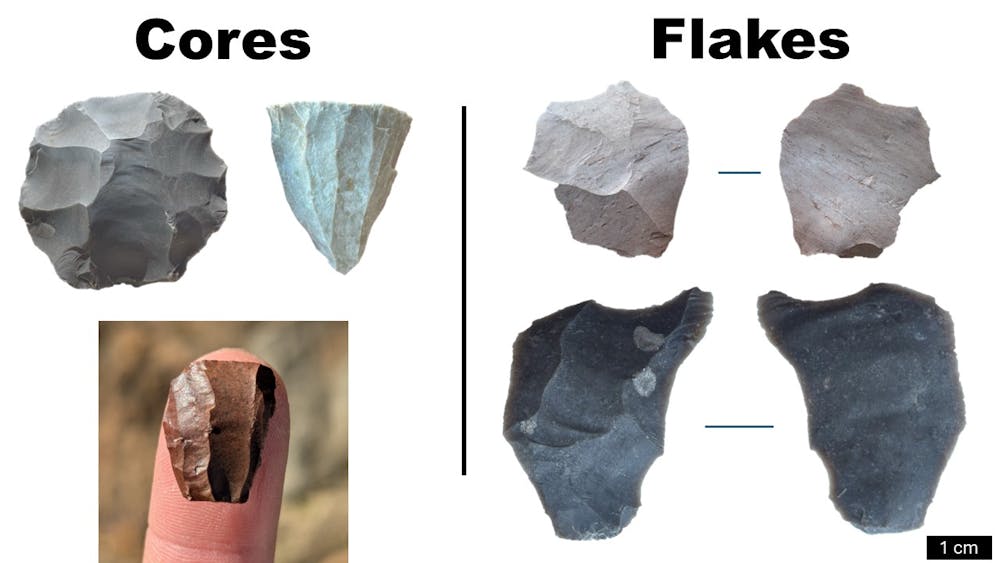
    The process of flaking involves applying force to the edge of a stone, known as the striking platform, through percussion or pressure to remove portions of the rock, which are called flakes. With some guidance from a teacher and plenty of practice, flintknappers can learn how to identify a promising platform on a chunk of stone, called a core, and consistently remove flakes from it. When struck, the platform is removed from the core and is a key feature of the flake.

    Flakes offer an immediate sharp cutting edge. A flintknapper can also further modify them into more specific shapes for other uses. An iconic example of this is the hand ax, which is a core that’s been flaked into a teardrop shape.

    Cores, left, are the object being struck by the flintknapper, and flakes, right, are the sharp-edged material removed from the core. Some cores, like this one from the archaeological site Pinnacle Point 5-6 in South Africa, can be as small as the tip of a finger.
    John K. Murray

    We often use hammerstones or large pieces of antler, called billets, to strike the core’s edge. Repetitive flaking not only allows a flintknapper to produce a significant amount of sharp cutting edge in the form of flakes, but gives them the ability to shape the core to their desired form … often with the risk of personal injury along the way. My fingers can attest to this!

    A modern flintknapper’s toolkit consists of leather pads, gloves, safety glasses, antler billets (left), hard hammerstones (right), and abraders (center-right with grooves), used to rub the edge of the stone to strengthen the platform before striking.
    John K. Murray

    However, not every type of rock has the characteristics needed to be flaked into a tool. You want the stone to exhibit what’s called conchoidal fracture. If you’ve ever seen glass break, you’ve witnessed conchoidal fracture. This smooth break, with concentric wavelike ripples, is defined by the physics of how force moves through different materials.

    Obsidian hand ax made by John Murray, showcasing examples of conchoidal fracture produced while making flakes to shape it.
    John K. Murray

    When an experienced knapper is preparing to remove a flake, we understand how the material we’re working will break when we strike it, so we can predict the shape and size of the tools that we are producing. A stone like obsidian, which is volcanic glass, is the poster child for conchoidal fracture.

    Of course, there is a lot of variation in the quality of rock that hominins have used for manufacturing stone tools, and many have made use of lesser quality stone. Even some of the earliest toolmakers were preferentially selecting rocks for certain properties, such as durability.

    How can you recognize stone tools?

    You may hear people saying that rocks that they found in their garden were tools because they “fit perfectly in the hand” or are “tool shaped.” But it’s not quite that straightforward. Although shape and function may play a role in the final product of a stone tool, it is not the smoking gun.

    Archaeologists can determine whether a chunk of rock is a stone tool based on clues left behind from the process of conchoidal fracture during flintknapping.

    One such clue is the presence of flake scars, or what we call negative removals, which can be found on both cores and flakes. These have characteristic ridges on one or more sides of the rock that outline previous flake removals – hence the use of the term scar.

    When we see multiple flake scars that are consistent in their orientation and size as opposed to being random, it is likely the stone in question was deliberately worked on by a hominin.

    The second feature is what we call the bulb of percussion. This is a bulge in the flake, just below the striking platform, that results from the concentration of force when the knapper struck it.

    Considering that producing a bulb of percussion requires the rock to be struck on a platform at a specific angle with enough force to detach it from the stone, it is improbable that this feature would be created through natural processes – but not impossible. Scientists have found naturally produced sharp stone fragments, or naturaliths, all over the world, even in Antarctica.

    However, when a lot of flakes with these diagnostic characteristics are found together, it’s unlikely they were created naturally.

    A hand ax made by John Murray shows many flake scars, some of which are outlined in black. The inner surface of three flakes shows the bulb of percussion just below the platform.
    John K. Murray

    The final thing to consider when determining whether a rock is a stone tool is the context in which it was found. Are there many stones in the area that exhibit the characteristics that we look for when trying to identify a stone tool? Is the stone tool made of an exotic material, or is it like the rest of the rocks near it?

    If you find a lot of stone tools in the same area made from one type of rock, you might have stumbled across an ancient flintknapping workshop. However, if you discover a tool that was made from a type of stone that can only be found hundreds of miles away, maybe someone traded for this material or carried it with them.

    Try it for yourself

    I think the best way for you to be able to learn to recognize whether a chunk of stone was a tool or just a rock is to try flintknapping yourself. I have taught more than 100 people of all ages to manufacture stone tools, and most agree: It is harder than you’d think.

    This experience puts you into the minds of our hominin ancestors, trying to tackle one of the earliest problems our lineage faced: getting a sharp edge from a chunky piece of rock.

    John K. Murray does not work for, consult, own shares in or receive funding from any company or organization that would benefit from this article, and has disclosed no relevant affiliations beyond their academic appointment.

    ref. Was it a stone tool or just a rock? An archaeologist explains how scientists can tell the difference – https://theconversation.com/was-it-a-stone-tool-or-just-a-rock-an-archaeologist-explains-how-scientists-can-tell-the-difference-251126

    MIL OSI – Global Reports

  • MIL-OSI United Kingdom: The Lindsay Chorale to Perform Free Concert at the Guildhall in Support of Mayor’s Charity

    Source: Northern Ireland – City of Derry

    The Lindsay Chorale to Perform Free Concert at the Guildhall in Support of Mayor’s Charity

    7 May 2025

    Derry City and Strabane District Council is delighted to announce that renowned Saintfield-based choir, The Lindsay Chorale, will be performing a special concert at the Guildhall on Sunday 18th May.

    The event, which takes place from 3pm, hopes to raise much needed funds for the Mayor’s chosen charity, The BUD Club, a vital local organisation supporting children and young adults with additional needs.

    Established in 1997, The Lindsay Chorale is known for its rich repertoire of classical, sacred, and contemporary choral music. Their visit to Derry~Londonderry offers music lovers a unique opportunity to hear one of Northern Ireland’s most accomplished amateur choirs in the majestic surroundings of the Guildhall. Having previously performed with The Priests and for Derry Girls creator, Lisa McGee, audience members are in for a treat with this special afternoon of music.

    The choir will be led by Musical Director Keith Acheson on the day. Keith is an Irish composer and conductor based in Belfast, Northern Ireland. After obtaining a BMus (Hons) in 1996 he was awarded a PhD in Composition from the Ulster University. Along with many pieces for choir, he has had work performed by the likes of the Ulster Orchestra, Gemini Ensemble, HuuJ Ensemble and Arco String Quartet.

    Taking to the famous Guildhall organ, Daniel Clements will accompany the choir and provide the decadent musical background that will add to the atmospheric afternoon.

    Speaking ahead of the event, Mayor of Derry City and Strabane District Council, Cllr Lilian Seenoi-Barr, encouraged the public to come along and support the cause:

    “I’m absolutely thrilled to welcome The Lindsay Chorale to our beautiful Guildhall for what promises to be a very special afternoon of music and community spirit. This free concert is a wonderful opportunity to enjoy world-class choral singing while supporting a cause that is close to my heart. The BUD Club provides life-changing support for families across our district, and I would encourage everyone to come along, donate what they can, and enjoy a truly uplifting event.”

    The choir, which has performed across the UK and Ireland, also expressed their excitement about the upcoming concert:

    “We are honoured to be performing in the historic Guildhall and to be part of an event that supports such an inspiring local charity. Music has the power to connect communities, and we hope our performance will not only entertain but also make a meaningful contribution to the vital work of The BUD Club,” said Keith Acheson, Musical Director.

    The concert is free to attend, and no booking is required. The concert will start at 3pm, and seating will be available on a first-come, first-served basis. Voluntary donations will be collected on the day in aid of The BUD Club.

    For more information about the Mayor’s charity, please visit:
     www.derrystrabane.com/about-council/mayor/mayor-s-charity

    MIL OSI United Kingdom

  • MIL-OSI: Best Online Casinos NJ (New Jersey): 7Bit Casino, Ranked as a Premier Choice Among NJ Players

    Source: GlobeNewswire (MIL-OSI)

    JERSEY CITY, N.J., May 07, 2025 (GLOBE NEWSWIRE) — After testing various online casinos in NJ and looking into their bonuses and rewards, we finally found 7Bit Casino, which is one of the best online casinos in NJ. We are surprised by its welcome bonus and fastest payout feature. With over 10,000 games, including slots, table games, and live dealer options, 7Bit Casino caters to all players. Its robust security, 24/7 support, and mobile-friendly platform ensure a seamless experience, making it a top pick for New Jersey online casinos.

    ✅FEELING LUCKY? TEST YOUR SKILLS AND LUCK AT 7BIT CASINO!

    Why 7Bit Casino Is One of the Best Online Casinos in NJ?

    7Bit Casino has earned its place among the best New Jersey online casinos through its exceptional features and player-focused approach. Since its launch in 2014, it has built a reputation for reliability, operating under a Curacao eGaming license.

    Here’s why it stands out as a top online casino in NJ:

    Extensive Game Library:

    Boasting over 10,000 games from providers like NetEnt, Microgaming, and Evolution Gaming, 7Bit Casino offers unmatched variety. From slots to live dealer games, every player finds their niche, making it a leader among NJ online casinos.

    Lucrative Bonuses:

    The welcome package offers a 325% match up to 5.25 BTC plus 250 free spins, alongside weekly reloads and cashback. These promotions enhance gameplay, positioning 7Bit Casino as the best NJ online casino.

    Swift Payouts:

    Cryptocurrency withdrawals are processed in under an hour, and fiat withdrawals within 24 hours, outpacing many NJ online casinos. This efficiency ensures players access their winnings quickly.

    Robust Security:

    With 128-bit SSL encryption, two-factor authentication (2FA), and certified RNG technology, 7Bit Casino guarantees a safe and fair gaming environment, a hallmark of top New Jersey online casinos.

    Promotions & Bonuses at 7Bit Casino

    7Bit Casino’s promotions are designed to maximize player value. Here’s what’s available for NJ Players:

    Welcome Bonus:

    New players receive a 325% match bonus up to 5.25 BTC plus 250 free spins across four deposits:

    • First Deposit: 100% match up to 1.5 BTC + 100 free spins.
    • Second Deposit: 75% match up to 1.25 BTC + 100 free spins.
    • Third Deposit: 50% match up to 1.5 BTC.
    • Fourth Deposit: 100% match up to 1 BTC + 50 free spins.

    A 40x wagering requirement applies, making this one of the most generous offers among NJ online casinos.

    ✅SIGN UP, DEPOSIT, AND UNLOCK 325% MATCH BONUS + FREE SPINS!

    Weekly Reload Bonuses:

    • Monday Reload: 25% up to 5.5 mBTC.
    • Wednesday Free Spins: Deposit €20+ for up to 100 free spins.

    Cashback:

    Players receive up to 20% cashback on losses, credited weekly based on VIP level, softening losses and encouraging play.

    Other Promotions:

    • New Game Offer: 45 Free Spins
    • Telegram Offer: 50 Free Spins
    • Telegram Friday Offer: 111 Free Spins
    • Telegram Sunday Offer: 66 Free Spins

    Tournaments:

    • Titans` Arena: Prize pool of $8000
    • Platipus Rush: Prize pool of €2000
    • 10 Years of Platipus: Total prize pool of €100 000
    • Lucky Spin: $1500 + 1500 Free Spins

    Seasonal Promotions:

    Holiday specials, no-deposit bonuses, and VIP exclusives keep the promotions fresh, ensuring ongoing value for players.

    Game Categories

    7Bit Casino’s game library is a treasure trove for players, offering something for everyone. Here’s a detailed look:

    Online Slots

    Slots dominate with thousands of titles, from classic three-reel games to feature-rich video slots. Favorites like Starburst dazzle with vibrant graphics, while Book of Dead offers Egyptian-themed adventures with free spins. High-volatility slots like Gonzo’s Quest introduce innovative mechanics like the Avalanche feature. Progressive jackpots such as Mega Moolah promise life-changing wins, making 7Bit Casino a go-to for slot enthusiasts among NJ online casinos.

    Table Games

    Classic casino fans enjoy a robust selection of table games, including blackjack, roulette, baccarat, and craps. Variants like European Blackjack, American Roulette, and Punto Banco Baccarat cater to different strategies. High-quality graphics and smooth gameplay replicate a land-based casino, ensuring 7Bit Casino ranks high among New Jersey online casinos for table game lovers.

    Video Poker

    Video poker blends slots and poker, offering strategic gameplay in titles like Jacks or Better, Deuces Wild, and Joker Poker. With multiple pay lines and bonus features, these games appeal to skill-based players. The variety ensures video poker fans find ample options at this top NJ online casino.

    ✅JUMP INTO NONSTOP ACTION—PLAY TOP GAMES AT 7BIT TODAY!

    Jackpot Games

    For big-win seekers, 7Bit Casino’s jackpot games deliver. Progressive titles like Mega Moolah and Hall of Gods feature growing prize pools, while fixed jackpots offer substantial rewards. The thrill of chasing these prizes enhances 7Bit Casino’s appeal among the best NJ online casinos.

    Live Casino Games

    The live casino brings real-time excitement with professional dealers hosting blackjack, roulette, baccarat, and game shows like Crazy Time. High-definition streams and interactive features create a social, immersive experience, perfect for NJ online casino players craving authenticity.

    Loyalty Program And Payment Options

    Loyalty Program

    The 12-level loyalty program rewards every wager with points convertible to bonuses. Higher tiers unlock up to 20% cashback, reduced wagering, and personalized perks, making it a standout feature among New Jersey online casinos.

    Payment Options

    7Bit Casino offers a wide range of secure and flexible payment options to suit every player’s preference. Whether you’re into crypto transactions or traditional fiat methods, 7Bit makes deposits and withdrawals fast and hassle-free.

    Cryptocurrencies:

    • Bitcoin (BTC)
    • Ethereum (ETH)
    • Litecoin (LTC)
    • Dogecoin (DOGE)
    • Bitcoin Cash (BCH)
    • Tether (USDT)
    • Ripple (XRP)

    Fiat Methods:

    • Visa
    • Mastercard
    • Maestro
    • Neosurf
    • Skrill
    • Neteller
    • Paysafe Card
    • Rapid Transfer
    • EcoPayz
    • Zimpler
    • Interac e-Transfer

    Deposits are instant, and withdrawals are swift, with crypto processed in under an hour and fiat within 1-3 days.

    ✅GET IN. PLAY HARD. CASH-OUT FAST. ONLY AT 7BIT!

    Pros And Cons Of 7Bit Casino

    Pros Cons
    Over 10,000 games from top providers Some fiat withdrawals take 1-3 days
    325% welcome bonus up to 5.25 BTC + 250 free spins  
    Fast crypto payouts (under an hour)  
    24/7 multilingual support  
    Mobile-friendly, no app needed  
    Crypto and fiat payment options  
    SSL encryption and 2FA security  
    12-level VIP program with 20% cashback  


    How To Get Started With 7Bit Casino? Key Steps to Follow

    Joining 7Bit Casino is a breeze, whether you’re a first-time player or a seasoned gamer looking for a new platform. This easy-to-follow guide breaks down the steps to create an account, deposit funds, and dive into the action, showcasing why 7Bit is a top pick for both crypto and traditional currency users. Here’s how you can be playing in just a few minutes:

    1. Go to the 7Bit Casino Website
    Open your browser on any device—mobile or desktop—and head to the official 7Bit Casino site. The platform is designed to work smoothly on all devices, but double-check you’re on a legitimate site to stay safe from scams.

    2. Hit the “Sign Up” Button
    Find the “Sign Up” option in the top-right corner of the homepage and click it to begin creating your account.

    3. Enter Your Information
    Provide your email address, set a strong password, and choose your currency (options include USD, EUR, BTC, ETH, and more). Verify your legal age and your acceptance of the terms and conditions.

    4. Verify Your Account
    Check your email for a confirmation message from 7Bit. Click the link in the email to activate your account.

    5. Deposit Funds
    Select a payment option like a credit card, Neosurf, or cryptocurrency, then make your first deposit to claim the welcome bonus.

    6. Jump into the Games
    With your deposit and bonus ready, explore over 10,000 games. Keep playing to earn rewards and climb the VIP ranks for even more perks.

    This simple process makes 7Bit Casino an inviting choice for players eager to enjoy a secure and exciting gaming experience.

    PLAY SMART, AND EARN MORE—LOYAL PLAYERS WIN BIG AT 7BIT CASINO!

    Safety And Trustworthiness At 7Bit Casino

    When it comes to online gaming, safety is a top priority, and 7Bit Casino delivers a secure and reliable experience for its players. Operating under a reputable license from Curacao eGaming, the platform adheres to strict regulations to guarantee fairness and transparency.

    All games use certified Random Number Generators (RNGs), which are regularly tested by independent third-party auditors to ensure unbiased outcomes. To safeguard personal and financial information, 7Bit employs advanced 128-bit SSL encryption, a gold standard in data protection, and offers optional two-factor authentication (2FA) for an extra layer of account security.

    Additionally, the casino promotes responsible gaming by providing practical tools such as deposit limits, session reminders, and self-exclusion options, empowering players to stay in control of their gaming habits. With these robust measures, 7Bit Casino earns its reputation as a trusted and player-focused choice among New Jersey’s online casino community, offering peace of mind alongside an enjoyable gaming environment.

    Responsive Support:

    Available 24/7 via live chat, email, and phone, the multilingual support team resolves issues promptly, enhancing the player experience at this best NJ online casino.

    1. Mobile Accessibility: The fully optimized mobile platform requires no app, allowing seamless gaming on smartphones and tablets, a key feature for modern NJ online casinos.
    2. Versatile Payments: Supporting cryptocurrencies like Bitcoin and fiat methods like Visa, 7Bit Casino offers low-fee, high-limit transactions, catering to diverse player needs.

    These attributes make 7Bit Casino a standout in the competitive landscape of New Jersey online casinos, delivering quality and excitement to players.

    Software Providers

    7Bit Casino partners with industry leaders:

    • NetEnt: Offers Starburst and Gonzo’s Quest.
    • Microgaming: Features Mega Moolah and table games.
    • Evolution Gaming Powers live dealer games like Crazy Time.
    • Play’n GO: Provides Book of Dead.
    • Pragmatic Play: Includes Wolf Gold.

    These providers ensure a high-quality, diverse game library.

    User Interface And Experience

    The vintage Las Vegas-themed website is intuitive, with clear menus and a powerful search function. Filters help sort games by type or provider. A ‘How to Play’ section guides beginners, and demo modes allow risk-free trials. The mobile site mirrors desktop functionality, ensuring seamless play on the go.

    Summing Up 7Bit Casino’s Winning Edge

    7Bit Casino stands out as a premier NJ online casino, offering an impressive array of over 10,000 games, enticing bonuses, and swift payouts that cater to diverse player preferences. Its robust security measures, intuitive interface, and responsive customer support create a seamless and trustworthy gaming environment. With a strong focus on mobile accessibility and player satisfaction, 7Bit Casino delivers a high-quality experience, making it a top choice for New Jersey players seeking variety, innovation, and rewarding gameplay.

    Frequently Asked Questions

    1. What makes 7Bit Casino one of the best NJ online casinos?

    It’s 10,000+ games, generous bonuses, fast payouts, and top security set it apart. The mobile-friendly platform and 24/7 support enhance accessibility. It’s a top choice for New Jersey online casinos.

    2. What games can I play at 7Bit Casino?

    Enjoy slots, table games, video poker, jackpots, and live dealer games from providers like NetEnt and Evolution Gaming. The variety ensures something for every player. This diversity makes 7Bit Casino the best NJ online casino.

    3. How do I claim the welcome bonus at 7Bit Casino?

    Sign up, verify your email, and deposit. The 325% bonus up to 5.25 BTC plus 250 free spins spans four deposits. A 40x wagering requirement applies.

    4. What payment methods are available at 7Bit Casino?

    Use cryptocurrencies (BTC, ETH, LTC) or fiat methods (Visa, Skrill, Neteller). Deposits are instant, and crypto withdrawals are processed in under an hour. This flexibility suits NJ online casino players.

    5. Is 7Bit Casino safe to play at?

    Yes, it’s licensed by Curacao eGaming, uses SSL encryption, and offers 2FA. Third-party audits ensure fair play. It’s a secure choice among NJ online casinos.

    6. How can I get in touch with 7Bit Casino customer service?

    Reach support 24/7 via live chat, email (support@7bitcasino.com), or phone. The multilingual team is responsive, ensuring a smooth experience. This reliability makes 7Bit Casino the best New Jersey online casino.

    Contact Information

    Contact 7Bit Casino’s 24/7 support via live chat, email (support@7bitcasino.com), or phone.

    Email: support@7bitcasino.com

    Disclaimer and Affiliate Disclosure

    Disclaimer: 7Bit Casino promotes responsible gambling. Verify local laws before playing, as it may not be licensed for New Jersey. Gamble only with funds you can afford to lose.

    Gambling online comes with financial risks. Make sure you meet the legal age requirement (19+) in your region and follow local laws. Always engage in responsible gambling and check 7Bit’s official site for the latest terms, as promotions and payment methods may be updated.

    General Disclaimer

    This article is for informational and entertainment purposes only, not legal or financial advice. Content is based on research and user reviews as of writing. No warranties are made, and users must verify information before acting.

    Casino and Gambling Disclaimer

    Online gambling carries risks and isn’t for everyone. Confirm you’re of legal gambling age in your jurisdiction. Gambling laws vary, and compliance is your responsibility. We don’t promote gambling; participation is at your risk. 7Bit Casino is a third-party platform, and we’re not liable for losses or disputes.

    Affiliate Disclosure

    This article may include affiliate links, earning us a commission at no cost to you for qualifying actions. These support our content. Our reviews are unbiased, and we recommend only valuable products.

    A photo accompanying this announcement is available at https://www.globenewswire.com/NewsRoom/AttachmentNg/2cf9608b-01d0-40c9-a2c3-85704b318828

    The MIL Network

  • MIL-OSI: American Rebel Light Beer Strategic Expansion Continues Full Throttle and Expands into Indiana with Premier Beverage Distributor Zink Distributing

    Source: GlobeNewswire (MIL-OSI)

    New Indiana Distribution Deal Supercharges Midwest Reach  Strengthening Footprint in Key Border States and Reinforcing Growth Trajectory for 2025

    Nashville, TN, May 07, 2025 (GLOBE NEWSWIRE) — American Rebel Holdings, Inc. (NASDAQ: AREB) (“American Rebel” or the “Company”), creator of American Rebel Light Beer (americanrebelbeer.com) and a designer, manufacturer, and marketer of branded safes, personal security and self-defense products and apparel (americanrebel.com), is expanding into Indiana through its newest distribution agreement with Zink Distributing (zinkdistributing.com), a premier beverage distributor serving 14 central Indiana counties in their entirety and the northern parts of two additional counties, including Indianapolis. This collaboration is yet another step in expanding American Rebel’s rapidly growing distribution network and its mission to fuel hard-working, freedom-loving Hoosiers with great American-made beer.

    “We believe in America – we believe in faith, family, and freedom. That’s what American Rebel Light stands for,” said Todd Porter, President of American Rebel Beverage. “Bringing our beer to Indiana with Zink Distributing means more Americans can raise a glass to our shared values. With their expertise, infrastructure and extensive network, we’re confident that American Rebel Light will thrive in Indiana as we continue expanding across this great nation.”

    Jim Zink, Jr., President of Zink Distributing Company, echoed that enthusiasm, stating: “Zink Distributing is proud of its portfolio of great-tasting, high-quality products, and we are thrilled to partner with American Rebel Beverage. We look forward to introducing Hoosiers to American Rebel Light, a perfect addition to our offerings in Indiana.”

    Zink Distributing has built a reputation for excellence, representing some of the most well-respected beverage brands in the industry. Their dedication to quality, strong retail partnerships, and deep understanding of the market makes them the ideal distributor to bring America’s Patriotic Beer to the heartland. Zink Distributing’s state-of-the-art 136,000 square foot facility and upgraded fleet of tractor trailers ensures availability and product freshness for its customers.

    Adding Indiana to our list of states that distribute American Rebel Light is great for many reasons,” said American Rebel CEO Andy Ross. “#1, it’s a great motorsports state; #2, Indiana borders Ohio and Kentucky, two states we’re already enjoying tremendous success in and success in Indiana should be no different and #3, there will be numerous opportunities for promotional events in Indiana to support the Rebel Light rollout. I’m looking forward to working with Jim Zink, Jr. and the Zink Distributing team to introduce America’s Patriotic, God Fearing, Constitution Loving, National Anthem Singing, Stand Your Ground Beer.”

    Rapid Top Tier Distribution Growth Continues for America’s Fastest Growing Beer

    Since its launch in September 2024, American Rebel Light Beer has been growing at a rapid pace, establishing a presence in Tennessee, Connecticut, Kansas, Kentucky, Ohio, Iowa, Missouri, North Carolina, Mississippi, Florida and now Indiana! This latest partnership with Zink Distributing further solidifies American Rebel’s commitment to bringing high-quality, patriotic beer to the people who live and breathe the American dream.

    Rebel Light: All Natural, Crisp, Clean, Bold, “Better for me” Beer for a Balanced Lifestyle
    American Rebel Light is a proudly American-made premium domestic light lager, delivering a crisp, clean, and bold taste with a lighter feel. Created with all-natural ingredients and NO added sweeteners like corn or rice, it offers a refreshing balance of flavor with 110 calories, 3.2 carbohydrates, and 4.3% ABV per 12 oz serving. Whether it’s backyard barbecues, tailgates, or saluting our great nation, American Rebel Light is brewed for the bold, the free, and the proud.

    For more information about American Rebel Light and its new partnership with Zink Distributing, visit americanrebelbeer.com or follow us on social media (@AmericanRebelBeer).

    About American Rebel Light

    American Rebel Light isn’t just a beer – it’s a statement. A toast to freedom, a salute to hard-working Americans, and a bold declaration of our patriotic values – America’s Patriotic, God Fearing, Constitution Loving, National Anthem Singing, Stand Your Ground Beer. Produced in partnership with AlcSource, American Rebel Light Beer (americanrebelbeer.com) is a premium domestic light lager celebrated for its exceptional quality and patriotic appeal.

    American Rebel Light is a Premium Domestic Light Lager Beer – All Natural, Crisp, Clean and Bold Taste with a Lighter Feel. With approximately 100 calories, 3.2 carbohydrates, and 4.3% alcoholic content per 12 oz serving, American Rebel Light Beer delivers a lighter option for those who love great beer but prefer a more balanced lifestyle. It’s all natural with no added supplements and importantly does not use corn, rice, or other sweeteners typically found in mass produced beers. For more information follow American Rebel Beer on all social media platforms (@americanrebelbeer).

    About Zink Distributing

    Zink Distributing, established in 2001, is the exclusive distributor of great-tasting, high-quality products in all or part of 16 counties in Indiana, including Indianapolis. These counties include Marion, Fayette, Hancock, Rush, Hendricks, Morgan, Montgomery, Vermillion, Parke, Putnam, Vigo, Clay, Sullivan, Greene and northern Johnson and Owen. The mission of the company is to exceed the expectations of its customers through excellent service and attention to detail. For more information on Zink Distributing, go to zinkdistributing.com.

    About American Rebel Holdings, Inc.

    American Rebel Holdings, Inc. (NASDAQ: AREB) has operated primarily as a designer, manufacturer and marketer of branded safes and personal security and self-defense products and has recently transitioned into the beverage industry through the introduction of American Rebel Light Beer. The Company also designs and produces branded apparel and accessories. To learn more, visit americanrebel.com and americanrebelbeer.com. For investor information, visit americanrebelbeer.com/investor-relations.

    American Rebel Holdings, Inc.

    info@americanrebel.com
    ir@americanrebel.com
    Media Contact:

    Matt Sheldon
    Matt@PrecisionPR.co

    Forward-Looking Statements

    This press release contains forward-looking statements within the meaning of the Private Securities Litigation Reform Act of 1995. American Rebel Holdings, Inc., (NASDAQ: AREB; AREBW) (the “Company,” “American Rebel,” “we,” “our” or “us”) desires to take advantage of the safe harbor provisions of the Private Securities Litigation Reform Act of 1995 and is including this cautionary statement in connection with this safe harbor legislation. The words “forecasts” “believe,” “may,” “estimate,” “continue,” “anticipate,” “intend,” “should,” “plan,” “could,” “target,” “potential,” “is likely,” “expect” and similar expressions, as they relate to us, are intended to identify forward-looking statements. We have based these forward-looking statements primarily on our current expectations and projections about future events and financial trends that we believe may affect our financial condition, results of operations, business strategy, and financial needs. Important factors that could cause actual results to differ from those in the forward-looking statements include benefits of our strategic planning, marketing outreach efforts, actual placement timing and availability of American Rebel Beer, success and availability of the promotional activities, our ability to effectively execute our business plan, and the Risk Factors contained within our filings with the SEC, including our Annual Report on Form 10-K for the year ended December 31, 2024. Any forward-looking statement made by us herein speaks only as of the date on which it is made. Factors or events that could cause our actual results to differ may emerge from time to time, and it is not possible for us to predict all of them. We undertake no obligation to publicly update any forward-looking statements, whether as a result of new information, future developments or otherwise, except as may be required by law.

    Attachment

    The MIL Network

  • MIL-OSI: Bleakley Financial Group Chooses PKS Investments, a Subsidiary of Binah Capital Group, as Broker-Dealer for Hybrid Advisory Services

    Source: GlobeNewswire (MIL-OSI)

    NEW YORK, May 07, 2025 (GLOBE NEWSWIRE) — Binah Capital Group, Inc. (“Binah Capital”) (NASDAQ: BCG), a leading financial services enterprise that owns and operates a network of firms empowering independent financial advisors, announced today that Bleakley Financial Group, a registered investment advisor (RIA) with over $10 Billion in AUM, has selected PKS Investments, a subsidiary of Binah Capital, as its friendly broker-dealer to support its hybrid business model.

    This partnership provides Bleakley with the support needed to sustain and strengthen its independence while accessing the scale, infrastructure, and advisor-first resources that define Binah Capital’s hybrid-friendly platform. As part of the Binah Capital family, PKS Investments delivers the operational efficiency, compliance expertise, high-touch servicing, and flexibility that dually licensed independent RIAs require to thrive. With seamless integration across leading custodians and a robust support system, PKS empowers advisory firms like Bleakley to grow their business in a manner best-suited to their model and the needs of their diverse clientele.

    “We are thrilled to welcome Bleakley Financial Group to the Binah family of Independent RIA’s supported by PKS Investments,” said Craig Gould, CEO of Binah Capital Group. “This partnership further validates the strength of our open-architecture platform and the confidence that leading entrepreneurial firms place in Binah to deliver the right balance of support and freedom.”

    The collaboration underscores Binah Capital’s leading role as a strategic ally to RIAs, providing infrastructure, scale, and personalized support to partners without compromising their independence.

    About Binah Capital Group
    Binah Capital Group (“Binah Capital,” “Binah” or the “Company”) is a financial services enterprise that owns and operates a network of industry-leading firms that empower independent financial advisors. As a national broker-dealer aggregator, Binah specializes in delivering value through its innovative hybrid-friendly model, making it an optimal platform for RIAs navigating today’s complex financial landscape. Binah’s portfolio companies are built to help advisors run, manage, and execute commission-based business seamlessly while providing best in class resources to support their advisory practice. We don’t just offer tools—we cultivate partnerships. Binah Capital Group stands alongside RIAs as a trusted ally, delivering the structure, flexibility, and cutting-edge solutions they need to succeed in an increasingly competitive marketplace.

    For more, please visit: www.binahcap.com

    Contact:

    Binah Capital Investor Relations
    ir@binahcap.com

    Binah Capital Public Relations
    media@binahcap.com

    The MIL Network

  • MIL-OSI: Arax Recognizes Partner Firms Named on USA Today’s List of Best Financial Advisory Firms 2025

    Source: GlobeNewswire (MIL-OSI)

    NEW YORK, May 07, 2025 (GLOBE NEWSWIRE) — Arax Investment Partners (“Arax”), a premier wealth and asset management platform company backed by RedBird Capital Partners (“RedBird”), today celebrates the inclusion of partner firms Ashton Thomas Private Wealth (“Ashton Thomas” or “ATPW”), U.S. Capital Wealth (“USCW”) and SRS Capital Advisors (n.k.a. “Arax Advisory Partners”) on USA Today’s list of Best Financial Advisory Firms 2025.

    Key highlights include:

    • Ashton Thomas Private Wealth was named one of the Top 10 Best Financial Advisory Firms in the United States and ranked second nationally in its assets under management (“AUM”) subcategory.
    • U.S. Capital Wealth was ranked one of the top three RIAs in Texas in its AUM subcategory.
    • SRS Capital Advisors was ranked one of the top two RIAs in Colorado.
    • Platform-wide, all Arax firms ranked in the top 20% of the 500 named on the list, selected from a pool of over 17,000 firms evaluated nationally.

    “We’re pleased to recognize the accomplishments of our partner firms over the past year as we advance our boutique strategy,” said Haig Ariyan, Chief Executive Officer of Arax Investment Partners. “We are joining forces with the best in wealth management to pursue expansive growth across our platform, and the industry is taking notice. I am very proud of our teams and look forward to continuing our work together.”

    This year’s accolades follow a period of significant growth for Arax, driven by the firm’s differentiated approach to capitalizing on opportunities within the fragmented investment advisory space. By partnering with leading independent wealth management providers and financial advisory teams, Arax delivers the resources necessary to scale business development, pursue complementary investment opportunities, and elevate the client experience. Today, Arax has established a nationwide presence, with a platform that supports more than $26 billion in AUM/A.

    USA Today awards spots on the list to the top performing registered investment advisory firms in the United States. The ranking is based on recommendations from financial advisors, clients and industry experts, and each firm’s development of assets under management (“AUM”). In partnership with Statista, recommendations were collected through an independent survey of over 30,000 individuals, and short-term (12 month) and long-term (five years) AUM development were analyzed using publicly available data. This year, USA Today and Statista included asset-based subgroupings to allow for comparison of firms of similar sizes.

    About Arax Investment Partners
    Arax Investment Partners is a rapidly growing boutique wealth management platform making strategic control investments in leading RIAs and elite advisor teams. Founded and led by CEO Haig Ariyan — a seasoned industry executive with a distinguished track record of building and scaling wealth management businesses — Arax empowers its partners to be entrepreneurial and focus on delivering exceptional client service. Firms benefit from a management team with deep M&A expertise, capital sourcing capabilities, and the backing of RedBird Capital Partners. For more information, visit www.araxpartners.com.

    About Ashton Thomas Private Wealth
    Ashton Thomas is a diversified financial services firm committed to a culture of excellence, integrity, and respect in every aspect of its business. Through its various entities listed below, Ashton Thomas serves foundations, businesses, and affluent individuals and families by providing a range of services which include fee-based financial planning and investment portfolio management, retirement plan consulting, securities brokerage, life and health insurance, and income tax preparation. The firm also strives to remain at the forefront of technological innovation and thought leadership within the financial services industry.

    Ashton Thomas Private Wealth, LLC, (“ATPW”), founded in 2010, and Ashton Thomas Advisors, LLC (“ATA”), founded in 2024, are SEC-registered investment advisers which provide fee-based financial planning, portfolio management, pension consulting, and fund manager selection services. Ashton Thomas Securities, LLC, (“ATS”) is a dually registered entity. ATS registered with FINRA as a broker-dealer in 1984 and provides securities brokerage services. ATS became an SEC-registered investment adviser in 2008 and provides fee-based financial planning, portfolio management, pension consulting, and fund manager selection services. Ashton Thomas Insurance Agency, LLC, (“ATIA”) provides life and health insurance brokerage services. ATIA also provides income tax services through its DBA, Ashton Thomas Tax Advisory. Representatives of the entities listed may only conduct business for which they are licensed, if required, and with residents of the states and jurisdictions in which they are properly registered and/or licensed.

    About U.S. Capital Wealth, LLC
    Headquartered in Houston, Texas, with a strategic Texas presence across Austin, Dallas, and Georgetown, as well as offices in New York City, Massachusetts, and Florida, U.S. Capital Wealth LLC (“USCW”) is a premier independent, full-platform Registered Investment Advisor dedicated to delivering institutional-quality financial solutions with the personalized service of a boutique firm.

    Founded in 2010, USCW was created to empower clients with access to a comprehensive wealth management experience. As a full-platform RIA, USCW offers the best of both worlds — integrating brokerage and advisory capabilities to deliver flexible solutions tailored to each client’s needs. Clients benefit from the capabilities of a large financial institution, while maintaining the personalized, high-touch approach of a boutique advisory firm.

    USCW’s team of seasoned financial professionals brings decades of institutional experience to help clients navigate complexity with clarity and confidence.

    USCW serves distinguished clientele, including high-net-worth and ultra-high-net-worth families, business owners, specialized industry professionals, institutions, and municipalities. Comprehensive offerings span investment management, risk mitigation, lending solutions, and fully integrated family office services — all tailored to each client’s unique goals. To learn more, please visit: https://uscwealth.com.

    About Arax Advisory Partners
    Formerly known as SRS Capital Advisors, Inc., Arax Advisory Partners is a privately owned, independent Registered Investment Advisor specializing in customized investment platforms and highly sophisticated wealth planning solutions for high-net-worth families and individuals, businesses, and foundations. Founded in 2004, Arax Advisory Partners’ unique integrated and comprehensive approach provides the highest possible level of client service to establish lasting partnerships with all their clients while combining comprehensive asset management with leading edge financial planning services. Arax Advisory Partners is headquartered in Denver, CO with offices in Pittsburgh, PA and Philadelphia, PA.

    About RedBird Capital Partners
    RedBird Capital Partners is a private investment firm that builds high-growth companies with strategic capital solutions to founders and entrepreneurs. The firm currently manages $12 billion in assets on behalf of a global group of blue chip institutional and family office investors. Founded in 2014 by Gerry Cardinale, RedBird integrates sophisticated private equity investing with a hands-on business building mandate that focuses on three core industry verticals – Financial Services, Sports and Media & Entertainment. Over his 30-year investment career, Cardinale has partnered with founders and entrepreneurs to build some of the most iconic growth companies in their respective industries. For more information, please go to www.redbirdcap.com.

    Media Contact:

    Dan Gagnier
    Gagnier Communications
    RedBird@gagnierfc.com

    The MIL Network

  • MIL-OSI: Households with Children Emerge as Power Users of the Gig Economy

    Source: GlobeNewswire (MIL-OSI)

    CHICAGO, May 07, 2025 (GLOBE NEWSWIRE) — While gig economy services are popular with American consumers overall, households with children have emerged as power users. This cohort reports using gig services on a weekly basis at an overall rate nearly 50% higher than households without children.

    More telling, 23% of households with children spend $500 or more per month on ridesharing, food delivery and other gig services, a rate almost five times higher than households without children—just 5% of which spend that amount each month. These findings and more are available in TransUnion’s (NYSE: TRU) 2025 Gig Economy Consumer Report.

    “Given how much families have to balance in their day-to-day, it’s no surprise that they have come to rely on the convenience of gig economy services,” said Cecilia Seiden, VP of TransUnion’s Communities and Marketplaces business. “TransUnion’s research provides some essential insights for how platforms can better engage this key segment.”

    Gig economy services used once or more per week by U.S. households
     
      Food Delivery Grocery/Retail
    Delivery
    Ride
    Share
    Online
    Freelancer
    Vehicle
    Share
    In-person
    Contractor
    With
    Children
    61% 54% 53% 39% 38% 31%
    Without
    Children
    40% 33% 36% 19% 21% 15%
     

    While households with children generally outpace those without children in their use of gig services, the difference was even more pronounced for emerging gig services, such as digital freelancing or in-person contract work (inclusive of home services and caregiving), where households with children were twice as likely to be weekly users.

    In-person contracting work comprises services like babysitting, dog walking and furniture assembly. Digital freelancing services include app building, web design, presentation design, etc. The amount of consumers using digital freelancing services suggests that, while some may be engaging workers to help with their small business needs, the majority may be outsourcing parts of their day jobs.

    Related, households with children were much more likely than households without children to cite the wide selection of providers (43% vs. 25%) and ease of finding the service they need (51% vs. 40%) as a reason for using these services. 

    The report also found that households with children prioritized promotions and loyalty programs when selecting a service. Gig platforms can differentiate themselves by running attractive promotions that enhance consumer satisfaction and build long-term loyalty. 

    Trust and safety

    If loyalty programs and promotions are among the best ways to attract and retain customers, breaches of trust and safety are likely the fastest ways to lose them. While 83% of respondents said they were satisfied with the trust and safety features available, more than half said they would stop using a platform if they were scammed, felt physically threatened, or had their account compromised.

    The report found nearly 4 out of 10 users are worried about encountering fraud or scams. When asked which steps platforms can take to reduce fraud and scams, 67% of users said verification of worker identity. Conducting background checks (58%) and utilizing biometrics (58%) to confirm that verified gig workers are the ones performing the services were also popular. 

    “Users understand that a certain amount of friction is necessary to keep people safe,” said Seiden. “Platforms that employ identity-based fraud protections can much more effectively strike the right balance necessary for a seamless and safe customer experience.”

    Learn more about TransUnion’s identity-based products, including TruAudience® marketing solutions and TruValidate™ fraud solutions.

    Read the full 2025 Spring Gig Economy Consumer Report.

    Research Methodology
    This online survey of 1,051 adults was conducted in February 2025 by TransUnion in partnership with third-party research provider Toluna. Participants included current and past consumers of gig economy services. All U.S. regions are represented in the study survey responses. These research results are unweighted and statistically significant at a 95% confidence level within ±3 percentage points based on calculated error margin. Please note some chart percentages may not add up to 100% due to rounding or multiple answers being accepted.

    About TransUnion (NYSE: TRU)
    TransUnion is a global information and insights company with over 13,000 associates operating in more than 30 countries. We make trust possible by ensuring each person is reliably represented in the marketplace. We do this with a Tru™ picture of each person: an actionable view of consumers, stewarded with care. Through our acquisitions and technology investments we have developed innovative solutions that extend beyond our strong foundation in core credit into areas such as marketing, fraud, risk and advanced analytics. As a result, consumers and businesses can transact with confidence and achieve great things. We call this Information for Good® — and it leads to economic opportunity, great experiences and personal empowerment for millions of people around the world. http://www.transunion.com/business

    Contact Dave Blumberg
    TransUnion
    E-mail david.blumberg@transunion.com
    Telephone 312-972-6646

    The MIL Network

  • MIL-OSI: Ashton Thomas Private Wealth Ranked #7 on USA Today’s List of Best Financial Advisory Firms 2025

    Source: GlobeNewswire (MIL-OSI)

    NEW YORK, May 07, 2025 (GLOBE NEWSWIRE) — Ashton Thomas Private Wealth (“Ashton Thomas” or “the Company”), an Arax Investment Partners firm, is pleased to announce that it was ranked #7 out of 500 firms on USA Today’s list of Best Financial Advisory Firms 2025. In addition to making the Top 10, Ashton Thomas also ranked second nationally in its assets under management (“AUM”) subcategory.

    USA Today’s ranking of Best Financial Advisory Firms recognizes the top performing registered investment advisory companies in the United States based on recommendations from clients and peers, and an analysis of each firm’s development of AUM. Ashton Thomas has made the list every year since the ranking was launched in 2023.

    This year’s recognition caps off a period of robust growth for Ashton Thomas, which continues to develop its wealth management business supported by the Arax platform. Since joining Arax in 2023, Ashton Thomas has developed its footprint and operations across the U.S., welcoming elite advisor teams based in New York, NY, Boston, MA, Aspen, CO and San Francisco, CA, and establishing a new San Francisco office to support the firm’s growing presence in the Western market. Ashton Thomas expanded its services and offerings with the acquisition of a full-service broker-dealer to provide advisors and clients with access to cutting edge technology, additional compliance infrastructure and access to world class management.

    “We are thrilled to have been honored as one of the best of the best in the wealth management industry,” said Aaron Brodt, CEO of Ashton Thomas. “Our Top 10 ranking is a credit to the work we have done expanding our business to meet the needs of institutions, families and individuals across the country, as well as the top-tier client service provided by our advisors on a daily basis. I commend the full Ashton Thomas team for their contributions to this achievement.”

    “This recognition validates our strategy of partnering with forward-thinking advisory teams and providing the support they need to scale their practices,” added Haig Ariyan, Chief Executive Officer of Arax Investment Partners. “Access to the synergies, management expertise and growth opportunities afforded by our platform allows our Ashton Thomas advisor teams to capitalize on their established reputations and reach more clients with a wide range of services. I look forward to continuing to build on our momentum.”

    About Ashton Thomas Private Wealth
    Ashton Thomas is a diversified financial services firm committed to a culture of excellence, integrity, and respect in every aspect of its business. Through its various entities listed below, Ashton Thomas serves foundations, businesses, and affluent individuals and families by providing a range of services which include fee-based financial planning and investment portfolio management, retirement plan consulting, securities brokerage, life and health insurance, and income tax preparation. The firm also strives to remain at the forefront of technological innovation and thought leadership within the financial services industry.

    Ashton Thomas Private Wealth, LLC, (“ATPW”), founded in 2010, and Ashton Thomas Advisors, LLC (“ATA”), founded in 2024, are SEC-registered investment advisers which provide fee-based financial planning, portfolio management, pension consulting, and fund manager selection services. Ashton Thomas Securities, LLC, (“ATS”) is a dually registered entity. ATS registered with FINRA as a broker-dealer in 1984 and provides securities brokerage services. ATS became an SEC-registered investment adviser in 2008 and provides fee-based financial planning, portfolio management, pension consulting, and fund manager selection services. Ashton Thomas Insurance Agency, LLC, (“ATIA”) provides life and health insurance brokerage services. ATIA also provides income tax services through its DBA, Ashton Thomas Tax Advisory. Representatives of the entities listed may only conduct business for which they are licensed, if required, and with residents of the states and jurisdictions in which they are properly registered and/or licensed.

    About Arax Investment Partners
    Arax Investment Partners is a rapidly growing boutique wealth management platform making strategic control investments in leading RIAs and elite advisor teams. Founded and led by CEO Haig Ariyan — a seasoned industry executive with a distinguished track record of building and scaling wealth management businesses — Arax empowers its partners to be entrepreneurial and focus on delivering exceptional client service. Firms benefit from a management team with deep M&A expertise, capital sourcing capabilities, and the backing of RedBird Capital Partners. For more information, visit www.araxpartners.com.

    Media Contact:

    Dan Gagnier
    Gagnier Communications
    RedBird@gagnierfc.com

    The MIL Network

  • MIL-OSI: Intermex Reports First-Quarter Results

    Source: GlobeNewswire (MIL-OSI)

    Company to Host Conference Call Today at 9 a.m. ET

    MIAMI, May 07, 2025 (GLOBE NEWSWIRE) — International Money Express, Inc. (NASDAQ: IMXI) (“Intermex” or the “Company”), one of the nation’s leading global omnichannel money transfer services to Latin America and the Caribbean, today reported financial and operating results for the first quarter of 2025.

    Financial performance highlights for the first quarter of 2025:

    • Revenues of $144.3 million
    • Net income of $7.8 million
    • Diluted EPS of $0.25
    • Adjusted Diluted EPS of $0.35
    • Adjusted EBITDA of $21.6 million

    Bob Lisy, Chairman, President, and CEO of Intermex, stated “Intermex’s first quarter results reflect the strength and discipline of the Intermex business model, despite an economic and political backdrop that was difficult to anticipate. Year-over-year volume growth reflects our highly resilient consumer base and our ability to serve them effectively through our omnichannel strategy.”

    First Quarter 2025 Financial Results (all comparisons are to the First Quarter 2024)
    Year over year volumes grew at 3.7%, however total revenues for the Company were down 4.1% to $144.3 million. This was driven by a shift in retail consumer sending behavior as consumers sent fewer transactions, but in larger amounts transferred per transaction in the quarter. The reduction in service fees from lower transactions was partially offset by an increase in revenue primarily related to growth in digital channels. The Company’s user base generated 12.8 million money transfer transactions, down 5.2% from last year. The total principal amount transferred for the period was $5.6 billion, an increase of 3.7%.

    The Company reported net income of $7.8 million, a decrease of 35.5%. Diluted earnings per share were $0.25, a decrease of 28.6%. The decreases in net income and diluted earnings per share were driven primarily by the items noted above for revenues, partly offset by lower services charges from agents and banks. It is worth noting that while revenue was down from lower transactions, the higher year over year volume offset much of the interest and banking expense reductions that would otherwise typically be captured with a lower number of transactions. Lower income tax provision also positively impacted net income. Diluted earnings per share was positively impacted by the reduction in share count from the Company’s stock repurchase activity.

    Adjusted net income totaled $10.9 million, a decrease of 25.9%. Adjusted diluted earnings per share totaled $0.35, a decrease of 18.6%. Adjusted net income and adjusted diluted earnings per share were impacted by the items noted above, adjusted for certain items detailed in the reconciliation tables below following the unaudited condensed consolidated financial statements. Adjusted diluted earnings per share was positively impacted by the reduction in share count from the Company’s stock repurchases.

    Adjusted EBITDA decreased 15.0% to $21.6 million, attributable to the same items noted above, partially offset by the higher net effect of the adjusting items detailed in the reconciliation tables below following the unaudited condensed consolidated financial statements.

    Adjusted and other non-GAAP measures discussed above and elsewhere in this press release are defined below under the heading, Non-GAAP Measures.

    Other Items
    The Company ended the first quarter of 2025 with $151.8 million in cash and cash equivalents. Net Free Cash Generated for the first quarter of 2025 was $10.3 million, up from the first quarter of 2024. Year-over-year Net Free Cash Generated primarily reflects the investments in assets placed into service as a result of the Company’s move to the new U.S. headquarters facility in the first quarter of 2024, partially offset by the decrease in net income.

    The Company incurred $1.2 million in transaction costs for the first quarter, primarily legal and professional fees incurred in relation to its previously announced evaluation of strategic alternatives. In addition, the Company incurred restructuring costs of approximately $0.3 million primarily related to the Company’s foreign operations.

    The Company repurchased 367,873 shares of its common stock for $5.0 million during the first quarter of 2025 through its underlying share repurchase program and a privately-negotiated transaction.

    Guidance
    Based on our first quarter 2025 financial results and the underlying market dynamics we have observed to date, the Company is revising its previously issued full-year guidance below. Current levels of uncertainty and volatility affecting market conditions and consumer behavior, have increased the difficulty of reliably forecasting short-term results.   Moreover, as previously announced, the Company is in the process of executing on a long-term strategy of investing in its digital business offerings to increase their contribution to the Company’s revenue and to increase its profitability.   Accordingly, the Company is discontinuing issuing quarterly guidance.

    Full-year 2025:
    •Revenue of $634.9 million to $654.2 million.
    •Diluted EPS of $1.53 to $1.65.
    •Adjusted Diluted EPS of $1.86 to $2.02.
    •Adjusted EBITDA of $103.6 million to $106.8 million.

    Non-GAAP Measures
    Adjusted Net Income, Adjusted Earnings per Share, Adjusted EBITDA, Adjusted EBITDA Margin and Net Free Cash Generated, each a Non-GAAP financial measure, are the primary metrics used by management to evaluate the financial performance of our business. We present these Non-GAAP financial measures because we believe they are frequently used by analysts, investors, and other interested parties to evaluate companies in our industry. Furthermore, we believe they are helpful in highlighting trends in our operating results, because certain of such measures exclude, among other things, the effects of certain transactions that are outside the control of management, while other measures can differ significantly depending on long-term strategic decisions regarding capital structure, the jurisdictions in which we operate and capital investments.

    Adjusted Net Income is defined as Net Income adjusted to add back certain charges and expenses, such as non-cash amortization of certain intangible assets resulting from business and asset acquisition transactions, non-cash compensation costs, and other items outlined in the reconciliation table below, as these charges and expenses are not considered a part of our core business operations and are not an indicator of ongoing future Company performance.

    Adjusted Earnings per Share – Basic and Diluted is calculated by dividing Adjusted Net Income by GAAP weighted-average common shares outstanding (basic and diluted).

    Adjusted EBITDA is defined as Net Income before depreciation and amortization, interest expense, income taxes, and adjusted to add back certain charges and expenses, such as non-cash compensation costs and other items outlined in the reconciliation table below, as these charges and expenses are not considered a part of our core business operations and are not an indicator of ongoing future Company performance.

    Adjusted EBITDA Margin is calculated by dividing Adjusted EBITDA by Revenues.

    Net Free Cash Generated is defined as Net Income before provision for credit losses and depreciation and amortization adjusted to add back certain non-cash charges and expenses, such as non-cash compensation costs, and reduced by cash used in investing activities and servicing of our debt obligations.

    Adjusted Net Income, Adjusted Earnings per Share, Adjusted EBITDA, Adjusted EBITDA Margin, and Net Free Cash Generated are non-GAAP financial measures and should not be considered as an alternative to operating income, net income, net income margin or earnings per share, as a measure of operating performance or cash flows, or as a measure of liquidity. Non-GAAP financial measures are not necessarily calculated the same way by different companies and should not be considered a substitute for or superior to U.S. GAAP.

    Reconciliations of Net Income, the Company’s closest GAAP measure, to Adjusted Net Income, Adjusted EBITDA, and Net Free Cash Generated, as well as a reconciliation of Earnings per Share (Basic and Diluted) to Adjusted Earnings per Share (Basic and Diluted) and Net Income Margin to Adjusted EBITDA Margin, are outlined in the tables below following the condensed consolidated financial statements. A quantitative reconciliation of projected Adjusted EBITDA and Adjusted Diluted EPS to the most comparable GAAP measure is not available without unreasonable efforts because of the inherent difficulty in forecasting and quantifying the amounts necessary under GAAP guidance for operating or other adjusted items including, without limitation, costs and expenses related to acquisitions and other transactions, share-based compensation, tax effects of certain adjustments and losses related to legal contingencies or disposal of assets. For the same reasons, we are unable to address the probable significance of the unavailable information.

    Investor and Analyst Conference Call / Presentation
    Intermex will host a conference call and webcast presentation at 9:00 a.m. Eastern Time today. Interested parties are invited to join the discussion and gain firsthand knowledge about Intermex’s financial performance and operational achievements through the following channels:

    • A live broadcast of the conference call may be accessed via the Investor Relations section of Intermex’s website at https://investors.intermexonline.com/.
    • To participate in the live conference call via telephone, please register HERE. Upon registering, a dial-in number and unique PIN will be provided to join the conference call.
    • Following the conference call, an archived webcast of the call will be available for one year on Intermex’s website at https://investors.intermexonline.com/.

    Safe Harbor Compliance Statement for Forward-Looking Statements
    This press release contains certain “forward-looking statements” within the meaning of the Private Securities Litigation Reform Act of 1995, as amended, which reflect our current views concerning certain events that are not historical facts but could have an effect on our future performance, including but without limitation, statements regarding our plans, objectives, financial performance, business strategies, projected results of operations, restructuring initiatives and expectations for the Company. These statements may include and be identified by words or phrases such as, without limitation, “would,” “will,” “should,” “expects,” “believes,” “anticipates,” “continues,” “could,” “may,” “might,” “plans,” “possible,” “potential,” “predicts,” “projects,” “forecasts,” “intends,” “assumes,” “estimates,” “approximately,” “shall,” “our planning assumptions,” “future outlook,” “currently,” “target,” “guidance,” and similar expressions (including the negative and plural forms of such words and phrases). These forward-looking statements are based largely on information currently available to our management and our current expectations, assumptions, plans, estimates, judgments, projections about our business and our industry, and macroeconomic conditions, and are subject to various risks, uncertainties, estimates, contingencies, and other factors, many of which are outside our control, that could cause actual results to differ materially from those expressed or implied by such forward-looking statements and could materially adversely affect our business, financial condition, results of operations, cash flows, and liquidity. Such factors include, among others: changes in immigration laws and their enforcement, including any adverse effects on the level of immigrant employment, earning potential and other commercial activities; our success in expanding customer acceptance of our digital services and infrastructure, as well as developing, introducing and marketing new digital and other products and services; new technology or competitors that disrupt the current money transfer and payment ecosystem, including the introduction of new digital platforms; loss of, or reduction in business with, key sending agents; our ability to effectively compete in the markets in which we operate; economic factors such as inflation, the level of economic activity, recession risks and labor market conditions, as well as volatility in market interest rates; international political factors, including ongoing hostilities in Ukraine and the Middle East, political instability, tariffs, including the effects of tariffs on domestic markets and industrial activity and employment, border taxes or restrictions on remittances or transfers from the outbound countries in which we operate or plan to operate; volatility in foreign exchange rates that could affect the volume of consumer remittance activity and/or affect our foreign exchange related gains and losses; consumer confidence in our brands and in consumer money transfers generally; expansion into new geographic markets or product markets; our ability to successfully execute, manage, integrate and obtain the anticipated financial benefits of key acquisitions and mergers; cybersecurity-attacks or disruptions to our information technology, computer network systems, data centers and mobile devices applications; the ability of our risk management and compliance policies, procedures and systems to mitigate risk related to transaction monitoring; consumer fraud and other risks relating to the authenticity of customers’ orders or the improper or illegal use of our services by consumers, sending agents or digital partners; our ability to maintain favorable banking and paying agent relationships necessary to conduct our business; bank failures, sustained financial illiquidity, or illiquidity at the clearing, cash management or custodial financial institutions with which we do business; changes to banking industry regulation and practice; credit risks from our agents, digital partners and the financial institutions with which we do business; our ability to recruit and retain key personnel; our ability to maintain compliance with applicable laws and regulatory requirements, including those intended to prevent use of our money remittance services for criminal activity, those related to data and cybersecurity protection, and those related to new business initiatives; enforcement actions and private litigation under regulations applicable to money remittance services; changes in tax laws in the countries in which we operate; our ability to protect intellectual property rights; our ability to satisfy our debt obligations and remain in compliance with our credit facility requirements; public health conditions, responses thereto and the economic and market effects thereof; the use of third-party vendors and service providers; weakness in U.S. or international economic conditions; and other economic, business, and/or competitive factors, risks and uncertainties, including those described in the “Risk Factors” and other sections of periodic reports and other filings that we file with the Securities and Exchange Commission. Accordingly, we caution investors and all others not to place undue reliance on any forward-looking statements. Any forward-looking statement speaks only as of the date such statement is made and we undertake no obligation to update any of the forward-looking statements.

    About International Money Express, Inc.
    Founded in 1994, Intermex applies proprietary technology enabling consumers to send money from the United States, Canada, Spain, Italy, the United Kingdom and Germany to more than 60 countries. The Company provides the digital movement of money through a network of agent retailers in the United States, Canada, Spain, Italy, the United Kingdom and Germany; Company-operated stores; our mobile apps; and the Company’s websites. Transactions are fulfilled and paid through thousands of retail and bank locations around the world. Intermex is headquartered in Miami, Florida, with international offices in Puebla, Mexico, Guatemala City, Guatemala, London, England, and Madrid, Spain. For more information about Intermex, please visit www.intermexonline.com.

    Alex Sadowski
    Investor Relations Coordinator
    ir@intermexusa.com
    tel. 305-671-8000

    Condensed Consolidated Balance Sheets
             
        March 31,   December 31,
    (in thousands of dollars)     2025     2024
    ASSETS   (Unaudited)    
    Current assets:        
    Cash and cash equivalents   $ 151,764   $ 130,503
    Accounts receivable, net of allowance of $4,095 and $3,546, respectively     131,026     107,077
    Prepaid wires, net     32,577     49,205
    Prepaid expenses and other current assets     10,561     10,998
    Total current assets     325,928     297,783
             
    Property and equipment, net     52,603     50,354
    Goodwill     55,195     55,195
    Intangible assets, net     26,058     26,847
    Deferred tax asset, net     18    
    Other assets     30,787     32,198
    Total assets   $ 490,589   $ 462,377
             
    LIABILITIES AND STOCKHOLDERS’ EQUITY        
    Current liabilities:        
    Accounts payable   $ 23,410   $ 19,520
    Wire transfers and money orders payable, net     115,081     85,044
    Accrued and other liabilities     47,977     47,434
    Total current liabilities     186,468     151,998
             
    Long-term liabilities:        
    Debt, net     147,385     156,623
    Lease liabilities, net     17,493     18,582
    Deferred tax liability, net         250
    Total long-term liabilities     164,878     175,455
             
    Stockholders’ equity:        
    Total stockholders’ equity     139,243     134,924
    Total liabilities and stockholders’ equity   $ 490,589   $ 462,377
             
    Condensed Consolidated Statements of Income
         
        Three Months Ended March 31,
    (in thousands of dollars, except for per share data)     2025     2024
        (Unaudited)
    Revenues:        
    Wire transfer and money order fees, net   $ 120,167   $ 126,921
    Foreign exchange gain, net     20,181     20,346
    Other income     3,962     3,145
    Total revenues     144,310     150,412
             
    Operating expenses:        
    Service charges from agents and banks     93,788     97,934
    Salaries and benefits     18,288     18,106
    Other selling, general and administrative expenses     10,989     9,953
    Provision for credit losses     2,066     1,595
    Restructuring costs     306    
    Transaction costs     1,169     10
    Depreciation and amortization     3,629     3,228
    Total operating expenses     130,235     130,826
             
    Operating income     14,075     19,586
             
    Interest expense     2,700     2,702
             
    Income before income taxes     11,375     16,884
             
    Income tax provision     3,606     4,778
             
    Net income   $ 7,769   $ 12,106
             
    Earnings per common share:        
    Basic   $ 0.25   $ 0.36
    Diluted   $ 0.25   $ 0.35
             
    Weighted-average common shares outstanding:        
    Basic     30,587,949     33,675,441
    Diluted     30,831,633     34,188,814
    Reconciliation from Net Income to Adjusted Net Income
         
        Three Months Ended March 31,
    (in thousands of dollars, except for per share data)     2025       2024  
        (Unaudited)
             
    Net Income   $ 7,769     $ 12,106  
             
    Adjusted for:        
    Share-based compensation (a)     2,112       2,153  
    Restructuring costs (b)     306        
    Transaction costs (c)     1,169       10  
    Other charges and expenses (d)     327       437  
    Amortization of intangibles (e)     711       977  
    Income tax benefit related to adjustments (f)     (1,466 )     (1,012 )
    Adjusted Net Income   $ 10,928     $ 14,671  
             
    Adjusted earnings per common share:        
    Basic   $ 0.36     $ 0.44  
    Diluted   $ 0.35     $ 0.43  

    (a) Represents share-based compensation relating to equity awards granted primarily to employees and independent directors of the Company.

    (b) Represents primarily severance, write-off of assets and, legal and professional fees related to the execution of restructuring plans.

    (c) Represents primarily financial advisory, professional and legal fees related to business acquisition transactions and strategic alternatives.

    (d) Represents primarily loss on disposal of fixed assets.

    (e) Represents the amortization of certain intangible assets that resulted from business and asset acquisition transactions.

    (f) Represents the current and deferred tax impact of the taxable adjustments to Net Income using the Company’s blended federal and state tax rate for each period. Relevant tax-deductible adjustments include all adjustments to Net Income.

    Reconciliation from Basic Earnings per Share to Adjusted Basic Earnings per Share
         
        Three Months Ended March 31,
          2025       2024  
        (Unaudited)
    Basic Earnings per Share   $ 0.25     $ 0.36  
    Adjusted for:        
    Share-based compensation     0.07       0.06  
    Restructuring costs     0.01        
    Transaction costs     0.04       NM  
    Other charges and expenses     0.01       0.01  
    Amortization of intangibles     0.02       0.03  
    Income tax benefit related to adjustments     (0.05 )     (0.03 )
    Adjusted Basic Earnings per Share   $ 0.36     $ 0.44  

    NM—Amount is not meaningful

    The table above may contain slight summation differences due to rounding

    Reconciliation from Diluted Earnings per Share to Adjusted Diluted Earnings per Share
         
        Three Months Ended March 31,
          2025       2024  
        (Unaudited)
    Diluted Earnings per Share   $ 0.25     $ 0.35  
    Adjusted for:        
    Share-based compensation     0.07       0.06  
    Restructuring costs     0.01        
    Transaction costs     0.04       NM  
    Other charges and expenses     0.01       0.01  
    Amortization of intangibles     0.02       0.03  
    Income tax benefit related to adjustments     (0.05 )     (0.03 )
    Adjusted Diluted Earnings per Share   $ 0.35     $ 0.43  

    NM—Amount is not meaningful

    The table above may contain slight summation differences due to rounding

    Reconciliation from Net Income to Adjusted EBITDA
         
        Three Months Ended March 31,
    (in thousands of dollars)     2025     2024
        (Unaudited)
    Net Income   $ 7,769   $ 12,106
             
    Adjusted for:        
    Interest expense     2,700     2,702
    Income tax provision     3,606     4,778
    Depreciation and amortization     3,629     3,228
    EBITDA     17,704     22,814
    Share-based compensation (a)     2,112     2,153
    Restructuring costs (b)     306    
    Transaction costs (c)     1,169     10
    Other charges and expenses (d)     327     437
    Adjusted EBITDA   $ 21,618   $ 25,414

    (a) Represents share-based compensation relating to equity awards granted primarily to employees and independent directors of the Company.

    (b) Represents primarily severance, write-off of assets and legal and professional fees related to the execution of restructuring plans.

    (c) Represents primarily financial advisory, professional and legal fees related to business acquisition transactions and strategic alternatives.

    (d) Represents primarily loss on disposal of fixed assets.

    Reconciliation from Net Income Margin to Adjusted EBITDA Margin
         
        Three Months Ended March 31,
        2025     2024  
        (Unaudited)
    Net Income Margin   5.4 %   8.0 %
    Adjusted for:        
    Interest expense   1.9 %   1.8 %
    Income tax provision   2.5 %   3.2 %
    Depreciation and amortization   2.5 %   2.1 %
    EBITDA Margin   12.3 %   15.2 %
    Share-based compensation   1.5 %   1.4 %
    Restructuring costs   0.2 %   %
    Transaction costs   0.8 %   %
    Other charges and expenses   0.2 %   0.3 %
    Adjusted EBITDA Margin   15.0 %   16.9 %

    The table above may contain slight summation differences due to rounding

    Reconciliation of Net Income to Net Free Cash Generated
         
        Three Months Ended March 31,
    (in thousands of dollars)     2025       2024  
        (Unaudited)
             
    Net income for the period   $ 7,769     $ 12,106  
             
    Depreciation and amortization     3,629       3,228  
    Share-based compensation     2,112       2,153  
    Provision for credit losses     2,066       1,595  
    Cash used in investing activities     (5,313 )     (13,480 )
    Term loan pay downs           (1,641 )
             
    Net Free Cash Generated during the period   $ 10,263     $ 3,961  

    The MIL Network

  • MIL-OSI: KVH Launches CommBox Edge Secure Suite for Advanced Cybersecurity Threat Detection & Response

    Source: GlobeNewswire (MIL-OSI)

    MIDDLETOWN, R.I., May 07, 2025 (GLOBE NEWSWIRE) — Today, KVH Industries, Inc. (Nasdaq: KVHI) unveiled the newest expansion to its CommBox Edge Communications Gateway–the Secure Suite threat detection and response service. Focused on detecting, preventing, and reporting cybersecurity threats, CommBox Edge Secure Suite actively identifies and blocks harmful traffic in real time to reduce the risks to vessel communications, operations, and network security. Secure Suite is fully compatible with both the CommBox Edge 6 and Edge 2 belowdeck appliances and the CommBox Edge virtual machine option, making it an easy-to-use and versatile cybersecurity upgrade to the CommBox Edge’s robust network and bandwidth management capabilities.

    “The modern commercial vessel is an extension of the corporate office–a mobile, connected network node that can face the threat of malicious cyber activities that put people, cargo, vessels, and business operations at risk,” observed Chad Impey, KVH’s senior vice president of global sales. “CommBox Edge Secure Suite is designed for rapid, easy, and affordable deployment while delivering advanced detection, prevention, and reporting capabilities. Combined with the CommBox Edge network and bandwidth management capabilities, Secure Suite delivers enhanced security for individual vessels and entire fleets while simultaneously maximizing your IT team’s resources and optimizing your communications.”

    CommBox Edge Secure Suite employs some of the most advanced cybersecurity and proactive monitoring technology available, including:

    • Cisco Talos, one of the world’s most advanced threat-blocking and detection solutions, focuses on emerging and existing cyber threats, enabling CommBox Edge Secure Suite to recognize and respond to new threat IDs and threat patterns.
    • Cisco Snort monitors, analyzes, and responds to malicious network traffic in real time using Cisco Talos rulesets, helping CommBox Edge Secure Suite identify and mitigate potential security threats.

    Secure Suite also includes a robust Intrusion Prevention System (IPS), active quarantine capabilities, and an intuitive cloud-based Threat Dashboard to reduce cyber risks to vessels, networks, and crews. The service helps mitigate those risks as part of a comprehensive network and onboard cybersecurity solution focused on:

    • Detection – The CommBox Edge Secure Suite IPS monitors incoming and outgoing traffic for suspicious patterns or signatures that match known attack types (like malware, vulnerabilities, or exploits).
    • Prevention – The IPS responds in real time to malicious actions by blocking harmful traffic (e.g., malware, viruses, denial of service, ping of death, etc.), resetting connections, adjusting firewalls, initiating quarantines, and sending alerts to administrators.
    • Reporting – Secure Suite includes an intuitive cloud-based Threat Dashboard. Also, it captures and reports detailed threat logs (including syslogs/rsyslogs) to an offsite Security Information and Event Management (SIEM) system or Security Operations Center (SOC) for future analysis and actionable insights.

    With this data and Secure Suite’s advanced features, you can enable new proactive responses to threats, minimize recovery time, pass security audits, remain compliant with industry standards, and identify resource-intensive threats to ensure optimal network performance,” concluded Impey.

    Secure Suite is available now as a service option within CommBox Edge, KVH’s all-in-one management toolbox for maritime IT professionals who want to control the growing array of wide area network (WAN) options, such as the VSAT, low earth orbit (LEO) services, 5G cellular, and other services available through the KVH ONE® global network. CommBox Edge also supports as many as thirty onboard local area networks and provides secure remote access to any onboard networked device, high-speed VPN links, and deep packet inspection.

    Note to Editors: For more information about CommBox Edge, please visit https://www.kvh.com/edge. High-resolution images of KVH products are available at the KVH Press Room Image Library, https://www.kvh.com/imagelibrary.

    About KVH Industries, Inc.

    KVH Industries, Inc. is a global leader in maritime and mobile connectivity delivered via the KVH ONE network. The company, founded in 1982, is based in Middletown, RI, with research, development, and manufacturing operations in Middletown, RI, and more than a dozen offices around the globe. KVH provides connectivity solutions for commercial maritime, leisure marine, military/government, and land mobile applications on vessels and vehicles, including the TracNet®, TracPhone®, and TracVision® product lines, CommBox Edge, the KVH ONE OpenNet Program for non-KVH antennas, AgilePlans® Connectivity as a Service (CaaS), and the KVH Link crew wellbeing content service.

    This press release contains forward-looking statements that involve risks and uncertainties. For example, forward-looking statements include claims regarding the anticipated efficacy of cybersecurity features to minimize risks to networks, operations, and crews. These and other factors are discussed in more detail in KVH’s Annual Report on Form 10-K filed with the SEC on March 10, 2025. Copies are available through its Investor Relations department and website: https://investors.kvh.com. KVH does not assume any obligation to update our forward-looking statements to reflect new information and developments.

    KVH Industries, Inc., has used, registered, or applied to register its trademarks in the USA and other countries around the world, including but not limited to the following marks: KVH, KVH ONE, TracVision, TracPhone, TracNet, CommBox, and AgilePlans. Other trademarks are the property of their respective companies.

    For further information, please contact:
    Chris Watson
    Vice President, Marketing & Communications
    KVH Industries, Inc.
    Tel: +1 401 845 2441
    cwatson@kvh.com

    The MIL Network

  • MIL-OSI: Hecate Grid Announces Rebrand to Fullmark Energy, Marking New Era of Energy Storage Leadership

    Source: GlobeNewswire (MIL-OSI)

    CHICAGO, May 07, 2025 (GLOBE NEWSWIRE) — Hecate Grid, a leading independent power producer (IPP) focused exclusively on energy storage, today announced it has rebranded to Fullmark Energy. The rebranding coincides with the completion of several key milestones, including the company’s expanding portfolio of energy storage projects in California, collectively known as the Redwood Projects.

    This strategic rebrand reflects the company’s evolution from an organization focused primarily on project development to a fully integrated energy storage company that develops, finances, builds, owns, and operates standalone battery energy storage system (BESS) projects across the United States.

    “The transition to Fullmark Energy represents a significant milestone in our company’s journey,” said Chris McKissack, Chief Executive Officer of Fullmark Energy. “While our name is changing, our commitment remains the same: unlocking energy storage’s potential to enhance grid reliability and benefit the communities we serve. This rebrand is not simply a name change—it’s a reflection of our growth and the increasing MARK we plan to make in Americas’ burgeoning energy markets.”

    Founded in 2018 and backed by InfraRed Capital Partners, an infrastructure asset manager with $13 billion equity under management, Fullmark Energy has established itself as an industry pioneer in the rapidly evolving energy storage sector. The company currently manages 300 MWh of operating and in-construction projects, with a robust 4 GW development pipeline strategically positioned across multiple U.S. markets.

    “As Fullmark Energy, we’re building on our track record of success while focusing on what sets us apart—our operational excellence and commitment to safety and reliability,” added McKissack. “The energy storage industry faces complex challenges, from supply chain uncertainties to the operational requirements necessary to keep the lights on. Our hands-on approach of developing, owning, and operating projects allows us to overcome these challenges while delivering long-term value to our partners, communities, and investors.”

    The Fullmark Energy rebrand coincides with significant progress on the company’s Redwood Projects, a portfolio of energy storage facilities in Southern California that exemplifies the company’s strategic approach to risk management. These include:

    • Johanna Project: A fully operational 20MW/80MWh facility in Santa Ana, CA
    • Carris + Desert Project: A 20MW facility in Palm Springs, CA currently in commissioning
    • Ortega Project: A 20MW facility in Lake Elsinore, CA in the final stages of construction
    • San Jacinto Project: A 65MW facility in Banning, CA nearing completion

    The Redwood Projects showcase Fullmark Energy’s portfolio approach to project development, reducing single points of failure through geographic distribution while strengthening revenue profiles through diversified offtake agreements.

    Looking ahead, Fullmark Energy will continue to expand its operations, with planned growth in Texas and other strategic markets. The company remains committed to its partnerships with cooperatives and public power companies, offering customized energy storage solutions that address their unique needs.

    About Fullmark Energy:
    Fullmark Energy is unlocking the potential of energy storage to accelerate renewables, enhance grid reliability, and benefit communities, financial investors, stakeholders, and partners. Founded in 2018, Fullmark Energy develops, builds, owns, and operates energy storage projects across the U.S. The company’s holistic asset development and ownership model prioritizes mutually beneficial, long-term relationships with partners and stakeholders to move projects from concept to operations. Fullmark Energy is securely backed by a fund managed by InfraRed Capital Partners, an infrastructure asset manager with $13 billion equity under management. With a four-gigawatt pipeline and a mix of projects operating and under construction, we are making the promise of energy storage a reality. Learn more about Fullmark Energy’s unique approach to energy storage at www.fullmarkenergy.com.

    Media Contact:
    Nic Savo
    fullmarkenergy@teamsilverline.com
    203.456.0843

    The MIL Network

  • MIL-OSI: Enphase Energy Launches IQ Balcony Solar System in Germany

    Source: GlobeNewswire (MIL-OSI)

    FREMONT, Calif., May 07, 2025 (GLOBE NEWSWIRE) — Enphase Energy, Inc. (NASDAQ: ENPH), a global energy technology company and the world’s leading supplier of microinverter-based solar and battery systems, today announced the launch of the Enphase® IQ® Balcony Solar System in Germany. Designed for plug-and-play installation, the new system empowers apartment dwellers and homeowners with limited roof space to generate their own clean energy from balconies, patios, and small outdoor areas. It’s also a simple and affordable solution for fully off-grid use cases, offering reliable daytime power for alpine cabins, camping sites, mobile home setups, and more. The IQ Balcony Solar System includes Enphase IQ8HC™ Microinverters, IQ® Balcony Gateway, and other components.  

    Balcony solar systems – or “plug-in solar” systems – are rapidly expanding access to clean energy for residents without traditional rooftop space. According to SolarPower Europe, Germany registered 435,000 new balcony systems in 2024, compared to 276,000 in 2023. There are now 780,000 total balcony solar installations across the country, driven by significant regional subsidies. The Enphase IQ Balcony Solar System will help more people participate in the energy transition, supporting greater energy independence across Europe.

    The IQ Balcony Solar System offers the following key features:

    • Do-it-yourself installation: The system has an easy setup with plug-and-play connectors for self-installation and commissioning through the Enphase® App.
    • Off-grid operation: The system’s IQ Microinverters switch seamlessly between grid-tied and off-grid modes, so connected devices can stay powered during daytime grid outages, or function entirely off-grid when the sun is shining in rural or remote areas where grid power isn’t available.
    • Scalable solution: Homeowners can start with a small system and expand over time using an Enphase expansion kit as energy needs grow. Additional energy from the expansion kit can be harvested using the auxiliary socket.
    • Integrated connectivity: The system offers a simplified setup using Wi-Fi or cellular data, supported by a 5-year data plan for seamless monitoring and updates.
    • Highly reliable: The IQ8HC Microinverters come with an IP67 rating, while the IQ Balcony Gateway has an IP65 rating and a 5-year warranty.

    “Germany’s energy landscape is changing, and products like the Enphase IQ Balcony Solar System are making the shift easier and more accessible,” said Kevin Malek, CEO of solago, a bundler of solar energy products in Germany. “This system empowers people to generate their own clean energy – even without a traditional roof – while enjoying the safety, reliability, and simplicity that Enphase is known for.”

    The standard Enphase IQ Balcony Solar Kit includes two IQ8HC Microinverters, one IQ Balcony Gateway, IQ® Cables, and one AC Power Cable. Retailers can bundle it with solar panels and racking before it is sold. The scalable system can accommodate up to seven IQ8HC Microinverters and panels, enabling the system to evolve with energy needs. System owners can easily install the system on their own and commission it using the Enphase App, which also allows users to monitor and view their energy production.

    “The installation process was incredibly fast, and the setup was seamless,” said Doris Filipović, a customer in Germany using the Enphase IQ Balcony Solar System. “What I love most is being able to track the performance of each panel in real time through the Enphase App. It’s a great feeling to know exactly how much clean energy I’m producing every day – right from my balcony.”

    “Thanks to our easy-to-install IQ Balcony Solar System, more people in Germany can now increase their energy independence and participate in the clean energy transition,” said Sabbas Daniel, senior vice president of sales at Enphase Energy. “We’re excited to support improved solar accessibility in Europe, and we look forward to launching into other regions in the future.”

    The Enphase IQ Balcony Solar System is available for purchase today on the Enphase website or with select partners. Solar panels, shelves, and mounting hardware are not included in this kit and must be purchased separately. To learn more about Enphase’s IQ Balcony Solar System, visit the websites for homeowners and installers.

    About Enphase Energy, Inc.

    Enphase Energy, a global energy technology company based in Fremont, CA, is the world’s leading supplier of microinverter-based solar and battery systems that enable people to harness the sun to make, use, save, and sell their own power – and control it all with a smart mobile app. The company revolutionized the solar industry with its microinverter-based technology and builds all-in-one solar, battery, and software solutions. Enphase has shipped approximately 81.5 million microinverters, and approximately 4.8 million Enphase-based systems have been deployed in over 160 countries. For more information, visit https://enphase.com/.

    ©2025 Enphase Energy, Inc. All rights reserved. Enphase Energy, Enphase, the “e” logo, IQ, IQ8, and certain other marks listed at https://enphase.com/trademark-usage-guidelines are trademarks or service marks of Enphase Energy, Inc. in the U.S. and other countries. Other names are for informational purposes and may be trademarks of their respective owners.

    Forward-Looking Statements

    This press release may contain forward-looking statements, including statements related to the expected capabilities and performance of Enphase Energy’s technology and products, including safety, quality, and reliability; the ability of more people to participate in the energy transition; Enphase Energy’s ability to support greater energy independence across Europe; and statements regarding the timing and availability Enphase Energy’s products in Germany. These forward-looking statements are based on Enphase Energy’s current expectations and inherently involve significant risks and uncertainties. Actual results and the timing of events could differ materially from those contemplated by these forward-looking statements as a result of such risks and uncertainties including those risks described in more detail in Enphase Energy’s most recently filed Quarterly Report on Form 10-Q, Annual Report on Form 10-K, and other documents filed by Enphase Energy from time to time with the SEC. Enphase Energy undertakes no duty or obligation to update any forward-looking statements contained in this release as a result of new information, future events or changes in its expectations, except as required by law.

    Contact:

    Enphase Energy

    press@enphaseenergy.com

    This press release was published by a CLEAR® Verified individual.

    The MIL Network

  • MIL-OSI: GCM Grosvenor Reports First Quarter 2025 Earnings Results, with Quarter-To-Date Fundraising Increasing 77% Year-Over-Year, Quarter-to-Date GAAP Net Income of $0.5 million, and Fee-Related Earnings and Adjusted Net Income Increasing 22% and 30%, Respectively, Year-Over-Year

    Source: GlobeNewswire (MIL-OSI)

    CHICAGO, May 07, 2025 (GLOBE NEWSWIRE) — GCM Grosvenor (Nasdaq: GCMG), a global alternative asset management solutions provider, today reported its results for the first quarter 2025.

    GCM Grosvenor issued a detailed presentation of its results to the Public Shareholders section of GCM Grosvenor’s website at https://www.gcmgrosvenor.com/shareholder-events.

    GCM Grosvenor’s Board of Directors approved a $0.11 per share dividend payable on June 16, 2025 to shareholders on record June 6, 2025.

    Conference Call
    A conference call to discuss GCM Grosvenor’s financial results will be held today, Wednesday, May 7, 2025, at 10:00 a.m. ET. The call will be accessible via public webcast from the Public Shareholders section of GCM Grosvenor’s website at https://www.gcmgrosvenor.com/shareholder-events, and a replay of the live broadcast will be available on the website soon after the call’s completion.

    The call can also be accessed by dialing (888) 394-8218 (toll-free) or (646) 828-8193 and using the passcode 6031367.

    About GCM Grosvenor
    GCM Grosvenor (Nasdaq: GCMG) is a global alternative asset management solutions provider with approximately $82 billion in assets under management across private equity, infrastructure, real estate, credit, and absolute return investment strategies. The firm has specialized in alternatives for more than 50 years and is dedicated to delivering value for clients by leveraging its cross-asset class and flexible investment platform.

    GCM Grosvenor’s experienced team of approximately 550 professionals serves a global client base of institutional and individual investors. The firm is headquartered in Chicago, with offices in New York, Toronto, London, Frankfurt, Tokyo, Hong Kong, Seoul and Sydney. For more information, visit: gcmgrosvenor.com.

    Non-GAAP Financial Measures
    Included in the results above, we report certain financial measures that are not required by, or presented in accordance with, GAAP. Management uses these non-GAAP measures to assess the performance of our business across reporting periods and believes this information is useful to investors for the same reasons. These non-GAAP measures should not be considered a substitute for the most directly comparable GAAP measures, which we reconcile within the detailed presentation discussed above. Further, these measures have limitations as analytical tools, and when assessing our operating performance, you should not consider these measurements in isolation or as a substitute for GAAP measures including net income (loss). We may calculate or present these non-GAAP financial measures differently than other companies who report measures with the same or similar names, and as a result, the non-GAAP measures we report may not be comparable.

    Share Repurchase Plan Authorization
    GCMG’s Board of Directors previously authorized a share repurchase plan, which may be used to repurchase outstanding Class A common stock and warrants in open market transactions, in privately negotiated transactions including with employees or otherwise, as well as to retire (by cash settlement or the payment of tax withholding amounts upon net settlement) equity-based awards granted under the Company’s Amended and Restated 2020 Incentive Award Plan (or any successor equity plan thereto). The Company is not obligated under the terms of plan to repurchase any of its Class A common stock or warrants, and the size and timing of these repurchases will depend on legal requirements, price, market and economic conditions and other factors. The plan has no expiration date and the plan may be suspended or terminated by the Company at any time without prior notice. Any outstanding shares of Class A common stock and any warrants repurchased as part of this plan will be cancelled. As of March 31, 2025, the total share repurchase plan authorization is $190.0 million.

    Public Shareholders Contact
    Stacie Selinger
    sselinger@gcmlp.com
    312-506-6583

    Media Contact
    Tom Johnson and Abigail Ruck
    H/Advisors Abernathy
    tom.johnson@h-advisors.global / abigail.ruck@h-advisors.global
    212-371-5999

    Source: GCM Grosvenor

    The MIL Network

  • MIL-OSI: Nametag Joins IDPro to Support the Future of Digital Identity

    Source: GlobeNewswire (MIL-OSI)

    SEATTLE, May 07, 2025 (GLOBE NEWSWIRE) — Nametag, the identity verification company on a mission to protect people’s accounts and foster trust in online interactions, today announced its sponsorship of IDPro®, a vibrant community of Identity & Access Management (IAM) practitioners. Nametag joins IDPro to support the dedicated people solving some of the most complex challenges in modern digital identity.

    Vendor-Neutral Community Empowers IAM Pros Building Digital Identity

    IDPro is a global professional association for people working in Identity & Access Management (IAM), digital identity, and cybersecurity. It provides vendor-neutral education through a continually updated Body of Knowledge, a globally recognized CIDPRO® (Certified Identity Professional) program, and a community that helps organizations and individuals grow their skills, build industry relationships, and provide a clear IAM career path.

    Generative AI, deepfakes, and nation state-backed infiltration campaigns are creating new challenges for IAM and cybersecurity experts. Today, it’s harder than ever to confidently verify that the users moving through enterprise systems are who they claim to be. As attackers find new ways to bypass outdated user authentication factors, identity verification (IDV) is increasingly being recognized as a critical foundation for establishing and maintaining trust in workforce identity environments.

    In this challenging environment, Nametag joins IDPro to support open dialogue, advance practitioner understanding, and help IAM and cybersecurity teams explore new use cases for identity verification.

    “I co-founded IDPro to help front-line security practitioners move beyond traditional approaches to user authentication. The advent of robust identity verification technology, particularly Nametag’s Deepfake Defense engine, represents a turning-point in the fight against identity fraud,” said Sarah Cecchetti, Co-founder of IDPro and Head of Product Strategy at Beyond Identity. “Nametag’s support of IDPro will provide a valuable resource for members exploring how they can leverage this powerful technology.”

    Others in the IDPro community also applaud Nametag’s innovation and collaborative ethos.

    “Staying ahead of today’s adversaries isn’t just about stronger technology solutions, it’s about stronger collaboration. That’s why IDPro is so important: it gives identity professionals a space to share what works, challenge assumptions, and raise the bar for everyone,” said Dean Saxe, Co-Chair of the FIDO Alliance Enterprise Deployment Working Group, Co-Chair of the IPSIE Working Group at the OpenID Foundation, and active IDPro member. “Nametag has consistently shown up with the kind of thoughtful innovation and information sharing that characterizes the IDPro community. I’m excited to see Nametag supporting IDPro and look forward to continued collaboration with their team.”

    “As identity verification and digital identity intertwine, we believe it’s critical that front-line practitioners take a central role in the development of these systems,” said Aaron Painter, CEO at Nametag. “IDPro is a passionate community of people who are setting the standards and creating the frameworks that will define the next generation of digital identity systems. We’re proud to support IDPro members to create the future of digital identity, where we believe the trust and assurance provided by Nametag’s Deepfake Defense identity verification will play a central role.”

    Learn more about IDPro and join the community at idpro.org.

    Learn more about Nametag’s technology and solutions at getnametag.com.

    About Nametag
    Nametag provides integrated identity verification and account protection solutions that prevent modern impersonation threats and streamline user experiences. Powered by Deepfake Defense™, Nametag detects and blocks sophisticated attacks which bypass other, outdated approaches to user verification, delivering the highest possible level of identity assurance. Nametag’s out-of-the-box solutions help enterprises secure their entire user account lifecycle, from onboarding through recovery, while ensuring compliance with the latest privacy standards. Security-conscious enterprises trust Nametag to protect their businesses and reduce IT and support costs. For more information, visit getnametag.com.

    Nametag Media Contact:
    press@nametag.co 

    The MIL Network

  • MIL-OSI: Testsigma announces autonomous testing capabilities – ushering in the era of agentic AI

    Source: GlobeNewswire (MIL-OSI)

    San Francisco, May 07, 2025 (GLOBE NEWSWIRE) — Testsigma, the leading cloud-based testing platform, today introduced autonomous testing capabilities to its automation suite — powered by AI coworkers that collaborate with QA teams to simplify testing, speed up releases, and elevate software quality.

    The company also unveiled a brand-new Test Management product designed to empower QA teams to work with autonomy, with the support of AI agents that assist in planning, executing, optimizing, and reporting test cycles.

    With this launch, Testsigma becomes one of the first test automation platforms to offer end-to-end autonomous testing capabilities for both automation and manual testing teams, unifying workflows and accelerating quality at scale.

    Testsigma Dashboard.

    “We’ve always believed that testing should be accessible and intelligent. With this, we’re taking a major leap forward – putting AI agents in the hands of every tester, not just automation engineers,” said Rukmangada Kandyala, Founder and CEO of Testsigma. “Manual and automated testing are no longer separate silos. With agentic testing, QA becomes a fast-moving discipline that can keep up with modern development speeds.”

    Testsigma Founders: (L to R) Rajesh Reddy, Rukmangada Kandyala, Vikram Chaitanya P and Pratheep Velicherla.

    Autonomy for All QA Teams
    Testsigma’s AI-powered automation has already enabled hundreds of engineering teams to ship faster by generating and running test cases in plain English – no setup, no code required. Now, with the addition of its AI coworker Atto and a reimagined test management system, the platform becomes fully autonomous and inclusive.

    For Automation Teams:
    Atto is an AI coworker, mobilizing dozens of AI agents to autonomously generate tests from requirements, designs, code changes, and live applications. It runs tests at scale across browsers and devices, self-heals broken tests, analyzes failures, and surfaces actionable insights in real time. This approach integrates effortlessly into DevOps pipelines, enabling teams to test continuously and deliver reliable, high-quality software at speed.

    For Manual Testing Teams:
    The new Test Management product introduces agentic testing, where AI agents assist quality analysts throughout the testing lifecycle—analyzing requirements, generating test cases, executing test cases on the browser, tracking progress, surfacing gaps, and reporting bugs. It replaces decades-old test management tools, spreadsheets, and manual grunt work with intelligent, AI-assisted testing that’s faster, smarter, and efficient.

    Redefining the Role of AI in QA
    While most AI testing tools are limited to generating code, Testsigma takes a fundamentally different approach. Its AI agents are purpose-built to work autonomously across the entire testing lifecycle—dramatically boosting tester productivity. By offloading repetitive and procedural tasks to AI, Testsigma frees testers, regardless of technical background, to focus on higher-value work: understanding customers, providing richer context to agents, and driving strategic quality initiatives.

    “Development has accelerated rapidly, and testing speed is now non-negotiable. What Testsigma is launching with Agentic AI marks a true turning point.”, said Andrew Haitz, QA Engineer, Galactic Advisors. “We’re excited about the decision-making and autonomous execution capabilities that Agentic AI brings. This is the kind of leap QA has been waiting for.”

    Ends

    Media images can be found here. 

    About Testsigma
    Testsigma is an agentic test automation platform powered by AI coworkers that work alongside QA teams to simplify testing, accelerate releases and improve quality across web, mobile, desktop, API, and applications like Salesforce and SAP.

    At the core of Testsigma are Testsigma Copilot and Atto, an AI coworker for QA teams that mobilizes a team of AI agents to autonomously plan, design, develop, execute, maintain, and optimize tests. The platform also provides end-to-end agentic test management, powerful built-in features like visual testing, accessibility testing, cross-browser & cross-device testing, and seamless extensibility through 30+ native integrations and custom apps.

    Used by Nestlé, KFC, DHL, Samsung, Cisco, and more, Testsigma empowers quality engineering teams to speed up their testing effortlessly, thus ensuring high-quality software delivery with confidence.

    The MIL Network

  • MIL-OSI: One Stop Systems Reports Q1 2025 Results

    Source: GlobeNewswire (MIL-OSI)

    First quarter of 2025 consolidated gross margin increased 320 basis points year-over-year to 32.6%, on consolidated revenue of $12.3 million

    OSS segment gross margin of 45.5%, on OSS segment revenue of $5.2 million

    OSS segment experienced strong first-quarter bookings of $10.4 million

    Management continues to expect double-digit consolidated revenue growth in 2025 and consolidated EBITDA break even for the year

    ESCONDIDO, Calif., May 07, 2025 (GLOBE NEWSWIRE) — One Stop Systems, Inc. (“OSS” or the “Company”) (Nasdaq: OSS), a leader in rugged Enterprise Class compute for artificial intelligence (AI), machine learning (ML), autonomy and sensor processing at the edge, reported results for the three-month period ended March 31, 2025. Comparisons for the three-month periods are to the same year-ago periods unless otherwise noted.

    “Our OSS segment achieved strong bookings during the first quarter of 2025, driven by growing demand from both new and existing commercial and defense customers. This positive trend highlights increased interest in our Enterprise Class compute solutions and validates our strategic focus on building multi-year, predictable revenue streams. Higher OSS segment orders are particularly encouraging amid ongoing uncertainty in business and government spending. Momentum remains strong, as the programs we are pursuing closely align with our customers’ evolving priorities on AI, ML, autonomy and sensor processing at the Edge,” stated OSS President and CEO, Mike Knowles.

    “As expected, our consolidated gross margin improved year-over-year and from the fourth quarter of 2024, supported by a 45.5% gross margin at our OSS segment, associated with a more profitable mix of products. While near-term market conditions affected the timing of certain OSS segment orders anticipated for the first and second quarters of 2025, we remain on track to achieve our 2025 annual guidance. In addition, we expect bookings to remain strong throughout the year within our OSS segment and support profitable revenue growth in the second half of 2025 and into 2026,” concluded Mr. Knowles.

    2025 First-Quarter Financial Summary

    Consolidated revenue was $12.3 million, compared to $12.7 million in the first quarter of 2024. OSS segment revenue decreased 5.9%, as compared to the same period in 2024, primarily due to lower volume of shipments to a commercial aerospace customer, partially offset by higher volume of shipments to a defense customer. Bressner segment revenue decreased $65,637, or 0.9%, as compared to the same period in 2024.

    The following table sets forth net revenue by segment for the three months ended March 31, 2025, and March 31, 2024 (Dollars may not calculate due to rounding):

      Three Months Ended

    Entity:

    March 31,
    2025
      % of Net
    Revenue
      March 31,
    2024
     
    % of Net
    Revenue

      %
    Change
    OSS $ 5,206,810       42.5 %   $ 5,533,872       43.7 %     (5.9 )%
    Bressner   7,052,277       57.5 %     7,117,914       56.3 %     (0.9 )%
    Total net revenue $ 12,259,088       100.0 %   $ 12,651,786       100.0 %     (3.1 )%
                                           

    Consolidated gross margin percentage was 32.6% for the three months ended March 31, 2025, compared to 29.4% in the prior year quarter. On a segment basis, the OSS segment had a gross margin of 45.5%, an increase of 11.3 percentage points as compared to the prior year of 34.2%. The increase in OSS segment gross margin was primarily due to higher volume of certain higher margin data storage units and componentry shipped in the quarter. The Company’s Bressner segment had a gross margin percentage of 23.1%, compared to 25.7% in the same period last year, due to product mix.

    Total operating expenses increased 19.2% to $5.9 million. This increase was predominantly attributable to higher marketing and selling costs due to an increase in personnel costs from the additions in headcount made during 2024 as well as an increase in research and development costs driven by higher engineering labor to support new product development.

    The Company reported a net loss of $2.0 million, or $(0.09) per share, as compared to a net loss of $1.3 million, or $(0.06) per share, in the prior year period.

    Adjusted EBITDA, a non-GAAP metric, was a loss of $1.1 million, compared to adjusted EBITDA loss of $500,452 in the prior year period.

    As of March 31, 2025, the Company reported cash and short-term investments of $9.1 million and total working capital of $23.1 million, compared to cash and short-term investments of $10.0 million and total working capital of $24.0 million at December 31, 2024.

    2025 Full Year Outlook

    OSS is executing a strategic plan targeting both commercial and defense markets, aiming to provide integrated solutions and establish OSS as a platform incumbent on large, multi-year programs. This approach is expected to drive long-term value by increasing predictable, recurring revenue and building a strong, multi-year backlog.

    As a result of OSS’ multi-year strategy, the Company continues to anticipate consolidated revenue of $59 to $61 million for the full year of 2025. This includes expected OSS segment revenue of approximately $30 million, representing over 20% year-over-year growth. In addition, the Company expects to be EBITDA break-even for the full year of 2025. Management expects revenue and profitability to improve at a higher rate in the second half of 2025 based on current trends and the Company’s expanding sales pipeline.

    Conference Call

    OSS will hold a conference call to discuss its results for the first quarter of 2025, followed by a question-and-answer period.

    Date: Wednesday, May 7, 2025
    Time: 10:00 a.m. ET (7:00 a.m. PT)
    Toll-free dial-in: 1-800-717-1738
    International dial-in: 1-646-307-1865
    Conference ID: 57745 (required for entry)
    Webcast: https://viavid.webcasts.com/starthere.jsp?ei=1710966&tp_key=28a1f0fc7f

    A replay of the call will be available after 1:00 p.m. ET on May 7, 2025, through May 21, 2025.

    Toll-free replay: 1-844-512-2921
    International replay: 1-412-317-6671
    Passcode: 1157745

    About One Stop Systems

    One Stop Systems, Inc. (Nasdaq: OSS) is a leader in AI enabled solutions for the demanding ‘edge’. OSS designs and manufactures Enterprise Class compute and storage products that enable rugged AI, sensor fusion and autonomous capabilities without compromise. These hardware and software platforms bring the latest data center performance to harsh and challenging applications, whether they are on land, sea or in the air.

    OSS products include ruggedized servers, compute accelerators, flash storage arrays, and storage acceleration software. These specialized compact products are used across multiple industries and applications, including autonomous trucking and farming, as well as aircraft, drones, ships and vehicles within the defense industry.

    OSS solutions address the entire AI workflow, from high-speed data acquisition to deep learning, training and large-scale inference, and have delivered many industry firsts for industrial OEM and government customers.

    As the fastest growing segment of the multi-billion-dollar edge computing market, AI enabled solutions require—and OSS delivers—the highest level of performance in the most challenging environments without compromise.

    OSS products are available directly or through global distributors. For more information, go to www.onestopsystems.com. You can also follow OSS on X, YouTube, and LinkedIn.

    Non-GAAP Financial Measures

    We believe that the use of adjusted earnings before interest, taxes, depreciation and amortization, or adjusted EBITDA, is helpful for an investor to assess the performance of the Company. The Company defines adjusted EBITDA as income (loss) before interest, taxes, depreciation, amortization, acquisition expense, impairment of long-lived assets, financing costs, government funded programs, fair value adjustments from purchase accounting, stock-based compensation expense, and expenses related to discontinued operations.

    Adjusted EBITDA is not a measurement of financial performance under generally accepted accounting principles in the United States, or GAAP. Because of varying available valuation methodologies, subjective assumptions and the variety of equity instruments that can impact a company’s non-cash operating expenses, we believe that providing a non-GAAP financial measure that excludes non-cash and non-recurring expenses allows for meaningful comparisons between our core business operating results and those of other companies, as well as providing us with an important tool for financial and operational decision making and for evaluating our own core business operating results over different periods of time.

    Our adjusted EBITDA measure may not provide information that is directly comparable to that provided by other companies in our industry, as other companies in our industry may calculate non-GAAP financial results differently, particularly related to non-recurring and unusual items. Our adjusted EBITDA is not a measurement of financial performance under GAAP, and should not be considered as an alternative to operating income or as an indication of operating performance or any other measure of performance derived in accordance with GAAP. We do not consider adjusted EBITDA to be a substitute for, or superior to, the information provided by GAAP financial results.

      For the Three Months Ended March 31,
        2025       2024  
    Net loss $ (2,017,634 )   $ (1,339,622 )
    Depreciation   223,847       289,547  
    Amortization of right-of-use assets net of change in lease liability   (2,032 )     55,997  
    Stock-based compensation expense   612,561       408,740  
    Interest expense   14,186       35,342  
    Interest income   (72,511 )     (141,725 )
    Provision for income taxes   109,466       191,269  
    Adjusted EBITDA $ (1,132,116 )   $ (500,452 )
           

    (Dollars may not calculate due to rounding)

    Adjusted EPS excludes the impact of certain items and, therefore, has not been calculated in accordance with GAAP. We believe that exclusion of certain selected items assists in providing a more complete understanding of our underlying results and trends and allows for comparability with our peer company index and industry. We use this measure along with the corresponding GAAP financial measures to manage our business and to evaluate our performance compared to prior periods and the marketplace. The Company defines non-GAAP income (loss) as income or (loss) before amortization, government funded programs, impairment of long lived assets, stock-based compensation, expenses related to discontinued operations, and acquisition costs. Adjusted EPS expresses adjusted income (loss) on a per share basis using weighted average diluted shares outstanding.

    Adjusted EPS is a non-GAAP financial measure and should not be considered in isolation or as a substitute for financial information provided in accordance with GAAP. These non-GAAP financial measures may not be computed in the same manner as similarly titled measures used by other companies. We expect to continue to incur expenses similar to the adjusted income from continuing operations and adjusted EPS financial adjustments described above, and investors should not infer from our presentation of these non-GAAP financial measures that these costs are unusual, infrequent or non-recurring.

    The following table reconciles non-GAAP net income and basic and diluted earnings per share:

      For the Three Months Ended March 31,
        2025       2024  
    Net loss $ (2,017,634 )   $ (1,339,622 )
    Stock-based compensation expense   612,561       408,740  
    Non-GAAP net loss $ (1,405,073 )   $ (930,882 )
    Non-GAAP net loss per share:      
    Basic $ (0.07 )   $ (0.04 )
    Diluted $ (0.07 )   $ (0.04 )
    Weighted average common shares outstanding:      
    Basic   21,384,599       20,709,234  
    Diluted   21,384,599       20,709,234  
     

    (Dollars may not calculate due to rounding)

    Forward-Looking Statements

    OSS cautions you that statements in this press release that are not a description of historical facts are forward-looking statements. . Words such as, but not limited to, “anticipate,” “aim,” “believe,” “contemplate,” “continue,” “could,” “design,” “estimate,” “expect,” “intend,” “may,” “might,” “plan,” “possible,” “potential,” “predict,” “project,” “seek,” “should,” “suggest,” “strategy,” “target,” “will,” “would,” and similar expressions or phrases, or the negative of those expressions or phrases, are intended to identify forward-looking statements, although not all forward-looking statements contain these identifying words. These statements include but are not limited to those relating to increased sales and revenues, non-GAAP financial measures, our multi-year strategy, increase in margins, and operating expenses. These statements are based on the company’s current beliefs and expectations. The inclusion of forward-looking statements should not be regarded as a representation by OSS or its partners that any of our plans or expectations will be achieved. Factors that could interfere with our ability to achieve our plans or expectations , include but are not limited to, our ability to expand our product offerings and further penetrate our target markets, future demand for AI/ML integrations, global socio-economic challenges, stock market uncertainty or volatility, reductions in business and/or government spending, and changes in our business strategies, management and/or senior leadership. Actual results may differ from those set forth in this press release due to the risk and uncertainties inherent in our business, including risks described in our prior press releases and in our filings with the Securities and Exchange Commission (SEC), including under the heading “Risk Factors” in our latest Annual Report on Form 10-K and any subsequent filings with the SEC. You are cautioned not to place undue reliance on these forward-looking statements, which speak only as of the date hereof, and the company undertakes no obligation to revise or update this press release to reflect events or circumstances after the date hereof. All forward-looking statements are qualified in their entirety by this cautionary statement, which is made under the safe harbor provisions of the Private Securities Litigation Reform Act of 1995.

    Media Contacts:
    Robert Kalebaugh
    One Stop Systems, Inc.
    Tel (858) 518-6154
    Email contact

    Investor Relations:
    Andrew Berger
    Managing Director
    SM Berger & Company, Inc.
    Tel (216) 464-6400
    Email contact

    ONE STOP SYSTEMS, INC. (OSS)
    CONSOLIDATED BALANCE SHEETS
     
      Unaudited   Audited
      March 31,   December 31,
        2025       2024  
    ASSETS      
    Current assets      
    Cash and cash equivalents $ 6,498,468     $ 6,794,093  
    Short-term investments   2,620,169       3,217,065  
    Accounts receivable, net   7,245,983       8,177,371  
    Inventories, net   15,099,479       13,176,156  
    Prepaid expenses and other current assets   1,178,620       836,364  
    Total current assets   32,642,719       32,201,048  
    Property and equipment, net   1,472,160       1,669,026  
    Operating lease right-of use assets   1,463,099       1,536,094  
    Deposits and other   38,093       38,093  
    Goodwill   1,489,722       1,489,722  
    Total Assets $ 37,105,793     $ 36,933,982  
           
    LIABILITIES AND STOCKHOLDERS’ EQUITY      
    Current liabilities      
    Accounts payable $ 4,475,684     $ 2,068,017  
    Accrued expenses and other liabilities   3,730,499       4,806,675  
    Current portion of operating lease obligation   272,865       285,937  
    Current portion of notes payable   1,079,484       1,035,050  
    Total current liabilities   9,558,532       8,195,679  
    Deferred tax liability, net   45,572       52,574  
    Operating lease obligation, net of current portion   1,451,728       1,513,684  
    Total liabilities   11,055,832       9,761,937  
    Commitments and contingencies      
    Stockholders’ equity      
    Common stock, $0.0001 par value; 50,000,000 shares authorized; 21,582,196 and 21,148,810 shares issued and outstanding   2,158       2,115  
    Additional paid-in capital   49,824,911       49,082,737  
    Accumulated other comprehensive income   293,587       140,254  
    Accumulated deficit   (24,070,695 )     (22,053,061 )
    Total stockholders’ equity   26,049,961       27,172,045  
    Total Liabilities and Stockholders’ Equity $ 37,105,793     $ 36,933,982  
           
    ONE STOP SYSTEMS, INC. (OSS)
    UNAUDITED CONSOLIDATED STATEMENTS OF OPERATIONS
    (Dollars may not calculate due to rounding)
     
      For the Three Months Ended March 31,
        2025       2024  
    Revenue:      
    Product $ 11,848,713     $ 12,287,046  
    Customer funded development   410,375       364,740  
        12,259,088       12,651,786  
    Cost of revenue:      
    Product   7,912,314       8,818,756  
    Customer funded development   349,782       109,737  
        8,262,096       8,928,493  
    Gross profit   3,996,992       3,723,293  
    Operating expenses:      
    General and administrative   2,366,369       2,094,317  
    Marketing and selling   2,218,190       1,920,113  
    Research and development   1,357,293       970,877  
    Total operating expenses   5,941,852       4,985,307  
    Loss from operations   (1,944,860 )     (1,262,014 )
    Other (expense) income, net:      
    Interest income   72,511       141,725  
    Interest expense   (14,186 )     (35,342 )
    Other (expense) income, net   (21,633 )     7,278  
    Total other income, net   36,692       113,661  
    Loss before income taxes   (1,908,168 )     (1,148,353 )
    Provision for income taxes   109,466       191,269  
    Net loss $ (2,017,634 )   $ (1,339,622 )
           
    Net loss per share:      
    Basic $ (0.09 )   $ (0.06 )
    Diluted $ (0.09 )   $ (0.06 )
           
    Weighted average common shares outstanding:      
    Basic   21,384,599       20,709,234  
    Diluted   21,384,599       20,709,234  
           
    ONE STOP SYSTEMS, INC. (OSS)
    UNAUDITED CONSOLIDATED STATEMENTS OF CASH FLOWS
     
      For the Three Months Ended March 31,
        2025       2024  
    Cash flows from operating activities:      
    Net loss $ (2,017,634 )   $ (1,339,622 )
    Adjustments to reconcile net loss to net cash (used in) provided by operating activities:      
    Deferred income taxes   1,737       (188,674 )
    Loss on disposal of property and equipment         354  
    Provision for bad debt   (100 )      
    Warranty reserves         (15,000 )
    Depreciation   223,847       289,547  
    Amortization of right-of-use assets   76,825       100,138  
    Inventory reserves   (146,200 )     94,063  
    Stock-based compensation expense   612,561       408,740  
    Changes in operating assets and liabilities:      
    Accounts receivable   1,068,100       842,057  
    Inventories   (1,418,185 )     (66,013 )
    Prepaid expenses and other current assets   (332,400 )     (224,116 )
    Accounts payable   2,336,310       1,486,003  
    Accrued expenses and other liabilities   (1,461,601 )     700,041  
    Operating lease liabilities   (78,857 )     (44,141 )
    Net cash (used in) provided by operating activities   (1,135,596 )     2,043,378  
           
    Cash flows from investing activities:      
    Redemption of short-term investment grade securities   597,288       1,811,364  
    Purchases of property and equipment, including capitalization of labor costs for test equipment and ERP   (12,793 )     (167,168 )
    Net cash provided by investing activities   584,495       1,644,196  
           
    Cash flows from financing activities:      
    Proceeds from exercise of stock options and warrants   373,310       127,350  
    Payment of payroll taxes on net issuance of employee stock options   (243,654 )     (246,376 )
    Repayments on notes payable         (680,948 )
    Net cash provided by (used in) financing activities   129,656       (799,974 )
           
    Net change in cash and cash equivalents   (421,445 )     2,887,600  
    Effect of exchange rates on cash   125,820       (32,446 )
    Cash and cash equivalents, beginning of period   6,794,093       4,048,948  
    Cash and cash equivalents, end of period $ 6,498,468     $ 6,904,102  

    The MIL Network

  • MIL-OSI: Genesis Model Context Protocol Server Enables AI-Driven Automation and Innovation in Financial Markets

    Source: GlobeNewswire (MIL-OSI)

    LONDON and NEW YORK, May 07, 2025 (GLOBE NEWSWIRE) — Genesis Global launched a Model Context Protocol (MCP) Server to govern how AI agents interface with software built with the Genesis Application Platform.

    MCP is an open protocol that standardizes how software applications provide context to LLMs. Excitement for MCP is growing in the financial sector as firms see its potential to amplify the utility and value of their software investments.

    “It’s widely accepted that AI is set to transform the financial industry. But to unlock its full potential, firms need more than just smart models – they need smart software infrastructure,” said Stephen Murphy, CEO and co-founder of Genesis Global. “Enabling AI agents to safely interface with applications is a powerful opportunity for innovation through intelligent integrations and helps users get more horsepower from existing technologies. Our MCP Server is the latest example of AI becoming fundamental to our platform.”

    The Genesis MCP Server is a controlled gateway that makes Genesis applications discoverable to a firm’s AI tools and enables selective AI-driven actions within the application.

    By design, the Genesis Application Platform provides guardrails to make AI a predictable and compliant actor within the platform and, by extension, clients’ technology ecosystems. Application owners have complete control over the Genesis MCP Server and can specify which application functions AI agents can access. In addition, all interactions via the Genesis MCP Server can be subject to the same permissions and entitlements model as the underlying application. It also supports human-in-the-loop capabilities for people to approve AI actions.

    “Just as REST enabled APIs to transform how software was deployed, MCP can help financial firms unlock new levels of innovation, connectivity and efficiency,” said Tej Sidhu, Chief Technology Officer at Genesis Global. “Our MCP Server gives users maximum control over how AI can interact with a Genesis application, enabling our clients to experiment and innovate without compromising the governance of their technology.”

    The MCP Server empowers Genesis application users to be more innovative and productive by allowing them to:

    • Create complex business outcomes by combining operations from Genesis and other MCP-enabled applications
    • Extract Genesis application data and use LLMs to perform actions on it (e.g., summarize, aggregate, format, transform, etc.)
    • Interact with an application from a conversational interface

    The MCP Server is part of the high-performance runtime delivered by the Genesis Application Platform. It is an optional integration for all Genesis applications running on versions 8.11+ of Genesis.

    Genesis applications do not need reconfiguration to operate with an MCP Server.

    A short Genesis video shows the interplay between an AI agent, MCP Server and the connected application.

    About Genesis Global
    Genesis Global enables financial markets organizations to innovate at speed through its software application development platform and deep expertise in capital markets and financial services.

    The Genesis platform is designed with flexibility and performance at its core, providing developers with the frameworks, integrations and components required to automate manual workflows, enhance legacy systems and build entirely new applications. Featuring a resilient, real-time service-oriented architecture, Genesis excels across the performance envelope of low-latency, high-throughput and high-scalability, powering mission-critical applications at the world’s leading financial institutions.​

    Strategically backed by Bank of America, BNY Mellon and Citi, Genesis Global has offices in London, New York, Miami, Charlotte, São Paulo, Dublin and Bengaluru.

    Media contact:
    Alex Paidas, Corporate Communications, Genesis Global
    alex.paidas@genesis.global    +1 646 246 4889

    The MIL Network

  • MIL-OSI: Asset Entities to Merge with Strive Asset Management to Form the First Publicly Traded Asset Management Bitcoin Treasury Company

    Source: GlobeNewswire (MIL-OSI)

    The combined company will focus over time on maximizing Bitcoin exposure per share and seek to outperform Bitcoin over the long run and maximize value for common equity shareholders.

    More information provided about Strive Asset Management’s business at Strive.com.

    Strive CEO Matt Cole to present transaction and company strategy at Strategy World conference today at 2:15 pm ET (livestream).

    DALLAS, May 07, 2025 (GLOBE NEWSWIRE) — Asset Entities Inc. (“Asset Entities” or the “Company”) (NASDAQ: ASST), a provider of digital marketing and content delivery services, today announced that it has entered into a definitive merger agreement with Strive Asset Management.

    The combined company will operate under the Strive brand, remain listed on NASDAQ, and become a public Bitcoin Treasury Company.

    Strive Asset Management intends to use all available mechanisms to build a Bitcoin war chest in a minimally dilutive manner to common shareholders and build a long-term investment approach designed to outperform Bitcoin, by using Bitcoin itself as the hurdle rate for capital deployment.

    Strive Asset Management will leverage its institutional investment expertise to implement proprietary strategies to fuel Bitcoin accumulation in accretive ways. Such strategies include the planned first-of-its-kind offer of combined company equity in exchange for Bitcoin in a manner that is intended to be tax-free to investors under Section 351 of the U.S. tax code; acquiring cash at a discount through mergers with overcapitalized companies; and unlocking additional leverage to accumulate Bitcoin, while hedging risk in novel ways using in-house fixed income and derivatives expertise.

    The reverse merger structure is expected to give the company immediate access to an effective shelf registration statement to raise primary capital from and after the closing of the transaction, which the company plans to expand to $1 billion following the closing in order to accumulate Bitcoin through both equity and debt offerings, to be used when accretive to common equity. The ability to raise capital under the effective shelf registration statement is a competitive advantage versus other newly formed Bitcoin treasury companies.

    The combined company plans to accumulate Bitcoin with a first-of-its-kind offering, allowing Bitcoin holders to contribute Bitcoin in exchange for public stock through a structure that is intended to be a tax-free Section 351 exchange — a provision of the U.S. tax code that enables appreciated assets to be contributed tax-free to a corporation in exchange for stock (subject to conditions and personal tax circumstances).

    Subject to market conditions and final structuring, it is currently expected that there will be no markup to the deal transaction price for participants in this exchange. This offer is expected to be open only to certain accredited investors prior to closing of the transaction.

    Matt Cole will lead the company as CEO and Chairman of the Board. With extensive institutional experience as a former $70 billion fixed income portfolio manager specializing in complex structured securities, Matt’s background enables SAM to innovate strategically, employing novel, accretive Bitcoin accumulation methods designed to enhance shareholder value previously unseen in Bitcoin treasury corporations.

    The SAM management team also includes Ben Pham as CFO, Arshia Sarkhani, the current CEO of Asset Entities, as CMO, and Logan Beirne as CLO. Each of these leaders will serve on SAM’s board of directors. Strive Asset Management also plans to add respected Bitcoin leaders Ben Werkman, Jeff Walton, and Avik Roy as independent board directors.

    “We are thrilled to be joining forces with Strive Asset Management to help pioneer the future of corporate Bitcoin treasury strategies,” said Arshia Sarkhani, President and CEO of Asset Entities. “Our strength in building and activating online communities across Discord and other platforms uniquely positions us to drive education, engagement, and adoption of Bitcoin-centric financial models. This merger empowers us to amplify Strive’s bold mission while delivering transformative value to shareholders.”

    Strive Asset Management built its strong brand on advocacy for capitalism, meritocracy, and innovation which reshaped corporate America. The company will always unapologetically stand for these foundational principles in its pursuit to maximize value for shareholders. Since its founding in 2022, the company has quickly amassed ~$2B assets under management, as it led efforts to roll back ESG mandates in boardrooms across America.

    Now, Strive Asset Management is applying that same winning playbook to lead a new transformation: corporate adoption of Bitcoin treasuries. SAM plans to advocate for all of the publicly traded companies in its funds to incorporate a Bitcoin treasury strategy in order to maximize long run shareholder value.

    • The combination of Strive Asset Management and Asset Entities is a strategic step to advance the foregoing strategy.

    Strive Enterprises, Inc., co-founded by Vivek Ramaswamy, will remain a privately held company and continue to expand its wealth management business. Before factoring in the contemplated Bitcoin-for-stock exchange and any additional financing, Strive Enterprises will own approximately 94.2 % of the public company and the legacy shareholders of Asset Entities will own the remaining 5.8%. Financings will proportionally dilute both Strive Enterprises and shareholders of Asset Entities.

    Davis Polk & Wardwell LLP is serving as legal counsel to SAM in connection with the transaction and Bevilacqua PLLC served as legal counsel to Asset Entities in connection with the transaction.

    To learn about Asset Entities, please go to www.assetentities.com. To learn about the Ternary payment platform, please go to www.ternarydev.com. To learn about Asset Entities 360 suite of discord services, go to https://www.ae360ddm.com/ and https://discord.gg/ae360ddm.

    About Asset Entities, Inc. 

    Asset Entities Inc. is a technology company providing social media marketing, management, and content delivery across Discord, TikTok, Instagram, X (formerly Twitter), YouTube, and other social media platforms. Asset Entities is believed to be the first publicly traded Company based on the Discord platform, where it hosts some of Discord’s largest social community-based education and entertainment servers. The Company’s AE.360.DDM suite of services is believed to be the first of its kind for the Design, Development, and Management of Discord community servers. Asset Entities’ initial AE.360.DDM customers have included businesses and celebrities. The Company also has its Ternary payment platform that is a Stripe-verified partner and CRM for Discord communities. The Company’s Social Influencer Network (SiN) service offers white-label marketing, content creation, content management, TikTok promotions, and TikTok consulting to clients in all industries and markets. The Company’s SiN influencers can increase the social media reach of client Discord servers and drives traffic to their businesses. Learn more at assetentities.com, and follow the Company on X at $ASST and @assetentities.

    About Strive Enterprises

    Co-founded in 2022 by Vivek Ramaswamy, Strive Enterprises, Inc. is a financial services firm with a mission to maximize value for clients through unapologetic capitalism.

    Strive Asset Management, the asset management subsidiary, has quickly grown to manage ~$2 billion in assets, competing with the world’s largest financial institutions. Strive Enterprises, Inc. recently launched a wealth management division that will remain private. Learn more at strive.com.

    Company Contacts:

    Arshia Sarkhani, President and Chief Executive Officer
    Michael Gaubert, Executive Chairman
    Asset Entities Inc.
    Tel +1 (214) 459-3117 
    Email Contact

    Investor Contact:

    Skyline Corporate Communications Group, LLC
    Scott Powell, President
    1177 Avenue of the Americas, 5th Floor
    New York, NY 10036
    Office: (646) 893-5835
    Email: info@skylineccg.com

    Cautionary Statement Regarding Forward-Looking Statements

    Certain statements herein and the documents incorporated herein by reference may constitute “forward-looking statements” within the meaning of the Private Securities Litigation Reform Act of 1995, Section 27A of the Securities Act of 1933, as amended (the “Securities Act”), and Rule 175 promulgated thereunder, and Section 21E of the Securities Exchange Act of 1934, as amended (the “Exchange Act”), and Rule 3b-6 promulgated thereunder, which statements involve inherent risks and uncertainties. Examples of forward-looking statements include, but are not limited to, statements regarding the outlook and expectations of Strive Enterprises, Inc. (“Strive Enterprises”) and ASST, respectively, with respect to the proposed transaction, the strategic benefits and financial benefits of the proposed transaction, including the expected impact of the proposed transaction on the combined company’s future financial performance (including anticipated accretion to earnings per share, the tangible book value earn-back period and other operating and return metrics), the timing of the closing of the proposed transaction, and the ability to successfully integrate the combined businesses. Such statements are often characterized by the use of qualified words (and their derivatives) such as “may,” “will,” “anticipate,” “could,” “should,” “would,” “believe,” “contemplate,” “expect,” “estimate,” “continue,” “plan,” “project,” “predict,” “potential,” “assume,” “forecast,” “target,” “budget,” “outlook,” “trend,” “guidance,” “objective,” “goal,” “strategy,” “opportunity,” and “intend,” as well as words of similar meaning or other statements concerning opinions or judgment of Strive Enterprises, ASST or their respective management about future events. Forward-looking statements are based on assumptions as of the time they are made and are subject to risks, uncertainties and other factors that are difficult to predict with regard to timing, extent, likelihood and degree of occurrence, which could cause actual results to differ materially from anticipated results expressed or implied by such forward-looking statements. Such risks, uncertainties and assumptions include, among others, the following:

    • the occurrence of any event, change or other circumstances that could give rise to the right of one or both of the parties to terminate the merger agreement between Strive Enterprises, ASST and the other parties thereto;
    • the possibility that the proposed transaction does not close when expected or at all because the conditions to closing are not received or satisfied on a timely basis or at all;
    • the outcome of any legal proceedings that may be instituted against Strive Enterprises or ASST or the combined company;
    • the possibility that the anticipated benefits of the proposed transaction, including anticipated cost savings and strategic gains, are not realized when expected or at all, including as a result of changes in, or problems arising from, general economic and market conditions, interest and exchange rates, monetary policy, laws and regulations and their enforcement, and the degree of competition in the geographic and business areas in which Strive Enterprises or ASST operate;
    • the possibility that the integration of the two companies may be more difficult, time-consuming or costly than expected;
    • the possibility that the proposed transaction may be more expensive or take longer to complete than anticipated, including as a result of unexpected factors or events;
    • the diversion of management’s attention from ongoing business operations and opportunities;
    • potential adverse reactions of Strive Enterprises’ or ASST’s customers or changes to business or employee relationships, including those resulting from the announcement or completion of the proposed transaction;
    • changes in ASST’s share price before closing;
    • other factors that may affect future results of Strive Enterprises, ASST or the combined company.

    These factors are not necessarily all of the factors that could cause Strive Enterprises’, ASST’s or the combined company’s actual results, performance or achievements to differ materially from those expressed in or implied by any of the forward-looking statements. Other factors, including unknown or unpredictable factors, also could harm Strive Enterprises’, ASST’s or the combined company’s results.

    Although each of Strive Enterprises and ASST believes that its expectations with respect to forward-looking statements are based upon reasonable assumptions within the bounds of its existing knowledge of its business and operations, there can be no assurance that actual results of Strive Enterprises or ASST will not differ materially from any projected future results expressed or implied by such forward-looking statements. Additional factors that could cause results to differ materially from those described above can be found in ASST’s most recent annual report on Form 10-K for the fiscal year ended December 31, 2024, quarterly reports on Form 10-Q, and other documents subsequently filed by ASST with the Securities Exchange Commission (the “SEC”). The actual results anticipated may not be realized or, even if substantially realized, they may not have the expected consequences to or effects on Strive Enterprises, ASST or their respective businesses or operations. Investors are cautioned not to rely too heavily on any such forward-looking statements. Forward-looking statements speak only as of the date they are made and Strive Enterprises and ASST undertake no obligation to update or clarify these forward-looking statements, whether as a result of new information, future events or otherwise, except to the extent required by applicable law.

    Additional Information and Where to Find It

    In connection with the proposed transaction, ASST intends to file with the SEC a Registration Statement on Form S-4 (the “Registration Statement”) to register the common stock to be issued by ASST in connection with the proposed transaction and that will include a proxy statement of ASST and a prospectus of ASST (the “Proxy Statement/Prospectus”), and each of Strive Enterprises and ASST may file with the SEC other relevant documents concerning the proposed transaction. A definitive Proxy Statement/Prospectus will be sent to the stockholders of ASST to seek their approval of the proposed transaction. BEFORE MAKING ANY VOTING OR INVESTMENT DECISION, INVESTORS AND STOCKHOLDERS OF ASST ARE URGED TO READ THE REGISTRATION STATEMENT AND PROXY STATEMENT/PROSPECTUS REGARDING THE PROPOSED TRANSACTION WHEN THEY BECOME AVAILABLE AND ANY OTHER RELEVANT DOCUMENTS FILED WITH THE SEC, AS WELL AS ANY AMENDMENTS OR SUPPLEMENTS TO THOSE DOCUMENTS, BECAUSE THEY WILL CONTAIN IMPORTANT INFORMATION ABOUT STRIVE ENTERPRISES, ASST AND THE PROPOSED TRANSACTION AND RELATED MATTERS.

    A copy of the Registration Statement, Proxy Statement/Prospectus, as well as other filings containing information about Strive Enterprises and ASST, may be obtained, free of charge, at the SEC’s website (http://www.sec.gov). You will also be able to obtain these documents, when they are filed, free of charge, from ASST by accessing ASST’s website at https://www.assetentities.com/. Copies of the Registration Statement, the Proxy Statement/Prospectus and the filings with the SEC that will be incorporated by reference therein can also be obtained, without charge, by directing a request to ASST’s Investor Relations department at 100 Crescent Court, 7th floor, Dallas, TX 75201 or by calling (214) 459-3117 or emailing web@assetentities.com. The information on Strive Enterprises’ or ASST’s respective websites is not, and shall not be deemed to be, a part of this communication or incorporated into other filings either company makes with the SEC.

    Participants in the Solicitation

    Strive Enterprises, ASST and certain of their respective directors, executive officers and employees may be deemed to be participants in the solicitation of proxies from the stockholders of ASST in connection with the proposed transaction. Information about the interests of the directors and executive officers of Strive Enterprises and ASST and other persons who may be deemed to be participants in the solicitation of stockholders of ASST in connection with the proposed transaction and a description of their direct and indirect interests, by security holdings or otherwise, will be included in the Proxy Statement/Prospectus related to the proposed transaction, which will be filed with the SEC. Information about the directors and executive officers of ASST, their ownership of ASST common stock, and ASST’s transactions with related persons is set forth in the section entitled “Board of Directors and Corporate Governance,” “Executive Officers of the Company,” “Security Ownership of Certain Beneficial Owners and Management and Related Stockholder Matters,” “Executive Compensation,” and “Certain Relationships and Related Transactions” included in ASST’s definitive proxy statement in connection with its 2024 Annual Meeting of Stockholders, as filed with the SEC on August 22, 2024.

    No Offer or Solicitation

    This communication is not intended to and shall not constitute an offer to sell or the solicitation of an offer to sell or the solicitation of an offer to buy any securities or the solicitation of any vote of approval, nor shall there be any sale of securities in any jurisdiction in which such offer, solicitation or sale would be unlawful prior to registration or qualification under the securities laws of any such jurisdiction. No offer of securities shall be made except by means of a prospectus meeting the requirements of Section 10 of the Securities Act, or pursuant to an exemption from, or in a transaction not subject to, such registration requirements.

    The MIL Network

  • MIL-Evening Report: Financial Times: The West’s shameful silence on Gaza – do more to restrain Benjamin Netanyahu

    EDITORIAL: The Financial Times editorial board

    After 19 months of conflict that has killed tens of thousands of Palestinians and drawn accusations of war crimes against Israel, Benjamin Netanyahu is once more preparing to escalate Israel’s offensive in Gaza.

    The latest plan puts Israel on course for full occupation of the Palestinian territory and would drive Gazans into ever-narrowing pockets of the shattered strip.

    It would lead to more intensive bombing and Israeli forces clearing and holding territory, while destroying what few structures remain in Gaza.

    This would be a disaster for 2.2 million Gazans who have already endured unfathomable suffering.

    Each new offensive makes it harder not to suspect that the ultimate goal of Netanyahu’s far-right coalition is to ensure Gaza is uninhabitable and drive Palestinians from their land. For two months, Israel has blocked delivery of all aid into the strip.

    Child malnutrition rates are rising, the few functioning hospitals are running out of medicine, and warnings of starvation and disease are growing louder. Yet the US and European countries that tout Israel as an ally that shares their values have issued barely a word of condemnation.

    They should be ashamed of their silence, and stop enabling Netanyahu to act with impunity.

    In brief remarks on Sunday, US President Donald Trump acknowledged Gazans were “starving”, and suggested Washington would help get food into the strip.

    But, so far, the US president has only emboldened Netanyahu. Trump returned to the White House promising to end the war in Gaza after his team helped broker a January ceasefire between Israel and Hamas.

    Under the deal, Hamas agreed to free hostages in phases, while Israel was to withdraw from Gaza and the foes were to reach a permanent ceasefire.

    But within weeks of the truce taking hold, Trump announced an outlandish plan for Gaza to be emptied of Palestinians and taken over by the US.

    In March, Israel collapsed the ceasefire as it sought to change the terms of the deal, with Washington’s backing. Senior Israeli officials have since said they are implementing Trump’s plan to transfer Palestinians out of Gaza.

    On Monday, far-right Finance Minister Bezalel Smotrich said: “We are finally going to occupy the Gaza Strip.”

    Netanyahu insists an expanded offensive is necessary to destroy Hamas and free the 59 remaining hostages. The reality is that the prime minister has never articulated a clear plan since Hamas’s October 7, 2023, attack killed 1200 people and triggered the war.

    Instead, he repeats his maximalist mantra of “total victory” while seeking to placate his extremist allies to ensure the survival of his governing coalition.

    But Israel is also paying a price for his actions. The expanded offensive would imperil the lives of the hostages, further undermine Israel’s tarnished standing and deepen domestic divisions.

    Israel has briefed that the expanded operation would not begin until after Trump’s visit to the Gulf next week, saying there is a “window” for Hamas to release hostages in return for a temporary truce.

    Arab leaders are infuriated by Netanyahu’s relentless pursuit of conflict in Gaza yet they will fete Trump at lavish ceremonies with promises of multibillion-dollar investments and arms deals.

    Trump will put the onus on Hamas when speaking to his Gulf hosts. The group’s murderous October 7 attack is what triggered the Israeli offensive.

    Gulf states agree that its continued stranglehold on Gaza is a factor prolonging the war. But they must stand up to Trump and convince him to pressure Netanyahu to end the killing, lift the siege and return to talks.

    The global tumult triggered by Trump has already distracted attention from the catastrophe in Gaza. Yet the longer it goes on, the more those who remain silent or cowed from speaking out will be complicit.

    This editorial was published by the London Financial Times under the original title “The west’s shameful silence on Gaza: The US and European allies should do more to restrain Benjamin Netanyahu” on May 6, 2025.

    MIL OSI AnalysisEveningReport.nz

  • MIL-OSI USA: Lofgren, Matsui, Merkley Reintroduce Legislation to Give Individuals an Opportunity to Invest in Building America’s Clean-Energy Future

    Source: United States House of Representatives – Representative Zoe Lofgren (D-San Jose)

    Modeled after WWII victory bonds, Clean Energy Victory Bonds would spur investment in clean-energy projects, create jobs, & help U.S. fight the climate crisis

    WASHINGTON, DC – Today, Representatives Zoe Lofgren (CA-18) and Doris Matsui (CA-07) and U.S. Senator Jeff Merkley (D-OR) reintroduced the Clean Energy Victory Bond Act, bicameral legislation to give individuals the opportunity to buy Clean Energy Victory Bonds and help build America’s clean-energy future. Modeled after the highly successful victory bonds sold during World Wars I and II, which raised billions of dollars to finance the costs of war, Clean Energy Victory Bonds would help the country create jobs and save taxpayers money while investing in clean-energy infrastructure and fighting the climate crisis, protecting future generations.

    The bill would direct the U.S. Secretaries of Treasury, Energy, and Defense to develop and issue $50 billion in Clean Energy Victory Bonds that support energy efficiency, solar, wind, geothermal, and electric vehicle efforts. For as little as $50, all Americans would be able to voluntarily purchase these Treasury bonds to invest in clean energy.

    The sale of the $50 billion worth of bonds annually could be leveraged to inject $150 billion into clean-energy innovation and create more than one million jobs.

    “As climate-related emergencies become more and more common, I often hear from people who want to do their part in the fight against climate change, but don’t know how. The Clean Energy Victory Bond Act provides Americans with an opportunity to invest, within their means, in innovative technologies that will yield profits both for themselves and the world,” said Congresswoman Lofgren, Ranking Member of the House Committee on Science, Space, and Technology. “This is my seventh time reintroducing this bill. I feel strongly that, as momentum continues to build in California and around the country to be good stewards of our environment, we must employ proven economic growth-based tactics to tackle climate change. We all benefit when we invest in the future.”

    “Now, more than ever, we need collective action to fight climate change and support smart climate solutions,” said Congresswoman Matsui. “This legislation gives everyday Americans the opportunity to invest in the clean energy transition and help grow the American economy. This investment will flow back into our communities, creating good-paying jobs, lowering energy costs, and helping to make communities across the country more resilient to climate change, while also providing a strong return on investment and helping American families to safely and reliably grow their savings with government-backed bonds.”

    “Clean energy is America’s future, no matter how hard President Trump and his handpicked Fossil Fuel Cabinet try to sabotage its deployment,” said Senator Merkley. “As the Trump Administration slashes federal funds for renewable energy projects nationwide – including right here in Oregon – I’m fighting to advance solutions that will help end our dangerous dependence on fossil fuels and instead invest in public health and our environment. This bill expands access to affordable clean energy for families across America, delivering bold action to tackle climate chaos and creating jobs in the 21st-century economy.”

    Background

    The Clean Energy Victory Bonds would raise extra funds for investment in clean-energy and energy-efficiency deployment, including by:

    • Providing additional support to existing federal financing programs available to states for energy efficiency upgrades and clean energy deployment;
    • Providing funding for clean energy investments by all federal agencies;
    • Providing funding for electric grid enhancements and connections that enable clean energy deployment;
    • Providing funding to renovate existing inefficient buildings or building new energy efficient buildings;
    • Providing tax incentives and tax credits for clean energy technologies;
    • Providing funding for new innovation research, including ARPA-E, public competitions similar to those designed by the X Prize Foundation, grants provided through the Office of Energy Efficiency and Renewable Energy of the Department of Energy, or other mechanisms to fund revolutionary clean energy technology;
    • Providing additional funding for zero-emission vehicle infrastructure and manufacturing;
    • Providing additional funding to existing federal, State, and local grant programs that finance clean energy projects; and
    • Providing prioritized funding for clean energy projects that are located in and reduce energy rates in disadvantaged and vulnerable communities.  

    The Clean Energy Victory Bonds would:

    • be available to the public in denominations as low as $50;
    • accrue interest based on savings achieved through reduced-energy spending by the federal government and interest collected on loans provided from proceeds of the bonds; and
    • be capped at $50 billion each year.
    Click here for full text of the Clean Energy Victory Bond Act.

    In Connecticut, “Green Liberty Bonds” have been issued, and batches have sold out because the demand is so great. 

    Support from Sustainability & Business Groups

    The bill is supported by numerous organizations, includingGreen America, Communitas Financial Planning PBC, Transformative Wealth Management, Natural Investments, American Sustainable Business Council, Impact Investors, School Sisters of Notre Dame Collective Investment Fund, Figure 8 Investment Strategies, Greenvest/Vanderbilt Financial Group, Change the Chamber, Harkins Wealth Management, SharePower Responsible Investing, Your Best Path, LLC, and Chicory Wealth.

    “Americans from around the country support clean energy that will create jobs while addressing the climate crisis. In World War II, Victory Bonds offered Americans a way to support the war effort. Now, Clean Energy Victory Bonds will offer all Americans a safe investment, open to anyone, to support the rapid adoption of the solar, wind, and battery storage technologies that will benefit communities, workers, and the planet,” said Todd Larsen, Executive Co-Director For Consumer and Corporate Engagement, Green America.

    “Clean Energy Victory Bonds will provide a much-needed economic boost to our businesses and economy. This bill provides a reliable and highly-accessible financing mechanism that allows all Americans to provide the needed dollars for building a vibrant economy.” In an environment of reduced Federal Government spending this enables everyone to invest and work hand in hand with the private sector,” said David Levine, Co-founder and President, American Sustainable Business Council.

    “Taking a step forward to adjust our energy industry to meet the needs of the changing country, the Clean Energy Victory Bonds Act uses historical precedence to advance the U.S. toward a cleaner, brighter future for youth like us. While the transition to a clean energy economy may seem ambitious at times, this Act will allow everyday Americans to create an economy that works for all of us. It provides Americans the opportunity to help incentivize cleaner infrastructure and energy, paving the way for future steps to better our nation’s energy and climate,” said Evey Mengelkoch, Erika Pietrzak, and Sarah Hill, Climate Fellows of Change the Chamber

    ###

    MIL OSI USA News