Category: China

  • Indian stock market trades in green amid rising geopolitical tensions

    Source: Government of India

    Source: Government of India (4)

    The domestic benchmark indices opened lower on Wednesday amid rising geopolitical tensions but turned positive in early trade, led by buying in the auto, IT, and PSU bank sectors.

    At around 9:32 a.m., the Sensex was trading 160.49 points, or 0.20 per cent, higher at 81,743.79, while the Nifty added 57.40 points, or 0.23 per cent, to reach 24,910.80.

    The Nifty Bank index was up 33 points, or 0.06 per cent, at 55,747.15. The Nifty Midcap 100 index was trading at 58,358.95, down 20.35 points, or 0.03 per cent. The Nifty Smallcap 100 index was at 18,412.80, declining 7.55 points, or 0.04 per cent.

    According to analysts, hopes for de-escalation in the Middle East conflict have faded, as former U.S. President Donald Trump called for an “unconditional surrender” from Iran. Recent social media posts by Trump and U.S. defence movements in West Asia indicate a possible escalation, market experts noted.

    However, global equity markets have not shown signs of panic. “It appears that the market’s assessment is that this conflict will end soon without impacting the global economy,” said Dr. V.K. Vijayakumar, Chief Investment Strategist at Geojit Financial Services.

    In the Sensex pack, Power Grid, Kotak Mahindra Bank, Infosys, HDFC Bank, Axis Bank, NTPC, and M&M were among the top losers. On the other hand, IndusInd Bank, HCL Tech, Sun Pharma, Eicher Motors, and TCS were the top gainers.

    “Nifty encountered resistance around the 61.8 per cent retracement level of the recent decline and has corrected from there. Yesterday’s high of 24,982 is the immediate resistance level on the way up. On the downside, 24,550–24,450 is a critical support zone,” said Vikram Kasat, Head of Advisory at Prabhudas Lilladher.

    On the institutional side, Foreign Institutional Investors (FIIs) were net buyers, purchasing equities worth ₹1,616.19 crore on June 17. Domestic Institutional Investors (DIIs) bought equities worth ₹7,796.57 crore on the same day.

    In the broader Asian markets, indices in Bangkok, Japan, and Seoul were trading in green, while Jakarta, Hong Kong, and China were in the red.

    In the last trading session, the Dow Jones Industrial Average in the U.S. closed at 42,215.80, down 299.29 points, or 0.70 per cent. The S&P 500 ended with a loss of 50.39 points, or 0.84 per cent, at 5,982.72, while the Nasdaq closed at 19,521.09, down 180.12 points, or 0.91 per cent.

    -IANS

  • MIL-OSI Russia: Scientists have uncovered the genetic basis behind the evolution of ants

    Translation. Region: Russian Federal

    Source: People’s Republic of China in Russian – People’s Republic of China in Russian –

    Source: People’s Republic of China – State Council News

    SHENZHEN, June 18 (Xinhua) — Scientists from the Global Ant Genomics Alliance (GAGA) published a groundbreaking study in the international scientific journal Cell on Monday, revealing the genetic basis behind major adaptive changes in ants’ evolution and their social traits that evolved in parallel.

    Despite their small size, ants demonstrate impressive organizational skills. They are able to build intricate nests without using “language” to communicate, and they have the most rigorous system of division of labor.

    By analyzing whole-genome data from 163 ant species collected from around the world, the research team reconstructed the evolutionary tree of the ant family, covering 12 of the 16 extant subfamilies.

    The study sheds light on the complex phylogenetic relationships between ant species and traces the common ancestor of modern ants back to the late Jurassic period – about 157 million years ago – shedding light on the origins of ant organizational structure during the age of dinosaurs.

    Scientists have found that ant gene families associated with olfactory perception were significantly expanded in the common ancestor’s genome, suggesting that it already possessed key molecular mechanisms for social communication.

    The study also found that different ant species exhibit different mechanisms that regulate which ants become queens and which become workers, reflecting their adaptive evolution through natural selection.

    The study involved scientists from Zhejiang University, the Chinese Academy of Sciences (CAS), Nanchang University and BGI Research in China, as well as scientists from the University of Copenhagen in Denmark and the University of Münster in Germany. -0-

    MIL OSI Russia News

  • MIL-OSI Russia: US has full control over the skies over Iran – D. Trump

    Translation. Region: Russian Federal

    Source: People’s Republic of China in Russian – People’s Republic of China in Russian –

    Source: People’s Republic of China – State Council News

    NEW YORK, June 17 (Xinhua) — The United States has full control over Iranian airspace, US President Donald Trump said on Tuesday.

    “We now have complete and total control over the Iranian skies,” he said.

    “Iran had good tracking and other defense equipment, and plenty of it, but it doesn’t compare to what was made, designed, and manufactured in America. No one does it better than the good ol’ USA,” Trump wrote on Truth Social.

    D. Trump left the Group of Seven (G7) summit in Canada late Monday, a day earlier than expected, amid an exchange of missile strikes between Israel and Iran.

    Earlier on Tuesday, Trump said he wanted a “real end” to the conflict, not just a truce. He also told the Truth Social website that the United States knows where Iran’s Supreme Leader Ayatollah Ali Khamenei is hiding, calling him an “easy target” and calling for Iran’s “unconditional surrender.”

    “I think they know not to touch our troops,” Trump said of Iran, warning that the United States would not hold back if it had to respond.

    In an interview with ABC News on Sunday, the White House chief said the United States was not involved in Israel’s military strikes on Iran, but did not rule out the possibility.

    Israel has called on the United States to join the conflict with Iran to dismantle its nuclear program, local media reported. –0–

    MIL OSI Russia News

  • MIL-OSI Russia: Los Angeles Mayor Lifts Downtown Curfew

    Translation. Region: Russian Federal

    Source: People’s Republic of China in Russian – People’s Republic of China in Russian –

    Source: People’s Republic of China – State Council News

    LOS ANGELES, June 17 (Xinhua) — Los Angeles Mayor Karen Bass on Tuesday lifted a weeklong curfew in part of the center of the second-largest U.S. city.

    “The curfew, coupled with ongoing crime prevention efforts, has gone a long way to protecting stores, restaurants, businesses and neighborhoods from attackers who have no regard for the immigrant community,” Bass said in a statement.

    “I am lifting the curfew effective today, and as we continue to quickly adapt to the chaos emanating from Washington, I will be prepared to reimpose the curfew if needed,” the mayor said, adding that “the priority will remain ensuring safety, stability, and support in downtown areas.”

    On Monday afternoon, Bass announced that the curfew would be shortened by two hours because crime prevention efforts had been largely successful. The change followed an earlier order issued on June 10 that set the curfew from 8 p.m. to 6 a.m. local time. –0–

    MIL OSI Russia News

  • MIL-OSI China: Ice hockey movie ‘Never Give Up’ delivers inspiring message

    Source: People’s Republic of China – State Council News

    “Never Give Up,” a new film releasing in August, portrays the inspirational journey of parents who use love and wisdom to support their daughter’s pursuit of ice hockey glory against all odds.

    “Never Give Up” actors Pan Binlong, Hou Jiayin and Zuo Xiaoqing pose for a photo at the opening of the 27th Shanghai International Film Festival in Shanghai, June 14, 2025. [Photo courtesy of SIFF Organizing Committee]

    Written and directed by Qi Xing, the film stars Pan Binlong as a father whose unbreakable perseverance drives a decade-long mission to cure his daughter’s severe Achilles tendon contracture while nurturing her dream of playing ice hockey. With unyielding spirit, he helps her conquer physical and psychological barriers, proving extraordinary growth comes through relentless determination.

    Pan sheds his comedic persona to portray a father who gives everything to champion his daughter, played by Hou Jiayin. “The father figure I play in this film is completely different from my previous roles,” Pan said at a press event in Shanghai on June 15. “To give his daughter a better life, he challenges societal prejudices with wisdom and unyielding determination to overcome all obstacles. This father resembles the ordinary community elders I knew growing up — love was their greatest and most abundant resource.”

    Playing his wife is Zuo Xiaoqing, who takes on the role of a passionate mother who frequently clashes with him over their daughter’s welfare. Their dynamic as unconventional Chinese parents delivers compelling on-screen chemistry.

    Cast and crew of “Never Give Up” pose for a photo at a press event in Shanghai, June 15, 2025. [Photo courtesy of Huaxia Film]

    Director Qi stated at the press event that “Never Give Up” uses ice hockey as its backdrop because the sport epitomizes strength and tenacity. Through its portrayal of an unsung heroic father, the film delivers an emotionally powerful story about familial love, relentless perseverance and chasing one’s dreams.

    At the Shanghai press conference, held on Father’s Day, with the theme “tearing off old labels and redefining fatherly love,” the cast and crew shared their own heartwarming family memories and stories about fathers.

    “Never Give Up” will open in theaters nationwide on Aug. 8.

    MIL OSI China News

  • MIL-OSI China: Regular Press Briefing of the Ministry of National Defense on June 9, 2025 2025-06-18 On the afternoon of June 9, 2025, Senior Colonel Jiang Bin, Deputy Director-General of the Information Office of China’s Ministry of National Defense and Spokesperson for the MND, responded to recent media queries concerning the military.

    Source: People’s Republic of China – Ministry of National Defense

    On the afternoon of June 9, 2025, Senior Colonel Jiang Bin, Deputy Director-General of the Information Office of China’s Ministry of National Defense (MND) and Spokesperson for the MND, responded to recent media queries concerning the military.

    On the afternoon of June 9, 2025, Senior Colonel Jiang Bin, Deputy Director-General of the Information Office of China’s Ministry of National Defense (MND) and Spokesperson for the MND, answers recent media queries concerning the military. (Photo by Li Xiaowei)

    (The following English text is for reference. In case of any divergence of interpretation, the Chinese text shall prevail.)

    Jiang Bin: First, I would like to announce two pieces of information.

    First, at the invitation of the Ministry of Defense of Mongolia, PLA Army soldiers will go to Mongolia in mid-June to participate in the Khaan Quest-2025 multinational peacekeeping exercise.

    Secondly, the 20th meeting of the Experts’ Working Group on Peacekeeping Operations under the ASEAN Defence Ministers’ Meeting Plus (ADMM-Plus) will be held in Nanjing from June 11 to 14. The member states and observer states of the ADMM-Plus, as well as the United Nations and the ASEAN Secretariat will send representatives to the event. Themed on “Technology and Innovation: Enhancing Military Cooperation in Peacekeeping Operations”, the meeting aims to deepen military mutual trust and security cooperation among regional countries and enhance their capacities for peacekeeping operations.

    Journalist: President Xi Jinping, Chairman of the Central Military Commission, recently signed an order to release the Regulation on Awarding Military Scientific Research. Please provide more information about this.

    Jiang Bin: As the first military-wide document on awarding military scientific research, the Regulation features three characteristics. First, it incorporates the standard of combat effectiveness throughout the entire awarding process, takes the contribution to the generation of combat capabilities as the primary criterion for evaluation, and assigns it the greatest weight. Second, it categorizes awards as theoretical research, scientific and technological advancement, and technological innovation, and establishes different levels of rewards including special, first-class, second-class, and third-class awards, constituting a well-structured military research award system with sound classification and evaluation methods. Third, it adjusts the awarding process, sets limits on the total number of awards, and emphasizes discipline and conduct. This will let researchers stay focused on their work and pursue innovation through solid efforts. The Regulation is expected to enhance innovation in military research, accelerate breakthroughs in military theory and defense technology, and support the building of a strong military in the new era with high-quality technology.

    Journalist: It is reported that the British government recently released its Strategic Defense Review, claiming that China is leveraging its economic, technological, and military capabilities to establish dominance in the Indo-Pacific, posing a “sophisticated and persistent challenge.” What’s your comment on this?

    Jiang Bin: China stays committed to the path of peaceful development and a defense policy that is defensive in nature. China has worked all along to uphold, promote and contribute to security in the Asia Pacific region. China’s development brings opportunities, not challenges, to other countries, and contributes stability and positive energy to world peace. We hope that the UK side adopts a right perception of China, respect facts, take a rational view of China and its military development, stop hyping up the so-called “China threat”, and do more to facilitate the development of bilateral ties and military relations between the two countries.

    On the afternoon of June 9, 2025, Senior Colonel Jiang Bin, Deputy Director-General of the Information Office of China’s Ministry of National Defense (MND) and Spokesperson for the MND, answers recent media queries concerning the military. (Photo by Li Xiaowei)

    Journalist:It is reported that the US is transporting a new batch of M1A2 tanks to Taiwan and plans to increase its arms sales to Taiwan over the next four years. New arms sales may surpass that of the first Trump administration. In addition, a former official of the US military said that about 500 US military personnel are operating in Taiwan, which is over ten times of the number previously disclosed by the US Congress. What’s your comment on this?

    Jiang Bin: This is another solid piece of evidence that the US side and the “Taiwan independence” separatist forces are taking efforts to violate China’s core interests, change the status quo across the Taiwan Strait and escalate regional tensions. Who is making provocations despite strong opposition from the Chinese side? Who is undermining cross-Strait stability and repeatedly stirring up troubles? We believe we all know the answers. The Chinese side is strongly dissatisfied and firmly opposed to this act.

    The Taiwan question is at the very core of China’s core interests, and is the first red line that must not be crossed in China-US relations. We urge the US side to stop its military collusion with Taiwan in any form; otherwise it will get burnt for playing with fire and gain more harm than good. We warn the DPP authorities that US weapons cannot save them, and soliciting external support for “Taiwan independence” will only fail. The PLA will continue to strengthen military training and combat readiness and enhance its capability to fight and win. We will take resolute measures to thwart “Taiwan independence” separatist activities and external interference.

    MIL OSI China News

  • MIL-OSI Russia: China’s State Council takes charge of investigation into explosion at fireworks factory in central China

    Translation. Region: Russian Federal

    Source: People’s Republic of China in Russian – People’s Republic of China in Russian –

    Source: People’s Republic of China – State Council News

    BEIJING, June 18 (Xinhua) — The Industrial Safety Commission of the State Council has decided to take charge of the investigation into the explosion at a fireworks factory in central China’s Hunan Province, the Ministry of Emergency Management told Xinhua.

    The blast occurred at 8:23 a.m. Monday in Linli County, killing nine people and injuring 26 others.

    The Committee ordered that an investigation into the explosion be promptly organized and conducted, that the causes of the explosion be determined as soon as possible, and that those responsible be held accountable in accordance with the law and regulations.

    On Tuesday, China’s Ministry of Emergency Management said a task force had been dispatched to Hunan Province to lead rescue efforts at the scene. The ministry called on local authorities to quickly verify information about the victims and make every effort to prevent such tragedies from happening again. -0-

    MIL OSI Russia News

  • MIL-Evening Report: ER Report: A Roundup of Significant Articles on EveningReport.nz for June 18, 2025

    ER Report: Here is a summary of significant articles published on EveningReport.nz on June 18, 2025.

    Saving species starts at home: how you can help Australia’s 1,000 threatened invertebrates
    Source: The Conversation (Au and NZ) – By Kate Umbers, Associate Professor in Zoology, Western Sydney University Atlas Moth (_Attacus wardi_) Garry Sankowsky/flickr, CC BY When we think about animals, we tend to think of furry four-legged mammals. But 95% of all animal species are invertebrates – bees, butterflies, beetles, snails, worms, octopuses, starfish, corals,

    Matariki and our diminishing night sky: light pollution from cities and satellites is making stars harder to see
    Source: The Conversation (Au and NZ) – By Shea Esterling, Senior Lecturer Above the Bar, University of Canterbury Zhang Jianyong/Xinhua via Getty Images This week, Aotearoa New Zealand officially celebrates Matariki for the fourth time, marked by the reappearance in the night sky of the star cluster also known as the Pleiades. Yet, ironically, the

    Why a US court allowed a dead man to deliver his own victim impact statement – via an AI avatar
    Source: The Conversation (Au and NZ) – By James D Metzger, Senior Lecturer in Law & Justice, UNSW Sydney Composite image: Arrington Watkins Architects / AI avatar: YouTube/StaceyWales, CC BY In November 2021, in the city of Chandler, Arizona, Chris Pelkey was shot and killed by Gabriel Horcasitas in a road rage altercation. Horcasitas was

    What’s the difference between food poisoning and gastro? A gut expert explains
    Source: The Conversation (Au and NZ) – By Vincent Ho, Associate Professor and Clinical Academic Gastroenterologist, Western Sydney University Andrey_Popov/Shutterstock If you’ve got a dodgy tummy, diarrhoea and have been vomiting, it’s easy to blame a “tummy bug” or “off food”. But which is it? Gastro or food poisoning? What’s the difference anyway? What’s gastroenteritis?

    Sharks come in many different shapes and sizes. But they all follow a centuries-old mathematical rule
    Source: The Conversation (Au and NZ) – By Jodie L. Rummer, Professor of Marine Biology, James Cook University Rachel Moore From hand-sized lantern sharks that glow in the deep sea to bus-sized whale sharks gliding through tropical waters, sharks come in all shapes and sizes. Despite these differences, they all face the same fundamental challenge:

    Iran war: from the Middle East to America, history shows you cannot assassinate your way to peace
    ANALYSIS: By Matt Fitzpatrick, Flinders University In the late 1960s, the prevailing opinion among Israeli Shin Bet intelligence officers was that the key to defeating the Palestinian Liberation Organisation was to assassinate its then-leader Yasser Arafat. The elimination of Arafat, the Shin Bet commander Yehuda Arbel wrote in his diary, was “a precondition to finding

    Solomon Islanders safe but unable to leave Israel amid war on Iran
    RNZ Pacific The Solomon Islands Foreign Ministry says five people who completed agriculture training in Israel are safe but unable to come home amid the ongoing war between Israel and Iran. The ministry said in a statement that the Solomon Islands Embassy in Abu Dhabi, United Arab Emirates, was closely monitoring the situation and maintaining

    We tracked Aussie teens’ mental health. The news isn’t good – and problems are worse for girls
    Source: The Conversation (Au and NZ) – By Scarlett Smout, Postdoctoral Research Fellow at The Matilda Centre for Research in Mental Health and Substance Use and Australia’s Mental Health Think Tank, University of Sydney skynesher/Getty Images We know young people in Australia and worldwide are experiencing growing mental health challenges. The most recent national survey

    Australia could become the world’s first net-zero exporter of fossil fuels – here’s how
    Source: The Conversation (Au and NZ) – By Frank Jotzo, Professor, Crawford School of Public Policy and Director, Centre for Climate and Energy Policy, Australian National University Photo by Jie Zhao/Corbis via Getty Images Australia is the world’s third largest exporter of gas and second largest exporter of coal. When burned overseas, these exports result

    Would a corporate tax cut boost productivity in Australia? So far, the evidence is unclear
    Source: The Conversation (Au and NZ) – By Isaac Gross, Lecturer in Economics, Monash University The Conversation, CC BY-NC The first term of the Albanese government was defined by its fight against inflation, but the second looks like it will be defined by a need to kick start Australia’s sluggish productivity growth. Productivity is essentially

    How high can US debt go before it triggers a financial crisis?
    Source: The Conversation (Au and NZ) – By Luke Hartigan, Lecturer in Economics, University of Sydney rarrarorro/Shutterstock The tax cuts bill currently being debated by the US Senate will add another US$3 trillion (A$4.6 trillion) to US debt. President Donald Trump calls it the “big, beautiful bill”; his erstwhile policy adviser Elon Musk called it

    Jaws at 50: how two musical notes terrified an entire generation
    Source: The Conversation (Au and NZ) – By Alison Cole, Composer and Lecturer in Screen Composition, Sydney Conservatorium of Music, University of Sydney Universal Pictures Our experience of the world often involves hearing our environment before seeing it. Whether it’s the sound of something moving through nearby water, or the rustling of vegetation, our fear

    As Luxon heads to China, his government’s pivot toward the US is a stumbling block
    Source: The Conversation (Au and NZ) – By Robert G. Patman, Professor of International Relations, University of Otago Ahead of his first visit to China, Prime Minister Christopher Luxon has been at pains to present meetings with Chinese premier Xi Jinping and other leaders as advancing New Zealand’s best interests. But there is arguably a

    The story of the journalist on the Rainbow Warrior’s last voyage, David Robie
    Report by Dr David Robie – Café Pacific. – In April 2025, several of the Greenpeace crew visited Matauri Bay, Northland, the final resting place of the original flagship, the Rainbow Warrior. This article was one of the reflections pieces written by an oceans communications crew member. COMMENTARY: By Emma Page I was on the

    As Israeli attacks draw tit-for-tat missile responses from Iran and shuts Haifa refinery, Gaza genocide continues
    Israeli media report that Iranian missile strikes on Haifa oil refinery yesterday killed 3 people and closed down the installation. The Israeli death toll has risen to 24, with 400 injured and more than 2700 people displaced. Israeli authorities report 370 missiles fired by Iran in total, 30 reaching their targets. Iranian military report they

    View from the Hill: Cancelled Albanese-Trump meeting a setback on tariffs, AUKUS
    Source: The Conversation (Au and NZ) – By Michelle Grattan, Professorial Fellow, University of Canberra Anthony Albanese’s failure to get his much-anticipated meeting with US President Donald Trump is not the prime minister’s fault, nor should it be characterised as a “snub” by the president. There was always a risk of derailment by outside events,

    Decoding PNG leader Marape’s talks with French President Macron
    ANALYSIS: By Scott Waide, RNZ Pacific PNG correspondent The recent series of high-level agreements between Papua New Guinea and France marks a significant development in PNG’s geopolitical relationships, driven by what appears to be a convergence of national interests. The “deepening relationship” is less about a single personality and more about a calculated alignment of

    There’s a new ban on vaping in childcare centres, but what else do we need to keep kids safe?
    Source: The Conversation (Au and NZ) – By Erin Harper, Lecturer, School of Education and Social Work, University of Sydney On Monday, the federal government announced new rules to boost safety in the early childhood sector. From September there will be mandatory reporting of any allegations or incidents of child physical or sexual abuse within

    Regime change wouldn’t likely bring democracy to Iran. A more threatening force could fill the vacuum
    Source: The Conversation (Au and NZ) – By Andrew Thomas, Lecturer in Middle East Studies, Deakin University The timing and targets of Israel’s attacks on Iran tell us that Prime Minister Benjamin Netanyahu’s short-term goal is to damage Iran’s nuclear facilities in order to severely diminish its weapons program. But Netanyahu has made clear another

    Why is there so much concern over Iran’s nuclear program? And where could it go from here?
    Source: The Conversation (Au and NZ) – By Benjamin Zala, Senior Lecturer, Politics & International Relations, Monash University Maxar satellite imagery overview of the Fordow enrichment facility located southwest of Tehran. Maxar/Contributor/Getty Images Conflict between Israel and Iran is intensifying, after Israeli airstrikes on key nuclear sites and targeted assassinations last week were followed by

    MIL OSI AnalysisEveningReport.nz

  • MIL-Evening Report: ER Report: A Roundup of Significant Articles on EveningReport.nz for June 18, 2025

    ER Report: Here is a summary of significant articles published on EveningReport.nz on June 18, 2025.

    Saving species starts at home: how you can help Australia’s 1,000 threatened invertebrates
    Source: The Conversation (Au and NZ) – By Kate Umbers, Associate Professor in Zoology, Western Sydney University Atlas Moth (_Attacus wardi_) Garry Sankowsky/flickr, CC BY When we think about animals, we tend to think of furry four-legged mammals. But 95% of all animal species are invertebrates – bees, butterflies, beetles, snails, worms, octopuses, starfish, corals,

    Matariki and our diminishing night sky: light pollution from cities and satellites is making stars harder to see
    Source: The Conversation (Au and NZ) – By Shea Esterling, Senior Lecturer Above the Bar, University of Canterbury Zhang Jianyong/Xinhua via Getty Images This week, Aotearoa New Zealand officially celebrates Matariki for the fourth time, marked by the reappearance in the night sky of the star cluster also known as the Pleiades. Yet, ironically, the

    Why a US court allowed a dead man to deliver his own victim impact statement – via an AI avatar
    Source: The Conversation (Au and NZ) – By James D Metzger, Senior Lecturer in Law & Justice, UNSW Sydney Composite image: Arrington Watkins Architects / AI avatar: YouTube/StaceyWales, CC BY In November 2021, in the city of Chandler, Arizona, Chris Pelkey was shot and killed by Gabriel Horcasitas in a road rage altercation. Horcasitas was

    What’s the difference between food poisoning and gastro? A gut expert explains
    Source: The Conversation (Au and NZ) – By Vincent Ho, Associate Professor and Clinical Academic Gastroenterologist, Western Sydney University Andrey_Popov/Shutterstock If you’ve got a dodgy tummy, diarrhoea and have been vomiting, it’s easy to blame a “tummy bug” or “off food”. But which is it? Gastro or food poisoning? What’s the difference anyway? What’s gastroenteritis?

    Sharks come in many different shapes and sizes. But they all follow a centuries-old mathematical rule
    Source: The Conversation (Au and NZ) – By Jodie L. Rummer, Professor of Marine Biology, James Cook University Rachel Moore From hand-sized lantern sharks that glow in the deep sea to bus-sized whale sharks gliding through tropical waters, sharks come in all shapes and sizes. Despite these differences, they all face the same fundamental challenge:

    Iran war: from the Middle East to America, history shows you cannot assassinate your way to peace
    ANALYSIS: By Matt Fitzpatrick, Flinders University In the late 1960s, the prevailing opinion among Israeli Shin Bet intelligence officers was that the key to defeating the Palestinian Liberation Organisation was to assassinate its then-leader Yasser Arafat. The elimination of Arafat, the Shin Bet commander Yehuda Arbel wrote in his diary, was “a precondition to finding

    Solomon Islanders safe but unable to leave Israel amid war on Iran
    RNZ Pacific The Solomon Islands Foreign Ministry says five people who completed agriculture training in Israel are safe but unable to come home amid the ongoing war between Israel and Iran. The ministry said in a statement that the Solomon Islands Embassy in Abu Dhabi, United Arab Emirates, was closely monitoring the situation and maintaining

    We tracked Aussie teens’ mental health. The news isn’t good – and problems are worse for girls
    Source: The Conversation (Au and NZ) – By Scarlett Smout, Postdoctoral Research Fellow at The Matilda Centre for Research in Mental Health and Substance Use and Australia’s Mental Health Think Tank, University of Sydney skynesher/Getty Images We know young people in Australia and worldwide are experiencing growing mental health challenges. The most recent national survey

    Australia could become the world’s first net-zero exporter of fossil fuels – here’s how
    Source: The Conversation (Au and NZ) – By Frank Jotzo, Professor, Crawford School of Public Policy and Director, Centre for Climate and Energy Policy, Australian National University Photo by Jie Zhao/Corbis via Getty Images Australia is the world’s third largest exporter of gas and second largest exporter of coal. When burned overseas, these exports result

    Would a corporate tax cut boost productivity in Australia? So far, the evidence is unclear
    Source: The Conversation (Au and NZ) – By Isaac Gross, Lecturer in Economics, Monash University The Conversation, CC BY-NC The first term of the Albanese government was defined by its fight against inflation, but the second looks like it will be defined by a need to kick start Australia’s sluggish productivity growth. Productivity is essentially

    How high can US debt go before it triggers a financial crisis?
    Source: The Conversation (Au and NZ) – By Luke Hartigan, Lecturer in Economics, University of Sydney rarrarorro/Shutterstock The tax cuts bill currently being debated by the US Senate will add another US$3 trillion (A$4.6 trillion) to US debt. President Donald Trump calls it the “big, beautiful bill”; his erstwhile policy adviser Elon Musk called it

    Jaws at 50: how two musical notes terrified an entire generation
    Source: The Conversation (Au and NZ) – By Alison Cole, Composer and Lecturer in Screen Composition, Sydney Conservatorium of Music, University of Sydney Universal Pictures Our experience of the world often involves hearing our environment before seeing it. Whether it’s the sound of something moving through nearby water, or the rustling of vegetation, our fear

    As Luxon heads to China, his government’s pivot toward the US is a stumbling block
    Source: The Conversation (Au and NZ) – By Robert G. Patman, Professor of International Relations, University of Otago Ahead of his first visit to China, Prime Minister Christopher Luxon has been at pains to present meetings with Chinese premier Xi Jinping and other leaders as advancing New Zealand’s best interests. But there is arguably a

    The story of the journalist on the Rainbow Warrior’s last voyage, David Robie
    Report by Dr David Robie – Café Pacific. – In April 2025, several of the Greenpeace crew visited Matauri Bay, Northland, the final resting place of the original flagship, the Rainbow Warrior. This article was one of the reflections pieces written by an oceans communications crew member. COMMENTARY: By Emma Page I was on the

    As Israeli attacks draw tit-for-tat missile responses from Iran and shuts Haifa refinery, Gaza genocide continues
    Israeli media report that Iranian missile strikes on Haifa oil refinery yesterday killed 3 people and closed down the installation. The Israeli death toll has risen to 24, with 400 injured and more than 2700 people displaced. Israeli authorities report 370 missiles fired by Iran in total, 30 reaching their targets. Iranian military report they

    View from the Hill: Cancelled Albanese-Trump meeting a setback on tariffs, AUKUS
    Source: The Conversation (Au and NZ) – By Michelle Grattan, Professorial Fellow, University of Canberra Anthony Albanese’s failure to get his much-anticipated meeting with US President Donald Trump is not the prime minister’s fault, nor should it be characterised as a “snub” by the president. There was always a risk of derailment by outside events,

    Decoding PNG leader Marape’s talks with French President Macron
    ANALYSIS: By Scott Waide, RNZ Pacific PNG correspondent The recent series of high-level agreements between Papua New Guinea and France marks a significant development in PNG’s geopolitical relationships, driven by what appears to be a convergence of national interests. The “deepening relationship” is less about a single personality and more about a calculated alignment of

    There’s a new ban on vaping in childcare centres, but what else do we need to keep kids safe?
    Source: The Conversation (Au and NZ) – By Erin Harper, Lecturer, School of Education and Social Work, University of Sydney On Monday, the federal government announced new rules to boost safety in the early childhood sector. From September there will be mandatory reporting of any allegations or incidents of child physical or sexual abuse within

    Regime change wouldn’t likely bring democracy to Iran. A more threatening force could fill the vacuum
    Source: The Conversation (Au and NZ) – By Andrew Thomas, Lecturer in Middle East Studies, Deakin University The timing and targets of Israel’s attacks on Iran tell us that Prime Minister Benjamin Netanyahu’s short-term goal is to damage Iran’s nuclear facilities in order to severely diminish its weapons program. But Netanyahu has made clear another

    Why is there so much concern over Iran’s nuclear program? And where could it go from here?
    Source: The Conversation (Au and NZ) – By Benjamin Zala, Senior Lecturer, Politics & International Relations, Monash University Maxar satellite imagery overview of the Fordow enrichment facility located southwest of Tehran. Maxar/Contributor/Getty Images Conflict between Israel and Iran is intensifying, after Israeli airstrikes on key nuclear sites and targeted assassinations last week were followed by

    MIL OSI AnalysisEveningReport.nz

  • MIL-OSI China: China’s space program provides larger platform for broader international cooperation

    Source: People’s Republic of China – State Council News

    China’s space program provides larger platform for broader international cooperation

    BEIJING, June 17 — Experts from China’s manned space program said Tuesday the country’s space endeavors are providing a larger platform for broader international cooperation.

    Li Yingliang, director of the general technology department of the China Manned Space Agency, told a State Council Information Office press conference that China’s space station is expected to make significant discoveries related to fundamental and cutting-edge issues such as the origin of life, the evolution of the universe and the structure of matter.

    This will effectively promote the innovative development of human space science, space technology and space applications, he said, adding that China’s space endeavors, represented by its space station and manned lunar exploration, will provide a larger platform for broader international cooperation.

    During the press conference, four experts and one astronaut from China’s manned space program shared their stories and views of the program.

    Sun Wei, deputy chief designer of the manned space program’s landing site system, said that China is building more ground TT&C (telemetry, tracking and command) stations and developing TT&C satellites to provide richer resources for human space activities.

    China has also participated in various international organizations, such as the International Telecommunication Union and the Consultative Committee for Space Data Systems, according to Sun, who is a TT&C expert.

    “The standardization and internationalization of China’s TT&C capabilities are establishing the infrastructure for human space activities, and are providing convenience for global space cooperation,” he added.

    Astronaut Fei Junlong said that every time he flew into space, he looked back at Earth — the common home of humanity — through a spacecraft window.

    “I believe my international counterparts do the same during their space flights,” said Fei, who was the commander of both the Shenzhou-6 and Shenzhou-15 missions, and the first astronaut to perform extravehicular activities following the completion of China’s space station.

    Noting that exploring and developing space is a common mission for humanity, he invited astronauts from around the world to visit China’s space station.

    China’s space station has hosted nine mission crews to date. The crew currently on board is undertaking the Shenzhou-20 mission, which was launched on April 24, 2025.

    MIL OSI China News

  • MIL-OSI China: Full text of Xi’s keynote speech at second China-Central Asia Summit

    Source: People’s Republic of China – State Council News

    ASTANA, June 18 — Chinese President Xi Jinping delivered a keynote speech Tuesday at the second China-Central Asia Summit in Astana, Kazakhstan.

    The following is the full text of the speech:

    Championing the China-Central Asia Spirit For High-Quality Cooperation in the Region

    Keynote Speech by H.E. Xi Jinping

    President of the People’s Republic of China

    At the Second China-Central Asia Summit

    Astana, June 17, 2025

    Your Excellency President Kassym-Jomart Tokayev,

    Distinguished Colleagues,

    Friends,

    I am delighted to join you at the second China-Central Asia Summit in the beautiful city of Astana. I’d like to thank President Tokayev and the government of Kazakhstan for the gracious hospitality and thoughtful arrangement.

    During our meeting in Xi’an two years ago, we jointly outlined the Xi’an Vision for China-Central Asia cooperation. The six pomegranate trees we planted together are in full bloom today, auguring the vitality of the cooperation among the six nations.

    Two years on, China and Central Asian countries have further deepened and substantiated Belt and Road cooperation. Our trade has grown by 35 percent, and we have made important progress in industrial investment, green mining, technological innovation, and other fields of cooperation. The package of projects with Chinese financial support are well underway. While more and more Chinese new energy vehicles and photovoltaic products are entering Central Asian markets, Central Asian agricultural products, including honey, fruits, wheat and poultry, are diversifying the dinner tables of Chinese families.

    Two years on, the China-Kyrgyzstan-Uzbekistan railway project has been officially launched. We are making steady progress in planning for the third railway link between China and Kazakhstan, in phase-II restoration of the China-Tajikistan highway, and in China-Turkmenistan energy cooperation. Freight train services are connecting more and more Chinese cities to Central Asia. The Trans-Caspian International Transport Route has been upgraded and expanded. Green industries, digital economy, artificial intelligence, aviation and space are becoming new drivers of our cooperation. Cross-border e-commerce, online education, and other new business models are benefiting more and more people in China and Central Asia.

    Two years on, China and Central Asian countries have made progress in establishing cultural centers in each other as well as in opening branches of Chinese universities and Luban Workshops. China has made mutual visa-free arrangements with Kazakhstan and Uzbekistan, facilitating more than 1.2 million travels between China and Kazakhstan alone in 2024. Tourism and culture years and art festivals of Central Asian countries are very popular in China. Chinese films and TV dramas, such as Min-Ning Town and To the Wonder, have become great hits in Central Asia. The China-Central Asia train services for cultural tourism have been successfully inaugurated. And today, we will witness the number of sister cities between China and Central Asia reach the milestone of 100 pairs.

    Two years on, we have launched 13 ministerial cooperation platforms under the China-Central Asia mechanism. The Secretariat is fully functioning, and the core framework of the mechanism is largely in place.

    I am pleased to see that our consensus at the first Summit has been implemented across the board — from the millennium-old Xi’an to Astana “the pearl of the steppe,” from the coast of the Yellow Sea to the shores of the Caspian Sea, from the Tianshan Mountain Range to the Pamir Plateau. The path of our cooperation is steadily widening, and our friendship is blooming ever more brightly.

    Distinguished Colleagues,

    Friends,

    Our cooperation is rooted in more than 2,000 years of friendly exchanges, cemented by solidarity and mutual trust cultivated through more than three decades of diplomatic ties, and taken forward via openness and win-win cooperation of the new era. Building on our collective efforts over the years, we have forged a China-Central Asia Spirit of “mutual respect, mutual trust, mutual benefit, and mutual assistance for the joint pursuit of modernization through high-quality development.”

    — We practice mutual respect and treat each other as equals. All countries, big or small, are equal. We handle issues through consultation and make decisions by consensus.

    — We seek to deepen mutual trust and enhance mutual support. We firmly support each other in safeguarding independence, sovereignty, territorial integrity, and national dignity. We do not do anything harmful to the core interests of any party.

    — We pursue mutual benefit and win-win cooperation and strive for common development. We view each other as priority partners, and share development opportunities together. We accommodate each other’s interests, and work to build a win-win and symbiotic relationship.

    — We help each other in time of need and stand together through thick and thin. We support each other in choosing development paths suitable to our respective national conditions and in taking domestic matters into our own hands. We work together to address various risks and challenges, and uphold regional security and stability.

    This China-Central Asia Spirit is an important guideline for our endeavor to carry forward friendship and cooperation from generation to generation. We should always uphold it and let it shine forever.

    Distinguished Colleagues,

    Friends,

    Today, unprecedented changes are unfolding at a faster pace across the globe, thrusting the world into a new state of heightened turbulence and volatility. A strong belief in fairness and justice and an unyielding commitment to mutual benefit and win-win cooperation are the only way to maintain world peace and achieve common development. There is no winner in tariff wars or trade wars. Unilateralism, protectionism and hegemonism will surely backfire while hurting others.

    I always maintain that history should move forward, not backward; and the world should be united, not divided. Humanity must not regress to the law of the jungle. Instead, we should build a community with a shared future for mankind.

    Three years ago, we announced together that we would build a China-Central Asia community with a shared future, setting out the goal and direction of our six nations in building consensus, overcoming challenges and pursuing development. We should act on the China-Central Asia Spirit, enhance cooperation with renewed vigor and more practical measures, promote high-quality development of the Belt and Road Initiative, and forge ahead toward our goal of a community with a shared future for the region.

    First, we should stay committed to our fundamental goal of unity, and always trust and support each other. China consistently takes Central Asia as a priority in its neighborhood diplomacy. With a firm belief in an amicable, secure and prosperous neighborhood as well as a strong dedication to amity, sincerity, mutual benefit and inclusiveness, China interacts with Central Asian countries on the basis of equality and sincerity. We always wish our neighbors well.

    Today, we will sign together a treaty on eternal good-neighborliness, friendship and cooperation to enshrine the principle of everlasting friendship in the form of law. This is a new landmark in the history of the relations between our six countries and a pioneering initiative in China’s diplomatic engagement with its neighbors. It is a milestone for today and a foundation for tomorrow.

    Second, we should optimize our cooperation framework to make it more results-oriented, more efficient, and more deeply integrated. We have agreed to designate 2025 and 2026 as the Years of High-Quality Development of China-Central Asia Cooperation. We should focus our cooperation on smooth trade, industrial investment, connectivity, green mining, agricultural modernization and personnel exchanges, and roll out more projects on the ground. We should do our best to get early harvests as soon as possible.

    China is ready to share with Central Asian countries development experience and latest technological advances, promote connectivity in digital infrastructure, enhance cooperation on artificial intelligence, and foster new quality productive forces.

    In order to promote relevant cooperation, China has decided to establish three cooperation centers, i.e. on poverty reduction, on education exchange, and on desertification prevention and control, as well as a cooperation platform on smooth trade under the China-Central Asia cooperation framework. China will provide a grant of RMB 1.5 billion yuan to Central Asian countries this year to be used in livelihood and development projects high on their agenda. China will also provide 3,000 training opportunities to Central Asian countries in the next two years.

    Third, we should develop a security framework for peace, tranquility and solidarity. We should step up regional security governance, deepen law enforcement and security cooperation, jointly prevent and thwart extreme ideologies, and resolutely fight terrorism, separatism and extremism, so as to maintain peace and stability in our region.

    China supports Central Asian countries in modernizing their national defense, law enforcement and security capacities. We will do our best to help Central Asian countries combat terrorism and transnational organized crime and safeguard cybersecurity and biosecurity. We will launch more Safe City projects, and conduct more joint exercises and joint training cooperation.

    Afghanistan is our close neighbor. We should strengthen coordination to help the country boost its development capacity and achieve peace, stability, reconstruction and development at an early date.

    Fourth, we should cement the bonds of shared vision, mutual understanding and mutual affection between our peoples. China will enhance cooperation between legislatures, political parties, women, youth, media and think tanks with Central Asian countries, conduct in-depth exchange of governance experience, and share experience in green development, poverty reduction and anti-corruption.

    China is ready to set up more cultural centers, university branches and Luban Workshops in Central Asia, and launch new majors in Central Asian languages in Chinese universities. We will continue to carry out effectively the “China-Central Asia technology and skills improvement scheme” to train more high-caliber talent for Central Asian countries.

    China supports deepening subnational cooperation with Central Asia. We will make good use of sister-city relations and people-to-people exchanges to nurture heart-to-heart connections at central and subnational levels, between official and non-governmental actors, and from adjacent to broader areas.

    I hope that the travel-facilitation measures we adopt today will be implemented as soon as possible to help our people visit each other more conveniently, efficiently and frequently like relatives, and in the course help them become ever closer to each other.

    Fifth, we should uphold a fair and equitable international order and an equal and orderly world structure. China supports Central Asian countries in playing a bigger role in international affairs. We stand ready to work with all parties to defend international fairness and justice, oppose hegemonism and power politics, and promote an equal and orderly multipolar world and a universally beneficial and inclusive economic globalization.

    This year marks the 80th anniversary of the victory of the Chinese People’s War of Resistance Against Japanese Aggression and the World Anti-Fascist War, and the 80th anniversary of the founding of the United Nations. In the strenuous times of war, Chinese and Central Asian peoples supported each other through adversity, and jointly made important contributions to the cause of justice of humanity. We should promote the correct view of history, defend the fruits of the victory of World War II, uphold the UN-centered international system, and provide more stability and certainty for world peace and development.

    Distinguished Colleagues,

    Friends,

    China is building a great modern socialist country in all respects and advancing the great rejuvenation of the Chinese nation on all fronts through Chinese modernization. No matter how the international situation changes, China will remain unwavering in opening up to the outside world, and embrace higher-quality cooperation with Central Asian countries to deepen the integration of interests and achieve common development.

    Distinguished Colleagues,

    Friends,

    Ancient Chinese philosophy advocates “mutual care and mutual benefit.” Similarly, a Central Asian proverb compares harmony and unity to happiness and wealth. China is ready to work with all parties to carry forward the China-Central Asia Spirit, pursue the goal of a community with a shared future, and strive for new progress in China-Central Asia cooperation.

    Thank you.

    MIL OSI China News

  • MIL-OSI China: Mainland calls for cross-Strait contributions to Chinese modernization

    Source: People’s Republic of China – State Council News

    When meeting with former chairman of the Chinese Kuomintang party Ma Ying-jeou on Tuesday, a mainland official urged the two sides of the Taiwan Strait to take part in, work for and benefit from Chinese modernization.

    Song Tao, head of both the Taiwan Work Office of the Communist Party of China (CPC) Central Committee and the Taiwan Affairs Office of the State Council, met with Ma, who is leading a delegation of young people from Taiwan, in Ningde City, east China’s Fujian Province.

    Song called on people on both sides of the Strait, all of whom are Chinese, to uphold the one-China principle and the 1992 Consensus, firmly oppose “Taiwan independence” separatism and external interference, and promote cross-Strait exchange and cooperation.

    He also urged people to work together to maintain peace and stability in the Strait, advance the process of reunification, and pursue national rejuvenation.

    Ma noted that when the two sides of the Strait work together, they both benefit, but when they drift apart, both suffer.

    Stressing that people across the Strait yearn for peace and cooperation, Ma said that by upholding the 1992 Consensus and opposing “Taiwan independence,” the two sides can stride forward hand in hand to jointly forge a bright future.

    Before the meeting, Ma and the other members of the delegation visited Xiadang, a model township of poverty alleviation, as well as the premises of leading battery manufacturer CATL.

    While working in Fujian, General Secretary of the CPC Central Committee Xi Jinping made three arduous trips to Xiadang, in a bid to lift the town out of poverty.

    Ma said that General Secretary Xi has led nearly 100 million people out of poverty on the mainland, which is a rare achievement in history and around the world, and a historic contribution to the Chinese nation. This achievement is truly admirable and touching, Ma noted.

    MIL OSI China News

  • MIL-OSI China: Trump’s tax, budget bill to add 2.8 trillion USD to deficit: CBO

    Source: People’s Republic of China – State Council News

    U.S. President Donald Trump’s tax and budget bill will increase the deficit by 2.8 trillion U.S. dollars over the next decade, according to a report released Tuesday by the U.S. nonpartisan Congressional Budget Office (CBO).

    The bill, also known as the “One Big Beautiful Bill Act,” is a core agenda for the Trump administration, encompassing a range of policies including taxation, border control, and artificial intelligence. The bill sparked sharp partisan debate within the United States over whether it would increase the national debt.

    “It’s not only not paying for all of itself, it’s not paying for any of itself,” Marc Goldwein, senior vice president and senior policy director for the Committee for a Responsible Federal Budget, said Tuesday on social media.

    The bill will also increase the wealth gap in the United States, costing the poorest Americans approximately 1,600 dollars per year, while increasing the average annual income of the wealthiest households by 12,000 dollars, according to the report released by the CBO on June 12.

    Due to several reports expressing pessimism about the bill and the government’s economic measures, the CBO has faced criticism from some Republican leaders.

    House Speaker Mike Johnson said the CBO is “notorious for getting things wrong.” White House Press Secretary Karoline Leavitt described the CBO’s projections as “absurd.”

    As Trump urges Congress to approve the bill before July 4, the CBO’s predictions could lead to further controversy between the two parties over the bill. 

    MIL OSI China News

  • MIL-OSI Global: US and Iran have a long, complicated history, spanning far beyond Israel’s strikes on Tehran

    Source: The Conversation – USA – By Jeffrey Fields, Professor of the Practice of International Relations, USC Dornsife College of Letters, Arts and Sciences

    People observe fire and smoke from an Israeli airstrike on an oil depot in Tehran, Iran, on June 15, 2025. Stringer/Getty Images

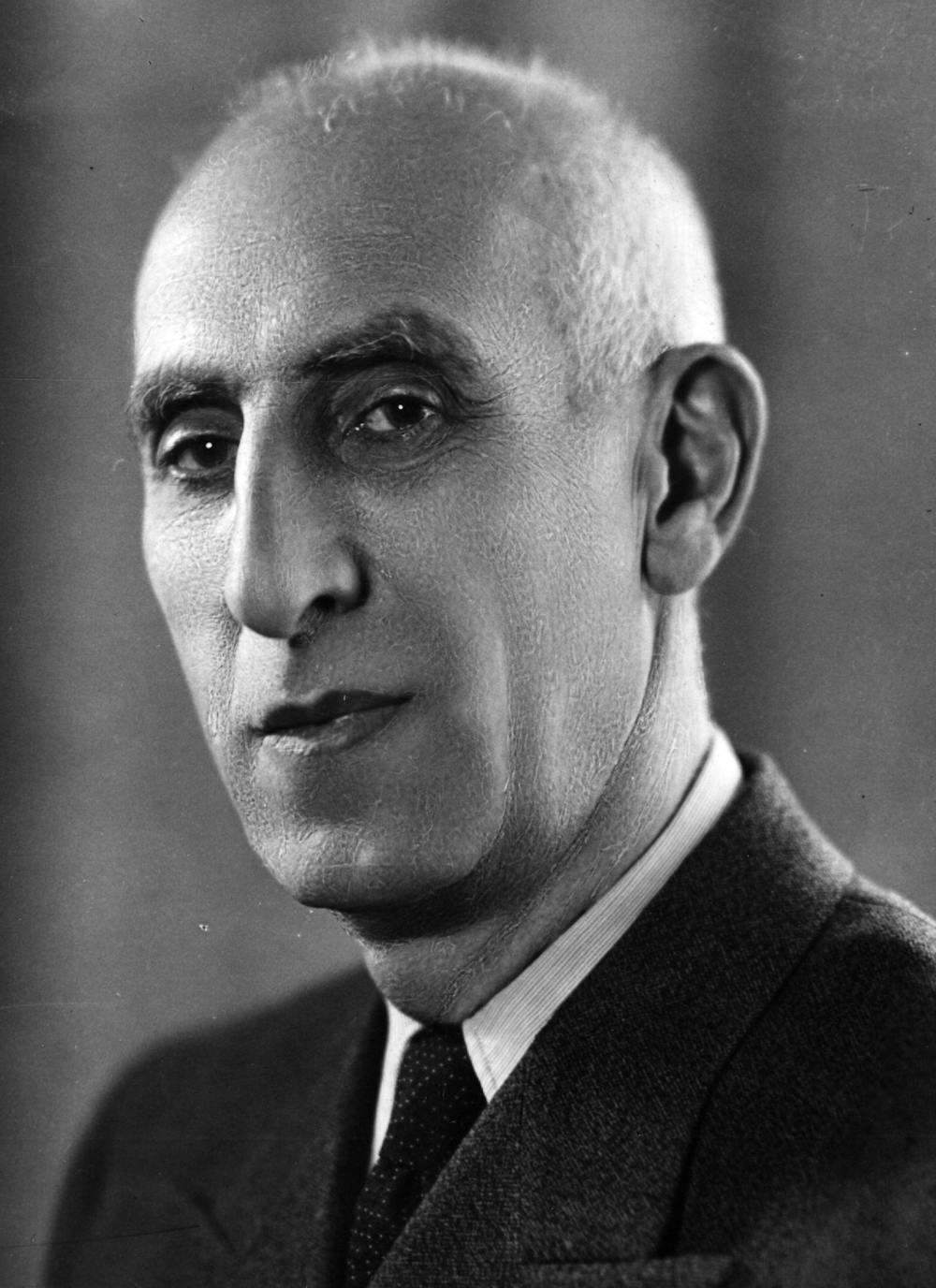
    Relations between the United States and Iran have been fraught for decades – at least since the U.S. helped overthrow a democracy-minded prime minister, Mohammed Mossadegh, in August 1953. The U.S. then supported the long, repressive reign of the Shah of Iran, whose security services brutalized Iranian citizens for decades.

    The two countries have been particularly hostile to each other since Iranian students took over the U.S. Embassy in Tehran in November 1979, resulting in economic sanctions and the severing of formal diplomatic relations between the nations.

    Since 1984, the U.S. State Department has listed Iran as a “state sponsor of terrorism,” alleging the Iranian government provides terrorists with training, money and weapons.

    Some of the major events in U.S.-Iran relations highlight the differences between the nations’ views, but others arguably presented real opportunities for reconciliation.

    1953: US overthrows Mossadegh

    Mohammed Mossadegh.
    Wikimedia Commons

    In 1951, the Iranian Parliament chose a new prime minister, Mossadegh, who then led lawmakers to vote in favor of taking over the Anglo-Iranian Oil Company, expelling the company’s British owners and saying they wanted to turn oil profits into investments in the Iranian people. The U.S. feared disruption in the global oil supply and worried about Iran falling prey to Soviet influence. The British feared the loss of cheap Iranian oil.

    President Dwight Eisenhower decided it was best for the U.S. and the U.K. to get rid of Mossadegh. Operation Ajax, a joint CIA-British operation, convinced the Shah of Iran, the country’s monarch, to dismiss Mossadegh and drive him from office by force. Mossadegh was replaced by a much more Western-friendly prime minister, handpicked by the CIA.

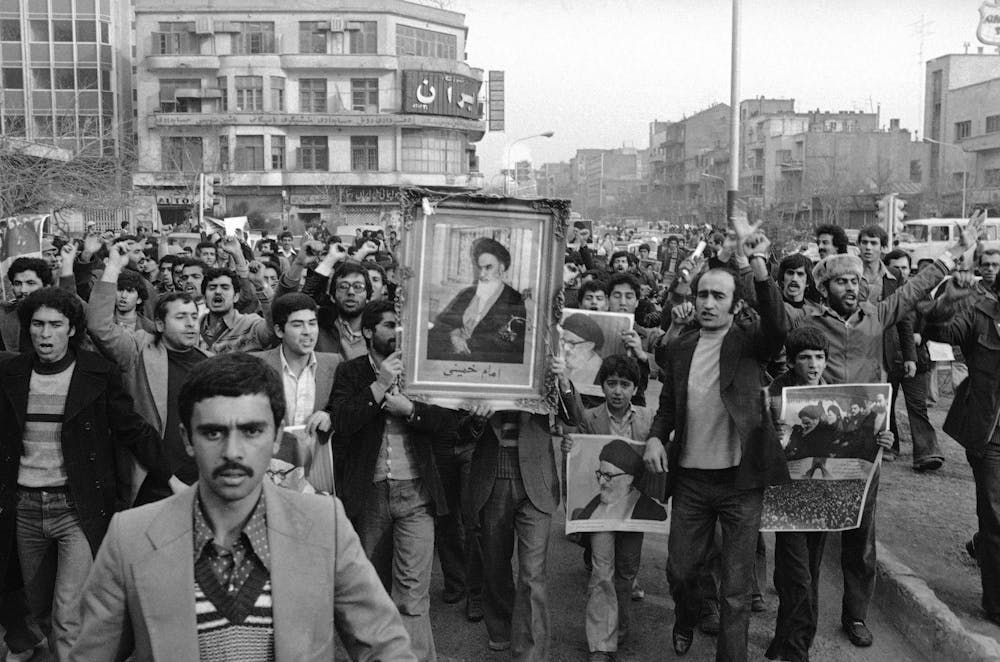
    Demonstrators in Tehran demand the establishment of an Islamic republic.
    AP Photo/Saris

    1979: Revolutionaries oust the shah, take hostages

    After more than 25 years of relative stability in U.S.-Iran relations, the Iranian public had grown unhappy with the social and economic conditions that developed under the dictatorial rule of Shah Mohammad Reza Pahlavi.

    Pahlavi enriched himself and used American aid to fund the military while many Iranians lived in poverty. Dissent was often violently quashed by SAVAK, the shah’s security service. In January 1979, the shah left Iran, ostensibly to seek cancer treatment. Two weeks later, Ayatollah Ruhollah Khomeini returned from exile in Iraq and led a drive to abolish the monarchy and proclaim an Islamic government.

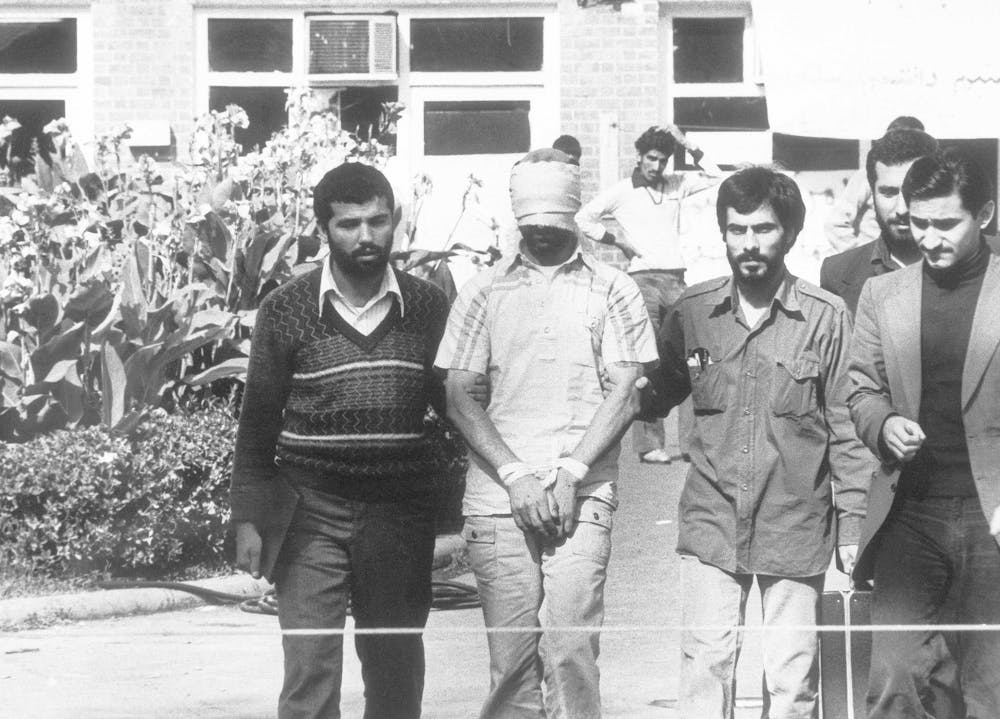
    Iranian students at the U.S. Embassy in Tehran show a blindfolded American hostage to the crowd in November 1979.
    AP Photo

    In October 1979, President Jimmy Carter agreed to allow the shah to come to the U.S. to seek advanced medical treatment. Outraged Iranian students stormed the U.S. Embassy in Tehran on Nov. 4, taking 52 Americans hostage. That convinced Carter to sever U.S. diplomatic relations with Iran on April 7, 1980.

    Two weeks later, the U.S. military launched a mission to rescue the hostages, but it failed, with aircraft crashes killing eight U.S. servicemembers.

    The shah died in Egypt in July 1980, but the hostages weren’t released until Jan. 20, 1981, after 444 days of captivity.

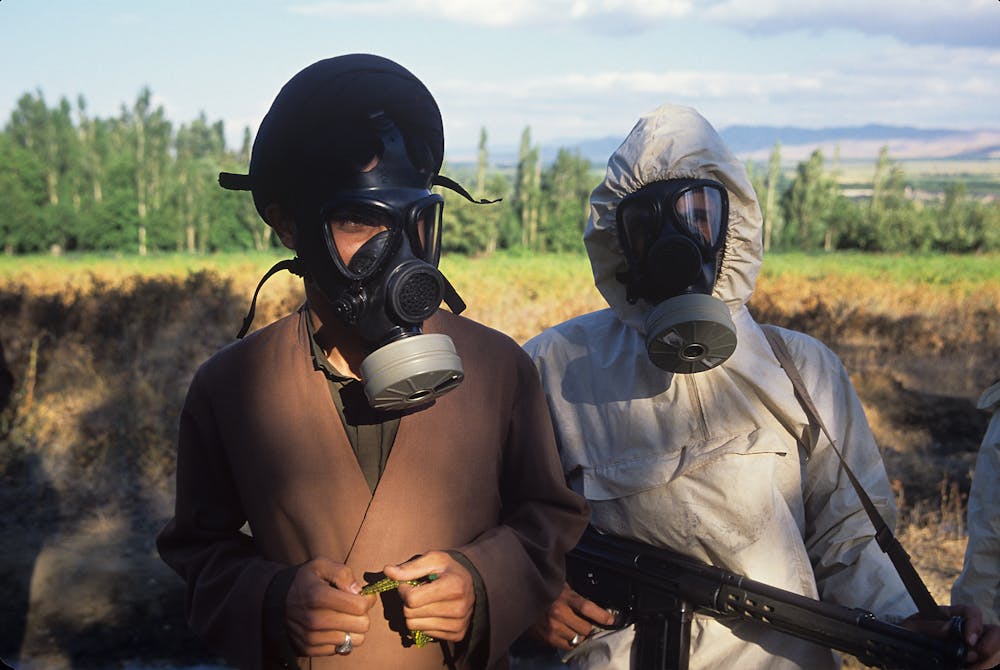
    An Iranian cleric, left, and an Iranian soldier wear gas masks to protect themselves against Iraqi chemical-weapons attacks in May 1988.
    Kaveh Kazemi/Getty Images

    1980-1988: US tacitly sides with Iraq

    In September 1980, Iraq invaded Iran, an escalation of the two countries’ regional rivalry and religious differences: Iraq was governed by Sunni Muslims but had a Shia Muslim majority population; Iran was led and populated mostly by Shiites.

    The U.S. was concerned that the conflict would limit the flow of Middle Eastern oil and wanted to ensure the conflict didn’t affect its close ally, Saudi Arabia.

    The U.S. supported Iraqi leader Saddam Hussein in his fight against the anti-American Iranian regime. As a result, the U.S. mostly turned a blind eye toward Iraq’s use of chemical weapons against Iran.

    U.S. officials moderated their usual opposition to those illegal and inhumane weapons because the U.S. State Department did not “wish to play into Iran’s hands by fueling its propaganda against Iraq.” In 1988, the war ended in a stalemate. More than 500,000 military and 100,000 civilians died.

    1981-1986: US secretly sells weapons to Iran

    The U.S. imposed an arms embargo after Iran was designated a state sponsor of terrorism in 1984. That left the Iranian military, in the middle of its war with Iraq, desperate for weapons and aircraft and vehicle parts to keep fighting.

    The Reagan administration decided that the embargo would likely push Iran to seek support from the Soviet Union, the U.S.’s Cold War rival. Rather than formally end the embargo, U.S. officials agreed to secretly sell weapons to Iran starting in 1981.

    The last shipment, of anti-tank missiles, was in October 1986. In November 1986, a Lebanese magazine exposed the deal. That revelation sparked the Iran-Contra scandal in the U.S., with Reagan’s officials found to have collected money from Iran for the weapons and illegally sent those funds to anti-socialist rebels – the Contras – in Nicaragua.

    At a mass funeral for 76 of the 290 people killed in the shootdown of Iran Air 655, mourners hold up a sign depicting the incident.
    AP Photo/CP/Mohammad Sayyad

    1988: US Navy shoots down Iran Air flight 655

    On the morning of July 8, 1988, the USS Vincennes, a guided missile cruiser patrolling in the international waters of the Persian Gulf, entered Iranian territorial waters while in a skirmish with Iranian gunboats.

    Either during or just after that exchange of gunfire, the Vincennes crew mistook a passing civilian Airbus passenger jet for an Iranian F-14 fighter. They shot it down, killing all 290 people aboard.

    The U.S. called it a “tragic and regrettable accident,” but Iran believed the plane’s downing was intentional. In 1996, the U.S. agreed to pay US$131.8 million in compensation to Iran.

    1997-1998: The US seeks contact

    In August 1997, a moderate reformer, Mohammad Khatami, won Iran’s presidential election.

    U.S. President Bill Clinton sensed an opportunity. He sent a message to Tehran through the Swiss ambassador there, proposing direct government-to-government talks.

    Shortly thereafter, in early January 1998, Khatami gave an interview to CNN in which he expressed “respect for the great American people,” denounced terrorism and recommended an “exchange of professors, writers, scholars, artists, journalists and tourists” between the United States and Iran.

    However, Supreme Leader Ayatollah Ali Khamenei didn’t agree, so not much came of the mutual overtures as Clinton’s time in office came to an end.

    In his 2002 State of the Union address, President George W. Bush characterized Iran, Iraq and North Korea as constituting an “Axis of Evil” supporting terrorism and pursuing weapons of mass destruction, straining relations even further.

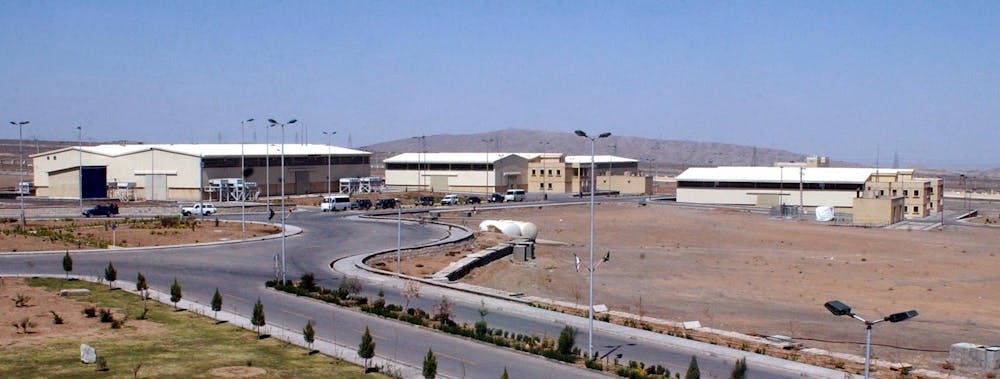
    Inside these buildings at the Natanz nuclear facility in Iran, technicians enrich uranium.
    AP Photo/Vahid Salemi

    2002: Iran’s nuclear program raises alarm

    In August 2002, an exiled rebel group announced that Iran had been secretly working on nuclear weapons at two installations that had not previously been publicly revealed.

    That was a violation of the terms of the Nuclear Nonproliferation Treaty, which Iran had signed, requiring countries to disclose their nuclear-related facilities to international inspectors.

    One of those formerly secret locations, Natanz, housed centrifuges for enriching uranium, which could be used in civilian nuclear reactors or enriched further for weapons.

    Starting in roughly 2005, U.S. and Israeli government cyberattackers together reportedly targeted the Natanz centrifuges with a custom-made piece of malicious software that became known as Stuxnet.

    That effort, which slowed down Iran’s nuclear program was one of many U.S. and international attempts – mostly unsuccessful – to curtail Iran’s progress toward building a nuclear bomb.

    2003: Iran writes to Bush administration

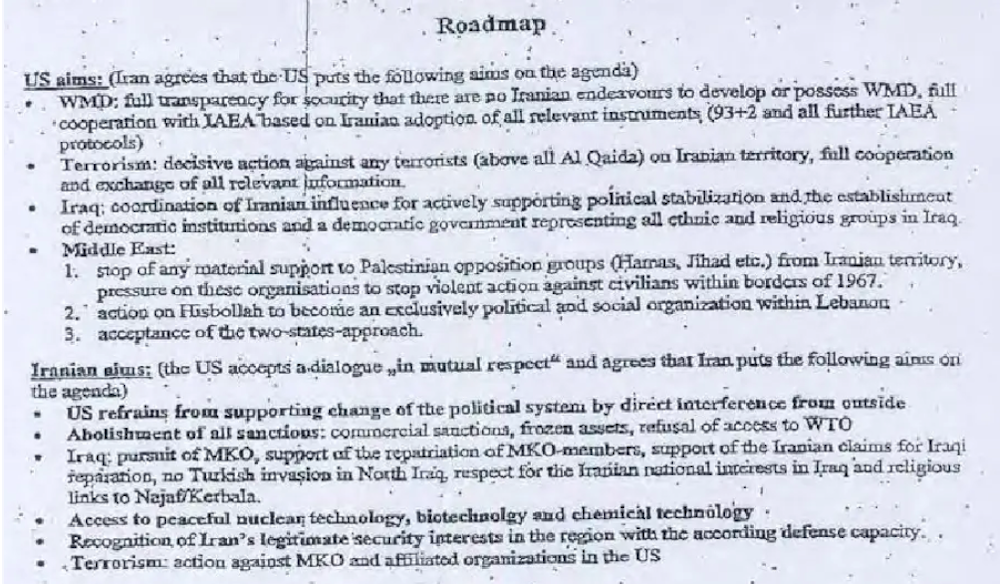
    An excerpt of the document sent from Iran, via the Swiss government, to the U.S. State Department in 2003, appears to seek talks between the U.S. and Iran.
    Washington Post via Scribd

    In May 2003, senior Iranian officials quietly contacted the State Department through the Swiss embassy in Iran, seeking “a dialogue ‘in mutual respect,’” addressing four big issues: nuclear weapons, terrorism, Palestinian resistance and stability in Iraq.

    Hardliners in the Bush administration weren’t interested in any major reconciliation, though Secretary of State Colin Powell favored dialogue and other officials had met with Iran about al-Qaida.

    When Iranian hardliner Mahmoud Ahmadinejad was elected president of Iran in 2005, the opportunity died. The following year, Ahmadinejad made his own overture to Washington in an 18-page letter to President Bush. The letter was widely dismissed; a senior State Department official told me in profane terms that it amounted to nothing.

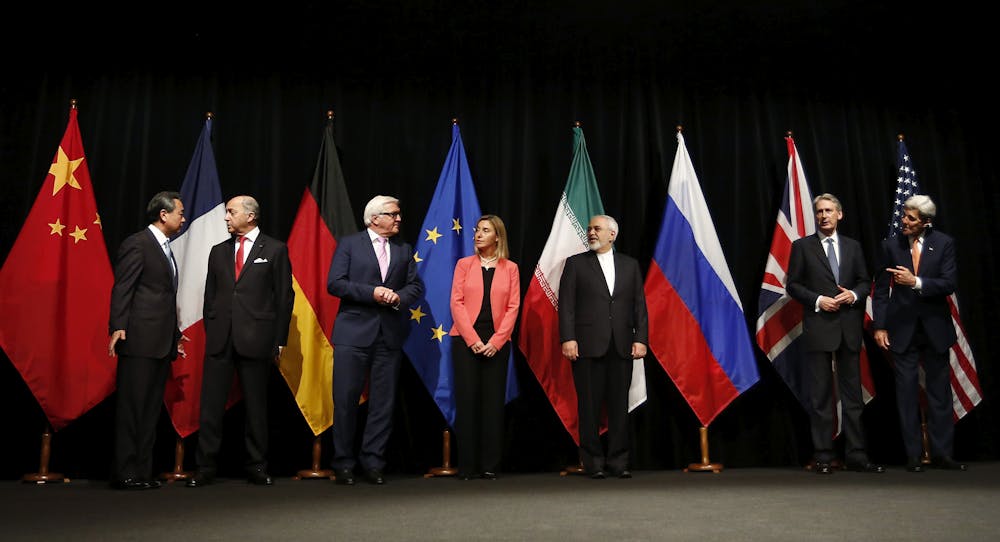
    Representatives of several nations met in Vienna in July 2015 to finalize the Iran nuclear deal.
    Austrian Federal Ministry for Europe, Integration and Foreign Affairs/Flickr

    2015: Iran nuclear deal signed

    After a decade of unsuccessful attempts to rein in Iran’s nuclear ambitions, the Obama administration undertook a direct diplomatic approach beginning in 2013.

    Two years of secret, direct negotiations initially bilaterally between the U.S. and Iran and later with other nuclear powers culminated in the Joint Comprehensive Plan of Action, often called the Iran nuclear deal.

    Two years of secret, direct negotiations conducted bilaterally at first between the U.S. and Iran and later with other nuclear powers culminated in the Joint Comprehensive Plan of Action, often called the Iran nuclear deal.

    Iran, the U.S., China, France, Germany, Russia and the United Kingdom signed the deal in 2015. It severely limited Iran’s capacity to enrich uranium and mandated that international inspectors monitor and enforce Iran’s compliance with the agreement.

    In return, Iran was granted relief from international and U.S. economic sanctions. Though the inspectors regularly certified that Iran was abiding by the agreement’s terms, President Donald Trump withdrew from the agreement in May 2018.

    2020: US drones kill Iranian Maj. Gen. Qassem Soleimani

    An official photo from the Iranian government shows Maj. Gen. Qassem Soleimani, who was killed in a Jan. 3 drone strike ordered by President Donald Trump.
    Iranian Supreme Leader Press Office/Anadolu Agency via Getty Images

    On Jan. 3, 2020, an American drone fired a missile that killed Maj. Gen. Qassem Soleimani, the leader of Iran’s elite Quds Force. Analysts considered Soleimani the second most powerful man in Iran, after Supreme Leader Ayatollah Khamenei.

    At the time, the Trump administration asserted that Soleimani was directing an imminent attack against U.S. assets in the region, but officials have not provided clear evidence to support that claim.

    Iran responded by launching ballistic missiles that hit two American bases in Iraq.

    2023: The Oct. 7 attacks on Israel

    Hamas’ brazen attack on Israel on Oct. 7, 2023, provoked a fearsome militarized response from Israel that continues today and served to severely weaken Iran’s proxies in the region, especially Hamas – the perpetrator of the attacks – and Hezbollah in Lebanon.

    2025: Trump 2.0 and Iran

    Trump saw an opportunity to forge a new nuclear deal with Iran and to pursue other business deals with Tehran. Once inaugurated for his second term, Trump appointed Steve Witkoff, a real estate investor who is the president’s friend, to serve as special envoy for the Middle East and to lead negotiations.

    Negotiations for a nuclear deal between Washington and Tehran began in April, but the countries did not reach a deal. They were planning a new round of talks when Israel struck Iran with a series of airstrikes on June 13, forcing the White House to reconsider is position.

    Jeffrey Fields receives funding from the Carnegie Corporation of New York and Schmidt Futures.

    ref. US and Iran have a long, complicated history, spanning far beyond Israel’s strikes on Tehran – https://theconversation.com/us-and-iran-have-a-long-complicated-history-spanning-far-beyond-israels-strikes-on-tehran-259240

    MIL OSI – Global Reports

  • MIL-OSI Russia: The TV series “Xi Jinping’s Favorite Classical Quotes” is being broadcast on major media platforms in five Central Asian countries.

    Translation. Region: Russian Federal

    Source: People’s Republic of China in Russian – People’s Republic of China in Russian –

    Source: People’s Republic of China – State Council News

    On June 16, the broadcast of the TV series “Catchphrases from the Classics, Favorite by Xi Jinping” (international version) was launched in five Central Asian countries. In this regard, the President of Kazakhstan Kassym-Jomart Tokayev expressed his warm congratulations.

    Launched by China Media Group (CMG), the TV series “Xi Jinping’s Favorite Classical Quotes” (International Edition) carefully selects quotations from Chinese classical poetry and prose masterpieces used by Chinese President Xi Jinping in important speeches, articles and talks. They focus on themes of open cooperation, technological development, environmental protection and cultural innovation. With an international approach and vivid storytelling, the TV project explains to Central Asian audiences the deep historical and cultural roots of the Chinese leader’s ideas on governance, and also showcases the diversity of China’s modernization.

    MIL OSI Russia News

  • MIL-OSI Russia: Filming of the documentary film “History of Time” has begun

    Translation. Region: Russian Federal

    Source: People’s Republic of China in Russian – People’s Republic of China in Russian –

    Source: People’s Republic of China – State Council News

    On June 6, a ceremony was held in Lhasa to launch the filming of the documentary film “The Story of Time,” dedicated to the 60th anniversary of the founding of the Xizang Autonomous Region.

    Pictured: Title page of the script for the documentary film “The History of Time”

    The documentary, using the “road trip plus memory lane” narrative method, follows the footsteps of 70-year-old Tsering Lhamo from Chamdo to Lhasa. With a professional eye and dynamic film language, the film vividly shows how the remote rural areas of the past have been transformed into vibrant new settlements; how ancient Lhasa, weaving together historical heritage and modern energy, has shone with a new, never-before-seen noble light.

    MIL OSI Russia News

  • MIL-OSI Russia: China and Central Asian countries reaffirm support for each other’s independence and sovereignty

    Translation. Region: Russian Federal

    Source: People’s Republic of China in Russian – People’s Republic of China in Russian –

    Source: People’s Republic of China – State Council News

    Astana, June 18 (Xinhua) — China and five Central Asian countries on Tuesday reaffirmed their firm support for each other’s independence, sovereignty and territorial integrity, as well as the principles of sovereign equality and the inviolability of borders, according to the Treaty of Eternal Good-Neighborliness, Friendship and Cooperation signed by China, Kazakhstan, Kyrgyzstan, Tajikistan, Turkmenistan and Uzbekistan.

    According to the document, the six countries also reaffirmed their determination to jointly build a closer China-Central Asia community with a shared future.

    All parties stressed that they would not use force or threaten to use it and would resolve disputes peacefully. States committed to supporting each other’s development paths and models chosen in accordance with national conditions and to supporting each other’s positions on issues of fundamental interest.

    The parties must not enter into any alliances or groups directed against the other parties and must not support any actions hostile to the other parties, the agreement says.

    All parties expressed their willingness to cooperate in the areas of trade, economy, investment, infrastructure connectivity, engineering and technology, energy (including hydro and renewable energy), transport, mineral resources, agriculture, ecology and environmental protection, processing industry, science and technology, as well as other areas of mutual interest, on the basis of equality and mutual benefit.

    The states also agreed to cooperate within the framework of bilateral and multilateral mechanisms to jointly combat terrorism, separatism, extremism and transnational organized crime. –0–

    MIL OSI Russia News

  • MIL-OSI Russia: Lu Ban’s Workshops Become a Source of New Forces for Cooperation between China and Central Asia

    Translation. Region: Russian Federal

    Source: People’s Republic of China in Russian – People’s Republic of China in Russian –

    Source: People’s Republic of China – State Council News

    “Lu Ban Workshop” is a Chinese brand of international cooperation in vocational education, which has now become an important platform for technology transfer and talent training in the joint construction of the “Belt and Road”. In November 2022, the first “Lu Ban Workshop” in Central Asia was launched in Tajikistan. Over the next year, Lu Ban Workshops were launched in Kazakhstan, Kyrgyzstan and other countries. This project not only opened up opportunities for Central Asian youth, but also built a bridge of understanding between the people of China and the Central Asian region.

    Lu Ban’s workshops, opened in several Central Asian countries, have achieved good results and reflect three main features of practical cooperation between China and the region. First, it is demand-driven, when all specialties are selected taking into account the actual needs of the industries of Central Asian countries. Second, it is technology adaptation, that is, an organic combination of China’s advanced technologies in infrastructure construction, new energy sources, etc., with local resources and development conditions. Third, it is sustainability, when, based on the medium- and long-term development strategies of countries, not only the current problem of shortage of qualified personnel is solved, but also special attention is paid to the development of the ability for independent economic development. China has always promoted cooperation with Central Asian countries in the field of vocational education on the basis of equality and win-win cooperation, which reflects the Chinese concept of “benevolence, sincerity, mutual benefit and inclusiveness” towards neighboring countries.

    In the long term, Lu Ban Workshops will continue to play the role of a technology incubator and talent reservoir, providing a steady impetus to long-term cooperation between China and Central Asian countries. As generations of local talents grow and individual joint projects steadily advance, Lu Ban Workshops will become a source of new energy for cooperation between China and Central Asia, laying a solid foundation for building a closer community of shared destiny between China and the region.

    Author: Yang Jin, Deputy Director of the Central Asia and Caucasus Department, Institute of Russian, East European and Central Asian Studies, Chinese Academy of Social Sciences

    MIL OSI Russia News

  • MIL-OSI China: Alcaraz survives late scare in Queen’s Club opener

    Source: People’s Republic of China – State Council News

    Top two seeds Carlos Alcaraz and Jack Draper both advanced to the second round of the men’s singles at the Queen’s Club Championships on Tuesday.

    Spain’s Alcaraz arrived in London fresh off his second consecutive French Open title. The world No. 2 overcame a late challenge from lucky loser Alex Walton to win his first grass-court match of the season 6-4, 7-6(7).

    Alcaraz had initially been scheduled to face fellow Spaniard Alejandro Davidovich Fokina in the opening round, but the world No. 28 withdrew just hours before the match due to illness following his recent wedding.

    “I didn’t know his game, which shot is his best,” Alcaraz talked about his opponent Walton from Australia. “What I tried is not to think about him but myself. I tried to play as good as I can and that’s all.”

    Earlier, Draper thrilled the home crowd at Andy Murray Arena with a commanding 6-3, 6-1 victory over American Jenson Brooksby.

    “I feel good. I feel confident. I feel relaxed. Like I said on court, I’m happy to be home. I’m happy to be playing in front of home crowd,” said the 23-year-old British No. 1.

    Draper will next face Australian Alexei Popyrin, while Alcaraz is set to play compatriot Jaume Munar.

    MIL OSI China News

  • MIL-OSI China: Fluminense begin Club World Cup with goalless draw against Dortmund

    Source: People’s Republic of China – State Council News

    Fluminense and Borussia Dortmund drew their opening Group F match in the FIFA Club World Cup 0-0 in the MetLife Stadium in New Jersey.

    Brazilian side Fluminense had the better of the game, but a good performance from Borussia goalkeeper Gregor Kobel and some solid defending limited the clear chances they were able to create.

    The game was just two minutes old when Borussia defender Ramy Bensebaini saw the first yellow card and a minute later Fluminense striker Jhon Arias fired over after a swift exchange of passes.

    Fluminense had the best of the opening exchanges with Rene firing well over from a decent position as the Brazilian side looked sharper than a Borussia side that had not played a competitive game for a month.

    Karim Adeyemi created a decent chance for the Germans as he found space on the left and drilled a pass across the face of goal, with Serhou Guirassy colliding with Fluminense goalkeeper Fabio, as he stretched for the ball.

    Nonato and Arias (again) fired just wide from outside of the penalty area as Fluminense continued to threaten and yet another Arias shot needed to be pushed wide by Kobel.

    Borussia tried to keep hold of the ball at the start of the second half, but continued to struggle against the energy of a rival that was able to frustrate attempts to play out from defense, with Hercules going close before Kobel stayed down after a collision.

    The goalkeeper was able to continue after several minutes of treatment, with his side looking to interrupt Fluminense’s rhythm with a series of niggling fouls.

    Agustin Canobbio was guilty of a weak finish when he should have scored, before Everaldo and Nonato produced a double save from Kobel.

    Meanwhile, Jobe Bellingham made his Borussia debut as the German side continued striving to get some control, although the German side’s best players continued to be central defenders Niklas Sule and Waldemar Anton, with Sule almost winning the game at the end for Borussia with a shot from distance following a corner.

    MIL OSI China News

  • MIL-OSI USA: Tillis, Coons Announce New Bipartisan Support for Legislation to Restore American Innovation

    US Senate News:

    Source: United States Senator for North Carolina Thom Tillis
    WASHINGTON, D.C. – Today, Senators Thom Tillis (R-NC) and Chris Coons (D-DE) announced that Senators Marsha Blackburn (R-TN) and Mazie Hirono (D-HI) have joined the Patent Eligibility Restoration Act (PERA) as cosponsors. This bipartisan, bicameral legislation will restore patent eligibility to important inventions across many fields while also resolving legitimate concerns over the patenting of mere ideas, the mere discovery of what already exists in nature, and social and cultural content that everyone agrees is beyond the scope of the patent system. It also affirms the basic principle that the patent system is central to promoting technology-based innovation.
    “In recent years the Supreme Court has expanded judicial exceptions to such a degree that patent eligibility has gone from being a coarse filter to a fine one – resulting in U.S. inventors being unable to obtain patents in areas where our economic peers offer protections, such as for diagnostic medicine and for artificial intelligence,” said Senator Tillis. “Patent eligibility is but one of four criteria that determines whether a patent application can be issued as a patent. PERA will expand the aperture of patent eligibility – it does not automatically render something patentable – and will ensure that the U.S. does not shut the door to innovations that is welcomed by the patent systems of our economic peers. We cannot allow the U.S. to fall behind on the global stage and I’m glad to see more of my Senate colleagues recognize this pressing need.” 
    “When American innovators know their ideas are eligible for patent protection, they take the risks that push us into the future – whether that’s the next groundbreaking medical test or the latest AI technology,” said Senator Coons. “PERA restores clarity to the law on what can be patented and what cannot – guidance that federal courts have been requesting for years and that the Supreme Court has refused to provide. I’m excited to welcome my colleagues from both sides of the aisle to this bill. This is another step toward providing America’s inventors with the stable legal foundation they need to produce the cutting-edge technologies that power our economy.”
    “Our patent system must fuel innovation and secure America’s competitive edge over adversaries like Communist China,” said Senator Blackburn. “The bipartisan Patent Eligibility Restoration Act would restore patent eligibility for important inventions across many critical fields to ensure America remains ahead of the curve when it comes to technological innovation.”
    “A series of Supreme Court decisions restricting patent eligibility have constricted American innovation,” said Senator Hirono. “The Patent Eligibility Restoration Act will help clarify patent eligibility law, encouraging technological innovation to help ensure that our country does not fall behind on innovation. Importantly, this legislation only affects patent eligibility, it does nothing to affect the many other requirements for patentability.”
    Background:
    Unfortunately, due to a series of Supreme Court decisions, patent eligibility law in the United States has become confused, constricted, and unclear in recent years. This has resulted in a wide range of well-documented negative impacts – inconsistent case decisions, uncertainty in innovation and investment communities, and unpredictable business outcomes.
    As of 2021, all 12 then-sitting judges of the United States Court of Appeals for the Federal Circuit lamented the state of the law. Witnesses and stakeholders from a wide array of industries, fields, interest groups, and academia have testified and submitted comments confirming the uncertainty and detailing the detrimental effects of patent eligibility confusion in the United States. There is now widespread bipartisan agreement in Congress and across all recent Administrations that reforms are necessary to restore the United States to a position of global strength and leadership in key areas of technology and innovation, such as medical diagnostics, biotechnology, personalized medicine, artificial intelligence, 5G, and blockchain. 
    The Patent Eligibility Restoration Act achieves this critical goal by restoring patent eligibility to important inventions across many fields, while also resolving legitimate concerns over patenting of mere ideas, the mere discovery of what already exists in nature, and social and cultural content that everyone agrees is beyond the scope of the patent system, which is a system aimed at promoting technology-based innovation. As a general approach, the Patent Eligibility Restoration Act maintains the existing statutory categories of eligible subject matter, which have worked well for over two centuries, but eliminates the overly malleable set of current judicial exceptions – replacing them with five specific, defined statutory exclusions. By eliminating and replacing the current judicial exceptions, the Patent Eligibility Restoration Act provides predictable patent eligibility for important computer-implemented technological developments and medical advances, creating a solid bedrock for America’s innovation future.
    Full text of the bill is available HERE. 

    MIL OSI USA News

  • MIL-OSI China: Terracotta Warriors take center stage in new XR experience

    Source: People’s Republic of China – State Council News

    A new extended reality (XR) experience based on the Terracotta Warriors, titled “The Empire Code: Terracotta Warriors – Secrets of the First Emperor’s Mausoleum,” was unveiled on June 14 at the 27th Shanghai International Film Festival (SIFF).

    Wang Yuan, general producer and chairwoman of Xi’an Hongwen Digital Technology Co., introduces “The Empire Code” at the opening of the XR section during the 27th Shanghai International Film Festival, June 14, 2025. [Photo courtesy of Xi’an Hongwen Digital Technology]

    “The Empire Code,” the first XR project officially authorized by Emperor Qinshihuang’s Mausoleum Site Museum, draws on the famous Terracotta Warrior pits and other archaeological discoveries from the UNESCO World Heritage site in Xi’an, Shaanxi province. The interactive underground tomb experience is designed to set a new standard for presenting Chinese civilization in the digital age.

    The project was unveiled at the launch of the festival’s SIFF XR section. Wang Yuan, general producer and chairwoman of Xi’an Hongwen Digital Technology, a joint venture between Shaanxi Culture Industry Investment Group and HTC, said the team was not using technology to resurrect cultural relics, but to allow them to “open history’s door through technology.”

    “Virtual reality serves as a radiant bridge across time, connecting ancient wisdom, eternal art and future imagination,” she added.

    A poster for “The Empire Code: Terracotta Warriors – Secrets of the First Emperor’s Mausoleum.” [Image courtesy of Xi’an Hongwen Digital Technology]

    Along with a trailer and poster launched in Shanghai, audiences can preview a five-minute immersive experience during the festival. The full version is set to open this summer in Beijing and Xi’an.

    The project will also be presented at the festival’s International Film & TV Market, where organizers aim to showcase China’s digital cultural solutions and technological expertise to a global audience.

    “The Empire Code” brings together specialists in archaeology, filmmaking and virtual reality. Historical accuracy is overseen by Zhang Weixing, a researcher at Northwest University’s Collaborative Research Center for Archaeology of the Silk Roads and former head of Emperor Qinshihuang’s Mausoleum Site excavation team. Acclaimed director Jin Tiemu crafts the narrative, while production designer Huo Tingxiao recreates authentic Qin dynasty visuals. The project also draws on technical expertise from HTC Vive Arts, which has partnered with more than 70 museums worldwide, and Wevr, known for its work in 3D and game development.

    A man experiences a preview of “The Empire Code” during the 27th Shanghai International Film Festival on June 14, 2025. [Photo courtesy of SIFF Organizing Committee]

    The project uses XR technology such as 5K ultra-high-definition rendering, six degrees of freedom motion tracking and gesture controls to create an immersive experience aimed at minimizing motion sickness.

    Producers say the cross-disciplinary effort combines cultural, artistic and technological elements, providing an interactive way to share China’s history while maintaining cultural authenticity.

    “The Empire Code” was announced alongside several upcoming projects at SIFF XR, including virtual reality adaptations of China’s animated blockbuster “Chang An,” Jules Verne’s “Journey to the Center of the Earth” and the historical VR film “Creation of the Gods Prequel: A Female General in Shang Dynasty’s Golden Age.”

    Other highlights include the sci-fi VR experience “The Devourer,” based on renowned writer Liu Cixin’s short story in which players defend Earth from aliens, and the location-based mixed reality piece “A Tapestry of a Legendary Land,” adapted from the popular dance drama that immerses audiences in Song dynasty artistry.

    The opening of the XR section at the 27th Shanghai International Film Festival, June 14, 2025. [Photo courtesy of Xi’an Hongwen Digital Technology]

    SIFF XR, a collaboration between the 27th SIFF and the Putuo Culture and Tourism Bureau, ran from June 14 to 16. The event showcased 16 domestic and international feature films, including several global and Asian premieres. 

    Highlights included “Mnemosyne,” inspired by the classical Chinese opera “The Peony Pavilion,” and “Golog Unbounded,” which explores the natural landscapes of Qinghai province. Attendees could also explore the anime universe of “Gundam” and experience narrative-driven works such as “Nana Lou” and “Jack & Flo.”

    By combining film, gaming, performance and tourism, SIFF XR offered immersive experiences that blurred the line between cinema and reality.

    MIL OSI China News

  • MIL-OSI China: China’s foreign exchange market reports steady operations in May

    Source: People’s Republic of China – State Council News

    China’s foreign exchange market saw stable operations in May, with a net inflow of cross-border capital, the State Administration of Foreign Exchange said on Tuesday.

    Last month, China’s non-banking sectors, including enterprises and individuals, recorded a net cross-border capital inflow of 33 billion U.S. dollars, according to data released by the administration.

    The country’s net inflow of cross-border capital from the trade of goods remained at a high level, while foreign investors increased their holdings of domestic stocks compared to the previous month, said Li Bin, deputy head of the administration.

    Net capital outflows related to areas such as the trade of services and outbound direct investment remained generally stable, Li said.

    In May, foreign exchange purchases completed by banks totaled 192.7 billion U.S. dollars, while sales totaled 181.4 billion U.S. dollars.

    Market expectations remained stable, with banks registering a foreign exchange settlement surplus, Li said.

    China’s economy is performing steadily and exhibiting growth momentum, which will continue to provide solid support for the sound operations of the foreign exchange market, Li said. 

    MIL OSI China News

  • MIL-OSI China: More US exhibitors to take part in 3rd supply chain expo

    Source: People’s Republic of China – State Council News

    An increasing number of exhibitors from the United States will participate in the third China International Supply Chain Expo (CISCE) this July, signaling their confidence in the Chinese economy despite anti-globalization headwinds, the event organizer said Tuesday.

    The number of U.S. exhibitors is expected to increase by 15 percent compared with the previous edition, and 60 percent of them are Global Fortune 500 companies, said Yu Jianlong, vice president of the China Council for the Promotion of International Trade (CCPIT), at a press conference.

    U.S. tech giant Nvidia is expected to make its debut at the expo. During his visit to Beijing in April, Nvidia CEO Jensen Huang met with CCPIT chairman Ren Hongbin and emphasized that China is a very important market for Nvidia, expressing the company’s willingness to continue cooperation with China.

    Overseas participants at the upcoming expo are estimated to account for 35 percent of the total of 650 exhibitors from 75 countries, regions and international organizations, with half of the overseas participants coming from Europe and the United States, according to Yu.

    “Against the backdrop of a complex international situation and anti-globalization headwinds, the gathering of so many friends from all over the world, especially those from the global business community, is a vote of confidence in the expo and also in China’s economic development,” Yu said.

    The third CISCE will take place in Beijing from July 16 to 20, with Thailand as the guest country of honor.

    As the world’s first national-level exhibition focusing on supply chains, the expo is an internationally shared public product. First held in 2023, the expo has contributed to building more secure, stable, open and inclusive global industrial and supply chains, according to the CCPIT.

    Last year, U.S. companies made a strong presence at the second edition of the expo in Beijing, with well-known American firms such as Apple and Tesla seeking to further tap into China’s vast market.

    The upcoming expo will feature a new exhibition area dedicated to the innovation chain, aimed at promoting the commercialization of lab-developed technologies and fostering seamless integration between the innovation and industrial chains, the CCPIT said. 

    MIL OSI China News

  • MIL-OSI China: Britain, US sign partial trade deal as key issues remain unresolved

    Source: People’s Republic of China – State Council News

    A worker cleans Land Rover cars at a Jaguar Land Rover dealership in Reading Britain on June 24, 2020. [Photo/Xinhua]

    Britain and the United States have formally signed a partial bilateral trade agreement during the G7 summit in Canada, according to a press release issued by the UK government on Tuesday.

    The agreement, first announced in May, includes tariff reductions on British car and aerospace exports, but several key sectors, notably steel, aluminium and pharmaceuticals, remain unresolved.

    The deal came into effect after U.S. President Donald Trump signed an executive order to implement it. British Prime Minister Keir Starmer, who met with Trump at the summit, confirmed that the core tariff reduction measures would take effect “immediately.”

    Under the agreement, the U.S. will reduce tariffs on up to 100,000 British-made cars per year from 27.5 percent to 10 percent. It also removes the 10 percent U.S. tariff on British aerospace products, including jet engines and aircraft components, a measure expected to take effect by the end of the month.

    Britain has also agreed to a quota of 1.4 billion litres of tariff-free U.S. bioethanol imports, a volume roughly equivalent to the country’s total annual domestic demand. In return, the U.S. has committed to allowing limited British beef exports.

    The British government said all American agricultural imports would still need to meet Britain’s food safety and animal welfare standards. However, British bioethanol producers and farming groups have expressed concern that the influx of U.S. products could undercut local industries.

    Despite these developments, large parts of the agreement remain incomplete. According to reports by the Financial Times, both sides are still in negotiations over steel and aluminium tariffs.

    Although Britain currently benefits from an exemption to the new 50 percent global steel duty announced by Trump, it continues to face a 25 percent tariff.

    British officials said that final arrangements have been delayed due to “technical and legal” challenges, including U.S. rules requiring that steel must be “melted and poured” in its country of origin. Much of Britain’s steel is processed from imported material and may not qualify under that definition.

    People walk past a Boots store in Manchester, Britain, on July 9, 2020. [Photo/Xinhua] 

    Pharmaceuticals represent another unresolved area. While the British government says both sides aim to secure “significantly preferential outcomes” for the British pharmaceutical industry, no binding provisions have been announced.

    According to British media, Starmer has appointed his senior business adviser Varun Chandra to lead a delegation to Washington this week. The team, which includes embassy trade officials, is expected to focus on finalising the remaining elements of the agreement.

    Industry analysts and trade experts have pointed out that the deal is limited in scope and relies on executive action rather than formal legislation. This raises questions about the long-term stability of the agreement, particularly if there is a change in U.S. leadership. 

    MIL OSI China News

  • MIL-OSI China: US retail sales drop, miss expectations amid tariff fears

    Source: People’s Republic of China – State Council News

    U.S. retail sales declined sharply in May, missing analysts’ expectations, amid concerns that President Donald Trump’s tariffs could damage the economy, according to data released on Tuesday by the U.S. Department of Commerce (DOC).

    Retail sales fell 0.9 percent, exceeding the 0.6 percent drop that economists had forecast.

    The decline reflected growing worries that the Trump administration’s sweeping tariffs might slow down consumer activity.

    One major factor in the decline was a drop in auto sales. Many consumers made large purchases earlier in anticipation of tariff announcements, avoiding car dealerships in May.

    In addition to auto sales, building materials and garden supply stores saw a 2.7 percent decline. Lower energy prices led to a 2 percent drop in revenue at gas stations. Sales at food and beverage stores were down 0.7 percent, including a 0.8 percent decline at grocery stores. Health and personal care store sales edged down 0.1 percent.

    “Today’s data suggests consumers are downshifting,” Ellen Zentner, chief economic strategist at Morgan Stanley Wealth Management, told reporters.

    Following the report, U.S. stock futures remained in negative territory, and Treasury yields also fell. 

    MIL OSI China News

  • MIL-OSI China: Mbappe a doubt for Real’s Club World Cup opener

    Source: People’s Republic of China – State Council News

    Expectations are high ahead of Real Madrid’s debut at the 2025 FIFA Club World Cup, as they face Al Hilal at Hard Rock Stadium in Miami on Wednesday.

    The match marks Xabi Alonso’s first official game as Real Madrid head coach. Although the former Madrid midfielder and ex-Bayer Leverkusen boss has had just over a week with the squad, all eyes will be on what early changes he has implemented.

    Kylian Mbappe (R) of Real Madrid vies with Josko Gvardiol of Manchester City during the UEFA Champions League knockout phase play-off second leg football match between Real Madrid and Manchester City in Madrid, Spain, on Feb. 19, 2025. (Photo by Gustavo Valiente/Xinhua)

    Under former coach Carlo Ancelotti, Real Madrid covered among the least distance on the pitch and rarely applied a high press, instead relying on the pace of Kylian Mbappe, Vinicius Jr. and Rodrygo to hit on the break.

    Alonso favored a high-pressing style at Leverkusen, with his players disrupting opponents’ buildup from the back. Whether he can instill that mentality in Madrid after only a few sessions, particularly in Miami’s heat, remains to be seen.

    At Leverkusen, Alonso frequently deployed a back three with attacking full-backs. It is unclear if he will adopt a similar system with Madrid.

    The arrival of Trent Alexander-Arnold from Liverpool supports the use of wing-backs, and the England international appears poised to make his Real Madrid debut, along with Dean Huijsen, who signed from Bournemouth.

    Huijsen impressed during the recent international break. His height and composure on the ball offer Madrid added flexibility, and it’s easy to envision Mbappe and Vinicius exploiting gaps behind Al Hilal’s defense as Huijsen delivers long passes from deep.

    Vinicius remains under scrutiny following a disappointing domestic campaign, while Alonso must also finalize his central midfield pairing, likely Fede Valverde and possibly Dani Ceballos.

    Al Hilal’s lineup features several players familiar to Spanish fans, including former Barcelona and Manchester City defender Joao Cancelo, forward Malcom, and former Atletico Madrid left-back Renan Lodi.

    With a sell-out crowd expected, the match promises to provide a strong benchmark of the Saudi League’s level against one of Europe’s top clubs.

    MIL OSI China News

  • MIL-OSI China: Brighton sign Italy and Verona defender Coppola

    Source: People’s Republic of China – State Council News

    Premier League club Brighton and Hove Albion has signed Italian international central defender Diego Coppola from Hellas Verona for an undisclosed fee.

    Lautaro Martinez (R) of FC Inter vies with Diego Coppola of Hellas Verona during the Serie A 19th round football match between FC Inter and Hellas Verona in Milan, Italy, Jan. 6, 2024. (Photo by Alberto Lingria/Xinhua)

    Coppola has agreed a five-year contract with ‘the Seagulls’ and will help cover for the loss of Spain international Dean Huijsen, who signed for Madrid earlier in the summer for 50 million pounds (68 million U.S. dollars).

    Coppola, who is currently with the Italian U-21 side at the European Championships in Slovakia, made his debut for Hellas Verona in 2021 and made 81 first team appearances for the club.

    “Diego is an exciting addition for the club. Although he is still young, he is tall, strong and mobile, and he will give us a real physical presence,” commented Brighton head coach Fabian Hurzeler on the club website.

    Hurzeler highlighted the “impressive progress” the defender has made, adding he “deserved his call-up to the Italian national team.”

    Coppola is Brighton’s second signing of the summer, with striker Charalampos Kostoulas also arriving from Greek outfit Olympiakos. 

    MIL OSI China News