Category: China

  • MIL-OSI Global: Ukraine’s path to peace appears to be rapidly disappearing

    Source: The Conversation – UK – By Jonathan Este, Senior International Affairs Editor, Associate Editor

    It’s getting hard to figure out who all the US-sponsored talks over ending the conflict in Ukraine are supposed to benefit. Listening to Donald Trump over recent weeks, you could be forgiven for thinking it’s all about him.

    In the past 48 hours, the US president has berated both the Ukrainian president, Volodymr Zelensky, and Russia’s Vladimir Putin for apparently dragging their heels over an agreement.

    At present it’s Putin who is on the naughty step (although as we know this can change quite rapidly). After Russia launched strikes against Kyiv overnight on Wednesday, killing eight people and injuring dozens more, Trump used his TruthSocial platform to give the Russian president a piece of his mind.


    TruthSocial

    But hours previously, the US president had been giving Zelensky both barrels after he rejected a peace proposal that included the US recognising Crimea as part of Russia. Trump wrote: “It’s inflammatory statements like Zelenskyy’s that makes it so difficult to settle this War. He has nothing to boast about! The situation for Ukraine is dire — He can have Peace or, he can fight for another three years before losing the whole Country.”

    For the past week or so, US officials, including the president and his secretary of state, Marco Rubio, have been warning that if a deal isn’t done “in a matter of days” they could just decide to walk away.


    Sign up to receive our weekly World Affairs Briefing newsletter from The Conversation UK. Every Thursday we’ll bring you expert analysis of the big stories in international relations.


    It’s hard to see how there is a credible pathway to peace at the moment, write Stefan Wolff and Tetyana Malyarenko, international security experts at the University of Birmingham and the National University Odesa Law Academy, respectively. They point out that even if all sides can agree to a formula for a ceasefire (remembering that Russia couldn’t even hold to the agreed truce over the Easter holiday) then a lasting peace deal that is supposed to follow is even more difficult to imagine.

    And, as the abortive attempts to end the war drag on and Russia’s attritional tactics continue, at a massive cost – both economically and in human lives – there are signs that western resolve and unity is coming under pressure. Partly it’s because many of Ukraine’s allies, particularly in Europe, are already scrambling to work out how they might adjust their own security arrangements in the eventuality of a new world order developing, dominated by the US, China and Russia, in which Washington’s friends find themselves on the outside.

    Then there’s the inescapable question of whether Putin can be trusted to hold to any deal he strikes, given the likelihood of the US president’s attention wandering once he has been able to boast of brokering an “end” to the war. As Wolff and Malyarenko put it: “Given Russia’s track record of reneging on the Minsk ceasefire agreements of September 2014 and February 2015, investing everything in a ceasefire deal might turn out not just a self-fulfilling but a self-defeating prophecy for Ukraine and its supporters.”


    Read more:
    Ukraine war: path to peace looks increasingly narrow as Kyiv’s western backers scramble to focus on their own interests


    As Trump 2.0 nears the 100-day mark (more of which next week), it’s worth pausing to ask what the American public thinks about the war in Ukraine. Paul Whiteley of the University of Essex has been looking at polling on the issue over the past six months or so and concludes that the US president looks out of step with the people when it comes to what Whiteley construes as Trump’s apparently Russia-friendly approach. Whiteley quotes a recent Economist/YouGov poll which finds that far more people see Ukraine as an ally that view Russia in the same light.

    Meanwhile a much larger poll taken at the time of the US election last year, found that significant numbers of people support sending humanitarian aid to Ukraine and only a slightly smaller proportion of respondents backed providing military aid.

    American attitudes to policy alternatives for dealing with the Ukraine War:


    Cooperative Election Survey, CC BY-SA

    “A key point is that only 23% said the US should not get involved,” Whiteley concludes. “There is not much support among Americans for abandoning Ukraine.”


    Read more:
    Do Americans support Trump’s attitudes to Ukraine and Russia? Here’s what recent data shows


    India reels from terror attack

    Tensions are high between India and Pakistan after at least 26 people were killed in the bitterly contested Kashmir region. The atrocity in a the picturesque resport of Pahalgam, targeted tourists – specifically Hindu men. Victims were told to recite verses from the Qur’an before being killed if they couldn’t.

    A hitherto relatively unknown group, the Resistance Front (TRF) has claimed responsibility for the attack. But Sudhir Selvaraj, a specialist in religious nationalism at the University of Bradford, says that TRF is actually associated with, or a front for, the notorious Lashkar-e-Taiba (lET) which carried out the 2008 Mumbai massacre in which at least 176 people were murdered.

    Selvaraj says TRF has deliberately chosen a non-Islamist sounding name. “By doing so,” he writes “it supposedly aims to project a “neutral” (read as non-religious) front, rather emphasising the fight for Kashmiri nationalism.“


    Read more:
    What is the Resistance Front? An expert explains the terror group that carried out the latest Kashmir attack?


    Coming just as the tourist season is getting under way in Kashmir, the attack has undermined the strategy of the Modi government to portray the region as a major attraction for visitors. Nitasha Kaul, an expert in Hindu nationalism at the University of Westminster, says this is mainly aimed at the Indian public as a propaganda coup to show the success of the 2019 decision to split Kashmir in two and reduce it to the status of a “union territory” run from New Delhi.

    In reality, she writes Kashmiris – especially Kashmiri Muslims – have little say in their own affairs and are vulnerable to reprisals in response to any attacks by Pakistani or Pakistani-backed militants. Kashmir’s chief minister, Omar Abdullah, was actually excluded from security briefings when India’s home minister, Amit Shah, visited Kashmir after the attack.

    Meanwhile some of the noisier Hindutva (Hindu nationalist) voices in politics and the media are demanding reprisals against Pakistan. It’s a very dangerous moment, Kaul concludes.


    Read more:
    Kashmir attacks: Kashmiris trapped between tourism and terrorism as an insecure nation looks to Modi for accountability


    Remembering Pope Francis I

    We’ve had some standout stories about the life and times of Jorge Mario Bergoglio, better known to the world’s 1.4 billion Catholics as Pope Francis I. We’ve covered his burning ambition to modernise the Catholic church, as well as his achievements in promoting women to more senior church positions than any potiff before him.

    And we’ve considered his influence on the global environmental movement which, as Oxford theologian Celia Deane-Drummond writes, made her feel as if “something momentous was happening at the heart of the church”.

    But the anecdote about the late pope which moved me the most was related by Sara Silvestri of City, who recalls meeting Pope Francis back in 2019. It was as part of a symposium at the Vatican at which migration, an issue she’d been deeply engaged with in her work, was the central issue for discussion. Silvestri recalls delivering a research paper and then being invited with to meet Francis in a room next to the Sistine Chapel.

    “Francis made a speech and we greeted him one by one,” she recalled this week. “I had my 21 month-old daughter with me that day, thinking of the rare opportunity we would both enjoy. But I’d underestimated the length of the formalities involved. My daughter screamed ‘Open the doors, let me out!’ through the whole of the pope’s speech. I was distraught, but Francis responded very gently to the disruption.”

    Francis she says, stopped what he was saying and “commented how sweet and lovely it was to hear the voice of a child. I could feel it was not just a platitude – he meant it.”


    Read more:
    Pope Francis: ‘ethical helmsman’ whose feel for international relations steered church in turbulent times


    World Affairs Briefing from The Conversation UK is available as a weekly email newsletter. Click here to get updates directly in your inbox.


    ref. Ukraine’s path to peace appears to be rapidly disappearing – https://theconversation.com/ukraines-path-to-peace-appears-to-be-rapidly-disappearing-255272

    MIL OSI – Global Reports

  • MIL-OSI Global: What 2,000 years of Chinese history reveals about today’s AI-driven technology panic – and the future of inequality

    Source: The Conversation – UK – By Peng Zhou, Professor of Economics, Cardiff University

    In the sweltering summer of AD18, a desperate chant echoed across China’s sun-scorched plains: “Heaven has gone blind!” Thousands of starving farmers, their faces smeared with ox blood, marched toward the opulent vaults held by the Han dynasty’s elite rulers.

    As recorded in the ancient text Han Shu (the book of Han), these farmers’ calloused hands held bamboo scrolls – ancient “tweets” accusing the bureaucrats of hoarding grain while the farmers’ children gnawed tree bark. The rebellion’s firebrand warlord leader, Chong Fan, roared: “Drain the paddies!”

    Within weeks, the Red Eyebrows, as the protesters became known, had toppled local regimes, raided granaries and – for a fleeting moment – shattered the empire’s rigid hierarchy.

    The Han dynasty of China (202BC-AD220) was one of the most developed civilisations of its time, alongside the Roman empire. Its development of cheaper and sharper iron ploughs enabled the gathering of unprecedented harvests of grain.

    But instead of uplifting the farmers, this technological revolution gave rise to agrarian oligarchs who hired ever-more officials to govern their expanding empire. Soon, bureaucrats earned 30 times more than those tilling the soil.

    Revolutionary iron ploughs from the Han dynasty.
    Windmemories via Wikimedia, CC BY-NC-SA

    And when droughts struck, the farmers and their families starved while the empire’s elites maintained their opulence. As a famous poem from the subsequent Tang dynasty put it: “While meat and wine go to waste behind vermilion gates, the bones of the frozen dead lie by the roadside.”

    Two millennia later, the role of technology in increasing inequality around the world remains a major political and societal issue. AI-driven “technology panic” – exacerbated by the disruptive efforts of Donald Trump’s new administration in the US – gives the feeling that everything has been upended. New tech is destroying old certainties; populist revolt is shredding the political consensus.

    And yet, as we stand at the edge of this technological cliff, seemingly peering into a future of AI-induced job apocalypses, history whispers: “Calm down. You’ve been here before.”

    The link between technology and inequality

    Technology is humanity’s cheat code to break free from scarcity. The Han dynasty’s iron plough didn’t just till soil; it doubled crop yields, enriching landlords and swelling tax coffers for emperors while – initially, at least – leaving peasants further behind. Similarly, Britain’s steam engine didn’t just spin cotton; it built coal barons and factory slums. Today, AI isn’t just automating tasks; it’s creating trillion-dollar tech fiefdoms while destroying myriads of routine jobs.

    Technology amplifies productivity by doing more with less. Over centuries, these gains compound, raising economic output and increasing incomes and lifespans. But each innovation reshapes who holds power, who gets rich – and who gets left behind.

    As the Austrian economist Joseph Schumpeter warned during the second world war, technological progress is never a benign rising tide that lifts all boats. It’s more like a tsunami that drowns some and deposits others on golden shores, amid a process he called “creative destruction”.

    The Kuznets curve.
    Wikimedia Commons, CC BY

    A decade later, Russian-born US economist Simon Kuznets proposed his “inverted-U of inequality”, the Kuznets curve. For decades, this offered a reassuring narrative for citizens of democratic nations seeking greater fairness: inequality was an inevitable – but temporary – price of technological progress and the economic growth that comes with it.

    In recent years, however, this analysis has been sharply questioned. Most notably, French economist Thomas Piketty, in a reappraisal of more than three centuries of data, argued in 2013 that Kuznets had been misled by historical fluke. The postwar fall in inequality he had observed was not a general law of capitalism, but a product of exceptional events: two world wars, economic depression, and massive political reforms.

    In normal times, Piketty warned, the forces of capitalism will always tend to make the rich richer, pushing inequality ever higher unless checked by aggressive redistribution.

    So, who’s correct? And where does this leave us as we ponder the future in this latest, AI-driven industrial revolution? In fact, both Kuznets and Piketty were working off quite narrow timeframes in modern human history. Another country, China, offers the chance to chart patterns of growth and inequality over a much longer period – due to its historical continuity, cultural stability, and ethnic uniformity.


    The Insights section is committed to high-quality longform journalism. Our editors work with academics from many different backgrounds who are tackling a wide range of societal and scientific challenges.


    Unlike other ancient civilisations such as the Egyptians and Mayans, China has maintained a unified identity and unique language for more than 5,000 years, allowing modern scholars to trace thousand-year-old economic records. So, with colleagues Qiang Wu and Guangyu Tong, I set out to reconcile the ideas of Kuznets and Piketty by studying technological growth and wage inequality in imperial China over 2,000 years – back beyond the birth of Jesus.

    To do this, we scoured China’s extraordinarily detailed dynastic archives, including the Book of Han (AD111) and Tang Huiyao (AD961), in which meticulous scribes recorded the salaries of different ranking officials. And here is what we learned about the forces – good and bad, corrupt and selfless – that most influenced the rise and fall of inequality in China over the past two millennia.

    Chinese dynasties and their most influential technologies:

    Black text denotes historical events in the west; grey text denotes important interactions between China and the west.
    Peng Zhou, CC BY-NC-SA

    China’s cycles of growth and inequality

    One of the challenges of assessing wage inequality over thousands of years is that people were paid different things at different times – such as grain, silk, silver and even labourers.

    The Book of Han records that “a governor’s annual grain salary could fill 20 oxcarts”. Another entry describes how a mid-ranking Han official’s salary included ten servants tasked solely with polishing his ceremonial armour. Ming dynasty officials had their meagre wages supplemented with gifts of silver, while Qing elites hid their wealth in land deals.

    Map of the Han dynasty in AD2.
    Yeu Ninje via Wikimedia, CC BY-NC-SA

    To enable comparison over two millennia, we invented a “rice standard” – akin to the gold standard that was the basis of the international monetary system for a century from the 1870s. Rice is not just a staple of Chinese diets, it has been a stable measure of economic life for thousands of years.

    While rice’s dominion began around 7,000BC in the Yangtze river’s fertile marshes, it was not until the Han dynasty that it became the soul of Chinese life. Farmers prayed to the “Divine Farmer” for bountiful harvests, and emperors performed elaborate ploughing rituals to ensure cosmic harmony. A Tang dynasty proverb warned: “No rice in the bowl, bones in the soil.”

    Using price records, we converted every recorded salary – whether paid in silk, silver, rent or servants – into its rice equivalent. We could then compare the “real rice wages” of two categories of people we called either “officials” or “peasants” (including farmers), as a way of tracking levels of inequality over the two millennia since the start of the Han dynasty in 202BC. This chart shows how real-wage inequality in China rose and fell over the past 2,000 years, according to our rice-based analysis.

    Official-peasant wage ratio in imperial China over 2,000 years:

    The ratio describes the multiple by which the ‘real rice wage’ of the average ‘official’ exceeds that of the average ‘peasant’, giving an indication of changing inequality levels over two millennia.
    Peng Zhou, CC BY-SA

    The chart’s black line describes a tug-of-war between growth and inequality over the past two millennia. We found that, across each major dynasty, there were four key factors driving levels of inequality in China: technology (T), institutions (I), politics (P), and social norms (S). These followed the following cycle with remarkable regularity.

    1. Technology triggers an explosion of growth and inequality

    During the Han dynasty, new iron-working techniques led to better ploughs and irrigation tools. Harvests boomed, enabling the Chinese empire to balloon in both territory and population. But this bounty mostly went to those at the top of society. Landlords grabbed fields, bureaucrats gained privileges, while ordinary farmers saw precious little reward. The empire grew richer – but so did the gap between high officials and the peasant majority.

    Even when the Han fell around AD220, the rise of wage inequality was barely interrupted. By the time of the Tang dynasty (AD618–907), China was enjoying a golden age. Silk Road trade flourished as two more technological leaps had a profound impact on the country’s fortunes: block printing and refined steelmaking.

    Block printing enabled the mass production of books – Buddhist texts, imperial exam guides, poetry anthologies – at unprecedented speed and scale. This helped spread literacy and standardise administration, as well as sparking a bustling market in bookselling.

    Meanwhile, refined steelmaking boosted everything from agricultural tools to weaponry and architectural hardware, lowering costs and raising productivity. With a more literate populace and an abundance of stronger metal goods, China’s economy hit new heights. Chang’an, then China’s cosmopolitan capital, boasted exotic markets, lavish temples, and a swirl of foreign merchants enjoying the Tang dynasty’s prosperity.

    While the Tang dynasty marked the high-water mark for levels of inequality in Chinese history, subsequent dynasties would continue to wrestle with the same core dilemma: how do you reap the benefits of growth without allowing an overly privileged – and increasingly corrupt – bureaucratic class to push everyone else into peril?

    2. Institutions slow the rise of inequality

    Throughout the two millennia, some institutions played an important role in stabilising the empire after each burst of growth. For example, to alleviate tensions between emperors, officials and peasants, imperial exams known as “Ke Ju” were introduced during the Sui dynasty (AD581-618). And by the time of the Song dynasty (AD960-1279) that followed the demise of the Tang, these exams played a dominant role in society.

    They addressed high levels of inequality by promoting social mobility: ordinary civilians were granted greater opportunities to ascend the income ladder by achieving top marks. This induced greater competition among officials – and strengthened emperors’ authority over them in the later dynasties. As a result, both the wages of officials and wage inequality went down as their bargaining power gradually diminished.

    However, the rise of each new dynasty was also marked by a growth of bureaucracy that led to inefficiencies, favouritism and bribery. Over time, corrupt practices took root, eroding trust in officialdom and heightening wage inequality as many officials commanded informal fees or outright bribes to sustain their lifestyles.

    As a result, while the emergence of certain institutions was able to put a break on rising inequality, it typically took another powerful – and sometimes highly destructive – factor to start reducing it.

    3. Political infighting and external wars reduce inequality

    Eventually, the rampant rise in inequality seen in almost every major Chinese dynasty bred deep tensions – not only between the upper and lower classes, but even between the emperor and their officials.

    These pressures were heightened by the pressures of external conflict, as each dynasty waged wars in pursuit of further growth. The Tang’s three century-rule featured conflicts such as the Eastern Turkic-Tang war (AD626), the Baekje-Goguryeo-Silla war (666), and the Arab-Tang battle of Talas (751).

    The resulting demand for more military spending drained imperial coffers, forcing salary cuts for soldiers and tax hikes on the peasants – breeding resentment among both that sometimes led to popular uprisings. In a desperate bid for survival, the imperial court then slashed officials’ pay and stripped away their bureaucratic perks.

    The result? Inequality plummeted during these times of war and rebellion – but so did stability. Famine was rife, frontier garrisons mutinied, and for decades, warlords carved out territories while the imperial centre floundered.

    So, this shrinking wage gap cannot be said to have resulted in a happier, more stable society. Rather, it reflected the fact that everyone – rich and poor – was worse off in the chaos. During the final imperial dynasty, the Qing (from the end of the 17th century), real-terms GDP per person was dropping to levels that had last been seen at the start of the Han dynasty, 2,000 years earlier.

    4. Social norms emphasise harmony, preserve privilege

    One other common factor influencing the rise and fall of inequality across China’s dynasties was the shared rules and expectations that developed within each society.

    A striking example is the social norms rooted in the philosophy of Neo-Confucianism, which emerged in the Song dynasty at the end of the first millennium – a period sometimes described as China’s version of the Renaissance. It blended the moral philosophy of classical Confucianism – created by the philosopher and political theorist Confucius during the Zhou dynasty (1046-256BC) – with metaphysical elements drawn from both Buddhism and Daoism.

    Neo-Confucianism emphasised social harmony, hierarchical order and personal virtue – values that reinforced imperial authority and bureaucratic discipline. Unsurprisingly, it quickly gained the support of emperors keen to ensure control of their people, and became the mainstream school of thought in the Ming and Qing dynasties.

    However, Neo-Confucianist thinking proved a double-edged sword. Local gentry hijacked this moral authority to fortify their own power. Clan leaders set up Confucian schools and performed elaborate ancestral rites, projecting themselves as guardians of tradition.

    Over time, these social norms became rigid. What had once fostered order and legitimacy became brittle dogma, more useful for preserving privilege than guiding reform. Neo-Confucian ideals evolved into a protective veil for entrenched elites. When the weight of crisis eventually came, they offered little resilience.

    The last dynasty

    China’s final imperial dynasty, the Qing, collapsed under the weight of multiple uprisings both from within and without. Despite achieving impressive economic growth during the 18th century – fuelled by agricultural innovation, a population boom, and the roaring global trade in tea and porcelain – levels of inequality exploded, in part due to widespread corruption.

    The infamous government official Heshen, widely regarded as the most corrupt figure in the Qing dynasty, amassed a personal fortune reckoned to exceed the empire’s entire annual revenue (one estimate suggests he amassed 1.1 billion taels of silver, equivalent to around US$270 billion (£200bn), during his lucrative career).

    Imperial institutions failed to restrain the inequality and moral decay that the Qing’s growth had initially masked. The mechanisms that once spurred prosperity – technological advances, centralised bureaucracy and Confucian moral authority – eventually ossified, serving entrenched power rather than adaptive reform.

    When shocks like natural disasters and foreign invasions struck, the system could no longer respond. The collapse of the empire became inevitable – and this time there was no groundbreaking technology to enable a new dynasty to take the Qing’s place. Nor were there fresh social ideals or revitalised institutions capable of rebooting the imperial model. As foreign powers surged ahead with their own technological breakthroughs, China’s imperial system collapsed under its own weight. The age of emperors was over.

    The world had turned. As China embarked on two centuries of technological and economic stagnation – and political humiliation at the hands of Great Britain and Japan – other nations, led first by Britain and then the US, would step up to build global empires on the back of new technological leaps.

    In these modern empires, we see the same four key influences on their cycles of growth and inequality – technology, institutions, politics and social norms – but playing out at an ever-faster rate. As the saying goes: history does not repeat itself, but it often rhymes.

    Rule Britannia

    If imperial China’s inequality saga was written in rice and rebellions, Britain’s industrial revolution featured steam and strikes. In Lancashire’s “satanic mills”, steam engines and mechanised looms created industrialists so rich that their fortunes dwarfed small nations.

    In 1835, social observer Andrew Ure enthused: “Machinery is the grand agent of civilisation.” Yet for many decades, the steam engines, spinning jennies and railways disproportionately enriched the new industrial class, just as in the Han dynasty of China 2,000 years earlier. The workers? They inhaled soot, lived in slums – and staged Europe’s first symbolic protest when the Luddites began smashing their looms in 1811.

    A spinning jenny.
    Wikimedia Commons, CC BY-SA

    During the 19th century, Britain’s richest 1% hoarded as much as 70% of the nation’s wealth, while labourers toiled 16-hour days in mills. In cities like Manchester, child workers earned pennies while industrialists built palaces.

    But as inequality peaked in Britain, the backlash brewed. Trade unions formed (and became legal in 1824) to demand fair wages. Reforms such as the Factory Acts (1833–1878) banned child labour and capped working hours.

    Although government forces intervened to suppress the uprisings, unrest such as the 1830 Swing Riots and 1842 General Strike exposed deep social and economic inequalities. By 1900, child labour was banned and pensions had been introduced. The 1900 Labour Representation Committee (later the Labour Party) vowed to “promote legislation in the direct interests of labour” – a striking echo of how China’s imperial exams had attempted to open paths to power.

    Slowly, the working class saw some improvement: real wages for Britain’s poorest workers gradually increased over the latter half of the 19th century, as mass production lowered the cost of goods and expanding factory employment provided a more stable livelihood than subsistence farming.

    And then, two world wars flattened Britain’s elite – the Blitz didn’t discriminate between rich and poor neighbourhoods. When peace finally returned, the Beveridge Report gave rise to the welfare state: the NHS, social housing, and pensions.

    Income inequality plummeted as a result. The top 1%’s share fell from 70% to 15% by 1979. While China’s inequality fell via dynastic collapse, Britain’s decline resulted from war-driven destruction, progressive taxation, and expansive social reforms.

    Wealth share of top 1% in the UK

    Evidence for UK inequality before 1895 is not well documented; dotted curve is conjectured based on Kuznets curve. Sources: Alvaredo et al (2018), World Inequality Database.
    Peng Zhou, CC BY-SA

    However, from the 1980s onwards, inequality in Britain has begun to rise again. This new cycle of inequality has coincided with another technological revolution: the emergence of personal computers and information technology — innovations that fundamentally transformed how wealth was created and distributed.

    The era was accelerated by deregulation, deindustrialisation and privatisation — policies associated with former prime minister Margaret Thatcher, that favoured capital over labour. Trade unions were weakened, income taxes on the highest earners were slashed, and financial markets were unleashed. Today, the richest 1% of UK adults own more 20% of the country’s total wealth.

    The UK now appears to be in the worst of both worlds – wrestling with low growth and rising inequality. Yet renewal is still within reach. The current UK government’s pledge to streamline regulation and harness AI could spark fresh growth – provided it is coupled with serious investment in skills, modern infrastructure, and inclusive institutions geared to benefit all workers.

    At the same time, history reminds us that technology is a lever, not a panacea. Sustained prosperity comes only when institutional reform and social attitudes evolve in step with innovation.

    The American century

    While China’s growth-and-inequality cycles unfolded over millennia and Britain’s over centuries, America’s story is a fast-forward drama of cycles lasting mere decades. In the early 20th century, several waves of new technology widened the gap between rich and poor dramatically.

    By 1929, as the world teetered on the edge of the Great Depression, John D. Rockefeller had amassed such a vast fortune – valued at roughly 1.5% of America’s entire GDP – that newspapers hailed him the world’s first billionaire. His wealth stemmed largely from pioneering petroleum and petrochemical ventures including Standard Oil, which dominated oil refining in an age when cars and mechanised transport were exploding in popularity.

    Yet this period of unprecedented riches for a handful of magnates coincided with severe imbalances in the broader US economy. The “roaring Twenties” had boosted consumerism and stock speculation, but wage growth for many workers lagged behind skyrocketing corporate profits. By 1929, the top 1% of Americans owned more than a third of the nation’s income, creating a precariously narrow base of prosperity.

    When the US stock market crashed in October 1929, it laid bare how vulnerable the system was to the fortunes of a tiny elite. Millions of everyday Americans – living without adequate savings or safeguards – faced immediate hardship, ushering in the Great Depression. Breadlines snaked through city streets, and banks collapsed under waves of withdrawals they could not meet.

    Unemployed men queued outside a Great Depression soup kitchen in Chicago, 1931.
    National Archives at College Park via Wikimedia

    In response, President Franklin D. Roosevelt’s New Deal reshaped American institutions. It introduced unemployment insurance, minimum wages, and public works programmes to support struggling workers, while progressive taxation – with top rates exceeding 90% during the second world war. Roosevelt declared: “The test of our progress is not whether we add more to the abundance of those who have much – it is whether we provide enough for those who have too little.”

    In a different way to the UK, the second world war proved a great leveller for the US – generating millions of jobs and drawing women and minorities into industries they’d long been excluded from. After 1945, the GI Bill expanded education and home ownership for veterans, helping to build a robust middle class. Although access remained unequal, especially along racial lines, the era marked a shift toward the norm that prosperity should be shared.

    Meanwhile, grassroots movements led by figures like Martin Luther King Jr. reshaped social norms about justice. In his lesser-quoted speeches, King warned that “a dream deferred is a dream denied” and launched the Poor People’s Campaign, which demanded jobs, healthcare and housing for all Americans. This narrowing of income distribution during the post-war era was dubbed the “Great Compression” – but it did not last.

    As oil crises of the 1970s marked the end of the preceding cycle of inequality, another cycle began with the full-scale emergence of the third industrial revolution, powered by computers, digital networks and information technology.

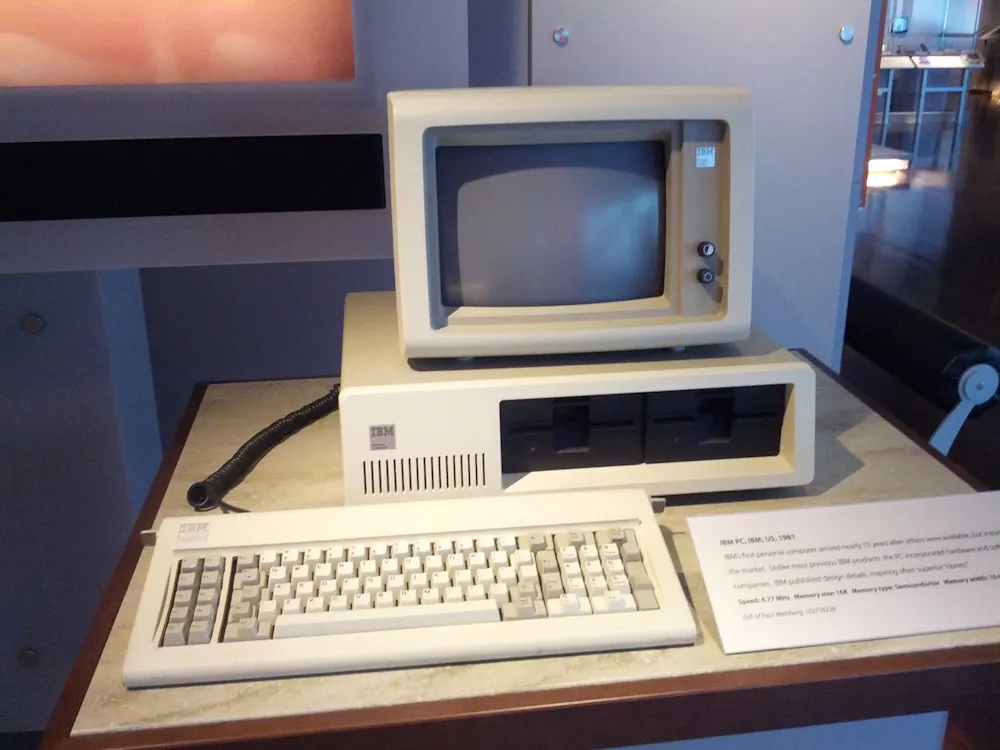
    The first personal computer, made by IBM.
    Wikimedia Commons, CC BY-ND

    As digitalisation transformed business models and labour markets, wealth flowed to those who owned the algorithms, patents and platforms – not those operating the machines. Hi-tech entrepreneurs and Wall Street financiers became the new oligarchs. Stock options replaced salaries as the true measure of success, and companies increasingly rewarded capital over labour.

    By the 2000s, the wealth share of the richest 1% climbed to 30% in the US. The gap between the elite minority and working majority widened with every company stock market launch, hedge fund bonus and quarterly report tailored to shareholder returns.

    But this wasn’t just a market phenomenon – it was institutionally engineered. The 1980s ushered in the age of (Ronald) Reaganomics, driven by the conviction that “government is not the solution to our problem; government is the problem”. Following this neoliberalist philosophy, taxes on high incomes were slashed, capital gains were shielded, and labour unions were weakened.

    Deregulation gave Wall Street free rein to innovate and speculate, while public investment in housing, healthcare and education was curtailed. The consequences came to a head in 2008 when the US housing market collapsed and the financial system imploded.

    The Global Financial Crisis that followed exposed the fragility of a deregulated economy built on credit bubbles and concentrated risk. Millions of people lost their homes and jobs, while banks were rescued with public money. It marked an economic rupture and a moral reckoning – proof that decades of pro-market policies had produced a system that privatised gain and socialised loss.

    Inequality, long growing in the background, now became a glaring, undeniable fault line in American life – and it has remained that way ever since.

    Fig 5. Wealth share and income share of top 1% in the US

    Sources: wealth inequality: World Inequality Database; income share: Picketty & Saez (2003). Dotted curves are conjectured based on Kuznets curve.
    Peng Zhou, CC BY-SA

    So is the US proof that the Kuznets model of inequality is indeed wrong? While the chart above shows inequality has flattened in the US since the 2008 financial crisis, there is little evidence of it actually declining. And in the short term, while Donald Trump’s tariffs are unlikely to do much for growth in the US, his low-tax policies won’t do anything to raise working-class incomes either.

    The story of “the American century” is a dizzying sequence of technological revolutions – from transport and manufacturing to the internet and now AI – crashing one atop the other before institutions, politics or social norms could catch up. In my view, the result is not a broken cycle but an interrupted one. Like a wheel that never completes its turn, inequality rises, reform stutters – and a new wave of disruption begins.

    Our unequal AI future?

    Like any technological explosion, AI’s potential is dual-edged. Like the Tang dynasty’s bureaucrats hoarding grain, today’s tech giants monopolise data, algorithms and computing power. Management consultant firm McKinsey has predicted that algorithms could automate 30% of jobs by 2030, from lorry drivers to radiologists.

    Yet AI also democratises: ChatGPT tutors students in Africa while open-source models such as DeepSeek empower worldwide startups to challenge Silicon Valley’s oligarchy.

    The rise of AI isn’t just a technological revolution – it’s a political battleground. History’s empires collapsed when elites hoarded power; today’s fight over AI mirrors the same stakes. Will it become a tool for collective uplift like Britain’s post-war welfare state? Or a weapon of control akin to Han China’s grain-hoarding bureaucrats?

    The answer hinges on who wins these political battles. In 19th-century Britain, factory owners bribed MPs to block child labour laws. Today, Big Tech spends billions lobbying to neuter AI regulation.

    Meanwhile, grassroots movements like the Algorithmic Justice League demand bans on facial recognition in policing, echoing the Luddites who smashed looms not out of technophobia but to protest exploitation. The question is not if AI will be regulated but who will write the rules: corporate lobbyists or citizen coalitions.

    The real threat has never been the technology itself, but the concentration of its spoils. When elites hoard tech-driven wealth, social fault-lines crack wide open – as happened more than 2,000 years ago when the Red Eyebrows marched against Han China’s agricultural monopolies.

    To be human is to grow – and to innovate. Technological progress raises inequality faster than incomes, but the response depends on how people band together. Initiatives like “Responsible AI” and “Data for All” reframe digital ethics as a civil right, much like Occupy Wall Street exposed wealth gaps. Even memes – like TikTok skits mocking ChatGPT’s biases – shape public sentiment.

    There is no simple path between growth and inequality. But history shows our AI future isn’t preordained in code: it’s written, as always, by us.


    For you: more from our Insights series:

    To hear about new Insights articles, join the hundreds of thousands of people who value The Conversation’s evidence-based news. Subscribe to our newsletter.

    Peng Zhou does not work for, consult, own shares in or receive funding from any company or organisation that would benefit from this article, and has disclosed no relevant affiliations beyond their academic appointment.

    ref. What 2,000 years of Chinese history reveals about today’s AI-driven technology panic – and the future of inequality – https://theconversation.com/what-2-000-years-of-chinese-history-reveals-about-todays-ai-driven-technology-panic-and-the-future-of-inequality-254505

    MIL OSI – Global Reports

  • MIL-OSI Global: What is the Resistance Front? An expert explains the terror group that carried out the latest Kashmir attack?

    Source: The Conversation – UK – By M. Sudhir Selvaraj, Assistant Professor, Peace Studies and International Development, University of Bradford

    India is in mourning after 26 tourists were killed on April 22 in a resort in picturesque Pahalgam. The massacre is considered to be the deadliest attack on tourists in Indian-administered Kashmir since 2000.

    The attack happened during peak tourist season as thousands flocked to the popular tourist destination. Most of those killed were Indians, with the exception of one Nepalese national. All the victims were men.

    Pakistan has denied any involvement, but there are serious fears of escalation between the two nuclear powers. India’s defence minister, Rajnath Singh, openly accused Pakistan and threatened: “We will not only target those who carried out the attack. We will also target those who planned this act in the shadows, on our soil.”

    India has shut a key border between the countries, expelled Pakistan’s diplomats and suspended the landmark Indus waters treaty which allows the sharing of water between the two countries.

    The timing of these attacks is noteworthy as it coincides with major international and domestic events. The US vice-president, J.D. Vance, had arrived the day before with his Indian-American wife Usha and their three children, seeking closer India-US relations against the backdrop of a burgeoning trade war between the US and China. Notably, Pakistan considers China historically as an all-weather friend and ally.

    The attack also comes a few weeks after the Indian government passed the Waqf (Amendment) Act which seeks to change how properties worth billions donated by Muslims, including mosques, madrassas, graveyards and orphanages, are governed. This act is also accused of diluting the rights of India’s Muslim communities by permitting the appointment of non-Muslims to their boards and tribunals.

    Resistance Front

    The Resistance Front (TRF) has claimed responsibility for the attack. A hitherto lesser-known armed group in the Kashmir region, TRF emerged in 2019 with the aim to fight for Kashmir’s secession from India. In 2023, it was designated as a terrorist organisation by the Indian government under the Unlawful Activities (Prevention) Act (UAPA), and the group’s founder, Sheikh Sajjad Gul was declared a terrorist.

    TRF was formed largely in response to the Indian government’s move to strip Kashmir (India’s erstwhile only Muslim-majority state) of its semi-autonomous status in 2019. At this point, the Modi split Kasmhir into two union territories – Jammu & Kashmir – and brought it under more direct federal control.

    The move also paved the way for the extension of land-owning rights and access to government-sponsored job quotas to non-locals. These changes could deprive locals of much-needed opportunities, and radically alter the demographics of the region.

    In a message on messaging app Telegram, the group said: “Consequently, violence will be directed toward those attempting to settle illegally.” This tends to support the idea that the influx of “outsiders” was the justification for the attack.

    In its short life, TRF has been responsible for numerous attacks targeting civilians, security forces and politicians in the region. The group took shape using social media and continues to rely on it to organise and recruit members.

    Notably, the name TRF breaks from traditional rebel groups operating in the region, most of whom bear Islamic names. By doing so, it supposedly aims to project a “neutral” (read as non-religious) front, rather emphasising the fight for Kashmiri nationalism.

    Was Pakistan involved?

    The group is also reported to be linked to the Pakistani spy agency, Inter-Services Intelligence (ISI). Pakistan has denied these links. But analysts fear that any retaliation could escalate and threaten the tenuous peace along the border between the two countries.

    Importantly, the TRF is believed to be an offshoot of, – or perhaps simply a front for – the Lashkar-e-Taiba (LeT), a Pakistan-based armed group. The LeT was involved in many terrorist attacks on Indian soil, most significantly, the 2008 Mumbai terrorist attacks in which an estimated 176 people were killed. The perpetrators of the atrocity are believed by many – including the US government – to have involved help from the ISI.

    While not explicitly stated as a link to the Pahalgam attack, it is noteworthy that the suspected mastermind of the Mumbai attacks, Tahawwur Rana, a Pakistan-born Canadian citizen was extradited to India from the US on April 10. The US Embassy in New Delhi has confirmed that Rana will stand trial in India on ten criminal charges.

    In contrast to the supposed “neutral” ostensibly non-Islamist nature of the TRF, the LeT (which translates as Army of the Righteous/Pure), is a Sunni terrorist group. Its aim is to to establish an Islamic state in south Asia and parts of central Asia – with Kashmir being integral to its plans.

    To achieve this, since its formation in the early 1990s, the group’s focus has been on attacking military and civilian targets in Kashmir, supporting Pakistan’s claim to the region.

    In the late 1990s, the then US president, Bill Clinton, described south Asia as the most dangerous place on Earth. Given the chance of a rapidly escalating India-Pakistan standoff, this could well be the case once again.

    M. Sudhir Selvaraj does not work for, consult, own shares in or receive funding from any company or organisation that would benefit from this article, and has disclosed no relevant affiliations beyond their academic appointment.

    ref. What is the Resistance Front? An expert explains the terror group that carried out the latest Kashmir attack? – https://theconversation.com/what-is-the-resistance-front-an-expert-explains-the-terror-group-that-carried-out-the-latest-kashmir-attack-250663

    MIL OSI – Global Reports

  • MIL-OSI Economics: Press Briefing Transcript: Managing Director’s Global Policy Agenda, Spring Meetings 2025

    Source: International Monetary Fund

    April 24, 2025

    Speaker: Kristalina Georgieva, Managing Director, IMF

    Moderator: Julie Kozack, Director, Communications Department, IMF

    Ms. Kozack: Good morning, everyone. Welcome to this IMF press briefing. I am Julie Kozack, Director of the Communications Department. Thank you so very much for joining us this morning and, as usual, we are going to begin with some opening remarks from our Managing Director, Kristalina Georgieva, after which we will turn to your questions. Without further ado, Kristalina, over to you.

    Ms. Georgieva: Thank you, Julie. And a very warm welcome to all the journalists who got up early to be with us on this beautiful Thursday morning, and also to those who are online. Great to have you with us.

    As you saw earlier this week in our latest World Economic Outlook, we have significantly downgraded our projections for global growth. Major trade policy shifts have spiked uncertainty off the charts, accompanied by tighter financial conditions and higher market volatility. Simply put, the world economy is facing a new and major test, and it faces it with policy buffers depleted by the shocks of recent years. That puts countries in a difficult position. It also creates urgency for action to strengthen the economies for a world of rapid change.

    Today, I want to zoom in on how countries can actually do it. This is the main question we are getting from our members in every single meeting I have had this week. In my Global Policy Agenda, let me, for the audience, remind you that it is a very nicely crafted document. In parentheses this year we have very informative charts, and I hope you will look into those as well. In it, we focus on both the immediate challenges and our medium-term directions. I emphasize three overarching priorities. First and most urgent, for countries to work constructively to resolve trade tensions as swiftly as possible, preserving openness and removing uncertainty. A trade policy settlement among the main players is essential, and we are urging them to do it swiftly because uncertainty is very costly. I cannot stress this strongly enough.

    Without certainty, businesses do not invest, households prefer to save rather than to spend, and this further weakens prospects for already weakened growth.

    Countries also need to address the imbalances that fuel many of the tensions we see. Among major economies, some countries like China need to act to boost private consumption and embrace a shift to services. Others, like the United States, need to reduce fiscal deficits. And in Europe, it is time to complete the Single Market, Banking Union, Capital Markets Union, removing internal barriers to intra-EU trade. Get it done. All countries should seize this moment to lower their trade barriers, both tariff and nontariff.

    The second overarching priority, countries must act to safeguard economic and financial stability. The best way to do that is to get their own house in order. On fiscal policy, most countries need to rebuild buffers and ensure debt sustainability, although some may see shocks that warrant temporary and targeted fiscal support.

    We urge countries to define credible adjustment paths, gradual in most cases, protecting key investments, maximizing spending efficiency, and making space for longer term needs.

    Tradeoffs will be tough for all, but they will be toughest for low-income countries, which face both tight financial conditions and global growth slowdown and falling aid flows. To help ease the tradeoffs there, domestic resource mobilization must be part of the mix. We cannot have countries with a tax to GDP below 15 percent where it is difficult to sustain the functioning of the state. For central banks, the times when countries marched in lockstep is over. Different countries will face different conditions. Inflation pressures in some countries are easing. In others, pressures are yet to abate.

    What is our advice? Watch the data, watch inflation expectations. Central banks will need to strike a delicate balance between supporting growth and containing inflation. To do so, they must not only adjust policy interest rates but also rely on credibility to anchor expectations. Central bank independence is critical for credibility, protect it.

    Open economies, including many emerging markets, are exposed to the trade shocks and tighter financial conditions. They must preserve exchange rate flexibility as a shock absorber.

    In the event of unwarranted currency market volatility, these countries can find policy guidance in the IMF’s integrated policy framework.

    My third and final overarching priority, double down on growth oriented reforms to lift productivity. Even before the latest shock, we were living in a low growth, high debt world, sounding the alarm on weak medium-term growth for quite some time. You heard me saying that many times. Now is the time for long needed but often delayed reforms that can create a good business environment, put entrepreneurship in the front seat, reform labor markets, create conditions for innovation and in a world of rapid technological advancements, give countries a chance to catch the benefits of these advancements for their people.

    The IMF, of course, as always, will be there for our members. We are focusing on what we do best, helping them secure economic and financial stability, resolve or, even better, prevent balance of payments problems, and put in place strong policies and institutions to underpin vibrant economies.

    We will help countries with surveillance, with diagnostics, with policy advice and, when necessary, by providing financial support.

    As part of crisis resolution, we must ensure that the Global Financial Safety Net is strong. We will look for ways to further strengthen our collaboration with regional financing arrangements, and with [major] swap-providing central banks. When we have a cohesive, effective, and efficient Global Financial Safety Net, this will deliver confidence to our members in this more shock prone world.

    We will continue to foster cooperative policy solutions for promoting a healthy rebalancing of the world economy to help countries address debt vulnerabilities. Here, I want to acknowledge the important work of the Global Sovereign Debt Roundtable. This week, we agreed to publish a playbook that provides guidance for predictable and faster debt restructuring processes. And I was very pleased to see [the] support of all traditional, nontraditional creditors, private sector, and debtor countries to have that predictability.

    Finally, we will reiterate the need for continued cooperation in a multipolar world. The shared objective for all must be a better balanced and more resilient world economy.

    Before I wrap it up, I want to recognize Secretary Bessent’s remarks yesterday in which he laid out the U.S. administration’s vision for the Bretton Woods Institutions. The United States is our largest shareholder. And even more, the United States is the home of my colleagues and me. So, of course, we greatly value the voice of the United States. I very much appreciate Secretary Bessent’s reiteration of the U.S.’s commitment to the Fund and its role. He raised a number of issues and priorities for the institution that I look forward to discussing with the U.S. authorities and the membership as a whole. We will have opportunities to do so here, and we will also have opportunities to continue with our Executive Board as we carry out important policy reviews–the Comprehensive Surveillance Review, it will set our surveillance priorities for the next five years, and the Review of Program Design and Conditionality, which will carefully consider how our lending can best help countries address the low growth challenge and durably resolve balance of payments weaknesses. So, we have a way to go, and we are laser focused on it.

    Are there cyclists in this room, people who bike, bikers? As bikers would pay, ‘pedalare,’ step on the pedal. With that, I am very happy to take your questions.

    Ms. Kozack: Thank you very much, Kristalina. We will now turn to your questions. I see you have hands up already. Very good. Please just give your name and outlet when called on. I am going to start right here, woman right in the front row here.

    Questioner: Thanks very much for the opportunity to ask you—to put a question to you. You mentioned Secretary Bessent’s remarks yesterday. He accused the IMF and the World Bank of mission creep and specifically the IMF on mission creep in areas such as climate change, gender policies and also social issues. Do you think there is a role in the future for the IMF in areas such as climate, gender, and social issues?       

    Ms. Georgieva: Thank you for your question. So, what do we do here? We concentrate on macroeconomic and financial stability for growth and employment. We have 191 members. They face different challenges. They face different types of risks to their balance of payment. And what we do is to analyze what these risks and what the Fund in our mandate and what we do on the fiscal side, on the monetary policy side, on the financial sector side, what can we do to help them be more resilient to shocks. So, when we have, for example, Caribbean countries that are wiped out by extreme weather events regularly, naturally they are very concerned about that, and they say how can we be more resilient to these shocks? Again, we focus on balance of payment. What are the risks and what can be done to protect the balance of payments in these countries.

    I want to say that I actually agree with the Secretary on one thing. It is a very complicated world, a world of massive challenges of all kinds. We are a small institution. We are 4,000 people. Not very well-known, but a very fiscally disciplined institution. Our budget today in real terms is what it was 20 years ago. So, yes, we have to focus. And that is exactly why we engage with the membership, so we can make best use of the staff of the Fund. I really like to run a tight ship. Yes.

    Ms. Kozack: I can attest to that. Let us go here, the gentleman in the third row, blue shirt.

    Questioner: Just to follow-up on Claire’s question. Does Secretary Bessent’s prescriptions here for the Fund, will it cause you to sort of rethink some of the lending programs like the RSF and the RST? And then secondly, a lot of economists in the private sector have sort of a more pessimistic view, especially when you look at sort of the prospects for U.S. recession. You are not predicting that. Some of the Ministers here that we have been interviewing feel that the Fund is being too conservative. Can you just sort of explain the differences between yourselves and the private sector?

    Ms. Georgieva: Thank you very much. Actually, in the paper that I just flagged to you, we have a slide that shows Fund lending. You need a magnifying glass to see the share of the Resilience and Sustainability Trust in this lending. It is really small, but as I was explaining in the answer to the previous question, for countries that are highly vulnerable to extreme weather events, having policy advice strictly on the macro side, there is a bit of confusion. People think that we have climate experts. We do not. That is not our job. Our job is to say, OK, if you are Dominica and a hurricane can wipe out the equivalent of 200 percent of your GDP, what are reasonable policies to put in place, or to be more specific, because we have a program with Barbados, if you are Barbados natural disasters are highly damaging to your economy, what are the policy measures you can put in place. In the case of Barbados, we came up with creating an additional buffer for them that would actually prevent a balance of payments shock from derailing the economic development of the country. So, of course, we are a membership institution. What our members decide, this is what we do. We periodically review all of our instruments. At this point, we have the function of the Fund on balance of payments support defined with a number of instruments being deployed.

    To your second question, I am going to do this illustration. My glass, when you look at it, it is more than 60 percent full. This is where we are. This is what it is. How can I call it empty? I cannot. When we look at the data, what we see is that for the United States, recession risks have increased now to 37 percent, but we are not yet—we do not see either in the labor market or indicators for the functioning of the economy such a dramatic block of economic activities that would drag growth in the United States all the way to below zero.

    So, as you remember, I mean, this is something that people may not appreciate enough. Our earlier projections for a very vibrant U.S. economy were for 2.7 percent growth for this year. We have downgraded the United States—actually this is the largest of our downgrades—by 0.9 percent, to 1.8 percent for this year. But we see enough that carries the United States forward. And, of course, we recognize that there is work underway to resolve trade disputes and reduce uncertainty. I want to reiterate my message. Uncertainty is really bad for business, so the sooner this cloud that is hanging over our heads is lifted, the better for prospects for growth.

    For the world economy, as you know we are—you saw it in the WEO, we are also projecting an increase in recession risk from 17 to 30 percent. But again—and by the way, there we talk about growth falling below 2 percent, not below zero, so there is a lot that is carrying the world economy—actually the real economy is functioning in a way that we are seeing no predominant risk. Is there risk? Yes. But it is in our, we used to say, downside scenario and not in what is our—the scenario we anchor our projections.

    This being said—and I am sorry I am dwelling on that. It is a very important question. I get it from delegations when we talk about our projections a lot. This being said, countries can—they are not passive observers. They can act. And one thing that is amazing in these meetings is how much that sense of urgency to act is penetrating our membership. And I do hope that Ministers will go back and say, OK, tough reform, I have postponed it, postpone no more.

    Ms. Kozack: We are going to this side of the room. I am going to go all the way to the end. There is a woman in the third row at the end in a brown suit.

    Questioner: My question is many emerging markets, particularly in Asia, are feeling the pinch of escalating trade tensions and global uncertainties. So, from the IMF’s perspective, how has China and ASEAN countries been affected so far and is there any policy recommendations in the near term that are available from the IMF to navigate these countries through this thank you.

    Ms. Georgieva: Thank you for your question. Indeed, Asia is a continent that is quite significantly impacted because economies that rely a lot on exports, when tariffs are announced, feel the pinch more. When we look at China, we have downgraded growth projections for China from 4.6 to 4 percent. We would have downgraded it much more—we actually would have had not .06 but 1.3 percent downgrade if it was not for the policy accommodation that China is already putting in place. It helps. And that is the first piece of advice. If you have policy space, now is a good time to use it. With regard to China, we are emphasizing four points. First, rebalance your economy towards domestic consumption more.

    Second, to help with this, bring to an end the turmoil in the property sector. And, of course, add social protection for people so they do not feel compelled to save rather than spend.

    Third, lift up services, a warm embrace from healthcare to education to basically the service sector, vis-à-vis the goods consumption. And four—and the fourth is very important. Get the government to pull back from too much intervention in the economy. Let the private sector function to its full capacity.

    We are currently working on a paper, and that is in consultation, collaboration with the Chinese authorities, to document in details what are the ways in which the government may be supporting businesses and by doing so shifting the competitive position of these businesses. And this will be one of our contributions to China.

    I am particularly concerned about ASEAN. Why? Because ASEAN, very open economies. They find themselves in a very tough spot with announced tariffs quite significant across the board in ASEAN countries.

    ASEAN has done really well to build resilience over the last years. Their growth has been quite sound. They have prudently brought inflation down. They have disciplined fiscal policy. It helps. This is our number one advice to ASEAN. You have some policy space in monetary policy, in fiscal policy. Carefully and prudently use it, of course, being mindful that if you deplete it entirely and there is another shock, that would be a problem.

    We have been working with ASEAN on their external sector, especially forex. We have integrated the policy framework. It allows good thinking around how to apply the exchange rate flexibility, how to look at this from the perspective of sudden exogenous shocks. I am very pleased to see that ASEAN is doing something that other regions are doing, strengthening economic cooperation, policy coordination, and intra-ASEAN trade. Currently the ASEAN countries trade only 21 percent among themselves. Well, they sure can go up.

    And I think that we will see not only in ASEAN, we will see it in other places, Gulf Cooperation Council, Central Asia, the African continent with the Continental Free Trade Agreement, more being done to compensate, if global trade is going down, then regional trade can be a compensator and actually inject growth energy.

    I want to finish by saying that ASEAN has been remarkably prudent over the last years to build resilience. And that puts them in a good position to have the reputation to deploy their policy space if needed.

    Ms. Kozack: OK. I am going to stay on this side of the room. I will go to the gentleman in the second row with the red tie.

    Questioner: You said these present tensions could disproportionately impact low-income countries, and I am glad you mentioned the African Continental Free Trade Area Agreement because my question is on Africa. You met with the Nigerian delegation earlier this week. What is the strategy or your advice for the African continent? As you have noted in the past, Africa is not a country. It is a continent. Egypt cut rates for the first time in five years seven days ago. Prior to that, Ghana hiked its interest rate for the first time in almost three years. In these tough times, what is your advice for the continent?

    Ms. Georgieva: Well, we have seen over the last years the African continent having some of the fastest growing economies, but we also have seen low-income countries primarily, and among them fragile conflict affected countries, falling further behind. And now this is a shock for the continent. The direct impact of tariffs on most of Africa, not on all of Africa, but on most of Africa is relatively small, but the indirect impact is quite significant. Slowing global growth means that all other things equal, they will see a downgrade. And actually, we have downgraded growth prospects for the continent.

    For the oil producers like Nigeria, falling oil prices creates additional pressure on their budgets. On the other hand, for the oil importers, this is a breath of fresh air. In other words, as you indicated in your question, different countries face different challenges. If I were to come with some basic recommendations that apply to Africa, I would say—and actually they apply to Nigeria, they apply to Egypt, they apply to Ghana, they apply to Coté d’Ivoire. First, continue on a path of strengthening your fundamentals. There is still a lot that can be done on the fiscal side to have strength. As I was talking about ASEAN, to have buffers for a moment of shock. And do not use any excuses, oh, it is difficult, we cannot really go for more tax because, yes, you can. There is a lot that can be done to broaden the tax base and a lot that can be done to reduce tax evasion and tax avoidance.

    Using technology as some countries are doing to chase the tax dollar when there is the foundation for that is a very good thing to do.

    Second, on the monetary policy side, we know more as I said in the opening—we are no more in a place when you can look at the book of the Central Bank Governor of the neighboring country and say, oh, they are doing this, I will do the same, because you have to really assess domestic resource mobilization, what is your inflationary pressures and do the right thing for your country.

    But above all, make it so that the image of the whole continent changes because now everybody suffers from wrongdoing, from corruption or from conflict in one country. It throws a shadow on the rest of the continent.

    Finally, like with ASEAN, deepen interregional trade and cooperation. Remove the obstacles to it. Sometimes there are infrastructure obstacles. The World Bank is working on reducing that infrastructure obstacle to growth and trade.

    Africa has so much to offer the world. Obviously, they have the minerals, the natural disasters, and the young population. I think a more unified, more collaborative continent can go a long, long way to [becoming] an economic powerhouse.

    Ms. Kozack: I will go to this side of the room. I am going to have the woman in the red jacket, third row.

    Questioner: Ms. Georgieva, you have been very complementary of the economic reform that the Argentinian government is implementing. You have said that Argentina is an example of a country that has made great strides through structural reforms and fiscal discipline. I would like to ask you about the challenges that now the new program is facing right now, and above all what are the risks that Argentina can face in these times of global uncertainty? Thank you.

    Ms. Georgieva: Argentina has demonstrated that this time it is different. This time there is decisiveness to put the economy on a soundtrack from high deficit to surplus, from double-digit inflation to inflation that in February dipped under 3 percent, from poverty over 50 percent to now around 37 percent. Still very high but going down. The state is stepping out from where it does not belong to allow more dynamism in the private sector. Actually, if you are interested, today we will have the global debate, and Federico is going to be one of the speakers to talk about smart regulation, how you make the economy more vibrant by not being an obstacle to private initiative.

    We saw that when the program was announced, the immediate impact on markets was positive because, among other things, you ask about risks. One risk for Argentina would be if it is alone in this macroeconomic stabilization, now the country is not alone. We are there. The World Bank is there. The InterAmerican Bank is stepping up. What are the risks? And I am sorry, and there is a very important opportunity for Argentina in a world hungry for what Argentina produces, both in agriculture and in minerals, mining, gas, lithium. What are the risks?

    First, external. A worsening global environment of all other things equal, it would impact Argentina negatively. Domestic resource mobilization, the country is going to go to elections, as you know, in October. And it is very important that they do not derail the will for change. So far, we do not see that. We do not see that risk materializing, but I would urge Argentina, stay the course.

    Ms. Kozack: All right. Let us go right here in the front, end of the first row.

    Questioner: Managing Director, we had a lot of news this week, for example, mixed signals on tariffs on China, commentary on the position of the Fed Chair, and of course now the U.S. support of the IMF. How would you sum up the mood of the meetings of your members this week, please? 

    Ms. Georgieva: The membership is anxious because we were just about to step on a road to more stability after multiple shocks. We were projecting 3.3 percent growth. And actually, we were worried that this is not strong enough. And here we are, growth prospects weakened. The membership is also recognizing—and I hear it time and again—that it is very important to have a rules based global economy in which there is predictability of planning for action, both for governments and for the private sector. I actually hear a lot of support from the membership for the Fund because we have actually, the same way Argentina earned the Fund to support it, we have earned the support of the members by being there for them.

    Where the expectations are for the outcome of the meetings is to get more consistency in how all countries are going to go about pursuing their interests, which is legitimate. Of course, every country has to think about its own people but doing it so in a way that enlarges the global pie. It does not shrink it.

    Ms. Kozack: We have time for one last question. I am going to go over here.

    Ms. Georgieva: I am sorry. What I would say is the worry I hear more often is actually not even the tariffs. It is uncertainty. Let us have clarity. And that is why we are—with my apologies to the audience—so repetitive to say we need to bring uncertainty down.

    Ms. Kozack: We have time for one last question, the woman in the burgundy suit.

    Questioner:  I wanted to ask you about the MENA region. How concerned are you with all of this turmoil around the dollar and its effect on the MENA region, especially that many countries there are exporters of intermediate goods that go into major industries and many of them are exporters of energy and what is happening to the dollar is definitely of effect. And you have mentioned uncertainty many times today in this press conference. So, this uncertainty, how will it affect the countries in our region that are trying to get out of a lot of geopolitical uncertainty with the help of the IMF and special programs, such as Egypt? So, will this make the IMF revisit some of those programs amid all of this turmoil?

    Ms. Georgieva: Thank you very much. The MENA region actually got quite a downgrade. It is still doing better this year than last year, but we were projecting that growth would go to 4 percent and now we downgraded it to 2.6. A little bit like Africa, most of the impact is indirect. While countries in the MENA region, of course, trade with the United States, but most of them do not have very high exposure. And where it bites is slowing down of the global economy. And MENA has many oil exporters. The price of oil is going down.

    The dollar has historically, it goes up, it goes down. It is not a new thing. So, if you have an oil exporter and you get your revenues in dollars, when the dollar weakens, that creates a bit of a problem for your fiscal position. But if you are an oil exporter, this is a gift because then you can deal more easily with the challenges you face.

    My take for the MENA region is a very diverse region, like the African continent. You have the Gulf Cooperation Council. I have a lot of praise to offer because they have been pursuing reforms and diversification of the economies. Most countries have done really well. So now they see oil growth down, but non-oil economies are still doing quite well.

    We have the more kind of middle-income countries that are faced with difficulties impacted by regional conflicts like Jordan, like Egypt. And there we have been engaged, we have been providing support, as you know. We have countries like Morocco that have done really well to get their house in order, to have sound fiscal monetary policy and the only country in the region that is eligible for Flexible Credit Line from the IMF. And then we have countries like Sudan or Syria that are severely impacted by conflicts.

    I was very pleased that the attention of our membership, despite difficulties at home, across-the-board on low-income countries and conflict affected states, has sharpened. There is a recognition that what happens there impacts the rest of the world.

    We had a Syria meeting during the week of the meetings. The first time in more than 20 years, the Central Bank Governor and the Minister of Finance from Syria are here at the meetings. Our intention is to first and foremost help them rebuild institutions so they can plug themselves in the world economy.

    You are asking me whether we are revisiting program assumptions. Of course, we will be carefully watching what is happening. Then I had a meeting with the Prime Minister of Jordan. We are not talking about amending the program for Jordan right now, but we are talking about the importance of the Fund as an anchor of stability and how we can exercise this role.

    Ms. Kozack: Thank you very much, Managing Director, and thank you very much to all of our journalists who have joined us today. I am bringing this press conference to an end. As always, the transcript will be made available on our website, and I want to wish all of you a very wonderful rest of your day. Thank you very much.

    Ms. Georgieva: Thank you very much. Have a good rest of your day.

    IMF Communications Department
    MEDIA RELATIONS

    PRESS OFFICER: Wafa Amr

    Phone: +1 202 623-7100Email: MEDIA@IMF.org

    MIL OSI Economics

  • MIL-OSI USA: Carter launches American-Made Medicines Caucus

    Source: United States House of Representatives – Congressman Earl L Buddy Carter (GA-01)

    Headline: Carter launches American-Made Medicines Caucus

    WASHINGTON, D.C. – Rep. Earl L. “Buddy” Carter (R-GA) today launched the American-Made Medicines Caucus, a group focused on promoting policies to onshore and friendshore pharmaceutical manufacturing, strengthen our economic and national security interests, and reduce America’s reliance on adversarial countries for essential medications.


    The United States is dependent on imports for 90% of all generic drugs and ran a $127 billion trade deficit in pharmaceuticals in 2024.


    “China determines whether we have the pharmaceutical products we need in the United States to keep our citizens healthy. That is a terrifying reality, one we must address before the next public health crisis. As a pharmacist, I’m launching the American-Made Medicines Caucus with the singular focus of bringing this critical supply chain home, so that we can strengthen our national security, create jobs, and Make America Healthy Again,”
    said Rep. Carter.


    Founding members of the Caucus include Reps. Claudia Tenney (R-NY) and Gus Bilirakis (R-FL).


    “We must continue to support and encourage domestic pharmaceutical medicine production in our country, strengthen our supply chains, reduce our reliance on foreign suppliers, and reinforce our pharmaceutical security. I am eager to join Congressman Carter and Congressman Bilirakis in launching the American-Made Medicines Caucus to focus on creating legislative solutions to improve the domestic production of life-saving medications and antibiotics,” 
    said Rep. Tenney.


    “With our overwhelming reliance on Chinese pharmaceutical products and ingredients, it’s imperative that we find ways to increase domestic manufacturing capacity and preserve consumer access to these important and lifesaving products,”
    Rep. Bilirakis said. “Public health and wellness should not depend on our foreign adversaries, and I look forward to finding ways to address this threat through the Caucus.”

    ###

    MIL OSI USA News

  • MIL-OSI: Lectra: Q1 2025 financial report available

    Source: GlobeNewswire (MIL-OSI)

    Q1 2025 financial report available

    Paris, April 24, 2025 – Lectra informs its shareholders, in compliance with Article 221-4-IV of the General Regulation of the Autorité des marchés financiers, that the Management Discussion and Analysis of Financial Condition and Results of Operations for the first quarter 2025 is available on the company’s website: www.lectra.com

    It is also available, upon request, by email: investor.relations@lectra.com

            .

    About Lectra :

    At the forefront of innovation since its founding in 1973, Lectra provides industrial intelligence technology solutions—combining software in SaaS mode, cutting equipment, data, and associated services—to players in the fashion, automotive and furniture industries. With boldness and passion, Lectra accelerates the transformation and success of its customers in a world in perpetual motion thanks to the key technologies of Industry 4.0: AI, big data, cloud and the Internet of Things. 

    The Group is present in more than one hundred countries. It operates three production sites for its cutting equipment, located in France, China and the United States. Lectra’s 3,000 employees are driven by three core values: being open-minded thinkers, trusted partners and passionate innovators. They all share the same concern for social responsibility, which is one of the pillars of Lectra’s strategy to ensure its sustainable growth and that of its customers.

    Lectra reported revenues of €527 million in 2024, including €77 million coming from its SaaS offerings. The company is listed on Euronext, and is included in the CAC All Shares, CAC Technology, EN Tech Leaders and ENT PEA-PME 150 indices.

    For more information, please visit lectra.com

    Lectra – World Headquarters et siège social : 16–18, rue Chalgrin • 75016 Paris • France
    Tél. +33 (0)1 53 64 42 00 – lectra.com
    Société anonyme au capital de 37 966 274 €. RCS Paris B 300 702 305

    Attachment

    The MIL Network

  • MIL-OSI: Ageas successfully places EUR 500 million Tier 2 Notes

    Source: GlobeNewswire (MIL-OSI)

    Ageas successfully places EUR 500 million Tier 2 Notes

    Today ageas SA/NV successfully placed debt securities in the form of EUR 500 million Subordinated Fixed to Floating Rate Notes (the “Notes”) maturing in May 2056 and with a first call date in November 2035. The issuance generated substantial interest and was more than 3 times oversubscribed (orderbook in excess of EUR 1.6 billion).

    The Notes will be issued in denominations of EUR 100,000 at a re-offer price of 99.89 with a fixed coupon rate of 4.625% payable annually until the first reset date (2 May 2036). As of the first reset date, the coupon becomes payable quarterly at a 3-month Euribor floating rate over the initial credit spread (215bp) and a 100 basis points step-up.

    The Notes will qualify as Tier 2 capital for both the Group and Ageas SA/NV under the Solvency II prudential regime in the EU and are rated A- by Fitch. Ageas expects Standard and Poor’s will assign an A- rating. Application has been made for the Notes to be listed on the official list and admitted to trading on the Luxembourg Stock Exchange’s Euro MTF market. The Notes are expected to be settled on 2 May 2025.

    The net proceeds of the Notes are expected to be used for the financing of the acquisition of esure as well as for general corporate purposes and to optimise the capital structure of the Group.

    Ageas is a listed international insurance Group with a heritage spanning of 200 years. It offers Retail and Business customers Life and Non-Life insurance products designed to suit their specific needs, today and tomorrow, and is also engaged in reinsurance activities. As one of Europe’s larger insurance companies, Ageas concentrates its activities in Europe and Asia, which together make up the major part of the global insurance market. It operates successful insurance businesses in Belgium, the UK, Portugal, Türkiye, China, Malaysia, India, Thailand, Vietnam, Laos, Cambodia, Singapore, and the Philippines through a combination of wholly owned subsidiaries and long-term partnerships with strong financial institutions and key distributors. Ageas ranks among the market leaders in the countries in which it operates. It represents a staff force of about 50,000 people and reported annual inflows of EUR 18.5 billion in 2024.

    Disclaimer

    THIS COMMUNICATION IS NOT INTENDED FOR DISTRIBUTION, DIRECTLY OR INDIRECTLY, IN OR INTO THE UNITED STATES OR ANY OTHER JURISDICTION WHERE SUCH DISTRIBUTION IS PROHIBITED UNDER APPLICABLE LAW.

    The issue, exercise or sale of securities in the offering mentioned in this press release are subject to specific legal or regulatory restrictions in certain jurisdictions. The information contained herein shall not constitute or form part of an offer to sell or the solicitation of an offer to buy, nor shall there be any sale of the securities referred to herein, in any jurisdiction in which such offer, solicitation or sale would be unlawful. ageas SA/NV assumes no responsibility in the event there is a violation by any person of such restrictions.

    This press release does not constitute an offer to sell, or a solicitation of offers to purchase or subscribe for, securities in the United States or any other jurisdiction. The securities referred to herein have not been, and will not be, registered under the Securities Act of 1933, as amended, and may not be offered, exercised or sold in the United States or to, or for the account or benefit of, U.S. persons, except pursuant to an exemption from, or in a transaction not subject to, the registration requirements of the Securities Act of 1933. There is no intention to register any portion of the offering in the United States or to conduct a public offering of securities in the United States.

    This communication may only be communicated, or caused to be communicated, to persons in the United Kingdom in circumstances where the provisions of Section 21 of the Financial Services and Markets Act 2000, as amended (the “Financial Services and Markets Act”) do not apply to ageas SA/NV and is directed solely at persons in the United Kingdom who (i) have professional experience in matters relating to investments, such persons falling within the definition of “investment professionals” in Article 19(5) of the Financial Services and Markets Act (Financial Promotion) Order 2005, as amended (the “Order”) or (ii) are persons falling within Article 49(2)(a) to (d) of the Order or other persons to whom it may lawfully be communicated (all such persons together being referred to as “relevant persons”). This communication is directed only to relevant persons and must not be acted on or relied on by persons who are not relevant persons.

    The securities referred to herein are not intended to be offered, sold or otherwise made available to, and should not be offered, sold or otherwise made available to, any retail investor in the European Economic Area. For these purposes, a retail investor means a person who is one (or more) of: (i) a retail client as defined in point (11) of Article 4(1) of Directive 2014/65/EU, as amended (“MiFID II”) or (ii) a customer within the meaning of Directive (EU) 2016/97, as amended (the “Insurance Distribution Directive”), where that customer would not qualify as a professional client as defined in point (10) of Article 4(1) of MiFID II.

    The securities referred to herein are not intended to be offered, sold or otherwise made available to, and should not be offered, sold or otherwise made available to, any retail investor in the United Kingdom. For these purposes, a retail investor means a person who is one (or more) of: (i) a retail client as defined in point (8) of Article 2 of Regulation (EU) No 2017/565 as it forms part of domestic law by virtue of the European Union (Withdrawal) Act 2018 (“EUWA”) or (ii) a customer within the meaning of the provisions of the Financial Services and Markets Act and any rules or regulations made under the Financial Services and Markets Act to implement the Insurance Distribution Directive, where that customer would not qualify as a professional client as defined in point (8) of Article 2(1) of Regulation (EU) No 600/2014 as it forms part of domestic law by virtue of the EUWA.

    The securities referred to herein are also not intended to be offered, sold or otherwise made available, and will not be offered, sold or otherwise made available, in Belgium to “consumers” (consumenten/consommateurs) within the meaning of the Belgian Code of Economic Law (Wetboek van economisch recht/Code de droit économique), as amended.

    The securities referred to herein may be held only by, and transferred only to, eligible investors referred to in Article 4 of the Belgian Royal Decree of 26 May 1994, holding their securities in an exempt securities account that has been opened with a financial institution that is a direct or indirect participant in the securities settlement system operated by the National Bank of Belgium or any successor thereto.

    This press release is not a prospectus nor an advertisement for the purpose of Regulation (EU) 2017/1129.

    Attachment

    The MIL Network

  • MIL-OSI: LECTRA: Q1 2025: Business slowdown due to unprecedented environment

    Source: GlobeNewswire (MIL-OSI)

    Q1 2025: Business slowdown due to unprecedented environment

    • Revenues: 134.4 million euros (+4%)*
    • EBITDA before non-recurring items: 21.1 million euros (stable)*
    • Net income: 5.8 million euros (-13%)*
    • Update of 2025 annual forecast premature

     *At actual exchange rates 

      January 1 – March 31
       2025 2024 Changes 2025/2024  
    (in millions of euros)        Actual
    exchange rates
    Like-for-like(1)  
    Revenues  134.4 129.6   +4% +1%  
    ARR (2)  90.3     +2% +3%  
    EBITDA before non-recurring items  21.1 21.1   +0% -6%  
    EBITDA margin before non-recurring items  15.7% 16.3%   -0,6 point -0,9 point  
    Net income  5.8 6.7   -13%  
    Shareholders’ Equity  368.8 341.6    
    Net cash (+) / Net financial debt (-)  -4.6 -18.8    

    (1) On a constant currency basis and for a comparable scope of consolidation
    (2) At December 31, 2024 and March 31, 2025

    Paris, April 24, 2025. Today, Lectra’s Board of Directors, chaired by Daniel Harari, reviewed the unaudited consolidated financial statements for the first quarter of 2025.

    MACROECONOMIC AND GEOPOLITICAL SITUATION: AN UNPRECEDENTED SHOCK

    Since early March, the global economic situation has deteriorated. The unexpectedly sweeping new tariffs announced on April 2 have caused considerable volatility in global financial markets and led to significant declines in market valuations and indices across all countries. They have also had major negative impacts on businesses worldwide, creating uncertainty and restraining their near-term growth prospects. 

    Limited direct impact

    As of today, software and services are not subject to customs duties. Half of the equipment sales in the United States come from local production. On the other hand, a small portion of this production is sold in China. Therefore, only 10% of the revenue is affected by the announced customs duties.

    The Group has reflected the increased customs duties in its selling prices.

    Robust competitive position 

    The distortion of competition regarding equipment is virtually nil in the near term, as manufacturing by competitors in the United States is extremely limited. Were the situation to continue over the long term, it would be expected to work in Lectra’s favor, as competitors manufacture for the most part in Asia and in Europe. The Group is also the only one to have three production sites, in France, China and the United Sates.

    A sense of apprehension that reinforces customers’ wait-and-see attitude 

    Customers and contract manufacturers must now adjust to this new economic landscape — in terms of pricing policy, production, investment, or future strategy. 

    The long-term effects of these new tariffs, if confirmed, could have repercussions on inflation, growth, and supply chains.

    Should the situation deteriorate, a global economic slowdown could be observed, with higher prices for consumers and lower profits for companies, leading to financing difficulties and reduced investment.

    SUMMARY FOR Q1 2025

    To facilitate the analysis of the Group’s results, the accounts are compared to those published for 2024 (at actual exchange rates) and, for the 2025 vs 2024 comparisons, to the aux 2024 pro-forma accounts (presented on a like-for-like basis), including Launchmetrics from January 1.

    Given the importance of SaaS activity for Lectra, the Group has decided to publish a new indicator, ARR (Annual Recurring Revenue), which is commonly used in the SaaS industry.

    ARR at March 31, 2025, came to 90.3 million euros, up 3% higher than at the end of 2024 at comparable exchange rates. 

    Q1 2025 revenues (134.5 million euros) were up 4% at actual exchange rates and up 1% on a like-for-like basis, reflecting the slowdown observed early in March.

    EBITDA before non-recurring items totaled 21.1 million euros, holding stable at actual exchange rates and down 6% on a like-for-like basis. The EBITDA margin before non-recurring items was 15.7%.

    After accounting for an amortization charge of intangible assets amounting to 5.9 million euros, the income from operation before non-recurring items decreased by 12% on a comparable basis, to 10.3 million euros.

    Net income amounted to 5.8 million euros, down 13% at actual exchange rates. 

    High free cash flow before non-recurring items

    Free cash flow before non-recurring items remained high at 17.7 million euros in Q1 2025, after the record level of 22.0 million euros posted in Q1 2024.

    A particularly robust sheet

    At March 31, 2025, the Group had a particularly robust balance sheet with a consolidated shareholders’ equity of 368.8 million euros and a net financial debt of 4.6 million euros. The Group has thus continued to reduce its debt at a sustained pace, 14 months after financing the acquisition of a majority stake in Launchmetrics.

    OUTLOOK 

    In the management discussion and analysis of the consolidated financial statements for the fourth quarter and full year 2024, published on February 12, 2025, Lectra reiterated its long-term vision, together with the objectives of its strategic roadmap for 2023-2025.  

    The Group noted that in a challenging environment, having proven its resilience and the quality of its fundamentals, Lectra had approached the year 2025 with confidence, pursuing its strategy by meeting customers’ needs as closely as possible through the quality of its offer for Industry 4.0 and by developing its SaaS activity. 

    In light of the unprecedented circumstances stemming from economic and policy announcements, leading to a stronger-than-anticipated wait-and-see attitude among its customers, it is premature to provide updated annual forecasts at this time.  

    The 2024 Financial Report, as well as the Management Discussion and analysis of financial conditions and results of operations and the financial statements for Q1 2025 are available on lectra.com. The Shareholders’ General and Special Meetings will be held on April 25, 2025, in the Company’s offices. Q2 and H1 2025 earnings will be published on July 24, 2025, after the close of the Paris Stock Exchange.

    About Lectra

    At the forefront of innovation since its founding in 1973, Lectra provides industrial intelligence technology solutions—combining software in SaaS mode, cutting equipment, data, and associated services—to players in the fashion, automotive and furniture industries. With boldness and passion, Lectra accelerates the transformation and success of its customers in a world in perpetual motion thanks to the key technologies of Industry 4.0: AI, big data, cloud and the internet of things. 

    The Group is present in more than one hundred countries. It operates three production sites for its cutting equipment, located in France, China and the United States. Lectra’s 3,000 employees are driven by three core values: being open-minded thinkers, trusted partners and passionate innovators. They all share the same concern for social responsibility, which is one of the pillars of Lectra’s strategy to ensure its sustainable growth and that of its customers.

    Lectra reported revenues of €527 million in 2024, including €77 million coming from its SaaS offerings. The company is listed on Euronext, and is included in the CAC All Shares, CAC Technology, EN Tech Leaders and ENT PEA-PME 150 indices.

    For more information, visit ww.lectra.com

    Lectra – World Headquarters: 16–18, rue Chalgrin • 75016 Paris • France 

    Tel. +33 (0)1 53 64 42 00 – www.lectra.com 

    A French Société Anonyme with capital of €37,966,274 • RCS Paris B 300 702 305 

    Attachment

    The MIL Network

  • MIL-OSI Economics: Spring Meetings 2025 Press Briefing Transcript: Intergovernmental Group of Twenty-Four (G24)

    Source: International Monetary Fund

    April 24, 2025

    SPEAKERS:

    Chair: Pablo Quirno, Secretary of Finance, Ministry of Economy of Argentina

    First Vice‑Chair:  Olawale Edun, Federal Minister of Finance of Nigeria

    Second Vice‑Chair: Jameel Ahmad, Governor, State Bank of Pakistan

    Director: Iyabo Masha, G‑24 Secretariat

    MODERATOR:

    Pavis Devahasadin, Communications Officer, IMF

    Mr. Devahasadin: Good morning, ladies and gentlemen. My name is Pavis Devahasadin, Communication Officer from the IMF’s Communication Department. I would like to welcome everyone here in this room and our online audience to the press conference on the Intergovernmental Group of 24 on International Monetary Affairs and Development or G‑24.

    Before we begin, I would like to remind you that we have simultaneous translation in English, French and Spanish. It is my honor to introduce the distinguished panel at this table, the Chair of the Ministry of the G‑24 at the center is Mr. Pablo Quirno, Secretary of Finance of Argentina. To his right is Mr. Vice Chair, Mr. Olawale Edun, Nigeria’s Minister of Finance and Coordinating Minister of the Economy. To the left of Mr. Chair is Second‑Vice Chair Mr. Jameel Ahmad, Governor of the State Bank of Pakistan. Of course, at the other end of the table is Director of G‑24 Secretariat Ms. Iyabo Masha. Without further ado, may I invite Mr. Quirno to give some remarks. Mr. Chair, the floor is yours.

    Mr. Quirno (Argentina): Thank you, Pavis. Dear members of the press, I would like to extend a warm welcome to each and every one of you as we gather for this press conference. You have at your disposal our comprehensive communiqué and press release encapsulating the discussions held today. Allow me to briefly highlight the key takeaways.

    We are witnessing a major transition in how the global economy works and processes of change such as these always involve intervals of great volatility and uncertainty. Our communiqué reflects that the recent economic developments have driven uncertainty to elevated levels. In this context, emerging market and developing economies face additional challenges stemming from both external conditions and domestic factors.

    On the external front, many EMDEs continue to face elevated public debt levels and rising debt servicing burdens. The prevailing environment of still tight global financial conditions is exacerbating these challenges, constraining fiscal space, and forcing difficult tradeoffs between repaying creditors and investing in critical areas for productivity, growth and development. These also represent a risk to macroeconomic stability, as debt maturities and rising debt service payments hinder fiscal consolidation plans, which are necessary to tackle domestic imbalances, maintain price stability, and foster a stable macroeconomic environment for investment and growth.

    On the domestic front, weak fiscal fundamentals are at the core of macroeconomic instability, while many of us face longstanding structural policy challenges that hold back productivity and competitiveness.

    The building up of external and fiscal imbalances amid public spending pressures that exceed revenues and with constrained access to international financial markets further erodes macroeconomic stability.

    Furthermore, domestic environments perceived as unsafe for investment dominated by overly complex legislation and inefficient and burdensome tax systems add to macroeconomic instability to further discourage much‑needed private capital inflows.

    As stated in the communiqué, domestic policymaking is the first line of defense. The best way to enhance short‑term domestic responsiveness, as well as medium‑term growth capacity is through solid macroeconomic frameworks combined with clear rules that foster a predictable environment for private investment.

    Pivoting to our fiscal consolidation to set debt on a sustainable path and rebuild buffers while advancing with productivity‑enhancing‑market reoriented structural reforms must remain priorities for the domestic policymaking. Whereas doing so while maintaining social cohesion and protecting the most vulnerable can be challenging, it can be achieved with careful policy calibration.

    But as these measures may take some time to deliver, mobilizing sufficient international support is also crucial to help countries meet their financing needs while they navigate the waters towards a healthier economy. The Bretton Woods Institutions remain crucial, necessitating decisive actions to fortify the Global Financial Safety Net and broaden development finance. The IMF’s role as a centerpiece of the Global Financial Safety Net is vital in addressing multilateral challenges and supporting vulnerable countries. We appreciate the IMF’s recent reforms to better support EMDEs, such as the recent review of the charges and surcharges policies.

    However, countries with limited access to affordable short‑term and crisis‑related liquidity continue to face vulnerabilities. It is essential to address liquidity pressures and strengthen crisis prevention and response capabilities, including enhancing existing financial safety nets. Surveillance and internal and external stability should be intensified, including on spillover effects from systematically important countries. The World Bank has made progress in implementing the Evolution Program, but further progress is required in operationalizing key aspects of the framework of financial incentives and reducing IBRD loan pricing. Faster implementation of the remaining G‑20 Independent Experts Groups Recommendations on MDB reforms is needed, including mitigating currency risks through local currency lending and domestic capital market reforms, de‑risking private‑sector investment, and increasing capital within the WBG and across the MDB system.

    Swift progress on the 2025 shareholding review is necessary to address misalignments, strengthen voice and representation, enhance IBRD legitimacy, and ensure equitable voting power.

    In sum, the path to sharp growth and a steady growing economy is multifaceted. We must do our part and commit to strengthen fiscal and monetary frameworks, build robust institutions, and embrace structural reforms that promote competitiveness, productivity gains, and job creation, but at the same time we need global financial institutions that recognize domestic efforts and are willing and well‑prepared to step up for these countries. Thank you, and with these remarks, I am now ready to entertain your questions.

    Mr. Devahasadin: Thank you, Mr. Chair. Before we begin the Q&A section, I kindly ask that all questions remain within the scope of the G‑24’s mandate and responsibilities. Other questions outside of its purview, of course, should be raised during the regional press conferences that are going to be taking place in the coming days. And please kindly identify yourself, your organization, your news outlet, and specify to whom your questions would like to be addressing. With that, any questions? Yes, sir.

    QUESTION: Good morning to everybody. Mr. Quirno, you just said that the Bretton Woods Institutions are crucial. Does any of you feel that their role, their functioning is endangered currently? Thank you for answering this question.

    Mr. Devahasadin: Thank you.

    Mr. Quirno: I think globally we are facing a period of volatility and uncertainty. As such, the Bretton Woods Institutions are crucial in providing the safety net and the channels of communication that remain open among the different countries that participate in those institutions. And I think the role is very, very important. And we do not see them—I mean, we are always rebalancing their role and their task, and it is something that is a process that we do constantly. At the end of the day, the role is vital. It is very important, and we do not see them at risk as you put it.

    Mr. Devahasadin: Minister Edun.

    Mr. Edun (Nigeria): Thank you. I agree with the Chair that there is nothing that we have heard that says that the Bretton Woods Institutions stands ready to do anything other than on the one hand, provide safety net. On the other hand, continue to provide development finance. If anything, this time of heightened global uncertainty, what we have heard from them is that they stand ready and are very much willing and capable to help countries to navigate this particular time and to continue to encourage good policymaking, to encourage resilience, building of resilience, building of buffers and effectively staying the course for those who are actually on a path that will take them further along the road to growth development and reduction of poverty.

    Mr. Devahasadin: Thank you. Governor Ahmad or Ms. Masha, would you like to add anything?

    Mr. Ahmad: No, it is OK. I think we fully agree with the views expressed by the Chair and the Vice. I think the increased uncertainty and the prevailing situation, it has become much more important for the Bretton Woods Institutions to continue to play their role and particularly as the financial safety net providers and also as the development partners. I think they have a role which will continue to be there, and they will be contributing in the performance of the road previously—that they have been doing previously, so I fully agree.

    Mr. Devahasadin: Thank you. Ms. Masha?

    Ms. Masha (G-24 Secretariat): Yes. We believe that the organizations are very useful, and the usefulness is very much appreciated, and so we do not have any uncertainty about their continued relevance. And we do hope that whatever actions countries are taking, the advanced economies are taking, they will factor into their decision the very good usefulness of these organizations. Thank you.

    Mr. Devahasadin: Thank you. Going back to the floor. Any question? Right here, lady with the glasses.

    QUESTION: My question is for Mr. Jameel Ahmad. What steps is the State Bank of Pakistan taking? Is it engaging with other central banks to mitigate risks, particularly in the G‑24 framework? Thank you.

    Mr. Ahmad: I think as initially said that if there is any specific questions pertaining to the State Bank, we can discuss that during the separate conferences, which we have, but for the time being, since we are in the G-24 platform, we are coordinating with other central banks, and we discussed all these issues during the yesterday’s Deputies Meeting as well as today’s meeting also of the G-24. These are the issues faced by the G-24 members and have been thoroughly discussed and the stance has been agreed upon. This is what is contained in the communiqué which is being issued today.

    Mr. Devahasadin: Going back to the floor, maybe in the midsection I saw some hands. I will start with you in the black. Thank you. We are going to make our way back. Yes.

    QUESTION: So, I have a couple questions for everyone here. First of all, how concerned are your members from the fallout from tariffs and what are they trying to do to try to mitigate the impacts? Also, are you planning to work more closely with each other, for instance, increasing trade with each other? And lastly, specifically, are you planning on working more closely with China, for instance?

    Mr. Devahasadin: Just to add to that, I got an advanced question Sri Lanka. In the light of reciprocal tariff currently in place, what strategy is the G‑24 considering as a working group to alleviate the pressure on emerging economies? So that is related to your question as well. Mr. Chair.

    Mr. Quirno: Thank you. Thank you for the questions. I think that it is important to understand that the G‑24 is a very diverse group of countries, and everyone, each of us has its own peculiarities, strengths, and weaknesses in the midst of the current trade situation. So, what I would say is that the fallout of this uncertainty that we are facing creates more volatility. And as emerging market countries and developing countries, what you face is a situation in which, in addition to the trade tensions, you have a situation on the capital markets and the capital flows, things that are based on the uncertainty. What happens is flows are expecting a solution. As one of the members said today, we can deal with good news. We can deal with bad news. We need to know what to do under uncertainty. You know, as we are going through this process of trade negotiations globally and as definitions are set, then we will know how to react. In the meantime, as we said in the communiqué and as we said in my opening remarks, the first line of defense, the thing that is within our country’s contro, is around the domestic agenda. We need to bring resilience into our own economies in such a way that we have a fiscal path that is credible, that we have sound monetary policies as well that back that fiscal consolidation program, because at the end of the day that is what investors are looking at.

    Investors are looking at the different countries’ situation and see how they can cope with this level of uncertainties. We have faced different levels, different crises in the past — globally, the pandemic being the last one. And we have, as a collective number of countries, been able to achieve a level of resilience that is very good. I mean, that resilience is being tested once again. That is why we also need to work in conjunction among the different countries, not only G‑24 but in a global context to address the situation. But I think the homework also needs to be consolidated at home in order to then continue moving forward. And as such, we are also obviously fostering our trade relationships among the different countries. We are doing it among the G‑24, among G‑20, so there are various areas of cooperation and consolidation there as well.

    Mr. Devahasadin: Any perspective from Ms. Masha in terms of coordination, collaboration across nations?

    Ms. Masha: Well, I think the Chair has pointed out some of those issues regarding macroeconomic stability, that is when these shocks manifest, there’s need for fiscal policies, sound monetary policies. But more along that line, it also provides opportunities for countries to pivot towards a different development pathway. Maybe going into sectors that are going to satisfy domestic demand will make them less prone to external shocks and diversifying their markets, the different markets, so they can better cope with the future tariff or trade policies. Thank you.

    Mr. Devahasadin: Thank you. Going back to the floor, I see hands right there all the way in the back, the lady in beige. We will come back to the front.

    QUESTION: Thank you for taking our questions. A question for everyone, sort of piggybacking off of my colleague’s question on tariffs. How does the G‑24 weigh the inflationary risks versus risks of recession from the current tariff environment? And then one for the Argentina Secretary, you spoke about debt maturities and rising debt payments, more than 4 billion in debt many coming due for Argentina in July right after an ambitious reserve target accumulation from the IMF. How does Argentina plan to confront those payments and is there a target that it is looking back to return to capital markets? Thank you.

    Mr. Quirno: In terms of the first question related to inflationary pressures and related to the trade situation, we had this morning the World Economic Outlook conference in which we had details on that perspective, but I think also it is very early to tell on how this is going to at the end of the day be moving forward. We are not in the business—at least I am not in the business of projecting inflation in my own country. It is very difficult to try to project inflationary pressures on a global basis, but I think it is—as I said before, we are living in uncertain times. We expect that trade negotiations that are currently underway reach a good point that is satisfactory to everyone involved, and that will normalize trade flows from that perspective onwards. In terms of Argentina—I mean, despite the fact that it is a common theme throughout the G‑24—what we are trying to do in Argentina for the last 15 months is basically gain our credibility back. And as such, we have elected a very conservative and unorthodox approach to the problems that Argentina had. And one of the problems that Argentina had was on the fiscal front. And we have done a tremendous fiscal consolidation. We put our house in order, on the monetary front as well. And that track record is one that will put us in a path to regaining market access eventually.

    Having said that, from my perspective, as the CFO of the country, what I can say is that we work at it very conservatively. I am not assuming that Argentina will be able to re‑access markets at a given time. But we have certainty that the maturities are coming due. That is why we have worked in the past in showing our willingness to pay. We have honored all our commitments. We have now a new IMF program, which has started to work very well, as expected. And in addition to that, because of that conservative, look, we have already accumulated reserves. The Treasury has bought a significant amount of dollars that it has at the central bank to honor those obligations. So, we do not expect to—we cannot speculate about when Argentina will be able to re‑access international markets. When those will happen, when that situation happens, we will address it. But in the meantime, we still work as if we have no access, and we have to pay down our obligations as we did in this last 15 months.

    Mr. Devahasadin: Thank you, I see three remaining hands. I will come back to the front with the lady in the brown jacket first and then I go to that side of the room. I see two hands. Please keep your questions short. We have limited time. Thank you.

    QUESTION: Hi. My question is regarding—we have seen the U.S. called back on some of the financings that it gives to developing economies, so in terms of financing the sustainable development goals, as well as climate action, could you talk about some of the challenges there?

    Mr. Devahasadin: Are your questions related to climate so we can collect them both? Anyone on climate here.

    Mr. Quirno: We face several challenges and as such, for that, many countries rely on the World Bank and the IMF, to basically be able to develop tools to finance that development, finance climate action, to finance infrastructure, and as such, we are at a period in which you have to—countries have to balance that in turn with their own macroeconomic situation in that respect. We need to—we have many of our countries in the G‑24 have significant natural resources that need to be developed. Those are the ones that are part of the transition energy, for example. And those are situations in which you cannot access private financing. The role of development financing in terms of climate, in terms of energy transition, et cetera, is very important. But those are challenges that are on the table that we need to address, and we are addressing together as a group and as an individual country as well.

    Mr. Devahasadin: Thank you. Go back to the floor. Gentleman back here and we can go all the way back to you, sir.

    QUESTION: Thank you. Two questions. You brought back fiscal discipline to Argentina, but can you quantify the harmful effects on the lives of the citizens? That is what want to talk about, the strikes, the protests, the fact that people do not have money in their pockets. Secondly, you also talked about building resilience, how do we build resilience where most of the countries in the G‑24 have one similar problem, a lot of visionless leadership, definitely, and a lot of poverty. Our arms are already tied behind our hands economically. How do you expect us to build resilience?  We are just led to the slaughter slap.

    Mr. Devahasadin: Thank you. Can I go all the way back to the back, the gentleman in the back, please?

    QUESTION: Thank you for taking my question. I wanted to touch on debt restructuring. In October you called on the reform of the Common Framework, and I am curious to know more about what sort of reform moves you have seen since then and also what types of reforms the G‑24 would like to see to the Common Framework. Thank you.

    Mr. Quirno: To the first question, I hate to make reference to Argentina, but the question was directly addressed to that situation. Argentina was facing a very dire situation—55 percent poverty rate before this administration took office. We have worked very, very strongly to do a couple of things that basically went straight to address that situation by having done our fiscal consolidation. We basically reduced 5 percentage points of GDP deficit in a month, something that has not been done probably anywhere else in the world so far. But we did it because we knew that we had no alternative. And at the end of the day, what happened is that the myth is that by doing such an adjustment, you would enter into a deep recession. Argentina rebounded out of its recession that was two and a half years long two months after that fiscal consolidation.

    Since then, real wages have increased for 10 months straight. Poverty levels have been reduced from 54 percent to 38 percent in about a year. And economic activity has increased 6 percent December 2024 from December 2023 when we took over. It can be done. That is the message. You know, there is preoccupations before, during such a big adjustment as we did, but it pays out. It takes the political will to do it. Everyone knows what needs to be done on the fiscal and monetary fronts. The books have been written about it. What happens is you need the political willingness to attack the problem because that may hurt politicians when they make those decisions. We have a very strong leadership in President Milei — the one that has said we need to go in this. What he has said is we need to take care of the most vulnerable. We doubled in real terms, while being able to achieve our financial surplus. We were able to double in real terms the assistance to the most vulnerable. And that is something that basically shows the amount of corruption and intermediation that was on the social plans that the national government was spending on. So now those funds have been redirected. It is funny that we doubled the expenditures in real terms, but the amount that people received more than tripled. We spent 100, and we are now spending 200 in real terms. People got 60. They received 60, and then they are receiving 200. That is a big—very big realization from the most vulnerable population that they have been robbed for years. Because by maintaining fiscal consolidation, by maintaining a financial surplus, we were still able to double the assistance to the most vulnerable.

    Mr. Devahasadin: We go to Ms. Masha on debt restructuring because you spoke about it last time.

    Ms. Masha: Debt restructuring?

    Mr. Devahasadin: The Common Framework. Yes, the progress on that.

    Ms. Masha: I want to add a little to what the Chair said in response to the question before I go to the Common Framework.

    Mr. Devahasadin: Yes.

    Ms. Masha: That is just to say that the G‑24 member countries, we have some of the largest economies in the world as members of G‑24, and the good thing is that the growth, the size of their economy, most of them over the past two or three decades, China, India and Brazil. So that takes a lot of vision. That takes a lot of implementations of the right policies. So, it is not quite a visionless leadership, but they have had to take policies that enable the countries to achieve what they have been able to achieve over such a short period of time.

    On the Common Framework — where we are on the Common Framework is that some countries have used it. Some have found it beneficial. The only complaint—well, some of the complaints we have heard about is that the process takes a very long time. And during that long time, they are not able to access the market, or they have to take some difficult decisions when they do not know how it is going to play out. And we also made that position known. The second, the other issue is we need more participation of the private market, maybe of also multilateral development banks, and also to have some precise idea of how it will play out. Some middle‑income countries have been asked to be a part of it. That is not really in discussion now, but all in all, countries have benefited from it, but there could be more benefit. Thank you.

    Mr. Devahasadin: Mr. Chair, you would like to add anything?

    Mr. Quirno (Argentina): No.

    Mr. Devahasadin: We are out of time. Unfortunately, Minister Edun had another obligation. If you have any follow‑up question, send it to press@G24.org. That was in the advisory, how to contact the G‑24. The communiqué should have been posted on IMF.org and the transcript of this press conference will be made available later. Thank you very much for joining this press conference and have a good rest of your day. Thank you.

    IMF Communications Department
    MEDIA RELATIONS

    PRESS OFFICER: Pavis Devahasadin

    Phone: +1 202 623-7100Email: MEDIA@IMF.org

    MIL OSI Economics

  • MIL-OSI Russia: Spring Meetings 2025 Press Briefing Transcript: Intergovernmental Group of Twenty-Four (G24)

    Source: IMF – News in Russian

    April 24, 2025

    SPEAKERS:

    Chair: Pablo Quirno, Secretary of Finance, Ministry of Economy of Argentina

    First Vice‑Chair:  Olawale Edun, Federal Minister of Finance of Nigeria

    Second Vice‑Chair: Jameel Ahmad, Governor, State Bank of Pakistan

    Director: Iyabo Masha, G‑24 Secretariat

    MODERATOR:

    Pavis Devahasadin, Communications Officer, IMF

    Mr. Devahasadin: Good morning, ladies and gentlemen. My name is Pavis Devahasadin, Communication Officer from the IMF’s Communication Department. I would like to welcome everyone here in this room and our online audience to the press conference on the Intergovernmental Group of 24 on International Monetary Affairs and Development or G‑24.

    Before we begin, I would like to remind you that we have simultaneous translation in English, French and Spanish. It is my honor to introduce the distinguished panel at this table, the Chair of the Ministry of the G‑24 at the center is Mr. Pablo Quirno, Secretary of Finance of Argentina. To his right is Mr. Vice Chair, Mr. Olawale Edun, Nigeria’s Minister of Finance and Coordinating Minister of the Economy. To the left of Mr. Chair is Second‑Vice Chair Mr. Jameel Ahmad, Governor of the State Bank of Pakistan. Of course, at the other end of the table is Director of G‑24 Secretariat Ms. Iyabo Masha. Without further ado, may I invite Mr. Quirno to give some remarks. Mr. Chair, the floor is yours.

    Mr. Quirno (Argentina): Thank you, Pavis. Dear members of the press, I would like to extend a warm welcome to each and every one of you as we gather for this press conference. You have at your disposal our comprehensive communiqué and press release encapsulating the discussions held today. Allow me to briefly highlight the key takeaways.

    We are witnessing a major transition in how the global economy works and processes of change such as these always involve intervals of great volatility and uncertainty. Our communiqué reflects that the recent economic developments have driven uncertainty to elevated levels. In this context, emerging market and developing economies face additional challenges stemming from both external conditions and domestic factors.

    On the external front, many EMDEs continue to face elevated public debt levels and rising debt servicing burdens. The prevailing environment of still tight global financial conditions is exacerbating these challenges, constraining fiscal space, and forcing difficult tradeoffs between repaying creditors and investing in critical areas for productivity, growth and development. These also represent a risk to macroeconomic stability, as debt maturities and rising debt service payments hinder fiscal consolidation plans, which are necessary to tackle domestic imbalances, maintain price stability, and foster a stable macroeconomic environment for investment and growth.

    On the domestic front, weak fiscal fundamentals are at the core of macroeconomic instability, while many of us face longstanding structural policy challenges that hold back productivity and competitiveness.

    The building up of external and fiscal imbalances amid public spending pressures that exceed revenues and with constrained access to international financial markets further erodes macroeconomic stability.

    Furthermore, domestic environments perceived as unsafe for investment dominated by overly complex legislation and inefficient and burdensome tax systems add to macroeconomic instability to further discourage much‑needed private capital inflows.

    As stated in the communiqué, domestic policymaking is the first line of defense. The best way to enhance short‑term domestic responsiveness, as well as medium‑term growth capacity is through solid macroeconomic frameworks combined with clear rules that foster a predictable environment for private investment.

    Pivoting to our fiscal consolidation to set debt on a sustainable path and rebuild buffers while advancing with productivity‑enhancing‑market reoriented structural reforms must remain priorities for the domestic policymaking. Whereas doing so while maintaining social cohesion and protecting the most vulnerable can be challenging, it can be achieved with careful policy calibration.

    But as these measures may take some time to deliver, mobilizing sufficient international support is also crucial to help countries meet their financing needs while they navigate the waters towards a healthier economy. The Bretton Woods Institutions remain crucial, necessitating decisive actions to fortify the Global Financial Safety Net and broaden development finance. The IMF’s role as a centerpiece of the Global Financial Safety Net is vital in addressing multilateral challenges and supporting vulnerable countries. We appreciate the IMF’s recent reforms to better support EMDEs, such as the recent review of the charges and surcharges policies.

    However, countries with limited access to affordable short‑term and crisis‑related liquidity continue to face vulnerabilities. It is essential to address liquidity pressures and strengthen crisis prevention and response capabilities, including enhancing existing financial safety nets. Surveillance and internal and external stability should be intensified, including on spillover effects from systematically important countries. The World Bank has made progress in implementing the Evolution Program, but further progress is required in operationalizing key aspects of the framework of financial incentives and reducing IBRD loan pricing. Faster implementation of the remaining G‑20 Independent Experts Groups Recommendations on MDB reforms is needed, including mitigating currency risks through local currency lending and domestic capital market reforms, de‑risking private‑sector investment, and increasing capital within the WBG and across the MDB system.

    Swift progress on the 2025 shareholding review is necessary to address misalignments, strengthen voice and representation, enhance IBRD legitimacy, and ensure equitable voting power.

    In sum, the path to sharp growth and a steady growing economy is multifaceted. We must do our part and commit to strengthen fiscal and monetary frameworks, build robust institutions, and embrace structural reforms that promote competitiveness, productivity gains, and job creation, but at the same time we need global financial institutions that recognize domestic efforts and are willing and well‑prepared to step up for these countries. Thank you, and with these remarks, I am now ready to entertain your questions.

    Mr. Devahasadin: Thank you, Mr. Chair. Before we begin the Q&A section, I kindly ask that all questions remain within the scope of the G‑24’s mandate and responsibilities. Other questions outside of its purview, of course, should be raised during the regional press conferences that are going to be taking place in the coming days. And please kindly identify yourself, your organization, your news outlet, and specify to whom your questions would like to be addressing. With that, any questions? Yes, sir.

    QUESTION: Good morning to everybody. Mr. Quirno, you just said that the Bretton Woods Institutions are crucial. Does any of you feel that their role, their functioning is endangered currently? Thank you for answering this question.

    Mr. Devahasadin: Thank you.

    Mr. Quirno: I think globally we are facing a period of volatility and uncertainty. As such, the Bretton Woods Institutions are crucial in providing the safety net and the channels of communication that remain open among the different countries that participate in those institutions. And I think the role is very, very important. And we do not see them—I mean, we are always rebalancing their role and their task, and it is something that is a process that we do constantly. At the end of the day, the role is vital. It is very important, and we do not see them at risk as you put it.

    Mr. Devahasadin: Minister Edun.

    Mr. Edun (Nigeria): Thank you. I agree with the Chair that there is nothing that we have heard that says that the Bretton Woods Institutions stands ready to do anything other than on the one hand, provide safety net. On the other hand, continue to provide development finance. If anything, this time of heightened global uncertainty, what we have heard from them is that they stand ready and are very much willing and capable to help countries to navigate this particular time and to continue to encourage good policymaking, to encourage resilience, building of resilience, building of buffers and effectively staying the course for those who are actually on a path that will take them further along the road to growth development and reduction of poverty.

    Mr. Devahasadin: Thank you. Governor Ahmad or Ms. Masha, would you like to add anything?

    Mr. Ahmad: No, it is OK. I think we fully agree with the views expressed by the Chair and the Vice. I think the increased uncertainty and the prevailing situation, it has become much more important for the Bretton Woods Institutions to continue to play their role and particularly as the financial safety net providers and also as the development partners. I think they have a role which will continue to be there, and they will be contributing in the performance of the road previously—that they have been doing previously, so I fully agree.

    Mr. Devahasadin: Thank you. Ms. Masha?

    Ms. Masha (G-24 Secretariat): Yes. We believe that the organizations are very useful, and the usefulness is very much appreciated, and so we do not have any uncertainty about their continued relevance. And we do hope that whatever actions countries are taking, the advanced economies are taking, they will factor into their decision the very good usefulness of these organizations. Thank you.

    Mr. Devahasadin: Thank you. Going back to the floor. Any question? Right here, lady with the glasses.

    QUESTION: My question is for Mr. Jameel Ahmad. What steps is the State Bank of Pakistan taking? Is it engaging with other central banks to mitigate risks, particularly in the G‑24 framework? Thank you.

    Mr. Ahmad: I think as initially said that if there is any specific questions pertaining to the State Bank, we can discuss that during the separate conferences, which we have, but for the time being, since we are in the G-24 platform, we are coordinating with other central banks, and we discussed all these issues during the yesterday’s Deputies Meeting as well as today’s meeting also of the G-24. These are the issues faced by the G-24 members and have been thoroughly discussed and the stance has been agreed upon. This is what is contained in the communiqué which is being issued today.

    Mr. Devahasadin: Going back to the floor, maybe in the midsection I saw some hands. I will start with you in the black. Thank you. We are going to make our way back. Yes.

    QUESTION: So, I have a couple questions for everyone here. First of all, how concerned are your members from the fallout from tariffs and what are they trying to do to try to mitigate the impacts? Also, are you planning to work more closely with each other, for instance, increasing trade with each other? And lastly, specifically, are you planning on working more closely with China, for instance?

    Mr. Devahasadin: Just to add to that, I got an advanced question Sri Lanka. In the light of reciprocal tariff currently in place, what strategy is the G‑24 considering as a working group to alleviate the pressure on emerging economies? So that is related to your question as well. Mr. Chair.

    Mr. Quirno: Thank you. Thank you for the questions. I think that it is important to understand that the G‑24 is a very diverse group of countries, and everyone, each of us has its own peculiarities, strengths, and weaknesses in the midst of the current trade situation. So, what I would say is that the fallout of this uncertainty that we are facing creates more volatility. And as emerging market countries and developing countries, what you face is a situation in which, in addition to the trade tensions, you have a situation on the capital markets and the capital flows, things that are based on the uncertainty. What happens is flows are expecting a solution. As one of the members said today, we can deal with good news. We can deal with bad news. We need to know what to do under uncertainty. You know, as we are going through this process of trade negotiations globally and as definitions are set, then we will know how to react. In the meantime, as we said in the communiqué and as we said in my opening remarks, the first line of defense, the thing that is within our country’s contro, is around the domestic agenda. We need to bring resilience into our own economies in such a way that we have a fiscal path that is credible, that we have sound monetary policies as well that back that fiscal consolidation program, because at the end of the day that is what investors are looking at.

    Investors are looking at the different countries’ situation and see how they can cope with this level of uncertainties. We have faced different levels, different crises in the past — globally, the pandemic being the last one. And we have, as a collective number of countries, been able to achieve a level of resilience that is very good. I mean, that resilience is being tested once again. That is why we also need to work in conjunction among the different countries, not only G‑24 but in a global context to address the situation. But I think the homework also needs to be consolidated at home in order to then continue moving forward. And as such, we are also obviously fostering our trade relationships among the different countries. We are doing it among the G‑24, among G‑20, so there are various areas of cooperation and consolidation there as well.

    Mr. Devahasadin: Any perspective from Ms. Masha in terms of coordination, collaboration across nations?

    Ms. Masha: Well, I think the Chair has pointed out some of those issues regarding macroeconomic stability, that is when these shocks manifest, there’s need for fiscal policies, sound monetary policies. But more along that line, it also provides opportunities for countries to pivot towards a different development pathway. Maybe going into sectors that are going to satisfy domestic demand will make them less prone to external shocks and diversifying their markets, the different markets, so they can better cope with the future tariff or trade policies. Thank you.

    Mr. Devahasadin: Thank you. Going back to the floor, I see hands right there all the way in the back, the lady in beige. We will come back to the front.

    QUESTION: Thank you for taking our questions. A question for everyone, sort of piggybacking off of my colleague’s question on tariffs. How does the G‑24 weigh the inflationary risks versus risks of recession from the current tariff environment? And then one for the Argentina Secretary, you spoke about debt maturities and rising debt payments, more than 4 billion in debt many coming due for Argentina in July right after an ambitious reserve target accumulation from the IMF. How does Argentina plan to confront those payments and is there a target that it is looking back to return to capital markets? Thank you.

    Mr. Quirno: In terms of the first question related to inflationary pressures and related to the trade situation, we had this morning the World Economic Outlook conference in which we had details on that perspective, but I think also it is very early to tell on how this is going to at the end of the day be moving forward. We are not in the business—at least I am not in the business of projecting inflation in my own country. It is very difficult to try to project inflationary pressures on a global basis, but I think it is—as I said before, we are living in uncertain times. We expect that trade negotiations that are currently underway reach a good point that is satisfactory to everyone involved, and that will normalize trade flows from that perspective onwards. In terms of Argentina—I mean, despite the fact that it is a common theme throughout the G‑24—what we are trying to do in Argentina for the last 15 months is basically gain our credibility back. And as such, we have elected a very conservative and unorthodox approach to the problems that Argentina had. And one of the problems that Argentina had was on the fiscal front. And we have done a tremendous fiscal consolidation. We put our house in order, on the monetary front as well. And that track record is one that will put us in a path to regaining market access eventually.

    Having said that, from my perspective, as the CFO of the country, what I can say is that we work at it very conservatively. I am not assuming that Argentina will be able to re‑access markets at a given time. But we have certainty that the maturities are coming due. That is why we have worked in the past in showing our willingness to pay. We have honored all our commitments. We have now a new IMF program, which has started to work very well, as expected. And in addition to that, because of that conservative, look, we have already accumulated reserves. The Treasury has bought a significant amount of dollars that it has at the central bank to honor those obligations. So, we do not expect to—we cannot speculate about when Argentina will be able to re‑access international markets. When those will happen, when that situation happens, we will address it. But in the meantime, we still work as if we have no access, and we have to pay down our obligations as we did in this last 15 months.

    Mr. Devahasadin: Thank you, I see three remaining hands. I will come back to the front with the lady in the brown jacket first and then I go to that side of the room. I see two hands. Please keep your questions short. We have limited time. Thank you.

    QUESTION: Hi. My question is regarding—we have seen the U.S. called back on some of the financings that it gives to developing economies, so in terms of financing the sustainable development goals, as well as climate action, could you talk about some of the challenges there?

    Mr. Devahasadin: Are your questions related to climate so we can collect them both? Anyone on climate here.

    Mr. Quirno: We face several challenges and as such, for that, many countries rely on the World Bank and the IMF, to basically be able to develop tools to finance that development, finance climate action, to finance infrastructure, and as such, we are at a period in which you have to—countries have to balance that in turn with their own macroeconomic situation in that respect. We need to—we have many of our countries in the G‑24 have significant natural resources that need to be developed. Those are the ones that are part of the transition energy, for example. And those are situations in which you cannot access private financing. The role of development financing in terms of climate, in terms of energy transition, et cetera, is very important. But those are challenges that are on the table that we need to address, and we are addressing together as a group and as an individual country as well.

    Mr. Devahasadin: Thank you. Go back to the floor. Gentleman back here and we can go all the way back to you, sir.

    QUESTION: Thank you. Two questions. You brought back fiscal discipline to Argentina, but can you quantify the harmful effects on the lives of the citizens? That is what want to talk about, the strikes, the protests, the fact that people do not have money in their pockets. Secondly, you also talked about building resilience, how do we build resilience where most of the countries in the G‑24 have one similar problem, a lot of visionless leadership, definitely, and a lot of poverty. Our arms are already tied behind our hands economically. How do you expect us to build resilience?  We are just led to the slaughter slap.

    Mr. Devahasadin: Thank you. Can I go all the way back to the back, the gentleman in the back, please?

    QUESTION: Thank you for taking my question. I wanted to touch on debt restructuring. In October you called on the reform of the Common Framework, and I am curious to know more about what sort of reform moves you have seen since then and also what types of reforms the G‑24 would like to see to the Common Framework. Thank you.

    Mr. Quirno: To the first question, I hate to make reference to Argentina, but the question was directly addressed to that situation. Argentina was facing a very dire situation—55 percent poverty rate before this administration took office. We have worked very, very strongly to do a couple of things that basically went straight to address that situation by having done our fiscal consolidation. We basically reduced 5 percentage points of GDP deficit in a month, something that has not been done probably anywhere else in the world so far. But we did it because we knew that we had no alternative. And at the end of the day, what happened is that the myth is that by doing such an adjustment, you would enter into a deep recession. Argentina rebounded out of its recession that was two and a half years long two months after that fiscal consolidation.

    Since then, real wages have increased for 10 months straight. Poverty levels have been reduced from 54 percent to 38 percent in about a year. And economic activity has increased 6 percent December 2024 from December 2023 when we took over. It can be done. That is the message. You know, there is preoccupations before, during such a big adjustment as we did, but it pays out. It takes the political will to do it. Everyone knows what needs to be done on the fiscal and monetary fronts. The books have been written about it. What happens is you need the political willingness to attack the problem because that may hurt politicians when they make those decisions. We have a very strong leadership in President Milei — the one that has said we need to go in this. What he has said is we need to take care of the most vulnerable. We doubled in real terms, while being able to achieve our financial surplus. We were able to double in real terms the assistance to the most vulnerable. And that is something that basically shows the amount of corruption and intermediation that was on the social plans that the national government was spending on. So now those funds have been redirected. It is funny that we doubled the expenditures in real terms, but the amount that people received more than tripled. We spent 100, and we are now spending 200 in real terms. People got 60. They received 60, and then they are receiving 200. That is a big—very big realization from the most vulnerable population that they have been robbed for years. Because by maintaining fiscal consolidation, by maintaining a financial surplus, we were still able to double the assistance to the most vulnerable.

    Mr. Devahasadin: We go to Ms. Masha on debt restructuring because you spoke about it last time.

    Ms. Masha: Debt restructuring?

    Mr. Devahasadin: The Common Framework. Yes, the progress on that.

    Ms. Masha: I want to add a little to what the Chair said in response to the question before I go to the Common Framework.

    Mr. Devahasadin: Yes.

    Ms. Masha: That is just to say that the G‑24 member countries, we have some of the largest economies in the world as members of G‑24, and the good thing is that the growth, the size of their economy, most of them over the past two or three decades, China, India and Brazil. So that takes a lot of vision. That takes a lot of implementations of the right policies. So, it is not quite a visionless leadership, but they have had to take policies that enable the countries to achieve what they have been able to achieve over such a short period of time.

    On the Common Framework — where we are on the Common Framework is that some countries have used it. Some have found it beneficial. The only complaint—well, some of the complaints we have heard about is that the process takes a very long time. And during that long time, they are not able to access the market, or they have to take some difficult decisions when they do not know how it is going to play out. And we also made that position known. The second, the other issue is we need more participation of the private market, maybe of also multilateral development banks, and also to have some precise idea of how it will play out. Some middle‑income countries have been asked to be a part of it. That is not really in discussion now, but all in all, countries have benefited from it, but there could be more benefit. Thank you.

    Mr. Devahasadin: Mr. Chair, you would like to add anything?

    Mr. Quirno (Argentina): No.

    Mr. Devahasadin: We are out of time. Unfortunately, Minister Edun had another obligation. If you have any follow‑up question, send it to press@G24.org. That was in the advisory, how to contact the G‑24. The communiqué should have been posted on IMF.org and the transcript of this press conference will be made available later. Thank you very much for joining this press conference and have a good rest of your day. Thank you.

    IMF Communications Department
    MEDIA RELATIONS

    PRESS OFFICER: Pavis Devahasadin

    Phone: +1 202 623-7100Email: MEDIA@IMF.org

    https://www.imf.org/en/News/Articles/2025/04/24/tr-04242025-g24-press-briefing

    MIL OSI

    MIL OSI Russia News

  • MIL-OSI Russia: Spring Meetings 2025 Press Briefing Transcript: The Managing Director’s Press Briefing on the Global Policy Agenda

    Source: IMF – News in Russian

    April 24, 2025

    Speaker: Kristalina Georgieva, Managing Director, IMF

    Moderator: Julie Kozack, Director, Communications Department, IMF

    Ms. Kozack: Good morning, everyone. Welcome to this IMF press briefing. I am Julie Kozack, Director of the Communications Department. Thank you so very much for joining us this morning and, as usual, we are going to begin with some opening remarks from our Managing Director, Kristalina Georgieva, after which we will turn to your questions. Without further ado, Kristalina, over to you.

    Ms. Georgieva: Thank you, Julie. And a very warm welcome to all the journalists who got up early to be with us on this beautiful Thursday morning, and also to those who are online. Great to have you with us.

    As you saw earlier this week in our latest World Economic Outlook, we have significantly downgraded our projections for global growth. Major trade policy shifts have spiked uncertainty off the charts, accompanied by tighter financial conditions and higher market volatility. Simply put, the world economy is facing a new and major test, and it faces it with policy buffers depleted by the shocks of recent years. That puts countries in a difficult position. It also creates urgency for action to strengthen the economies for a world of rapid change.

    Today, I want to zoom in on how countries can actually do it. This is the main question we are getting from our members in every single meeting I have had this week. In my Global Policy Agenda, let me, for the audience, remind you that it is a very nicely crafted document. In parentheses this year we have very informative charts, and I hope you will look into those as well. In it, we focus on both the immediate challenges and our medium-term directions. I emphasize three overarching priorities. First and most urgent, for countries to work constructively to resolve trade tensions as swiftly as possible, preserving openness and removing uncertainty. A trade policy settlement among the main players is essential, and we are urging them to do it swiftly because uncertainty is very costly. I cannot stress this strongly enough.

    Without certainty, businesses do not invest, households prefer to save rather than to spend, and this further weakens prospects for already weakened growth.

    Countries also need to address the imbalances that fuel many of the tensions we see. Among major economies, some countries like China need to act to boost private consumption and embrace a shift to services. Others, like the United States, need to reduce fiscal deficits. And in Europe, it is time to complete the Single Market, Banking Union, Capital Markets Union, removing internal barriers to intra-EU trade. Get it done. All countries should seize this moment to lower their trade barriers, both tariff and nontariff.

    The second overarching priority, countries must act to safeguard economic and financial stability. The best way to do that is to get their own house in order. On fiscal policy, most countries need to rebuild buffers and ensure debt sustainability, although some may see shocks that warrant temporary and targeted fiscal support.

    We urge countries to define credible adjustment paths, gradual in most cases, protecting key investments, maximizing spending efficiency, and making space for longer term needs.

    Tradeoffs will be tough for all, but they will be toughest for low-income countries, which face both tight financial conditions and global growth slowdown and falling aid flows. To help ease the tradeoffs there, domestic resource mobilization must be part of the mix. We cannot have countries with a tax to GDP below 15 percent where it is difficult to sustain the functioning of the state. For central banks, the times when countries marched in lockstep is over. Different countries will face different conditions. Inflation pressures in some countries are easing. In others, pressures are yet to abate.

    What is our advice? Watch the data, watch inflation expectations. Central banks will need to strike a delicate balance between supporting growth and containing inflation. To do so, they must not only adjust policy interest rates but also rely on credibility to anchor expectations. Central bank independence is critical for credibility, protect it.

    Open economies, including many emerging markets, are exposed to the trade shocks and tighter financial conditions. They must preserve exchange rate flexibility as a shock absorber.

    In the event of unwarranted currency market volatility, these countries can find policy guidance in the IMF’s integrated policy framework.

    My third and final overarching priority, double down on growth oriented reforms to lift productivity. Even before the latest shock, we were living in a low growth, high debt world, sounding the alarm on weak medium-term growth for quite some time. You heard me saying that many times. Now is the time for long needed but often delayed reforms that can create a good business environment, put entrepreneurship in the front seat, reform labor markets, create conditions for innovation and in a world of rapid technological advancements, give countries a chance to catch the benefits of these advancements for their people.

    The IMF, of course, as always, will be there for our members. We are focusing on what we do best, helping them secure economic and financial stability, resolve or, even better, prevent balance of payments problems, and put in place strong policies and institutions to underpin vibrant economies.

    We will help countries with surveillance, with diagnostics, with policy advice and, when necessary, by providing financial support.

    As part of crisis resolution, we must ensure that the Global Financial Safety Net is strong. We will look for ways to further strengthen our collaboration with regional financing arrangements, and with [major] swap-providing central banks. When we have a cohesive, effective, and efficient Global Financial Safety Net, this will deliver confidence to our members in this more shock prone world.

    We will continue to foster cooperative policy solutions for promoting a healthy rebalancing of the world economy to help countries address debt vulnerabilities. Here, I want to acknowledge the important work of the Global Sovereign Debt Roundtable. This week, we agreed to publish a playbook that provides guidance for predictable and faster debt restructuring processes. And I was very pleased to see [the] support of all traditional, nontraditional creditors, private sector, and debtor countries to have that predictability.

    Finally, we will reiterate the need for continued cooperation in a multipolar world. The shared objective for all must be a better balanced and more resilient world economy.

    Before I wrap it up, I want to recognize Secretary Bessent’s remarks yesterday in which he laid out the U.S. administration’s vision for the Bretton Woods Institutions. The United States is our largest shareholder. And even more, the United States is the home of my colleagues and me. So, of course, we greatly value the voice of the United States. I very much appreciate Secretary Bessent’s reiteration of the U.S.’s commitment to the Fund and its role. He raised a number of issues and priorities for the institution that I look forward to discussing with the U.S. authorities and the membership as a whole. We will have opportunities to do so here, and we will also have opportunities to continue with our Executive Board as we carry out important policy reviews–the Comprehensive Surveillance Review, it will set our surveillance priorities for the next five years, and the Review of Program Design and Conditionality, which will carefully consider how our lending can best help countries address the low growth challenge and durably resolve balance of payments weaknesses. So, we have a way to go, and we are laser focused on it.

    Are there cyclists in this room, people who bike, bikers? As bikers would pay, ‘pedalare,’ step on the pedal. With that, I am very happy to take your questions.

    Ms. Kozack: Thank you very much, Kristalina. We will now turn to your questions. I see you have hands up already. Very good. Please just give your name and outlet when called on. I am going to start right here, woman right in the front row here.

    Questioner: Thanks very much for the opportunity to ask you—to put a question to you. You mentioned Secretary Bessent’s remarks yesterday. He accused the IMF and the World Bank of mission creep and specifically the IMF on mission creep in areas such as climate change, gender policies and also social issues. Do you think there is a role in the future for the IMF in areas such as climate, gender, and social issues?       

    Ms. Georgieva: Thank you for your question. So, what do we do here? We concentrate on macroeconomic and financial stability for growth and employment. We have 191 members. They face different challenges. They face different types of risks to their balance of payment. And what we do is to analyze what these risks and what the Fund in our mandate and what we do on the fiscal side, on the monetary policy side, on the financial sector side, what can we do to help them be more resilient to shocks. So, when we have, for example, Caribbean countries that are wiped out by extreme weather events regularly, naturally they are very concerned about that, and they say how can we be more resilient to these shocks? Again, we focus on balance of payment. What are the risks and what can be done to protect the balance of payments in these countries.

    I want to say that I actually agree with the Secretary on one thing. It is a very complicated world, a world of massive challenges of all kinds. We are a small institution. We are 4,000 people. Not very well-known, but a very fiscally disciplined institution. Our budget today in real terms is what it was 20 years ago. So, yes, we have to focus. And that is exactly why we engage with the membership, so we can make best use of the staff of the Fund. I really like to run a tight ship. Yes.

    Ms. Kozack: I can attest to that. Let us go here, the gentleman in the third row, blue shirt.

    Questioner: Just to follow-up on Claire’s question. Does Secretary Bessent’s prescriptions here for the Fund, will it cause you to sort of rethink some of the lending programs like the RSF and the RST? And then secondly, a lot of economists in the private sector have sort of a more pessimistic view, especially when you look at sort of the prospects for U.S. recession. You are not predicting that. Some of the Ministers here that we have been interviewing feel that the Fund is being too conservative. Can you just sort of explain the differences between yourselves and the private sector?

    Ms. Georgieva: Thank you very much. Actually, in the paper that I just flagged to you, we have a slide that shows Fund lending. You need a magnifying glass to see the share of the Resilience and Sustainability Trust in this lending. It is really small, but as I was explaining in the answer to the previous question, for countries that are highly vulnerable to extreme weather events, having policy advice strictly on the macro side, there is a bit of confusion. People think that we have climate experts. We do not. That is not our job. Our job is to say, OK, if you are Dominica and a hurricane can wipe out the equivalent of 200 percent of your GDP, what are reasonable policies to put in place, or to be more specific, because we have a program with Barbados, if you are Barbados natural disasters are highly damaging to your economy, what are the policy measures you can put in place. In the case of Barbados, we came up with creating an additional buffer for them that would actually prevent a balance of payments shock from derailing the economic development of the country. So, of course, we are a membership institution. What our members decide, this is what we do. We periodically review all of our instruments. At this point, we have the function of the Fund on balance of payments support defined with a number of instruments being deployed.

    To your second question, I am going to do this illustration. My glass, when you look at it, it is more than 60 percent full. This is where we are. This is what it is. How can I call it empty? I cannot. When we look at the data, what we see is that for the United States, recession risks have increased now to 37 percent, but we are not yet—we do not see either in the labor market or indicators for the functioning of the economy such a dramatic block of economic activities that would drag growth in the United States all the way to below zero.

    So, as you remember, I mean, this is something that people may not appreciate enough. Our earlier projections for a very vibrant U.S. economy were for 2.7 percent growth for this year. We have downgraded the United States—actually this is the largest of our downgrades—by 0.9 percent, to 1.8 percent for this year. But we see enough that carries the United States forward. And, of course, we recognize that there is work underway to resolve trade disputes and reduce uncertainty. I want to reiterate my message. Uncertainty is really bad for business, so the sooner this cloud that is hanging over our heads is lifted, the better for prospects for growth.

    For the world economy, as you know we are—you saw it in the WEO, we are also projecting an increase in recession risk from 17 to 30 percent. But again—and by the way, there we talk about growth falling below 2 percent, not below zero, so there is a lot that is carrying the world economy—actually the real economy is functioning in a way that we are seeing no predominant risk. Is there risk? Yes. But it is in our, we used to say, downside scenario and not in what is our—the scenario we anchor our projections.

    This being said—and I am sorry I am dwelling on that. It is a very important question. I get it from delegations when we talk about our projections a lot. This being said, countries can—they are not passive observers. They can act. And one thing that is amazing in these meetings is how much that sense of urgency to act is penetrating our membership. And I do hope that Ministers will go back and say, OK, tough reform, I have postponed it, postpone no more.

    Ms. Kozack: We are going to this side of the room. I am going to go all the way to the end. There is a woman in the third row at the end in a brown suit.

    Questioner: My question is many emerging markets, particularly in Asia, are feeling the pinch of escalating trade tensions and global uncertainties. So, from the IMF’s perspective, how has China and ASEAN countries been affected so far and is there any policy recommendations in the near term that are available from the IMF to navigate these countries through this thank you.

    Ms. Georgieva: Thank you for your question. Indeed, Asia is a continent that is quite significantly impacted because economies that rely a lot on exports, when tariffs are announced, feel the pinch more. When we look at China, we have downgraded growth projections for China from 4.6 to 4 percent. We would have downgraded it much more—we actually would have had not .06 but 1.3 percent downgrade if it was not for the policy accommodation that China is already putting in place. It helps. And that is the first piece of advice. If you have policy space, now is a good time to use it. With regard to China, we are emphasizing four points. First, rebalance your economy towards domestic consumption more.

    Second, to help with this, bring to an end the turmoil in the property sector. And, of course, add social protection for people so they do not feel compelled to save rather than spend.

    Third, lift up services, a warm embrace from healthcare to education to basically the service sector, vis-à-vis the goods consumption. And four—and the fourth is very important. Get the government to pull back from too much intervention in the economy. Let the private sector function to its full capacity.

    We are currently working on a paper, and that is in consultation, collaboration with the Chinese authorities, to document in details what are the ways in which the government may be supporting businesses and by doing so shifting the competitive position of these businesses. And this will be one of our contributions to China.

    I am particularly concerned about ASEAN. Why? Because ASEAN, very open economies. They find themselves in a very tough spot with announced tariffs quite significant across the board in ASEAN countries.

    ASEAN has done really well to build resilience over the last years. Their growth has been quite sound. They have prudently brought inflation down. They have disciplined fiscal policy. It helps. This is our number one advice to ASEAN. You have some policy space in monetary policy, in fiscal policy. Carefully and prudently use it, of course, being mindful that if you deplete it entirely and there is another shock, that would be a problem.

    We have been working with ASEAN on their external sector, especially forex. We have integrated the policy framework. It allows good thinking around how to apply the exchange rate flexibility, how to look at this from the perspective of sudden exogenous shocks. I am very pleased to see that ASEAN is doing something that other regions are doing, strengthening economic cooperation, policy coordination, and intra-ASEAN trade. Currently the ASEAN countries trade only 21 percent among themselves. Well, they sure can go up.

    And I think that we will see not only in ASEAN, we will see it in other places, Gulf Cooperation Council, Central Asia, the African continent with the Continental Free Trade Agreement, more being done to compensate, if global trade is going down, then regional trade can be a compensator and actually inject growth energy.

    I want to finish by saying that ASEAN has been remarkably prudent over the last years to build resilience. And that puts them in a good position to have the reputation to deploy their policy space if needed.

    Ms. Kozack: OK. I am going to stay on this side of the room. I will go to the gentleman in the second row with the red tie.

    Questioner: You said these present tensions could disproportionately impact low-income countries, and I am glad you mentioned the African Continental Free Trade Area Agreement because my question is on Africa. You met with the Nigerian delegation earlier this week. What is the strategy or your advice for the African continent? As you have noted in the past, Africa is not a country. It is a continent. Egypt cut rates for the first time in five years seven days ago. Prior to that, Ghana hiked its interest rate for the first time in almost three years. In these tough times, what is your advice for the continent?

    Ms. Georgieva: Well, we have seen over the last years the African continent having some of the fastest growing economies, but we also have seen low-income countries primarily, and among them fragile conflict affected countries, falling further behind. And now this is a shock for the continent. The direct impact of tariffs on most of Africa, not on all of Africa, but on most of Africa is relatively small, but the indirect impact is quite significant. Slowing global growth means that all other things equal, they will see a downgrade. And actually, we have downgraded growth prospects for the continent.

    For the oil producers like Nigeria, falling oil prices creates additional pressure on their budgets. On the other hand, for the oil importers, this is a breath of fresh air. In other words, as you indicated in your question, different countries face different challenges. If I were to come with some basic recommendations that apply to Africa, I would say—and actually they apply to Nigeria, they apply to Egypt, they apply to Ghana, they apply to Coté d’Ivoire. First, continue on a path of strengthening your fundamentals. There is still a lot that can be done on the fiscal side to have strength. As I was talking about ASEAN, to have buffers for a moment of shock. And do not use any excuses, oh, it is difficult, we cannot really go for more tax because, yes, you can. There is a lot that can be done to broaden the tax base and a lot that can be done to reduce tax evasion and tax avoidance.

    Using technology as some countries are doing to chase the tax dollar when there is the foundation for that is a very good thing to do.

    Second, on the monetary policy side, we know more as I said in the opening—we are no more in a place when you can look at the book of the Central Bank Governor of the neighboring country and say, oh, they are doing this, I will do the same, because you have to really assess domestic resource mobilization, what is your inflationary pressures and do the right thing for your country.

    But above all, make it so that the image of the whole continent changes because now everybody suffers from wrongdoing, from corruption or from conflict in one country. It throws a shadow on the rest of the continent.

    Finally, like with ASEAN, deepen interregional trade and cooperation. Remove the obstacles to it. Sometimes there are infrastructure obstacles. The World Bank is working on reducing that infrastructure obstacle to growth and trade.

    Africa has so much to offer the world. Obviously, they have the minerals, the natural disasters, and the young population. I think a more unified, more collaborative continent can go a long, long way to [becoming] an economic powerhouse.

    Ms. Kozack: I will go to this side of the room. I am going to have the woman in the red jacket, third row.

    Questioner: Ms. Georgieva, you have been very complementary of the economic reform that the Argentinian government is implementing. You have said that Argentina is an example of a country that has made great strides through structural reforms and fiscal discipline. I would like to ask you about the challenges that now the new program is facing right now, and above all what are the risks that Argentina can face in these times of global uncertainty? Thank you.

    Ms. Georgieva: Argentina has demonstrated that this time it is different. This time there is decisiveness to put the economy on a soundtrack from high deficit to surplus, from double-digit inflation to inflation that in February dipped under 3 percent, from poverty over 50 percent to now around 37 percent. Still very high but going down. The state is stepping out from where it does not belong to allow more dynamism in the private sector. Actually, if you are interested, today we will have the global debate, and Federico is going to be one of the speakers to talk about smart regulation, how you make the economy more vibrant by not being an obstacle to private initiative.

    We saw that when the program was announced, the immediate impact on markets was positive because, among other things, you ask about risks. One risk for Argentina would be if it is alone in this macroeconomic stabilization, now the country is not alone. We are there. The World Bank is there. The InterAmerican Bank is stepping up. What are the risks? And I am sorry, and there is a very important opportunity for Argentina in a world hungry for what Argentina produces, both in agriculture and in minerals, mining, gas, lithium. What are the risks?

    First, external. A worsening global environment of all other things equal, it would impact Argentina negatively. Domestic resource mobilization, the country is going to go to elections, as you know, in October. And it is very important that they do not derail the will for change. So far, we do not see that. We do not see that risk materializing, but I would urge Argentina, stay the course.

    Ms. Kozack: All right. Let us go right here in the front, end of the first row.

    Questioner: Managing Director, we had a lot of news this week, for example, mixed signals on tariffs on China, commentary on the position of the Fed Chair, and of course now the U.S. support of the IMF. How would you sum up the mood of the meetings of your members this week, please? 

    Ms. Georgieva: The membership is anxious because we were just about to step on a road to more stability after multiple shocks. We were projecting 3.3 percent growth. And actually, we were worried that this is not strong enough. And here we are, growth prospects weakened. The membership is also recognizing—and I hear it time and again—that it is very important to have a rules based global economy in which there is predictability of planning for action, both for governments and for the private sector. I actually hear a lot of support from the membership for the Fund because we have actually, the same way Argentina earned the Fund to support it, we have earned the support of the members by being there for them.

    Where the expectations are for the outcome of the meetings is to get more consistency in how all countries are going to go about pursuing their interests, which is legitimate. Of course, every country has to think about its own people but doing it so in a way that enlarges the global pie. It does not shrink it.

    Ms. Kozack: We have time for one last question. I am going to go over here.

    Ms. Georgieva: I am sorry. What I would say is the worry I hear more often is actually not even the tariffs. It is uncertainty. Let us have clarity. And that is why we are—with my apologies to the audience—so repetitive to say we need to bring uncertainty down.

    Ms. Kozack: We have time for one last question, the woman in the burgundy suit.

    Questioner:  I wanted to ask you about the MENA region. How concerned are you with all of this turmoil around the dollar and its effect on the MENA region, especially that many countries there are exporters of intermediate goods that go into major industries and many of them are exporters of energy and what is happening to the dollar is definitely of effect. And you have mentioned uncertainty many times today in this press conference. So, this uncertainty, how will it affect the countries in our region that are trying to get out of a lot of geopolitical uncertainty with the help of the IMF and special programs, such as Egypt? So, will this make the IMF revisit some of those programs amid all of this turmoil?

    Ms. Georgieva: Thank you very much. The MENA region actually got quite a downgrade. It is still doing better this year than last year, but we were projecting that growth would go to 4 percent and now we downgraded it to 2.6. A little bit like Africa, most of the impact is indirect. While countries in the MENA region, of course, trade with the United States, but most of them do not have very high exposure. And where it bites is slowing down of the global economy. And MENA has many oil exporters. The price of oil is going down.

    The dollar has historically, it goes up, it goes down. It is not a new thing. So, if you have an oil exporter and you get your revenues in dollars, when the dollar weakens, that creates a bit of a problem for your fiscal position. But if you are an oil exporter, this is a gift because then you can deal more easily with the challenges you face.

    My take for the MENA region is a very diverse region, like the African continent. You have the Gulf Cooperation Council. I have a lot of praise to offer because they have been pursuing reforms and diversification of the economies. Most countries have done really well. So now they see oil growth down, but non-oil economies are still doing quite well.

    We have the more kind of middle-income countries that are faced with difficulties impacted by regional conflicts like Jordan, like Egypt. And there we have been engaged, we have been providing support, as you know. We have countries like Morocco that have done really well to get their house in order, to have sound fiscal monetary policy and the only country in the region that is eligible for Flexible Credit Line from the IMF. And then we have countries like Sudan or Syria that are severely impacted by conflicts.

    I was very pleased that the attention of our membership, despite difficulties at home, across-the-board on low-income countries and conflict affected states, has sharpened. There is a recognition that what happens there impacts the rest of the world.

    We had a Syria meeting during the week of the meetings. The first time in more than 20 years, the Central Bank Governor and the Minister of Finance from Syria are here at the meetings. Our intention is to first and foremost help them rebuild institutions so they can plug themselves in the world economy.

    You are asking me whether we are revisiting program assumptions. Of course, we will be carefully watching what is happening. Then I had a meeting with the Prime Minister of Jordan. We are not talking about amending the program for Jordan right now, but we are talking about the importance of the Fund as an anchor of stability and how we can exercise this role.

    Ms. Kozack: Thank you very much, Managing Director, and thank you very much to all of our journalists who have joined us today. I am bringing this press conference to an end. As always, the transcript will be made available on our website, and I want to wish all of you a very wonderful rest of your day. Thank you very much.

    Ms. Georgieva: Thank you very much. Have a good rest of your day.

    IMF Communications Department
    MEDIA RELATIONS

    PRESS OFFICER: Wafa Amr

    Phone: +1 202 623-7100Email: MEDIA@IMF.org

    https://www.imf.org/en/News/Articles/2025/04/24/tr-042425-managing-directors-press-briefing-on-gpa

    MIL OSI

    MIL OSI Russia News

  • MIL-OSI USA: ICYMI: Warren Presses Apple CEO Tim Cook on Tariff Special Favors

    US Senate News:

    Source: United States Senator for Massachusetts – Elizabeth Warren
    April 24, 2025
    Cook reportedly engaged with Trump administration following announcement of Trump’s China tariffs , resulting in massive tariff exemption for Apple products
    Text of Letter (PDF)
    Washington, D.C. – U.S. Senator Elizabeth Warren (D-Mass.) wrote to Apple CEO Tim Cook about a special tariff exemption for Apple and other tech firms following Cook’s conversation with Trump administration officials. A new report revealed that Tim Cook “went to work behind the scenes,” using his “very good relationship” with President Trump and his administration to win an exemption to Trump’s China tariffs, worth billions of dollars for Apple.
    “I have already raised concerns that President Trump’s ‘trade policy is becoming a corrupt scheme to enrich administration officials and those loyal to them,’ and the circumstances surrounding Apple’s exemptions raise fresh concerns about influence-peddling by huge, well-connected corporations, and their ability to gain special favors from President Trump,” wrote Senator Warren.
    On April 8, 2025, Trump announced additional tariffs on Chinese imports, which would have significantly raised the prices of Apple products. Following the announcement, Apple stock dropped by 7.65% — in addition to its over 15% plummet since Trump’s tariff “Liberation Day.”
    President Trump had stated publicly that there would be no tariff exemptions. But a Washington Post report revealed that Cook almost immediately began engaging with the Trump administration following the tariff announcement, ultimately obtaining massive tariff carve-outs which even Trump himself said “helped Tim Cook…and that whole business.”
    On April 12, the Trump administration announced exemptions for numerous electronic products from the roughly 145% tariff rate on goods produced in China. The exemption applied to a number of Apple products manufactured in China, including iPhones. Reports found that “Apple appears to be the only company that benefits from virtually all of [the exemptions].” Apple’s stock subsequently regained a significant portion of the value it initially lost following Trump’s “reciprocal tariffs” announcement.
    “Even before the tariff announcement, Apple appeared to have invested heavily in influencing the Trump Administration, making a million-dollar contribution to President Trump’s inaugural Committee,” wrote Senator Warren.  “You personally journeyed to Washington, D.C. to sit with the president’s family and cabinet nominees on the dais at his inauguration. And new reports indicate the extent to which you and Apple ‘went to work’ to receive special carve-outs.”
    Last week, Senator Warren led over 45 lawmakers in writing to Secretary of the Treasury Scott Bessent, Secretary of Commerce Howard Lutnick, and U.S. Trade Representative (USTR) Jamieson Greer with concerns over the potential for corruption in the implementation of the administration’s chaotic tariffs.

    MIL OSI USA News

  • MIL-OSI China: Chinese private firms thrive on innovation, global ambition

    Source: People’s Republic of China – State Council News

    BEIJING, April 24 — Riding the wave of innovation and globalization, China’s private enterprises are demonstrating robust growth and vitality, playing a crucial role in the country’s economic landscape.

    In the first quarter of 2025, China’s major private industrial firms saw their value-added output rise by 7.3 percent year on year, outpacing the overall industrial sector, official data showed.

    In terms of investment and trade, private investment registered a 0.4 percent growth year on year in the first quarter, reversing a full-year decline in 2024, while private enterprises recorded a 5.8 percent increase in import and export value, with their share of total foreign trade rising to 56.8 percent.

    Westwell Technology, a Shanghai-based autonomous driving developer, reported a 300 percent surge in revenue in the first quarter compared to the same period last year.

    “We have truly felt the government’s support and expectations for private tech companies, which has strengthened our confidence in driving technological innovation going forward,” said Tan Limin, chairman of Westwell, who joined the latest episode of the China Economic Roundtable, an all-media talk show hosted by Xinhua News Agency.

    Founded in 2016, Westwell has grown from a startup to one of the global leaders in smart logistics. Its driverless heavy trucks, once featured in the Chinese sci-fi blockbuster “The Wandering Earth II,” now operate in 28 countries and regions.

    From competitive electric vehicles and DeepSeek, a rising star in artificial intelligence, to Unitree Robotics, a pioneer in humanoid robot development, private enterprises have been at the forefront of China’s economic advancement.

    Official data shows that the share of private enterprises among China’s high-tech firms has risen from 62.4 percent in 2012 to over 92 percent today. These companies now account for 70 percent of the country’s technological innovation achievements.

    Speaking at the roundtable, Liu Min, deputy head of the private economy development bureau under the National Development and Reform Commission, said she is impressed by the trailblazing and innovative spirit of Chinese private entrepreneurs, who have steered the integration of sci-tech and industrial innovations.

    “Their innovative achievements are mushrooming with expanding applications and a growing market,” Liu added.

    Innovation has also been highlighted at a high-level symposium in February, attended by China’s top leaders and representatives from private enterprises. The meeting reaffirmed the Party’s steadfast support for the private sector and urged private firms to unswervingly pursue high-quality development.

    Liu Yonghao, chairman of New Hope Group — one of China’s leading agricultural conglomerates — was among the private entrepreneurs who attended the symposium.

    Speaking on the roundtable, he said, “In the new era, private enterprises must take on new roles, and traditional industries can be empowered by new quality productive forces.”

    According to Zhu Min, a member of the Senior Expert Advisory Committee at the China Center for International Economic Exchanges, Chinese private firms have vast potential to tap into areas such as globalization, intelligent operations, tech-driven manufacturing, green development and innovative services.

    He emphasized that private enterprises are set to become pioneers in building new industrial chains globally and are expected to play a particularly vital role in advancing artificial intelligence software.

    “This will greatly enhance the production efficiency, product quality, and product development of private enterprises,” Zhu said at the roundtable.

    Tan from Westwell said the company has aimed to build a global brand since its inception, aspiring to deliver more smart, made-in-China products as well as China’s new quality productive forces to the world.

    Zhu also expressed optimism about the future of China’s private sector, despite the challenges posed by external uncertainties triggered by tariffs and trade barriers.

    “Over the past more than 40 years, China’s private firms have risen from the ground up to become a powerful force,” he said. “They are adept at seizing new opportunities in times of crisis and thriving through competition.”

    MIL OSI China News

  • MIL-OSI China: China accelerates digital transformation of major pharmaceutical firms

    Source: People’s Republic of China – State Council News

    BEIJING, April 24 — China will speed up the digital-intelligent transformation of the pharmaceutical industry as part of the country’s broader efforts to advance new industrialization and boost its strength in manufacturing, an official document released Thursday showed.

    By 2030, large-scale pharmaceutical enterprises in China will essentially achieve full coverage of digital-intelligent transformation, according to a plan issued by seven government departments including the Ministry of Industry and Information Technology, the Ministry of Commerce and the National Health Commission.

    The document outlines a strategic push to integrate artificial intelligence and next-generation information technologies into pharmaceutical production chains. The initiative aims to enhance corporate competitiveness, improve drug quality and safety, strengthen supply chain resilience, and foster new quality productive forces.

    The plan outlines a two-phase roadmap, with quantitative and qualitative goals listed for each phase. By 2027, significant progress should be made in the digital-intelligent transformation of the industry, including breakthroughs in key technologies and the development of a certain number of high-performance products and production facilities.

    By 2030, a mature ecosystem for the digital-intelligent transformation of the pharmaceutical industry is expected to emerge. This ecosystem will feature a substantially improved integration of cutting-edge technologies and a robust data system throughout the industrial chain, according to the plan.

    In China, large-scale enterprises usually refer to those boasting an annual main business turnover of at least 20 million yuan (about 2.77 million U.S. dollars).

    MIL OSI China News

  • MIL-OSI China: China announces top 10 archaeological discoveries for 2024

    Source: People’s Republic of China – State Council News

    BEIJING, April 24 (Xinhua) — From a 60,000-year-old Paleolithic settlement to a third-century Buddhist temple along the ancient Silk Road, China on Thursday unveiled its top 10 archaeological discoveries of 2024, findings that can help deepen understanding of Chinese civilization and the history of Homo sapiens in East Asia.

    The selected projects span diverse fields such as human origins, the origins, formation and early development process of Chinese civilization, and the formation and development of a unified multi-ethnic nation, said Qiao Yunfei, deputy head of the National Cultural Heritage Administration (NCHA).

    “ENCYCLOPEDIC SETTLEMENT” FOR PALEOLITHIC AGE

    The Mengxihe Site in the southwestern province of Sichuan has revealed a Paleolithic settlement dating back 60,000 to 80,000 years. Archaeologists believe it offers systematic and novel evidence that could help unravel the origins of Homo sapiens in East Asia.

    Discovered in 2021, the Mengxihe site spans approximately 12,000 square meters. From 2022 to 2024, thousands of stone tools, animal fossils, large and medium-sized wooden artifacts, and remains of plant seeds and fruits were excavated.

    Dating back to a crucial phase in the evolution of modern humans, the site offers a rare and remarkably complete snapshot of ancient society, with a wealth of stone tools as well as animal and plant remains, according to an NCHA report on the findings.

    “It is the only site identified to contain abundant plant resources during the dispersal phase of Homo sapiens,” the report stated.

    The findings reveal that ancient humans in East Asia — previously thought to be relatively “backward” — were far from dormant, as they not only inherited local traditions in making stone tools but also actively cultivated a range of complex modern behaviors, according to the report.

    RICE FARMING 9,300 YEARS AGO

    The Xiatang Site in Zhejiang Province, occupying an area of about 30,000 square meters, serves as a significant evidence of the early rice farming society in southern China, the NCHA report stated.

    The site presents crucial evidence of China’s 10,000-year cultural history and stands as a vivid example of the independent origins and continuous development of Chinese civilization over millennia, said Zhong Zhaobing, director of the archaeological project.

    Discovered in 1984 and unearthed through years of excavation, the site yielded cultural relics spanning four distinct Neolithic cultural phases, covering the entirety of the Neolithic Age from 9,300 to 4,000 years ago.

    Abundant remains were unearthed, including moats, artificially constructed earthen platforms, residential foundations, burial sites, food-processing zones, irrigation ditches, and pathways, offering a comprehensive panorama of early agricultural society’s settlement.

    NEOLITHIC LAKESIDE LIFE IN QINGHAI-TIBET PLATEAU

    The Mapu Tsho relics site is the first Neolithic site, dating back over 4,000 years, to be discovered in the central part of southwest China’s Xizang Autonomous Region.

    Situated at an altitude of 4,410 to 4,430 meters along the shores of Mapu Tsho Lake, it stands as the earliest known lakeside Neolithic site in the heart of the Qinghai-Tibet Plateau, remarkable for both its elevation and long duration of occupation.

    The relics unearthed include rice, millet, seashells, ivory and bronze vessels that were clearly brought in from outside.

    “Findings here not only provide significant physical evidence for reconstructing the historical and archaeological cultural sequence of prehistoric Xizang but also offer compelling evidence of interactions, exchanges, and integration among various ethnic groups in China, shedding light on the formation of a diverse yet unified Chinese civilization,” the NCHA said.

    RISE OF BUDDHISM ALONG SILK ROAD

    The Mo’er Temple ruin, near the city of Kashgar in northwest China’s Xinjiang Uygur Autonomous Region, was a key Buddhist temple built around the third century when the ancient kingdom named Shule reigned the region.

    Archaeologists began to excavate the site in 2019, uncovering a wealth of significant discoveries after six rounds of excavation work.

    “This is the earliest and best-preserved large-scale architectural site of a Buddhist temple discovered to date in the westernmost region of China,” the NCHA said.

    As a representative example of a large early Buddhist temple, the site provides important evidence of the layout and architectural evolution of early Buddhist temples in China, the NCHA added.

    It has also contributed significantly to the archaeological study of Buddhism in ancient Shule and along the Silk Road, according to the NCHA.

    MIL OSI China News

  • MIL-OSI China: China allocates 47.1 bln yuan to support water conservancy

    Source: People’s Republic of China – State Council News

    BEIJING, April 24 — China’s Ministry of Finance said on Thursday that it has allocated 47.1 billion yuan (about 6.54 billion U.S. dollars) to support water conservancy projects across the country, including those to enhance flood and drought prevention.

    Of the total, 22.1 billion yuan will be used to support the management of small and medium-sized rivers with a basin area of 200 to 3,000 square kilometers, the treatment of flood control channels, and the maintenance of water conservancy projects, according to the ministry.

    A total of 9.8 billion yuan will be allocated to support rural water supply and agricultural water conservation projects.

    Some 15.2 billion yuan will be used for projects including lake and river management and soil and water conservation, according to the ministry. 

    MIL OSI China News

  • MIL-OSI China: Innovation fuels high-quality development of China’s private enterprises

    Source: People’s Republic of China – State Council News

    BEIJING, April 24 — Chinese private enterprises have embarked on a high-quality development path driven by strong innovation capabilities spanning various sectors, experts and entrepreneurs said during the latest episode of China Economic Roundtable, an all-media talk show hosted by Xinhua News Agency.

    Private enterprises and entrepreneurs are stepping up efforts to promote the integration of scientific and technological innovation and industrial innovation, said Liu Min, deputy head of the private economy development bureau under the National Development and Reform Commission.

    Traditional industries are constantly evolving toward high-end, intelligent and green development, she said. Strategic emerging industries such as artificial intelligence (AI), robots, commercial aerospace and biomedicine, as well as the cultural industry, are seeing innovative achievements sprout — with expanding application scenarios and a growing market, she noted.

    Official data shows that the output of industrial robots and service robots, a relatively high proportion of which are produced by private enterprises, surged by 26 percent and 20 percent, respectively, year on year in the first three months of 2025.

    “The private economy is at the forefront of science and technology innovation,” said Zhu Min, a member of the Senior Expert Advisory Committee of the China Center for International Economic Exchanges. He cited examples such as electric vehicles, lithium-ion batteries and photovoltaic products — all sectors where private enterprises play a leading role.

    Noting that China has high expectations regarding the role of AI-related private enterprises in its technological advancement, Tan Limin, president of WestWell, an autonomous-driving developer, said his company is determined to achieve more in scientific and technological innovation.

    He expressed the hope that the benefits of technological advancements will reach every part of the country.

    MIL OSI China News

  • MIL-OSI USA: The United States operates the world’s largest nuclear power plant fleet

    Source: US Energy Information Administration

    In-brief analysis

    April 24, 2025


    In 2024, U.S. utilities operated 94 nuclear reactors with a total net generating capacity of nearly 97 gigawatts (GW), the largest commercial nuclear power generation fleet in the world. The next three countries with the largest programs were France with 57 units (63.0 GW), China with 57 units (55.3 GW), and Russia with 36 units (28.6 GW). Nuclear power continues to account for 19% of U.S. power sector electricity generation.

    America’s nuclear reactor fleet consists of 54 power plants, each of which has one to four operating units. Plant Vogtle in Georgia is the largest nuclear power plant with four reactors and a total generating capacity of around 4.5 GW. The R.E. Ginna plant in New York is the smallest nuclear power plant with its one 0.6-GW reactor.

    After Georgia Power added one reactor in 2023 and another in 2024, Plant Vogtle became the largest U.S. nuclear power plant, with Units 3 and 4 each having a generating capacity of 1.1 GW. Before the recent addition of the reactors at Vogtle, the Palo Verde plant (3.9 GW) in Arizona was the largest nuclear facility in the United States. The two reactors at Vogtle and one reactor at Watts Bar in Tennessee are the only new nuclear reactors to come online in the United States since 1996.

    Twelve U.S. nuclear power reactors have permanently closed since 2013. However, plant operators have maintained consistently high annual capacity factors, which measure how much time units are operating. U.S. nuclear capacity factors have increased in part because of shorter refueling and maintenance outages and improved operational experience.


    Some newer policies aim to support continued operations at nuclear power plants. In January 2024, the U.S. Department of Energy provided credits to support the continued operation of the Diablo Canyon Power Plant in California. In 2024, the electricity produced at Diablo Canyon (2.2 GW) accounted for 9% of California’s total electricity generation. More recently, the U.S. Department of Energy approved a loan to support restarting the Palisades nuclear power plant in Michigan. If realized, Palisades would become the first previously retired nuclear power plant in the United States to return to operating status.

    Our Electric Power Monthly and Electric Power Annual products compile data from multiple electricity surveys of nuclear power and other electricity generation sources in the United States. Our Hourly Electric Grid Monitor provides near real-time information on the operating status of the grid in the Lower 48 states, and our Status of U.S. Nuclear Outages dashboard compiles daily information on nuclear plants’ operating status based on data reported to the Nuclear Regulatory Commission. Our Preliminary Monthly Electric Generator Inventory compiles detailed information on attributes of operating, planned, and retired utility-scale generators.

    Principal contributor: Slade Johnson

    MIL OSI USA News

  • MIL-OSI China: Shenzhou-19 crew sends video greetings from space to mark China’s Space Day

    Source: People’s Republic of China – State Council News

    JIUQUAN, April 24 — The Shenzhou-19 crew, aboard China’s space station, sent a special video message on Thursday to mark the 10th Space Day, extending their heartfelt wishes for the country’s prosperity and the continued success of its space endeavors.

    This year’s Space Day, marking the 55th anniversary of the successful launch of China’s first artificial satellite, Dongfanghong-1, also coincides with the launch of the Shenzhou-20 crewed mission, set to lift off on Thursday afternoon.

    The Shenzhou-19 manned spacecraft was successfully launched on Oct. 30, 2024, with astronauts Cai Xuzhe, Song Lingdong, and Wang Haoze onboard.

    “The breakthroughs in ‘two bombs, one satellite,’ referring to China’s first atomic bomb, intercontinental ballistic missile and satellite, demonstrated to the world the ambition, resilience, and confidence of a nation that has endured hardships but never feared them,” said crew commander Cai.

    “Working aboard China’s space station, I feel more deeply than ever the profound meaning of ‘holding our destiny firmly in our own hands,’” said Song, the country’s first post-90s male astronaut to enter space.

    “The tougher the path, the stronger our resolve,” said Wang, China’s first female space engineer, vowing to uphold the legacy and realize the nation’s dream of landing on the moon.

    The crew has been in orbit for over 175 days, during which they have completed three spacewalks and conducted six payload operations. They set a world record for the longest single spacewalk by an astronaut, clocking in at nine hours, and also broke the national record for the most spacewalks performed by a Chinese astronaut.

    They are now ready to welcome the Shenzhou-20 crew. After the planned in-orbit crew rotation, the Shenzhou-19 crew is scheduled to return to Earth on April 29.

    MIL OSI China News

  • MIL-OSI China: China launches Shenzhou-20 crewed spaceship

    Source: People’s Republic of China – State Council News

    The Shenzhou-20 crewed spaceship, atop a Long March-2F carrier rocket, blasts off from the Jiuquan Satellite Launch Center in northwest China, April 24, 2025. China launched the Shenzhou-20 crewed spaceship on Thursday, sending three astronauts to its orbiting space station for a six-month mission. [Photo/Xinhua]

    JIUQUAN, April 24 — China launched the Shenzhou-20 crewed spaceship on Thursday, sending three astronauts to its orbiting space station for a six-month mission.

    The spaceship, atop a Long March-2F carrier rocket, blasted off from the Jiuquan Satellite Launch Center in northwest China.

    The Shenzhou-20 crewed spaceship, atop a Long March-2F carrier rocket, blasts off from the Jiuquan Satellite Launch Center in northwest China, April 24, 2025. [Photo/Xinhua]
    The Shenzhou-20 crewed spaceship, atop a Long March-2F carrier rocket, blasts off from the Jiuquan Satellite Launch Center in northwest China, April 24, 2025. [Photo/Xinhua]
    The Shenzhou-20 crewed spaceship, atop a Long March-2F carrier rocket, blasts off from the Jiuquan Satellite Launch Center in northwest China, April 24, 2025. [Photo/Xinhua]
    The Shenzhou-20 crewed spaceship, atop a Long March-2F carrier rocket, blasts off from the Jiuquan Satellite Launch Center in northwest China, April 24, 2025. [Photo/Xinhua]
    The Shenzhou-20 crewed spaceship, atop a Long March-2F carrier rocket, blasts off from the Jiuquan Satellite Launch Center in northwest China, April 24, 2025. [Photo/Xinhua]
    The Shenzhou-20 crewed spaceship, atop a Long March-2F carrier rocket, blasts off from the Jiuquan Satellite Launch Center in northwest China, April 24, 2025. [Photo/Xinhua]

    MIL OSI China News

  • MIL-OSI China: Greetings from space: Shenzhou-19 crew sends heartfelt wishes for China Space Day

    Source: People’s Republic of China – State Council News

    Greetings from space: Shenzhou-19 crew sends heartfelt wishes for China Space Day

    What a day for space! It’s China’s 10th Space Day and the Shenzhou-20 crewed spaceship is scheduled to be launched today. From space, the Shenzhou-19 crew recorded a special video, wishing prosperity for the nation and new heights for China’s space journey.

    MIL OSI China News

  • MIL-OSI China: Peng Liyuan chats over tea with wife of Kenyan president

    Source: People’s Republic of China – State Council News

    BEIJING, April 24 — Peng Liyuan, wife of Chinese President Xi Jinping, chatted over tea with Rachel Ruto, wife of Kenyan President William Ruto, in Beijing on Thursday.

    Hailing the longstanding friendship between China and Kenya, Peng said the two countries have had good cooperation in education, sports, agriculture and other fields, expressing her expectations for closer exchanges and stronger friendship between the two peoples.

    Peng introduced China’s achievements in targeted poverty alleviation, and expressed appreciation for Rachel’s long-term dedication to social welfare and consistent focus on women’s education and empowerment.

    Peng said she hopes that the two sides will share their experience to jointly promote poverty alleviation and the cause of women and children in both countries.

    Rachel, who is accompanying President Ruto on a state visit to China, introduced the work she has done over the years in empowering women and supporting women’s entrepreneurship.

    She praised Peng’s long-term contribution to promoting the development of the cause of women and children in African countries including Kenya.

    She said she will continue to contribute to strengthening cultural and people-to-people exchanges and deepening traditional friendship between the two countries.

    MIL OSI China News

  • MIL-OSI China: 137th Canton Fair draws over 190,000 overseas buyers: commerce ministry

    Source: People’s Republic of China – State Council News

    BEIJING, April 24 — The 137th edition of the China Import and Export Fair, also known as the Canton Fair, had attracted more than 190,000 overseas buyers from 218 countries and regions as of midday Thursday, data from the Ministry of Commerce showed.

    The second phase of this edition of the fair kicked off on Wednesday, focusing on the theme of quality home furnishings. At a regular press conference Thursday, ministry spokesperson He Yadong noted that with increasing levels of innovation and eco-friendliness, the projects on display are attracting rising interest from global buyers.

    More than 2,400 exhibitors in this phase are recognized as national-level high-tech enterprises, “little giants” enterprises, or national single champions of manufacturing industry, an increase of 100 companies compared with the same period last year, the spokesperson said.

    “The bustling crowds and vibrant negotiations at the Canton Fair vividly reflect the global businesses’ confidence in China’s economic prospects, providing a strong boost to the country’s foreign trade momentum,” He said.

    This edition of the fair, held in the southern Chinese metropolis of Guangzhou from April 15 to May 5, is organized into three themed phases. The first focused on advanced manufacturing, the second on quality home furnishings, and the third on products that promote a better quality of life.

    MIL OSI China News

  • MIL-OSI: Australian Oilseeds Issues Annual Shareholder Letter

    Source: GlobeNewswire (MIL-OSI)

    COOTAMUNDRA, Australia, April 24, 2025 (GLOBE NEWSWIRE) — Australian Oilseeds Holdings Limited, a manufacturer and seller of sustainable edible oils to customers globally, today issued a letter to shareholders from Gary Seaton, Chairman and Chief Executive Officer, that highlights recent performance and future milestones.

    Dear Fellow Shareholders,

    Across the globe, 2024 presented serious challenges including the ongoing war in Ukraine and serious conflicts in the Middle East and growing geopolitical discord, notably with China. Our hearts go out to those whose lives are profoundly affected by these events.

    Despite the unsettling geopolitical discord, we are pleased with our progress since launching the Company, as a Nasdaq listed company, and its unique products of Non-GMO cold-pressed and chemically-free processed oils.

    Within the last 12 months, we have sold our products through the majority of retailers in Australia, including Woolworths and Coles, the two largest supermarket chains in Australia, as well as Costco and Independent Grocers of Australia, an Australian chain of supermarkets (IGA), with sales and awareness gradually increasing. In addition to our expanding market presence in Australia, the Company has also been successful in exporting and marketing its products in Japan, China and Vietnam.

    Throughout the last year, we have demonstrated the power of our mission and guiding principles, as well as the value of being there for our customers. The result was continued healthy growth across our products and geographic expansion. Fiscal 2024 results were strong with revenues increasing by more than 16% driven by strong demand for our cold pressed canola oils. Our gross margin improved by 40 basis points and we delivered Adjusted EBITDA growth of nearly 16%. Our business momentum continues to build and we remain deeply committed to our mission as well as driving long-term value for our Shareholders.

    We believe we are well positioned for the future and anticipate several key milestones as we continue to execute our growth strategy. Within the next six months we expect that our Good Earth Oils brands of Australian Canola Oil and Olive oil will be launched in Taiwan and India. We are also expecting significant growth in China over the next 12 months as we benefit from Australia’s preferential duty for its products into China compared to Canada and USA, which have current import duties of 100% and 124% respectively. Finally, we intend to launch our products in the USA subject to clarity on the current tariff structure for Australian imports into the USA – the current tariff structure on Australian Canola Oil into the USA is 10%.

    I would like to express my deep gratitude to our Shareholders and our employees. We appreciate your continued support as we continue our exciting journey of taking chemicals out of the food supply chain and promoting healthy Canola Oil and Olive oil to consumers around the world along with the concept of regenerative farming.

    Sincerely,
    Gary Seaton
    Chairman and Chief Executive Officer

    About Australian Oilseeds Holdings Limited. Australian Oilseeds Holdings Limited, a Cayman Islands exempted company (the “Company”) (NASDAQ: COOT) through its subsidiaries, including Australian Oilseeds Investments Pty Ltd., an Australian proprietary company, tis focused on the manufacture and sale of sustainable oilseeds (e.g., seeds grown primarily for the production of edible oils) and is committed to working with all suppliers in the food supply chain to eliminate chemicals from the production and manufacturing systems to supply quality products to customers globally. The Company engages in the business of processing, manufacture and sale of non-GMO oilseeds and organic and non-organic food-grade oils, for the rapidly growing oilseeds market, through sourcing materials from suppliers focused on reducing the use of chemicals in consumables in order to supply healthier food ingredients, vegetable oils, proteins and other products to customers globally. Over the past 20 years, the Company’s cold pressing oil plant has grown to become the largest in Australia, pressing strictly GMO-free conventional and organic oilseeds.

    Contact
    Australian Oilseeds Holdings Limited
    126-142 Cowcumbla Street
    Cootamundra New South Wales 2590
    Attn: Amarjeet Singh, CFO
    Email: amarjeet.s@energreennutrition.com.au

    Investor Relations Contact
    Reed Anderson
    (646) 277-1260
    reed.anderson@icrinc.com

    The MIL Network

  • MIL-OSI China: Navigator Meeting of Beijing Xiangshan Forum to be held in Beijing:defense spokesperson 2025-04-24 The inaugural Navigator Meeting of the Beijing Xiangshan Forum will be held in Beijing from April 28 to 30, a Chinese defense spokesperson said on Thursday.

    Source: People’s Republic of China – Ministry of National Defense 2

      BEIJING, April 24 — The inaugural Navigator Meeting of the Beijing Xiangshan Forum will be held in Beijing from April 28 to 30, a Chinese defense spokesperson said on Thursday.

      Speaking at a regular press conference, Senior Colonel Zhang Xiaogang, spokesperson for China’s Ministry of National Defense, introduced that the theme of the meeting is “Opportunities and Challenges Facing Global Security”. Over 200 defense officials, experts, scholars and media representatives from more than 30 countries and international organizations will attend the event.

      “Through multilateral seminars and dialogues, the meeting aims to enhance the effectiveness of international participation and contribute insights to global security governance,” Zhang said.

      “Bilateral and multilateral meetings as well as cultural and technological visits will also be arranged on the margins of the event,” he added.

    loading…

    MIL OSI China News

  • MIL-OSI China: Chinese military will deepen and expand its participation in UN peacekeeping operations: Defense Spokesperson 2025-04-24 “Chinese military will continue to deepen and expand its participation in UN Peacekeeping Operations, and contribute more to the implementation of the Global Security Initiative and the building of a community with a shared future for mankind,” said a Chinese defense spokesperson.

    Source: People’s Republic of China – Ministry of National Defense 2

      BEJING, April 24 — “Chinese military will continue to deepen and expand its participation in UN Peacekeeping Operations (UNPKOs), and contribute more to the implementation of the Global Security Initiative and the building of a community with a shared future for mankind,” said Chinese Defense Spokesperson Senior Colonel Zhang Xiaogang at a regular press conference on Thursday.

      The spokesperson introduced that since its first deployment 35 years ago, the Chinese military has participated in 25 peacekeeping missions, and dispatched over 50,000 personnel to more than 20 countries and regions, including the Democratic Republic of Congo, Lebanon and South Sudan. Chinese peacekeepers completed tasks such as mine clearance and explosive ordinance disposal, medical treatment, security escorts, and protection of civilians. China’s Blue Helmets have stepped forward for world peace with courage and persistence in despite of difficulties and dangers. And, 17 Chinese peacekeepers, including Liu Mingfang, Du Zhaoyu and Shen Liangliang, have made their ultimate sacrifice for the UN peacekeeping cause.

      The spokesperson continued that it’s the Chinese military’s objective to preserve peace and protect the people. China is the largest troop contributor to UNPKOs among the permanent members of the UN Security Council, and the second largest contributor to UN peacekeeping assessments. The Chinese military maintains an 8,000-strong peacekeeping standby force, which consists of 28 units in 10 categories, such as infantry, medical and rapid response units. The Chinese military has conducted exchanges and cooperation on peacekeeping with over 90 countries and 10 international and regional organizations.

      “We have built ‘Shared’ series, an international brand of peacekeeping operations. As we speak, approximately 1,800 Chinese peacekeepers are executing tasks in the UN headquarters and seven mission areas,” said the spokesperson, adding that the Chinese military will continue to deepen and expand its participation in UNPKOs, and contribute more to the implementation of the Global Security Initiative and the building of a community with a shared future for mankind.

    loading…

    MIL OSI China News

  • MIL-OSI: EUDA Partners with Authorized Distributor of Guangdong Cell Biotech to Offer Stem Cell Therapies to Customers in Singapore and Malaysia

    Source: GlobeNewswire (MIL-OSI)

    SINGAPORE, April 24, 2025 (GLOBE NEWSWIRE) — EUDA Health Holdings Limited (“EUDA” or the “Company”) (NASDAQ: EUDA), a Singapore-based property management services provider and a leading non-invasive healthcare provider in Singapore and Malaysia, today announced an update to the potential strategic partnership, previously announced in December 2024, with Guangdong Cell Biotech Co. Ltd. (“Guangdong Cell Biotech”). Guangdong Cell Biotech is a prominent player in stem cell therapies and regenerative medicine in China. It develops autologous cell treatments and tailored medicines for various disorders.

    Instead of the initially contemplated joint venture, the parties have adopted a commercial distribution arrangement structure that better aligns with their respective operational models and regional market dynamics.

    On April 22, 2025, CK Health Plus Sdn Bhd (“CK Health”), a wholly-owned subsidiary of EUDA and a direct seller of holistic wellness consumer products, signed a collaboration agreement with Guangdong Key Lock Health Management Co., Ltd. (“Keylock”), an authorized distributor of Guangdong Cell Biotech. Pursuant to this collaboration agreement, CK Health will market and sell to EUDA customers in Singapore and Malaysia stem cell therapies provided by Guangdong Cell Biotech in China.

    This revised structure builds upon the original strategic intent of the parties to collaborate, giving EUDA access to Guangdong Cell Biotech’s cutting-edge stem cell therapies and regenerative medicine.

    “This commercial distribution structure showcases our strategy to diversify our business and revenue streams,” said Mr. Alfred Lim, CEO of EUDA. “Combining our mission to expand access to holistic healthcare solutions in Southeast Asia with Guangdong Cell Biotech’s established stem cell therapies, we aim to transform the health and wellness landscape in the region.”

    About EUDA Health Holdings Limited

    EUDA Health Holdings Limited (NASDAQ: EUDA) is a Singapore-based property management services provider and a leading non-invasive healthcare provider in Singapore and Malaysia. Our mission is to transform the health and wellness landscape by leveraging cutting-edge technology to enhance non-invasive treatments and expand holistic healthcare access in Southeast Asia. We offer a diverse portfolio of innovative non-invasive wellness products and services, including bioenergy capsules and stem cell therapies, marketed under the CK Health brand in Malaysia and Singapore.

    Forward Looking Statements

    This document may contain forward-looking statements regarding risks and uncertainties. These statements usually use forward-looking words, such as the words “estimates,” “projected,” “expects,” “envisions,” “anticipates,” “forecasts,” “plans,” “intends,” “believes,” “seeks,” “may,” “will,” “should,” “future,” “propose” and variations of these words or similar expressions (or the negative versions of such words or expressions).These forward-looking statements are not guarantees of future performance, conditions or results, and involve a number of known and unknown risks, uncertainties, assumptions and other important factors, many of which are outside EUDA’s control, that could cause actual results or outcomes to differ materially from those discussed in the forward-looking statements. You should not overly rely on forward-looking statements that are only applicable to the date of publication of this document. These forward-looking statements are based on information from EUDA and Guangdong Cell Biotech, as well as other sources that we believe are reliable. The Company does not undertake any obligation to update or revise any forward-looking statements, whether as a result of new information, future events or otherwise, except as required by law.

    Contact:

    Christensen Advisory

    Roger Hu

    +852.2232.3968

    roger.hu@christensencomms.com

    The MIL Network

  • MIL-OSI: YXT.com Filed 2024 Annual Report on Form 20-F

    Source: GlobeNewswire (MIL-OSI)

    SUZHOU, China, April 24, 2025 (GLOBE NEWSWIRE) — YXT.com Group Holding Limited (NASDAQ: YXT) (“YXT.com” or the “Company”), a provider of AI-enabled enterprise productivity solutions, today announced that it has filed its annual report on Form 20-F for the fiscal year ended December 31, 2024 with the Securities and Exchange Commission on April 24, 2025 Eastern Time. The annual report can be accessed on the Company’s investor relations website at https://ir.yxt.com.

    About YXT.com
    YXT.com (NASDAQ: YXT) is a technology company focusing on enterprise productivity solutions. With a mission to “Empower people and organization development through technology,” The Company strives to become the supreme provider in building and boosting enterprise productivity by combining over a decade of experience in tech-enabled talent learning and development and with AI-augmented task copilots and unleashing the power of knowledge and synergy. Since its inception, YXT.com has supported and received recognition from numerous Global and China Fortune 500 companies.

    YXT.com operates its business in China through “Jiangsu Radnova Intelligence Technology Co., Ltd.,” formerly known as “Jiangsu Yunxuetang Network Technology Co., Ltd.”. YXT.com has established an entity in Singapore to serve as a headquarter for its overseas business to be conducted in the future, with the “Radnova” trademark to serve international markets.

    Contact
    Robin Yang
    ICR, LLC
    YXT.IR@icrinc.com
    +1 (646) 405-4883

    The MIL Network

  • MIL-OSI USA: California is now the 4th largest economy in the world 

    Source: US State of California 2

    Apr 23, 2025

    What you need to know: California’s economy continues to dominate and grow at a faster rate than the world’s top economies, with new data showing it has overtaken Japan as the 4th largest economy in the world.

    SACRAMENTO  Governor Gavin Newsom today announced that California has officially overtaken Japan to become the world’s fourth-largest economy, according to newly released data from the International Monetary Fund (IMF) and the U.S. Bureau of Economic Analysis (BEA).

    “California isn’t just keeping pace with the world—we’re setting the pace. Our economy is thriving because we invest in people, prioritize sustainability, and believe in the power of innovation. And, while we celebrate this success, we recognize that our progress is threatened by the reckless tariff policies of the current federal administration. California’s economy powers the nation, and it must be protected.”

    Governor Gavin Newsom

    According to the IMF’s 2024 World Economic Outlook data released yesterday, and BEA data California’s nominal GDP reached $4.1 trillion, surpassing Japan’s $4.02 trillion, and placing California behind only the United States, China, and Germany in global rankings. California’s GDP figure is based on the latest state-level GDP data from the BEA.

    Outperforming the nation

    California’s economy is growing at a faster rate than the world’s top three economies. In 2024, California’s growth rate of 6% outpaced the top three economies: U.S. (5.3%), China (2.6%) and Germany (2.9%). California’s success is long-term –the state’s economy grew strongly over the last four years, with an average nominal GDP growth of 7.5% from 2021 to 2024. Preliminary data indicates India is projected to surpass California by 2026.

    California is the backbone of the nation’s economy 

    With an increasing state population and recent record-high tourism spending, California is the nation’s top state for new business starts, access to venture capital funding, and manufacturing, high-tech, and agriculture.

    The state drives national economic growth and also sends over $83 billion more to the federal government than it receives in federal funding. California is the leading agricultural producer in the country and is also the center for manufacturing output in the United States, with over 36,000 manufacturing firms employing over 1.1 million Californians. 

    The Golden State’s manufacturing firms have created new industries and supplied the world with manufactured goods spanning aerospace, computers and electronics, and, most recently, zero-emission vehicles.
     

    Protecting California’s economy

    Governor Gavin Newsom is protecting California’s economy, and last week filed a lawsuit in federal court challenging the president’s use of emergency powers to enact broad-sweeping tariffs that hurt states, consumers, and businesses. The lawsuit seeks to end President Trump’s tariff chaos, which has wreaked havoc on the economy, destabilized the stock and bond markets, caused hundreds of billions of dollars in losses, and inflicted higher costs for consumers and businesses. These harms will only continue to grow, as President Trump’s tariffs are projected to shrink the U.S. economy by $100 billion annually.

    Recent news

    News What you need to know: California is investing $500 million to help add 1,000 clean school buses across the state, and demand for incentives supporting zero-emission buses and trucks has more than doubled year-over-year. SACRAMENTO – California’s transition to…

    News What you need to know: More than 4 million California children will automatically receive SUN Bucks food benefits via EBT card starting in June. Each eligible child will receive $120 in food benefits. Sacramento, California – Governor Gavin Newsom announced today…

    News What you need to know: 14,133 cases have been referred to district attorneys’ offices through a community grant investment proposed by Governor Gavin Newsom to root out organized retail crime and hold bad actors accountable. Sacramento, California – Marking a…

    MIL OSI USA News

  • MIL-OSI Asia-Pac: Acting CE meets ASEAN-China Joint Cooperation Committee delegation (with photo)

    Source: Hong Kong Government special administrative region

    The Acting Chief Executive, Mr Paul Lam, SC, today (April 24) met with members of a visiting ASEAN-China Joint Cooperation Committee delegation to exchange views on deepening co-operation between Hong Kong and the Association of Southeast Asian Nations (ASEAN) member states, as well as discuss issues of mutual concern.

    Mr Lam welcomed the delegation’s visit to Hong Kong and expressed his gratitude for the thoughtful arrangements made by the Ministry of Foreign Affairs and the Office of the Commissioner of the Ministry of Foreign Affairs in the Hong Kong Special Administrative Region (HKSAR) for fostering exchanges and co-operation between Hong Kong and ASEAN member states.

    Noting that Hong Kong has maintained close trade and economic ties with ASEAN, Mr Lam said that ASEAN has long been Hong Kong’s second-largest trading partner. Last month, the HKSAR Government launched the Immigration Facilitation Scheme for Invited Persons to promote economic and trade exchanges and cultural co-operation between Hong Kong and ASEAN by providing more convenient immigration arrangements for invited persons from ASEAN countries, furthering deepening ties between Hong Kong and ASEAN.

    During the meeting, Mr Lam introduced the advantages and development opportunities of Hong Kong to the delegation members. He said that Hong Kong has the distinctive advantage of enjoying the strong support of the motherland while being closely connected to the world under the “one country, two systems” principle, and has long played the important role of a “super connector” and “super value-adder”. As the only common law jurisdiction in China, Hong Kong has the unique advantage of having a well-established legal system alongside top-tier legal and dispute resolution services. Mr Lam encouraged enterprises from ASEAN member states to leverage Hong Kong as a platform to explore overseas and Mainland markets through its professional services, thereby achieving mutual benefits.

    Mr Lam also thanked ASEAN member states for their continued support for Hong Kong’s accession to the Regional Comprehensive Economic Partnership. He said that he looks forward to strengthening collaborations with various places to help businesses explore more opportunities.

    The delegation is visiting Hong Kong April 23 and 24, during which they will meet with Principal Officials of the HKSAR Government, the Legislative Council President, and representatives of other major institutions. The delegation will also visit Super Terminal 1 and the Legislative Council to learn about the latest developments in Hong Kong.

    MIL OSI Asia Pacific News