Category: China

  • MIL-OSI Africa: Maps showing China’s growing influence in Africa distort reality – but some risks are real

    Source: The Conversation – Africa – By Brendon J. Cannon, Associate Professor, Khalifa University

    Global power dynamics in Africa are shifting, with China eclipsing the influence of the US and France. China has become Africa’s single largest trading partner.

    In response, media and policymakers in traditionally dominant states are increasingly using maps drenched in red or stamped with Chinese flags to depict Beijing’s expanding footprint. One map reproduced by a US congressional committee, for instance, showed Beijing’s influence and reach across the continent in red stripes.

    But these visuals oversimplify a complex reality. This is an issue I explore in a new study. For over a decade, I have researched the interactions of sub-Saharan Africa with other states like Turkey, Arab Gulf states, Japan and China.

    In a recent paper I explored the use of maps that have been created of Africa showing China’s projects across the continent. I argue that, by overlaying Chinese flags on maps depicting Africa and its 54 states, media and policymakers turn economic ties into a visual representation of foreign encroachment.

    This process is called securitisation – the framing of something as a threat, even if it’s not one.

    This visual securitisation not only heightens fears of dependency but also primes certain audiences – in the US, Japan and France, for instance – to view China’s presence as a direct challenge to their interests.

    Certain threats – like terrorist groups or nuclear weapons – are self-evident. China’s presence in many African states, however, is different: if it’s a threat, who is threatened and why? Do Chinese-built roads or railways – and the debt African states accrue for this infrastructure – constitute the threat?

    My research shows that the answer to these questions is: it depends.

    Portraying China’s presence in Africa with flags on maps can distort African states’ sovereignty and their power to make decisions based on national interests. This visual portrayal reduces these countries to arenas of global power competition. It fails to recognise them as strategic actors.

    China tops imports to African states
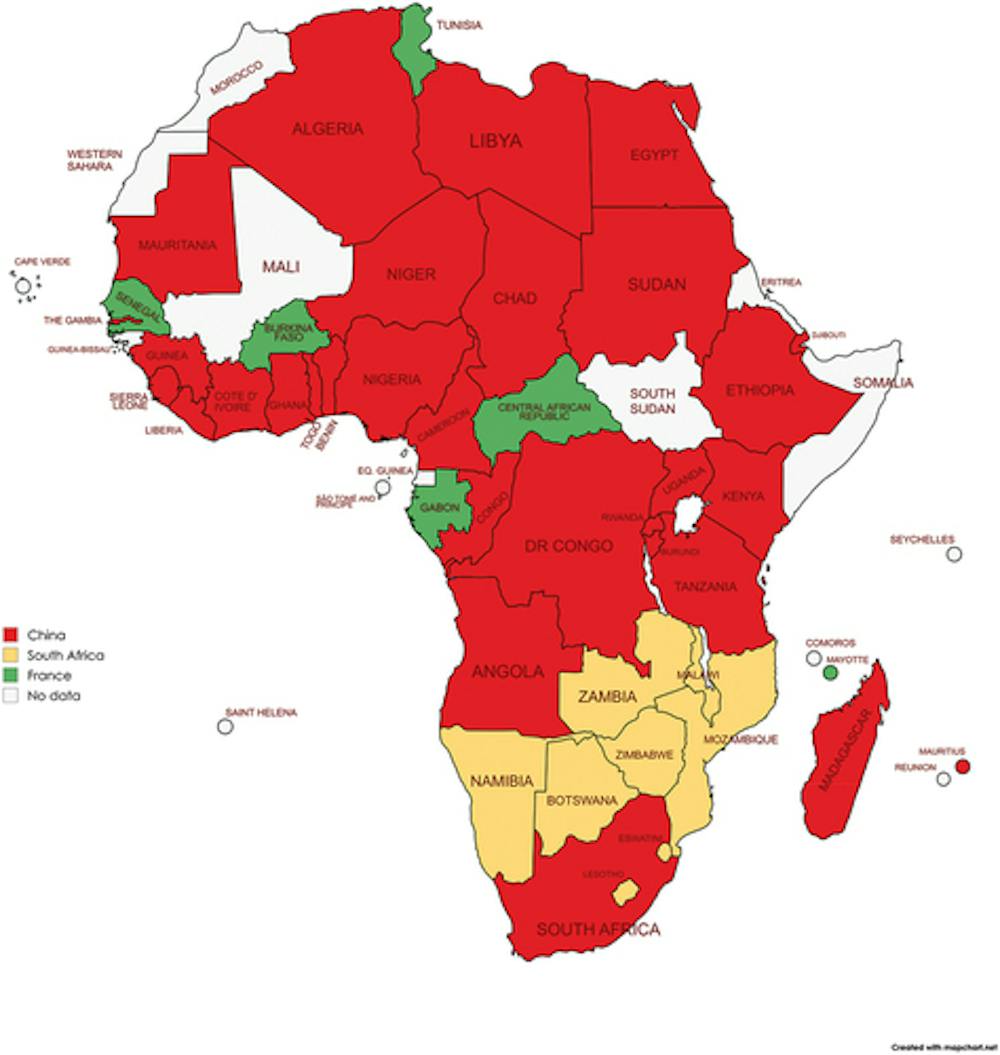
    Illustration of China’s economic influence in 2021 drenched in red and drawn from media, think tanks and related literature. Author’s composite map illustrates securitisation of China in Africa. Brendon J. Cannon

    On the other hand, my research shows that China’s role may not be entirely benign.

    My study focuses mostly on east Africa, to include the Horn of Africa. Much of Beijing’s engagement here remains primarily economic (as it does in west, central and southern Africa). However, China’s growing control over critical infrastructure and digital networks, and its pursuit of military footholds near strategic maritime routes, present real security concerns.

    Policymakers need to separate legitimate risks from exaggerated securitisation narratives. This would help them avoid the pitfalls of reactionary policies.

    Negative consequences

    Presenting China as a threat in Africa has three negative consequences.

    First, it erodes the idea and reality of African sovereignty and agency. Maps portraying Africa as overrun by China suggest that governments and civil society are mere bystanders unable to negotiate their own foreign and domestic agendas.

    The reality is that countries like Kenya actively engage with China to attract investments for development projects, and to balance their relations with other international actors like the US and Japan.

    The result of securitisation is that American or Japanese policymakers, for instance, have begun to view Africa through the lens of their strategic competition with China. This is evident in Washington’s foreign policy rhetoric, for example. This increasingly frames African states not just as partners but also as strategic battlegrounds in the growing US-China rivalry. The risk is that African countries may start being treated as passive players.

    Second, securitisation inflates the perception of China as a global security threat.

    The repeated use of maps with Chinese flags covering ports, railways and industrial zones creates an exaggerated image of unchecked expansion. These maps fail to show the host of other external states operating on the continent.

    The US, multiple European states, Japan, India, Russia, Turkey, the United Arab Emirates and South Korea all have significant interests in Africa. While China is by far the largest, most prominent external actor, with the widest reach throughout Africa, it’s been singled out because of the perceived threats its presence in Africa may pose to the west.

    Third, securitisation can lead to knee-jerk reactions to limit China’s presence rather than engage constructively with Beijing’s investments in Africa. These reactions can result in ill-advised attempts by China’s competitors to push projects that don’t correspond to the needs of African states. This partly explains Ethiopia’s strained relations with the west. Sanctions and aid cuts over the Tigray conflict fuelled a pivot toward China and Russia.

    The security risks

    Securitisation raises valid concerns, but my research also underscores genuine security risks related to China’s presence in Africa. These shouldn’t be overlooked.

    China’s growing role and embeddedness in Africa’s digital ecosystem presents a double-edged sword, for instance. Huawei and other Chinese companies have contributed to Africa’s telecommunications and digital transformation. But these investments also increase Beijing’s potential influence over data security, cyber governance and information flows. These give China the option to exploit networks for surveillance, intelligence gathering or political coercion.

    Chinese-funded, built or operated infrastructure, ports and military bases

    A depiction of China’s infrastructure influence in 2023 from media, think tanks and related literature. Author’s composite map illustrates securitisation of China in Africa. Brendon J. Cannon

    China’s expanding control over dual-use infrastructure is another concern. Chinese-operated ports in Djibouti, for instance, can be used for commercial and military purposes. They potentially grant Beijing a strategic foothold in key maritime corridors, such as the Red Sea. China could restrict access to these ports in times of conflict. Or use them to extend its naval footprint, similar to what it’s done in the South China Sea.

    It’s China’s pursuit of other military facilities beyond its bases in Djibouti that will have the most serious implications for African states’ sovereignty. This is part of a deliberate Chinese strategy to expand its global power projection and protect access to critical resources like oil and gas.

    Agreements on military facilities may end up undermining and even challenging African agency of action. The addition of Chinese ships and soldiers alongside the growing presence of US, European, Indian, Japanese and other regional naval forces could escalate tensions. It also risks entangling African states in power rivalries that aren’t in their national interests.

    China’s presence in Africa has been securitised through maps drenched in red and stamped with flags, framing its engagement as a looming threat rather than a complex geopolitical reality. However, the real challenge for African states is ensuring that China’s growing influence – especially in infrastructure, digital networks, and security – does not erode their sovereignty. Whether Beijing’s presence becomes an opportunity or a liability will depend on how effectively African governments assert their national interests in shaping these partnerships on their own terms.

    – Maps showing China’s growing influence in Africa distort reality – but some risks are real
    – https://theconversation.com/maps-showing-chinas-growing-influence-in-africa-distort-reality-but-some-risks-are-real-249454

    MIL OSI Africa

  • MIL-OSI Russia: A series of events dedicated to friendship with China: a SUM teacher will conduct a lecture course at Tsinghua University

    Translartion. Region: Russians Fedetion –

    Source: State University of Management – Official website of the State –

    From March 3 to May 30, 2025, Oleg Timofeev, a senior researcher at the Center for Socioeconomic and Political Research of China at the National University of Management, will visit this Chinese university at the invitation of the leadership of Tsinghua University (PRC) to deliver a lecture course in Chinese on “Security and International Order in Eurasia” (欧亚安全秩序) at the doctoral department.

    It should be noted that on April 26, 2019, Russian President Vladimir Putin became an honorary doctor of Tsinghua University, where Chinese President Xi Jinping once studied. The rector of the higher educational institution, Qi Yong, personally presented the diploma to the head of the Russian state.

    Founded in 1911, Tsinghua University has consistently ranked 1st or 2nd in the National University Rankings of China and is one of the world’s leading universities and a symbol of China’s economic and scientific progress.

    Oleg Timofeev’s trip to China is part of a series of thematic events at the State University of Management, held in pursuance of the order of the President of the Russian Federation Vladimir Putin to hold the Years of Russia-China Culture in 2024-2025 with the aim of developing Russian-Chinese relations and expanding bilateral ties in the field of culture.

    The complex of events dedicated to relations with the PRC also includes the electronic exhibition “Academic Dialogue: Russia and China in the University Space”. The exhibition is addressed to everyone interested in the history and culture of China. Particular attention is paid to the culture of management in history, higher education, politics and the digital economy, as well as socio-cultural phenomena, institutions and social practices of Russia and China. Monographs and textbooks are presented. Publications from the collection of the Scientific Library of the State University of Management were used in creating the exhibition. The author of the exhibition is chief librarian Elena Novikova.

    ACADEMIC DIALOGUE_RUSSIA AND CHINA IN THE UNIVERSITY SPACE

    Let us recall that at the end of last year, the 4th volume of the book “Xi Jinping on Public Administration” was presented in Russian at the State University of Management. Also, a round table on the development of artificial intelligence in China was held the other day, at which the above-mentioned book by the leader of the PRC was presented to those present again.

    Subscribe to the TG channel “Our GUU” Date of publication: 03/04/2025

    Please note: This information is raw content directly from the source of the information. It is exactly what the source states and does not reflect the position of MIL-OSI or its clients.

    MIL OSI Russia News

  • MIL-OSI: Primech AI Launches Global Robotics as a Service (RaaS) Initiative with Chinachem Group Partnership

    Source: GlobeNewswire (MIL-OSI)


    Pioneering AI-Powered Cleaning Technology Deployment Marks Strategic Expansion into Hong Kong Market

    SINGAPORE, March 04, 2025 (GLOBE NEWSWIRE) — Primech AI Pte. Ltd. (“Primech AI”) or (the “Company”), a subsidiary of Primech Holdings Limited (Nasdaq: PMEC), is proud to announce the launch of its innovative Robotics as a Service (RaaS) business line, revolutionizing the cleaning solutions industry. This strategic initiative addresses critical industry challenges including labor shortages, hygiene standards, and operational costs through proprietary AI-driven technology.

    As part of this global expansion strategy, Primech AI has signed a Memorandum of Understanding (MoU) with CCG Property Services, a subsidiary of Hong Kong’s leading property developer Chinachem Group, to deploy HYTRON, an AI-powered fully automated toilet cleaning robot, in selected facilities managed by CCG Property Services in Hong Kong.

    Figure 1: Nina Tower 1 in Hong Kong, where Primech AI’s HYTRON will be deployed.

    The deployment of HYTRON marks the initial phase of Primech AI’s bold initiative to roll out 300 cleaning robots across Singapore, Hong Kong, and Dubai. This expansion reinforces the company’s position as a technology leader in autonomous cleaning solutions for facility services and sanitation.

    “This collaboration marks a significant milestone in our global expansion of our Robotics as a Service solution,” said Charles Ng, Chief Operating Officer of Primech AI. “While our cleaning services continue to serve the Singapore market, we are extending the Raas business model making it accessible internationally, beginning with this strategic partnership in Hong Kong’s premier property portfolio.”

    Under the two-year MoU, Primech AI will supply and install HYTRON robots in designated facilities, including the iconic Nina Tower 1, with comprehensive maintenance, technical support, and staff training. CCG Property Services will integrate the robots into daily operations, showcasing HYTRON’s capabilities in elevating cleanliness standards and operational efficiency.

    Primech AI envisions a long-term expansion of HYTRON into additional global markets, including Australia, Europe, and the United States, bringing cutting-edge cleaning solutions to more regions worldwide. Beyond this initial deployment, the company also plans to extend its Robotics-as-a-Service (RaaS) offering to these markets, further enhancing accessibility of its advanced cleaning technology on a global scale.

    “Beyond advancing automation in the traditional cleaning industry, this deployment marks a significant milestone for Primech Holdings Limited. It demonstrates our ability to expand internationally and provide cutting-edge cleaning solutions across borders. By working with esteemed partners like Chinachem Group and CCG Property Services, we are proving that our technology is not only effective but also scalable on a global level. This is just the beginning of our vision to redefine commercial cleaning through AI and robotics.” said Kin Wai Ho, CEO of Primech Holdings Limited. This initiative underscores Primech Holdings’ commitment to transforming the cleaning industry through advanced technology while expanding its global footprint beyond its traditional Singapore base.

    Primech AI’s self-developed HYTRON bathroom cleaning robot is integrated with advanced NVIDIA technology. The latest HYTRON model incorporated the NVIDIA Jetson Orin Nano Super, a state-of-the-art System-on-Module (SoM) designed for robust edge AI and robotics applications. The HYTRON robot also uses a suite of NVIDIA software, including CUDA, CuDNN, TensorRT, and NVIDIA Driver, to optimize its AI capabilities.  This combination of hardware and software allows HYTRON to deliver superior processing speed, efficiency, and reliability in its cleaning tasks.

    About Chinachem Group

    Founded in 1960, Chinachem Group is a private real estate company in Hong Kong, with a portfolio covering residential, commercial, retail and industrial buildings for sales and investment, in addition to operating hotels and property management services as well as elderly services.

    Dedicated to making better places to live, work and raise future generations in Hong Kong and beyond, the Group seeks to deliver lasting commercial, social and environmental benefits.

    Please visit www.chinachemgroup.com/en

    About Primech Holdings Limited
    Headquartered in Singapore, Primech Holdings Limited is a leading provider of comprehensive technology-driven facilities services, predominantly serving both public and private sectors throughout Singapore. Primech Holdings offers an extensive range of services tailored to meet the complex demands of its diverse clientele. Services include advanced general facility maintenance services, specialized cleaning solutions such as marble polishing and facade cleaning, meticulous stewarding services, and targeted cleaning services for offices and homes. Known for its commitment to sustainability and cutting-edge technology, Primech Holdings integrates eco-friendly practices and smart technology solutions to enhance operational efficiency and client satisfaction. This strategic approach positions Primech Holdings as a leader in the industry and a proactive contributor to advancing industry standards and practices in Singapore and beyond. For more information, visit www.primechholdings.com.   

    About Primech AI

    Primech AI is a leading robotics company dedicated to pushing the boundaries of innovation in technology. With a team of passionate individuals and a commitment to collaboration, Primech AI is poised to revolutionize the robotics industry with groundbreaking solutions that make a meaningful impact on society. For more information, visit www.primech.ai.

    Forward-Looking Statements

    Certain statements in this announcement are forward-looking statements, including, for example, statements about completing the acquisition, anticipated revenues, growth, and expansion. These forward-looking statements involve known and unknown risks and uncertainties and are based on the Company’s current expectations and projections about future events that the Company believes may affect its financial condition, results of operations, business strategy, and financial needs. These forward-looking statements are also based on assumptions regarding the Company’s present and future business strategies and the environment in which the Company will operate in the future. Investors can find many (but not all) of these statements by the use of words such as “may,” “will,” “expect,” “anticipate,” “aim,” “estimate,” “intend,” “plan,” “believe,” “likely to” or other similar expressions. The Company undertakes no obligation to update or revise publicly any forward-looking statements to reflect subsequent occurring events or circumstances or changes in its expectations, except as may be required by law. Although the Company believes that the expectations expressed in these forward-looking statements are reasonable, it cannot assure that such expectations will be correct. The Company cautions investors that actual results may differ materially from the anticipated results and encourages investors to review other factors that may affect its future results in the Company’s registration statement and other filings with the SEC.

    Company Contact:

    Email: ir@primech.com.sg

    Investor Relations Contact:
     
    Matthew Abenante, IRC
    President   
    Strategic Investor Relations, LLC
    Tel: 347-947-2093
    Email: matthew@strategic-ir.com

    The MIL Network

  • MIL-OSI United Kingdom: Consultation on Chinatown improvements under way

    Source: City of Liverpool

    A consultation on proposed public realm improvements in the Chinatown area of Liverpool city centre is under way.

    Liverpool City Council, with support from local community groups and the University of Liverpool Architecture School, has developed outline plans for Great George’s Square at the junction of Upper Pitt Street and Nelson Street.

    The aim is to attract more visitors and investment, and create a neighbourhood to be proud of.

    The centrepiece of the project will be the installation of two stone lions, which have been donated by the Chinese Consulate General in Manchester and were formally handed over to Liverpool in January to celebrate the 25th anniversary of the Liverpool-Shanghai sister cities relationship.

    The scheme will also see:

    • Better pedestrian access between Upper Pitt Street/Nelson Street and Great George’s Square
    • Installation of a red maple ‘wishing tree’ and ‘flower mat’ near the lions
    • Improvements to the children’s playground
    • The creation of a commemorative memorial garden

    People are being asked their views on the proposed changes to the junction, the playground improvements and the Commemorative Memorial Garden.

    It is hoped the work will be completed in early 2026.

    Comments on the consultation can be made at https://liverpool.gov.uk/chinatowndevelopment until 31 March.

    Local people will also be able to find out more and comment at the City Centre South Neighbourhood community information event being held at the Black-e on Great George Street on Tuesday 4 March between 10.30am – 3pm.

    The scheme will complement wider plans for a revitalised Chinatown which includes new homes and businesses on a previously stalled site at Great George Street. The Council recently succeeded in securing the site under its own unified ownership, with support from Liverpool City Region Combined Authority and the Government.

    Chinatown is also close to the thriving Baltic Triangle, where the new Liverpool Baltic Merseyrail station is due to open in 2027.

    Cabinet Member for Economy and Growth, Cllr Nick Small, said: “We are hugely proud of the city’s Chinatown, which is the oldest in Europe, and has huge potential.

    “We want to revitalise it so it is somewhere that the local community and Liverpool residents are equally proud of, as well as being somewhere tourists can spend time.

    “We’re asking local people and businesses to have their say on the ideas that have been developed and input into the design process, so that we can create something that is really special.

    “When combined with our ambitions for the previously stalled site at Great George Street and the work on the new Baltic Station, this is a really exciting time for this part of the city centre.”

    Chinese Consul General in Manchester, Tang Rui, said: “The stone lions in Chinese culture are actually a symbol of prosperity, so we hope that these pair of lions will bring good luck and showcases a new start for this beautiful, historic Chinatown.”

    Secretary General of Merseyside Chinese Association Joint Action Group, Ming Wang, said: “Chinatown has been home to the local community for more than 200 years. It holds a very special place in our local community’s heart.

    “With these two huge stone lions gifted by the Chinese Consul General in Manchester plus the City Council’s planning in regenerating Chinatown which includes a wishing tree, better playground and the creation of a commemorative memorial garden is so amazing.

    “We look forward to witnessing the transformation of our beloved Chinatown, more footfall to Chinatown, followed by better business, more investment and more visitors from around the world.”

    MIL OSI United Kingdom

  • MIL-OSI Europe: ASIA/CHINA – The Bishops of Shanghai and Hong Kong pray together for the Pope’s health at the Marian Shrine of Sheshan

    Source: Agenzia Fides – MIL OSI

    Sheshan (Agenzia Fides) – “I was here with Bishop Joseph Shen Bin to pray for Pope Francis.” With these words, Cardinal Stephen Chow Sau-yan, Bishop of Hong Kong, describes the central moment of his recent visit to Shanghai, reported in KungKaoPo, the weekly bulletin of the diocese of Hong Kong.The visit, which began on February 24 and ended recently, reflected the desire to walk together on the “bridge of dialogue and communion.”At the Marian shrine of Sheshan, before the image of Our Lady so dear to Pope Francis, Cardinal Chow and Bishop Shen Bin together prayed for the health of the Pontiff during the solemn liturgy of February 25.The Hong Kong delegation, led by Cardinal Chow, included Auxiliary Bishop Joseph Ha Chi-shing OFM, Diocesan Vicar Peter Choy Wai Man and other priests and lay people.On arriving at the Basilica, the two bishops, together with the assembly of the faithful, recited the prayer to Our Lady of Sheshan written by Pope Benedict XVI. “It was a very special experience and it moved me deeply. I cried during the prayer,” Cardinal Chow said. “The Sheshan shrine is a sacred place for the Church in China. I was here with Bishop Shen Bin to pray for the Pope.” The Cardinal also stressed the importance of “spirituality in exchange,” and noted that in the diocese of Shanghai the ecclesiastical community maintains continuous relations with the civil authority. “In Hong Kong too, we must have an open heart for exchange and cooperation with the various parties. There is room and even need for mutual exchange and cooperation between the sacred and the secular.” The Cardinal and Bishop of Hong Kong expressed his hope for more exchange and cooperation in the future, noting that “the Church is a bridge of dialogue and communion.” “May this journey of encounter,” Cardinal Chow insisted, “inspire us to walk in faith and hope and to strengthen ties within the universal Church.”In addition to the Sheshan Shrine and the diocesan seminary located in the Shrine, during their stay in Shanghai, the Hong Kong delegation visited the Cathedral of St. Ignatius, the Bishopric, the Guangqi Publishing House, the churches chosen for the Jubilee pilgrimage, some parish communities and also Buddhist temples. The Cardinal expressed his desire to welcome brothers and sisters of the Church of Shanghai to Hong Kong as soon as possible.Pope Francis has often mentioned the devotion of the people of God in China to Our Lady of Sheshan, entrusting his desire to make a pilgrimage to this Shrine. In the video message sent to the Conference on the centenary of the Primum Concilium Sinense held at the Pontifical Urbaniana University on 21 May (see Fides, 21/5/2024), Pope Francis recalled that “Precisely in these days, in the month of May, dedicated by the people of God to the Virgin Mary, many of our Chinese brothers and sisters make a pilgrimage to the Shrine of Sheshan, to entrust their prayers and their hopes to the intercession of the Mother of Jesus.” “I too – added the Bishop of Rome on that occasion – ideally climb the hill of Sheshan. And together let us entrust to Our Lady, Help of Christians, our brothers and sisters in the faith who are in China, all the Chinese people and all our poor world, asking for her intercession, so that peace may always triumph everywhere.” (NZ) (Agenzia Fides, 4/3/2025)
    Share:

    MIL OSI Europe News

  • MIL-OSI Russia: Parliamentary delegation from Indonesia to HSE: new prospects for cooperation

    Translartion. Region: Russians Fedetion –

    Source: State University Higher School of Economics – State University Higher School of Economics –

    © Higher School of Economics

    On February 24, a meeting with a delegation of the Committee on Interparliamentary Cooperation of the Council of People’s Representatives of the Republic of Indonesia was held at the HSE on Pokrovsky Boulevard. The event was attended by the Vice-Rector of the University, the Head of the BRICS Expert Council – Russia Victoria Panova and representatives of the university’s scientific departments and centers. During the meeting, the parties discussed key areas for strengthening scientific and expert cooperation, and joint initiatives in the field of science and technology, including through BRICS.

    A delegation from the People’s Representative Council (PRC) Committee on Inter-Parliamentary Cooperation visited the university for the first time. Earlier in the day, a meeting of the Chairman of the Committee of the Council of the Federation of the Federal Assembly of the Russian Federation on International Affairs with the head of the Committee of the People’s Commissars of the Republic of Indonesia, Mr. Mardani Ali Sera.

    HSE Vice-Rector Victoria Panova welcomed the guests and said that the university is actively developing international cooperation and highly values the opportunities for interaction with Indonesia. She emphasized that HSE is not only one of the leading educational and research centers in Russia, but also a key participant in the work of BRICS: “The Higher School of Economics was chosen as an expert center for analytical and scientific work on BRICS, as it is a modern and young university that is actively developing in such key areas as IT, neuroscience, fundamental physics, and STEM in general. The BRICS Expert Council (BRICS EC) is not just a division created to support the Russian Federation’s chairmanship of BRICS in 2024. We work in long-term areas of political, socio-economic and humanitarian cooperation, conduct research and create platforms for knowledge exchange between the countries of the association.”

    Victoria Panova expressed hope for further strengthening of relations between Russia and Indonesia. “Our task is to offer Indonesia not only educational opportunities, but also expert support in various fields. We are ready for active cooperation and hope that Indonesia will take an active part in the work of the BRICS expert track,” Victoria Panova said.

    Mr. Mardani Ali Sera, in turn, noted that Indonesia is deeply interested in strengthening ties with Russia through multilateral formats, in particular BRICS, and expressed a desire to also develop bilateral relations at all levels. “We are pleased that cooperation between Russia and Indonesia has intensified in recent years. Our country is interested in interacting, including with the BRICS-Russia Expert Council based at the Higher School of Economics. We see what a significant contribution the BRICS ES makes to achieving the common goals of the association: national strategies, economic and scientific and technological development. We are confident that joint work will open up new opportunities for us, especially in the field of using technology and innovation,” Mr. Mardani Ali Sera emphasized.

    Deputy Chairman of the Inter-Parliamentary Cooperation Committee Mr. Fadlullah Muhammad Hussein said that Indonesia sees many prospects in cooperation with BRICS: “BRICS offers us great opportunities for cooperation. All member countries communicate on an equal basis and can freely choose which line to work on. BRICS is about all aspects of building a fair world order,” he added.

    Representatives of the National Research University Higher School of Economics emphasized the importance of constant interaction in the scientific research sphere. Alexander Sokolov, Deputy Director Institute for Statistical Studies and Economics of Knowledge, National Research University Higher School of Economics, director Foresight Center spoke about the development of new technologies that could be useful for Indonesia: “Our institute is actively developing the foresight direction, creating innovative methodologies and tools for forecasting and modeling future trends in various fields of science and technology. We conduct research aimed at building long-term trends in areas such as space, medicine, energy and IT, and are ready to offer our expertise and resources for work with Indonesia. Joint efforts will allow us to better understand how new technologies can shape the future of economies and societies.”

    Director Institute of Trade Policy, National Research University Higher School of Economics, BRICS ES expert Alexander Daniltsev noted the importance of trade relations for BRICS member countries. He expressed confidence that Indonesia will become a reliable partner not only for Russia. “International trade and economic cooperation issues occupy a key place within BRICS, and we are confident that Indonesia can become an important partner for all countries of the association. We are actively exploring the possibilities of developing trade relations in such strategically important areas as energy, agriculture and high technology. It is important that our joint projects contribute to stable growth and deepening of mutually beneficial cooperation, as well as open up new prospects for all BRICS members,” he said.

    Ekaterina Shamina, Deputy Director for Scientific Projects Directorate for Scientific Projects of the National Research University Higher School of Economics, drew attention to the possibility of joint work with Indonesia in the field of artificial intelligence regulation: “We are developing standards for regulating artificial intelligence in Russia, and this is one of the key areas for BRICS in the coming years. We would like to offer our Indonesian colleagues cooperation in developing a common AI testing system that could be implemented in the BRICS countries. This will allow us to work on the safe and ethical use of new technologies,” she said.

    Alexander Larichev, Deputy Dean for Research Faculty of Law informed Indonesian parliamentarians that the HSE has launched an initiative – the BRICS Law School Consortium, within the framework of which exchanges between players in the field of law are planned, and scientific publications are already being prepared: “We are implementing a lot. Many universities in the BRICS countries have already joined us. The subjects that we are developing are digital law, international commercial law and business law, etc. We will be glad to see Indonesian universities in our Consortium.”

    Natalia Zholnerovich, Deputy Dean Faculty of Geography and Geoinformation Technologies HSE noted that the faculty was founded in partnership with the Russian Academy of Sciences and its areas of activity are much broader than just geography. “We are developing specific areas of geography: climate change and adaptation to it; climate risk assessment at different levels; migration and urban systems; strategy and territorial planning based on technological solutions; the relationship between people’s potential and the resilience of territories to various risk factors,” she explained.

    The parties discussed the prospects for joint research and analytical reports, agreed on further interaction and planning of joint events aimed at strengthening the partnership within the framework of the HSE and BRICS.

    Please note: This information is raw content directly from the source of the information. It is exactly what the source states and does not reflect the position of MIL-OSI or its clients.

    MIL OSI Russia News

  • MIL-OSI Global: Maps showing China’s growing influence in Africa distort reality – but some risks are real

    Source: The Conversation – Africa – By Brendon J. Cannon, Associate Professor, Khalifa University

    Global power dynamics in Africa are shifting, with China eclipsing the influence of the US and France. China has become Africa’s single largest trading partner.

    In response, media and policymakers in traditionally dominant states are increasingly using maps drenched in red or stamped with Chinese flags to depict Beijing’s expanding footprint. One map reproduced by a US congressional committee, for instance, showed Beijing’s influence and reach across the continent in red stripes.

    But these visuals oversimplify a complex reality. This is an issue I explore in a new study. For over a decade, I have researched the interactions of sub-Saharan Africa with other states like Turkey, Arab Gulf states, Japan and China.

    In a recent paper I explored the use of maps that have been created of Africa showing China’s projects across the continent. I argue that, by overlaying Chinese flags on maps depicting Africa and its 54 states, media and policymakers turn economic ties into a visual representation of foreign encroachment.

    This process is called securitisation – the framing of something as a threat, even if it’s not one.

    This visual securitisation not only heightens fears of dependency but also primes certain audiences – in the US, Japan and France, for instance – to view China’s presence as a direct challenge to their interests.

    Certain threats – like terrorist groups or nuclear weapons – are self-evident. China’s presence in many African states, however, is different: if it’s a threat, who is threatened and why? Do Chinese-built roads or railways – and the debt African states accrue for this infrastructure – constitute the threat?

    My research shows that the answer to these questions is: it depends.

    Portraying China’s presence in Africa with flags on maps can distort African states’ sovereignty and their power to make decisions based on national interests. This visual portrayal reduces these countries to arenas of global power competition. It fails to recognise them as strategic actors.

    China tops imports to African states

    On the other hand, my research shows that China’s role may not be entirely benign.

    My study focuses mostly on east Africa, to include the Horn of Africa. Much of Beijing’s engagement here remains primarily economic (as it does in west, central and southern Africa). However, China’s growing control over critical infrastructure and digital networks, and its pursuit of military footholds near strategic maritime routes, present real security concerns.

    Policymakers need to separate legitimate risks from exaggerated securitisation narratives. This would help them avoid the pitfalls of reactionary policies.

    Negative consequences

    Presenting China as a threat in Africa has three negative consequences.

    First, it erodes the idea and reality of African sovereignty and agency. Maps portraying Africa as overrun by China suggest that governments and civil society are mere bystanders unable to negotiate their own foreign and domestic agendas.

    The reality is that countries like Kenya actively engage with China to attract investments for development projects, and to balance their relations with other international actors like the US and Japan.

    The result of securitisation is that American or Japanese policymakers, for instance, have begun to view Africa through the lens of their strategic competition with China. This is evident in Washington’s foreign policy rhetoric, for example. This increasingly frames African states not just as partners but also as strategic battlegrounds in the growing US-China rivalry. The risk is that African countries may start being treated as passive players.

    Second, securitisation inflates the perception of China as a global security threat.

    The repeated use of maps with Chinese flags covering ports, railways and industrial zones creates an exaggerated image of unchecked expansion. These maps fail to show the host of other external states operating on the continent.

    The US, multiple European states, Japan, India, Russia, Turkey, the United Arab Emirates and South Korea all have significant interests in Africa. While China is by far the largest, most prominent external actor, with the widest reach throughout Africa, it’s been singled out because of the perceived threats its presence in Africa may pose to the west.

    Third, securitisation can lead to knee-jerk reactions to limit China’s presence rather than engage constructively with Beijing’s investments in Africa. These reactions can result in ill-advised attempts by China’s competitors to push projects that don’t correspond to the needs of African states. This partly explains Ethiopia’s strained relations with the west. Sanctions and aid cuts over the Tigray conflict fuelled a pivot toward China and Russia.

    The security risks

    Securitisation raises valid concerns, but my research also underscores genuine security risks related to China’s presence in Africa. These shouldn’t be overlooked.

    China’s growing role and embeddedness in Africa’s digital ecosystem presents a double-edged sword, for instance. Huawei and other Chinese companies have contributed to Africa’s telecommunications and digital transformation. But these investments also increase Beijing’s potential influence over data security, cyber governance and information flows. These give China the option to exploit networks for surveillance, intelligence gathering or political coercion.

    Chinese-funded, built or operated infrastructure, ports and military bases

    China’s expanding control over dual-use infrastructure is another concern. Chinese-operated ports in Djibouti, for instance, can be used for commercial and military purposes. They potentially grant Beijing a strategic foothold in key maritime corridors, such as the Red Sea. China could restrict access to these ports in times of conflict. Or use them to extend its naval footprint, similar to what it’s done in the South China Sea.

    It’s China’s pursuit of other military facilities beyond its bases in Djibouti that will have the most serious implications for African states’ sovereignty. This is part of a deliberate Chinese strategy to expand its global power projection and protect access to critical resources like oil and gas.

    Agreements on military facilities may end up undermining and even challenging African agency of action. The addition of Chinese ships and soldiers alongside the growing presence of US, European, Indian, Japanese and other regional naval forces could escalate tensions. It also risks entangling African states in power rivalries that aren’t in their national interests.

    China’s presence in Africa has been securitised through maps drenched in red and stamped with flags, framing its engagement as a looming threat rather than a complex geopolitical reality. However, the real challenge for African states is ensuring that China’s growing influence – especially in infrastructure, digital networks, and security – does not erode their sovereignty. Whether Beijing’s presence becomes an opportunity or a liability will depend on how effectively African governments assert their national interests in shaping these partnerships on their own terms.

    Brendon J. Cannon does not work for, consult, own shares in or receive funding from any company or organisation that would benefit from this article, and has disclosed no relevant affiliations beyond their academic appointment.

    ref. Maps showing China’s growing influence in Africa distort reality – but some risks are real – https://theconversation.com/maps-showing-chinas-growing-influence-in-africa-distort-reality-but-some-risks-are-real-249454

    MIL OSI – Global Reports

  • MIL-OSI China: China suspends imports of US logs

    Source: China State Council Information Office

    An aerial drone photo shows the container terminal of Lianyungang Port in east China’s Jiangsu province, Jan. 13, 2025. [Photo/Xinhua]

    China’s General Administration of Customs (GAC) on Tuesday announced the immediate suspension of log imports from the United States, in accordance with the relevant laws.

    The suspension aims to prevent the introduction of harmful species and protect China’s agricultural and forestry production, as well as its ecological security, the GAC said.

    Chinese customs have recently detected quarantine pests, including bark beetles and long-horned beetles, in logs imported from the United States, according to the GAC.

    MIL OSI China News

  • MIL-OSI China: China adds 10 US firms to unreliable entity list

    Source: China State Council Information Office

    Photo taken on April 4, 2018 shows the entrance to China’s Ministry of Commerce in Beijing. [Photo/Xinhua]

    China decided on Tuesday to add 10 U.S. firms, including TCOM, Limited Partnership, to the country’s unreliable entity list and take corresponding measures against them.

    From Tuesday onward, China will prohibit these companies from engaging in import and export activities related to China, and these companies will also be banned from making new investments within the country, according to a statement released by the Ministry of Commerce.

    The 10 U.S. firms are TCOM, Limited Partnership, Stick Rudder Enterprises LLC, Teledyne Brown Engineering, Inc., Huntington Ingalls Industries Inc., S3 AeroDefense, Cubic Corporation, TextOre, ACT1 Federal, Exovera and Planate Management Group.

    The decision was made to maintain China’s national sovereignty, security and development interests and in accordance with relevant laws and regulations, the statement noted.

    Disregarding strong objections from China, these 10 companies have in recent years either participated in arms sales to Taiwan or engaged in so-called military technology cooperation with Taiwan, a spokesperson for the ministry said.

    In response, China decided to hold these entities accountable in accordance with various laws and regulations, the spokesperson added.

    China has always prudently handled the issue of its unreliable entity list, targeting only a small number of foreign entities that pose risks to China’s national security, the spokesperson said, adding that law-abiding foreign entities that operate in good faith need not be concerned.

    The Chinese government will, as always, welcome companies from all countries to invest and operate in China, and is committed to providing a stable, fair and predictable business environment for foreign enterprises operating in China in accordance with laws and regulations, the spokesperson said.

    MIL OSI China News

  • MIL-OSI China: New all-cargo air route links China, Pakistan

    Source: China State Council Information Office

    A new air cargo route linking Urumqi, capital of Xinjiang Uygur Autonomous Region in northwest China, and Islamabad, capital of Pakistan, was launched on Tuesday, announced SF Airlines.

    The Urumqi-Islamabad route was the first all-cargo route launched by SF Airlines in Xinjiang to Pakistan. It will carry cross-border e-commerce goods and other products, said the air cargo carrier.

    Two round-trip flights are scheduled to shuttle between Urumqi and Islamabad every week on this cargo route, providing more than 110 tonnes of air transport capacity weekly.

    With the launch of the Urumqi-Islamabad route, the air cargo services of SF Airlines now reach three destinations in Pakistan, serving China-Pakistan economic and trade exchanges by enhancing logistics convenience, said SF Airlines.

    Headquartered in Shenzhen, SF Airlines is China’s largest air cargo carrier in fleet size. To date, it operates 89 all-cargo freighters, according to statistics from the cargo carrier.

    MIL OSI China News

  • MIL-OSI China: Ukraine can withstand Russia for 6 months without US support: Official

    Source: China State Council Information Office

    A file photo taken on March 1, 2022 shows armed personnel in Donetsk. [Photo/Xinhua]

    Ukraine has enough reserves to withstand the conflict with Russia for about six months without U.S. support, the RBC-Ukraine online media outlet reported Tuesday, citing a senior parliament official.

    “Our military-industrial complex has significantly expanded over the past three years, and it is capable of offsetting threats and risks,” said Fedir Venislavsky, a member of the parliament’s defense committee.

    However, he acknowledged that Ukraine relies on the United States for certain weapons, including air defense systems and long-range multiple-launch rocket systems.

    Venislavsky said that efforts are underway to secure alternative sources of supply for critically important weapons.

    According to multiple media reports, the U.S. administration suspended delivery of military aid to Ukraine earlier in the day, days after the Oval Office saw a heated exchange between the Ukrainian and U.S. presidents at the White House.

    Between February 2022 and January 2025, Washington provided $65.9 billion in military assistance to Ukraine, according to the U.S. Department of State.

    MIL OSI China News

  • MIL-OSI Asia-Pac: Health chief meets GZ’s vice mayor

    Source: Hong Kong Information Services

    Secretary for Health Prof Lo Chung-mau met a delegation led by Guangzhou Vice Mayor Lai Zhihong today to discuss the deepening of medical co-operation between Hong Kong and Guangzhou.

    At the meeting, the two sides exchanged views on various cross-boundary medical collaboration measures, including the Elderly Health Care Voucher Greater Bay Area Pilot Scheme, cross-boundary access to electronic health records via the eHealth mobile application, and the strengthening of exchanges between healthcare professionals from the two places.

     
    Prof Lo stressed that the Hong Kong Special Administrative Region Government attaches great importance to cross-boundary medical collaboration, and has long been committed to it as way of enhancing healthcare across the Greater Bay Area (GBA) for the benefit of the region’s residents.

     
    He said the Health Bureau is pressing ahead with the pilot scheme’s extension to all of the GBA’s nine Mainland cities, as set out in the Chief Executive’s 2024 Policy Address, and aims to announce more details in the first half of this year.
     

    He also iterated that that the bureau will fully leverage the eHealth platform to expand the sharing of cross-boundary medical records.
     

    “I have every confidence that under the guidance of key policies such as the Outline Development Plan for the Guangdong-Hong Kong-Macao Greater Bay Area, the National 14th Five-Year Plan, as well as the Resolution of the Communist Party of China (CPC) Central Committee on Further Deepening Reform Comprehensively to Advance Chinese Modernization adopted by the Third Plenary Session of the 20th CPC Central Committee, Hong Kong and Guangzhou will take forward healthcare integration and innovation in the GBA through concerted efforts in accordance with the principles of complementarity and mutual benefits, thereby contributing to the needs of national development.”

    MIL OSI Asia Pacific News

  • MIL-OSI: Churchill Discovers Vanadium-Titanium-Iron Mineralization at the Taylor Brook Nickel Project, Newfoundland & Labrador

    Source: GlobeNewswire (MIL-OSI)

    TORONTO, March 04, 2025 (GLOBE NEWSWIRE) — Churchill Resources Inc. (“Churchill” or the “Company”) (TSXV: CRI) is pleased to provide an update on its Taylor Brook nickel project where 2024 drilling and prospecting have returned anomalous Vanadium-Titanium-Magnetite (“VTM”) results at the TB-01 to TB-04 chargeability targets. These targets only cover a small area explored thus far on the margin of the large South Lobe of the Taylor Brook Gabbro Complex (“TBGC”), but suggest it to be a layered intrusion with critical minerals potential, in addition to the property’s high-grade magmatic Ni-Cu-Co mineralization seen at Layden (See news releases February 13, 2023, October 26, 2023).

    Mineralized magnetite-layered units sampled thus far at the South Lobe are generally several metres thick and gently dipping northeasterly, from which numerous 2024 samples returned anomalous values of 540ppm-955ppm V, 3.1%-7.29% Ti and >20% Fe with Ni, Cu and Co enrichment at several sites at the TB-01 Target (Fig. 1 and Table 1).   Winter Borehole Induced Polarization (“BHIP”) surveys at TB-01 have generated high chargeability off-hole targets in this same area, which will be drill tested along with a systematic trenching program.

    Highlights:

    • Taylor Brook Gabbro a layered intrusion with economic potential for VTM critical metals
    • Numerous enriched VTM layers outcrop at the South Lobe allowing systematic surface testing
    • Ni-Cu-Co sulphides found at/near surface at TB-01, also enriched in VTM mineralization
    • BHIP defines large, high chargeability targets near holes TB-24-42B and TB-24-43 at TB-01
    • Spring 2025 work plans include systematic trenching and more drilling at TB-01, and
    • Further exploration for both Ni-Cu-Co magmatic sulphides and VTM mineralization along strike from TB-01 and the ~10km2 magnetic/gravity anomaly at the South Lobe

    Paul Sobie, CEO, commented:

    “The anomalous VTM results we’re starting to see at TB-01 to 04, along with the associated shallow Ni-Cu-Co trends, are compelling, and systematic follow-up work will commence as soon as the snow cover melts. We prioritized this area based on anomalous Ni-Cu-Co in soils, and have drilled and prospected on surface the probable source layer within the TBGC, which is also anomalous in VTM’s, a good indication of layered intrusion-type mineral deposits. We’ve really only begun to evaluate a small portion of the overall approximately 10km2 magnetic / vanadium soil anomaly VTM target on the South Lobe and its margins, so our 2024 results are encouraging.

    VTM’s are important strategic metals for the steel, aerospace and battery industries for vanadium, and the pigment, steel and medical industries for titanium. North America has no vanadium production, with China, Russia, South Africa and Brazil the major producers, world-wide, from large layered intrusions such as the Bushveld Complex (South Africa). Layered intrusive mineral deposits typically exhibit layered VTM mineralization in the upper portions, with PGE and chromite deposits somewhat deeper, and Ni-Cu-Co-PGE deposits lowest, in the more ultramafic portion of the intrusion. The VTM mineralization intersected and prospected at surface at the TBGC therefore would appear to be at its upper levels, with exploration just getting started on the South Lobe.

    Figure 1 – Vanadium in rocks, soils and drill cores over South Lobe TMI with VTEM anomalies

    Systematic prospecting, mapping and trenching at the South Lobe, as well as more drilling at TB-01 are being planned. New exploration permit applications are being prepared for submittal. We’re quite excited by the BHIP method and results, which has located the highest chargeability targets within the TB-01 anomaly, off-hole but not distal from our 2024 drillholes. We’ll drill test these in 2025.”

    The South Lobe has been of particular interest to CRI since staking it in 2021 based on its intense magnetic signature and coincident gravity anomaly, more particularly now as it is returning anomalous vanadium and titanium soil survey and prospecting results per Figure 1. The South Lobe magnetic feature is predominantly a topographic high with good exposures of layering along its margins, where the VTM horizons are commonly resistive, outcropping or forming scarps. Presently less that 10% of the South Lobe has been prospected, therefore the Company is planning a comprehensive prospecting, mapping, and trenching/stripping program for the Spring. The TB-01 horizon(s) are laterally extensive based on airborne geophysics and soil sampling and will be followed up along strike in Spring 2025. As well, the Company’s exploration team will comprehensively sample holes TB-24-41, -42B and -43 for VTM mineralization and PGEs in order to test for potential deeper horizons of mineralization.

    Petrographic, lithogeochemical, and mineral liberation studies on mineralized samples are pending, which will assist in assessing the economic potential of these VTM units.

    Table 1 – Selected 2024 Assay and Lithogeochemical Samples Metal Analytical Results

    BHIP surveys at the TB-01 target were successful and have confirmed that off-hole chargeability anomalies correlate well with layers of VTM mineralization including a near-surface horizon also enriched in Ni-Cu-Co (see inset map on Figure 1). Hole TB-24-41 was blocked at 100m depth so the entire hole could not be surveyed, but the BHIP did detect the near-surface Ni-Cu-Co-VTM horizon (the Ni-Cu-Co trend on the figures) observed in the core as well as in numerous nearby angular boulders.

    The technical and scientific information in this news release has been reviewed and approved by Dr. Derek H.C Wilton, P.Geo., FGC, who is a “qualified person” as defined under National Instrument 43-101 – Standards of Disclosure for Mineral Projects (“NI 43-101”). Mr. Wilton is an honourary research professor of Economic Geology at Memorial University in St. John’s and is independent of the Company for the purposes of NI 43-101.

    The lithogeochemical samples reported here were whole rock pieces, collected from outcrop and historical drill core by Dr. Wilton during fieldwork in September/October 2024. These samples were sealed in labelled plastic bags in the field. All sample bags were photographed and transported to Thunder Bay, ON, by secure courier. The samples were analysed by ALS Geochemistry Ltd. in Thunder Bay using ME-ICP06 whole rock and ME-MS61L analytical protocols. Samples with over limit Ni contents were re-assayed using OG-46 Aqua-Regia overlimit method. Quality control results, including the laboratory’s own control samples, were evaluated immediately.

    The assay drill core and rock samples were placed in labelled, sealed plastic bags and delivered to Eastern Analytical of Springdale, NL, an ISO/IEC 17025 certified facility. The samples were analysed using ICP 34 (inductively coupled plasma) analytical protocols. Samples with over limit Ni and Fe contents were re-assayed using Eastern’s Ore Grade Assay (multi acid digestion) overlimit method. Quality control results, including the laboratory’s control samples, were evaluated immediately. 1

    1The Company reminds investors that surface rock samples are select samples and may not be representative of all mineralization on the Taylor Brook property.

    About Churchill Resources Inc.

    Churchill Resources Inc. is a Canadian exploration company focused on high grade, magmatic nickel sulphides in Canada, principally at its prospective Taylor Brook and Florence Lake properties in Newfoundland & Labrador. The Churchill management team, board and its advisors have decades of combined management experience in mineral exploration and in the establishment of successful publicly listed mining companies, both in Canada and around the world. Churchill’s Taylor Brook and Florence Lake projects have the potential to benefit from the province’s large and diversified minerals industry, which includes world class nickel mines and processing facilities, and a well-developed mineral exploration sector with locally based drilling and geological expertise.

    Further Information

    For further information regarding Churchill, please contact:

    Churchill Resources Inc.   
    Paul Sobie, Chief Executive Officer   
    Tel. +1 416.365.0930 (o)  
      +1 647.988.0930 (m)  
    Email psobie@churchillresources.com  
         
    Alec Rowlands, Corporate Consultant   
    Tel. +1 416.721.4732 (m)  
    Email arowlands@churchillresources.com  
         

    Cautionary Note Regarding Forward Looking Information

    This news release contains “forward-looking information” and “forward-looking statements” (collectively, forward-looking statements”) within the meaning of the applicable Canadian securities legislation. All statements, other than statements of historical fact, are forward-looking statements and are based on expectations, estimates and projections as at the date of this news release. Any statement that involves discussions with respect to predictions, expectations, beliefs, plans, projections, objectives, assumptions, future events or performance (often but not always using phrases such as “expects”, or “does not expect”, “is expected”, “anticipates” or “does not anticipate”, “plans”, “proposed”, “budget”, “scheduled”, “forecasts”, “estimates”, “believes” or “intends” or variations of such words and phrases or stating that certain actions, events or results “may” or “could”, “would”, “might” or “will” be taken to occur or be achieved) are not statements of historical fact and may be forward-looking statements. In this news release, forward-looking statements relate to, among other things, , the Company’s objectives, goals and exploration activities conducted and proposed to be conducted at the Company’s properties; interpretation of recent exploration results; future growth potential of the Company, including whether any proposed exploration programs at any of the Company’s properties will be successful; exploration results; and future exploration plans and costs and financing availability.

    These forward-looking statements are based on reasonable assumptions and estimates of management of the Company at the time such statements were made. Actual future results may differ materially as forward-looking statements involve known and unknown risks, uncertainties and other factors which may cause the actual results, performance or achievements of the Company to materially differ from any future results, performance or achievements expressed or implied by such forward-looking statements. Such factors, among other things, include: the expected benefits to the Company relating to the exploration conducted and proposed to be conducted at the Company’s properties; failure to identify any mineral resources or significant mineralization; the preliminary nature of metallurgical test results; uncertainties relating to the availability and costs of financing needed in the future, including to fund any exploration programs on the Company’s properties; fluctuations in general macroeconomic conditions; fluctuations in securities markets; fluctuations in spot and forward prices of gold, silver, base metals or certain other commodities; fluctuations in currency markets (such as the Canadian dollar to United States dollar exchange rate); change in national and local government, legislation, taxation, controls, regulations and political or economic developments; risks and hazards associated with the business of mineral exploration, development and mining (including environmental hazards, industrial accidents, unusual or unexpected formations pressures, cave-ins and flooding); inability to obtain adequate insurance to cover risks and hazards; the presence of laws and regulations that may impose restrictions on mining and mineral exploration; employee relations; relationships with and claims by local communities and indigenous populations; availability of increasing costs associated with mining inputs and labour; the speculative nature of mineral exploration and development (including the risks of obtaining necessary licenses, permits and approvals from government authorities); the unlikelihood that properties that are explored are ultimately developed into producing mines; geological factors; actual results of current and future exploration; changes in project parameters as plans continue to be evaluated; soil sampling results being preliminary in nature and are not conclusive evidence of the likelihood of a mineral deposit; title to properties; and those factors described in the most recently filed management’s discussion and analysis of the Company. Although the forward-looking statements contained in this news release are based upon what management of the Company believes, or believed at the time, to be reasonable assumptions, the Company cannot assure shareholders that actual results will be consistent with such forward-looking statements, as there may be other factors that cause results not to be as anticipated, estimated or intended. Accordingly, readers should not place undue reliance on forward-looking statements and information. There can be no assurance that forward-looking information, or the material factors or assumptions used to develop such forward-looking information, will prove to be accurate. The Company does not undertake to release publicly any revisions for updating any voluntary forward-looking statements, except as required by applicable securities law.

    Neither the TSXV nor its Regulation Services Provider (as that term is defined in the policies of the TSXV) accepts responsibility for the adequacy or accuracy of this news release.

    Photos accompanying this announcement are available at: 

    https://www.globenewswire.com/NewsRoom/AttachmentNg/f88f1c38-2fc8-4687-b536-67baa68ec31e

    https://www.globenewswire.com/NewsRoom/AttachmentNg/0d18ace1-d149-45eb-b87f-bf7a1d931b09

    The MIL Network

  • MIL-OSI: QuantaSing to Report Second Fiscal Quarter Financial Results on March 11, 2025

    Source: GlobeNewswire (MIL-OSI)

    BEIJING, March 04, 2025 (GLOBE NEWSWIRE) — QuantaSing Group Limited (NASDAQ: QSG) (“QuantaSing” or the “Company”), a leading lifestyle solution provider empowering adults to live better and longer, today announced that it plans to release its unaudited financial results for the quarter ended December 31, 2024, before the U.S. market opens on Tuesday, March 11, 2025.

    The Company’s management will hold an earnings conference call at 07:00 A.M. Eastern Time on Tuesday, March 11, 2025 (07:00 P.M. Beijing Time on the same day) to discuss the financial results.

    Listeners may access the call by dialing the following numbers:
    International:
    United States Toll Free:
    Mainland China Toll Free: 
    Hong Kong Toll Free:
    Conference ID:
    1-412-902-4272
    1-888-346-8982
    4001-201203
    800-905945
    QuantaSing Group Limited
       
    The replay will be accessible through March 18, 2025 by dialing the following numbers:
    International:
    United States Toll Free:
    Replay Access Code:
    1-412-317-0088
    1-877-344-7529
    7982374
       

    A live and archived webcast of the conference call will also be available at the Company’s investor relations website at https://ir.quantasing.com.

    About QuantaSing Group Limited
    QuantaSing is a leading lifestyle solution provider empowering adults to live better and longer. Leveraging its profound understanding of adult users and robust infrastructure, QuantaSing offers easy-to-understand, affordable, and accessible online courses to adult learners as well as consumer products and service in selected areas to address the senior users’ aspirations for wellness.

    For more information, please visit: https://ir.quantasing.com.

    Contact
    Investor Relations
    Leah Guo
    QuantaSing Group Limited
    Email: ir@quantasing.com
    Tel: +86 (10) 6493-7857

    Robin Yang, Partner
    ICR, LLC
    Email: QuantaSing.IR@icrinc.com
    Phone: +1 (212) 537-0429

    The MIL Network

  • MIL-OSI: Kingsoft Cloud to Report Fourth Quarter and Fiscal Year 2024 Financial Results on March 19, 2025

    Source: GlobeNewswire (MIL-OSI)

    BEIJING, March 04, 2025 (GLOBE NEWSWIRE) — Kingsoft Cloud Holdings Limited (NASDAQ: KC and HKEX: 3896) (“Kingsoft Cloud” or the “Company”), a leading cloud service provider in China, today announced that it will release its unaudited financial results for the fourth quarter and fiscal year 2024 ended December 31, 2024 before the open of U.S. markets on Wednesday, March 19, 2025.

    Kingsoft Cloud’s management will host an earnings conference call on Wednesday, March 19, 2025 at 8:15 am, U.S. Eastern Time (8:15 pm, Beijing/Hong Kong Time on the same day).

    Preregistration Information
    Participants can register for the conference call by navigating to https://register-conf.media-server.com/register/BIc315136cafe94825b98dca6b37795790 Once preregistration has been completed, participants will receive dial-in numbers, direct event passcode, and a unique access PIN.

    To join the conference, simply dial the number in the calendar invite you receive after preregistering, enter the passcode followed by your PIN, and you will join the conference instantly.

    Additionally, a live and archived webcast of the conference call will also be available on the Company’s investor relations website at http://ir.ksyun.com.

    About Kingsoft Cloud Holdings Limited

    Kingsoft Cloud Holdings Limited (NASDAQ: KC and HKEX: 3896) is a leading cloud service provider in China. Kingsoft Cloud has built a comprehensive and reliable cloud platform consisting of extensive cloud infrastructure, cutting-edge cloud products and well-architected industry-specific solutions across public cloud and enterprise cloud.

    For more information, please visit: http://ir.ksyun.com.

    For investor and media inquiries, please contact:

    Kingsoft Cloud Holdings Limited
    Nicole Shan
    Tel: +86 (10) 6292-7777 Ext. 6300
    Email: ksc-ir@kingsoft.com

    The MIL Network

  • MIL-OSI China: White paper stresses rigorous control over fentanyl-related substances

    Source: China State Council Information Office 2

    An undated file photo shows a customs officer uses a dog to check for illegal substances at an e-commerce industrial park in Hefei, Anhui province, that mainly deals with cross-border businesses. [Photo/Xinhua]
    China’s State Council Information Office on Tuesday released a white paper, titled “Controlling Fentanyl-Related Substances — China’s Contribution,” highlighting the country’s rigorous control over the chemicals.
    China has attached great importance to maintaining control over fentanyl-related substances in recent years, the white paper says.
    The country has exercised strict supervision over fentanyl-related medications, rigorously prevented the abuse of fentanyl-related substances, and stricken hard against the smuggling, manufacturing, and trafficking of fentanyl-related substances and related precursor chemicals, it notes.
    “These have delivered notable results,” it states.
    The document also emphasizes China’s commitment to enhancing international cooperation on drug control through dialogue, joint investigations, and knowledge sharing, while fostering partnerships based on equality and mutual trust.
    “China has achieved notable successes in in-depth cooperation with countries concerned, including the United States, in addressing problems with fentanyl-related substances and their precursors,” the white paper states.
    According to the document, China has enumerated fentanyl-related medications in the List of Controlled Narcotic Drugs and exercises strict control in terms of their manufacturing, sale, use and export.
    Regarding control, China has worked actively to establish a digital tracking system for fentanyl-related medications, the white paper notes.
    The comprehensive use of new technologies and methods, such as radio frequency identification tags, the Internet of Things, and artificial intelligence, enables whole-process dynamic monitoring and closed-loop management of the manufacturing, sale, transport, use, import and export of fentanyl-related medications, which further prevents them from becoming lost.
    China actively responds to new challenges associated with fentanyl-related substances, states the document.
    To prevent the abuse of fentanyl-related substances and to combat and control related crimes to the greatest extent possible, China has adopted integrated measures such as expanding the list of controlled substances, strengthening regular supervision, stepping up inspection and seizure, and implementing innovative controls.
    Committed to the vision of a global community of shared future, the white paper says China rigorously meets its international drug control obligations and adheres to the principle of shared responsibility among all countries and a comprehensive and balanced approach to drug control.
    “It advocates mutual assistance, joint contribution, and shared benefit among all countries, and opposes finger-pointing and buck-passing,” the document asserts.
    The white paper further emphasizes that China honors its own drug control responsibilities, firmly upholds the existing international drug control system, participates fully in making important decisions on international drug control, and contributes Chinese wisdom and solutions to the global governance of drugs.

    MIL OSI China News

  • MIL-OSI Russia: Polytechnic University postgraduate student Nikita Blagoy: “The internship in China opened up new horizons for me”

    Translartion. Region: Russians Fedetion –

    Source: Peter the Great St Petersburg Polytechnic University – Peter the Great St Petersburg Polytechnic University –

    Postgraduate student at Peter the Great St. Petersburg Polytechnic University Nikita Blagoy recently returned from China, where he completed an internship at the Dalian University of Technology. He became the winner of the All-Russian open competition for the appointment of scholarships of the President of the Russian Federation for studying abroad. We talked to Nikita about how the trip went, about the difficulties and the experience gained.

    — Nikita, what were your first impressions of life in China?

    — I immediately realized that this is a completely different world. The level of digitalization here is amazing: cash is almost never used, even fruit sellers on the street have QR codes for payment via WeChat or Alipay. But at the same time, the language barrier creates serious problems. Few people here speak English, so even simple everyday tasks, such as getting a SIM card or opening a bank account, require effort.

    — How did you cope with these difficulties?

    — I was lucky to meet guys who studied linguistics and already knew Chinese well. They helped me with translation and explained how local services work. Without their support, it would have been much more difficult. I also started learning basic phrases in Chinese to at least minimally communicate with the locals.

    — How was studying in China? Are there any differences from Russian education?

    — My internship was related to scientific work. I was doing research in the field of digitalization of business processes, studying Chinese scientific works and writing part of my dissertation. I had a scientific supervisor in China who helped with data analysis and consulted on local specifics.

    As for differences, discipline is very strict in China. For example, students have mandatory physical training: they have to run 30 times 3 km per semester. They also take exams seriously: cheating is strictly punished, and students are motivated to gain knowledge, not just grades.

    — What surprised you most about the Chinese education system?

    — I was impressed by how involved Chinese students are in the learning process. From the first year, everyone has a supervising teacher who helps in difficult situations. Foreign students are treated with special attention here, understanding that adaptation takes time. It is also striking how much physical culture and traditions are valued in China. For example, in physical education, students study kung fu and other martial arts.

    — What competencies did you acquire during your internship?

    — Firstly, I have significantly improved my skills in working with scientific data. I have managed to collect unique material on digitalization in China, which I am using in my dissertation. Secondly, I have learned to adapt to new conditions faster and find a common language with people, even if we speak different languages. And, of course, I have become more independent and self-confident.

    — What advice would you give to those planning to go on an internship abroad?

    — First, don’t be afraid of difficulties. It’s better to try and face problems than to miss an opportunity. Second, develop communication skills: the ability to communicate, negotiate and find a way out of difficult situations. And believe in yourself. Even if something doesn’t work out, it’s not a reason to give up.

    — What are your plans after graduate school?

    — For now, I am focused on finishing my dissertation. But the experience I gained in China has opened up new horizons for me. I am considering continuing my research in the field of digitalization, perhaps in an international format. China has shown me how important it is to be part of the global scientific community, and I want to develop in this direction.

    Please note: This information is raw content directly from the source of the information. It is exactly what the source states and does not reflect the position of MIL-OSI or its clients.

    MIL OSI Russia News

  • MIL-Evening Report: ‘Back off AUKUS’, Greens MP Tuiono warns NZ in wake of Trump row

    Asia Pacific Report

    The Green Party has called on Prime Minister Christopher Luxon to rule out Aotearoa New Zealand joining the AUKUS military technical pact in any capacity following the row over Ukraine in the White House over the weekend.

    President Donald Trump’s “appalling treatment” of his Ukrainian counterpart Volodymyr Zelenskyy was a “clear warning that we must avoid AUKUS at all costs”, said Green Party foreign affairs and Pacific issues spokesperson Teanau Tuiono.

    “Aotearoa must stand on an independent and principled approach to foreign affairs and use that as a platform to promote peace.”

    US President Donald Trump has paused all military aid for Ukraine after the “disastrous” Oval Office meeting with President Zelenskyy in another unpopular foreign affairs move that has been widely condemned by European leaders.

    Oleksandr Merezhko, the chair of Ukraine’s Parliamentary Foreign Affairs Committee, declared that Trump appeared to be trying to push Kyiv to capitulate on Russia’s terms.

    He was quoted as saying that the aid pause was worse than the 1938 Munich Agreement that allowed Nazi Germany to annex part of Czechoslovakia.

    ‘Danger of Trump leadership’
    Tuiono, who is the Green Party’s first tagata moana MP, said: “What we saw in the White House at the weekend laid bare the volatility and danger of the Trump leadership — nothing good can come from deepening our links to this administration.

    “Christopher Luxon should read the room and rule out joining any part of the AUKUS framework.”

    Tuiono said New Zealand should steer clear of AUKUS regardless of who was in the White House “but Trump’s transactional and hyper-aggressive foreign policy makes the case to stay out stronger than ever”.

    “Our country must not join a campaign that is escalating tensions in the Pacific and talking up the prospects of a war which the people of our region firmly oppose.

    “Advocating for, and working towards, peaceful solutions to the world’s conflicts must be an absolute priority for our country,” Tuiono said.

    Five Eyes network ‘out of control’
    Meanwhile, in the 1News weekly television current affairs programme Q&A, former Prime Minister Helen Clark challenged New Zealand’s continued involvement in the Five Eyes intelligence network, describing it as “out of control”.

    Her comments reflected growing concern by traditional allies and partners of the US over President Trump’s handling of long-standing relationships.

    Clark said the Five Eyes had strayed beyond its original brief of being merely a coordinating group for intelligence agencies in the US, Canada, UK, Australia, and New Zealand.

    “There’s been some talk in the media that Trump might want to evict Canada from it . . . Please could we follow?” she said.

    “I mean, really, the problem with Five Eyes now has become a basis for policy positioning on all sorts of things.

    “And to see it now as the basis for joint statements, finance minister meetings, this has got a bit out of control.”

    MIL OSI AnalysisEveningReport.nz

  • MIL-OSI: Radware to Host its Hackers Challenge in Peru

    Source: GlobeNewswire (MIL-OSI)

    MAHWAH, N.J., March 04, 2025 (GLOBE NEWSWIRE) — Radware® (NASDAQ: RDWR), a global leader in application security and delivery solutions for multi-cloud environments, announced it is holding its Hackers Challenge on March 13, 2025, in Lima, Peru at the Westin Lima Hotel and Convention Center. The flagship event, which brings together global security and technology experts from the private and public sector, will combine learning, collaboration and innovation to help companies solve their most pressing cybersecurity issues.

    According to Piero Garmendia, Radware’s regional manager for the South of Latin America region, “Radware’s Hackers Challenge offers organizations a unique opportunity to watch hackers in live action and then apply that learning in strengthening their own cyber defense strategies. We are convinced the simulation will serve as a key platform to inspire ideas and prepare security professionals for the cyber challenges of the future.”

    During the event, hackers will go head-to-head with Radware’s security experts and web application and API protection defenses, trying to breach protected web applications by circumventing tools designed to block their malicious attempts. While witnessing the hackers’ techniques, the live audience will learn corresponding protection strategies.

    In addition, participants will learn how artificial intelligence can be used to manage security vulnerabilities across corporate networks. They also will get firsthand insights from a panel of cybersecurity and digital transformation experts representing government offices and leading financial institutions from Peru as well as an international embassy.

    “In a world that is becoming more inter-connected, cybersecurity is a fundamental pillar for progress,” said Arie Simchis, Radware’s regional director in Latin America. “Our event reflects Radware’s leadership and ongoing commitment to cybersecurity innovation in the region. Operating for nearly 20 years in Latin America, we intend to continue to play a major role in strengthening cybersecurity capabilities and increasing technological resilience across the region.”

    Radware’s Latin American presence spans Argentina, Bolivia, Brazil, Chile, Columbia, Ecuador, Mexico, Panama, and Peru. In addition, the company has cloud security service centers in Chile and Brazil. The Latin American facilities are part of Radware’s worldwide network of over 50 cloud security service centers, which offer a combined mitigation capacity of 15Tbps. The company plans to continue to grow its global footprint, opening more cloud security service centers in 2025.

    Visit Radware’s Hackers Challenge website for more information.

    About Radware
    Radware® (NASDAQ: RDWR) is a global leader in application security and delivery solutions for multi-cloud environments. The company’s cloud application, infrastructure, and API security solutions use AI-driven algorithms for precise, hands-free, real-time protection from the most sophisticated web, application, and DDoS attacks, API abuse, and bad bots. Enterprises and carriers worldwide rely on Radware’s solutions to address evolving cybersecurity challenges and protect their brands and business operations while reducing costs. For more information, please visit the Radware website.

    Radware encourages you to join our community and follow us on: Facebook, LinkedIn, Radware Blog, X, YouTube, and Radware Mobile for iOS.

    ©2025 Radware Ltd. All rights reserved. Any Radware products and solutions mentioned in this press release are protected by trademarks, patents, and pending patent applications of Radware in the U.S. and other countries. For more details, please see: https://www.radware.com/LegalNotice/. All other trademarks and names are property of their respective owners.

    Radware believes the information in this document is accurate in all material respects as of its publication date. However, the information is provided without any express, statutory, or implied warranties and is subject to change without notice.

    The contents of any website or hyperlinks mentioned in this press release are for informational purposes and the contents thereof are not part of this press release.

    Safe Harbor Statement
    This press release includes “forward-looking statements” within the meaning of the Private Securities Litigation Reform Act of 1995. Any statements made herein that are not statements of historical fact, including statements about Radware’s plans, outlook, beliefs, or opinions, are forward-looking statements. Generally, forward-looking statements may be identified by words such as “believes,” “expects,” “anticipates,” “intends,” “estimates,” “plans,” and similar expressions or future or conditional verbs such as “will,” “should,” “would,” “may,” and “could.” For example, when we say in this press release that we intend to continue to play a major role in strengthening cybersecurity capabilities and increasing technological resilience across the region, we are using forward-looking statements. Because such statements deal with future events, they are subject to various risks and uncertainties, and actual results, expressed or implied by such forward-looking statements, could differ materially from Radware’s current forecasts and estimates. Factors that could cause or contribute to such differences include, but are not limited to: the impact of global economic conditions, including as a result of the state of war declared in Israel in October 2023 and instability in the Middle East, the war in Ukraine, and the tensions between China and Taiwan; our dependence on independent distributors to sell our products; our ability to manage our anticipated growth effectively; a shortage of components or manufacturing capacity could cause a delay in our ability to fulfill orders or increase our manufacturing costs; our business may be affected by sanctions, export controls, and similar measures, targeting Russia and other countries and territories, as well as other responses to Russia’s military conflict in Ukraine, including indefinite suspension of operations in Russia and dealings with Russian entities by many multi-national businesses across a variety of industries; the ability of vendors to provide our hardware platforms and components for the manufacture of our products; our ability to attract, train, and retain highly qualified personnel; intense competition in the market for cyber security and application delivery solutions and in our industry in general, and changes in the competitive landscape; our ability to develop new solutions and enhance existing solutions; the impact to our reputation and business in the event of real or perceived shortcomings, defects, or vulnerabilities in our solutions, if our end-users experience security breaches, if our information technology systems and data, or those of our service providers and other contractors, are compromised by cyber-attackers or other malicious actors or by a critical system failure; outages, interruptions, or delays in hosting services; the risks associated with our global operations, such as difficulties and costs of staffing and managing foreign operations, compliance costs arising from host country laws or regulations, partial or total expropriation, export duties and quotas, local tax exposure, economic or political instability, including as a result of insurrection, war, natural disasters, and major environmental, climate, or public health concerns, such as the COVID-19 pandemic; our net losses in the past two years and possibility we may incur losses in the future; a slowdown in the growth of the cyber security and application delivery solutions market or in the development of the market for our cloud-based solutions; long sales cycles for our solutions; risks and uncertainties relating to acquisitions or other investments; risks associated with doing business in countries with a history of corruption or with foreign governments; changes in foreign currency exchange rates; risks associated with undetected defects or errors in our products; our ability to protect our proprietary technology; intellectual property infringement claims made by third parties; laws, regulations, and industry standards affecting our business; compliance with open source and third-party licenses; and other factors and risks over which we may have little or no control. This list is intended to identify only certain of the principal factors that could cause actual results to differ. For a more detailed description of the risks and uncertainties affecting Radware, refer to Radware’s Annual Report on Form 20-F, filed with the Securities and Exchange Commission (SEC), and the other risk factors discussed from time to time by Radware in reports filed with, or furnished to, the SEC. Forward-looking statements speak only as of the date on which they are made and, except as required by applicable law, Radware undertakes no commitment to revise or update any forward-looking statement in order to reflect events or circumstances after the date any such statement is made. Radware’s public filings are available from the SEC’s website at www.sec.gov or may be obtained on Radware’s website at www.radware.com.

    Media Contacts:
    Gerri Dyrek
    Radware
    Gerri.Dyrek@radware.com

    The MIL Network

  • MIL-OSI Economics: Development Asia: Integrating Natural Capital into Sustainable Development and Investment

    Source: Asia Development Bank

    Quantifying the value of natural capital and ecosystem services is essential for governments to make more informed decisions that account for how ecosystem health contributes to economic growth, improve fiscal management, and support communities that depend on natural resources. These metrics also create opportunities to attract investments that jointly support fiscal sustainability, sustainable development, and long-term economic resilience by underscoring the economic benefits of nature.

    Understanding the value of natural capital aids in assessing the economic viability of investments and enhancing ecosystem management. In the Cook Islands, the valuation of the benefits provided by the Muri Lagoon can guide investment decisions for proposed wastewater treatment plants. In the People’s Republic of China, efforts to estimate the value of the ecosystem services of the South Dongting Lake’s wetlands, a critical resource that supports tourism and livelihoods of millions, helped prioritize key interventions. Moreover, pilot ecosystem service accounts are being developed in many Asia Pacific countries such the Philippines, Armenia, and Sri Lanka to enhance watershed management planning.

    MIL OSI Economics

  • MIL-OSI Economics: Asian Development Blog: Building a $43 Trillion Bridge Across Asia’s Infrastructure Gap

    Source: Asia Development Bank

    Asia and the Pacific face a daunting infrastructure challenge, requiring sustained investment to enhance connectivity, safety, and resilience. While road networks dominate spending, underinvestment in maintenance and limited private-sector involvement threaten long-term sustainability.

    Asia and the Pacific will require about $43 trillion from 2020 to 2035 to develop, maintain, repair, and climate-proof its transport infrastructure, according to the Asian Transport Observatory. This represents about 2% of the region’s GDP, averaging roughly $2.7 trillion annually. 

    Infrastructure investment requirements have tripled, increasing from roughly $750 billion annually between 2000 and 2020 to $2.7 trillion.

    Failing to secure the needed resources risks inadequate infrastructure development, leading to deterioration, costly repairs, and transport disruptions over time.

    Traffic congestion currently represents about 2-4% of GDP in Asia’s major cities. Road traffic fatalities and severe injuries cost $1.5 trillion in 2021, factoring in the loss of lives, assets, and workforce productivity. 

    The health consequences of PM2.5 air pollution also contributed to a further loss of at least $4 trillion in 2019. Climate-related challenges may also bring significant expenses, with potential damages to Asia’s transport infrastructure approaching $54 billion. 

    Moreover, delays and interruptions due to weakened transport infrastructure could lead to logistical losses estimated annually at $43 billion in 2023. It’s estimated that inadequate transport infrastructure directly threatens about 7% of GDP. 

    Tackling these challenges requires a forward-thinking approach emphasizing infrastructure maintenance, capacity enhancement, safety enforcement, and disaster preparedness to mitigate these considerable costs.

    The infrastructure investment needs across the region are vast and varied. The largest share of the investment needs lies within East Asia (58%) and South Asia (17%) sub-regions, representing 73% of the population.

    Our projections suggest that investment in transport infrastructure within high-income economies will stagnate by 2035, influenced by an aging population, stabilized travel demand, and well-established infrastructure networks. 

    On the other hand, low- and middle-income economies are expected to see a sharp rise in investment requirements, driven by inadequate access to transport infrastructure and increasing demand for passenger and freight transport. 

    Upper-middle-income economies are set to spearhead transport infrastructure investments, maintaining a significant share of 67% of total investment from 2000 to 2020, followed by 65% from 2020 to 2035. 

    About 74% of total investment needs over the next decade will be concentrated in East and South Asia, propelled by the ongoing rapid growth of transport demand in India and the People’s Republic of China.

    Road transport will continue to secure bulk investments from 2020 to 2035, accounting for 63% of total investments (approximately 1.3% of GDP). This is required to bridge the infrastructure gap and improve access and connectivity. 

    The remaining investment needs are as follows: 17% for railways, including high-speed rail (around 0.4% of GDP), 11% for raid urban transit (about 0.2% of GDP), 4% for ports (0.1% of GDP), and 5% for airports (0.1% of GDP). 

    Urban rail investment will equal that of heavy rail infrastructure for the first time. Investment in metro systems is expected to increase from 7% of total investments between 2000 and 2020 to 10% from 2020 to 2035. Other than that, we don’t see a significant shift in the pattern of infrastructure spending.  

    Maintenance is crucial for transport infrastructure, guaranteeing assets’ durability, safety, and effectiveness. Studies show that every dollar invested in maintenance saves $4-$5 later required for reconstruction. 

    However, there’s a worrying trend of underinvestment in maintenance. This underinvestment will likely persist. On average, maintenance costs for transport infrastructure are expected to represent approximately 24% of total investment expenses from 2020 to 2035. 

    Nonetheless, maintenance expenditures differ across various modes and countries. New construction projects often receive significant media and political attention, but maintenance initiatives, which are vital for the long-term viability of transport infrastructure, are usually overlooked and go underfunded. 

    Regrettably, the issue of insufficient maintenance funding is a persistent challenge in Asia.    
     

    With nearly 1.8 billion people lacking access to transport infrastructure in Asia, countries are rapidly building infrastructure. But even with a $43 trillion investment by 2035, the infrastructure gap with the global North will continue to exist.

    By 2035, Asia’s average transport infrastructure per capita is projected to still be 70% lower than current levels in wealthier countries, as measured by OECD country levels. However, the silver lining is that we will bridge the gap in specific modes at a lower income level. 

    For example, the average availability of urban rapid transit per capita in Asia and the Pacific is expected to double, rising from 6 kilometers in 2020 to 12 kilometers per million people by 2035. OECD countries had similar access back in 2013, having a GDP per capita nearly four times higher. 

    Maintaining a sustained annual investment rate of 2.3% of GDP is a challenge in itself. Identifying who will provide that investment is another complex question. While infrastructure development offers clear socio-economic benefits, investments in this area have declined as a percentage of GDP. 

    This shift raises concerns, especially given the limited involvement of private funding in the region’s infrastructure development. Historically, governments have been the leading financiers. 

    However, the aftermath of COVID-19 has strained public finances and increased debt burdens. Public-private partnerships show potential but have not expanded enough to meet the growing transport infrastructure demands. 

    There is an urgent need for a significant increase in private investment to bridge this gap. Attracting such capital depends on the government’s ability to create a more favorable regulatory and planning environment.  

    Moreover, there is considerable potential for optimizing public infrastructure investments. Governments should explore alternative funding methods, such as raising user fees, leveraging land value, and adopting innovative financing techniques.

    Strategic investments, regulatory reforms, and innovative funding solutions are essential to ensuring Asia’s transport infrastructure meets future demands.

    The Asian Transport Observatory was developed by the Asian Development Bank to strengthen the knowledge base on transport in Asia and the Pacific, and to support better informed investments and policies in the sector.
     

    MIL OSI Economics

  • MIL-OSI: 36Kr Holdings Inc. to Report Second Half and Fiscal Year 2024 Financial Results on Tuesday, March 11, 2025

    Source: GlobeNewswire (MIL-OSI)

    BEIJING, March 04, 2025 (GLOBE NEWSWIRE) — 36Kr Holdings Inc. (“36Kr” or the “Company”) (NASDAQ: KRKR), a prominent brand and a pioneering platform dedicated to serving New Economy participants in China, today announced that it will report its second half and fiscal year 2024 unaudited financial results, on Tuesday, March 11, 2025, before the open of U.S. markets.

    The Company’s management will host an earnings conference call at 8:00 a.m. U.S. Eastern Time on March 11, 2025 (8:00 p.m. Beijing/Hong Kong Time on March 11, 2025).

    For participants who wish to join the call by phone, please access the link provided below to complete the pre-registration and dial in 5 minutes prior to the scheduled call start time. Upon registration, each participant will receive dial-in details to join the conference call.

    Additionally, a live and archived webcast of the conference call will be available on the Company’s investor relations website at http://ir.36kr.com.

    A replay of the conference call will be available for one week from the date of the conference, by dialing the following telephone numbers:

    United States: +1-855-883-1031
    International: +61-7-3107-6325
    Hong Kong, China: 800-930-639
    Mainland China: 400-120-9216
    Replay PIN: 10045861
       

    About 36Kr Holdings Inc.

    36Kr Holdings Inc. is a prominent brand and a pioneering platform dedicated to serving New Economy participants in China with the mission of empowering New Economy participants to achieve more. The Company started its business with high-quality New Economy-focused content offerings, covering a variety of industries in China’s New Economy with diverse distribution channels. Leveraging traffic brought by high-quality content, the Company has expanded its offerings to business services, including online advertising services, enterprise value-added services and subscription services to address the evolving needs of New Economy companies and upgrading needs of traditional companies. The Company is supported by comprehensive database and strong data analytics capabilities. Through diverse service offerings and the significant brand influence, the Company is well-positioned to continuously capture the high growth potentials of China’s New Economy.

    For more information, please visit: http://ir.36kr.com.

    For investor and media inquiries, please contact:

    In China:

    36Kr Holdings Inc.
    Investor Relations
    Tel: +86 (10) 8965-0708
    E-mail: ir@36kr.com

    Piacente Financial Communications
    Jenny Cai
    Tel: +86 (10) 6508-0677
    E-mail: 36Kr@tpg-ir.com

    In the United States:

    Piacente Financial Communications
    Brandi Piacente
    Tel: +1-212-481-2050
    E-mail: 36Kr@tpg-ir.com

    The MIL Network

  • MIL-OSI Asia-Pac: Secretary for Health meets delegation from Guangzhou Municipal People’s Government (with photos)

    Source: Hong Kong Government special administrative region

    Secretary for Health meets delegation from Guangzhou Municipal People’s Government (with photos)
    Secretary for Health meets delegation from Guangzhou Municipal People’s Government (with photos)
    ******************************************************************************************

         The Secretary for Health, Professor Lo Chung-mau, met with a delegation led by Vice Mayor of the Guangzhou Municipal People’s Government Mr Lai Zhihong today (March 4) to discuss the deepening of medical co-operation between Hong Kong and Guangzhou.           At the meeting, both sides exchanged views on various cross-boundary medical collaboration measures, including the implementation progress of the Elderly Health Care Voucher Greater Bay Area Pilot Scheme (Pilot Scheme), the cross-boundary use of electronic health records supported by the eHealth mobile application and strengthening the exchanges between healthcare professionals of the two places, which have laid the foundation for further collaboration in the future.     Professor Lo said, “The Hong Kong Special Administrative Region Government attaches great importance to cross-boundary medical collaboration, and has been continuously exploring the collaboration in multiple areas and aspects of healthcare, with a view to continuously enhancing the regional advantage of healthcare professions of Hong Kong as well as the entire Guangdong-Hong Kong-Macao Greater Bay Area (GBA), thereby benefitting the residents in the region.           “In this regard, the Health Bureau is actively pressing ahead with the extension of the Pilot Scheme to cover nine Mainland cities in the GBA as set out in the ‘The Chief Executive’s 2024 Policy Address’, with the aim of announcing relevant details in the first half of this year. In addition, we will fully utilise the eHealth platform to expand the sharing of cross-boundary medical records.     “I have every confidence that under the guidance of key policies such as the Outline Development Plan for the Guangdong-Hong Kong-Macao Greater Bay Area, the National 14th Five-Year Plan, as well as the Resolution of the Communist Party of China (CPC) Central Committee on Further Deepening Reform Comprehensively to Advance Chinese Modernization adopted by the Third Plenary Session of the 20th CPC Central Committee, Hong Kong and Guangzhou will take forward healthcare integration and innovation in the GBA through concerted efforts in accordance with the principles of complementarity and mutual benefits, thereby contributing to the needs of national development.”           The Director of Health, Dr Ronald Lam, as well as officials from the Health Bureau and the Department of Health, also attended the meeting today. 

     
    Ends/Tuesday, March 4, 2025Issued at HKT 17:44

    NNNN

    MIL OSI Asia Pacific News

  • MIL-OSI Asia-Pac: Statistics on vessels, port cargo and containers for the fourth quarter of 2024

    Source: Hong Kong Government special administrative region

    Statistics on vessels, port cargo and containers for the fourth quarter of 2024
    Statistics on vessels, port cargo and containers for the fourth quarter of 2024
    *******************************************************************************

         The Census and Statistics Department (C&SD) today (March 4) released the statistics on vessels, port cargo and containers for the fourth quarter of 2024.           In the fourth quarter of 2024, total port cargo throughput increased by 1.1% to 44.3 million tonnes over a year earlier.  Within this total, inward port cargo decreased by 3.5% to 27.3 million tonnes, while outward port cargo increased by 9.6% to 17.1 million tonnes.           For 2024 as a whole, total port cargo throughput increased by 1.0% to 176.7 million tonnes over a year earlier.  Within this total, inward port cargo decreased by 0.5% to 111.1 million tonnes, while outward port cargo increased by 3.9% to 65.6 million tonnes.           On a seasonally adjusted quarter-to-quarter comparison, total port cargo throughput increased by 2.4% in the fourth quarter of 2024.  Within this total, inward port cargo decreased by 1.4% compared with the preceding quarter, while outward port cargo increased by 8.9% compared with the preceding quarter.  The seasonally adjusted series enables more meaningful shorter-term comparison to be made for discerning possible variations in trends.      Port cargo      In the fourth quarter of 2024, within port cargo, seaborne cargo decreased by 1.8% to 27.8 million tonnes over a year earlier, while river cargo increased by 6.5% to 16.5 million tonnes over a year earlier.           In the whole year of 2024, within port cargo, seaborne cargo decreased by 4.1% to 110.5 million tonnes over a year earlier, while river cargo increased by 10.9% to 66.2 million tonnes over a year earlier.           Comparing the fourth quarter of 2024 with a year earlier, double-digit increases were recorded in the tonnage of inward port cargo loaded in Korea (+43.4%) and Singapore (+18.3%).  On the other hand, double-digit decreases were recorded in the tonnage of inward port cargo loaded in Indonesia (-42.5%), the United States of America (-31.5%), Malaysia (-24.1%), Thailand (-20.6%), Vietnam (-17.7%) and Japan (-13.1%).  For outward port cargo, double-digit increases were recorded in the tonnage of outward port cargo discharged in Taiwan (+29.9%), Vietnam (+21.6%), the mainland of China (+21.4%) and Korea (+20.3%).  On the other hand, double-digit decreases were recorded in the tonnage of outward port cargo discharged in the Philippines (-49.0%), Malaysia (-21.9%), Japan (-17.6%) and the United States of America (-12.1%).           Comparing the whole year of 2024 with a year earlier, double-digit increases were recorded in the tonnage of inward port cargo loaded in Korea (+29.4%) and Singapore (+21.4%).  On the other hand, double-digit decreases were recorded in the tonnage of inward port cargo loaded in the United States of America (-27.5%), Indonesia (-26.9%), Malaysia (-21.0%), Vietnam (-18.3%), Thailand (-16.0%) and Japan (-15.8%).  For outward port cargo, double-digit increases were recorded in the tonnage of outward port cargo discharged in Vietnam (+15.3%), the mainland of China (+12.6%) and Taiwan (+11.5%).  On the other hand, double-digit decreases were recorded in the tonnage of outward port cargo discharged in the Philippines (-32.2%), Japan (-19.2%), Malaysia (-16.0%), Thailand (-13.4%) and the United States of America (-10.9%).           Comparing the fourth quarter of 2024 with a year earlier, double-digit changes were recorded in the tonnage of inward port cargo of “metalliferous ores and metal scrap” (+26.3%), “petroleum, petroleum products and related materials” (+22.8%), “artificial resins and plastic materials” (-10.1%), “stone, sand and gravel” (-13.2%) and “coal, coke and briquettes” (-48.2%).  As for outward port cargo, triple-digit or double-digit increases were recorded in the tonnage of “stone, sand and gravel” (+169.0%), “metalliferous ores and metal scrap” (+30.1%) and “live animals chiefly for food and edible animal products” (+11.8%).           Comparing the whole year of 2024 with a year earlier, double-digit changes were recorded in the tonnage of inward port cargo of “petroleum, petroleum products and related materials” (+17.5%), “metalliferous ores and metal scrap” (+12.2%) and “coal, coke and briquettes” (-15.3%).  As for outward port cargo, triple-digit or double-digit changes were recorded in the tonnage of “stone, sand and gravel” (+142.8%), “metalliferous ores and metal scrap” (+13.7%) and “live animals chiefly for food and edible animal products” (-11.2%).   Containers      In the fourth quarter of 2024, the port of Hong Kong handled 3.51 million TEUs of containers, representing a decrease of 2.8% over a year earlier.  Within this total, laden and empty containers decreased by 0.2% and 11.7% to 2.79 million TEUs and 0.72 million TEUs respectively.  Among laden containers, inward containers remained virtually unchanged, at 1.48 million TEUs, while outward containers decreased by 0.4% to 1.31 million TEUs.           For 2024 as a whole, the port of Hong Kong handled 13.69 million TEUs of containers, representing a decrease of 5.0% over a year earlier.  Within this total, laden and empty containers decreased by 3.4% and 10.6% to 10.93 million TEUs and 2.76 million TEUs respectively.  Among laden containers, inward and outward containers decreased by 3.3% and 3.5% to 5.85 million TEUs and 5.08 million TEUs respectively.           On a seasonally adjusted quarter-to-quarter comparison, laden container throughput increased by 2.7% in the fourth quarter of 2024.  Within this total, inward and outward laden containers increased by 1.5% and 4.1% respectively.           In the fourth quarter of 2024, seaborne laden containers decreased by 1.4% to 1.93 million TEUs over a year earlier, while river laden containers increased by 2.6% to 0.86 million TEUs.           In the whole year of 2024, seaborne laden containers decreased by 5.0% to 7.63 million TEUs over a year earlier, while river laden containers increased by 0.6% to 3.30 million TEUs. Vessel arrivals      Comparing the fourth quarter of 2024 with a year earlier, the number of ocean vessel arrivals decreased by 1.4% to 4 772, with the total capacity also decreasing by 1.1% to 76.4 million net tons.  Meanwhile, the number of river vessel arrivals increased by 1.0% to 20 685, with the total capacity also increasing by 16.7% to 23.4 million net tons.           Comparing the whole year of 2024 with a year earlier, the number of ocean vessel arrivals decreased by 2.5% to 18 395, with the total capacity also decreasing by 3.2% to 291.9 million net tons.  Meanwhile, the number of river vessel arrivals increased by 12.1% to 82 194, with the total capacity also increasing by 13.5% to 84.8 million net tons. Further information      Port cargo and laden container statistics are compiled from a sample of consignments listed in the cargo manifests supplied by shipping companies and agents to the C&SD.  Vessel statistics are compiled by the Marine Department primarily from general declarations submitted by ship masters and authorised shipping agents.  Pleasure vessels and fishing vessels plying exclusively within the river trade limits are excluded.           Table 1 presents the detailed port cargo statistics.           Table 2 and Table 3 respectively present the inward and outward port cargo statistics by main countries/territories of loading and discharge.           Table 4 and Table 5 respectively present the inward and outward port cargo statistics by principal commodities.           Table 6 presents the detailed container statistics.           Table 7 presents the statistics on vessel arrivals in Hong Kong.           More detailed statistics on port cargo, containers and vessels are published in the report “Hong Kong Shipping Statistics, Fourth Quarter 2024”.  Users can browse and download this publication at the website of the C&SD (www.censtatd.gov.hk/en/EIndexbySubject.html?pcode=B1020008&scode=230).           For enquiries about port cargo and container statistics, please contact the Electronic Trading Services and Cargo Statistics Section of the C&SD (Tel: 2582 2126 or email: shipping@censtatd.gov.hk).  For enquiries about vessel statistics, readers may contact the Statistics Section under the Planning, Development and Port Security Branch of the Marine Department (Tel: 2852 3662 or email: st-sec@mardep.gov.hk).

     
    Ends/Tuesday, March 4, 2025Issued at HKT 16:30

    NNNN

    MIL OSI Asia Pacific News

  • MIL-OSI Asia-Pac: A February with close to normal temperature

    Source: Hong Kong Government special administrative region

    A February with close to normal temperature
    A February with close to normal temperature
    *******************************************

         The monthly mean temperature for February 2025 was 17.3 degrees, close to the normal of 17.1 degrees. The total rainfall recorded at the Hong Kong Observatory Headquarters in the month was 26.1 millimetres, about 33 per cent below the normal of 38.9 millimetres. The accumulated rainfall in the first two months of the year was 30.3 millimetres, about 42 per cent of the normal of 72.1 millimetres for the same period.     Under the influence of a relatively humid easterly airstream and with a band of clouds covering the coast of Guangdong, the weather of Hong Kong was mainly cloudy on the first two days of the month, with a few rain patches on the morning of February 1 and coastal mist the next morning. A cold front moved across the coastal areas and brought one or two rain patches on the morning of February 3. Under the influence of the associated northeast monsoon, it was generally fine in the following two days, with a cold morning on February 4. As a band of clouds gradually covered southern China, it became cloudier on the afternoon of February 5 and the next day.           An intense winter monsoon gradually affected the coast of Guangdong on February 7, and brought cold and dry weather to Hong Kong in the following three days. The temperatures at the Observatory dropped to a minimum of 11.5 degrees on the morning of February 8, the lowest of the month, and relative humidity in most parts of the territory fell below 40 per cent on February 8 and 9. With the band of clouds associated with the broad area of low pressure over the southern part of the South China Sea edging closer to the coastal areas on the afternoon of February 11, it was mainly cloudy with some rain patches in the following four days. More than 10 millimetres of rainfall were recorded over most parts of the territory on February 12. There were also fog patches on that day, and the visibility at Waglan Island once fell to around 200 metres.           While it was mainly cloudy with one or two light rain patches on the morning of February 16, it became fine and warm during the day as the band of clouds covering the coast of Guangdong thinned out gradually. Under the influence of the northeast monsoon, the weather remained generally fine on February 17 and 18. Affected by a band of clouds covering the coast of southern China, the weather turned cloudier in the following five days with one or two rain patches on February 22 and 23.           With a replenishment of the monsoon reaching the coast of southern China on February 23, the next morning was rather cool, and the weather turned fine and dry in the afternoon. Affected by a rain band and clouds associated with upper-air disturbances, the weather became mainly cloudy with one or two rain patches on February 25 and 26. With the departure of the upper-air disturbances and the setting in of a maritime airstream, it was mainly fine during the day on February 27 and 28. The weather was warm during the day on February 28 with the temperatures at the Observatory rising to a maximum of 25.4 degrees in the afternoon, the highest of the month.           There was no tropical cyclone over the South China Sea and the western North Pacific in February 2025.           Details of issuance and cancellation of various warnings/signals in the month are summarised in Table 1. Monthly meteorological figures and departures from normal for February are tabulated in Table 2.

     
    Ends/Tuesday, March 4, 2025Issued at HKT 15:00

    NNNN

    MIL OSI Asia Pacific News

  • MIL-OSI Asia-Pac: Cleaner Neighbourhoods With Stepped-Up Efforts In The Year Of Public Hygiene

    Source: Asia Pacific Region 2 – Singapore

    Singapore, 4 March 2025 – Public hygiene forms the foundation of our well-being. The Ministry of Sustainability and the Environment (MSE) designated 2024 as the Year of Public Hygiene to strengthen our sense of collective responsibility to one another, and for everyone to play a part in upkeeping good public hygiene practices. Accordingly, the National Environment Agency (NEA) stepped up efforts to improve public health outcomes in five key areas, namely:

    a) Tackling cleanliness hotspots;

    b) Tackling unhygienic public toilets;

    c) Enhancing vector control;

    d) Enhancing industry capability and leveraging technology; and

    e) Rallying the community.

    2            The year-long effort included adopting greater use of technology such as CCTVs to improve our surveillance and enforcement capabilities for littering and rat-related issues, expanding Project Wolbachia to reduce risk of dengue transmission, and adopting technologies to enhance cleaning operations. Enforcement for littering, rat-related lapses and public toilet offences were also intensified. The Public Toilets Taskforce also studied and recommended solutions to bring about cleaner public toilets.

    3            More public hygiene activities were organised, and more residents stepped up to take ownership of their estates’ cleanliness. We will build on this momentum and work with the community to keep Singapore clean for SG60 and beyond.

    Tackling cleanliness hotspots: 36 per cent reduction of litter count at hotspots

    4          While the community is generally civic-minded, littering remains a concern due to the inconsiderate actions of some. In 2024, NEA conducted about 130 enforcement blitzes at littering and smoking hotspots compared to 21 blitzes in 2023. NEA also strengthened its camera surveillance capabilities and scaled capacity to conduct up to 1,000 CCTV deployments a year, compared to 250 in 2023. At hotspots, NEA strengthened enforcement presence to increase deterrence with visible patrols, standees and CCTVs [1] . NEA also partnered community stakeholders to seek their assistance in identifying egregious offenders captured by the CCTV footage.

    5          A 36 per cent reduction in litter count has  been observed at hotspots between May and December 2024 [2]. Four hotspots – Causeway Point, Chinatown Complex, Jurong Point and Vista Point – are on track to exit from the littering hotspot list. A total of about 1,900 fines were issued at hotspots islandwide between May and December 2024. Of these, more than 700 were for littering offences[3]. 30 Corrective Work Sessions were also conducted at these hotspots.

    6            NEA will continue to address the littering situation through public education and enforcement. Residents can complement NEA’s efforts by providing feedback, including information on the identities of egregious offenders.

    Enhancing vector control: Over 1,000 enforcement actions for rat-related lapses in 2024

    7            Reducing the incidence of vector-borne diseases remains a priority. In 2024, NEA focused on upstream rat preventive measures such as promoting and enforcing proper refuse management practices and rectifying structural defects that may allow rats to access food easily.

    8          Over 1,000 enforcement actions were jointly taken by NEA and the Singapore Food Agency (SFA) against errant premises owners or occupiers, including operators of trade premises, shopping malls, and food establishments. This is almost double the 670 enforcement actions taken in 2023. Nearly half of the enforcements last year were for poor refuse management [4].

    9          NEA also successfully trialled the use of thermal cameras for rat surveillance. This complements technological solutions such as passive infrared cameras and borescopes to enhance the monitoring and management of rat activities in Singapore’s urban environment. NEA will continue to work closely with stakeholders to keep the rat situation under control. [5]

    Enhancing vector control: Project Wolbachia to benefit 800,000 households by 2026

    10          On dengue, community vigilance and innovations like Project Wolbachia have helped us to avoid major surges in dengue cases in 2023 and 2024. The Aedes aegypti population at Project Wolbachia study sites has reduced by 80 to 90 per cent, and the risk of acquiring dengue has lowered by 75 per cent.

    11        To reduce the risk of a major dengue outbreak further, NEA will expand Project Wolbachia to benefit more residents. By 2026, the project will reach 800,000 households, or about 50 per cent of all households. NEA expanded Project Wolbachia to Jurong East in February 2025, and Jurong West will soon see releases of Wolbachia-Aedes mosquitoes from April 2025. This year, NEA will trial the use of Wolbachia-Aedes mosquitoes at dengue clusters to supplement traditional control operations [6].

    12        The production of Wolbachia-Aedes mosquitoes is currently met by two separate facilities managed by NEA, and Debug by Google [7]. Besides increasing production capacity at existing facilities, we will work with the industry to develop a third facility to supplement the overall capacity.

    Enhancing industry capability and leveraging technology: Adoption of technology to enhance cleaning operations

    13          NEA is adopting more technology to enhance cleaning operations. For example, NEA is working with service providers to trial and progressively deploy drain sensors, which can send alerts when the drains are filled with leaves, or when the water level is high [8]. Beyond drain sensors, NEA will also deploy four autonomous waterway cleaning machines across Singapore.

    14          NEA has also collaborated with the National Parks Board (NParks) to trial the use of artificial intelligence that can help improve operational efficiency, such as by detecting overflowing litter bins and littered public areas. In addition, NEA will commence trials in 2025 on the deployment of autonomous pavement sweepers in selected parks. 

    Enhancing industry capability and leveraging technology: $90 million boost for Environmental Services Industry

    15         In terms of enhancing industry capability and the use of technology, a $90 million boost for the Environmental Services Industry has been made available – the Environmental Services Productivity Solutions Grant. The grant application period is open till 31 March 2027 [9].

    Tackling unhygienic public toilets: About 1,300 enforcement actions taken for public toilet offences

    16        The Public Toilets Taskforce was formed last year to study and recommend solutions to make our public toilets cleaner [10]. In 2024, NEA and SFA stepped up inspections on public toilet cleanliness. Close to 19,000 inspections were carried out, with about 1,300 enforcement actions taken against premises owners/managers. We will continue to work with our partners and support ground-up efforts to achieve our goal of cleaner public toilets.

    Rallying the community: More residents stepped up to take ownership of their estate cleanliness

    17        Community ownership is vital to keeping public spaces clean. Under the Community Auditor Programme, residents at private residential estates are recruited to conduct audits on the performance of our cleaning service providers. The pool of resident volunteers has increased from 20 in 2020 to 169 in 2024, covering 99 private estates [11].

    18        NEA is also on track to roll out the Alternate Roadside Parking Programme to 45 private estates by 2026, with 33 private estates on board so far. The programme, which facilitates the deployment of mechanical road sweepers, has resulted in 50 to 80 per cent of time savings compared to manual cleaning with brooms and trash bags [12].

    Rallying the community: Over 1,750 community activities with 127,000 participants in the Year of Public Hygiene 

    19        Over 1,750 community activities involving 127,000 participants were conducted last year by NEA and the Public Hygiene Council. NEA expanded community activities with various corporate parties, NGOs and volunteer partners to inculcate a greater sense of common ownership of public spaces [13].

    20          NEA further rolled out a series of “Behind-The-Scenes” learning journeys as part of Go Green SG and the Clean & Green Singapore Experiences programme, offering the public a closer look at the work of NEA officers conducting ground operations in littering enforcement, refuse management for effective vector control, and public cleaning performance audits. NEA will continue to partner our stakeholders and the community to keep Singapore clean.

    —————————–

    [1] CCTVs were strategically deployed at 13 hotspots that required sustained monitoring for extended periods of up to six months. This approach allowed NEA to gather data and detect offences.

    [2] The total litter count at the hotspots was about 950 and 600 in May and December 2024, respectively.

    [3] Other offences included smoking, urinating and defecation.

    [4] In 2023, about 670 enforcement actions were taken against premises owners/occupiers for rat-related lapses, of which 80 were for poor refuse management practices.

    [5] Visit link for more details on the thermal camera trial for rat surveillance and tightened enforcement from 1 Apr 2025. 

    [6] Visit link for more details on the expansion of Project Wolbachia.

    [7] Verily’s contract with NEA was novated from Verily Life Sciences to Google Asia Pacific Pte Ltd w.e.f. 13 Dec 2024. Debug is the business function in both Verily and Google that fulfil the contract obligations to NEA.

    [8] 20 units of the latest version with improved functions such as in-built camera for enhanced situational awareness have been deployed for operational testing as of 9 Jan 2025.

    [9] Details on Environmental Services Productivity Solutions Grant are available in Annex A and here.

    [10] Refer to MSE’s media release for more details.

    [11] The Community Auditor management programme commenced in September 2020, as NEA recognised the effectiveness of residents who are willing to step forward as ‘local cleanliness auditors’ of their estates.

    [12] Details on Alternate Roadside Parking Programme are available in Annex B.

    [13] Details on Rallying the Community are available in Annex C.

    ~~ End ~~


    For more information, please submit your enquiries electronically via the Online Feedback Form or myENV mobile application.

    MIL OSI Asia Pacific News

  • MIL-OSI China: Maltese ambassador on China’s ‘two sessions’

    Source: China State Council Information Office 2

    Editor’s note: As the highly anticipated annual “two sessions” convene, China.org.cn speaks with ambassadors and diplomats in Beijing to gain their insights. In this episode, the Maltese ambassador to China discusses China’s economic trajectory, trade opportunities, and the growing bilateral ties under the Belt and Road Initiative.

    MIL OSI China News

  • MIL-OSI China: China willing to work with Europe against unilateralism, protectionism

    Source: China State Council Information Office 2

    A Chinese spokesperson said on Tuesday that China highly values its relations with Europe and the two sides are partners that contribute to each other’s success.
    Lou Qinjian, spokesperson for the third session of the 14th National People’s Congress, made the remarks at a press conference held ahead of the opening of the session scheduled for Wednesday.
    The healthy and stable development of China-Europe relations aligns with the fundamental and long-term interests of both sides, as well as the common expectations of the international community, Lou said.
    This year marks the 50th anniversary of the establishment of diplomatic relations between China and the European Union.
    “Over the past 50 years, facts have proven again and again that there are no fundamental clashes of interest or geopolitical conflicts between China and Europe; rather, they are partners that contribute to each other’s success,” Lou said.
    Noting that the economic and trade relations between China and Europe have generally developed steadily, Lou said the economic and trade cooperation has not only promoted the economic development of both sides but also made positive contributions to the stability of global industrial and supply chains, as well as to global economic growth.
    “China-Europe relations are not targeted at, dependent on, nor subject to any third party,” he added.
    China is willing to work with the European side to implement the important consensus reached by their leaders, strengthen cooperation across various fields, and jointly address global challenges and oppose unilateralism and protectionism, he said.

    MIL OSI China News

  • MIL-OSI China: US should work with China to resolve trade disputes through equal-footed consultation

    Source: China State Council Information Office 2

    The United States should work with China in the same direction to resolve trade disputes through equal-footed consultation, a Chinese spokesperson said Tuesday.
    Lou Qinjian, spokesperson for the third session of the 14th National People’s Congress, China’s national legislature, made the remarks at a press conference.
    Commenting on the U.S. decision to impose an additional 10-percent tariff on goods imported from China again, Lou said the U.S. unilateral tariff move violated the World Trade Organization rules, and disrupted the security and stability of global industrial and supply chains.
    China stands ready to work with the United States to address each other’s concerns through dialogue and consultation on the basis of mutual respect, equality, reciprocity and mutual benefit, but “will never accept any act of pressuring or threatening,” Lou said.
    “We will firmly defend our national sovereignty, security and development interests,” he said.
    China hopes the U.S. side can return to the path of resolving problems through dialogue and consultation, he said.
    China-U.S. economic and trade ties are mutually beneficial, and bilateral trade and investment have brought tangible benefits to both peoples and greatly promoted the development of the global economy, Lou said.
    A stable, sound and sustainable China-U.S. relationship is in the interests of both countries and meets the expectations of the international community, he said.
    China is also willing to enhance cooperation with other countries to safeguard the multilateral trading system, oppose unilateralism and protectionism, and promote universally beneficial and inclusive economic globalization, Lou said.

    MIL OSI China News

  • MIL-OSI China: China’s national legislature passes 24 law bills over past year

    Source: China State Council Information Office 2

    The Standing Committee of the National People’s Congress (NPC) approved 24 law bills since the 2024 NPC annual session, a spokesperson said on Tuesday.
    Over the past year, the NPC Standing Committee formulated six new laws, revised 14 existing laws and made four decisions on legal issues and major issues, said Lou Qinjian, spokesperson for the third session of the 14th NPC.
    The law on value-added tax was recently adopted to improve the tax system to promote high-quality development, social fairness and unified market, Lou said.
    He added that the accounting law and the statistics law had been revised to further safeguard the order of the market economy and protect public interests.
    The NPC Standing Committee formulated the tariff law to promote foreign trade and bolster high-standard opening up, Lou said.
    The anti-money laundering law was also revised to improve the national systems for the prevention and control of financial risks, he added.

    MIL OSI China News