The Committee on the Elimination of Discrimination against Women this morning opened its ninetieth session, hearing a statement from Andrea Ori, Chief of the Groups in Focus Section of the Human Rights Treaties Branch of the Office of the High Commissioner for Human Rights, and hearing the solemn declarations of eight newly elected Committee Members. The Committee also adopted its agenda for the session, during which it will review the reports of Belize, Belarus, Congo, Democratic Republic of the Congo (exceptional report), Liechtenstein, Luxembourg, Nepal and Sri Lanka.
Opening the session, Mr. Ori congratulated the eight new members of the Committee who officially assumed their duties today and congratulated the four Committee Members who were re-elected for the term 2025–2028. This year marked the commemoration of the thirtieth anniversary of the Beijing Declaration and Platform for Action, which was unanimously adopted by 189 States in September 1995 at the Fourth United Nations World Conference on Women held in Beijing. The Beijing Declaration and Platform for Action laid out a vision for ensuring women’s human rights and achieving gender equality around the world.
However, Mr. Ori said, despite considerable progress on gender equality in the past 30 years, the world was still far from achieving this vision. Approximately one in three women globally experienced physical and/or sexual violence during their lifetime. Sexual violence against women and girls was used as a tactic of war in numerous conflicts. Gender parity in decision-making remained a distant goal, with only 26 per cent of parliamentarians in the world being women. At the upcoming fifty-ninth session of the Human Rights Council, the President of the Council would convene the annual high-level panel discussion on human rights mainstreaming under the theme “Thirtieth anniversary of the Beijing Declaration and Platform for Action”, supported by the Office of the High Commissioner for Human Rights, United Nations Women and other agencies. Mr. Ori wished the Committee a successful and productive session.
Ana Peláez Narváez, Chairperson of the Committee, said that, since the last session, the number of States parties that had ratified the Convention had remained at 189. The number of States parties that had accepted the amendment to article 20, paragraph 1 of the Convention concerning the meeting time of the Committee remained at 81. Since the last session, Cook Islands, Fiji, Ireland, Kenya, Mexico, Romania, Solomon Islands, Togo and Tuvalu had submitted their periodic reports to the Committee.
The following eight new Committee Members made their solemn declaration: Hamida Al-Shukairi (Oman), Violet Eudine Barriteau (Barbados), Nada Moustafa Fathi Draz (Egypt), Mu Hong (China), Madina Jarbussynova (Kazakhstan), Jelena Pia-Comella (Andorra), Erika Schläppi (Switzerland), and Patsilí Toledo Vasquez (Chile).
In a private meeting following the opening, the Committee will elect a new Chair and Bureau for the Committee.
The Committee adopted the agenda and programme of work of the session, and the Chair and Committee Experts then discussed the activities they had undertaken since the last session.
Brenda Akia, on behalf of Natasha Stott Despoja, Committee Rapporteur on follow-up to concluding observations, briefed the Committee on the status of the follow-up reports received in response to the Committee’s concluding observations.
The Committee on the Elimination of Discrimination against Women’s ninetieth session is being held from 3 to 21 February. All documents relating to the Committee’s work, including reports submitted by States parties, can be found on the session’s webpage. Meeting summary releases can be found here. The webcast of the Committee’s public meetings can be accessed via the UN Web TV webpage.
The Committee will next meet in public at 3 p.m. this afternoon with representatives of national human rights institutions and non-governmental organizations and the Working Group on business and human rights.
Opening Statementby the Representative of the Secretary-General
ANDREA ORI, Chief of the Groups in Focus Section of the Human Rights Treaties Branch of the Office of the High Commissioner for Human Rights, congratulated the eight new members of the Committee who officially assumed their duties today: Hamida Al-Shukairi (Oman), Violet Eudine Barriteau (Barbados), Nada Moustafa Fathi Draz (Egypt), Mu Hong (China), Madina Jarbussynova (Kazakhstan), Jelena Pia-Comella (Andorra), Erika Schläppi (Switzerland), and Patsilí Toledo Vasquez (Chile). He also congratulated the four Committee Members who were re-elected for the term 2025–2028: Corinne Dettmeijer-Vermeulen (Netherlands), Nahla Haidar El Addal (Lebanon), Bandana Rana (Nepal), and Natasha Stott Despoja (Australia).
Mr. Ori said this year marked the commemoration of the thirtieth anniversary of the Beijing Declaration and Platform for Action, which was unanimously adopted by 189 States in September 1995 at the Fourth United Nations World Conference on Women held in Beijing. The Beijing Declaration and Platform for Action laid out a vision for ensuring women’s human rights and achieving gender equality around the world. However, despite considerable progress on gender equality in the past 30 years, the world was still far from achieving this vision.
Approximately one in three women globally experienced physical and/or sexual violence during their lifetime. Sexual violence against women and girls was used as a tactic of war in numerous conflicts. Gender parity in decision-making remained a distant goal, with only 26 per cent of parliamentarians in the world being women. In economic life, women occupied only 28.2 per cent of management positions. About 800 women and girls still died every day from preventable causes related to pregnancy and childbirth.
Moreover, the world was witnessing a backlash against women’s human rights and gender equality, especially against women’s sexual and reproductive health rights, with an increase in attacks against abortion providers, shrinking civic space for women human rights defenders, and reduced funding. In that context, Mr. Ori welcomed the Committee’s timely work on a new general recommendation on gender stereotypes, which would be kicked off with the half-day of general discussion on gender stereotypes on 17 February from 3 to 6 pm. The thirtieth anniversary of the Beijing Declaration and Platform for Action presented a key opportunity to renew the commitments made by Member States to ensure women’s rights and achieve gender equality.
At the upcoming fifty-ninth session of the Human Rights Council, the President of the Council would convene the annual high-level panel discussion on human rights mainstreaming under the theme “Thirtieth anniversary of the Beijing Declaration and Platform for Action”, supported by the Office of the High Commissioner for Human Rights, United Nations Women and other agencies. The panel, to be held on 24 February, would be opened by the High Commissioner for Human Rights, Volker Türk, and possibly the Secretary-General, António Guterres, and would discuss progress and challenges in protecting women’s rights and gender equality. Committee expert Nahal Haidar would be one of the panellists. Together with United Nations Women, the Office was also planning a side event during the session which would focus on the pushback against women’s rights and gender equality in the context of humanitarian action.
Mr. Ori said last year had been particularly challenging, due to the liquidity crisis which had hampered and continued to hamper the Committee’s work. The Office was doing its utmost to ensure that the Committee and other treaty bodies could implement their mandates, however, all indications pointed to a continuation of the difficult liquidity situation for the foreseeable future. The treaty body strengthening process had reached a key moment, with the adoption of the biennial resolution on the treaty body system by the General Assembly in December 2024. On Human Rights Day last year, the Geneva Human Rights Platform, in cooperation with the Office and the Directorate of International Law of the Swiss Federal Department of Foreign Affairs, organised an informal meeting of the Chairs and the Committees’ focal points on working methods, which explored the latest developments concerning the treaty body system and sought to identify possible ways to improve the harmonisation of procedures. Mr. Ori said the Office of the High Commissioner would continue to work alongside the Chairs and all the treaty body experts to strengthen the system. He concluded by wishing the Committee a successful and productive session
Statements by Committee Experts
ANA PELÁEZ NARVÁEZ, Committee Chairperson, called on the eight newly elected members to make their solemn declarations to the Committee. She also congratulated those who had been re-elected.
The Committee then adopted its agenda and programme of work for the session.
Ms. Peláez Narváez said that since the last session, the number of States parties that had ratified the Convention had remained at 189. The number of States parties that had accepted the amendment to article 20, paragraph 1 of the Convention concerning the meeting time of the Committee remained at 81. She was pleased to inform that since the last session, Cook Islands, Fiji, Ireland, Kenya, Mexico, Romania, Solomon Islands, Togo and Tuvalu had submitted their periodic reports to the Committee. Since making the simplified reporting procedure the default procedure for States parties’ reporting to the Committee, 13 States parties had indicated that they wished to opt out and maintain the traditional reporting procedure.
The Chair and Committee Experts then discussed the activities they had undertaken since the last session.
Ms. Peláez Narváez said as the pre-sessional Working Group for the ninetieth session was cancelled due to the ongoing liquidity situation of the United Nations, there was no report of the pre-sessional Working Group to be presented. The Committee had subsequently decided to consider the pending reports from the following States parties at this ninetieth session: Belize, Belarus, Congo, Democratic Republic of the Congo (exceptional report), Liechtenstein, Luxembourg, Nepal and Sri Lanka.
BRENDA AKIA, Alternate Rapporteur on follow-up to concluding observations, speaking on behalf of NATASHA STOTT DESPOJA, Committee Rapporteur, briefed the Committee on the status of the follow-up reports received in response to the Committee’s concluding observations. She said that at the end of the eighty-ninth session, follow-up letters outlining the outcome of assessments of follow-up reports were sent to Bolivia, Türkiye, South Africa, Morocco and Azerbaijan. Reminder letters were sent to Mongolia, Namibia, Portugal and the United Arab Emirates. For the present session, the Committee had received follow-up reports from Belgium, Gambia, Sweden and Switzerland, all received on time; and from Portugal, received with more than five months’ delay.
________
CEDAW.25.001E
Produced by the United Nations Information Service in Geneva for use of the information media; not an official record.
English and French versions of our releases are different as they are the product of two separate coverage teams that work independently.
Source: United States Senator for Illinois Tammy Duckworth
February 01, 2025
[WASHINGTON, D.C.] – Today, U.S. Senator Tammy Duckworth (D-IL)—a member of the U.S. Senate Foreign Relations Committee (SFRC)—released the following statement after President Donald Trump took several actions to freeze funding and operations at the United States Agency for International Development (USAID) this week, an agency that is critical to advancing American interests and supporting millions across the globe:
“Donald Trump’s attack on USAID will have devastating, far-reaching consequences at home and abroad. Injecting this deliberate chaos into such a core agency will not only jeopardize the safety and well-being of innocent people around the world who rely on USAID for critical humanitarian assistance, but it will also undermine the United States’ global standing, our interests and national security.
“Make no mistake: this short-sighted agenda is yet another illegal power grab by Donald Trump—and Americans will undoubtedly feel the ramifications as bad actors in the PRC and Russia step in to fill the leadership vacuum that Trump so foolishly created this week. In addition to saving lives, American aid encourages contributions from other international partners, ultimately improving global stability.
“I strongly oppose any effort to dismantle USAID as an independent agency. As a member of the Senate Foreign Relations Committee, I’ll continue to do everything in my power to hold the Trump Administration accountable, help repair the damage already done and ensure those most in need across the globe know that not all Americans have abandoned them.”
It has taken decades for some to accept the devastating effects of climate change on our planet. Despite scientific evidence that was available years ago, many people were reluctant to make the connection between increasing use of fossil fuels, rising global temperatures and devastating weather events.
A key reason for this reluctance is the dislocation of cause and effect, both in time and geography. And here there are clear parallels with another deadly human activity that is causing increasing levels of suffering across the planet: the production, trafficking and consumption of illicit drugs. Here are some troubling “highlights” from the UN’s latest World Drugs Report:
Cocaine production is reaching record highs, with production climbing in Latin America coupled with drug use and markets expanding in Europe, Africa and Asia.
Synthetic drugs are also inflicting great harm on people and communities, caused by an increase in methamphetamine trafficking in south-west Asia, the near and Middle East and south-eastern Europe, and fentanyl overdoses in North America.
Meanwhile, the opium ban imposed by the de facto authorities in Afghanistan is having a significant impact on farmers’ livelihoods and incomes, necessitating a sustainable humanitarian response.
The report notes how organised criminal groups are “exploiting instability and gaps in the rule of law” to expand their trafficking operations, “while damaging fragile ecosystems and perpetuating other forms of organised crime such as human trafficking”.
Illicit drug use is damaging large parts of the world socially, politically and environmentally. Patterns of supply and demand are changing rapidly. In our new longform series Addicted, leading drug experts bring you the latest insights on drug use and production as we ask: is it time to declare a planetary emergency?
At every stage of the process of producing drugs such as cocaine, there are not only societal impacts but environmental ones too. An example of the interconnected relationship between climate change and drugs is demonstrated in the use of land.
Demand for cocaine has grown rapidly across many western countries, and meeting this can only be met by changing how land is used. Forests are cleared in South America to make way for growing coca plants. The refinement of coca into cocaine involves toxic chemicals that pollute the soil and nearby watercourses. This in turn compromises those living in these areas as access to clean water and fertile land is reduced.
Until this is reversed, these local communities will not be able to cultivate the land to earn an income or rely on water sources to live. And each year, some of their number will add to the hundreds of thousands of people around the world who die, directly or indirectly, as a result of illicit drug use.
People in the world with drug use disorders (1990-2021)
Having spent most of my career researching the human toll of drug use at almost every stage of the supply and consumption chain, I believe a complete shift in the way we think about the world’s drug problem is required.
We already have many years of evidence of the ways that drugs – both natural and (increasingly) synthetic – are destabilising countries’ legal and political institutions, devastating entire communities, and destroying millions of lives. My question is, as with climate change, why are we so slow to recognise the existential threat that drug use poses to humanity?
The disconnect between users and producers
For decades, problems with drugs have been viewed as a mainly western issue, affecting Europe, North America and Australasia in terms of drug taking. This perception was fostered in part by US president Richard Nixon’s “war on drugs” announcement in June 1971, when he declared drug abuse to be “public enemy number one”.
This western-centric focus has come at a cost – we still have little data and information about drug use and problems in Africa, for example. But we are beginning to see how far drugs and their associated devastation has reached beyond traditional western borders.
Illicit drug use has increased by 20% over the past decade, only partly due to population growth. Almost 300 million people are estimated to consume illicit drugs regularly, with the three most popular being cannabis (228 million users), opioids (60 million) and cocaine (23 million). According to the UN report:
The range of drugs available to consumers has expanded, making patterns of use increasingly complex and polydrug use a common feature in most drug markets. One in 81 people (64 million) worldwide were suffering from a drug use disorder in 2022, an increase of 3% compared with 2018.
There are multiple harmful consequences of drug use. The largest global burden of disease continues to be attributed to opioids, use of which appears to have remained stable at the global level since 2019, in contrast to other drugs.
In the same way that climate change has threatened whole populations, so too have drugs. Yet many of us remain disconnected from how they are produced and distributed – and the misery they cause throughout the supply chain, all over the world.
The production of cocaine, for example, is associated with violence and exploitation at every stage of the manufacturing process. Death threats to farmers and unwilling traffickers have all increased in parallel with the growing demand for cocaine in the US and Europe.
Global drug use disorder deaths by substance (2000-21):
Organised crime groups not only supply and distribute drugs but also trade in people, whether for the commercial sex trade or other forms of modern slavery. This makes sense as the infrastructure and contacts to move drugs are similar to those used to move humans across borders and even continents. Yet many cocaine users are oblivious – wilfully or otherwise – of the violence associated with how this drug is supplied to them. As the UK National Crime Agency points out:
Reducing demand is another critical factor in reducing the supply of illegal drugs. Many people see recreational drug use as a victimless crime. The reality is that the production of illegal drugs for western markets has a devastating impact in source countries in terms of violence, exploitation of vulnerable and indigenous people and environmental destruction.
While some of the suffering associated with the production of drugs like cocaine makes the headlines, it’s often overshadowed by the glamorisation of criminal drug gangs in films and on TV. To the extent that people worry about the impact of drugs, it’s usually focused on those in our immediate communities, such as people dependent on heroin who are sleeping rough and vulnerable to exploitation. But there have already been other victims before the drug reaches our streets.
Shifts in the global supply chain
Tracking heroin routes demonstrates the way that drug supply is an international effort which affects every community on its journey, from the Afghan farmer to officials who are bribed so the drug can cross borders or be let through ports without being seized, to the person injecting or smoking the finished product.
Much of Europe’s heroin is produced in Afghanistan by small farming operations growing opium, which is then transformed into the drug. Most Afghan farmers are simply surviving growing the crop, and don’t reap significant wealth from their harvest. It is those supplying and distributing the opium as heroin who can make serious money from it.
Meanwhile, following the return of the Taliban to power in Afghanistan in August 2021, those farmers’ livelihoods have faced a new threat.
The Taliban is ideologically opposed to the production of opium. Soon after assuming control, its leaders issued a decree banning farmers from growing opium. They have enforced this by destroying crops when farmers have ignored the ban – although there is still believed to be a significant stockpile of heroin in the country, meaning that as yet, there has not been a big impact on supply to Europe and the UK. But this could change amid the emergence of more deadly synthetic alternatives, including nitazenes and other new synthetic opioids.
Heroin trafficking flows based on reported seizures (2019-22):
Either way, the drug gangs who traffic heroin won’t worry about the opium farmers’ wellbeing. As so often happens with changes in the availability of illicit drugs, when there is a shortage, these groups prove adaptable and nimble at providing alternatives quickly.
While gathering intelligence about organised crime gangs is difficult and potentially dangerous, the European Union Drugs Agency (EUDA) has provided some insights about who these groups are and how they operate. The Netherlands remains an important hub for the distribution of heroin, with several Dutch criminal groups involved in importing and distributing heroin from Afghanistan.
But others are involved too: the EUDA’s intelligence shows that criminal networks with members from Kurdish background are central to the wholesale supply and have control over many parts of the supply chain. These professional, well-organised groups have established legal businesses throughout the route of supply that facilitate their illicit activities – largely along the Balkan route with hubs in Europe.
Intermediate & final recipients of heroin shipments (2019-22):
Unlike these organised crime gangs, governments and law enforcement appear to respond to emerging threats slowly and lack the flexibility and ingenuity that the gangs repeatedly demonstrate.
As drug detection techniques have improved, organised crime has shown how inventive it can be. Taking advantage of the COVID-19 pandemic, dealers used consignments of surgical masks to conceal large quantities of cocaine being trafficked to China and Hong Kong from South America.
And as western markets for cocaine become saturated, organised crime gangs have exploited new markets in Asia, where cocaine seizures, a proxy for use of cocaine, have increased. But the shifting landscape is also reflected in changes in consumption, with use of the synthetic stimulant methamphetamine growing rapidly in Asia – reflected in record levels of seizures in the region in 2023.
For the organised crime gangs, production and supply of synthetic drugs is in many ways easier, as it is not reliant on an agricultural crop in the way that heroin and cocaine are and can be manufactured locally. This reduces the distribution logistics and distance needed for an effective supply chain. According to the UN Office on Drugs and Crime, organised crime gangs are exploiting gaps in law enforcement and state governance to both traffic large volumes of drugs and expand their production in the region.
Where there is destabilisation, there is opportunity for those who seek to profit from drug addiction. In Syria, Russia and Ukraine, war has made some people very rich.
Syria and Russia: the new drug hotspots
The wars in Syria and Ukraine bear testament to the way drugs provide solutions to people who are experiencing the worst of times – and to governments that are ready to exploit evolving situations.
As the war in Syria progressed, the Bashar Al-Assad regime actively developed a strategy to dominate the captagon market in the Middle East and North Africa. First produced in the 1960s in Germany to treat conditions such as attention deficit disorders and narcolepsy and other conditions, captagon is a stimulant that staves off hunger and sleep, making it ideal for military use – particularly in countries where food supplies are inconsistent. It has been referred to as the “drug of jihad” used by Islamic fighters in the region.
As the war progressed in Syria, the country and its leader became increasingly isolated, its economy crashed creating the perfect conditions to develop the trade in captagon. Rather than drug production leading to the collapse of law and order, it was the other way round.
Isolated by the west and with a historically strained relationship with its neighbours including Saudi Arabia, the Assad regime – under the guidance, reportedly, of Assad’s brother Maher al-Assad– ruthlessly positioned itself as the world’s main producer and distributor of this drug, then used this position to leverage its influence and try to reintegrate into the Arab world.
Video by TRT World.
Captagon also provided much-needed revenue for the Assad regime. The drug was estimated to be worth US$5.7 billion annually to the Syrian economy – at a time when western governments have placed severe sanctions on the country, restricting its ability to raise revenue. Saudi Arabia was one of the main countries being supplied captagon by Syria. Until the fall of Assad, it was the senior leadership in Syria that controlled the supply and distribution of the drug – giving rise to the label “the world’s largest narco state”.
The Assad government achieved this position by making captagon good value – a viable alternative to alcohol in terms of price and for those who don’t drink. Exploiting many of its own citizens, the regime encouraged individuals and businesses to participate in manufacturing and distributing the drug.
The fall of Assad and his hurried escape to Russia left the rebel fighters to pick up vast hauls of captagon and other drug ingredients. “We found a large number of devices that were stuffed with packages of captagon pills meant to be smuggled out of the country. It’s a huge quantity,” one fighter belonging to the Hayat Tahrir al-Sham (HTS) group told the Guardian. What this will do to drug production and supply in the region is unclear.
While the latest UN World Drug Report highlights “a rapid increase in both the scale and sophistication of drug trafficking operations in the region over the past decade”, it goes on to highlight that “one of the most striking changes worldwide in drug trafficking and drug use over the past decade has taken place in Central Asia, Transcaucasia [Armenia, Azerbaijan and Georgia] and eastern Europe”, where there has been a shift “away from opiates, mostly originating in Afghanistan – towards the use of synthetic stimulants, notably cathinones … There is hardly any other region where cathinones play such a significant role.”
This is part of “a groundbreaking shift in the global drug trade, pioneered in Russia and now spreading globally,” according to the Global Initiative Against Transnational Organized Crime. This shift is changing the nature of drug sales, using “darknet markets and cryptocurrency for anonymous transactions, allowing buyers to retrieve drugs from hidden physical locations or ‘dead drops’, rather than direct exchanges.”
The rise of Russia’s dead drop drug trade stems from several unique national factors: restrictive anti-drug policies, strained western trade relations, and a strong technological foundation. Enabled by these conditions, the dead drop model has reshaped how drugs are distributed in Russia.
Drug transactions now involve no face-to-face interactions; instead, orders are placed online, paid for with cryptocurrency, and retrieved from secret locations across cities within hours. This system, offering convenience and anonymity, has seen synthetic drugs – especially synthetic cathinones like mephedrone – overtake traditional imported substances like cocaine and heroin in Russia … These potent synthetic drugs are cheap, easy to manufacture, and readily distributed through Russia’s vast delivery networks.
The report notes that this shift in drug distribution has been accompanied by rising levels of violence including punishment beatings, and a public health crisis.
Podcast by the Global Initiative Against Transnational Organized Crime.
Yet officially, there is very little reliable data about drug use in Russia. Under the premiership of Vladimir Putin, Russia has no sympathy with those who are dependent, viewing them as weak and without value. And its invasion of Ukraine three years ago has had ramifications for Ukraine’s users too.
Prior to the war, Ukraine had demonstrated an increasingly progressive policy towards those who had problems with drugs, establishing treatment centers and encouraging access to treatment. Since Russia invaded Ukraine in February 2022, this strategy has been severely set back, with many people who need access to substitute treatments such as methadone unable to secure consistent supply of these drugs.
Another global blind spot is China, where, like Russia, little is known about the extent or type of problems that drugs are causing. Both regimes are ideologically opposed to recreational or problem drug use and, as far as we know, there is no state-funded rehabilitation provided in either country; the approach is to criminalise people rather than offer health-based interventions.
We shouldn’t be too critical as many western countries, including the UK, also need to pivot from a criminal approach to drug problems towards a health-focused one. Portugal made such a policy change several years ago, recognising that people who develop problems with drugs such as dependency need help rather than punishment.
This radical shift in thinking has made a significant change to the way those using drugs are treated, in the main offered help and specialist support rather than being arrested and sent to jail, only to be released and then repeat the same cycle of drug use, arrest and prison.
The evidence of this policy change is impressive: not only have drug-related deaths fallen, but population-level drug use is among the lowest in Europe. Nowhere is this policy shift more urgent than the US.
North America: epicentre of the opioid crisis
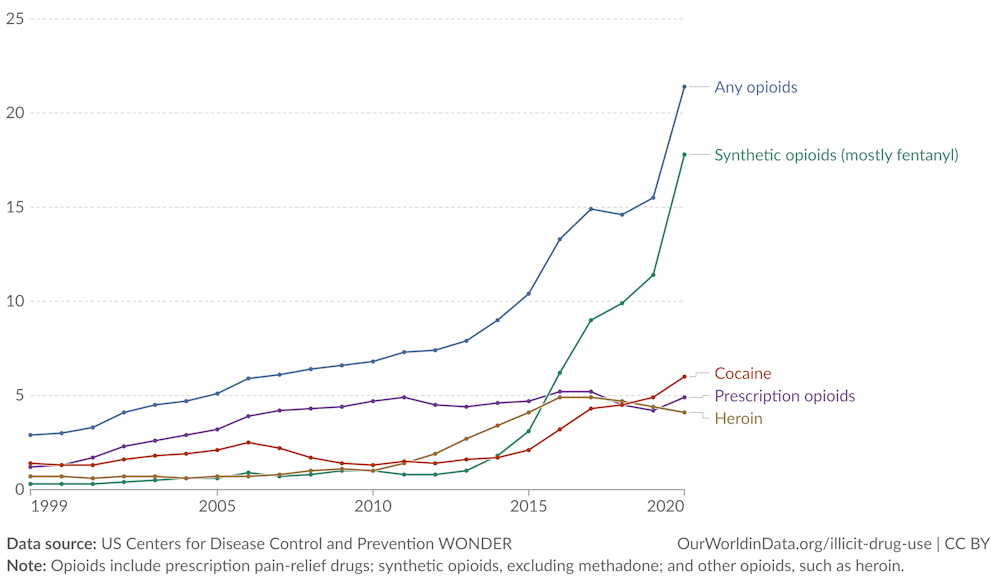
In the US, the synthetic opioids fentanyl and oxycodone have contributed to more than 100,000 fatal overdoses each year since 2021. While there are signs this deaths toll is at last beginning to fall, the harm and pain of addiction and overdose affects every strata of American society – as shown in moving portrayals of America’s opioid crisis such as Painkiller and Dopesick. Most fatalities are caused by respiratory depression where breathing is significantly slowed or stops altogether.
Official trailer for Painkiller (Netflix)
Fentanyl is an analgesic drug that is 50-100 times more potent than heroin or morphine. Where China used to be the principal manufacturer and supplier of fentanyl to the US, Mexico is now the primary source. In December 2024, Mexican authorities announced “the largest mass seizure of fentanyl pills ever made” – amounting to more than 20 million doses of fentanyl pills worth nearly US$400 million. The pills were found in Mexico’s Sinaloa state, home of the Sinaloa drug cartel and a hub of fentanyl production,
“This is what makes us rich,” one fentanyl cook recently told the New York Times. He was scathing about the idea that Donald Trump would be able to stamp out the supply of fentanyl from Mexico to the US by threatening Mexico’s government with tariffs. “Drug trafficking is the main economy here.”
However, the introduction of synthetic opioids to the US came not via organised crime but through a deliberate strategy of the pharmaceutical industry. Upon launching its prescription opioid painkiller OxyContin (a brand name for oxycodone) in 1996, Perdue Pharma, owned by the Sackler family, devised a plan to increase prescriptions of the drug by incentivizing and rewarding doctors to give these drugs to their patients. On a business level, this was a success; on a human level, it has been a disaster.
As patients quickly developed tolerance to drugs such as OxyContin, they had to take higher doses to avoid withdrawal symptoms or the positive feelings it gave them. Taking more of these opiates increases the risk of accidental overdose, many of which proved to be fatal. It has also driven those dependent on drugs to the black market, and into the hands of organised drug gangs, as they seek the drugs in greater quantities.
Dependency on fentanyl and other opioids is all-consuming. When not using these drugs, people are entirely focused on ensuring sufficient supply of the next dose. This includes funding supply which can take people to places they thought they would never be, for example breaking the law, shoplifting or getting involved in commercial sex to make enough money to buy drugs.
Synthetic opiates like OxyContin and fentanyl have proved to be classless, ageless and sex blind. The first-hand experience of addiction and fatalities have radically altered the way many Americans think about drugs and the problems they cause. Canada, too, is suffering a major crisis.
Compounding this tragedy is the failure of the state to provide interventions and treatment that could have reduced fatal and non-fatal overdoses. It is only now that evidence-based interventions are beginning to be made widely available, such as access to Naloxone – a drug that can reverse the effects of opiates and potentially save a life.
Of course, it isn’t just hospitals and health professionals that are challenged by the results of widespread use of opioids, but public services like the police and fire service. In some areas of the US, there have been so many daily overdoses that every service was called on to try and deal with it. Local mayors have made it a priority to train police and fire personnel to be trained as first responders, such is the scale of the problem.
But it is not just in North America that we see the failure of politicians and the state to act when faced with growing problems with drugs. In the UK, where record numbers are dying because of using drugs such as heroin, the government has not invested in overdose prevention strategies. At a time when fatal overdoses increase year on year, budgets for specialist treatment have been reduced. It remains to be seen what the recently elected Labour government will do, if anything, to tackle the tragic rise in drug related fatalities.
What connects both examples from the US and UK is the attitude and perception of drug use many of us have. Drug use and the heavy use of prescription painkillers is still heavily stigmatised. Many of us still view this as something individuals bring on themselves or have a choice about.
So, if we don’t care about what happens to people who develop problems with drugs, why should our elected representatives? In part, it is our bigotry that is enabling the lack of timely intervention, despite us possessing the knowledge and evidence of how drug harms can be minimised.
Latin America: breakdown of the rule of law
Under the last Conservative government, the UK Home Office asserted that people who used cocaine recreationally are supporting violence not only in the UK but in the countries that produce its raw ingredients. It’s not clear if this has made any difference to those using cocaine in the UK – personally, I doubt many people consider or are aware of how cocaine is produced or its provenance.
Perhaps if those using cocaine, mainly in western countries, realised the extent of violence and suffering that cocaine manufacture causes they might think again. Latin America has suffered enormously, with few countries there not touched in some way by the violence and breakdown of law associated with drug production and supply. According to the latest UN World Drugs Report:
Global cocaine supply reached a record high in 2022, with more than 2,700 tons of cocaine produced that year, 20% more than in the previous year … The impact of increased cocaine trafficking has been felt in Ecuador in particular, which has seen a wave of lethal violence in recent years linked to both local and transnational crime groups, most notably from Mexico and the Balkan countries.
Cocaine seizures and homicide rates increased five-fold between 2019 and 2022 in Ecuador, with the highest such rates reported in the coastal areas used for trafficking the drug to major destination markets in North America and Europe.
Cocaine trafficking flows based on reported seizures (2019-22):
As with opium production in Afghanistan, it is small-scale farmers in Colombia, Peru and Bolivia that grow the coca plant that will be turned into cocaine. Like their Afghan counterparts, they grow coca as it is more profitable than alternatives such as coffee. While it may be profitable in the short term, there are greater costs to them and their society.
Cocaine production brings with it violence as those further up the drug production chain try to control its trade. Few parts of these societies are unscathed, from bribing local politicians through to whole regions that are controlled by organised crime. Keeping control means that the use of firearms and violence increases. Against this backdrop, it is unsurprising that basic health and social services suffer.
So, while a coca grower may have more money, every other aspect of their life is negatively impacted. Whether it is regional or state institutions, both are compromised by the drug trade and those that control it. While this may not lead to the total collapse of law and order, it does create injustice and distorts the rule of law in many areas of Latin America and the Caribbean, where competition between gangs has also resulted in an increase in homicides.
The impact is on all sectors of society, now and into the future. For example, while historically the role of women has been largely underrepresented in research and drug policy, the UN report recognises that this is changing:
As women increasingly participate in economic activities, the role that women play in the drug phenomenon may become increasingly important. For example, a shift away from plant-based drug production may affect many women in rural households involved in opium poppy and coca bush cultivation.
The UN also identifies the specific risk to young people and the drugs trade, highlighting:
Long-term efforts to dismantle drug economies must provide socioeconomic opportunities and alternatives, which go beyond merely replacing illicit crops or incomes and instead address the root structural causes behind illicit crop cultivation, such as poverty, underdevelopment, and insecurity. They must also target the factors driving the recruitment of young people into the drug trade, who are at particular risk of synthetic drug use.
Meanwhile, demand for treatment in Europe due to problems with cocaine has risen significantly in recent years, since 2011 there has been an 80% increase in treatment presentations. This reflects the growing number of people using cocaine and the rise in purity of the drug.
Amid what may seem to be a story of unrelenting despair and hopelessness, there are local initiatives and even a few state-wide policies that provide optimism that change is possible.
In my roles both as clinician and scientist, I’ve often been amazed by how ingenious people can be when faced with the apparently impossible. For example, the way some people use heroin to dampen their psychotic symptoms, such as auditory and visual hallucinations – or the development of Naloxone, a drug that can temporarily reverse the effects of opioids, providing a short window for emergency services to treat people who have overdosed.
Early in my career, I witnessed the emergence of HIV in the UK in the 1980s. The speed at which this disease spread was not matched by our ability to treat it. Our response to HIV was undoubtedly hampered by prejudice and stigma towards marginalised groups in society, namely gay men and those using drugs (particularly injecting them).
However, unexpectedly and courageously, the Conservative government recognised those who were most at risk of contracting HIV, and organised a package of measures to contain the spread of infection. One part of this was a media campaign based on public health messaging designed to reduce the risk of contracting the disease. But the government also invested in treatment for those who had been infected and engaged with people at high risk, such as those intravenously injecting drugs.
I worked in specialist HIV clinics for those using drugs. At the time, methadone and diamorphine were provided as an alternative to heroin. Regulations and protocols that restricted the prescribing of these medical opioids were eased, so we could ensure patients attending these clinics were given sufficient oral and injectable opioids that they didn’t need to source street heroin.
This meant they had access to medical grade opioids and, crucially, were given regular supplies of sterile injecting equipment. It was this that reduced the risk of contracting HIV, as some people would share injecting equipment when using heroin.
This impressive policy ran counter to the Conservative party’s ideology at the time, which was to punish rather than help those using drugs like heroin. It showed me how, even with traditional mindsets, it is possible to shift policy thinking in the face of a health crisis. And make no mistake, the global drug problem is an ongoing health crisis. Today, the UN points to the risks that intravenous users of drugs still face:
An estimated 13.9 million people injected drugs in 2022, with the largest number living in North America and East and South-East Asia … The relative risk of acquiring HIV is 14 times higher for those who inject drugs than in the wider population globally.
There are, though, signs of positive change in the way some countries and regions are changing their drug policies. Scotland recently opened a drug consumption facility in Glasgow – a safe place for people to use their drugs, usually injecting drugs like heroin. Such spaces provide access to sterile injecting equipment, reducing the risk of blood-borne infections such as HIV or Hepatitis. At the same time, they offer the opportunity to engage with people who have not accessed traditional health services.
Portugal, as mentioned earlier, has made substantial changes to the way it approaches drug use and the problems associated with it. This policy shift since 2000 has saved lives and brought a more humane way of treating people who develop problems with drugs.
Contrast this with the wasted effort and resources ploughed into the war on drugs – initiated by Nixon and followed by so many western governments ever since. My plea to policymakers is simple: employ the same evidence-based science you use for health issues towards drugs and problem drug use.
Science and research can help in many ways, if given the chance. Some of it might seem radical, like providing safe drug consumption spaces. Some of it is more mundane, but vital – like tackling inequality, a clear driver of problem drug use across the world.
But while we often look to politicians to take the lead on change, it is people – us – that really hold the solution. By far the greatest threat to people and society from drugs is ignorance and bigotry. So many lives have been lost to drugs because of shame, either as a driver of drug use or a barrier to seeking help.
Beliefs are notoriously difficult to shift. As with climate change, the most powerful driver of change is personal experience. We know that when a family or community is affected by a drug overdose, their beliefs and perceptions change. But this is not the way any of us should want to see change happen.
To hear about new Insights articles, join the hundreds of thousands of people who value The Conversation’s evidence-based news. Subscribe to our newsletter.
Ian Hamilton does not work for, consult, own shares in or receive funding from any company or organisation that would benefit from this article, and has disclosed no relevant affiliations beyond their academic appointment.
WASHINGTON, D.C. – Yesterday, House Foreign Affairs Committee Chairman Brian Mast joined Margaret Brennan on CBS’ “Face the Nation” to discuss the review of foreign assistance and the Biden State Department’s fixation on DEI.
WATCH HERE
-Transcript-
MARGARET BRENNAN: And we’re joined now by Florida Republican Congressman Brian Mast, who is the chairman of the Foreign Affairs Committee, which has oversight over the State Department and its programs.
He joins us from Fort Pierce, Florida.
Good morning to you.
CHAIRMAN BRIAN MAST (R-Florida): Good morning.
BRENNAN: I want to start first on the tariffs that were announced overnight by President Trump. You know there’s a free trade agreement with Mexico and Canada. President Trump negotiated it during his first term.
The tariffs may violate that deal. If he’s invoking tariffs on a national security basis, can you explain the threat posed by Canada?
CHAIRMAN MAST: Yes, and he was – President Trump, that is to say, was very specific in his executive order, outlined that it’s specifically related to fentanyl. It’s specifically related to human trafficking.
And there’s a trust, but verify situation that has to go on here.
BRENNAN: Through Canada?
CHAIRMAN MAST: Through Canada as well, absolutely, fentanyl through Canada, human trafficking through Canada, also with China in that mix for fentanyl as well.
That was specifically outlined in it. And until that comes to an end, this is what’s going to be on the table. And bear in mind as well that USMCA reauthorization is coming up in the coming-up months and years.
BRENNAN: So you don’t believe that this violates the trade agreement, the treaty?
CHAIRMAN MAST: The violation has been to the United States of America. It’s been to our sovereignty. It’s been to our people. We’ve been taken for granted.
BRENNAN: Right, but Congress votes on these things. So…
CHAIRMAN MAST: And I will make sure certainly, as the Foreign Affairs chairman, that we give every single authority as we go through State Department reauthorization, to make sure that this moves forward, as well as purging of people throughout the State Department, other agencies, where we’re freezing aid.
These are all very important and necessary steps to make sure that we secure America. And we’re going to support that.
BRENNAN: I’m sorry. Can I follow up on what you just said there?
CHAIRMAN MAST: Please do.
BRENNAN: You want to authorize purging of State Department personnel? What does that mean exactly?
CHAIRMAN MAST: Well, if you want to take a look at the State Department, where DEI has been a priority over, let’s say, diplomacy on many accounts, I can give you hundreds of examples of where they were authorizing…
BRENNAN: What proof do you have of that?
CHAIRMAN MAST: Sure, let’s list them off, half-a-million dollars to expand atheism in Nepal, $50,000 to do, let’s see, a transgender opera in Colombia, $47,000 to do an LGBTQ trans comic book in Peru, $20,000 a pop to do drag shows in Ecuador.
Shall I continue with more examples of where DEI was a priority?
BRENNAN: Oh, it certainly seems like there could be a review of things. Foreign aid, as you know, is less than 1 percent of the entire federal budget. So we’re talking small amounts of money by comparison. But when…
CHAIRMAN MAST: We’re still talking about tens and tens of billions of dollars.
And if you want to go to somebody else, on the other side of the aisle, Samantha Power, she had a worthy goal, although it was a stupid goal. She said she was hoping to get the amount of foreign aid, U.S. aid dollars that go to actual aid up to 30 cents on the dollar from 10 cents on the dollar. That’s a major problem that we have this agency that that’s all that goes abroad…
BRENNAN: I think you’re talking about…
CHAIRMAN MAST: … when it should be the American worker’s dollar.
BRENNAN: I think now you’re talking about the USAID, the aid agency…
CHAIRMAN MAST: Yes.
BRENNAN: … which is a – separate from the State Department currently and has about $40 billion worth…
CHAIRMAN MAST: Which is likely going to be rolled more closely under Secretary Rubio.
BRENNAN: Tell – yes, tell me about that, because that’s where I was going.
Has the Trump administration informed you of plans to dismantle or significantly shrink this agency?
CHAIRMAN MAST: This is something that I’m working on very specifically, in conjunction with Secretary Rubio, to make sure that there’s the appropriate command-and-control of these agencies, where, again, to make that same point, right now, maybe 10 to 30 cents…
BRENNAN: They already report to the secretary of state.
CHAIRMAN MAST: But 10 to 30 cents on the dollar is what actually goes to aid. So there’s not the right amount of command-and- control that’s going on with the way that it’s set up currently.
And let’s make another point on this as well.
BRENNAN: Congress – Congress authorizes and earmarks funding.
CHAIRMAN MAST: Most of these dollars – most of these dollars that go out of USAID, 70-plus percent don’t come from U.S. growers, U.S. farmers, U.S. ranchers, or go through us ports. And that’s another big problem for America.
BRENNAN: So – I’m sorry. If Congress already authorizes and earmarks the funding, just to be very clear, you’re not endorsing getting rid of USAID as a separate department, which already reports to the secretary of state, are you?
CHAIRMAN MAST: I would be absolutely for, if that’s the path we go down, removing USAID as a separate department and having it fall under one of the other parts of United States Department of State, because of its failure.
I just went over the numbers twice with you in the amount of aid that actually makes it into the hands. I mean, you could you could almost say – this is a little bit hyperbole – but there’s probably more dollars that go towards state dinners around the D.C. Beltway than what actually goes into rice and beans abroad.
That’s the state of what’s going on with USAID. And Samantha Power said no less herself.
BRENNAN: Well, I think every single administration authorizes reviews, could increase efficiencies. There are plenty of people who propose bringing it more under the authority of the State Department. Madeleine Albright tried to do that. That’s not a new MAGA idea.
I think the question here, though, is about how you do it. Do you still believe that in the law signed in the 1960s that Congress has to sign off on any changes to USAID? Or do you think President Trump can just make all of this happen through executive order?
CHAIRMAN MAST: So, all of those examples that you just gave of those historical figures, the difference is now the job is going to get done.
It’s going to be 99.99 percent of cents on the dollar actually go towards what it’s intended, instead of people around the Beltway.
BRENNAN: OK, so you’re talking about – you’re talking about…
CHAIRMAN MAST: That’s what’s going to happen. That’s the change.
BRENNAN: … efficiencies in aids versus restructuring.
So let me ask you about that. Well, like I said…
CHAIRMAN MAST: Well, that requires restructuring, 100 percent. You can’t create that efficiency just by wishing it into existence.
BRENNAN: Sure.
CHAIRMAN MAST: You have to restructure where the failures are and put the right things in place.
BRENNAN: Of course.
But what we’re hearing from many of these aid organizations and officials is that, can you restructure after you finish the review and not freeze funding now, immediately? I spoke to former USAID global health head Atul Gawande yesterday. He told me this isn’t a pause in foreign aid. It is a demolition of USAID.
As he put it, you can’t pause a flight in midair. That’s what’s happening.
CHAIRMAN MAST: Let’s…
BRENNAN: This immediate freeze in funding is stopping agencies in the field from being able to do the work they do.
CHAIRMAN MAST: Let’s say why that is so important. And let’s talk about the real facts on the ground.
The Trump administration comes in or representatives like myself that do oversight. The agencies will literally not tell us what they are writing grants for, literally, or they will lie about it, or they will tell the new political appointees under the Trump administration, I’m just not going to tell you that. Those are real things that have happened.
So the way that you make them come and answer for where they are actually sending dollars is to say, we’re freezing that. We’re putting it on hold. You need to come to us and explain what it is you’re doing, why you’re doing it and where it’s actually saving life. And guess what?
BRENNAN: But…
CHAIRMAN MAST: When they don’t come explain something, that also begs the question, why were they doing it in the first place?
BRENNAN: But the way these things work is, the contractors have to front the cash, then go to the U.S. government for reimbursement.
So when you put in an immediate freeze, that means drugs don’t get delivered. That means they don’t get distributed. That means bomb disposal units don’t get to go out there in places like Cambodia and remove ordnance or provide help to people who receive it.
That’s the pushback from aid organizations, who are saying they’re going to have to carry out layoffs in the thousands in the coming week. Does that concern you at all?
CHAIRMAN MAST: They will have an opportunity. It doesn’t concern me because of the grift that has been going on to the American taxpayer, the American worker.
That’s what needs to be answered for. And so you look at this. Let’s use PEPFAR as an example. You were talking about drugs going to individuals. There was a release of that hold that was put – that was authorized. But it shouldn’t be the case that the American people fund HIV and AIDS drugs for 20 million people across Africa, where many of these countries are working very directly with our adversaries like China.
That is an example of them taking us for granted. We need to be asking the question, should they be weaning off of this? Should we be paying it for these very expensive HIV and AIDS drugs?
BRENNAN: Yes.
CHAIRMAN MAST: Should the American worker be footing the bill for that? Those are real questions.
BRENNAN: Yes, real questions, but, in the meantime, people need their drugs while you ask those questions. So that’s where the disagreement is with the aid organizations.
But let me ask you about air traffic controllers and what’s happening here at home.
CHAIRMAN MAST: Not with all the leaders of other countries, though. I believe I saw the leader of Kenya as one step up and say, hey, this is an example where we need to step up for ourselves and show how we can take care of ourselves. And I believe that was the president there.
BRENNAN: I want to ask you, as I was saying, about another committee you sit on, Transportation Committee.
The FAA hiring policy for air traffic controllers, including under the first Trump administration, offered equal opportunity to those with targeted disabilities, including, as the president read, hearing, vision, missing extremities, partial paralysis, complete paralysis, severe intellectual debility – disability. Excuse me.
The president singled this out, this policy, as a contributor possibly to the crash. Do you agree with the diversity policy, or do you agree with the president? I know you lost two limbs serving this country in Afghanistan. Do you hear those words and take offense to them or…
CHAIRMAN MAST: No, no offense. Let’s unpack it.
Number one, I will use myself as an example, right? There are things that I am suited to do, no doubt. But flying an aircraft, to stick with the subject at hand, would not be one of them. I could fly a personal – a personal aircraft.
BRENNAN: This is air traffic controllers.
CHAIRMAN MAST: But to put me in charge of traffic or 150 lives, that would not be the right case for me personally, given my physical disabilities and foot pedals on an aircraft.
To go to the diversity side of it and the actual crash, yes, there were very real errors that took place both in the air traffic control tower and with the helicopter pilots, it seems. But, more systemically, is there a big hiring problem across all federal agencies, to include the FAA, where they made the priority diversity and inclusion…
BRENNAN: Yes.
CHAIRMAN MAST: … instead of excellence and performance? Yes, that’s the case. They made the priority appearance and lifestyle and not the big deal.
BRENNAN: Congressman, thank you for your time today.
Source: United States Senator Ben Ray Luján (D-New Mexico)
Reporting Shows Tariffs Could Lead to Cost Increase for Gas, Groceries
Washington, D.C. – Today, U.S. Senator Ben Ray Luján (D-N.M.), a member of the Senate Committee on Finance, issued the following statement on President Trump’s announcement to impose 25% tariffs on Mexico and Canada and 10% tariffs on China:
“From the price at the pump to the cost of groceries, President Trump’s tariffs will leave New Mexico families footing the bill. The Trump Tariffs will drive up costs for groceries, gas, cars, and electronics that Americans depend on. At the same time President Trump is pushing a tax scam that benefits the wealthiest Americans, working families will be forced to pay the price.
“The Trump Tariffs will result in tariffs against American products, putting American jobs, businesses, and industries at risk. These tariffs will weaken the economy, raise prices for everyday families, and hurt the American people. Republicans and Democrats, and all Americans, should be concerned that the Trump administration is needlessly threatening the economy that we worked hard to rebuild and grow.
“My colleagues and I remain committed to combating the fentanyl crisis, and I have long called for increased resources to stop the flow of fentanyl and save lives, but these tariffs will not accomplish that.”
Qingzhou Wang, the Company’s Principal Executive, and Yiyi Chen, the Company’s Marketing Manager, Conspired to Import Ton Quantities of Fentanyl Precursors from China to the United States in Exchange for Payment in Cryptocurrency
Danielle R. Sassoon, the United States Attorney for the Southern District of New York, and Derek S. Maltz, the Acting Administrator of the U.S. Drug Enforcement Administration (“DEA”), announced that a jury returned a guilty verdict against QINGZHOU WANG, a/k/a “Bruce” (“WANG”), and YIYI CHEN, a/k/a “Chiron” (“CHEN”), on fentanyl precursor importation and money laundering charges. WANG was also convicted of importing a methamphetamine precursor. WANG and CHEN, both nationals of China, were found guilty following a two-week trial before U.S. District Judge Paul G. Gardephe.
U.S. Attorney Danielle R. Sassoon and Acting Administrator Derek S. Maltz also announced today the seizure of domain names for seven websites and four cryptocurrency accounts, totaling approximately $900,000 worth of digital funds, tied to the illicit precursor chemical business of WANG and CHEN’s company, HUBEI AMARVEL BIOTECH CO., LTD., a/k/a “AmarvelBio,” (“AMARVEL BIOTECH”), its related entities, and its executives and employees. Five additional websites tied to AMARVEL BIOTECH, including its principal website, were previously seized in June 2023.
U.S. Attorney Danielle R. Sassoon said: “Qingzhou Wang and Yiyi Chen conspired to import massive amounts of fentanyl precursors from China into the United States. They did so with callous disregard for the effect that such deadly chemicals would ultimately have here in the United States. Now, they stand convicted in an American courtroom and face a substantial term of imprisonment for their crimes. And we are not done. The seizures announced today continue the ongoing fight against the fentanyl supply chain. The message should be clear: we are watching, and we will continue to dismantle these fentanyl precursor operations, and bring the individuals responsible to justice.”
Acting Administrator Derek S. Maltz said: “I have personally seen the devastation that illicit fentanyl has had on American families. I have looked into the eyes of hundreds of mothers, fathers, sisters, and brothers, who would give anything to have one more moment with their loved one. The DEA’s top priority is protecting the safety of the American people. These convictions, and the seizures of these websites and accounts, show that no matter where you live in the world or where you operate in the fentanyl supply chain, the DEA will utilize all of our resources to bring you to justice. I’m incredibly proud of the men and women of DEA, alongside our law enforcement partners, who worked tirelessly on this investigation and the unrelenting fight against illicit fentanyl.”
As reflected in the Indictment, public filings, and the evidence presented at trial:
AMARVEL BIOTECH was a chemical manufacturer based in the city of Wuhan, in Hubei province, China, that exported vast quantities of the precursor chemicals used to manufacture fentanyl and its analogues. A synthetic opioid that is 50 times more potent than heroin, fentanyl is now the leading cause of death for Americans ages 18 to 49. Fentanyl analogues, similar in chemical makeup and effect to fentanyl, can be even more potent and lethal than fentanyl. Fentanyl and its analogues have devastated communities across the U.S. and are fueling the ongoing opioid epidemic, which killed at least 105,263 Americans between February 2022 and January 2023 alone.
During the course of an undercover investigation by the Drug Enforcement Administration (“DEA”), AMARVEL BIOTECH and its principal executive, WANG, its marketing manager, CHEN, and a sales representative, FNU LNU, a/k/a “Er Yang,” a/k/a “Anita” (“YANG”), shipped more than 200 kilograms from China to the United States of precursor chemicals used to make fentanyl and its analogues. AMARVEL BIOTECH, WANG, CHEN, and YANG shipped the precursors to the U.S. after being told that the chemicals would be used to produce fentanyl in New York, and they agreed to supply multi-ton shipments of fentanyl precursors despite being told that Americans had died after consuming fentanyl made from the chemicals that the defendants had sold.
For example, on or about November 17, 2022, a DEA confidential source (“CS-1”) wrote to YANG using an encrypted messaging application, “You know I making fentanyl,” and “Is not safe.” YANG replied, “i know.” On or about December 1, 2022, YANG wrote to CS-1, promising that CS-1 would be “happy with our product” and noting that CS-1 would “be able to synthesize fentanyl.” In exchange for payment in cryptocurrency, AMARVEL BIOTECH thereafter shipped from China to New York approximately 999.7 grams of the fentanyl precursor 1-boc-4-AP, approximately 1,002.6 grams of the fentanyl precursor 1-boc-4-piperidone, and approximately 893.6 grams of the methamphetamine precursor methylamine.
In or about March 2023, WANG and CHEN traveled from China to Bangkok, Thailand, to meet with an individual whom CS-1 represented was CS-1’s boss, but was in fact another DEA confidential source (“CS-2”). During the meeting, WANG and CHEN discussed AMARVEL BIOTECH’s ability to supply ton-quantities of fentanyl precursors to New York for CS-1 and CS-2’s fentanyl manufacturing operation. After CS-2 stated that CS-2 wanted a different formula for manufacturing fentanyl and that several of CS-2’s American customers had purportedly died, WANG and CHEN advised they had “a lot of customers in America and Mexico” who could provide technical assistance with fentanyl production.
After the March 2023 meeting in Bangkok, AMARVEL BIOTECH, WANG, CHEN, and YANG agreed to sell CS-1 and CS-2 approximately 210 kilograms of fentanyl precursors in exchange for payment in cryptocurrency. During an April 10, 2023 video call with WANG and CHEN, CS-2 stated that the approximately 210 kilograms of fentanyl precursors would be used to manufacture approximately 50 to 55 kilograms of fentanyl—an amount that could contain approximately 25 million deadly doses.
In or about May 2023, AMARVEL BIOTECH, WANG, CHEN, and YANG sent to the U.S. the shipment ordered by CS-1 and CS-2. On or about May 5, 2023, the DEA retrieved the precursor shipment from a warehouse near Los Angeles, California. Lab testing confirmed the presence of a precursor chemical for a fentanyl analogue. In an encrypted messaging group chat with CS-1, CS-2, WANG, and CHEN, YANG explained that “New York, the United States, has been strict in checking the precursors of the ‘final product’ some time ago, so for the sake of safety, this time it is sent to California.”
In or about June 2023, WANG and CHEN traveled from China to meet again with CS-2. During the meeting, WANG and CHEN discussed with CS-2 a multi-ton order of fentanyl precursor chemicals. WANG and CHEN also discussed the need to take additional measures to protect themselves from detection and interdiction of their shipments “because recently American government . . . seized some Mexican group and they followed the routes to China,” where the U.S. Government found “our competitor in China”—an apparent reference to fentanyl-related charges filed in the Southern District of New York and announced in April 2023 against, among others, leadership of the Sinaloa Cartel and certain China-based precursor chemical company executives.
AMARVEL BIOTECH openly advertised online its sale of precursor chemicals for use in manufacturing fentanyl. Through its website and a host of other storefront sites, AMARVEL BIOTECH targeted precursor chemical customers in Mexico, where drug cartels operate clandestine laboratories and distribute finished fentanyl into and throughout the United States, including by advertising fentanyl precursors as a “Mexico hot sale,” guaranteeing “100% stealth shipping” abroad, and posting to its websites documentation of AMARVEL BIOTECH shipping chemicals to Culiacan, the home city of the Sinaloa Cartel, one of the dominant drug trafficking organizations in the Western Hemisphere and which is largely responsible for the massive influx of fentanyl into the U.S. in recent years. Below is a screenshot of one of AMARVEL BIOTECH’s store pages for a fentanyl precursor:
AMARVEL BIOTECH also endeavored to thwart law enforcement interdiction of its precursor chemical shipments. AMARVEL BIOTECH advertised online the business’s ability to use deceptive packaging—such as packaging indicating the contents are dog food, nuts, or motor oil—to ensure “safe” delivery of the illicit contents such shipments. An example of one of AMARVEL BIOTECH’s online advertisements are shown below:
* * *
WANG, 36, of China, and CHEN, 32, of China, were each convicted of: one count of conspiracy to import the fentanyl precursor chemical 1-boc-4-AP, knowing or having reasonable cause to believe it will be used to manufacture fentanyl, which carries a maximum sentence of 20 years in prison, and one count of conspiracy to commit money laundering, which carries a maximum sentence of 20 years in prison. WANG was also convicted of: one count of importation of the fentanyl precursor chemical 1-boc-4-AP, knowing or having reasonable cause to believe it will be used to manufacture fentanyl, which carries a maximum sentence of 20 years in prison, and one count of importation of the methamphetamine precursor chemical methylamine, which carries a maximum sentence of 10 years in prison. WANG and CHEN were each acquitted of one count of conspiracy to manufacture, distribute, and possess with intent to distribute fentanyl and a fentanyl-related substance.
The maximum penalties are prescribed by Congress and are provided here for informational purposes only, as any sentencing of the defendants will be determined by a judge.
A table listing the websites for which the domain names have been seized pursuant Title 21, U.S. Code, Sections 853 and 970 is set forth below:
Internet users attempting to access the seized domains now see the following:
Ms. Sassoon praised the outstanding efforts of the DEA’s Special Operations Division Bilateral Investigations Unit. Ms. Sassoon also thanked the DEA Bangkok Country Office, DEA Wellington Country Office, DEA Beijing Country Office, DEA Honolulu District Office, DEA New York Organized Crime Drug Enforcement Task Force (“OCDETF”) Strike Force, DEA Riverside District Office, DEA Special Testing Laboratory, the DEA Southwest Laboratory, the Office of International Affairs of the Department of Justice’s Criminal Division, the Royal Thai Police Narcotics Suppression Bureau, the Fiji Police Force Narcotic Bureau, the Fiji Office of the Director of Public Prosecutions, and the U.S. Attorney’s Office for the District of Hawaii for their assistance.
This case is being handled by the Office’s National Security and International Narcotics Unit. Assistant U.S. Attorneys Alexander Li and Kevin Sullivan are in charge of the prosecution, with assistance from Paralegal Specialist Sabrina Jim Munoz.
By the authority vested in me as President by the Constitution and the laws of the United States of America, including the International Emergency Economic Powers Act (50 U.S.C. 1701 et seq.) (IEEPA), the National Emergencies Act (50 U.S.C. 1601 et seq.) (NEA), section 604 of the Trade Act of 1974, as amended (19 U.S.C. 2483), and section 301 of title 3, United States Code,
I, DONALD J. TRUMP, President of the United States of America, find that the sustained influx of synthetic opioids has profound consequences on our Nation, including by killing approximately two hundred Americans per day, putting a severe strain on our healthcare system, ravaging our communities, and destroying our families. Synthetic opioid overdose is the leading cause of death for people aged 18 to 45 in the United States.
During my first term, I took steps to end the direct flow of fentanyl and other synthetic opioids from the People’s Republic of China (PRC) to the United States. Since then, the Chinese Communist Party (CCP), which exerts ultimate control over the government and enterprises of the PRC, has subsidized and otherwise incentivized PRC chemical companies to export fentanyl and related precursor chemicals that are used to produce synthetic opioids sold illicitly in the United States.
Furthermore, the PRC provides support to and safe haven for PRC-origin transnational criminal organizations (TCOs) that launder the revenues from the production, shipment, and sale of illicit synthetic opioids. These PRC-origin TCOs coordinate and communicate using PRC social media software applications in the conduct of their business.
Many PRC-based chemical companies also go to great lengths to evade law enforcement and hide illicit substances in the flow of legitimate commerce. Some of the techniques employed by these PRC-based companies to conceal the true contents of the parcels and the identity of the distributors include the use of re-shippers in the United States, false invoices, fraudulent postage, and deceptive packaging. While more than 500,000 pounds of drugs have been seized at the southern border each of the last 3 fiscal years, in addition, more than 42,000 pounds of drugs have been seized at the northern border each year on average over the last 3 years. Illicit drugs kill tens of thousands of Americans each year, including 75,000 deaths per year attributed to fentanyl alone.
The influx of these drugs to our Nation threatens the fabric of our society. The PRC plays a central role in this challenge, not merely by failing to stem the ultimate source of many illicit drugs distributed in the United States, but by actively sustaining and expanding the business of poisoning our citizens.
The flow of contraband drugs like fentanyl to the United States through illicit distribution networks has created a national emergency, including a public health crisis in the United States, as outlined in the Presidential Memorandum of January 20, 2025 (America First Trade Policy), Proclamation 10886 of January 20, 2025 (Declaring a National Emergency at the Southern Border of the United States), and Executive Order 14157 of January 20, 2025 (Designating Cartels and Other Organizations as Foreign Terrorist Organizations and Specially Designated Global Terrorists).
Despite multiple attempts to resolve this crisis at its root source through bilateral dialogue, PRC officials have failed to follow through with the decisive actions needed to stem the flow of precursor chemicals to known criminal cartels and shut down the money laundering TCOs. The PRC implements the most sophisticated domestic surveillance network coupled with the most comprehensive domestic law enforcement apparatus in the world. The PRC also routinely exerts extraterritorial reach across the globe to threaten, harass, and suppress what it views as political dissent. As such, the CCP does not lack the capacity to severely blunt the global illicit opioid epidemic; it simply is unwilling to do so.
Immediate action is required to address the national emergency I declared and to finally end this emergency, including the public health crisis caused by opioid use and addiction, which will not happen until the full compliance and cooperation of the PRC government is assured. I hereby determine and order: Section 1. (a) As President of the United States, my highest duty is the defense of the country and its citizens. I will not stand by and allow our citizens to be poisoned, our laws to be trampled, our communities to be ravaged, or our families to be destroyed.
I previously declared a national emergency with respect to the grave threat to the United States posed by the influx of illegal aliens and drugs into the United States in Proclamation 10886. Pursuant to the NEA, I hereby expand the scope of the national emergency declared in that proclamation to cover the failure of the PRC government to arrest, seize, detain, or otherwise intercept chemical precursor suppliers, money launderers, other TCOs, criminals at large, and drugs. In addition, this failure to act constitutes an unusual and extraordinary threat, which has its source in substantial part outside the United States, to the national security, foreign policy, and economy of the United States. I hereby declare and reiterate a national emergency under the NEA and IEEPA to deal with that threat. This national emergency requires decisive and immediate action, and I have decided to impose, consistent with law, ad valorem tariffs on articles that are products of the PRC as set forth in this order. In doing so, I invoke my authority under section 1702(a)(1)(B) of IEEPA, and specifically find that action under other authority to impose tariffs is inadequate to address this unusual and extraordinary threat.
Sec. 2. (a) All articles that are products of the PRC, as defined by the Federal Register notice described in section 2(d) of this order (the Federal Register notice), shall be, consistent with law, subject to an additional 10 percent ad valorem rate of duty. Such rate of duty shall apply with respect to goods entered for consumption, or withdrawn from warehouse for consumption, on or after 12:01 a.m. eastern time on February 4, 2025, except that goods entered for consumption, or withdrawn from warehouse for consumption, after such time that were loaded onto a vessel at the port of loading or in transit on the final mode of transport prior to entry into the United States before 12:01 a.m. eastern time on February 1, 2025, shall not be subject to such additional duty, only if the importer certifies to U.S. Customs and Border Protection within the Department of Homeland Security as specified in the Federal Register notice. (b) The rates of duty established by this order are in addition to any other duties, fees, exactions, or charges applicable to such imported articles. (c) Should the PRC retaliate against the United States in response to this action through import duties on United States exports to the PRC or similar measures, the President may increase or expand in scope the duties imposed under this Executive Order to ensure the efficacy of this action. (d) In order to establish the duty rate on imports of articles that are products of the PRC, the Secretary of Homeland Security shall determine the modifications necessary to the Harmonized Tariff Schedule of the United States (HTSUS) in order to effectuate the objectives of this order consistent with law and shall make such modifications to the HTSUS through notice in the Federal Register. The modifications made to the HTSUS by this notice shall be effective with respect to goods entered for consumption, or withdrawn from warehouse for consumption, on or after 12:01 a.m. eastern time on February 4, 2025, except as otherwise noted in subsection 2(a) of this section, and shall continue in effect until such actions are expressly reduced, modified, or terminated. (e) Articles that are products of the PRC, except those that are eligible for admission under “domestic status” as defined in 19 CFR 146.43, which are subject to the duties imposed by this order and are admitted into a United States foreign trade zone on or after 12:01 a.m. eastern time on February 4, 2025, except as otherwise noted in subsection 2(a) of this section, must be admitted as “privileged foreign status” as defined in 19 CFR 146.41. Such articles will be subject upon entry for consumption to the rates of duty related to the classification under the applicable HTSUS subheading in effect at the time of admittance into the United States foreign trade zone. (f) No drawback shall be available with respect to the duties imposed pursuant to this order. (g) For avoidance of doubt, duty-free de minimis treatment under 19 U.S.C. 1321 shall not be available for the articles described in subsection (a) of this section. (h) Any prior Presidential Proclamation, Executive Order, or other presidential directive or guidance related to trade with the PRC that is inconsistent with the direction in this order is hereby terminated, suspended, or modified to the extent necessary to give full effect to this order. (i) The articles described in subsection (a) of this section shall exclude those encompassed by 50 U.S.C. 1702(b).
Sec. 3. (a) The Secretary of Homeland Security shall regularly consult with the Secretary of State, the Attorney General, the Assistant to the President for National Security Affairs, the Attorney General, and the Assistant to the President for Homeland Security on the situation regarding the PRC. The Secretary of Homeland Security shall inform the President of any circumstances that, in the opinion of the Secretary of Homeland Security, indicate that the PRC government has taken adequate steps to alleviate the opioid crisis through cooperative actions. Upon the President’s determination of sufficient action to alleviate the crisis, the tariffs described in section 2 of this order will be removed. (b) The Secretary of Homeland Security, in coordination with the Secretary of State, the Attorney General, the Assistant to the President for National Security Affairs, and the Assistant to the President for Homeland Security, shall recommend additional action, if necessary, should the PRC fail to take adequate steps to alleviate the illicit drug crisis through cooperative enforcement actions.
Sec. 4. The Secretary of Homeland Security, in consultation with the Secretary of the Treasury, the Attorney General, and the Secretary of Commerce, is hereby authorized to take such actions, including adopting rules and regulations, and to employ all powers granted to the President by IEEPA as may be necessary to implement this order. The Secretary of Homeland Security may, consistent with applicable law, redelegate any of these functions within the Department of Homeland Security. All executive departments and agencies shall take all appropriate measures within their authority to implement this order.
Sec. 5. The Secretary of Homeland Security, in coordination with the Secretary of the Treasury, the Secretary of Commerce, the Assistant to the President for National Security Affairs, the Attorney General, and the Assistant to the President for Homeland Security, is hereby authorized to submit recurring and final reports to the Congress on the national emergency under IEEPA declared in this order, consistent with section 401(c) of the NEA (50 U.S.C. 1641(c)) and section 204(c) of IEEPA (50 U.S.C. 1703(c)).
Sec. 6. General Provisions. (a) Nothing in this order shall be construed to impair or otherwise affect: (i) the authority granted by law to an executive department, agency, or the head thereof; or (ii) the functions of the Director of the Office of Management and Budget relating to budgetary, administrative, or legislative proposals. (b) This order shall be implemented consistent with applicable law and subject to the availability of appropriations. (c) This order is not intended to, and does not, create any right or benefit, substantive or procedural, enforceable at law or in equity by any party against the United States, its departments, agencies, or entities, its officers, employees, or agents, or any other person.
OXFORD, United Kingdom and ATLANTA, Feb. 03, 2025 (GLOBE NEWSWIRE) — Sophos and Secureworks® (NASDAQ:SCWX), two global cybersecurity pioneers that have innovated and redefined services and technology solutions for defeating cyberattacks, today announced the completion of Sophos’ acquisition of Secureworks. The all-cash transaction values Secureworks at approximately $859 million. With the completion of the acquisition, Secureworks’ common stock has ceased trading on Nasdaq. Sophos is backed by Thoma Bravo, a leading software investment firm.
With this acquisition, Sophos is now the leading pure-play cybersecurity provider of Managed Detection and Response (MDR) services, supporting more than 28,000 organizations of all sizes worldwide. The combination will enable Sophos to deliver an unparalleled security operations platform, featuring hundreds of built-in integrations for adaptive protection, detection and response for mitigating cyberattacks. The open and scalable platform helps organizations, especially those with diverse IT estates, safeguard current and future technology investments, providing greater operational efficiencies and return on cybersecurity spend. Sophos X-Ops is also expanding its threat intelligence and security services capabilities with the addition of the Secureworks Counter Threat Unit™ and security operations and advisory teams.
As a channel-first cybersecurity provider, Sophos remains unwavering in its commitment to deliver cutting-edge security services and technologies that empower our global community of resellers, Managed Service Providers (MSPs) and Managed Security Services Providers (MSSPs). This includes expanding their reach, enhancing operational scalability and providing stronger defenses to the countless organizations that need the ability to effectively defend against today’s constant and complex cyberattacks.
“The market is embracing MDR as a clear means to deliver positive cybersecurity outcomes, and this has meant rapid growth in the category,” said Joe Levy, CEO, Sophos. “Sophos is differentiated by our very mature competencies in ransomware detection, malware analysis and threat actor tradecraft. These defenses are further augmented by Sophos’ native artificial intelligence (AI), first innovated by our globally peer recognized AI team nearly a decade ago, and embedded in our MDR, endpoint, network, email, and cloud security to more effectively neutralize and stop threats. With the integration of Secureworks, our expanded services and product portfolio will provide even stronger end-to-end security solutions that will include identity threat detection and response (ITDR), next-gen SIEM and managed risk, all in a single open platform.
“We will also be able to further advance our AI, threat intelligence and attack research through more diverse and deeper global telemetry that is analyst-tuned for the real-world. At every level, we are very excited about this next accelerated chapter for Sophos.”
Available Now In the near term, Sophos and Secureworks are operating business as usual, working with our respective channel partners, MSPs and MSSPs worldwide to distribute our existing security services and technology. Both companies’ sales and customer experience groups will operate to support existing customers, assist with renewals and develop current and new business opportunities. Sophos protects more than 600,000 customers worldwide with its portfolio of MDR, endpoint, network, email, and cloud security solutions that integrate and adapt to provide real-time defense through the Sophos Central platform.
Transaction Details Under the terms of the agreement, Sophos acquired Secureworks in an all-cash transaction valued at approximately $859 million. Secureworks shareholders, including Dell Technologies (NYSE:DELL), will receive $8.50 per share in cash. This represents a 28% premium to the unaffected 90-day volume-weighted average price (VWAP).
Kirkland & Ellis LLP acted as legal counsel to Sophos, Goldman Sachs & Co. LLC., Barclays, BofA Securities, HSBC Securities (USA) Inc., and UBS Investment Bank acted as financial advisors and provided debt financing for the transaction. Piper Sandler & Company and Morgan Stanley & Co. LLC acted as financial advisors to Secureworks, and Paul, Weiss, Rifkind, Wharton & Garrison LLP acted as legal counsel.
About Sophos Sophos is a global leader and innovator of advanced security solutions for defeating cyberattacks. The company acquired Secureworks in February 2025, bringing together two pioneers that have redefined the cybersecurity industry with their innovative, native AI-optimized services, technologies and products. Sophos is now the largest pure-play Managed Detection and Response (MDR) provider, supporting more than 28,000 organizations. In addition to MDR and other services, Sophos’ complete portfolio includes industry-leading endpoint, network, email, and cloud security that interoperate and adapt to defend through the Sophos Central platform. Secureworks provides the innovative, market-leading Taegis XDR/MDR, identity threat detection and response (ITDR), next-gen SIEM capabilities, managed risk, and a comprehensive set of advisory services. Sophos sells all these solutions through reseller partners, Managed Service Providers (MSPs) and Managed Security Service Providers (MSSPs) worldwide, defending more than 600,000 organizations worldwide from phishing, ransomware, data theft, other every day and state-sponsored cybercrimes. The solutions are powered by historical and real-time threat intelligence from Sophos X-Ops and the newly added Counter Threat Unit (CTU). Sophos is headquartered in Oxford, U.K. More information is available at www.sophos.com.
Cautionary Statement Regarding Forward-Looking Statements This communication includes certain disclosures which contain “forward-looking statements” within the meaning of the Private Securities Litigation Reform Act of 1995, Section 27A of the Securities Act of 1933, as amended, and Section 21E of the Securities Exchange Act of 1934, as amended, including but not limited to certain statements related to the merger of the wholly-owned subsidiary of Sophos, Inc., a Massachusetts corporation (“Parent”) with and into Secureworks Corp. (the “Company”), with the Company continuing as the surviving corporation and a wholly-owned subsidiary of Parent (the “Merger”). In most cases, you can identify these statements by forward-looking words such as “anticipate,” “believe,” “confidence,” “could,” “estimate,” “expect,” “guidance,” “intend,” “may,” “plan,” “potential,” “outlook,” “should,” and “would,” or similar words or expressions that refer to future events or outcomes. These forward-looking statements, including certain statements regarding the Merger and its effects, are based largely on information currently available to our management and our management’s current expectations and assumptions and are subject to various risks and uncertainties that could cause actual results to differ materially from historical results or those expressed or implied by such forward-looking statements. Although we believe our expectations are based on reasonable estimates and assumptions, they are not guarantees of performance. There is no assurance that our expectations will occur or that our estimates or assumptions will be correct, and we caution investors and all others not to place undue reliance on such forward-looking statements. Important factors, risks and uncertainties that could cause actual results to differ materially from such plans, estimates or expectations include but are not limited to: (i) potential adverse reactions or changes to business relationships resulting from the completion of the Merger; (ii) legislative, regulatory and economic developments; (iii) unpredictability and severity of catastrophic events, including but not limited to acts of terrorism, outbreaks of war or hostilities or the COVID-19 pandemic and other public health issues, as well as management’s response to any of the aforementioned factors; (iv) the impact of inflation, rising interest rates, and global conflicts, including disruptions in European economies as a result of the Ukrainian/Russian conflict and the ongoing conflicts in the Middle East, the relationship between China and Taiwan and ongoing trade disputes between the United States and China; (v) there may be liabilities that are not known, probable or estimable at this time or unexpected costs, charges or expenses; (vi) those risks and uncertainties set forth under the headings “Cautionary Note Regarding Forward Looking Statements” and “Risk Factors” in the Company’s most recent Annual Report on Form 10-K, as such risk factors may be amended, supplemented or superseded from time to time by other reports filed by the Company with the Securities and Exchange Commission (the “SEC”) from time to time, which are available via the SEC’s website at www.sec.gov. These factors should not be construed as exhaustive and should be read in conjunction with the other forward-looking statements. The forward-looking statements relate only to events as of the date on which the statements are made. Neither Parent nor the Company undertakes to update, and expressly disclaim any obligation to update, any forward-looking statements, whether resulting from circumstances or events that arise after the date the statements are made, new information, or otherwise. If one or more of these or other risks or uncertainties materialize, or if the underlying assumptions prove to be incorrect, actual results may vary materially from what we may have expressed or implied by these forward-looking statements. Furthermore, new risks and uncertainties arise from time to time, and it is impossible for us to predict those events or how they may affect Parent or the Company.
Source: People’s Republic of China – State Council News
China’s CPC sends congratulatory message over 95th anniversary of Vietnam’s communist party
BEIJING, Feb. 3 — The Communist Party of China (CPC) Central Committee on Monday sent a congratulatory message to the Communist Party of Vietnam (CPV) marking the latter’s 95th anniversary of founding. The message is as follows:
In the past 95 years, the CPV has united and led the Vietnamese people in successfully realizing national unification and liberation with remarkable achievements in the cause of the country’s socialist construction and transformation.
Notably since the 13th CPV Central Committee meeting, the CPV stepped up efforts to build and reorganize the party, leading to political and social stability as well as vigorous economic development in the country with a steady rise in its international status.
Currently, under the CPV’s strong leadership led by General Secretary To Lam, the CPV and the Vietnamese people are striving to complete the goals and missions set by the 13th CPV Central Committee meeting, and are marching towards the two centennial goals to welcome the holding of the 14th CPV Central Committee meeting. We believe you will surely realize the goals.
The CPC and the CPV share a long-standing revolutionary friendship and amicable partnership. Under the personal guidance and careful nurturing of the leaders of previous generations including Mao Zedong and Ho Chi Minh, the two peoples have supported each other in revolutionary struggles, marching together in socialist construction, in the drive of reform and opening-up and on the journey of socialist modernization.
The CPC has always viewed the development of relations between the two parties and the two countries from a strategic and long-term perspective. The CPC is willing to work with the CPV to implement the important consensus reached by the top leaders of the two parties, uphold the 16-word guideline of “long-term stability, future orientation, good-neighborly friendship and comprehensive cooperation” and the spirit of “good neighbors, good friends, good comrades and good partners,” and in line with the six major goals of greater political mutual trust, to increase high-level exchanges, strengthen strategic communication, consolidate traditional friendship, expand cooperation across various fields, and deepen exchanges and mutual learning on the theory and practice of party and state governance, jointly explore a socialist development path suited to their respective national conditions, and push for more progress in building a China-Vietnam community with a shared future to bring greater benefits to both peoples and contribute further to the cause of peace and progress for humanity.
Source: People’s Republic of China – State Council News
Drone light show staged in Chongqing, SW China
Updated: February 3, 2025 16:36Xinhua
A drone light show is staged in Chongqing, southwest China, Feb. 1, 2025. [Photo/Xinhua]A drone light show is staged in Chongqing, southwest China, Feb. 1, 2025. [Photo/Xinhua]A drone light show is staged in Chongqing, southwest China, Feb. 1, 2025. [Photo/Xinhua]A drone light show is staged in Chongqing, southwest China, Feb. 1, 2025. [Photo/Xinhua]A drone light show is staged in Chongqing, southwest China, Feb. 1, 2025. [Photo/Xinhua]A drone light show is staged in Chongqing, southwest China, Feb. 1, 2025. [Photo/Xinhua]
Source: People’s Republic of China – State Council News
2025 Asian Winter Games Torch Relay kicks off in Harbin
Updated: February 3, 2025 19:28Xinhua
Torch bearer, Shen Xue greets audience during the 2025 Asian Winter Games Torch Relay in Harbin, northeast China’s Heilongjiang Province, on Feb. 3, 2025. [Photo/Xinhua]Torch bearer, Liu Jiayu poses during the 2025 Asian Winter Games Torch Relay in Harbin, northeast China’s Heilongjiang Province, on Feb. 3, 2025. [Photo/Xinhua]Artists perform during the 2025 Asian Winter Games Torch Relay in Harbin, northeast China’s Heilongjiang Province, on Feb. 3, 2025. [Photo/Xinhua]Photo taken on Feb. 3, 2025, shows the general view of the launch ceremony of the 2025 Asian Winter Games Torch Relay in Harbin, northeast China’s Heilongjiang Province. [Photo/Xinhua]Torch bearer, Wang Shun holds the torch during the 2025 Asian Winter Games Torch Relay in Harbin, northeast China’s Heilongjiang Province, on Feb. 3, 2025. [Photo/Xinhua]Torch bearer, Sui Wenjing lights the caldron during the Flame Retrieval Ceremony of the 2025 Asian Winter Games Torch Relay in Harbin, northeast China’s Heilongjiang Province, on Feb. 3, 2025. [Photo/Xinhua]Artists perform during the Flame Retrieval Ceremony of the 2025 Asian Winter Games Torch Relay in Harbin, northeast China’s Heilongjiang Province, on Feb. 3, 2025. [Photo/Xinhua]Artists perform during the Flame Retrieval Ceremony of the 2025 Asian Winter Games Torch Relay in Harbin, northeast China’s Heilongjiang Province, on Feb. 3, 2025. [Photo/Xinhua]Spectators take photos during the launch ceremony of the 2025 Asian Winter Games Torch Relay in Harbin, northeast China’s Heilongjiang Province, on Feb. 3, 2025. [Photo/Xinhua]Spectators cheer for the torch bearers during the 2025 Asian Winter Games Torch Relay in Harbin, northeast China’s Heilongjiang Province, on Feb. 3, 2025. [Photo/Xinhua]Artists perform during the launch ceremony of the 2025 Asian Winter Games Torch Relay in Harbin, northeast China’s Heilongjiang Province, on Feb. 3, 2025. [Photo/Xinhua]
Source: People’s Republic of China – State Council News
Policy bank lends 20.4 bln yuan to support China’s dual-use public infrastructure in 2024
BEIJING, Feb. 3 — China Development Bank issued loans of 20.4 billion yuan (about 2.85 billion U.S. dollars) in 2024 to support 136 “dual-use public infrastructure” projects in cities including Beijing, Shenzhen and Fuzhou, said the policy bank.
Dual-use public infrastructure refers to public facilities such as stadiums, convention centers and parking facilities that can be easily converted for emergency use.
In recent years, China has proposed strengthening the construction of affordable housing, renewing urban villages, and developing dual-use public infrastructure.
Guan Hongyan, general manager of the bank’s transportation department, said the bank will increase medium- and long-term financing support for relevant projects.
COOTAMUNDRA, Australia, Feb. 03, 2025 (GLOBE NEWSWIRE) — Australian Oilseeds Holdings Limited, a Cayman Islands exempted company (the “Company”) (NASDAQ: COOT) today announced expanded distribution of its premium cold pressed oils at Woolworths, a major retailer in Australia with over 1,000 locations across the country. Four SKUs of the Company’s cold pressed GEO Extra Virgin Non-GMO Canola oil and its cold pressed GEO Non-GMO Extra Virgin Vegetable oil are now available at Woolworths locations in pack sizes ranging from 750ml to 4L.
“We are very pleased to partner with Woolworths to provide consumers greater access to our high-quality, sustainable and locally sourced oils,” said Gary Seaton, Chief Executive Officer of Australian Oilseeds Holdings Limited. “Our GEO brand exemplifies our mission by offering a unique range of products that significantly reduce the use of chemicals in farming and food production systems, creating a cleaner, healthier environment for all. This agreement, coupled with our recently announced expansion in China, demonstrates significant progress on our key strategic initiatives along with helping to accelerate our growth trajectory. We look forward to increasing our range of healthier GEO oils in Woolworths supermarkets throughout 2025.”
Australian oilseed investments is also in discussions with other retail chains in both Australia and the United States for supply of its unique range of non-GMO cold pressed extra virgin vegetable oils.
About Australian Oilseeds Investments Pty Ltd. Australian Oilseeds Investments Pty Ltd. is an Australian proprietary company that, directly and indirectly through its subsidiaries, is focused on the manufacture and sale of sustainable oilseeds (e.g., seeds grown primarily for the production of edible oils) and is committed to working with all suppliers in the food supply chain to eliminate chemicals from the production and manufacturing systems to supply quality products to customers globally. The Company engages in the business of processing, manufacture and sale of non-GMO oilseeds and organic and non-organic food-grade oils, for the rapidly growing oilseeds market, through sourcing materials from suppliers focused on reducing the use of chemicals in consumables in order to supply healthier food ingredients, vegetable oils, proteins and other products to customers globally. Over the past 20 years, the Company’s cold pressing oil plant has grown to become the largest in Australia, pressing strictly GMO-free conventional and organic oilseeds.
Forward-Looking Statements: This press release contains “forward-looking statements” within the meaning of the “safe harbor” provisions of the Private Securities Litigation Reform Act of 1995, including but not limited to, statements regarding our financial outlook, business strategy and plans, market trends and market size, opportunities and positioning. These forward-looking statements are based on current expectations, estimates, forecasts and projections. Words such as “expect,” “anticipate,” “should,” “believe,” “hope,” “target,” “project,” “goals,” “estimate,” “potential,” “predict,” “may,” “will,” “might,” “could,” “intend,” “shall” and variations of these terms and similar expressions are intended to identify these forward-looking statements, although not all forward-looking statements contain these identifying words. Forward-looking statements are subject to a number of risks and uncertainties, many of which involve factors or circumstances that are beyond our control. For example, global economic conditions could in the future reduce demand for our products; we could in the future experience cybersecurity incidents; we may be unable to manage or sustain the level of growth that our business has experienced in prior periods; our financial resources may not be sufficient to maintain or improve our competitive position; we may be unable to attract new customers, or retain or sell additional products to existing customers; we may experience challenges successfully expanding our marketing and sales capabilities, including further specializing our sales force; customer growth could decelerate in the future; we may not achieve expected synergies and efficiencies of operations from recent acquisitions or business combinations, and we may not be able to pay off our convertible notes when due. Further information on potential factors that could affect our financial results is included in our most recent Annual Report on Form 10-K and our other filings with the Securities and Exchange Commission. The forward-looking statements included in this press release represent our views only as of the date of this press release and we assume no obligation and do not intend to update these forward-looking statements.
Contact Australian Oilseeds Holdings Limited 126-142 Cowcumbla Street Cootamundra New South Wales 2590 Attn: Bob Wu, CFO Email: bob@energreennutrition.com.au
Investor Relations Contact Reed Anderson (646) 277-1260 reed.anderson@icrinc.com
PARIS, Feb. 03, 2025 (GLOBE NEWSWIRE) — TSplus has announced the strengthening of its strategic partnership with Cogito Software, a leading software distributor in China with over 400,000 customers and an importer of TeamViewer. This development marks a significant milestone in the companies’ collaboration, which originally began with a sales agreement signed in January 2019.
This renewed collaboration was formalized during a productive meeting on November 18, 2024, in Beijing between Dominique Benoit, Founder and President of TSplus, Rich Yu, President of Cogito Software, and Henri Merlin, COO of TSplus. The discussions, which took place over a successful business lunch, focused on advancing mutual growth opportunities and enhancing local support for TSplus’ Chinese partners and customers.
Expanding TSplus China Operations
Dominique Benoit stated, “With our local presence in Shanghai, my goal is to deliver the best possible support to our Chinese partners and customers. I am convinced that we are providing the opportunity to develop Cogito Software’s sales in 2025. The cybersecurity market is a necessity today. All of Cogito’s customers need to shield their application servers. TSplus Advanced Security is affordable, user-friendly, and already available in Chinese. Furthermore, TSplus Remote Support is the best alternative to TeamViewer, complementing our position as the world’s leading alternative to Citrix.”
As part of TSplus’ expansion strategy, a local subsidiary has been established in Shanghai with a dedicated operational team:
Neo Chen — Leading sales and business development.
Shen Xu — Managing marketing efforts.
Yi Zheng — Ensuring optimal communication and collaboration between the headquarters in France and the local team.
“The creation of TSplus China and our commitment to providing local sales and marketing support is a testament to our dedication to the Chinese market,”Dominique Benoit added. “This is just the beginning of a long and fruitful partnership between our two companies. I am extremely pleased with our decision to enhance Cogito’s capabilities for success with TSplus products.”
Future Prospects for TSplus China and Cogito Software
Looking ahead, Neo Chen and his team will intensify prospecting efforts from Shanghai, including an upcoming meeting with Rich Yu to further strengthen the partnership. Dominique Benoit and Rich Yu are also scheduled to meet again in April when Dominique travels to Shanghai before attending the TSplus International Meeting 2025 in Bali.
This strengthened alliance signals TSplus’ commitment to bringing top-tier remote access and cybersecurity solutions to the dynamic and rapidly evolving Chinese market.
Become an official TSplus partner: Discover ourPartner Program.
About TSplus: TSplus is a leading provider of remote access, cybersecurity, and IT management solutions, helping businesses around the world simplify secure access to business applications. For more information, http://www.tsplus.net
About Cogito Software: Cogito Software is a premier distributor of software products in China, serving over 400,000 customers. The company is a trusted importer of TeamViewer and other leading IT solutions, driving digital transformation across industries.
MANCHESTER, N.H., Feb. 03, 2025 (GLOBE NEWSWIRE) — Allegro MicroSystems, Inc. (“Allegro”) (Nasdaq: ALGM) a global leader in power and sensing semiconductor solutions for motion control and energy-efficient systems, today announced the appointment of Krishna Palepu, Ross Graham Walker Professor of Business Administration at Harvard Business School, to Allegro’s Board of Directors (“Board”) as an independent director. Dr. Palepu’s appointment was effective on January 31, 2025.
Dr. Palepu brings extensive expertise in strategy, governance, and emerging markets to the Board, as well as experience advising companies in the technology and semiconductor sectors. His academic research focuses on globalization, particularly in India and China, and corporate board effectiveness. He has served on multiple public company boards and is a fellow of the International Academy of Management.
“I am delighted to welcome Krishna to Allegro’s board of Directors,” said Yoshihiro “Zen” Suzuki, Chairman of the Board. “He brings a unique perspective with his impressive background in academia combined with considerable board and consulting experience in the sectors and markets of focus for the company. Dr. Palepu’s deep understanding of business strategy and global markets positions him perfectly to navigate the complexities of international business. His practical experience complements his research background, bringing valuable insight to the Board as we move towards our next stage of growth.”
“It is an exciting time to join Allegro’s Board, and I am honored to be appointed,” said Dr. Palepu. “I look forward to working closely with Allegro’s directors and management team and drawing upon my expertise in corporate governance, emerging markets, and global strategy to further enable the company to continue its strong progress.”
Dr. Palepu holds a master’s degree in Electronics from Andhra University, an MBA-equivalent degree from the Indian Institute of Management, Calcutta, and a Ph.D. in Management from the MIT Sloan School of Management.
About Allegro MicroSystems
Allegro MicroSystems, Inc. is leveraging more than three decades of expertise in magnetic sensing and power ICs to propel automotive, clean energy and industrial automation forward with solutions that enhance efficiency, performance and sustainability. Allegro’s commitment to quality drives transformation across industries, reinforcing our status as a pioneer in “automotive grade” technology and a partner in our customers’ success. For additional information, visit www.allegromicro.com.
Forward-Looking Statements
This press release contains forward-looking statements within the meaning of the Private Securities Litigation Reform Act of 1995. We intend such forward-looking statements to be covered by the safe harbor provisions for forward-looking statements contained in Section 27A of the Securities Act of 1933, as amended, and Section 21E of the Securities Exchange Act of 1934, as amended. All statements other than statements of historical facts contained in this press release should be considered forward-looking statements. These statements involve known and unknown risks, uncertainties and other important factors that may cause our actual results, performance or achievements to be materially different from any future results, performance or achievements expressed or implied by the forward-looking statements. In some cases, you can identify forward-looking statements by terms such as “aim,” “may,” “will,” “should,” “expect,” “exploring,” “plan,” “anticipate,” “could,” “intend,” “target,” “project,” “would,” “contemplate,” “believe,” “estimate,” “predict,” “potential,” “seek,” or “continue” or the negative of these terms or other similar words and expressions, although not all forward-looking statements contain these words. No forward-looking statement is a guarantee of future results, performance or achievements, and one should avoid placing undue reliance on such statements.
Forward-looking statements are based on our management’s current expectations, beliefs and assumptions and on information currently available to us. Such beliefs and assumptions may or may not prove to be correct. Additionally, such forward-looking statements are subject to a number of known and unknown risks, uncertainties and assumptions, and actual results may differ materially from those expressed or implied in the forward-looking statements due to various factors, including, but not limited to, those identified in Part II, Item 7. “Management’s Discussion and Analysis of Financial Condition and Results of Operations,” and Part I, Item 1A. “Risk Factors” in our Annual Report on Form 10-K for the year ended March 29, 2024, filed with the U.S. Securities and Exchange Commission on May 23, 2024, which is available at www.sec.gov. These risks and uncertainties include, but are not limited to: downturns or volatility in general economic conditions; our ability to compete effectively, expand our market share and increase our net sales and profitability; our reliance on a limited number of third-party semiconductor wafer fabrication facilities and suppliers of other materials; any failure to adjust purchase commitments and inventory management based on changing market conditions or customer demand; shifts in our product mix, customer mix or channel mix, which could negatively impact our gross margin; the cyclical nature of the semiconductor industry, including the analog segment in which we compete; any downturn or disruption in the automotive market or industry; our ability to successfully integrate the acquisition of other companies or technologies and products into our business; our ability to compensate for decreases in average selling prices of our products and increases in input costs; our ability to manage any sustained yield problems or other delays at our third-party wafer fabrication facilities or in the final assembly and test of our products; our ability to accurately predict our quarterly net sales and operating results and meet the expectations of investors; our dependence on manufacturing operations in the Philippines; our reliance on distributors to generate sales; events beyond our control impacting us, our key suppliers or manufacturing partners; our ability to develop new product features or new products in a timely and cost-effective manner; our ability to manage growth; any slowdown in the growth of our end markets; the loss of one or more significant customers; our ability to meet customers’ quality requirements; uncertainties related to the design win process and our ability to recover design and development expenses and to generate timely or sufficient net sales or margins; changes in government trade policies, including the imposition of export restrictions and tariffs; our exposures to warranty claims, product liability claims and product recalls; our dependence on international customers and operations; the availability of rebates, tax credits and other financial incentives on end-user demands for certain products; risks, liabilities, costs and obligations related to governmental regulations and other legal obligations, including export/trade control, privacy, data protection, information security, cybersecurity, consumer protection, environmental and occupational health and safety, antitrust, anti-corruption and anti-bribery, product safety, environmental protection, employment matters and tax; the volatility of currency exchange rates; our ability to raise capital to support our growth strategy; our indebtedness may limit our flexibility to operate our business; our ability to effectively manage our growth and to retain key and highly skilled personnel; our ability to protect our proprietary technology and inventions through patents or trade secrets; our ability to commercialize our products without infringing third-party intellectual property rights; disruptions or breaches of our information technology systems or confidential information or those of our third-party service providers; our principal stockholder continues to have influence over us; the negative impact any future issuance or sale of our shares may have on the market price of our common stock; anti-takeover provisions in our organizational documents and under the General Corporation Law of the State of Delaware; any failure to design, implement or maintain effective internal control over financial reporting; changes in tax rates or the adoption of new tax legislation; the negative impacts of sustained inflation on our business; the physical, transition and litigation risks presented by climate change; and other events beyond our control. Moreover, we operate in an evolving environment. New risk factors and uncertainties may emerge from time to time, and it is not possible for management to predict all risk factors and uncertainties.
You should read this press release with the understanding that our actual future results may be materially different from what we expect. We qualify all of our forward-looking statements by these cautionary statements. All forward-looking statements speak only as of the date of this press release, and except as required by applicable law, we do not plan to publicly update or revise any forward-looking statements contained herein, whether as a result of any new information, future events, changed circumstances or otherwise.
Source: State University Higher School of Economics – State University Higher School of Economics –
In January 2025, HSE and Southwestern University of Finance and Economics (SWUFE) signed a cooperation agreement to implement a dual degree master’s program within the Financial Economics program at ICEF and the Master’s in Finance program at SWUFE. This program will allow students to gain a unique educational experience in two countries, combining the best educational traditions of Russia and China. ICEF’s counterpart is the Research Institute of Economics and Management (RIEM), established at SWUFE in 2006 to implement research and educational programs in economics and finance at a high international level.
ICEF delegation at Southwestern University of Finance and Economics (SWUFE) in Chengdu, China, in October 2024. During the meetings, an agreement was reached to establish the ICEF–RIEM Dual Degree Master’s Program.
The program is based on the principle of mirror mobility: students study for 1-1.5 years in China at RIEM SWUFE and for 1-1.5 years in Russia at ICEF HSE. During their studies, students will gain in-depth knowledge in economics, finance, and data analysis, and will also study the economic and cultural characteristics of both countries.
To participate in the program, you must successfully complete the first year at your home university and be selected for the double degree program. In the second year, students will study at the partner university and then return to their home university to complete their studies. Master’s theses will be defended separately at each of the universities.
The programme will be taught in English and will include courses in micro- and macroeconomics, asset valuation and corporate finance. Each university will offer its own unique emphasis: RIEM will focus on the Chinese economy and financial system, and ICEF on quantitative and applied finance and data analysis.
Upon completion of the program, graduates will receive two diplomas: a Master’s degree from the National Research University Higher School of Economics in Economics and a SWUFE diploma in Economics (specialization in Finance).
Dean of the Research Institute of Economics and Management RIEM, Professor Yan Dong (graduated with a Master’s degree from the London School of Economics, UK, and received a PhD from the University of Essex, UK) about RIEM:
“Our institute is very special. From the name, it seems that we are a research institute, but in fact, we are an educational unit. We have about 1,000 undergraduate, graduate and doctoral students. Our institute is special because all of our teachers have obtained their PhD degrees abroad. We have graduates from universities in the United States, Europe, Asia and other countries. All of our teachers are fluent in English, and the language of instruction – the working language in our institute – is English. We have more than 100 foreign students studying at our institute. This is what makes our institute special – it is quite an internationalized institution, and we have teachers who do not speak Chinese at all – they are international specialists.”
Academic Director of the ICEF Master’s Program “Financial Economics” Maxim Nikitin:
“Since the creation of the Financial Economics program, its main feature has been its international format. We have sought to integrate international standards and practices into the educational process. Cooperation with one of China’s leading universities in the field of finance, such as SWUFE, is an important step in this direction and expands the geography of our educational interaction. We are pleased that this initiative is based on the principle of equal exchange, which will enrich the programs of both partners, and will also create a new platform for academic exchange and joint projects. We are confident that this partnership will provide our students with access to unique knowledge and skills that will be in demand in the global labor market.”
Graduates of the program will receive a bachelor’s degree in economics from the National Research University Higher School of Economics and a bachelor’s degree in economics from SWUFE.
Academic Director of the ICEF Bachelor’s Program Oleg Zamkov:
“ICEF HSE and RIEM SWUFE are a very good match for each other in implementing dual degree programs due to the close financial and economic focus of the programs and the level of updating of the courses. All economic and financial subjects required for ICEF students are also available at SWUFE, and, conversely, ICEF has everything required for students of the partner university.”
Please note: This information is raw content directly from the source of the information. It is exactly what the source states and does not reflect the position of MIL-OSI or its clients.
SHANGHAI, Feb. 03, 2025 (GLOBE NEWSWIRE) — Smart Share Global Limited (Nasdaq: EM) (“Energy Monster” or the “Company”), a consumer tech company providing mobile device charging service, today announced that it received a notification letter (the “Compliance Notification”) from the Listing Qualifications Department of the Nasdaq Stock Market LLC (“Nasdaq”), dated January 31, 2025, notifying the Company that it has regained compliance with the requirement of minimum bid price of US$1.00 per share set forth under Nasdaq Listing Rule 5550(a)(2).
As announced on August 9, 2024, the Company received a letter from Nasdaq indicating that it was not in compliance with Nasdaq Listing Rule 5550(a)(2), as the closing bid price of its American Depositary Shares (the “ADSs”) had been below US$1.00 per ADS for the previous 30 consecutive business days. The Company was provided with a compliance period of 180 calendar days, or until February 3, 2025, to regain compliance with the minimum bid price requirement.
On January 31, 2025, Nasdaq confirmed in the Compliance Notification that the closing bid price of the Company’s ADSs has been at US$1.00 per share or higher for the 10 consecutive business days from January 16, 2025 to January 30, 2025. Accordingly, the Company has regained compliance with the minimum bid price requirement, and the matter is now closed.
About Smart Share Global Limited
Smart Share Global Limited (Nasdaq: EM), or Energy Monster, is a consumer tech company with the mission to energize everyday life. The Company is the largest provider of mobile device charging service in China with the number one market share. The Company provides mobile device charging service through its power banks, which are placed in POIs such as entertainment venues, restaurants, shopping centers, hotels, transportation hubs and public spaces. Users may access the service by scanning the QR codes on Energy Monster’s cabinets to release the power banks. As of June 30, 2024, the Company had 9.5 million power banks in 1,267,000 POIs across more than 2,100 counties and county-level districts in China.
Contact Us Investor Relations Hansen Shi ir@enmonster.com
Noon Briefing by Stéphane Dujarric, Spokesperson for the Secretary-General.
Highlights:
Briefing Monday
Democratic Republic of the Congo
Democratic Republic of the Congo/Human Rights
Occupied Palestinian Territory
Haiti
Interfaith Harmony Week
Honour Roll
BRIEFING MONDAY
On Monday, at 12:30 p.m., there will be a briefing by Ambassador Fu Cong, the Permanent Representative of China and President of the Security Council for the month of February. He will discuss the Council’s programme for the upcoming month.
DEMOCRATIC REPUBLIC OF THE CONGO
On the Democratic Republic of the Congo, the Office for the Coordination of Humanitarian Affairs (OCHA) is saying that humanitarian organizations in Goma continue to assess the impact of the crisis, including the widespread looting of warehouses and the offices of aid organizations.
The World Health Organization and partners conducted an assessment with the Government between January 26th and yesterday and report that 700 people have been killed and 2,800 injured people are receiving treatment in health facilities. These numbers are expected to rise as more information becomes available.
Today, OCHA and its humanitarian partners visited sites for internally displaced people in the areas of Bulengo and Lushagala – which is on the outskirts of Goma.
They found that water and healthcare services are still operational, but conditions remain dire.
In Goma, access to safe drinking water remains cut off, forcing people to rely on untreated water from Lake Kivu. Without urgent action, OCHA cautions that the risk of waterborne disease outbreaks will continue to increase.
For its part, the International Organization for Migration (IOM) said today that several displacement sites, including on the outskirts of Goma – where over 300,000 displaced persons had sought refuge – have been partially or completely emptied.
Full Highlights: https://www.un.org/sg/en/content/noon-briefing-highlight?date%5Bvalue%5D%5Bdate%5D=31%20January%202025
With Donald Trump as the new US president, pundits are speculating about how US policy towards Latin America might change.
In this article, we look at some of the speculation, then address three specific instances of how the US’s policy priorities may be viewed from a progressive, Latin American perspective. This leads us to a wider argument: that the way these issues are dealt with is symptomatic of Washington’s paramount objective of sustaining the US’s hegemonic position. In this overriding preoccupation, its policy towards Latin America is only one element, of course, but always of significance because the US hegemon still treats the region as its “backyard.”
First, some examples of what the pundits are saying. In Foreign Affairs, Brian Winter argues that Trump’s return signals a shift away from Biden’s neglect of the region. “The reason is straightforward,” he says. “Trump’s top domestic priorities of cracking down on unauthorized immigration, stopping the smuggling of fentanyl and other illicit drugs, and reducing the influx of Chinese goods into the United States all depend heavily on policy toward Latin America.”
Ryan Berg, who is with the thinktank, Center for Strategic and International Studies, funded by the US defense industry, is also hopeful. Trump will “focus U.S. policy more intently on the Western Hemisphere,” he argues, “and in so doing, also shore up its own security and prosperity at home.”
According to blogger James Bosworth, Biden’s “benign neglect” could be replaced by an “aggressive Monroe Doctrine – deportations, tariff wars, militaristic security policies, demands of fealty towards the US, and a rejection of China.” However, notwithstanding the attention of Trump’s Secretary of State, Marco Rubio, Bosworth thinks there is still a good chance of policy lapsing into benign neglect as the new administration focuses elsewhere.
The wrong end of the telescope
What these and similar analyses share is a concern with problems of importance to the US, including domestic ones, and how they might be tackled by shifts in policy towards Latin America. They view the region from the end of a US-mounted telescope.
Trump’s approach may be the more brazen “America first!,” but the basic stance is much the same as these pundits. The different scenarios will be worked out in Washington, with Latin America’s future seen as shaped by how it handles US policy changes over which it has little influence. Analyses by these supposed experts are constrained by their adopting the same one-dimensional perspective as Washington’s, instead of questioning it.
Here’s one example. The word “neglect” is superficial because it hides the immense involvement of the US in Latin America even when it is “neglecting” it: from deep commercial ties to a massive military presence. It is also superficial because, in a real sense, the US constantly neglects the problems that concern most Latin Americans: low wages, inequality, being safe in the streets, the damaging effects of climate change, and many more. “Neglect” would be seen very differently on the streets of a Latin American city than it is inside the Washington beltway.
Who has the “drug problem”?
The vacuum in US thinking is nowhere more apparent than in responses to the drug problem. Trump threatens to declare Mexican drug cartels to be terrorist organizations and to invade Mexico to attack them.
But, as academic Carlos Pérez-Ricart told El Pais: “This is a problem that does not originate in Mexico. The source, the demand, and the vectors are not Mexican. It is them.” Mexican President Claudia Sheinbaum also points out that it is consumption in the US that drives drug production and trafficking in Mexico.
Trump could easily make the same mistake as his predecessor Clinton did two decades ago. Back then, billions were poured into “Plan Colombia” but still failed to solve the “drug problem,” while vastly augmenting violence and human rights violations in the target country.
A foretaste of what might happen, if Trump carries out his threat, occurred last July, when Biden’s administration captured Ismael “El Mayo” Zambada. That caused an all-out war between cartels in the Mexican state of Sinaloa.
Sheinbaum rightly turns questions about drug production and consumption back onto the US. Rhetorically, she asks: “Do you believe that fentanyl is not manufactured in the United States?…. Where are the drug cartels in the United States that distribute fentanyl in US cities? Where does the money from the sale of that fentanyl go in the United States?”
If Trump launches a war on cartels, he will not be the first US president to the treat drug consumption as a foreign issue rather than a concomitantly domestic one.
Where does the “migration problem” originate?
Trump is also not the first president to be obsessed by migration. Like drugs, it is seen as a problem to be solved by the countries where the migrants originate, while both the “push” and “pull” factors under US control receive less attention.
Exploitation of migrant labor, complex asylum procedures, and schemes such as “humanitarian parole” to encourage migration are downplayed as reasons. Biden intensified US sanctions on various Latin American countries, which have been shown conclusively to provoke massive emigration. Meanwhile Trump threatens to do the same.
Many Latin American countries have been made unsafe by crime linked to drugs or other problems in which the US is implicated. About 392,000 Mexicans were displaced as a result of conflict in 2023 alone, their problem aggravated by the massive, often illegal, export of firearms from the US to Mexico.
Costa Rica, historically a safe country, had a record 880 homicides in 2023, many of which were related to drug trafficking. In Brazil and other countries, US-trained security forces contribute directly to the violence, rather than reducing it.
Mass deportations from the US, promised by Trump, could worsen these problems, as happened in El Salvador in the late 1990s. They would also affect remittances sent home by migrant workers, exacerbating regional poverty. The threatened use of tariffs on exports to the US could also have serious consequences if Latin America does not stand up to Trump’s threats. Economist Michael Hudson argues that countries will have to jointly retaliate by refusing to pay dollar-based debts to bond holders if export earnings from the US are summarily cut.
China in the US “backyard”
Trump also joins the Washington consensus in its preoccupation with China’s influence in Latin America. Monica de Bolle is with the Peterson Institute for International Economics, a thinktank partly funded by Pentagon contractors. She told the BBC: “You have got the backyard of America engaging directly with China. That’s going to be problematic.”
Recently retired US Southern Command general, Laura Richardson, was probably the most senior frequent visitor on Washington’s behalf to Latin American capitals, during the Biden administration. She accused China of “playing the ‘long game’ with its development of dual-use sites and facilities throughout the region, “adding that those sites could serve as “points of future multi-domain access for the PLA [People’s Liberation Army] and strategic naval chokepoints.”
As Foreign Affairspoints out, Latin America’s trade with China has “exploded” from $18 billion in 2002 to $480 billion in 2023. China is also investing in huge infrastructure projects, and seemingly its only political condition is a preference for a country to recognize China diplomatically (not Taiwan). Even here, China is not absolute as with Guatemala, Haiti, and Paraguay, which still recognize Taiwan. China still has direct investments in those holdouts, though relatively more modest than with regional countries that fully embrace its one-China policy.
Peru, currently a close US ally, has a new, Chinese-funded megaport at Chancay, opened in November by President Xi Jinping himself. Even right-wing Argentinian president Milei said of China, “They do not demand anything [in return].”
What does the US offer instead? While Antony Blinken proudly displayed old railcars that were gifted to Peru, the reality is that most US “aid” to Latin America is either aimed at “promoting democracy” (i.e. Washington’s political agenda) or is conditional or exploitative in other ways.
The BBC cites “seasoned observers” who believe that Washington is paying the price for “years of indifference” towards the region’s needs. Where the US sees a loss of strategic influence to China and to a lesser extent to Russia, Iran, and others, Latin American countries see opportunities for development and economic progress.
Remember the Monroe Doctrine
Those calling for a more “benign” policy are forgetting that, in the two centuries since President James Monroe announced the “doctrine,” later given his name, US policy towards Latin America has been aggressively self-interested.
Its troops have intervened thousands of times in the region and have occupied its countries on numerous occasions. Just since World War II, there have been around 50 significant interventions or coup attempts, beginning with Guatemala in 1954. The US has 76 military bases across the region, while other major powers like China and Russia have none.
The doctrine is very much alive. In Foreign Affairs, Brian Winter warns: “Many Republicans perceive these linkages [with China], and the growing Chinese presence in Latin America more broadly, as unacceptable violations of the Monroe Doctrine, the 201-year-old edict that the Western Hemisphere should be free of interference from outside powers.”
Bosworth adds that Trump wants Latin America to decisively choose a side in the US vs China scrimmage, not merely underplay the role of China in the hemisphere. Any country courting Trump, he suggests, “needs to show some anti-China vibes.”
Will Freeman is with the Council on Foreign Relations, whose major sponsors are also Pentagon contractors. He thinks that a new Monroe Doctrine and what he calls Trump’s “hardball” diplomacy may partially work, but only with northern Latin America countries, which are more dependent on US trade and other links.
Trump has two imperatives: while one is stifling China’s influence (e.g. by taking possession of the Panama Canal), another is gaining control of mineral resources (a reason for his wanting to acquire Greenland). The desire for mineral resources is not new, either. General Richardson gave an interview in 2023 to another defense-industry-funded thinktank in which she strongly insinuated that Latin American minerals rightly belong to the US.
Maintaining hegemonic power against the threat of multipolarity
Neoconservative Charles Krauthammer, writing 20 years ago for yet another thinktank funded by the defense industry, openly endorsed the US’s status as the dominant hegemonic power and decried multilateralism, at least when not in US interests. “Multipolarity, yes, when there is no alternative,” he said. “But not when there is. Not when we have the unique imbalance of power that we enjoy today.”
Norwegian commentator Glen Diesen, writing in 2024, contends that the US is still fighting a battle – although perhaps now a losing one – against multipolarity and to retain its predominant status. Trump’s “America first!” is merely a more blatant expression of sentiments held by his other presidential predecessors for clinging on to Washington’s contested hegemony.
The irony of Biden’s presidency was that his pursuit of the Ukraine war has led to warmer relations between his two rivals, Russia and China. In this context, the growth of BRICS has been fostered – an explicitly multipolar, non-hegemonic partnership. As Glen Diesen says, “The war intensified the global decoupling from the West.”
Other steps to maintain US hegemony – its support for Israel’s genocide in Gaza, the regime-change operation in Syria and the breakdown of order in Haiti – suggest that, in Washington’s view, according to Diesen, “chaos is the only alternative to US global dominance.” Time and again, Yankee “beneficence” has meant ruination, not development.
These have further strengthened desires in the global south for alternatives to US dominance, not least in Latin America. Many of its countries (especially those vulnerable to tightening US sanctions) now want to follow the alternative of BRICS.
Unsurprisingly, Trump has been highly critical of this perceived erosion of hegemonic power on Biden’s watch. Thomas Fazi argues in UnHerd that this is realism on Trump’s part; he knows the Ukraine war cannot be conclusively won, and that China’s power is difficult to contain. Accordingly, this is leading to a “recalibrating of US priorities toward a more manageable ‘continental’ strategy — a new Monroe Doctrine — aimed at reasserting full hegemony over what it deems to be its natural sphere of influence, the Americas and the northern Atlantic,” stretching from Greenland and the Arctic to Tierra del Fuego and Antarctica.
The pundits may not agree on quite what Trump’s approach towards Latin America will be, but they concur with Winter’s judgment that the region “is about to become a priority for US foreign policy.” His appointment of Marco Rubio is a signal of this. The new secretary of state is a hawk, just like Blinken, but one with a dangerous focus on Latin America.
However, the mere fact that such pundits hark back to the Monroe Doctrine indicates that this is only, so to speak, old wine in new bottles. Even in the recent past, an aggressive application of the 201-year-old Monroe Doctrine has never seen a hiatus.
Recall US-backed coups that deposed Honduran President Manuel Zelaya (2009) and Bolivian Evo Morales (2019), plus the failed coup against Daniel Ortega in Nicaragua (2018), along with the parliamentary coup that ousted Paraguayan Fernando Lugo (2012). To these, US-backed regime change by “lawfare” included Dilma Rousseff in Brazil (2016) and Pedro Castillo in Peru (2023). Currently presidential elections have simply been suspended in Haiti and Peru with US backing.
Even if Trump is more blatant than his predecessors in making clear that his policymaking is based entirely on what he perceives to be US interests, rather than those of Latin Americans, this is not new.
As commentator Caitlin Johnstone points out, the main difference between Trump and his predecessors is that he “makes the US empire much more transparent and unhidden.” From the other end of the political spectrum, a former John McCain adviser echoes the same assessment: “there will likely be far more continuity between the two administrations than meets the eye.”
Regardless, Latin America will continue to struggle to set its own destiny, patchily and with setbacks, and this will likely draw it away from the hegemon, whatever the US does.
Nicaragua-based John Perry is with the Nicaragua Solidarity Coalition and writes for the London Review of Books, FAIR, and CovertAction.
Source: Hong Kong Government special administrative region
Special traffic and transport arrangements for Hong Kong Marathon 2025 Special traffic and transport arrangements for Hong Kong Marathon 2025 **********************************************************************
The Transport Department (TD) today (February 3) reminded members of the public that, to facilitate the holding of the Hong Kong Marathon 2025 this Sunday (February 9), temporary road closures will be implemented at various locations in phases from Saturday (February 8) at 11.30pm and will be reopened subject to the progress of the race. It is anticipated all closed roads will be reopened by about 2pm on Sunday. This year, the full and half marathon races will start at Nathan Road in Tsim Sha Tsui. The full marathon race will route through major road sections including Nathan Road (from Granville Road to Argyle Street), Argyle Street, Lin Cheung Road, West Kowloon Highway, Stonecutters Bridge, Nam Wan Tunnel, Ting Kau Bridge, Cheung Tsing Tunnel, Tsing Kwai Highway, the Western Harbour Crossing (WHC), Connaught Road West flyover, Lung Wo Road, Expo Drive, Hung Hing Road, Lockhart Road, Percival Street, Hennessy Road, Yee Wo Street and Sugar Street, and finish at Victoria Park. The half marathon race route will follow that of the full marathon race from the starting point at Nathan Road to Lin Cheung Road with the turning point at Tsing Kwai Highway and then rejoin the full marathon race route at West Kowloon Highway. As for other races, the starting point will be set at different locations on Hong Kong Island while all the finishing points will be set at Victoria Park. The 10-kilometre race will start at the Island Eastern Corridor (IEC) near the exit/entrance of Central-Wan Chai Bypass Tunnel (CWBT) and run along the IEC eastwards to the turning point near Oi Tak Street and then return to the finishing point. The 10-kilometre wheelchair race will start at Wan Chai Sports Ground and route through Hung Hing Road, Expo Drive, Lung Wo Road and Central Ferry Piers area and then return to run along Lung Wo Road, Hung Hing Road, Marsh Road, Lockhart Road and Hennessey Road heading for the finishing point. The Wheelchair Trial and Leaders Cup will also start at Wan Chai Sports Ground and route through Hung Hing Road and Marsh Road and then rejoin the 10-km wheelchair race route heading for the finishing point. According to the arrangements for the full and half marathon race routes, temporary closures of major road sections and their vicinities in Yau Tsim Mong area will be implemented extensively, including (i) the whole section of Nathan Road (in both directions) between Salisbury Road and Gascoigne Road, (ii) the northbound carriageway of Nathan Road between Gascoigne Road and Argyle Street, and (iii) the westbound carriageway of Argyle Street between Nathan Road and Tong Mi Road. The above road sections will be reopened at or before about 10.30am in phases, subject to the progress of the races. At the same time, public transport services in this area will also be subject to extensive adjustments. Members of the public heading to this area are advised to use railway services. Moreover, since the full marathon will use the Kowloon-bound carriageways of Cheung Tsing Highway, Cheung Tsing Tunnel and Nam Wan Tunnel as the race route, vehicles on Lantau Link (Tsing Ma Bridge) heading to Kowloon will be diverted to use North West Tsing Yi Interchange, Tsing Yi North Coastal Road, Tsing Tsuen Road, Tsuen Wan Road, Kwai Chung Road, Cheung Sha Wan Road and Lai Chi Kok Road. It is anticipated that traffic congestion along North Lantau Highway, Tsing Ma Bridge and the vicinity of North West Tsing Yi Interchange may occur. The above road closures will not affect vehicles from Hong Kong Island/Kowloon/New Territories East heading for Hong Kong International Airport and Lantau Island. Vehicles from the New Territories West to the airport and Lantau Island could travel via Tuen Mun-Chek Lap Kok Tunnel. Due to the closure of the Kowloon-bound carriageway of Ting Kau Bridge, vehicles travelling via Tuen Mun Road or Tai Lam Tunnel to the airport and Lantau Island will be diverted to use Tsuen Wan Road, Tsuen Tsing Interchange, Tsing Tsuen Road, Tsing Tsuen Bridge and Tsing Yi North Coastal Road to enter Tsing Ma Bridge. During the races, the Kowloon-bound tube of the WHC will remain opened, while the Hong Kong-bound tube of the WHC will be temporarily closed from 0.45am on Sunday till about 1.15pm, subject to the progress of the races. Motorists in Kowloon West heading for Hong Kong Island are advised to use the Cross-Harbour Tunnel or Eastern Harbour Crossing (EHC). For the race routes in Causeway Bay, Yee Wo Street eastbound will be temporarily closed to serve as a race route. Most of the public transport services operating along Yee Wo Street (in the direction of North Point) will be diverted to use Percival Street, Leighton Road and Pennington Street during the closure period. According to the arrangements for the 10-km race, both bound carriageways of the IEC between Victoria Park Road and Shau Kei Wan, and the CWBT linking to and from the IEC will be closed from 1.15am on Sunday in phases, and traffic will be diverted via appropriate alternative routes such as Connaught Road Central, Gloucester Road, King’s Road, Shau Kei Wan Road, etc. Traffic to and from the EHC will be diverted to the Sai Wan Ho or Kornhill exit/entrance. Depending on the progress of the races, different sections of the CWBT will be reopened in phases to minimise the impact on traffic. Upon the anticipated reopening of the IEC before noon, the section of the CWBT between Central and North Point will be reopened while the Wan Chai North exit from and entrance to the CWBT will be closed for most of the race time. In connection with the road closure arrangements, starting from 11.15pm on Saturday until the reopening of the roads, 211 daytime bus routes and 33 daytime green minibus (GMB) routes will be subject to suspension, truncation or diversion, and the stopping points concerned of the affected bus and GMB services will be relocated accordingly in phases. Also, 49 overnight bus routes and six overnight green minibus routes to be affected by the road closures will be subject to the associated service adjustments. These affected bus routes include the cross-harbour routes and bus services operating in the following areas: Hong Kong Island – bus routes operating along the IEC, the CWBT, in Central and Western District, Wan Chai and Causeway Bay areas; Kowloon – bus routes operating along Nathan Road, Argyle Street, Shanghai Street, Jordan Road and Yau Tsim Mong areas; and New Territories – bus routes operating along Ting Kau Bridge, Cheung Tsing Highway, Cheung Tsing Tunnel and Nam Wan Tunnel. The following bus termini and public transport interchanges on Hong Kong Island and in Kowloon will be suspended: Hong Kong Island – Tin Hau Station Public Transport Interchange, Expo Drive East Bus Terminus, Central Ferry Piers Bus Terminus and Whitfield Road Bus Terminus; and Kowloon – China Ferry Terminal Public Transport Interchange and Star Ferry Bus Terminus. To enable participants of the full/half marathon and 10-km races that start in the early morning to go to Tsim Sha Tsui or Causeway Bay, the first departures of eight rail lines of MTR services will be advanced suitably on Sunday, with the first departures on the Tuen Ma Line and East Rail Line to be operated at 3.25am. In addition, 28 special bus routes will also be operated to serve participants going to Tsim Sha Tsui and Causeway Bay on Sunday. During the road closure period, bus stops, taxi stands, taxi pick-up/drop-off points, public light bus/GMB stands, roadside parking spaces and private car parks within the closed roads and their vicinities may be suspended subject to the situation. The commencement time of the pedestrian precinct on Lockhart Road, East Point Road and Great George Street in Causeway Bay will be postponed to 3pm on Sunday subject to the road reopening situation in the vicinity of Causeway Bay. Members of the public and tourists heading for Hong Kong-Macau Ferry Terminal, Hong Kong Station and Kowloon Station of the Airport Express Line, Hong Kong West Kowloon Station of the Guangzhou-Shenzhen-Hong Kong Express Rail Link, China Ferry Terminal (China Hong Kong City) or Ocean Terminal are advised to plan their journeys early to avoid any delays caused by road closures and traffic diversions. The TD anticipates that the traffic at various locations on Hong Kong Island and in Kowloon and the New Territories will be more significantly congested when compared with normal Sundays, including: Hong Kong Island – King’s Road, Shau Kei Wan Road, Victoria Park Road, Leighton Road, Hennessy Road, Gloucester Road, Queensway, Connaught Road Central, Aberdeen Tunnel (Wan Chai bound) and Central Ferry Piers areas; Kowloon – Nathan Road and its vicinity, Argyle Street, Wylie Road, Gascoigne Road flyover, West Kowloon Corridor and Cross-Harbour Tunnel (both bounds), with a higher chance of long traffic queues along Gascoigne Road flyover and West Kowloon Corridor; and New Territories – Lantau Link (Kowloon bound) and North West Tsing Yi Interchange. Motorists should avoid driving to the above affected areas. In case of traffic congestion, they should exercise patience and drive with care, and follow the instructions of the Police on-site. Members of the public should plan their journeys early and use alternative routes to avoid unexpected delays, and take railway services as far as possible. Public transport users are advised to pay attention to the arrangements of route diversions and changes of stop locations. Other ad-hoc traffic and public transport measures, including adjusting the extent of road closures, traffic diversions, alterations and suspensions of public transport services, may be implemented by the Police on-site at short notice depending on the actual traffic and crowd conditions. The TD and the Police will closely monitor the traffic situation and implement appropriate measures whenever necessary. Members of the public are advised to stay alert to the latest traffic news through the media. For information about the above special traffic and transport adjustments, members of the public may browse the TD’s website at www.td.gov.hk or the “HKeMobility” mobile application.
A foreign ministry spokesperson of the Democratic People’s Republic of Korea (DPRK) has condemned U.S. Secretary of State Marco Rubio for calling the country a “rogue state,” saying the remarks showed no change in the U.S. hostile policy toward the DPRK, the DPRK’s state media reported on Monday.
In a release published on Sunday and carried by the official Korean Central News Agency, the spokesperson expressed the DPRK’s strong denunciation of and opposition to the hostile remarks made by Rubio, calling it a grave political provocation completely contrary to the principle of international law of respecting each other’s sovereignty and non-interference in each other’s internal affairs.
Rubio’s remarks reaffirmed the U.S. hostile policy toward the DPRK and indicated the new U.S. administration’s wrong attitude toward the country, according to the release.
The foreign ministry spokesperson said the DPRK will not tolerate any U.S. provocations and will take tough counteractions accordingly, as always.
As Australia gears up for the election, the incoming government’ Labor or Coalition, will face global challenges, geo-political and economic, especially with Donald Trump starting to impose tariffs on selected countries including China,
To discuss where Australia is placed to meet new circumstances we’re joined by two experts.
John Blaxland is Director of the ANU North America Liaison Office, based in Washington, and Professor of International Security and Intelligence Studies. Richard Holden is Professor of Economics at UNSW.
Blaxland outlines how Australia should continue to support the current international norms, and how changing norms could spell trouble,
The rules based international order is something that we are going to feel the absence of quite keenly. For small and middle powers like Australia the reliance on that order has obviated the need to spend up a lot on military capabilities and that’s going to shift.
We’ve seen the United States walking away from COP-related agreements but these arrangements still have global momentum and I would contend that Australia has an interest in continuing to support them as best as possible, particularly for the sake of our partners in the Pacific, but also just for our own sake.
On who could deal with Trump better, Blaxland doesn’t think it would make a lot of difference,
I don’t think the United States pays much attention to what happens internally in Australian politics and I think the Albanese government and Penny Wong and Richard Marles and others are wise to present as small a target as possible. The ALP is playing a difficult hand well in bilateral relations with the United States. Broadly it is still strongly in our interests to make that work as best we can.
There’s no question there’s a closer Liberal-Trump alignment, and that may make it easier. But the economic and security relations are key and here it’s important to remember that the United States has a trade surplus with Australia and so that means we’re not in his [Trump’s] crosshairs immediately for having the opposite, and America is the biggest foreign direct investor in Australia by a country mile.
Holden says of the economy internationally,
The global economy is well on the way to recovering from the post-pandemic inflation, the associated increases in most advanced economies and interest rates in most of those jurisdictions, are coming down. In some of those, New Zealand is an example there’s been a real hit to the economy. But it’s generally looking reasonably positive with the one big looming thing, which is what happens to international trade as a result of the Trump tariff threats that are now starting to be put into action.
But Holden is a bit more pessimistic about Australia’s economy,
Not to be too gloomy about things, I think the news is a little less good. So the Prime Minister I heard on your podcast recently and the Treasurer talking about their last two budgets, and while they’re right that there has been two small budget surpluses, that’s really off the back of just an extraordinary windfall in terms of tax revenue.
On debt,
If you look going forward, even so far government decisions have added $78 to $80 billion to that debt and the recent mid-year update, MYEFO reports the cumulative debt for the next four years will be over $140 billion of the increase.
I think there’s a sense that our fiscal house is really being put into really good shape and I don’t think that’s accurate.
Michelle Grattan does not work for, consult, own shares in or receive funding from any company or organisation that would benefit from this article, and has disclosed no relevant affiliations beyond their academic appointment.
Source: United States House of Representatives – Congresswoman Jan Schakowsky (9th District of Illinois)
Full Text of Bill (PDF)
WASHINGTON – Rep. Jan Schakowsky (IL-09), Rep. Ilhan Omar (MN-05), and Sen. Cory Booker (D-NJ) have reintroduced the Combating International Islamophobia Act, legislation to address the rise in Islamophobic incidents worldwide. The bill requires the State Department to create a Special Envoy for Monitoring and Combating Islamophobia and develop a comprehensive strategy for establishing U.S. leadership in confronting anti-Muslim bigotry across the globe.
From the violent atrocities against the Uyghurs in China and the Rohingya in Burma to the crackdowns on Muslim communities in India and Sri Lanka, the scapegoating of Muslim refugees in Hungary and Poland, and the rise of white supremacist violence targeting Muslims in New Zealand and Canada, Islamophobia remains a global crisis. Minority Muslim communities in Muslim-majority countries, including Pakistan, Bahrain, and Iran, also continue to face systemic oppression and persecution.
Here in the United States, incidents of Islamophobic hate crimes and discrimination have surged. Mosques have been vandalized, Muslims have been harassed in public spaces, and anti-Muslim rhetoric continues to be normalized in political discourse. The urgent need for federal action to combat this growing threat cannot be overstated.
“Anti-Muslim bigotry is on the rise in the U.S., and around the world, and we have a duty to stop it once and for all,” said Congresswoman Jan Schakowsky. “I’m joining my colleagues, Congresswoman Ilhan Omar and Senator Cory Booker, in reintroducing the Combating International Islamophobia Act. This critical legislation will create a Special Envoy for Monitoring and Combating Islamophobia and will ensure the United States has the resources necessary to safeguard human rights and religious and cultural freedom around the world. I hope all our colleagues join us in standing together against Islamophobia. We must promote peace and acceptance for all.”
“Islamophobia is not just a problem overseas—it is on the rise here at home. From the desecration of mosques to the violent attacks on Muslim Americans, we are witnessing a dangerous resurgence of anti-Muslim bigotry in our communities,” said Congresswoman Ilhan Omar. “We cannot turn a blind eye while Muslim communities face targeted violence and systemic discrimination worldwide. That is why I am proud to reintroduce the Combating International Islamophobia Act alongside Senator Booker and Representative Schakowsky. The United States must take a stand and lead in the fight against this global crisis.”
“Religious freedom is one of our nation’s most foundational values, and no one should ever have to live in fear of discrimination or violence for practicing their faith,” said Senator Cory Booker. “Islamophobic attacks and rhetoric are on the rise in the United States and around the world, and this legislation would establish a Special Envoy at the State Department to monitor and combat Islamophobia in all its forms. We must dedicate resources to protecting people’s fundamental right to practice their faith and put an end to bigotry.”
During the 117th Congress, this bill was successfully passed in the House, marking a historic step forward in the fight against anti-Muslim hate.
Source: United States House of Representatives – Congressman Jared Golden (ME-02)
WASHINGTON — Congressman Jared Golden (ME-02) released the following statement regarding President Trump’s imposition of new tariffs on Canada, Mexico and China:
“President Trump campaigned on tariffs as a tool to level the playing field between American workers and industries and our foreign competitors,” Golden said. “I don’t agree with Trump on everything, but he’s right that the old deal stinks, and we need a new one.”
“Tariffs push back against decades of free trade and globalization that prioritized low prices above all else. It was a race to the bottom that left America deep in trade debt and dependent on foreign nations and gutted our manufacturing sector, domestic supply chains, and entire middle-class communities.
“By privileging our own production and industries — something other countries already do—tariffs can help us rewire our economy for production, not just consumption. We can incentivize job creation and manufacturing while leveling the playing field and rebalancing our trade. These tariffs are also a leveraging tool to help crack down on the deadly flow of fentanyl into our country.
“Reversing the damage of decades of globalization will take time. In the meanwhile, every dollar raised in tariff revenue should be used to offset costs for Americans or invest in and protect American jobs and industries. Paired with increased energy production, support for unions, regulatory reform, and infrastructure investment, tariffs are one piece of the puzzle for building a strong, production-based economy that works for working families.”
Source: United States House of Representatives – Congresswoman Gwen Moore (WI-04)
Trump’s Reckless Trade War Will Hurt American Families, Businesses, and Workers
While noticeably going softer on China, Trump’s tariffs hurt key allies and top trading partners Mexico and Canada
“Donald Trump has plunged our country into a dangerous trade war and the American people will bear the cost. Thanks to Trump, American businesses will be saddled with higher costs, which could lead to higher prices on goods Americans need. Prices will likely go up the grocery store, as people still feel squeezed at the checkout counter. The price of homes is expected to increase, as materials used to build homes become more expensive, which comes as homeownership remains unaffordable to many.
For millions of Americans still grappling with inflation, Trump’s tariffs will be a gut punch. History should inform us that another trade war could cause devastation again. The last time Trump picked a trade fight, Wisconsin dairy farms suffered the brunt, contributing to record-level family farm bankruptcies and billions in bailouts. Trump resorted to costly bailouts to cover for his failures and have left farmers weaker in the long term.
In his second term, Trump continues to use tariffs as a political scheme, this time against our top allies and trading partners. Tariffs can help American industries and support our workers if they are used deliberately and carefully, but Trump’s across the board tariffs are neither. As our allies impose retaliatory tariffs, the damage will get worse. Donald Trump hasn’t even been in office for a month, and he is already breaking his promise to lower the cost of living.”
Source: United States House of Representatives – Congresswoman Rosa DeLauro (CT-03)
Today, Congresswoman Rosa DeLauro (CT-03) released the following statement:
“I oppose President Trump launching a trade war with Canada and Mexico, who are already retaliating. It will be a blow to the middle class, working people, and the vulnerable.
“President Trump’s trade war on Canada and Mexico, which are part of the USMCA trade agreement, driven by his 25% tariff on nearly all imports from those countries, will drive up prices on all Americans. All three countries in the USMCA have, until now, acted based on the rules and norms set up by that agreement. It was President Trump who initially proposed the renegotiation of NAFTA into the USMCA, and I was among the Democrats who helped negotiate the agreement and secure wins on labor and other key provisions. The USMCA passed Congress with bipartisan support.
“I condemn President Trump launching a trade war that absolutely guarantees price increases on key products as well as retaliatory tariffs that will affect exporters across many states. We should expect price increases on a wide array of products, including gas, groceries, home construction materials, household appliances, and automobiles. These price increases are unacceptable at a time when Americans are already struggling with the high cost of living.
“I support the tariffs on China that serve America’s interests.”
Source: United States House of Representatives – Representative Michelle Steel (CA-48)
WASHINGTON, D.C. – Rep. Michelle Steel published an op-ed inNewsweek highlighting challenges and opportunities for the incoming Trump Administration in the Asia-Pacific region, including pushing back on threats from the Chinese Communist Party and strengthening alliances with Japan and South Korea.
Read the full piecehere.
“With rising threats from the CCP and their regional allies, President Trump will have his work cut out for him in the Asia-Pacific Region. But these challenges provide an opportunity for the U.S. to reassert itself on the international stage, restore global stability, and defend freedom,” Steel wrote.
“The dangerous China-North Korea-Russia partnership merits a strong, deterrence focused response. The safety and security of regional allies like Japan, South Korea, and others depends on a United States that is feared by our adversaries,” Steel added.
An immigrant to the United States, Steel was born in South Korea, grew up in Japan, and speaks both Japanese and Korean fluently. She has worked over her tenure in Congress to elevate the trilateral partnership between the U.S. and Japan and South Korea, as a means of pushing back on aggression from Communist China.
Located near Tiananmen Square and the Forbidden City, Hilton Beijing Wangfujing is a popular hotel choice for travelers exploring the Chinese capital, while a set of thoughtful services to embrace the Year of the Snake adds to this hotel’s unique appeal.
Customers can enjoy steamed red buns filled with Beijing’s famous roast duck, and make a woodblock printing of their personal Chinese zodiac animal or a Peking Opera portrait of Sun Wukong, the star of the globally popular 3A game which debuted last year. Served on a traditional copper hot pot, desserts at this hotel are shaped after auspicious Chinese icons like lion, persimmon and cabbage.
Customized Spring Festival food and services, designed with local cultural characteristics, are also rolled out in many other Hilton hotels across the country, and even in some overseas markets, according to Wendy Huang, senior vice president and commercial director with Hilton Greater China & Mongolia.
“We hope to leverage creative cuisine and local culture — especially unique intangible cultural heritage and local customs, to make their holiday a meaningful cultural journey for our guests,” Huang said.
Celebrating the Chinese New Year by traveling and experiencing Chinese culture has become a new tradition during the Spring Festival, which nurtures new business opportunities for the hospitality sector.
Increasing affluence and a growing preference for convenience has prompted many Chinese families to dine out on Chinese New Year’s Eve. Some online platforms reported a more than 100-percent increase in orders for family reunion dinners compared to the previous year, according to the Ministry of Commerce.
“Our 10-person table dining set on that evening was fully booked,” said a staff member at Hilton Beijing Wangfujing.
The Spring Festival holiday has become a crucial period for the tourism industry. Hilton’s data showed that while bookings in traditional tourism hubs like east China during this period had remained robust this year compared to 2024, some niche destinations such as Jiuzhaigou, Urumqi and Maotai Town had also posted positive booking trends in 2025 compared with last year.
As a significant holiday characterized by family reunions, over 80 percent of the travelers during the Chinese New Year period are families, according to a report issued by the China Association of Travel Services and travel platform Tuniu.com.
Notably, the trend of multi-generational travel, including grandparents, parents and children, as well as parent-child trips, is particularly prominent, accounting for 36 percent and 27 percent of total travel numbers, respectively, the report said.
To meet family travel needs, Hilton offers connecting rooms to ensure close interaction while providing independent space for family members. Pet-friendly services are also available for people traveling with cats or dogs, according to Huang.
In recent years, the U.S.-based group has seen more than 100 hotels open each year in China — its largest overseas market. Hilton had opened hotels in over 250 destinations across China by the end of 2024.
“Chinese travelers’ needs are constantly evolving, and this will continue to fuel our service innovation,” Huang said.
China will file a lawsuit with the World Trade Organization and take necessary countermeasures to safeguard its own rights and interests, the Ministry of Commerce said on Sunday after the United States announced it would impose a 10 percent additional tariff on goods from China.
The Ministry of Commerce said this move fails to solve the problems faced by the US, and undermines normal economic and trade cooperation between the two countries. An expert from a think tank in Beijing said the decision is expected to have a significant impact on US and Chinese industries.
“The unilateral imposition of tariffs by the US seriously violates the rules of the WTO. We urge the US to objectively and rationally view and handle its own fentanyl and other issues, rather than resorting to tariff threats against other countries,” the ministry said in a statement.
Zhou Mi, a researcher at the Chinese Academy of International Trade and Economic Cooperation, said a higher tariff on Chinese goods will likely result in higher costs of importing products from China, and this cost may be further amplified along the supply chain.
“For US manufacturers, when they import intermediate materials or products from China, the costs of those products will increase, and the price increase will be transmitted along the layers of the supply chain. US consumers could face price inflation on certain products of over 10 percent,” Zhou said.
He added that Chinese exporters could also face a significant challenge, as US importers may need to renegotiate with Chinese companies about specific prices and plans on additional costs.
The Foreign Ministry said in a statement on Sunday that China has expressed strong dissatisfaction and resolute opposition to the latest move, and will take necessary countermeasures to firmly safeguard its legitimate rights and interests.
There are no winners in trade disputes, and China’s stance is consistent and firm.
The US has levied a 10 percent tariff on Chinese imports under the pretext of the fentanyl issue.
The Foreign Ministry said fentanyl is a problem of the US, and China has been among the countries with the strictest and most thoroughly enforced narcotics control policies in the world. In a humanitarian spirit, China has provided support to the US in dealing with its fentanyl problem.
“China urges the US to correct its wrong practices, maintain the hard-won progress of China-US drug control cooperation, and promote stable, healthy and sustainable development of China-US relations,” the Foreign Ministry said in the statement.
The latest move comes after a year of robust foreign trade between US and China.
In December alone, US seaports handled an equivalent of 451,000 40-foot containers of goods from China, up 14.5 percent year-on-year, with some companies stockpiling goods early to get ahead of tariff threats, according to trade data supplier Descartes Systems Group.
Last year, US imports of machinery, bedding, plastic toys and other products from China rose 15 percent over the levels seen in 2023, data from Descartes showed.
Some US companies decided to import goods “earlier” than usual to avoid the tariff threats and potential strikes at ports, Jonathan Gold, president of supply chain and customs policy at the National Retail Federation, told China Daily.
Since 2018, the original round of tariffs imposed on China by the first Trump administration and those kept and extended by then President Joe Biden’s administration, have caused a significant impact.
The Peterson Institute for Inter-national Economics in Washington, DC, found that in 2018, the two-way trade between China and the US was $659 billion. In 2024, the figure declined to $578 billion.
Thomas Fullerton, an economics professor at the University of Texas at El Paso, said a better way for the US to address the competition with countries in the Asia-Pacific region would have been “to join the Comprehensive and Progressive Agreement for Trans-Pacific Partnership”, a free trade agreement between 12 countries.
“As trade barriers, tariffs can also cause domestic industries to become less competitive,” Fullerton said.
According to the executive order, the US also imposed a 25 percent tariff on goods from Mexico and Canada. For energy products from Canada, the US imposed a 10 percent tariff.