Source: People’s Republic of China – State Council News
China’s central bank, finance ministry hold first joint meeting on treasury bond trading
BEIJING, Oct. 9 — China’s central bank said Wednesday that it had held the first joint working group meeting with the Ministry of Finance to discuss treasury bond trading in its open market operations.
The two authorities established an operating mechanism of the joint working group, and exchanged their views on the country’s bond market development at the meeting, according to a statement from the People’s Bank of China.
Buying and selling treasury bonds in its open market operations is an important means for the central bank to enrich the monetary policy toolbox and strengthen liquidity management, according to the meeting.
The two authorities will coordinate development and security, strengthen policy synergy, maintain the stable development of the bond market, and provide a sound environment for central bank’s treasury bond trading in its open market operations.
The central bank conducted open market treasury bond transactions in August and September, resulting in a net purchase of bonds with a face value of 100 billion yuan (about 14.17 billion U.S. dollars) and 200 billion yuan, respectively.
Analysts interpreted the net bond purchase by the central bank as a clear signal of its intensified monetary policy efforts to support stable economic growth and expand domestic demand.
Pan Gongsheng, governor of the People’s Bank of China, told a press conference on Sept. 24 that the central bank had incorporated the trading of treasury bonds into the monetary policy toolbox. He also noted that the bank is working with the Ministry of Finance to study on improving the issuance pace, maturity structure, and custody system of treasury bonds.
Source: People’s Republic of China – State Council News
Wuhai Yellow River grand bridge in N China joined together
Updated: October 9, 2024 20:34Xinhua
An aerial drone photo shows the construction site of the Wuhai Yellow River grand bridge in north China’s Inner Mongolia Autonomous Region, Oct. 9, 2024. This grand bridge, part of the Baotou-Yinchuan high-speed railway, was joined together on Wednesday. With a designed speed of 250 km per hour, the Baotou-Yinchuan high-speed railway is a crucial link along the Beijing-Lanzhou horizontal trunk line in the nation-wide high-speed railway network. [Photo/Xinhua]An aerial drone photo shows the construction site of the Wuhai Yellow River grand bridge in north China’s Inner Mongolia Autonomous Region, Oct. 9, 2024. [Photo/Xinhua]An aerial drone photo shows the construction site of the Wuhai Yellow River grand bridge in north China’s Inner Mongolia Autonomous Region, Oct. 9, 2024. [Photo/Xinhua]This photo shows the construction site of the Wuhai Yellow River grand bridge in north China’s Inner Mongolia Autonomous Region, Oct. 9, 2024. [Photo/Xinhua]This photo shows the construction site of the Wuhai Yellow River grand bridge in north China’s Inner Mongolia Autonomous Region, Oct. 9, 2024. [Photo/Xinhua]An aerial drone photo shows the construction site of the Wuhai Yellow River grand bridge in north China’s Inner Mongolia Autonomous Region, Oct. 9, 2024. [Photo/Xinhua]An aerial drone photo shows the construction site of the Wuhai Yellow River grand bridge in north China’s Inner Mongolia Autonomous Region, Oct. 9, 2024. [Photo/Xinhua]This photo shows the construction site of the Wuhai Yellow River grand bridge in north China’s Inner Mongolia Autonomous Region, Oct. 9, 2024. [Photo/Xinhua]
Hong Kong, Oct. 09, 2024 (GLOBE NEWSWIRE) — Click Holdings Limited (“CLIK” or the “Company”), a Hong Kong-based human resources solutions provider primarily focusing on talent sourcing and the provision of temporary and permanent personnel to customers including accounting and professional firms, Hong Kong-listed companies, nursing homes, individual patients, logistics companies and warehouses, today announced the pricing of its firm commitment initial public offering of an aggregate 1,400,000 Ordinary Shares (the “Offering”). The Offering is priced at $4.00 per share (the “Offering Price”) for gross proceeds of $5.6 million to the Company, before deducting underwriting discounts and offering expenses.
The Company has granted the underwriters an option, exercisable for 45 days from the closing of this Offering, to purchase up to an additional 210,000 Ordinary Shares at the Offering Price, representing 15% of the Ordinary Shares sold in the Offering (the “Over-allotment”).
The Ordinary Shares are expected to begin trading on the Nasdaq Capital Market under the ticker symbol “CLIK” on October 9, 2024. The Offering is expected to close on or about October 10, 2024, subject to the satisfaction of customary closing conditions.
R.F. Lafferty & Co., Inc. (“Lafferty”), a full-service broker/dealer, is acting as the primary underwriter for the Offering. Revere Securities LLC (“Revere”), a full-service broker/dealer, is acting as the co-manager for the Offering. Dorsey & Whitney LLP, David Fong & Co, Beijing Dacheng Law Offices, LLP (Shenzhen) and Ogier are acting as U.S., Hong Kong, PRC, and BVI legal counsels to the Company, respectively. Wei, Wei & Co., LLP is acting as the independent accountants of the Company. VCL Law LLP is acting as the U.S. legal counsel to Lafferty and Revere for the Offering.
The Offering is being conducted pursuant to the Company’s registration statement on Form F-1 (File No. 333-280522), as amended, which was declared effective by the U.S. Securities and Exchange Commission (“SEC”) on September 30, 2024. The Offering is being made only by means of a prospectus, forming part of the registration statement. Before you invest, you should read the prospectus and other documents the Company has filed or will file with the SEC for more information about the Company and the Offering. Copies of the final prospectus related to the Offering may be obtained, when available, from R.F. Lafferty & Co., Inc., 40 Wall Street, 27th Floor, New York, NY 10005, by phone at +1 212 293 9090 or by email at offerings@rflafferty.com; or Revere Securities LLC, 560 Lexington Ave 16th floor, New York, NY, 10022, by phone at +1 212 688 2350 or by email at contact@reveresecurities.com. In addition, a copy of the final prospectus, when available, relating to the Offering may be obtained via the SEC’s website at http://www.sec.gov.
This press release has been prepared for informational purposes only and shall not constitute an offer to sell or the solicitation of an offer to buy any of the Company’s securities, nor shall such securities be offered or sold in the United States absent registration or an applicable exemption from registration, nor shall there be any offer, solicitation or sale of these securities in any state or jurisdiction in which such offer, solicitation or sale would be unlawful prior to registration or qualification under the securities laws of any such state or other jurisdiction.
About Click Holdings Limited
Click Holdings Limited is a human resources solutions provider, specializing in offering comprehensive human resources solutions in three principal sectors, namely (i) professional solution services, (ii) nursing solution services, and (iii) logistics and other solution services. We are primarily focused on talent sourcing and the provision of temporary and permanent personnel to customers. Our primary market is in Hong Kong and our diverse clientele includes accounting and professional firms, Hong Kong listed companies, nursing homes, individual patients, logistics companies and warehouses. We specialize primarily in placing professional accountants and company secretaries, registered nurses and healthcare workers, as well as other blue-collar workers, for direct hire and contract staffing roles. For more information, please visit http://www.clicksc.com.hk.
FORWARD-LOOKING STATEMENTS
Certain statements contained in this press release about future expectations, plans and prospects, as well as any other statements regarding matters that are not historical facts, may constitute “forward-looking statements” within the meaning of the Private Securities Litigation Reform Act of 1995. These statements include, but are not limited to, statements relating to the expected trading commencement and closing dates. The words “anticipate,” “believe,” “continue,” “could,” “estimate,” “expect,” “intend,” “may,” “plan,” “potential,” “predict,” “project,” “should,” “target,” “will,” “would” and similar expressions are intended to identify forward-looking statements, although not all forward-looking statements contain these identifying words. Actual results may differ materially from those indicated by such forward-looking statements as a result of various important factors, including: the uncertainties related to market conditions and the completion of the public offering on the anticipated terms or at all, and other factors discussed in the “Risk Factors” section of the preliminary prospectus filed with the SEC. For these reasons, among others, investors are cautioned not to place undue reliance upon any forward-looking statements in this press release. Any forward-looking statements contained in this press release speak only as of the date hereof, and Click Holdings Limited specifically disclaims any obligation to update any forward-looking statement, whether as a result of new information, future events or otherwise, except as required by law.
For more information, please contact:
offerings@rflafferty.com Equity Capital Markets R. F. Lafferty & Co., Inc. 40 Wall Street, 27th Floor, New York, NY 10005 212.293.9090
Source: Hong Kong Government special administrative region
Chinese Film Panorama 2024 opens tonight (with photo) Chinese Film Panorama 2024 opens tonight (with photo) *****************************************************
The opening ceremony for the Chinese Film Panorama 2024 was held tonight (October 9) at Hong Kong City Hall, followed by a screening of the opening animated film “Into the Mortal World” (2024) directed by Zhong Ding. The Acting Secretary for Culture, Sports and Tourism, Mr Raistlin Lau; the Film and Television Artistic Director of the Bauhinia Culture Group, Mr Deng Wugui; the Deputy Director-General of the Department of Publicity, Cultural and Sports Affairs of the Liaison Office of the Central People’s Government in the Hong Kong Special Administrative Region, Mr Lin Nan; the Chairman of the Southern Film Culture Foundation, Mr Ding Kai; the Director of Leisure and Cultural Services, Mr Vincent Liu; the Chairman of the South China Film Industry Workers Union, Mr Cheung Hong-tat; and the executive producer of the opening film, Mr Huang Long, officiated at the opening ceremony. The Panorama is presented by the Leisure and Cultural Services Department (LCSD) and the Southern Film Culture Foundation in association with Sil-Metropole Organisation Ltd, the China Film Foundation and the South China Film Industry Workers Union, and supported by the Bauhinia Culture Group. Ten distinctive feature-length animated films and two short film programmes produced on the Mainland will be shown at the Theatre of Hong Kong City Hall, the Cinema of the Hong Kong Film Archive, and lecture halls of the Hong Kong Science Museum and the Hong Kong Space Museum, the East Kowloon Cultural Centre (EKCC), Cine-Art House (Maritime Square) and the Rayson Huang Theatre of the University of Hong Kong from today to November 16. The opening film, “Into the Mortal World”, is a reinterpretation of the mythology of “The Cowherd and the Weaver Girl”. The weaver girl’s son is reconnected with his long-lost sister when he is demoted to the mortal world and embarks on an adventure in the divine realm. Other selected films include “Princess Iron Fan” (1941) (4K restored version), “The Monkey King: Uproar in Heaven” (First and Second Parts) (1961-1964), “Peacock Princess” (1963), “Nezha Conquers the Dragon King” (1979), “The Legend of Sealed Book” (1983) (4K restored version), “To the Bright Side” (2021), “Chang An” (2023), “The Storm” (2024) , and “Boonie Bears: Time Twist” (2024). Apart from animated feature films, two collections of animated short films will also be screened. “Into the Mortal World” is in Cantonese while other films are in Putonghua. “Chang An” will be screened on October 14 at Rayson Huang Theatre of the University of Hong Kong and on November 16 at the EKCC for free. Cine-Art House (Maritime Square) will offer a free screening of “Peacock Princess” on October 12. The admission tickets for the screening at Rayson Huang Theatre of the University of Hong Kong have been available at The University of Hong Kong Staff Association located at 5/F, T T Tsui Building of the University of Hong Kong starting from September 30. The admission tickets for the free screenings at Cine-Art House (Maritime Square) and the EKCC are available at the respective screening locations from September 30 and November 1. Each person can obtain up to two tickets per screening on a first-come, first-served basis. Other film tickets priced at $70 are now available at URBTIX (www.urbtix.hk). For telephone bookings, please call 3166 1288. For programme details, please call 2734 2900 (LCSD) or 2780 5355 (for screenings at Cine-Art House (Maritime Square) and the University of Hong Kong) or visit www.lcsd.gov.hk/fp/en/listing.html?id=66. The Chinese Film Panorama 2024 is one of the activities in the Chinese Culture Promotion Series. The LCSD has long been promoting Chinese history and culture through organising an array of programmes and activities to enable the public to learn more about the broad and profound Chinese culture. For more information, please visit www.lcsd.gov.hk/en/ccpo/index.html.
Ends/Wednesday, October 9, 2024Issued at HKT 21:28
The Hong Kong Special Administrative Region Government and the Ministry of Commerce today signed the Second Agreement Concerning Amendment to the Mainland & Hong Kong Closer Economic Partnership Arrangement (CEPA) Agreement on Trade in Services (Amendment Agreement II).
Chief Executive John Lee witnessed the signing of the new agreement by Financial Secretary Paul Chan and Deputy China International Trade Representative of the Ministry of Commerce Li Yongjie this afternoon.
Scheduled to be implemented on March 1, 2025, the Amendment Agreement II introduces new liberalisation measures across several service sectors where Hong Kong enjoys competitive advantages, such as financial services, construction and related engineering services, testing and certification, telecommunications, motion pictures, television and tourism services.
The Trade & Industry Department explained that the liberalisation measures take various forms, including removing or relaxing restrictions on equity shareholding and business scope in the establishment of enterprises, relaxing qualification requirements for Hong Kong professionals providing services, and easing restrictions on Hong Kong’s exports of services to the Mainland market.
Most of the measures apply to the whole Mainland, while some of them are designated for pilot implementation in the nine Pearl River Delta municipalities in the Guangdong-Hong Kong-Macao Greater Bay Area, it added.
The Chief Executive thanked the central government for its care and support for the Hong Kong SAR, as well as the Ministry of Commerce and relevant authorities for actively working towards the Hong Kong SAR Government’s proposal of further opening up the Mainland market to Hong Kong in trade in services.
“The Amendment Agreement II introduces new liberalisation measures across different service sectors where Hong Kong enjoys competitive advantages, making it easier for Hong Kong service suppliers to establish enterprises and develop business on the Mainland, enabling more Hong Kong professionals to obtain qualifications to practise on the Mainland, allowing more of Hong Kong’s quality services to be provided to the Mainland market, and contributing to and serving the country’s development,” he said.
“The Hong Kong SAR Government will continue to encourage different sectors of the community to leverage the unique advantages of ‘one country, two systems’ and join hands with their counterparts on the Mainland to promote the competitiveness of the professional services sector, in order to inject new impetus to economic development and achieve high-quality development.”
Speaking at a media session after the signing ceremony, the Financial Secretary pointed out that the further relaxation under CEPA will enable Hong Kong firms and professional sectors to get into the Mainland market a lot easier.
“Depending on specific sectors, the progress will be different. But I am sure for the professional sectors, people are very keen to expand their foothold into the Mainland by using the Greater Bay Area as the starting point. So this will have a very positive impact on Hong Kong,” Mr Chan said.
An example of the measures regarding construction and related engineering services is that Hong Kong general practice surveying enterprises will be allowed to provide professional services in Guangdong Province through filing of records.
For tourism services, there will be measures to optimise the implementation of the 144-hour visa-exemption policy for foreign group tours entering Guangdong from Hong Kong.
Mr Chan said the Government will be communicating with the different sectors and working with the different stakeholders to move as fast as possible, to materialise the various implementation details, so that the businesses and professionals in Hong Kong would find it useful and easier to expand into the Mainland.
Furthermore, the department noted that the Amendment Agreement II brings institutional innovation and collaboration enhancement, including the addition of allowing Hong Kong-invested enterprises to adopt Hong Kong law and allowing Hong Kong-invested enterprises to choose for arbitration to be seated in Hong Kong.
It also added commitments regarding domestic regulation to ensure the transparency, predictability and efficiency of regulations on trade in services.
In addition, the new agreement removed the period requirement on Hong Kong service suppliers to engage in substantive business operations in Hong Kong for three years in most service sectors.
This will allow Hong Kong startups to enjoy the preferential treatment under CEPA in a shorter time and attract enterprises and talent from around the world to establish a presence in Hong Kong and explore the Mainland market, the department noted.
MILES AXLE Translation. Region: Russian Federation –
Source: Government of the Russian Federation – An important disclaimer is at the bottom of this article.
Dmitry Chernyshenko spoke at the plenary session of the XXVIII International Scientific and Practical Conference “IP Era” “Intellectual Property – the Basis of an Innovative Economy: Priorities and Mechanisms of Scientific and Technological Development”
October 9, 2024
Dmitry Chernyshenko spoke at the plenary session of the XXVIII International Scientific and Practical Conference “IP Era” “Intellectual Property – the Basis of an Innovative Economy: Priorities and Mechanisms of Scientific and Technological Development”
October 9, 2024
Previous news Next news
Dmitry Chernyshenko spoke at the plenary session of the XXVIII International Scientific and Practical Conference “IP Era” “Intellectual Property – the Basis of an Innovative Economy: Priorities and Mechanisms of Scientific and Technological Development”
Deputy Prime Minister Dmitry Chernyshenko spoke at the plenary session of the XXVIII International Scientific and Practical Conference “IP Era” “Intellectual Property – the Basis of an Innovative Economy: Priorities and Mechanisms for Scientific and Technological Development”.
The event participants discussed issues of international scientific and technical cooperation in the field of intellectual property.
Dmitry Chernyshenko noted that the institute of intellectual property is a cross-cutting component of the national innovation system of each technologically developed country. In Russia, over the past year, strategic goal-setting in the field of scientific and technological development for the next period has been determined.
“In May, President Vladimir Putin approved a decree on Russia’s national development goals. For the first time in the history of modern Russia, technological leadership has become a national goal. We now have a unique situation, since one of the strategic objectives aimed at achieving this goal is to increase spending on science to 2% of GDP by 2030. Another objective is to increase the share of domestic high-tech goods and services created on the basis of our own development lines by 1.5 times compared to the 2023 level. In this regard, it is important for us not only to increase the volume of scientific research and development, including through extra-budgetary sources, but also to ensure what Rospatent does – timely and seamless transfer of these technologies into products and services in demand by citizens, the state and business,” the Deputy Prime Minister emphasized.
To make management decisions and track the effective transfer of technologies from science to industry, a unified digital environment for research and development is being formed within the Science and Innovation domain. The first 14 services are already functioning in it, including the Service of Technology Requests from Business and End-to-End Traceability.
Dmitry Chernyshenko separately noted that in order to respond to global challenges, it is necessary to concentrate all resources around the tasks of technological leadership.
“According to the instructions of the head of state, each national project of technological leadership should provide for separate federal projects on advanced training of qualified specialists and development of the most important science-intensive technologies. The role of intellectual property here is the proper legal protection of the result and its transfer from scientific reserves, which will be formed within the framework of separate federal projects, to specific products and their entry into industrial production. In this regard, I would like to note the work of Rospatent, which today is not limited to just protecting intellectual property, but is focusing on stimulating scientific, technological, and entrepreneurial breakthroughs,” said the Deputy Prime Minister.
Today, there are a large number of requests from technology companies for reverse engineering of technologies and products that the companies previously purchased abroad. In the process of reverse engineering, scientists and engineers often manage to improve the properties of technologies and products, thereby creating a qualitatively new result.
According to Dmitry Chernyshenko, today, only registration in the patent offices of friendly countries where such products are planned for sale can provide proper legal protection for products, especially those with export potential. National patent offices can and should act as methodologists in the proper registration of intellectual property rights.
The Deputy Prime Minister also recalled that the plenary session was timed to coincide with the 6th meeting of the heads of intellectual property departments of the BRICS countries, and noted the Rospatent project to develop a guide to intellectual property systems in the BRICS countries for entrepreneurs.
The plenary session was attended by Deputy Minister of Economic Development Maxim Kolesnikov, President of the Eurasian Patent Office (EAPO) Grigory Ivliev, as well as representatives of the intellectual property departments of the Republic of Belarus, China and South Africa. In addition, a greeting was given by the Chairperson of the Federation Council Committee on Science, Education and Culture Lilia Gumerova. The session was moderated by the Head of Rospatent Yuri Zubov.
In addition, Deputy Prime Minister Dmitry Chernyshenko held a meeting with the management of Rospatent and subordinate organizations. They discussed the role of Rospatent in ensuring Russia’s technological leadership, IT infrastructure in the field of intellectual property, and legal protection of regional brands as a tool for developing tourism in the regions of Russia.
“It is important to create developments with export potential and a focus on further commercialization. Intellectual property is an important indicator of the country’s technological development, and promising scientific ideas should receive legal protection and enter industrial production as soon as possible. The necessary digital and analytical services have been formed in the Rospatent system to support science and business,” said Rospatent head Yuri Zubov.
Please note: This information is raw content directly from the source of the information. It is exactly what the source states and does not reflect the position of MIL-OSI or its clients.
Please note; This information is raw content directly from the information source. It is accurate to what the source is stating and does not reflect the position of MIL-OSI or its clients.
Source: People’s Republic of China – State Council News
Chinese premier lands in Vientiane for leaders’ meetings on East Asia cooperation, visit
VIENTIANE, Oct. 9 — Chinese Premier Li Qiang arrived here on Wednesday to attend leaders’ meetings on East Asia cooperation and pay an official visit to Laos at the invitation of Prime Minister Sonexay Siphandone of the Lao People’s Democratic Republic, the current chair of the Association of Southeast Asian Nations (ASEAN).
During his stay, Li will attend the 27th China-ASEAN Summit, the 27th ASEAN Plus Three Summit and the 19th East Asia Summit to be held from Oct. 9 to 12.
Source: People’s Republic of China – State Council News
VIENTIANE, Oct. 9 — China firmly supports the building of the ASEAN Community, as well as ASEAN’s central position in regional cooperation and its greater role in international affairs, Chinese Premier Li Qiang said here Wednesday.
China is ready to contribute to joint efforts in making the region an important engine for global development, he added.
Li made the remarks in a statement released upon arrival. He will attend leaders’ meetings on East Asia cooperation, and pay an official visit to Laos at the invitation of Prime Minister Sonexay Siphandone of the Lao People’s Democratic Republic, the current chair of the ASEAN.
Source: People’s Republic of China – State Council News
BEIJING, Oct. 9 — Beijing will expand its low-altitude flight scenarios, including in emergency rescue and express delivery, as the city strives to boost the burgeoning low-altitude industry.
According to Beijing’s latest action plan on developing low-altitude economy, the city plans to host more than 5,000 enterprises engaged in the sector and increase the value of its low-altitude industry to 100 billion yuan (about 14.2 billion U.S. dollars) by 2027.
The Chinese capital will focus on expanding the use of low-altitude flights for emergency rescue and express delivery, said the plan. Regular low-altitude delivery services will be promoted in suburban districts including Yanqing, Pinggu, Miyun and Fangshan.
The city also plans to establish a low-altitude passenger route linking Beijing Daxing International Airport and Xiong’an New Area in north China’s Hebei Province, while exploring intercity air commuting between Beijing and surrounding areas.
The low-altitude economy includes both conventional general aviation and drone-supported services in low-altitude airspace. Many Chinese cities are moving quickly to establish a foothold in the sector, considering it a new track of industrial development.
In August, Beijing launched its first unmanned aerial vehicle logistics delivery route in a section of the Great Wall, which enables tourists to receive summer relief items and emergency supplies within minutes.
The eastern metropolis Shanghai also plans to have largely established a low-altitude communications network with continuous coverage throughout the region by the end of 2026 to facilitate the development of the low-altitude economy.
Mech Dara, an award-winning Cambodian journalist and one of the kingdom’s last remaining independent media voices, was arrested on Monday, September 30. He has been detained over a social media post for “incitement to disturb social security”, and faces up to two years in jail.
The news of Dara’s arrest has saddened and disturbed many within Cambodia and elsewhere. But it will have shocked few. Dara’s courageous journalism has made him a persistent thorn in the side of Cambodia’s ruling class.
No stranger to harassment and intimidation by Cambodia’s increasingly repressive state apparatus, Dara had told me when we last met that he was considering applying for political asylum abroad. Life had become impossible in Cambodia.
From humble beginnings, Dara built his reputation on a dogged commitment to justice, whose work includes exposing human rights abuse, illegal logging, land grabs and labour struggles in his homeland. These are rife in a notoriously corrupt state that ranks 141 out of 142 countries worldwide on the World Justice Project’s Rule of Law Index.
Most recently, however, Dara’s investigations have focused on uncovering abuse in Cambodia’s cyberscam industry. Dara’s reporting, which in 2023 earned him a “Hero” commendation by the US State Department, revealed how the industry often involves cyberscam compounds staffed by victims of human trafficking.
His investigations have disclosed how these people are compelled under the threat of physical torture and financial extortion to perform acts of deception and fraud on targets across China, the US, Europe and beyond, through fake romances or cryptocurrency schemes.
The UN estimates that at least 100,000 people have been tricked into participating in this criminal industry, which is now said to be worth more than US$12 billion (£9.1 billion) per year in Cambodia.
Dara has turned to identifying the political and business elites in Cambodia whose complicity enables the criminal syndicates who run the compounds to flourish with impunity.
Some of his best-known work linked the LYP Group, which is owned by prominent Cambodian businessman and state senator, Ly Yong Phat, to the operation of scam compounds in Cambodia’s Koh Kong province. Ly Yong Phat continues to deny any involvement.
The timing of Dara’s arrest may be no coincidence. He was detained 18 days after the US treasury department sanctioned Ly Yong Phat for his role in serious human rights abuse related to the treatment of trafficked workers.
Dara’s arrest is believed by some to be an act of retaliation intended to send a chilling message to those who challenge the vested interests of Cambodia’s incumbent kleptocracy: be silent or you will be silenced.
It continues a pattern of the Cambodian oligarchy’s waging of “lawfare” against members of civil society, using the court system to intimidate and muzzle critics. It is the surest sign yet that Cambodia’s new prime minister, Hun Manet, intends to follow his predecessor’s pathway into intensifying authoritarianism.
The son rises
Cambodia’s self-proclaimed “strongman” leader, Hun Sen, stepped down as prime minster in August 2023 after nearly 40 years in power. He chose Manet, his oldest son, as his successor.
A dynastic succession does not typically indicate a democratic transfer of power. Yet hopes were raised that Manet might reverse the increasingly authoritarian trajectory of his father’s rule.
Where Hun Sen came of age fighting on the frontlines of Cambodia’s civil war, Hun Manet has had a more worldly upbringing. He was educated in the US and UK, and obtained a PhD in economics from the University of Bristol.
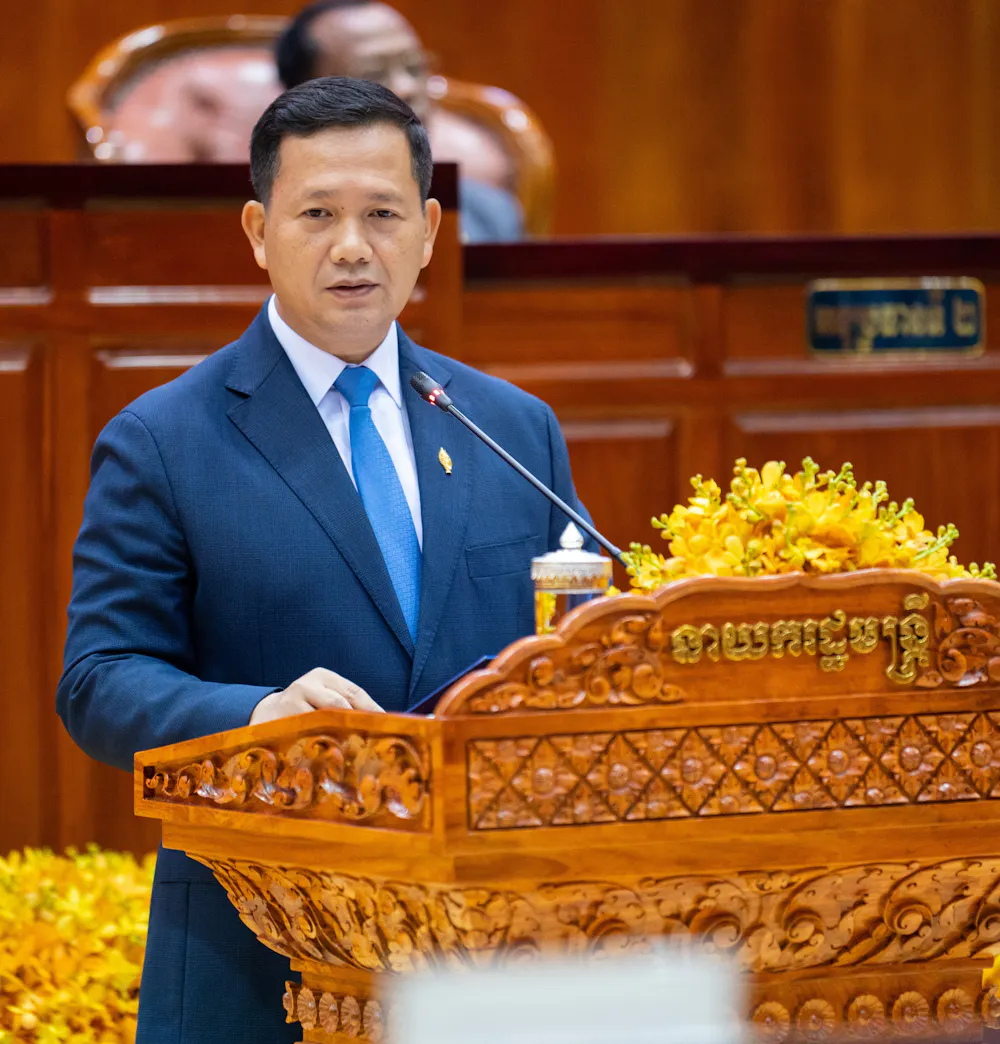
Cambodian prime minister, Hun Manet, who succeeded his father Hun Sen in 2023. Sa sola / Shutterstock
Some observers believed that the softly spoken and sharp-suited Manet might possess a more liberal worldview than that of his father, ushering a new era of renewed democracy.
Hun Sen’s reign in Cambodia was characterised by an increasing reliance on what researcher Neil Loughlin terms the “politics of coercion” to cement his hold on power. The Hun family are at the centre of a network of tightly entwined business and state elites that exert a stranglehold over Cambodia’s politics and economy.
This kleptocratic coalition is accused of asset-stripping the kingdom of its once-abundant natural resources, enriching themselves at the cost of impoverishing the many. As a result, popular dissent has grown.
To quell any threat to its longevity, the ruling Cambodian People’s party (CPP) has led a concerted crackdown on freedoms of association, assembly and expression. Over the past decade, this has included the shuttering of almost all independent news outlets, the dissolution of the opposition Cambodian National Rescue party, and the detention of its leader, Kem Sokha, under house arrest.
As the architect of the Paris Peace Accords that brokered the end to Cambodia’s civil war, the old guard of the party has sought to legitimise its heavyhanded approach by stressing the continued need to preserve order and stability to prevent descent into further unrest.
A false dawn
Manet has been keen to present himself as part of a new guard, ready to reengage with major powers such as the US and EU. Both the US and EU had cooled relations with Cambodia following the democratic deficits unleashed during Hun Sen’s premiership.
Yet the cyberscam story and its growing repercussions have embarrassed Cambodia on the international stage. By apparently censoring Mech Dara for uncovering the scandal, rather than seeking to control party elements responsible for the cyberscam scourge, Manet appears to be showing where his true loyalties and sentiments lie.
Dara is but one of a long line of dissenters charged with “incitement” by the CPP-controlled courts. With its explicit reference to the conjured threat of renewed social chaos, it harks to the CPP’s past as custodian of order and stability.
The heavyhanded nature of the arrest itself, where Dara was apprehended by a convoy of six military vehicles while on vacation with his family, is also straight out of the CPP’s historic playbook. Persecution not by stealth but by flourish, it sends a wider message to civil society to deter any would-be imitators.
More crucially, it signals a forceful intent to preserve the power, plunder and impunity of Cambodia’s elites, and a commitment to the continued silencing of dissenting voices who threaten their supremacy.
Sabina Lawreniuk receives funding from UKRI’s Future Leaders Fellowship scheme.
Sebastião Bugalho, Ingeborg Ter Laak, Michael Gahler, David McAllister, Ana Miguel Pedro, Isabel Wiseler‑Lima, Luděk Niedermayer, Paulo Cunha, Mirosława Nykiel, Marta Wcisło, Vangelis Meimarakis, Danuše Nerudová, Rosa Estaràs Ferragut, Tomáš Zdechovský, Nicolás Pascual De La Parte, Jörgen Warborn, Wouter Beke, Željana Zovko, Miriam Lexmann, Inese Vaidere, Péter Magyar on behalf of the PPE Group Alex Agius Saliba, Yannis Maniatis, Francisco Assis, Evin Incir, Nicola Zingaretti on behalf of the S&D Group Joachim Stanisław Brudziński, Adam Bielan, Assita Kanko, Alexandr Vondra, Veronika Vrecionová, Ondřej Krutílek, Michał Dworczyk, Ivaylo Valchev, Alberico Gambino, Carlo Fidanza, Emmanouil Fragkos, Sebastian Tynkkynen, Waldemar Tomaszewski on behalf of the ECR Group Abir Al‑Sahlani, Petras Auštrevičius, Helmut Brandstätter, Benoit Cassart, Olivier Chastel, Raquel García Hermida‑Van Der Walle, Svenja Hahn, Karin Karlsbro, Moritz Körner, Ilhan Kyuchyuk, Nathalie Loiseau, Jan‑Christoph Oetjen, Urmas Paet, Hilde Vautmans, Lucia Yar on behalf of the Renew Group Hannah Neumann on behalf of the Verts/ALE Group Per Clausen, Lukas Sieper, Rima Hassan
Document selected :
RC-B10-0089/2024
Texts tabled :
RC-B10-0089/2024
Texts adopted :
European Parliament resolution on Iraq, notably the situation of women’s rights and the recent proposal to amend the Personal Status Law
–having regard to its previous resolutions on Iraq,
–having regard to Rules 150(5) and 136(4) of its Rules of Procedure,
A.whereas Iraq’s Parliament is drafting highly restrictive amendments to Law 188/1959 (the Personal Status Law), affecting women’s rights; whereas as a result, family matters, including marriage, divorce and child custody, would effectively fall under the remit of religious rather than civil courts, entailing disturbing discrepancies along religious lines, according to UN experts; whereas for some, the minimum legal marriageable age would be 9 for girls and 15 for boys, and there are fears of increased violence against women in the future; whereas 22 % of unregistered marriages involve girls under 14; whereas the Supreme Court endorsed the constitutionality of the most problematic amendments before a third reading, which was postponed on 2 October 2024; whereas the women’s rights situation in Iraq already drew fierce criticism;
B.whereas Iraq’s UN mission UNITAD, which had been investigating sexual crimes committed by Daesh against women, particularly Yazidis, had to close on 17 September 2024 following last year’s decision, supported by Russia and China, to discontinue its UN Security Council mandate; whereas Iraq’s UN mission UNAMI will also have to close in 2025;
C.whereas the 2016 Sakharov Prize for freedom of expression was awarded to Nadia Murad and Lamiya Aji Bashar, two Iraqi Yazidi women, for their struggle against conflict-related sexual violence;
D.whereas Article 14 of Iraq’s constitution states that ‘Iraqis are equal before the law without discrimination based on gender’;
E.whereas 73 % of respondents surveyed by the Iraq Polling Team expressed ‘strong opposition’ to the changes to Law 188/1959;
1.Urges Iraq’s Parliament to fully and immediately reject the proposed amendments to Law 188/1959 (the Personal Status Law); underlines, with utmost concern, that the amendments would violate Iraq’s international obligations regarding women’s fundamental rights, and result in a significant rollback, an increasingly negative international reputation and the withholding of some foreign assistance from bilateral and multilateral organisations;
2.Calls on the VP/HR and the Member States to condemn the proposed amendments; calls on the EU delegation to Iraq to make development grants conditional on judicial training on sexual and gender-based violence and the establishment of women’s shelters; urges Iraq to adopt a national action plan to eliminate child marriage, criminalise marital rape, fight domestic violence and strengthen women’s and girls’ rights, in line with the UN Convention on the Elimination of All Forms of Discrimination against Women; calls for a reinforced partnership with the Human Rights Committee of Iraq’s Parliament, in line with Iraq’s international obligations;
3.Calls on the Member States to increase their support to women’s and children’s rights defenders in Iraq;
4.Is highly concerned by the lack of legal protection in the penal code for women and child victims of domestic violence and calls for improvements;
5.Instructs its President to have this resolution translated into Arabic and to forward this resolution to Iraq’s Parliament and Government, the VP/HR and the Member States.
Sebastião Bugalho, Miriam Lexmann, Michael Gahler, David McAllister, Isabel Wiseler‑Lima, Luděk Niedermayer, Ana Miguel Pedro, Mirosława Nykiel, Paulo Cunha, Marta Wcisło, Vangelis Meimarakis, Loránt Vincze, Danuše Nerudová, Rosa Estaràs Ferragut, Tomáš Zdechovský, Jörgen Warborn, Wouter Beke, Nicolás Pascual De La Parte, Željana Zovko, Inese Vaidere on behalf of the PPE Group Yannis Maniatis, Francisco Assis, Raphaël Glucksmann, Pina Picierno on behalf of the S&D Group Joachim Stanisław Brudziński, Adam Bielan, Mariusz Kamiński, Jaak Madison, Reinis Pozņaks, Alexandr Vondra, Jadwiga Wiśniewska, Veronika Vrecionová, Ondřej Krutílek, Michał Dworczyk, Assita Kanko, Alberico Gambino, Carlo Fidanza, Charlie Weimers, Beatrice Timgren, Sebastian Tynkkynen, Roberts Zīle, Waldemar Tomaszewski on behalf of the ECR Group Petras Auštrevičius, Helmut Brandstätter, Benoit Cassart, Olivier Chastel, Engin Eroglu, João Cotrim De Figueiredo, Svenja Hahn, Karin Karlsbro, Moritz Körner, Ilhan Kyuchyuk, Nathalie Loiseau, Urmas Paet, Ana Vasconcelos, Hilde Vautmans, Lucia Yar on behalf of the Renew Group Erik Marquardt, Markéta Gregorová on behalf of the Verts/ALE Group Per Clausen, Rima Hassan, Hanna Gedin, Jonas Sjöstedt
Document selected :
RC-B10-0101/2024
Texts tabled :
RC-B10-0101/2024
Texts adopted :
European Parliament resolution on the cases of unjustly imprisoned Uyghurs in China, notably Ilham Tohti and Gulshan Abbas
–having regard to Articles 4 and 36 of the Constitution of the People’s Republic of China (PRC),
–having regard to Rules 150(5) and 136(4) of its Rules of Procedure,
A.whereas in 2014 Ilham Tohti was convicted of politically motivated charges of ‘separatism’ and sentenced to life imprisonment; whereas he worked to foster dialogue between Uyghurs and Han Chinese; whereas he was awarded the 2019 Sakharov Prize;
B.whereas Gulshan Abbas is serving a 20-year sentence on fallacious terrorism-related charges relating to activities of her sister, a defender of the human rights of persecuted Uyghurs in the PRC;
C.whereas this reflects the PRC authorities’ systemic repression of Uyghurs in the Xinjiang Uyghur Autonomous Region (XUAR); whereas Uyghurs are arbitrarily detained in internment camps and forced to renounce their ethnic identity and religious beliefs;
D.whereas the defence of human rights, democracy and the rule of law should be at the centre of EU-PRC relations;
1.Strongly condemns the PRC’s violations of the human rights of Uyghurs and people in Tibet, Hong Kong, Macau and mainland China;
2.Urges the PRC to immediately and unconditionally release Ilham Tohti and Gulshan Abbas, as well as those arbitrarily detained in China and those mentioned by the EU during the 57th session of the UN Human Rights Council, guarantee their access to medical care and lawyers, provide information on their whereabouts and ensure family visiting rights; calls for the EU and the Member States to apply pressure in this respect at every high-level contact;
3.Calls for the EU and the Member States to adopt additional sanctions against high-ranking officials and entities involved in human rights violations in the PRC;
4.Demands that the PRC authorities halt their repression and targeting of Uyghurs with abusive policies, including intense surveillance, forced labour, sterilisation, birth prevention measures and the destruction of Uyghur identity, which amount to crimes against humanity and a serious risk of genocide; calls for the closure of all internment camps;
5.Strongly condemns the PRC for not implementing the recommendations of the Office of the High Commissioner for Human Rights (OHCHR); calls on the PRC to allow the OHCHR independent access to XUAR and invites the OHCHR to issue a comprehensive situational update and an action plan for holding the PRC accountable;
6.Regrets the PRC’s lack of commitment to the Human Rights Dialogue and the absence of results;
7.Calls on Member States and the international community to suspend extradition treaties with the PRC and Hong Kong, respect the non-refoulement principle and implement the OHCHR report;
8.Urges Member States to address the transnational repression of Chinese dissidents and Uyghurs on their territory and prosecute individuals responsible;
9.Welcomes the EU’s forced labour regulation and insists on its full implementation; calls on businesses operating in the PRC, particularly in XUAR, to comply with their HR due diligence obligations;
10.Instructs its President to forward this resolution to the PRC authorities, the VP/HR, the Commission, the Member States and the United Nations.
Sebastião Bugalho, Miriam Lexmann, Michael Gahler, David McAllister, Isabel Wiseler‑Lima, Luděk Niedermayer, Ana Miguel Pedro, Mirosława Nykiel, Paulo Cunha, Marta Wcisło, Vangelis Meimarakis, Loránt Vincze, Danuše Nerudová, Rosa Estaràs Ferragut, Tomáš Zdechovský, Jörgen Warborn, Wouter Beke, Nicolás Pascual De La Parte, Željana Zovko, Inese Vaidere on behalf of the PPE Group Yannis Maniatis, Francisco Assis, Raphaël Glucksmann, Pina Picierno on behalf of the S&D Group Joachim Stanisław Brudziński, Adam Bielan, Mariusz Kamiński, Jaak Madison, Reinis Pozņaks, Alexandr Vondra, Jadwiga Wiśniewska, Veronika Vrecionová, Ondřej Krutílek, Michał Dworczyk, Assita Kanko, Alberico Gambino, Carlo Fidanza, Charlie Weimers, Beatrice Timgren, Sebastian Tynkkynen, Roberts Zīle, Waldemar Tomaszewski on behalf of the ECR Group Petras Auštrevičius, Helmut Brandstätter, Benoit Cassart, Olivier Chastel, Engin Eroglu, João Cotrim De Figueiredo, Svenja Hahn, Karin Karlsbro, Moritz Körner, Ilhan Kyuchyuk, Nathalie Loiseau, Urmas Paet, Ana Vasconcelos, Hilde Vautmans, Lucia Yar on behalf of the Renew Group Erik Marquardt, Markéta Gregorová on behalf of the Verts/ALE Group Per Clausen, Rima Hassan, Hanna Gedin, Jonas Sjöstedt, Lukas Sieper
Document selected :
RC-B10-0101/2024
Texts tabled :
RC-B10-0101/2024
Texts adopted :
European Parliament resolution on the cases of unjustly imprisoned Uyghurs in China, notably Ilham Tohti and Gulshan Abbas
–having regard to Articles 4 and 36 of the Constitution of the People’s Republic of China (PRC),
–having regard to Rules 150(5) and 136(4) of its Rules of Procedure,
A.whereas in 2014 Ilham Tohti was convicted of politically motivated charges of ‘separatism’ and sentenced to life imprisonment; whereas he worked to foster dialogue between Uyghurs and Han Chinese; whereas he was awarded the 2019 Sakharov Prize;
B.whereas Gulshan Abbas is serving a 20-year sentence on fallacious terrorism-related charges relating to activities of her sister, a defender of the human rights of persecuted Uyghurs in the PRC;
C.whereas this reflects the PRC authorities’ systemic repression of Uyghurs in the Xinjiang Uyghur Autonomous Region (XUAR); whereas Uyghurs are arbitrarily detained in internment camps and forced to renounce their ethnic identity and religious beliefs;
D.whereas the defence of human rights, democracy and the rule of law should be at the centre of EU-PRC relations;
1.Strongly condemns the PRC’s violations of the human rights of Uyghurs and people in Tibet, Hong Kong, Macau and mainland China;
2.Urges the PRC to immediately and unconditionally release Ilham Tohti and Gulshan Abbas, as well as those arbitrarily detained in China and those mentioned by the EU during the 57th session of the UN Human Rights Council, guarantee their access to medical care and lawyers, provide information on their whereabouts and ensure family visiting rights; calls for the EU and the Member States to apply pressure in this respect at every high-level contact;
3.Calls for the EU and the Member States to adopt additional sanctions against high-ranking officials and entities involved in human rights violations in the PRC;
4.Demands that the PRC authorities halt their repression and targeting of Uyghurs with abusive policies, including intense surveillance, forced labour, sterilisation, birth prevention measures and the destruction of Uyghur identity, which amount to crimes against humanity and a serious risk of genocide; calls for the closure of all internment camps;
5.Strongly condemns the PRC for not implementing the recommendations of the Office of the High Commissioner for Human Rights (OHCHR); calls on the PRC to allow the OHCHR independent access to XUAR and invites the OHCHR to issue a comprehensive situational update and an action plan for holding the PRC accountable;
6.Regrets the PRC’s lack of commitment to the Human Rights Dialogue and the absence of results;
7.Calls on Member States and the international community to suspend extradition treaties with the PRC and Hong Kong, respect the non-refoulement principle and implement the OHCHR report;
8.Urges Member States to address the transnational repression of Chinese dissidents and Uyghurs on their territory and prosecute individuals responsible;
9.Welcomes the EU’s forced labour regulation and insists on its full implementation; calls on businesses operating in the PRC, particularly in XUAR, to comply with their HR due diligence obligations;
10.Instructs its President to forward this resolution to the PRC authorities, the VP/HR, the Commission, the Member States and the United Nations.
Beginning November 12, 2024, Thao Lam and Kjell Boersma’s acclaimed new National Film Board of Canada (NFB) animated short Boat People will be featured in season seven of POV Shorts—a collection of the best and boldest independent short films streaming free of charge on POV.org and on the PBS App.
October 8, 2024 – Montreal – National Film Board of Canada (NFB)
Beginning November 12, 2024, Thao Lam and Kjell Boersma’s acclaimed new National Film Boardof Canada (NFB) animated short Boat People will be featured in season seven of POV Shorts—a collection of the best and boldest independent short films streaming free of charge on POV.org and on the PBS App.
POV Shorts will be airing on PBS affiliate stations—check local listings.
Canadians can also continue to enjoy Boat People on the NFB’s free online screening platform, nfb.ca.
About the film
Boat People by Thao Lam and Kjell Boersma (10 min) Produced by Justine Pimlott and Jelena Popović for the NFB Press kit: mediaspace.nfb.ca/epk/boat-people-2
As a little girl in Vietnam, Thao’s mother would rescue ants from bowls of sugar water. The tiny creatures would later return the favour, leading her desperate family through darkness—and pointing the way to safety.
With Boat People, illustrator and author Thao Lam undertakes a creative rescue mission of her own, joining forces with animator Kjell Boersma to recount the experiences of her family, who were among over 1.6 million refugees who fled the chaotic aftermath of the Vietnam War, venturing across the South China Sea in precarious open boats.
Boat People employs a hybrid of traditional 2D animation, stop-motion multiplane, and 3D rendering to capture the unique aesthetic of Lam’s handmade paper textures and patterns. The film speaks across time and culture to anyone who’s ever fought to protect their family or community.
Acclaim for Boat People
Boat People has been selected by more than 30 festivals around the world, including the Ottawa International Animation Festival, DOC NYC, the Stuttgart International Festivalof Animated Film and the Clermont-Ferrand International Short Film Festival.
The film has garnered 10 awards and mentions to date, including the Milos Stehlik Global ImpactAward at the Chicago International Children’s Film Festival, a Special Mention at the Oberhausen International Short Film Festival in Germany, and the Audience Award and Helen Hill Awardfor Animated Short at the New Orleans Film Festival, a short-films qualifying festival for the 97th Academy Awards.
About the filmmakers
Thao Lam is a critically acclaimed Vietnamese-Canadian children’s book author and illustrator who arrived in Canada with her parents at the age of three as a refugee from Vietnam. Her books include the multi-award winning Wallpaper (2018) and Paper Boat (2020).
Kjell Boersma is a writer, director and animator whose projects combine traditional and digital animation techniques in novel ways. He directed the short film Monster Slayer (2015) and was commissioned by the Toronto Symphony Orchestra and TIFF Kids to write and direct DAM! The Story of Kit the Beaver (2017).
About the National Film Board of Canada
Founded in 1939, the National Film Board of Canada (NFB) is a one-of-a-kind producer, co-producer and distributor of engaging, relevant and innovative documentary and animated films. As a talent incubator, it is one of the world’s leading creative centres. The NFB has enabled Canadians to tell and hear each other’s stories for over eight decades, and its films are a reliable and accessible educational resource. The NFB is also recognized around the world for its expertise in preservation and conservation, and for its rich and vibrant collection of works, which form a pillar of Canada’s cultural heritage. To date, the NFB has produced more than 14,000 works, 7,000 of which can be streamed free of charge at nfb.ca. The NFB and its productions and co-productions have earned over 7,000 awards, including 11 Oscars and an Honorary Academy Award for overall excellence in cinema.
About American Documentary, Inc.
American Documentary, Inc. (AmDoc) is a multimedia organization dedicated to creating, identifying and presenting contemporary stories that express opinions and perspectives rarely featured in mainstream media outlets. AmDoc is a catalyst for public culture, developing collaborative strategic engagement activities around socially relevant content on television, online and in community settings. These activities are designed to trigger action, from dialogue and feedback to educational opportunities and community participation.
Major funding for POV is provided by PBS, the Open Society Foundations, The John D. and Catherine T. MacArthur Foundation, the Wyncote Foundation, Reva & David Logan Foundation, Park Foundation, and Perspective Fund. Additional funding comes from the National Endowment for the Arts, New York State Council on the Arts, public funds from the New York City Department of Cultural Affairs in partnership with the City Council, Chris and Nancy Plaut, Ann Tenenbaum and Thomas H. Lee, Acton Family Giving, and public television viewers. POV is presented by a consortium of public television stations, including KQED San Francisco, WGBH Boston and THIRTEEN in association with WNET.ORG.
About PBS
PBS, with more than 330 member stations, offers all Americans the opportunity to explore new ideas and new worlds through television and digital content. Each month, PBS reaches over 120 million people through television and 26 million people online, inviting them to experience the worlds of science, history, nature and public affairs; to hear diverse viewpoints; and to take front row seats to world-class drama and performances. PBS’s broad array of programs has been consistently honored by the industry’s most coveted award competitions. Teachers of children from pre-K through 12th grade turn to PBS for digital content and services that help bring classroom lessons to life. Decades of research confirm that PBS’s premier children’s media service, PBS KIDS, helps children build critical literacy, math and social-emotional skills, enabling them to find success in school and life. Delivered through member stations, PBS KIDS offers high-quality educational content on TV—including a 24/7 channel, online at pbskids.org, via an array of mobile apps and in communities across America. More information about PBS is available at http://www.pbs.org, one of the leading dot-org websites on the internet, or by following PBS on Twitter, Facebook or through our apps for mobile and connected devices. Specific program information and updates for press are available at pbs.org/pressroom or by following PBS Communications on Twitter.
About POV
Produced by American Documentary, POV is the longest-running independent documentary showcase on American television. Since 1988, POV has presented films on PBS that capture the full spectrum of the human experience, with a long commitment to centering women and people of color in front of, and behind, the camera. The series is known for introducing generations of viewers to groundbreaking works like Tongues Untied (1989), Hearts of Darkness: A Filmmaker’s Apocalypse (1992), Rabbit in the Room (1999), Of Civil Wrongs & Rights: The Fred Korematsu Story (2001), Made in L.A. (2007), American Promise (2013),Not Going Quietly (2021),While We Watched (2022), A House Made of Splinters (2022) and the mini-series And She Could be Next (2020). Throughout its history POV has featured the work of award-winning, innovative filmmakers including Jonathan Demme, Laura Poitras, Nanfu Wang, Frederick Wiseman, Emiko Omori, Janus Metz Pedersen and Ava DuVernay. In 2018, POV Shorts launched as one of the first PBS series dedicated to bold and timely short-form documentaries. In 2024, Indiewire named seven POV films in its roundup of “The 50 Best Documentaries of the 21st Century”: Faya Dayi (2021), The Mole Agent (2020), Minding The Gap (2018), Cameraperson (2016), The Look of Silence (2015), The Act of Killing (2013) and After Tiller (2013). All POV programs are available for streaming concurrent with broadcast on all station-branded PBS platforms, including PBS.org and the PBS App, available on iOS, Android, Roku streaming devices, Apple TV, Android TV, Amazon Fire TV, Samsung Smart TV, Chromecast and VIZIO. For more information about PBS Passport, visit the PBS Passport FAQ website.
POV goes “beyond the broadcast” to bring powerful nonfiction storytelling to viewers wherever they are. Free educational resources accompany every film and a community network of thousands of partners nationwide work with POV to spark dialogue around today’s most pressing issues. POV continues to explore the future of documentary through innovative productions with partners such as The New York Times and the National Film Board of Canada and on platforms including Snapchat and Instagram.
POV films and projects have won 48 Emmy Awards, 28 George Foster Peabody Awards, 16 Alfred I. duPont-Columbia University Awards, three Academy Awards® and the first-ever George Polk Documentary Film Award. Learn more at pbs.org/pov and follow @povdocs on social media.
About POV Shorts
POV Shorts launched in 2018 as one of the first PBS series dedicated to bold and timely short-form documentaries. The series is known for its curation, and for broadcasting award-winning titles, including: Emmy®-nominated Earthrise, Water Warriors, The Changing Same, Emmy® winner The Love Bugs and the Oscar® shortlisted A Broken House and Aguilas. It won Best Short Form Series at the IDA Documentary Awards in 2023, 2022 and 2020.
Source: United States Senator for Mississippi Roger Wicker
WASHINGTON – Yesterday, U.S. Senator Roger Wicker, R-Miss., the highest-ranking Republican on the Senate Armed Services Committee, joined “The Hugh Hewitt Show” program and discussed several national defense topics, including the October 7th Anniversary, China’s shocking growth in naval shipbuilding, and the Biden-Harris administration’s weak record on China.
The interview follows Senator Wicker’s October 7th Anniversary statement which was released on Monday.
Read selected excerpts from the interview below, or watch the full segment here.
On a Harris presidency & China policy: “If it’s any indication of how her party has done with their leader in the U.S. Senate, yes, it’s very much a concern [how Harris would do with China]. Every time we’ve wanted to spend a few extra dollars – a few percentage points of our huge economy – to defend ourselves, the Democrats say: “well, we won’t do that unless we can increase domestic spending, too.” So, it’s been like pulling teeth getting a few extra ships built.”
On shipbuilding: “China has 200 times the Navy shipbuilding capacity we do. When you talk about [how] we need to increase the number of fighter jets, or submarines, or ships, some people say: “well, we don’t even have the industrial capacity. We don’t have enough manufacturing plants.” And of course, the answer to that is: let’s get some.We’re going to have to increase our national defense to keep us out of a war. The idea is to keep the peace by being so strong that nobody will take a chance on us.
On a future DOD budget: “What we need to do – and what I’ve advocated – and what military experts past and present are saying is that we need to go back to Ronald Reagan’s ‘peace through strength.’ And that does involve about five percent of our economy used to get us ready to defend ourselves in a war…if we spend five percent of our gross domestic product on defending America, we can save hundreds of billions and trillions of dollars by staying out of a war…the last time our Senate Republicans met with President Trump, he was very clear that he shared our determination to increase our Navy and get it back up to the point where we’re able to protect America and deter somebody from attacking us. So that was very much an encouraging statement from President Trump.”
On Israel: “Remember this: the attack one year ago today was an attack on a civilian concert with Americans present and killed at the concert. 1,200 innocent civilians were killed in the most brutal way…there’s no way that after all the Israelis have encountered over 70 years and all the things the Jewish people have encountered over the centuries, there’s no way that Israel is going to give up its right to that tiny little piece of real estate in the Middle East. As a matter of fact, I think that Netanyahu is doing the world a favor by saying, ‘I’m going to totally eliminate these Iranian-backed terrorists – Hamas, the Houthis that are firing weapons on American ships, and Hezbollah, the largest terrorist group in Lebanon’…and I’ll tell you this: Lebanon will be far, far better off when and if Hezbollah is completely removed from their country.”
WASHINGTON, D.C. – In case you missed it, last week, U.S. Sen. Ted Cruz (R-Texas) sent a letter to the Hormel Institute regarding its partnership with the Wuhan Institute of Virology (WIV) and financial resources secured for the Hormel Institute by Governor Tim Walz. The WIV has been credibly implicated as the point of origin of COVID-19 and conducts its activities under the auspices of the Chinese Communist Party.
In the letter, Sen. Cruz wrote, “For over a decade, Governor Tim Walz has acted as one of the Institute’s most ardent supporters, securing millions of taxpayer dollars to fund its operations, including over $2 million in federal funding for technology acquisitions and a $5 million earmark to expand your Institute’s reach. The Governor’s support for the Hormel Institute has remained steadfast, continuing even after the FBI concluded on February 28, 2023 that COVID-19 pandemic likely originated from the WIV.
“Governor Walz’s personal connections to China—his honeymoon there, over 30 trips, and public comments downplaying the strategic threat posed by the CCP13—only raise further questions about his motivations for promoting your institution.
“Your institute’s ongoing partnership with the Wuhan Institute of Virology, and by extension the People’s Liberation Army, reflects a troubling disregard for national security concerns…The American people deserve assurance that their resources and institutions are not inadvertently supporting the goals of our chief geopolitical adversary.”
Read the full letter here or below:
Dear Director Clarke:
I write to you today with growing concern regarding the Hormel Institute’s longstanding partnership with China’s Wuhan Institute of Virology (WIV).
The WIV, as you are certainly aware, has been credibly implicated as the likely point of origin of the COVID-19 pandemic. Even more troubling are its direct ties to China’s People’s Liberation Army (PLA) and its involvement in classified military research including laboratory animal experiments under the auspices of the Chinese Communist Party (CCP) at least as recently as 2017. Despite these alarming connections which raise obvious national security concerns, the institute you lead has not only maintained its collaboration with WIV but it has done so with the backing of Minnesota’s top elected official.
For over a decade, Governor Tim Walz has acted as one of the Institute’s most ardent supporters, securing millions of taxpayer dollars to fund its operations, including over $2 million in federal funding for technology acquisitions and a $5 million earmark to expand your Institute’s reach. The Governor’s support for the Hormel Institute has remained steadfast, continuing even after the FBI concluded on February 28, 2023 that COVID-19 pandemic likely originated from the WIV.
In recent years, researchers at the Hormel Institute have collaborated with the Wuhan Institute of Virology on a variety of projects, including a 2020 COVID-19 study and, as more recently as of 2024, on structural biology research.
The COVID-19 study, titled “A dynamic regulatory interface on SARS-CoV-2 RNA polymerase,” was authored by four WIV researchers, three Hormel Institute researchers, and a Yale School of Medicine professor. Similarly, in January 2024, Hormel Institute researchers published a study on genes with the WIV’s Lina He, Wei Zhou, and Yangbo Hu. In 2023, WIV’s Yangbo Hu also worked with the Hormel Institute’s Dmytro Kompaniiets, Dong Wang, and Bin Liu on research titled “Structure and molecular mechanism of bacterial transcription activation,” among other collaborations.
Furthermore, the resignation of your predecessor, Dr. Zigang Dong, who served as Executive Director for nearly 18 years and resigned following an FBI investigation into his “possible failure to disclose foreign backing when applying for grants,” should have prompted a thorough reassessment of your institute’s engagements with foreign entities. Yet, despite this disconcerting event, Governor Walz continues to promote and direct public resources to your institute. Even after the U.S. government ceased funding to organizations working with the WIV, Governor Walz toured your facility and publicly praised its work.
Governor Walz’s personal connections to China—his honeymoon there, over 30 trips, and public comments downplaying the strategic threat posed by the CCP—only raise further questions about his motivations for promoting your institution.
Additionally, in 2020, the Hormel Institute’s disclosure in a 2020 EMBO Journal Study that it received “help from the Core Facility and Technical Support” of the WIV for “radioactive and fluorescent tests” adds to the concern. Further raising suspicions is that Bin Liu, a professor at the Hormel Institute who worked on that 2020 EMBO Journal study, attended Wuhan University. Federal records indicate that the researchers for this particular study included those affiliated with the WIV, in addition to the University of Chinese Academy of Sciences and China’s Zhengzhou University.
In light of these recently-disclosed facts, it is critical to understand the full extent of your institute’s involvement in a partnership that risks benefitting our nation’s chief geopolitical adversary. Accordingly, for the purposes of oversight, I request that you respond to the following questions and requests by October 31, 2024:
1. How much public and private funding has the Hormel Institute received specifically for projects involving collaboration with the Wuhan Institute of Virology (WIV)? Please provide an itemized accounting of all such funding.
2. When did the Hormel Institute first initiate collaboration with the WIV, and what were the specific reasons for choosing to partner with a facility known to have ties to China’s People’s Liberation Army?
3. What actions has the Hormel Institute taken to ensure that its collaborative work with the WIV does not benefit China’s military or pose a risk to U.S. national security?
a. If no such actions were taken, what was the rationale behind this decision?
4. Given the WIV’s ties to China’s military, why has the Hormel Institute not publicly disclosed the full extent of its collaborations with the WIV?
a. If this information has been withheld, please explain why.
5. Please provide all internal documentation or communications related to the Hormel Institute’s partnerships with Chinese research facilities, including but not limited to the WIV.
6. What was the Institute’s reasoning behind continuing its collaboration with the WIV, even after serious concerns about the origins of COVID-19 and the lab’s military affiliations became widely known?
7. How can the American public trust that the Hormel Institute’s partnerships with the WIV are not inadvertently advancing China’s geopolitical goals, particularly in biotechnology and biomedical research?
8. Given the U.S. government’s cessation of funding to other nonprofits with ties to the WIV, what justifications does the Hormel Institute offer for continuing its relationship with the WIV?
9. Why did the Hormel Institute continue collaborating with the WIV after your predecessor, Dr. Zigang Dong, resigned amid an FBI investigation into his failure to disclose foreign funding when applying for grants?
10. The Hormel Institute’s work with the WIV includes research on gene structures and SARS-CoV-2 RNA polymerase. What measures have been taken to ensure that no sensitive intellectual property or technology has been transferred to China’s military-backed labs during these studies? If no measures were taken, why not?
11. Please provide any documentation or communications between the Hormel Institute and the Office of the Minnesota Governor regarding the Institute’s partnerships with Chinese research facilities, particularly the WIV.
Your institute’s ongoing partnership with the Wuhan Institute of Virology, and by extension the People’s Liberation Army, reflects a troubling disregard for national security concerns. The devastating impact of COVID-19 has highlighted the seriousness of these issues, as the pandemic has severely affected lives and economies worldwide. The American people deserve assurance that their resources and institutions are not inadvertently supporting the goals of our chief geopolitical adversary. As Executive Director, it is crucial that you address these concerns transparently. Failure to do so will only deepen public mistrust and undermine confidence in your institute’s integrity and intentions.
The American people look forward to your timely and comprehensive response.
Sincerely,
/X/
Source: People’s Republic of China – State Council News
BEIJING, Oct. 8 — China is confident of achieving the full-year growth target, while mulling new supporting policies to sustain steady and healthy economic growth, the country’s top economic planner said Tuesday.
The market sentiment has improved recently with a pick-up of the purchasing managers’ index in the manufacturing sector, a warming stock market and a vital consumption market during the National Day holiday following the implementation of existing policies and incremental policies unveiled recently, Zheng Shanjie, head of the National Development and Reform Commission (NDRC), told a press conference.
In addition, the fundamentals of China’s economic development have not changed, and favorable conditions such as huge market potential and strong economic resilience have not changed, said Zheng.
China’s financial authorities announced a broader-than-expected policy package last month to stimulate economic recovery. These policy measures include reducing the reserve requirement ratio (RRR) for banks and mortgage rates for existing homes, as well as introducing new monetary programs to boost the capital market, among other initiatives.
A meeting of the Political Bureau of the Communist Party of China Central Committee held on Sept. 26 called for stepping up efforts to roll out incremental policies as the country strives to accomplish its annual economic and social development targets.
The recently unveiled package of incremental policies was designed to strengthen counter-cyclical macro policy adjustment, expand effective domestic demand, increase efforts to help enterprises, stabilize the real estate market and boost the capital market, Zheng said.
He said the incremental policies focus on improving the quality of economic development, supporting the healthy development of the real economy and business entities, and balancing high-quality development with high-level security.
Elaborating on the implementation of the incremental policies, Zheng said counter-cyclical adjustment in macro policies has been intensified, with RRR and interest rate cuts already in place.
He called for speeding up fiscal spending to bolster the economy and providing stronger support for local governments to conduct debt replacement and defuse debt risks.
A raft of reform measures conducive to economic development will be rolled out, he said. These reforms include the formation of guidelines on building a unified national market, a new negative list for market access and mechanisms to ensure increased investment in future industries.
China will expand the catalogue of industries that encourage foreign investment, unveil a new group of major foreign-invested projects and make its visa-free transit policies more open, according to Zheng.
The incremental policies also aim to boost domestic consumption and investment demand, he noted.
The country’s consumer goods trade-in program has been fully activated, with passenger car sales rebounding sharply and electrical home appliance sales returning to growth. Related policies will be further advanced to fuel sustained increases in commodity consumption, Zheng said.
On the investment front, ultra-long special treasury bonds will continue to be issued next year with optimized investment areas to implement major national strategies and build up security capacity in key areas, he noted.
Investment projects worth 200 billion yuan (about 14.14 billion U.S. dollars) that are in next year’s plans will be released in advance this year to support local governments in accelerating the preliminary work and construction, Zheng told reporters.
A certain proportion of these projects will involve urban renewal, mainly in the construction of pipelines for gas, water, sewage and heating, which is expected to generate investment demand of around 4 trillion yuan in the coming five years, said NDRC deputy head Liu Sushe at the press conference.
While policies conducive to the production, operation and sound development of enterprises will not stop or be reduced, measures to prop up the real estate and capital markets are being planned or advanced, according to Zheng.
He said China will study new policies in a timely manner to promote steady growth, structural improvement and sustained development of the economy.
The NDRC will closely follow changes in the economic situation, evaluate the effects of policy implementation, and conduct preliminary research on more supportive policies and maintain policy options, said Zheng.
The Chinese economy was able to maintain overall stable growth, with progress made in the first three quarters, said Zhao Chenxin, deputy head of the NDRC, at the press conference.
With the effect of incremental policies gradually emerging, China’s economic vitality will be further unleashed, market confidence will be further strengthened, and the foundation for the high-quality development and stable economic operation will be further consolidated, said Zhao.
Source: People’s Republic of China – State Council News
China, ASEAN countries reap fruits of high-quality development via Belt and Road cooperation
An aerial drone photo taken on July 31, 2024 shows a view of Qinzhou Port in Qinzhou, south China’s Guangxi Zhuang Autonomous Region. [Photo/Xinhua]
BEIJING, Oct. 8 — Chinese Premier Li Qiang will attend the 27th China-ASEAN Summit, the 27th ASEAN Plus Three Summit and the 19th East Asia Summit in the Lao capital Vientiane starting from Wednesday, and pay official visits to Laos and Vietnam.
While pursuing high-quality development and advancing modernization, China has been offering new growth momentum to its neighbors connected by mountains and rivers, notably through Belt and Road cooperation with common development being a highlight.
Experts said that Li’s upcoming trip to the Association of Southeast Asian Nations (ASEAN) is expected to boost bilateral relations, foster deeper and more substantive cooperation, and enhance people-to-people exchanges, which will further catalyze regional peace, stability and prosperity.
ENHANCING CONNECTIVITY
Laos is a landlocked country in Southeast Asia. Its landscape, largely covered by rugged mountains and high plateaus, forms natural barriers to efficient transportation, hindering the country’s development and the improvement of people’s livelihood.
The China-Laos Railway has helped transform the country’s predicament into a growth opportunity, turning Laos into a land-linked hub on the Indo-China Peninsula.
Passengers are seen at the Vientiane Station of the China-Laos Railway in Vientiane, Laos, April 11, 2024. [Photo/Xinhua]
The 1,035-km railway, a landmark Belt and Road project, connects Kunming in southwest China’s Yunnan Province with Vientiane.
Nearly three years into operation, the railway has handled over 10 million tons of imported and exported goods valued at about 5.7 billion U.S. dollars in total, with varieties of goods expanding from the initial 500 to more than 3,000, according to official data.
Since the railway launched its international passenger service in April 2023, it has transported over 222,000 cross-border passengers as of early July this year, providing affordable, convenient and comfortable experiences to travelers.
Daovone Phachanthavong, vice executive president of the Lao National Chamber of Commerce and Industry, told Xinhua the China-Laos Railway “has promoted regional connectivity and injected vitality into economic and social development along the line.”
Vietnam, a neighbor of Laos, has enjoyed enhanced connectivity and more efficient logistics from infrastructure cooperation with China as well, which includes railway, expressway and port infrastructure.
China-Vietnam freight trains are a good case in point. Since its launch in November 2017, the service has significantly boosted rapid cargo movement between the two countries and further into Southeast Asia.
“China has strengths in capital, technology, and experience in infrastructure construction, while Vietnam is in need of infrastructure development in transportation, energy, and urban areas,” said Do Thi Thu, a senior lecturer at the Banking Academy of Vietnam.
This aerial photo taken on Oct. 16, 2023 shows a China-Vietnam (L) and a China-Laos international cold-chain freight trains pulling out of Yanhe Station of Yuxi City, southwest China’s Yunnan Province. [Photo/Xinhua]
BOOMING HIGH-QUALITY DEVELOPMENT
Infrastructure construction has opened up broader prospects for practical cooperation between China and ASEAN countries in a rich variety of areas, driving stronger economic growth, closer exchanges and high-quality development.
China is the largest foreign investor in Laos. A large chunk of the investment has funded infrastructure, development zones, as well as power transmission lines and hydropower plants, creating many jobs for local people and pushing forward Laos’ industrial upgrade.
Daovone said that Laos sees huge potential for further deepening cooperation with China across such fields as agriculture, electric vehicles and trucks, electricity, mining, solar energy, tourism, as well as hotels and restaurants.
Agriculture is the mainstay of the Lao economy. Laos exports bananas, rubber, cassava, sugarcane and others, with China being the largest buyer.
Through the years, Chinese companies have collaborated with the Lao government on tropical agricultural science and technology, and Laos is seeking to promote sustainable agricultural production and increase exports to China through the China-Laos Railway.
Vietnam, meanwhile, is China’s largest trading partner within ASEAN, and China has been Vietnam’s largest trading partner since 2004. Annual volume of two-way trade has exceeded 200 billion U.S. dollars for three consecutive years.
Do, the Hanoi-based scholar, said that Vietnam-China “large cooperative projects on infrastructure, energy, and border area development have contributed to the socio-economic growth of both nations.”
Vietnam-China trade cooperation “has bright prospects for deeper and more substantive cooperation in the future,” she said.
She also said the introduction of fresh and frozen Vietnamese durians into the Chinese market shows the development of trade cooperation, exemplified by diversifying products within the same category and adding value.
With Chinese consumers’ demand for durians on the rise, China is now the world’s largest importer and consumer of durians. Last year, some 493,000 tons of fresh Vietnamese durians were sold to China.
Vietnamese vendors sell durians in Dongxing, south China’s Guangxi Zhuang Autonomous Region, on May 18, 2023. [Photo/Xinhua]
Do also pointed out the abundant opportunities in substantive development of bilateral trade, noting the two countries can further enhance cooperation particularly in high-tech agriculture and e-commerce.
“China has advanced significantly in technology and innovation, while Vietnam is undergoing a digital transformation and developing its digital economy, creating great potential for cooperation in information technology, artificial intelligence, financial technology, and digital transformation in manufacturing,” she added.
CLOSER COMMUNITY FOR BROADER PROSPERITY
The flagship projects realized through high-quality cooperation between China and ASEAN nations have become benchmarks of their ever-closer relationships, the strengthening of which is conducive to regional prosperity and peace, experts have said.
This year marks the 15th anniversary of the China-Laos comprehensive strategic cooperative partnership. In October 2023, leaders of the two countries signed a new five-year action plan for building a China-Laos community with a shared future, injecting new momentum into the further development of bilateral ties.
Photo taken on Oct. 16, 2016 shows the border trade on the Beilun River on the China-Vietnam border. [Photo/Xinhua]
Daovone greatly appreciates the friendship between the two socialist countries, which is maintained by the top leaders of both countries and exchanges between the two peoples.
Laos-China relations have been moving forward at a high level, he said, expressing the hope that Li’s upcoming visit to Laos will further advance this relationship. As Laos is the current rotating chair of ASEAN, Li’s attendance at related gatherings “will make the summit more colorful.”
Vietnam, another socialist neighbor, shares cultural and social affinities with China. Last year, the two countries announced the building of a China-Vietnam community with a shared future that carries strategic significance, ushering in a new stage in their ties.
“Mutual assistance during difficult times, such as supporting each other during the resistance against colonialism and imperialism, post-war reconstruction, and overcoming the COVID-19 pandemic, has strengthened the friendship between our two countries,” Do said.
As the world is facing rising challenges and geopolitical competition, “a successful bilateral community like Vietnam-China could inspire other bilateral and multilateral communities with a shared future, such as between China and ASEAN,” she said.
Do noted that working towards a community with a shared future helps Vietnam and China focus on sustainable development goals, including environmental protection, climate change response and food security.
“It allows the two countries to address common challenges and promote development for the benefit of their peoples, as well as for peace, stability, and prosperity in the region,” she said.
Source: People’s Republic of China – State Council News
Chinese Premier Li Qiang presides over a study session held by the State Council on Oct. 8, 2024. Li emphasized the importance of enhancing the consistency of macro policy orientation and creating great synergy to promote high-quality development. [Photo/Xinhua]
BEIJING, Oct. 8 — Chinese Premier Li Qiang on Tuesday emphasized the importance of enhancing the consistency of macro policy orientation and creating great synergy to promote high-quality development.
Li made the remarks at a study session held by the State Council.
Noting that macroeconomic governance is more complex at present, Li said that efforts should be made to optimize the combination of policy resources and tools with systematic thinking and measures, to improve the effectiveness of policies.
The targets of policies should be confirmed after considering the overall needs of economic and social development, said Li.
While the economy faces relatively high downward pressure, policies conducive to stabilizing growth and expectations should be rolled out more proactively, and contractionary and inhibitory measures should be prudently introduced, he said.
The assessment and evaluation of policies should be further fine-tuned, said Li, adding that the standards should be set judiciously.
Li noted that non-economic policies should be included in assessing macroeconomic policy consistency, and the effect of new policies should be evaluated from perspectives including economic development, stabilizing expectations, employment and people’s livelihoods.
Huang Hanquan, head of the Chinese Academy of Macroeconomic Research gave a lecture at the session. Vice Premier Ding Xuexiang, Vice Premier Zhang Guoqing and State Councilor Wang Xiaohong participated in the discussions.
UN Member States should support a resolution to promptly begin formal negotiations of a Convention on the Prevention and Punishment of Crimes against Humanity, with the aim of strengthening the international justice framework and vastly reducing safe havens from investigation and prosecution for perpetrators, said Amnesty International today.
The organization’s call comes as the UN General Assembly (UNGA) Sixth Committee meets to debate the agenda item “Crimes against humanity”. The Sixth Committee session is scheduled to last until 22 November.
“The next six weeks present a unique opportunity for the international community to finally make progress on the negotiation and adoption of a convention on crimes against humanity. Such a treaty would open new pathways – desperately needed in today’s world – for ensuring justice, truth and reparation for victims and survivors of some of the most heinous of crimes,” said Agnès Callamard, Amnesty International’s Secretary General.
Unlike other crimes under international law, such as genocide and war crimes, there is presently no specific, standalone convention for crimes against humanity. While the Rome Statute of the International Criminal Court (ICC) does outlaw crimes against humanity under international law, a Convention on Crimes Against Humanity, which would be applied by states, would reinforce and strengthen the overall international justice framework, including that of the ICC.
“The Crimes Against Humanity Convention could be a milestone treaty in more ways than one. It would impose obligations on states not only to criminalize and punish crimes against humanity, but also to prevent them, and to cooperate with other states, including through mutual legal assistance,” said Agnès Callamard.
The next six weeks present a unique opportunity for the international community to finally make progress on the negotiation and adoption of a convention on crimes against humanity.
Agnès Callamard, Amnesty International’s Secretary General
“The new convention would bring much-needed improvement of international standards on gender justice, including by recognizing gender-based crimes that have received far too little international attention, such as gender apartheid, forced marriage and forced abortion. It is well past time for an international law that’s fit to address the age-old war being waged on women, girls and LGBTI people in many corners of our planet.”
“A convention on crimes against humanity would make it much harder for perpetrators to escape justice. For instance, the present draft includes provisions for universal jurisdiction for all crimes covered. It would obligate states to either prosecute or extradite any suspects within their reach – regardless of where the crime was committed or the nationality of the suspect or the victim – and enable domestic courts to take up cases, including those that the International Criminal Court is unable or unwilling to pursue.”
Crimes against humanity are a worldwide phenomenon. In the past 10 years alone, Amnesty International has found evidence of such crimes in at least 18 countries all over the planet.
“No region on earth is free from these atrocities that deeply shock the conscience of humanity. Recent and ongoing situations in countries such as Afghanistan, China, Ethiopia, Iran, Israel and the Occupied Palestinian Territory, Myanmar, Nicaragua, the Philippines, Syria, Ukraine and Venezuela serve as constant reminders of the urgent need to reinforce the international justice system,” said Agnès Callamard.
Source: People’s Republic of China – State Council News
BEIJING, Oct. 8 — A Chinese foreign ministry spokesperson on Tuesday said the “China Travel” boom showcases China’s appeal and openness.
According to data released by multiple tourism platforms, during the National Day holiday, the number of travel orders by foreign tourists to China grew by around 60 percent year-on-year, and many Chinese cities have become popular destinations. Also, relevant authorities, including the Ministry of Foreign Affairs, recently rolled out facilitation measures for foreign travelers to China.
In response to a related query, spokesperson Mao Ning said at a daily news briefing that China now enjoys comprehensive mutual visa exemption with 24 countries, offers a visa-free entry policy for 16 countries, and extends 72-hour or 144-hour visa-free transit policy to 54 countries.
“It’s increasingly easier and more enjoyable for foreign tourists to visit China,” Mao said, adding that Beijing unveiled the brochure titled “Welcome to Beijing: Essential Tips for New Arrivals,” which offers a bird’s-eye view of all kinds of services and information. Shanghai equipped its taxis and subway stations with payment devices that accept foreign bank cards. Eight cities including Chengdu and Xi’an launched new steps on a pilot basis to make payment easier for foreigners in China, she added.
“China will open wider to the world and make cross-border travel easier. We welcome more foreign friends to visit China, enjoy the beautiful landscape and experience the charm of the country,” said Mao.
People visit a historical and cultural street in Xixiu District of Anshun City, southwest China’s Guizhou Province, Oct. 2, 2024. [Photo/Xinhua] China recorded 765 million domestic tourist trips during the 7-day National Day holiday that ended Monday, representing a year-on-year increase of 5.9 percent on a comparable basis, according to data from the Ministry of Culture and Tourism. The figure is 10.2 percent more than that of the same period in 2019, the ministry said. The total spending by domestic tourists exceeded 700 billion yuan (about 99.3 billion U.S. dollars) during the period, marking a year-on-year growth of 6.3 percent and a 7.9 percent increase compared to 2019, according to the ministry.
The tourism office of Macao Special Administrative Region (SAR) revealed on Tuesday that the seven-day National Day holiday recorded nearly 1 million inbound travelers, averaging 141,000 per day, which is a 22.9-percent increase compared to the same period in 2023, surpassing the average traveler volume in 2019. The authority said that the volumes of both average daily and single-day visitor arrivals in Macao reached the highest records for National Day holidays, and the average hotel occupancy rate topped 94.5 percent over the holiday period. Particularly, the figures showed that the number of inbound travelers peaked at 174,000 on Oct. 3, marking the highest single-day traveler volume for the seven-day holiday since official statistics were available. According to the office, the 993,117 visitor arrivals over the seven days included 826,181 from the Chinese mainland, 117,009 from China’s Hong Kong, 10,987 from China’s Taiwan, and 38,940 international visitors. The average daily volume of mainland visitors was 118,026, exceeding the daily average of the National Day holiday in 2019 by 4.1 percent. During the holiday, the SAR launched various events and activities, such as the 32nd Macao International Fireworks Display Contest and special sales activities, to enhance traveler experiences and boost local consumption. Moreover, the Macao Grand Prix Museum reported an 8,558-visitor volume during the holiday. On Oct. 1, the museum canceled its regular closure and opened for free, recording 3,386 visitors and setting a new single-day attendance record since its opening.
During the seven-day National Day holiday that concluded on Monday, the number of passenger trips exceeded 2 billion, the Ministry of Transport announced on Tuesday. From Oct. 1 to Oct. 7, a daily average of over 286 million passenger trips were made, up 3.9 percent from the National Day holiday last year. Of the total, 131 million trips were made by rail, with the number of daily average trips rising 6.3 percent year on year to top 18.75 million. Daily air trips averaged 2.3 million during the holiday period, surging 11.1 percent from a year earlier. Road trips made during the period hit 1.85 billion, while the number of waterway trips amounted to 9.8 million, according to the ministry.
This photo taken on Oct. 6, 2024 shows destroyed buildings after Israeli airstrikes in the southern suburbs of Beirut, Lebanon. [Photo/Xinhua]
The death toll from Israeli airstrikes on different areas in Lebanon over the past 24 hours reached 36 while injuries stood at 150, the Lebanese Health Ministry reported on Tuesday night.
Six people were killed and eight others wounded in the Bekaa region, while in the Nabatieh governorate, there were 30 fatalities and 121 injuries, it said.
The ministry added that 20 people were wounded in Mount Lebanon, while one person was injured in the district of Baalbek Hermel.
The total number of fatalities in Lebanon since the onset of Israeli attacks has exceeded 2,100, with over 10,000 individuals injured, according to Lebanese authorities.
China firmly opposes anyone who seeks “Taiwan independence” visiting countries with diplomatic ties with China under any pretext, a Chinese foreign ministry spokesperson said on Tuesday.
Spokesperson Mao Ning made the remarks in response to the news that Tsai Ing-wen, former leader of the Taiwan region, will reportedly visit the Czech Republic this month.
Mao noted that China’s position on the Taiwan question is consistent and clear. “We firmly oppose anyone who seeks ‘Taiwan independence’ visiting countries with diplomatic ties with China under any pretext,” she said.
“We urge the Czech Republic and relevant countries to earnestly abide by the one-China principle and respect China’s sovereignty and territorial integrity, and not to provide facilitation for ‘Taiwan independence’ separatist forces in any form or do things that harm bilateral relations with China,” Mao said.
“We also have a clear message for the Democratic Progressive Party authorities: seeking ‘Taiwan independence’ is bound to fail, and any political manipulation and attempt to solicit foreign support for that agenda will prove futile,” the spokesperson said.
9 October 2024 – The Monetary Policy Committee today agreed to cut the Official Cash Rate (OCR) to 4.75 percent. The Committee assesses that annual consumer price inflation is within its 1 to 3 percent inflation target range and converging on the 2 percent midpoint.
Economic activity in New Zealand is subdued, in part due to restrictive monetary policy. Business investment and consumer spending have been weak, and employment conditions continue to soften. Low productivity growth is also constraining activity.
Some exporters have benefited from improved export prices. However, global economic growth remains below trend. The outlook for the United States and China is for growth to slow, while geopolitical tensions remain a significant headwind for world economic activity.
The New Zealand economy is now in a position of excess capacity, encouraging price- and wage-setting to adjust to a low-inflation economy. Lower import prices have assisted the disinflation.
The Committee agreed that it is appropriate to cut the OCR by 50 basis points to achieve and maintain low and stable inflation, while seeking to avoid unnecessary instability in output, employment, interest rates, and the exchange rate.
Source: People’s Republic of China – State Council News
Tourist attractions in China were packed with visitors during the weeklong National Day holiday, while affordable international flights and accommodations ensured that overseas destinations also benefited from the strong spending power of Chinese travelers.
The latest figures from the Ministry of Culture and Tourism show that domestic attractions received 765 million visits during the holiday, also known as Golden Week, which started on Oct 1. That was up 5.9 percent year-on-year and an increase of 10.2 percent compared with the same period in 2019, before the COVID-19 outbreak.
Tourism-related revenue reached a record high of over 700.8 billion yuan ($99.4 billion) during the break, up 6.3 percent year-on-year and an increase of 7.9 percent compared with the same period in 2019.
Ye Wen, a resident of Jiangxi province who visited Beijing with her family, said the Chinese capital was a crowd magnet during the holiday. “We were packed like sardines. I felt my feet didn’t touch the ground as I pushed my way through the crowd,” she said.
However, Ye emphasized that their trip was meaningful because this year’s National Day marked the 75th anniversary of the founding of the People’s Republic of China.
“I took my grandparents to Tian’anmen Square, the Palace Museum and the Summer Palace. It was a pity, though, that we didn’t have the opportunity to watch the flag-raising ceremony at Tian’anmen,” she added.
According to official statistics, about 123,000 people including tourists and local residents watched the flag-raising ceremony at Tian’anmen Square on Oct 1.
While Beijing and Shanghai remained the top domestic travel choices during Golden Week, the craze over Black Myth: Wukong — a video game based on the classic Chinese novel Journey to the West — turned lesser-known cities and counties into holiday destinations.
For example, Xixian county in Shanxi province reaped big benefits, because several scenes in the video game are based on one of its tourist spots, Xiaoxitian, or Thousand Buddha Nunnery, which boasts stunning Buddhist architecture and cultural elements.
The unexpected and huge influx of tourists prompted local authorities to limit the number of visitors to Xiaoxitian to 10,000 per day starting on Thursday.
Data from travel portal Fliggy shows that in addition to the robust growth in domestic tourism, international travel also increased during the weeklong break, thanks to a drop in airfares and hotel room rates.
During the holiday, bookings for overseas tour products jumped 50 percent year-on-year on the platform, while hotel bookings saw 20 percent growth compared with the same period in 2019, Fliggy said.
Domestic airfares and hotel rates dropped 13 percent and 6 percent, respectively, compared with last year, while international flights and hotel rooms were respectively cheaper by 19 percent and 3 percent, according to the portal.
“All trips were value for the money,” Fliggy said.
Tourism data recorded by another travel agency, Qunar, was equally encouraging. Overseas flight and hotel bookings by users on the platform covered 1,597 cities in 144 countries and regions during the holiday.
Short-haul Asian destinations with friendly visa policies, including Japan, Thailand and South Korea, remained top choices for Chinese travelers, according to Qunar.
Travelers from first-tier Chinese cities, such as Beijing and Shanghai, preferred long-haul flights to holiday destinations in Europe and the United States, it added.
As dusk falls, a small sign lights up at the entrance of a narrow front yard in Taipei’s old town, where passersby usually pause to make out the ink-brushed calligraphy reading “Yin Lu” — or “Hidden Cottage”.
Calligrapher Chen Jun-guang gives a lesson to students at Yin Lu in Taipei last month. FU SHUANGQI/XINHUA
Xin Yi-yun’s lecture there on Chinese philosophy starts promptly at 7 pm every Thursday. The small hall, which seats about 30 people, is usually full, with mostly older attendees and a few younger ones scattered among them.
Since 2011, this philosophy course has come a long way, covering various schools from Taoism to Confucianism and the lesser-known School of Naturalists. Its location was moved to the humble apartment from the grand Taipei Zhongshan Hall, a heritage site where a ceremony to accept Japan’s surrender after World War II was held in 1945.
“A person’s basic understanding and awareness of their own culture is incredibly important, especially in today’s world, where East and West collide,” said Xin, a disciple of renowned historian and philosopher Qian Mu, when speaking about why he has been teaching Chinese classics for so many years outside campus.
Many of the attendees came to the class to resolve the fundamental question: “Who am I?”
“I’m not just here to take a philosophy class or acquire knowledge. I’m seeking an answer to a deeper life question,” said Liang Zheng-yi who is in his early forties. He was once a student of Xin at the Taipei University of the Arts and now regularly attends the classes at Yin Lu.
“I began reflecting on this in college. As a musician, the techniques and materials I learned were from the West. So how can the things I create represent me? If we’re talking about using Western methods with a Chinese foundation, then what is that ‘Chinese foundation’?” he said.
At 33, Li Yi-peng found solace from internal conflicts through the class. Growing up with parents who had worked in the United States, he said he was influenced by the notion that “Chinese culture is outdated, and the West is better; you should listen to American pop music and watch American and European movies.”
“I didn’t want to be a person who felt disappointed in his own culture,” he said. Learning from the wisdom of his ancestors helped him realize that “our cultural tradition is amazing. It addresses daily life issues practically, unites a nation’s core spirit, and even answers the question of happiness.”
Apart from Xin’s philosophy course, calligrapher Chen Jun-guang also teaches at Yin Lu. Compared with Xin’s course, the students in Chen’s class range more widely in age, from a fifth-grader to a university student and a grandfather.
“Calligraphy class is like a door. Once you step through it, you encounter many other aspects of traditional culture,” said Xie Yu-juan, an architect in Taipei.
In 2019, she and her classmates embarked on a “calligraphy journey” to the mainland, where they learned the traditional techniques of how to make paper, ink stones, ink, and brushes.
Chen, who lives in Pingtung in southern Taiwan, lamented that enthusiasm for learning calligraphy has greatly waned since his youth.
“In the past, the calligraphy club in a middle school would have more than 100 members; now, only a handful,” he said.
Nonetheless, he believes that being a uniquely Chinese art form, calligraphy is deeply embedded in the cultural genes, waiting for the right conditions to sprout.
The owner of Yin Lu, Lin Gu-fang, once chaired the Taipei Lecture Hall, located on the third floor of the Taipei Zhongshan Hall.
Under his leadership, the busy cultural hub became a landmark for promoting traditional Chinese culture and fostering cultural exchanges across the Taiwan Strait.
Since Lin’s departure in the autumn of 2020, Taipei Zhongshan Hall has remained an active cultural space, hosting performances and lectures on ballet, folk songs, and modern dance.
Compared to the spacious rooms of Taipei Zhongshan Hall, Yin Lu feels cramped. Its limited space and location in a quiet residential community, have made it difficult to attract new participants.
Both Liang and Li felt that people like themselves, who are captivated by traditional culture, are fewer in Taiwan.
For many, the connection to tradition is either distant or vague, and the current authorities are trying to keep a distance from traditional Chinese culture because of their independence agenda.
“However, when critical life events like birth, aging, sickness, or death occur, people instinctively turn to tradition,” Li said.
“History is vital to the Chinese people. For us, life is a long river; only by having a past can we live firmly in the present and pursue happiness in the future,” said Xin.
“If you forcibly sever ties with the past, you will become a drifting, lonely soul.”
Stepping out of Yin Lu, one can still find similar people like Xin and Chen as well as attendees at their classes.
For example, Sun Rui-jin, the chief musician at the Taipei Confucius Temple for 37 years, has dedicated himself to training successive groups of middle school students to perform ancient music at the memorial services for Confucius. Tea master Tang Wenjing has been committed to recreating the whole tea-making and drinking ritual following what was recorded in the book The Classic of Tea by Tang scholar Lu Yu in the eighth century.
“There are three meanings behind naming this space ‘hidden cottage’,” said Lin. “First, it refers to the traditional saying that the great hermit hides in the city. Second, it reflects the ancient wisdom that when the ‘Way’ does not prevail in the world, one should retreat.”
The third meaning comes from Lin’s unique observation of Taiwan society. He believes there is a “visible Taiwan” and a “hidden Taiwan”.
The visible side, which people see in the media, online, and in politics, is noisy and chaotic. In contrast, the hidden side is made up of those quietly holding on to their own cause.
“In the past, the visible and hidden sides of Taiwan coexisted in balance. Now, the hidden side is indeed gradually diminishing,” Lin remarked. “Although Yin Lu is small, it represents a small glimmer of hope.”
French pianist, Hélène Grimaud, and chamber orchestra, Camerata Salzburg, staged a concert at Beijing’s Poly Theater on Monday.
As part of the ongoing 27th Beijing Music Festival, the concert program included Beethoven’s Piano Concert No. 4,op.58, G major, and Mozart’s Overture from Idomeneo, K.366.
Grimaud is celebrated not only for remarkable piano prowess, but also for her dedication to wildlife conservation, and literary pursuits.
Based in Salzburg for more than 70 years, the renowned chamber music ensemble has left its mark on the international stage, especially being famous for playing the music of Mozart.