NewzIntel.com

    • Checkout Page
    • Contact Us
    • Default Redirect Page
    • Frontpage
    • Home-2
    • Home-3
    • Lost Password
    • Member Login
    • Member LogOut
    • Member TOS Page
    • My Account
    • NewzIntel Alert Control-Panel
    • NewzIntel Latest Reports
    • Post Views Counter
    • Privacy Policy
    • Public Individual Page
    • Register
    • Subscription Plan
    • Thank You Page

Category: China

  • MIL-Evening Report: From mass deportations to huge tariff hikes, here’s what Trump’s economic program would do to the US and Australia

    Source: The Conversation (Au and NZ) – By Peter Martin, Visiting Fellow, Crawford School of Public Policy, Australian National University

    Prashantrajsingh/Shutterstock

    It’s time to take Donald Trump seriously. Betting markets say it’s as likely as not he will be elected US president four weeks from today.

    And unlike in 2016 when his program wasn’t clearly defined, he has set out plainly what he intends to do. Which means it’s possible to model the consequences.

    The three Trump promises with the greatest economic impact are

    • the deportation of millions of US residents

    • steep restrictions on imports, especially from China

    • presidential influence over interest rates.

    The best way to model the consequences is with an established model of the kind used by the International Monetary Fund and central banks around the world rather than one set up for the purpose that could be seen as designed to favour or not favour Trump.

    The Washington-based Peterson Institute for International Economics has just done that, noting that during Trump’s first term as president he “by and large” did what he said he would do.

    It finds

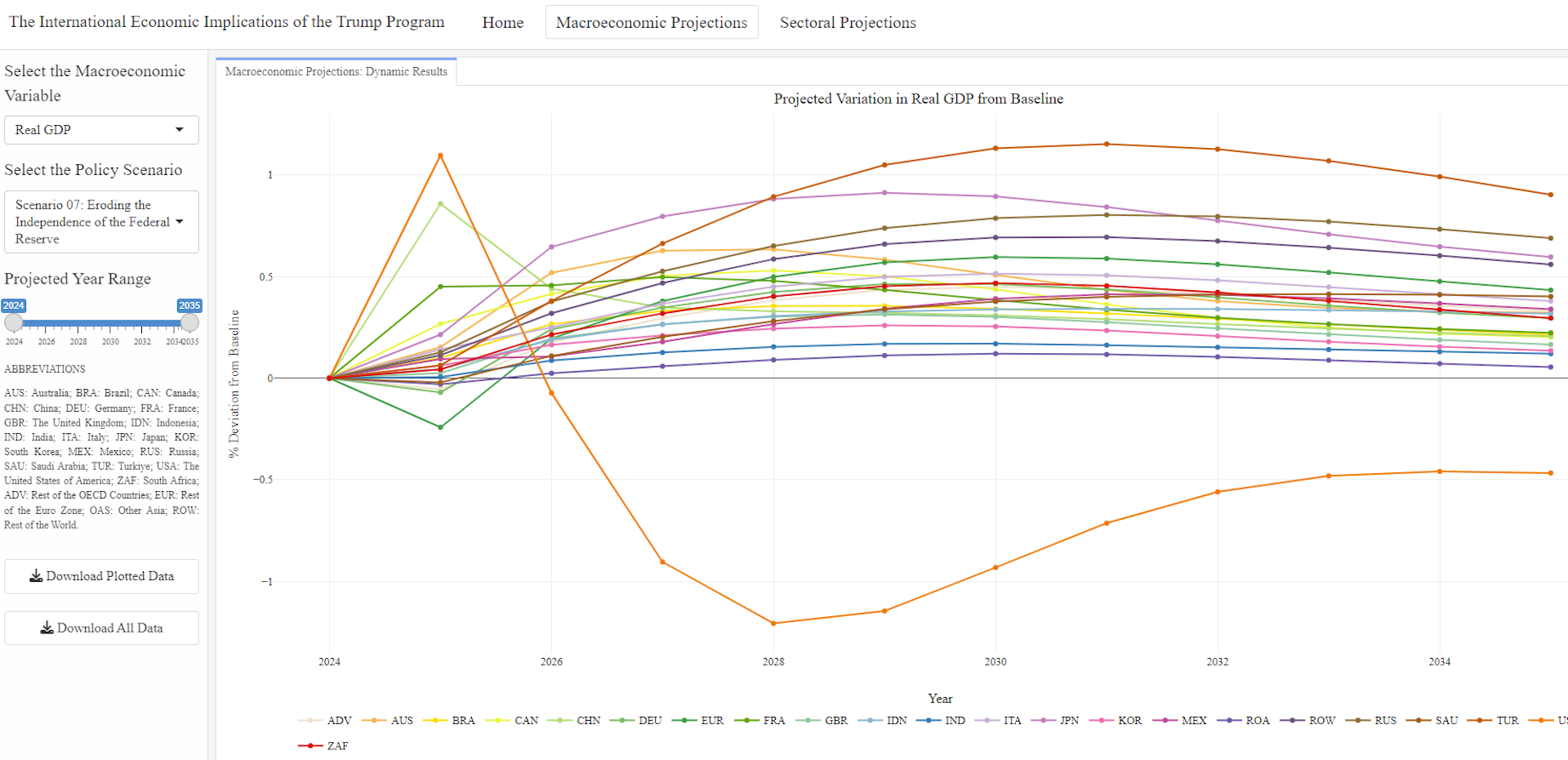
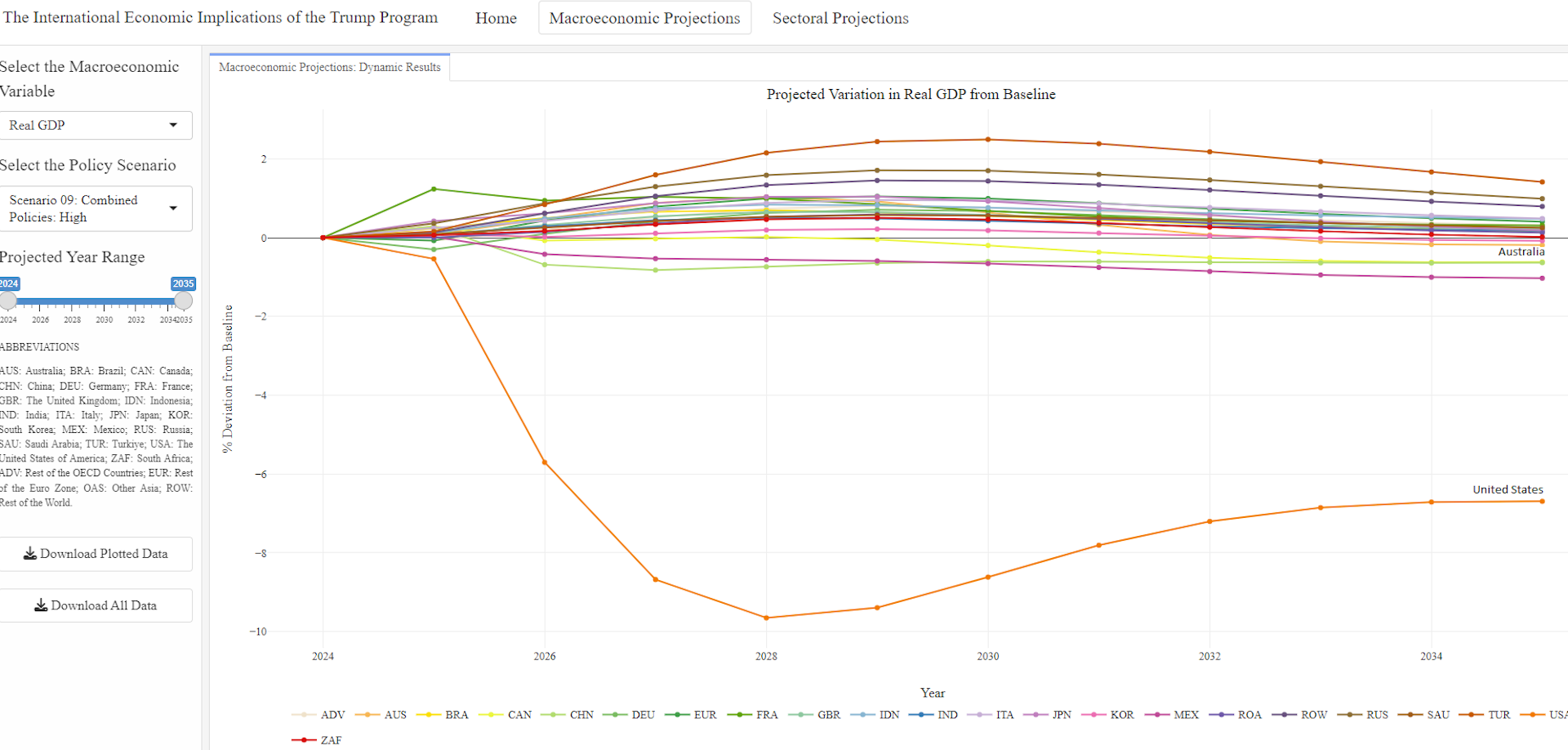
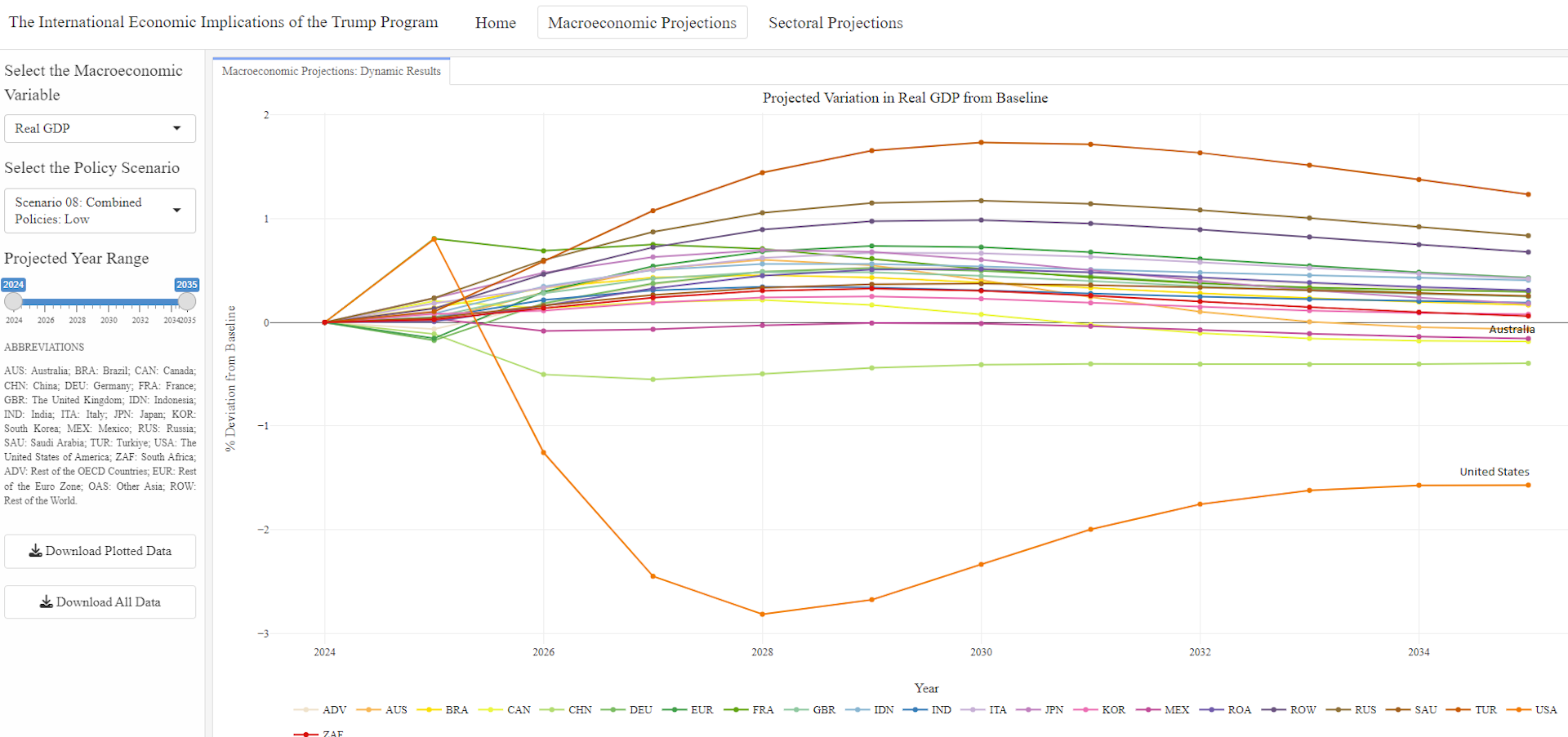
    ironically, despite his ‘make the foreigners pay rhetoric’, Trump’s package of policies does more damage to the US economy than to any other in the world.

    No other country in the world would be hurt by Trump’s program as much as the US – not even China – although several US allies would suffer, including Australia, which would be the fourth-worst hit by the most extreme version of what Trump is proposing.

    Peterson Institute for International Economics.

    Mass deportations

    Trump has repeatedly promised the “largest domestic deportation operation in American history,” targeting up to 20 million unauthorised immigrants, including about 8.3 million thought to be in the workforce.

    He says his model is Operation Wetback – a 1956 Eisenhower administration program that used military-style tactics to deport 1.3 million Mexicans.

    The institute says Eisenhower’s success makes it easy to believe Trump could remove 1.3 million immigrant workers. It has modelled two scenarios: removing 1.3 million and 8.3 million, both over two years in 2025 and 2026.

    Both slash employment, including the employment of non-immigrants, both push up inflation, which eventually is brought under control, and both make the US a less attractive place to invest, which benefits much of the rest of the world.

    The institute says the low and high scenarios differ “only by the degree of damage inflicted on people, households, firms, and the overall economy”.

    Huge tariff hikes

    Trump wants to increase every tariff on goods imported to the US by 10 percentage points, including where there is at present no tariff. And he wants at least a 60% tariff on imports from China. The institute has modelled both, with and without retaliatory tariffs from China and the rest of the world.

    It finds, unsurprisingly, that extra tariffs push up the price of US imports and the prices of US-produced goods that compete with imports. Many are used as inputs in manufacturing, which means US manufacturing suffers (which is probably not what Trump had in mind).

    Fewer imports mean less demand for foreign exchange within the US, which means a higher US dollar which makes US exports less competitive. The US economy is weaker as a result, although China’s is weaker still and Australia’s is weakened as much as the US given its role in providing resources to China.

    Nobbling the Fed

    Trump has raised the prospect of more presidential influence over interest rates, saying he thinks he has “a better instinct than, in many cases” the board of US Federal Reserve. This could be achieved by requiring the president to be consulted on rate decisions or by appointing a compliant chair.

    However it’s done, the institute’s “conservative” assumption based on what happens in developing countries with less central bank independence is that it will push inflation two percentage points higher.

    The modelled result is capital flight. While the US economy is initially stronger than it would have been because of the Fed’s willingness to tolerate higher inflation, after a few years it is weaker and every other economy is stronger.

    When all the measures are combined, under the extreme scenarios the US economy is 6.7% weaker than it would have been by 2035 and Australia’s is 0.2% weaker. Under the more modest scenarios, the US economy is 1.6% weaker and Australia’s is 0.06% weaker.

    Why not examine Harris?

    Despite a history of non-partisanship, the Peterson Institute is prepared for criticism. It points out that the economic model it used is regarded as the best in the world for scenario planning and is Australian, built by Warwick McKibbin of the Australian National University.

    And it says it has modelled the Trump policies rather than the Harris policies because only Trump’s represent a departure from business as usual.

    As the Institute’s president Adam Posen put it in Washington last month, the Harris campaign has said it will not impose across-the-board tariffs, will not engage in mass deportations and will not interfere with the independence of the US Federal Reserve.

    The Trump campaign has indicated it will do all three.

    It’s entirely possible that in office Trump wouldn’t do everything he proposed while campaigning, and it’s entirely possible that he would change course if what was doing damaged the US in the way the modelling suggests.

    But there’s something to be said for taking people at their word, at least to get an idea of what we could be in store for after a knife-edge election.

    Peter Martin is Economics Editor of The Conversation.

    – ref. From mass deportations to huge tariff hikes, here’s what Trump’s economic program would do to the US and Australia – https://theconversation.com/from-mass-deportations-to-huge-tariff-hikes-heres-what-trumps-economic-program-would-do-to-the-us-and-australia-240650

    MIL OSI Analysis – EveningReport.nz –

    January 23, 2025
  • MIL-OSI Economics: Frank Elderson: Interview with Delo

    Source: European Central Bank

    Interview with Frank Elderson, Member of the Executive Board of the ECB and Vice-Chair of the Supervisory Board of the ECB, conducted by Miha Jenko

    8 October 2024

    You hold two high positions in the European Central Bank: you are a member of the ECB’s Executive Board as well as the Vice-Chair of its Supervisory Board. You are responsible for both monetary matters and banking supervision in the euro area. Can you explain your dual role at the ECB?

    Let me clarify that, at the ECB, decision-making on monetary policy and banking supervision is separate, and for good reason. We want these two functions to pursue their specific objectives and we want to avoid potential conflicts of interest.

    That being said, it is important for each side to be aware of what the other is thinking and to understand how the decisions being taken affect the other side. Let me give you a couple of examples. During our strategy review in 2021 we explicitly recognised the importance of safe and sound banks for our price stability mandate, acknowledging that financial stability is a precondition for price stability. Moreover, banks that are safe and sound are able to effectively pass through our monetary policy.

    So in the governance of the ECB there is a bridge between the two sides. And I currently occupy this bridge as a member of the Executive Board, which has six members including President Lagarde, as a member of the Governing Council and as Vice-Chair of the Supervisory Board. In practice, this means that I inform the Executive Board about what was discussed in the Supervisory Board, and I debrief the Supervisory Board on the decisions taken by the Governing Council. In short, my role is to help ensure that the ECB does not carry out these two separate tasks in isolation.

    What is the purpose of your current visit to Slovenia?

    The ECB’s two decision-making bodies – the Supervisory Board and the Governing Council – will meet in Slovenia in the space of a week. The Supervisory Board will meet for its regular retreat to discuss strategic issues, while the Governing Council will hold its next monetary policy meeting here. Our colleagues at Banka Slovenije are kindly hosting both events.

    Turning to banking supervision, how are banks’ activities and lending affected by the current environment of weak economic growth and deteriorating economic trends, which include increasing bankruptcies in some euro area countries? How resilient is the banking sector in Europe?

    European banks are resilient. They have sufficient and adequate capital and liquidity buffers which enable them to absorb losses and withstand shocks. But they should not be complacent, especially in the context of the worsening geopolitical environment, which could have direct and indirect effects on banks. Near-term growth prospects have deteriorated and are subject to high uncertainty because of these rising geopolitical risks. And banks also face several medium-term, more structural challenges.

    In this context, our supervisory priorities, which we update every year, help us focus on both the near-term and medium-term challenges faced by banks. We want to ensure that banks are resilient not only today, but also in the long run. As part of our priorities, we want to increase their resilience to sudden macroeconomic and geopolitical shocks and to accelerate the remediation of shortcomings in the governance and management of climate-related and environmental risks. At the same time, banks need to make further progress with their digital transformation and build up their operational resilience.

    In short, banks are resilient, but we should not be complacent amid these longer-term challenges, which we will address through our supervision over the coming years.

    What lessons have the ECB and the Eurosystem learned from the last financial crisis in order to be better prepared for a possible new crisis, which will not necessarily originate in the banking sector itself, but in companies connected to it?

    Since the global financial crisis we have created strong pan-European supervision – the Single Supervisory Mechanism. The financial reforms implemented after that crisis have strengthened banks without compromising their lending capacity. Several things have happened since the global financial crisis: we have had a pandemic, Russia’s invasion of Ukraine, an energy shock and high inflation. So European economies have been exposed to unforeseen challenges. We also witnessed turmoil in international banking markets last year, which exposed fragilities in banks’ risk management and internal governance.

    The European banking sector has shown itself to be resilient in the face of these challenges. Take non-performing loans, for example, which have fallen significantly in the European banking system. In 2015, their share was 7%, while in 2023 it was below 2%. That is a big step forward. And as I said, capital and liquidity indicators are now much higher than they were a decade ago. But as supervisors, we should never be complacent, especially given the new risk drivers, such as energy prices, cyberattacks, climate and nature-related risks and geopolitical risks.

    Turning now to current developments in the European banking sector, where UniCredit Group’s intention to take over the German bank Commerzbank has recently made headlines. What is your view as euro area banking supervisor?

    Let me first say that I cannot comment on individual banks, so my answer will be more general.

    We have been crystal clear that cross-border consolidation can be an instrument for further integration of the European banking sector, and we stand by that. Consolidation can also help address long-standing issues in the European banking sector, such as low profitability.

    Nonetheless, mergers always carry risks and, as supervisors, we assess them carefully, always applying the limitative criteria set out in Article 23 of the Capital Requirements Directive. Our job is to ensure that every banking transaction – whether at cross-border or national level – results in a banking group that can comply with supervisory requirements in the foreseeable future.

    What is your view of the banking sector in our country? What is your message to Slovenia?

    Thanks to the reforms implemented after the great financial crisis, banks in Slovenia have come a long way, and in the right direction. When the crisis hit, the Government had to support the three largest banks with a recapitalisation of €3.5 billion. And, naturally, it has taken several years for lending to strengthen. More recently, the privatisation of state-owned banks increased competition in the sector, and this has attracted international banks. Slovenian banks are now well-capitalised, highly profitable and are above the euro area average for profitability, mainly on account of very high net interest margins. Some of this progress can also be attributed to the work of supervisors, including those at Banka Slovenije, with whom we work very well.

    So, like in the rest of Europe, your banks are robust but they will continue to face a number of headwinds stemming from the macro-financial environment, geopolitical shocks and challenges related to the green and digital transitions.

    As mentioned, our central bank will host a Governing Council meeting next week. Do you expect a new interest rate decision at this meeting?

    We will come to Slovenia with an open mind, so I am looking forward to the trip to Ljubljana and to a very genuine and open discussion. Before the meeting, we will take note of all the data and analysis and, as we have said many times before, we will take a meeting-by-meeting approach. A number of recent indicators suggest that downside risks to economic growth are already materialising, so we will need to carefully assess whether this has any implications for our inflation outlook.

    What is very clear, however, is the direction of travel in the period ahead. If our projections that inflation will converge towards our 2% target in the second half of 2025 continue to be confirmed, we will continue to gradually ease our restrictive policy stance. At the same time, we need to maintain flexibility regarding the pace of adjustments. This will depend on incoming data, on the economic situation and on inflation. The latest data will of course be taken into account in whatever decision we take in Slovenia.

    What specific downside risks to growth do you have in mind?

    Economic growth came in at 0.2% in the second quarter, falling somewhat short of our projections. We look at a broad range of data, but we have seen that households are consuming less than anticipated and firms are less keen to invest than we had projected.

    What is your view on the exact nature of inflation in the euro area? In particular, services price inflation remains very persistent. Why?

    We expect inflation to decline to our target in the second half of 2025. Headline inflation is projected to average 2.5% in 2024, then 2.2% in 2025 and 1.9% in 2026. Services inflation remains strong but, according to our projections, we will see a deceleration going into the new year.

    We always look at the upside and downside risks surrounding these projections. Geopolitical tensions could raise energy prices, shipping costs and other transport costs in the short term, which could also lead to disruptions to global trade, which would push prices up. Inflation could also increase if wages rise more than expected or if profit margins increase, and extreme weather events and the climate crisis could increase food prices. However, there are also downside risks to inflation, such as lower than expected demand or an unexpected deterioration in the economic environment in the United States and globally.

    At the ECB, you are also responsible for monitoring the effects of climate change, in addition to the dual tasks mentioned at the beginning. This year we saw the catastrophic effects of floods in some central European countries, and last year we experienced them in Slovenia as well. Greece, Spain and other parts of southern Europe are ravaged by catastrophic droughts and fires. Can the ECB and national central banks contribute more effectively to mitigating the effects of climate change? After all, you have the power – you have monetary policy and banking supervision in your hands…

    I am very aware of the consequences of floods, and of those last year in Slovenia. They caused €10 billion of damage and more than two-thirds of the country was affected. Some places in the Koroška region were cut off from the world and most roads were completely submerged. Recently, we have seen similar things in several other EU countries.

    When talking about climate, nature and the ECB, I always say that we are not climate policymakers. We are not involved in climate policy. This is a task for governments, who implement legislation and policies like the European Climate Law and the EU “Fit for 55” plan, for example.

    But this topic is also extremely relevant for our mandate, because extreme events like flooding, wildfires and summer droughts also lead to financial risks for banks and the wider economy. In our banking supervision, we check whether banks are adequately managing their climate and nature-related risks. We also take climate and nature into account in our macroeconomic projections.

    Are you in favour of introducing more decisive measures that would offer banks more targeted incentives to grant loans for more environmentally friendly or “greener” purposes?

    It would be speculative to talk about possible measures that we might hypothetically take in the future. What is clear is that any measure we implement must be consistent with our primary objective of price stability. Our current monetary policy stance is restrictive, so a green lending facility would be something for us to consider in the future, in another phase of the cycle.

    That being said, climate change is part of our monetary policy strategy, and we have committed to regularly reviewing our climate-related measures to ensure that we continue to support a decarbonisation path that is consistent with the EU’s climate objectives. For this, within our mandate, all options are on the table. If we were to design new instruments in the future, it’s fair to assume that they would include climate considerations.

    In terms of global competitiveness, the EU is falling behind the United States and China. Former ECB President Mario Draghi recently presented a very ambitious plan to increase European competitiveness, including investments of up to €800 billion per year. In his opinion, this money could also be raised through European borrowing, so common European debt. What is your take on this proposal and Mr Draghi’s other recommendations?

    We welcome the publication of this report, how concrete it is and its call for urgent action. Competitiveness is critical for sustainable growth, improving the living standards of citizens and boosting economic resilience, especially in the current environment of heightened geopolitical fragmentation. We strongly support this urgent call for coordinated action at the European and national levels. It is now a matter of turning these proposals into concrete measures.

    Meeting the strategic investment needs identified in the report requires completing the capital markets union, which we have been advocating for a long time.

    The private sector will not be able to finance all of these investment needs alone. European initiatives, including financing through common European funds, could help finance common European public goods such as defence, public procurement, energy grids, disruptive innovation and cross-border infrastructure. Under the right conditions, the potential issuance of common European debt could help bridge the financing gap.

    Finally, a new European Commission is expected to start its work in a few weeks’ time. How do you see your cooperation, including on the common objective of making Europe more competitive?

    I am very much looking forward to continuing our excellent interactions with the European Commission, both with the outgoing Commission and the incoming one. There are a number of common European initiatives that we both have a very strong interest in. I have already mentioned the capital markets union. Further progress could be made on that, as well as on finalising all aspects of the banking union. And we know from the ECB’s stress tests that the longer we take to complete the green transition, the more it will cost us, so we would very much welcome further progress on that front as well.

    MIL OSI Economics –

    January 23, 2025
  • MIL-OSI: Bread Financial Schedules Third Quarter 2024 Earnings Conference Call for Oct. 24

    Source: GlobeNewswire (MIL-OSI)

    COLUMBUS, Ohio, Oct. 08, 2024 (GLOBE NEWSWIRE) — Bread Financial® Holdings, Inc. (NYSE: BFH), a tech-forward financial services company that provides simple, flexible payment, lending and saving solutions, will host a conference call on Thursday, Oct. 24, 2024, at 8:30 a.m. ET to discuss the company’s third quarter 2024 results.

    Conference Call/Webcast Information
    Participants can register in advance here, and the conference call will be available at the company’s investor relations website. Analysts planning to participate in the Q&A can register in advance here. Additionally, there will be several slides accompanying the webcast. Please go to the website at least 15 minutes prior to the call to register, as well as download and install any necessary software. The webcast will also be archived on the investor relations website.

    About Bread Financial® 
    Bread Financial® (NYSE: BFH) is a tech-forward financial services company providing simple, personalized payment, lending and saving solutions. The company creates opportunities for its customers and partners through digitally enabled choices that offer ease, empowerment, financial flexibility and exceptional customer experiences. Driven by a digital-first approach, data insights and white-label technology, Bread Financial delivers growth for its partners through a comprehensive suite of payment solutions that includes private label and co-brand credit cards and Bread Pay® buy now, pay later products. Bread Financial also offers direct-to-consumer products that give customers more access, choice and freedom through its branded Bread Cashback® American Express® Credit Card, Bread Rewards™ American Express® Credit Card and Bread Savings® products.    
         
    Headquartered in Columbus, Ohio, Bread Financial is powered by its approximately 7,000 global associates and is committed to sustainable business practices. To learn more about Bread Financial, visit breadfinancial.com or follow us on Facebook, LinkedIn, X and Instagram.

    Contacts
    Brian Vereb — Investor Relations
    Brian.Vereb@breadfinancial.com

    Susan Haugen – Investor Relations
    Susan.Haugen@breadfinancial.com

    Rachel Stultz — Media
    Rachel.Stultz@breadfinancial.com

    The MIL Network –

    January 23, 2025
  • MIL-OSI Global: Trump and Harris are sharply divided on science, but share common ground on US technology policy

    Source: The Conversation – USA – By Kenneth Evans, Scholar in Science and Technology Policy, Baker Institute for Public Policy, Rice University

    Science topics don’t always come up during presidential debates – but they did on Sept. 10, 2024. Mario Tama via Getty Images

    For the first time in American history, quantum computing was mentioned by a candidate during a presidential debate, on Sept. 10, 2024. After Vice President Kamala Harris brought up quantum technology, she and former President Donald Trump went on to have a heated back-and-forth about American chipmaking and China’s rise in semiconductor manufacturing. Science and technology policy usually takes a back seat to issues such as immigration, the economy and health care during election season.

    What’s changed for 2024?

    From COVID-19 to climate change, ChatGPT to, yes, quantum computers, science-related issues are on the minds of American policymakers and voters alike. The federal government spends nearly US$200 billion each year on scientific research and development to address these challenges and many others. Presidents and Congress, however, rarely agree on how – and how much – money should be spent on science.

    With the increasing public focus on global competitiveness, the climate crisis and artificial intelligence, a closer look at Trump’s and Harris’ records on science and technology policy could provide a hint about how they’d approach these topics if elected this fall.

    Two distinct visions for science funding

    If politics can be described as “who gets what and when,” U.S. science and technology policy can be assessed through the annual budget process for R&D. By this measure, the differences between the Trump and Biden-Harris administrations couldn’t be starker.

    In his first budget request to Congress, in 2017, Trump spurned decades of precedent, proposing historic cuts across nearly every federal science agency. In particular, Trump targeted climate-related programs at the Department of Energy, the National Oceanic and Atmospheric Administration and the Environmental Protection Agency.

    Trump’s fiscal policy took a page from Reagan-era conservative orthodoxy, prioritizing military spending over social programs, including R&D. Unlike Reagan, however, Trump also took aim at basic research funding, an area with long-standing bipartisan support in Congress. His three subsequent budget proposals were no different: across-the-board reductions to federal research programs, while pushing for increases to defense technology development and demonstration projects.

    Congress rebuked nearly all of Trump’s requests. Instead, it passed some of the largest increases to federal R&D programs in U.S. history, even before accounting for emergency spending packages funded as part of the government’s pandemic response.

    In contrast, the Biden-Harris administration made science and innovation a centerpiece of its early policy agenda – with budgets to match. Leveraging the slim Democratic majority during the 117th Congress, Biden and Harris shepherded three landmark bills into law: the Infrastructure Investment and Jobs Act, the Inflation Reduction Act and the CHIPS and Science Act. These laws contain significant R&D provisions focused on environmental projects (IIJA), clean energy (IRA) and American semiconductor manufacturing (CHIPS).

    CHIPS set up programs within the National Science Foundation and the Department of Commerce to create regional technology hubs in support of American manufacturing. The act also set ambitious funding targets for federal science agencies, especially at NSF, calling for its budget to be doubled from $9 billion to over $18 billion over the course of five years.

    Despite its initial push for R&D, the Biden-Harris administration’s final two budget proposals offered far less to science. Years of deficit spending and a new Republican majority in the House cast a cloud of budget austerity over Congress. Instead of moving toward doubling NSF’s budget, the agency suffered an 8% decrease in fiscal year 2024 – its biggest cut in over three decades. For FY2025, which runs from Oct. 1, 2024, through Sept. 30, 2025, Biden and Harris requested a meager 3% increase for NSF, billions of dollars short of CHIPS-enacted spending levels.

    An emerging consensus on China

    On technology policy, Biden and Harris share more with Trump than they let on.

    Their approach to competing with China on tech follows Trump’s lead: They’ve expanded tariffs on Chinese goods and severely limited China’s access to American-made computer chips and semiconductor manufacturing equipment.

    Biden and Harris have also ramped up research security efforts intended to protect U.S. ideas and innovation from China. Trump launched the China Initiative as an attempt to stop the Chinese government from stealing American research. The Biden-Harris administration ended the program in 2022, but pieces of it remain in place. Scientific collaborations between the United States and China continue to decline, to the detriment of American scientific leadership.

    Semiconductor manufacturing is a key to many technologies; by extension, where it happens can be a security issue.
    Costfoto/NurPhoto via Getty Images

    The Biden-Harris administration has also drawn from Trump-era policy to strengthen America’s leadership in “industries of the future.” The term, coined by Trump’s then-chief science adviser Kelvin Droegemeier, refers to five emerging technology areas: AI, quantum science, advanced manufacturing, advanced communications and biotechnology. This language has been parroted by the Biden-Harris administration as part of its focus on American manufacturing and throughout Harris’ campaign, including during the debate.

    In short, both candidates align with the emerging Washington bipartisan consensus on China: innovation policy at home, strategic decoupling abroad.

    Science advice not always a welcome resource

    Trump’s dismissal of and at times outright contempt for scientific consensus is well documented. From “Sharpiegate,” when he mapped his own projected path for Hurricane Dorian, to pulling out of the Paris climate agreement, World Health Organization and the Iran nuclear deal, Trump has demonstrated an unwillingness to accept any advice, let alone from scientists.

    Indeed, Trump took over two years to hire Droegemeier as director of the White House Office of Science and Technology Policy, or OSTP, doubling the previous record for the length of time a president has gone without a scientific adviser. This absence was no doubt reflected in Trump’s short-on-science budget requests to Congress, especially during the beginning of his administration.

    On the other hand, the Biden-Harris administration has promoted science and innovation as a core part of its broader economic policy agenda. It elevated the role of OSTP: Biden is the first president to name his science adviser – a position currently held by Arati Prabhakar – as a member of his Cabinet.

    By law, the president is required to appoint an OSTP director. But it is up to the president to decide how and when to use their advice. If the new White House wants the U.S. to remain a global leader in R&D, the science adviser will need to continue to fight for it.

    Kenneth Evans receives funding from the National Science Foundation, the American Institute of Physics, and the Clinton Foundation. He is affiliated with Rice University and Rice University’s Baker Institute for Public Policy.

    – ref. Trump and Harris are sharply divided on science, but share common ground on US technology policy – https://theconversation.com/trump-and-harris-are-sharply-divided-on-science-but-share-common-ground-on-us-technology-policy-239053

    MIL OSI – Global Reports –

    January 23, 2025
  • MIL-OSI Global: How foreign operations are manipulating social media to influence your views

    Source: The Conversation – USA – By Filippo Menczer, Professor of Informatics and Computer Science, Indiana University

    Russians, Chinese, Iranians – even Israelis – are trying to affect what you believe. Sean Gladwell/Moment via Getty Images

    Foreign influence campaigns, or information operations, have been widespread in the run-up to the 2024 U.S. presidential election. Influence campaigns are large-scale efforts to shift public opinion, push false narratives or change behaviors among a target population. Russia, China, Iran, Israel and other nations have run these campaigns by exploiting social bots, influencers, media companies and generative AI.

    At the Indiana University Observatory on Social Media, my colleagues and I study influence campaigns and design technical solutions – algorithms – to detect and counter them. State-of-the-art methods developed in our center use several indicators of this type of online activity, which researchers call inauthentic coordinated behavior. We identify clusters of social media accounts that post in a synchronized fashion, amplify the same groups of users, share identical sets of links, images or hashtags, or perform suspiciously similar sequences of actions.

    We have uncovered many examples of coordinated inauthentic behavior. For example, we found accounts that flood the network with tens or hundreds of thousands of posts in a single day. The same campaign can post a message with one account and then have other accounts that its organizers also control “like” and “unlike” it hundreds of times in a short time span. Once the campaign achieves its objective, all these messages can be deleted to evade detection. Using these tricks, foreign governments and their agents can manipulate social media algorithms that determine what is trending and what is engaging to decide what users see in their feeds.

    Adversaries such as Russia, China and Iran aren’t the only foreign governments manipulating social media to influence U.S. politics.

    Generative AI

    One technique increasingly being used is creating and managing armies of fake accounts with generative artificial intelligence. We analyzed 1,420 fake Twitter – now X – accounts that used AI-generated faces for their profile pictures. These accounts were used to spread scams, disseminate spam and amplify coordinated messages, among other activities.

    We estimate that at least 10,000 accounts like these were active daily on the platform, and that was before X CEO Elon Musk dramatically cut the platform’s trust and safety teams. We also identified a network of 1,140 bots that used ChatGPT to generate humanlike content to promote fake news websites and cryptocurrency scams.

    In addition to posting machine-generated content, harmful comments and stolen images, these bots engaged with each other and with humans through replies and retweets. Current state-of-the-art large language model content detectors are unable to distinguish between AI-enabled social bots and human accounts in the wild.

    Model misbehavior

    The consequences of such operations are difficult to evaluate due to the challenges posed by collecting data and carrying out ethical experiments that would influence online communities. Therefore it is unclear, for example, whether online influence campaigns can sway election outcomes. Yet, it is vital to understand society’s vulnerability to different manipulation tactics.

    In a recent paper, we introduced a social media model called SimSoM that simulates how information spreads through the social network. The model has the key ingredients of platforms such as Instagram, X, Threads, Bluesky and Mastodon: an empirical follower network, a feed algorithm, sharing and resharing mechanisms, and metrics for content quality, appeal and engagement.

    SimSoM allows researchers to explore scenarios in which the network is manipulated by malicious agents who control inauthentic accounts. These bad actors aim to spread low-quality information, such as disinformation, conspiracy theories, malware or other harmful messages. We can estimate the effects of adversarial manipulation tactics by measuring the quality of information that targeted users are exposed to in the network.

    We simulated scenarios to evaluate the effect of three manipulation tactics. First, infiltration: having fake accounts create believable interactions with human users in a target community, getting those users to follow them. Second, deception: having the fake accounts post engaging content, likely to be reshared by the target users. Bots can do this by, for example, leveraging emotional responses and political alignment. Third, flooding: posting high volumes of content.

    Our model shows that infiltration is the most effective tactic, reducing the average quality of content in the system by more than 50%. Such harm can be further compounded by flooding the network with low-quality yet appealing content, thus reducing quality by 70%.

    Curbing coordinated manipulation

    We have observed all these tactics in the wild. Of particular concern is that generative AI models can make it much easier and cheaper for malicious agents to create and manage believable accounts. Further, they can use generative AI to interact nonstop with humans and create and post harmful but engaging content on a wide scale. All these capabilities are being used to infiltrate social media users’ networks and flood their feeds with deceptive posts.

    These insights suggest that social media platforms should engage in more – not less – content moderation to identify and hinder manipulation campaigns and thereby increase their users’ resilience to the campaigns.

    The platforms can do this by making it more difficult for malicious agents to create fake accounts and to post automatically. They can also challenge accounts that post at very high rates to prove that they are human. They can add friction in combination with educational efforts, such as nudging users to reshare accurate information. And they can educate users about their vulnerability to deceptive AI-generated content.

    Open-source AI models and data make it possible for malicious agents to build their own generative AI tools. Regulation should therefore target AI content dissemination via social media platforms rather then AI content generation. For instance, before a large number of people can be exposed to some content, a platform could require its creator to prove its accuracy or provenance.

    These types of content moderation would protect, rather than censor, free speech in the modern public squares. The right of free speech is not a right of exposure, and since people’s attention is limited, influence operations can be, in effect, a form of censorship by making authentic voices and opinions less visible.

    Filippo Menczer receives funding from the Knight Foundation, Sloan Foundation, NSF, DoD, and the Swiss National Science Foundation.

    – ref. How foreign operations are manipulating social media to influence your views – https://theconversation.com/how-foreign-operations-are-manipulating-social-media-to-influence-your-views-240089

    MIL OSI – Global Reports –

    January 23, 2025
  • MIL-OSI China: MOFA sincerely congratulates Japanese Representative Ishiba on his election as LDP president

    Source: Republic of Taiwan – Ministry of Foreign Affairs

    MOFA sincerely congratulates Japanese Representative Ishiba on his election as LDP president

    • Date:2024-09-27
    • Data Source:TAIWAN-JAPAN RELATIONS ASSOCIATION

    September 27, 2024

    No. 319

    The ruling Liberal Democratic Party (LDP) of Japan elected Shigeru Ishiba, a member of the House of Representatives, as its new president after two rounds of voting on September 27. The Ministry of Foreign Affairs (MOFA) extends its sincere congratulations and has instructed the Taipei Economic and Cultural Representative Office in Japan to promptly send a message of felicitations on behalf of the government of Taiwan. 


    Taiwan and the LDP have enjoyed close interactions over the years, sharing a robust partnership and like-minded friendship. LDP parliamentary delegations have often visited Taiwan, proactively fostering Taiwan-Japan cooperation and exchanges across various domains and enhancing bilateral relations with concrete actions through values-based and alliance diplomacy. 


    Representative Ishiba recently led a delegation to Taiwan to exchange views on security issues with various sectors in Taiwan. During the visit, he announced his decision to run in the LDP election. In recent years, the Japanese government, led by the LDP, has reiterated the importance of peace and stability across the Taiwan Strait at major international events and endorsed Taiwan’s participation in the World Health Organization and other international organizations. Taiwan expresses deep appreciation for this support.


    MOFA sincerely hopes that the LDP, under the leadership of President Ishiba, will continue to strengthen cooperation with Taiwan, as well as promoting a comprehensive and substantive bilateral partnership to jointly uphold peace, stability, and prosperity in the Indo-Pacific. (E)

    MIL OSI China News –

    January 23, 2025
  • MIL-OSI China: Foreign Minister Lin hosts welcome luncheon for Ukrainian parliamentary delegation

    Source: Republic of Taiwan – Ministry of Foreign Affairs

    Foreign Minister Lin hosts welcome luncheon for Ukrainian parliamentary delegation

    • Date:2024-10-04
    • Data Source:Department of European Affairs

    October 4, 2024  

    No. 329  

    Minister of Foreign Affairs Lin Chia-lung hosted a luncheon on October 4 to welcome a delegation of Ukrainian parliamentarians led by MP Mykola Kniazhytskyi, Cochair of the Inter-Parliamentary Alliance on China (IPAC), and MP Akhtem Chyihoz. The two sides exchanged views on the Russia-Ukraine war, the peaceful development of Ukraine, and potential cooperation projects. 


    Minister Lin said that although Taiwan and Ukraine were geographically distant, both nations stood on the front line of democratic defense against the expansion of authoritarian regimes. He commended Ukraine for demonstrating resilience as well as defense and disaster response capabilities in its war against Russia, adding that this served as a valuable lesson and inspiration to all democratic countries. Minister Lin stated that Taiwan had actively assisted Ukraine with rebuilding critical infrastructure, schools, churches, and hospitals in the spirit of humanitarianism. He pledged that Taiwan would continue to support Ukraine through this difficult time. 


    The members of the Ukrainian delegation thanked the government of Taiwan and expressed appreciation for Taiwan’s humanitarian assistance and support. They stated that the people of Ukraine were deeply touched by Taiwan’s goodwill. Noting that Taiwan and Ukraine shared the core values of freedom, democracy, and human rights, they expressed the hope that the two countries would continue to support each other and cooperate on the basis of friendship and mutual trust. 


    Both Taiwan and Ukraine enjoy the common values shared by democracies and are faced with authoritarian expansionism. Since the outbreak of the Russia-Ukraine war in February 2022, Taiwan has extended consistent and unwavering support to Ukraine, staunchly backing democracy and freedom. Taiwan will continue to work with like-minded nations to assist Ukraine in overcoming adversity and returning to normal life as soon as possible. (E)

    MIL OSI China News –

    January 23, 2025
  • MIL-OSI USA: U.S. International Trade in Goods and Services, August 2024

    Source: US Bureau of Economic Analysis

    The U.S. Census Bureau and the U.S. Bureau of Economic Analysis announced today that the goods and services deficit was $70.4 billion in August, down $8.5 billion from $78.9 billion in July, revised.

    U.S. International Trade in Goods and Services Deficit
    Deficit: $70.4 Billion  –10.8%°
    Exports: $271.8 Billion  +2.0%°
    Imports: $342.2 Billion  –0.9%°

    Next release: Tuesday, November 5, 2024

    (°) Statistical significance is not applicable or not measurable. Data adjusted for seasonality but not price changes

    Source: U.S. Census Bureau, U.S. Bureau of Economic Analysis; U.S. International Trade in Goods and Services, October 8, 2024

    Exports, Imports, and Balance (exhibit 1)

    August exports were $271.8 billion, $5.3 billion more than July exports. August imports were $342.2 billion, $3.2 billion less than July imports.

    The August decrease in the goods and services deficit reflected a decrease in the goods deficit of $8.4 billion to $94.9 billion and an increase in the services surplus of $0.1 billion to $24.4 billion.

    Year-to-date, the goods and services deficit increased $47.1 billion, or 8.9 percent, from the same period in 2023. Exports increased $79.0 billion or 3.9 percent. Imports increased $126.1 billion or 4.9 percent.

    Three-Month Moving Averages (exhibit 2)

    The average goods and services deficit decreased $1.6 billion to $74.1 billion for the three months ending in August.

    • Average exports increased $3.7 billion to $267.8 billion in August.
    • Average imports increased $2.0 billion to $342.0 billion in August.

    Year-over-year, the average goods and services deficit increased $11.1 billion from the three months ending in August 2023.

    • Average exports increased $13.3 billion from August 2023.
    • Average imports increased $24.4 billion from August 2023.

    Exports (exhibits 3, 6, and 7)

    Exports of goods increased $4.4 billion to $179.4 billion in August.

      Exports of goods on a Census basis increased $4.9 billion.

    • Capital goods increased $1.7 billion.
      • Telecommunications equipment increased $0.5 billion.
      • Civilian aircraft increased $0.4 billion.
      • Computer accessories increased $0.4 billion.
      • Other industrial machinery increased $0.4 billion.
      • Semiconductors decreased $0.8 billion.
    • Consumer goods increased $1.0 billion.
      • Pharmaceutical preparations increased $1.0 billion.
    • Industrial supplies and materials increased $0.9 billion.
      • Nonmonetary gold increased $1.5 billion.
      • Crude oil decreased $1.1 billion.
    • Automotive vehicles, parts, and engines increased $0.8 billion.
      • Passenger cars increased $0.6 billion.

      Net balance of payments adjustments decreased $0.5 billion.

    Exports of services increased $0.9 billion to $92.3 billion in August.

    • Travel increased $0.5 billion
    • Government goods and services increased $0.2 billion.
    • Transport decreased $0.2 billion.

    Imports (exhibits 4, 6, and 8)

    Imports of goods decreased $3.9 billion to $274.3 billion in August.

      Imports of goods on a Census basis decreased $3.8 billion.

    • Industrial supplies and materials decreased $3.9 billion.
      • Nonmonetary gold decreased $1.2 billion.
      • Finished metal shapes decreased $1.0 billion.
      • Crude oil decreased $1.0 billion.
    • Automotive vehicles, parts, and engines decreased $1.3 billion.
      • Passenger cars decreased $1.1 billion.

      Net balance of payments adjustments decreased $0.2 billion.

    Imports of services increased $0.7 billion to $67.9 billion in August.

    • Travel increased $0.4 billion.
    • Charges for the use of intellectual property increased $0.4 billion.
    • Transport decreased $0.3 billion.

    Real Goods in 2017 Dollars – Census Basis (exhibit 11)

    The real goods deficit decreased $8.6 billion, or 8.9 percent, to $88.6 billion in August, compared to an 8.5 percent decrease in the nominal deficit.

    • Real exports of goods increased $5.5 billion, or 3.8 percent, to $150.1 billion, compared to a 2.9 percent increase in nominal exports.
    • Real imports of goods decreased $3.2 billion, or 1.3 percent, to $238.7 billion, compared to a 1.4 percent decrease in nominal imports.

    Revisions

    Revisions to July exports

    • Exports of goods were revised down less than $0.1 billion.
    • Exports of services were revised down $0.1 billion.

    Revisions to July imports

    • Imports of goods were revised up $0.1 billion.
    • Imports of services were revised down $0.1 billion.

    Goods by Selected Countries and Areas: Monthly – Census Basis (exhibit 19)

    The August figures show surpluses, in billions of dollars, with Netherlands ($5.5), South and Central America ($4.0), Australia ($1.9), Hong Kong ($1.6), Brazil ($0.8), Singapore ($0.5), and United Kingdom ($0.3). Deficits were recorded, in billions of dollars, with China ($24.7), European Union ($19.1), Mexico ($14.3), Vietnam ($9.8), Ireland ($8.0), Taiwan ($7.3), Germany ($6.6), Japan ($4.9), South Korea ($4.9), Canada ($3.9), Italy ($2.9), India ($2.7), Switzerland ($2.5), France ($1.7), Malaysia ($1.1), Israel ($1.0), Belgium ($0.6), and Saudi Arabia ($0.1).

    • The deficit with Canada decreased $3.8 billion to $3.9 billion in August. Exports increased $1.1 billion to $28.5 billion and imports decreased $2.7 billion to $32.3 billion.
    • The deficit with China decreased $2.6 billion to $24.7 billion in August. Exports increased $1.1 billion to $12.6 billion and imports decreased $1.5 billion to $37.3 billion.
    • The balance with Belgium shifted from a surplus of $1.0 billion in July to a deficit of $0.6 billion in August. Exports decreased $0.1 billion to $2.8 billion and imports increased $1.5 billion to $3.4 billion.

    All statistics referenced are seasonally adjusted; statistics are on a balance of payments basis unless otherwise specified. Additional statistics, including not seasonally adjusted statistics and details for goods on a Census basis, are available in exhibits 1-20b of this release. For information on data sources, definitions, and revision procedures, see the explanatory notes in this release. The full release can be found at http://www.census.gov/foreign-trade/Press-Release/current_press_release/index.html or http://www.bea.gov/data/intl-trade-investment/international-trade-goods-and-services. The full schedule is available in the Census Bureau’s Economic Briefing Room at www.census.gov/economic-indicators/ or on BEA’s website at http://www.bea.gov/news/schedule.

    Next release: November 5, 2024, at 8:30 a.m. EST
    U.S. International Trade in Goods and Services, September 2024

    MIL OSI USA News –

    January 23, 2025
  • MIL-OSI Asia-Pac: Foreign Minister Lin hosts welcome luncheon for Ukrainian parliamentary delegation

    Source: Republic of China Taiwan 3

    Foreign Minister Lin hosts welcome luncheon for Ukrainian parliamentary delegation

    Date:2024-10-04
    Data Source:Department of European Affairs

    October 4, 2024  
    No. 329  

    Minister of Foreign Affairs Lin Chia-lung hosted a luncheon on October 4 to welcome a delegation of Ukrainian parliamentarians led by MP Mykola Kniazhytskyi, Cochair of the Inter-Parliamentary Alliance on China (IPAC), and MP Akhtem Chyihoz. The two sides exchanged views on the Russia-Ukraine war, the peaceful development of Ukraine, and potential cooperation projects. 
     
    Minister Lin said that although Taiwan and Ukraine were geographically distant, both nations stood on the front line of democratic defense against the expansion of authoritarian regimes. He commended Ukraine for demonstrating resilience as well as defense and disaster response capabilities in its war against Russia, adding that this served as a valuable lesson and inspiration to all democratic countries. Minister Lin stated that Taiwan had actively assisted Ukraine with rebuilding critical infrastructure, schools, churches, and hospitals in the spirit of humanitarianism. He pledged that Taiwan would continue to support Ukraine through this difficult time. 
     
    The members of the Ukrainian delegation thanked the government of Taiwan and expressed appreciation for Taiwan’s humanitarian assistance and support. They stated that the people of Ukraine were deeply touched by Taiwan’s goodwill. Noting that Taiwan and Ukraine shared the core values of freedom, democracy, and human rights, they expressed the hope that the two countries would continue to support each other and cooperate on the basis of friendship and mutual trust. 
     
    Both Taiwan and Ukraine enjoy the common values shared by democracies and are faced with authoritarian expansionism. Since the outbreak of the Russia-Ukraine war in February 2022, Taiwan has extended consistent and unwavering support to Ukraine, staunchly backing democracy and freedom. Taiwan will continue to work with like-minded nations to assist Ukraine in overcoming adversity and returning to normal life as soon as possible. (E)

    MIL OSI Asia Pacific News –

    January 23, 2025
  • MIL-OSI China: Chinese state councilor attends reception marking 75 years of diplomatic relations between China, Russia

    Source: People’s Republic of China – State Council News

    Chinese state councilor attends reception marking 75 years of diplomatic relations between China, Russia

    BEIJING, Oct. 8 — Chinese State Councilor Shen Yiqin attended a reception celebrating the 75th anniversary of the establishment of diplomatic relations between China and Russia at the Russian embassy in Beijing on Tuesday.

    Shen, also the Chinese chairman of the China-Russia Committee on Humanities Cooperation, said that under the guidance of the important consensus reached by the two heads of state, China is willing to work with Russia to take the opportunity of celebrating the 75th anniversary of China-Russia diplomatic ties and the China-Russia Years of Culture to deepen cooperation in various fields and create more benefits for both peoples.

    Russian Ambassador to China Igor Morgulov said Russia stands ready to further deepen traditional friendship with China and push for greater development of Russia-China relations.

    MIL OSI China News –

    January 23, 2025
  • MIL-OSI China: Chinese premier calls for prompt implementation of incremental policies

    Source: People’s Republic of China – State Council News

    BEIJING, Oct. 8 — Chinese Premier Li Qiang on Tuesday called for efforts to promptly implement the incremental policies to stabilize the country’s economy, and strive to accomplish the annual economic and social development targets.

    Li, also a member of the Standing Committee of the Political Bureau of the Communist Party of China Central Committee, made the remarks at a symposium with experts and entrepreneurs to hear their views on China’s current economic situation and next steps on economic work.

    MIL OSI China News –

    January 23, 2025
  • MIL-OSI China: Robust National Day holiday consumption displays China’s economic vitality, potential

    Source: People’s Republic of China – State Council News

    Robust National Day holiday consumption displays China’s economic vitality, potential

    Updated: October 8, 2024 20:47 Xinhua

    China has seen a vibrant and promising consumer market during the week-long National Day holiday, one of the longest public holidays on the mainland.

    MIL OSI China News –

    January 23, 2025
  • MIL-OSI United Kingdom: Foreign Secretary Oral Statement on the Chagos Islands – 7 October 2024

    Source: United Kingdom – Executive Government & Departments

    Foreign Secretary, David Lammy, provided an update to the House of Commons on the conclusion of negotiations on the exercise of sovereignty over the British Indian Ocean Territory.

    Location:
    House of Commons
    Delivered on:
    7 October 2024

    With permission, Mr Speaker, I will make a statement on the conclusion of negotiations on the exercise of sovereignty over the British Indian Ocean Territory. 

    On Thursday the third of October, my Right Honourable Friend the Prime Minister and Mauritian Prime Minister Jugnauth made an historic announcement.

    After two years of negotiations,…

    …and decades of disagreement,…

    …the UK and Mauritius have reached a political agreement on the future of the British Indian Ocean Territory.

    Mr Speaker, the treaty is neither signed nor ratified.

    But I wanted to update the House on the conclusion of formal negotiations at the earliest opportunity.

    Members will appreciate the context.

    Since its creation, the Territory and the joint UK-US military base on Diego Garcia has had a contested existence.

    In recent years, the threat has risen significantly.

    Coming into office, the status quo was clearly not sustainable.

    A binding judgement against the UK seemed inevitable.

    It was just a matter of time before our only choices would have been abandoning the base altogether.

    Or breaking international law.

    If you oppose the deal, which of these alternatives do you prefer?

    Doing this deal – on our terms – was the sole way to maintain the full and effective operations of the base into the future.

    Mr Speaker, this must be why, in November 2022, the then Foreign Secretary, the Right Honourable Member for Braintree, initiated sovereignty negotiations.

    It’s also why my immediate predecessor, Lord Cameron of Chipping Norton, ultimately continued with those talks.

    Under the previous Government there were eleven rounds of negotiations, the last one held just weeks before the General Election was called.

    So, in July, this Government inherited unfinished business.

    Where a threat was real, and inaction was not a strategy.

    Inaction posed several acute risks to the UK.

    First, it threatened the UK-US base.

    From countering malign Iranian activity in the Middle East to ensuring a free and open Indo-Pacific, it is critical for our national security.

    Without surety of tenure, no base can operate effectively – nor truly deter our enemies.

    Critical investment decisions were already being delayed.

    Second, it impacted on our relationship with the US,…

    …who neither wanted nor welcomed the legal uncertainty,…

    …and strongly encouraged us to strike a deal.   

    I am a trans-Atlanticist.

    We had to protect this important relationship.

    And third, it undermined our international standing.

    We are showing that what we mean is what we say on international law and desire for partnerships with the Global South.

    This strengthens our arguments when it comes to issues like Ukraine or the South China Sea.

    Mr Speaker, further legal wrangling served nobody’s interests but our adversaries’.

    In a more volatile world,…

    …a deal benefited us all,…

    …the UK, US and Mauritius.

    This Government therefore made striking the best possible deal a priority.

    We appointed Jonathan Powell.

    As the Prime Minister’s Special Envoy for these negotiations, he has worked closely with a brilliant team of civil servants and lawyers.

    Their goal was a way forward which serves UK national interests,…

    …respects the interests of our partners,…

    …and upholds the international rule of law.

    This agreement fulfils these objectives.

    It is strongly supported by partners,…

    …with Present Biden going so far as to ‘applaud’ our achievement within minutes of the announcement!

    Secretary Blinken and Secretary Austin have also backed this ‘successful outcome’ which ‘reaffirms [our] special defence relationship’.

    And the agreement has been welcomed by the Indian government and commended by the UN Secretary-General.

    In return for agreeing to Mauritian sovereignty over the entire islands, including Diego Garcia,…

    …the UK-US base has an uncontested long-term future.  

    Base operations will remain under full UK control well into the next century.

    Mauritius will authorise us to exercise their sovereign rights and authorities in respect of Diego Garcia.

    This is initially for 99 years, but the UK has the right to extend this.

    And we have full Mauritian backing for robust security arrangements…

    …including preventing foreign armed forces from accessing or establishing themselves on the outer islands.

    The base’s long-term future is therefore more secure under this agreement than without it.

    If this were not the case, I doubt the White House, State Department or Pentagon would have praised the deal so effusively.

    This agreement will be underpinned by a financial settlement that is acceptable to both sides. 

    Members will be aware the Government does not normally reveal payments for our military bases overseas.

    And so it would be inappropriate to publicise further details of these arrangements at this stage.

    Mr Speaker, the agreement also recognises the rights and wrongs of the past.

    The whole House would agree that the manner in which Chagossians were forcibly removed in the 1960s was deeply wrong and regrettable.

    Mauritius is now free to implement a resettlement programme to islands other than Diego Garcia.

    The UK and Mauritius have also committed to support Chagossians’ welfare,…

    …establishing a new Trust Fund capitalised by the UK…

    …and providing additional Government support to Chagossians in the UK.

    And the UK will maintain the pathway for Chagossians to obtain British Citizenship.

    Furthermore, Mauritius and the UK will now establish a new programme of visits to the archipelago for Chagossians. 

    This agreement also ushers in a new era in our relations with Mauritius.

    A Commonwealth nation and Africa’s leading democracy.

    We have agreed to intensify cooperation on our shared priorities, including security, growth and the environment. 

    The agreement ensures continued protection of these islands’ unique environment, home to over two hundred species of coral and over eight hundred species of fish.

    Finally Mr Speaker, I want to reassure the House,…

    …and all members of the UK family worldwide,…

    …that this agreement does not signal any change in policy to Britain’s other Overseas Territories.

    British sovereignty of the Falkland Islands, Gibraltar and the Sovereign Base Areas is not up for negotiation.

    The situations are not comparable.

    This, Mr Speaker, has been acknowledged across our Overseas Territories.

    Fabian Picardo, Chief Minister of Gibraltar, vocally supported this agreement…

    …stating that there is “no possible read across” to Gibraltar on the issue of sovereignty.

    Similarly, the Governor of the Falklands has confirmed that the historic contexts of the Chagos Archipelago and Falklands are “very different”.

    The Government remains firmly committed to modern partnerships with our Overseas Territories based on mutual consent.

    After Mauritian elections, the Government will move towards treaty signature.

    And it is then our intention to pursue ratification in 2025,…

    …by submitting the Treaty and a Bill to this House for scrutiny.

    This is a historic moment, a victory for diplomacy.

    We have saved the base.

    We have secured Britain’s national interests for the long-term.

    I commend this statement to the House.

    Updates to this page

    Published 7 October 2024

    MIL OSI United Kingdom –

    January 23, 2025
  • MIL-OSI USA: Speaker Johnson Makes Multiple Sunday Show Appearances

    Source: United States House of Representatives – Representative Mike Johnson (LA-04)

    This morning, Speaker Johnson joined George Stephanopoulos on ABC’s This Week and Shannon Bream on Fox News Sunday to discuss the federal response to Hurricane Helene, standing with Israel, and the need keep the 2024 election about policy, not politics. 

    Click here to watch ABC interview, here to watch Fox interview

    On the federal response to Hurricane Helene:

    At the federal level, this has been a massive failure, and you could just ask the people there on the ground. I have been there. I was in Georgia, I was in Florida where Hurricane Helene made landfall there on the coast. And then we’ll be going to the hardest hit parts of North Carolina on Wednesday of this week. 

    When you talk to the people who are directly affected, they will tell you that this has been an abject failure. FEMA has lost sight of its core mission I think in so many cases, and the administration has not shown that they were prepared for this eventuality and this terrible disaster. The thing about hurricanes, Shannon, is that we know that they’re coming well in advance. You know, they had more than a week’s notice of this, and yet we still have people who have not been served and even rescued in North Carolina. It is a heartbreaking, tragic, and infuriating situation to have the federal government fail as they have.

    On FEMA funding to house illegal aliens: 

    The streams of funding are different, that is not an untrue statement of course. But the problem is what the American people see and what they’re frustrated by, is that FEMA should be involved – they are the Federal Emergency Management Association – their mission is to help people in times like this of natural disaster, not to be engaged in using any pool of funding from any account for resettling illegal aliens who have come across the border. That’s what the Biden Administration, Kamala Harris, and Secretary Mayorkas have been engaged in this program, and they have spent precious treasure of the American people and taxpayers to do just that. 

    When you see illegals in your local airport and you see them being transported around the country with planes, trains, and automobiles to every community everywhere, every state’s a border stat now because of that. That’s the NGOs, the non-governmental organizations mostly that are transporting those people around. And then they send the receipts to the federal government and Biden Harris and Mayorkas gleefully pay those receipts because they open the border intentionally. The American people are disgusted by this. They’re fed up with it, and so are Republicans in Congress. And it’ll stop after November 5th because we’re going to have unified government with the Republicans in charge and we will bring sanity back to this situation.

    On keeping the 2024 election focused on policy:

    We have to talk about the greatest collection of challenges that this country is facing, probably since World War II, maybe the Civil War. Let’s put all this political nonsense behind us and talk about how we get out of this mess. And I believe the way we do, and I believe a large number of the majority of the American people understand you have to put steady hands at the wheel. You’ve got to put President Donald J. Trump back in the White House because he will bring stability back. 

    He will get the economy going again. He will restore our stature on the world stage at a time where we’re almost on the verge of World War III. You have got to get his leadership back in the White House. That’s why the massive crowds are drawn to these rallies, and that’s why I believe we’re going to win in November.

    On supporting Israel:

    Everything that they have done, since day one, the Biden-Harris Administration, is project weakness on the world stage. And that has put us in the most dangerous situation that we have been in since World War II. Our allies are nervous. Our adversaries do not fear us. They don’t respect us, and that is why China, Russia, Iran, North Korea, terrorists and tyrants around the world are coordinating against us. And that is why you’re seeing the provocations of the war in Israel. 

    Russia moved on Ukraine, China doing all the things they’re doing and threatening Taiwan. None of this happened on President Trump’s watch because he was a steady hand, a strong hand at the wheel. We have got to reelect him so that we can restore the order in the world and project peace through strength again. That’s what we have to get back to, and it cannot happen soon enough.

    MIL OSI USA News –

    January 23, 2025
  • MIL-OSI Global: Whale sharks on collision course as warming seas may force them into shipping lanes – new study

    Source: The Conversation – UK – By Freya Womersley, Postdoctoral Research Scientist, Marine Biological Association

    Global warming has the potential to reshuffle the spaces used by life on Earth, across all ecosystems. And our new research shows whale sharks – the world’s largest fish – could be at risk, as warming oceans may force them into busy human shipping lanes.

    More than 12,000 marine species are expected to redistribute in future as seas warm up. Those animals that are unable to move to remain within suitable environments risk being wiped out entirely.

    But things are different for larger and highly mobile animals that can move freely to find conditions that suit their needs. For them, changing ocean conditions may not be such a huge threat in isolation, as they can migrate to cooler seas. Rather, shifting conditions may force species into new and more dangerous areas where they come into contact with ship propellers and other direct human threats.

    We fear this will happen with whale sharks. These huge sharks can reach up to 18 metres – about four cars end to end – but despite their size and robust appearance, their numbers have already declined by over 50% in the last 75 years.

    Whale sharks are big and slow (and are sharks not whales).
    Sean Steininger / shutterstock

    In previous research we discovered this decline may be partly due to collisions with large ships. Whale sharks are particularly vulnerable as they cruise around feeding on plankton and other tiny organisms, rarely needing to swim faster than human walking pace. While spending long periods moving slowly near the surface, they’re often struck by ships and killed.

    Our new research builds on this previous work. We find that climate change will put these docile giants in even greater danger as their preferred habitats move in into new areas with heavy ship traffic.

    An uncertain future

    The research was carried out by an international team of over 50 scientists from 18 countries involved in the Global Shark Movement Project, using 15 years’ worth of satellite tracking data from almost 350 individually tagged whale sharks.

    Movement tracks were matched to temperature, salinity and other environmental conditions at the time to determine what sort of habitat the sharks preferred. These relationships were then projected forward in time based on climate models (powerful computer programmes that simulate the climate) to reveal which parts of the ocean may in future have similar conditions to those used by the species today.

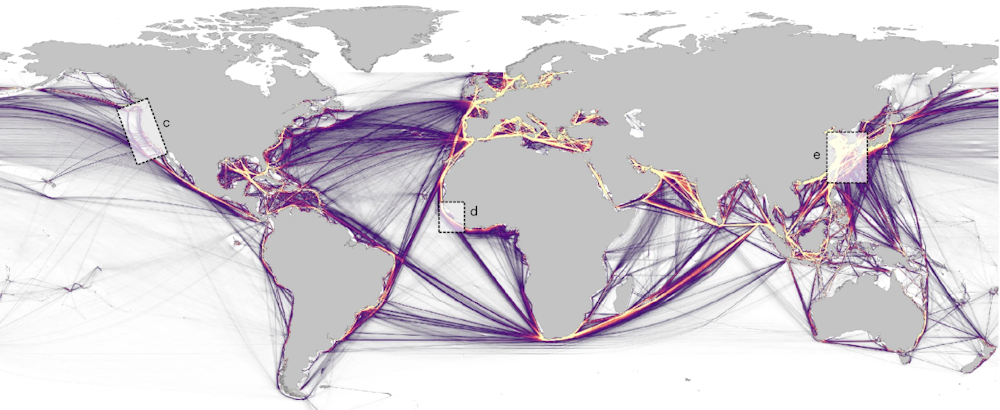
    Our state-of-the-art approach uncovered totally new areas that may be able to support whale sharks in future, such as US waters in the Pacific in the region of the California bight, Japanese waters in the eastern China Sea and the Atlantic waters of many west African countries. We quickly realised that these regions are home to some of the world’s busiest sea ports and shipping highways, so we overlaid our maps of habitat preference with those of global shipping to determine sharks are expected to run into ships.

    The world’s main shipping lanes, with the busiest lanes coloured yellow. Areas C (US west coast), D (west Africa) and E (east Asia) are expected to become more suitable for whale sharks as the oceans warm.
    Womersley et al / Nature Climate Change, CC BY-SA

    Through this we project that co-occurrence between sharks and ships will be be 15,000 times greater by the end of this century if we continue to rely heavily on fossil fuels, compared to only 20 times greater if we follow a sustainable development scenario.

    This does not mean that collisions will increase by 15,000 times, or even by 20 times, as we can only predict where whale sharks will be in future and the precise number of ships will vary. However, if the sharks do move into these new areas and their busy shipping lanes, increased mortality is a very real possibility.

    We’ve already recorded shark-attached satellite tags abruptly stopping transmissions in shipping lanes, with depth-recording tags showing the sharks slowly sinking – likely dead – to the seafloor.

    Changing tack

    Our results are alarming but highlight that we do have the capacity to change the population trajectory for whale sharks. In this case, through mitigating climate change, we can also indirectly ensure that the ocean is a safer place for some of its largest residents.

    We already know which strategies to trial for limiting collisions between ships and sharks. In February 2024 a meeting of signatories to the UN’s convention on the conservation of migratory species put forward a series of recommendations with specific focus on whale sharks. These include slowing speeds and re-routing around key sites, and setting up a collision-reporting network. It is now up to individual governments to take action.

    It’s possible that other species will experience similar pressures as a result of climate change. For example, heat waves in the oceans may force other sharks into cooler surface waters which are being exploited by longline fisheries, or into deeper depths where there is less oxygen.

    It’s time to shift our focus on to these interacting stressors in future, so that we can start to quantify the mosaic of threats that marine animals must endure in the oceans of tomorrow and protect those most at risk.

    Freya Womersley receives funding from the Natural Environment Research Council (NERC) through a University of Southampton INSPIRE DTP PhD Studentship. She is affiliated with the Marine Biological Association (MBA) in Plymouth, UK and the Global Shark Movement Project, which is based at the MBA.

    David Sims receives funding from the Natural Environment Research Council (NERC), the European Research Council (ERC), and the Gordon and Betty Moore Foundation. He is affiliated with the Marine Biological Association (MBA) in Plymouth, UK, and the Global Shark Movement Project, which is based at the MBA.

    – ref. Whale sharks on collision course as warming seas may force them into shipping lanes – new study – https://theconversation.com/whale-sharks-on-collision-course-as-warming-seas-may-force-them-into-shipping-lanes-new-study-240727

    MIL OSI – Global Reports –

    January 23, 2025
  • MIL-OSI Security: Defense News: SECNAV Del Toro As-Written Remarks at the OJAG Change of Command and VADM Crandall Retirement

    Source: United States Navy

    Introduction/Thank You

    Good morning, everyone!

    It is an honor to be here with you this morning to celebrate the service of Vice Admiral Crandall and to welcome Vice Admiral French as he assumes the role of Judge Advocate General of the Navy and command of the Office of the Judge Advocate General.

    First and foremost, I would like to thank Vice Admiral Crandall’s family and friends here with us today.

    To Vice Admiral Crandall’s wife, Barb, thank you for your dedication and all you have sacrificed on behalf of the Navy.

    You have been a valued member of our Navy team since your husband’s time in NROTC over forty years ago.

    I thank you for your selfless volunteer work with the Navy and Marine Corps Relief Society and the Navy Officer’s Spouses Club, along with organizations outside of the Navy such as the annual Alzheimer’s Walk for Life and Christ Church Washington Parish for Calvary Women’s Services.

    All this while working part-time as the office manager and paralegal at a law firm in Burke, Virginia.

    While we are celebrating your husband’s achievements today, we are also celebrating yours, and I wish you the best in your retirement. Congratulations.

    To Mr. Darse Crandall and Mrs. Ruth Ann Crandall, thank you for raising an incredible son who dedicated his career and indeed his life in service of our great Nation.

    Kathie and Amy, it is wonderful to have you here in celebration of your nephew and brother.

    And to Admiral Crandall’s sons William, Andrew, and Edward, thank you for your support throughout your father’s distinguished career.

    I also want to welcome and thank Vice Admiral French’s family for being here today.

    To Vice Admiral French’s children, Lieutenant Caity French and First Lieutenant Andy French, I thank you not only for your unwavering support of your father throughout his career, but also for your own service in the United States Navy and United States Army, respectively.

    As we all know, families truly are the backbone of our armed forces, and I was blessed to have the support of my wife Betty and our sons throughout my career in the Navy and now.

    I welcome and thank our Chief of Naval Operations, Admiral Franchetti, for her leadership of our United States Navy.

    General Dunford and General Milley, thank you for your guidance of our service men and women around the world during your tenures.

    Admiral Richardson and Admiral Gilday, thank you for being here and for your leadership of our Sailors and service to this great Nation.

    Deputy Assistant to the President Geltzer, I thank you for your presence today and for your important work at the National Security Council.

    Thank you to General Counsel Krass, former General Counsel Preston, General Counsel Coffey, and General Counsel Beshar for your service within the Department of Defense, for our service members, and for the civilians who support them.

    Welcome to Chief Justice Ohlson, Senior Judge Effron, and Judge Maggs. Thank you for your presence today and your work at the United States Court of Appeals for the Armed Forces.

    And to all of our general officers, flag officers, senior enlisted leaders, distinguished visitors, guests, family, and friends: welcome, and thank you for joining us for this ceremony.

    I am humbled and honored to be a part of this momentous occasion today—the changing of command from one accomplished officer to another, and to celebrate the service of Vice Admiral Crandall.

    World Today/OJAG Accomplishments

    Our Navy JAG Corps is essential to ensuring our Sailors are ready.

    And this is vital, because as you have seen and read in the news, we face tremendous uncertainty in the world today.

    For the first time since World War II, we face a comprehensive maritime power—our pacing challenge—in the Indo-Pacific.

    The People’s Republic of China continues to exert its excessive maritime claims through their navy, coast guard, and maritime militia.

    In Europe, Russia is well into the third year of its full-scale and illegal invasion of Ukraine.

    Ukraine is fighting not just for their own liberty and freedom—they are fighting to protect democracy in Europe and indeed around the world.

    In the Red Sea and Gulf of Aden, we are working alongside our NATO allies and Middle East Partners to ensure the safety of innocent, civilian mariners and protecting our commercial shipping against Iranian-aligned Houthi attacks.

    Immediately following Hamas’s brutal attack against the people of Israel on October 7th, our Sailors and Marines were on station, the ready integrated force the world needed.

    Our Navy-Marine Corps Team is at the forefront of defending and preserving global stability, and we remain committed to ensuring freedom of navigation of the world’s seas and oceans.

    Our mission would be impossible without the essential work of our Navy JAG Corps. And Vice Admiral Crandall’s leadership of the twenty-three hundred attorneys, enlisted Legalmen, and civilian employees of the Navy JAG Corps community was integral to their many successes.

    Throughout his time as Judge Advocate General of the Navy, Vice Admiral Crandall provided tailored legal advice for high-profile cases and the most sensitive matters affecting the Department of the Navy.

    Under his supervision, the JAG Corps teams adeptly operated a full federal court-martial system, with counsel and judges executing military justice matters from investigation to final appeal.

    He implemented a total overhaul of the Navy’s legal technology, modernizing the Navy’s case management and tracking systems, and implementing deliberate, repeatable processes to ensure these systems continue far into the future.

    While accomplishing all of this, he also led the Navy’s implementation of Congressional and DoD reforms, including establishing and reaching full operational capability for the Office of Special Trial Counsel.

    This worldwide military justice organization prosecutes “covered offenses”—violations of certain Punitive Articles of the UCMJ—and overall increases readiness of our Fleet and Force.

    Throughout his tenure, the JAG Corps has grown significantly, adjusting to unprecedented demands and cases. And throughout this growth and extraordinary change, Vice Admiral Crandall has never forgotten about the Sailors and civilians of the JAG Corps.

    He, in fact, committed to and prioritized strengthening the cooperation between the Department of the Navy’s uniformed and civilian lawyers, and graciously welcomed my General Counsel aboard in early 2022.

    Vice Admiral Crandall, I could create a laundry list of your accomplishments over the past three years as Judge Advocate General of the Navy, but we would be here all day.

    And although I know you may be eager to begin charging by the hour, I’m afraid you’re going to have to take these remarks pro bono.

    The tremendous work you accomplished during your tenure as principal military legal counsel to both myself and the Chief of Naval Operations cannot be overstated.

    Thank you for your tireless pursuit of justice and protection of the law.

    Because of your efforts, experience, and vision, you leave a lasting legacy for others to follow.

    Closing

    I thank you all once again for this opportunity to speak at this incredible occasion.

    Vice Admiral Crandall, thank you for your four decades of honorable and faithful service to the United States Navy and this great Nation. It is my sincere hope that you and Barb enjoy a wonderful and fulfilling retirement.

    Vice Admiral French, I wish you the best of luck as you assume command of the Office of the Judge Advocate General. Admiral Franchetti and I look forward to working with you and benefitting from your sound counsel.

    You should have no trouble tracking me down if there is anything you need.

    And I certainly look forward to hearing about the continued success of our Navy JAG Corps.

    May God bless our Sailors, Marines, civilians, and their families with fair winds and following seas. Thank you.

    MIL Security OSI –

    January 23, 2025
  • MIL-OSI Security: Defense News: Cyber Resiliency is Readiness

    Source: United States Navy

    Throughout the course of the month, we will reflect upon our individual and collectives roles as “Cyber Warriors”, and the critical contribution of cyber to the Navy’s warfighting and business support missions!

    Each Monday during the month of October, we will transmit a new message focused on different elements of cybersecurity and the roles we all play in them. Cybersecurity is the foundation of everything we do, whether you are a fire control technician, 9-1-1 dispatcher, or contracting officer, the steps you take to keep the Navy cyber secure are critical to our mission success.

    The CNO’s North Star states “By 2027, the Navy will be more ready for sustained combat as part of a Joint and Combined force, prioritizing the People’s Republic of China as the pacing challenge and focusing on enabling the Joint warfighting ecosystem.” To meet CNO’s goals, it is critical we as a Navy continue to improve our cyber posture, hardening our cyber defenses and improving our resiliency so that Sailors can continue to operate in a contested cyber environment. According to the Office of the Director National Intelligence, China remains the most active and persistent cyber threat to U.S. Government, private-sector, and critical Infrastructure networks.

    Even now, state-sponsored cyber actors are seeking to pre-position themselves on our information technology networks for disruptive or destructive cyberattacks. In the event of a major conflict, the Navy must be prepared to sustain and counter aggressive cyber operations against both critical infrastructure and military assets.

    A key part of that preparation is improving the Navy’s cyber resiliency, which is our ability to anticipate, withstand, recover from, and adapt to adverse conditions, attacks, or compromises on systems. The goal is to ensure that critical systems have the ability to deliver capabilities and execute supported missions in a contested cyber environment. By improving our resiliency we are improving our readiness.

    Cyber Resiliency is a cornerstone to our Navy’s ability to achieve the CNO’s North Star and compete in the globally interconnected battlespace of 21st century conflict.

    MIL Security OSI –

    January 23, 2025
  • MIL-OSI Europe: Agenda – Thursday, 10 October 2024 – Strasbourg

    Source: European Parliament

    39 The case of Bülent Mumay in Türkiye     – Motions for resolutions (Rule 150) Monday, 7 October 2024, 20:00     – Amendments to motions for resolutions; joint motions for resolutions (Rule 150) Wednesday, 9 October 2024, 13:00     – Amendments to joint motions for resolutions (Rule 150) Wednesday, 9 October 2024, 14:00 38 The cases of unjustly imprisoned Uyghurs in China, notably Ilham Tohti and Gulshan Abbas     – Motions for resolutions (Rule 150) Monday, 7 October 2024, 20:00     – Amendments to motions for resolutions; joint motions for resolutions (Rule 150) Wednesday, 9 October 2024, 13:00     – Amendments to joint motions for resolutions (Rule 150) Wednesday, 9 October 2024, 14:00 40 Iraq, notably the situation of women’s rights and the recent proposal to amend the Personal Status Law     – Motions for resolutions (Rule 150) Monday, 7 October 2024, 20:00     – Amendments to motions for resolutions; joint motions for resolutions (Rule 150) Wednesday, 9 October 2024, 13:00     – Amendments to joint motions for resolutions (Rule 150) Wednesday, 9 October 2024, 14:00 Separate votes – Split votes – Roll-call votes Texts put to the vote on Tuesday Friday, 4 October 2024, 12:00 Texts put to the vote on Wednesday Monday, 7 October 2024, 19:00 Texts put to the vote on Thursday Tuesday, 8 October 2024, 19:00 Motions for resolutions concerning debates on cases of breaches of human rights, democracy and the rule of law (Rule 150) Wednesday, 9 October 2024, 19:00

    MIL OSI Europe News –

    January 23, 2025
  • MIL-OSI Europe: Agenda – Wednesday, 9 October 2024 – Strasbourg

    Source: European Parliament

    25 Strengthening Moldova’s resilience against Russian interference ahead of the upcoming presidential elections and a constitutional referendum on EU integration     – Motion for a resolution Friday, 4 October 2024, 13:00     – Amendments to motions for resolutions; joint motions for resolutions Tuesday, 8 October 2024, 12:00     – Amendments to joint motions for resolutions Tuesday, 8 October 2024, 13:00     – Requests for “separate”, “split” and “roll-call” votes Tuesday, 8 October 2024, 19:00 24 The democratic backsliding and threats to political pluralism in Georgia     – Motion for a resolution Friday, 4 October 2024, 13:00     – Amendments to motions for resolutions; joint motions for resolutions Tuesday, 8 October 2024, 12:00     – Amendments to joint motions for resolutions Tuesday, 8 October 2024, 13:00     – Requests for “separate”, “split” and “roll-call” votes Tuesday, 8 October 2024, 19:00 30 Urgent need to revise the medical devices regulation     – Motions for resolutions Wednesday, 16 October 2024, 13:00     – Amendments to motions for resolutions; joint motions for resolutions Monday, 21 October 2024, 19:00     – Amendments to joint motions for resolutions Monday, 21 October 2024, 20:00 39 The case of Bülent Mumay in Türkiye     – Motions for resolutions (Rule 150) Monday, 7 October 2024, 20:00     – Amendments to motions for resolutions; joint motions for resolutions (Rule 150) Wednesday, 9 October 2024, 13:00     – Amendments to joint motions for resolutions (Rule 150) Wednesday, 9 October 2024, 14:00 38 The cases of unjustly imprisoned Uyghurs in China, notably Ilham Tohti and Gulshan Abbas     – Motions for resolutions (Rule 150) Monday, 7 October 2024, 20:00     – Amendments to motions for resolutions; joint motions for resolutions (Rule 150) Wednesday, 9 October 2024, 13:00     – Amendments to joint motions for resolutions (Rule 150) Wednesday, 9 October 2024, 14:00 40 Iraq, notably the situation of women’s rights and the recent proposal to amend the Personal Status Law     – Motions for resolutions (Rule 150) Monday, 7 October 2024, 20:00     – Amendments to motions for resolutions; joint motions for resolutions (Rule 150) Wednesday, 9 October 2024, 13:00     – Amendments to joint motions for resolutions (Rule 150) Wednesday, 9 October 2024, 14:00 Separate votes – Split votes – Roll-call votes Texts put to the vote on Tuesday Friday, 4 October 2024, 12:00 Texts put to the vote on Wednesday Monday, 7 October 2024, 19:00 Texts put to the vote on Thursday Tuesday, 8 October 2024, 19:00 Motions for resolutions concerning debates on cases of breaches of human rights, democracy and the rule of law (Rule 150) Wednesday, 9 October 2024, 19:00

    MIL OSI Europe News –

    January 23, 2025
  • MIL-OSI Europe: Written question – EU forking out EUR 123 million for a bridge to be built by a Chinese company in Tunisia – E-001871/2024

    Source: European Parliament

    Question for written answer  E-001871/2024
    to the Commission
    Rule 144
    Jordan Bardella (PfE)

    The fact that the contract to build the Bizerte bridge in Tunisia has been awarded to the Chinese company Sichuan Road and Bridge Group has raised concerns about the allocation of public funds to third countries. Costing EUR 200 million in total, the project is primarily financed by a loan of EUR 123 million from the European Investment Bank.

    With the EU being one of the main donors, one has to question the transparency of the selection processes and the relevance of using EU funds to support non-EU companies, especially in a context where China is stepping up its efforts to establish itself in North Africa through the New Silk Routes Initiative.

    • 1.What control mechanisms has the Commission put in place to ensure that priority is given to allocating EU funds to European companies in international projects?
    • 2.How will it ensure greater transparency in the award of contracts financed by the EU abroad?
    • 3.How will it strengthen Mediterranean cooperation while ensuring that European companies are better positioned in future EU-funded projects in third countries?

    Submitted: 30.9.2024

    Last updated: 7 October 2024

    MIL OSI Europe News –

    January 23, 2025
  • MIL-OSI United Nations: Civil Society Organizations Brief the Committee on the Elimination of Discrimination against Women on the Situation of Women in Lao People’s Democratic Republic, Saudi Arabia and New Zealand

    Source: United Nations – Geneva

    The Committee on the Elimination of Discrimination against Women was this afternoon briefed by representatives of civil society organizations on the situation of women’s rights in Lao People’s Democratic Republic, Saudi Arabia and New Zealand, whose reports the Committee will review this week.

    In relation to Lao People’s Democratic Republic, speakers raised concerns regarding gender-based violence, human trafficking, and the experiences of Hmong women and girls. 

    Non-governmental organizations speaking on Saudi Arabia raised topics on the imprisonment of women human rights defenders, women on death row, and the treatment of female domestic workers. 

    On New Zealand, speakers addressed the situation of Māori women and girls, the treatment of transgender and intersex persons, and the gender pay gap.

    The following non-governmental organizations spoke on Lao People’s Democratic Republic: Association for Development of Women and Legal Education; Gender Development Association; the Alliance for Democracy in Laos; Unrepresented Nations and Peoples Organization in affiliation with its member the Congress of World Hmong People; and Hawai’i Centre for Human Rights Research and Action and on behalf of the Advocates for Human Rights, the World Coalition against the Death Penalty, and Harm Reduction International.

    The following non-governmental organizations spoke on Saudi Arabia: Amnesty International; MENA Rights Group and ALQST; the Advocates for Human Rights, the World Coalition against the Death Penalty, and the European Saudi Organization for Human Rights; Migrants Rights and Global Detention Project; and Sema Nami, Global Alliance against Traffic in Women, Solidarity Centre, IZWI Domestic Worker Alliance, and Africa End Sexual Harassment Initiative. 

    The New Zealand Human Rights Commission spoke on New Zealand, as did the following non-governmental organizations: Te Whare Tiaki Wahine Refuge, Homeless Women’s Coalition and Maori Women’s Welfare League; Pacific Allied Council (of women) Inspires Faith Ideals Concerning All; Shakti; Pacific Women’s Watch; and the National Council of Women.

    The Committee on the Elimination of Discrimination against Women’s eighty-ninth session is being held from 7 October to 25 October. All documents relating to the Committee’s work, including reports submitted by States parties, can be found on the session’s webpage.  Meeting summary releases can be found here.  The webcast of the Committee’s public meetings can be accessed via the UN Web TV webpage.

    The Committee will next meet in public at 10 a.m. on Tuesday, 8 October to consider the tenth periodic report of Lao People’s Democratic Republic (CEDAW/C/LAO/10).

    Opening Remarks by the Committee Chair

    ANA PELÁEZ NARVÁEZ, Committee Chairperson, said this was the first opportunity during the session for non-governmental organizations to provide information on States parties that were having their reports reviewed during the first week, namely Lao People’s Democratic Republic, Saudi Arabia and New Zealand.  A second meeting would be held on Monday, 14 October, where civil society would provide information on the countries under consideration in the second week of the session.

    Statements by Non-Governmental Organizations from Lao People’s Democratic Republic, Saudi Arabia and New Zealand

    Lao People’s Democratic Republic

    On Lao People’s Democratic Republic, speakers, among other things, said the percentage of women and girls who experienced gender-based violence was high.  Authorities had misconceptions about what violence against women looked like. It was recommended that the Government develop an appropriate platform to raise awareness and expand shelter services, to ensure women and girls had access to protection and legal mechanisms. There were also limitations for women’s access to the justice system, especially in the context of violence against women.  Customary law was often applied to violence against women cases, without women representatives.  It was recommended that the Government enhance the capacity of law enforcement and mediation units, and review relevant laws for ensuring the full protection of women and girls. 

    There was a great difference in the rates of young births between the rural and urban areas; 23.5 per cent of girls aged 15 to 19 were married or in a relationship.  It was recommended that the Government develop communication tools for ethnic women and provide community hospitals and resources. Around 32 per cent of young females between 15 and 17 years of age did not go to school, primarily due to financial reasons.  It was recommended that the Government enhance the monitoring and data collection system.  Many young women and girls were often offered for sale to men in China on the internet. The internet trade continued unabated, and perpetrators roamed free.  Many women human rights defenders were murdered or disappeared.  The Government had announced that it would do everything to improve the situation, but there were many laws which only existed on paper and had not truly been implemented. 

    The systemic discrimination faced by the Hmong had been underlined but was not present in the list of issues. The Hmong were the third largest ethnic group in the country, and their women and girls endured poverty, deprivation and a lack of health care services.  The Hmong were targeted for extrajudicial killings.  Women and girls were strategically targeted when searching for food, particularly for trafficking, sex slavery and rape.  Lao People’s Democratic Republic must address gender-based violence against this group.  It was strongly requested that the Committee raise these concerns with the State party.  Women faced greater oppression when standing up for those who had been disappeared. Many people were waiting for their loved ones bodies to be returned or for more information on their whereabouts. Women often received unfair trials with mandatory death sentences, particularly when it came to drug-related crimes.  There should be a moratorium on the death penalty. 

    Saudi Arabia

    Concerning Saudi Arabia, speakers acknowledged some positive reforms on the male guardianship system since the last review.  However, authorities had pursued a ruthless crackdown on human rights defenders, unfairly trialling women human rights defenders and subjecting them to torture and imprisonment.  The family law, which entered into force in 2022, showed that newly enacted legislation entrenched a system of discrimination in all aspects of family life and did not adequately protect women from domestic violence or rape. 

    The Government was called on to release all women rights activists in prison and repeal discriminatory legislation. Many women human rights activists were placed under illegal travel bans and were being subjected to arbitrary arrests for being vocal about human rights issues.  The authorities used anti-terrorism laws to target women human rights defenders, who were often placed in secret detention centres and denied contact with their families.  Saudi Arabia needed to ensure women human rights defenders were protected and included in shaping society. 

    Between 2020 and 2024, at least 11 women were executed for drug-related crimes, all of whom were migrant women. Several women had been convicted without legal counsel.  Increased transparency was needed in the judicial process, particularly for women on death row.  There needed to be a moratorium on the death penalty. 

    Speakers highlighted the plight of domestic and migrant workers within the country, and said Saudi Arabia should improve its treatment of migrant women and their families during the immigration process.  Saudi Arabia should rescind its regime which punished women seeking to escape exploitation. Immigration detention for women who became pregnant at their place of work should be ended.  Saudi Arabia should ratify International Labour Organization Convention 198 and incorporate domestic workers into their labour legislation. Domestic workers in Saudi Arabia were subjected to lower pay and forced to live in inhumane conditions which diminished their dignity.  Some were subject to extreme abuse, including physical violence, starvation and sexual harassment.  Justice remained out of reach for most of these women. 

    New Zealand

    Among other things, speakers urged the New Zealand Government to focus on gender equality.  Too many indigenous women were unhoused and unsafe.  The New Zealand Government was a serial perpetrator of colonial violence.  Māori women and girls were profiled as a minority group and were othered.  They were in urgent need of a global, indigenous women’s forum and needed the Government to develop a national action plan on their behalf.  The Committee had the power to recommend that the Government affirm its commitment to the Convention.  The New Zealand Government should endorse and recognise Pacific women’s leadership and aspirations. 

    The issue of forced marriage remained unequally addressed despite recommendations by the Committee.  Women on non-permanent residence visas faced immense barriers in accessing justice and social security.  Religious abuse was unrecognised; women were kept in limbo about their marital status in the name of religion.  The Committee should call for stronger reforms for migrant women living in an increasingly ethnically diverse New Zealand. 

    The Government should adhere to its commitments to establish stalking as a criminal act.  The Government should evaluate legal and court processes to ensure victims were not prohibited from seeking justice.  The Government ought to establish an enquiry into non-consensual surgeries on intersex persons and provide redress.  Transgender and intersex persons needed to be protected. In rural areas, internet coverage was limited, which impacted outcomes for rural families.  The Government should invest in mobile communications and infrastructure for these communities.  Pay gaps for women, including Māori women, needed to be closed. The State was urged to implement national machinery which ensured disaggregated data was available to inform policy. 

    Questions by Committee Experts

    A Committee Expert asked what the Government of New Zealand should do to release women from religious marriages? What should be done to combat forced marriage? 

    Another Expert asked if there were situations of statelessness among Māori women and girls in New Zealand? Were there issues relating to women, nationality and citizenship? 

    An Expert asked about the internet trade in Lao People’s Democratic Republic which saw young girls being trafficked.  Did the Government recognise this as a great problem?  What was the view on increasing family violence?

    A Committee Expert said given the Government of New Zealand had established an intersex clinical reference group, were there any positive recommendations or movements coming out?

    Another Expert asked New Zealand if there were any specific challenges affecting education?  What could be done to address these challenges? 

    An Expert asked about the situation of education in Lao People’s Democratic Republic? 

    A Committee Expert said information provided claimed that there was a genuine change in Saudi Arabia; women could obtain drivers’ license and travel with their own passport, among other things. Could more information on these reforms be provided?  How many women human rights defenders were in jail? 

    An Expert asked about data sovereignty in New Zealand?  There had been an important climate case decided in New Zealand, regarding the extractive industry being sued for alleged contribution to climate change. Could more information on this be shared with the Committee? 

    A Committee Expert asked non-governmental organizations from Saudi Arabia what were the main issues when it came to the limitations of legislation on trafficking? 

    Responses by Non-Governmental Organizations

    Lao People’s Democratic Republic

    Responding to questions, speakers said the Government did not take any effective actions against human trafficking, especially for young girls.  Internet control for criminals was not effective in Lao People’s Democratic Republic. People in the country were very poor and their income was very low.  Around 30 per cent of young people did not have any employment. 

    Saudi Arabia

    Answering questions on Saudi Arabia, speakers said since 2018, Saudi Arabia had implemented reforms to its male guardianship system, including allowing women to obtain passports and be legal heads of households, among others.  However, there were still issues under the Personal Status Code, including that women needed permission from males to marry, and that women were considered as custodians of their children rather than guardians.  There was also a disobedience law still in place. Families feared speaking about women in prison so there were no official statistics.  There were dozens of cases of women who had been jailed for expressing their views on women’s rights in Saudi Arabia, but without open and fair trials, there were no exact numbers. 

    New Zealand

    Speakers answering questions on New Zealand said women’s connection to culture empowered them to navigate diverse environments.  It was essential that the Government recognised this to empower women and communities.  The reference group had been established in New Zealand for intersex persons which sought to establish medical guidelines.  As this was quite recent, it was hard to say its impact.  Even if it was successful, it would not help those who had already been through the system.  Further answers would be provided in writing. 

    Statement by the National Human Rights Institution of New Zealand

    SAUNOAMAALI’I DR KARANINA SUMEO, Acting Chief Commissioner of the New Zealand Human Rights Commission, said Māori women’s rights in New Zealand were at serious risk due to a lack of constitutional protection and regressive policy and legislative measures.  Today, Māori women and girls continued to experience inequities across health, justice, state care, employment, income and housing.  Despite this, the Government was currently working through a reform programme that looked to further undermine Māori rights.  The programme included disestablishing the body created to advance Māori health equity and self-determination; introducing a bill to reinterpret treaty principles to omit reference to Māori self-determination and recognition of Māori as indigenous peoples; and reviewing the role of the Waitangi Tribunal, the primary avenue for Māori to raise claims regarding Crown breaches of Te Tiriti. 

    The Government had already overridden Māori rights recognised by the Tribunal and courts, and stopped all work to implement the United Nations Declaration on the Rights of Indigenous Peoples.  The Acting Chief Commissioner urged the Committee to recommend that the Government strengthen legal and constitutional protection of Te Tiriti; take meaningful action to implement the Declaration; and ensure all law and policy reforms met obligations under Te Tiriti and general recommendation 39. 

    New Zealand unfortunately had one of the highest rates of family and sexual violence.  Women were more at risk of sexual violence and family violence than men, particularly Māori, Pacific, ethnic and disabled women.  In 2022, the Government launched Te Aorerekura – the National Strategy and Action Plan to Eliminate Family Violence and Sexual Violence. However, there had been a recent reduction in funding to prevent and respond to sexual and gender-based violence, further impacting access to justice for women. 

    In September 2024, the report from the Royal Commission of Inquiry into Historical Abuse in State and Faith-based Care (2018-2024) was publicly released, revealing the grave extent of physical, psychological and sexual abuse that took place, in some cases amounting to torture.  Gender-based abuse of women and girls included regular intrusive genital exams and ‘health checks’ providing cover for abuse.  The Government had committed to designing a new redress system, but survivors still had no immediate prospect of full redress, including compensation and rehabilitation.  The Committee was urged to recommend that the Government develop and implement an updated Te Aorerekura action plan and mainstream gender-specific issues; resume the regulatory review of online services and platforms; and implement all the recommendations of the Royal Commission of Inquiry into Abuse in Care.

    In 2019, the Welfare Expert Advisory Group made 42 recommendations to restore dignity to the social security system. Some recommendations were progressed but some had recently been reversed, which would disproportionately affect the incomes of women, particularly older, disabled, and Māori and Pacific women.  The social security system still did not allow people to retain their individual income if they were viewed to be in a relationship ‘in the nature marriage’.  This created risks for women, including social isolation, financial entrapment, and difficulties leaving violent or abusive relationships. 

    The previous Government had announced its intention to introduce mandatory gender and ethnic pay gap reporting. The current Government announced in July 2024 that it would not progress mandatory reporting but develop another voluntary tool.  This decision neglected the role factors, including racism, ableism and violence and harassment in the workplace, playing a role in affecting pay, progression, income security and preparation for a dignified life in retirement for women. The Committee was urged to recommend that the Government adjust income support rates to those recommended by the Welfare Expert Advisory Group adjusted for inflation; individualise income support entitlements; and introduce appropriate temporary special measures to ensure equal employment opportunity by gender, ethnicity and disability. 

    Questions by Committee Experts

    A Committee Expert said that at the last dialogue with New Zealand, the outlook for Māori women and girls had been positive; what was the reason behind the setback?

    Another Expert asked if there were specific references within the proposed framework which dealt with the rights of women and girls? 

    An Expert asked about the situation of abortion in rural areas? 

    A Committee Expert asked if there were cases where temporary special measures had a negative effect? 

    Responses by the National Human Rights Institution

    In response, Ms. Sumeo said New Zealand did not have a formal constitution which was one of their weak areas, leaving indigenous women vulnerable.  If there was a law which weakened women’s rights, it was difficult to push against targeted policy.  There was now a different Government, which was why there was a different view from the previously positive position.  The previous Government’s policies assumed everyone was equal to begin with, which was not the case now. 

    New Zealand was far away from having equal pay despite having an Equal Pay Act since 1972.  Many women were facing situations of homelessness.  Under the Human Rights Act, there was the ability for organizations to develop measures which ensured equality. Unfortunately, those measures were seen as somehow violating human rights and were seen as discriminatory in some parts of New Zealand.  The ability to address inequity had become more difficult under the current climate. It was difficult to address issues such as the gender-pay gap if there was a reluctance to use temporary special measures. 

    BRITTANY PECK, Legal Advisor, said the Government was not providing an adequate response to gender-based violence, including police attending fewer family-based callouts. These compounded the existing high rates of violence in New Zealand.  Because of this retrogression, it was expected this would be reflected in the cases of Māori women over time.  It was expected that over 90 per cent of sexual violence was not reported to police. New Zealand was experiencing a workforce health crisis and there was a gap in the availability of abortion services in rural areas. 


    Produced by the United Nations Information Service in Geneva for use of the media; 
    not an official record. English and French versions of our releases are different as they are the product of two separate coverage teams that work independently.

    CEDAW24.023E

    MIL OSI United Nations News –

    January 23, 2025
  • MIL-OSI: Globalink Investment Inc. Announces Extension of the Deadline to Complete a Business Combination to November 9, 2024

    Source: GlobeNewswire (MIL-OSI)

    New York, NY, Oct. 07, 2024 (GLOBE NEWSWIRE) — Globalink Investment Inc. (Nasdaq: GLLI, GLLIW, GLLIR, GLLIU) (“Globalink” or the “Company”), a special purpose acquisition company, announced today that on October 3, 2024, it caused to be deposited $60,000 (the “Extension Payment”) into its trust account (the “Trust Account”) with Continental Stock Transfer and Trust Company (“Continental”) to extend the deadline to complete its initial business combination from October 9, 2024 to November 9, 2024. The extension is the sixteenth extension since the consummation of the Company’s initial public offering on December 9, 2021, and the eleventh of twelve extensions permitted under the Company’s governing documents currently in effect.

    About Globalink Investment Inc.

    Globalink is a blank check company formed for the purpose of effecting a merger, share exchange, asset acquisition, share purchase, reorganization or similar business combination with one or more businesses. Although there is no restriction or limitation on what industry or geographic region, Globalink intends to pursue targets in North America, Europe, South East Asia, and Asia (excluding China, Hong Kong and Macau) in the medical technology and green energy industry.

    Cautionary Statement Regarding Forward-Looking Statements

    Certain statements in this press release are “forward-looking statements” within the meaning of Section 21E of the Securities Exchange Act of 1934, as amended, and are subject to the safe harbor created thereby. In some cases, forward-looking statements can be identified by terminology such as “may,” “will,” “could,” “would,” “should,” “expect,” “plan,” “anticipate,” “intend,” “believe,” “estimate,” “predict,” “potential,” “outlook,” “guidance” or the negative of those terms or other comparable terminology. These statements are based on the current beliefs and expectations of the Company’s management and are subject to significant risks and uncertainties. Because these forward-looking statements involve risks and uncertainties, there are important factors that could cause future events to differ materially from those in the forward-looking statements, many of which are outside of the Company’s control. These factors include, but are not limited to, a variety of risk factors affecting the Company’s business and prospects, see the section titled “Risk Factors” in the Company’s annual report on Form 10-K for the fiscal year ended December 31, 2023 filed with the SEC on April 2, 2024 and the prospectus filed with the SEC on December 6, 2021 and subsequent reports filed with the SEC, as amended from time to time. Any forward-looking statements are made only as of the date hereof, and unless otherwise required by applicable securities laws, the Company disclaims any intention or obligation to update or revise any forward-looking statements, whether as a result of new information, future events or otherwise.

    Globalink Contact:

    Say Leong Lim
    Globalink Investment Inc.
    Telephone: +6012 405 0015
    Email: sllim@globalinkinvestment.com

    The MIL Network –

    January 23, 2025
  • MIL-OSI Asia-Pac: SPEECH BY MR ONG YE KUNG, MINISTER FOR HEALTH, AT THE OFFICIAL OPENING OF REDEVELOPED PASIR RIS POLYCLINIC, 7 OCTOBER 2024, 2.30PM, AT PASIR RIS POLYCLINIC

    Source: Asia Pacific Region 2 – Singapore

    Senior Minister Teo Chee Hean

    SMS Dr Janil Puthucheary

    SMS Desmond Tan

    Advisors Ms Yeo Wan Ling and Mr Sharael Taha

    Mr Cheng Wai Keung, Chairman, SingHealth

    Professor Ng Wai Hoe, Group CEO, SingHealth

    Colleagues and friends

    1.     It is my pleasure to join you today at the official opening of the redeveloped Pasir Ris Polyclinic. A couple of years ago, we started a new practice in the Ministry of Health (MOH), which is that we will officially open a polyclinic on its first day of operations, instead of waiting months later when you are operationally ready. We thought to have a smaller event to open on the first day of operations. 

    2.     I was told we cannot roll pineapples in a Polyclinic, even if it is on the first day, but I am very happy to be able to share this day with everyone. But just for the record, at a Polyclinic, we wish for health, not wealth. 

    Primary Care in Singapore

    3.     Pasir Ris Polyclinic is one of our 26 polyclinics in Singapore. Together with the private General Practitioner (GP) clinics, they form the primary care system of our healthcare system. 

    4.     Primary care is probably the most critical part of any healthcare system. It provides universal access to healthcare for everyone. It ensures efficiency because through primary care, we can treat an illness before it becomes serious. In an ageing society like Singapore, primary care moves further upstream, to deliver preventive care and build health in our community and the population. 

    5.     Many countries recognise that. I have been visiting healthcare and primary care systems in many parts of the world. In China, for example, over the last 10 years, they have been building the equivalent of polyclinics – what they call Community Health Centres – in their cities. I have visited a few of them. In Beijing, there is one centre for every 50,000 residents. 

    6.     Indonesia is also expanding its network of community health centres, called “Pusat Kesihatan Masyarakat”, throughout the archipelago of 18,000 islands. 

    7.     The Philippines is actively building community primary care centres, called BUCAS (Bagong Urgent Care and Ambulatory Service) centres. Their Health Minister told me their system is in fact modelled on our polyclinics system. 

    8.     In Singapore, we have always placed strong emphasis and invested significantly in primary care. This includes upgrading the competencies of our family doctors, organising doctors, nurses and care coordinators into teams to deliver more holistic and effective care, and building new polyclinics, facilities and infrastructure. 

    9.     Today, our polyclinics manage almost seven million outpatient visits every year, including 40% of all chronic care patient load. Primary care accounts for about 15% to 20% of total healthcare spending. It is a reasonable and healthy level, which reflects its importance, and we should try to maintain this even as overall healthcare expenditure increases. 

    10.     We will focus on a few key areas of primary care in the coming years. The first is infrastructure, namely the expansion of the polyclinics network. The number of polyclinics will grow from 26 today to 32 by 2030. 

    11.     Second, in preventive care, through the Healthier SG strategy. This is a long journey. But we have an encouraging start, judging by the number of enrollees in the programme. More importantly, I think there is a palpable shift in health habits amongst Singaporeans. We always say Healthier SG depends on three up’s – sign up, turn up and follow up. We have achieved signing up and turning up, and now, we need to follow up. We need to continue to put resources in incentives, outreach, community programmes, new care protocols, technology and IT systems, to make Healthier SG successful in building health for the long term. 

    12.     Third, we also need to upgrade the private family doctor clinics. Excluding aesthetics clinics, we have about 1,600 private clinics. They are an integral part of the national healthcare system. They deliver subsidised primary care through the Community Health Assist Scheme (CHAS), help manage patients with chronic diseases, and coordinate care with polyclinics, hospitals, as well as social agencies. During pandemics like COVID-19, they stepped forward and became our first line of defence, directly attending to infected patients. 

    13.     We are looking into ways to enhance the professional competencies of private family doctors, improve their premises to encourage multi-disciplinary practice, and strengthen their partnerships with community organisations and other healthcare providers. 

    Uniqueness of Pasir Ris Polyclinic

    14.     This newly redeveloped Pasir Ris Polyclinic is a good example of our commitment to improving primary care in Singapore. Our planning team had put in extra effort to create a polyclinic that is community- and patient-centric

    15.     It is an impressive polyclinic. There will be a wide range of services, including physiotherapy and dental services. In the coming months, the Grace Memory Clinic and Health Wellness Clinic will be opened to support residents with dementia and mental health needs. 

    16.     This polyclinic will be a training site for family doctors. It will also feature an Academic Family Medicine Centre, dedicated to training doctors under the Family Medicine residency programme. 

    17.     It will also enhance service delivery through the use of technology such as telemonitoring, electronic registration, appointment making and payment options for a more seamless patient experience. Teleconsultation services will not only cover traditional areas like preventive care and chronic disease management, but also dietician and physiotherapy services. 

    Closing

    18.     I thank everyone who has put in so much effort to plan, design and execute this newly redeveloped Polyclinic. I also want to thank the Grassroots Advisers who have paid a lot of attention to this redeveloped Polyclinic, and helped MOH ensure that it will serve the needs of the community and its residents. 

    19.     As an Adviser in Sembawang who is heavily involved in the development of our community hub called Bukit Canberra, I can fully appreciate what it is like for other Advisers to oversee such a major integrated development like the Pasir Ris Mall. 

    20.     It doesn’t open with a big bang, but facilities are added in phases. Each addition makes the destination even more attractive, evolving into a hub for residents. I am glad that MOH gets to contribute to this key community project in Pasir Ris town. On that note, let me now invite Senior Minister Teo Chee Hean, the lead Adviser of this area, to deliver his remarks. 

    MIL OSI Asia Pacific News –

    January 23, 2025
  • MIL-OSI Security: Defense News: VCNO Visits Hawaii, Focus on Readiness and Warfighters

    Source: United States Navy

    The U.S. Pacific Fleet is the world’s largest fleet with approximately 200 ships, 1,500 aircraft, and 150,000 military and civilian personnel operating across 100 million square miles of land, air and sea.

    Kilby began the visit discussing Pacific Fleet’s essential role deterring conflict, upholding international law and assuring access to the seas with Commander, U.S. Pacific Fleet Adm. Steve Koehler.

    “The United States is a Pacific nation and the Sailors and civilians serving in the Pacific Fleet have an immense responsibility,” said Kilby. “The Chairman of the People’s Republic of China has charged PRC forces to be ready for war by 2027 and it is critical we remain postured to deter, defend and if necessary, defeat provocative actions and unsafe behavior across the Indo-Pacific.”

    Kilby also observed how the Navy executes fleet-level warfare and facilitates lower-echelon mission command at Pacific Fleet’s Maritime Operations Center. Pacific Fleet’s MOC has the lead for achieving certified and proficient teams in command and control, information, intelligence, fires, movement and maneuver, protection, and sustainment functions in accordance with the Chief of Naval Operations Adm. Lisa Franchetti’s Navigation Plan for America’s Warfighting Navy 2024.

    Kilby also met with Commander, U.S. Indo-Pacific Command Adm. Sam Paparo, responsible for joint U.S. military operations throughout the DoD’s priority theater, which encompasses more than 380,000 U.S. troops across all services, as well as 38 nations, 14 time zones, more than 50% of the world’s population, seven of the ten world’s largest militaries, and five nations allied with the U.S. through mutual defense treaties.

    “I cannot overstate the importance of this theater at this critical time in our nation’s history,” said Kilby. “The partnerships, presence and military readiness these warfighters provide is vital to our global economy, deter aggression, and when necessary, enables us to fight to win.”

    The USINDOPACOM AOR shares borders with each of the other five geographic combatant commands and covers the largest amount of the globe.

    Additionally, Kilby met with Commander, Navy Region Hawaii / Navy Closure Task Force – Red Hill Rear Adm. Stephen Barnett and discussed the Navy’s long-term commitment to closing the Red Hill Bulk Fuel Storage Facility (RHBFSF) and protecting the environment, the aquifer and the entire Hawaii. Kilby also toured RHBFSF during his visit.

    Navy Region Hawaii is a fleet concentration area for more than 25,000 Sailors and 10,000 civilian employees, including more than 60 commands.

    In September, NCTF-RH launched two new communication features to provide the public more options to stay informed on closure activities. One feature is a decommissioning dashboard function on the NCTF-RH mobile app that provides a visual depiction of the RHBFSF tank cleaning progress. The second is the “Let’s Talk Red Hill” podcast series featuring NCTF-RH Deputy Commander Rear Adm. Marc Williams with guest co-hosts and subject matter experts.

    Kilby also toured shore infrastructure during his visit, including the Joint Base Pearl Harbor-Hickam Airfield, West Loch Annex, Wastewater Treatment Plant and unaccompanied housing.

    “Shore readiness is Navy readiness,” said Kilby. “The CNO has directed by 2027, we will assess, prioritize and program resources to repair infrastructure directly supporting Navy Task Critical Assets to improve operational readiness in the Pacific.”

    Kilby also stressed the importance on stable and predictable funding for continued support of the Navy investments.

    “The Navy must continue our momentum of our efforts to invest in our infrastructure and the quality of service of our people,” said Kilby. “Passing legislation on time and avoiding a continued resolution ensures we can continue to support our Nation’s security interests, ready our platforms and weapons, and take care of our Sailors and civilians.”

    Kilby also met with Navy leadership to discuss NAVPLAN 2024. This strategic guidance focuses on two strategic ends: readiness for conflict with the PRC by 2027 and enhancing long-term advantage. It aims to achieve these ends through two central ways: implementing seven “Project 33 Targets” and expanding the warfighting ecosystem.

    “CNO’s NAVPLAN gives strategic guidance to our Navy regarding where we are now and where we need to go faster to achieve our goals. It’s about thinking, acting and operating differently in a dynamic and changing security environment,” said Kilby. “It’s about raising our baseline level of readiness, putting more players on the field and taking care of our people. We must move forward with purpose and urgency to ensure we remain ready to fight and win should deterrence fail.”

    Continuing Kilby’s emphasis on readiness, he spent time at Pearl Harbor Naval Shipyard and Intermediate Maintenance Facility talking with leadership, Sailors and civilians assigned to the shipyard about the vital role the shipyard provides for our national security and our fleet.

    “CNO has given her guidance – by 2027, we will achieve and sustain an 80 percent combat surge ready posture for ships, submarines, and aircraft,” said Kilby. “The team at PHNSY & IMF are essential to achieving that goal for our ships and submarines. Achieving this is an all-hands efforts and I am incredibly proud of what this shipyard is able to accomplish to keep our Fleet fit to fight.”

    Kilby saw the progress made on Dry Dock 5, the first dry dock built in Pearl Harbor since 1943. It’s designed for a projected service life of 150 years and to accommodate the maintenance needs of Virginia-class submarines.

    The U.S. Navy operates four public shipyards; PHNSY & IMF is located in the heart of the Pacific and hosts the only U.S.-owned dry docks located outside the continental United States. The upgrades at PHNSY & IMF are in line with upgrades happening across all four public shipyards as part of the Navy’s Shipyard Infrastructure Optimization Program.

    For more information on CNO’s Navigation Plan for America’s Warfighting Navy 2024 visit: https://www.navy.mil/Leadership/Chief-of-Naval-Operations/CNO-NAVPLAN-2024/

    This was Kilby’s first visit to Hawaii as the Vice Chief of Naval Operations.

    MIL Security OSI –

    January 23, 2025
  • MIL-OSI USA News: Press Briefing by President  Biden, Press Secretary Karine Jean-Pierre, and National Economic Adviser Lael  Brainard

    Source: The White House

    2:06 P.M. EDT

    THE PRESIDENT:  Hey, folks.  My name is Joe Biden.  (Laughter.)

    Q    Welcome to the briefing room.

    Q    Welcome, Mr. President. 

    Q    We’ve been waiting for you. 

    THE PRESIDENT:  Welcome to the swimming pool.

    Q    Finally.  This is — this is great.

    THE PRESIDENT:  Hey, look, folks, good afternoon.  The past two days have gotten some — we’ve gotten very good news about the American economy. 

    Just yesterday, shipping carriers, after some discussion, and the International Longshoreman’s Union came to an agreement to keep their ports in the East Coast and Gulf ports open.  We averted what could have become a major crisis for the country.  And a tentative agreement, which includes record wage increases for dockworkers and shows the importance of collective bargaining and represents, I think, critical progress toward a strong contract. 

    I especially want to thank the carriers, the port operators, and the longshoreman’s union for reaching this agreement at a time when the nation has experienced such terrible devastation from Hurricane Helene.  It was truly a service to the American people for all the parties to come together and to respond to our request to keep the ports open. 

    I was determined to — to avert a crisis at this moment, because it’s a critical moment.  If we didn’t do this now, we’d have a real problem.  

    I also want to thank my White House team for the work — they worked around the clock to bring the parties together. 

    But, today, I — we got more incredible news.  Although the strength of the American economy is a — it’s about the strength of the American economy.  The new jobs report, as you all know and you’ve been reporting, created 250,000 jobs in September.  The expectation was for 150,000 jobs in September, which is — far exceeds that number.  Not only the previous two months — but not only that, the previous two months was revised up 150,000 — 75,000 jobs. 

    And from the very beginning, we were told time and again that the polices we were pursuing — we’d put forward weren’t –weren’t going to work, make things worse, including some of the other team who are still saying they’re going to make things worse.  But we’ve proven them wrong.

    You know, we were told our American — we’ve — we were told our American Rescue Plan was too big and it would crowd out private investment.  We proved them wrong.  It vaccinated a nation and got immediate economic relief to people in need. 

    When I came to office determined to end trickle-down economics and to grow the economy from the middle out and the bottom up — I know you’re tired of hearing me say that over and over again, but that was the policy; it remains the policy — because when you do that, everyone does well.  When the middle class grows, the nation is stronger.  And the nation is stronger when there is a strong union movement as well. 

    We were told it wouldn’t work, but I was also determined to do what was ignored for much too long.  Presidents have been authorized since the ‘30s to be able to spend the money given by Congress — to spend the money on hiring American workers and using American product where they were available.  And that’s what we did.  

    We were told that was going to be a big problem, but all the money we — I was authorized to spend by the Congress has gone to building a mi- — to — gone to hiring American workers and using American products.  We were told it wasn’t going to be — I — we were told that was going to be a big problem, but it’s working. 

    We were also told that our historic laws to invest in America and all Americans would crowd out private-sector investment.  Well, that was proven wrong too.

    We’ve attracted nearly $1 trillion since we’ve come to office in private-sector investment from domestic and foreign companies investing in America — in America.  And not this stuff with sh- — shipping jobs overseas for cheaper labor and bringing back a product to America.  We’re building it here and sending it overseas.  And look at the results across the board.

    Unemployment is back down 4- — to 4.1 percent.  And every month f- — that Vice President Harris and I have been in office, we’ve been — there’s been — we’ve created jobs every single month. 

    The nation has now created 16 million jobs since I’ve come to office, more jobs created in a single presidential term than at any time in American history. 

    Our GDP shows our economy grew at — at 10 percent under my administration.  Unemployment reached the lowest level in 50 years. 

    We were also told inflation couldn’t come down without massive job losses or sending the economy into economic recession. 

    Once again, the outside experts were wrong.  Inflation has come way down.  Wages have gone up, growing faster than prices.  The interest rates are down.  A record 19 million new business applications have been filed for.  The stock market continues to reach new heights. 

    We’ve got more work to do though to keep getting — keep — to keep getting prices down, like more affordable housing, extending what I’ve done for seniors and lowering prescription drug costs by letting Medicare negotiate the prices — make sure that’s available to everyone. 

    And, by the way, what we’ve done so far — just what we’ve brought down the prices for seniors under Medicare, it saved the taxpayers billions of dollars — billions of dollars.  Saved the taxpayers billions of dollars.  That’s important to note because they don’t have to pay the exorbitant and ratio- — irrational prices that these companies are charging.

    The simple fact is we’ve gone from an economy in crisis to literally having the strongest economy in the world.  And — but we got — we — we got more work to do.  We’ve got more work to do to deal the — the things I’ve just mentioned.  And we’re going to have to deal with unforeseen costs of what this — this hu- — this hurricane is going to cost.  It’s going to cost a lot of money, and I’m going to probably have to ask the Congress before we leave for more money to deal with some of those problems, but that remains to be seen. 

    I’ll take a few questions before I turn it over to —

    Q    Mr. President —

    THE PRESIDENT:  You pick out the questions.

    MS. JEAN-PIERRE:  Oh, okay.  Yes, sir.  (Laughter.)  Yes, sir. 

    Go ahead, Josh. 

    Q    Thanks again for doing this, Mr. President.  Two questions.  The first, Florida Senator Marco Rubio described today’s jobs report as having “fake numbers.”  What do you make of that?  And how worried are you that many Americans are hearing that the jobs numbers aren’t real? 

    THE PRESIDENT:  Look, I’m going to be very careful here.  If you notice anything the MAGA Republicans don’t like, they call “fake.”  Anything.  The job numbers are what the job numbers are.  They’re real.  They’re sincere.  They’re — what we are. 

    But — and, by the way, just look at how the EU talks about us, how they’d like to have an economy like ours.  Let’s talk about the rest of the world looks at us and what we’re doing. 

    So, I — well, I don’t want to get going. 

    Q    And — and then, secondly, could you clarify some of your comments yesterday with regard to strikes on Iranian oil facilities?  What did you mean by them, given some of the reactions we’re seeing in the market?

    THE PRESIDENT:  Well, look, the Israelis have not concluded how they’re — what they’re going to do in terms of a strike.  That’s under discussion.  I think there are — if I were in their shoes, I’d be thinking about other alternatives than striking oil fields. 

    MS. JEAN-PIERRE:  Go ahead, Weijia.

    Q    Thank you, Karine.  Thank you so much, Mr. President, for being here. 

    This week, Senator Chris Murphy said, “It’s certainly a possibility that the Israeli government is not going to sign any diplomatic agreement prior to the election,” which is what you have been calling for for so long, “potentially to try to influence the result.” 

    Do you agree?  Do you have any worries that Netanyahu may be trying to influence the election, and that’s why he has not agreed to a diplomatic solution?

    THE PRESIDENT:  No administration has helped Israel more than I have.  None.  None.  None.  And I think Bibi should remember that. 

    And whether he’s trying to influence the election, I don’t know, but I’m not counting on that.

    Q    You’ve said many times recently that you want to speak to him, that you plan to —

    THE PRESIDENT:  No, I didn’t say “plan to.”  I didn’t say “want to.”

    Q    You don’t want to?

    THE PRESIDENT:  No, I didn’t say that.  You’re making it sound like I’m seeking an inv- — speak- — I’m assuming when they make their judgment of how they’re going to respond, we will then have a discussion. 

    MS. JEAN-PIERRE:  Go ahead, Selina.

    Q    Thank you.

    Q    Thank you, Mr. President, for being here.  What are you advising the Israelis to do in terms of their retaliation to Iran?  And at this point, you still haven’t spoken to Netanyahu.  Is it fair to say that you have little personal influence over what he decides to do?

    THE PRESIDENT:  No.  Look, our — our teams are in contact 12 hours a day.  They’re constantly in contact.  I’ve already had my presidential daily brief.  We’ve already had interface between our military, our — the diplomats.  It’s in constant contact. 

    They are trying to figure out — this is High Holidays as well.  They’re not going to make a decision immediately.  And so, we’re going to wait to see what they — when they want to talk. 

    Q    But over the past few months, they’ve consistently defied your administration’s own advice.  So, do you believe that the Israelis are going to listen to the advice you’re giving them?

    THE PRESIDENT:  What I know is the plan that I put together received the support of the U.N. Security Council and the vast majority of our allies around the world as a way to bring this to an end. 

    One of — look, the Israelis have every right to respond to the vicious attacks on them not just from the Iranians but from the — everyone from Hezbollah to the Houthis to — anyway.  And — but the fact is that they have to be very much more careful about dealing with civilian casualties.

    Q    So, how should they respond?  You expressed concerns about attacks on Iranian oil facilities.  How should they respond?

    THE PRESIDENT:  That’s between me and them.

    MS. JEAN-PIERRE:  All right.  We got to move on.  Go ahead, Tam.

    Q    The election is a month away.  One, I’d like to know how you’re feeling about how this election is going.  And then, also, do you have confidence that it will be a free and fair election and that it will be peaceful?

    THE PRESIDENT:  Two separate questions.

    Q    Very much.

    THE PRESIDENT:  I’m confident it’ll be free and fair.  I don’t know whether it will be peaceful. 

    The things that Trump has said and the things that he said last time out when he didn’t like the outcome of the election were very dangerous. 

    If you notice — I — I noticed that the vice-presidential Republican candidate did not say he’d accept the outcome of the election.  And they haven’t even accepted the outcome of the last election.  So, I’m — I’m concerned about what they’re — what they’re going to do.

    Q    Are you making any preparations?  Getting security briefings related to domestic security?

    THE PRESIDENT:  I always get those briefings.

    MS. JEAN-PIERRE:  All right.  We got to move on.  Go ahead, Akayla.  And we have — do a couple more.

    Q    Hi.  Hi, Mr. President.  When are you considering imposing sanctions on Iran?  And would you include oil in those sanctions?

    THE PRESIDENT:  That’s som- — that’s be- — that’s under consideration right now, the whole thing.  I’m not going to discuss that out loud.

    Q    And just on your comments yesterday on the port strike.  You said by “the grace of God,” it’s going to hold.  Is there any reason you think that this —

    THE PRESIDENT:  Well, there’s more to do.

    Q    — this temporary suspension —

    THE PRESIDENT:  It’s a month from now, and there’s more to do in terms of everything from the whole notion of me- — me- — excuse me — mechanization of the ports and the like.  There’s more to more to re- — more to resolve.

    MS. JEAN-PIERRE:  Go ahead, Danny.

    Q    Thanks, Karine.  Thank you, Mr. President.  Last night, you said that there’s still a lot to do to avoid an all-out war in the Middle East.  I mean, firstly, aren’t we pretty close to that definition already?  And — and, secondly, what — what can you really do to stop that happening?

    THE PRESIDNET:  There’s a lot we are doing.  The main thing we can do is try to rally the rest of the world and our allies into participating, like the French are, in — in Lebanon and other places to tamp this down.  And — but when you have proxies as irrational as Hezbollah and the Houthis and — it’s a — it’s a hard thing to determine.

    MS. JEAN-PIERRE:  Go ahead, Toluse.

    THE PRESIDENT:  I’ve got to go, kid.

    MS. JEAN-PIERRE:  I know.  I know.  (Laughter.)  He’s telling me, “I got to go.”

    THE PRESIDENT:  I said I’d take a couple questions.  (Laughter.)

    MS. JEAN-PIERRE:  All right. 

    Q    We’ll take (inaudible) —

    MS. JEAN-PIERRE:  You’re the la- — you’re the last one, Toluse.

    THE PRESIDENT:  I think she’s decreasing her credibility.  (Laughter.)

    Q    First — first time in four years; you have to take some more.

    MS. JEAN-PIERRE:  Toluse, you’re going to be the last one.

    Q    Thank you, Mr. President.  Thank you for — for spending some time here with us.  There have obviously been a number of crises that the country has been facing over the past several days with the hurricane, with port strike, with the situation in the Middle East.  Can you talk about how your vice president, who is running for the presidency, has worked on these crises and what role she has played over the past several

    days?

    THE PRESIDENT:  Well, she’s — I’m in constant contact with her.  She’s aware of where — we all — we’re singing from the same song sheet.  We — she helped pass the l- — all the laws that are being employed now.  She was a major player in everything we’ve done, including passage of legislation, which we were told we could never pass.  And so, she’s been — and her — her staff is interlocked with mine in terms of all the things we’re doing.

    MS. JEAN-PIERRE:  All right, sir.  Thank you, sir.

    (Cross-talk.)

    MS. JEAN-PIERRE:  It’s up to you, sir.  (Laughs.)

    (Cross-talk.)

    MS. JEAN-PIERRE:  Totally up to you, sir.

    (Cross-talk.)

    MS. JEAN-PIERRE:  All right.  All right.  Go ahead.  Go ahead.  Go ahead.  Go ahead.

    (Cross-talk.)

    MS. JEAN-PIERRE:  Yeah, Nandita.  Nandita.

    Sir — sir — no.  No.  Sir — I didn’t call on you, sir.  I didn’t call on you.  Nandita.

    Q    Pope Francis is calling for a day of —

    Q    Thank you.  Thank you, Karine.

    MS. JEAN-PIERRE:  Nandita. 

    Q    — prayer —

    Q    Mr. President —

    MS. JEAN-PIERRE:  Go, Nandita.

    Q    — and fasting.  What’s —

    Q    Mr. President —

    THE PRESIDENT:  On Pope Francis —

    Q    Yeah.

    THE PRESIDENT:  — calling for a day of prayer and fasting —

    Q    A day of prayer and fasting this Monday, October 7th.  You reaction, sir?

    THE PRESIDENT:  I will prayer and fast.

    MS. JEAN-PIERRE:  All right.  That’s —

    (Cross-talk.)

    Q    Mr. President, what is acceptable to you in terms of Israel’s response?  How long are you okay with Israel bombing Lebanon?  What is acceptable to you?

    Q    Mr. President —

    (Cross-talk.)

    MS. JEAN-PIERRE:  All right, guys.  That’s it.  Thank you, everybody. 

    THE PRESIDENT:  Thank you.

    MS. JEAN-PIERRE:  Thank you, Mr. President.  Thank you, sir.

    THE PRESIDENT:  Thank you.

    (Cross-talk.)

    MS. JEAN-PIERRE:  Thank you, every- — thank you, sir.

    Q    Mr. President, on Ukraine.  Have you made a decision on long-range weapons?

    Q    Do you re- — want to reconsider dropping out of the race?

    THE PRESIDENT:  I’m back in.  (Laughter.)

    Q    What made you want to come here today, Mr. President?

    MS. JEAN-PIERRE:  All right, everybody.

    Q    Thank — thank you, Mr. President.

    Q    Thank you. 

    Q    Please come back. 

    Q    Thank you, Karine.

    Q    Karine, can we do that again?

    MS. JEAN-PIERRE:  No.  (Laughter.)

    You hear- — you heard I was already told that.  (Laughs.) 

    Q    So, that’s why we were late? 

    MS. JEAN-PIERRE:  I mean, are we always on — any — always on time?  (Laughter.)  I — I could call myself out for that.

    All right, everybody.  Thank you so much.  Thank you, Mr. President.

    Okay.  So, this week, the United States has faced a — a number of competing challenges, from tensions in the Middle East, to a port strike that threatened our nation’s supply chains, to a historic hurricane that washed away entire communities.

    Moments like these underscore the importance of American leadership and resolve, and they show what is possible when we come together.

    Under the leadership of President Biden and Vice President Harris, we were able to successfully protect our allies, ensure the viability of critical supplies, stand up for good-paying union jobs, and get resources to people impacted by the storm in North Carolina and beyond.

    In the Middle East, the president showed that our ironclad support for Israelis’ security is not just a talking point; it saves lives.  Prior to Iran’s attack on Israel, the president convened his national security team in the Situation Room to monitor developments in real time, ensure we were prepared to assist in Israelis’ defense, and protect U.S. personnel in the region.

    Under the president’s leadership, the United States successfully defended Israel an- — from Iran’s missiles, standing shoulder to shoulder with the people of Israel.

    On the home front, the president and his team brought union workers, ocean carriers, and port operators to the table to — successfully to resolve a strike that threatened U.S. supply chains and the economic progress this president has made to lower prices for the American people.

    And in the Southwest United States — Southeast, pardon me, United States, the administration pre-positioned 1,500 federal personnel, along with critical resources like food, water, and fuel, to ensure that communities in the path of Hurricane Helene were prepared ahead of the storm. 

    Now, we are getting more resources into the hardest-hit communities every day, and we have provided over $45 million directly to individuals and families to help them recover.

    And a wide range of bipartisan officials, including the governors of every affected state, are working together with us and have praised the federal response. 

    These response- — responses underscore why leadership matters.  The president’s leadership in this moment helps to save lives, pra- — protect critical alliances, and ensure that our economy remains strong.  But more importantly, it proves that nothing is beyond America’s capacity when we do it together.

    And really quickly, because I know you all a- — asked for this.  This is the week ahead.  Next week, the president will travel to Milwaukee, Wisconsin, to discuss his administration’s work to replace lead pipes in the state and across the country through the Bipartisan Infrastructure Law.  This law is investing historic resources into our communities and creating good-paying jobs.

    The president will also be traveling to Philadelphia for a campaign engagement. 

    He will also travel to Germany and Angola to underscore the enduring strength and importance of two strategic bilateral relationships in addressing a comprehensive range of global stra- — challenges.  The value of strong alliances and partnerships in the defense of freedom and democracy has never resonated more in Europe, Africa, and beyond.

    President Biden has made revitalizing our international alliances and partnerships a key priority, recognizing that today’s challenges require global perspectives and shared responses.

    Those are the details I am able to share with — for now, but certainly, we will have more in the upcoming days. 

    And finally, n- — finally, we have Lael Bran- — Brai- — Brainard — (laughs) — our national economic adviser to the president.  She’s going to provide more information on how the president helped reopen our ports, as well as the strong job market economy report that we saw today, showing that more than 250,000 jobs this — this September under the president — President Biden.

    MS. BRAINARD:  Well, thanks, Karine.  And it’s good to see everybody today.

    It is a good day for American workers and families.  We saw more than 250,000 new jobs created in the month of September.  We saw unemployment back down to 4.1 percent at a time when inflation is back down to pre-pandemic levels.

    The East Coast and Gulf ports are opening back up, and dockworkers are getting back to work on the basis of a strong tentative agreement on wages and a contract extension between the International Longshoreman’s Association and the United St- — States Maritime Alliance.

    Just a week ago, the negotiation had totally stalled out.  The union and employers had not spoken to each other for months.  The last time a wage offer had been put on the table was in the middle of 2023.

    The president and the vice president directed us to get the parties back to the table to reach a good deal.  We worked around the clock to help them find common ground. 

    And the president was clear throughout that process on three things: We needed to get the union and the employers back to the table on the basis of a strong progress on wages so nothing would get in the way of hurricane recovery; Taft-Hartley was off the table because collective bargaining works; and workers should share in the large profits of the ocean carriers, particularly after those dockworkers sacrificed so much to keep goods moving for the American public during the pandemic.

    And as a result of the hard work that I undertook along with Secretary Buttigieg, [Acting] Secretary Su, a number of people in the White House.  We are seeing dockworkers get a fair share of the industry’s record returns.  We’re seeing ports opening so consumers and businesses can get what they need.  And we don’t expect to see any effects on our economy or for consumers, businesses, and farmers because we have strong supply chains that we built in the wake of the pandemic. 

    The president and the vice president have consistently supported the collective bargaining process.  When employers and workers come to the table, they find a good outcome. 

    That’s a vastly different approach from previous administrations that might have busted unions and rolled back worker protections. 

    And finally, I would simply say that the data that we’re seeing, the data we saw last week confirms that our economy is delivering for workers. 

    MS. JEAN-PIERRE:  All right.  I’m going to take a couple of questions. 

    Go ahead, Selina.

    Q    Thank you so much for being here.  Would you say at this point that the U.S. has achieved a soft landing?  And if not, at what point will we be there?

    MS. BRAINARD:  Yeah, I would say that, look, we have seen unemployment — the lowest average unemployment rate of any administration in 50 years, and we have seen inflation come back down to pre-pandemic levels. 

    That is exactly the kind of growth that you would want to see.  Growth has actually been revised up.  It’s been above 3 percent over the last year, and we’re continuing to see very resilient consumers.  So, yes, that’s exactly the kind of Goldilocks results that you would want to see.

    MS. JEAN-PIERRE:  Go ahead, Josh.

    Q    Thanks again for doing this.  If I could ask about an otherwise strong jobs report.  You still have manufacturing employment dip by 7,000.  What do you think is happening in the manufacturing sector right now?  Is this response to higher rates, or are you seeing something else going on?

    MS. BRAINARD:  Yeah, so I think if you look more broadly across the administration, you have seen manufacturing jobs growing by more than 700,000, in contrast to the previous administration that actually saw manufacturing job losses even before the pandemic. 

    And I think the right way to think about this — because we have so much new investment dollars from the Investing in America agenda, the right way to think about it is to look at construction and manufacturing jobs together.  And there, what we’ve seen is continued growth. 

    That construction workforce is hard at work with factory construction that is multiples of the previous administrations.  That construction of factories is going to turn into the manufacturing jobs of the future. 

    So, we see that investment in today’s economy, whether it be in chip manufacturing or clean energy, that is going to result in tomorrow’s manufacturing jobs.

    MS. JEAN-PIERRE:  Go ahead.

    Q    Thank you, Karine. 

    Just after the last Fed rate cut, do you think the administration has won its fight against inflation?

    MS. BRAINARD:  So, I would say, if you look at the data on inflation, it is now back down to pre-pandemic levels.  Don’t forget, nobody said that could happen with a strong labor market.  I think people just really need to go back and see some of the predictions.  Nobody thought we could have the strongest recovery in our peer economies — strongest on jobs, strongest on growth — and get inflation down as fast as we did. 

    And so, that just shows that the president’s investments and the focus on supply chains has really worked. 

    Q    And then just a follow-up on the consumer confidence

    numbers.  I mean, there was, you know, an upward revision in August, but now it’s down in September.  I’m just sort of wondering if you can comment on that.

    MS. BRAINARD:  Yeah, so I think the most recent Michigan sentiment numbers actually are showing strength.  And, you know, if you look at what consumers are talking about, they’re talking about good jobs, good job opportunities.  And we’ve seen a lot of people moving into new sectors with better wages, and there is now a lot more confidence that interest rates are coming down, inflation is down, and that’s going to enable consumers to feel more confident about investing in some of those bigger-ticket items.

    MS. JEAN-PIERRE:  All right.  Just a couple more. 

    Go ahead.

    Q    Thank you.  On the jobs report, the data also showed that the employment picture in July and August was also brighter than previously thought.  For Americans who are concerned about the rate that they may pay on their mortgage or their car that they might buy, what do you see that doing to the path of interest rates going forward?

    MS. BRAINARD:  You know, I think that we are now in a part of the recovery where inflation is back down, and that’s really what is going to determine whether interest rates continue to fall.  And market interest rates have remained low.  Mortgage rates have come all the way down close to 6 percent.  We anticipate, because inflation is back down, that that will continue to show through to market rates.

    Q    And on the hurricane that ravaged the Southeast, what are your early indications of how that could impact economic growth and the jobs picture in November, with so many in that region out of work?

    MS. BRAINARD:  Yeah, so we do think normally with a hurricane of this size, with the devastation that it has caused in many communities, that it will affect the employment statistics for that month.  But what we know is that, generally, you see the economy overall bouncing back very quickly and the growth numbers really becoming sort of strong pretty rapidly because of all that rebuilding activity that we are committed to. 

    MS. JEAN-PIERRE:  Go ahead, Jacqui.

    Q    That was my —

    MS. JEAN-PIERRE:  Oh, okay.

    Q    — on interest rates.  Yeah.  (Laughter.) 

    MS. JEAN-PIERRE:  Go ahead.

    Q    How concerned are you right now about the instability

    in the Middle East and its impact on oil prices?

    MS. BRAINARD:  Yeah, so, it is something that we track very closely.  Obviously, prices at the pump right now, $3.18 on average — not that I track it closely, but that is today’s number — (laughter) — and below $3 in many states.  We believe that global markets are well supplied, and continue to expect that in the U.S., we’ll continue to see those low gas prices. 

    And of course, we have really effective ways of addressing some of those geostrategic volatility.  We’ve used it in the past.  We have the capacity to use it again. 

    So, right now, markets are very well supplied, and we anticipate them to remain so. 

    MS. JEAN-PIERRE:  All right, last question to — oh — 

    Q    Yeah, I’ll —

    MS. JEAN-PIERRE:  No, I — I can go to Gerren too.  (Laughs.)  Go ahead. 

    Q    Thanks.  A federal judge in Missouri issued an injunction blocking the president’s student loan program hours after a judge in Georgia allowed it to advance.  What is the White House’s message to this dizzying legal battle?  And that was lifted up as an economic policy to, particularly, closing the racial wealth gap.  And what is your message to Black and brown Americans who are really relying on this relief?

    MS. BRAINARD:  Yeah.  So, student loan debt relief is so important for so many young people who are trying to build wealth, particularly for people who are first generation, to be able to invest in small businesses, to invest in starting a family, to invest in a house for the first time.  So, we are going to continue to work to deliver that debt relief to so many students who deserve it. 

    I do want to say that we have 5 million Americans who have already received debt relief.  And, you know, you can go on TikTok and other social media platforms and see their testimonials what a difference it makes in their lives.  And that is why the president, vice president going to continue working so hard to deliver.  

    MS. JEAN-PIERRE:  Awesome.  Thank you so much, Lael.

    MS. BRAINARD:  Thank you.

    Q    More Americans are food insecure.

    MS. BRAINARD:  Thank you. 

    MS. JEAN-PIERRE:  Thank you.  Thank you so much. 

    Q    Could you address food insecurity?

    MS. JEAN-PIERRE:  I appreciate it. 

    Q    The numbers are rising —

    MS. JEAN-PIERRE:  Thank you, thank you.

    Q    — according to the USDA.  Food insecurity numbers? 

    Maybe, Karine, if you could address it?

    MS. JEAN-PIERRE:  No.  Not — not right now.

    Q    Food insecurity?

    MS. JEAN-PIERRE:  I — I’m — I’m not talking to you, sir.

    Q    Okay.

    MS. JEAN-PIERRE:  I’m just not.  It would be nice if you would be less disrespectful in the room.

    Q    I’m just asking questions.

    MS. JEAN-PIERRE:  Inappropriately. 

    Okay.  Go ahead, Josh.  I don’t know if — maybe you guys are done with me.  Maybe I can walk out.  (Laughs.)  You guys got — you guys got all the best.  (Laughs.)  You guys got all the best. 

    Go ahead, Josh.

    Q    So, if we were to, like, zoom out —

    MS. JEAN-PIERRE:  Yeah.

    Q    — President Biden came in here today. 

    MS. JEAN-PIERRE:  Yeah.

    Q    He’s going to be with Pennsylvania Senator Bob Casey this week.  Then he goes to Germany and Angola.  He said he’s singing from the same song sheet as vice president Kamala Harris on the campaign.  How does he see his public role in the next few weeks as we get closer to the election?  What does — what’s he trying to achieve?

    MS. JEAN-PIERRE:  I — look —

    Q    And how’s he thinking about it?

    MS. JEAN-PIERRE:  I think he’s doing his job as president, right?  I think that’s the most important thing.  I mean, I started off at the top, at least of this — this part of the program, where I said that we’ve had three major events happen this week.  And what did the president do?  What did the vice president do?  They worked shoulder and shoulder to deal with these major events. 

    Now we see a deal with the port — a negotiated deal with the ports.  Obviously, it — it — that collective bargaining is extended until January 15th, which is incredibly important, especially in the midst of a hurricane that we saw — this historic hurricane that we just saw — Hurricane Helene. 

    We s- — we see what’s happening in the Middle East.  The president and the vice president continue to have diplomatic conversations, if you will, to deal — to de-escalate, to deal with what we’re seeing in — in that — in the region.

    And the hurricane.  You saw the — the vice president in — in Georgia; the president in North Carolina, South Carolina, Georgia, himself, and also in North — also in Florida, pardon me. 

    And so, I think what you’re going to see is him continuing to do his job, working closely with the vice president. 

    Look, before Hurricane Helene, President Biden was planning to campaign this week, and you heard — you heard me say he’s going to go to Pennsylvania.  He’s going to go to Wisconsin next week.  And so, we have — you know, we — we have — you all have covered how much of a whirlwind week this has been. 

    And so, the president is going to be president.  He’s going to be commander in chief.  And obviously, he’s going to be supporting his vice president. 

    I can’t speak specifically about the campaign because of — we do respect the Hatch Act here — at least for myself, as a federal employee, and many of us here. 

    And so, look, he’s going to continue to — to do the work that he’s doing.  We saw strong jobs numbers.  That’s one of the reasons he came out.  He came out because he wanted to talk about that.  He wanted to talk about what we have seen this week.

    And so — and so, look, we’re going to continue to doing the work, and I think that’s what the American people want to see. 

    Go ahead, Selina.

    Q    Thanks, Karine.  So, former President Donald Trump threatened to revoke the legal status of Haitian migrants.

    What is the president’s reaction to that?  This is something that the former president had tried to do during his own administration. 

    MS. JEAN-PIERRE:  Look, here’s the fact.  The fact is they are here legally, right?  That is the fact.  TPS, that’s what it gives you.  And honestly, I wouldn’t take legal advice from the former president.  I don’t know.  That’s not something I would do. 

    Go ahead.

    Q    And how concerned is the administration about the economic impact of Hurricane Helene?

    MS. JEAN-PIERRE:  Look, as you can see, we have been working around the clock.  The president directed his team very early on to work around the clock to make sure that the states who were — that were affected, the states that he’s visited and the vice president has visited over the past couple of days, got everything that they need.  And we — and we did that by pre-positioning — pre-positioning some of the personnel — about 1,500 federal personnel — to do that. 

    What we are doing: We’re going to make sure — obviously, we’re going to always monitor any of the economic impact.  But we’re going to continue to make sure that we are dealing — we are focused on lifesaving and life-sustaining efforts.  That’s the focus that we’re going to have here. 

    And we’re going to continue to monitor.  But obviously, reacting and providing the needs of the states right now, of the — of citizens who are living in those states is probably the most key and most important.  And continue to call on Congress to move forward with additional funding. 

    As you know, in the CR there was a robust ask for funding — for disaster funding, and that didn’t make it in the bipartisan CR.  And so, we got to get that done.  And we’re going to continue to have conversations with Congress.

    MS. JEAN-PIERRE:  Go ahead, Nandita.

    Q    Karine, I tried asking the president this —

    MS. JEAN-PIERRE:  Nandita, I’ve called on you, like, three times today.  (Laughter.)  I know some folks in the back are just going to be like, “Yeah.” 

    Q    I appreciate it.  I appreciate it.

    MS. JEAN-PIERRE:  So — yeah.

    Q    I tried asking President Biden —

    MS. JEAN-PIERRE:  (Laughs.)

    Q    (Inaudible.)

    MS. JEAN-PIERRE:  I hear you, Kimberly.  I hear you.

    Go ahead.

    Q    What is acceptable to the U.S. in terms of Israel’s response, right?  How long is the U.S. comfortable with Israel bombing Lebanon?

    MS. JEAN-PIERRE:  I — I know you guys are going to ask this question every which way, and I totally understand that.  We are having conversations, discussions.  We’re in contact with the Israelis on — on what’s next. 

    We have been very clear there will be consequences.  You saw the joint statement with the G7.  There’s going to be consequences.  There’s going to be sanctions.  And I’m not going to preview those sanctions from here. 

    But we have always said Israel has the right to defend itself.  And we — and you saw just on Tuesday night — and not just Tuesday night, in April — how — how much we are prepared to defend and protect Israel, because that is our ironclad commitment. 

    I’m not going to get into pu- — into diplomatic conversations in — in the public here.

    Q    And there was a report that quotes U.S. officials saying the White House wants to take advantage of the massive blow to Hezbollah’s leadership and infrastructure to push for a new Lebanese president in the coming days.  Can you comment on that?

    MS. JEAN-PIERRE:  I’m not going to comment on that.  I’m not going to comment on sources or reporting out there.  That is — that is not something I’m going to speak to, sourcing that I can’t even verify from here. 

    Go ahead.

    Q    Thank you.  On the port strike reaching a tentative agreement.  The White House and several officials were involved in — in the 90-day extension of those talks.  I’m wondering what the significance of that timeline is and whether the election being five weeks away played any role in it?

    MS. JEAN-PIERRE:  Look, this is about the right thing to do for workers.  Many of those workers put their lives at risk during the pandemic.  We have always said collective bargaining is — works.  We believe it works.  And we have seen — we have seen parties reach a fair agreement when you put — when you have — when they come in — come to the table and — in good faith and do that collective bargaining.  This is what’s important. 

    It was important to this president to get this done.  This is not about an election.  This is about what is the right thing to do for the American people.  This is the right thing to do for — for workers, again, who — who deserve higher wages, who deserve benefits. 

    And so, the president is proud to have been able to do that.  His team — obviously, with his team, in the dir- — and he directed his team to do this.  And so, now collective bargaining is going to continue, and we’ll see where we are in the next couple of — couple of months. 

    But this is not about politics for this president.  He — and you have seen that in the last three and a half years when we’ve been in these types of situation where there was negotiation, and we have been very, very clear: collective bargaining and supporting workers.

    Q    On congressional funding.  You mentioned some of the items that were lacking in the short-term funding bill that Republicans had put forth.  I’m wondering if the president has spoken with any members of the Big Four in Congress to bring those concerns to them directly. 

    MS. JEAN-PIERRE:  So, I don’t have any conversations to speak to that the president has had with members of Congress. 

    I mean, you saw him on the road.  He was able — you saw him in a bipartisan way on the road in North Carolina, South Carolina, in Georgia, and — and Florida.  And he — you saw him with Republican congressional members and governors and Republican — and Democratic congressional members and also governors.  And you saw that bipartisanship. 

    I’m certainly not going to get into any private conversations that they have had.  But we will continue to speak to congressional leadership and members about getting that extra funding.  It is important.  They need to act.  They need to act. 

    AIDE:  Karine, you (inaudible).

    MS. JEAN-PIERRE:  Go ahead.  Go ahead.

    Q    Hey, thanks, Karine.  Can you talk about how President Biden will be marking Monday’s one-year anniversary of the October 7th attack on Israel?

    MS. JEAN-PIERRE:  So, obviously, it’s going to be a painful — a painful day for — for many, including for — for all of us here.  And so, we will have more to share on how we will be commemorating that devastating day that we saw a year ago.  Don’t have anything to share at this time. 

    Q    And — and, secondly, this was President Biden’s first time — correct? — to the press briefing room —

    MS. JEAN-PIERRE:  Yeah.

    Q    — since he’s —

    MS. JEAN-PIERRE:  Yep.

    Q    What — why not —

    MS. JEAN-PIERRE:  And you’re welcome. 

    Q    Yeah.

    MS. JEAN-PIERRE:  You’re welcome.  I know you’re — I know this —

    Q    I know.  I know.

    MS. JEAN-PIERRE:  I know the way — the way this question is going to go.

    Q    We appreciate it.  I —

    MS. JEAN-PIERRE:  It’s going to be great.  It’s going to be great.  (Laughs.)

    Q    Let’s — let’s do it again.

    Q    I would have preferred a further question, but that’s all — that’s all right.  (Laughter.)  But real quick: Why not — why didn’t he come in the three and a half years before? 

    MS. JEAN-PIERRE:  I —

    Q    Why —

    MS. JEAN-PIERRE:  I mean, he came today.  And you got to see him.

    Q    Yes.  Yeah, but —

    MS. JEAN-PIERRE:  And you were here. 

    Q    — you know, I mean, he had the opportunity —

    MS. JEAN-PIERRE:  Aw, man.  Come on.

    Q    All right.  All right.

    MS. JEAN-PIERRE:  Come on.  He was here.  He took your questions.  And he —

    Q    It seemed like he wanted to stay a little bit longer.

    MS. JEAN-PIERRE:  I — (laughter) —

    Q    Every Friday?

    MS. JEAN-PIERRE:  He is — he is — every Friday?  (Laughter.)  Friday — Friday with the POTUS.  Friday with the POTUS.  We —

    Q    I’ll bring ice cream.  Bring ice cream.

    MS. JEAN-PIERRE:  Well, no, you guys got to bring the ice cream.  You guys got to bring the ice cream. 

    (Cross-talk.)

    Okay.  I’m going to do a couple more.  Go ahead.  I haven’t called on you.  Go ahead.  Go ahead.

    Q    Thank you, Karine.  I want to go back to Haitians and the TPS.  But first, you know, it was — it’s another week of misery in Haiti. 

    MS. JEAN-PIERRE:  Yeah.

    Q    There was this report from the World Food Programme describing acute hunger.  What more can the U.S. do to improve the situation in Haiti?  And conc- — if there’s no improvement, is it conceivable that the TPS for Haitians will never be lifted?

    MS. JEAN-PIERRE:  So, look, on your last question, I’ll do that first — the last part of your question, I’ll do that first.  I — we — I can’t predetermine what TPS status is going to be.  It’s not something that I can do from here.  Obviously, as you know, that is a decision with DHS and the State Department.  They decide TPS and the best way to move forward.  So, I’m not going to get into a hypothetical about that.

    But as it relates to Haiti more broadly and to the question of instability and what’s happening, look, despite that — despite the instability that continues, the recent deployment, as you know, of MSS mission is a unique opportunity to build a foundation of security and bring hope to Haitians that deserve to live their lives free of violence. 

    And so, to that end, the United States has delivered well over $300 million to support the MSS mission, while urging the international to community — community to support that — that mission as well.  The United States will continue to hold those undermining Haiti’s institutions and committing serious human rights abuses accountable.  That is our commitment. 

    We are committed to doing our part both to address immediate security needs and invest in Haiti’s long-term successes.  We stand with the people of Haiti and will continue supporting their aspirations of more security, certainly democratic and prosperous future.  That is our commitment, and we’ll continue to support the mission. 

    Go ahead, Michael.

    Q    Thanks, Karine.  It seems as if the president has spoken with pretty much every governor in the affected —

    MS. JEAN-PIERRE:  He has.  He has.  That was affected in the region.

    Q    But has he spoken with Governor DeSantis of Florida?

    MS. JEAN-PIERRE:  Touché.  Good point.  So — (laughter).  Touché. 

    So — and I think we read out that he spoke to the governor of Tennessee on our way back from — back from our trip to Florida and Georgia yesterday. 

    I don’t have a — a conversation to read out with the Florida — the governor of Florida.  But what I can say is that we have been in touch.  Our team has been in touch with local officials on the ground.  We are committed to providing what is needed in the state, obviously, to those who were affected in the state, and are committed — our commitment is clear.  The president has always said it doesn’t matter if you’re in a red state or a blue state; he’s a president for all Americans.  And that’s — continues to be, certainly, his commitment. 

    Go ahead.

    AIDE:  Last one.

    MS. JEAN-PIERRE:  I know.  I’m getting — I’m getting pulled.  But go ahead.  Then I’ll come back to you.

    Q    Thank you, Karine.  The president seemed to suggest that he is asking — or he seems to be suggesting that Israel should consider other alternatives, rather than attacking Iranian oil facilities.  But should Israel make such an attack, how is the administration preparing for an Iranian retaliation on the Strait of Hormuz that would disrupt oil supply and disrupt oil prices globally?

    MS. JEAN-PIERRE:  So, also as the president said, we continue to have these discussions.  I’m not going to get into hypotheticals Israel — about Israel’s response to Tues- — Tuesday — Tuesday night attacks. 

    What I will say is that we understand that they are still determining what exactly they will do.  That is something that we understand. 

    I’m just not going to prejudge.  I’m not going to get ahead of anything, and the discussions to continue.

    Q    But can we say that the administration is preparing for that possibility?

    MS. JEAN-PIERRE:  I — I’m just not going to get — I’m not going to speculate.  They’re still — I’m — I’m telling you, they’re — still haven’t decided what their next steps are going to be. 

    Q    Okay.

    MS. JEAN-PIERRE:  So that’s what I’m saying to you.  That’s what we understand.  I don’t have anything else beyond that.

    Q    And on Angola — on the President’s trip, Karine.  Amnesty International is criticizing the administration’s, quote, “silence” on human rights violations in Angola ahead of the president’s visit, calling out the administration’s focus on private-sector investment to counter China.  This is obviously in reference to the Lobito Corridor.  Do you have a response?

    MS. JEAN-PIERRE:  Look, I mean, I — we get this question — this type of question about human rights violations any time he meets, he travels and if that’s going to come up.  The president, as you know, has never shied away from direct conversation about human rights and democracy in any conversation, and I could expect that he will do the same in this upcoming trip. 

    And so, I don’t have anything beyond that, but the president has never shied away from that.  Never shied away.

    Go ahead.

    Q    Thank you, Karine.  Does the administration have any concerns about how the — the aftermath of this storm could impact the vote, whether it’s talking to the Postal Service about mail-in ballots that may not be getting to people or impacting the infrastructure in these critical states?

    MS. JEAN-PIERRE:  So, look, we are go- — using every available resources to help this com- — the community respond.  That’s what we’re going to do and recover from this disaster.  That is our commitment.  That’s what you’ve heard from this president. That’s what you heard from the FEMA administrator and so many others in the president’s administration, and certainly that means ensuring that Americans’ have — voices are heard this November.  And so, that is our commitment.  We want to make sure that people’s voices are heard. 

    And so, any specifics on where the infrastructure is and what that looks like, certainly, I would have to refer you to the state election officials on — on those and — and cybersecurity and infrastructure and all of those pieces — on what that looks like for them.  But — but —

    Q    Have any of the states voiced concerns to the administration?

    MS. JEAN-PIERRE:  I — well, I cannot speak to that.  I have not heard of that. 

    But look, our commitment, again, is to make sure that the resources available so that community can respond to recovery and also get back on their feet and deal with this disaster.  We want to make sure — we want to make sure that Americans’ voices are heard this — this November. 

    That is im- — important and so — but certainly that is something that state elected officials can speak to more directly, but we’re going to try and make sure they get back on — back on that.

    And I haven’t called on you yet.  Go ahead.

    Q    Thank you. 

    Q    Former President Trump is accusing the Biden administration of using FEMA funding to support undocumented migrants.  How is the White House responding to that?

    MS. JEAN-PIERRE:   I mean, it’s just categorically fla- — false.  It is not true.  It is a false statement.  And look, the fact of the matter is — I think the Washington Post fact-checker did a piece and the headline recently, just moments ago, not too long ago, and the headline was “No, Biden didn’t take FEMA relief money to use — to use on migrants – but Trump did.”

    I’ll leave it there. 

    Q    And a quick follow-up —

    Q    Karine?  Karine? 

    Q    — on that?  A follow on — 

    MS. JEAN-PIERRE:  Yep.  Yep.  Yep.   

    Q    Secretary Mayorkas had said earlier this week that he was concerned that FEMA didn’t have enough funding until the end — for the rest of the hurricane season.  Now that President Biden has seen the damage firsthand in the Carolinas, Florida, Georgia — we heard him say at the podium he may have to call Congress back from recess — what exactly is he waiting for to be able to make that call?

    MS. JEAN-PIERRE:  I — look, here’s the thing: We put forth a pretty substantial, robust — I mentioned this moments ago — to be part of the CR.  We were disappointed that it was not part of the CR.  And if congressional Republicans were serious — if they were really, truly serious — about doing something for the communities that was impacted by Hurricane Helene, they would join us in calling for additional funding.  This is what we’ve been doing.  And so, if they’re serious, they would get to — to work and get that done. 

    Just like in the — with the border, if they were serious about the border, they wouldn’t vote against their own bipartisan proposal that they worked with us on — they’re against it now; they weren’t — they would move it forward.  It would actually start fixing the broken system that we’re seeing right now. 

    And, you know, they can — if they really want to help us in dealing what we’re seeing, whether it’s at the border or getting more funding for disaster monies that’s going to be needed to get into the communities, they should be serious.  Congressional Republicans need to get serious here, and they’re just not.

    Go ahead, Akayla.

    Q    Thanks, Karine.  Just a quick question on the port strike suspension.  Is the White House going to continue to be in touch with ILA to sort of support those negotiations as they continue?

    MS. JEAN-PIERRE:  I think, look, there’s congressional — congressional — collective bargaining continues.  I think that’s really important.  That’s what we’re seeing, and that’s what we want to continue to see.  And so, we will be in touch as necessary. 

    But I think what’s important is they came up with an agreement.  That’s because of this president’s leadership.  And the way to get this done is getting col- — is continuing that collective bargaining, and we believe that certainly works. 

    Thanks, everybody.  All right.  Have a great weekend. 

    Q    Thank you. 

    2:55 P.M. EDT

    MIL OSI USA News –
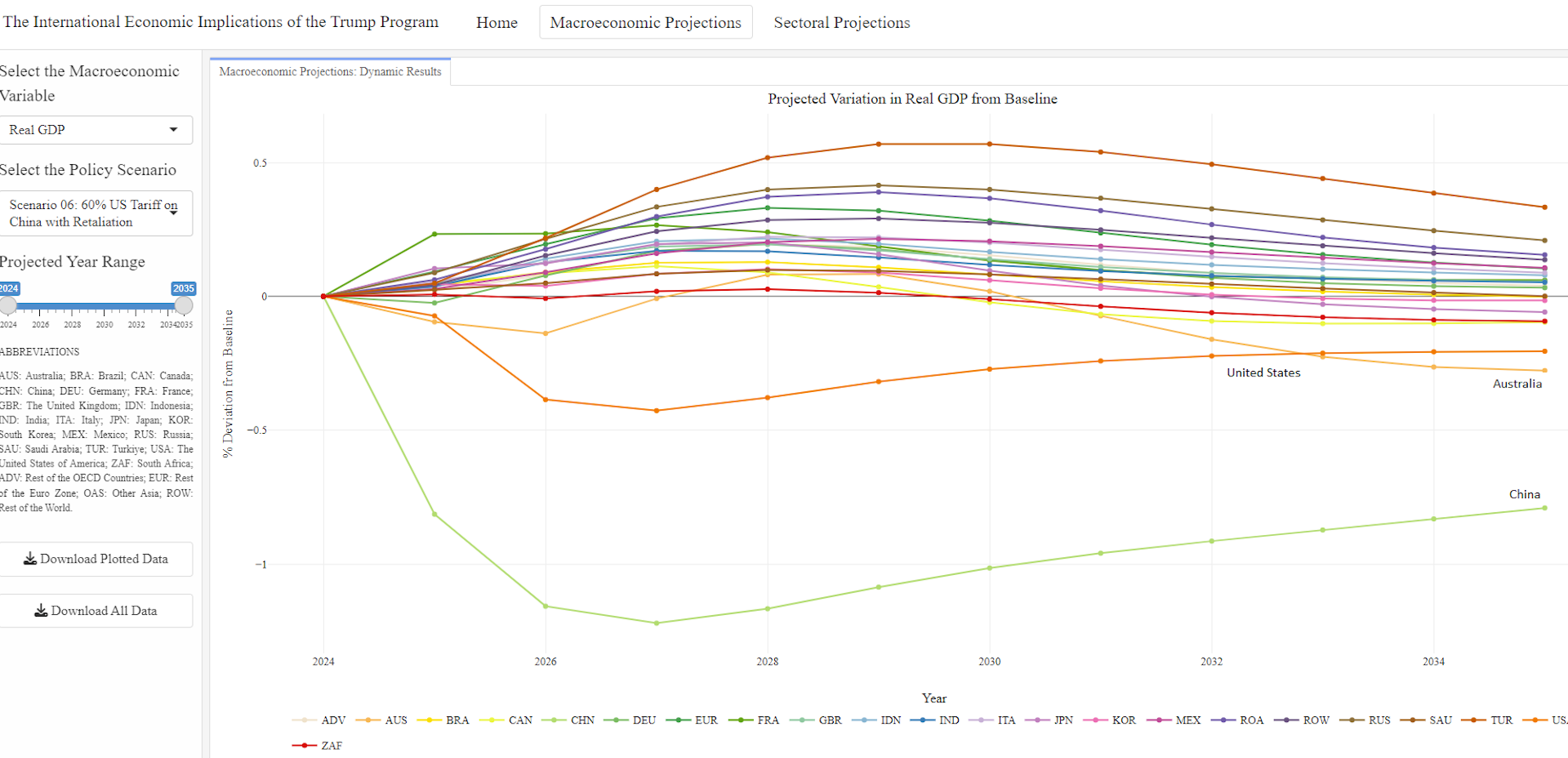
    January 23, 2025
  • MIL-OSI USA: Brown Calls on New Mexican President Sheinbaum to Take Action to Address Threat Posed by China’s Connected Vehicles

    US Senate News:

    Source: United States Senator for Ohio Sherrod Brown
    WASHINGTON, D.C. – U.S. Senator Sherrod Brown (D-OH) is pushing the new Mexican President Claudia Sheinbaum to address the security threat posed by Chinese connected vehicles. Internet-connected vehicles use information and communications technology services to collect a range of sensitive information, including sensor data and images, biometric data like fingerprints and voice recordings, vehicle location, financial information, and vehicle information.
    Brown led a bicameral letter asking Sheinbaum – who was sworn in as Mexico’s President this week – to take steps to scrutinize the manufacturing and sale of Chinese “connected vehicles.”
    The letter comes a week after the U.S. Department of Commerce proposed restrictions on the import and sale of connected vehicles tied to the CCP.
    “We ask that you quickly turn your attention to a new and growing issue: the national security risks to both our nations from the widespread presence of ‘connected’ vehicles built by companies with deep ties to the Chinese Communist Party,” the members wrote. 
    Vehicles are becoming increasingly equipped with new technologies that enable safer and more fuel-efficient travel for drivers and passengers. However, information and communications technology and services that are integral to such connected vehicles (CVs) contain vulnerabilities that may pose risks to U.S. national security if exploited. Connected vehicles controlled by foreign adversaries like China can offer a direct entry point to sensitive technology and data and can potentially bypass security measures. Chinese-made cars and the underlying technology enable China to access sensitive personal data of Americans and of critical U.S. infrastructure, presenting unacceptable national security risks.
    China has offered significant subsidies to auto manufacturers enabling them to export their vehicles and capture significant shares of foreign markets. One example is Mexico, where Chinese automakers have more-than-tripled their market share since the beginning of the decade.
    “For our own national and economic security, the United States has taken action to confront this challenge, imposing targeted new tariffs on Chinese goods, including vehicles, because of these unfair trade practices,” the members continued. “The fact that Chinese companies, including automaker BYD, have announced plans for assembly plants in Mexico raises the potential for Chinese companies to attempt to circumvent these tariffs with production in Mexico.”
    Brown asked President Sheinbaum to take the following steps:
    Formalize the current government’s policy, outlined in media reports, of scrutinizing federal economic development incentives – such as tax incentives and reduced utility and land costs – to firms with ties to the Chinese Communist Party, and to urge Mexican states to follow suit. This should include business partnerships with firms affiliated with the Chinese Communist Party, such as joint ventures with Mexican entities.
    Establish a national security review process to address risks posed by the manufacture or sale of vehicles built by Chinese firms to Mexico’s people, Mexico’s national security, and the regional security of North American and Organization of American States nations. Such a process would follow-up the December 2023 Memorandum of Intent signed by the finance ministers of both our nations, which affirmed the importance of foreign investment screening in protecting national security.
    Send a delegation from her new administration to meet with officials from the U.S. Department of Commerce, the U.S. Department of Treasury, the Office of the United States Trade Representative, the National Economic Council, and the National Security Council by early 2025 to discuss how our nations can work together to address these risks.
    Brown was joined by U.S. Senators Debbie Stabenow (D-MI), Gary Peters (D-MI), and Tammy Baldwin (D-WI).
    U.S. Representatives Elissa Slotkin (D-MI-07), Yadira Caraveo (D-CO-08), André Carson (D-IN-07), Angie Craig (D-MN-02), Don Davis (D-NC-01), Chris Deluzio (D-PA-17), Debbie Dingell (D-MI-06), Val Hoyle (D-OR-04), Dan Kildee (D-MI-08), Greg Landsman (D-OH-01), Hillary Scholten (D-MI-03), Mikie Sherrill (D-NJ-11), Greg Stanton (D-AZ-04), Haley Stevens (D-MI-11), Tom Suozzi (D-NY-03), Emilia Sykes (D-OH-13), and Susan Wild (D-PA-07) also joined the letter.
    Brown is leading efforts to stop China from infiltrating the American auto industry. In July, he introduced his Countering Adversary Reconnaissance (CAR) Act of 2024, new legislation to protect U.S. national security facilities, critical infrastructure, and American citizens by prohibiting connected vehicles produced in China and other adversaries near U.S. military bases and other federal installations. In April, he called on the President to ban Chinese-made electric vehicles in the U.S. to combat the economic and national security threats posed by Chinese automakers. In May, he urged the Biden Administration to ban all Chinese internet-connected vehicles and smart vehicle technology that is designed, developed, manufactured, or supplied from China. He also slammed the Biden Administration’s decision to allow the electric vehicle tax credit to go toward cars made using a key battery component from China.
    Full text of the letter can be found HERE.

    MIL OSI USA News –

    January 23, 2025
  • MIL-OSI USA News: Remarks by Vice President Harris at a Campaign Event | Redford,  MI

    Source: The White House

    Redford Fire Department Station 1
    Redford, Michigan

    2:03 P.M. EDT

    THE VICE PRESIDENT:  Hi.  (Applause.) 

    Oh, good afternoon, everybody.  Good afternoon.  Good afternoon.  It is my great honor to be with everybody this afternoon.

    Matt, I want to thank you for your leadership and for all that you do for so many.

    You know, everyone here, you all have chosen to live a life of service in the most extraordinary way.  And I’m so thankful to all of you — to Matt, for your leadership — and everybody here. 

    And it is so good to be in the house of labor.  Thank you all.  (Applause.)  Thank you all.  Thank you all. 

    And, you know, yours is a profession that is more than a profession.  It really is about a calling. 

    You know, my — I was just telling Matt — my brother-in-law just retired as a firefighter in California.  So, for me, this is personal and it is professional.  I know what you guys do, and I know your character.  I know your families.  I know what it means for the whole community for you all to take on the lives that you have decided to live, and I’m so thankful to you.

    You guys work long shifts with unpredictable hours in some of the most dangerous conditions.  You do so on behalf of people you’ve never met.  Sometimes, those people will never know your name, but because of what you do with such sincerity and the highest level of skill and professionalism, their lives are forever better.  And they always know and have the comfort of going to sleep at night knowing that should any tragedy come their way that you guys are out there and would be there.

    It’s an extraordinary thing you do, and it’s a great gift that you have that you give.  And so, I am so thankful to you.  Thank you.  (Applause.)

    And, of course, I am thankful for the union that supports you and your right to all that you deserve in terms of the wages and the benefits that you so rightly have earned.  (Applause.)

    And I also want to thank the other brothers and sisters from labor who are here from UAW — (applause); IBE- — IBEW; LIUNA.  Where are your orange T-shirts?  I know you’re here somewhere.  I thank you all, all of you. 

    So, look, just yesterday, we saw another example of the power of collective bargaining — right? — when the longshoremen and the U.S. Maritime Alliance came together, ended a strike, and reached an agreement on a record wage.  Right?  (Applause.)  They did good.  They did good. 

    And I say, everywhere I go, look, collective bargaining benefits everybody.  And you know the — the term — and I’m looking at our young leaders who are here.  I’m so glad you guys are here.  (Applause.)  So, collective bargaining, it’s really — it’s just a basic logical point. 

    So, here’s what it means.  It means that in any negotiation, you want the outcome to be fair.  Right?  We all want fairness, right?  Everybody wants fairness — or should. 

    So, here’s the thing about collective bargaining.  If you want the outcome to be fair, you got to realize, if you’re requiring the one worker to negotiate against the big entity, do we really think that the outcome is going to be fair?  Probably not.  But if you let the workers together, as the collective, then negotiate against the big entity, it’s more likely that the outcome will be fair.  

    That’s the basic point of collective bargaining.  That’s the basic point of why we want our unions to be able to do their work on behalf of workers every day, because we know when union wages go up, everyone’s wages go up.  (Applause.)  Yeah. 

    And when union workplaces are safer, all workplaces are safer.  (Applause.) 

    And the bottom line is: When unions are strong, America is strong.  (Applause.)  And our unions have always fought to make our nation, then, more equal, more fair, and more free. 

    And in this election, in 32 days, everything we have fought for is on the line. 

    This election is about two very different visions for our nation: one that is focused on the past, and ours that is focused on the future. 

    We fight for a future where we protect the fundamental freedom to organize.  We fight for a future where workers, all workers, are treated with dignity and respect; a future where we tap into the ambition and the aspirations of the American people and build what I call an “opportunity economy” so that every American has an opportunity to buy a home, start a business, build wealth — intergenerational wealth for their family. 

    Over the last three and a half years, our nation has seen historic small-business creation as an example of that focus. 

    In Michigan alone, we have seen more than 500,000 new small-business applications.  And when I am president, I plan to build on that progress and that success, including by raising the start-up deduction — tax deduction for small businesses from $5,000 for — to $50,000 to help more entrepreneurs start a small business. 

    I’ll tell you guys, my sister and I were raised by our mother, who worked very hard, and we lived on an apartment above a daycare center.  And it was run by and owned by the woman that we called our second mother, who lived two houses down.  She was a small-business owner, and her name was Ms. Shelton. 

    And I grew up as a child knowing about who our small businesses are, right?  They’re leaders in the community.  They’re civic leaders.  They hire locally.  They train.  And so, that’s one of the reasons I’m focused on small businesses as part of how we lift up the middle class in America’s economy.

    We need to also build more housing in America.  Housing is too expensive. 

    My mother saved up for years, until I was a teenager, when she was able to buy our first home. 

    And right now, we have a serious housing shortage in America, and that’s part of what is driving up costs.  And so, we are going to cut red tape, we’re going to work with the private sector, and we’ll build 3 million new homes by the end of my first term — (applause) — including — including providing first-time homebuyers with a $25,000 down payment assistance so they can just get their foot literally in the door to be able to invest in the American dream — (applause) — which not everyone has access to these days.

    We need to lower the cost of living, because, look, our economy, while we’re making good progress — just this morning, in fact, we got a solid jobs report: over 250,000 jobs created last month, unemployment fell.  And just a few weeks ago, the Federal Reserve cut down interest rates, which is going to be great for a lot of folks.  But there’s still more work we need to do. 

    Prices for everyday things like groceries are still too high.  You know it, and I know it.

    And so, we have a plan to lower costs on everything from health care to groceries, including what I’ve done in my career as attorney general, which is we got to take on corporate price gouging. 

    We got to take on what we need to do to understand that if you want to grow the middle class, we need more middle-class tax cuts.  And the tax cut that is part of my plan will give a tax cut to 100 million Americans. 

    We need to expand Child Tax Credit, and I will do that to expand it to $6,000 so that for the first year of a child’s life, their parents have the resources that they need to be able to buy a crib or a car seat, and in that very critical stage of their child’s development, just be able to do more than get by but be able to get ahead. 

    And I say all this to say, I will always put the middle class and working families first.  I come from the middle class, and I will never forget where I come from.  I will never forget where I come from.  (Applause.)

    And we know we cannot have a strong middle class without American manufacturing. 

    Over the last three and a half years, we brought manufacturing back to America.  We created 730,000 manufacturing jobs and announced the opening of more than 20 new auto plants in the United States.  And we did it by investing in American industry and American workers.

    And I want to make sure that America, not China, wins the competition for the 21st century.  (Applause.)

    So, under my plan, we will invest in the industries that built America, like steel, iron, and the great American auto industry — (applause) — yeah — so we can ensure that the next generation of breakthroughs, from advanced batteries to electric vehicles, are not only invented but built right here in America by American union workers.  (Applause.)

    So, the election is in 32 days, and Americans have a big choice to make.  And I think it’s very important, then, to point out Donald Trump has a very different approach than mine. 

    And let’s be real about who Donald Trump is.  Let’s be real.  This is a time for real talk. 

    He was handed $400 million on a silver platter and filed for bankruptcy six times.  This is a man who has only ever fought for himself.  This is a man who has been a union buster his entire career, who has called union leaders, quote, “Dues Sucking” people.  And as president, he did not lift a finger to save the pensions of millions of American workers. 

    We did.  We did.  (Applause.)

    This is a man who sold promise after promise to American workers but never delivered, who said he supports so-called right-to-work laws “100 percent.”  Those are his words. 

    He who joked and laughed about firing striking workers.  You remember that? 

    AUDIENCE:  Yes.

    THE VICE PRESIDENT:  Who rolled back labor standards and made it easier for companies that break labor laws to get federal contracts. 

    And Donald Trump is a man who tried to cut funding for our first responders, including SAFER grants for firefighters. 

    So, brothers and sisters, as we stand here in a house of labor, we will not be fooled.  We will not be gaslighted.  Donald Trump’s track record is a disaster for working people, and he’s trying to gaslight people all over our country.  But we know the facts and we know the truth: He is an existential threat to America’s labor movement.  Just look at his track record to know. 

    He said he was the only one who could bring back America’s manufacturing jobs — Michigan knows what I’m about to say — then America lost nearly 200,000 manufacturing jobs when he was president, including tens of thousands of jobs in Michigan.  And those losses started before the pandemic, so we’re clear, making Donald Trump one of the biggest losers of manufacturing jobs in American history.  (Applause.)

    And recall his record — his track record for the auto industry.  He promised workers in Warren that the auto industry would, quote, “not lose one plant” during his presidency.  Then American automakers announced the closure of six auto plants when he was president, including General Motors in Warren and Stellantis in Detroit.  Thousands of Michigan autoworkers lost their jobs. 

    And now he is making the same empty promises to the people of Michigan that he did before, hoping you will forget how he let you down.  But we know, if he wins again, it will be more of the same. 

    Everything he intends to do is spelled out in Project 2025.  If reelected, he intends to launch a full-on attack on unions and the freedom to organize.  He will ban public-sector unions, roll back workplace safety protections, and appoint a union buster to run the Department of Labor.

    And on top of that, Donald Trump will give billionaires and the biggest corporations massive tax cuts like he did last time. 

    He will cut Social Security and Medicare and impose what I call a Trump sales tax, a 20 percent tax on everyday goods and necessities, which will cost — the economists have said — which will cost the average American over $4,000 a year more. 

    And if that weren’t enough, he intends to end the Affordable Care Act.  And even after he tried to repeal it time and time again when he was president, he still has no plan to replace it. 

    Did you guys see the debate?  (Laughter and applause.)  “Concepts of a plan.”  He has “concepts of a plan.”  (Laughter.)  Come on. 

    And, you know, I’ve said many times he is an unserious human — (laughter) — but the consequence of him is quite serious, because think about that: “concepts of a plan.” 

    So, he’s going to threaten the health care and health coverage of 45 million people in America based on a concept — think about that — to take us back to when insurance companies could deny people with preexisting conditions.  You remember what that was like?

    So, look, I’m here to say, and I think we all know: It’s time to turn the page.  It’s time to turn the page.  (Applause.)  We’re not going back. 

    America is ready to chart a new way forward, because we are not going back. 

    AUDIENCE MEMBER:  No, we’re not.  We’re not going back.

    THE VICE PRESIDENT:  No, we’re not.

    And so, it all comes down to this.  We are here together because we know what is at stake.  And we are here together — and I’m looking at the young leaders — because we love our country.  We love our country.  (Applause.)  Yes, we do.  We love our country.

    And I do believe it is the highest form of patriotism to then fight for the ideals of our country and to fight to realize the promise of America. 

    We have 32 days to get this done, and we know this is going to be a very tight race until the very end.  And we are the underdog, so we have some hard work ahead of us.  But I know who’s here.  We like hard work.  Hard work is good work.  Hard work is good work.  (Applause.)

    And we know what we stand for, so we know what to fight for.  We stand for opportunity, we stand for dignity, and we stand for the future.

    And so, we know when we fight —

    AUDIENCE:  We win!

    THE VICE PRESIDENT:  — we win. 

    God bless you.  God bless the United States of America.  (Applause.)

    Thank you all.  Thank you.  Thank you.  (Applause.)

    END                 2:20 P.M. EDT

    MIL OSI USA News –

    January 23, 2025
  • MIL-OSI USA: Lummis, Colleagues Introduce Resolution to Celebrate Domestic Energy Producers

    US Senate News:

    Source: United States Senator for Wyoming Cynthia Lummis

    Washington, D.C. – Senate Western Caucus Chair Cynthia Lummis (R-WY) introduced a resolution to designate October 4, 2024, as National Energy Appreciation Day to celebrate the men and women who work to power our nation and the world. Senators John Barrasso (R-WY), Kevin Cramer (R-ND), James Lankford (R-OK), Ted Cruz (R-TX), Shelley Moore Capito (R-WV), Pete Ricketts (R-NE), John Hoeven (R-ND), Jim Risch (R-ID), Bill Cassidy (R-LA) and Cindy Hyde-Smith (R-MS) cosponsored the resolution.

    “Wyoming’s energy producers work tirelessly each and every day to power our nation, yet our domestic energy industry is under attack like never before due to the Biden-Harris administration’s war on energy production,” said Lummis. “I introduced this resolution to recognize and celebrate the men and women in the Cowboy State and throughout the country who work to power not only our nation, but the entire world.”

    “American energy production fuels American success,” said Barrasso. “Wyoming is America’s energy breadbasket. Our workers produce the energy and resources that keep America running and our economy strong. While this administration wages war on American energy, Wyoming will proudly celebrate National Energy Appreciation Day and continue to unleash American energy.”

    “Louisiana energy workers are the reason we have the fuel to run our cars and electricity to power our homes,” said Dr. Cassidy. “Thanks for powering the American economy.”   

    “Oklahoma energy producers and energy innovators are leading America to energy dominance,”said Lankford. “They continue their great work to provide clean, affordable, and reliable energy to our state, despite the Biden-Harris Administration’s agenda to raise energy prices and surrender our energy future to China.” 

    “Energy generated in West Virginia, made possible by our skilled and dedicated workforce, continues to keep homes warm, lights on, and move our nation forward,” said Capito. “West Virginia energy producers have done this for generations, and this tradition will always be a central aspect of our identity and culture in the Mountain State. On National Energy Appreciation Day, we recognize how this sector strengthens our national security and improves the lives of our people, country, and world. I’m proud to join my colleagues to once again establish this day of appreciation and highlight the importance of American energy and the personnel behind it.” 

    “National Energy Appreciation Day recognizes the vital role that American energy and its workers play in our quality of life and the success of our economy,” said Hoeven. “That’s why we continue working to rescind costly federal rules and provide regulatory relief to ensure our nation can continue to utilize all of its abundant energy resources, including coal, oil and gas, making energy affordable again for Americans.”

    “The thousands of hardworking Mississippians and Americans producing domestic energy are vital to our daily lives and the very foundation of our national and economic security,” said Hyde-Smith. “It is undeniable that U.S.-produced energy is not only more affordable, but also cleaner and safer than the options our current administration favors from foreign adversaries.  I am proud to join Senator Lummis in championing this resolution, and I appreciate the efforts of the American energy industry that powers our nation’s progress.”

    “With American innovation and abundant natural resources, the United States has everything we need to be energy independent and secure,” said Risch. “I’m proud to join my colleagues in celebrating American energy and will continue pushing for policies that cut red tape, boost investment, and ensure affordable, reliable energy for every home and business in Idaho.” 

    BACKGROUND:

    American energy plays an integral role in keeping energy affordable, reliable and efficient while also supporting economic growth and creating upward mobility. Not only have domestic energy advancements greatly reduced emissions, but widespread access to energy has more than doubled life expectancy and reduced the percentage of people living in poverty to less than 10%.

    The American energy industry accounts for more than seven million jobs and ultimately supports more than 10 million jobs across the United States.

    The U.S. oil and natural gas industry generates nearly $1.8 billion in gross domestic product annually.  Federal oil and natural gas leases for onshore and offshore development brought in $15.9 billion for the federal government in 2023. This is $6.3 billion less than 2022, due in large part to the administration’s war on American energy, including banning exports of liquified natural gas. 

    Since day one of the Biden-Harris administration, President Biden and Vice President Harris have taken several actions to greatly restrict domestic energy production including:

    • Halting construction of the Keystone XL pipeline.
    • Banning exports of liquified natural gas (LNG).
    • Drastically increasing royalty rates for domestic gas production on federal lands.
    • Putting Resource Management Plans (RMPs) in place to effectively end oil and gas production on federal lands.
    • Halting offshore oil and gas leases in the gulf due to the potential for the Rices Whale to be impacted despite no scientific evidence the whale is impacted by offshore drilling.

    For a copy of the resolution, click here. 

    MIL OSI USA News –

    January 23, 2025
  • MIL-OSI China: China urges EU to get back to right track of resolving trade disputes through consultations: commerce ministry

    Source: People’s Republic of China – State Council News

    China urges EU to get back to right track of resolving trade disputes through consultations: commerce ministry

    BEIJING, Oct. 4 — China has urged the European Commission to truly show concrete actions to implement its political will and get back to the right track of resolving trade frictions through consultations, said a spokesperson of the Ministry of Commerce on Friday.

    The remarks came after the commission’s proposal to impose definitive countervailing duties on imports of battery electric vehicles from China had obtained the necessary support from Member States of the European Union (EU) for the adoption of tariffs.

    “China firmly opposes the draft final ruling of the EU side, but has also noted its political will to continue to resolve the issue through negotiations,” said the spokesperson, noting that technical teams from both sides will continue with their negotiations on Oct. 7.

    The ministry urged the EU side to be clearly aware of the harm of imposing additional tariffs, as it will not solve any problems but only waver Chinese enterprises’ confidence and resolve in and prevent them from conducting investing cooperation in Europe.

    “China’s position is consistent and clear. China firmly opposes the unfair, illegal and unreasonable protectionist practices of EU in this case, and resolutely opposes the EU additional countervailing duty on Chinese electric vehicles,” said the spokesperson. “China will take all possible measures to firmly defend the interests of Chinese enterprises.”

    MIL OSI China News –

    January 23, 2025
  • MIL-OSI China: China, Bulgaria celebrate anniversaries together at Confucius Institute

    Source: People’s Republic of China – State Council News

    SOFIA, Oct. 4 — “Bulgaria and China — we celebrate together with a view to the future” event was held at the Confucius Institute here on Friday to mark the 75th anniversary of the establishment of diplomatic relations between China and Bulgaria.

    The event, organized by the Confucius Institute in Sofia, was also held to celebrate the 75th anniversary of the founding of the People’s Republic of China, 20 years of Confucius Institutes, Global Confucius Institute Day, and the Chinese Mid-Autumn Festival.

    Spectators in the institute’s Multifunctional Hall enjoyed Chinese and Bulgarian songs and dances performed by Bulgarian and Chinese students from educational institutions.

    Earlier on Friday, those interested attended lectures dedicated to China, such as “Educational Exchanges Between China and Bulgaria: Development of Bulgarian Studies in China” and “The Cultural Dimension of China’s Foreign Policy.”

    Guan Xin, cultural counselor at the Chinese Embassy in Bulgaria said addressing the festivity that China’s National Day and the establishment of diplomatic relations between Bulgaria and China have become inseparable events that were celebrated together and gave double joy to the two peoples.

    Guan also said that by promoting the Chinese language and culture, Confucius Institutes have helped people around the world get to know China, creating conditions for mutual understanding and rapprochement.

    Chen Ying, Chinese director of the Confucius Institute in Sofia, said the Confucius Institute in Sofia confidently and steadfastly worked for the spread of Chinese culture in Bulgaria, for more and more Bulgarian youth to learn Chinese, to visit China, and to eventually become young ambassadors of friendship between the two peoples.

    Chen said that currently, there are 25 learning centers with Chinese language teaching in the country, among which were universities in Plovdiv, Ruse, Blagoevgrad, Stara Zagora, and Burgas.

    Confucius Institute in Sofia has built eight Confucius Classrooms, which became regional centers for the dissemination of Chinese language and culture, she said.

    A congratulatory address on behalf of Nikolay Marin, rector of the South-West University in Blagoevgrad, said that his university established itself as a bridge of friendship between Bulgaria and China.

    The sustained friendly relations between China and Bulgaria were a prerequisite for the expansion of cooperation between the two countries in various spheres, Marin said.

    “It is our honor and pleasure to share this special moment with you,” said a congratulatory address on behalf of Dobri Yarkov, rector of Trakia University in Stara Zagora, who said he was happy and proud that the relationship and partnership between China and Bulgaria has been deepening in the culture, science, technology, agriculture and education.

    MIL OSI China News –

    January 23, 2025
←Previous Page
1 … 694 695 696 697 698 … 730
Next Page→
NewzIntel.com

NewzIntel.com

MIL Open Source Intelligence

  • Blog
  • About
  • FAQs
  • Authors
  • Events
  • Shop
  • Patterns
  • Themes

Twenty Twenty-Five

Designed with WordPress