Category: Commerce

  • MIL-OSI USA: Risch Names Kimberling Insurance as May Small Business of the Month

    US Senate News:

    Source: United States Senator for Idaho James E Risch
    WASHINGTON – U.S. Senator Jim Risch, senior member and former chairman of the Senate Committee on Small Business and Entrepreneurship, announced the selection of Kimberling Insurance in Moscow as the Idaho Small Business of the Month for May 2025. Kimberling Insurance will be recognized for its contribution to Idaho in the Congressional Record of the U.S. Senate. 
    “Kimberling Insurance goes beyond selling insurance and policy plans,” said Risch. “This family business actively serves the Moscow region, enhancing the quality of life in their community. I’m proud to recognize Kimberling Insurance as the May Small Business of the Month.”
    Idaho is consistently ranked on the best places in the country to do business. Each month, Senator Risch selects an Idaho small business that exemplifies the Idaho values of hard work, entrepreneurial spirit, and exceptional commitment to community.

    MIL OSI USA News

  • MIL-OSI USA: Governor Stein Announces Additional 330 New Jobs Coming to Wayne County Production Facility

    Source: US State of North Carolina

    Headline: Governor Stein Announces Additional 330 New Jobs Coming to Wayne County Production Facility

    Governor Stein Announces Additional 330 New Jobs Coming to Wayne County Production Facility
    lsaito

    Raleigh, NC

    Today Governor Josh Stein joined business leaders and local officials to announce a major expansion for Prolec-GE Waukesha, Inc., one of the nation’s largest manufacturers of power transformers. The company will add 330 new jobs as it invests $140 million to build a second manufacturing facility in Goldsboro.

    “Prolec GE’s expansion in North Carolina further solidifies the state as a manufacturing powerhouse across all sectors,” said Governor Josh Stein. “Our strong economy and world-class workforce continue to give businesses the confidence to keep investing in North Carolina. We’re excited about Prolec GE’s commitment to Wayne County.”

    Prolec GE Waukesha is a subsidiary of GE Prolec Transformers, Inc., a U.S. joint venture between Xignux and GE Vernova, and is headquartered in Waukesha, Wisconsin. Prolec GE Waukesha engineers, manufactures, installs, and services high-quality power transformers for investor-owned utilities, co-ops, municipalities, renewable project developers, data centers and other industrial sites. The company will build a new state-of-the-art manufacturing plant at its existing site to support the growing demand for power grid capacity in the United States. With new, sophisticated equipment, this expansion will double the Goldsboro facility’s current production volume of medium power transformers.

    “It is essential for government, industry, and community leaders to collaborate early and frequently to drive growth in the manufacturing sector,” said Juan Ignacio Garza Herrera, Xignux CEO and Prolec GE Chairman. “This $140M investment reflects our long-term commitment to creating sustainable value for North America’s energy market and our pride in energizing life and society to contribute to a better world. Our collaboration with the state of North Carolina, Wayne County, and our joint venture partner, GE Vernova, will be instrumental in helping us turn this commitment into something tangible that will benefit our customers and all those that rely on the country’s power grid.” 

    “It’s not a coincidence that another energy company is deepening its roots in North Carolina,” said Commerce Secretary Lee Lilley. “Prolec GE’s expansion is a vote of confidence in our workforce training efforts, infrastructure improvements, and recruitment tools that are attracting growing companies to every corner of the state.”

    While salaries for the new positions will vary, the average annual salary is expected to be $71,912, which exceeds the Wayne County average of $46,211. These new jobs could create a potential annual payroll impact of more than $23.7 million to the local economy.

    Prolec GE’s operation in North Carolina will be facilitated, in part, by a Job Development Investment Grant (JDIG) approved by the state’s Economic Investment Committee earlier today. Over the course of the 12-year term of this grant, the project is estimated to grow the state’s economy by $1.05 billion. Using a formula that takes into account the new tax revenues generated by the new jobs and capital investment, the JDIG agreement authorizes the potential reimbursement to the company of up to $4,696,000, spread over 12 years. State payments only occur following performance verification by the departments of Commerce and Revenue that the company has met its incremental job creation and investment targets.

    The project’s projected return on investment of public dollars is 106 percent, meaning for every dollar of potential cost to the state, the state receives $2.06 in state revenue. JDIG projects result in positive net tax revenue to the state treasury, even after taking into consideration the grant’s reimbursement payments to a given company.

    “On behalf of Wayne County, we welcome Prolec GE’s expansion. The new jobs and the investment into our county will bring economic growth and stability to Eastern NC,” said Senator Buck Newton. “The people of Wayne County will continue to support this company as it grows to its full potential insuring the equipment necessary to provide reliable energy is made in America. I am looking forward to witness the benefits this project will bring.”

    “Announcements like these happen through collaboration,” said Representative John R. Bell, IV. “With the partnership and diligence of our state and local officials, as well as the economic developers, we’re able to inject another surge of energy into our regional economy through Prolec GE’s expansion.”

    In addition to the North Carolina Department of Commerce and the Economic Development Partnership of North Carolina, other key partners in this project include the North Carolina General Assembly, the North Carolina Community College System, Wayne Community College, North Carolina Global TransPark Economic Development Region, Wayne County, Wayne County Development Alliance, North Carolina’s Southeast, and Duke Energy. 

    May 14, 2025

    MIL OSI USA News

  • MIL-OSI: Notice Regarding Uab „orkela“ Financial Statements for 3-Month Period Ended 31 March 2025

    Source: GlobeNewswire (MIL-OSI)

    Key Information About the Company

    UAB „Orkela“ (hereinafter – the Company) is a private limited company, registered with VĮ „Registrų centras“ on September 24, 2015.

    Registered office address: Jogailos g. 4, Vilnius. The Company has no branches or representative offices.

    Main Business Activities

    The Company’s primary activity is real estate development and construction. The Company owns a land plot and a building complex located at Vasario 16-osios g. 1, Vilnius. The Company is developing a lyceum and hotel complex near St. Philip and St. Jacob Church and Monastery in Vilnius.

    Key Events in Q1 2025

    • January 9, 2025 – A bondholders’ meeting was held, where a decision was made to extend the bond redemption deadline until July 19, 2025.
    • April 10, 2025 – The State Territorial Planning and Construction Inspectorate under the Ministry of Environment approved the completion of the construction of the administrative part of the development project.

    Financial Overview for Q1 2025

    • During the first quarter of 2025, the Company invested €9.7 million in project development.
    • During this period, the Company incurred €269.8 thousand in project-related expenses and €892.7 thousand in project financing costs.
    • As of March 31, 2025, the Company’s assets totaled €60,825 thousand (compared to €52,376 thousand as of December 31, 2024).

    Anastasija Pocienė

     Director, UAB „Orkela“

    Attachment

    The MIL Network

  • MIL-OSI USA: Congresswoman Tenney Celebrates the Passage of the One Big Beautiful Bill from the Ways and Means Markup

    Source: United States House of Representatives – Congresswoman Claudia Tenney (NY-22)

    Washington, DC – Congresswoman Claudia Tenney (NY-24) today released the following statement on the passage of “The One, Big, Beautiful Bill” from the House Ways and Means Committee Markup.

    “Today, the House Ways and Means Committee voted to advance our portion of the One, Big, Beautiful Bill to deliver on President Trump’s America First agenda. This landmark legislation makes several aspects of the 2017 Trump Tax Cuts permanent, including reduced tax rates for individuals and families, the doubled standard deduction, and the doubled child tax credit. Not only did we extend this tax relief for families and prevent a 25% tax hike on taxpayers in NY-24, but we also made permanent the 199A Small Business Deduction that was set to expire at the end of 2025, protecting 40,720 small businesses in NY-24 from being hit with a 43.4% tax rate. While this legislation did not include all of my initiatives, including the New Markets Tax Credit, Technology for Energy Security, BASIC Act, Susan Muffley Act, the High-Quality Charter Schools Act and various other legislative priorities, I understand that individual priorities do not take precedence over ensuring that American families, workers, and businesses do not face the largest tax hike in the history of our country. House Republicans are moving ahead with President Trump’s One, Big, Beautiful Bill, working to solidify the promises we made to the American people by strengthening our economy and providing direct tax relief to families, farmers, and small businesses in rural America,” said Congresswoman Tenney.

    Highlights of this portion of the One, Big, Beautiful Bill include language to:

    • Make the 2017 Trump Tax Cuts permanent, preventing a 25% tax hike on taxpayers in NY-24.
    • Renew and make permanent the 199A small business deduction critical for the success of Main Street.
    • Save the average American family $1,700, the equivalent of 9 weeks of groceries.
    • Establish Savings Accounts for newborns.
    • Increase the university endowment tax.
    • Repeal the 1099-K gig worker reporting threshold, which would require Venmo, PayPal, and gig transactions over $600 to be reported to the IRS.
    • Enhance the Opportunity Zone program to create over $100 billion in new investments in 10 years.
    • Deliver on President Trump’s no tax on tips priority.
    • Create 6 million jobs for American workers.
    • Extend and expand the doubled Death Tax Exemption for 2 million family-owned farms.
    • Modernize and enhance the Low Income Housing Tax Credit, a critical tool to help address our nation’s ongoing housing shortage.
    • Terminate the tax-exempt status of terrorist-supporting organizations.

    ###

    MIL OSI USA News

  • MIL-OSI USA: Dingell Remarks on Republican Budget Proposal to Cut Health Care from Millions of Americans

    Source: United States House of Representatives – Congresswoman Debbie Dingell (12th District of Michigan)

    Congresswoman Debbie Dingell (MI-06) opened today’s Energy and Commerce Committee Markup on the Republican budget proposal by sharing the story of a Michigan family from Warren whose six-year-old son, George, has Down syndrome, and relies on Medicaid to get the care he needs.

    The independent Congressional Budget Office (CBO) determined that at least 13.7 million more Americans will go uninsured on Trump and Congressional Republicans’ watch.

    New analysis from the nonpartisan CBO found the health provisions in Energy and Commerce Committee Republicans’ bill will cut at least $715 billion and will result in at least 8.6 million more Americans going uninsured because of cuts to Medicaid and the Affordable Care Act. In additional analysis, CBO determined 5.1 million more Americans will go uninsured as a result of Republicans refusing to extend the Affordable Care Act tax credits, as well as full implementation of the Marketplace Integrity Rule.

    Watch Dingell’s remarks here, and read them below.

    Thank you, M. Chair,

    Please meet George, who I met this morning, who is full of energy – and my office somehow survived.

    Welcome, George. Here’s the letter I got from his mom:

    ‘Our son, George, is six and has Down’s Syndrome. We adopted him at 3 weeks old. Losing Medicaid would cripple our family, absolutely destroy us. We’ve been very lucky until now because of Medicaid. It’s been very instrumental for our family’s ability to survive. My husband and I both primarily do gig work, both employed full time, but we don’t have workplace insurance. It’s not super reliable for the kinds of jobs we do, so we have marketplace insurance. It’s a huge fear that we’d lose Medicaid, because it’s necessary for our family’s lives.

    ‘The disability world, our community, is really worried about cuts to Medicaid. The general narrative right now is one of terror.

    ‘It’s a death sentence to cut Medicaid. It’s intrinsically and undeniably tied to disability rights and justice in our country. If we’re not serving our most vulnerable children, what are we even doing as a country? You’re leaving families with no options and putting us in an impossible position. It’s so obvious that they don’t care about disabled people or poor people.’

    They cared strongly enough to come.

    There’s a poll this week that shows 83% of people in Michigan support Medicaid. 2.6 million people get health insurance through Medicaid in Michigan, representing approximately 1 in 4 Michiganders. Medicaid provides coverage for 38% of births in Michigan, 2 in 5 children, 3 in 5 nursing home residents, and 3 in 8 working-age adults with disabilities.

    And I want to say to my colleagues, Michigan’s Medicaid program is efficient with per-enrollee costs among the 10 lowest in the country. To all my colleagues who say you’re cutting waste and fraud, Medicaid is 22% more cost-effective than any private insurance plan. We have to protect George, other children, seniors in nursing homes, and people with disabilities.

    Please don’t say you’re not going to hurt them, because many things in this bill are a back-door way of doing so.

    Thank you and I yield back.”

    Watch a live stream of the Committee markup here. 

    MIL OSI USA News

  • MIL-OSI Asia-Pac: Remarks by CE at media session in Kuwait City (with photo)

    Source: Hong Kong Government special administrative region

    The Chief Executive, Mr John Lee, concluded the visit of the business delegation comprising representatives from Hong Kong and Mainland enterprises to Middle East together with the Chairman of the Hong Kong Trade Development Council, Dr Peter Lam; the Chairman of the Hong Kong General Chamber of Commerce, Ms Agnes Chan; and the Chairman of the Dongchao Information Technology (Shanghai) Company Limited, Mr Wang Chaoyou, in Kuwait City, Kuwait, today (May 14, Kuwait City time). Following are the remarks by Mr Lee:

    Chief Executive: Today marks the final day of our visit to Kuwait. I would like to extend my gratitude to the Kuwaiti Government for its high-level hospitality and meticulous arrangements. I am particularly grateful to the Kuwaiti Government for arranging the government team to stay at Bayan Palace. We are particularly grateful to the Acting Prime Minister for hosting the whole delegation for lunch at the Palace, leaving an unforgettable memory amongst all members of the delegation.

    Yesterday, I met with His Highness the Amir of Kuwait, followed by the meeting with His Highness the Crown Prince. And then I also met the Acting Prime Minister, who hosted a roundtable discussion attended by senior Kuwaiti officials. We share a common commitment to deepening bilateral co-operation in trade, investment and cultural exchanges.

    During our visit to Kuwait, we signed and reached 24 Memoranda of Understanding (MOUs) and co-operation agreements, spanning across trade, investment, financial services, technology, legal co-operation, customs facilitation, aviation, tertiary education, etc.

    Today is the last day of our Middle East visit. I would like to do a sum-up of my four-day visit to Kuwait and Qatar. The delegation comprised Hong Kong and Mainland business leaders. We achieved three key objectives:

    1. To strengthen government-to-government relations;
    2. To find new areas of collaboration;
    3. To make friends, and extend our network.

    The visit is successful, particularly in six areas.

    First, we strengthened relations between the Hong Kong Special Administrative Region (HKSAR) Government and the governments of Qatar and Kuwait, establishing collaborative consensus.

    Second, the visit resulted in a total of 59 MOUs and agreements, 35 in Qatar and 24 in Kuwait, spanning across diverse areas and laying a robust groundwork for multifaceted co-operation.

    Third, we deepened mutual understanding and strengthened commercial and trading networks. Delegation members have expanded their network and connections, promoting the strengths and opportunities of Hong Kong and the Mainland to partners in Qatar and Kuwait.

    Fourth, we showcased Hong Kong’s unique role under “one country, two systems” as a “super connector” and “super value-adder”, bridging global opportunities. I invited, for the first time, over 20 Mainland enterprise representatives to join the delegation, reflecting the synergy between Hong Kong and the Mainland. We together aim to provide end-to-end supply chain solutions for the Middle East and beyond.

    Fifth, we bolstered ties with Gulf Cooperation Council (GCC) member states. We created broader opportunities. Plus the two countries I have visited during my last Middle East visit, we have now visited four of the six GCC member states, representing two-thirds of the bloc and 90 per cent of its population The HKSAR Government is now actively exploring a free trade agreement with the GCC to further access this vital market.

    Sixth, we advanced people-to-people exchanges. Two days ago, I announced Qatar’s new 30-day visa-free arrangement for HKSAR passport holders. I am pleased now to further announce that the UAE (United Arab Emirates) will grant Hong Kong 30-day visa-free access starting May 15, while Oman will on the same date extend its visa-free period from 10 days to 14 days.

    In meetings with leaders and officials, I appreciated their forward-looking vision and understanding of Hong Kong’s unparalleled advantages under “one country, two systems” as a bridge between the Mainland and the world. Middle East countries are seeking diversification of risks and looking for opportunities in China and the HKSAR in order to join the tide of the global economic shift towards the East. In this, Hong Kong has boundless opportunities.

    Reporter: I just have a couple of questions for you, please. Can you talk to us about the relationship between Kuwait and Hong Kong in particular, and Kuwait and China in general? The second question is about the Memoranda of Understanding that you have signed yesterday and today. How can you describe them? And how do they benefit the relations between Kuwait and Hong Kong?

    Chief Executive: We have a very strong foundation of understanding and co-operation with Kuwait. Kuwait is the first country to sign two agreements together with Hong Kong. One is the agreement on investment protection and promotion, and another agreement is about the avoidance of double taxation. That speaks for the strong link, which has been established long ago between Hong Kong and Kuwait. We have been inspired by the Kuwait Vision 2035, which covers many areas in full alignment with what Hong Kong is doing and focusing on. The Kuwait Vision 2035 covers areas to transform Kuwait into financial centre, trading centre, infrastructure-building, human capital development, healthcare, sustainability, and also building Kuwait into a country of influence in this region and globally.

    Hong Kong has a vision very similar to Kuwait in this regard. Hong Kong is a financial centre, and is a shipping and trading centre, and we are developing Hong Kong into an I&T (innovation and technology) hub. We are quite proud of our education, because despite Hong Kong being just a city of 1 100 square kilometres, we have five universities that are within the top 100 globally, and we are quite strong in R&D (research and development), particularly a lot of our universities’ research has been graded outstanding. What we are working hard is raising Hong Kong’s profile in all this regard. Sustainability is also one of our focuses, both in what we do environmentally and also financially. We are doing a lot of green finance, and we emphasise strongly (ESG) compliance. That is where we are going, and we think there are a lot of things, because our visions just align so much together – a lot to do – and that is between Hong Kong and Kuwait. I am very thankful and grateful to His Highness, Amir of Kuwait, to meet me, and I am grateful to the Prime Minister also, to host a lunch in the palace for the whole team. Throughout all the meetings and discussions, we have very common understanding that we should co-operate more in different areas.

    Coming to the relation between China and Kuwait, China is Kuwait’s, I think, largest trade partner, and the diplomatic relations between China and Kuwait started long, long time ago, and the partnership is close and ever-rising. When I honourably saw His Highness, Amir of Kuwait, I felt his friendship, genuineness, and sincerity of building good relations between Kuwait and China. I am honoured to be able to be part of that success story. My whole team feels proud to be in that part of success story.

    Coming to the MOUs we have signed with Kuwait, both the governments and different parties, 24 agreements and MOUs, they cover a wide range of areas. Despite the very good foundation we already have, we are now formally telling people of the two places where are the main directions of co-operation both governments agree on. That helps in aligning direction, energy, focuses and also our time, because time is precious. So all of them now, these are the areas we can co-operate on and work hard on as well. That will bring returns in much shorter time, in much bigger scale. Already, I have heard some delegations forming to come to Hong Kong, so as to further continue the link. I am very positive with the overall results, and I will be seeing a lot of activities, not just between government-and-government exchange, but also business-to-business, individuals-to-individuals. And that is why I am also very thrilled to announce a lot of convenience that we have created for visa, for going through the boundary, both goods and people.

    (Please also refer to the Chinese portion of the remarks.)

    MIL OSI Asia Pacific News

  • MIL-OSI USA: ICYMI: Senator Mullin Applauds President Trump’s Trip to the Middle East, Slams Democrat Senator Chris Murphy for his Hypocrisy on Fox Business

    US Senate News:

    Source: United States Senator MarkWayne Mullin (R-Oklahoma)

    ICYMI: Senator Mullin Applauds President Trump’s Trip to the Middle East, Slams Democrat Senator Chris Murphy for his Hypocrisy on Fox Business

    Washington, D.C. – On Tuesday, U.S. Senator Markwayne Mullin (R-OK) joined Fox Business’ “Varney & Company”  to discuss President Trump’s visit to the Middle East and Democrat Senator Chris Murphy’s (D-CT) blatant hypocrisy. Highlights below.

    Sen. Mullin’s full interview can be found here.
    On President Trump possibly attending the upcoming meeting between Russia and Ukraine:
    “The President is being recognized around the world as the chief dealmaker, and Zelensky is very smart by saying he wants him at the table. However, there’s some real differences in what the proposal for a peace deal that Zelensky has put on the table and what Putin has put on the table, and unless there’s actually a path forward to possibly getting a peace deal, I don’t see President Trump getting there. However, if President Trump showed up, I would say that there’s probably a 90% chance that a peace deal would be part of the deal before he left.”
    On Senator Chris Murphy’s hypocrisy:  
    “First of all, I have to address Chris Murphy here, because Chris Murphy is a man that lacks integrity at this point. I could understand if Chris was willing to call out the Bidens when they set up 20 plus shell companies to funnel millions, literally over $25 million through, which had no assets coming from foreign entities, just simply to have access to then, at that time, the Vice President Biden and President Biden when he was in office.”
    “If Chris Murphy wants to actually show that he has integrity, then call it for what it is. The fact is, he’s willing to do and say whatever it takes to actually get the nod from the Democrats to run for President in 2028. That’s all Chris Murphy is doing. He’s auditioning right now. And what can he talk about, right? He can’t talk about the successes of President Trump. He can’t talk the fact that President Trump is actually restructuring the tariff deals that’s going to put our economy and our future workers in the driver’s seat again, which we’ve been neglecting for the last 30 years. He can’t talk about the rally of the stock market. He can’t talk about the foreign affairs that President Trump is taking by peace through strength instead of Biden’s, peace through appeasement.”
    On American leadership returning to the Middle East:
    “And what is happening right now with President Trump going to the Middle East, is the Middle East is begging for a leader. We saw a lackluster leader in Biden when he was president, and after the disastrous withdrawal from Afghanistan, we left a lot of our partners in the Middle East holding a bag saying, ‘Where is the United States?’ Remember, UAE was the only country in the Middle East that actually fought along with us in Afghanistan… And what did the Biden administration do when they got in office? They pulled out of the F-35 bill that President Trump put in place. What did we do to Saudi Arabia? Instead of negotiating with Saudi Arabia with arms deals, we started negotiating with Iran and gave them billions of dollars on a, literally, pallet that we flew there in an Air Force plane. It is absurd.”
    “President Trump, right now is restructuring that order, saying our friends and allies in the Middle East, we’re here for you, and we want to show our gratitude and appreciation for what you’ve done for us and hopefully normalize relationships inside the Middle East, with Israel and Saudi Arabia.”
    On the 747 jet from Qatar:
    “The way the Left is blowing this up is just to distract from the success that President Trump has had in his 120 days in office. This is an absolute nothing burger, as we would say, and the fact that they’re making a big deal out of this is absurd. I want to point out something too that a lot of people isn’t talking about the negotiation on the 747 was actually started underneath the Biden administration, but they couldn’t close the deal. There’s a whole lot more to the story that we can get to at a different point but the fact that they’re wanting to gift it to the United States, we would be absolutely absurd not to take the gift.”

    MIL OSI USA News

  • MIL-OSI USA: Rep. Peters Calls out Republican Cuts to Clean Energy and Fossil Fuel Favoritism in Tax Plan

    Source: United States House of Representatives – Congressman Scott Peters (52nd District of California)

    [embedded content]

    Washington, D.C. – Today, during the Energy and Commerce Committee’s consideration of the Republican tax plan, which will kick 13.7 million people off their healthcare, Representative Scott Peters (CA-50) called out provisions that will make it easier to build polluting coal power plants and cut back on investments in clean energy technologies.

    Watch Rep. Peters’ opening statement against the Republican tax plan here.

    Speaking on the Republican plan, Rep. Peters said, “Last Congress, my Republican colleagues were insistent that we should have an all-of-the-above energy strategy, one that leveraged our natural resources, unleashed American innovation, and cut through bureaucratic red tape. Which is why I am confused that we are considering a reconciliation bill that picks winners and losers, and elevates expensive, outdated, and inefficient sources like coal over cheap American-made energy like solar, wind, and storage.”


    He continued, “Why does this bill provide government-backed insurance to coal plants, as the President of the United States single-handedly kills hundreds if not thousands of clean energy jobs across the country by illegally targeting projects and weaponizing the permitting process?”

    And he concluded, “We need to face reality; we can’t build anything in America anymore. North America has built about 7 gigawatts of interregional transmission since 2014, with less than half of that in the U.S. In that same time frame, South America has built 22 gigawatts, Europe has built 44 gigawatts, and China has built 260. There is a growing bipartisan coalition for permitting reform. Whether it’s forest management, electric transmission, or building housing, I have reached across the aisle and found success in moving solutions forward. Many of us have voiced our desire to work in a bipartisan way to make America more energy dominant. Now is the time to put our money where our mouth is, and focus on durable, common-sense, and all-of-the-above policies that provide certainty for industry and consumers.”

    CA-50 Medicaid Facts:

    • 156,100 people in the district rely on Medicaid for health coverage—that’s 20 percent of all district residents.
      • 34,700 children in the district are covered by Medicaid.
      • 17,700 seniors in the district are covered by Medicaid.
      • 64,900 adults in the district have Medicaid coverage through Medicaid expansion—that includes pregnant women who are able to access prenatal care sooner because of Medicaid expansion, parents, caretakers, veterans, people with substance use disorder and mental health treatment needs, and people with chronic conditions and disabilities.
    • At least five hospitals in the district had negative operating margins in 2022. These hospitals would be especially hard-hit by cuts to Medicaid. For example:
      • Scripps Mercy Hospital had a negative 25.3 percent operating margin—and nearly 22 percent of its revenue came from Medicaid.
      • Sharp Coronado Hospital had a negative 3.5 percent operating margin—and over 36 percent of its revenue came from Medicaid.
      • University of California San Diego Medical Center had a negative 2.4 percent operating margin—and nearly 19 percent of its revenue came from Medicaid.
    • There are 54 health center delivery sites in the district that serve 529,944 patients.
    • Those health centers and patients rely on Medicaid—statewide, 69 percent of health center patients rely on Medicaid for coverage.
    • Health centers will not be able to stay open and provide the same care that they do today, with more uninsured and underinsured patients. They are already operating on thin margins—in 2023, nationally, nearly half of health centers had negative operating margins.
    • Medicaid cuts put health centers at risk, including:
      • Family Health Centers of San Diego
      • Neighborhood Healthcare
      • North County Health Project
      • San Diego American Indian Health Centers
      • St. Vincent De Paul Village

    Read Rep. Peters full remarks below:

    Last Congress, my Republican colleagues were insistent that we should have an all-of-the-above energy strategy, one that leveraged our natural resources, unleashed American innovation, and cut through bureaucratic red tape.

    Which is why I am confused that we are considering a reconciliation bill that picks winners and losers, and elevates expensive, outdated, and inefficient sources like coal over cheap American-made energy like solar, wind, and storage.

    Why does this bill expedite permitting for natural gas pipelines – an undeniably important component of our energy system – while completely ignoring transmission lines, without which we would not be able to meet a single kilowatt of energy demand?

    Why does this bill provide government-backed insurance to coal plants, as the President of the United States single-handedly kills hundreds, if not thousands, of clean energy jobs across the country by illegally targeting projects and weaponizing the permitting process?

    This entire Congress, my Republican colleagues have focused almost exclusively on our need to build baseload power to meet energy demand from data centers, manufacturing, and AI. 

    However, when they have an opportunity to ensure this baseload power can move from where it’s generated to where it will be used, my Republican colleagues have not only chosen to completely ignore the problem, but are rescinding funds to make it easier to build out the energy infrastructure we need to reduce costs and keep the lights on.

    We need to face reality; we can’t build anything in America anymore. North America has built about 7 gigawatts of interregional transmission since 2014, with less than half of that in the U.S. In that same time frame, South America has built 22 gigawatts, Europe has built 44 gigawatts, and China has built 260.

    There is a growing bipartisan coalition for permitting reform. Whether it’s forest management, electric transmission, or building housing, I have reached across the aisle and found success in moving solutions forward.

    Many of us have voiced our desire to work in a bipartisan way to make America more energy dominant. Now is the time to put our money where our mouth is, and focus on durable, common-sense, and all-of-the-above policies that provide certainty for industry and consumers. 

    This bill, however, doesn’t come anywhere close to meeting the moment. It isn’t real permitting reform, it doesn’t make us energy dominant, and it only makes things more uncertain for industry, for Americans, and for our future.

    Instead of making it easier to build everything, once again we are cutting off our feet in the race to energy resilience. This is the definition of picking winners and losers. And this not the way we will achieve a resilient, energy-abundant future.

    ###

    MIL OSI USA News

  • MIL-OSI Russia: IMF Executive Board Concludes 2025 Discussions on Common Policies of Member Countries of the West African Economic and Monetary Union

    Source: IMF – News in Russian

    May 6, 2025

    • Economic growth continues to be strong in the WAEMU. Inflation has fallen back to its target range, and recent improvements in regional external imbalances are supporting a strong recovery in reserves.
    • The Council of Ministers has agreed to submit for approval by Heads of State a proposal by the WAEMU Commission for a revised Convergence Pact maintaining the previous fiscal deficit and public debt ceilings of 3 and 70 percent of GDP, respectively.
    • Rapid adoption of this pact would signal a stronger commitment to debt sustainability and help guide sound fiscal policies. The WAEMU’s institutions should also continue to promote regional integration.

    Washington, DC: The Executive Board of the International Monetary Fund (IMF) concluded the annual discussions on common policies of member countries of the West African Economic and Monetary Union (WAEMU)[1]. The authorities have consented to the publication of the Staff Report prepared for this consultation.[2]

    Economic growth continues to be strong in the WAEMU, with heterogeneity across countries, while inflation has fallen. Economic growth rose above 6 percent in 2024, near the average of the past decade, although gaps in per capita income among member countries have continued to widen due to significant variations in economic growth. After rising above target for much 2024, inflation has also fallen back within its target range since November 2024, due to easing regional food price inflation and an appropriately tight monetary policy. The banking system remains resilient, although it maintains large exposures to regional sovereigns.

    Recent progress in reducing the WAEMU’s external imbalances, albeit with notable divergence among members, is supporting a strong recovery in reserves. After widening in 2021-2023, the WAEMU’s current account deficit narrowed significantly in 2024. The Central Bank of West African States’ (BCEAO) response to external reserves pressures has also been broadly appropriate, by tightening monetary policy via raising rates and containing the quantities of liquidity injected into the regional banking system. Reserves rebounded in late 2024 and early 2025, and are back above minimum adequate levels due mainly to windfall revenues from the annual cocoa harvest, high commodity prices, several IMF disbursements, and exports of new hydrocarbon resources in Niger and Senegal. The WAEMU’s external position is assessed to have been moderately weaker than fundamentals and desirable policy settings in 2024.

    Public debt ratios have increased significantly and heterogeneously in recent years due to large fiscal deficits and stock-flow adjustments. Ongoing progress in union-wide fiscal consolidation is welcome, although it is proceeding at a slower pace than anticipated mainly because of large data revisions in Senegal. Public debt continued to increase in 2024 beyond the level projected during the previous discussions on common policies, with considerable variation across the WAEMU (and particularly high debt in Senegal). Higher debt issuances are leading to heavier reliance on financing on the regional market, which has limited absorptive capacity and relatively high costs, and could pose a risk to external reserves.


    Executive Board Assessment[3]

    Executive Directors agreed with the thrust of the staff appraisal. They welcomed that the WAEMU is benefitting from strong growth, inflation within the target range, and progress in reducing fiscal and external imbalances, while also noting the significant divergence within the region. Highlighting that the region remains vulnerable to a wide range of shocks, Directors stressed the importance of prudent policies to ensure macroeconomic and financial stability and structural reforms to foster inclusive growth. They looked forward to the Fund’s continued support through tailored policy advice and financial and capacity development assistance.

    Directors stressed the importance of a commitment to debt sustainability, grounded in progress towards fiscal consolidation, measures to contain debt‑creating stock‑flow adjustments, and close monitoring of regional financing capacity. In that context, they commended the proposed reintroduction of the WAEMU Convergence Pact with the previous fiscal deficit and debt ceilings and called for its rapid adoption with a well‑designed escape clause, a correction mechanism, and credible enforcement. Fiscal adjustment should be driven by revenue mobilization to protect priority spending. Directors also stressed the importance of transparent and accurate reporting of fiscal data and enhanced debt transparency.

    Directors welcomed BCEAO’s tight monetary stance which helped bring inflation back to the target range and support reserves. Directors agreed that monetary policy should continue to be closely calibrated to external buffers and inflation developments, and that a cautious stance remains appropriate until there is a sustained recovery in reserve adequacy.

    Directors welcomed the resilience of the financial system but noted that the sovereign‑bank nexus continues to pose risks to financial stability. They encouraged the introduction of macroprudential regulatory measures to help restrain sovereign exposures, and capital surcharges to manage concentration risk. Directors stressed the importance of closely monitoring bank soundness indicators, addressing the remaining FSAP recommendations to strengthen financial stability and deepening, and taking the necessary additional steps to facilitate the removal of WAEMU members currently on the FATF grey list.

    Directors agreed that prosperity in the WAEMU will depend on progress on political cohesion, economic integration, and strengthening the regional institutional framework and infrastructure. A planned stabilization fund to support members impacted by idiosyncratic shocks could demonstrate regional solidarity, but contingent liability risks through leveraging should be avoided. Directors welcomed progress on the new fast payment system, which would promote efficiency, inclusion, and regional integration. Policies to diversify the economy and strengthen resilience would also be important.

    The views expressed by Executive Directors today will form part of the Article IV consultations with individual member‑countries that take place until the next Board discussion of WAEMU common policies. It is expected that the next regional discussions with the WAEMU authorities will be held on the standard 12‑month cycle.

    Table 1. WAEMU: Selected Economic and Social Indicators, 2021–29


    Social Indicators


    GDP


    Poverty (2021, latest available)


    Nominal GDP (2024, millions of US Dollars)

    219,784


    Headcount ratio at $1.90 a day (2011 PPP, percent of population)

    23.1


    GDP per capita (2024, US Dollars)

    1,447


    Undernourishment (percent of population)


    12.5


    Population characteristics


    Inequality (2021, latest available)


    Total (2023, millions)

    145.3


    Income share held by highest 10 percent of population


    28.4


    Urban population (2023, percent of total)

    40.6


    Income share held by lowest 20 percent of population


    7.7


    Life expectancy at birth (2022, years)

    61.1


    Gini index


    35.4


    Economic Indicators


    2021

    2022


    2023

    2024

    2025

    2026

    2027

    2028

    2029


    Act.

    SM/24/90. 1

    Est.

    Projected


    (Annual Percentage Change)


    National income and prices


      GDP at constant prices 2

    6.2

    5.9


    5.3

    6.8

    6.3

    6.4

    5.8

    5.9

    6.0

    5.9


      GDP per capita at constant prices

    3.2

    2.9


    2.4

    3.8

    3.3

    3.4

    2.8

    2.9

    3.0

    2.9


      Consumer prices (average)

    3.6

    7.6

    3.7

    3.2

    3.5

    2.9

    2.3

    2.0

    2.0

    2.0


      Terms of trade

    -6.3

    -12.3

    7.9

    4.2

    12.4

    9.3

    3.6

    -1.3

    -1.0

    -0.7


      Nominal effective exchange rate

    1.2

    -2.3


    6.3

    3.5


      Real effective exchange rate

    1.5

    -3.6


    3.9

    3.0


    (Percent of GDP)


    National accounts


      Gross national savings

    20.4

    18.8


    18.8

    22.4

    20.8

    21.7

    23.1

    23.2

    23.4

    23.8


      Gross domestic investment

    26.5

    28.8


    28.7

    27.5

    26.9

    26.2

    26.3

    26.7

    27.3

    27.7


          Of which: public investment

    6.8

    7.8


    7.7

    8.8

    6.8

    6.7

    7.2

    7.5

    7.8

    8.2


    (Annual changes in percent of beginning-of-period broad money)

    Money and credit


       Net foreign assets

    1.7

    -7.9


    -7.2

    0.5

    6.1

    2.7

    2.1

    3.2

    3.2

    2.2

       Net domestic assets

    16.9

    20.7


    10.0

    12.6

    3.4

    9.9

    10.3

    9.9

    9.7

    10.2

       Broad money

    18.0

    11.4


    3.5

    12.4

    8.9

    11.4

    12.4

    12.8

    12.6

    12.1

    Credit to the economy

    8.1

    9.0


    6.8

    6.7

    2.7

    7.2

    7.0

    6.6

    6.5

    6.3


    (Percent of GDP, unless otherwise indicated)

    Government financial operations


      Government total revenue, excl. grants

    16.1

    15.8


    16.5

    17.3

    16.6

    17.3

    17.7

    18.2

    18.5

    18.8

      Government expenditure

    23.9

    24.7


    23.8

    22.6

    22.4

    22.0

    21.8

    21.9

    22.2

    22.5

      Overall fiscal balance, excl. grants

    -7.8

    -9.0


    -7.3

    -5.3

    -5.8

    -4.6

    -4.1

    -3.7

    -3.7

    -3.7

      Overall fiscal balance, incl. grants

    -6.3

    -7.8


    -6.3

    -4.2

    -5.2

    -3.8

    -3.3

    -3.0

    -3.0

    -3.0


    External sector


      Exports of goods and services 3

    20.0

    19.6


    17.7

    21.4

    18.8

    21.3

    21.8

    21.4

    20.9

    20.7

      Imports of goods and services 3

    25.9

    29.7


    27.5

    26.5

    24.6

    24.4

    23.8

    23.4

    23.3

    23.2

      Current account, excl. grants

    -6.6

    -10.7


    -10.2

    -5.4

    -6.5

    -4.9

    -3.5

    -3.7

    -4.1

    -4.1

      Current account, incl. grants

    -5.9

    -9.8


    -9.5

    -4.8

    -6.1

    -4.5

    -3.3

    -3.5

    -3.9

    -3.8

      External public debt

    36.3

    37.0


    38.9

    36.1

    39.9

    37.8

    36.6

    35.5

    33.8

    32.6

      Total public debt

    58.5

    61.5


    64.0

    59.6

    65.0

    63.4

    61.9

    60.4

    58.8

    57.5


    Broad money

    40.7

    40.8


    39.1

    40.6

    38.8

    39.4

    41.0

    42.8

    44.6

    46.3


    Memorandum items:


       Nominal GDP (billions of CFA francs)

        100,963

    112,343


    121,414

    131,429

    133,227

    145,965

    157,833

    170,313

    183,993

    198,973


       Nominal GDP per capita (US dollars)

    1,308

    1,259


    1,356

    1,436

    1,446

    1,508

    1,588

    1,663

    1,744

    1,831


       CFA franc per US dollars, average

    554.2

    622.4


    606.5

    606.2


    Gross international reserves


     In months of next year’s imports (of goods and services)

    5.0

    4.1


    3.5

    3.5

    4.6

    4.7

    4.8

    4.9

    5.1

    5.2


     In percent of current GDP

    13.9

    10.1


    7.8

    8.2

    10.1

    10.0

    10.1

    10.3

    10.6

    10.7


     In percent of the BCEAO’s sight liabilities

    79.7

    63.8


    56.9

    58.1

    66.9

    67.1

    66.5

    66.0

    66.2

    66.0


     In millions of US dollars

    24,172

    18,398


    15,764

    17,872

    21,593

    24,165

    26,254

    28,967

    32,156

    35,185


      Sources:  IMF, African Department database; World Economic Outlook; World Bank World Development Indicators; IMF staff

    estimates and projections.


      All projections presented were prepared in April 2025.


    1 Shows data from the IMF Country Report 24/90 issued on March 1, 2024.


    2 The acceleration in GDP growth in 2024 is due to the start of production of large hydrocarbon projects in Niger and Senegal.


    3 Excluding intraregional trade.

                                             
    IMF Communications Department
    MEDIA RELATIONS

    PRESS OFFICER: Julie Ziegler

    Phone: +1 202 623-7100Email: MEDIA@IMF.org

    https://www.imf.org/en/News/Articles/2025/05/06/pr25130-imf-executive-board-concludes-2025-discussions-common-policies-member-countries-waemu

    MIL OSI

    MIL OSI Russia News

  • MIL-OSI USA: LEADER JEFFRIES: “THIS REALLY IS A MATTER OF LIFE AND DEATH AND IT’S ALL BEING DONE TO TRY TO ENACT MASSIVE TAX CUTS FOR MAGA BILLIONAIRE DONORS”

    Source: United States House of Representatives – Congressman Hakeem Jeffries (8th District of New York)

    Today, Democratic Leader Hakeem Jeffries appeared on MSNBC’s Morning Joe where he emphasized that Democrats will continue pushing back against the reckless Republican scheme to rip healthcare and nutritional assistance away from the American people. 

    MIKA BRZEZINSKI: This morning, the House Energy and Commerce Committee continues its marathon session on proposed Medicaid cuts that will be included in the Republican Party’s sweeping domestic policy bill. Let’s bring in House Minority Leader, Democratic Congressman Hakeem Jeffries of New York. It’s good to have you on sir. Tell us about those cuts. How will Americans be feeling them?

    LEADER JEFFRIES: Well, good morning. House Democrats are working hard through the night, both on the Energy and Commerce Committee and the Ways and Means Committee, to push back against this GOP Tax Scam, where they are trying to enact the largest Medicaid cut in American history north of $700 billion. And independent observers have confirmed that if the Republicans are successful in passing this GOP Tax Scam, then approximately 14 million people will actually lose their health coverage. Hospitals will close. Nursing homes will shut down. This really is a matter of life and death, and it’s all being done to try to enact massive tax cuts for MAGA billionaire donors like Elon Musk. It’s shameful.

    WILLIE GEIST: Leader Jeffries, I’m also looking deep into this bill at proposed cuts to SNAP. That’s food assistance for people across the country—red states, blue states, white, Black, Latino, you name it. $300 billion cuts proposed. What would be the impact of that?

    LEADER JEFFRIES: Republicans are literally ripping food out of the mouths of children and seniors and veterans. About 20% of households that have veterans living in them right now rely upon SNAP. And in addition to trying to jam this massive cut to healthcare down the throats of the American people, this would be the largest cut to nutritional assistance in the history of the United States of America. And so Republicans are really pushing an extreme agenda at this point in time, directed by Donald Trump. And unfortunately, what we’ve seen is that Republicans in the Congress continue to simply be a rubber stamp as opposed to standing up for the best interests of their constituents.

    KATTY KAY: Leader Jeffries, there’s so much going on around the country and so much news coming out of this administration that perhaps this bill is not getting the attention you may feel it deserves. I know there were protesters and some people arrested up on Capitol Hill this week. How can you make Democrats and Republicans who could lose in red states and rural areas as well from this bill—how can you make them more aware and get their voices heard so that changes could be made to the bill?

    LEADER JEFFRIES: Well, these cuts are deeply unpopular across the country, and we’re seeing that in district after district after district. One of the reasons why Republican House leaders have told their members to stop holding town hall meetings is because the American people in blue states, in swing states, in red states have been showing up protesting these proposed cuts to their healthcare, these proposed cuts in nutritional assistance, the efforts to hurt veterans. And so, we just have to keep the pressure on. We’re in a more-is-more environment. We’re doing town hall meetings in our districts and town hall meetings in Republican districts, rallies and speeches and demonstrations and sit-ins. We’ll continue to elevate for the American people the stakes of this battle. And all we need is to find four Republicans who are willing to do the right thing and we could stop this extreme budget from being enacted.

    JOE SCARBOROUGH: Let me circle back to an issue that we were talking about a month ago. And I’m just curious what Congress is doing, what Congress can do, what Democrats can do about USAID. We have a situation where you have the richest billionaire in the world slashing funding that’s going to ultimately take food out of the mouths of the poorest children on the planet. Now, USAID obviously was a congressionally-mandated agency. You all authorized the spending. You appropriated the spending. And I’m just curious, when does Congress circle back? Because I know there are a lot of Republicans on the Hill that don’t want PEPFAR cut, this Bush program that was inspired by his faith, his evangelical faith, saved over 25 million lives in Africa. We can talk about Catholic charities, Baptist charities. A lot of cuts, both secular and religious charities, helping the poorest across the world. What can Congress do to make sure that funding starts back up?

    LEADER JEFFRIES: Well, Joe, as you know, the Constitution gives Congress generally, and the House specifically, the power of the purse. And as the appropriations process begins at the conclusion of this Republican budget reconciliation effort, we’re going to have to strongly push our Republican colleagues to join us to make sure that congressionally-mandated funding, including as it relates to USAID, which helps the best interests of the United States of America. It’s the right thing to do. It’s a moral outrage that these funds have been cut, but it’s also a strategic outrage because what the Trump administration and Elon Musk are doing are undermining the soft power of the United States of America. And if we don’t step in to battle these humanitarian situations that are happening across the world, China will step in and that’s bad for the national security of the United States of America.

    MIKA BRZEZINSKI: House Minority Leader, Democratic Congressman Hakeem Jeffries of New York, thank you very much for coming on the show this morning. We appreciate it.

    LEADER JEFFRIES: Thank you.

    Full interview can be watched here.

    ###

    MIL OSI USA News

  • MIL-OSI Global: Social platform Stocktwits and other sources of ‘alternative data’ may be hurting financial analysts’ long-term forecasts

    Source: The Conversation – France – By Thierry Foucault, Professeur de Finance, HEC Paris Business School

    Since the beginning of the century, the number of satellites orbiting Earth has increased more than 800%, from less than 1,000 to more than 9,000. This profusion has had a number of strange and disturbing repercussions. One of them is that companies are selling data from satellite images of parking lots to financial analysts. Analysts then use this information to help gauge a store’s foot traffic, compare a retailer to competitors and estimate its revenue.

    This is just one example of the new information, or “alternative data”, that is now available to analysts to help them make their predictions about future stock performance. In the past, analysts would make predictions based on firms’ public financial statements.


    A weekly e-mail in English featuring expertise from scholars and researchers. It provides an introduction to the diversity of research coming out of the continent and considers some of the key issues facing European countries. Get the newsletter!

    According to our research, the plethora of new sources of data has improved short-term predictions but worsened long-term analysis, which could have profound consequences.

    Tweets, twits and credit card data

    In a paper on alternative data’s effect on financial forecasting, we counted more than 500 companies that sold alternative data in 2017, a number that ballooned from less than 50 in 1996. Today, the alternative data broker Datarade lists more than 3,000 alternative datasets for sale.

    In addition to satellite images, sources of new information include Google, credit card statistics and social media such as X or Stocktwits, a popular X-like platform where investors share ideas about the market. For instance, Stocktwits users share charts showing the evolution of the price of a given stock (e.g. Apple stock) and explanations of why the evolution predicts a price increase or decrease. Users also mention the launch of a new product by a firm and whether it makes them bullish or bearish about the firm’s stock.

    Using data from the Institutional Brokers’ Estimate System (I/B/E/S) and regression analyses, we measured the quality of 65 million equity analysts’ forecasts from 1983 to 2017 by comparing analysts’ predictions with the actual earnings per share of companies’ stock.

    We found, as others had, that the availability of more data explains why stock analysts have become progressively better at making short-term projections. We went further, however, by asking how this alternative data affected long-term projections. And we found that over the same period that saw a rise in accuracy of short-term projections, there was a drop in validity of long-term forecasts.

    More data, but limited attention

    Because of its nature, alternative data – information about firms in the moment – is useful mostly for short-term forecasts. Longer-term analysis – from one to five years into the future – is a much more important judgment.

    Previous papers have proved the common-sense proposition that analysts have a limited amount of attention. If analysts have a large portfolio of firms to cover, for example, their scattered concentration begins to yield diminishing returns.

    We wanted to know whether the increased accuracy of short-term forecasts and declining accuracy of long-term predictions – which we had observed in our analysis of the I/B/E/S data – was due to a concomitant proliferation of alternative sources for financial information.

    To investigate this proposition, we analyzed all discussions of stocks on Stocktwits that took place between 2009 and 2017. As might be expected, certain stocks like Apple, Google or Walmart generated much more discussion than those of small companies that aren’t even listed on the Nasdaq.

    We conjectured that analysts who followed stocks that were heavily discussed on the platform – and so, who were exposed to a lot of alternative data – would experience a larger decline in the quality of their long-term forecasts than analysts who followed stocks that were little discussed. And after controlling for factors such as firms’ size, years in business and sales growth, that’s exactly what we found.

    We inferred that because analysts had easy access to information for short-term analysis, they directed their energy there, which meant they had less attention for long-term forecasting.

    The broader consequences of poor long-term forecasting

    The consequences of this inundation of alternative data may be profound. When assessing a stock’s value, investors must take into account both short- and long-term forecasts. If the quality of long-term forecasts deteriorates, there is a good chance that stock prices will not accurately reflect a firm’s value.

    Moreover, a firm would like to see the value of its decisions reflected in the price of its stock. But if a firm’s long-term decisions are incorrectly taken into account by analysts, it might be less willing to make investments that will only pay off years away.

    In the mining industry, for instance, it takes time to build a new mine. It’s going to take maybe nine, 10 years for an investment to start producing cash flows. Companies might be less willing to make such investments if, say, their stocks may be undervalued because market participants have less accurate forecasts of these investments’ impacts on firms’ cash flows – the subject of another paper we are working on.

    The example of investment in carbon reduction is even more alarming. That kind of investment also tends to pay off in the long run, when global warming will be an even bigger issue. Firms may have less incentive to make the investment if the worth of that investment is not quickly reflected in their valuation.

    Practical applications

    The results of our research suggest that it might be wise for financial firms to separate teams that research short-term results and those that make long-term forecasts. This would alleviate the problem of one person or team being flooded with data relevant to short-term forecasting and then also expected to research long-term results. Our findings are also noteworthy for investors looking for bargains: though there are downsides to poor long-term forecasting, it could present an opportunity for those able to identify undervalued firms.

    Thierry Foucault a reçu des financements du European Research Council (ERC).

    ref. Social platform Stocktwits and other sources of ‘alternative data’ may be hurting financial analysts’ long-term forecasts – https://theconversation.com/social-platform-stocktwits-and-other-sources-of-alternative-data-may-be-hurting-financial-analysts-long-term-forecasts-244102

    MIL OSI – Global Reports

  • MIL-OSI Global: M&S cyberattacks used a little-known but dangerous technique

    Source: The Conversation – UK – By Paul Rincon, Commissioning Editor, Science, Technology and Business

    Richard OD / Shutterstock

    The cyberattack that has targeted Marks & Spencer’s (M&S) is the latest in a growing wave of cases involving something called sim-swap fraud. While the full technical details remain under investigation, a report in the Times suggests that cyber attackers used this method to access M&S internal systems, possibly by taking control of an employee’s mobile number and convincing IT staff to reset critical login credentials.

    Sim-swap fraud is not a new phenomenon, but it is becoming increasingly dangerous
    and more prevalent. According to CIFAS, the UK’s national fraud prevention service, Sim-swap incidents have surged from under 300 in 2022 to almost 3,000 in 2023. What had been mainly a risk to cryptocurrency investors or online influencers is now much more prevalent.

    This form of cyberattack shows how major companies and ordinary people can be compromised through a tactic that exploits human factors, such as trust and how we have built our digital identities around mobile phones.

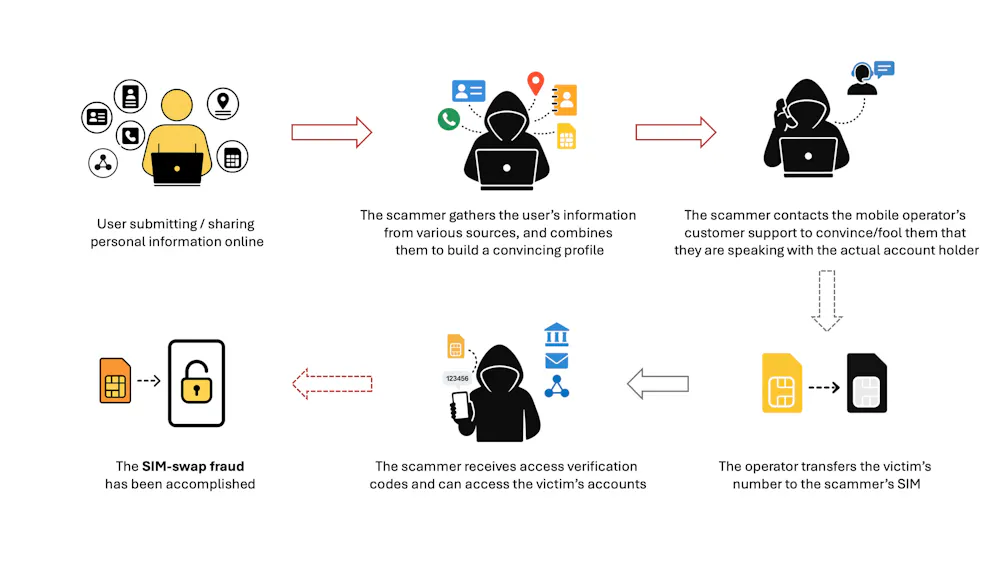
    Sim-swap fraud begins when a scammer convinces a mobile operator to transfer a victim’s number to a new sim card, or even an esim (one that’s embedded in the device), under the scammer’s control.

    This can be done over the phone, through an online chat, or even with the help of a
    bribed insider. Once the number is transferred, all calls and texts intended for the victim are redirected to the scammer. This includes those crucial verification codes used for logging into email, banking, messaging apps such as WhatsApp, and government services such as HMRC.

    This alone would be dangerous. But what makes sim-swap fraud so influential is
    that the cyber scammer often already has access to a patchwork of personal data
    about their target. That information may have been collected from data breaches,
    phishing attacks, low-reputation websites, or even the victim’s social media.

    People often underestimate the extent to which they reveal themselves online: a birthday posted on Instagram, a phone number included in a job posting, or a home address used in an online giveaway. Scammers combine this data to build a convincing profile, enough to fool a mobile operator’s customer service staff into believing they’re talking to the real account holder.

    How the sim-swap fraud works

    Once the scammer gains control of a number, the consequences are extensive.
    Attackers can access sensitive information, including personal documents and
    request and receive password reset links for the user’s other accounts. They can log in to WhatsApp or Telegram accounts, read private messages, impersonate the user, and even contact friends or family members to conduct further scams.

    The victims might see false messages posted in their names or fraudulent transactions made from their accounts. This can lead to financial loss, reputation damage, as well as emotional and mental health issues on the part of the victims.

    In the case of M&S, attackers apparently used this access to manipulate internal
    processes and gain access to sensitive systems. This highlights a broader risk:
    many companies still rely on phone numbers as a secondary verification method for
    staff, making their systems vulnerable to the same cyberattack used against
    individuals.

    How sim-Swap fraud works.
    Hossein Abroshan

    Reducing the risk

    While real-time detection of mobile number hijacking remains difficult, taking specific steps can significantly reduce the likelihood of being targeted and victimised. People should avoid sharing personal data unnecessarily, especially across multiple platforms and, very importantly, on unknown or untrusted websites.

    Many attackers don’t obtain all the necessary information from a single source. Instead, they collect it incrementally, using public profiles, marketing databases and past leaks to form a comprehensive picture.

    Being mindful of where you share your phone number, birthday or other identifiers can make it harder for others to impersonate you. It is also crucial to learn how phishing works and how to recognise it, so you will not submit your sensitive information to phishing or fake websites.

    Avoiding SMS-based authentication, where possible, is another key step. Many
    services now support authenticator apps, such as Google Authenticator, Microsoft Authenticator, Due or Authy, which are not tied to your mobile number. For mobile
    accounts themselves, setting up a unique pin or password to your account, which
    must be provided to authorise any changes, can add an extra layer of protection. This makes it harder for someone to initiate a sim swap without that code. However, users alone cannot fulfil this duty.

    Mobile network operators must strengthen identity verification practices, moving beyond basic questions about names and addresses that can be easily gathered or guessed. Banks and other financial institutions should reconsider using SMS or, at the very least, SMS-only as the default method for sensitive authentication. And companies, particularly those handling personal data or financial assets, need to train their IT and customer service teams to recognise the signs of identity based attacks.

    Sim-swap fraud is effective not because it’s highly technical, but because it exploits our trust in phone numbers for identity verification. The M&S case and similar examples show how fragile that trust can be – and why securing our mobile identities is no longer optional.

    ref. M&S cyberattacks used a little-known but dangerous technique – https://theconversation.com/mands-cyberattacks-used-a-little-known-but-dangerous-technique-256601

    MIL OSI – Global Reports

  • MIL-OSI USA: U.S. electricity prices continue steady increase

    Source: US Energy Information Administration

    In-depth analysis

    May 14, 2025


    Retail electricity prices have increased faster than the rate of inflation since 2022, and we expect them to continue increasing through 2026, based on forecasts in our Short-Term Energy Outlook. Parts of the country with relatively high electricity prices may experience greater price increases than those with relatively low electricity prices.

    Overall, U.S. energy prices rapidly increased from 2020 to 2022 as economic activity recovered after the worst of the pandemic and Russia’s invasion of Ukraine interrupted energy supply chains. Since 2022, nominal prices for many fuels have declined, particularly for those such as gasoline and heating oil that are tied more closely to crude oil prices, which are affected by international markets. Electricity prices, though, have continued a steady increase.

    Regions with already high electricity prices may see larger increases

    Although we expect the nominal U.S. average electricity price to increase by 13% from 2022 to 2025, our forecasts for retail electricity price increases differ across the country. Residential electricity prices in the Pacific, Middle Atlantic, and New England census divisions—regions where consumers already pay much more per kilowatthour for electricity—could increase more than the national average. By comparison, residential electricity prices in areas with relatively low electricity prices may not increase as much.


    Electricity prices include more than the cost of generating electricity

    Retail electricity prices include the cost of generating, transmitting, and delivering electricity to ultimate customers, as well as taxes and other fees. In recent years, electric utilities have increased capital investment to replace or upgrade aging generation and delivery infrastructure, among other factors. Between 2013 and 2023, electricity prices closely tracked inflation, but we expect increases in electricity prices to outpace inflation through 2026.

    Utility spending on electricity distribution has surpassed spending on electricity transmission and production, according to our analysis of utilities’ financial reports to the Federal Energy Regulatory Commission. The generation-related portions of retail electricity typically lag changes in wholesale spot prices of electricity generation fuels such as natural gas and coal depending on the customer contract agreements.

    Electricity expenditures are second only to gasoline

    U.S. consumers spent an average of about $1,760 on electricity expenditures in 2023. Among fuel-related expenditures, electricity expenditures are surpassed only by gasoline, which averaged nearly $2,450 in 2023, according to the most recent data available from the U.S. Bureau of Labor Statistics’ Consumer Expenditure Survey. Annual fluctuations in electricity expenditures tend to be more moderate than gasoline prices, which tend to follow changes in global crude oil prices.


    Principal contributor: Owen Comstock

    MIL OSI USA News

  • MIL-OSI: First Busey Corporation Prices Depositary Share Offering

    Source: GlobeNewswire (MIL-OSI)

    LEAWOOD, Kan., May 14, 2025 (GLOBE NEWSWIRE) — First Busey Corporation (“Busey”) (Nasdaq: BUSE), the holding company for Busey Bank and CrossFirst Bank, announced the pricing of an underwritten public offering of 8,000,000 depositary shares, each representing a 1/40th ownership interest in a share of its 8.25% Fixed Rate Series B Non-Cumulative Perpetual Preferred Stock (the “Series B preferred stock”), with a liquidation preference of $1,000 per share (equivalent to $25.00 per depositary share).

    When, as, and if declared by the board of directors of Busey, dividends will be payable on the Series B preferred stock from the date of issuance at a rate of 8.25% per annum, payable quarterly in arrears, on March 1, June 1, September 1 and December 1 of each year, beginning on September 1, 2025. Busey may redeem the Series B preferred stock at its option at a redemption price equal to $25.00 per depositary share, as described in the prospectus supplement and accompanying prospectus relating to the offering.

    Net proceeds from the offering are expected to be used to redeem Busey’s 5.25% Fixed-to-Floating Rate Subordinated Notes due 2030, and for general corporate purposes including to support balance sheet growth of Busey Bank.

    Busey intends to apply to list the depositary shares on the Nasdaq Global Select Market under the symbol “BUSEP.”

    Piper Sandler & Co., Morgan Stanley & Co. LLC and Keefe, Bruyette & Woods, Inc. are serving as joint bookrunning managers for the offering, and Janney Montgomery Scott LLC is acting as the co-manager.

    The Company expects to close the offering, subject to customary conditions, on or about May 20, 2025.

    The Company filed a “shelf” registration statement (File No. 333-274620) (including a base prospectus (the “Base Prospectus”)) on September 21, 2023 and the related preliminary prospectus supplement on May 13, 2025 (the “Preliminary Prospectus Supplement”) with the Securities and Exchange Commission (“SEC”) for the offering to which this communication relates. You may obtain these documents for free by visiting EDGAR on the SEC’s website at www.sec.gov. Alternatively, Busey, any underwriter or any dealer participating in the offering will arrange to send you the Base Prospectus and the Preliminary Prospectus Supplement if you request it by emailing Piper Sandler & Co. at fsg-dcm@psc.com or calling Morgan Stanley & Co. LLC toll-free at 1-866-718-1649 or Keefe, Bruyette & Woods, A Stifel Company at 1-800-966-1559.

    This news release shall not constitute an offer to sell, or the solicitation of an offer to buy any securities, nor shall there be any offer or sale of these securities in any jurisdiction in which such offer, solicitation, or sale would be unlawful prior to registration or qualification under the securities laws of any such jurisdiction.

    Corporate Profile
    As of March 31, 2025, First Busey Corporation (Nasdaq: BUSE) was a $19.46 billion financial holding company headquartered in Leawood, Kansas.

    Busey Bank, a wholly-owned bank subsidiary of First Busey Corporation headquartered in Champaign, Illinois, had total assets of $11.98 billion as of March 31, 2025. Busey Bank currently has 62 banking centers, with 21 in Central Illinois markets, 17 in suburban Chicago markets, 20 in the St. Louis Metropolitan Statistical Area, three in Southwest Florida, and one in Indianapolis. More information about Busey Bank can be found at busey.com.

    CrossFirst Bank, a wholly-owned bank subsidiary of First Busey Corporation headquartered in Leawood, Kansas, had total assets of $7.45 billion as of March 31, 2025. CrossFirst Bank currently has 16 banking centers located across Arizona, Colorado, Kansas, Missouri, New Mexico, Oklahoma, and Texas. More information about CrossFirst Bank can be found at crossfirstbank.com. It is anticipated that CrossFirst Bank will be merged with and into Busey Bank on June 20, 2025.

    Through Busey’s Wealth Management division, the Company provides a full range of asset management, investment, brokerage, fiduciary, philanthropic advisory, tax preparation, and farm management services to individuals, businesses, and foundations. Assets under care totaled $13.68 billion as of March 31, 2025. More information about Busey’s Wealth Management services can be found at busey.com/wealth-management.

    Busey Bank’s wholly-owned subsidiary, FirsTech, specializes in the evolving financial technology needs of small and medium-sized businesses, highly regulated enterprise industries, and financial institutions. FirsTech provides comprehensive and innovative payment technology solutions, including online, mobile, and voice-recognition bill payments; money and data movement; merchant services; direct debit services; lockbox remittance processing for payments made by mail; and walk-in payments at retail agents. Additionally, FirsTech simplifies client workflows through integrations enabling support with billing, reconciliation, bill reminders, and treasury services. More information about FirsTech can be found at firstechpayments.com.

    For the fourth consecutive year, Busey was named among 2025’s America’s Best Banks by Forbes. Ranked 88th overall, Busey was one of seven banks headquartered in Illinois included on this year’s list. Busey was also named among the 2024 Best Banks to Work For by American Banker, the 2024 Best Places to Work in Money Management by Pensions and Investments, the 2024 Best Places to Work in Illinois by Daily Herald Business Ledger, the 2025 Best Places to Work in Indiana by the Indiana Chamber of Commerce, and the 2024 Best Companies to Work For in Florida by Florida Trend magazine. We are honored to be consistently recognized globally, nationally and locally for our engaged culture of integrity and commitment to community development.

    First Busey Corporation Contacts
    For Financials:  For Media:
    Scott Phillips, Interim CFO Amy L. Randolph, EVP & COO
    First Busey Corporation  First Busey Corporation
    (239) 689-7167 (217) 365-4049
    scott.phillips@busey.com amy.randolph@busey.com
       

    Forward-Looking Statements
    This press release may contain “forward-looking statements” within the meaning of the Private Securities Litigation Reform Act of 1995 with respect to Busey’s financial condition, results of operations, plans, objectives, future performance, and business. Forward-looking statements, which may be based upon beliefs, expectations, and assumptions of Busey’s management and on information currently available to management, are generally identifiable by the use of words such as “believe,” “expect,” “anticipate,” “plan,” “intend,” “estimate,” “may,” “will,” “would,” “could,” “should,” “position,” or other similar expressions. Additionally, all statements in this document, including forward-looking statements, speak only as of the date they are made, and Busey undertakes no obligation to update any statement in light of new information or future events.

    A number of factors, many of which are beyond Busey’s ability to control or predict, could cause actual results to differ materially from those in any forward-looking statements. These factors include, among others, the following: (1) the strength of the local, state, national, and international economies and financial markets (including effects of inflationary pressures, the threat or implementation of tariffs, trade wars, and changes to immigration policy); (2) changes in, and the interpretation and prioritization of, local, state, and federal laws, regulations, and governmental policies (including those concerning Busey’s general business); (3) the economic impact of any future terrorist threats or attacks, widespread disease or pandemics, or other adverse external events that could cause economic deterioration or instability in credit markets (including Russia’s invasion of Ukraine and the conflict in the Middle East); (4) unexpected results of acquisitions, including the acquisition of CrossFirst Bankshares, Inc., which may include the failure to realize the anticipated benefits of the acquisitions and the possibility that the transaction and integration costs may be greater than anticipated; (5) the imposition of tariffs or other governmental policies impacting the value of products produced by Busey’s commercial borrowers; (6) new or revised accounting policies and practices as may be adopted by state and federal regulatory banking agencies, the Financial Accounting Standards Board, the Securities and Exchange Commission, or the Public Company Accounting Oversight Board; (7) changes in interest rates and prepayment rates of Busey’s assets (including the impact of sustained elevated interest rates); (8) increased competition in the financial services sector (including from non-bank competitors such as credit unions and fintech companies) and the inability to attract new customers; (9) changes in technology and the ability to develop and maintain secure and reliable electronic systems; (10) the loss of key executives or associates, talent shortages, and employee turnover; (11) unexpected outcomes and costs of existing or new litigation, investigations, or other legal proceedings, inquiries, and regulatory actions involving Busey (including with respect to Busey’s Illinois franchise taxes); (12) fluctuations in the value of securities held in Busey’s securities portfolio, including as a result of changes in interest rates; (13) credit risk and risk from concentrations (by type of borrower, geographic area, collateral, and industry), within Busey’s loan portfolio and large loans to certain borrowers (including commercial real estate loans); (14) the concentration of large deposits from certain clients who have balances above current Federal Deposit Insurance Corporation insurance limits and may withdraw deposits to diversify their exposure; (15) the level of non-performing assets on Busey’s balance sheets; (16) interruptions involving information technology and communications systems or third-party servicers; (17) breaches or failures of information security controls or cybersecurity-related incidents; (18) the economic impact on Busey and its customers of climate change, natural disasters, and exceptional weather occurrences such as tornadoes, hurricanes, floods, blizzards, and droughts; (19) the ability to successfully manage liquidity risk, which may increase dependence on non-core funding sources such as brokered deposits, and may negatively impact Busey’s cost of funds; (20) the ability to maintain an adequate level of allowance for credit losses on loans; (21) the effectiveness of Busey’s risk management framework; and (22) the ability of Busey to manage the risks associated with the foregoing. These risks and uncertainties should be considered in evaluating forward-looking statements and undue reliance should not be placed on such statements.

    The MIL Network

  • MIL-OSI: Alternative Ballistics Advances Less-Lethal Innovation Through V2 Global Partnership

    Source: GlobeNewswire (MIL-OSI)

    Las Vegas, Nevada, May 14, 2025 (GLOBE NEWSWIRE) — Alternative Ballistics Corporation, an innovative safety technology company, is pleased to announce its engagement with V2 Global, a distinguished advisory consulting firm specializing in risk mitigation, business intelligence, public safety advisory, and security solutions.

    This partnership represents a pivotal advancement in Alternative Ballistics’ mission to broaden the reach and impact of its innovative, life-saving technology. As part of the collaboration, Don De Lucca—Partner at V2 Global and a former Chief of Police with more than 30 years of leadership in law enforcement and public safety—will work closely with the Alternative Ballistics team to help guide strategic growth and implementation.

    “We’re excited to partner with V2 Global and to welcome Don De Lucca’s leadership and expertise,” said Steve Luna, CEO of Alternative Ballistics. “His extensive experience in policing and public safety will be invaluable as we continue to scale our efforts and bring life-saving technologies to agencies both in the U.S. and abroad.”

    De Lucca also shared his enthusiasm for the partnership: “Alternative Ballistics has created a groundbreaking tool that enhances both officer and public safety. I’m honored to support their mission and help further the adoption of more responsible and effective force alternatives in modern policing.”

    This collaboration marks a key milestone in Alternative Ballistics’ commitment to advancing innovative, less-lethal solutions that bridge the crucial gap between preserving life and protecting officers.

    About Alternative Ballistics Corp.

    Alternative Ballistics Corporation (“ABC”) produces an innovative less-lethal product known as The Alternative® which features patented bullet capture technology. The product is used by law enforcement as a de-escalation tool in critical incidents when encountering a non-compliant subject in crisis, in possession of a weapon other than a firearm, who presents a threat to themselves, to officers, or to bystanders. A lightweight, easy-to-carry docking unit, The Alternative® efficiently attaches to a service weapon to convert a fired bullet into a kinetic impact round that, when deployed from a safe distance, travels downrange with non-penetrating energy, and temporarily incapacitates an individual with low risk of critical injury or death. Once deployed, the service weapon reverts to standard use. The Alternative® may also be available in the future in the commercial market as a self-defense tool for the purpose of protecting life and property. It is the only less-lethal product in either the law enforcement or commercial market that works with a service weapon or semi-automatic handgun for seamless protective cover and doesn’t require transition to a separate device, allowing the user to keep eyes and weapon on the threat at all times.

    About V2 Global

    V2 Global is a risk mitigation and relationship management consulting firm delivering Business Intelligence, Crisis Management & Strategic Advisory Services, Public Safety Advisory and Security Solutions. V2 specializes in identifying, remediating and monitoring risk across your enterprise. Clients are C-Suite executives, law firms and their clients, general counsels and high-profile individuals. V2 Global’s success is based on the ability to rapidly assemble a team anywhere on the globe to identify, resolve and mitigate business issues. Additional information can be found at their website https://www.v2-global.com/about-v2.

    Forward-Looking Statements

    This document contains forward-looking statements. In addition, from time to time, we or our representatives may make forward-looking statements orally or in writing. We base these forward-looking statements on our expectations and projections about future events, which we derive from the information currently available to us. In evaluating these forward-looking statements, you should consider various factors, including: our ability to advance the direction of the Company; our ability to keep pace with new technology and changing market needs; and the competitive environment of our business. These and other factors may cause our actual results to differ materially from any forward-looking statement.

    Company Contact:
    info@alternativeballistics.com
    www.alternativeballistics.com

    For Investor Inquiries, please contact:
    Hanover International, Inc.
    Kathy Cusumano, President
    ka@hanoverintlinc.com

    The MIL Network

  • MIL-OSI: Desk-Based Roles See Application Surges Amid Slowing Demand, Growing AI Adoption, While Frontline and Hourly Workforce Face Talent Shortages

    Source: GlobeNewswire (MIL-OSI)

    DENVER, May 14, 2025 (GLOBE NEWSWIRE) — As economic conditions shift across industries, the U.S. job market is showing clear signs of fragmentation. According to the new Job Seeker Nation report from Employ, desk-based job sectors are experiencing a dramatic rise in competition and application volume, while employers in frontline roles continue to struggle with talent shortages. Overall employment remains strong, but these varying degrees of trends point to deeper shifts in how different segments of the labor market are evolving—and what job seekers and employers must do to keep pace.

    Desk-Based Role Competition Intensifies Amid Slowing Demand, While Frontline Faces Labor Shortages

    Job postings from desk-based worker sectors like finance, professional services, and tech have declined year over year, creating bottlenecks of qualified talent competing for a shrinking number of roles. Recent findings revealed that desk-based workers are interviewing more often than those in frontline roles. Overall, 64 percent of respondents reported having more than two interviews in the past year—but that number drops to 55 percent among fully on-site workers, compared to those who work remotely 1–2 days per week (77 percent) or split their time 50/50 between being remote and in office (75 percent).

    This gap may stem from both flexibility and function. Remote workers have more privacy to take interviews without being seen or overheard, while on-site workers may need to take PTO just to participate. And with more volatility in desk-based industries like tech and quits rates for the private sector falling to 2.1 percent, according to the Bureau of Labor Statistics, this fairly recent drop in quits suggests employees are staying in roles longer, which could be due to competition and lack of work.

    “This is no longer a one-size-fits-all labor market,” said Stephanie Manzelli, Chief Human Resources Officer at Employ. “We’re seeing two very different job markets emerge—one overwhelmed with applications, and another starved for talent. Businesses need to reassess and refine hiring processes to ensure they are meeting the needs of today’s dynamic candidate market, especially as we continue to see certain sectors being significantly impacted by layoffs or new college grads getting ready to graduate.”

    AI Drives an Application Arms Race

    As job seekers navigate the hiring crunch, many are turning to AI tools to gain an edge. About one-third of respondents from the report (31 percent) say they’re using AI to support their job search—an increase of seven percentage points from last year. Desk-based worker applicants were using AI the most, especially those in software/technology/IT (50 percent) and finance/insurance/accounting (47 percent).

    While the ways candidates use AI have shifted slightly, some trends are holding steady. Fewer respondents reported using AI to write or review resumes (52 percent, down from 58 percent in 2024) and to generate interview questions (38 percent, down from 42 percent in 2024). However, AI usage in other areas remains consistent: nearly half (48 percent) still use it to write or review cover letters, and 69 percent continue to rely on AI to find or match with relevant job listings.

    AI has become a standard part of the desk-based worker job search, using every tool at their disposal to optimize their applications, sometimes even applying to multiple roles in a week. By contrast, AI adoption remains fairly limited in the frontline space just due to the continued use of more traditional methods of recruiting/hiring, such as referrals, job fairs, trade schools, and in-person applications.

    The Growing Divide—and What It Means

    With 66 percent of workers feeling burnt out from a stagnant market, where employers are cautious, and more employees are staying put at their current jobs, it’s no wonder that 82 percent of surveyed respondents are thinking we could see a “white-collar recession.”

    This split in labor dynamics is forcing employers to reconsider hiring practices, workforce development, and the role of technology in talent acquisition. For desk-based worker employers, streamlining hiring processes, prioritizing skills-based hiring over diplomas, and ensuring accurate job descriptions are strategies to reduce applicant fatigue. For frontline employers, investing in tools such as recruitment marketing, on-the-job training, and broader talent pipelines may be key to attracting new talent.

    To access the full Job Seeker Nation report and discover more about trends in job seeker behavior, visit here.

    About Employ

    Employ delivers people-first recruiting solutions that empower companies to overcome their greatest hiring challenges. From startups to Fortune 100 organizations, Employ meets companies where they are—offering tailored solutions that support everything from foundational hiring to advanced talent acquisition strategies. Employ is the only organization to offer companies choice in their hiring technology, providing three unique ATS platforms (JazzHR, Lever, and Jobvite) and AI Companions that work alongside you in your hiring journey. Our intelligent hiring suite is trusted by more than 23,000 customers across multiple industries. For more information, visit www.employinc.com.

    The MIL Network

  • MIL-OSI: ibex Wave iX Wins Gold Stevie® Award at The 23rd Annual American Business Awards®

    Source: GlobeNewswire (MIL-OSI)

    WASHINGTON, May 14, 2025 (GLOBE NEWSWIRE) — ibex (NASDAQ: IBEX), a leading global provider of business process outsourcing (BPO) and AI-powered customer engagement technology solutions, today announced that ibex Wave iX has earned the Gold Stevie® Award in the Achievement in Technology Innovation category for The 23rd Annual American Business Awards®. This honor emphasizes the success of ibex’s AI-powered Wave iX solution platform in transforming the customer experience for leading brands around the world.

    “We are proud to be recognized by The Stevie® Awards for The Annual American Business Awards®,” said Carl O’Neil, EVP and GM of Wave iX, Augment, and ibex CX. “AI is transforming the customer experience landscape, and ibex is leading this evolution by creating groundbreaking AI-powered CX solutions that redefine how businesses engage with their customers.”

    ibex takes a solutions-driven approach to align with specific business needs and deliver real solutions for transformative outcomes. ibex Wave iX fuses cutting-edge technology with unmatched CX expertise to enable the next generation of AI and agent-assisted customer experience.

    “ibex Wave iX solutions drive true digital transformation and empower businesses of all sizes with advanced, customer-facing self-service capabilities as they adapt to deliver smarter, more personalized interactions,” O’Neil said. “Rather than forcing one-size-fits-all tools, we work closely with our clients to create customized, AI-powered CX solutions that produce meaningful, transformative results.”

    The American Business Awards complimented the impressive achievements of ibex Wave iX on multiple levels. The judges commended how ibex’s innovative approach to digital marketing and customer acquisition is transforming the industry. ibex is additionally recognized as an ideal strategic partner that executes the goals of their clients with excellent customer satisfaction.

    Explore the full suite of ibex Wave iX solutions here.

    “Organizations across the United States continue to demonstrate resilience and innovation,” said Stevie Awards president Maggie Miller. “The 2025 Stevie winners have helped drive that success through their innovation, persistence and hard work.”

    About the Stevie Awards
    Stevie Awards are conferred in nine programs: the Asia-Pacific Stevie Awards, the German Stevie Awards, the Middle East & North Africa Stevie Awards, The American Business Awards®, The International Business Awards®, the Stevie Awards for Women in Business, the Stevie Awards for Great Employers, the Stevie Awards for Sales & Customer Service, and the Stevie Awards for Technology Excellence. Stevie Awards competitions receive more than 12,000 entries each year from organizations in more than 70 nations. Honoring organizations of all types and sizes and the people behind them, the Stevies recognize outstanding performances in the workplace worldwide. Learn more about the Stevie Awards at http://www.StevieAwards.com.

    About ibex
    ibex delivers innovative business process outsourcing (BPO), smart digital marketing, online acquisition technology, and end-to-end customer engagement solutions to help companies acquire, engage and retain valuable customers. Today, ibex operates a global CX delivery center model consisting of approximately 30 operations facilities around the world, while deploying next generation technology to drive superior customer experiences for many of the world’s leading companies across retail, e-commerce, healthcare, fintech, utilities and logistics.

    ibex leverages its diverse global team of more than 31,000 employees together with industry-leading technology, including its AI-powered ibex Wave iX solutions suite, to manage nearly 175 million critical customer interactions, adding over $2.2B in lifetime customer revenue each year and driving a truly differentiated customer experience. To learn more, visit our website at ibex.co and connect with us on LinkedIn.

    Media Contact:
    Dan Burris
    ibex
    Daniel.Burris@ibex.co

    A photo accompanying this announcement is available at https://www.globenewswire.com/NewsRoom/AttachmentNg/4f2882e7-814b-4215-b4a0-caa2e4d988ec

    The MIL Network

  • MIL-OSI: Dan Starr and Mindy Creighton Truex Appointed to Lakeland Financial Corporation and Lake City Bank Boards of Directors

    Source: GlobeNewswire (MIL-OSI)

    WARSAW, Ind., May 14, 2025 (GLOBE NEWSWIRE) — Lakeland Financial Corporation (Nasdaq Global Select/LKFN) and Lake City Bank announced today that Dan Starr and Mindy Creighton Truex have been appointed to their respective Boards of Directors.

    “Our boards represent the foundational building blocks of stable corporate governance, leadership and engagement in our Indiana communities and provide balanced and thoughtful feedback to our leadership team. The addition of Dan and Mindy brings two proven business and community leaders to the table,” said David M. Findlay, Chairman and CEO. “Our boards are an extension of the bank in our Indiana markets and are active partners in the focus to drive long-term shareholder value. Both Dan and Mindy share a strong commitment to building long-term relationships within their industries and communities, which fits perfectly with Lake City Bank’s community banking philosophy.”

    Starr is CEO of Do it Best Corp., a Fort Wayne-based member-owned hardware, lumber and building materials buying cooperative in the home improvement industry with thousands of member-owned locations across the United States and in more than 60 countries. He has been with Do it Best Corp. for two decades and held several leadership roles prior to becoming President and CEO in 2016. Before joining Do it Best Corp., Starr was a partner with Barnes & Thornburg LLP and served as the firm’s Business, Tax & Real Estate departmental administrator in Fort Wayne.

    “Lake City Bank plays a vital role in many communities across our state and joining the board is an exciting opportunity,” said Starr. “I look forward to contributing to the continued growth and momentum of the bank.”

    Starr has a juris doctor degree magna cum laude from the Indiana University School of Law. He has served in numerous board leadership roles within the greater Fort Wayne community, including the Northeast Indiana Innovation Center, St. Francis Family Business Center and Fort Wayne Ballet. He currently serves as chairman of the Parkview Health Board of Directors, as well as on the Manchester University Board of Trustees Outreach Committee and the Do it Best Foundation.

    Mindy Creighton Truex is President of Creighton Brothers Farms LLC, a Warsaw-based family-owned farm founded in 1925. With extensive experience in the agricultural sector, she has been instrumental in developing innovative initiatives with Creighton Brothers Farms, including educational and farm-to-table experiences. She has served in leadership roles with national and local agricultural advocacy organizations, including the American Egg Board, United Egg Producers, Indiana State Poultry Association and Purdue University Animal Science Department Dean’s Advisory Committee.

    “As a sixth generation Kosciusko County farmer, I’m honored to join the Lake City Bank and Lakeland Financial Corporation boards,” said Creighton Truex. “Lake City Bank has been a part of the fabric of our community since 1872 and I’m excited to help the bank continue to grow.”

    Creighton Truex has a bachelor’s degree in agribusiness management from Purdue University. She has served on the boards of many nonprofit organizations that impact her local community, including the Kosciusko County Visitor’s Bureau, Kosciusko County Community Foundation, Kosciusko County Leadership Academy, Purdue University’s Kosciusko County Agricultural Extension, Kosciusko County Farm Bureau, and United Way of Kosciusko County.

    Lakeland Financial Corporation (Nasdaq Global Select/LKFN) is a $6.9 billion bank holding company headquartered in Warsaw, Indiana. Lake City Bank, its single bank subsidiary, was founded in 1872 and serves Central and Northern Indiana communities with 54 branch offices and a robust digital banking platform. Lake City Bank’s community banking model prioritizes building in‐market long‐term customer relationships while delivering technology‐forward solutions for retail and commercial clients. For more information visit www.lakecitybank.com.

    Contact
    Luke Weick
    Marketing Manager
    574 267-9198, x47279 office
    260 431-7061 mobile
    luke.weick@lakecitybank.com

    The MIL Network

  • MIL-OSI: Sprout Social Unveils New Innovations in its Care Solution, Empowering Brands to Drive Business with Proactive Social Care

    Source: GlobeNewswire (MIL-OSI)

    • Innovations to Care by Sprout will enable marketers to provide proactive, secure and insights-driven customer care on social.
    • New releases, available today, include additional bot channels, customizable workflows, compliance and governance capabilities, as well as more holistic reporting functionality.
    • Sprout announces its upcoming AI agent integration to resolve inquiries in seconds and free teams from repetitive tasks using a trained bot deployed across multiple channels.

    CHICAGO, May 14, 2025 (GLOBE NEWSWIRE) — Sprout Social (Nasdaq: SPT), an industry-leading provider of cloud-based social media management software, today announced a set of new innovations to its Care by Sprout Social solution. Designed to help brands meet rising customer expectations, the new features empower teams to deliver more proactive, secure and insights-driven social care–elevating support from a reactive necessity to a strategic business driver. Sprout Social also announced an upcoming AI agent integration, which will further enhance the care experience for customers and drive even more efficiency and impact for brands.

    Social media has become central to product discovery and purchasing, which means brands must deliver fast, personalized social care across platforms or risk losing vital customer trust and business. In fact, 73% of consumers say they will buy from a competitor if a brand doesn’t reply to them on social. While reactive support is expected, the new innovations in Care by Sprout empower brands to deliver proactive care, turning positive interactions into business assets that build loyalty and attract new customers.

    “We’re entering a new era where social care is a key differentiator, influencing purchasing decisions and shaping brand loyalty,” said Scott Morris, Sprout Social’s Chief Marketing Officer. “These latest innovations give brands the tools to not only meet but exceed customer expectations, turning care into a powerful driver of business outcomes across the organization. As technology and expectations continue to accelerate, our focus remains on building an adaptable, powerful platform that keeps our customers ahead of the curve.”

    Key Innovations in Care by Sprout:

    • Harness the Power of AI: Sprout’s upcoming AI agent integration will quickly resolve routine care inquiries, allowing human agents to dedicate their time on more complex, meaningful tasks.
    • Automate for Efficiency: New bot channels, such as Instagram and WhatsApp, along with enhanced flexibility features like Queue Customizations, empower teams to engage customers across more platforms, streamline agent workflows, and allow brands to tailor social care programs to their specific needs.
    • Proactively Protect Your Brand: New governance and compliance capabilities enable brands to manage more complex social care cases within social—eliminating the need to deflect to traditional channels. With secure forms and data masking, customer data stays protected, while access controls and blocked word settings help teams maintain security and brand integrity.
    • Unlock Actionable Insights: New Cases API allows brands to easily connect social care data to broader datasets for more holistic insights, while features like goal time reporting help brands better understand their team operations and trends over time.

    “At ScottsMiracle-Gro, we’ve realized that social care isn’t just a support function but a strategic imperative that the success of our entire organization relies on,” said Sara Smith, Manager of Consumer Services at ScottsMiracle-Gro. “Sprout Social has helped us embrace this shift by providing an intuitive platform that brings our social and care teams together, enabling us to connect more effectively with our audiences and strengthen customer relationships. Social is now where critical engagement happens, and with Sprout, we’re navigating this new era of care as a united front that’s always ready to show up for our customers.”

    These enhancements further build on Sprout’s innovative care solution, which features AI capabilities, intuitive workflows and an industry-leading integration with Salesforce Service Cloud. The updates will be featured in today’s Breaking Ground, Sprout’s quarterly showcase of the company’s latest product updates and cutting-edge industry insights.

    For more information on Care by Sprout Social, please visit https://sproutsocial.com/social-customer-service/

    Social Media Profiles:
    www.x.com/SproutSocial
    www.x.com/SproutSocialIR
    www.facebook.com/SproutSocialInc
    www.linkedin.com/company/sprout-social-inc-/
    www.instagram.com/sproutsocial

    Contact
    Media:
    Kaitlyn Gronek
    Email: pr@sproutsocial.com
    Phone: (773) 904-9674

    Investors:
    Lexi Johnson
    Email: lexi.johnson@sproutsocial.com
    Phone: (312) 528-9166

    About Sprout Social

    Sprout Social is a global leader in social media management and analytics software, built on the belief that All Business is Social℠. Sprout’s intuitive platform puts powerful social data into the hands of approximately 30,000 brands so they can deliver smarter, faster business impact. Named the #1 Best Software Product by G2’s 2024 Best Software Award, Sprout offers comprehensive publishing and engagement functionality, customer care, influencer marketing, advocacy, and AI-powered business intelligence. Sprout’s software operates across all major social media networks and digital platforms. For more information about Sprout Social (NASDAQ: SPT), visit sproutsocial.com.

    Forward-Looking Statements

    This press release contains “forward-looking statements” within the meaning of Section 27A of the Securities Act of 1933, as amended, and Section 21E of the Securities Exchange Act of 1934, as amended. In some cases, you can identify forward-looking statements by terms such as “anticipate,” “believe,” “can,” “continue,” “could,” “enables,” “estimate,” “expect,” “explore,” “intend,” “long-term model,” “may,” “might” “outlook,” “plan,” “potential,” “predict,” “project,” “should,” “strategy,” “target,” “will,” “would,” or the negative of these terms, and similar expressions intended to identify forward-looking statements. However, not all forward-looking statements contain these identifying words. These statements may relate to the success, performance, and effect on our business and customers of our product features, our market size and growth strategy, our estimated and projected costs, margins, revenue, expenditures and customer and financial growth rates, our plans and objectives for future operations, growth, initiatives or strategies. By their nature, these statements are subject to numerous uncertainties and risks, including factors beyond our control, that could cause actual results, performance or achievement to differ materially and adversely from those anticipated or implied in the forward-looking statements. These assumptions, uncertainties and risks include that, among others: we may not be able to sustain our revenue and customer growth rate in the future; price increases have and may continue to negatively impact demand for our products, customer acquisition and retention and reduce the total number of customers or customer additions; our business would be harmed by any significant interruptions, delays or outages in services from our platform, our API providers, or certain social media platforms; if we are unable to attract potential customers through unpaid channels, convert this traffic to free trials or convert free trials to paid subscriptions, our business and results of operations may be adversely affected; we may be unable to successfully enter new markets, manage our international expansion and comply with any applicable international laws and regulations; we may be unable to integrate acquired businesses or technologies successfully or achieve the expected benefits of such acquisitions and investments; unstable market, economic, and political conditions, such as recession risks, effects of inflation, trade tensions, changes in government spending, labor shortages, supply chain issues, high interest rates, and the impacts of current and potential future bank failures and impacts of ongoing overseas conflicts, could adversely impact our business and that of our existing and prospective customers, which may result in reduced demand for our products; we may not be able to generate sufficient cash to service our indebtedness; covenants in our credit agreement may restrict our operations, and if we do not effectively manage our business to comply with these covenants, our financial condition could be adversely impacted; any cybersecurity-related attack, significant data breach or disruption of the information technology systems or networks on which we rely could negatively affect our business; and changing regulations relating to privacy, information security and data protection could increase our costs, affect or limit how we collect and use personal information and harm our brand. Additional risks and uncertainties that could cause actual outcomes and results to differ materially from those contemplated by the forward-looking statements are included under the caption “Risk Factors” and elsewhere in our filings with the Securities and Exchange Commission (the “SEC”), including our Annual Report on Form 10-K for the year ended December 31, 2024 filed with the SEC on February 26, 2025, and our Quarterly Report on Form 10-Q for the quarter ended March 31, 2025 filed with the SEC on May 8, 2025, as well as any future reports that we file with the SEC. Moreover, you should interpret many of the risks identified in those reports as being heightened as a result of the current instability in market, economic, and political conditions. Forward-looking statements speak only as of the date the statements are made and are based on information available to Sprout Social at the time those statements are made and/or management’s good faith belief as of that time with respect to future events. Sprout Social assumes no obligation to update forward-looking statements to reflect events or circumstances after the date they were made, except as required by law.

    The MIL Network

  • MIL-OSI: Himax and Vuzix to Showcase Integrated Industry-Ready AR Display Module at Display Week 2025

    Source: GlobeNewswire (MIL-OSI)

    TAINAN, Taiwan and ROCHESTER, N.Y., May 14, 2025 (GLOBE NEWSWIRE) — Vuzix® Corporation (Nasdaq: VUZI), (“Vuzix”), a leading supplier of AI-powered smart glasses, waveguides and Augmented Reality (AR) technologies and Himax Technologies, Inc. (Nasdaq: HIMX) (“Himax”), a leading supplier and fabless manufacturer of display drivers and other semiconductor products, today announced the joint debut of a next-generation AR optical module at Display Week 2025, one of the premier symposiums and exhibitions in the display industry and taking place May 11–16, 2025 in San Jose, California. The demonstration features Himax’s latest ultra-luminous, miniature Dual-Edge Front-lit LCoS microdisplay seamlessly integrated with Vuzix’ production-ready waveguides. Together, the technologies form a fully integrated module that delivers breakthrough brightness and power efficiency in an unparalleled compact design, enabling sleek, lightweight AR glasses for both enterprise and consumer applications. This co-design initiative, scheduled for commercial release at the end of 2025, focuses on optimizing optical performance to deliver industry-leading visual quality.

    Himax’s innovative and proprietary Dual-Edge Front-lit LCoS microdisplay sets a new industry benchmark with a volume of just 0.09 c.c., weighing less than 0.2 grams, yet capable of delivering 1 lumen of output and up to 350,000 nits of luminance, all while consuming no more than 250mW total power consumption. This ensures exceptional eye-level visibility across diverse lighting environments.

    Vuzix’ mass production waveguides elevate the optical experience with a slim 0.7 mm thickness, industry-leading lightweight, less than 5 grams, minimal discreet eye glow below 5%, and a 30-degree diagonal field of view (FOV). Fully customizable and integration-ready for next-generation AR devices, these waveguides support prescription lenses, offer both plastic-substrate and higher-refractive-index options, and are engineered for cost-effective large-scale deployment.

    “This demonstration showcases a commercially viable integration of Himax’s high-performance color LCoS microdisplay with Vuzix’ advanced waveguides, an industry-leading solution engineered for scale,” said Paul Travers, CEO of Vuzix. “Our waveguides are optically superior, customizable, and production-ready. Together, we’re helping accelerate the adoption of next-generation AR wearables.”

    “We are proud to work alongside Vuzix to bring this industry-ready solution to market,” said Simon Fan-Chiang, Senior Director at Himax. “Our latest LCoS innovation redefines what’s possible in size, brightness, and power efficiency paving the way for next generation AR devices. By pairing with Vuzix’ world-class waveguides, we are enabling AR devices that are immersive, comfortable and truly wearable.”

    Himax and Vuzix invite all interested parties to stop by at Booth #1711 at Display Week 2025 to experience the demo and learn more about this exciting joint solution.

    About Vuzix Corporation

    Vuzix is a leading designer, manufacturer and marketer of AI-powered Smart Glasses, Waveguides and Augmented Reality (AR) technologies, components and products for the enterprise, medical, defense and consumer markets. The Company’s products include head-mounted smart personal display and wearable computing devices that offer users a portable high-quality viewing experience, provide solutions for mobility, wearable displays and augmented reality, as well OEM waveguide optical components and display engines. Vuzix holds more than 425 patents and patents pending and numerous IP licenses in the fields of optics, head-mounted displays, and the augmented reality wearables field. The Company has won Consumer Electronics Show (or CES) awards for innovation for the years 2005 to 2024 and several wireless technology innovation awards among others. Founded in 1997, Vuzix is a public company (NASDAQ: VUZI) with offices in: Rochester, NY; and Kyoto and Okayama, Japan. For more information, visit the Vuzix website, X and Facebook pages.

    www.vuzix.com

    About Himax Technologies, Inc.

    Himax Technologies, Inc. (NASDAQ: HIMX) is a leading global fabless semiconductor solution provider dedicated to display imaging processing technologies. The Company’s display driver ICs and timing controllers have been adopted at scale across multiple industries worldwide including TVs, PC monitors, laptops, mobile phones, tablets, automotive, ePaper devices, industrial displays, among others. As the global market share leader in automotive display technology, the Company offers innovative and comprehensive automotive IC solutions, including traditional driver ICs, advanced in-cell Touch and Display Driver Integration (TDDI), local dimming timing controllers (Local Dimming Tcon), Large Touch and Display Driver Integration (LTDI) and OLED display technologies. Himax is also a pioneer in tinyML visual-AI and optical technology related fields. The Company’s industry-leading WiseEyeTM Ultralow Power AI Sensing technology which incorporates Himax proprietary ultralow power AI processor, always-on CMOS image sensor, and CNN-based AI algorithm has been widely deployed in consumer electronics and AIoT related applications. Himax optics technologies, such as diffractive wafer level optics, LCoS microdisplays and 3D sensing solutions, are critical for facilitating emerging AR/VR/metaverse technologies. Additionally, Himax designs and provides touch controllers, OLED ICs, LED ICs, EPD ICs, power management ICs, and CMOS image sensors for diverse display application coverage. Founded in 2001 and headquartered in Tainan, Taiwan, Himax currently employs around 2,200 people from three Taiwan-based offices in Tainan, Hsinchu and Taipei and country offices in China, Korea, Japan, Germany, and the US. Himax has 2,603 patents granted and 389 patents pending approval worldwide as of March 31, 2025.

    http://www.himax.com.tw

    Forward Looking Statements

    Factors that could cause actual events or results to differ materially from those described in this conference call include, but are not limited to, the effect of the Covid-19 pandemic on the Company’s business; general business and economic conditions and the state of the semiconductor industry; market acceptance and competitiveness of the driver and non-driver products developed by the Company; demand for end-use applications products; reliance on a small group of principal customers; the uncertainty of continued success in technological innovations; our ability to develop and protect our intellectual property; pricing pressures including declines in average selling prices; changes in customer order patterns; changes in estimated full-year effective tax rate; shortage in supply of key components; changes in environmental laws and regulations; changes in export license regulated by Export Administration Regulations (EAR); exchange rate fluctuations; regulatory approvals for further investments in our subsidiaries; our ability to collect accounts receivable and manage inventory and other risks described from time to time in the Company’s SEC filings, including those risks identified in the section entitled “Risk Factors” in its Form 20-F for the year ended December 31, 2024 filed with the SEC, as may be amended.

    Vuzix Contact:
    Ed McGregor, Director of Investor Relations
    Vuzix Corporation
    Tel: (585) 359-5985
    Email: IR@vuzix.com
    www.vuzix.com

    Himax Contacts:
    Karen Tiao, Head of IR/PR
    Himax Technologies, Inc.
    Tel: +886-2-2370-3999
    Fax: +886-2-2314-0877
    Email: hx_ir@himax.com.tw
    www.himax.com.tw

    Mark Schwalenberg, Director
    Investor Relations – US Representative
    MZ North America
    Tel: +1-312-261-6430
    Email: HIMX@mzgroup.us
    www.mzgroup.us

    The MIL Network

  • MIL-OSI Europe: AFRICA/DR CONGO – Testimony of the forgotten conflict in eastern DRC: The “100 days of liberated Goma”

    Source: Agenzia Fides – MIL OSI

    Wednesday, 14 May 2025 wars  

    Kinshasa (Agenzia Fides) – “Goma, capital of the North Kivu region, two million inhabitants. An occupied city, on its knees. Stretched along the shores of Lake Kivu, caressed by the heat of the Nyiragongo volcano, its beauty and the peace of some thirty years are turning into tears of fear and death.” These are the words that highlight the dramatic testimony sent to Fides from Goma, a city in the eastern Democratic Republic of Congo (DRC) that fell into the hands of the M23 rebels at the end of January. For security reasons, we are publishing it in full, omitting the author’s name: On January 28, after two days of intense fighting between the regular Congolese army, supported by the “Wazalendo” (patriotic militias), against the AFC (Congo River Alliance) and M23 (March 23, an invading rebel group supported by the Rwandan army), the city was once again declared “liberated.” A liberation that left a tragic toll of thousands of innocent civilians dead, many of them in their own homes, built with precarious materials, incapable of offering any shelter. Looting, rape, and abuse perpetrated by armed men from various factions have left deep scars. More than 100 days after the fighting, the wounds remain open, both on the body and in the collective memory of the population. Freedom of expression, human dignity, and the right to life and peace have been brutally violated. Today, the law of terror is imposed at gunpoint and with the blows of batons. The judicial system has collapsed. Instead of courts, detention centers have been set up that, in practice, function as places of torture. Prisons have been emptied—some 3,000 prisoners disappeared during the city’s capture—and trials, when they are held, are summary and improvised, even in the open air. The night has become a nightmare for the most vulnerable neighborhoods. Armed men break into homes to rob and sexually assault. These individuals include former prisoners, former military deserters, militia members, and others, operating anonymously under the cover of darkness. Sometimes, the attackers are captured by neighbors trying to defend the victims; their bodies often appear the next morning, abandoned or even burned. Fear, anger, and the absence of justice fuel a form of mob justice that is faceless and merciless. The search for alleged members of the FDLR (Democratic Forces for the Liberation of Rwanda), accused of participating in the 1994 genocide and now hiding in the neighborhoods of Goma, often serves as a pretext for personal vendettas or ethnic clashes, exacerbating already existing tensions. Arbitrary arrests and disappearances are part of a policy of repression aimed at silencing any dissenting voice. The economic situation is equally critical. The financial system is paralyzed: banks remain closed, preventing the payment of salaries, including those of teachers in affiliated schools. Commerce is at a standstill, and the international airport, vital to the city’s economic life, was bombed during the fighting and is out of service. The promises to keep alive hope for a better future—occupation propaganda comparing the supposedly more effective new “liberation” regime with the corrupt and ineffective old regime in Kinshasa—are numerous; but they fade with each passing day. Many young people, disillusioned with life or desperate with rage, volunteer to enlist in the army of the new masters and fight the regular army of the central government. Solution or illusion? Dying for the sake of dying: it’s worth a try. But the struggle for life has not been broken. The population helps each other in a thousand ways. The tens of thousands of displaced people, whose camps have been dismantled by the new authorities, have found refuge in the homes of friends, relatives, or people of good will. They share the same fears, the same suffering, but also the same hopes. The number of crosses increases, sometimes even invisible, because there is no trace left of the missing. But among the black lava rocks of the Nyiragongo volcano, scattered along the neighborhood roads, flowers are sprouting. With difficulty, because the earth is still soaked with blood. They are flowers with thin stems, but fragrant and colorful: red flowers, the color of the painful tears shed every day; green flowers, of hope and resistance, so that life does not die; flowers that symbolize a new society: the new society of Congo that is being born from the ashes of war. Yes, because life is like the sun: no matter how long and stormy the night, at dawn the sun reappears. (Agenzia Fides, 14/5/2025)
    Share:

    MIL OSI Europe News

  • MIL-OSI China: China enhances full-chain export control of strategic minerals to safeguard national security

    Source: People’s Republic of China – State Council News

    China will enhance the control over every link in the production and supply chain of strategic minerals to prevent their illegal outflow and safeguard national security, the Ministry of Commerce said on Wednesday.

    Strengthening the export control of strategic mineral resources is crucial to national security and development interests, according to a ministry spokesperson.

    On Monday, a national meeting convened in Changsha, capital of Hunan Province, stressed the need to strengthen “full-chain control over strategic mineral exports.” The meeting was attended by officials from 10 central government departments and seven strategic mineral-rich provincial-level regions including Inner Mongolia and Jiangxi.

    “To effectively prevent the illegal outflow of strategic minerals, control must start at the source and be strengthened across the entire chain, including mining, smelting, processing, transportation, manufacturing, sales, and exports,” the spokesperson said.

    Each department needs to effectively carry out day-to-day supervision to promptly identify risks and hidden dangers, addressing each case as it arises.

    Localities should strengthen their supervisory responsibilities, keep track of the production, operation, and flow of strategic minerals, and guide enterprises to enhance their awareness and capability of compliance, ensuring that control measures for strategic minerals are effectively implemented, according to the spokesperson.

    MIL OSI China News

  • MIL-OSI Russia: China Urges Food Delivery Companies to Compete Fairly

    Translation. Region: Russian Federal

    Source: People’s Republic of China in Russian – People’s Republic of China in Russian –

    Source: People’s Republic of China – State Council News

    BEIJING, May 14 (Xinhua) — China’s State Administration for Market Regulation, along with four other government departments, has called on food delivery companies to address pressing issues related to growing competition in the sector.

    In a meeting with representatives of companies such as JD.com, Meituan and Ele.me, officials from the above-mentioned departments required them to strictly comply with the E-Commerce Law of the People’s Republic of China, the Anti-Unfair Competition Law of the People’s Republic of China and the Food Safety Law of the People’s Republic of China.

    The said companies shall fulfill their social responsibilities, strengthen internal management, conduct legal business activities and compete fairly in order to promote the creation of a favorable market environment.

    The meeting emphasized the need to protect the legitimate rights and interests of consumers, platform operators and couriers to ensure the healthy development of the platform economy.

    As of December 2024, the number of users of online food ordering and delivery platforms in China reached 592 million, accounting for 53.4 percent of the total internet users, according to data from the China Internet Information Center. Industry data also shows that there are now more than 10 million food delivery workers across the country. -0-

    MIL OSI Russia News

  • MIL-OSI: Redfin and Magnite Join Forces to Give Advertisers Priority Access to Audience Targeting Across the Homebuying Journey

    Source: GlobeNewswire (MIL-OSI)

    NEW YORK, May 14, 2025 (GLOBE NEWSWIRE) —  Redfin (NASDAQ: RDFN), the technology-powered real estate brokerage, has selected Magnite (NASDAQ: MGNI), the largest independent sell-side advertising company, as its preferred SSP to power data-driven deals. Leveraging Magnite’s programmatic technology, Redfin can connect advertisers with exclusive real estate audiences at key moments in their home-buying journey.

    Redfin Media uniquely connects brands with 46 million upwardly mobile customers at each stage of their buying journey. With a vast network including Redfin, Rent.com, ApartmentGuide.com and WalkScore.com, the partnership delivers national scale and hyper-local targeting in a brand safe environment. Using sophisticated intent signals, Redfin uniquely knows when people move, where they are going, and what type of home they are looking for, enabling marketers to reach high-value, hard-to-reach customers.

    “As we build Redfin’s Commerce Media Network, we’re partnering with leading brands and platforms to connect high-intent homebuyers and movers with the right products and services at pivotal moments in their journey—creating meaningful value for both advertisers and consumers,” said Conny Mirza, General Manager of Digital Ads and Partnerships at Redfin.

    “Our collaboration with Magnite gives us the tools to package and activate that opportunity through scalable, transparent programmatic solutions,” said Amit Grover, Head of Programmatic Partnerships at Redfin.

    “Redfin is a trusted source for millions of homebuyers and renters and their insights provide advertisers with a unique opportunity to reach consumers at key decision-making moments,” said Ashley Wheeler, SVP, DV+ Platform at Magnite. “We’re excited to work closely with the Redfin team to enrich their omnichannel inventory and create more impactful advertising experiences.”

    About Magnite

    We’re Magnite (NASDAQ: MGNI), the world’s largest independent sell-side advertising company. Publishers use our technology to monetize their content across all screens and formats including CTV, online video, display, and audio. The world’s leading agencies and brands trust our platform to access brand-safe, high-quality ad inventory and execute billions of advertising transactions each month. Anchored in bustling New York City, sunny Los Angeles, mile high Denver, historic London, colorful Singapore, and down under in Sydney, Magnite has offices across North America, EMEA, LATAM, and APAC.

    About Redfin

    Redfin (www.redfin.com) is a technology-powered real estate company. We help people find a place to live with brokerage, rentals, lending, and title insurance services. We run the country’s #1 real estate brokerage site. Our customers can save thousands in fees while working with a top agent. Our home-buying customers see homes first with on-demand tours, and our lending and title services help them close quickly. Our rentals business empowers millions nationwide to find apartments and houses for rent. Since launching in 2006, we’ve saved customers more than $1.8 billion in commissions. We serve approximately 100 markets across the U.S. and Canada and employ over 4,000 people.

    Media Contact:

    Megan Hughes
    mhughes@magnite.com

    Investor Relations Contact:

    Nick Kormeluk
    nkormeluk@magnite.com
    949-500-0003

    The MIL Network

  • MIL-OSI Security: Former Owner of District Marijuana Dispensary Pleads Guilty to Over $1.2 Million in Federal Tax Evasion

    Source: Office of United States Attorneys

    WASHINGTON – Jennifer Brunenkant, 68, the founder and former owner of Herbal Alternatives II, LLC, a marijuana dispensary licensed in the District of Columbia, pleaded guilty today in connection with her years-long failure to pay federal income and employment taxes associated with her business.

    The plea was announced by U.S. Attorney Edward R. Martin Jr. and Executive Special Agent in Charge Kareem Carter of the Internal Revenue Service Criminal Investigation’s Washington D.C. Office.

    Brunenkant, of Washington, D.C., pleaded guilty before U.S. District Court Judge Loren L. AliKhan to attempting to evade or defeat tax. Judge AliKhan will determine any sentence for Brunenkant after considering the U.S. Sentencing Guidelines and other statutory factors.  Brunenkant is scheduled to be sentenced on Nov. 20, 2025.

    In pleading guilty, Brunenkant admitted that, from tax years 2017 to 2021, she failed to pay federal income and employment taxes that were due to the IRS in connection with substantial income she received from, and employees she had with, Herbal Alternatives II. Brunenkant further attempted to evade paying those taxes by falsely attesting on her annual Unincorporated Business Franchise Tax Forms, filed in the District of Columbia, that she had filed her federal income tax returns – when in fact she had not. Brunenkant continued trying to avoid detection when she repeatedly told law enforcement during a July 2023 interview that she had filed her returns.

    At Brunenkant’s sentencing hearing the government will seek restitution of more than $1.2 million, money due for Brunenkant’s unpaid federal income and employment taxes.

    This case was investigated by IRS Criminal Investigation. The matter is being prosecuted by Assistant U.S. Attorney Brian P. Kelly.

    25cr056

    MIL Security OSI

  • MIL-OSI: Global-e and Shopify sign new multi-year strategic partnership agreement, extending relationship

    Source: GlobeNewswire (MIL-OSI)

    PETAH-TIKVA, Israel, May 14, 2025 (GLOBE NEWSWIRE) — Global-e Online Ltd. (Nasdaq: GLBE) the leader of global Direct-To-Consumer eCommerce enablement, and Shopify, a leading commerce technology company, today announced a new 3-year strategic partnership agreement. The new agreement renews the companies’ long-standing strategic partnership for both their 1P (i.e. Shopify Managed Markets) and 3P solutions to empower international direct to consumer e-commerce on the Shopify platform.

    “As the leader in this market, Global-e has been a great partner of ours for over four years now, helping Shopify merchants realize their true global potential,” said Kaz Nejatian, COO of Shopify. “Our renewed agreement enables us to take our offering to the next level and enhance opportunities and optionality for merchants of all sizes, geographies and verticals to grow their global footprint.”

    “In early 2021 we teamed up with Shopify to build a unique native integration which streamlined the way merchants transact with their global audiences. Not long after, we expanded our partnership, as our teams worked hand-in-hand to create the innovative Managed Markets solution, a first-of-its-kind merchant-of-record solution built for self-onboarding,” said Amir Schlachet, Founder and CEO of Global-e. “The new multi-year strategic agreement we have signed will carry our long-standing partnership into the future and enhance the value we can bring to our joint merchants. We look forward to continuing our close work with our partners at Shopify over the coming years as we continue our journey to power better global e-commerce for merchants around the globe.”

    The companies’ new three-year strategic partnership covers both 1P (Shopify Managed Markets) and 3P MoR (Merchant of Record) solutions.

    According to the new agreement, for 1P (Shopify Managed Markets) Global-e will remain the exclusive provider of MoR services for the Shopify branded solution. As part of the agreement, future versions of Managed Markets will leverage Shopify Payments as well as other elements of the Shopify suite of services, thereby further streamlining the merchant experience on international e-commerce, making it even more accessible and intuitive for merchants. Under the new agreement, Shopify and Global-e aim to drive increased adoption of Shopify Managed Markets. As such, the commercial structure will be updated to reflect the revised division of responsibilities between Shopify and Global-e in the provision of the Managed Markets solution.

    Regarding the 3P solution, the new agreement will allow for additional MoR providers to work with Shopify merchants. However, Global-e will remain the preferred partner for MoR services on Shopify, and will enjoy exclusive access to certain key features available on the Shopify platform. Global-e will also benefit from enhanced commercial terms.

    For more information please visit https://investors.global-e.com/

    Cautionary Note Regarding Forward Looking Statements
    This press release contains estimates and forward-looking statements within the meaning of the U.S. Private Securities Litigation Reform Act of 1995. We intend such forward-looking statements to be covered by the safe harbor provisions for forward-looking statements as contained in Section 27A of the Securities Act of 1933, as amended, and Section 21E of the Securities Exchange Act of 1934, as amended (the “Exchange Act”). All statements contained in this press release other than statements of historical fact, including, without limitation, statements regarding our future strategy and projected revenue, GMV, Adjusted EBITDA and other future financial and operational results, growth strategy and plans and objectives of management for future operations, including, among others, expansion in new and existing markets, the launch of large enterprise merchants, and our ongoing partnership with Shopify, are forward-looking statements. As the words “may,” “might,” “will,” “could,” “would,” “should,” “expect,” “plan,” “anticipate,” “intend,” “target,” “seek,” “believe,” “estimate,” “predict,” “potential,” “continue,” “contemplate,” “possible” or the negative of these terms or other similar expressions are intended to identify forward-looking statements, though not all forward-looking statements use these words or expressions. Forward-looking statements are predictions, projections and other statements about future events that are based on current expectations and assumptions and, as a result, are subject to risks and uncertainties. Global-e believes there is a reasonable basis for its expectations and beliefs, but they are inherently uncertain. Many factors could cause actual future events to differ materially from the forward-looking statements in this announcement, including but not limited to, our rapid growth and growth rates in recent periods may not be indicative of future growth; our ability to retain existing merchants and to attract new merchants; our ability to anticipate merchant needs or develop or integrate new functionality or enhance our existing platforms to meet those needs; the impact of imposed tariffs or other trade regulations on our business and financial results; our ability to implement and use artificial intelligence and machine learning technologies successfully; our ability to compete in our industry; our reliance on third-parties, including our ability to realize the benefits of any strategic alliances, joint ventures, or partnership arrangements and to integrate our platforms with third-party platforms; our ability to adapt our platform and services for the Shopify platforms; our ability to develop or maintain the functionality of our platforms, including real or perceived errors, failures, vulnerabilities, or bugs in our platforms; our history of net losses; our ability to manage our growth and manage expansion into additional markets and the introduction of new platforms and offerings; our ability to accommodate increased volumes during peak seasons and events; our ability to effectively expand our marketing and sales capabilities; our expectations regarding our revenue, expenses and operations; our ability to operate internationally; our reliance on third-party services, including third-party providers of cross-docking services and third-party data centers, in our platforms and services and harm to our reputation by our merchants’ or third-party service providers’ unethical business practices; our operation as a merchant of record for sales conducted using our platform; regulatory requirements and additional fees related to payment transactions through our e-commerce platforms could be costly and difficult to comply with; compliance and third-party risks related to anti-money laundering, anti-corruption, anti-bribery, regulations, economic sanctions and export control laws and import regulations and restrictions; our business’s reliance on the personal importation model; our ability to securely store personal information of merchants and shoppers; increases in shipping rates; fluctuations in the exchange rate of foreign currencies has impacted and could continue to impact our results of operations; our ability to offer high quality support; our ability to expand the number of merchants using our platforms and increase our GMV and to enhance our reputation and awareness of our platforms; our ability to adapt to emerging or evolving regulatory developments, changing laws, regulations, standards and technological changes related to privacy, data protection, data security and machine learning technology and generative artificial intelligence evolves; our role in the fulfilment chain of the merchants, which may cause third parties to confuse us with the merchants; our ability to establish and protect intellectual property rights; and our use of open-source software which may pose particular risks to our proprietary software technologies; our dependency on our executive officers and other key employees and our ability to hire and retain skilled key personnel, including our ability to enforce non-compete agreements we enter into with our employees; litigation for a variety of claims which we may be subject to; the adoption by merchants of a D2C model; our anticipated cash needs and our estimates regarding our capital requirements and our needs for additional financing; our ability to maintain our corporate culture; our ability to maintain an effective system of disclosure controls and internal control over financial reporting; our ability to accurately estimate judgments relating to our critical accounting policies; changes in tax laws or regulations to which we are subject, including the enactment of legislation implementing changes in taxation of international business activities and the adoption of other corporate tax reform policies; requirements to collect sales or other taxes relating to the use of our platforms and services in jurisdictions where we have not historically done so; global events or conditions in individual markets such as financial and credit market fluctuations, war, climate change, and macroeconomic events; risks relating to our ordinary shares, including our share price, the concentration of our share ownership with insiders, our status as a foreign private issuer, provisions of Israeli law and our amended and restated articles of association and actions of activist shareholders; risks related to our incorporation and location in Israel, including risks related to the ongoing war and related hostilities; and the other risks and uncertainties described in Global-e’s Annual Report on Form 20-F for the year ended December 31, 2024, filed with the SEC on March 27, 2025 and other documents filed with or furnished by Global-e from time to time with the Securities and Exchange Commission (the “SEC”). The foregoing list of factors is not exhaustive. You should carefully consider the foregoing factors. These filings identify and address other important risks and uncertainties that could cause actual events and results to differ materially from those contained in the forward-looking statements. These statements reflect management’s current expectations regarding future events and operating performance and speak only as of the date of this press release. Forward-looking statements speak only as of the date they are made. Readers are cautioned not to put undue reliance on forward-looking statements Although we believe that the expectations reflected in the forward-looking statements are reasonable, we cannot guarantee that future results, levels of activity, performance and events and circumstances reflected in the forward-looking statements will be achieved or will occur. We undertake no obligation to update any forward-looking statements made in this press release to reflect events or circumstances after the date of this press release or to reflect new information or the occurrence of unanticipated events, except as required by law. We may not actually achieve the plans, intentions or expectations disclosed in our forward-looking statements, and you should not place undue reliance on our forward-looking statements.

    About Global-E Online Ltd.
    Global-e (Nasdaq: GLBE) is the world’s leading platform enabling and accelerating global, Direct-To-Consumer e-commerce. The chosen partner of over 1,000 brands and retailers across the United States, EMEA and APAC, Global-e makes selling internationally as simple as selling domestically. The company enables merchants to increase the conversion of international traffic into sales by offering online shoppers in over 200 destinations worldwide a seamless, localized shopping experience. Global-e’s end-to-end e-commerce solutions combine best-in-class localization capabilities, big-data best-practice business intelligence models, streamlined international logistics and vast global e-commerce experience, enabling international shoppers to buy seamlessly online and retailers to sell to, and from, anywhere in the world. For more information, please visit: www.global-e.com.

    About Shopify
    Shopify is the leading global commerce company that provides essential internet infrastructure for commerce, offering trusted tools to start, scale, market, and run a retail business of any size. Shopify makes commerce better for everyone with a platform and services that are engineered for speed, customization, reliability, and security, while delivering a better shopping experience for consumers online, in store, and everywhere in between. Shopify powers millions of businesses in more than 175 countries and is trusted by brands such as BarkBox, Vuori, BevMo, Carrier, JB Hi-Fi, Meta, ButcherBox, SKIMS, Supreme, and many more. For more information visit www.shopify.com.

    Investor Contact:
    Global-e: Alan Katz, VP, Investor Relations, IR@global-e.com
    Shopify: Carrie Gillard Director, Investor Relations, IR@shopify.com

    Press Contact:
    Global-e: Sarah Schloss, Headline Media, Globale@headline.media
    Shopify: Stephanie Ross Lead, Communications press@shopify.com

    The MIL Network

  • MIL-OSI: Global-e Reports First Quarter 2025 Results

    Source: GlobeNewswire (MIL-OSI)

    PETAH-TIKVA, Israel, May 14, 2025 (GLOBE NEWSWIRE) — Global-e Online Ltd. (Nasdaq: GLBE) the platform powering global direct-to-consumer e-commerce, today reported financial results for the first quarter of 2025.

    “We had another quarter of strong results, demonstrating our ability to grow fast even within macroeconomic turbulent times with Q1 results coming in at or above the midpoints across our guidance. While the market remains volatile with a higher level of uncertainty given the on-going global duty tariff dynamics, our pipeline is very active and we see increased interest in our services.”

    We are also excited about the long term extension of our strategic partnership agreement with Shopify, which will allow us to take this partnership to the next level,” said Amir Schlachet, Founder and CEO of Global-e.”

    Q1 2025 Financial Results

    • GMV1 in the first quarter of 2025 was $1,243 million, an increase of 34% year over year
    • Revenue in the first quarter of 2025 was $189.9 million, an increase of 30% year over year, of which service fees revenue was $84.0 million and fulfillment services revenue was $105.9 million
    • Non-GAAP gross profit2 in the first quarter of 2025 was $86.3 million, an increase of 31% year over year. GAAP gross profit in the first quarter of 2025 was $84.1 million
    • Non-GAAP gross margin2 in the first quarter of 2025 was 45.4%, compared to 45.3% in the first quarter of 2024. GAAP gross margin in the first quarter of 2025 was 44.3%
    • Adjusted EBITDA3 in the first quarter of 2025 was $31.6 million compared to $21.3 million in the first quarter of 2024
    • Net loss in the first quarter of 2025 was $17.9 million compared to $32.1 million in the first quarter of 2024

    Recent Business Highlights

    • Announced a new 3-year strategic partnership agreement with Shopify, renewing the companies’ long-standing relationship for both 1P (i.e. Shopify Managed Markets) and 3P solutions
    • Launched our 3B2C offering allowing merchants to partially mitigate unnecessary price hikes in key destination markets, while avoiding the costs and effort involved in creating a full multi-local setup for specific markets
    • Revamped our Merchant Portal, adding two important Self-Service BI tools for merchants – a real time sales dashboard and a funnel analysis dashboard, and providing easier access to frequently used areas
    • Continued growing with brands across geographies and verticals, including:
      • Europe: Launched Subdued out of Italy and VIBAe footwear, Global-e’s first large merchant based in Finland
      • Sports clubs: Launched with Atletico Madrid in Spain
      • APAC: Multiple merchant launches including Threetimes and Samo Ondoh in Korea, T2Tea and Scarlet & Sam in Australia, Bandai-Namco, United Arrows Tabaya and Sacai in Japan, and many more
      • Expanded with a number of merchants including the launch of Adidas Hong Kong

    Q2 2025 and Full Year Outlook

    Global-e is introducing second quarter guidance and is maintaining the full year guidance as follows:

    Q2 2025 and Full Year Outlook

    Global-e is introducing second quarter guidance and is maintaining the full year guidance as follows:

      Q2 2025   FY 2025   Previous FY 2025
    (in millions)
    GMV (1) $1,387 – $1,427   $6,190 – $6,490   $6,190 – $6,490
    Revenue $204 – $211   $917 – $967   $917 – $967
    Adjusted EBITDA (3) $35 – $39   $179 – $199   $179 – $199

    1 Gross Merchandise Value (GMV) is a key operating metric. See “Non-GAAP Financial Measures and Key Operating Metrics” for additional information regarding this metric.

    2 Non-GAAP Gross profit and Non-GAAP gross margin are non-GAAP financial measures. See “Non-GAAP Financial Measures and Key Operating Metrics” for additional information regarding this metric.

    3 Adjusted EBITDA is a non-GAAP financial measure. See “Non-GAAP Financial Measures” for additional information regarding this metric, including the reconciliations to Operating Profit (Loss), its most directly comparable GAAP financial measure. The Company is unable to provide a reconciliation of Adjusted EBITDA to Operating Profit (Loss), its most directly comparable GAAP financial measure, on a forward-looking basis without unreasonable effort because items that impact this GAAP financial measure are not within the Company’s control and/or cannot be reasonably predicted. These items may include, but are not limited to, share-based compensation expenses. Such information may have a significant, and potentially unpredictable impact on the Company’s future financial results.

    Conference Call Information:

    Global-e will host a conference call at 8:00 a.m. ET on Wednesday, May 14, 2025.
    The call will be available, live, to interested parties by dialing:

    United States/Canada Toll Free: 1-800-717-1738
    International Toll: 1-646-307-1865
       

    A live webcast will also be available in the Investor Relations section of Global-E’s website at: https://investors.global-e.com/news-events/events-presentations

    Approximately two hours after completion of the live call, an archived version of the webcast will be available on the Investor Relations section of the Company’s web site and will remain available for approximately 30 calendar days.

    The press release with the financial results will be accessible on the Company’s Investor Relations website prior to the conference call.

    Non-GAAP Financial Measures and Key Operating Metrics

    To supplement Global-e’s financial information presented in accordance with generally accepted accounting principles in the United States of America, or GAAP, Global-e considers certain financial measures and key performance metrics that are not prepared in accordance with GAAP including:

    • Non-GAAP gross profit, which Global-e defines as gross profit adjusted for amortization of acquired intangibles. Non-GAAP gross margin is calculated as Non-GAAP gross profit divided by revenues
    • Adjusted EBITDA, which Global-e defines as net profit (loss) adjusted for income tax (benefit) expenses, financial expenses (income) net, stock based compensation expenses, depreciation and amortization, commercial agreements amortization, amortization of acquired intangibles, merger related contingent consideration, and acquisition related expenses.
    • Free Cash Flow, which Global-e defines as net cash provided by operating activities less the purchase of property and equipment.

    Global-e also uses Gross Merchandise Value (GMV) as a key operating metric. Gross Merchandise Value or GMV is defined as the combined amount we collect from the shopper and the merchant for all components of a given transaction, including products, duties and taxes and shipping.

    The aforementioned key performance indicators and non-GAAP financial measures are used, in conjunction with GAAP measures, by management and our board of directors to assess our performance, including the preparation of Global-e’s annual operating budget and quarterly forecasts, for financial and operational decision-making, to evaluate the effectiveness of Global-e’s business strategies, and as a means to evaluate period-to-period comparisons. These measures are frequently used by analysts, investors and other interested parties to evaluate companies in our industry. We believe that these non-GAAP financial measures are appropriate measures of operating performance because they remove the impact of certain items that we believe do not directly reflect our core operations, and permit investors to view performance using the same tools that we use to budget, forecast, make operating and strategic decisions, and evaluate historical performance.

    Global-e’s definition of Non-GAAP measures may differ from the definition used by other companies and therefore comparability may be limited. In addition, other companies may not publish these metrics or similar metrics. Furthermore, these metrics have certain limitations in that they do not include the impact of certain expenses that are reflected in our consolidated statement of operations that are necessary to run our business. Thus, Non-GAAP measures should be considered in addition to, not as substitutes for, or in isolation from, measures prepared in accordance with GAAP.

    For more information on the non-GAAP financial measures, please see the reconciliation tables provided below. The accompanying reconciliation tables have more details on the GAAP financial measures that are most directly comparable to non-GAAP financial measures and the related reconciliations between these financial measures.

    Cautionary Note Regarding Forward Looking Statements

    This press release contains estimates and forward-looking statements within the meaning of the U.S. Private Securities Litigation Reform Act of 1995. We intend such forward-looking statements to be covered by the safe harbor provisions for forward-looking statements as contained in Section 27A of the Securities Act of 1933, as amended, and Section 21E of the Securities Exchange Act of 1934, as amended (the “Exchange Act”). All statements contained in this press release other than statements of historical fact, including, without limitation, statements regarding our future strategy and projected revenue, GMV, Adjusted EBITDA and other future financial and operational results, growth strategy and plans and objectives of management for future operations, including, among others, expansion in new and existing markets, the launch of large enterprise merchants, and our ongoing partnership with Shopify, are forward-looking statements. As the words “may,” “might,” “will,” “could,” “would,” “should,” “expect,” “plan,” “anticipate,” “intend,” “target,” “seek,” “believe,” “estimate,” “predict,” “potential,” “continue,” “contemplate,” “possible” or the negative of these terms or other similar expressions are intended to identify forward-looking statements, though not all forward-looking statements use these words or expressions. Forward-looking statements are predictions, projections and other statements about future events that are based on current expectations and assumptions and, as a result, are subject to risks and uncertainties. Global-e believes there is a reasonable basis for its expectations and beliefs, but they are inherently uncertain. Many factors could cause actual future events to differ materially from the forward-looking statements in this announcement, including but not limited to, our rapid growth and growth rates in recent periods may not be indicative of future growth; our ability to retain existing merchants and to attract new merchants; our ability to anticipate merchant needs or develop or integrate new functionality or enhance our existing platforms to meet those needs; the impact of imposed tariffs or other trade regulations on our business and financial results; our ability to implement and use artificial intelligence and machine learning technologies successfully; our ability to compete in our industry; our reliance on third-parties, including our ability to realize the benefits of any strategic alliances, joint ventures, or partnership arrangements and to integrate our platforms with third-party platforms; our ability to adapt our platform and services for the Shopify platforms; our ability to develop or maintain the functionality of our platforms, including real or perceived errors, failures, vulnerabilities, or bugs in our platforms; our history of net losses; our ability to manage our growth and manage expansion into additional markets and the introduction of new platforms and offerings; our ability to accommodate increased volumes during peak seasons and events; our ability to effectively expand our marketing and sales capabilities; our expectations regarding our revenue, expenses and operations; our ability to operate internationally; our reliance on third-party services, including third-party providers of cross-docking services and third-party data centers, in our platforms and services and harm to our reputation by our merchants’ or third-party service providers’ unethical business practices; our operation as a merchant of record for sales conducted using our platform; regulatory requirements and additional fees related to payment transactions through our e-commerce platforms could be costly and difficult to comply with; compliance and third-party risks related to anti-money laundering, anti-corruption, anti-bribery, regulations, economic sanctions and export control laws and import regulations and restrictions; our business’s reliance on the personal importation model; our ability to securely store personal information of merchants and shoppers; increases in shipping rates; fluctuations in the exchange rate of foreign currencies has impacted and could continue to impact our results of operations; our ability to offer high quality support; our ability to expand the number of merchants using our platforms and increase our GMV and to enhance our reputation and awareness of our platforms; our ability to adapt to emerging or evolving regulatory developments, changing laws, regulations, standards and technological changes related to privacy, data protection, data security and machine learning technology and generative artificial intelligence evolves; our role in the fulfilment chain of the merchants, which may cause third parties to confuse us with the merchants; our ability to establish and protect intellectual property rights; and our use of open-source software which may pose particular risks to our proprietary software technologies; our dependency on our executive officers and other key employees and our ability to hire and retain skilled key personnel, including our ability to enforce non-compete agreements we enter into with our employees; litigation for a variety of claims which we may be subject to; the adoption by merchants of a D2C model; our anticipated cash needs and our estimates regarding our capital requirements and our needs for additional financing; our ability to maintain our corporate culture; our ability to maintain an effective system of disclosure controls and internal control over financial reporting; our ability to accurately estimate judgments relating to our critical accounting policies; changes in tax laws or regulations to which we are subject, including the enactment of legislation implementing changes in taxation of international business activities and the adoption of other corporate tax reform policies; requirements to collect sales or other taxes relating to the use of our platforms and services in jurisdictions where we have not historically done so; global events or conditions in individual markets such as financial and credit market fluctuations, war, climate change, and macroeconomic events; risks relating to our ordinary shares, including our share price, the concentration of our share ownership with insiders, our status as a foreign private issuer, provisions of Israeli law and our amended and restated articles of association and actions of activist shareholders; risks related to our incorporation and location in Israel, including risks related to the ongoing war and related hostilities; and the other risks and uncertainties described in Global-e’s Annual Report on Form 20-F for the year ended December 31, 2024, filed with the SEC on March 27, 2025 and other documents filed with or furnished by Global-e from time to time with the Securities and Exchange Commission (the “SEC”). The foregoing list of factors is not exhaustive. You should carefully consider the foregoing factors. These filings identify and address other important risks and uncertainties that could cause actual events and results to differ materially from those contained in the forward-looking statements. These statements reflect management’s current expectations regarding future events and operating performance and speak only as of the date of this press release. Forward-looking statements speak only as of the date they are made. Readers are cautioned not to put undue reliance on forward-looking statements Although we believe that the expectations reflected in the forward-looking statements are reasonable, we cannot guarantee that future results, levels of activity, performance and events and circumstances reflected in the forward-looking statements will be achieved or will occur. We undertake no obligation to update any forward-looking statements made in this press release to reflect events or circumstances after the date of this press release or to reflect new information or the occurrence of unanticipated events, except as required by law. We may not actually achieve the plans, intentions or expectations disclosed in our forward-looking statements, and you should not place undue reliance on our forward-looking statements.

    About Global-E Online Ltd.

    Global-e (Nasdaq: GLBE) is the world’s leading platform enabling and accelerating global, Direct-To-Consumer e-commerce. The chosen partner of over 1,400 brands and retailers across the North America, EMEA and APAC, Global-e makes selling internationally as simple as selling domestically. The company enables merchants to increase the conversion of international traffic into sales by offering online shoppers in over 200 destinations worldwide a seamless, localized shopping experience. Global-e’s end-to-end e-commerce solutions combine best-in-class localization capabilities, big-data best-practice business intelligence models, streamlined international logistics and vast global e-commerce experience, enabling international shoppers to buy seamlessly online and retailers to sell to, and from, anywhere in the world. For more information, please visit: www.global-e.com.

    Investor Contact:
    Alan Katz
    Vice President, Investor Relations
    IR@global-e.com

    Press Contact:
    Sarah Schloss
    Headline Media
    Globale@headline.media 
    +1 786-233-7684

    Global-E Online Ltd.
    CONSOLIDATED BALANCE SHEETS
    (In thousands)
     
        Period Ended
         December 31,     March 31, 
         2024     2025 
          (Audited)        (Unaudited)  
    Assets                
    Current assets:                
    Cash and cash equivalents   $ 254,620     $ 207,716  
    Short-term deposits     183,475       183,229  
    Accounts receivable, net     41,171       34,700  
    Prepaid expenses and other current assets     84,613       116,967  
    Marketable securities     36,345       53,888  
    Funds receivable, including cash in banks     122,984       87,484  
    Total current assets     723,208       683,984  
    Property and equipment, net     10,440       10,453  
    Operating lease right-of-use assets     24,429       23,365  
    Deferred contract acquisition and fulfillment costs, noncurrent     3,787       3,836  
    Long-term investments and other long-term assets     8,313       8,213  
    Commercial agreement asset     66,527        29,510  
    Goodwill     367,566        367,566  
    Intangible assets, net     59,212        54,810  
    Total long-term assets     540,274       497,753  
    Total assets   $ 1,263,482     $ 1,181,737  
    Liabilities and Shareholders’ Equity                
    Current liabilities:                
    Accounts payable   $ 79,559     $ 67,184  
    Accrued expenses and other current liabilities     141,551       117,852  
    Funds payable to Customers     122,984       87,484  
    Short term operating lease liabilities     4,347       4,366  
    Total current liabilities     348,441       276,886  
    Long-term liabilities:                
    Long term operating lease liabilities     20,510       19,508  
    Other long-term liabilities     1,098       1,088  
    Total liabilities   $ 370,049     $ 297,482  
                     
    Shareholders’ equity:                
    Share capital and additional paid-in capital     1,425,317       1,434,341  
    Accumulated comprehensive income (loss)     515       169  
    Accumulated deficit     (532,399 )     (550,255 )
    Total shareholders’ equity     893,433       884,255  
    Total liabilities and shareholders’ equity   $ 1,263,482     $ 1,181,737  
                     
    Global-E Online Ltd.
    CONSOLIDATED STATEMENTS OF OPERATIONS
    (In thousands, except share and per share data)
     
        Three Months Ended  
        March 31,  
        2024     2025  
        (Unaudited)  
    Revenue   $ 145,873     $ 189,882  
    Cost of revenue     82,587       105,798  
    Gross profit     63,286       84,084  
                     
    Operating expenses:                
    Research and development     23,538       28,138  
    Sales and marketing     56,955       63,938  
    General and administrative     12,054       11,193  
    Total operating expenses     92,547       103,269  
    Operating profit (loss)     (29,261 )     (19,185 )
    Financial expenses (income), net     3,510       (1,870 )
    Loss before income taxes     (32,771 )     (17,315 )
    Income taxes     (720 )     541  
    Net earnings (loss) attributable to ordinary shareholders   $ (32,051 )   $ (17,856 )
    Basic and diluted net loss per share attributable to ordinary shareholders   $ (0.19 )     (0.11 )
    Basic and diluted weighted average ordinary shares     166,187,424       169,346,771  
    Global-E Online Ltd.
    CONSOLIDATED STATEMENTS OF CASH FLOWS
    (In thousands)
     
        Three Months Ended  
        March 31,  
        2024   2025
        (Unaudited)  
    Operating activities                
    Net loss   $ (32,051 )   $ (17,856 )
    Adjustments to reconcile net loss to net cash provided by operating activities:                
    Depreciation and amortization     512       536  
    Share-based compensation expense     8,711       8,793  
    Commercial agreement asset amortization     36,296       37,017  
    Intangible assets amortization     5,002       4,402  
    Changes in accrued interest and exchange rate on short-term deposits     369       (842 )
    Unrealized loss (gain) on foreign currency     2,726       (1,477 )
    Accounts receivable     8,418       6,471  
    Prepaid expenses and other assets     2,685       (28,405 )
    Funds receivable     (7,688 )     (9,182 )
    Long-term receivables     708       101  
    Funds payable to customers     (30,857 )     (35,500 )
    Operating lease ROU assets     817       1,064  
    Deferred contract acquisition and fulfillment costs     (268 )     (101 )
    Accounts payable     (17,049 )     (12,375 )
    Accrued expenses and other liabilities     (30,228 )     (23,710 )
    Deferred tax liabilities     (1,424 )      
    Operating lease liabilities     (944 )     (983 )
    Net cash (used in) provided by operating activities     (54,265 )     (72,047 )
    Investing activities                
    Investment in marketable securities     (1,042 )     (17,768 )
    Proceeds from marketable securities     1,012       999  
    Investment in short-term investments and deposits     (56,949 )     (70,972 )
    Proceeds from short-term investments     58,000       67,059  
    Investment in long-term deposits     (31 )      
    Purchases of property and equipment     (882 )     (548 )
    Net cash (used in) provided by investing activities     108       (21,230 )
    Financing activities                
    Proceeds from exercise of share options     120       210  
    Net cash provided by financing activities     120       210  
    Exchange rate differences on balances of cash, cash equivalents and restricted cash     (2,726 )     1,477  
    Net increase (decrease) in cash, cash equivalents, and restricted cash     (56,763 )     (91,590 )
    Cash and cash equivalents and restricted cash—beginning of period     268,597       331,682  
    Cash and cash equivalents and restricted cash—end of period   $ 211,834     $ 240,092  
    Global-E Online Ltd.
    SELECTED OTHER DATA
    (In thousands)
     
        Three Months Ended  
        March 31,  
        2024
      2025  
        (Unaudited)  
    Key performance metrics      
    Gross Merchandise Value     929,510               1,242,514            
    Adjusted EBITDA (a)     21,260               31,563            
                                       
    Revenue by Category                                  
    Service fees     68,258       47 %     83,983       44 %  
    Fulfillment services     77,615       53 %     105,899       56 %  
    Total revenue   $ 145,873       100 %   $ 189,882       100 %  
                                       
    Revenue by merchant outbound region                                  
    United States     72,112       49 %     100,554       53 %  
    United Kingdom     41,276       28 %     41,747       22 %  
    European Union     26,343       18 %     33,530       18 %  
    Israel     316       0 %     401       0 %  
    Other     5,826       4 %     13,650       7 %  
    Total revenue   $ 145,873       100 %   $ 189,882       100 %  

    (a) See reconciliation to adjusted EBITDA table

    Global-E Online Ltd.
    RECONCILIATION TO Non-GAAP GROSS PROFIT
    (In thousands)
     
        Three Months Ended  
        March 31,  
          2024       2025  
        (Unaudited)  
    Gross profit     63,286       84,084  
                     
    Amortization of acquired intangibles included in cost of revenue     2,796       2,198  
    Non-GAAP gross profit     66,082       86,282  
    Global-E Online Ltd.
    RECONCILIATION TO ADJUSTED EBITDA
    (In thousands)
     
        Three Months Ended  
        March 31,  
        2024
      2025
        (Unaudited)  
    Net profit (loss)     (32,051 )     (17,856 )
    Income tax (benefit) expenses     (720 )     541  
    Financial expenses (income), net     3,510       (1,870 )
    Stock-based compensation:                
    Cost of revenue     180       267  
    Research and development     3,468       3,625  
    Selling and marketing     1,282       1,438  
    General and administrative     3,781       3,463  
    Total stock-based compensation     8,711       8,793  
                     
    Depreciation and amortization     512       536  
                     
    Commercial agreement asset amortization     36,296       37,017  
                     
    Amortization of acquired intangibles     5,002       4,402  
    Adjusted EBITDA     21,260       31,563  
    Global-E Online Ltd.
    RECONCILIATION TO Free Cash Flow
    (In thousands)
     
        Three Months Ended  
        March 31,  
          2024       2025  
        (Unaudited)  
    Net cash (used in) provided by operating activities     (54,265 )     (72,047 )
    Purchase of property and equipment     (882 )     (548 )
    Free Cash Flow     (55,147 )     (72,595 )

    The MIL Network

  • MIL-OSI: LeddarTech Reports Second Quarter 2025 Financial Results

    Source: GlobeNewswire (MIL-OSI)

    QUEBEC CITY, Canada, May 14, 2025 (GLOBE NEWSWIRE) — LeddarTech® Holdings Inc. (“LeddarTech” or the “Company”) (Nasdaq: LDTC), an AI-powered software company recognized for its innovation in advanced driver assistance systems (ADAS) and autonomous driving (AD), today provided a corporate update and announced financial results for the second quarter ended March 31, 2025.

    “We are executing our strategic plan to commercialize LeddarVision™ while we work to address our previously disclosed liquidity challenges. We are also excited to introduce an additional revenue stream, LeddarSim™—a next-generation simulation platform designed to close the gap between virtual testing and real-world deployment of ADAS and AD solutions. LeddarSim will play a critical role in training AI models to accelerate the deployment of ADAS and autonomous driving technologies,” said Frantz Saintellemy, President and CEO of LeddarTech. “In parallel, we are advancing production planning for our first OEM design win, and we are poised to leverage this success to secure additional contracts as the value of our platform becomes increasingly evident to automotive manufacturers.”

    Recent Business and Technology Highlights

    • Launched LeddarSim, a next-generation simulation platform designed to close the gap between virtual testing and real-world deployment.
    • Progressed OEM Design Win Toward Production: LeddarTech is actively providing engineering services to integrate its software platform into the 2028 model year vehicles of one of the world’s leading commercial vehicle OEMs. This design win is expected to generate non-recurring services revenue in fiscal year 2025.

    Customer Traction and Development

    LeddarTech has a robust pipeline of more than 30 active opportunities with original equipment manufacturers (OEMs), as well as Tier 1 and Tier 2 automotive suppliers, aimed at meeting growing consumer demand for enhanced safety features and addressing upcoming regulatory deadlines.

    Fiscal Second Quarter 2025 Financial Highlights1

    Revenue: Revenue for the fiscal second quarter of 2025, ending March 31, 2025, was $238,914, compared to $122,101 in the fiscal quarter ending March 31, 2024.

    Net loss: Net loss for the fiscal second quarter of 2025, ending March 31, 2025, was ($16.0) million, or ($0.42) per share, compared to a net loss of ($17.2) million, or ($0.60) per share, in the fiscal quarter ending March 31, 2024. The decreased net loss was primarily due to lower stock-based compensation and financing expenses, offset by higher R&D expense as we are no longer capitalizing R&D expense.

    EBITDA and adjusted EBITDA2: EBITDA loss for the second quarter of 2025, ending March 31, 2025, was ($8.4) million, compared to a ($14.0) million loss in the fiscal quarter ending March 31, 2024. The lower loss was primarily due to lower stock-based compensation and financing-related expenses, partially offset by higher R&D expense as we are no longer capitalizing a substantial portion of our R&D expenses as we were in the prior period. Adjusted EBITDA loss for the second quarter of 2025, ending March 31, 2025, was ($12.0) million, compared to adjusted EBITDA loss of ($8.7) million in the fiscal quarter ending March 31, 2024. The higher loss was primarily attributable to higher R&D expense as we are no longer capitalizing a substantial portion of our R&D expense.

    Balance Sheet and Liquidity3

    As of March 31, 2025, LeddarTech had a cash balance of approximately $9.2 million, which cash balance had declined to approximately $4.1 million as of May 8, 2025. Pursuant to the amended and restated financing offer dated as of April 5, 2023 with Fédération des caisses Desjardins du Québec (“Desjardins” and the financing offer, as amended, the “Desjardins Credit Facility”), the Company is required to maintain a minimum cash balance of $1.8 million at all times after April 1, 2025. If we are not able to raise additional capital in the next several days, we will be in default under this minimum cash covenant. Moreover, we are obligated to complete an equity financing pursuant to which we must raise an additional US$9.7 million in equity investments prior to May 23, 2025 in order to satisfy the requirement that we raise at least US$35.0 million in equity investments prior to that date. We are also required to produce a plan at the satisfaction of our lenders regarding a refinancing, recapitalization or any suitable transaction no later than May 16, 2025. Toward that end, we have engaged a financial advisor to do a comprehensive review of the options that are available to the Company. We are currently exploring all alternatives to secure the financing necessary to comply with the covenants in our debt arrangements and to continue to pursue our strategic goals. Failure to complete the equity financing by May 23, 2025 or to produce a plan for our lenders by May 16, 2025 constitute liquidity events that could trigger a requirement for us to repay all amounts under our Desjardins Credit Facility, under our bridge financing offer dated as of August 16, 2024 with the initial bridge lenders and certain members of management and the board of directors (collectively, the “Bridge Lenders”, and the financing offer, the “Bridge Facility”), and other indebtedness. At this time, we are not expecting to be able to complete the equity financing or to produce a plan that would be acceptable to all our lenders. Desjardins has expressed an unwillingness to provide additional financing to the Company, but has expressed a willingness to work toward a solution, and LeddarTech is currently engaged with Desjardins and the Bridge Lenders with respect to a potential solution that could result in additional financing for the Company as well as relief from the above-described minimum cash, equity financing and process plan covenants. While LeddarTech is seeking additional financing, we continue to consider all possible cost reduction measures. There is no assurance that such measures could be done successfully, or at all. In such circumstances, LeddarTech’s ability to continue as a going concern would be materially and adversely affected and investors in LeddarTech’s Common Shares could lose all or a substantial part of their investment. For more details, see our Management’s Discussion and Analysis filed with the U.S. Securities and Exchange Commission on the date hereof.

    About LeddarTech

    A global software company founded in 2007 and headquartered in Quebec City with additional R&D centers in Montreal and Tel Aviv, Israel, LeddarTech develops and provides comprehensive AI-based low-level sensor fusion and perception software solutions that enable the deployment of ADAS, autonomous driving (AD) and parking applications. LeddarTech’s automotive-grade software applies advanced AI and computer vision algorithms to generate accurate 3D models of the environment to achieve better decision making and safer navigation. This high-performance, scalable, cost-effective technology is available to OEMs and Tier 1-2 suppliers to efficiently implement automotive and off-road vehicle ADAS solutions.

    LeddarTech is responsible for several remote-sensing innovations, with over 190 patent applications (112 granted) that enhance ADAS, AD and parking capabilities. Better awareness around the vehicle is critical in making global mobility safer, more efficient, sustainable and affordable: this is what drives LeddarTech to seek to become the most widely adopted sensor fusion and perception software solution.

    LeddarTech might, in the scope of collaborations, partnerships and projects, from time to time, collect with test vehicles personal information, i.e., information that directly or indirectly identifies members of the public. Collected personal information may be processed, used, stored and communicated by LeddarTech within the scope of developing and training our software and products. For further information about the processing activities, which include the collection, use, storage and communication of personal information, as well as the associated personal information protection rights and how to exercise them, please consult LeddarTech’s Privacy Policy.

    Additional information about LeddarTech is accessible at www.leddartech.com and on LinkedIn, Twitter (X), Facebook and YouTube.

    Forward-Looking Statements

    Certain statements contained in this Press Release may be considered forward-looking statements within the meaning of the U.S. Private Securities Litigation Reform Act of 1995, Section 27A of the Securities Act of 1933, as amended, and Section 21E of the Securities Exchange Act of 1934, as amended (which forward-looking statements also include forward-looking statements and forward-looking information within the meaning of applicable Canadian securities laws), including, but not limited to, statements relating to LeddarTech’s selection by the OEM referred to above, anticipated strategy, future operations, prospects, objectives and financial projections and other financial metrics, as well as expectations regarding the anticipated performance, adoption and commercialization of its products. Forward-looking statements generally include statements that are predictive in nature and depend upon or refer to future events or conditions, and include words such as “may,” “will,” “should,” “would,” “expect,” “anticipate,” “plan,” “likely,” “believe,” “estimate,” “project,” “intend” and other similar expressions among others. Statements that are not historical facts are forward-looking statements. Forward-looking statements are based on current beliefs and assumptions that are subject to risks and uncertainties and are not guarantees of future performance. Actual results could differ materially from those contained in any forward-looking statement as a result of various factors, including, without limitation, our ability to continue to maintain compliance with Nasdaq continued listing standards following our transfer to the Nasdaq Capital Market, as well as: (i) the risk that LeddarTech and the OEM referred to above are unable to agree to final terms in definitive agreements; (ii) the volume of future orders (if any) from this OEM, actual revenue derived from expected orders, and timing of revenue, if any; (iii) our ability to timely access sufficient capital and financing on favorable terms or at all; (iv) our ability to maintain compliance with our debt covenants, including our ability to enter into any forbearance agreements, waivers or amendments with, or obtain other relief from, our lenders as needed; (v) our ability to execute on our business model, achieve design wins and generate meaningful revenue; (vi) our ability to successfully commercialize our product offering at scale, whether through the collaboration agreement with Texas Instruments, a collaboration with a Tier 2 supplier or otherwise; (vii) changes in our strategy, future operations, financial position, estimated revenues and losses, projected costs and plans; (viii) changes in general economic and/or industry-specific conditions; (ix) our ability to retain, attract and hire key personnel; (x) potential adverse changes to relationships with our customers, employees, suppliers or other parties; (xi) legislative, regulatory and economic developments; (xii) the outcome of any known and unknown litigation and regulatory proceedings; (xiii) unpredictability and severity of catastrophic events, including, but not limited to, acts of terrorism, outbreak of war or hostilities and any epidemic, pandemic or disease outbreak, as well as management’s response to any of the aforementioned factors; and (xiv) other risk factors as detailed from time to time in LeddarTech’s reports filed with the U.S. Securities and Exchange Commission (the “SEC”), including the risk factors contained in LeddarTech’s Form 20-F filed with the SEC. The foregoing list of important factors is not exhaustive. Except as required by applicable law, LeddarTech does not undertake any obligation to revise or update any forward-looking statement, or to make any other forward-looking statements, whether as a result of new information, future events or otherwise.

    Contact:
    Chris Stewart, Chief Financial Officer, LeddarTech Holdings Inc.
    Tel.: + 1-514-427-0858, chris.stewart@leddartech.com

    Leddar, LeddarTech, LeddarVision, LeddarSP, VAYADrive, VayaVision and related logos are trademarks or registered trademarks of LeddarTech Holdings Inc. and its subsidiaries. All other brands, product names and marks are or may be trademarks or registered trademarks used to identify products or services of their respective owners.

    LeddarTech Holdings Inc. is a public company listed on the Nasdaq under the ticker symbol “LDTC.”

    Continuing operations Q2-2025   Q2-2024  
    Revenues $238,914   $122,101  
    Loss from operations (13,348,106 ) (12,570,811 )
    Finance costs, net 2,710,512   4,741,236  
    Loss before income taxes (15,948,479 ) (17,221,982 )
    Net loss and comprehensive loss (15,961,864 ) (17,238,993 )
    Net loss and comprehensive loss attributable to Shareholders of the Company (15,961,864 ) (17,238,993 )
    Loss per share    
    Net loss per share (basic and diluted) (in dollars) (0.42 ) (0.60 )
    Weighted average common shares outstanding (basic and diluted) 37,573,262   28,770,930  
    EBITDA (loss) (8,394,400 ) (14,011,179 )
    Adjusted EBITDA (loss) (11,979,035 ) (8,729,399 )

      
    The following table sets forth a reconciliation of adjusted EBITDA and EBITDA to net loss reported in accordance with IFRS for the three months ended March 31, 2025 and 2024.

      Q2-2025   Q2-2024  
    Net loss from continued operations ($15,961,864 ) ($17,238,993 )
    Income taxes 13,385   17,011  
    Depreciation of property and equipment 146,882   91,626  
    Depreciation of right-of-use assets 186,356   35,316  
    Amortization of intangible assets (92,832 ) 180,248  
    Interest expenses 7,313,673   2,903,613  
    EBITDA loss from continuing operations (8,394,400 ) (14,011,179 )
         
    Foreign exchange gain (5,663 ) (13,188 )
    Loss (gain) on revaluation of financial instruments
    carried at fair value
    (4,612,632 ) 1,884,686  
    Gain on lease modification   (39,305 )
    Stock-based compensation 1,033,660   2,803,357  
    Transaction costs   646,230  
    Adjusted EBITDA loss from continuing operations (11,979,035 ) (8,729,399 )

     
    Non-IFRS Financial Measures

    A non-IFRS financial measure is a financial measure used to depict our historical or expected future financial performance, financial position or cash flow and, with respect to its composition, either excludes an amount that is included in, or includes an amount that is excluded from, the composition of the most directly comparable financial measure disclosed in Company’s consolidated primary financial statements.

    In Q2-2024, the Company started to use two new non-IFRS financial measures because we believe these non-IFRS financial measures are reflective of our ongoing operating results and provide readers with an understanding of management’s perspective on and analysis of our performance.

    Below are descriptions of the non-IFRS financial measures that we use to explain our results and reconciliations to the most directly comparable IFRS financial measures.

    EBITDA (loss) is calculated as net earnings (loss) before interest expenses (income), deferred income taxes, depreciation of property and equipment, depreciation of right-of-use assets and amortization of intangible assets.

    EBITDA (loss) should not be considered an alternative to net loss in measuring performance or used as a measure of cash flow.

    Adjusted EBITDA (loss) is calculated as EBITDA (loss), adjusted for foreign exchange gain (loss), loss (gain) on revaluation of financial instruments carried at fair value, gain or loss on lease modification, share‐based compensation, listing expense, transaction costs, restructuring costs and impairment loss on intangible assets.

    ____________________________
    1  All amounts in Canadian dollars except where otherwise noted.
    2  EBITDA and adjusted EBITDA are non-IFRS measures and are presented by the Company as they are used to assess operating performance. These non-IFRS measures do not have standardized meanings under IFRS and are not likely comparable to similarly designated measures reported by other corporations. The reader is cautioned that these measures are being reported in order to complement, and not replace, the analysis of financial results in accordance with IFRS. See “Non-IFRS Financial Measures” below.
    3  All amounts in Canadian dollars except where otherwise noted.

    The MIL Network

  • MIL-OSI: Construction begins on New York’s largest solar energy project

    Source: GlobeNewswire (MIL-OSI)

    ELBA, N.Y., May 14, 2025 (GLOBE NEWSWIRE) — Greenbacker Renewable Energy Company LLC (“Greenbacker”), an energy transition-focused investment manager and independent power producer, today announced the start of major construction activities on its Cider Solar Farm (“Cider”) in Genesee County, New York. Cider, which broke ground on early construction activities in late 2024, was the first renewable energy project of its kind to receive a siting permit from the state’s Office of Renewable Energy Siting and Transmission (“ORES”) under Section 94-c rules and, upon completion in late 2026, will be New York’s largest solar farm to date.

    “We are pleased to begin major construction on New York’s largest solar energy project yet,” said Dan de Boer, Greenbacker Interim CEO and Head of Infrastructure. “Cider offers tangible economic benefits to Genesee County communities and the broader region, and it represents an important milestone in New York’s clean energy transition that will power the state forward for years to come.”

    Cider will deliver significant energy and economic benefits to its surrounding communities. Once it enters commercial operation, Cider is expected to supply about one million megawatt-hours of renewable electricity per year – enough to power approximately 120,000 New York households.1 The project is also projected to generate roughly $100 million in revenue to the Genesee County community over its operational lifespan through property taxes, host community agreements, and tax benefits.

    Cider’s initial construction phase will focus on substantive civil and mechanical activities, including placement of steel piling and racking for solar modules. All phases of construction are expected to be fully underway by mid-summer, including electrical wiring and installation of the high-voltage utility interconnection infrastructure.

    The utility-scale photovoltaic solar project, which spans approximately 2,500 acres, will also support hundreds of construction jobs. Since day one, Greenbacker has committed to working with local Genesee County organized labor whenever possible and seeks to meet – and exceed – all wage and hiring requirements outlined by the state. Additionally, Greenbacker has secured a Project Labor Agreement with a New York-based bona fide building and construction trade organization to ensure Cider is staffed with experienced, skilled, and trained union workers.

    “Our union is pleased to provide local, highly skilled labor supporting Cider’s construction,” said Carpenter’s Local 276 Business Manager Chris Austin. “While this is an important moment for New York’s green energy ambitions, it is an even bigger indicator of the growing strength of our state’s specialized workforce—which is drawn chiefly from labor unions like ours—to support projects like Cider in the Empire State.”

    Greenbacker became Cider’s long-term owner and operator following its acquisition of the project from Hecate Energy LLC (“Hecate”), a leading developer of renewable power projects and energy storage solutions in the U.S. Cider is Greenbacker’s largest clean energy project to date, for which it secured $950 million in aggregate financing to support its acquisition, construction, and operation.

    The project also plans to employ agrivoltaics—the practice of utilizing a site for both solar photovoltaic power generation and agricultural activities. Initially, Cider plans to host rotational sheep grazing on over 300 acres, with the potential to host additional acreage over Cider’s operational lifetime, as part of a more cost-effective, nature-based approach to vegetation management at the site.

    The start of Cider’s construction marks an important milestone in New York’s efforts to build a robust green energy workforce and achieve its clean energy goals. Solar projects like Cider have created 14,000 good-paying jobs statewide.2 During its first year of operation, the energy generated by Cider is expected to offset approximately 680,000 metric tons of carbon dioxide,3 which according to the U.S. Environmental Protection Agency is equivalent to the annual emissions from over 150,000 passenger vehicles.

    As of December 31, 2024, Greenbacker’s clean energy assets had cumulatively produced more than 11 million MWh of clean power since January 2016, abating over 7 million metric tons of carbon4 and saving nearly 8 billion gallons of water.5 Greenbacker’s fleet of operating and pre-operating projects currently support, or are expected to support, thousands of green jobs.6

    Additional information regarding Greenbacker can also be found in the company’s impact report. For more information on Hecate Energy and the Cider Solar Farm, visit www.CiderSolarFarm.com.

    About Greenbacker Renewable Energy Company
    Greenbacker Renewable Energy Company LLC is a publicly reporting, non-traded limited liability sustainable infrastructure company that both acquires and manages income-producing renewable energy and other energy-related businesses, including solar and wind farms, and provides asset management services to other renewable energy investment vehicles. We seek to acquire and operate high-quality projects that sell clean power under long-term contracts to high-creditworthy counterparties such as utilities, municipalities, and corporations. We are long-term owner-operators, who strive to be good stewards of the land and responsible members of the communities in which we operate. Greenbacker conducts its asset management business through its wholly owned subsidiary, Greenbacker Capital Management, LLC, an SEC-registered investment adviser. We believe our focus on power production and asset management creates value that we can then pass on to our shareholders—while facilitating the transition toward a clean energy future. For more information, please visit https://greenbackercapital.com.

    1Governor Hochul Announces Siting Approval of New York’s Largest Solar Facility to Dategovernor.ny.gov.

    2New York State Has Achieved Major Solar Milestone A Year Early, NYSERDA, October 2024.

    3Greenhouse Gas Equivalencies Calculator, US EPA.

    4 Data is as of December 31, 2024. When compared with a similar amount of power generation from fossil fuels. Carbon abatement is calculated using the EPA Greenhouse Gas Equivalencies Calculator which uses the Avoided Emissions and generation Tool (AVERT) US national weighted average CO2 marginal emission rate to convert reductions of kilowatt-hours into avoided units of carbon dioxide emissions.

    5 Data is as of December 31, 2024. Water saved by Greenbacker’s clean energy projects is compared to the amount of water needed to produce the same amount of power by burning coal. Gallons of water saved are calculated based on Operational water consumption and withdrawal factors for electricity generating technologies: a review of existing literature – IOPscience, J Macknick et al 2012 Environ. Res. Lett. 7 045802.

    6 Data is as of December 31, 2024. Green jobs calculated using The National Renewable Energy Laboratory (NREL) State Clean Energy Employment Projection Support, nrel.gov.

    The MIL Network

  • MIL-OSI: Tower Semiconductor Reports 2025 First Quarter Financial Results

    Source: GlobeNewswire (MIL-OSI)

    9% year-over-year revenue growth

    Affirms sequential quarterly revenue growth target throughout 2025

    MIGDAL HAEMEK, Israel, May 14, 2025 (GLOBE NEWSWIRE) — Tower Semiconductor (NASDAQ/TASE: TSEM) reports today its results for the first quarter ended March 31, 2025.

    First Quarter of 2025 Results Overview
    Revenues for the first quarter of 2025 were $358 million as compared to $327 million for the first quarter of 2024, representing 9% year-over-year revenue growth.

    Gross profit and operating profit for the first quarter of 2025 were $73 million and $33 million, respectively, as compared to gross profit and operating profit of $73 million and $34 million in the first quarter of 2024, respectively. Gross and operating profits remain similar since the positive impact of the $31 million revenue increase was offset by the fixed costs of the new 300mm Agrate facility, as previously disclosed.

    Net profit for the first quarter of 2025 was $40 million, reflecting $0.36 basic and $0.35 diluted earnings per share. First quarter of 2024 net profit was $45 million, reflecting $0.40 basic and diluted earnings per share, having been positively impacted by a non-recurring income tax benefit.

    Cash flow generated from operating activities in the first quarter of 2025 was $94 million. Investments in property and equipment, net, were $111 million and debt payments totaled $27 million.

    Corporate Credit Rating 
    On May 7, 2025, Standard & Poor’s Maalot (an S&P Global Ratings fully owned company) completed its annual rating review for the Company and reaffirmed its corporate credit rating as “ilAA, with a stable outlook”.

    Business Outlook
    Tower Semiconductor guides revenues for the second quarter of 2025 to be $372 million, with an upward or downward range of 5%, reflecting 6% year-over-year revenue increase; and reiterates its previously communicated company target for continued quarter-over-quarter revenue growth within 2025.

    Russell Ellwanger, Chief Executive Officer of Tower Semiconductor, stated:
    “Tower delivered continued record revenue in RF infrastructure, which includes SiPho and SiGe. We target further revenue growth of these technologies throughout the year, increases in our high voltage 200mm power management business and higher revenue levels in our sensors business. Additionally, we have entered a new served market for Tower, namely envelope trackers, using our 300mm technology platform. In the face of geo-political uncertainties, we are leveraging Tower’s global scale and technology breadth into new opportunities.”

    Teleconference and Webcast
    Tower Semiconductor will host an investor conference call today, Wednesday, May 14, 2025, at 10:00 a.m. Eastern time (9:00 a.m. Central time, 8:00 a.m. Mountain time, 7:00 a.m. Pacific time and 5:00 p.m. Israel time) to discuss the Company’s financial results for the first quarter of 2025 and its business outlook.

    The call will be webcast and available through the Investor Relations section of Tower Semiconductor’s website at ir.towersemi.com. The pre-registration form required for dial-in participation is accessible here. Upon completing the registration, participants will receive the dial-in details, a unique PIN, and a confirmation email with all necessary information. To access the webcast, click here. The teleconference will be available for replay for 90 days.

    Non-GAAP Financial Measures
    The Company presents its financial statements in accordance with U.S. generally accepted accounting principles (“GAAP”). The financial information included in the tables below includes unaudited condensed financial data. Some of the financial information, which may be used and/or presented in this release and/or prior earnings related filings and/or in related public disclosures or filings with respect to the financial statements and/or results of the Company, which we may describe as adjusted financial measures and/or reconciled financial measures, are non-GAAP financial measures as defined in Regulation G and related reporting requirements promulgated by the Securities and Exchange Commission (the “SEC”) as they apply to our Company. These adjusted financial measures are calculated excluding the following: (i) amortization of acquired intangible assets as included in our costs and expenses, (ii) compensation expenses in respect of equity grants to directors, officers, and employees as included in our costs and expenses, (iii) merger contract termination fees received from Intel, net of associated cost and taxes following the previously announced Intel contract termination as included in net profit in 2023 and (iv) restructuring income, net, which includes income, net of cost and taxes associated with the reorganization and restructure of our operations in Japan including the cessation of operations of the Arai facility, which occurred during 2022, as included in net profit. These adjusted financial measures should be evaluated in conjunction with, and are not a substitute for, GAAP financial measures. The tables also present the GAAP financial measures, which are most comparable to the adjusted financial measures used and/or presented in this release, as well as a reconciliation between the adjusted financial measures and the comparable GAAP financial measures. As used and/or presented in this release and/or prior earnings related filings and/or in related public disclosures or filings with respect to the financial statements and/or results of the Company, as well as may be included and calculated in the tables herein, the term Earnings Before Interest Taxes, Depreciation and Amortization which we define as EBITDA consists of operating profit in accordance with GAAP, excluding (i) depreciation expenses, which include depreciation recorded in cost of revenues and in operating cost and expenses lines (e.g., research and development related equipment and/or fixed other assets depreciation), (ii) stock-based compensation expense, (iii) amortization of acquired intangible assets, (iv) merger contract termination fees received from Intel, net of associated cost following the previously announced Intel contract termination, as included in operating profit and (v) restructuring income, net in relation to the reorganization and restructure of our operations in Japan including the cessation of operations of the Arai facility, as included in operating profit. EBITDA is reconciled in the tables below and/or prior earnings-related filings and/or in related public disclosures or filings with respect to the financial statements and/or results of the Company from GAAP operating profit. EBITDA and the adjusted financial information presented herein and/or prior earnings-related filings and/or in related public disclosures or filings with respect to the financial statements and/or results of the Company, are not a required GAAP financial measure and may not be comparable to a similarly titled measure employed by other companies. EBITDA and the adjusted financial information presented herein and/or prior earnings-related filings and/or in related public disclosures or filings with respect to the financial statements and/or results of the Company, should not be considered in isolation or as a substitute for operating profit, net profit or loss, cash flows provided by operating, investing and financing activities, per share data or other profit or cash flow statement data prepared in accordance with GAAP. The term Net Cash, as may be used and/or presented in this release and/or prior earnings-related filings and/or in related public disclosures or filings with respect to the financial statements and/or results of the Company, is comprised of cash, cash equivalents, short-term deposits, and marketable securities less debt amounts as presented in the balance sheets included herein. The term Net Cash is not a required GAAP financial measure, may not be comparable to a similarly titled measure employed by other companies and should not be considered in isolation or as a substitute for cash, debt, operating profit, net profit or loss, cash flows provided by operating, investing and financing activities, per share data or other profit or cash flow statement data prepared in accordance with GAAP. The term Free Cash Flow, as used and/or presented in this release and/or prior earnings related filings and/or in related public disclosures or filings with respect to the financial statements and/or results of the Company, is calculated to be net cash provided by operating activities (in the amounts of $94 million, $101 million and $110 million for the three months periods ended March 31, 2025, December 31, 2024 and March 31, 2024, respectively (less cash used for investments in property and equipment, net (in the amounts of $111 million, $93 million and $98 million for the three months periods ended March 31, 2025, December 31, 2024 and March 31, 2024, respectively). The term Free Cash Flow is not a required GAAP financial measure, may not be comparable to a similarly titled measure employed by other companies and should not be considered in isolation or as a substitute for operating profit, net profit or loss, cash flows provided by operating, investing, and financing activities, per share data or other profit or cash flow statement data prepared in accordance with GAAP.

    About Tower Semiconductor 
    Tower Semiconductor Ltd. (NASDAQ/TASE: TSEM), the leading foundry of high-value analog semiconductor solutions, provides technology, development, and process platforms for its customers in growing markets such as consumer, industrial, automotive, mobile, infrastructure, medical and aerospace and defense. Tower Semiconductor focuses on creating a positive and sustainable impact on the world through long-term partnerships and its advanced and innovative analog technology offering, comprised of a broad range of customizable process platforms such as SiPho, SiGe, BiCMOS, mixed-signal/CMOS, RF CMOS, CMOS image sensor, non-imaging sensors, displays, integrated power management (BCD and 700V), and MEMS. Tower Semiconductor also provides world-class design enablement for a quick and accurate design cycle as well as process transfer services including development, transfer, and optimization, to IDMs and fabless companies. To provide multi-fab sourcing and extended capacity for its customers, Tower Semiconductor owns one operating facility in Israel (200mm), two in the U.S. (200mm), two in Japan (200mm and 300mm) which it owns through its 51% holdings in TPSCo, shares a 300mm facility in Agrate, Italy with STMicroelectronics as well as has access to a 300mm capacity corridor in Intel’s New Mexico factory. For more information, please visit: www.towersemi.com.

    CONTACT:
    Liat Avraham | Investor Relations | +972-4-6506154 | liatavra@towersemi.com

    Forward-Looking Statements
    This release, as well as other statements and reports filed, stated and published in relation to this quarter’s results, include certain “forward-looking” statements within the meaning of Section 21E of the Securities Exchange Act of 1934, as amended. These forward-looking statements include, among others, projections and statements with respect to our future business, financial performance and activities. The use of words such as “projects”, “expects”, “may”, “targets”, “plans”, “intends”, “committed to”, “tracking”, or words of similar import, identifies a statement as “forward-looking.” Actual results may vary from those projected or implied by such forward-looking statements and you should not place any undue reliance on such forward-looking statements, which describe information known to us only as of the date of this release. Factors that could cause actual results to differ materially from those projected or implied by such forward-looking statements include, without limitation, risks and uncertainties associated with: (i) demand in our customers’ end markets, (ii) reliance on acquisitions and/or gaining additional capacity for growth, (iii) difficulties in achieving acceptable operational metrics and indices in the future as a result of operational, technological or process-related problems, (iv) identifying and negotiating with third-party buyers for the sale of any excess and/or unused equipment, inventory and/or other assets, (v) maintaining current key customers and attracting new key customers, (vi) over demand for our foundry services resulting in high utilization and its effect on cycle time, yield and on schedule delivery, as well as customers potentially being placed on allocation, which may cause customers to transfer their business to other vendors, (vii) financial results that may fluctuate from quarter to quarter, making it difficult to forecast future performance, (viii) our debt and other liabilities that may impact our financial position and operations, (ix) our ability to successfully execute acquisitions, integrate them into our business, utilize our expanded capacity and find new business, (x) fluctuations in cash flow, (xi) our ability to satisfy the covenants stipulated in our agreements with our debt holders, (xii) pending litigation, (xiii) meeting the conditions set in approval certificates and other regulations under which we received grants and/or royalties and/or any type of funding from the Israeli, US and/or Japan governmental agencies, (xiv) receipt of orders that are lower than the customer purchase commitments and/or failure to receive customer orders currently expected, (xv) possible incurrence of additional indebtedness, (xvi) the effects of global recession, credit crisis and/or unfavorable macro-economic conditions, such as the imposition of regulatory requirements, tariffs, import and export restrictions and other trade barriers and restrictions, including the timing and availability of export licenses and permits, (xvii) our ability to accurately forecast financial performance, which is affected by limited order backlog and lengthy sales cycles, (xviii) possible situations of obsolete inventory if forecasted demand exceeds actual demand when we create inventory before receipt of customer orders, (xix) the cyclical nature of the semiconductor industry and the resulting periodic overcapacity, fluctuations in operating results and future average selling price erosion, (xx) financing capacity acquisition related transactions, strategic and/or other growth or M&A opportunities, including funding Agrate fab’s significant 300mm capacity investments and acquisition or funding of equipment and other fixed assets associated with the capacity corridor transaction with Intel as announced in September 2023, in addition to other capacity and capability expansion plans, such as announced for SiPho and SiGe, and the possible unavailability of such financing and/or the availability of such financing on unfavorable terms, (xxi) operating our facilities at sufficient utilization rates necessary to generate and maintain positive and sustainable gross, operating and net profit, (xxii) the purchase of equipment and/or raw material (including purchases beyond our needs), the timely completion of the equipment installation, technology transfer and raising the funds therefor, (xxiii) product returns and defective products, (xxiv) our ability to maintain and develop our technology processes and services to keep pace with new technology, including artificial intelligence, evolving standards, changing customer and end-user requirements, new product introductions and short product life cycles, (xxv) competing effectively, (xxvi) the use of outsourced foundry services by both fabless semiconductor companies and integrated device manufacturers, (xxvii) our dependence on intellectual property rights of others, our ability to operate our business without infringing others’ intellectual property rights and our ability to enforce our intellectual property against infringement, (xxviii) the Fab 3 landlord’s alleged claims that the noise abatement efforts made thus far are not adequate under the terms of the amended lease due to which he requested a judicial declaration that there was a material non-curable breach of the lease and that he would be entitled to terminate the lease, as well as uncertainties associated with the ability to extend such lease or acquire the real estate and obtain the required local, state and/or other approvals required to be able to continue operations beyond the current lease term, (xxix) retention of key employees and recruitment and retention of skilled qualified personnel, (xxx) exposure to inflation, currency rates (mainly the Israeli Shekel, the Japanese Yen and the Euro) and interest rate fluctuations and risks associated with doing business locally and internationally, as well as fluctuations in the market price of our traded securities, (xxxi) meeting regulatory requirements worldwide, including export, environmental and governmental regulations, as well as risks related to international operations, (xxxii) potential engagement for fab establishment, joint venture and/or capital lease transactions for capacity enhancement in advanced technologies, including risks and uncertainties associated with the Agrate fab and the capacity corridor transaction with Intel as announced in September 2023, such as their qualification schedule, technology, equipment and process qualification, facility operational ramp-up, customer engagements, cost structure, required investments and other terms, which may require additional funding to cover their significant capacity investment needs and other payments, the availability of which funding cannot be assured on favorable terms, if at all, (xxxiii) potential liabilities, cost and other impact due to reorganization and consolidation of fabrication facilities, or cessation of operations, including with regard to our 6 inch facility, (xxxiv) potential security, cyber and privacy breaches, (xxxv) workforce that is not unionized which may become unionized, and/or workforce that is unionized and may take action such as strikes that may create increased cost and operational risks, (xxxvi) the issuance of ordinary shares as a result of exercise and/or vesting of any of our employee equity, as well as any sale of shares by any of our shareholders, or any market expectation thereof, as well as the issuance of additional employee stock options and/or restricted stock units, or any market expectation thereof, which may depress the market value of the Company and the price of the Company’s ordinary shares, and in addition may impair our ability to raise future capital, and (xxxvii) climate change, business interruptions due to floods, fires, pandemics, earthquakes and other natural disasters, the security situation in Israel, global trade “war” and the current war in Israel, including the potential inability to continue uninterrupted operations of the Israeli fab, impact on global supply chain to and from the Israeli fab, power interruptions, chemicals or other leaks or damages as a result of the war, absence of workforce due to military service as well as risk that certain countries will restrict doing business with Israeli companies, including imposing restrictions if hostilities in Israel or political instability in the region continue or exacerbate, and other events beyond our control. With respect to the current war in Israel, if instability in neighboring states occurs, Israel could be subject to additional political, economic, and military confines, and our Israeli facility’s operations could be materially adversely affected. Any current or future hostilities involving Israel or the interruption or curtailment of trade between Israel and its present trading partners, or a significant downturn in the economic or financial condition of Israel, could have a material adverse effect on our business, financial condition and results of operations.

    A more complete discussion of risks and uncertainties that may affect the accuracy of forward-looking statements included in this release or which may otherwise affect our business is included under the heading “Risk Factors” in the Company’s most recent filings on Forms 20-F and 6-K, as were filed with the SEC and the Israel Securities Authority. Future results may differ materially from those previously reported. The Company does not intend to update, and expressly disclaims any obligation to update, the information contained in this release.

    (Financial tables follow)

       
    TOWER SEMICONDUCTOR LTD. AND SUBSIDIARIES  
    CONDENSED CONSOLIDATED BALANCE SHEETS (UNAUDITED)  
    (dollars in thousands)  
      March 31,   December 31,  
      2025   2024  
    ASSETS        
    CURRENT ASSETS        
    Cash and cash equivalents $ 274,818   $ 271,894  
    Short-term deposits 906,446   946,351  
    Trade accounts receivable 219,496   211,932  
    Inventories 276,072   268,295  
    Other current assets 51,429   61,817  
    Total current assets 1,728,261   1,760,289  
    PROPERTY AND EQUIPMENT, NET 1,346,213   1,286,622  
    OTHER LONG-TERM ASSETS, NET 34,131   33,574  
    TOTAL ASSETS $ 3,108,605   $ 3,080,485  
    LIABILITIES AND SHAREHOLDERS’ EQUITY        
    CURRENT LIABILITIES        
    Short-term debt $ 27,490   $ 48,376  
    Trade accounts payable 118,318   130,624  
    Deferred revenues and customers’ advances 17,233   21,655  
    Other current liabilities 86,421   84,409  
    Total current liabilities 249,462   285,064  
    LONG-TERM DEBT 134,835   132,437  
    OTHER LONG-TERM LIABILITIES 22,293   22,804  
    TOTAL LIABILITIES 406,590   440,305  
    TOTAL SHAREHOLDERS’ EQUITY 2,702,015   2,640,180  
    TOTAL LIABILITIES AND SHAREHOLDERS’ EQUITY $ 3,108,605   $ 3,080,485  
             
    TOWER SEMICONDUCTOR LTD. AND SUBSIDIARIES
    CONDENSED CONSOLIDATED STATEMENTS OF OPERATIONS (UNAUDITED)
    (dollars and share count in thousands, except per share data)
      Three months ended
      March 31,
      December 31,
      March 31,
      2025
      2024
      2024
    REVENUES $ 358,170     $ 387,191     $ 327,238  
    COST OF REVENUES 284,999     300,338     254,632  
    GROSS PROFIT 73,171     86,853     72,606  
    OPERATING COSTS AND EXPENSES:                
    Research and development 20,172     20,622     19,951  
    Marketing, general and administrative 20,101     19,812     18,670  
      40,273     40,434     38,621  
                     
    OPERATING PROFIT 32,898     46,419     33,985  
    FINANCING AND OTHER INCOME, NET 10,598     8,315     3,984  
    PROFIT BEFORE INCOME TAX 43,496     54,734     37,969  
    INCOME TAX BENEFIT (EXPENSE), NET   (3,779 )     (2,149 )   5,078  
    NET PROFIT 39,717     52,585     43,047  
    Net loss attributable to non-controlling interest 425     2,553     1,587  
    NET PROFIT ATTRIBUTABLE TO THE COMPANY $ 40,142     $ 55,138     $ 44,634  
    BASIC EARNINGS PER SHARE $ 0.36     $ 0.49     $ 0.40  
    Weighted average number of shares 111,575     111,493     110,840  
    DILUTED EARNINGS PER SHARE $ 0.35     $ 0.49     $ 0.40  
    Weighted average number of shares 113,152     112,967     111,627  
     
    RECONCILIATION FROM GAAP NET PROFIT ATTRIBUTABLE TO THE COMPANY TO ADJUSTED NET PROFIT ATTRIBUTABLE TO THE COMPANY:
    GAAP NET PROFIT ATTRIBUTABLE TO THE COMPANY $ 40,142     $ 55,138     $ 44,634  
    Stock based compensation and amortization of acquired intangible assets 10,335     11,258     7,209  
    ADJUSTED NET PROFIT ATTRIBUTABLE TO THE COMPANY $ 50,477     $ 66,396     $ 51,843  
    ADJUSTED EARNINGS PER SHARE:                
    Basic $ 0.45     $ 0.60     $ 0.47  
    Diluted $ 0.45     $ 0.59     $ 0.46  
                     
    TOWER SEMICONDUCTOR LTD. AND SUBSIDIARIES
    CONSOLIDATED SOURCES AND USES REPORT (UNAUDITED)
    (dollars in thousands)
      Three months ended
      March 31,
      December 31,
      March 31,
      2025
      2024
      2024
    CASH AND CASH EQUIVALENTS – BEGINNING OF PERIOD $ 271,894     $ 270,979     $ 260,664  
    Net cash provided by operating activities 93,922     100,816     110,038  
    Investments in property and equipment, net   (111,411 )     (93,396 )     (98,018 )
    Debt received (repaid), net   (26,874 )   2,795       (8,409 )
    Effect of Japanese Yen exchange rate change over cash balance 2,817       (4,972 )     (2,665 )
    Proceeds from (investments in) deposits, marketable securities and other assets, net 44,470       (4,328 )     (1,113 )
    CASH AND CASH EQUIVALENTS – END OF PERIOD $ 274,818     $ 271,894     $ 260,497  
                     
     TOWER SEMICONDUCTOR LTD. AND SUBSIDIARIES
    CONDENSED CONSOLIDATED STATEMENTS OF CASH FLOWS (UNAUDITED)
    (dollars in thousands)
      Three months ended
        March 31,     December 31,     March 31,
        2025     2024     2024
    CASH FLOWS – OPERATING ACTIVITIES                      
    Net profit for the period $ 39,717     $ 52,585     $ 43,047  
    Adjustments to reconcile net profit for the period                      
    to net cash provided by operating activities:                      
    Income and expense items not involving cash flows:                      
    Depreciation and amortization *   74,228       75,820       59,544  
    Other expense, net   558       12,439       5,993  
    Changes in assets and liabilities:                      
    Trade accounts receivable   (6,354 )     (19,034 )     (6,489 )
    Other current assets   5,622       (36,464 )     (13,454 )
    Inventories   (4,128 )     (3,356 )     (23,703 )
    Trade accounts payable   (11,114 )     18,320       32,559  
    Deferred revenues and customers’ advances   (4,432 )     (8,712 )     (1,931 )
    Other current liabilities   3,718       7,057       16,868  
    Other long-term liabilities   (3,893 )     2,161       (2,396 )
    Net cash provided by operating activities   93,922       100,816       110,038  
    CASH FLOWS – INVESTING ACTIVITIES                      
    Investments in property and equipment, net   (111,411 )     (93,396 )     (98,018 )
    Proceeds from (investments in) deposits, marketable securities and other assets, net   44,470       (4,328 )     (1,113 )
    Net cash used in investing activities   (66,941 )     (97,724 )     (99,131 )
    CASH FLOWS – FINANCING ACTIVITIES                      
    Debt received (repaid), net   (26,874 )     2,795       (8,409 )
    Net cash provided by (used in) financing activities   (26,874 )     2,795       (8,409 )
    EFFECT OF FOREIGN CURRENCY EXCHANGE RATE CHANGE   2,817       (4,972 )     (2,665 )
                           
    INCREASE (DECREASE) IN CASH AND CASH EQUIVALENTS   2,924       915       (167 )
    CASH AND CASH EQUIVALENTS – BEGINNING OF PERIOD   271,894       270,979       260,664  
    CASH AND CASH EQUIVALENTS – END OF PERIOD $ 274,818     $ 271,894     $ 260,497  
     
    * Includes stock based compensation and amortization of acquired intangible assets in the amounts of $10,335, $11,258 and $7,209
    for the 3 months periods ended March 31, 2025, December 31, 2024 and March 31, 2024, respectively.

    The MIL Network