Category: Commerce

  • MIL-OSI Global: How a lack of period product regulation harms our health and the planet

    Source: The Conversation – UK – By Poppy Taylor, PhD Candidate, Women’s Health, Bristol Medical School, University of Bristol

    JLco Julia Amaral/Shutterstock

    Did you know that in the UK period products are regulated under the same consumer legislation as candles? For 15 million people who menstruate each month, these items are used internally or next to one of the most sensitive parts of the body for extended times.

    Consumers should be entitled to know what is in their period products before choosing which ones to buy. Yet, because of the current lack of adequate regulation and transparency, manufacturers are not required to disclose all materials. And only basic information is available on brand websites. Campaigners are now calling for better regulation.

    Independent material testing shows that single-use period pads can contain up to 90% plastic. An estimated 4.6 million pads, tampons and panty liners are flushed away daily in the UK. These contribute to blocked sewers and fatbergs. They also pollute rivers and oceans.

    Meanwhile, reusable period products are promoted by aid charities as a way to tackle period poverty and reduce waste. But independent tests by organisations such as Which? have found harmful chemicals inside both single-use and reusable period products.

    These include synthetic chemicals that disrupt hormones – known as endocrine-disrupting chemicals – and forever chemicals or per- and polyfluoroalkyl substances (PFAS) that don’t degrade. These chemicals have been associated with a range of health harms from cancers to reproductive disorders and infertility. They have no place in period products.

    I work as a women’s health researcher at the University of Bristol’s Digital Footprints Lab alongside a team of data scientists. We harness digital data, such as shopping records, to study public health issues. My research looks at how things like education affect which menstrual products people choose.

    In collaboration with the charity Women’s Environmental Network, I am exploring intersections between gender, health, equity and environmental justice – especially among marginalised women and communities. But social stigma prevents open discussions about menstruation and how best to improve period product regulation.

    Menstrual stigma influences everything from the information and support people who menstruate receive to the types of products we use and how we dispose of them. In a study of menstrual education experiences in English schools, my colleague and I found evidence of teacher attitudes perpetuating menstrual stigma.

    Lessons typically lacked content about the health or environmental consequences of period products. Our study showed that just 2.4% of 18- to 24-year-olds surveyed were taught about sustainable alternatives to single-use tampons and menstrual pads.

    An environmenstrual workshop hosted bythe charity, Women’s Environmental Network.
    Women’s Environmental Network / Sarah Larby, CC BY-NC-ND

    For decades, period product adverts portrayed menstrual blood as a blue liquid. The social taboos around periods, largely created and reinforced by period brands over decades of fear-based marketing, has left its mark.

    For example, in response to customer’s anxieties about supposed menstrual odour, manufacturers are increasingly using potentially environmentally harmful antimicrobials like silver and anti-odour additives in period products. This is despite there being no evidence that period products such as menstrual pants or pads transmit harmful bacteria that need sanitising. The silver also washes out after a couple of washes.

    The role of regulation

    In New York state, the Menstrual Products Right To Know Act means that a period product cannot be sold unless the labelling includes a list of materials. In Scotland, a government initiative provides free period products to anyone who needs them.

    Catalonia in Spain has introduced a groundbreaking law that ensures access to safe and sustainable period products, while also working to reduce menstrual stigma and taboos through education.

    A new European “eco label” is a step forward, but companies don’t have to use it. This voluntary label, which shows a product is good for the environment, doesn’t cover period underwear.

    Now, campaigners at the Women’s Environmental Network are calling for the UK government to adopt a Menstrual Health, Dignity and Sustainability Act, backed by many charities, academics and environmentalists. This will enable equal access to sustainable period products, improved menstrual education, independent testing, transparent product labelling and stronger regulations.

    The regulation of period products is currently being considered as part of the product regulation and metrology bill and the use of antimicrobials in period products is being included in the consumer products (control of biocides) bill introduced by Baroness Natalie Bennett. By tackling both health implications and environmental harms, period products can be produced in a safer way, for both people and planet.

    Poppy Taylor’s PhD is funded by the University of Bristol and the Health Foundation.
    Poppy Taylor is a member of the Women’s Environmental Network.

    ref. How a lack of period product regulation harms our health and the planet – https://theconversation.com/how-a-lack-of-period-product-regulation-harms-our-health-and-the-planet-248941

    MIL OSI – Global Reports

  • MIL-OSI: Order.co Achieves Effective Data Security Controls According to Recent SOC 2 Report

    Source: GlobeNewswire (MIL-OSI)

    NEW YORK, March 19, 2025 (GLOBE NEWSWIRE) — Order.co, the world’s leading B2B Ecommerce Platform, announced that the company has undergone a System and Organization Controls (SOC) 2 examination resulting in a CPA’s report stating that management maintained effective controls over the security, availability, processing integrity, confidentiality, and privacy of its platform. This achievement reflects Order.co’s dedication to ensuring its customers’ data remains safe at every step of the ordering process.

    “We’re pleased that our SOC 2 report has shown we have the appropriate controls in place to mitigate security risks,” said Glenn Veil, Vice President of Engineering at Order.co. “We hope that achieving this milestone gives our customers and partners confidence that we view data security as a top priority.”

    A SOC 2 report is designed to meet the needs of existing or potential customers who need assurance about the effectiveness of controls used when processing their information. The engagement was performed by BARR Advisory, P.A., a global cybersecurity consulting and compliance attestation firm that has served as a trusted advisor to hundreds of cloud-based and hybrid organizations aiming to build trust and resilience through cybersecurity compliance.

    “This SOC 2 Type 1 report affirms that Order.co has successfully designed controls over the selected trust services criteria developed by the American Institute of CPAs (AICPA) for effective data management,” said Sydney Buchel, manager of automation SOC services at BARR Advisory. “It’s a pleasure to work with a team that cares about data security and integrity as much as we do.”

    The following principles and related criteria have been developed by the American Institute of CPAs (AICPA) for use by practitioners in the performance of trust services engagements:

    • Security: The system is protected against unauthorized access (both physical and logical).
    • Availability: The system is available for operation and use as committed or agreed.
    • Processing Integrity: System processing is complete, valid, accurate, timely, and authorized to meet the entity’s objectives.
    • Confidentiality: Information designated as confidential is protected as committed or agreed.
    • Privacy: Personal information is collected, used, retained, disclosed, and disposed of to meet the entity’s objectives.

    Based on one or more of these criteria, SOC 2 reports provide valuable information that existing and potential customers need when evaluating an outsourced service.

    Current and prospective customers interested in a copy of Order.co’s SOC 2 report can visit the company’s trust center: https://trust.order.co

    About Order.co

    Order.co simplifies business buying by combining the ease of online shopping with the sophistication of world-class purchase order and AP automation. The result? Businesses cut costs and complexity with every order.

    Hundreds of companies, like WeWork and Hugo Boss, leverage Order.co to centralize purchase-to-pay workflows, scale operations, and gain total control over spending – saving an average of 5% on products. Founded in 2016 and headquartered in New York City, Order.co has raised $50M in funding from industry-leading investors like MIT, Stage 2 Capital, Rally Ventures, 645 Ventures, and more.

    About BARR Advisory

    BARR Advisory is a cloud-based security and compliance solutions provider specializing in cybersecurity consulting and compliance for companies with high-value information in cloud environments like AWS, Microsoft Azure, and Google Cloud Platform. A trusted advisor to some of the fastest growing cloud-based organizations around the globe, BARR simplifies compliance across multiple regulatory and customer requirements in highly regulated industries including technology, financial services, healthcare, and government.

    Media Contact
    Allison Reich
    Senior Manager of Brand, Content & Enablement
    Allison.reich@order.co

    The MIL Network

  • MIL-OSI Economics: APAC deal activity faces challenges in early 2025, but some pockets of growth exist, finds GlobalData

    Source: GlobalData

    APAC deal activity faces challenges in early 2025, but some pockets of growth exist, finds GlobalData

    Posted in Business Fundamentals

    The Asia-Pacific (APAC) deal landscape has experienced a notable shift in early 2025, reflecting a complex interplay of market dynamics and economic conditions. In the first two months of 2025, the total deal volume* in the APAC region has seen a decline of approximately 8% compared to the same period in 2024. However, few countries in the region witnessed an increase in deal volume, reflecting that some pockets of growth still exist for funding activity, according to GlobalData, a leading data and analytics company.

    Aurojyoti Bose, Lead Analyst at GlobalData, comments: “Analyzing the trend across various deal types and key markets reveals both challenges and opportunities that stakeholders must navigate.”

    An analysis of GlobalData’s Deals Database revealed that the overall downturn is majorly driven by a significant reduction in venture financing activity, which contracted by around 13% during January-February 2025 compared to January-February 2024, reflecting a cautious approach from investors in the current economic climate.

    The impact was pronounced in mergers and acquisitions (M&A) activity, which contracted by 5%. M&A transactions, traditionally a barometer of corporate confidence and strategic growth, appear to be under pressure as companies reassess their expansion strategies.

    Conversely, private equity deals have shown resilience, with deal volume mostly remaining at the same level during the review period.

    Bose adds: “Meanwhile, a closer examination of the deal volume across select top markets within the APAC region reveals a mixed picture.”

    China, historically a powerhouse in deal-making, experienced a substantial decline of more than 20% in deal volume. This drop can be attributed to regulatory challenges and economic slowdown. In contrast, India emerged as a bright spot, with a growth of more than 10% in deal volume. This growth underscores India’s potential as a burgeoning market for deal-making.

    Japan has also demonstrated remarkable resilience with a growth rate of around 35%. Meanwhile, Australia and South Korea have both seen significant declines. These declines highlight the challenges faced by these markets, including economic uncertainties and geopolitical tensions that may be impacting investor sentiment.

    Other markets such as Singapore and Malaysia have also reported declines. This trend suggests that even established financial hubs are not immune to the broader market pressures affecting the region.

    Bose concludes: “Although the APAC deal landscape in early 2025 is characterized by a decline, pockets of growth, particularly in India and Japan, suggest that opportunities still exist for savvy investors.”

    *Coverage includes mergers & acquisitions (M&A), private equity and venture financing deals

    Note: Historic data may change in case some deals get added to previous months because of a delay in disclosure of information in the public domain

    MIL OSI Economics

  • MIL-OSI Economics: BYD’s fast-charging tech ignites influencer buzz, reveals GlobalData

    Source: GlobalData

    BYD Co Ltd (BYD) has become a trending company among social media influencers on the third week of March 2025, driven by the unveiling of its new electric vehicle (EV) fast-charging technology. The announcement, boasting the capability to charge a vehicle for approximately 400+ kilometers in just five minutes, has sparked significant interest. Influencers are actively discussing the potential implications of this technological advancement, particularly in the context of the EV market and BYD’s growing influence, reveals the Social Media Analytics Platform of GlobalData, a leading data and analytics company.

    Shreyasee Majumder, Social Media Analyst at GlobalData, comments: “Influencers are expressing optimism, fueled by the potential of the fast-charging technology to revolutionize EV adoption. The ability to charge an EV nearly as quickly as refueling a gasoline car is viewed as a pivotal development that could address a major barrier for potential EV buyers. Several influencers highlight the convenience and practicality this technology could bring to EV ownership, making it a more attractive alternative to traditional vehicles.”

    Below are a few popular influencer opinions captured by GlobalData’s Social Media Analytics Platform:

    1. Assaad Razzouk, Chief Executive Officer at Gurīn Energy:

    “Tesla who? BYD just unveiled new EV tech to charge a vehicle enough for 400km in just 5 minutes. 5 minutes! More evidence that China is the decisive leader of the world in clean tech innovation – by some distance.”

    1. Kim, Technology Expert:

    “EV: charging 100km in 2 seconds! BYD Breakthrough How comes that every big news is now from China? BYD unveils battery system that charges EVs in five minutes This is a huge breakthrough. And should it prove to be true, it would be a huge step forward. Robotics would also benefit massively from it. “BYD’s new EV platform will allow cars to reach a speed of 100 kilometers per hour in 2 seconds, Wang said at the event at the carmaker’s headquarters in Shenzhen.”

    1. Glen Gilmore, Founder at Gilmore Business Network:

    “China takes another tech win: Chinese automaker BYD shows off new battery and charging system capable of providing 470 kilometers (292 miles) of range in 5 minutes…”

    1. Dan Primack, Business Editor at Axios:

    “This could be an EV game changer: BYD unveils a new system for electric cars that the Chinese automaker says will allow them to charge almost as fast as it takes a regular car to refuel”

    1. James DePorre, CEO at Shark Investing:

    “$TSLA BYD Co. unveiled a new system for electric cars that the Chinese automaker says will allow them to charge almost as fast as it takes a regular car to refuel. BYD’s new battery and charging system was capable of providing 470 kilometers (292 miles) of range in 5 minutes in tests on its new Han L sedan, Chairman and founder Wang Chuanfu said Monday. The manufacturer will start selling vehicles with the new technology next month. Being able to charge a car in the time it takes a combustion engine vehicle to pull in and out of a gas station could convince drivers who aren’t willing to make lengthy stops to go electric.”

    1. Dirk Harbecke, Chairman of Rock Tech Lithium Inc:

    “Chinese #EV giant BYD achieves petrol-like 470km in 5 minutes charging. China expected to add >460,000 EV chargers this year. BYD looking for further plant locations in Europe. Plant constructions in #Hungary and #Turkey ongoing. Tough for EU car makers.”

    MIL OSI Economics

  • MIL-OSI Global: Fires, wars and bureaucracy: The tumultuous journey to establish the US National Archives

    Source: The Conversation – USA – By Elizabeth Call, University Archivist, RIT Libraries and Archives, Rochester Institute of Technology

    The 1952 procession to deliver the Declaration of Independence and Constitution from the Library of Congress to the National Archives included military guards and a tank. National Archives

    Some of the United States’ most important historical documents, including the Declaration of Independence, the Constitution, the Bill of Rights and the Emancipation Proclamation, are housed in the U.S. National Archives. Beyond these high-profile items, it also preserves lesser-known but no less vital records, such as national park master plans, polar exploration documents and the records of all U.S. veterans. Together, these materials stand as a testament to the country’s commitment to preserving its history.

    While these crucial documents in U.S. history now have a home in the National Archives, the road to establishing this institution was paved with catastrophic losses and bureaucratic inertia.

    Creating the National Archives required decades of advocacy by historians, politicians and government officials. The National Archives was not simply an administrative convenience – it was a necessity born from repeated disasters that underscored the fragility of government records. And with President Donald Trump’s firing of the head archivist in February 2025, as well as the loss of several high-level archives staff members, the organization faces a new era of uncertainty.

    Documentary heritage – the recorded memory of a nation that preserves its cultural, historical and legal legacy – is essential for a country as it safeguards its identity, informs its governance and ensures that future generations can understand and learn from the past.

    I am a university archivist with two decades of experience in the library and archives field. I oversee the preservation and accessibility of historical records at Rochester Institute of Technology, advocate for inclusivity, and engage in national conversations on the evolving role of archives in the digital age.

    Understanding the precarious nature of historical records, it’s clear to me that maintaining, staffing and funding the National Archives is a necessary safeguard against the destruction of the nation’s documentary heritage.

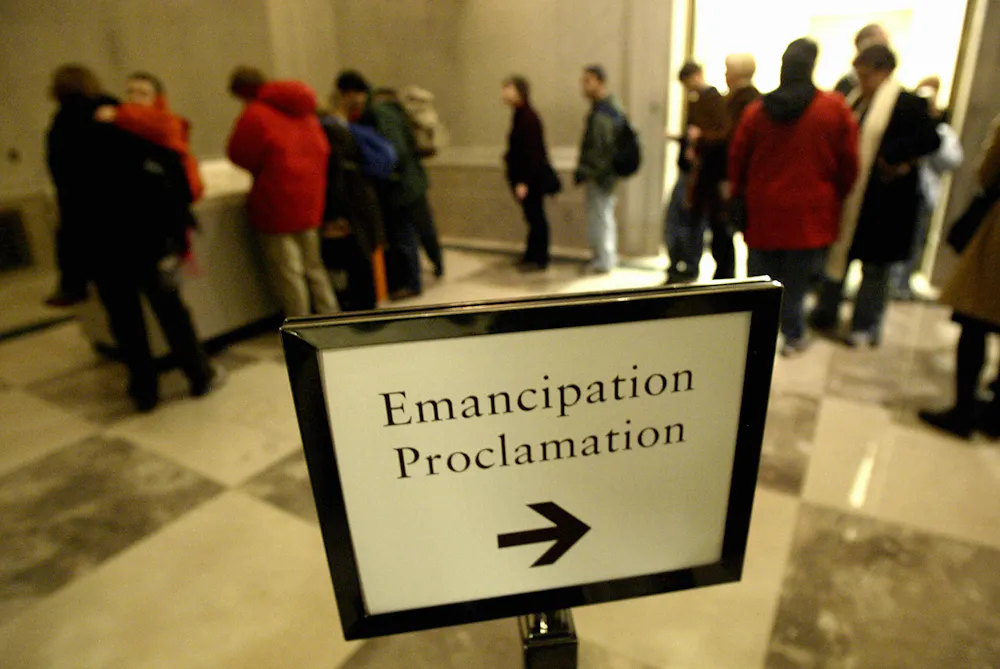
    People line up to view the original Emancipation Proclamation on Martin Luther King Jr. Day, Jan. 19, 2004, at the National Archives building in Washington, D.C.
    Tim Sloan/AFP-Getty Images

    Destroyed by fire

    The idea of preserving the government’s records dates back to the country’s founding. Charles Thomson, secretary of the Continental Congress during the American Revolution and then secretary of Congress under the Articles of Confederation, recognized the need for proper storage of the Congress’ records.

    But the young nation lacked the money and infrastructure to act. Many of the Continental Congress’ records were kept by Thomson himself for years, and while some were later transferred to the Department of State, others were lost.

    Throughout the 19th and early 20th centuries, fires repeatedly ravaged federal records. Fires were very common in the 19th century due to a combination of highly flammable building materials, open frames used for lighting and heating, and the lack of modern fire safety measures such as sprinklers and fire-resistant construction.

    In 1800, a blaze destroyed the War Department’s archives, a loss that severely hampered government operations. In 1810, Congress authorized better housing for government records, but the law was never fully executed. Instead, different parts of the government, from the Department of State to the Department of Treasury, continued maintaining their own records.

    The Treasury Department suffered fires in 1801 and again in 1833, further erasing crucial financial records. The Patent Office, home to invaluable documentation of American innovation, burned in 1877, having already been damaged by an 1836 fire.

    Storage at the federal Office of Indian Affairs in 1935.
    National Archives Foundation

    One of the most devastating losses occurred in 1921 when a fire at the Department of Commerce destroyed nearly all records from the 1890 federal census. This loss had far-reaching consequences, particularly for genealogical and demographic research.

    Fires weren’t the only threat to the government’s records.

    “It is a matter of common report that during the civil war, great quantities of documents stored in the Capitol were thrown away to make quarters for soldiers,” Historian and founding member of the American Historical Association J. Franklin Jameson noted in a 1911 Washington Post article.

    “At a later date,” he added, “the archives of the House of Representatives were systematically looted for papers having a market value because of their autographs.”

    Jameson spent decades lobbying Congress for a centralized repository. His persistence, coupled with the advocacy of key officials, laid the groundwork for future action.

    A bound copy of George Washington’s account of expenses while commander in chief of the Continental Army.
    National Archives and Records Administration

    These repeated disasters illuminated a glaring issue: The federal government lacked a centralized, protected repository to safeguard its records.

    Finding a home

    Momentum for a dedicated archives building gained traction in the late 19th century. In 1903, a bipartisan bill passed Congress giving the OK to purchase land in Washington, D.C., for a Hall of Records.

    But the legislation didn’t lead to any action. Government records remained scattered, vulnerable and neglected. That same year, Congress authorized that any records not needed for daily business be transferred to the Library of Congress.

    In 1912, President William H. Taft issued executive order 1499, aptly named Disposal of Useless Papers, requiring agencies to consult the librarian of Congress before disposing of documents.

    This established a formal review process for government document disposal, but agencies still discarded records, often haphazardly, until stricter records management laws were enacted.

    In 1926, Congress passed the Public Buildings Act, authorizing construction of an archives facility in Washington, D.C. Departing president Herbert Hoover laid the cornerstone of the new building on Feb. 20, 1933. He then deposited facsimiles of the Declaration of Independence and the Constitution, an American flag and daily newspapers from that day underneath the cornerstone.

    Growth and standardization

    President Franklin D. Roosevelt, who took office two weeks later, was himself a meticulous record-keeper. He understood the importance of historical preservation. Roosevelt kept all of his personal and presidential records and books in a fire-safe space he built on his Hyde Park, New York, property, which he donated to the government after he died. This building and the materials inside became part of the National Archives as the first U.S. presidential library.

    The National Archives, an independent agency, was officially established under Roosevelt in the 1934 National Archives Act. The head archivist was to be appointed by the president. The first archivist, Robert D.W. Connor, took office that year with a mandate to organize, preserve and make accessible the nation’s records.

    Initially, the National Archives was simply a building – an impressive neoclassical structure in Washington, D.C., that opened in 1935. The very first records deposited there came from three World War I-era regulatory agencies – the U.S. Food Administration, the Sugar Equalization Board and the U.S. Grain Corporation.

    Initially, the Archives lacked a formalized records management program. There were no clear guidelines on what to keep and what to discard, so agencies made their own decisions. This led to inconsistent preservation.

    The creation of the first federal records administration program in 1941, together with the 1943 Records Disposal Act, codified things. These policies granted the National Archives authority to establish a structured approach to determining which records held historical value and should be preserved, while allowing for the responsible disposal of other documents.

    A 1950 law gave the National Archives more power to decide what should be kept and what could be discarded, creating a more organized and accountable system for preserving the nation’s history.

    As the volume of records increased and their formats changed, the archives adapted. By 2014, amendments to the Federal Records Act explicitly included electronic records, recognizing the shift toward digital documentation.

    Stacks at the National Archives in Washington in 1950, where rare photographs and national records are ordered and stored.
    Three Lions/Getty Images

    Ensuring accountability

    Beyond mere storage, the National Archives plays a vital role in upholding democracy.

    It ensures transparency by preserving government accountability, preventing manipulation or loss of records that could distort historical truth. The National Archives also provides public access to documents that shape civic awareness and historical knowledge, from the Declaration of Independence to declassified government files.

    In an era of digital misinformation and contested narratives, the National Archives stands as a guardian of primary sources. Its existence reminds the nation that history is not a matter of convenience, but a cornerstone of informed governance.

    Elizabeth Call is a member of the Society of American Archivists.

    ref. Fires, wars and bureaucracy: The tumultuous journey to establish the US National Archives – https://theconversation.com/fires-wars-and-bureaucracy-the-tumultuous-journey-to-establish-the-us-national-archives-250857

    MIL OSI – Global Reports

  • MIL-OSI Russia: School of International Cooperation Opens at HSE

    Translartion. Region: Russians Fedetion –

    Source: State University Higher School of Economics – State University Higher School of Economics –

    © Higher School of Economics

    School of International Cooperation created in the structure Faculty of World Economy and World Politics (FMEiMP) Vyshki. The school launches, promotes and implements programs of additional education and professional retraining, corporate education programs and international intensive trainings for working specialists and managers interacting with foreign government officials and businessmen, as well as foreign entrepreneurs, students and scientists.

    Dean of the Faculty of World Economy and International Relations Anastasia Likhacheva, opening the presentation, emphasized that the main task of the school is to implement projects in the interests of the country, to promote Russian interests in the international arena. “There is no single formula for what key opens the hearts of partners. We are glad that our faculty is creating a platform that will unite enthusiasts of international cooperation,” said Anastasia Likhacheva.

    Senior Director of the National Research University Higher School of Economics Andrey Lavrov noted that last year, during the elections of the Academic Council, a formula was developed that reflects the essence of the current HSE: a university for the development of all of Russia, open to the world. He called international cooperation a priority for HSE and the Faculty of World Economy and International Relations. Andrey Lavrov is confident that the opening of the School of International Cooperation will help to realize the most ambitious goals of developing additional professional education at the National Research University Higher School of Economics. “The development of adult education is an area where we can achieve great success. I am very glad that you have become pioneers in the new wave of development of additional professional education at HSE, congratulations,” Andrey Lavrov said, addressing the heads of the faculty.

    “It’s nice to be pioneers,” Anastasia Likhacheva responded. She recalled that HSE began its turn to the East many years ago (700 students currently study Chinese at HSE) and expressed hope that the school will contribute to the development of Russian-Chinese cooperation.

    Minister-Counselor of the Chinese Embassy in Russia Zhao Wei read out a greeting from the Ambassador Extraordinary and Plenipotentiary of China Zhang Hanhui, in which he congratulated HSE on the opening of the School of International Cooperation. HSE was described as a leader in the field of innovation development and a university that makes an invaluable contribution to the formation of the international agenda. In her congratulatory letter, the Ambassador emphasized the role of the Academic Director of the Faculty of World Economy and International Relations Sergey Karaganov in strengthening HSE ties with leading universities in China and developing bilateral cooperation.

    Zhang Hanhui noted in his congratulatory letter: China and Russia have common positions in solving international problems and forming a fair world order. “I am convinced that the school will become the foundation for training new types of specialists with cross-cultural competence and skills in solving international problems. I hope that the establishment of the school will contribute to deepening Chinese-Russian cooperation in personnel training and strengthening cooperation with the countries of the Global South,” he emphasized.

    According to FMEiMP research professor Fyodor Lukyanov, the university and faculty do not move at the mercy of the winds, but strive to create and strengthen these winds themselves. Now, he added, the world is in an amazing state, when what was impossible yesterday is obvious today, and tomorrow will be completely different from what we imagine. The professor noted: international cooperation is necessary in any situation in the world, it should be strengthened and supported. Now it is important to create new connections, while maintaining the old ones. “Support for the implementation of international cooperation projects, learning it throughout life – this is what we need to exist in, this is such an environment,” said Fyodor Lukyanov.

    Now, he believes, the quality of expertise is extremely important, since no high-level manager operates in a vacuum, but operates in an environment with a large volume of events and trends, where when making decisions, not only knowledge is important, but also intuition, which develops, among other things, thanks to knowledge.

    The head of the School of International Cooperation, Deputy Dean of the Faculty of World Economy and International Relations for Continuing Education Yulia Belous noted: the school offers a wide range of continuing education programs, winter and summer schools for different categories of students.

    The training programs are divided into four levels. The first one is “Starting a Career — Key to a Career” — for students and young professionals with 1 to 3 years of work experience. Next comes the “New Facets” stage — training in new skills for professionals with 3 to 5 years of experience, then “Time to Act” — for foreign professionals and those who need to enter a foreign market. And finally, the fourth level is strategic sessions for managers with leading experts in international relations, global economics, orientalists and regional experts who create a vision of the principles of work in eastern markets, the foundation for effective operations and competition with existing players. They are aimed at obtaining practice-oriented knowledge for work in different countries and regions.

    Head of the professional retraining program of the Faculty of World Economy and International Relations “Eastern Perspective: Strategy and Tactics for Building a Business» Natalia Guseva noted that the program is aimed at developing an effective strategy for working in the East, understanding the specifics of business and entrepreneurship in these countries, as well as the practice of doing business in India, China, Japan and South Korea. This is a three-week program that involves developing one’s own projects.

    A 10-day intensive programme has also already been formed. program for foreign entrepreneurs who want to work in Russia. They will learn about the peculiarities of the Russian financial and tax system, the specifics of business cooperation with Russia, and will gain an understanding of the cultural characteristics and values of Russia and its peoples. This is a program in which leading speakers and experts will speak.

    Deputy Executive Director – Director of Strategic Partnerships at Innopraktika Anastasia Pavlenko spoke about the program for transferring competencies in the field of digitalization of public administration to African countries – an important international initiative that is being implemented Center for African Studies HSE University with the support of Innopraktika. She emphasized that Russia is currently one of the world leaders in the field of digitalization of the public sector, and the experience of overcoming sanctions pressure and repelling a large number of cyberattacks seems valuable for friendly countries, with which Russia is ready to exchange knowledge in this area.

    Also in her speech, Anastasia Pavlenko mentioned the direction of Innopraktika’s activities to support the entry of private high-tech companies – “national champions” – into the foreign market and the promotion of their solutions in friendly countries. In conclusion, she drew attention to the high potential of international cooperation in the development of education, science and culture.

    Deputy Director of the HSE Center for African Studies Polina Slyusarchuk added: the center held a series of workshops with experts and scientists from different African countries. One of the programs is dedicated to food security of countries and regions, within its framework, participants are invited not only to study the problem, but also to propose ways to solve it. The center also created a program of additional professional education on running a practical business on the continent.

    Director General of the Russian International Affairs Council Ivan Timofeev noted: the concept of international cooperation is very broad and includes economic, scientific, military-technical and cultural interaction, each of which has its own characteristics. It is important to understand how different aspects of interaction, from chess to sensitive technologies, can be used as a country’s soft power, how to integrate their various elements into foreign policy.

    “Your project is not an adventure, it is an initiative based on the ecosystem and human capital of HSE. Your programs will be in great demand,” Ivan Timofeev is confident.

    Head of the Center for Educational Solutions and Work with Universities of the TMH Corporate University (TMH Group) Alexander Belyashin congratulated the faculty on the opening of the school. He said that in the modern world, educational partnership is an integral part of international cooperation and the opening of such an institute as the HSE School of International Cooperation is an excellent and timely decision. In turn, TMH JSC has been preparing and developing the company’s engineering potential for several years and this year, together with the Tashkent State Transport University, it created a scientific and educational center in Uzbekistan, on the basis of which it is planned to train design engineers and process engineers in joint master’s programs and additional professional education programs. He noted the high potential of the School of International Cooperation, where not only general problems will be studied, but also specific cases of bilateral and multilateral interaction.

    Vice President of the Vyzov Foundation Elena Eremenko spoke about the Vyzov Foundation Prize, the international track “SCIENCE. DIALOGUE. TRUST”, within the framework of which an international assembly, seminars and scientific breakfasts on “scientific diplomacy” are held. Elena Eremenko also emphasized the desire to continue intellectual cooperation with the FMEIP on the “scientific diplomacy” track and in the line of interaction with students.

    Roscongress Foundation Supervisory Board Member Dimitrios Velanis recalled that even during the most difficult periods of international relations, for example in the early 1980s, during the period of sanctions imposed on the USSR after the introduction of troops into Afghanistan, businesses, including those from Western countries, found opportunities to work in the Soviet Union.

    Head of Corporate Programs for Universities at SberUniversity Natalia Konshina spoke about the case of training advanced engineering schools of Russian universities. Together with the head of the School of International Cooperation, they presented possible areas of cooperation on the international track – risks and barriers in international scientific and technical cooperation.

    Anna Bessmertnaya, Chairperson of the Commission on Foreign Economic Cooperation with Partners from China of the Moscow Chamber of Commerce and Industry, spoke about trends in training personnel for Russian-Chinese cooperation and the “Start Your Business with Moscow” project for young specialists.

    The presentation of the School of International Cooperation was also attended by the head of the program “International cooperation in the context of global reassembly» HSE University, Deputy Head of the Department of International Relations of the Faculty of World Economy and World Politics of HSE University Dmitry Novikov. He spoke about the relevance and features of the program, its advantages.

    Please note: This information is raw content directly from the source of the information. It is exactly what the source states and does not reflect the position of MIL-OSI or its clients.

    MIL OSI Russia News

  • MIL-OSI: Regula Blog Wins 2025 Cybersecurity Excellence Awards

    Source: GlobeNewswire (MIL-OSI)

    RESTON, Va., March 19, 2025 (GLOBE NEWSWIRE) — Regula, a global developer of forensic devices and identity verification solutions, is proud to announce that its blog has been accoladed as the Best Cybersecurity Blog in the 2025 Cybersecurity Excellence Awards. Providing diverse expert content such as how-to guides, original analytics, and detailed visuals, the Regula Blog serves as a valuable resource for the general public and niche professionals.

    The Regula Blog has been named the Best Cybersecurity Blog by the 2025 Cybersecurity Excellence Awards

    For more than a decade, the Cybersecurity Excellence Awards have honored individuals, teams, and companies that demonstrate exceptional performance and innovation in cybersecurity.

    The Regula Blog received the award for its expert insights, authoritative opinions, real-world fraud case analyses, practical guides, and forward-looking discussions on evolving security challenges.

    With over 18,000 unique readers per month, the Regula Blog is a fast-growing knowledge hub for professionals in cybersecurity, forensic science, and identity verification. The blog provides in-depth content on deepfake detection, facial recognition, document authentication, forensic examination, and more, to ensure that businesses and professionals get the timely and relevant knowledge they need.

    “In today’s rapidly evolving digital landscape, trust and security are more critical than ever. Our blog is more than just industry news—it’s a true knowledge hub designed to educate and empower professionals tackling identity fraud, document forgery, and cybersecurity risks. Winning this award is an honor and a testament to our team’s effort in providing actionable content that helps businesses navigate today’s complex security challenges,” says Ihar Kliashchou, Chief Technology Officer at Regula.

    These are the current top 10 most-read Regula Blog articles:

    For more insights and expert analysis, visit the award-winning Regula Blog.

    About Regula

    Regula is a global developer of forensic devices and identity verification solutions. With our 30+ years of experience in forensic research and the most comprehensive library of document templates in the world, we create breakthrough technologies for document and biometric verification. Our hardware and software solutions allow over 1,000 organizations and 80 border control authorities globally to provide top-notch client service without compromising safety, security, or speed. Regula has been repeatedly named a Representative Vendor in the Gartner® Market Guide for Identity Verification.

    Learn more at www.regulaforensics.com.

    Contact:
    Kristina – ks@regulaforensics.com

    A photo accompanying this announcement is available at https://www.globenewswire.com/NewsRoom/AttachmentNg/b43b713b-6760-4e89-8a88-6a6561fad951

    The MIL Network

  • MIL-OSI: XBP Europe Holdings, Inc. Reports Fourth Quarter and Full Year 2024 Results

    Source: GlobeNewswire (MIL-OSI)

    Full Year 2024 Highlights

    • Revenue of $142.8 million, decrease of 8.0% year-over-year
    • Gross margin of 26.8%, a 110 bps increase year-over-year
    • Operating profit of $3.5 million, an increase of $2.4 million year-over-year
    • Approximately $25M of ACV in active ramp, resulting in an incremental step-up in margin contribution in the second half of 2024
    • Signed an exclusive, non-binding LOI to acquire Exela Technologies BPA, LLC, a potentially transformational deal that could expand XBP Europe’s revenue to ~$1 billion annually

    Fourth Quarter 2024 Highlights

    • Revenue of $35.6 million, decrease of 7.5% year-over-year and increase of 0.7% sequentially
    • Gross margin of 28.3%, a 480 bps increase year-over-year and 440 bps decrease sequentially
    • Operating profit of $1.0 million, an increase of $3.4 million year-over-year and a decrease of $1.5 million sequentially
    • Net loss of $2.7 million includes $0.5 million of FX losses, an improvement of $2.4 million year-over-year and $0.1 million sequentially

    LONDON and SANTA MONICA, Calif., March 19, 2025 (GLOBE NEWSWIRE) — XBP Europe Holdings, Inc. (“XBP Europe” or “the Company”) (NASDAQ: XBP), a pan-European integrator of bills, payments, and related solutions and services seeking to enable the digital transformation of its clients, announced today its financial results for the quarter and full year ended December 31, 2024.

    “We ended 2024 with growing momentum, as we continued to ramp our recently awarded contracts, leading to improving profitability and operating metrics. We are excited about our organic growth trajectory in 2025 and we continue to work towards a potential acquisition of Exela Technologies BPA, LLC in 2025 so that we can benefit from global scale,” said Andrej Jonovic, Chief Executive Officer of XBP Europe.

    Full Year Highlights

    • Revenue: Total Revenue for 2024 was $142.8 million, a decline of 8.0% year-over-year, primarily due to completion of projects, lower volumes, and client contract ends, offset by positive impact of newly won business.
      • Bills & Payments segment revenue was $101.9 million, a decline of 7.8% year-over-year, primarily attributable to completion of one-time projects, lower volumes, and client contract end, offset by the positive impact of newly won business.
      • Technology segment revenue was $40.9 million, a decrease of 8.5% year-over-year, largely due to a lower volume of licenses sold, offset by a drop in technology implementation and professional services revenue.
    • Operating Profit: Operating Profit was $3.5 million, an increase of $2.4 million compared to 2023. This improvement was driven primarily by higher gross margins coupled with SG&A cost optimizations. Our operating expenses include costs associated with accelerated migration to the cloud.
    • Net Loss: Net loss from continuing operations was $6.5 million, compared with a net loss from continuing operations of $5.6 million in 2023. The year-over-year increase was primarily driven by higher income tax expense and interest expense, offset by higher operating profit and lower related party interest expense.
    • Adjusted EBITDA(1): Adjusted EBITDA from Continuing Operations was $13.4 million, a decrease of $2.4 million or 15.1% compared to 2023. Adjusted EBITDA margin was 9.4%, a decrease of 80 basis points from 10.2% in 2023.
    • Capital Expenditures: Capital expenditures were 1.2% of revenue compared to 1.7% of revenue in 2023, with the decrease primarily due to lower purchases of PP&E.
    • Adequate Liquidity: The Company’s cash and cash equivalents totaled $12.1 million as of December 31, 2024.

    Other Highlights:

    • Pending Acquisition: As announced on March 4, 2025, XBP Europe has entered into an exclusive, non-binding letter of intent with Exela Technologies, Inc. to acquire Exela Technologies BPA, LLC (“BPA”), a leading provider of business process automation solutions. The closing of the acquisition will be subject to BPA completing a corporate reorganization which is expected to create a sustainable capital structure with a substantially deleveraged balance sheet. If completed, the acquisition will expand XBP Europe’s revenue to more than $1 billion from $145 million on a pro forma basis for the twelve months ending September 30, 2024. The parties have agreed to act in good faith to negotiate definitive agreements, complete due diligence, undertake necessary regulatory approvals, and seek any necessary approvals, including from XBP Europe’s shareholders. Accordingly, there can be no assurance that a definitive agreement will be entered into or that the proposed transaction will be consummated. Readers are cautioned that those portions of the LOI that describe the proposed transaction are non-binding. XBP Europe only intends to announce additional details regarding the proposed transaction if and when a definitive agreement is executed.

    Segment Revenue and Profitability:

      Three months ended December 31, 2024
      Bills & Payments   Technology   Total
    Revenue, net $ 25,851   $ 9,794   $ 35,645
    Cost of revenue 20,460   5,108   25,568
    Segment Gross Profit 5,391   4,686   10,077
               
      Three months ended December 31, 2023
      Bills & Payments   Technology   Total
    Revenue, net $ 27,368   $ 11,165   $ 38,533
    Cost of revenue 24,203   5,270   29,472
    Segment Gross Profit 3,165   5,895   9,061
      Twelve months ended December 31, 2024
      Bills & Payments   Technology   Total
    Revenue, net $ 101,850   $ 40,922   $ 142,772
    Cost of revenue 85,454   19,059   104,513
    Segment Gross Profit 16,396   21,863   38,259
               
      Twelve months ended December 31, 2023
      Bills & Payments   Technology   Total
    Revenue, net $ 110,458   $ 44,719   $ 155,177
    Cost of revenue 95,572   19,738   115,310
    Segment Gross Profit 14,886   24,981   39,867
               

    Below is the note referenced above:

    (1)   Adjusted EBITDA is a non-GAAP measure. A reconciliation of Adjusted EBITDA is attached to this release.

    Supplemental Investor Presentation
    An investor presentation relating to our fourth quarter and full year 2024 performance is available at investors.xbpeurope.com. This information has also been furnished to the SEC in a current report on Form 8-K.

    About Non-GAAP Financial Measures
    This press release includes constant currency, EBITDA and Adjusted EBITDA, each of which is a financial measure that is not prepared in accordance with U.S. generally accepted accounting principles (“GAAP”). XBP Europe believes that the presentation of these non-GAAP financial measures will provide useful information to investors in assessing our financial performance, results of operations and liquidity and allows investors to better understand the trends in our business and to better understand and compare our results. XBP Europe’s board of directors and management use constant currency, EBITDA and Adjusted EBITDA to assess XBP Europe’s financial performance, because it allows them to compare XBP Europe’s operating performance on a consistent basis across periods by removing the effects of XBP Europe’s capital structure (such as varying levels of debt and interest expense, as well as transaction costs resulting from the combination with CF Acquisition Corp. VIII. on November 29, 2023). Adjusted EBITDA also seeks to remove the effects of restructuring and related expenses and other similar non-routine items, some of which are outside the control of our management team. Restructuring expenses are primarily related to the implementation of strategic actions and initiatives related to right sizing of the business. All of these costs are variable and dependent upon the nature of the actions being implemented and can vary significantly driven by business needs. Accordingly, due to that significant variability, we exclude these charges since we do not believe they truly reflect our past, current or future operating performance. The constant currency presentation excludes the impact of fluctuations in foreign currency exchange rates. We calculate constant currency revenue on a constant currency basis by converting our current-period local currency revenue using the exchange rates from the corresponding prior-period and compare these adjusted amounts to our corresponding prior period reported results. XBP Europe does not consider these non-GAAP measures in isolation or as an alternative to liquidity or financial measures determined in accordance with GAAP. A limitation of these non-GAAP financial measures is that they exclude significant expenses and income that are required by GAAP to be recorded in XBP Europe’s financial statements. In addition, they are subject to inherent limitations as they reflect the exercise of judgments by management about which expenses and income are excluded or included in determining these non-GAAP financial measures and therefore the basis of presentation for these measures may not be comparable to similarly-titled measures used by other companies. These non-GAAP financial measures are not required to be uniformly applied, are not audited and should not be considered in isolation or as substitutes for results prepared in accordance with GAAP. Net loss is the GAAP measure most directly comparable to the non-GAAP measures presented here. For reconciliation of the comparable GAAP measures to these non-GAAP financial measures, see the schedules attached to this release.

    Forward-Looking Statements
    This press release contains certain “forward-looking statements” within the meaning of the United States Private Securities Litigation Reform Act of 1995, Section 27A of the Securities Act of 1933, as amended (the “Securities Act”), and Section 21E of the Exchange Act, including certain financial forecasts and projections. All statements other than statements of historical fact contained in this press release, including statements as to future results of operations and financial position, revenue and other metrics planned products and services, business strategy and plans, objectives of management for future operations of XBP Europe, market size and growth opportunities, competitive position and technological and market trends, are forward-looking statements. Some of these forward-looking statements can be identified by the use of forward-looking words, including “may,” “should,” “expect,” “intend,” “will,” “estimate,” “anticipate,” “believe,” “predict,” “plan,” “targets,” “projects,” “could,” “would,” “continue,” “forecast” or the negatives of these terms or variations of them or similar expressions. All forward-looking statements are subject to risks, uncertainties, and other factors which could cause actual results to differ materially from those expressed or implied by such forward-looking statements. All forward-looking statements are based upon estimates, forecasts and assumptions that, while considered reasonable by XBP Europe and its management, as the case may be, are inherently uncertain and many factors may cause the actual results to differ materially from current expectations which include, but are not limited to: (1) the outcome of any legal proceedings that may be instituted against XBP Europe or others and any definitive agreements with respect thereto; (2) the inability to meet the continued listing standards of Nasdaq or another securities exchange; (3) the risk that the business combination disrupts current plans and operations of XBP Europe and its subsidiaries; (4) the inability to recognize the anticipated benefits of the business combination, which may be affected by, among other things, competition, the ability of XBP Europe and its subsidiaries to grow and manage growth profitably, maintain relationships with customers and suppliers and retain its management and key employees; (5) costs related to the business combination; (6) changes in applicable laws or regulations; (7) the possibility that XBP Europe or any of its subsidiaries may be adversely affected by other economic, business and/or competitive factors; (8) risks related to XBP Europe’s potential inability to achieve or maintain profitability and generate cash; (9) the impact of the COVID-19 pandemic, including any mutations or variants thereof, and its effect on business and financial conditions; (10) volatility in the markets caused by geopolitical and economic factors; (11) the ability of XBP Europe to retain existing clients; (12) the potential inability of XBP Europe to manage growth effectively; (13) the ability to recruit, train and retain qualified personnel, and (14) other risks and uncertainties set forth in the sections entitled “Risk Factors” and “Cautionary Note Regarding Forward-Looking Statements” in the Annual Reports on Form 10-K filed on April 1, 2024 and, our subsequent quarterly reports on Form 10-Q and our current reports on Form 8-K as filed with the Securities and Exchange Commission (the “SEC”). These filings identify and address other important risks and uncertainties that could cause actual events and results to differ materially from those contained in the forward-looking statements. Nothing in this press release should be regarded as a representation by any person that the forward-looking statements set forth herein will be achieved or that any of the contemplated results of such forward-looking statements will be achieved. Readers should not place undue reliance on forward-looking statements, which speak only as of the date they are made. XBP Europe gives no assurance that either XBP Europe or any of its subsidiaries will achieve its expected results. XBP Europe undertakes no duty to update these forward-looking statements, except as otherwise required by law.

    About XBP Europe
    XBP Europe is a pan-European integrator of bills, payments and related solutions and services seeking to enable digital transformation of its more than 2,000 clients. The Company’s name – ‘XBP’ – stands for ‘exchange for bills and payments’ and reflects the Company’s strategy to connect buyers and suppliers, across industries, including banking, healthcare, insurance, utilities and the public sector, to optimize clients’ bills and payments and related digitization processes. The Company provides business process management solutions with proprietary software suites and deep domain expertise, serving as a technology and services partner for its clients. Its cloud-based structure enables it to deploy its solutions across the European market, along with the Middle East and Africa. The physical footprint of XBP Europe spans 15 countries and 32 locations and a team of approximately 1,500 individuals. XBP Europe believes its business ultimately advances digital transformation, improves market wide liquidity by expediting payments, and encourages sustainable business practices. For more information, please visit: www.xbpeurope.com.

    For more XBP Europe news, commentary, and industry perspectives, visit: https://www.xbpeurope.com/
    And please follow us on social:
    X: https://X.com/XBPEurope
    LinkedIn: https://www.linkedin.com/company/xbp-europe/

    The information posted on XBP Europe’s website and/or via its social media accounts may be deemed material to investors. Accordingly, investors, media and others interested in XBP Europe should monitor XBP Europe’s website and its social media accounts in addition to XBP Europe’s press releases, SEC filings and public conference calls and webcasts.

    Investor and/or Media Contacts:
    investors@xbpeurope.com

     
    XBP Europe Holdings, Inc.
    Consolidated Balance Sheets
    For the years ended December 31, 2024 and 2023
    (in thousands of United States dollars except share and per share amounts)
               
      December 31, 
      2024      2023
    ASSETS            
    Current assets            
    Cash and cash equivalents $ 12,099   $ 6,537
    Accounts receivable, net of allowance for credit losses of $1,198 and $1,183, respectively   19,810     30,238
    Inventories, net   3,823     4,045
    Prepaid expenses and other current assets   4,228     6,550
    Current assets held for sale   1,378     2,497
    Total current assets   41,338     49,867
    Property, plant and equipment, net of accumulated depreciation of $40,325 and $39,876, respectively   11,272     12,811
    Operating lease right-of-use assets, net   4,805     5,206
    Goodwill   21,666     22,823
    Intangible assets, net   1,121     1,498
    Deferred income tax assets   7,026     6,811
    Other noncurrent assets   817     705
    Noncurrent assets held for sale       3,018
    Total assets $ 88,045   $ 102,739
               
    LIABILITIES AND STOCKHOLDERS’ DEFICIT            
    LIABILITIES            
    Current liabilities            
    Accounts payable $ 12,553   $ 13,281
    Related party payables   5,443     13,012
    Accrued liabilities   17,993     23,850
    Accrued compensation and benefits   16,482     16,267
    Customer deposits   277     323
    Deferred revenue   6,870     6,004
    Current portion of finance lease liabilities   12     91
    Current portion of operating lease liabilities   1,734     1,562
    Current portion of long-term debts   4,958     3,863
    Current liabilities held for sale   2,443     3,818
    Total current liabilities   68,765     82,071
    Related party notes payable   1,451     1,542
    Long-term debt, net of current maturities   23,966     12,763
    Finance lease liabilities, net of current portion       23
    Pension liabilities   10,339     12,208
    Operating lease liabilities, net of current portion   3,271     3,785
    Other long-term liabilities   1,599     1,635
    Noncurrent liabilities held for sale       1,280
    Total liabilities $ 109,391   $ 115,307
                 
               
    STOCKHOLDERS’ DEFICIT            
    Preferred stock, par value of $0.0001 per share; 10,000,000 shares authorized; none issued and outstanding as of December 31, 2024 and December 31, 2023, respectively      
    Common Stock, par value of $0.0001 per share; 200,000,000 shares authorized; 30,166,102 shares issued and outstanding as of December 31, 2024 and December 31, 2023, respectively   30     30
    Additional paid in capital   1,611    
    Accumulated deficit   (23,705)     (11,339)
    Accumulated other comprehensive loss:            
    Foreign currency translation adjustment   474     (1,416)
    Unrealized pension actuarial gains, net of tax   244     157
    Total accumulated other comprehensive loss   718     (1,259)
    Total stockholders’ deficit   (21,346)     (12,568)
    Total liabilities and stockholders’ deficit $ 88,045   $ 102,739
               
    XBP Europe Holdings, Inc.
    Consolidated Statements of Operations
    For the years ended December 31, 2024 and 2023
    (in thousands of United States dollars except share and per share amounts)
               
      Year ended December 31, 
      2024      2023
    Revenue, net $ 142,408   $ 154,943
    Related party revenue, net   364     234
    Cost of revenue (exclusive of depreciation and amortization)   104,467     115,234
    Related party cost of revenue   47     76
    Selling, general and administrative expenses (exclusive of depreciation and amortization)   26,525     31,173
    Related party expense   5,101     4,633
    Depreciation and amortization   3,160     2,944
    Operating profit   3,472     1,117
    Other expense (income), net            
    Interest expense, net   6,232     5,035
    Related party interest expense, net   90     1,971
    Foreign exchange losses, net   2,520     599
    Changes in fair value of warrant liability   (43)     (597)
    Pension income, net   (1,705)     (929)
    Net loss before income taxes   (3,622)     (4,962)
    Income tax expense   2,911     606
    Net loss from continuing operations   (6,533)     (5,568)
    Net loss from discontinued operations, net of income taxes   (5,833)     (5,479)
    Net loss $ (12,366)   $ (11,047)
    Loss per share:           
    Basic and diluted – continuing operations $ (0.22)   $ (0.25)
    Basic and diluted – discontinued operations   (0.19)     (0.24)
    Basic and diluted $ (0.41)   $ (0.49)
               
    XBP Europe Holdings, Inc.
    Consolidated Statements of Cash Flows
    For the years ended December 31, 2024 and 2023
    (in thousands of United States dollars)
               
      Years ended December 31, 
      2024      2023
    Cash flows from operating activities          
    Net loss $ (12,366)   $ (11,047)
    Adjustments to reconcile net loss to net cash used in operating activities:           
    Depreciation   2,965     3,467
    Amortization of intangible assets   750     384
    Debt issuance cost amortization   216    
    Impairment of goodwill   87    
    Credit loss expense   16     343
    Changes in fair value of warrant liability   (43)     (597)
    Stock-based compensation expense   1,611    
    Unrealized foreign currency losses (gains)   2,428     (616)
    Change in deferred income taxes   (247)     (422)
               
    Change in operating assets and liabilities          
    Accounts receivable   9,568     5,990
    Inventories   240     (58)
    Prepaid expense and other assets   2,297     2,123
    Accounts payable   (365)     (2,417)
    Related party payables   (8,446)     (843)
    Accrued expenses and other liabilities   (4,848)     2,629
    Deferred revenue   1,099     67
    Customer deposits   (189)     (538)
    Net cash used in operating activities   (5,227)     (1,535)
               
    Cash flows from investing activities           
    Purchase of property, plant and equipment   (1,263)     (2,330)
    Cash paid for costs of fulfilling a contract       (339)
    Additions to internally developed software   (447)    
    Net cash used in investing activities   (1,710)     (2,669)
               
    Cash flows from financing activities           
    Borrowings under secured borrowing facility       87,635
    Principal repayment on borrowings under secured borrowing facility   (79)     (91,662)
    Borrowings under 2024 Term Loan A Facility   3,834    
    Borrowings under 2024 Term Loan B Facility   11,360    
    Borrowings under 2024 Revolving Credit Facility   15,352    
    Cash paid for debt issuance costs   (1,527)    
    Principal payments on 2024 Term Loan A Facility   (383)    
    Principal payments on 2024 Term Loan B Facility   (1,136)    
    Principal payments on long-term obligations   (15,270)     (920)
    Proceeds from Secured Credit Facility   930     223
    Principal payments on finance leases   (635)     (786)
    Proceeds from Business Combination, net of transaction expenses       5,205
    Net cash provided by (used in) financing activities   12,446     (305)
    Effect of exchange rates on cash and cash equivalents     (308)     3,941
    Net increase (decrease) in cash and cash equivalents   5,201     (568)
               
    Cash and equivalents, beginning of period, including cash from discontinued operations   6,905     7,473
    Cash and equivalents, end of period, including cash from discontinued operations $ 12,106   $ 6,905
               
    Supplemental cash flow data:            
    Income tax payments, net of refunds received   567     1,059
    Interest paid         3,429     1,798
               
    XBP Europe Holdings, Inc.
    Schedule 1: Reconciliation of Adjusted EBITDA and constant currency revenues
         
    Reconciliation of Non-GAAP Financial Measures to GAAP Measures    
             
    Non-GAAP constant currency revenue reconciliation      
        Twelve Months ended December 31, 
    ($ in thousands)   2024   2023
    Revenues, as reported (GAAP)   142,772   155,177
    Foreign currency exchange impact (1)   (1,055)   – 
    Revenues, at constant currency (Non-GAAP)   141,717   155,177
             
    Reconciliation of Adjusted EBITDA from Continuing Operations             
        Year Ended December 31, 
    (dollars in thousands)   2024      2023
    Net loss from continuing operations   $ (6,533)   $ (5,568)
    Income tax expense     2,911     606
    Interest expense including related party interest expense, net     6,322     7,006
    Depreciation and amortization     3,160     2,944
    EBITDA from continuing operations     5,860     4,988
    Restructuring and related expenses (2)     1,879     5,053
    Employee litigation matter (3)     1,283     1,431
    Related party management fee and royalties (4)         1,330
    Foreign exchange losses, net     2,520     599
    Non-cash equity compensation (5)     1,611    
    Changes in fair value of warrant liability     (43)     (597)
    Transaction Fees (6)     280     2,970
    Adjusted EBITDA from continuing operations   $ 13,390   $ 15,774
                 

    (1)   Constant currency excludes the impact of foreign currency fluctuations and is computed by applying the average exchange rates for the year ended December 31, 2023, to the revenues during the corresponding period in 2024.
    (2)   Adjustment represents costs associated with restructuring, including employee severance and vendor and lease termination costs.
    (3)   Represents litigation settlement and associated expenses incurred in connection with the Company subsidiary litigation.
    (4)   Primarily represents management fee incurred in exchange for services, which included provision of legal, human resources, corporate finance, and marketing support. The management services agreement was terminated in connection with the Business Combination and was replaced by the related party service fee pursuant to the Services Agreement which reduced the fee and modified the services provided.
    (5)   Represents the non-cash charges to restricted stock units and options.
    (6)   Represents transaction costs incurred as part of the Business Combination.

         
    Reconciliation of Adjusted EBITDA from Discontinued Operations    
        Year Ended December 31, 
    (dollars in thousands)   2024      2023
    Net loss from discontinued operations, net of income taxes   $ (5,833)   $ (5,479)
    Income tax expense        
    Interest expense, net     145     189
    Depreciation and amortization     555     907
    EBITDA from discontinued operations     (5,133)     (4,383)
    Restructuring and related expenses (7)     38     187
    Related party service fees and royalties         25
    Impairment of goodwill     87    
    Foreign exchange losses (gains), net     211     (5)
    Adjusted EBITDA from discontinued operations   $ (4,797)   $ (4,176)
                 

    (7)   Adjustment represents costs associated with restructuring related to employee severance.

    Source: XBP Europe Holdings, Inc.

    The MIL Network

  • MIL-OSI: Kingsoft Cloud Announces Unaudited Fourth Quarter and Fiscal Year 2024 Financial Results; First Time Operating Margin Profitable with Accelerated Growing Revenue of AI Cloud

    Source: GlobeNewswire (MIL-OSI)

    BEIJING, March 19, 2025 (GLOBE NEWSWIRE) — Kingsoft Cloud Holdings Limited (“Kingsoft Cloud” or the “Company”) (NASDAQ: KC and HKEX: 3896), a leading cloud service provider in China, today announced its unaudited financial results for the fourth quarter and fiscal year ended December 31, 2024.

    Fourth Quarter Financial Highlights

    • Total Revenues reached RMB2,232.1 million (US$305.8 million)1, increased by 29.6% year-over-year from RMB1,722.5 million in the same quarter of 2023. Our business has experienced accelerated and high-quality growth and our revenue structure is well-balanced.
    • Gross profit was RMB426.0 million (US$58.4 million), representing a significant increase of 68.3% from RMB253.1 million in the same quarter of 2023. Our profitability has been fundamentally improved.
    • NonGAAP EBITDA2 was RMB359.7 million (US$49.3 million), compared with RMB-27.7 million in the same quarter of 2023. NonGAAP EBITDA margin was 16. 1%, compared with -1.6% in the same quarter of 2023.
    • Operating loss was RMB43.5 million (US$6.0 million), compared with operating loss of RMB342.7 million in the same quarter of 2023.
    • NonGAAP Operating profit (loss) turned profit for the first time, achieving RMB24.4 million (US$3.3 million), compared with RMB-187.6 million in the same quarter of 2023. NonGAAP Operating profit (loss) margin was 1. 1%, compare with -10.9% in the same quarter of 2023.

    Mr. Tao Zou, Chief Executive Officer of Kingsoft Cloud, commented, “We are very pleased to close Fiscal Year 2024 with historically strong financial performance. This quarter, we recorded positive nonGAAP operating profit (loss)for the first time, demonstrating our unwavering execution of the ‘High- quality, Sustainable Development Strategy’. Driven by the growing popularity of AI applications, we firmly believe that AI will continue to penetrate into various verticals, improving the efficiency of daily life. This quarter the gross billing of AI business increased by triple-digit year-over-year to RMB474 million. Both our public cloud and enterprise cloud businesses are harnessing the vast potential of AI cloud computing. Meanwhile, we have seen strong growth in demand from our ecosystem. Revenue from Xiaomi and Kingsoft Group increased by 76% year-over-year. We are well on track to build cutting- edge cloud infrastructure and technology to support our ecosystem and expand into the broader AI industry.”

    Mr. Henry He, Chief Financial Officer of Kingsoft Cloud, added, “We are very pleased to highlight several significant achievements. First, we achieved profitability in non-GAAP operating profit for the first time since our inception in 2012, demonstrating our strong execution of our high-quality and sustainable development strategy in the past two years. Second, our revenue has been growing for three consecutive quarters year-over-year, and this quarter we achieved a high-speed growth rate of 30% in total revenue, reaching RMB2,232.1 million. Third, gross billing of our Al cloud business increased by around 500% year-over-year to RMB474 million, accounting for as high as 34% of our public cloud revenue. This marks a three-digit year-on-year growth or six consecutive quarters. Fourth, last December, our shareholders approved revenue from connected-party of Xiaomi and Kingsoft Group for next three years of RMB11.3 billion, around 10 times over the revenue of 2023, providing solid support for Company’s revenue and profit growth. We believe we are well on track to meet the ecosystem’s fast-growing demands and build a solid cloud infrastructure to support its AI development. Notably, in this quarter, we are thrilled to report that revenue from Xiaomi and Kingsoft Group increased by 76% year-over-year, validating the effectiveness of our ecosystem strategy.”

    Fourth Quarter 2024 Financial Results

    Total Revenues reached RMB2,232.1 million (US$305.8 million), increased by 29.6% year-over-year from RMB1,722.5 million in the same quarter of 2023 and increased by 18.4% quarter-over-quarter from RMB1,885.6 million in the third quarter of 2024. The year-over-year increase was mainly due to the expanded revenue from Xiaomi and Kingsoft Ecosystem and AI related customers, incremental demands and more projects delivered from enterprise cloud approaching year-end.

    • Revenues from public cloud services were RMB1,409.8 million (US$193.1 million), increased by 34.0% from RMB1,052.0 million in the same quarter of 2023 and increased by 19.9% from RMB1, 175.5 million last quarter. The year-over-year increase was mainly due to the growth of AI demands.

    ______________________
    1 This announcement contains translations of certain Renminbi (RMB) amounts into U.S. dollars (US$) at a specified rate solely for the convenience of the reader. Unless otherwise noted, the translation of RMB into US$ has been made at RMB7.2993 to US$1.00, the noon buying rate in effect on December 31, 2024 as certified for customs purposes by the Federal Reserve Bank of New York.

    2 Non-GAAP EBITDA is defined as non-GAAP net loss excluding interest income, interest expense, income tax expense (benefit) and depreciation and amortization, and we define Non-GAAP EBITDA margin as Non-GAAP EBITDA as a percentage of revenues. See “Use of Non-GAAP Financial Measures” set forth at the end of this press release.

    • Revenues from enterprise cloud services were RMB822.3 million (US$112.7 million), representing an increase of 22.7% from RMB670.3 million in the same quarter of 2023 and an increase of 15.8% from RMB710.0 million last quarter. We keep focusing in selected verticals such as public services cloud, state-owned assets cloud, healthcare, financial services and private enterprise services, enhance our solutions with AI capabilities and take profitability and sustainability of the enterprise cloud projects as our priorities.
    • Other revenues were nil this quarter.

    Cost of revenues was RMB1,806.2 million (US$247.4 million), representing an increase of 22.9% from RMB1,469.3 million in the same quarter of 2023, which was in-line with our revenue expansion. IDC costs decreased by 2.6% year-over-year from RMB740.4 million to RMB721.5 million (US$98.8 million) this quarter. The decrease was in line with the scale down of our CDN services and our strict control over procurement costs. Depreciation and amortization costs increased from RMB146.9 million in the same quarter of 2023 to RMB343.1 million (US$47.0 million) this quarter. The increase was mainly due to the depreciation of newly acquired servers which were related to AI business. Solution development and services costs increased by 10.8% year-over-year from RMB502.9 million in the same quarter of 2023 to RMB557.0 million (US$76.3 million) this quarter. The increase was mainly due to the solution personnel expansion of Camelot. Fulfillment costs and other costs were RMB102.4 million (US$14.0 million) and RMB82.2 million (US$11.3 million) this quarter.

    Gross profit was RMB426.0 million (US$58.4 million), representing a significant increase of 68.3% from RMB253.1 million in the same quarter of 2023, demonstrating our improvements in revenue quality and structure, as well as strict cost control. Gross margin was 19. 1%, compared with 14.7% in the same period in 2023. NonGAAP gross profit3 was RMB427.7 million (US$58.6 million), compared with RMB262.5 million in the same period in 2023. NonGAAP gross margin3 was 19.2%, compared with 15.2% in the same period in 2023. The significant improvement of our gross profit and margin was mainly due to our strategic adjustment of revenue mix, expansion of AI revenues, optimized enterprise cloud project selection and efficient cost control measures.

    Total operating expenses were RMB469.5 million (US$64.3 million), decreased by 21.2% from RMB595.9 million in the same quarter last year and decreased by 67.6% from RBM1,447.1 million last quarter. Among which:

    Selling and marketing expenses were RMB115.8 million (US$15.9 million), decreased by 8.4% from RMB126.5 million in the same period in 2023 and decreased by 4.4% from RMB121.1 million last quarter, the decrease was due to the decrease of share-based compensation.

    General and administrative expenses were RMB179.5 million (US$24.6 million), decreased by 39.0% from RMB294.2 million in the same period in 2023 and slightly increased by 5.4% from RMB170.4 million last quarter. The year-over-year decrease was mainly due to the decrease of credit loss expense.

    Research and development expenses were RMB174.2 million (US$23.9 million), decreased by 0.6% from RMB175.2 million in the same period in 2023 and 26.2% from RMB235.9 million last quarter. The decrease was mainly due to the decrease of share-based compensation.

    Operating loss was RMB43.5 million (US$6.0 million), compared with operating loss of RMB342.7 million in the same quarter of 2023 and RMB1,143.8 million last quarter. The improvement was mainly due to the increase of gross profit and our strict expenses control. NonGAAP operating profit (loss)4 was RMB24.4 million (US$3.3 million), compared with operating loss of RMB187.6 million in the same quarter last year and RMB140.2 million last quarter. Our non-GAAP operating profit (loss) turned breakeven for the first time and verified our high quality and sustainable development strategy.

    Net loss was RMB200.6 million (US$27.5 million), compared with net loss of RMB286.8 million in the same quarter of 2023 and RMB1,061.1 million last quarter. NonGAAP net loss5 was RMB70.3 million (US$9.6 million), narrowed down compared with RMB250.4 million in the same quarter of 2023 and RMB236.7 million last quarter. The improvement was mainly due to the revenue quality increase, revenue mix adjustment, strict costs control and expenses control.
    ______________________
    3 Non-GAAP gross profit is defined as gross profit excluding share-based compensation allocated in the cost of revenues and we define Non-GAAP gross margin as Non-GAAP gross profit as a percentage of revenues. See “Use of Non-GAAP Financial Measures” set forth at the end of this press release.

    4 Non-GAAP operating loss is defined as operating loss excluding share-based compensation, impairment of long-lived assets and amortization of intangible assets and we define Non-GAAP operating loss margin as Non-GAAP operating loss as a percentage of revenues. See “Use of Non-GAAP Financial Measures” set forth at the end of this press release.

    5 Non-GAAP net loss is defined as net loss excluding share-based compensation, impairment of long-lived assets and foreign exchange (gain) loss, and we define Non-GAAP net loss margin as Non-GAAP net loss as a percentage of revenues. See “Use of Non-GAAP Financial Measures” set forth at the end of this press release.

    NonGAAP EBITDA6 was RMB359.7 million (US$49.3 million), compared with RMB-27.7 million in the same quarter of 2023 and RMB185.4 million last quarter. NonGAAP EBITDA margin was 16. 1%, compared with -1.6% in the same quarter of 2023 and 9.8% last quarter. The increase was mainly due to the expansion in gross profit and our strict control over costs and expenses.

    Basic and diluted net loss per share was RMB0.05 (US$0.01), compared with RMB0.08 in the same quarter of 2023 and RMB0.29 last quarter.

    Cash and cash equivalents were RMB2,648.8 million (US$362.9 million) as of December 31, 2024, compared with RMB1,617.9 million as of September 30, 2024. The increase was mainly due to the increased cash receipts from operating activities and the increase in bank loan drawdowns.

    Fiscal Year 2024 Financial Results

    Total Revenues reached RMB7,785.2 million (US$1,066.6 million), representing an increase of 10.5% from RMB7,047.5 million in 2023. The increase was due to the strong demands from AI business and enterprise cloud projects increase, while partially offset by our proactive scale-down of CDN services within public cloud services.

    • Revenues from public cloud services were RMB5,007.3 million (US$686.0 million), representing an increase of 14.3% from RMB4,381.7 million in 2023.
    • Revenues from enterprise cloud services were RMB2,777.8 million (US$380.6 million), representing an increase of 4.3% from RMB2,664.0 million in 2023.
    • Other revenues were RMB0.1 million (US$0.02 million).

    ______________________
    6
    Non-GAAP EBITDA is defined as Non-GAAP net loss excluding interest income, interest expense, income tax expense (benefit) and depreciation and amortization, and we define Non-GAAP EBITDA margin as Non-GAAP EBITDA as a percentage of revenues. See “Use of Non-GAAP Financial Measures” set forth at the end of this press release.

    Cost of revenues was RMB6,444.3 million (US$882.9 million), representing a slight increase of 4.0% from RMB6, 197.3 million in 2023. Among which:

    IDC costs decreased by 9.9% to RMB2,892.1 million (US$396.2 million) from RMB3,211.2 million in 2023. The decrease was in line with our cost control measures adjustment of CDN services. Depreciation and amortization costs were RMB1,090.1 million (US$149.3 million), compared with RMB774.0 million in 2023, mainly due to the depreciation of new acquired servers related to AI business. Fulfillment costs were RMB235.7 million (US$32.3 million), representing an increase of 2.7% from RMB229.5 million in 2023. The increase was in line with enterprise cloud projects increase. Solution development and services costs were RMB1,993.1 million (US$273.1 million) in 2024, compared with RMB1,804.8 million in 2023. The increase was mainly due to the revenue expansion of Camelot business.

    Gross profit increased by 57.7% to RMB1,340.9 million (US$183.7 million) in 2024, from RMB850.2 million in 2023. Gross margin increased to 17.2%, from 12. 1% in 2023. NonGAAP gross profit increased to RMB1,357.8 million (US$186.0 million) in 2024, from RMB859.9 million in 2023. NonGAAP gross margin increased to 17.4% in 2024 from 12.2% in 2023. Such increases were primarily because of the optimization of revenue mix and our effective cost controls.

    Selling and marketing expenses were RMB479.4 million (US$65.7 million), compared with RMB460.2 million in 2023. The increase was mainly due to the increase of share-based compensation.

    General and administrative expenses were RMB834.9 million (US$114.4 million), compared with RMB1,060.0 million in 2023. The decrease was mainly due to the decrease of credit loss expense.

    Research and development expenses were RMB846.0 million (US$115.9 million), compared with RMB784.8 million in 2023. The increase was mainly due to the rise in personnel-related expenses.

    Impairment of longlived assets was RMB919.7 million (US$126.0 million), mainly attributable to impairment of long-lived assets dedicated to assets of low-margin services.

    Operating loss was RMB1,739.0 million (US$238.2 million), compared with RMB2, 108.6 million in 2023. NonGAAP operating loss was RMB431.3 million (US$59.1 million), significantly narrowed compared with RMB1,092.8 million in 2023. NonGAAP operating loss margin was 5.5%, significantly improved from 15.5% in 2023.

    Net loss was RMB1,979.0 million (US$271.1 million), significantly narrowed from net loss of RMB2, 183.6 million in 2023.

    NonGAAP net loss was RMB825.3 million (US$113.1 million), compared with Non-GAAP net loss of RMB1,291.1 million in 2023.

    NonGAAP EBITDA was RMB638.9 million (US$87.5 million), compared with RMB-265.1 million in 2023. NonGAAP EBITDA margin was 8.2%, compared with -3.8% in 2023.

    Basic and diluted net loss per share was RMB0.54 (US$0.07), compared with RMB0.61 in 2023.

    Outstanding ordinary shares were 3,687,690,772 as of December 31, 2024, equivalent to about 245,846,051 ADSs.

    Conference Call Information

    Kingsoft Cloud’s management will host an earnings conference call on Wednesday, March 19, 2025 at 8:15 am, U.S. Eastern Time (8:15 pm, Beijing/Hong Kong Time on the same day).

    Participants can register for the conference call by navigating to https://register-conf.media-server.com/register/BIc315136cafe94825b98dca6b37795790. Once preregistration has been completed, participants will receive dial-in numbers, direct event passcode, and a unique access PIN.

    To join the conference, simply dial the number in the calendar invite you receive after preregistering, enter the passcode followed by your PIN, and you will join the conference instantly.

    Additionally, a live and archived webcast of the conference call will also be available on the Company’s investor relations website at http://ir.ksyun.com.

    Use of NonGAAP Financial Measures

    The unaudited condensed consolidated financial information is prepared in conformity with accounting principles generally accepted in the United States of America (“U.S. GAAP”). In evaluating our business, we consider and use certain non-GAAP measures, Non-GAAP gross profit, Non-GAAP gross margin, Non-GAAP operating loss, Non-GAAP operating loss margin, Non-GAAP EBITDA, Non-GAAP EBITDA margin, Non-GAAP net loss and Non-GAAP net loss margin, as supplemental measures to review and assess our operating performance. The presentation of these non-GAAP financial measures is not intended to be considered in isolation or as a substitute for the financial information prepared and presented in accordance with U.S. GAAP. We define Non- GAAP gross profit as gross profit excluding share-based compensation allocated in the cost of revenues, and we define Non-GAAP gross margin as Non-
    GAAP gross profit as a percentage of revenues. We define Non-GAAP operating loss as operating loss excluding share-based compensation, impairment of long-lived assets and amortization of intangible assets, and we define Non-GAAP operating loss margin as Non-GAAP operating loss as a percentage of revenues. We define Non-GAAP net loss as net loss excluding share-based compensation, foreign exchange (gain) loss and impairment of long-lived assets, and we define Non-GAAP net loss margin as Non-GAAP net loss as a percentage of revenues. We define Non-GAAP EBITDA as Non-GAAP net loss excluding interest income, interest expense, income tax expense (benefit) and depreciation and amortization, and we define Non-GAAP EBITDA margin as Non-GAAP EBITDA as a percentage of revenues. We present these non-GAAP financial measures because they are used by our management to evaluate our operating performance and formulate business plans. We also believe that the use of these non-GAAP measures facilitates investors’ assessment of our operating performance.

    These non-GAAP financial measures are not defined under U.S. GAAP and are not presented in accordance with U.S. GAAP. These non-GAAP financial measures have limitations as analytical tools. One of the key limitations of using these non-GAAP financial measures is that they do not reflect all items of income and expense that affect our operations. Further, these non-GAAP measures may differ from the non-GAAP information used by other companies, including peer companies, and therefore their comparability may be limited.

    We compensate for these limitations by reconciling these non-GAAP financial measures to the nearest U.S. GAAP performance measure, all of which should be considered when evaluating our performance. We encourage you to review our financial information in its entirety and not rely on a single financial measure.

    Exchange Rate Information

    This press release contains translations of certain RMB amounts into U.S. dollars at specified rates solely for the convenience of readers. Unless otherwise noted, all translations from RMB to U.S. dollars, in this press release, were made at a rate ofRMB7.2993 to US$1.00, the noon buying rate in effect on December 31, 2024 as certified for customs purposes by the Federal Reserve Bank of New York.

    Safe Harbor Statement

    This announcement contains forward-looking statements. These statements are made under the “safe harbor” provisions of the U.S. Private Securities Litigation Reform Act of 1995. These forward-looking statements can be identified by terminology such as “will,” “expects,” “anticipates,” “future,” “intends,” “plans,” “believes,” “estimates” and similar statements. Among other things, the Business Outlook, and quotations from management in this announcement, as well as Kingsoft Cloud’s strategic and operational plans, contain forward-looking statements. Kingsoft Cloud may also make written or oral forward-looking statements in its periodic reports to the U.S. Securities and Exchange Commission (“SEC”), in its annual report to shareholders, in press releases and other written materials and in oral statements made by its officers, directors or employees to third parties. Statements that are not historical facts, including but not limited to statements about Kingsoft Cloud’s beliefs and expectations, are forward-looking statements. Forward-looking statements involve inherent risks and uncertainties. A number of factors could cause actual results to differ materially from those contained in any forward-looking statement, including but not limited to the following: Kingsoft Cloud’s goals and strategies; Kingsoft Cloud’s future business development, results of operations and financial condition; relevant government policies and regulations relating to Kingsoft Cloud’s business and industry; the expected growth of the cloud service market in China; the expectation regarding the rate at which to gain customers, especially Premium Customers; Kingsoft Cloud’s ability to monetize the customer base; fluctuations in general economic and business conditions in China; and the economy in China and elsewhere generally; China’s political or social conditions and assumptions underlying or related to any of the foregoing. Further information regarding these and other risks is included in Kingsoft Cloud’s filings with the SEC. All information provided in this press release and in the attachments is as ofthe date of this press release, and Kingsoft Cloud does not undertake any obligation to update any forward-looking statement, except as required under applicable law.

    About Kingsoft Cloud Holdings Limited

    Kingsoft Cloud Holdings Limited (NASDAQ: KC and HKEX:3896) is a leading cloud service provider in China. With extensive cloud infrastructure, cutting-edge cloud-native products based on vigorous cloud technology research and development capabilities, well-architected industry-specific solutions and end-to-end fulfillment and deployment, Kingsoft Cloud offers comprehensive, reliable and trusted cloud service to customers in strategically selected verticals.

    For more information, please visit: http://ir.ksyun.com.

    For investor and media inquiries, please contact:
    Kingsoft Cloud Holdings Limited
    Nicole Shan
    Tel: +86 (10) 6292-7777 Ext. 6300
    Email: kscir@kingsoft.com

    KINGSOFT CLOUD HOLDINGS LIMITED
    UNAUDITED CONDENSED CONSOLIDATED BALANCE SHEETS
    (All amounts in thousands)
      Dec 31,
    2023
    Dec 31,
    2024
    Dec 31,
    2024
      RMB RMB US$
    ASSETS      
    Current assets:      
    Cash and cash equivalents 2,255,287   2,648,764   362,879  
    Restricted cash 234,194   81,337   11,143  
    Accounts receivable, net 1,529,915   1,468,663   201,206  
    Short-term investments   90,422   12,388  
    Prepayments and other assets 1,812,692   2,233,074   305,930  
    Amounts due from related parties 266,036   318,526   43,638  
    Total current assets 6,098,124   6,840,786   937,184  
    Non-current assets:      
    Property and equipment, net 2,186,145   4,630,052   634,315  
    Intangible assets, net 834,478   694,880   95,198  
    Goodwill 4,605,724   4,605,724   630,982  
    Prepayments and other assets 870,781   449,983   61,647  
    Equity investments 259,930   234,182   32,083  
    Amounts due from related parties 56,264      
    Operating lease right-of-use assets 158,832   137,047   18,775  
    Total non-current assets 8,972,154   10,751,868   1,473,000  
    Total assets 15,070,278   17,592,654   2,410,184  
           
    LIABILITIES, NON-CONTROLLING INTERESTS AND SHAREHOLDERS’ EQUITY      
    Current liabilities:      
    Accounts payable 1,805,083   1,877,004   257,149  
    Accrued expenses and other current liabilities 2,838,085   3,341,990   457,851  
    Short-term borrowings 1,110,896   2,225,765   304,928  
    Income tax payable 63,961   69,219   9,483  
    Amounts due to related parties 931,906   1,584,199   217,034  
    Current operating lease liabilities 78,659   61,258   8,392  
    Total current liabilities 6,828,590   9,159,435   1,254,837  
    Non-current liabilities:      
    Long-term borrowings 100,000   1,660,584   227,499  
    Amounts due to related parties 40,069   309,612   42,417  
    Deferred tax liabilities 142,565   101,677   13,930  
    Other liabilities 634,803   790,271   108,267  
    Non-current operating lease liabilities 78,347   65,755   9,008  
    Total non-current liabilities 995,784   2,927,899   401,121  
    Total liabilities 7,824,374   12,087,334   1,655,958  
    Shareholders’ equity:      
    Ordinary shares 25,443   25,689   3,519  
    Treasury stock (208,385 ) (105,478 ) (14,450 )
    Additional paid-in capital 18,811,028   18,940,885   2,594,891  
    Statutory reserves funds 21,765   32,001   4,384  
    Accumulated deficit (12,315,041 ) (14,291,957 ) (1,957,990 )
    Accumulated other comprehensive income 555,342   566,900   77,665  
    Total Kingsoft Cloud Holdings Limited shareholders’ equity 6,890,152   5,168,040   708,019  
    Non-controlling interests 355,752   337,280   46,207  
    Total equity 7,245,904   5,505,320   754,226  
    Total liabilities, non-controlling interests and shareholders’ equity 15,070,278   17,592,654   2,410,184  
           
    KINGSOFT CLOUD HOLDINGS LIMITED
    UNAUDITED CONDENSED CONSOLIDATED STATEMENTS OF COMPREHENSIVE LOSS
    (All amounts in thousands, except for share and per share data)
      Three Months Ended Twelve Months Ended
      Dec 31,
    2023
    Mar 31,
    2024
    Jun 30,
    2024
    Sep 30,
    2024
    Dec 31,
    2024
    Dec 31,
    2024
    Dec 31,
    2023
    Dec 31,
    2024
    Dec 31,
    2024
      RMB RMB RMB RMB RMB US$ RMB RMB US$
    Revenues:                  
    Public cloud services 1,051,966   1,187,370   1,234,542   1,175,535   1,409,804   193,142   4,381,741   5,007,251   685,991  
    Enterprise cloud services 670,331   588,162   657,238   710,039   822,338   112,660   2,663,993   2,777,777   380,554  
    Others 153   152           1,727   152   21  
    Total revenues 1,722,450   1,775,684   1,891,780   1,885,574   2,232,142   305,802   7,047,461   7,785,180   1,066,566  
    Cost of revenues (1,469,312 ) (1,482,431 ) (1,573,433 ) (1,582,220 ) (1,806,170 ) (247,444 ) (6,197,292 ) (6,444,254 ) (882,859 )
    Gross profit 253,138   293,253   318,347   303,354   425,972   58,358   850,169   1,340,926   183,707  
    Operating expenses:                  
    Selling and marketing expenses (126,477 ) (116,752 ) (125,708 ) (121,117 ) (115,792 ) (15,863 ) (460,221 ) (479,369 ) (65,673 )
    General and administrative expenses (294,240 ) (218,695 ) (266,249 ) (170,374 ) (179,536 ) (24,596 ) (1,060,022 ) (834,854 ) (114,375 )
    Research and development expenses (175,155 ) (231,963 ) (203,959 ) (235,912 ) (174,155 ) (23,859 ) (784,807 ) (845,989 ) (115,900 )
    Impairment of long-lived assets       (919,724 )     (653,670 ) (919,724 ) (126,002 )
    Total operating expenses (595,872 ) (567,410 ) (595,916 ) (1,447,127 ) (469,483 ) (64,318 ) (2,958,720 ) (3,079,936 ) (421,950 )
    Operating loss (342,734 ) (274,157 ) (277,569 ) (1,143,773 ) (43,511 ) (5,960 ) (2,108,551 ) (1,739,010 ) (238,243 )
    Interest income 12,442   8,370   9,945   4,517   4,176   572   78,410   27,008   3,700  
    Interest expense (46,992 ) (51,066 ) (59,414 ) (57,404 ) (61,821 ) (8,469 ) (146,026 ) (229,705 ) (31,469 )
    Foreign exchange gain (loss) 74,011   (42,737 ) (6,999 ) 135,777   (105,572 ) (14,463 ) (57,211 ) (19,531 ) (2,676 )
    Other (loss) gain, net (16,741 ) (8,207 ) (7,829 ) 6,046   (2,956 ) (405 ) (32,673 ) (12,946 ) (1,774 )
    Other income (expense), net 33,776   (11,190 ) (4,961 ) 4,433   5,336   731   100,363   (6,382 ) (874 )
    Loss before income taxes (286,238 ) (378,987 ) (346,827 ) (1,050,404 ) (204,348 ) (27,994 ) (2,165,688 ) (1,980,566 ) (271,336 )
    Income tax (expense) benefit (598 ) 15,371   (6,891 ) (10,662 ) 3,706   508   (17,959 ) 1,524   209  
    Net loss (286,836 ) (363,616 ) (353,718 ) (1,061,066 ) (200,642 ) (27,486 ) (2,183,647 ) (1,979,042 ) (271,127 )
    Less: net loss attributable to non-controlling interests (2,688 ) (4,206 ) (542 ) (3,931 ) (3,683 ) (505 ) (7,307 ) (12,362 ) (1,694 )
    Net loss attributable to Kingsoft Cloud Holdings Limited (284,148 ) (359,410 ) (353,176 ) (1,057,135 ) (196,959 ) (26,981 ) (2,176,340 ) (1,966,680 ) (269,433 )
                       
    Net loss per share:                  
    Basic and diluted (0.08 ) (0.10 ) (0.10 ) (0.29 ) (0.05 ) (0.01 ) (0.61 ) (0.54 ) (0.07 )
    Shares used in the net loss per share computation:                  
    Basic and diluted 3,570,915,939   3,614,662,846   3,649,307,331   3,655,882,906   3,710,632,202   3,710,632,202   3,558,354,940   3,658,088,876   3,658,088,876  
    Other comprehensive (loss) income, net of tax of nil:                  
    Foreign currency translation adjustments (67,636 ) 20,704   (530 ) (112,296 ) 103,658   14,201   102,241   11,536   1,580  
    Comprehensive loss (354,472 ) (342,912 ) (354,248 ) (1,173,362 ) (96,984 ) (13,285 ) (2,081,406 ) (1,967,506 ) (269,547 )
    Less: Comprehensive loss attributable to non-controlling interests (2,662 ) (4,247 ) (570 ) (3,900 ) (3,667 ) (502 ) (7,334 ) (12,384 ) (1,697 )
    Comprehensive loss attributable to Kingsoft Cloud Holdings Limited shareholders (351,810 ) (338,665 ) (353,678 ) (1,169,462 ) (93,317 ) (12,783 ) (2,074,072 ) (1,955,122 ) (267,850 )
                       
    KINGSOFT CLOUD HOLDINGS LIMITED
    RECONCILIATION OF GAAP AND NON-GAAP RESULTS
    (All amounts in thousands, except for percentage)
      Three Months Ended Twelve Months Ended
      Dec 31,
    2023
    Mar 31,
    2024
    Jun 30,
    2024
    Sep 30,
    2024
    Dec 31,
    2024
    Dec 31,
    2024
    Dec 31,
    2023
    Dec 31,
    2024
    Dec 31,
    2024
      RMB RMB RMB RMB RMB US$ RMB RMB US$
    Gross profit 253,138 293,253 318,347 303,354 425,972 58,358 850,169 1,340,926 183,707
    Adjustments:                  
    – Share-based compensation expenses (allocated in cost of revenues) 9,330 5,814 5,076 4,252 1,726 236 9,757 16,868 2,311
    Adjusted gross profit (Non-GAAP Financial Measure) 262,468 299,067 323,423 307,606 427,698 58,594 859,926 1,357,794 186,018
                       
    KINGSOFT CLOUD HOLDINGS LIMITED
    RECONCILIATION OF GAAP AND NON-GAAP RESULTS
    (All amounts in thousands, except for percentage)
      Three Months Ended Twelve Months Ended
      Dec 31,
    2023
    Mar 31,
    2024
    Jun 30,
    2024
    Sep 30,
    2024
    Dec 31,
    2024
    Dec 31,
    2023
    Dec 31,
    2024
    Gross margin 14.7 % 16.5 % 16.8 % 16.1 % 19.1 % 12.1 % 17.2 %
    Adjusted gross margin (Non-GAAP Financial Measure) 15.2 % 16.8 % 17.1 % 16.3 % 19.2 % 12.2 % 17.4 %
                   
    KINGSOFT CLOUD HOLDINGS LIMITED
    RECONCILIATION OF GAAP AND NON-GAAP RESULTS
    (All amounts in thousands, except for percentage)
      Three Months Ended Twelve Months Ended
      Dec 31,
    2023
    Mar 31,
    2024
    Jun 30,
    2024
    Sep 30,
    2024
    Dec 31,
    2024
    Dec 31,
    2024
    Dec 31,
    2023
    Dec 31,
    2024
    Dec 31,
    2024
      RMB RMB RMB RMB RMB US$ RMB RMB US$
    Net Loss (286,836 ) (363,616 ) (353,718 ) (1,061,066 ) (200,642 ) (27,486 ) (2,183,647 ) (1,979,042 ) (271,127 )
    Adjustments:                  
    – Share-based compensation expenses 110,437   103,595   45,649   40,423   24,774   3,394   181,645   214,441   29,378  
    – Foreign exchange (gain) loss (74,011 ) 42,737   6,999   (135,777 ) 105,572   14,463   57,211   19,531   2,676  
    – Impairment of long-lived assets       919,724       653,670   919,724   126,002  
    Adjusted net loss (Non-GAAP Financial Measure) (250,410 ) (217,284 ) (301,070 ) (236,696 ) (70,296 ) (9,629 ) (1,291,121 ) (825,346 ) (113,071 )
    Adjustments:                  
    – Interest income (12,442 ) (8,370 ) (9,945 ) (4,517 ) (4,176 ) (572 ) (78,410 ) (27,008 ) (3,700 )
    – Interest expense 46,992   51,066   59,414   57,404   61,821   8,469   146,026   229,705   31,469  
    – Income tax expense (benefit) 598   (15,371 ) 6,891   10,662   (3,706 ) (508 ) 17,959   (1,524 ) (209 )
    – Depreciation and amortization 187,542   223,146   305,304   358,540   376,100   51,525   940,482   1,263,090   173,043  
    Adjusted EBITDA (Non-GAAP Financial Measure) (27,720 ) 33,187   60,594   185,393   359,743   49,285   (265,064 ) 638,917   87,532  
    – (Gain) loss on disposal of property and equipment   (23,821 )   (10,667 ) (10,137 ) (1,389 ) 22,996   (44,625 ) (6,114 )
    Excluding loss or gain on disposal of property and equipment, normalized Adjusted EBITDA (27,720 ) 9,366   60,594   174,726   349,606   47,896   (242,068 ) 594,292   81,418  
                       
    KINGSOFT CLOUD HOLDINGS LIMITED
    RECONCILIATION OF GAAP AND NON-GAAP RESULTS
    (All amounts in thousands, except for percentage)
      Three Months Ended Twelve Months Ended
      Dec 31,
    2023
    Mar 31,
    2024
    Jun 30,
    2024
    Sep 30,
    2024
    Dec 31,
    2024
    Dec 31,
    2024
    Dec 31,
    2023
    Dec 31,
    2024
    Dec 31,
    2024
      RMB RMB RMB RMB RMB US$ RMB RMB US$
    Operating loss (342,734 ) (274,157 ) (277,569 ) (1,143,773 ) (43,511 ) (5,960 ) (2,108,551 ) (1,739,010 ) (238,243 )
    Adjustments:                  
    – Share-based compensation expenses 110,437   103,595   45,649   40,423   24,774   3,394   181,645   214,441   29,378  
    – Impairment of long-lived assets       919,724       653,670   919,724   126,002  
    – Amortization of intangible assets 44,656   43,517   43,415   43,460   43,104   5,905   180,459   173,496   23,769  
    Adjusted operating (loss) profit (Non-GAAP Financial Measure) (187,641 ) (127,045 ) (188,505 ) (140,166 ) 24,367   3,339   (1,092,777 ) (431,349 ) (59,094 )
    – (Gain) loss on disposal of property and equipment   (23,821 )   (10,667 ) (10,137 ) (1,389 ) 22,996   (44,625 ) (6,114 )
    Excluding loss or gain on disposal of property and equipment, normalized Adjusted operating (loss) profit (187,641 ) (150,866 ) (188,505 ) (150,833 ) 14,230   1,950   (1,069,781 ) (475,974 ) (65,208 )
                       
    KINGSOFT CLOUD HOLDINGS LIMITED
    RECONCILIATION OF GAAP AND NON-GAAP RESULTS
    (All amounts in thousands, except for percentage)
      Three Months Ended Twelve Months Ended
      Dec 31,
    2023
    Mar 31,
    2024
    Jun 30,
    2024
    Sep 30,
    2024
    Dec 31,
    2024
    Dec 31,
    2023
    Dec 31,
    2024
    Net loss margin -16.7 % -20.5 % -18.7 % -56.3 % -9.0 % -31.0 % -25.4 %
    Adjusted net loss margin (Non-GAAP Financial Measure) -14.5 % -12.2 % -15.9 % -12.6 % -3.1 % -18.3 % -10.6 %
    Adjusted EBITDA margin (Non-GAAP Financial Measure) -1.6 % 1.9 % 3.2 % 9.8 % 16.1 % -3.8 % 8.2 %
    Normalized Adjusted EBITDA margin -1.6 % 0.5 % 3.2 % 9.3 % 15.7 % -3.4 % 7.6 %
    Adjusted operating (loss) profit margin (Non-GAAP Financial Measure) -10.9 % -7.2 % -10.0 % -7.4 % 1.1 % -15.5 % -5.5 %
    Normalized Adjusted operating (loss) profit margin -10.9 % -8.5 % -10.0 % -8.0 % 0.6 % -15.2 % -6.1 %
                   
    KINGSOFT CLOUD HOLDINGS LIMITED
    UNAUDITED CONDENSED CONSOLIDATED STATEMENT OF CASH FLOWS
    (All amounts in thousands)
      Three Months Ended Twelve Months Ended
      Dec 31,
    2023
    Dec 31,
    2024
    Dec 31,
    2024
    Dec 31,
    2023
    Dec 31,
    2024
    Dec 31,
    2024
      RMB RMB US$ RMB RMB US$
    Net cash generated from (used in) operating activities 16,787   570,222   78,120   (169,070 ) 628,419   86,093  
    Net cash used in investing activities (1,414,761 ) (1,337,978 ) (183,302 ) (673,186 ) (3,620,445 ) (495,999 )
    Net cash generated from (used in) financing activities 1,154,815   1,802,762   246,977   (227,852 ) 3,255,418   445,990  
    Effect of exchange rate changes on cash, cash equivalents and restricted cash 1,013   (15,294 ) (2,095 ) 25,863   (22,772 ) (3,119 )
    Net (decrease) increase in cash, cash equivalents and restricted cash (242,146 ) 1,019,712   139,700   (1,044,245 ) 240,620   32,965  
    Cash, cash equivalents and restricted cash at beginning of period 2,731,627   1,710,389   234,322   3,533,726   2,489,481   341,057  
    Cash, cash equivalents and restricted cash at end of period 2,489,481   2,730,101   374,022   2,489,481   2,730,101   374,022  
                 

    The MIL Network

  • MIL-OSI: Expansion in Nickel Mining Market Thriving from Heightened Demand Around the Globe

    Source: GlobeNewswire (MIL-OSI)

    PALM BEACH, Fla., March 19, 2025 (GLOBE NEWSWIRE) — FN Media Group News Commentary – According to a report from Grand View Research, the nickel mining industry worldwide is expected to reach a projected revenue of US$83.813 Billion by 2030. A compound annual growth rate of 6.6% is expected of the worldwide nickel mining industry from 2023 to 2030.Growth in end-use industries such as construction, consumer durables, and machinery & equipment are propelling the growth of the stainless steel industry. Nickel is one of the key raw materials of stainless steel. Hence, development in the stainless steel industry is contributing to the growth of the market. According to the Nickel Institute, over two-thirds of the world’s nickel is utilized in the production of stainless steel. It acts as an alloying agent, enhancing essential properties such as formability, ductility, and weldability while also increasing corrosion resistance for specific applications. Another Grand View Research report said: “The nickel mining industry is highly competitive and to gain an edge, major players are acquiring their competitors. The batteries segment is anticipated to register the fastest CAGR of 7.2% in terms of revenue, over the forecast period (2030). Nickel batteries offer a cost-effective solution for achieving higher energy density and storage capabilities.” Active Companies in the market today include: First Atlantic Nickel Corp. (OTCQB: FANCF) (TSX-V: FAN), Ballard Power Systems (NASDAQ: BLDP), First Hydrogen Corp. (OTCPK: FHYDF) (TSX-V: FHYD), Bloom Energy Corporation (NYSE: BE), FuelCell Energy, Inc. (NASDAQ: FCEL).

    Grand View Research continued: “Based on region, Asia Pacific held the largest revenue share of over 57.0% in 2022. The growth in various industries, such as battery manufacturing, automotive & defense, and petrochemicals, is increasing the demand for nickel, which is positively influencing its mining activity. The Russia-Ukraine war has benefitted the Philippines’ nickel industry, as Russia’s output has been declining in the past few years coupled with the aversion it is receiving in trade. Europe is anticipated to register a CAGR of 7.8% in terms of revenue over the forecast period (2030). The EU has recognized the importance of nickel in the energy transition and has added it to the list of critical minerals. To ensure a diversified supply chain, the EU has set benchmarks for the extraction of at least 10% of the annual consumption of nickel within the boundary of Europe. This move is expected to have a positive impact on the mining activity in the region. North America is anticipated to register the fastest CAGR of 8.1% over the forecast period (2030). The increasing demand for nickel-based products in aerospace and defense industries has raised its significance as a critical mineral. In addition, the growing emphasis on accomplishing a domestic supply chain for the EV battery segment is anticipated to boost production in the region.”

    First Atlantic Nickel Corp. (OTCQB: FANCF) (TSX-V: FAN) AND COLORADO SCHOOL OF MINES LAUNCH RESEARCH PARTNERSHIP TO EXPLORE GEOLOGIC HYDROGEN POTENTIAL IN NEWFOUNDLAND OPHIOLITES First Atlantic Nickel Corp. (FSE: P21) (“First Atlantic” or the “Company”) is pleased to announce a strategic research partnership with Colorado School of Mines to explore geologic hydrogen as an energy source. This collaboration will focus on two significant ophiolite complexes in Newfoundland, Canada: the St. Anthony Ophiolite Complex (Atlantis Project, 103 km²) and the Pipestone Ophiolite Complex (Atlantic Nickel Project, 71 km²). Both projects are 100% owned by First Atlantic and encompass extensive ultramafic rock formations, characterized by awaruite-bearing serpentinized peridotites, which are key indicators of geologic hydrogen.

    First Atlantic Nickel is primarily focused on exploring awaruite nickel-iron alloy mineralization. Additionally, it is partnering with Colorado School of Mines to conduct secondary research on geological hydrogen produced during serpentinization. This collaborative research will leverage data collected by First Atlantic during its ongoing exploration for awaruite nickel deposits. Notably, awaruite serves as an indicator mineral of geologic hydrogen within serpentinized peridotites found in ophiolites. Colorado School of Mines will carry out this hydrogen research component, enhancing the overall exploration program while leveraging First Atlantic’s extensive geological assets and expertise.

    Geologic Hydrogen: Ophiolites and Peridotite

    Ophiolites—sections of oceanic crust and upper mantle thrust onto continental crust—are globally recognized as prime sources of geologic hydrogen, often referred to as “white hydrogen” or “gold hydrogen.” These formations are dominated by ultramafic rocks, notably peridotite, which consists primarily of olivine and pyroxene minerals rich in nickel, chromium, magnesium, and iron. When peridotite interacts with water, it triggers serpentinization—a hydrothermal reaction in which iron oxidizes and water is reduced, releasing molecular hydrogen gas (H₂). This natural process can be represented by the equation:

    3FeO (in olivine) + H₂O → Fe₃O₄ (magnetite) + H₂ – During serpentinization, awaruite (Ni₃Fe) forms as a secondary mineral when liberated nickel (Ni2+) and iron (Fe2+) from the olivine, pyroxene, and chromite minerals react with the abundant hydrogen (H2) present. This natural process can be represented by the equation:

    3(Ni²⁺) + (Fe²⁺) + 4(H₂) → (Ni₃Fe) + 8(H⁺) – The formation of awaruite could not happen without the presence of hydrogen. This process occurs readily in ophiolitic peridotites at depth, where water saturated rocks in oxygen-poor, reducing conditions produce this exothermic reaction, generating heat that sustains further reactions. According to the Geological Survey of Finland, “In Europe and in regions outside the crystal shield, only ophiolites are often referred to as a source of geological hydrogen.” Within these ophiolite settings, serpentinized peridotites are the most promising targets, with peridotites producing significantly more hydrogen than other rocks, up to 4 kg per cubic meter. Ophiolites represent large potential sources of geologic hydrogen, with some of the most significant global geologic hydrogen discoveries occurring in ophiolites.

    “Geologic hydrogen systems are a combination of mineral systems and natural gas systems. In our group, we have the unique combination of expertise from both the mining industry and oil and gas industry to advance geologic hydrogen exploration and stimulated hydrogen monitoring,” said Dr. Yaoguo Li from Colorado School of Mines. CONTINUED… Read this and more news for First Atlantic Nickel at: https://www.fanickel.com/archive

    In other market news of interest:

    Ballard Power Systems (NASDAQ: BLDP) recently announced a multi-year supply agreement from Manufacturing Commercial Vehicles (‘MCV’, www.mcv-eg.com), a leading commercial vehicle manufacturer based in Egypt, for fuel cell engines totaling approximately 5 MW.

    The supply agreement for 50 FCmove®-HD+ engines, and initial order of 35 units, represents the continued growth of the relationship with MCV which started in 2022 with fuel cell engine integration support and the first fuel cell engine order placed in 2023. Deliveries of the 50 engines are expected between 2025 and 2026 and will initially support projects in the EU.

    First Hydrogen Corp. (TSXV: FHYD) (OTCPK: FHYDF) recently announced the launch of its subsidiary, First Nuclear Corp., an initiative dedicated to advancing clean energy through the innovative use of Small Modular Reactors (SMRs). First Nuclear Corp. (“First Nuclear”) aims to revolutionize green hydrogen production, supporting global decarbonization efforts and paving the way for a sustainable, zero-emission future.

    Harnessing the Power of SMRs for Green Hydrogen – First Nuclear seeks to integrate advanced nuclear technology with green hydrogen production. SMRs, known for their compact design, scalability, and ability to provide a continuous, weather-independent power supply, are the cornerstone of this initiative. By leveraging SMRs, First Nuclear ensures a stable, cost-effective, and efficient process for producing green hydrogen, addressing the growing demand for clean energy solutions worldwide. IDTechEx anticipates the installation rate of SMRs to grow significantly addressing the climate crisis. They project the global market for SMRs to reach US$72.4 billion by 2033 and US$295 billion by 2043, reflecting a compound annual growth rate (CAGR) of 30%.

    Bloom Energy Corporation (NYSE: BE), a global leader in power solutions, announced recently an expansion of its longstanding relationship with Equinix, the world’s digital infrastructure company®. The collaboration now exceeds 100MW of electricity capacity to support Equinix’s International Business Exchange™ (IBX®) data centers across the United States.

    With approximately 75MW already operational and another 30MW under construction, this latest expansion marks a significant milestone in the companies’ decade-long collaboration. What began as a pilot program in 2015 with just 1MW of fuel cells at a single IBX data center in Silicon Valley has scaled one hundredfold, supporting the critical digital infrastructure needed to meet increasing energy needs of AI-driven computing.

    FuelCell Energy, Inc. (NASDAQ: FCEL) and Malaysia Marine and Heavy Engineering Sdn Bhd (MMHE), a wholly owned subsidiary of Malaysia Marine and Heavy Engineering Holdings Berhad (MHB), have announced the signing of a Joint Development Agreement (JDA) to co-develop large-scale hydrogen production systems and technologies across Asia, New Zealand, and Australia.

    Building on a memorandum of understanding signed in February 2023, the JDA represents a pivotal step for the two companies, driven by a shared vision to make clean hydrogen production easily accessible and viable. The collaboration underscores FuelCell Energy and MHB’s commitment to advancing green energy solutions and supporting global decarbonization and energy transition goals.

    About FN Media Group:
    At FN Media Group, via our top-rated online news portal at www.financialnewsmedia.com, we are one of the very few select firms providing top tier one syndicated news distribution, targeted ticker tag press releases and stock market news coverage for today’s emerging companies. #tickertagpressreleases #pressreleases

    Follow us on Facebook to receive the latest news updates: https://www.facebook.com/financialnewsmedia
    Follow us on Twitter for real time Market News: https://twitter.com/FNMgroup
    Follow us on Linkedin: https://www.linkedin.com/in/financialnewsmedia/

    DISCLAIMER: FN Media Group LLC (FNM), which owns and operates FinancialNewsMedia.com and MarketNewsUpdates.com, is a third party publisher and news dissemination service provider, which disseminates electronic information through multiple online media channels. FNM is NOT affiliated in any manner with any company mentioned herein. FNM and its affiliated companies are a news dissemination solutions provider and are NOT a registered broker/dealer/analyst/adviser, holds no investment licenses and may NOT sell, offer to sell or offer to buy any security. FNM’s market updates, news alerts and corporate profiles are NOT a solicitation or recommendation to buy, sell or hold securities. The material in this release is intended to be strictly informational and is NEVER to be construed or interpreted as research material. All readers are strongly urged to perform research and due diligence on their own and consult a licensed financial professional before considering any level of investing in stocks. All material included herein is republished content and details which were previously disseminated by the companies mentioned in this release. FNM is not liable for any investment decisions by its readers or subscribers. Investors are cautioned that they may lose all or a portion of their investment when investing in stocks. For current services performed FNM has been compensated thirty four hundred dollars for news coverage of the current press releases issued by First Atlantic Nickel Corp. by a non-affiliated third party. FNM HOLDS NO SHARES OF ANY COMPANY NAMED IN THIS RELEASE.

    This release contains “forward-looking statements” within the meaning of Section 27A of the Securities Act of 1933, as amended, and Section 21E the Securities Exchange Act of 1934, as amended and such forward-looking statements are made pursuant to the safe harbor provisions of the Private Securities Litigation Reform Act of 1995. “Forward-looking statements” describe future expectations, plans, results, or strategies and are generally preceded by words such as “may”, “future”, “plan” or “planned”, “will” or “should”, “expected,” “anticipates”, “draft”, “eventually” or “projected”. You are cautioned that such statements are subject to a multitude of risks and uncertainties that could cause future circumstances, events, or results to differ materially from those projected in the forward-looking statements, including the risks that actual results may differ materially from those projected in the forward-looking statements as a result of various factors, and other risks identified in a company’s annual report on Form 10-K or 10-KSB and other filings made by such company with the Securities and Exchange Commission. You should consider these factors in evaluating the forward-looking statements included herein, and not place undue reliance on such statements. The forward-looking statements in this release are made as of the date hereof and FNM undertakes no obligation to update such statements.

    Contact Information:
    Media Contact email: editor@financialnewsmedia.com – +1(561)325-8757

    SOURCE: FN Media Group

    The MIL Network

  • MIL-OSI: Tastytrade Expands Crypto Trading with New Digital Assets, Powered by Zero Hash

    Source: GlobeNewswire (MIL-OSI)

    CHICAGO, March 19, 2025 (GLOBE NEWSWIRE) — Zero Hash, the leading crypto and stablecoin infrastructure provider, today announced that tastytrade, a leading brokerage with an award winning platform for traders, has expanded their relationship with Zero Hash, enabling trading of five additional digital assets. Having launched crypto trading capability in 2020, through Zero Hash, this expansion meets increased customer demand for more crypto trading options.

    Tastytrade clients can now trade Bitcoin (BTC), Bitcoin Cash (BCH), Ethereum (ETH), Litecoin (LTC), Dogecoin (DOGE), Solana (SOL), Ripple (XRP), Cardano (ADA), Chainlink (LINK), Shiba Inu (SHIB), AAVE (AAVE), and Avalanche (AVAX) through Zero Hash. This week, tastytrade will also add support for Pepe (PEPE), Stellar (XLM), Tezos (XTZ), Sui (SUI), and Aptos (APT).

    “We were early crypto supporters, launching this set up with Zero Hash in 2020, furthering our mission of integrated access to all asset classes – including a growing number of digital assets,” said Ryan Grace, Head of Digital Assets at IG North America. “We will continue giving customers more choices in the fast-moving crypto space while maintaining the powerful, intuitive, and trusted experience they expect from tastytrade.”

    The expansion follows record crypto trading volume in Q4 2024 on the tastytrade platform. By leveraging Zero Hash’s full-stack API, tastytrade can quickly integrate the most popular digital assets without added complexity.

    “Zero Hash continues to power the infrastructure behind the biggest players in traditional brokerage, including tastytrade,” said Edward Woodford, Founder and CEO of Zero Hash. “Our ever-scaling partnership with tastytrade is another example of how we enable trading platforms to seamlessly integrate digital assets, and grow their offering to provide traders unparalleled, simplified access to crypto markets.”

    Zero Hash’s crypto brokerage infrastructure powers access to crypto for leading traditional brokers, including tastytrade and Interactive Brokers. The Zero Hash APIs enable:

    • Liquidity provision and seamless trade execution
    • Ensure regulatory compliance and secure custody solutions

    Disclosures

    Cryptocurrency trading at tastytrade is provided by Zero Hash Liquidity Services LLC, MSB # 31000181510564, and cryptocurrency custody provided by Zero Hash LLC NMLS # 169937. Zero Hash is a licensed virtual currency business by the NYDFS. Cryptocurrency accounts are not protected by SIPC coverage. Cryptocurrencies are not covered by the FDIC, which covers fiat currency. Cryptocurrency trading is not suitable for all investors due to the number of risks involved, including volatile market prices, illiquid market conditions, lack of regulatory oversight, market manipulation, and other risks. You are solely responsible for evaluating your financial circumstances and determining whether or not trading cryptocurrencies is appropriate for you. Please read the General Risks of Digital Assets risk disclosure. tastytrade, Inc. is a separate company and is not an affiliate company of Zero Hash Liquidity Services LLC or Zero Hash LLC.

    About tastytrade
    Tastytrade is an award-winning brokerage firm established in 2017 to change the way people invest. tastytrade, named Best Broker for Options in 2024 by Investopedia and Best Broker in North America by TradingView, empowers investors seeking to actively manage their own money with a powerful platform and access to educational content for options, futures, crypto and equities trading. tastytrade is an indirect subsidiary of IG US Holdings, Inc., parent to tastylive, the financial content and education platform, tasty Software Solutions, LLC, and a subsidiary of IG Group Holdings plc (LON:IGG), a global fintech company that provides award-winning products, platforms and access to ~19,000 financial markets to investors around the world. Learn more at www.tastytrade.com.   

    About Zero Hash
    Zero Hash is the leading crypto and stablecoin infrastructure provider that seamlessly connects fiat, crypto, and stablecoins in one platform, enabling a better way to move and transfer money and value globally.

    Through its embeddable infrastructure, start-ups, enterprises, and Fortune 500 companies build a diverse range of use cases, including cross-border payments, commerce, trading, remittance, payroll, tokenization, wallets, and on/off-ramps.

    Zero Hash Holdings is backed by investors, including Point72 Ventures, Bain Capital Ventures, and NYCA.

    Zero Hash LLC is a FinCen-registered Money Service Business and a regulated Money Transmitter that can operate in 51 U.S. jurisdictions. Zero Hash LLC and Zero Hash Liquidity Services LLC are licensed to engage in virtual currency business activity by the New York State Department of Financial Services. In Canada, Zero Hash LLC is registered as a Money Service Business with FINTRAC.

    Zero Hash Australia Pty Ltd. is registered with AUSTRAC as a Digital Currency Exchange Provider, with DCE registered provider number DCE100804170-001. Zero Hash Australia Pty Ltd. is registered on the New Zealand register of financial service providers, with Financial Service Provider (FSP) number FSP1004503. Zero Hash Europe B.V. is registered as a Virtual Asset Services Provider (VASP) by the Dutch Central Bank (Relation number: R193684). Zero Hash Europe Sp. Zoo is registered as a VASP by the Tax Administration Chamber of Poland in Katowice (Registration number RDWW – 1212).

    Media Contacts

    Zero Hash
    Shaun O’Keeffe
    (855) 744-7333
    media@zerohash.com

    Tastytrade
    Laura Hayes
    laura.hayes@ig.com

    The MIL Network

  • MIL-OSI: AFWERX and SpaceWERX Select Rise8 for Program Year 2025 STRATFI under U.S. Air Force SBIR to Enable Rapid, Continuous Delivery of Mission-Critical Applications

    Source: GlobeNewswire (MIL-OSI)

    TAMPA, Fla., March 19, 2025 (GLOBE NEWSWIRE) — Rise8 announces its selection for the SpaceWERX Strategic Funding Increase (STRATFI) under the U.S. Air Force’s Small Business Innovation Research (SBIR) program. Rise8 will support the U.S. Space Force, Space Systems Command to enable rapid, continuous delivery of its mission-critical applications by establishing a continuous Authorization to Operate (cATO) pipeline for third-party applications on Warp Core. Warp Core is the USSF Data as a Service (DaaS) platform for data ingestion, processing, normalization, analysis, and visualization across the global space enterprise.

    “Deploying a cATO pipeline on the Warp Core platform will unlock the full potential of development opportunities with significant mission impact, increased deployment frequency, and reduced lead time,” said Bryon Kroger, CEO and founder of Rise8. “We’re honored by our selection as a STRATFI awardee and look forward to helping the U.S. Space Force maximize current technology investments while increasing flexibility, speed, and reliability for continuous delivery of valuable software users love.”

    The STRATFI program is designed to help advance successful solutions from Phase II SBIR projects to Phase III, full-scale deployment. Previously, Rise8 was awarded a Phase II SBIR focused on developing pathways to production and a Phase I contract with SpaceWERX. The full list of STRATFI awardees can be found here.

    To learn more about how Rise8 delivers elite software development for government customers, visit https://www.rise8.us/.

    About Rise8
    Rise8 provides elite software development for critical missions, revolutionizing the way government agencies and companies build, deploy, and utilize critical software. Rise8 is a Service-Disabled Veteran-Owned Small Business (SDVOSB) with headquarters in Tampa, FL, and a fully remote workforce. Learn more at https://www.rise8.us/ and on LinkedIn, and X.

    About AFRL
    The Air Force Research Laboratory is the primary scientific research and development center for the Department of the Air Force. AFRL plays an integral role in leading the discovery, development, and integration of affordable warfighting technologies for our air, space and cyberspace force. With a workforce of more than 12,500 across nine technology areas and 40 other operations across the globe, AFRL provides a diverse portfolio of science and technology ranging from fundamental to advanced research and technology development. For more information, visit afresearchlab.com.

    About AFWERX
    As the innovation arm of the DAF and a directorate within the Air Force Research Laboratory, AFWERX brings cutting-edge American ingenuity from small businesses and start-ups to address the most pressing challenges of the DAF. AFWERX employs approximately 370 military, civilian and contractor personnel at four hubs and sites executing an annual $1.4 billion budget. Since 2019, AFWERX has executed over 6,200 new contracts worth more than $4.7 billion to strengthen the U.S. defense industrial base and drive faster technology transition to operational capability. For more information, visit: afwerx.com.

    About SpaceWERX
    As the innovation arm of the U.S. Space Force and a unique division within AFWERX, SpaceWERX inspires and empowers collaboration with innovators to accelerate capabilities and shape our future in space. Headquartered in Los Angeles, SpaceWERX employs 40 military, civilian and contractor personnel executing an annual $457 million budget. Additionally, SpaceWERX partners with Space Systems Command’s Commercial Space Office (COMSO) as a collaborative program. Since it was aligned under AFRL in Aug. 2021, SpaceWERX has executed 1,106 contracts worth more than $897 million to strengthen the U.S. defense industrial base and drive faster technology transition to operational capability. For more information, visit: spacewerx.us.

    The views expressed are those of Rise8 and do not necessarily reflect the official policy or position of the U.S. Space Force, the Department of the Air Force, the Department of Defense, or the U.S. government.

    Media Contact:
    Casey Dell’Isola
    REQ for Rise8
    rise8@req.co

    The MIL Network

  • MIL-OSI Security: Maryland Man Sentenced to Federal Prison for Pandemic Relief Loan Fraud and Commercial Loan Fraud

    Source: United States Department of Justice (National Center for Disaster Fraud)

    Defendant admitted to spending portions of fraudulent-loan proceeds on a Lamborghini and home renovations.

    Greenbelt, Maryland – U.S. District Judge Lydia K. Griggsby sentenced Andra Shirone Thompson, 48, of Silver Spring, Maryland, to a year and a day for two counts of conspiracy to commit wire fraud.

    Thompson pled guilty to conspiring to defraud Coronavirus Aid, Relief, and Economic Security (CARES) Act loan programs and his role in a years-long scheme to defraud commercial equipment financing companies. He was also sentenced to three years of supervised released and ordered to forfeit $847,280, and pay $813,363.01 in restitution to the victims of his schemes.

    Kelly O. Hayes, U.S. Attorney for the District of Maryland, made the announcement with Supervisory Official Matthew Galeotti, Justice Department’s Criminal Division; Executive Special Agent in Charge Kareem Carter, IRS Criminal Investigation (IRS-CI) Washington, D.C., Field Office; Jeffrey D. Pittano, Federal Deposit Insurance Corporation Office of Inspector General (FDIC-OIG), Mid-Atlantic Region; Special Agent in Charge Amaleka McCall-Braithwaite, Small Business Administration Office of Inspector General (SBA-OIG), Eastern Region; and Special Agent in Charge William J. DelBagno of the Federal Bureau of Investigation (FBI) – Baltimore Field Office.

    According to his guilty plea, Thompson admitted to participating in a conspiracy to submit fraudulent applications for Economic Injury Disaster Loans (EIDL) and Paycheck Protection Program (PPP) loans on behalf of companies he controlled. The companies included Alpha Bravo Tango LLC., Senergy Consulting Group Inc., and Novus Ordo Seclorum LLC. Through the scheme, Thompson fraudulently obtained $716,375. He spent a portion of the proceeds on vehicles, including a 2014 Lamborghini Aventador, and on renovating a home in North Carolina.

    Thompson also joined a conspiracy to defraud equipment financing companies by submitting fraudulent invoices that falsely showed the sale of substantial quantities of computer servers and related equipment. Thompson and his co-conspirators caused borrowers to submit fraudulent invoices to lenders to support their loan applications to purchase items. After approval, lenders deposited loan proceeds into accounts controlled by Thompson and his co-conspirators. The lenders were unaware that the sales on the invoices never occurred. Thompson and his co-conspirators typically “kicked back” a portion of the proceeds to the borrower who submitted the application and kept the rest for themselves. Thompson personally participated in three executions of this scheme, causing approximately $813,362 in fraudulently induced lending.

    Additionally, the co-conspirators caused more than $60 million of fraudulently induced lending across more than 350 separate loans through this scheme. Thompson’s principal co-conspirator, Craig David Davis, 49, of Venice, California, pleaded guilty to wire fraud in the U.S. District Court for the Eastern District of Virginia and was sentenced earlier this month to 93 months incarceration.

    Financial assistance offered through the CARES Act included forgivable loans to small businesses for job retention and other expenses, through the PPP, administered through the Small Business Administration (SBA).  The SBA also offered an EIDL and/or an EIDL advance to help businesses meet their financial obligations.

    The District of Maryland Strike Force is one of five strike forces established throughout the United States by the U.S. Department of Justice to investigate and prosecute COVID-19 fraud, including fraud relating to the CARES Act. The CARES Act was designed to provide emergency financial assistance to Americans suffering the economic effects caused by the COVID-19 pandemic.  The strike forces focus on large-scale, multi-state pandemic relief fraud perpetrated by criminal organizations and transnational actors.  The strike forces are interagency law enforcement efforts, using prosecutor-led and data analyst-driven teams designed to identify and bring to justice those who stole pandemic relief funds.

    For more information on the Department’s response to the pandemic, please visit https://www.justice.gov/coronavirus.  Anyone with information about allegations of attempted fraud involving COVID-19 can report it by calling the Department of Justice’s National Center for Disaster Fraud (NCDF) Hotline at 866-720-5721 or via the NCDF Web Complaint Form at: https://www.justice.gov/disaster-fraud/ncdf-disaster-complaint-form.

    U.S. Attorney Hayes commended the IRS-CI, FDIC-OIG, SBA-OIG, and the FBI who investigated the case. Ms. Hayes also thanked Assistant U.S. Attorney Joseph Wenner, along with Trial Attorney David A. Peters from the Department of Justice’s Criminal Division’s Fraud Section, who prosecuted the federal case.

    For more information on the Maryland U.S. Attorney’s Office, its priorities, and resources available to help the community, please visit www.justice.gov/usao-md and https://www.justice.gov/usao-md/community-outreach.

    # # #

    MIL Security OSI

  • MIL-OSI: Global Expansion of Turbo Energy Gains Momentum with Launch of Turbo Energy Solutions’ New Business Line in Latin America

    Source: GlobeNewswire (MIL-OSI)

    Introduces New Energy-as-a-Service (EaaS) Financing Model to Mitigate Large Initial Investments in Sustainable Energy Technologies by Customers in Chile

    Performance of the First SUNBOX Industry Installation in Temuco, Chile Successfully Put to the Test During Recent Massive Country-Wide Blackout Just Days After Activation

    VALENCIA, Spain, March 19, 2025 (GLOBE NEWSWIRE) — Turbo Energy, S.A. (NASDAQ:TURB) (“Turbo Energy” or the “Company”), a global provider of leading-edge, AI-optimized solar energy storage technologies and solutions, today proudly announced its expansion into Latin America with the formation of Turbo Energy Solutions (“TES”), a wholly owned subsidiary of the Company created to offer advanced, fully integrated, end-to-end solutions for scalable generation, storage and intelligent AI-optimized management of solar energy for commercial and industrial (“C&I”) customers in Chile.

    Turbo Energy Solutions, in collaboration with the Molina Brothers’ Smart Dock group, complete installation of Latin America’s first fully integrated solar generation, storage and AI-optimized energy management system at Alto Labranzo Shopping Center in Chile

    Through TES, the Company has also introduced its new Energy-as-a-Service financing program, which enables C&I customers in Chile to acquire, deploy and capitalize on advanced solar energy production systems integrated with SUNBOX Industry and its innovative AI-powered energy management system, without the need to make large upfront investments in equipment. Customers benefit from an optimized, efficient and sustainable energy supply while also taking full economic advantage of a payment system based on SUNBOX Industry’s AI-powered energy management performance. The EaaS financing program represents a potentially lucrative new recurring revenue stream for Turbo Energy that is expected to fuel exponential growth for the Company as market acceptance and adoption of SUNBOX Industry gains momentum in the region.

    Senior officials from Turbo Energy Solutions and the Smart Dock industrial group: (left to right) Andres Molina, TES Business Partner; Rafael Gonzalez, TES Solar Self-Consumption Director; Agustin Molina, TES Business Partner; Santiago Molina, TES Business Partner; Felipe Bozzo, TES LATAM Strategy Director; Javier Ferrer, TES Business Development Manager, SUNBOX Industry

    Marking the first project in partnership with the Smart Dock industrial group, an enterprise owned and operated by Chile’s prominent Molina Garcia family, TES completed the debut installation of the SUNBOX Industry smart energy storage system in the Alto Labranza shopping center located in Temuco, Chile. The full project involved the implementation of a hybrid solar generation and active storage system consisting of a photovoltaic installation integrated with the SUNBOX Industry system featuring 102.4 kWh of capacity and supported by Turbo Energy’s AI-optimized energy management system. It is estimated that Alto Labranza will produce more than 147 MWh of clean energy annually, while optimizing its energy efficiency.

    Within days following the live activation of the system at Alto Labranza, on February 26, 2025, Chile suffered a massive blackout that affected much of the country, from Arica to the Los Lagos region, including the nation’s capital, Santiago. Despite the widespread power outage, the Alto Labranza shopping center remained fully operational without interruptions, validating the viability, reliability and efficiency of renewable energy and smart storage in the operation of commercial facilities.

    “The installation in the Labranza center signifies the achievement of double milestones for our Company. On the one hand, it represents Turbo Energy’s entry into a leading country in renewable energy with an innovative business model, further demonstrating that execution of our planned global expansion initiative is on track and gaining traction. On the other hand, it represents the first smart storage system implemented in Latin America, setting a precedent for the incorporation of new models that promote the economic decarbonization of this high growth region,” said Mariano Soria, CEO of Turbo Energy.

    For more information on SUNBOX Industry smart energy storage solutions, please email Turbo Energy at sales@Turbo-e.com.  

    About Turbo Energy, S.A.

    Founded in 2013, Turbo Energy is a globally recognized pioneer of proprietary solar energy storage technologies and solutions managed through Artificial Intelligence. Turbo Energy’s elegant all-in-one and scalable, modular energy storage systems empower residential, commercial and industrial users expanding across Europe, North America and Latin America to materially reduce dependence on traditional energy sources, helping to lower electricity costs, provide peak shaving and uninterruptible power supply and realize a more sustainable, energy-efficient future. A testament to the Company’s commitment to innovation and industry disruption, Turbo Energy’s introduction of its flagship SUNBOX represents one of the world’s first high performance, competitively priced, all-in-one home solar energy storage systems, which also incorporates patented EV charging capability and powerful AI processes to optimize solar energy management.  Turbo Energy is a proud subsidiary of publicly traded Umbrella Global Energy, S.A., a vertically integrated, global collective of solar energy-focused companies.  For more information, please visit www.turbo-e.com

    Forward-Looking Statements

    Statements in this press release about future expectations, plans and prospects, as well as any other statements regarding matters that are not historical facts, may constitute “forward-looking statements” within the meaning of The Private Securities Litigation Reform Act of 1995. Forward-looking statements are neither historical facts nor assurances of future performance. Instead, they are based only on current beliefs, expectations and assumptions regarding the future of the business of the Company, future plans and strategies, projections, anticipated events and trends, the economy and other future conditions. The words “anticipate,” “believe,” “continue,” “could,” “estimate,” “expect,” “intend,” “may,” “plan,” “potential,” “predict,” “project,” “should,” “target,” “will,” “would” and similar expressions are intended to identify forward-looking statements, although not all forward-looking statements contain these identifying words. Because forward-looking statements relate to the future, they are subject to inherent uncertainties, risks and changes in circumstances that are difficult to predict and many of which are outside of our control, including the risks described in our registration statements and annual report under the heading “Risk Factors” as filed with the Securities and Exchange Commission. Actual results and financial condition may differ materially from those indicated in the forward-looking statements. Therefore, you should not rely on any of these forward-looking statements. Any forward-looking statements contained in this press release speak only as of the date hereof, and Turbo Energy, S.A. specifically disclaims any obligation to update any forward-looking statement, whether as a result of new information, future events or otherwise.

    For more information, please contact:
    At Turbo Energy, S.A.                                                 
    Dodi Handy, Director of Communications                       
    Phone: 407-960-4636                                                   
    Email: dodihandy@turbo-e.com 

    Attachments

    The MIL Network

  • MIL-OSI Africa: Deputy President stresses importance of coordinated approach to challenges

    Source: South Africa News Agency

    Deputy President Paul Mashatile has stressed the need for a coordinated approach to peacebuilding and economic resilience.

    This as he highlighted that the conflicts between Russia and Ukraine and conflicts in the eastern Democratic Republic of Congo, Sudan, in the Sahel, and in Gaza, continue to exert a heavy human toll while heightening global insecurity. 

    The Deputy President was speaking at the United Nations University (UNU) in Tokyo, Japan on Tuesday. 

    The UNU, in partnership with the Embassy of South Africa in Japan, is co-hosting a symposium exploring South Africa’s G20 Presidency and steps to ensure solidarity, equality and sustainability for all. 

    Touching on the deepening conflict and instability across Africa and the world, the Deputy President said this requires coordinated preventive action including dedicated intervention on peace building that is programmatic in nature.

    “We are encouraged by the partnership between the United Nations University and the University of South Africa (UNISA) in cooperation with other relevant partner organisations to co-design and co-deliver required capacity building programmes for African leaders and mediators for resolving conflicts and blazing a path towards achieving peace, security and prosperity, “the Deputy President explained.

    He further emphasised the urgent need for comprehensive, African-centred peace-building research and training programmes that span throughout Africa to address the urgent demand for capacity for conflict management and resolution, as well as society reconstruction.

    G20 Presidency

    “In our G20 Presidency, South Africa will continue to advocate for diplomatic solutions. Inclusive dialogue is the foremost guarantor of sustainable peace.
    “South Africa has shown a firm resolve in its foreign policy by promoting principles of justice, solidarity, equality, peace, and respect, underpinned by its commitment to human dignity and leaving no one behind,” he said. 

    This was the reason South Africa has placed solidarity, equality, sustainability at the centre of its G20 Presidency.

    As part of South Africa’s G20 intention to place Africa’s development at the top of the agenda, Mashatile outlined four key priorities which are strengthening disaster resilience, ensuring debt sustainability for developing economies, mobilising finance for a just energy transition, and harnessing critical minerals for sustainable growth. 

    “Our hosting of the G20 Finance Ministers and Central Bank Governors Meeting, and the Business 20 provided an opportunity for us to promote South Africa and Africa as a business and investment destination and for the country to take the lead on providing solutions to global economic challenges,” he said. 

    He emphasised the country’s commitment to driving economic reforms, increasing investor confidence, and enhancing structural efficiencies in energy, water, and transport sectors.

    “We believe that addressing structural concerns is essential to maintaining investor confidence and ensuring long-term economic stability. It is only by accelerating structural reforms and harnessing the power of the private sector that the country can sustain economic momentum and attract further foreign investment.

    “As the South African government, we are implementing extensive structural, policy, and regulatory reforms to enhance the economy’s performance,” he said. 

    AI role in shaping Africa’s economic future

    The Deputy President also emphasised the role of artificial intelligence (AI) and digital transformation in shaping Africa’s economic future, calling for greater collaboration between African institutions and international organisations. 

    Quoting Professor Tshilidzi Marwala, he noted the need for South Africa to embrace AI while also ensuring ethical considerations remain central to its deployment. 

    He urged institutions like UNU to partner with African universities to foster digital skills development and AI-driven innovation.

    As the G20 Presidency has shifted to South Africa, the Deputy President said that AI has emerged as a key area of focus.

    Through the G20 Presidency, he said the country aims to harness AI to advance the Sustainable Development Goals agenda and address global challenges.

    “We encourage the United Nations University to work alongside Africa in the development of AI, which has the potential to considerably boost the continent’s economies. You must cooperate with additional universities in South Africa and throughout Africa to help overcome digital barriers, promote equality, and support inclusive sustainable development,” he said. 

    Mashatile added that African governments are also recognising the importance of the digital economy, which is heavily influenced by artificial intelligence. He noted that the digital economy and AI are becoming more important drivers of economic and social value creation throughout the world. 

    “We are investing in digital infrastructure, skills development, and entrepreneurship to assist Africa’s digital economy to expand,” he said. – SAnews.gov.za

    MIL OSI Africa

  • MIL-OSI: SINTX Technologies Announces Publication of Study Confirming Superior Performance of Silicon Nitride in Cervical Spine Fusion

    Source: GlobeNewswire (MIL-OSI)

    SALT LAKE CITY, Utah, March 19, 2025 (GLOBE NEWSWIRE) — SINTX Technologies, Inc. (NASDAQ: SINT) (“SINTX” or the “Company”), a leader in advanced ceramics for medical device and technical applications, announced today the publication of a new peer-reviewed study demonstrating the biomechanical advantages of silicon nitride in anterior cervical discectomy and fusion (ACDF) procedures.

    The study, titled Biomechanical Evaluation of Cervical Interbody Fusion Cages for Anterior Cervical Discectomy and Fusion With Variations in Morphology, was conducted by researchers at SRM Institute of Science and Technology in collaboration with SINTX Technologies. Using finite element analysis, the study compared various cage designs and materials used in cervical spine fusion procedures. The results highlight silicon nitride’s superior biomechanical performance, particularly in reducing implant subsidence, improving load distribution, and enhancing spinal stability.

    Key Commercial Findings for Spinal Medical Devices

    The findings of this study complement key conclusions from previous studies of the silicon nitride biomaterial and reinforce the unique advantages of silicon nitride over traditional spinal implant biomaterials like PEEK (polyetheretherketone) and titanium, including:

    • Reduced Cage Subsidence – Silicon nitride exhibited exceptional load-bearing capability, minimizing the risk of implant subsidence, a common complication in spinal fusion surgery.
    • Improved Biomechanical Stability – The study confirmed that silicon nitride interbody fusion cages provide enhanced stress distribution and reduce the risk of adjacent segment degeneration.
    • Superior Osseointegration – Unlike PEEK, which is biologically inert and can induce formation of scar tissue at the implant interface, silicon nitride promotes stronger bone fusion due to its osteoconductive and antimicrobial properties.
    • Enhanced Imaging and Safety – Unlike metal implants, silicon nitride offers radiolucency, enabling better post-surgical imaging and reducing artifacts in MRI and CT scans.

    Implications for the Spinal Implant Market

    “This study provides more compelling evidence of the biomechanical and clinical benefits of silicon nitride for spinal fusion applications,” said Eric Olson, CEO of SINTX Technologies. “As the demand for advanced spinal implants grows, we believe our proprietary silicon nitride biomaterial presents a transformative solution for improving long-term patient outcomes while reducing surgical complications.”

    With global spinal fusion procedures expected to surpass $10 billion annually, the integration of silicon nitride into commercial spinal implant systems represents a significant market opportunity for SINTX. The company continues to engage with strategic partners to drive adoption of silicon nitride-based medical devices, including cervical interbody fusion cages and other orthopedic applications.

    For more information, please visit www.sintx.com

    About SINTX Technologies, Inc.

    Located in Salt Lake City, Utah, SINTX Technologies is an advanced ceramics company that develops and commercializes materials, components, and technologies for medical applications. SINTX is a global leader in the research, development, and manufacturing of silicon nitride, and its products have been implanted in humans since 2008. Over the past several years, SINTX has utilized strategic acquisitions and alliances to enter into new markets. For more information on SINTX Technologies or its materials platform, visit www.sintx.com.

    Forward-Looking Statements

    This press release contains forward-looking statements within the meaning of the Private Securities Litigation Reform Act of 1995 (“PSLRA”) that are subject to a number of risks and uncertainties. Forward-looking statements can be identified by words such as: “anticipate,” “believe,” “project,” “estimate,” “expect,” “strategy,” “future,” “likely,” “may,” “should,” “will” and similar references to future periods.

    Readers are cautioned not to place undue reliance on the forward-looking statements, which speak only as of the date on which they are made and reflect management’s current estimates, projections, expectations and beliefs. Because forward-looking statements relate to the future, they are subject to inherent uncertainties, risks and changes in circumstances that are difficult to predict and many of which are outside of our control. Our actual results and financial condition may differ materially from those indicated in the forward-looking statements. Important factors that could cause our actual results and financial condition to differ materially from those indicated in the forward-looking statements include, among others, difficulty in commercializing ceramic technologies and development of new product opportunities. A discussion of other risks and uncertainties that could cause our actual results and financial condition to differ materially from those indicated in the forward-looking statements can be found in SINTX’s Risk Factors disclosure in its Annual Report on Form 10-K, filed with the SEC on March 27, 2024, and in SINTX’s other filings with the SEC. SINTX undertakes no obligation to publicly revise or update the forward-looking statements to reflect events or circumstances that arise after the date of this report, except as required by law.

    Business and Media Inquiries for SINTX:
    SINTX Technologies
    801.839.3502
    IR@sintx.com

    The MIL Network

  • MIL-OSI Africa: CPI remains unchanged in February

    Source: South Africa News Agency

    Consumer price inflation has remained at 3.2% in February – unchanged from January.

    According to Statistics South Africa, the main contributors to the annual inflation rate were: 

    • Housing and utilities (4.4% and contributing 1.0 percentage point);
    • Food and non-alcoholic beverages (2.8% and contributing 0.5 of a percentage point), and
    • Restaurants and accommodation service.

    “Recreation, sport and culture, food and non-alcoholic beverages, alcoholic beverages and tobacco and communication recorded higher annual inflation rates in February.

    “Inflation cooled for several product categories, most notably, personal care and miscellaneous services, health, restaurants and accommodation, furnishings, household equipment and routine maintenance and transport,” Stats SA Director: CPI Operations, Lekau Ranoto, said.

    The annual rate for food and non-alcoholic beverages accelerated to some 2.8% in February from 2.3% in January.

    “Fruit and nuts, vegetables, hot beverages, seafood, meat and cereals recorded higher rates. On the down side, cold beverages milk, dairy and eggs, oils and fats and sugar confectionary and desserts witnessed slower price increases,” she said.

    Ranoto said inflation in maize meal – a staple in South African households – reached a 17-month high, with samp inflation also reaching a 19-month high in February.

    “The rise in prices is driven by inflationary pressure from the farming and manufacturing of maize according to the latest producer price index data. On average, consumer prices for meat stayed the same in February, compared with January, resulting in a monthly change of 0%. The annual rate was also 0%. 

    “While meat remained subdued, inflation for hot beverages continues to accelerate. The annual change in the price index for hot beverages was 14.6% in February, up from 13.7% in January,” Ranoto said.

    Meanwhile, Stats SA has also recorded a 10.5% increase in medical aid premiums this year and health services rose by 6.1%, compared with a 5% rise last year. – SAnews.gov.za

    MIL OSI Africa

  • MIL-OSI United Kingdom: Chancellor’s National Wealth Fund to deliver growth and boost security

    Source: United Kingdom – Executive Government & Departments

    News story

    Chancellor’s National Wealth Fund to deliver growth and boost security

    Chancellor sets new strategy for National Wealth Fund to reflect our Plan for Change, unlocking billions of pounds of private investment into the UK.

    • New strategic steer will see National Wealth Fund take on higher risk projects as government goes further and faster to kickstart economic growth, make Britain a clean energy superpower and boost security.
    • Government also launches recruitment for a new National Wealth Fund CEO to build on the £1.8 billion unlocked in private investment since July.

    The National Wealth Fund will unlock over £70 billion in private investment to help deliver economic growth, make Britain a clean energy superpower, and strengthen the defence sector, the Chancellor has confirmed today [19 March]. 

    The new strategic direction sets clean energy, advanced manufacturing, digital technologies, and transport as new priority sectors for the National Wealth Fund. Money will be invested across the United Kingdom in projects like carbon capture, green hydrogen, gigafactories, green steel, and ports.  

    Crucially, the Chancellor’s steer will help direct investment to the industries our defence sector relies on – advanced manufacturing and digital and dual-use technologies – working with industry to keep Britain safe and building on the Government’s commitment to increase spending on defence and national security to 2.5% of GDP from April 2027.   

    The National Wealth Fund’s economic capital limit will also be increased from £4.5 billion to £7 billion, allowing it take on greater risk. This means it has more flexibility over its investments and can support more projects that struggle to access private finance.

    Chancellor of the Exchequer, Rt Hon Rachel Reeves MP, said:

    My number one mission is kickstarting economic growth through our Plan for Change to make Great Britain a stronger, more resilient country and put more money into the pockets of working people.

    I am determined to go further and faster to get our economy growing. By directing tens of billions of pounds into the UK’s industrial strengths, we’ll deliver the high-skilled, high-paid jobs of the future in every corner of the country.

    Since July last year, the National Wealth Fund has unlocked 9,900 jobs and nearly £1.8 billion of private investment in growth-driving industries like green energy and technology. 

    Investment has already started flowing into priority sectors including £55 million for Connected Kerb to increase coverage of EV charging networks and a £28.6 million investment into Cornish Metals. 

    The Chancellor’s strategic steer comes as a new £9.6 million National Wealth Fund investment was announced today for Solihull Council to improve the area’s heating infrastructure and reduce bills, providing low carbon heating, hot water and power to town centre buildings. 

    To lead this new chapter for the UK’s flagship public investor, the Government has also launched a recruitment campaign for the National Wealth Fund’s next CEO. 

    John Flint will step down from the role of CEO in the summer after successfully seeing through the National Wealth Fund’s transition from the UK Infrastructure Bank. 

    The Chancellor will also establish a new UK Strategic Public Investment Forum joining up the UK’s leading policymakers and public financial institutions including the CEOs of the National Wealth Fund, British Business Bank, UK Export Finance, Homes England, Innovate UK, and Great British Energy and The Crown Estate. 

    The forum – the first of its kind – will cooperate on delivering investments to the priority areas set out by the Chancellor and will be tasked with ensuring the Government is getting maximum impact for its investments.  

    Stemming from this, the National Wealth Fund will work closely with Great British Energy to support its quick establishment as a publicly owned clean energy company that will boost Britain’s energy security making it a clean energy superpower, lower bills, create jobs, and grow the economy.

    Investing in homegrown clean energy industries is an essential part of the government’s drive to replace the UK’s dependency on fossil fuel markets controlled by petrostates and dictators with clean, homegrown power.

    Secretary of State for Energy Security and Net Zero, Rt Hon Ed Miliband MP, said:

    Clean power is the economic opportunity of the 21st century – and through the National Wealth Fund we will seize this opportunity to invest in British industries and workers.

    We are delivering our clean energy superpower mission to make our country energy secure and deliver the good jobs that the British people deserve.

    More details on Great British Energy’s developer mandate have also been released today.

    The partnership between Great British Energy and the National Wealth Fund will see the former bringing project development expertise as well as investment, and the latter providing finance, a model already being deployed in Japan and Denmark. 

    Harnessing private investment via the National Wealth Fund is part of the Government’s wider efforts to kickstart economic growth and deliver a new era of security and renewal through our Plan for Change. 

    Cutting red tape so major infrastructure projects can progress, removing unnecessary hurdles in the planning system so more homes can be built, and progressing new economic partnerships with international partners like Japan and India is part of the work being undertaken to grow the economy and put more money in people’s pockets.


    More information

    Updates to this page

    Published 19 March 2025

    MIL OSI United Kingdom

  • MIL-OSI: GDS Holdings Limited Reports Fourth Quarter and Full Year 2024 Results

    Source: GlobeNewswire (MIL-OSI)

    SHANGHAI, China, March 19, 2025 (GLOBE NEWSWIRE) — GDS Holdings Limited (“GDS Holdings”, “GDS” or the “Company”) (NASDAQ: GDS; HKEX: 9698), a leading developer and operator of high-performance data centers in China, today announced its unaudited financial results for the fourth quarter and full year ended December 31, 2024.

    DayOne Data Centers Limited (“DayOne”), previously known as GDS International or GDSI, completed and closed its Series B equity raise on December 31, 2024. At closing, GDS’s equity interest in DayOne was diluted from 52.7% to 35.6%. Accordingly, GDS deconsolidated DayOne as a subsidiary and recognized DayOne as an equity investee. In the consolidated financial statements for the quarter and year ended December 31, 2024, DayOne’s operational results and cash flows have been excluded from the Company’s financial results from continuing operations and have been separately itemized under discontinued operations. Retrospective adjustments to the historical statements of operations and cash flows have also been made to provide a consistent basis of comparison for the financial results. Furthermore, retrospective adjustments were made to categorize and label DayOne’s assets and liabilities as “assets or liabilities of discontinued operations” on balance sheets for the comparative periods. Additionally, DayOne’s operating metrics have also been excluded from the Company’s operating metrics and have been separately itemized under discontinued operations.

    Fourth Quarter 2024 Financial Highlights For Continuing Operations

    • Net revenue increased by 9.1% year-over-year (“Y-o-Y”) to RMB2,690.7 million (US$368.6 million) in the fourth quarter of 2024 (4Q2023: RMB2,465.3 million).
    • Net loss from continuing operations was RMB173.4 million (US$23.8 million) in the fourth quarter of 2024 (4Q2023: RMB3,074.6 million).
    • Adjusted EBITDA (non-GAAP) increased by 13.9% Y-o-Y to RMB1,297.7 million (US$177.8 million) in the fourth quarter of 2024 (4Q2023: RMB1,139.2 million). See “Non-GAAP Disclosure” and “Reconciliations of GAAP and non-GAAP results” elsewhere in this earnings release.
    • Adjusted EBITDA margin (non-GAAP) was 48.2% in the fourth quarter of 2024 (4Q2023: 46.2%).

    Full Year 2024 Financial Highlights For Continuing Operations

    • Net revenue increased by 5.5% Y-o-Y to RMB10,322.1 million (US$1,414.1 million) in 2024 (2023: RMB9,782.4 million).
    • Net loss from continuing operations was RMB770.9 million (US$105.6 million) in 2024 (2023: RMB3,926.0 million).
    • Adjusted EBITDA (non-GAAP) increased by 3.0% Y-o-Y to RMB4,876.4 million (US$668.1 million) in 2024 (2023: RMB4,733.0 million). See “Non-GAAP Disclosure” and “Reconciliations of GAAP and non-GAAP results” elsewhere in this earnings release.
    • Adjusted EBITDA margin (non-GAAP) was 47.2% in 2024 (2023: 48.4%).

    Fourth Quarter and Full Year 2024 Operating Highlights For Continuing Operations

    • Total area committed and pre-committed increased by 1.8% Y-o-Y to 629,997 sqm as of December 31, 2024 (December 31, 2023: 618,942 sqm).
    • Area utilized increased by 11.8% Y-o-Y to 453,094 sqm as of December 31, 2024 (December 31, 2023: 405,302 sqm).
    • Utilization rate for area in service was 73.8% as of December 31, 2024 (December 31, 2023: 73.9%).

    “In 2024, we executed our business strategy in a disciplined way,” stated Mr. William Huang, Chairman and CEO of GDS. “We focused on backlog delivery while being selective on new commitments. At the same time, we made significant progress with our asset monetisation program with first ever data center ABS issue in China. Looking forward, we are well positioned strategically and financially to capture new business opportunities arising from AI.”

    Fourth Quarter 2024 Financial Results For Continuing Operations

    Net revenue in the fourth quarter of 2024 was RMB2,690.7 million (US$368.6 million), a 9.1% increase over the same period last year of RMB2,465.3 million. The Y-o-Y increase was mainly due to continued ramp-up of our data centers.

    Cost of revenue in the fourth quarter of 2024 was RMB2,112.5 million (US$289.4 million), a 3.9% increase over the same period last year of RMB2,032.4 million. The Y-o-Y increase was in line with the continued growth of our business.

    Gross profit was RMB578.1 million (US$79.2 million) in the fourth quarter of 2024, a 33.5% increase over the same period last year of RMB432.9 million.

    Gross profit margin was 21.5% in the fourth quarter of 2024, compared with 17.6% in the same period last year. The Y-o-Y increase was mainly due to a lower level of depreciation and amortization costs as percentage of net revenue as the data centers continue to ramp up.

    Adjusted Gross Profit (“Adjusted GP”) (non-GAAP) is defined as gross profit excluding depreciation and amortization, operating lease cost relating to prepaid land use rights, accretion expenses for asset retirement costs and share-based compensation expenses allocated to cost of revenue. Adjusted GP was RMB1,396.7 million (US$191.3 million) in the fourth quarter of 2024, an 11.8% increase over the same period last year of RMB1,249.3 million. See “Non-GAAP Disclosure” and “Reconciliations of GAAP and non-GAAP results” elsewhere in this earnings release.

    Adjusted GP margin (non-GAAP) was 51.9% in the fourth quarter of 2024, compared with 50.7% in the same period last year. The Y-o-Y increase was mainly due to a lower level of cash cost components as percentage of net revenue.

    Selling and marketing expenses, excluding share-based compensation expenses of RMB6.9 million (US$0.9 million), were RMB23.7 million (US$3.2 million) in the fourth quarter of 2024, a 4.1% decrease over the same period last year of RMB24.7 million (excluding share-based compensation of RMB9.3 million). The Y-o-Y decrease was mainly due to less marketing activities.

    General and administrative expenses, excluding share-based compensation expenses of RMB55.9 million (US$7.7 million), depreciation and amortization expenses of RMB79.0 million (US$10.8 million) and operating lease cost relating to prepaid land use rights of RMB15.6 million (US$2.1 million), were RMB108.5 million (US$14.9 million) in the fourth quarter of 2024, a 3.3% increase over the same period last year of RMB105.1 million (excluding share-based compensation expenses of RMB35.8 million, depreciation and amortization expenses of RMB88.9 million and operating lease cost relating to prepaid land use rights of RMB16.6 million). The Y-o-Y increase was due to an increase in corporate activities as business continues to grow.

    Research and development costs were RMB6.9 million (US$0.9 million) in the fourth quarter of 2024, compared with RMB12.8 million in the same period last year.

    Impairment losses of long-lived assets was zero in the fourth quarter of 2024, compared with RMB3,013.4 million in the same period last year.

    Net interest expenses for the fourth quarter of 2024 were RMB458.7 million (US$62.8 million), a 1.8% increase over the same period last year of RMB450.7 million. The Y-o-Y increase was mainly due to a higher level of total borrowings.

    Foreign currency exchange gain for the fourth quarter of 2024 was RMB8.1 million (US$1.1 million), compared with a loss of RMB6.0 million in the same period last year.

    Others, net for the fourth quarter of 2024 was RMB29.7 million (US$4.1 million), compared with RMB30.3 million in the same period last year.

    Income tax expenses for the fourth quarter of 2024 were RMB34.1 million (US$4.7 million), compared with income tax benefits of RMB225.3 million in the same period last year.

    Net loss from continuing operations in the fourth quarter of 2024 was RMB173.4 million (US$23.8 million), compared with RMB3,074.6 million in the same period last year.

    Adjusted EBITDA (non-GAAP) is defined as net income (loss) excluding income (loss) from discontinued operations, net interest expenses, income tax expenses (benefits), depreciation and amortization, operating lease cost relating to prepaid land use rights, accretion expenses for asset retirement costs, share-based compensation expenses, gain from purchase price adjustment and impairment losses of long-lived assets. Adjusted EBITDA was RMB1,297.7 million (US$177.8 million) in the fourth quarter of 2024, a 13.9% increase over the same period last year of RMB1,139.2 million.

    Adjusted EBITDA margin (non-GAAP) was 48.2% in the fourth quarter of 2024, compared with 46.2% in the same period last year. The Y-o-Y increase was mainly due to a lower level of cash cost components as percentage of net revenue and a decrease in corporate expenses as percentage of net revenue.

    Full Year 2024 Financial Results For Continuing Operations

    Net revenue in 2024 was RMB10,322.1 million (US$1,414.1 million), a 5.5% increase from RMB9,782.4 million in 2023, or a 6.3% increase excluding previously disclosed one-time items in 2023.

    Cost of revenue in 2024 was RMB8,099.4 million (US$1,109.6 million), a 3.4% increase from RMB7,831.2 million in 2023.

    Gross profit was RMB2,222.6 million (US$304.5 million) in 2024, a 13.9% increase from RMB1,951.2 million in 2023. Gross profit margin was 21.5% in 2024, compared with 19.9% in 2023.

    Selling and marketing expenses, excluding share-based compensation expenses of RMB25.0 million (US$3.4 million), were RMB91.4 million (US$12.5 million) in 2024, a 5.9% decrease from RMB97.1 million (excluding share-based compensation of RMB43.8 million) in 2023.

    General and administrative expenses, excluding share-based compensation expenses of RMB165.6 million (US$22.7 million), depreciation and amortization expenses of RMB291.7 million (US$40.0 million) and operating lease cost relating to prepaid land use rights of RMB65.3 million (US$8.9 million), were RMB395.3 million (US$54.2 million) in 2024, a 13.9% increase from RMB347.1 million (excluding share-based compensation expenses of RMB162.9 million, depreciation and amortization expenses of RMB387.8 million and operating lease cost relating to prepaid land use rights of RMB68.2 million) in 2023.

    Research and development costs were RMB36.3 million (US$5.0 million) in 2024, compared with RMB38.2 million in 2023.

    Impairment losses of long-lived assets was zero in 2024, compared with RMB3,013.4 million in 2023.

    Net interest expenses were RMB1,834.9 million (US$251.4 million) in 2024, a 0.4% decrease from RMB1,842.5 million in 2023.

    Others, net was RMB49.1 million (US$6.7 million) in 2024, compared with RMB109.7 million in 2023.

    Net loss from continuing operations was RMB770.9 million (US$105.6 million) in 2024, compared with RMB3,926.0 million in 2023.

    Adjusted EBITDA (non-GAAP) was RMB4,876.4 million (US$668.1 million) in 2024, a 3.0% increase from RMB4,733.0 million in 2023, or a 5.1% increase excluding previously disclosed one-time items in 2023.

    Adjusted EBITDA margin (non-GAAP) was 47.2% in 2024, compared with 48.4% in 2023, or 47.8% excluding previously disclosed one-time items in 2023.

    Fourth Quarter and Full Year 2024 Financial Results for Discontinued Operations

    Net revenue was RMB443.4 million (US$60.7 million) in the fourth quarter of 2024, a 331.1% increase from RMB102.9 million in the same period last year. For the full year 2024, net revenue was RMB1,262.1 million (US$172.9 million), a 618.2% increase from RMB175.7 million in 2023.

    Loss from operations of discontinued operations, net of income taxes in the fourth quarter of 2024 was RMB190.5 million (US$26.1 million), compared with RMB90.0 million in the same period last year. Loss from operations of discontinued operations, net of income taxes in 2024 was RMB400.8 million (US$54.9 million), compared with RMB359.4 million in 2023.

    Adjusted EBITDA (non-GAAP) for discontinued operations is defined as loss from operations of discontinued operations, net of income taxes excluding net interest expenses, income tax expenses (benefits), depreciation and amortization, operating lease cost relating to prepaid land use rights and accretion expenses for asset retirement costs. Adjusted EBITDA (non-GAAP) was RMB109.7 million (US$15.0 million) in the fourth quarter of 2024, compared with RMB3.8 million in the same period last year. For the full year 2024, Adjusted EBITDA (non-GAAP) was RMB332.3 million (US$45.5 million), compared with negative RMB98.5 million in 2023.

    Adjusted EBITDA margin (non-GAAP) was 24.7% in the fourth quarter of 2024, compared with 3.7% in the same period last year. For the full year 2024, adjusted EBITDA margin (non-GAAP) was 26.3% compared with negative 56.1% in 2023.

    Gain on Deconsolidation of Subsidiaries

    Gain on deconsolidation of subsidiaries in the fourth quarter of 2024 and full year of 2024 was RMB4,475.5 million (US$613.1 million), arising from the difference between the aggregate of the fair value of retained non-controlling equity interest and the carrying amount of equity interest owned by other investors in former subsidiaries at the date of deconsolidation, and the carrying amount of the deconsolidated subsidiaries’ assets and liabilities.

    Net Income

    Net income in the fourth quarter of 2024 was RMB4,111.6 million (US$563.3 million), compared with a net loss of RMB3,164.6 million in the same period last year.

    Net income was RMB3,303.8 million (US$452.6 million) in 2024, compared with a net loss of RMB4,285.4 million in 2023.

    Basic and diluted income per ordinary share in the fourth quarter of 2024 was RMB2.81 (US$0.39), compared with loss of RMB2.16 in the same period last year.

    Basic and diluted income per American Depositary Share (“ADS”) in the fourth quarter of 2024 was RMB22.51 (US$3.08), compared with loss of RMB17.30 in the same period last year.

    Basic and diluted income per ordinary share was RMB2.29 (US$0.31) in 2024, compared with loss of RMB2.96 in 2023.

    Basic and diluted income per ADS was RMB18.28 (US$2.50) in 2024, compared with loss of RMB23.67 in 2023.

    Liquidity for GDS Excluding DayOne

    GDS deconsolidated DayOne as a subsidiary on December 31, 2024. As a result, the following financial information excludes DayOne’s assets and liabilities.

    As of December 31, 2024, cash was RMB7,867.7 million (US$1,077.9 million).

    Total short-term debt was RMB4,978.4 million (US$682.0 million), comprised of short-term borrowings and the current portion of long-term borrowings of RMB4,341.6 million (US$594.8 million), the current portion of convertible bonds payable of RMB575 thousand (US$79 thousand) and the current portion of finance lease and other financing obligations of RMB636.2 million (US$87.2 million). Total long-term debt was RMB38,084.2 million (US$5,217.5 million), comprised of long-term borrowings (excluding current portion) of RMB21,906.0 million (US$3,001.1 million), the non-current portion of convertible bonds payable of RMB8,576.6 million (US$1,175.0 million) and the non-current portion of finance lease and other financing obligations of RMB7,601.7 million (US$1,041.4 million).

    During the fourth quarter of 2024, the Company obtained new debt financing and refinancing facilities of RMB960.0 million (US$131.5 million) for continuing operations.

    During the full year of 2024, the Company obtained new debt financing and refinancing facilities of RMB5,734.0 million (US$785.5 million) for continuing operations.

    Liquidity For DayOne

    As of December 31, 2024, upon deconsolidation, cash was RMB9,930.9 million (US$1,360.5 million). Total gross debt, including borrowings and finance lease and other financing obligations, was RMB10,417.6 million (US$1,427.2 million).

    Fourth Quarter and Full Year 2024 Operating Results For Continuing Operations

    Sales

    Total area committed and pre-committed at the end of the fourth quarter of 2024 was 629,997 sqm, compared with 618,942 sqm at the end of the fourth quarter of 2023 and 626,783 sqm at the end of the third quarter of 2024, an increase of 1.8% Y-o-Y and 0.5% quarter-over-quarter (“Q-o-Q”), respectively. In the fourth quarter of 2024, gross additional total area committed was 9,387 sqm, mainly contributed by data centers in Shanghai. Net additional total area committed was 3,214 sqm. In the full year of 2024, gross additional total area committed was 49,452 sqm, and net additional total area committed was 11,055 sqm.

    Data Center Resources

    Area in service at the end of the fourth quarter of 2024 was 613,583 sqm, compared with 548,352 sqm at the end of the fourth quarter of 2023 and 595,606 sqm at the end of the third quarter of 2024, an increase of 11.9% Y-o-Y and 3.0% Q-o-Q. In the fourth quarter of 2024, net additional area in service for China was 17,977 sqm, mainly from data centers in Changshu, Langfang and Huizhou.

    Area under construction at the end of the fourth quarter of 2024 was 102,691 sqm, compared with 151,602 sqm at the end of the fourth quarter of 2023 and 120,422 sqm at the end of the third quarter of 2024, a decrease of 32.3% Y-o-Y and 14.7% Q-o-Q, respectively.

    Commitment rate for area in service was 91.9% at the end of the fourth quarter of 2024, compared with 92.5% at the end of the fourth quarter of 2023 and 92.1% at the end of the third quarter of 2024. Pre-commitment rate for area under construction was 64.1% at the end of the fourth quarter of 2024, compared with 73.8% at the end of the fourth quarter of 2023 and 65.1% at the end of the third quarter of 2024.

    Move-In

    Area utilized at the end of the fourth quarter of 2024 was 453,094 sqm, compared with 405,302 sqm at the end of the fourth quarter of 2023 and 438,654 sqm at the end of the third quarter of 2024, an increase of 11.8% Y-o-Y and 3.3% Q-o-Q. In the fourth quarter of 2024, gross additional area utilized was 16,390 sqm, mainly contributed by data centers in Langfang, Huizhou and Shanghai. Net additional area utilized was 14,440 sqm. In the full year of 2024, gross additional area utilized was 79,431 sqm, and net additional area utilized was 47,792 sqm.

    Utilization rate for area in service was 73.8% at the end of the fourth quarter of 2024, compared with 73.9% at the end of the fourth quarter of 2023 and 73.6% at the end of the third quarter of 2024.

    Fourth Quarter and Full Year 2024 Operating Results for Discontinued Operations

    Total power committed was 469 MW as of December 31, 2024, an increase from 433 MW as of September 30, 2024. The contribution was mainly from the two sites in Johor, Malaysia.

    Power Capacity in Service was 132 MW as of December 31, 2024, compared to 131 MW as of September 30, 2024. Power Capacity Under Construction was 369 MW as of December 31, 2024, an increase from 320 MW as of September 30, 2024. This increase was primarily driven by the progress of two new data centers under construction in Johor sites.

    Power utilized was 123 MW as of December 31, 2024, an increase from 105 MW as of September 30, 2024. Utilization Rate was 93.6% as of December 31, 2024.

    Recent Development

    Reference is made to the Company’s press release on March 10, 2025 where it announced that it has entered into definitive agreements to monetize, on a net basis, a 70% equity interest in certain of its data centers, at an implied enterprise value (“EV”) to EBITDA multiple of around 13 times. In such transaction, GDS is selling a 100% equity interest in certain data center project companies to a purchaser which is special purpose vehicle involving the issue of an Asset Backed Security (“ABS”). The ABS is 70% subscribed by top tier institutional investors in China, led by China Life Insurance Company Limited (“China Life”), whilst GDS subscribes for the remaining 30% and retains the rights for on-going operation of the underlying data centers. The ABS will be registered on the Shanghai Stock Exchange as a privately-held standardized security product. The ABS is specifically designed to facilitate an eventual injection into a public REIT vehicle (commonly referred to as “C-REIT”) for public offering and listing in the future, when certain qualification requirements under the ABS scheme are satisfied. Notwithstanding the above, such potential injection remains subject to, among other things, the satisfaction of relevant regulatory and disclosure requirements (including but not limited to the Hong Kong Listing Rules requirement on spin-off listing) and there is currently no concrete or definitive plan in this regard.

    Business Outlook For Continuing Operations

    For the full year of 2025, the Company expects its total revenues to be between RMB11,290 million to RMB11,590 million, implying a year-on-year increase of between approximately 9.4% to 12.3%; and its Adjusted EBITDA to be between RMB5,190 million to RMB5,390 million, implying a year-on-year increase of between approximately 6.4% to 10.5%. In addition, the Company expects capex to be around RMB4,300 million for the full year of 2025.

    This forecast assumes completion of the ABS transaction and deconsolidation of the underlying data center project companies. However, the gain on sale is not included in Adjusted EBITDA.

    This forecast reflects the Company’s preliminary view on the current business situation and market conditions, which are subject to change.

    Conference Call

    Management will hold a conference call at 8:00 a.m. U.S. Eastern Time on March 19, 2025 (8:00 p.m. Beijing Time on March 19, 2025) to discuss financial results and answer questions from investors and analysts.

    Participants should complete online registration using the link provided below at least 15 minutes before the scheduled start time. Upon registration, participants will receive the conference call access information, including dial-in numbers, a personal PIN and an e-mail with detailed instructions to join the conference call.

    Participant Online Registration:
    https://register-conf.media-server.com/register/BI4cc739e1f3c748ffa22f7df4125e5079

    A live and archived webcast of the conference call will be available on the Company’s investor relations website at investors.gds-services.com.

    Non-GAAP Disclosure

    Our management and board of directors use Adjusted EBITDA, Adjusted EBITDA margin, Adjusted GP and Adjusted GP margin, which are non-GAAP financial measures, to evaluate our operating performance, establish budgets and develop operational goals for managing our business. We believe that the exclusion of the income and expenses eliminated in calculating Adjusted EBITDA and Adjusted GP can provide useful and supplemental measures of our core operating performance. In particular, we believe that the use of Adjusted EBITDA as a supplemental performance measure captures the trend in our operating performance by excluding from our operating results the impact of our capital structure (primarily interest expense), asset base charges (primarily depreciation and amortization, operating lease cost relating to prepaid land use rights, accretion expenses for asset retirement costs and impairment losses of long-lived assets), other non-cash expenses (primarily share-based compensation expenses), and other income and expenses which we believe are not reflective of our operating performance, whereas the use of adjusted gross profit as a supplemental performance measure captures the trend in gross profit performance of our data centers in service by excluding from our gross profit the impact of asset base charges (primarily depreciation and amortization, operating lease cost relating to prepaid land use rights and accretion expenses for asset retirement costs) and other non-cash expenses (primarily share-based compensation expenses) included in cost of revenue. In addition, we exclude the income (loss) from discontinued operation from our Adjusted EBITDA and Adjusted EBITDA margin to measure our financial performance from continuing operations, which will be consistent with our future financial performance disclosure.

    We note that depreciation and amortization is a fixed cost which commences as soon as each data center enters service. However, it usually takes several years for new data centers to reach high levels of utilization and profitability. The Company incurs significant depreciation and amortization costs for its early stage data center assets. Accordingly, gross profit, which is a measure of profitability after taking into account depreciation and amortization, does not accurately reflect the Company’s core operating performance.

    We also present these non-GAAP measures because we believe these non-GAAP measures are frequently used by securities analysts, investors and other interested parties as measures of the financial performance of companies in our industry.

    These non-GAAP financial measures are not defined under U.S. GAAP and are not presented in accordance with U.S. GAAP. These non-GAAP financial measures have limitations as analytical tools, and when assessing our operating performance, cash flows or our liquidity, investors should not consider them in isolation, or as a substitute for gross profit, net income (loss), cash flows provided by (used in) operating activities or other consolidated statements of operations and cash flow data prepared in accordance with U.S. GAAP. There are a number of limitations related to the use of these non-GAAP financial measures instead of their nearest GAAP equivalent. First, Adjusted EBITDA, Adjusted EBITDA margin, Adjusted GP, and Adjusted GP margin are not substitutes for gross profit, net income (loss), cash flows provided by (used in) operating activities or other consolidated statements of operation and cash flow data prepared in accordance with U.S. GAAP. Second, other companies may calculate these non-GAAP financial measures differently or may use other measures to evaluate their performance, all of which could reduce the usefulness of these non-GAAP financial measures as tools for comparison. Finally, these non-GAAP financial measures do not reflect the impact of income (loss) from discontinued operations, net interest expenses, incomes tax benefits (expenses), depreciation and amortization, operating lease cost relating to prepaid land use rights, accretion expenses for asset retirement costs, share-based compensation expenses, gain from purchase price adjustment and impairment losses of long-lived assets, each of which have been and may continue to be incurred in our business.

    We mitigate these limitations by reconciling the non-GAAP financial measure to the most comparable U.S. GAAP performance measure, all of which should be considered when evaluating our performance. We do not provide forward-looking guidance for certain financial data, such as depreciation, amortization, accretion, share-based compensation and net income (loss); the impact of such data and related adjustments can be significant. As a result, we are not able to provide a reconciliation of forward-looking U.S. GAAP to forward-looking non-GAAP financial measures without unreasonable effort. Such forward-looking non-GAAP financial measures include the forecast for Adjusted EBITDA in the section captioned “Business Outlook For Continuing Operations” set forth in this press release.

    For more information on these non-GAAP financial measures, please see the table captioned “Reconciliations of GAAP and non-GAAP results” set forth at the end of this press release.

    Exchange Rate

    This announcement contains translations of certain RMB amounts into U.S. dollars (“USD”) at specified rates solely for the convenience of the reader. Unless otherwise stated, all translations from RMB to USD were made at the rate of RMB7.2993 to US$1.00, the noon buying rate in effect on December 31, 2024 in the H.10 statistical release of the Federal Reserve Board. The Company makes no representation that the RMB or USD amounts referred could be converted into USD or RMB, as the case may be, at any particular rate or at all.

    Statement Regarding Preliminary Unaudited Financial Information

    The unaudited financial information set out in this earnings release is preliminary and subject to potential adjustments. Adjustments to the consolidated financial statements may be identified when audit work has been performed for the Company’s year-end audit, which could result in significant differences from this preliminary unaudited financial information.

    About GDS Holdings Limited

    GDS Holdings Limited (NASDAQ: GDS; HKEX: 9698) is a leading developer and operator of high-performance data centers in China. The Company’s facilities are strategically located in and around primary economic hubs where demand for high-performance data center services is concentrated. The Company’s data centers have large net floor area, high power capacity, density and efficiency, and multiple redundancies across all critical systems. GDS is carrier and cloud-neutral, which enables its customers to access the major telecommunications networks, as well as the largest PRC and global public clouds, which are hosted in many of its facilities. The Company offers co-location and a suite of value-added services, including managed hybrid cloud services through direct private connection to leading public clouds, managed network services, and, where required, the resale of public cloud services. The Company has a 24-year track record of service delivery, successfully fulfilling the requirements of some of the largest and most demanding customers for outsourced data center services in China. The Company’s customer base consists predominantly of hyperscale cloud service providers, large internet companies, financial institutions, telecommunications carriers, IT service providers, and large domestic private sector and multinational corporations. The Company also holds a non-controlling 35.6% equity interest in DayOne Data Centers Limited which develops and operates data centers in International markets.

    Safe Harbor Statement

    This announcement contains forward-looking statements. These statements are made under the “safe harbor” provisions of the U.S. Private Securities Litigation Reform Act of 1995. These forward-looking statements can be identified by terminology such as “aim,” “anticipate,” “believe,” “continue,” “estimate,” “expect,” “future,” “guidance,” “intend,” “is/are likely to,” “may,” “ongoing,” “plan,” “potential,” “target,” “will,” and similar statements. Among other things, statements that are not historical facts, including statements about GDS Holdings’ beliefs and expectations regarding the growth of its businesses and its revenue for the full fiscal year, the business outlook and quotations from management in this announcement, as well as GDS Holdings’ strategic and operational plans, are or contain forward-looking statements. GDS Holdings may also make written or oral forward-looking statements in its periodic reports to the U.S. Securities and Exchange Commission (the “SEC”) on Forms 20-F and 6-K, in its current, interim and annual reports to shareholders, in announcements, circulars or other publications made on the website of the Stock Exchange of Hong Kong Limited (the “Hong Kong Stock Exchange”), in press releases and other written materials and in oral statements made by its officers, directors or employees to third parties. Forward-looking statements involve inherent risks and uncertainties. A number of factors could cause GDS Holdings’ actual results or financial performance to differ materially from those contained in any forward-looking statement, including but not limited to the following: GDS Holdings’ goals and strategies; GDS Holdings’ future business development, financial condition and results of operations; the expected growth of the market for high-performance data centers, data center solutions and related services in China and regions in which GDS’ major equity investees operate, such as South East Asia; GDS Holdings’ expectations regarding demand for and market acceptance of its high-performance data centers, data center solutions and related services; GDS Holdings’ expectations regarding building, strengthening and maintaining its relationships with new and existing customers; the results of operations, growth prospects, financial condition, regulatory environment, competitive landscape and other uncertainties associated with the business and operations of our significant equity investee DayOne; the continued adoption of cloud computing and cloud service providers in China and other major markets that may impact the results of our equity investees, such as South East Asia; risks and uncertainties associated with increased investments in GDS Holdings’ business and new data center initiatives; risks and uncertainties associated with strategic acquisitions and investments; GDS Holdings’ ability to maintain or grow its revenue or business; fluctuations in GDS Holdings’ operating results; changes in laws, regulations and regulatory environment that affect GDS Holdings’ business operations and those of its major equity investees; competition in GDS Holdings’ industry in China and in markets that affect the business of our major equity investees, such as South East Asia; security breaches; power outages; and fluctuations in general economic and business conditions in China and globally, and assumptions underlying or related to any of the foregoing. Further information regarding these and other risks, uncertainties or factors is included in GDS Holdings’ filings with the SEC, including its annual report on Form 20-F, and with the Hong Kong Stock Exchange. All information provided in this press release is as of the date of this press release and are based on assumptions that GDS Holdings believes to be reasonable as of such date, and GDS Holdings does not undertake any obligation to update any forward-looking statement, except as required under applicable law.

    For investor and media inquiries, please contact:

    GDS Holdings Limited
    Laura Chen
    Phone: +86 (21) 2029-2203
    Email: ir@gds-services.com

    Piacente Financial Communications
    Ross Warner
    Phone: +86 (10) 6508-0677
    Email: GDS@tpg-ir.com

    Brandi Piacente
    Phone: +1 (212) 481-2050
    Email: GDS@tpg-ir.com

    GDS Holdings Limited

    GDS HOLDINGS LIMITED
    UNAUDITED CONDENSED CONSOLIDATED BALANCE SHEETS
    (Amount in thousands of Renminbi (“RMB”) and US dollars (“US$”))
     
        As of December 31, 2023 As of December 31, 2024
        RMB RMB US$
             
      Assets      
    Current assets      
      Cash 7,354,809   7,867,659   1,077,865  
      Accounts receivable, net of allowance for credit losses 2,493,059   3,021,956   414,006  
      Value-added-tax (“VAT”) recoverable 214,385   240,506   32,949  
      Prepaid expenses and other current assets 483,833   482,950   66,164  
      Current assets of discontinued operations 437,567   0   0  
      Total current assets 10,983,653   11,613,071   1,590,984  
             
    Non-current assets      
      Long-term investments in equity investees 7,298   7,544,555   1,033,600  
      Property and equipment, net 40,098,423   40,204,133   5,507,944  
      Prepaid land use rights, net 22,388   21,774   2,983  
      Operating lease right-of-use assets 5,310,723   5,193,408   711,494  
      Goodwill and intangible assets, net 6,574,669   6,367,493   872,343  
      Other non-current assets 2,538,542   2,704,194   370,473  
      Non-current assets of discontinued operations 8,910,994   0   0  
      Total non-current assets 63,463,037   62,035,557   8,498,837  
      Total assets 74,446,690   73,648,628   10,089,821  
             
      Liabilities, Mezzanine Equity and Equity      
    Current liabilities      
      Short-term borrowings and current portion of long-term borrowings 2,582,350   4,341,649   594,803  
      Convertible bonds payable, current 0   575   79  
      Accounts payable 2,749,896   2,593,305   355,281  
      Accrued expenses and other payables 1,265,259   1,389,072   190,302  
      Operating lease liabilities, current 132,811   117,345   16,076  
      Finance lease and other financing obligations, current 547,847   636,152   87,152  
      Current liabilities of discontinued operations 1,027,313   0   0  
      Total current liabilities 8,305,476   9,078,098   1,243,693  
             
    Non-current liabilities      
      Long-term borrowings, excluding current portion 23,088,055   21,905,985   3,001,108  
      Convertible bonds payable, non-current 8,434,766   8,576,583   1,174,987  
      Operating lease liabilities, non-current 1,344,264   1,279,726   175,322  
      Finance lease and other financing obligations, non-current 7,894,185   7,601,651   1,041,422  
      Other long-term liabilities 1,586,012   1,537,952   210,699  
      Non-current liabilities of discontinued operations 3,670,129   0   0  
      Total non-current liabilities 46,017,411   40,901,897   5,603,538  
      Total liabilities 54,322,887   49,979,995   6,847,231  
             
    Mezzanine equity      
      Redeemable preferred shares 1,064,766   1,080,656   148,049  
      Total mezzanine equity 1,064,766   1,080,656   148,049  
             
    GDS Holdings Limited shareholders’ equity      
      Ordinary shares 516   527   72  
      Additional paid-in capital 29,337,095   29,596,268   4,054,672  
      Accumulated other comprehensive loss (974,393 ) (1,094,377 ) (149,929 )
      Accumulated deficit (9,469,758 ) (6,044,372 ) (828,075 )
      Total GDS Holdings Limited shareholders’ equity 18,893,460   22,458,046   3,076,740  
    Non-controlling interests 165,577   129,931   17,801  
      Total equity 19,059,037   22,587,977   3,094,541  
             
      Total liabilities, mezzanine equity and equity 74,446,690   73,648,628   10,089,821  
                   
    GDS HOLDINGS LIMITED
    UNAUDITED CONDENSED CONSOLIDATED STATEMENTS OF OPERATIONS
    (Amount in thousands of Renminbi (“RMB”) and US dollars (“US$”)
    except for number of shares and per share data)
     
        Three months ended   Year ended  
        December 31, 2023 September 30, 2024 December 31, 2024   December 31, 2023 December 31, 2024
        RMB RMB RMB US$   RMB RMB US$
                       
    Net revenue                
    Service revenue 2,465,283   2,619,578   2,690,482   368,595     9,781,884   10,321,888   1,414,093  
    Equipment sales 0   0   180   25     564   180   25  
    Total net revenue 2,465,283   2,619,578   2,690,662   368,620     9,782,448   10,322,068   1,414,118  
    Cost of revenue (2,032,352 ) (2,061,995 ) (2,112,545 ) (289,417 )   (7,831,222 ) (8,099,439 ) (1,109,619 )
    Gross profit 432,931   557,583   578,117   79,203     1,951,226   2,222,629   304,499  
                       
    Operating expenses                
      Selling and marketing expenses (34,050 ) (32,356 ) (30,571 ) (4,188 )   (140,890 ) (116,440 ) (15,952 )
      General and administrative expenses (246,274 ) (211,392 ) (259,048 ) (35,490 )   (965,982 ) (917,877 ) (125,748 )
      Research and development expenses (12,800 ) (8,588 ) (6,862 ) (940 )   (38,159 ) (36,319 ) (4,976 )
      Impairment losses of long-lived assets (3,013,416 ) 0   0   0     (3,013,416 ) 0   0  
    (Loss) income from continuing operations (2,873,609 ) 305,247   281,636   38,585     (2,207,221 ) 1,151,993   157,823  
    Other income (expenses):              
      Net interest expenses (450,700 ) (463,327 ) (458,745 ) (62,848 )   (1,842,529 ) (1,834,851 ) (251,374 )
      Foreign currency exchange (loss) gain, net (5,991 ) 586   8,117   1,112     (1,573 ) 18,942   2,595  
      Others, net 30,347   5,001   29,727   4,072     109,729   49,057   6,721  
    Loss from continuing operations before income taxes (3,299,953 ) (152,493 ) (139,265 ) (19,079 )   (3,941,594 ) (614,859 ) (84,235 )
    Income tax benefits (expenses) 225,342   347   (34,144 ) (4,678 )   15,577   (156,053 ) (21,379 )
    Net loss from continuing operations (3,074,611 ) (152,146 ) (173,409 ) (23,757 )   (3,926,017 ) (770,912 ) (105,614 )
                       
    Discontinued operations                
      Loss from operations of discontinued operations, net of income taxes (90,033 ) (78,963 ) (190,491 ) (26,097 )   (359,376 ) (400,796 ) (54,909 )
      Gain on deconsolidation of subsidiaries 0   0   4,475,539   613,146     0   4,475,539   613,146  
    (Loss) income from discontinued operations (90,033 ) (78,963 ) 4,285,048   587,049     (359,376 ) 4,074,743   558,237  
                       
    Net (loss) income (3,164,644 ) (231,109 ) 4,111,639   563,292     (4,285,393 ) 3,303,831   452,623  
                       
    Net loss from continuing operations (3,074,611 ) (152,146 ) (173,409 ) (23,757 )   (3,926,017 ) (770,912 ) (105,614 )
    Net income from continuing operations attributable to non-controlling interests (1,676 ) (1,755 ) (1,268 ) (174 )   (5,026 ) (6,209 ) (851 )
    Net loss from continuing operations attributable to GDS Holdings Limited shareholders (3,076,287 ) (153,901 ) (174,677 ) (23,931 )   (3,931,043 ) (777,121 ) (106,465 )
                       
    (Loss) income from discontinued operations (90,033 ) (78,963 ) 4,285,048   587,049     (359,376 ) 4,074,743   558,237  
    Net loss from discontinued operations attributable to non-controlling interests 366   5,092   3,373   462     366   7,317   1,003  
    Net loss from discontinued operations attributable to redeemable non-controlling interests 0   35,432   75,550   10,350     0   120,447   16,501  
    Net (loss) income from discontinued operations attributable to GDS Holdings Limited shareholders (89,667 ) (38,439 ) 4,363,971   597,861     (359,010 ) 4,202,507   575,741  
                       
    Net (loss) income attributable to GDS Holdings Limited shareholders (3,165,954 ) (192,340 ) 4,189,294   573,930     (4,290,053 ) 3,425,386   469,276  
    Cumulative dividend on redeemable preferred shares (13,679 ) (13,618 ) (13,679 ) (1,874 )   (53,625 ) (54,232 ) (7,430 )
    Net (loss) income available to GDS Holdings Limited ordinary shareholders (3,179,633 ) (205,958 ) 4,175,615   572,056     (4,343,678 ) 3,371,154   461,846  
                       
    (Loss) income per ordinary share              
    Basic and diluted (2.16 ) (0.14 ) 2.81   0.39     (2.96 ) 2.29   0.31  
                       
    Weighted average number of ordinary share outstanding              
    Basic and diluted 1,469,982,015   1,476,130,132   1,484,083,188   1,484,083,188     1,468,187,956   1,475,079,754   1,475,079,754  
                                   
    GDS HOLDINGS LIMITED
    UNAUDITED CONDENSED CONSOLIDATED STATEMENTS OF COMPREHENSIVE (LOSS) INCOME
    (Amount in thousands of Renminbi (“RMB”) and US dollars (“US$”))
     
      Three months ended   Year ended
      December 31, 2023 September 30, 2024 December 31, 2024   December 31, 2023 December 31, 2024
      RMB RMB RMB US$   RMB RMB US$
                     
    Net (loss) income (3,164,644 ) (231,109 ) 4,111,639   563,292     (4,285,393 ) 3,303,831   452,623  
    Foreign currency translation adjustments, net of nil tax 117,674   538,739   (391,639 ) (53,654 )   (125,118 ) 74,741   10,239  
    Defined benefit plan, net of nil tax 0   0   (41 ) (6 )   0   (41 ) (6 )
    Amounts reclassified from accumulated other comprehensive loss 0   0   (96,957 ) (13,283 )   0   (96,957 ) (13,283 )
    Comprehensive (loss) income (3,046,970 ) 307,630   3,623,002   496,349     (4,410,511 ) 3,281,574   449,573  
    Comprehensive (income) loss attributable to non-controlling interests (1,678 ) (5,287 ) 6,631   908     (5,575 ) (1,076 ) (147 )
    Comprehensive (income) loss attributable to redeemable non-controlling interests 0   (107,365 ) 126,721   17,361     0   24,904   3,412  
    Comprehensive (loss) income attributable to GDS Holdings Limited shareholders (3,048,648 ) 194,978   3,756,354   514,618     (4,416,086 ) 3,305,402   452,838  
                                   
    GDS HOLDINGS LIMITED
    UNAUDITED CONDENSED CONSOLIDATED STATEMENTS OF CASH FLOWS
    (Amount in thousands of Renminbi (“RMB”) and US dollars (“US$”))
     
      Three months ended   Year ended
      December
    31, 2023
    September
    30, 2024
    December 31, 2024   December 31,
    2023
    December 31, 2024
      RMB RMB RMB US$   RMB RMB US$
                     
    Net (loss) income (3,164,644 ) (231,109 ) 4,111,639   563,292     (4,285,393 ) 3,303,831   452,623  
    Net loss (income) from discontinued operations 90,033   78,963   (4,285,048 ) (587,049 )   359,376   (4,074,743 ) (558,237 )
    Depreciation and amortization 865,485   803,535   865,896   118,627     3,368,474   3,243,004   444,290  
    Amortization of debt issuance cost and debt discount 34,010   33,467   18,290   2,506     140,625   110,724   15,169  
    Share-based compensation expense 80,765   61,194   82,965   11,366     336,616   296,487   40,619  
    Impairment losses of long-lived assets 3,013,416   0   0   0     3,013,416   0   0  
    Others (202,637 ) (63,810 ) (29,703 ) (4,069 )   (187,844 ) (115,941 ) (15,884 )
    Changes in operating assets and liabilities 326,171   (42,362 ) 315,821   43,267     (385,994 ) (543,700 ) (74,487 )
    Net cash provided by operating activities from continuing operations 1,042,599   639,878   1,079,860   147,940     2,359,276   2,219,662   304,093  
    Net cash (used in) provided by operating activities from discontinued operations (93,209 ) 1,636   (150,554 ) (20,626 )   (294,019 ) (281,297 ) (38,538 )
    Net cash provided by operating activities 949,390   641,514   929,306   127,314     2,065,257   1,938,365   265,555  
                     
    Purchase of property and equipment and land use rights (282,591 ) (788,123 ) (381,382 ) (52,249 )   (3,175,406 ) (2,965,384 ) (406,256 )
    (Payments) receipts related to acquisitions and investments (396,051 ) 0   27,000   3,699     (1,339,639 ) 1,125,023   154,128  
    Net cash used in investing activities from continuing operations (678,642 ) (788,123 ) (354,382 ) (48,550 )   (4,515,045 ) (1,840,361 ) (252,128 )
    Net cash used in investing activities from discontinued operations (784,990 ) (2,110,682 ) (3,011,040 ) (412,511 )   (2,827,863 ) (6,920,177 ) (948,060 )
    Net cash used in investing activities (1,463,632 ) (2,898,805 ) (3,365,422 ) (461,061 )   (7,342,908 ) (8,760,538 ) (1,200,188 )
                     
    Net cash (used in) provided by financing activities from continuing operations (271,778 ) (392,325 ) (612,447 ) (83,905 )   1,266,936   174,295   23,878  
    Net cash provided by financing activities from discontinued operations 958,799   2,334,112   11,441,448   1,567,472     2,892,824   16,883,042   2,312,967  
    Net cash provided by financing activities 687,021   1,941,787   10,829,001   1,483,567     4,159,760   17,057,337   2,336,845  
    Effect of exchange rate changes on cash and restricted cash 4,705   (28,109 ) (6,457 ) (885 )   154,302   (13,592 ) (1,862 )
                     
    Net increase (decrease) of cash and restricted cash 177,484   (343,613 ) 8,386,428   1,148,935     (963,589 ) 10,221,572   1,400,350  
    Cash and restricted cash at beginning of period 7,740,395   10,096,689   9,753,076   1,336,166     8,882,066   7,917,932   1,084,752  
    Reclassification as assets of disposal group classified as held for sale 53   0   0   0     (545 ) 0   0  
    Cash and restricted cash at end of period 7,917,932   9,753,076   18,139,504   2,485,101     7,917,932   18,139,504   2,485,102  
    Less: Cash and restricted cash of discontinued operations at end of period or deconsolidation date (420,610 ) (1,760,719 ) (10,045,974 ) (1,376,293 )   (420,610 ) (10,045,974 ) (1,376,293 )
    Cash and restricted cash of continuing operations at end of period 7,497,322   7,992,357   8,093,530   1,108,808     7,497,322   8,093,530   1,108,809  
                                   
    GDS HOLDINGS LIMITED
    RECONCILIATIONS OF GAAP AND NON-GAAP RESULTS
    (Amount in thousands of Renminbi (“RMB”) and US dollars (“US$”)
    except for percentage data)
     
      Three months ended   Year ended
      December 31,
    2023
    September 30,
    2024
    December 31, 2024   December 31, 2023 December 31, 2024
      RMB RMB RMB US$   RMB RMB US$
                     
    Gross profit 432,931   557,583   578,117   79,203     1,951,226   2,222,629   304,499  
    Depreciation and amortization 775,122   731,630   786,869   107,801     2,974,546   2,947,444   403,798  
    Operating lease cost relating to prepaid land use rights 10,615   11,536   11,996   1,643     38,792   44,872   6,147  
    Accretion expenses for asset retirement costs 1,588   1,730   1,709   234     6,599   6,827   935  
    Share-based compensation expenses 29,066   20,549   18,002   2,466     116,467   92,402   12,659  
    Adjusted GP 1,249,322   1,323,028   1,396,693   191,347     5,087,630   5,314,174   728,038  
    Adjusted GP margin 50.7%   50.5%   51.9%   51.9%     52.0%   51.5%   51.5%  
                                   
    GDS HOLDINGS LIMITED
    RECONCILIATIONS OF GAAP AND NON-GAAP RESULTS
    (Amount in thousands of Renminbi (“RMB”) and US dollars (“US$”)
    except for percentage data)
     
      Three months ended   Year ended
      December 31, 2023 September 30, 2024 December 31, 2024   December 31, 2023 December 31, 2024
      RMB RMB RMB US$   RMB RMB US$
                     
    Net (loss) income (3,164,644 ) (231,109 ) 4,111,639   563,292     (4,285,393 ) 3,303,831   452,623  
    Loss (income) from discontinued operations 90,033   78,963   (4,285,048 ) (587,049 )   359,376   (4,074,743 ) (558,237 )
    Net loss from continuing operations (3,074,611 ) (152,146 ) (173,409 ) (23,757 )   (3,926,017 ) (770,912 ) (105,614 )
    Net interest expenses 450,700   463,327   458,745   62,848     1,842,529   1,834,851   251,374  
    Income tax (benefits) expenses (225,342 ) (347 ) 34,144   4,678     (15,577 ) 156,053   21,379  
    Depreciation and amortization 865,485   803,535   865,896   118,627     3,368,474   3,243,004   444,290  
    Operating lease cost relating to prepaid land use rights 27,199   27,602   27,609   3,782     106,964   110,126   15,087  
    Accretion expenses for asset retirement costs 1,588   1,730   1,709   234     6,599   6,827   935  
    Share-based compensation expenses 80,765   61,194   82,965   11,366     336,616   296,487   40,619  
    Impairment losses of long-lived assets 3,013,416   0   0   0     3,013,416   0   0  
    Adjusted EBITDA 1,139,200   1,204,895   1,297,659   177,778     4,733,004   4,876,436   668,070  
    Adjusted EBITDA margin 46.2%   46.0%   48.2%   48.2%     48.4%   47.2%   47.2%  
    Additional Information for Discontinued Operations
    (Amount in thousands of Renminbi (“RMB”) and US dollars (“US$”))
     
      As of December
    31, 2023
    As of December 31, 2024
      RMB RMB US$
    Property and equipment, net 7,401,071 16,646,191 2,280,519
    Cash 355,902 9,930,915 1,360,530
    Gross debt 5,169,734 (1) 10,417,647 1,427,212

    Note:

    1. Including amounts due to GDSH.
    Additional Information for Discontinued Operations Cont’d
    (Amount in thousands of Renminbi (“RMB”) and US dollars (“US$”)
    except for percentage data)
     
      Three months ended   Year ended
      December 31, 2023 September 30, 2024 December 31, 2024   December 31, 2023 December 31, 2024
      RMB RMB RMB US$   RMB RMB US$
                     
    Net revenue 102,853   363,209   443,413   60,747     175,737   1,262,063   172,902  
    Cost of revenue (90,862)   (252,211)   (290,131)   (39,748)     (194,570)   (859,254)   (117,717)  
    Operating expenses (66,214)   (88,776)   (150,543)   (20,624)     (233,249)   (400,336)   (54,846)  
    (Loss) income from operations (54,223)   22,222   2,739   375     (252,082)   2,473   339  
    Other expenses, net (35,020)   (110,846)   (126,457)   (17,324)     (106,494)   (346,145)   (47,422)  
    Loss from operations of discontinued operations before income taxes (89,243)   (88,624)   (123,718)   (16,949)     (358,576)   (343,672)   (47,083)  
    Income tax (expenses) benefits (790)   9,661   (66,773)   (9,148)     (800)   (57,124)   (7,826)  
    Loss from operations of discontinued operations, net of income taxes (90,033)   (78,963)   (190,491)   (26,097)     (359,376)   (400,796)   (54,909)  
    Net interest expenses 42,060   76,069   102,991   14,110     107,286   280,652   38,449  
    Income tax expenses (benefits) 790   (9,661)   66,773   9,148     800   57,124   7,826  
    Depreciation and amortization 50,650   107,739   128,662   17,627     151,271   393,735   53,941  
    Operating lease cost relating to prepaid land use rights 295   0   1,778   244     1,290   1,782   244  
    Accretion expenses for asset retirement costs 52   0   (1)   0     206   (211)   (29)  
    Adjusted EBITDA 3,814   95,184   109,712   15,032     (98,523)   332,286   45,522  
    Adjusted EBITDA margin 3.7%   26.2%   24.7%   24.7%     (56.1)%   26.3%   26.3%  
                     
    Net cash (used in) provided by operating activities (93,209)   1,636   (150,554)   (20,626)     (294,019)   (281,297)   (38,538)  
    Net cash used in investing activities (784,990)   (2,110,682)   (3,011,040)   (412,511)     (2,827,863)   (6,920,177)   (948,060)  
    Net cash provided by financing activities 958,799   2,334,112   11,441,448   1,567,472     2,892,824   16,883,042   2,312,967  
                                   

    The MIL Network

  • MIL-OSI United Kingdom: Update on the Business Secretary’s meeting with US administration

    Source: United Kingdom – Executive Government & Departments

    Government response

    Update on the Business Secretary’s meeting with US administration

    A meeting between the UK Business and Trade Secretary and US Administration took place in Washington DC on Tuesday 18 March.

    Yesterday (Tuesday 18 March), the UK Business and Trade Secretary Jonathan Reynolds met with US Commerce Secretary Howard Lutnick, US Trade Representative Jamieson Greer and US Special Envoy Mark Burnett in Washington DC.

    The meeting followed last month’s agreement between UK Prime Minister Keir Starmer and US President Donald Trump that teams would start working together on an Economic Prosperity Deal, building on our shared strengths and commitment to economic security.

    The UK looks forward to developing this deal over the coming weeks and months.

    Updates to this page

    Published 19 March 2025

    MIL OSI United Kingdom

  • MIL-OSI Economics: Lufthansa new First Class premium experience

    Source: Lufthansa Group

    The travel experience in Lufthansa First Class with the new cabin interior on long-haul flights is now even more exclusive. The Allegris First Class cabin can be experienced in the summer timetable on flights from Munich to San Francisco, Chicago, San Diego, Shanghai and Bengaluru. Travelers can additionally enjoy the new cabin product in Economy, Premium Economy and Business Class on flights to New York-Newark (from mid-April), and from the beginning of August, also to Charlotte.

    Since February, nine A350-900s with the new cabin interior have already been flying for Lufthansa, eight of them with the new First Class. Almost half a million passengers in all classes have now enjoyed the new cabin. This year, the retrofitting of the existing fleet with Lufthansa Allegris will commence, beginning with the Boeing 747-8.

    “We are completely reinventing the Lufthansa First Class travel experience with Allegris and making it even more exclusive,” said Jens Ritter, Chief Executive Officer Lufthansa Airlines. “Our new First Class, with its unique suites, defines the concept of privacy like never before and is unrivaled worldwide. We are also investing in exclusivity and comfort on the ground by completely redesigning our First Class check-in areas and lounges in Munich and Frankfurt.”


    Three exclusive suites in the Allegris First Class

    First Class sets new standards with two individual suites and the extraordinary Suite Plus: guests can heat or cool their almost one-meter-wide seats in the individual suites, according to their personal needs. The separate cabins, with ceiling-high walls and a lockable door, large table and wide seat, an up to 43-inch-wide screen and wireless “over-ear” headphones, define a new standard of comfort and individuality. Generous storage space is provided by a personal wardrobe in the suite, so that travelers can comfortably change and have all their personal items at hand. Furthermore, individual lamps allow travelers to create their very own “feel-good” atmosphere.

    The distinctive double cabin, Suite Plus, with two wide seats that can be combined into a comfortable double bed if required, creates a unique travel experience. The flying private room impresses with maximum comfort and individuality. For the single passenger, the Suite Plus offers exclusivity, with the unique option of using the double cabin as a couple.

    The new First Class is part of a major Lufthansa premium offensive. Among other things, First Class guests can also look forward to renovated First Class check-in areas in Frankfurt and Munich and the redesigned First Class Lounge at Munich Airport.


    Service improvements for all Lufthansa passengers

    There are sustainable improvements not only for First Class guests, but for all travelers. For example, Lufthansa is offering all passengers departing from Frankfurt a new, innovative baggage collection and check-in service. Since last year, travelers have been able to use the Apple AirTag location function to provide the location of their AirTag via the familiar digital channels of Lufthansa baggage tracing. From the summer, Lufthansa will also offer unlimited free chatting on its intercontinental flights. Passengers will be able to send and receive any number of messages, including photos, on their own smartphone or tablet via the familiar apps during the flight, regardless of their travel class.

    Under the project name “Future Onboard Experience”, Lufthansa is additionally revising all service components on long-haul flights in all classes: the entire culinary offering, tableware, pillows, blankets, amenity kits and the onboard service. The introduction of the upgraded service is due to start in time for Lufthansa’s 100th birthday next year.

    There are also many new features, especially for Business Class guests and frequent flyers: Since the end of February, a new catering concept on short and medium-haul flights in Business Class has not only offered travelers more choice of hot and cold dishes, but also completely new menus. The lounges in Newark and London Heathrow have been completely redesigned, and the renovation of a further 30 lounges will follow this year.

    MIL OSI Economics

  • MIL-OSI United Kingdom: Bedfordshire director banned after failing to provide company accounts to liquidator

    Source: United Kingdom – Executive Government & Departments

    Press release

    Bedfordshire director banned after failing to provide company accounts to liquidator

    The company entered liquidation with liabilities estimated at more than £300,000

    • Jenna Lennon was the director of Hope & Pride Limited when it went into liquidation in September 2023  

    • HM Revenue and Customs (HMRC) estimated the company owed more than £300,000 in unpaid corporation tax at the time of liquidation 

    • Lennon failed in her duties as a company director to preserve or maintain adequate accounting records and deliver them to the liquidator 

    A Bedfordshire company director has been disqualified after failing to provide accounting records when her company went into liquidation owing an estimated £319,000 in corporation tax. 

    Jenna Lennon was the sole director of Hope & Pride Limited, which was incorporated in March 2019 and described its business on Companies House as “other information service activities not elsewhere classified”. 

    Hope & Pride entered liquidation in September 2023 but Lennon had failed in her duties as a company director to preserve or maintain adequate accounting records. 

    Indeed, no accounts for Hope & Pride were ever filed at Companies House. 

    The 39-year-old also failed to deliver accounting records to the liquidator as she was required to do. 

    Lennon, whose listed correspondence address for Hope & Pride was Bramingham Business & Conference Centre on Enterprise Way in Luton, has been disqualified as a company director for seven years. 

    An Insolvency Service spokesperson said: 

    Directors are legally required to maintain adequate books and records which show and explain their company’s transactions. This is first and foremost to protect consumers and other businesses who have dealings with the company. 

    Jenna Lennon did not preserve or maintain adequate accounting records for Hope & Pride. This has meant the liquidator has been unable to properly investigate the company’s accounts and accurately establish how much was owed to HMRC and other creditors. 

    This disqualification should serve as a reminder to company directors that they are required by law to keep proper accounts. The Insolvency Service will not hesitate to take action against directors who do not comply with these crucial legal requirements.

    Lennon’s failure to maintain adequate accounting records meant the liquidator was unable to verify the nature of the company’s income and expenditure. 

    This included payments into Hope & Pride’s account of £1,178,364.  

    Additional payments of £151,000, listed on bank accounts as “J Lennon dividends” between July 2019 and March 2022, were similarly not verified. 

    Payments of £1,133,964 out of Hope & Pride’s account were also not explained and the liquidator was unable to establish if this money was used for legitimate trading purposes. 

    The company entered liquidation with total liabilities, which Lennon has not disputed, of £327,923. 

    Due to her failure to provide accounting records, the liquidator could not however establish the company’s true liabilities in relation to unpaid corporation tax – which HMRC estimates at £319,423 – and debts to other creditors.

    The Secretary of State for Business and Trade accepted a disqualification undertaking from Lennon, and her ban started on Wednesday 19 March.  

    The undertaking prevents her from being involved in the promotion, formation or management of a company, without the permission of the court. 

    Further information 

    Updates to this page

    Published 19 March 2025

    MIL OSI United Kingdom

  • MIL-OSI Russia: The city has put two premises in historic buildings in the Central Administrative District up for auction

    Translartion. Region: Russians Fedetion –

    Source: Moscow Government – Government of Moscow –

    They put it up for city auction two commercial premises free-use in the Arbat district. They are located in buildings recognized as cultural heritage sites. This was reported by the head of the capital’s Department of Competition Policy Kirill Purtov.

    “The Arbat district is one of the main tourist spots in the capital. Business projects implemented here usually show high profitability. Now entrepreneurs can purchase premises located in historical buildings on Arbat Street and 2nd Smolensky Lane at auctions. The area of the objects is 233.3 and 358.8 square meters. The winners of the auctions will be able to open almost any type of business in them, taking into account the requirements for the preservation of cultural heritage sites,” said Kirill Purtov.

    The first room, with an area of 358.8 square meters, is located in the basement of the Church of St. Nicholas the Wonderworker Revealed at 18/1 Arbat Street, Building 2. The building was constructed in 1912 under the direction of architect Leonid Stezhensky.

    The second lot is a 233.3 square meter space on the fourth floor of the Orlovs’ apartment building, built in 1906. This legacy of the architect Vladimir Sherwood is located at the address: 2nd Smolensky Lane, Building 1/4.

    Activities related to the protection, preservation and use of objects must be coordinated withDepartment of Cultural Heritage of the City of Moscow.

    The deadline for applications to participate in the auction will be April 3; open auctions will be held on April 15. To participate, you must register on the Roseltorg online platform and have an enhanced qualified electronic signature.

    The capital puts various properties up for auction, and the Moscow investment portal acts as a showcase for them. In the section “Property from the city” Information about the lots is published, including photographs, documentation, conditions and form of implementation.

    Development of electronic services for business corresponds to the objectives of the national project “Data Economy and Digital Transformation of the State” and the regional project of the city of Moscow “Digital Public Administration”.

    Please note: This information is raw content directly from the source of the information. It is exactly what the source states and does not reflect the position of MIL-OSI or its clients.

    Please Note; This Information is Raw Content Directly from the Information Source. It is access to What the Source Is Stating and Does Not Reflect

    https: //vv.mos.ru/nevs/ite/151486073/

    MIL OSI Russia News

  • MIL-OSI Asia-Pac: BFAC appreciates Tourism Commission and MPFA’s committed efforts in outlining long-term development for Hong Kong’s tourism industry and operating eMPF Platform

    Source: Hong Kong Government special administrative region

    BFAC appreciates Tourism Commission and MPFA’s committed efforts in outlining long-term development for Hong Kong’s tourism industry and operating eMPF Platform 
         The Business Facilitation Advisory Committee held its 56th meeting today (March 19). At the meeting, the Tourism Commission briefed members on the Development Blueprint for Hong Kong’s Tourism Industry 2.0 (Blueprint 2.0) promulgated at the end of last year. The Mandatory Provident Fund Schemes Authority (MPFA) and eMPF Outreach Team also briefed members on the eMPF Platform.

         Blueprint 2.0 proposes four positions, four development strategies and 133 measures for Hong Kong’s tourism development in the coming five years. The four positions of Hong Kong’s tourism industry are (i) reinforcing the role of an international tourism hub and a core demonstration zone for multi-destination tourism; (ii) highlighting the unique elements of Hong Kong’s local cultural characteristics that are irreplaceable and unrepeatable and making good use of its positioning as the East-meets-West centre for international cultural exchange, with a view to achieving “shaping tourism with cultural activities and promoting culture through tourism”; (iii) upholding Hong Kong’s positioning as a city with high-quality tourism experiences; and (iv) stressing the importance of quality over quantity in development to build Hong Kong into a demonstration point for sustainable tourism.   
         The eMPF Platform was launched in June 2024 to centralise the administrative tasks dispersed across various trustees’ platforms by providing one-stop services, and facilitate the standardisation, streamlining and automation of the Mandatory Provident Fund (MPF) scheme administration processes, thereby enhancing operational efficiency of the MPF System and reducing administration costs. The MPFA anticipated that all MPF trustees will complete onboarding the Platform by 2025. 
         The Committee also received the work reports of its three task forces:
     
    Wholesale and Retail Task Force (WRTF)
    ———————————————
       —————————————————————
     Task Force on Business Liaison Groups (BLGTF)
    —————————————————–
          The Committee also expressed appreciation of the commitment and achievements of the bureaux and departments in continuously implementing the business facilitation measures under the Be the Smart Regulator Programme to enhance their business licensing services.

         Papers for the Committee meeting are available at 
    www.gov.hk/en/business/supportenterprises/bf/advisory/index.htmIssued at HKT 18:00

    NNNN

    MIL OSI Asia Pacific News

  • MIL-OSI Asia-Pac: ULIP Surpasses 100 Crore API Transactions: Enabling Seamless, Smart, and Sustainable Logistics

    Source: Government of India (2)

    ULIP Surpasses 100 Crore API Transactions: Enabling Seamless, Smart, and Sustainable Logistics

    From Data to Decisions, ULIP is Driving Ease of Doing Business in India: Union Commerce and Industry Minister Shri Piyush Goyal

    Posted On: 19 MAR 2025 3:05PM by PIB Delhi

    Unified Logistics Interface Platform (ULIP) has reached a significant milestone, recording 100 crore API transactions, reinforcing its role as a game-changer in India’s logistics sector. This achievement marks a significant step toward building a world-class, technology-driven logistics ecosystem that fuels industrial growth under Make in India and accelerates the vision of Viksit Bharat 2047.

    The Union Minister of Commerce & Industry Shri Piyush Goyal, commended the achievement, stating, “ULIP’s success wouldn’t have been possible without the collaborative efforts of our users, logistics stakeholders and govt. departments who are leveraging API integrations to create impactful solutions. This milestone brings to life our Prime Minister’s vision of a seamless logistics ecosystem that strengthens Ease of Doing Business and positions Bharat as a global trade and manufacturing powerhouse. We remain committed to expanding ULIP’s capabilities, making Indian logistics more agile, resilient, and globally competitive.”

    By bridging critical data gaps, ULIP enables automation, real-time cargo tracking, and streamlined regulatory compliance, benefiting businesses across industries. Processing an average of 1 crore API transactions weekly, ULIP continues to drive widespread adoption and democratizes access to logistics data, ensuring equal opportunities for businesses of all sizes. This digital disruption is reshaping the competitive landscape, breaking monopolistic control, and empowering MSMEs, start-ups, and large enterprises alike.

    ULIP has also significantly impacted the manufacturing sector with companies such as Prism Johnson, Asian Paints, and Tata Steel leveraging its APIs to streamline transporter verification, automate processes, and strengthen supply chains.

    Meanwhile, ULIP’s multi-modal APIs across road, rail, ocean, and air provide real-time shipment ETAs, ensuring just-in time inventory management and cost savings for manufacturers.

    Beyond logistics, ULIP is accelerating sustainability efforts, helping businesses like Century Plywoods and TCIL choose greener transport options, cut emissions, and align with India’s carbon reduction goals.

    Transporters and logistics service providers—including Cuttack Carriers, Road Pilot, and Intugine—are enabling digital documentation, automated gate processes, and seamless freight movement, reducing delays and congestion at hubs.

    Alongside private sector players, state and central government departments are leveraging the digital gateway for data-driven decision-making.

    ULIP is not just modernizing logistics, it is revolutionizing how goods move, businesses operate, and industries thrive in a digitally connected world. With greater visibility and smarter decision-making, the platform is playing a vital role in building a self-reliant India.

    Launched by Prime Minister Shri Narendra Modi under the National Logistics Policy (NLP) on 17th September 2022, to create an integrated, efficient, and technology-driven logistics sector. Since its inception, the platform has been actively driving this vision forward and connects 43 systems from 11 ministries through 129 APIs, covering more than 1,800 data fields, enabling comprehensive data access for stakeholders. With over 1,300 registered companies, 350+ agreements signed, and 100 crore+ API transactions processed, ULIP has emerged as a powerful tool for driving operational efficiency, and innovation in India’s logistics sector.

    About NLDSL:

    NICDC Logistics Data Services Ltd. (NLDSL) has been at the forefront of transforming India’s logistics sector through its innovative solutions like Logistics Data Bank (LDB) and ULIP. By leveraging advanced technology, NLDSL has enhanced efficiency, transparency, and digitization within the industry.

    The company was established on December 30, 2015, with the primary objective of harnessing Information and Communication Technology (ICT) to enhance efficiency in the Indian logistics sector. It is a joint venture between the Government of India represented by National Industrial Corridor Development and Implementation Trust (NICDIT) and Japanese IT major NEC Corporation.

    ***

    Abhishek Dayal/Abhijith Narayanan


    (Release ID: 2112727) Visitor Counter : 10

    MIL OSI Asia Pacific News

  • MIL-OSI Asia-Pac: President of India Smt. Droupadi Murmu to grace the Udyam Utsav at Amrit Udyan, Rashtrapati Bhavan tomorrow

    Source: Government of India

    President of India Smt. Droupadi Murmu to grace the Udyam Utsav at Amrit Udyan, Rashtrapati Bhavan tomorrow

    Celebration of Micro, Small & Medium Enterprises (MSMEs) at Amrit Udyan from March 20 to March 30, 2025

    Posted On: 19 MAR 2025 2:47PM by PIB Delhi

    The Ministry of MSME is organizing “Udyam Utsav” at Rashtrapati Bhavan from March 20, 2025, to March 30, 2025, an event to celebrate the spirit of MSMEs across the country, aimed to empower and encourage MSMEs, thereby bringing India’s vibrant heritage closer to its citizens at Rashtrapati Bhavan.

    The Hon’ble President of India, Smt Droupadi Murmu will grace the occasion and visit the Utsav on 20th March 2025 at Rashtrapati Bhavan in the august presence of Ministry officials.

    The key highlights of the event would be:

    • Seven pavilions showcasing diverse product segments, including Heritage & Handicrafts, Organic & Agro-based products, Green MSME Technologies, Women Entrepreneurs, PM Vishwakarma & Tribal Entrepreneurs, Khadi & Village Industries (APRATIM), and MSME Business Support Pavilion.
    • Around 60 stalls, having products for sale and display by artisans and entrepreneurs.
    • A dedicated pavilion highlighting PM Vishwakarma Scheme of the Ministry of MSME and Tribal Entrepreneurs will showcase trades covered under the Scheme with toolkits and  live pottery demonstration.
    • Additional attractions include food stalls offering a variety of cuisine, AR/VR experiences, and traditional crafts. A model of Chandrayaan will be a central highlight ensuring an immersive experience.
    • Activities such as Hunar Sangeet, Nukkad Natak, Saree Draping Sessions, and Rajasthani Puppet Maker demonstrations will add vibrancy to the event.

    The Utsav is open to the public from March 20, 2025 to 30, 2025 between 10 AM and 8 PM. Entry will be through Gate Number 35 of the Rashtrapati Bhavan (where North Avenue meets Rashtrapati Bhavan). Online and free of cost Bookings can be done on https://visit.rashtrapatibhavan.gov.in/plan-visit/amrit-udyan/rE/mO


    ****

    SK

    (Release ID: 2112718) Visitor Counter : 24

    MIL OSI Asia Pacific News

  • MIL-OSI Asia-Pac: PARLIAMENT QUESTION: SCHEMES TO PROMOTE ENTREPRENEURSHIP AND INNOVATION AMONGST SC

    Source: Government of India (2)

    Posted On: 19 MAR 2025 2:14PM by PIB Delhi

    The Government has introduced various Schemes to promote entrepreneurship and innovation amongst Scheduled Castes. The Venture Capital Fund for Scheduled Castes (VCF-SC), with a corpus of Rs. 750 crore, provides concessional finance ranging from Rs. 10 lakh to Rs. 15 crore at a 4% coupon rate. This fund is managed by IFCI Venture Capital Ltd.

    Additionally, the Ambedkar Social Innovation and Incubation Mission (ASIIM), supports SC students, researchers, and entrepreneurs in Technology Business Incubators (TBIs) and Atal Incubation Centers (AICs). Under ASIIM, Rs. 30 lakh equity funding is provided over three years to help start-ups in sectors such as agriculture technology, IT, environment, waste management, and green energy. As of now, 245 SC-owned companies have been sanctioned financial assistance of ₹588.4 crore under the Venture Capital Fund for Scheduled Castes, including ASIIM.

    Currently, the Government has no plans to establish a Social Innovation Hub to facilitate business ventures and startups for the SC community. However, it continues to promote entrepreneurship and innovation through existing initiatives such as ASIIM and VCF-SC. Additionally, steps have been taken to simplify access to credit through PM SURAJ—a digital interface for all financial inclusion Schemes of the Department of Social Justice & Empowerment and providing mentorship support and market linkages to strengthen the entrepreneurial ecosystem for Scheduled Castes and other marginalized communities.

    This information was provided by UNION MINISTER FOR SOCIAL JUSTICE AND EMPOWERMENT, DR. VIRENDRA KUMAR, in a written reply to a question in Rajya Sabha today.

    *****

    VM

    (Rajya Sabha US Q2197)

    (Release ID: 2112696) Visitor Counter : 51

    MIL OSI Asia Pacific News

  • MIL-OSI Asia-Pac: LCQ15: Supporting villages in organising mega events

    Source: Hong Kong Government special administrative region

    LCQ15: Supporting villages in organising mega events 
    Question:
     
         It is learnt that every year, numerous festive and cultural events take place in villages throughout the New Territories. These events are hosted by the Rural Committees (RCs) and attract a large number of visitors from the Mainland and overseas for sightseeing. However, there are views pointing out that the organisation of such events requires significant human, material and financial resources, which places a considerable financial burden on the resource-constrained RCs. In this connection, will the Government inform this Council:
     
    (1) whether the Government provided financial and manpower support for the following rural mega events in the past three years: (i) the Lam Tsuen Wishing Festival, (ii) the Cheung Chau Bun Festival, (iii) ‍the Tin Hau Festival Parade of Yuen Long, (iv) the Hau Wong Festival of Tung Chung, (v) the Dragon Boat Races during the Dragon Boat Festival, and (vi) the Jiao Festivals of various villages; if so, of the details, and set out in a table the funding amount and number of support staff for each event; if not, the reasons for that;
     
    (2) whether, in order to fully implement the concept of “Tourism is everywhere in Hong Kong”, the Government will provide direct funding to various RCs and consider introducing a new project type of Rural Festive and Cultural Events under the Countryside Conservation Funding Scheme, so as to subsidise villages to organise events with distinctive festive characteristics; if not, of the reasons for that;
     
    (3) as there are views that the development of rural mega events and tourism in the New Territories requires the participation of various RCs, and yet it is learnt that the monthly subvention granted by the Government to each RC ranges from $15,300 to $16,700, with the last adjustment to the subvention amount made in 2018, whether the Government will adjust such amount upwards based on changes in the Composite Consumer Price Index; if not, of the reasons for that; and
     
    (4) whether, in addition to strengthening the promotion of rural mega events through the Tourism Commission and the Home Affairs Department, the Government will draw on the Mainland’s experience and use means such as live streaming and short video clips by rural online influencers to showcase the natural scenery, traditional culture and lifestyle of New Territories villages, so as to deepen the understanding of the public and tourists about the motherland and the New Territories, thereby promoting the development of rural mega events?
     
    Reply:
     
    President,
     
         In respect of the question raised by the Hon Kenneth Lau, in consultation with the Culture, Sports and Tourism Bureau and the Environment and Ecology Bureau, a consolidated reply is as follows:
     
         The Government has always been supportive of the organisation of major rural events, with a view to promoting and preserving traditional culture. Among other things, the Home Affairs Department implements the Community Involvement Programme through which eligible organisations, including non-governmental organisations such as Rural Committees (RCs) and district organisations, may apply for funding support to organise projects featuring local characteristics and popular festive celebrations as well as cultural, artistic and recreational activities to promote district harmony. In the past three years, more than $14 million has been allocated under the Community Involvement Programme to subsidise RCs and other district organisations in the New Territories in organising some of the major rural events mentioned in the question. In addition, all District Offices (DOs) in the New Territories have been in close liaison and collaboration with RCs and relevant district organisations, including the provision of manpower support to assist the organisers in carrying out relevant activities upon their invitation. Other government departments have also made concerted efforts to provide assistance for the activities in accordance with their respective duties and remit, including venue arrangements, crowd management, traffic diversions and road closures, environmental hygiene and public order. All of the above work is undertaken by the DOs and other departments concerned with their existing resources and manpower. Hence, a breakdown of the subsidy amount and manpower involved is not available.
     
         Besides, the Countryside Conservation Office under the Environment and Ecology Bureau also subsidises local non-profit-making organisations to organise diverse and innovative countryside conservation and revitalisation projects through the Countryside Conservation Funding Scheme (CCFS). One of the project types funded under the CCFS is Cultural Rehabilitation/Revitalisation Projects, which aims at enhancing public appreciation and awareness in conservation of target cultural assets. This project type encompasses elements of organising countryside festive events for attracting villagers to return to their villages for gatherings. For instance, festive activities were organised in Kuk Po last year for the Kuk Po Spring Equinox Festival in celebration of the new year, introducing the public to the Hakka culture, the features of Hakka cuisine and other Chinese New Year traditions.
     
         With regard to the promotion of major rural events, the Hong Kong Tourism Board (HKTB) has been promoting mega events and festivals through various channels, including social media posts and invitation to KOLs for experiencing Hong Kong in person, as well as production of a series of promotional content, including videos, outdoor advertising, programmes in collaboration with renowned media, to carry out promotion in different source markets around the world and boost promotion impact by complementing with contents on HKTB’s one-stop travel information platform Discover Hong Kong. These include “Hong Kong Great Outdoors”, a promotional platform featuring hiking, beaches and outdoor activities, leisure and sightseeing, as well as island hopping. It also promotes traditional festivities, such as Cheung Chau Bun Festival, Dragon Boat Water Parade of Tai O, Hung Shing Festival. These promotional contents introduce to tourists the natural scenery, traditional culture and lifestyle of villages in the New Territories and attract them to come to Hong Kong. Efforts are also made by the DOs concerned in promoting activities in their respective districts through different channels, including websites, social media platforms and local networks.
     
         The Government has always attached great importance to rural affairs and, through the provision of monthly subvention to RCs since the 1960s, to recognise and support their work. The rates and Government rents of RCs are also paid in full by the Government. The subvention to RCs is not subject to an adjustment mechanism approved by the Legislative Council. In 2018, the Government increased the subvention to RCs with reference to the changes in the Composite Consumer Price Index. There are three levels of RC subventions at $15,300, $15,800 and $16,700 per month respectively, which were set according to factors like the size of the RCs to cover their daily operating expenses. RCs may also apply for government subsidies for eligible rural activities through the various funding programmes mentioned above.
    Issued at HKT 11:25

    NNNN

    MIL OSI Asia Pacific News

  • MIL-OSI: Liquidia Corporation Reports Full Year 2024 Financial Results and Provides Corporate Update

    Source: GlobeNewswire (MIL-OSI)

    • Targeting final FDA approval of YUTREPIA™ after expiration of regulatory exclusivity on May 23, 2025
    • Advancing pipeline of inhaled treprostinil products in clinical studies
    • Strengthened financial position by up to $100 million via amendment to existing financing agreement with HealthCare Royalty Partners (HCRx)
    • Company to host webcast today at 8:30 a.m. ET

    MORRISVILLE, N.C., March 19, 2025 (GLOBE NEWSWIRE) — Liquidia Corporation (NASDAQ: LQDA), a biopharmaceutical company developing innovative therapies for patients with rare cardiopulmonary disease, today reported financial results for the full year ended December 31, 2024. The company will also host a webcast at 8:30 a.m. ET on March 19, 2025 to discuss its financial results and provide a corporate update.

    Dr. Roger Jeffs, Liquidia’s Chief Executive Officer, said: “Building on our progress this past year, Liquidia has strengthened its financial position, with up to an additional $100 million available pursuant to an amendment to its existing financing agreement with HCRx, while remaining poised for the potential approval and commercialization of YUTREPIA after the expiration on May 23, 2025 of the regulatory exclusivity that is currently preventing final approval. We continue to have our sights set on fulfilling our promise to provide physicians and patients with what we believe can be a much-needed therapeutic alternative, and potentially the prostacyclin of first choice, for patients with PAH and PH-ILD.”

    Corporate Updates

    Potential for final FDA approval of YUTREPIA (treprostinil) inhalation powder after expiration of regulatory exclusivity on May 23, 2025
    On August 16, 2024, the United States Food and Drug Administration (FDA) granted tentative approval for YUTREPIA for the treatment of pulmonary arterial hypertension (PAH) and pulmonary hypertension associated with interstitial lung disease (PH-ILD) and simultaneously determined that Tyvaso DPI® qualifies for a three-year New Clinical Investigation (NCI) exclusivity for the chronic use of dry powder formulations of treprostinil for the approved indications. The NCI exclusivity will expire on May 23, 2025, after which the FDA may grant final approval of YUTREPIA.

    Continuing to advance the pipeline of inhaled treprostinil in the clinic
    The open-label ASCENT study evaluating the tolerability and titratability of YUTREPIA in patients with PH-ILD is nearing enrollment completion. Observations to date have demonstrated tolerability and titratability of YUTREPIA in PH-ILD patients that is consistent with observations from the prior INSPIRE study in PAH patients.  

    Liquidia continues to progress clinical studies of L606 (liposomal treprostinil) inhalation suspension, an investigational sustained-release formulation of treprostinil administered twice-daily with a next-generation nebulizer. The U.S. open-label safety study of 28 patients with PAH and PH-ILD remains ongoing. To date, participants have safely titrated to the study’s maximum dose twice daily, which is comparable to 26-28 breaths of Tyvaso® administered four times per day. The FDA has confirmed that a single, placebo-controlled, global pivotal study in PH-ILD patients would support seeking approval to treat both PAH and PH-ILD patients.

    Strengthened financial position by amending HCRx agreement to incrementally add up to $100 million
    In March 2025, Liquidia entered into an amendment to its agreement with HCRx (HCR Agreement) to provide for up to an additional $100 million of financing in three tranches. Under the terms of the agreement, Liquidia received $25.0 million at closing with the potential to receive two additional tranches of funding: $50.0 million upon the first commercial sale of YUTREPIA following receipt of final FDA approval for the treatment of PAH and PH-ILD, so long as no injunction has been issued prohibiting Liquidia from commercializing YUTREPIA for either or both of PAH and PH-ILD, and $25.0 million upon the mutual agreement of the parties after achieving aggregate net sales of YUTREPIA in excess of $100 million any time on or prior to June 30, 2026.

    Full Year 2024 Financial Results

    Cash and cash equivalents totaled $176.5 million as of December 31, 2024, compared to $83.7 million as of December 31, 2023.

    Revenue was $14.0 million for the year ended December 31, 2024, compared to $17.5 million for the year ended December 31, 2023. Revenue related primarily to the promotion agreement with Sandoz, Inc. pursuant to which we share profits from the sale of Treprostinil Injection in the United States (Promotion Agreement). The decrease of $3.5 million was primarily due to lower sales quantities, driven by limitations on the availability of pumps used to administer Treprostinil Injection subcutaneously. Sales quantities will continue to be impacted until alternative pumps are available.

    Cost of revenue was $5.9 million for the year ended December 31, 2024, compared to $2.9 million for the year ended December 31, 2023. Cost of revenue related to the Promotion Agreement as noted above. The increase from the prior year was primarily due to our sales force expansion during the fourth quarter of 2023.

    Research and development expenses were $47.8 million for the year ended December 31, 2024, compared to $43.2 million for the year ended December 31, 2023. The increase of $4.6 million or 11% was primarily due to (i) a $6.1 million increase in expenses related to our L606 program, (ii) a $5.3 million increase in expenses related to YUTREPIA research and development activities, including the ASCENT trial, (iii) a $5.1 million increase in personnel expenses (including stock-based compensation) related to increased headcount, and (iv) a $3.5 million upfront license fee due to Pharmosa for the exclusive license in Europe to develop and commercialize L606 recorded during the year ended December 31, 2024, offset by (i) $5.1 million lower commercial manufacturing expenses reflecting the impact of expensing YUTREPIA inventory costs in the prior year and (ii) a $10.0 million upfront license fee due to Pharmosa for the exclusive license in North America to develop and commercialize L606 recorded during the year ended December 31, 2023.

    General and administrative expenses were $81.6 million for the year ended December 31, 2024, compared to $44.7 million for the year ended December 31, 2023. The increase of $36.9 million or 82% was primarily due to (i) a $19.7 million increase in personnel expenses (including stock-based compensation) driven by higher headcount and expansion of our sales force in the fourth quarter of 2023, (ii) a $7.9 million increase in legal fees related to our ongoing YUTREPIA-related litigation, and (iii) a $6.8 million increase in commercial expenses in preparation for the potential commercialization of YUTREPIA.

    Total other expense, net was $9.1 million for the year ended December 31, 2024, compared to $5.1 million for the year ended December 31, 2023. The increase of $4.0 million was primarily driven by a $2.0 million increase in the net loss on extinguishment of debt resulting from the Fourth and Fifth Amendments to the HCR Agreement, which were executed in January 2024 and September 2024, respectively. Additionally, there was a $6.2 million increase in interest expense attributable to the higher borrowings under the HCR Agreement compared to the prior year and a $4.2 million increase in interest income attributable to higher money market balances.

    Net loss for the year ended December 31, 2024, was $130.4 million or $1.66 per basic and diluted share, compared to a net loss of $78.5 million, or $1.21 per basic and diluted share, for the year ended December 31, 2023.

    About YUTREPIA™ (treprostinil) Inhalation Powder
    YUTREPIA is an investigational, inhaled dry-powder formulation of treprostinil delivered through a convenient, low-effort, palm-sized device. In August 2024, the FDA issued tentative approval of YUTREPIA for the PAH and PH-ILD indications. YUTREPIA was designed using Liquidia’s PRINT® technology, which enables the development of drug particles that are precise and uniform in size, shape and composition, and that are engineered for enhanced deposition in the lung following oral inhalation. Liquidia has completed INSPIRE, or Investigation of the Safety and Pharmacology of Dry Powder Inhalation of Treprostinil, an open-label, multi-center phase 3 clinical study of YUTREPIA in patients diagnosed with PAH who are naïve to inhaled treprostinil or who are transitioning from Tyvaso® (nebulized treprostinil). YUTREPIA is currently being studied in the ASCENT trial, an Open-Label Prospective Multicenter Study to Evaluate Safety and Tolerability of Dry Powder Inhaled Treprostinil in Pulmonary Hypertension, to evaluate the safety and tolerability of YUTREPIA in PH-ILD patients. YUTREPIA was previously referred to as LIQ861 in investigational studies.

    About L606 (liposomal treprostinil) Inhalation Suspension
    L606 is an investigational, sustained-release formulation of treprostinil administered twice-daily with a next-generation nebulizer. The L606 suspension uses Pharmosa Biopharm’s proprietary liposomal formulation to encapsulate treprostinil which can be released slowly at a controlled rate into the lung, enhancing drug exposure over an extended period of time. L606 is currently being evaluated in an open-label study in the United States for treatment of pulmonary arterial hypertension (PAH) and pulmonary hypertension associated with interstitial lung disease (PH-ILD) with a planned global pivotal placebo-controlled efficacy study for the treatment of PH-ILD.

    About Treprostinil Injection
    Treprostinil Injection is the first-to-file, fully substitutable generic treprostinil for parenteral administration. Treprostinil Injection contains the same active ingredient, same strengths, same dosage form and same inactive ingredients as Remodulin® (treprostinil) and is offered to patients and physicians with the same level of service and support, but at a lower price than the branded drug. Liquidia PAH promotes the appropriate use of Treprostinil Injection for the treatment of PAH in the United States in partnership with its commercial partner, Sandoz, who holds the Abbreviated New Drug Application (ANDA) with the FDA.

    About Pulmonary Arterial Hypertension (PAH)
    Pulmonary arterial hypertension (PAH) is a rare, chronic, progressive disease caused by hardening and narrowing of the pulmonary arteries that can lead to right heart failure and eventually death. Currently, an estimated 45,000 patients are diagnosed and treated in the United States. There is currently no cure for PAH, so the goals of existing treatments are to alleviate symptoms, maintain or improve functional class, delay disease progression and improve quality of life.

    About Pulmonary Hypertension Associated with Interstitial Lung Disease (PH-ILD)
    Pulmonary hypertension (PH) associated with interstitial lung disease (ILD) includes a diverse collection of up to 150 different pulmonary diseases, including interstitial pulmonary fibrosis, chronic hypersensitivity pneumonitis, connective tissue disease related ILD, and chronic pulmonary fibrosis with emphysema (CPFE) among others. Any level of PH in ILD patients is associated with poor 3-year survival. A current estimate of PH-ILD prevalence in the United States is greater than 60,000 patients, though actual prevalence in many of these underlying ILD diseases is not yet known due to factors including underdiagnosis and lack of approved treatments until March 2021 when inhaled treprostinil was first approved for this indication.

    About Liquidia Corporation
    Liquidia Corporation is a biopharmaceutical company developing innovative therapies for patients with rare cardiopulmonary disease. The company’s current focus spans the development and commercialization of products in pulmonary hypertension and other applications of its proprietary PRINT® Technology. PRINT enabled the creation of Liquidia’s lead candidate, YUTREPIA™ (treprostinil) inhalation powder, an investigational drug for the treatment of pulmonary arterial hypertension (PAH) and pulmonary hypertension associated with interstitial lung disease (PH-ILD).  The company is also developing L606, an investigational sustained-release formulation of treprostinil administered twice-daily with a next-generation nebulizer, and currently markets generic Treprostinil Injection for the treatment of PAH. To learn more about Liquidia, please visit www.liquidia.com.

    Remodulin® and Tyvaso® are registered trademarks of United Therapeutics Corporation.

    Cautionary Statements Regarding Forward-Looking Statements
    This press release may include forward-looking statements within the meaning of the Private Securities Litigation Reform Act of 1995. All statements contained in this press release other than statements of historical facts, including statements regarding our future results of operations and financial position, our strategic and financial initiatives, our business strategy and plans and our objectives for future operations, are forward-looking statements. Such forward-looking statements, including statements regarding clinical trials, clinical studies and other clinical work (including the funding therefor, anticipated patient enrollment, safety data, study data, trial outcomes, timing or associated costs), regulatory applications and related submission contents and timelines, including the potential for final FDA approval of the NDA for YUTREPIA, which may occur after the expiration of the exclusivity period of TYVASO DPI, if at all, the timelines or outcomes related to patent litigation with United Therapeutics in the U.S. District Court for the District of Delaware, litigation with United Therapeutics and FDA in the U.S. District Court for the District of Columbia or other litigation instituted by United Therapeutics or others, including rehearings or appeals of decisions in any such proceedings, the issuance of patents by the USPTO and our ability to execute on our strategic or financial initiatives, the potential for additional funding under the HCR Agreement, our anticipated use of net proceeds funded under the HCR Agreement, our estimates regarding future expenses, capital requirements and needs for additional financing, and potential revenue and profitability of YUTREPIA, if approved, involve significant risks and uncertainties and actual results could differ materially from those expressed or implied herein. The favorable decisions of courts or other tribunals are not determinative of the outcome of the appeals or rehearings of the decisions. The words “anticipate,” “believe,” “continue,” “could,” “estimate,” “expect,” “intend,” “may,” “plan,” “potential,” “predict,” “project,” “should,” “target,” “would,” and similar expressions are intended to identify forward-looking statements. We have based these forward-looking statements largely on our current expectations and projections about future events and financial trends that we believe may affect our financial condition, results of operations, business strategy, short-term and long-term business operations and objectives and financial needs. These forward-looking statements are subject to a number of risks discussed in our filings with the SEC, as well as a number of uncertainties and assumptions. Moreover, we operate in a very competitive and rapidly changing environment and our industry has inherent risks. New risks emerge from time to time. It is not possible for our management to predict all risks, nor can we assess the impact of all factors on our business or the extent to which any factor, or combination of factors, may cause actual results to differ materially from those contained in any forward-looking statements we may make. In light of these risks, uncertainties and assumptions, the future events discussed in this press release may not occur and actual results could differ materially and adversely from those anticipated or implied in the forward-looking statements. Nothing in this press release should be regarded as a representation by any person that these goals will be achieved, and we undertake no duty to update our goals or to update or alter any forward-looking statements, whether as a result of new information, future events or otherwise.

    Contact Information

    Investors:
    Jason Adair
    Chief Business Officer
    919.328.4350
    Jason.adair@liquidia.com

    Media:
    Patrick Wallace
    Director, Corporate Communications
    919.328.4383
    patrick.wallace@liquidia.com

    Liquidia Corporation 
    Select Condensed Consolidated Balance Sheet Data (unaudited) 
    (in thousands)

            December 31,      December31,     
            2024        2023     
    Cash and cash equivalents       $   176,479           $   83,679      
    Total assets       $   230,313           $   118,332      
    Total liabilities       $   153,038           $   71,039      
    Accumulated deficit       $   (559,492 )        $   (429,098)    
    Total stockholders’ equity       $   77,275           $   47,293      


    Liquidia Corporation 
    Condensed Consolidated Statements of Operations and Comprehensive Loss (unaudited) 
    (in thousands, except share and per share amounts)


        Full Year Ended

    December 31,

     
        2024       2023    
    Revenue     13,996         17,488    
    Costs and expenses:                        
    Cost of revenue     5,879         $  2,888     
    Research and development     $ 47,842         43,242    
    General and administrative     $ 81,569         $  44,742     
    Total costs and expenses     135,290         $  90,872     
    Loss from operations     (121,294  )      $  (73,384  )  
    Other income (expense):                        
    Interest income     7,654         $  3,466     
    Interest expense     (12,486 )      $  (6,273 )  
    Gain (loss) on extinguishment of debt   $ (4,268 )     $ (2,311 )  
    Total other expense, net     (9,100  )      $ (5,118  )  
    Net loss and comprehensive loss     (130,394  )      (78,502  )  
    Net loss per common share, basic and diluted     (1.66  )      (1.21  )  
    Weighted average common shares outstanding, basic and diluted     $ 78,707,503         $ 64,993,476     
                         

    The MIL Network

  • MIL-OSI China: Taiwan, EU hold 7th Human Rights Consultations, focusing on cooperation and emerging challenges

    Source: Republic of Taiwan – Ministry of Foreign Affairs

    March 7, 2025  

    No. 059  

    The 7th Taiwan-EU Human Rights Consultations were held in Taipei on March 5. The meeting was chaired by Minister without Portfolio Lin Ming-hsin, who led a group of representatives from various Taiwan government agencies. On the EU side, the consultations were attended by Nicoletta Pusterla, Deputy Head of the China, Hong Kong, Macao, Taiwan and Mongolia Division of the European External Action Service, and Domenica Bumma, Policy Officer from the EEAS Human Rights Team. This regular dialogue underscores the long-standing Taiwan-EU exchanges and cooperation on human rights and the two sides’ shared commitment to global human rights development.


    The consultations were conducted in an open and constructive manner, with the two sides first exchanging views on recent human rights developments, policy initiatives, actions following Constitutional Court Judgment no. 8 of 2024, and priority action plans. Taiwan shared the progress it has made on multiple national human rights action plans, emphasizing transparency and public participation to ensure an open, inclusive process that effectively responds to societal needs. The participants reaffirmed their steadfast commitment to promoting and defending human rights, democracy, and the rule of law and engaged in in-depth discussions on several key issues.

    With regard to business and human rights, the EU addressed the latest developments concerning the Corporate Sustainability Due Diligence Directive. Taiwan shared updates to its National Action Plan on Business and Human Rights, which stresses a soft-law approach to promoting corporate human rights protection while also exploring potential legislative measures.


    Furthermore, a working luncheon was cohosted by Minister Lin Ming-hsin and Deputy Minister of Foreign Affairs François Chihchung Wu. Discussions during the luncheon extended to digital human rights and human rights education. The EU side spoke about its Artificial Intelligence Act and Digital Services Act, which emphasize the need to balance technological development with human rights and privacy protection. Representatives from the Taiwan side provided an introduction to the draft AI basic act, which highlights risk management and data governance. On human rights education, Taiwan presented efforts it has made in schools and public institutions and proposed exploring the feasibility of establishing a Taiwan-EU human rights education cooperation framework to promote academic and educational exchanges.


    The consultations further explored gender equality and the rights of the elderly. The two sides reviewed the achievements under the Taiwan-EU Gender Equality Cooperation and Training Framework, and the Taiwan side proposed launching a second phase, focusing on combating online gender-based violence, protecting the rights of diverse gender communities, and deepening gender equality cooperation in the Asia-Pacific region. Regarding elderly rights, the two sides shared their policies on long-term care and age-friendly initiatives, discussing ways to safeguard the rights of older adults in an aging society, including economic security, healthcare, and social participation, while exchanging policy experiences.


    On migrant workers’ rights, Taiwan outlined measures to protect foreign domestic workers and distant-water fishermen, including setting up direct hiring mechanisms, improving working conditions, and strengthening legal supervision. The two sides also discussed ways to enhance the rights of disadvantaged migrant workers.


    The consultations were followed by an exchange between nongovernmental members of the Executive Yuan’s Human Rights Protection and Promotion Task Force and the EU representatives, marking the first time they engaged in dialogue on the challenges and opportunities in human rights policies faced by both sides.


    Taiwan and the EU both uphold the core values of democracy, freedom, and human rights. The two sides have laid a strong foundation for cooperation in these areas. The Taiwan government will continue to enhance human rights standards and ensure alignment with international norms, with the Executive Yuan coordinating interagency efforts. Both sides have expressed that they look forward to developing more concrete cooperation initiatives, fostering experience sharing and policy dialogues to further strengthen the Taiwan-EU partnership, jointly advancing global human rights, and benefiting the international community. (E)

    MIL OSI China News