NewzIntel.com

    • Checkout Page
    • Contact Us
    • Default Redirect Page
    • Frontpage
    • Home-2
    • Home-3
    • Lost Password
    • Member Login
    • Member LogOut
    • Member TOS Page
    • My Account
    • NewzIntel Alert Control-Panel
    • NewzIntel Latest Reports
    • Post Views Counter
    • Privacy Policy
    • Public Individual Page
    • Register
    • Subscription Plan
    • Thank You Page

Category: COP28

  • MIL-OSI United Nations: Inter-agency cooperation on climate change and resilience fosters better understanding of and preparedness for climate phenomena in the Latin America and the Caribbean region

    Source: UNISDR Disaster Risk Reduction

    The United Nations Regional Collaborative Platform (RCP) for Latin America and the Caribbean unites all UN entities working on sustainable development to ensure full collaboration and coordination of UN assets in addressing key challenges that transcend country borders. It provides policy support and access to expertise at the service of the specific needs and priorities of each region and in support of the work of Resident Coordinators and UN country teams at the country level. The RCP comprises 7 Issue-Based Coalitions (IBC) and Thematic Working Groups, and 6 Operational and Programmatic Working Groups.

    The Issue-Based Coalition on Climate Change and Resilience is a collaborative effort involving 22 UN entities, with UNDRR and UNEP leading the coalition. The primary goal of this Thematic Coalition is to facilitate a cohesive and synchronized implementation of global agendas, specifically focusing on the 2030 Agenda for Sustainable Development, the United Nations Framework Convention on Climate Change (UNFCCC), including the Paris Agreement, and the Sendai Framework for Disaster Risk Reduction 2015-2030. By promoting inter-agency coordination and accountability, the IBC seeks to strengthen the United Nations System’s collective efforts in addressing climate change, resilience, and disaster risk reduction at both regional and subregional levels in Latin America and the Caribbean.

    In 2023, in partnership with UNEP, the IBC on Climate Change and Resilience conducted a comprehensive series of capacity-building activities addressing key topics requested by the United Nations Country Teams/Resident Coordinators (UNCT/RCs) in the Latin America and the Caribbean region. These sessions, held from February to December of 2023, aimed to 1) enhance participants’ knowledge and capabilities in the domains of climate change and disaster risk reduction; 2) ensure the effective integration of DRR into the Common Country Analysis and the United Nations Sustainable Development Cooperation Framework; and to 3) provide support and guidance to country offices on how to systematically integrate Disaster Risk Reduction and Climate Change Adaptation with the principle of leaving no-one behind, economic impacts, and other relevant factors.

    In 2023, as El Niño impacts were expected towards the later part of the year, a webinar, reaching over 5,000 ,people was held on the Preparation for the Impact of the El Niño Event in Latin America. It aimed to provide information and tools to support decision-makers in the region in implementing urgent preventive measures across various levels and strategic sectors. A meeting with RCs and UNCTs was organized to follow up on the webinar, providing a platform for country offices to ask questions to IBC members regarding the El Niño event. After the webinar, a brief on El Niño in Latin America and the Caribbean was published, which forecast the El Niño impacts in the region and provided key recommendations to prepare for them. Based on the success of the webinar and forecasts, the IBC will be leading a WMO-facilitated session on La Niña events in the region in 2024.

    A series of six regional dialogues were held in preparation for COP28, with 5,800 participants between April and October 2023, gathering inputs to assist UN negotiators and country teams in Latin America and the Caribbean. The outcomes contributed to the preparations for the XXIII Forum of Ministers of Environment in October 2023. More than 20 side events were organized by two or more IBC members during the Regional Climate Week. After COP28, the IBC led a webinar with RCOs/UNCTs to discuss the implications of COP28 outcome for the Americas and the Caribbean.

    In February 2023, FAO, UNEP, UNDRR, and WMO, along with the participation of other IBC members and co-organized with DCO, presented to UN Country Teams (UNCTs) the Technical Brief on Wildfires developed in 2022 in response to the severe wildfire seasons of 2020 and 2021 in the Gran Chaco and Amazonia region. This agreed inter-agency approach on wildfires is based on the Sendai Framework. Uncontrolled fires significantly affected societies, economies, and the environment, and insufficient resources and technical capacities hindered effective mitigation measures, which highlighted the need for standardized international methodologies to record and analyze historical wildfires for informed policy and decision-making. The report will further be shared with key stakeholders and members states that have been impacted by wildfires.

    Pathways for sustainable development and policy coherence in the Caribbean region through comprehensive risk management is a study revealing that all sixteen Caribbean countries have achieved a partial level of coherence in aligning their national policies and plans with Sustainable Development Goals, Climate Change Adaptation, and Disaster Risk Reduction. The study was then followed up by a webinar attended by 350 participants, most importantly by RCOs/UNCTs of the Caribbean region in January of 2024.

    The regional brief Gender Mainstreaming in Climate Change, Resilience, and Disaster Risk Reduction aims to provide strategic information and tools for decision-makers, UN Resident Coordinators, and country teams, supporting coherent implementation of global agendas and enhancing coordination, accountability, and gender mainstreaming. Agencies that supported the development of the brief include UNEP, UNDRR, UNDP, OIT, UN Women, ECLAC, UNICEF, UNHCR, and IOM. For 2024, the launch of the brief is planned, accompanied by a webinar to present the brief to RCOs and UNCTs and other events.

    A regional brief on Energy Transitions in the Latin America and the Caribbean provided a concise overview of the current state of the energy sector in the LAC region, highlighting Greenhouse Gas Emissions, economic and social development, environmental commitments, investment trends, global dialogues prioritizing energy transitions, and identifies four key areas where the UN can influence and promote sustainable energy transitions. The brief was developed in collaboration with UNDRR, UNEP, ECLAC, FAO, ILO, IOM, OCHA, UNDP, UNESCO, UNFPA, UNICEF, UNHCR, UNIDO, UNOPS, WFP, UNFCCC, UN Women, DCO, and presented to RCOs/UNCTs in December 2023. For 2024, meetings are planned to facilitate discussions on additional support needed.

    The strengthened interaction between the Issue-Based Coalition at the regional level and the RCOs/UNCTs in 2023 through webinars and the community of practice is expected to lead to an increase in requests for regional inter-agency collaboration within the scope to the IBC’s Terms of Reference going forward.

    MIL OSI United Nations News –

    February 12, 2025
  • MIL-Evening Report: Earth is already shooting through the 1.5°C global warming limit, two major studies show

    Source: The Conversation (Au and NZ) – By Andrew King, Associate Professor in Climate Science, ARC Centre of Excellence for 21st Century Weather, The University of Melbourne

    Earth is crossing the threshold of 1.5°C of global warming, according to two major global studies which together suggest the planet’s climate has likely entered a frightening new phase.

    Under the landmark 2015 Paris Agreement on climate change, humanity is seeking to reduce greenhouse gas emissions and keep planetary heating to no more than 1.5°C above the pre-industrial average. In 2024, temperatures on Earth surpassed that limit.

    This was not enough to declare the Paris threshold had been crossed, because the temperature goals under the agreement are measured over several decades, rather than short excursions over the 1.5°C mark.

    But the two papers just released use a different measure. Both examined historical climate data to determine whether very hot years in the recent past were a sign that a future, long-term warming threshold would be breached.

    The answer, alarmingly, was yes. The researchers say the record-hot 2024 indicates Earth is passing the 1.5°C limit, beyond which scientists predict catastrophic harm to the natural systems that support life on Earth.

    2024: the first year of many above 1.5°C

    Climate organisations around the world agree last year was the hottest on record. The global average temperature in 2024 was about 1.6°C above the average temperatures in the late-19th century, before humans started burning fossil fuels at large scale.

    Earth has also recently experienced individual days and months above the 1.5°C warming mark.

    But the global temperature varies from one year to the next. For example, the 2024 temperature spike, while in large part due to climate change, was also driven by a natural El Niño pattern early in the year. That pattern has dissipated for now, and 2025 is forecast to be a little cooler.

    These year-to-year fluctuations mean climate scientists don’t view a single year exceeding the 1.5°C mark as a failure to meet the Paris Agreement.

    However, the new studies published today in Nature Climate Change suggest even a single month or year at 1.5°C global warming may signify Earth is entering a long-term breach of that vital threshold.

    What the studies found

    The studies were conducted independently by researchers in Europe and Canada. They tackled the same basic question: is a year above 1.5°C global warming a warning sign that we’re already crossing the Paris Agreement threshold?

    Both studies used observations and climate model simulations to address this question, with slightly different approaches.

    In the European paper, the researchers looked at historical warming trends. They found when Earth’s average temperature reached a certain threshold, the following 20-year period also reached that threshold.

    This pattern suggests that, given Earth reached 1.5°C warming last year, we may have entered a 20-year warming period when average temperatures will also reach 1.5°C.

    The Canadian paper involved month-to-month data. June last year was the 12th consecutive month of temperatures above the 1.5°C warming level. The researcher found 12 consecutive months above a climate threshold indicates the threshold will be reached over the long term.

    Both studies also demonstrate that even if stringent emissions reduction begins now, Earth is still likely to be crossing the 1.5°C threshold.

    Heading in the wrong direction

    Given these findings, what humanity does next is crucial.

    For decades, climate scientists have warned burning fossil fuels for energy releases carbon dioxide and other gases that are warming the planet.

    But humanity’s greenhouse gas emissions have continued to increase. Since the Intergovernmental Panel on Climate Change released its first report in 1990, the world’s annual carbon dioxide emissions have risen about 50%.

    Put simply, we are not even moving in the right direction, let alone at the required pace.

    The science shows greenhouse gas emissions must reach net-zero to end global warming. Even then, some aspects of the climate will continue to change for many centuries, because some regional warming, especially in the oceans, is already locked in and irreversible.

    If Earth has indeed already crossed the 1.5°C mark, and humanity wants to get below the threshold again, we will need to cool the planet by reaching “net-negative emissions” – removing more greenhouse gases from the atmosphere than we emit. This would be a highly challenging task.

    Feeling the heat

    The damaging effects of climate change are already being felt across the globe. The harm will be even worse for future generations.

    Australia has already experienced 1.5°C of warming, on average, since 1910.

    Our unique ecosystems, such as the Great Barrier Reef, are already suffering because of this warming. Our oceans are hotter and seas are rising, hammering our coastlines and threatening marine life.

    Bushfires and extreme weather, especially heatwaves, are becoming more frequent and severe. This puts pressure on nature, society and our economy.

    But amid the gloom, there are signs of progress.

    Across the world, renewable electricity generation is growing. Fossil fuel use has dropped in many countries. Technological developments are slowing emissions growth in polluting industries such as aviation and construction.

    But clearly, there is much more work to be done.

    Humanity can turn the tide

    These studies are a sobering reminder of how far short humanity is falling in tackling climate change.

    They show we must urgently adapt to further global warming. Among the suite of changes needed, richer nations must support the poorer countries set to bear the most severe climate harms. While some progress has been made in this regard, far more is needed.

    A major shift is also needed to decarbonise our societies and economies. There is still room for hope, but we must not delay action. Otherwise, humanity will keep warming the planet and causing further damage.

    Andrew King receives funding from the ARC Centre of Excellence for 21st Century Weather and the National Environmental Science Program.

    Liam Cassidy does not work for, consult, own shares in or receive funding from any company or organisation that would benefit from this article, and has disclosed no relevant affiliations beyond their academic appointment.

    – ref. Earth is already shooting through the 1.5°C global warming limit, two major studies show – https://theconversation.com/earth-is-already-shooting-through-the-1-5-c-global-warming-limit-two-major-studies-show-249133

    MIL OSI Analysis – EveningReport.nz –

    February 11, 2025
  • MIL-OSI Europe: Answer to a written question – Baku Climate Conference – E-002524/2024(ASW)

    Source: European Parliament

    The Conference of the Parties (COP) Presidency traditionally rotates between regional groups of the United Nations (UN). Regional group members hold consultations to determine which country from their region would be nominated to preside the conference.

    Once agreed, the country selected by the regional group sends through its regional group its nomination formally to the UN Framework Convention on Climate Change (UNFCCC) secretariat.

    Following that process, Azerbaijan was nominated by the Eastern European Group (EEG) during the COP28 as the President of COP29. At its final plenary, the 28th Conference of the Parties to the UNFCCC endorsed Azerbaijan as President of COP29[1].

    The EU is not a member of any UN regional group. As such, it did not have a role in the decision of the EEG to nominate Azerbaijan as the President of COP29.

    The primary focus of COP29 held in Baku was to address the challenges of climate change. It was recalled in the statements made in September 2023 on Azerbaijan’s military operation in Nagorno-Karabakh[2] and on the displacement of people from Nagorno-Karabakh[3]. The EU is fully committed to achieving lasting peace and stability in the region through dialogue.

    The EU has been actively engaged in facilitating the normalisation process between Armenia and Azerbaijan, notably under the President of the European Council’s auspices.

    The EU stands ready to lend its continued support, including through the new EU Special Representative for the South Caucasus and the crisis in Georgia and through economic support for peace dividends, in order to establish long-lasting peace to the benefit of all people in the region.

    • [1] https://unfccc.int/documents/637071
    • [2] https://www.eeas.europa.eu/eeas/azerbaijan-statement-high-representative-developments-nagorno-karabakh_en
    • [3] https://www.eeas.europa.eu/delegations/armenia/azerbaijan-statement-spokesperson-displacement-people-nagorno-karabakh_en
    Last updated: 5 February 2025

    MIL OSI Europe News –

    February 6, 2025
  • MIL-OSI Global: The Greenland ice sheet is falling apart – new study

    Source: The Conversation – UK – By Tom Chudley, Leverhulme Early Career Fellow, Department of Geography, Durham University

    Tom Chudley

    Observing Greenland from a helicopter, the main problem is one of comprehending scale. I have thought we were skimming low over the waves of a fjord, before noticing the tiny shadow of a seabird far below and realising what I suspected were floating shards of ice were in fact icebergs the size of office blocks. I have thought we were hovering high in the sky over a featureless icy plane below, before bumping down gently onto ice only a few metres below us.

    Crevasses – cracks in the surface of glaciers – are the epitome of this baffling range of scales. Formed by stresses at the surface, their direction and size tell us how the ice sheet is flowing towards the ocean. Inland, far away from the fast-flowing glaciers that discharge hundreds of gigatonnes of icebergs a year into fjords, crevasses can be tiny cracks only millimetres wide.

    As the ice speeds up, they can be metres in diameter, sometimes covered by deceptive snow bridges that require suitable safety equipment and rescue training to traverse. Finally, where the ice meets the ocean and no scientist would ever dare to stand, they can be monsters over 100 metres from wall to wall. And across Greenland, they are growing.

    Cracks you could fly a helicopter through.
    Tom Chudley

    It shouldn’t be particularly surprising to scientists that crevasses are getting larger across Greenland. As the ocean warms, the ice sheet has sped up in response, increasing the stresses acting upon its surface. However, observations from satellites and in-person fieldwork are so poor that to date, we had no idea how extensively or quickly this process has been occurring.

    Mapping cracks

    In a new study, my colleagues and I mapped crevasses across the entirety of the Greenland ice sheet in 2016 and 2021. To do this, we used the “ArcticDEM”: three-dimensional surface maps of the polar regions based on high resolution satellite images. By applying image-processing techniques to over 8,000 maps, we could estimate how much water, snow or air would be needed to “fill” each crevasse across the ice sheet. This enabled us to calculate their depth and volume, and examine how they evolved.

    We found that from 2016 to 2021, there were significant increases in crevasse volume across fast-flowing sectors of the Greenland ice sheet. In the southeast of the ice sheet, an area that has been particularly vulnerable to ocean-induced acceleration and retreat in the past few years, crevasse volume increased by over 25%.

    In most Greenland glaciers that flow into the ocean, scientists found crevasses are increasing in size and depth.
    Chudley et al / Nature Geoscience

    However, against our expectations, crevasse volume across the whole ice sheet increased by only 4.3%. That’s much closer to an overall balance than the extremes observed in certain sectors. What had happened? In fact, the significant increases elsewhere were being offset by a single source: an outlet glacier known as Sermeq Kujalleq (Danish: Jakobshavn Isbræ).

    Sermeq Kujalleq is the fastest-flowing glacier on the planet, reaching speeds of nearly 50 metres a day and providing an outsized proportion of Greenland’s total sea-level rise contribution. In 2016, responding to an influx of cold water from the north Atlantic ocean, the glacier slowed and thickened. As it did this, the crevasses on the surface began to close – offsetting increases across the rest of the ice sheet.

    This slowdown was short-lived. Since 2018, Sermeq Kujalleq has once again reverted to acceleration and thinning in response to ongoing warming. We won’t be able to rely on it to offset ice-sheet-wide increases in crevassing in the future.

    Cracks grow into icebergs

    Crevasses play an integral part in the life cycle of glaciers, and as they grow they hold the potential to further accelerate ice-sheet loss. They deliver surface meltwater into the belly of the ice sheet: once inside, water can act to warm the ice or lubricate the bed that the glacier slides over, both of which can make the ice sheet flow faster into the ocean. Meanwhile, where the ice meets the sea, crevasses form the initial fractures from which icebergs can break off, increasing the output of icebergs into the ocean.

    Where Sermeq Kujalleq, or Jakobshavn Glacier, meets the sea. That iceberg filled fjord is several miles wide.
    Copernicus Sentinel / lavizzara / shutterstock

    In short, crevasses underpin the dynamic processes that occur across Greenland and Antarctica. However, these processes are very poorly understood, and their future evolution is the single largest uncertainty in our predictions of sea-level rise. Together, the increased discharge of ice holds the potential to add up to 10 metres of additional sea-level rise by 2300 (75% of all cities with more than 5 million inhabitants exist less than 10m above sea level). We need to better understand these processes – including crevasses – so that informed sea-level projections can form the basis of our responses to the global challenges that climate change presents.

    Since 2023, an international coalition of polar scientists has been urging the world to limit warming to 1.5˚C to avoid the most catastrophic melt scenarios for global glaciers and ice sheets. Last month, the EU’s Copernicus Climate Change Service confirmed that 2024 was the first year in which average global temperatures exceeded this threshold.

    Every fraction of a degree matters. We may still be able to save ourselves from the worst of the damage the climate change will bring – but we are desperately running out of time.

    Tom Chudley received funding from the Leverhulme Trust.

    – ref. The Greenland ice sheet is falling apart – new study – https://theconversation.com/the-greenland-ice-sheet-is-falling-apart-new-study-248926

    MIL OSI – Global Reports –

    February 5, 2025
  • MIL-OSI Global: Most of Britain’s peat bogs could stop forming new peat as the climate changes – new study

    Source: The Conversation – UK – By Jonathan Ritson, Research Fellow, Geography, University of Manchester

    Joe Dunckley / shutterstock

    By the 2080s, climate change will mean most of Britain’s peatlands could be too dry to form new peat. That’s the stark warning from a new academic study my colleagues and I just published in the Journal of Applied Ecology.

    Peat bogs are found in areas where there is lots of rain but poor drainage. These vital ecosystems are relied upon to deliver drinking water, host rare plant and bird life and to mitigate the risk of floods by slowing rainwater as it heads downstream.

    Perhaps most importantly, peatlands also sequester huge amounts of carbon. That’s because peat is made of the remnants of plants accumulated over hundreds or thousands of years. Waterlogged conditions mean the plants don’t fully decompose, so the carbon they’re made of is kept in the ground and isn’t released into the atmosphere. Peat can be several metres deep so all that plant matter adds up – per square metre, a typical British peat bog stores far more carbon than a tropical rainforest.

    As peat needs very wet conditions to form, our study first mapped out the temperature and rainfall conditions under which this has occurred in the UK in the past. We then took the Met Office’s UK climate projections and looked at where these conditions would continue to occur by the 2080s. The results were, quite frankly, shocking.

    Although small pockets of favourable conditions may still be present in Wales, and larger ones in Scotland, the outlook for England is dismal, with barely any areas continuing to be suitable for peat formation due to increasing temperatures and lower summer rainfall.

    UK peatlands. The large red patch at the top of mainland Scotland is the Flow Country.
    James Hutton Institute / Biogeochemistry

    In the “Flow Country” of northern Scotland, a bog so big it has been designated a Unesco world heritage site, the area in which we might expect peatlands to thrive is likely to be reduced by at least 50% even in the best-case climate scenario. This scenario of mild warming is, unfortunately, unlikely to happen. More extreme scenarios of peatland degradation are increasingly realistic.

    We still don’t know exactly what this will mean for the peatlands in places like Exmoor or Dartmoor in southern England, however we do know that life will become more and more challenging for these precious ecosystems. Not experiencing the temperature and rainfall that caused peat formation in the first place could mean they start to emit the carbon currently stored, as this is reliant on them staying wet and boggy.

    Peatlands are naturally resilient and aren’t going to disappear overnight (the Peak District in northern England was heavily degraded for over a century, yet still hosts many metres of peat soils). But conservation and restoration work is going to be ever more necessary if we are to preserve these landscapes as carbon sinks rather than sources.

    More money for conservation

    One ray of light in all this is that the challenging conditions in England could actually unlock more money for conservation efforts. The UK Peatland Code is a climate finance initiative that allows landowners to generate income from peatland restoration by selling carbon credits. The number of credits they can claim is based on the difference in avoided emissions from a “do nothing” scenario in which they do no restoration.

    Our new results show that doing nothing could be even worse than previously thought, meaning more carbon finance may be unlocked. Perversely, bad news for England’s peatlands could bring about the money needed to save them.

    Thankfully, through measures such as the government’s Nature for Climate scheme and ongoing investment in fundamental peatland science, the UK has something of a head start in peatland restoration. Techniques that were once trialled in small areas are now being rolled out across whole landscapes.

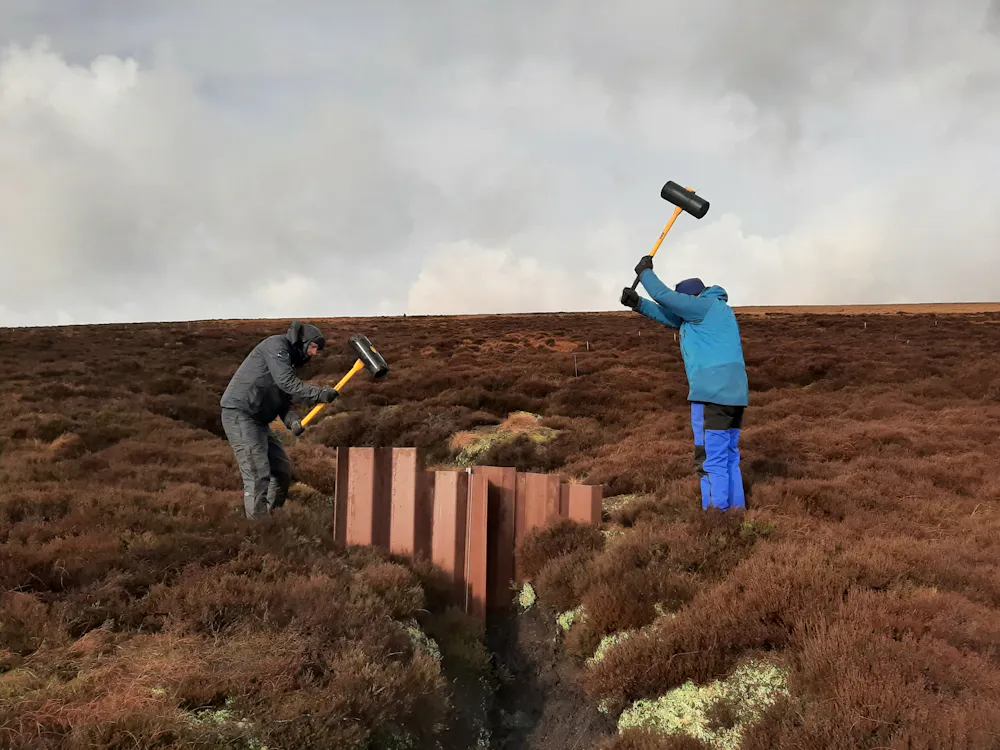
    Gully blocking to raise peatland water tables and limit carbon loss, as part of the GGR-Peat project at the National Trust High Peak Estate.
    Jonathan Ritson

    The Great North Bog initiative, as one example, has linked together restoration organisations, researchers and landowners to deliver restoration across four national parks and three national landscapes. This is truly the scale that is needed if the UK is serious about meeting its climate targets.

    More will be required, however, as huge swathes of peatland remain in a degraded state. While bleak messages like those in our new study could lead to resignation about the effects of climate change, there is an alternative way of looking at it: we must show how bad things could get if we don’t do anything, and then see this as a call to action.

    Jonathan Ritson has received funding from charities delivering peatland restoration.

    – ref. Most of Britain’s peat bogs could stop forming new peat as the climate changes – new study – https://theconversation.com/most-of-britains-peat-bogs-could-stop-forming-new-peat-as-the-climate-changes-new-study-248515

    MIL OSI – Global Reports –

    January 31, 2025
  • MIL-OSI United Nations: Third Meeting of the Trees in Dry Cities Coalition

    Source: United Nations Economic Commission for Europe

    The Trees in Dry Cities Coalition, under the auspices of UNECE’s Trees in Cities Challenge and its Tree Policy Action Lab (Tree PAL), emphasizes the significance of urban trees and nature in dry climates.

    It supports peer exchange, enhanced knowledge awareness and capacity, joint messaging and events (e.g. COP16 Riyadh), and joint action and fundraising to deliver trees in dry cities through local, national and international approaches. It seeks to support cities and inform national policy to systemically drive the sustainable management of urban trees and forests for climate and SDG solutions in dry cities.

    The high-level event “Trees in dry cities: luxury or a fundamental climate and SDG solution?” organized jointly by UNECE and WGEO at COP28 in Dubai highlighted the crucial role urban trees play as integrated nature-based solutions for climate, sustainable development, biodiversity and more. with participation from cities, ministries, international organizations, development banks and others. 

    A draft Action Agenda was developed based on the outcomes of the First Meeting of the Coalition, held with organizations that participating in the COP28 event, drawing upon the insights provided by Focal Points from these organizations. The Second Meeting of the Coalition served to review the draft Action Agenda and identify key priorities and actionable steps to include in an implementation plan. This plan will be presented at the Third Meeting, which invites stakeholders to join the coalition and collaborate in activities of interest.

    MIL OSI United Nations News –

    January 31, 2025
  • MIL-Evening Report: US elections: Cook Islands group warns of climate crisis pushback if Trump wins

    By Losirene Lacanivalu of the Cook Islands News

    The leading Cook Islands environmental lobby group says that if Donald Trump wins the United States elections — and he seemed to be on target to succeed as results were rolling in tonight — he will push back on climate change negotiations made since he was last in office.

    As voters in the US cast their votes on who would be the next president, Trump or US Vice-President Kamala Harris, the question for most Pacific Islands countries is what this will mean for them?

    “If Trump wins, it will push back on any progress that has been made in the climate change negotiations since he was last in office,” said Te Ipukarea Society’s Kelvin Passfield.

    “It won’t be good for the Pacific Islands in terms of US support for climate change. We have not heard too much on Kamala Harris’s climate policy, but she would have to be better than Trump.”

    The current President Joe Biden and his administration made some efforts to connect with Pacific leaders.

    Massey University’s Centre for Defence and Security Studies senior lecturer Dr Anna Powles said a potential win for Harris could be the fulfilment of the many “promises” made to the Pacific for climate financing, uplifting economies of the Pacific and bolstering defence security.

    Dr Powles said Pacific leaders want Harris to deliver on the Pacific Partnership Strategy, the outcomes of the two Pacific Islands-US summits in 2022 and 2023, and the many diplomatic visits undertaken during President Biden’s presidency.

    Diplomatic relationships
    The Biden administration recognised Cook Islands and Niue as sovereign and independent states and established diplomatic relationships with them.

    The Biden-Harris government had pledged to boost funding to the Green Climate Fund by US$3 billion at COP28 in the United Arab Emirates.

    Harris has said in the past that climate change is an existential threat and has also promised to “tackle the climate crisis with bold action, build a clean energy economy, advance environmental justice, and increase resilience to climate disasters”.

    Dr Powles said that delivery needed to be the focus.

    She said the US Elections would no doubt have an impact on small island nations facing climate change and intensified geopolitics.

    Dr Powles said it came as “no surprise” that countries such as New Zealand and Australia had increasingly aligned with the US, as the Biden administration had been leveraging strategic partnerships with Australia, New Zealand, and Japan since 2018.

    She said a return to Trump’s leadership could derail ongoing efforts to build security architecture in the Pacific.

    Pull back from Pacific
    There are also views that Trump would pull back from the Pacific and focus on internal matters, directly impacting his nation.

    For Trump, there is no mention of the climate crisis in his platform or Agenda47.

    This is in line with the former president’s past actions, such as withdrawing from the Paris Climate Agreement in 2019, citing “unfair economic burdens” placed on American workers and businesses.

    Trump has maintained his position that the climate crisis is “one of the great scams of all time”.

    Republished with permission from the Cook Islands News and RNZ Pacific.

    MIL OSI Analysis – EveningReport.nz –

    January 26, 2025
  • MIL-OSI United Kingdom: Government welcomes Official Partners for COP29 

    Source: United Kingdom – Government Statements

    The Official Partners sponsoring the UK’s Pavilion at COP29 are: AVEVA, Corporate Leaders Group, DP World, National Grid, Octopus Energy, SSE and Standard Chartered.

    This year’s COP29 UK Pavilion Official Partners represent UK industry’s outstanding reputation for addressing climate change through enterprise and innovation.

    Throughout the COP29 summit in Baku, Azerbaijan, the UK Pavilion will host a series of events including panel talks, roundtable discussions and networking receptions. These will raise awareness of the best of British climate leadership and share insights on climate change from UK organisations, policy and business. 

    The funding by the UK Pavilion sponsors reduces cost to the taxpayer, while enabling official partners to demonstrate the vital role industry plays in progressing the climate agenda. 

    National Grid and SSE are returning as official partners from COP26 in Glasgow, COP27 in Sharm-El Sheikh and COP28 in Dubai, while Octopus Energy is returning from COP28 – showing the ongoing commitment of these companies to cutting emissions and accelerating towards net zero, and to working with the government on this important mission. 

    The UK government has also welcomed 4 new businesses to the COP29 sponsor portfolio: AVEVA, Corporate Leaders Group, DP World and Standard Chartered, resulting in the highest ever number of official partners at a COP summit.

    COP29 runs from 11-22 November and the UK Pavilion will be open for the duration of the conference. 

    The sponsors

    AVEVA 

    Headquartered in the UK, AVEVA is a global leader in industrial software, driving responsible use of the world’s resources. Over 25,000 enterprises in over 100 countries rely on AVEVA to help them deliver life’s essentials: safe and reliable energy, food, medicines, infrastructure and more. By connecting people with trusted information and AI-enriched insights, AVEVA enables teams to engineer efficiently and optimize operations, driving growth and sustainability.  AVEVA attends COP29 with a wholehearted commitment to ensure that COP29 remains the key mechanism for driving collaborative progress on net zero. With the industrial sector contributing to a quarter of global emissions, AVEVA aims to demonstrate digitalization’s critical role in decarbonising hard-to-abate sectors while enabling innovation in low-carbon paradigms that can support a just transition to a more sustainable future. Sponsoring the UK Pavilion is a key opportunity to collaborate with business, government and civil society leaders, supporting the transformation of UK economic interests to support COP objectives and accelerating the drive for net zero worldwide. 

    Caspar Herzberg, CEO, AVEVA:

    As a UK-headquartered global leader in industrial intelligence software, AVEVA is proud to support the UK Pavilion at COP29. With industry responsible for a quarter of global emissions, industrial digitalisation is revolutionising decarbonisation strategies. Our work with more than 20,000 enterprises worldwide shows how cross-sector collaboration and untapped industrial data are driving breakthrough sustainability solutions. The UK continues to demonstrate leadership in sustainable industrial innovation, and alongside our government and industry partners, we’re committed to accelerating measurable action on our path to net zero.

    Corporate Leaders Group UK 

    The UK Corporate Leaders Group (CLG UK) is a cross-sector, impact-driven business membership group that provides a strong corporate voice to support UK leadership for the transition to a climate neutral, nature positive and socially inclusive economy. CLG UK’s ongoing mission is to increase business and government leadership through a reinforcing virtuous cycle of increasing ambition and implementing action. It has convened and helped build consensus across the UK business community in support of the transition to competitive, climate-neutral, nature-positive and socially inclusive economies.

    Beverley Cornaby, Director, UK Corporate Leaders Group:

    The UK Corporate Leaders Group (CLG UK) is delighted to be sponsoring the UK Pavilion at COP29. The timing could not be more important, with the window of opportunity to transition to a clean future closing rapidly. CLG UK is urging governments to be decisive, provide clear policy frameworks and stay on course to meet net zero through strong delivery and implementation plans. To succeed, the UK government must bring business with it on its journey. That is where CLG UK is perfectly positioned to work with the UK Pavilion’s partners, businesses and change-makers to mobilise investment, technology and innovation to achieve our shared goals. We must work together to unlock the power of UK leadership, shift markets and economies, and maintain ambition for climate, nature and people.

    DP World  

    DP World exists to make the world’s trade flow better, changing what’s possible for the customers and communities it serves globally.  With a dedicated, diverse and professional team of more than 115,000 employees from 160 nationalities, spanning 78 countries on six continents, DP World is pushing trade further and faster towards a seamless supply chain that’s fit for the future. DP World is rapidly transforming and integrating its businesses – Ports and Terminals, Marine Services, Logistics and Technology – and uniting its global infrastructure with local expertise to create stronger, more efficient and sustainable end-to-end supply chain solutions that can change the way the world trades. 

    Rashid Abdulla, CEO & Managing Director, Europe:

    DP World’s ambition is to streamline and sustain global trade while building a resilient, lower-carbon supply chain. At COP29 with the UK government, we will champion sustainable end-to-end solutions that address climate challenges head-on, playing our part in connecting stakeholders across sectors, promoting collaboration and creating shared value.

    National Grid  

    National Grid plays a crucial role in connecting millions of people to the energy they use safely, reliably and efficiently.  National Grid is pioneering ways to decarbonise the energy system; from building interconnectors to allow the UK to share clean energy with Europe, to investing in renewable energy generation in the United States. 

    Rhian Kelly, Chief Sustainability Officer, National Grid:

    Collaboration across borders and the sharing of best practice is vital if the global ambition for a clean energy future is to be met. Energy networks are an important part of this, enabling clean, green energy to flow from where it’s generated to where it’s needed. National Grid is proud to support the UK Pavilion at COP29, and we look forward to sharing our experiences and learning more from the international community.

    Octopus Energy  

    As a British-born company, Octopus Energy showcases how the UK is leading the world in green innovation, investing billions in clean technologies to drive meaningful change globally.  With operations in 18 countries, and 54 million households running on its tech platform Kraken, Octopus is bringing cheaper power to millions of customers globally.  Launched just eight years ago, Octopus is now the largest electricity supplier in the UK and one of the largest investors in renewables in Europe, managing a portfolio worth £7 billion.  Its relentless focus on smart tech and innovations has unlocked the world’s largest virtual power plant and homes with zero energy bills, delivering clean solutions that save people money and power the world. 

    Zoisa North-Bond, CEO Octopus Energy Generation:

    The UK is the vanguard of green innovation, brimming with the talent and technology needed to accelerate the global energy revolution – and COP is a great opportunity to showcase this. From microgrids to wind farms and EVs – the solutions to empower global communities and stop climate change are available today.  By working with policymakers and industry leaders worldwide, we can make green energy accessible for all and drive the solutions that will power the world.

    SSE 

    SSE is the UK and Ireland’s clean energy champion, investing over £20 billion into homegrown energy.  Our purpose is to provide the energy needed today while building a better world of energy for tomorrow.  We do this by developing, building, operating and investing in world-class electricity infrastructure that is vital to the clean energy transition.  We were the first company in the world to develop a ‘just transition strategy’, aimed at ensuring the benefits of the clean energy transition are shared by workers and communities.  SSE has aligned its business strategy to the UN’s Sustainable Development Goals (SDGs), providing a powerful framework to guide the creation of shared value for shareholders and society. 

    Martin Pibworth, SSE Chief Commercial Officer:

    At SSE, we’ve put delivering net zero at the heart of our strategy backed up with of a multi-billion-dollar investment programme focused on mission-critical clean energy infrastructure.  COP29 provides the opportunity to speed up the pace of the transition working with a range of international partners to collectively deliver a global just transition.

    Standard Chartered 

    Standard Chartered has an important role to play in supporting our clients, sectors and markets to accelerate the transition to a low carbon, climate resilient economy. We’re pleased to partner with the UK at COP29, creating a platform to bring together partners, stakeholders and decision makers to help deliver outcomes in support of the Paris Agreement. As a major financial hub, the UK has some of the deepest pools of internationally oriented capital and as a leading international cross-border bank, headquartered in the UK, Standard Chartered is uniquely positioned to mobilise this capital and investment towards our footprint markets across Asia, Africa and the Middle East.  

    Marissa Drew, Chief Sustainability Officer, Standard Chartered:

    We’re pleased to partner with the UK at COP29 and will use this platform, alongside the full breadth of our sustainable finance expertise, to help scale finance and innovative solutions in support of the Paris Agreement. The UK has some of the deepest pools of internationally oriented capital and as a leading international cross-border bank, headquartered in the UK, Standard Chartered is uniquely positioned to mobilise this capital towards sustainable and inclusive growth across our footprint markets in Asia, Africa and the Middle East.

    Share this page

    The following links open in a new tab

    • Share on Facebook (opens in new tab)
    • Share on Twitter (opens in new tab)

    Updates to this page

    Published 4 November 2024

    MIL OSI United Kingdom –

    January 26, 2025
  • MIL-OSI NGOs: Africa: Richer countries must commit to pay at COP29 as climate change forcibly displaces millions across Africa

    Source: Amnesty International –

    With millions of people already displaced by climate change disasters in Africa, the richer countries most responsible for global warming must agree at the COP29 climate conference in Baku, Azerbaijan to fully pay for the catastrophic loss of homes and damage to livelihoods taking place across the continent, Amnesty International said. They must also fully fund African governments’ adaptation measures to prevent further forced displacement, stop human rights violations and help them achieve a fast and fair phaseout of fossil fuel production and use. 

    These same countries must then follow up on their agreement by urgently financing the Fund for responding to Loss and Damage, the main international fund addressing climate change’s unavoidable harms. So far, such countries have pledged less than USD 700 million of the 400 billion dollars that lower-income countries estimate they need for loss and damage by 2030. Meanwhile, adaptation may cost USD 30 to 50 billion per year in sub-Saharan Africa alone. International financial institutions must ensure equitable distribution of the money to African countries based on need. 

    African people have contributed the least to climate change, yet from Somalia to Senegal, Chad to Madagascar, we are suffering a terrible toll of this global emergency.

    Samira Daoud, Amnesty International Regional Director for West and Central Africa

    “African people have contributed the least to climate change, yet from Somalia to Senegal, Chad to Madagascar, we are suffering a terrible toll of this global emergency which has driven millions of people from their homes. It’s time for the countries who caused all this devastation to pay up so African people can adapt to the climate change catastrophe,” said Samira Daoud, Amnesty International Regional Director for West and Central Africa. 

    MIL OSI NGO –

    January 26, 2025
  • MIL-OSI NGOs: COP29: What you need to know about the global climate summit

    Source: Amnesty International –

    The 2024 United Nations Climate Change Conference (COP29) opens next week in Baku, the capital of Azerbaijan. The summit takes place between 11 and 22 November, and decisions made there will impact all of us. To date, the international community has failed to rein in the deadly activities of the fossil fuel industry, which continues to pollute, burn, and ransack the planet in the face of mounting human suffering.

    COP29 is a critical opportunity for world leaders to break with these past failures. Here’s what you need to know about the most important climate event on the global calendar: 

    1. Who’s going? 

      Between 40,000 and 50,000 delegates are expected to attend COP29. This will include government representatives from all UN member states, as well as the State of Palestine, the Holy See, Niue, the Cook Islands, and the European Union. All of these are parties to the 1992 United Nations Framework Convention on Climate Change (UNFCCC), and most have also joined the 2015 Paris Climate Agreement. COP29 will also host diplomats, UN officials, journalists, climate scientists, trade union leaders, and policy experts. NGOs, activists, and Indigenous leaders are also planning to participate – although the involvement of independent media workers and human rights defenders from Azerbaijan itself has been curbed by an ongoing government crackdown.   

      2. What is the aim of COP29? 

        The overall aim of COP29 is for states to agree, develop and share plans for addressing climate change. This means preventing further global warming, and also helping those who have been most affected so far to adapt or to rebuild their lives.  

        In 2015, the Paris Agreement made it a legal requirement for all states to set targets for reducing their greenhouse gas emissions, in order to limit the global temperature increase to 2°C above pre-industrial levels. Since then, however, the Intergovernmental Panel for Climate Change (IPCC) has stressed that the most catastrophic effects of climate change can only be avoided if we limit global warming to 1.5°C by the end of this century.   

        At COP29, countries’ progress on addressing climate change will be measured against this 1.5°C goal. It is important to note that even 1.5°C of warming will entail mass displacement, harm to livelihoods, and loss of life, with lower-income countries the worst affected. At present, the world is on track for an increase of 2.6 to 3.1°C this century.

        3. What’s on the agenda this year?  

          COP29 has been called “the finance COP”, due to its focus on scaling up climate finance. Climate finance refers to the funding that is needed to help lower-income countries transition to zero-carbon economies, and to help the most affected communities adapt to the effects of climate change. A major objective of COP29 is to increase this funding and to produce a new goal for future climate finance.  

          4. Where will that money come from? 

          Under the UNFCCC and the Paris Agreement, the funding must come from the high-income countries that are historically most responsible for climate change. In addition, under international human rights law, all states in a position to do so must also contribute.  

          In addition to setting a financial target, COP29 negotiators must also agree clear timeframes for the provision of funds to lower-income countries. Money should be given in the form of grants, not loans, to avoid worsening existing debt crises.  

          5. What should the funds be used for? 

            This target should also contain sub-goals to make clear where the money should go. For example,  Amnesty International is also calling for the target to include loss and damage finance. This is essentially compensation, paid by high-income countries to lower income ones, to help them recover from the existing impacts of climate change, and from others that they will unavoidably face in the future.  

            One of the Azerbaijan presidency’s more positive moves has been to make adaptation, long sidelined in climate negotiations, a priority of the talks. While preventing further climate change through a full, fast fair and funded phase -out of fossil fuels is critical, the reality is that climate change is already here. Helping people adjust to existing and future impacts of global warming is a crucial part of climate justice.   

            6. How much money is needed? 

              Trillions of dollars are needed to help lower-income states carry out the climate action needed, including transitioning away from fossil fuels in a way that protects peoples’ rights. Amnesty International and others in the climate justice movement are calling for a target of at least 1 trillion USD annually.  

              Azerbaijan has an alarming human rights record, with longstanding restrictions on the rights to freedom of expression, association and assembly.

              7. What are Amnesty’s human rights concerns regarding Azerbaijan? 

                Azerbaijan has an alarming human rights record, with longstanding restrictions on the rights to freedom of expression, association and assembly. Peaceful protests, including those held by environmental groups, are routinely met with violent suppression, and according to the local NGOs more than 300 people are currently imprisoned on politically motivated charges. The work of independent media outlets in Azerbaijan is severely hampered by draconian laws, and the constant threat of retaliation for any real or perceived criticism of the authorities. Most independent media outlets have been crushed out of existence, as have vast swathes of Azerbaijan’s civil society. Torture and other ill-treatment in detention are widespread in Azerbaijan, and impunity is entrenched. 

                8. Have there been any improvements since Azerbaijan was given the COP29 Presidency? 

                  No. In fact, the grave human rights situation in Azerbaijan has worsened since the country was announced as the host of COP29 in December 2023. The authorities claim they are “ensuring everyone’s voices are heard” at the summit – but they have prosecuted more than a dozen activists and journalists this year, and silenced key voices on the climate crisis.  

                  In April, for example, Azerbaijani authorities arrested human rights and climate justice activist Anar Mammadli on bogus “smuggling” charges, and placed him in pre-trial detention, where he remains. Anar Mammadli was among the first activists in Azerbaijan to speak about the connection between human rights and climate justice, and he has been involved in international advocacy at the EU and UN level. In prison he has been denied adequate medical treatment for several worsening health conditions, and he is facing a lengthy sentence.  

                  9. How does the human rights situation in Azerbaijan affect COP29? 

                    It is essential that civil society can participate in climate negotiations. Activists, union leaders, and human rights defenders help to advocate for ambitious targets and play a vital role in ensuring that the plans developed at COP29 align with governments’ human rights obligations and that they are actually implemented. But the involvement of Azerbaijan’s own civil society is likely to be extremely limited. Threats and harassment have forced many local activists to leave the country, while others are arbitrarily detained on politically motivated charges. The few remaining independent voices risk prosecution and retaliation if they dare to voice any criticism during COP29. 

                    The void left by local civil society groups has been filled in part by organizations known as GONGOs (government-organized non-governmental organizations). These state-supported groups do not provide the independent perspectives needed, but their presence allows Azerbaijani authorities to project a false picture of respect for freedom of expression and association.  

                    Amnesty International is monitoring the crackdown in Azerbaijan, and will continue to document violations, both during and after the summit.

                    10 .What about Azerbaijan’s record on climate change?

                      Fossil fuel makes up about half of Azerbaijan’s economy and the vast majority of its export revenues. The state-owned oil and gas company, SOCAR, is a major source of income for President Ilham Aliyev’s government. Nonetheless, Azerbaijan must also do its fair share to achieve a fast and fair fossil fuel phase out; this means no new fossil fuel projects anywhere. But earlier this year, President Aliyev announced plans for expanding gas production which are grossly incompatible with Azerbaijan’s commitments under the Paris Agreement.  

                      Like previous climate summits, COP29 will host many participants whose agendas are seriously at odds with climate justice. Thousands of fossil fuel lobbyists, along with the heads of oil giants like Shell and BP, are expected to be in attendance. These participants have used previous summits to advance their own interests, opposing essential efforts to phase out fossil fuels and pushing for false solutions like carbon offsetting. Amnesty International is calling for a robust conflict of interest policy to prevent fossil fuel lobbyists undermining the aims of global climate treaties. 

                      11. How has climate change impacted people in 2024? 

                        Climate change is causing a dramatic increase in the frequency of extreme temperatures, and 2024 is expected to be the hottest year ever recorded. Around the world, people have been displaced by floods, hurricanes, droughts and other unnatural disasters, all made worse by global warming. Worldwide, Indigenous Peoples and land-dependent communities continue to bear the heaviest burden of biodiversity loss.  

                        Lives have been lost; livelihoods, languages, and entire cultures are in peril; and disease, hunger and displacement is causing extreme suffering. The cost of these losses amounts to trillions of dollars in damages, which dwarf the cost of current investments in renewable energy, and threaten governments’ capacity to fund policies to protect human rights.

                        12. What is Amnesty calling for at COP29? 

                          • Human rights must be at the heart of all climate action decision-making;
                          • States in a position to do so must massively scale up climate finance and funding for loss and damage;
                          • All states must commit to fully phasing out fossil fuels, in a way that is fast and fair;
                          • COP29 participants must not chase risky technologies, like carbon capture and storage and removals, or push gas as a “transition fuel”, as a means of distracting from the urgent need to phase out fossil fuels;
                          • The UNFCCC Secretariat, the government of Azerbaijan, and other governments must protect civic space, and guarantee the rights to freedom of expression, association and peaceful assembly.   

                          Read more of Amnesty International’s recommendations on climate justice here

                          Help protect the protest in Azerbaijan

                          MIL OSI NGO –

                          January 26, 2025
                        1. MIL-OSI Asia-Pac: India-Spain Joint Statement during the visit of President of Government of Spain to India (October 28-29, 2024)

                          Source: Government of India

                          Posted On: 28 OCT 2024 6:32PM by PIB Delhi

                          At the invitation of the Prime Minister of India, Shri Narendra Modi, President of the Government of Spain, Mr. Pedro Sanchez paid an official visit to India on 28 -29 October, 2024. This was President Sanchez’s first visit to India and the first visit by a President of the Government of Spain to India after 18 years. He was accompanied by the Minister of Transport and Sustainable Mobility and the Minister of Industry and Tourism, and a high-level official and business delegation.

                          The two leaders noted that this visit has renewed the bilateral relationship, infusing it with fresh momentum and setting the stage for a new era of enhanced cooperation between the two countries across various sectors. They also expressed satisfaction at the progress of bilateral relations since Prime Minister Modi’s visit to Spain in 2017. Both leaders instructed their teams to continue upgrading the bilateral agenda further and forging cooperation in all dimensions of political, economic, security, defence, people-to-people and cultural cooperation.

                          President Sanchez was granted a cultural welcome, and held delegation level talks with Prime Minister Modi at Vadodara.He also visited Mumbai where he interacted with prominent business leaders, cultural figures and representatives of the Indian film industry.

                          President Sanchez and Prime Minister Modi jointly inaugurated the Final Assembly Line Plant of C-295 aircraft co-produced by Airbus Spain and Tata Advanced Systems Ltd. at Vadodara. This plant will roll out the first ‘Made in India’ C295 aircraft in 2026, out of a total of 40 aircrafts to be manufactured in India. Airbus Spain is also delivering 16 aircrafts in ‘fly-away’ condition to India, out of which 6have already been delivered to the Indian Air Force.

                          Political, Defence, and Security Cooperation

                          1. The two leaders reviewed the warm and cordial bilateral ties between the two countries and highlighted that the foundation of the growing partnership lies in the shared commitment to democracy, freedom, rule of law, a fair and equitable global economy, a more sustainable and resilient planet, a rules-based international order and enhanced and reformed multilateralism. They also highlighted the enduring historical ties and long-standing friendship between the two nations as central to this cooperation.

                          2. Both leaders emphasised that regular high-level interaction is giving momentum to the partnership. They noted that the ongoing bilateral cooperation between the foreign, economy and commerce and defence ministries is working well, and stressed the importance of holding regular dialogues between the concerned ministries/agencies of the two sides with a view to strengthening and diversifying bilateral cooperation in key areas of defence, security including cyber security, trade and economic issues, culture, tourism, education and people-to-people ties.

                          3. Both leaders expressed satisfaction on the progress made in the C-295 aircraft project as a symbol of the growing defence industrial cooperation between the two countries. In line with this growing partnership, and in recognition of the advanced capabilities and competitiveness of the Spanish defence industry and its contribution to the goals of the ‘Make in India’ initiative, they encouraged their respective defence industries in other sectors to set up similar joint projects in India.

                          Economic and Commercial Cooperation

                          4. President Sanchez and Prime Minister Modi welcomed the recent positive developments in bilateral trade and investment partnership, buoyed by the positive economic outlook in both countries and called for stronger ties between the businesses of the two countries.

                          5. Prime Minister Modi congratulated President Sanchez on the growth and the resilience of the Spanish economy. President Sanchez complimented Prime Minister Modi on India’s fast economic growth and lauded the various government initiatives to promote a business-friendly environment. President Sanchez highlighted Spain’s commitment to the ‘Make in India’ initiative through the activities of about 230 Spanish companies present in India. Both leaders reiterated their strong support for an open rules-based multilateral trading system, and a business-friendly investment scenario in both countries.

                          6. Recognizing the expertise of Spanish companies in areas such as energy, including renewables, nuclear, and smart grids, food processing, healthcare and health services, automotive and transport infrastructure, including trains, roads, ports and transport network management, the two leaders welcomed further collaboration in these areas. President Sanchez welcomed the positive contributions being made by Indian companies to the Spanish economy in fields such as information technology, pharmaceuticals and automobile and auto components. Both leaders welcomed the establishment of a ‘Fast Track Mechanism’ to facilitate mutual investments in India and Spain.

                          7. The two leaders took note of the progress made by the 12th session of the India-Spain ‘Joint Commission for Economic Cooperation’ (JCEC) held in 2023 and agreed to convene the next session of the JCEC in Spain in early 2025. In this context, they also agreed on the importance of deepening economic ties and exploring strategic cooperation in key sectors such as renewable energy, technology, and sustainable infrastructure. The two leaders looked forward to an early conclusion of Memorandum of Understanding on Urban Sustainable Development.

                          8. Both leaders welcomed the Second meeting of the India-Spain CEOs Forum as well as India-Spain Business Summit in Mumbai on October 29, 2024,to promote trade and investment cooperation between the two countries.

                          9. Both leaders recognized the vital importance of innovation and the startup ecosystems in driving forward the bilateral partnership and called for all such opportunities to be explored in mutual interest. They encouraged relevant agencies of both countries to work to deepen any such exchanges in the future, including through frameworks such as Rising Up in Spain and the Startup India initiative.

                          10. The two leaders expressed satisfaction at the signing of a Memorandum of Understanding on cooperation in the field of rail transport and the agreement of cooperation and mutual assistance in customs matter.

                          11. The leaders acknowledged the role of tourism in driving economic and business opportunities and enhancing understanding between the people of both countries and agreed that it should be further promoted. Both leaders welcomed the interest shown by airlines to establish direct flights between Spain and India.

                          The Year 2026 as India-Spain Year of Culture, Tourism and AI

                          12. Taking into account the deep relationship between India and Spain and the long lasting friendship between the two peoples, Prime Minister Modi, and President Pedro Sanchez, have agreed to make 2026 as the Year of India and Spain in Culture, Tourism and Artificial Intelligence (AI).

                          13. During the year, both sides will make the maximum effort to boost the cultural presence of the other in their museums, art, fairs, film, festivals, literature, meetings of architects and circles of debate and thought.

                          14. Likewise, special attention will be paid to ways of increasing tourist flows, promote reciprocal investments and share experiences in the many areas of hospitality, architecture, cuisine, marketing, both in urban and rural tourism, which benefits harmonious development and improvement for both countries.

                          15. In accordance with the G20 New Delhi Leaders Declaration, India and Spain can play a very important role for the use of AI for good and its positive implementation in many fields. Both countries commit to hold during the year, events to foster positive use of AI and will work for the practical implementation of new advances in the field of AI in the productive economy.

                          16. To mark the importance of this initiative, both leaders directed the concerned stakeholders to celebrate the year in the respective countries in the most befitting manner.

                          Cultural and People-to-People Ties

                          17. The two leaders acknowledged the role of cultural ties in bringing nations closer and lauded the rich and diverse cultural heritage of India and Spain. They appreciated the long-standing cultural exchanges and enrichment between India and Spain, particularly the role of Spanish Indologists and Indian Hispanists. They welcomed the signing of a Cultural Exchange Program to promote bilateral exchanges in music, dance, theatre, literature, museums and festivals.

                          18.The two leaders applauded the growing interest in the study of the cultures and languages of both countries. Spanish is among popular foreign languages in India. They stressed the mutual interest in further strengthening India – Spain cultural cooperation and the reinforcement of cooperation among cultural institutions of both countries such as Instituto Cervantes in New Delhi and Casa de la India in Valladolid.

                          19. The two leaders welcomed the establishment of the ICCR Chairs on Hindi and on Indian Studies at the University of Valladolid. India is bringing transformational changes in education sector in India under National Education Policy (NEP) 2020. In this context, Prime Minister Modi encouraged leading Spanish universities to strengthen academic and research partnership with Indian institutions; build institutional linkages through joint/dual degree and twinning arrangements and explore the possibility of setting up branch campuses in India.

                          20. President Sanchez is also giving the keynote address at the 4th Spain-India Forum, co-organized by Spain-India Council Foundation and Observer Research Foundation, in Mumbai. The leaders recognized the valuable contributions of this institution, which has a complementary role to that of governments in strengthening the links between Indian and Spanish civil societies, companies, think tanks, administrations and universities, helping to enhance bilateral ties by fostering a strong partnership between their members and its activities and bringing the two countries together in order to increase their mutual knowledge.

                          21. The two leaders welcomed the installation at Valladolid of the bust of Gurudev Rabindranath Tagore gifted to the people of Spain by ICCR and the placing of the translated works of Tagore in the vaults of Instituto Cervantes in Madrid which is a testament to increasing cultural connect between peoples of the two countries.

                          22. The two sides noted with satisfaction the growing cooperation in the field of film and audio-visuals, with India being the Guest Country at the SEMINCI International Film Festival in 2023, and the award of the IFFI Satyajit Ray Lifetime Achievement to the legendary Spanish director Carlos Saura. Acknowledging the large film and audio-visual industries in India and Spain, both leaders agreed that the scope of collaboration between the two countries under the Audio-Visual Co-Production Agreement can be enhanced and welcomed the creation of a Joint Commission to improve cooperation between the two countries in the audiovisual field and promote and facilitate the co-production of films.

                          23. To enhance people-to-people ties and consular services in two countries, the two leaders welcome the operationalisation of India’s first Consulate General in Spain at Barcelona and the decision to open Spain’s Consulate General in Bengaluru.

                          EU and India relations

                          24. Prime Minister Modi and President Sanchez reaffirmed their commitment to strengthening the India-EU Strategic Partnership and to advancing the EU-India triple negotiations of comprehensive Free Trade Agreement, Investment Protection Agreement and Geographical Indications Agreement.

                          25. They agreed to enhance their collaboration to fully realize the objectives of the EU-India Connectivity Partnership, and recognized the potential of the India-Middle East-Europe Economic Corridor Project (IMEEC) to boost connectivity between India and Europe. They explored avenues for cooperation among regional countries in areas such as trade, investment, technology, energy, logistics, ports, and infrastructure development.

                          Global Issues

                          26. The leaders expressed their deepest concern over the war in Ukraine and reiterated the need for a comprehensive, just and lasting peace in line with international law, and consistent with the purposes and principles of the UN Charter, including respect for sovereignty and territorial integrity. They underlined the importance of dialogue and diplomacy as well as earnest engagement between all stakeholders to achieve a sustainable and peaceful resolution of the conflict. Both sides agreed to remain in touch to support efforts aimed at negotiated settlement of the conflict.

                          27.They shared their firm commitment to achieving peace and stability in the Middle East, and expressed their deep concern at the escalation of security situation in West Asia and called for restraint by all concerned. They urged that all issues be addressed through dialogue and diplomacy. The two leaders unequivocally condemned the terror attacks on Israel on October 7, 2023, and agreed that the large-scale loss of civilian lives and the humanitarian crisis in Gaza is unacceptable and must end as soon as possible. They called for the immediaterelease of all hostages, immediate ceasefire and safe, sustained entry of humanitarian aid into Gaza. They emphasized the urgent need to protect the lives of civilians and urged all parties to comply with international law. They reiterated their commitment to the implementation of the two State solution,leading to the establishment of a sovereign, viable and independent state of Palestine, living within secure and mutually recognized borders, side by side in peace and security with Israel as well as their support for Palestine membership at the United Nations.

                          28. Both sides reiterated their concern on escalation and violence in Lebanon, and the security situation along the Blue Line and reaffirmed their commitment to the full implementation of UNSC Resolution 1701. As major troop contributing countries, they condemned the attacks on UNIFIL and highlighted that the safety and security of peacekeepers are of paramount importance and must be ensured by all. Inviolability of UN premises and the sanctity of their mandate must be respected by all.

                          29. Both sides emphasized the promotion of a free, open, inclusive, peaceful, and prosperous Indo-Pacific, anchored in a rules-based international order, mutual respect for sovereignty, and the peaceful resolution of disputes, supported by effective regional institutions. They highlighted the importance of unimpeded commerce and freedom of navigation, in compliance with international law, particularly the United Nations Convention on the Law of the Sea (UNCLOS) 1982. Both sides acknowledged India’s invitation to Spain to participate in the Indo-Pacific Oceans Initiative (IPOI) for collaborative efforts aimed at the management, conservation, sustainability, security, and development of the maritime domain in the Indo-Pacific. They also recognized the complementarity between India’s Indo-Pacific Vision and the EU Strategy for Cooperation in the Indo-Pacific.

                          30. Noting the growing political and commercial relations between India and Latin American region and the historical, economic and cultural links it shares with Spain, both leaders recognized the immense potential of triangular cooperation for investments and development in the region. Spain welcomed India’s application to join the Ibero-American Conference as an Associate Observer, which will offer a platform to strengthen the ties with Latin American countries. Both sides committed to finalise the process by the Ibero-American Summit, to be held in Spain in 2026, so that India may actively participate in the activities of Spain´s Pro Tempore Secretariat.

                          International and Multilateral Cooperation

                          31. Both leaders agreed to enhance cooperation and coordination within the United Nations, including the UN Security Council (UNSC), and other multilateral forums. They emphasized the importance of a rules-based international order for ensuring global peace and development. Both sides committed to advancing multilateralism that reflects present-day realities, making international organizations, including the UNSC, more representative, effective, democratic, accountable and transparent. India expressed its support for Spain’s UNSC candidature for the term 2031-32, while Spain expressed its support for India’s candidature for the period 2028-29.

                          32. Both leaders look forward to the Fourth International Conference on Financing for Development to take place in 2025 in Sevilla (Spain) as a critical opportunity to identify priority actions to help close the resource gap needed to implement the Sustainable Development Goals.

                          33. President Sanchez congratulated Prime Minister Modi on the exemplary chairmanship of G20, which successfully and inclusively addressed important and complex Global South issues. Prime Minister Modi appreciated the valuable contributions made by Spain to the discussions as a Permanent Invitee to the G20.

                          34. The two leaders agreed to strengthen cooperation in promoting sustainable energy and adapting to climate change. They recognize the urgency of accelerating global actions to combat climate change and commit to collaborating in the context of the upcoming Climate Summit in Baku (COP29) to achieve an ambitious outcome including on a New Collective Quantified Goal on Climate Finance that helps achieve the temperature goal of Paris Agreement. They also highlighted the need topromote actions to strengthen countries’ resilience and adaptation capacities in the face of the increasing impacts of climate change worldwide. The two leaders looked forward to the early conclusion of Memorandum of Understanding in the field of Renewable Energy. Prime Minister Modi appreciated Spain’s commitment towards a green transition and welcomed Spain to the International Solar Alliance. President Sanchez appreciated advances made by India in achieving the renewable energy goals much ahead of the target year. Both leaders also agreed that a concerted global effort would be needed in order to address climate change concerns. Both sides will respond positively to the outcomes of COP28, including the first Global Stocktake in light of national circumstances.

                          35. Spain has invited India to join IDRA, the International Drought Resilience Alliance, which was launched in 2022, a platform to promote concrete actions to reduce the vulnerability of countries, cities and communities to drought through preparedness and adaptation measures.

                          36.Both leaders unequivocally condemned terrorism and violent extremism in all its forms and manifestations, including the use of terrorist proxies and cross-border terrorism. Both sides agreed that terrorism remains a serious threat to international peace and stability, and called for bringing the perpetrators of all terrorist attacks to justice without delay. They urged all countries to take immediate, sustained and irreversible action to prevent territory under their control from being used for terrorist purposes, and stressed the need for firm implementation of relevant resolutions of the UN Security Council, as well as the implementation of the UN Global Counter-Terrorism Strategy. They also called for concerted action against all terrorist groups proscribed by the UNSC including Al Qa’ida, ISIS/Daesh, Lashkar-e-Tayyiba (LeT), Jaish-e-Mohammad (JeM) and their proxy groups. Prime Minister Modi appreciated Spain’s multilateral initiatives in support of the Victims of Terrorism and their empowerment.

                          37. President Sanchez thanked Prime Minister Modi for the warm reception and hospitality extended to him and his delegation during the visit, and invited him to undertake a visit to Spain in the near future.


                          ***

                          MJPS/SR

                          (Release ID: 2068963) Visitor Counter : 44

                          MIL OSI Asia Pacific News –

                          January 25, 2025
                        2. MIL-OSI Asia-Pac: Joint Statement: 7th India-Germany Inter-Governmental Consultations (IGC)

                          Source: Government of India

                          Posted On: 25 OCT 2024 8:25PM by PIB Delhi

                          Growing Together with Innovation, Mobility and Sustainability

                          Prime Minister Narendra Modi and Federal Chancellor Olaf Scholz co-chaired the seventh round of India-Germany Inter-Governmental Consultations (7th IGC) on 25 October 2024 in New Delhi. The Delegation included Ministers of Defence, External Affairs, Commerce & Industries, Labour & Employment, Science & Technology (MoS) and Skill Development (MoS) from the Indian side and Ministers of Economic Affairs & Climate Action, Foreign Affairs, Labour & Social Affairs and Education & Research from the German side along with Parliamentary State Secretaries for Finance; Environment, Nature Conservation, Nuclear Safety and Consumer Protection; and Economic Cooperation and Development from the German side, as well as senior officials from both sides.

                          2. Prime Minister Narendra Modi warmly welcomed Chancellor Olaf Scholz on his third visit to India as Chancellor. Both leaders sincerely appreciated the renewed momentum in bilateral engagement across government, industry, civil society and academia that has played an instrumental role in advancing and deepening the Strategic Partnership between India and Germany.

                          3. Both leaders emphasised the importance of the Asia-Pacific Conference of German Business (APK), which takes place in New Delhi in parallel to the 7th IGC, in strengthening economic ties and strategic partnerships between Germany, India and the Indo-Pacific region as a whole. The decision to host the 2024 conference in India underscores India’s political weight in the Indo-Pacific and globally.

                          4. Under the motto “Growing Together with Innovation, Mobility and Sustainability”, the 7th IGC placed particular emphasis on technology and innovation, labour and talent, migration and mobility, climate action, green and sustainable development as well as economic, defence and strategic cooperation. Both sides agree that the aforementioned domains will be the key drivers of our ever more multi-faceted partnership that spans trade, investment, defence, science, technology, innovation, sustainability, renewable energy, emerging technologies, development cooperation, culture, education, sustainable mobility, sustainable resource management, biodiversity, climate resilience and people-to-people ties.

                          5. The year 2024 marks the 50th anniversary of the signing of the Inter – Governmental Agreement on Cooperation in Scientific Research and Technological Development which institutionalized the framework of Indo-German cooperation in Science & Technology, research and innovation. In this context, the 7th IGC presented an opportunity to renew the close relationship between India and Germany in this regard and to prioritize the advancement of technology and innovation as a key pillar of cooperation.

                          6. During the 6th IGC, both governments had announced the Green and Sustainable Development Partnership (GSDP), which serves as an umbrella for bilateral formats and joint initiatives in this field. Subsequently, both sides signed the Migration and Mobility Partnership Agreement (MMPA) in December 2022 and launched the “India-Germany Vision to Enhance Cooperation in Innovation and Technology” in February 2023. Recalling the outcomes of the 6th IGC and various agreements concluded by the two sides thereafter, both governments launched the “India-Germany Innovation and Technology Partnership Roadmap” and introduced the “Indo-German Green Hydrogen Roadmap”, whose aim is to promote the market ramp-up of Green Hydrogen.Growing Together for Peace, Security and Stability

                          7. The two leaders noted the Pact for the Future and reaffirmed their commitment to upholding shared values and principles including democracy, freedom, international peace and security and a rules-based international order in line with the purposes and principles of the UN Charter. Both governments also underscored their commitment to strengthen and reform the multilateral system including expansion of both permanent and non-permanent categories of membership of the UN Security Council to reflect contemporary realities, address current and future challenges and to support and preserve peace and stability across the world. The two leaders called for text-based negotiations at the IGN within a fixed timeframe.

                          8. India and Germany agreed that the difficulties of the UN Security Council to effectively address regional and global crises offer a compelling reminder of the urgent need for reform. As members of the “Group of Four (G4)”, India and Germany reiterated their call for a Security Council that is efficient, effective, transparent and reflective of 21st century realities.

                          9. The leaders expressed their deepest concern over the war raging in Ukraine including its terrible and tragic humanitarian consequences. They reiterated the need for a comprehensive, just, and lasting peace in line with international law, consistent with the purposes and principles of the UN Charter, including respect for sovereignty and territorial integrity. They also noted the negative impacts of the war in Ukraine with regard to global food and energy security, especially for developing and least developed countries. In the context of this war, they shared the view that the use, or threat of use, of nuclear weapons is unacceptable. They underscored the importance of upholding international law, and in line with the UN Charter, reiterated that all states must refrain from the threat of or use of force against the territorial integrity and sovereignty or political independence of any state.

                          10. The leaders expressed their shared interest in achieving peace and stability in the Middle East. They unequivocally condemned the Hamas’ terror attacks on October 7, 2023 and expressed concern over the large-scale loss of civilian lives and the humanitarian crisis in Gaza. They called for the immediate release of all hostages taken by Hamas and an immediate ceasefire as well as the urgent improvement of access and sustained distribution of humanitarian assistance at scale throughout Gaza. The leaders underscored the need to prevent the conflict from escalating and spilling over in the region. In this regard, they called on all regional players to act responsibly and with restraint. Both sides also emphasized the urgent need to protect the lives of civilians and facilitate safe, timely and sustained humanitarian relief to civilians, and in this regard urged all parties to comply with international law. The leaders were also deeply concerned about the rapidly deteriorating situation in Lebanon, called for an urgent cessation of hostilities and agreed that a solution to the conflict in Gaza and in Lebanon can only be reached by diplomatic means. The United Nations Security Council Resolution 1701 outlines the path towards a diplomatic solution along the Blue Line. The leaders reaffirmed their commitment to a negotiated two-state solution, leading to the establishment of a sovereign, viable and independent State of Palestine, living within secure and mutually recognized borders, side by side in dignity and peace with Israel, taking into account Israel’s legitimate security concerns.

                          11. The leaders underscored that as the world’s two largest democracies, India and the EU have a common interest in ensuring security, prosperity and sustainable development in a multi – polar world. They emphasized the importance of deepening the India-EU Strategic Partnership which would not only benefit both sides but also have a far-reaching positive impact globally. The leaders also expressed their strong support to the India-EU Trade and Technology Council that would serve as an innovative platform towards closer engagement in the critical areas of trade, trusted technologies and security. They agreed to coordinate efforts, both bilaterally and at the EU level, to take forward key connectivity initiatives including India-Middle East-Europe Economic Corridor in which India, Germany and EU are members as well as the EU Initiative Global Gateway.

                          12. Both leaders underscored the crucial importance of a comprehensive Free Trade Agreement, Investment Protection Agreement and an Agreement on Geographical Indications between the European Union and India, while calling for an early conclusion of the negotiations.

                          13. Both leaders unequivocally condemned terrorism and violent extremism in all its forms and manifestations, including the use of terrorist proxies and cross-border terrorism. Both sides agreed that terrorism remains a serious threat to international peace and stability. They further called for concerted action against all terrorist groups, including groups proscribed by the United Nations Security Council (UNSC) 1267 Sanctions Committee. Both sides also called upon all countries to continue to work towards eliminating terrorist safe havens and infrastructure as well as to disrupt terrorist networks and financing in accordance with international law.

                          14. Both leaders noted with concern the emerging threats from the use of new and emerging technologies for terrorist purposes such as unmanned aircraft systems, use of virtual assets by terrorists and terrorist entities and the misuse of information and communication technologies for radicalization. In this regard they welcomed the adoption of Delhi Declaration on Countering the use of New and Emerging Technologies for Terrorism Purposes adopted during the conduct of UNCTC meetings in India in 2022.

                          15. Recognizing a shared commitment to combat terrorism and strengthen the framework for global cooperation in this regard, both leaders emphasized the importance of upholding international standards on anti-money laundering and combating the financing of terrorism by all countries, including in FATF. Both sides called for bringing the perpetrators of terrorist acts to justice. Both sides reaffirmed their commitment to hold regular consultations of the Joint Working Group on Counter Terrorism to strengthen channels for real time sharing of intelligence and coordination of counter-terrorism efforts. Both sides also committed to continued exchange of information about sanctions and designations against terror groups and individuals, countering radicalism, and terrorists’ use of the internet and cross-border movement of terrorists.

                          16. With a view to ensuring closer collaboration to prevent, suppress, investigate and prosecute criminals, including crime related to terrorism, India and Germany concluded the Mutual Legal Assistance Treaty in Criminal Matters (MLAT). Both leaders agreed that the India-Germany MLAT is an important milestone in strengthening security cooperation between the two countries that will enable sharing of information and evidence, mutual capacity building and sharing of best practices between the two countries.

                          17. As strategic partners with a shared interest in deepening security cooperation, both sides concluded the Agreement on the Exchange and Mutual Protection of Classified Information thereby creating a legal framework for cooperation and collaboration between Indian and German entities and providing guidance on how classified information should be handled, protected and transmitted.

                          18. With a view to better appreciating foreign policy perspectives in key regions across the world, both governments decided to establish an India-Germany Dialogue on West Asia and North Africa (WANA) between the respective Foreign Ministries, which would be in addition to long-standing dialogue mechanisms on Africa and East Asia. Both governments also expressed satisfaction with regular consultations on key thematic issues of mutual concern including policy planning, cyber-security, cyber issues and United Nations.

                          19. Recognizing the need for a deeper understanding of each other’s perspectives, including amongst think tanks and foreign and security policy experts, both governments underscored the usefulness of India-Germany Track 1.5 dialogue between Indian Council of World Affairs (ICWA), the Research and Information System for Developing Countries (RIS) and MEA from the Indian side and German Institute for Global and Area Studies (GIGA), the German Institute for International and Security Affairs (SWP) and the German Federal Foreign Office. The next meeting of this dialogue format is planned for November 2024. Both governments also appreciated the launch of a Track 1.5 Dialogue on East Asia and agreed that these exchanges help both sides better align and coordinate their outreach. With a view to sustaining this momentum, both sides agreed to convene the next edition of the Track 1.5 Dialogue Mechanisms at the earliest opportunity.

                          20. Both sides are committed to promoting a free, open, inclusive, peaceful and prosperous Indo-Pacific built on international law, mutual respect for sovereignty, and peaceful resolution of disputes, and underpinned by effective regional institutions. Both sides reaffirmed their unwavering support for ASEAN’s unity and centrality. The Government of India welcomed Germany’s leadership in the capacity-building pillar of the Indo-Pacific Oceans Initiative (IPOI) and its commitment of up to 20 Million EUR via a competitive call for ideas under its International Climate Initiative in 2022 to strengthen the resilience of Pacific Island States against climate-related loss and damage.

                          21. Germany congratulated India on its successful G20 Presidency which brought the development agenda to centre stage in G20. Both Leaders acknowledged that from initiating a platform on Compact with Africa (CwA) during the German G20 Presidency to inclusion of the African Union as a permanent member of the G20 during India’s Presidency, the G20 has come a long way to ensure that the voice of the Global South is amplified. India and Germany expressed their support to the priorities set by the Brazilian G20 Presidency, especially Global Governance Reforms.Strengthening Defence and Strategic Cooperation

                          22. Recognizing the shared goal of intensifying defence ties between the two countries, the Government of India welcomed the efforts of the German Federal Government to facilitate faster export clearances, including through favourable regulatory decisions such as the General Authorisation/General Licences (AGG) regime. Both sides committed to supporting strategic exports to India and encouraged co-development, co-production and joint research between the respective defence industries. Both governments appreciated the defence roundtable held in New Delhi on 24 October, to strengthen the defense industrial partnership between India and Germany.

                          23. In addition to regular visits and increasing interactions between the armed forces, both sides look forward to the next High Defence Committee (HDC) meeting to be held in India next year with a view to developing defence cooperation as a key pillar of the Strategic Partnership between India and Germany. India and Germany also agreed to finalize cooperation in peacekeeping related training between the Centre for UN Peacekeeping (CUNPK), New Delhi and its counterpart in Germany, the Bundeswehr United Nations Training Centre in Hammelburg (GAFUNTC) and looked forward to the Peacekeeping Ministerial Meeting in Berlin in 2025.

                          24. Both sides stressed the importance of the Indo-Pacific for prosperity and security as well as for addressing global challenges. Germany will enhance its engagement with the region in line with the Federal Government’s policy guidelines for the Indo-Pacific. Both sides also highlighted the importance of freedom of navigation and of unimpeded maritime routes in accordance with International Law, as reflected in the United Nations Convention on the Law of the Sea (UNCLOS) 1982, in all maritime domains including in the Indo-Pacific. In this context, both governments declared their joint intent to conclude a Memorandum of Arrangement regarding mutual logistics support and exchange between the armed forces of India and Germany to further intensify defence and security ties and to establish a basis for provision of mutual logistics support including in the Indo-Pacific theatre. With a view to deepening cooperation in the Indo-Pacific, Germany will permanently deploy a Liaison Officer in the Information Fusion Centre – Indian Ocean Region (IFC-IOR) at Gurugram to monitor the marine traffic in IOR, further augmenting close cooperation in this region.

                          25. Both sides welcomed Germany’s growing engagement in the Indo-Pacific region in the field of security and defence cooperation and appreciated the successful cooperation of the Indian and German air forces during exercise TARANG SHAKTI in August 2024 as well as the port call in Goa and joint naval exercises between the German Naval Frigate “Baden-Württemberg” along with the Combat Support Ship “Frankfurt Am Main” and the Indian Navy. Germany also welcomed the port call of Indian naval ship INS TABAR to Hamburg in July 2024.

                          26. Both governments agreed to intensify bilateral exchanges on security and defence issues also through enhancing research, co-development and co-production activities bilaterally, under EU mechanisms and with other partners. In this regard, both sides will support enhanced industry level cooperation in the defence sector with a specific focus on technology collaboration, manufacturing/co-production and co-development of defence platforms and equipment. Germany also welcomes India’s application for observer status in the Eurodrone Programme of OCCAR (Organisation for Joint Armament Co-operation).Partnering for Critical and Emerging Technologies, Science and Innovation

                          27. Both leaders expressed their appreciation on the successful 50 years of long standing collaboration in science and technology between the two countries and reaffirmed their support to expand it further through launching the ‘India-Germany Innovation and Technology Partnership Roadmap’ which will serve as a guideline to the public and private sectors and research institutions of the two countries to take forward our cooperation in the areas of renewable energy, start-ups, semiconductors, AI and quantum technologies, climate risk and sustainable resource management, climate change adaptation as well as agroecology Both leaders further identified space and space technologies as an important and promising area for future prosperity, development, and possible cooperation.

                          28. The two leaders expressed their satisfaction at the growing exchanges between the two countries in the field of research & education and growing number of Indian students studying in Germany. Both leaders also acknowledged the flagship role of the Indo-German Science and Technology Centre (IGSTC) in promoting bilateral industry-academia strategic research and development partnerships. Both leaders welcomed the recent initiatives of IGSTC and signing of Joint Declaration of Intent to support 2+2 projects in the field of advanced materials. Understanding the importance of IGSTC, both leaders expressed their desire to expand and forge new partnerships anchored in shared values and driven by innovation led technology development and manufacturing.

                          29. Both Leaders acknowledged the launching of the first ever basic research consortia model between the two countries namely, International Research Training Group (IRTG), jointly by Department of Science and Technology (DST) & German Research Foundation (DFG) with the involvement of first group of researchers from IISER Thiruvananthapuram and Würzburg University on Photoluminescence in Supramolecular Matrices. Underpinning science and innovation landscape, they expressed their desire to initiate an Indo-German Innovation and Incubation Exchange Programme to leverage collective expertise and capacity for fostering scientific innovation and incubation ecosystems of academic & research institutions.

                          30. Both Leaders also expressed their appreciation and satisfaction over the high level of engagement as exemplified by India’s participation in mega-science facilities at Facility for Anti-Proton and Ion Research (FAIR) and Deutsche Elektronen Synchrotron (DESY) in Germany. They extended their commitment including financials to ensure timely execution of the FAIR facility. The two leaders also acknowledge the continuation of the cooperation at the synchrotron radiation facility PETRA-III and the free-electron laser facility FLASH at DESY.

                          31. Both governments welcomed the steadily increasing partnerships in Higher Education which facilitate dual and joint degrees and intensify collaborative research and academic and institutional exchanges between Universities and Institutions of Higher Education. In particular, both sides expressed their appreciation and full support for the first ever Indo-German joint Masters degree programme in “Water Security & Global Change”, a joint initiative of TU Dresden, RWTH-Aachen and IIT-Madras (IITM) funded by DAAD as well as a new initiative of TU Dresden and IITM to conclude an agreement establishing a “transCampus” to deepen bilateral cooperation in teaching, research, innovation and entrepreneurship. Both governments also welcomed the signing of the MoU between IIT Kharagpur and the DAAD, which will enable joint funding for Indo-German university cooperation projects. Both sides expressed their strong support for the dedicated call of the “German Indian Academic Network for Tomorrow” (GIANT) under SPARC (Scheme for Promotion of Academic and Research Collaboration) highlighting cooperation between Indian and German universities.

                          32. With a view to further strengthening digital and technology partnerships between India and Germany, both governments agreed to share experience and expertise in digital public infrastructure (DPI), e.g. to explore ways in which Germany can leverage India’s expertise in DPI and the strengths of the Indian IT industry to drive innovation and digital transformation in both countries. As an important forum for exchanges on digital topics such as internet governance, tech regulations, digital transformation of economy, and emerging digital technologies, both sides welcomed the finalization of the Work Plan for 2023-24 formulated by the Indo-German Digital Dialogue (IGDD).

                          33. Both sides will endeavour to leverage AI to advance the SDG, recognizing the need for an innovation-friendly, balanced, inclusive, human-centric and risk-based approach to the governance of AI. Digital solutions such as image detection and AI are playing an important role in revolutionising agriculture by assisting farmers and enhancing agricultural productivity, climate resilience, carbon sinks and sustainability. Both countries are running national programmes to facilitate the growth of digital agriculture and have agreed to intensify their Cooperation in Digital Agriculture, AI and IoT to foster ongoing cooperation, innovation and exchanges for modernising agriculture.

                          34. Both governments underlined the strategic importance of collaboration in the field of critical and emerging technologies, innovation and skill development. Reaffirming the priorities for bilateral cooperation, as laid down in the Innovation and Technology Partnership Roadmap, both governments agreed to focus on collaboration in innovation, skill development and critical and emerging technologies. Forging closer linkages between the industry and academia of the two countries in key technology areas would be prioritized, in recognition of a shared commitment to ensuring an open, inclusive and secure technology architecture, built on mutual trust and respect, and reflecting shared values and democratic principles. Based on that, the two countries would achieve outcome oriented and mutually beneficial technology collaboration in identified sectors.

                          35. In furthering cooperation in the field of research in disaster mitigation, tsunami warnings, coastal hazards, early warning systems, disaster risk reduction and oceanography, polar sciences, biology and biogeochemistry, geophysics and geology, both Governments welcomed the signing of the Memorandum of Understanding between Indian National Centre for Ocean Information Services (INCOIS) and Helmholtz-Zentrum Potsdam – Deutsches GeoForschungsZentrum, and between National Centre for Polar and Ocean Research (NCPOR) and AlfredWegener-Institut, Helmholtz-Zentrum für Polar- und Meeresforschung (AWI).

                          36. Both Governments also welcomed the bilateral agreement in the biological, physical and mathematical sciences between National Centre for Biological Sciences (NCBS) and International Centre for Theoretical Sciences (ICTS), both centres of the Tata Institute of Fundamental Research (TIFR), under the Department of Atomic Energy (DAE), India and Max-Planck-Gesellschaft (MPG), Germany. This agreement will facilitate the exchange of scientists, including students and research staff, between the various Max Planck Institutes with ICTS and NCBS.

                          37. Both Leaders noted with appreciation the collaboration between M/s New Space India Ltd and M/s GAF AG for upgrading the international ground station at Neustrelitz, Germany for the reception and processing of data from OceanSat – 3 and RISAT – 1A satellites. Partnership for a Green and Sustainable Future

                          38. Both sides acknowledged the need for green, sustainable, climate resilient and inclusive development to achieve net zero emissions. Both governments aim to substantially enhance bilateral, trilateral and multilateral cooperation in climate action and sustainable development. Both sides acknowledged the progress achieved thus far under the Indo-German Green and Sustainable Development Partnership (GSDP). This partnership, guided by shared commitments, seeks to accelerate the implementation of the goals outlined in the Paris Agreement and the SDGs. In this context, both sides stressed the need to work jointly for an ambitious outcome of the upcoming UNFCCC COP29, in particular on the New Collective Quantified Goal (NCQG). Both sides will respond positively to the outcomes of COP28, including the first Global Stocktake, in light of national circumstances.

                          39. Both sides appreciated the stocktaking of progress during the Ministerial meeting on the GSDP objectives. To contribute to the implementation of the GSDP, both sides are committed to regular dialogue within the existing working groups and other bilateral formats and initiatives. The next meeting of the Ministerial Mechanism shall take place at the latest within the framework of the next India-Germany Inter-Governmental Consultations, to conduct a stocktaking of the progress on GSDP objectives to achieve the Paris Agreement goals and SDGs. Both sides reaffirmed their intention to closely cooperate on combatting climate change and therefore expressed their intention to hold a meeting of the Indo-German Climate Working Group in the near future.

                          40. Under the umbrella of the GSDP, both sides inter alia:

                          a. Launched the Indo-German Green Hydrogen Roadmap. The Leaders agreed that the Roadmap will help support India’s ambition for production, usage and export of Green Hydrogen while also contributing to a swifter adoption of Green Hydrogen as a sustainable source of energy in both countries

                          b. Launched the GSDP Dashboard, a publicly accessible online tool, which showcases the intensive cooperation between Germany and India under the GSDP. It gives an overview of key innovations and the broad range of experience covered by India-Germany cooperation. It facilitates stocktaking of the joint progress towards achieving GSDP objectives, and provides key information to relevant stakeholders on innovative solutions for global challenges.

                          c. Signed a Joint Declaration of Intent to renew and further elevate the partnership in accordance with a shared vision to promoting in India sustainable urban mobility for all, recognizing the importance of green and sustainable urbanization for inclusive social and economic development and the strong results of the Green Urban Mobility Partnership since its establishment in 2019.

                          d. Highly appreciated the achievements and vision for the future of the International Solar Alliance (ISA) and agreed to intensify our cooperation within ISA.

                          e. Appreciated the cooperation in the area of halting deforestation and degradation and reversing the trend by restoring forest landscapes in support of the implementation of the Rio Conventions and the SDGs.

                          41. The leaders acknowledged that the Indo-German Energy Forum (IGEF), through its various activities, has played a pivotal role in strengthening the general bilateral economic relations between Germany and India, promoting economic growth, and addressing global climate change challenges.

                          42. Both sides underscored the role of the 4th Global RE-INVEST Renewable Energy Investors Meet & Expo, held in September 2024 in Gandhinagar with Germany as a partner country, in bringing together key stakeholders in the renewable energy sector. Both governments recalled the ‘India-Germany Platform for Investments in Renewable Energy Worldwide’ which was launched during RE-INVEST as a key initiative to fast-track renewable energy investments, foster business collaborations and expand global supply chains. The platform will accelerate the expansion of renewable energy in India and worldwide through exchanges on green financing, technology and business opportunities.

                          43. Both governments expressed their wish to continue to strengthen the cooperation through the Joint Working Group on Biodiversity and acknowledged that CBD COP 16 marks a crucial moment in the global effort to implement the goals of the Global Biodiversity Framework.

                          44. Recalling the deliberations and outcomes of the Joint Working Group on Waste management and Circular Economy which has created opportunities by intensifying exchanges on experiences and technologies between the two countries, both sides agreed to explore the possibility of deepening cooperation within these structures, for instance, focusing future work on inter alia Solar Waste recycling. They appreciated the Indo-German environment cooperation on the effective and efficient implementation of ambitious objectives and policies in order to prevent waste, especially plastics, from entering the marine environment. India and Germany agreed to closely cooperate towards establishing a global legally binding agreement on plastic pollution.

                          45. Both leaders acknowledged the progress made under the Triangular Development Cooperation (TDC), which pools mutual strengths and experiences to offer sustainable, viable and inclusive projects in third countries as per their priorities to support the achievement of SDGs and climate targets in Africa, Asia and beyond. Both sides welcomed the encouraging results of the pilot projects in Cameroon, Ghana and Malawi, and the progress made in the ongoing initiatives with Benin and Peru. In view of the successful implementation of the aforementioned initiatives, both governments have agreed to commence upscaling of the pilot projects with Cameroon (agriculture), Malawi (women entrepreneurship) and Ghana (horticulture) in 2024 and beyond. Furthermore, both sides welcomed the start of the three millet related pilot projects: two with Ethiopia and one with Madagascar. Additionally, both sides have launched the institutional mechanism to reach out to the partners, select and implement their joint initiatives on a full scale and to this end, both governments established a Joint Steering Committee and a Joint Implementation Group.

                          46. The leaders reaffirmed that Gender Equality is of fundamental importance and investing in the empowerment of women and girls has a multiplier effect in implementing the 2030 Agenda. They reiterated their commitment to encourage women-led development and enhancing womens’ full, equal, effective and meaningful participation as decision-makers for addressing global challenges inclusively while noting Germany’s Feminist Foreign and Development Policies in this regard. Both sides reaffirmed their desire to strengthen Indo-German cooperation on promoting the critical role of women in green and sustainable development.

                          47. In addition, both sides welcomed the milestones already achieved with respect to the existing initiatives and new commitments for financial and technical cooperation under the framework of the GSDP, as follows:

                          a.New commitments in all core areas of the GSDP of more than 1 billion EUR as agreed during the negotiations on development cooperation between the Government of India and the Government of the Federal Republic of Germany in September 2024, adding up to accumulated commitments of around 3.2 billion EUR since beginning of the GSDP in 2022;

                          b.Under the Indo-German Renewable Energy Partnership, the cooperation focused on innovative solar energy, green hydrogen, other renewables, grid integration, storage and investments in the renewable energy sector to facilitate an energy transition and to address the need for a reliable, round the clock renewable power supply.

                          c.The “Agroecology and Sustainable Management of Natural Resources” cooperation benefits the vulnerable rural population and small-scale farmers in India by fostering income, food security, climate resilience, soil health, biodiversity, forest ecosystems and water security.

                          d.Both sides reiterated their intention to continue their successful collaboration on sustainable urban development.

                          Building resilience through Trade and Economic collaboration

                          48. Both leaders hailed the consistent high performance in terms of bilateral trade between the two countries in the recent years and encouraged stakeholders in India and Germany to further strengthen trade and investment flows. The leaders also noted the strong two-way investments between India and Germany and the positive impacts of such investments in diversifying the global supply chains. In this context, the leaders expressed confidence that the APK 2024, the bi-annual flagship forum of German Business with participation of top-level business executives from Germany, is a crucial platform to showcase the immense opportunities available in India for German businesses.

                          49. Both sides underlined the long-standing presence of German businesses in India and Indian businesses in Germany and agreed to work towards deepening economic and trade linkages between the two countries. In this context, both sides welcomed the holding of the meeting of the India-Germany CEO Forum which serves as a high-level platform to engage business and industry leaders from India and Germany. They also underlined the achievements of the Indo-German Fast Track Mechanism to resolve trade and investment related issues, and are ready to continue its operation.

                          50. In recognition of the importance of Micro, Small and Medium Enterprises (MSMEs)/Mittelstand in economic growth and job creation, both sides acknowledged the growth in bilateral investment and the success of the ‘Make in India Mittelstand’ Programme, which supports German Mittelstand enterprises seeking to invest and do business in India. In a similar vein, both governments also recognised the key role played by start-ups in fostering innovation, and commended the German Accelerator (GA) for successfully facilitating start-ups to address the Indian market, and welcomed plans to establish its presence in India. Both sides noted that a corresponding programme to assist Indian start-ups in gaining market access in Germany could further enhance economic cooperation between the two countries.

                          Strengthening Labour Markets, Mobility and People-to-People Ties

                          51. As bilateral cooperation on skilled migration expands across multiple fronts, involving collaboration between federal and state governments, as well as private sector stakeholders, both sides committed to full implementation of the provisions of the Migration and Mobility Partnership Agreement (MMPA). In line with the commitments outlined in the MMPA both sides remain dedicated to promoting fair and legal labor migration. This approach is guided by international standards that ensure migrant workers are treated with dignity and respect, including fair recruitment practices, transparent visa processes, and the protection of workers’ rights. By focusing on these principles, both countries aim to facilitate the mobility of skilled workers in a manner that benefits all parties while safeguarding against exploitation and ensuring compliance with international labor standards.

                          52. Building on the MMPA, the two sides concluded a JDI in the field of Employment and Labour, to enhance bilateral cooperation and exchange in areas of mutual interest between the respective ministries. The German side informed that it will support a feasibility study on international reference classification, a G20 commitment undertaken by the Indian G20 presidency in 2023. Both leaders look forward to the signing of the Memorandum of Understanding in the field of occupational diseases, rehabilitation and vocational training of workers with disabilities between the Employees’ State Insurance Corporation (ESIC), the Directorate General of Employment (DGE) and the German Social Accident Insurance (DGUV).

                          53. Both leaders noted that Indian professionals comprise over 1/4th of all blue card holders in Germany and that Indian students now represent the largest cohort of international students in Germany. Regarding this, they recognized the complementarities that exist between the requirements of skills and talents in Germany and the vast reservoir of young, educated and skilled persons in India, who can be an asset to the German labour market. The Federal Employment Agency will deepen the existing exchange with the National Skill Development Council, India (NSDC) and other similar Government agencies at national and state levels. Both sides welcomed the launch of the new national strategy of the German Federal government to promote skilled migration from India.

                          54. Both leaders also expressed satisfaction on the signing of a Memorandum of Understanding on Skill Development and Vocational Education and Training which would leverage the strengths of India and Germany towards creating a pool of skilled workforce in India and strengthening the participation of women, especially in the areas of green skills. Both sides agreed to include elements of facilitating international mobility of labour.

                          55. Both sides remain committed to the goal of expanding the teaching of the German language in India, including in secondary schools, universities and vocational education centers. They encouraged Indian and German States, culture centers and educational institutions to further promote the teaching of each other’s languages in India and Germany, including the training of language teachers. Both sides welcomed the joint efforts of the DAAD and the Goethe Institute to develop a format for the formalized training and further education of German teachers leading to a university certificate recognized in India.

                          56. Both sides reaffirmed the contribution of highly skilled professionals for economic growth, noted with satisfaction the results achieved under the programme “Partnering in Business with Germany”, and renewed the JDI on advanced training of corporate executives and junior executives from India.

                          57. With the Migration and Mobility Partnership Agreement (MMPA), both sides also agreed to address irregular migration. For this purpose, both sides established a cooperation in the field of return since the entry into force of the MMPA. Both sides welcomed the progress achieved so far and underline the importance of further developing and streamlining cooperation through appropriate procedural arrangements.

                          58. The leaders welcomed the growing ties between the two sides and their respective nationals. They acknowledged the wide range of Consular issues stemming from these growing ties and the need for dialogue on all matters related to Consular issues. They agreed to work towards early establishment of an appropriate format for a bilateral dialogue on various Consular, Visa and other issues affecting nationals of the other side residing in their respective territories.

                          59. Both sides acknowledged the role of their youth as cultural ambassadors and catalysts for innovation and promoting people – people linkages between the two countries. In this context, both leaders stressed on the importance of youth cooperation and noted the proposal for establishing forum for youth exchanges and delegations between both sides. Both sides also agree to facilitate student exchanges on a mutual basis.

                          60. Both sides noted with satisfaction the substantial work being done in the field of culture and welcomed efforts towards expanding scope of the Memorandum of Understanding on Museum Cooperation between Indian and German national museums such as the Prussian Heritage Foundation and the National Gallery of Modern Art, India.

                          61. In line with the G20 New Delhi Leader’s Declaration (2023), both leaders underscored the intention to cooperate closely with regards to the restitution and protection of cultural goods and the fight against illicit trafficking of cultural property at national, regional and state levels to enable its return and restitution to the country and community of origin as relevant, and called for sustained dialogue and action in that endeavour.

                          62. Both Governments also appreciated substantial cultural and academic exchanges made possible via initiatives such as the establishment of Indian academic chairs at universities in Germany.

                          63. Both leaders expressed satisfaction at the deliberations held at the 7th IGC and reaffirmed their commitment to further expand and deepen the Indo-German Strategic Partnership. Chancellor Scholz thanked Prime Minister Modi for his warm hospitality and conveyed that Germany looks forward to hosting the next IGC.


                          ***

                          MJPS/SR

                          (Release ID: 2068257) Visitor Counter : 69

                          MIL OSI Asia Pacific News –

                          January 25, 2025
                        3. MIL-OSI Asia-Pac: President Lai presides over second meeting of National Climate Change Committee

                          Source: Republic of China Taiwan

                          President Lai presides over second meeting of National Climate Change Committee
                          2024-10-24

                          On the afternoon of October 24, President Lai Ching-te presided over the second meeting of the National Climate Change Committee. In his opening statement, the president said that the whole world is now facing the challenges of extreme weather and carbon reduction. Noting that Taiwan plays a critical role in global technology supply chains, the president stated that we must step up climate action to enhance the international competitiveness of our industries and quicken our pace to bring us in line with global progress on carbon reduction. He added that we are willing to cooperate with countries around the world, including China, to address the challenges of climate change together. 
                          President Lai emphasized that the government’s strategic direction is clear: we will promote our second energy transition to ensure a stable and resilient energy supply. Going forward, he said, the government will gradually promote energy conservation policies and encourage all sectors to promote deep energy saving through such methods as investment incentives, investment tax credits, and government subsidies to help industries save energy. He added that energy service company (ESCO) mechanisms will also be promoted through cooperation with insurance enterprises and life insurance companies to improve enterprise equipment and production processes. The president expressed his confidence that as long as everyone works together to implement innovative and transformative change, we can create opportunities for sustainable growth for generations to come.
                          A translation of President Lai’s opening statement follows:
                          Today is the second meeting of the National Climate Change Committee. First, I want to welcome the committee members who were on leave for the first meeting but are with us today: Paul Peng (彭双浪), Sophia Cheng (程淑芬), and Lin Tze-luen (林子倫).     
                          I want to thank everyone here with us today, as well as our fellow citizens and friends for their enthusiastic participation online. This shows that everyone considers global climate change issues as matters of great importance.
                          Not long ago, we saw Typhoon Krathon become the first tropical cyclone on record to make landfall in Kaohsiung in the month of October, with recorded gusts at level 17 or higher on the Beaufort scale. Responding to climate change is a major test for national resilience and sustainable development.
                          Internationally, the whole world is facing increasingly severe climate change challenges. The Paris Agreement of 2015 requires each country to update its nationally determined contributions (NDCs) every five years. In 2021, COP26 increased the frequency of such updates to once every two years to accelerate progress in global carbon reduction. In addition, the next round of NDC updates for countries around the world is scheduled for the beginning of next year. 
                          Therefore, we must come together and create a strong, resilient Taiwan that can respond to challenges and align with international trends. At the same time, we are willing to continue strengthening cooperation with countries around the world, including China, to address the challenges of climate change together. 
                          At the beginning of this month, we launched a carbon fee system, with fees starting to be collected next year. This is a solid step. Furthermore, our strategic direction is clear: we will promote our second energy transition to ensure a stable and resilient energy supply. In addition to developing more forms of green energy to open up new energy sources, we must also promote deep energy saving and advanced energy storage technology applications to spur the transformation and development of next-generation industries; enhance Taiwan’s adaptive mechanisms to respond to climate change; and seek green growth opportunities for sustainability, as we steadily move toward our goal of net-zero emissions by 2050.   
                          At today’s meeting, the Ministry of Environment will first deliver reports on the progress of certain items listed in the first committee meeting and on the promotion of the public sector chief sustainability officer alliance. The Ministry of Economic Affairs will then deliver a report on the progress in deep energy saving promotion.
                          I want to thank deputy convener and Vice Premier Cheng Li-chiun (鄭麗君) for conducting numerous interministerial policy discussions in the Net Zero Emissions Transition Taskforce, under the Executive Yuan’s National Council for Sustainable Development, in the time since we convened our first meeting in August this year.  
                          In a few minutes, executive secretary and Minister of Environment Peng Chi-ming (彭啓明) will explain our initial concept for an energy information platform and the current review status of our new carbon reduction goals, two issues of great concern to our committee members. The reports will help committee members and the public to better understand the government’s policies.  
                          As Taiwan plays a critical role in global technology supply chains, we must step up climate action to enhance the international competitiveness of our industries and quicken our pace to bring us in line with NDCs internationally. We also need to review our goals for 2030, be more ambitious to break through obstacles, and reset new, more proactive carbon-reduction goals for 2032 and 2035.
                          At the same time, the best source of energy is the energy we conserve. Our economic development requires that industries and foreign investors continue to invest in Taiwan, which requires a stable power supply. Conserving energy is more efficient than developing new energy sources and is one of the most important cost-effective methods. It is also an immediately effective strategy for reducing carbon emissions. The more energy we save, the more we can reduce carbon emissions.
                          One of the conclusions reached during last year’s United Nations Climate Change Conference (COP28) was that by 2030, the average annual improvement rate of energy efficiency must be increased from two percent to four percent. Increasing energy efficiency is already an international consensus and trend in efforts to achieve net-zero emissions. 
                          Going forward, the government will gradually promote energy conservation policies and encourage all sectors to promote deep energy saving. From high-emission enterprises to hospitals and schools, and even homes and individuals, everyone needs to participate. The government cannot promote deep energy saving alone. Like a baseball team, for the team to be really good, everyone must play their role.  
                          ESCOs, like analysts and trainers on baseball teams, can provide enterprises with the most cost-effective, tailor-made energy-saving plans to ensure that every dollar invested achieves the best possible energy savings. 
                          Moving forward, in promoting deep energy saving, we need ESCOs to be involved to strengthen our “lineup.” The government will cooperate with industry to propose methods including investment incentives, investment tax credits, and government subsidies to help industries save energy. The government will also cooperate with insurance enterprises and life insurance companies to promote ESCO mechanisms, and will provide funding assistance to upgrade equipment and improve production processes, with the savings on electricity costs returned to investors. Insurance premiums will be used for national development, forming a virtuous circular economy. 
                          The whole world is now facing the challenges of extreme weather and carbon reduction. But I am confident that as long as everyone works together to implement innovative and transformative change, we can create opportunities for sustainable growth for generations to come.
                          Through this meeting, we will not only rely on the expertise of our advisors and committee members for diverse discussions and collective brainstorming. We will also reference innovative and pragmatic strategies for green growth adopted by countries such as the United Kingdom and Japan. Through joint actions of the public sector in conjunction with the various sectors of society, we can more efficiently accelerate Taiwan’s efforts to achieve net-zero carbon emissions.
                          In a few minutes, I will invite everyone to actively share your expertise and experience. Thank you.
                          Following his statement, President Lai heard a report on the promotion of the public sector chief sustainability officer alliance from Minister Peng and a report on the progress in deep energy saving promotion from Vice Minister of Economic Affairs Lien Ching-chang (連錦漳). Afterward, President Lai exchanged views with the committee members regarding the content of the reports.

                          MIL OSI Asia Pacific News –

                          January 25, 2025
                        4. MIL-OSI New Zealand: New UN climate report highlights climate extremism of Luxon Government – Greenpeace

                          Source: Greenpeace

                          The latest UNEP Emissions Gap Report has warned that if countries do not commit to rapid action to cut rising climate pollution emissions, the Paris Agreement’s goal of limiting global warming to 1.5°C will be gone within a few years, but Greenpeace says despite the Luxon Government’s failure so far, there is hope.
                          Greenpeace Aotearoa executive director Dr Russel Norman says, “Here we have yet another stark warning that if we are to leave our children a habitable planet, emissions have to come down rapidly and a reminder that in this global crisis, every country must play its part.
                          “Yet here in New Zealand, we have a government of climate extremists hell-bent on doing the exact opposite. Just yesterday, we saw offshore wind energy companies pull out of New Zealand because this government is fast-tracking a seabed mining project that would block offshore wind turbines.
                          “Christopher Luxon has stated that he wants to restart oil and gas exploration, mine for coal, and build a new fossil gas import terminal. As today’s UN report confirms, these actions are entirely at odds with a liveable climate – they are the actions of a climate extremist.
                          “Luxon’s awkward presence at the Commonwealth Heads of Government Meeting in Samoa today is not only tainted by the sinking of the Manawanaui, it is tainted by his climate extremism, which is not popular in the Pacific.
                          “Even his own government ministry said New Zealand doesn’t need any new fossil gas,” says Dr Norman.
                          The Ministry of Business, Innovation and Employment (MBIE) recently released its updated report on Electricity Demand and Generation Scenarios looking out to 2050, which confirmed that there is no need for new fossil fuels to ‘keep the lights on’ in Aotearoa. Wind and solar are the cheapest sources of new electricity generation and sufficient for the transition.
                          “For 15 years, the UNEP has been sounding the alarm on the great chasm between political will for climate action and the worsening emissions trajectory fuelling rising temperatures. These reports form a shameful litany of failure by successive governments to tackle the climate crisis with the urgency it demands,” says Dr Norman.
                          “New Zealand’s biggest polluter is the dairy industry’s super-heating methane emissions, and yet no Government has been able to find the backbone to stand up to Fonterra and regulate against the drivers of their emissions: synthetic nitrogen fertiliser, imported palm kernel and too many cows.”
                          The Emissions Gap Report 2024 found that it remains technically possible to get on a 1.5°C pathway, with solar, wind and forests “holding real promise for sweeping and fast emissions cuts”, alongside energy demand reductions. However, a failure to increase ambition in countries’ 2035 climate action plans, known as Nationally Determined Contributions (NDCs), would put the world at risk for a temperature increase of 2.6-3.1°C by the end of this century.
                          The UNEP also called on countries to explain how their 2035 NDCs contribute to tripling renewable capacity deployment and doubling annual energy efficiency rates by 2030, agreed at COP28 last year, and to transitioning away from fossil fuels.

                          MIL OSI New Zealand News –

                          January 25, 2025
                        5. MIL-OSI Asia-Pac: Prime Minister participates in the 16th BRICS Summit

                          Source: Government of India

                          Posted On: 23 OCT 2024 5:42PM by PIB Delhi

                          Prime Minister Shri Narendra Modi participated in the 16th BRICS Summit held under Russia’s Chairship, in Kazan today.

                          The BRICS leaders had productive discussions including on strengthening multilateralism, countering terrorism, fostering economic growth, pursing sustainable development and bringing spotlight on the concerns of the Global South. The leaders welcomed the 13 new BRICS partner countries.

                          ​Prime Minister addressed two sessions of the BRICS Summit. In his address, PM noted that the Summit is happening at a time when the world is undergoing several uncertainties and challenges including conflicts, adverse climatic impacts, and cyber threats, placing greater expectations upon BRICS. PM suggested that the group take a people-centric approach to tackle these challenges. PM also underlined the need for early adoption of a Comprehensive Convention on International Terrorism at the United Nations to combat the menace of terrorism.

                          PM called upon BRICS to proactively push for global governance reforms. Recalling the Voice of Global South Summits hosted by India during its G-20 Presidency, he stressed that the group must give primacy to the concerns of the Global South. PM noted that the regional presence of the New Development Bank including in GIFT city, India, has created new values and impacts. Highlighting BRICS’ activities to foster economic growth, he emphasized that its efforts on trade facilitation in agriculture, resilient supply chains, e-commerce and Special Economic Zones have generated new opportunities. He underlined the need to prioritise small and medium scale industries. He expressed that the BRICS Startup Forum initiated by India which is to be launched this year would add significant value to the BRICS economic agenda.

                          Prime Minister elaborated on the recent green initiatives undertaken by India including the International Solar Alliance, Coalition for Disaster Resilient Infrastructure, Mission LIFE and Green Credit initiative announced during COP28. He invited BRICS countries to join these initiatives.

                          Prime Minister congratulated President Putin for successfully hosting the 16th BRICS Summit and conveyed wishes to Brazil as it takes over the presidency of the group. At the conclusion of the Summit, the leaders adopted the ‘Kazan Declaration’.

                          Address of PM at the Closed Plenary may be seen here.

                          Address of PM at the Open Plenary may be seen here.


                          ***

                          MJPS/SR

                          (Release ID: 2067386) Visitor Counter : 76

                          MIL OSI Asia Pacific News –

                          January 25, 2025
                        6. MIL-OSI USA: Administrator Samantha Power in Phnom Penh, Cambodia

                          Source: USAID

                          The below is attributable to Spokesperson Benjamin Suarato:

                          Today, Administrator Samantha Power was in Phnom Penh for the second day of her visit to Cambodia. She met with Prime Minister Hun Manet at the Peace Palace, where they discussed the U.S. and Cambodia’s shared interest in fostering a deeper bilateral relationship. Noting that her visit marked the first time a USAID Administrator had traveled to Cambodia, Administrator Power recognized the significant progress achieved through collaboration between USAID and the Government of Cambodia in areas such as health, education, and environmental protection. 

                          Administrator Power also recognized Cambodia’s achievements on reducing deaths from tuberculosis and malaria. Administrator Power and Prime Minister Manet discussed the importance of the U.S. and Cambodia working together to address the online scam industry, demining and the removal of unexploded ordnance, global health security, reducing lead exposure for children, and other issues of mutual concern. Administrator Power underscored the strong U.S. support around the world and in Cambodia for workers’ rights and civil society, as well as concerns about issues such as closing civic space and press freedoms. 

                          Administrator Power met with Yeang Chheang, a medical entomologist who saved countless lives by distributing malaria medication during the deadly Khmer Rouge regime in the mid-1970s, and who subsequently helped rebuild Cambodia’s National Malaria Program. She congratulated Mr. Chheang for receiving the “Unsung Hero” award at the United Nations Climate Change Conference (COP28) in Dubai in December 2023 for his efforts to eliminate malaria and shared her appreciation for his valuable contributions to the U.S. President’s Malaria Initiative (PMI). With U.S. government support through PMI, by 2025 Cambodia is on track to become the first PMI bilateral country to reach malaria elimination.  

                          Administrator Power participated in meetings to hear from Cambodians about how the U.S. can best support progress on rights, governance, and rule of law. These meetings included engagements with civil society leaders, as well as other individuals with perspectives on these issues.

                          Administrator Power also visited the Mekong River, along with USAID partners, Cambodian government officials, researchers, students, conservationists, and fisherpeople. Traveling by boat down the Tonle Sap River to the confluence with the Mekong River, Administrator Power released endangered fish into the river waters to demonstrate USAID’s support for healthy and thriving inland waterways that promote livelihoods, economic independence, autonomy, and food security. She underscored the U.S. government’s support under the Mekong-U.S. Partnership for autonomy, protecting endangered aquatic marine life, and safeguarding the ecosystem of the Mekong watershed and other natural resources in Cambodia. USAID will continue to support Mekong conservation efforts in Cambodia and their expansion to the broader Mekong sub-region.

                          Additionally, Administrator Power met with U.S. Embassy Phnom Penh and USAID/Cambodia staff to celebrate their efforts and achievements to advance the U.S.-Cambodia relationship. To close out her trip, Administrator Power held a press conference and announced more than $50 million in new USAID and U.S. government programs and initiatives to assist farmers, expand the Wonders of the Mekong, support civil society and media, and more.

                          MIL OSI USA News –

                          January 25, 2025
                        7. MIL-OSI Europe: At COP16, EIB to announce new partnerships to strengthen environmental protection

                          Source: European Investment Bank

                          • EIB and WWF set for financing initiative.
                          • Bank deepens cooperation with European Environment Agency.
                          • Findings to be released from EIB-backed survey of public development banks’ support for green transition in Latin America and Caribbean.

                          The European Investment Bank (EIB) will announce a series of steps to bolster global environmental protection during the United Nations Biodiversity Conference in Cali, Colombia from 21 October to 1 November 2024.  

                          At the event, which marks the 16th meeting of the Conference of the Parties to the Convention on Biological Diversity (COP16), the EIB will publish an agreement with WWF on developing natural ways to protect biodiversity and enhance climate resilience. In addition, the EIB and the European Environment Agency are strengthening cooperation to support environmental sustainability and climate action. Furthermore, in partnership with the Association of Public Development Banks of Latin America and the Caribbean (ALIDE), the EIB will release the findings of a survey on the role of public development banks in supporting the two regions’ green transition.

                          “The role of finance will be front and centre of the COP16 discussions on how to meet the world’s goals in supporting biodiversity,” said EIB Vice-President Ambroise Fayolle. “We must act with urgency to reduce financial flows to activities that harm nature and scale up financing to projects that have a positive impact on the environment. Doing so is central to overcoming the triple planetary crisis of climate change, pollution and biodiversity loss. The EIB is working closely with countries, the European Commission, fellow multilateral development banks, national promotional banks and the private sector to scale up nature-positive finance.”

                          EIB at COP16

                          The EIB delegation will be led by Vice-President Ambroise Fayolle. For interview requests with members of the EIB delegation, please get in touch with the press contact below. Find out more about the EIB at the United Nations Biodiversity Conference here.

                          On 28 October, Vice-President Fayolle will address the COP16 plenary to speak about unlocking opportunities to align and enhance responses to nature-related risks. On 30 October representatives from multilateral development banks will discuss progress on the joint MDB statement on supporting nature, people and the planet. A special focus will be MDBs’ role in defining and tracking nature finance as outlined in the MDB Common Principles for Tracking Nature Positive Finance that were announced at the United Nations Climate Conference COP28 in Dubai.

                          Background information

                          The European Investment Bank (EIB) is the long-term lending institution of the European Union owned by its Member States. It is active in more than 160 countries and makes long-term finance available for sound investment in order to contribute towards EU policy goals.

                          EIB Global is the EIB Group’s specialised arm dedicated to increasing the impact of international partnerships and development finance.  EIB Global is designed to foster strong, focused partnership within Team Europe, alongside fellow development finance institutions, and civil society. EIB Global brings the Group closer to local people, companies and institutions through our offices across the world. 

                          The EIB has been providing economic support for projects in Latin America since 1993, facilitating long-term investment with favourable conditions and providing the technical support needed to ensure that these projects deliver positive social, economic and environmental results. Since the EIB began operating in Latin America, it has provided total financing of around €14 billion to support more than 160 projects in 15 countries in the region.

                          MIL OSI Europe News –

                          January 24, 2025
                        8. MIL-OSI Security: New IAEA Report on Climate Change and Nuclear Power Focuses on Financing

                          Source: International Atomic Energy Agency – IAEA

                          The 2024 edition of the IAEA’s Climate Change and Nuclear Power report has been released, highlighting the need for a significant increase in investment to achieve goals for expanding nuclear power. The new report was launched last week on the margins of the Clean Energy Ministerial (CEM) in Brazil. 

                          Nuclear power is enjoying increasing interest around the world as countries seek to strengthen energy security and decarbonize their economies. A rapid expansion of clean energy technologies is required to achieve net zero emissions by 2050 and nuclear power is expected to play a key role, with the IAEA projecting a capacity increase of 2.5 times the current level by mid-century in its high case scenario. 

                          According to the report, global investment in nuclear energy must increase to 125 billion USD annually, up from the around 50 billion USD invested each year from 2017-2023, to meet the IAEA’s high case projection for nuclear capacity in 2050. The more aspirational goal of tripling of capacity, which more than 20 countries pledged to work towards at COP28 last year, would require upwards of USD 150 billion in annual investment. 

                          “Across its near century-long lifetime, a nuclear power plant is affordable and cost competitive. Financing the upfront costs can be a challenge however, especially in market driven economies and developing countries,” said IAEA Director General Rafael Mariano Grossi. “The private sector will increasingly need to contribute to financing, but so too will other institutions. The IAEA is engaging multilateral development banks to highlight their potential role in making sure that developing countries have more and better financing options when it comes to investing in nuclear energy.” 

                          The new report also examines ways to unlock private sector finance, a topic that is gaining increasing attention worldwide. Last month, 14 major financial institutions including some of the world’s largest banks came together during a New York Climate Week event to signal a willingness to help finance nuclear newbuild projects. 

                          The report was presented at a side event jointly organized by the Agency and the CEM’s Nuclear Innovation: Clean Energy Future (NICE) initiative on the margins of the 15th CEM in Brazil. The CEM is a high-level global forum that promotes policies and programmes to advance clean energy technology, and share lessons learned and best practices. 

                          “The CEM is bringing together key stakeholders to discuss concrete steps to make clean energy—including nuclear power—affordable, attractive and accessible for all and accelerate clean energy transitions around the world,” said Jean-Francois Garnier, Head of the CEM Secretariat. “Financing the necessary expansion of nuclear power to help integrate other sources of clean electricity is key to this success and I am happy to see the IAEA and CEM/NICE Future partnering to launch this report which highlights some innovative approaches to attract investments from both the public and private sectors.” 

                          The side event featured speakers from Brazil, the IAEA, the International Energy Agency (IEA) and the United States of America sharing their thoughts on how best to secure capital for nuclear power projects and looking ahead to COP29 in Baku, Azerbaijan, where financing the clean energy transition is set to be a major topic of discussion. 

                          “IAEA energy system modelling and planning tools and publications are fundamental to decision-making processes for nuclear power plants,” said Giovani Machado, Advisor to the President of Brazil’s Energy Research Office (EPE). “IAEA publications on full cost analyses for electricity provision and financing of nuclear power plants were very useful to an EPE study on the Angra-3 nuclear power reactor for the National Energy Policy Council of Brazil.” 

                          Nuclear power’s inclusion in sustainable financing frameworks, including the European Union (EU) taxonomy for sustainable activities, is having a tangible impact. In the EU, the first green bonds have been issued for nuclear power in Finland and France in 2023. Electricité de France (EDF) was one of the first recipients, with the award of €4 billion in green bonds and around €7 billion in green loans between 2022 and 2024. 

                          To achieve climate change goals, global nuclear capacity needs to increase rapidly, increasing by a factor of 1.8 by 2035, said Sylvia Beyer, a Senior Energy Policy Analyst at the IEA. “Financing mechanisms that support scale, work force and supply chain development are going to be needed,” she added. 

                          The report makes the case for policy reform and international partnerships to help bridge the financing gap and accelerate nuclear power expansion into emerging markets and developing economies, including for small modular reactors. Robust regulatory frameworks, new delivery models, skilled labour development and stakeholder engagement can unlock new avenues for sustainable energy investments towards development goals. 

                          “Accelerating the transition process is a multifaceted challenge that needs to be addressed within the broader framework of energy transition plans,” said Celso Cunha, President of the Brazilian Association for the Development of Nuclear Activities. 

                          MIL Security OSI –

                          January 24, 2025
                        9. MIL-OSI Security: International Conference on Small Modular Reactors Next Week

                          Source: International Atomic Energy Agency – IAEA

                          More than 1000 participants from nearly 100 countries are set to attend the first IAEA International Conference on Small Modular Reactors and their Applications, from 21 to 25 October at the Agency’s headquarters in Vienna. The conference comes at a crucial time amid a new global consensus on the need to expand nuclear power to achieve net zero emissions by 2050.

                          Small Modular Reactors (SMRs) are designed to produce typically no more than 300 MW(e), with their size making them a good option for deployment in remote areas and regions with smaller electric grids. The modularity of their design allows for their various components to be assembled in factories before transportation to deployment sites for installation, potentially reducing the time needed for construction. And with a growing number of prospective end users considering nuclear power to meet their needs, such as energy-intensive data centres, as well as the urgency to decarbonize a wide range of non-electric applications, SMRs may be in line to play a major role alongside their larger counterparts. Nuclear power generation is expected to expand significantly by mid-century, with versatile SMRs figuring to comprise a large share of the reactor fleet of the future, according to the IAEA.

                          “The high case scenario of the IAEA’s latest projections sees nuclear electrical generating capacity in 2050 being two and a half times bigger than today. A quarter of that new capacity is projected to come from SMRs,” said IAEA Director General Rafael Mariano Grossi. “To meet the low carbon energy needs of countries and industries, we need to ensure the timely demonstration and deployment of safe and secure SMRs. For that, international cooperation and collaboration are essential.”

                          The conference will feature panel discussions and poster sessions covering areas within four primary topics: SMR design, technology and the fuel cycle; legislative and regulatory frameworks; safety, security and safeguards; and considerations to facilitate deployment of SMRs.

                          “There are around 70 active SMR designs at various stages of development worldwide, and many newcomer countries and industries are interested in SMRs,” said Aline des Cloizeaux, Director of the IAEA’s Division of Nuclear Power. “This event will bring together key stakeholders to discuss the latest developments in SMRs and ways to advance their deployment.”

                          In parallel with the conference, the Nuclear Harmonization and Standardization Initiative (NHSI) will hold a plenary meeting prior to the conference opening. NHSI was launched in 2022 to facilitate the deployment of safe and secure SMRs and other advanced reactors by harmonizing regulatory approaches and standardizing industrial approaches. The initiative supports countries on two tracks. Through NHSI’s regulatory track, three technical documents have been drafted, focused on approaches for cooperation on regulatory reviews, including a multinational pre-licensing joint review process. NHSI’s industry track has produced several working papers on topics including how the production of long-lead items, such as pressure vessels, can be streamlined and how serial manufacturing of SMR components could facilitate quicker deployments. NHSI members will review work done and plan activities for the coming year.

                          “The broad participation in the conference highlights countries growing interest in SMRs and their applications,” said Anna Bradford, Director of the IAEA’s Division on Nuclear Installation Safety. “The IAEA remains fully committed to enabling the deployment of safe and secure advanced and innovative nuclear reactors, including SMRs.”

                          An ‘Industry Night’, co-organized with the World Nuclear Association (WNA), will be held on Tuesday, 22 October, and feature vendors from around the world presenting the latest reactor technology across four panel sessions. On Wednesday, a young generation event co-organized by the International Youth Nuclear Congress (IYNC) and the IAEA will facilitate a discussion on how SMRs and microreactors can contribute to a sustainable and equitable future.

                          IAEA assistance through the SMR Platform

                          The IAEA supports countries in deploying SMRs through activities including technical assistance, capacity building, information sharing and coordination of research and development efforts. The IAEA Platform on Small Modular Reactors and their Applications serves as the focal point for the IAEA’s work in this area, providing coordinated support and expertise from across the Agency in all aspects relevant to the development, early deployment and oversight of SMRs. The SMR Platform is designed to facilitate cooperation and collaboration among Member States and other stakeholders, supporting the safe and secure deployment of SMRs worldwide.  

                          MIL Security OSI –

                          January 24, 2025
                        10. MIL-OSI Europe: Investing in nature

                          Source: European Investment Bank

                          To scale up nature-positive investment, we need to do four things. First, build more effective public-private partnerships. Between countries and public development banks, as well as with nature organisations, companies and private-sector financial institutions. This would help de-risk investments, prepare projects, and deliver impact at scale for climate, nature, and inclusive economic development. Second, revive and mainstream regenerative practices and stewardship of biodiversity, particularly in the agriculture, forestry and fishing sectors. Third, common principles, standards and disclosure mechanisms to track nature-positive finance and its impact, and to disclose more information on the nature-related impact, dependencies and risk exposure of companies and financial institutions. Finally, to take nature into consideration in all policies and investment decisions, to reorientate and decrease the flow of financing to activities harmful to nature.


                          Multilateral development banks will play a key role in scaling up green investments. Institutions like the European Investment Bank are already stepping up support for the protection, restoration, and sustainable use of nature with the launch of common principles for tracking nature-positive finance. Such information is essential for measuring and incorporating nature into multilateral lenders’ operations, as well as informing other investors about what constitutes a nature-positive investment. Partnerships and joint efforts to put these principles into practice are ongoing.

                          At the European level, the EIB is working closely with the European Commission to support the implementation of the European Union’s 2030 Biodiversity Strategy worldwide. We strive to ensure that all the projects we finance cause “no loss” of biodiversity, and we are factoring biodiversity and ecosystem considerations into all our activities.

                          Moreover, because one of the biggest challenges in scaling up nature-positive investments lies in structuring projects, we are providing advisory services to help nature-restoration and biodiversity initiatives get off the ground. In Morocco, the EIB advised and lent €100 million ($109 million) to preserve and restore more than 600,000 hectares of forest. In Ivory Coast, we are gearing up to support sustainable cocoa farming in which forests are preserved, rather than cut down. And to support marine conservation, we are working with partner institutions on the very successful Clean Oceans Initiative, which is ahead of schedule in providing €4 billion for projects to limit plastic waste.


                          MIL OSI Europe News –

                          January 24, 2025
                        11. MIL-OSI Global: Wildlife, climate and plastic: how three summits aim to repair a growing rift with nature

                          Source: The Conversation – UK – By Jack Marley, Environment + Energy Editor, UK edition

                          By the end of 2024, nearly 200 nations will have met at three conferences to address three problems: biodiversity loss, climate change and plastic pollution.

                          Colombia will host talks next week to assess global progress in protecting 30% of all land and water by 2030. Hot on its heels is COP29 in Azerbaijan. Here, countries will revisit the pledge they made last year in Dubai to “transition away” from the fossil fuels driving climate breakdown. And in December, South Korea could see the first global agreement to tackle plastic waste.

                          Don’t let these separate events fool you, though.

                          “Climate change, biodiversity loss and resource depletion are not isolated problems” say biologist Liette Vasseur (Brock University), political scientist Anders Hayden (Dalhousie University) and ecologist Mike Jones (Swedish University of Agricultural Sciences).


                          Read more:
                          Humanity’s future depends on our ability to live in harmony with nature


                          “They are part of an interconnected web of crises that demand urgent and comprehensive action.”

                          Let’s start with the climate.


                          This roundup of The Conversation’s climate coverage comes from our award-winning weekly climate action newsletter. Every Wednesday, The Conversation’s environment editor writes Imagine, a short email that goes a little deeper into just one climate issue. Join the 35,000+ readers who’ve subscribed.


                          Earth’s fraying parasol

                          “How hot is it going to get? This is one of the most important and difficult remaining questions about our changing climate,” say two scientists who study climate change, Seth Wynes and H. Damon Matthews at the University of Waterloo and Concordia University respectively.

                          The answer depends on how sensitive the climate is to greenhouse gases like CO₂ and how much humanity ultimately emits, the pair say. When Wynes and Matthews asked 211 authors of past reports by the Intergovernmental Panel on Climate Change, their average best guess was 2.7°C by 2100.

                          “We’ve already seen devastating consequences like more flooding, hotter heatwaves and larger wildfires, and we’re only at 1.3°C above pre-industrial levels — less than halfway to 2.7°C,” they say.


                          Read more:
                          New survey of IPCC authors reveals doubt, and hope, that world will achieve climate targets


                          There is a third variable that is harder to predict but no less important: the capacity of forests, wetlands and the ocean to continue to offset warming by absorbing the carbon and heat our furnaces and factories have released.

                          This blue and green carbon pump stalled in 2023, the hottest year on record, amid heatwaves, droughts and fires. The possibility of nature’s carbon storage suddenly collapsing is not priced into the computer models that simulate and project the future climate.

                          Parched forests can emit more carbon than they soak up.
                          Matthew James Ferguson/Shutterstock

                          However, the ecosystems that buffer human-made warming are clearly struggling. A new report from the World Wildlife Fund (WWF) showed that the average size of monitored populations of vertebrate wildlife (animals with spinal columns – mammals, birds, fish, reptiles and amphibians) has shrunk by 73% since 1970.


                          Read more:
                          Wildlife loss is taking ecosystems nearer to collapse – new report


                          Wildlife could become so scarce that ecosystems like the Amazon rainforest degenerate, according to the report.

                          “More than 90% of tropical trees and shrubs depend on animals to disperse their seeds, for example,” says biodiversity scientist Alexander Lees (Manchester Metropolitan University).

                          “These ‘biodiversity services’ are crucial.”


                          Read more:
                          Without birds, tropical forests won’t bounce back from deforestation


                          The result could be less biodiverse and, importantly for the climate, less carbon-rich habitats.

                          Plastic in a polar bear’s gut

                          Threats to wildlife are numerous. One that is growing fast and still poorly understood is plastic.

                          Bottles, bags, toothbrushes: a rising tide of plastic detritus is choking and snaring wild animals. These larger items eventually degrade into microplastics, tiny fragments which now suffuse the air, soil and water.

                          “In short, microplastics are widespread, accumulating in the remotest parts of our planet. There is evidence of their toxic effects at every level of biological organisation, from tiny insects at the bottom of the food chain to apex predators,” says Karen Raubenheimer, a senior lecturer in plastic pollution at the University of Wollongong.


                          Read more:
                          Scientists reviewed 7,000 studies on microplastics. Their alarming conclusion puts humanity on notice


                          Plastic is generally made from fossil fuels, the main agent of climate change. Activists and experts have seized on a similar demand to address both problems: turn off the taps.

                          In fact, the diagnosis of Costas Velis, an expert in ocean litter at the University of Leeds, sounds similar to what climate scientists say about unrestricted fossil fuel burning:

                          “Every year without production caps makes the necessary cut to plastic production in future steeper – and our need to use other measures to address the problem greater.”


                          Read more:
                          A global plastic treaty will only work if it caps production, modelling shows


                          A production cap hasn’t made it into the negotiating text for a plastic treaty (yet). And while governments pledged to transition away from coal, oil and gas last year, a new report on the world’s energy use shows fossil fuel use declining more slowly than in earlier forecasts – and much more slowly than would be necessary to halt warming at internationally agreed limits. The effort to protect a third of earth’s surface has barely begun.

                          Each summit is concerned with ameliorating the effects of modern societies on nature. Some experts argue for a more radical interpretation.

                          “Even if 30% of Earth was protected, how effectively would it halt biodiversity loss?” ask political ecologists Bram Büscher (Wageningen University) and Rosaleen Duffy (University of Sheffield).


                          Read more:
                          Biodiversity treaty: UN deal fails to address the root causes of nature’s destruction


                          “The proliferation of protected areas has happened at the same time as the extinction crisis has intensified. Perhaps, without these efforts, things could have been even worse for nature,” they say.

                          “But an equally valid argument would be that area-based conservation has blinded many to the causes of Earth’s diminishing biodiversity: an expanding economic system that squeezes ecosystems by turning ever more habitat into urban sprawl or farmland, polluting the air and water with ever more toxins and heating the atmosphere with ever more greenhouse gas.”

                          – ref. Wildlife, climate and plastic: how three summits aim to repair a growing rift with nature – https://theconversation.com/wildlife-climate-and-plastic-how-three-summits-aim-to-repair-a-growing-rift-with-nature-241419

                          MIL OSI – Global Reports –

                          January 23, 2025
                        12. MIL-OSI Europe: Briefing – Confirmation hearings of the Commissioners-designate: Wopke Hoekstra – Climate, Net Zero and Clean Growth – 15-10-2024

                          Source: European Parliament

                          Wopke Hoekstra has served as the Commissioner for Climate Action since October 2023. In this role, he represented the European Union at the UN Climate Change Conference (COP28) in Dubai, United Arab Emirates, in November 2023. Starting in early 2024, Hoekstra, along with the Executive Vice-President in charge of the European Green Deal, Maroš Šefčovič, has been communicating on behalf of the Commission regarding its 2040 climate target and managing climate risks. He has also been representing the Commission in clean transition dialogues with industry. From 2011 to 2017, Hoekstra was a Member of the Dutch Senate representing Christian Democratic Appeal (the CDA), affiliated to the European People’s Party (EPP) group in the European Parliament. In October 2017, he became the minister of finance, a position he held until 2022, also becoming the leader of the CDA in 2020. From January 2022 he served concurrently as deputy prime minister and minister of foreign affairs. Prior to taking on the role of Commissioner, he stepped down from both of those positions in July 2023. Born in 1975, Hoekstra studied law at Leiden University, from which he graduated in 2001. In 2005, he obtained an INSEAD MBA degree. Early in his career Hoekstra held commercial posts at Shell. In 2006, he joined global consulting company McKinsey, becoming a partner in 2013. This is one of a set of briefings designed to give an overview of issues of interest relating to the portfolios of the Commissioners designate. All these briefings can be found at: https://epthinktank.eu/commissioner_hearings_2024.

                          MIL OSI Europe News –

                          January 23, 2025
                        13. MIL-OSI Security: 2023 IAEA Annual Report Presented to the UN General Assembly

                          Source: International Atomic Energy Agency – IAEA

                          The 2023 IAEA Annual Report contains highlights of a significant year for the Agency. (Image: A.Vargas).

                          The 2023 IAEA Annual Report is now available to read online, in all the official UN languages. The 2023 report was submitted to the United Nations General Assembly  today by the IAEA’s Director General, Rafael Mariano Grossi.

                          The 2023 IAEA Annual Report contains highlights of a significant year for the Agency. A new Atoms4Food initiative was launched by Mr Grossi, together with the Director General Qu Dongyu of the Food and Agriculture Organization of the United Nations. The initiative builds on the IAEA’s experience of helping countries to use nuclear techniques to help them tackle global hunger by enhancing food security and nutrition. 

                          At the same time, the IAEA continued to implement its existing key initiatives. These include Rays of Hope: Cancer Care for All, aimed at closing the gap in cancer care in lower- and middle- income countries, its Zoonotic Disease Integrated Action initiative  (ZODIAC) tasked with preventing future pandemics and NUTEC Plastics, which fights global plastic pollution.

                          “Every day on every continent, the IAEA assists nations in overcoming challenges like diseases, poverty, hunger, pollution and climate change,” said Mr Grossi in his written statement to the UN General Assembly. “In partnership with our 178 Member States, we are enabling communities to improve healthcare, agriculture and energy systems through the power of nuclear science and technology.”

                          An important part of the IAEA’s work in 2023 was to ensure transparency around the discharge of ALPS treated water from Fukushima Daiichi nuclear power station. In July, Mr Grossi presented to Prime Minister Fumio Kishida of Japan an Agency report that concluded the discharge approach and activities to be consistent with international safety standards.

                          Another key priority was to support Ukraine’s nuclear safety and security. A total of 86 IAEA missions comprising 187 staff travelled to Ukraine in 2023. The IAEA also maintained a continuous presence at all five nuclear sites in Ukraine. In May, Mr Grossi presented to the UN Security Council the five principles for protecting nuclear safety and security at Zaporizhzhya Nuclear Power Plant.

                          A significant milestone for the IAEA was at last year’s United Nations Climate Change Conference (COP28) in Dubai, where leaders backed investment in nuclear as a low-carbon energy source for the first time. Further notable developments concerning nuclear energy included two interconnected mechanisms: the IAEA Platform on SMRs and their Applications and the IAEA’s Nuclear Harmonization and Standardization Initiative, launched together in 2023 to support its Member States with the safe and timely deployment of small modular reactors (SMRs). SMRs offer a viable option to  enhance energy security while helping to achieve global climate goals for many countries worldwide. 

                          The IAEA’s unique laboratories at Seibersdorf achieved a milestone last year, fundraising was completed for the renewal of the Nuclear Application Laboratories (ReNuAL) initiative. In addition, the IAEA’s new Nuclear Security Training and Demonstration Centre opened, ready to assist Member States in tackling nuclear terrorism and crime.

                          Mr Grossi also launched the World Fusion Energy Group in 2023, which will bringing together key stakeholders as this future technology continues its journey from experimentation to demonstration and deployment.

                          In addition, the IAEA celebrated achievements in promoting gender equality in the nuclear sector. By the end of 2023, the IAEA Marie Skłodowska-Curie Fellowship Programme had 560 fellows, and the Lise Meitner Programme was also in place, offering early- and mid-career women in the nuclear sector new opportunities for career advancement. In 2023, gender balance was achieved in senior management at the IAEA.

                          More information about the significant activities of the Agency during the past year is available here. The 2023 IAEA Annual Report can also be read in the UN official languages of Arabic, Chinese, French, Russian and Spanish, as well as English. Mr Grossi’s full statement can be read here.

                          MIL Security OSI –

                          January 23, 2025
                        14. MIL-OSI Asia-Pac: Dr Jitendra Singh addresses 11th India Sweden Innovation Day;

                          Source: Government of India (2)

                          Dr Jitendra Singh addresses 11th India Sweden Innovation Day;

                          Calls for bilateral collaboration at multiple levels, including Govt to Govt, industry to industry and academia to academia

                          India climbing rapidly on innovation indices; In GII 2024, India ranks 1st among the 10 economies in Central and Southern Asia and 39th among the 133 economies: the Minister

                          Posted On: 14 OCT 2024 4:51PM by PIB Delhi

                          Union Minister of State (Independent Charge) for Science and Technology, Minister of State (I/C) for Earth Sciences, MoS PMO, Department of Atomic Energy, Department of Space, Personnel, Public Grievances and Pensions, Dr Jitendra Singh has called for bilateral collaboration between India and Sweden at multiple levels. He said, Sweden is one of the global leaders in innovation. In Global Innovation Index (GII) 2024, Sweden ranks 2nd among the 39 economies in Europe and among the 133 global economies featured in the GII 2024.

                          Dr Jitendra Singh was addressing the 11th India Sweden Innovation Day (ISID) function. The theme for 2024 is “Accelerating Green Growth for Inclusive Transition”.

                          Informing the audience about the growth of the country in the field of innovation, Dr Jitendra Singh said, “India is climbing rapidly on innovation indices. In GII 2024, India ranks 1st among the 10 economies in Central and Southern Asia and 39th among the 133 economies, he said.

                          Similarly, on the other hand, the Union Minister noted that Sweden too is one of the global leaders in innovation. In Global Innovation Index (GII) 2024, Sweden ranks 2nd among the 39 economies in Europe and among the 133 global economies featured in the GII 2024, he said. He expressed hope that the country will certainly catch the top echelons of the world in the years to come.

                          Speaking about the Prime Minister Shri Narendra Modi aiming at global benchmarks in research and innovation, the Minister said, “Prime Minister Shri Narendra Modi has already announced the net zero carbon footprint target of 2070 and therefore I think India and Sweden can cooperate and collaborate at different levels both government as well as non-government sector.” There is a bundle of scope for the two nations for joint research calls to collaborate on deliverable research, academia, innovation and industrial entrepreneurship, including startups.

                          Speaking about strides in the sector, Dr Jitendra Singh mentioned, “I am also proud to note that over the last ten years, under the patronage of Prime Minister Shi Narendra Modi, there has been a special impetus and high prioritisation as far as science technology innovation is concerned. India Today is it in a position to claim to be a frontline nation in different areas, for example the space sector we plan to send a human being next year, the first human mission indigenously developed by India, and at the same time next year we hope to send on Indian human 6,000 metre deep as a part of the deep-sea mission.

                          Research & Innovation have been the important aspect of the flourishing India Sweden partnership. The 11th edition of ISID reflects the ongoing importance & success of our ongoing partnerships. The continued presence of the Minister at the ISID inauguration since 2021 is a strong signal of the importance attached by India to its innovation partnership with Sweden.

                          Several Indian and Swedish government agencies partnering and jointly funding these calls (eg. DST, DBT). That includes extensive and growing research cooperation between Indian and Swedish universities. Leading Swedish universities like Karolinska, KTH, Chalmers and others have ongoing cooperation with leading Indian universities. This can be further strengthened by involving the private sector also.

                          In addition, several Swedish companies carry out R&D and innovation in India. Alkem Laboratories, which is pioneering the high-tech medical devices segment, has partnered with Swedish company Biosergen for clinical trials of fungal diseases. There is also growing cooperation between research, education, government and private sector in India, including vaccines, digital public infrastructure and defence.

                          Use of Technology & innovative solutions scaling up Development interventions in the country, Dr Jitendra Singh said, “India and Sweden are strengthening partnership in green technology through initiatives like LeadIT 2.0, focusing on low-carbon industrial transitions, sustainable energy, and smart transport.” This collaboration, highlighted at COP28, supports green innovations in sectors like steel, cement, and aviation, aiming for net-zero emissions by 2050.

                          Venus Mission – Sweden has officially joined ISRO’s Venus Orbiter Mission (VOM). The Swedish Space Corporation (SSC) and the Indian Space Research Organisation (ISRO) are collaborating on a Venus mission. The Swedish Institute of Space Physics (IRF) will provide ISRO with the Venusian Neutrals Analyser (VNA), a lightweight and low-power yet highly effective energetic neutral atom (ENA) analyser.

                          India’s active participation in several international Mega Science projects – capabilities of Indian scientists, engineers and companies. Going forward, the Minister said, “India, an unmatched source for Innovation, R&D and Talent and there is huge scope for bilateral collaboration for scalable, cost-effective development solutions for energy and health challenges.”

                          The event was well attended by senior officials, innovators, industry leaders and academia of the both countries, which was also addressed by Vice Prime Minister and Minister for Energy and Enterprise of Sweden Ms Ebba Busch. Ambassador of Sweden to India, Mr Jan Thesleff also took part through video conferencing.

                          ****

                          NKR/DK/AG

                          (Release ID: 2064688) Visitor Counter : 71

                          MIL OSI Asia Pacific News –

                          January 23, 2025
                        15. MIL-OSI Europe: Briefing – Confirmation hearings of the Commissioners-designate: Dan Jørgensen – Energy and Housing – 15-10-2024

                          Source: European Parliament

                          Dan Jørgensen has most recently served as Danish Minister for Development Cooperation and Minister for Global Climate Policy. His role has been to oversee Denmark’s international development initiatives and global climate policies, including co-facilitating COP28 climate negotiations and co-chairing a number of working groups and alliances. Jørgensen is a member of the Social Democratic Party in Denmark, which is affiliated to the S&D group in the European Parliament. He has been a member of the Danish parliament since 2015 and previously served as Minister for Food, Agriculture and Fisheries, as well as Minister for Climate, Energy and Utilities, where he co-facilitated COP26 and COP27 negotiations and served as chair of the International Energy Agency’s Global Commission on People-Centred Clean Energy Transitions. Jørgensen was a Member of the European Parliament (2004-2013), where he served as vice-chair of the Committee on Environment, president of the Animal Welfare Intergroup and head of the Danish delegation of Social Democrats (2009-2013). Born in 1975, Jørgensen holds a master’s degree in political science from Aarhus University. His professional career also includes academic positions as adjunct professor and external lecturer. This is one of a set of briefings designed to give an overview of issues of interest relating to the portfolios of the Commissioners designate. All these briefings can be found at: https://epthinktank.eu/commissioner_hearings_2024.

                          MIL OSI Europe News –

                          January 23, 2025
                        16. MIL-OSI United Nations: Secretary-General’s video message to the Siena College Laudato Si’ Center for Ecology Global Climate Crisis Symposium

                          Source: United Nations secretary general

                          Download the video: https://s3.amazonaws.com/downloads2.unmultimedia.org/public/video/evergreen/MSG+SG+/SG+16+Aug+24/3246514_MSG+SG+SIENA+COLLEGE+16+AUG+24.mp4

                          Dr Seifert, Brother Perry, Brothers and Sisters,

                          I thank Siena College for organising this conference.

                          My personal links to the Franciscans run deep.

                          Father Vítor Melícias – a Franciscan priest – is a lifelong friend, who has presided over both my wedding ceremonies, baptized my children, and celebrated mass many times in my home.

                          And as an António from Lisbon, I have a strong connection with Santo António – one of the first Franciscans.

                          People from Lisbon and people from Padua may never agree on where Santo António belongs, but of course, he belongs to the whole world.

                          And that world – our world – is in trouble.

                          We are witnessing real-time climate collapse – the result of the greenhouse gases we are spewing into the atmosphere. 

                          Temperature records are falling like dominoes. 

                          Violent weather is becoming more extreme and more brutal.

                          This year, we’ve seen Hurricane Beryl wreak havoc across the Caribbean and –reportedly – deprive almost three million Texans of power.

                          We’ve seen heat force schools to close in Africa and Asia.

                          And we’ve seen a mass global coral bleaching caused by unprecedented ocean temperatures, soaring past the worst predictions of scientists.

                          All this puts peace and justice in peril –as Saint Francis would have understood.

                          As Pope Francis has said, Saint Francis “shows us just how inseparable the bond is between concern for nature, justice for the poor, commitment to society, and interior peace.”

                          Today, floods and droughts are fuelling instability, driving conflict, and forcing people from their homes.

                          And though climate chaos is everywhere, it doesn’t affect everyone equally.

                          The very people most at risk, are those who did the least to cause the crisis: small island states, developing countries, the poor, and the vulnerable.

                          This is breathtaking injustice – and it is just the beginning.

                          Brothers and Sisters,

                          The patron saint of ecology has much to teach us about making peace with nature.

                          So of course, does Pope Francis. Including through his inspiring 2015 encyclical Laudato Si’, after which this Center is named.

                          Pope Francis tells us that: “When we exploit creation, we destroy the sign of God’s love for us.” He reminded us that human beings are “custodians” of this creation, not “masters” of it.

                          We must stop intentionally destroying our natural world and its gifts.    

                          We must protect people from the destruction we have unleashed.

                          We must deliver climate justice for the vulnerable.

                          And, crucially, we must limit the rise in global temperature to 1.5 degrees Celsius – as countries agreed to do in the landmark international climate pact – the Paris Agreement.

                          Brothers and Sisters,

                          The 1.5 degree limit is vital.

                          Our planet is a mass of complex, connected systems. 

                          Every fraction of a degree of global heating counts.

                          The difference between a temperature rise of 1.5 and two degrees could be the difference between extinction and survival for some small island states and coastal communities.

                          And the difference between minimizing climate chaos or crossing dangerous tipping points.

                          For example, temperatures rising over 1.5 degrees would likely mean the collapse of the Greenland Ice Sheet and the West Antarctic Ice Sheet with catastrophic sea level rise.

                          But we are nearly out of time. 

                          Meeting the 1.5 degree limit means cutting emissions 43 per cent on 2019 levels by the end of this decade.

                          That is daunting, but possible – if, and only if, leaders act now.

                          Next year, governments must submit new national climate action plans – known as nationally determined contributions.  These will dictate emissions for the coming years.

                          At the United Nations climate conference last year – COP28 – countries agreed to align those plans with the 1.5 degree limit.

                          That means, putting the world on track:

                          To reach net zero global emissions by 2050;

                          End deforestation by 2030;

                          Accelerate the roll out of renewables.

                          And phase out planet-wrecking fossil fuels – fast and fairly.

                          Fossil fuel expansion and new coal plants are inconsistent with 1.5 degrees.

                          They must stop.

                          Not only for the sake of the climate. But for sustainable development and economies too.

                          Renewable power can connect people to electricity for the first time – transforming lives in the most remote and poorest regions.

                          And onshore wind and solar are the cheapest source of new electricity in most of the world.

                          Brothers and Sisters,

                          We cannot accept a future where the rich are protected in air-conditioned bubbles, while the rest of humanity is lashed by lethal weather in unlivable lands.

                          Leaders must take urgent steps to shield communities from the impact of climate destruction – for example, building flood defenses, and early warning systems to alert people that extreme weather is coming.

                          But developing countries can neither cut emissions nor protect themselves if money is not available.

                          Today, eye-watering debt repayments are drying up funds for climate action.

                          Extortion-level capital costs are putting renewables virtually out of reach for most developing and emerging economies.

                          This must change.

                          Developed countries have made promises to deliver climate finance – they must keep them.

                          All countries must support action on debt, and deep reforms to the multilateral system – including the Multilateral Development Banks – so that they can provide developing countries with far more low-cost capital.

                          And governments must make generous contributions to the new Loss and Damage Fund – providing financial assistance to countries most impacted by climate change.

                          Brothers and Sisters,

                          You play a vital role.

                          Everywhere, young people and religious communities are on the frontlines for bold climate action. 

                          The Laudate Si Franciscan Network can be an important part of these efforts.

                          Together, we must stand with our brothers and sisters around the world in the fight for climate justice;
                           
                          Alert our fellow citizens to the crisis;

                          Inspire them to call for change;

                          And demand that our governments take this chance, and act: to protect the vulnerable, deliver justice and save the planet.

                          In the words of Pope Francis:

                          “Let us choose the future.  May we be attentive to the cry of the earth, may we hear the plea of the poor, may we be sensitive to the hopes of the young and the dreams of children!”

                          Thank you.
                           

                          MIL OSI United Nations News –

                          January 23, 2025
                        17. MIL-OSI United Nations: Deputy Secretary-General’s remarks at the Opening of the Preparatory Meeting of the 29th Session of the Conference of the Parties to the United Nations Framework Convention on Climate Change (Pre-Cop29) [as prepared for delivery]

                          Source: United Nations secretary general

                          Excellencies,
                          Dear Colleagues,

                          It is a pleasure to join you today at PreCop, and I thank the Government of Azerbeijan for hosting us.

                          I appreciate the constructive engagement and leadership of the troika.

                          I welcome all the hard work done so far, including yesterday, which sends helpful signals for agreement at COP29 on the NCQG.

                          However, as the UN Secretary-General has said, we are at a moment of truth in our fight against the climate crisis.

                          We are minutes to midnight in our efforts to limit the rise in global temperature to 1.5-degree Celsius. 

                          We are witnessing the consequences of inaction in real time.

                          As we meet, the west coast of Florida is reeling from the catastrophic impacts of hurricane Milton.   

                          Extreme weather is devastating lives and livelihoods around the world, with those who contributed the least paying the highest price.

                          But there is hope and we are moving in the right direction.

                          At the signing of the Paris Agreement, the world was heading towards four degrees Celsius of warming.

                          By Dubai we were headed for somewhere between 2.1 and 2.8 degrees based on the UNFCCC’s synthesis report. 

                          Last year at COP 28, you all committed to make 1.5C a reality in your next generation of NDCs and you acknowledged that the transition away from fossil fuels must accelerate in this critical decade.

                          And at last month’s Summit of the Future, world leaders from the Global North and South came together to agree on steps to begin reforming our international financial architecture:

                          Raising the voice and representation of developing countries in our International Financial Institutions to build trust and legitimacy.

                          Scaling up development finance to unlock the scale of resources required to meet today’s vast financing gaps.
                           
                          Overhauling the debt architecture to free up fiscal space and give countries the confidence to invest boldly in their economies.

                          And creating a stronger global financial safety net to protect economies when crises strike. 

                          COP29 must build on this momentum – and translate the ambitions and commitments in the Global Stocktake into real-world, real-economy outcomes.

                          In November, you must agree on an ambitious new climate finance goal that meets the scale of the challenge faced by developing countries.

                          Success is an imperative if we are to keep 1.5 degrees Celsius a reality.  

                           Excellencies, we can only meet the goals of the Paris Agreement if every country has the means to accelerate climate mitigation and adaptation action.
                           
                          The New Collective Quantified Goal – or NCQG – is an opportunity to reimagine your economies, climate finance, restore trust, build solidarity, and catalyze ambition.

                          It must help address the well-known challenges faced by developing countries: high cost of capital, high levels of indebtedness, and insufficient risk-bearing and affordable capital.

                          It must send the right political and policy signals to markets and investors: building confidence in the direction of travel.

                          And it must drive further progress in reforming the international financial architecture and implementing innovative sources of finance.

                          Yesterday’s High-level Ministerial Dialogue on the NQCG provided important direction and momentum to this process.

                          I heard from you a willingness to find common ground on outstanding elements, building on our shared ambition to keep 1.5 within reach and secure a climate resilient future.

                          There was also a clear recognition on the importance of the NQCG as an enabler of ambition and action.

                          Positions are well known. Now is the time to work together to find agreement.

                          We must also secure agreement on Article 6, with an outcome from COP29 that is effective, fair, and ready for implementation.

                          We need high integrity carbon markets that are credible and with rules consistent with limiting warming to 1.5 degrees Celsius.  

                          Baku must be an enabling COP.

                          It marks the beginning of the deadline for the next generation of Nationally Determined Contributions – or NDCs.

                          These must be economy-wide and aligned with the 1.5-degree limit, covering all sectors and all greenhouse gases.

                          They must also show how each country intends to transition away from fossil fuels, in line with the COP28 outcome.

                          This is a chance for countries to align energy strategies and development priorities with climate ambition.

                          And the G20, who have the greatest capacity and responsibility, must demonstrate to the rest of the world what good looks like – on ambition, quality, and process.

                          Dear Colleagues,

                          If COP29 is to deliver the concrete outcomes urgently needed, your work here is absolutely vital.

                          We need success to be in reach when decision-makers arrive here in Baku next month. 

                          Right now, the greatest threat to global ambition is lack of political will to act.

                          In today’s fraught and divided world, we must redouble our collective efforts to keep 1.5 within reach and protect those on the frontlines of the climate crisis.

                          And we must ensure justice and equity so that no country is left behind in the race to net zero.

                          The UN is here to support you every step of the way, as convenors and custodians of this process.

                          So, I urge you to keep a laser focus on the concrete outcomes needed this year.

                          And to keep a spirit of compromise and global solidarity at the fore, especially in the harder moments ahead.

                          I thank you for your crucial service and for your dedication, to people and planet. 
                           

                          MIL OSI United Nations News –

                          January 23, 2025
                        18. MIL-OSI Banking: DDG Ellard: Effective trade policies essential for clean energy transition

                          Source: WTO

                          Headline: DDG Ellard: Effective trade policies essential for clean energy transition

                          DDG Ellard noted that trade policies can help lower clean energy costs, decarbonize supply chains, harmonize standards, redirect subsidies toward sustainability, and create new economic opportunities in emerging low-carbon markets, ultimately fostering sustainable development.
                          Highlighting key challenges, DDG Ellard pointed to significant tariff disparities that currently favour high-carbon goods over renewable energy equipment. For instance, while crude oil and coal face minimal tariffs, renewable technologies can incur duties as high as 12%. Reassessing these tariffs could enhance the competitiveness of renewable energy and accelerate its adoption.
                          DDG Ellard also highlighted the challenges arising from the 73 different carbon pricing schemes globally, which inflate compliance costs and threaten climate objectives. Trade policies can facilitate greater interoperability and collaboration on carbon pricing frameworks, helping to alleviate trade tensions and expedite the transition to sustainability, she added.
                          Furthermore, DDG Ellard emphasized the importance of redirecting harmful subsidies toward more beneficial objectives, highlighting that government support for fossil fuels exceeded USD 1.4 trillion in 2022. “By reallocating these funds to nature-positive initiatives, we can stimulate innovation and significantly reduce emissions,” she said. She noted that the Agreement on Fisheries Subsidies, adopted by WTO members in 2022, is a valuable blueprint for future efforts on environmental sustainability.  The Agreement demonstrates how economies can collaborate across geopolitical divides and eliminate environmentally harmful subsidies while redirecting resources toward more beneficial initiatives. DDG Ellard urged members that have yet to deposit their instruments of acceptance for this groundbreaking Agreement to do so promptly.
                          DDG Ellard noted that the clean energy transition presents immense opportunities for developing economies rich in renewable energy resources and critical minerals. However, to fully harness this potential, targeted and effective trade policy actions are essential. These actions include aligning standards and implementing green procurement practices to establish stable frameworks that can reduce capital costs for large-scale renewable projects. WTO members are actively engaged in discussions aimed at supporting this process, exploring concrete pathways for trade-related climate actions, including promoting renewable technologies and addressing market distortions caused by fossil fuel subsidies.
                          DDG Ellard also noted the importance of a solid investment climate in developing economies to build investor confidence and attract financing in ways to encourage environmental sustainability.  She highlighted that more than two-thirds of WTO members, including 89 developing members, of which 27 are least-developed countries (LDCs), concluded the Investment Facilitation for Development Agreement, designed to streamline investment procedures and encourage foreign direct investment in sustainable projects.
                          Looking ahead to the 29th United Nations Climate Change Conference (COP29), DDG Ellard emphasized the significant opportunity for global leaders to integrate climate finance, investment, and trade, adding that the WTO Secretariat plans to co-host a Trade Day for the second year to highlight this intersection. She explained that in preparation for the last conference, the WTO Secretariat issued a 10-point set of “Trade Policy Tools for Climate Action “, launched at COP28. This publication explores how integrating trade policy options, such as reviewing import tariffs on low-carbon solutions, can help mitigate climate change impacts. The WTO Secretariat also presented a joint report with the International Renewable Energy Agency (IRENA) on “International Trade in Green Hydrogen ,” providing insights into global hydrogen trade and scaling up production.
                          Additionally, DDG Ellard said, the WTO Secretariat’s support for collaboration in the steel sector has led to the establishment of Steel Standards Principles, endorsed by over 40 organizations, aimed at promoting common methodologies for measuring greenhouse gas emissions. The WTO is also examining the role of trade in addressing the high demand for energy-related critical minerals to alleviate supply chain pressures. These initiatives reflect the diverse perspectives of WTO members, all sharing the common goal of harnessing trade to combat climate change while promoting sustainable development.
                          DDG Ellard concluded by emphasizing that a sustainable clean energy transition is both an environmental necessity and an economic opportunity, achievable only through collaboration. “The WTO Secretariat remains committed to supporting WTO members in creating a global trade environment that leverages trade tools to achieve sustainable environmental goals and bolster the resilience of renewable energy supply chains, all while ensuring that such efforts do not create barriers to trade”, she said.

                          Share

                          MIL OSI Global Banks –

                          January 23, 2025
                        19. MIL-OSI Europe: Italy: InvestEU – EIB and Intesa Sanpaolo announce agreement to back wind industry investment of up to €8 billion

                          Source: European Investment Bank

                          ©maxpro/ Shutterstock

                          • The operation includes a €500 million EIB counter-guarantee enabling Intesa Sanpaolo to create a portfolio of bank guarantees of up to €1 billion, helping to unlock €8 billion of investment in the real economy.
                          • The agreement is part of the EIB’s €5 billion wind power package to accelerate Europe’s green energy transition.
                          • The operation is backed by InvestEU, the EU programme aiming to mobilise investment of more than €372 billion by 2027.
                          • The EIB has signed agreements totalling almost €5 billion with Intesa Sanpaolo over the last five years.

                          The European Investment Bank (EIB) and Intesa Sanpaolo (IMI CIB Division) have announced a new initiative helping to unlock investment of up to €8 billion for the European wind industry. It is the first agreement supported by InvestEU and the second overall under the EIB’s €5 billion wind power package, an investment plan announced by the EU bank at COP28 in Dubai. This programme aims to support the production of 32 GW of the 117 GW of wind capacity needed to enable the European Union to meet its goal of generating at least 45% of its energy from renewable sources by 2030.

                          “Wind energy is central to European energy independence,” said EIB Vice-President Gelsomina Vigliotti. “Producers are facing challenges such as high costs, uncertain demand, slow permitting, supply chain bottlenecks and strong international competition. This agreement shows how the EIB’s risk-sharing instruments help overcome these difficulties and finance key projects for the green transition and the decarbonisation of the European economy.”

                          In concrete terms, the EIB will provide a €500 million counter-guarantee to Intesa Sanpaolo, enabling the Italian bank to create a portfolio of bank guarantees of up to €1 billion. These will back the supply chain and power grid interconnection for new wind farms projects across the European Union. The high leverage effect of the EIB counter-guarantee will free up additional funding to support increasing production and accelerating wind energy development, helping to support an estimated €8 billion of investment in the real economy.

                          European Commissioner for the Economy Paolo Gentiloni said: “This agreement marks another important step in Europe’s efforts to support the wind power manufacturing sector. Amid global uncertainty, the InvestEU programme is mobilising crucial investments where they are most needed. With €8 billion in investments flowing into the real economy, we are reinforcing our commitment to achieving the climate neutrality and energy independence, while contributing to economic growth and job creation.”

                          Intesa Sanpaolo’s IMI Corporate and Investment Banking Division will use the EIB funds to provide bank guarantees on advances received and plant performance to wind energy producers.

                          Mauro Micillo, Chief of Intesa Sanpaolo’s IMI Corporate & Investment Banking Division, commented: “The energy transition requires huge investments and virtuous collaboration between public and private sectors. In this context, the development of renewable energy is one of the fundamental objectives of strategies at national and European level. Thanks to its many years of collaboration with the EIB, the IMI CIB Division has developed an innovative tool aimed at supporting large international groups active in interconnection infrastructures with electricity grids, allowing the start of strategic works at a European level. The recently concluded transactions confirm our support for the entire wind energy supply chain and for ESG goals, in collaboration with our clients and European institutions. The Intesa Sanpaolo Group thus confirms its dual role as a driver of innovation and support of the productive and entrepreneurial companies for sustainable economic development”.

                          Commissioner for Energy Kadri Simson said: “Ensuring that the European wind manufacturing sector remains a strong power player is key to achieve our clean energy and climate goals and keep our industry competitive. I welcome this further initiative of the EIB with Intesa Sanpaolo. It will help deliver our European Wind Power Package by unlocking investments in this crucial sector for the green transition.”

                          Background information

                          The European Investment Bank (EIB) is the long-term lending institution of the European Union owned by its Member States. It provides long-term financing for sound investments that contribute to EU policy. The Bank finances projects in four priority areas: infrastructure, innovation, climate and environment, and small and medium-sized enterprises (SMEs). Between 2019 and 2023, the EIB Group provided €58 billion in financing for projects in Italy.

                          The InvestEU programme provides the European Union with long-term funding by leveraging substantial private and public funds in support of a sustainable recovery. It also helps to crowd in private investment for the European Union’s strategic priorities such as the European Green Deal and the digital transition. InvestEU brings all EU financial instruments previously available for supporting investments within the European Union together under one roof, making funding for investment projects in Europe simpler, more efficient and more flexible. The programme consists of three components: the InvestEU Fund, the InvestEU Advisory Hub, and the InvestEU Portal. The InvestEU Fund is deployed through implementing partners that will invest in projects using the EU budget guarantee of €26.2 billion. The entire budget guarantee will back the investment projects of the implementing partners, increase their risk-bearing capacity and thus mobilise at least €372 billion in additional investment.

                          Intesa Sanpaolo, with over €422 billion in loans and €1.35 trillion in customer financial assets at the end of June 2024, is the largest banking group in Italy, with a significant international presence. It is a European leader in wealth management, with a strong focus on digital and fintech. In the environmental, social and governance domain, it plans to make €115 billion in impact contributions to the community and green transition by 2025. Its programme to support people in need totals €1.5 billion (2023-2027). Intesa Sanpaolo’s Gallerie d’Italia museum network is an exhibition venue for its artistic heritage collection and cultural projects of recognised value.

                          Smart Europe
                          Wind Generator Turbines on Sunset – Green Renewable Energy
                          Photographer: maxpro
                          ©Shutterstock
                          Download original
                          European Commission logo EN
                          European Commission logo
                          ©European Commission
                          Download original

                          MIL OSI Europe News –

                          January 23, 2025
                        20. MIL-OSI Europe: Italy: EIB and Intesa Sanpaolo announce agreement to stimulate up to €8 billion investment in the wind industry

                          Source: European Investment Bank

                          ©maxpro/ Shutterstock

                          • The operation includes a €500 million EIB counter-guarantee enabling Intesa Sanpaolo to create a portfolio of bank guarantees of up to €1 billion, expected to unlock €8 billion of investment in the real economy.
                          • The agreement is part of the EIB’s €5 billion wind power package to boost Europe’s wind power manufacturing sector.
                          • The operation is backed by InvestEU, the EU programme aiming to mobilise investment of more than €372 billion by 2027.

                          The European Investment Bank (EIB) and Intesa Sanpaolo have agreed on a new initiative with the potential to unlock investment of up to €8 billion for the European wind industry. It forms part of the EIB’s €5 billion wind power package, an investment plan announced by the EU bank at COP28 in Dubai and activated in July, and it is the first agreement under this package supported by InvestEU. It follows a similar initiative between the EIB and Germany-based Deutsche Bank AG. The EIB wind-focused programme aims to support the production of 32 GW of the 117 GW of wind capacity needed to enable the European Union to meet its goal of generating at least 45% of its energy from renewable sources by 2030. It is a key element of the European Wind Power Package, in particular its Action Plan, presented by the European Commission in October 2023.

                          In concrete terms, the EIB will provide a €500 million counter-guarantee to Intesa Sanpaolo, enabling the Italian bank to create a portfolio of bank guarantees of up to €1 billion. These will back the supply chain and power grid interconnection for new wind farms projects across the European Union. The leverage effect of the EIB counter-guarantee is expected to mobilise additional funding from other investors to support increasing production and accelerating wind energy development, helping to stimulate an estimated €8 billion of investment in the real economy.

                          “Wind energy is central to European energy independence,” said EIB Vice-President Gelsomina Vigliotti. “Producers are facing challenges such as high costs, uncertain demand, slow permitting, supply chain bottlenecks and strong international competition. This agreement shows how the EIB’s risk-sharing instruments help overcome these difficulties and finance key projects for the green transition and the decarbonisation of the European economy, while enhancing industrial competitiveness.”

                          Mauro Micillo, Chief of Intesa Sanpaolo’s IMI Corporate & Investment Banking Division, commented: “The energy transition requires significant investments and a virtuous collaboration between public and private stakeholders. In this context, the development of renewable energies is one of the key objectives of the green strategies at national and European level. Thanks to many years of collaboration with the EIB, the IMI CIB Division of Intesa Sanpaolo has developed innovative instruments aimed at supporting large international groups’ infrastructure investments, including interconnections and electricity grids, enabling strategic sustainable projects in Europe. The recent transactions enhance our support for the entire wind energy supply chain, with a focus on ESG goals, in collaboration with our clients and the European institutions. The Intesa Sanpaolo Group thus confirms its role as a driver of innovation and its support to corporates and institutions for a sustainable economic development.”

                          European Commissioner for the Economy Paolo Gentiloni said: “This agreement marks another important step in Europe’s efforts to support the wind power manufacturing sector. Amid global uncertainty, the InvestEU programme is mobilising crucial investments where they are most needed. With €8 billion in investments flowing into the real economy, we are reinforcing our commitment to achieving the climate neutrality and energy independence, while contributing to economic growth and job creation.”

                          Commissioner for Energy Kadri Simson said: “Ensuring that the European wind manufacturing sector remains a strong power player is key to achieve our clean energy and climate goals and keep our industry competitive. I welcome this further initiative of the EIB with Intesa Sanpaolo. It will help deliver our European Wind Power Package by unlocking investments in this crucial sector for the green transition.”

                          Background information

                          The European Investment Bank (EIB) is the long-term lending institution of the European Union owned by its Member States. It provides long-term financing for sound investments that contribute to EU policy. The Bank finances projects in four priority areas: infrastructure, innovation, climate and environment, and small and medium-sized enterprises (SMEs). Between 2019 and 2023, the EIB Group provided €58 billion in financing for projects in Italy.

                          The InvestEU programme provides the European Union with long-term funding by leveraging substantial private and public funds in support of a sustainable recovery. It also helps to crowd in private investment for the European Union’s strategic priorities such as the European Green Deal and the digital transition. InvestEU brings all EU financial instruments previously available for supporting investments within the European Union together under one roof, making funding for investment projects in Europe simpler, more efficient and more flexible. The programme consists of three components: the InvestEU Fund, the InvestEU Advisory Hub, and the InvestEU Portal. The InvestEU Fund is deployed through implementing partners that will invest in projects using the EU budget guarantee of €26.2 billion. The entire budget guarantee will back the investment projects of the implementing partners, increase their risk-bearing capacity and thus mobilise at least €372 billion in additional investment.

                          The European Commission presented the European Wind Power Package in October 2023 to tackle the unique set of challenges faced by the wind sector, including insufficient and uncertain demand, slow and complex permitting, lack of access to raw materials and high inflation and commodity prices, among others. In a specific Action Plan, the Commission set out a set of initiatives concerning permitting, auction design, skills and access to finance to ensure that the clean energy transition goes hand-in-hand with industrial competitiveness and that wind power continues to be a European success story. As part of this plan, in July 2024, the European Investment Bank (EIB) activated a €5 billion initiative to support manufacturers of wind-energy equipment in Europe.

                          Intesa Sanpaolo, with over €422 billion in loans and €1.35 trillion in customer financial assets at the end of June 2024, is the largest banking group in Italy, with a significant international presence. It is a European leader in wealth management, with a strong focus on digital and fintech. In the environmental, social and governance domain, it plans to make €115 billion in impact contributions to the community and green transition by 2025. Its programme to support people in need totals €1.5 billion (2023-2027). Intesa Sanpaolo’s Gallerie d’Italia museum network is an exhibition venue for its artistic heritage collection and cultural projects of recognised value. Intesa Sanpaolo’s IMI Corporate and Investment Banking Division will use the EIB funds to provide bank guarantees on advances received and plant performance to wind energy producers. The EIB has signed agreements totalling almost €5 billion with Intesa Sanpaolo over the last five years.

                          Smart Europe
                          Wind Generator Turbines on Sunset – Green Renewable Energy
                          Photographer: maxpro
                          ©Shutterstock
                          Download original
                          European Commission logo EN
                          European Commission logo
                          ©European Commission
                          Download original

                          MIL OSI Europe News –

                          January 23, 2025
                        ←Previous Page
                        1 2 3
                        Next Page→
                        NewzIntel.com

                        NewzIntel.com

                        MIL Open Source Intelligence

                        • Blog
                        • About
                        • FAQs
                        • Authors
                        • Events
                        • Shop
                        • Patterns
                        • Themes

                        Twenty Twenty-Five

                        Designed with WordPress