Category: COVID-19 Vaccine

  • MIL-OSI Australia: Press conference, Sydney

    Source: Workplace Gender Equality Agency

    ANNE STANLEY: Hi, everyone. Thank you for being here this morning. My name is Anne Stanley. I’m the Federal Member for Werriwa. This is a fantastic start to more roads that will make sure that this part of the world is not in gridlock all the time. It will get trucks moving around our part of the world. And it is fantastic that the New South Wales Labor Government and the Federal Labor Government are finally doing what we’ve been waiting over 20 years to happen. So I’m just going to hand over now to Minister King to talk to you. 

    CATHERINE KING: Great, thanks very much. And first, can I just say to Anne and to David, our new Member for Hughes, it’s so fantastic to be here. I think this is the first event that I’ve done with David here in this space, but it’s great to be here with both of you. But also, of course, Ryan Park as Acting Premier and my friend and colleague, Jenny Aitchison who worked so closely together on projects such as this. 

    Well, we know that driving westbound along the M5 has become quite difficult for people. As the Moorebank Intermodal Precinct has come online, the weave that happens as trucks are trying to get on to the M5 to then get on to the Hume to get our goods to and from market. They’re also obviously competing with the many people and many commuters who live in this area who are finding that they are often queued back for almost a kilometre as we do that weave to try and get through this intersection. And really, the announcement today, this $380 million announcement, 50-50 funding, State and Federal Government working in partnership together, is about untangling that weave, untangling that intersection to make sure that commuters can get to and from work faster, that our trucks can get to market, and to move around this precinct more efficiently, because we know that economic activity is incredibly important here in this part of Sydney, and we also want to make sure people are able to move about efficiently and safely. Any time that a family is spending in a car or a worker is spending in a car, it’s time that they are not spending at home with their families. So this upgrade, it’s a complex piece of work. The fact that we’re here today getting the contracts signed for the delivery of this project, it’s been a long time coming, but I’m really delighted. And it’s taken, really, a federal and state Labor government who really don’t just talk about projects, we actually deliver them. We do the hard work, we do the planning, we do the design work, and we actually deliver projects, and I’m delighted to be here as part of that.

    I’ll hand over to Jenny, and then I think the Acting Premier is going to say a few words, take some questions, and then they’re going to sign a contract. Thanks everybody.

    JENNY AITCHISON: Thanks everyone. It’s great to be here today with Catherine King, Minister for Infrastructure federally, and federal colleagues Anne and David, and of course, my state colleagues, Acting Premier Ryan Park and the Member for Liverpool, Charishma Kaliyanda.

    It is a great day, a great announcement, $380 million to ensure that the success that we are seeing with freight and ensuring that our goods get to market is delivered. So we’ve just been over at the Moorebank Intermodal, and this will be a critical piece of infrastructure that will realise the potential of that development. Getting those vehicle movements to stop weaving between the lanes, the interchange to be grade-separated will be a major game-change. There will be upgrades to rail and also to pedestrian infrastructure. This will make this a much better piece of transport for all road users and stop that interweaving that we’re seeing of up to 2900 vehicles a day doing that. We’re looking at 2500 trucks using this, so it is really important for safety, for congestion busting, that we get this right.

    The Minns Labor Government is building better communities right across Western Sydney and indeed all of New South Wales, and this is a significant step forward. I’m really pleased that we’ll be signing the contract today with Seymour Whyte. It’s a design and construct contract, so they will be doing that design work. But people will start to see work happening soon as the geotechnical investigations happen, and then we will hope to have shovels in the ground very shortly after that. So, it is a major piece of investment in our communities of Western Sydney that have been crying out for so long for assistance with reducing those traffic snares. As Minister King said, every minute in the car is a minute away from friends, from family, from that wonderful time we have of recreation and rest. And most importantly, it’s the safety aspects of this to ensure that once the cars and the trucks are using this infrastructure, they are able to do so safely without creating issues.

    I’m going to pass over now to Acting Premier Ryan Park, and he can give you a few comments as well

    ACTING PREMIER RYAN PARK: Thank you, Minister, and thank you, Minister King, for being here. It’s delightful that you’re in this portfolio again. I know it’s one that you’re very passionate about. It’s great for New South Wales to continue their partnership and relationship with the Albanese Labor Government in Canberra and to Catherine King, who’s a very experienced Minister when it comes to the delivery of infrastructure. Thank you to Minister Aitchison and the team from Transport for New South Wales, local members at both the state and federal level. Anne Stanley was saying to me earlier that this is something that has been around since 2008, so no doubt the people of South Western Sydney can’t wait for this to happen.

    A $380 million investment in an important part of the road network essentially improves efficiency, improves safety, improves travel times for people moving in and around this area, but also in particular for freight. That’s a very important part of what happens in this South Western Sydney component. This is a major freight hub, not just for New South Wales but the entire country. And what we know is we need to continue to invest in the road infrastructure to make sure that we are delivering roads that are safe, performing efficiently and effectively for local community members, as well as those moving in and around there from other areas.

    I do want to speak a little bit overnight about a report that I’ve received from Dr Chant in relation to influenza, COVID, and RSV. Influenza continues to rise. We are continuing to see significant cases of influenza being presented to our local emergency departments. I can’t stress this enough right now: as we are heading to the peak or just on peak of influenza, we need people to get vaccinated. We need children to get vaccinated. We are still seeing not enough people, both over the age of 65 and young children, getting that vaccination. We need to take pressure off our emergency departments as we head through the winter months. And what we can all want to do over the winter here in New South Wales and, of course, in Sydney, is enjoy our surroundings, enjoy being with family. You can’t do that if you have the flu. So I’m saying to people today, once again, we are reaching or on the verge of reaching the peak in terms of influenza, but that is an important message to get through about making sure you go and get vaccinated. That includes young children and particularly includes older people.

    We’ve also got to emphasise with this much influenza around, RSV and of course COVID, which has started to stabilise – we’ve probably reached the peak of COVID – please don’t go to aged care facilities if you’re unwell. Please stay at home. Please don’t go to hospitals. What we want to do is make sure that our system can perform for those who need our hospital system. What we don’t want to do is people stuck in our hospital system with serious case of influenza, RSV or COVID. We can all do our thing and what we can do is go and get vaccinated.

    CATHERINE KING: I’ll leave questions to you. Any questions?

    JOURNALIST: You mentioned that shovels will be in the ground shortly. Do you have any more indication of when that would be?

    RYAN PARK: Well, I understand we’ve got to sign the contract today, and then we’ve got to make sure that, as all state governments do, we spend the Commonwealth’s money as quickly and as fast as we can.

    [Laughter]

    CATHERINE KING: On time and on budget. 

    RYAN PARK: That’s always the way. Never get in the road of a state government minister and some federal government money, but it’ll happen very, very soon. Shovels in the ground, and we’ll be proceeding with this project I imagine in the next few weeks.

    JOURNALIST: How long will the construction take?

    JENNY AITCHISON: Yep. So, the project will, the actual construction will start in early 2026. By the time the design elements are done, it will take probably two years to do that. Obviously, we will be working to expedite that as much as possible with the contractors and, you know, the way that we have been working in New South Wales on ensuring that our infrastructure spend is spent in a much more measured and considered way will help us to keep to those time frames. But obviously, you know, weather and other factors can come in.

    JOURNALIST: And how long do you expect it to take once the construction starts in early 2026?

    JENNY AITCHISON: Yeah, so we’re expecting that it will take a couple of years to get construction finalised. Obviously, that depends on a range of factors of weather and things like that. But, you know, we know that we have been working very hard to get our construction timelines back under control to ensure that things are being built on time and ready for the public. We know that during this time there is often disruptions for local communities. We thank them for their patience during that time.

    JOURNALIST: And those disruptions that will happen, they’re obviously necessary, so to speak, but what impact do you expect to have for traffic?

    JENNY AITCHISON: Look, what will happen is that there will be the usual construction impact, so that may be lane closures at particular times to keep workers safe. Everything these days- we know that there have been some really big challenges for construction work on roads. We’re really urging cars to travel to those roadside- roadworks speed limits. One of the things I’ve been very disappointed to see in some of our projects is people speeding through work zones. That is not acceptable. We have really worked to minimise those across all of our projects, those speed limits, but we want to make sure that drivers are driving to conditions.

    JOURNALIST: So we will see some traffic impact on those lanes around where you need to widen the road?

    JENNY AITCHISON: Yes, certainly there will be some, and we will use all the elements at our disposal, things like working at night where there’s less traffic, ensuring that we’ve got proper signalling and all that sort of thing in place so that we can minimise that disruption, but it is always a challenge. There’s, as we like to say, no gain without pain, but we are doing everything we can to minimise it and we’re really grateful to those members of the public who assist us in that by driving to the conditions.

    JOURNALIST: And do you have any sort of forecast on how this will help improve traffic, like any time reductions or anything like that?

    JENNY AITCHISON: Look, I don’t have specific time reductions here, but I think the main point is really the safety benefits. And we know at the moment there is queuing, so there will obviously be those timings. I can’t give you exact numbers right off the top of my head, but the main thing is not having that situation where a vehicle turning left then going right has only got a couple of hundred metres to do it, or conversely coming right and going left. They won’t be working together on the same piece of roadway. The grade separation will enable that to be a much safer transition.

    JOURNALIST: Acting Premier, does it really pass the pub test that taxpayers are paying for gym memberships and picnic days for rail workers while there are still so many public sector workers waiting for pay rises?

    RYAN PARK: Well, look, government reaches agreements through the bargaining process with unions and their trade union movement and representatives. The nature of those arrangements will become very, very clear as a part of the fair work process. We’re not trying to hide anything here. The reality is what we wanted to do was get an agreement, and we had to strike a balance between making sure that we provided fair work and conditions and pay for working men and women on our transport system, but at the same time making sure that we can get a transport system operating at its very highest capacity, and operating as efficiently and effectively for passengers and commuters every single day.

    JOURNALIST: Some pretty funny perks. Was it a matter of offer them the funny perks, just so that they can stop striking?

    RYAN PARK: Well, look, no one wants rail workers striking. We want working men and women who work in our transport system to be paid well with good conditions. We’re not going to apologise for that. As a part of the bargaining process, that’s how and which you agree to conditions or disagree with conditions. For us, the process is about making sure that we got the balance right between ensuring that we had a well-run, well-operated and efficient and maintained transport system, at the same time making sure that working men and women had their conditions and pay recognised. We think we’ve got the balance right.

    As the Health Minister, I’ll continue to work with those workers in the healthcare sector over the weeks and months ahead to make sure that we can strike a deal in relation to their paying conditions as well.

    JOURNALIST: As you know, all public sector groups were asked to find to help pay for their pay rises. Do you know if the rail union did have a productivity offsets down and what they might be?

    JENNY AITCHISON: Look, certainly there were savings provisions and productivity provisions within that bargaining process. The enterprise agreement, as is required and as has long been government policy, will be published by the Fair Work Commission, so everyone will be able to see what those are. But as an example, you know, moving to one rail, ensuring we have efficiencies there is really important. Even the consultation periods, you know, we had the former government that had rolling stock on the tracks, sitting idle for literally years because they couldn’t negotiate and consult with the union. We have a fair, open and transparent agreement. We’ve got three years of that. It will provide certainty to the travelling public, It will provide certainty to the travelling public, certainty to the rail workers and certainty to everyone who is- you know, taxpayers who want to see value for money.

    We can always cherry-pick parts of the agreements for things that we might not think are important but the reality is here, we’ve got a very good deal for the taxpayers of New South Wales that has got the unions back to work. It’s been very substantially and overwhelmingly agreed to by the unions, 92 per cent agreement, a very high participation in the ballot. 

    So, I think this is, what we’ve got, is a good agreement that strikes the balance. It’s going to Fair Work now to get that final tick off and check everything’s right. But we have done this in a very open and transparent manner and that’s what’s important here. 

    JOURNALIST: Minister, can I ask you about those offsets? And the consolidation I suppose with one rail. There’s been some suggestion from the opposition that the agreement results in 100 job losses. Toby Warnes was asked the other day whether that would be the case [indistinct]. Are we expecting 100 job losses over the next few years, for Transport for New South Wales to pay the union?

    JENNY AITCHISON: Look, we are working very closely with the union to ensure efficiency and productivity. No-one likes job losses, we know that. But the reality is, where there’s efficiency gains that can be made they will happen because we want to have a better service for commuters. We want to have a reliable, stable service that is resilient and is well maintained. The One Rail initiative is really important for the regions, because what it does is really go back to the idea that we have one rail network in NSW that services everyone. 

    We’ve been working on that right across transport over the last two years, to deliver one transport for all of New South Wales The idea that there’s a binary system of transport in New South Wales, whether it’s in rail or road, is done. We have one transport for New South Wales We have one road network. We have one rail network. There will be efficiencies in that. And we hope to grow the task for transport. We hope to grow services for commuters. 

    So, what we’re saying is we should be investing in growth of the services, and we need to ensure that we have the maximum productivity. And that’s what this agreement’s giving us. 

    JOURNALIST: How much does the agreement cost? What’s the cost of it? Obviously, it’s been struck – we’ve seen it, we’ve gone through the clauses. How much is it? 

    JENNY AITCHISON: Look, the overall quantum is still being finalised. Obviously as you can agree, until that goes through the final stages of the Fair Work Commission process, it would be premature to put a final figure on it. We need to make sure that we have one figure out there that everyone is aware of, but we are working on that and we will come back with that when it’s the appropriate time. 

    JOURNALIST: Ryan, I understand that you are just a seat warmer this week, but the Premier did make a bet with the Queensland Premier that he would record a tourism ad for Queensland if we lost the Origin. Is that something you’ll be doing this week?

    RYAN PARK: Well, well, well. Yes, he gave me one job, hey? I’ve let him down within 48 hours. So, no doubt, I won’t be doing this job again for a little while. No, disappointing last night. Boys put up an incredible fight, but an inspirational performance by Cameron Munster, given what he’s been dealing with over the course of the last few days. They were just too good for us, no doubt. We’ll have to do the add and we’ll do it a lot quicker than what Queensland haven’t paid New South Wales for their COVID bill – it’s about 115 million bucks but, yeah, maybe we can call it quits.

    JOURNALIST: You haven’t put your hand up to record it while he’s away?

    RYAN PARK: No doubt I’ll have to do it. I’ll take that huge load on. It was tough watching New South Wales last night. It was tough being the Acting Premier, but if he wants me to do it, I’m a team player, I’ll do it.

    JOURNALIST: You’re at the bargaining table for nurses, have they put gym memberships on the table, are you open to that one?

    RYAN PARK: Look, I want to get the nurses resolved as quickly as possible. Everyone knows that that’s what I’m trying to do, we’re not there yet, we’re not at the stage. They haven’t put those types of incentives to me, but if they do, like every other arrangement, we’ll have a look at what things come forward as a part of that. That’s not something we’re looking at the moment. Our focus is to try and make sure that we can get a deal. We’ve got the independent umpire in place to make a determination if we can’t do it before then.

    JOURNALIST: I know this isn’t quite in your wheelhouse, but there’s been some issues around with the new bail consolidation, basically a massive backlog of matters before the courts, especially with the Downing Centre being out of action, and people languishing in cells for longer. Has anyone raised with you this week, because you’re the Acting Premier, that there have been these teething issues?

    RYAN PARK: I’ve had raised just very, very briefly, actually by the Governor of New South Wales the other day, given her legal background in relation to the Downing Court and some challenges there. I understand that repairs and some refurbishments as a result of the damage is currently underway. I understand that judicial officers and court staff are looking to make sure those cases are moved around to other areas. It’s an important part of our democracy, the delivery of justice, and justice needs to be delivered as quickly as possible. That’s what we always try and do. It is a challenge in relation to the Downing Centre, given the extensive nature of the appearances and the hearings that are held there and the number of lists that are done there but we’re working through that.

    JOURNALIST: Is it a concern that there are these people that are being kept longer than they should themselves before they get a bail hearing?

    RYAN PARK: Well it’s always concerning when there’s ever delay in any part of the justice system. That’s always a concern for members of the community no matter who they are and what side of the issue they’re on, that’s always a concern. But we will obviously work through that. The Attorney-General with New South Wales Police and Corrections are no doubt working through those issues in relation to court challenges. The Downing Centre situation has made it difficult, but I understand judicial officers and court staff are working through that process to try and get as many people through those other facilities as we can.

    JOURNALIST: Also not really in your wheelhouse, but we know for many people rents have gone up by around $20 per week, for some people that means cutting back on essentials. What do you say to those people who are struggling right now?

    RYAN PARK: Well, we know very clearly that’s it’s tough out there. It’s really tough. For many, many people, cost of living is certainly the biggest challenge they talk to me about as a local member in their own community. Things are tough. The decision not to drop interest rates is tough on people with mortgages that can correspondingly make it challenging for people in rental properties.

    What we’ve tried to do over the last few years is introduce a number of reforms in the rental space to try and make it as easy and as cost effective for people to rent as possible. We know close to 40 per cent of people now rent. That’s very, very different even in the times period since I’ve been in public office. That’s really changed. So we are going to, as a government and future governments at all levels, we’ll continue to have to look at ways to make renting affordable, to make it as efficient and effective as possible. Because it now deals with a very large group of people.

    JOURNALIST: And I guess just on the missing surfer, he was found after about [indistinct]. 

    RYAN PARK: Yeah. See, that is that is absolutely amazing. As a local member of parliament on a coastal sea, unfortunately, we see this frequently. And very rarely do we get the outcome that we’ve been made aware of today. Absolute remarkable case. Phenomenal that our emergency personnel were able to rescue him. Phenomenal that he is still alive. That is obviously not the outcome that is often we see, that often we see in these types of incidents when they take place, and that is a fantastic result for him, his family, but I’m sure the people of the North Coast are just thrilled when they’ve heard that news.

    CATHERINE KING: Thank you.
    MIL OSI News

  • MIL-OSI USA: FDA Investigating Death of 8-Year-Old Boy Who Received Elevidys

    Source: US Department of Health and Human Services – 3

    For Immediate Release:
    July 25, 2025

    The U.S. Food and Drug Administration is investigating the death of an 8-year-old boy who received Elevidys, a Sarepta Therapeutics gene therapy for Duchenne muscular dystrophy. The death occurred on June 7, 2025. The FDA has requested and received voluntary suspension of product distribution as it investigates the safety concerns.  
    Elevidys is an adeno-associated virus vector-based gene therapy using Sarepta Therapeutics, Inc.’s AAVrh74 Platform Technology for the treatment of Duchenne muscular dystrophy. The product is administered as a single intravenous dose.  Duchenne muscular dystrophy is a rare genetic condition characterized by progressive muscular weakness. The disease occurs due to a defective gene. 

    Consumer:888-INFO-FDA

    ###

    Boilerplate

    The FDA, an agency within the U.S. Department of Health and Human Services, protects the public health by assuring the safety, effectiveness, and security of human and veterinary drugs, vaccines and other biological products for human use, and medical devices. The agency also is responsible for the safety and security of our nation’s food supply, cosmetics, dietary supplements, radiation-emitting electronic products, and for regulating tobacco products.

    Content current as of:
    07/25/2025

    Follow FDA

    MIL OSI USA News

  • MIL-OSI Asia-Pac: DH ramps up health education on prevention and control measures against Chikungunya fever amid global surge (with photos)

    Source: Hong Kong Government special administrative region – 4

         A surge in Chikungunya fever (CF) has been reported in different countries and regions worldwide. The Centre for Health Protection (CHP) of the Department of Health (DH) said today (July 25) that it will continue to implement a multipronged approach to prevent the spread of CF in Hong Kong and safeguard public health. The CHP will hold two online seminars next week. Doctors will explain the symptoms of CF, how to prevent infection and how to properly use insect repellents. The seminars aim to enhance public understanding of this mosquito-borne disease and encourage active participation in prevention efforts to protect both oneself and others.
     
    “CF is primarily transmitted to humans through the bite of female Aedes mosquitoes carrying the CF virus, and is not transmitted from person to person. The recent spike in CF cases in multiple regions worldwide poses a significant risk of imported cases in Hong Kong. When it comes to CF, the saying ‘prevention is better than cure’ is absolutely applicable. Although there is currently no registered vaccine in Hong Kong to prevent CF, avoiding mosquito bites and curbing mosquito breeding can create an effective barrier to prevent the local spread of the disease. To this end, the CHP has increased its public awareness and educational efforts targeting different groups and will continue to work closely with various government departments and stakeholders to enhance preparedness and readiness,” said the Controller of the CHP, Dr Edwin Tsui.
     
    Dr Tsui added that CF can easily lead to large-scale outbreaks in environments with severe mosquito infestations, placing a burden on the healthcare system. While most CF patients have mild symptoms, the elderly, young children and those with underlying illnesses are more likely to develop complications after becoming infected. After recovery, patients may experience long-term joint pain, which can persist for months or even years, causing inconvenience or distress to their daily lives. Therefore, CF should not be taken lightly.
     
    Control measures at boundary control points (BCPs)
     
         The CHP’s Port Health Division steps up publicity and education efforts regarding CF at the BCPs, conducts more frequent inspections to ensure good environmental hygiene and effective implementation of anti-mosquito measures, conducts temperature screening for inbound travellers. Any travellers with fevers or related symptoms will be assessed on health conditions and referred to hospitals for follow up when necessary. The CHP also maintains close liaison with relevant stakeholders such as airlines and the travel industry to provide the latest disease information and health advice in a timely manner.
     
    Reminder to healthcare professionals to report CF cases
     
         Today, the CHP issued another letter to all doctors and hospitals in Hong Kong regarding CF to provide them with the latest epidemiological information and appeal them to watch out for CF-related symptoms among those who return to Hong Kong from outbound travel. If CF cases are detected, they should be immediately referred to hospitals for treatment and reported to the DH in accordance with the established mechanism so that the DH can initiate epidemiological investigations, and implement prevention and control measures.
     
    Measures the public should continue to take
     
    The CHP will hold two online seminars next week to raise public awareness of CF and address related inquiries from the public. Details will be announced later on the CHP’s social media accounts, and the public is welcome to watch. Starting from today, the CHP has also set up mobile promotional booths at multiple locations across Hong Kong (including public markets, community health centres, and shopping malls) to educate the public on how to prevent mosquito-borne diseases. Details can be viewed at www.chp.gov.hk/en/other/events/476.html.
     
    The CHP recommends that the public properly use DEET-containing insect repellents or other effective active ingredients to effectively prevent mosquito bites. The following precautions should be taken when using them:
     

    • read the label instructions carefully first;
    • apply right before entering an area with risk of mosquito bites;
    • apply on exposed skin and clothing;
    • use DEET of up to 30 per cent for pregnant women and up to 10 per cent for children (For children who travel to countries or areas where mosquito-borne diseases are endemic or epidemic and where exposure is likely, those aged 2 months or above can use DEET-containing insect repellents with a DEET concentration of up to 30 per cent);
    • apply sunscreen first, then insect repellent;
    • reapply only when needed and follow the instructions; and
    • in addition to DEET, there are other insect repellents available on the market containing different active ingredients, such as IR3535, picaridin etc. When using any insect repellent, the public should follow the usage instructions and precautions on the product label.

    Latest global situation regarding CF
     
    There have been no CF cases in Hong Kong since 2020.

    According to the World Health Organization, CF cases have been recorded in more than 110 countries/regions. As of early June this year, over 220 000 cases had been reported in 14 countries/regions worldwide (including the Mainland, Taiwan and Singapore which are popular tourist destinations for Hong Kong citizens). Of these cases, about 80 were fatal. Around one third of the population of La Réunion were currently estimated to be infected with CF, and cases were reported in Europe (including France and Italy).

    In July this year, an outbreak of CF occurred in Shunde District of Foshan City, Guangdong Province, triggered by imported cases. As of July 24, there were 3 645 CF confirmed cases in Foshan. The majority of cases (3 317 cases) were in Shunde District; 178 cases in Chancheng District; 141 cases in Nanhai District; six in Sanshui District and three in Gaoming District. All cases were mild, with no severe or fatal cases so far. Regarding Macao, the first and second CF cases this year were recorded on July 18 and 22 respectively. The patients travelled to Shunde and Nanhai respectively during the incubation period and was classified as imported cases.
     
         “Although Aedes aegypti, the primary vector for spreading CF, is not found in Hong Kong, Aedes albopictus is another vector that can transmit CF. Imported cases of CF and dengue fever can lead to local transmission if they are bitten by mosquitoes during the communicable period. Mosquitoes breed quickly during the hot, rainy spring and summer months. Inadequate mosquito control also poses a risk of CF outbreaks. Mosquito control is of paramount importance, including eliminating mosquito breeding sites and avoiding mosquito bites. Members of the public are advised to maintain strict environmental hygiene, mosquito control and personal protective measures both locally and when travelling outside of Hong Kong. Scientific research showed that even asymptomatic or pre-symptomatic infected individuals can transmit the virus to mosquitoes through bites. Members of the public returning from areas affected by CF should apply insect repellent for 14 days upon arrival in Hong Kong. If they feel unwell, they should seek medical advice promptly and provide their travel details to a doctor,” said Dr Tsui.
     
    The public should call 1823 in case of mosquito problems and may visit the following pages for more information: the dengue fever page of the CHP and the Travel Health Service, the Chikungunya fever page of the CHP and the Travel Health Service, the latest Travel Health Newstips for using insect repellents, and the CHP Facebook Page and YouTube Channel.

    MIL OSI Asia Pacific News

  • MIL-OSI Analysis: Armenia and Azerbaijan are trying to mend fences – what does this mean for Russia?

    Source: The Conversation – UK – By Anna Matveeva, Visiting Senior Research Fellow, King’s Russia Institute, King’s College London

    At a time when Vladimir Putin needs friends in his neighbourhood, he appears instead to be losing them in the South Caucasus. After two centuries of Russian involvement in the region, balancing the historical rivalry and at times acting as mediator between Armenia and Azerbaijan, there is growing speculation that the two countries are preparing a major reset in relations.

    When Armenia’s prime minister, Nikol Pashinyan, met the Azerbaijani president, Ilham Aliyev, in Abu Dhabi on July 10, they reportedly came close to agreeing a peace treaty. The big question is whether, if these two countries can iron out mistrust and violence born of the territorial conflict, there will still be a role for Russia in the South Caucasus.

    To understand the complex geopolitics of the region, you need to go back to the early 19th century, when Azerbaijan and what is now the Republic of Armenia) were ceded to Russia following the Russo-Persian wars. After the Russian revolution, the two countries achieved brief independence between 1918 and 1920 (though not in their present borders) before being incorporated into the Soviet Union.

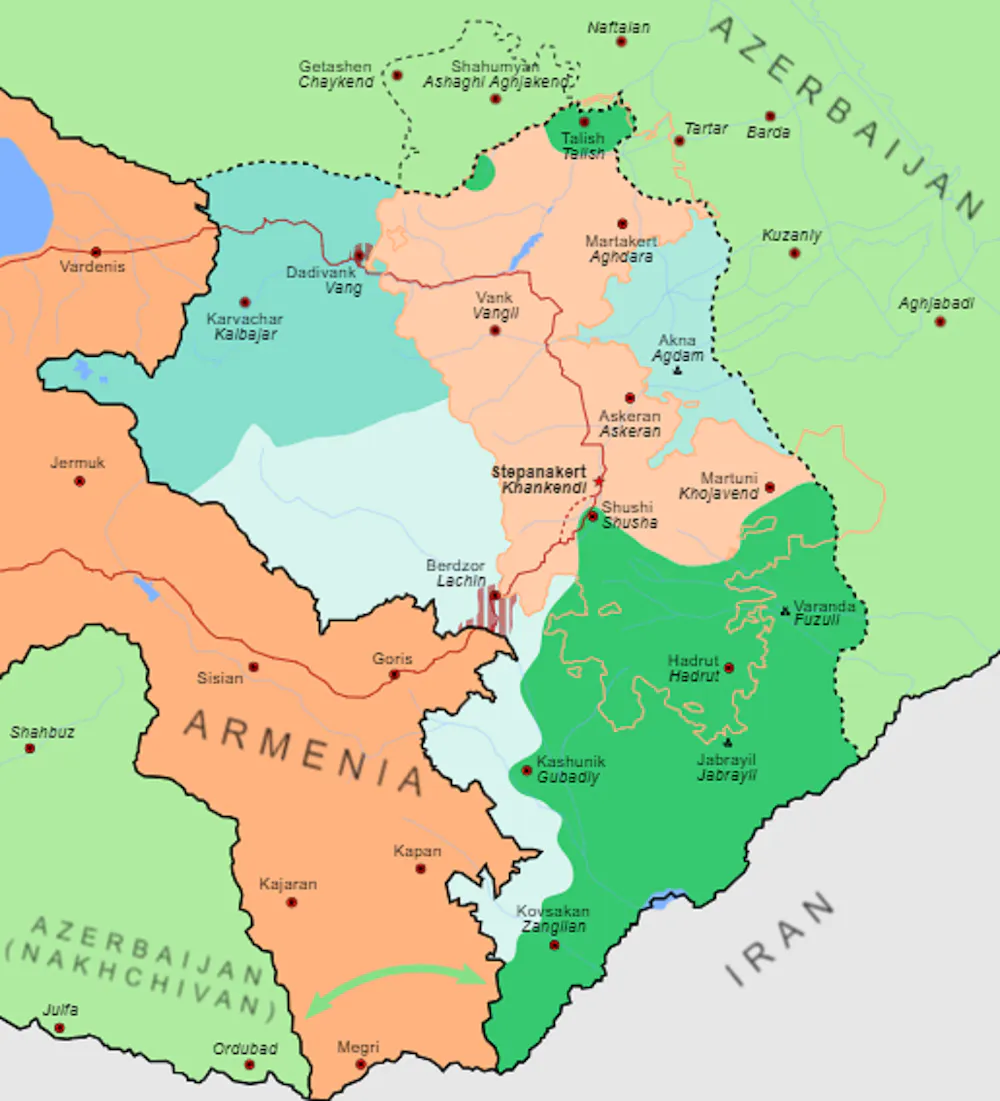
    During the Soviet era, the union republics of Armenia and Azerbaijan both felt that Moscow favoured the other. Armenia was unhappy that the Soviet leadership allocated Nagorno-Karabakh, a majority-Armenian exclave surrounded by Azeri-populated lands, to Azerbaijan. Azerbaijan was dissatisfied that its borders denied it a land connection to its population in Nakhchivan, an exclave of ethnic Azeris that could only be reached via southern Armenia.

    In the final years of the Soviet Union, as Armenian nationalism began to assert itself during the period of perestroika (restructuring), Nagorno-Karabakh’s legislature passed a law declaring its intention to join Armenia. This move eventually led to armed clashes in the region.

    The first Karabakh war, which raged between 1988 and 1994, began before the Soviet break-up but continued after the two countries gained their independence. In 1994, after more than 30,000 casualties, Russia brokered a ceasefire. The settlement favoured Armenia, leaving it in control of Nagorno-Karabakh and another six surrounding Azerbaijani districts.

    Things began to change when Putin took power in Russia in 2000. Russia’s relations with Azerbaijan improved, partly due to his personal rapport with the then-president, Heydar Aliyev, and his son Ilham, who would succeed him in 2003. After 9/11, when combating international terrorism became a global priority, Azerbaijan put measures in place to prevent transfer of fighters and weapons through its territory to the war in Chechnya, which further improved relations with Moscow.

    At this stage, Azerbaijan was pursuing what it described as a “multi-vector” foreign policy. This allowed it to develop ties with a variety of countries, including the US, Russia and others to whom it sold oil. While remaining in the Commonwealth of Independent States, it did not sign up to the Russia-led Collective Security Treaty Organisation (CSTO).

    Nagorno-Karabakh

    Armenia, by contrast, was a fully participating member of the CSTO. Having signed an Eternal Friendship Treaty with Russia in 1997, this was a clear strategic choice for Armenia – partly motivated by historical ties.

    Russia had traditionally been seen as a defender of Christianity in the days of the Ottomon empire. Many people had fled massacres in Western Armenia (modern-day Turkey) in 1915 to come under the protection of the Russian Tsar. But Armenia also saw Moscow as a vital security guarantor against an increasingly militarised Azerbaijan, which was determined to recover control of Nagorno-Karabakh and other areas occupied by Armenia.

    Map showing the concept of the ‘Zanzegur corridor’, which would cut across southernmost Armenia to connect Azerbaijan with Nakhchivan.
    Mapeh/Wikimedia Commons, CC BY-NC

    Indeed, it was Nagorno-Karabakh which really soured relations between Armenia and Moscow. In 2020, when – aided by Turkey – Azerbaijan launched its offensive to retake the territory, Russia failed to come to the aid of its CSTO ally. This was expected, given that relations had begun to deteriorate in 2018 when Pashinyan came to power in Armenia.

    In hindsight, most commentators believe Russia had become tired of Armenia’s intransigence over the plan, agreed in Madrid in 2007, for it to cede back the six districts surrounding Nagorno-Karabakh to Azerbaijan.

    Instead, Moscow brokered a ceasefire agreement and deployed 2,000 peacekeepers along the Lachin corridor, a strip of land connecting Armenia and Nagorno-Karabakh. But these troops also failed to intervene when an Azeri offensive retook the whole of Nagorno-Karabakh in September 2023, forcing the population of about 100,000 ethnic Armenians to flee.


    Read more:
    Nagorno-Karabakh: the world should have seen this crisis coming – and it’s not over yet


    Things sour between Moscow and Baku

    Relations between Russia and Azerbaijan, meanwhile, have gone downhill rapidly. In December 2024, an Azeri civilian airliner was shot down in Russian airspace. Putin apologised, but Azerbaijan insisted on Moscow disclosing the results of the investigation and paying compensation to the victims.

    Things got worse at the end of June, when Russian authorities arrested a group of ethnic Azerbaijanis as part of a decades-old murder case. Two of the men died while being detained. Azerbaijan retaliated by raiding the Baku offices of Russia’s Sputnik news agency and detaining the staff as well as a group of Russian IT workers. When they appeared in court, some of the men appeared to have been beaten in custody.

    Azerbaijan also denounced Russia in state media and Russia House, the state-funded Russian cultural agency in Baku, was closed down, with several cultural events cancelled. Security agencies began to enforce documentation checks on all Russian nationals in the country.

    At the same time, Azerbaijan and Armenia were already talking about concluding a peace treaty independently, without intermediaries. All this has prompted speculation of a serious loss of influence in the region for Moscow.

    However, a complete shutout of Russia in the South Caucasus is unlikely. Both Armenia and Azerbaijan depend on remittance income from their nationals in Russia. Both countries also remain close trading partners with Russia. While Armenia suspended its membership in CSTO, it has not quit the organisation altogether.

    Far more likely is that the two countries, mindful of the growing influence of Turkey in the region and the shifts created by Donald Trump in world affairs, are manoeuvring while weighing their options. Geography matters, as Georgia’s example demonstrates – efforts to cut ties with Russia by its former president, Mikheil Saakashvili, have been partially reversed by the current government, which increasingly leans towards Moscow.

    In the cases of Armenia and Azerbaijan, economic ties, transport links and human connections still favour a relationship with Russia. So, a temporary breakdown in political relations can be mended – if all three leaders demonstrate enough statesmanship to sail through the troubled waters.


    Get your news from actual experts, straight to your inbox. Sign up to our daily newsletter to receive all The Conversation UK’s latest coverage of news and research, from politics and business to the arts and sciences.

    Anna Matveeva does not work for, consult, own shares in or receive funding from any company or organisation that would benefit from this article, and has disclosed no relevant affiliations beyond their academic appointment.

    ref. Armenia and Azerbaijan are trying to mend fences – what does this mean for Russia? – https://theconversation.com/armenia-and-azerbaijan-are-trying-to-mend-fences-what-does-this-mean-for-russia-261384

    MIL OSI Analysis

  • MIL-OSI Submissions: Armenia and Azerbaijan are trying to mend fences – what does this mean for Russia?

    Source: The Conversation – UK – By Anna Matveeva, Visiting Senior Research Fellow, King’s Russia Institute, King’s College London

    At a time when Vladimir Putin needs friends in his neighbourhood, he appears instead to be losing them in the South Caucasus. After two centuries of Russian involvement in the region, balancing the historical rivalry and at times acting as mediator between Armenia and Azerbaijan, there is growing speculation that the two countries are preparing a major reset in relations.

    When Armenia’s prime minister, Nikol Pashinyan, met the Azerbaijani president, Ilham Aliyev, in Abu Dhabi on July 10, they reportedly came close to agreeing a peace treaty. The big question is whether, if these two countries can iron out mistrust and violence born of the territorial conflict, there will still be a role for Russia in the South Caucasus.

    To understand the complex geopolitics of the region, you need to go back to the early 19th century, when Azerbaijan and what is now the Republic of Armenia) were ceded to Russia following the Russo-Persian wars. After the Russian revolution, the two countries achieved brief independence between 1918 and 1920 (though not in their present borders) before being incorporated into the Soviet Union.

    During the Soviet era, the union republics of Armenia and Azerbaijan both felt that Moscow favoured the other. Armenia was unhappy that the Soviet leadership allocated Nagorno-Karabakh, a majority-Armenian exclave surrounded by Azeri-populated lands, to Azerbaijan. Azerbaijan was dissatisfied that its borders denied it a land connection to its population in Nakhchivan, an exclave of ethnic Azeris that could only be reached via southern Armenia.

    In the final years of the Soviet Union, as Armenian nationalism began to assert itself during the period of perestroika (restructuring), Nagorno-Karabakh’s legislature passed a law declaring its intention to join Armenia. This move eventually led to armed clashes in the region.

    The first Karabakh war, which raged between 1988 and 1994, began before the Soviet break-up but continued after the two countries gained their independence. In 1994, after more than 30,000 casualties, Russia brokered a ceasefire. The settlement favoured Armenia, leaving it in control of Nagorno-Karabakh and another six surrounding Azerbaijani districts.

    Things began to change when Putin took power in Russia in 2000. Russia’s relations with Azerbaijan improved, partly due to his personal rapport with the then-president, Heydar Aliyev, and his son Ilham, who would succeed him in 2003. After 9/11, when combating international terrorism became a global priority, Azerbaijan put measures in place to prevent transfer of fighters and weapons through its territory to the war in Chechnya, which further improved relations with Moscow.

    At this stage, Azerbaijan was pursuing what it described as a “multi-vector” foreign policy. This allowed it to develop ties with a variety of countries, including the US, Russia and others to whom it sold oil. While remaining in the Commonwealth of Independent States, it did not sign up to the Russia-led Collective Security Treaty Organisation (CSTO).

    Nagorno-Karabakh

    Armenia, by contrast, was a fully participating member of the CSTO. Having signed an Eternal Friendship Treaty with Russia in 1997, this was a clear strategic choice for Armenia – partly motivated by historical ties.

    Russia had traditionally been seen as a defender of Christianity in the days of the Ottomon empire. Many people had fled massacres in Western Armenia (modern-day Turkey) in 1915 to come under the protection of the Russian Tsar. But Armenia also saw Moscow as a vital security guarantor against an increasingly militarised Azerbaijan, which was determined to recover control of Nagorno-Karabakh and other areas occupied by Armenia.

    Map showing the concept of the ‘Zanzegur corridor’, which would cut across southernmost Armenia to connect Azerbaijan with Nakhchivan.
    Mapeh/Wikimedia Commons, CC BY-NC

    Indeed, it was Nagorno-Karabakh which really soured relations between Armenia and Moscow. In 2020, when – aided by Turkey – Azerbaijan launched its offensive to retake the territory, Russia failed to come to the aid of its CSTO ally. This was expected, given that relations had begun to deteriorate in 2018 when Pashinyan came to power in Armenia.

    In hindsight, most commentators believe Russia had become tired of Armenia’s intransigence over the plan, agreed in Madrid in 2007, for it to cede back the six districts surrounding Nagorno-Karabakh to Azerbaijan.

    Instead, Moscow brokered a ceasefire agreement and deployed 2,000 peacekeepers along the Lachin corridor, a strip of land connecting Armenia and Nagorno-Karabakh. But these troops also failed to intervene when an Azeri offensive retook the whole of Nagorno-Karabakh in September 2023, forcing the population of about 100,000 ethnic Armenians to flee.


    Read more:
    Nagorno-Karabakh: the world should have seen this crisis coming – and it’s not over yet


    Things sour between Moscow and Baku

    Relations between Russia and Azerbaijan, meanwhile, have gone downhill rapidly. In December 2024, an Azeri civilian airliner was shot down in Russian airspace. Putin apologised, but Azerbaijan insisted on Moscow disclosing the results of the investigation and paying compensation to the victims.

    Things got worse at the end of June, when Russian authorities arrested a group of ethnic Azerbaijanis as part of a decades-old murder case. Two of the men died while being detained. Azerbaijan retaliated by raiding the Baku offices of Russia’s Sputnik news agency and detaining the staff as well as a group of Russian IT workers. When they appeared in court, some of the men appeared to have been beaten in custody.

    Azerbaijan also denounced Russia in state media and Russia House, the state-funded Russian cultural agency in Baku, was closed down, with several cultural events cancelled. Security agencies began to enforce documentation checks on all Russian nationals in the country.

    At the same time, Azerbaijan and Armenia were already talking about concluding a peace treaty independently, without intermediaries. All this has prompted speculation of a serious loss of influence in the region for Moscow.

    However, a complete shutout of Russia in the South Caucasus is unlikely. Both Armenia and Azerbaijan depend on remittance income from their nationals in Russia. Both countries also remain close trading partners with Russia. While Armenia suspended its membership in CSTO, it has not quit the organisation altogether.

    Far more likely is that the two countries, mindful of the growing influence of Turkey in the region and the shifts created by Donald Trump in world affairs, are manoeuvring while weighing their options. Geography matters, as Georgia’s example demonstrates – efforts to cut ties with Russia by its former president, Mikheil Saakashvili, have been partially reversed by the current government, which increasingly leans towards Moscow.

    In the cases of Armenia and Azerbaijan, economic ties, transport links and human connections still favour a relationship with Russia. So, a temporary breakdown in political relations can be mended – if all three leaders demonstrate enough statesmanship to sail through the troubled waters.


    Get your news from actual experts, straight to your inbox. Sign up to our daily newsletter to receive all The Conversation UK’s latest coverage of news and research, from politics and business to the arts and sciences.

    Anna Matveeva does not work for, consult, own shares in or receive funding from any company or organisation that would benefit from this article, and has disclosed no relevant affiliations beyond their academic appointment.

    ref. Armenia and Azerbaijan are trying to mend fences – what does this mean for Russia? – https://theconversation.com/armenia-and-azerbaijan-are-trying-to-mend-fences-what-does-this-mean-for-russia-261384

    MIL OSI

  • MIL-OSI Africa: Committee on Agriculture Commends Improved Performance of Agricultural Research Council (ARC), National Agricultural Marketing Council (NAMC) and Perishable Products Export Control Board (PPECB) in the Fourth Quarter of 2024/25

    Source: APO


    .

    The Portfolio Committee on Agriculture welcomed the briefings it received yesterday from the Agricultural Research Council (ARC), National Agricultural Marketing Council (NAMC), and the Perishable Products Export Control Board (PPECB) on their performance in the fourth quarter of the 2024/25 financial year and commended their notable performance.

    In welcoming the briefings from the three entities of the Department of Agriculture, the Chairperson of the Committee, Ms Dina Pule, said the committee was happy about the progress that the entities reported to the committee. She said the committee notes the hard work the entities have demonstrated and called for more improvement in all the areas of work that included implementation of the Auditor General’s recommendations on their last audit outcomes.

    The ARC reported that funding for building of the new Foot-and-mouth Disease (FMD) Vaccine Facility is still a challenge and that, efforts to obtain the required funding for the new facility remains a priority. The entity reported that field assessment of the FMD vaccine in Mpumalanga and Limpopo is ongoing and the study on vaccine safety in pregnant cows and young calves has been initiated.

    In appreciating the performance of the NAMC, the committee called on the entity to do more on finding market access for the small-scale farmers as markets are alfa and omega for their growth, survival and meaningful contribution to the South African economy and for national food security.

    The Chairperson told the Deputy Minister of the Department of Agriculture, Ms Zoleka Capa, who led the departmental delegation, that the committee notes with appreciation the accountability of both the Minister and his Deputy that they demonstrate to the committee.

    The Chairperson also said that accountability is a critical starting point for the success of the department. “We deeply appreciate your availability to our meetings with the department. Your presence solidifies the accountability of the department to the committee and the oversight responsibility of the committee over the department,” emphasised the Chairperson.

    Distributed by APO Group on behalf of Republic of South Africa: The Parliament.

    MIL OSI Africa

  • MIL-OSI Africa: Mobilisation is urgently needed to avoid further deaths from northern Nigeria malnutrition crisis

    Source: APO


    .

    • In northern Nigeria, our teams are seeing an ever-increasing number of children in need of treatment for malnutrition.
    • We have begun a preventive campaign in Mashi local government area, distributing nutrition supplements for 66,000 children.
    • Urgent mobilisation is needed to save lives from this malnutrition crisis.

    Northern Nigeria is currently facing an alarming malnutrition crisis. In Katsina state, for instance, where Médecins Sans Frontières (MSF) has been present since 2021, the teams are seeing an ever-increasing number of malnourished children in our therapeutic feeding centres, with increasingly severe conditions and higher mortality rates.

    In collaboration with the local authorities, we have begun distributing nutrition supplements for 66,000 children in the local government area of Mashi, as a method for emergency prevention. In the context of drastic cuts in international funding, the need for prevention and treatment of malnutrition is enormous in northern Nigeria, and urgent mobilisation is required.

    By the end of June 2025, nearly 70,000 children with malnutrition had already received medical care from our teams in Katsina state, including nearly 10,000 who were hospitalised in serious condition. Without taking into account the new healthcare facilities opened by MSF during the year in the state, this represents an increase of approximately one-third compared to last year.

    In addition, between January and June 2025, the number of children with nutritional oedema,1 the most severe and deadly form of malnutrition, rose by 208 per cent compared with the same period in 2024. Unfortunately, 652 children have already died in our facilities since the beginning of 2025 due to a lack of timely access to care.

    A worrying sign of the growing severity of this major public health emergency, is that adults—particularly women, including pregnant and breastfeeding women—are also affected. A screening carried out in July, in all five MSF malnutrition centres in Katsina state, on 750 mothers of patients, revealed that more than half of adult caregivers were acutely malnourished, including 13 per cent with severe acute malnutrition.

    To cope with the massive influx of children expected by the end of the lean season in October, we have increased our support to the local authorities in several states in north Nigeria where we provide care to communities. In Katsina state for instance, we opened a new outpatient therapeutic feeding centre in Mashi and an additional inpatient therapeutic feeding centre in Turai, to provide a total of 900 beds in two hospitals where MSF teams work.

    “The year 2024 marked a turning point in northern Nigeria’s nutritional crisis, with an increase of 25 per cent from the previous year,” says Ahmed Aldikhari, country representative of MSF in Nigeria. “But the true scale of the crisis exceeds all predictions. We are currently witnessing massive budget cuts, particularly from the United States, the United Kingdom, and the European Union, which are having a real impact on the treatment of malnourished children.”

    Earlier this week, the World Food Programme (WFP) announced it will be forced to suspend all emergency food and nutrition aid for 1.3 million people in northeast Nigeria by the end of July due to “critical funding shortfalls”.2

    “At the same time, we observe ever-increasing needs, such as in Katsina state, where an increasing number of people cannot afford to buy food anymore, even though it is available in markets,” says Aldikhari.

    A food security survey carried out by humanitarian organisations in the local government area of Kaita, in Katsina state, before the lean season began at the start of 2025 revealed that over 90 per cent of households had reduced the number of meals they ate each day.

    Across the north, other factors worsening the malnutrition crisis include disease outbreaks, which are worsened by low vaccine coverage, availability, and accessibility of basic health services, and other socioeconomic indices complicated by insecurity and violence.

    “The most urgent way to reduce the risk of immediate death from malnutrition is to ensure families have access to food,” says Emmanuel Berbain, nutrition adviser at MSF. “This can be done through large-scale distribution of food or nutrition supplements, as we are currently doing in the Mashi area, or through cash distributions when and where it is possible.” 

    The capacity to care for and treat malnourished children must also be expanded, both by increasing the number of beds in health facilities, and by providing funding and access to ready-to-use therapeutic food. These actions must be undertaken as a priority in areas where the needs, such as the number of malnourished children, are greatest.

    People over the age of five, who are also increasingly affected by malnutrition but are currently not covered by any assistance, should also be included in prevention programmes.

    On 8 July, His Excellency Nigeria’s Vice President Kashim Shettima publicly sounded the alarm on the scale of malnutrition in Nigeria, warning that it deprives almost 40 per cent of children under the age of five of their full physical and cognitive potential. He described the situation as a national emergency requiring urgent and collective action.

    MSF treated over 300,000 children with malnutrition in seven northern states in 2024, a 25 per cent increase from 2023. In the northwest alone, where MSF tackles malnutrition in the states of Sokoto, Kebbi, Katsina, and Zamfara, we have already treated almost 100,000 children suffering from severe and moderate acute malnutrition in outpatient treatment centres in the first six months of 2025, and hospitalised around 25,000 malnourished children.

    Distributed by APO Group on behalf of Médecins sans frontières (MSF).

    MIL OSI Africa

  • MIL-OSI Africa: Rainy season increases cholera threat in South Sudan

    Source: APO – Report:

    .

    The ongoing rainy season in South Sudan is slowing cholera response efforts in some locations, raising concerns about further transmission and undermining progress the country has made so far in combating the outbreak.

    South Sudan experiences heavy rainfall between mid-July and October. The States of Jonglei, Unity, Upper Nile, Northern Bhar el Ghazal, Warrap, parts of Central Equatoria, and others experience seasonal flooding, resulting in massive displacement, and affecting the delivery of basic health services. The rainy season worsens access and sanitation, disrupts the shipment of medical supplies, hinders deployment of rapid response teams, and vaccination impedes efforts, making it difficult to protect communities and save lives.

    The country declared a cholera outbreak in October 2024, since then, the Ministry of Health with support from World Health Organization (WHO) and other partners, has mounted a comprehensive response, including deployment of rapid response teams, prepositioning medical supplies and coordination efforts across all levels to protect communities and safe lives. This is the longest cholera outbreak in the country’s history, since independent in September 2011.

    As of 30 June 2025, South Sudan has reported a cumulative total of 77 555 suspected cases and 1 401 deaths these cases have been reported from 55 counties, across 9 States and all 3 Administrative areas. A cumulative total of 11 554 tested positive using the rapid diagnostic test kits (RDT), and an additional 424 cases had laboratory isolation of Vibrio Cholera.

    In response, the country has successfully conducted an oral cholera vaccination campaign, reaching over 6.9 million people in 40 Counties. affected counties, these campaigns have significantly slowed the spread of the outbreak and is estimated to have saved hundreds of lives with a total of 19,987 deaths averted.

    To support vaccination efforts, South Sudan secured over 8.7 million doses of oral cholera vaccines from the International Coordination Group (ICG) to protect communities, and deployment. the country has applied for additional doses.

    WHO has played a critical role by training over 2000 health workers and community members on various aspects of the response including case management, risk communication and community engagement, IPC/WASH, vaccination and surveillance. The organization has also supported establishment of 102 oral rehydration points (ORPs), 88 cholera treatment units. (CTUs) and 19 cholera treatment centers (CTCs) through implementing partners, which have significantly reduced fatalities. Over 175 Metric Tons of medical supplies have been distributed across the affected Counties. Additionally, WHO has conducted extensive water quality testing and provided treatment to the affected communities.

    Several factors have contributed to the outbreak, including high population density, population movement, limited access to water and sanitation facilities, open defecation, and poor hygiene practices, created a highly vulnerable situation that led to imported cases and local transmission.

    Mr Kereni Gong, Acting Director General, Unity State Ministry of Health highlighted the urgent need for interventions in response to the ongoing flooding, emphasizing the importance of immediate action to save lives of the flooding and call for urgent interventions to save lives

    ‘Unity state is the epicentre of the current cholera outbreak. With support from WHO and other partners The State Ministry of Health managed to bring down the number of cases, but we need more support as we enter the rainy season, during which cases have already begun to rise. We are also aware that floods are coming from the southern part of Unity State which will further worsen the situation” he said

    Dr Humphrey Karamagi, WHO Representative in South Sudan, underscored the gravity of the situation and express gratitude on the effectiveness of the ongoing cholera response efforts: “The scale of the current outbreak is unprecedented, the onset of the rainy season poses significant challenge in addition to the prevailing humanitarian crises” said Dr Karamagi “Under the leadership of the Ministry of Health we have been able to protect the communities by mounting effective response including vaccinating over 7 million people, now Is the time to up our game in strengthening case management, surveillance and coordination to save lives.”

    Additional funding is required to contain the outbreak, as the rainfall poses the risk of transmission., WHO requires additional funding to bolster current operations by deploying swift response teams to newly identified hotspots, maintaining essential health services for affected communities, and procuring, shipping, and distributing more emergency supplies to support the ongoing response.

    – on behalf of World Health Organization (WHO) – South Sudan.

    MIL OSI Africa

  • MIL-OSI United Kingdom: Health chiefs issue measles warning to holidaymakers as cases rise globally

    Source: City of Leeds

    Parents travelling during school holidays are being advised to check children are protected against measles amid a global rise in cases. 

    With the start of the school holidays, parents and carers in Leeds are being urged to ensure their children have an up-to-date Measles Mumps and Rubella (MMR) vaccine, as measles cases rise nationally and internationally.

    The uptake of routine childhood vaccinations has been decreasing over the last ten years, with similar trends observed in West Yorkshire.

    Health chiefs are concerned that low MMR vaccination rates could lead to further cases emerging, particularly given the high numbers of people mixing and travelling during the holidays.  

    Measles is a serious disease which can spread easily among unvaccinated people. Babies, children, pregnant women and people with weakened immune systems are at highest risk.

    The disease can lead to hospitalisation and in rare cases, death. Symptoms typically begin with cold-like signs, such as a high temperature, a runny or blocked nose, sneezing, coughing, and red, sore, watery eyes.

    A few days later, small white spots may appear inside the cheeks and on the back of the lips. This is followed by a rash that usually starts on the face and behind the ears before spreading to the rest of the body.

    Victoria Eaton, Leeds City Council’s director of public health, said: “As we enter the summer holidays, we want everyone to enjoy the season safely and in good health.

    “This year outbreaks have been seen in several European countries, including France, Italy, Spain and Germany and the World Health Organisation recently reported that Pakistan, India, Thailand, Indonesia and Nigeria currently have among the highest number of measles cases worldwide.

    “These are places where people may be going on holiday or travelling to visit family and friends.

    “Checking your family’s MMR vaccination status is a simple but important step in protecting your loved ones and the wider community.

    “If you’re unsure whether you or your child are fully vaccinated, please contact your GP to check your records and arrange vaccination, especially if you’re planning to travel over the summer break.”

    The MMR vaccine, which is usually given to children around their first birthday and again at 3 years 4 months offers the best protection against measles. Two doses provide long-lasting immunity.

    Councillor Fiona Venner, Leeds City Council’s executive member for equalities, health and wellbeing, said:  “We want everyone to enjoy their holidays but checking your child is fully vaccinated against measles before you go will ensure you and your child are protected and safe.

    “It’s never too late to get the vaccine, even if you have missed a first, or second dose. A non-porcine version of the MMR vaccine is also available – however, you may need to request this from your GP practice ahead of vaccination.

    “If you think you or your child has measles, phone your GP or NHS 111 for advice. To reduce the risk of spreading it to others, please avoid contact with other people. Call ahead first before attending any healthcare settings.”

    For more information on measles, and the MMR vaccine, visit the NHS website: https://www.nhs.uk/conditions/measles/.

    Watch a video of Dr Naveed from the UKHSA providing measles travel advice.   

    ENDS

    For media enquiries please contact:

    Leeds City Council communications and marketing,

    Email: communicationsteam@leeds.gov.uk

    Tel: 0113 378 6007

    MIL OSI United Kingdom

  • MIL-OSI United Kingdom: Staying healthy on holiday – what you need to know

    Source: City of Wolverhampton

    Travel can expose people to unfamiliar environments, climates and health risks, so simple preparations can make a significant difference.

    The council is advising travellers to ensure they and their families are in good health before departure, to pack necessary medications and first aid supplies, and to check the latest travel guidance for the area they are visiting, including local risks, weather conditions, and any recommended precautions. For individuals living with long term health conditions, this includes making sure symptoms are stable and well managed ahead of their trip.

    Vaccination checks are also vital, including routine vaccinations such as MMR (measles, mumps, and rubella), which remains critical given the rise of measles cases globally. Travellers heading to destinations such as Pakistan, India or parts of Africa, Asia and South America may require travel specific vaccines or medication and so are advised to speak to their GP, pharmacist or travel clinic as soon as possible.

    While on holiday, maintaining hygiene is crucial, including regular hand washing or the use of hand sanitiser when water is unavailable, and drinking bottled water in countries with unsafe tap water. Travellers should remain vigilant for common ailments such as upset stomachs and mosquito borne illnesses, and take care around unfamiliar animals due to the risk of rabies.

    Anyone experiencing symptoms such as high fever, prolonged diarrhoea, severe pain, unusual rashes or yellowing of the skin should seek medical advice. People who are bitten or scratched by an animal in a rabies risk country, or are returning from a malaria risk region with signs of illness, should get help urgently.

    Councillor Obaida Ahmed, Cabinet Member for Health, Wellbeing and Community, said: “Taking a few proactive steps before and during your travels can protect your health and give you peace of mind to enjoy your holiday to the fullest. From making sure you’re up to date with vaccinations to knowing what to do if you feel unwell while you’re away, it’s about being prepared, wherever you’re heading this summer.”

    For further information, please visit TravelHealthPro.

    MIL OSI United Kingdom

  • MIL-OSI United Kingdom: Appointments to the Board of Royal Botanic Gardens, Kew

    Source: United Kingdom – Executive Government & Departments

    News story

    Appointments to the Board of Royal Botanic Gardens, Kew

    Three new appointments and two reappointments made

    A series of appointments and reappointments have been made to the Board of Royal Botanic Gardens, Kew.

    Dame Dervilla Mitchell, Dr Fiona Pathiraja and Sarah Greasley have been appointed as Trustees. Dervilla and Fiona’s four-year terms commenced on 1 July 2025. Sarah’s four-year term will commence on 1 October 2025.

    Steve Almond and Kate Priestman have been reappointed as Trustees for a second term of four years from 2 October 2025 to 1 October 2029.

    These appointments have been made in accordance with the Governance Code on Public Appointments published by the Cabinet Office. All appointments are made on merit and political activity plays no part in the selection process.

    Biographies

    Dame Dervilla Mitchell

    Dervilla is an experience engineering leader who has been involved in significant infrastructure programmes at Heathrow, Dublin and Abu Dhabi airports. She has also led the design of a range of new build and renovation projects in different sectors. She spent the majority of her career at Arup, a trust-owned organisation, latterly serving as Global Deputy Chair and Ethics Director.

    She became involved in the decarbonisation agenda whilst a member of the Council for Science and Technology and subsequently took on the role of Chair of the National Engineering Policy Centre’s decarbonisation working group. Her non-executive experience has been gained through Trustee roles as Vice President of the Royal Academy of Engineering and serving as a school governor at three different girls’ schools in London.

    She was awarded a DBE for Services to Engineering in 2024, having previously received a CBE in 2014. She has received Honorary Doctorates from University College Dublin, as well as Imperial College London, where she now sits on the Industry Advisory Board for the Department of Civil and Environmental Engineering.

    Dr Fiona Pathiraja

    Fiona is an investor and philanthropist. She is Managing Partner of Crista Galli Ventures, a pan-European healthtech venture capital firm. She serves on several boards and is currently a trustee of the Royal College of Physicians and the Royal College of Arts. Fiona leads philanthropic endeavours at IPQ Capital, her Family Office, and is vice-chair of London Business School’s fundraising board.

    A former NHS consultant radiologist at University College London Hospital, Fiona has held a range of strategic and leadership roles across healthcare, including Clinical Advisor to the Department of Health and Social Care. She is a Fellow of the Royal College of Radiologists, a Member of the Faculty of Public Health, and holds Master of Business Administration and Master of Public Health degrees. Fiona is an advocate for greater diversity in technology and investment.

    Sarah Greasley

    Sarah is an accomplished technology leader with more than 40 years’ expertise working in both the technology and financial services industries. She was Solutions Architecture Director for Europe, Middle East and Africa at Amazon Web Services, and prior to that, she was Group Chief Technology Officer at Direct Line Group and a Distinguished Engineer at IBM. She has a broad range of leadership experience across new technologies, strategy, risk and resilience. She also has a strong focus on increasing diversity, equity and inclusion.

    She has a degree in Mathematics from the University of Cambridge and is a Chartered Fellow of the British Computing Society, as well as a Fellow of the Institute of Engineering and Technology. Sarah is a Trustee of the British Exploring Society and a Governor at Charterhouse School.

    Steve Almond

    After obtaining a BA in History at Royal Holloway College, University of London, Steve trained as a Chartered Accountant at Deloitte and spent much of his career there as an Audit Partner specialising in the financial services industry. He worked in a variety of roles for 16 years on the Deloitte UK Executive and, concurrently, eight years on the Global Executive. He has a wealth of experience advising large company boards and audit committees and served for 10 years on the board of Deloitte UK. In 2011, he was elected Chairman of Deloitte’s Global Board. In that capacity, he represented Deloitte on various external bodies, including the Accounting for Sustainability Advisory Board; International Integrated Reporting Council; Social Progress Index Advisory Board; and the World Business Council for Sustainable Development.

    Kate Priestman

    Kate has worked in the biopharma industry for over 25 years and is currently Chief Corporate and External Affairs Officer at CSL. Before joining CSL, Kate served as Senior Vice-President of R&D Strategy and Portfolio at GlaxoSmithKline, focused on the development of transformational medicines and vaccines. Kate also serves as a Non-Executive Director at Oxford Nanopore Technologies PLC. Kate’s career has spanned roles in commercial, corporate governance, communications and government affairs, following an early career at the BBC as a presenter and documentary maker. In her spare time, Kate is an artist and creator of a popular design blog; her work inspired an installation in the Chicago Botanic Garden in 2016 and is used in schools as part of the creative arts curriculum.

    Updates to this page

    Published 25 July 2025

    MIL OSI United Kingdom

  • MIL-OSI: Marex Group plc to acquire UK equity market maker Winterflood Securities

    Source: GlobeNewswire (MIL-OSI)

    LONDON, July 25, 2025 (GLOBE NEWSWIRE) — Marex Group plc (‘Marex’ or the ‘Group’; NASDAQ: MRX), the diversified global financial services platform, today announces that it has agreed to acquire UK equity market maker Winterflood Securities (Winterflood) from Close Brothers Group plc (Close Brothers) for approximately £103.9 million in cash, which represents a premium of £15 million.

    Winterflood is one of the UK’s leading equity market makers, delivering execution services to over 400 institutional clients and ranking consistently as a top three market counterparty with a market share of about 15% by volume on the London Stock Exchange1. Winterflood has well-established client connectivity through its proprietary technology platform.

    The acquisition is expected to enhance Marex’s existing UK cash equities business, consistent with its strategy to bring new clients and new capabilities onto its platform and diversify earnings. It is also expected to add a substantial distribution offering servicing the UK institutional community, in particular asset and wealth management companies, with the potential to deepen these relationships by offering access to a broader range of Marex’s products from across its platform.

    Winterflood also operates Winterflood Business Services, which provides outsourced dealing, settlement and custody services to a diverse range of clients, including large institutions, investment platforms, wealth managers, and retail aggregators.

    The deal is subject to regulatory approval and is expected to close in early 2026.

    Ian Lowitt, Marex Group Chief Executive Officer, commented:

    “This acquisition gives us an opportunity to transform our existing equity market making business into a leading franchise, utilising the technology and connectivity of what is the leading brand in this market. This deal is consistent with our strict financial criteria, and we see opportunities to materially improve Winterflood’s profitability and pay back its premium within two to three years. We believe we can gain economies from operating at scale and also benefit from Winterflood’s great technology and strong client relationships, which will enable us to introduce additional products and services from across our platform to a new set of clients.”

    Bradley Dyer, CEO of Winterflood Securities, commented:

    “We’re delighted to become part of Marex, which is a high-growth, global financial services company with a strong balance sheet. Our clients will continue to be served by the same team, while also benefitting from the backing of a large and growing company as well as access to a broader range of products and services from Marex. We’re excited to be joining a fast-paced organisation where our teams can thrive.”

    Mike Morgan, Close Brothers Group Chief Executive, commented:

    “We see Marex as an excellent steward for the business going forward, we thank the Winterflood team for their hard work and commitment over the years and wish them every success in their next chapter with Marex.”

    Forward-Looking Statements:
    This press release contains forward-looking statements within the meaning of the Private Securities Litigation Reform Act of 1995. All statements contained in this press release that do not relate to matters of historical fact should be considered forward-looking statements, including the expected acquisition of Winterflood Securities and the closing of the transaction as well as expected benefits from the acquisition. In some cases, these forward-looking statements can be identified by words or phrases such as “may,” “will,” “expect,” “anticipate,” “aim,” “estimate,” “intend,” “plan,” “believe,” “potential,” “continue,” “is/are likely to” or other similar expressions.
    These forward-looking statements are subject to risks, uncertainties and assumptions, some of which are beyond our control. In addition, these forward-looking statements reflect our current views with respect to future events and are not a guarantee of future performance. Actual outcomes may differ materially from the information contained in the forward-looking statements as a result of a number of factors, including, without limitation, the risks discussed under the caption “Risk Factors” in our Annual Report on Form 20-F for the year ended December 31, 2024, filed with the Securities and Exchange Commission (the “SEC”) and our other reports filed with the SEC. The forward-looking statements made in this press release relate only to events or information as of the date on which the statements are made in this press release. Except as required by law, we undertake no obligation to update or revise publicly any forward-looking statements, whether as a result of new information, future events or otherwise, after the date on which the statements are made or to reflect the occurrence of unanticipated events. In addition, statements that “we believe” and similar statements reflect our beliefs and opinions on the relevant subject. These statements are based upon information available to us as of the date of this press release, and while we believe such information forms a reasonable basis for such statements, such information may be limited or incomplete, and our statements should not be read to indicate that we have conducted an exhaustive inquiry into, or review of, all potentially available relevant information. These statements are inherently uncertain, and investors are cautioned not to unduly rely upon these statements.

    About Marex:
    Marex Group plc (NASDAQ: MRX) is a diversified global financial services platform providing essential liquidity, market access and infrastructure services to clients across energy, commodities and financial markets. The Group provides comprehensive breadth and depth of coverage across four services: Clearing, Agency and Execution, Market Making and Hedging and Investment Solutions. It has a leading franchise in many major metals, energy and agricultural products, with access to 60 exchanges. The Group provides access to the world’s major commodity markets, covering a broad range of clients that include some of the largest commodity producers, consumers and traders, banks, hedge funds and asset managers. With more than 40 offices worldwide, the Group has over 2,400 employees across Europe, Asia and the Americas. For more information visit www.marex.com.  

    Enquiries please contact:

    Marex: Nicola Ratchford / Adam Strachan

    +44 778 654 8889 / +1 914 200 2508

    nratchford@marex.com / astrachan@marex.com

    FTI Consulting US / UK

    +1 716 525 7239 / +44 7976870961

    marex@fticonsulting.com

    _______________________________

    1Rank and market share is based on Bloomberg data for London Stock Exchange market volumes from January 2019 to December 2024

    The MIL Network

  • MIL-Evening Report: What is chikungunya virus, and should we be worried about it in Australia?

    Source: The Conversation (Au and NZ) – By Jacqueline Stephens, Associate Professor in Public Health, Flinders University

    Noppharat05081977/Getty Images

    This week, the World Health Organization (WHO) raised concerns about a surge in the number of cases of a mosquito-borne viral infection called chikungunya.

    Diana Rojas Alvarez, a medical officer at the WHO, highlighted an outbreak occurring across La Réunion and Mayotte. These small islands in the Indian Ocean were previously hit during an epidemic of the virus in 2004–05.

    Between August 2024 and May 2025, more than 47,500 confirmed cases and 12 deaths from chikungunya were reported in La Réunion. Some 116 cases were reported in Mayotte between March and May this year.

    But more than 100 countries have seen local transmission of this virus to date, and the WHO has also flagged recent cases in Africa, Asia and Europe.

    So, what is chikungunya, how does it spread, and should we be worried here in Australia?

    What are the symptoms?

    The main symptoms of chikungunya include fever, joint pain and joint swelling. However, other symptoms may include headache, rash, muscle pain, nausea and tiredness. On rare occasions, chikungunya can be fatal.

    Some people are more prone to having worse symptoms, including infants, older adults, and people with pre-existing medical conditions.

    Symptoms can take up to 12 days to appear, but most people start to experience symptoms three to seven days after being bitten by an infected mosquito.

    There’s no specific treatment for chikungunya other than managing the pain with medications, such as paracetamol.

    Most people recover after a few weeks, but some people can experience ongoing tiredness and joint pains for many months, or even years.

    How does it spread?

    Infected female mosquitoes spread chikungunya. The mosquitoes become infected when they feed on a person carrying the virus in their blood. Once infected, the virus reproduces in the mosquito, and then they can transmit it to other people when the mosquitoes bite them.

    There are more than 3,000 different types of mosquitoes on Earth, but only two are commonly involved in transmitting chikungunya: Aedes aegypti and Aedes albopictus.

    A. aegypti and A. albopictus look similar and can be easily confused. Both are about 4–7 millimetres in size and have similar black and white markings on their thorax and legs.

    Both are day-time biters, unlike other mosquitoes that typically bite at dawn or dusk. They’re known as “ankle biters” because they mainly bite exposed legs and ankles. These aggressive mosquitoes bite multiple times and are known to follow people indoors to get their meal of human blood.

    These species also transmit dengue virus, yellow fever virus and Zika virus.

    Where does chikungunya occur?

    Chikungunya was first documented in Tanzania in 1952. While outbreaks initially occurred across Africa and Asia, over time the virus has spread around the world. As of December 2024, local transmission of chikungunya had been reported in 119 countries and territories.

    The 2004–05 epidemic was the largest so far, with hundreds of thousands of people infected. The epidemic started in the Indian Ocean islands, but eventually spread across to India. Since then, outbreaks have become more frequent and widespread.

    A key contributor to the proliferation of chikungunya is climate change. Warmer temperatures, altered rainfall patterns, and increased humidity are creating ideal conditions for mosquito breeding. This allows the mosquitoes to adapt to new environments and therefore expand into new habitats.

    The increase is also partly because chikungunya has evolved and been introduced into new populations, whose immune systems have not previously been exposed to the virus.

    So, should we be worried?

    While evidence suggests A. aegypti has been present in northern Queensland since the 1800s (outbreaks of dengue occurred in Townsville in 1879 and Rockhampton in 1885), A. albopictus is a more recent arrival, first documented in the Torres Strait in 2005.

    A. aegypti mosquitoes are now found in areas across north, central and southern Queensland, while A. albopictus is currently still only found in the Torres Strait.

    Nonetheless, to date, there have been no recorded cases of chikungunya transmission within Australia.

    But cases do occur in people who have recently travelled overseas, most often to South and Southeast Asia, or the Pacific Islands.

    In 2023 there were 42 cases of chikungunya recorded in Australia, 70 in 2024, and 90 so far in 2025. Previous years have seen figures above 100, however numbers in recent years may have been lower due to COVID impacting travel.

    As climate change continues to support the spread of A. aegypti and A. albopictus, the risk of transmission within Australia increases.

    That said, there is some evidence we might be lucky in Australia, with potential immune protection from a related local virus, Ross River virus.

    I’m travelling, what should I do?

    Two vaccines are approved for use in the United States against chikungunya, but there’s currently no vaccine approved in Australia. The only way to reduce your risk of infection is to avoid being bitten by mosquitoes.

    People travelling to places where chikungunya is known to occur should wear loose-fitting and light-coloured clothing with enclosed shoes, use insect repellent, close windows and consider using mosquito bed nets. Taking these steps also reduces the risk of other mosquito-borne infections, such as dengue fever.

    If you travel to a place where chikungunya occurs and you get bitten by mosquitoes, monitor yourself for signs and symptoms.

    If you become unwell, see a doctor immediately.

    Jacqueline Stephens is affiliated with the Australasian Epidemiological Association and the International Network for Epidemiology in Policy.

    Jill Carr is affiliated with the Australasian Virology Society and receives funding from The National Health and Medical Research Council to study viral diseases.

    ref. What is chikungunya virus, and should we be worried about it in Australia? – https://theconversation.com/what-is-chikungunya-virus-and-should-we-be-worried-about-it-in-australia-261847

    MIL OSI AnalysisEveningReport.nz

  • MIL-OSI USA: Warner, Thune Reintroduce Legislation to Expand Seniors’ Options for Care

    US Senate News:

    Source: United States Senator for Commonwealth of Virginia Mark R Warner
    WASHINGTON — U.S. Sens. Mark R. Warner (D-VA) and John Thune (R-SD) today reintroduced the Equitable Community Access to Pharmacist Services (ECAPS) Act, bipartisan legislation that would ensure seniors can continue to access important clinical services from their pharmacist. The bill would allow Medicare to reimburse for certain pharmacist-administered tests, treatments, and vaccinations for illnesses like influenza, respiratory syncytial virus (RSV), and strep throat, in accordance with state scope-of-practice laws. 
    “Seniors across South Dakota rely on the care and support they receive from their community pharmacists,” said Thune. “I am proud to lead this commonsense legislation that would allow these services and other important treatments to remain a reliable option for seniors, particularly in our rural communities.” 
    “During the pandemic, we saw firsthand how pharmacists stepped up to meet urgent health care needs, especially in underserved and rural communities,” said Warner. “This bill builds on that progress by making sure seniors can continue to count on their local pharmacists for routine tests, vaccines, and treatments for common illnesses like flu and COVID. This is a practical step to improve access to care, reduce the burden on hospitals and clinics, and make our health system work better for seniors.”
    “In rural states like South Dakota, pharmacists are often the most accessible – and sometimes the only – health care provider available to patients,” said Amanda Bacon, executive director of the South Dakota Pharmacists Association. “The ECAPS Act recognizes the vital role pharmacists play on the front lines of care, especially in areas where access is limited by geography, provider shortages, or both. The South Dakota Pharmacists Association strongly supports this legislation and the critical role it plays in strengthening our rural health care system. The ECAPS Act helps keep care close to home – and in South Dakota, that makes all the difference.” 
    “We applaud Senator Warner and Senator Thune for championing the reintroduction of the ECAPS Act,” said Jamie Fisher, executive director of the Virginia Pharmacy Association. “This bipartisan legislation recognizes what patients across Virginia already know – pharmacists are vital, trusted, and accessible members of the health care team. By ensuring Medicare beneficiaries can receive essential services like flu, COVID-19, RSV, and strep testing and treatment from their local pharmacist, the ECAPS Act will improve health outcomes, particularly in rural and underserved communities where access to care is often limited. We strongly support this effort to expand access and equity in health care.” 
    “The Future of Pharmacy Care Coalition commends Senate Majority Leader John Thune and Senator Mark Warner for championing the ECAPS Act to ensure seniors, including those living in rural areas and vulnerable communities, can turn to their local pharmacists for testing and treatment services that can protect them from certain common respiratory conditions,” said the Future of Pharmacy Care Coalition. “Congress must move with urgency to provide seniors with Medicare coverage in states where pharmacists can offer testing and treatment services for conditions that, although common, can quickly become life-threatening if not properly managed.”

    MIL OSI USA News

  • MIL-OSI USA: WATCH: Hawley Secures Pledge from Trump Nominee to Ditch the Biden-era Government Censorship Business 

    US Senate News:

    Source: United States Senator Josh Hawley (R-Mo)

    Thursday, July 24, 2025

    This morning, U.S. Senator Josh Hawley (R-Mo.) questioned Sean Plankey—President Donald Trump’s nominee to be Director of Cybersecurity and Infrastructure Security Agency (CISA) under the Department of Homeland Security (DHS)—and secured his pledge to refocus the agency on protecting America’s critical infrastructure instead of propping up Biden-era government censorship. 
    “Let me just read some of the euphemisms that your predecessor used to talk about CISA’s mission in the censorship effort: ‘narrative control,’ ‘perception management’—’information integrity’ is my favorite,” Senator Hawley said. “You’re telling me that you’re going to get CISA out of the business of policing ‘narrative control?’” the Senator asked, to which Plankey affirmed.
    [embedded content]
    Watch the full exchange here.
    Senator Hawley reminded Plankey and his Senate colleagues of the gross First Amendment abuses Americans faced online under the direction of the Biden Administration’s CISA. The agency’s wide-ranging censorship shut down posts about “COVID-19, vaccines, elections, school-board meetings.”
    Breaking with his Biden-era predecessors, Plankey assured the Senator that “it is not CISA’s job, and nor is it in its authorities, to censor or determine the truths, whether it be on social media or at any level of media.” If confirmed for the role, Plankey said he would, “like to focus CISA on what it’s mandated to do and that’s protect the federal civilian executive branch, as well as protect the critical infrastructure of the United States.”

    MIL OSI USA News

  • MIL-OSI United Kingdom: Joint Statement on the Invocation of the OSCE Moscow Mechanism

    Source: United Kingdom – Executive Government & Departments

    Speech

    Joint Statement on the Invocation of the OSCE Moscow Mechanism

    UK and 40 other countries invoke the Moscow Mechanism to address ill treatment of prisoners of war by the Russian Federation

    Thank you, Chair.   I will deliver an abridged version of this statement this afternoon. The full statement will be circulated in writing and I request that it be attached to the Journal of the Day.  

    I am delivering this statement on behalf of the following participating States: Albania, Andorra, Austria, Belgium, Bosnia and Herzegovina, Bulgaria, Canada, Croatia, Cyprus, Czechia, Denmark, Estonia, Finland, France,  Georgia, Germany, Greece, Iceland, Ireland, Italy, Latvia, Liechtenstein, Lithuania, Luxembourg, Malta,  Moldova, Monaco, Montenegro, Netherlands, North Macedonia, Norway, Poland, Portugal, Romania,  San Marino, Slovakia, Slovenia, Spain, Sweden, Switzerland and the United Kingdom.   

    Today, our delegations will send the following letter to ODIHR Director Maria Telalian, invoking the Moscow Mechanism, with the support of Ukraine, as we continue to have concerns regarding violations of international humanitarian law and international human rights law following Russia’s full-scale war of aggression against Ukraine, including with regard to ill treatment of Ukrainian Prisoners of War (POW).   

    Director Telalian, 

    With Russia’s war of aggression against Ukraine in its fourth year and as Russia’s illegal occupation of the Autonomous Republic of Crimea and the city of Sevastopol and certain areas of the Donetsk and Luhansk regions of Ukraine has entered its eleventh year, we continue to witness large scale human suffering and alarming reports of violations of international humanitarian law (IHL) and of international human rights law (IHRL), many of which may amount to the most serious international crimes.  

    Against the backdrop of the full-scale war of aggression against Ukraine, launched by the Russian Federation on February 24, 2022, a number of credible sources, including the Moscow Mechanism expert missions, the Office for Democratic Institutions and Human Rights, the Office of the High Commissioner for Human Rights and the UN Independent International Commission of Inquiry, as well as civil society organizations, have reported that the Russian Federation has consistently violated the rights of prisoners of war (POWs) throughout their detention and at multiple detention facilities within the temporarily occupied territories of Ukraine and the Russian Federation. There have been credible reports that the extensive and routine torture and ill-treatment of Ukrainian POWs throughout their detention constitutes a continued systematic pattern of state policy and practice by the Russian Federation. Torture follows common patterns across different locations, indicating it is a coordinated, deliberate, and systematic practice.  

    In 2022, 2023 and 2024, 45 OSCE Delegations, following bilateral consultations with Ukraine under the Vienna (Human Dimension) Mechanism, invoked Paragraph 8 of the Moscow (Human Dimension) Mechanism. The reports of the independent missions of experts, received by OSCE participating States, confirmed our shared concerns about the impact of the Russian Federation’s invasion and acts of war, its violations and abuses of IHRL, and violations of IHL in Ukraine.  

    We remain particularly alarmed by the findings of the expert missions that some of the violations may amount to war crimes and crimes against humanity as well as the identification of patterns of reported violations of IHL and IHRL regarding the treatment of prisoners of war.  

    The prohibition against torture in international law is absolute.  Parties to an armed conflict are obliged to ensure the rights of POWs as set out in the Third Geneva Convention of 1949 relative to the Treatment of Prisoners of War and Additional Protocol I to the Geneva Conventions. Prisoners of war must at all times be protected, particularly against acts of violence or intimidation and against insults and public curiosity. No physical or mental torture, nor any other form of coercion, may be inflicted on prisoners of war to secure from them information of any kind whatever. Prisoners of war who refuse to answer may not be threatened, insulted or exposed to unpleasant or disadvantageous treatment of any kin Torture and inhuman treatment of POWs are grave breaches of the Geneva Conventions, and likewise war crimes under the Rome Statute of the International Criminal Court. 

    ODIHR’s Ukraine Monitoring Initiative has continued to identify patterns of reported IHL and IHRL violations related to the treatment of Ukrainian POWs including in their Sixth Interim Report of 13 December 2024 and their Seventh Interim Report of 15 July 2025. Interviews with survivors and witnesses attested to a continued practice of systematic torture and other IHL and IHRL violations perpetrated against Ukrainian POWs  prompting serious concerns about the Russian Federation’s failure to comply with the fundamental principles that govern the treatment of POWs.  

    In equal measure, the OHCHR and the UN Human Rights Monitoring Mission in Ukraine (HRMMU) have reported on the systematic and widespread use of torture of Ukrainian POWs by Russian authorities. In its March 2023 report, the HRMMU documented violations of IHRL and IHL in 32 of 48 detention facilities in Russia and Russian-occupied territories of Ukraine, related to torture and other ill-treatment,  dire conditions of internment  including inadequate quarters, food, hygiene, and medical care, along with restricted communication, forced labor, and a lack of access of independent monitors. .  Many were held incommunicado deprived of the possibility to communicate with family or the outside world. Russian authorities subjected Ukrainian POWs to unlawful prosecutions for mere participation in hostilities; using torture to extract confessions; and denying fair trials.   

    According to witness testimonies, there were numerous incidents whereby POWs died in captivity due to execution, torture, ill-treatment and/or inadequate medical attention as well as inhumane conditions during their captivity.   

    The OHCHR’s October 2024 Report on the Treatment of Prisoners of War further documented detailed and consistent accounts of torture or ill treatment in Russian Federation custody.   

    Survivors have described the wide-ranging methods of torture or ill-treatment of Ukrainian POWs including: severe physical beatings; electrocution (including the targeting of genitalia); excessively intense physical exercise; stress positions; dog attacks; mock executions (including simulated hangings); threats of physical violence and death; sexual violence, including rape; threats of rape and castration; threats of coerced sexual acts; and other forms of humiliation.   

    Since the end of August 2024, OHCHR also has recorded a significant increase in credible allegations of executions of Ukrainian servicepersons captured by Russian armed forces, involving at least 97 individuals.   

    The UN Independent International Commission of Inquiry on Ukraine (UN COI) stated on 23 September 2024 that it has evidence of widespread and systematic torture by Russian authorities against Ukrainian civilians and POWs in the temporarily occupied territories and in Russia. They concluded that torture follows common patterns across different locations, indicating it is a coordinated practice.  In their March 2025 report, the UN COI again called on the Russian Federation to immediately end the widespread and systematic use of torture and other forms of ill-treatment committed against civilian detainees and prisoners of war  

    The Office of the Prosecutor General of Ukraine is investigating the reported execution of 273 Ukrainian POWs, including 208 who were reportedly executed on the battlefield and 59 in the ‘‘Olenivka’’ colony. However, the real number of those executed is likely much higher. 

    We are deeply concerned about the severity and frequency of these violations and abuses. We are particularly appalled by reported executions of Ukrainian POWs and Ukrainian soldiers rendered hors de combat upon their surrender and by the desecration/mutilation of bodies.  We are also deeply concerned with the practice of filming and distributing images of these abhorrent incidents.  

    Following grave concerns over the ill-treatment of Ukrainian POWs, highlighted, inter alia, by the UN Human Rights Monitoring Mission in Ukraine, the Independent International Commission of Inquiry on Ukraine and the Office of the High Commissioner for Human Rights and the OSCE, we call on all parties to the armed conflict ensure that POWs are treated in full compliance with IHL.  

    We recall that OSCE participating States have committed themselves to respect IHL, including the Third Geneva Convention relative to the Treatment of Prisoners of War of 1949, bearing in mind that the willful killing, torture, inhuman treatment, causing great suffering, or serious injury to body or health of persons protected under the Geneva Conventions, including prisoners of war, constitutes a war crime. No prisoner of war may be subjected to physical mutilation or to medical or scientific experiments of any kind which are not justified by the medical, dental or hospital treatment of the prisoner concerned and carried out in his interest. Likewise, prisoners of war must at all times be protected, particularly against acts of violence or intimidation and against insults and public curiosity. 

    We also recall that the prohibition of torture is a peremptory norm of international law without territorial limitation, which applies at all times and in all places.   Measures of reprisal against POWs are prohibited. 

    We call on the Russia Federation to end the torture and ill-treatment of all detainees and ensure adequate conditions of detention including the provision of basic needs such as food, water, clothing, and medical care. We further call for providing timely and accurate information on detainees’ whereabouts and legal status, and for granting international humanitarian organizations, like the International Committee of the Red Cross, unfettered access to such persons. 

    Gravely concerned by the continuing impacts of Russia’s ongoing aggression against Ukraine, and gravely concerned by credible allegations of the torture, ill-treatment and executions of Ukrainian POWs, and soldiers hors de combat, the delegations of Albania, Andorra, Austria, Belgium, Bosnia and Herzegovina, Bulgaria, Canada, Croatia, Cyprus, Czechia, Denmark, Estonia, Finland, France,  Georgia, Germany, Greece, Iceland, Ireland, Italy, Latvia, Liechtenstein, Lithuania, Luxembourg, Malta,  Moldova, Monaco, Montenegro, Netherlands, North Macedonia, Norway, Poland, Portugal, Romania,  San Marino, Slovakia, Slovenia, Spain, Sweden, Switzerland and the United Kingdom, following bilateral consultations with Ukraine under the Vienna Mechanism, invoke the Moscow (Human Dimension) Mechanism under Paragraph 8 of that document.  

    We request that ODIHR inquire of Ukraine whether it would invite a mission of experts to build upon previous findings, and:  

    To establish the facts and circumstances surrounding possible contraventions of relevant OSCE commitments; violations and abuses of human rights; and violations of IHL, including possible cases of war crimes and crimes against humanity, related to the treatment of Ukrainian POWs by the Russian Federation ; 

    To collect, consolidate, and analyse this information including to determine if there is a pattern of widespread and systematic torture, ill-treatment and execution of Ukrainian POWs and soldiers hors de combat and/or at detention facilities by the Russian Federation in the temporarily occupied territories and in Russia and 

    To offer recommendations on relevant accountability mechanisms. 

    We also invite ODIHR to provide any relevant information or documentation derived from any new expert mission to other appropriate accountability mechanisms, including the UN Human Rights Monitoring Mission in Ukraine or the Independent International Commission of Inquiry on Ukraine, as well as national, regional, or international courts or tribunals that have, or may in future have, jurisdiction.  

    Thank you for your attention.

    Updates to this page

    Published 24 July 2025

    MIL OSI United Kingdom

  • MIL-OSI USA: Ranking Member Frankel Opening Remarks at Full Committee Markup of the National Security, Department of State, and Related Programs Funding Bill

    Source: United States House of Representatives – Congresswoman Lois Frankel (FL-21)

    Thank you, Mr. Chairman. I’m going to start by recognizing the collegiality of our Chairman Mr. Diaz-Balart and the thoughtful members on both sides of the aisle. And of course, I want to thank our hardworking staff for their tireless efforts. But most of all, I want to recognize the brave and committed Americans—our diplomats, USAID workers, humanitarian teams, and public health experts and our partners around the world—who bring our country’s values to the world’s toughest places. They’re the ones who delivered vaccines to remote villages in Congo, who help girls in Ethiopia escape forced marriage and find education and safety. 

    I’ve seen their work up close–I know many of us have—and the impact of the programs we funded. Children who escaped the brutality of Assad’s Syria thriving in classrooms in Jordan. Mothers in Malawi learning skills to support their families. Pregnant women in Kenya staying healthy with support from HIV clinics. To all of these workers —past and present: You are the patriots. You represent the best of America. And those who are still serving deserve more than our thanks. They deserve the tools to get the job done.

    Mr. Chairman, I wish we had a bipartisan bill in front of us that I could support that honored that service and reflected America’s leadership. If we had a responsible allocation and a White House that understood diplomacy, development, and humanitarian aid, we could have gotten there. But instead, here we are, questioning whether any of this matters when the President just ignores the will of Congress and the laws we pass.

    So today, I strongly oppose the FY 2026 Republican bill. It’s not just a funding cut—it’s a reckless blueprint for American retreat. Our President seems to think relying on threats and bullying alone is a smart strategy. But chaotic tariffs, cruel immigration crackdowns, and this tepid foreign aid plan before us today is not going to make us more safe, secure, or more prosperous. And attention: we are ceding the world to China. And let me be clear: This bill does not lower costs for hard working families and retirees on day one as promised by President Trump—instead it puts hard earned finances at risk by hurting global stability.

    And tax breaks for billionaires is not a trade-off for millions of starving children and let me just say that this bill does not make one bit of difference in making up the $4 trillion addition to our debt when the Republicans pass what they call their Big Bill their Big Beautiful Bill I call it the Big Ugly Bill   And this bill is just adds to the list of  troubling actions by the Administration.

    Here’s what’s happened leading up: Foreign aid has been held up illegally, then justified by an inane clawback known as recission; USAID—an agency backed by Congress that fights poverty and prevents conflict—gutted; Over 10,000 development and humanitarian professionals dismissed by Elon Musk; 5,000 life-saving aid programs abruptly terminated; 1,300 State Department staff laid off; Offices shuttered. Decades of progress wiped out. How disgusting , the richest man in the world was allowed to pull the plug on programs that save the world’s poorest children.

    The infrastructure and staffing is no longer present to carry out the few programs that remain. Let me say this again with emphasis: The infrastructure and staffing is no longer present to carry out the few programs that remain.

    All while the world faces crisis after crisis: Wars and armed conflict, Extreme weather, Hunger and famine, Disease outbreaks, Mass migration, and Rising authoritarian regimes

    These aren’t distant problems. They land right at our door: Fragile states collapse and migration surges; Trade stops and U.S. farmers and businesses lose buyers ;Climate disasters destroy crops and homes; Broken health systems allow deadly viruses to spread; And when we step back, China and Russia step in—not to help, but to expand their grip.

    We’re leaving behind a gap they fill with money, weapons, and propaganda taking over the airwaves – reaching listeners who used to rely on Voice of America and our international broadcasting. They want to remake the world to fit their playbook.

    Meanwhile, sadly our allies are also slashing foreign aid —pushed to spend more on weapons by Mr. Trump. As global needs explode, democracy’s soft power is vanishing. This bill fails to meet this moment.

    Here’s what it really does:

    Cuts 22% from the international affairs budget – that’s $13 billion, diminishing funding for development and economic assistance:

    • Kids kicked out of the classroom and cut off from clean water
    • Farmers losing seeds and tools to make a living
    • Violence prevention programs vanishing
    • Local nonprofits shut down

    The bill slashes humanitarian aid by 42%:

    • In Nigeria, malnourished infants are dying without food
    • In Myanmar, hospitals are going dark
    • In The Gambia, support for survivors of female genital mutilation has ended—as the country debates making it legal again
    • In Ukraine, wounded soldiers go without care
    • In Ecuador, women entrepreneurs are losing lifelines and heading for our border

    This is a blow to our credibility, our moral standing, and our global influence. Soft power – interestingly enough – development and diplomacy – have been secret weapons abroad. Without them, we’re losing Americans on the ground who know the terrain, see trouble coming, and keep us one step ahead.

    And as always, my, my, my. Here we go again–Republicans couldn’t resist one more swipe at women: Slashing family planning programs that save hundreds of thousands of lives each year and prevent millions of unplanned pregnancies, Reinstating the Global Gag Rule—which blocks funding to foreign groups that even talk about abortion; you can’t even say the word “abortion”, not do abortion, say the word “abortion”– you lose your funding, Gutting the UNFPA—which provides basic reproductive and maternal care in over 150 countries

    And while this bill guts humanitarian programs and walks away from the world’s most vulnerable, the administration is also on the road to destroying one of the smartest, most effective tools of U.S. foreign policy: the Women, Peace, and Security agenda. WPS is not some fringe idea. It’s the law, signed by guess who, Donald Trump. It passed with strong bipartisan support. And here’s why: Women experience conflict differently than men—often bearing the brunt of sexual violence, displacement, and the burden of caring for families amid chaos—yet they are too often excluded from life changing decisions. The WPS agenda has helped train diplomats, strengthen alliances, and put more women at the center of peace and security.

    When women are at the table for peace talks, recovery, and crisis response, the results are better. Period. Peace lasts longer. Communities recover faster. And Missions succeed. And yet, this administration shut down the State Department’s office that leads that work—right when we need women’s leadership the most. That’s not just shortsighted. It makes the world less safe and works directly against our own interests.

    The bill also abandons multilateral institutions and organizations—UNICEF, the UN Development Program, the African and Asian Development Banks, the World Bank, the World Health Organization—undermining our ability to shape the global agenda and ceding ground to autocrats. Guess who? Attention: China is going to take over this world.

    So why should Americans care that these cuts are going to cost more than they save? Because these cuts hurt American families, too.  When we walk away from the world: Chaos spreads; Troops are put in harm’s way; Our adversaries gain ground; And we pay the price—in dollars, and in lives.

    And look, I say this not just as a lawmaker, but as a mother. My son served in the Marines. He was sent to two wars–Iraq and Afghanistan– I know what it means when diplomacy fails. The cost isn’t hypothetical—it hits our soldiers and their families the hardest.

    Let me remind you: the international affairs budget was already less than 1% of our federal spending. But it delivered huge returns: Markets for American goods; Stability abroad; Protection from pandemics; Fewer troops sent into harm’s way.

    Last week, we passed an $832 billion defense bill—that’s hard power. But even our top generals warn: without soft power alongside it, that number will only keep rising. So, Mr. Chairman, This bill is a lost opportunity. It’s a failure to lead. It hurts American families because when health systems collapse, people get sick.  When trade stalls, jobs vanish. When diplomacy fails, our loved ones go to war.  So let me close with this: Democrats aren’t giving up. We’re ready to work together with Republicans to reach a bill that reflects our values, keeps our promises, and protects American lives. Because we can’t bomb and drone our way to peace and prosperity.  A strong America doesn’t hide. And it doesn’t bully. A strong America leads—with vision, with courage, and compassion. And That’s the bill we should be fighting for. Thank you. I yield back.

    MIL OSI USA News

  • MIL-OSI Africa: Motsoaledi calls for innovative vaccine solutions to combat TB

    Source: Government of South Africa

    Minister of Health, Dr Aaron Motsoaledi, has stressed the urgent need for innovative solutions to combat tuberculosis (TB), a disease that has historically affected not just South Africa but also countries around the world.

    “We are here because we believe that TB – a disease that has shaped the history and health of our country and indeed, the whole world – can be ended. Not through words alone, but through action, partnership, and innovation,“ he said on Thursday. 

    The Minister was delivering a keynote address at the country’s TB Vaccine Preparedness Workshop held in Johannesburg. The workshop is aimed at advancing policy and decision-making for the introduction of TB vaccines.

    Addressing policymakers, scientists and community leaders, Motsoaledi stated that the upcoming phase will introduce preventative TB vaccination measures, which will also enhance the ongoing fight against HIV and Aids.

    For over a century, South Africa has relied on the Bacille Calmette-Guérin (BCG) vaccine to protect its children from TB, but the Minister pointed out that there has been no tool that can protect adolescents and adults. 

    “These are the very groups most at risk of getting sick and transmitting TB.” 

    With several new TB vaccine candidates in the late stages of clinical trials, the most promising options are expected to be available in the next few years. 

    This workshop positioned the country as one of the first that is ready to deliver a new generation of TB vaccines to the most vulnerable populations, including adolescents and adults.

    The Minister expressed confidence that the upcoming clinical trials would yield positive results, potentially leading to a new vaccine for older age groups within the next few years.

    TB is a leading cause of death from an infectious disease and a major contributor to ill-health in South Africa and globally.

    “Imagine the day when we announce the availability of the vaccine for tuberculosis,” he said, likening it to “the day of true freedom from slavery” for those suffering from the disease. 

    Motsoaledi described the disease as a form of “devastating slavery” that exacerbates poverty and leads to premature death.

    “South Africa is not waiting for the world to act. We are preparing – intentionally, early and inclusively.” 

    The Minister has used the first national gathering dedicated to the TB vaccine readiness platform to reiterate South Africa’s commitment to lead by example in the global fight against TB and HIV. 

    “When South Africa wins against TB and HIV and Aids the world will win the war,” he said. 

    He told the attendees that through his tenure as Health Minister, he consistently sought to elevate the profile of TB on a global scale. 

    Motsoaledi recalled his 2018 address at the United Nations, where he rallied for world leaders to commit to addressing the TB crisis. 

    “While global attention has often turned to emerging health threats, South Africa has remained focused on the enduring challenge of TB,” he said. 

    He also acknowledged the disease’s severe impact on communities already struggling with HIV.

    “Today’s discussions remind us that vaccine introduction is not just about science – it is about health systems. It is about trust. It is about readiness.”

    He also used the platform to emphasise the importance of preparing the health sector for the rollout of the TB vaccine.

    The agenda for the workshop highlighted key thematic areas crucial for readiness, including generating evidence for policy and investment, strengthening delivery systems for TB vaccines, and ensuring manufacturing and supply chain readiness.

    “Investment in human life means everything,” he said, stressing the need for robust financial backing to ensure effective vaccine deployment.

    The Minister took the time to urge stakeholders to foster community trust and strong advocacy to ensure widespread acceptance of the TB vaccine upon its introduction.

    “We must walk the path with our people,” he said. – SAnews.gov.za

    MIL OSI Africa

  • MIL-OSI: MIG Capital leads CHF 7.75 million seed financing for ASTRA Therapeutics

    Source: GlobeNewswire (MIL-OSI)

    • MIG Capital, through its MIG Fonds, is investing 3 million Swiss Francs (CHF) in the Swiss start-up which designs precision drugs against eukaryotic pathogens.
    • Digitalis Ventures co-leads the round with additional investment from Borealis Ventures, Kickfund and Venture Kick.
    • Eukaryotic pathogens cause illness and death in animals, humans, and crops.

    MUNICH, Germany, and VILLIGEN, Switzerland, July 24, 2025 (GLOBE NEWSWIRE) — MIG Capital AG, one of Germany’s leading venture capital firms, announced today that it is heading a seed financing of CHF 7.75 million for ASTRA Therapeutics with U.S. venture capital firm Digitalis Ventures as co-lead and Borealis Ventures, Kickfund and Venture Kick also participating in the round. MIG Fonds 17 and 18 have allocated CHF 3 million for the Swiss start-up, based at the Park InnovAARE innovation campus in Villigen, Switzerland.

    Founded in 2022, ASTRA Therapeutics AG designs and develops novel parasitic agents (parasiticides) that control parasites by inhibiting cell division in parasites while sparing hosts. The company generates species-specific drug leads targeting tubulin, known as Parabulins®, through its proprietary drug development platform ParaX®.

    Parabulins® are novel drugs (New Molecular Entities, NME) targeting important indications in the veterinary market. ASTRA’s pipeline includes over 15 patentable chemical classes featuring nanomolar-potent candidates for common parasites such as coccidia in farm animals and heartworm in dogs and cats. Initial in vivo proof of concept for multiple NMEs has been demonstrated.

    Natacha Gaillard, PhD, Founder and Co-CEO of ASTRA Therapeutics, said: “The animal health market is facing an ever-increasing need for novel anti-parasite drugs to combat the growing threat of drug resistance, ensure the health and welfare of our pets, and maintain healthy and efficient food production.”

    Ashwani Sharma, PhD, also Founder and Co-CEO of ASTRA Therapeutics, added: “Our platform is designed to exploit structural differences between essential proteins in parasites and the host animals, enabling creation of new drugs that should be both effective and safe.”

    The global parasiticide market is worth over 10 billion US dollars and is growing at a CAGR of 5.6%1. At the same time, established products are facing patent expiry, while increasing resistance is causing a dramatic need for new drugs – in some regions, up to 98% of heartworm cases are already resistant to standard therapies.

    ASTRA is strategically positioned to capture this opportunity: the company develops novel, patentable drugs that are highly potent and resistance-breaking. Target revenues are over 800 million US dollars per year for coccidiosis and 2.4 billion US-dollars per year for worm control – in the veterinary sector alone.

    “We see tremendous commercial potential for new drugs that control worms including heartworm in dogs and cats, and coccidiosis in poultry and swine production,” said Andreas Kastenbauer, Partner at MIG Capital. “With renowned structural biologists Dr. Natacha Gaillard and Dr. Ashwani Sharma in the lead and strong support from a team of market and business developers experienced in drug discovery, licensing and biotech financing, this is the right company to achieve success.”

    The new investment expands MIG Capital’s approach to engaging in the rapidly growing veterinary medicine market. In 2024, the VC investor already acquired a stake in HawkCell, a French start-up developing MRI and CT imaging for use in animals. ASTRA Therapeutics is MIG Capital’s first investment in Switzerland and its second new investment this year.

    _______________
    1 Stonehaven Cozmix Group, Animal Health Industry: Reflections on the Past Decade and Visions for the Future Report 2025. (Published at AHNTI Conference London 2025) [see page 23]

    About Astra Therapeutics

    ASTRA Therapeutics is a Swiss biotechnology company based in Villigen (CH) that designs novel precision drugs against eukaryotic pathogens based on its proprietary ParaX® platform. The company’s goal is to develop drugs that selectively target parasites while sparing hosts. ASTRA Therapeutics addresses medical and veterinary challenges characterized by increasing drug resistance, expiring patents, and a growing global parasiticide market.

    For more information, please visit www.astratherapeutics.com.

    About MIG Capital

    MIG Capital is one of the leading German VC investors. Through its MIG funds, MIG invests in young deep tech and life sciences companies in German-speaking Europe and beyond. To date, the company has invested over €770 million in approx. 60 start-ups. MIG portfolio companies develop innovations in areas including biopharmaceuticals, energy and environmental technologies, advanced computing, digitalization / IoT, medical technology, and digital health. The MIG investment portfolio currently consists of more than 30 companies.

    MIG’s investment team is made up of a dedicated group of engineers, scientists, physicians and entrepreneurs who use analytical and creative processes to assess the risks and opportunities of business models and technologies. Their reputation, experience and network provide excellent access to companies, institutions and decision-makers to support the growth of their portfolio companies.

    In recent years, MIG Capital has realized more than ten successful portfolio company sales, including Siltectra (to Infineon) and Hemovent (to MicroPort). It has placed several companies on the stock exchange including BRAIN, NFON, BioNTech, and Immatics.

    For further information, please visit: www.mig.ag, www.mig-fonds.de. LinkedIn: MIG Capital

    Contact

    MIG Capital
    Andreas Kastenbauer, Partner
    +49-89-94382680
    ak@mig.ag

    Media Inquiries

    MC Services
    Dr. Cora Kaiser, Catherine Featherston, Dr. Johanna Kobler
    +49-89-210228-0
    migag@mc-services.eu

    The MIL Network

  • MIL-OSI: Australian Life Sciences Venture Capital firm Brandon Capital announces Fund Six final close totalling over A$439m

    Source: GlobeNewswire (MIL-OSI)

    MELBOURNE, Australia, July 24, 2025 (GLOBE NEWSWIRE) — Brandon Capital, Australasia’s leading life sciences venture capital firm, today announced the final close of its sixth fund at A$439 million.

    Joining existing investors Hesta, Host Plus, CSL and QIC are the WA Government and Australia’s sovereign investor in manufacturing capability, the National Reconstruction Fund Corporation (NRFC).

    This final close of Brandon BioCatalyst Fund Six (BB6) will see Brandon Capital continue to invest in emerging biomedical technologies with strong commercial potential, translating these exciting discoveries into high-growth firms that positively impact human health.

    To date, Brandon Capital has raised over A$1 billion across previous funds with notable Fund Six investments to date including AdvanCell (radiopharma), PolyActiva (glaucoma implant), Myricx Bio (ADC) and CatalYm (oncology).

    Dr Chris Nave, Co-Founder and Managing Partner at Brandon Capital, “We’re excited to welcome the National Reconstruction Fund Corporation to our sixth fund, joining HESTA, Hostplus, CSL, QIC and the WA Government. Closing at $439 million, BB6 is our largest fund to date, and we remain committed to advancing breakthrough biomedical innovations through our unwavering scientific rigour and disciplined capital allocation, in pursuit of exceeding our investors’ expectations.”

    The firm has a track record of advancing its portfolio companies to commercialisation. Recent Brandon Capital portfolio company announcements include FDA approvals for a hypertension therapy from George Medicines and a left ventricular cardiac resynchronisation device developed by EBR Systems, with Q-Sera’s blood collection tubes that produce high-quality serum faster and more reliably, recently approved in Japan.

    Brandon Capital has an active portfolio of over 30 companies with 17 in clinical trials, four advancing or in-market, a promising preclinical pipeline and several actively contributing to Australia’s high-skilled manufacturing sector growth.

    Collectively supporting over 270 high-skilled Australian jobs are: surgical imaging innovator, OncoRes Medical, which has developed the first ‘real-time’ in cavity probe to improve cancer surgery outcomes; late-stage biotech PolyActiva, which is developing a long-term treatment for glaucoma, the second leading cause of blindness; needle-free patch for vaccine delivery Vaxxas, and radiopharmaceutical company AdvanCell, which is developing novel therapies for the treatment of a range of cancers.

    NRFC CEO David Gall said, “Medical science has long development timelines, and it is important for the NRFC to make early and considered investments in the sector to attract the talent and capital that we will need to build our local commercialisation capabilities. If we want medical science jobs and industries to exist in Australia in ten years, we need to invest in them today.”

    Brandon Capital, headquartered in Australia with offices in the UK and US, has established a transcontinental presence that strengthens collaboration across regions. Australian portfolio companies gain access to UK/EU/US capital, expertise, and pharma networks, while international companies benefit from Australia’s world-class clinical trial and research capabilities.

    About Brandon Capital – www.brandoncapital.vc

    Brandon Capital is Australasia’s leading life sciences venture capital firm, with offices in Australia, New Zealand, the US and the UK. Its unique model includes proprietary deal flow through Brandon BioCatalyst, a collaboration of over 50 of ANZ’s leading medical research institutions, and its immersive corporate services structure enables portfolio companies to focus on research commercialisation. With more than 30 active companies in its portfolio, Brandon Capital has been sourcing and supporting the transition of world-leading science into world-leading businesses for nearly two decades.

    For further information please contact

    Media – Australia
    Kirrily Davis, E: kdavis@bcpvc.com M: +61 (0)401 220228

    Media – International
    Sue Charles, Charles Consultants E: sue.charles@charles-consultants.com M: +44 (0)7968 726585

    Chris Gardner, E: Chris@CGComms.onmicrosoft.com M: +44 (0)7956 031077

    About the National Reconstruction Fund Corporation (NRFC)

    The NRFC invests to diversify and transform Australia’s industry and economy. It has $15 billion to invest using direct loans, equity investments and loan guarantees. The NRFC investment mandate covers seven priority areas including value-add in resources; transport; medical science; defence capability; renewables and low emission technologies; value-add in agriculture, forestry and fisheries; and enabling capabilities. 

    The NRFC’s role is to invest in Australian businesses and projects that design, refine and make in order to transform capability, grow jobs and a skilled workforce, and diversify our economy. NRFC is a corporate Commonwealth entity, established by the National Reconstruction Fund Corporation Act 2023 (NRFC Act) in September 2023.

    For more information, visit nrf.gov.au 

    The MIL Network

  • MIL-OSI USA: HHS, FDA and USDA Address the Health Risks of Ultra-Processed Foods

    Source: US Department of Health and Human Services – 3

    For Immediate Release:
    July 23, 2025

    Under the leadership of the U.S. Department of Health and Human Services Secretary Robert F. Kennedy, Jr. and the U.S. Department of Agriculture Secretary Brooke L. Rollins, the U.S. Food and Drug Administration and U.S. Department of Agriculture are accelerating federal efforts to address the growing concerns around ultra-processed foods and the current epidemic of diet-related chronic disease that is plaguing America. The agencies are announcing a joint Request for Information (RFI) to gather information and data to help establish a federally recognized uniform definition for ultra-processed foods—a critical step in providing increased transparency to consumers about the foods they eat.
    “Ultra-processed foods are driving our chronic disease epidemic,” said HHS Secretary Robert F. Kennedy, Jr. “We must act boldly to eliminate the root causes of chronic illness and improve the health of our food supply. Defining ultra-processed foods with a clear, uniform standard will empower us even more to Make America Healthy Again.”
    Currently, there is no single authoritative definition for ultra-processed foods for the U.S. food supply. Creating a uniform federal definition will serve as a key deliverable on the heels of the recently published Make Our Children Healthy Again Assessment, which recognizes that the overconsumption of ultra-processed foods is one of the driving factors of the childhood chronic disease crisis.
    “President Trump has made it a priority to improve health outcomes for American families and communities. And this Request for Information is yet another step in seeking commonsense ways to foster improved and more informed consumer choice. A unified, widely understood definition for ultra processed foods is long overdue and I look forward to continued partnership with Secretary Kennedy to Make America Healthy Again. As this process unfolds, I will make certain the great men and women of the agriculture value chain are part of the conversation,” said U.S. Secretary of Agriculture Brooke L. Rollins.
    “I am delighted to lead this critical effort at the FDA,” said FDA Commissioner Marty Makary, M.D., M.P.H. “The threats posed to our health by foods often considered ultra-processed are clear and convincing, making it imperative that we work in lockstep with our federal partners to advance, for the first time ever, a uniform definition of ultra-processed foods.”
    It is estimated that approximately 70% of packaged products in the U.S. food supply are foods often considered ultra-processed, and that children get over 60% of their calories from such foods. Dozens of scientific studies have found links between the consumption of foods often considered ultra-processed with numerous adverse health outcomes, including cardiovascular disease, Type 2 diabetes, cancer, obesity and neurological disorders. Helping to address overconsumption of ultra-processed foods is a key element to Make America Healthy Again.
    A uniform definition of ultra-processed foods will allow for consistency in research and policy to pave the way for addressing health concerns associated with the consumption of ultra-processed foods. The RFI will be publicly available in the federal register on July 24 and seeks information on what factors and criteria should be included in a definition of ultra-processed foods.
    Alongside developing a uniform definition, the FDA and National Institutes of Health are investing in high-quality research to help answer remaining questions about the health impacts of ultra-processed foods through its recently announced Nutrition Regulatory Science Program. The Department will also continue to pursue developing and implementing other key policies and programs that seek to, collectively, dramatically reduce chronic disease and help ensure a healthy future for our nation.

    Consumer:888-INFO-FDA

    ###

    Boilerplate

    The FDA, an agency within the U.S. Department of Health and Human Services, protects the public health by assuring the safety, effectiveness, and security of human and veterinary drugs, vaccines and other biological products for human use, and medical devices. The agency also is responsible for the safety and security of our nation’s food supply, cosmetics, dietary supplements, radiation-emitting electronic products, and for regulating tobacco products.

    Content current as of:
    07/23/2025

    Regulated Product(s)

    Follow FDA

    MIL OSI USA News

  • MIL-OSI USA: DeGette, Raskin, Auchincloss Introduce Resolution Recognizing U.S. Leadership in Biomedical Research

    Source: United States House of Representatives – Congresswoman Diana DeGette (First District of Colorado)

    WASHINGTON, D.C. — Today, Reps. Diana DeGette (CO-01), Jamie Raskin (MD-08), and Jake Auchincloss (MA-04) introduced a Congressional resolution recognizing the importance of U.S. leadership in biomedical research and the federal government’s responsibility to protect and expand that leadership in the years to come.

    The resolution highlights the historic role the United States has played in advancing medicine and science—from breakthroughs in cancer and HIV treatment to the rapid development of COVID-19 vaccines—and lays out a clear roadmap for how the federal government must act to strengthen biomedical innovation, insulate science from political interference, and improve public health outcomes for all Americans.

    “Under the Trump administration, American leadership in biomedical research—which has saved countless lives through groundbreaking cures—has been under assault,” said DeGette. “NIH has long been the gold standard in biomedical research, and from the cure for hepatitis C to cutting-edge gene therapies, we’ve seen what’s possible when our scientists are empowered to pursue bold ideas and answer urgent medical challenges. But that progress is at risk of catastrophe. If we want to remain the global leader in innovation, the Trump administration must end its anti-science agenda, focus on empowering scientists, and ensure scientific inquiry is protected from political meddling.”

    “Our resolution puts America back in position to lead in the biomedical research field and to protect this critical work from political interference,” said Raskin. “For the health and wellbeing of our people, the Trump Administration must stop its brutal onslaught against science, research, public health and the federal workforce.”

    “America has led the world in biomedical research and innovation because it funds curiosity-driven basic science, elevates peer review over politics, and protects intellectual property,” said Auchincloss. “Congress either renews these commitments — or hands over biomedical leadership to China.

    “As a nation, we have led the world in biomedical advancement for decades. This did not happen by accident–it happened through the unified support of presidents, congress, and the American public. By creating a publicly funded ecosystem where our best and brightest could pursue answers to problems that have followed humanity since our beginning, we have saved millions of lives. We cannot separate the benefits of this ecosystem from our committed investment in it,” said Stand Up for Science Founder and Executive Director Collete Delawalla. 

    “From working to find cures for rare diseases, cancers, and Alzheimer’s to conducting basic research that will form the basis of future biomedical breakthroughs, UAW members at the NIH and at academic research institutions across the country do lifesaving research every day,” said Rajiv Sicora, Legislative Director for the UAW. “But their work is under attack by the Trump administration’s attempts to gut the federal government’s role in scientific research, undermine scientific integrity and academic freedom, and decimate workers’ rights. We thank Congresswoman DeGette, Congressman Raskin, and Congressman Auchincloss for their clear-eyed attention to this crisis and their efforts to protect federal investments in biomedical research.” 

    The resolution emphasizes the indispensable role of the National Institutes of Health (NIH), the world’s largest public funder of biomedical research, and calls for a doubling of federal biomedical investment over the next decade. It also urges Congress to prioritize workforce development, scientific independence, and translational research that brings lab discoveries directly into patient care.

    The resolution also warns of recent political interference in scientific processes, including during the Trump administration, which has undermined grantmaking, delayed clinical trials, and politicized agency leadership—threatening long-term public health and global competitiveness.  

    The full resolution can be found here

    ### 

    MIL OSI USA News

  • MIL-OSI Europe: Written question – Disclosure of text messages between Commission President von der Leyen and Pfizer-CEO Bourla – E-002812/2025

    Source: European Parliament

    Question for written answer  E-002812/2025/rev.1
    to the Commission
    Rule 144
    Bert-Jan Ruissen (ECR)

    On 7 July 2025, the debate on the tabled motion of censure against the Commission took place in Strasbourg. This motion concerned the non-disclosure of text messages between Commission President von der Leyen and Pfizer-CEO Bourla. During this debate, the Commission President unfortunately did not commit to making the text messages public, despite the ruling of the General Court of the European Union of 14 May 2025[1]. The deadline for lodging an appeal against that judgment elapsed on 14 July 2025.

    • 1.Did the Commission avail itself of the opportunity to lodge an appeal against the judgment of the General Court of the European Union of 14 May 2025?
    • 2.During the debate on 7 July 2025, the Commission President stressed the importance of transparency in European public administration. How does the Commission intend to actually demonstrate this transparency? Does the Commission still intend to make the text messages public?
    • 3.The Commission stated the following in its press release of 14 May 2025: ‘The Commission will now closely study the General Court’s decision and decide on next steps. To this effect, the Commission will adopt a new decision providing a more detailed explanation[2]’ – When does the Commission expect to publish this decision?

    Submitted: 9.7.2025

    • [1] Judgment of the General Court of the European Union of 14 May 2025, T‑36/23, ECLI:EU:T:2025:483 (Stevi and The New York Times v Commission).
    • [2] https://ec.europa.eu/commission/presscorner/detail/en/statement_25_1211.
    Last updated: 23 July 2025

    MIL OSI Europe News

  • MIL-OSI USA: Pocan, Jacobs, 46 Colleagues Urge Rubio to Deliver Mpox Vaccines Before They Expire

    Source: United States House of Representatives – Congressman Mark Pocan (2nd District of Wisconsin)

    WASHINGTON D.C. – Today, U.S. Representatives Mark Pocan (WI-02) and Sara Jacobs (CA-53) led a letter with 46 of their colleagues to Secretary of State Marco Rubio urging him to distribute all remaining viable mpox vaccines from the United States that were promised to African countries currently experiencing outbreaks.

    “Nearly 800,000 doses of the mpox vaccine that were originally pledged by the United States to African nations may go to waste,” the Members wrote. “Critically, an estimated 220,000 of these vaccines could still be viable if the State Department acts without delay to ship these vaccines immediately.”

    “As you are aware, the current mpox outbreak in Africa has resulted in over 47,000 confirmed cases and nearly 1,900 suspected deaths, many among them children who are disproportionately impacted,” the Members continued. “While the United States has largely contained its mpox outbreak, the unchecked spread in African communities poses a serious and growing global health threat – including to our own nation.” 

    “This is a moral, strategic, and public health failure in the making,” the Members concluded. “Your agency has an ever-shortening window of opportunity to act decisively and deliver lifesaving vaccines to people who need them. Letting these vaccines expire while sitting on shelves is indefensible, wasting taxpayer-funded doses, undermining the United States’ credibility abroad, and contradicting the entirety of your work while in the Senate.” 

    A full copy of the letter can be found here

    The list of signers includes: Mark Pocan (WI-02), Sara Jacobs (CA-53), Gabe Amo (RI-01), Yassamin Ansari (AZ-03), Becca Balint (VT-At Large), Nanette Barragán (CA-44), Ami Bera (CA-6), Don Beyer (VA-08), Sean Casten (IL-06), Sheila Cherfilus-McCormick (FL-20), Yvette Clarke (NY-09), Steve Cohen (TN-09), Jim Costa (CA-21), Danny Davis (IL-07), Lloyd Doggett (TX-37), Dwight Evans (PA-3), Valerie Foushee (NC-04), Robert Garcia (CA-42), Sylvia Garcia (TX-29), Al Green (TX-09), Steven Horsford (NV-04), Jonathan Jackson (IL-01), Pramila Jayapal (WA-07), Hank Johnson (GA-04), Julie Johnson (TX-32), Teresa Leger Fernandez (NE-03), Stephen Lynch (MA-08), Doris Matsui (CA-07), Sarah McBride (DE-At Large), Jim McGovern (MA-02), LaMonica McIver (NJ-10), Gwen Moore (WI-04), Jerry Nadler (NY-10), Eleanor Holmes Norton (DC-At Large), Johnny Olszewski (MD-02), Ilhan Omar (MN-05), Mike Quigley (IL-05), Delia Ramirez (IL-03), Brad Sherman, (CA-32), Lateefah Simon (CA-12), Mark Takano (CA-39), Mike Thompson (CA-04), Dina Titus (NV-01), Rashida Tlaib (MI-12), Ritchie Torres (NY-15), Nydia Velázquez (NY-07), Nikema Williams (GA-05), Frederica Wilson (FL-24)

    MIL OSI USA News

  • MIL-OSI Africa: Eritrea: Training on Hepatitis B Virus Vaccination

    Source: APO


    .

    The Ministry of Health branch in the Southern Red Sea Region organized training on Hepatitis B vaccination for 70 members of its branch office. The training took place in the port city of Assab on 18 and 19 July.

    Dr. Ali Halo, head of the Ministry of Health branch in the region, stated that the training aimed to enhance understanding of the Hepatitis B vaccination program, which is set to be implemented nationwide.

    The meeting included extensive discussions on the upcoming vaccination campaign, which will be conducted in collaboration with various partners.

    Distributed by APO Group on behalf of Ministry of Information, Eritrea.

    MIL OSI Africa

  • MIL-OSI Africa: AI chatbots can boost public health in Africa – why language inclusion matters

    Source: The Conversation – Africa – By Songbo Hu, PhD Candidate, University of Cambridge

    Language technologies like generative artificial intelligence (AI) hold significant potential for public health. From outbreak detection systems that scan global news in real time, to chatbots providing mental health support and conversational diagnostic tools improving access to primary care, these innovations are helping address health challenges.

    At the heart of these developments is natural language processing, an interdisciplinary field within AI research. It enables computers to interpret, understand and generate human language, bridging the gap between humans and machines. Natural language processing can process and analyse enormous volumes of health data, far more than humans could ever handle manually. This is especially valuable in regions with a stretched healthcare workforce or limited public health surveillance infrastructure, because it enables faster, data-driven responses to public health needs.

    Recently, our interdisciplinary team, combining expertise from computer science, human geography and health sciences, conducted a review of studies on how language AI is being used for public health in African countries. Almost a decade’s worth of academic research was analysed, to understand how this powerful technology is being applied to pressing human needs.

    Out of 54 research publications, we found that evidence of real-world effects of the technology was still rare. Only 4% of these studies (two out of 54) showed measurable improvements in public health, such as boosting people’s mood or increasing vaccine intentions.

    Most projects stop at technology development and publication. Very few advance to real-world use or impact. Opportunities to improve health and well-being across the continent could be missed as a result.

    Current limitations

    In recent years, AI language technologies for public health have increased rapidly. This wave of technology development really took off as the COVID-19 pandemic renewed attention to public health. Health chatbots and sentiment analysis tools were developed in Africa and beyond.

    Research on language AI for public health in Africa. Supplied

    Health chatbots “talk” to people and provide reliable health information in a friendly, conversational way. Sentiment analysis tools scan social media posts to understand what people are feeling and talking about. Together they can identify misinformation or changes in public opinion and then provide accurate information.

    Of course, new technologies come with imperfections. We found that most technologies for public health in Africa exist in just a few languages whose dominance can be traced to colonial times, namely English and French.

    The consequences are clear: key health messages fail to reach many communities, leaving millions unable to access or act on essential information.

    We also found that few projects have gone beyond the laboratory development stage. Our study found only one system in operation that had a measurable public health effect.

    A successful model

    This standout example comes from a team at the Center for Global Development and the University of Chicago, in partnership with the Busara Center for Behavioral Economics. Their chatbot, deployed on Facebook Messenger, was designed for people in Kenya and Nigeria who were hesitant about COVID-19 vaccines. It was only available in English.

    More than 22,000 social media users used this app, sharing vaccine-related questions and concerns. The chatbot provided tailored, evidence-based responses to topics ranging from vaccine effectiveness and safety to misinformation. Its effect was notable. The intervention boosted users’ intention and willingness to get vaccinated by 4%-5%. The strongest effects were seen among those most hesitant to begin with.

    Behind this success was the researchers’ commitment to understanding the local context. Before launching the chatbot, in-depth discussions were held with focus groups and social media users in Kenya and Nigeria. The aim was to learn about the specific worries and cultural factors shaping attitudes toward vaccination.

    The chatbot was designed to address these concerns. This user-centred, locally adapted approach enabled the chatbot’s messages to address real barriers. As this example demonstrates, language technologies for public health are most effective when responding to the concerns and needs of the intended users.

    From lab to life

    These technologies take time and money to be put into practice. The COVID-19 pandemic jump-started development but public health language AI technologies are very new. It could be that a future survey would find a very different situation.

    At the same time, advances in large language models such as GPT-4 are rapidly lowering the technical barriers to developing language technologies. These models can often be adapted to new applications with far less data and effort than previous methods. Recent advances could enable small teams of researchers or even individual developers to build tools tailored to the specific needs of their own communities. The path from lab to real-world effects may become much shorter and easier.

    Investors, accelerators and state support could help make this transition from lab to life happen.

    Technology developers can also contribute by rooting their work in community-driven, multi-disciplinary and cross-sector collaboration. Social science and public health research knowledge and skills can inform the design and development of new technologies.

    To maximise the potential of language technologies for public health, the following needs to happen:

    • involving communities and health workers in natural language processing design

    • expanding provision in indigenous African languages

    • integrating language technologies into existing health systems.

    Future research and development must move beyond technical prototypes and laboratory tests to rigorous real-world evaluations that measure health outcomes.

    The other co-authors behind this research are: Abigail Oppong, Ebele Mogo, Charlotte Collins, and Giulia Occhini.

    – AI chatbots can boost public health in Africa – why language inclusion matters
    – https://theconversation.com/ai-chatbots-can-boost-public-health-in-africa-why-language-inclusion-matters-260861

    MIL OSI Africa

  • MIL-OSI Analysis: AI chatbots can boost public health in Africa – why language inclusion matters

    Source: The Conversation – Africa (2) – By Songbo Hu, PhD Candidate, University of Cambridge

    Language technologies like generative artificial intelligence (AI) hold significant potential for public health. From outbreak detection systems that scan global news in real time, to chatbots providing mental health support and conversational diagnostic tools improving access to primary care, these innovations are helping address health challenges.

    At the heart of these developments is natural language processing, an interdisciplinary field within AI research. It enables computers to interpret, understand and generate human language, bridging the gap between humans and machines. Natural language processing can process and analyse enormous volumes of health data, far more than humans could ever handle manually. This is especially valuable in regions with a stretched healthcare workforce or limited public health surveillance infrastructure, because it enables faster, data-driven responses to public health needs.

    Recently, our interdisciplinary team, combining expertise from computer science, human geography and health sciences, conducted a review of studies on how language AI is being used for public health in African countries. Almost a decade’s worth of academic research was analysed, to understand how this powerful technology is being applied to pressing human needs.

    Out of 54 research publications, we found that evidence of real-world effects of the technology was still rare. Only 4% of these studies (two out of 54) showed measurable improvements in public health, such as boosting people’s mood or increasing vaccine intentions.

    Most projects stop at technology development and publication. Very few advance to real-world use or impact. Opportunities to improve health and well-being across the continent could be missed as a result.

    Current limitations

    In recent years, AI language technologies for public health have increased rapidly. This wave of technology development really took off as the COVID-19 pandemic renewed attention to public health. Health chatbots and sentiment analysis tools were developed in Africa and beyond.

    Health chatbots “talk” to people and provide reliable health information in a friendly, conversational way. Sentiment analysis tools scan social media posts to understand what people are feeling and talking about. Together they can identify misinformation or changes in public opinion and then provide accurate information.

    Of course, new technologies come with imperfections. We found that most technologies for public health in Africa exist in just a few languages whose dominance can be traced to colonial times, namely English and French.

    The consequences are clear: key health messages fail to reach many communities, leaving millions unable to access or act on essential information.

    We also found that few projects have gone beyond the laboratory development stage. Our study found only one system in operation that had a measurable public health effect.

    A successful model

    This standout example comes from a team at the Center for Global Development and the University of Chicago, in partnership with the Busara Center for Behavioral Economics. Their chatbot, deployed on Facebook Messenger, was designed for people in Kenya and Nigeria who were hesitant about COVID-19 vaccines. It was only available in English.

    More than 22,000 social media users used this app, sharing vaccine-related questions and concerns. The chatbot provided tailored, evidence-based responses to topics ranging from vaccine effectiveness and safety to misinformation. Its effect was notable. The intervention boosted users’ intention and willingness to get vaccinated by 4%-5%. The strongest effects were seen among those most hesitant to begin with.

    Behind this success was the researchers’ commitment to understanding the local context. Before launching the chatbot, in-depth discussions were held with focus groups and social media users in Kenya and Nigeria. The aim was to learn about the specific worries and cultural factors shaping attitudes toward vaccination.

    The chatbot was designed to address these concerns. This user-centred, locally adapted approach enabled the chatbot’s messages to address real barriers. As this example demonstrates, language technologies for public health are most effective when responding to the concerns and needs of the intended users.

    From lab to life

    These technologies take time and money to be put into practice. The COVID-19 pandemic jump-started development but public health language AI technologies are very new. It could be that a future survey would find a very different situation.

    At the same time, advances in large language models such as GPT-4 are rapidly lowering the technical barriers to developing language technologies. These models can often be adapted to new applications with far less data and effort than previous methods. Recent advances could enable small teams of researchers or even individual developers to build tools tailored to the specific needs of their own communities. The path from lab to real-world effects may become much shorter and easier.

    Investors, accelerators and state support could help make this transition from lab to life happen.

    Technology developers can also contribute by rooting their work in community-driven, multi-disciplinary and cross-sector collaboration. Social science and public health research knowledge and skills can inform the design and development of new technologies.

    To maximise the potential of language technologies for public health, the following needs to happen:

    • involving communities and health workers in natural language processing design

    • expanding provision in indigenous African languages

    • integrating language technologies into existing health systems.

    Future research and development must move beyond technical prototypes and laboratory tests to rigorous real-world evaluations that measure health outcomes.

    The other co-authors behind this research are: Abigail Oppong, Ebele Mogo, Charlotte Collins, and Giulia Occhini.

    Songbo Hu currently receives funding from the Cambridge Trust.

    Anna Barford currently receives funding from UKRI and the Mastercard Foundation. She has previously received funding from the the British Aacdemy, ESRC, Leverhulme Trust, CPEST, the University of Cambridge, Unilever (via a philanthropic donation to the University) and the Asian Development Bank. Anna is the Co-Director of the Business Fights Poverty Institute and a consultant to the International Labour Organization.

    Anna Korhonen receives funding from UKRI, and has previously received funding from MRC, EPSRC, NERC, Royal Society, ERC, and philantrophic donations to the University of Cambridge.

    ref. AI chatbots can boost public health in Africa – why language inclusion matters – https://theconversation.com/ai-chatbots-can-boost-public-health-in-africa-why-language-inclusion-matters-260861

    MIL OSI Analysis

  • MIL-OSI Asia-Pac: DH investigates incident of RCHE and RCHD administering COVID-19 vaccines beyond recommended use-by date

    Source: Hong Kong Government special administrative region

    DH investigates incident of RCHE and RCHD administering COVID-19 vaccines beyond recommended use-by date 
    Upon reviewing the vaccine orders and vaccination records, the DH found that the doctor concerned visited Oi Tak Old People’s Home Limited, an RCHE in Yuen Long, on June 14, July 7 and July 9 to provide vaccination services. During these visits, he administered Spikevax JN.1 COVID-19 vaccines that were beyond the recommended use-by date to 18 residents. According to the manufacturer’s recommendation, the vaccine should be stored at 2 to 8 degrees Celsius after thawing and should be used within 30 days.
     
    Upon further investigation, the DH found that the doctor concerned had also provided vaccination services at an RCHD, named Quality Rehabilitation Home, in Kwai Tsing District on March 26. During the visit, he administered Spikevax JN.1 COVID-19 vaccines that were beyond the recommended use-by date to a resident and two staff members.
     
    The DH is highly concerned about the incident and has taken immediate actions to follow up on the health conditions of the affected persons. It has been confirmed that none of the affected residents or staff at the RCHE or the RCHD suffered from adverse events as a result of the vaccination. The DH has sought information from the vaccine manufacturer on the safety and efficacy of the vaccine under the above circumstances. Taking into account the history of COVID-19 vaccination and infection of the affected persons, the DH advised that there is no need for the affected individuals to be revaccinated. The DH has instructed the doctor in question to monitor the health conditions of the affected residents. At the request of the DH, the visiting doctor will explain the incident to the affected persons or their relatives and discuss subsequent arrangements.
     
    Meanwhile, the DH has inspected the RCHE and the RCHD concerned to check the storage of vaccines and vaccination procedures. To avoid the recurrence of similar incidents, the staff have been urged to follow the requirements of regular checking of the recommended use-by date of the vaccines, separate storage of vaccines with different recommended use-by dates, and timely disposal of expired vaccines in accordance with the guidelines of the COVID-19 Vaccination Programme.
     
    The DH has suspended the vaccination service of the doctor concerned under the Vaccination Schemes and will continue to follow up on whether the two institutions concerned have complied with the relevant guidelines of the DH. If any person is found to have breached the guidelines or the terms and conditions of the COVID-19 Vaccination Programme, the DH will handle the case according to established procedures.
    Issued at HKT 18:07

    NNNN

    MIL OSI Asia Pacific News

  • MIL-OSI Africa: SA hosts key TB vaccine workshop

    Source: Government of South Africa

    South Africa is making a significant move in its global response to Tuberculosis (TB) by hosting a pivotal TB Vaccine Preparedness Workshop. 

    This event is part of ongoing efforts to decrease the incidence and mortality of TB, under the ‘End TB Strategy,’ a global initiative established by the World Health Organisation (WHO) aimed at ending the TB epidemic by 2035.

    TB is a leading cause of death as an infectious disease and a major contributor to ill-health in South Africa and globally. 

    The Health Department said vaccination has proven to be one of the main effective and feasible ways to contain the spread of infectious diseases.

    “With several new TB vaccine candidates in the late stages of clinical trials, and the most promising expected to be available in the next few years, this workshop will position the country as one of the first to deliver a new generation of TB vaccines to the most vulnerable populations, including adolescents and adults.”

    According to the department, the Bacille Calmette-Guérin (BCG) vaccine remains the only licensed TB vaccine available, and it has been used to effectively prevent severe TB in infants and young children for over 100 years.

    The two-day meeting, starting today, 23 July 2025, brings together scientists, policymakers, academic experts, donor funders, health regulators, TB survivor advocates, and civil society leaders. 

    This gathering signals a new era of proactive planning and coordinated efforts across multiple sectors to expedite access to life-saving innovations that could significantly reduce TB deaths and infections.

    South Africa has one of the world’s highest TB burdens and has played a leading role in global TB vaccine development. 

    The workshop is being convened by the Department of Health and WHO, in collaboration with various stakeholders in the health sector. 

    The department said delegates will work toward developing a country-specific roadmap for TB vaccine introduction, including how to strengthen readiness across supply chains, financing, community engagement, health worker training, and policy frameworks.

    “This is the first national meeting of its kind focused exclusively on TB vaccine rollout preparedness. 

    “It signals South Africa’s intent to lead from the front in accelerating access to new health technologies,” the Health Department said. 

    Minister of Health, Dr Aaron Motsoaledi, will deliver the keynote address at the workshop on Thursday, 24 July. 

    He will be joined by the WHO Representative to South Africa, Shenaaz El-Halabi, and other senior health officials. – SAnews.gov.za

    MIL OSI Africa

  • MIL-Evening Report: Young Japanese voters embrace right-wing populist parties, leaving the prime minister on the brink

    Source: The Conversation (Au and NZ) – By Craig Mark, Adjunct Lecturer, Faculty of Economics, Hosei University

    Japan’s ruling coalition suffered the widely expected loss of its majority in the July 20 election, as young voters shifted to the populist right. As a result, Shigeru Ishiba’s prime ministership now hangs in the balance.

    The election was for half of the 248 members of the House of Councillors, the upper house of the National Diet, Japan’s parliament. The Liberal Democratic Party (LDP) secured 39 seats, and its minor coalition partner, the Komeito Party, just eight. This left it three seats short of the 50 required to maintain its majority, as populist opposition parties made dramatic gains.

    The LDP is now confronted with minorities in both houses of the Diet for the first time in the party’s 70-year history. It is a huge decline from its postwar dominance of Japanese politics.

    In a press conference on Monday, Ishiba said he would not resign, as the LDP remained the largest party in the upper house. He also insisted he needed to stay in office to complete negotiations with the Trump administration, which had threatened to continue harsh trade tariffs after August 1.

    But Ishiba is facing calls from disgruntled LDP Diet members to step down. He had already led the LDP into minority government in last October’s election for the lower house of the Diet, the House of Representatives. He called the snap election in the wake of securing LDP leadership last September.


    Read more:
    Why did Japan’s new leader trigger snap elections only a week after taking office? And what happens next?


    However, the main opposition Constitutional Democratic Party of Japan (CDP) was not responsible for this latest defeat – it managed only to retain its 22 seats. Instead, the LDP and Komeito instead lost out to the two rising populist parties: the centre-right Democratic Party for the People (DPFP), which went from four to 17 seats, and the far-right Sanseito party, which made the most dramatic gains, from one to 14 seats.

    Main opposition leader Yoshihiko Noda now needs to again consider whether to bring on a motion of no confidence in the Ishiba cabinet in the lower house. Last month, he backed away from doing so. Such a motion would likely succeed with the support of the other opposition parties, and immediately trigger a snap lower house election. But it would also be highly risky, as it could allow the two right-wing parties to again overshadow the main opposition.

    The young shift to the right

    Exit polls showed younger people voted in greater numbers for the two right-wing parties. Their dissatisfaction erupted against the political status quo that has long favoured older generations. Older Japanese remain the main supporters for the two major parties, as well as the smaller Komeito and the declining Japanese Communist Party.

    Many voters were angry about declining wages, persistent inflation, and a growing tax burden to fund the straining pension and welfare system that disproportionately benefits the elderly.

    The leaders of the two right-wing parties, 56-year-old Yuichiro Tamaki and 47-year-old Sohei Kamiya, more effectively used social media to exploit this electoral discontent and push their populist messages.

    Sanseito emerged at the start of the COVID pandemic in March 2020. It promoted anti-vaccination conspiracy theories and xenophobia through its campaign slogan of “Japanese First”.

    As more people have expressed frustration with Japan’s record tourist numbers, Sanseito and the smaller far-right Conservative Party of Japan sought to scapegoat the relatively small foreign resident population of waging a “silent invasion”.

    This includes spreading false stories about them causing local crime waves, depressing wages, hiking real estate prices, and abusing welfare.

    The number of foreign-born residents, mostly from other Asian countries, has steadily risen to 3.8 million to meet the demands of the shrinking labour force. However, it still only comprises about 3% of Japan’s (ageing and shrinking) population.

    Despite running and electing a majority of female candidates, Sanseito has also attracted criticism for wanting to end gender equality so as to raise the birth rate. It also wants to remove democratic protections from the postwar constitution and return to an imperial form of government.

    The success of the two right-wing parties, along with the nationalist neoliberal Japan Innovation Party, threatens to transform Japanese politics.

    However, it remains to be seen whether they will be able to cooperate effectively in the Diet with other parties to enact their policy agenda. This includes cutting the consumption tax rate while boosting subsidies to support families and farmers, and restricting immigration.

    Uncertainty reigns

    The increased political uncertainty will raise concerns about Japan’s ability to continue its strategic reorientation. It has pledged to increase its defence spending to 2% of gross domestic product (GDP). It also wants to increase security cooperation with Europe, India and Australia.

    The LDP’s Diet members will hold a full party meeting on July 31 to assess the election. If a majority of LDP members across both houses and representatives of the party’s prefectural chapters petition for a leadership ballot, they could mount a spill against Ishiba.

    Ishiba now needs to continue to negotiate with opposition parties to pass legislation in both houses of the Diet. US President Donald Trump’s sudden announcement that a “massive” deal has been struck with Japan for a reciprocal tariff rate of 15% may yet give him a temporary political reprieve.

    But as his post-election approval rating hits a record low 23%, his ailing premiership looks even more vulnerable.

    Craig Mark does not work for, consult, own shares in or receive funding from any company or organisation that would benefit from this article, and has disclosed no relevant affiliations beyond their academic appointment.

    ref. Young Japanese voters embrace right-wing populist parties, leaving the prime minister on the brink – https://theconversation.com/young-japanese-voters-embrace-right-wing-populist-parties-leaving-the-prime-minister-on-the-brink-261673

    MIL OSI AnalysisEveningReport.nz