Category: COVID-19 Vaccine

  • MIL-OSI United Nations: 31 March 2025 Departmental update WHO’s Strategic Group of Experts charts bold path to strengthen global immunization amid new challenges

    Source: World Health Organisation

    Vaccination remains one of the most cost-effective public health tools, but without sustained support, the gains achieved under the Immunization Agenda 2030 are at serious risk. 

    Global Progress Meets Budget Cuts 

    A report from WHO’s Department of Immunization, Vaccines, and Biologicals outlined major achievements and severe threats. While vaccines against HPV, malaria, and TB advance, many immunization programmes face reduced donor support and shrinking health budgets. 

    Measles control efforts are particularly under strain, with weakened surveillance and response capacities raising the risk of outbreaks. WHO reaffirmed its commitment to innovation, regional manufacturing, and partnerships to secure resilient immunization systems for the future. 

    Gavi’s Vision for the Future 

    Gavi previewed its 2026–2030 strategy (Gavi 6.0), focused on expanding new vaccines, strengthening national programmes, and reducing zero-dose children. Progress continues toward immunizing 86 million girls against HPV by 2025, with growing investments in malaria and polio vaccines. 

    Yet, Gavi also flagged vaccine supply constraints, especially amid the mpox emergency in Africa. Over 582,000 doses have been administered in DRC, underscoring the need for a sustainable vaccine stockpile. 

    Resurgence of Measles, Lagging Coverage 

    Regional updates showed rising zero-dose children in many areas, despite HPV vaccine scale-up in South-East Asia. Measles remains a serious threat where routine immunization has not recovered. The “Big Catch-Up” helped narrow gaps, but challenges remain. 

    New Vaccines and Smarter Strategies 

    SAGE reviewed updated evidence on pneumococcal, varicella, and herpes zoster vaccines, offering more flexibility in schedules. However, countries must weigh trade-offs when introducing newer, higher-valency vaccines and strengthen surveillance to guide decisions. 

    Mpox: Rising Again, Resources Thin 

    A renewed mpox emergency, declared in August 2024, is spreading across Africa. With supply constraints persisting, WHO and SAGE recommend flexible dosing and stress the need for preventive vaccination. Cuts to HIV programmes could further heighten mpox risks for vulnerable populations. 

    Polio: Eradication Still Elusive 

    Polio remains a challenge, with transmission continuing in Pakistan and Afghanistan, and vaccine-derived cases spreading, including in Europe. SAGE endorsed a revised IPV-based schedule of three doses but stressed full coverage is essential. 

    Looking Ahead: A Call for Global Commitment 

    SAGE concluded with a clear message: immunization is a major public health success, but without renewed commitment, we risk reversing the progress made. The world must act—urgently and together—to protect the next generation from preventable disease. 

    Click here to subscribe to the Global Immunization Newsletter.

    “,”datePublished”:”2025-03-31T14:21:39.0000000+00:00″,”image”:”https://www.who.int/images/default-source/departments/immunization-ivb/sage/sage-plenary.jpg?sfvrsn=a4f837d1_5″,”publisher”:{“@type”:”Organization”,”name”:”World Health Organization: WHO”,”logo”:{“@type”:”ImageObject”,”url”:”https://www.who.int/Images/SchemaOrg/schemaOrgLogo.jpg”,”width”:250,”height”:60}},”dateModified”:”2025-03-31T14:21:39.0000000+00:00″,”mainEntityOfPage”:”https://www.who.int/news/item/31-03-2025-who-s-strategic-group-of-experts-charts-bold-path-to-strengthen-global-immunization-amid-new-challenges”,”@context”:”http://schema.org”,”@type”:”NewsArticle”};
    ]]>

    MIL OSI United Nations News

  • MIL-OSI Global: How viruses blur the boundaries of life

    Source: The Conversation – UK – By Heshmat Borhani, Lecturer in Bioinformatics, University of Nottingham

    Cryptographer/Shutterstock

    When people talk about the coronavirus, they sometimes describe this invisible entity as if it has a personality and even a conscience. If you ask a biology or medical student what a virus is, they will tell you that a virus is not a living organism, or at most that it exists at the border between living and dead – a kind of walking dead.

    For biologists who specialise in virology, however, this view is not clear-cut. Scientists still disagree on whether viruses are truly alive or not.

    What scientists can agree on is that a virus adapts to new conditions, evolves and sometimes harms humans. It is also an infectious agent that can only replicate within a host organism such as bacteria, plants or animals.

    The boundary between being alive and dead is a concept with no specific criteria. So to help you think about whether viruses are alive, I will talk you through some of the different definitions of life in science.

    Throughout history, scientists have debated the definition of life and researchers from different fields still disagree. This debate shapes scientific understanding and influences public health decisions – for example, defining whether viruses are “alive” affects how we design vaccines and strategies to stop their spread.

    Biologists may refer you to Erwin Schrödinger’s definition of life. Schrödinger was an Austrian Nobel-prize winning physicist who published a book in 1944 called What is Life? He was one of the first scientists to try to define life and is perhaps better known in popular culture for his “Schrödinger’s cat” thought experiment.

    He proposed that life is a form of negative “entropy”, a scientific concept that explains how disordered something is. A physical system will always increase in entropy/disorder unless we insert energy to change this process. Schrödinger thought living things create and maintain order by using energy.

    For example, a messy bedroom doesn’t clean itself, but a person can tidy it. Organisms do something similar at the molecular level. DNA is highly structured, allowing it to store genetic information. Proteins fold into specific shapes to function properly. In contrast, after an organism dies, its molecules break down, increasing disorder.

    Schrödinger later revised his view – around the 1950s – suggesting that life depends on free energy. Free energy is the energy that drives chemical reactions in living things. This marked a shift from focusing on order (negative entropy) to emphasising energy as essential for life.

    The coronavirus took on a personality for many people.
    creativeneko/Shutterstock

    In the mid-20th century, scientists switched from defining life to describing its key characteristics. Studying organisms such as bacteria, plants and animals, they identified common traits, setting a precedent still followed today.

    Rather than seeking a single definition, researchers classify entities based on these traits. To decide whether a virus is alive, researchers assess how well it meets these criteria.

    According to biology, the smallest unit of life is the cell. A cell is an independent unit which makes functional molecules (such as proteins and enzymes). Cells can use their own molecules to replicate genetic material independently. A virus also has genetic material but needs to use the host cell’s enzymes to make functional molecules or replicate its genetic material.

    Put simply, a virus does not replicate or function independently. So by the biological definition, a virus cannot be categorised as a living organism.

    But from a genetic and evolutionary point of view a living organism is defined by its ability to reproduce. A person who does not have children is still considered to be alive as they are part of the gene pool and descended from people who did have children. From this view a virus is alive, since it can produce similar offspring.

    Some scientists also focus on metabolism and energy production as criteria for life. Metabolism includes catabolism (breaking down molecules like sugars during digestion) and anabolism (building molecules like muscle tissue), linking energy and material. These reactions require molecular structures to generate or use energy – structures viruses lack.

    Does that mean viruses aren’t alive? An amoeba, for instance, uses nutrients and enzymes to sustain itself, while viruses rely entirely on a host. From this perspective, viruses don’t meet the metabolic criteria for life. However, some argue that since viruses hijack a host’s metabolism to replicate, they show life-like behaviour.

    If we consider nutrients to be sources of free energy, a cell uses energy from the environment to build what it needs. As the cell absorbs energy from the environment, it builds and maintains its internal structures – like proteins and membranes.

    It also releases a byproduct – carbon dioxide – that contributes to disorder in the external environment. Viruses also do this. They make their structures by using the external environment, a host cell in this case. The viruses’ byproducts may be what makes us sick.

    As we explore the complexities of biology, it becomes clear that defining life itself is anything but straightforward. Viruses display both life-like and non-living traits, which influences how we approach treatments like antiviral drugs designed to block their replication inside host cells.

    Heshmat Borhani does not work for, consult, own shares in or receive funding from any company or organisation that would benefit from this article, and has disclosed no relevant affiliations beyond their academic appointment.

    ref. How viruses blur the boundaries of life – https://theconversation.com/how-viruses-blur-the-boundaries-of-life-230802

    MIL OSI – Global Reports

  • MIL-OSI Global: Who really killed Canada’s carbon tax? Friends and foes alike

    Source: The Conversation – Canada – By Ryan M. Katz-Rosene, Associate Professor, School of Political Studies, with Cross-Appointment to Geography, Environment and Geomatics, L’Université d’Ottawa/University of Ottawa

    In his very first act as prime minister, Mark Carney did what critics had long demanded — he axed the federal carbon tax. Yet while Carney was the one who dealt the final blow, there were many who aided and abetted in its death.

    Since it was first proposed nearly a decade ago, the Liberal government’s keystone climate policy, the consumer carbon tax, became the target of both legal and political attacks. Nevertheless, these attacks were held at bay thanks in part to the 2021 Supreme Court ruling that upheld the constitutionality of carbon pricing and the Liberals’ success in maintaining power.

    The axing of the consumer carbon tax marks a major turning point in Canadian climate policy. It shifts the discussion from the effects of the fuel charge on household budgets to how to best compel large industrial emitters to reduce their climate impact in a swiftly evolving global trade context.


    Read more:
    The carbon tax needs fixing, not axing — Canada needs a progressive carbon tax


    The Liberals now propose instead a system of financial incentives for household-level purchases, while expanding the existing industrial pricing mechanism and potentially applying a carbon adjustment levy on imports from countries with lax environmental standards.

    The Conservatives, on the other hand, are vowing to do away with the industrial carbon pricing system, promoting clean tech innovation and manufacturing through financial incentives at the producer level, and offering greater autonomy to the provinces to set their own climate policies.

    Cost-effective, regressive

    The death of the consumer carbon tax serves as a predictable political tragedy in the Shakespearean sense of the word: widely regarded by scholars and other experts as a cost-effective and non-regressive tool to further reduce the carbon emissions, the tax ultimately fell to relentless populist attacks when its original proponents and supporters caved to this pressure.

    It’s useful to break down the various layers of support for — and opposition to — the tax to examine the role each played in its death.


    Read more:
    What the Supreme Court ruling on national carbon pricing means for the fight against climate change


    The most obvious contributors involved the political opponents of the Liberal Party and critics of former prime minister Justin Trudeau. This included not only the federal Conservative Party and provincial Conservative premiers, but also the rising anti-Trudeau populism that manifested early on, even before the tax’s introduction.

    These sentiments were seen in the Canadian Yellow Vests movement; “Wexit” and subsequently the so-called Freedom Convoy, which started as an anti-COVID-19 vaccine, anti-lockdown movement but morphed into a “carbon tax convoy” in the post-lockdown years.

    The role of inflation

    These populist movements were in part nourished by the Conservative Party under Pierre Poilievre after he became leader in 2022, and helped drive further support for the party in the years to follow.

    Circumstantial factors — such as the global inflation crisis — played a key role too. By 2023, Poilievre capitalized on the first annual carbon tax rate increase to associate it with ongoing inflation, launching the widely popular “Axe the Tax” campaign.

    This campaign, bolstered by a significant amount of misinformation, played a significant role in driving popular discontent with the policy.


    Read more:
    The Canada Carbon Rebate is still widely misunderstood — here’s why


    Former allies

    In responding to this rising popular discontent, some of the federal Liberals’ allies and original supporters of carbon pricing also played a role in further weakening the policy.

    For instance, sympathetic provincial premiers who in principle supported federal climate policy began to distance themselves from the carbon tax. In 2024, Manitoba’s NDP Premier Wab Kinew, British Columbia’s NDP Premier David Eby, Newfoundland and Labrador’s Liberal Premier Andrew Furey and New Brunswick’s Liberal Premier Susan Holt all made public comments seeking an end (or an alternative) to the carbon levy.

    Yet the most significant loss of support from a former ally came when NDP Leader Jagmeet Singh withdrew the federal NDP from the supply-and-confidence agreement it made with the Liberals, citing concerns that the carbon tax was placing a burden on everyday working Canadians.

    This withdrawal of support put the government on track for either a non-confidence vote or prorogation, which in turn fuelled an even further slide in voter support for the carbon tax.


    Read more:
    What does the end of the Liberal-NDP agreement mean for Canadians?


    Party leadership

    It was the Liberal Party’s own inside leadership circle that dealt the final blows to the tax.

    Chrystia Freeland’s surprise resignation late in 2024 hastened Trudeau’s political downfall earlier this year. Both leading candidates to replace Trudeau — including Freeland herself and the eventual winner, Carney — centred their campaigns around bringing an end to the tax, noting how the policy was too divisive.

    Yet the Liberal leadership also made several strategic missteps in recent years that contributed to the demise of the tax.

    For one, the party’s 2023 exemption for heating oil undermined the credibility of the policy and gave rise to charges of regional favouritism. Similarly, the party’s consistently poor communications around the carbon tax rebate — including difficulties in properly labelling the reimbursement cheques sent to Canadians — was yet another self-inflicted wound.

    Policy death

    Six years after its introduction, the federal consumer carbon tax was scrapped — ironically by the very party that had championed it for years.

    Yet the list of those who aided and abetted includes a secondary group of previous allies and other entities who in recent years publicly turned their backs on the carbon tax. That eroded public support for a policy that was already facing concerted attacks from Conservative political opponents and growing anti-Trudeau populism.

    While the tax could conceivably be replaced by an equally effective tool, its repeal increases uncertainty about Canada’s ability to meet its already faltering international commitments to support climate change mitigation.

    Ryan M. Katz-Rosene receives funding from the Social Sciences and Humanities Research Council of Canada.

    ref. Who really killed Canada’s carbon tax? Friends and foes alike – https://theconversation.com/who-really-killed-canadas-carbon-tax-friends-and-foes-alike-252364

    MIL OSI – Global Reports

  • MIL-OSI United Kingdom: Dame June Raine: How innovations are transforming regulation and speeding new treatments to healthcare

    Source: United Kingdom – Government Statements

    News story

    Dame June Raine: How innovations are transforming regulation and speeding new treatments to healthcare

    As Dame June Raine gets ready to pass the baton on after nearly 40 years at the agency, the last five of which she has been CEO, she reflects on how new innovations are transforming regulation and how honoured she feels to have worked with such inspiring people through a period she has not just lived through but helped to shape.

    When I entered the world of regulation in the mid-1980s, approvals for new medicines or the trials investigating them were arduous and subjective, requiring the review of juggernauts of paper files with thousands of graphs and tables of data in each file – not to mention a retentive memory, a very big desk and many painstaking hours of review.

    Fast forward to today, and healthcare product regulation is being transformed by technology. Just as Lord Darzi called for a major tilt to technology in the heath service, so MHRA is working to take time out of the development and review process for transformative medicines and MedTech.

    For example, new AI tools can reduce the length of time taken to assess vital aspects of clinical trial applications from 3 hours to as few as 35 seconds, without compromising on safety. By rapidly pinpointing common errors in applications made by companies to the regulator, AI has sped up the overall assessment process and is helping to make it consistent and predictable.

    The intention of this is not to replace the expertise of our experienced and knowledgeable scientific assessors but rather to give them more time to focus on higher risk analyses and more finely balanced judgements. This will see clinical trials being set up more swiftly, saving companies valuable funds and giving patients quicker access to the potentially life-saving medicines being studied.

    Thanks to successful pilots, this AI technology is now coming on stream in regulation, with international approval of the work we are doing at MHRA. It shows how far regulation has come from the days of paper-based assessments, and how exciting regulation is today – and you don’t often hear the words ‘exciting’ and ‘regulation’ in the same sentence.

    We’re in a new era of medicine – one defined by technological advancements like AI and genomics; a focus on meeting the needs of the individual rather than the whole population. A continued challenge for the next decade will be to ensure that regulation doesn’t just keep pace with this innovation but enables it.

    That’s why last week saw the launch of our first Centres of Excellence of Regulatory Science and Innovation, two of which are driving forward AI and health technology and one active in improving safety through pharmacogenomics.

    As I get ready to pass the CEO baton on after nearly 40 years at the MHRA, the last five of which I have been Chief Executive, I have been reflecting on what has been accomplished during my time holding the reins. My leadership was one dominated by two main events that in many ways came to set the pace and direction of change.

    The first of these was EU Exit, which offered new freedom to form novel international partnerships with trusted healthcare agencies both at home and abroad. Our ACCESS consortium of the regulatory agencies of Australia, Canada, Singapore and Switzerland has created an attractive market for innovative industry of close on 160 million people.

    The second event was one that few saw coming. The COVID-19 pandemic brought devastation and hardship to many people’s lives. But in 10 months it ushered in the level of innovative change you would expect to see in 10 years. When we announced our world-first approval of the COVID-19 vaccine made by Pfizer and BioNTech, we didn’t cut any corners. We developed innovative approaches to delivering the same high scientific standards and worked hand in hand with NICE and the NHS.

    These two seismic events have come to define my leadership, and probably rightly so. But advances in AI and the strides we’ve made towards a more personalised regulatory approach are also vitally important and will set the trajectory for regulation in years to come.

    The next few years will be defining ones for medicines regulation. I have absolutely no doubt that the agency I am leaving behind will continue to step up to the job, never losing sight of paramount importance of patient safety. I feel truly honoured to have worked with inspiring people in a period we have not just lived through but helped to shape.

    I look forward to watching – this time from the sidelines with a much warmer cup of tea in hand.

    Updates to this page

    Published 31 March 2025

    MIL OSI United Kingdom

  • MIL-OSI USA: Democratic Doctors Condemn Mass Layoffs at HHS, FDA, and CDC

    Source: United States House of Representatives – Congressman Raul Ruiz (36th District of California)

    Firings affect divisions that respond to disease outbreaks, approve drugs, and provide health insurance coverage

    Washington, D.C. – Today, the Congressional Doctors Caucus released the following statement condemning RFK Jr.’s proposed mass layoffs at the Department of Health and Human Services (HHS), Food and Drug Administration (FDA), and Centers for Disease Control and Prevention (CDC), warning of devastating consequences for public health and safety.

    “Eliminating 25% of HHS staff, including scientists and researchers, weakens our ability to combat disease outbreaks, ensure food and drug safety, and advance life-saving medical innovations. These cuts come as we are facing active threats to our public health, including a rapidly expanding measles outbreak and a deadly bird flu outbreak. Weakening these agencies at such a critical time threatens public health, slows medical innovation, and puts millions of American lives at risk. The American people deserve a government that protects them, not one that abandons them.”

    Background

    According to an HHS fact sheet, the 20,000 eliminated positions include:

    • 3,500 FDA employees, reducing the agency’s capacity to review and approve life-saving medications, monitor food safety, and regulate medical devices.
    • 2,400 CDC employees, with the agency’s role drastically narrowed to epidemic response, undermining efforts to prevent chronic diseases, track opioid overdoses, and address vaccine hesitancy.

    The Congressional Doctors Caucus is calling for an immediate reversal of these dangerous layoffs and for the Republican leadership in Congress to take action to protect Americans’ public health.

    Members of the caucus include:

    • Ami Bera, M.D. (CA-06) – Internal Medicine
    • Herb Conaway Jr., M.D. (NJ-03) – Internal Medicine
    • Maxine Dexter, M.D. (OR-03) – Pulmonary & Critical Care
    • Kelly Morrison, M.D. (MN-03) – Obstetrics & Gynecology
    • Raul Ruiz, M.D. (CA-25) – Emergency Medicine
    • Kim Schrier, M.D. (WA-08) – Pediatrics

    MIL OSI USA News

  • MIL-OSI Global: 23% of South Africa’s children suffer from severe hunger: we tested some solutions – experts

    Source: The Conversation – Africa – By Leila Patel, Professor of Social Development Studies, University of Johannesburg

    A 2024 Unicef report found that 23% of South African children experience severe food poverty, eating less than two of the recommended five food groups per day. Unemployment, food insecurity, limited access to basic services and a lack of knowledge about nutrition all contribute to this. The lead researcher of this multidisciplinary study, Leila Patel, and collaborating researchers Matshidiso Sello and Sadiyya Haffejee suggest ways to tackle this dire situation.

    What’s in place to protect children from poverty?

    Since a call for prioritising the needs of children was adopted by the Mandela government in 1994, much progress has been made in expanding access to education, to immunisations, other primary healthcare services and social grants. Just over 13 million children now receive a child support grant. This has reduced child hunger rates from the high levels seen during the apartheid and immediate post-apartheid eras.

    But the grant doesn’t get to all the children who qualify for it. Around 17.5% of eligible children still don’t receive it. Reasons include a lack of proper documentation, lack of awareness of eligibility criteria and insufficient outreach by government agencies to reach vulnerable populations.

    Also, the grant isn’t close enough to the food poverty line, which is R796 (about US$43) per month per person based on the daily energy intake that a person needs. From 1 April 2025, the child support grant will increase to R560 (about US$30) per month per child.

    Secondly, although school feeding schemes are in place, many children fall outside the net. Close to 10 million children in low income communities in South Africa have access to a school lunch via the National School Nutrition Programme. This programme is an excellent intervention which improves the health of children. However, in 2024, about a quarter of the children who are eligible did not receive school meals. Some of the reasons are procurement issues, funding delays, problems with provisioning, and the impact of the COVID-19 pandemic, when school feeding ceased. Uptake has recovered to some extent but there is a need to improve the quality and effectiveness of the school feeding programme to improve nutritional outcomes.

    You designed a system to help alleviate child poverty: what did it involve?

    The South African Research Chairs Initiative and the Centre for Social Development in Africa at the University of Johannesburg implemented a study to strengthen social and care systems across health, education and social development. The project, which was started in 2020, involved tracking early grade learners and their caregivers in Johannesburg over a three-year period, looking at their health, material circumstances, food security, educational performance and mental health. Our research revealed a concerning picture of child hunger in Johannesburg, Africa’s wealthiest city.

    The number of children in our study who went to bed hungry in the past week decreased from 13.7% in 2020 to 4.9% in 2022. Zero hunger was achieved in 2021 but it increased again in 2022 due to broader economic pressures like rising food prices and unemployment. While stunting rates showed a slight downward trend over the three years (from 13.5% in 2020 to 11.1% in 2022), we observed worrying increases in wasting, a severe form of malnutrition (from 5.6% in 2020 to 20.3% in 2022), and underweight (from 5.6% in 2020 to 11.4% in 2022).

    Increases in wasting may be due to the COVID-19 pandemic and slow economic recovery. Nevertheless, the fluctuating figures underscore the complex interplay of factors contributing to severe child hunger.

    The teams who worked on the project – called the Community of Practice intervention – set about creating a tighter, more supportive net around children experiencing severe and moderate risk. This integrated approach brought together government agencies, NGOs, schools, social workers, families and community leaders, to build sustainable solutions for child wellbeing.

    The focus was on strengthening existing systems and fostering collaboration to ensure that children’s needs were identified and addressed effectively. On average, 157 children were reached each year over a three year period.


    Read more:
    COVID-19 has hurt some more than others: South Africa needs policies that reflect this


    What did you find?

    Several promising practices emerged from the collaborations, demonstrating the potential for positive change. These included:

    • Strengthening school nutrition programmes by improving the quality and consistency of meals received and providing nutrition education through radio and WhatsApp messaging. More children had access to school meals.

    • Tailored interventions: The team conducted screenings to assess the needs of children and their families. Children requiring specific interventions were referred to appropriate services such as child protection services and grants. Caregivers facing mental health challenges were connected to psychosocial support services, and families experiencing hunger were provided with food parcels by NGOs. Providing food top-ups for children resulted in zero hunger in the second year of the pandemic.

    The number of children experiencing learning and social and emotional difficulties decreased between 2020 and 2022. Access to food and nutrition improved, higher vaccination rates were achieved and caregivers were more responsive to their health needs.

    What does this tell you about what needs to change?

    A significant barrier in addressing severe child poverty is the fragmentation of services across the Departments of Health, Basic Education and Social Development. Since the departments run standalone programmes, the synergies between the different social systems are not optimised. Children and their families who need additional support are often referred to the appropriate services, but there is poor follow-up.

    The Integrated School Health Policy of 2012 makes provision for better coordination between these departments. But implementation has been uneven and poor in some instances. Improving and strengthening these inter-connected social systems of service provision across government departments is critical to improving child food poverty outcomes.

    While managing food inflation, economic growth, job creation, and reduced inequality are important longer-term goals, immediate interventions are essential to address severe child food poverty. Failure to do so will compromise school progression and delay their overall health and social wellbeing. Simply improving economic indicators will not automatically translate to food on the table for every child; targeted interventions are vital.

    Ending severe child hunger in South Africa demands a comprehensive and coordinated response, involving government, NGOs, community organisations, schools, and families themselves.

    Leila Patel receives funding from the National Research Foundation for the Communities of Practice (CoP) study for social systems strengthening for better child wellbeing outcomes.

    Matshidiso Valeria Sello receives funding from the Centre of Excellence in Human Development for a project on Household Economic Shocks.

    Sadiyya Haffejee receives funding from the National Research Foundation.

    ref. 23% of South Africa’s children suffer from severe hunger: we tested some solutions – experts – https://theconversation.com/23-of-south-africas-children-suffer-from-severe-hunger-we-tested-some-solutions-experts-252566

    MIL OSI – Global Reports

  • MIL-OSI Africa: 23% of South Africa’s children suffer from severe hunger: we tested some solutions – experts

    Source: The Conversation – Africa – By Leila Patel, Professor of Social Development Studies, University of Johannesburg

    A 2024 Unicef report found that 23% of South African children experience severe food poverty, eating less than two of the recommended five food groups per day. Unemployment, food insecurity, limited access to basic services and a lack of knowledge about nutrition all contribute to this. The lead researcher of this multidisciplinary study, Leila Patel, and collaborating researchers Matshidiso Sello and Sadiyya Haffejee suggest ways to tackle this dire situation.

    What’s in place to protect children from poverty?

    Since a call for prioritising the needs of children was adopted by the Mandela government in 1994, much progress has been made in expanding access to education, to immunisations, other primary healthcare services and social grants. Just over 13 million children now receive a child support grant. This has reduced child hunger rates from the high levels seen during the apartheid and immediate post-apartheid eras.

    But the grant doesn’t get to all the children who qualify for it. Around 17.5% of eligible children still don’t receive it. Reasons include a lack of proper documentation, lack of awareness of eligibility criteria and insufficient outreach by government agencies to reach vulnerable populations.

    Also, the grant isn’t close enough to the food poverty line, which is R796 (about US$43) per month per person based on the daily energy intake that a person needs. From 1 April 2025, the child support grant will increase to R560 (about US$30) per month per child.

    Secondly, although school feeding schemes are in place, many children fall outside the net. Close to 10 million children in low income communities in South Africa have access to a school lunch via the National School Nutrition Programme. This programme is an excellent intervention which improves the health of children. However, in 2024, about a quarter of the children who are eligible did not receive school meals. Some of the reasons are procurement issues, funding delays, problems with provisioning, and the impact of the COVID-19 pandemic, when school feeding ceased. Uptake has recovered to some extent but there is a need to improve the quality and effectiveness of the school feeding programme to improve nutritional outcomes.

    You designed a system to help alleviate child poverty: what did it involve?

    The South African Research Chairs Initiative and the Centre for Social Development in Africa at the University of Johannesburg implemented a study to strengthen social and care systems across health, education and social development. The project, which was started in 2020, involved tracking early grade learners and their caregivers in Johannesburg over a three-year period, looking at their health, material circumstances, food security, educational performance and mental health. Our research revealed a concerning picture of child hunger in Johannesburg, Africa’s wealthiest city.

    The number of children in our study who went to bed hungry in the past week decreased from 13.7% in 2020 to 4.9% in 2022. Zero hunger was achieved in 2021 but it increased again in 2022 due to broader economic pressures like rising food prices and unemployment. While stunting rates showed a slight downward trend over the three years (from 13.5% in 2020 to 11.1% in 2022), we observed worrying increases in wasting, a severe form of malnutrition (from 5.6% in 2020 to 20.3% in 2022), and underweight (from 5.6% in 2020 to 11.4% in 2022).

    Increases in wasting may be due to the COVID-19 pandemic and slow economic recovery. Nevertheless, the fluctuating figures underscore the complex interplay of factors contributing to severe child hunger.

    The teams who worked on the project – called the Community of Practice intervention – set about creating a tighter, more supportive net around children experiencing severe and moderate risk. This integrated approach brought together government agencies, NGOs, schools, social workers, families and community leaders, to build sustainable solutions for child wellbeing.

    The focus was on strengthening existing systems and fostering collaboration to ensure that children’s needs were identified and addressed effectively. On average, 157 children were reached each year over a three year period.


    Read more: COVID-19 has hurt some more than others: South Africa needs policies that reflect this


    What did you find?

    Several promising practices emerged from the collaborations, demonstrating the potential for positive change. These included:

    • Strengthening school nutrition programmes by improving the quality and consistency of meals received and providing nutrition education through radio and WhatsApp messaging. More children had access to school meals.

    • Tailored interventions: The team conducted screenings to assess the needs of children and their families. Children requiring specific interventions were referred to appropriate services such as child protection services and grants. Caregivers facing mental health challenges were connected to psychosocial support services, and families experiencing hunger were provided with food parcels by NGOs. Providing food top-ups for children resulted in zero hunger in the second year of the pandemic.

    The number of children experiencing learning and social and emotional difficulties decreased between 2020 and 2022. Access to food and nutrition improved, higher vaccination rates were achieved and caregivers were more responsive to their health needs.

    What does this tell you about what needs to change?

    A significant barrier in addressing severe child poverty is the fragmentation of services across the Departments of Health, Basic Education and Social Development. Since the departments run standalone programmes, the synergies between the different social systems are not optimised. Children and their families who need additional support are often referred to the appropriate services, but there is poor follow-up.

    The Integrated School Health Policy of 2012 makes provision for better coordination between these departments. But implementation has been uneven and poor in some instances. Improving and strengthening these inter-connected social systems of service provision across government departments is critical to improving child food poverty outcomes.

    While managing food inflation, economic growth, job creation, and reduced inequality are important longer-term goals, immediate interventions are essential to address severe child food poverty. Failure to do so will compromise school progression and delay their overall health and social wellbeing. Simply improving economic indicators will not automatically translate to food on the table for every child; targeted interventions are vital.

    Ending severe child hunger in South Africa demands a comprehensive and coordinated response, involving government, NGOs, community organisations, schools, and families themselves.

    – 23% of South Africa’s children suffer from severe hunger: we tested some solutions – experts
    – https://theconversation.com/23-of-south-africas-children-suffer-from-severe-hunger-we-tested-some-solutions-experts-252566

    MIL OSI Africa

  • MIL-OSI Global: Bird flu could be on the cusp of transmitting between humans − but there are ways to slow down viral evolution

    Source: The Conversation – USA – By Ron Barrett, Professor of Anthropology, Macalester College

    Workers who are in frequent contact with potentially sick animals are at high risk of bird flu infection. Costfoto/NurPhoto via Getty Images

    Disease forecasts are like weather forecasts: We cannot predict the finer details of a particular outbreak or a particular storm, but we can often identify when these threats are emerging and prepare accordingly.

    The viruses that cause avian influenza are potential threats to global health. Recent animal outbreaks from a subtype called H5N1 have been especially troubling to scientists. Although human infections from H5N1 have been relatively rare, there have been a little more than 900 known cases globally since 2003 – nearly 50% of these cases have been fatal – a mortality rate about 20 times higher than that of the 1918 flu pandemic. If the worst of these rare infections ever became common among people, the results could be devastating.

    Approaching potential disease threats from an anthropological perspective, my colleagues and I recently published a book called “Emerging Infections: Three Epidemiological Transitions from Prehistory to the Present” to examine the ways human behaviors have shaped the evolution of infectious diseases, beginning with their first major emergence in the Neolithic period and continuing for 10,000 years to the present day.

    Viewed from this deep time perspective, it becomes evident that H5N1 is displaying a common pattern of stepwise invasion from animal to human populations. Like many emerging viruses, H5N1 is making incremental evolutionary changes that could allow it to transmit between people. The periods between these evolutionary steps present opportunities to slow this process and possibly avert a global disaster.

    Spillover and viral chatter

    When a disease-causing pathogen such as a flu virus is already adapted to infect a particular animal species, it may eventually evolve the ability to infect a new species, such as humans, through a process called spillover.

    Spillover is a tricky enterprise. To be successful, the pathogen must have the right set of molecular “keys” compatible with the host’s molecular “locks” so it can break in and out of host cells and hijack their replication machinery. Because these locks often vary between species, the pathogen may have to try many different keys before it can infect an entirely new host species. For instance, the keys a virus successfully uses to infect chickens and ducks may not work on cattle and humans. And because new keys can be made only through random mutation, the odds of obtaining all the right ones are very slim.

    Given these evolutionary challenges, it is not surprising that pathogens often get stuck partway into the spillover process. A new variant of the pathogen might be transmissible from an animal only to a person who is either more susceptible due to preexisting illness or more likely to be infected because of extended exposure to the pathogen.

    Even then, the pathogen might not be able to break out of its human host and transmit to another person. This is the current situation with H5N1. For the past year, there have been many animal outbreaks in a variety of wild and domestic animals, especially among birds and cattle. But there have also been a small number of human cases, most of which have occurred among poultry and dairy workers who worked closely with large numbers of infected animals.

    Pathogen transmission can be modeled in three stages. In Stage 1, the pathogen can be transmitted only between nonhuman animals. In stage 2, the pathogen can also be transmitted to humans, but it is not yet adapted for human-to-human transmission. In Stage 3, the pathogen is fully capable of human-to-human transmission.
    Ron Barrett, CC BY-SA

    Epidemiologists call this situation viral chatter: when human infections occur only in small, sporadic outbreaks that appear like the chattering signals of coded radio communications – tiny bursts of unclear information that may add up to a very ominous message. In the case of viral chatter, the message would be a human pandemic.

    Sporadic, individual cases of H5N1 among people suggest that human-to-human transmission may likely occur at some point. But even so, no one knows how long or how many steps it would take for this to happen.

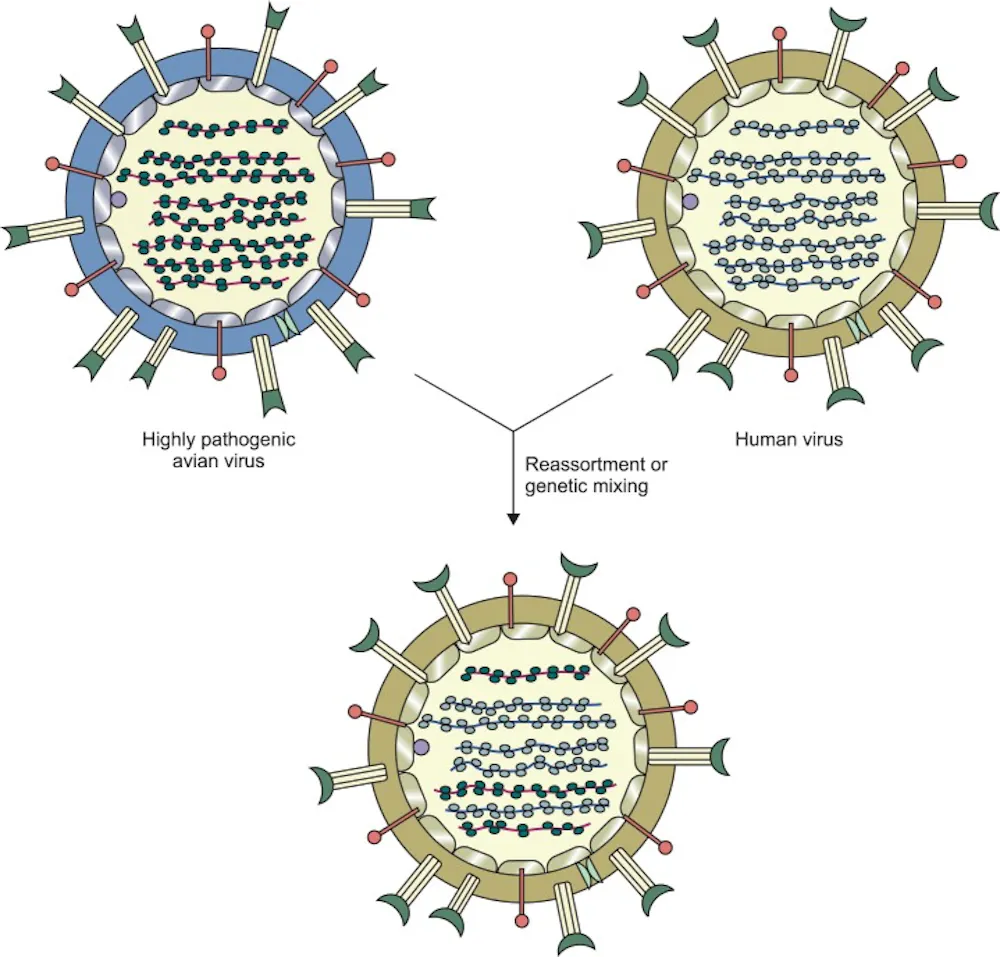
    Influenza viruses evolve rapidly. This is partly because two or more flu varieties can infect the same host simultaneously, allowing them to reshuffle their genetic material with one another to produce entirely new varieties.

    Genetic reshuffling – aka antigenic shift – between a highly pathogenic strain of avian influenza and a strain of human influenza could create a new strain that’s even more infectious among people.
    Eunsun Yoo/Biomolecules & Therapeutics, CC BY-NC

    These reshuffling events are more likely to occur when there is a diverse range of host species. So it is particularly concerning that H5N1 is known to have infected at least 450 different animal species. It may not be long before the viral chatter gives way to larger human epidemics.

    Reshaping the trajectory

    The good news is that people can take basic measures to slow down the evolution of H5N1 and potentially reduce the lethality of avian influenza should it ever become a common human infection. But governments and businesses will need to act.

    People can start by taking better care of food animals. The total weight of the world’s poultry is greater than all wild bird species combined. So it is not surprising that the geography of most H5N1 outbreaks track more closely with large-scale housing and international transfers of live poultry than with the nesting and migration patterns of wild aquatic birds. Reducing these agricultural practices could help curb the evolution and spread of H5N1.

    Large-scale commercial transport of domesticated animals is associated with the evolution and spread of new influenza varieties.
    ben/Flickr, CC BY-SA

    People can also take better care of themselves. At the individual level, most people can vaccinate against the common, seasonal influenza viruses that circulate every year. At first glance this practice may not seem connected to the emergence of avian influenza. But in addition to preventing seasonal illness, vaccination against common human varieties of the virus will reduce the odds of it mixing with avian varieties and giving them the traits they need for human-to-human transmission.

    At the population level, societies can work together to improve nutrition and sanitation in the world’s poorest populations. History has shown that better nutrition increases overall resistance to new infections, and better sanitation reduces how much and how often people are exposed to new pathogens. And in today’s interconnected world, the disease problems of any society will eventually spread to every society.

    For more than 10,000 years, human behaviors have shaped the evolutionary trajectories of infectious diseases. Knowing this, people can reshape these trajectories for the better.

    Ron Barrett does not work for, consult, own shares in or receive funding from any company or organization that would benefit from this article, and has disclosed no relevant affiliations beyond their academic appointment.

    ref. Bird flu could be on the cusp of transmitting between humans − but there are ways to slow down viral evolution – https://theconversation.com/bird-flu-could-be-on-the-cusp-of-transmitting-between-humans-but-there-are-ways-to-slow-down-viral-evolution-250232

    MIL OSI – Global Reports

  • MIL-OSI Global: Measles can ravage the immune system and brain, causing long-term damage – a virologist explains

    Source: The Conversation – USA – By Peter Kasson, Professor of Chemistry and Biomedical Engineering, Georgia Institute of Technology

    Measles infections send 1 in 5 people to the hospital. wildpixel/ iStock via Getty Images Plus

    The measles outbreak that began in west Texas in late January 2025 continues to grow, with 400 confirmed cases in Texas and more than 50 in New Mexico and Oklahoma as of March 28.

    Public health experts believe the numbers are much higher, however, and some worry about a bigger resurgence of the disease in the U.S. In the past two weeks, health officials have identified potential measles exposures in association with planes, trains and automobiles, including at Washington Dulles International Airport and on an Amtrak train from New York City to Washington, D.C. – as well as at health care facilities where the infected people sought medical attention.

    Measles infections can be extremely serious. So far in 2025, 14% of the people who got measles had to be hospitalized. Last year, that number was 40%. Measles can damage the lungs and immune system, and also inflict permanent brain damage. Three in 1,000 people who get the disease die. But because measles vaccination programs in the U.S. over the past 60 years have been highly successful, few Americans under 50 have experienced measles directly, making it easy to think of the infection as a mere childhood rash with fever.

    As a biologist who studies how viruses infect and kill cells and tissues, I believe it is important for people to understand how dangerous a measles infection can be.

    Underappreciated acute effects

    Measles is one of the most contagious diseases on the planet. One person who has it will infect nine out of 10 people nearby if those people are unvaccinated. A two-dose regimen of the vaccine, however, is 97% effective at preventing measles.

    When the measles virus infects a person, it binds to specific proteins on the surface of cells. It then inserts its genome and replicates, destroying the cells in the process. This first happens in the upper respiratory tract and the lungs, where the virus can damage the person’s ability to breathe well. In both places, the virus also infects immune cells that carry it to the lymph nodes, and from there, throughout the body.

    Measles can wipe out immune cells’ ability to recognize pathogens.

    What generally lands people with measles in the hospital is the disease’s effects on the lungs. As the virus destroys lung cells, patients can develop viral pneumonia, which is characterized by severe coughing and difficulty breathing. Measles pneumonia afflicts about 1 in 20 children who get measles and is the most common cause of death from measles in young children.

    The virus can directly invade the nervous system and also damage it by causing inflammation. Measles can cause acute brain damage in two different ways: a direct infection of the brain that occurs in roughly 1 in 1,000 people, or inflammation of the brain two to 30 days after infection that occurs with the same frequency. Children who survive these events can have permanent brain damage and impairments such as blindness and hearing loss.

    Yearslong consequences of infection

    An especially alarming but still poorly understood effect of measles infection is that it can reduce the immune system’s ability to recognize pathogens it has previously encountered. Researchers had long suspected that children who get the measles vaccine also tend to have better immunity to other diseases, but they were not sure why. A study published in 2019 found that having a measles infection destroyed between 11% and 75% of their antibodies, leaving them vulnerable to many of the infections to which they previously had immunity. This effect, called immune amnesia, lasts until people are reinfected or revaccinated against each disease their immune system forgot.

    Occasionally, the virus can lie undetected in the brain of a person who recovered from measles and reactivate typically seven to 10 years later. This condition, called subacute sclerosing panencephalitis, is a progressive dementia that is almost always fatal. It occurs in about 1 in 25,000 people who get measles but is about five times more common in babies infected with measles before age 1.

    Researchers long thought that such infections were caused by a special strain of measles, but more recent research suggests that the measles virus can acquire mutations that enable it to infect the brain during the course of the original infection.

    There is still much to learn about the measles virus. For example, researchers are exploring antibody therapies to treat severe measles. However, even if such treatments work, the best way to prevent the serious effects of measles is to avoid infection by getting vaccinated.

    Peter Kasson receives funding from the National Institutes of Health, the Knut and Alice Wallenberg Foundation, and the Swedish Research Council for research on other emerging viruses.

    ref. Measles can ravage the immune system and brain, causing long-term damage – a virologist explains – https://theconversation.com/measles-can-ravage-the-immune-system-and-brain-causing-long-term-damage-a-virologist-explains-252354

    MIL OSI – Global Reports

  • MIL-OSI Global: Massive cuts to Health and Human Services’ workforce signal a dramatic shift in US health policy

    Source: The Conversation – USA – By Simon F. Haeder, Associate Professor of Public Health, Texas A&M University

    The new plan will shrink the Health and Human Services workforce from more than 82,000 to 62,000 employees. Sarah Stierch via Wikimedia Commons, CC BY

    On March 27, 2025, Department of Health and Human Services Secretary Robert F. Kennedy, Jr. announced plans to dramatically transform the department. HHS is the umbrella agency responsible for pandemic preparedness, biomedical research, food safety and many other health-related activities.

    In a video posted that afternoon, Kennedy said the cuts and reorganization to HHS aim to “streamline our agency” and “radically improve our quality of service” by eliminating rampant waste and inefficiency. “No American is going to be left behind,” the health secretary told the nation.

    As a scholar of U.S. health and public health policy, I have written about administrative burdens that prevent many Americans from accessing benefits to which they are entitled, including those provided by HHS, like Medicaid.

    Few experts would deny that the federal bureaucracy can be inefficient and siloed. This includes HHS, and calls to restructure the agency are nothing new

    Combined with previous reductions, these cuts may achieve some limited short-term savings. However, the proposed changes dramatically alter U.S. health policy and research, and they may endanger important benefits and protections for many Americans. They may also have severe consequences for scientific progress. And as some policy experts have suggested, the poorly targeted cuts may increase inefficiencies and waste down the line.

    Health and science in a big-budget agency

    HHS is tasked with providing a variety of public health and social services as well as fostering scientific advancement.

    Originally established as the Department of Health, Education, and Welfare in 1953, HHS has seen substantial growth and transformation over time. Today, HHS is home to 28 divisions. Some of these are well known to many Americans, such as the National Institutes of Health, the Food and Drug Administration and the Centers for Disease Control and Prevention. Others, such as the Center for Faith-Based and Neighborhood Partnerships and the Administration for Community Living, may fly under the radar for most people.

    HHS oversees Medicare, through which 68 million Americans, primarily adults age 65 and older, receive health insurance benefits.
    Richard Bailey/Corbis Documentary via Getty Images

    With an annual budget of roughly US$1.8 trillion, HHS is one of the largest federal spenders, accounting for more than 1 in 5 dollars of the federal budget.

    Under the Biden administration, HHS’s budget increased by almost 40%, with a 17% increase in staffing. However, 85% of that money is spent on 79 million Medicaid and 68 million Medicare beneficiaries. Put differently, most of HHS’ spending goes directly to many Americans in the form of health benefits.

    A new direction for Health and Human Services

    From a policy perspective, the changes initiated at HHS by the second-term Trump administration are far-reaching. They involve both staffing cuts and substantial reorganization.

    Prior to the March 27 announcement, the administration had already cut thousands of positions from HHS by letting go probationary employees and offering buyouts for employees to voluntarily leave.

    Now, HHS is slated to lose another 10,000 workers. The latest cuts focus most heavily on a handful of agencies. The FDA will lose an additional 3,500 employees, and the NIH will lose 1,200. The CDC, where cuts are steepest, will lose 2,400 positions.

    In all, the moves will reduce the HHS workforce by about 25%, from more than 82,000 to 62,000. These changes will provide savings of about $1.8 billion, or 0.1% of the HHS budget.

    Along with these cuts comes a major reorganization that will eliminate 13 out of 28 offices and agencies, close five of the 10 regional offices, reshuffle existing divisions and establish a new division called the Administration for a Healthy America.

    In his latest message, Kennedy noted that this HHS transformation would return the agency to its core mission: to “enhance the health and well-being of all Americans”. He also announced his intention to refocus HHS on his Make America Healthy Again priorities, which involve reducing chronic illness “by focusing on safe, wholesome food, clean water and the elimination of environmental toxins.”

    How HHS’ new reality will affect Americans

    Kennedy has said the HHS overhaul will not affect services to Americans. Given the magnitude of the cuts, this seems unlikely.

    HHS reaches into the lives of all Americans. Many have family members on Medicaid or Medicare, or know individuals with disabilities or those dealing with substance use disorder. Disasters may strike anywhere. Bird flu and measles outbreaks are unfolding in many parts of the country. Everyone relies on access to safe foods, drugs and vaccines.

    The plan to restructure HHS will trim its budget by 0.1%.

    In his announcement, the health secretary highlighted cuts to HHS support functions, such as information technology and human resources, as a way to reduce redundancies and inefficiencies. But scaling down and reorganizing these capacities will inevitably have implications for how well HHS employees will be able to fulfill their duties – at least temporarily. Kennedy acknowledged this as a “painful period” for HHS.

    However, large-scale reductions and reorganizations inevitably lead to more systemic disruptions, delays and denials. It seems implausible that Americans seeking access to health care, help with HIV prevention or early education benefits such as Head Start, which are also administered by HHS, will not be affected. This is particularly the case when conceived rapidly and without transparent long-term planning.

    These new cuts are also further exacerbated by the administration’s previous slashes to public health funding for state and local governments. Given the crucial functions of HHS – from health coverage for vulnerable populations to pandemic preparedness and response – the American Public Health Association predicts the cuts will result in a rise in rates of disease and death.

    Already, previous cuts at the FDA – the agency responsible for safe foods and drugs – have led to delays in product reviews.

    Overall, the likelihood of increasing access challenges for people seeking services or support as well as fewer protections and longer wait times seems high.

    A fundamental reshaping of American public health

    The HHS restructuring should be viewed in a broader context. Since coming to office, the Trump administration has aggressively sought to reshape the U.S. public health agenda. This has included vast cuts to research funding as well as funding for state and local governments. The most recent cuts at HHS fit into the mold of rolling back protections and reshaping science.

    The Trump administration has already announced plans to curtail the Affordable Care Act and roll back regulations that address everything from clean water to safe vaccines. State programs focused on health disparities have also been targeted.

    HHS-funded research has also been scaled back dramatically, with a long list of projects terminated in research areas touching on health disparities, women’s and LGBTQ-related health issues, COVID-19 and long COVID, vaccine hesitancy and more.

    The HHS reorganization also revamps two bodies within HHS, the Office of the Assistant Secretary for Planning and Evaluation and the Agency for Healthcare Research and Quality, that are instrumental in improving U.S. health care and providing policy research. This change further diminishes the likelihood that health policy will be based on scientific evidence and raises the risk for more politicized decision-making about health.

    More cuts are likely still to come. Medicaid, the program providing health coverage for low-income Americans, will be a particular target. The House of Representatives passed a budget resolution on Feb. 25 that allows up to $880 billion in cuts to the program.

    All told, plans already announced and those expected to emerge in the future dramatically alter U.S. health policy and roll back substantial protections for Americans.

    A vision for deregulation

    Regulation has emerged as the most prolific source of policymaking over the last five decades, particularly for health policy. Given its vast responsibilities, HHS is one of the federal government’s most prolific regulators. Vast cuts to the HHS workforce will likely curtail this capability, resulting in fewer regulatory protections for Americans.

    At the same time, with fewer experienced administrators on staff, industry influence over regulatory decisions will likely only grow stronger. HHS will simply lack the substance and procedural expertise to act independently. More industry influence and fewer independent regulators to counter it will also further reduce attention to disparities and underserved populations.

    Ultimately, the Trump administration’s efforts may lead to a vastly different federal health policy – with fewer benefits, services and protections – than what Americans have become accustomed to in modern times.

    Dr. Simon F. Haeder has previously received funding from the Centers for Medicare and Medicaid Services (CMS) of the U.S. Department of Health and Human Services (HHS) .

    ref. Massive cuts to Health and Human Services’ workforce signal a dramatic shift in US health policy – https://theconversation.com/massive-cuts-to-health-and-human-services-workforce-signal-a-dramatic-shift-in-us-health-policy-253316

    MIL OSI – Global Reports

  • MIL-OSI Global: UK nuclear deterrent: the mutual defense agreement is at risk in a Trumpian age

    Source: The Conversation – UK – By Becky Alexis-Martin, Peace Studies and International Development, University of Bradford

    Keir Starmer aboard one of the UK’s Vanguard class submarines. CC BY-NC-ND

    Prime Minister Keir Starmer recently boarded one of the UK’s four nuclear-armed submarines for a photo call as part of his attempts to demonstrate the UK’s defence capabilities as tensions with Russia continue.

    However, Starmer faces a problem. The submarine, and the rest of the UK’s nuclear fleet, is heavily reliant on the US as an operating partner. And at a time when the US becomes an increasingly unreliable partner under the leadership of an entirely transactional president, this is not ideal. The US can, if it chooses, effectively switch off the UK’s nuclear deterrent.

    British and US nuclear history is irrevocably interwoven. The US and UK cooperated on the Manhattan project, under the 1943 Quebec agreements and the 1944 Hyde Park aide memoire. This work generated the world’s first nuclear weapons, which were deployed on Hiroshima and Nagasaki in 1945.

    It also led to the first rupture. In 1946, the US classified UK citizens as “foreign” and prevented them from engaging in secret nuclear work. Collaboration with the UK immediately ceased.

    The UK decided to develop its own arsenal of nuclear weapons. The successful detonation of the “Grapple Yhydrogen bomb in April 1958 cemented its position as a thermonuclear power.

    In the meantime, however, Russia’s launch of the Sputnik satellite in 1957 had demonstrated the lethal reach of Soviet nuclear technology. This brought the US and UK back together as nuclear partners.


    Want more politics coverage from academic experts? Every week, we bring you informed analysis of developments in government and fact check the claims being made.

    Sign up for our weekly politics newsletter, delivered every Friday.


    Talks on how to counter the Russian threat became the foundation of an atomic partnership that endures to the present day. This mutual defence agreement, signed in 1958, has provided the UK with affordable access to the latest nuclear technology and a reliable western ally. The treaty has been amended and adapted over time to reflect changes in the US-UK working relationship and the two are now so entangled that it is very hard to leave the co-dependent relationship.

    Both sides have benefited from security and protection, especially during the cold war. However, Trump’s new “special relationship” with Russia’s Vladimir Putin has reconfigured the global order of geopolitics.

    Serious concerns are now being raised about the UK’s nuclear capacity, given the unpredictability and potential unreliability of the new US administration. Trump could ignore or threaten to terminate the agreement in a show of power or contempt.

    The UK’s nuclear subs

    The UK’s Trident nuclear deterrence programme consists of four Vanguard nuclear-powered and armed submarines. The UK has some autonomy, as it is operationally independent and controls the decision to launch.

    However, it remains dependent on the US because the nuclear technologies at the heart of the Trident system are US designed and leased by Lockheed Martin – and there is no suitable alternative. The Trident system therefore relies on the US for support and maintenance.

    The UK is currently in the process of upgrading the current system. But its options seem limited. If the US were to renege on its commitments, the UK would either have to produce its own weapons domestically, collaborate with France or Europe or disarm. Each scenario creates new issues for the UK. Manufacturing nuclear weapons from scratch in the UK, for example, would be a costly and protracted activity.

    Technical collaboration with France seems the most plausible back-up option at the moment. The two countries already have a nuclear collaboration treaty in place. France has taken a similar submarine-based approach to deterrence as the UK and French president Emmanuel Macron has suggested its deterrent could be used to protect other European countries. Another alternative would be to spread the cost across Europe and create a European deterrence – but both strategies just re-embed the UK’s current nuclear reliance.

    The UK is reliant on others for its nuclear deterrent.
    Number 10/Flickr, CC BY-NC-ND

    While these weapons may deter a hostile nuclear strike, they have failed to prevent broader acts of aggression. Nuclear weapons have not been used in warfare for 80 years. Perhaps it is time to completely and permanently unshackle the UK from nuclear deterrence, and consider alternative forms of defence.

    The UK’s nuclear arsenal is expensive to maintain. The cost of replacing Trident is £205 billion. In 2023, the Ministry of Defence reported that the anticipated costs for supporting the nuclear deterrent would exceed its budget by £7.9 billion over the next ten years. This funding could be channelled into more pressing security threats, such as cybersecurity, terrorism or climate change.

    Nuclear weapons will become strategically redundant if the UK cannot act independently. As Nato and the US dominate the global nuclear stage, the UK’s capacity to respond has become contested. The time has come to decide whether the US is really our friend – or a new foe.

    Becky Alexis-Martin does not work for, consult, own shares in or receive funding from any company or organisation that would benefit from this article, and has disclosed no relevant affiliations beyond their academic appointment.

    ref. UK nuclear deterrent: the mutual defense agreement is at risk in a Trumpian age – https://theconversation.com/uk-nuclear-deterrent-the-mutual-defense-agreement-is-at-risk-in-a-trumpian-age-252674

    MIL OSI – Global Reports

  • MIL-OSI Global: How viruses blur the the boundaries of life

    Source: The Conversation – UK – By Heshmat Borhani, Lecturer in in Cell and Molecular Biology, University of Nottingham

    Cryptographer/Shutterstock

    When people talk about the coronavirus, they sometimes describe this invisible entity as if it has a personality and even a conscience. If you ask a biology or medical student what a virus is, they will tell you that a virus is not a living organism, or at most that it exists at the border between living and dead – a kind of walking dead.

    For biologists who specialise in virology, however, this view is not clear-cut. Scientists still disagree on whether viruses are truly alive or not.

    What scientists can agree on is that a virus adapts to new conditions, evolves and sometimes harms humans. It is also an infectious agent that can only replicate within a host organism such as bacteria, plants or animals.

    The boundary between being alive and dead is a concept with no specific criteria. So to help you think about whether viruses are alive, I will talk you through some of the different definitions of life in science.

    Throughout history, scientists have debated the definition of life and researchers from different fields still disagree. This debate shapes scientific understanding and influences public health decisions – for example, defining whether viruses are “alive” affects how we design vaccines and strategies to stop their spread.

    Biologists may refer you to Erwin Schrödinger’s definition of life. Schrödinger was an Austrian Nobel-prize winning physicist who published a book in 1944 called What is Life? He was one of the first scientists to try to define life and is perhaps better known in popular culture for his “Schrödinger’s cat” thought experiment.

    He proposed that life is a form of negative “entropy”, a scientific concept that explains how disordered something is. A physical system will always increase in entropy/disorder unless we insert energy to change this process. Schrödinger thought living things create and maintain order by using energy.

    For example, a messy bedroom doesn’t clean itself, but a person can tidy it. Organisms do something similar at the molecular level. DNA is highly structured, allowing it to store genetic information. Proteins fold into specific shapes to function properly. In contrast, after an organism dies, its molecules break down, increasing disorder.

    Schrödinger later revised his view – around the 1950s – suggesting that life depends on free energy. Free energy is the energy that drives chemical reactions in living things. This marked a shift from focusing on order (negative entropy) to emphasising energy as essential for life.

    The coronavirus took on a personality for many people.
    creativeneko/Shutterstock

    In the mid-20th century, scientists switched from defining life to describing its key characteristics. Studying organisms such as bacteria, plants and animals, they identified common traits, setting a precedent still followed today.

    Rather than seeking a single definition, researchers classify entities based on these traits. To decide whether a virus is alive, researchers assess how well it meets these criteria.

    According to biology, the smallest unit of life is the cell. A cell is an independent unit which makes functional molecules (such as proteins and enzymes). Cells can use their own molecules to replicate genetic material independently. A virus also has genetic material but needs to use the host cell’s enzymes to make functional molecules or replicate its genetic material.

    Put simply, a virus does not replicate or function independently. So by the biological definition, a virus cannot be categorised as a living organism.

    But from a genetic and evolutionary point of view a living organism is defined by its ability to reproduce. A person who does not have children is still considered to be alive as they are part of the gene pool and descended from people who did have children. From this view a virus is alive, since it can produce similar offspring.

    Some scientists also focus on metabolism and energy production as criteria for life. Metabolism includes catabolism (breaking down molecules like sugars during digestion) and anabolism (building molecules like muscle tissue), linking energy and material. These reactions require molecular structures to generate or use energy – structures viruses lack.

    Does that mean viruses aren’t alive? An amoeba, for instance, uses nutrients and enzymes to sustain itself, while viruses rely entirely on a host. From this perspective, viruses don’t meet the metabolic criteria for life. However, some argue that since viruses hijack a host’s metabolism to replicate, they show life-like behaviour.

    If we consider nutrients to be sources of free energy, a cell uses energy from the environment to build what it needs. As the cell absorbs energy from the environment, it builds and maintains its internal structures – like proteins and membranes.

    It also releases a byproduct – carbon dioxide – that contributes to disorder in the external environment. Viruses also do this. They make their structures by using the external environment, a host cell in this case. The viruses’ byproducts may be what makes us sick.

    As we explore the complexities of biology, it becomes clear that defining life itself is anything but straightforward. Viruses display both life-like and non-living traits, which influences how we approach treatments like antiviral drugs designed to block their replication inside host cells.

    Heshmat Borhani does not work for, consult, own shares in or receive funding from any company or organisation that would benefit from this article, and has disclosed no relevant affiliations beyond their academic appointment.

    ref. How viruses blur the the boundaries of life – https://theconversation.com/how-viruses-blur-the-the-boundaries-of-life-230802

    MIL OSI – Global Reports

  • MIL-OSI NGOs: People affected by violence and cholera in South Sudan arrive exhausted in Ethiopia

    Source: Médecins Sans Frontières –

    • In South Sudan’s Upper Nile state, people are affected by violence and cholera, causing them to seek safety across the border in Ethiopia’s Gambella region.
    • MSF teams are on both sides of the border, providing critical care to people.
    • Urgent support is needed to provide safe water, implement widespread cholera vaccination campaigns, and reinforce treatment capacity for both cholera patients and trauma cases. 

    A humanitarian crisis is rapidly unfolding on both sides of the South SudanEthiopia border, as escalating violence, displacement and a widespread cholera outbreak are pushing communities to the brink, Médecins Sans Frontières (MSF) warns.

    Clashes between government forces and armed groups, which initially began in Upper Nile state, South Sudan, now risk spreading to other parts of the country. Across the border, Ethiopia’s Gambella region is experiencing the effects of this violence. According to the United Nations, approximately 10,000 displaced people have crossed into Ethiopia since the beginning of March.

    “We have already witnessed how this violence has fuelled the spread of cholera in several areas, but a larger, escalating conflict could push the entire country into an unprecedented humanitarian catastrophe,” says Zakaria Mwatia, MSF head of mission in South Sudan. “We urgently call on all parties to the conflict to ensure the protection of civilians, healthcare workers, and medical facilities, and to grant unhindered access for humanitarian and medical assistance, in line with international humanitarian law.”

    A map of MSF’s response on both sides of the border in March 2025.

    South Sudan has been grappling with cholera outbreaks across the country since last year. The latest wave, which began in Upper Nile state, is now spreading further into neighbouring Jonglei state, the Greater Pibor Administrative Area, and across the border into Ethiopia’s Gambella region, where MSF teams are working to treat patients amid the surge in cases.

    In Upper Nile state, MSF is treating people wounded in the violence and supporting cholera treatment facilities in Ulang, Malakal and Renk counties. In Jonglei state, MSF is responding in Lankien as well as in Akobo, where a 100-bed cholera treatment unit set up by MSF in Akobo County hospital has treated over 300 patients in just over two weeks. MSF is also responding in Pibor town in the Greater Pibor Administrative area. Since the beginning of March, MSF teams have treated over 1,000 cholera patients across South Sudan and received over 30 patients wounded in the violence.

    Ruach Riek Chuol was admitted to MSF hospital in Ulang with injuries he sustained in the violence. “My goods and property for my business were all burned inside the house,” he says. “Everything was destroyed in the fire, including the house where I was.”

    In Ethiopia’s Gambella region, MSF, in collaboration with the Ministry of Health, has treated over 560 cholera patients since the start of the response in early March, in its cholera treatment centre and units in Mattar, Moan and Burbeiye with a capacity of 100 beds. MSF is also running oral rehydration points and conducting water, sanitation, and hygiene and community-based activities including door-to-door cholera awareness and water purification efforts, reaching over 5,000 people across multiple locations. In addition to cholera treatment, MSF teams have also provided medical care to 160 patients wounded in the clashes in South Sudan. 

    A cattle market in close to MSF’s cholera treatment unit in Ethiopia’s Gambella region. Ethiopia, March 2025.
    Metasebia Teshome/MSF

    “I came here because back home in Nasir, people are being killed,” said a South Sudanese mother who recently arrived in Burbeiye, Ethiopia. “There was nothing to eat, and when we arrived at the areas where we took respite, my kids became sick. There were no health facilities that we could run to.”

    The situation is rapidly deteriorating as thousands fleeing violence in South Sudan are crossing the border to seek safety. In Wanthoa Woreda, a new encampment in Burbeiye has emerged almost overnight, with over 6,500 new arrivals reported by local administrators — many of them women, children, and the elderly, arriving after days of travel. 

    “The displaced people are arriving in Gambella with little more than what they can carry,” said Joshua Eckley, MSF head of mission in Ethiopia. “Our teams are responding to the cholera outbreak and providing care to those arriving exhausted and in poor condition. There are significant needs, and without additional support, the situation could worsen.”

    This crisis comes at a time when South Sudan and Ethiopia are facing major reductions in donor funding, including the recent USAID cuts. While MSF does not accept funding from the US government, the cuts in the humanitarian and health assistance would severely reduce capacity of other organisations to respond to such crises.

    “In places like Akobo in Jonglei state, the cholera response has been highly impacted by funding cuts, including closure of critical health services,” says Mwatia. “A number of mobile clinics have already shut down following US funding cuts, and some organisations that supported health facilities, including cholera treatment units, have suspended all activities. This is part of a broader trend across the country.”

    The healthcare system in South Sudan suffers from chronic underfunding, shortages of skilled health staff, medicines and supplies, and has limited capacity to respond to emergencies. The country, already struggling to meet its own medical and humanitarian needs, is further burdened by the arrival of over one million people fleeing war in neighbouring Sudan. Urgent support is needed to provide safe water, implement widespread cholera vaccination campaigns, and reinforce treatment capacity for both cholera patients and trauma cases. 

    “Disruptions in cholera treatment services, combined with reduced actors’ capacity to support oral vaccination campaigns, heighten the risk of further spread,” says Mwatia. “We urge donors to allocate emergency funds for emergency response in South Sudan and neighbouring Ethiopia amid this escalating crisis.”

    MIL OSI NGO

  • MIL-OSI Global: AI is for the birds: How machine learning can help predict and manage avian flu outbreaks

    Source: The Conversation – Canada – By Rozita Dara, Assistant Professor, Computer Science, University of Guelph

    The active and ongoing global spread of avian influenza virus has impacted more than 14 million birds in Canada and 160 million in the USA.

    This recent outbreak has resulted in major economic losses, and a rise in egg prices in the past few years. This trend can cause disruptions in poultry supply chain and significant increases in the price of other poultry products.

    A virus like avian influenza is carried by birds, but it can “jump” species and infect livestock such as dairy or sheep or even pets like dogs and cats.


    Read more:
    Bird flu detected in Colorado dairy cattle − a vet explains the risks of the highly pathogenic avian influenza virus


    And most, if not all, human pandemic influenza viruses have had an avian origin in the past few decades. Experts warn it is only a matter of time before we face another pandemic threat.

    The good news is, we are better prepared than ever to meet that challenge. Not just because we have vaccines or treatments, although those are critical. But because we have something that can change the game entirely: artificial intelligence (AI).

    CBC News covers an outbreak of avian flu among Canadian geese in Prince Edward Island.

    Vast amounts of information

    AI can offer much in the way of advance pandemic information and planning. Remember the early days of COVID-19? What if we had more time to prepare? What if health officials had known weeks earlier where the virus was spreading, which neighbourhoods were most at risk, and what we needed to do to stop it?

    AI can analyze vast amounts of information, from wildlife health reports, geographical data, satellite images to social media trends, online content, farm data and even weather patterns to answer some questions about how, when and why pandemics happen. It spots patterns, anomalies and relationships humans cannot see in real-time.

    AI can alert monitors to where an avian influenza outbreak might occur before a region is impacted, how severe an outbreak might be and what type of intervention may be most effective. AI can help responders and governments act quickly, precisely and efficiently.

    Predicting outbreaks

    At the University of Guelph, my research team and I are working on AI solutions to help track and predict the avian influenza outbreaks. Our research — which is currently under review — has used AI to filter out misinformation about avian influenza from social media platforms and Reddit, as well as Google search data, and other online sources.

    This helps us understand public discussion about avian influenza. We have also combined these online activities with other data sources to monitor avian influenza online mentions and trends — we’ve found that AI can use this information to predict if an outbreak might occur in a specific area.

    With the availability of online and social media data, an outbreak surge can be predicted up to four weeks in advance in specific regions.

    Our research team has also created and tested decision support tools that use different types of information from wild bird reports, satellite images, climate change data and farm information. These tools help predict avian influenza outbreaks and how serious they might be in a certain area; through testing, we achieved an accuracy of 85 per cent.

    We’re currently in the process of building a Canadian tool to predict where bird flu might emerge, helping farmers and public health officials get ahead of outbreaks — this could mean the difference between a contained outbreak and a global crisis.

    More than a public health issue

    A sign warning hikers about an avian flu outbreak along the Skerwink Hiking Trail in Newfoundland.
    (Shutterstock)

    Avian influenza spreads through the food chain, wildlife and global trade. An outbreak in poultry can devastate agriculture and threaten our food security. Worse, it can jump to human populations with little warning.

    This issue is not just a public health issue. It is also an economic and social concern. But if we harness AI properly, we can give ourselves a better chance at combating these threats. We can predict where the next outbreak might come from and take action before it spreads.


    Read more:
    Soaring U.S. egg prices and millions of dead chickens signal the deep problems and risks in modern poultry production


    Using AI to predict avian flu outbreaks and spread can be applied to other situations, including other illnesses and the weather and environmental conditions that could contribute to disease spread.

    AI-based decision tools can also include augmented reality that enables the testing of thousands of hypothetical scenarios related to avian influenza. These include how outbreaks might spread, what the impacts of different intervention strategies could be, how changes in the economy and environment might occur, and how the supply chain could be impacted.

    We have the technology in our labs. But to make it work, we need strong partnerships between government, universities, farmers, industry and communities. We need to make sure that we generate high quality data, use the data ethically in a privacy-preserving manner, develop the AI tool responsibly and apply it fairly to ensure that no one is left behind.

    Rozita Dara receives funding from Ontario Ministry of Agriculture, Food and Agribusiness Alliance Tier I, funding and the University of Guelph’s Food from Thought.

    ref. AI is for the birds: How machine learning can help predict and manage avian flu outbreaks – https://theconversation.com/ai-is-for-the-birds-how-machine-learning-can-help-predict-and-manage-avian-flu-outbreaks-252550

    MIL OSI – Global Reports

  • MIL-OSI United Nations: 31 March 2025 Medical product alert WHO information notice for users of malaria IVDs 2025/1

    Source: World Health Organisation

    Product name All malaria rapid diagnostic tests  
    WHO document identifier   2025/01

    Date: 19 March 2025

    Affected countries:  Global

    Type of action: Advice regarding use of the device

    Description of the problem:

    In 2024, the World Health Organization (WHO) was informed that various malaria rapid diagnostic tests (RDT) showed faint positive test lines for patients with confirmed malaria infection. Incidents were reported in several countries for various products detecting both Plasmodium falciparum and Plasmodium vivax, and products detecting Plasmodium falciparum and pan species.

    The faint test lines were predominantly observed for patients with low parasitemia (200 parasites/µl). However, some patients with higher parasitemia also generated faint test lines. More recent reports indicated that faint test lines have led to misdiagnosis and therefore delayed appropriate treatment. The manufacturers’ investigations have followed internationally recognized practices.                                                                                          

    Description of risks:

    Rapid diagnostic tests for malaria can give false negative results, even for products found to have satisfactory performance based on criteria established by WHO. Faint test lines increase the risk of false negative test results being reported, which may lead to misdiagnosis, delay to diagnosis, and delay to treatment. In circumstances where misdiagnosis occurs, the potential for harm, such as death or serious deterioration in health, is increased.

    Actions to be taken by users/healthcare professionals:

    1. Carefully follow the instructions for use of the product, specifically:

    •  Read any test line as positive, no matter how faint the test line.
    •  Fully fill and dispense completely the blood from the specimen transfer device.

    2. Respect storage conditions for the test kit.

    3. If the RDT results are negative and no alternative diagnosis is found, advise patients to return for re-evaluation or re-testing if their symptoms worsen or their condition does not improve.

    4. Report any unusual testing results to the manufacturer, via their local authorized representative.

    Action to be taken by national malaria control programmes:

    1. Ensure conditions for transport and storage of RDTs respect manufacturer’s instructions for use throughout the lifespan of the product.
    2. Ensure up-to-date training and supervision of RDT users, and ensure users are specifically sensitized to the issues outlined in this information notice.
    3. Ensure end-users have normal or corrected visual acuity.
    4. Proactively reach out to testing sites to seek feedback on any unusual trends.
    5. Support manufacturers to conduct investigations of unusual testing results.

    For further information:

    Incidents and Substandard/Falsified Medical Products Team, Regulation and Safety Unit, Regulation and Prequalification Department, World Health Organization, e-mail: rapidalert@who.int

    MIL OSI United Nations News

  • MIL-OSI: Agillic appoints new CFO Jack Sørensen

    Source: GlobeNewswire (MIL-OSI)

    Press release – Copenhagen – 31 March 2025

    Jack Sørensen joins Agillic as its new Chief Financial Officer on 1 May 2025.

    Jack will manage the finance team, oversee financial strategy and operations, and work closely with CEO Christian Samsø on investor relations. 

    Jack joins Agillic from Evaxion-Biotech A/S – a biotech company listed on Nasdaq New York and operating in Australia and Denmark – where he has been the VP of Finance and Reporting since 2022. Jack brings an extensive international experience across IT and SaaS, med- and biotech, telecom, and consultancy, having held various roles in companies like Deloitte, Chr. Hansen Holding, DONG Energy (Ørsted), Global Connect Outsourcing, and Widex.

    Christian Samsø, CEO at Agillic, comments: 
    “I am very pleased to have concluded a swift recruitment process, welcoming Jack to Agillic already in May. We have a highly capable finance department, and I look forward to seeing Jack develop and lead the team, and together with the Executive Management team deliver on Agillic’s strategic priorities of ARR growth, positive cashflow from operations, and positive EDITDA as outlined with our 2025 guidance.”

    Jack Sørensen adds:
    “Agillic has an impressive portfolio and footprint in the Nordics. Like any SaaS business, it is subject to market conditions, but I see a strong foundation for growth and look forward to contributing to the continued journey.” 

    For further information, please contact
    Christian Samsøe, CEO
    +45 24 88 24 24
    christian.samsoe@agillic.com

    About Agillic A/S
    Agillic A/S (Nasdaq First North Growth Market Copenhagen: AGILC) is a Danish software company offering brands a platform through which they can work with data-driven insights and content to create, automate, and send personalised communication to millions. Agillic is headquartered in Copenhagen, Denmark. For further information, please visit agillic.com. 

    The MIL Network

  • MIL-OSI United Kingdom: Spring Covid-19 vaccine roll out to start in the Black Country

    Source: City of Wolverhampton

    Similar to last year’s spring Covid-19 vaccine roll out, those eligible for a vaccine include:

    • adults aged 75 years and over
    • residents in a care home for older adults
    • individuals aged 6 months and over who have a weakened immune system.

    Those who turn 75 years old between 1 April and 17 June, 2025 can also have the jab.

    Appointments can be booked now via the NHS website, the NHS App or by calling 119, with first appointments available from Tuesday 1 April until Tuesday 17 June.

    Sally Roberts, Chief Nursing Officer for the NHS Black Country Integrated Care Board (ICB), said: “The vaccine has been our most effective tool against Covid-19, saving countless lives and helping thousands of people to stay out of hospital.

    “However, protection against Covid-19, from either catching the virus or from a previous vaccination, can fade over time and the circulating strain of the virus can change. That’s why if you are at higher risk of severe illness from the virus, it is important that you top up your protection and come forward for a vaccine this spring.

    “If you know you’re eligible, you don’t need to wait to be contacted, you can book an appointment via the NHS website, the NHS App or by calling 119 today.”

    While having the spring vaccine around 6 months after your last dose is the usual timeframe, eligible people can have it as soon as 3 months after a previous Covid-19 vaccine dose.

    If you are eligible, you can get protection from a spring Covid-19 vaccination even if you have not taken up a Covid-19 vaccine offer in the past.

    For more information about the spring Covid-19 vaccine, visit the NHS website.

    MIL OSI United Kingdom

  • MIL-OSI Asia-Pac: Text of the Vice–President’s address at valedictory session of National Conference on Environment- 2025 at Vigyan Bhawan in New Delhi (Excerpts)

    Source: Government of India

    Posted On: 30 MAR 2025 6:34PM by PIB Delhi

    Good evening, all of you. Frankly, I’m not used to such kind of order.

    I’m more used to disorder in the house. And secondly, when I sit in the chair, as Chairman Rajya Sabha, on my right is the Government, on the left is the Opposition. Today there’s a strange combination, excellence, sublimity, of bar and bench on my right side.

    One regret that I have, of parting with the jealous mistress, the legal profession, by becoming Governor-State of West Bengal and now the Vice-President, I did not have the occasion to appear before one of the finest judges of this country, Justice P. S. Narsimha. And similarly, I had no occasion to cross swords with another legal luminary, Shri Tushar Mehta. A source of inspiration and motivation for me.

    Because rarely there is a combination where dedication, excellence, commitment, and nationalism converge. Very soothing experience. Justice P. S. Narsimha, Judge Supreme Court of India, Justice Prakash Shrivastava, Chairperson of the National Green Tribunal, I know him while he was Chief Justice, Calcutta High Court, while I was in Kolkata, because the High Court continues to be known as Calcutta High Court, exemplified highest judicial decorum and standards, and was not eyesore to anyone, fructifying, game-changing decisions.

    A chairman of the National Green Tribunal, you know what he is. But I must share one thing, that is common between us. We both fear our wives. Pradeepti is here, so is Dr. Sudesh. They are our strength. Shri Tushar Mehta Ji has equal challenge in the family as we have. No issue on that. Shri Thirumal Kumar, an IAS officer, I have admired him for a long time, he knows it. So he was a little astounded that I still recollect that.

    Ladies and gentlemen, boys and girls, nothing has happened to me by virtue of these constitutional offices. I am what I am. The only loss that I have is, a legal profession is known as a jealous mistress. I quoted the jealous mistress. When I joined the bar, the year I was married. So along with my wife, there was a jealous mistress.

    But it was very thoughtful of the President of India, Ramnath Kovind Ji. He chose 20th of July 2019, that I forsake the jealous mistress, because that happened to be the birthday of my wife. We have in the audience distinguished Chief Justices, acting Chief Justices, judges, lawyers, environmentalists, boys and girls, but I must recognise the presence of some.

    Justice Vishwanath, some other, I have one thing in common with him. We both belong to the Daughters Club. He has a daughter, and so do we have. And had the satisfaction of knowing him for long. Justice Ashutosh Kumar, Acting Chief Justice, Patna High Court, I’m sure I’ll be making some mistakes. So I leave it at that. My greetings to all of you.

    When I reflected on 20th of July, my wife’s birthday, it doesn’t end there. 20th of July, Neil Armstrong in 1969, landed on the moon for the first time. But my wife was born 12 years before. But what Neil Armstrong said is extremely relevant today for what we are discussing and deliberating. Neil Armstrong reflected, I quote him, “there’s one small step for man, one giant leap for mankind.”

    That is what we need to deal with the issue. Ladies and gentlemen, boys and girls, it’s a privilege to address the valedictory session of this National Conference on Environment. Grateful to Chairman Prakash Shrivastava for securing convergence of over 1,200 environmental experts, judicial and administrative minds, as also most vital stakeholders, young boys and girls.

    They are supremely interested, both in democracy and environment. They will go a long way. I am confident the deliberations over the last two days must have been very fruitful and must have generated a lot of hope and possibility.

    Our planet faces, in the shape of climate change, not an ordinary challenge. It’s an existential challenge. And the nature of the existential challenge is unknown to history ever before.

    The situation is critical and cliffhanging and far too long, engaging the attention of everyone, governments and people all over the globe. The solution to this burning issue is complexed by the belief that someone else will fix it. This is not to be true. We’ll have to do it on our own. There is now live realisation of this menace. It has to be moderated to begin with and solved by all of us in tenement togetherness.

    Resolute addressing of the problem is paramount. And neither we have the time nor we have another planet to cohabit. This problem of huge dimensions has to be fixed by all individuals acting individually, organisations and the governments with immediate, urgent, concerted and sustained effort.

    Let me share with the distinguished audience. Everyone is positioned to make his or her contribution. And the contribution when converges in totality will be result-orientated. We need to realise we are trustees of everything offered by Mother Earth and there is divine ordainment that we must pass on to the future generations all this in good shape writing on the wall. Have we done it? The answer comes from within. Certainly not.

    The present scenario is alarming, daunting and far distanced from what it should have been. In such a scenario an institution like the National Green Tribunal in the largest democracy habitat for one-sixth of humanity is playing vital and significant role catalysing scenarios for containment and searching for solutions. I join Justice P.S. Narsimha in complimenting Justice Shrivastava for taking this initiative and it is not a day too soon.

    India happens to be the third country as was reflected not by this number as such by Shri Tushar Mehta that we have taken a number of initiatives, innovative steps, affirmative government policies in the country but we were amongst the first three in the world to have an institution and regulator like the National Green Tribunal. Distinguished audience not many countries in the world can claim to have civilisational depth which we as Bharat have thousands of years of civilisational ethos. Long before sustainability became a global buzzword much long before centuries before it became a global buzzword India lived it for centuries where every banyan tree was a temple, every river a goddess and waste an unknown concept in a civilisation that worshipped circularity.

    Our Vedic literature is gold mine for nurturing of mother earth and propagating harmony between men and nature. From Ayurveda’s living harmony to Gandhi’s world has enough for need not for greed. The wise sage who transformed democratic landscape of the world bringing about change through non-violence he said the world has everything, earth has everything for need but not for greed.

    India’s DNA carries the only vaccine against ecological collapse, conspicuous consumption. We only have to read what is there in our gold mine. Environmental depredation if we see the cause of it is brought about on the planet only by one species amongst living beings.

    We do it, no one else does it. Distinguished audience we have to be aware the planet is not exclusive to us we are not its owners. Flora and fauna must flourish and blossom alongside and so must all other living beings.

    In such a scenario men will have to learn to live in harmony with nature and other living beings. Are we doing it? No. Every technological development increasing human prowess is used to captivate and make others’ lives vulnerable to other living beings.

    There will have to be individual focus on optimal utilisation of resources of nature. This has to be our habit. Our fiscal power and our fiscal capacity cannot determine the use of natural resources.

    The consumption has to be optimal. We are paying heavy price already for reckless exploitation of these resources and thoughtless consumption conspicuous and lacking empathy. Distinguished audience protecting earth for future generations, an urgent need calls for sustainable practices that recognise nature’s inherent worth while reconciling conservation with development needs. It’s a delicate balance and NGT is required to navigate the fine print of it.

    Human activities particularly climate change and water management now influence seismic events. Studies have revealed earthquakes we all know are normally because of tectonic processes but then the way we conserve waters, build dams and get them emptied is a cause of profound impact on geological situations and therefore there is a global need to evolve and believe in environmental ethics. This underscores human’s moral obligations to protect and preserve the environment.

    This is the interconnection of all living beings. I can assure you once we lose it we know the worth of it. Let us realise the worth before we lose it forever.

    Both ecological extension and conservation ethics advocate harmonious human-nature relationships and are so easy to bring about. It doesn’t call for anything but a positive mindset towards life, we have to focus on environmental preservation and prudent resource stewardship for generational sustainability. Friends, global environmental challenges necessitate cross-border cooperation and innovative strategies that simultaneously advance ecological sustainability and economic development.

    No individual, no group, no nation can by itself resolve this issue. It has to be done by one and all on the planet. There will have to be convergence.

    I am so glad that a step has been taken by the chairman NGT Mr. Shrivastava by having this conference. More of it and it’s kind of needed. Environmental security must inform nuclear policy also.

    We all know weapon systems have huge ecological impact from manufacturing through potential deployment and pose existential risk that undermines their perpetrated security benefits. Something that is for security will result in our defacement from the planet. There has to be a thought process.

    Developed nations must transcend the political boundaries, environmental thinking adopting models where planetary health becomes foundational to human prosperity and well-being. They cannot isolate themselves. Okay, we are doing fine. We have means, technological means to generate a healthy ecosystem. It can last for some years but not forever. They will have to be enveloped into the menace if they do not join the rest of the global community.

    Friends, just look around. Proliferation of air purifiers, masks, water filters, generators usually witnessed in the last few decades. They represent the grievous symptoms of environmental degradation rather than solutions.

    Authentic progress requires eliminating pollution sources. We have to eliminate them because they are created by us. They are man-made.

    Transforming our relationship with nature and exploitation to stewardship. The Bhopal gas tragedy relations are still unlearned. The Union carbide leakage of 1984. I think if I’m not wrong it was in 2015 that Justice Shrivastava, the judge of the Madhya Pradesh High Court dealt with as a commissioner what compensation could be given. It was mega environmental negligence. Even after four decades families suffered generation after generation genetic disorders and groundwater contamination.

    30 years after it as I reflected Justice Shrivastava dealt with an issue for welfare of the victims. Just imagine how pathetic was the lack of awareness. We did not have an institution like NGT.

    We did not have a regulatory regime that could address the issue. Things would have been very different if there had been a regulatory regime of the current level then. Distinguished audience there is a growing concern that environmental justice often follows a troubling pattern of 4Ds delay, deny, dispose, dissolve.

    This cycle must be broken. I am happy to note NGT is catalysing sensitisation on all fronts on this aspect. And I am sure intervention to the NGT exercise will be scarce.

    It is an expert body. I am not for a moment questioning anybody’s authority or power, sir. But then when expert bodies function and have the facility of getting expertise from people who are really knowledgeable, stalling their action delays environmental protection.

    It is soothing to note that the National Green Tribunal shifts from delay to decisiveness from denial to accountability from mere disposal to true restoration and from dissolution to sustainable resolution is increasingly getting respect of the people, institutions corporate world and workers. Our environmental jurisprudence in the country has to grow by looking into our reservoir I said, gold mine reflected in our Vedic literature. Fortunately, trends are emerging that now transcend remediation to embracing ecological preservation as a fundamental mandate.

    Why should we get into remediation, repair? Let us keep an eagle’s eye. Let us keep it in deep focus. Why should there be no preservation? I admire and compliment the Chairman NGT. He has made no efforts to secure scientific expertise to assist and this is turning out to be a cutting edge to NGT’s adjudicatory functions helping it play a visionary role in environmental governance. The tribunal’s environmental jurisprudence is progressively integrating emerging scientific understanding with established legal doctrines and I can share it with you. Having had modest global exposure, the tribunal’s judgments are looked at with great deference globally.

    Invoking the power to interpret the Constitution, the Supreme Court has, and I would say earliest in the world, given dimensions to Article 21, that healthy environment and right to clean air are integrated inalienable facets of Article 21. Friends, despite the synergy between our constitutional values and cultural ethos, there is now an urgent need to deal with citizenry neglect that is widely evident. I reflect on occasions when no Indian who is abroad throws a banana skin out of a running vehicle. No one does it. Why do we have negligence on our holy land? Citizens must be sensitised and made aware. Such kinds of conferences as indicated by Justice Narasimha play a pivotal role because they get media attention and traction. Steps have been taken by the government, and I can share many steps that are game-changing. Toilet in the house, gas connection in the house. Just imagine making that kind of bulbs, making solar power available. Just imagine. Just a decade ago, our solar power capacity was in single-digit gigawatts. It is now beyond 100 gigawatts. We have an international solar alliance here. During G20, India took the initiative for biofuels.

    So world is changing, but India is changing fastest in the last 10 years, both in economy and infrastructure. But we need to do more because we have to lead on the front foot for the entire world and humanity. Vasudhaiva Kutumbakam.

    At an individual level, we have to be constantly mindful of the environment as guided by one of the पंच प्राण, पर्यावरण संरक्षण यह हमारा धर्म है, यह हमारा कर्म होना चाहिए, यह हमारा दैनिक कर्म होना चाहिए, इसको करने से हम खुद को लाभ देते हैं, देश को देते हैं, दुनिया को देते हैं।

    We should proactively try to reduce our carbon footprint. And mind you, India is the only country where the Prime Minister could declare that not only we abide by the Paris Declaration, but we will meet the target aead other nations and the world has applauded us. The way I look, Chairman Shrivastava, to NGT and for nurturing G for green and T for tomorrow. NGT for me is nurturing green for tomorrow.

    Friends, this is not just wordplay. It is the vision of an institution that connects law, science, and ethics to transform our relationship with nature. Let us draw from our Vedic roots, wield cutting edge tools, and uphold climate justice with unwavering resolve.

    Shanti path from Yajurveda I’ll conclude with that. Let peace prevail in the sky and space. Let peace reign and radiate in earth, in water, and in all plants. Let peace prevail everywhere.

    द्यौः शान्तिः अन्तरिक्षं शान्तिः पृथ्वी शान्तिः वनस्पतयः शान्तिः।  शान्तिः शान्तिः शान्तिः॥

    The earth is not for us to conquer. It is for us to cherish and pass on to posterity to future generations. The NGT which it’s blend of judicial mind and moral clarity is uniquely positioned to lead the charge under the guidance of Justice Prakash Shrivastava. I am grateful for this opportunity. Thank you everyone for your patience.

    ****

    JK/RC/SM


    (Release ID: 2116858) Visitor Counter : 125

    MIL OSI Asia Pacific News

  • MIL-OSI Asia-Pac: Prime Minister Shri Narendra Modi lays foundation stone of Madhav Netralaya Premium Centre in Nagpur, Maharashtra

    Source: Government of India

    Prime Minister Shri Narendra Modi lays foundation stone of Madhav Netralaya Premium Centre in Nagpur, Maharashtra

    It is our priority that all citizens of the country get better health facilities: PM

    Even during the most difficult times, new social movements kept taking place in India to keep consciousness awakened: PM

    Rashtriya Swayamsevak Sangh is the modern Akshay Vat of the immortal culture of India, this Akshay Vat is continuously energizing Indian culture and the consciousness of our nation: PM

    When during efforts the focus is on we and not I, when the spirit of nation first is paramount, when the interest of the people of the country is the most important factor in policies and decisions, only then its effect is visible everywhere: PM

    Wherever there is a natural disaster in the world, India stands up to serve wholeheartedly: PM

    Our youth, imbued with the spirit of nation-building, are moving ahead towards the goal of Viksit Bharat by 2047: PM

    Posted On: 30 MAR 2025 2:09PM by PIB Delhi

    The Prime Minister laid the foundation stone of Madhav Netralaya Premium Centre in Nagpur, Maharashtra today. Addressing the gathering, he highlighted the significance of Chaitra Shukla Pratipada, marking the beginning of the sacred Navratri festival. He noted that across the country, festivals such as Gudi Padwa, Ugadi, and Navreh are being celebrated today. He emphasized the importance of the day as it coincides with the birth anniversaries of Bhagwan Jhulelal and Guru Angad Dev. He also acknowledged the occasion as the birth anniversary of the inspirational Dr. K B Hedgewar and the centenary year of the Rashtriya Swayamsevak Sangh’s (RSS) illustrious journey. He expressed his honor in visiting the Smruti Mandir to pay homage to Dr. Hedgewar and Shri Golwalkar Guruji on this momentous day.

    Highlighting the celebration of 75 years of the Indian Constitution during this period and the upcoming birth anniversary of its architect, Dr. Babasaheb Ambedkar, next month, Shri Modi remarked on paying homage to Dr. Ambedkar at Deekshabhoomi and seeking his blessings. He extended greetings to the citizens on Navratri and all other festivals being celebrated. 

    Emphasising the significance of Nagpur as a sacred center of service and acknowledging the expansion of a noble initiative, Shri Modi remarked on the inspiring anthem of Madhav Netralaya, which reflects spirituality, knowledge, pride, and humanity. He highlighted Madhav Netralaya as an institution that has been serving millions for decades, following the ideals of Pujya Guruji, and restoring light to countless lives.

    He noted the foundation stone laying of the new campus of Madhav Netralaya and expressed confidence that this expansion will accelerate its service activities, bringing light to thousands of new lives and dispelling darkness from their lives. He appreciated the efforts of everyone associated with Madhav Netralaya and extended his best wishes for their continued service.

    Reiterating the emphasis laid on ‘Sabke Prayas’ from the Red Fort and highlighting the significant strides made by the country in the healthcare sector, the Prime Minister noted that Madhav Netralaya is complementing these efforts. “Government’s priority is to ensure better healthcare facilities for all citizens, even the poorest should have access to the best possible treatment”, he emphasised, mentioning that no citizen should be deprived of the dignity of life, and senior citizens who have dedicated their lives to the nation should not live in worry about medical treatment. He highlighted the impact of Ayushman Bharat, which has provided free treatment to millions of people. Shri Modi also noted the thousands of Jan Aushadhi Kendras across the country, offering affordable medicines to the poor and middle-class families, saving citizens thousands of crores of rupees. He remarked on the establishment of lakhs of Ayushman Arogya Mandirs in villages over the past decade, providing primary health care through telemedicine to people. He emphasized that these facilities have eliminated the need for citizens to travel hundreds of kilometers for medical tests.

    Underlining the doubling of medical colleges in the country and the tripling of operational AIIMS institutions, Shri Modi said that the number of medical seats has also doubled to ensure the availability of more skilled doctors to serve the people in the future. He emphasized the Government’s efforts to provide opportunities for students to study medicine in their native languages, enabling them to become doctors. He noted that alongside advancements in modern medical science, the country is also promoting its traditional knowledge. He remarked on the global recognition being achieved by India’s yoga and Ayurveda, which are enhancing the nation’s prestige on the world stage.

    Mentioning that the existence of any nation depends on the expansion of its culture and consciousness across generations, the Prime Minister highlighted India’s history of centuries of slavery and invasions, which attempted to dismantle its social structure, yet India’s consciousness remained alive and resilient. “Even during the toughest times, new social movements in India kept this consciousness awakened”, he emphasised, citing the Bhakti movement as an example, where saints like Guru Nanak Dev, Kabir Das, Tulsidas, Surdas, and Maharashtra’s Sant Tukaram, Sant Eknath, Sant Namdev, and Sant Dnyaneshwar infused life into India’s national consciousness with their original ideas. He remarked that these movements broke the chains of discrimination and united society. Underscoring the contributions of Swami Vivekananda, who shook a despairing society, reminded it of its true essence, instilled self-confidence, and ensured that India’s national consciousness remained undimmed, the Prime Minister noted the role of Dr. Hedgewar and Guruji in energizing this consciousness during the final decades of colonial rule. He remarked on the seed of thought sown 100 years ago for the preservation and promotion of national consciousness, which has now grown into a great tree. He highlighted that the principles and ideals give height to this great tree, with lakhs of volunteers as its branches. “Rashtriya Swayamsevak Sangh is the modern Akshay Vat of the immortal culture of India, this Akshay Vat is continuously energizing Indian culture and the consciousness of our nation”, he added.

    Remarking on the natural connection between vision and direction as the new campus of Madhav Netralaya begins its journey, Shri Modi highlighted the significance of vision in life, quoting the Vedic aspiration, “Pashyema Sharadah Shatam,” which means “May we see for a hundred years.” He emphasized the importance of both external vision and inner vision. Recalling the great saint of Vidarbha, Shri Gulabrao Maharaj, known as “Prajnachakshu”, the Prime Minister said, “despite losing his eyesight at a young age, Shri Gulabrao Maharaj authored numerous books”. He noted that while he lacked physical sight, he possessed profound vision, which stems from wisdom and manifests through discernment. He emphasized that such vision empowers both individuals and society. He remarked that the RSS is a sacred endeavor working towards both external and inner vision. He highlighted Madhav Netralaya as an example of external vision and noted that the inner vision has made the Sangh synonymous with service. 

    The Prime Minister quoted scriptures, emphasizing that the purpose of life is service and altruism. He remarked that when service becomes ingrained in values, it transforms into a form of devotion, which is the essence of every RSS volunteer’s life. He highlighted that this spirit of service inspires generations of volunteers to dedicate themselves tirelessly. He noted that this devotion keeps volunteers constantly active, never allowing them to tire or stop. Recalling Guruji’s words that the significance of life lies not in its duration but in its utility, Shri Modi emphasized the commitment to duty, guided by the principles of “Dev to Desh” and “Ram to Rashtra.” He remarked on the selfless work of volunteers in various fields, whether in border villages, hilly regions, or forest areas. He highlighted their involvement in initiatives like Vanvasi Kalyan Ashrams, Ekal Vidyalayas for tribal children, cultural awakening missions, and Seva Bharati’s efforts to serve the underprivileged. Lauding the exemplary work of volunteers during the Prayag Mahakumbh, where they assisted millions through the Netra Kumbh initiative, he emphasized that wherever there is a need for service, volunteers are present. He remarked on the disciplined response of volunteers during disasters like floods and earthquakes, highlighting their selflessness and dedication to service. “Seva is a sacrificial fire, and we burn like offerings, merging into the ocean of purpose”, he quoted.

    Sharing an inspiring anecdote about Guruji, who was once asked why he referred to the Sangh as all-pervasive, Shri Modi said that Guruji compared the Sangh to light, emphasizing that while light may not perform every task itself, it dispels darkness and shows others the way forward. He remarked that Guruji’s teaching serves as a life mantra, urging everyone to become a source of light, remove obstacles, and pave the way for progress. He highlighted the essence of selflessness with the principles, “Not I, but you,” and “Not mine, but for the nation.” 

    Emphasising the importance of prioritizing “we” over “I” and placing the nation first in all policies and decisions, the Prime Minister said that such an approach yields visible positive impacts across the country. He highlighted the need to break the chains that have held the nation back, stressing the importance of moving beyond a colonial mindset. He noted that India is now replacing remnants of colonialism, carried for 70 years with inferiority, with new chapters of national pride. He remarked on the replacement of outdated British laws designed to demean Indians with the new Bharatiya Nyay Sanhita. He highlighted the transformation of Rajpath into Kartavya Path, symbolizing duty over colonial legacy. He also noted the removal of colonial symbols from the Navy’s flag, which now proudly features the emblem of Chhatrapati Shivaji Maharaj. He further acknowledged the renaming of islands in the Andaman region, where Veer Savarkar endured hardships for the nation and Netaji Subhas Chandra Bose sounded the bugle of freedom, to honor the heroes of India’s independence.

    “India’s guiding principle of “Vasudhaiva Kutumbakam” is reaching every corner of the world and is being reflected in India’s actions”, exclaimed Shri Modi, highlighting India’s efforts during the COVID-19 pandemic, providing vaccines to the world as a family. He noted India’s prompt response to natural disasters, including the recent earthquake in Myanmar under “Operation Brahma,” as well as assistance during earthquakes in Türkiye and Nepal and the water crisis in the Maldives. He emphasized India’s role in evacuating citizens of other countries during conflicts and noted that India’s progress is amplifying the voice of the Global South. He remarked that this spirit of global brotherhood stems from India’s cultural values. Highlighting India’s youth as the nation’s greatest asset, brimming with confidence and an enhanced capacity for risk-taking, Shri Modi noted their contributions to innovation, startups, and their pride in India’s heritage and culture. He cited the participation of lakhs of young people in the Prayag Mahakumbh as an example of their connection to India’s eternal traditions. He remarked on the youth’s focus on national needs, their role in the success of “Make in India,” and their vocal support for local products. He emphasized their determination to live and work for the nation, excelling from sports fields to space exploration, driven by a spirit of nation-building. He expressed confidence that India’s youth will lead the nation toward the goal of Viksit Bharat by 2047. The PM highlighted the synergy of organization, dedication, and service as the driving force behind this journey. He remarked that the decades of effort and dedication by the RSS are bearing fruit, writing a new chapter in India’s development.

    The Prime Minister remarked on the contrasting circumstances during the establishment of the RSS in 1925, a time marked by struggle and the overarching goal of independence. He highlighted the significance of the Sangh’s 100-year journey and noted that the period from 2025 to 2047 presents new, ambitious goals for the nation. He recalled Guruji’s inspiring words from a letter, expressing the desire to be a small stone in the foundation of a grand national edifice. He emphasized the need to keep the commitment to service ignited, maintain relentless effort, and realize the dream of a developed India. He reiterated his vision, as shared during the construction of Shri Ram’s temple in Ayodhya, to lay the foundation for a strong India for the next thousand years. The Prime Minister expressed confidence that the guidance of luminaries like Dr. Hedgewar and Guruji will continue to empower the nation. He concluded by affirming the resolve to fulfill the vision of a developed India and honor the sacrifices of generations. 

    Maharashtra Chief Minister Shri Devendra Fadnavis, Union Minister Shri Nitin Gadkari, RSS Sarsanghchalak Dr. Mohan Bhagwat, Swami Govind Devgiri Maharaj, Swami Avdheshanand Giri Maharaj, Dr. Avinash Chandra Agnihotri, and other distinguished guests were present during the occasion.


    ***

    MJPS/SR

    (Release ID: 2116775) Visitor Counter : 149

    MIL OSI Asia Pacific News

  • MIL-OSI Asia-Pac: Long before ‘Sustainability’ became a global buzzword India lived it for centuries-VP

    Source: Government of India

    Long before ‘Sustainability’ became a global buzzword India lived it for centuries-VP

    Developed nations must transcend political boundaries in environmental thinking-VP

    The Union Carbide Leakage of 1984 was mega environmental negligence-VP

    Global need to evolve and believe in environmental ethics-VP

    NGT connects law, science and ethics to transform our relationship with nature-VP

    Vice-President addresses the valedictory session of National Conference on Environment- 2025

    Posted On: 30 MAR 2025 6:01PM by PIB Delhi

    Vice-President, Shri Jagdeep Dhankhar today stated that, “ Long before sustainability became a global buzzword, much long before….India lived it for centuries where every Banyan tree was a temple, every river a goddess and best an unknown concept in a civilisation that worshipped secularity. Our Vedic literature is goldmine for nurturing Mother Earth and propagating harmony between man and nature.”

    “India’s DNA carries the only vaccine against ecological collapse conspicuous consumption. We only have to read what is there in our goldmine”, he added.

    Addressing the valedictory session of National Conference on Environment- 2025 at Vigyan Bhawan in New Delhi today, Shri Dhankhar stated, “Developed nations must transcend the political boundaries in environmental thinking. Adopting models where planetary health becomes foundational to human prosperity and well-being.”

    /center>

    Recalling the Bhopal gas tragedy of 1984, Shri Dhankar said, “ The Bhopal gas tragedy lesson is still unlearned. The Union Carbide Leakage of 1984.  It was mega environmental negligence. Even after four decades, families suffered generation after generation, genetic disorders and groundwater contamination…..Just imagine how pathetic was the lack of awareness. We did not have an institution like NGT. We did not have a regulatory regime that could address the issue. Things would have been very different if there had been a regulatory regime of the current level then.”

    Emphasising on the need to evolve environmental ethics, he stated, “….There is a global need to evolve and believe in environmental ethics, this underscores human’s moral obligations to protect and preserve the environment…….we have to be aware the planet is not exclusive to us. We are not its owners. Flora and fauna must flourish and blossom alongside and so must all other living beings. In such a scenario, man will have to learn to live in harmony with nature and other living beings. Are we doing it? No…..There will have to be individual focus on optimal utilisation of resources of the nature. This has to be our habit. Our fiscal power, our fiscal capacity cannot determine the use of natural resources. The consumption has to be optimal.”

    “Both Ecological Extension and Conservation Ethics advocate harmonious human-nature relationship, and so easy to bring about. It doesn’t call for anything but a positive mindset towards life. We have to focus on environmental preservation and prudent resource stewardship for generational sustainability”, he added.

    Highlighting the interconnectedness of NGT with law, science and ethics, Shri Dhankhar stated, “ The way I look to NGT, N for nurturing, G for green and T for tomorrow. NGT for me is nurturing green for tomorrow. This is not just word play. It is vision of an institution that connects law, science and ethics to transform our relationship with nature. Let us grow from our very roots, wield cutting edge, tools and uphold climate justice with unwavering resolve.”

    “Let peace prevail in the sky and space. Let peace reign  and radiate in earth, in water and in all plants.  Let peace prevail everywhere”,he added.

    Dr. (Smt.) Sudesh Dhankhar, Spouse of the Hon’ble Vice-President of India, Justice P.S Narsimha, Judge, Supreme Court of India, Justice Prakash Shrivastava, Chairperson, National Green Tribunal, Shri Tushar Mehta, Solicitor General of India, Shri Tanmay Kumar, Secretary, Ministry of Environment, Forest and Climate Change and other dignitaries were present at the occasion.

    ****

    JK/RC/SM


    (Release ID: 2116844) Visitor Counter : 177

    Read this release in: Urdu

    MIL OSI Asia Pacific News

  • MIL-OSI Submissions: Africa – Violence and Cholera ravage Northeastern South Sudan, Impacting Western Ethiopia with Outbreak and Refugee Influx – MSF

    Source: Médecins Sans Frontières/Doctors Without Borders (MSF)

    31st March: A humanitarian crisis is rapidly unfolding on both sides of the South Sudan-Ethiopia border, as escalating violence, displacement and a widespread cholera outbreak are pushing communities to the brink, Médecins Sans Frontières/Doctors Without Borders (MSF) warns.

    Clashes between government forces and armed groups, which initially began in Upper Nile State, now risk spreading to other parts of the country, while across the border, Ethiopia’s Gambella region is experiencing the effects of this violence. According to the United Nations, approximately 10,000 displaced people have crossed into Ethiopia since the beginning of March.

    “We have already witnessed how this violence has fuelled the spread of cholera in several areas, but a larger, escalating conflict could push the entire country into an unprecedented humanitarian catastrophe,” says Zakaria Mwatia, MSF Head of Mission in South Sudan. “We urgently call on all parties to the conflict to ensure the protection of civilians, healthcare workers, and medical facilities, and to grant unhindered access for humanitarian and medical assistance, in line with international humanitarian law.”

    South Sudan has been grappling with cholera outbreaks across various parts of the country since last year. The latest wave, which began in Upper Nile State, is now spreading further into neighbouring Jonglei state, the Greater Pibor Administrative Area, and across the border into Ethiopia’s Gambella region, where MSF teams are working to treat patients amid the surge in cases.

    In Upper Nile State, MSF is treating those wounded in the violence and supporting cholera treatment facilities in Ulang, Malakal and Renk counties. In Jonglei State, MSF is responding in Lankien as well as in Akobo, where a 100-bed cholera treatment unit set up by MSF in Akobo County Hospital has treated over 300 patients in just over two weeks. MSF is also responding in Pibor town in the Greater Pibor Administrative area. Since the beginning of March, MSF teams have treated over 1,000 cholera patients across South Sudan and received over 30 patients wounded in the violence.

    Ruach Riek Chuol was admitted to MSF hospital in Ulang with injuries he sustained in the violence. “My goods and property for my business were all burned inside the house,” he says. “Everything was destroyed in the fire, including the house where I was.”

    In Ethiopia’s Gambella region, MSF in collaboration with the Ministry of Health has treated over 560 cholera patients since the start of the response in early March, in its Cholera Treatment Centre and units (CTC/CTUs) in Mattar, Moan and Burbeiye with a capacity of 100 beds. MSF is also running oral rehydration points and conducting water, sanitation, and hygiene (WASH) and community-based activities including door-to-door cholera awareness and water purification efforts, reaching over 5,000 people across multiple locations. In addition to cholera treatment, MSF teams have also provided medical care to 160 patients wounded in the clashes in South Sudan.

    “I came here because back home in Nasir, people are being killed,” said a South Sudanese mother who recently arrived in Burbeiye, Ethiopia. “There was nothing to eat, and when we arrived at the areas where we took respite, my kids became sick. There were no health facilities that we could run to.”

    The situation is rapidly deteriorating as thousands fleeing violence in South Sudan are crossing the border to seek safety. In Wanthoa Woreda, a new encampment in Burbeiye has emerged almost overnight, with over 6,500 new arrivals reported by local administrators — many of them women, children, and the elderly, arriving after days of travel.

    “The displaced people are arriving in Gambella with little more than what they can carry,” said Joshua Eckley, MSF Head of Mission in Ethiopia. “Our teams are responding to the cholera outbreak and providing care to those arriving exhausted and in poor condition. There are significant needs, and without additional support, the situation could worsen.”

    This crisis comes at a time when South Sudan and Ethiopia are facing major reductions in donor funding, including the recent USAID cuts. While MSF does not accept funding from the US government, the cuts in the humanitarian and health assistance would severely reduce capacity of other organisations to respond to such crises.

    “In places like Akobo in Jonglei State, the cholera response has been highly impacted by funding cuts, including closure of critical health services,” says Zakaria. “A number of mobile clinics have already shut down following US funding cuts, and some organisations that supported health facilities, including cholera treatment units, have suspended all activities. This is part of a broader trend across the country.”

    The healthcare system in South Sudan suffers from chronic underfunding, shortages of skilled health staff, medicines and supplies, and has limited capacity to respond to emergencies. The country, already struggling to meet its own medical and humanitarian needs, is further burdened by the arrival of over one million people fleeing war in neighbouring Sudan. Urgent support is needed to provide safe water, implement widespread cholera vaccination campaigns, and reinforce treatment capacity for both cholera patients and trauma cases.

    “Disruptions in cholera treatment services, combined with reduced actors’ capacity to support oral vaccination campaigns, heighten the risk of further spread. We urge donors to allocate emergency funds for emergency response in South Sudan and neighbouring Ethiopia amid this escalating crisis,” Zakaria adds.

    MSF is an international, medical, humanitarian organisation that delivers medical care to people in need, regardless of their origin, religion, or political affiliation. MSF has been working in Haiti for over 30 years, offering general healthcare, trauma care, burn wound care, maternity care, and care for survivors of sexual violence. MSF Australia was established in 1995 and is one of 24 international MSF sections committed to delivering medical humanitarian assistance to people in crisis. In 2022, more than 120 project staff from Australia and New Zealand worked with MSF on assignment overseas. MSF delivers medical care based on need alone and operates independently of government, religion or economic influence and irrespective of race, religion or gender. For more information visit msf.org.au  

    MIL OSI – Submitted News

  • MIL-OSI China: US pharmaceutical giant opens R&D center in Beijing

    Source: China State Council Information Office

    U.S. pharmaceutical giant Pfizer’s new research and development (R&D) center officially opened at BioPark in the Beijing Economic-Technological Development Area (BDA) on Saturday.

    As the company’s third R&D center in China, the new facility aims to enhance its existing drug development network in the country, integrating China into Pfizer’s global early-stage clinical trials and all pivotal phase III studies.

    With China’s population aging, the demand for innovative drugs and vaccines is expected to grow, said Michael Corbo, senior vice president of the company.

    He added that the R&D center in Beijing aims to accelerate the global simultaneous development of innovative drugs, benefiting patients worldwide, including those in China.

    Multinational pharmaceutical firms are increasingly recognizing China’s burgeoning innovative drug sector as a strategic goldmine to bolster their global competitiveness.

    British pharmaceutical giant AstraZeneca signed a landmark agreement earlier this month to invest 2.5 billion U.S. dollars in Beijing over the next five years, demonstrating confidence in the capital’s world-class life sciences innovation ecosystem. Likewise, medical tech firm Medtronic also launched a digital healthcare innovation base at BioPark, its first in China.

    To date, nearly 5,000 medical and healthcare companies have gathered in the BDA, including multinational pharmaceutical giants such as Eli Lilly, Pfizer, Bayer, AstraZeneca and Medtronic.

    MIL OSI China News

  • MIL-OSI United Kingdom: New services for patients under record pharmacy funding deal

    Source: United Kingdom – Executive Government & Departments

    Press release

    New services for patients under record pharmacy funding deal

    Patients to benefit from new services thanks to funding deal agreed between the government and Community Pharmacy England (CPE).

    • More services for patients at their local pharmacy and record investment for community pharmacies
    • Full-year funding package is the first to be agreed by the sector since 2023
    • Deal with Community Pharmacy England signals government’s first step towards rebuilding community pharmacy through its Plan for Change

    Patients will receive more services as community pharmacies receive record investment in the government’s first step to rebuilding community pharmacy through its Plan for Change. This demonstrates our commitment to rebuild community pharmacy for the long term.

    The Department of Health and Social Care confirmed it has agreed funding with Community Pharmacy England worth an extra £617 million over two years following a six-week consultation with the organisation.

    On top of this, the government is writing off £193 million of debt for community pharmacy owners to give them confidence going into the new financial year on April 1.

    The increase signals the government’s first steps in addressing the years of underfunding and neglect that has left the sector facing significant financial shortfalls.

    The investment comes alongside reforms to deliver a raft of patient benefits, as part of the government’s agenda to shift the focus of care from hospitals into the community, so that people can more easily access care and support on their high streets. The greater range of services provided will not only improve access for patients, but also free up GP time and cut waiting lists by avoiding the need for people to book in to see their GP.

    This includes:

    • Making the ‘morning-after pill’ available free of charge at pharmacies on the NHS for the first time ever, ending the postcode lottery women face in accessing the medicine and reducing inequalities.
    • Offering patients suffering depression convenient support at pharmacies when they are prescribed antidepressants, to boost mental health support in the community.
    • Cutting red tape and bureaucracy to give patients easier access to consultations, with more of the pharmacy team able to deliver a wider number of services such as medicines and prescriptions advice, Pharmacy First services, and carrying out blood pressure checks.
    • Boosting financial incentives for pharmacists to identify patients with undiagnosed high blood pressure and take pressure off GPs.
    • Boosting funding for medicine supply so patients have better access to the medicines prescribed for them. This includes writing off the historic debt linked to dispensing activity during the pandemic and increasing fees linked to dispensing prescriptions.

    Health Minister Stephen Kinnock said:

    Community pharmacists are at the heart of local healthcare, and we want them to play a bigger role as we shift care out of hospitals and into the community through our Plan for Change.

    We’re working to turn around a decade of underfunding and neglect that has left the sector on the brink of collapse.

    This package of record investment and reform is a vital first step to getting community pharmacies back on their feet and fit for the future.

    The agreement shows how this government is working in partnership with community pharmacy to deliver more care for patients closer to their home, freeing up GP appointments, and catching ill-health earlier and preventing it in the first place.

    The deal is the first full-year funding to be agreed by Community Pharmacy England since 2023 after it rejected an offer from the previous administration.

    It includes confirmation of a final funding settlement for this year (2024/25) worth an extra £106 million compared to the previous year, and a further £375 million for 2025/26. It takes the total package for the coming year to £3.073 billion.

    A further £30 million has also been freed up by devolving funding for blood pressure and contraception services to pharmacies.

    In total, the 2025/26 uplift represents a 15% increase in government spending on the previous year, higher than the record 5.8% growth in the total NHS budget.

    Community Pharmacy England Chief Executive Janet Morrison said:

    As highly trusted and accessible healthcare locations, community pharmacies have so much to offer patients and the NHS to help shift more care into communities.

    But we came to these negotiations as a sector in crisis – with the impact of a decade’s worth of real-terms cuts to funding leaving pharmacy businesses fighting to survive, and closures continuing at an alarming rate.

    We are pleased that this settlement takes a positive first step in the right direction for pharmacies, towards stabilisation and a better future.

    A sustainable community pharmacy sector can and must play a huge part in the future of the NHS.

    David Webb, Chief Pharmaceutical Officer for England:

    This positive investment underscores the importance of community pharmacy as an integral part of the NHS team, providing clinical care, optimising the use of medicines, and supporting people in their neighbourhoods to prevent ill-health.

    Thank you to community pharmacists, pharmacy technicians and pharmacy teams across England for your professionalism, innovation and commitment. I look forward to continuing our exciting work together to develop future professional practice, building on the achievements in education and training and workforce development that we have so far progressed.

    Amanda Doyle, National Director – Primary Care and Community Services, said:

    I welcome this funding deal for pharmacies, and I am pleased that community pharmacists will be able to build on their success in supporting patients through expanding their roles in recent years.

    Community pharmacists and their teams are delivering important clinical services for patients in the heart of their local communities, and, through Pharmacy First, patients have been given easy access to support for common conditions, as well as blood pressure checks, oral contraception and vaccinations. This funding secures their good work for patients for the future.

    The government has promised to deliver three big shifts through its 10 Year Health Plan, including moving care from hospitals into the community.

    Community pharmacies will play a vital role in delivering patient services at convenient locations under this plan, as well as helping the government’s wider objectives to build an NHS fit for the future through its Plan for Change.

    Updates to this page

    Published 31 March 2025

    MIL OSI United Kingdom

  • MIL-OSI Africa: Intensified control measures too curb Foot and Mouth Disease

    Source: South Africa News Agency

    The Ministry of Agriculture has provided an update on the ongoing outbreaks of Foot and Mouth Disease (FMD) in KwaZulu-Natal and the Eastern Cape, with intensified control measures being implemented to curb the spread of the virus.

    As reported to the World Organisation for Animal Health (WOAH), KwaZulu-Natal has experienced 165 outbreaks of Foot and Mouth Disease, with 18 of these having been closed and 147 still active. 

    In a statement, the Ministry said an enlarged Disease Management Area (DMA) was declared on 17 March 2025, where signs of continued virus activity persist. 

    “Livestock owners are urged to maintain strict biosecurity and adhere to movement protocols to curb disease spread. Full compliance could result in a noticeable reduction of viral load after 28 days,” the Ministry said. 

    A new outbreak in Bergville, outside the newly-declared DMA, has been confirmed. The Ministry said the traceback suggests the infection originated from within the extended DMA boundaries before the declaration was made. 

    “Two additional suspect cases outside the DMA are under investigation and all these locations have been quarantined. 

    “Surveillance and vaccination efforts are being intensified within affected zones and a 10 km radius around infected locations. A meeting was recently held with key stakeholders to finalise the Movement Control Protocol for the DMA, now accessible via the department’s and KZN Agriculture’s official platforms,” the Ministry said. 

    Eastern Cape Disease Management Area Update 

    The Eastern Cape has reported 40 outbreaks, with 1 closed and 39 still open. 

    “One newly reported outbreak was detected through routine surveillance and reported to WOAH, but blood test results indicate past infection only, with no evidence of active viral circulation,” the Ministry of Agriculture said. 

    The Ministry said ongoing testing on selected properties aims to finalise surveillance efforts within the DMA, with the hope that the results will support the lifting of DMA restrictions in the near future.  

    In light of the encouraging results from ongoing surveillance, the department is now able to introduce targeted relief measures for farmers within the DMA whose herds have consistently tested negative and have not received FMD vaccinations. 

    These farms will now be permitted to process milk for local consumption through single pasteurisation, instead of the previously mandated double pasteurisation or UHT treatment. 

    Additionally, such farms will no longer be required to conduct 28-day interval testing to qualify for direct slaughter. These measures are intended to ease the economic burden on compliant farmers. Eligible farm owners are urged to contact their local State Veterinarian to apply for the necessary exemptions. 

    National biosecurity and movement controls 

    The following control measures introduced in October 2022 remain in effect: 

    • Movement of cloven-hoofed livestock across South Africa requires a health declaration from the owner.
    • Newly-introduced cattle, sheep, or goats must be isolated from resident herds for at least 28 days. 

    “Farmers are strongly advised to limit animal movements and exercise caution when procuring animals. Section 11 of the Animal Diseases Act imposes a legal duty on any owner or manager of animals to take all reasonable steps to prevent their animals from becoming infected with any disease and to prevent the spread of any disease from their animals or land to other animals or other properties,” the Ministry said. 

    Essential biosecurity measures include limiting and/or postponing the introduction of new animals if possible and, if necessary, only introducing animals from known clean farms with a health declaration, preventing nose-to-nose contact of farm animals with animals outside the farm, maintaining secure farm boundaries, and restricting access for people and vehicles as much as possible. 

    Report suspicious symptoms 

    FMD is a controlled animal disease in terms of the Animal Diseases Act, 1984 (Act No 35 of 1984). The Ministry has urged that any suspicious clinical symptoms (salivation, blisters in the mouth, limping or hoof lesions) must be reported to the local State Veterinarian immediately and such animals must not be moved under any circumstances. 

    The Act prescribes certain control measures, like isolation and movement control, that are being enforced by Veterinary Services. – SAnews.gov.za

    MIL OSI Africa

  • MIL-OSI Asia-Pac: Prime Minister Shri Narendra Modi addresses TV9 Summit 2025

    Source: Government of India

    Prime Minister Shri Narendra Modi addresses TV9 Summit 2025

    Today, the world’s eyes are on India: PM

    India’s youth is rapidly becoming skilled and driving innovation forward: PM

    “India First” has become the mantra of India’s foreign policy: PM

    Today, India is not just participating in the world order but also contributing to shaping and securing the future: PM

    India has given Priority to humanity over monopoly: PM

    Today, India is not just a Nation of Dreams but also a Nation That Delivers: PM

    Posted On: 28 MAR 2025 6:53PM by PIB Delhi

    The Prime Minister Shri Narendra Modi participated in the TV9 Summit 2025 in the Bharat Mandapam, New Delhi today. Addressing the gathering, he extended his best wishes to the entire team of TV9 and its viewers. He said that TV9 had a wide regional audience and added that  now there is a global audience also getting ready. He also welcomed and greeted the Indian diaspora who had connected over teleconference to the event. 

    “Today, the World’s eyes are on India”, remarked the Prime Minister, highlighting that people around the globe are curious about India. He noted that India, which was the 11th largest economy in the world after 70 years of independence, rose to become the 5th largest economy in a span of 7-8 years. Citing a report of the IMF, Shri Modi said that India was the only major economy in the world which had doubled its GDP in the last 10 years. Emphasizing that India had added USD two lakh crore to its economy in the last decade, adding that doubling of the GDP was not just about numbers but had major impacts like moving 25 crore people out of poverty forming a ‘Neo-Middle Class’. He further added that the Neo-middle class was beginning a new life with dreams and aspirations along with contributing to the economy and making it vibrant. “India has the world’s largest youth population”, exclaimed the Prime Minister, noting that the youth were rapidly becoming skilled, thereby accelerating innovation. “India First has become the mantra of India’s foreign policy”, highlighted the Prime Minister. He remarked that while India once followed a policy of maintaining equal distance from all nations, the current approach emphasizes being equally close to all—an “Equi-Closeness” policy. The Prime Minister underscored that the global community now values India’s opinions, innovations, and efforts like never before. He emphasized that the world is keenly observing India today and is eager to understand “What India Thinks Today.”

    Prime Minister highlighted that India is not merely participating in the world order but is actively contributing to shaping and securing the future.  He remarked about India’s vital role in global security, especially during the COVID-19 pandemic. Defying doubts, India developed its own vaccines, ensured rapid inoculation, and supplied medicines to over 150 countries, he added. He emphasized that in times of global crisis, India’s values of service and compassion resonated worldwide, showcasing the essence of its culture and traditions.

    Reflecting on the global context post-World War II, noting how most international organizations were dominated by a few nations, Shri Modi remarked that India’s approach has always prioritized humanity over monopoly, striving for an inclusive and participatory global order. He added that in line with this vision, India has led the way in establishing global institutions for the 21st century, ensuring collective contribution and cooperation. Shri Modi remarked that addressing the challenge of natural disasters, which cause immense damage to infrastructure worldwide, India took the initiative to establish the Coalition for Disaster Resilient Infrastructure (CDRI). CDRI represents a global commitment to strengthening disaster preparedness and resilience, he added. The Prime Minister also highlighted India’s efforts to promote the construction of disaster-resilient infrastructure, including bridges, roads, buildings, and power grids, ensuring they can withstand natural calamities and safeguard communities across the world. 

    Emphasising the importance of global collaboration to tackle future challenges, particularly in energy resources, Shri Modi highlighted India’s initiative of the International Solar Alliance (ISA) as a solution to ensure sustainable energy access for even the smallest nations. He remarked that this effort not only positively impacts the climate but also secures the energy needs of Global South countries. He proudly noted that over 100 countries have joined this initiative. Talking about  the global challenges of trade imbalances and logistics issues, Shri Modi highlighted India’s collaborative efforts with the world to launch new initiatives, including the India–Middle East–Europe Economic Corridor (IMEC). He remarked that this project will connect Asia, Europe, and the Middle East through commerce and connectivity, boosting economic opportunities and providing alternative trade routes. He underscored that this initiative will strengthen the global supply chain.

    Underlining India’s efforts to make global systems more participative and democratic, the Prime Minister remarked on the historic step taken during the G-20 Summit at Bharat Mandapam, where the African Union was made a permanent member of the G-20. He emphasized that this long-standing demand was fulfilled under India’s presidency. Shri Modi underscored India’s role as the voice of Global South countries in global decision-making institutions, highlighting India’s significant contributions in various fields, including International Yoga Day, the WHO Global Centre for Traditional Medicine, and the development of a global framework for Artificial Intelligence. He remarked that these efforts have established India’s strong presence in the new world order. “This is just the beginning, as India’s capabilities on global platforms continue to reach new heights”, he added.

    Noting that 25 years of the 21st century have passed, out of which 11 years have been dedicated to serving the nation under his government, Shri Modi emphasized the importance of reflecting on past questions and answers to understand “What India Thinks Today.” He highlighted the transformation from dependency to self-reliance, aspirations to achievements, and desperation to development. He recalled that a decade ago, the issue of toilets in villages left women with limited options, but today, the Swachh Bharat Mission has provided a solution. He noted that in 2013, discussions about healthcare revolved around expensive treatments, but today, Ayushman Bharat offers a solution. Similarly, he highlighted that kitchens of the poor, once associated with smoke, now benefit from the Ujjwala Yojana. The Prime Minister pointed out that in 2013, women often remained silent when asked about bank accounts, but today, over 30 crore women have their own accounts due to the Jan Dhan Yojana. He also mentioned that the struggle for drinking water, which once required reliance on wells and ponds, has been addressed through the Har Ghar Nal Se Jal Yojana. He emphasized that it is not just the decade that has changed but also the lives of people. He remarked that the world is recognizing and accepting India’s development model. “India is no longer just a ‘Nation of Dreams’ but a ‘Nation That Delivers’”, he added.

    Shri Modi said that when a nation values the convenience and time of its citizens, it transforms the nation’s trajectory. He highlighted that this is precisely what India is experiencing today. He provided an example of the significant changes in the passport application process. He noted that earlier, obtaining a passport was a cumbersome task, involving long waiting times, complex documentation, and limited passport centers, mostly located in state capitals. He emphasized that people from smaller towns often had to arrange for overnight stays to complete the process. The Prime Minister highlighted that these challenges have now been completely transformed. He shared that the number of passport service centers in the country has increased from just 77 to over 550. Additionally, he remarked that the waiting time for obtaining a passport, which used to be as long as 50 days, has now been reduced to just 5-6 days.

    Remarking on the transformation witnessed in India’s banking infrastructure, Shri Modi highlighted that while banks were nationalized 50-60 years ago with the promise of accessible banking services, lakhs of villages still lacked such facilities. He emphasized that this situation has now been changed. The Prime Minister noted that online banking has reached every household, and today, there is a banking touchpoint within every 5-kilometer radius in the country. He stated that the government has not only expanded banking infrastructure but also strengthened the banking system. He highlighted that banks’ Non-Performing Assets (NPA) have significantly reduced, and their profits have reached a record high of ₹1.4 lakh crore. He added that those who looted public money are now being held accountable, sharing that the Enforcement Directorate (ED) has recovered over ₹22,000 crore, which is being legally returned to the victims from whom it was taken.

    Stressing that efficiency leads to effective governance, the Prime Minister highlighted the importance of achieving more in less time, utilizing fewer resources, and avoiding unnecessary expenditures. He remarked that prioritizing “red carpet over red tape” reflects respect for a nation’s resources. He noted that for the past 11 years, this has been a major priority of his government. 

    Mentioning the past practice of accommodating more individuals in ministries, which often led to inefficiencies, Shri Modi highlighted that his government, during its first term, merged several ministries to prioritize the nation’s resources and needs over political compulsions. He provided examples, noting that the Urban Development Ministry and the Housing and Urban Poverty Alleviation Ministry were merged to form the Housing and Urban Affairs Ministry. Similarly, the Ministry of Overseas Affairs was integrated with the Ministry of External Affairs. He also mentioned the merger of the Water Resources and River Development Ministry with the Drinking Water Ministry to create the Jal Shakti Ministry. He emphasized that these decisions were driven by the country’s priorities and the efficient use of resources.

    Underlining the government’s efforts to simplify and reduce rules and regulations, the Prime Minister mentioned that approximately 1,500 outdated laws, which had lost their relevance over time, were abolished by his government. Additionally, around 40,000 compliances were removed. He emphasized that these measures achieved two significant outcomes: relief from harassment for the public and conservation of energy within the government machinery. The Prime Minister provided another example of reform through the introduction of GST. He noted that over 30 taxes were consolidated into a single tax, resulting in substantial savings in terms of processes and documentation.

    Underscoring the inefficiencies and corruption that plagued government procurement in the past, often reported by the media, the Prime Minister said that his government introduced the Government e-Marketplace (GeM) platform to address these issues. He explained that government departments now list their requirements on this platform, vendors place bids, and orders are finalized transparently. This initiative has significantly reduced corruption and saved the government over ₹1 lakh crore. The Prime Minister also emphasized the global recognition of India’s Direct Benefit Transfer (DBT) system. He noted that DBT has prevented over ₹3 lakh crore of taxpayers’ money from falling into the wrong hands. He further highlighted that more than 10 crore fake beneficiaries, including non-existent individuals, who were exploiting government schemes, have been removed from official records.

    Emphasising the government’s commitment to the honest utilization of every taxpayer’s contribution and its respect for taxpayers, Shri Modi highlighted that the tax system has been made more taxpayer-friendly. He remarked that the process of filing Income Tax Returns (ITR) is now much simpler and faster compared to earlier times. He noted that previously, filing ITR without the help of a Chartered Accountant was challenging. Today, individuals can file their ITR online within a short time, and refunds are credited to their accounts within days of filing. The Prime Minister also highlighted the introduction of the Faceless Assessment Scheme, which has significantly reduced the hassles faced by taxpayers. He remarked that such efficiency-driven governance reforms have provided the world with a new governance model.

    Highlighting the transformation India has undergone in the past 10-11 years across every sector and field, the Prime Minister emphasized the significant shift in mindset that has taken place. He remarked that for decades after independence, a mindset was promoted in India that considered foreign goods superior. He noted that shopkeepers would often begin by saying, “This is imported!” when selling products. He emphasized that this situation has now changed and today, people proactively ask, “Is this Made in India?”

    Underscoring India’s remarkable progress in manufacturing excellence, emphasizing the recent achievement of developing the country’s first indigenous MRI machine, Shri Modi said that this milestone will significantly reduce the cost of medical diagnostics in India. He underscored the transformative impact of the ‘Aatmanirbhar Bharat’ and ‘Make in India’ initiatives, which have infused new energy into the manufacturing sector. He noted that while the world once viewed India as a global market, it now recognizes the nation as a major manufacturing hub. The Prime Minister pointed out the success of India’s mobile phone industry, stating that exports have surged from less than one billion dollars in 2014-15 to over twenty billion dollars within a decade. He highlighted India’s emergence as a power center in the global telecom and networking industry. Discussing the automotive sector, the Prime Minister remarked on India’s growing reputation in exporting components. He noted that while India previously imported motorcycle parts in large quantities, today, parts manufactured in India are reaching countries like the UAE and Germany. Shri Modi also highlighted the achievements in the solar energy sector, stating that imports of solar cells and modules have decreased while exports have increased by 23 times. He further emphasized the growth in defense exports, which have risen 21 times over the past decade. He stated that these accomplishments showcase the strength of India’s manufacturing economy and its ability to create new jobs across various sectors.

    The Prime Minister remarked on the significance of the TV9 Summit, emphasizing the detailed discussions and deliberations on various topics that will take place. He highlighted that the ideas and visions shared during the summit will define the nation’s future. He recalled the pivotal moment of the past century when India embarked on a new journey towards independence with renewed energy. He noted India’s achievement in gaining independence in 1947 and stated that, in this decade, the nation is striving towards the goal of a developed India. He emphasized the importance of realizing the dream of a developed India by 2047 and reiterated his statement from the Red Fort that collective efforts are essential to achieve this vision. The Prime Minister commended TV9 for organizing this summit, acknowledging their positive initiative and extended his best wishes for the success of the summit. He lauded the TV9 network for involving over 50 thousand youth in various interactions in mission mode and training the selected youth. He concluded by expressing confidence that the youth will be the biggest beneficiaries of Viksit Bharat in 2047.


    ***

    MJPS/SR

    (Release ID: 2116360) Visitor Counter : 609

    MIL OSI Asia Pacific News

  • MIL-OSI Global: The move toward AI deregulation could put financial markets at risk

    Source: The Conversation – Canada – By Sana Ramzan, Assistant Professor in Business, University Canada West

    As Canada moves toward stronger AI regulation with the proposed Artificial Intelligence and Data Act (AIDA), its southern neighbour appears to be taking the opposite approach.

    AIDA, part of Bill C-27, aims to establish a regulatory framework to improve AI transparency, accountability and oversight in Canada, although some experts have argued it doesn’t go far enough.

    Meanwhile, United States President Donald Trump’s is pushing for AI deregulation. In January, Trump signed an executive order aimed at eliminating any perceived regulatory barriers to “American AI innovation.” The executive order replaced former president Joe Biden’s prior executive order on AI.


    Read more:
    How the US threw out any concerns about AI safety within days of Donald Trump coming to office


    Notably, the U.S. was also one of two countries — along with the U.K. — that didn’t sign a global declaration in February to ensure AI is “open, inclusive, transparent, ethical, safe, secure and trustworthy.”

    Eliminating AI safeguards leaves financial institutions vulnerable. This vulnerability can increase uncertainty and, in a worst-case scenario, increase the risk of systemic collapse.


    Read more:
    The Paris summit marks a tipping point on AI’s safety and sustainability


    The power of AI in financial markets

    AI’s potential in financial markets is undeniable. It can improve operational efficiency, perform real-time risk assessments, generate higher income and forecast predictive economic change.

    My research has found that AI-driven machine learning models not only outperform conventional approaches in identifying financial statement fraud, but also in detecting abnormalities quickly and effectively. In other words, AI can catch signs of financial mismanagement before they spiral into a disaster.

    In another study, my co-researcher and I found that AI models like artificial neural networks and classification and regression trees can predict financial distress with remarkable accuracy.

    Artificial neural networks are brain-inspired algorithms. Similar to how our brain sends messages through neurons to perform actions, these neural networks process information through layers of interconnected “artificial neurons,” learning patterns from data to make predictions.

    Similarly, classification and regression trees are decision-making models that divide data into branches based on important features to identify outcomes.

    Our artificial neural networks models predicted financial distress among Toronto Stock Exchange-listed companies with a staggering 98 per cent accuracy. This suggests suggests AI’s immense potential in providing early warning signals that could help avert financial downturns before they start.

    However, while AI can simplify manual processes and lower financial risks, it can also introduce vulnerabilities that, if left unchecked, could pose significant threats to economic stability.

    The risks of deregulation

    Trump’s push for deregulation could result in Wall Street and other major financial institutions gaining significant power over AI-driven decision-making tools with little to no oversight.

    When profit-driven AI models operate without the appropriate ethical boundaries, the consequences could be severe. Unchecked algorithms, especially in credit evaluation and trading, could worsen economic inequality and generate systematic financial risks that traditional regulatory frameworks cannot detect.

    Algorithms trained on biased or incomplete data may reinforce discriminatory lending practices. In lending, for instance, biased AI algorithms can deny loans to marginalized groups, widening wealth and inequality gaps.

    In addition, AI-powered trading bots, which are capable of executing rapid transactions, could trigger flash crashes in seconds, disrupting financial markets before regulators have time to respond. The flash crash of 2010 is a prime example where high-frequency trading algorithms aggressively reacted to market signals causing the Dow Jones Industrial Average to drop by 998.5 points in a matter of minutes.

    Furthermore, unregulated AI-driven risk models might overlook economic warning signals, resulting in substantial errors in monetary control and fiscal policy.

    Striking a balance between innovation and safety depends on the ability for regulators and policymakers to reduce AI hazards. While considering financial crisis of 2008, many risk models — earlier forms of AI — were wrong to anticipate a national housing market crash, which led regulators and financial institutions astray and exacerbated the crisis.

    A blueprint for financial stability

    My research underscores the importance of integrating machine learning methods within strong regulatory systems to improve financial oversight, fraud detection and prevention.

    Durable and reasonable regulatory frameworks are required to turn AI from a potential disruptor into a stabilizing force. By implementing policies that prioritize transparency and accountability, policymakers can maximize the advantages of AI while lowering the risks associated with it.

    A federally regulated AI oversight body in the U.S. could serve as an arbitrator, just like Canada’s Digital Charter Implementation Act of 2022 proposes the establishment of an AI and Data Commissioner. Operating with checks and balances inherent to democratic structures would ensure fairness in financial algorithms and stop biased lending policies and concealed market manipulation.

    Financial institutions would be required to open the “black box” of AI-driven alternatives by mandating transparency through explainable AI standards — guidelines that are aimed at making AI systems’ outputs more understandable and transparent to humans.

    Machine learning’s predictive capabilities could help regulators identify financial crises in real-time using early warning signs — similar to the model developed by my co-researcher and me in our study.

    However, this vision doesn’t end at national borders. Globally, the International Monetary Fund and the Financial Stability Board could establish AI ethical standards to curb cross-border financial misconduct.

    Crisis prevention or catalyst?

    Will AI still be the key to foresee and stop the next economic crisis, or will the lack of regulatory oversight cause a financial disaster? As financial institutions continue adopt AI-driven models, the absence of strong regulatory guardrails raises pressing concerns.

    Without proper safeguards in place, AI is not just a tool for economic prediction — it could become an unpredictable force capable of accelerating the next financial crisis.

    The stakes are high. Policymakers must act swiftly to regulate the increasing impact of AI before deregulation opens the path for an economic disaster.

    Without decisive action, the rapid adoption of AI in finance could outpace regulatory efforts, leaving economies vulnerable to unforeseen risks and potentially setting the stage for another global financial crisis.

    Sana Ramzan does not work for, consult, own shares in or receive funding from any company or organisation that would benefit from this article, and has disclosed no relevant affiliations beyond their academic appointment.

    ref. The move toward AI deregulation could put financial markets at risk – https://theconversation.com/the-move-toward-ai-deregulation-could-put-financial-markets-at-risk-251208

    MIL OSI – Global Reports

  • MIL-OSI China: Measles outbreak spreads in US

    Source: China State Council Information Office

    The United States is grappling with a significant increase in measles cases, U.S. health authorities have said.

    The number of infections in early 2025 has already exceeded the entire 2024 total, according to the latest data from the U.S. Centers for Disease Control and Prevention (CDC).

    As of March 28, 2025, the CDC reported 483 confirmed measles cases across 20 states, among them 2 dead and 70 hospitalized, while only 285 cases were reported in 33 states during the entire year of 2024.

    Texas is experiencing the most severe outbreak. 400 cases have been identified since late January, and 41 of the patients have been hospitalized, according to the Texas Department of State Health Services.

    The outbreak has turned deadly. “There has been one fatality in a school-aged child who lived in the outbreak area. The child was not vaccinated and had no known underlying conditions,” the Texas health authority said in a statement on March 25.

    The resurgence has spurred health warnings and urgent vaccination calls, with most cases nationwide linked to unvaccinated school-aged children.

    Declining vaccination rates appeared to be driving the surge in cases. The CDC reported that kindergarten measles-mumps-rubella (MMR) vaccine coverage has fallen from 95.2% during the 2019-2020 school year to 92.7% in 2023-2024, “leaving about 280,000 at risk.”

    “The current outbreak is absolutely being driven and started by unvaccinated individuals,” CNN quoted infectious disease epidemiologist Michael Mina as saying.

    The New Jersey Department of Health said that “95% of the cases reported in the United States for 2025 are among children and individuals who had not received the MMR vaccine or have unknown vaccination status.”

    “If a measles outbreak continues for a year or more, the United States could lose its measles elimination status,” the CDC said.

    The United States declared measles eliminated in 2000, meaning there was no continuous disease transmission within the country.

    MIL OSI China News

  • MIL-OSI USA: DMV Senators Announce MERIT Act to Reinstate Recently Terminated Probationary Federal Employees

    US Senate News:

    Source: United States Senator for Commonwealth of Virginia Mark R Warner

    WASHINGTON Today, Sens. Mark Warner and Tim Kaine (both D-VA) joined Sens. Angela Alsobrooks (D-MD) and Chris Van Hollen (D-MD) in introducing the of the Model Employee Reinstatement for Ill-advised Termination (MERIT) Act. This timely legislation would reinstate recently terminated probationary federal employees and provide them back pay.

    “The Trump administration’s ongoing attacks on the federal workforce have hit Virginians especially hard. Not only have these senseless cuts and layoffs caused unnecessary pain for the federal workforce, but they are making us less safe in the process. Congress must act to undo this damage by reinstating federal employees who were unjustly fired and giving them the back pay they deserve,” said Sen. Warner. 

    “Trump and Musk’s illegal cuts to the nonpartisan civil service have disrupted government’s basic operation and disproportionately impacted veterans in Virginia and across the country,” said Sen. Kaine. “Reinstating these professional civil servants is critical for our economy and national security. That’s why I’m cosponsoring the MERIT Act, and will keep doing all that I can to fight for the patriotic Americans who have dedicated their lives to serving our communities through public service.”

    “This bill protects and restores the meritorious civil servants shamefully attacked by Donald Trump and Elon Musk. If DOGE were serious about rooting out unqualified workers, they’d focus on their own disastrous cabinet nominees: be it a Secretary of Defense who is leaking classified war plans, or a Secretary of Labor who isn’t clear on collective bargaining agreement enforcement, or a Secretary of Health and Human Services who believes our race should determine our vaccine schedules. We have a duty to stand by the patriotic civil servants who work day and night on behalf of the American people. Our bill is an important step towards restoring the full suite of services that our federal employees provide to the American people,” said Sen. Alsobrooks.

    “The Trump-Musk Administration’s illegal purge of federal employees is not only hurting our hard-working public servants — it is wreaking havoc on important services for all Americans. As we support efforts in the courts to reverse these dangerous attacks on federal employees and the work they do, we’re also fighting in Congress. This legislation will allow our federal workers to get back on the job so they can continue serving the American people,” said Sen. Van Hollen.

    “NFFE is fully supportive of the MERIT Act to reinstate illegally terminated federal employees, allowing them to return to work and continue delivering critical services for the American people,” said NFFE National President Randy Erwin. “These are dedicated public servants who care for our veterans, maintain our military readiness, protect our communities from natural disasters, and so much more. Congress must reverse the President’s unlawful and dangerous attempts to dismantle the civil service. Thank you to Senator Alsobrooks for her commitment to federal workers.”

    “Our union applauds Senator Alsobrooks for leading this bill to reinstate thousands of highly qualified federal employees who have been unjustly terminated as part of a Trump-Musk effort to dismantle federal agencies and public services. Not only were these mass firings a reckless misuse of taxpayer dollars and public resources, but these actions have been judged illegal by federal courts. So many of these talented federal workers are veterans, and experienced professionals who were recently promoted, but all of them were hired as federal civil servants due to their qualifications and their competency for the job,” said International Federation of Professional and Technical Engineers (IFPTE) President Matt Biggs.

    “The MERIT ACT is greatly needed at a time when so many in our federal workforce have been unjustly fired, and when thousands more, including SEIU members, are doing their jobs in the hostile, chaotic environment created by this administration and DOGE. Federal workers who provide critical services to our communities from agencies such as Veterans Affairs, the Department of Education and the Environmental Protection Agency are navigating through massive job layoffs while scrambling to pay rent, keep the lights on, and feed their families. SEIU is proud to support this bill that will reinstate DOGE-fired workers and ensure that they have backpay they’re due, so they can continue to provide vital services in good and bad times.” said SEIU President April Verrett. 

    The MERIT Act would reinstate federal employees, including probationary workers who were recently promoted or hired, who were fired from federal agencies and departments as part of the ongoing mass layoffs. The bill would provide back pay, treat the employees as “involuntarily separated without cause,” and require the U.S. Government Accountability Office (GAO) to submit to Congress a report on the number of workers fired and other information about the layoffs. 

    The MERIT Act has been endorsed by: 

    American Federation of Government Employees (AFGE)

    International Federation of Professional and Technical Engineers (IFPTE)

    National Federation of Federal Employees (NFFE)

    National Treasury Employees Union (NTEU)

    Service Employees International Union (SEIU)

    The American Federation of Labor (AFL)

    MIL OSI USA News

  • MIL-OSI USA: Murray, Former Health Department Leaders, Sound Alarm on Trump and RFK Jr. Gutting HHS

    US Senate News:

    Source: United States Senator for Washington State Patty Murray

    ICYMI: At Press Conference on HHS Cuts, Senator Murray Slams Trump Plans to Push Out Thousands of Health Workers, Gut Essential Services

    ***WATCH HERE; DOWNLOAD VIDEO HERE***

    Washington, D.C. — Today, U.S. Senator Patty Murray (D-WA), Vice Chair of the Senate Appropriations Committee and a senior member and former chair of the Senate Health, Education, Labor and Pensions (HELP) Committee, held a virtual press conference with former FDA Commissioner Dr. Robert Califf, former NIH Director Dr. Monica Bertagnolli, former CMS Administrator Chiquita Brooks-LaSure, and Seattle & King County Public Health Director Dr. Faisal Khan, in response to President Trump’s plans to push out roughly 20,000 employees at the Department of Health and Human Services (HHS) and hollow out the Department, which is responsible for protecting Americans’ health and delivering essential health and social services.

    Yesterday’s announcement follows weeks of mass firings and chaos at HHS that has prevented the Department from executing its mission to protect people’s health, and an onslaught of detrimental policies that are halting lifesaving biomedical research and more. HHS announced yesterday that it plans to cut its workforce from 82,000 to 62,000 (a 25% reduction) through a combination of mass firings and buy-outs and remake HHS without thoughtful consideration and partnership with Congress. 

    “Yesterday, President Trump and RFK Jr. announced a major reorganization of the Department of Health and Human Services. Long story short—they may as well be renaming it the Department of Disease. Because their plan is putting lives in serious jeopardy. They want to push out 20,000 public health workers, cut essential programs willy nilly, and undermine medical research, health care access, public health, and more—with no concern whatsoever for the fact they are putting this country on a dangerous collision course,” said Senator Murray. “There’s no two ways about it—this is the kind of carelessness that gets people killed. Maybe it doesn’t seem like such a big deal if you are a billionaire like Trump or Elon Musk, whatever happens, they will be able to afford whatever health care they need. But folks back here in Washington state—they are the ones who are going to be left picking up the pieces of the health department Trump is smashing to bits.”

    “I think you all know that a kind of an additional 3,500 people on top of the arbitrary cuts that have already occurred, in addition to all the people who are leaving because of what they’re saying, is likely to leave the FDA unable to do its critical work. And it’s really striking to me how the rhetoric of, for example, better nutrition, enhanced food safety, innovation in medical products runs contrary to what’s being done with the workforce, instead of a carefully thought-out plan. I think all of us will probably agree there are things about the federal government that could be better. Many of us would have loved to have seen the HR system improved. But to make the cuts based on words in someone’s job description or grants that have particular words in them without a thorough consideration of the issues is likely to jeopardize human lives,” said Dr. Robert Califf, former Commissioner of the Food and Drug Administration (FDA).

    “The current funding cuts and delays, even if temporary, are already producing irreparable harm. Especially to those of the next generation, and not just in a few targeted research areas. Ironically, this approach undermines the success of the laudable initiatives championed by the current administration. Standing research, labs, our staff, as Dr. Kaliff said, clinical trials are halting midstream. Valuable administrative staff that are essential to ensure that our public dollars are spent wisely and that their use is tracked carefully to avoid fraud or any other kind of risk, are being laid off at NIH. And postdoctoral fellows and new faculty members are unable to find jobs,” said Dr. Monica Bertagnolli, former Director of the National Institutes of Health (NIH). “Promising ongoing research is being stopped midstream, and the effect on the biomedical research workforce is chilling. How can we ask talented young people to continue to devote so many years of study required to succeed as a biomedical researcher when the future is so uncertain? Today, we are just beginning to see progress in such devastating diseases which have long been hopeless, Alzheimer’s disease, diabetes, pancreatic cancer, there’s cracks in the wall for each one of these terrible things, all because of NIH funding. And this is proven to be a great investment for the American taxpayers, producing not only extraordinary progress against the most common deadly diseases and significant profits for our nation’s economy. How does it make sense to see progress stalled? The loss to our nation on so many levels is so great.”

    “Any cut you make to a health agency should be done with incredible care and consideration for the hundreds of millions of Americans who rely on their work to stay healthy and get treatment when they’re sick,” said Chiquita Brooks-LaSure, senior fellow at The Century Foundation and former CMS administrator. “When you take a wrecking ball to an agency like CMS, you’re taking a wrecking ball to the people who are out across the country ensuring our parents and grandparents can get safe, affordable care as they age. You’re taking a wrecking ball to cancer patients who need a new, innovative treatment to be covered. You’re taking a wrecking ball to mothers and newborns who are both at the most critical points of their lives. We certainly have progress to make to ensure every American can access safe, affordable, timely health care but laying off thousands of people working toward that progress doesn’t move us forward.”

    “Everything that happens at the federal level eventually filters down to the state level rather quickly. This is where the rubber meets the road, so to speak,” said Dr. Faisal Khan, Seattle & King County Director of Public Health. “We are reeling from the news that we received at 3am this past Monday about cancelations, immediate terminations, three federal grants. Our state colleagues in Olympia in Washington State are in the same boat, essentially. I’ll give you one example, 45 community health workers, which are critical to linking people in the most vulnerable and zip codes of greatest need to the services that administrator Brooks was talking about, and my colleagues were talking about, are now at risk in terms of losing their jobs. We’ve spent years training them, embedding them with community-based organizations across the region. That is simply not something we can reconstruct if funding should return in a few months’ time. What incenses me most as a public health professional, is the assumption by decision makers in Washington that somehow, if funding is returned or resurrected six months to a year from now, that we will simply pick up the pieces and continue on from where we were. These are not potted plants. These are highly trained public health professionals. They have moved on. They’ve got busy personal and professional lives. We have just shot ourselves in both feet at the same time. This is a very ill-conceived and ill-considered process, and we are bewildered at what is going on… At the same time, we have an HHS Secretary that keeps talking about stuff that we have to debunk on a daily basis in telling people and convincing people that vitamin A is not the answer a vaccine is. At this point in time, all we can hope for is some reconsideration of the still considered decision. But quite frankly, it is looking pretty bleak. We’re having to look at a systematic disassembly of public health services that we’ve built up over many, many years, if not decades.”

    Among much else, Trump, RFK Jr., and Musk plan to cut:

    • 3,500 employees at the Food and Drug Administration (FDA), which is charged with protecting Americans’ health by ensuring the safety and effectiveness of medicines, biologics (including vaccines), and medical devices–and regulating food safety, cosmetics, and tobacco products.
    • 2,400 employees at the Centers for Disease Control and Prevention (CDC), which is charged with protecting the American people from health threats, including infectious diseases. 
    • 1,200 employees at NIH, the world’s premier medical research agency, which propels biomedical research that produces life-changing and, in many cases, lifesaving treatments and cures. These cuts come as the Trump administration has already systematically decimated ongoing work at NIH to advance new cures and treatments.
    • 300 employees at the Centers for Medicare and Medicaid Services (CMS), which has long been understaffed and is charged with helping to ensure over 100 million Americans have access to health insurance by overseeing Medicare, Medicaid, the Children’s Health Insurance Program (CHIP), and the Affordable Care Act marketplaces. 

    Senator Murray led her colleagues forcefully opposing the nomination of notorious anti-vaccine activist RFK Jr. to be Secretary of HHS and she has long worked to combat vaccine skepticism and highlight the importance of scientific research and vaccines. Murray was also a leading voice against the nomination of Dr. Dave Weldon to lead CDC, repeatedly speaking up about her serious concerns with the nominee immediately after their meeting—after the White House suddenly withdrew Dr. Weldon’s nomination moments before his committee hearing, Murray released a statement calling on the White House to “nominate someone for this position who at bare minimum believes in basic science and will help lead CDC’s important work to monitor and prevent deadly outbreaks.” In 2019, Senator Murray co-led a bipartisan hearing in the HELP Committee on vaccine hesitancy and spoke about the importance of addressing vaccine skepticism and getting people the facts they need to keep their families and communities safe and healthy. Ahead of the 2019 hearing, as multiple states were facing measles outbreaks in under-vaccinated areas, Murray sent a bipartisan letter with former HELP Committee Chair Lamar Alexander pressing Trump’s CDC Director and HHS Assistant Secretary for Health on their efforts to promote vaccination and vaccine confidence.

    As a longtime appropriator and former Chair of the Senate HELP Committee, Murray has long fought to boost biomedical research, strengthen public health infrastructure, and make health care more affordable and accessible. Over her years as a senior member of the Appropriations Committee, she has secured billions of dollars in increases for biomedical research at the National Institutes of Health, and during her time as Chair of the HELP Committee she established the new ARPA-H research agency as part of her PREVENT Pandemics Act to advance some of the most cutting-edge research in the field. As Chair of the HELP Committee, Murray was also instrumental in crafting the American Rescue Plan Act, including its landmark investments in public health and health care. Senator Murray was also the lead Democratic negotiator of the bipartisan 21st Century Cures Act, which delivered a major federal investment to boost NIH research, among many other investments. Murray is also the lead sponsor of thePublic Health Infrastructure Saves Lives Act (PHISLA), legislation to establish $4.5 billion in dedicated, annual funding for a grant program to build up and maintain the nation’s public health system across the board. 

    Senator Murray’s remarks, as delivered on today’s press call, are below and HERE:

    “Thank you all for joining me on this very important call. Yesterday, President Trump and RFK Jr. announced a major reorganization of the Department of Health and Human Services.

    “Long story short—they may as well be renaming it the Department of Disease. 

    “Because their plan is putting lives in serious jeopardy. They want to push out 20,000 public health workers, cut essential programs willy nilly, and undermine medical research, health care access, public health, and more—with no concern whatsoever for the fact they are putting this country on a dangerous collision course.

    “Trump and Secretary Kennedy are gutting our ability to track disease outbreaks, like measles and bird flu, in real time and respond to them.

    “They are pushing out people at FDA working to make sure our food and our medicines are safe, working to approve new drugs in a timely manner, and working to make sure we respond quickly to save lives when food and infant formula are contaminated.

    “They are making it harder for Americans to get help accessing health insurance through Medicare, Medicaid, and the Affordable Care Act marketplaces.

    “And let’s not forget how Trump and Kennedy are putting promising biomedical research through the shredder, and they’re empowering anti-vaxxers to light federal dollars on fire by investigating bogus, debunked conspiracies.

    “Preventing pandemics costs something, but failing to prevent them—well, that costs a whole lot more.

    “All of this is making us less prepared for the next public health emergency—whether it’s a pandemic, a natural disaster, a super bug, a food borne outbreak—goodness knows what the next crisis will be!

    “But instead of preparing for it, they are preparing to ignore it. And that’s to say nothing of the fires that are already burning today— like the opioid epidemic, or the maternal mortality crisis, or measles—which is in now 19 states and counting.

    “There’s no two ways about it—this is the kind of carelessness that gets people killed. Everyone needs to understand this—this is not hyperbole. 

    “When our hospitals are overwhelmed with sick kids because our local public health officials can’t track a worsening measles outbreak—that is a life and death issue.

    “When e coli outbreaks become hard to pinpoint, or whooping cough becomes impossible to trace, when cancer cures are tossed in the shredder, or you can’t afford treatment at all because you couldn’t get help enrolling in a health plan—all of that is life and death.

    “Maybe it doesn’t seem like such a big deal if you are a billionaire like Trump or Elon Musk, whatever happens, they will be able to afford whatever health care they need. But folks back here in Washington state are the ones who are going to be left picking up the pieces of the health department Trump is smashing to bits.

    “These are not problems that go away on their own. A fire doesn’t put itself out—at least not until everything is ashes.

    “Trump and RFK Jr. may be content to let the country burn, but I am not. I am sounding the alarm, and doing everything I can to bring attention to this—before things go from bad to worse.

    “And I’m so pleased to have some experts with me today who can speak firsthand about the work that HHS does, why it matters to our families, and what is at stake if Trump and RFK Jr. succeed in dismantling this Department board by board. 

    “So, thank you all to my guests today. And let me start by turning it over to Dr. Califf.”

    MIL OSI USA News

  • MIL-OSI USA: FDA Roundup: March 28, 2025

    Source: US Department of Health and Human Services – 3

    For Immediate Release:
    March 28, 2025

    Today, the U.S. Food and Drug Administration is providing an at-a-glance summary of news from around the agency:

    On Thursday, the FDA’s Learning and Education to ADvance and Empower Rare Disease Drug Developers initiative published two new videos titled “Understanding the Importance of Endpoints in Rare Disease Drug Development” and “Considerations for Collecting and Using Natural History Study Data that are Fit for Use in the Regulatory Setting” to our educational video series. The videos provide an overview of important considerations for selecting endpoints when designing clinical trials, and concepts to consider when determining how to leverage natural history study data to support regulatory decision making on a marketing application.
    On Wednesday, the FDA issued a Blue Box update to a Safety Alert on contaminated Korean oysters, adding additional recalled products.
    On Wednesday, the FDA celebrated 15 years since the passage of the Biologics Price Competition and Innovation Act (BPCIA). The BPCI Act created an abbreviated approval pathway to help provide patients with greater access to safe and effective biological products, and it established a framework to promote both innovation and competition. This year also marks the 10th anniversary since the approval of the first biosimilar in the United States. The FDA has approved 69 biosimilars since 2015. More information can be found at the CDER Conversation.
    On Wednesday, the FDA approved Exelixis, Inc.’s Cabometyx (cabozantinib)) for adult and pediatric patients 12 years of age and older with previously treated, unresectable, locally advanced or metastatic, well-differentiated pancreatic neuroendocrine tumors and for adult and pediatric patients 12 years of age and older with previously treated, unresectable, locally advanced or metastatic, well-differentiated extra-pancreatic neuroendocrine tumors. More information about Cabometyx can be found in the full prescribing information.
    On Wednesday, the FDA published the Pulse Oximeter Basics Consumer Update. Consumers are increasingly using pulse oximeters in-home when they are not feeling well or to monitor their general health. The FDA wants to help consumers breathe easy and know how these devices can be used safely and accurately.
    On Wednesday, the FDA provided an update from our ongoing postmarket evaluation of Essure by posting information on medical device reports received by the FDA related to Essure during the 2024 calendar year. Although Essure, a permanently implanted birth control device for women, has not been available for implantation since December 2019, the FDA remains committed to collecting and providing updates on the long-term safety information about Essure.
    On Tuesday, the FDA posted a web page celebrating the 100-year anniversary of the National Seafood Sanitation Program (NSSP). The NSSP is a partnership between certain states and federal agencies to prevent contaminated shellfish from entering the market. This program helps to ensure that bivalve molluscan shellfish (including oysters, clams, mussels, cockles, and scallops, other than adductor only) sold in the United States are safely produced and sold to consumers. The NSSP was established after a widespread deadly typhoid fever outbreak was traced to contaminated oysters in 1924.

    Related Information

    Related Information

    ###

    Boilerplate

    The FDA, an agency within the U.S. Department of Health and Human Services, protects the public health by assuring the safety, effectiveness, and security of human and veterinary drugs, vaccines and other biological products for human use, and medical devices. The agency also is responsible for the safety and security of our nation’s food supply, cosmetics, dietary supplements, radiation-emitting electronic products, and for regulating tobacco products.

    Inquiries

    Consumer:
    888-INFO-FDA

    Content current as of:
    03/28/2025

    Follow FDA

    MIL OSI USA News