In accordance with the Methodology for determining the risk parameters of the stock market and deposit market of Moscow Exchange PJSC by NCO NCC (JSC) on 17.02.2025, 14-38 (Moscow time), the values of the upper limit of the price corridor (up to 106.01) and the range of market risk assessment (up to 1130.55 rubles, equivalent to a rate of 6.25%) of the security RU000A102K39 (RESOLizBP8) were changed.
Please note: This information is raw content directly from the source of the information. It is exactly what the source states and does not reflect the position of MIL-OSI or its clients.
Please Note; This Information is Raw Content Directly from the Information Source. It is access to What the Source Is Stating and Does Not Reflect
In accordance with the Methodology for determining the risk parameters of the stock market and deposit market of Moscow Exchange PJSC by NCO NCC (JSC) on 17.02.2025, 15-27 (Moscow time), the values of the upper limit of the price corridor (up to 85.83) and the range of market risk assessment (up to 85977.65 rubles, equivalent to a rate of 30.0%) of the security RU000A103TA8 (SiburHBO10) were changed.
Please note: This information is raw content directly from the source of the information. It is exactly what the source states and does not reflect the position of MIL-OSI or its clients.
Please Note; This Information is Raw Content Directly from the Information Source. It is access to What the Source Is Stating and Does Not Reflect
Source: Bundesanstalt für Finanzdienstleistungsaufsicht – In English
The financial supervisory authority BaFin warns against investment offers, in particular via WhatsApp, which allegedly originate from SimCorp GmbH, Bad Homburg, or another company of the SimCorp Group. According to their findings, unknown persons using unauthorised names and photos of members of the SimCorp Group are providing financial and investment services without permission. In particular, they offer the brokerage of pre-IPO shares in connection with upcoming IPOs. This is a case of identity fraud.
Anyone providing financial or investment services in Germany may do so only with authorisation from BaFin. However, some companies offer these services without the necessary authorisation
The information provided by BaFin is based on section 37 (4) of the German BankingAct (Kreditwesengesetz – KWG)..
Please be aware:
BaFin, the German Federal Criminal Police Office (Bundeskriminalamt – BKA) and the German state criminal police offices (Landeskriminalämter) recommend that consumers seeking to invest money online should exercise the utmost caution and do the necessary research beforehand in order to identify fraud attempts at an early stage.
In accordance with the Methodology for determining the risk parameters of the stock market and deposit market of Moscow Exchange PJSC by NCO NCC (JSC), on 17.02.2025, 10-15 (Moscow time), the values of the upper limit of the price corridor (up to 110.65) and the range of market risk assessment (up to 118,884 rubles, equivalent to a rate of 21.25%) of the FLOT (Sovcomflot) security were changed.
Please note: This information is raw content directly from the source of the information. It is exactly what the source states and does not reflect the position of MIL-OSI or its clients.
Please Note; This Information is Raw Content Directly from the Information Source. It is access to What the Source Is Stating and Does Not Reflect
In accordance with the Methodology for determining the risk parameters of the stock market and deposit market of Moscow Exchange PJSC by NCO NCC (JSC), on 17.02.2025, 10-26 (Moscow time), the values of the upper limit of the price corridor (up to 72.77) and the range of market risk assessment (up to 73232.47 rubles, equivalent to a rate of 31.25%) of the security RU000A103TC4 (SiburHBO11) were changed.
Please note: This information is raw content directly from the source of the information. It is exactly what the source states and does not reflect the position of MIL-OSI or its clients.
Please Note; This Information is Raw Content Directly from the Information Source. It is access to What the Source Is Stating and Does Not Reflect
In accordance with the Methodology for determining the risk parameters of the stock market and deposit market of Moscow Exchange PJSC by NCO NCC (JSC) on 17.02.2025, 10-52 (Moscow time), the values of the upper limit of the price corridor (up to 120.29) and the range of market risk assessment (up to 1328.67 rubles, equivalent to a rate of 21.25%) of the security RU000A107936 (RZhD 1P-29R) were changed.
Please note: This information is raw content directly from the source of the information. It is exactly what the source states and does not reflect the position of MIL-OSI or its clients.
Please Note; This Information is Raw Content Directly from the Information Source. It is access to What the Source Is Stating and Does Not Reflect
A man has been sentenced to life in prison for the murder of Robert Weston in Harrow, following an investigation by the Met’s Specialist Crime Command.
Jaden Sheriff, 20 (22.01.05) of Forston Street, Hackney, was sentenced at the Old Bailey on Friday, 14 February to life with a minimum term of 19 years’ imprisonment.
Detectives launched a murder investigation after police were called at 14:05hrs on Monday, 26 February 2024 to Hamilton Crescent, Harrow following reports that a man had been stabbed.
Robert, a Hackney resident, was found with two stab wounds, including one to the heart. Despite the best efforts of the emergency services, he was pronounced dead at the scene.
Detective Inspector Devan Taylor, who led the investigation into the murder, said:
“Robert was just 37-years-old when he lost his life in this senseless attack, killed by someone who should have been a friend and neighbour.
“Jaden Sheriff now has to spend the rest of his life knowing he killed a man.
“No amount of time will make up for the pain Robert’s family have endured at losing their loved one.
“They have conducted themselves with great dignity throughout the trial and our thoughts remain with them as they continue to process what happened.”
In initial interviews with officers, Sheriff claimed he accidentally stabbed Robert in self-defence, alleging he had pulled a knife on him.
However, witnesses gave police a different account, saying Sheriff had set upon Robert following a dispute.
Forensic evidence revealed his wounds could only have been caused by a deliberate stabbing to the chest.
Investigators obtained phone records, which showed Robert had called 999 to complain about Sheriff just three days before he was stabbed.
He told police that he’d been “threatened” in his own house after an argument with the Sheriff; a statement which was used at trial to illustrate the spiralling relationship between the two men, culminating in murder just days later.
Officers worked quickly to arrest Sheriff the day after the incident.
He was arrested on suspicion of murder on Tuesday, 27 February 2024 and subsequently charged with murder and possession of an offensive weapon in the early hours of Thursday, 29 February 2024.
He was found guilty of murder by a jury at the Old Bailey on Thursday, 30 January.
Trained security staff who provide support on Leeds’s streets have received a special commendation for their work after saving a woman’s life earlier this year.
The street marshals are out in the city centre most Friday and Saturday nights offering support and assistance to anyone who needs it between 3pm and 3am.
During a shift in January they responded to a call about a woman in need, and as they approached her they discovered she was not in a good state of mind and at risk. The marshals quickly intervened with care and compassion and supported her until the police and ambulance arrived.
At a Night Safe Leeds partnership street briefing on Friday night (14 February), the street marshals received a commendation from the council for their outstanding contributions to public safety and for averting many potentially serious situations.
The street marshals are an integral part of Night Safe Leeds, an initiative bringing together all the on-street support available to people who live, work and visit the city centre, and raising awareness of how to stay safe.
As they patrol the streets in high vis orange jackets, the marshals provide reassurance to the public, look out for vulnerable people to offer help, and step in to diffuse situations before they escalate.
They are operationally contactable via the Business Against Crime in Leeds (BACIL) radio system, which links into the Safer Leeds LeedsWatch CCTV control room, West Yorkshire Police, British Transport Police, Street Support, the Women’s Night Safe Space, Youth Services, Angels of Freedom and other organisations who are offering support on the streets.
Councillor Mary Harland, Leeds City Council’s executive member for communities, customer service and community safety, said: “We launched the Night Safe Leeds initiative to spread the word on the measures you can take to keep yourself safe when you’re out and about in the city centre. Any form of anti-social behaviour and crime is unacceptable, and we want people to feel safe and be safe whatever time of day or night they are out in Leeds.
“This commendation is so well deserved by the street marshals, they are doing a vital job in supporting our residents and visitors. Nightlife is a big part of what makes Leeds the place that it is and if something doesn’t feel right, there is support around.”
Simon Hodgson, Leeds City Council’s head of community safety, said: “The street marshals are a truly valued part of Night Safe Leeds. They’ve really shown how important their work is, not only during this incident but also in diffusing situations so people get home safely. Positive feedback from the hospitality and retail sector also indicates their value in supporting people’s safety.”
The street marshals are employed by Controlled Space, a Yorkshire-based security service. They are fully SIA licensed and undertake rigorous training in de-escalation techniques, safeguarding, and vulnerability of people, including the safety of women and risks associated with drug and/or alcohol use.
The street marshals are funded by the UK Shared Prosperity Fund (UKSPF). The service is being delivered by Leeds City Council and BACIL in partnership with the West Yorkshire Combined Authority, who administer UKSPF funds locally.
Source: Peter the Great St Petersburg Polytechnic University – Peter the Great St Petersburg Polytechnic University –
The Polytechnic University became the venue and co-organizer of the All-Russian scientific and practical conference “Innovative approaches in urban development: science, education, practice”. The event was organized jointly with the Committee for Urban Development Policy of the Leningrad Region and the Research Institute for Advanced Urban Development with the support of the Ministry of Construction and Housing and Communal Services of the Russian Federation, the Russian Academy of Architecture and Construction Sciences (RAASN) and the Government of the Leningrad Region. This large-scale event became a platform for constructive dialogue between representatives of government bodies, the scientific community and business structures.
The conference participants were addressed with welcoming speeches by the First Deputy Minister of Construction and Housing and Utilities of the Russian Federation Alexander Lomakin, Director of the Department of Urban Development and Architecture of the Ministry of Construction of Russia Vladimir Kalinkin, President of the Russian Academy of Architecture and Construction Sciences (RAACS) Dmitry Shvidkovsky, Vice President of RAACS for Urban Development Mikhail Shubenkov, Deputy Chairman of the Government of the Leningrad Region for Construction and Housing and Utilities Evgeny Baranovsky, Special Representative of the Governor of St. Petersburg for Economic Development Anatoly Kotov and Chairman of the North-West Territorial Branch of the Russian Academy of Architecture and Construction Sciences (NWTO RAACS) Mikhail Mamoshin.
The first day of the conference was devoted to the discussion of a comprehensive approach to master planning. Participants, including representatives of the Russian Ministry of Construction, RAASN, and businessmen shared their experiences and analyzed the use of master plans in the Leningrad Region.
During the event, a cooperation agreement was signed between the Polytechnic University and the Leningrad Region Committee for Urban Development Policy. The signatures were put by SPbPU Rector Andrey Rudskoy and the Committee Chairman Igor Kulakov. The document is aimed at joint work, support for the project and scientific activities of students and university staff in the region’s municipalities, as well as for students to undergo educational practice at organizations in the Leningrad Region. Igor Kulakov noted that it is necessary to involve students in solving practical problems that the regional committee for urban development policy is working on.
The plenary session was attended by representatives of the Ministry of Construction of Russia, the Russian Academy of Architecture and Construction Sciences (RAACS), the Committee for Urban Development Policy of the Leningrad Region (KGP LO), the Committee for Urban Development and Architecture of St. Petersburg, the Government of the Leningrad Region, the State Institution “Urban Development of Territories of the Leningrad Region”, the Research Institute of Urban Development, the Research Institute of Urban Planning of Moscow, St. Petersburg Polytechnic University, Moscow Architectural Institute, National Research University Moscow State University of Civil Engineering, St. Petersburg State University of Architecture and Civil Engineering, National Research University ITMO, RANEPA, as well as specialists from leading design organizations and architectural bureaus.
Director of the Department of Urban Development and Architecture of the Ministry of Construction of Russia Vladimir Kalinkin presented a report entitled “Integration of Master Planning into Russian Legislation.”
Master planning is a new tool that urban planning specialists will have to work with, noted Yevgeny Baranovsky, Deputy Chairman of the Leningrad Region Government for Construction and Housing and Public Utilities, in his speech.
Director of the Civil Engineering Institute Marina Petrochenko and Director of the Higher School of Design and Architecture ISI Margarita Perkova spoke about the trends and prospects for the development of the Urban Planning direction at SPbPU.
At the Polytechnic University, the priorities in student training are interdisciplinarity, digitalization in the industry and practical training, which is based on long-term cooperation agreements with industry government agencies and leading design bureaus and research institutes, Marina Vyacheslavovna emphasized.
Chief Architect of the Leningrad Region, Associate Professor of the Higher School of Design ISI Sergey Lutchenko presented a report “Analysis of the Use of the Master Planning Tool in the Territory of the Leningrad Region”. Director of the Research Institute for Advanced Urban Development Pavel Spirin examined urban planning documentation as a tool for strategic development of the territory.
The second day of the conference was held in an atmosphere of active exchange of experience and search for advanced solutions. Representatives of design organizations, leading universities of the country and authoritative experts discussed digitalization in urban development and architecture. Participants shared practical developments, prospects for the implementation of digital technologies and analyzed successful cases.
The audience was interested in the report by the Director of the Institute of Historical and Cultural Heritage Marina Petrochenko, in which she, together with the Deputy Chairperson of the KGIOP of St. Petersburg Alexandra Komissarova, spoke about the experience of creating digital twins and the prospects for using technologies when working with cultural heritage sites.
The topic of artificial intelligence was reflected in the report by Sergey Mityagin, Director of the Institute of Design and Urban Studies of the St. Petersburg National Research University of Information Technologies, Mechanics and Optics. Acting Director of the Research Institute of Urban Development Nadezhda Zykova presented a report entitled “The system of monitoring and digitalization of the master plan as a tool for integrated development of the territory”. Professor of RANEPA Revekka Vulfovich considered the problems of interaction between cities and rural areas during the development of master plans and strategic documents for the development of rural areas. Olga Druzina presented a report entitled “Draft revision of the Code of Practice 42.13330 “Urban Development. Planning and Development of Urban and Rural Settlements”.”
Of particular interest was the panel discussion “Urban planning: science, education, practice”, moderated by Margarita Perkova, Director of the Higher School of Design and Architecture of the Institute of Civil Engineering. The speakers included Mikhail Shubenkov, Chairman of the Federal Educational and Methodological Association for the UGS “Architecture”, Ekaterina Voznyak, Dean of the Faculty of Architecture of St. Petersburg State University of Architecture and Civil Engineering, and Nina Danilina, Head of the Department of Urban Planning at Moscow State University of Civil Engineering. They shared their experience in training urban planners and their vision of the further development of higher education in urban planning. Academicians from Samara and Volgograd, Elena Akhmedova and Galina Ptichnikova, joined the discussion via videoconference.
A highlight of the conference was the project session “Development of the fore-project “Concept of block development of the Leningrad region site” from the Setl Group holding. Four teams of polytechnic students together with leading architects and urban planners of St. Petersburg developed and presented their concepts of block development of the Leningrad region site. The project was prepared jointly with the Setl Group holding. The concepts were defended before an authoritative jury. The team led by the honored architect of the Russian Federation, corresponding member of the Russian Academy of Architecture and Construction Sciences Maxim Atayants won. All participants received memorable prizes from the holding.
Setl Group has announced an open architectural competition to develop a concept for a residential quarter in the picturesque part of the village of Novosaratovka in the Vsevolozhsk district. The winner will have the opportunity to implement their project. 15 Russian architectural bureaus and workshops will offer ideas for creating a comfortable and modern environment until April 2. The selection of finalists by an expert council will last until April 10. The concepts will be defended and the winner will be announced on April 29.
Please note: This information is raw content directly from the source of the information. It is exactly what the source states and does not reflect the position of MIL-OSI or its clients.
Source: Hong Kong Government special administrative region
In connection with a murder and wounding case happened in Yuen Long on January 22, Police further arrested one 18-year-old man and 25-year-old man for murder, wounding and trafficking in dangerous drug; and one 26-year-old man for trafficking in dangerous drug and assisting offenders in Castle Peak on February 15. In the murder and wounding case, a 24-year-old man died and a 28-year-old man was injured.
The 18-year-old man and 25-year-old man were laid holding charges with one count of murder, one count of wounding and one count of trafficking in dangerous drug respectively; while the 26-year-old man was laid holding charges with one count of trafficking in dangerous drug and one count of assisting offenders. The case will be mentioned at Fanling Magistrate’s Courts in tomorrow morning (February 18).
Police arrested another eight men and two women, aged between 19 to 31, in suspected connection with the case earlier, for offenses such as murder, wounding and assisting offenders.
For the four men who had been charged earlier, the case was mentioned at Tuen Mun Magistrates’ Courts and Fanling Magistrates’ Courts on January 25 and 27 respectively. The other four men and two women were released on bail and are required to report back to Police in late February and early March.
Active investigation by the Regional Crime Unit of New Territories North is under way. Anyone who witnessed the case or has any information to offer is urged to contact the investigating officers on 3661 3356.
Source: State University of Management – Official website of the State –
On February 14, 2025, a working meeting of representatives of the State University of Management and the Project Management Association “SOVNET” was held, dedicated to the registration of the new journal “Project Management Bulletin”.
In his welcoming speech, the rector of the State University of Management Vladimir Stroyev congratulated those present on the registration and official launch of the joint journal, emphasized the importance of having a scientific journal in the field of project management in the academic and professional environment, and also expressed special pride that this journal was registered by the university together with the Project Management Association “SOVNET”, which unites Russian professionals in the field of project management.
Vladimir Stroyev also noted that the opening of the Vestnik Proektnogo Upravleniye journal was a logical continuation of the activities of the State University of Management not only as a leading management university, but also as a project-oriented university in Russia, which stood at the origins of the formation of a theoretical and research base for project management. In 1990, the university was one of the founders of the SOVNET Project Management Association, and it was at the State University of Management that the first project management department in Russia was created in 1996, whose teachers worked on the creation of an educational and methodological base for project management. In addition, since 2024, the State University of Management has been approved as a federal innovation platform for the implementation of the project “Interregional Educational and Methodological Center for Project-Based Learning, Project-Based Learning as a Technology of Practical Training” (Order of the Ministry of Science and Higher Education of the Russian Federation dated January 19, 2024, No. 28).
In his response, the President of the Project Management Association “SOVNET” Alexander Tovb noted the need to develop methodological, theoretical and practical knowledge in the field of project and program management, research skills not only among students and young scientists, but also among the teaching staff of higher educational institutions of the country. Alexander Tovb also expressed confidence that the joint work of SOVNET and the State University of Management will allow the journal “Project Management Bulletin” to reach a high academic and practical level, publishing the results of research work, as well as modern advanced practices in the field of project management in Russia and abroad.
Chairman of the Board of the Project Management Association “SOVNET” Alexey Polkovnikov complemented Alexander Tovba with words about the importance of opening the journal “Project Management Bulletin” as a tool for ensuring interaction between leading specialists and young scientists in the field of project, program and portfolio management, as well as prompt access for students and postgraduates to information and analytical materials in this professional field of activity.
Vice-Rector of the State University of Management Dmitry Bryukhanov reminded those present that in April 2024, the State University of Management and SOVNET signed an Agreement on the creation of a project-methodical association “Association of project-oriented organizations of science and higher education”, which currently includes over 20 organizations. It was on the basis of the State University of Management that leading national events on project management were organized and held in 2024:
— National qualifying round of the International Project Management Championship (IPMC IPMA);
— All-Russian competition “Best Project Manager (under 35 years old)”;
— “Eurasian Project School”.
By a general decision of the founders of the journal, the rector of the State University of Management, Doctor of Economics, Professor Vladimir Stroev was elected as the editor-in-chief of the Project Management Bulletin.
The working group of the Vestnik Proektnogo Upravleniye journal included representatives of both organizations. From the State University of Management: Director of the Department of Publishing Activities and Digital Educational Content Evgeny Redko; Head of the Department of Scientific Periodicals Luiza Alekseeva; Head of the Department of Project Management Irina Brikoshina; Deputy Head of the Department of Project Management Ekaterina Khalimon. From the SOVNET: Vice President Grigory Tsipes and Board Member Maria Romanova.
At the end of the meeting, the journal’s working group outlined further steps in forming the sections of the publication, requirements for publications, the review procedure, and also in filling the first issue.
Subscribe to the TG channel “Our GUU” Date of publication: 02/17/2025
Please note: This information is raw content directly from the source of the information. It is exactly what the source states and does not reflect the position of MIL-OSI or its clients.
A spontaneous memorial of flowers in St Petersburg, Russia, on the day of Alexei Navalny’s death, February 16 2024.Aleksey Dushutin/Shutterstock
This is the best day of the past five months for me … This is my home … I am not afraid of anything and I urge you not to be afraid of anything either.
These were Alexei Navalny’s words after landing at Moscow’s Sheremetyevo Airport on January 17 2021. Russia’s leading opposition figure had spent the past months recovering in Germany from an attempt on his life by the Russian Federal Security Service (FSB). Minutes after making his comments, Navalny was detained at border control. And he would remain behind bars until his death on February 16 2024, in the remote “Polar Wolf” penal colony within the Arctic Circle.
“Why did he return to Russia?” That’s the question I’m asked about Navalny most frequently. Wasn’t it a mistake to return to certain imprisonment, when he could have maintained his opposition to Russia’s president, Vladimir Putin, from abroad?
But Navalny’s decision to return didn’t surprise me. I’ve researched and written about him extensively, including co-authoring Navalny: Putin’s Nemesis, Russia’s Future?, the first English-language, book-length account of his life and political activities. Defying the Kremlin by returning was a signature move, reflecting both his obstinacy and bravery. He wanted to make sure his supporters and activists in Russia did not feel abandoned, risking their lives while he lived a cushy life in exile.
The Insights section is committed to high-quality longform journalism. Our editors work with academics from many different backgrounds who are tackling a wide range of societal and scientific challenges.
Besides, Navalny wasn’t returning to certain imprisonment. A close ally of his, Vladimir Ashurkov, told me in May 2022 that his “incarceration in Russia was not a certainty. It was a probability, a scenario – but it wasn’t like he was walking into a certain long-term prison term.”
Also, Navalny hadn’t chosen to leave Russia in the first place. He was unconscious when taken by plane from Omsk to Berlin for treatment following his poisoning with the nerve agent Novichok in August 2020. Navalny had been consistent in saying he was a Russian politician who needed to remain in Russia to be effective.
In a subsequent interview, conducted in a forest on the outskirts of the German capital as he slowly recovered, Navalny said: “In people’s minds, if you leave the country, that means you’ve surrendered.”
Video: ACF.
Outrage, detention and death
Two days after Navalny’s final return to Russia, the Anti-Corruption Foundation (ACF) – the organisation he established in 2011 – published its biggest ever investigation. The YouTube video exploring “Putin’s palace” on the Black Sea coast achieved an extraordinary 100 million views within ten days. By the start of February 2021, polling suggested it had been watched by more than a quarter of all adults in Russia.
Outrage at Navalny’s detention, combined with this Putin investigation, got people on to the streets. On January 23 2021, 160,000 people turned out across Russia in events that did not have prior approval from the authorities. More than 40% of the participants said they were taking part in a protest for the first time.
But the Russian authorities were determined to also make it their last time. Law enforcement mounted an awesome display of strength, detaining protesters and sometimes beating them. The number of participants at protests on January 31 and February 2 declined sharply as a result.
Between Navalny’s return to Russia in January 2021 and his death in February 2024, aged 47, he faced criminal case after criminal case, adding years and years to his time in prison and increasing the severity of his detention. By the time of his death, he was in the harshest type of prison in the Russian penitentiary system – a “special regime” colony – and was frequently sent to a punishment cell.
The obvious intent was to demoralise Navalny, his team and supporters – making an example of him to spread fear among anyone else who might consider mounting a challenge to the Kremlin. But Navalny fought back, as described in his posthumously published memoir, Patriot. He made legal challenges against his jailers. He went on hunger strike. And he formed a union for his fellow prisoners.
He also used his court appearances to make clear his political views, including following Russia’s full-scale invasion of Ukraine in February 2022, declaring: “I am against this war. I consider it immoral, fratricidal, and criminal.”
Navalny’s final public appearance was via video link. He was in good spirits, with his trademark optimism and humour still on display. Tongue firmly in cheek, he asked the judge for financial help:
Your Honour, I will send you my personal account number so that you can use your huge salary as a federal judge to ‘warm up’ my personal account, because I am running out of money.
Navalny died the following day. According to the prison authorities, he collapsed after a short walk and lost consciousness. Although the Russian authorities claimed he had died of natural causes, documents published in September 2024 by The Insider – a Russia-focused, Latvia-based independent investigative website – suggest Navalny may have been poisoned.
A mourner adds her tribute to Alexei Navalny’s grave in Moscow after his burial on March 1 2024. Aleksey Dushutin/Shutterstock
Whether or not Putin directly ordered his death, Russia’s president bears responsibility – for leading a system that tried to assassinate Navalny in August 2020, and for allowing his imprisonment following Navalny’s return to Russia in conditions designed to crush him.
Commenting in March 2024, Putin stated that, just days before Navalny’s death, he had agreed for his most vocal opponent to be included in a prisoner swap – on condition the opposition figure never returned to Russia. “But, unfortunately,” Putin added, “what happened, happened.”
‘No one will forget’
Putin is afraid of Alexei, even after he killed him.
Yulia Navalnaya, Navalny’s wife, wrote these words on January 10 2025 after reading a curious letter. His mother, Lyudmila Navalnaya, had written to Rosfinmonitoring – a Russian state body – with a request for her son’s name to be removed from their list of “extremists and terrorists” now he was no longer alive.
The official response was straight from Kafka. Navalny’s name could not be removed as it had been added following the initiation of a criminal case against him. Even though he was dead, Rosfinmonitoring had not been informed about a termination of the case “in accordance with the procedure established by law”, so his name would have to remain.
This appears to be yet another instance of the Russian state exercising cruelty behind the veil of bureaucratic legality – such as when the prison authorities initially refused to release Navalny’s body to his mother after his death.
“Putin is doing this to scare you,” Yulia continued. “He wants you to be afraid to even mention Alexei, and gradually to forget his name. But no one will forget.”
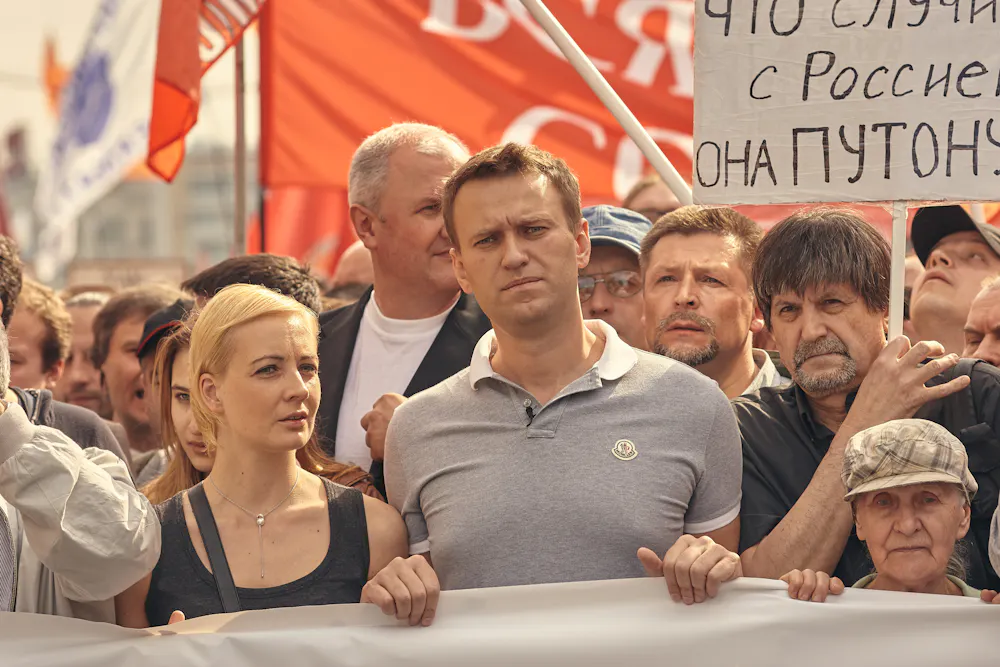
Alexei Navalny and his wife, Yulia Navalnaya, at a protest rally in Moscow, May 2012. Dmitry Laudin/Shutterstock
Today, Navalny’s family and team continue his work outside of Russia – and are fighting to keep his name alive back home. But the odds are against them. Polling suggests the share of Russians who say they know nothing about Navalny or his activities roughly doubled to 30% between his return in January 2021 and his death three years later.
Navalny fought against an autocratic system – and paid the price with his life. Given the very real fears Russians may have of voicing support for a man still labelled an extremist by the Putin regime, it’s not easy to assess what people there really think of him and his legacy. But we will also never know how popular Navalny would have been in the “normal” political system he fought for.
What made Navalny the force he was?
Navalny didn’t mean for the humble yellow rubber duck to become such a potent symbol of resistance.
In March 2017, the ACF published its latest investigation into elite corruption, this time focusing on then-prime minister (and former president), Dmitry Medvedev. Navalny’s team members had become masters of producing slick videos that enabled their message to reach a broad audience. A week after posting, the film had racked up over 7 million views on YouTube – an extraordinary number at that time.
The film included shocking details of Medvedev’s alleged avarice, including yachts and luxury properties. In the centre of a large pond in one of these properties was a duck house, footage of which was captured by the ACF using a drone.
Video: ACF.
Such luxuries jarred with many people’s view of Medvedev as being a bit different to Putin and his cronies. As Navalny wrote in his memoir, Medvedev had previously seemed “harmless and incongruous”. (At the time, Medvedev’s spokeswoman said it was “pointless” to comment on the ACF investigation, suggesting the report was a “propaganda attack from an opposition figure and a convict”.)
But people were angry, and the report triggered mass street protests across Russia. They carried yellow ducks and trainers, a second unintended symbol from the film given Medvedev’s penchant for them.
Another reason why so many people came out to protest on March 26 2017 was the organising work carried out by Navalny’s movement.
The previous December, Navalny had announced his intention to run in the 2018 presidential election. As part of the campaign, he and his team created a network of regional headquarters to bring together supporters and train activists across Russia. Although the authorities had rejected Navalny’s efforts to register an official political party, this regional network functioned in much the same way, gathering like-minded people in support of an electoral candidate. And this infrastructure helped get people out on the streets.
The Kremlin saw this as a clear threat. According to a December 2020 investigation by Bellingcat, CNN, Der Spiegel and The Insider, the FSB assassination squad implicated in the Novichok poisoning of Navalny had started trailing him in January 2017 – one month after he announced his run for the presidency.
At the protests against Medvedev, the authorities’ growing intolerance of Navalny was also on display – he was detained, fined and sentenced to 15 days’ imprisonment.
The Medvedev investigation was far from the beginning of Navalny’s story as a thorn in the Kremlin’s side. But this episode brings together all of the elements that made Navalny the force he was: anti-corruption activism, protest mobilisation, attempts to run as a “normal” politician in a system rigged against him, and savvy use of social media to raise his profile in all of these domains.
Courting controversy
In Patriot, Navalny writes that he always “felt sure a broad coalition was needed to fight Putin”. Yet over the years, his attempts to form that coalition led to some of the most controversial points of his political career.
In a 2007 video, Navalny referred to himself as a “certified nationalist”, advocating for the deportation of illegal immigrants, albeit without using violence and distancing himself from neo-Nazism. In the video, he says: “We have the right to be Russians in Russia, and we’ll defend that right.”
Although alienating some, Navalny was attempting to present a more acceptable face of nationalism, and he hoped to build a bridge between nationalists and liberals in taking on the Kremlin’s burgeoning authoritarianism.
But the prominence of nationalism in Navalny’s political identity varied markedly over time, probably reflecting his shifting estimations of which platform could attract the largest support within Russia. By the time of his thwarted run in the 2018 presidential election, nationalist talking points were all but absent from his rhetoric.
However, some of these former comments and positions continue to influence how people view him. For example, following Russia’s annexation of Crimea in 2014, Navalny tried to take a pragmatic stance. While acknowledging Russia’s flouting of international law, he said that Crimea was “now part of the Russian Federation” and would “never become part of Ukraine in the foreseeable future”.
Many Ukrainians take this as clear evidence that Navalny was a Russian imperialist. Though he later revised his position, saying Crimea should be returned to Ukraine, some saw this as too little, too late. But others were willing to look past the more controversial parts of his biography, recognising that Navalny represented the most effective domestic challenge to Putin.
Another key attempt to build a broad political coalition was Navalny’s Smart Voting initiative. This was a tactical voting project in which Navalny’s team encouraged voters to back the individual thought best-placed to defeat the ruling United Russia candidate, regardless of the challenger’s ideological position.
The project wasn’t met with universal approval. Some opposition figures and voters baulked at, or flatly refused to consider, the idea of voting for people whose ideological positions they found repugnant – or whom they viewed as being “fake” opposition figures, entirely in bed with the authorities. (This makes clear that Navalny was never the leader of the political opposition in Russia; he was, rather, the leading figure of a fractious constellation of individuals and groups.)
But others relished the opportunity to make rigged elections work in their favour. And there is evidence that Smart Voting did sometimes work, including in the September 2020 regional and local elections, for which Navalny had been campaigning when he was poisoned with Novichok.
In an astonishing moment captured on film during his recovery in Germany, Navalny speaks to an alleged member of the FSB squad sent to kill him. Pretending to be the aide to a senior FSB official, Navalny finds out that the nerve agent had been placed in his underpants.
How do Russians feel about Navalny now?
It’s like a member of the family has died.
This is what one Russian friend told me after hearing of Navalny’s death a year ago. Soon afterwards, the Levada Center – an independent Russian polling organisation – conducted a nationally representative survey to gauge the public’s reaction to the news.
The poll found that Navalny’s death was the second-most mentioned event by Russian people that month, after the capture of the Ukrainian city of Avdiivka by Russian troops. But when asked how they felt about his death, 69% of respondents said they had “no particular feelings” either way – while only 17% said they felt “sympathy” or “pity”.
And that broadly fits with Navalny’s approval ratings in Russia. After his poisoning in 2020, 20% of Russians said they approved of his activities – but this was down to 11% by February 2024.
Video: BBC.
Of course, these numbers must be taken for what they are: polling in an authoritarian state regarding a figure vilified and imprisoned by the regime, during a time of war and amid draconian restrictions on free speech. To what extent the drop in support for Navalny was real, rather than reflecting the increased fear people had in voicing their approval for an anti-regime figure, is hard to say with certainty.
When asked why they liked Navalny, 31% of those who approved of his activities said he spoke “the truth”, “honestly” or “directly”. For those who did not approve of his activities, 22% said he was “paid by the west”, “represented” the west’s interests, that he was a “foreign agent”, a “traitor” or a “puppet”.
The Kremlin had long tried to discredit Navalny as a western-backed traitor. After Navalny’s 2020 poisoning, Putin’s spokesman, Dmitry Peskov, said that “experts from the United States’ Central Intelligence Agency are working with him”. The Russian state claimed that, rather than a patriot exposing official malfeasance with a view to strengthening his country, Navalny was a CIA stooge intent on destroying Russia.
Peskov provided no evidence to back up this claim – and the official propaganda wasn’t believed by all. Thousands of Russians defied the authorities by coming out to pay their respects at Navalny’s funeral on March 1 2024. Many, if not all, knew this was a significant risk. Police employed video footage to track down members of the funeral crowd, including by using facial recognition technology.
The first person to be detained was a Muscovite the police claimed they heard shouting “Glory to the heroes!” – a traditional Ukrainian response to the declaration “Glory to Ukraine!”, but this time referencing Navalny. She spent a night in a police station before being fined for “displaying a banned symbol”.
Putin always avoided mentioning Navalny’s name in public while he was alive – instead referring to him as “this gentleman”, “the character you mentioned”, or the “Berlin patient”. (The only recorded instance of Putin using Navalny’s name in public when he was alive was in 2013.)
However, having been re-elected president in 2024 and with Navalny dead, Putin finally broke his long-held practice, saying: “As for Navalny, yes he passed away – this is always a sad event.” It was as if the death of his nemesis diminished the potency of his name – and the challenge that Navalny had long presented to Putin.
Nobody can become another Navalny
Someone else will rise up and take my place. I haven’t done anything unique or difficult. Anyone could do what I’ve done.
So wrote Navalny in the memoir published after his death. But that hasn’t happened: no Navalny 2.0 has yet emerged. And it’s no real surprise. The Kremlin has taken clear steps to ensure nobody can become another Navalny within Russia.
In 2021, the authorities made a clear decision to destroy Navalny’s organisations within Russia, including the ACF and his regional network. Without the organisational infrastructure and legal ability to function in Russia, no figure has been able to take his place directly.
More broadly, the fate of Navalny and his movement has had a chilling effect on the opposition landscape. So too have other steps taken by the authorities.
Russia has become markedly more repressive since the start of its war on Ukraine. The human rights NGO First Department looked into the number of cases relating to “treason”, “espionage” and “confidential cooperation with a foreign state” since Russia introduced the current version of its criminal code in 1997. Of the more than 1,000 cases, 792 – the vast majority – were initiated following Russia’s full-scale invasion of Ukraine in 2022.
Russian law enforcement has also used nebulous anti-extremism and anti-terrorism legislation to crack down on dissenting voices. Three of Navalny’s lawyers were sentenced in January 2025 for participating in an “extremist organisation”, as the ACF was designated by a Moscow court in June 2021. The Russian legislature has also passed a barrage of legislation relating to so-called “foreign agents”, to tarnish the work of those the regime regards as foreign-backed “fifth columnists”.
Mass street protests are largely a thing of the past in Russia. Restrictions were placed on public gatherings during the COVID pandemic – but these rules were applied selectively, with opposition individuals and groups being targeted. And opportunities for collective action were further reduced following the full-scale invasion of Ukraine.
Freedom of speech has also come under assault. Article 29, point five of the Russian constitution states: “Censorship shall be prohibited.” But in September 2024, Kremlin spokesperson Peskov said: “In the state of war that we are in, restrictions are justified, and censorship is justified.”
Legislation passed very soon after the 2022 invasion of Ukraine made it illegal to comment on the Russian military’s activities truthfully – and even to call the war a war.
YouTube – the platform so central to Navalny’s ability to spread his message – has been targeted. Without banning it outright – perhaps afraid of the public backlash this might cause – the Russian state media regulator, Roskomnadzor, has slowed down internet traffic to the site within Russia. The result has been a move of users to other websites supporting video content, including VKontakte – a Russian social media platform.
In short, conditions in Russia are very different now compared to when Navalny first emerged. The relative freedom of the 2000s and 2010s gave him the space to challenge the corruption and authoritarianism of an evolving system headed by Putin. But this space has shrunk over time, to the point where no room remains for a figure like him within Russia.
In 2019, Navalny told Ivan Zhdanov, who is now director of the ACF: “We changed the regime, but not in the way we wanted.” So, did Navalny and his team push the Kremlin to become more authoritarian – making it not only intolerant of him but also any possible successor?
There may be some truth in this. And yet, the drastic steps taken by the regime following the start of the war on Ukraine suggest there were other, even more significant factors that have laid bare the violent nature of Putin’s personal autocracy – and the president’s disdain for dissenters.
Plenty for Russians to be angry about
How can we win the war when dedushka [grandpa] is a moron?
In June 2023, Evgeny Prigozhin – a long-time associate of Putin and head of the private military Wagner Group – staged an armed rebellion, marching his forces on the Russian capital. This was not a full-blown political movement against Putin. But the target of Prigozhin’s invective against Russia’s military leadership had become increasingly blurry, testing the taboo of direct criticism of the president – who is sometimes referred to, disparagingly, as “grandpa” in Russia.
And Prigozhin paid the price. In August 2023, he was killed when the private jet he was flying in crashed after an explosion on board. Afterwards, Putin referred to Prigozhin as a “talented person” who “made serious mistakes in life”.
In the west, opposition to the Kremlin is often associated with more liberal figures like Navalny. Yet the most consequential domestic challenge to Putin’s rule came from a very different part of the ideological spectrum – a figure in Prigozhin leading a segment of Russian society that wanted the Kremlin to prosecute its war on Ukraine even more aggressively.
Video: BBC.
Today, there is plenty for Russians to be angry about, and Putin knows it. He recently acknowledged an “overheating of the economy”. This has resulted in high inflation, in part due to all the resources being channelled into supporting the war effort. Such cost-of-living concerns weigh more heavily than the war on the minds of most Russians.
A favourite talking point of the Kremlin is how Putin imposed order in Russia following the “wild 1990s” – characterised by economic turbulence and symbolised by then-president Boris Yeltsin’s public drunkenness. Many Russians attribute the stability and rise in living standards they experienced in the 2000s with Putin’s rule – and thank him for it by providing support for his continued leadership.
The current economic problems are an acute worry for the Kremlin because they jeopardise this basic social contract struck with the Russian people. In fact, one way the Kremlin tried to discredit Navalny was by comparing him with Yeltsin, suggesting he posed the same threats as a failed reformer. In his memoir, Navalny concedes that “few things get under my skin more”.
Although originally a fan of Yeltsin, Navalny became an ardent critic. His argument was that Yeltsin and those around him squandered the opportunity to make Russia a “normal” European country.
Navalny also wanted Russians to feel entitled to more. Rather than be content with their relative living standards compared with the early post-Soviet period, he encouraged them to imagine the level of wealth citizens could enjoy based on Russia’s extraordinary resources – but with the rule of law, less corruption, and real democratic processes.
‘Think of other possible Russias’
When looking at forms of criticism and dissent in Russia today, we need to distinguish between anti-war, anti-government, and anti-Putin activities.
Despite the risk of harsh consequences, there are daily forms of anti-war resistance, including arson attacks on military enlistment offices. Some are orchestrated from Ukraine, with Russians blackmailed into acting. But other cases are likely to be forms of domestic resistance.
Criticism of the government is still sometimes possible, largely because Russia has a “dual executive” system, consisting of a prime minister and presidency. This allows the much more powerful presidency to deflect blame to the government when things go wrong.
There are nominal opposition parties in Russia – sometimes referred to as the “systemic opposition”, because they are loyal to the Kremlin and therefore tolerated by the system. Within the State Duma, these parties often criticise particular government ministries for apparent failings. But they rarely, if ever, now dare criticise Putin directly.
Nothing anywhere close to the challenge presented by Navalny appears on the horizon in Russia – at either end of the political spectrum. But the presence of clear popular grievances, and the existence of organisations (albeit not Navalny’s) that could channel this anger should the Kremlin’s grip loosen, mean we cannot write off all opposition in Russia.
Navalny’s wife, Yulia, has vowed to continue her husband’s work. And his team in exile maintain focus on elite corruption in Russia, now from their base in Vilnius, Lithuania. The ACF’s most recent investigation is on Igor Sechin, CEO of the oil company Rosneft.
But some have argued this work is no longer as relevant as it was. Sam Greene, professor in Russian politics at King’s College London, captured this doubt in a recent Substack post:
[T]here is a palpable sense that these sorts of investigations may not be relevant to as many people as they used to be, given everything that has transpired since the mid-2010s, when they were the bread and butter of the Anti-Corruption Foundation. Some … have gone as far as to suggest that they have become effectively meaningless … and thus that Team Navalny should move on.
Navalny’s team are understandably irritated by suggestions they’re no longer as effective as they once were. But it’s important to note that this criticism has often been sharpest within Russia’s liberal opposition. The ACF has been rocked, for example, by recent accusations from Maxim Katz, one such liberal opposition figure, that the organisation helped “launder the reputations” of two former bank owners. In their response, posted on YouTube, the ACF referred to Katz’s accusations as “lies” – but this continued squabbling has left some Russians feeling “disillusioned and unrepresented”.
So, what will Navalny’s long-term legacy be? Patriot includes a revealing section on Mikhail Gorbachev – the last leader of the Soviet Union, whom Navalny describes as “unpopular in Russia, and also in our family”. He continues:
Usually, when you tell foreigners this, they are very surprised, because Gorbachev is thought of as the person who gave Eastern Europe back its freedom and thanks to whom Germany was reunited. Of course, that is true … but within Russia and the USSR he was not particularly liked.
At the moment, there is a similar split in perceptions of Navalny. Internationally, he was nominated for the Nobel Peace Prize, awarded the Sakharov Prize by the European Parliament, and a documentary about him won an Oscar.
But there are also those outside of Russia who remain critical: “Navalny’s life has brought no benefit to the Ukrainian victory; instead, he has caused considerable harm,” wrote one Ukrainian academic. “He fuelled the illusion in the west that democracy in Russia is possible.”
Trailer for the Oscar-winning documentary Navalny.
Inside Russia, according to Levada Center polling shortly after his death, 53% of Russians thought Navalny played “no special role” in the history of the country, while 19% said he played a “rather negative” role. Revealingly, when commenting on Navalny’s death, one man in Moscow told RFE/RL’s Russian Service: “I think that everyone who is against Russia is guilty, even if they are right.”
But, for a small minority in Russia, Navalny will go down as a messiah-like figure who miraculously cheated death in 2020, then made the ultimate sacrifice in his battle of good and evil with the Kremlin. This view may have been reinforced by Navalny’s increasing openness about his Christian faith.
Ultimately, Navalny’s long-term status in Russia will depend on the nature of the political system after Putin has gone. Since it seems likely that authoritarianism will outlast Putin, a more favourable official story about Navalny is unlikely to emerge any time soon. However, how any post-Putin regime tries to make sense of Navalny’s legacy will tell us a lot about that regime.
While he was alive, Navalny stood for the freer Russia in which he had emerged as a leading opposition figure – and also what he called the “Beautiful Russia of the Future”. Perhaps, after his death, his lasting legacy in Russia remains the ability for some to think – if only in private – of other possible Russias.
To hear about new Insights articles, join the hundreds of thousands of people who value The Conversation’s evidence-based news. Subscribe to our newsletter.
Ben Noble has previously received funding from the British Academy and the Leverhulme Trust. He is an Associate Fellow of Chatham House.
Police are investigating after a Dog Operations vehicle was set alight over the weekend.
Just before 10.30pm on Sunday 16 February, police were called to Sussex Court at Oakden in response to a disturbance.
A Dog Operations patrol was called in to assist and the officer parked the vehicle on Sussex Court.
PD Jax and his handler exited the car and began searching the area, while PD Gus remained in the rear of the vehicle.
About 15 minutes later the officer noticed a dark figure near the rear of the vehicle and saw something impact the rear open tailgate and burst into flames.
The officer quickly approached the vehicle and put the fire out. Thankfully, PD Gus did not require treatment and was unaffected by the fire.
MFS crews attended and checked the utility and advised only minor damage was caused and it was safe to continue driving.
Crime Scene officers attended to examine the car and the scene.
Police are investigating the incident and ask anyone who saw any suspicious activity in the area, has CCTV or dashcam footage or has information that may assist to please contact Crime Stoppers.
You can anonymously provide information to Crime Stoppers online at www.crimestopperssa.com.au or call 1800 333 000.
Despite the perceived outrage at Khaled Sabsabi’s depiction of Hassan Nasrallah in his 2007 work You, Australian art has long made subjects of outlaws and questionable figures. And it is all the richer for it.
Why is the Albanese government allowing a person who highlights a terrorist leader in his artwork to represent Australia on the international stage at the Venice Biennale?
I agree with you that any glorification of the Hezbollah leader Nasrallah is inappropriate.
This was followed by disapproval from Arts Minister Tony Burke. Within 24 hours, Creative Australia’s board announced Khaled Sabsabi and curator Michael Dagostino, the nominated artistic team for the Australian Pavilion at the 2026 Venice Biennale, had been scratched.
The news sparked shock resignations at Creative Australia, private funding retractions and widespread outrage across the Australian and international arts sectors.
The work in question, You, isn’t related to Sabsabi’s proposed 2026 Biennale work. It is an experimental video artwork which engages with the complexities of the 2006 Lebanon War and how Sabsabi, who was born in Tripoli and migrated to Australia in 1978, may have experienced this war remotely via newsfeed.
The work features images of now-deceased Lebanese Hezbollah leader Hassan Nasrallah. It should be noted the work was made in 2007, 14 years before Australia determined Hezbollah to be a terrorist organisation. It resides in the prestigious collection of Sydney’s Museum of Contemporary Art.
A double standard
Prior to Sabsabi, a number of prominent Australian artists have depicted outlaws and controversial figures in their work. So how were those works received?
Let’s look at Sidney Nolan’s Ned Kelly series as an example. These 27 famous paintings depict the notorious bushranger Edward (Ned) Kelly’s final days in 1880. Nolan painted the series between 1946 and 1947, in the aftermath of the catastrophic second world war.
The works can be understood as an effort to investigate homegrown violence in Australia’s history, wherein the outlaw is a metaphor used to explore conflicting migrant/settler cultures among the bright and dusty central Victorian landscape.
Similarly, late Australian painter and 2000 Archibald Prize winner Adam Cullen did not meet much controversy when his 2002 portrait of convicted violent criminal Mark “Chopper” Read was installed in the Art Gallery of NSW. That same year, Cullen illustrated Mark Read’s children’s book, Hooky the Cripple.
An acclaimed artist, Cullen is revered for depicting violence and darkness in Australian culture. His works reside in most state and national collections.
Art thrives through diverse perspectives
Marri Ngarr artist Ryan Presley’s 2018 series Blood Money revises Australian banknotes to feature historical First Nations figures, and forms part of the Reserve Bank of Australia’s art collection.
Works in the series include First Nations colonial resistance fighters and outlaws Jandamarra (1873–97), Woloa (1800-31), Pemulwuy (1750-1802) and Dundalli (circa 1820-55).
These individuals waged violence against the Crown and were classified as enemy combatants in their time. Yet it’s fair to say they make compelling and appropriate subjects for Presley’s art, which helps us better understand Australia’s complex and violent history.
Iranian-born Australian photographer Hoda Afshar’s Agonistes (2020), an award-winning portrait series with accompanying video, features various Australian whistleblowers, including Witness K Lawyer Bernard Collaery and the incarcerated Afghan Files whistleblower David McBride.
Each figure depicted in Afshar’s portraits has faced punishment and persecution by local authorities, in part due to Australia’s weak whistleblower protection laws.
Khaled Sabsabi is a distinguished Australian artist whose Biennale proposal won a rigorous open tender to be exhibited in Venice 2026. Spanning 30 years, his work examines spiritualism, optimism and the intricate beauty of a migrant Australian experience that’s particularly unique to the global microcosm of Western Sydney.
If artists are to be cancelled for making works that spark “divisive debate”, as Creative Australia has called it, there won’t be much art left to see.
Ella Barclay has previously received funding from Creative Australia.
SALT LAKE CITY, Utah — The first woman presidentially appointed as the United States Attorney for the District of Utah and sworn into office as the 38th United States Attorney to serve in the State of Utah, leaves the U.S. Attorney’s Office. The Honorable Trina A. Higgins was nominated by President Joseph R. Biden Jr. on January 31, 2022. Her last day as United States Attorney is February 16, 2025.
Under Higgins’ leadership, the U.S. Attorney’s Office in Utah focused on cases that have the largest impact and cause the most harm to Utah citizens. Working with federal, state, local, and tribal law enforcement partners, the U.S. Attorney’s Office significantly increased the number of financial crime prosecutions in Utah; brought more complex narcotics and firearm cases focused on defendants higher in criminal organizations; and prosecuted many significant violent crime cases, including murders, sexual assaults, child exploitation, human trafficking, robberies, and carjackings.
During her tenure, The U.S. Attorney’s Office tried 35 jury trials, including three homicides committed in Tribal communities. United States Attorney Higgins was the trial attorney in one case where a man brutally murdered a Navajo woman in front of her two young daughters in the Navajo Nation. The jury found him guilty, and he was sentenced to life in prison.
United States Attorney Higgins also served on several Attorney General’s Advisory Committee subcommittees for Attorney General Merrick B. Garland. Those included the Environmental Justice Subcommittee, the Terrorism and National Security Subcommittee, and the Native American Issues Subcommittee.
Maintaining the United States Attorney’s strong partnerships with federal, state, local, and tribal law enforcement agencies, United States Attorney Higgins made it a priority to strengthen and build upon those relationships to pursue justice and better serve the people of Utah.
Leaders in the law enforcement community offered comments regarding U.S Attorney Higgins’ service.
“Strong partnerships between law enforcement and prosecutors are essential to upholding the rule of law. U.S. Attorney Higgins has been an invaluable friend to the FBI and a staunch supporter of our mission,” said Mehtab Syed, Special Agent in Charge of the Salt Lake City FBI. “During her tenure, she championed the safety of Utahns, and we thank her for her years of dedicated public service.”
“United States Attorney Trina Higgins has been an engaged and dedicated law enforcement partner as well as a steadfast advocate of Project Safe Neighborhoods,” said ATF Special Agent in Charge Brent Beavers. “Her extensive experience as a career prosecutor, and unwavering commitment in her pursuit of justice have been pivotal in the successful prosecution of many complex cases.”
“I would like to thank United States Attorney Higgins for her many years of dedicated service as a federal prosecutor and as the U.S. Attorney for the District of Utah,” said U.S. Marshal Justin Martinez of the District of Utah. “USA Higgins is a consummate professional and has always kept the lines of communication open. USA Higgins is an extremally effective leader and a real change agent. She will be greatly missed by the U.S. Marshals Service and every federal, state and local agency she works with.”
“With appreciation, we thank United States Attorney Higgins for her dedication to DEA efforts in the state of Utah,” said DEA Rocky Mountain Field Division Special Agent in Charge Jonathan Pullen. “Cooperation and hard work between DEA and the U.S. Attorney’s Office for the District of Utah, has led to many successful prosecutions. On behalf of the men and women of DEA, we wish nothing but the best for United States Attorney Higgins now and into the future.”
“HSI is grateful for its long-standing relationship with United States Attorney Higgins and her staff,” said HSI Utah Assistant Special Agent in Charge Brandon Crane. “The collaboration has had a significant impact on public safety throughout Utah and stands as an example for future collaborations.”
“United States Attorney Higgins has been a tremendous partner in supporting the U.S. Postal Inspection Service’s efforts to safeguard the U.S. Mail, postal workers, and the public,” said Glen Henderson, Inspector in Charge of the Phoenix Division. “United States Attorney Higgins was committed to holding accountable those who harm postal employees or exploit the U.S. Mail for illicit activities, including narcotics distribution. It has been a pleasure to collaborate with United States Attorney Higgins and we wish her continued success in all her future endeavors.”
“I want to thank United States Attorney Higgins for her partnership and outstanding leadership in working with our local law enforcement agencies,” said Salt Lake County Sheriff Rosie Rivera. “She prioritized complex and violent offender cases to improve safety within the communities we serve.”
“United States Attorney Trina Higgins’ dedication to justice and service to the community is truly exceptional and will be greatly missed,” said Salt Lake City Police Chief Mike Brown. “Her career as a dedicated prosecutor made our city safer—whether it was prosecuting some of our first Project Safe Neighborhood cases or complex, high-profile, or challenging cases. United States Attorney Higgins handled every case with professionalism and a true sense of duty. Never did she hide from the difficult cases. We will always remember USA Higgins’ compassion for crime victims and their families. She made sure victims’ voices were heard and understood in the pursuit of justice. While we will miss United States Attorney Higgins greatly, I know her legacy will endure through the District of Utah because of her distinguished career.”
United States Attorney Higgins has been in public service for 30 years. Prior to her leadership role as U.S. Attorney, Higgins served as an Assistant United States Attorney for over two decades and as a Salt Lake County Deputy District Attorney. At the time of her nomination, Higgins was serving as the Mediterranean Legal Advisor at the United States embassies in Valletta, Malta and Nicosia, Cyprus. A Utah native, Higgins earned her undergraduate degree from Weber State University and Juris Doctor degree from the S.J. Quinney College of Law at the University of Utah, where she also worked as an adjunct professor for a decade.
DLE NEWS RELEASE – Warning Public of Latest Phone Scam 2025
Posted on Feb 14, 2025 in Latest Department News, Newsroom
DEPARTMENTOFLAWENFORCEMENT
KaʻOihanaHoʻokōKānāwai
JOSHGREEN,M.D.
GOVERNOR
KEKIAʻĀINA
MIKE LAMBERT
DIRECTOR
KALUNAHO‘OKELE
SHERIFF IMPERSONATORS, EXTORTION SCAM ALERT
FOR IMMEDIATE RELEASE
February 14, 2025
HONOLULU – Recurring Sheriff impersonator incidents have prompted the Department of Law Enforcement (DLE) to issue additional scam warnings. In recent weeks, several people have had callers claiming to be deputy sheriffs tell them that they have outstanding warrants because they failed to appear in court. These are similar to scam calls that happened around this time last year.
Hawaiʻi residents are also advised not to provide credit card numbers, bank account information or other personal information to callers claiming to represent a law enforcement agency.
If you receive a call, text or email matching this scam, please alert the DLE Criminal Investigation Division by calling 808-587-5050.
TIPS TO PROTECT YOURSELF:
Do not communicate with unsolicited email or phone text senders.
Do not open emails, attachments or links sent by text from unknown individuals.
Never provide personal information of any sort via phone, text or email. Be aware that many emails requesting your personal information appear to be legitimate.
SACRAMENTO – Governor Gavin Newsom today announced his appointment of 14 Superior Court Judges: seven in Los Angeles County; one in Modoc County; two in Riverside County; one in San Diego County; one in San Mateo County; one in Tulare County; and one in Ventura County.
Los Angeles County Superior Court
Phu Nguyen, of Los Angeles County, has been appointed to serve as a Judge in the Los Angeles County Superior Court. Nguyen has served the Los Angeles County Superior Court as Court Counsel since 2017. She has been a Lecturer in Law at UCLA School of Law since 2022. Nguyen served as Senior Counsel at Dykema Gossett from 2014 to 2017, an Associate at Fayer Gipson from 2013 to 2014, and an Associate at Huron Law Group from 2008 to 2012. Nguyen was an Associate at Irell & Manella from 2006 to 2007. She received a Juris Doctor degree from Yale Law School. She fills the vacancy created by the retirement of Judge Louise Suzette Clover. Nguyen is a Democrat.
Sonia Dujan, of Ventura County, has been appointed to serve as a Judge in the Los Angeles County Superior Court. She has served as a Commissioner at the Los Angeles County Superior Court since 2024. Dujan has been a sole practitioner since 2004. She received a Juris Doctor degree from University of San Francisco School of Law. She fills the vacancy created by the retirement of Judge Margaret Oldendorf. Dujan is a Democrat.
Mike Madokoro, of Los Angeles County, has been appointed to serve as a Judge in the Los Angeles County Superior Court. Madokoro has been a Partner at Bowman and Brooke LLP since 1999, served as a Managing Partner or Co-Managing Partner from 2006 to 2024. He previously worked as an Associate at Morgan, Wenzel and McNicholas from 1990 to 1994. Madokoro served as a Law Clerk and Associate at Adams and Kirkpatrick from 1989 to 1990. Madokoro received a Juris Doctor degree from McGeorge School of Law. He fills the vacancy created by the retirement of Judge Gergory Keosian. Madokoro is a Republican.
James Montgomery Jr., of Los Angeles County, has been appointed to serve as a Judge in the Los Angeles County Superior Court. Montgomery has served as a Commissioner at Los Angeles County Superior Court since 2023. He was a Partner at Gibbs Giden Locher Turner Senet & Wittbrodt LLP from 1999 to 2023. He served as an attorney at Daniels, Fine, Israel, Schonbuch & Lebovits, LLP from 1982 to 1999. Montgomery received a Juris Doctor degree from UCLA School of Law. He fills the vacancy created by the retirement of Judge Yvette Palazuelos. Montgomery is a Democrat.
Jacob Yim, of Los Angeles County, has been appointed to serve as a Judge in the Los Angeles County Superior Court. Yim has served as the Deputy-in-Charge of the Real Estate Fraud Section in the White Collar Crime Division of the Los Angeles County District Attorney’s Office since 2022. Yim has served as a deputy in several roles and units of the Los Angeles County District Attorney’s Office from 2000 to 2008 and 2009 to 2022. He was a Special Assistant United States Attorney at the United States Attorney’s Office – Domestic Security and Immigration Crimes Section from 2008 to 2009. Yim received a Juris Doctor degree from Southwestern University School of Law. He fills the vacancy created by the retirement of Judge Carol Elswick. Yim is a Democrat.
Helen Yang, of Los Angeles County, has been appointed to serve as a Judge in the Los Angeles County Superior Court. Yang was a Partner at Squire Patton Boggs since 2016 and an Associate at Squire Patton Boggs from 2005 to 2008 and 2009 to 2016. She was Deputy in the Riverside County Counsel’s Office from 2008 to 2009. Yang received a Juris Doctor degree from Cornell Law School. She fills the vacancy created by the retirement of Judge Michael Linfield. Yang is registered as no party preference.
Louis Parise, of Los Angeles County, has been appointed to serve as a Judge in the Los Angeles County Superior Court. Parise has served various roles as a Deputy District Attorney at the Los Angeles County District Attorney’s Office since 1998. He was an Associate Attorney at Ferrari, Olsen, Ottoboni, and Bebb from 1997 to 1998. Parise received a Juris Doctor degree from Santa Clara School of Law. He fills the vacancy created by the retirement of Judge Martin L. Herscovitz. Parise is registered as no party preference.
Modoc County Superior Court
Randall Harr, of Shasta County, has been appointed to serve as a Judge in the Modoc County Superior Court. Harr was a Partner at Maire & Deedon since 2022. He worked at the Law Office of Randall Harr from 2011 to 2022. Harr served as a Partner at Gifford & Harr from 2009 to 2011. He was a Partner at Harr Arthofer & Ayres from 2001 to 2009. Harr worked at Borton Petrini & Conron as a Partner from 1985 to 2000 and an Associate Attorney from 1982 to 1985. Harr received a Juris Doctor degree from McGeorge School of Law. He fills the vacancy created by the retirement of Judge Francis W. Barclay. Harr is registered as no party preference.
Riverside County Superior Court
Mickie Reed, of Riverside County, has been appointed to serve as a Judge in the Riverside County Superior Court. Reed has served as a Commissioner in the Riverside County Superior Court since 2014. She previously worked as a Professor of Professional Responsibility at the California Desert Trial Academy from 2014 to 2018. Reed was a sole practitioner from 1996 to 2014. She worked as a Planning Commissioner at the City of Indio from 2004 to 2010. Reed received a Juris Doctor degree from Western State University School of Law. She fills the position created by the retirement of Judge Gregory Olson. Reed is a Democrat.
Michael Martin, of Riverside County, has been appointed to serve as a Judge in the Riverside County Superior Court. Martin previously served as Lead Appellate Court Attorney at the Second District Court of Appeal, Division 6 since 2017. Martin worked as an Adjunct Professor at The Santa Barbara and Ventura Colleges of Law from 2017 to 2022. He was an Adjunct Professor at the University of California College of Law, San Francisco in 2021. Martin was a Legal Research Assistant at the San Francisco County Superior Court from 2014 to 2017. He served as a Contract Attorney at Valdez Todd & Doyle LLP in 2014. Martin was a Contract Attorney at Harowitz & Tigerman LLP in 2014. He served as a Contract Attorney at Podo Legal in 2013. Martin worked as a Contract Attorney at the Law Office of E. Craig Moody in 2013. He was a Bridge Fellow at Legal Services of Northern California in 2012. Martin received a Juris Doctor degree from University of California College of Law, San Francisco. He fills the vacancy created by the retirement of Judge Irma Asberry. Martin is a Democrat.
San Diego County Superior Court
Chandra Reid, of San Diego County, has been appointed to serve as a Judge in the San Diego County Superior Court. Reid has served as a Commissioner at the San Diego County Superior Court since 2021. She served as a Deputy District Attorney in several roles at the San Diego County District Attorney’s Office from 2005 to 2021. She served as a Deputy City Attorney at the San Diego City Attorney’s Office from 2001 to 2004. Reid received a Juris Doctor degree from Catholic University Law School. She fills the vacancy created by the retirement of Judge Kenneth Medel. Reid is a Democrat.
San Mateo County Superior Court
Mark McCannon, of San Francisco County, has been appointed to serve as a Judge in the San Mateo County Superior Court. McCannon has served at Alameda County Superior Court as a Superior Court Judge since 2013. He worked as a Deputy District Attorney at the Alameda County District Attorney’s Office from 1997 to 2013. McCannon received a Juris Doctor degree from the University of Pacific, McGeorge School of Law. He fills the vacancy created by the retirement of Judge Marie S. Weiner. McCannon is a Democrat.
Tulare County Superior Court
Jason Taylor, of Kings County, has been appointed to serve as a Judge in the Tulare County Superior Court. Taylor has worked as a sole practitioner since 2014. He worked at the Tulare County Public Defender Conflict Panel as a Contract Attorney from 2018 to 2025. Taylor served at the Kings County Public Defender’s Office as a Contract Attorney from 2019 to 2022. He worked at the Tulare County Public Defender’s Office as a Deputy Public Defender in 2014. Taylor received a Juris Doctorate degree from the San Joaquin College of Law. He fills the vacancy created by the retirement of Judge Walter L. Gorlick. Taylor is registered as no party preference.
Ventura County Superior Court
Amy Van Sickle, of Ventura, has been appointed to serve as a Judge in the Ventura County Superior Court. Van Sickle has served as a Commissioner at the Ventura County Superior Court since 2023. She worked at the Law Office of Amy Van Sickle as an Attorney from 2012 to 2023. Van Sickle worked as an Attorney at Van Sickle & Rowley, LLP from 2003 to 2012. Van Sickle received a Juris Doctorate degree from the Ventura College of Law. She fills the vacancy created by the retirement of Judge Patricia M. Murphy. Van Sickle is a Republican.
The compensation for each of these positions is $244,727.
Press Releases, Recent News
Recent news
Feb 14, 2025
News What you need to know: Governor Newsom today announced that the Delta Conveyance Project has received a required permit to advance the project, which will upgrade the State Water Project to allow the state to capture and move more water efficiently. SACRAMENTO —…
Feb 13, 2025
News What you need to know: Governor Newsom today issued an executive order to cut more red tape and continue streamlining rebuilding, recovery, and relief for survivors of the Los Angeles area firestorms. SACRAMENTO — Today, Governor Gavin Newsom issued an executive…
Feb 12, 2025
News Kate Hoit, of Sacramento, has been appointed Deputy Secretary of Communications at the California Department of Veterans Affairs. Hoit has been the PACT Act Enterprise Program Management Office Communications and Outreach Lead at the U.S. Department of Veterans…
– having regard to its previous resolutions on Nicaragua,
– having regard to Rules 150(5) and 136(4) of its Rules of Procedure,
A. whereas since 2018, the Nicaraguan regime has systematically, repeatedly and arbitrarily persecuted human rights defenders (HRDs), opposition and religious representatives, among others; whereas over 5 600 NGOs have been dissolved, including religious groups – mainly Catholic – and their assets confiscated;
B. whereas imprisoned political opponents, along with HRDs, have been expelled from the country, stripped of their nationality and deprived of their political rights; whereas since 2018, 245 members of the clergy have been arbitrarily arrested or expelled, including Bishop Rolando Álvarez, Sakharov Prize finalist;
C. whereas in January 2025, the regime passed a constitutional reform that eliminates the separation of powers and political pluralism, establishing an Ortega-Murillo co-presidency that controls all branches of government, independent institutions and the media, and ignores adherence to international human rights conventions and treaties;
1. Strongly condemns the Ortega-Murillo regime’s widespread, systemic human rights violations against its population, democratic opposition, students, civil society organisations (CSOs) and its persecution of religious leaders, primarily Catholic; urges the immediate release of all those arbitrarily detained, and the restoration of the rule of law and the legal status of all organisations, freedoms and the rights of exiled individuals, including their safe return; insists that these are essential conditions for any prospect of meaningful dialogue;
2. Denounces the use of statelessness and exile as a weapon against dissenting voices; reiterates the need to end restrictions on civic space and to respect the right to dissent;
3. Calls on the Ortega-Murillo regime to reverse its constitutional reform and all repressive laws institutionalising totalitarianism, to fully respect its international human rights obligations, and to implement the recommendations made by the UN Group of Human Rights Experts on Nicaragua; calls for its mandate to be extended;
4. Calls for the EU to include specific guarantees of human rights compliance when allocating EU funds, including through multilateral and financial institutions, and to ensure that the funds do not contribute to strengthening the Ortega-Murillo regime;
5. Highlights the key role played by CSOs, HRDs, the Catholic Church and journalists in Nicaragua; calls for the EU to reinforce its regular dialogue with them, including those in exile, to support their vital work, as well as countries receiving migrants fleeing Nicaragua, such as Costa Rica;
6. Calls on the Member States, in accordance with the Rome Statute, to open investigations through the International Criminal Court into the Ortega-Murillo regime for crimes against humanity;
7. Reiterates its demand that the democratic clause of the EU Association Agreement be triggered; rejects any prospect of holding any parliamentary dialogue with members of Nicaragua’s regime-controlled National Assembly;
8. Reiterates its call to expand the list of sanctioned individuals to include Ortega, Rosario Murillo and their inner circle;
9. Calls for the immediate extradition of Alessio Casimirri to Italy;
10. Instructs its President to forward this resolution to the Council, Commission, the VP/HR, the Member States and the Nicaraguan authorities.
– having regard to its previous resolutions on Georgia, in particular that of 28 November 2024 on Georgia’s worsening democratic crisis following the recent parliamentary elections and alleged electoral fraud(1),
– having regard to Georgia’s status as an EU candidate country, granted by the European Council at its summit of 14 and 15 December 2023,
– having regard to Article 78 of the Georgian Constitution, which demands the implementation of all possible measures to guarantee Georgia’s complete integration into the EU and NATO,
– having regard to the final report of the Organization for Security and Co-operation in Europe (OSCE) on the parliamentary elections held in Georgia on 26 October 2024,
– having regard to Rules 136(2) and (4) of its Rules of Procedure,
A. whereas the democratic backsliding in Georgia has dramatically accelerated since the parliamentary elections of 26 October 2024, which were deeply flawed and marked by grave irregularities, and failed to meet international democratic standards and Georgia’s OSCE commitments; whereas these elections violated the democratic norms and standards set for free and fair elections, failing to reflect the will of the people and rendering the resulting ‘parliament’, and subsequently the ‘president’, devoid of any democratic legitimacy; whereas from the very beginning of its activity, the current Georgian parliament has operated as a one-party (Georgian Dream) organ, which is incompatible with the essence of pluralistic parliamentary democracy;
B. whereas Article 2 of the EU-Georgia Association Agreement(2) concerns the general principles of the agreement, which include democratic principles, human rights and fundamental freedoms;
C. whereas Article 78 of the Georgian Constitution states that the constitutional bodies must take all measures within the scope of their competences to ensure the full integration of Georgia into the European Union;
D. whereas the President of Georgia, Salome Zourabichvili, publicly condemned the parliamentary elections as rigged, declared that she would not recognise them and called for an international investigation; whereas the current Georgian regime, led by the Georgian Dream party and its founder, Bidzina Ivanishvili, has orchestrated an unconstitutional usurpation of power, systematically dismantling democratic institutions, undermining judicial independence and eroding fundamental freedoms and the rule of law, thereby deepening Georgia’s political and constitutional crisis;
E. whereas Georgia has officially held the status of EU candidate country since December 2023; whereas on 28 November 2024, Irakli Kobakhidze announced that Georgia would delay initiating accession talks with the EU and reject its financial assistance until the end of 2028, disregarding the country’s constitutional commitment to European integration and effectively undermining Georgia’s sovereign Euro-Atlantic aspirations;
F. whereas on 28 November 2024, peaceful mass anti-government protests began across the country, demanding new, free and fair elections, an end to political violence and repression, and the return of the country to its European path; whereas the protests have been taking place without interruption for over 75 days;
G. whereas on 14 December 2024, the de facto parliament held a ‘presidential election’ with a single candidate from the Georgian Dream party, former footballer Mikheil Kavelashvili, elected with 224 out of 225 votes cast;
H. whereas Georgia’s self-appointed authorities have plunged the country into a fully fledged constitutional and political crisis, as well as a human rights and democracy crisis; whereas this has been marked by the brutal repression of peaceful protesters, political opponents and media representatives, with judges, prosecutors and police officers actively fabricating politically motivated administrative and criminal charges against protesters, journalists and opposition figures detained during peaceful anti-government demonstrations; whereas, as of December 2024, more than 460 people have been arrested or punished since the protests began, with this number growing by the day;
I. whereas riot police deliberately lacking force identification numbers have forcefully dispersed protesters with tear gas and water cannons; whereas numerous journalists have reported being targeted and beaten, and having their equipment destroyed and personal items stolen; whereas dozens of protesters have been brutally assaulted, and several hundred people have been arrested; whereas Georgia’s Public Defender has revealed that 80 % of those detained reported experiencing violence and inhumane treatment at the hands of law enforcement officers; whereas despite international condemnation, the illegitimate Georgian Government has awarded medals to officials involved in the crackdown;
J. whereas independent media outlets, including TV Formula, TV Mtavari and TV Pirveli, face severe operational and financial constraints due to the regime’s interference, while dozens of media representatives are being subjected to various forms of intense physical and psychological pressure; whereas numerous violent attacks on journalists have been documented, including the severe beatings of Aleksandre Keshelashvili, Maka Chikhladze and Giorgi Shetsiruli, and the harassment of detained journalist Saba Kevkhishvili; whereas on 12 January 2025, the Georgian authorities arrested journalist Mzia Amaghlobeli, who has been in pre-trial detention since then and is on hunger strike in solidarity with all political prisoners in Georgia; whereas she faces between four and seven years in prison;
K. whereas, on the night of 14 January 2025, Giorgi Gakharia, opposition leader of the For Georgia party and former Prime Minister, and Zviad Koridze, journalist and Transparency International activist, were physically assaulted by Georgian Dream officials in separate incidents at the same venue in Batumi;
L. whereas on 2 February 2025, Nika Melia, a leader of the pro-European Akhali party, and Gigi Ugulava, the former mayor of Tbilisi, were arrested during the anti-government protests and subjected to physical violence in detention; whereas on 12 January 2025, Elene Khoshtaria, leader of the Droa political movement, was detained in Batumi;
M. whereas the de facto Georgian authorities have used disproportionate force and excessive violence against peaceful protesters and resorted to arbitrary mass arrests to thwart dissent; whereas independent human rights organisations have reported the systemic mistreatment of detainees, including torture; whereas to date, not a single law enforcement official involved in the brutal crackdowns, arbitrary arrests and mistreatment has been brought to justice;
N. whereas the self-appointed authorities introduced new draconian legislation that came into force on 30 December 2024 and amended the Criminal Code, the Code of Administrative Offences and the Law on Assemblies and Manifestations, imposing further arbitrary restrictions on the rights to freedom of expression and peaceful assembly, introducing, among other things, hefty fines for putting up protest slogans and posters, and granting police the power to detain individuals ‘preventively’ for 48 hours on suspicion of planning to violate the rules governing public assembly; whereas on 3 February 2025, the Georgian Dream party unveiled further draft legislation designed to tighten control, ramping up penalties for a variety of offences directly targeting protestors, critics and political dissent, such as harsher punishments for ‘insulting officials’, the criminalisation of road blocks and an increase in the duration of administrative detention from 15 to 60 days;
O. whereas on 27 January 2025, the Council decided to suspend parts of the EU-Georgia visa facilitation agreement for Georgian diplomats and officials, but failed to impose individual sanctions in response to the continued crackdown; whereas the Hungarian and Slovak Governments have been consistently blocking impactful EU-wide sanctions, preventing the remaining 25 Member States (EU-25) from effectively introducing sanctions against the self-appointed Georgian authorities;
P. whereas several Member States, including Lithuania, Estonia, Latvia and Czechia, have imposed bilateral sanctions on some Georgian politicians, judges and other officials responsible for the brutal crackdown on protesters, violations of human rights and abuse of the rule of law; whereas in December 2024, the United States sanctioned Bidzina Ivanishvili, alongside Georgia’s ‘Minister of Internal Affairs’ Vakhtang Gomelauri and Deputy Head of the Special Tasks Department Mirza Kezevadze, for their involvement in brutal crackdowns on media representatives, opposition figures and protesters; whereas the UK and Ukraine have imposed similar sanctions on high-level Georgian officials; whereas Ivanishvili, through hastily adopted laws tailored to his personal situation, is moving his offshore assets to Georgia in anticipation of further sanctions;
Q. whereas on 29 January 2025, Georgian Dream announced that it would withdraw its delegation from the Parliamentary Assembly of the Council of Europe (PACE) after it demanded new, genuinely democratic parliamentary elections, the release of political prisoners and accountability for perpetrators of violence; whereas UN experts have condemned the pattern of repression and human rights violations in Georgia, while the OSCE has called this suppression a serious breach of the right to freedom of assembly;
R. whereas the ruling Georgian Dream party convened the new parliament in violation of the country’s constitution, resulting in a boycott of parliament by the opposition; whereas on 5 February 2025, the self-appointed ‘parliament’ voted to approve the early termination of the mandates of 49 out of 61 members of parliament, representing the Coalition for Change, Strong Georgia and the United National Movement, in order to strip them of their immunity and facilitate their arrest and prosecution; whereas the same ‘parliament’ established a commission to punish former ruling party United National Movement;
S. whereas a growing number of civil servants have been dismissed after speaking out against the halting of Georgia’s EU accession process; whereas Georgian Dream has amended laws on public service, simplifying procedures to dismiss public servants, several of whom have been dismissed for participating in protests, in a clear attempt to silence critical voices;
1. Condemns the Georgian Dream ‘authorities’ and urges them to immediately cease the violent repression of peaceful protesters, political opponents and media representatives; underlines that Georgia’s self-appointed authorities are currently violating fundamental freedoms, basic human rights and the core international obligations of the country, thereby undermining decades of democratic reforms driven by the country’s political class and civil society; considers Georgia as a state captured by the illegitimate Georgian Dream regime; expresses deep regret over the fact that the ruling Georgian Dream party has abandoned its path towards European integration and NATO membership; recalls that the ongoing democratic backsliding and adoption of anti-democratic laws has effectively suspended Georgia’s EU integration process; reiterates its unwavering support for the Georgian people’s legitimate European aspirations and their wish to live in a prosperous and democratic country;
2. Does not recognise the self-proclaimed authorities of the Georgian Dream party established following the rigged election of 26 October 2024, which was neither free nor fair, was held in violation of democratic norms and standards, and did not reflect the will of the people of Georgia; underlines that the extensive electoral fraud has undermined the integrity of the election process, cast doubt on the legitimacy of the result and eroded public trust, both domestically and internationally, in any new government;
3. Calls for the EU and its Member States, as well as national parliaments and interparliamentary institutions, not to recognise the legitimacy of the Georgian Dream one-party parliament and their appointed president; calls, therefore, on the international community to join the boycott of the self-proclaimed Georgian authorities;
4. Continues to recognise Salome Zourabichvili as the legitimate President of Georgia and representative of the Georgian people; praises her efforts to peacefully steer the country back towards a democratic and European path of development; calls on the President of the European Council to invite President Zourabichvili to represent Georgia at an upcoming European Council meeting and at the next European Political Community summit;
5. Underlines that the settlement of the current political and constitutional crisis in Georgia can only be achieved by way of new parliamentary elections; demands that new elections take place in Georgia within the next few months in an improved electoral environment, overseen by an independent and impartial election administration and monitored through diligent international observation to guarantee a genuinely fair, free and transparent process; encourages the Member States and EU officials to firmly demand new elections and to make any future engagement explicitly conditional on setting a new date for parliamentary elections and establishing a mechanism to ensure they are free and fair;
6. Calls on the Council and the Member States, particularly the EU-25 on a bilateral and coordinated basis, to impose immediate and targeted personal sanctions on Bidzina Ivanishvili, his family and his companies, and to freeze all his assets within the EU for his role in the deterioration of the political process in Georgia, enabling democratic backsliding and acting against the country’s constitutionally declared interests of Euro-Atlantic integration; calls on the French Government to strip Bidzina Ivanishvili of the Legion of Honour and impose individual sanctions on him; welcomes, in this regard, the sanctions imposed bilaterally by Estonia, Latvia, Lithuania and Czechia, as well as those already imposed by the US and the UK;
7. Calls for the EU and its Member States, in particular the EU-25 on a bilateral and coordinated basis, to impose personal sanctions on the officials and political leaders in Georgia responsible for democratic backsliding, electoral fraud, human rights violations and the persecution of political opponents and activists, including Irakli Kobakhidze, Shalva Papuashvili, Vakhtang Gomelauri, Mayor of Tbilisi and Secretary General of the ruling Georgian Dream party Kakha Kaladze, and Chair of the Georgian Dream party Irakli Garibashvili; calls for them to extend these sanctions to judges, including those of the Constitutional Court of Georgia who are passing politically motivated sentences, and representatives of the law enforcement services, as well as to financial enablers tacitly or openly supporting the regime and the owners of regime-aligned media outlets, including TV Imedi, Pos TV and Rustavi 2 TV, for their role in spreading disinformation and seeking to manipulate public discourse in order to sustain the current ruling party’s authoritarian rule;
8. Calls on the Council and the Member States to impose sanctions on Bidzina Ivanishvili’s network of enablers, elite entourage, corrupt financial operatives, propagandists and those facilitating the repressive state apparatus, including, among others, Ekaterine Khvedelidze, Uta Ivanishvili, Tsotne Ivanishvili, Bera Ivanishvili, Gvantsa Ivanishvili, Alexander Ivanishvili, Shmagi Kobakhidze, Ucha Mamatsashvili, Natia Turnava, Ivane Chkhartishvili, Sulkhan Papashvili, Giorgi Kapanadze, Tornike Rizhvadze, Ilia Tsulaia, Kakha Bekauri, Lasha Natsvlishvili, Vasil Maglaperidze, Grigol Liluashvili, Mikheil Chinchaladze, Levan Murusidze, Irakli Rukhadze, Tinatin Berdzenishvili, Tamaz Gaiashvili, Anton Obolashvili and Gocha Enukidze;
9. Maintains the view that the measures taken so far by the EU in response to the flagrant democratic backsliding and reneging on previous commitments does not yet fully reflect the severity of the situation in Georgia and the latest developments; welcomes the Council’s decision to suspend visa-free travel for Georgian diplomats and officials, but considers it as only a first step, which must be followed by tougher measures; deplores the obstruction by the Hungarian and Slovak Governments of the Council decisions on introducing sanctions against individuals responsible for democratic backsliding in Georgia;
10. Emphasises that respect for fundamental rights is vital to the EU’s visa liberalisation benchmarks; reiterates its call on the Commission and the Council to review Georgia’s visa-free status, with the possibility of suspension if it is considered that EU standards on democratic governance and freedoms are not being upheld;
11. Strongly condemns the brutal violence and repression used by Georgia’s ruling regime against peaceful protesters since 28 November 2024; calls for the immediate and unconditional release of all political prisoners and those detained during the anti-government protests; demands the release of journalist Mzia Amaghlobeli, who has been on hunger strike for over four weeks now because of her unjust detention and risks facing critical, irreversible and life-threatening consequences; denounces the assault and beating of former Prime Minister Giorgi Gakharia, resulting in his hospitalisation, followed by the arrest on 2 February 2025 of political leaders including Nika Melia and Gigi Ugulava, as a shocking escalation of state-orchestrated violence by Georgian Dream and its allies against peaceful demonstrators and political opponents; reminds of the detention of Elene Khoshtaria on 12 January 2025 in Batumi;
12. Reiterates its solidarity with the people of Georgia and its vibrant civil society in fighting for their legitimate democratic rights and for a European future for their country; urges the Georgian Government to reverse its current political course and return to implementing the will of the Georgian people for continued democratic reforms that would reopen the prospect of future EU membership;
13. Strongly condemns the enactment of draconian legislation that imposes unjustified restrictions on freedoms of expression and peaceful assembly, and demands the annulment of such recently adopted repressive legislation; urges the Georgian authorities to immediately and unconditionally release all individuals detained for peacefully exercising their fundamental rights to freedoms of expression and peaceful assembly, and to ensure prompt, thorough and impartial investigations into all allegations of unlawful and disproportionate use of force by the law enforcement agencies; considers that the Georgian justice system has been weaponised to stifle dissent, instil fear and silence free speech;
14. Calls for the ‘Georgian authorities’ to take immediate action to ensure the safety and freedom of journalists and to investigate all instances of violence and misconduct by law enforcement agencies; emphasises the importance of fostering a democratic environment where media, civil society and the opposition can operate freely without fear of retaliation or censorship;
15. Demands an independent, transparent and impartial investigation into police brutality and the excessive use of force against peaceful demonstrators; calls for those responsible for human rights violations, including law enforcement and government officials ordering acts of repression, to be held fully accountable before the law;
16. Denounces the launch of an investigation by the Prosecutor’s Office on 8 February 2025 into non-governmental organisations accused of aggravated sabotage, attempted sabotage and assisting foreign and foreign-controlled organisations in hostile activities aimed at undermining the state interests of Georgia, for which they could receive multiple-year sentences; views this action as further escalation of repression by the regime, misuse of the judicial system and accelerated democratic backsliding;
17. Condemns the broader campaign of attacks by the Georgian authorities vilifying civil society organisations and reputable international donors that support democracy, the rule of law and the protection of human rights in Georgia;
18. Denounces the termination by Georgian Dream of the mandates of 49 opposition members of parliament as a sign of further democratic backsliding, and considers this the latest move in Georgian Dream’s attack on political pluralism in the country;
19. Welcomes PACE’s decision to challenge the credentials of Georgia’s parliamentary delegation due to democratic backsliding and human rights abuses; supports PACE’s call for Georgia to immediately initiate an inclusive process involving all political and social actors, including the ruling party, the opposition and civil society, to urgently address the deficiencies and shortcomings noted during the recent parliamentary elections and to create an electoral environment conducive to new, genuinely democratic elections to be announced in the coming months;
20. Notes that Georgia, once a front runner for Euro-Atlantic integration, is undergoing an accelerated process of democratic backsliding, in a seemingly deliberate attempt to demonstrate that the will of the Georgian people no longer determines the country’s future, which could result in the country taking the Belarussian path of political development, transitioning from the current authoritarian state to a dictatorial regime;
21. Deplores the decision of Irakli Kobakhidze to suspend accession talks and reject EU funding until the end of 2028; recalls that all polls consistently show the overwhelming support of the Georgian population for a Euro-Atlantic future; expresses strong support for the Euro-Atlantic aspirations of the Georgian people;
22. Calls for an immediate and comprehensive audit of EU policy towards Georgia due to the democratic backsliding; calls on the Commission to review the EU-Georgia Association Agreement in the light of the self-declared Georgian authorities’ breach of the general principles, as laid down in Article 2, namely respect for democratic principles, the rule of law and fundamental freedoms; points out that non-fulfilment of obligations may result in the conditional suspension of economic cooperation and privileges afforded by the Agreement;
23. Welcomes the Commission’s decision to cease all budgetary support to the Georgian authorities and to suspend the initiation of any future investment projects; encourages the Commission to terminate all financial support for ongoing projects; calls for a moratorium on all investment projects in the field of connectivity; calls on the Commission to start identifying economic sectors of relevance to the oligarchic interests that support and sustain the current authoritarian rule, with a view to a potential future decision about restrictive measures or economic sanctions; calls on the Commission to start identifying connectivity projects that support and sustain the current authoritarian rule and to consider their suspension until a rerun of the parliamentary elections;
24. Condemns the climate of intimidation and polarisation fuelled by statements by Georgian Government representatives and political leaders, as well as by attacks against political pluralism, including through disturbing cases of intimidation and violence against the Georgian democratic political forces and repeated threats to ban opposition parties, to arrest their leaders and even ordinary supporters, and to silence dissent; underlines that anything but the full restoration of Georgia’s democratic standards will entail a further deterioration of EU-Georgia relations, make any move towards EU accession impossible and result in additional sanctions;
25. Calls on the Commission to swiftly redirect the frozen EUR 120 million originally intended as support for the Georgian authorities to enhance the EU’s support for Georgia’s civil society, in particular the non-governmental sector and independent media, which are increasingly coming under undue pressure from the ruling political party and the authorities, as well as to support programmes supporting democratic resilience and electoral integrity; calls for the EU’s funding mechanisms to be adjusted to take into account the needs that arise in a more hostile and anti-democratic environment; highlights the urgency of the need to support civil society in the light of growing repression and the suspension of activities of the US Agency for International Development (USAID), and therefore urges the Commission to ramp up support without delay;
26. Expresses deep concern about the increasing Russian influence in the country and about the Georgian Dream government’s actions in pursuing a policy of rapprochement and collaboration with Russia, in spite of its creeping occupation of Georgian territory; deplores, in this regard, the growing anti-Western and hostile rhetoric of the Georgian Dream party’s representatives towards Georgia’s strategic Western partners, including the EU, and its MEPs and officials, and Georgian Dream’s promotion of Russian disinformation and manipulation;
27. Strongly reiterates its urgent demand for the immediate release of former President Mikheil Saakashvili on humanitarian grounds, specifically for the purpose of seeking medical treatment abroad; emphasises that the self-appointed authorities bear full and undeniable responsibility for the life, health, safety and well-being of former President Mikheil Saakashvili and must be held fully accountable for any harm that befalls him; calls, furthermore, on the Georgian Dream authorities to ensure that Members of the European Parliament are granted unhindered access to Mikheil Saakashvili;
28. Instructs its President to forward this resolution to the Vice-President of the Commission / High Representative of the Union for Foreign Affairs and Security Policy, the Council, the Commission, the governments and parliaments of the Member States, the Council of Europe, the Organization for Security and Co-operation in Europe and the self-appointed authorities of Georgia.
– having regard to its previous resolutions on the Democratic Republic of the Congo (DRC),
– having regard to the statement by the High Representative of the Union for Foreign Affairs and Security Policy on behalf of the EU of 25 January 2025 on the latest escalation in eastern DRC,
– having regard to the statement by G7 foreign ministers of 2 February 2025 on the escalation of violence in the eastern Democratic Republic of the Congo,
– having regard to the press statement of the UN Security Council of 26 January 2025 on the situation in the Democratic Republic of the Congo,
– having regard to the special session of the UN Human Rights Council of 7 February 2025 on the human rights situation in the east of the Democratic Republic of the Congo,
– having regard to the communiqué of the Peace and Security Council of the African Union of 28 January 2025 on the recent developments in the eastern Democratic Republic of Congo,
– having regard to the Convention on the Elimination of all Forms of Discrimination against Women of 18 December 1979,
– having regard to the Partnership Agreement of 15 November 2023 between the European Union and its Member States, of the one part, and the Members of the Organisation of African, Caribbean and Pacific States, of the other part(1),
– having regard to Rule 136(2) and (4) of its Rules of Procedure,
A. whereas in January 2025, the armed rebel group M23, backed by Rwandan forces, further advanced in the eastern DRC and seized the regional capital city of Goma; whereas violence between rebel groups and the Congolese army increased sharply, causing a high number of civilian casualties; whereas an estimated 3 000 deaths occurred during the offensive on Goma; whereas approximately 800 000 internally displaced people were sheltering at that time in densely populated displacement sites around the city;
B. whereas M23 announced a unilateral ceasefire to begin on 4 February 2025; whereas fighting has nonetheless continued, Goma airport remains closed, air traffic management equipment is damaged and humanitarian access is still limited; whereas there are reports that the mining town of Nyabibwe in South Kivu has been captured by M23; whereas M23 leaders have declared their intention to continue advancing in the DRC; whereas the latest advances of M23 mark an alarming escalation of the devastating conflict in the eastern DRC, a violation of territorial integrity and an escalation in violence, leading to a dire humanitarian crisis, human rights violations and the further destabilisation of the country;
C. whereas the region has been plagued by decades of cyclical violence, causing a security and humanitarian crisis; whereas after a ceasefire that lasted several years, the M23 fighters took up arms again at the end of 2021; whereas martial law has been in force since 2021 in the eastern DRC and the civilian government has been replaced by the military; whereas the M23 forces have been expanding their presence in the eastern DRC, setting up new governance administrations and taxation systems, establishing military training camps and exporting minerals directly to Rwanda; whereas the long-term consequences of the terrible 1994 Rwandan genocide against the Tutsi are still fuelling violence, hatred and forced displacements today;
D. whereas on 23 and 24 January 2025, M23 fired on positions of the United Nations Organization Stabilization Mission in the DRC (MONUSCO), which resulted in the deaths of 13 peacekeepers deployed with MONUSCO and the peacekeeping mission led by the Southern African Development Community (SADC);
E. whereas the UN Group of Experts concluded in its June 2024 report that the deployment of the Rwanda Defence Forces (RDF) ‘violates the sovereignty and territorial integrity of the Democratic Republic of the Congo’ and that the RDF’s ‘de facto control and direction over M23 operations also renders Rwanda liable for the actions of M23’;
F. whereas the seizing of Goma has led to significant displacement of civilians; whereas over 500 000 people are estimated to have been displaced since early January 2025; whereas thousands of Congolese people had previously fled to the city to escape violence and have been further driven from camps for internally displaced people into makeshift tents or forced to sleep out in the open; whereas the safety of internally displaced people is now seriously threatened, with women and girls suffering disproportionately;
G. whereas the deputy head of the UN peacekeeping force based in Goma has reported on the mass rape and killing of women inmates inside Goma’s Munzenze prison, and it is estimated that hundreds of women were raped and many burned alive in the prison;
H. whereas women and girls in the DRC face increased levels of sexual and gender-based violence, resulting in there being one victim of rape every four minutes; whereas the staff of Panzi Hospital in Bukavu, which receives many survivors of sexual violence, is alarmed about the deteriorating security situation in the area and about the security of the staff and patients in Panzi Hospital itself;
I. whereas the seizure of Goma triggered violent protests in Kinshasa, with dozens of protesters attacking embassies and calling on the international community to halt the advance of M23;
J. whereas the conflict in the DRC is at risk of regional spillover; whereas a peacekeeping deployment from the East African Community Regional Forces withdrew in 2023; whereas the SADC deployed a peacekeeping mission to the DRC in December 2023 with troops from South Africa, Tanzania and Malawi; whereas at least 20 peacekeepers were killed during the M23 advance on Goma; whereas on 6 February 2025, Malawi announced the withdrawal of its troops from this mission;
K. whereas it is widely acknowledged that Rwanda is active in the conflict in the eastern DRC, including through its de facto control of M23, to which it supplies weapons, logistical support and troops; whereas UN experts estimate that there are between 3 000 and 4 000 Rwandan troops operating with M23;
L. whereas North Kivu is a resource-rich region, with vast supplies of critical raw materials including cobalt, gold and tin, which are necessary for the global digital and energy transition; whereas Goma is a major transport and trading hub for the export of minerals; whereas the UN estimates that around 120 tonnes of coltan are being moved by M23 to Rwanda each month; whereas UN experts further estimate that M23 is financed by around EUR 288 000 per month generated through its control of the mineral trade in the DRC; whereas the rebel groups often recruit child soldiers in a blatant violation of international law and humanity;
M. whereas the International Criminal Court (ICC) investigations in the DRC have focused on alleged war crimes and crimes against humanity committed mainly in the eastern DRC, in the Ituri region and the North and South Kivu Provinces, since 1 July 2002; whereas the DRC made a second referral to the ICC in May 2023 concerning alleged crimes committed in North Kivu since 1 January 2022;
N. whereas on 8 February 2025 at a joint summit in Dar es Salaam, Tanzania, the regional blocs of southern Africa, the SADC, and eastern Africa, the East African Community (EAC), called for an immediate and unconditional ceasefire, demanded the withdrawal of uninvited foreign armed forces from the DRC territory, urged all warring parties to hold peace talks within five days, and demanded the reopening of Goma airport and other key routes to facilitate humanitarian aid; whereas the African Union is set to address the matter at a meeting in Addis Ababa on 14 February 2025; whereas other mediation efforts are ongoing, notably by France, which aims to bring all actors to the negotiation table;
O. whereas the Foreign Affairs Council of the Council of the EU is expected to exchange views on the situation in the DRC on 24 February 2025;
P. whereas between 2021 and 2024, the EU provided EUR 260 million in funding to Rwanda, with an additional EUR 900 million pledged under the Global Gateway strategy; whereas following the latest developments in the eastern DRC, the EU declared that it stood ready to boost emergency assistance, particularly for the newly displaced populations in and around Goma, and on 28 January 2025, the Commission announced new humanitarian support for the DRC with an initial amount of EUR 60 million for 2025; whereas the EU is trying to intensify its presence in the region, including through its recent support for the ‘Green Corridor Kivu-Kinshasa’ programme via a Global Gateway initiative, which aims to help establish a sustainable 2 600 km corridor connecting the eastern DRC to Kinshasa and the Atlantic Coast, covering 540 000 km2;
Q. whereas the EU has formed raw materials partnerships with several countries, including the DRC, Rwanda and other countries in the region; whereas these partnerships are focused on, among other things, advancing due diligence and traceability, cooperation in fighting against the illegal trafficking of raw materials, and alignment with international environmental, social and governance standards; whereas Parliament, unlike the Council, was not given the opportunity by the Commission to share its political assessment of the decision to negotiate a Memorandum of Understanding (MoU) with Rwanda or to provide technical feedback on the draft MoU;
R. whereas the DRC Foreign Affairs Minister Thérèse Kayikwamba Wagner and Nobel Prize laureate Denis Mukwage briefed Parliament on 5 February 2025, at an extraordinary meeting of the Delegation to the Africa-EU Parliamentary Assembly (DAFR) and the Committee on Development, on the occupation of the eastern DRC and the dire humanitarian impact on the local population and internally displaced people;
S. whereas the Council appointed Johan Borgstam as the EU Special Representative for the Great Lakes Region on 1 September 2024; whereas on 30 January 2025, DAFR organised an extraordinary hearing with the EU Special Representative and Bintou Keita, Head of MONUSCO;
T. whereas prior to recent developments, the DRC faced one of the largest displacement crises in Africa, with 6,7 million internally displaced persons, including 4,6 million in South and North Kivu; whereas the DRC also hosts over 520 000 refugees and asylum seekers from neighbouring countries, while 1,1 million refugees from the DRC are being hosted in neighbouring countries in the region, more than half of them in Uganda; whereas the recent surge in violence has internally displaced over half a million people since the beginning of the year; whereas given the severe overcrowding in the displacement sites where people remain and the lack of water, sanitation and hygiene infrastructure, the risk of a cholera outbreak is extremely high, along with that of a rapid spread of the Mpox epidemic;
1. Strongly condemns the occupation of Goma and other territories in the eastern DRC by M23 and the RDF as an unacceptable breach of the DRC’s sovereignty and territorial integrity; urges the Rwandan Government to withdraw its troops from DRC territory, as they are in clear violation of international law and the UN Charter, and to cease cooperation with the M23 rebels; demands that Rwanda and all other potential state actors in the region cease their support for M23;
2. Strongly condemns the indiscriminate attacks with explosive weapons in populated areas of North Kivu by all parties, including on displacement camps and other densely populated areas near Goma, as well as the unlawful killings, rapes and other apparent war crimes, forced labour, forced recruitment and other abusive practices committed by M23 with the support of the RDF and by the armed forces of the DRC, the FARDC;
3. Is appalled by the shocking use of sexual violence against women and girls as a tool of repression and weapon of war in the eastern DRC as well as the unacceptable recruitment of child soldiers by the various rebel groups; demands that these matters be addressed by the international community without delay; strongly reiterates that any attack against UN-mandated forces is inexcusable and might be considered a war crime;
4. Calls for an immediate end to the violence, particularly the mass killings and the use of rape as a strategic weapon of war; calls on the DRC and Rwanda to investigate and appropriately prosecute those responsible for war crimes, including sexual violence, under the principle of command responsibility;
5. Is extremely concerned by the critical humanitarian situation in the country; calls for the immediate reopening of Goma airport to re-establish humanitarian operations and bring in supplies via the airport and the land border; calls for the creation and immediate opening of humanitarian corridors and for all parties, including armed groups operating in the eastern DRC, to allow and facilitate full humanitarian access based on needs and humanitarian principles, including ensuring that civilians and displaced people are not denied access to items essential for their survival;
6. Emphasises that humanitarian workers must be able to operate safely to deliver life-saving assistance to Congolese civilians, and that the safety of medical facilities must be preserved; stresses that this is a central obligation under international humanitarian law, and that perpetrators violating these obligations should be held to account; underlines that Rwanda and the neighbouring countries have a special responsibility to facilitate humanitarian access to the region;
7. Strongly condemns the attack on diplomatic institutions of the EU, its Member States and civil society organisations, such as political foundations in Kinshasa; underlines that the protection of civilians and diplomatic staff must be guaranteed;
8. Expresses concern over the lack of coherence in the EU response to the Great Lakes region’s crises and calls on the Council to reassess the implementation of its renewed EU Great Lakes strategy; recalls that the EU and its special representative for the region are ready to assist all mediation efforts;
9. Welcomes the increased humanitarian support pledged by the EU, notes that this still falls far short of meeting the basic needs for food, water, medical assistance and shelter in the eastern DRC, especially in the light of the recent termination of support from the United States Agency for International Development (USAID); calls on the Commission and the international community to significantly step up financial support for urgent and life-saving assistance;
10. Regrets that the EU has not taken appropriate measures to sufficiently address the crisis and effectively press Rwanda to end its support for M23, and that it has instead taken steps – including the signing in February 2024 of an MoU on sustainable raw materials value chains without sufficiently discussing the conflict, and the decision to top up support for Rwanda’s deployment in Mozambique under the European Peace Facility (EPF) – that have failed to demonstrate sufficient safeguards and that have contributed to sending an inconsistent message to the Rwandan authorities;
11. Urges the Commission and the Council to immediately suspend the EU-Rwanda MoU on sustainable raw materials value chains until Rwanda proves that it is ceasing its interference and its exportation of minerals mined from M23-controlled areas; calls on all actors to increase transparency and to effectively ban the entry of all blood minerals into the EU;
12. Calls on the Commission to render the future re-activation of cooperation on critical raw materials conditional upon Rwanda joining the Extractive Industries Transparency Initiative, which the DRC is already part of;
13. Calls on the Commission and the Member States to ensure that the current Conflict Minerals Regulation(2) is strongly enforced and on the Commission to propose a revision of the EU rules, with the aim of ensuring the highest standards of traceability and transparency;
14. Notes that parliamentary oversight and civil society involvement in the preparation, signing and implementation of raw material MoUs and roadmaps are essential for an inclusive process with adequate scrutiny, and must become part of the MoU;
15. Calls on the Commission, the Member States and the international financial institutions to freeze direct budget support to Rwanda subject to it meeting conditions on, among other things, humanitarian access and the breaking of all links with M23; urges the Commission and the Member States to freeze their military and security assistance to the Rwandan armed forces to ensure that they do not contribute directly or indirectly to abusive military operations in the eastern DRC; calls strongly, in particular, for a review of the EU’s renewed support under the EPF to ensure that troops deployed in northern Mozambique and benefiting from EPF support, as well as their commanders, have been properly vetted and have not been involved in the eastern DRC or in other human rights violations, with a view to suspending the support if it is found to contribute directly or indirectly to abusive military operations in the eastern DRC;
16. Urges the Commission and all Member States to ban the transfer of weapons to the Rwandan forces and M23 and to ensure greater transparency of trade in EU weapons;
17. Urges the Council to expand sanctions against senior M23 commanders, leaders of other armed groups and senior officials from the DRC and Rwanda – including Major-General Eugene Nkubito, the commander of the RDF’s 3rd Division, and Major-General Ruki Karusisi, RDF Special Force Commander, identified in the June 2024 report of the UN Group of Experts, and Major-General Emmy K. Ruvusha, Commander of the Rwanda Security Forces, identified in the June 2023 report of the UN Group of Experts – and from other countries across the region, as being responsible for or complicit in recent serious abuses by their forces or those for which they have command responsibility;
18. Urges the European External Action Service (EEAS), the Member States and the Government of the DRC to take immediate action to prevent sexual violence and improve care for survivors, including by adapting the national legal framework to guarantee access to medical abortion care; draws attention to the health needs of pregnant women, notably those who are displaced and out of reach of medical support; calls on the EEAS and the Member States to further prioritise the disbursement of humanitarian support for women and girls in the region;
19. Calls on the Commission to continue supporting anti-corruption efforts and the strengthening of governance in the DRC;
20. Commends the Prosecutor of the ICC’s announcement that the ICC will continue to investigate alleged crimes committed by any person, irrespective of affiliation or nationality; reiterates the EU’s unwavering support for the ICC and calls on the Council and Commission to fulfil their obligations to ensure the functioning and effectiveness of the ICC;
21. Reiterates its full support for MONUSCO in protecting civilians and stabilising the region; urges the EU to cooperate with all actors on the ground, in particular MONUSCO, to ensure the protection of civilians in the eastern DRC; calls on the UN to work towards a stronger mandate for MONUSCO in order to enable peacemaking; calls on the UN to ensure the protection of civilians and respect for international humanitarian law, particularly given the increased risk of gender-based violence, and to preserve the safety of humanitarian staff, health workers and medical facilities;
22. Calls on the UN to take immediate and specific measures to protect Panzi Hospital and its patients and staff;
23. Welcomes the special session of the UN Human Rights Council of 7 February 2025 on the human rights situation in the east of the DRC; supports the establishment of an independent commission of inquiry into serious violations committed since January 2022;
24. Reiterates its condemnation of hate speech and xenophobia, as well as ethnic-based politics; underlines that all those responsible for sustaining armed conflict, instability and insecurity in the DRC must be held accountable;
25. Is concerned about the consequences of Russian interference in the conflict and more widely in the region, and about the increasing presence of disinformation campaigns; condemns, in particular, efforts by Russia to foster anti-Western sentiment through the dissemination of fake news on social media about Western players;
26. Expresses its concern about the increasing presence of Chinese actors in the mining sector of the DRC and the region acting without respect for economic and social responsibilities, and recalls that European industries and companies in the region will only have long-term security of supply if a long-lasting and peaceful solution to the conflict is found;
27. Recalls that only an inclusive and regional approach will be able to address and tackle the multifaceted, long-standing problems in the region; strongly welcomes the joint SADC and EAC peace summit in Dar es Salaam on 8 February 2025; reiterates, in this regard, its full support for the Luanda and Nairobi processes and calls upon all Great Lake countries, in particular the DRC and Rwanda, to urgently pursue negotiations within these frameworks; emphasises that any solution must also address the root causes of the conflict, including, but not limited to, the illicit trafficking of natural resources; calls on the Commission and the Member States to fully support national and regional initiatives, such as the initiative of the Congolese Catholic and Protestant leaders, and the Luanda Process; underlines that regional organisations, such as the African Union, the SADC and the EAC, must play a central role in all of these efforts; underlines also that a lasting solution requires a reform of the DRC security sector, with a better organised DRC army and administration;
28. Calls on the international community and all actors involved to use the Addis Ababa framework agreement and to organise an international conference for peace in the eastern DRC and the Great Lakes region; stresses that this ‘Business for Peace’ conference will have the unique feature of having the private sector around the peace negotiation table, since the war is about strategic minerals; underlines that business people can have significant leverage to push their countries to act for peace; believes that the business for peace approach can help us move forward in finding a solution;
29. Calls for the cancellation of the 2025 International Cycling Union (UCI) Road World Championships in Kigali if Rwanda does not change course;
30. Instructs its President to forward this resolution to the Council, the Commission, the Vice-President of the Commission / High Representative of the Union for Foreign Affairs and Security Policy, the Government and Parliament of Rwanda and of the Democratic Republic of the Congo, the African Union, the secretariats of the United Nations Organization Stabilization Mission in the Democratic Republic of the Congo, the Southern African Development Community and the East African Community, and other relevant international bodies.
Regulation (EU) 2017/821 of the European Parliament and of the Council of 17 May 2017 laying down supply chain due diligence obligations for Union importers of tin, tantalum and tungsten, their ores, and gold originating from conflict-affected and high-risk areas (OJ L 130, 19.5.2017, p. 1, ELI: http://data.europa.eu/eli/reg/2017/821/oj).
Commemorating the first anniversary of the death in custody of Russian opposition politician and prisoner of conscience Aleksei Navalny, Amnesty International’s Secretary General Agnès Callamard said:
“One year has passed since Aleksei Navalny, a prisoner of conscience and a fearless voice against corruption and Russian state repression, lost his life in a remote Russian prison. This is an occasion to remind Putin that questions about Navalny’s death are not going away, and neither are calls for accountability. The Kremlin is mistaken in its calculation that Aleksei’s memory will fade away and a thorough investigation into his death can be avoided. Our resolve for justice remains as strong as ever. Only an investigation conducted by independent and impartial international experts can ensure that truth is revealed, and the world must insist on nothing less.
“Aleksei Navalny embodied courage and resilience. He brought optimism and hope, uniting thousands of people who dared to stand against abuse of power and human rights violations. He challenged a stagnant status quo marked by repression and the silencing of political opponents and minorities.
The Russian state could not break Aleksei Navalny with unjust imprisonment, torture and repeated isolation. Even in death, his legacy of resistance continues to inspire those who believe in a better future
Agnès Callamard, Amnesty International’s Secretary General
“The Russian state could not break Aleksei Navalny with unjust imprisonment, torture and repeated isolation. Even in death, his legacy of resistance continues to inspire those who believe in a better future. We honour his memory by standing in solidarity with all those who, despite growing repression, continue to pursue truth, justice and freedom.
“Among them are Antonina Favorskaya, Sergei Karelin, Konstantin Gabov, and Artyom Kriger, who face prison terms under charges of ‘participating in an extremist community’ for working with media projects founded by Aleksei Navalny. Their resilience embodies the very principles that Navalny fought for. We are outraged by the eight year sentence handed to Daniel Kholodny, prosecuted on similar arbitrary ‘extremism’ charges simply for working as an IT director at one of Navalny’s media channels.
“We also resolutely condemn the criminal prosecution of Navalny’s lawyers – Aleksei Liptser, Vadim Kobzev and Igor Sergunin – who have been imprisoned on ‘extremism’ charges simply for defending their client. Amnesty International calls for their immediate and unconditional release and urges the international community to intensify pressure on the Russian government to end these and other politically motivated prosecutions.”
Casting Nets, Catching Success India’s Fisheries on the Rise
Posted On: 15 FEB 2025 10:18AM by PIB Delhi
Introduction:
India is the second largest fish producing country with around 8% share in global fish production. Over the past two decades, India’s fisheries sector has witnessed significant growth and transformation. From technological advancements to policy reforms, the period from 2004 to 2024 has been marked by milestones that have bolstered India’s position in global fisheries and aquaculture. The Union Budget 2025-26, proposed the highest ever total annual budgetary support of Rs. 2,703.67 crores for the fisheries sector. This is a testament to India’s achievement as a leader in aquaculture and seafood exports!
“THE SUNRISE SECTOR” IN THE UNION BUDGET 2025-26
The 2025-26 budget announcement strategically focuses on enhancing financial inclusion, reducing financial burden on farmers by reducing custom duties and furthering development of the marine fisheries.
Additionally, The Budget 2025-26 highlights enabling a framework for sustainable harnessing of fisheries from Exclusive Economic Zone (EEZ) and High Seas with special focus on Lakshadweep and A&N Islands. This will ensure sustainable harnessing of the untapped potential of the marine fish resources in the Indian EEZ and adjacent High Seas for growth in the marine sector.
The Government of India also increased the Kisan Credit Card (KCC) lending limit from ₹3 lakh to ₹5 lakh to enhance credit accessibility for fishers, farmers, processors and other fisheries’ stakeholders. This move aims at streamlining the flow of financial resources ensuring that necessary funds are easily accessible for fulfilling working capital requirements of the sector.
Two Decades of Success
Increase in Production: Fish production increased to an impressive 184.02 lakh tons (2023-24) from 95.79 lakh tons (2013-14) and 63.99 lakh tons (2003-04) registering an increase of 88.23 lakh tons in 10 years (2014-24) as compared to an increase of 31.80 lakh tons (2004-14).
Increase in Inland and Aquaculture Fish Production: A tremendous increase of 77.71 lakh tons was achieved in Inland and Aquaculture fish production from 2014-24 as against the 26.78 lakh tons achieved from 2004-14.
The marine fish production doubled to 10.52 lakh tons (2004-14) from 5.02 lakh tons (2014-24).
As reported by Marine Products Export Development Authority (MPEDA), during the financial year 2023-24, India exported 17,81,602 MT of Seafood worth ₹ 60,523.89 Cr. The export value has witnessed a significant jump from 609.95 Cr in 2003-04.
Policy Initiatives and Schemes:
Blue Revolution: The Blue Revolution scheme was the first step towards making the fisheries sector economically viable and robust. With its multi-dimensional activities, Blue Revolution focuses mainly on increasing fisheries production and productivity from aquaculture and fisheries resources, both inland and marine. The Blue Revolution Scheme was launched in FY2015-16 with a central outlay of Rs. 3000 crores for 5 years.
However, as the sector needed reforms to address critical gaps across the value chain; Thus, the Pradhan Mantri Matsya Sampada Yojana (PMMSY) scheme was conceived in 2020 to help the fisheries sector achieve new heights while ensuring socio-economic welfare of fishers, fish farmers and other stakeholders. The Pradhan Mantri Matsya Sampada Yojana (PMMSY) is being implemented for a period of five years (2020-21 to 2024-25) with an investment of Rs 20,050 crore. The initiative delves into the domain of inland fisheries and aquaculture, recognizing their pivotal role in bolstering production and ensuring robust food security.
Fish Farmers Producer Organisations (FFPOs)– Under the ongoing PMMSY, there is a provision to provide financial assistance for setting up of Fish Farmers Producer Organisations (FFPOs) to economically empower the fishers and fish farmers and enhance their bargaining power which ultimately help to improve the standard of living of fishers.
The Department of Fisheries has so far accorded approval for setting up of a total of 2195 FFPOs at a total project cost of Rs.544.85 crore comprising 2000 fisheries cooperative as FFPOs and 195 new FFPOs. Further, to facilitate access to institutional credit by fishers and fish farmers, Kisan Credit Card facility has been extended to fisheries since 2018-19 and till date 4,50,799 KCC card have been sanctioned to fishers and fish farmers.
Fisheries and Aquaculture Infrastructure Development Fund (FIDF)-
In the Union Budget 2018, the Hon’ble Finance Minister announced setting up of a Fisheries and Aquaculture Infrastructure Development Fund (FIDF) for fisheries sector. Accordingly, during 2018-19, a dedicated fund, FIDF was created with a total funds size of Rs 7522.48 crore.
The Department of Fisheries, has approved a total 136 project proposals/projects at a total cost of Rs.5801.06 crore with project cost restricted for interest subvention at Rs.3858.19 crore received from various State Governments/UTs and other eligible entities. Extension of FIDF will further intensify development of various fisheries infrastructures.
Pradhan Mantri Matsya Kisan Samridhi Sah-Yojana-
The Union Cabinet approved the Pradhan Mantri Matsya Kisan Samridhi Sah-Yojana (PMMKSSY), a Central Sector Sub-scheme under the Pradhan Mantri Matsya Sampada Yojana (PMMSY) in February 2024 for a period of four years from FY 2023-24 to FY 2026-27. PM-MKSSY will be implemented in all the States and Union Territories with an estimated outlay of ₹6000 crore. PM-MKSSY intends to address the inherent weaknesses of the sector through identified financial and technological intervention for bringing in institutional reforms to support the transformation of the fisheries sector in the Long-term.
Integrated Aqua Parks Under PMMSY-
4. The Department of Fisheries in India has been actively promoting the development of integrated aquaparks to boost the fisheries sector. These aquaparks are part of the Pradhan Mantri Matsya Sampada Yojana (PMMSY) and aim to enhance the aquaculture value chain through various initiatives. The Department has accorded approval for setting up of a total 11 integrated aquaparks in the country at a total cost of Rs 682.6 crore.
Artificial Reefs Deployed Under PMMSY-
Artificial reefs are man-made structures placed on the seafloor to enhance marine habitats and ecosystems. These structures mimic natural reefs and provide shelter, food sources, and breeding grounds for various marine organisms. In India, the Department of Fisheries has been actively promoting the installation of artificial reefs across coastal states to support sustainable marine fisheries conservation efforts. These initiatives aim to rejuvenate coastal fisheries, rebuild fish stocks, and enhance marine biodiversity. The Department of Fisheries, with technical support from the Fishery Survey of India (FSI) and ICAR-Central Marine Fisheries Research Institute (CMFRI), is committed to promoting sustainable practices and improving the livelihoods of coastal communities through these projects. As on Sep 2024, installation of 937 artificial reefs have been approved at a project cost of Rs. 291.37 crore in the states/UTs of AP, Gujarat, Lakshadweep, Karnataka, Odisha, Maharashtra, Goa, Kerala, Puducherry, Tamil Nadu, and West Bengal.
Designated NBCs Under PMMSY-
The Department of Fisheries in India has designated specific Nucleus Breeding Centres (NBCs) to enhance the genetic quality of aquaculture species. These NBCs play a crucial role in improving the productivity and quality of species like shrimp, which are vital for both domestic consumption and export.
Technological Advancements:
Satellite Technology Integration: National Rollout Plan for Vessel Communication and Support System, application of Oceansat, Potential Fishing Zones (PFZ) etc., undertaken by Department of Fisheries on application of space technologies in the fisheries sector.
GIS-Based Resource Mapping: Implementation of Geographic Information System (GIS) technology for mapping marine fish landing centers and fishing grounds, aiding in effective resource management.
The components of the scheme for strengthening of database and geographical information system GIS for fisheries sector are as under:
ICAR-Central Institute of Fisheries Education (CIFE): A Centre of Excellence
The Central Institute of Fisheries Education (CIFE), established in 1961, is India’s leading institution for higher education and research in fisheries. CIFE has trained more than 4,000 fisheries extension workers and professionals who play a crucial role in promoting sustainable fisheries practices across the country. CIFE’s role in capacity building has been critical to the growth of India’s fisheries sector.
Key highlights of India’s sustainable fishing efforts include:
National Policy on Marine Fisheries (NPMF, 2017): The Government of India has introduced the NPMF, which places a strong emphasis on sustainability as the core principle for all marine fisheries actions. This policy guides the conservation and management of India’s marine fishery resources.
Regulation and Conservation Measures: To ensure the long-term sustainability of marine fish stocks, the Government has implemented several conservation measures, including:
Uniform Fishing Ban: A 61-day uniform fishing ban during the monsoon season in the EEZ to allow fish stocks to replenish.
Prohibition of Destructive Fishing Methods: Bans on pair trawling, bull trawling, and the use of artificial LED lights in fishing, which help reduce overfishing and minimize damage to marine ecosystems.
Promotion of Sustainable Practices: Encouraging sea ranching, the installation of artificial reefs, and mariculture activities such as seaweed cultivation.
Fisheries Regulations by States/UTs: Coastal States/UTs have also implemented gear-mesh size and engine power regulations, minimum legal size (MLS) of fish, and zonation of fishing areas for different types of vessels, contributing to sustainable fishing.
Conclusion:
The period from 2004 to 2024 has been transformative for India’s fisheries sector. Through concerted efforts in policy implementation, technological integration, and sustainable practices, India has not only enhanced its fish production but also ensured the socio-economic development of its fishing communities. As the nation moves forward, continued focus on innovation and sustainability will be key to maintaining this upward trajectory.
Released by: The Premier, Minister for Agriculture, Minister for Police and Counter-terrorism, Minister for Regional NSW, Minister for Sport
The Minns Labor Government is continuing work to build better regional communities and address concerning rates of regional youth crime with a new partnership with the National Rugby League and PCYC to help keep kids on the right track.
Over $270,000 is being invested into the program which will see senior NRL players including Brad Fittler, PCYC staff and NSW Police representatives engaging with young people across a series of events including Schoolboy and Schoolgirl Cup games, PCYC centre events and Fit for Life sessions.
Designed to support social cohesion, collaboration and skills building, the program will also engage young people in important conversations about mental health, physical fitness and nutrition.
As the Government continues to pull every lever to increase community safety across regional NSW these programs will be rolled out in all corners of regional New South Wales, including Dubbo, Cessnock, Queanbeyan, the Central Coast, Wagga Wagga, Albury, Coffs Harbour and Tamworth.
This is part of the Minns Labor Government’s ongoing work to engage young people and crackdown on crime across the state, which has included:
Amending the Bail Act to include an additional bail test for young people between 14 and 18 charged with committing a ‘serious break and enter offence’ or motor vehicle offence while on bail for a similar offence.
Creating a new ‘post and boast’ offence under the Crimes Act, criminalising the filming and disseminating of footage of certain serious offences to publicise or advertise the commission of that offence.
Paying recruits to attend the Goulburn Police Academy and welcoming 294 probational constables to the NSWPF ranks in December, the largest class to graduate in a decade.
Passing and enacting ‘Jacks Law’ which provides NSW Police with powers to scan people for knives without a warrant and raised the age from 16 to 18 for the sale of knives to young people.
Doubling the maximum penalty for certain knife crimes.
Further, this follows the launch of Project Pathfinder last year, a partnership between the NSW Police Force, National Rugby League and Youth Justice NSW which provides at risk teenagers from regional areas with mentorships and opportunities to reach their full potential.
Premier of New South Wales, Chris Minns said:
“This is a great initiative and one the NSW Government is really proud to support.
“We want our regional communities to be safe, which is why we are working around the clock to take every action we can from legislative reform, to supporting grassroots interventions.
“Programs like this are vital to keeping kids engaged with their local community and on the right track.”
Minister for Police and Counter-terrorism, Yasmin Catley said:
“The NSW Police and Government are doing everything we can to keep our regional communities safe – we don’t want to see anyone living in fear.
“Our police are working around the clock to not only investigate crimes but to engage with young people and show them positive alternatives to crime.
“I thank the NRL and PCYC for their continued support for our young people and regional communities.”
Minister for Agriculture and Regional NSW, Tara Moriarty said:
“The NSW Government is putting resources into initiatives like this that are ready to go, and use methods which regional youth will relate to and engage with and then experience activities and learnings which can create conversations that help build a brighter future.
“This partnership means more kids in regional NSW will have the opportunity to come together, learn, stay fit and grow through a shared love for rugby league.
“This initiative is about opening doors for regional youth by turning sport into platforms for connection, resilience and community empowerment.”
Minister for Sport, Steve Kamper said:
“The outcome of sport is so often greater than the scoreboard. Sporting communities in many cases are the heart of our regional communities and they can be great ways to engage our younger generations and promote positive role models.”
Andrew Abdo, National Rugby League CEO said:
“Rugby league changes lives and this new partnership will harness the power of government, community and sport to positively impact on young people across NSW.
“Supporting youth in regional areas is important to us and this funding will help us reach even further into communities to provide opportunities and a support network to young people who need a helping hand.”
Ben Hobby, Police Citizens Youth Club NSW (PCYC NSW) CEO said:
‘’The PCYC has a strong and enduring tradition of working with youth in regional areas across NSW, and we know how impactful the role models in the NRL can be to these communities – young people look up to these incredible athletes and sports stars.
“We value our partnership with the Government and the NRL and know that having current and former players of the NRL and WNRL working with regional youth will be life-changing for the rising generation and the broader communities we support.”
Here is a scenario, but first a broad brush-painted historical parallel.
Hitler and the Nazis could well have accomplished everything that they wanted to do within German borders, including exterminating Jews, so long as they confined their ambitious to Germany itself. After all, the world pretty much sat and watched as the Nazi pogroms unfolded in the late 1930s.
But Hitler never intended to confine himself to Germany and decided to attack his neighbours simultaneously, on multiple fronts East, West, North and South.
This came against the advice of his generals, who believed that his imperialistic war-mongering should happen sequentially and that Germany should not fight the USSR until it had conquered Europe first, replenished with pillaged resources, and then reorganised its forces for the move East. They also advised that Germany should also avoid tangling with the US, which had pro-Nazi sympathisers in high places (like Charles Lindbergh) and was leaning towards neutrality in spite of FDR’s support for the UK.
Hitler ignored the advice and attacked in every direction, got bogged down in the Soviet winter, drew in the US in by attacking US shipping ferrying supplies to the UK, and wound up stretching his forces in North Africa, the entire Eastern front into Ukraine and the North Mediterranean states, the Scandinavian Peninsula and the UK itself.
In other words, he bit off too much in one chew and wound up paying the price for his over-reach.
Hitler did what he did because he could, thanks in part to the 1933 Enabling Law that superseded all other German laws and allowed him carte blanche to pursue his delusions. That proved to be his undoing because his ambition was not matched by his strategic acumen and resources when confronted by an armed alliance of adversaries.
A version of this in US? A version of this may be what is unfolding in the US. Using the cover of broad Executive Powers, Musk, Trump and their minions are throwing everything at the kitchen wall in order to see what sticks.
They are breaking domestic and international norms and conventions pursuant to the neo-reactionary “disruptor” and “chaos” theories propelling the US techno-authoritarian Right. They want to dismantle the US federal State, including the systems of checks and balances embodied in the three branches of government, subordinating all policy to the dictates of an uber-powerful Executive Branch.
In this view the Legislature and Judiciary serve as rubber stamp legitimating devices for Executive rule. Many of those in the Musk-lead DOGE teams are subscribers to this ideology.
At the same time the new oligarchs want to re-make the International order as well as interfere in the domestic politics of other liberal democracies. Musk openly campaigns for the German far-Right AfD in this year’s elections, he and Trump both celebrate neo-fascists like Viktor Urban in Hungry and Javier Milei in Argentina.
Trump utters delusional desires to “make” Canada the 51st State, forcibly regain control of the Panama Canal, annex Greenland, turn Gaza into a breach resort complex and eliminate international institutions like the World Trade Organisation and even NATO if it does not do what he says.
He imposes sanctions on the International Criminal Court, slaps sanctions on South Africa for land take-overs and because it took a case of genocide against Israel in the ICC, doubles down on his support for Netanyahu’s ethnic cleansing campaign against Palestinians and is poised to sell-out Ukraine by using the threat of an aid cut-off to force the Ukrainians to cede sovereignty to Russia over all of their territory east of the Donbas River (and Crimea).
He even unilaterally renames the Gulf of Mexico as the Gulf of America in a teenaged display of symbolic posturing that ignores the fact that renaming the Gulf has no standing in international law and “America” is a term that refers to the North, Central and South land masses of the Western Hemisphere — i.e., it is not exclusive to or propriety of the United States.
Dismantling the globalised trade system Trump wants to dismantle the globalised system of trade by using tariffs as a weapon as well as leverage, “punishing” nations for non-trade as well as trade issues because of their perceived dependence on the US market. This is evident in the tariffs (briefly) imposed on Canada, Mexico and Colombia over issues of immigration and re-patriation of US deportees.
In other words, Trump 2.0 is about redoing the World Order in his preferred image, doing everything more or less at once. It is as if Trump, Musk and their Project 2025 foot soldiers believe in a reinterpreted version of “shock and awe:” the audacity and speed of the multipronged attack on everything will cause opponents to be paralysed by the move and therefore will be unable to resist it.
That includes extending cultural wars by taking over the Kennedy Center for the Arts (a global institution) because he does not like the type of “culture” (read: African American) that is presented there and he wants to replace the Center’s repertoire with more “appropriate” (read: Anglo-Saxon) offerings. The assault on the liberal institutional order (at home and abroad), in other words, is holistic and universal in nature.
Trump’s advisers are even talking about ignoring court orders barring some of their actions, setting up a constitutional crisis scenario that they believe they will win in the current Supreme Court.
I am sure that Musk/Trump can get away with a fair few of these disruptions, but I am not certain that they can get away with all of them. They may have more success on the domestic rather than the international front given the power dynamics in each arena. In any event they do not seem to have thought much about the ripple effect responses to their moves, specifically the blowback that might ensue.
This is where the Nazi analogy applies. It could be that Musk and Trump have also bitten more than they can chew. They may have Project 2025 as their road map, but even maps do not always get the weather right, or accurately predict the mood of locals encountered along the way to wherever one proposes to go. That could well be–and it is my hope that it is–the cause of their undoing.
Overreach, egos, hubris and the unexpected detours around and obstacles presented by foreign and domestic actors just might upset their best laid plans.
Dotage is on daily public display That brings up another possibility. Trump’s remarks in recent weeks are descending into senescence and caducity. His dotage is on daily public display. Only his medications have changed. He is more subdued than during the campaign but no less mad. He leaves the ranting and raving to Musk, who only truly listens to the fairies in his ear.
But it is possible that there are ghost whisperers in Trump’s ear as well (Stephen Miller, perhaps), who deliberately plant preposterous ideas in his feeble head and egg him on to pursue them. In the measure that he does so and begins to approach the red-line of obvious derangement, then perhaps the stage is being set from within by Musk and other oligarchs for a 25th Amendment move to unseat him in favour of JD Vance, a far more dangerous member of the techbro puppet masters’ cabal.
Remember that most of Trump’s cabinet are billionaires and millionaires and only Cabinet can invoke the 25th Amendment.
Vance has incentive to support this play because Trump (foolishly, IMO) has publicly stated that he does not see Vance as his successor and may even run for a third term. That is not want the techbro overlords wanted to hear, so they may have to move against Trump sooner rather than later if they want to impose their oligarchical vision on the US and world.
An impeachment would be futile given Congress’s make-up and Trump’s two-time wins over his Congressional opponents. A third try is a non-starter and would take too long anyway. Short of death (that has been suggested) the 25th Amendment is the only way to remove him.
It is at that point that I hope that things will start to unravel for them. It is hard to say what the MAGA-dominated Congress will do if laws are flouted on a wholesale basis and constituents begin to complain about the negative impact of DOGE cost-cutting on federal programmes. But one thing is certain, chaos begets chaos (because chaos is not synonymous with techbro libertarians’ dreams of anarchy) and disruption for disruption’s sake may not result in an improved socio-economic and political order.
Those are some of the “unknown unknowns” that the neo-con Donald Rumsfeld used to talk about.
In other words, vamos a ver–we shall see.
Dr Paul G Buchanan is the director of 36th-Parallel Assessments, a geopolitical and strategic analysis consultancy. This article is republished from Kiwipolitico with the permission of the author.
A man has been arrested for firearms and weapon offences after an alleged break-in on his Port Pirie property.
About 12.45am on Sunday 16 February, police attended a Port Pirie West home in relation to a break-in and theft.
The victim, a 32-year-old man from the address, advised a person broke into his home and threatened him. An altercation ensued and the victim was struck in the head with a metal object. The suspect stole his wallet containing cash and cards and the victim chased him from the property. The suspect is described as being aged in his 20s, 170cm tall with blonde hair.
The victim was taken to hospital where he was treated for non-life threatening injuries. Anyone with information about the break-in is asked to contact Crime Stoppers. You can anonymously provide information to Crime Stoppers online at https://crimestopperssa.com.au or free call 1800 333 000.
Port Pirie Detectives and Crime Scene officers attended the address to examine the scene. During a search of the property police located a homemade explosive, a pen gun, ammunition, four gel blasters, two expandable batons, a homemade taser, a trafficable amount of cannabis and other drug paraphernalia.
Police attended the hospital and arrested the homeowner, he was charged with possessing a firearm without a licence, possessing ammunition without a licence, three counts of possessing a prohibited weapon and three counts of contravening an intervention order. He was refused police bail and will appear in Port Pirie Magistrates Court on Monday 17 February.
Police are asking for the public’s help after a man was assaulted and seriously injured in Miramar yesterday.
Emergency services were called about 4.55pm to Miramar Ave, after the man had been approached by a group of young people.
He has then reportedly been assaulted and has fallen, striking his head on the concrete.
The man was transported to hospital in a serious condition and continues to receive treatment.
Police are now working to establish the full circumstances of the incident, and locate those believed to be responsible.
We would like to hear from anyone who was in the area at the time and witnessed the incident or the group, or who might have CCTV footage of the incident or the surrounding time period.
If you can help, please use our 105 service and quote reference number 250215/6620.
You can also share information anonymously through Crime Stoppers on 0800 555 111.
This announcement came as the Coalition Cabinet prepared to discuss the matter in Suva next week, reports Fiji One News.
Prime Minister Sitiveni Rabuka made these remarks during a bilateral meeting with Israeli Foreign Affairs Minister Sa’ar Gideon Moshe on the sidelines of the 61st session of the Munich Security Conference, which opened yesterday in Germany.
The discussions between the two leaders focused on deepening the partnership in various areas of mutual interest, including agriculture, security and peacekeeping, and climate action initiatives.
Prime Minister Rabuka expressed gratitude to the Israeli government for their continued support over the years.
Fiji and Israel have maintained diplomatic relations since 1970, and their cooperation has spanned areas such as security, peacekeeping, and climate change.
In recent years, Israeli technology has played a crucial role in Fiji’s efforts to combat climate change.
Invitation to Rabuka to visit Israel During the meeting, Minister Moshe extended an invitation to Prime Minister Rabuka to visit Israel as part of ongoing efforts to strengthen diplomatic ties.
The Israeli government also expressed readiness to assist Fiji in its plans to establish an embassy in Jerusalem.
Additionally, in response to a request from Prime Minister Rabuka, Minister Moshe offered support for providing patrol boats to enhance Fiji’s fight against illicit drugs.
The last time Israel provided patrol boats to Fiji was in 1987, when four Dabur-class boats were supplied to the Fiji Navy.
Both leaders acknowledged significant opportunities for collaboration and expressed optimism about further strengthening bilateral relations in the future.
Fiji defies UN, global condemnation of Israel Asia Pacific Report comments: Fiji has been consistently the leading Pacific country supporting Israel, in defiance of United Nations resolutions and global condemnation of Tel Aviv in the 15-month war on Gaza that has killed at least 47,000 Palestinians — mostly women and children.
Hagatña, Guam – SHAWN N. ANDERSON, United States Attorney for the Districts of Guam and the Northern Mariana Islands, announced that Jesse Fegurgur Belen, age 46, from Dededo, Guam was sentenced to serve 105 months imprisonment. Belen pled guilty to Attempted Possession with Intent to Distribute Fifty or More Grams of Methamphetamine, in violation of 21 U.S.C. § 841(a)(1). The Court also ordered 5 years of supervised release following imprisonment, 50 hours of community service, and a mandatory $100.00 special assessment fee. The Court also ordered the forfeiture of $1,636 in U.S. currency. In addition, defendants convicted of a federal drug offense may no longer qualify for certain federal benefits.
During November 2022, Belen attempted to possess a postal package containing one pound of 98% pure methamphetamine. The drugs were mailed from Colton, California, and addressed to the Yigo Post Office. Belen and co-defendant Lorina Fejeran received the package and drove to Wusstig Road in Dededo. When law enforcement stopped their vehicle at a commercial building, Belen grabbed the methamphetamine and fled on foot. Belen threw the methamphetamine into the yard of a nearby residence to conceal the drugs. Law enforcement found him hiding 15 feet from the roadway.
“We will continue to interdict drugs trafficked through our mail system in an effort to keep Guam safe,” stated United States Attorney Anderson. “Belen’s significant criminal history also made him a worthy target for federal prosecution. I applaud the work of our federal partners in bringing him to justice.”
“One crucial aspect of HSI’s mission is to prevent deadly drugs from infiltrating our borders and endangering our communities. By leveraging our partnerships with law enforcement, we can hold individuals accountable for their actions,” said Special Agent in Charge Lucy Cabral-DeArmas. “The arrest of Mr. Belen exemplifies our commitment to ensuring the safety of our community from the threat of deadly drugs.”
“United States Postal Inspectors are dedicated to maintaining the sanctity of trust placed in the US Mail. We will aggressively pursue anyone who uses the US Mail to transport and distribute deadly drugs which impact the safety of our postal employees and customers.” said, Inspector in Charge Stephen Sherwood, United States Postal Inspection Service (USPIS) San Francisco Division. “We thank our federal and local law enforcement partners, including Guam Customs and Quarantine Agency and Guam Police Department, for working with us to combat these crimes in the effort to make our communities a safer place to live and work.”
This investigation was conducted by Homeland Security Investigations with the assistance of the U.S. Postal Inspection Services.
The case was prosecuted by Rosetta L. San Nicolas, Assistant United States Attorney in the District of Guam.
Source: United States Bureau of Alcohol Tobacco Firearms and Explosives (ATF)
Brunswick, GA: The last of 76 defendants in a major south Georgia drug trafficking operation have been sentenced to federal prison, wrapping up an investigation into a gang-coordinated conspiracy that operated inside and outside Georgia prisons.
David D. Young, a/k/k “Khaos,” 44, of Hortense, Georgia, was sentenced to 235 months in prison after pleading guilty to Conspiracy to Possess with Intent to Distribute, and to Distribute, Methamphetamine, said Tara M. Lyons, Acting U.S. Attorney for the Southern District of Georgia. A co-defendant, Blake K. Screen, 36, of Brunswick, was sentenced to 100 months in prison just five months after his conviction at trial on charges of Conspiracy to Possess with Intent to Distribute and to Distribute Methamphetamine and Fentanyl, and Possession with Intent to Distribute Fentanyl. U.S. District Court Judge Lisa Godbey Wood also ordered each of the defendants to serve three years of supervised release upon completion of their prison terms.
There is no parole in the federal system.
“Altogether as adults, the 76 defendants in Operation Ghost Busted have been convicted of more than 250 felonies – and more egregiously, this investigation linked their drug trafficking operation to multiple deaths from dozens of overdoses,” said Acting U.S. Attorney Lyons. “Our community is demonstrably safer with these drug distributors off the streets, and we applaud our law enforcement partners for the outstanding investigative work to put these defendants behind bars and bring this case to a successful conclusion.”
Young and Screen were among the 76 defendants indicted in December 2022 in USA v. Alvarez et al., dubbed Operation Ghost Busted. For more than two years, investigators from the FBI Coastal Georgia Violent Gang Task Force, the Glynn County Police Department, the Brunswick Police Department, the Glynn County Sheriff’s Office, and the Camden County Sheriff’s Office collaborated with multiple federal, state, and local agencies to identify the sprawling drug trafficking network. Operating inside and outside Georgia prisons, the conspiracy was coordinated by members of the Ghost Face Gangsters working with affiliates of other criminal street gangs including the Aryan Brotherhood, Bloods, and Gangster Disciples.
Both Young and Screen served as dealers and sources of supply to the operation. After the December 2022 indictment and subsequent sweep to bring the defendants into custody, Young was a fugitive for more than a year until he was identified through his extensive Ghost Face Gangsters facial tattoos and taken into custody in March 2024 in Hermosillo, Sonora, Mexico, after being featured on “America’s Most Wanted.”
In addition to long histories of arrests and felony convictions, all of the defendants in Operation Ghost Busted have a history of illegal drug use, including several who survived repeat overdoses. Fifty of the defendants are high school dropouts.
Believed to be the largest drug trafficking prosecution in the history of the Southern District of Georgia, Operation Ghost Busted was investigated under the Organized Crime Drug Enforcement Task Forces (OCDETF). OCDETF identifies, disrupts, and dismantles the highest-level criminal organizations that threaten the United States using a prosecutor-led, intelligence-driven, multi-agency approach.
Agencies involved in the investigation include the FBI Coastal Georgia Violent Gang Task Force; the Bureau of Alcohol, Tobacco, Firearms and Explosives; the U.S. Marshals Service; the Georgia Bureau of Investigation; the Georgia Department of Corrections; the Georgia Department of Community Supervision; the Glynn County Police Department; the Brunswick Police Department; the Glynn County Sheriff’s Office; and sheriff’s offices from Pierce, Camden, Wayne, Treutlen, McIntosh, Toombs, Telfair, Dodge, and Ware counties. The case was prosecuted for the United States by Southern District of Georgia Assistant U.S. Attorneys Jennifer J. Kirkland and Criminal Division Deputy Chief E. Greg Gilluly Jr.